
Category Archives: 25th Virginia Infantry

1865: Jacob Warwick Mathews to Jane Eliza (Brown) Bestor

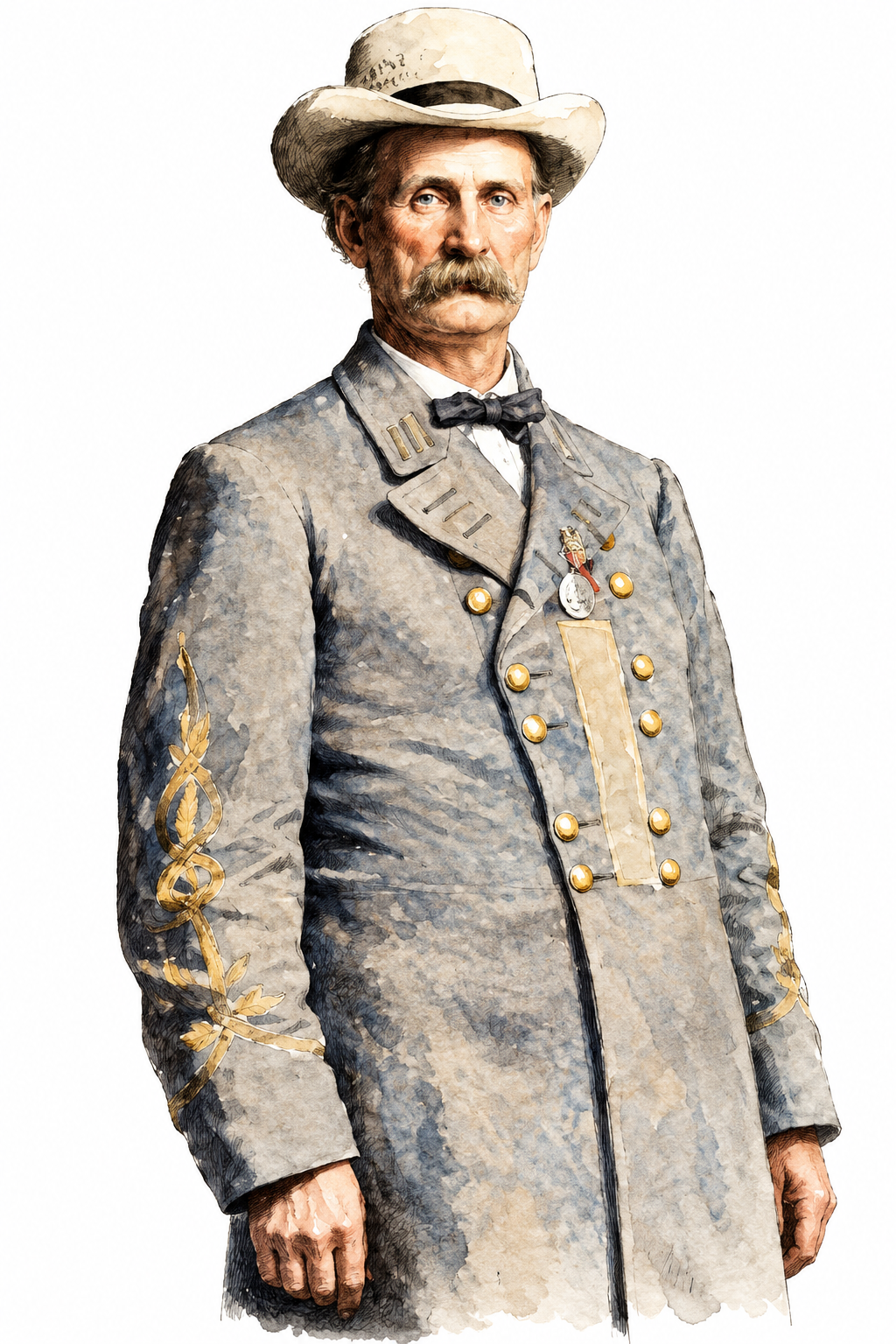
The old veteran, Capt. Jacob Warwick Mathews

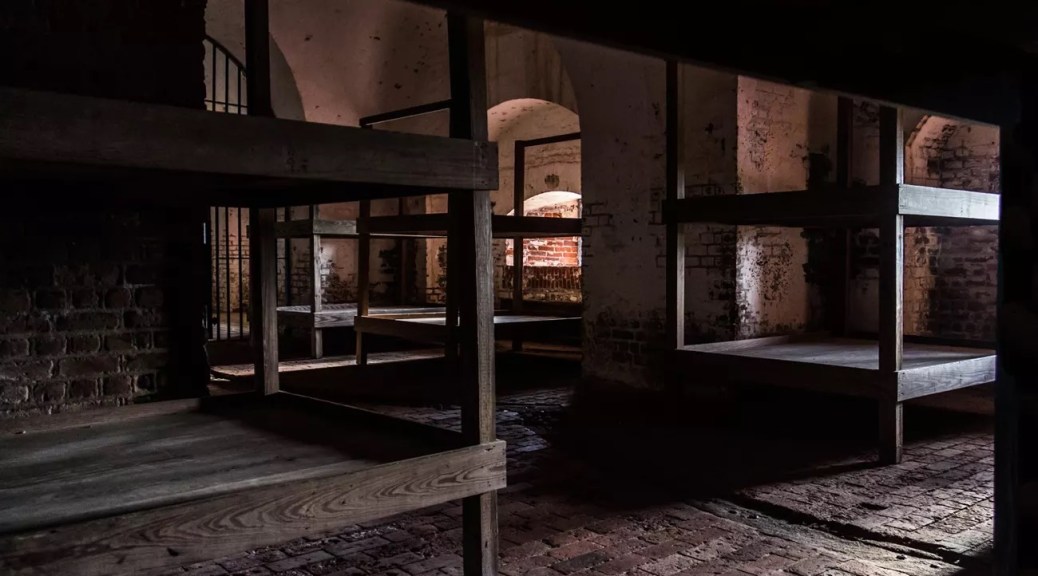
This POW letter was written by Capt. Jacob Warwick Mathews (1839-1930) of Co. I, 25th Virginia Infantry. Mathews was among the “Immortal Six Hundred”—a group of 600 Confederate officers held as prisoners of war, assembled in direct retaliation after Confederate forces employed Union prisoners as human shields in Charleston, South Carolina. After being subjected to weeks of bombardment on Morris Island, these prisoners were transferred in late October 1864 to Fort Pulaski on Cockspur Island, Georgia. Confined within the damp brick casemates of Fort Pulaski, they endured an exceptionally harsh winter, severe overcrowding, and a punitive “starvation diet” consisting only of moldy cornmeal and pickles. Thirteen prisoners died from disease and deprivation on the island before the remaining survivors were returned to Fort Delaware in March 1865. [Source: The Civil War Picket, July 26, 2021]

Mathews was a merchant/farmer of Alvon, Greenbrier county, (West) Virginia, when the Civil War began. He was taken prisoner in the Wilderness on 5 May 1864. He wrote the letter from a prison at Fort Pulaski, Georgia, in mid-February 1865 to Mrs. J. Eliza Bestor, a Southern sympathizer residing in Baltimore who had two sons in the Confederate service and provided assistance whenever she could to Confederate soldiers imprisoned in the North.

Header image: Confederate officers held prisoner at Fort Pulaski during the winter of 1864-65 shared bunks with multiple other prisoners; no mattresses, nor anything to keep the damp cold air out in the winter. (NPS Photo. Source: Prisoner of War Experience.)

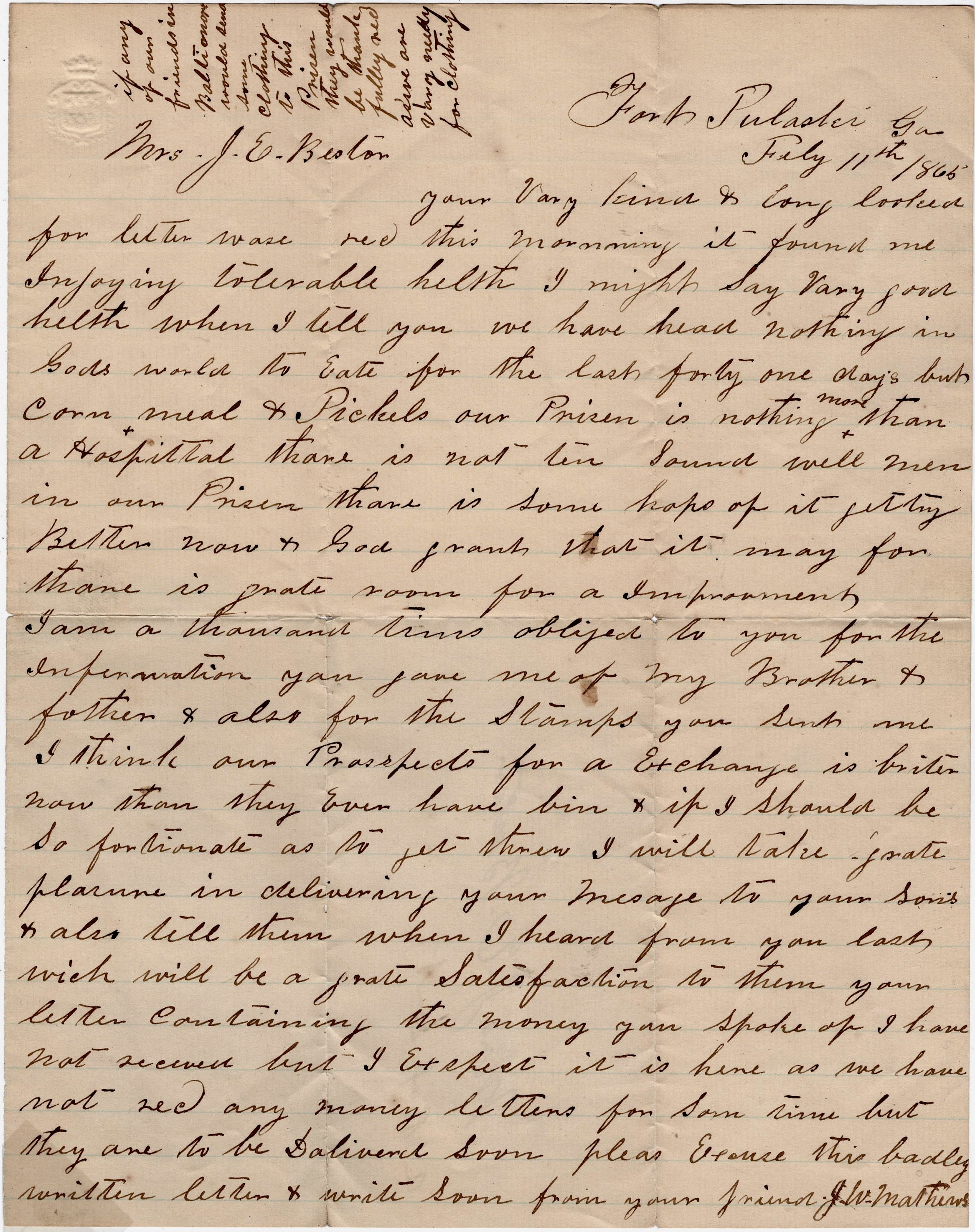
T R A N S C R I P T I O N

Fort Pulaski, Georgia

February 11th 1865

Mrs. J. E. Bestor,

Your very kind & long looked for letter was rec’d this morning it. It found me enjoying tolerable health. I might say very good health when I tell you we have had nothing in God’s world to eat for the last forty-one days but corn meal & pickles. Our prison is nothing more than a hospital. There is not ten sound well men in our prison. There is some hope of it getting better now & God grant that it may for there is great room for an improvement.

I am a thousand times obliged to you for the information you gave me of my brother & father & also for the stamps you sent me. I think our prospects for an exchange is brighter now than they ever have been & if I should be so fortunate as to get through, I will take grate pleasure in delivering your message to your sons & also tell them when I heard from you last, which will be a great satisfaction to them. Your letter containing the money you spoke of I have not received but I expect it is here as we have not rec’d any money letters for some time. But they are to be delivered soon. Please excuse this badly written letter & write soon. From your friend, — J. W. Mathews

If any of our friends in Baltimore would send some clothing to this prison, they would be thankfully received as we are very needy for clothing.
1862: Emanuel Cowger to Jacob and Sarah (Dice) Cowger

This is a letter written by Pvt. Emanuel Cowger (1843-1862) to his parents, Jacob and Sarah Dice Cowger dated September 22, 1862. Emanuel served with in Co. E, 25th Virginia Infantry (“Heck’s Regiment”). Emanuel was 19 years old when he enlisted on 5 April 1862 at Camp Shenandoah. He was wounded slightly in the leg during the fight at McDowell, Highland county, Virginia, on 8 May 1862.

In his letter Emanuel describes the capture of Harper’s Ferry and the fight two days later at Sharpsburg on 17 September 1862. During this period, the 25th Virginia was part of Stonewall Jackson’s foot soldiers, attached to Jubal Early’s Brigade of Ewell’s Division. In the latter fight, Emanuel mentions two other Pendleton County men serving with the 25th who were wounded; John Linthicum age 18 and Josiah Elyard age 22. Josiah would recover from his thigh wound. John, who was wounded in the neck, died 2 days after this letter was written.

The letter was written from Winchester, Virginia, on 22 September 1862, just three weeks before Emanuel died at a hospital there on 14 October 1862. He wrote the letter to his parents, Jacob Cowger (1809-1879) and Sarah A. Dice (1811-1902) of Pendleton county, Virginia (now W. Va.).

[This letter is from the personal collection of Dennis Miller whose great-great-grandmother, Amelia Cowger Miller (1839-1863) of Seybert, Pendleton county, W. Virginia, was the 1st cousin of Emanuel Cowger. It was offered for transcription and publishing on Spared & Shared by express consent.]

Transcription

Frederick county, Winchester [Virginia]
September 22, 1862

Dear Father & Mother,

I seat myself this morning to drop you a few lines to let you know our present condition. I am not very well at this time. But I hope when this comes to hand it will find you all enjoying good health. I have been sick about a week but I am better now. I had something like the cramp colic. I am at the hospital at Winchester. I came here yesterday. Our men has been doing some big work since I last wrote. I suppose you have heard all about the fight at the junction. We have been in Maryland. We went around by Frederick City, came on around to Williamsport, and crossed over into Virginia, from there to Martinsburg, and run the yankees away. Then on to Harper’s Ferry. September 15th, [we] captured about 15,000 prisoners. We got the whole army, artillery and all. they did not stand us a fight.

We left the ferry on [the] night of the 15th and marched up to Shepherdstown, crossed over into Maryland and had a very hard fight with Burnside’s and McClellan’s army. The fight was on Wednesday the 17th. I don’t know whether to call it a victory or not. Our men have fallen back on this side of the river. We lost one or two men killed out of our regiment. We had one killed and two wounded out of our company. Our 2nd Lieutenant C[harles] W. Delay was killed. Joseph Elyard & John Linthicum was wounded very badly. Elyard was shot in the thigh. John Linthicum was shot through the neck with a large minié ball. The ball went in just above the collar bone, missed his windpipe to the right, ranged rather down, and come out on his shoulder. I saw him the next day after the fight. He was very poorly and he looked very bad but he said he did not suffer much. It does not hinder him from eating. I wish you would let Mrs. Linthicum know that he is wounded. The wounded are getting furloughs and I think as soon as John gets abl, he will get a furlough.

The doctors are sending the sick up the Valley, I do not know whether we will leave or not. John Da[ ] and myself are here together. We are the only ones from our regiment. I would like to have some clothes from home if I could get them. If you could have a chance to send them in the course of two months, I would be very glad, I would like to have a pair of socks, If you could get me a pair of boots made and send them to me, I would be very glad. If you get them made, have them made large 7 or small 8. Have them made wide in the instep. If you can get the boots made, try and send the clothes. I lost my knapsack last spring and all that was in it. We have no chance to draw anything on the march.

I must bring my letter to a close. My pencil is so bad I can hardly write with it. I would be very glad to hear from you all once more if I could. I haven’t heard from you since the 7th of August. I would sooner see you all than to hear from you. I think we will get furloughs this winter if nothing happens. I hope the war will soon come to a close and we will be permitted to go home once more. I don’t think the war can last long the way it is going now.

If you have any chance to send me a letter, do so. I am very anxious to hear from you all once more. Please excuse my bad writing and spelling. So no more at present but still remain yours, &c. — Eml. Cowger

I will write again in a few days and let you know how I am and where I am and I will try and give you more satisfaction.