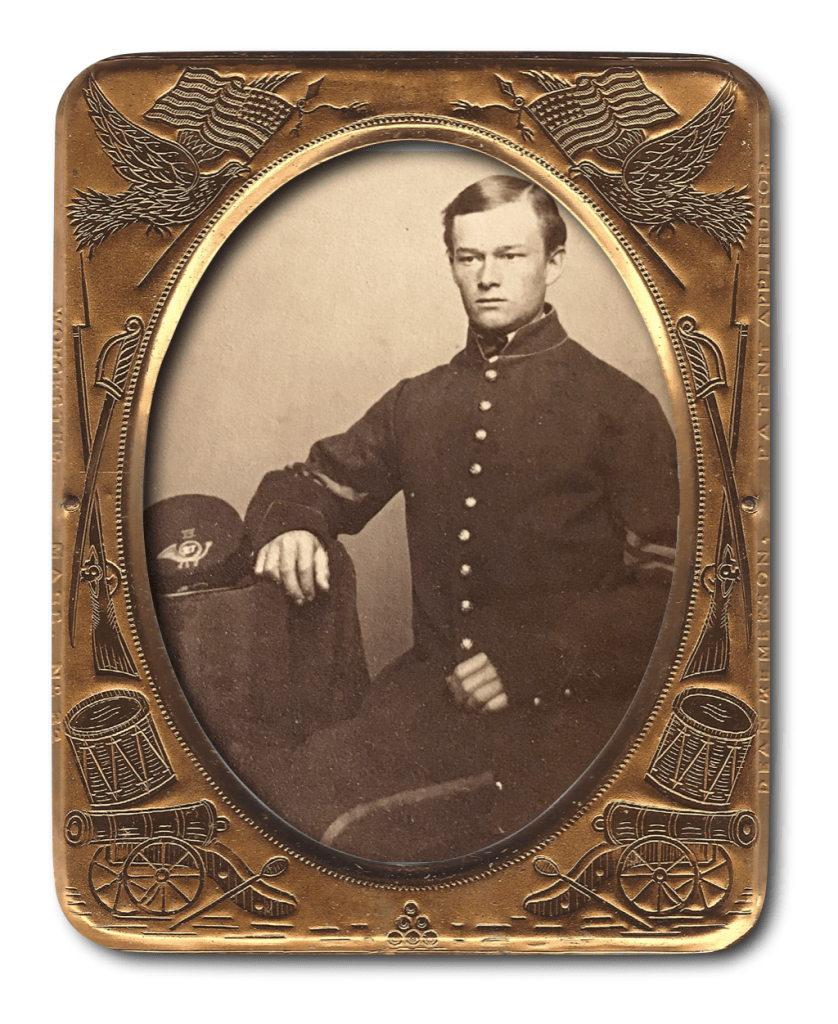
This letter was written by Samuel Beach (1827-1892) of Co. B, 27th Connecticut Infantry—a nine-months regiment. He was mustered in as a corporal on 3 October 1862 and mustered out on 27 July 1863.
According to the Samuel Beach Papers at the Robert S. Cox Special Collections (UMass Amherst Libraries), Samuel Beach was born in Branford on 27 July 1827, the son of Samuel Beach (17xx-1828) and Mary Barker (18xx-1881). In March 1851, he married the elder daughter of Increase Cooke (1807-1847) and Harriet Delia Griffing (1812-1849).
“On August 31, 1862, Samuel Beach was drafted into the 27th Connecticut Infantry, a nine-month’s regiment noted as much for the hardships of its service as its brief duration. Part of the First Division, Second Corps of the Army of the Potomac, the regiment was thrown into the toughest part of three of the most momentous battles of the eastern theater. At Fredericksburg in December 1862, the 27th sustained 110 casualties during the failed assault on Stonewall Jackson’s forces on Marye’s Heights. After a harsh winter spent in the mud along the Rappahannock gave way to spring, the 27th was swept by illness. Beach was among several who required hospital care to recuperate, and he was thus not present at the Battle of Chancellorsville, when eight of the regiment’s ten companies were taken prisoner. Two months later he was in a convalescent camp when the regiment’s remaining companies, much reduced, sustained fifty percent casualties the Battle of Gettysburg, fighting in the Wheat Field.
Samuel Beach’s Civil War letters [at UMass, Amherst] cover the bulk of his nine-month’s service, from the early days serving in the defenses around Washington, D.C., through the turbulence of Fredericksburg and Chancellorsville. Addressed to his wife Harriett, the letters are exceptionally literate and richly descriptive, with two excellent letters detailing his experiences at Fredericksburg, and several on the long winter that followed and the infamous Mud March. After the war, probably in the early 1880s, Beach wrote out a stunning 17 page account of his memories of Fredericksburg, using free pages in the center of an ledger containing accounts of labor of his fruit farm (box 2:4). The exceptional detail and energy of the account suggests he may have been working from a diary or contemporary notes that have not survived.”
T R A N S C R I P T I O N
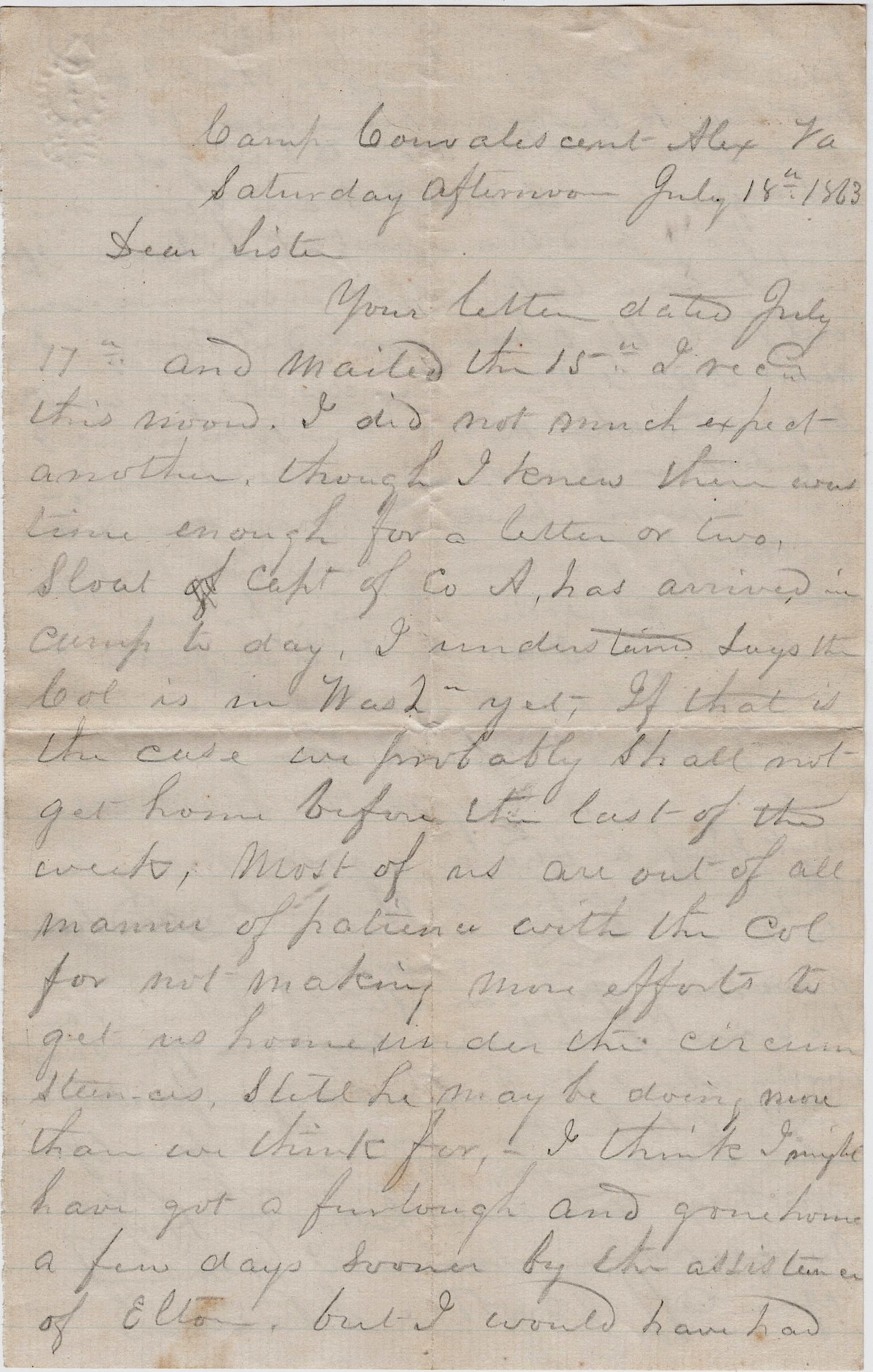
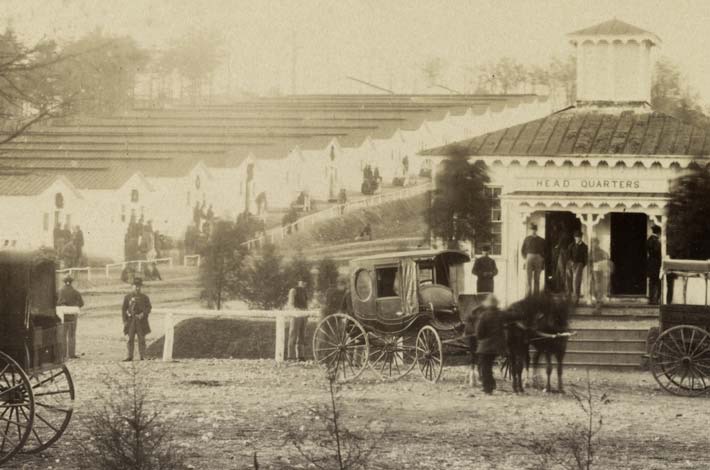
Camp Convalescent, Alexandria, Virginia
Saturday afternoon, July 18th 1863
Dear Sister,
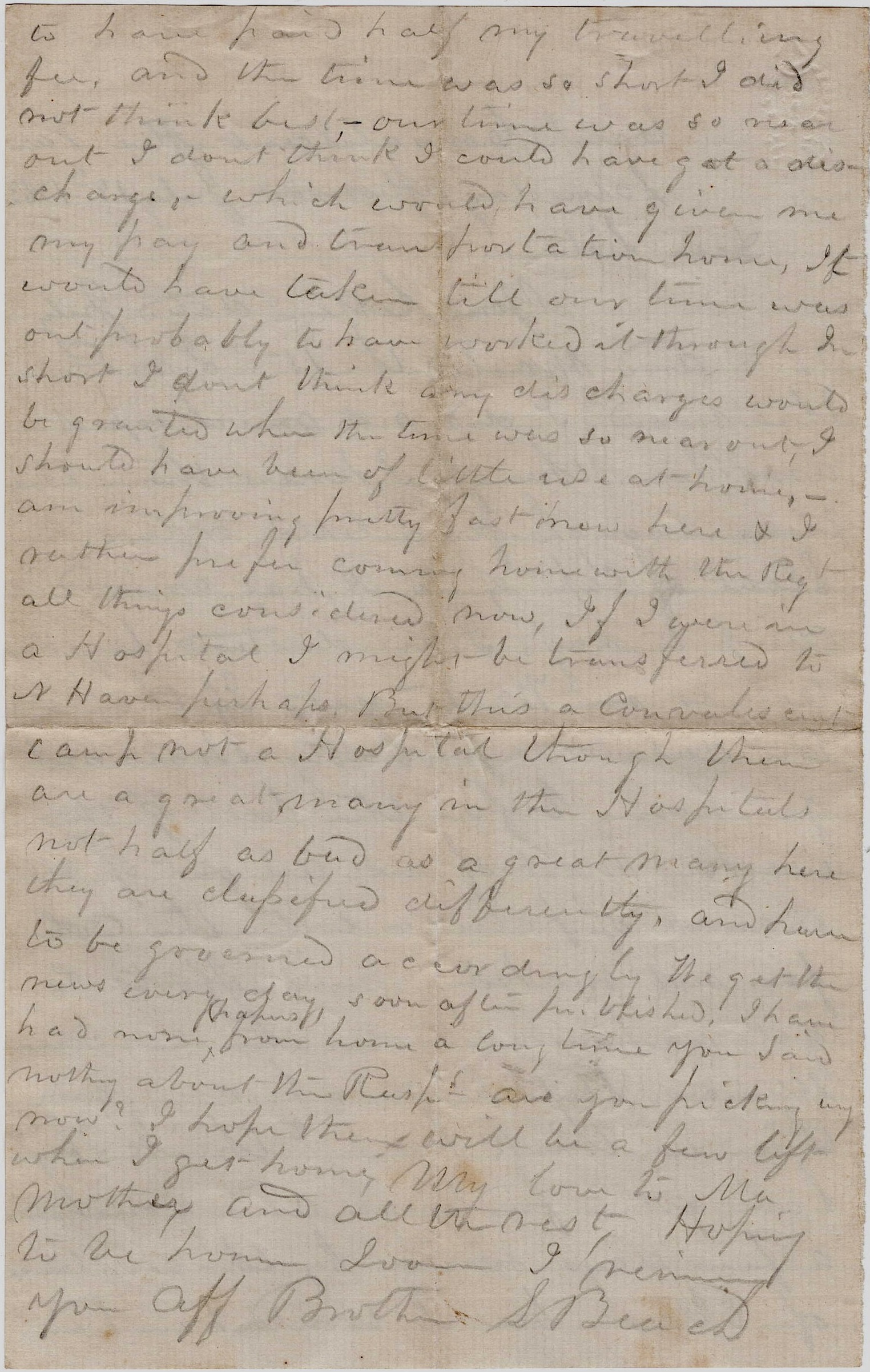
Your letter dated July 17th and mailed the 15th [reversed dates], I received this noon. I did not much expect another though I knew there was time enough for a letter or two. Sloat, captain of Co. A, has arrived in camp today. I understand Lays [?], the colonel, is in Washington yet. If that is the case, we probably shall not get home before the last of the week. Most of us are out of all manner of patience with the colonel for not making more efforts to get us home under the circumstances. Still he may be doing more than we think for, I think I might have got a furlough and gone home a few days sooner by the assistance of Elton. But I would have had to have paid half of my traveling fee, and the time was so short I did not think best, our time was so near out.
I don’t think I could have got a discharge which would have given me my pay and transportation home. It would have taken till our time was out probably to have worked it through. In short, I don’t think my discharge would be granted when the time was so near out. I should have been of little use at home.
Am improving pretty fast now here & I rather prefer coming home with the regiment, all things considered now. If I were in a hospital, I might be transferred to New Haven perhaps, but this is a Convalescent Camp, not a hospital. Though there are a great many in the hospitals not half as bad as a great many here, they are classified differently and have to be governed accordingly.
We get the news every day, soon after published. I have had none (papers) from home a long time. You said nothing about the raspberries. Are you picking any now? I hope there will be a few left when I get home. My love to Ma, Mother, and all the rest. Hoping to be home soon, I remain your affectionate brother, — S. Beach