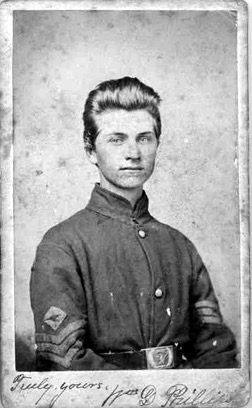
The following letter was written by Corp. George W. Miller (1840-1862) of Co. E, 27th Ohio Infantry. At the time of the 1860 US Census, 19 year-old George and his brother Harvey V. Miller (1839-1862) were enumerated in the household of an older brother (James W.) on his farm near Dawkin’s Mill, Jackson county, Ohio. His father, Adam Miller (1806-1881) was living with his 2nd wife, Patsy Ward (1816-1874) in Lawrence county, Ohio, with at least eight of George’s half-siblings. George’s mother, Elizabeth Hulett (1810-1840) died in Fayette county, Virginia, before the family moved to Ohio. George wrote the letter to his older sister, Nancy Jane (Miller) Ward (1832-1931), the wife of George Ward (1825-1872) of Waterloo, Lawrence county, Ohio.
George wrote his letter in August 1862 from the regiment’s camp near Corinth, Mississippi. By this time the regiment had seen action in Missouri and participated in the capture of New Madrid and Island No. 10. They then participated in the Battle of Iuka and would soon see action in the Second Battle of Corinth where George was killed in action on 4 October 1862 [another source says he died two days later]. His brother Harvey also served in the same company and died in St. Louis on 15 June 1862, presumably by disease.
George’s letter dwells heavily on Negro Emancipation or the “Negro Question” as it was often referred to. His views are consistent with the majority of the Union soldiers, particularly from southern Ohio where the 27th Ohio Regiment was raised.
This letter is from the private collection of Greg Herr and was made available for transcription and publication on Spared & Shared by express consent.
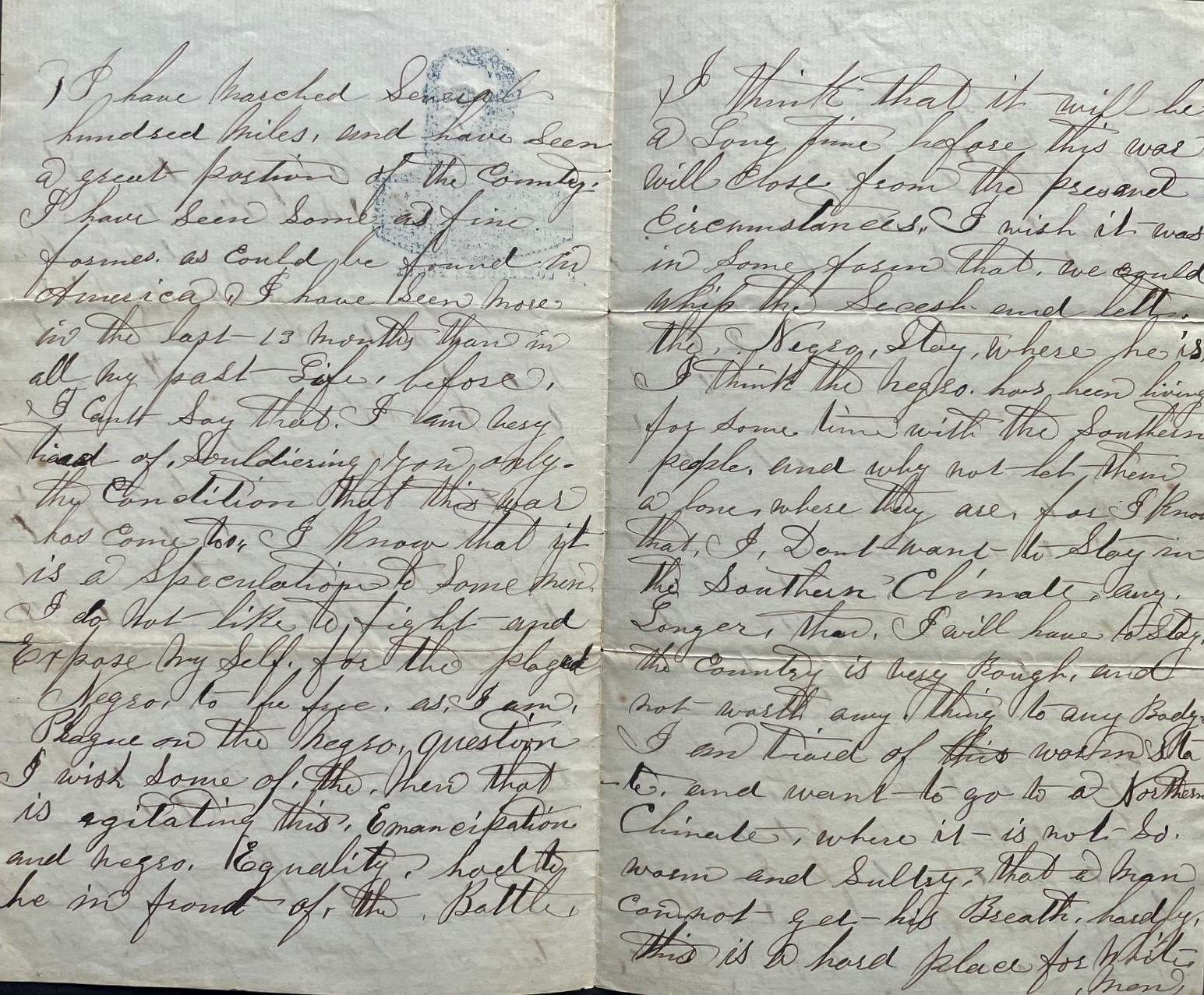
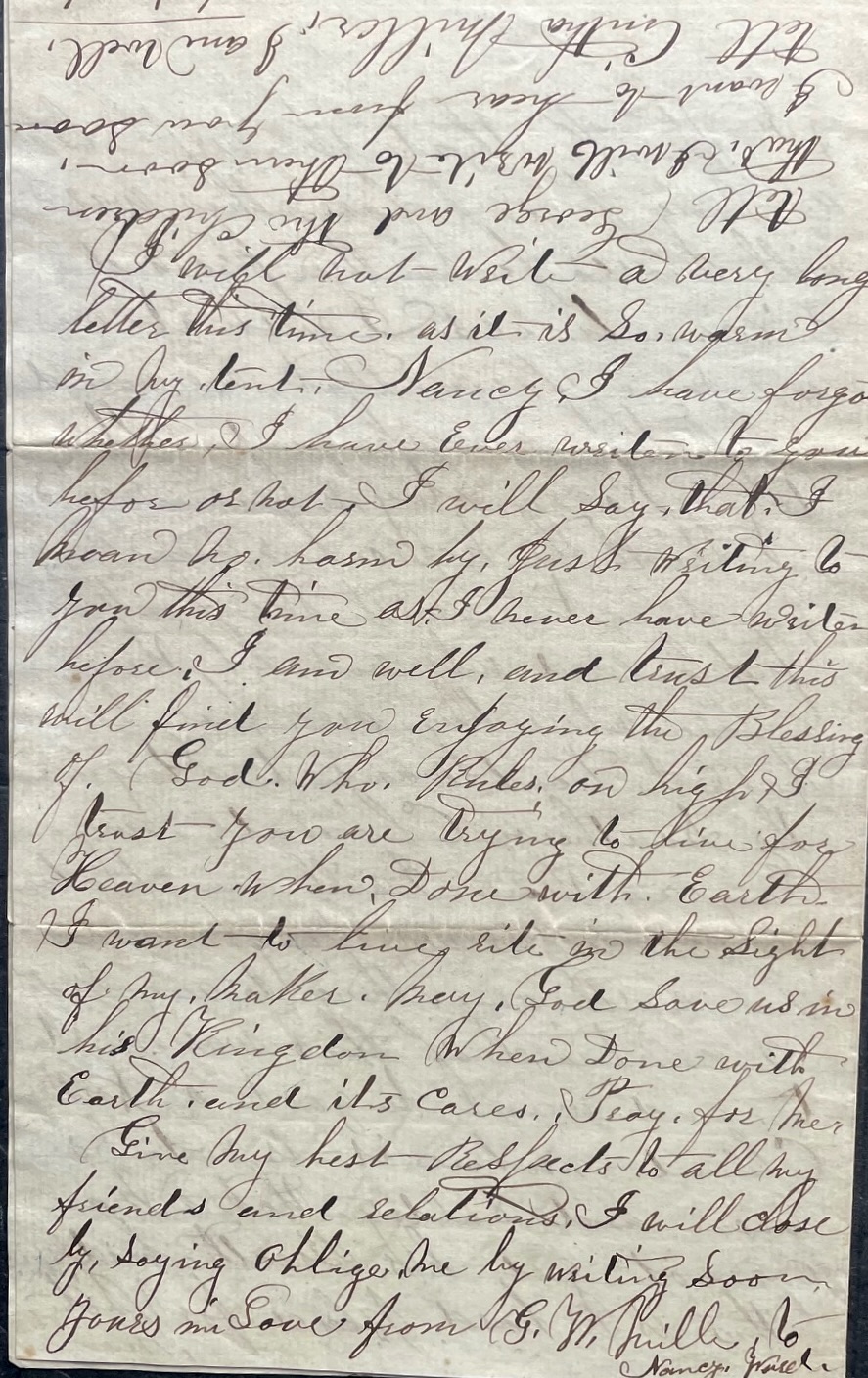
T R A N S C R I P T I O N
Camp of the 27th
Near Corinth, Mississippi
August 6th 1862
Mrs. Nancy Ward,
Dear sister—I seat myself to write you a few lines to inform you that I am enjoying a very reasonable portion of health and trust this will find you enjoying good health. I am in camp today and thought that I would write you a few lines for your perusal when you have a leisure time.
I have been in the Army near 13 months and have been in several states since I came out from Ohio. I have been in several fights. I have marched several hundred miles and have seen a great portion of the country. I have seen some as fine farms as could be found in America. I have seen more in the last 13 months than in all my past life before.
I can’t say that I am very tired of soldiering. You only [know] the condition that this war has come to. I know that it is a speculation to some there. I do not like to fight and expose myself for the plagued Negro to be free as I am plaugue on the Negro question. I wish some of the men that is agitating this Emanicipation and Negro Equality had to be in front of the battle.
I think that it will be a long time before this war will close from the present circumstances. I wish it was in some form that we could whip the Secesh and let the Negro stay where he is. I think the Negro has been living for some time with the Southern people and why not let them alone where they are, for I know that I don’t want to stay in the Southern climate any longer than I will have to stay. The country is very rough and not worth anything to anybody. I am tired of this warm state and want to go to a Northern climate where it is not so warm and sultry that a man cannot get his breath hardly. This is a hard place for white men.
I will not write a very long letter this time as it is so warm in my tent. Nancy, I have forgot whether I have ever written to you before or not. I will say that I mean no harm by just writing to you this time as I never have written before. I am well and trust this will find you enjoying the blessing of God who rules on high. I trust you are trying to live for heaven when done with Earth. I want to live right in the sight of my Maker. May God save us in His Kingdom when done with Earth and its cares. Pray for me. Give my best respects to all my friends and relations. I will close by saying oblige me by writing soon. Yours in love. From G. W. Miller
To Nancy Ward
Tell [your husband] George and the children that I will write to them soon. I want to hear from you soon. Tell Cintha Miller I am well.
Tell me if Miss Mary Hall is at home or not.