Category Archives: 37th Massachusetts Infantry

1863: William A. Bartlett to Alida (Fish) Bartlett

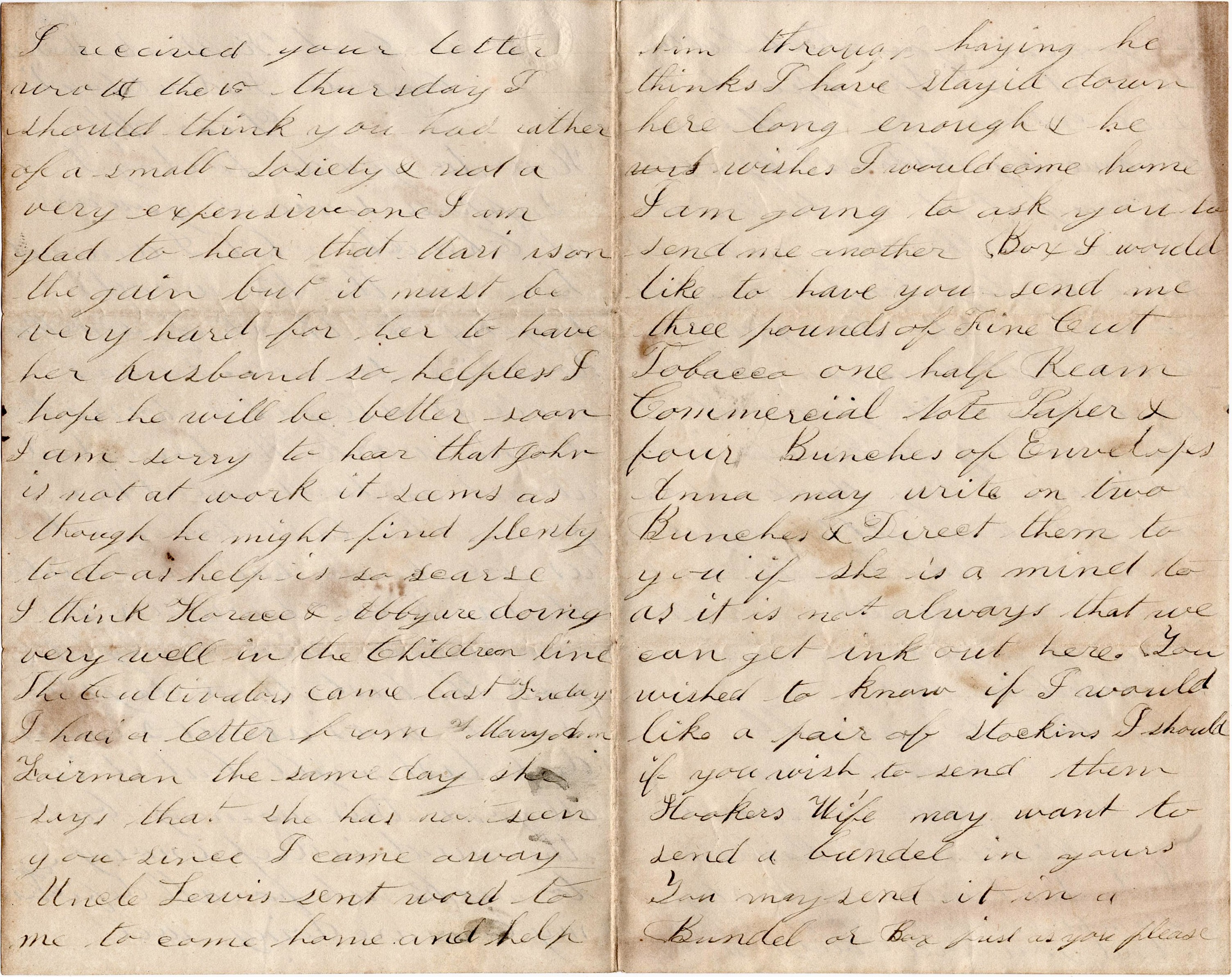
This letter was written by Pvt. William A. Bartlett (1831-1897) who enlisted in Co. D, 37th Massachusetts Infantry during the American Civil War. William was the son of David Bartlett (1805-1836) and Cordelia Morey (1808-18xx). William married Alida Priscilla Fish (1829-1898) on 29 March 1854 in Westhampton, Massachusetts. Together they had at least five children: Clarence Alton Bartlett (1856-1929), Ida C. Bartlett (1857-1883), Mary A. Bartlett (1860-1915), Carrie M. Bartlett (1862-19xx), and Charles Watson Bartlett (1865-19xx).

In 2017, I published twelve letters from William, which were sent to me by a collector. At that time, it was widely recognized that numerous other letters from William had been sold to various collectors, and we have long anticipated the eventual emergence of additional correspondence. Recently, one such letter has surfaced, and it is presented below. The link to his other letters—Twelve Letters by William A. Bartlett

Bartlett was above the median age for enlistees in the American Civil War and his age and health seems to have limited his ability to perform the full duty he desired. He complained of pain in his arm which seems not to have been caused by his duties as a soldier but possibly an old complaint — rheumatism. If he served in battle with his comrades of the 37th Massachusetts, he did not speak of it in any of these twelve letters. When his regiment was ordered to New York City in July 1863 to restore order during the draft riots, he did not accompany them, preferring instead to remain on a special detail that afforded him light duty at the Corps headquarters.

From the letters we learn that he was sent to a hospital in Washington D. C. prior to the end of 1863 and in the spring of 1864 he was still awaiting his discharge from the Veteran Reserve Corps. His military records state that he was mustered out of the service on 15 April 1864.

At the time of his enlistment, he gave his occupation as a carpenter. In the 1870 U. S. Census, he also gave his occupation as a carpenter. In the 1880 U. S. Census, however, no occupation is given for the 48-year old veteran who seems to have been an invalid “at home.” William and his wife Alida made their home in Blandford, Hampden county, Massachusetts after the war.

T R A N S C R I P T I O N

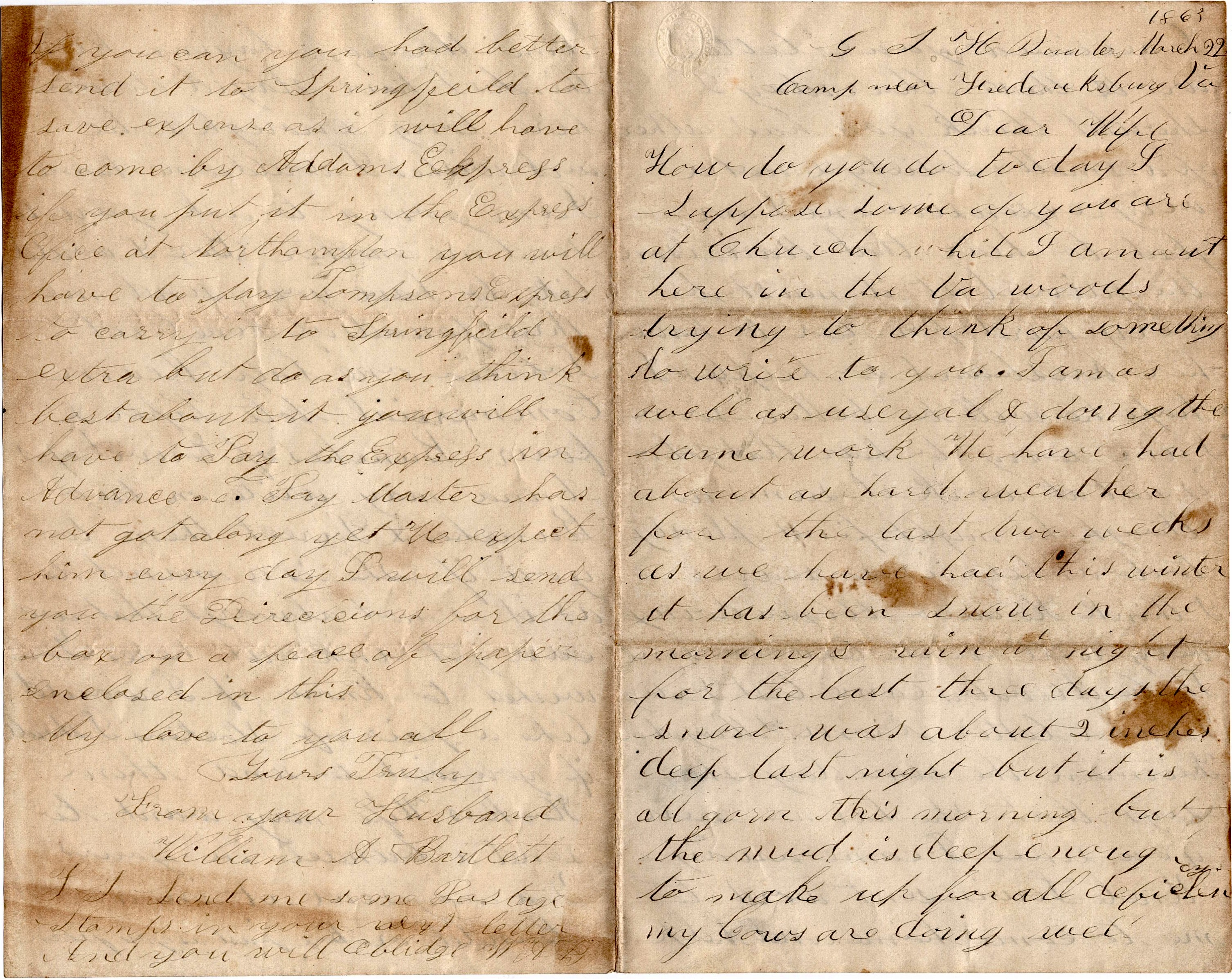
General Sedgwick’s Headquarters
Camp near Fredericksburg, Va.
March 22, 1862

Dear Wife,

How do you do today? I suppose some of you are at church while I am out here in the Virginia woods trying to think of something to write to you. I am as well as usual & dong the same work. We have had about as hard weather for the last two weeks as we have had this winter. It has been snow in the mornings, rain at night for the last three days. The snow was about two inches deep last night but it is all gone this morning but the mud is deep enough to make up for all deficiency. My cows are doing well.

I received your letter write the 15th, Thursday. I should think you had rather of a small society & not a very expensive one. I am glad to hear that Mari is on the gain but it must be very hard for her to have her husband so helpless. I hope he will better soon. I am very sorry to hear that John is not at work. It seems as though he might find plenty to do as help is scarce. I think Horace and Abby are doing very well in the children line. The cultivators came last Friday.

I have a letter from Mary Ann Fairman the same day. She says that she has not seen you since I came away. Uncle Lewis sent word to me to come home and help him through haying. He thinks I have stayed down here long enough. He wishes I would come home.

I am going to ask you to send me a box. I would like to have you send me three pounds of fine cut tobacco, one half ream commercial note paper & four bunches of envelopes. Anna may write on two bunches and direct them to you if she has a mind to as it is not always that we can get ink out here. You wished to know if I would like a pair of stockings. I should if you wish to send them. Hooker’s wife may want to send a bundle in yours. You may send it in a bundle or box, just as you please.

If you can, you had better send it to Springfield to save expense as it will have to come by Adams Express if you put it in the Express Office at Northampton. You will have to pay Tompson’s Express to carry it to Springfield extra but do as you think best about it. You will have to pay the Express in advance. Pay Master has not got along yet. We expect him every day. I will send you the directions for the box on a piece of paper enclosed in this. My love to you all. Yours truly, from your husband, — William A. Bartlett

P. S. Send me some postage stamps in your next letter and you will oblige. — W. A. B.
1865: Chester Hamilton Ballard to his Parents

A GAR carte-de-visite of Chester H. Ballard (Chris Maldonado Collection)

Chester Hamilton Ballard (1843-1916) enlisted in Co. A of the 37th Massachusetts Infantry in August 1862. “Organized at Camp Briggs, and comprised mainly of men recruited in the four western counties of the state, the 37th Massachusetts was sent to the vicinity of Washington, D.C., via Fort Hamilton, N.Y., but it was some time before they found a definite corps assignment. Once attached to the 6th Corps of the Army of the Potomac, however, they soon found themselves involved in the thick of the war. Joining the main body of the army in the Blue Ridge in November, they participated in the Battle of Fredericksburg, helping to lead the crossing of the Rappahannock on December 11th, and covering the retreat on the 15th. 

After overwintering near White Oak Church, the 37th participated in the assault on Marye’s Heights (2nd Fredericksburg) on May 3rd, and were engaged on the following day at the Battle of Salem Church. Later in the summer, they were rushed into action at Gettysburg, arriving to participate in the action on July 3rd, and were then ordered to New York City to quell the draft riots.

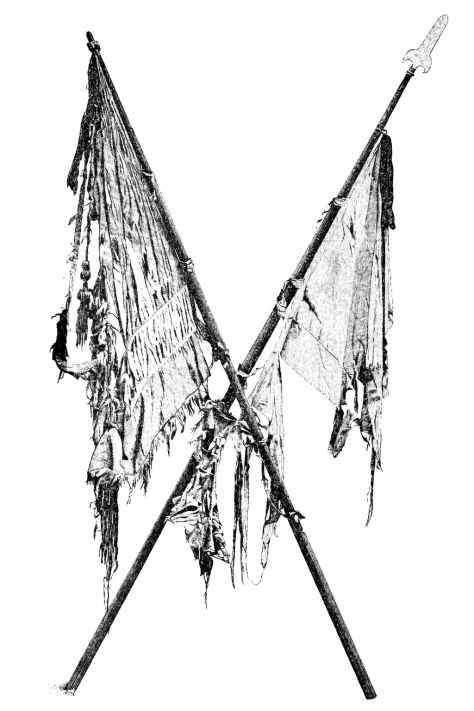
Battle flags of the 37th Massachusetts Infantry at Boston State House

Their most memorable action, however, may have been during the Wilderness-Spotsylvania campaigns in May 1864. Thrown into confusion at the Battle of the Wilderness, the regiment lost 54 men, and a few days later that lost another 32 at the Bloody Angle in Spotsylvania. The 37th Infantry remained in the vicinity of Petersburg, suffering continual losses in both men and morale, until ordered to help repel Jubal Early’s raid on Washington late in the summer. Newly equipped with Spencer seven-shot repeating rifles, the regiment pursued Early into the Shenandoah Valley and was placed under Philip Sheridan’s command during the fall campaign of 1864. They were engaged at Charles Town and the 3rd Battle of Winchester, before being returned to the Petersburg front in December. Though their ranks were greatly reduced, the 37th remained active until the final battles of the war in the east, including the final assault on Petersburg, Sailor’s Creek, and Appomattox Court House.”

Chester was born in Brookline, Vermont, the son of Alexander H. Ballard. He spent his early life in Brookline and in Ludlow, Massachusetts. When the war began, Chester was engaged n the grocery and meat business in Springfield and ten days before his 19th birthday he mustered into the 37th Massachusetts. He was promoted to Orderly Sergeant before the close of the war. After he mustered out of the service at war’s end, he went to Chicopee and entered the grocery business again.

Fourteen of Chester’s letters can be found in the University of Michigan’s William L. Clements Library. See Chester H. Ballard papers, 1862-1864.

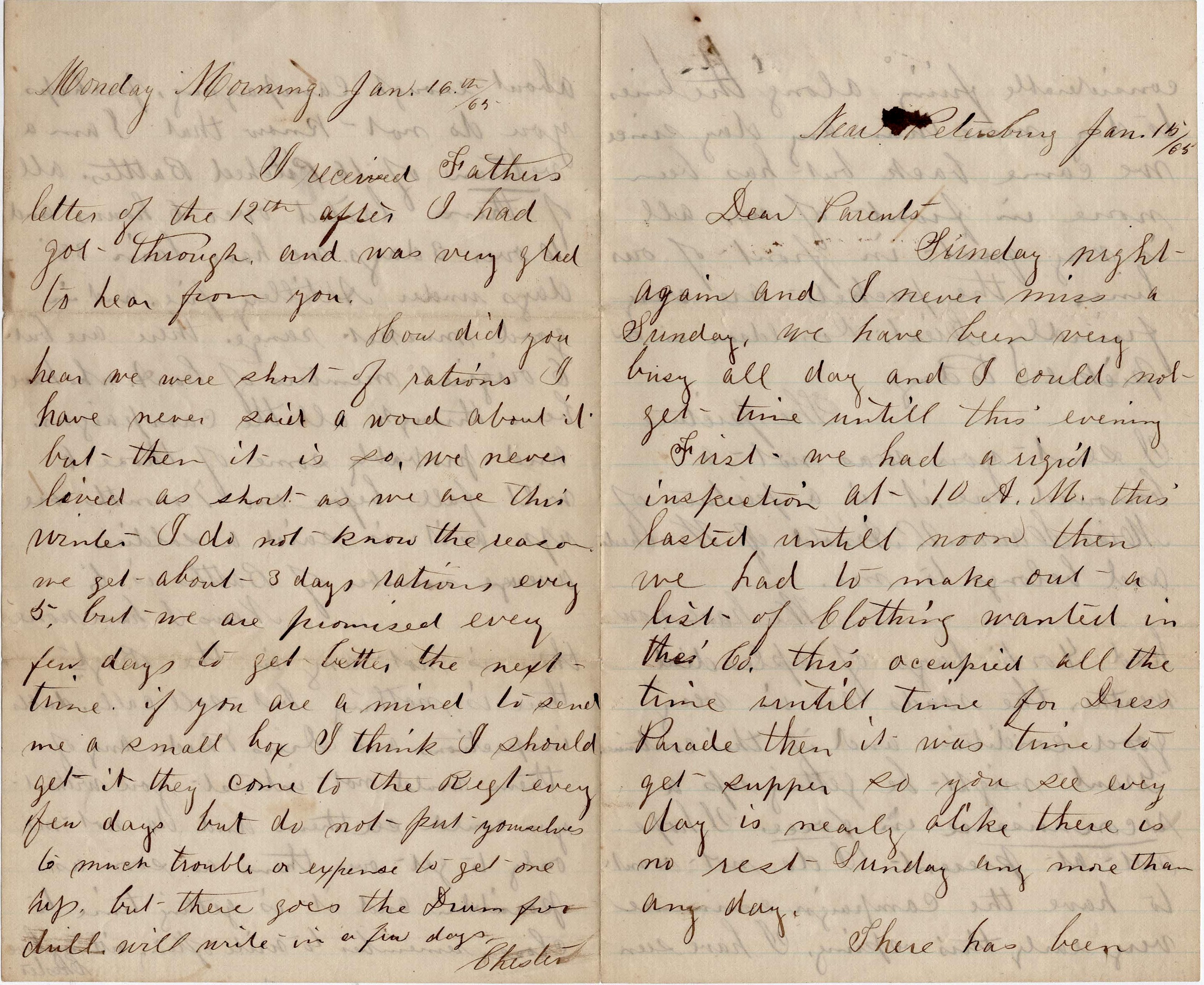
T R A N S C R I P T I O N

Near Petersburg [in camp near Warren Station]
January 15, 1865

Dear Parents,

Sunday night again and I never miss a Sunday. We have been very busy all day and I could not get time until this evening. First we had a rigid inspection at 10 a.m. This lasted until noon. Then we had to make out a list of clothing wanted in this company. This occupied all the time until time for dress parade. Then it was time to get supper so you see every day is nearly alike. There is no rest Sunday any more than any day.

There has been considerable firing along the lines today—more than any day since we came back, but has been none in front of us. All is very quiet in front of our lines. The pickets are very friendly. Lieut. [David M.] Donaldson is on picket today.

The picture I sent you was not a borrowed one. It is a picture of Miss Laura V. Arnold of Winchester and belongs to me.

We have now had four or five days of splendid weather. The roads are in very good condition and if this continues, Grant might be getting up a reconnoissance in force. I hope not at present. I do not want to have the campaign commence very early this spring. I have seen about enough campaigning. Perhaps you do not know that I am a veteran of 16 pitched battles. All of them lasted over 6 hours and 10 over 3 days. We have lain 38 days under artillery fire and in good musket range. There are but six original members of Co. A who have been through all the campaigns, and probably some of those six will fall before our 7 months are up as it is said a soldier’s average number of battles is five.

News? I have none. There is not any in the regiment. There is nothing but roll calls, drills, inspections and dress parade. Any of them would not interest you without you could see them and do not me only to get over them as soon as possible and it is getting time to close. Remember to write often. With my love, — Chester

Monday morning, January 16th

I received Father’s letter of the 12th after I had got through and was very glad to hear from you.

How did you hear we were short of rations? I have never said a word about it but then it is so. We never lived as short as we are this winter. I do not know the reason. We get about 3 days rations every five, but we are promised every few days to get better the next time. If you are a mind to send me a small box, I think I should get it. They come to the regiment every few days but do not put yourselves to much trouble or expense to get one up. But there goes the drum for drill. Will write in a few days. — Chester