This letter was written by Pvt. William A. Bartlett (1831-1897) who enlisted in Co. D, 37th Massachusetts Infantry during the American Civil War. William was the son of David Bartlett (1805-1836) and Cordelia Morey (1808-18xx). William married Alida Priscilla Fish (1829-1898) on 29 March 1854 in Westhampton, Massachusetts. Together they had at least five children: Clarence Alton Bartlett (1856-1929), Ida C. Bartlett (1857-1883), Mary A. Bartlett (1860-1915), Carrie M. Bartlett (1862-19xx), and Charles Watson Bartlett (1865-19xx).
In 2017, I published twelve letters from William, which were sent to me by a collector. At that time, it was widely recognized that numerous other letters from William had been sold to various collectors, and we have long anticipated the eventual emergence of additional correspondence. Recently, one such letter has surfaced, and it is presented below. The link to his other letters—Twelve Letters by William A. Bartlett
Bartlett was above the median age for enlistees in the American Civil War and his age and health seems to have limited his ability to perform the full duty he desired. He complained of pain in his arm which seems not to have been caused by his duties as a soldier but possibly an old complaint — rheumatism. If he served in battle with his comrades of the 37th Massachusetts, he did not speak of it in any of these twelve letters. When his regiment was ordered to New York City in July 1863 to restore order during the draft riots, he did not accompany them, preferring instead to remain on a special detail that afforded him light duty at the Corps headquarters.
From the letters we learn that he was sent to a hospital in Washington D. C. prior to the end of 1863 and in the spring of 1864 he was still awaiting his discharge from the Veteran Reserve Corps. His military records state that he was mustered out of the service on 15 April 1864.
At the time of his enlistment, he gave his occupation as a carpenter. In the 1870 U. S. Census, he also gave his occupation as a carpenter. In the 1880 U. S. Census, however, no occupation is given for the 48-year old veteran who seems to have been an invalid “at home.” William and his wife Alida made their home in Blandford, Hampden county, Massachusetts after the war.
T R A N S C R I P T I O N
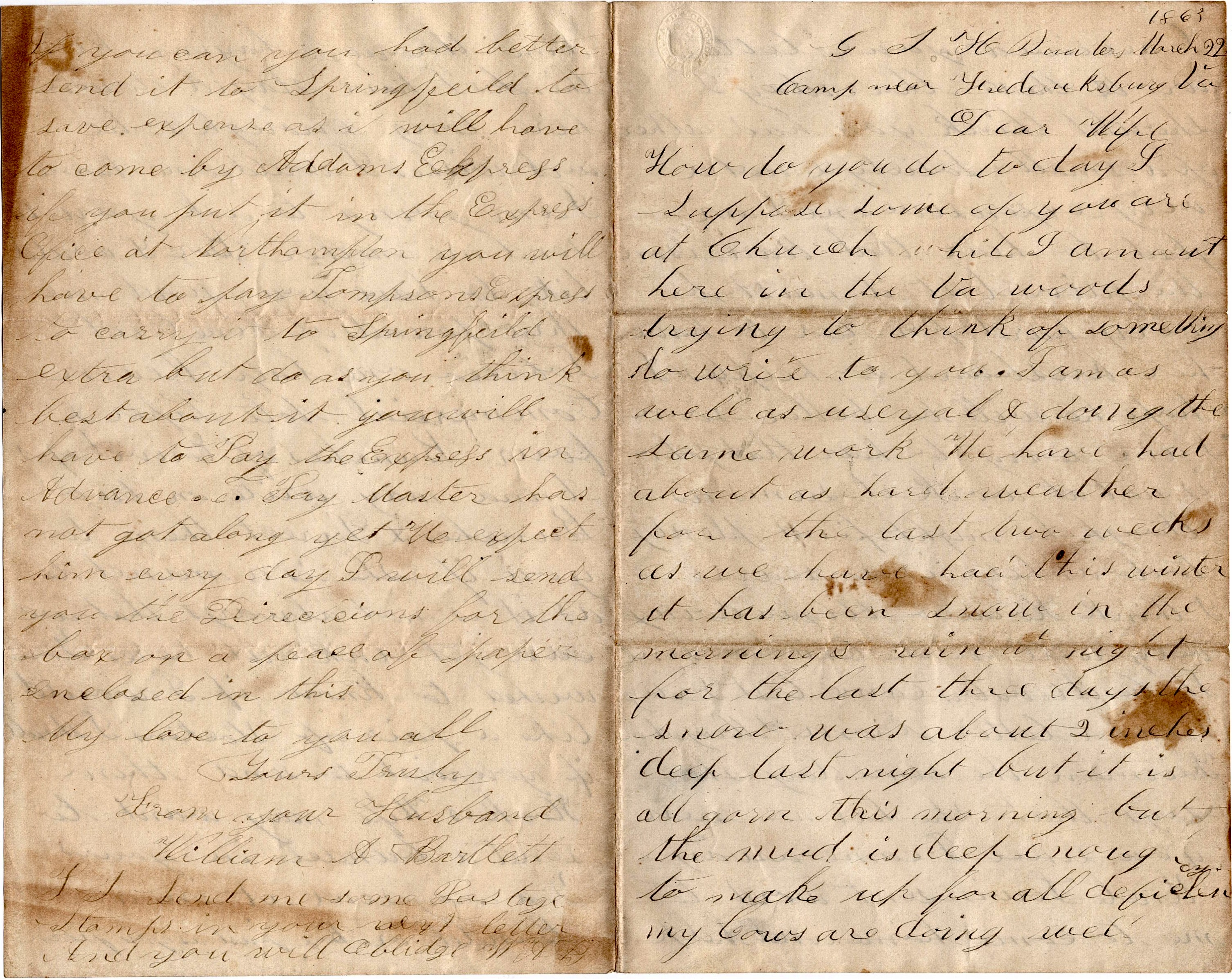
General Sedgwick’s Headquarters
Camp near Fredericksburg, Va.
March 22, 1862
Dear Wife,
How do you do today? I suppose some of you are at church while I am out here in the Virginia woods trying to think of something to write to you. I am as well as usual & dong the same work. We have had about as hard weather for the last two weeks as we have had this winter. It has been snow in the mornings, rain at night for the last three days. The snow was about two inches deep last night but it is all gone this morning but the mud is deep enough to make up for all deficiency. My cows are doing well.
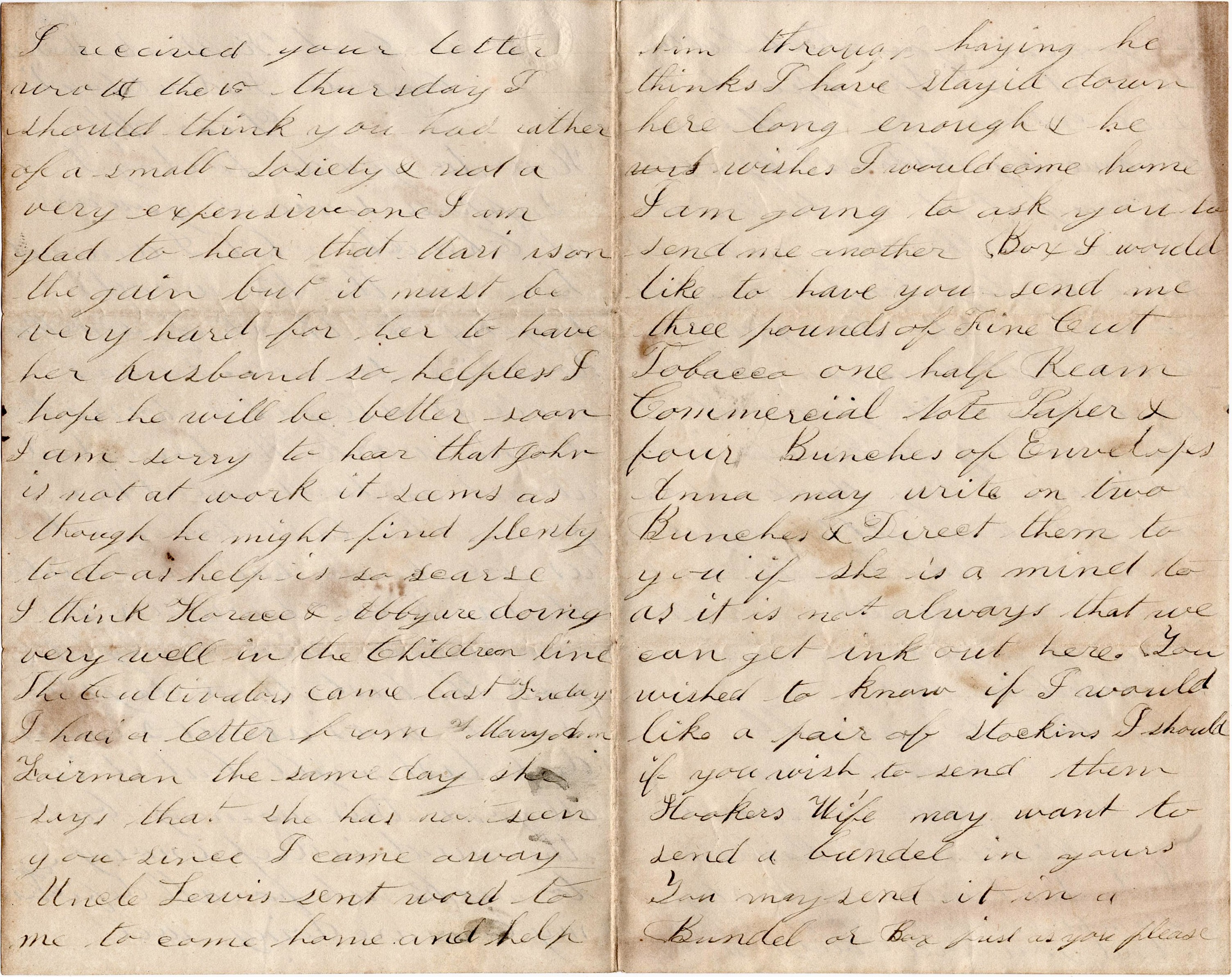
I received your letter write the 15th, Thursday. I should think you had rather of a small society & not a very expensive one. I am glad to hear that Mari is on the gain but it must be very hard for her to have her husband so helpless. I hope he will better soon. I am very sorry to hear that John is not at work. It seems as though he might find plenty to do as help is scarce. I think Horace and Abby are doing very well in the children line. The cultivators came last Friday.
I have a letter from Mary Ann Fairman the same day. She says that she has not seen you since I came away. Uncle Lewis sent word to me to come home and help him through haying. He thinks I have stayed down here long enough. He wishes I would come home.
I am going to ask you to send me a box. I would like to have you send me three pounds of fine cut tobacco, one half ream commercial note paper & four bunches of envelopes. Anna may write on two bunches and direct them to you if she has a mind to as it is not always that we can get ink out here. You wished to know if I would like a pair of stockings. I should if you wish to send them. Hooker’s wife may want to send a bundle in yours. You may send it in a bundle or box, just as you please.
If you can, you had better send it to Springfield to save expense as it will have to come by Adams Express if you put it in the Express Office at Northampton. You will have to pay Tompson’s Express to carry it to Springfield extra but do as you think best about it. You will have to pay the Express in advance. Pay Master has not got along yet. We expect him every day. I will send you the directions for the box on a piece of paper enclosed in this. My love to you all. Yours truly, from your husband, — William A. Bartlett
P. S. Send me some postage stamps in your next letter and you will oblige. — W. A. B.