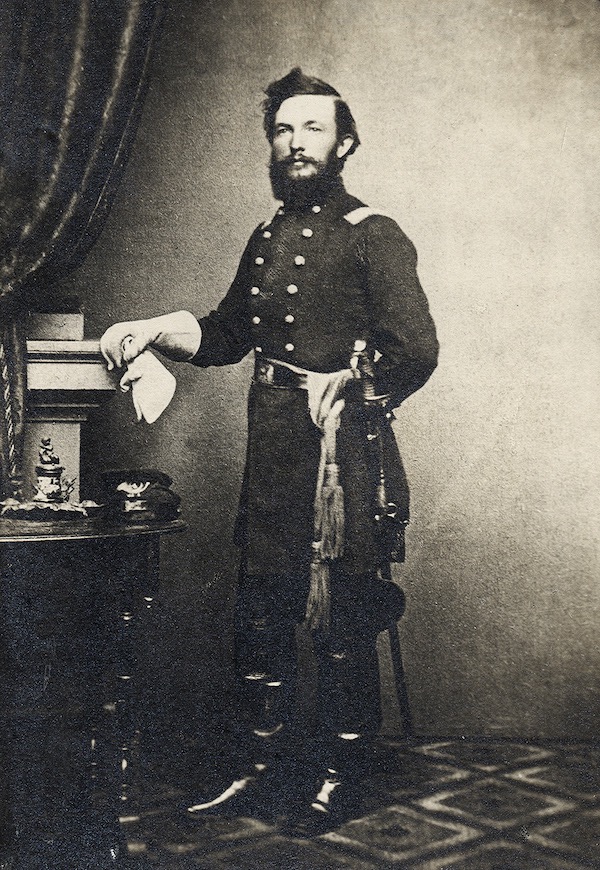
The following letter was written by Jonathan Webster Childs (1834-1896) who volunteered in May 1861, accepting a commission as the Major of the 4th Michigan Infantry (1st organization). Following the Battle of Bull Run, Childs was promoted to Lieutenant Colonel. He survived a gunshot wound to the hip at the 27 June 1862 Battle of Gaines’ Mill and was soon after promoted to Colonel of the regiment when Colonel Woodbury was killed by a shot to the head in the Battle of Malvern Hill on July 1, 1862. He led the regiment at the Battle of Antietam though they were held in reserve and suffered no casualties. In November late November 1862, just prior to the Battle of Fredericksburg, Childs resigned his commission and returned home. Later, in September 1863, he accepted a commission as Captain of Co. D, 2nd Regiment, US Colored Troops. He remained with them until January 1866, stationed in Florida.
Jonathan was the eldest son of Aaron Childs (1806-1882) and Hannah Frost Bemis (1814-1896) of Washtenaw county. He wrote the letter to his uncle, James Webster Childs (1826-1882), a Washtenaw county civil leader and politician who served two terms in the Michigan Legislature and then in the Michigan Senate. Just prior to his volunteering for the service, Jonathan was employed as a teacher at the Manchester Academy in Washtenaw county, Michigan.
[Editor’s Note: The photocopy of this letter was sent to me for transcription and publication on Spared & Shared by Janet Buchanan, a descendant relative of the Childs family.]
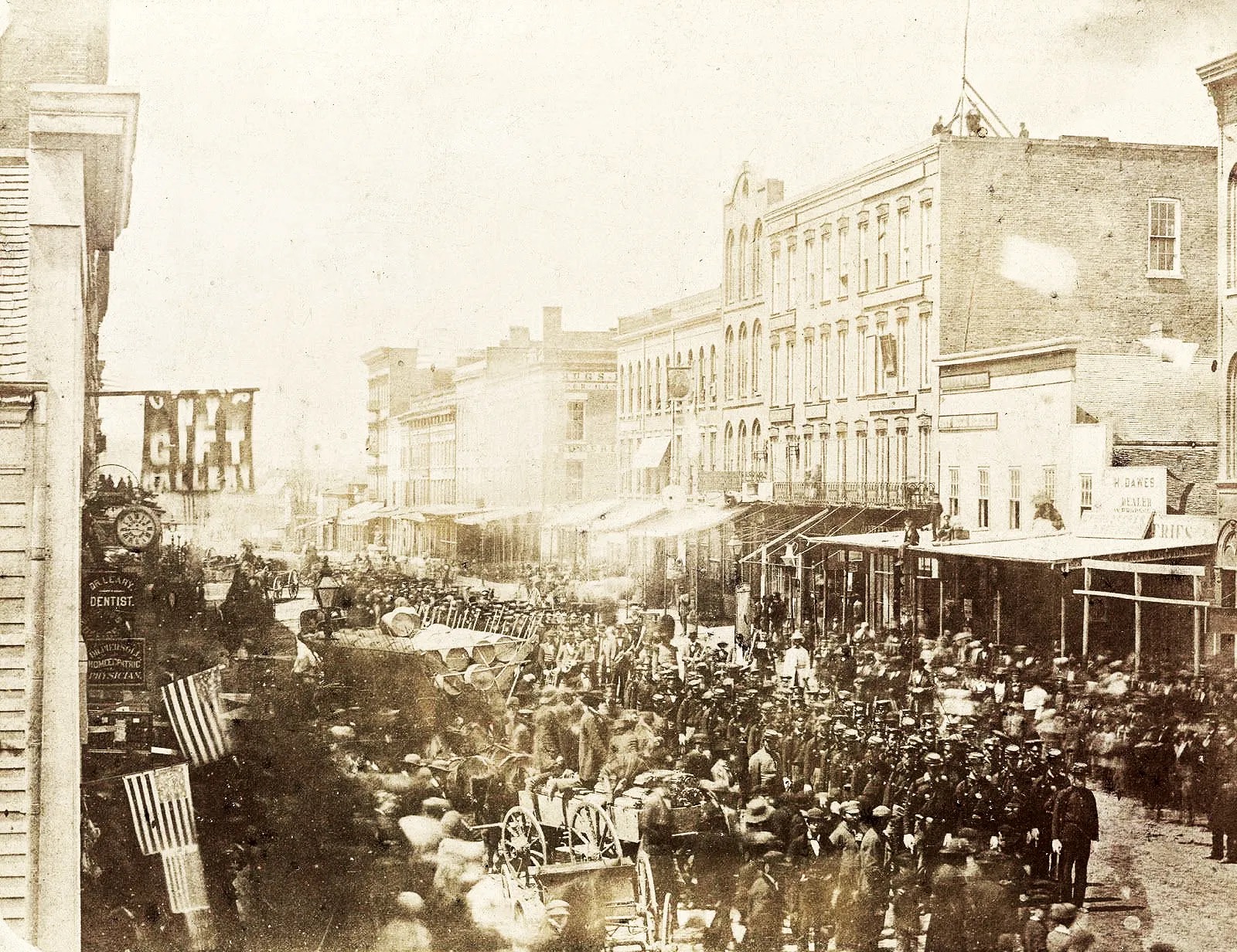
T R A N S C R I P T I O N
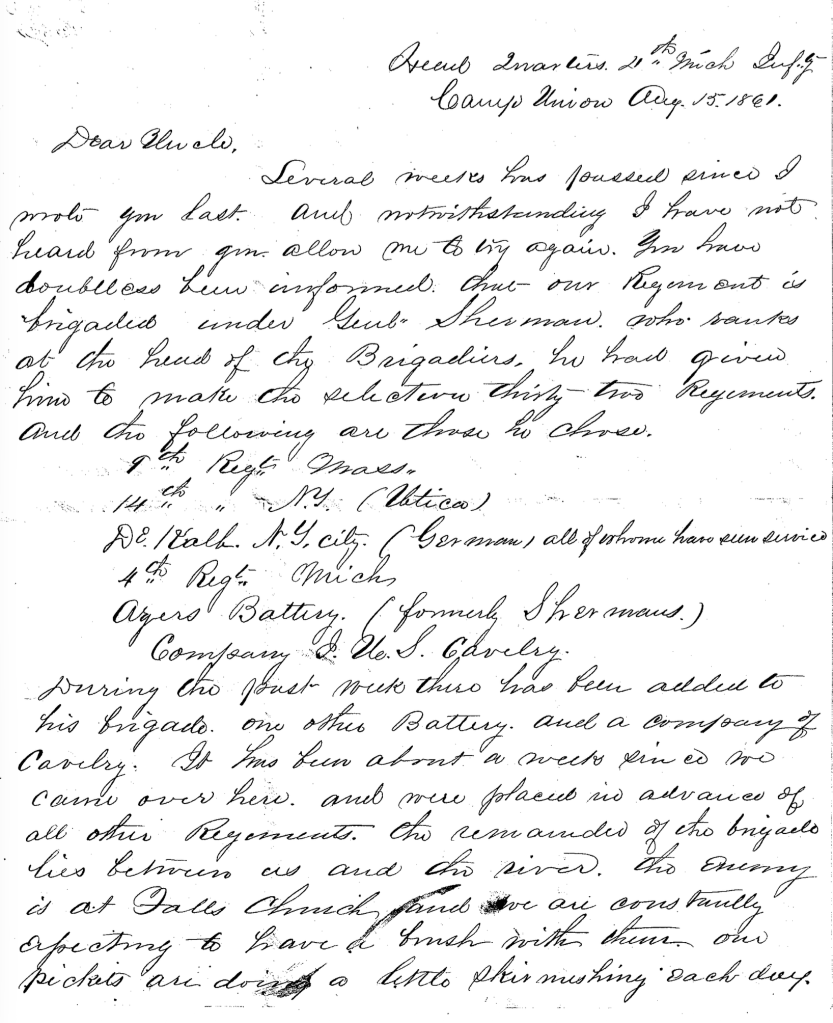
Head Quarters 4th Michigan Infantry, Camp Union
August 15, 1861
Dear Uncle,
Several weeks has passed since I wrote you last. And notwithstanding I have not heard from you, allow me to try again. You have doubtless been informed that our regiment is brigaded under Gen. [WilliamTecumseh] Sherman who ranks at the head of the Brigadiers. He had given him to make the selection [from] thirty-two regiments and the following are those he chose—9th Regt. Mass., 14th Regt. New York (Utica), DeKalb, N, Y. City (German, all of whom have seen service), 4th Regt. Michigan, Ayers Battery (formerly Sherman’s), Company I, US Cavalry.
During the past week there has been added to his brigade one other battery and a company of cavalry. It has been about a week since we came here and were placed in advance of the other regiments. The remainder of the brigade lies between us and the river. The enemy is at Falls Church and we are constantly expecting to have a brush with them. Our pickets are doing a little skirmishing each day.
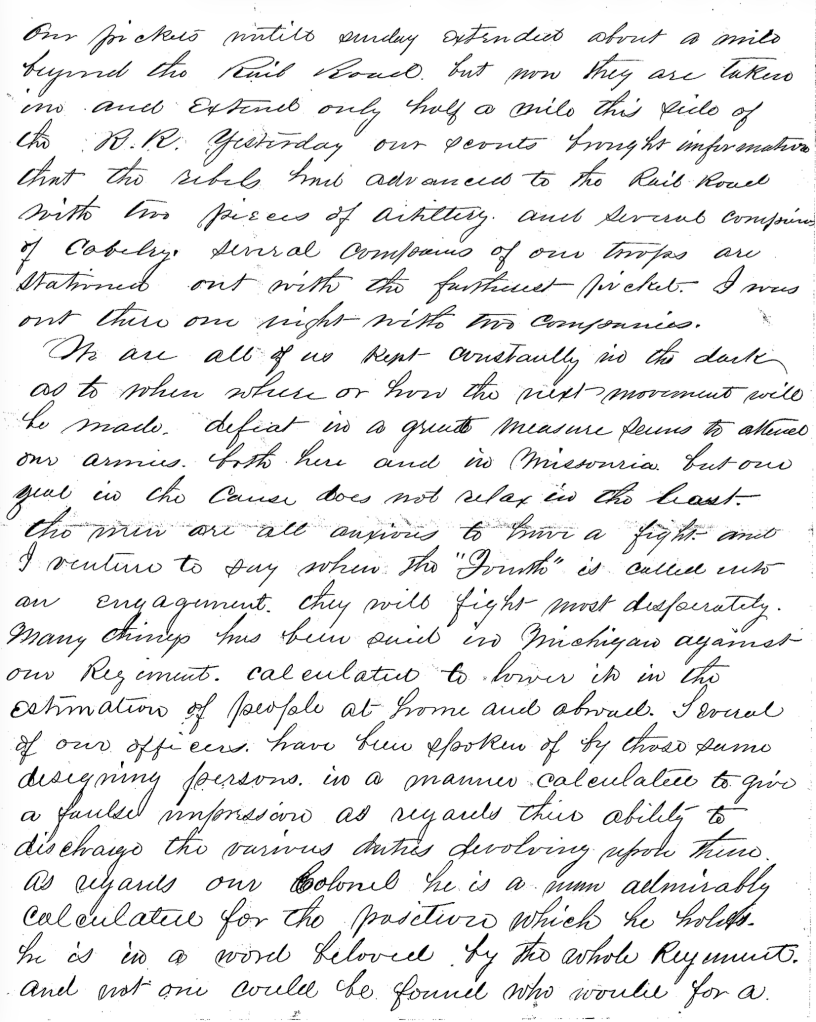
Our pickets until Sunday extended about a mile beyond the railroad but now they are taken in and extend only half a mile this side of the railroad. Yesterday our scouts brought information that the rebels had advanced to the railroad with two pieces of artillery and several companies of cavalry. Several companies of our troops are stationed out with the furthest picket. I was out there one night with two companies.
We are all of us kept continually in the dark as to when, where, or how the next movement will be made. Defeat in a great measure seems to attend our armies, both here and in Missouri. But our zeal in the cause does not relax in the least. The men are all anxious to have a fight and I venture to say when the “Fourth” [Michigan] is called into an engagement, they will fight most desperately.
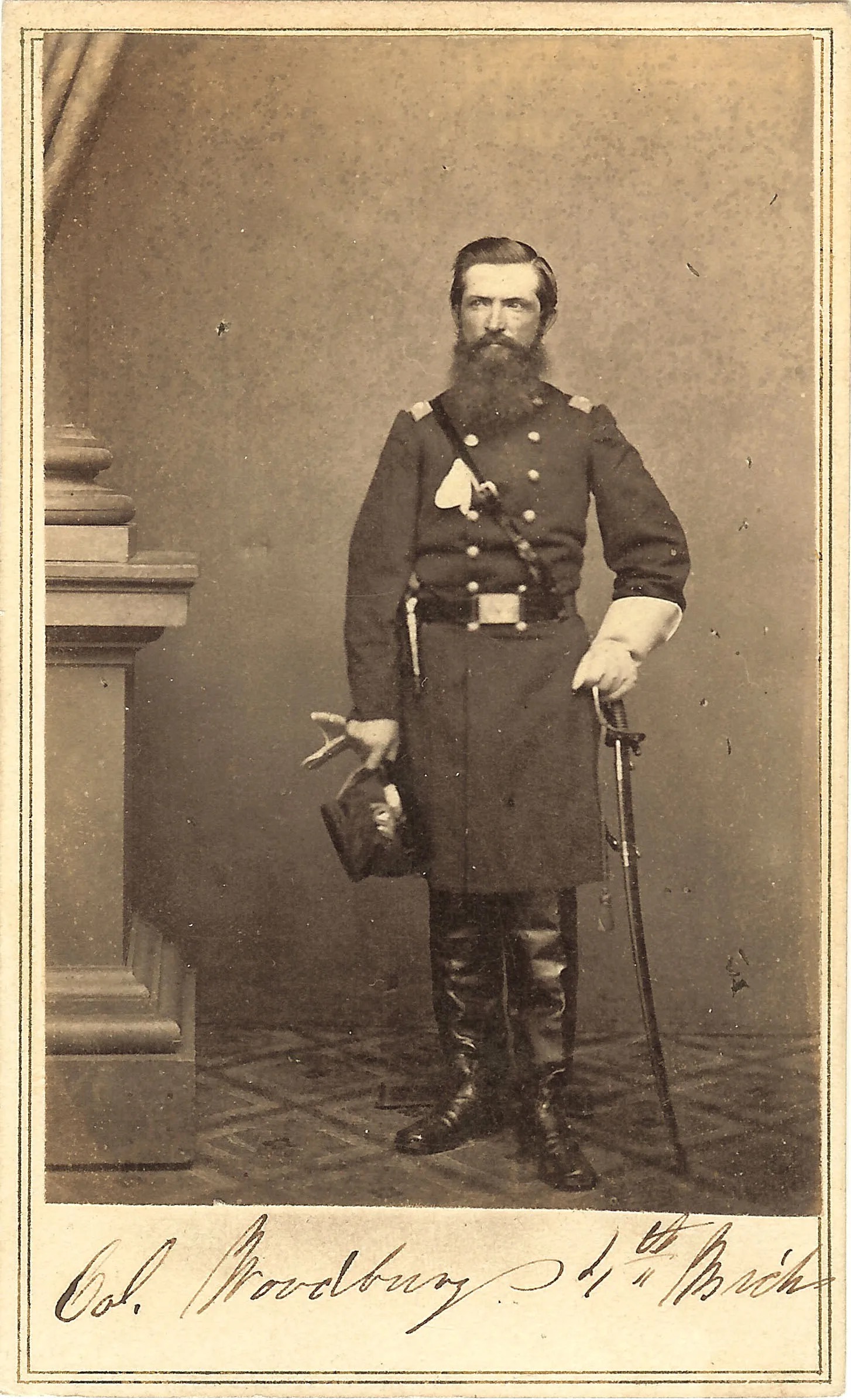
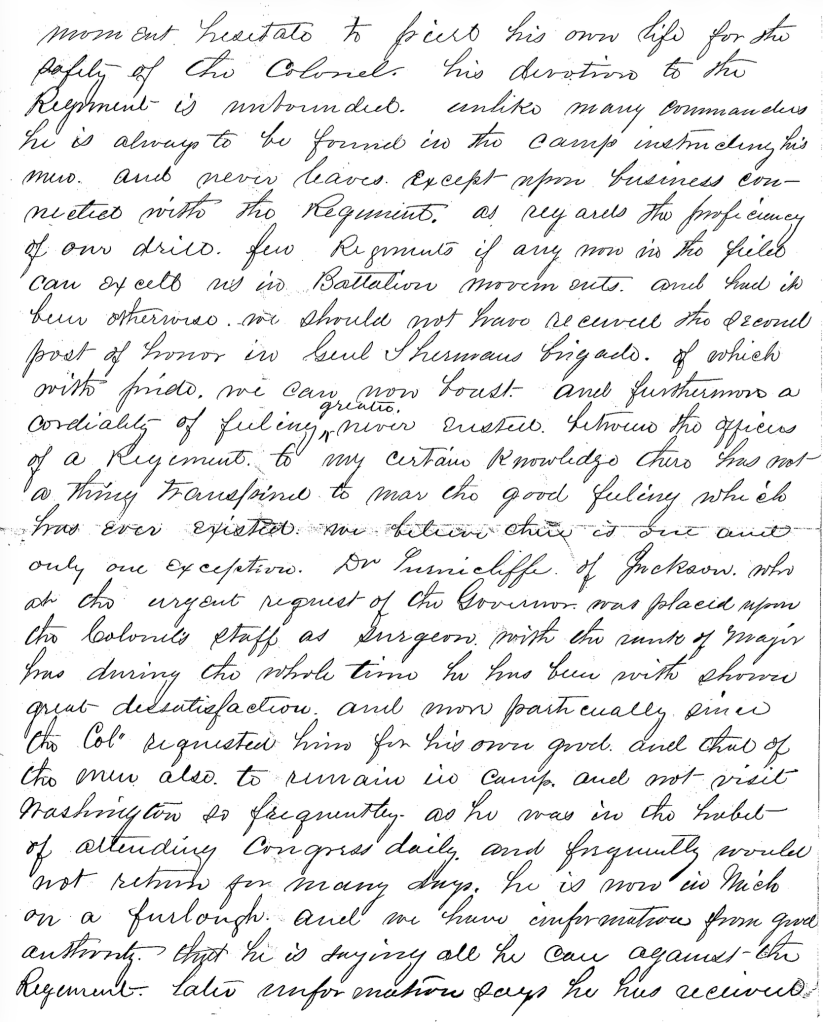
Many things has been said in Michigan against our regiment calculated to lower it in the estimation of people at home and abroad. Several of our officers have been spoken of by those same designing persons in a manner calculated to give a false impression as regards their ability to discharge the various duties devolving upon them. As regards our Colonel [Dwight Woodbury], he is a man admirably calculated for the position which he holds. He is in a word—beloved, by the whole regiment and not one could be found who would for a moment hesitate to risk his own life for the safety of the Colonel. His devotion to the regiment is unbounded. Unlike many commanders, he is always to be found in the camp instructing his men and never leaves except upon business connected with the regiment.
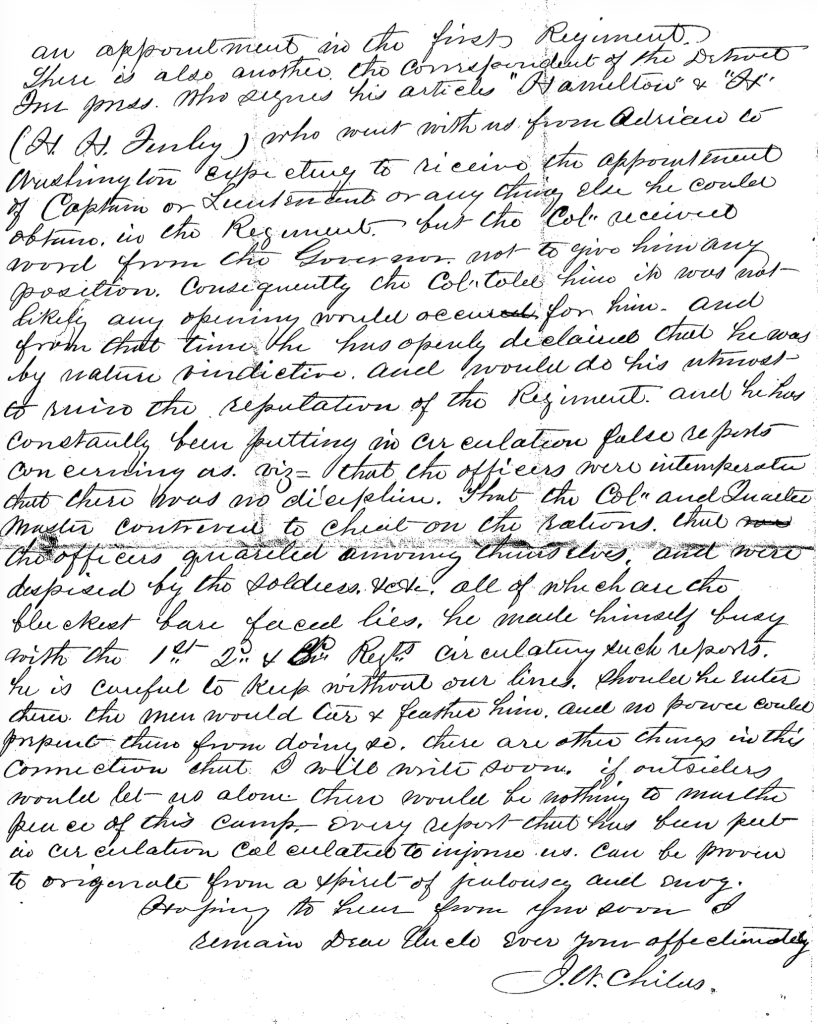
As regards the proficiency of our drill, few regiments if any now in the field can excel us in Battalion movements and had it been otherwise, we should not have received the second post of honor in Gen. Sherman’s Brigade of which with pride, we can now boast. And furthermore, a cordiality of feeling never greater existed between the officers of a regiment. To my certain knowledge, there has not a thing transpired to mar the good feeling which has ever existed. We believe there is one and only one exception—Dr. [Joseph] Tunnicliffe of Jackson, who at the urgent request of the Governor, was placed upon the Colonel’s staff as Surgeon with the rank of Major. [He] has, during the whole time he has been with [us], shown great dissatisfaction and more particularly, since the Colonel requested him for his own good and that of the men also, to remain in camp and not visit Washington so frequently as he was in the habit of attending Congress daily and frequently would not return for many days. He is now in Michigan on a furlough and we have information from good authority that he is saying all he can against the regiment. Later information says he has received an appointment in the 1st Regiment.
There is also another. The correspondent of the Detroit Free Press who signs his articles “Hamilton” & “H” (H. H. Finley) who went with us from Adrian to Washington expecting to receive the appointment of Captain or Lieutenant or anything else he could obtain in the regiment. But the Colonel received word from the Governor not to give him any position. Consequently the Colonel told him it was not likely any opening would occur for him and from that time, he has openly declared that he was by nature vindictive and would do his utmost to ruin the reputation of the regiment. And he has constantly been putting in circulation false reports concerning us. Viz—that the officers were intemperate, that there was no discipline, that the Colonel and Quartermaster contrived to cheat on the rations, that the officers quarreled among themselves and were despised by the soldiers, &c. &c., all of which are the blackest, bare-faced lies. He made himself busy with the 1st, 2nd, & 3rd [Michigan] Regiments circulating such reports. He is careful to keep without our lines. Should he enter there, the men would tar and feather him, and no power could prevent them from doing so.
There are other things in this connection that I will write soon. If outsiders would leave us alone, there would be nothing to mar the peace of this camp. Every report that has been put in circulation calculated to injure us can be proven to originate from a spirit of jealousy and envy.
Hoping to hear from you soon, I remain, dear Uncle, ever yours affectionately, — J. W. Childs