Category Archives: 50th New York Engineers

1864: George to his brother John

The following letter makes a good read but unfortunately the soldier who wrote it only signed his name “John” and there are too few clues within the letter to lead me conclusively to his identity or even the regiment he was in. He does indicate that they were under the overall command of Gen. Henry W. Benham who was responsible for the engineering activities near Petersburg so I’m going to assume this soldier was in either the 15th or 50th New York Engineers. Early in the letter he speaks of constructing the hospitals at the “Point” which would have been City Point. This activity seems consistent with the engineers.

T R A N S C R I P T I O N

Camp near Petersburg
[Monday] December 12th 1864

Dear Brother,

We have made quite a move since I wrote you last. I don’t owe you a letter but since I have the time to spare, I thought I would give you a little sketch of our march to this place.

Friday [9 December] was an awful cold day. We went down to the Point [City Point] to work on the hospitals as usual, It was rather hard work to keep warm. Friday night it commenced raining [and] in the morning [10 December] there was an inch and a half of snow on the ground. We went down to work. It grew warmer and made it too muddy to work so we came back to camp at noon. They told us we might get us up some wood for ourselves to last over Sunday [so] we started with a wheelbarrow and got two loads chopped and wheeled up into our shanty. We had to go three quarters of a mile for wood is getting about played out in this section.

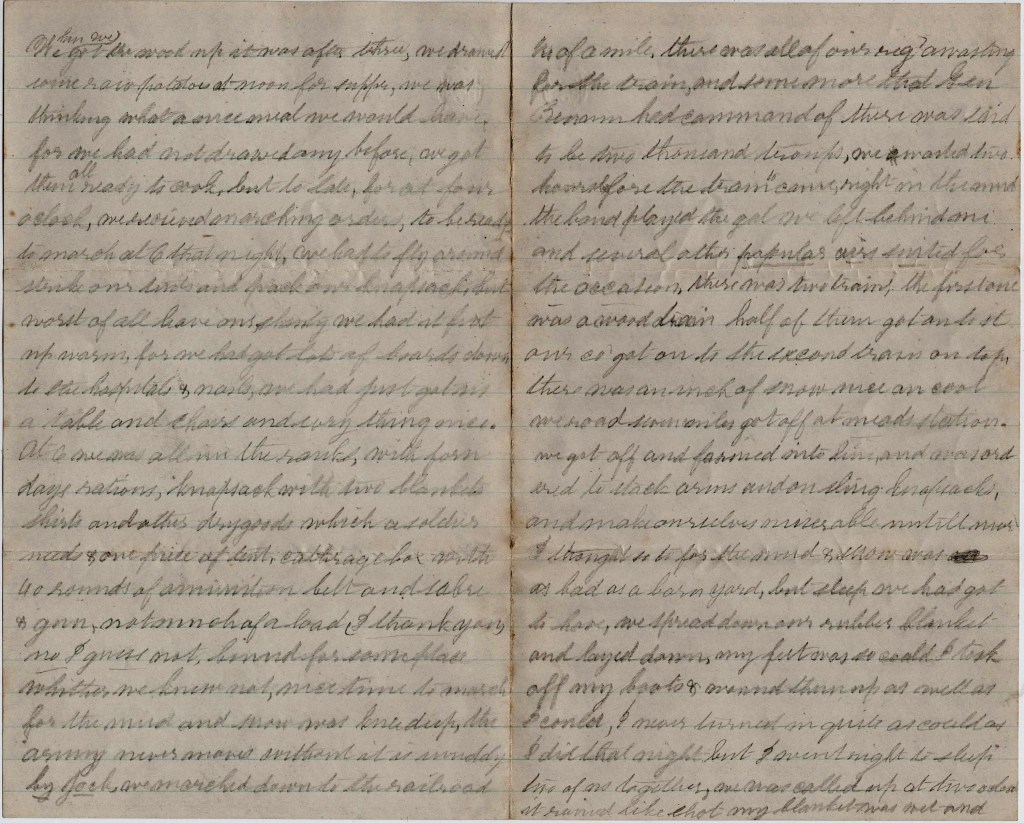
When we got the wood up, it was after three. We drawed some raw potatoes at noon for supper. We was thinking what a nice meal we would have for we had not drawed any before. We got them all ready to cook but too late for at four o’clock we received marching orders, to be ready to march at 6 that night. We had to fly around, strike our tents and pack our knapsacks, but worst of all, leave our shanty. We had it fixed up warm for we had got lots of boards down to the hospitals & nails. We had just got us a table and chairs adn everything nice

At six we was all in the ranks with four days rations, knapsack with two blankets, shirts and other dry goods which a soldier needs & one piece of tent, cartridge box with 40 rounds of ammunition, belt and saber and gun—not much of a load, I thank you. No, I guess not. Bound for someplace whither we knew not. Nice time to march for the mud and snow was knee deep. The army never moves without it is muddy, by Josh.

We marched down to the railroad one quarter of a mile. There was all of our regiment awaiting for the train and some more that Gen. [Henry Washington] Benham had command of. There was said to be two thousand troops. We waited two hours before the train to come right in the mud. The band played, “The Gal we left behind me” and several other popular airs suited for the occasion. There was two trains, The first one was a wood train. Half of them got onto it. Our company got on to the second train on top. There was an inch of snow—nice and cool. We rode seven miles, got off at Meade Station. We got off and formed into line and was ordered to stack arms and unsling knapsacks and make ourselves miserable until night. I thought so too for the mud & snow was as bad as a barn yard, but sleep we had got to have. We spread down our rubber blanket and laid down. My feet was so cold, I took off my boots & warmed them up as well as I could. I never turned in quite as cold as I did that night but I went right to sleep., two of us together.

We was called up at two o’clock. It rained like shot. My blanket was wet and my feet too. We got ready in a short time and marched two hours. We halted and stacked our arms. There was a house nearby and some outbuilding (some General’s headquarters). We had got to have some wood (there was a guard around the buildings). There was no wood near so they commenced pulling down the barn and hog pen. They stripped them pretty quick. There was 50 or 60 fires started in a short time. They hadn’t got fairly to going before the order came to put them all out. If we didn’t, the shells would be a flying around us. I thought we must be amongst them for we heard the picket firing plain when daylight came. We could see our line of works plain.

We ate our breakfast, stayed there until eleven, and then we fell in and marched to where we are now. I tell you, our knapsacks was pretty heavy before we got [here]. Some of the boys threw away one of their blankets, they was so wet and heavy, but I got through with mine and stood it first rate. We got here about noon. There was winter huts built that some soldiers vacated but all mud and snow—pretty shabby for they was built in a hurry. We put our tent cloth on [one] and cleaned them out as well as we could. We had to be pretty thick for their wasn’t huts enough. There was twelve of us together—just as thick as we could stand up. I never felt thecold so much as I did that night. It seemed as though we should freeze. The wind blew hard and froze hard as a rock. It don’t look much like the Sunny South they tel about, and our old tent you could throw your hat through it anywhere.

We are within one mile of Petersburg and in the rear of Fort Petersburg. We can see the steeples at Petersburg and the buildings that they have got our prisoners in. John, you ought to see the guns that they have got mounted on this fort. They look huge, I tell you. They say they could throw a shell into Petersburg with them. I don’t doubt it for they look as though they was capable of doing. The pickets are a firing all the while at each other. I could hear them plain enough when I was at the Point and most too plain here. I would rather [ ] to the rear if they would let me,

John. I must stop for we have had orders to clean up our guns for inspection. I will tell you the rest I have done in another sheet. — George

1862: William T. Elwell to a Friend

The following letter was written by William T. Elwell (1837-1898), the son of John Elwell and Mary Gould of Caton, Steuben county, New York. William enlisted on 18 September 1861 as a private in Co. K of the 50th New York Engineers. On 1 November 1861 he was transferred to Co. D. In 1863 he was transferred to the 81st Company, 2nd Battalion Veteran’s Reserve Corps (VRC), and later still to Co. E of the 12th VRC. In 1869, he filed for an invalid’s pension.

William died in 1898 and was buried in Loudonville Cemetery in Loudonville, Ashland county, Ohio.

I could not find an image of William but here is one of Harrison Carl Johnson (1840-1922) of Co. G, 50th New York Engineers. (Ancestry.com)

T R A N S C R I P T I O N

Camp Lesley 1
Washington D. C.
June 3rd 1862

The Picket Guard [a poem]

“All quiet along the Potomac,” they say except now and then a stray picket
is shot as he walks on his beat to and fro by a rifleman hid in the thicket.
Tis nothing. A private or two now or then will not count in the news of the battle,
Not an officer lost—only one of the men moaning out all alone the death rattle.

All quiet along the Potomac tonight
where the soldiers lie peacefully dreaming.
Some thought it was fun to get whipped at Bulls Run
but wait till they get to Manassas.
With bullets and lead at the side of the head
Your’ll see the brave 50th a running. — W. T. E.

Camp Lesley
Washington D. C.
June 5th 1862

Dear friend,

I received your letter of the 3rd and was glad to hear that you was all well as it found me enjoying good health at heart but leaves me a cripple in my leg. I am quite lame so that I cannot do any duty but I have not been to the doctor but once and I have got to wait till the young doctor comes home for I won’t go to the old doctor, and then I shall either get a furlough or my discharge for I cannot do anything here.

I shall know after my payday. Tell Anna not to send me anything. If that box has not gone to Dennis for I do not want anything more from home. I have just found out where father is and found also [where] my brother-in-law is, but have not seen either of them. But I have sent father a letter and shall see him before long.

We have just received our tents. They are the Sibley tents with 20 in a tent which akes it very disagreeable now, I tell you. We are all well at present and I hope that we will stay so. We are in hopes that we will have a neat little fight before long so that we can try our pluck to see whether we are good for anything or not.

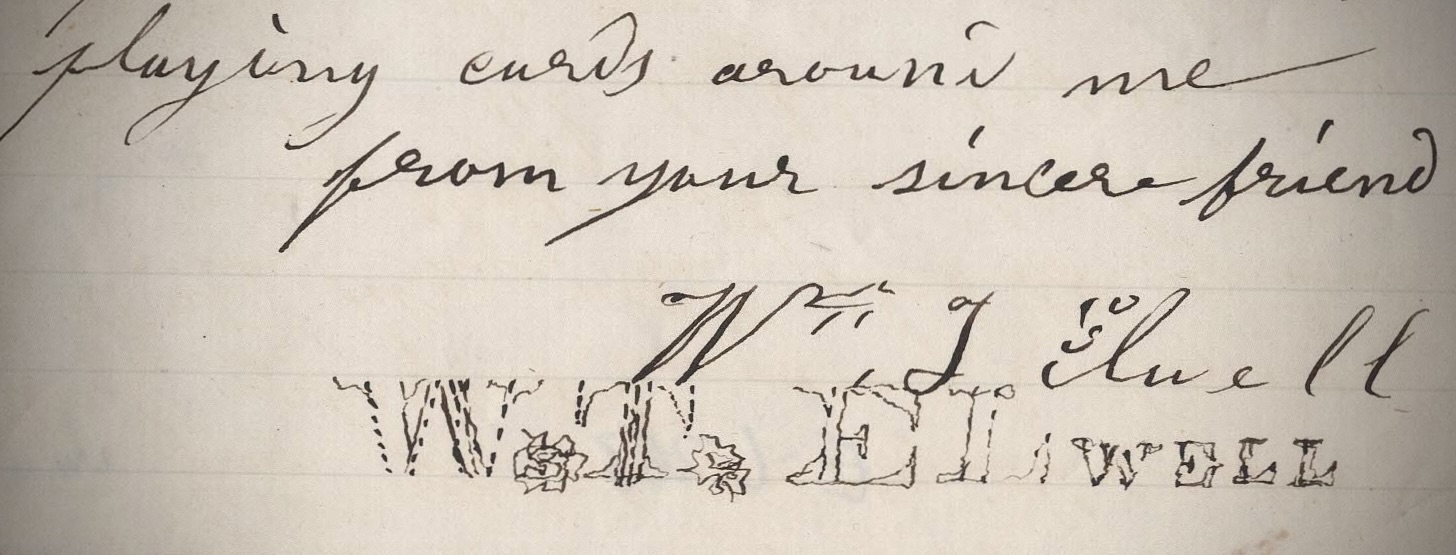
I shall have to stop for I sit here cramped up in a corner and the rest playing cards around me. From your sincere friend, — Wm. T. Elwell


1 Camp Lesley was located about a half mile north of the Navy Yard on the Anacostia River. It eventually became known as the Washington Engineer Depot. It was the camp of the 50th New York Engineers.

1864: Henry Russell to “Dear Abbie”

The following letters were written by Henry Russell (1843-1891), the son of Josiah G. Russell and Lucinda Cobb of Tioga county, New York. Henry enlisted on 1 November 1, 1861 at Binghamton to serve three years in the 16th New York Independent Battery but he was discharged for disability less than a year later on 12 August 1862 at Fairfax Seminary General Hospital. After regaining his health, Henry reenlisted on 4 January 1864 as a private in Co. E, 50th New York Engineers. He mustered out with his company on 13 June 1865, at Fort Barry, Va.

Henry wrote all of the letter to his “Dear Abbie”—Abigail Saphrona Skinner (1848-1921). They were married in 1865 when Henry returned from the service.

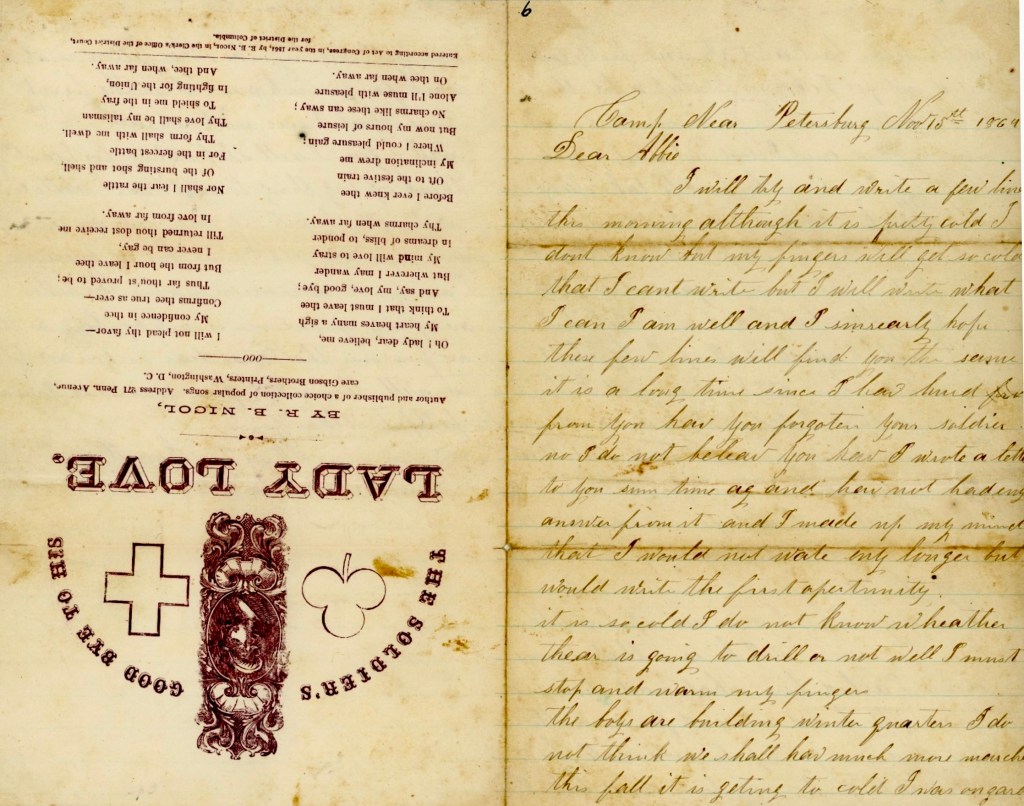
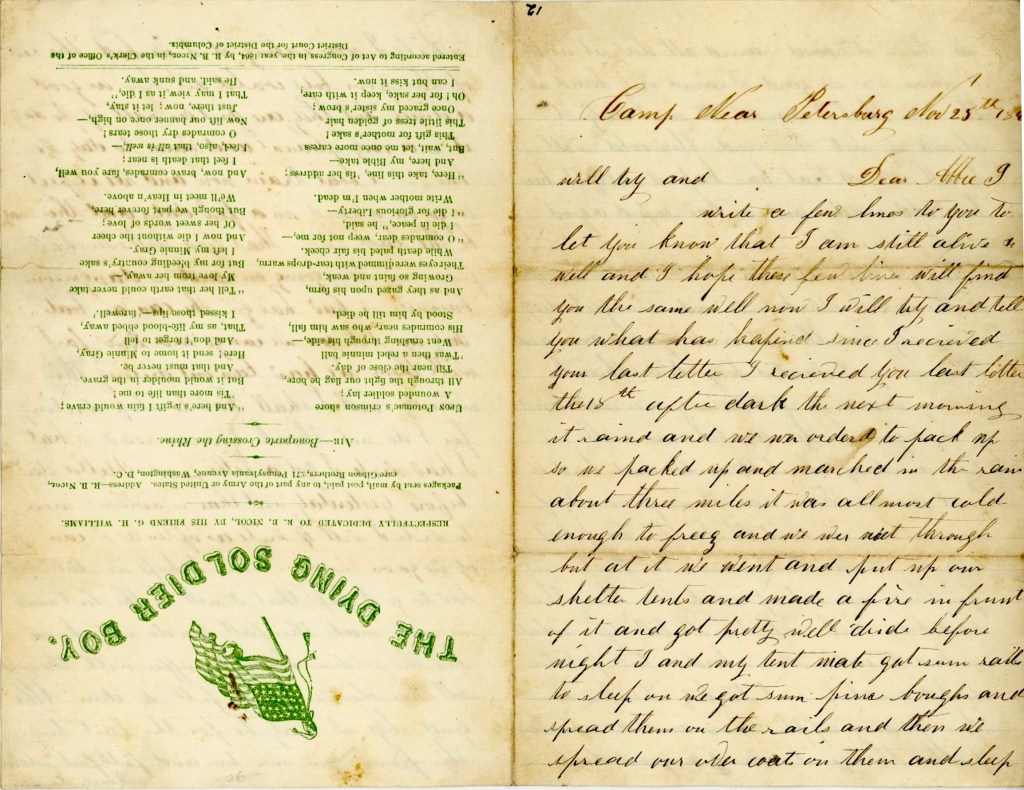
All three of Henry’s letters were written on patriotic stationery with printed poems or songs, including “The Battle of Antietam,” “Lady Love,” and “The Dying Soldier Boy.”

Letter 1

Camp near Petersburg
November 15, 1864

Dear Abbie,

I will try and write a few lines this morning although it is pretty cold. I don’t know but my fingers will get so cold that I can’t write but I will write what I can. I am well and I sincerely hope these few lines will find you the same.

It is a long time since I have heard from you. Have you forgotten your soldier? No, I do not believe you have. I wrote a letter to you some time agoand have not had any answer from it and I made up my mind that I would not wait any longer but would write the first opportunity. It is so cold I do not know whether there is going to be drill or not. Well, I must stop and warm my fingers.

The boys are building winter quarters. I do not think we shall have much more marching this fall. It is getting too cold. I was on guard last night and it was pretty cold. I did not get a chance to sleep a bit. The night before I was on guard, my tent mate was on guard and I did not sleep much that night because he had to take one of the blankets and it was pretty cold and I did not try to sleep that night and the next night I was on guard and there was two nights that I did not sleep. But last night I made it all up. I slept ten knots an hour. Did I not do well? I slept so sound that I did not hear the drum this morning for roll call but that did not make any difference to me. The Lieutenant sent for me and another fellow that did not get up to roll call. The Lieutenant wanted to know the reason why I was not up. I told him the reason. Well, he said, that was no excuse. I asked him what made him send for us and why he did not send for some other that did not get up to roll call. He told me to go to my tent and here I am writing. The other fellow is at work for punishment. It is the first time that I ever missed roll call.

Well, I guess I will stop writing for I can’t think of anything to write so I will close. Write often. I will try and write something of more importance next time but if you are as I am, you do not care whether the letters are of any importance or not as long as they are from one that is as dear as you are to me. Well, this is all. From your ever true and faithful soldier, — Henry Russell


Letter 2

Camp near Petersburg
November 25, 1864

Dear Abbie,

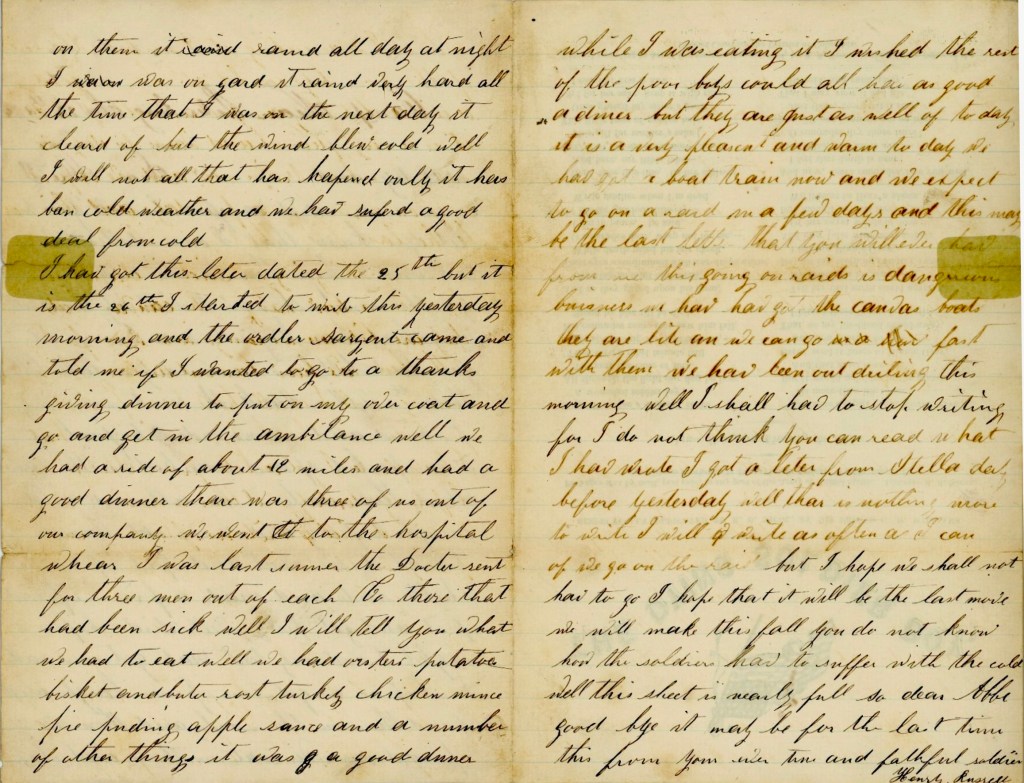
I will try and write a few lines to you to let you know that I am still alive & well and I hope these few lines will find you the same. Well, now, I will try and tell you what has happened since I received your last letter. I received your last letter the 18th after dark. The next morning it rained and we were ordered to pack up so we packed up and marched in the rain about three miles. It was almost cold enough to freeze and we were wet through but at it we went and put up our shelter tents and made a fire in front of it and got pretty well dried before night. I and my tent mate got some rails to sleep on. We got some pine boughs and spread them on the rails and then we spread our overcoats on them and sleep on them. It rained all day. At night I was on guard. It rained very hard all the time that I was on. The next day it cleared off but the wind blew cold. Well, I will not [tell] all that happened, only it has been cold weather and we had suffered a good deal from cold.

I had got this letter dated the 25th but it is the 26th. I started to write this yesterday morning and the Orderly Sergeant came and told me if I wanted to go to a Thanksgiving dinner to put on my overcoat and go and get in the ambulance. Well, we had a ride of about 12 miles and had a good dinner. There was three of us out of our company. We went to the hospital where I was last summer. The doctor sent for three men out of each company—those that had been sick. Well, I will tell you what we had to eat. We had oysters, potatoes, biscuits and butter, roast turkey, chicken, mince pie, pudding, apple sauce, and a number of other things. It was a good dinner. While I was eating it, I wished the rest of the boys could all have as good a dinner but they are just as well off today. It is very pleasant and warm today.

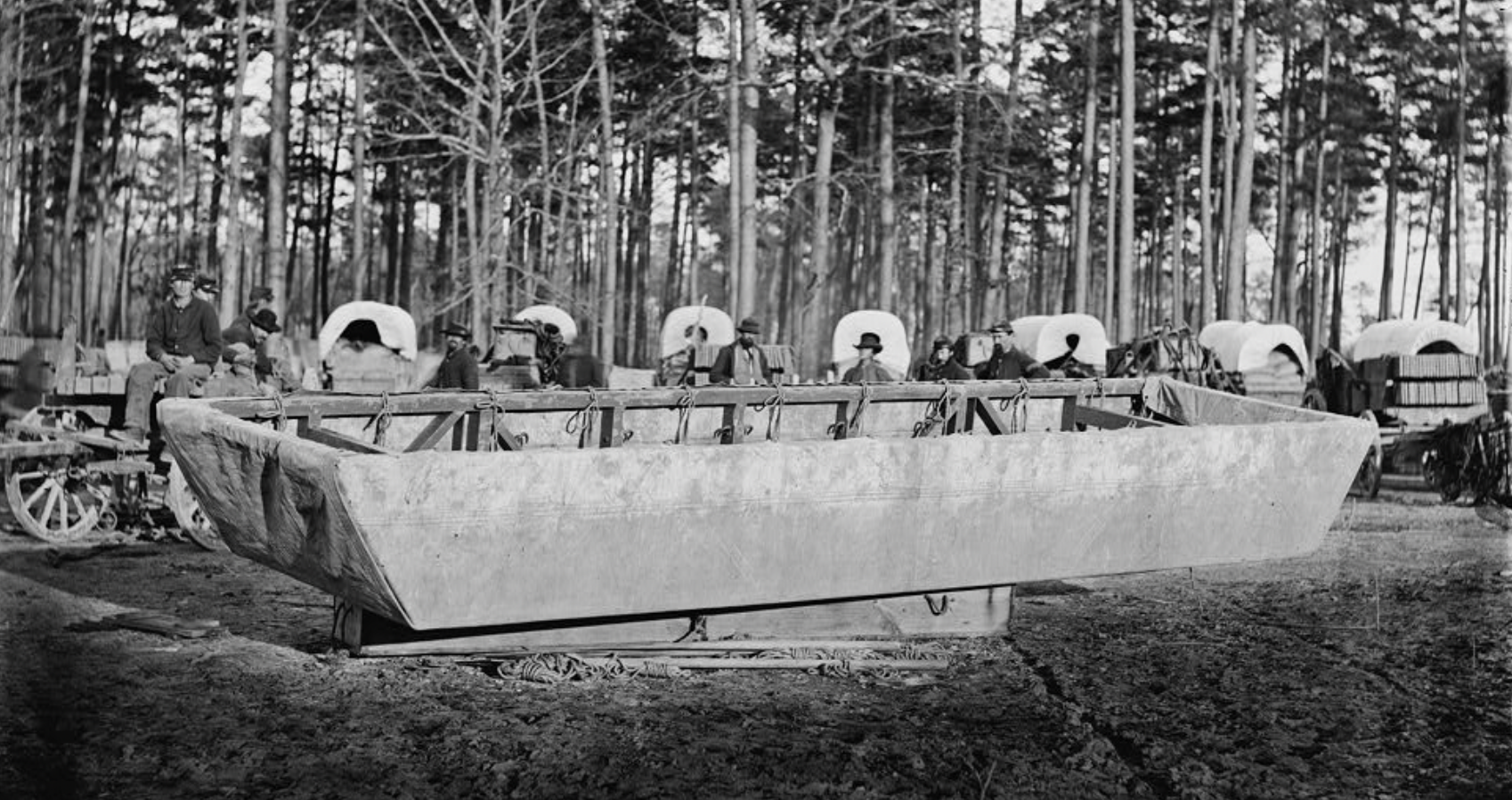
We have got a boat train now and we expect to go on a raid in a few days and this may be the last letter that you will ever have from me. This going on raids is dangerous business, We have got the canvas boats. They are light and we can go fast with them. We have been out drilling this morning.

A canvas boat used by the 50th New York Engineers,

Well, I shall have to stop writing for I do not think you can read what I have wrote. I got a letter from Stella day before yesterday. Well, there is nothing more to write. I will write as often as I can if we go on the raid but I hope we shall not have to go. I hope that it will be the last move we will make this fall. You do not know how the soldiers have to suffer with the cold. Well, this sheet is nearly full so dear Abbie, goodbye. It may be for the last time. This from your ever true and faithful soldier, — Henry Russell


Letter 3

Camp of the 50th New York Engineers in front of Petersburg, Va, in the winter of 1864-65. Notice the canvas pontoon boats parked at left (No. 14).

Camp near Petersburg
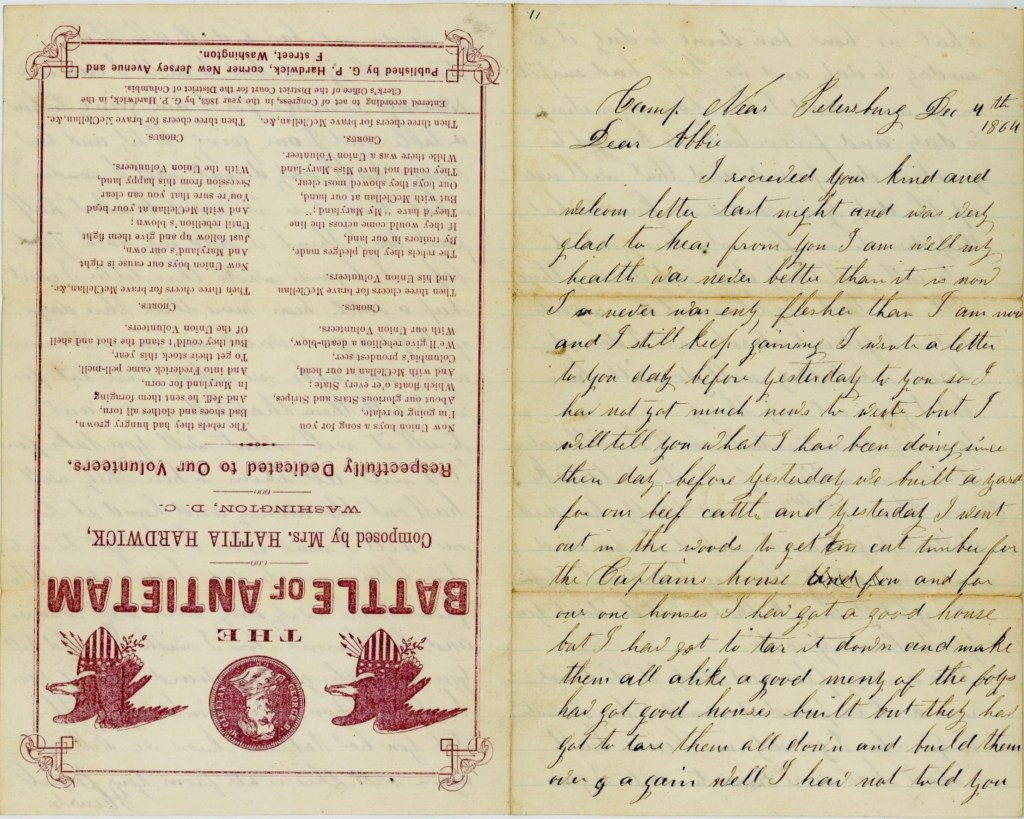
December 4, 1864

Dear Abbie,

I received your kind and welcome letter last night and was very glad to hear from you. I am well. My health was never better that it is now. I never was any fleshier that I am now and I still keep gaining.

I wrote a letter to you day before yesterday to you so I have not got much news to write but I will tell you what I have been doing since then. Day before yesterday we built a yard for our beef cattle and yesterday I went out in the woods to get cut timber for the Captain’s house and for our own houses. I have got a good house but I have got to tear it down and make them all alike. A good many of the boys have got good houses built but they has got to tear them all down and build them over again.

Well, I have not told you what we have been doing today. It is Sunday today and we had an inspection of arms and I have been to meeting today and five o’clock we have got to go out on dress parade and that will use up the day.

You wanted to know what they done to me for not being out at roll call. Well, they did not do anything with me. Last night one of our sergeants did not get out at roll call. I do not know what they will do with him but I guess not anything.

You say do not enlist. Well, I will not. I have no intention of it. It would take more than 18 or 20 hundred dollars to get me to enlist so you need not worry about that. If I get out of this alright, I think that will do, don’t you? Yes, I know you do.

It is a very pleasant day. It did not rain as I expected it would when I wrote to you. When I get my house built, I shall have more time to write, I guess, if we do not have to drill all the time. Well, if we have to drill, I can write evenings for I am going to have a table and I am going to try and have things halfway decent.

Well, I wonder what time it is. It must be about half past two, I think. I sold my watch just before I began to write this letter. I can’t keep a watch here more than three days. If I get a good watch, someone will come along and ask me what I will take for it. I tell them that I do not want to sell it. Well, what will you take for it? I will tell them when they will haul out the money and hand it to me.

Well, I must close. I have got to write two letters more today. I expect a letter from home every day now. Well, dearest and best [friend], I must close. I wish I could tell you my feelings toward you. If you knew, then you never would regret the step you have taken. I know we will meet again. Well, this is all from your faithful, — Henry

1862: Harrison Snow to Elsie Ann Snow

The following letter was written by Harrison Snow (1840-1898) who joined his older brother Alfred Henry Snow (1838-1915) in enlisted in Co. G, 50th Regiment, New York Engineers. Harrison began his service as a private but was later made an artificer. The 50th New York Engineers became famous for their ability to quickly build pontoon bridges, construct field fortifications, and to conduct sapper and mining operations, sometimes under enemy fire.

Harrison and Alfred were the sons of Asa Stearns Snow (1805-1882) and Mary C. Eighmey (1803-1900) of Caroline, Tompkins county, New York. He wrote the letter to his younger sister, Elsie Ann Snow (1844-1939).

A Cabinet Card with image of blockhouse built at Fairmont, West Virginia in 1863 by a detachment of Co. G, 50th New York Engineers.

T R A N S C R I P T I O N

Washington D. C.
March 8th 1862

Dear Sister,

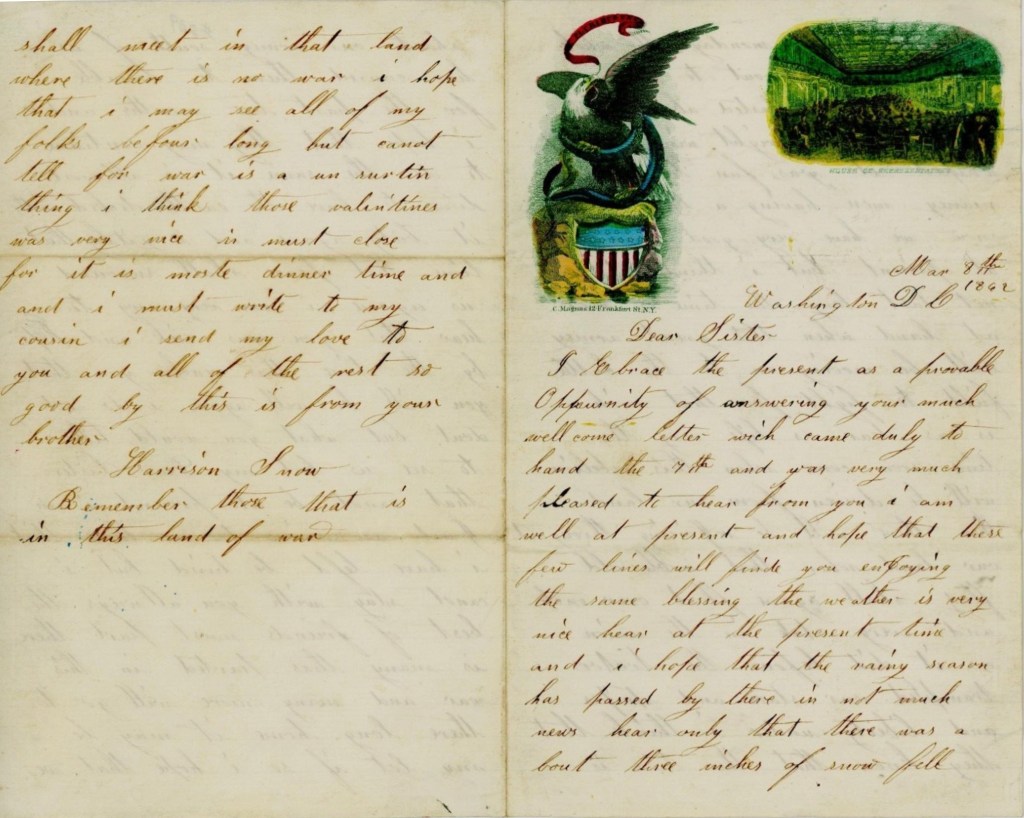
I embrace the present as a favorable opportunity of answering your much welcome letter which came duly to hand the 7th and was very much pleased to hear from you. I am well at present and hope that these few lines will find you enjoying the same blessing. The weather is very nice here at the present time and I hope that the rainy season has passed by.

There is not much news here, only that there was about three inches of snow fell here on last Monday. The whole regiment turned out to have a snow ball [fight]. It lasted about three hours when the right wing gave up whipped. It was fun to see so many men having a battle with snow. We have very good times here at present but I think it will not last long. The time is near at hand when this great army will be moving on to the battlefield to fight for that which is as dear as life. May the time soon come when this rebellion will be driven from our land. There there will be rejoicing throughout our land when that old noble flag shall again float over each and every state in the Union as it did before the traitors trampled our Stars & Stripes and liberty under. I think that they know that their time is short. Our army south of us has caused them to tremble for the past two months and I hope that they may continue to do the same. It is almost time to have the earth decked with its beauty again and may it be that time that peace shall surround us again.

I was very sorry to hear that you was sick and hope by the time this reaches you that you will be well again. I do not doubt but what you would like to see us but my dear sister, that cannot be at present, I am just as anxious to see those that I have left behind but I cannot stay with you always. The best. of friends must part. There is many that parted in this war and many more will go to their long home. It may be my lot. If so, I hope that we shall meet in that land where there is no war. I hope that I may see all of my folks before long but cannot tell for war is an uncertain thing.

I think those valentines was very nice. I must close for it is most dinner time and I must write to my cousin. I send my love to you and all of the rest, so goodbye. This is from your brother, — Harrison Snow

Remember those that is in this land of war.

1861: Alfred Henry Snow to Elsie Ann Snow

A post war image of Alfred and his wife, Rebecca Jane (Dodd) Snow. They were married in 1866.

The following letter was written by Alfred Henry Snow (1838-1915) of Co. G, 50th Regiment, New York Engineers. Alfred began his service as a private but was later made an artificer. The same can be said for Alfred’s younger brother, Harrison Snow (1840-1898) who joined and served with him in the same company. The 50th New York Engineers became famous for their ability to quickly build pontoon bridges, construct field fortifications, and to conduct sapper and mining operations, sometimes under enemy fire.

Alfred was the son of Asa Stearns Snow (1805-1882) and Mary C. Eighmey (1803-1900) of Caroline, Tompkins county, New York. He wrote the letter to his younger sister, Elsie Ann Snow (1844-1939).


A Cabinet Card with image of blockhouse built at Fairmont, West Virginia in 1863 by a detachment of Co. G, 50th New York Engineers.

Transcription

[Hall’s Hill, near Arlington, Virginia]
October 4, [1861]

Dear sister,

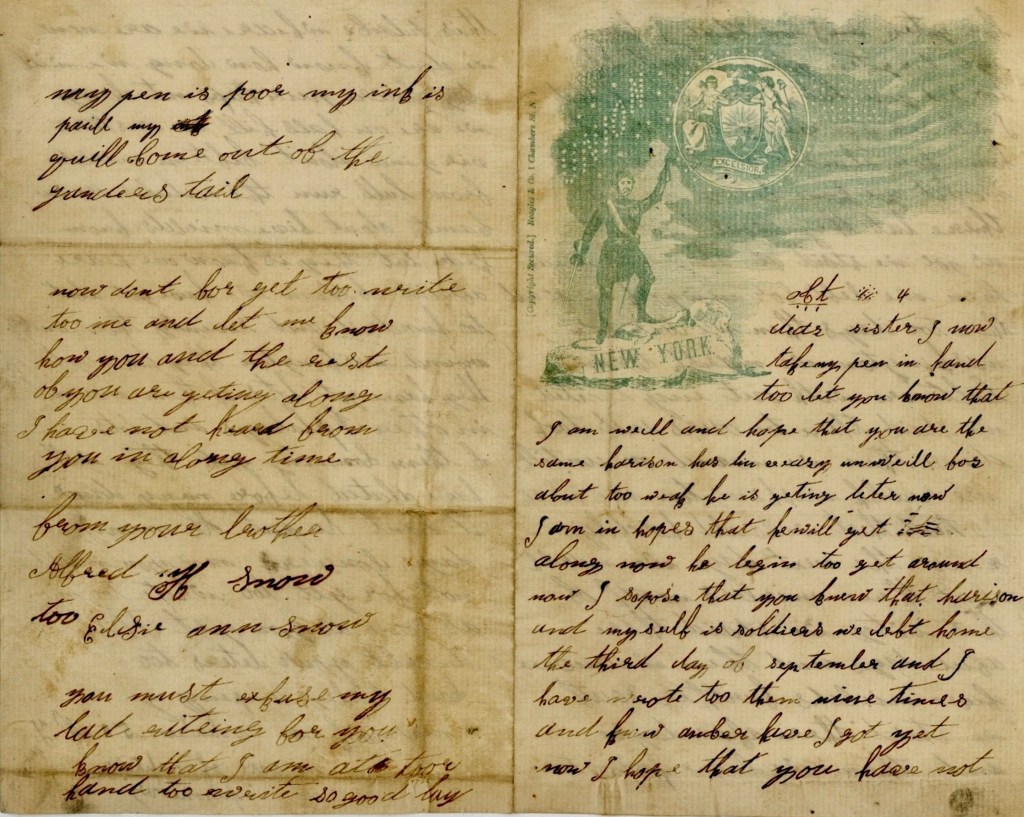
I now take my pen in hand to let you know that I am well and hope that you are the same. [Brother] Harrison has been very unwell for about two weeks. He is getting better now. I am in hopes that he will get along now. He begins to get around now.

I suppose that you knew that Harrison and myself is soldiers. We left home the third day of September and I have wrote to them nine times and no answer have I got yet. Now I hope that you have not forgotten me. I know that I have not forgotten you. I should like to see you but I don’t think that I will see you very soon. We left home for Elmira. We thought that [we] would go home before we left there but they would not let us go. We stayed at Elmira two weeks, then we left for New York. We stayed there two days. The we left for Washington. We marched through Baltimore without any trouble. We stayed there two hours and took dinner, then we moved on until we reached Washington. We was so tired that we could hardly rest.

The next day we marched about three miles north of that city and then we moved five miles farther south. We stayed there a few days and then we came here to this place where we are now. We don’t know how long we will stay here—perhaps not long. We are on Hall’s Hill in western Virginia about fifteen miles from Bull Run. The rebels are encamped about five miles from here but there is no one here afraid of them. We have got about two hundred and seventy thousand around Washington. They have got lots of them around in other places and lots of them coming yet. They will have a battle before many days—it can’t be put off many days longer.

Now you must not forget to write to me as soon as you get this. Direct your letters to Camp Lesley, Company G, 50th New York Volunteers, in care of Captain [Walker V.] Personius

My pen in poor,
my ink is pail,
my quill come out of
the gander’s tail.

No don’t forget to write to me and let me know how you and the rest of you are getting along. I have not heard from you in a long time. From your brother, — Alfred H. Snow

to Elsie Ann Snow

You must excuse my bad writing for you know that I am a poor hand to write. So good day.

1865: Unidentified Engineer

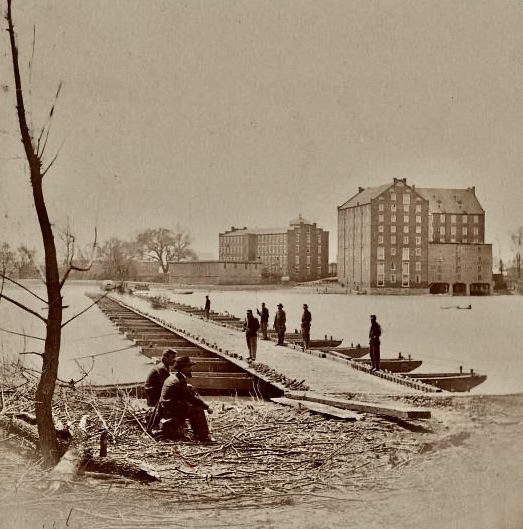
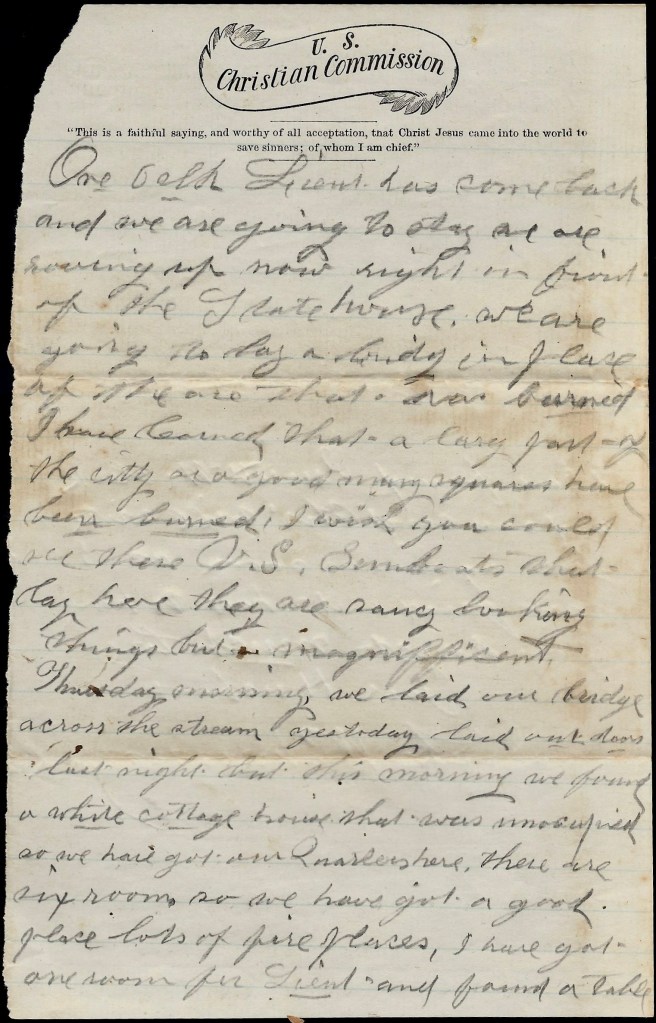
I can’t be certain of the identity of the author of this partial letter There is a remote possibility that it was written by Lawrence Manning of the 50th New York Engineers. I also can’t be certain of the date or location but believe it to have been written from either Richmond, or across the James river, in Manchester, Virginia, in April 1865. Whoever wrote the letter was involved in laying down a pontoon bridge which I think was necessary after the retreating Confederates burned Mayo’s Bridge over the James.

The Engineers laying down the first of two pontoon bridges over the James River between Richmond and Manchester, Va. in April 1865

Transcription

One o’clock, Lieutenant has come back and we are going to stay. We are roving up now right in front of the statehouse. We are going to lay a bridge in place of the one that was burned. I have learned that a large part of the city—or a good many squares—have been burned. I wish you could see these U. S. Gunboats that lay here. They are saucy looking things but magnificent.

This CDV was sold with the letter but it was not identified so can’t be certain it is the author. It dates to 1864/5 and was taken at Couch & Burns Photographers, Hampton, Va.

Thursday evening. we laid our bridge across the stream yesterday. Laid out doors last night but this morning we found a white cottage house that was unoccupied so we have got our quarters here. There are six rooms so we have got a good place—lots of fire places. I have got one room for Lieutenant and found a table and a stool upstairs. The rooms are all plastered and whitewashed so it is very pleasant.

I don’t know whether Lieutenant will stay here all the while or not. At any rate, we shall go back to Broadway [Landing] to get our things so I shall go. I was in a large foundry and machine shop to find some wire and I found two quires of letter paper—nice. I froze to it. It will last me a good while. I have found Prescott the clerk and can send this. Will write you again as soon as I can find out how to have you direct. Much love, your husband, — L. W. Manning

1861: Alfred L. Edwards to Philander Merrill

I could not find an image of Alfred but here is Franklin D. Cornish who served in the same regiment. (Photo Sleuth)

This letter was written by Alfred L. Edwards (1841-1918) who enlisted on 26 August 1861 as a private in Co. E, 50th New York Engineers and remained in the regiment until mustering out on 20 September 1864 at Elmira, New York.

Alfred datelined his letter from New York City on 20 September 1861 two days after his arrival. He shares the news with his mother that they were ordered to encamp on the battery overlooking New York Harbor which was still occupied by members of Ellsworth’s New York Fire Zouaves (11th New York Infantry) despite their having been ordered to Fortress Monroe. A newspaper article described the situation as follows:

“The New York Fire Zouaves—the “Pet Lambs”—have again been distinguishing themselves. On Thursday last they were assembled on the battery, New York, where they indulged in a series of free fights, at one time assuming the proportions of a riot. They also tossed in blankets a number of inoffensive laborers, and seizing a reporter of the Times tossed him in a tent cloth, and otherwise maltreated him, and finally robbed him of fifteen dollars. When appealed to Col. Lozier to behave in a more orderly, and to go without further difficulty to Fort Monroe, but twenty-five out of three hundred were willing to go—the others, on various pretenses, utterly refusing to leave New York. It is high time that these cowardly miscreants—the terror of all peaceable and unarmed citizens, the disgrace to the profession of arms, and the butt for the ridicule of the fie—were treated as mutineers or deserters; reduced to order or shot. It is idle to waste more time or more words on them.”The Daily Gazette and Republican, Trenton, NJ 23 September 1861

Alfred wrote the letter to his mother, Rumina (Gates) Merrill (1818-1895). The envelope was addressed to Rumina’s second husband, Philander Merrill (1795-1883) of Ketchumville, Tioga county, New York. Rumina’s first husband, Cyrus Edwards, died prior to the 1850 US Census at which time the widow Rumina was enumerated with her two boys, Alfred and Cyrus, in Maine, Broome county, New York.

To read other letters I have transcribed and posted on Spared & Shared that were written by members of the 50th New York Engineers, see:

Cornelius Van Huysen, Co. A, 50th New York Engineers (1 Letter)
Abner G. Hill, Co. B, 50th New York Engineers (1 Letter)
William H. Lunn, Co. E, 50th New York Engineers (1 Letter)
Halsey Amos Rhodes, Co. H, 50th New York Engineers (1 Letter)

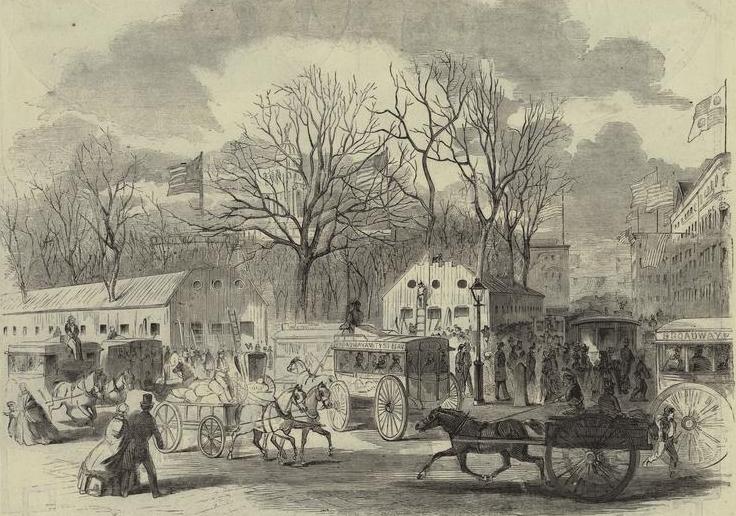
Temporary Barracks erected in Battery Park in NYC in 1861

Transcription

Addressed to Philander Merrills, Ketchumville, Tioga county, New York

Camp Lesley
New York City
[Friday,] September 20th [1861]

Dear Mother,

We started from Elmira [on Tuesday,] the 17th at four o’clock p.m. in a train of 24 cars, 17 with soldiers. We got [here] next day [Wednesday] at 8 a.m. We are camped on the Bay. Last night we slept on our arms. We expected to be attacked by the New York Fire Zouaves. There was some 300 or 400 on the ground when we came here and they were not going to leave. They had been ordered to leave in the morning at six o’clock but swore they would not, but the Mayor sent the police force in the afternoon and they left. We expected they would return but they did not.

We leave here today at two o’clock. Where to I don’t know. We are all well. I have [seen] more here than I ever seen in my life. Ships and boats are moving all the time. I counted two hundred and sixty-three in view. I am laying flat on my belly and nothing to write on but a board and can’t write good. I will let you know where I be in a day or two.

— A. L. Edwards

I will direct my letters after this in this style, — Alfred L. Edwards, Ketchumville