John M. Neal wrote the following letter to his sister, Ann O. (Neal) Myrick (1790-1835), the wife of Walter B. Myrick of Hertford county, North Carolina. There are references in the letter to John’s Uncle, Thomas Newsom of Southhampton county, Virginia, which was just across the state line from North Carolina.
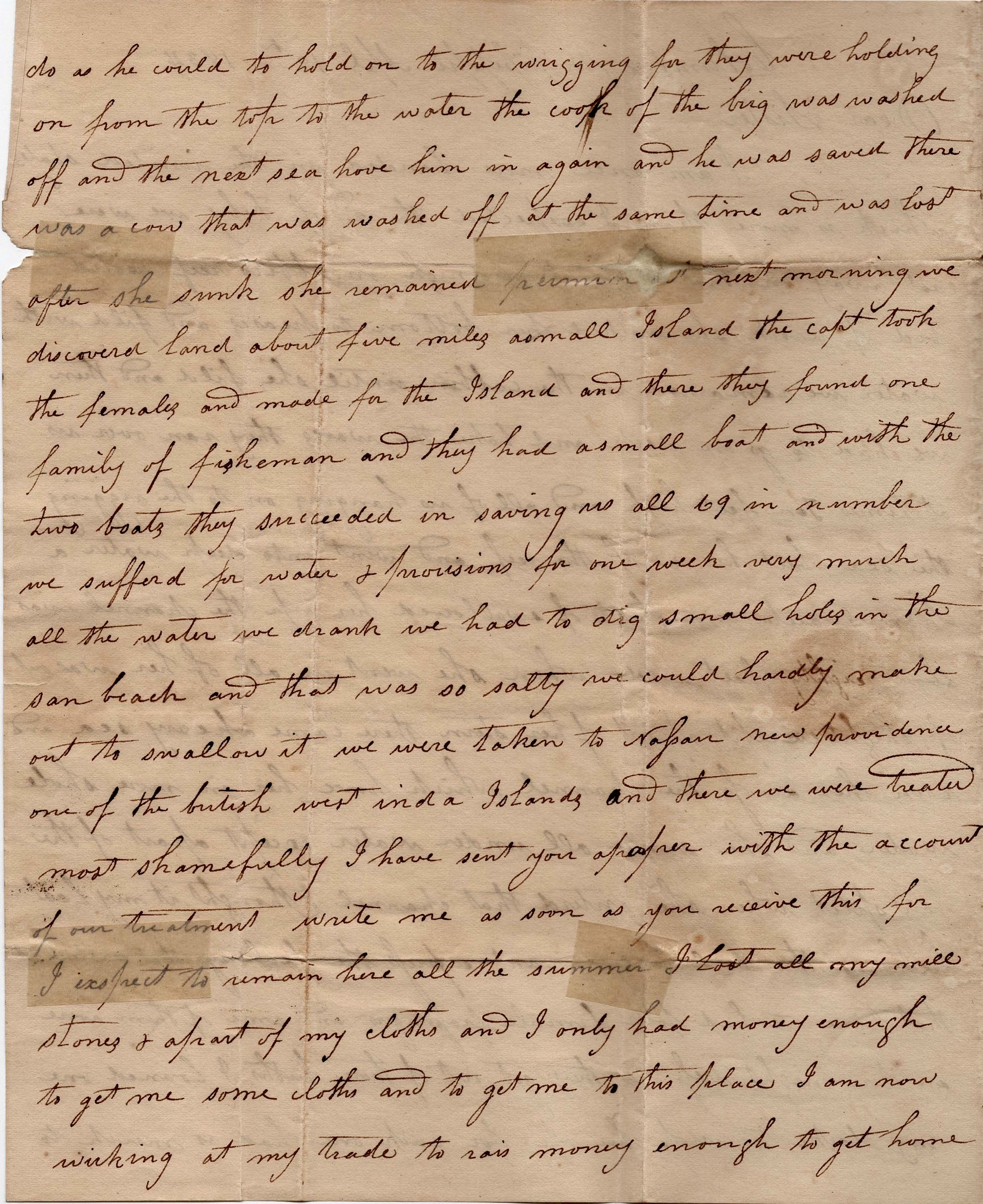
John’s letter relates the details of a shipwreck in the middle of the night on July 3rd 1833 in which he and 68 other souls survived though the vessel they were on was raked over a reef in the British West Indies and sank with little but the bow sprit rigging above the surface of the waves and five miles from the nearest island. It’s a riveting account—one that would have John informing his sister, “Tongue can’t express the feelings that existed at that time…I thought it my last breath in this world.”
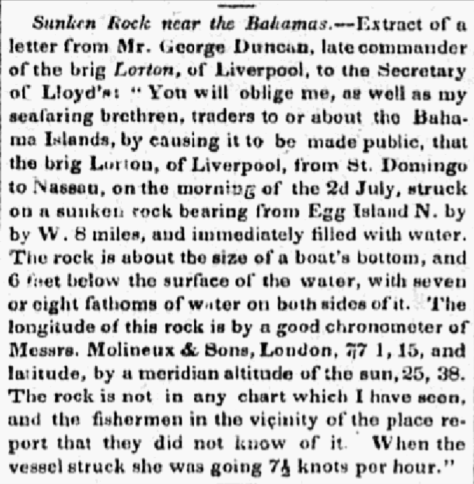
The Southern Patriot, 7 November 1833
It’s believed the ill-fated vessel John was traveling on was the English brig Lorton commanded by George Duncan. An extract of Capt. Duncan’s account of the incident was widely published in the latter half of 1833 in which he relates that “on the morning of the 2nd July” while en route from St. Domingo to Nassau, his vessel “struck on a sunken rock bearing from Egg Island N. by W. 8 miles.” He clarified that “the rock is about the size of a boat’s bottom, and 6 feet below the surface of the water, with seven or eight fathoms of water on both sides of it,” adding that “the rock is not in any chart which I have seen and the fishermen in the vicinity of the place report that they did not know of it.”
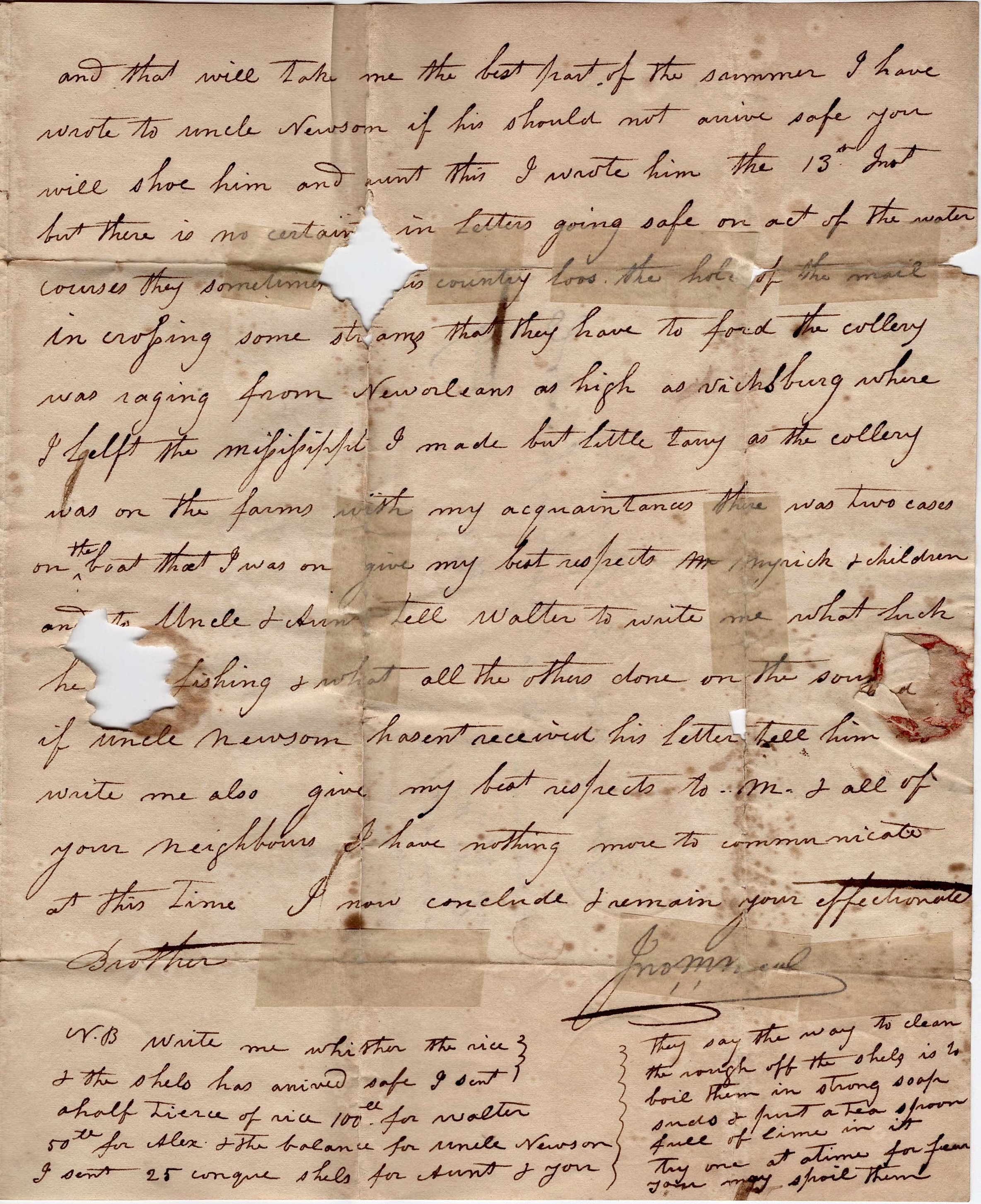
John’s letter concludes with a description of the rest of his journey to Columbus, Mississippi, by way of New Orleans and Vicksburg where he had to avoid residents and passengers suffering from the Cholera Epidemic of 1833.
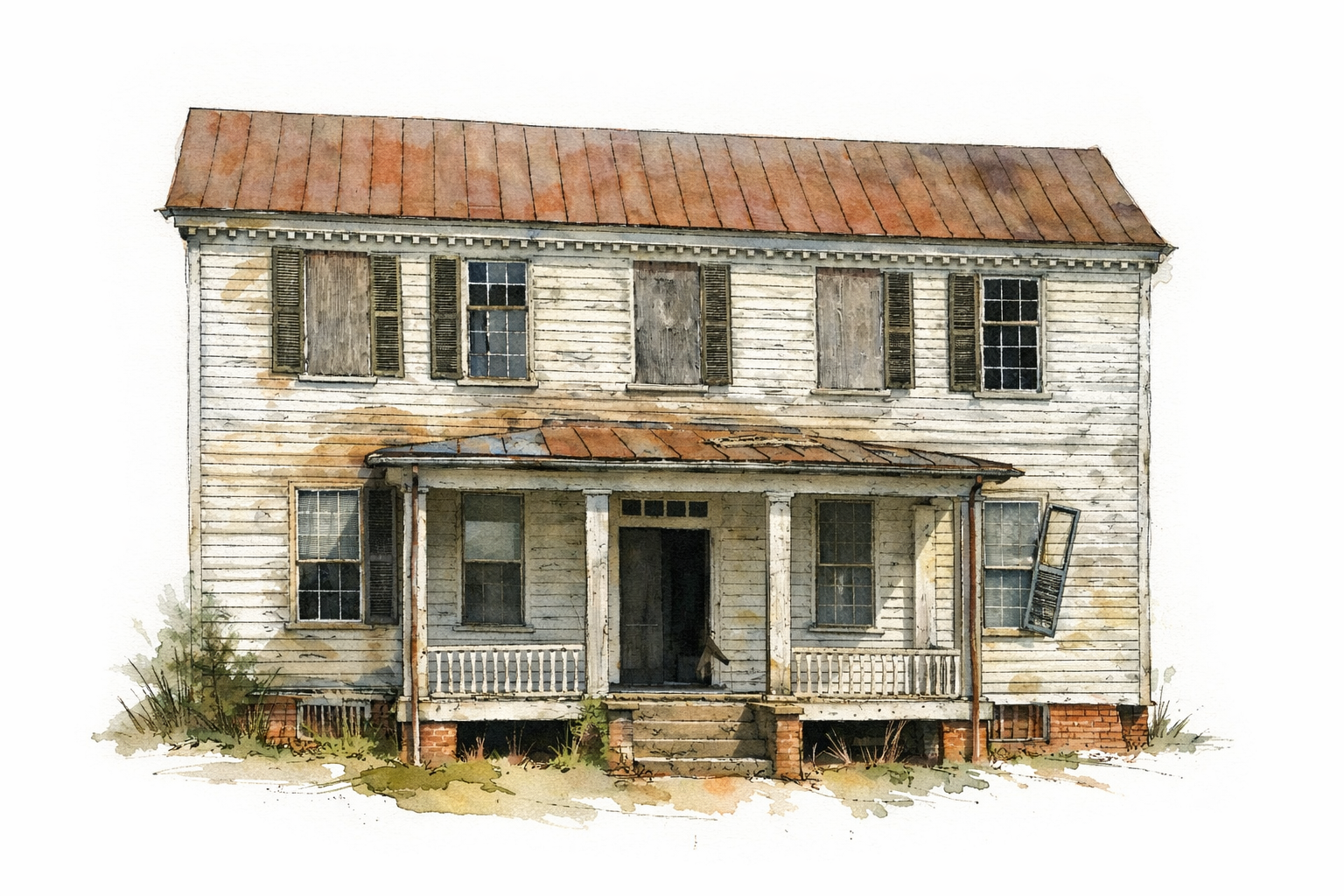
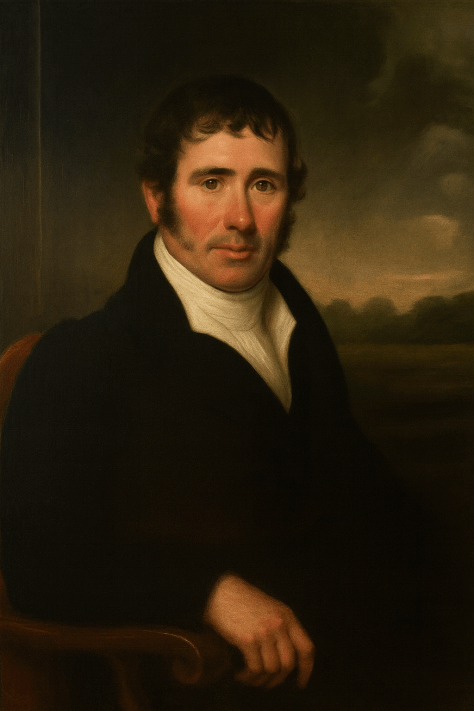
The house Walter B. Myrick (1795-1870) built in North Carolina, just across the State line from Southampton county, Virginia.
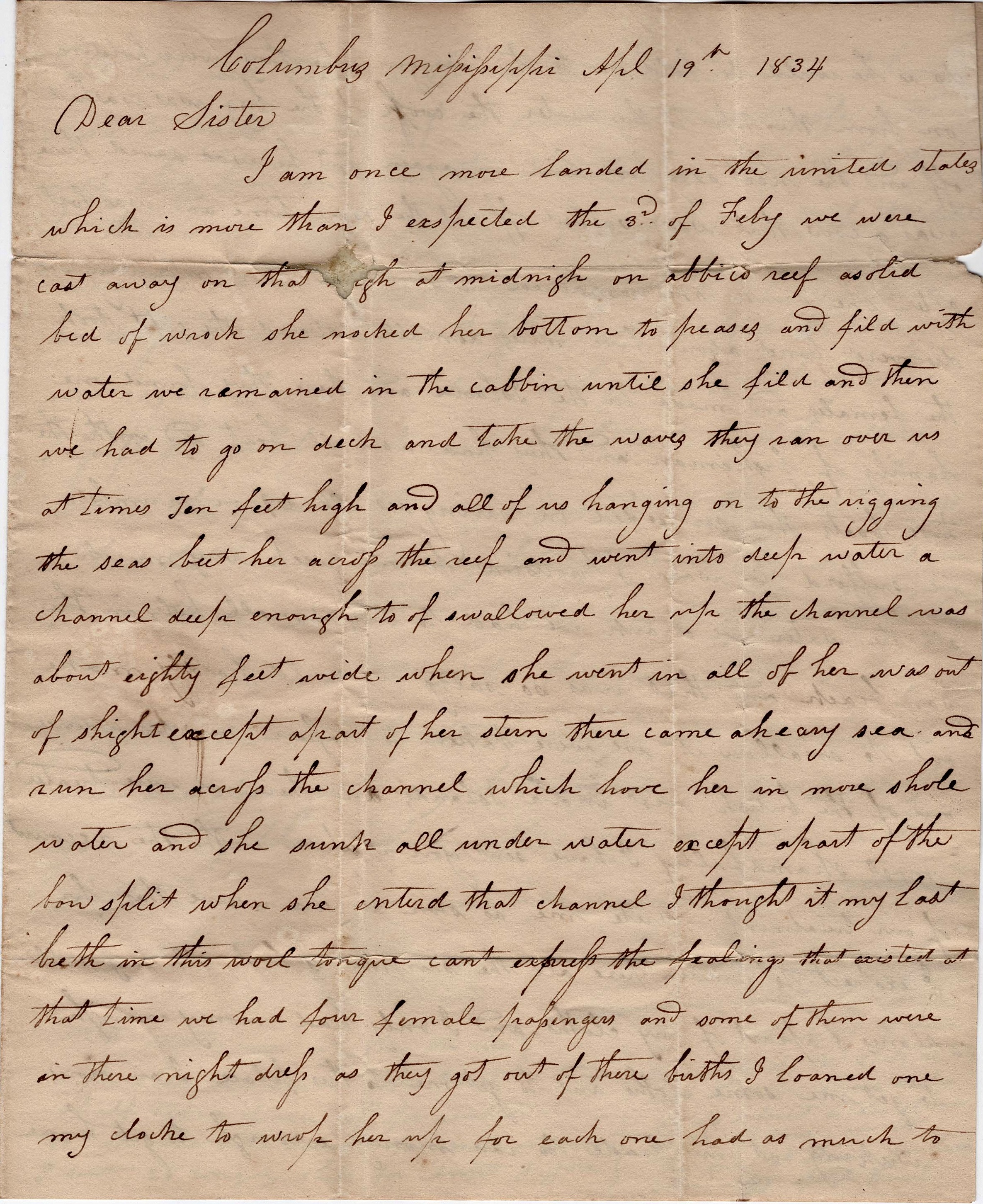
T R A N S C R I P T I O N
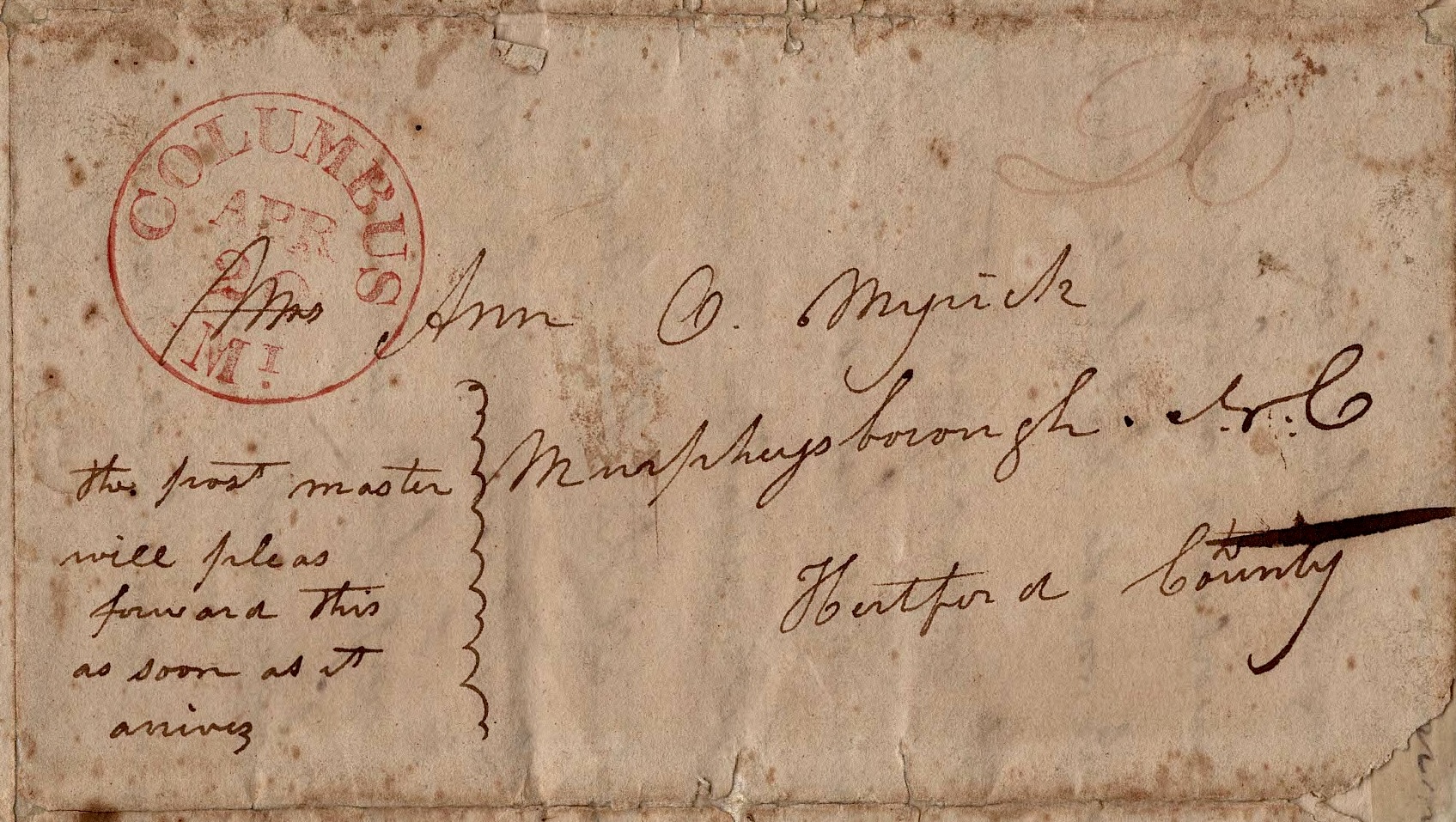
Addressed to Mrs. Ann O. Myrick, Murphrysborough, Hertford county, North Carolina
Columbus, Mississippi April 19th 1834
Dear Sister,
I am once more landed in the United States which is more than I expected. The 3rd of July we were cast away on that night at midnight on Abbie’s Reef, a solid bed of rock. She knocked her bottom to pieces and filled with water. We remained in the cabin until she filled and then we had to go on deck and take the waves. They ran over us at times ten feet high and all of us hanging on to the rigging. The seas beat her across the reef and went into deep water, a channel deep enough to of swallowed her up. The channel was about 80 feet wide. When she went in, all of her was out of sight except a part of her stern. There came a heavy sea and run her across the channel which hove her in more shoal water and she sunk all under water except part of the bow sprit.
When she entered that channel, I thought it my last breath in this world. Tongue can’t express the feelings that existed at that time. We had four female passengers and some of them were in their night dress [just] as they got out of their berths. I loaned one my cloak to wrap her up for each one had as much to do as he could to hold on to the rigging for they were holding on from the top pf the water. The cook of the brig was washed off and the next sea hove him in again and he was saved. There was a cow that was washed off at the same time and was lost after she sunk. She remained permanent.
Next morning we discovered land about five miles—a small island. The captain took the females and made for the island and there they found one family of fisherman and they has a small boat and with the two boats, they succeeded in saving us all—69 in number. We suffered for water and provisions for one week very much. All the water we drank we had to dig small holes in the sand beach and that was so salty we could hardly make out to swallow it.
We were taken to Nassau, New Providence—one of the British West India islands—and there we were treated most shamefully. I have sent you a paper with the account of our treatment. Write me as soon as you receive this for I expect to remain here all the summer. I lost all my mill stones & a part of my clothes and I only had money enough to get me some clothes and to get me to this place.
I am now working at my trade to raise money enough to get home and that will take me the best part of the summer. I have wrote to Uncle [Thomas] Newsom. If his [letter] should not arrive safe, you will show him this. I wrote him the 13th inst. but there is no certainty in letters going safe on account of the water courses. They sometimes in this country lose the whole of the mail in crossing some streams that they have to ford.
The cholera was raging from New Orleans as high as Vicksburg where I left the Mississippi. I made but little tarry as the cholera was on the farms with my acquaintances. There was two cases on the boat that I was on.
Give my best respects to Mr. Myrick and children, and to Uncle & Aunt. Tell Walter to write me what luck he had fishing & what all the others done on the [paper torn]. If Uncle Newsom hasn’t received his letter, tell him to write me. Also give my best respects to M. & all of your neighbors. I have nothing more to communicate at this time. I now conclude & remain your affectionate brother, — Jno. M. Neal
This letter was written by Thomas Henry McNeill (1821-1866), the son of Malcom McNeill (1796-1875) and Martha Rivers. Malcom McNeill began accumulating property in Kentucky where he relocated in 1817, and later bought thousands of acres in Mississippi and within the city of Natchez, which greatly increased in value. An 1884 history of Christian and Trigg counties as “perhaps the richest man in the county, with a large estate and many negroes both there and in Mississippi.”
Thomas Henry McNeill first went to Mississippi to tend his father’s plantations there which were sited along the Mississippi River. He began purchasing his own lands in 1853, initially in the extreme southwestern corner of Coahoma Co. near his father’s plantation in that area. He accumulated 1,945 acres on the Mississippi River there, including a gift from his father of 698 acres. In 1857 he purchased 1,100 acres about ten miles north but still on the River, and sold the southern properties. He called the new plantation “Dogwood” and the Mississippi river now flows over half of that property.
Thomas married first Rebecca Ann Tuck, daughter of Davis Green Tuck and Elizabeth M. Toot, on 26 October 1842 in Christian County, Kentucky. He married second Ann Eliza Arthur, daughter of William Arthur and Susannah Hill Peters on 11 June 1861 in Marshall County, Mississippi. He died at his plantation in Coahoma County, Mississippi at age 45.
T R A N S C R I P T I O N
Addressed to Major Malcom McNeill, Lafayette, Christian county, Kentucky
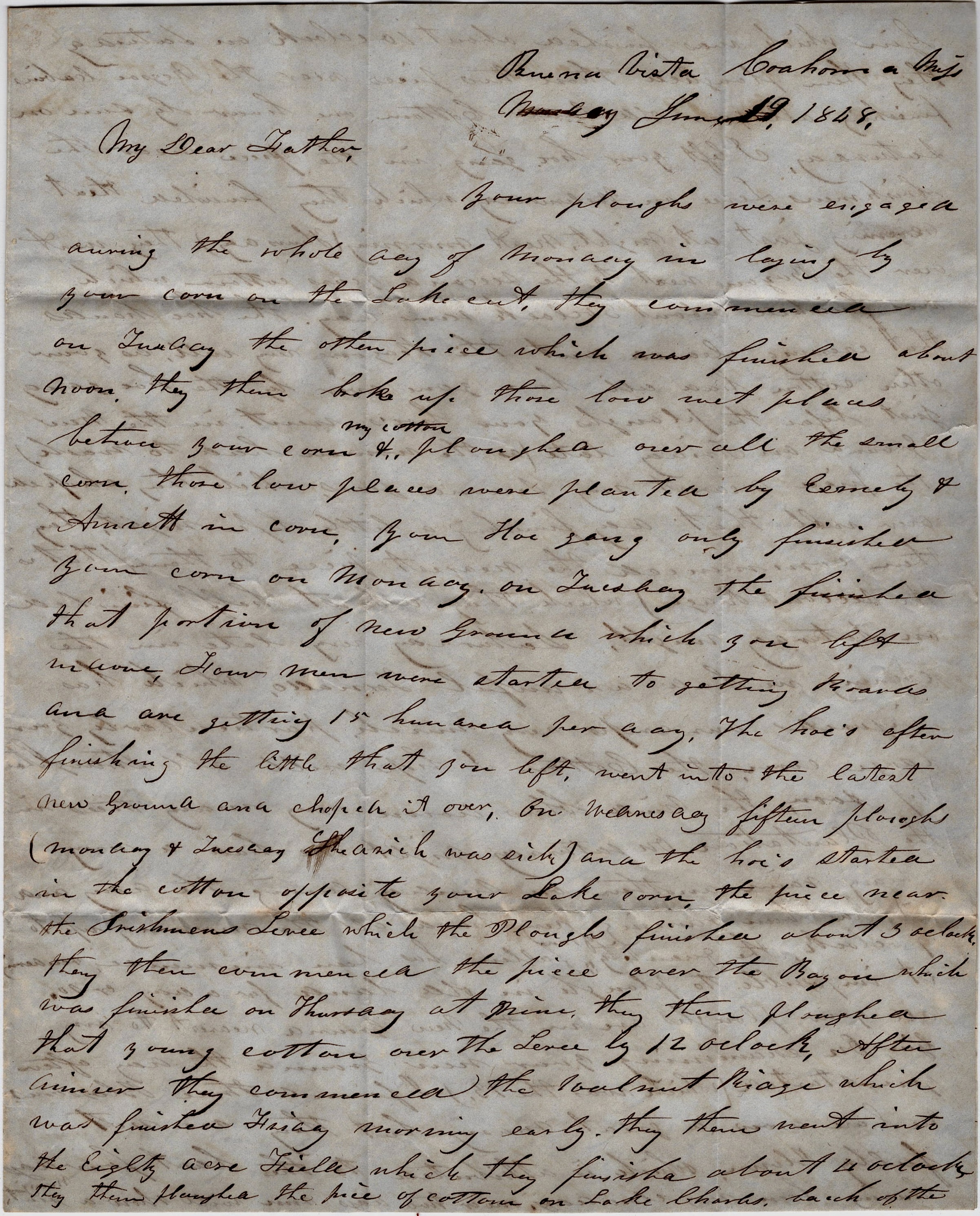
Buena Vista, Coahoma, Mississippi Monday, June 12, 1848
My dear Father,
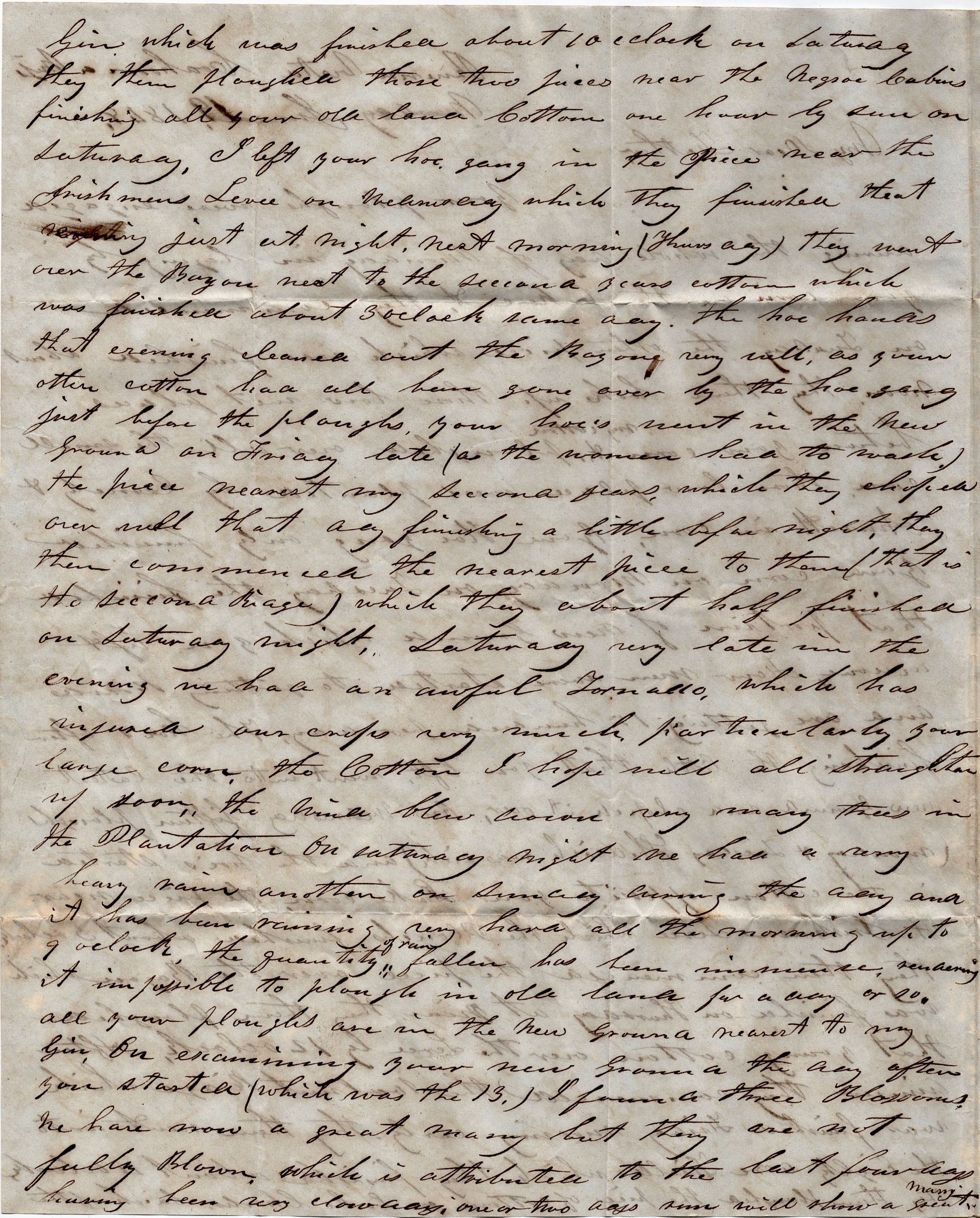
Your ploughs were engaged during the whole day of Monday in laying by your corn on the Lake cut. They commenced Tuesday the other piece which was finished about noon. They then broke up those low, wet places between your cotton and my cotton, plowed over all the small corn. Those low places were planted by Emily & Amrett in corn. Your hoe gang only finished your corn on Monday. On Tuesday they finished that portion of new ground which you left undone. Hoe men were started to getting [ ] and are getting 15 hundred per day. The hoe’s after finishing the little that you left, went into the latest new ground and chopped it over.
On Wednesday fifteen plows (Monday & Tuesday Harich [?] was sick) and the hoe’s started in the cotton opposite your lake corn—the piece near the Irishmen’s levee—which the plows finished about 3 o’clock. They then commenced the piece over the Bayou which was finished on Thursday at nine. They then plowed that young cotton over the levee by 12 o’clock. After dinner they commenced the Walnut Ridge which was finished Friday morning early. They then went into the eighty acre field which they finished about 4 o’clock. They then plowed the piece of cotton on Lake Charles, back of the gin which was finished about 10 o’clock on Saturday. They then plowed those two pieces near the negro cabins, finishing all your old land cotton one hour by sun on Saturday.
I left your hoe gang in the office near the Irishman’s Levee on Wednesday which they finished that just at night. Next morning (Thursday) they went over the Bayou and to the Second year’s cotton which was finished about 3 o’clock same day. The hoe hands that evening cleaned out th bayou very well as your other cotton had all been gone over by the hoe gang just before the plows. Your hoe’s went in the new ground on Friday late (as the women had to wash) the piece nearest my second years, which they chopped over well that day, finishing a little before night. They then commenced the nearest piece to them (that is the second ridge) which they about half finished on Saturday night.
Saturday very late in the evening we had an awful tornado which has injured our crops very much, particularly your large corn. The cotton, I hope, will all straighten up soon. The wind blew down very many trees in the Plantation. On Saturday night, we had a very heavy rain. Another on Sunday during the day and it has been raining very hard all the morning up to 9 o’clock. The quantity of rain fallen has been immense, rendering it impossible to plow in old grounds for a day or so. All your plows are in the new ground nearest to my gin. On examining your new ground the day after you started (which was the 13th) I found three [cotton] blossoms. We have now a great many but they are not fully blown, which is attributed to the last few days having been very cloudy. One or two days sun will show a great many.
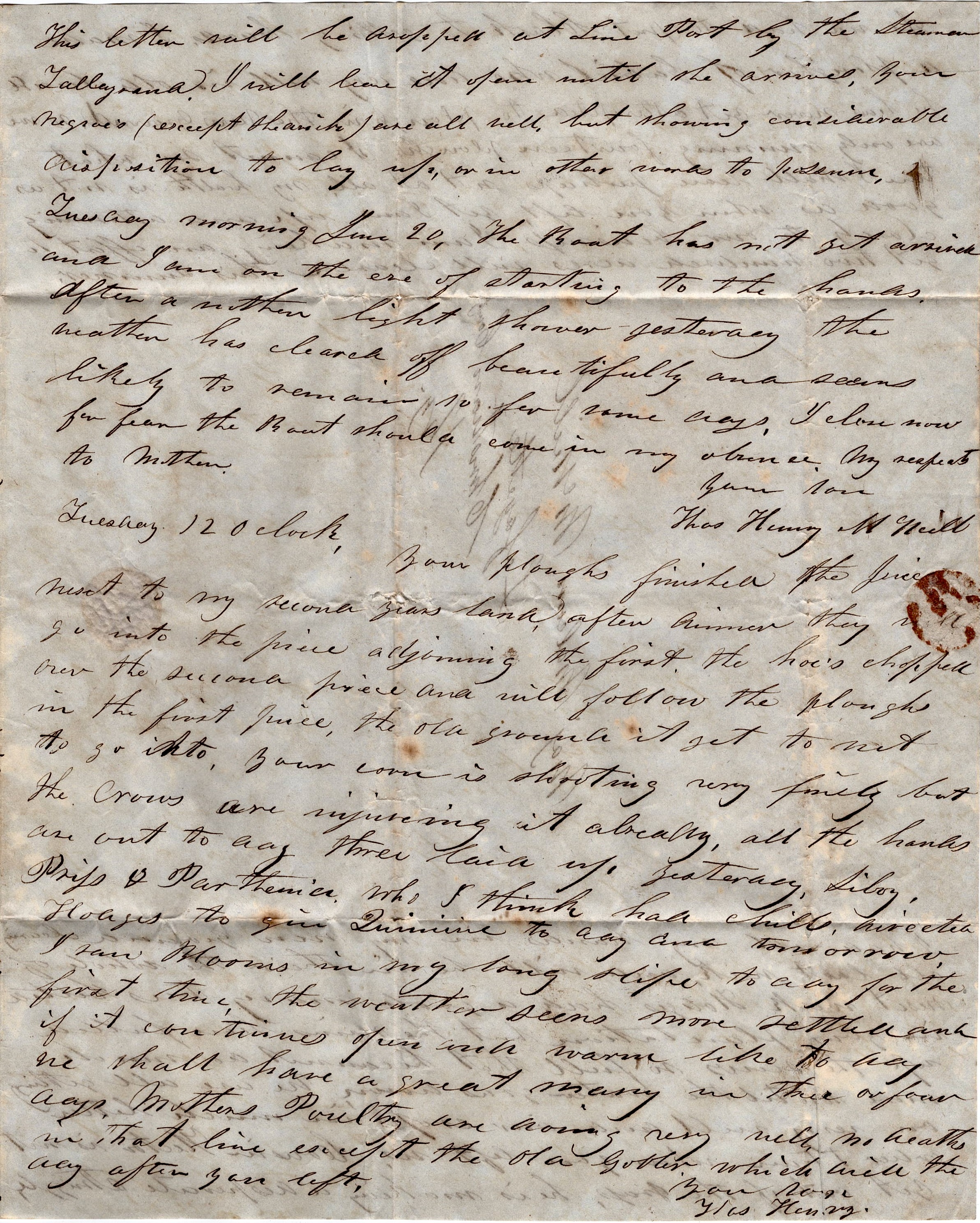
This letter will be dropped at Line Port by the Steamer Talleyrand. I will leave it open until she arrives. Your negroes (except Harick) are all well, but showing considerable disposition to lay up, or in other words, to possum.
Tuesday morning, June 20, the boat has not yet arrived and I am on the eve of starting to the lands. After another light shower yesterday the weather has cleared off beautifully and seems likely to remain so for a few days. I close now for fear the boat should come in my absence. My respects to Mother. Your son, — Thos. Henry McNeill
Tuesday 12 o’clock. Your plows finished the field next to my second year’s land. After dinner they will go into the piece adjoining the first. The hoe’s chopped over the second piece. The old ground is yet too wet to go into. Your corn is shooting very finely but the crows are injuring it already. All the hands are out today. Three laid up yesterday—Libby, Priss and Parthenia—who I think had chills. Directed Hoages to give quinine today and tomorrow. I saw blooms in my long [ ] today for the first time. The weather seems more settled and we shall have a great many in three or four days. Mother’s poultry are doing very well. No deaths in that line except the old gobbler which died the day after you left. Your son, — Thos. Henry
As we had to put Clark to getting boards, I made a plower of Gabriel who does very well in old land. He has never attempred to plow in the new ground so we are only running fourteen plows. I cannot say what time I shall leave. Perhaps not at all. My health is not as good as when you left yet I am up and attending closely to our business. I am making an effort to get two hundred acres well cleared this summer.
I had all my hands in my new ground clearing all last week and will be in there the whole of next week. Hoages had a good many trees belted in your plantation but the rains have filled up the sloughs so full that he cannot as much more until the water goes down, We are all getting on very well and our crops in much better order than when you left us. Cousin Hector is not yet out of the grass. He is making a desperate struggle…
The following letter was written by Lydia Harris (1810-1836), the daughter of Dr. Stephen Harris (1786-1858) and Lydia Greene (1791-1820) of Providence, Rhode Island. Lydia was married to Henry H. Pease (1804-1840). From the letter we know that Lydia was residing in Yazoo county, Mississippi, during the winter of 1836-37. though she apparently spent the hot summers in Rhode Island with her relatives. The letter is datelined from “Woodland” which I assume was the name of the plantation owned by her husband. It seems to have been a few miles outside of Manchester (later renamed Yazoo City) where Henry also had a home.
Though her letter suggests she was suffering from chronic illness, still it was surprising to learn that Lydia died some ten days after this letter was written. Her husband did not live much longer. His obituary reads: “Melancholy Accident.—A letters received in this city, dated Yazoo City, Mississippi, September 15 [1840], states that Mr. Henry H. Pease, formerly of New York, was accidentally killed near the former place, on the previous day. It appears that he was riding with a friend in a barouche; the horses took fright at some cows, ran over one of them, and darted off at full speed. After they had advanced about fifty yards, they brought the carriage in contact with a large stump with so much violence that the vehicle was broken to pieces, and the two gentlemen who were in it were thrown a distance of 36 feet. Mr. Pease fell upon his back and neck and was killed almost instantly. His companion, Mr. George B. Dixon, escaped with some slight bruises and internal hurts. Mr. Pease was 36 years of age, and the son of John B[enjamin] Pease, Esq., [1774-1866] of Utica. His body was interred at Yazoo on the day succeeding th accident, with military honors.”
Lydia wrote the letter to her sister-in-law, Abigail (“Abby”) Spaulding (1816-1888), the wife of Cyrus Harris (1812-1887), and the daughter of Lovewell Spaulding (1780-1853) and Susannah Greene (1788-1869) of Rhode Island.
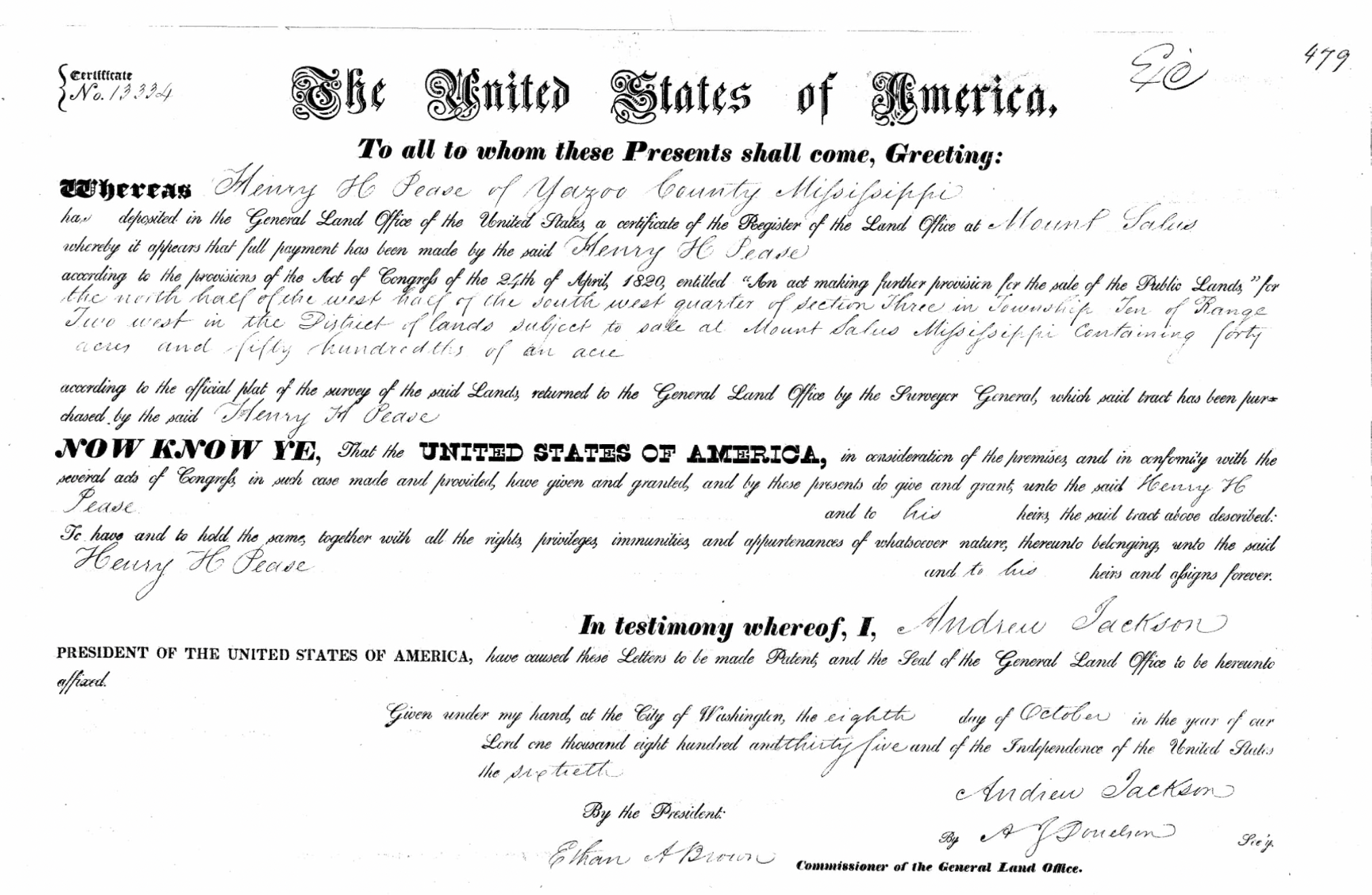
Land Deed in Yazoo County, Mississippi. Approximately 40 acres purchased by Henry H. Pease in 1835.
T R A N S C R I P T I O N
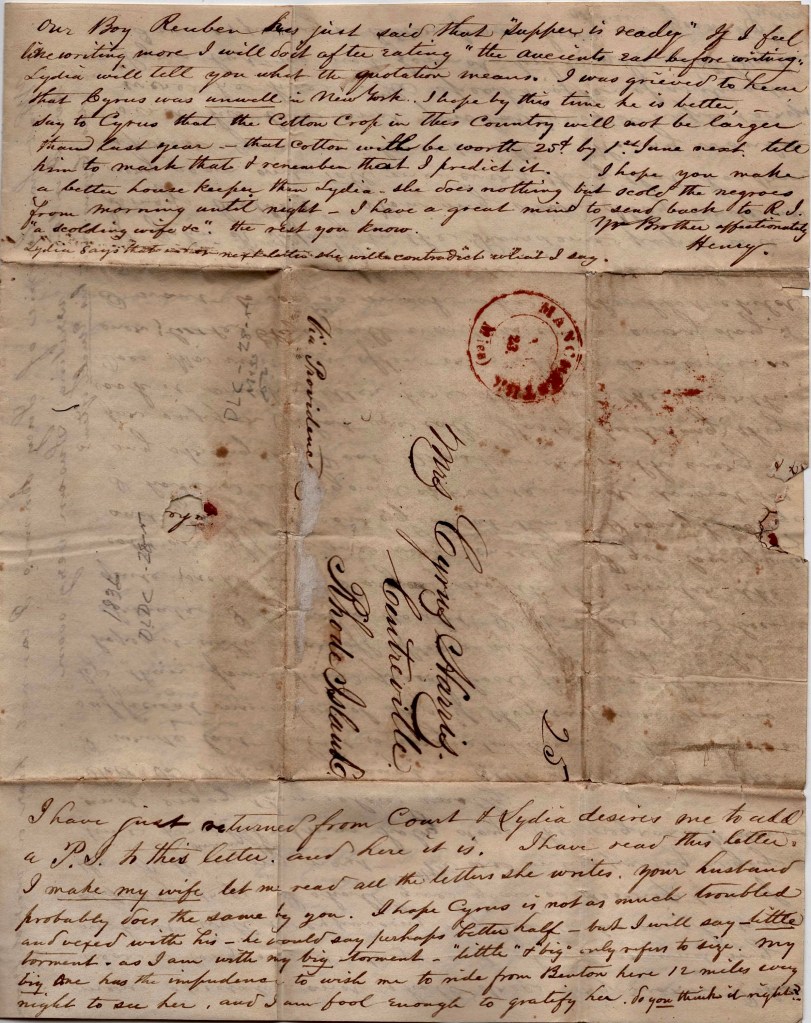
Addressed to Mrs. Cyrus Harris, Centreville, Rhode Island, Via Providence
Woodland November 21, 1836
Dear sister,
I began to think you had quite forgotten me, Abby, or did not intend to [ ] and had determined the day I received your letter to write you a very scolding one. You very fortunately escaped this time, however, for which you may thank your lucky stars.
Well Abby, how do you like housekeeping? I presume you are comfortably settled at Greenville [Rhode Island] ere this. I almost envy you your nice warm house. A house like yours would be very valuable in this country. I hope you have succeeded in getting a good servant. I should advise you to take little George. You will find him very useful. We at the South have the advantage over you in regard to servants. We can obtain good ones any time by paying for them. They are worth from one thousand to fifteen hundred dollars.
How does Stephen behave? Do you have to scold him every day? I intend taking him home with me another winter. I dream every night of being at home. I expect I shall feel as unpleasantly at leaving home next summer as I did this. I am much better contented now than when I first came. Could I be at my own home in Manchester [Mississippi], I should be quite happy. I find it very pleasant here but rather lonesome. Brother John has been from home this past week. Took his friend D. Pomery with him. Dr. Nesbit is at Vicksburg so that I am quite alone during the day, Henry comes home every evening and returns in the morning. Rides 25 miles on horseback every day to see me. Do you not think him a very affectionate husband? I will not say anything more about him for fear he should read this letter. I might raise his vanity to too high a pitch.
James has not arrived yet. We are expecting him daily. I cannot be lonesome when he is here. What does Eliza Anthony say about him? Have you forgotten “False one I love thee still.”
I expect you have cold weather now. Last year at this time it was very cold at the North. We had snow in November. It is very pleasant here; not much colder than when we came. The thermometer stands at 62 degrees above zero today in the shade. February and March are warm months here. With you they are the coldest and most unpleasant of the year.
They commenced planting their gardens in February. The woods are covered with strawberry vines. I anticipate a great deal of pleasure eating strawberries in the spring. I shall go and gather them if I am not too much afraid of snakes. I have been out but very seldom since I came here.
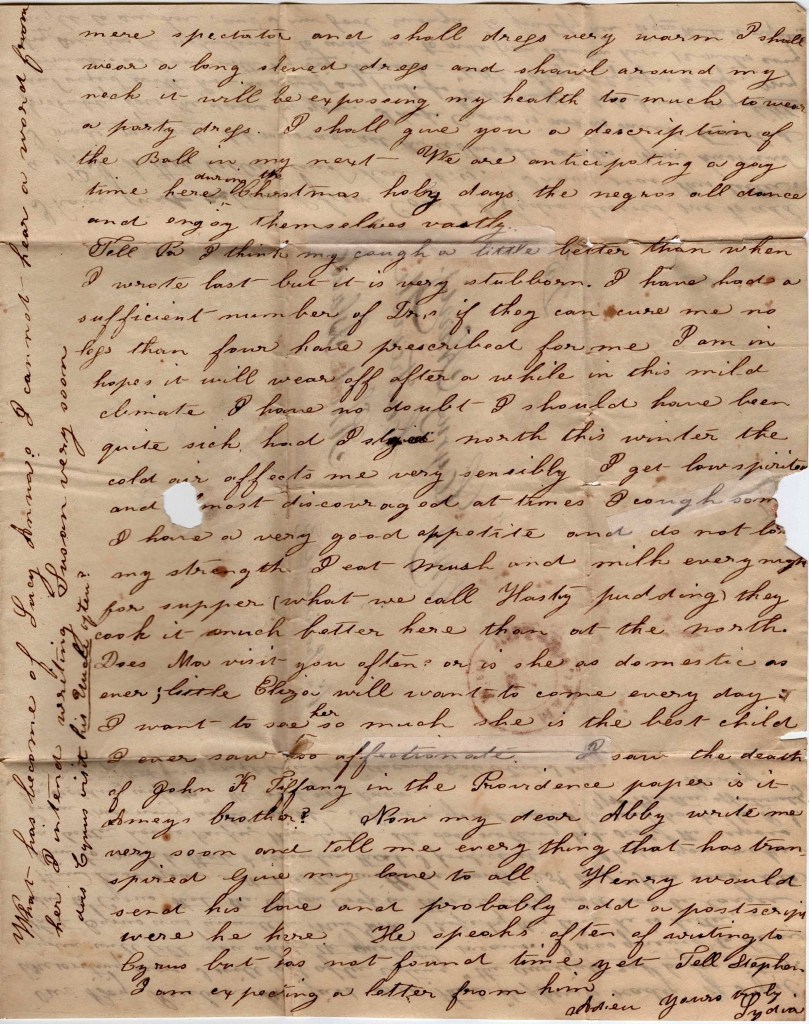
I intend going to Manchester on Thursday to attend a Ball. I received a note from the managers two weeks since. There are fourteen managers. They send invitations to all the ladies and let them get to the Ball the best way they can. It is all the invitations they have. I wish you was here to go with me. I know we should be amused. I have a great curiosity to see the Yazoo Ladies at a Ball. They are five or six years behind the fashion in dress and everything else. I know I shall laugh. I have heard a description of their dancing. Stephen could dance very well with them. I wish he was here. He would enjoy it so much. They use their head and arm quite as much as their feet and make as much noise with them as possible. Tell Pa and Cyrus not to scold because I am going to the Ball. I am going as a mere spectator and shall dress very warm. I shall wear a long-sleeved dress and shawl around my neck. It will be exposing my health too much to wear a party dress. I shall give you a description of the Ball in my next. We are anticipating a gay time here during the Christmas Holy days. The negroes all dance and enjoy themselves vastly.
Tell Pa I think my cough a little better than when I wrote last, but it is very stubborn. I have had a sufficient number of doctors [to see] if they can cure me. No less than four have prescribed for me. I am in hopes it will wear off after a while in this mild climate. I have no doubt I should have been quite sick had I stayed North this winter. The cold air affects me very sensibly. I get low-spirited and almost discouraged at time. I cough some. I have a very good appetite and do not lose any strength. I eat mush and milk every night for supper (what we call Hasty Pudding)/ They cook it much better here than at the North. Does Ma visit you often? Or is she as domestic as ever? Little Eliza will want to come every day. I want to see her so much. She is the best child I ever saw—so affectionate.
I saw the death of John K. Tiffany in the Providence paper. Is it Amey’s brother? Now, my dear Abby, write me very soon and tell e everything that has transpired. Give my love to all. Henry would send his love and probably add a postscript were he here. He speaks often of writing to Cyrus but has not found time yet. Tell Stephen I am expecting a letter from him. Adieu. Yours truly, — Lydia
What has become of Lucy Anna? I cannot hear a word from her. I intend writing Susan very soon. Does Cyrus visit his uncle often?
[In a different hand]
I have just returned from Court & Lydia desires me to add a P. S. to this letter and here it is. I have read this letter. I make my wife let me read all the letters she writes. Your husband probably does the same by you. I hope Cyrus is not as much troubled and vexed with his—he would say perhaps better half—but I will say lttle torment, as I am with my big torment. Little and big only refers to size. My big one has the impudence to wish me to ride from Benton 1 here 12 miles every night to see her and I am fool enough to gratify her. Do you think it right?
Our Boy Reuben has just said that “Supper is ready.” If I feel like writing more I will do it after eating. “The ancients eat before writing.” Lydia will tell you what the quotation means. I was grieved to hear that Cyrus was unwell in New York. I hope by this time he is better. Say to Cyrus that the cotton crop in this country will not be larger than last year. That cotton will be worth 25 cents by 1st June next. Tell him to mark that & remember that I predict it. I hope you make a better house keeper than Lydia. She does nothing but scold the negroes from morning until night. I have a great mind to send back to Rhode Island “a scolding wife, &c.” THe rest you know. Your brother affectionately, — Henry
Lydia says that in her next letter she will contradict what I say.
1 Benton was the county seat of Yazoo County from 1829 until 1850 when it was moved to Yazoo City (formerly named Manchester).
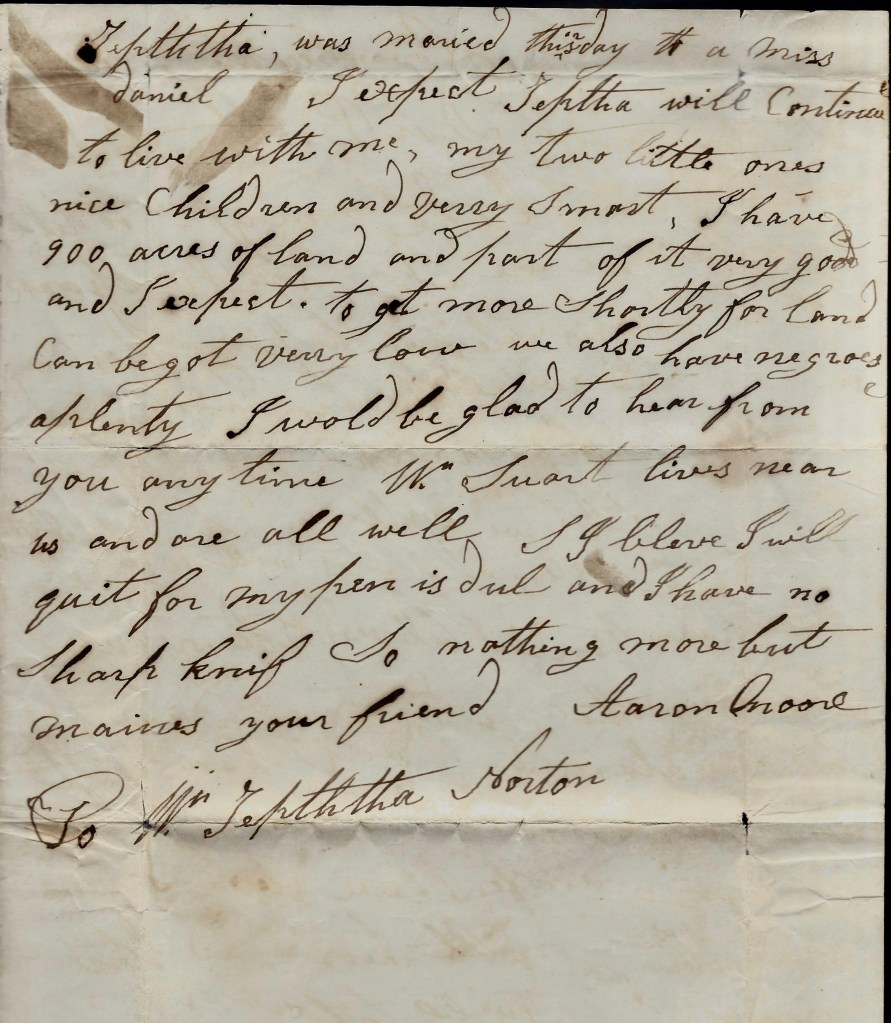
The following letter was written by Aaron J. Moore (1792-1862), a native of South Carolina and of partial Choctaw descent, who married Jane Tally (1796-1839) and relocated to Autauga county, Alabama by 1820, and then to Winston county, Mississippi, prior to the 1840 US Census. Known children by his first wife included: Aaron Tally Moore (1817-1860) who married a woman named Mary E. Burnside [?] the year before the date of this letter; Jeptha Norton Moore (1820-1886); Sarah Ann Moore (1821-1860) who married William J. Hickman (b. 1819) in February 1842; Martha Jane Moore (1834-1853); and Alexander Travis Moore (1836-1884). In the 1850 Slave Schedule, Aaron is recorded owning 11 slaves ranging in age from 2 to 45, mostly male.
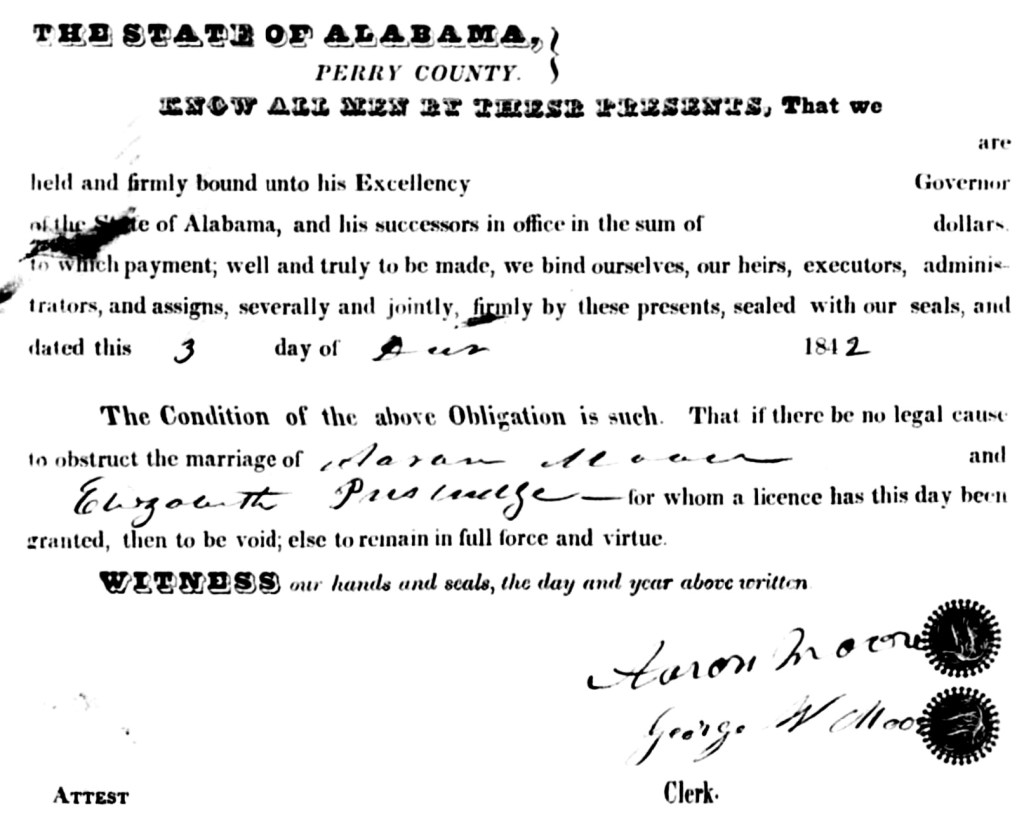
We learn from Aaron’s letter that he was remarried after the death of his first wife but that she had abandoned him and gone to Alabama—presumably her home, for we find that an Aaron Moore was married to Elizabeth Prestridge (1797-1874) on 3 December 1842 in Perry, Alabama. Elizabeth was the widow of Joseph W. Prestridge (1794-1836). Her maiden name was Bagley and they had married in 1812. Her youngest child with Joseph was George Harper Prestridge (1832-1863), a member of Co. A, 6th Arkansas (Confederate) Cavalry. It does not appear that Elizabeth ever remarried after leaving Aaron. She was enumerated in the household of her younger brother, a slaveholder named Berton Rucker Prestridge at Oakmulgee, Perry county, Alabama, in 1850. Today her remains lie buried under a smashed tombstone in Balch Cemetery, Alvarado, Texas.
Marriage Record in Perry County, Alabama, dated 3 December 1842.
Transcription
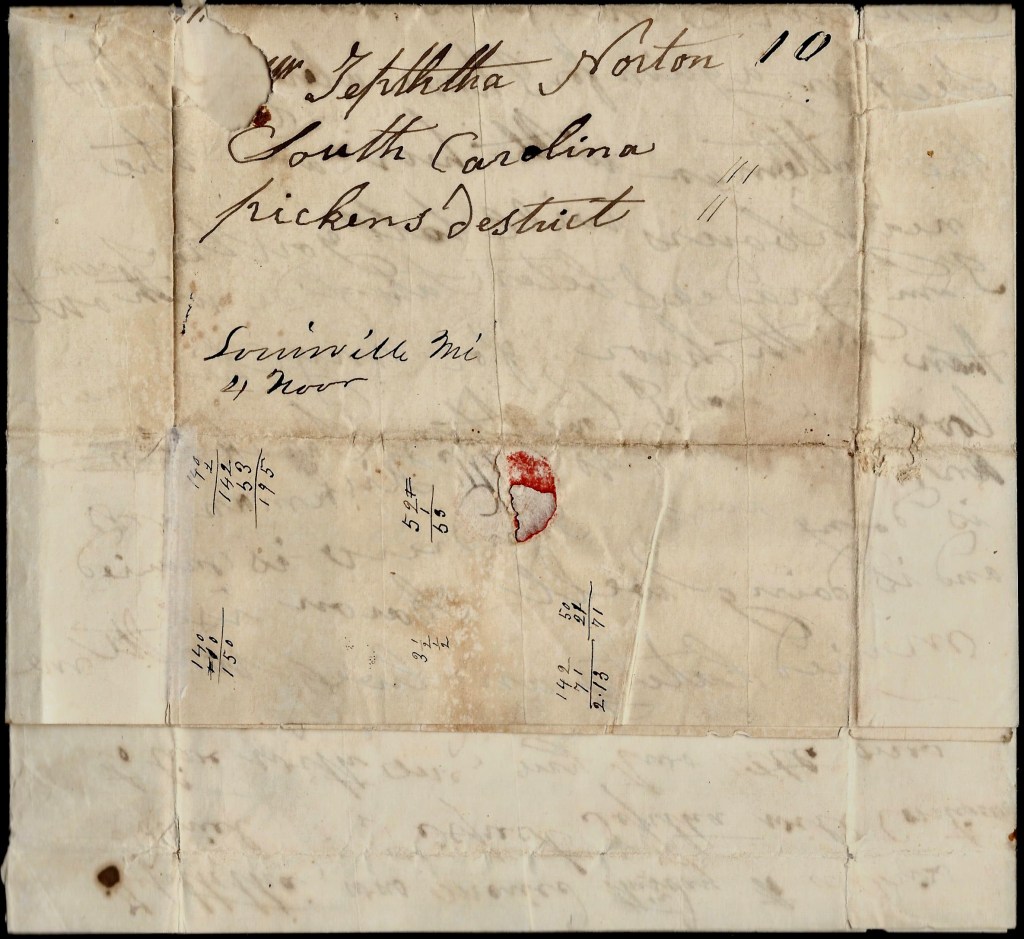
Stampless letter addressed to Jeptha Norton, South Carolina, Pickens District
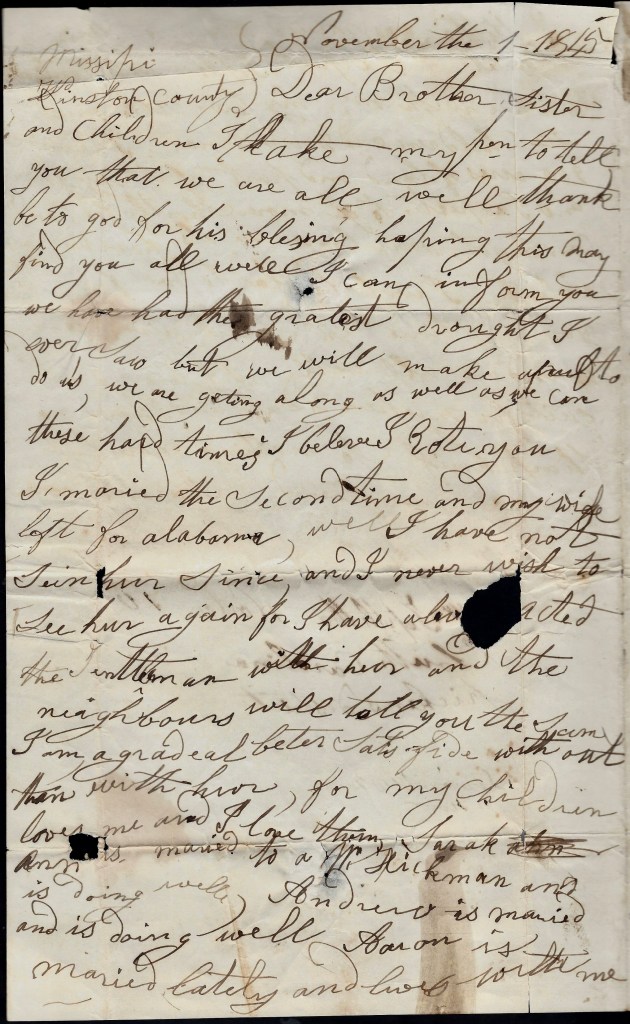
[Louisville] Winston county, Mississippi November 1, 1845
Dear Brother, Sister & Children,
I take my pen to tell you that we are all well, thanks be to God for His blessing, hoping this may find you all well. I can inform you we have had the greatest drought I ever saw but we will make enough to do us. We are getting along as well as we can these hard times. I believe I wrote you I married the second time and my wife left for Alabama. Well I have not seen her since and I never wish to see her again for I have always acted the gentleman with her and the neighbors will tell you the same. I am a great deal better satisfied without than with her for my children loves me and I love them. Sarah Ann is married to a W. Hickman and is doing well. Andrew is married and is doing well. Aaron is married lately and lives with me.
Jeptha was married Thursday to a Miss Daniel. I expect Jeptha will continue to live with me. My two little ones are nice children and very smart. I have 900 acres of land and part of it very good and I expect to get more shortly for land can be got very low. We also have negroes aplenty. I would be glad to hear from you anytime. W. Smart lives near us and are all well. I believe I will quit for my pen is dull and I have no sharp knife so nothing more but remain your friend, — Aaron Moore
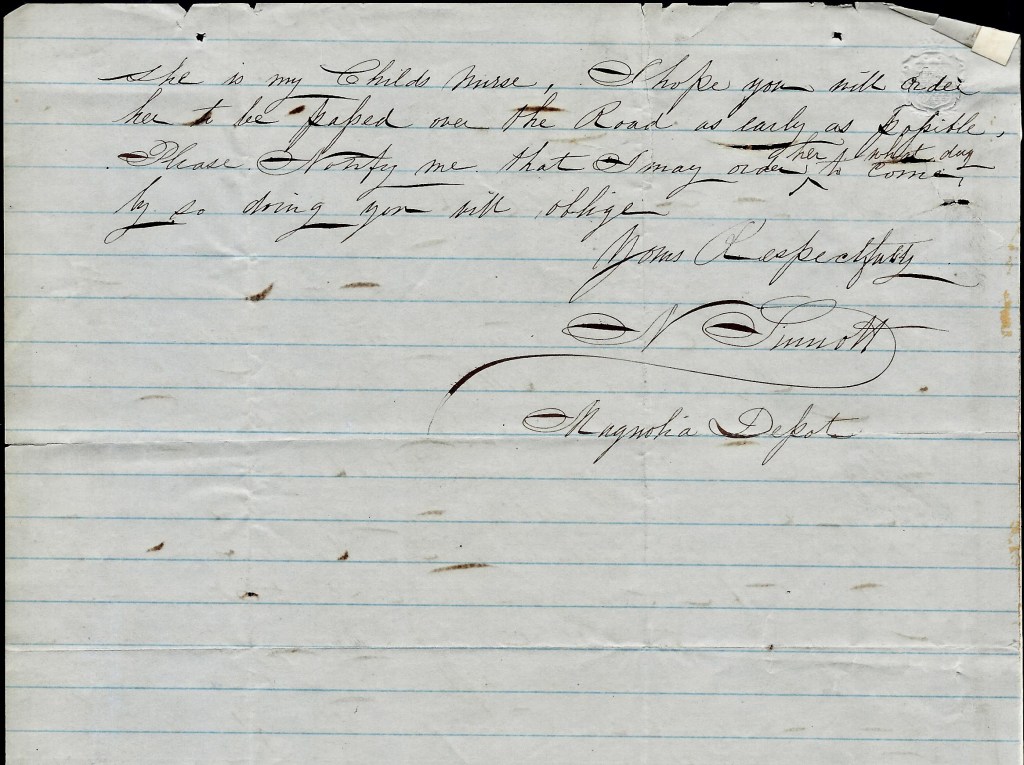
This letter was probably written by Nicholas Sinnott, Jr. (1816-1889) of New Orleans, Louisiana. He was married to Arabella D. Kenaday (1826-1906). For most of his career, Nicholas worked as a coal dealer. He wrote the letter in 1858 to John Calhoun, President of the New Orleans, Jackson, and Great Northern Railroad to complain that his wife’s black nursemaid—a young slave—had been forced to get off the train because the ticket agent was told she was a free black, which prohibited her from entering the State of Mississippi. Apparently she really was a slave but she had been told she was free because it was the intent of her owners to award her manumission papers once the estate was settled.
The irony is that she would have been allowed to remain on the cars and enter Mississippi as a slave but not as a free black.
Transcription
Magnolia, Mississippi December 19, 1858
John Calhoun, Esq. President of N. O. J & G. N. Railroad
Sir—A quadroon girl who has resided in my family both in Mississippi & New Orleans for several years, was compelled to leave the cars by Mr. McGrath on Saturday, 18th inst., leaving my wife with the care of an infant, to come on alone to this place. The case is one of peculiar hardship. My wife was unaware of the regulation excluding free people from Mississippi. The ticket seller gave her a pass to Magnolia for a Colored servant without asking any questions nor did she become aware of the difficulty until called upon by Mr. McGrath for tickets some time after leaving New Orleans. The girl is the daughter of a wealthy planter of Rapides by a slave. The mother was manumitted after her birth, and by an oversight, the child’s name was omitted in the Act. The White family intend to perform this act as soon as the Estate is settled but she is a slave. She was placed in my wife’s charge by her father’s lawful heirs and having been raised respectably in consideration for her feelings, is represented as free. And although my wife explained this as far as was possible for a lady, Mr. McGrath refused to permit her to pass. As my wife feels that she is in a manner responsible for the girl, and moreover, she is my child’s nurse, I hope you will order her to be passed over the road as early as possible. Please notify me that I may order her to come what day. By so doing you will oblige. Yours respectably, — N. Sinnott
Like his dreams for Cuban statehood, William’s headstone lies shattered in Yazoo County, MS
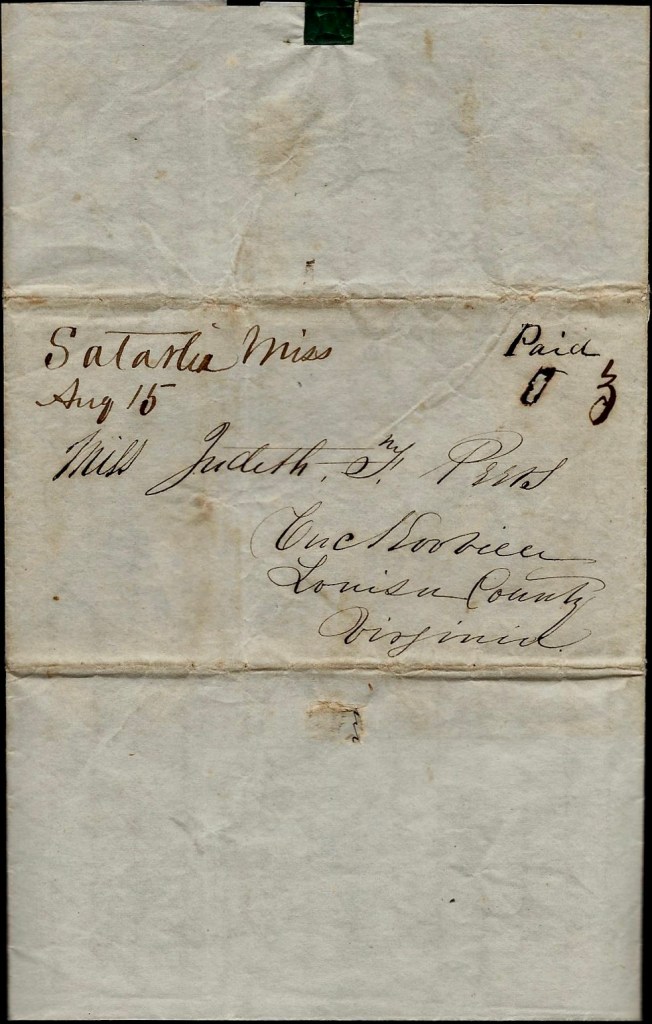
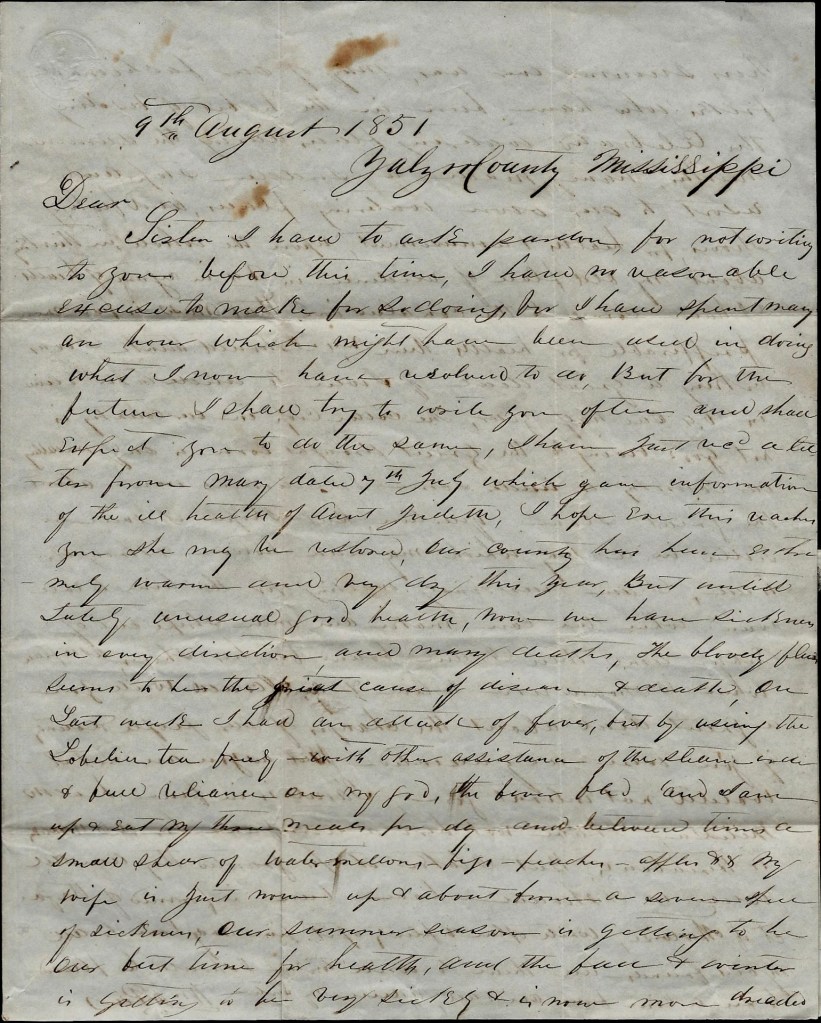
The following letter was written by William N. Alexander Peers, the son of Thomas Peers Jr. and Elly Parsons, both of whom were also from Louisa, Virginia. He married Sarah Ann Sturdivant about 1838 in Mechanicsburg, Yazoo County, Mississippi. They had four children born to their marriage. Sarah Ann died at the birth of their last child, William Henry Peers, born about 1815, Louisa, Louisa, Virginia. William died on 20 November 1855, Yazoo, Mississippi. William was a planter in Yazoo county and of course owned many slaves.
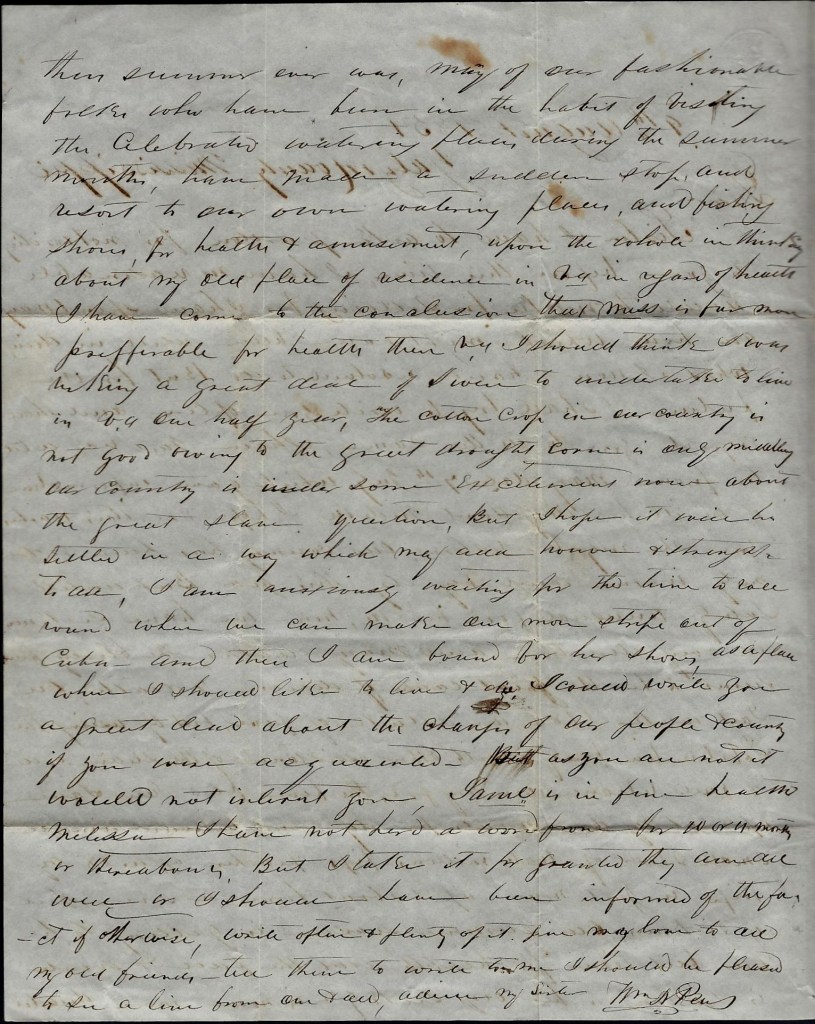
In his letter, datelined from Yazoo county in August 1851, William informs his sister that “our country is under some excitement now about the great slave question but I hope it will be settled in a way which may add honor and strength to all. I am anxiously waiting for the time to roll around when we can make one more stripe out of Cuba and then I am bound for her shores, as a place where I should like to live & die.” Of course William is referring to the agitation of the slavery question brought on by the admission of more states into the Union which resulted in the Compromise of 1850, temporarily suspending threats of secession. Plantation owners were particularly optimistic and enchanted with the idea of acquiring Cuba from Spain and making it a new state in the Union. Hopes for wrestling Cuba from Spains’s control by the Lopez Expedition were soon dashed when Lopez was taken prisoner and garroted not long after this letter was penned.
Transcription
Yazoo County, Mississippi 9th August 1851
Dear Sister,
I have to ask pardon for not writing to you before this time. I have no reasonable excuse to make for so doing for I have spent many an hour which might have been used in doing what I now have resolved to do. But for the future I shall try to write you often and shall expect you to do the same. I have just received a letter from Mary dated 7th July which gave information of the ill health of Aunt Judeth. I hope ere this reaches you, she may be restored.
Our county has been extremely warm and very dry this year but until lately, unusual good health. Now we have sickness in every direction and many deaths. The bloody flux seems to be the great cause of disease and death. On last week I had an attack of fever, but by using the Lobelier tea freely—with other assistance of the steam [ ] and full reliance on my God, the fever fled and I am up and eat my three meals per day, and between times a small share of watermelons, figs, peaches, apples, &c. &c. My wife is just now up & about from a severe spell of sickness. Our summer season is getting to be our best time for health, and the fall and winter is getting to be very sick & is now more dreaded than summer ever was.
Many of our fashionable folks who have been in the habit of visiting the celebrated watering places during the summer months have made a sudden stop, and resort to our own watering places, and fishing shores for health and amusement. Upon the whole, in thinking about my old place of residence in Virginia in regard of health, I have come to the conclusion that Mississippi is far more preferable for health than Virginia. I should think I was risking a great deal if I were to undertake to live in Virginia one half year. The cotton crop in our country is not good owing to the great drought. Corn in only middling.
Our country is under some excitement now about the great slave question but I hope it will be settled in a way which may add honor and strength to all. I am anxiously waiting for the time to roll around when we can make one more stripe out of Cuba and then I am bound for her shores, as a place where I should like to live & die. I could write you a great deal about the changes of our people & country if you were acquainted but as you are not, it would not interest you.
James is in fine health. Melissa I have not heard a word from for 3 or 4 months or thereabouts. But I take it for granted they are all well or I should have been informed of the fact if otherwise. Write often and plenty of it. My love to all my old friends. Tell them to write to me. I should be pleased to see a line from one and all. Adieu my sister, — Wm. N. Peers
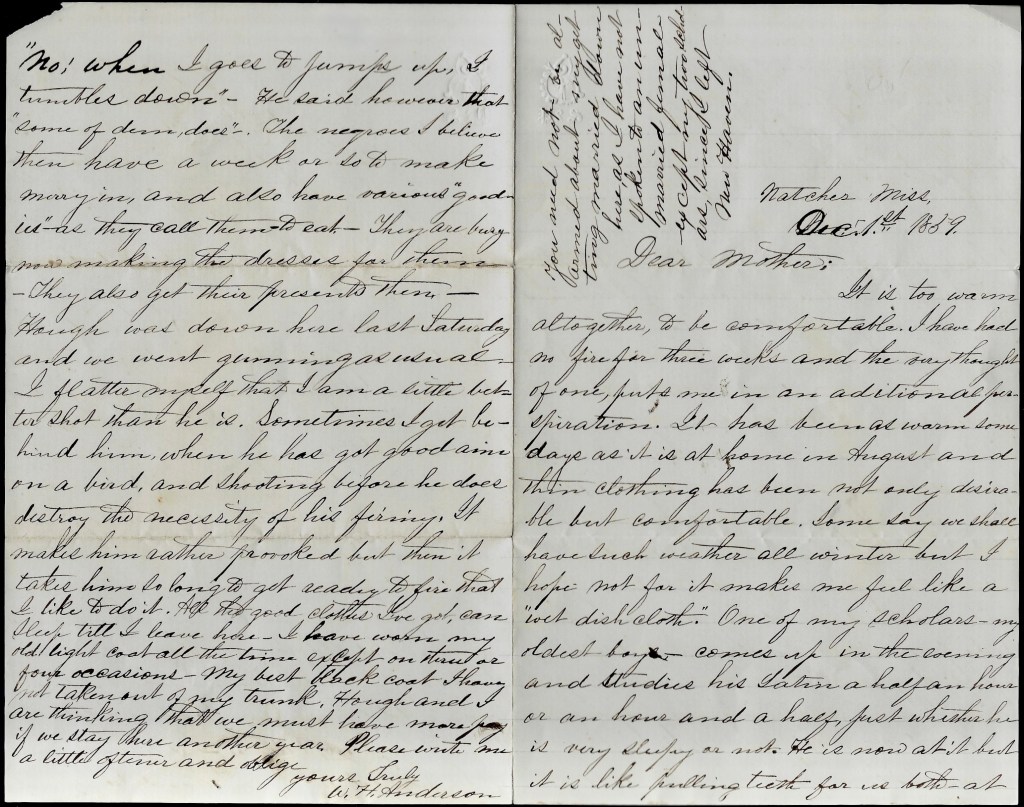
The following letter was written by William Henry Anderson (1836-1902), the son of Francis D. Anderson (1807-1866) and Jane Davidson (1808-1880) of Londonderry, New Hampshire. William attended primary school in Londonderry, before studying at the Pembroke Academy (Pembroke, New Hampshire, 1852-1853), Phillips Academy (Andover, Massachusetts, 1853), and Kimball Union Academy (Meriden, New Hampshire, 1854-1855). He considered attendance at Dartmouth, favoring instead Yale College, which he entered in 1855. An 1857 disciplinary action notwithstanding, Anderson graduated in the spring of 1859. [See: The Demise of the Crocodile Club: A Town/Gown Tragedy at Yale]
After graduating from Yale College at New Haven, Connecticut, William accepted a job as a private tutor on the Sligo Plantation near Natchez, Mississippi, teaching students from Sligo as well as the nearby Retirement Plantation from 1859 to 1860. Prior to the Civil War, it was a widespread practice for a wealthy southern planter, or planters banding together, to hire a college graduate from the North to teach the white children on the plantation. Public schools were virtually non-existent in the South. By the late 1850s planters monitored the schooling closely to make certain that tutors from the North did not attempt to introduce ideas about racial equality into the heads of their children.
During his time in Mississippi, William wrote numerous letters home to his parents and to his future wife Mary A. Hine. He arrived at Bennett’s Retirement Plantation in early September 1859, and shortly thereafter settled in at David P. Williams’ Sligo Plantation. In his letters from Natchez archived at the University of Michigan, William described his relative isolation, loneliness, teaching and wages, corporal punishment, thoughts on slavery and the enslaved men and women on the plantation, games he played with his scholars, travel between the Sligo and Retirement plantations, and leisure activities such as hunting and horseback riding. In late December 1859, he provided a lengthy description of a (largely) steamboat trip to New Orleans with his students for Christmas.
Anderson noted that no poor white people lived between Sligo and Natchez; he was uncomfortable with the aristocratic lifestyle of white people living in the south, and expressed this view on multiple occasions in his correspondence (see especially September 30, 1859). Although his father appears on list of members of the American Anti-Slavery Society, William H. Anderson did not write with disgust at slavery, but rather used racist epithets, accepted the “servants” who assisted him in various ways, and wrote unmoved about abuse doled out to children (see especially June 9, 1860). In one instance, he wrote about enslaved women who gathered near to the house in the evenings before supper to sing and dance (October 25, 1859). One of the highly detailed letters in the collection is William H. Anderson’s description of the use of the cotton gin on the Sligo Plantation, which includes remarks on its history, its functioning, the various jobs performed by enslaved laborers, and the rooms in which the jobs took place. He included calls made by enslaved workers between floors of the “gin house” and the roles of elderly men and women in the grueling labor (October 1859). In 1860, Anderson planned to take a summer break in Tennessee and then teach another year, but on the death of his oldest scholar Susie (14 years old) by diphtheria, Williams decided against having a school the next year (July 4, 1860).
Transcription
Natchez, Mississippi December 1st 1859
Dear Mother,
It is too warm altogether to be comfortable. I have had no fire for three weeks and the very thought of one puts me in an additional perspiration. It has been as warm some days as it is at home in August and thin clothing has been not only desirable but comfortable. Some say we shall have such weather all winter but I hope not for it makes me feel like a “wet dish cloth.”
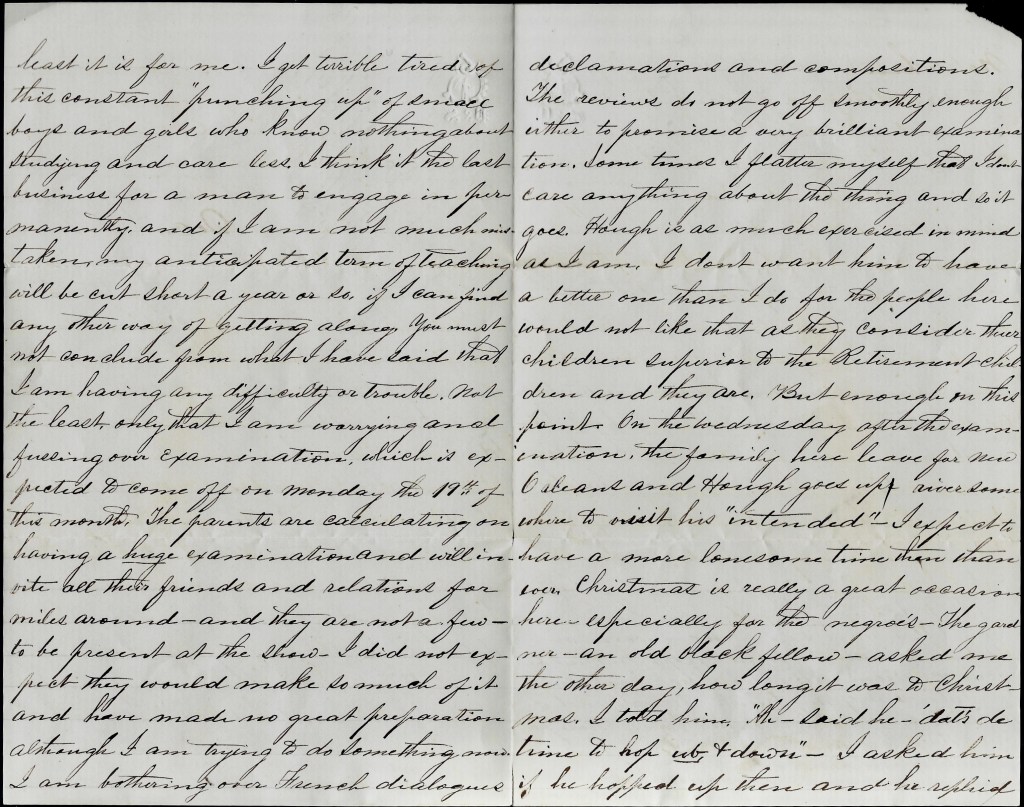
One of my scholars—my oldest boy—comes up in the evening and studies his Latin a half an hour or an hour and a half just whether he is very sleepy or not. He is now at it but it is like pulling teeth for us both—at least it is for me. I get terrible tired of this constant “punching up” of small boys and girls who know nothing about studying and care less. I think it is the last business for a man to engage in permanently and if I am not much mistaken, my anticipated term of teaching will be cut short a year or so, if I can find any other way of getting along.
You must not conclude from what I have said that I am having any difficulty or trouble. Not the least. Only that I am worrying and fussing over examination, which is expected to come off on Monday the 19th of this month. The parents are calculating on having a huge examination and will invite all their friends and relations for miles around—and they are not a few—to be present at the show. I did not expect they would make so much of it and have made no great preparation although I am trying to so something now. I am bothering over French dialogues, declamations, and compositions. The reviews do not go off smoothly enough either to promise a very brilliant examination.
Sometimes I flatter myself that I don’t care anything about the thing and so it goes. [Joel Jackson] Hough is as much exercised in mind as I am. I don’t want him to have a better one than I do for the people here would not like that as they consider their children superior to the Retirement children and they are. But enough on this point.
On the Wednesday after the examination, the family here leave for New Orleans and Hough goes up river somewhere to visit his “intended.” I expect to have a more lonesome time then than ever.
Christmas is really a great occasion here—especially for the negroes. The gardener—an old black fellow—asked me the other day how long it was to Christmas. I told him. “Ah,” said he, “dat’s de time to hop ub & down.” I asked him if he hopped up then and he replied, “No! when I goes to jumps up, I tumbles down.” He said, however, that “some of dem does.”
The negroes, I believe, then have a week or so to make merry in, and also have various “goodies” (as they call them) to eat. They are busy making the dresses for them. They also get their presents then.
Hough was down here last Saturday and we went gunning as usual. I flatter myself that I am a little better shot than he is. Sometimes I get behind him when he has got good aim on a bird, and shooting before he does, destroy the necessity of is firing. It makes him rather provoked but then it takes him so long to get ready to fire that I like to do it. All the good clothes I’ve got can keep till I leave here. I have worn my old light coat all the time except on three or four occasions. My best black coat I have not taken out of my trunk. Hough and I are thinking that we must have more pay if we stay here another year. Please write a little oftener and oblige.
Yours truly, — W. H. Anderson
You need not be alarmed about my getting married down here as I have not spoke to an unmarried female except my two scholars since I left New Haven.
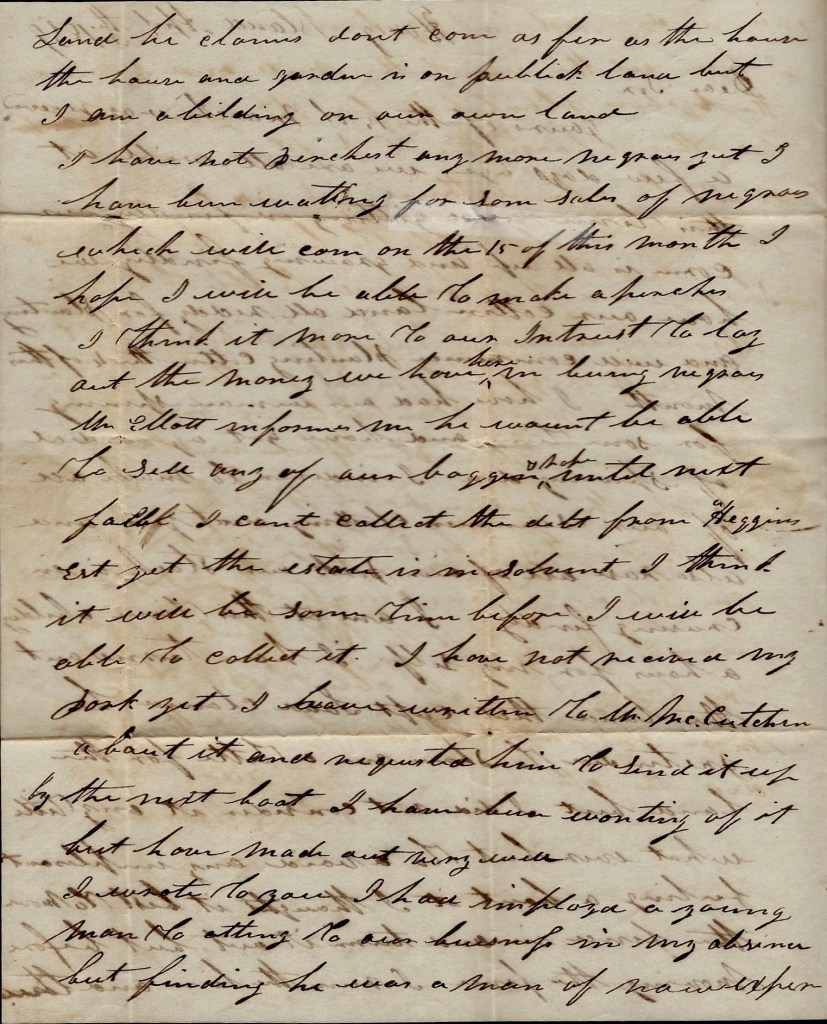
The following letter was written by 33 year-old Elisha Bell (1806-Aft1860), a native of Mississippi, who appears to have been the overseer of a Mississippi sugar cane plantation at Honey Island on the Yazoo River some 75 miles northeast of Vicksburg. Elisha was the son of John Purver Bell, Jr. (1761-1824) and Elizabeth Hunter (1775-1828) of Wilkinson county, Mississippi. By 1850, Elisha had his own plantation in Tchula, Holmes county, Mississippi, and owned as many as 47 slaves. By 1860, his slave count had dropped to 27.
Elisha addressed the letter to Dr. Lloyd Warfield (1799-1872) who was either his employer or his partner in the Honey Island plantation. Lloyd was the son of Elisha Warfield (1744-1818) and Ruth Burgess (1763-1835). Lloyd was a physician in Lexington, Kentucky. By 1850, his estate in Fayette county, was valued at $23,500 which included as many as 10 slaves. By 1860, it was valued at $60,000 (over $2 million dollars today). Dr. Warfield was married to Mary Barr and they had several children. Three of their sons served in the Confederate army. Lloyd and Edward ride with General Forrest, and Henry with General John H. Morgan.
Elisha’s letter speaks of the hard times in Mississippi in 1839, as it was across the whole of the United States following the Panic of 1837. He discusses the need to purchase more slaves for the work on the plantation that appears to have been the raising and milling of sugar cane, along with the auxiliary business of making rope from the baggasse. Elisha’s spelling is typical of a limited opportunity education.
Transcription
Stampless cover addressed to Dr. Lloyd Warfield, Lexington, Kentucky Postmarked Tchula, Mississippi
Honey Island April 2nd, 1839
Dear Sir,
Yours of the 15th of March was received a few days ago. We are all well at this time and getting on finely. Our corn is all up and growing finely. We have our cotton land all ready for planting and will commence planting cotton the 4th of this month. I have had our woman spinning for some time and have got a good deal of spinning done. I endeavor to make all of our summer clothing next year and also raise all of our pork. Our stock is in [ ] finally.
I am at this time a building a house for myself. I have turned out the land that Capt. Lord claimed. He pretended to shave me a little for the land but I did not consider it any little whatever but to avoid any unpleasant feeling about it, I thought it best to move the fence in and turn it out but before moving the fence, I run the line and their land, he claims, don’t come as far as the house. The house and garden is on public land but I am a building on our own land.
I have not purchased any more negroes but I have been waiting for sales of negroes which will come on the 15th of this month. I hope I will be able to make a purchase. I think it more to your interest to lay out the money we have here in buying negroes. Mr. Elliott informs me he won’t be able to sell any of our baggasse & rope until next fall. I can’t collect the debt from Heggins jest yet—the estate is insolvent. I think it will be some time before I will be able to collect it. I have not received my pork yet. I have written to Mr. McCutchen about it and requested him to send it up by the next boat. I have been wanting of it but have made out very well.
I wrote to you I had employed a young man to attend to our business in my absence by finding he was a man of no experience, I did not employ him.
I have got the use of the mill and gin on the Archer’s Plantation for this year. No other charge than to keep it in order. It will be a fine thing for us this year as we would not be able to build before next spring and then we will be able to build.
It is very distressing times in Mississippi at this time with regard to money matters. I heard of a great many planters being broke up after having their plantations in order for a crop. The negroes drove off by the sheriff and sold. They was some very cheap sales on yesterday in our county but I did not hear of them until too late. But I am in hopes I will be able to purchase two or three more on much better terms than we did the others.
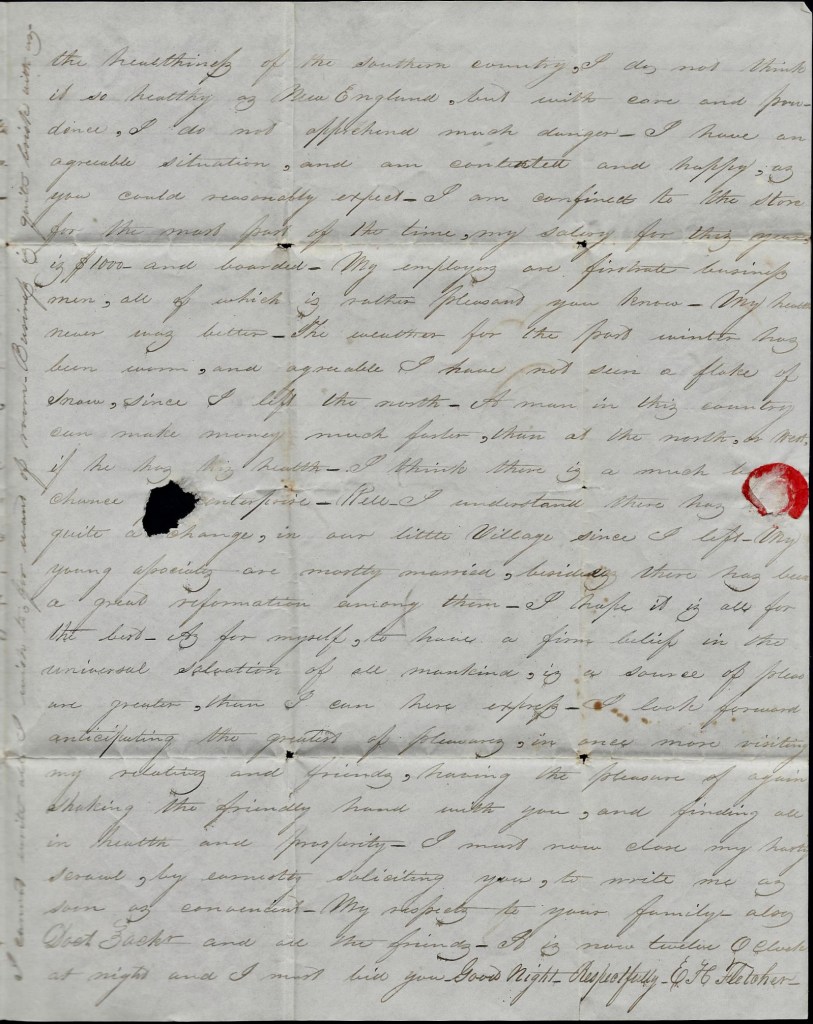
The early date of this letter makes it more difficult to confirm the identity of its author but my hunch is that E. H. Fletcher was the son of Col. Robert Fletcher (1786-1865) and Nancy Sprague (1788-1853) of Kennebec county, Maine. He seems to have been a young man, probably in his early 20s, looking for “facilities for making money” in the grip of the Financial Panic of 1837.
Fletcher wrote the letter to his friend, Dr. Jonah Spaulding (1778-1870) of Somerset county, Maine.
What’s most interesting about the letter are not only the author’s direct observations of the Mississippi river valley but his discovery that the Mississippi cotton plantation slaves were “kindly treated” and apparently were “happier and much better off than the poor people at the North.”
Transcription
Addressed to Jonah Spaulding, Esqr., Bingham, Maine
Natchez, Mississippi March 16, 1838
Worthy Friend,
In looking over my journal, I find I have not written a word to you since I left home. I now hasten to accomplish the delightful task, but not without experiencing the sharpest pangs of ingratitude for neglecting it so long. I hope you will condescend to excuse me this time, and I will be more punctual in future.
After leaving the beautiful valley of the Kennebec and turning my back upon all that was near and dear to me, I was resolved to see the far famed western country—also the southern, before I returned. I was anxious to see with my own eyes what I had heard so much about. I therefore bent my course towards Illinois by the way of New York, thence up the Hudson river, and so on across Lake Erie, and Michigan to Chicago. After staying a few days in Chicago, I traveled in various directions about the country, making all the enquiries of a greenhorn from Yankee Town, and getting what information I could in relation to business, lands, and healthiness of the country. I was very much pleased with all, and the facilities for making money I consider to be far superior to those of Maine, and I was surprised to see with how much less labor it requires to cultivate the soil there than in Maine. I can assure you, it gladdens the heart of a New Englander who has there emigrated for the purpose of bettering his fortune and being sure when he sows and plants of harvesting something.
They are deprived of many comforts, tis true, such as schools, good roads, but they are every day improving. What can a young man do in Maine without a capital, I ask? And I will answer—nothing. Then let him emigrate like his forefathers to a country where he can.
After spending a few weeks very agreeably traveling about the country, I left Chicago, traveled by stage to Peoria on the Illinois river, there took a steamboat for St. Louis where I safely arrived, and spent one week cruising in that vicinity, then took passage for no particular place down the Mississippi River. I arrived safely at Natchez, and like the location of the town, and having an agreeable situation offered me in a store, I accepted and here I still remain.
Natchez is a small city—population about 6,000. Is situated on the eastern bank of the river, 300 feet above the level of the river and 300 miles above New Orleans. It is surrounded by large cotton plantations which extend throughout the state. Country level and I need not say the soil is fertile. Here is a chance for our good Abolitionists at the North to look into the condition of the slaves. They are generally kindly treated and I candidly believe they are happier and much better off than the poor people at the North. As for the society, it is not so good as it might be. It is composed of all classes of people from every part of the world. Young men who come here are too apt to get into the general train of dissipation though I hope your friend is an exception to that general routine.
As to the healthiness of the southern country, I do not think it so healthy as New England but with care and prudence, I do not apprehend much danger.
I have an agreeable situation and am contented and happy as you could reasonably expect. I am confined to the store for the most part of the time. My salary for this year is $1,000 and boarded. My employers are first rate business men, all of which is rather pleasant you know. My health never was better. The weather for the past winter has been warm and agreeable. I have not seen a flake of snow since I left the North.
A man in this country can make money much faster than at the North, or West, if he has his health. I think there is a much better chance for enterprise.
Well, I understand there has been quite a change in our little village since I left. My young associates are mostly married. Besides, there has been a great reformation among them. I hope it is all for the best. As for myself to have a firm belief in the universal salvation of all mankind is a source of pleasure greater than I can here express. I look forward anticipating the greatest of pleasures in once more visiting my relations and friends, having the pleasure of again shaking the friendly hand with you, and finding all in health and prosperity. I must now close my hasty scrawl by earnestly soliciting you to write me as soon as convenient. My respects to your family. Also Doct. Zackr and all the friends. It is now 12 o’clock at night and I must bid you good night.
Respectfully, — E. H. Fletcher
I cannot write all I wish to for want of room. Business is quite brisk with us. I hope you enjoy a good sleigh ride occasionally. I think I would, give me a chance. The genuine depression in the money market is still continuing but must be easier soon.
The following letter was written by 39 year-old Rebecca Ann (Gustine) Minor (1813-1887), the daughter of James Parker Gustine (1781-1818) and Mary Ann Duncan (1790-1863). Rebecca was born in Carlisle, Pennsylvania, but raised in Philadelphia. She married in 1829 Capt. William John Minor (1808-1869) and lived most of the time in Natchez at the family residence they called Concord.
Minor owned three sugar cane plantations: the 1,900-acre Waterloo Plantation in Ascension Parish, Louisiana, as well as the 6,000-acre Southdown Plantation and the 1,400-acre Hollywood Plantation in Terrebonne Parish, Louisiana. However, as an absentee plantation owner, he did not live on those plantations. He hired overseers to make sure the slaves were working on the land. He corresponded via mail with his overseers regularly, sending them precise instructions while living in Natchez himself. Moreover, his sons lived on the plantations part of the time. From 1855 to 1861, his son Stephen lived on the Waterloo Plantation until he joined the Confederate States Army; in 1862, his other son Henry took over.Another son, William, lived at the Southdown Plantation and also managed the Hollywood Plantation.
He served as the second President of the Agricultural Bank in Natchez, Mississippi. He was well connected among the planter elite, and visited planters Duncan F. Kenner (1813–1887) and Henry Doyal as well as the McCollums, the Cages, and the Gibsons. He read De Bow’s Review and kept a diary. Politically, he was a supporter of the Whig Party. He was in favor of tariffs on sugar, which meant more profit for domestic sugar producers like himself.
During the Civil War of 1861–1865, he supported the Union and opposed secession, as he believed that would be bad for the sugar industry. However, he was arrested by Union forces with his son Henry in Houma in 1862; they were released a week later in New Orleans. Meanwhile, Unionists stole sugar and molasses from his Hollywood and Southdown plantations, under the false pretext that it had been deserted, even though overseers and servants were there. Minor was on friendly terms with Union Generals Benjamin Butler (1818-1893) and Lorenzo Thomas (1804-1875), whose forces protected Concord (his Adams County, Mississippi, plantation) on September 29, 1863, and on March 10, 1864. Both during and after the war, Minor asked for reparations for the financial losses he had endured due to the theft of commodities by Unionist forces, to no avail. By 1863, he had realized his slaves had become unwilling to work; they also killed hogs and sheep.
Because of General Order No. 12 imposed by Union General Nathaniel P. Banks, he was forced to pay them wages. Slaves, who had gotten used to working “under the threat of punishment,” were not motivated by their salaries; as a result, Minor tried to reduce their wages if they failed to work. By 1865, Minor paid one third of the crop profit at the Waterloo Plantation to his slaves. He signed a work contract with his slaves at the Southdown and Hollywood plantations whereby they agreed to work ten hours every day except for Sundays and received specific hourly wages as a result. Moreover, Minor agreed to clothe, feed and house them all. Minor was a supporter of Abraham Lincoln, whom he called “the most conservative & ablest man in the Washington Government.” He deplored his assassination, as he believed Lincoln would have been fair to Southern agriculturalists. [Wikipedia]
Transcription
Cherry Grove [Plantation] 1 July 13th, 1852
My Dear Son,
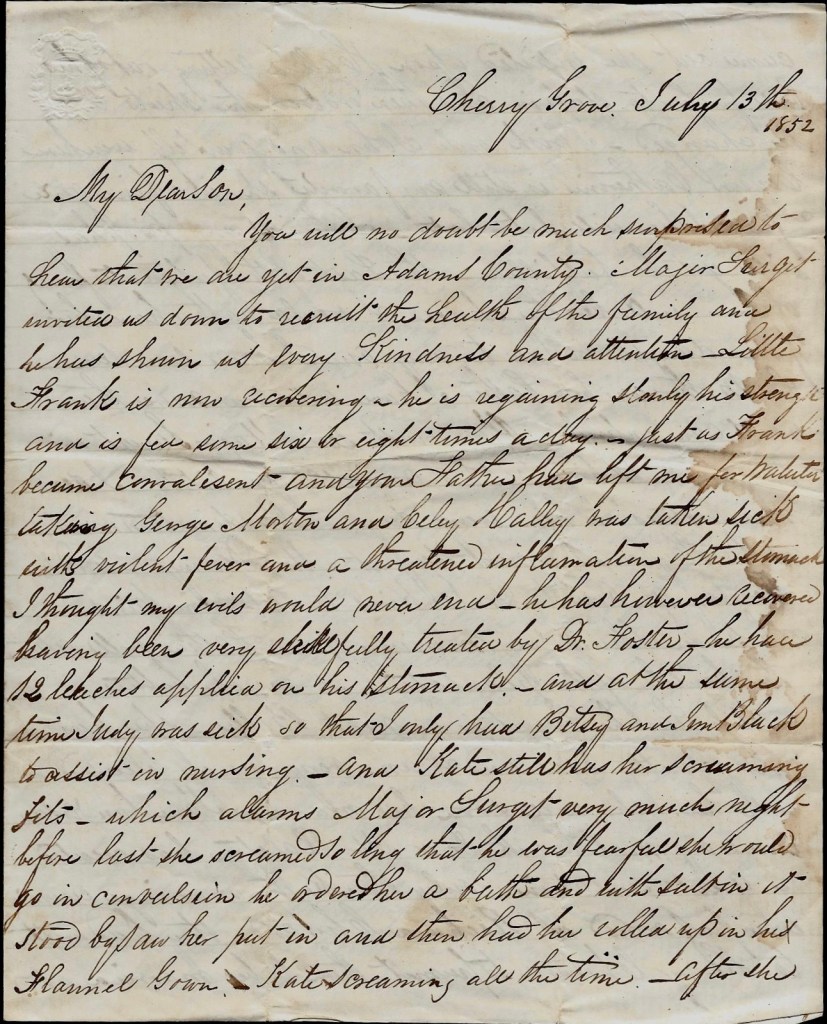
You will no doubt be much surprised to hear that we are yet in Adams county. Major [James Pierre] Surget invited us down to recruit the health of the family and he has shown us every kindness and attention. Little Frank is now recovering. He is gaining slowly his strength and is fed some six or eight times a day. Just as Frank 2 became convalescent and your Father had left me for Waluter [?] taking George Morton, and Celey Halley was taken sick with violent fever and a threatened inflammation of the stomach. I thought my evils would never end. He has however recovered having been skillfully treated by Dr. Foster. He had 12 leaches applied on his stomach and at the same time Indy was sick so that I only had Betsy and Jim Black to assist in nursing. And Kate 3 still has her screaming fits—which alarms Major Surget very much. Night before last she screamed so long that he was fearful she would go in convulsion. He ordered her a bath and with salt in it stood by, saw her put in, and then had her rolled up in his flannel gown—Kate screaming all the time. After she came out, she insisted upon Hally’s getting out of his bed for her to sleep in and then ordered the sheets to be changed. I wish only John and yourself were here.
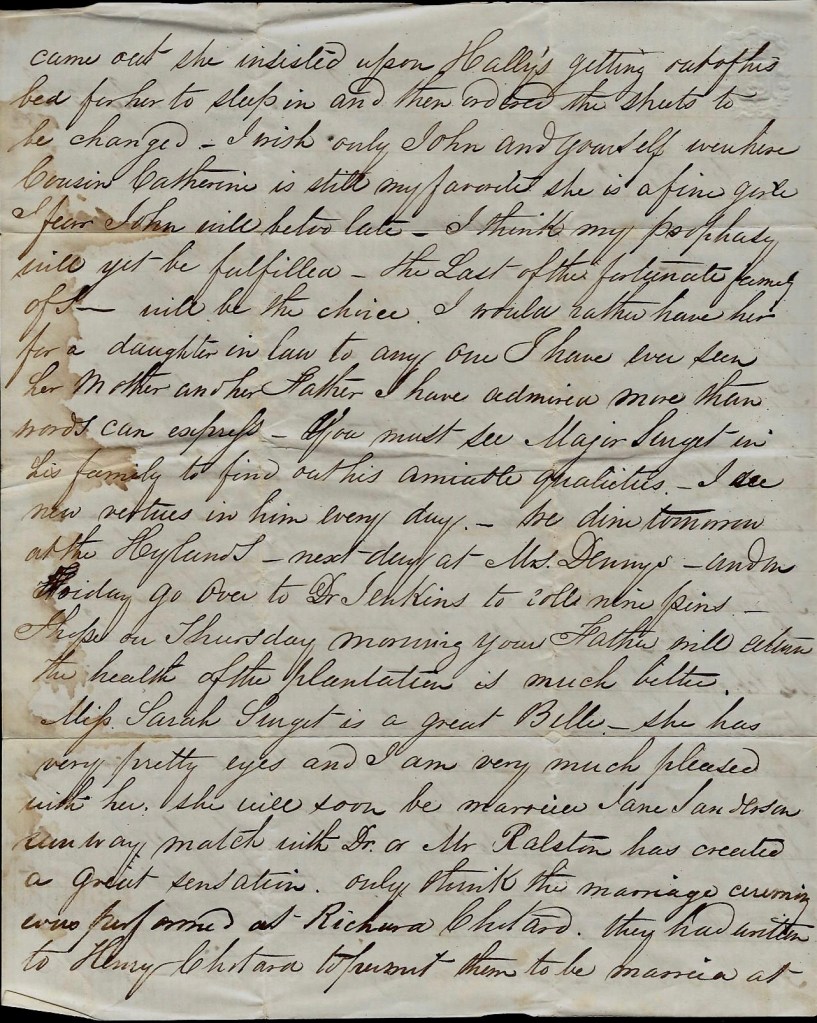
Cousin Catherine 4 is still my favorite. She is a fine girl. I fear John will be too late. I think my prophesy will yet be fulfilled. The last of the fortunate family of S[urgets]—-will be the choice. I would rather have her for a daughter-in-law to any one I have ever seen. Her Mother and her Father I have admired more than words can express. You must see Major Surget in his family to find out his amiable qualities. I see new virtues in him every day.
We dine tomorrow at the Hylands, next day at Mrs. Denny’s, and this Friday go over to Dr. Jenkins to roll nine pins. I hope on Thursday morning your Father will return. The health of the plantation is much better. Miss Sarah Surget is a great belle. She has very pretty eyes and I am very much pleased with her. She will soon be married. Jane J. Anderson [ ] match with Dr. or Mr. Ralston has created a great sensation. Only think the marriage ceremony was performed at Richard Chitard. They had written to Henry Chitard to present them to be married at Minorca. Henry refused. I regret Richard had not sent them off. I could fill your sheets with much news but I have not the time as I must write to Aunt Sarah.
Tell John I saw Miss Dunbar this morning. Also Dr. Jenkins who gave me the news of him. I hear of his presenting bouquets to Ladies and that he is a favorite among the fair sex. I will write to him very soon. Only imagine me moving about when the thermometer is at 96 on the galley. I am more than ever anxious to return to Natchez and should not regret (excepting parting with Mr. and Mrs. Kenner) that I never return to Waterloo.
My dear son, I must scold you. you ought never to write anything that is vulgar. Now I think Mrs. Woodman’s message was decidedly so. I am sorry to find you paid this disagreeable and foolish woman any attention, and I fear she has paid court to you and flattered you. Madam Montgomery is not a Lady. She received too marked attention from gentlemen. I wish you to improve in your style of writing. Take pains with the penmanship and the style must be pure to please me. Recollect I am not able to give you a copy—but you have education. Take every advantage.
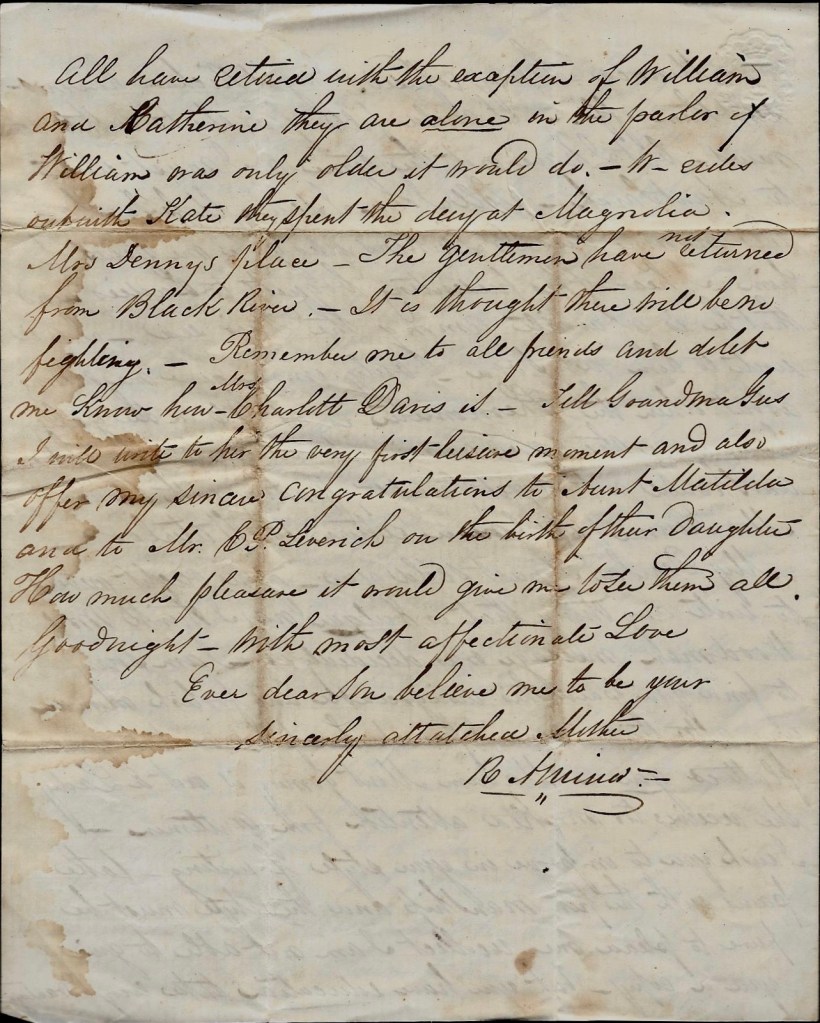
All have retired with the exception of William and Catherine. They are alone in the parlor. If William was only older, it would do. William rides out with Kate. They spent the day at Magnolia—Mrs. Denny’s place. The gentlemen have not returned from Black River. It is thought there will be no fighting.
Remember me to all friends and do let me know how Mrs. Charlotte Davis is. Tell Grandma Gus I will write to her the very first leisure moment and also offer my sincere congratulations to Aunt Matilda and to Mr. C[harles] P. Leverich on the birth of their daughter. How much pleasure it would give me to see them all. Goodnight. With most affectionate love, ever dear son [and] believe me to be your sincerely attached Mother, — R. A. Minor
1 Cherry Grove Plantation is located five miles from Natchez in Adams county on Second Creek. The mansion was built by Pierre Surget (1731-1796), a French planter, in 1788, over 2,500 acres of an English land grant, granted to him by the Spanish government. As such, it is one of the earliest private residences in Natchez. After his death, his widow Catharine (Hubbard) Surget expanded the grounds of the property. By 1850, the house belonged to their son James Pierre Surget (1785-1855), with sixteen house servants in residence. Cherry Grove has been in the continuous ownership of the same family since 1788 and has remained always a working plantation. It remains in the family of Surget descendants. Cherry Grove Plantation is today one of the best preserved and most complete plantation complexes in the Natchez area. The original plantation residence constructed by Pierre Surget and his wife Catharine burned in the mid-nineteenth century, and the present picturesque and architecturally significant residence was constructed about 1865 by Pierre Surget’s grandson James Surget, Jr. The form of the house, which consists of a residence constructed upon a fully raised basement with a central five-bay block and flanking single-bay wings, has the regionally early single-pile plan with rear “cabinet” rooms enclosing each end of a rear gallery recessed under the rear slope of the roof. Likewise, the facade of the central block features a gallery that is recessed under the front slope of the roof. These features suggest the possibility that the present house may have taken its basic form from the earlier house which burned. The original flanking wings with octagonal bays and gable-end balconies represent the concession of the builder to the popular taste of the 1860s. The collection of plantation outbuildings is exceptional and includes an unusual tenpin frame alley building with attached late-nineteenth century gymnasium, smoke house, detached kitchen building, corn crib, stables, privy, sheep stalls, and barns. Hand-hewn cypress troughs for feeding and watering the stock are rare plantation survivals, and the plantation cemetery containing the graves of Pierre and Catharine Surget and their descendants is located within sight of the main dwelling house. The plantation gains added significance from its long history of family ownership. Pierre Surget, originally a seaman by trade, was the patriarch of the Surget family in Natchez, a family that formed one of the largest planting dynasties in the entire South. Pierre’s son Frank was described by one contemporary historian as the most extensive landholder and successful planter in Mississippi.
2 Francis (“Frank”) Octave Minor was born in 1847.
3 Katherine (“Kate”) Lintot Minor was born in 1849.
4 Catherine Surget (1834-1926) was married first to James Gustine Minor (1839-1860) in 1853. She married second John Duncan Minor (1831-1869) in 1855.Catherine’s collection of letters are housed at the University of Michigan.













 Spared & Shared 23