This letter was written by Francis (“Frank”) Henry Whittier (1831-1867) of Cambridgeport, Middlesex county, Massachusetts. He was the son of Amos Henry Whittier (1805-1891) and Hannah Chamberlain Davis (1807-1867). Frank was married in 1853 to Adaline T. Loring (1837-1915) in May 1853 when Adaline was not yet 16. Their first child was born 6 months later; two more over the next three years. It was early December 1861 when Frank enlisted and was commissioned a 2nd Lieutenant of Co. G, 30th Massachusetts infantry. In mid-February 1862 he was promoted to 1st Lieutenant and later to Captain. By war’s end he had risen to Colonel of the regiment.
The 30th Regt. Mass. Vol. Inf. was raised by Gen. Butler in the fall of 1861 and the early part of the winter following. It was originally known as the Eastern Bay State Regiment. It was organized at Camp Chase, Lowell, and its members were mustered in on various dates from Sept. 15 to the close of the year. A controversy having arisen between Governor Andrew and Gen. Butler over the latter’s authority to raise troops in Massachusetts, the regiment left the State Jany. 13, 1862, under command of Acting Lieut. Col. French. Remaining at Fort Monroe until Feb. 2, on the 12th it reached Ship Island in the Gulf of Mexico, where Gen. Butler was assembling his forces to operate against New Orleans. Nathan A. M. Dudley was commissioned colonel, Feb. 8, and most of the other field and staff and line officers were commissioned Feb. 20. It was now officially the 30th Regiment.
After the Mississippi was opened by Farragut’s fleet in the latter part of April, 1862, the 30th was sent to New Orleans and thence to Baton Rouge, arriving June 2. It made several expeditions into the country in pursuit of guerrillas, then was sent to the front of Vicksburg but returned to Baton Rouge, July 26. It was just after the regiment returned to Baton Rouge that Francis wrote this letter.
T R A N S C R I P T I O N
Baton Rouge [Louisiana] July 28, 1862
Dear Wife,
It is a long time since I have written a letter. I think about three weeks but it is a much longer time since I have received one from you. I received six letters and a lot of papers on the 5th of July from friend Davis, Gibbs, Stevens and Amanda. I received one from Webster of the date June 17th while the most of my men received them as late date as July 8th. I received a letter from Perkins in regard to the house rent. Please tell him the first rebel I capture with a 20 [dollar] gold piece in his possession, I will send him the money and the rebel too for it would be a curiosity worth seeing.
I have just arrived back from Vicksburg and if it was not just as it is, I should be at home before this letter. We were bivouacked in a swamp without any tents for four weeks and our men was taken sick with fever and ague and the remittent fever. I lost 4 men, two in one day. Both of my officers were sick and I have had as many as 60 men sick and under the doct[or’s care] at once. The regiment could not turn out over 200 men for duty and if we had stopped there a week longer, it would have killed every man we had. I don’t know what we shall do now. The men never can get their health in this climate. I have about 30 men in the hospital and as many more in quarters that cannot do duty. Yesterday at dress parade I could not march but 8 men on to line out of 98. I have to work hard all the time and can’t find time to write often now. I shall take all my time to look after my sick. My 1st Lieutenant is very sick and I don’t think he will ever do anymore duty. There is a lot of the officers sick and that makes the duties come hard on the well ones. I have lost 30 pounds of flesh and have just got in fighting trim. I never was better in my life but things happen in the regiment every day that I don’t like which I shall not write about now.
Col. Jonas H. French
I intended to get my discharge when I came back but I cannot leave my poor sick comrades. But as soon as I can see them well or sent North, I shall get my discharge unless things change. But I think I shall go down to New Orleans in the course of the week and see how things are there. I think I can get a good position there under Col. [Jonas H.] French that will pay me more than the present one and get just as much honor for I don’t think now that our regiment will ever see a fight. I have had the only company under fire from the regiment and I don’t think there will be another chance for a longer time. 250 men could wipe our regiment out now. One month ago, 1200 could not do it. If you could be here and so with me when I visit my sick, it would make your heart ache. God pity a private soldier in the army for if he don’t have good officers, he is in a bad place. There is nobody here to look after him but his officer. We never have seen a cent worth of any kind of things from our State or any other place and any things our sick get, must be got by the officers and there has been times that we have had men die for want of medicine to give them. There has never been a bright day for our regiment since we left home.
Capt. Nims’ Battery [of] 150 men were up river with us, all well when we started. The day before we started back, he had 130 in the sick list. He lost one man—the first since leaving Boston—and the most of these men can never get well here. The Vermont Regiment lost 40 men and did not have a man fit for duty.
The day we started to come away, all the rest of the regiments were the same. Our regiment stood it the best and longest. The trip did not amount to anything. We saw the bombardment and the fleet go up by the forts and come back. It will take a large force to take the place. The rebels are 75,000 strong while the force we had to take the place was only about 4,000. I saw the Ram come down the river. I should like to give you an account of it if I had time. The same got our fleet with their [Brentches?] down [ ] under the guns of Vicksburg when we left.
The men from Charlestown are all very well. I thought by the letter I received from friend Stevens you had sent me a box but it has not reached me yet. It may be at New Orleans but there is a mail comes from home every week and I think your time must be very much taken up if you can’t let me hear from home once in sixty days. Everyone in the [regiment] gets their letters regular and I get my letters regular from Jo Davis. I received two the other day from him. If you knew how much good a letter from home does some time, I don’t think the time would be so long between them. Spend half the time you have spent trying to get a gig in writing and save the money for you may need it for something of more consequence. But if you don’t find time to write much, I should like very much to hear from the little ones. I want to see them and know how they get along as often as possible.
I see by a paper I received from friend Davis that the box that had the flag in had got home. I should like to know if the other one has got there. I sent it 10 weeks ago. I have written to you every week and some of the time twice a week until I left here for Vicksburg and I have not had a chance to write you but am until now. Please give my respects to all the folks. Let me know about the recruiting papers before it is too late to get anything on them. Give my respects to friend Greer. I shall write to Webster and the rest of my friends next mail. It is time for the mail to close so I can’t write any more this time. I have a few more trophies to send home when I find the last got there safe.
I was in hopes to send some money but our regiment has not been paid up. Every other regiment have been paid but that is the usual luck of this one to be behind. The Government owes us for 5 months hard labor and some families must be suffering for the money. But it don’t make any [ ]. They won’t pay until the spirit moves. I have had no money for the last three months and it cost me 3 dollars a week to feed myself and servants. No more at present. Yours, &c. — F. H. Whittier
I could not find an image of George but here is one of James E. Trask of Co. A, 50th Massachusetts. James was one of the lucky ones who made it back home from Louisiana. (Ancestry.com)
The following letters were written by George Newell Boynton (1846-1863), the son of George Washington Boynton (1820-1877) and Abby N. Stocker (1819-1898) of Georgetown, Essex county, Massachusetts. George was only 16 years old when he enlisted on 16 August 1862 as a private in Co. K, 50th Massachusetts Infantry. He died of disease at Baton Rouge on 3 July 1863. Burial records of the Harmony Cemetery in his hometown inform us that George’s body was exhumed in Louisiana by his father and returned to Georgetown along with those of Richmond D. Merrill (died 28 June 1863) and Amos Spofford (died 4 June 1863), all three in Co. K, 50th Massachusetts.
Despite the high mortality rate, I have transcribed a considerable number of letters by members of the 50th Massachusetts Infantry to date. They include:
I arrived here yesterday morning at 9 o’clock after having a rough passage. I has rained ever since we left Camp Stanton and is raining now and the Boys are all scattered over the city and are now jumping out of the windows and every other place. We started from Boston about 3 o’clock, arrived in Worcester about 7 o’clock and stopped about a half an hour and then we started for Norwich, Ct., and arrived there about 12 o’clock at night. Then we took the boat and piled in four deep. Some were sound asleep, others dancing and raising a ruckus. After we had been on board about an hour, I went up on deck to report for guard duty and stopped up there all night and finally we came in sight of New York City and landed and came into line, marched up Broadway about a mile, and stopped at Park Barracks in front of City Hall until 4 o’clock. And next we marched into an old stone house now used as barracks. It is the place where Billy Wilson’s regiment stopped. The Orderly is round after the letters and I must draw mine to a close. I am well, fat & saucy. Give my respects to all the folks but [illegible]
P. S. Tell mother that her Chicken Pie went good.
Don’t write until you hear from me again for I can’t tell where to direct it.
Yours, — G. N. Boynton
Letter 2
New York [City] December 8 [1862]
Dear Father,
Having a few spare moments I thought I would write you a few lines to let you know that we are a going to embark today on the Propellor Jersey City for Fortress Monroe. I got that box that mother and Mrs. Pickett sent last Thursday. Tell Mrs. Pickett that Frank has lost his knapsack and all his clothes. I have got my vest and it fits me first rate and I am very much obliged to you for it.
By the way, I have enjoyed myself first rate. I have been to Barnum’s Museum and Niblo’s Garden 1 and heard Ed[win] Forrest play and it was splendid. Last Monday I went up to Central Park and was was magnificent.
I must dry up for the orders are to fall in and be ready in five minutes. Yours, — G. N. B.
P. S. This makes 4 letters that I have wrote and I haven’t received only two.
1 Niblo’s Garden was a theater on Broadway and Crosby Street. At the time, Edwin Forrest was performing in either Metamora or “The Broker of Bogota” depending on the evening George attended.
Letter 3
On board the Barque Guerrilla January 18 [1863]
Dear Father,
Having some spare time, I thought that I would write you a few lines to let you know that I am in good health and I hope that you are the same. We left Hilton Head January 1st and arrived at Ship Island on the 15th and stopped there three days and we are now on our way up the Mississippi to New Orleans. I have had a pretty good time since I left Camp Stanton and I have seen a good many sights. While we was at Hilton Head, I saw George Hunkins, Ed Hazen, and Dennis Adams [of 1st Massachusetts Cavalry]. George Hunkins is awful sick of the army, I tell you.
Since we left Hilton Head I have had nothing to eat but hard bread with maggots and salt horse and a quart of water. I tell you it makes me think of home—especially when we had to come down to the maggots and water, and not half enough of that. When we was at Port Royal, I saw the gunboat Planter that was surrendered by its pilot who was a Nigger by the name of Robert Smalls.
It is now raining in torrents and we are anchored off Quarantine of New Orleans in sight of the remains of the Rebel Ram Manassas which is opposite Fort Jackson. There is some of the most magnificent plantations on each side of the river and acres of orange trees in full bloom which are [ ] by their owners. And I tell you that the niggers live high and sleep in the garrets every now and then. I seen a great Black Nigger on the shore with a half barrel of sugar on his head. A Nigger is gentleman to a soldier out here for they get enough to. east and a soldier don’t.
We have been two months between New York and New Orleans and the rest of the regiment has not got here yet and where they be, we can’t find out. The account was that they left New York on the 12th on the steamer Niagara and put in to Philadelphia in distress. The oficers’ horses have been here 14 days and two of them died on the passage—the Adjutant’s and Lieutenant-Colonel’s.
Tell Kenny to be a good boy and mind his mother for if I had minded my mother, should not of been here. But never mind. It ain’t only nine months anyway and our time will be out by the time that we get with the rest of our regiment. The Boys are all well and in good spirits although we have been kicked round considerable and our Captain [John G. Barnes] don’t know his business no better than a pitch pine dog. He don’t seem to have any mind and can’t carry out what he undertakes. One day at Hilton Head when Capt. [George D.] Putnam [of Co. A] was sick, he thought that he would take us out on Battalion Drill and he could not form us in a hollow square and it tickled the Boys, I tell you, for he thinks he [is] capable of bring a Brig. General. We have got orders [to] leave here for Carrollton which is six miles above New Orleans.
They do their teaming here with four mules. The driver rides the right ordered mule and drives with one reign which is attached to nigh leader. 1
Some evil-minded whelp stole my writing base at Hilton Head and I borrowed this. I wrote one letter while I was at Hilton Head. I have just received a letter from you stating that [you] did not receive any word [from] me and that you sent me some money by Charles Tenney. The rest of the regiment has not arrived here yet. It is about dinner time and I guess that I will dry up now so goodbye. Yours, — George N. Boynton
1 Four-mule teams, driven by a rider on one of the mules, were common in the South, particularly for transporting supplies and equipment. Mules were preferred over horses due to their strength, stamina, and ability to navigate difficult terrain. The driver, known as a mule skinner, would ride the lead mule and guide the team using a single rein and voice commands.
Letter 4
Camp Parapet Carrollton, Louisiana January 23rd 1863
Dear Father,
I received a letter from mother this morning dated January 5th stating that she had not received any letter from me since I left Mew York and I did not know hardly what to make of it for I have wrote four letters since we left New York.
We are encamped 8 miles above New Orleans to a place by the name of Carrollton on the banks of the Mississippi River and I am enjoying myself first rate. I have been to work all day making a floor to our tent and it is as warm here as it is in Massachusetts in June. You spoke about giving my love to Mr. F in your letter. He has not got here yet nor he ain’t likely to get here for a month.
It is reported here that Vicksburg is taken by our forces. If it is true, we shall not see much fighting, I don’t believe. And it is also reported that Port Hudson is taken.
The 42nd Massachusetts is encamped about a galf a mile from us. A company of this regiment were captured by the Rebels at Galveston Texas. About all the regiments here are being paid off but I don’t think we shall get any money until we get with the rest of our regiment although we hsave been mustered for pay. For my part, I shoiuld like to get hold of some green backs as I am dead broke and when you send me the next letter, I want you to send me some money if you think it is safe to send it in a letter. Some of the Boys have had money sent them in letters and they have all got it.
“…Our company are a set of shirkers and skinners—officers and all from beginning to end.”
— George N. Boynton, Co. K, 50th Massachusetts Infantry
You spoke about them hens. Tell mother that I want to have her kept them to eat up the tomatoes and when I get home I will make a hen coop to shut them up. The climate here is awful unhealthy as it is hot days and cold nights and a good many of our Boys have got the dysentery by drinking a good deal of the river water and stuffing themselves with cakes and pies. You said in one of your letters that you sent me a trunk. I want to have you write me a list of what you. sent so if there is any trouble, I shall know what to fight for as our company are a set of shirkers and skinners—officers and all from beginning to end.
I should like to have you come out here and see the niggers. If you did, I don’t believe that you would be a very stiff Abolitionist. There is a nigger regiment here to work on the fortifications and it takes four white men to make one nigger work and they he the laziest set that I ever saw. 1
We have just heard from the rest of our regiment. They left Philadelphia on the 5th of January. I guess that I will dry up as it is about time for roll call. you must [excuse] this writing as it is the best that I can do, but I guess that you can pick it out. I am well and I have not been sick a day since I left Boxford. From your son, — George N. Boynton
P. S. Tell Jericho not to let Old Hutch lick him.
1 The Black regiment must have been members of the 1st Louisiana Native Guards.
Letter 5
Baton Rouge February 21st 1863
Dear Parents,
I received a letter from you this morning dated February 2nd and was glad. to hear from you. We are encamped in the City of Baton Rouge close to the Louisiana State Prison. We are in Gen. Dudley’s [3rd] Brigade [of the 1st Division] with the 30th Massachusetts, 174th and 61st New York and 2nd Louisiana. Daniel R. Kenny is a Captain [of Co. C] in the 2nd Louisiana. I suppose that you. know him. I believe that you took a watch from him two or three times for board bills. About all of the Boys have been sick with the dysentery and diarrhea but I have been well so far. Frank Pickett is sick and in the hospital, Three companies of our regiment arrived here last Saturday and all the officers except the Lieutenant-Colonel [John. W. Locke].
All I got out of that stuff that you sent was a pound of tobacco and a towel and one letter. But no money. We have been paid off and I sent $30 to you. by Adams Express. We have a pretty hard time here for our General is a Tiger. He gives us a Brigade Drill of four hours every afternoon and go on guard every other day. I have just got in from picket guard. It is fun, I tell you, but rather hard work—especially marching out and coming in. 1
When I was at Carrollton, I saw a lieutenant that was at Robert Boyes’ last summer from N. H. He is overseer on a sugar plantation.
I suppose that Father has as much as he can tend to this winter collecting taxes and sheriffing and is as cross sometimes as usual but if I was at home I should not mind it but I expect that when I get home it will become, “George, it is 9 o’clock, go to bed.” But I guess that I shall be glad to get into a good bed.
Capt. [John G.] Barnes is about played out with the dysentery and I should not winder if he had to come home on account of it. It is reported that our Brigade is a going to stay here in the city. The 40th and 49th Massachusetts came here about a week ago and I found a good many Boys that I am acquainted with. One of them is John Holley. He is a corporal in Co. D. He looks as rugged as a bear. Tell Kenny to be a good boy for brother George is a coming home next June.
When I was on picket about a week ago, I and a fellow in Co. I fired at a Rebel cavalryman but he was a little too smart for us. But finally [James M] Magee’s Cavalry captured him and I [had] the pleasure of seeing the gentleman that I fired at.
It is about time for roll call and I must bring my letter to a close and bid you goodbye. Yours truly, — George N. Boynton
P. S. When you write me a letter, write me a list of what you sent by Charles Tenney. Give my love to Esther and all the rest. Postage stamps are played out with us.
1 In the regimental history published in 1907, the author informs us that “A soldier’s life at Baton Rouge was no holiday. It was one continuous round from sunrise to sunset, with some hours interspersed for rest and recreation, and then occasionally with passes in our pockets, we were allowed to roam about the streets and down to the river, but taken all in all the most agreeable duty was that out the outer reserve or picket guard. The detail, made up about nine a.m. took with them one day’s rations and blankets, and marched out about two miles to relieve the guard of the day, remaining in turn 24 hours, each man being two hours on duty and four hours off…When the weather was pleasant, to go on picket duty seemed a good deal like going on a picnic, the noys frying their rations of pork and potatoes….and making coffee about an open fire, and the enjoyment was made a little keener by occasional glimpses of a rebel vidette making his appearance beyond the lines…”
Letter 6
Baton Rouge March 2nd 1863
Dear Mother,
I have received your letter dated February 12th and was glad to hear from you in which you spoke about my being partial in writing to Father so I thought that I would write to you and let you know that I am well and in good health—and to be in good health is the main thing here for about all the troops here have got the dysentery on account of the water and climate being bad. A feller has to look out for himself and what he eats and if he don’t look out for himself, they won’t anyone look out for him for if he gets the bloody dysentery on to him, he won’t be good for anything while he stops here.
You said that you sent a box to me and Frank Pickett. It has not got here yet. I expect it every day. I suppose that it is a nice one and I shall be glad enough to get it I guess for I have not seen any cooking like Marms since I left home and I hope that I shall get more of it than I did of that you sent me [by] Charles Tenney for all I got out of that stuff was one pound of tobacco, one letter, and a towel. No money or nothing else. We have been paid off and I sent $30 to you and I suppose that you have got it by this time.
We have had orders to pack our knapsacks and be ready at a minute’s warning to start on a march up to Port Hudson and I think that if we go up there we shall get a devil of a licking for they have got more troops than we have, I think.
I received a letter from Esther and was much pleased to hear from her and I shall write to her tomorrow. I wrote a letter to you and sent it on the 17th. There is not any news here special and it is getting about time for Dress Parade and I must draw my letter to a close and bid you goodbye. Yours truly, — George N. Boynton
Letter 7
Baton Rouge March 6th 1863
Dear Father,
I received the box that you and mother send me last night. The pies and cakes were all spoiled but the rest of the things were all. right. I tell you that we was much pleased when we got it and I am very much obliged to you. for it for a little of such things go good with army rations. It is raining quite hard today and we are laying in the tent eating up the apples and they taste first rate. I am well and enjoying myself first rate. Some of the Boys are awful home sick—especially Jim Colburn and Charley Dresser although they won’t admit it but I have not been troubled with that disease yet although I have seen some rough times and I shall be glad when our time is out.
Capt. Duncan’s company and companies B & D are down to [the] quarantine [station] and won’t be likely to get any further [up the Mississippi] for they have got the Small Pox and ship fever amongst them. Mrs. Pickett’s wonderful Mr. [Robert] Hassall [the Chaplain] has resigned and I am glad of it for he don’t amount to any more than a sitting hen. I saw Alfred Cheeny last night. He looks first rate.
I should like to have you send me some papers such as New York Ledger, New York Clipper, and True Flag and some daily papers.
We have to drill very hard now and it takes the Boys down. It is about all the time double quick and I have got so now that I can run like a horse. There is not any news here to write about. We expect to have to go up to Port Hudson every day and drive them out. We have orders to pack all indispensable articles in boxes and send them to the Quartermasters. And I think that we shall get licked if we pitch into them for every inch of ground that you get, you have to fight for it. And if your Uncle gets in the brush, they get cleaned out. It is getting near dinner time and I must dry up. Yours truly, — G. N. Boynton
P. S. Tell Lewis not to let Old Medford get the best of him.
Letter 8
Baton Rouge March 9, 1863
Dear Mother,
Having a few spare moments I thought that I would write you a few lines to let you know that I have received your letter dated the 17th and I was much pleased to hear from you in which you said that father was much better. I did not know that he had been sick at all.
We are under marching orders and the cooks have been to work all night cooking rations for us to carry and I expect that we shall be on the march for Port Hudson either today or tomorrow. The river is full of transports loaded with troops and Gen. Banks arrived here last night and Commodore Farragut’s mortar fleet is here and it looks [to] us that Port Hudson had got to come down before long.
I am hearty, tough, and rugged and ready for a fight if it does come and I expect it will. And as for my getting cut down, I never was born to manure southern land. Tell Kenny to take good care of the hens for brother Georgey is a coming home next June all right and well. As it’s about time for the mail to go, I must draw my letter to a close by bidding you all goodbye. From your son, — George N. Boynton
P. S. I have wrote to Eben and Esther.
The company that the Hawkes boys are in is down to Quarantine sick with the small pox and ship fever. I saw A. P. Cheney yesterday. He looked as rough as ever.
Letter 9
Baton Rouge March 13, 1863
Dear Parents,
Having a few spare moments I thought that I would write you a few lines to let you know that we have not gone yet although we are under marching orders and expect to go every day. The river is full of gunboats and mortar boats and today four regiments & three companies of cavalry and four batteries have gone by our camp en route for Port Hudson. The 48th Mass. left here last night at 2 o’clock, the 41st Mass. have been under fire three times. Lieut. Runlet and the Signal Corps have gone out today to reconnoiter. Charles W. Tenney is detailed on the Signal Corps as sharp shooter.
I am in good health and have been since I have been here and I hope that I shall have it while I stop here for it is an awful unhealthy place here. It’s cold nights and hot in the day time and a good many of the Boys are sick and seem to be all run out and they don’t seem to improve any. Tom Blackburn and Bill Hunkins are all run down and lok like death but the Dr. says that when they begin to get use to the climate, they will come right up.
This morning at Brigade Drill there wasn’t but 16 men out so you can judge how the company is run down. Mr. [Robert] Hassall [chaplain] left here yesterday for home with his bag and baggage. The celebrated Ram Essex is here and I went down to the river to see her yesterday. I tell you, she is an awful saucy looking machine. She is shaped some like the peat houses back of Uncle Jimmy’s.
The Ram Essex at Baton Rouge in 1862 (courtesy of the Wilson’s Creek National Battlefield)
The company that the Hawkins Boys are in have not got here yet and I don’t think they ever will. Captain Duncan has got the varioloid and three of the men have died.
All the farmers here are planting their fields and gardens and I suppose that the snow has not yet got off the ground at home. The troops are all in motion and we have orders to have out things all ready and I suppose that we shall start tonight. As it is getting most time for Dress Parade and I must draw my letter to a close by bidding you goodbye. Yours truly, — George N. Boynton
Don’t be worried if you don’t hear from me for a week or so. Goodbye. Yours truly, — G. N. Boynton
Hurrah for Port Hudson!
Letter 10
Baton Rouge March 26th 1863
Dear Father,
Having a few spare moments I though I would write you a few lines to let you know that I am well and as tough as a knot, although we have seen a rough time since I wrote you last. We left Baton Rouge on the 14th en route for Port Hudson. The first day we marched 15 miles and camped for the night and I had just got to sleep when orders came for us to report to Gen. Banks’ Headquarters which was about five miles so we formed in line and arched up there and as soon as we got there we had to go on guard that night, and the next morning we marched back to the regiment and stayed all day and that night I never see it rain so hard in my life. And [then] orders came for us to come into the pickets with an ambulance train which was about 4 miles and where we had to walk was in the gutter and mud and water up to your knees. And we marched to pickets and stopped for the night. I laid down and went to sleep and when I woke up, I was laying in two or three inches of mud and water. And just about that time, I thought I should like to be in Marm’s feather bed. It was awful hard work but I had a first rate time—especially when we halted.
The inhabitants were all secesh and the General told us that we could take anything that we could get our hands hold of and I tell you that we improved our chances by killing calves and sheep and I tell you that we lived high on fresh beef, pork, chickens, turkeys, eggs, milk, honey, and everything else that we could get our hands hold of. I went in one house that we came past and they had the table all ready for dinner and I sat down and eat what I wanted and when I got up to come off, the women that lived there gave me my canteen full of milk and a jar of honey.
There was one house that we passed that the man that owned it was a secesh and he stood in the door with his pistol in his hand and said that the first damned Yankee soldier that touched any of his things, he would shoot down and it wasn’t five minutes before we stole everything that he had and burned his house down on his head.
The next day we had orders to march back to Baton Rouge and take the boat there, go up the river 15 miles, and as there is not room on this paper to write our adventure, I will tell you about it in my next letter. So I will draw my letter to a close by bidding you goodbye. Yours truly, — G. N. Boynton
P. S. Don’t be worried if you see an account of a battle because our Brigade is a going to stop there.
Letter 11
Addressed to Mr. George Washington Boynton, Georgetown, Massachusetts
Baton Rouge March 30th, 1863
Dear Parents,
I have just received a letter from you dated the 9th and was very much pleased to hear from you in which you said that you wanted me to let you know how that I stood the guard duty and I am very happy to let you know that I stand it first rate and I am as tough and hearty as a boiled owl.
I wrote you last stating the trip that we had when we marched up to Port Hudson by land and ow I will give you an account of the trip up [by] river. We left Baton Rouge on the 14th [should be 18th] at about three o’clock in the afternoon on the steamboat Morning Light and we all thought that we had to see some fighting but as luck would have it the next morning we found ourselves in middle of a Rebel Colonel’s plantation stuck fast in the mud where the levy had been cut away and river flowed [over] the land. We stopped in this place until 12 o’clock the next day when we got off and continued our course up the river and landed on the Rebel General Winter’s plantation [four miles below and] in sight of Port Hudson on the opposite side and the Rebels found out what we was up to so they cut the levee above us and drowned us out.
While we stopped, we lived high [and] slept in the nigger huts. The sugar house on this place was six times as large as the Old South Meeting House and the store house full of sugar and molasses and we dived into. it and got all. we wanted. This plantation was the nicest place that I ever saw when we went to it, and when we left, it didn’t look quite so slick. We took all copper and the engine out of the sugar house and tore the old planter’s house all to pieces. The papers talk about the Rebels being in a starving condition when they are better off than we be for a regiment went out a foraging every day and they got just as many cattle, mules, horses, sheep, hogs, as they could drive in.
As it is about time for supper, I will draw my letter to a close. Yours, — G. N. Boynton
P. S. Our Division is a going to stop here and defend the place so you need not worry about my being shot if you hear of a battle.
Letter 12
Baton Rouge April 6th 1863
Dear Parents,
The last letter that I received from you was dated March 8th and I was much pleased to hear from you. It is very still here now for all of the troops have gone down the river but our Division and we shall stay here until our time is out and that won’t be long. The other companies that were down to Quarantine got up here last week and the Hawkins boys look first rate. Mr. Forsaith is all run down with the dysentery and he don’t seem to get any better. Tom Blackburn died about 10 days ago and we did not know that he was dead until he had been buried four days.
We are having some very warm weather here now and it wilts some of the boys down although I stand it first rate. Gen. Auger says that he expects an attack on this place and I tell you that if they come, they will get a warm reception. Frank has just received a box with a lot of medicine in it. He has got the jaundice now and he looks like a mulatto. I have had a slight touch of them but I have got all over them now.
I expect that the folks are all very anxious to have the Boys get home and I. tell you that they ain’t any more anxious to have us get home than we are to get home. And I tell you, when this chicken gets home, he will be likely to stay and mind his own business. And there is one thing, thank God that they can’t conscript him.
I expect that George Harnden and a lot of cowards around home are scared almost to death for fear they will have to go and I hope that they will have to come out here and take their whack at it.
As it is getting most dinner time, I must draw my letter to a close. Yours, — George N. Boynton
P. S. I expect that the women are in great demand about this time on account of the conscript act. Write soon and often.
Letter 13
Baton Rouge April 10th 1863
Dear Parents,
I have just received a letter and two papers from you and I was much pleased to hear from you, it being a month since I heard from you before. We are having an easy time here now and the time slips away very fast. I am sorry to say that two of our company have died since I wrote you last. Mr. [William] Sides of Groveland and Milton Jewett [of Georgetown] died last night. He had a fever in the first place and it turned into a disease something like the Glanders.
Dr. William B. Cogswell (1821-1891)—“the Boys all hate Dr. Cogswell the way [he] delivers out medicine. He has a plate of Opium pills and he gives every man no matter what the disease is three of these pills.”
I suppose that you are planting the garden about this time but out here the potatoes are in blossom and the corn is up about 20 inches. Lieut. Stowe of Co. G has broke his shoulder and Lieut. Bradstreet is all run down with the diarrhea. He looks like a skeleton. The Boys all hate Dr. [William] Cogswell the way that [he] delivers out medicine. He has a plate of Opium pills and he gives every man—no matter what the disease is—three of these pills. One morning when I went down there to get some medicine for a cold, he gave me pills and the next man came in and he asked him what ailed him and he said diarrhea and sick to his stomach and so he gave him 3 pills.
I am glad that I came out here for nine months for I never has so good a lesson in my life and when I get home, I can give you a good repensation of this war and the damned contractors for we have not had anything to eat but salt pork, bacon sides, and hard tack. But never mind. I shall be at home before a great while where I can get something decent to eat.
Tell Kenny to be a good boy for brother Georgey is coming home in 6 or 7 weeks. Amos Dole is sick and in the hospital and I should not think strange if we had to leave him out here under the sod for when these surgeons get hold of a fellow, he stands a poor sight to get out of it alive. And I tell you that they won’t get me into them hospitals if I can help myself.
As it is getting most dinner time, I will draw my letter to a close. Yours, — G. N. Boynton
P. S. I expect that Mrs. Marshall will have somebody on a string on account of this Conscription.
Letter 14
Baton Rouge April 12, 1863
Dear Parents,
I received two letters from you last night and was glad to hear from you. Everything remains about the same as when I wrote you last. Our Brigade is a going to stay here. There [are] a lot of steamers down to New Orleans putting in bunks and provisions to carry the nine-month’s troops home. We shall probably start for home in 6 or 7 weeks as we have yet to be at home by the 15th of June and it will be the happiest day that I ever passed when I land in Old Georgetown and when it comes night crawl into Marm’s bed.
I suppose that the folks will have a great time when the Boys get home. Henry Butler’s the sutler plays it on the Boys like the Old Boy. I suppose that Father has as much business as he can tend to now—especially on the mail to Lawrence, and it will be a good job for me when I get home. Tell Kenny to be a good boy and keep his nose clean.
Capt. John G. Barnes of Co. K, 50th Massachusetts Infantry. “The Boys all hate him worst than they do the Devil.”
Mr. Forsaith is improving and he is on duty. His company is doing Provost Duty in the City and he has charge of a slaughter house. Lyman Floyd is a going to have his discharge and probably will start for home inside of a week. Lieut. Bradstreet has gone to the hospital and we are all trying to have [him] resign and go home. But he says that [he] won’t go. until the company does. The company has been under the Sol ever since we have been here.
Capt. Barnes has all flushed out and he don’t amount to Hannah Cook and the Boys all hate him worst than they do the Devil.
We don’t have to drill only two hours and when we go on guard, we have sentry boxes to stand in and they keep the sun off of you first rate.
I had a letter from Uncle Kendall and he said that Jenny had left you in an awful rush and I want you to write me the reason that she had to leave. As it is getting most time for drill, I must draw my letter to a close. I am well and in good health. Yours truly, — George N. Boynton
Letter 15
Baton Rouge April 22, 1863
Dear Parents,
Yours of the 2nd is received in which you sent them bills on George Curtis and John Perry. We shall probably get paid off in course of a fortnight. Dr. French, our Asst. Surgeon, died this morning and all of our officers are sick and the company is in charge of the 3rd Sergeant but I am fat and saucy and I never was so fleshy in my life. Our regiment has got straw hats and mosquito bars. The report is here that the Government is a going to keep us until August 11th but our officers do not believe it. But if they do try it, there will be a general howl in the regiment.
I wrote to Esther and Uncle Eben a month ago. It is awful weather here now, but we don’t have to drill only an hour a day. But we have poor grub. It consists of ham and bacon sides, or hogs smoked. Rather than to eat the nasty stuff, I have bought the most of my grub. I think that we shall start for home by the last of next month and you can make up your mind to see me by the middle of June. Bill Hankins has just got out of the hospital and he looks rather slim but is gaining fast. Capt. Barnes and Lieut. Bradstreet are in the hospital. When we get into Boston and get mustered out of the service, I guess that he won’t have many followers.
I wrote a letter to Uncle Kendall about two weeks ago and I suppose that he has got it by this time.
I suppose that the Hot Abolitionists are in an awful panic for fear that they will be drafted and I hope that they will have to come out here and take a hack at it. Frank has to toe the mark. They only had him on knapsack drill of 2 [ ] for skipping drill and [ ] and his folks sent him some medicines and he has sold it all. I don’t want [you] to say anything to his folks about it.
As it is getting most dinner time and we are a going to have baked beans for dinner, I must draw my letter to a close. Yours, — G. N. Boynton
Letter 16
Baton Rouge June 12, 1863
Dear Mother,
Yours of the 20th of May is received in which you stated that you had just heard that I was sick and wrote a mournful letter although I was pretty well when I read it. I have had a low run of climatic fever and it has left me in awful weak state but I am gaining slowly. I have got an awful appetite and I tell you that it makes me think of Marm’s table that used to sit before me.
The regiment is up to Port Hudson. Charles Dresser died last Tuesday night about 10 o’clock and since I wrote you last, Amos Spofford and William Hunkins have died. I expect that the folks anticipate a great reception. All I want is to get home and then I guess I shall mind my business and stay at home. Since I have been sick, I have received letters from Uncle Eben, Aunt Maggy, Aunt Maggy Dodge, Ed Kneeland, and four from you and I shall answer them as soon as I get a little more strength. Tell Kenney to take good care of the hens for brother George is coming home in a few days.
There is not any news and I will draw my letter to a close by bidding you goodbye. Give my love to all the folks. Yours, — George N. Boynton
Monday, 15th. News came last night by the way of Capt. Powers’ servant that the regiment had been in a fight and Lieut. Reeves of Co. A was wounded in the groin by a fragment of a shell and that Port Hudson was taken and there was seven regiments inside the works. If this is so, as I hope it is, we shall probably start for home inside of ten days. I have not heard whether any of our Boys were hurt or not but anyway, I hope that they are not.
P. S. I guess that you will have rather hard work to read this letter. From your son, — George N. Boynton
P. S. I should like one of your boiled dishes today for dinner. Tell Father if they conscript him to put out $300 and stay at home. They can’t conscript this chicken, thank God. I hope that I should get home before all the strawberries are gone.
Letter 17
Note: The following letter was written by Edward T. Crosby of Co. K, 50th Massachusetts Infantry. He died of disease a month later, 4 August 1863, onboard a steamer on the Mississippi River.
Baton Rouge, La. July 3, 1863
Friend Charlie,
For several days I have been thinking of writing to you & now it is with feelings of the utmost grief that I have to inform you of the death of George Boynton. He died this morning at 2 o’clock after an illness of nearly two months during which time he had been able to be up and appeared quite smart. But so many dying around him, I think it worried him. I was in to see him to see if he did not want me to write home for him the day before he died. He told me he had written but a few days before.
He will be buried in the Hospital Burying Ground in a pleasant spot to be marked by a neat inscription at the head of his grave. George was a good soldier and always did his duty. His loss will be deeply felt by the men in the company. Captain [Barnes] thought a great deal of him. I hardly know what he will do when he hears of his death. He will probably write to his parents after the siege of Port Hudson is over. I would now but do not feel competent.
I came down from Port Hudson a few days since after a mail. The regiment was then in the front. Last night I heard that they had volunteered to stop until the 14th inst.
Charley, we have got as good company officers as there is [in] the regiment or the Army. I don’t care where the next ones are. They are brave as need be. There is no white feather to them. I have heard they were highly spoken of after the first battle by our Brigadier General Dudley. Eight men have died since the convention on this last trip. Please inform Mr. & Mrs. Boynton of George’s death.
I cannot think of any more to write. Give my respects to Ann, Mrs. Boynton, & your father. Goodbye for another none months or less. Yours, &c. — Ed T. Crosby
Lt. Johannes Lefevre of Co. E, 156th New York Infantry. He was later seriously wounded in the battle of Cedar Creek and died three weeks later. [Historic Hugenot Street]
The following letters were written by Johannes Lefevre (1837-1864) who enlisted at the age of 26 in Ulster county to serve three years in Co. E, 156th New York Volunteers. He was mustered in as second lieutenant on September 20, 1802; as first lieutenant of Co. B on October 31, 1863; and as captain of Co. E, December 19, 1863. He was wounded in action on October 19,1864, at Cedar Creek, Virginia, and died of his wounds on November 9, 1864, at Winchester, Virginia.
Johannes was the son of Josiah P. Lefevre (1811-1893) and Elizabeth Lefevre (1815-1899) of New Paltz, Ulster county, New York. Johannes attended the New Paltz Academy and then graduated from Claverack Academy in 1860. He followed this with scientific and engineering studies at Union College before entering the service.
All four letters were addressed to his captain, Matthias S. Euen, Co. E, 156th New York Volunteers. Captain Euen had been wounded at Port Hudson in June 1863.
To read other letters by members of the 156th New York Infantry I’ve transcribed and published on Spared & Shared, see: John Stamford Thompson, Co. G, 156 New York (1 Letter) Phillip J. Miller, Co. I, 156th New York (21 Letters)
Letter 1
Headquarters Provost Guard from 156th Regt. N. Y. Infantry November 2, 1863
Dear Captain,
Yours of October 18th was received last night. I was most happy to hear that you had so far recovered your health. I had once heard that you was very sick and it looked as though some fatality had possessed the officers of Co. E—two sick and the third unfit for active duty in the field. Now, however, things look much brighter, Lieut. [Alfred] Cooley has recovered very fast. He started for home last Thursday. I hope the bracing northern air will restore him permanently to health and strength.
Lieut. Peter Eltinge [Co. D] arrived here last Friday. I think his trip North has improved him very much. I never saw him looking better. I hope to see you looking well when you return. He has been mustered in as 1st Lieutenant & assigned to Co. D. My brother [Peter]’s commission as captain [of Co. H] came last evening and also [Charles B.] Western’s as 2nd Lieutenant [in Co. K] & [Edward Openshaw’s as 1st Lieutenant [of Co. E]. I understand that the Colonel has received notice that Cooley has been commissioned Capt. in Capt. [John] Donaldson’s place [in Co. G]. I think that news will help to restore Cooley’s health.
This looks as though the “deadlock” at Albany in regard to the granting of commissions in our regiment had given way. I hope it has so that other deserving officers may be promoted. The political news from Ohio, Pennsylvania, and Iowa is indeed encouraging. I hope that New York will speak out tomorrow in no less decided and patriotic tones, and say to rebellion of the South & treason or Copperheadism at the North, “Thus far thou hast come, but no farther & here let thy haughty waves be staid.”
Standing on a barrel for a length of time was one form of punishment during the Civil War.
I am proud to be able to say that Co. E continues to sustain her former character and good name. We had two or three cases of some of the old soaks getting a little tight just after payday but I invariably found out about it and forced them to tell me where they got their liquor & then punished them besides. I had [44 year-old] Robert Wylie on a barrel one day for being drunk. It hurt his feelings awfully. In fact, it did mine too to have to punish so old a man. But it did the company good. He did not repeat it. I have seized upon & shut up a couple houses for selling liquor to soldiers. We have a new Provost Marshall here—a Lieutenant Colonel of an Ohio Regiment. He is very strict and severe on such places.
They have got up quite an alarm tonight on account of an expected attack upon this post. The outposts have all been withdrawn. The heavy rumbling of artillery wagons is heard and they are planting cannon in every street while heavy squadrons of cavalry go dashing through the streets. All this preparation must mean something. I can’t say that we are “Spilin’ for a fight,” but all this preparation does not produce the peculiar sensation it did last spring.
Captain, if you have time to visit Ulster county again, I wish you would call upon my people. I know they would be very glad to see you. Remember me to all my acquaintances & believe me ever sincerely yours, — J. Lefevre
Letter 2
Quarters Co. E, 156th Regt. N. Y. Vols. Baston Rouge, La. November 8th, 1863
Dear Captain,
It is only a few days since I wrote last but Sergt. [Philip T.] Decker wishes me to write to you again to account for his not writing. Sergt. Decker has been very sick for the last two months. At one time we did not expect him to recover. He is gaining quite fast now though he has a furlough and will go home [to Shawangunk] as soon as he gets a little stronger. He received your letter of September 29th a few days ago. He wanted to write to you very much but was not able yet. I am afraid he will never do much duty as a soldier again.
Jimmy Jansen is sick yet too. I have not heard from him lately. I learn Sparks has died on his way home. [Fred] Latting has been discharged [for disability] and the two drummer boys [James A Ferguson and John H. Moe] are about being discharged. [George N.] Bedford is in New Orleans yet. [Samuel] Kimbark we have lost track of. [James] Flanegan and [Henry] Bunton are quite sick in their quarters. The rest of the company are present and doing well. They speak of you often & wish that you were back again. I have just drawn forty-five dress coats for those who are fit for duty. They look splendid with them on. I wish you could see them.
I am expecting to be superseded shortly in the command of the company as I understand that Openshaw has been promoted to 1st Lieutenant in this company, vice Cooley promoted to Captaincy of Co. G. Openshaw is not mustered, however, and can’t be till Cooley is mustered out, so he can’t take the command over me unless I have a mind to yield it to him till Colley comes back.
Had I known last fall when I was in New Orleans that I was going to be “jumped” quite so soon, I don’t think I would have taken as much trouble as I did to get relieved & be ordered back to my regiment. I thought then that perhaps I would be sorry afterwards for doing it, but my pride in the company connected with your expressed wish overcame my better judgement. And now I see that I was a damed fool for doing it. I thought then that I would rather be a 2nd Lieutenant in Co. E than to have a much higher position elsewhere & I am prouder of the company today than ever. But I will never again decline a good offer.
Is there any likelihood of your being ordered to recruit if you can’t get conscripts? I should think that the prospect of another draft under the recent proclamation of the President would make recruiting quite brisk again. We would like to see you bring some recruits for our regiment but we would be glad to see you back even if you had to come alone.
Hoping to hear from you soon, I remain yours truly, — J. Lefevre
to Capt. M. S. Euen
Letter 3
Quarters, Co. E, 156th N. Y. Vols. Baton Rouge, La. January 10th 1864
I see by my memorandum that it is over a month since I wrote to you last. I did not intend that it should be so long between my letters but then it is very dull & monotonous in camp and with the exceptions of the recent promotions, there is very little to write about.
You seem to think that I was disappointed. I don’t think I said I was. I did not expect any promotion—at least till you got yours—and therefore I was not disappointed much at not getting it then. But I was surprised at least when I was told that there was a commission in the camp for me. True, Col. [Jacob] Sharpe had told me that he had recommended me but I did not expect that I would get it for a while yet.
It is too bad that all those who have been promoted to 2nd Lieutenant lately can’t get mustered. I hope the folks at home will hurry and fill up the regiment so that they can all get mustered. As it is, I don’t know what to do. It is rather expensive supporting the dignity of an officer without the pay. [Jacob S.] Eckert is mad and is trying to get home. I guess he has vented some of his passion onto you as he read me a part of a letter he was going to send to you. I told him he was wrong, for whatever you had said to him, you meant it for his good and he should take it so. He is very hasty and often abuses his best friends.
I should mention that I have been assigned to Co. B but have been left in command of Co. E & I hope I may be permitted to stay there. I took Co. E out on dress parade with the regiment the other evening at the request of Capt. [Alfred] Neafie (or Lieut. Colonel Neafie. It was the first they have been on dress parade for over five months. The Colonel who was present said the company looked very fine. Capt. Neafie (or Lieut. Colonel Neafie now, I suppose, I should say) wants me to bring the company over & join in parade with the regiment whenever I can. But it is not very often that our men are off duty at that time of day.
Corp. [Samuel] Kimbark who you know has been missing so long, died at the Barracks Hospital at New Orleans on the 24th of November.
When do you think you will get back here? The returns of the company are getting very much behind hand. I believe Mat. Hasbrouck has been doing something at the Clothing returns for last summer but they are still nearly six months behind & the ordnance returns are nearly a year behind hand.
If you are not likely to get back in some months, would it not be better to have an inventory taken ad have the things turned over to me, or whoever is put in command of the company? I have a list of what property there was on hand when Cooley left. I expect that Cooley will be back shortly and don’t know whether he will take command of this company again or not. But I hardly think he will. They will want him in Co. G as [William J.] Purdy has resigned. We have scarcely as many officers as companies in the regiment now. Only one captain present and he has offered his resignation. Write often and believe me ever yours truly, — J. Lefevre
Letter 4
Headquarters Co. E, 156th N. Y. V. Baton Rouge, La. March 1, 1864
Captain, dear sir,
Your favor of February 1st was received some days ago just before I was ordered to proceed to New Orleans in charge of about fifty Confederate prisoners so my answer has been delayed longer than it would have been otherwise. And since returning from New Orleans I have had the pay rolls & other matters which come at the end of the month to attend to.
You were not quite correctly informed about returns by Capt. Cooley. I don’t think it was intentional, however, on his part to deceive you about it, but only that his memory was a little affected by his recent severe illness. Your returns for clothing, camp & garrison equipage, were made out by Mat [Hasbrouck] up to the first of September & are all right of course. I took command of the company about the first of October & will receipt to you for all camp and garrison equipage your last return shows as on hand, & will date the receipts of the 1st of October if you wish it. Of course whatever I have drawn since that, I am responsible for.
The Ordnance is not quite straight. Your ordnance return for the 1st Quarter of ’63 was made out by yourself (judging from the handwriting) but for some reason or other seems never to have been forwarded to Washington—at least I found all three copies in your desk some months ago, before Cooley went home & spoke to him about it. He replied by saying he guessed it was all right & that I must not muss with your papers so I said nothing more about it.
Mat. [Hasbrouck] says he will fix it out for the next two quarters of ’63 in a few days. For the last quarter of ’63, I will make out the returns, if I can get you invoices of the stuff which was on hand when I took command of the company. I might have taken it up as “found in the company.” but I preferred to wait till I could get your invoices. Of course we are a considerable short on ordnance, &c., but I don’t think it will be very difficult to account for that that as lost during the summer campaign which was actually the case as none of the guns which were taken to the hospitals by those men who died or were discharged there ever came back to the company except six which I got a couple months ago form the hospitals in this town & then some of the plates and small equipments were gone.
Those guns which Holwick tells me were delivered to the Quartermaster of Port Hudson never came back either. I heard once that Co. F got some.
We have now within twelve guns as many as your return of March 31st shows on hand & about the same as to bayonets and cartridge boxes & a few more wanting of belts and plates. I have written out for Mat. [Hasbrouck] a short statement as to where I thought the losses had occurred but I suppose you can tell him better about that than I can. You remember four men of our company were taken prisoners at Brashear City, La. There were wounded on the battlefield of Port Hudson & a great number were sent to hospitals from the march. As to how many of thm lost their guns at these places, I can’t say. I do know that the five who died at New Orleans, we never got any guns or equipments back for the simple reason that we could not send after them.
An 1864 image of Capt. Johannes Lefevre
Sergt. [George] Grim has had charge of the surplus ordnance on hand & I have had him or Holwick take frequent inventories of it to see that nothing was lost. I will let Mat. forward to you his statement as to what is on hand & if you will send me invoices for it, I will give you receipts & date them back to the first of October too, thus relieving you from all responsibility after that date. As to any before that, of course I could not go as I was absent from the company entirely. So much for business!
I am very much obliged to you, Captain, for your suggestion that I be retained in Co. E! for although it is not exactly my company any longer, still I prefer it to any other. Col. Sharpe told me that I should reain here till you come back at least, and perhaps longer.
The spring campaign is opening with very little probability of our being moved from here. We hear of Sherman’s operations about Mobile but as yet have nothing definite. The health of the company and of the regiment is very good. Have got all of sick Shawangunkites home on furloughs. I don’t know whether they will ever come back or not. I have sent to have [George] Crans arrested. I expect his folks will pitch into me for it but I can’t help it & what is more, I don’t care much if they do. I shall recommend his being reduced to the ranks the moment he gets back here.
I suppose you have heard that Corp. [Longinus] Bates has gone home on recruiting service with Capt. [Orville D.] Jewett [of Co. I] & several noncoms. I have two sergeants and two corporals for duty with the company. The rest are all detailed away or sick. Corp. Bates, I believe, is to be appointed Commissary Sergeant, vice [Samuel H. B.] Schoonmaker who has just received a commission as 1st Lieutenant in an artillery regiment [15th Artillery] of the Army of the Potomac.
Henry Hess has been transferred to the Invalid Corps. Robert Terwilliger is detailed in charge of the guard at the government sawmill in town. Write when you can. Respectfully yours, — Johannes Lefevre
The following Civil War letters were made available for transcription and publication on Spared & Shared by Sue Hager, a descendant of the veteran soldier John Hager (1829-1897) of Oswego who served in Co. B, 110th New York Infantry Regiment. According to military records—where he was carried as “Hagar” on the muster rolls—John enrolled as a private in August 1862 and mustered out with the company on 28 August 1865 at Albany, New York (3 years, 23 days). The enrolling officer described John as 5′ 7″ tall, with blue eyes and sandy hair.
John’s parents were Gardner Hager (1784-1844) and Submit Presson (1878-1850). John was married to Phoebe Alice Calkins (1831-1898) about 1850 and two of their children, Charles (b. 1853) and Emma (b. 1858) were living at the time of the 1860 US Census when John was identified as a “cooper” in Richland.
The 110th New York Infantry was sent to Baltimore, Maryland on 29 August 1862 where they were on duty until 6 November 1862. They were then shipped to Fort Monroe, Virginia, and then sailed for New Orleans on 4 December, arriving at Carrollton on the Mississippi river 26 December. They remained on duty there until March 1863, participating in operations on Bayou Plaquemine, and then engaged with Banks’ army against Port Hudson. They were present in the siege and assault on Port Hudson culminating in its surrender in July 1863. They then were placed on garrison duty at Baton Rouge and elsewhere before participating in the Western Louisiana Campaign and eventually relocated to Key West, Florida where they were garrisoned at Fort Jefferson until their term of service ran out. The regiment lost a total of 210 men during service; two officers and 14 enlisted men killed or mortally wounded, three officers and 191 enlisted men died of disease.
I have searched high and low on the internet to find a regimental history of the 110th New York Infantry without success—in any form. There are a number of unpublished letters and diaries by members of the regiment housed in libraries. Those that I am aware of include letters by Samuel J. Bass who served in Co. C (died of chronic diarrhea, August 12, 1863, at Convalescent General Hospital, Baton Rouge, La.). His letters are held at Cornell University.
There is a partial 1863 diary that was kept by Charles M. Byington while serving at quartermaster sergeant of the regiment. His diary contains a first hand account of an engagement near Port Hudson, in which the USS Mississippi lost its rudder and exploded. In mid-April, he wrote about the Battle of Fort Bisland, including nearly getting hit by shells and seeing white flags hung outside of “most every house,” reportedly by Confederate women frightened of the Yankees (April 19, 1863). In June, he described frequent foraging, his health problems, and the Battle of Port Hudson, in which several men he knew were wounded and killed (June 14, 1863). He also recounted a surprising assault by Confederate cavalry, which he and several officers fled by boarding a ship that was “peppered by bullets” (July 2, 1863). On July 18, 1863, he mentioned a visit to the decimated Port Hudson (July 14, 1863: “The buildings inside were literally torn to pieces”). The diary ends with a search for a coffin for “one of our boys” and a church visit on July 19, 1863. This diary is housed at the University of Michigan.
There is an 1862-63 Diary kept by Sgt. Thomas Hall (died of sunstroke and disease, August 25, 1863, at Arsenal Hospital, Baton Rouge, La.) which provides some detail of the passage from Baltimore to Ship Island, noting the mechanical problems, extreme weather, his ship-related duties, health concerns, his surroundings, and shortage of food. He also describes the bombardment of Port Hudson as “fire & explosion on river” (March 15, 1863), and gave an account of a march through knee-deep mud (March 18, 1863). On April 12 and 13, 1863, Hall briefly commented on the Battle of Fort Bisland, noting that fighting had ended at 6 p.m. and the Confederate band had played “Dixie.” Subsequently, he mentioned the capture of Confederate prisoners near Franklin, Louisiana, (April 15 and 16, 1863) and the poor condition of the men in his regiment due to a lack of regular rations and the absence of the quartermaster (April 25, 1863). On May 26, 1863, he discussed a skirmish near Port Hudson, stating that “marshy ground” had caused the Union artillery to fail. Other entries note the surrender of Port Hudson (July 8, 1863), the suicide of a man in the regiment (July 8, 1863), and a Zouave’s failed attempt to escape from Port Hudson (July 9, 1863). This diary is also held at the University of Michigan.
During his three years in the regiment, Claudius W. Rider, a fifer in Co. C also kept a diary. Though his diary entries are brief, he refers to life in camp, weather, military and other music, practicing and rehearsing, socializing with fellow soldiers, marches, disease, fatalities, voyages, the presidential election of 1864, the assassination of Lincoln and ceremonies held in his honor at Port Jefferson, daily occurrences at the prison, and the arrival of the four conspirators in July 1865. This diary is held at the New York Historical Society.
Finally there was another diary kept by Henry B. Whitney during his three years of service in Co. B. His diary particular describes his service as a guard at Fort Jefferson, a prison for Confederates in the Dry Tortugas, Fla., 1864, including a description of the arrival of four civilian prisoners convicted of conspiring to assassinate President Abraham Lincoln. His diary is located at Duke University.
As warned by Sue Hager, his descendant, John Hager’s letters are challenging to read due to his informal education (he admits never having written much until he was 20 years old). His poor grammar, spelling, and lack of punctuation have made transcription difficult but every effort was made to retain John’s vernacular and yet make them readable. Sue informs me that the letters were not discovered among the family’s possessions until 1993 when a house and garage was being cleaned out. They were nearly tossed into the trash but thankfully discovered and preserved.
John and Phebe (Calkins) Hager—reunited after three years of war.
Though somewhat deteriorated and rodent nibbled, John’s letters reveal the hardships endured of three years service and separation from his wife and two children. His frequent letters—sometimes two or three written in a week’s time—not only inform us of the regiment’s movements, but we learn of John’s patriotic spirit that induced him to enlist, of his struggles to stay healthy while so many of his comrades fell ill or died from disease or malnutrition, and of his devotion to his family and the anxiety he felt when he learned of their hardships and could offer little relief due to delays in his receiving pay. These hardships placed an incredible strain on his marriage that tested both John and Phebe and yet they emerged from the war as partners.
Like most Northerners, John held clearly racist opinions about Negroes but it is interesting to observe the changes in his thinking over the course of the war as he observed their plight—particularly in Louisiana where he spent much of 1863. He notes that slaves were treated worse than he imagined and, as a fighter himself, he grew a new-found respect for the race as soldiers once they donned the union blue.
John’s letters mention many of his comrades in the 110th but those mentioned most frequently include Ransom (“Rans”) A. Soule (b. 1833), George S. Filkins (b. 1836), William C. Weed (b. 1829), and Jason B. Wright (b. 1831). All of these men were from the Richland area who joined Co. B and were of an age comparable to John.
Editor’s Note: The number of letters in this collection (171) compels me to post them on multiple webpages so that the files will load more quickly. As such, John’s letters written in 1862 (1 through 29) will appear on this page and his letters from 1863, 1864, and 1865 will appear on the following pages:
The 110th New York at Camp Patterson Park, Baltimore, Maryland, 1862
Letter 1
[New York City] August 29, 1862
Phebe Hager,
I have got to New York [City] all right. We expect to go on today. We are on the boat now all right. When we get down there, I will write again. — John Hager
Letter 2
Camp Patterson, Baltimore, Md. September 7, 1862
We went in swimming last night. It is salt water. This city is under martial law now. They put one of our boys in the guardhouse but they let them go in about an hour or two—one was Ramson Soule. I han’t been down to the city, some come here. Lester Pitcher has been here last Friday to see the boys but there wasn’t nobody but me and the Lester boys and they was in the guard house when he come here. Let is about a mile from here. He is in sight.
There has been a good many sick in our company but they have got better. William Weed has been sick all of the time since we have come here but has got better now. The boys that I tent with are all well and right yet. I am as tough as a bear now. I have fatted up like “hog” since I have come here.
The report was that Stonewall Jackson was coming here to take this city but we are ready for him. Now we have got our guns and ammunition. And we sleep on our arms one night since we came here. But it is rebel times now. There has been a good many soldiers along by here since we have come here. They say that there is some men down to Weston that they can’t feed them. But we have had enough to eat here since we have been here and good enough for any white men to eat. There is niggers enough here.
I don’t know what to write to you but I thought I would because I han’t got anything to go to today. But to go to meeting today at 3 o’clock in the afternoon on the ground here. I ain’t homesick yet any, but I thought I would like to see you and the children. But I am here and you are there. I have got a New Testament now. This from John Hager to Phebe Hager.
Direct your letter to Co. B 110 Reg N.Y., Camp Patterson, Baltimore.
Letter 3
September 8, 1862
Old General Wall (Stonewall Jackson) has been here and we expect to be hard answering. Colonel Littlejohn is (related to?) to lated to John?
Old Well Davison (?) is right here, close by here and I have seen him myself. He is an old grey man. I have to salute him according to war duty orders. I was on guard duty that day and to ? with him myself. I think we shall go in his army when we get deviled(?) so we know how to fight. Then we will give them hell then.
Some of our boys are ready to fight. They say they want Jackson to come on if he dare. He has started, but he han’t got here yet. I don’t believe I would like to see him myself. Then I could know that he was coming here or not. They is [with]in 40 or 50 miles of us. When we was down in a line the other night, the boys was a good many sick just then. We expected Jackson was coming in this city but I was all right myself.
I don’t know whether you can read this or not but I han’t no place to write—only on my knapsack. If I write as much every week as I have since I come here, I shall write a good deal more than I expected when I started from home. But I have a good deal of time since I come here and will keep you a reading this damn poor writing. But I want to bother you some if I am away down to Baltimore. It is a good place down here. Tell Charles and Emma Hager that I am well and han’t shot a gun since I left home. I expect to when we get where the rebels is. Then I will shoot like a good feller.
We have got news that Jackson is within 12 miles of us here now. We have been called out since 5 o’clock tonight. I thought I would write this down here to night but it is dark now.
Direct your letter Co B 110, Maryland Baltimore. It so dark. — J. Hager
Letter 4
September 24, 1862
Phebe, you don’t like to write much, do you. I will write to you about every day while I stay here, then after that maybe I can’t write so often for I don’t know where we shall go from here. But we shall go somewhere I guess, pretty soon, but maybe not at all. But I am ready anytime.
Bumpus is in the hospital yet, but he is getting better. So is Shannon. They han’t drill[ed] none yet. The rest of us are pretty well drilled. It han’t rained but once since we have been here.
If you can, I hope you will all be good Christians. I will too. I hope if we never meet together in this world, we will in another. I hope we shall live so that we shall meet in heaven, if not before. That book was given to me in N.Y. I have got another that is the book that they sing in here, and you can carry it to meeting with you to sing in. I am [still] the boy that I was when I start[ed] from home. Never meant to do nothin very bad. I always want to do about right.
But it rains now here and our company is all on guard today. But we have all got overcoats and we can deep dry and nice. My pants is about as good as when you seen me. And the rest of my clothes is too. Some of the boys has got holes in [theirs], some has ripped to pieces, but mine is all right now. How does your’n stand it?
You hain’t got wet yet, I hope. May God bless your old soul and our children too. Don’t forget to pray for me and yourself and the children too. Learn them to pray.
I will tell you something about soldiering. Some of it is pretty hard work and some ain’t hard at all. Tain’t as hard as cooperin’ is. My hands don’t look as they did when you seen them, but I feel as well as I did then and a good better. I hope you do too for if I didn’t feel very well then. You know that yourself. Nothing more to write. Take good care of yourself, my dear wife and friend. Don’t worry about me for you and I are better off than a good many hain’t got nothin at all.
Letter 5
[near Baltimore] [Sunday, 25 September 1862]
Phebe, it is Sunday today. The boys have all [gone] down to City to meeting but Robert and me today. We stay and keep house alone. But we have a meeting here at 3 p.m. every Sunday.
We all have our belts on with our bayonet too. We don’t carry our guns to meeting. We have our dress coats on, and our boots blacked, and wear white gloves, and our hair combed and then we look pretty well. All stand up.
Phebe, I have heard from the 147th [New York] Regiment. They are 6 miles from Washington. They say they han’t got as good a place as we have here.
This to my Emma. This is the way that we do in these war times. Emma don’t you see the smoke [referring to cannon fire on stationery heading]. My little girl, my girl when you look at this, then think of pa. And Charley, you can see.the smoke in this gun, can’t you? This is the way that we do in these war times my boy. When you see this, remember your pa. And try to be a good boy and then everybody will like you.
Emma, I have seen thirty big guns today. Do you go to school yet? Emma, I have seen a lot of little girls when we went over to Fort McHenry. We stayed there 30 minutes. Didn’t stay long. The New York 17th and the Massachusetts 15th was outside of the fort. They are the boys that can fight. They are tough hard boys now, I tell you. They brought their guns with them and their tents too. But they look dirty and hard. They don’t look half so well as we do. We keep clean and nice in our camp.
We have went down to the bay in swimming four times since I have been here. We keep clean and nice Emma. I have a good place to sleep, one blanket under me and another over me. A pine board to sleep on. But I sleep in a white house. We all do. When we are off to war, ma can tell you about that and so can Charley for he has seen our house in Oswego. This to my daughter Emma Hager, my girl.
This from your pa away off to war. Emma, when you get big enough then you must write to me. Won’t you, my girl? So good bye for this time.
Letter 6
[Near Baltimore, Md.] October 2, 1862
Phebe, I got your kind letter today and was glad to hear that you was all well. I sent you a letter today just before I got yours. I wouldn’t have sent it if I had known that you had wrote some, but [I was] glad to read it. I like to read your kind letters.
Well, Phebe, if you don’t want me to write so often, you must tell me so and then I won’t write no more often than you want me to. But I want you to write to me as much as 3 letters a week. That will be 9 cents a week for you and 9/18. That ain’t much to pay for letters. I could send three times that but I will save it so you and I can write. I want you to write to me 2 letters a week and if you can, 3 or 4. It don’t cost much. It’s worth 25 cents every letter if you answer what I write to you.
I will answer anything that you ask me to. I don’t care what it is. I ain’t afraid to talk with you. And I hope you aren’t with me.
Well Phebe, I han’t but one story to tell this time. [It’s] this. There was a boy in the 81th [New York] regiment. His name was Harry. He lives, when he was to home, in Albion. He has been in the hospital about 3 months last Saturday and his sister come Monday to see him and he was buried. But they dug him up and carried him home. He was wounded in his leg but he took poison and [ ] 9 days. One of our boys went and sat up with him 3 nights. He was a young man but his sister didn’t come soon enough to see him. I should thought that she would come before. That’s all about this boy.
Phebe, I don’t want you to trouble yourself about me. You must try to send me money unless I send for it, then there will be time enough then. Phebe, you feel pretty poor now, don’t you. But I don’t feel pretty sick now-a-days myself and I wish you did too. But Phebe, it will learn you and I both to write. If we write 3 or 4 letters a week.
This from your soldier — John Hager
to my wife and friend Phebe.
There is a dozen in the tent tonight so I can’t think of nothin’ to write but after you answer my last before this, then I can answer all that you can write. Now try your best.
Letter 7
[Near Baltimore, Md.] October the 8, 1862
Phebe, you didn’t tell me how you got along with your harvesting. I hope that you won’t try to do it alone. Phebe, I don’t want you to try to dig the potatoes yourself for I think that you ain’t able to do it and I wouldn’t try to do it. What is potatoes worth there now? I hope that you will have some to sell… They han’t been no frost here yet. Today is as warm as any day since I have been here.
Our company is all on guard today but it ain’t very hard work. I have to stand on post two hours and off 4 hours. That’s the way that we work it here. But we have to keep walking all the time and we can’t talk with nobody when we are on duty for we have got 10 rounds in our cartridge box.
The election is today in this city of Baltimore. They said that they should tear down all of the flags that is in the city, but they doesn’t come no such thing. If they do, we will give them all that they want, for we have got the tools to do it with. And they all know it too. The majority is Union men in the city.
Phebe there is about 20 in our company of sick men. But they ain’t but 2 that is much sick. The rest ain’t only grumble sick. They will be all right in a day or two I guess. I han’t missed a roll call yet since I come here and I feel pretty well pleased about it. I wish it would rain a little here for it is getting pretty dry here now, and dusty. Phebe, it ain’t half as hard work now for me as it was at first. It comes pretty easy now for me to deal now days. But it was most darned hard when I first come. But we have more to do, but it don’t seem half as hard.
You said that you hope that I would be contented here. Phebe, I am contented here and have been all the time and I meant to be. I like it better than I expected that I should. You know that I always was a Union man when I was to home and I am the same here. And I only will be till I die. You can tell that to anybody that you see. I don’t care who it is nor where they live. For I come here to fight. I didn’t come for nothin’ else—only to fight and that only.
Phebe, I don’t expect to make much at it, but I guess I can help you some. I might be sharing of my money as I can, and send it to you. I have used a good deal of money I know since I see you. It was for things that we need to use. I will write what I use my money for if you want me should and I will tell you what I do with every cent if you want I should, and what it is for, all of it is for.
Letter 8
[Baltimore, Md.] October 9, 1862
Phebe, my dear, I thought of a hard thing too when I was on guard last night but I can’t think of nothin’ now hardly to write. But my dear, I can tell one thing—that is, that I ain’t sorry that I enlisted, for you know that I wanted to go and help fight and I han’t altered my mind from that yet. And I don’t think that I shall. But I hope that the war won’t last long. And I hope that I shall come home again. But I am ready to fight anytime now.
We have had marching orders two or three times and we have got them now. But I don’t think that we shall go in a month yet, but maybe we shall go in 2 days. But guess not. But if we do, I am ready every time.
This from your best friend, I know it is in the world for think that you be mine.
Phebe, if I should be sick as Bumpus is, I should want you to come and see me before I should die for they won’t let nobody go home. For there is more then 4 bushels of letters been sent to Washington to see if they discharge the sick and wounded. Stanton says he han’t time to read them. They come so fast. That the reason that Tom Whitney han’t been discharged. I know this to be a fact.
Our Captain offered to send Bumpus home and pay the money himself if they would let him go, but they can’t do it—not till he can get his discharge. Then he can go. But I think that he will die in less that one week. But maybe he won’t. I han’t seen him today but Mr. Homes, Jesse Homes’ boy has seen him. He was acquainted with him. He goes over there every day to see him and he wrote to his wife for him a week ago.
Letter 9
[Maryland] October 16, 1862
I got your kind letter today and I was glad to hear that you was all well and your letter found me well too. Phebe I like my new home first rate, although it’s pretty sickly here now. But I guess it won’t be long for it getting some colder here now than it was. Phebe, we don’t have to drill half as much here as we did to Camp Patterson, but we have to go on guard almost every day here. But we have two men on one post every night but only one in the daytime. So it makes it a little better for us to have two on in the night so it ain’t so lonesome for us. It ain’t hard work—not at all—for us to guard the railroad.
This railroad is guarded all the way from Philadelphia to Washington. It has to be guarded. If it ain’t the rebels would take it all up. Here is where we went by when we went to Baltimore. This ain’t but 9 miles from Baltimore where we be. But you must send your letters just the same that you have, for the mail goes every other day here… Maybe we shan’t stay here more than one week but I think that we shall stay a month or two, and maybe longer. But I can’t tell much about it myself.
But Col. Littlejohn han’t resigned yet. About all that we know about it, we read in the papers. The Pulaski paper will tell you something about it. But I guess that he will stay with us till next fall, then I think he will leave but I hope not, for he is just the man for us.
But I think that the war will be over in less than one year, but maybe not, but it looks like it to me. There have two regiments gone by today. There has more than two a day ever since we left Oswego. Our lieutenant was down to Baltimore. He says that there was 30 regiments went to Washington today and last night the folks in Baltimore, they think that they has folks enough gone by to eat up the whole south. That what old man told me. He said that he had lived there over 60 years. He said that he hope that this war would be over right off, for he said that they can’t do nothin but work. For the said that they han’t done nothin but work for the government. All that they had done ever since the war began was to work for the government.
The poor folks han’t nothing to do. Phebe, we came by apples for 50 cents here, but potatoes are 100. We done have them but one in 2 days, and we have to buy some, as we don’t have to, but we do. It goes a little better the (cleg?) bread and meat fat. We have enough of that, but if we had a little butter it would be pretty good, l guess. But I can stand, it I guess.
Letter 10
[Maryland] October the 20, 1862
My dear,
I have wrote more now than you can read, but I will write a little more to you. I got Chester’s letter the same time that I did your’n. We don’t get them only every other day. Phebe, I don’t know how long I shall stay here but I would like it if I had a bed quilt for it is pretty cold nights here now. But I s’pose that you can’t send one to me for you hain’t got money to send it with. Dick said that he wished that he had one quilt too, and some cheese and some butter too. He wanted I should send with him to get them. That was a week or two ago and I told him I didn’t want nothin’ but now I would like a comforter to put over me. But maybe we can get another blanket. But we can’t not now for Walter tried it. But I guess that I can stand it if the rest can. But it has been most all mighty cold here for three or 4 nights.
Phebe, it comes here by a box that 129 pounds will cost $2.50. But if you could send some butter and one comforter, one pound of fine cut tobacco. Get that is good. That is all that I want. The reason that I hain’t sent for a comforter is I didn’t know when we should go away. But maybe we shan’t stay here two days. But if you are a mind to rush it, I am waiting to hear you send a small box. But don’t send much for maybe we shan’t stay stay here long. And if it’s butter and cheese, then I can sell it. Then I won’t have to throw it away. Phebe, when we had marching orders then we had to give our meat and bread away. But I sold that bacon for 10 cents. We expect to go into action right off then and we wasn’t allowed nothin’ but our clothes. So I sold the bacon.
Phebe, I can’t get no tobacco that is worth a cent here. If you send anything don’t send much for maybe we shan’t stay here long and I don’t need much. I can get along without any. Then if you send, you had better send it right off as Sunday. You can send it to Richland Station. Chester will make the box for you. Have him make it small and light if you conclude to send it. You won’t send it unless you think it is best. But if I could stay here I could need more clothes. But maybe that we shall go on south. But I guess not. Boys around here say that we never will go no farther south than here but I don’t know nothin’ about it myself.
Phebe, I guess that we shall get some money next month. Then I will send some to you. I have got mine most all used up, but I have 200 dollars yet. I guess that will last me till I can get more. Phebe, I think this is a pretty small letter. I hain’t time to write much this time but I will try to write more the next time. So, excuse my short letter. To you my dear, for this time, this from your soldier.
Letter 11
[Maryland] October 21, 1862
My dear, I got your kind letter last night and I was glad to hear that you was all well for I am well too. And I feel as nice as you please here in Maryland for we have good times here now, for we can go off in the woods to shit here, and that is worth a good deal to me. You don’t know how good it seems to have the privilege of going where I have a mind to shit. But when we was in Camp Patterson Park we all had to shit in one house. That you, know was hard for me.
We have been here one week today and I like it first rate here. Phebe, I han’t been homesick not at all yet since I have been gone from you, and I hope that I shan’t, but I have thought of home some.
Phebe, I write just as I think to you. Phebe, I can write a good deal better since you said that you would live and die my own wife. I always said that I never would know no other woman but the one I have got. I could not marry, never again if I could come home tomorrow if you was dead now for I promised myself that I would have respect enough for my good wife for she is the only one that l ever thought enough of to marry. And if I should live till I was 100 years old, I never will. No woman but my hebe. So follow me, my dear, for I am yours truly. And if I should die today, I should think the same by you my dear Phebe. You may think that I am trying to flatter you but this is what I think. If I should die tomorrow I shan’t wan’t this [ ] not at all for it is so, my dear.
Letter 12
October 23, 1862
Phebe I wrote a letter yesterday but I will write a little today. I am well and I hope this will find you well too.
Phebe, I have sent two maps to you that they will go to Pulaski in a package. The boys have all got some. You can send and get them as soon as you get this. I give 50 cents for them. You can give one to Chester Hager and you can keep the other if you want it. And if you don’t want it, then you can give it to Ezra Whitehead for I think they are something pretty nice. But maybe you won’t think so. You may keep both till you hear from me again. Phebe you can see where we sleep in tent #9. Right by the tree.
Map showing Tent No. 9 in the line of tents occupied by Co. B, 110th New York Infantry at Camp Patterson Park.
I am off to Stemmer’s Run now but I think that it all looks natural to me. The officers and colonel seem to me but I s’pose it don’t to you. But if you have seen Col D. C. Littlejohn, he looks natural. So does [Lt.] Col Sage. If you ever seen him, they are noble looking men, all of them I think, don’t you? But maybe you hain’t seen them yet.
The images John is referring to in the preceding paragraph.
Phebe, this long crooked [steak] is a bank [earthwork] that was made in the last war [1812]. This shows everything just as it was in Patterson Park where we stayed 46 days. And here is the place where we was brigaded in General Emory’s Division. This Brigade has got 4,000 men in it. We have been brigaded now two weeks under General Wool but we shall be under General Emory. But I hain’t seen him yet. But I expect too sometime. But maybe we shan’t have to leave here—not this winter. And maybe we shan’t have to stay here two weeks. I don’t know nothing about it, but if we go from here, I will write to you.
Phebe, the boys say that I wrote home that we had 150 boys in our company that had the clap. Lester is awful mad about it and Sam too, and he don’t like it, I guess. George—he don’t say nothin’ about it, not to me. Sam’s brother wrote that I said that to him, but you know that there ain’t but 92 [men] in our company. You know I didn’t think that you would tell anything that I wrote, so to hear it come back into the company. I don’t care much, but it hurts them some, I guess.
But they told the 147th [New York] boys when they was here that there was more than 100 men that had the clap in the regiment. But I don’t care one damn for none of them. They are hard boys and I don’t think much of them now—none of them.
Phebe, I hope that I have one friend that I can put confidence in, that I can write what I am a mind to and not have everybody know it. But I don’t think you will tell all that I write to you and I guess you don’t.
Letter 13
Baltimore [Maryland] November 3rd, 1862
I got your box today, but I don’t know what to do with this bed quilt. But I can send it home again. But maybe we shan’t go in two or 3 days. But the boats that they sent for to New York has come to carry us off, we seen them when they come in the harbor. I guess we shall get ready to start about Wednesday this week. I guess you will get this about the time that we shall leave for Dixie. If you know where that is, you know more than I do, for I don’t know, nor the Colonel don’t either—[at least] I don’t think he does. If he does, he don’t tell us. But I don’t care as I know of, for I s’pose it is to fight and I s’pose that we can do that right up. For old Jeff, I want to shoot at him once or twice.
A blue wool kepi with leather visor and chin strap with 16 mm brass New York state “Excelsior” buttons, leather sweatband, and brown cotton lining. Underside of sweatband initialed “S.B.” This cap belonged to Samuel Burnside of Co. H, 110th New York Regiment. He died of disease on 25 October 1862 in Baltimore, Md. (Hindman Auctions)
For when we was down to Stemmers Run, we shot our guns at a mark. The first time I didn’t hit the target, but I have hit every other time that I shot at it. It was 80 rods that we shot our guns, but will carry a mile they say. But Phebe, I s’pose that we shall go down to help take Richmond. I think so myself. But I can’t tell—not till I get down there. But Phebe, I am ready and waiting to go. But somebody will get hurt there if they stand their ground which they probably will. But I think that we will be enough for them. I think so anyway. I think so myself, for there is a lot of us to go. I wish we was there now for I think that we have stood here long enough.
Well Phebe, we have had our orders. [Here’s] what we can carry with us. We can’t have but one change of clothes [and] 2 shoes, for the Colonel says we are going where we can’t get them—not every day. Tomorrow we are goin’ to have our things all inspected so we have to have them all carried up. But I guess I shant draw no clothes for mine ain’t half worn out yet. Phebe, I think we shall get our pay before we go, but they say we shan’t get but one month and 7 days. That’s all we shall get this time. There will be 20 days for New York State to pay sometime. If you don’t get it, you can get it. But I expect to come home next spring for I think the war will be over by that time. Phebe, I am well and I feel first rate tonight. Now 90 you can see on your map that we can’t set up no longer. If you have got it. If you han’t, you can buy one to Pulaski for 25 cents. I want you to give one to Chester. You can read this to him.
I would of sent one to Charles and Nancy but I han’t got money enough to spare. If I had, I would of sent one to Ezra Whited, but I han’t the money to spare.
Letter 14
[Baltimore, Maryland] November 4th, 1862
Phebe, I thought I would write a little more tonight for I han’t had a moment of time today. We was inspected and he didn’t find no fault with my things. Phebe, I bought some new buttons and sewed them on my coat. Our Colonel likes to have us look pretty nice. We have to have our boots well blacked and our clothes well brushed up. So you can see that he likes to have us look pretty nice. He made a short speech tonight. He said that we must be ready at a minute’s warning and he said we mustn’t carry nothing but what the government furnished us. He said that the boat was ready to carry us now. So you can see that I don’t know when we shall go.
Phebe, I don’t want you to worry about it for I guess it will come out all right. I guess it will. Phebe, I will excuse you for reading that letter but I shan’t of thought that them darn fools would [have] told that. But it ain’t nobody [but] them damned old whores and their followers. You know that they are always the ones that want to make a row. I seen two of them boys. They said as much to say they was out with two whores the night that we left Stemmers Run. When we was on the cars, it was dark, but I seen them. I might of seen them at it if I got out of the cars. I could tell more but I ain’t [got] time tonight. But it is all right with me and you. I don’t think it makes it any better to have me say anything about it or have anything to do with it. When I want his help, I will ask for it so I burnt that [ ] up for he just got a letter from home.
George ain’t very well today but he says that he shall go with us. He is in the hospital now but he ain’t much sick. I guess he will be able to go but don’t you tell that I said he was in the hospital for if you do, I shall hear of that. After this, I will tell you what I don’t want you to tell but I ain’t afraid that you will do it again. I guess we shall start tomorrow. The boys all say it. But if we do, I am ready to. But we shan’t get no pay. There is about 26 dollars coming to me besides my bounty. I guess I can get it when I get on the boat. I han’t had time to write much…
This from your best friend in the whole world. I know I am. So I must say goodbye, my dear, for this time. This your friend and soldier, — John Hager
Letter 15
[On transport vessel] November 6th, 1862
Phebe, we have got aboard of the boat. We are a waiting for the rest of the fleet. We shall start tomorrow morning. I understand that there is 50,000 men agoin’ with us.
There are 1,000 on our boat. We have got 6 days provisions on board. We have got a middling good place on here to stay but we are in the hold of the boat. But that is good enough for soldiers. Phebe, I don’t know where we are going to. The orders will open when we get outside.
Phebe, I guess your letters will follow after us, but I don’t know about that. But you can write once a week.
When I get to our stopping place, then I will write again. The mail is coming onboard tonight. I hope I will get one more letter before we leave here. I went and told the Colonel that I wanted to see George and he let me. George is pretty sick but he has got in a good place. He said he would like to go with us, but he cannot.
Phebe, I han’t time to write. This from your soldier –John
To my dear wife.
Letter 16
Addressed to Mrs. Phebe Hager, Port Ontario, Oswego, N. Y.
[Baltimore, Maryland] [7 November 1862]
Phebe it is the 7th and we are in sight of Patterson Park yet. We have been here two nights and I guess we shan’t start tonight. Our letters all come on board last night but I didn’t get none. I guess I shall get one tonight. It is so dark down here I can’t hardly see, and it snows up on deck. Snow is one inch deep now. The boat that we are on is the Ericsson from New York. It was made there. The same man made it that made the Monitor. It draws 30 feet of water when she is loaded. But 1000 men and our possessions and our horses and all don’t [pack?] it down but 24 feet.
Phebe maybe you won’t get another letter in one month, but if you don’t, you must not worry about me—not at all, for we are all right I guess. For we are going to rout old Jeff now. I s’pose you will hear of something being done when we get down there.
Phebe I can’t hardly write for there is so much noise down here. There ain’t but 9 [ ] in this boat so one company have to stay on deck. But some of them has come down here. The Major come down here and had us all lay down to see how many more could sleep in our place. This is a pretty noisy place here now, I tell you, to write. Phebe, I am glad of this tobacco that you sent to me, but they have got some on board to sell that sells for 3 cents perhaps for 20 cents apiece. They don’t ask but 7 cents when we first came to Baltimore. But you know they charge more on the boat. I like this that you sent me first rate. I thank you a hundred times for it, and for the rest of the things. I have got my box on board. I put the things all in one and give the other to the Lieutenant Fellows to put books in. The boys are dancing to set right here. They hit my hand most every time that they promenade around.
This is a hard place to write, so I think it is. I can’t think of nothin’ to write much. I see Fuller today. He is as fat as a hog. He ain’t been sick—not at all. He is in Co A. He told me to tell Chester and Jan he would write when we get to our stopping place.
I have been 30 minutes in writing this and snow is 3 inches deep now. Phebe, I wrote you a letter yesterday and one day before too so I haven’t much to write now. I ain’t sure that I can send this… Phebe we shan’t get no pay, not till next payday… I have got one dollar and 25 cents now—that is enough for me now. This is to my wife, Phebe Hager
Letter 17
[On board ship] November 8th, 1862
Phebe, we are here about 5 miles from the Park. We are waiting for the wind to go down so the tide can come in. Then we shall start. We are all ready now. There is 80,000 men a goin’ with us. I guess we are a goin’ to do something now. Phebe, you can keep writing just as you have for General Wool will have them forwarded right on to my company. The captain said for he was the only man in Baltimore that knew where we was a goin’ to. He will forward them right to me, so we shall get them.
Phebe, we have an awful storm here. Snow on deck is 4 inches deep but the sun has come out now and is pleasant today. But it won’t be so cold when we get out one 100 miles from here.
Phebe, I thought that I would write every day while I was here, so to let you know when we started to fight, for I s’pose that’s where we are a goin’ to now. I am ready to go. That is what I started to do when I left home. Old Abraham says that we share this right along. Now Phebe, I understand that the Democrats has carried the day this fool for Governor. Some think it will be settled now cus they have got their man but the way they have got it is because they are most all to home. That is the reason. You can tell Da[ ] Flemmings of that and see what he will say. He always said of the Democrats that was off to war, but it ain’t the Republicans that run over to Canada to get away from the war. I had rather be where I am than to run [off from] my country. And you can tell them all. So if they say anything to you, if a mind to.
I han’t heard much from the 147th [New York] regiment. The boys all told me that they would write but they han’t none of them wrote to me—not yet. Nor old Harkemer han’t wrote neither. Nor I guess she won’t but I don’t care if she don’t.
They was here after the mail. But I han’t hardly begin mine then, so they give us a little more time to write. But I shall get another letter tonight, I guess. I han’t had none since Tuesday. It is Saturday today.
We shall leave tonight now, so good bye for this time. This from your friend and soldier — John Hager to his wife Phebe Hager. That is all for this time.
We are all on board of the Ship Ericsson from New York. It 4 o’clock now and we are all on deck now. The boys are a dreaming now to have a little fun. They make a lot of noise. I guess they do. Phebe, I feel first rate and I hope that you do too. There has one boat gone by just now with soldiers on. We went up and cheered them all. Phebe, I did think I won’t send this, but I have made up my mind that I would so 1 will. I write this on rail of the ship. That all my dear, this all.
Letter 18
[Enroute to Fortress Monroe, Virginia] November 9th, 1862
Phebe, I got your kind letter last night. I was glad to hear that you was all well. I am myself. We have started. We started at 8 this morning. We have got almost to Fortress Monroe. Now when we get there, I can send this. Phebe, this is just what I have been looking for, so you see I ain’t disappointed—not a bit. This is what made me write so often to you. I am satisfied with what you have sent me. I can’t write much for it is pretty cold on deck. The sun shines, but the wind blasts pretty hard here. But I ain’t seasick yet. It is about 100 miles from Baltimore to Fortress Monroe. But we are going on [ ]. We got six months provisions on board of this ship and ammunition enough to last six months. So you can see we have enough to eat. I have got some butter left yet and apples too.
Phebe, maybe you won’t get another in a month. You mustn’t write till you get another from me, for maybe I shan’t get them. When we get off [the boat], then I will write where I am. That’s all that I can think of now to write. I hope when I write again It will be a little warmer, for it is most damn cold here where I am. The rest of the boys say they won’t write now.
November the 10 1862
…We are right in sight of the place where the Monitor and the Merrimack had their fight. This is a nice harbor her as I ever saw in my life. It is a fine day today. It is warmer here than it was yesterday so we are pretty comfortable now here. Yorktown is 12 miles from here. Phoebe, you hain’t told me whether you got them maps yet or not but you will get htem if you hant…
November the 12 1862
We still lay her to Fortress Monroe. Yesterday we went to Newport News. We went on shore there and drilled a spell. It is seven [miles] from Fortress Monroe. We lay now right between the fort and the Rip Raps. I must tell you about the city there to Newport News. You have read of this place. Well, it is a hard looking place. Their buildings are made of round poles about 4 inches big but they are most all are whitest on the outside. There ain’t as good a building in the whole city as my old shop is. They are all blacks that live there, but the government supports them. They have all got government clothes on. I should think that there was 150 acres of land there, all cleared up nice. They ain’t a stump on the whole place. It did belong to the rebels till our men took it away from them.
This is to the mouth of the James River. The Monitor lays there. She lays right by the side of the Cumberland. That is the ship that the Merrimack sunk. But it don’t look so it would take much to sink the Monitor, for she is most all under now. She ain’t out [of the water] more than two feet besides her little cheese box that I should think was 14 feet abreast it. And her boiler is about 10 feet high, I guess.
By the looks of things we shall leave here before long. There are two more ships come in today with soldiers on. There about 10,000 here now and I can see two more ships a coming. So I guess we shall start in a day or two. I hope that we shall, for I am getting tired of laying around so long. For we shall all get lazy before long if we don’t get on shore. But when we land, I think it will be to Charleston. I did think that we should go to Texas but I don’t think so now.
Phebe, I thank you a thousand times for them things that you sent me. For the tobacco that you sent me is first rate. That tobacco that we get here ain’t fit to use. And they ask $2 a pound. That is a big price to pay in this war times.
Phebe, I feel contended here on the Ship Ericsson as I would on land. We go up on deck and drill one hour every day, one company at a time. So, we get a lot of exercise on her. It is nice weather here today… You may show this to Chester, or I guess it will take you to read this. Then you can’t hardly, but maybe you can make out a little of it and guess the rest I don’t hardly tell how them houses was. They set their poles up in, and but they made one or two log houses. The rest is set up in end, there a lot old wenches there but they all look [ ] than look plump.
This is all I have to write this time when I get another letter maybe I should have more to write then. I have heard more than 50 guns today. They are off a good way from here. So, I must say goodbye for this time. This from your friend and soldier, — John Hagar to Phebe Hagar
Letter 19
Fortress Monroe November 14th [1862]
I got your letter tonight so I will answer tonight for it will go on shore in the morning. We are on the Ericsson Ship. We lay right where we have for a week or more. We all went on shore today to wash our clothes and we stayed there all day. We went from the ship on a steamboat and come back on it.
I sleep first rate here on the ship. It has been nice here today. It looks like spring of the year here today. I don’t need no coat here for it is warm enough without it. I don’t know when we will start from here but I guess it won’t be long but the government is pretty slow, [at least I think it is. But for my part, I’m ready to start anytime, even if it was tonight. There has 4 more ships come here today loaded with soldiers. The 114th New York Regiment has come today. There is as many as 1,000 soldiers a waiting at anchor right here. We are most all well.
This is 9 days since I came on this ship. It don’t seem so long as that but it is. Even so, I am well and hope you are well at home. I haint heard from George since we left there but I thought he would be with us before this. The doctor said he had a fever of some kind but they have good doctors there where he is. He was able to write when I left him. We left 2 or 3 others there.
Phebe, your last letter was just 3 days a comin’. You may direct just as you have all the time. I guess I shall get them if we leave here. Phebe, you may tell Chet he has got plenty of money and he can send me a few stamps for when we was to Baltimore. we thought that we should get our pay but we didn’t get it so I didn’t buy no stamps and here I can’t buy them. But I suppose I could send them and let you pay the postage when you get them. My light is [inadequate]. They don’t allow us to have no candles [as] there is so much gun powder. We have two lamps here—2 globe lamps. We burn them night and day. I can’t see the lines half the time but I suppose you think I must write anyway whether you can read it or not.
I must say good night so good night, my dear, for this time. John Hagar to Phebe
I thought I would send Emma these sea shells I found on the sea shore in Virginia. Phebe, them maps was all sent to Chester. I know they will come sometime. They was 50 or 60 of them. If they haint you may buy one if they don’t come. I understand the 147th is gettin sick of their bargain. I guess they are all [ ] I know they haint drilled yet. They was a braggin’ about their Col. whenever they was to Baltimore. This from your soldier — John Hagar
Phebe, don’t go to fretting nor stewing about me—not at all. I guess I shall come out all right. If I don’t, I s’pose it will be all the same. I don’t want nobody to shed not one tear for me for I think it will be well with me. When I die, let me die where I will. This is what I think.
Our mail has just gone out and I will write a little more. I am 70 miles from Richmond from here. I think that is the place where we shall go to but I don’t know. But it don’t make no [ach?] where for I am ready every time. You will hear of something been done before long. I think you will. I guess I han’t no more to write now. Write my dear when you get this.
I han’t sent it, so I will write a little more. I want to tell you what I have seen. I have seen the Monitor. She looks like a raft with a cheese box on top. She looks so she was sank all the time. But they say she can whip Johnny full, and all the rest that gets before her. There is an English Man-O-War close, right side of us. She is a big three master but she don’t trouble us.
Now I guess I will send it. Phebe, you may direct to Baltimore just as you have all the time, for maybe we shall stay here a week or two. But I don’t know that. The mail is come from Baltimore now and I will send this.
This from your friend John Hager to his wife Phebe Hager
Letter 20
[On board ship] November 20, 1862
I thought I would write a little more for I was in a hurry when I wrote the last letter. We still lay here on the Ericsson ship. We lay here to Fortress Monroe but I don’t think we shall stay here much longer. The boys say that there are a going to keep us here till the war is over but I don’t think so.
George has got here today. He has got well. I got a letter yesterday from you that was wrote the 6th. It got delayed somewhere, I guess. It was all the letters that came for Co. B but I was glad to get it to read. It done me good to read it. I guess I get all of your letters. I got one letter today from Gardner and maybe you can tell them I am well and all to write here to Fortress Monroe on the Ship Ericsson.
I have seen something that I never saw before. I seen today in th Navy Yard a pile of cannon balls about four feet. There is two acres in the yard, I should think. There is bullets enough to shoot the whole South I should think but damn, I am in a hurry to fight them. I don’t care how much we get down for I think this is a pretty hard place on board of this ship for there is too many of us together and I think it is unhealthy on here too.
Our boys have got lazy now but I hain’t not got. But I shall if we stay here long. O’d rather go right into battle than to stay on here for it is warm weather. If it was cold, it would be better for us.
Well, Phebe, I feel pretty well today and I hope that you do to. I sent you $10. I sent it to Mr. Clark to Pulaski. You can get it any time, I hope what you don’t need, you will keep. Write when you can. You said you were wearing [a] short dress but I think maybe that you ought not wear them for folks will think kinder strange of you for they know I am off to war. I had a little rather you won’t wear them much till I come home. Then we will talk about short gowns. Then we will talk about matters and things.
This from your friend and soldier to his ever dear wife and friend Phebe, — John Hager.
I don’t think I’ll send my letter this morning so I…will write a little more today and put it in later. I went on shore yesterday but I didn’t feel none the best. I hain’t had much appetite to eat for a few days past. I have had the jaundice. I look rather yellow yet. Our company has all had them [adn] what hain’t will have them.
The 114th New York was on shore. Some of them said they had got the jaundice and the measles both together. They have had one die since we have laid here. They say we shall start the 28th but they don’t know when we shall no more than I do and I don’t know nothing about it. I guess we shan’t stay on here much longer. I hope not for I am afraid if we do that we shall all be sick for the water ain’t very good here. But I guess I can stand it if the rest can. But I am content with my lot. I get along a good deal better than a good many of our boys do. I got all of your lettres but some of them have been a good while a coming. But they all come.
It rains today so I have to sit down in the hold. We was a going on shore today but it rains so we don’t go… This is all I have to write this time so I must say goodbye to my dears for this time. — John Hager
Letter 21
Fort Monroe November 24-26, 1862
This is Monday noon now and we have gone on shore today to stay an hour. George will stay to the fortress hospital. He come out yesterday but he didn’t come today. There is a good deal of men would like to play sick now for they think they had something too and they are cured. I am willing to go and help fight it out. And Mr. White is too. That is about all that is ready and willing. There may be some more but I don’t know who they be. But if you do, I wish you would tell me who they be. But I think that when we get it, then our boys will do as well as any of them for we have got the hardest company in the whole regiment a good deal. And they all is men.
I write this on the seashore at Fortress Monroe. When we get started, I will finish it, if I don’t before. It is Wednesday today and we han’t start yet. The order has been countermanded and they have took us back on shore today. So we didn’t go to drill. It rains here today so we didn’t go to drill. George is getting better now. I guess he has concluded to go when we do but I won’t wonder if we stay here some time yet. It is so dark and cloudy, I can’t hardly write down in the hole. We are down three pairs of stairs. That ain’t all, there is a hole about 6 feet across it for the light to come down. The rain scatters on my paper some, but I will send it.
Maybe it will do you some good to see it. I know it does me good to hear from you. If I had a letter every day it would be much too often while I am here, for this is rather hard times. For we can’t more than half, take our vittles here on this ship. But we have enough to eat [even] if it was half cooked. But there is so many of us that they can’t do any justice.
It is the 26th. I had a letter the 21st. That is the last. But I think I shall get one today. I hope so, for it seems a good while to me. But I feel better than I have since I have been on the ship. You can tell Chester to write how he is. I shall tell him bugger it all up and send the account to me. I want to know how it is. I want him to get you what wood you want this winter. It is so dark here I can’t half write. But I will send it maybe you can read some of it. I han’t much to write this time so I will close by saying good bye for this time. — John Hager
To his dear wife Phebe Hager.
ScreenshotScreenshot
Letter 22
Thanksgiving Oysters, Confederate land November the 27, 1862
I got your kind letter today when we was a eating our Thanksgiving dinner our on shore. We had oysters for dinner. We bought 3 barrels full of oysters and we ate them all up for dinner. It was a good dish.
Now I tell you we have started for the ship. We are a waiting for the steam boat now. So, I wrote a little. We went out in the country about 2 miles. It was a nice place. The man that owned that place he went in the Southern army. He is killed.
His place was confederate and his wife and family has left his land. He had a nice house as you ever saw.
I have got on the ship now so I will finish my letter that I began when I was on the wharf. When we went from the ship we landed. We went right across the ship that Cal Bonet was on but I don’t know it. I felt I could have seen him. I could have seen him. The way I found it out: one of the 110 NY boys see him. They said he was well. There was 6 guns on the ship that he is on. That boat is a going with us when we go. If we ever get ready to start. I don’t know as we shall ever get ready to go. We lay right here where we have for the last 22 days. I won’t wonder if we sit here a spell yet before we go. But don’t care now for I have got a first rate appetite now. I feel first rate tonight so I must tell you of it. I had all the apples I could eat today. 2 for 5 cents on the ship. They sell for 5 apples but I han’t bought them on board but when we go on shore then I buy 3 or 4. Then they taste pretty good. Now I tell you George is getting pretty smart now. He told me to tell you so.
I sent 3 maps to Pulaski. One for John Calkins if he han’t got none. One for Charles M. Smith if he han’t got none. The other for Gardner. I know he han’t none, or you can do as you think.
I sent one to Ezra Whithead. I sent his to Mexico. I might of sent yours to the Port Ontario, but better sent than let it go.
The way I do with mine (letters), I read them three or 4 times first. So good bye my dear, I got two of your letters.
Letter 23
[Fortress Monroe] November the 29, 1862
I thought I would write a little tonight for I don’t have no time to write—only nights—and then not much time to write. We been on the shore today to drill. They put us right there on double quick. It warmed us up first rate. But I stood it first rate. I have got a good appetite to eat as ever l had, and a little better, I think. I feel I feel pretty well now. I han’t been excused but one day. Then I went on shore with the rest but I didn’t carry my gun that day. I look some yellow yet, but I feel pretty well. I have eat a good many apples today. We have to pay 5 cents for 2 apples, but they taste good.
Now I tell you our horses here gone on shore to stay 20 days. So, I guess we shall stay here. We have all been inoculated for the small pox. But they han’t no one got it—not as I know of. But there is a good many of us together here.
Phebe, I got them stamps. I got that [ ]. I did sleep under that quilt one night at Patterson Park in tent No 5. That is where we slept the last night that we stayed there before we went to Stemmers Run. You can see it on your map.
I don’t want you to pay Sam Stone no money, nor nobody else unless I tell you to. There is time enough to pay. I want you to keep all the money you can till I come home. I shan’t like it not a bit to have you pay no debt that I owe now. I want you to remember this. I didn’t cost but 15 cents to send that quilt for he paid me back the 25 cents. The (stage cleaner?) must of charged 10 cents for fetching it to you. So, you see it didn’t cost much to send it home. I had just bought a pound of sugar so l didn’t need that that you sent. George han’t got so he can drill yet but he went out on shore to day with the rest of the sick boys. But he is getting better.
I think lately, all of our sick is a gettin’ better now. I han’t got much to write not now. Maybe I shall have something to write the next time. So I can’t write no more tonight. So, I must say good night to my dear.
Letter 24
[Anchored at Port Royal] December 8, 1862
My dear,
I will write a letter tonight. We are anchored at Port Royal. We lay between there and Hilton Head. We are a goin’ on to Mobile. We go round by the Gulf of Mexico. It is a 6 day sail from here. The rest of our fleet didn’t stop here. There has been two gun boats here to lead us. We are about 36 hours behind the rest of our boys. The boys say we are a gettin’ a good ways from home but it don’t seem a good ways to me. It’s about 700 miles from New York to Port Royal. I don’t know if I have spelled it right or not. It is 8 at night. They said we must put all letters in at 9 so I haint got much time to write. You direct to Fortress Monroe, 110 Regiment, Mr John Hager, Co. B.
Well Charley, I must write some to you. Well Charley, I have seen 2 or 3 whales. I have seen a good many porpoises as the sailors call them. Charley, I have seen the gunboat they call [Comet?]. It has 6 big guns on it.
A little to my little Emma. You must be a lady. You can eat Pa’s part of meat and taters so to grow big and be a lady, when Pa comes home. Tell Charley to be a good boy and learn all he can when he is in school. I want him to learn to write so he can write to me and when you get a little bigger, you can to. I am off a good ways from but I hope you won’t forget me if you don’t ever see me again. But I expect to come home when the war is settled. I don’t want to come home before—not as I feel now.
This to Charles Hager and Emma Hager, my two children. Charles, I hope you get so you can write better than this but I write this on my knees by a globe lamp and 100 men all a talkin’ at once, so you see, I don’t have much chance to write.
Phebe, my dear, one more word. Keep a stiff upper lip and do the best you can. Be careful not to get sick, take good care of yourself and I will do the same. Good night my dear.
Letter 25
December 9th, 1862
We are at Port Royal today. We laid here all night. We lay within sight of Fort Beauregard. It looks like a small fort. The Union flag is there now. We are taking on coal and water now. We shall start this afternoon. It is a nice day here today as I wish to see. Our boys all feel pretty well. We have got [ ] guns in [ ]. I have got 26 dollars due me now but I ain’t payday—not till the first of January. But we don’t expect to get it then. But we will have all the more when we do get it. If you can wait for it. I can borrow what I need here of Peter. I shan’t want much to use, I don’t think. If I do, I will let you know it if I do. I know I have used a good deal since I started but I thought I needed all I bought. I spent one dollar for apples since I have been on the ship. But we can’t get them now. I have got some money left.
DeWitt Clinton Littlejohn served as Colonel of the 110th New York Vols.
They thought that the 81st more around a good deal, but we are a going right away from them. But I don’t find no fault. I am willing. I go where DeWitt Clinton Littlejohn does. I think he is a good man. I like him first rate. So does all the rest. They think he keeps us pretty close when we are on land.
We shall let that old propeller stay her till she is repaired up. Then she will come on after she would have went down if we hain’t happen’d along to here. She had on 3 or 4 hundred soldiers on—a part of the 114th New York on board. She rolled so they was all seasick. They was a hard lot of boys now, I tell you, and so was we for one or 2 days. I wasn’t much sick but I couldn’t eat much for the rest spewed so much that I couldn’t eat more for the sight of vittles. It was a hard looking sight for any white man to see. They laid right down in the [ ] and laid there [ ] see [ ] on deck for two days but he is getting smart now. But he hurls up pretty [ ]. He is pretty tender. He can stand much hardship. He hain’t got half the snap that I thought he had, but I guess he will fight pretty well when he gets into it.
I forgot to tell you that I seen the blockade at Charleston. Our gunboats lay along there, for a number of miles we could see them. Charleston—that belongs to the rebels yet. We have got one rebel prisoner on this ship. He is one of the sailors. They call him Stonewall Jackson. We all call him so. He has been on here 2 or 3 months. He would go into the rebel army if he could get away. It hurts him to be called Stonewall Jackson but we can’t help it. We have been here so long that we have got pretty well adjusted with the sailors. This from your soldier — John Hager
to his wife Phebe Hager
December 9th 1862
Chester and Jan, I will write a little to you. I am at Port Royal and we shall start this afternoon for Mobile—about 100 miles farther. And what will be done there, I don’t know nor care, for I am ready for anything that comes now. I am as tough as a bear now. But when we sailed around Cape Hatteras, I tell you my hair pulled some. Then it rained and the wind fly some now, you had better believe. The waves rolled as big as a gimlet handles. Now you had better believe that.
Well Chet, if you can wait for what I owe you a spell longer I wish you would. But I don’t know when I shall have any money now, for we are agoin’ off somewhere far from home. I came on this ship November the 5th. Now it is December the 9th. We shall have to stay on here 7 or 8 days longer. If we unload as quick as we land, I hope we shall, for it ain’t a very comfortable place for so many men to stay so long. I think we have stuck by this ship pretty well.
This is all for this time. I wrote to Phebe since I come here. You can see them. Direct to Fortress Monroe, General Banks Division,110th New York Regt., Co B. It will come on. This from the Soldier John Hager. I see Fuller and he is well and tough and so be I. This to Chester Hager
Letter 26
[Ship Island, Gulf of Mexico] December the 14 1862
We are on Ship Island. We came on here yesterday. We have put up our tents. We are a going to stay here 10 days, then go to New Orleans and take Old Butler’s place. I expect there ain’t a [ ] tree on this island. It is all covered with sand. It looks like snow but I han’t seen no snow since we had that snowstorm the next day after we started from Baltimore.
It is warm weather here now. There is about 7,000 men on this island. There is some houses on here. It did belong to the rebels but it don’t now. There is lots of old ships come on shore all around this island. We came off on small boats for the Ericsson draws 20 feet of water. We have been getting wood today. Old plank and baskets—that is what we bake our vittles with. We [ ] go before but can’t get no boat. Our boat can’t run up the Mississippi river. Our captain said direct to Ship Island. One word to my dear wife—I am well and hope you will be when you get this.
Letter 27
Ship Island Today is [December] the 18th, 1862
We are on Ship Island. I am in a tent with Jason Wright 1, Randy Soule 2, George Filkins 3, and William Weed. 4 That is five in our tent. It is a good lot of boys. We picked out our boys ourselves so we are suited with it. We have all got a good appetite to eat. We can eat all before us, but we have enough to eat. And we can cook it [too].
I don’t think we shall stay here more than 10 days but maybe we shall. We can’t tell nothing about it. I am well and so is George and all the rest of the boys. This island han’t got no timber on it. We can see Cat Island from here. It ain’t more than 2 or 3 miles off from here. That has got trees on it. It is as white as snow with sand. And so is this. It drifted last night a foot deep in some places.
Well Phebe, we expect to start to New Orleans in 10 days but maybe we shan’t in 4 weeks. And I would like it if you could send me about 5 dollars if you can send it by express. If not, don’t send more than 1 dollar at a time. I guess that Chester will carry it to the station. I don’t know when I shall get any pay here. I guess I won’t write no more this time for here is more than you can read now. So good bye my dear. Write when you get this.
1 Jason B. Wright, age 31. Enlisted August 6,1862 at Albion to serve three years: mustered in as a private Co. B, August 13 1862 promoted sergeant, August 21, 1862: first sergeant, May 1, 1862, Mustered out with Company August 28, 1865 in Albany N.Y.
2 Ransome A. Soule, Age 29 years. Enlisted August 7, 1862 at Richmond to serve three years: mustered in as private Co. B, August 13, 1862: mustered out with company August 28, 1865 in Albany N.Y.
3 George S. Filkins, age 26 years. Enlisted, August 9, 1862 at Richland, to serve three years: mustered in as private Co. B. August 13, 1862: mustered out with company, August 28, 1865 at Albany N.Y.
4 William C. Weed, Age 33 years. Enlisted, August 6, 1862 at Richland, to serve three years: mustered in as private, Co. B. August 13, 1862, Died of typhoid fever, April 21, 1863, at Marine Hospital, New Orleans, La.
Letter 28
Addressed to Mr. Charles Hager, Port Ontario, Oswego county, New York
[Ship Island, Gulf of Mexico] December the 21, 1862
This is to Charles,
I am on Ship Island. There is water all around the island. This island is 7 miles long. There is a few houses on this island and little houses here. They are a building a fort here. They are a building this fort of brick—there ain’t no stone here. There is plenty of sand here. We went after wood yesterday. He have to go 3 miles and fetch it in our arms. What do you think of that? My boy, we han’t no horses here and sand is over shoes every step. Sand does drift here like snow. Some nights it has drifted two feet deep. What do you think of that my boy?
Charles, I will send you some shells that I got when I was after wood on Ship Island. Emma, I will send you some shells. You can [ ] them your little own self. Some of them has got holes in them. I wish I could send you some fish, and there is some nice ones here. Charles and Emma, I am well and hope you all be.
This from you pa to Charles and Emma Hagar
Letter 29
[Ship Island, December 1862]
Phebe, I have got paper and stamps but I hain’t no money—not a cent—only what I have. I don’t need much but you know I want some. I want you to send it as soon as you get this letter. You go and see Chester if you hain’t got the money. Let him read this all there is. I wrote it in a hurry. I hain’t had time to write much. Chester will carry the money to the office and have it forwarded to me. Maybe I can get my pay by the middle of the month. I hain’t drawed no more clothes since I left Oswego. The last letter I got from you was the 28th of November. I got it the morning we left Fortress Monroe.
Well, Charles, I have got to where the Rebels have been but I hain’t seen none—only prisoners on this island. They are building a fort. They are a hard-looking lot of men. I would write some more but I hain’t got time to [write] Emma. You can tell her I am well and hope she is too. [When] I [think of] her, I see her little white head.
William Spencer Pike (1821-1875), partnered with Samuel Hart as agents of the Baton Rouge Penitentiary (from Bergeron Collection)
The following letter was penned by Benjamin “Webster” Clark (1832-1885) who enlisted as a private in Co. F, 4th Louisiana Infantry and was promoted to Color Sergeant in late May 1861, and to 1st Lieutenant/Adjutant of the Regiment in May 1862. In the spring of 1864 he became the Lieut.-Colonel of the 1st Cavalry Battalion, Louisiana State Guards, and eventually made Colonel of the 8th Louisiana Cavalry Regiment. He was paroled at Natchitoches, La., on 6 June 1865.
Webster was the son of Samuel M. D. Clark (1800-1854) and Maria Glover (1814-18xx) of West Baton Rouge Parish, Louisiana. He was married after the war to Bessie Williams (1849-1894).
Webster wrote the letter to Roy Mason Hooe of King George county, Virginia who entered the Confederate service as a Lieutenant/Adjutant to Gen. Daniel Ruggles and was promoted to Captain in late December 1861. He later served in Chalmer’s Cavalry Division. He returned as a Major on Gen. Ruggle’s staff in 1865. Prior to the Civil War, Roy served as a Midshipman, 4th Class in the US Navy.
Sir, I have the following important communication to make. Dr. Lyle of this parish, a perfectly reliable gentleman, and conspicuous for his loyalty, has just returned from opposite Baton Rouge. Provost Marshal Kilbourne 1 has been in communication this day with Messrs. Pike & Hart. 2 He (Kilbourne) informed them that a dispatch had just been received from Gen. Butler, ordering an immediate evacuation of Baton Rouge & countermanding the order for burning the town. The transports are now anchored in the middle of the river with steam up, having taken on board all their stores. The men only are yet to be embarked. The Essex was lying in close to the shore shelling the woods.
The USS Essex at Baton Rouge, Louisiana, 1862 (Library of Congress)
This Kilbourne also offered to deliver up to Messers. Pike & Hart, as agents of the State, the Penitentiary, provided they (they enemy) be permitted to remove a certain number of the prisoners & what machinery they wish—that is, the machinery which would prevent the manufacture of goods for the Southern army. This was told to Dr. Lyle by Messrs. [W. S.] Pike & [S. M.] Hart themselves who said also that they had refused to accept the offer. Kilbourne told them that they intended to leave all the negroes now in their possession in the town and your own judgement will suggest the necessity of immediately occupying the place with a body of troops. Kilbourne told Messrs. Pike & Hart that he had received a dispatch confirming the capture of Pope’s Army (23,000 men) by “Stonewall” Jackson. If I hear or obtain any reliable information tomorrow, I shall send you word at once.
Respectfully, &c. — B. W. Clark, Adjt. 4th Louisiana
1 Possibly James G. Kilbourne, Asst. Quartermaster, 4th Louisiana Infantry Native Guard (Union).
2 Samuel M. (“Major”) Hart and William Spencer Pike were lessees of the Louisiana Penitentiary from 1857 to 1862. After the expiration of their lease, they continued for a time to administer the affairs of the institution as agents. Hart & Pike utilized convict labor to manufacture textile goods and paid the State half of their profits.The factory was completely destroyed during the Civil War, however.
The following diary was kept by William H. Hogan (1846-1900) while serving in Co. C, 4th Wisconsin Cavalry during the American Civil War. He was the oldest child of James Hogan (1821-1862)—a carpenter residing in Sheboygan Falls, and his wife Rosannah. William’s father died in March 1862 when he was 16 years old.
I could not find an image of William but here is a CDV of Monroe J. Wetherwax of Co. I, 4th Wisconsin Cavalry who also enlisted at a very young age. (Wisconsin Historical Society)
On 2 November 1863, when he was 17, William enrolled himself in the 4th Wisconsin Cavalry where he served for the next two and a half years as a corporal. This regiment was originally organized at Racine as the 4th Wisconsin Infantry and mustered in on July 2, 1861. It moved to Baltimore, Maryland, July 15-22, 1861, then to Virginia en route to New Orleans, Louisiana.
As the 4th Wisconsin Infantry it fought at the Siege of Vicksburg, the battle of Port Hudson, and the occupation of Baton Rouge in 1862 and 1863. On September 1, 1863, it was reconstituted as the 4th Wisconsin Cavalry and spent the remainder of the war policing occupied territory in Louisiana, Mississippi, and Texas.
The 4th Wisconsin Cavalry returned to Madison June 3-18, 1866, almost a year after the war had ended. The regiment lost 431 men during service. Eleven officers and 106 enlisted men were killed. Three officers and 311 enlisted men died from disease.
[Note: This diary is from the personal collection of Mike Huston and was transcribed & published on Spared & Shared by express consent.]
The 4th Wisconsin Cavalry’s Camp at Baton Rouge, October 1864 Wisconsin Historical Society
Lt. Col. George W. DurginPvt. Charles W. SteelePvt. Elisha W. Howard
Three members of the 4th Wisconsin Cavalry from the collection of my friend, Jim Rivest. The image of Howard was taken early in the war before the regiment was converted into a cavalry unit and shows the original gray uniform.
January 1864
First entries in William’s 1864 Diary
Friday, 1st—Thus began the year 1864. Got up at 8 o’clock and ate breakfast and then staid in camp all day. It is very cold here. was on camp guard last night from 8 o’clock until 12. Then was relieved. Wrote home. Thus began the New Year. May it always be prosperous.
Saturday, 2nd—Encamped at Baton Rouge, La. Went out to the picket post on Port Hudson Road. Went in the afternoon to carry out their supper. Nothing more worth note.
Sunday, 3rd—Wrote home to Mother & Dell. Went out to the picket post on the Port Hudson Road. Went out for some meat that the boys had killed but failed to get it. Brought in some wood to camp .
Monday, 4th—Drawed one pair of shoes $2.05. It is a very rainy day in camp. Mike Benson arrived in camp. Reported some recruits at Natchez waiting to come down.
Tuesday, 5th—Staid in camp all day. Nothing worth writing of. It is very cold.
Wednesday, 6th—Staid in camp all day. It is very cold.
Thursday, 7th—James Knowles & Mr. [George H.] Hill, [William] Hanford & [George W.] Honey, Charley Brown and 6 other recruits came from Sheboygan county. Received from Mother by Mr. Honey 1 pair of boots, 1 pair of socks, and 1 towel. Was relieved from camp guard.
Friday, 8th—Staid in camp until 10 o’clock & then James Knowles and Charley went down town 2 hours and a half and then returned to camp & at 5 o’clock went out on Port Hudson Road with pickets.
Private Henry C. Stafford and 1st Lieutenant Isaac N. Earl of Co. I, 4th Wisconsin Cavalry Wisconsin Historical Society
Saturday, 9th—Went down town twice—once in the forenoon with Mr. Hill & Hanford and in afternoon with Tommy and Johnny. It is very pleasant overhead but muddy underfoot.
Sunday, 10th—Write home & wrote to Wilson Matherson. Staid in camp all day. Charley left our tent and went to tent with Glover. Nothing more. Was on horse guard.
Monday, 11th—Went out to picket post on up river road with dinner and in evening on Greenville Springs Road with supper. It is reported that Lt. Earl and 18 men were taken prisoners. Only two returned yet of Co. I. Two companies go to relieve them if possible. 1
1 While returning from a raid, members of Lt. Earl’s group found themselves surrounded and most of them were captured. Earl and four others, however, eluded capture by galloping through the woods toward Baton Rouge. They managed to cross several small streams before arriving at the deeper and wider Comite River where Pvt. Miles Stanford of Co. I was captured. Earl and Co. D.’s Sergeant George Bailey managed to get across the river became separated from their horses and were soon apprehended. Only Pvts. Pharus parker and Charles Bush of Co. D made it back to Baton Rouge.(Source: “The Notorious Isaac Earl and His Scouts” page 103.)
Tuesday, 12—Went out on Clinton Road 2 to carry the pickets meals out. It is a very nasty day. Nothing worth note.
Wednesday, 13th—Staid in camp all day. Our company went on a scout and returned with one prisoner and horse. Nothing more heard from Lieut. Earl & men. I am on horse guard.
Thursday, 14th—Went down town with James G. in forenoon & then carried out pickets’ dinner on Clinton & Port Hudson Road. Received orders to have our arms ready for use at any moment.
Friday, 15th—Staid in camp all day. It is a cold day. Was detailed for 3rd relief to clean up around camp. Johnny was on horse guard. Tommy relieved him tonight. Drilled in saber exercise. Lt. [Aaron C.] Bush drilled us. Did not feel well today yet [ ].
Saturday, 16th—Mistake. Look to January 22nd.
Sunday, 17th—Wrote home. Our company was detailed on a scout. Went to church to hear farewell sermon of the 128th New York Regimental Chaplain. Was detailed on 2nd relief horse guard.
Monday, 18th—Staid in camp at Baton Rouge all day. Nothing of importance occurred during the day. Wrote to Chloe today. It is quite warm weather.
Tuesday, 19th—Was detailed to go with the wagon train for a guard after wood. Mail came but no letter for me. Went down town. Order was read in reference to enlistments. The Indiana boys gone home on a furlough.
Wednesday, 20th—Received my horse today. Lieutenant Brooks drawed 10 horses for the company. Was detailed for camp guard. Our horses belonged to the 7th Kentucky Regiment who have dismounted.
Thursday, 21st—Staid in most of the day. Went down town with Charley to get a box to feed our horses in. Went to a prayer meeting inside of the fort. Let my horse go on a scout. [Zadoc] Thrasher rode him.
Chaplain George W. Honey Wisconsin Historical Society
Friday, 22nd—[actually January 16th—went down town with James & Johnny. There was two Kentucky regiments arrived here in Baton Rouge & an Illinois Battery. 10 men from our company were detailed on scout at 3 o’clock in the morning.] This is a mistake in date. Turn back one week from today.
Saturday, 23rd—Was detailed for camp guard. Drawed 1 saddle, 1 blanket, 1 bridle & 1 watering bridle., 1 pair of spurs. Staid in camp all day. Nothing more worth note for today. Received letter from Chloe.
Sunday, 24th—Staid in camp until evening. Then went down to hear the 128th New York Brass Band. Went to meeting on the parade ground. Was relieved from camp guard. Mr. Honey to preach next Sunday at 3 o’clock.
Monday, 25th—Detailed on a scout for the first time. Charley was detailed to do the Lieutenant’s writing. Turned his horse over to Johnny. Drawed 10 cartridges for my carbine. 2
The Burnside Breech-loading Carbine
2 According to 1864 Ordnance Returns now available on ResearchArsenal, Co. C, 4th Wisconsin Cavalry had 47 carbines issued. These were specifically 0.54 caliber breech-loading Burnside Carbines. Ambrose Burnside designed and patented this rifle in 1857. It was the third most popular carbine of the Civil War; only the Sharps carbine and Spencer carbine were more widely used.Members of the company also carried 0.44 caliber Remington Revolvers.
Tuesday, 26th—Went down town with Johnny. We raised a Liberty Pole on our parade ground. Had a detail from our company to clean the ground.
Wednesday, 27th—Was detailed for picket on the Clinton Road. It is the first time I was on. Johnny was on Greenville Springs Road for the first time. Received letter from Nervie.
Thursday, 28th—Was relieved from picket this morning at 9 o’clock. Slept about 4 hours in the afternoon. Nothing more worth note. It is very warm today.
Friday, 29th—Was detailed on a scout this afternoon—Johnny & me, Tommy got his horse and equipments. Nothing more, only it is very warm.
Saturday, 30th—Staid in camp all day. Wrote to Nervie . Tommy was detailed out with a scout and had to leave his horse for he was sick. Rode in a ambulance. It is warm and pleasant weather.
Sunday, 31st—Was detailed for picket on the Clinton Road. Johnny was detailed on the Greenville Springs Road. Tommy’s mule died this evening on account of not being properly fed. It is warm with a little rain.
February 1864
A sketch by Charles Wellington Reed, Library of Congress
Monday, 1st—Was relieved from picket this morning at 9 o’clock. In the afternoon went in the woods and got some poles and built a stall for my horse. It is warm and cloudy.
Tuesday, 2nd—Staid in camp until evening. Then went to a Union Meeting held at the City Hall for the purpose of electing a State Governor. Received a letter from Ella West & Uncle George. It is war, weather.
Wednesday, 3rd—Went with the regiment over to the 128th New York Volunteers. They raised their regimental flag. Had orders to start on a raid over the river. Start at 2 o’clock. Write home today. It is warm.
Thursday, 4th—Started according to our order. Took passage on Blackhawk. Went up the river 10 miles, then landed and went to the town Rosedale. Took Reb’s wagon train & 12 prisoners & one Major. Went to guard at a bridge 10 miles back. Lost two of our men prisoners.
Friday, 5th—Started from depot for the river. Staid till boat came up. Then went aboard John Warner. Went back to camp.
Saturday, 6th—Staid in camp all day. Slept about 4 hours. Was tired and sore from the effect of my ride. It is quite warm & pleasant. Nothing more worth note.
Sunday, 7th—Was detailed for picket. Was on Highland Road. Received one letter from Dell and one from Nervie with a picture. Was warm and pleasant. Nothing more to take note of.
Henry Brooks rose from 5th Sergeant to Captain of Co. C during his service in the 4th Wisconsin Cavalry (Wisconsin Historical Society)
Monday, 8th—Was relieved from picket this morning. Lieut. [Aaron C.] Bush started on a scout. Got about 5 miles when he was fired at and wounded pretty bad with one private. Went out on a scout with Lieut. [Henry] Brooks.
Tuesday, 9th—Went on a scout. Started at 5 o’clock in the morning. Capt. [Nelson F.] Craigue [of Co. F] had 8 men taken prisoners and two wounded in the arms. They were on picket. Got back from scout at 7 o’clock.
Wednesday, 10th—Staid in camp all day. Felt some tired from riding. Got up very late in morning. Got a letter from Dell & I wrote one to Nervie Stewart. Nothing more.
Thursday, 11th—Was detailed to go on picket on the Highland Road. We had a very good time. We had no vedette so I slept most all the afternoon. Nothing more transpired.
An August 1862 map of the south end of Baton Rouge showing the Highland Road (Louisiana Digital Library)
Friday, 12th—Was relieved from picket at 10 o’clock. Staid in all day. Slept most of the afternoon. Lieut. Bush got up and wrote a letter which made him worse.
Saturday, 13th—Went out on a scout with Lieutenant Williams of Co. A. In the evening, Johnny and I went to the theatre. We made some tickets ourselves so it cost us nothing.
Sunday, 14th—Went to meeting at 3 o’clock in afternoon. [Chaplain] Honey spoke. Then after meeting I wrote to Mother & Dell. Nothing more worth note.
Monday, 15th—Was detailed for picket on the Blind Road. 3 It rained most all day but was pleasant in the evening.
3 I can’t find a “Blind Road” in Baton Rouge. William was probably using the word interchangeably with the Highland Road which ran in front of the “Deaf, Dumb, and Blind Asylum” on the south side of town. See map above.
Tuesday, 16th—Staid in camp until noon. Then went down town. Received a letter from Josey Knowles & a paper from Dave, two from Mr. Thomas & I received 2 unknown. It is quite cold weather.
Wednesday, 17th—It is a very cold day. Nothing very special occurred today. Was out on regimental inspection mounted without anything more to note. I close with saying I got my horse shod.
Thursday, 18th—Went on a scout over the Comite River [east of Baton Rouge]. Caught one Reb. Lieut. Brooks was in charge. Our regiment—all but three companies—were ordered to get 3 days rations ready to go on a march.
Friday, 19th—Was detailed on picket for the Blind Road. Nothing more transpired worthy of note.
Saturday, 20th—Was relieved from picket this morning at 10 o’clock. Part of our company went on a scout and caught one Reb. My horse is quite lame.
Sunday, 21st—Wrote two letters—one to Ella West & [one to] Dave. Received one from Dell. My horse was excused from picket for he is lame. Johnny and Tommy is on picket.
Monday, 22nd—Staid in camp all day until [afternoon]. Went down to the circus with Charley. Paid 75 cents to go in. Got back to camp 11 o’clock. It is quite warm.
Tuesday, 23—Went over to camp and drilled mounted in the forenoon. In the evening went to the circus with Johnny and paid nothing to get in. Nothing more.
Wednesday, 24th—Staid in camp most of the day. Then went down town with Johnny. Got a mail in camp. I received a letter from Mary Jenkins stating that my friend, Wils Matherson was dead. He died the first of this month.
Thursday, 25th—Was detailed for picket on Clinton Road. Stood third relief. Was very warm and dusty. Lieutenant Meadows came in with a scout. He had one prisoner. Nothing more.
Friday, 26th—Was relieved from picket his morning at 10 o’clock. Came in camp and ate breakfast. Then got ready and went out on inspection. Our Adjutant inspected our arms.
Saturday, 27th—Staid in camp most of the day. 20 of our men were detailed to go on a scout. Johnny and Tommy went. The weather is quite warm and dusty. Nothing more.
Sunday, 28th—Wrote to Uncle Charles Chamberlain. The weather is warm and pleasant. Our company is detailed for a scout in morning at 3 o’clock.
Monday, 29th—Started on a scout. We went out to the stockade to get Capt. [Nelson F.] Craigue’s company. Then we went out to the Amite River capturing one Reb. They fired at us but hurt no one.
March 1864
Tuesday, 1st—Was detailed for picket on the Blind Road. It is very nasty weather, being rainy and cold. Nothing worthy of note transpired.
Wednesday, 2nd—Was relieved from picket this morning at 10 o’clock. Returned to camp. Our mail came at noon. Received one letter from Dell & one from Chloe & Nervie.
Thursday, 3rd—Was quite warm weather. Wrote a letter to Adell and one to Chloe. Johnny and Tommy was out on a scout. Nothing more was the matter today,
Thomas (“Tommy”) J. Stewart of Co. C, 4th Wisconsin Cavalry (Wisconsin Historical Society)
Friday, 4th—Staid in camp all day. Wrote to Nervie Stewart. A part of our company was on a scout. It is quite warm today. Nothing more worthy of note.
Saturday, 5th—Staid in camp all day. In the evening went down town with Johnny. Had dress parade this afternoon. Tommy is detailed for a picket on the Blind Road. It is warm weather.
Sunday, 6th—I was detailed as a picket on the Port Hudson Road. Halted one carriage on my beat in the night. Two ladies and one young man were in it. They stopped at the reserve until morning.
Monday, 7th—Was relieved from picket at 10 o’clock by Co. A. Tommy 4 was on a scout but saw nothing. Returned to camp at 5 o’clock.
4 William frequently refers to his comrade “Tommy” whom I believe to be Thomas Stewart of Co. C, 4th Wisconsin Cavalry. He enlisted at the same time as William in November 1863 and mustered out as corporal on 8 July 1865. He was killed in May 1870 while log driving on the Wolf River. William also mentions corresponding with Chloe Stewart (b. 1844) and Harriet Manerva (“Nervie”) Stewart (b. 1849). These were Tommy’s younger sisters.
James Williams of Wakesha was commissioned 2nd Lieutenant of Co. A on 12 May 1862. He was killed on 8 March 1864 near Baton Rouge while on a scout. (Wisconsin Historical Society)
Tuesday, 8th—Lieutenant [James E.] Williams of Co. A was shot dead out where Lieut. Bush was wounded. One of our boys was shot in the hip. The regiment was out. It is warm today.
Wednesday, 9th—Staid in camp all day. Received a letter from Nervie Stewart and one from sister Dell. Nothing more worthy of not. It is rainy and unpleasant weather.
Thursday, 10th—Was detailed for a picket on the Port Hudson Road. Tommy and Johnnie was detailed on the Greenville Springs Road. It is foggy and unpleasant weather.
Friday, 11th—Was relieved from picket at half [past] 9 o’clock by some of Co. A. Returned to camp at half [past] 10 o’clock. Tommy and Johny brought in a quarter of beef that they killed.
Saturday, 12th—Wrote to Nervie Stewart today. Was out on a scout in the command of Lieutenant Farnsworth. Captured two Rebs and returned to camp, arriving at about 6 o’clock. the weather is warm and pleasant.
Sunday, 13th—Staid in camp until after dinner. Then went down town. Wrote to Dell and Mary Jenkins. Our company had 5 men detailed on a scout. It is quite warm weather.
Monday, 14th—Was detailed for picket on Clinton Road. Johnny went out for me and I went on camp guard for him. drew hard tack today. It is quite war, weather.
Tuesday, 15th—Was relieved from camp guard at 9 o’clock. Staid in camp until after dinner. Then went down town with James Knowles. It is quite cool today.
Wednesday, 16th—Staid in camp all day. Wrote to Mother today and to Josey Knowles. It is quite cold weather here today. Went on dress parade. Had some orders read, then was dismissed. [Christian] Schumann died at 8 o’clock. 5
5 Pvt. Christian Schumann of Moselle was a veteran who had enlisted in April 1861. He died of wounds on 16 March 1864. Though the regimental record does not state how and when Schumann was wounded, I presume he was the private who was wounded at the time that Lt. Williams was killed on 8 March 1864. In his diary entry of that date, William wrote, “One of our boys was shot in the hip.”
Thursday, 17th—Staid in camp all day. Tommy is on picket. I went to Schumann’s funeral today. Our company went. We were all mounted. There was 305 Rebs brought here today taken at Red River.
Friday, 18th—Was detailed for a picket on the Greenville Springs Road. The weather is very pleasant. A deserter came from the Rebs at about 5 o’clock and wanted to come in our lines.
Saturday, 19th—Was relieved from picket this morning at 9 o’clock. Our regiment has gone on a scout. They went last night. The weather is very pleasant. Tommie is on picket on the Port Hudson Road.
Sunday, 20th—Staid in camp until 11 o’clock. Then got a pass and went down town. Had a regimental inspection mounted. Was inspected by Colonel Frederick A. Boardman. It is very warm today.
Monday, 21st—It is rainy and very unpleasant today. Was detailed for a scout. My horse fell down with me when out on the scout but did not injure me at all.
Tuesday, 22nd—Was detailed for a picket on the Clay Cut Road. It is a very warm and pleasant day. Nothing of any importance occurred during the day.
Wednesday, 23rd—Was relieved from picket this morning at 10 o’clock by Co. K. It is very pleasant and warm today. Our company signed the pay rolls today, it being the first I ever signed in the service.
Thursday, 24th—Received four months pay up to the 1st of March. 52 dollars, 38 dollars and 10 cents cash. 13 dollars and 90 cents being taken out for the sutler. Received a letter from Dell and Mother. Also one from Nervie.
Friday, 25th—Was detailed a picket on the Highland Road. Nothing of any importance occurred more than the scenes in and around camp after pay day—a lot of drunken soldiers.
Saturday, 26th—Was relieved from picket this morning at 9:30 o’clock. Returned to camp. Received a pass to go down town and get my picture taken but could not get it. Went over to Capt. [George W.] Durgin’s to sit up with Lieut. [Aaron C.] Bush.
Sunday, 27th—Our company is on a scout. I was excused for my horse has a very sore eye. Tommy and Johnny went. Tommy came back quite sick. wrote to Nervie today and then went down town. It is warm and pleasant weather.
Monday, 28th—Was detailed for camp guard Number 6, 2nd Relief. Wrote home to Nervie Stewart. The weather is fine although rather windy. Nothing more worthy of note occurred.
Silas E. Stewart, Co. B, 8th Wisconsin Infantry
Tuesday, 29th—Was relieved from camp guard at 9 o’clock. Wrote home and sent my picture. Also wrote to Chloe and sent my picture. Had two pictures taken which cost $3. It is quite warm.
Wednesday, 30th—Tommy and Johnny was detailed for a scout. I did not go for my horse was not able. Joel [L. Stewart (a bugler)] and six more recruits came for our company. Nothing more occurred worth note.
Thursday, March 31—Went down town with Joel [Stewart]. 6 Staid until noon. Then returned to camp. Wrote to Nervie Stewart today. Went on camp guard for Rogers from 9 o’clock until 11 and he paid me 50 cents.
6 Joel L. Stewart (b. March 1843), was the younger brother of Thomas (“Tommy”) J. Stewart (b. 1840) who enlisted in February 1864 to serve as a bugler for Co. C, 4th Wisconsin Cavalry. Tommy and Joel ad an older brother named Silas E. Stewart (1836-1881) who also served in the Civil War as a private in Co. B, 8th Wisconsin Infantry—the “Eagle Regiment” made famous by their live eagle mascot, “Old Abe.”
April 1864
Friday, 1st—Staid in camp all day. We received a mail today. Received a letter from Dell and Chloe and Minervie. Answered Chole’s and Dell’s today. It is quite warm and pleasant.
Saturday, 2nd—Staid in camp all day. It is very warm. Johnny was detailed for picket on Perkins Road. Received a small mail today. Got a letter from Lot [Charlotte (b. 1852)] Stewart and Ella Wert. Answered Lot’s and Nervie Stewart’s letters today.
Sunday, 3rd—Was detailed for a scout. Went in command of Lieut. [Samuel C.] Mower of Co. K. Did not get any Rebs but saw two. They got away from us. It is very warm and dusty. Did not feel well when I got back.
Joel Stewart (b. 1843) joined his older brother Tommy Stewart already in Co. C, 4th Wisconsin Cavalry in February 1864. He was a bugler. (Wisconsin Historical Society)
Monday, 4th—Staid in camp all day. Tommy, Johnny, Joel and me began to build us a brick house. Drawed some brick and got ready. Had to drill today under [Sgt. Edward E.] Sharp.
Tuesday, 5th—Staid in camp all day. Joel and I work on our house. Tommy being on a scout got some lumber for a roof. It is quite warm. Joel had to drill one hour.
Wednesday, 6th—Staid in camp all day. Worked on our house some. Could not much for it rained and Tommy and Johnny were detailed on camp guard. Got a mail in camp. I got no letter. Joel got two letters and Timmy one.
Thursday, 7th—Staid in camp all day. Our veteran boys is very busy getting ready to start for home as soon as the J. C. Swan steamboat arrives to take them. It is quite pleasant weather. was on horse guard.
Friday, 8th—Staid in camp until 4 o’clock. Then received orders to saddle up and escort the veterans down to the boat. The boys went on board and we gave them three cheers and then returned to camp wishing the boys success [on their furlough]. Wrote to Mother today and sent it by 1st Sergt. [Austin] Gibbons.
Saturday, 9th—Staid in camp all day. Nothing of any importance occurred worthy of note. Wrote home to Mother and Dell. Tommy with 7 others were appointed to act as corporals until the veteran’s return [from furlough].
Sunday, 10th—Was detailed for a picket on the Perkins Road, Nothing of any importance occurred during the day. It is very warm and pleasant.
Monday, 11th—Was relieved from picket by some of the Co. H boys. Returned to camp and wrote to Ella West. Our corporal [Spencer A.] Hamblin was reduced to the ranks for not attending to his business keeping me on vedette 5 hours without sending me a relief.
Tuesday, 12th—Staid in camp until after roll call. Then Johnny and I went down town. Joel is on camp guard. Johnny was appointed corporal in the place of Hamblin. Our company received their Company Flag. It is quite warm.
Wednesday, 13th—Was detailed as camp guard, No. 2, 2nd Relief. Received a mail in camp. I got four letters—one from Chloe and Manervie Stewart, one from Uncle George, and one from Dave. Answered Dave’s letter. It is raining.
Thursday, 14th—Was relieved from camp guard at 9 o’clock. returned to camp and slept until noon. Got up, ate dinner, then sat down and answered Chloe’s letter. We have the report that the rebs attacked Port Hudson today. We can hear the cannons report.
Friday, 15th—Staid in camp all day. there was one regiment of Illinois Cavalry came here today. Was detailed on fatigue duty this afternoon. wrote home to Nervie today.
Saturday, 16th—Was detailed on picket on the Blind road. Nothing of any importance occurred. Received a mail in camp but no letters for me. It is very warm and pleasant.
Sunday, 17th—Was relieved from picket at 10 o’clock. Returned to camp and wrote to Uncle George. Tommy is on picket on the Clinton Road. It is warm and pleasant weather.
Monday, 18th—Staid in camp all day. Nothing of any importance occurred during the day. The weather is warm and pleasant. Reported that our veterans are at Memphis.
Tuesday, 19th—Was detailed for picket on the Clay Cut Road. The weather is fine. It is very warm. Nothing more occurred than the usual things on picket.
Wednesday, 20th—Was relieved from picket at 9 o’clock by Co. H boys. Returned to camp. Drilled in forenoon. Afternoon had dress parade. Got a mail. Received a letter from Con. Donohue.
Thursday, 21st—Was detailed for a scout in command of Lt. Brooks. Crossed the Comite River. Captured one prisoner. Returned to camp about 6 o’clock.
Friday, 22nd—Was detailed for a picket on the Greenville springs Road. Nothing of any importance occurred more than the usual duty of a picket. It is very warm and pleasant weather.
Saturday, 23—Was relieved from picket at 9 o’clock. Tommy was detailed to guard the telegraph that they are building through. He will be gone 4 days.
Sunday, 24—Wrote to Con. Donohue. Was detailed for a scout and to be ready to start at one o’clock in command of one of the Illinois officers and 40 men. Caught one prisoner. It is quite warm. Got a mail from Dell & Minerva.
Monday, 25th—Was detailed for a picket on the Greenville Springs Road. Nothing occurred more than usual on picket duty. It is very warm and pleasant.
Lt. Isaan N. Earl of Co. D, 4th Wisconsin Cavalry (Wisconsin Historical Society)
Tuesday, 26th—Was relieved from picket at 9:30 o’clock by Co. B boys. Returned to camp and got my horse shod. It is the warmest day we have had. 22nd Kentucky Regiment have gone to Red River from here.
Wednesday, 27th—Was detailed on a scout to go up the river to destroy all ferry boats found. we destroyed six, captured four prisoners. It is very warm indeed. Returned to camp at 6 o’clock. Tommy came from Port Hudson tonight.
Thursday, 28th—Was detailed for a picket on the Port Hudson Road. Nothin of any importance occurred. The weather is very warm and pleasant.
Friday, 29th—Staid in camp all day. Lieut. Earl that the Rebs captured escaped and came in camp this morning. 7 Was relieved for picket. Got a mail in camp. One letter from Nervie, Dell, and Uncle Charles.
7 When Lt. Earl returned to the regiment, he had quite a story to tell. After being captured in early January, he was taken to the Confederate camp near Clinton, Louisiana, where he was reunited with the other prisoners. They were stripped, abused, and threatened to be hung as horse thieves but Earl asserted his rights as a prisoner of war and, as an officer, he was taken to Cahaba Prison near Selma, Alabama. To lessen the chance that he might escape, Earl’s shoes were taken from him, but even so, he nearly escaped twice while enroute to the prison. After nearly three months in captivity, Lt. Earl finally made good on his escape from Cahaba Prison and made his way to Union-occupied Pensacola where he hopped a vessel to New Orleans and then was transported up the Mississippi to his regiment at Baton Rouge where he once again, almost immediately, started leading scouting parties. The details of Lt. Earl’s escape can be read in Gordon Olson’s book, published inn 2014, under the title of “The Notorious Isaac Earl and His Scouts.”
Saturday, 30th—Staid in camp until noon. Then went down town. Had regimental inspection. Also was mustered for pay. It is very warm. Our boys captured one Reb Sergeant today. Lieut. Earl has gone on a scout.
May 1864
Sunday, 1st—Was detailed for camp guard, Post No. 1. Tommy and Johnny are detailed for picket. Tommy on the Clinton Road and Johnny on the Clay Cut Road. It is very warm and pleasant. Wrote to Uncle Charles.
Monday, 2nd—Was relieved from camp guard at 9 o’clock. Returned to camp. Got orders to be ready with two days rations at 5 o’clock in evening to go out to Clinton. Got ready and started as ordered. Went out 12 miles and camped for the night.
William’s entries for 3-8 May 1864
Tuesday, 3rd—Started for Clinton at 5 o’clock in the morning. Drove in the rebs’ pickets. Came in contact with the main body about 150 in all. Had a pretty hard fight for half an hour when the rebs fell back. Colonel [Frederick A.] Boardman was shot. 8 About 4 o’clock the artillery shelled the woods and drove them over the Comite river when we began to fall back. Camped at Red Wood Bridge for the night.
8 Lieut.-Colonel Frederick A. Boardman (1832-1864) was leading a squad of soldiers outside the city when he was shot through the head by a Confederate sharpshooter. His body was returned to Milwaukee where his funeral was attended by large crowds.
Wednesday, 4th—Returned in camp this morning.
Thursday, 5th—Staid in camp all day. Nothing of importance occurred. Went down town a little while. The 14th Maine Regiment came into camp here.
Friday, 6th—Staid in camp all day. Was detailed for horse guard today. It is very warm. Tommy is on picket on the Port Hudson Road.
Saturday, 7th—Was relieved from horse guard. Our company was ordered to be ready with one days rations for a scout. Wrote to Mother today.
Sunday, 8th—Staid in camp all day. Nothing of importance occurred. Received a mail in camp. Got a letter from Nervie. Answered it today. One of our company died in the hospital today—Ed Barnes [of Greenbush]. I went out on dress parade at half past 4.
Monday, 9th—Staid in camp until 12 o’clock. Then skedaddled up and went to Ed Barnes’ funeral. Returned to camp and wrote to Nate G____. Nothing more worthy of note occurred. Our boys are going on a scout. I can’t go. My horse is lame.
Tuesday, 10th—Was detailed for camp guard on 1st Relief, Number 4. Our boys returned from the scout. Nothing of importance with them during their trip.
Wednesday, 11th—Was relieved from camp guard at 9 o’clock. Do not feel well today. Tommy is on picket. Today we received a mail in camp. I got a letter from little Lottie Stewart.
Thursday, 12th—Staid in camp all day. Feel very sick. Tommy is sick too so we lay a bed most of the day. Johnny is on picket on the Port Hudson Road.
Friday, 13th—Johnny was relieved from picket this morning at 10 o’clock. Staid in camp all [day]. Feel very bad indeed. Lay a bed most all day. Nothing of importance occurred in camp.
Saturday, 14th—Was detailed for a picket on the Clinton Road. Got a mail in camp. Sent my letters to me. Got one from Chloe & Sam Patten.
Sunday, 15th—Was relieved from picket at 10 o’clock by remainder of our company. Returned to camp. wrote to Lottie Stewart. Nothing of any importance occurred.
Monday, 16th—Staid in camp until after dinner. Then our company saddled up and we went blackberrying. Johnny, Joel and I got about 4 quarts.
Tuesday, 17th—Twenty from our company of which Johnny and I were two was detailed to be ready at 3 o’clock to go and lay in ambush out about 8 miles from town but we saw no rebels.
Wednesday, 18th—After stopping at Mr. Caldwell’s until 12 o’clock. we started and went out on the Clay Cut Road 3 miles and ambushed again—all but two men of which I was one to go to a man’s house and take him.
Thursday, 19th—Returned to camp today. Felt rather fatigued after my ride and no rest. Nothing of any importance occurred in camp of note.
Friday, 20th—Received a mail in camp. Received a letter from Minerva. Also a piece of a letter from Mother and sister Dell. I have answered Nervies tonight.
Saturday, 21st—staid in camp until 4 o’clock. Then we all went out on monthly inspection. It is very warm today. I also went in the woods to cut brush to build a shade for our horses.
Sunday, 22nd—Was detailed to act as corporal on the Blind Road. Nothing of any importance more than usual duty of a picket. Lt. Mower was officer of the guard. It is very warm.
Monday, 23rd—Was relieved from picket by corporal of Co. H at 9:30 o’clock. Returned to camp. Slept until 3 o’clock, then wrote to Mother and Dell. Went in swimming in the Old Mississippi river. Very warm today.
Tuesday, 24th—Was detailed for [picket] on the Clinton Road. There was six rebs came down and fired at our vedette five times but did not hit him. He returned the fire, this being in the night.
Wednesday, 25th—We saw them this morning but they left double quick. Was relieved from picket at 9 o’clock. No more from picket. Got a letter from Dell.
Thursday, 26th—Started on a scout at 3 o’clock in the morning. Went to Greenville Springs. Drove in their picket post capturing their arms and about 600 dollars quinine and 600 dollars sutler’s goods.
Friday, 27th—Was detailed on picket for the Greenville Springs Road. Nothing of any importance occurred during our time at that post. It is very warm. Blackberries are quite plenty.
Saturday, 28th—Was relieved from picket at half past nine. It is very warm and dusty. Returned to camp and then slept two hours. Then went down town with Charley.
Sunday, 29th—Staid in camp all day being somewhat no matter. It is not often I slept most all day. At 5 o’clock were on dress parade. It is very warm.
Monday, 30th—My horse is excused from duty on account of not being shod. No news excepting it is reported 8 of our regiment are to be transferred to infantry but is uncertain as yet.
Tuesday, 31st—Our veterans arrived this evening and were received with many hearty shouts from the boys in camp. I received many a nice little thing from home by Austin [Gibbons]. It is very warm.
A sketch by Charles Wellington Reed depicting veterans returning from a furlough
June 1864
Wednesday, 1st—The veteran presented to our 1st Lieutenant Henry Brooks a splendid sword costing $60.
[No entries for the balance of the month.]
July 1864
Friday, 1st [no entry]
Saturday, 2nd [no entry]
Sunday, 3rd [no entry]
Monday, 4th—Staid in camp all the forenoon and slept. In the after[noon], went on dress parade and at 4 o’clock went out for a little ride. Went up to the fight that happened at Morganzia.
Tuesday, 5th—William Hanford taken prisoner while on vedette 5 miles from Rosedale between 2 and 3 o’clock in the morning.
[No entries from 6 July through 17 July]
Wednesday, 18th—My birthday. I spent on regimental fatigue at Magnolia Grove in the Parish or county of Baton Rouge.
A cdv of Lewis Josselyn, Co. K, 38th Massachusetts Infantry, taken in Baton Rouge in 1864 (Michael Cunningham Collection)
This letter was written by Lewis Josselyn of Co. K, 38th Massachusetts Infantry. Lewis was a shoemaker like his father when he enlisted at the age of 20 to serve three years. He was mustered out of the service on 30 June 1865 at Savannah, Georgia.
In the 1860 U.S. Census, 17 year-old Lewis was still residing at the home of his parents, Cyrus Barker Josselyn (1814-1898) and Elizabeth Barker Bates (1811-1885) in Hanover, Plymouth county, Massachusetts.
Lewis wrote this letter from Baton Rouge, Louisiana, while the 38th Massachusetts was attached to the 3rd Brigade, 2nd Division, 19th Army Corps, Department of the Gulf. A few weeks later, the 38th participated on the ill-fated Red River Campaign.
See also: Lewis Josselyn, Co. K, 38th Massachusetts (letter dated 11 December 1863) Lewis Josselyn, Co. K, 38th Massachusetts (letter dated 16 February 1864)
Transcription
Baton Rouge [Louisiana] March 9 [1864]
Dear Mother, &c.
We had a terrible thunder shower last night. Sometimes it would sound as if forty thousand cannon were fired off at once, it was so hard. It has not cleared off yet and is now very dark and rainy. I tell you what, it don’t know how to rain in Massachusetts as it does here. When it is a mind to, it comes down in perfect floods. One would think the bottom of the washbowl had come out and all was coming down on us at once.
I got another letter from you this morning and one last week. I did not write an answer to that one for I had just put a letter in the office for you this morning. I did not expect one again this morning, but I was going to write today or tomorrow whether I had one or not. I am glad that Edith and all of you are better again and I wish I could write the same. I for one am as well as can be, but Eli he gets along rather poorly. He has been quite unwell since I wrote last. The first of it, he thought it was the medicine he was taking for his diarrhea that made him feel so bad, and it might have been that. Anyway, he is far from well. Lime is some better of his sore throat than when I wrote before, but it is not well yet. Mark, I guess, feels quite smart now. I don’t ever think to ask him how he is for he is round carrying on as much as he ever is, if not more. You know he was always more quiet than Lime was.
Last night Butt and I went to a show that is now here for a few nights. It was a Polyorama (they call it) of the war from New York. It was paintings the same as a panorama or I could not see any difference in it. It was the best show of the kind that I ever saw. The paintings were as natural as life. One of the pieces was a fight between the Monitor and Merrimack. It first showed the Cumberland (the one that Hugh was in) and Congress in the Hampton Roads rocking in the water. The waves looked as if it was the sea itself. Then in steamed the Merrimack, going up to the Congress as if to run into and sink her, but the Congress then was aground and she dare not venture up to her, so she turns upon the Cumberland and runs into her, and then runs back and tries it again, this time making a hole in the Cumberland, and she sinks, with her colors still flying at the mast.
The Monitor now comes in, and engages the Merrimack. She finally finds the Yankee cheese box too much for her and she has to retreat. As she does so, she fires a shell at the Congress and sets it on fire and is destroyed. This was done the best of anything of the kind I ever saw. I go to the Theatre every few nights. They now have it closed to us and our boys go as guard. I could go every night if I wanted to, but I don’t want to go every night unless they are going to play something pretty good—better than it generally is, for it is a poor theatre.
Yesterday there was quite a fight outside between the rebs and our cavalry. For several days the rebs have been hanging round our cavalry pickets and our cavalry have been out a number of times but could not find them. Day before yesterday they were at the Plantation on which two of our company are stopping as guards and took a mule and a horse, They did not go to the house where they boys are or they would have been taken prisoners, They scared the niggers most to death. There was about twenty-five of them.
Yesterday a Lieutenant and a small squad of cavalry went out and they came on about fifty rebs. The rebs were hid in the bushes and fired on our cavalry, killing the Lieutenant and wounding one. They then sent a messenger right in and the rest of the cavalry went out and two regiments of infantry and some of a battery with muskets instead of cannon. The cavalry caught up with the rebs and took quite a lot of them prisoners and killed a lot, so some say, but there is so many stories aging, I can’t get the truth of it yet. I know they took two for they were brought to the judge’s office and I took them to jail. One of them was complaining all the way up there. He said one of the cavalry struck him on the back with his revolver. I thought it was mighty lucky for him that he did not get a bullet through him instead of a blow. They bother our pickets a good deal by coming up and shooting at them every little while. Our folks had ought to use them a little harder than they do when they catch them for it is not considered fair upon each other’s pickets.
Three days ago our regiment and another went out eight miles to see what they could find. They returned the same day without seeing a reb. It was quite a little tramp for the boys, they not being used ti it lately. I was glad we did not gave to go.
Waltham Sentinel, 29 April 1864
Day before yesterday there was an eating saloon keeper killed here by a soldier. They had a little fuss about something when the soldier drew his revolver and shot him dead. The soldier escaped and has not been found yet. I wsa past the saloon yesterday and the corpse lay in there with four candles lit around him—two at his head and two at his feet as the Catholics always do. It looked kind of queer to see a corpse that way.
George [B.] Oldham has been up to see us since I wrote last but he has now gone back again to New Orleans and from there he is going up round through the Tesche country (we call it where we marched last summer) recruiting for his [USCT] regiment for he has got to get a certain number of men before he can be mustered as an officer. He had on a new suite of clothes—an officer’s suit, and he makes a splendid looking officer.
I wrote you that Lime talked of applying for a commission. He says he does not want the folks to know anything about it so you need not say anything to anyone about it if you have not. He may have given up the notion now.
I wrote you to send some postage stamps some while ago but soon after that I had a chance to buy some do I got a lot—enough to last me a long time. You need not send me anymore unless I write for you to. I hope they will conclude to have a railroad run through Hanover and down round our way as you say there is some talk of, but I am afraid it will turn out more talk than cider for I don’t believe they could make it pay. It would be a mighty fine thing if I could when I come home ride as near home as the old forge in the cars.
We have just had another thunder shower but it was not so hard a one as we had last night. I guess it will now clear off. Everything here now begins to look like spring. All the trees are leafing out and the peach trees have all bloomed and blown off, and I noticed today on a fig tree that had leafed out some small figs.
That man I wrote to you about who is sentenced to be shot is still in the jail, but I don’t hear anything about him now. You ask me if I remember Mr. Morris. I do but he don’t probably me anymore than that I was one of those that were sick in the hospital while he was one of the nurses there. It would be curious if he did for he belonged to a different company and there was a good many in the hospital at the time I was. You say Barker talks of going to Abington again to work. I should think it would be rather lonesome for him to work alone in the shop after he has had company so long. I hope he will be lucky enough to get drafted on this call or any other for I think after this call is filled up, that there will be troops enough in the field to wipe this cursed rebellion out. I sincerely hope so. I believe the rebs will get fits before this summer is out. Someone of our company got up a petition to send to Gov. Andrews to have our 2nd Lieutenant made a 1st Lieutenant rather than have him resign as he talks of doing. Most of the boys signed it and so did I for we all like him as a lieutenant and we would like to have him stay but when he was made a lieutenant, all of the boys would have been pleased enough for him to resign and would have paid something if they could get clear of him that way.
A frock coat worn by Edward F. Hamlin who served with Calvin in Co. I, 52nd Massachusetts Infantry. Edward wore this coat as a sergeant in the 52nd Mass. and then later removed the chevrons and added the shoulder straps of a lieutenant in 1867.
This letter was written by Calvin Bryant (1839-1914) who enlisted on 15 September 1862 at the age of 23 as a musician in Co. I, 52nd Massachusetts Infantry. Calvin mustered out of the regiment on 14 August 1863 after 9 months service. The regiment spent their time in the service in the Department of the Gulf under Major General Nathaniel P. Banks. The regiment participated in the Bayou Teche campaign in western Louisiana during April and May 1863 and then saw combat during the Siege of Port Hudson. The 52nd Massachusetts remained on picket duty in an advanced location under the fortifications within rifle shot range of the Confederates on the ramparts. They remained on this duty for roughly three weeks until the Confederate at Port Hudson surrendered on July 9. During their time in this dangerous position, the regiment suffered casualties of nine men killed, twelve wounded, and two captured.
Calvin was the son of Patrick Bryant (806-1884) and Bricea Dumbolton (1807-1867) of Chesterfield, Hampshire county, Massachusetts. He wrote this letter to Laura Susan Nichols (1840-1901) with whom he would later marry.
After he was discharged from the service, Calvin went into the business of manufacturing washing machines in Keene, New Hampshire.
[Transcribed by Ann Melichar/edited and researched by Griff.]
Transcription
Addressed to Miss Laurie S. Nichols, Chesterfield, Hampshire County, Massachusetts
Headquarters 52nd Regiment Donaldsonville, Louisiana 60 miles below Baton Rouge March 28, 1863
My dear Friend,
You see by this letter that we are again on the move and as a matter of course I have taken to penciling, it being the best our traveling facilities afford, yet I do not exactly like the style for I have not forgotten how some of our letters were soiled and the writing near effaced, but most of our letters have come all safe when written with pencil. Even letters directed with pencil come all safe. There is no danger unless some accident happens to the boat and as I have no facilities for writing with ink, pencil marks will be acceptable, will they not?
We struck tents at Baton Rouge last night at sun down and after having a large bonfire of the old rubbish in camp, we took the boat for this place at about 10 o’clock. Arrived here some time before morning. Remained on the boat until morning when we came ashore and here we are in camp in a very pleasant place on the green grass. Probably shall stop here several days. Our camp ground is a very large level field close by the river and a large bayou runs past the camp back into the country so that large vessels run back several miles from the river. The water is now several feet higher than the camp ground [and] is kept in place by the levee which we used to read about in the old geography [class]. I used to think that was a curious arrangement and little did I think of ever seeing it under such circumstances. It is a very warm pleasant day and this is a very pleasant place but we can’t get any boards to make floors with but shall probably not stop long. Don’t know what the next move will be.
Billie Wilson’s famous New York 6th [Zouaves] are here under arrest. They left Baton Rouge the other day as they supposed for home thinking their time was out, but there was some misunderstanding about the matter and when they found they were to be landed here, they rebelled and raised mutiny, attempted to throw some of the officers overboard. They were immediately arrested and placed under guard without arms. What will be done with them I don’t know. Perhaps they will make a visit to Ship Island. They may not get home quite so soon as they expected. I tell you they are the roughest set of men I ever saw without exception.
Colonel Wilson and some of his 6th New York Zouaves
We received an old mail yesterday morning. I received two old letters but not one from thee. I don’t see what it means. I know they have been written and if they don’t come along why I shall make no fuss about it but would rather read them myself than to have the Rebels read them or have them sunk in the briney ocean, don’t you think so?
Evening. Well, Laurie, here we are in the old tent on the grass with all our blankets, cups, plates and all our furniture, drums, &c. in a promiscuous pile. Guess you would think it a small place to keep house. We are all piled up together. Have a crutch stuck in the ground with a bit of a candle on it which I brought from Baton Rouge. I am lounging on my knapsack and it is rather hard for some to write in such a position so I will close for the night and retire. Good night. Good night. Pleasant dreams.
Sunday sermon and a beautiful morn too. Would that I could know where you are and what doing just at this moment. O, how I wish I could have it seem like Sunday. We have no Sunday in the army particularly when moving about as we are now. The days are all the same. There are many in the army who would not know when it came only by special inquiry. I had a good sleep last night and am now feeling quite bright for me, just as though I would like to change my clothes, comb my whiskers, take the black pony and drive up to church and after that——-there comes the drummer’s call and I must go for guard-mounting.
Well, the ceremony of guard mounting is through with, Next, cap regimental inspection at 10, o’clock ….. which is the style nowadays but we are good for it yet and let it come. But judging from what I hear, it will be well for us to get accustomed to it before coming home. By the way, I am older than I was once and am not to be frightened by any of their color. As I have said, “if folks didn’t talk, they wouldn’t say anything.” So let them go on. It rather affords me pleasure than pain to have them speculate and conjecture about our affairs, yet I don’t want so much fun at their expense and hate to have them spend their energies so foolishly. To sum up the whole matter, I have perfect confidence in our ability to manage our own affairs and I trust we shall do it. When we cannot, we will call for help. Is that not the true way? “Yes, yes, O, yes.” Don’t be afraid to tell me how our affairs move in the eyes of the public. The boys are seeing the mail has come and I must go and see whether it is one of our noted humbugs in camp or whether it is really a truth. It is “hurrah for the mail” all over camp.
The rumor is that we are going to help Gen. Weitzel out of “a tight place.” He is said to be in a position where he cannot get away without help not many miles from this place. I don’t know how far…….field will come to by what we hear. Should judge that they are not in a way of immediate reform in morals. It seems as though they are bound to kick up some kind of a breeze in town to keep the standard of morals below an average temperature and one thing more, I think, they are doing about the same—or a little more—“minding other folks business to the neglect of their own” as usual. If I should believe all I hear I might think that our business will all be strictly attended to without any of our assistance. Don’t you think the people are very kind in offering so much assistance even when we could get along so well without it. I tell the boys when I get home I am going to take a wagon load of brimstone on fire and go through the town and see if it won’t clear up the scented atmosphere. We have some very impure air in camp.
Well, Laurie, I have just this bit of paper to cover with my nonsense and then I must stop. You know my pencil does not move so easily as it would if I had not been disappointed at sums just as though something is the matter —“that’s what’s the matter”.
I have just taken my dinner coffee and hard tack but we had a good breakfast of potatoes and meat and grass. We shall not starve before supper. We know nothing where we shall take our supper. We expect every moment to hear the order “fall in” but we have become accustomed to it. We are always ready. I will try to get this into the box before we go. Guess I will fill my haversack with ginger crackers and my canteen at the old well before I start. If I get round in season I will call tonight at 6. Does “the old lounge” stand there under the window waiting for us? But I had forgotten that you are not at the old homestead now. Strange. You must be there if I call tonight or I shouldn’t stay around. I hope somebody will change the front door before I get home.
Hope you are enjoying your visit to Boston and [ ]. I hope I shall hear from you soon. Many kind wishes and all those sort of things. From your sincere friend, — C. Bryant



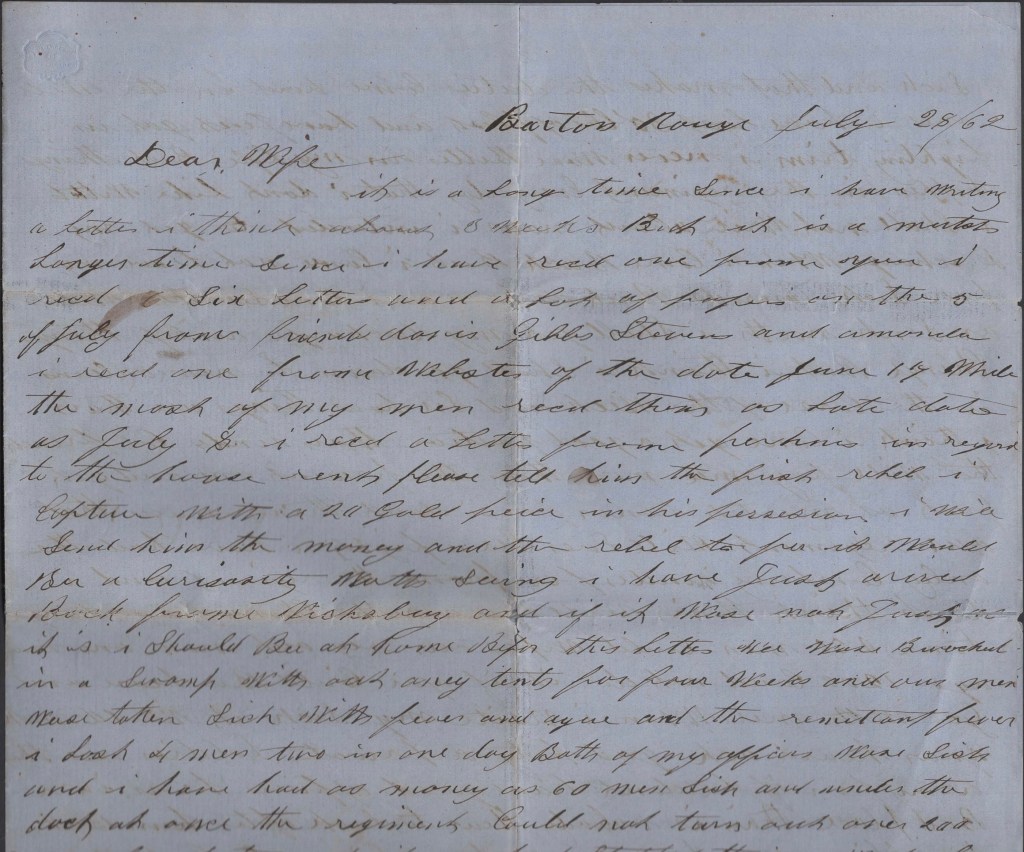

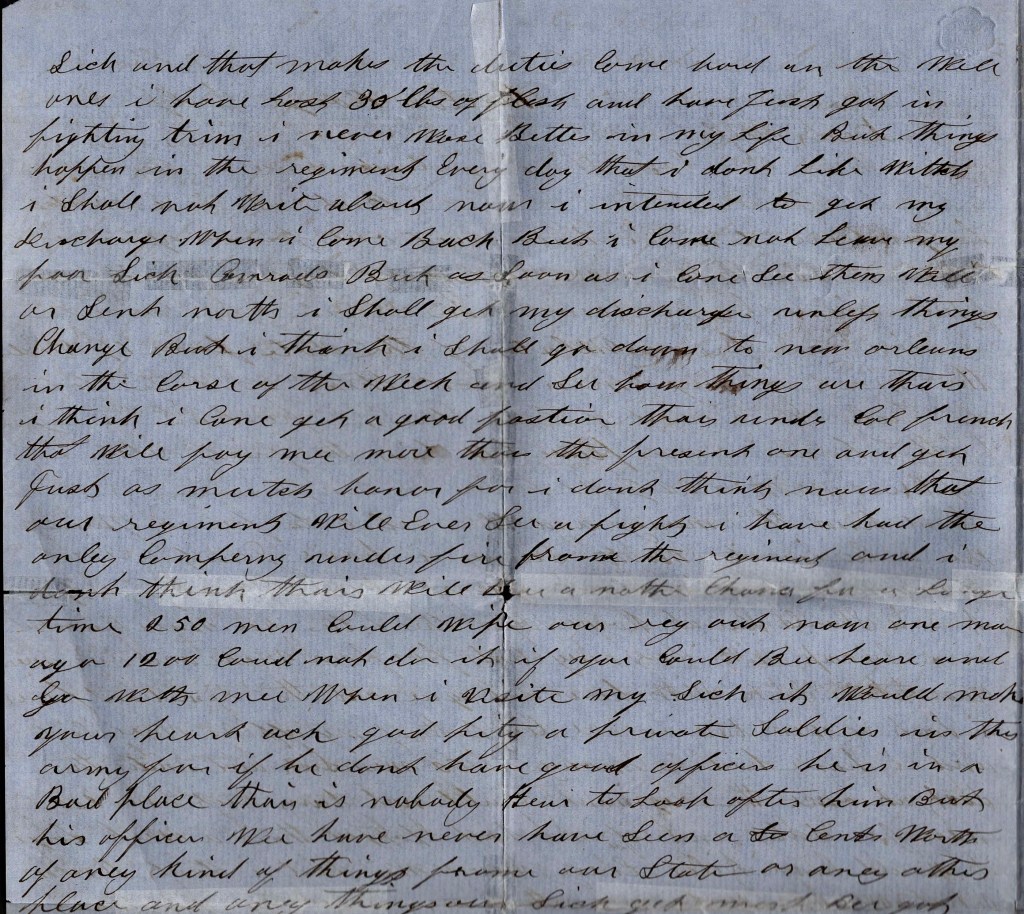
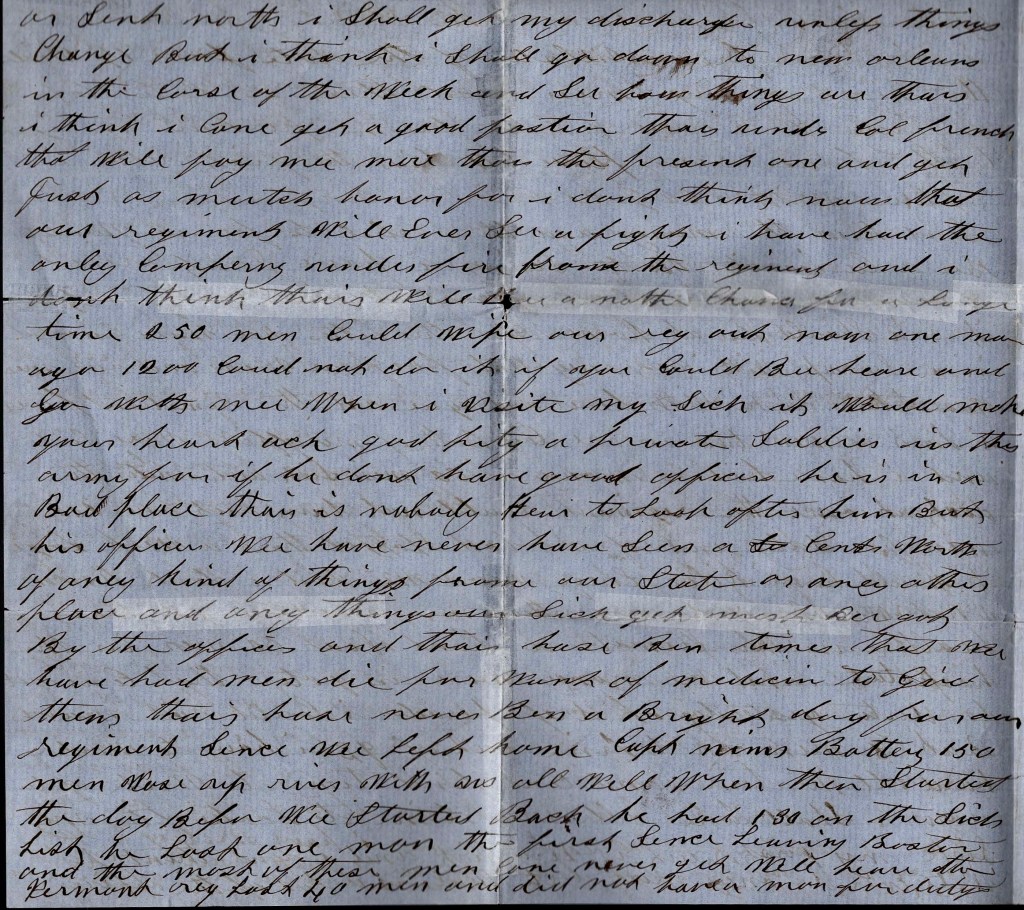

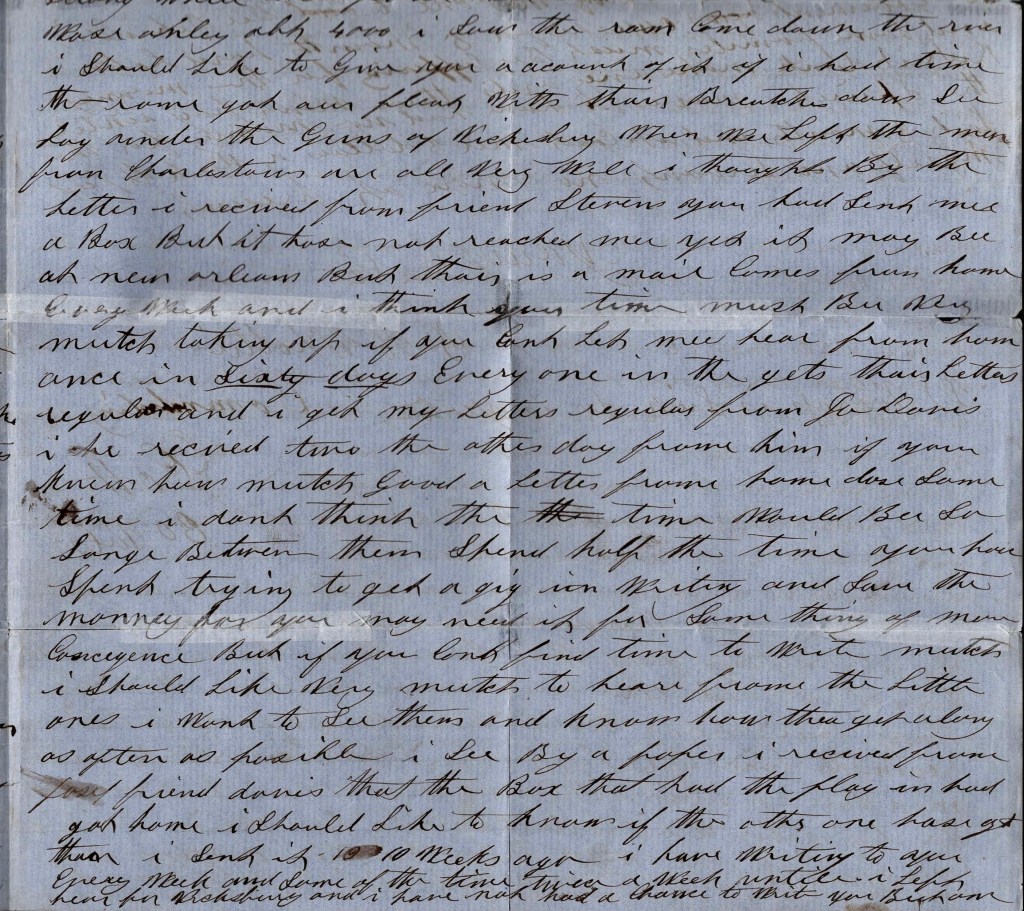

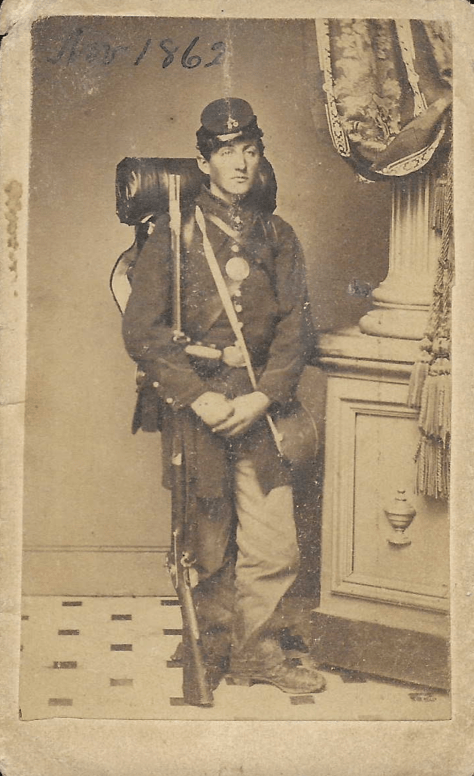


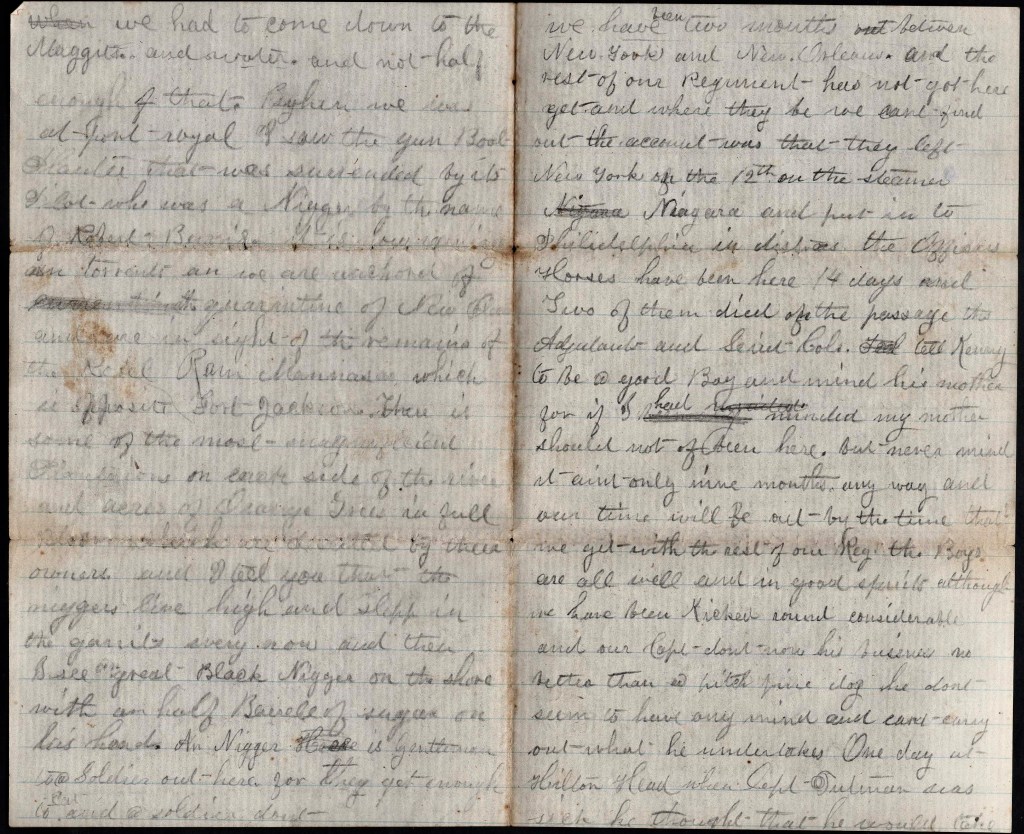

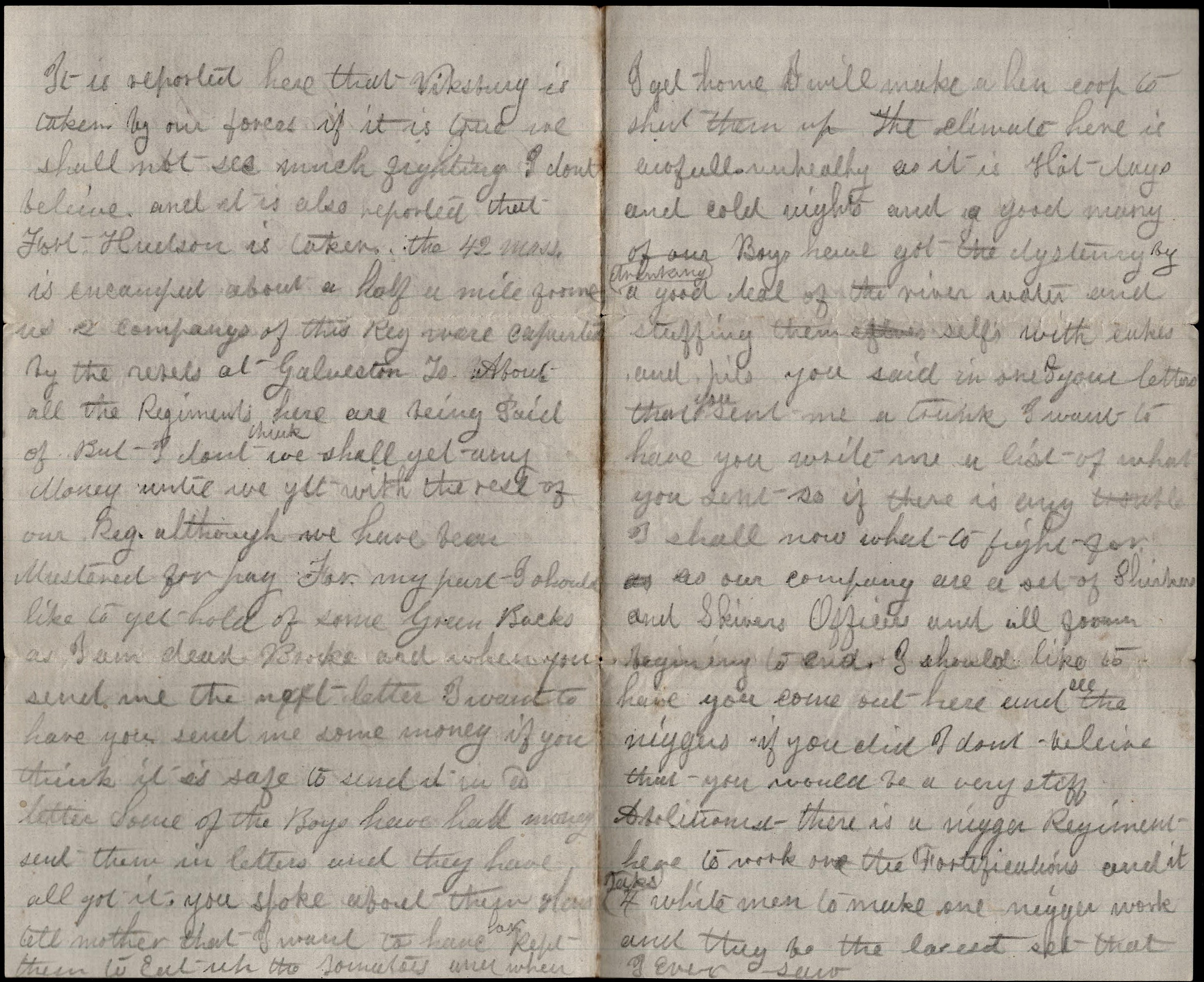


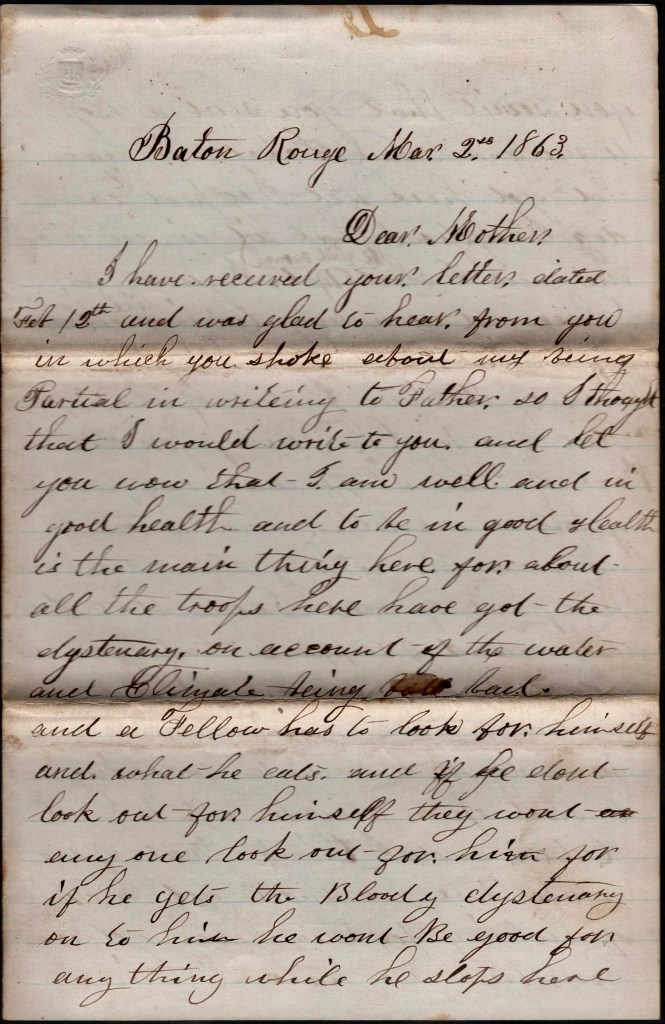

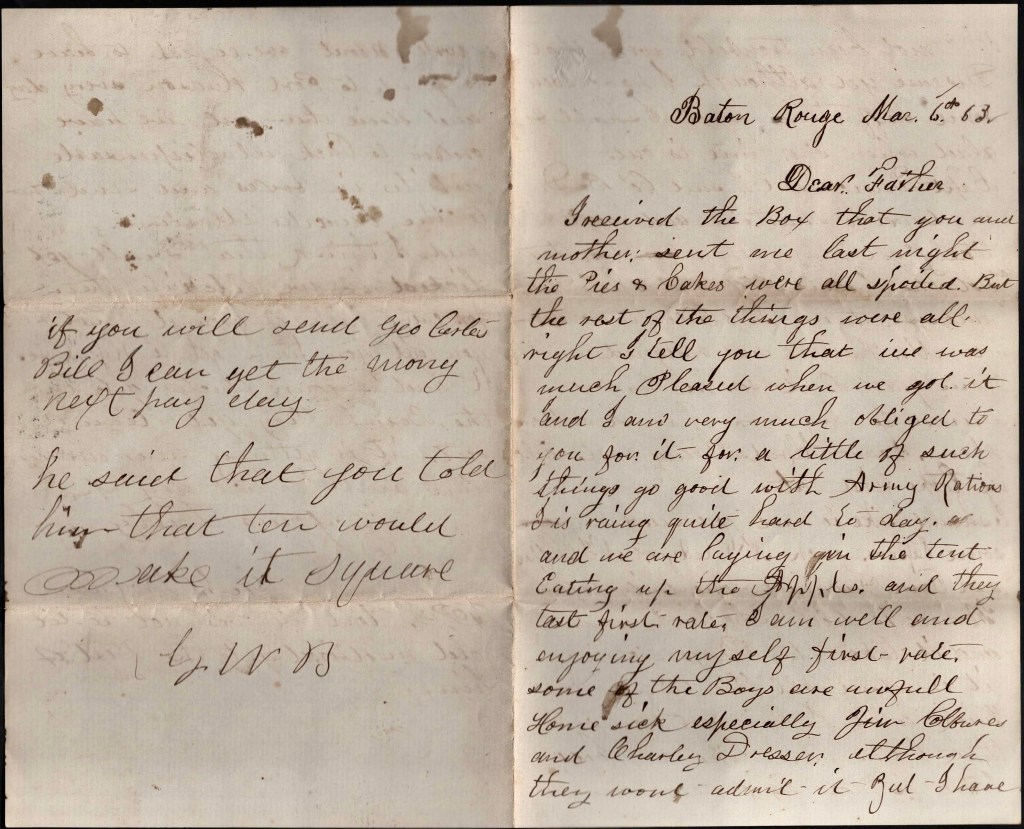

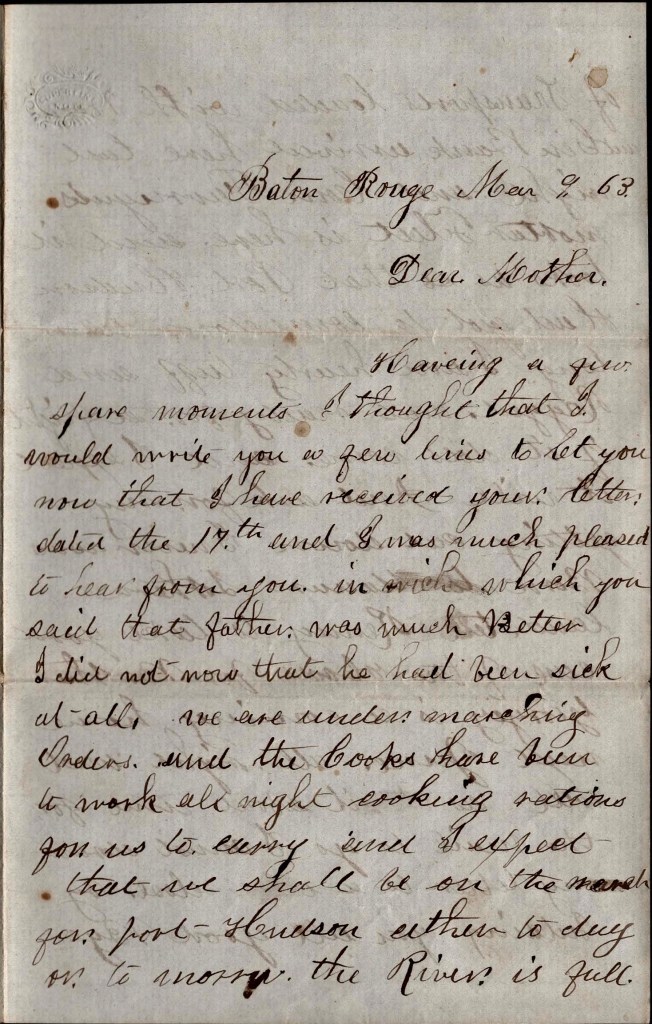


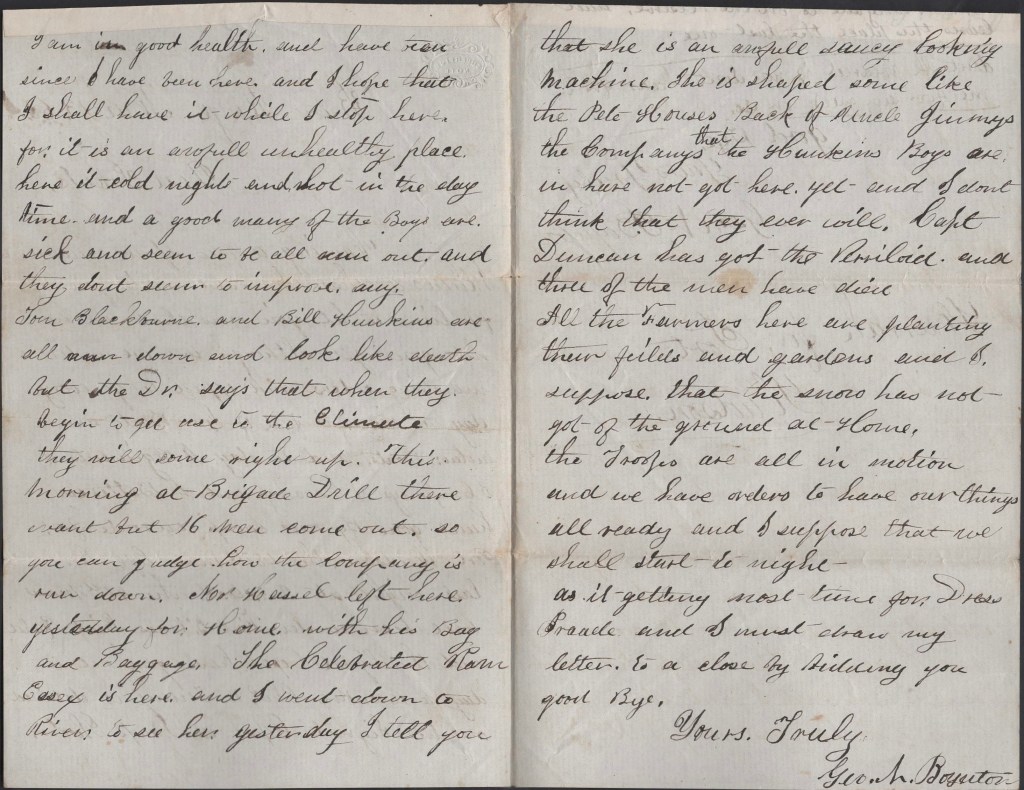


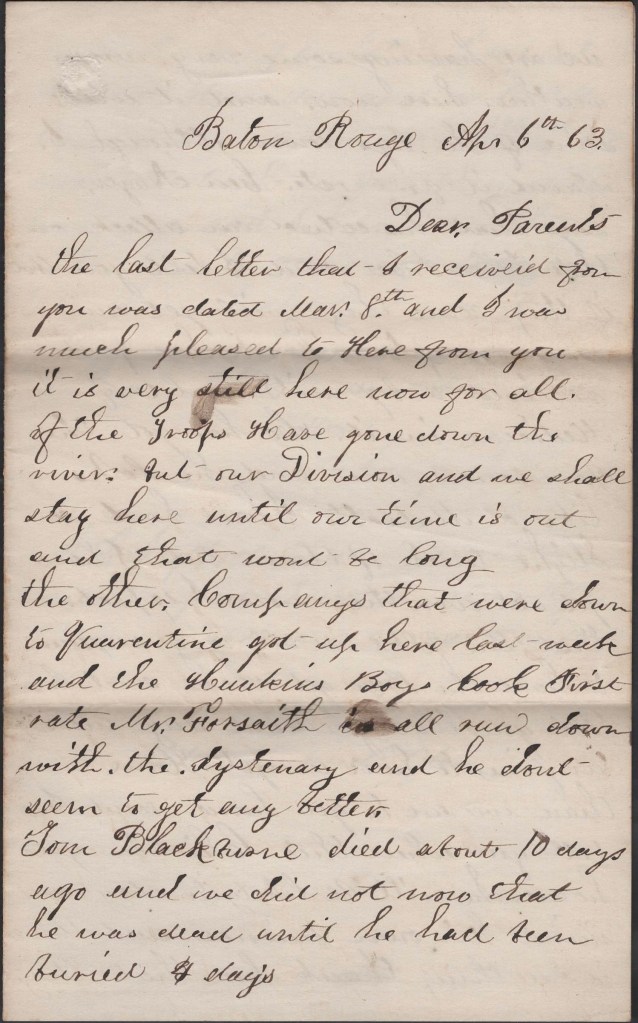

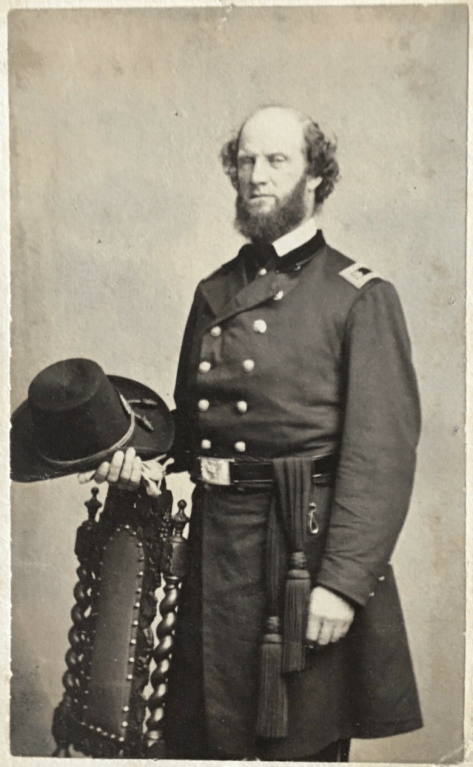


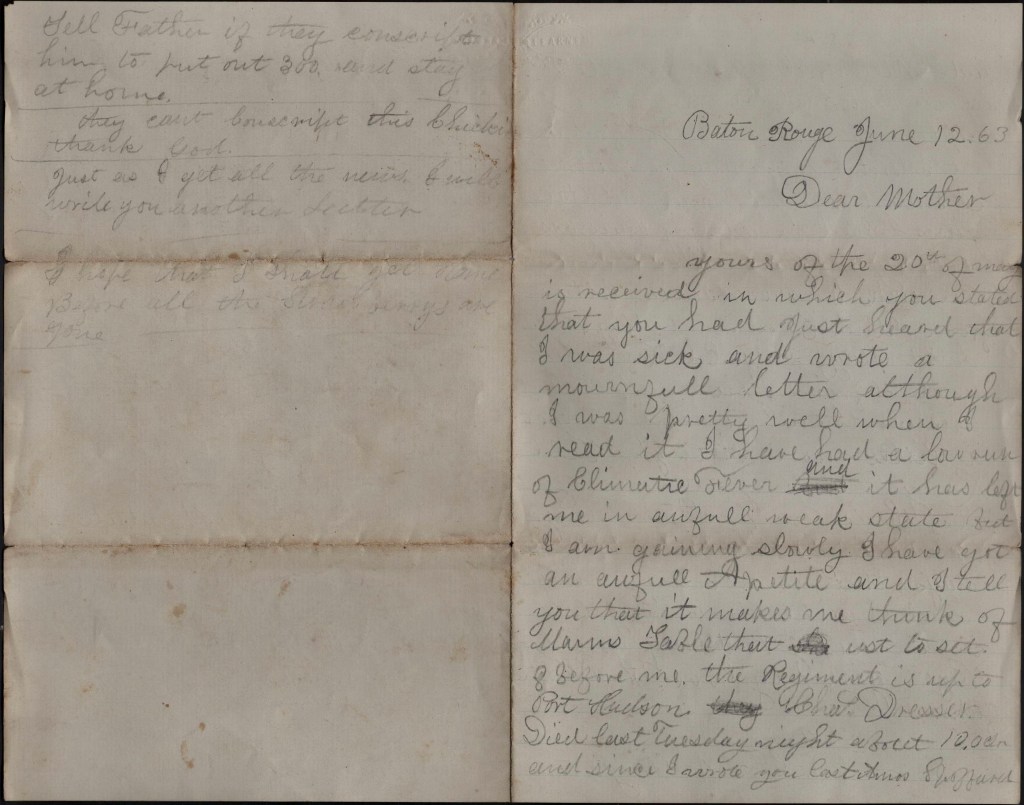
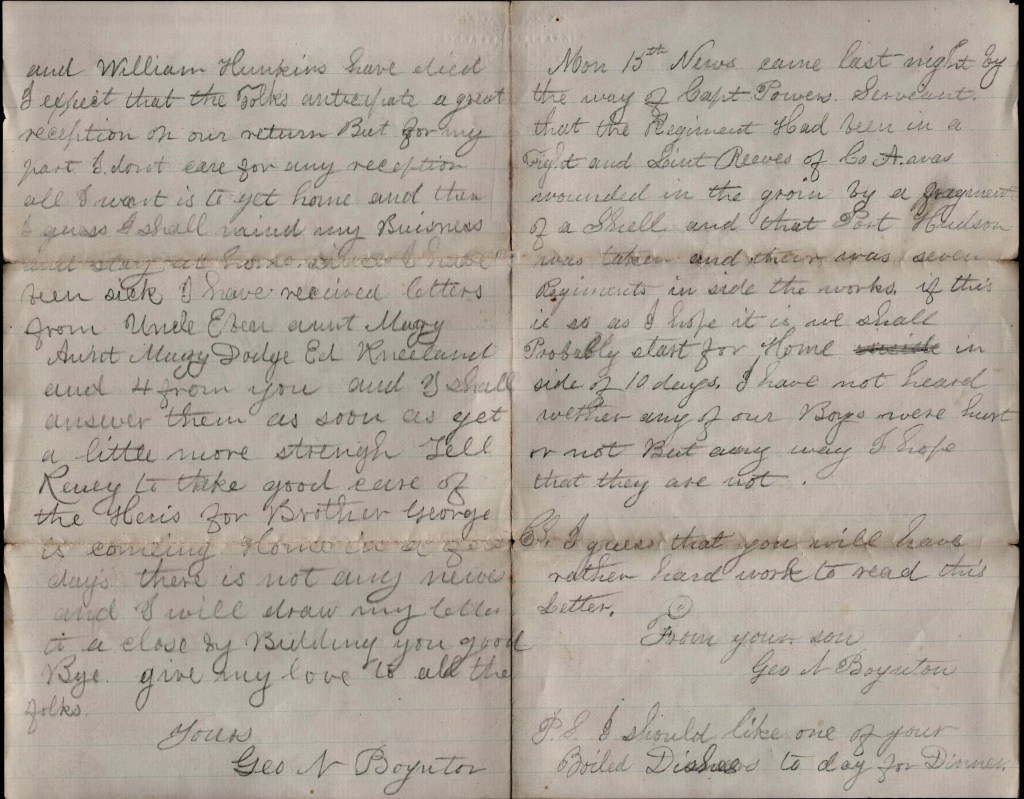
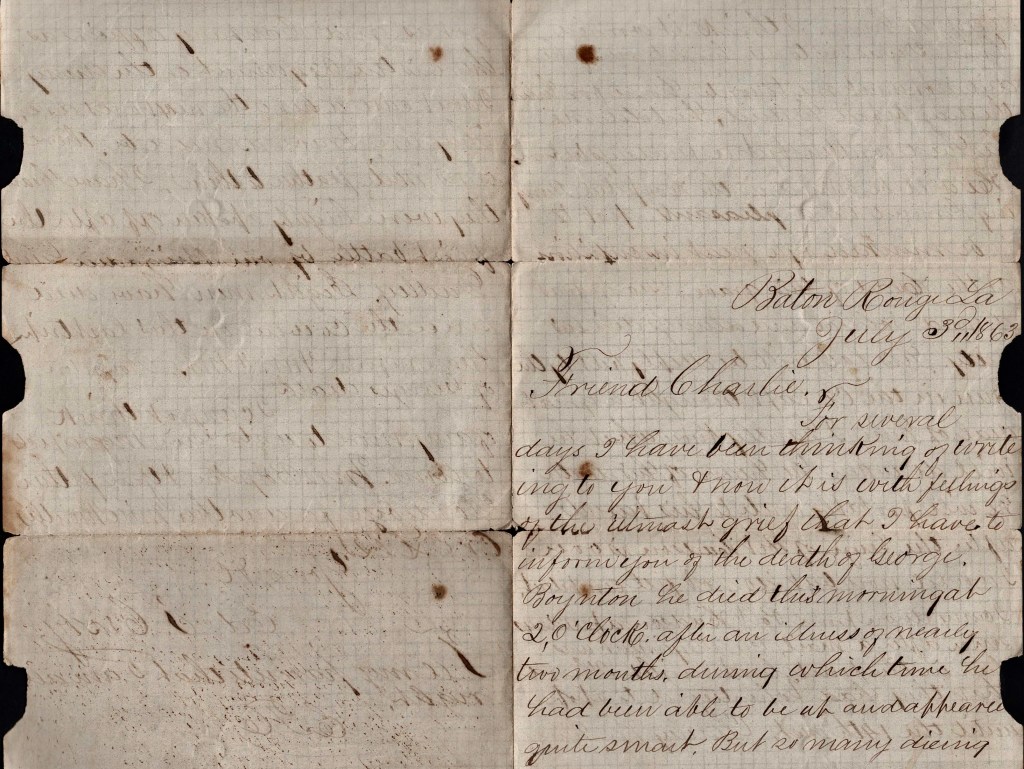
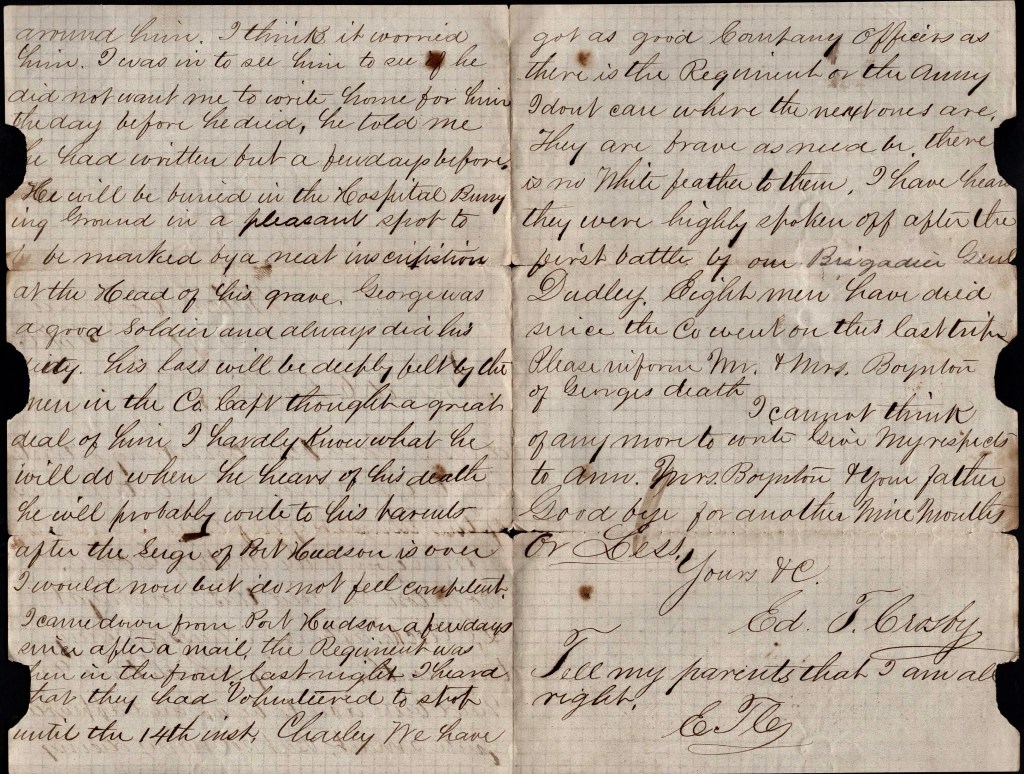
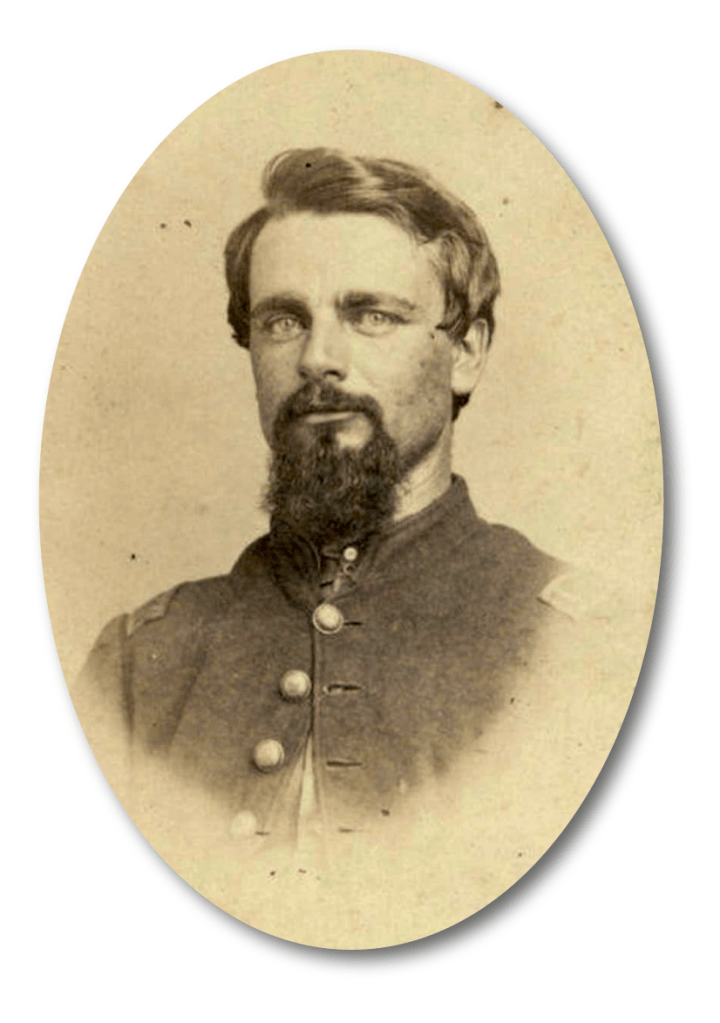
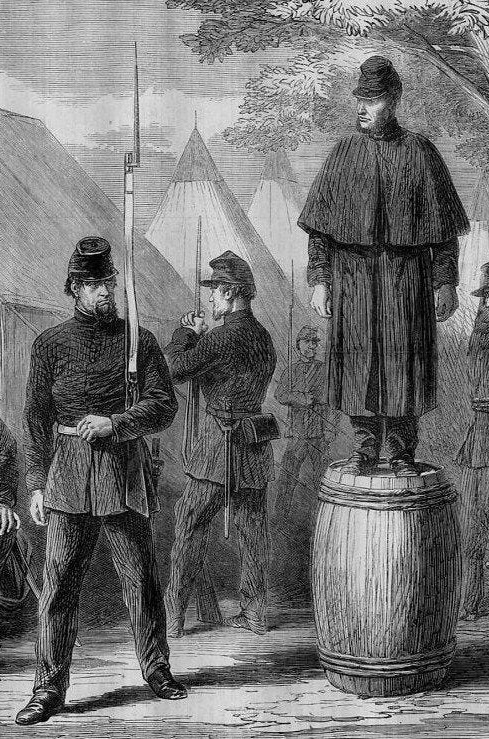

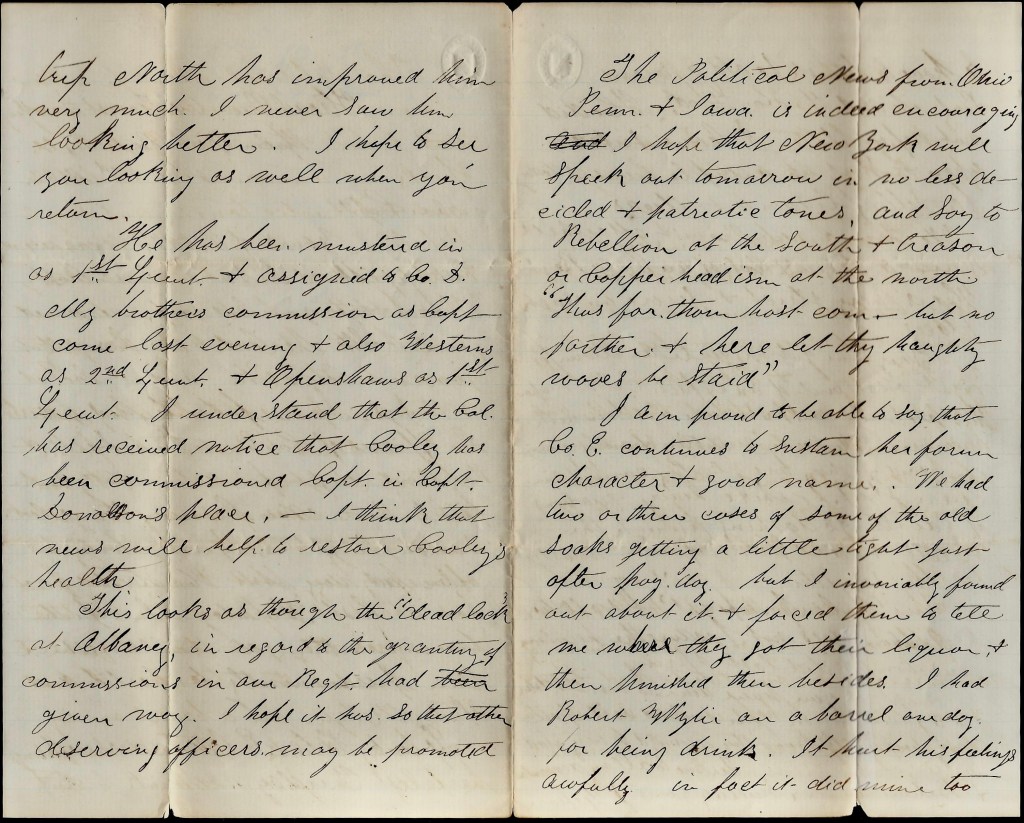


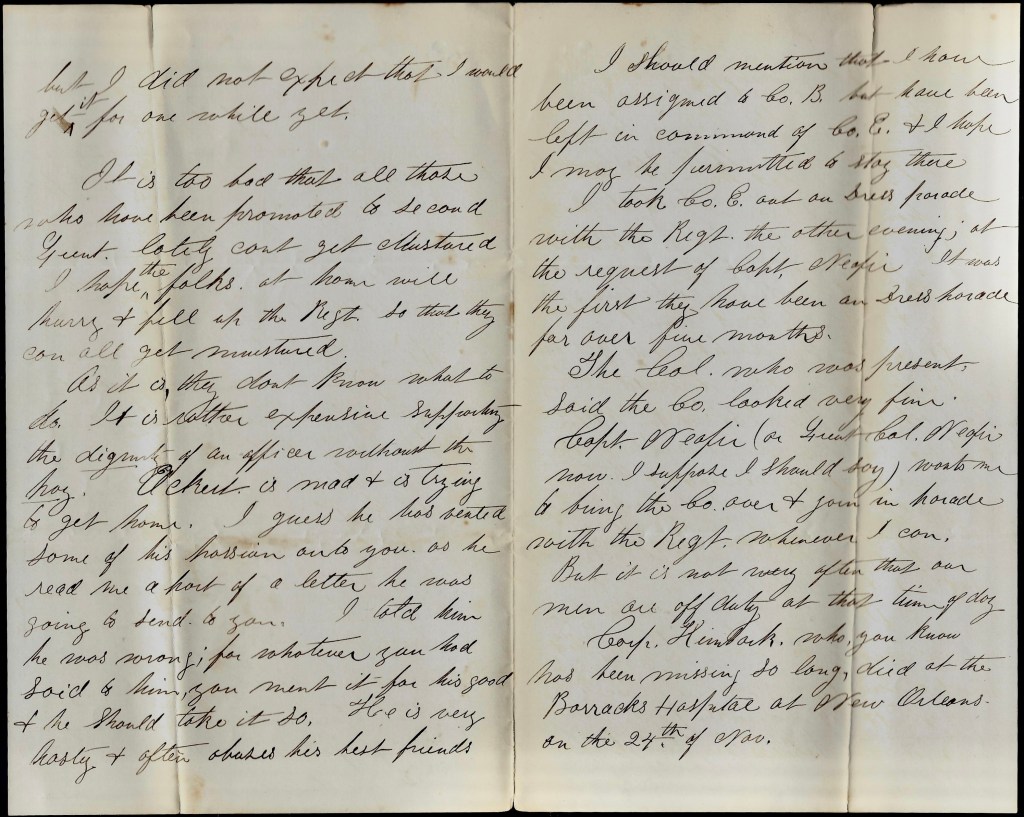


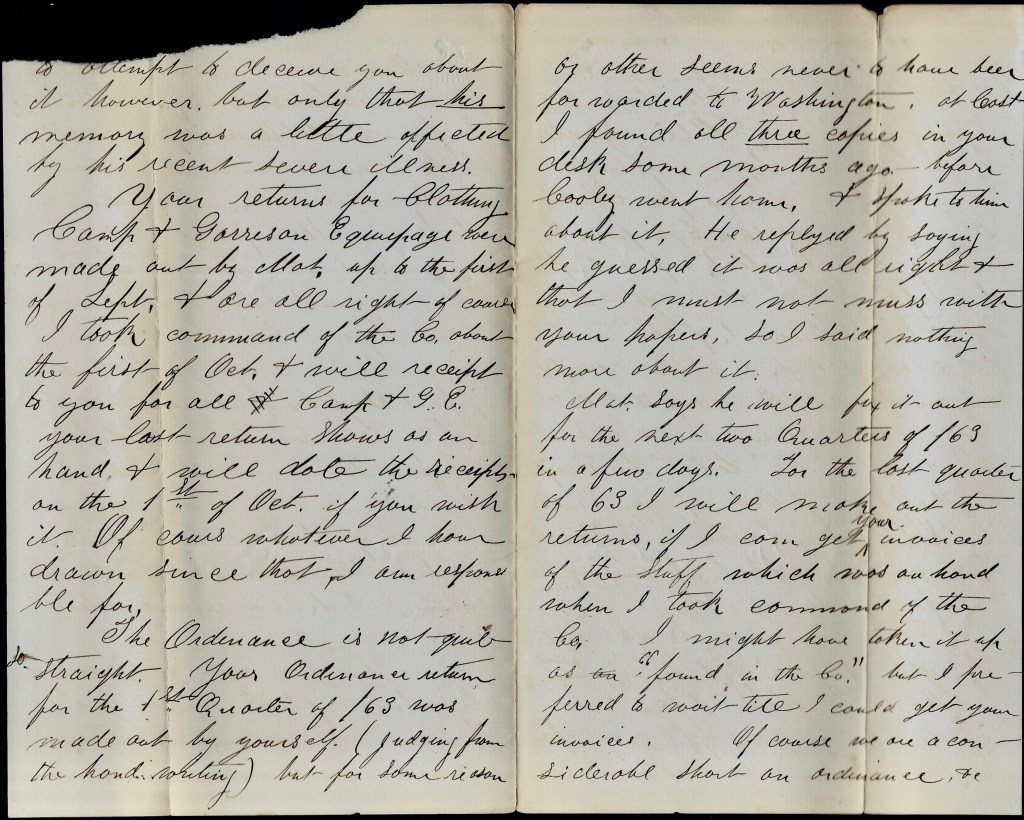
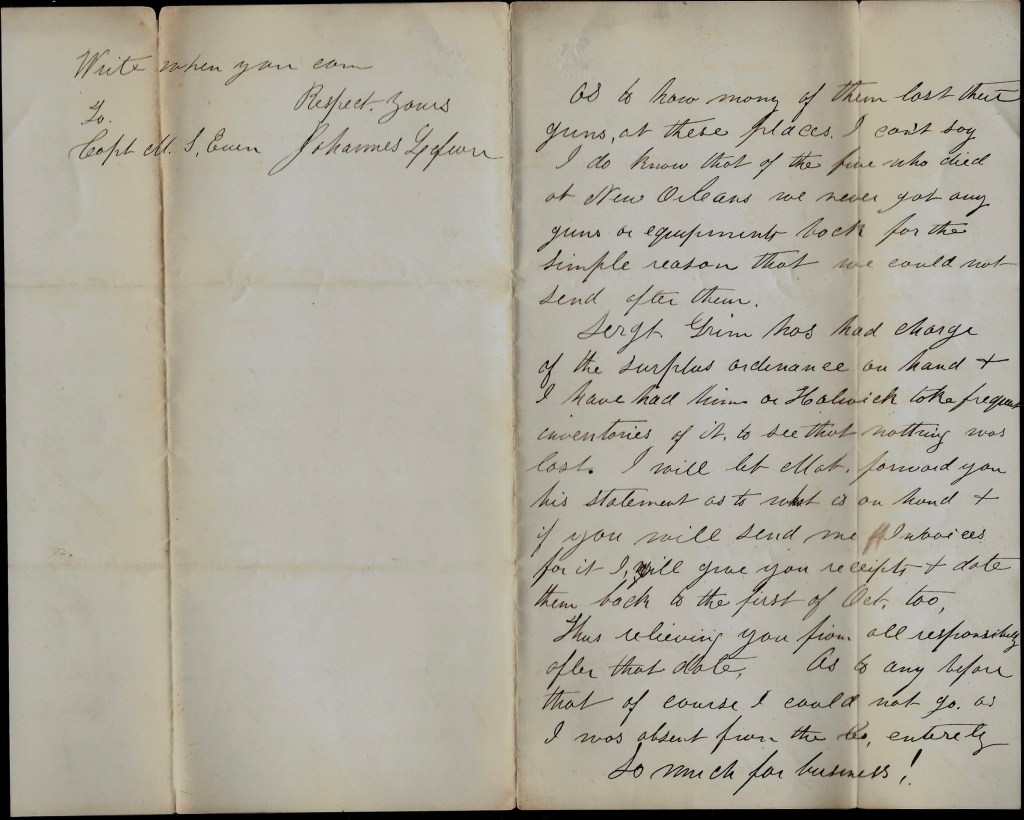

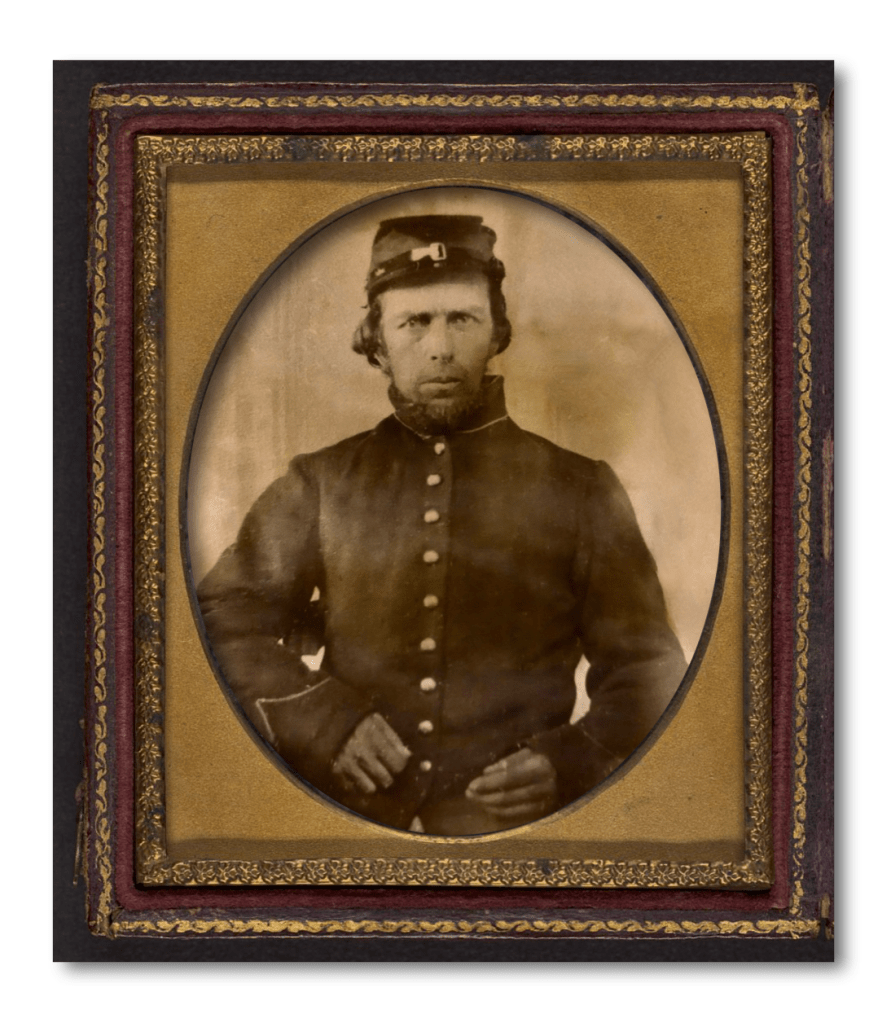


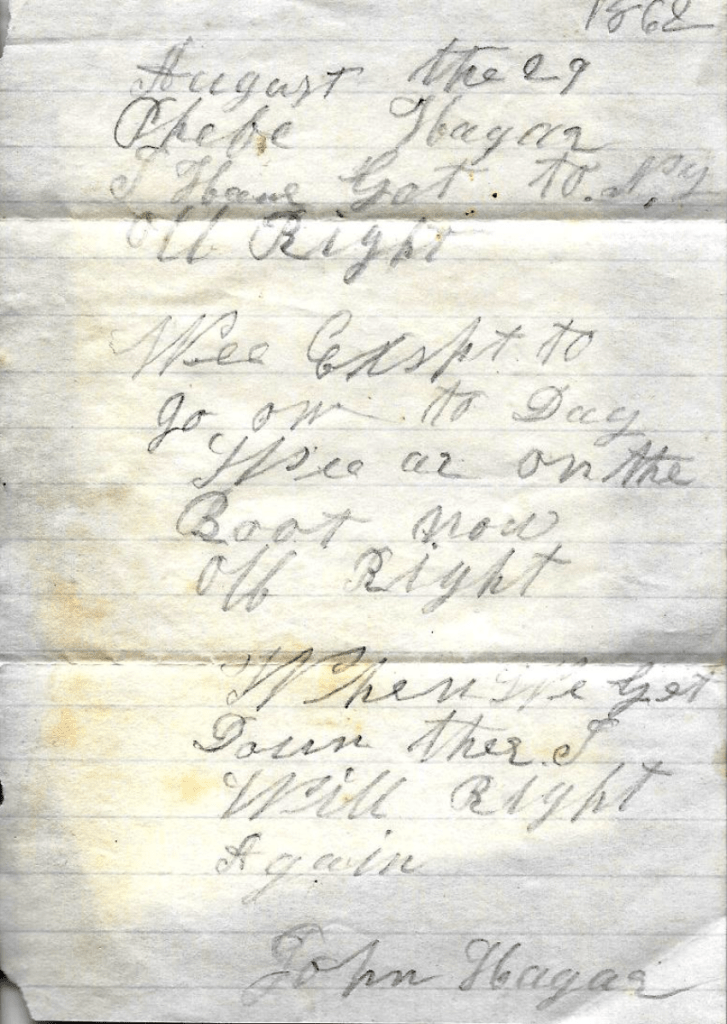


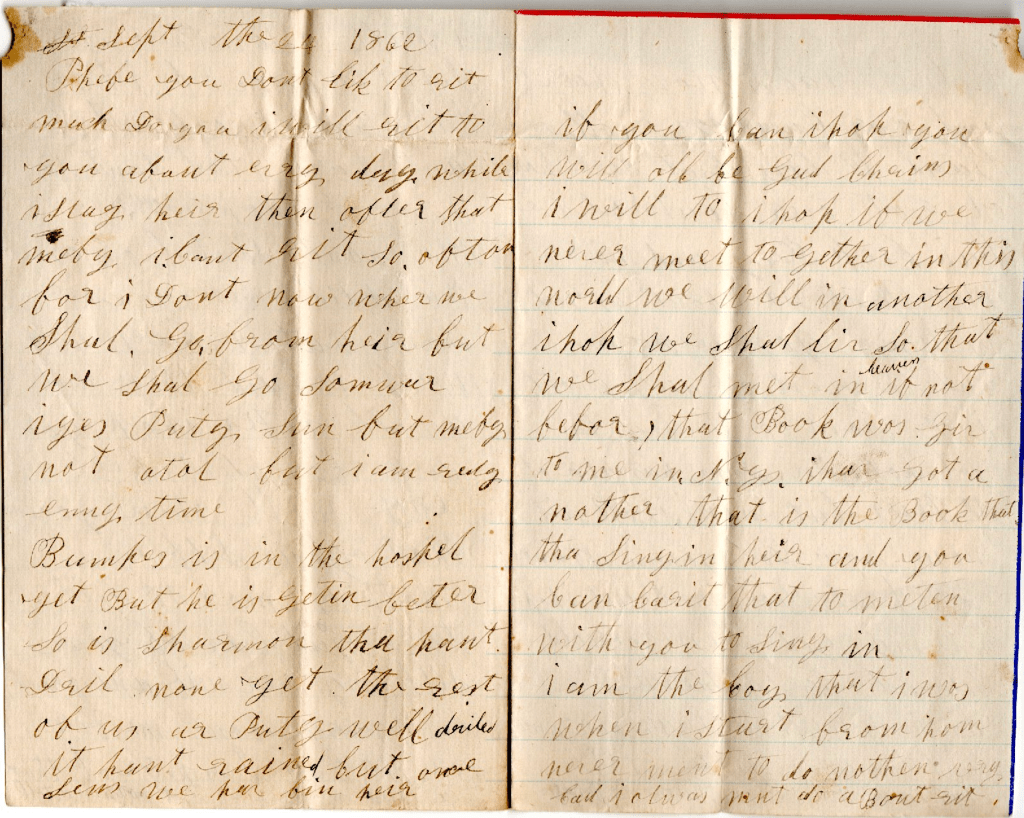

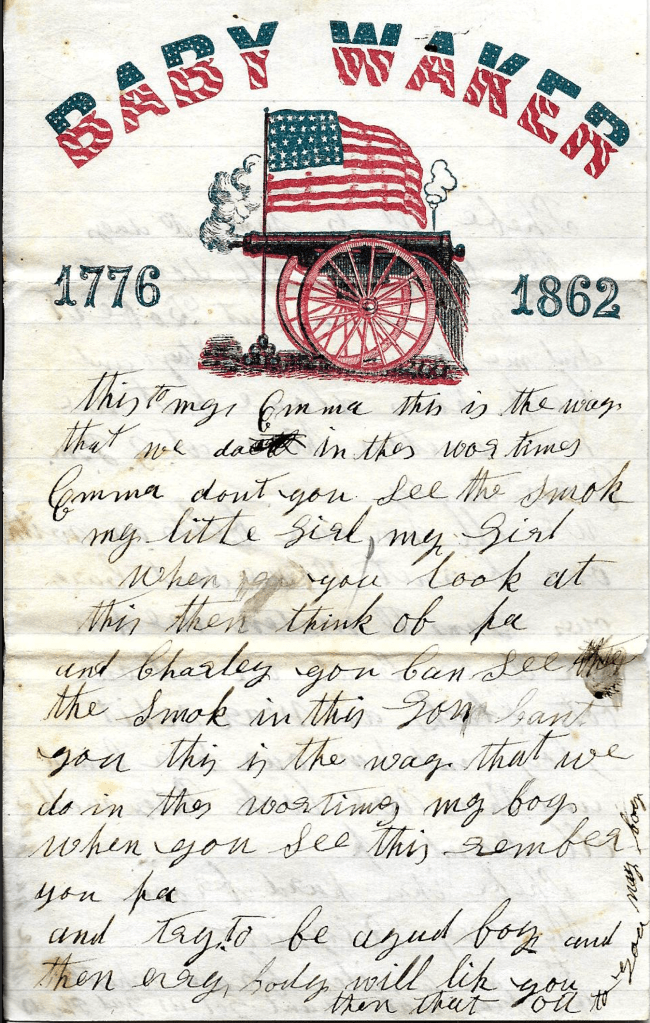
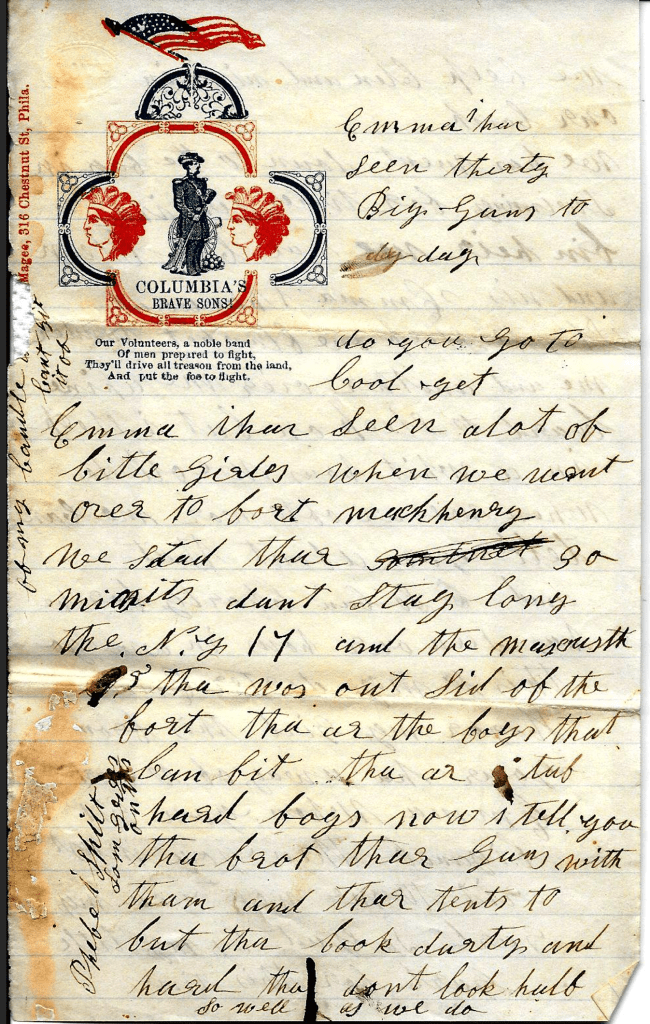
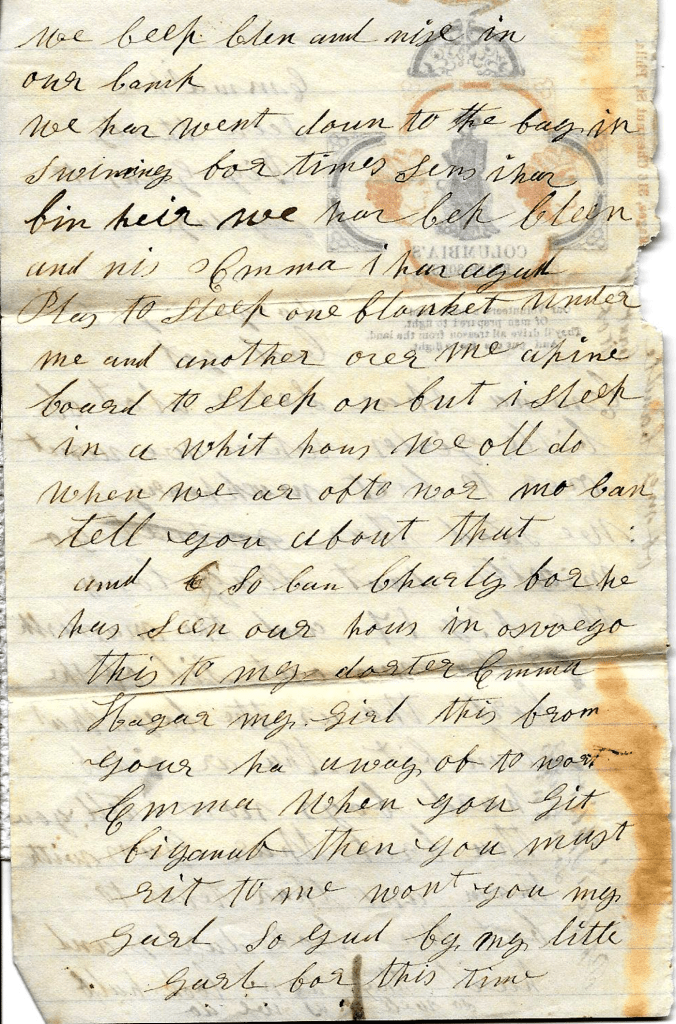

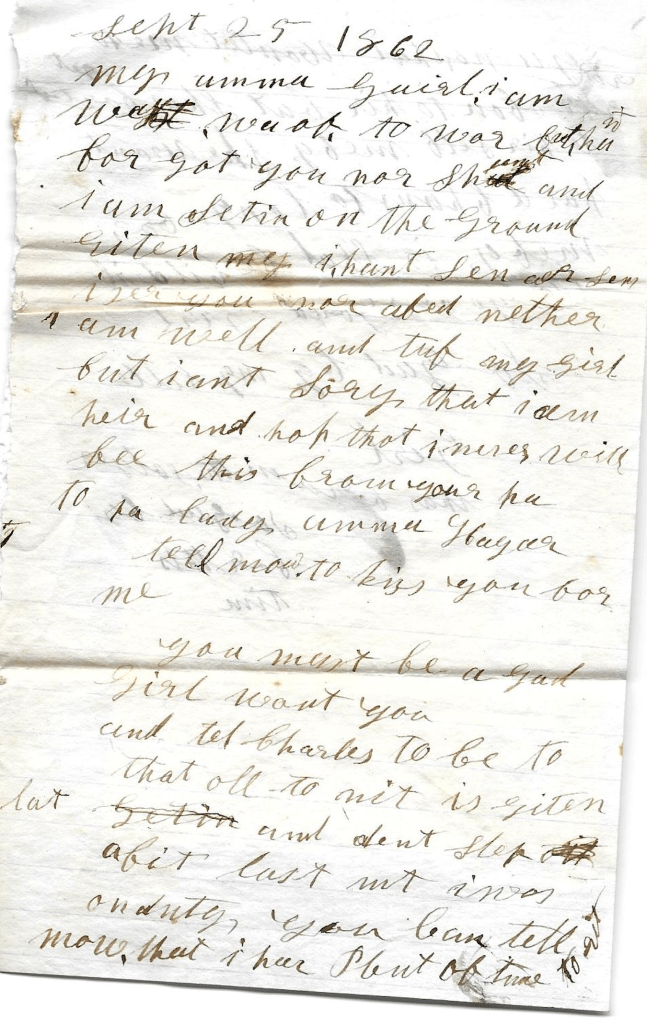
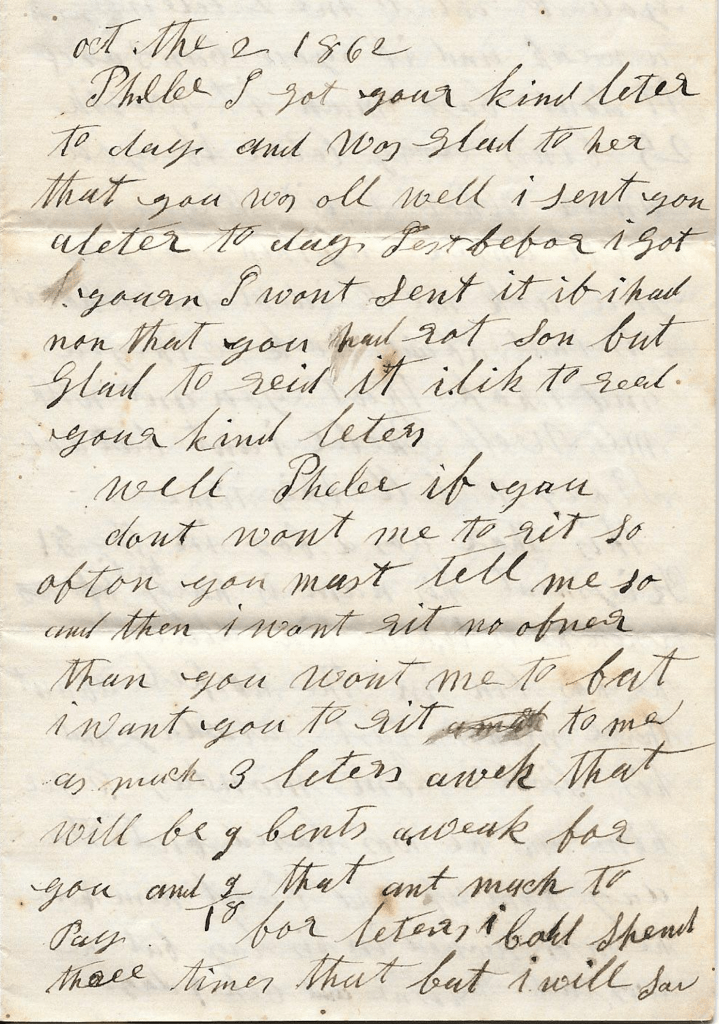



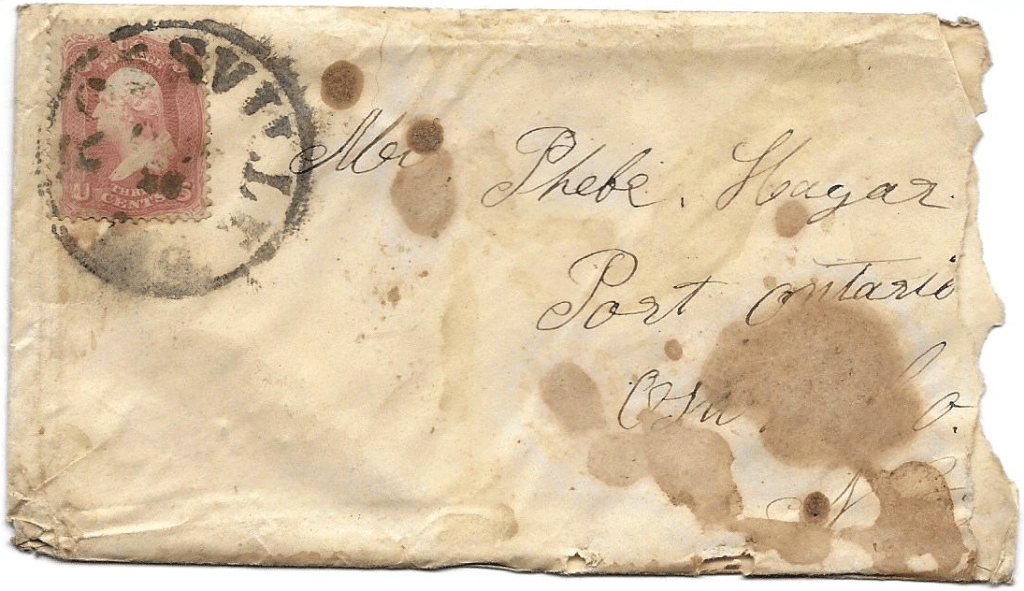




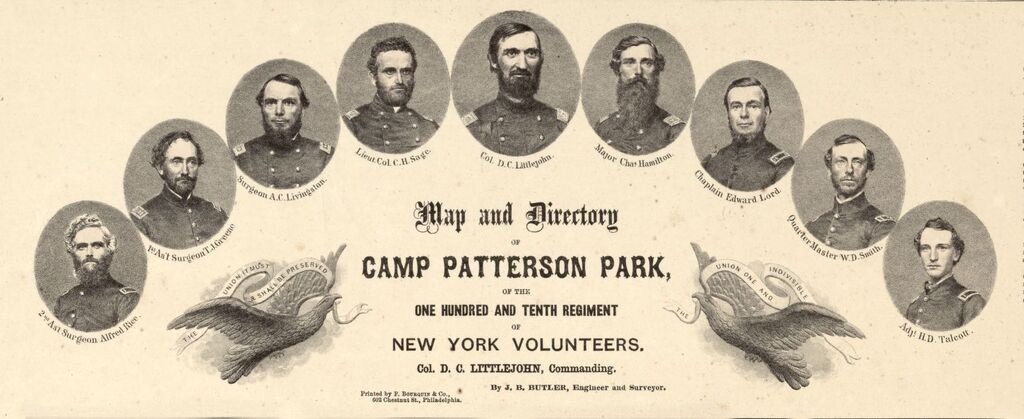


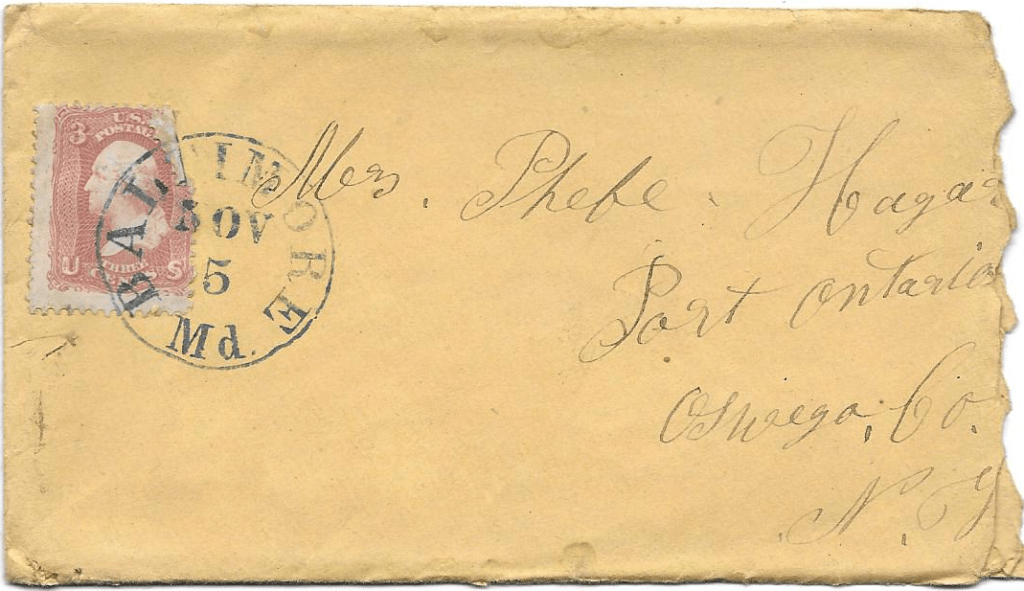
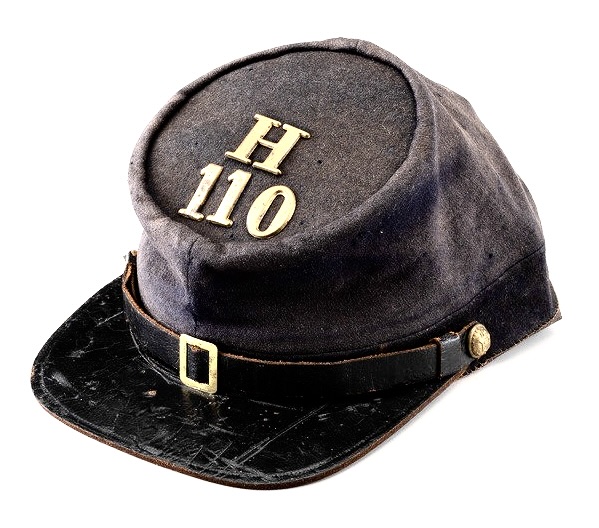

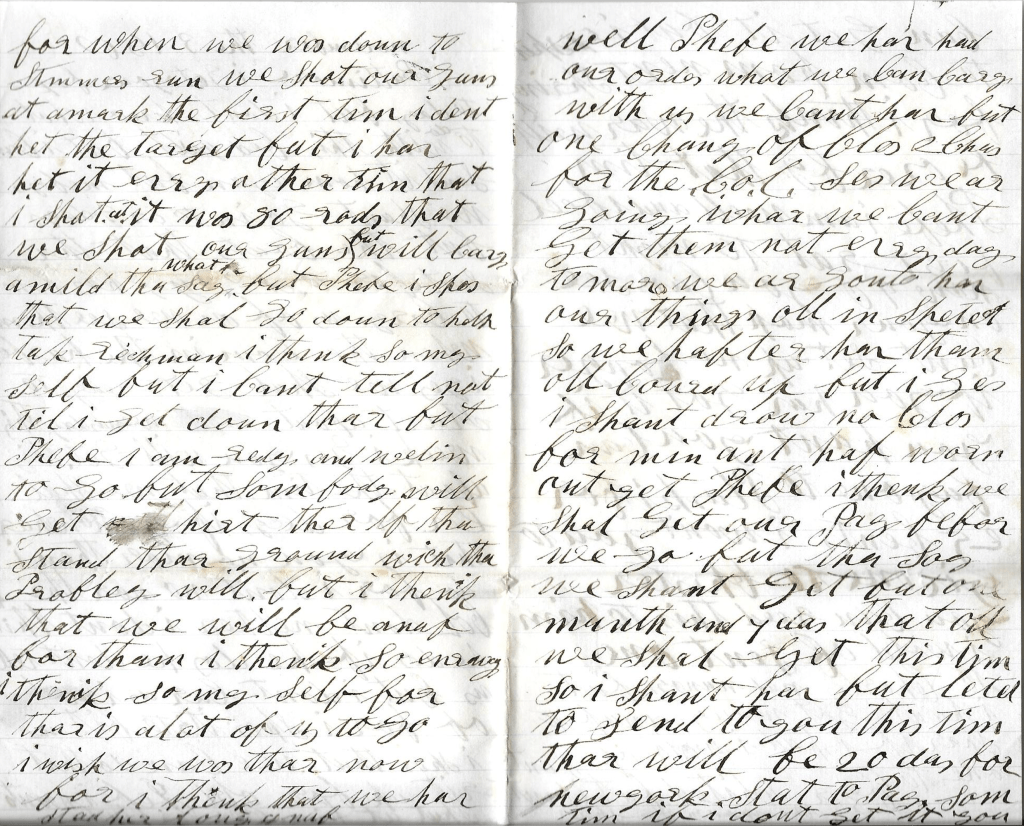


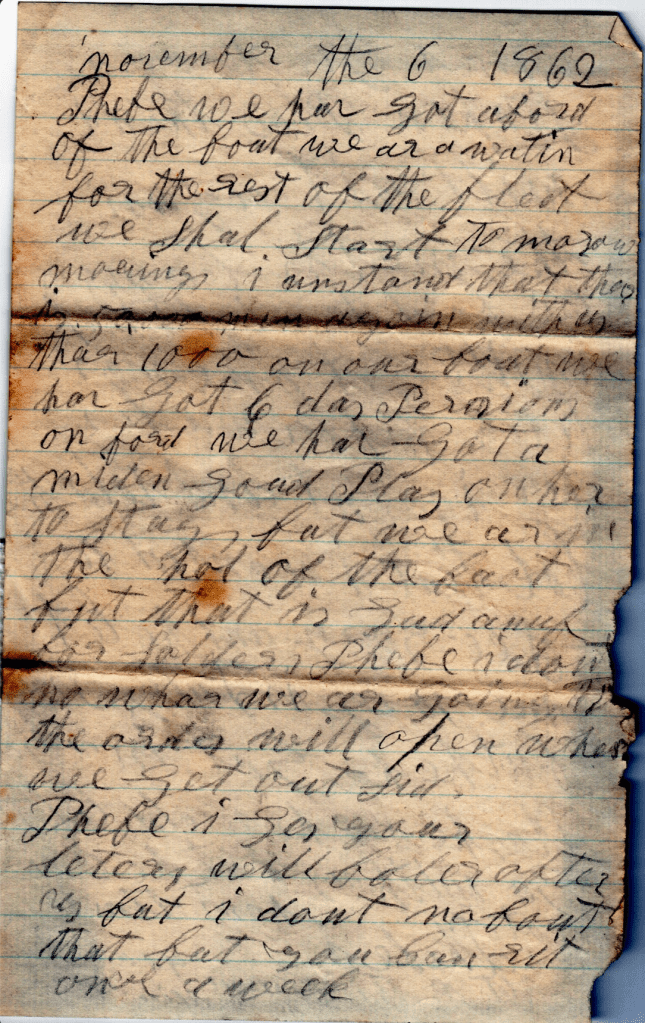



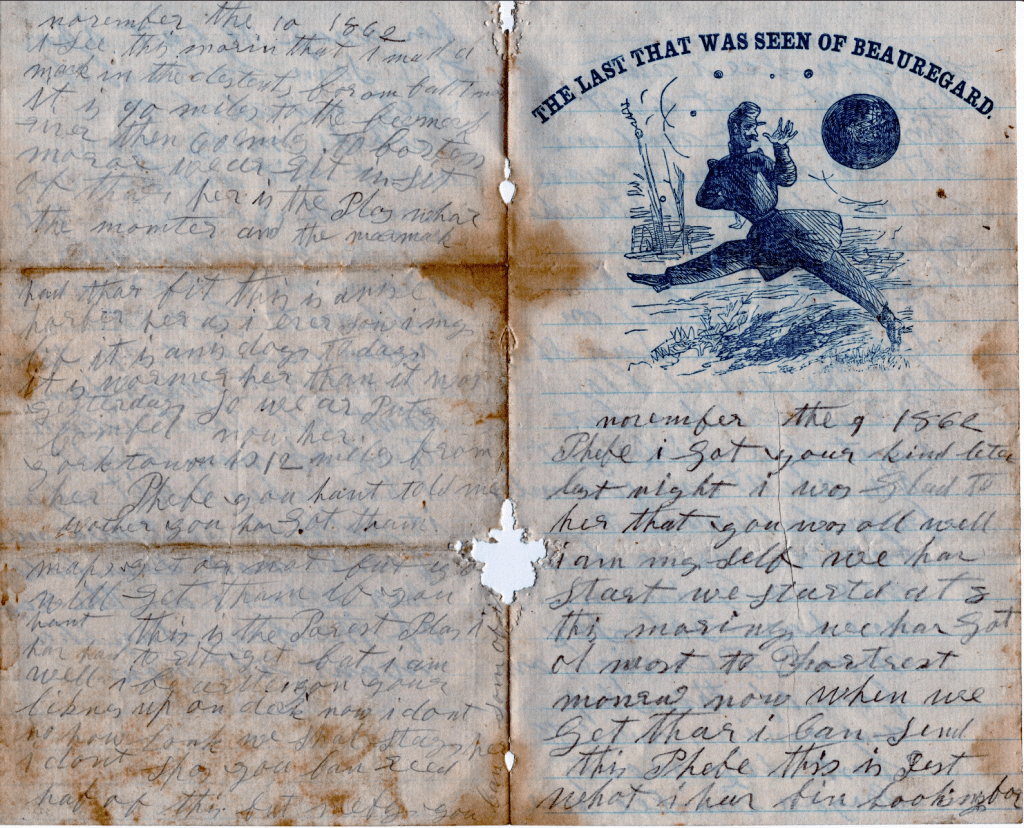








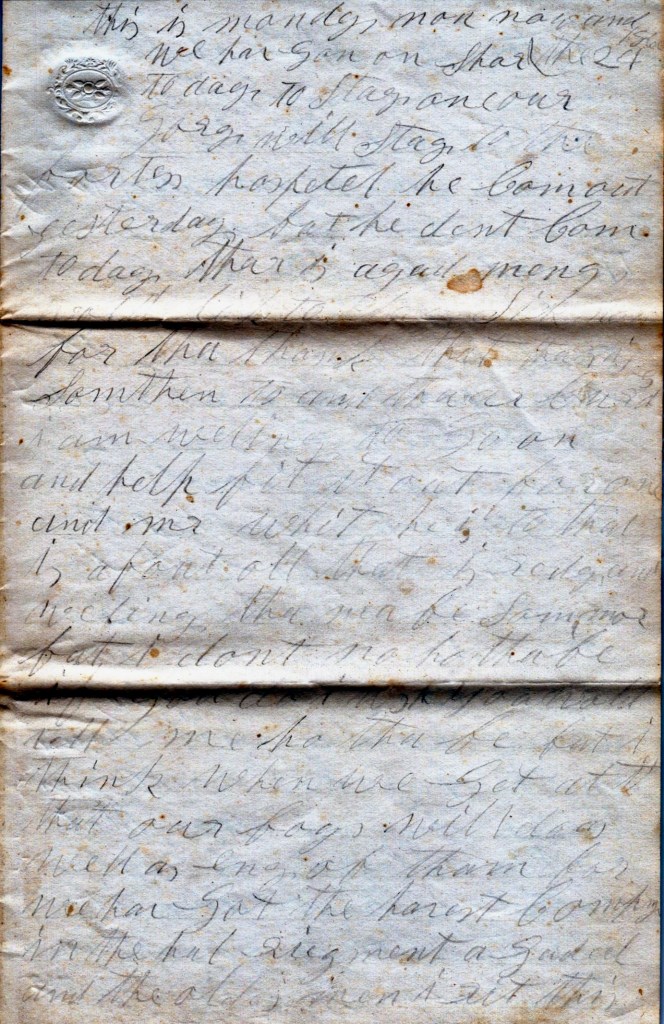


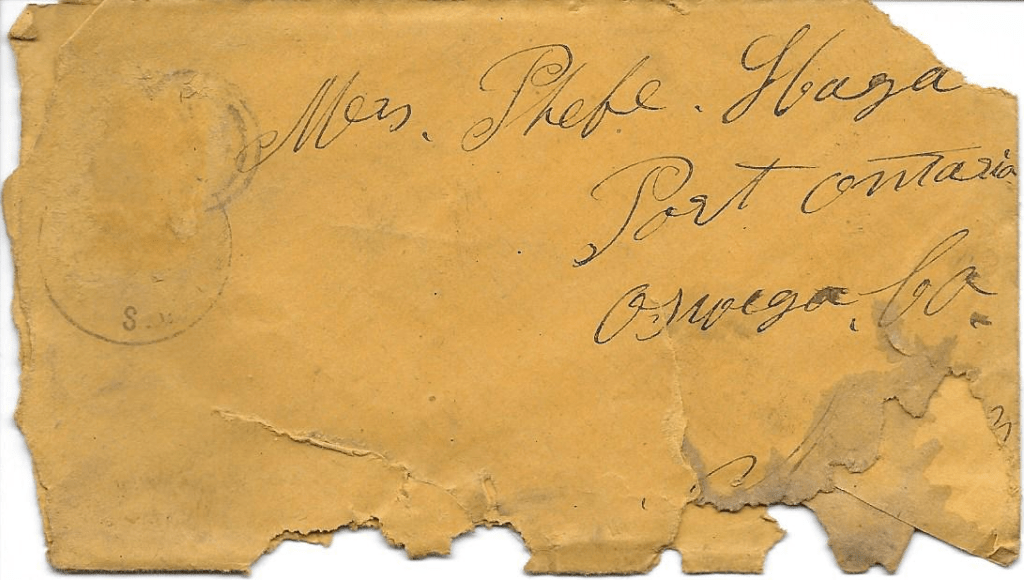
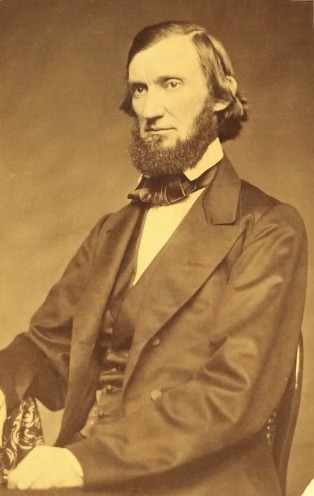
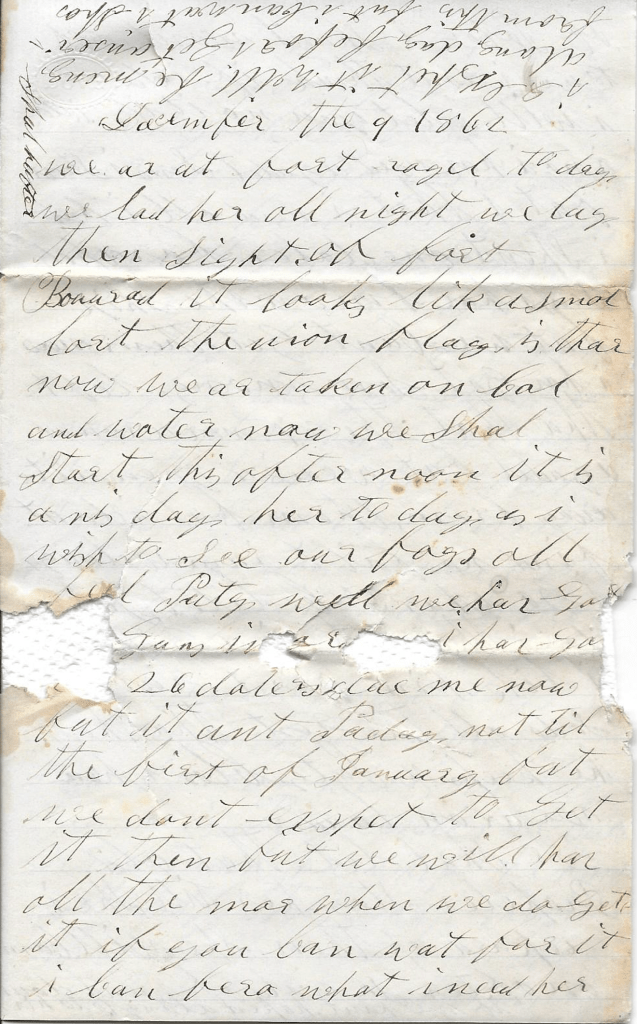


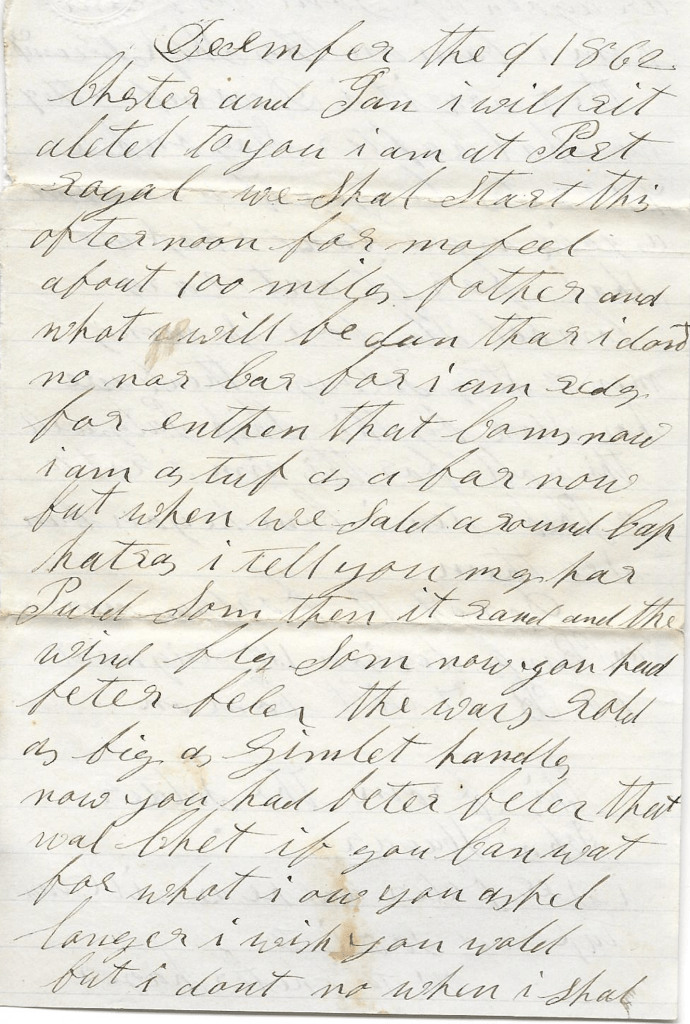


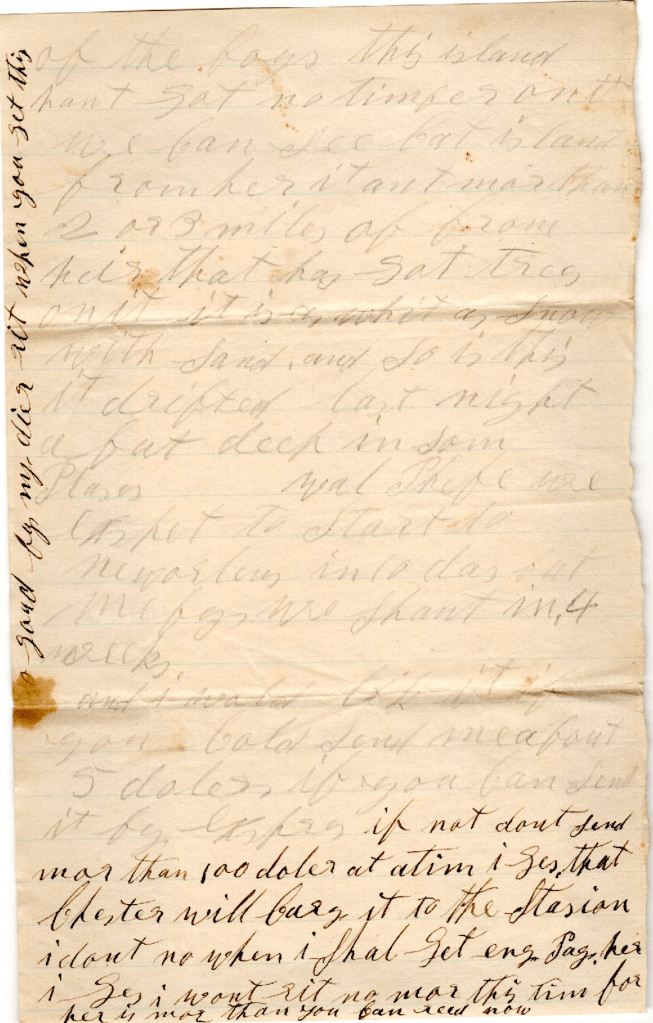
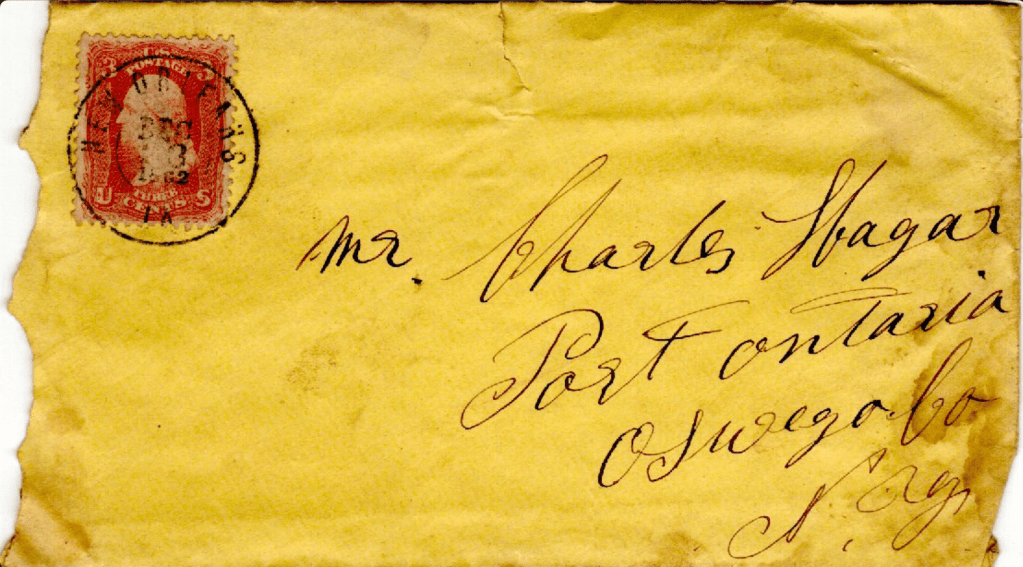


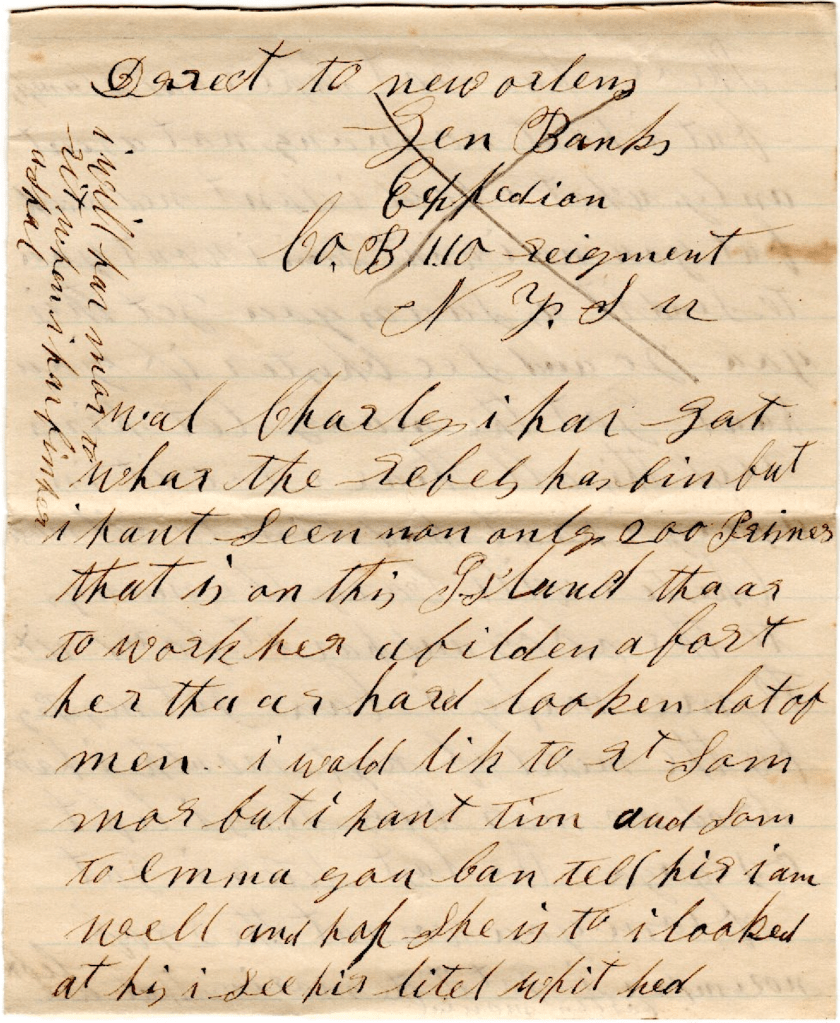


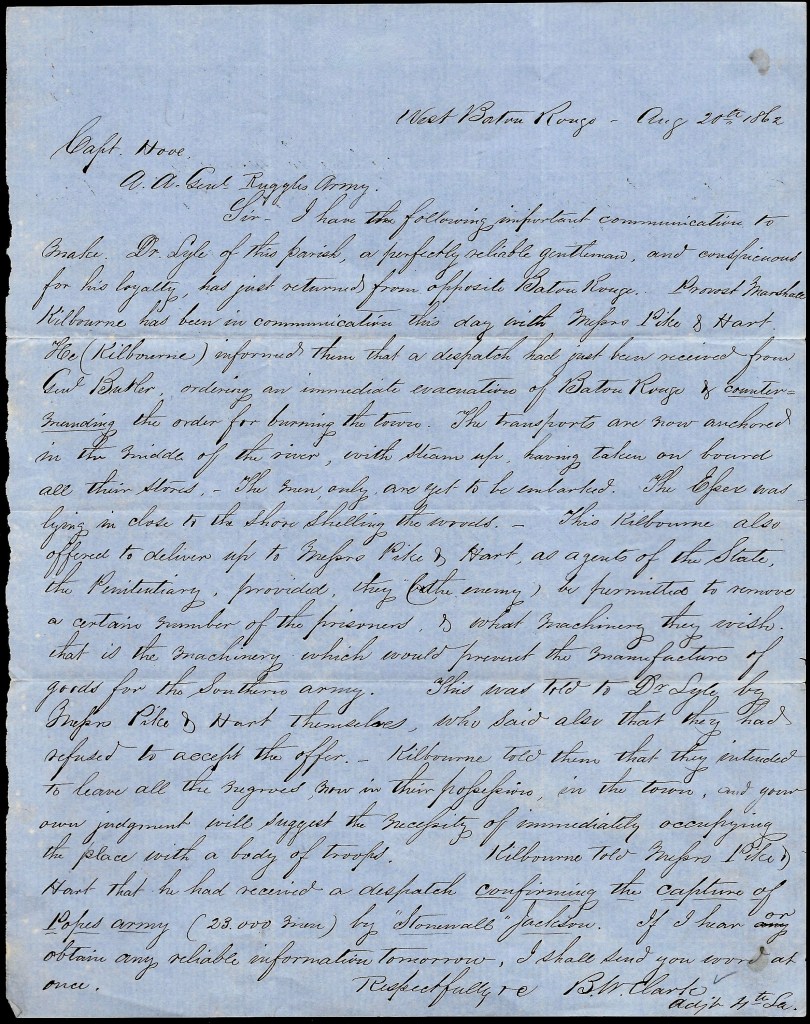


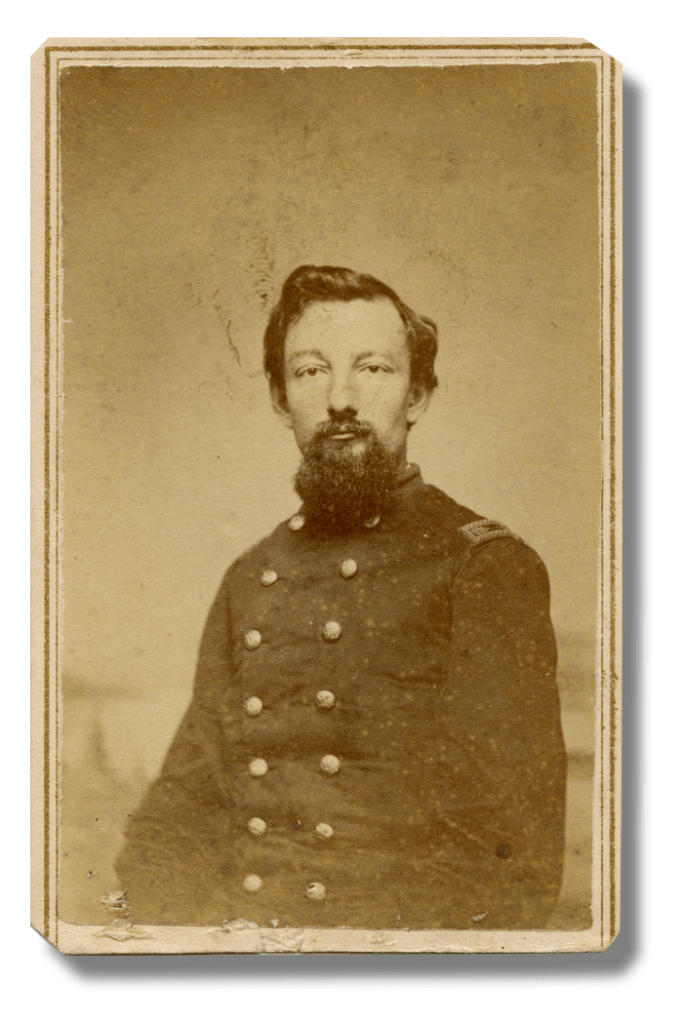
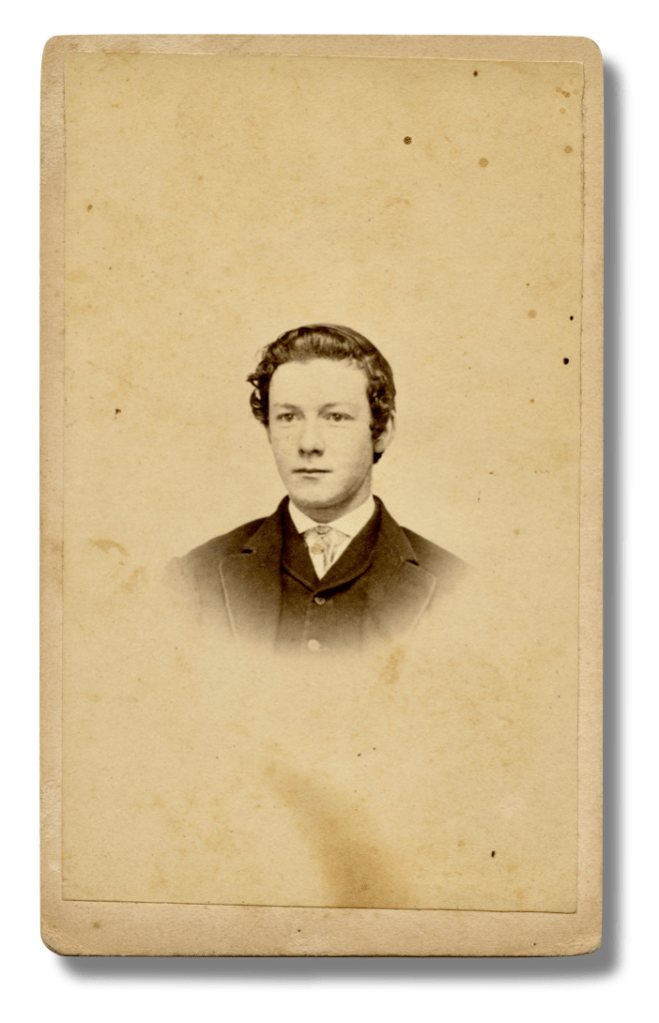
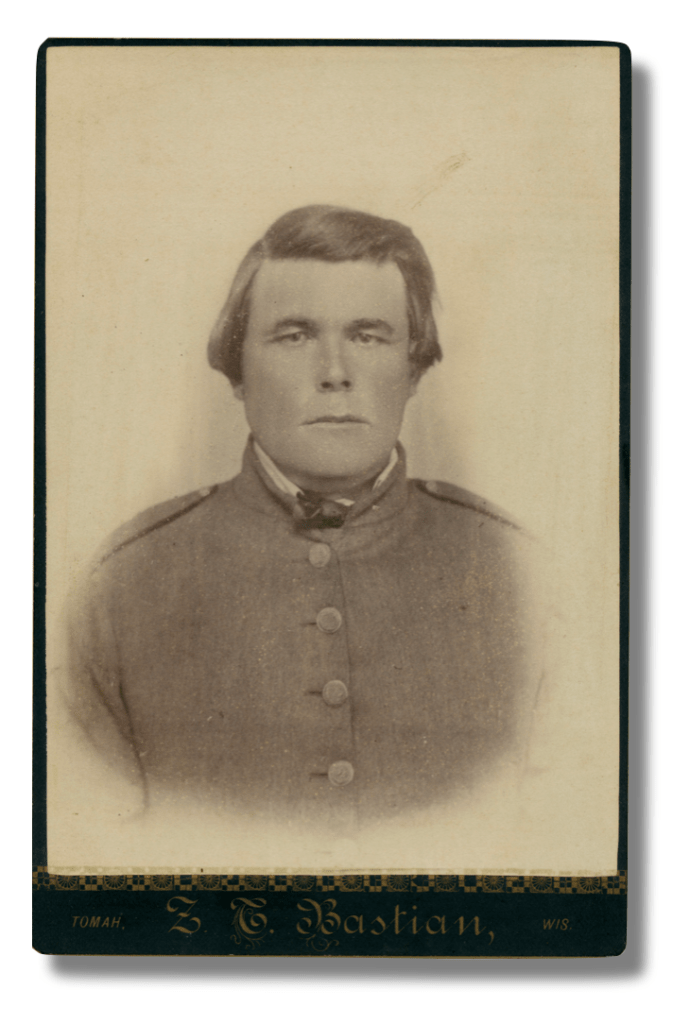

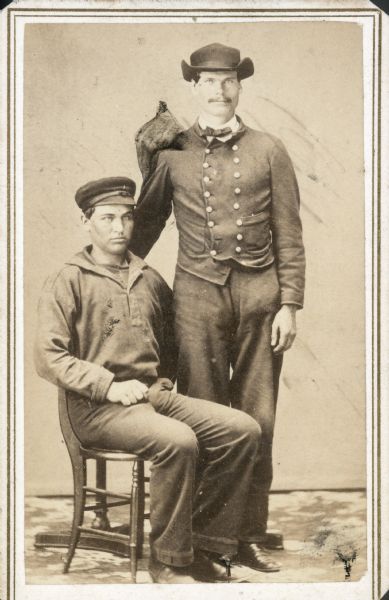
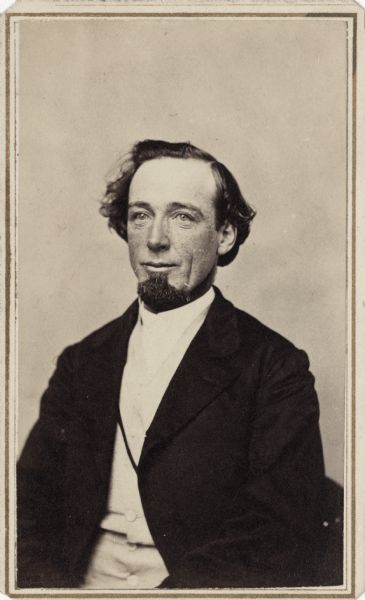




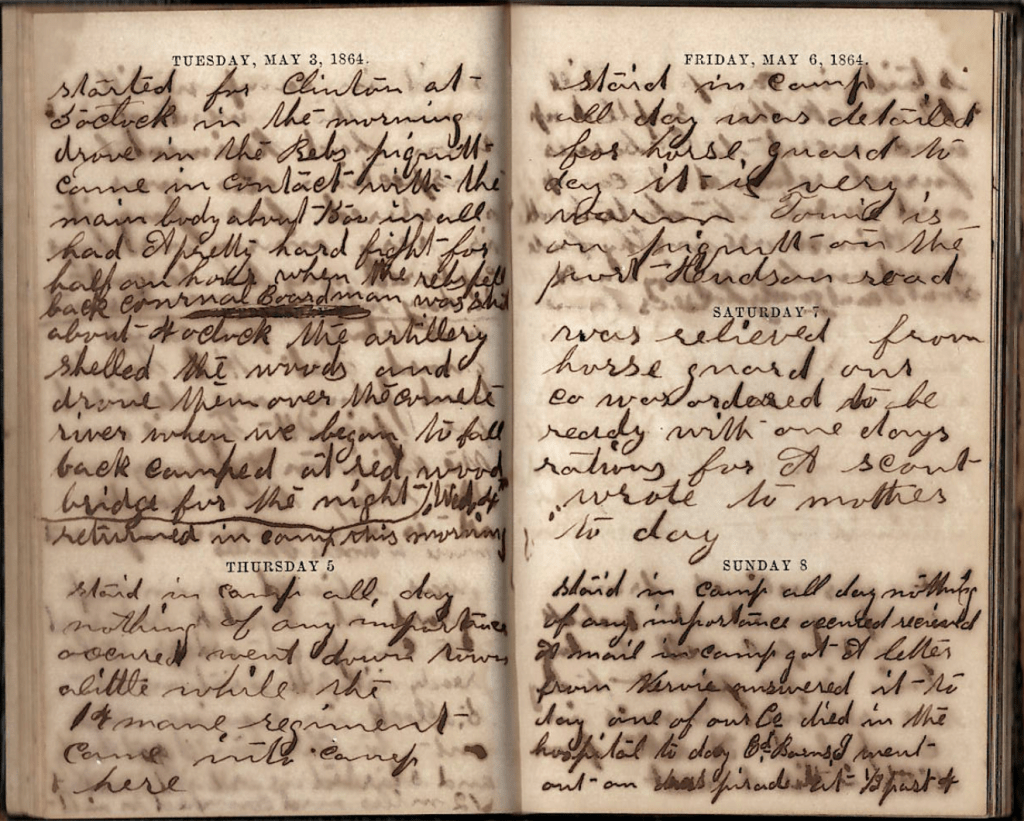
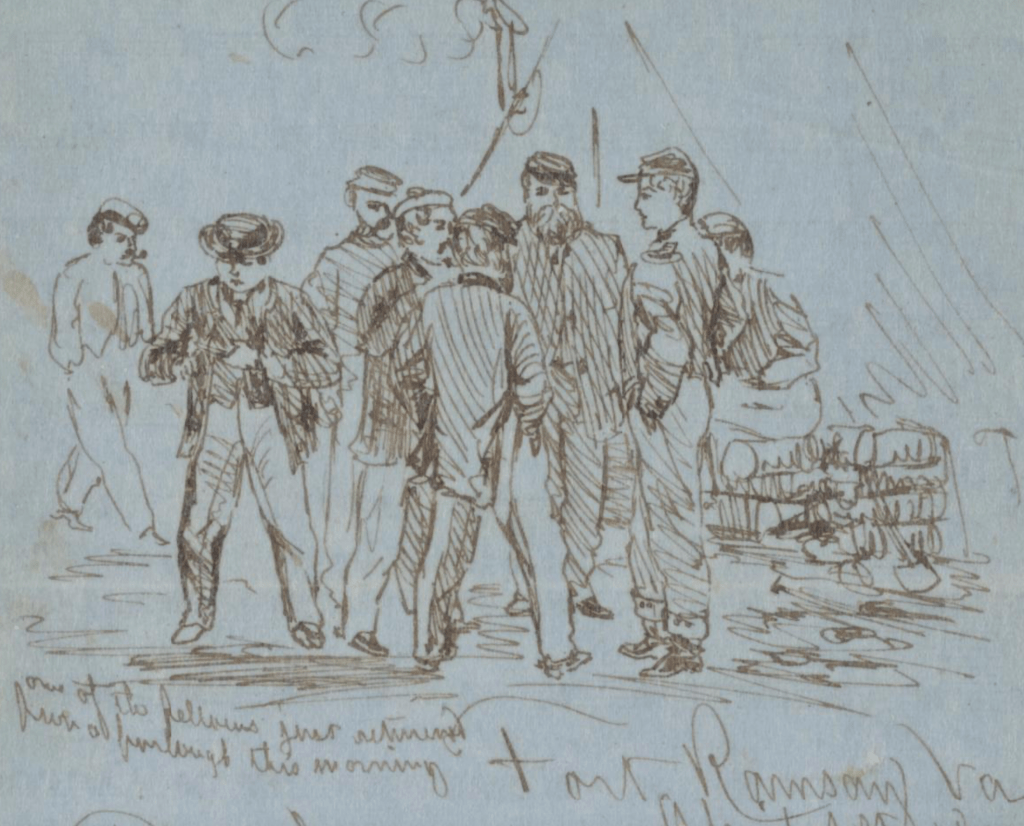

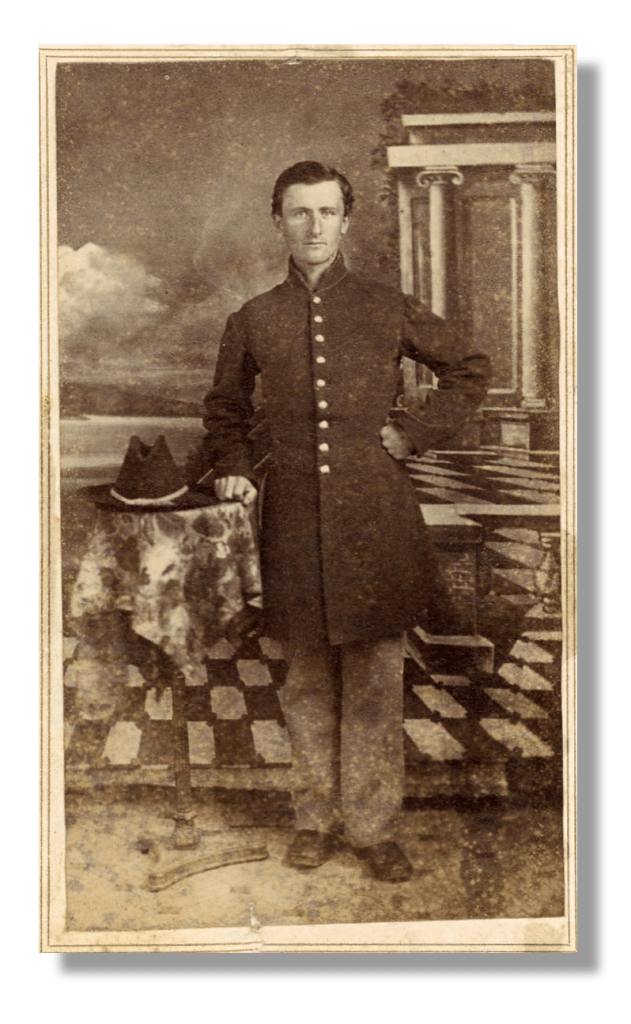
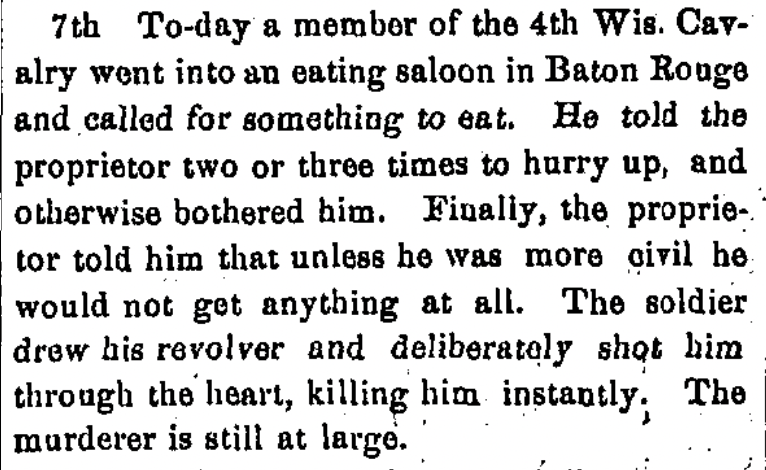


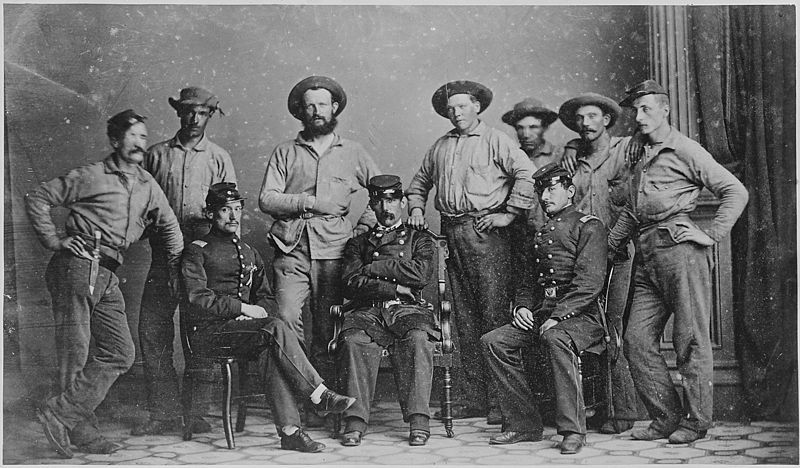
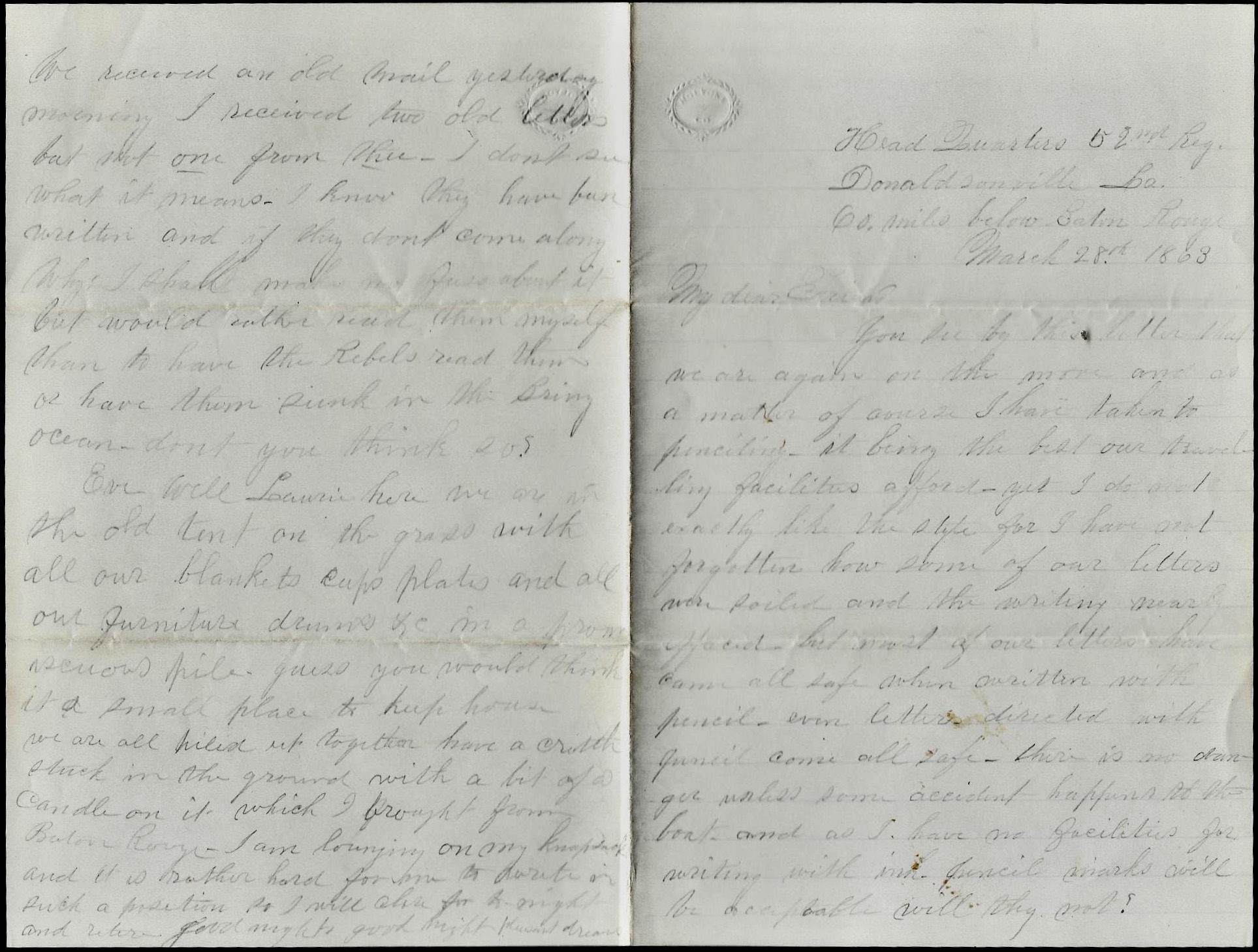

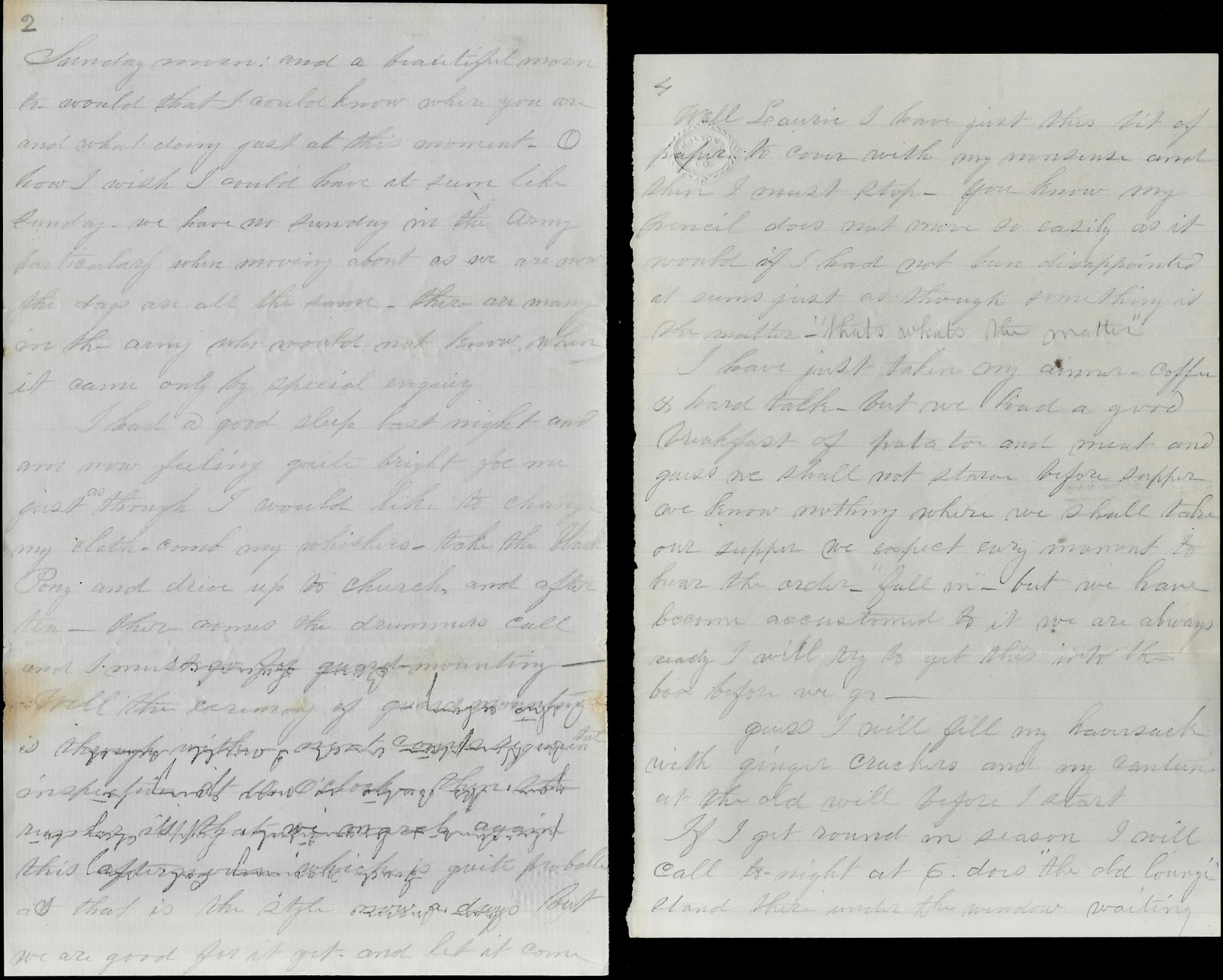
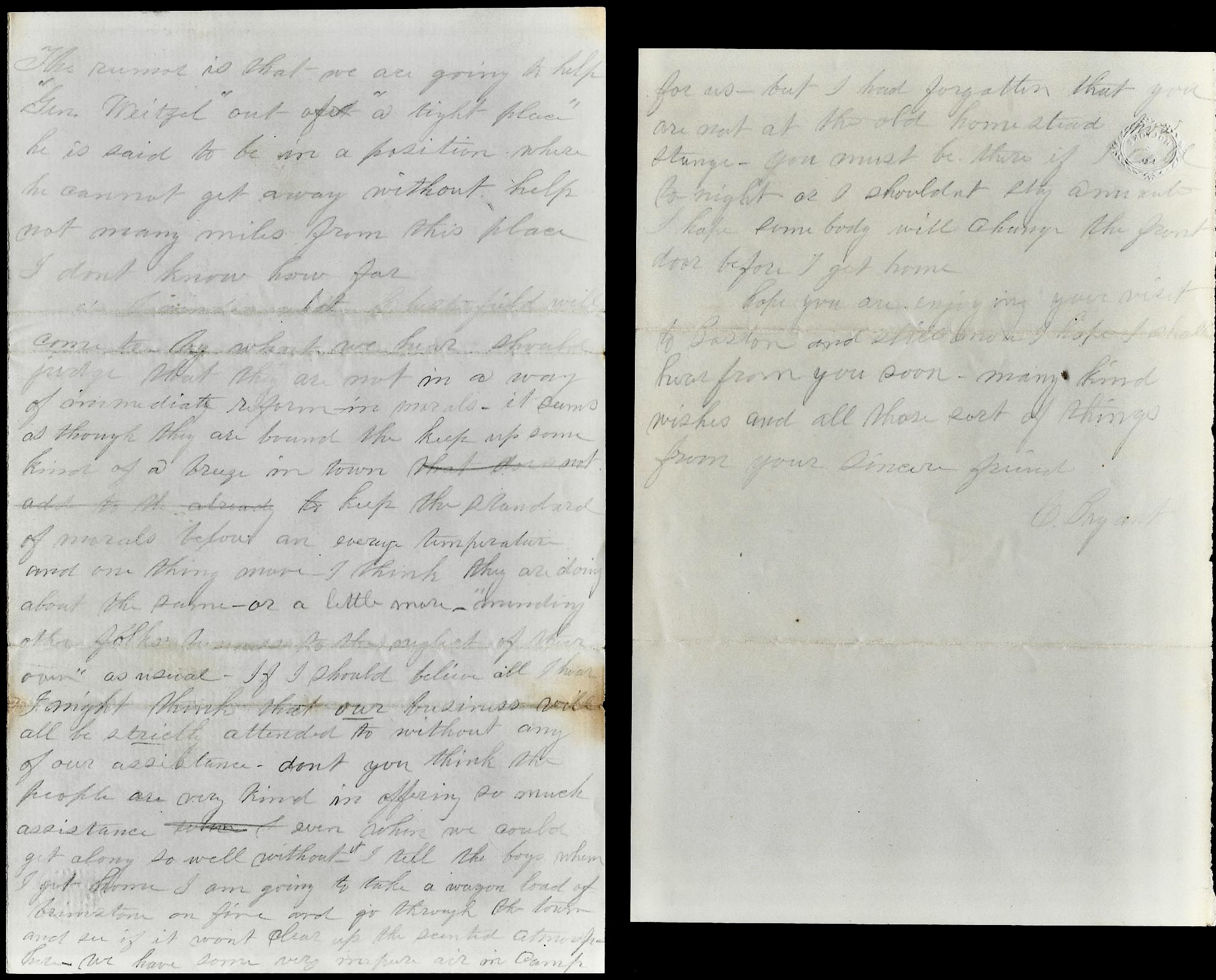
 Spared & Shared 23