The following letters were written by 18 year-old John Parker to David Wentz (1806-1882) of Parryville, Carbon county, Pennsylvania. In the 1860 US Census, John was enumerated in the Wentz household and employed as a farm hand. In the 1870 US Census, John was enumerated in the household of Harrison Wentz in Franklin, Carbon county, Pa., and employed as a school teacher. John may have been an orphan and the Wentz family may have been relatives.
There were many John Parkers who served in the Union army during the Civil War but he was the one that served in Co. H, 81st Pennsylvania Infantry—a company that was raised in Carbon county, Pennsylvania, in August 1861. The 81st Pennsylvania participated in the Battle of Gettysburg as part of the 1st Brigade, of Caldwell’s First Division, in Hancock’s II Corps. They were engaged in the pursuit of Lee’s army following his defeat at Gettysburg and would have been in the vicinity of Funkstown, Maryland, at that time.
Letter 1
Patriotic header on letter featuring lithograph of McClellan on horseback.
[Harrison’s Landing] July 5th 1862
Mr. Daniel Wentz,
Dear sir, I let you know by these few lines that I am well at present and hope these few lines will find you all in the same state of health. Your letter dated June 21st came duly to hand yesterday and was very glad for it. I read it with much pleasure but I hope you don’t pity your old sawmill dam and the bumble bees has been flying again and our regiment is cut up very bad. Britten and A[lfred] Overolester, W. Bennet is safe.
Where L. Knous is, no one knows. He is not along with the regiment anymore but he has not been in the battle either at Fair Oaks. He is a great soldier. He ran away every time. Where he is now, we don’t know. He is either lost or taken prisoner. This battle has been on Sunday and Monday our regiment has been in three battles. We retreated onward to James River but we have drove them back again. But I guess McClellan done it to coax them out of Richmond. There is thousands of thousands men fell. You can’t say that I haven’t been in war. If I will ever come home, I hope I will though the Bucktails has got cut up too very bad. But John Vogle and his Father & H. Swartz is safe too. F. Suter is hit from a piece of shell at his head but he is all right too. He won’t mind that. I have seen those men myself but I have seen some other men out of the same regiment and they have told me so.
I have sent $15 to Dennis with the Express to Parryville. If any of you want the money for your own use, why so take it and take that what I owe you for sending home my clothes. I have only got $17.75 for my pay this time. I have two months yet to come now. This is all I have to say for this time. They will put, I guess, three or four regiments together now and you want to know my Captain’s name yet. His name is [Thomas C.] Harkness but he is wounded now and gone home. I have told you in another letter already but perhaps you didn’t get it. Yours truly in hand, — John Parker
Please write soon in care of Col. John Stone, Co. H, 81st Regt. P. V., Howard Brigade, Sumner’s Corps, Washington D. C.
To be forwarded.
Letter 2
Patriotic stationery used by John Parker to write his letter in pencil, dated 11 July 1863
Funkstown, Maryland July 11th 1863
Mr. Daniel Wentz—dear sir,
I now let you know by these few lines that I received your letter on the 8th which was dated June 22nd and was glad to hear that you are all well as this leaves me. I am also well, hoping these few lines may find you enjoying the same blessing.
You have stated in your letter that Dennis & Harriet would think more of me at present than ever they did which I am glad to hear but the way he wrote in his letter, it did not seem so.
You have also stated about the rebels being in Pennsylvania which was true enough, but they are not in now at present for we have routed them out of it. They are now yet in Maryland but they would not be in here any more if they could cross the Potomac river. We have also had a battle at Gettysburg and are expecting another one here in Maryland.
I am still tending to the mail. We are at present laying at Funkstown in line of battle ready to pull the triggers at any minute and are very anxious to do it for fear the rebels will cross the river and we have to follow them again in Virginia. I have also received a letter from Harrison the same time. He has stated about me lending him some money. I will leave that to Dennis because he’s got it but for my part, he can have it if Dennis don’t use it himself. Dennis can now do as he likes. This is all I have to say for this time. — John Parker
This letter was written by Robert Guyton (1838-1915), the son of John Guyton (1810-1886) and Elizabeth Jane Hazlett (1812-1890) of McCandless, Allegheny county, Pennsylvania. Robert enlisted in Co. F, 139th Pennsylvania Infantry on 1 September 1862. He was promoted from corporal to sergeant in June 1864 and mustered out with the company in June 1865. After the war, Robert returned home, married Nancy A. Robinson (1840-1888), and resumed farming.
The Guyton Family Farm in Allegheny county, Pennsylvana
Letter 1
Camp near White Oak Church, Va. April 5th 1863
Dear Sister,
I received your kind letter of 28th of March an evening or two ago and one from Father this morning dated the 20th. I am very glad to hear that you have all got right well again. I am in very good health now and so is John Wallace and all the rest of the boys from our neighborhood. This is a very rough day here. It commenced to snow last evening about dark and last night was about as stormy a night as ever I saw but I think after this storm is past we will have good weather.
I suppose you are all busy eating eggs today. I would not care if I had a few here today. I think I could eat them without much trouble. Some of the sutlers have them at 50 cents per dozen but that does not suit us so long after the paymaster has been here.
Our Captain William W. Dyer ¹ started to Alleghany City this morning on a furlough of ten days. He will leave the carpet sack that you sent out with Charles Osborn at Sample’s Book Store on Federal Street near the depot and Father can get it someday when he is in town. I would have sent it back with Osborn when he went home but John Wallace ² was talking about getting a furlough and he wanted it to take some things home in but as has not got a furlough yet and will not for a while, I thought I would let the Captain have it as he had nothing of the kind to carry his clothes in.
Price of commodities copied from the Richmond Sentinel, 30 March 1863
Enclosed in this letter I send Father a little bit of Rebel tobacco which the [Rebels] sent across the Rappahannock river the last time our regiment was on picket. They built a kind of boat and rigged it off with sails and would send it over to our side of the river with newspapers, tobacco, and so forth, and our fellows would sed them over coffee, pork, and so on. They were very willing to trade anything they had but when the officers came along, both sides had to stop sending their boats over. Joseph Borland got a piece of tobacco that was sent over in one of their boats and he gave me this piece and I thought I would send Father a chew of the Reb tobacco. I had one of the papers that they sent over and I will give you a list of the prices of some things in Richmond as taken from the Richmond Sentinel of March 30th.
But I must stop. Your brother, — R. Guyton
¹ Capt. William W. Dyer was promoted from 1st Lt. to the command of Co. F, 139th Pennsylvania on14 January 1863. He died on 13 June 1864 from wounds received at Cold Harbor on 2 June. He is buried in Uniondale Cemetery in Allegheny City, Pa.
² John Wallace enlisted as sergeant in Co. F, 139th Pennsylvania in September 1862. He was transferred to the Veteran Reserve Corps on 10 March 1864.
Letter 2
Note: This letter was written by Corp. Guyton as the 139th Pennsylvania force-marched to Gettysburg where they arrived on the evening of the 2nd day’s fighting just as the U.S. Regulars were being driven back from the Wheatfield. After the Regulars withdrew through their line, the 139th Pennsylvania counter-charged and halted the Confederate advance on Cemetery Ridge. On July 3rd, the 139th Pennsylvania advanced after Picket’s Charge and cleared the area along the Wheatfield Road where they recovered a cannon and three caissons of the 9th Massachusetts Battery that had been lost the previous day. [See Lt. Col. William H. Moody’s report]
Camp near Fairfax Court House Monday, June 22d 1863
Dear Mother,
I received your very welcome letter of June 15th on Saturday. I was very glad to hear that Father’s arm had got well again for I was afraid that it might have been from that old hurt.
We are all right well here — that is, all the boys from our neighborhood that are here. I have not heard from John Wallace ¹ or R[obert C.]. Anderson ² since they went to Washington. Our Captain [William W. Dyer] and 2d Lieutenant [Wilson Stuart] are in the hospital there too but I think likely they will all be up to the regiment again in a few days. We have been lying here since Thursday evening but it is very doubtful how long we may stay here. I thought yesterday that [we] would have had to move as there was heavy cannonading pretty near all day in the direction of the old Bull Run Battlefield [see Battle of Upperville] but I think from the sound of the cannon that the fighting was some distance beyond Bull’s Run. It [think] it is chiefly cavalry fighting yet but it will be very apt to end in a decisive battle without the Rebs fall back. There was several thousand cavalry passed here yesterday on their way to the scene of action but I have not heard any firing this morning yet and that makes me think that our men has driven them back.
You wanted to know whether I was contented out here or not. I came to the conclusion that I might as well be contented as not when I came out here and I believe it is better for the health to be as happy and contented as possible than to be disappointed and homesick half the time. You used to tell me that I could never stay away from home for I would get homesick before a week but I think I have been about as clear of homesickness so far as any person in our company and I believe homesickness is the cause of a great deal of sickness out here. The boys will get to thinking about the good times they used to have at home and they will go on wishing they were at home till they get homesick and then it will end in a fever or some other kind of sickness. I have had very good health since I came out, I think my constitution is much stronger than it was before I came out. I know that I can stand things now without any trouble that would have killed me before I came out. But I must stop for this time.
Camp near Edward’s Ferry, Maryland June 27th 1863
Dear Mother — I commenced to write this several days ago but I had not time to finish it. We have been marching pretty near all the time. We have done some of the hardest marching the last few days that ever I saw — sometimes marching day and night. I am right well and so are the rest of the boys. We crossed the [Potomac] river today and here we are in Old Maryland. It is supposed by a great many that we are falling back to draw the Rebs as near Washington as possible. Perhaps we may move in the direction of Pennsylvania. It is hard to tell. Write as often as you can for i can get your letters when I can’t send any. Sometimes there is no mail leaves the regiment for several days but I must close as it is getting dark.
Your son, — R. Guyton
¹ Sergeant John Wallace was transferred to the Veteran Reserve Corps in March 1864.
² Corporal Robert C. Anderson was wounded at Spottsylvania Court House in May 1864.
A company of the 139th Pennsylvania
Letter 3
Note: This letter describes Sheridan’s September 1864 campaign to drive Confederates out of the Shenandoah Valley and render the area useless to the Southern cause by destroying all the crops and supplies.See Confederate General Jubal Early abandons Winchester, Virginia.
Robert’s personalized stationery—quite rare
Harrisonburg, Shenandoah Valley, Va. Sept. 20th 1864
Dear Mother,
I take this opportunity of writing a few lines to let you know that I am in good health.
I wrote home three days ago telling you of the victory that we had gained over [Jubal A.] Early’s force in the Valley at Winchester and at Strasburg. Since then we have been following them up and driving them back at every place that they attempted to make a stand. If Gen. Sheridan does not capture all of them, it cannot be said that it was because he did not follow them close enough. I never saw a closer pursuit of a retreating army since I joined the service. On Saturday they made a stand at Mount Jackson, but we soon drove them out of that and drove them so close for five or six miles that our advance was skirmishing with them all the time.
I will try and tell you how we followed them so close. First, we had a heavy line of skirmishers or rather two lines, then a line of Battle and just behind the line of Battle, there was several Batteries of Artillery, and whenever the Artillery would come to any high ground they would unlimber and fire a few shots into the Rebs, then limber up and gallop to another piece of high ground and fire a few more, then away again. And behind the first line of Battle there was eight or ten heavy columns of troops reaching as far as you could see, ready to wheel into line of Battle at a moments notice. It was as beautiful a sight as ever I saw. We followed them in that manner till dark when we halted for the night and they made such good use of the darkness that we have not seen them since.
I do not think Early’s force will make a stand in this part of the Valley unless they are reenforced as they are badly demoralized and scattered through the mountains and woods. We halted here last evening and I think from present appearances that we will hardly move from here today.
Harrisonburg is about 90 miles from Harpers Ferry and if we go much farther, I do not know how we will get up supplies. I should like to know how Gen. Grant is getting along at Petersburg but we have not had any news from there since we started from Berryville. If he should whip Gen. Lee as badly there as Early was whipped here, I think the Rebellion would soon be ended. We should be very thankful to God for the victory that he has given us here. Dunlap is not with us as he was not well enough to march when we started but I hope this Rebellion will soon be crushed out and we all can return home Goodby. Your affectionate son, — R. Guyton
Some of Robert Guyton’s personal items on display at the McCandless/Northern Allegheny Heritage & Cultural Center in November 2023.
The following letter came to me for transcription, author unknown. The sender and receiver appear to be “J. S. D.” and “E. D.” Names of soldiers mentioned in the letter were from Spalding county, Georgia, and regiments raised there included the 51st and 53rd Georgia Infantry. My hunch is the letter was written by Joel S. Duffell (1818-1866) who enlisted as a private on 4 March 1862 in Co. I, 51st Georgia. He was appointed 5th Sergeant in January 1862 and promoted to 2nd Sergeant on 1 June 1864.
Joel was born in 1819 and appears to have had a couple of different wives; he was married to his second wife, Martha Rice in 1855 in Henry county, Alabama. The letter was addressed to Liz who was undoubtedly the Elizabeth D. to whom the letter was addressed but I cannot account for her in census records. She may have been a wife, a sister, or some other relative. He does mention “Mattie” which could be a nickname for Martha. Joel’s father was no longer living in 1863 but the “Pap” might refer to his father-in-law.
At Gettysburg, the 51st and 53rd Georgia Regiments were brigaded together in Brigadier General Paul J. Semmes Brigade of Major General Lafayette McLaws Division of Longstreet’s 1st Corps. They took part in the fight on Rose Hill and on into the wheat field in support of Kershaw and Anderson late in the afternoon of July 2, 1863. On 4 July 1863 the Confederates began their retreat from Gettysburg and made their way to Hagerstown, Maryland, where this letter was scribbled in pencil on 8 July. The Confederates finally crossed the Potomac on the night of 13 July, delayed by high waters.
I write you a few lines which will inform you that I am well at this time truly hoping these lines may reach & find you all well. Dear Liz, we have come back [with]in 6 miles of Potomac River. It has been raining for 2 or 3 days. I cannot tell whether we will cross back soon or not. We had a terrible fight at Gettysburg. I would be glad if I had time to write more but I have not. I wrote some days ago but have not sent it off yet. Two letters come for me some days past but have not received them yet. I trust God will spare me to see you all again—if not in this life, to meet you all in heaven.
I am sorry that W. J. Clements 1 was killed but he is gone and many other poor fellows. Do the best you can. Kiss mother for me. Give my love to all who may inquire after me.
We have hard times now. I saw B. F. Mottes [?]. He was shocked by a [ ]. Crock Akins wounded in leg. 2 Wiley Childers not hurt. 3 J. Brown 4 not hurt. Liz, I must close. Goodbye for this time. I hope to see you again.
J. S. D. to E. D.
I saw a citizen with this ticket. I copied it and will send it to you.
Peace Ticket for the Next President’s Election
Jeff Davis of Mississippi for President Vallandingham of Ohio for Vice President All Negroes to be sent South Abe Lincoln to be sent to the Devil.
N. B. Liz, I will send you a present though it is a poor one. Yet it is the best I have. I will send it to itself though at the same time I send this letter. Liz, I will tell you something rather funny. Joe Weldon 5 says he is longing for eggs. He says if he was a woman and was in the [family way?] and longed for eggs as he does and was to have a baby, he says it would have a shell on it.
Liz, I want to hear about the draft. I expected to hear all about it in Pap’s letter but not a word. Goodbye dear Lizzy and Mattie
N. B. I started Pap a letter yesterday.
1 William J. Clements enlisted in Co. C, 13th Georgia Infantry in July 1861. He was killed two years later at Gettysburg. He was from Spalding county, Georgia.
2 Possibly Private Elisha Clay Akins (1831-1906) of Griffin, Spalding county, Georgia who enlisted on 28 April 1862 in Co. A, 53rd Georgia Infantry, and was wounded in the right leg at Gettysburg. He was taken prisoner and exchanged in September 1863.
3 Wiley Thomas Childers (1842-1921) served in Co A, 53rd Georgia Infantry. He was taken prisoner at Knoxville, TN, on 29 November 1863 and spent the remainder of the war at the Rock Island Prison in Illinois.
4 The roster of Co. A, 53rd Georgia Infantry includes a “Private J. P. Brown.”
5 Possibly J. S. Weldon (or Welden) who enlisted as a private in April 1862 to serve as a musician in Co. A, 53rd George Infantry.
The following letters were written by Joseph Litchfield Locke (1841-1899) of Co. I, 33rd Massachusetts Infantry. Joseph was the son of Rev. William Sherburne Locke (1808-1896) and Caroline Dame Tibbets (1809-1893).
Lt. Joseph Litchfield Locke, 33rd Massachusetts Infantry (R. J. Ferry Collection)
According to his obituary, appearing in The Inter Ocean of 17 July 1899, Joseph was born in Canada in 1843 and came to Chicago twenty-five years ago. He was a member of the firm J. L. Locke & Co., cap manufacturers, at No. 254 Monroe Street. During the war, Mr. Locke served as a lieutenant in the 33rd Massachusetts Volunteer Infantry, gaining his promotion from the ranks by gallantry on the field. He was a charter member of the Menoken club. A widow, two brothers, and two sisters survive him. His brothers are Judge James [William] Locke of Jacksonville, Florida, who has been on the U. S. Supreme Court bench for many years, and Eugene O[lin] Locke, clerk of the United States Supreme court [should be the US District Court of the Southern District of Florida] in the same city.”
Joseph’s military record informs us that he mustered in to the regiment as a corporal in early August 1862. He was promoted to sergeant in early March 1863, and commissioned a lieutenant in September 1864. He mustered out of the regiment on 11 June 1865 at Washington D. C.
[Note: These letters are from the private collection of R. J. Ferry and were transcribed and published on Spared & Shared by express consent.]
Log Houses occupied by the 154th New York near Stafford Court House. Sgt. Marcellus Warner Darling Memoirs. Locke’s description of the winter quarters occupied by the 33rd Massachusetts sound similar.
Camp near Stafford Court House, Va. February 20th 1862 [should be 1863]
Shoulder Straps Rank
This sheet of paper is rather dirty and soiled but soldier’s things will get so & it must go. We are in our new houses, there being 14 for the company and five in each house. Their dimensions are as follows: 12 feet long, 6 wide, walls 4 feet high. Facing the street the door and fire place occupy the whole end. Our bunks are crossing at the rear, the lower one 6 inches from the ground, upon which 3 lie, the upper one 2.5 feet above that. They are made of small poles laid across larger ones and covered with boughs. Our fireplace is built up of sticks laid up in Virginia mud and lined with ditto two or three inches thick which bakes as hard as a rock—a perfect brick in a short time.
There is one piece of good news to me and will probably interest you. My friend Jacob Aling has received an appointment to the Military Academy at West Point and received his discharge and gone home. I was sorry to have him leave but am glad for his part. He is a young man who will make his mark.
I received a letter yesterday from home saying you would get my box off before long. Yes, I have received my old stocking, a lot of postage stamps, the paper in a paper besides a number of other papers which are very agreeably received in this out of the world place. I haven’t much of anything new to write and have a number of other letters to write. I got Letta’s letter and was glad to hear from her and to see that she can write some if not in writing letters.
I write to Gene and give him a talking to when I get time. Why doesn’t he like Mr. Wheeler? I’m most afraid the fault is a good deal on his own part. Ask any questions about soldier’s life, military affairs, &c. that any of you would like to know & I’ll try to give you what information I am able on any subject.
[Shoulder straps sketch]
We were reviewed a few days ago by General Hooker, Sigel & a number of other Major Generals were present.
Letter 2
The 33rd Massachusetts Infantry, part of the XI Army Corps, arrived on the field at Gettysburg on the first day of battle. Most of the XI Corps was deployed north of Gettysburg in an attempt to hold the Rebel advance in check. However, two brigades of the Corps (von Steinwehr’s Division), which included the 33rd Massachusetts, were ordered to remain on Cemetery Hill as a reserve to support the Federal artillery being placed there. For details of their actions over the course of the battle, see 33rd Massachusetts Infantry at Gettysburg by Patrick Browne posted on Historical Disgression on 11 May 2013.
The 33rd Massachusetts Infantry monument is located at the intersection of Slocum and Wainwright Avenues near Steven’s Knoll. It was placed in 1885.
Battlefield of Gettysburg, Pa. July 3d 1863
Dear folks at home,
We are into it tough and tight. We arrived here the p.m. of the 1st. Part of our Corps was in. Our Brigade laid on a hill supporting a battery and were only shelled some. There were but two Corps in on the first against the whole number of rebs. Yesterday a.m. was mostly taken up getting positions. We shelled them some but could not draw any fire from them till about 3 p.m. when they opened on us and attacked us on the left with great force, but we held them there, held our position, and repulsed them with greater slaughter.
Just as the hardest fighting on the left, our extreme right held by the 12th Corp & our Brigade of the 11th was attacked by Ewell’s entire force, massed, and they seemed determined to force our position & turn our flank. Had they done it, it would have been all up with us but we held it handsomely & being reenforced by the 6th Corps about 6, kept our position & repulsed them & small [loss] to us as we were in good rifle pits. Our regiment has had quite a number killed and many wounded. ‘Tis uncertain how many.
I have remained with and helped the Surgeon of our regiment. We were (and are) in a stone barn a short [distance] to the rear of the regiment. Shell and shot are falling thick and fast around the barn [and] a number have struck it. 1
July 5th, 10 a.m. Since writing the last, I have been with the regiment & under some hot fire. Have probably had 50 men wounded & killed. I got a bullet through my haversack & blankets yesterday within an inch of my side. It put a hole through my tin plate & broke a “hard bread” (the boys think it must have gone swift to do that). We have whipped the rebs with great slaughter. They made [a] desperate attempt to break our lines but couldn’t do it. Our loss was light compared with them. We think they skedaddled last night. — Jose
These flowers I picked in the cemetery where some of our heaviest batteries were planted & which were used rough by them shells & which was charged by them and defended by our Corps in which was our regiment.
1 The XI Corps Hospital took over the George Spangler farm in the middle of the afternoon on 1 July 1863 and remained there through the next two days of fighting and for several days afterward. “The wounded soon began to pour in, giving us such sufficient occupation that from the 1st of July till the afternoon of the fifth, I was not absent from the hospital more than once and then but for an hour or two,” said 26-year-old Dr. Daniel G. Brinton, surgeon-in-chief, Second Division, XI Corps, U.S. Volunteers. “Very hard work it was, too, & little sleep fell to our share. Four operating tables were going night and day. Many of them were hurt in the most shocking manner by shells. My experience at Chancellorsville was nothing compared to this & and I never wish to see such another sight. For myself, I think I never was more exhausted.” A Spangler surgeon who was approaching total exhaustion called the work “too much for human endurance.”
The hospital would use almost every inch of that Pennsylvania bank barn. Dr. Brinton estimated that 500 wounded and dying men filled it. A hospital worker guessed 400. Men were crammed so closely together that they passed deadly infectious diseases such as typhoid fever to one another. Many men died of these diseases rather than the battle wound that brought them to the hospital. Pvt. Reuben Ruch, age 19 of the Easton area, 153rd Pennsylvania, said: “This barn was full of wounded men from one end to the other. Where there was room for a man you could find one. The hay mows, the feed room, the cow stable, the horse stable and loft.” The hospital grew to about 1,900 wounded on July 4-5 after the Confederates retreated and it was safe for ambulances to search on and around the battlefield for wounded men left behind. Even though the hospital served the XI Corps and its 26 regiments at Gettysburg, it hosted Confederate and Union wounded and men from more than 50 regiments altogether. Many Confederates were placed in the barn’s wagon shed to separate them from the Army of the Potomac wounded. The barn and other outbuildings quickly filled, so men were then placed in the open because not enough tents were provided after the battle.
“At the doorway I saw a huge stack of amputated arms and legs, a stack as high as my head!” said Pvt. William Southerton, age 21, 75th Ohio. “The most horrible thing I ever saw in my life! I wish I had never seen it! I sickened.” Wounded Pvt. Justus Silliman of the 17th Connecticut said, “The barn more resembled a butcher shop than any other institution. One citizen on going near it fainted away and had to be carried off.” [See Restored George Spangler Farm tells grim stories of Gettysburg dead and wounded.”]
Letter 3
Camp near Berlin Station, Virginia July 12, 1863
Dear folks at home,
We are stopping here for a day. We may stay a little longer before recrossing into Dixie. We have expelled the invader from Loyal soil! Many blame Gen. Meade for not bagging Lee’s force. Such persons are no judges of military forces or movements. Often our best officers are wronged & that shamefully by reporters who can judge nothing of the movements of an army. ‘Tis well enough to talk of cutting off the retreat of the Rebs but ‘twoud have been risking too much to have divided our forces so as to have undertaken it. We only gained the victory at Gettysburg by holding a very short line and making the most of all of our forces and acting on the defensive at that.
We are about 5 miles below Harper’s Ferrry. (I don’t know where I wrote you last but when we left Gettysburg, we marched back through Emmettsburg on over the mountains to Middleton, back to South Mountain, through to Boonsboro, on to Hagerstown, where [we] waited two days and fortified expecting another fight, but the Johnnies ran away. The morning after they retreated, our Corps marched down to Williamsport, saw that they were all well across and returned coming on here through Hagerstown, Middleton & Jefferson.
I am in very good health. Have had a horse since the fight at Gettysburg. I “picked up” a good one there (“picked up” is a very significant word in the army and accounts for the possession of anything a person may have). This one is a very good horse. I was going off to get rations up to the regiment about 3 the morning of the 4th when I came across him loose on a part of the battlefield with a good bridle and saddle on so I mounted it. I picked up a horse at [the] Beverly Ford fight but he had been used hard & gave out at Centreville so I walked to Gettysburg.
This is a splendid country, here and up into Pennsylvania. It is one continuous wheat field. It was the finest view I ever had from the mountains we crossed near Middleton. Hagerstown is the finest place we have been in on the march (I didn’t see much of Frederick) and the men, women, and young ladies & children came out in great numbers to see us pass just as you would at home to see a circus pass, in the porer parts of the city. Many exerted themselves to keep pails and tubs full of water placed where we could snatch a drink as we passed in the more worthy part of the city. The ladies waved their handkerchiefs very gracefully as we passed. The best way to serve the soldiers on a march is to have plenty of fresh cold water where they can snatch a cupful without falling behind.
I suppose you have had good accounts of the battle at Gettysburg but I can give you an idea of where our corps & regiment laid.
Locke’s Sketch of the 33rd Massachusetts’ position in Culp’s Meadow at Gettysburg
Our position, you see, was supporting the batteries near us and Battery 1 & 2 doing considerable damage. A number of Reb batteries from points 3 and 4 opened on them, bringing us under a crossfire which was very severe. The worst of our loss was sustained here.
But the mail goes in a few minutes & I must close. Send me two skeins of black silk & a few needles in your next. Also a silk pocket handkerchief. — Jose
Letter 4
Bristoe Station, Va. September 20, 1863
Dear folks at home,
We still remain at this place and probably shall for some time to come as our Corps is considerably scattered at present and we are doing duty which some one must do—viz: guard the railroad. Our Corps (what is here) now guards the railroad from Manassas Junction to the Rappahannock. One Division (the 1st) is at the siege of Charleston [and] one Brigade of our Division is in Alexandria.
I have been quite anxious lately for fear you did not receive my letter containing $50 in which I told about my box as I have not heard from you concerning it. We have received no boxes since the 10th inst. and I understand there is a lot of them now at Culpeper which will be sent here soon and probably mine is in it, if everything is right.
I got a letter from Gene a few days ago. He had not been there long but seemed to like.
We get but little news lately from anywhere but think everything is going on right. Our army has been for a long time and is now receiving great reinforcements. A great many conscripts besides over 30,000 men have lately returned from New York City who have been there from this army protecting and enforcing the law during the draft. We have received no conscripts and ’tis doubtful whether we get any for some time at least. Tis strange how a regiment will get reduced. Our regiment numbered (without the two companies which went into the 41st) 1,000 able bodied? men. We have had but few men killed in battle and we now draw rations for 461 men. Hardships pick off men faster than bullets. You may well believe that the most of the men we have now are tough.
Our regiment does a good deal of scouting now-a-days and under the direction of a boy 18 or 19 years old are quite successful. This young fellow (Doughty) came with the family when but five years old from the North somewhere so are good Union people. His father is in Richmond a prisoner. Young Doughty’s mother & sister live about 4 and a half miles from here. 1 He went as guide of a part a few days ago and alone took two cavalry Rebs prisoners and led our men to a house where there were 13 large trunks belonging to Reb officers and packed with their uniforms, &c. All of these our men opened and took everything out they wanted. There was a good deal of valuable property in them and our men came in loaded with booty.
We are having the weather very cool now and have had a long, cold storm for a few days past. Meg, postage stamps have “played out” as you may see by the envelope.
The bushwhackers are very bad and saucy around here. Not long ago they took a captain, five men and four horses—not long before they took Lieut. [Arthur C.] Parker of our regiment (he came out as Orderly Sergt. of Co. I) detailed on Gen. Meade’s staff as aide-de-camp. He visited the regiment, started off, and has not been heard from since. 2 They also took three teams out of a train of sutler’s wagons when the train was guarded by cavalry before & behind. They are very bold.
Write soon & I’ll let you know as soon as I get the box. — Jose.
1 My hunch is that the young man named Doughty was James R. Doughty (1842-1875), the son of Abraham Doughty (b. 1800) and Eunice Reynolds (180801872). This family came from New York to farm in Prince William county, Virginia, prior to 1850. After the war, James worked as a clerk in the Treasury Department for a time but in 1875 he was killed while working as a flagman on the Baltimore & Potomac Railroad when he fell under the wheels of the cars near Bowie Station.[Still need to verify his identity]
2 Arthur C. Parker was a 21 year-old student when he enlisted on 23 July 1862 as a 1st Sergeant in Co. I, 33rd Massachusetts. He was promoted to 2nd Lieutenant on 3 March 1863 and was killed by guerrillas on 16 August 1863 at Catlett’s Station, Virginia.
Letter 5
The following letter provides us with a riveting account of the 33rd Massachusetts’ participation in the Battle of Raccoon Ridge, Lookout Valley, Tennessee on 29 October 1863.
Camp near Lookout Mountain November 3rd 1863
Dear Folks at home,
Locke’s cryptic note reassuring the folks at home he was yet alive.
I wrote you a few lines the morning after the gallant charge and heavy loss of the 33rd [Massachusetts] on the 29th ult., but you of course would like to hear further particulars. I’ll tell you how we came here from Stevenson.
On October 24th, we marched back to Bridgeport, staid one night, and then marched across the river and went about five miles to Stuart’s Store where we staid till the morning of the 27th when we went on. About noon we stopped two hours at Shell Mound where is a very large cave. A small river runs out of it of splendid cool and clear water. It is as large as the one running from the Massebesic to the Merrimack at Goffs Falls. I went into it most a mile. Boats can go up the stream a good many miles.
We kept on and staid that night among the mountains and the next p.m. came in sight of Lookout Mountain, advanced, drove in the reb pickets & kept on but were soon opened on from the batteries on the mountain & they shelled us pretty sharp before we fell back. We lost Sergt. Adams of Co. F from Lowell here. He was killed on the spot. This was at “4” on the map. From here we fell back round the hills and marched on towards the river & went in camp at “10.” Here we all went to sleep quietly (excepting Companies A, B, & G which went off scouting so were not in the fight).
At 1 o’clock we were all [awakened by] firing about a mile off and soon we were turned [out] by the bugle and the regiment ordered off at double quick. The Chaplain & I followed hard after keeping close up to pick up any wounded. It was very dark—about 1:30 o’clock—and as we advanced up the hill in line of battle, there was some confusion and some of the officers thought the 73rd Ohio was partly ahead of us and when near the top of the hill, the adjutant hallowed and asked if the 73rd was ahead and the rebs cried out, “Yes! 73rd. Don’t shoot your own men!” and then gave us a terrible volley, wounding our Colonel, killing our Color Sergeant, and killing & wounding many more.
We then fell back to the road at the foot of the hill amid the shower of bullets. Here we formed anew, fixed bayonets, and steadily advanced under their heavy fire—reserving our fire till on top of the hill and then giving them the bayonet alone. This the rebs couldn’t stand but scattered like sheep and we went into their pits with such a yell as is only heard where a bayonet charge is made. We had only a part of two regiments in the charge, ours and the 73rd Ohio—not more than 500 men. But the rebs allow that they had five regiments with over 2,000 men. 1
The hill is about 200 feet high and very steep in most every place—45o—with a growth of oak and considerable underbrush. And the men went in with knapsacks & everything on & I didn’t see one thing thrown off. They didn’t know they had them on. The victory was ours but dearly won. I was at work hard all the time helping the wounded off and as it grew lighter, it was a sad sight to come across intimate friends dead and cold as they fell or just breathing their last.
Our adjutant—a young man almost idolized by every man in the regiment, two 2nd Lieutenants, and our Color Bearer all lay dead not far apart. We lost four officers killed and four wounded, 25 men killed, 56 wounded, and two missing—probably killed. None of the Normals were hurt. Our Colonel is very badly wounded but may recover.
I send you a rough map of the country as near as I could make it out. Also a rough sketch of the hill we took & Lookout Mountain beyond. By timing sound, we make it 1.75 miles from the top of Lookout [Mountain] to the top of the hill we are on. Lookout is impregnable from the front, being 1400 feet hight—very steep & a perpendicular wall or ledge all round the top.
Write soon & often. I got the letters but have not got my box but consider it safe and sure sometime. We are shelled every day from Lookout but they don’t do much damage.
1 Locke’s account squares well with Samuel H. Hurst, 73rd Ohio Infantry. “When we had approached within 2 or 3 rods of the enemy’s breastworks there opened upon us a most murderous fire from a force on our right flank, completely enfilading our line. The appearance of this force on our flank seemed to forbid our farther advance. I knew we had no support on our right, and we had not held communication with the 33rd Massachusetts at any time during the engagement. Regarding the Seventy-third as the directing battalion, I had paid no attention to our support on the left, and it was impossible for me to learn whether Col. Underwood was advancing or not, while heavy and irregular firing, with cries of “Don’t fire upon your own men,” coming from the left of our front, only increased the confusion. Under the circumstances I deemed it rash to advance farther until I knew that one, at least, of my flanks was protected. I ordered the regiment to retire a few rods, which they did in perfect order, and lay down again, while I sent Capt. Higgins to ascertain the position and movements of the 33rd Massachusetts. Learning that, though they had fallen back, they were again advancing, I was preparing to go forward also, when information came that the 33rd had turned the enemy’s flank, was gallantly charging him in his breastworks, and driving him from the left crest of the hill.”
Poem composed by S. J. Ewing of Co. F, 33rd Massachusetts. Ewing was later mortally wounded at the Battle of Resaca,. Georgia, on 15 June 1864
Letter 6
This letter describes in detail the action of the 33rd Massachusetts and other regiments in their brigade during the Battle of Peachtree Creek that took place on 20 July 1864. It was a desperate hand-to hand struggle in which both sides incurred heavy losses.
Four miles north of Atlanta, Ga. July 23rd 1864
We are still with the wagon train and have escaped one hard fight by being on duty at the rear—the first fight we have kept out of on the campaign. On the 20th inst. our Corps and one Division of the 4th Corps had a desperate open field fight. The Rebs under their new commander (Hood) made a charge on our lines intending to break them at all hazards. Our men were just forming after crossing a deep creek (Peachtree Creek). Our men were in one line of battle and had they been broken through they must have nearly all been captured but they rallied for a good position and met the Rebs with a terrible volley mowing them down and then there come a fight where every man fought on his own “hook”—loading and firing—or charging bayonets. Some used the butts of their guns ad others had it hand to hand.
A man in the 136th New York made for a color bearer—he was shot through the hand but kept on—knocked the color bearer down with the butt of his gun and brought the colors off 3 or 4 rods but was shot dead—when one of his comrades brought the colors safely off. 1
The 26th Wisconsin also captured a stand of colors 2 and 7 officers swords (from killed and wounded officers). With such fighting the rebels were repulsed with great slaughter and left their dead, wounded, and many prisoners besides in our hands. 153 dead rebels were buried where our Brigade alone fought and our Brigade only lost 147 men in killed and wounded (one-fifth of killed and wounded are generally killed—sometime more, sometimes less).
Our front lines are now two miles from Atlanta but it is hard telling how long they will hold out. Our left is already on and across the Atlanta & Augusta Railroad and it is reported that the Atlanta & Macon Railroad is cut. Gen. McPherson was killed a few days ago. It was a heavy loss to our [ ] for he was a fine General and has commanded the flanks of the army whenever a flank movement has been made. Sherman put a great deal of confidence in him.
I got my shirt today. It is very nice and suits me to a “T.” Many a thanks to Aunt Mary for making it. How is Aunt’s health now? and is she staying at home? I have received no writing paper yet and can’t think why they don’t come. But someone made a great bull in paying 84 cents on this bundle. A new postal law allows any package less than two pounds to go for 2 cents per ounze. Many shirts come from Massachusetts by mail for 12 to 15 cents apiece. But don’t send letters in it. Send them separate. Don’t put more than that or the post master must be a fool or a knave to charge on that.
1 Locke’s post-battle rendition of this incident corresponds favorably to other post-war accounts, one of which states: “The men of the 136th New York Regiment bore an honorable part in this battle, during which one of their number, Private Dennis Buckley, of Co. G, captured the battle flag of the 31st Mississippi, knocking down the Confederate color bearer with the butt of his musket and wrenching the colors from his grasp. While Buckley was waving the captured flag defiantly at the ranks of the enemy a bullet fired at him struck the flagstaff, glanced, and hit him in the forehead, killing him instantly. A year or more after the war closed the War Department gave a Medal of Honor to be delivered to the mother of Dennis Buckley, in recognition of his heroism at the battle of Peach Tree Creek and the capture by him of one of the enemy’s flags.”
2 The 26th Wisconsin has always laid claim that they captured the colors of the 33rd Mississippi at the Battle of Peachtree Creek. Certainly Locke’s post-battle account confirms that claim though he does not provide any specifics. It has become a matter of dispute through the years as to who actually captured that flag. [See The Capture of the 33rd Mississippi Infantry’s Colors on Civil War Talk, 14 October 2013.]
Letter 7
The following letter was written soon after Sherman’s Army had passed through Milledgeville, Georgia, on its March to the Sea. [See Week 31: The sack of Milledgeville, by Michael K. Shaffer in the Atlanta Journal Constitution.
[Early December 1864]
Dear Mother
A few days ago I sent a small box home by Express. It contained two books which I had on hand and a few other trinkets which I thought would [be] worth what the express would amount to for relief alone. The big knife I took from the State Arsenal at Milledgeville. It is a sample of what Georgia armed her soldiers with in the first of the war. There were hundreds of them in the Arsenal, but this one was of a superior kind—probably for an officer. The others were longer with wooden handle. The powder flask (U.S.) and wad pouch also came from there—plunder Uncle Sam + also the cap pouch, but the cavalry cartridge box (leather) I got at the Beverly Ford fight in Virginia. I took it from a captured rebel. The C.S.A. waist belt plate came from Resaca. The lead fuse of a shell was thrown at us from Atlanta by the Rebs.
The money and other papers came from the State House at Milledgeville. Of the money, keep a sheet of each kind for me and do with the other as you please—only give Fannie some of it. Preserve the Adjt. Gen. Report & the Governor’s Message. To fill up [the box], I put in some specimens of the trees &c. found here and a piece of Spanish moss. I never saw a more splendid sight in nature than a live oak tree hung full of that long trailing moss—the tree a dark green and the moss hanging down from six to ten feet long and proportionally thick and heavy. But the branch with buds on it I marked as Magnolia. It is a ge-pon’ icar (I have spelt it as pronounced) It is a splendid shrub and I have seen several in bloom now in the middle of January. We are having splendid weather, mild and comfortable.
The following two letters were written by Edgar (“Ned”) Norvell Wilcox, a native of Berkshire, Massachusetts, born in 1837. He was studying civil engineer at the University of Michigan when he enlisted as a private in the 7th OH Infantry at age 23 on June 19, 1861. He was discharged in December of 1861 and then joined the 18th US Regular Infantry on January 14, 1862. He was assigned as a private in Co. B, 3rd Battalion. In May 1862 he was promoted to sergeant of Co. H and was commissioned 2nd Lieutenant on June 11, 1863 (retroactive to February 19th). Wilcox was promoted to 1st Lieutenant on September 20, 1863. He was breveted Captain in September 1864 for Murfreesboro, Atlanta, and Jonesboro and after the war was officially promoted to Captain on January 22, 1867. He mustered out January 1, 1871 and lived in Oberlin, OH working in railroad construction.
Ned’s first letter is particularly interesting as it summarizes the casualties of the 1st and 2nd Battalions of the 18th USA Infantry at the Battle of Stones River. The 1st Battalion, Major Caldwell, went into action with 16 officers and 273 men, and on the 31st of December sustained a loss of one officer (Captain Kneass) killed; six officers (Captains Douglass, Wood and Hull, and Lieutenants McConnell, Carpenter and Adair) wounded. Twenty-seven enlisted men were killed and 109 wounded. In his official report Major Caldwell says: “All exhibited the same coolness and unflinching devotion to their country and flag that they had shown on the battle-field of Perryville, Ky.” The 2d Battalion, commanded by Major Townsend, went into action with 16 officers and 298 men and sustained a loss of one officer (Lieutenant Hitchcock) killed; five officers (Captains Dennison, Thompson and Haymond, and Lieutenants Ogden and Simons) wounded; 30 enlisted men killed, 98 wounded, 3 captured, 2 missing; aggregate loss, 139. In his official report of the battle, General Rousseau says: “The 18th Infantry were new troops to me, but I am now proud to say we know each other. If I could I would promote every officer and several non-commissioned officers and privates of the brigade of regulars for gallantry and good service in this terrific battle. The brigade was admirably and gallantly handled by Lieut.-Col. Shepherd.” [Source: US Army Center of Military History]
Ned refers to his brother, Arthur (“Art”) Tappan Wilcox (1834-1902) in both letters. Art was serving as 1st Lieutenant of Co. D, 7th Ohio Infantry at the time these letters were penned. Ned wrote the letters to his brother Lucien (“Lute”) Henry Wilcox (1830-1880) and to Charlotte (“Lottie”) Esther Wilcox (1823-1870).
[Note: These letters are from the private collection of Brent Reidenbach and were transcribed and published on Spared & Shared by express consent.]
Letter 1
Headquarters 18th Infantry USA Columbus, Ohio January 29th 1863
Dear Lute,
I have just taken a notion (not a drink) to write you a few lines before I go to work this morning and enclose to you those two letters of [brother] Art’s you sent me so long ago. I have been pretty busy for the last week making up Regimental Returns & Records after the fight at Murfreesboro. Our losses foot up as follows.
2nd Battalion, 31 killed, 103 wounded, 5 prisoners, making a total loss of 284 so you may imagine the 18th was under some fire. Since that a good many of the wounded have died. Capt. Dennison [of Co. B] who was struck in the knee with a solid shot died after having his leg amputated. Lt. Simons died with his leg shattered so badly it could not be amputated & a minié ball through his breast. Lt. McConnell—an old school mate of mine at A. A.—with a ball through his lungs. Out of one company, every sergeant (5) was killed, shot through the head, all but one, who was killed by a solid shot passing through his body—pleasant to contemplate sh!
There is no saying when we shall go to the field but most of the companies will probably march within ten days. I was very much surprised to receive a letter from Aunty Shattuc of Ann Arbor whom you probably remember. She enquired after you & wanted to know where you were, &c. and I think the best answer will be for you to enclose to her your “keards”—won’t you? Tel Lottie she also enquires after her “and her dear little ones.”
I spent last Sunday evening with Cousin Ria and had a good laugh with her & Miss Post over some old sketches of yours—“Illustrations of Reveries of a Bachelor.” I did not know you were so much of an artist before, Lute. Ria says you must be “mad” at her as you haven’t answered her last letter. I tell her I guess not—your only ma-rried. I believe I’ve nothing more to offer. Give my love to sister Zilpha & remember me to Mrs. Parish and the Captain. Write to me when you get time, &c. &c. &c. — Yours, — Wilcox, Jr.
P. S. Went down town last night to hear “Patti”—reserved seats “for two”—Oh no! guess I didn’t have a good time. I let the jibs run down & “come to” in camp at 2 o’clock this morning. 1
1 Miss Carlotti Patti gave a concert at Brainard’s Hall in Columbus. She was accompanied by the great pianist Gottscaalk.
Letter 2
Camp of the 18th Infantry USA near Cowan Station Wednesday, July 14th 1863
Dear Sister Lottie,
I only have time to write you a few lines before the mail leaves as i have but just come in from a twenty-four hours of picket duty, but take advantage of this mail reserving my letter for another time. Indeed, if I should tell you of our marches during never ending rains from the time we left Murfreesboro till we arrived here, of our bivouac’s in the rain, and its accompanying mud, without blankets, tents, or rations, of our fight on the 27th ult., of marching four and five days with nothing but hard bread and water to live on, the roads being sp heavy it was impossible to keep our supply train up, I should fill a volume.
Yours of the 7th inst. I received on the 10th or 11th, it coming through pretty quick. I suppose ere this, you know how Art [Arthur T. Wilcox] fared during the Battle of Gettysburg & wish you would let me know as I have heard nothing without a paragraph in a Pittsburgh paper which I saw this morning. Speaking of the death of Gen. Reynolds, it says “he was urging his men forward when he received his fatal wound and falling over upon Capt. Wilcox—his aide—who was riding beside him, he exclaimed, ‘Good God, Wilcox, I am killed.’ Capt. Wilcox had his horse shot under him about the same time and was severely bruised by the fall.” Was this Art or is there another Capt. Wilcox down there? 1,2
I am well and hearty. We are camped for the present near Cowan Station on the Nashville & Chattanooga Railroad about 4 miles from Decherd & think we will stay here some time though there is nothing definite.
Write and direct simply 18th US Infantry Regular Brigade, 14th Army Corps, Army of the Cumberland (to be forwarded). Love to all.
Yours in haste, — Ned
1 There are various accounts of the death of Gen. Reynolds on the first day of Gettysburg. One account claims that it was “about ten o’clock a.m. that Gen. Reynolds was shot while cheering on his men. He was on the left wing of his forces, and the ground where he fell lies somewhat to the left of the convent [Lutheran Theological Seminary], near the boundary of the town. The ball (which was from a Minie rifle) struck him in the back part of the neck and passed into the front part of the brain. He fell from his horse, considerably bruising his face. His death was almost instantaneous. He did not speak after being shot. The body was immediately conveyed to the rear, and given in charge of Sergeant Clevenger, who will convey it to the residence of the General’s mother, which is in Lancaster county, Pennsylvania, where he was born.”
2 It was Capt. William H. Willcox (1832-1929) who served as the aide-de-camp on the staff of 1st Corps Commander Major. General John F. Reynolds. A native of England whose family emigrated to the United States in his childhood, Willcox became an architect and surveyor and began his career in Brooklyn and New York. In December 1861 he joined the 95th New York Infantry as a topographical engineer, but must have demonstrated considerable talent, as he was detached to Brig. Abner Doubleday’s staff in July 1862.
This letter was written by Christiana Spangler (1828-1918) to her sister, Louisa (Spangler) Harr (1824-1882). In her letter, Christiana explains that she was deterred from coming to visit her sister by soldiers guarding the Wrightsville Bridge that spanned the Susquehanna river. The following vignette explains:
“When Confederate Brigadier General John Brown Gordon arrived on June 28 with approximately 1,800 troops, the Federals were waiting in their entrenchments. The Rebels opened up with artillery fire, and the Union position rapidly became untenable. The Federals decided to retreat to Columbia and blow up a section of the over mile-long bridge behind them, denying the Rebels access to Lancaster. The explosion failed to destroy the bridge, so the order to burn it was given. As the Confederates surged forward, the bridge erupted in flames. Gordon’s men worked for hours to extinguish the blaze. They kept Wrightsville from going up in smoke, but the bridge, financed by the First National Bank of Columbia, was destroyed. Gordon’s brigade was recalled to York the next day.“
Christiana’s letter was datelined 31st June 1863 which is clearly an error since there are only 30 days in the month. She makes no mention of the bridge having been destroyed yet but it may have been burned without her knowing of it when she wrote.
This letter is from the private collection of Jeff Hilsmeier who sent me photographs of it for transcription and publication on Spared & Shared.
Transcription
June 31st [30th] 1863
Dear Sister,
I take the pleasure this forenoon to write you a few lines to let you know that I am well at present and I hope that these few lines may find you and your family in the same state of good health and further, I will let you know that I was a going to come over home yesterday but I gave it up for this time for the people have a great excitement about the rebels that they are coming in so that they won’t let anybody over the bridge now in Columbia and they building forts above [the] city. But they can get over if they want to go to Lancaster for they are a great many hands are coming over to work in haymaking and harvesting and they never said a word to them that they can’t get over. But if one of our men wants to cross the bridge, they can’t.
And further I will let you know that me and Jacob got a letter from [your husband] Isaac and we were glad to hear of him but I expect till we hear of him again, he [will be] at home for he wrote that he expects to be in York till the 10th of July.
And further I will let you know that Jacob’s family is well and he has work enough. He is planting tobacco and seet potatoes still and I want you to let me know all the news that you know because I can’t get home. But if I live and can come about the rebels, I will come and stay a couple weeks with youans and I wish you all well till I see you again.
And so no more at present but still remain. My best respects to you and all inquiring friends and I want you to answer this letter as soon as it comes to hand. And so no more. Goodbye from me, — Christiana Spangler
The following letter was written by Louisa (Spangler) Haar (1824-1882), the wife of Isaac Haar (1818-1874) of Paradise township, York county, Pennsylvania. Louisa wrote the letter to her 46 year-old husband who was drafted in November 1862 and mustered into Co. C, 166th Pennsylvania Infantry (Drafted Militia). Isaac became ill in the winter and was hospitalized in January 1863—too ill to return to his regiment until 20 July 1863 and he was discharged a week later. Their children were named Emma (b. 1852), Annie (b. 1854), Amanda (b. 1856), and Allen (b. 1860) whose names appear at the end of the letter, though somewhat difficult to read due to the resolution of the image.
The letter was datelined 7 June 1863 but this was clearly a mistake; it should have been dated 7 July 1863—a few days after the Battle of Gettysburg which is described in the letter. In her letter, Louisa informs her husband of the passage of Gen. Early’s army through Gettysburg on the way to York, and then of the fights at Hanover and Gettysburg, followed by the heavy rains.
This letter is from the private collection of Jeff Hilsmeier who sent me photographs of it for transcription and publication on Spared & Shared.
Transcription
[Paradise Township, York county, Pennsylvania] June [July] 7th 1863
Dear husband,
Here I let you know that I and the children are all well at this present [time] and we hope that these few lines will and may find you in the same state of health. Further, I let you know that we had bad times here this week past. The rebels came through here on the [2]7th of June and went as far as York and then came back as far as Hanover on the 29th and there they had a fight and then from Hanover they went to Gettysburg and there they pound[ed] on us for about 3 days and it is said that our men killed about 35,000 rebels and took about 15,000 prisoners and it is aid that the rebels killed and wounded about 12 or 15,000 of our men.
And now the rebels are in Emmitsburg [Maryland] about 12 miles above Gettysburg and they say they are fixing for another battle and the rebels went up through Dover township and took most all the horses and through here they took a good many too but not so very much as some other places. And they keep the York fellows pretty hard. They say they made the York boys make up 25,000 dollars so as they didn’t burn down the town and they made it up more over here.
I let you know that I have a notion to cut some of our grain on the 8th, that is tomorrow, for the neighbors are still none at cutting grain and it is ripe too, but the weather ain’t good. It is raining here since last Saturday. Last Saturday evening we had an uncommon rain here. It wash the cornfields and the tobacco patches off pretty bad. It washed a couple loads of grain out of our corn field down in the lane and garden. It covered my [ ] patch most all over and if you write me a letter, direct your letter to the farmers post office that is at the [ ] for they do no business in Abbottstown—not since the rebels came in here, and I didn’t receive no letter from you since the 25th of June. That was the letter you wrote on the 21st. That was the longest day.
A little for Emma. She says that we have a good deal of blueberries but she is too lazy to pick them and Ogden says you shall come home and pick the blue berries. And now I want to know whether you are coming home pretty soon. I want you to write me and tell what time you can come about. No more at this time. Send me a letter as son as you can. No more. Yours, Louisa Haar and [names of her children].
The following letter was written by Tilman Jenkins (1840-1864), the son of David and Elizabeth (Hogans) Jenkins of Gaston county, North Carolina. Jenkins enlisted as a private in Co. C (Capt. Joseph Graham’s Battery), 1st North Carolina Artillery in the fall of 1862. They were attached to Poague’s Artillery Battalion in the summer of 1863 when Tilman scratched this message to his parents during the Battle of Gettysburg just as the artillery duel began in the afternoon of July 3rd. Tilman survived the battle but was killed instantly when he was struck in the forehead by a Union artillery round near the Mule Shoe in the Battle of Spotsylvania Court House on 12 May 1864. He was survived by his wife Margaret (Prather) Jenkins and two year-old son Nathan.
Graham’s Battery arrived on the field at Gettysburg late in the evening of the 1st day and planted their Napoleons on what is now West Confederate Avenue. They were not brought into action on the second day. On the morning of July 3rd, they opened on the Union position on Cemetery Ridge but soon ceased firing when they drew a concentrated fire on their position. They later took part in the cannonade that preceded Pickett’s charge but never used the 12 pound Howitzers which had an even shorter range than the 12 pound Napoleons (all smoothbores bronze guns). In Jenkins’ letter, however, he mentions being detailed to bring up ammunition for their “rifled cannon” which leaves one wondering what he is referring to. The answer may be found in a report by Jenkins’ captain, Arthur B. Willliams, Co. C, who wrote that Major Pogue offered them a “three-inch rifled cannon” that “had been captured during the afternoon on the left” which they could exchange for one of their inferior guns. They used it on the 3rd day of the battle but did not have much ammunition for it which might explain why Jenkin’s was detailed to the rear to get more ammunition for this gun. [See Capt. Joseph Graham’s Charlotte Artillery on Civil War Talk.]
Transcription
Gettysburg, Penna. Grahams Battery July 3, 1863
Dearest Mother and Father,
I take pencil in hand to deliver to you both my sincerest affection and to let you know that I have yet survived this horrible place. We arrived July 1st about two miles from this place and engaged the enemy who seemed to be everywhere. Gen. Longstreet arrived near two and a half in the afternoon and engaged the enemy upon a hill along our right flank on the second day. Many good men left their lives on the bloody ground including young Jacob. The sight was as terrible as could be imagined and the anguish of both men and horses was liken to drive a sane man mad. Cousin John was brought from the field without his face or legs having felt the wrath of a Yankee shell that burst next to him. Oh the horror!
Blood coats the fields and flies are all over us like the demons of Hell. I do not know how men can do to one another what they did today and ever sleep again. Last night we slept upon the rocky ground, and got no rest from the moans of those who lay dying still yet on the fields before us. The guns of the devils has now awoke as the sun is approaching half past noon. The cannon are thundering all around liken to a great storm to approach.
I am detailed to bring up ammunitions for our rifled cannon as the bronze guns have no effect on the yankee bastards. I wish them all to die in hell for what they do and to suffer forever their unjust and unholy cause. If I live through this day, I will find a way to tell you I am still alive. Pray for us, Mother, and never give up our holy cause we are dying for.
The following letter was written by Lt Andrew Jeter Leftwich (1836-1905), the son James Leftwich (1807-1882) and Elizabeth Eubank (1813-1852) of King William county, Virginia.
Andrew entered the Confederate service as 1st Sergeant of Battery G 2nd Battalion of the Virginia Artillery and was promoted to 1st Lieutenant of Co. G in the 22nd Virginia Infantry Battalion. He was taken a prisoner on 24 May 1864 at North Anna River and sent to the Old Capitol Prison in the District of Columbia where he remained until 15 June 1864 and then sent to Fort Delaware. He was not released from Fort Delaware until 17 June 1865. He was described as standing 5’8″ tall, with light hair, blue eyes and a ruddy complexion.
Andrew married Sarah (“Sallie”) Thomas Tuck (1840-1923) on 1 May 1866. He was a farmer in Mangohick district, King William County, in 1870 and 1880.
The 6th Michigan Cavalry, vanguard of Brig. Gen. Judson Kilpatrick’s cavalry division, overrun Brig. Gen. Henry Heth’s rearguard of the retreating Army of Northern Virginia at Falling Water on 14 July 1863
Transcription
Culpepper Court House July 31st 1863
Miss Sallie T. Tuck My dear friend,
Another opportunity being allowed, I will attempt to write you a few lines though I have written to King William [county] so frequently of late and have not received any letters from there since the Yankee raid through the county, I have almost despaired of getting any letters at all. I have come to the conclusion that none of my letters go to King William and I will write a very few more letters before I shall give it up as a bad job and cease writing until I get letters from there. because it is no use for me to write and then my letters not go where they are sent.
Your letter of the 26th of June was the last that I received and that came to hand a few days since (out of date, you may say). Notwithstanding it being of such a remote date, it gave me a great deal of pleasure though one portion of it gave me pain—that part in which you said I had broken my promise in regard to drinking intoxicating liquors and by that act I had caused you to break your promise in regard to dancing. Sallie, if I had known that my example was going to make you do wrong, I never would have broken my promise though I did not break it on account of a beverage but because I thought that it was good for my health as I think I have told you previously, it grieves me much to know that my examples (which ought to be that of a christian) is so much christian-like as to lead others far away from their Maker and from the path of rectitude. May the Lord help me in future to be more circumspect in my words & actions so that instead of leading anyone astray that I may be able by my words and actions to lead many into the fold of God. I see everyday that I live more and more to convince me of the fact that life is but a bubble which is liable to disappear at any moment and that all of the time that is allowed us here on earth is scarcely time enough to prepare for the next.
God has been more merciful to me than I could have any reason to expect (of late) during the recent battles in which I have been. One man was shot in my front, shielding me from the ball, and a few days ago not far from this place in a skirmish, on man was killed about three feet in front of me, being shot with two balls. He was so near that he bloodied me up when he fell back (there were four of us together). The other two, one was wounded, the other a part of his gun stock was shot off. I have been on a skirmish [line] most of the time in these battles and I think at [least] 100 balls have been shot at me alone and not one has ever touched me. Don’t you think that I have a great reason to be thankful to God for His mercy toward me in preserving my unprofitable life while he has taken those from my right and left?
You said that you had left out in your previous letter what you intended putting in the one of the 26th inst. and you left it out in that for the want of space or the lateness of the hour. Don’t leave it out in your next as you have raised my curiosity now and you thought I have my full portion of that.
I am now left alone in command of the company (I expect that is what makes me so low spirited). I told you in my last letter that Capt. [Alexander F.] Haynes, Lt. [Thomas C.] Jeter & [James E.] Johnson, were taken prisoners at Falling Waters by Yankee cavalry. May the Lord deliver me from Yankee cavalry in future—especially when I have marched all night in the mud and rain. I hope that you have a good time of it at the singing school. I want you to learn me some new Sunday School hymns when I come home (if it should ever be my privilege to do so again).
I complained in the first part of my letter about not getting letters from King William. I don’t attach any of the blame to any of my correspondents—not in the least, but to the mail. You spoke of R. Garnett’s writing to me. I wish you would tell him for me that I have not received his letter yet and that he must write again as I am very anxious to get a letter from him. Write to me soon and let me hear what they did in that part of King William and whether you caught the Yankee officer that you used to speak of in the way of jesting. You must excuse the tone in which this letter is written for I am in no humor for jesting at this time on account of our recent reverses.
Excuse all mistakes of every kind as I have not read this letter over to correct the errors. Give my best regards to Miss Sue, Lou & Charles. I must close this uninteresting letter. Believe me ever your sincere friend, &c. — And. J.
P. S. Direct your letter to Walker’s Brigade, Heth Division
Andrew Jeter LeftwichSallie Thomas Tuck
Post war images of Andrew and Sallie were provided by Jennifer Melton, a descendant of the couple.
Isabella and her brother Hamill holding one of his daughters, Africa
The following letter was written by Isabella (“Bella”) A. Nassau (1829-1906), the daughter of Rev. Charles William Nassau (1804-1878) and Hannah McClintock Hamill (1807-1878) of Philadelphia, Pennsylvania. Bella wrote the letter to her younger brother, Rev. Robert Hamill Nassau (1835-1921), an American presbyterian missionary who spent forty years in Africa. Bella eventually joined her brother as a missionary in Africa.
Born in Newtown Square, Pennsylvania, Nassau was an ordained minister and a medical doctor. Appointed in 1861 to Presbyterian mission on Corisco Island off the coast of present day at Equatorial Guinea, he and his wife, Mary Cloyd Latta served there and at Benita until her death on Corisco in 1870. They had three sons William Latta, George Paull and Charles Francis His second wife was Mary Brunette Foster (died 1884), with whom he had a daughter Mary Brunette Foster.
Transcription
Home July 28, 1863
My dear, dear Hamill & Mary,
You would be surprised to hear how naturally & familiarly these two names are linked to our home circle. Your letter dated May 25th was received July 24th. It found us all well, though at this sitting our sweet Tillie is slightly indisposed; a bilious attack incident to the season; she will be well in a few days we expect.
Today I have been in Trenton with sister, Charlie, & Mrs. Gasman. The chief object of their going was to see Mr. Gasman [ ] so they were passing down to Bridgton in company with Mr. John Gasman who still enjoys his celibacy; in a few weeks they hope to visit Mr. Gasman & see their little “Jennie;” who is a little fair thing, a gentle little girl 7 months old.
But I must condense more in my letter, I presume, and we will go back to your letter received in June, dated April 17th. As is often the case (this month is no exception), your letter came the day after ours to you was mailed. You are indeed a kind dear brother to give so much of your time to writing to me—always so much gratified and interested; but does it task you too much? Surely there has meaning in the advice that your friend Mr. Pierce gave you on the subject; Still I do not believe it is anything but recreation for you; to write these interesting letters to home friends. Month after month we go treading with you over the house and grounds & the last letter with the accompanying diagram makes it so, all so vivid. There is one part of your good kind letter that I anticipated & almost dreaded; you would send me a welcome to the missionary house perhaps thinking me on my way thither; while stranger to tell, it seems I may not go. I cannot give up hope as I intimated in my last letter; the Board have no opportunities of sending such as me now, even if I were ready to go. So I fondly hope that Pa’s judgment on my health may accord with the physician’s and I be pronounced able to go when an opportunity offers of going.
My health is so good generally that I had not thought it needful to ask medical advise on that subject relative to my going; but as Pa especially is more & more decided that I could not bear a life in Africa, it seems my duty to forbear any further preparations. Sister Mary need not fear that I would allow myself to be long detained in making preparations; I had commenced doing so & Mrs. Ogden kindly gave me the benefit of her experience, and many thanks to you, my dear Brother, for your letter of advice on the subject of “what to bring.” I felt sadly the need of some advice on the subject & may yet avail myself of it.
We feel sadly to think how few is your number now. Now while the [ ] is growing in interest & the blessed cause is expanding. Oh! my heart is deeply moved at the fear & doubts & misgivings of many of God’s people. Who see signs of decline in the work of missions; I wish I had tongue or pen that could convince them of the truth, & [ ] them in their work. I cannot, ought not be silent.
My own dear Brother, how kind in you to collect so many interesting & beautiful shells & preparations for us! It has been a task of so much pleasure to unpack, to cleanse and arrange on our cabinets the various articles; the arrangement is not yet completed. We have his cabinet in the Reading room off from the back parlor. It is light colored, uniform, with the bookcases of the Sapphie Union & looks very nicely. I must acknowledge that the shells & [ ] are more interesting than the Iguanas to look at. Still we prize the “Lizards.” How perfectly beautiful some of the shells are! And so many of them! We were thankful that they all carried so well. Sister Lusie says that some of these articles were broken; nothing in our box or barrel was broken though the bottle of Pitanga did leak out and cause the writing on this paper to become somewhat illegible & we cannot tell for whom it was intended though the name & that of Mrs. McQueens, who preserved them, are legible. We think ourselves quite fortunate that things carried so well. We have not eaten many of the preserves yet.
Your memoranda of articles for household also must be noticed next, I am glad to do anything of the kind for you; and on the 20th of this month we (. e.) Letitia, Mrs. Gasman, & I went to the City & made our purchases. I must particularize. [list of purchases follows]
I think you were will not fail to like the “Monitor,” it is called; resembling the “Eagle” pattern which the man remembered perfectly, having sent it rather packed for Mrs. Mackey. He said he had so many things for them. Amongst them a photograph of a young gentleman who was in the army; it must have been Mary’s brother. We have had the store packed & sent to New York yet, as it is not desirable to have it lying so long, & Mr. Rankin promises to take it in time. We could go to the City in the early line, and the box could be packed & sent on in the evening. We will try to think of everything belonging to a store which you would deem desirable.
Sister Mrs. Wells has left in our care to be packed two chairs of the camp that fold up very conveniently. Mrs. Gasman an arm chair; also camp style. We have the [ ] which you ordered some time ago, but which there has been no opportunity to send. Will enclose it with other valuables in the box…
There has been some dark days as well as cheering news in regard to our country since I wrote. Little had we ever thought that Gettysburg would become the marked town that History will make it. The demand for hospital supplies was so very great & so immediate after the battle that many places furnished boxes within a few hours notice. One day the High School made up two and Letitia & ourselves one large box which was presented to Baltimore, whither the sick & wounded of Gettysburg were carried. The Monday following the Battle of Gettysburg was a dark day in the history of Philadelphia & adjoining towns. People yielded to fear, but an Almighty hand was outstretched for our relief & now we see more clearly than ever through the [ ] clouds; see that God is moving in His own mysterious way.
I suppose you will see in papers the death of our friend Dr. Tremans during this month. Do you remember Mrs. Sampson, Lydia Green, the doctor’s daughter? She died very unexpectedly while in Washington, leaving one child. Tillie Green is failing rapidly. All her friends see it but she will not permit any remarks to be made on the subject. It is very sad…
From your sister Bella
Pray for me dear ones! that I may know & do the will of God! I know He is guiding me.

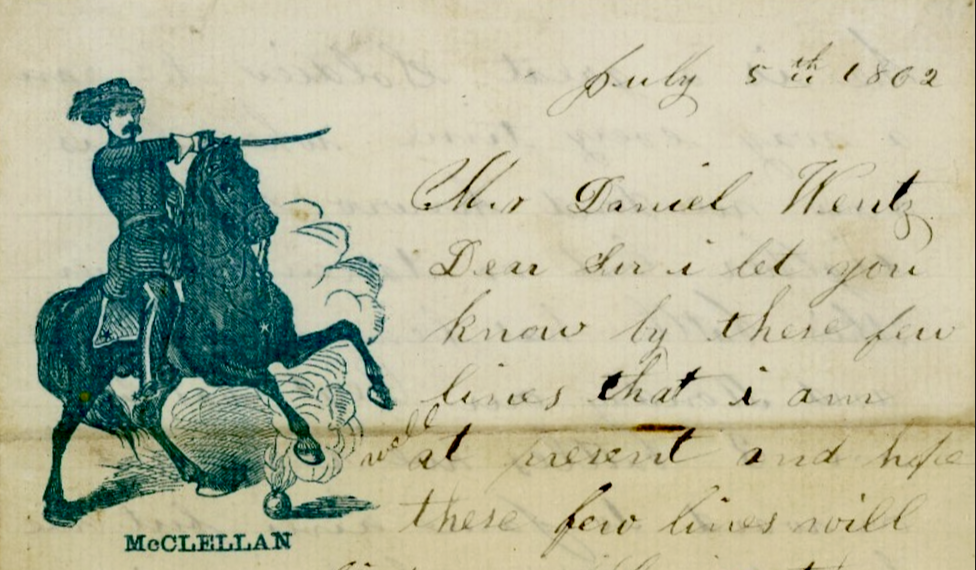

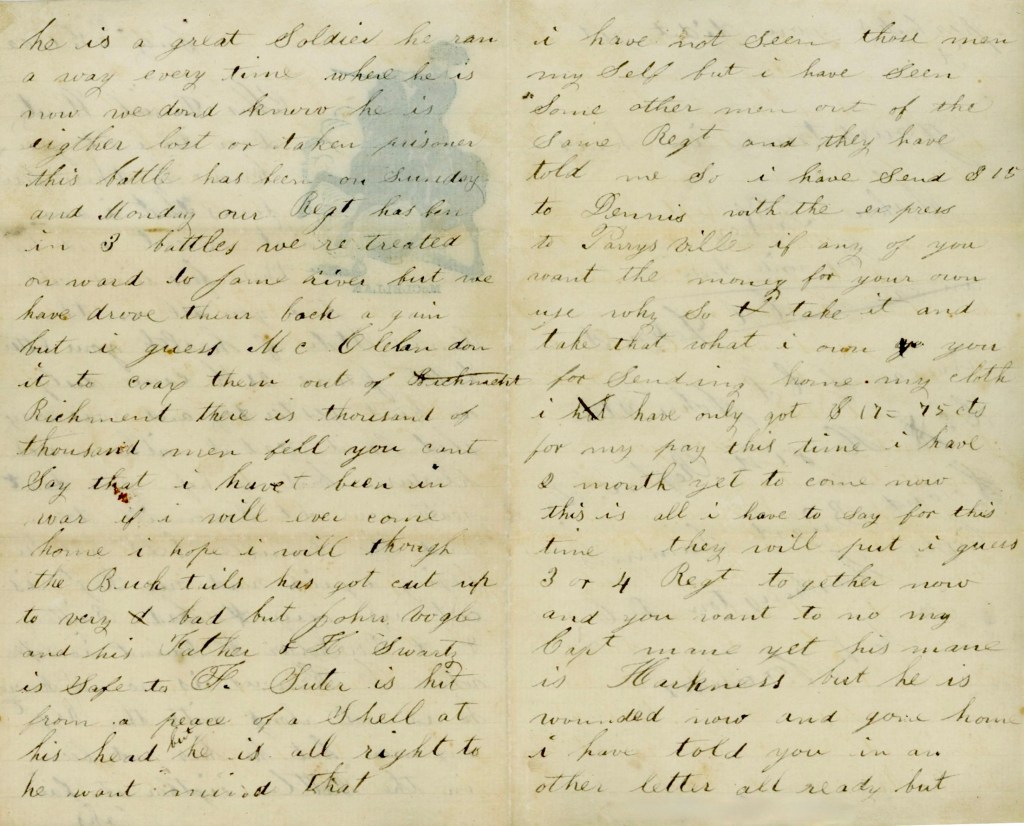


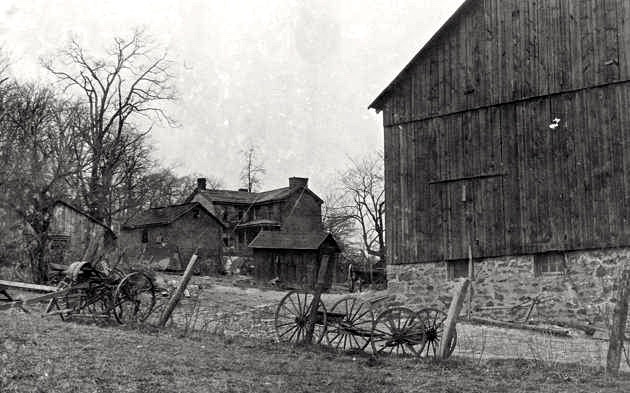
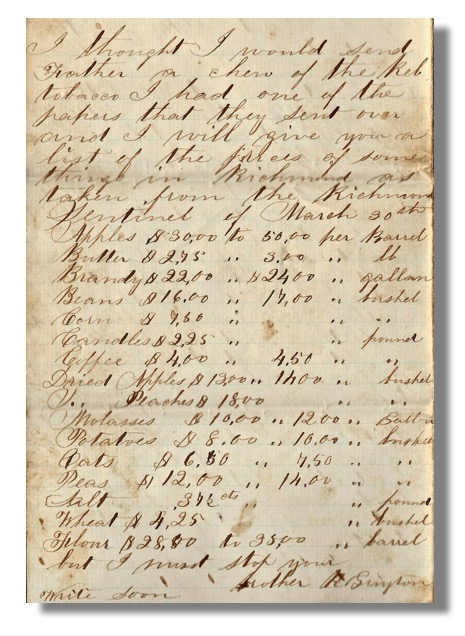

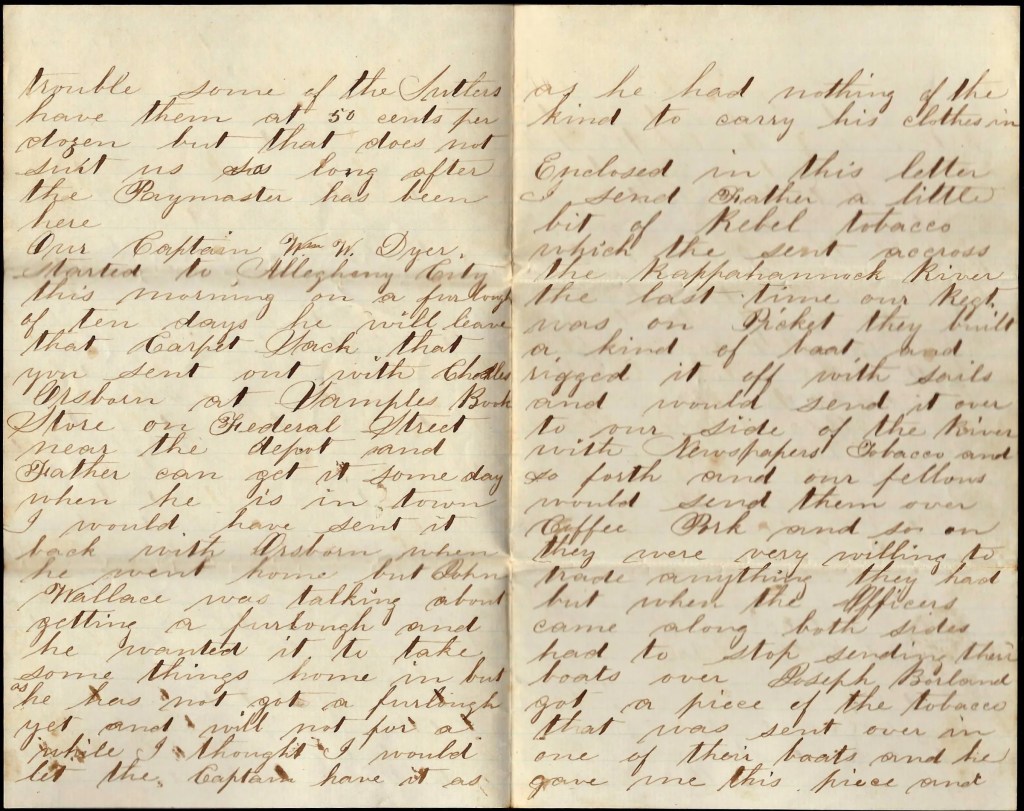
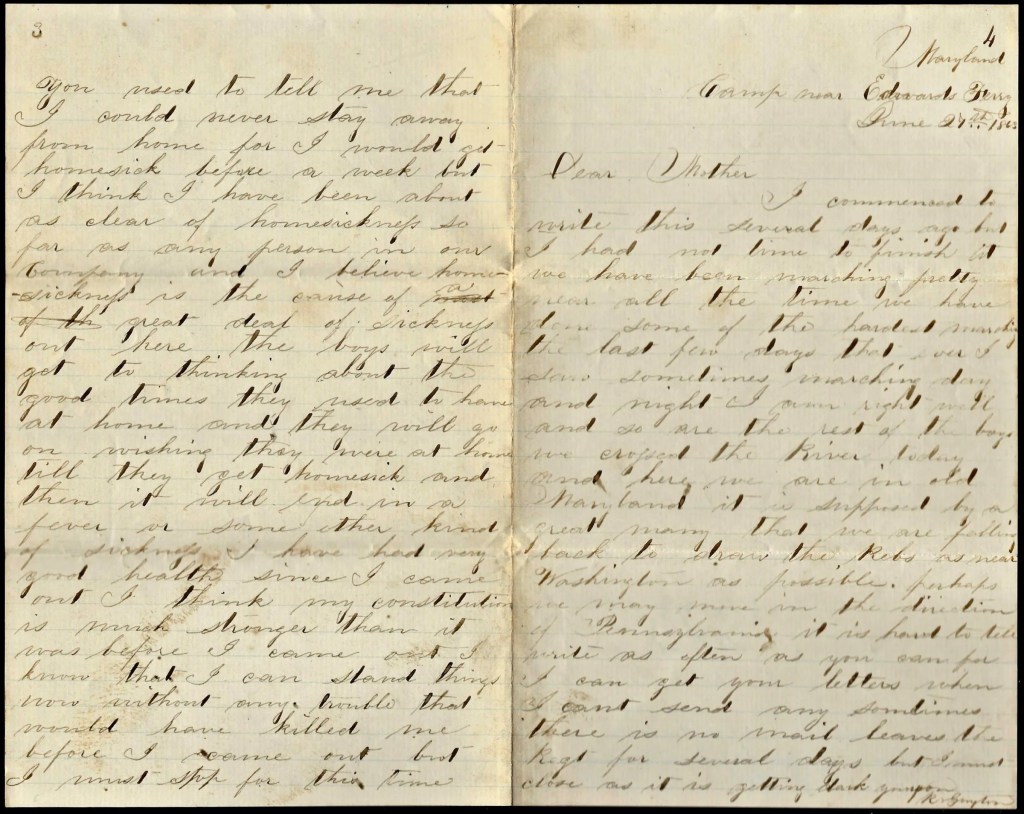

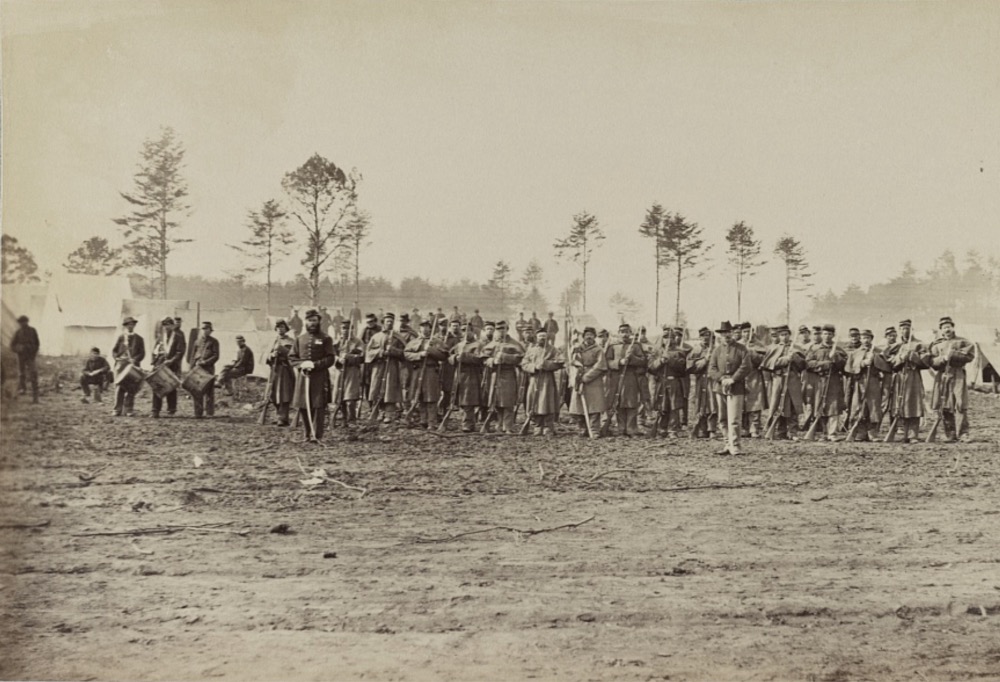
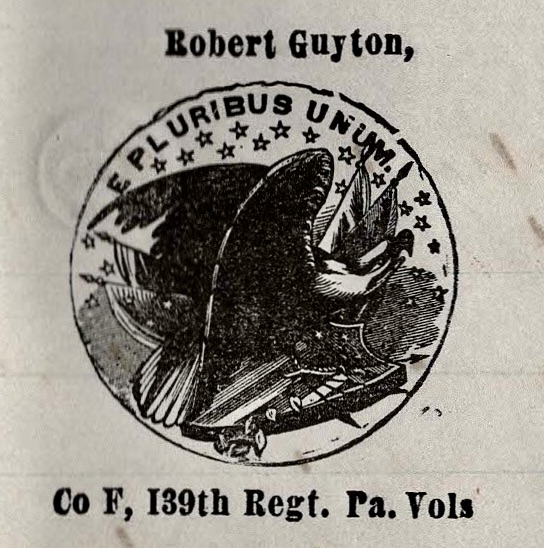
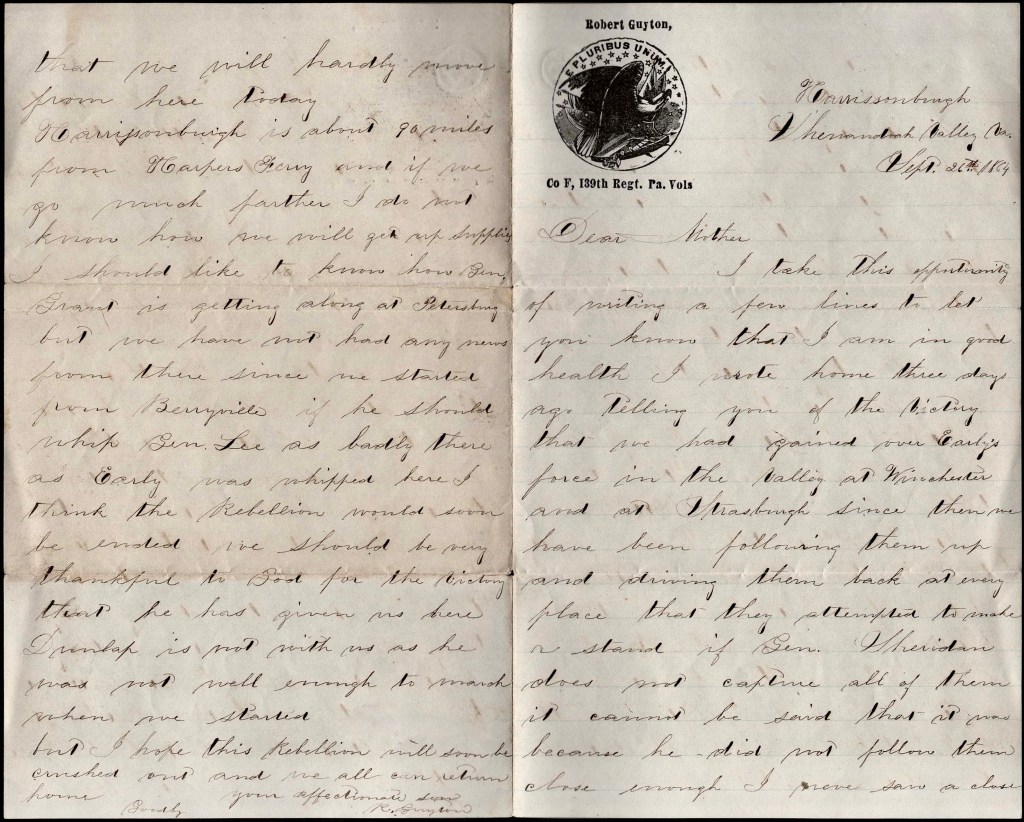


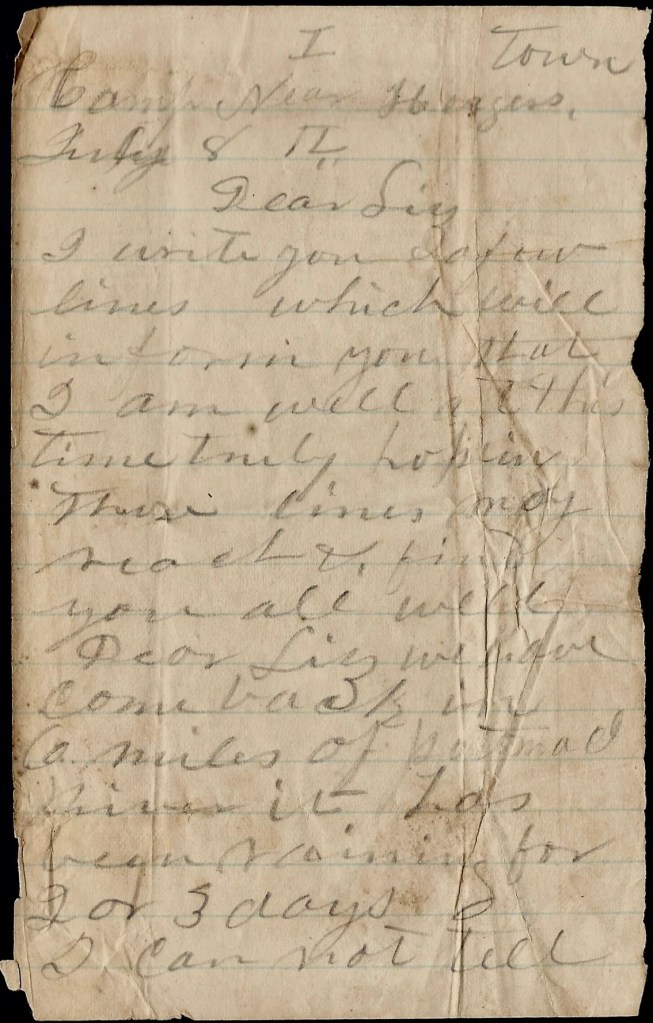

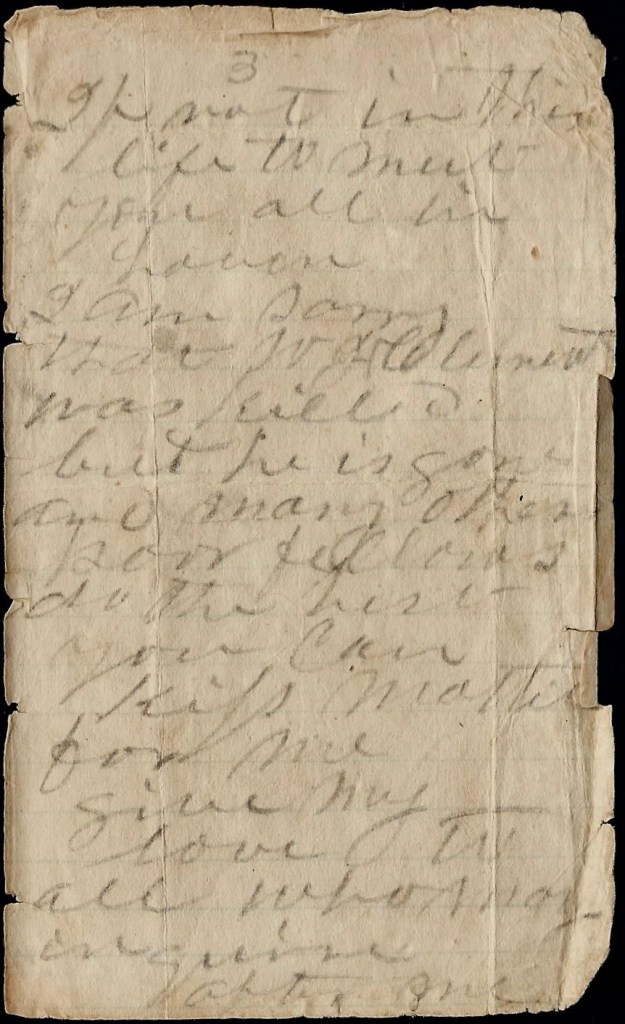

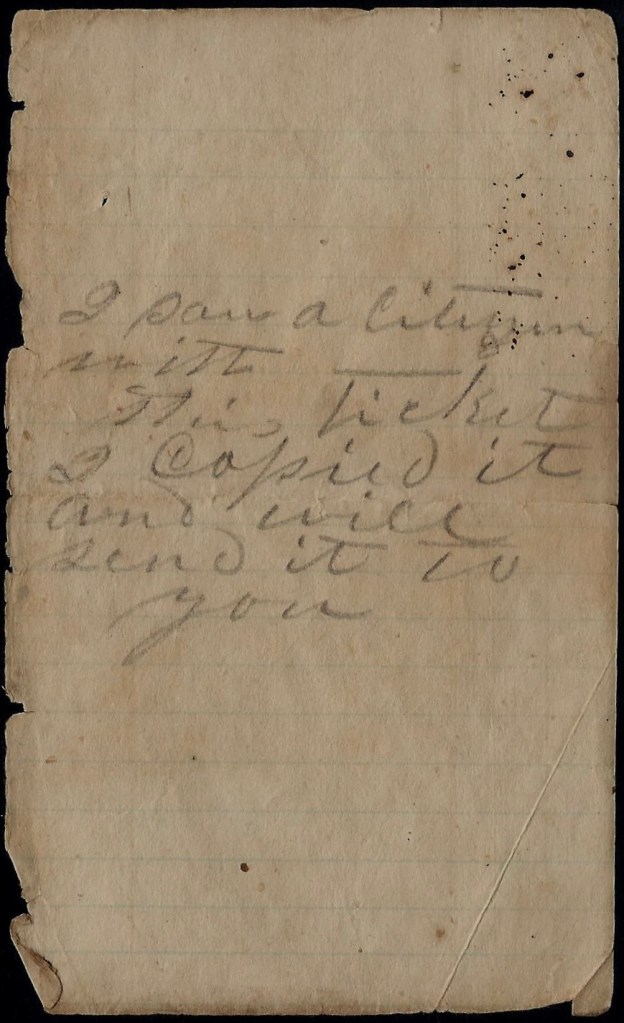

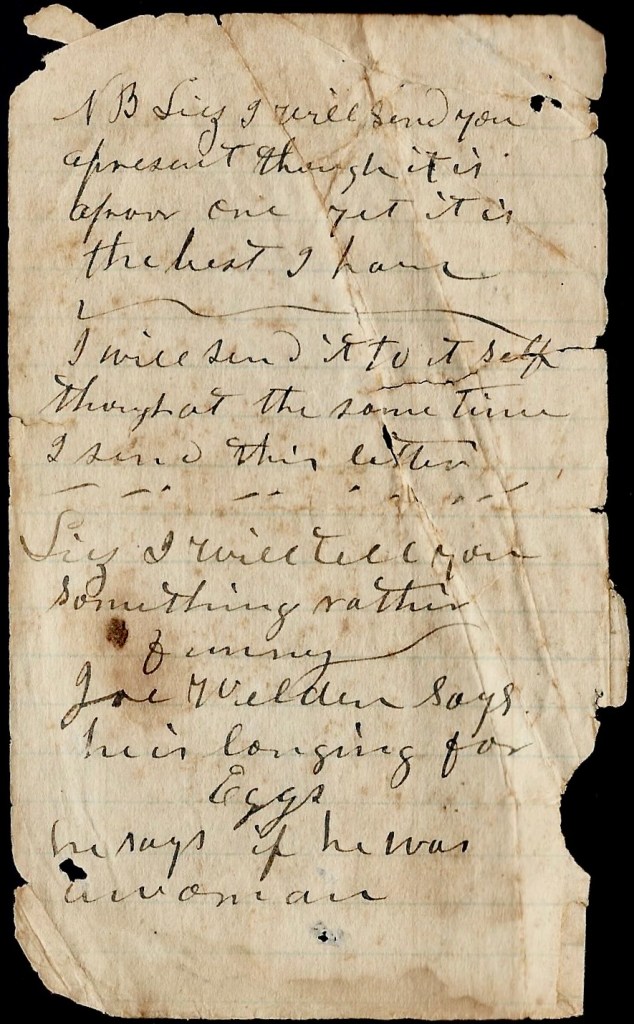
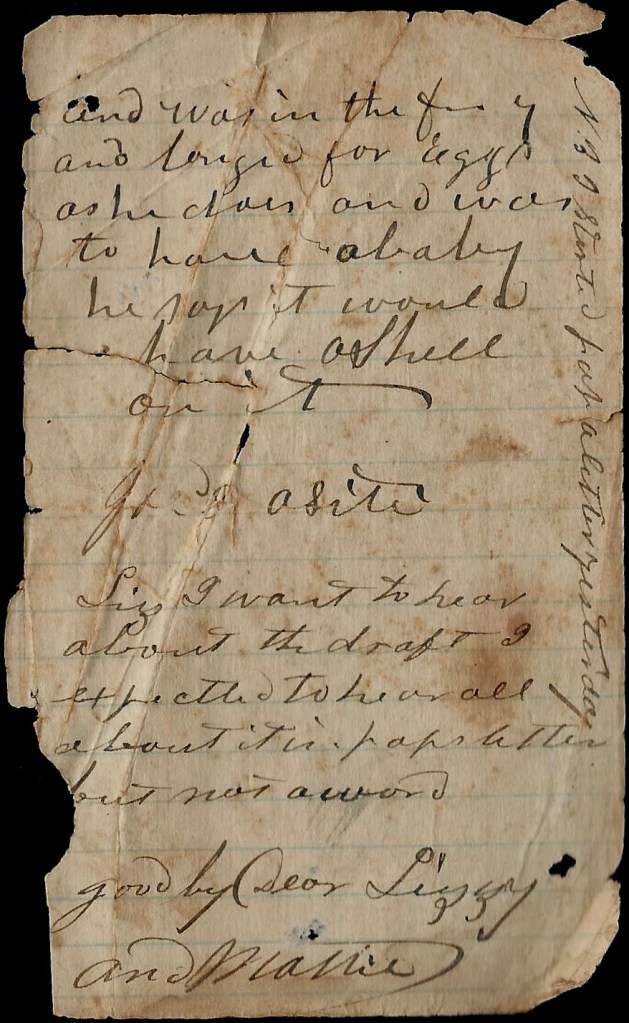


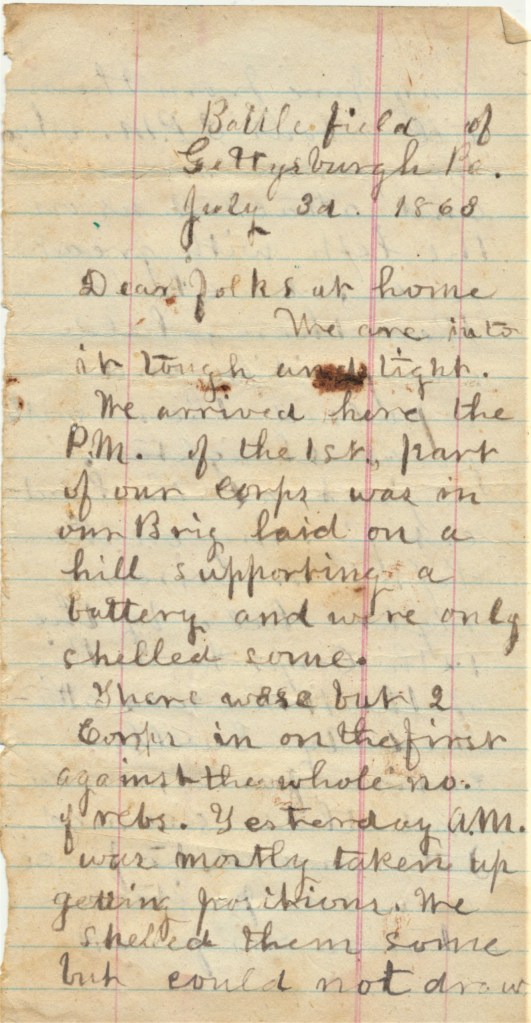


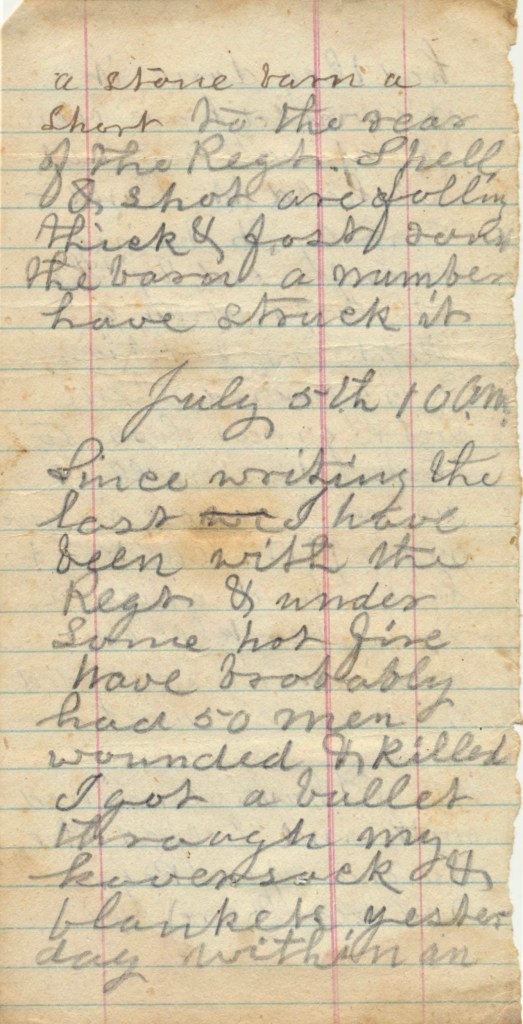


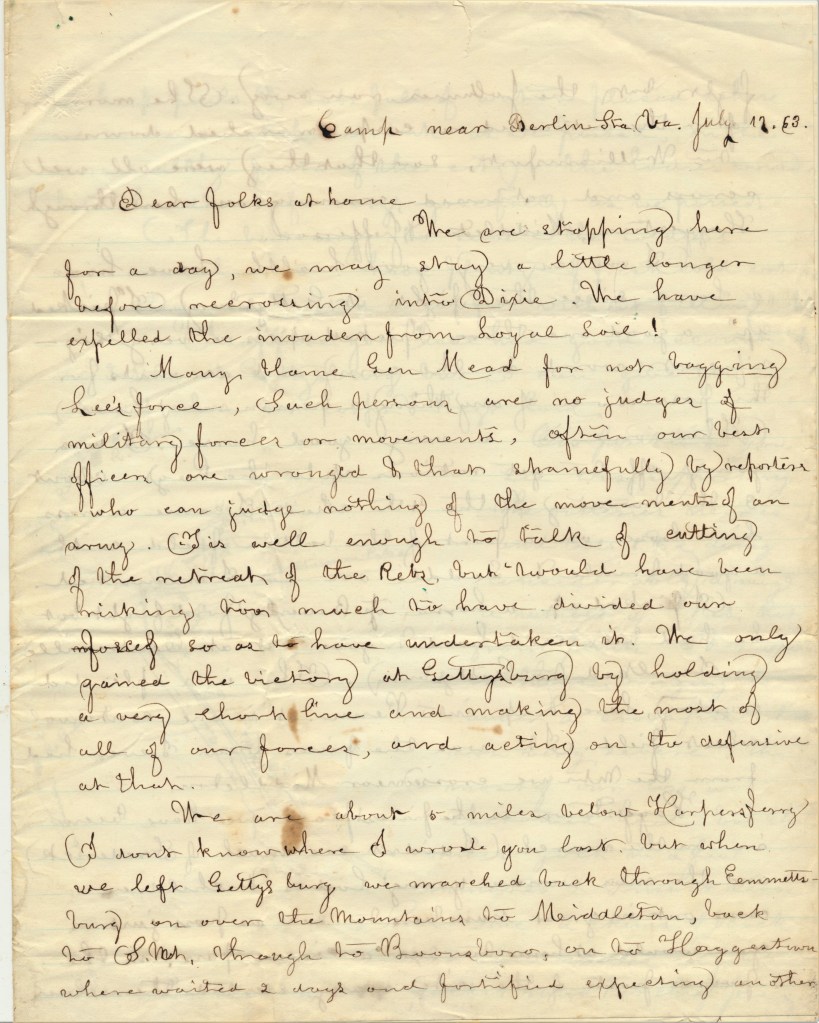

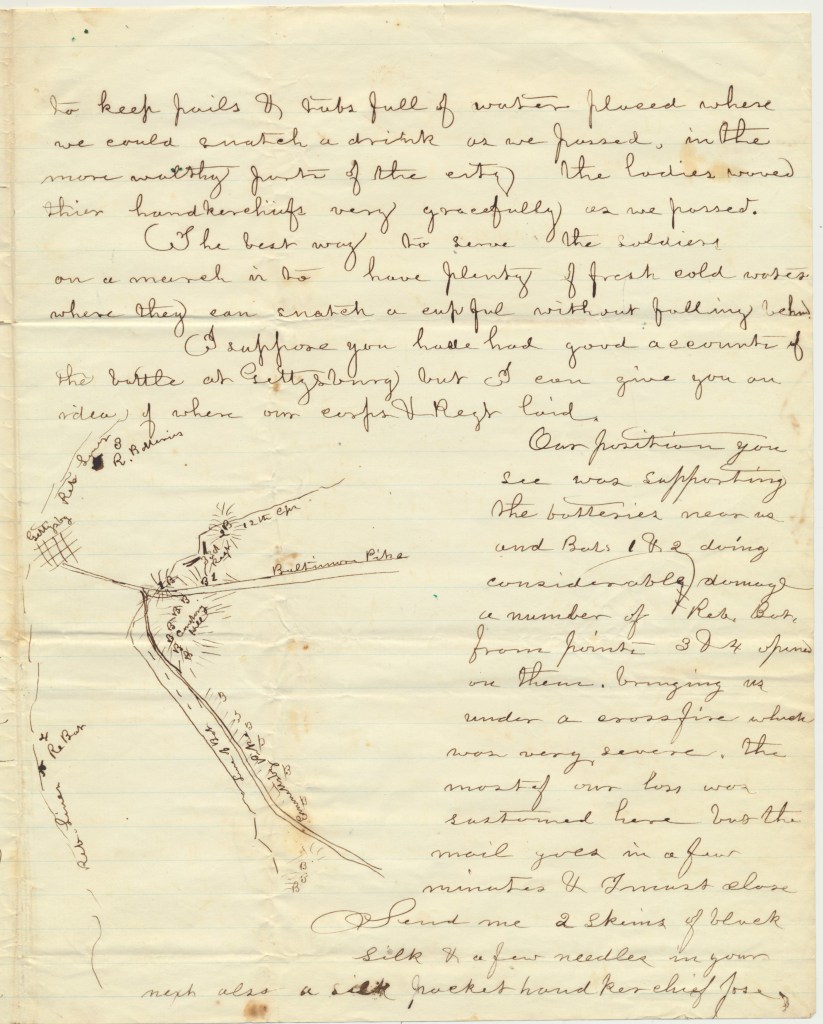


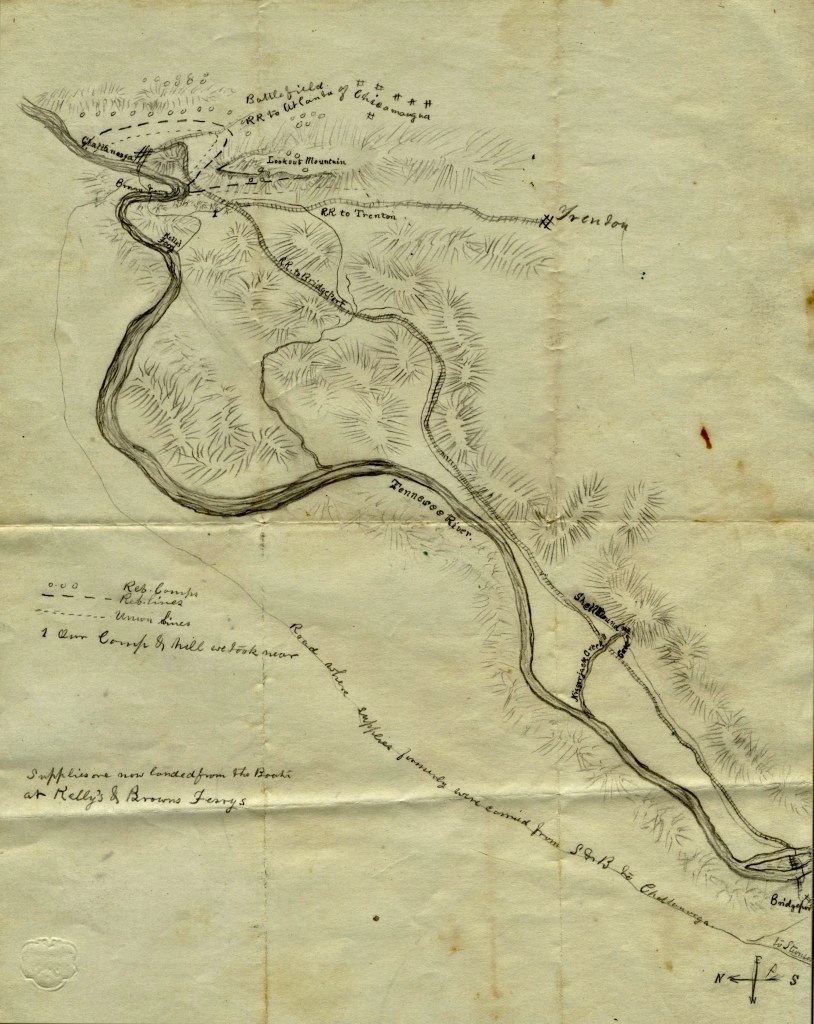
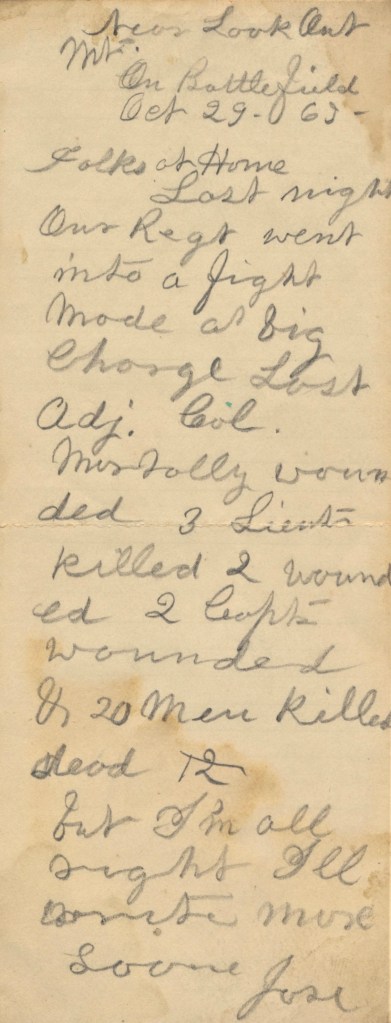


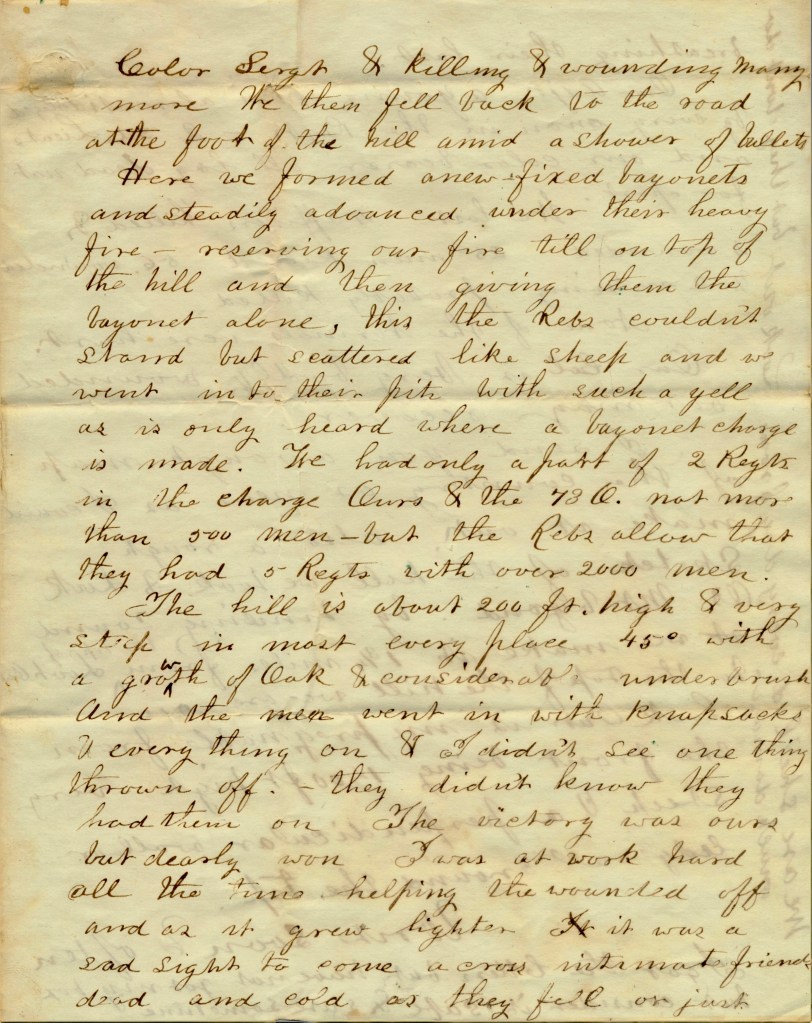

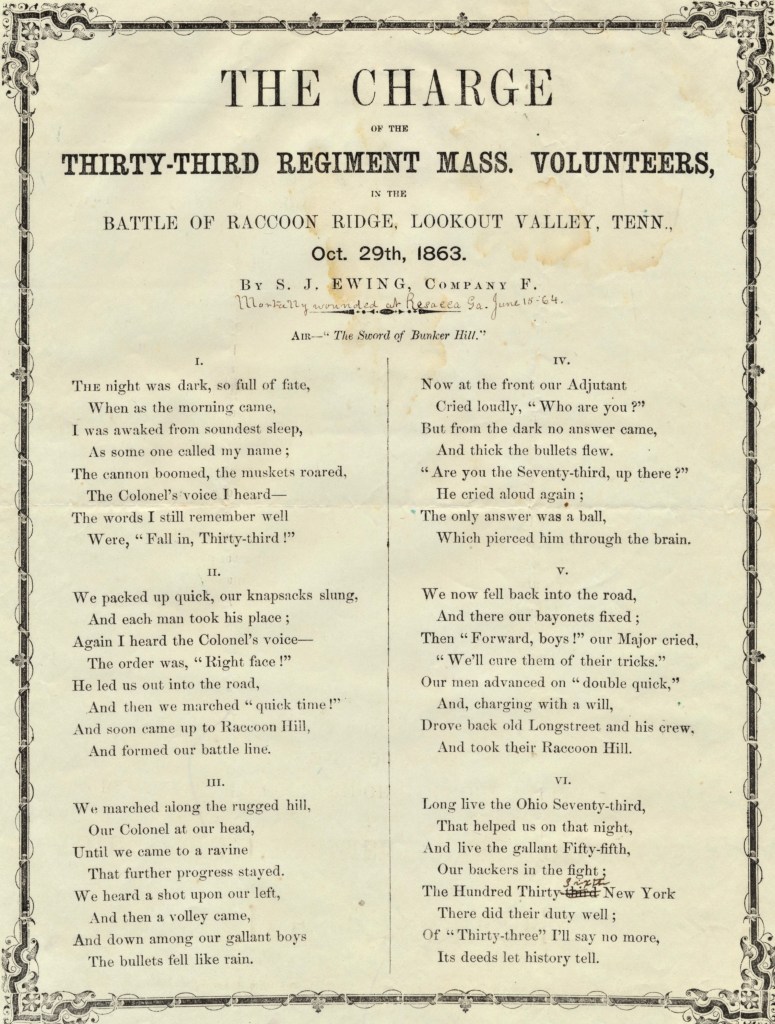
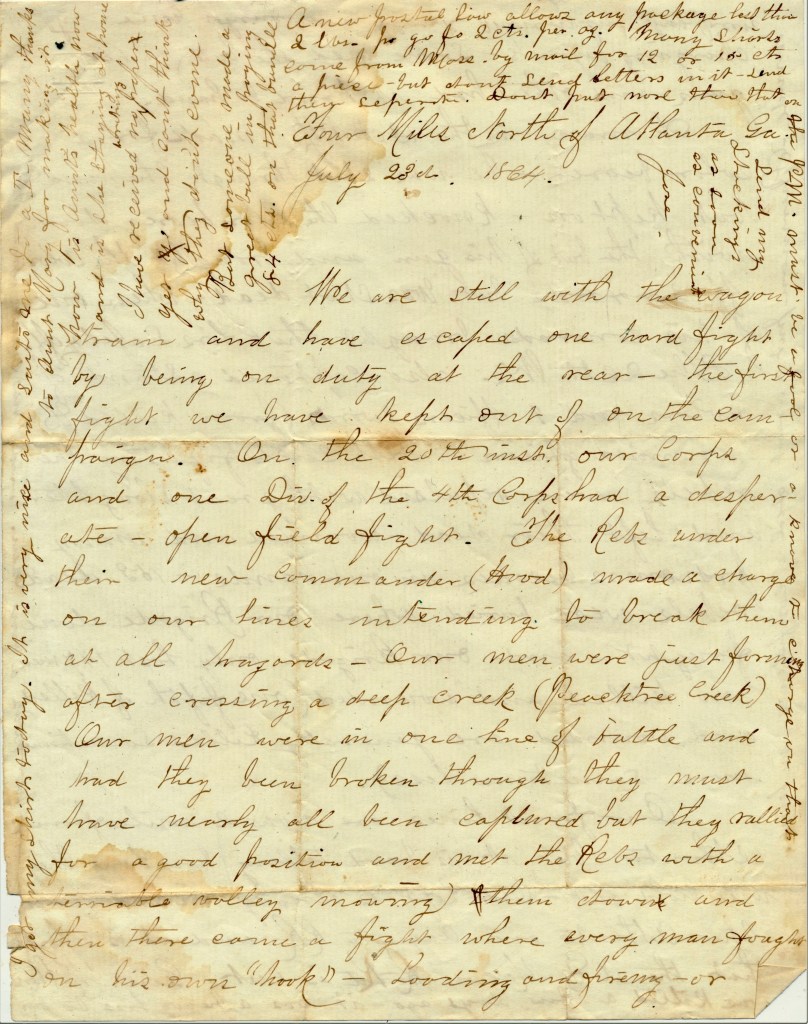
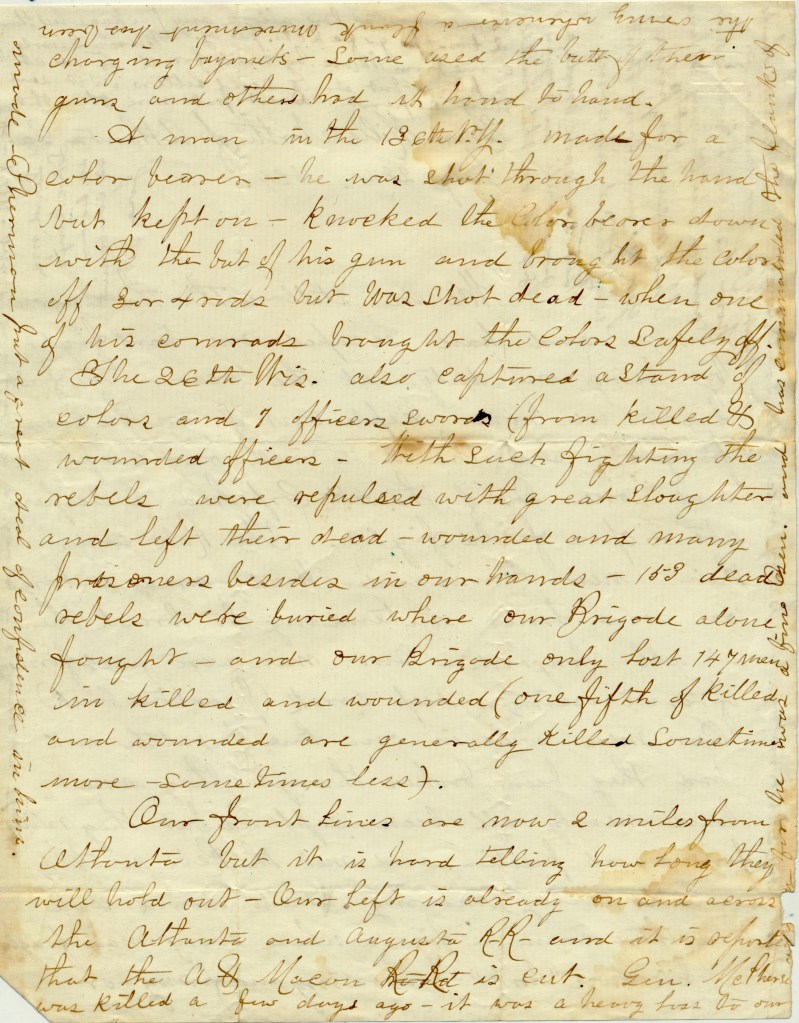
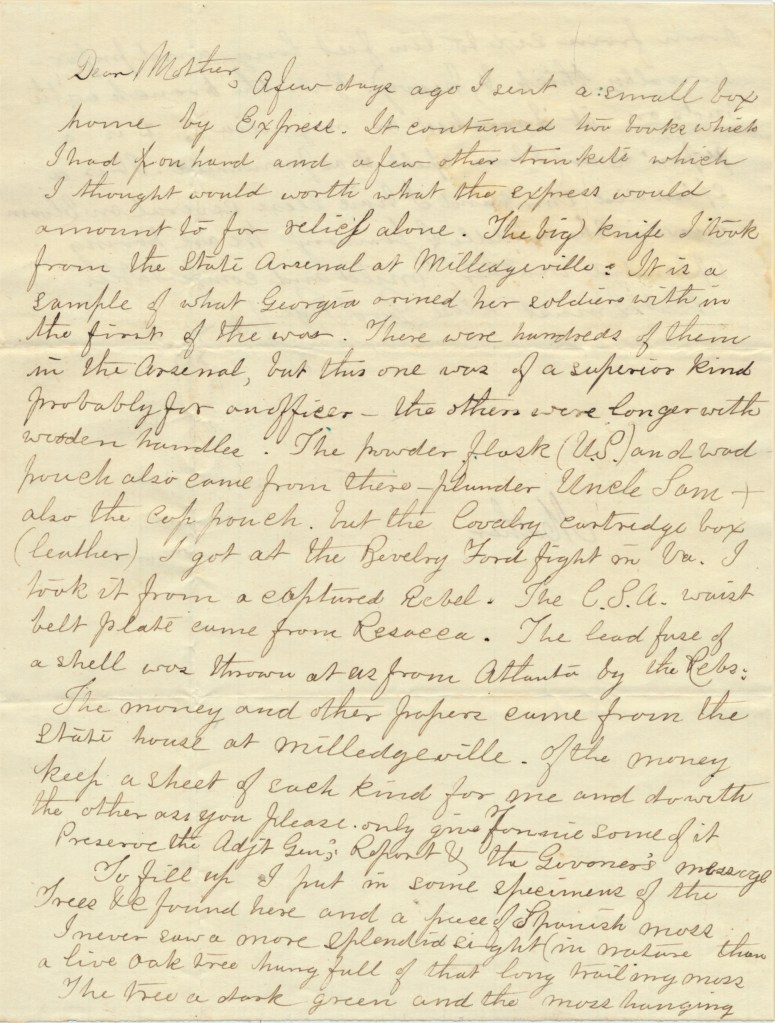


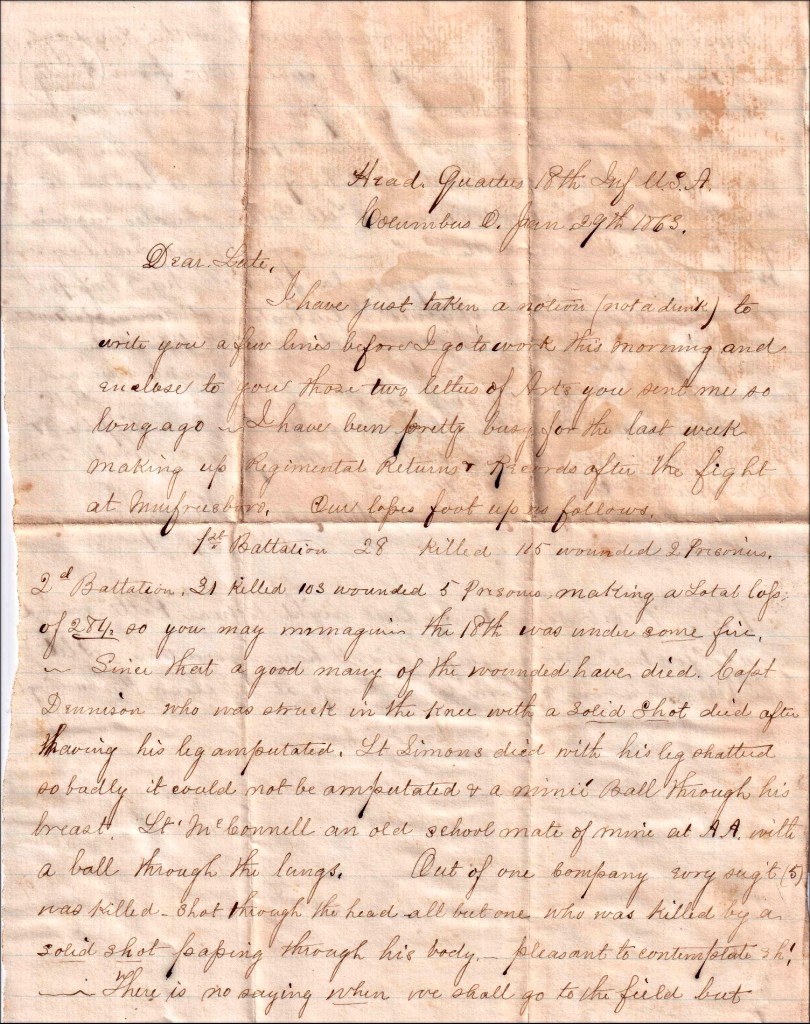


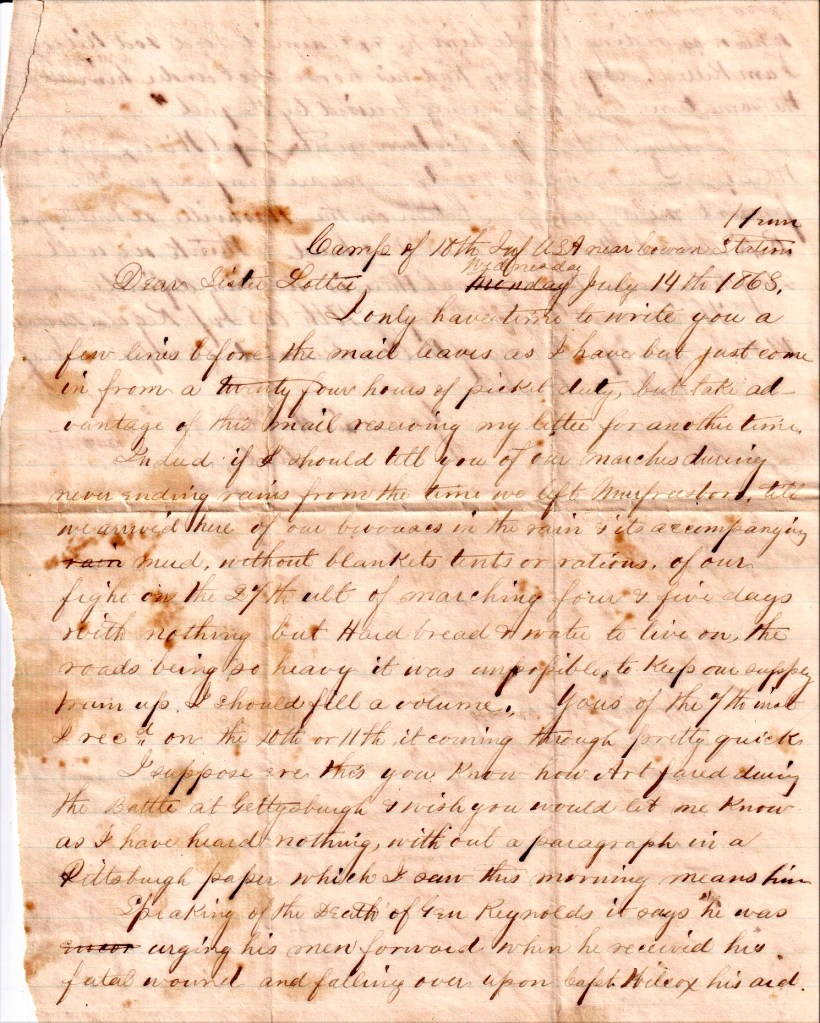

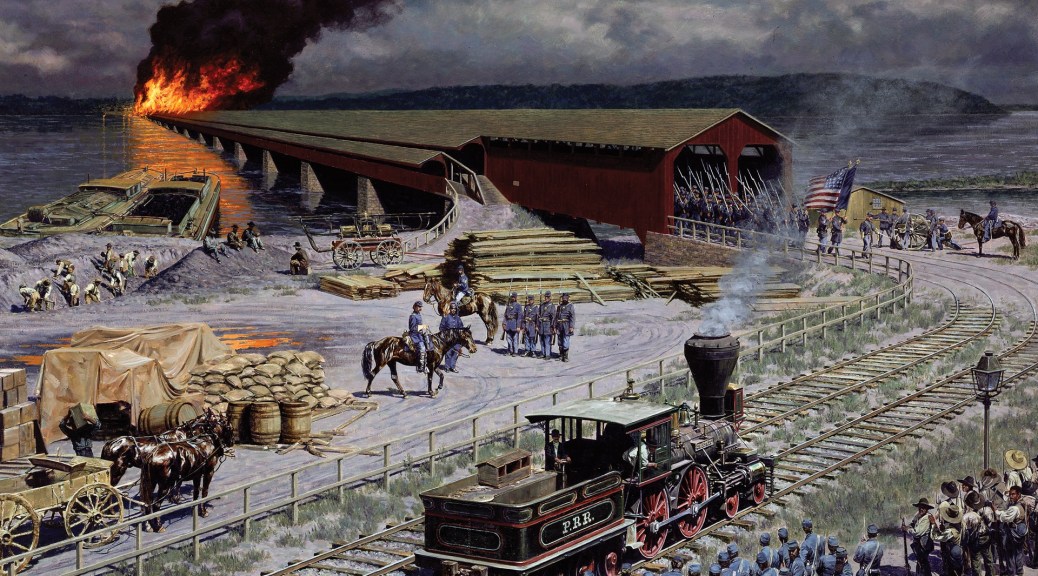
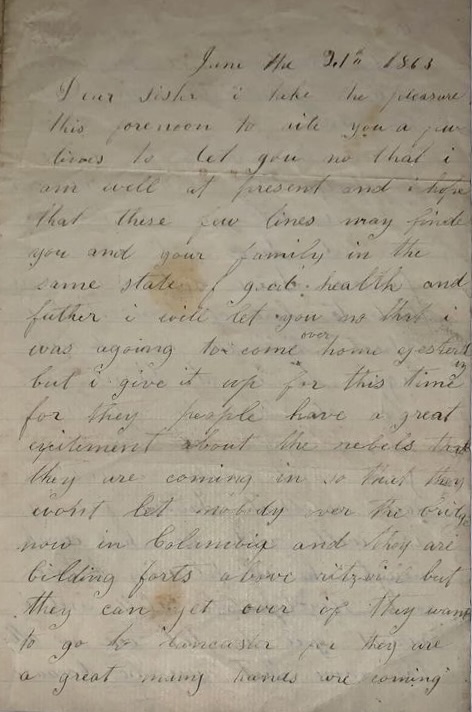


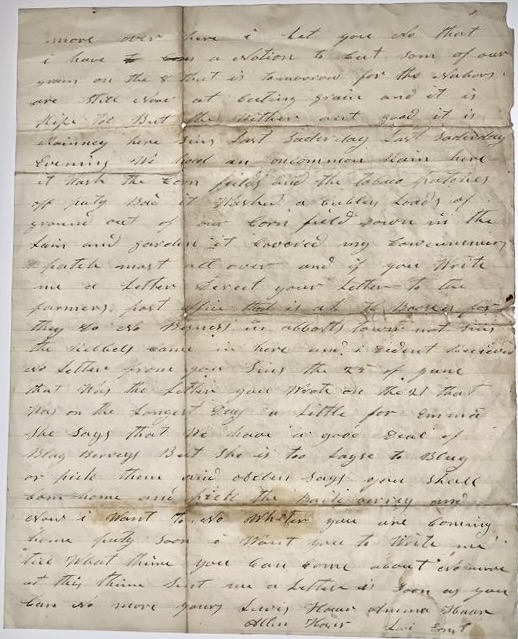


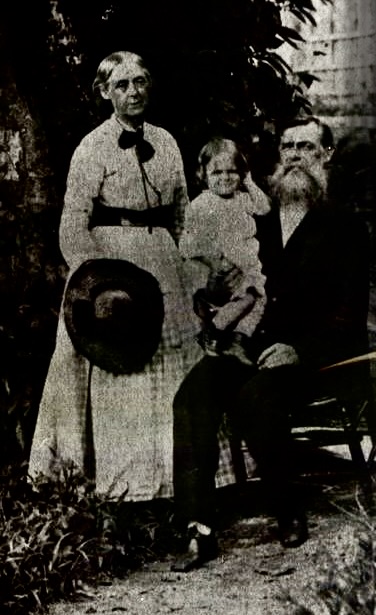


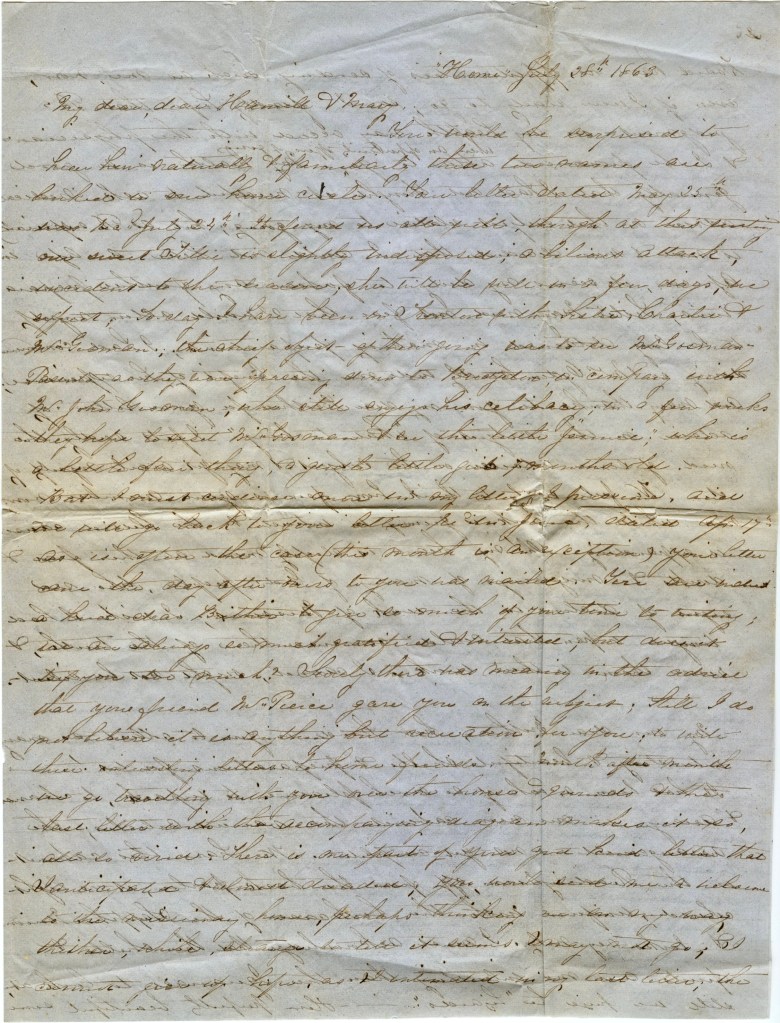
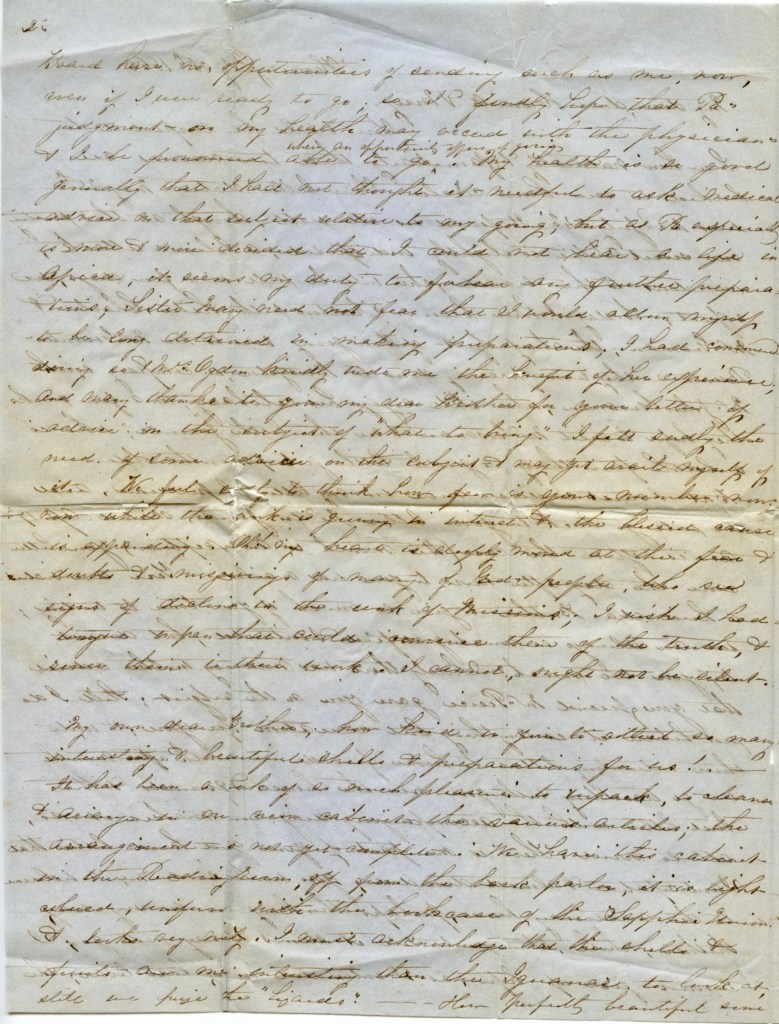

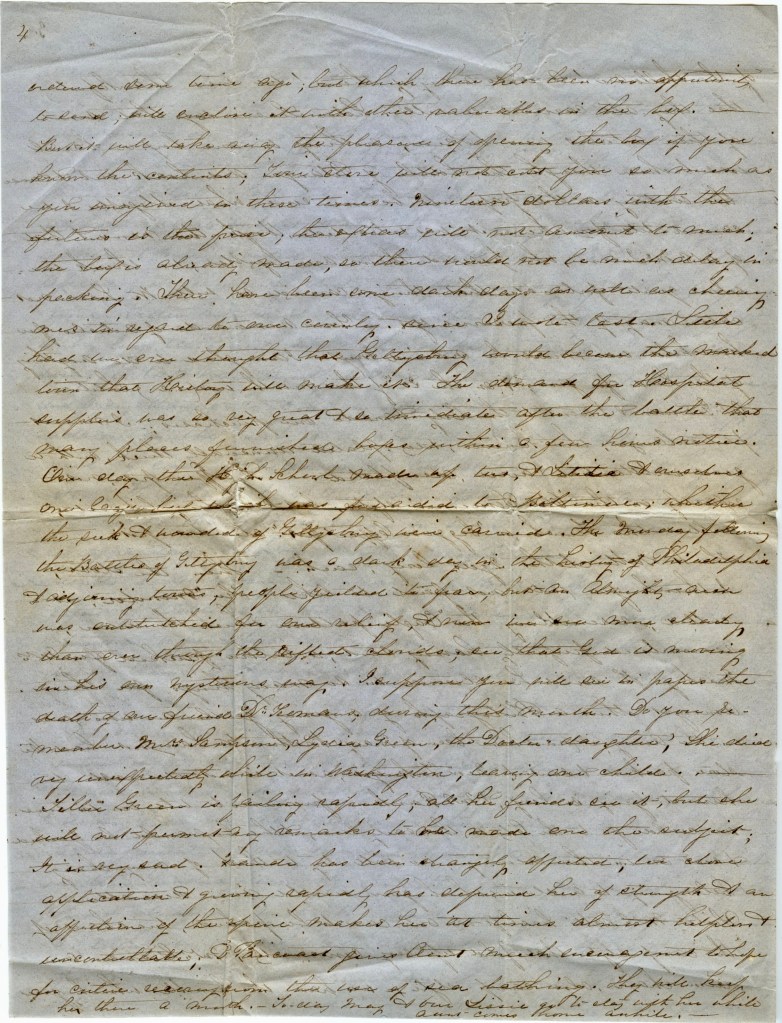
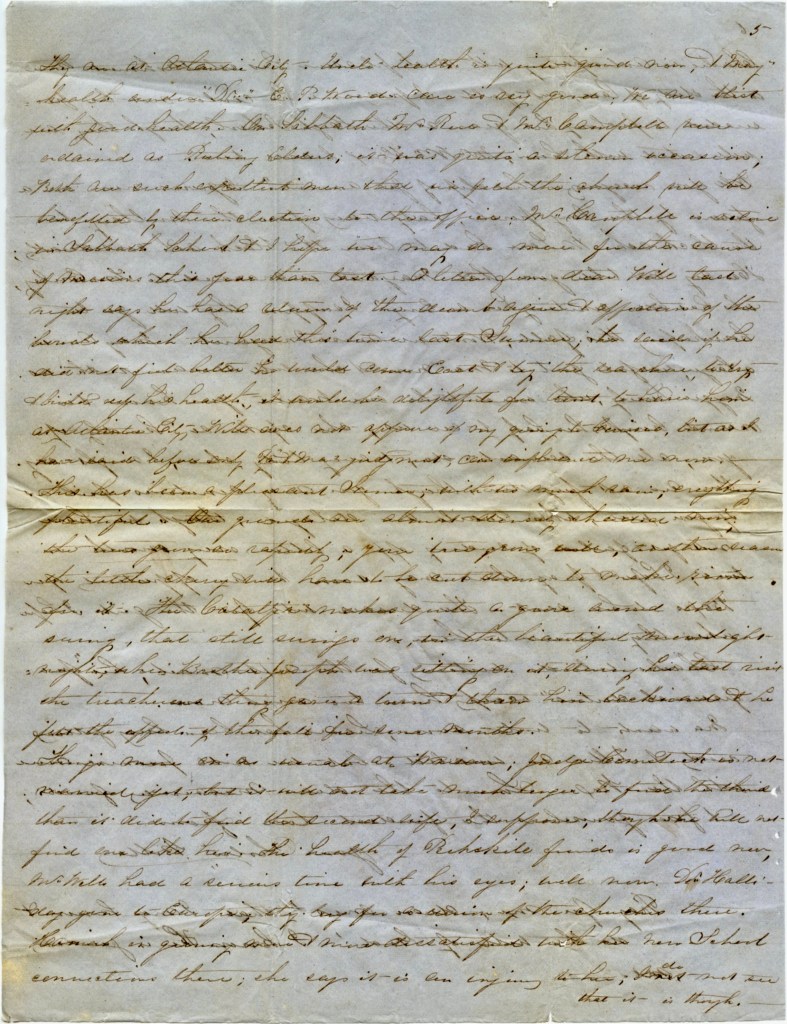

 Spared & Shared 23