The following two letters were written by Edgar (“Ned”) Norvell Wilcox, a native of Berkshire, Massachusetts, born in 1837. He was studying civil engineer at the University of Michigan when he enlisted as a private in the 7th OH Infantry at age 23 on June 19, 1861. He was discharged in December of 1861 and then joined the 18th US Regular Infantry on January 14, 1862. He was assigned as a private in Co. B, 3rd Battalion. In May 1862 he was promoted to sergeant of Co. H and was commissioned 2nd Lieutenant on June 11, 1863 (retroactive to February 19th). Wilcox was promoted to 1st Lieutenant on September 20, 1863. He was breveted Captain in September 1864 for Murfreesboro, Atlanta, and Jonesboro and after the war was officially promoted to Captain on January 22, 1867. He mustered out January 1, 1871 and lived in Oberlin, OH working in railroad construction.
Ned’s first letter is particularly interesting as it summarizes the casualties of the 1st and 2nd Battalions of the 18th USA Infantry at the Battle of Stones River. The 1st Battalion, Major Caldwell, went into action with 16 officers and 273 men, and on the 31st of December sustained a loss of one officer (Captain Kneass) killed; six officers (Captains Douglass, Wood and Hull, and Lieutenants McConnell, Carpenter and Adair) wounded. Twenty-seven enlisted men were killed and 109 wounded. In his official report Major Caldwell says: “All exhibited the same coolness and unflinching devotion to their country and flag that they had shown on the battle-field of Perryville, Ky.” The 2d Battalion, commanded by Major Townsend, went into action with 16 officers and 298 men and sustained a loss of one officer (Lieutenant Hitchcock) killed; five officers (Captains Dennison, Thompson and Haymond, and Lieutenants Ogden and Simons) wounded; 30 enlisted men killed, 98 wounded, 3 captured, 2 missing; aggregate loss, 139. In his official report of the battle, General Rousseau says: “The 18th Infantry were new troops to me, but I am now proud to say we know each other. If I could I would promote every officer and several non-commissioned officers and privates of the brigade of regulars for gallantry and good service in this terrific battle. The brigade was admirably and gallantly handled by Lieut.-Col. Shepherd.” [Source: US Army Center of Military History]
Ned refers to his brother, Arthur (“Art”) Tappan Wilcox (1834-1902) in both letters. Art was serving as 1st Lieutenant of Co. D, 7th Ohio Infantry at the time these letters were penned. Ned wrote the letters to his brother Lucien (“Lute”) Henry Wilcox (1830-1880) and to Charlotte (“Lottie”) Esther Wilcox (1823-1870).
[Note: These letters are from the private collection of Brent Reidenbach and were transcribed and published on Spared & Shared by express consent.]
Letter 1
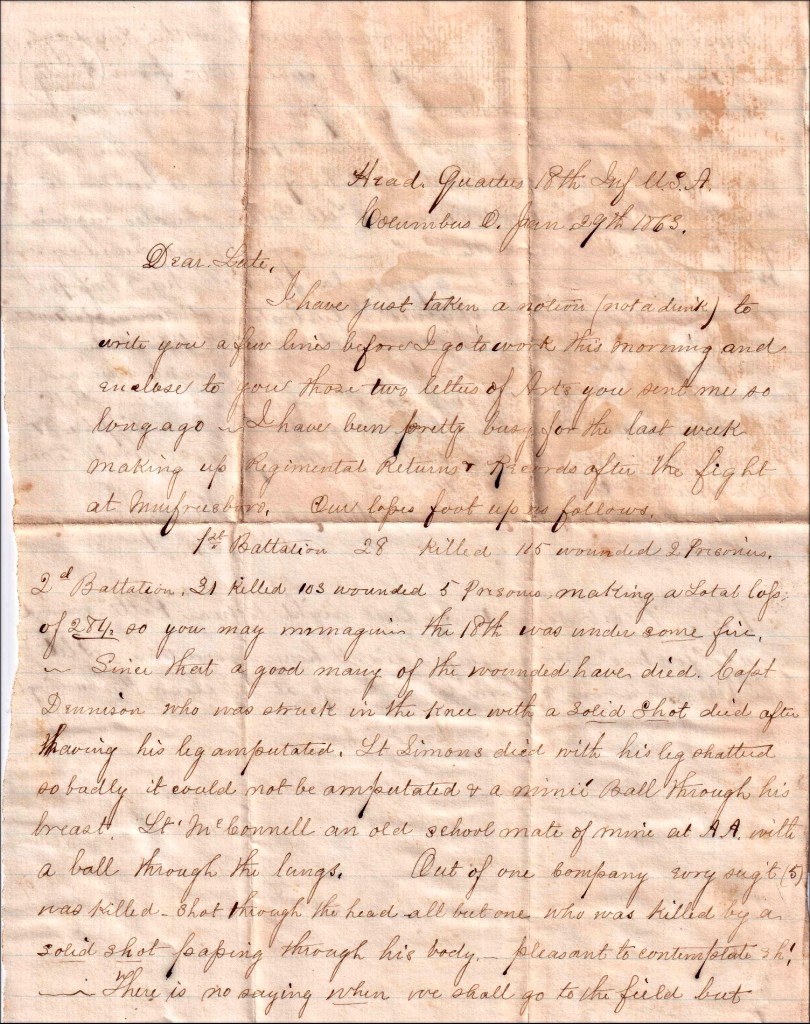
Headquarters 18th Infantry USA Columbus, Ohio January 29th 1863
Dear Lute,
I have just taken a notion (not a drink) to write you a few lines before I go to work this morning and enclose to you those two letters of [brother] Art’s you sent me so long ago. I have been pretty busy for the last week making up Regimental Returns & Records after the fight at Murfreesboro. Our losses foot up as follows.
2nd Battalion, 31 killed, 103 wounded, 5 prisoners, making a total loss of 284 so you may imagine the 18th was under some fire. Since that a good many of the wounded have died. Capt. Dennison [of Co. B] who was struck in the knee with a solid shot died after having his leg amputated. Lt. Simons died with his leg shattered so badly it could not be amputated & a minié ball through his breast. Lt. McConnell—an old school mate of mine at A. A.—with a ball through his lungs. Out of one company, every sergeant (5) was killed, shot through the head, all but one, who was killed by a solid shot passing through his body—pleasant to contemplate sh!
There is no saying when we shall go to the field but most of the companies will probably march within ten days. I was very much surprised to receive a letter from Aunty Shattuc of Ann Arbor whom you probably remember. She enquired after you & wanted to know where you were, &c. and I think the best answer will be for you to enclose to her your “keards”—won’t you? Tel Lottie she also enquires after her “and her dear little ones.”
I spent last Sunday evening with Cousin Ria and had a good laugh with her & Miss Post over some old sketches of yours—“Illustrations of Reveries of a Bachelor.” I did not know you were so much of an artist before, Lute. Ria says you must be “mad” at her as you haven’t answered her last letter. I tell her I guess not—your only ma-rried. I believe I’ve nothing more to offer. Give my love to sister Zilpha & remember me to Mrs. Parish and the Captain. Write to me when you get time, &c. &c. &c. — Yours, — Wilcox, Jr.
P. S. Went down town last night to hear “Patti”—reserved seats “for two”—Oh no! guess I didn’t have a good time. I let the jibs run down & “come to” in camp at 2 o’clock this morning. 1
1 Miss Carlotti Patti gave a concert at Brainard’s Hall in Columbus. She was accompanied by the great pianist Gottscaalk.
Letter 2
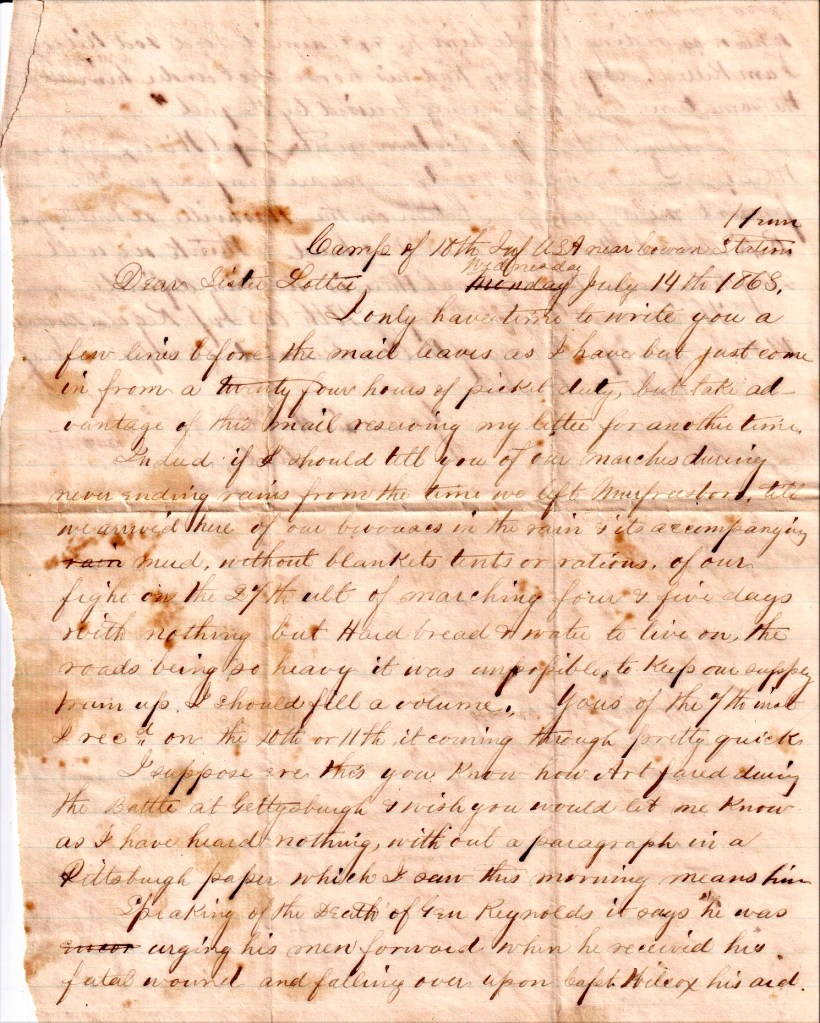
Camp of the 18th Infantry USA near Cowan Station Wednesday, July 14th 1863
Dear Sister Lottie,
I only have time to write you a few lines before the mail leaves as i have but just come in from a twenty-four hours of picket duty, but take advantage of this mail reserving my letter for another time. Indeed, if I should tell you of our marches during never ending rains from the time we left Murfreesboro till we arrived here, of our bivouac’s in the rain, and its accompanying mud, without blankets, tents, or rations, of our fight on the 27th ult., of marching four and five days with nothing but hard bread and water to live on, the roads being sp heavy it was impossible to keep our supply train up, I should fill a volume.
Yours of the 7th inst. I received on the 10th or 11th, it coming through pretty quick. I suppose ere this, you know how Art [Arthur T. Wilcox] fared during the Battle of Gettysburg & wish you would let me know as I have heard nothing without a paragraph in a Pittsburgh paper which I saw this morning. Speaking of the death of Gen. Reynolds, it says “he was urging his men forward when he received his fatal wound and falling over upon Capt. Wilcox—his aide—who was riding beside him, he exclaimed, ‘Good God, Wilcox, I am killed.’ Capt. Wilcox had his horse shot under him about the same time and was severely bruised by the fall.” Was this Art or is there another Capt. Wilcox down there? 1,2
I am well and hearty. We are camped for the present near Cowan Station on the Nashville & Chattanooga Railroad about 4 miles from Decherd & think we will stay here some time though there is nothing definite.
Write and direct simply 18th US Infantry Regular Brigade, 14th Army Corps, Army of the Cumberland (to be forwarded). Love to all.
Yours in haste, — Ned
1 There are various accounts of the death of Gen. Reynolds on the first day of Gettysburg. One account claims that it was “about ten o’clock a.m. that Gen. Reynolds was shot while cheering on his men. He was on the left wing of his forces, and the ground where he fell lies somewhat to the left of the convent [Lutheran Theological Seminary], near the boundary of the town. The ball (which was from a Minie rifle) struck him in the back part of the neck and passed into the front part of the brain. He fell from his horse, considerably bruising his face. His death was almost instantaneous. He did not speak after being shot. The body was immediately conveyed to the rear, and given in charge of Sergeant Clevenger, who will convey it to the residence of the General’s mother, which is in Lancaster county, Pennsylvania, where he was born.”
2 It was Capt. William H. Willcox (1832-1929) who served as the aide-de-camp on the staff of 1st Corps Commander Major. General John F. Reynolds. A native of England whose family emigrated to the United States in his childhood, Willcox became an architect and surveyor and began his career in Brooklyn and New York. In December 1861 he joined the 95th New York Infantry as a topographical engineer, but must have demonstrated considerable talent, as he was detached to Brig. Abner Doubleday’s staff in July 1862.
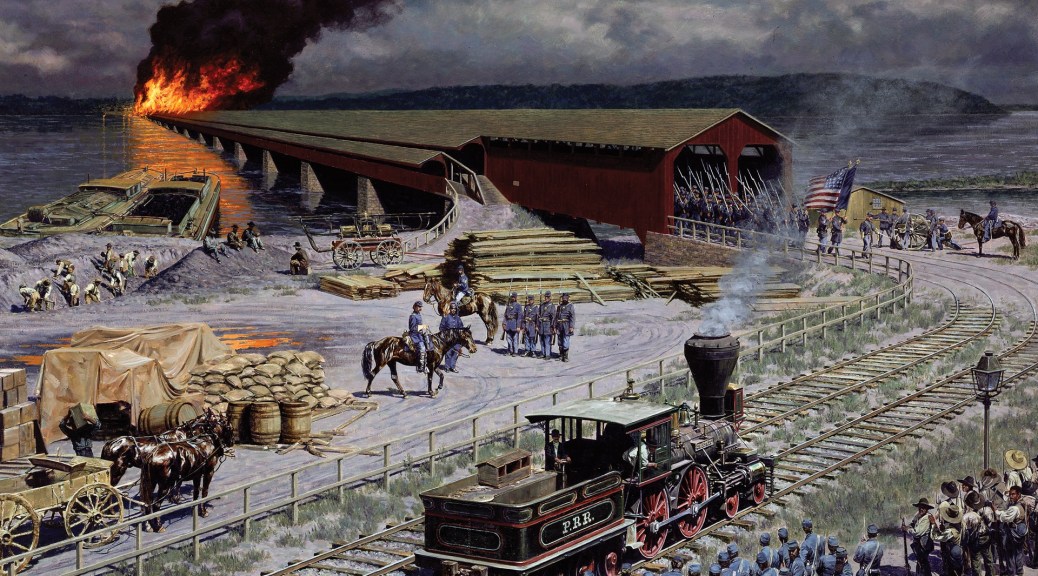
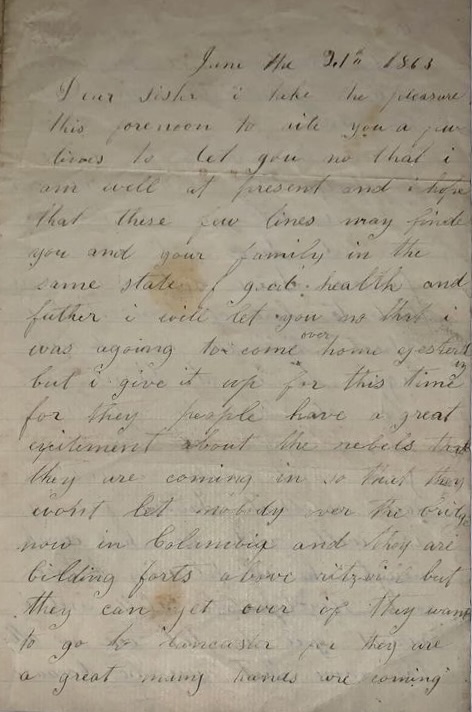
This letter was written by Christiana Spangler (1828-1918) to her sister, Louisa (Spangler) Harr (1824-1882). In her letter, Christiana explains that she was deterred from coming to visit her sister by soldiers guarding the Wrightsville Bridge that spanned the Susquehanna river. The following vignette explains:
“When Confederate Brigadier General John Brown Gordon arrived on June 28 with approximately 1,800 troops, the Federals were waiting in their entrenchments. The Rebels opened up with artillery fire, and the Union position rapidly became untenable. The Federals decided to retreat to Columbia and blow up a section of the over mile-long bridge behind them, denying the Rebels access to Lancaster. The explosion failed to destroy the bridge, so the order to burn it was given. As the Confederates surged forward, the bridge erupted in flames. Gordon’s men worked for hours to extinguish the blaze. They kept Wrightsville from going up in smoke, but the bridge, financed by the First National Bank of Columbia, was destroyed. Gordon’s brigade was recalled to York the next day.“
Christiana’s letter was datelined 31st June 1863 which is clearly an error since there are only 30 days in the month. She makes no mention of the bridge having been destroyed yet but it may have been burned without her knowing of it when she wrote.
This letter is from the private collection of Jeff Hilsmeier who sent me photographs of it for transcription and publication on Spared & Shared.
Transcription
June 31st [30th] 1863
Dear Sister,
I take the pleasure this forenoon to write you a few lines to let you know that I am well at present and I hope that these few lines may find you and your family in the same state of good health and further, I will let you know that I was a going to come over home yesterday but I gave it up for this time for the people have a great excitement about the rebels that they are coming in so that they won’t let anybody over the bridge now in Columbia and they building forts above [the] city. But they can get over if they want to go to Lancaster for they are a great many hands are coming over to work in haymaking and harvesting and they never said a word to them that they can’t get over. But if one of our men wants to cross the bridge, they can’t.
And further I will let you know that me and Jacob got a letter from [your husband] Isaac and we were glad to hear of him but I expect till we hear of him again, he [will be] at home for he wrote that he expects to be in York till the 10th of July.
And further I will let you know that Jacob’s family is well and he has work enough. He is planting tobacco and seet potatoes still and I want you to let me know all the news that you know because I can’t get home. But if I live and can come about the rebels, I will come and stay a couple weeks with youans and I wish you all well till I see you again.
And so no more at present but still remain. My best respects to you and all inquiring friends and I want you to answer this letter as soon as it comes to hand. And so no more. Goodbye from me, — Christiana Spangler
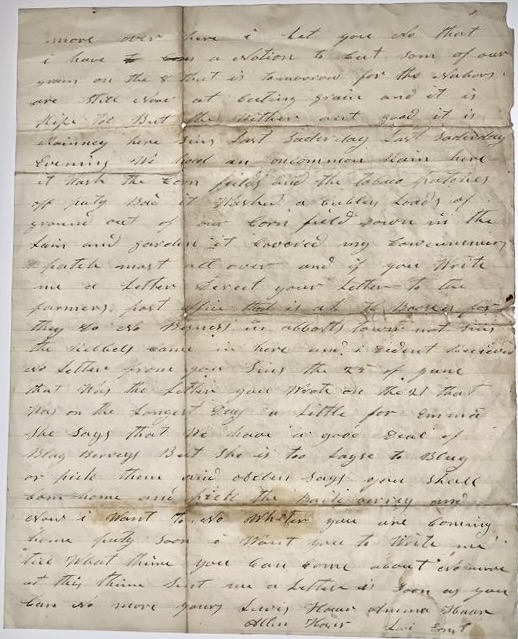
The following letter was written by Louisa (Spangler) Haar (1824-1882), the wife of Isaac Haar (1818-1874) of Paradise township, York county, Pennsylvania. Louisa wrote the letter to her 46 year-old husband who was drafted in November 1862 and mustered into Co. C, 166th Pennsylvania Infantry (Drafted Militia). Isaac became ill in the winter and was hospitalized in January 1863—too ill to return to his regiment until 20 July 1863 and he was discharged a week later. Their children were named Emma (b. 1852), Annie (b. 1854), Amanda (b. 1856), and Allen (b. 1860) whose names appear at the end of the letter, though somewhat difficult to read due to the resolution of the image.
The letter was datelined 7 June 1863 but this was clearly a mistake; it should have been dated 7 July 1863—a few days after the Battle of Gettysburg which is described in the letter. In her letter, Louisa informs her husband of the passage of Gen. Early’s army through Gettysburg on the way to York, and then of the fights at Hanover and Gettysburg, followed by the heavy rains.
This letter is from the private collection of Jeff Hilsmeier who sent me photographs of it for transcription and publication on Spared & Shared.
Transcription
[Paradise Township, York county, Pennsylvania] June [July] 7th 1863
Dear husband,
Here I let you know that I and the children are all well at this present [time] and we hope that these few lines will and may find you in the same state of health. Further, I let you know that we had bad times here this week past. The rebels came through here on the [2]7th of June and went as far as York and then came back as far as Hanover on the 29th and there they had a fight and then from Hanover they went to Gettysburg and there they pound[ed] on us for about 3 days and it is said that our men killed about 35,000 rebels and took about 15,000 prisoners and it is aid that the rebels killed and wounded about 12 or 15,000 of our men.
And now the rebels are in Emmitsburg [Maryland] about 12 miles above Gettysburg and they say they are fixing for another battle and the rebels went up through Dover township and took most all the horses and through here they took a good many too but not so very much as some other places. And they keep the York fellows pretty hard. They say they made the York boys make up 25,000 dollars so as they didn’t burn down the town and they made it up more over here.
I let you know that I have a notion to cut some of our grain on the 8th, that is tomorrow, for the neighbors are still none at cutting grain and it is ripe too, but the weather ain’t good. It is raining here since last Saturday. Last Saturday evening we had an uncommon rain here. It wash the cornfields and the tobacco patches off pretty bad. It washed a couple loads of grain out of our corn field down in the lane and garden. It covered my [ ] patch most all over and if you write me a letter, direct your letter to the farmers post office that is at the [ ] for they do no business in Abbottstown—not since the rebels came in here, and I didn’t receive no letter from you since the 25th of June. That was the letter you wrote on the 21st. That was the longest day.
A little for Emma. She says that we have a good deal of blueberries but she is too lazy to pick them and Ogden says you shall come home and pick the blue berries. And now I want to know whether you are coming home pretty soon. I want you to write me and tell what time you can come about. No more at this time. Send me a letter as son as you can. No more. Yours, Louisa Haar and [names of her children].
The following letter was written by Tilman Jenkins (1840-1864), the son of David and Elizabeth (Hogans) Jenkins of Gaston county, North Carolina. Jenkins enlisted as a private in Co. C (Capt. Joseph Graham’s Battery), 1st North Carolina Artillery in the fall of 1862. They were attached to Poague’s Artillery Battalion in the summer of 1863 when Tilman scratched this message to his parents during the Battle of Gettysburg just as the artillery duel began in the afternoon of July 3rd. Tilman survived the battle but was killed instantly when he was struck in the forehead by a Union artillery round near the Mule Shoe in the Battle of Spotsylvania Court House on 12 May 1864. He was survived by his wife Margaret (Prather) Jenkins and two year-old son Nathan.
Graham’s Battery arrived on the field at Gettysburg late in the evening of the 1st day and planted their Napoleons on what is now West Confederate Avenue. They were not brought into action on the second day. On the morning of July 3rd, they opened on the Union position on Cemetery Ridge but soon ceased firing when they drew a concentrated fire on their position. They later took part in the cannonade that preceded Pickett’s charge but never used the 12 pound Howitzers which had an even shorter range than the 12 pound Napoleons (all smoothbores bronze guns). In Jenkins’ letter, however, he mentions being detailed to bring up ammunition for their “rifled cannon” which leaves one wondering what he is referring to. The answer may be found in a report by Jenkins’ captain, Arthur B. Willliams, Co. C, who wrote that Major Pogue offered them a “three-inch rifled cannon” that “had been captured during the afternoon on the left” which they could exchange for one of their inferior guns. They used it on the 3rd day of the battle but did not have much ammunition for it which might explain why Jenkin’s was detailed to the rear to get more ammunition for this gun. [See Capt. Joseph Graham’s Charlotte Artillery on Civil War Talk.]
Transcription
Gettysburg, Penna. Grahams Battery July 3, 1863
Dearest Mother and Father,
I take pencil in hand to deliver to you both my sincerest affection and to let you know that I have yet survived this horrible place. We arrived July 1st about two miles from this place and engaged the enemy who seemed to be everywhere. Gen. Longstreet arrived near two and a half in the afternoon and engaged the enemy upon a hill along our right flank on the second day. Many good men left their lives on the bloody ground including young Jacob. The sight was as terrible as could be imagined and the anguish of both men and horses was liken to drive a sane man mad. Cousin John was brought from the field without his face or legs having felt the wrath of a Yankee shell that burst next to him. Oh the horror!
Blood coats the fields and flies are all over us like the demons of Hell. I do not know how men can do to one another what they did today and ever sleep again. Last night we slept upon the rocky ground, and got no rest from the moans of those who lay dying still yet on the fields before us. The guns of the devils has now awoke as the sun is approaching half past noon. The cannon are thundering all around liken to a great storm to approach.
I am detailed to bring up ammunitions for our rifled cannon as the bronze guns have no effect on the yankee bastards. I wish them all to die in hell for what they do and to suffer forever their unjust and unholy cause. If I live through this day, I will find a way to tell you I am still alive. Pray for us, Mother, and never give up our holy cause we are dying for.
The following letter was written by Lt Andrew Jeter Leftwich (1836-1905), the son James Leftwich (1807-1882) and Elizabeth Eubank (1813-1852) of King William county, Virginia.
Andrew entered the Confederate service as 1st Sergeant of Battery G 2nd Battalion of the Virginia Artillery and was promoted to 1st Lieutenant of Co. G in the 22nd Virginia Infantry Battalion. He was taken a prisoner on 24 May 1864 at North Anna River and sent to the Old Capitol Prison in the District of Columbia where he remained until 15 June 1864 and then sent to Fort Delaware. He was not released from Fort Delaware until 17 June 1865. He was described as standing 5’8″ tall, with light hair, blue eyes and a ruddy complexion.
Andrew married Sarah (“Sallie”) Thomas Tuck (1840-1923) on 1 May 1866. He was a farmer in Mangohick district, King William County, in 1870 and 1880.
The 6th Michigan Cavalry, vanguard of Brig. Gen. Judson Kilpatrick’s cavalry division, overrun Brig. Gen. Henry Heth’s rearguard of the retreating Army of Northern Virginia at Falling Water on 14 July 1863
Transcription
Culpepper Court House July 31st 1863
Miss Sallie T. Tuck My dear friend,
Another opportunity being allowed, I will attempt to write you a few lines though I have written to King William [county] so frequently of late and have not received any letters from there since the Yankee raid through the county, I have almost despaired of getting any letters at all. I have come to the conclusion that none of my letters go to King William and I will write a very few more letters before I shall give it up as a bad job and cease writing until I get letters from there. because it is no use for me to write and then my letters not go where they are sent.
Your letter of the 26th of June was the last that I received and that came to hand a few days since (out of date, you may say). Notwithstanding it being of such a remote date, it gave me a great deal of pleasure though one portion of it gave me pain—that part in which you said I had broken my promise in regard to drinking intoxicating liquors and by that act I had caused you to break your promise in regard to dancing. Sallie, if I had known that my example was going to make you do wrong, I never would have broken my promise though I did not break it on account of a beverage but because I thought that it was good for my health as I think I have told you previously, it grieves me much to know that my examples (which ought to be that of a christian) is so much christian-like as to lead others far away from their Maker and from the path of rectitude. May the Lord help me in future to be more circumspect in my words & actions so that instead of leading anyone astray that I may be able by my words and actions to lead many into the fold of God. I see everyday that I live more and more to convince me of the fact that life is but a bubble which is liable to disappear at any moment and that all of the time that is allowed us here on earth is scarcely time enough to prepare for the next.
God has been more merciful to me than I could have any reason to expect (of late) during the recent battles in which I have been. One man was shot in my front, shielding me from the ball, and a few days ago not far from this place in a skirmish, on man was killed about three feet in front of me, being shot with two balls. He was so near that he bloodied me up when he fell back (there were four of us together). The other two, one was wounded, the other a part of his gun stock was shot off. I have been on a skirmish [line] most of the time in these battles and I think at [least] 100 balls have been shot at me alone and not one has ever touched me. Don’t you think that I have a great reason to be thankful to God for His mercy toward me in preserving my unprofitable life while he has taken those from my right and left?
You said that you had left out in your previous letter what you intended putting in the one of the 26th inst. and you left it out in that for the want of space or the lateness of the hour. Don’t leave it out in your next as you have raised my curiosity now and you thought I have my full portion of that.
I am now left alone in command of the company (I expect that is what makes me so low spirited). I told you in my last letter that Capt. [Alexander F.] Haynes, Lt. [Thomas C.] Jeter & [James E.] Johnson, were taken prisoners at Falling Waters by Yankee cavalry. May the Lord deliver me from Yankee cavalry in future—especially when I have marched all night in the mud and rain. I hope that you have a good time of it at the singing school. I want you to learn me some new Sunday School hymns when I come home (if it should ever be my privilege to do so again).
I complained in the first part of my letter about not getting letters from King William. I don’t attach any of the blame to any of my correspondents—not in the least, but to the mail. You spoke of R. Garnett’s writing to me. I wish you would tell him for me that I have not received his letter yet and that he must write again as I am very anxious to get a letter from him. Write to me soon and let me hear what they did in that part of King William and whether you caught the Yankee officer that you used to speak of in the way of jesting. You must excuse the tone in which this letter is written for I am in no humor for jesting at this time on account of our recent reverses.
Excuse all mistakes of every kind as I have not read this letter over to correct the errors. Give my best regards to Miss Sue, Lou & Charles. I must close this uninteresting letter. Believe me ever your sincere friend, &c. — And. J.
P. S. Direct your letter to Walker’s Brigade, Heth Division
Andrew Jeter LeftwichSallie Thomas Tuck
Post war images of Andrew and Sallie were provided by Jennifer Melton, a descendant of the couple.
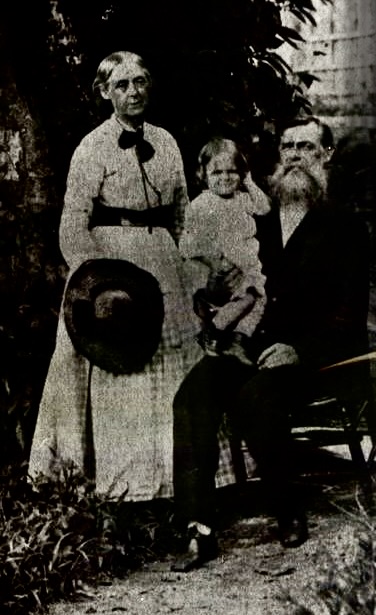
Isabella and her brother Hamill holding one of his daughters, Africa
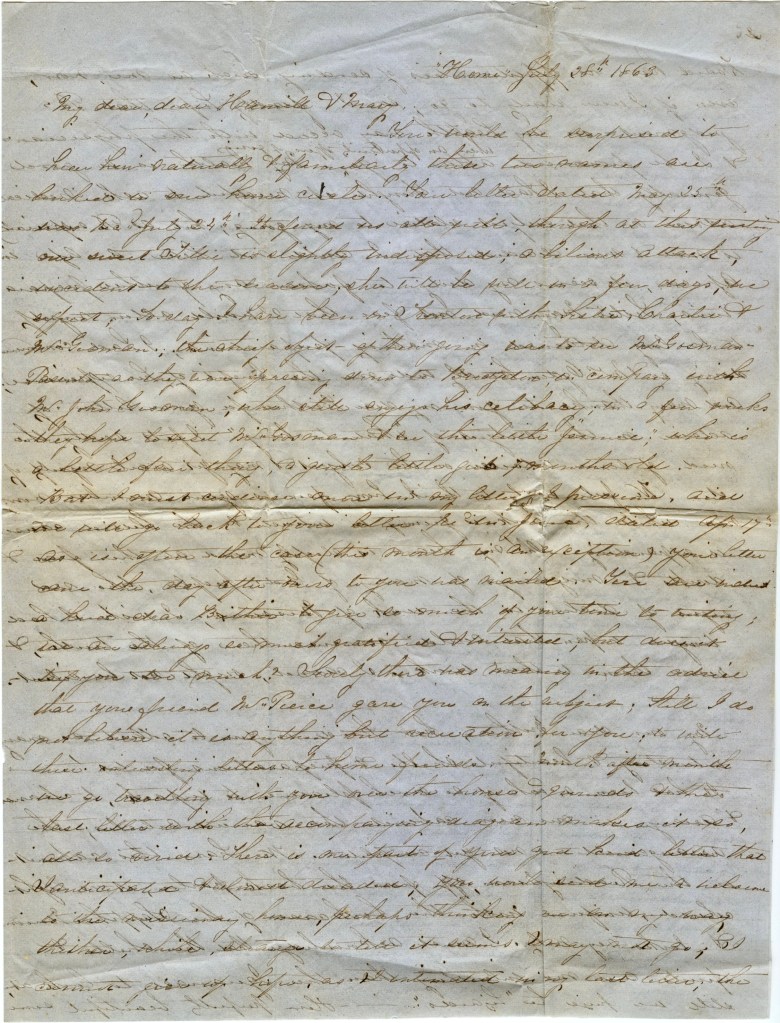
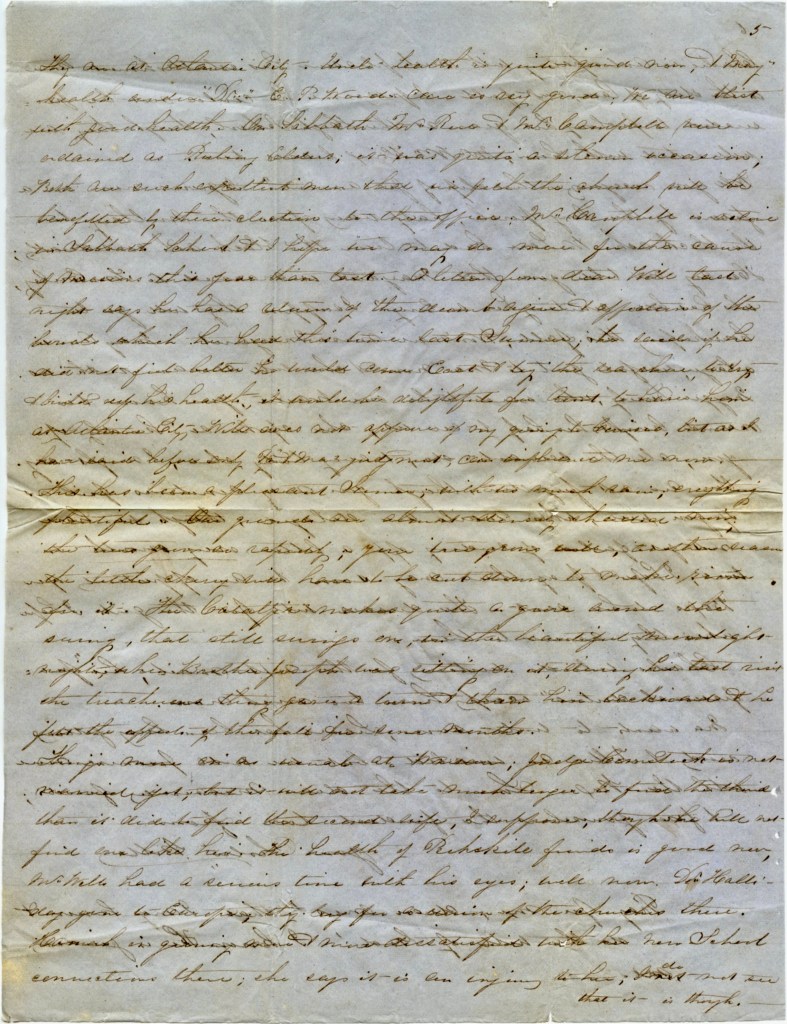
The following letter was written by Isabella (“Bella”) A. Nassau (1829-1906), the daughter of Rev. Charles William Nassau (1804-1878) and Hannah McClintock Hamill (1807-1878) of Philadelphia, Pennsylvania. Bella wrote the letter to her younger brother, Rev. Robert Hamill Nassau (1835-1921), an American presbyterian missionary who spent forty years in Africa. Bella eventually joined her brother as a missionary in Africa.
Born in Newtown Square, Pennsylvania, Nassau was an ordained minister and a medical doctor. Appointed in 1861 to Presbyterian mission on Corisco Island off the coast of present day at Equatorial Guinea, he and his wife, Mary Cloyd Latta served there and at Benita until her death on Corisco in 1870. They had three sons William Latta, George Paull and Charles Francis His second wife was Mary Brunette Foster (died 1884), with whom he had a daughter Mary Brunette Foster.
Transcription
Home July 28, 1863
My dear, dear Hamill & Mary,
You would be surprised to hear how naturally & familiarly these two names are linked to our home circle. Your letter dated May 25th was received July 24th. It found us all well, though at this sitting our sweet Tillie is slightly indisposed; a bilious attack incident to the season; she will be well in a few days we expect.
Today I have been in Trenton with sister, Charlie, & Mrs. Gasman. The chief object of their going was to see Mr. Gasman [ ] so they were passing down to Bridgton in company with Mr. John Gasman who still enjoys his celibacy; in a few weeks they hope to visit Mr. Gasman & see their little “Jennie;” who is a little fair thing, a gentle little girl 7 months old.
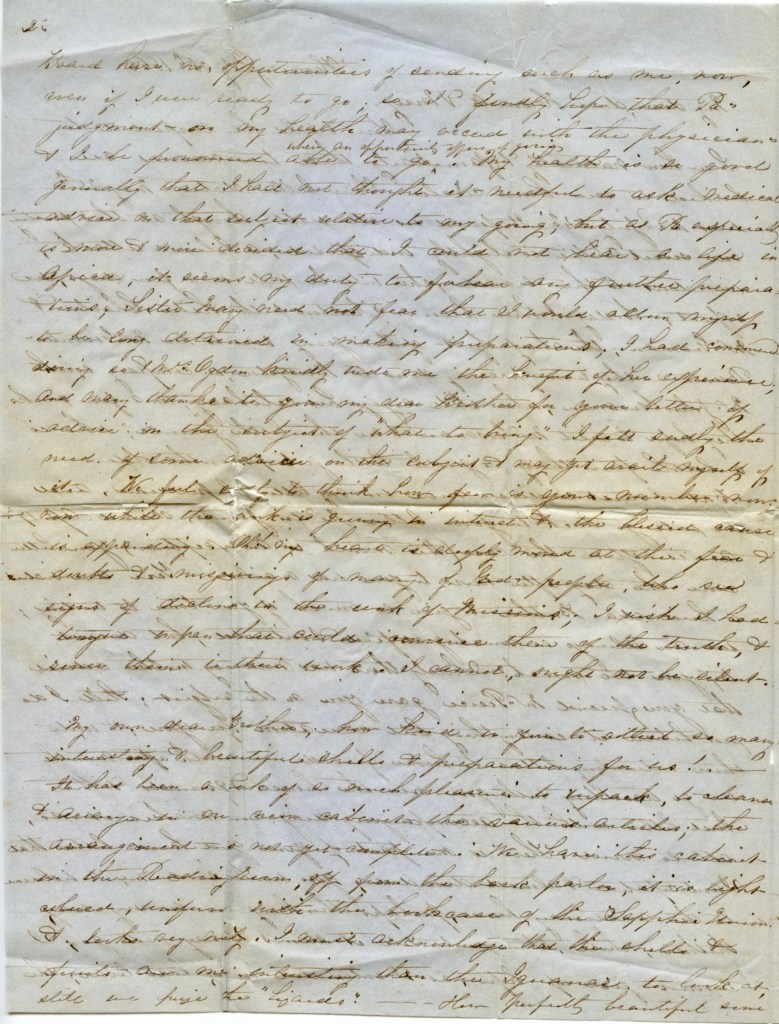
But I must condense more in my letter, I presume, and we will go back to your letter received in June, dated April 17th. As is often the case (this month is no exception), your letter came the day after ours to you was mailed. You are indeed a kind dear brother to give so much of your time to writing to me—always so much gratified and interested; but does it task you too much? Surely there has meaning in the advice that your friend Mr. Pierce gave you on the subject; Still I do not believe it is anything but recreation for you; to write these interesting letters to home friends. Month after month we go treading with you over the house and grounds & the last letter with the accompanying diagram makes it so, all so vivid. There is one part of your good kind letter that I anticipated & almost dreaded; you would send me a welcome to the missionary house perhaps thinking me on my way thither; while stranger to tell, it seems I may not go. I cannot give up hope as I intimated in my last letter; the Board have no opportunities of sending such as me now, even if I were ready to go. So I fondly hope that Pa’s judgment on my health may accord with the physician’s and I be pronounced able to go when an opportunity offers of going.
My health is so good generally that I had not thought it needful to ask medical advise on that subject relative to my going; but as Pa especially is more & more decided that I could not bear a life in Africa, it seems my duty to forbear any further preparations. Sister Mary need not fear that I would allow myself to be long detained in making preparations; I had commenced doing so & Mrs. Ogden kindly gave me the benefit of her experience, and many thanks to you, my dear Brother, for your letter of advice on the subject of “what to bring.” I felt sadly the need of some advice on the subject & may yet avail myself of it.
We feel sadly to think how few is your number now. Now while the [ ] is growing in interest & the blessed cause is expanding. Oh! my heart is deeply moved at the fear & doubts & misgivings of many of God’s people. Who see signs of decline in the work of missions; I wish I had tongue or pen that could convince them of the truth, & [ ] them in their work. I cannot, ought not be silent.
My own dear Brother, how kind in you to collect so many interesting & beautiful shells & preparations for us! It has been a task of so much pleasure to unpack, to cleanse and arrange on our cabinets the various articles; the arrangement is not yet completed. We have his cabinet in the Reading room off from the back parlor. It is light colored, uniform, with the bookcases of the Sapphie Union & looks very nicely. I must acknowledge that the shells & [ ] are more interesting than the Iguanas to look at. Still we prize the “Lizards.” How perfectly beautiful some of the shells are! And so many of them! We were thankful that they all carried so well. Sister Lusie says that some of these articles were broken; nothing in our box or barrel was broken though the bottle of Pitanga did leak out and cause the writing on this paper to become somewhat illegible & we cannot tell for whom it was intended though the name & that of Mrs. McQueens, who preserved them, are legible. We think ourselves quite fortunate that things carried so well. We have not eaten many of the preserves yet.
Your memoranda of articles for household also must be noticed next, I am glad to do anything of the kind for you; and on the 20th of this month we (. e.) Letitia, Mrs. Gasman, & I went to the City & made our purchases. I must particularize. [list of purchases follows]
I think you were will not fail to like the “Monitor,” it is called; resembling the “Eagle” pattern which the man remembered perfectly, having sent it rather packed for Mrs. Mackey. He said he had so many things for them. Amongst them a photograph of a young gentleman who was in the army; it must have been Mary’s brother. We have had the store packed & sent to New York yet, as it is not desirable to have it lying so long, & Mr. Rankin promises to take it in time. We could go to the City in the early line, and the box could be packed & sent on in the evening. We will try to think of everything belonging to a store which you would deem desirable.
Sister Mrs. Wells has left in our care to be packed two chairs of the camp that fold up very conveniently. Mrs. Gasman an arm chair; also camp style. We have the [ ] which you ordered some time ago, but which there has been no opportunity to send. Will enclose it with other valuables in the box…
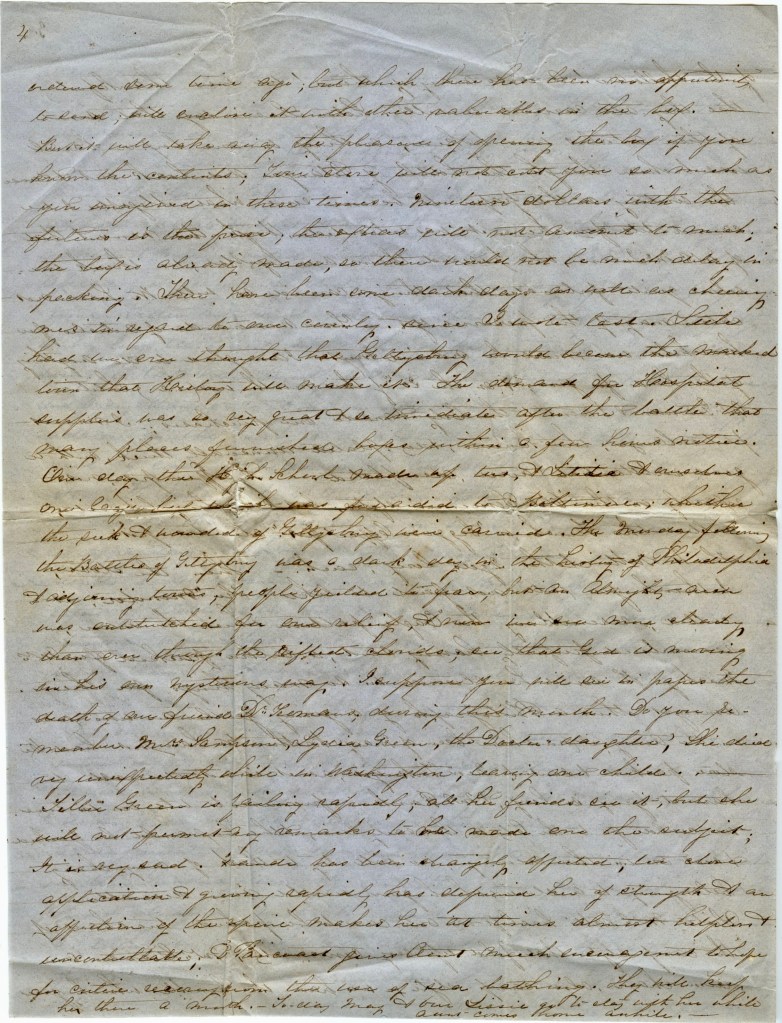
There has been some dark days as well as cheering news in regard to our country since I wrote. Little had we ever thought that Gettysburg would become the marked town that History will make it. The demand for hospital supplies was so very great & so immediate after the battle that many places furnished boxes within a few hours notice. One day the High School made up two and Letitia & ourselves one large box which was presented to Baltimore, whither the sick & wounded of Gettysburg were carried. The Monday following the Battle of Gettysburg was a dark day in the history of Philadelphia & adjoining towns. People yielded to fear, but an Almighty hand was outstretched for our relief & now we see more clearly than ever through the [ ] clouds; see that God is moving in His own mysterious way.
I suppose you will see in papers the death of our friend Dr. Tremans during this month. Do you remember Mrs. Sampson, Lydia Green, the doctor’s daughter? She died very unexpectedly while in Washington, leaving one child. Tillie Green is failing rapidly. All her friends see it but she will not permit any remarks to be made on the subject. It is very sad…
From your sister Bella
Pray for me dear ones! that I may know & do the will of God! I know He is guiding me.
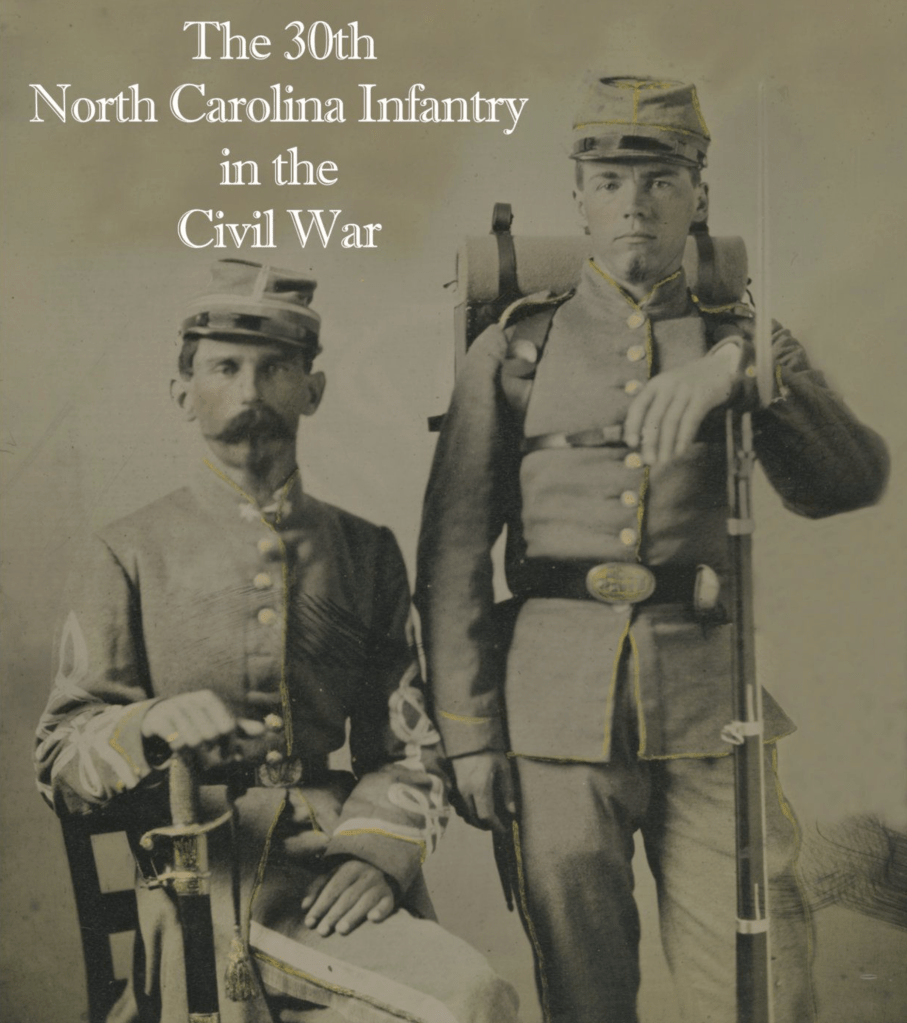
The following letter was written by Weldon Edwards Davis (1838-1863), the son of Edward (“Ned”) Davis (1806-1895) and Rebecca (“Becky”) O. Pitchford (1812-1900). Weldon grew up on his father’s plantation, “Lake O’ the Woods,” some 15 miles south of the city of Warrenton, Warren county, North Carolina. Weldon’s station in life as the son of a wealthy planter family combined with an above average education received at the University of North Carolina (A. B. 1861) no doubt resulted in his election as Third Lieutenant of Co. B (the “Nat Mason Guards”), 30th North Carolina Infantry, when they were organized in August 1861. His rise in rank did not take long. By late September 1861 he was promoted to 2nd Lieutenant and by the first of May 1862 to 1st Lieutenant. When Capt. William C. Drake resigned his commission on 10 December 1862, Weldon was elevated to command of the company, though he would not receive his official commission until 13 June 1863. Company records suggest that Weldon commanded his company as early as the summer of 1862 (at Malvern Hill) in the absence of his captain. He remained the captain of his company until he was cut down in the fighting at Kelly’s Ford on 7 November 1863 with a shattered leg that resulted in his capture, amputation, and death in Douglas Hospital in Washington D. C. on 22 November 1863.
The digitized transcript of the following letter can be found with many others of the Davis family in a collection housed at the Wilson Special Collections Library at UNC entitled, “Rebecca Pitchford Davis Letters, 1855-1899.” The collection does not state where the original letters may be found except to say they were “in private hands in 1955.” The type-written transcripts were donated to the library in 1958 by Blanche Egerton Baker who is credited with having performed them.
Normally I do not post transcripts performed by others, especially when I cannot verify the accuracy of the transcript against the original handwriting, but as a courtesy to a Spared & Shared follower and a descendant of Weldon’s parents named Betsey Brodie Roberts who kindly provided me with a PDF of family letters, I have decided to post three of Weldon’s letters—one of them describing the Battle of Chancellorsville and the other two from before and after the Battle of Gettysburg. Historians will recall that the 30th North Carolina joined the 2nd, 4th, and 14th North Carolina regiments in a brigade led by Stephen D. Ramseur and they had the honor of leading Stonewall Jackson’s flank attack on Hooker’s army at Chancellorsville.
Betsey informs me that the original letters are “still in Chapel Hill” but they do not appear to be digitized. I found a partial transcript of the Chancellorsville letter that was published on page 150 in a book entitled, “Mama, I am yet still alive: A composite Diary of 1863 in the Confederacy” by Jeff Toalson. I could not find evidence that the other two had ever been published. Betsy also informs me that some of the family letters may have been published in 1956 in the book, “Rebel Boast” by Manly Wade Wellman but I could not verify that.
Letter 1
Camp near Fredericksburg, Va. May 14, 1863
Dear Ma,
I wrote to you the day after I got back to camp from the battlefield and will now write according to promise, fearing that letter may not have reached its destination. We left the battlefield Wednesday the 6th inst., about 3 o’clock in the evening and marched back to our same old camp (about fifteen miles) without ever stopping to rest. For a good part of the way the rain was falling almost as hard as I ever saw it, and the mud was almost half leg deep a great part of the way.
Our regiment had 29 killed and about 125 wounded; don’t know how many of them have since died. Our Brigade carried into the fight a little over 1400 men and nearly 700 of them were killed, wounded and taken prisoners. Fortunately the number of killed was small compared to the number of wounded and most of the wounds were only slight.
From the jacket cover of William Thomas Venner’s book
Our Brigade suffered more than any I have heard of. We were in the hottest of the fight for nearly four hours and twenty minutes. Saturday night the Yankees threw up a breastwork and then cut down the trees for fifty yards all along in front of it. Sunday morning [May 3rd] we had to charge that breastwork over the tops and logs of those trees, and in that charge we suffered heavily. The Yankee flag was flying over the works until we got in about 40 yards of it, and then it got away from us. But I think our regiment killed many a Yankee in their retreat from that place. Their dead lay scattered through the woods for over two hundred yards. At that breastwork I witnessed a circumstance that I had never heard of before. There was a brigade of our men on our left who came to the works just before we did, and when we came up, that brigade was on one side, and a Yankee brigade on the other side of the works, and each man would stoop down to load his gun and then poke it over the top to shoot, then dodge back to load again, nothing between them but the thickness of the works.
Bob and Amos Williams stood up well all through the fight and both came out without a scratch. Ben Davis was taken sick late Saturday evening and did not get in the fight. If I had known the fighting was going to end Sunday evening I could have saved sugar and coffee enough to have lasted me a month or two. We got some of the nicest soap you ever saw and many of the boys supplied themselves with writing paper for some time to come. I didn’t even save a streaked cotton shirt as many as there were and bad as I needed them.
None of the wounded of our company have died since Sunday that I have heard of. All were sent to Richmond the Saturday after the fight. I went nearly all over the battlefield after the fight and I feel confident there were ten Yankees killed to one of our men. Can’t say anything about the proportion of the wounded. Yankee papers and Confederate papers may say what they please, but our army knows we have whipped them this time for they have seen it to their own satisfaction and there can be no doubt of it for we were two days on the field and each and every man could see for himself.
But for the hard rain Tuesday, we could almost have ruined the Yankee army. Our army formed three sides of a square and the river the fourth side. The Yankees were in there and the shot and shell from our artillery could meet in the centre. We had everything ready to begin upon them Tuesday when the rain fell in such torrents as to break it up and that night they skedaddled across the river.
Tell Pat I have safely passed through one more fight and intend to come home before the next one if I possibly can. There doesn’t seem to be much chance for it now though.
As ever, your affectionate son, — Weldon
I will send three Yankee letters I picked up on the field, more because they came from Yankeedom that for their contents, There may be a little extra postage on them. Your son, — Weldon
Letter 2
Carlisle, Pennsylvania June 28, 1863
Dear Ma,,
Your letter of June 3rd came to hand this morning, being the first mail we have received since leaving Fredericksburg. I was very glad indeed to get it too for it seems to have been so long since I had heard from home. I wrote to you from Hagerstown, Maryland, but don’t know that you will ever get that letter or this one either, for there is no regular mail and I gave it to a citizen who promised to send it to Winchester.
Our progress from Fredericksburg to Carlisle has been a series of complete victories, so easily won that we have not yet fired a gun. It is only 18 miles from here to Harrisburg and I hear that the Pennsylvania militia are preparing to meet us there. I never saw our army in finer condition for fighting in my life. Everybody seems to be in good spirits: there are but few sick ones, though some have sore feet.
The people about here are the most surprised that you ever saw. They say they thought nearly all the southern soldiers were killed long ago and the rebellion about to be crushed. Little did they think three weeks ago that their state would be invaded at this time. We are now quartered (that is, three North Carolina brigades) 1 in the old U. S. Barracks just in the edge of town. They consist of seven or eight buildings, each about one hundred yards long, and each containing about fifty or sixty rooms, besides numerous other smaller buildings. This place reminds me very much of Chapel Hill.
Saw Tom today. He is well. Said he wrote home only two or three days ago. There is so much news to tell that I never can think of writing it all. Hope I may be able to get home after awhile and give it all then. There is no danger of our suffering for anything to eat in this campaign for I have seen more wheat that I ever saw in all my life together before. There is very little woodland about here and the whole face of the earth is almost one big wheat lot with large clover and grass lots scattered here and there.
When I wrote home from Hagerstown, I only found out about fifteen minutes before dark that there would be an opportunity to send a letter next morning so I had to write mostly in the dark, and it was so dark that I could not make out the words after I had written them which will account for the bad writing.
Bob Williams says to tell his folks that he is all right, well and hearty as ever, and so am I with the exception of a cold and slight headache. When you write to any of us, just mention the company, regiment, brigade, division, and corps, Winchester, Virginia. I have a nice little Yankee portfolio with just as much paper as I want but it is all small like this sheet.
Nothing more at present. As ever your son, — Weldon
1 Hokes, Steuart’s, and Ramseur’s Brigades.
Letter 3
Hagerstown, Maryland July 8th 1863
Dear Ma,
Your letter of the 3rd inst. came to hand while we were in Carlisle, Pennsylvania. It seems that you had no idea at that time that we were going to Maryland so soon. Well we knew nothing of it either. A few days before starting we learned the army was going to start somewhere pretty soon but where to, we could not tell. The Yankee prisoners taken at Gettysburg say that they did not know we had left Fredericksburg until the 12th. We had gotten to Front Royal in the Valley [and] had been on the march eight days. I wrote home from Hagerstown before [but] don’t know though that you ever received my letter. From there we went into Pennsylvania for the purpose of collecting horses and cattle. Our army went to within 18 miles of Harrisburg, [but] hearing that the Yankees were collecting in our rear, we were forced to turn back [and] met them at Gettysburg on Wednesday the 1st of July—the anniversary of the Malvern Hill fight—and whipped them again. Took ten thousand prisoners. Also took their hospitals with all their wounded. The dead Yankees lay over the battlefield almost as thick as they did at Chancellorsville.
The Yanks retreated to the foot of the mountains where they made another stand, and their position was such a strong one that we could do nothing with them. I am afraid rather lost by it. There were two wounded in our company—Bob Williams slightly on top of his head, and Lieut. Loughlin’s brother, slightly through the leg just above the knee. Wharton Green was wounded very badly; also Lt. Mosely of the 12th. All of our neighborhood boys escaped unhurt except Bob Williams. Gus Kearney was killed. The 12th Regiment actually clothed itself in honor this fight. Three regiments of their brigade were taken prisoners, but the 12th kept fighting, would not surrender, and by itself held the line marked but for their whole brigade.
During the fight our wagon train went to the rear for a place of safety but went too far and a few Yankee cavalry made a dash on them, run off the Guard, and destroyed thirty or forty and carried off a few others. Our baggage wagon was among those destroyed so I have lost all my clothes again. They have sent for the mail to go off. I have time to write no more.
As ever, your son, — Weldon
P. S. I wrote a letter while at Carlisle but have had no chance to send but will send it now though it is out of date. — Weldon
Capt. Weldon E. Davis is buried in Arlington Cemetery
The following 1863 diary was sent to me for transcription. I was informed the first part of the diary was kept by a member of the 2nd Rhode Island Infantry who had not yet been unidentified. After some effort, I was able to identify the author as 40 year-old John T. Goldsmith (1823-1904), a carpenter by trade, who mustered into the 2nd Rhode Island Infantry in November 1862 and deserted the regiment in June 1864 at Cold Harbor, Virginia. The portion of the diary written by Goldsmith can be found at 1863 Diary of John T. Goldsmith, 2nd Rhode Island Infantry.
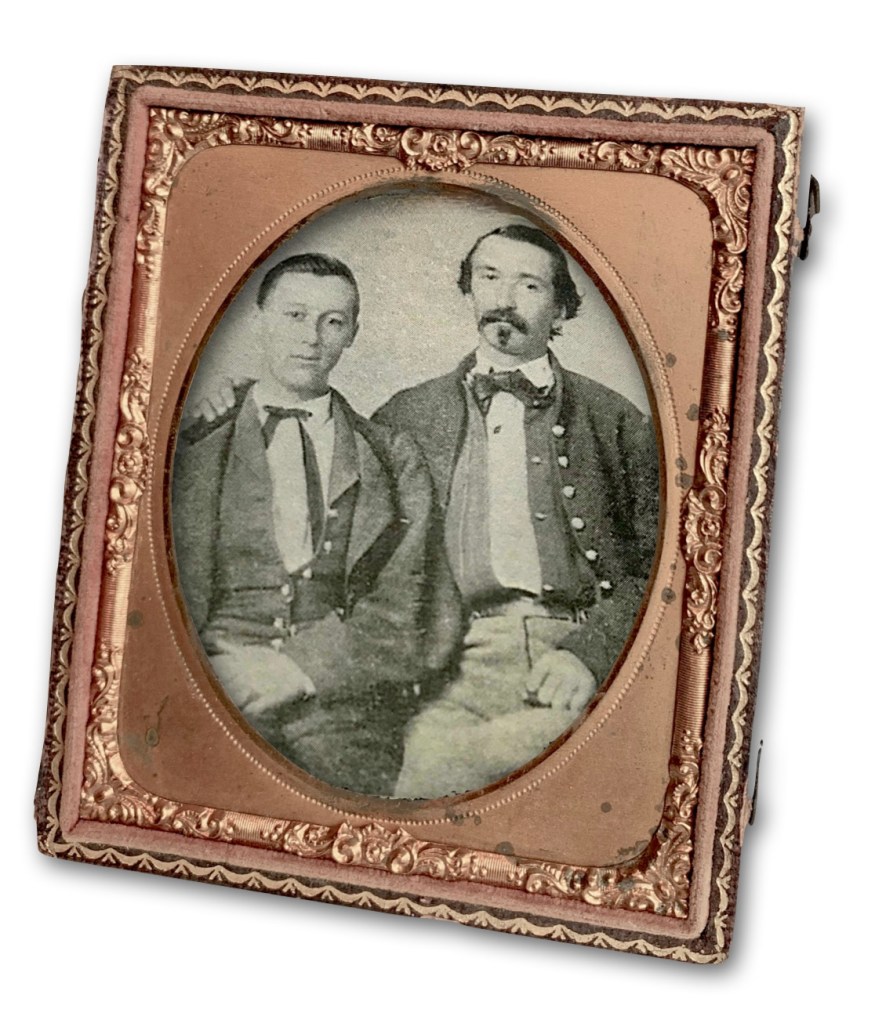
Walter Augustus Weddin at right with mustache (Courtesy of F. M. Polston)
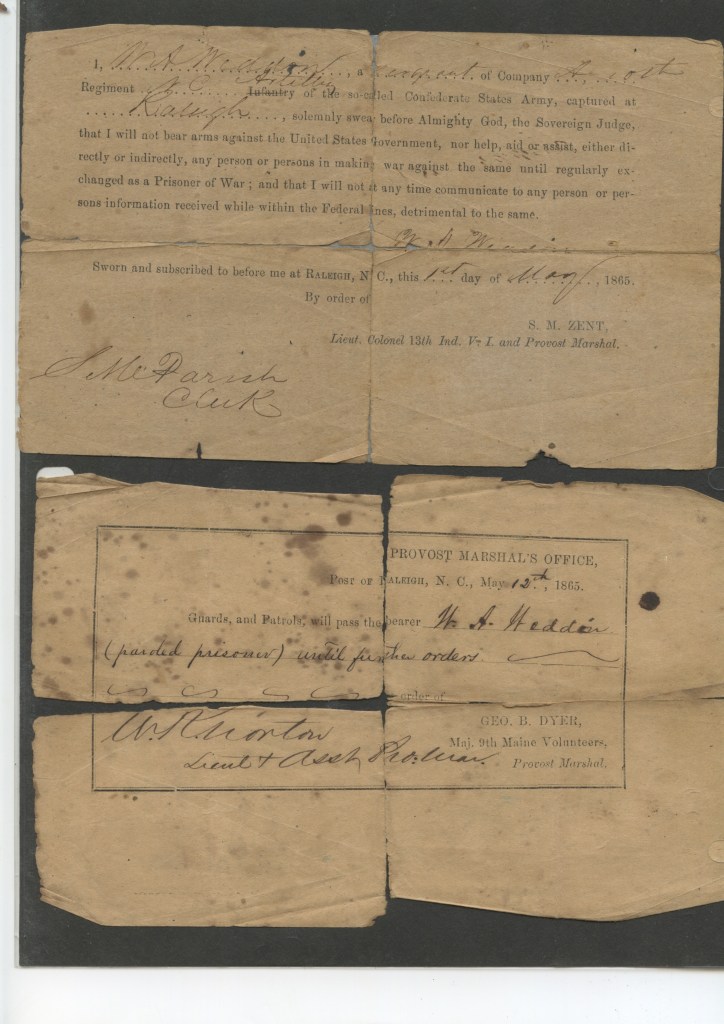
A notation of the inside cover of the diary suggests that the diary was picked up on the battlefield during the Battle of Chancellorsville. Subsequent diary entries reveal that they were made by Walter Augustus (“Gus”) Weddin (1840-1902), a member of Manly’s Battery, or Co. A, 1st North Carolina Artillery. This battery was commanded by Captain Basil C. Manly, the son of the former governor of North Carolina. By the summer of 1863, the battery consisted of two Napoleons and two 3-inch Blakely Rifles. In the Battle of Chancellorsville, Manly’s Battery was attached to Cabell’s Artillery Battalion in Lafayette McLaws’ Division and factored heavily in defending Lee’s rear at Salem Church. In fact, Manly posted one gun immediately adjacent to the church. Later in the day, Manly’s battery fired at the retreating enemy passing over the Rappahannock on a pontoon bridge.
Gus was born in Wake county, North Carolina, where he resided as a professor and enlisted at age 21 on 8 May 1861. He mustered in as a farrier but was promoted to Corporal in 1862. He suffered a gunshot wound to the arm on 9 June 1864 but returned to duty in mid-September and was present and accounted for through December 1864. After the war he married Kate Levy (1846-1908) of Raleigh and became one of the proprietors of the Weddin & Bailey Stage Line to Asheville. When that business was replaced by the railroads, Weddin ran the Eagle Hotel and then became superintendent of the Greystone Quarry.
The Goldsmith/Weddin 1863 Diary
One of the artillerists in Manly’s Battery was a New York native named Henry Ellis Thain. The story of his service in the battery and of having a “Confederate Medal of Honor” conferred on him can be found at the following web page along with some very interesting material about the battery. See Private Henry Ellis Thain.
[Note: This diary is from the collection of Rob Morgan and was transcribed and published on Spared & Shared by express consent.]
Transcription
JUNE 1863
Monday, June 1, 1863—In camp near the Poe River. Nothing transpired of importance. Went fishing. Caught a fine mess.
Tuesday, June 2, 1863—In camp near Poe River. Nothing transpired of importance only we received three days rations in advance. We expected orders at any moment. Called on Mrs. Blackley. Taken tea with them.
Wednesday, June 3, 1863—Marching orders. Left camp at sunset. Ordered to or near Chancellorsville. Marched 7 miles & went into park. Remained there until daylight.
Thursday, June 4, 1863—Marched 25 miles near the Rapidan. Went in park. Remained there until the morning.
Friday, June 5, 1863—Left camp at ten o’clock. Went one mile to better grass. Remained in camp until morning.
Saturday, June 6, 1863—Left camp at eleven o’clock. Ordered to Stevensburg. Got in camp at 10 o’clock. Remained there until morning.
Sunday, June 7, 1863—Received orders to march back to Culpeper Court House. Was out towards Sperryville on the turn pike 3 miles. Went in camp [illegible].
Monday, June 8, 1863—Remained in camp. All quiet. Many troops passed.
Tuesday, June 9, 1863—Fighting commenced at Beverly’s Ford soon after sunrise. Cavalry engaged. Our boys run back. Our battery was ordered off. Formed line of battle after marching through Culpeper. Advanced in sight of Stevensburg. Remained in position till near night. Went in park for the night.
Wednesday, June 10, 1863—Remained in camp all day. Reported that the Yankees had recrossed the river. All quiet during the day. We received orders to hook up to move camp. The order was countermanded.
Thursday, June 11, 1863—Still in camp. Nothing of importance transpired. No orders.
Friday, June 12, 1863—Received marching orders. Hooked up. Remained in park all night. Orders countermanded. All quiet along the lines.
Saturday, June 13, 1863—Went down near Stevensburg to graze the horses. Yankees crossed the river near Brandy Station. March back at double quick. Hooked up and moved out in a field. Moved from there to a new camp.
Sunday, June 14, 1863—Remained in camp all day. All quiet. Attended prayer meeting conducted by Mr. Oliver. Spoke a great deal of [ ].
Monday, June 15, 1863—Received marching orders. Left camp at 9 o’clock a.m. Marched through Culpeper. Very warm day. Went out ten miles on the turnpike road. Camp on Ha____ River.
Tuesday, June 16, 1863—Reveille at 2 o’clock a.m. Marched at daylight. Passed Sperryville at eleven o’clock. Camped near Washington all night. Passed through Woodville before we got to Sperryville. Taken breakfast with Mrs. Williams.
Wednesday, June 17, 1863—Reveille at 3 a.m. Left camp at 4 a.m. Passed through Washington. Got to Gaines’s Crossroads at ten o’clock a.m. and waited there for our Division. Very warm/ Camped on Fishers [Farm?].
Thursday, June 18, 1863—Reveille at 3 a.m. Left at 7 a.m.. Marched 12 miles. Very warm. great many sun stricken men. Got to Piedmont at 5 p.m. Camped for the night. Pleasant rain.
Friday, June 19, 1863—Reveille at 4 a.m. Cloudy but very pleasant. Marched at 7. Got to Paris at 9 o’clock at the top of the Blue Ridge. Got to the top, rested under a large Poplar [tree] where three counties joined (Fauquier, Loudoun and Clark). Remained all day. Cold and rainy. Ashby’s Gap.
Alfred Waud’s sketch of Ashby Gap in the Blue Ridge Mountains. The point marking the border between Fauquier and Loudoun counties was originally marked by a “double-bodied poplar tree standing in or near the middle of the thoroughfare of Ashby’s Gap on the top of the Blue Ridge.”
Saturday, June 20, 1863—Still on the ridge. Very cold & rainy. Clouds very low. Orders to leave at 3 p.m. Got to the Shenandoah river. Cross the river. Very deep. Camped for the night. Still cloudy.
Sunday, June 21, 1863—Reveille at daylight. Left camp at 8 a.m. Turned back. Threw up breastworks. Expected a fight. Taken position on bank. Through out part of our force. Heavy fighting with cavalry beyond Paris.
Monday, June 22, 1863—Reveille at daylight. Ordered across the river. Taken position on the Blue Ridge. Yankees fell back. No fighting up to 2 p.m. Ordered to recross the river. Camp near ford for the night.
Tuesday, June 23, 1863—Reveille at daylight. Nothing transpired until evening. Received orders to cook up three days rations. Enemy falling back. Reported by cavalry.
Wednesday, June 24, 1863—Reveille at 3 a.m. Marched at 4. Passed Millwood, very pretty village, taking the Pike Road to Berryville. Very pretty town. Taking the Smithfield Pike. Left the Charlestown to our right. Passed Summer Points on the Harpers Ferry-Winchester Railroad. Camped for the night.
Thursday, June 25, 1863—Reveille at 3 a.m. Marched at 4 a.m. Passed Smithsburg, very pretty little place. Went on, struck the W&M Pike. Passed through Darkesville one mile [and then] rested. Marched on through Martinsburg. Very pretty town. Came out one mile & camped for the night.
Friday, June 26, 1863—Reveille at 3 a.m. Marched at 4 a.m. Came to a crossing of the Potomac at Williamsport. Came out a mile and rested. Had whiskey. Cold and rainy day. Came on to Hagerstown. Quite a large place. Great many secesh. Came out one mile [and] camped for the night on the Frederick City Turnpike, Maryland. Whiskey killed 50 yards around the corner.
Saturday, June 27, 1863—Reveille at 3 a.m. Left Hagerstown at 9 o’clock a.m. Meet a great many friends. Went in Pennsylvania at 12 M. Received very cordially at Middleburg. Came past Greencastle [ ] came on towards Chambersburg. Passed through Marion. Camped [with]in 4 and a half miles of Chambersburg.
Sunday, June 28, 1863—Reveille at 4 a.m. Left camp at 7 a.m. Came through Chambersburg. All Union. Very pretty place. Came out mile and camped for the night. Population about 8 thousand.
Monday, June 29, 1863—Reveille at 4 a.m. Remained in camp all day.
Tuesday, June 30, 1863—Reveille at 4 a.m. Marched at 7 a.m. Passed through Fayetteville at 9 a.m. on the Baltimore Turnpike. Camped near Fayetteville at the foot of the Schuylkill Mountain.
JULY 1863
Wednesday, July 1, 1863—Reveille at 4 a.m. Orders to cook up 3 days rations. Left camp at 2 p.m.. Passed the ruins [of the] Catskill Iron Works at the foot of the Catskill M. Came down at Cashtown. Heavy fighting near Gettysburg. Came on through New Salem. Came on near Gettysburg to camp. Yankees driven 5 miles. Reported 30 pieces of artillery & three thousand prisoners. Rainy.
Thursday, July 2, 1863—Reveille at 3 a.m. Went to the hospital. Saw Capt. [Campbell Tredwell] Iredell [of Co. C, 47th North Carolina Infantry]. Right arm shot off. 1 Came on to battlefield. Went in line of battle. Marched to the right. Marched back to center. Went in action about half past 2. Battery fought till night. Lost one man killed—W. F. Ramsey, 7 wounded, 8 horses wounded & killed. 2
1 Captain Campbell T. Iredell of Co. C, 47th North Carolina Infantry had his right arm shot off by a shell in the first days fight but lingered for nearly two days before dying. He was 27 at the time of his death and as far as is known, his remains were never recovered and no record exists, except for the fact that he was buried on the Polly Farm. He may still to this day rest where the “green grass waves between thy clay and heaven.”See Their Stories. 2 Capt. Manly’s after action report for 2 July 1863 reads: “When we arrived within a few hundred yards of the crossroads mentioned above, we discovered that the enemy held it with a large force of infantry and artillery, which opened upon us immediately. We forwarded into line by a right oblique, and came into battery on an eminence a short distance to the right of the road on which we were advancing, at a distance of 700 yards from the enemy’s batteries. From this position we engage the enemy at 2.30 p.m., giving and receiving a very heavy fire for several hours, until at last, with the assistance of other troops, we succeeded in driving them from their position. During the evening, we advanced by a left oblique to the position left by the enemy in a large peach orchard. During the night, I was ordered to resume the position I had occupied during the afternoon.“
Entries on 1 & 2 July 1863
Friday, July 3, 1863—Still in line of battle. Fought all day. Fell back to our former position. Severe shelling. Rifle Section engaged. Lost three men wounded, 7 horses killed & wounded. 3 Heavy rain.
3 Capt. Manly’s after action report for 3 July 1863 reads: “On Friday, July 3, at 5 a.m., I was ordered to carry my rifled guns to the position occupied by the enemy’s batteries the day previous, leaving my smooth-bores in the same position occupied on Thursday, to check the advance in that direction. I accordingly placed my rifles in battery beyond and to the left of the crossroads, from which point the enemy’s line of artillery was 2,000 yards distant. At a given signal, we engaged the enemy from this position, my guns firing slowly and with deliberation. About 3 p.m. my supply of ammunition was exhausted, but in a short time I received another supply, and was enabled again to engage the enemy, which we did, keeping the fire until 7.30 p.m., at which time I received orders to withdraw my guns, as our troops had carried that line.“
Saturday, July 4, 1863—Still in line of battle. Enemy attempted to charge our batteries. We opened & drove them back in gallant style. Sharp skirmishing all day. Rumors of falling back. Fell back at 8 o’clock p.m. Enemy also fell back. 4 Rainy.
4 Capt. Manly’s after action report for 4 July 1863 reads: “On Saturday, July 4, I occupied my original position of Thursday, 2nd. At about 10 a.m. the enemy advanced with about three regiments toward our position. At about 1,200 yards distance we opened on them with beautiful effect, causing them to report that fact to their comrades in rear in great haste and disorder. They made no other advance on our position during that day. That night we withdrew from the vicinity of Gettysburg, and marched toward Hagerstown, Md.“
Entries on 3 & 4 July, 1863
Sunday, July 5, 1863—Struck the Fairfield Road at the Black Horse Tavern. Very rainy. Roads awful muddy. Seen 35 hundred prisoners come through Fairfield town. Our loss in the 3 days fight in Battalion was 67 horses & 65 men. Struck the Mountains. Got to the top about 10 o’clock at night. At Monterrey, great waiting place. Came down at Waterloo, Rainy.
Lee’s army in retreat from Gettysburg
Monday, July 6, 1863—Reveille at 3 a.m. Left Monterrey Springs at 8 a.m. Came down the mountain. saw good many wagons destroyed by the enemy. Passed Waterloo. Came on by Ringgold Crossroads. Came on through Leitersburg. Heavy firing towards Hagerstown. Cavalry fighting. Came on to Hagerstown. Saw some dead Yankees where they fought through town. Our boys run them several miles. Camped for the night. Rainy.
Tuesday, July 7, 1863—Reveille at 4 a.m. Ordered to hook up to meet a cavalry dash. Orders countermanded. Still in camp. Rainy morning.
Wednesday, July 8, 1863—Still in camp. No orders. Still rainy. Faired off about noon. Received orders at 8 o’clock p.m. Left at 9. Marched down the Boonsboro Road to the Antietam river. Cavalry fight near Boonsboro Gap. Beautiful night.
Thursday, July 9, 1863—Went in position at the bridge at the edge of Funkstown. Remained there all night.
Friday, July 10, 1863—Still in position. Orders to cross at 8 o’clock. Heavy fighting beyond town. Went in position and commenced firing at the edge of town [Funkstown]. Exhausted all our ammunition. Came to the rear. Loss C. Harwood seriously through the stomach. [George] Bridgers [ ] on horse killed. 5 J. H. Dunn [taken] prisoner. 6 Came to the old camp. [ ] to General Pickett.
5 Capt. Manly’s after action reports reads: “On Friday, July 10, I was ordered to cross the Antietam, and go to the assistance of General Stuart’s cavalry. We engaged the enemy at about 6 a.m. near the suburbs of Funkstown, and fought them from that position until late in the afternoon, compelling their artillery to change position twice during the engagement.” 6 J. H. Dunn was taken prisoner at Funkstown on 10 July 1863 and taken to Baltimore, then Point Lookout. He was exchanged on 17 March 1864.
Saturday, July 11, 1863—Left camp at 7 a.m. Came to Williamsport. waited for orders. Ordered out to park on the Potomac near the town. Charley Harwood died about 5 o’clock p.m. No orders.
Sunday, July 12, 1863—Still in camp near Williamsport. Went over to town to bury Charley. Buried him in the Catholic Church yard. No orders. Fighting up on river. The enemy repulsed three times. Rainy.
Monday, July 13, 1863—Still at Williamsport. Rainy. George Bridges died about 1 o’clock. Firing on the line towards Hagerstown. Orders to cross the river at 4 p.m. Left camp 6 p.m. Very rainy & muddy. Got over about 9 o’clock. Ordered to Martinsburg. Went several miles and camped for the night.
Tuesday, July 14, 1863—Left camp at 7 a.m. Came on through Martinsburg two miles and camped near the Big Springs. Heavy fight with [ ‘s] Brigade. General P. killed. Reported.
Wednesday, July 15, 1863—Left camp at 7 a.m. Came on through Darkesville on to Bunker Hill. Ordered in camp for the night. Fine day.
Thursday, July 16, 1863—Reveille at 4 a.m. Orders to join our Battalion. Left camp at one o’clock p.m. Very pleasant. Arrived at 3 p.m. Taken very sick in the morning. Heavy firing in the direction of Martinsburg.
Friday, July 17, 1863—Rainy today. Severe pain in my head & neck. Nothing of importance going on.
Saturday, July 18, 1863—Received orders to move camp. Left at 2 p.m. Came on towards Winchester several miles & camped for the night.
Sunday, July 19, 1863—Camped in a beautiful grove. Orders to be ready to move. Didn’t leave today. Received a letter from home. Wrote letter.
Monday, July 20, 1863—Reveille at daylight. Orders to leave at 7 o’clock. Left at half past 7 a.m. Ordered to Berryville. Came through Bucktown on to Berryville from there to Millwood. Got in camp at 7 p.m. Yankees occupied Ashby Gap at 12 o’clock.
Tuesday, July 21, 1863—Reveille at half past three thirty. Left camp at 8. Passed through Millwood. Took the Winchester Turnpike. Left the pike. Came on to White Post. On out to Winchester & F. R. Pike on towards F. R. Camped on Crooked Run.
Wednesday, July 22, 1863—Reveille at 3 o’clock. Marched at light. Came down to the Shenandoah River. Crossed on the pontoon bridge at the fork. Came on through Front Royal. Came up the mountain through Chester Gap 5 miles up. Had a cavalry fight coming down. Run them back. Came on to Gaines’s Crossroads. Got into camp at 11 o’clock at night.
Thursday, July 23, 1863—Reveille at daylight. Left camp at eleven o’clock. Came on towards Cupeper. Camped near the Hazel River. Rained.
Friday, July 24, 1863—Reveille at half past 3. Marched at daylight. Came on to Culpeper. Out mile and camped. Very warm.
Saturday, July 25, 1863—Beautiful morning. Orders to was the gun carriages & rub up the pieces. Pleasant rain after dusk.
Sunday, July 26, 1863—Pleasant morning. Nothing transpired of importance. Wrote a letter to G. L. T. & received a letter G. L. T.
Monday, July 27, 1863—In camp. Nothing of importance transpired. Rain in the afternoon. No orders.
Tuesday, July 28, 1863—In camp. Nothing of importance transpired. Thunder storm & heavy rain. No orders.
Wednesday, July 29, 1863—In camp. No orders. Pleasant rain.
Thursday, July 30, 1863—In camp. Nothing of importance transpired. Light showers of rain. Yankee General Meade’s Headquarters at Warrenton.
Friday, July 31, 1863—In camp. No orders. Signal gun heard towards the enemy just at light. Eleven o’clock received orders for two days rations. Commenced cooking. No sleep for the night.
AUGUST 1863
Saturday, August 1, 1863—Reveille at 2:30 o’clock. Orders to march at 4 a.m. Harnessed, hooked up, orders countermanded. Heavy firing towards Stevensburg. Cavalry fighting. Enemy drove ours 2 miles.
Sunday, August 2, 1863—In camp. All quiet today.
Monday, August 3, 1863—Reveille at 3 o’clock. Orders to be in readiness at daylight. Moved at 8 o’clock. Came out and struck the Rapidan road. Stopped to rest on the battlefield of Cedar Run. Came across to country toward Summersville. Crossed the Rapidan at Summersville ford. Camp for the night.
Tuesday, August 4, 1863—Very warm. Heavy storm of wind and rain. Some firing towards Fredericksburg. All quiet along our lines up to this time—half past 2 o’clock. No orders. All quiet.
Wednesday, August 5, 1863—Reveille at sunrise. Orders to cook up three days rations & be ready to march at 8 o’clock. Came of 20 miles of Fredericksburg. Camped for the night.
Thursday, August 6, 1863—In camp. No orders. All quiet except slight firing towards Stevensburg.
Friday, August 7, 1863—In camp. No orders. Went foraging. Got some hay. Pleasant rain.
Saturday, August 8, 1863—ve camp. Left at camp at 5 o’clock p.m. Came 4 miles. went in park. Very pleasant camp.
Sunday, August 9, 1863—No orders. All quiet. Quite warm.
Monday, August 10, 1863—No orders. All quiet. Very warm.
Tuesday, August 11, 1863—All quiet today. Orders to report to General Kershaw. Some talk of moving towards Spotsylvania Court House. Very warm. Moved at 5 p.m. Came to [ ] Church. Camp near the church.
Wednesday, August 12, 1863—In camp. No orders. Went fishing. Catched a fine mess. very warm. Rain.
Thursday, August 13, 1863—Still in camp. No orders. Very warm. Rainy.
Friday, August 14, 1863—No orders. Very warm. Rainy.
Saturday, August 15, 1863—All quiet. No orders. Warm.
Sunday, August 16, 1863—Orders to hold ourselves in readiness to move. Firing towards Fredericksburg.
Monday, August 17, 1863—No orders. Very warm.
Tuesday, August 18, 1863—No orders. All quiet. Very warm. Orders to grant furloughs.
Wednesday, August 19, 1863—No orders. All quiet.
Thursday, August 20, 1863—All quiet. No orders., Very warm.
Friday, August 21, 1863—All quiet. Fast and pray. Went to church. Orders to leave at 2 o’clock.
Saturday, August 22, 1863—Reveille 2 a.m. Marched at 3. Came 12 miles. Halted for the night.
Sunday, August 23, 1863—Reveille at 2 a.m. Marched at 3 a.m. Came 10 miles. Went in camp. Expected to stay some time here.
Monday, August 24, 1863—All quiet. No orders, Rain in the evening.
Tuesday, August 25, 1863—All quiet. No news of interest. Pleasant rain in the evening.
Wednesday, August 26, 1863—All quiet. Very pleasant. Cool. Wind. No news of interest.
Thursday, August 27, 1863—All quiet. No orders. Beautiful day.
Friday, August 28, 1863—All quiet. No orders. Very cool day.
Saturday, August 29, 1863—Orders to hold ourselves in readiness to move. Yankee force advancing on Richmond. Two of our brigades ordered to Richmond. Wofford’s & Semmes’s orders were countermanded when around at Bumpass’s Station.
Sunday, August 30, 1863—Beautiful day. Went to (Good Hope) to church. Heard a splendid sermon from the 68 Psalms. Came to camp. Went to prayer meeting in Kershaw’s Brigade.
Monday, August 31, 1863—No orders. All quiet today. Very cool.
SEPTEMBER 1863
Tuesday, September 1, 1863—Very quiet today.
Wednesday, September 2, 1863—No orders. All quiet today. Very pleasant.
Monday, September 7, 1863—Pleasant today. Orders to cook up three days rations. Orders to move at daylight.
Tuesday, September 8, 1863—Left camp at half past five. Very warm. Camped on Butler farm near the railroad.
Wednesday, September 9, 1863—Left camp at 7 a.m. Came down to Hanover Junction. Parked on the railroad.
Thursday, September 10, 1863—Great many troops being transported on the roads. Our battery still in park on the railroad.
Friday, September 11, 1863—All quiet today. Still waiting for transportation. Went on guard at Mrs. Saunders’.
Saturday, September 12, x1863—Corporals Weddin and Brooks are detailed to go to Chesterfield after some clothing. Camp Manly Battery, September 12, ’63. Granted, — B. B. Guion, in command. Went to Chesterfield Taken dinner with Mrs. Burns.
Sunday, September 13, 1863—No transportation yet. Rumored that the artillery is not going out West. Went visiting to the 15th N. C. Regiment.
Monday, September 14, 1863—Orders for going out West is countermanded. Received orders to report at Gordonsville.
Tuesday, September 15, 1863—Reveille at 3 a.m. Left camp at daylight. Very pleasant morning. Came on near Villa Green. Camped for the night.
Wednesday, September 16, 1863—Reveille at 3 a.m. Left camp at 4 a.m. Came on to Louisa Court House. Camp for the night past Collinsville.
Thursday, September 17, 1863—Left Louisa C. H. at daylight. Came near Gordonsville. Heavy rain. Dr. Wall’s farm.
Friday, September 18, 1863—Very rainy. No orders.
Saturday, September 19, 1863—No orders, Rainy. Reported that the army was going to fall back.
Sunday, September 20, 1863—No orders. Very pretty day.
Monday, September 21, 1863—All quiet. No orders.
Tuesday, September 22, 1863—Heavy firing towards Liberty Mills. Cavalry engaged. Our men driven back. Received reinforcements. Held them. Own ground. Our loss 70 in all. Received orders to move.
Wednesday, September 23, 1863—Left at daylight. Came our near Gordonsville. Went in park. Run around there all day.
Thursday, September 24, 1863—Still in camp near Gordonsville. All quiet beyond the mountains.
OCTOBER 1863
Thursday, October 8, 1863—No orders. Samuel Snow and Nock West returned from home. Joseph Harly came with them.
Friday, October 9, 1863—Orders to move to t he front. Hooked up. Orders countermanded. Henry & Batte [?] left us [ ]. Whole army moved forward.
Saturday, October 10, 1863—Sharp skirmishing in the front. Good many cavalry came to Gordonsville.
Sunday, October 11, 1863—All quiet today. No news from the front. Went to work on quarters. Put up very comfortable house.
Monday, October 12, 1863—Reported that the army have passed Springville. Our army marching altogether through the woods to avoid being seen from the heights occupied by the enemy.
Tuesday, October 13, 1863—But little news from the front. Some prisoners passed Gordonsville. Heavy rain.
Wednesday, October 14, 1863—Heavy fight near Bristoe Station. [John Roger] Cooke’s & [William Whedbee] Kirkland’s Brigades engaged. Our loss near a thousand on our side. Enemy loss also heavy. Lieut. Boone wounded. General Cooke wounded in the thigh. General Kirkland in the arm. Heavy rain.
Thursday, October 15, 1863—Heavy storm of wind and rain. Enemy reported to fall back to Centerville.
Friday, October 16, 1863—No fighting as can be heard today. Ambulance committee went on from Richmond.
Saturday, October 17, 1863—Some wounded arrived here today.
Sunday, October 18, 1863—Good many wounded came down today. Saw good many friends among them. Very pleasant day. Went to church in afternoon.
Monday, October 19, 1863—Wounded still coming. Saw Lieut. Boone wounded through the right arm near the shoulder. No news from the front—only Hill’s Corps reported falling back to the Rapidan river.
Tuesday, October 20, 1863—no news reliable today. Rumors say Meade is advancing to [ ].
Wednesday, October 21, 1863—No news from the front. Very cool. Went to depot. Saw some acquaintances from North Carolina.
Thursday, October 22, 1863—No news today from the front. Saw three hundred prisoners that came down on the Orange & Alexandria Railroad. General [Stephen Dodson] Ramseur visited our camp on his way home. Looked very well.
Tuesday, October 27, 1863—Went out foraging with two wagons to Morris’s farm. Very cool today. The cavalry had a skirmish yesterday. One hundred of the enemy killed. A great many wounded. Our loss killed ten, 30 wounded.
NOVEMBER 1863
Sunday, November 8, 1863—Nothing of interest today. Very stormy. Very cold. Windy. Cloudy. Fighting up on the line. Two of our Brigade reported captured except 6 hundred. Hooks and Hayes. Our forces fell back to Rapidan.
Monday, November 9, 1863—Cold and windy. Heavy snow commenced at 2 o’clock and stopped during the night.
Friday, November 13, 1863—Very pleasant today. Very dull in camp. Went to Gordonsville after corn with the wagons. received orders to leave camp early on Saturday morning.
Saturday, November 14, 1863—Left camp at 8 a.m. Came out two miles to the right of Orange Court House. Camp in an old field. Rainy. Very pleasant. Camped near a camp where we camped one year two months before. Awful thunder storm lasted all night.
Sunday, November 15, 1863—Thunder showers until 7 a.m. Faired off very pretty morning over head. Heavy cannonading towards Germanna Ford on the Rapidan.
Germanna Ford on the Rapidan River
Tuesday, November 17, 1863—Very cool morning. Some rain early. Went to Orange C. H. Went over to Kirkland’s Brigade. Saw several acquaintances…
Wednesday, November 18, 1863—Sharp skirmishing in front. Went to Orange C. H. with the wagon after forage. Dreamed of being home again 4th night in secession.
Sunday, November 22, 1863—Beautiful morning. Went down near Forest Hill Church to see some friends. Came back late at night. Very cool.
Monday, November 23, 1863—Moved camp. Cloudy and cool. To more wood.
Tuesday, November 24, 1863—Cold and rainy. On detail after lost horses. Nothing could be heard from them. Went over to Riley’s Battalion. Saw some old friends.
Wednesday, November 25, 1863—On detail after horses. Very cold…Major Badger came from home. Went out to camp.
Thursday, November 26, 1863—On detail after stray horses. Came to the depot. Mrs. Sterne and Lieut. Dunn came from home. I went out to camp with. Heavy firing down towards Raccoon Ford. Enemy reported trying to cross at Raccoon Ford. Received orders to cook up 2 days rations & be ready to move.
Friday, November 27, 1863—Reveille at 2 o’clock a.m. Left camp at 4 a.m. Came down towards Spotsylvania C. H. Heavy firing on the river. Cavalry fighting 3 miles off. We were ordered out towards Louisa C. H. to avoid the raid. Close place all day. Stopped at 3 o’clock p.m. & camped for the night 6 miles west of Waller’s Tavern. Rations wagon broke down. No rations tonight. Very bad pain in my head. Cold.
Saturday, November 28, 1863—Remained in camp all day. Heavy fighting in front. Nothing heard of the losses. Rained. Received orders to be ready to move at moments notice. Ordered to cook up 3 days rations. Rumors say 100 captured. 450 prisoners & 225 mules and horses. Destroyed 50 wagons.
Sunday, November 29, 1863—Reveille at 2 a.m. Left camp at 4 a.m. Ordered to Sandersville on the O & F Plank Road. Cannonading heard towards Ely’s Ford. Came several miles before daylight. Very warm & looked like rain until daylight. Then turned off very cool.
Monday, November 30, 1863—Reveille at usual hour. Heavy cannonading towards Ely’s & United States Fords. Rifle Section ordered off at 9 a.m. Rumors say two Yankee regiments captured. Henry’s Battalion lost good many men. Rifle section returned.
DECEMBER 1863
Tuesday, December 1, 1863—Very cool morning. Went to Orange Court House with Sterne. Enemy reported falling back. No fighting going on today.
Wednesday, December 2, 1863—No fighting going on today. Went to Orange C. H. with the wagon after corn…A. P. Hill’s Corp is returning to old camps.
Thursday, December 3, 1863—Troops all returning to old camps. Went on several miles & meet out battalion coming back to old camp, 2 miles of Orange. Got in camp at 3 p.m.
Wednesday, December 9, 1863—Nothing of interest today. All quiet along the lines. Papers speak of Longstreet falling back to Morristown. Very cool & fair. Received a Napoleon gun for my detachment.
Thursday, December 10, 1863—no orders nor no news. Sergt. Slade & Private Newsom fell out about rations. The latter stabbed the former in three places on the left arm.
Saturday, December 12, 1863—No orders today. Some rumor about going in winter quarters near Louisa Court House. Rainy and cold in afternoon. Yankees leaving Culpeper Court House and destroying a good deal of property of the citizens.
Tuesday, December 15, 1863—Reveille at 4 a.m. Left at 6 a.m. Ordered to Raccoon Ford. Came on near Ewell’s Headquarters & parked & waited for orders. Ordered on in position at Raccoon Ford. Bad camp. No woods. Relieved battery.
Wednesday, December 16, 1863—Nothing of interest today. The enemy seem to be in small force on the opposite side of the Rapidan but in large force on the Rappahannock. Cool. Commenced raining & drizzling during the night. Visited Gen. Ramseur’s Brigade. Saw many friends.
Thursday, December 17, 1863—Still raining and sleeting. see but few Yanks today. Rainy and cold all day.
Friday, December 18, 1863—Went to work on chimney. Finished it & moved in. Very cold, cloudy and looks like snow after dark. On guard. Went up to post. The relief saw signal lights on Pony Mountain. Good many lights up & down the lines. Rapidan very full.
Saturday, December 19, 1863—Nothing going on today of any interest. The Yankees double their lines of pickets. All our extra men and horses are ordered to the rear. Caissons, horses included on account of the bad roads to Orange. We can’t get forage for them over the roads. Worked on my quarters today.
Sunday, December 20, 1863—Nothing of interest today. After suffering for six days with the toothache, I went over to Dr. Brown’s to have it pulled…Pulled two teeth & [ ] the jaw bone which caused much pain. But few Yanks today.
Monday, December 21, 1863—Nothing of interest today. But few of the enemy visible. Early’s Division moved to the rear. Very pretty morning but turned off very cool and looked like snow in the afternoon.
Wednesday, December 23, 1863—Found the ground covered with snow. Faired off in the afternoon. The Louisiana Brigade moved back to Wood. Leaves us alone except a small picket force.
Thursday, December 24, 1863—Beautiful morning, only it’s rather cool. Hear more drums in Yankeedom than usual. This morning snow all gone.
Friday, December 25, 1863—Beautiful morning. Very dull. Yankees reported advancing from Culpeper Court House. Afternoon officers having a gay time. All hands drunk. I don’t think I ever spent a duller Christmas in all my life. Nothing to amuse us at all. Near night, the enemy appeared in some force on the line & we taken three cracks at them & they soon departed.
Tuesday, December 29, 1863—Faired off very pleasant. Went down on the river to see our breastworks. Found them very strong. McM__ wounded himself in the foot.
Wednesday, December 30, 1863—Very pretty morning. Went down to Orange C. H. with the wagon after rations. Went down to the 14th N. C. troops. Saw all the Raleigh boys. Came back to the forage camp after supper. Stayed there all night. Looked like rain.
Thursday, December 31, 1863—Rainy and cold. Came back to camp. Awful roads. Drew coffee, sugar, flour, dried peaches, apples, bacon, beef, and rice. Quite a ration.
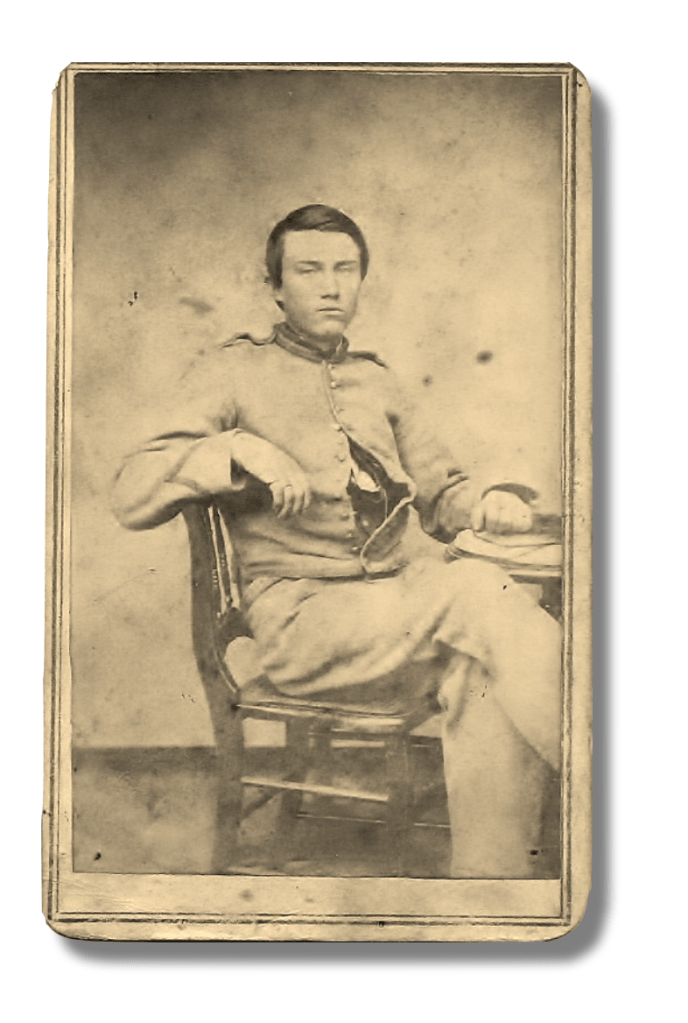
I could not find an image of William but here is a cdv of Calvin Jerome LeFevre of Co. H, 116th Pennsylvania Infantry. Calvin was wounded at Spottsylvania Court House on 12 May 1864, transferred into the 14th VRC and died in July 1865.(Ancestry.com)
These letters were written by William Augustus Smith of Co. D, 116th Pennsylvania Infantry (fought with the Irish Brigade). The first letter discusses the Battle of Falling Water (soon after Gettysburg, in which that unit was heavily involved) among other things. Even though that letter is not datelined, it most likely was written on July 15, 1863, since it is headed “near Harpers Ferry.” According to Mulholland’s history of the regiment, the 116th spent the night of 15 July 1863 there following Falling Water. William served as a private in Co. D, and later as a corporal in Co. A of the 116th Pennsylvania before being transferred to the Veteran Reserve Corps.
William A. Smith was the son of John Matlock Smith (1809-1873) and Phebe M. Medenhall (1813-1900) of West Chester, Chester county, Pennsylvania. It is curious, however, that he was not enumerated in his parent’s household in the 1850 US Census.
There are several references to this soldier—including quotations from other letters—posted on the internet or published in books. In his book, Defeating Lee: A History of the Second Corps, Army of the Potomac, (page 87), Lawrence Kreiser wrote that Pvt. William Smith—when he learned of Lincoln’s Emancipation Proclamation—was quoted as writing, “To hell with the Niggers…I would shoot one quick as a wink if he gave me any sase.”
Letter 1
[This letter is from the collection of Richard Weiner and is published with express consent. It was first published on 10 December 2017 on Spared & Shared 10.]
Pleasant Valley, Md, near Harper’s Ferry [15 July 1863]
Dear Father & Mother,
I thought I would write a few lines to let you know where I am. We have had a hard time of it since I wrote to you before. We have been chasin’ the johnnie rebs up and run them to Falling Waters and then captured about 2,000 prisoners and kill[ed] a good many of them. We have about 16 rebs of them that we are going to shoot for surrendering and waving a white flag and seeing that there was not many of them and then they run back and pick[ed] up their arms and shot our men down after they had surrendered. So they held a drumhead court martial and their sentence was to be shot.
We have had marching all the time—today 20 miles. And the day before the Battle of Gettysburg we marched 35 miles—and it is hard work. It is kill[ing] me up marching with the diarrhea so bad. It [is] keeping me running all the time and it makes [me] mighty weak. And it is as much as I can do to get along on the march. If they don’t stop pretty soon, I will have to give up the ship.
We have got orders to go ahead again tomorrow at 4 o’clock to Winchester [to] try to get ahead of Old Lee. If we had not marched so hard and so long, we could [have] got ahead of them in a day and got half of Lee’s army. They rushed them in the river with the point of the bayonet and drowned a great many of them in [ac]count of us running them so hard to get them across the river so that we could not get them. As it was, we took about 2,000 of them altogether. Our division took 4 or 500 of them. In their rush, one of the orderlies at the headquarters took 3 of them himself—so you can see which side it takes to capture one.
Well, it is getting late so I will have to stop writing. I seen Bill Dollings today and 2 others from West Chester. Asis Fittings and Gad Goule in the bands. I think it is Beck’s [Philadelphia Brass] Band and they are all well.
Here is an envelope with the stamp on that was taken from [a] rebel’s knapsack at the Battle of Falling Waters and a little cathrel [?] badge that I found on the Battlefield of Bulls Run. It was laying along a lot of human bones. I have got some things more to send home but there is no chance. I thought I would [have] got them sent home when I was in Pennsylvania but we got out of it in such a hurry there was no chance. And tomorrow morning we will have to cross the river in[to] Old Virginia again. I am sick and tired of that state.
So goodbye to you all for awhile and direct your letters [to] Headquarters, First Division, 2nd Army Corps, Army of the Potomac.
From your son, — Wm. A. Smith
Letter 2
Headquarters Turkey Run 1st November 1863
Dear Father & Mother & Sisters,
I take this opportunity of answering your letter I just received this evening and was glad to hear from you that you were all well at present and I am enjoying very good health at this time as long as we are staying here. We have a barn to stay in now and we have bunks fixed up in it and it makes it very good for us and it keeps us dry and off the ground. I tell you, it is bunkum. My pardner and me was waken out the other day and we seen a chicken and we thought it would bite us so we had to twist the neck for him. He hollow at us and that would not do so we picked him and put him in a pot and had two good meals off of him for he must bin the first one that Noah drove in the Ark in the year of one. He had spurs on a inch and a half long. It put me mind of Mosby—the Griller [guerrilla].
So yesterday we seen another one running around loose so we were afraid it would bite us so we made away with him the same way. But it turned out better. It was young. So I think I have told you anuf about the chicken this time. But they must not run around here loose where we are for we will serve them the same way.
There has been nothing new going on since I wrote to you before but the Reserve Artillery has come up and gone to Belle Plains and I expect that we will be on the march again in a day or so. There is some talk of us going tomorrow or the next day. They say that we are going to our old place again—that is Falmouth. So the next letter that I will write to you will be from there or Fredericksburg.
So goodbye this time. So my love to you all and give my love to Mrs. Apple and all the family and to Aunty & Becky Joyce and to Turser Snare and give Molly my best respects and I wish her much joy and her man also.
I think the young men had better stop getting married till after the draft is over for maybe some of them will have to come out in the field to battle with the Johnny Rebs yet and then they will have to leave their sweet turtle doves and they will not like it much then for when they get out here, they won’t have their sweet ones to go home to when they are done work at night to play with and to comb their head and make them look slick when they take a promenade with on Saturday evenings and Sundays to the woods in the afternoon. For Molly Snare said that she was going to be a old maid but that is played out now.
So goodbye to you all. My love to all of you. From your son, — Wm. A. Smith
Write soon.
Letter 3
Camp near Stevensburg January 17, 1864
Dear Father & Mother & Sisters,
I take my pen in hand to write you a few lines to let you know that I received your kind letter last night and was very glad to hear from you, that you were all very well at present, and that you had a happy Christmas there together. And I would like to been there with you, but it was no go for I could not make it. The furloughs has stopped now and I think there is a poor chance for me now without I play the Old Soldier and get my discharge, or get in a hospital away from here and then I will have a chance. Then I might have a chance.
Well, I am a little better than I was when I wrote to you before. I have got my feet frozen on New Year’s night. They are pretty sore now. It keeps me off doing duty now and I ain’t going to do anymore for Uncle Sam than I can help for they act the nigger on me in everything. There is some men going home to reenlist for the regiment. The pets has to go so there is no chance for me so let it rip.
Well, you can send me a box now if you choose. All the boys are getting them by Adams Express Co. now. If you you send me a box and some things that I want, I will be very much obliged to you for it. Uncle Sam has not paid us off yet or else I would send some money home to get some things. But I guess there is enough of money I sent home for to spend when I come home on a furlough. I wish you would take that and get me some files—about a half dozen. I want a rat tail file and two or three half round ones about 3 or 4 inches long and two or three saw files—small ones—and a small sprigen awl so that I can work to pass away the time. And I would like to have a good mess of sausage and scrapple and a good loaf of Mother’s bread and some butter and I don’t care what else. And don’t forget a pie—some like you had for Christmas. I think it would do good for a change for I have not a taste of one for so long. I will not know how it will taste.
My ink is played out so I will have to stop. So give my love [to] all of my friends and love to you all and write soon. So goodbye from your son, — Wm. A. Smith
Direct this:
Wm. A. Smith Co. A, 116th Regt. P. V. 2nd Brigade, 1st Division, 2nd Corps Washington D. C.
Letter 4
Camp near Stevensburg March 4, 1864
My dear Father & Mother & Sisters
I take my pen in hand to write you a few lines to let you know that I received your kind and welcome letter last night and was glad to hear that you are all well at present when it left you. Well, for my part I am getting along very well at present here now. I have not done any duty since I left the Headquarters the 26th December.
Well, there is not much news here now. We had a big ball on the 22nd of February [Washington’s Birthday] and had all of the Heads of Washington our here to see us and it was a grand thing to see so many men and women together in one place and see the women ride with the generals on horseback along the columns as fast as the horse can go. There was 14 ambulance loads at Division Headquarters and among them was Gov. A. J. Curtin and Lady, and the Vice President and Mr. Greenbacks [Salmon Chase] & daughter [Kate]. I suppose you know how that is.
On the 25th we got 40 new recruits for the regiment today and the first doctor’s call was 12 of them on the sick list. I thought that was a good bargain for the first. That is the way they come—there will not be much relief to the old men off of duty.
Some of the army was out on a reconnoiter on the 27th—that was the 6th Corps—and the 3rd Corps got orders to move in the afternoon and the 2nd Corps on the 28th got orders to move in a moment’s notice. On the 29th we got mustered in for pay for two months more. I expect we [will] get [it] in a week or so.
Well, we are moving camp now. Some of the boys has their tents up. There was not anuf of room for us there when the new recruits come out. We expect 400 men today or tomorrow as soon as they can get the new camp fixed for them.
Well, that is all the news down here now. The weather is clear today. On the 1st of March we had quite a snowstorm. Well, I must come to a close now for I want to write a note to Emily [and] see if I can mend her ways for if I was there, I would help her to. Well, I come to a close by sending my love to you all and all of my enquiring friends. So goodbye. From your son, — William Augustus Smith
Mother, here is a ring I send to you with your letters [initials] in—P. M. S.
Letter 5
Addressed to Mr. John M. Smith, No. 27, Union Street, West Chester, Chester county, Pa.
Alexandria [Virginia] [May] 26th 1864
My dear Father & Mother & Sisters,
I take this opportunity of writing you a few lines to let you know that I received your letter dated the 22nd and was very glad to hear from you all that you are all well at present. I am better than I was a few day ago. I left Cliffburne Barracks on the 22nd of May and was reassigned to the 3rd Regiment Veteran Reserve Corps. The boys are first rate fellows but the captain is a darn mean man. He shows too much of the red tape about him. He will damn a man uphill and down for little or nothing. He has but one eye. The other is a glass eye. I hate it that his name is Smith for he is a disgrace to the name of Smith.
There is not much news here now—only that I got 5 letters from the front last night—all of the back letters that is at the regiment. My old Company A is doing provost guard duty at Division Headquarters. The boys say that they are getting along first rate and if they keep on doing as well as they have been doing, they say that they will go in Richmond before the 4th of July or take his head for a foot ball.
Is Frank’s corps the 10th or 16th for I can’t tell in Anne’s letter for it looks like a 16th. I have forgot the run of the corps now or else I would know.
So I come to a close by sending my love to you all and all of my friends. So goodbye. From your son, — W. A. Smith
Direct your letter to Corporal Wm. A. Smith, Co. D, 1st Battalion, 3rd Regiment, Veteran Reserve Corps, Alexandria, Virginia
The following letters were written by Solomon Hege (1813-1875) or his wife, Catharine Guenther (1813-1874) of Midway, Davidson County, North Carolina, during the Civil War. They were written to their son, Constantine Alexander Hege (1843-1914) who was in the Confederate service. Constantine was raised as a Moravian and was naturally opposed to the war, but he was never the less obliged to enlist in the summer of 1862 in Co. H, 48th North Carolina Infantry. He served for 14 months during which time he was captured at the Battle of Bristoe Station on 14 October 1863 and was confined in the Old Capitol Prison in Washington. While there he was visited by some North Carolina Moravians working in the capitol, and under their guidance, Hege decided to take the oath of allegiance to the United States. After his release, he went to Bethlehem, Pa., where he found employment in the iron works.
A few of the letters were written by Mary Louisa Hege (1848-1920). She married Samuel Alexander Burke (1848-1925) in 1871.
See also—1862-63: Constantine Alexander Hege to his Family below:
Midway [Davidson, North Carolina] September 6th 1862
My dear son,
I avail myself of the present opportunity to write to you to let you know how we all are. We are all quite well and hope that when these few lines reach you it may find you enjoying the same blessing. Elisha Raper’s youngest child [William A. Raper] died with a brain fever and is to be buried at eleven o’clock today at Olivet and Mary is going and take Mary Chitty with her who is here on a visit.
We heard that Solomon Wilson 1 had run away from the army and his mother is troubled about it for she has not heard from him in some time. When you write again, you must tell us whether he is with you or not, and let us know if you ever see or hear anything of Daniel Wilson. 2 Mr. Joseph Delap was married to Daniel Wagoner’s daughter 3 on the 4th of this month and your father saw them at the Widow Vehrel’s sale.
Alec [David Alexander] Spaugh 4 run away from camp but he didn’t get home for the guard caught him and gave him 24 lashes and sent him back so it didn’t do him much good to runaway and I think they had better be contented and stay where they are. And I do hope that you may always be contented and put your trust in the Lord and He will protect you from all danger and harm.
We have a great many watermelons this year and whenever we eat one, we think of you and wish you had some of them and of the nice peaches and apples that are wasting here. Mary has returned from the burying and on the road home thy overtook Uncle Christian Spaugh and rode with him in the buggy. He heard that Theophilus 5 was sick in the hospital and he thinks he will go to see him next Wednesday with Mr. Jordan Ruminger.
We would be glad to send you a box of provisions if we were certain you would get it safely. Next time you write, let us know what you want and what you are in need of and if it is in our power to send it, you shall have it. I must stop writing for I have not anything more that would interest you.
[Your brother] Julius is in the meadow raking hay and we are all busy drying fruit for there is lots of it here and a wasting here too. How I wish you had some of it. Selene Faw said I should tell you howdy and sad she wished you well and hoped you would soon return.
Much love from all of us and write soon to your affectionate, — Mother
1 Solomon Wilson (b. 1842) was conscripted with Constantine Hege on 8 August 1862 in Co. H, 48th North Carolina. His military record indicates that he was taken prisoner at Sharpsburg, Maryland and paroled on 10 October 1862. He did not return to the regiment, however, until 6 August 1863 and then deserted to the enemy on 6 March 1865, after which he took the oath of allegiance.
2 Daniel Wilson (Solomon’s older brother) served as a private in Co. H, 15th North Carolina Infantry. He was conscripted in mid-July 1862, became sick almost immediately, but joined his regiment in time to participate in the Battle of South Mountain where he was taken prisoner on 14 September, sent to Fort Delaware, later paroled and then hospitalized at Richmond until his death of scurvy on 11 November 1862.
3Joseph Franklin Delap (1837-1917) was married to Ann Elizabeth Wagoner on 3 September 1862 according to Davidson county Marriage Records. Joseph was commissioned (by election) a 2nd Lieutenant in Co. H, 48th North Carolina Infantry on 5 May 1862. He resigned his commission on 15 August 1862 claiming that he had been experiencing a “violent sickness” and returned home to marry Ann.
4 David Alexander (“Alec”) Spaugh (1837-1900) was the son of Christian Spaugh (1803-1885) and his first wife, Sarah Tesch (1772-1844). After Christian’s first wife died, he married Catherine Hege (1811-1862) who died on 25 November 1862. In June 1863, David joined Co. B of the 10th Virginia Cavalry. He may have initially served in Co. I, 33rd North Carolina Infantry.
5 Theophilus Thomas Spaugh (1843-1913) was the son of Christian Spaugh (1803-1885) and his second wife, Catherine Hege (1811-1862). Theophilus was conscripted in July 1862 into Co. F, 15th North Carolina Infantry and was hospitalized in Richmond on 25 August 1862 and was absent without leave quite a bit of his time.
Letter 2
Addressed to C. A. Hege, Richmond, Va., In care of Capt. Michael, 48th Regiment N. C. Troops, Company H
Davidson County, North Carolina September 11, 1862
My dear son C. A. Hege,
Yours of the 30th of September [August] came to hand this evening. I am glad to hear you are well for many anxious care and thought crosses my mind concerning you & for all the rest of you, but with all my care, I lean upon the Lord who alone can support us through all the trials & troubles of life. I hope you have that confidence in God’s word & promises that you can under all circumstances with childlike confidence put your trust in the Lord, let what may befall. All things shall work together for good to them that love the Lord Jesus. Therefore, serve God and be cheerful though rough & stormy be the road. Still look to Jesus.
I am sorry to hear our letters do not all reach our conscript friends as they complain often that they get no letters from home. It appears from all letters I hear read [that] your provisions are shamefully scanty. Why is it so? I have often wished to send some peaches, &c., but there is no chance unless by Express. Then freight is so high. Yet if I knew that you would get them before rotting, I would send some to you.
Uncle Christian Miller & [Rev.] Jordan Rominger have put off going to Richmond because others could not get conveyance from Richmond on to their relations. As for my part, I could not hold up as I am not able to labor much. However, we are tugging along with our work on a small scale. Not a hand can be hired for mowing grass. Sam and Alec are making hay but half won’t be cut until I can get hands. Each man has more work than he can do to save hay for himself and Congress has passed a law demanding all men under 35 as conscripts—none exempt (suppose you know it) and not allowed to have substitutes—except carpenters are allowed substitutes so railcars can be built it is supposed—so the papers say.
If many more have to go into the army, man and beast will suffer for food. But I do hope & pray that the war will soon close. Oh! that all would plead with God to interpose & bring this war to a close in the best way possible to all involved in it. I heard yesterday with pleasure that there is a proposal being made in the North that may prove favorable to bring the war to a close. It is said it is proposed to have an assembly of delegates from every state of both North and South in order to deliberate and discuss plans and proposals for a better way of settling the war than fighting. Oh that the Lord would give them all a willing heart to close the war in the right way. How many sorrowing hearts at home & abroad would be lifted up with joy & praise to God.
Great God whose powerful hand can bind The raging waves, the furious wind, Oh bid the human tempest cease And hush the warring realm to peace.
I have but little general news to write, however I will give a few items. Our wheat made 194 bushels. The weather is dry. We have plowed only 10 acres for wheat. We have harrowed oats in the 8 acre field towards Walks amidstern. I want to sow oats in both oat fields at Scott’s. Wheat is elling at 3 dollars and 25 cents per bushel. Confederate money scarcely can be passed anymore. I would like to know how many ran away of our acquaintances. None have yet been seen about home. What have you done with your medicine? Do you carry it along or what? How do you rest at night? Can you avoid exposure? Be careful in exposure in damp and chilling situations. I am tired and must bring my letter to a close. We are in common health hoping you enjoy the same. If you get unwell, make your apology. Now may the Lord’s goodness and mercies keep you under his kind guardian care. Give my best respects to all acquaintances. Tell them to cast their cares upon the Lord.
Yours, &c. — Solomon Hage
Letter 3
[Davidson county, North Carolina] September 28, 1862
My dear Son,
I now have the opportunity of writing to you stating that we are all about in common health and hoping that you enjoy the same good blessing. We received no letter from you since that which was wrote August 30th. We wrote two since that but we don’t know whether you ever got them. Now I will tell you about home.
We are done drying fruit but we have a plenty apples and peaches yet. In making hay, we can’t get along for we have the whole upper meadow to cut yet but I don’t think it will get made for we have to make our molasses. Too much plowing has to be done for it was so dry, it could not be done in right time and no hands to so it and your father is hindered very much a riding about to see the sick.
Now, I [will] tell you something about Uncle Christian Spaugh’s boys. [Solomon] Augustus 1 died the 9th of September and Emanuel 2 came home on the 22 of this month very sick with the typhoid fever. He lays very low at this time. He come afoot nearly all the way. Craver’s boys 3 came home and several more.
Please excuse my bad spelling and writing for you know I am not in practice but I hope and pray that the good Lord may protect you from all danger if you humble yourself in prayer in Christ. Your affectionate mother, — C. Hege
I now take my pen in hand to inform you that I am tolerable well at present and hope that when these few lines reach you, may find you well. I was at Friedburg [N. C.] today and Sam Foltz, 4 Frank Foltz, Mike Swim was killed. Solomon Tesch and Frank Foltz 5 was wounded and Solomon Tesch 6 is on his way home.
We have made some of our molasses but we have a heap more to make. We want to make some this week. The peaches and apples are almost all gone. Me and Julius was always in hopes that you would get home before they was all gone. Julius gives his best respects and love to you and wishes that you could come home. So no more at present. Please write soon. If there is any killed and wounded that you know of, write to us.
Yours truly, sister M. L. Hege
1 Solomon “Augustus” Spaugh was the eldest of six children of Christian Spach (became Spaugh) (1803-1885) and Catharine Hege Spaugh (1811-1862), who married on 31 Oct 1833 at Davidson County, North Carolina. Augustus was a private in Co. B (Thomasville Rifles), 14th North Carolina Infantry.
2 Emanuel Jacob Spaugh was the third of six children of Christian Spach (became Spaugh) (1803-1885) and Catharine Hege Spaugh (1811-1862), who married on 31 Oct 1833 at Davidson County, North Carolina. Emanuel was conscripted into in Co. F, 15th North Carolina Infantry. He became sick soon after entering the service and was reported absent without leave since 29 August 1862. He eventually returned to the regiment but was taken prisoner in the Battle of Bristoe Station on 14 October 1863 and not exchanged until 3 May 1864.
3 Alexander Rowan Craver (1812-1901) had two sons (Nelson and Frank) conscripted into Co. D, 15th North Carolina Infantry. They both deserted on 21 August 1862.
4 Samuel A. Foltz (1841-1862) was the son of John Theophilus Foltz and Ann Melvina Hartel (1821-1882) of Davidson county, North Carolina.He might have been in the 33rd North Carolina?
5 Francis (“Frank”) M. Foltz was a brother of Samuel Foltz. He was conscripted into Co. D, 15th North Carolina Infantry in July 1862 and wounded two months later in the Battle of South Mountain on 14 September 1862. He was missing and assumed dead until later when it was learned he had been taken prisoner to Fort Delaware and exchanged on 10 November 1862.
6 Solomon Tesch was listed on the muster rolls of Co. H, 15th North Carolina as “Tesh.” He was wounded in the fighting at South Mountain on 14 September 1862 and furloughed for 60 days. He returned to his regiment and was present for duty until his death on 18 December 1864 in a Richmond hospital.
Letter 4
[Midway, Davidson county, North Carolina] October 12, 1862
Dear Brother,
I now take my pen in hand to inform you that I am well at present and hope that when these few lines reach your hands, [they] may find you enjoying the same state of health. We have made some of our molasses but we haven’t made it all yet. Nelson Craver and Frank Craver, [and] Thomas Esie has run away from camp and they are at home now. And the officers are a hunting for them but they haven’t caught them yet. Thomas Cecil & Wesley Cecil 1 have run away from camp and they are at home now. Solomon Tesch—he came home September 30th with a furlough. He was wounded in the side but not bad. John Hanes died last Monday with the typhoid fever. Pappy doctored on him and they sent for Dr. Dosset last Sunday. He couldn’t do him any good for he died on Monday afternoon.
Antoinette Berriers’ oldest child died October 4th and was buried on Sunday at Shiloh [United Methodist Church Cemetery]. It died with the sore throat. 2
Catharine Weisner wrote one letter to you and she hasn’t received any answer yet. She don’t know whether you ever got it or not. A[nna] M[aria] Pickle 3 said that I should tell you howdy for her and that she would like to hear from you but she is in hopes that you will all come home before long.
We get along but slow with the work. We have not made the upper meadow of grass yet and are sowing wheat. They have sold one field. We can’t get nobody to work but we got Daniel Miller a couple days and Aleck and Sam. Aleck said that I should tell you howdy for him and he hopes that you will come back before long and hten you can tell us more about the things there.
Fanny Brinkley–she is here now and she said that I should tell you howdy for her and she wishes you well and hopes that you will soon return home again for she hasn’t forgotten you yet and she wants to know whether you know anything about Elijah Scott and Sandy Scott. And if you do, she wants you to write.
Do you know where Solomon Wilson is or not? And do you hear anything from Daniel Wilson or not? We haven’t heard anything from him in a long time. So I must bring my few lines to a close. Please write soon.
Your affectionate sister until death, — M. L. H.
1 Thomas and Wesley Cecil were conscripted into Co. K, 48th North Carolina Infantry. They both deserted on 14 August 1862 and did not return until 15 June 1863. They deserted to the enemy in September 1864.
2 Antoinette (“Atney”) Elizabeth Spaugh (1836-1882) was married to Henderson Charles Wesley Berrier (1833-1862) in 1857. Their eldest child was Wilson Franklin Berrier (1858-1862). Antoinette was the daughter of Daniel and Catherine (Fishel) Spaugh.
3 Anna Maria Pickle (b. 1845) was the daughter of Christian David Pickle (Beckel) and Louisa Lashmit of Davidson county, North Carolina. She was married to Theophilus Thomas Spaugh (1843-1913) in 1868.
Letter 5
[Midway, Davidson county, North Carolina] Tuesday, October 14, 1862
My dear son C. A. Hege,
I took my pen in hand to inform you that we are all well at present and hoping that these few lines will find you likewise for we hear of so many sick ones that I am always afraid that you will get sick too for Wesley Mock is sick so long already and Henry Weaver. They are both at Richmond as far as we know and Jessie Knouse came home crippled with the rheumatism. He looks very bad and Emanuel Spaugh—he is at home sick with the typhoid fever, but he is on the mend.
Maria Spaugh and her mother have the typhoid fever. They are very low and a god many more. And the diphtheria is very bad for the Berrier’s family had it a most all and so many children died in Salem with it. Little Ellen Mining died with that compaint. The Mariad people’s festival was today, the 12th, and I was at meeting and I heard Brother Daniel Spaugh say that they haven’t heard nothing of Louis Spaugh since they crossed the Potomac. If you can hear anything of him. Please write to me and I will tell them. I am sorry to hear that you don’t get our letters for I have sent three already and I would send a heap more if you would get them for I lay many a hour sleepless and think about your condition. If we only could hear that there would be any hopes for peace before long for I am afraid it will kill you all to lay out all winter and fare like dogs.
Christian Spaugh sent a substitute for Theophilus if they will receive him—Old Mr. Shusky—but we are doubtful whether they will take him and they sent for Augustus’s body to be brought home and to be buried at Friedburg.
About the price of things, wheat sells at 4 and 5 dollars per bushel, hay at 1 dollar per hundred, molasses at 2 dollars per gallon, sugar at 75 cents per pound, and spun cotton at 5 dollars a ….and everything in proportion.
You want to know about the protracted meetings. There was a 2-days meeting at Olivet in September and at Hopewell, but Friedburg, I don’t know. They talk about having one but I don’t know when. Mr. Frye says that they had a great revival at Philadelphia at their protracted meeting. I hope and pray that you may have revivals among you out there too. Oh! if it only could peace be made and you all could return home again. Oh then we could have meetings for joy and gladness and thank the good Lord over and over. Oh, it pains my heart to hear of so much bloodshed.
I want you to write as soon as you get this letter to me what you need of clothing, stockings, or anything else. Mr. Wesner says as soon as you all get to Richmond, he is a going to come out there to see you all. then I hope I can send some things.
Please excuse my bad spelling and writing for you know I hab’t in practice at all but as to you, I thought I write a few lines. But I must bring my letter to a close.
Remain your dear Mother until death, — Catharine Hege
Just as I finished my letter come news to me that little William Berrier died yesterday (13th) and was buried at Shiloh [Cemetery[ today. He was sick nine days. They send for Pap a Sunday evening but in the morning he died.
Letter 6
[Midway, Davidson county, North Carolina] October 25, 1862
Dear brother,
I now take my pen in hand to inform you that I am well at present and hope that when these few lines reach your hands, may find you enjoying the same state of health. I received a letter from you today which gave me much pleasure to hear from you. The commission officers caught Andrew Berrier 1 at his Father’s house day before yesterday evening. They [have] taken him to Lexington and Mr. Berrier gave his bond of two thousand dollars that Andrew should go back to his company next Friday again. Adam Spaugh’s child died day before yesterday and was buried yesterday and Mary Spaugh, his wife, is very low with the diphtheria. They do not think that she will ever get well again. 2
Rebecca Fishel died last Wednesday and was buried on Thursday at Friedburg. William Raper’s youngest child has the diphtheria yet and David Berrier’s family has the diphtheria yet and David Barrier has the fever. Eli Weaver came home. He was wounded in the leg and they think that the bullet is in his leg yet. 3 Little Henry Disher and little George Tesch came home last Saturday.
I haven’t dug you ground peas and grassnuts yet but I will next week and I will send you some if I can.
I am a going to preaching tomorrow. Mr. Leineback is to preach at Friedburg. We are a gathering the corn in the orchard to sow it in wheat. There are a heap of gourds in it. There are some large ones and some small ones.
We received a letter from Daniel Wilson last Saturday. He stated that he was taken as a prisoner on the Sunday fight and they was paroled and sent to Richmond. And his mother got one from Solomon and he said that he was a prisoner too but he expected to go to his company before long.
I must bring my letter to a close so no more at preset. Here I will send you some papers. We are not allowed to send more than one sheet or I would send more. So no more at present. Giving you my best love and respect, please write soon. Your sister, — M. L. Hege and brother J. A. Hege
October 26, 1862
My dear son,
I now take my pen in hand to write a few lines to you that we are all well at present and hoping that these few lines will find you likewise in health. Now I will tell of my [ ]. George Hege was at our our Tuesday the 21st and bought a lot of our chickens and ducks and guineas for we had to sell them nearly all because they sowed wheat all round the barn. I and Selena took them down to them the 24th and came back on the 25th and Selena was very sick with the headache and just as we came home Solomon Tesch brought your letter from the office. We was very glad to hear from you which was dated the 17th. If we only could make it that you would get our letters quicker for we write a good many for they are always old before you get them.
Alexander Hege and his daughter Fannie (ca. 1880). Alexander was blinded at the Battle of Antietam when a bullet grazed his eyes and nose.
Now I will tell you something about the sick that came home with a furlough. Wesley Mock came home very sick last Thursday and Alexander Hege came home wounded very bad for he was shot across his eyes and nose 4 and it is said that Henry Weaver 5 is very sick in the hospital but we think he will come home next week.
We heard Christian Disher is very sick at the hospital at Richmond and a good many more, but it is said that some good news came in the papers for some prospect of peace before long. I hope and pray that it may be so. I hope that the good Lord will decide it before long for He knows which side is right and that side will gain it for the big men will never settle this war if they don’t call on the almighty and all of us for Him to settle it and humble ourselves in prayer. Lord grant it that it may be so before long for there is so many precious lives lost.
“….some good news came in the papers for some prospect of peace before long. I hope and pray that it may be so. I hope that the good Lord will decide it before long for He knows which side is right and that side will gain it for the big men will never settle this war if they don’t call on the almighty and all of us for Him to settle it and humble ourselves in prayer.”
— Catherine (Guenther) Hege, 26 October 1862
We heard yesterday of 3 men had run away from the company three times and they caught them every time and now they are a going to shoot them next Friday. It is horrid to think about it. Don’t try to run away. Try to hold out faithful and pray to the good Lord that He shall be with you through all the troubles and difficulties and bring you safe home again and He will do so if it isHis will that we shall meet at home again. And if we don’t meet on earth, we hope and pray that we may meet in Heaven above where there is no parting no more. And I hope you remember your dear Mother in your prayers.
I want to send you pair of pants and a pair of stockings and a haversack and book sack and your gloves. I want you to answer this letter as quick as you get this letter for I want you to write whether you want your overcoat out there. I will send you a blanket. Write whether you need a shirt and drawers.
I must bring my letter to a close but remain your dear Mother until death. — C. Hege
A few words of [your brother] Julius. He is well at present and he pities you very much. Often he says, if only Constantine had some of it when he has got something good. He caught one rabbit in the [ ] last week. He plowed a couple rounds and he is helping out in the field right smart. Today we had a very cold rainy day. I hope it was not so bad with you for it was too bad to be out all day without shelter. I was a thinking about you many a time the day through. Your Father sent 20 dollars in a letter last Monday, the 20th. Cast yourself upon the Lord in prayer and avoid evil company is my wish. Please excuse my bad spelling and writing for you know I am not in practice. So no more but remain your dear Mother until death.
1 Andrew Berrier (1836-1894) was the son of Charles Berrier (1810-1873) and Susanna Shoaf (1814-1886) of Lexington, Davidson county, North Carolina. Andrew was married in March 1859 to Sarah Ann Waitman and their first-born child was named Laura Ann, born in the spring of 1860. Andrew was conscripted into Co. B, 49th North Carolina Infantry in July 1862. He deserted from a hospital and did not return to the regiment until late February 1863. He was taken prisoner in the Battle of Sand Ridge (N. C.) on 20 April 1863 and deserted parole camp at Petersburg, Va., in late May 1863. He was arrested and thrown in the guard house at Weldon, N. C. in December 1863 and finally discharged from the service.
2 The child’s name was Beatus “Baby Boy” Spaugh (18 Sept 1862-23 Oct 1862), the son of James “Adam” Spaugh (1838-1863) and Mary Elizabeth Berrier (1841-1908). As you can see from the birth-death dates, Mary did not die of the diphtheria but lived until 1908. Her husband Adam, however, died of typhoid fever on 10 May 1863 in Richmond while in the Confederate service.After Adam’s death, Mary remarried to William Franklin Vogler (1843-1901).
3 Elias (or “Eli”) Weaver (1833-1916) was the son of John Weaver and Ann Hoffman. He was conscripted into Co. H, 48th North Carolina Infantry in early August 1862 and was wounded five weeks later in the Battle at Sharpsburg, Maryland on 17 September 1862. He did not return to the regiment until April 1863.He was wounded again in December 1864.
4 Alexander J. Hege was conscripted into Co. K, 15th North Carolina Infantry in July 1862 and was wounded in the Battle at Sharpsburg, Maryland, on 17 September 1862. He was sent home to North Carolina on furlough with the annotation “both eyes out” in the muster rolls. He was illiterate and signed company rolls with an “x.” He never returned to the service.His obituary notice in the Winston-Salem Journal of 2 October 1920 claimed that the wound he received at Sharpsburg “made him totally blind” and that he bore this affliction “bravely and patiently fr fifty-eight years.”
5 Henry F. Weaver served in Co. B of the 5th North Carolina Infantry.
Letter 7
[Midway,] Davidson county, North Carolina Sunday afternoon, November 2, 1862
My Dear Son C. A. Hege,
On yesterday I expected to hear from you but received no letter at the office and now have a few minute’s leisure so I will drop a few lines to you. We received yours dated October 17th—one sheet for Mary and one for Julius. They sent you a letter by Charles Fishel a few days ago.
As you said you had orders to march next morning, I have wished to hear from you so I could arrange to send your blanket and other things for your comfort against exposure. on last Sunday night we had a cold, rainy, stormy night. We could rest but little because of the thought how is Constantine sheltered in this dreary night. With heart uplifted in prayer to God, we remembered you. On Tuesday morning I saw ice half an inch thick in a trough. This sudden cold effected me with much lameness and pain through my body as it formerly has, however I am tugging along part of the time after hte plow sowing wheat. It is uphill business to get along with our work, No hand to hire (and my little Aleck says Mike gets 9 dollars per month and I must have that if you must have me still to work for you0. You may imagine the work and the trouble is bearing heavy upon us all at home as well as in the army.
Oh, the moaning, sighs and mourning and weeping and sad lamentation that meets my sight almost wherever I go. But I trust and hope still in a prayer hearing & answering God who has permitted this calamity to come, ad only who in His own good time will restrain the wrath of men in answer to the fervent effectual long continued prayers of His people in behalf of the distress & perplexity of our once far-famed country. Then let us earnestly cry and never faint in prayer. He sees, He hears, and from on high will make our cares His care.
While war and woe prevail, and desolation wide in God the sovereign Lord of all, the righteous will confide.
To thee oh Lord, to thee alone. We look for help while drowned in tears. Send down salvation from the throne. Subdue our hearts and remove our fears. Many are the promises of God to those who put their trust in God. I admonish you therefore to cast your care upon the Lord. Turn your back to evil. Hold fast that which is good. be kind to all. Avoid getting into battles if possible. Pray God to direct you.
“Avoid getting into battles if possible….Perhaps you can get into some other employ so you may not have to bear arms. It is so painful to me to think you must be compelled to try to kill a fellow mortal. May God in mercy keep you from doing evil and direct you in the way you should go.”
—Solomon Hege, 2 November 1862
Perhaps you can get into some other employ so you may not have to bear arms. It is so painful to me to think you must be compelled to try to kill a fellow mortal. May God in mercy keep you from doing evil and direct you in the way you should go.
Theophilus Spaugh, I am told, is still about the hospital near Culpeper. His Father has sent a substitute but they would not receive him. I am told he had paid about two hundred dollars to Old Shurkey who was to be the substitute. The balance was to be left at the Bank in Salem for him.
I sent enclosed 20 dollars in a letter to you on the 20th of October. I hope you will get it to spend for what is most needed till I can send things necessary for you. I would by all means have you comfortable in body and cheerful in God, let what may be His purpose and will. I believe all things shall work together for good to them that love the Lord.
Henry Meser is still in the hospital lame in one knee with rheumatism but helping to wait on table for the sick there at Leesburg. Henry Mock is at Petersburg. His fare is cornbread and beef. Aleck Mock and Andrew Berrier are going to their company again. The rest of them have not been seen in public yet. The officers frequently are searching for runaways but get few of them. Poor fellows. God have mercy on all of us & them. By your Father, — Solomon Hege
Letter 8
[Midway, Davidson county, North Carolina] December 7, 1862
My dear brother C. A. Hege,
We was anxiously from one Saturday till the other looking for a letter from you but we didn’t receive any. Father sent one with Mr. Weisner three weeks ago and he sent one with Mr. C. Peramon November the 26th in hopes that he would get to see you so that you could tell him all about whether you received your money and box of clothing and provisions which was sent by Mr. Weisner.
Father was taken very severe last Sunday morning the 30th with chills and typhoid fever. He is very weak but I hope it will soon make a change that he will get better. The rest of us are all well at present and hoping that when these few lines reach your hands may find you enjoying good health. It is a very serious time for so many of our neighbors are sick. Uncle Christian [Spaugh] is not much better yet and Mr. Berrier is very low withthe typhoid fever. Pheba Tesch and one of her girls is a lingering very low with the same fever for several weeks already.
Now I would like o know whether you have to lie out all winter without tents like brutes. There are so many a coming home and I think you would better all gone home. We heard that Ransom Sink and William Bike and several more come home last week and Hill’s boys and a good many more. But now they say Colonel Clinerd received orders to call the men out from 18 to 40. The Lord only knows what will become of us all if this war keeps on much longer.
Julius said that I should write that he caught a possum in his rabbit gum and 12 rabbits. He is offered 50 cents per dozen for the skins. He has 4 gums a setting. He says a many a time if only Constantine would be here to help me set the gums, I could catch more. Julius always says that he hopes that you will come home before Christmas.
And if Sunday morning comes, I feel sorry that you can’t go with me to Friedburg to meeting like we used to. Oh, I hope and pray that the good Lord will soon stop this war and let you all come home again. Please excuse my bad writing. Please write soon. your sister, — Mary L. Hege
Letter 9
Davidson county, North Carolina Monday, December 15, 1862
My dear son C. A. Hege,
I was pleased on Saturday last to receive a letter from you dated November the 29th in which you state that you received 20 dollars in one letter and also 25 dollars in another from Lieutenant Smith. I am glad you received it so you can have the good of it But I am sorry from what you write & from what C. M. Periman told me you told him that your box of clothes and eatables had not yet been received by you. I do hope you have it by now. If Mr. Periman would only carried your box but I sent it without delay by the first opportunity but Mr. David Weisner could not get to you—you being on a march to Hanover Junction, I think, and he was told by some of the leading men to leave your box at Gordonsville & you could easily get permission to come to Gordonsville and get your box of goods, &c., and convey it to your camp. You ought to begged permission forthwith to go to Gordonsville & search at every depot till you got the box by all means. You will know the box if you see it. It is planly directed to you as your letters are that I have been sending. It is the same box with raw hide hadles at each end which I had brought from Macon, Georgia, with medicine which you helped to carry from C. Berrier’s one evening last winter. Br. Weisner also wrote to you in a letter containing the 25 dollars where he left the box so you could go to Gordonsville & get it.
Surely if you appeal to your officers, they will assist you in getting your box of clothing &c. Surely they will not suffer it to be lost. It is of course their duty to assist you to procure the box with its contents for your use. It contains 1 blanket, 1 hat, 1 pair of the best made shoes, 1 pair pants, 1 pair drawers, 1 cotton shirt, 1 woolen shirt, 1 vest, pair socks, 1 pair gloves, 4 pocket handkerchiefs, 1 book and haversack, some medicine, some paper, some envelopes, and postage stamps and ink and every corner of the box was crammed tight with eatables such as dried peaches, apples, potatoes, sweet bread, pies, butter tin bucket, coffee pot with coffee, chestnuts, grassnuts, ground peas, peach cobbler, &c. onions, garlic, *c. and now if you have not yet got your box, I urge upon you to attend to it with the most pathetic appeals to your officers to assist you in getting it without delay. It is of too great value to be lost.
I was pleased to hear that the 15th Regiment is placed in your brigade so you have the pleasure of being with many of the neighboring friends to console each other & cheer up amidst hardships. Tell the dear acquaintances you named in your letter I wish and pray that the good Lord may keep you all under His kind protection.
As to Daniel Wilson, I have not heard from him since October the 14th. He wrote to me from Camp Lee near Richmond where he was kept guarded like many others that were paroled prisoners.
As to your box of wonders, caps, &c. set by William Swaim, it came to hand and was carefully examined by Julius over and ver again. Henry Messer is come home having a full discharge, it is said. Next Saturday they will enroll conscripts up to 40 [years old- to take into the army, it is said. It is doubtful whether they will be driven from their homes into the camps. It is said many have left the camps and gone home & keep concealed. The officers seldom catch any though frequently hunting and searching for them. I must close as I am very weak. I have been severely sick several weeks with fever. Your Mother nursed me with tender care till se was taken down sick with the same disease but thank God, she is some on the mend again. We are both able to be up part of the time. I still have sticking pains in my right side of my chest when I draw breath. Trouble and grief has caused much oppression on my breast in common.
Your affectionate Father, — Solomon Hage
Letter 10
Davison county, North Carolina Sunday evebing, January 4, 1863
My dear son C. A. Hege,
On yesterday your Mother, being at Salem, received two letters which were eagerly read. We were pleased to hear that you had again nearly recovered your health. One letter was of date December 18th. The other 25th but I had still entertained some hopes of you yet getting your box of clothing. Hoever, on the night before New Year (as I have already informed you), we packed up in haste all we could to send next morning to you by Bro. Jordan Rominger. Also your Mother was sewing all day on New Year to make one pair of pants for you to send to you with Bro. Solomon Tesch next morning. We were grieved exceedingly on hearing in your letter received on the evening before New Year (after sorrowing four weeks for a letter from you) to hear that you had not received your valuable box of goods. But pause and reflect, it was the kind Providence of God no doubt which out of the loss or delay of the box caused good results thereby on your behalf although you may have suffered much for the want of the contents of the box, yet still let us trust in the promises of God’s word to those who love, serve, and trust in Him, let what may befall. Behind a frowning Providence, He hides a smiling face. Temptations, trials, troubles and suffering is the common lot of all in this world but let us the more steadfastly by humble prayer i faith and hope cleave to God.
We with you regret very much that you are deprived of enjoying the Christmas Holidays and religious services in our Friedberg Church with your associates & friends and in singing as formerly Glory to God in the highest, peace on earth, good will to men. But Oh, how changed the scene that now surrounds you in te midst of a multitude, yet no doubt you have some good Christians in your camp who enjoy that peace of God in their hearts by faith in Christ the Lord. Oh how often is my heart’s desire and prayer raised to our merciful Father in Heaven that you, my dear son, may enjoy that peace and love of God in your heart by Faith in Christ Jesus though many unpleasant scenes may be exhibited before your eyes. But God’s promises is cheering. The Angel of the Lord encampeth round about them that fear him and delivereth the (Psalms 37:7)
…I would ask what is your common fare & how prepared. How do you manage to keep warm in cold nights> Have you huts with chimneys like some othrs or have you brutish provisions and lodgings of night. Many a sleepless hour have I passed of nights in sorrowful reflection fearing you was suffering cold. I hear so much of the hardships and suffering of poor soldiers. I am surprised that they do not all leave and go home as many have done although they have to keep concealed. The officers catch one once in awhile & the other conscripts that were to leave on New Year’s Day, only a few went. Many say they will die at home before they will go in the army.
Oh what a deplorable condition our country is in. What woes and suffering are entailed upon the community. Oh my God, come to our help and cause the war to cease. Forbid it Lord, that my son should ever have to go in a battle any more. It seems wrong.
I must close my letter by saying we are well as common except myself. I am still suffering with pain in my breast and unable to stand cold or work. Your letters are always eagerly enquired for. Write often. Oh may the goodness & mercy of god keep you from all harm. By your Father, — Solomon Hege
January 4, 1863
My dear brother,
I received your very welcome letter yesterday evening when Mother came from Salem where she had gone to bring Mary Chilly down to teach school for Mary and myself and then I will learn to write my own letters. But I hope you will come home soon that we all may enjoy your pleasant company once more.
I spent a right happy Christmas. We all went to church except Father where I recited two verses that we sang last year and after meeting we went to Uncle Christian Spaugh’s and was vaccinated [for small pox]. But it did not have any affect ad today Father went with Mary, Selena, and me over to Mr. David Mock’s and we all tried it again. I will try not to rub the scab off again. I did not go to church at New Year but stayed at home with Sam and begged him to fix my partridge traps, but he wouldn’t and so I haven’t caught any yet.
I am sorry to hear that you are barefooted but glad that you escaped the awful battle [at Fredericksburg] and I do hope and trust that you can come home before there is another fight & if there is, may God protect you from all harm is the wish of your affectionate brother, — Julius Hege
Letter 11
Davidson county, North Carolina Saturday the 23 January 1863
My dear son C. A. Hege,
Your letter of January 17th came to hand last evening. I am always glad to hear from you. I am glad to hear that you are in North Carolina again but it would be the greatest pleasure to me if you could return home again. I am glad to hear you are well. It often surprises me that you are not sick from the exposure you have to bear [though] tis true you are in the vigor of youth. As you are now at Goldsborough, you entertain strong hopes of your neighbors & your Father coming to see you. Indeed, if my health would admit of my turning out, I would come to see you and bring you what you wish, but my health is not yet sufficient to turnout only a few miles from home and the least exposure to cold will again and again affect my breast with severe pain and mercurial lameness as you often heard me say, “Mercury will ruin the best constitution.” Therefore, beware of mercurial medicines. Yet I hope I shall be able to send you what you want shortly as I’ve no doubt some of the neighbors will come out to you if I cannot come to see you.
I wish you would try to get a furlough to come to see us as you are acquainted with traveling about and being near to home now. Tell your officers your Father cannot come to bring you things to wear, having been sick and still in feeble health, & you wish to go home to get them and you have been out about six months. They formerly allowed [soldiers] to go home before being out so long. I am at this time hardly able to write because of a fresh attack on my breast and being scarce able to be about out of doors as warm as it is.
I had been to Lexington some days ago expecting to get the box Jordan Rominger found at Gordonsville but it was not yet come to Lexington so I was only exposed to a fresh attack of disease. I could not have went myself but for paying the freight as I was doubtful I could not bear it, my hear being feeble, so I was disappointed about the box again. The agent at the depot told me it was very doubtful of the box ever being brought to Lexington. Only the man ordering it sits a straddle of it and carries it along with him as he goes along. Otherwise it will be neglected as every depot is crowded and half of the boxes are not transported so I fear it will be lost or partly rotten by the potatoes & fruit in it rotting before I ever get it. But I must see Mr. Rominger about it as I paid him ten dollars for his trouble in bringing your pack to you & finding & bringing your box to you or home as I had directed him. I am going to the office today and will try to find out if any of the neighbors are going out shortly to your regiment.
I am told Mr. Trougut Chitty is going before long to bring his son a box of provisions, &c. I understood a few moments ago the 48th Regiment is gone to Wilmington. If so, it appears you are almost constantly going so it is difficult to know where to find your regiment. However, I will try to buy another hat and send you what is wanted as soon as I can. I wish to do all I can for you temporally & spiritually. If my coming out to your regiment to see you would be of great blessing to you, I would soon be with you if I knew I would not be taken sick but I know I would be taken down sick which would only make matters worse & cause sorrow to you. We are all on foot but I am not well. I want to go to Mr. Beards to buy a hat for you. I fear it will make me worse. I must close by saying you know my advice to you—to serve God and be cheerful, shun all evil, follow that which is good, and may the Lord’s kind Providence keep you always under His care and protection.
By your affectionate Father, — Solomon Hage
Letter 12
[Davidson county, North Carolina] February 3, 1863
My dear son,
I take my pen in hand to answer your letter to inform you that we are all in common health except Selena Faw. She has been vaccinated [for small pox] a week ago this morning. She took a chill and is very sick. Your Father took Miss Mary Chitty home yesterday. She wants to stay one week at home because her brother came home from the army on a visit. He was at our house yesterday a few minutes but I did not see him for I was not at home in the afternoon. I went to see Phebe Tesch and her family. Two of her children has the typhoid fever but I think they are not very dangerous. But Henry Chitty said he will come next Sunday to our house and bring Mary again and talk with us. He says he is to hunt those runaways and talk with them to go back again to the army. The talk is now that all them that has furloughs shall be out there till the 10th or 15 in this month but I don’t think that many of them will go for Uncle Christian [Spaugh] was at our house last Saturday [and] he said he don’t know if his boys will go or not for they can’t stand it.
Old Mr. Miller went out to Lynchburg three weeks ago to bring Jacob Sink, 1 son of Dan Sink, home on furlough but day before yesterday he brought him home a corpse and so we can hear a’most every day of deaths in the army of the poor soldiers.
Oh what distressing news came to us when we read your letter dated the 24th of January our our poor Daniel Wilson’s death. 2 We all felt sorry for his death and lament that he had to suffer so much and be punished to death. But I hope and trust that his precious soul is at rest if his body was punished to death. It will be all clear at the day of judgement. His sister Ellen came to our house that afternoon and heard your letter read. It almost broke her poor heart to think how he had to suffer and to be punished. Now I want you to try and find out when he died and whether he was sick or staved to death if you can see that steward that brought the news to you about him. Oh, it pains my very heart to think that you all have to stay till you die. Why not make peace and let them all come home and die at home. Oh, I do hope the good Lord will say before long, stop this war. It is enough. Live in peace.
We have a deep snow. It fell last night. About a week ago it snowed a while day but it melted off as fast as it came down.
I will tell you a little about home concerns. we sold 20 bushels of turnips at 1 dollar per bushel, a couple hundred weight of pork at 30 dollars per hundred [weight], 5 loads of hay at one dollar per hundred. 1 load of hay was divided to Sam, Aleck, Julius and Mary. It amounted to 21 dollars. Mr. Raper said last week that the wheat sold at 7 dollars per bushel. Corn at 4 dollars, and two sheep sold at 22 dollars. It was Lawyer Paine’s sale. Now they want to thrash the clover seed but it is always too damp and there is much cry for seed everywhere. Philip Hege—he is lost. His mother says she don’t know nothing of him at all. And Levi Fishel—he is gone the same way, They say they don’t know nothing of him—where he is. Julius sold his rabbit skins for 50 dozen. Henry Shoafs two boys came home and now are taken very sick. They think that they may die. About your provision box, we’ll send it the first opportunity we have. I would be glad if you had everything you mentioned and a heap more if I could make it so. Please write as often as you can. But remain your dear Mother until death, — Catherine Hege
1 Jacob Sink (1842-1863) was the son of Daniel Sink (1814-1883) and Mary Belinda Leonard (1819-1895) of Davidson county, North Carolina. Jacob was a private in Co. C, 33rd North Carolina Infantry. He died on 28 January 1863 at the age of 20.
2Daniel Wilson served as a private in Co. H, 15th North Carolina Infantry. He was conscripted in mid-July 1862, became sick almost immediately, but joined his regiment in time to participate in the Battle of South Mountain where he was taken prisoner on 14 September, sent to Fort Delaware, later paroled and then hospitalized at Richmond until his death of scurvy on 11 November 1862.
Letter 13
Davidson county, North Carolina Sunday, March 1st 1863
My dear son C. A. Hege,
I today received a letter from you dated February 23rd near Pocataligo Station, South Carolina. It gave us much pleasure to hear that you was well and kind Providence still protected you from har,. We also had received a letter on Wednesday last (bearing date Thursday the 19th February, Wilmington, N. C.) in which you seemed to write with a sorrowful heart because you had to be ordered to leave North Carolina to go to Charleston where fighting was expected & would likely be a disappointment to us and you in our coming to see you at Wilmington and bring you the box of provisions and clothing. And sure enough we were disappointing. When we got to Goldsboro, we were told by General French to a certainty that Cook’s Brigade was gone to Charleston, S. C. and with a sad heart we turned our oars toward home again, praying God’s mercy and kind Providence to go with you and bless, cheer and comfort you wherever you have to go.
We are subject to troubles and disappointments in this world but blessed by God for the consolations in the promises of His holy word where I trust, as I have already informed you by a letter or two, of our trip to Goldsboro, the difficulty and exposure in getting along with our boxes, and my sending to you, on my way home the more valuable part of my box by a stranger who told me he was going to Charleston and proffered to take it to you. He told me his name was Lt. H. Purdew [Pardue?], 22nd Regiment S. C. troops (from Edgefield District, S. C.). I want you to write to me if Perdew did deliver it to you or not. Perhaps it may be never brought to you. I am anxious to know if he is true to his promise. If not, it is a warning for the future.
I on yesterday before went to Salem to see Henry N. Chitty expecting to send you some nick nack eatables by him but he was just on the point of starting to his regiment again so I missed my aim again. However, I bought paper, envelopes, and postage stamps and sent them to you by him (1 dollar paper, 1 dollar postage stamps, and 30 cents envelopes). I wrote to you what I sent to you by Lt. Perdew in the other last letter. If you ge the articles sent by Mr. Perdew, tell me what you received from him. Mt. Lt. Perdew promised faithfully to bring it to you. If he deceives me, I will never trust anything in another man’s hand again.
Mary and Julius were greatly amused with the little string of palm leaf you sent them. Julius and Aleck sometimes get the cymbal you gave to Julius to turnoff some music wishing you was here again to help fix it in tune. I myself often which I could arrange to get you out of the army but it appears our big heads are going to have everybody in the army and but few to raise food for man or beast.
Deserters are nearly all gone to the army again but some have scattered fences for Captain Roper and [ ]. Levi Fishel also was taken to Raleigh and is unable to walk, I am told. It is said they must all go from the shoe shops, iron works, and other government contracts into the army but who will raise breadstuffs? I di think many are already suffering for food at home and abroad. Corn is not to be had even at 5 dollars per bushel, oats at 3 dollars, wheat at 6 and 7 dollars per bushel for Confederate money. There is a famine coming if the war does not cease. There are some movements in the western states favorable for peace. May God aid ever effort for a speedy settlement of this unhuman war.
In conclusion, I will only say to you, my dear son, let us pursue our race and work and strive and pray, still growing more in grace and knowledge day by day. By your Father, — Solomon Hege
Letter 14
Davidson county, North Carolina March 11, 1863
Dear brother,
I now take my pen in hand to inform you that we are all well at present and hope when these few lines reach your hands may find you enjoying the same state of health. I am sorry that you can’t be at home when your birthday is. Last year you was here and Daniel Wilson and Aunt Caty Spaugh was here too and now they are both dead. There has been a heap of deaths and births and marriages since then. Your grape stalks and service trees are growing.
The balance of the conscripts will have to go off the second of April but there won’t be many to go for the most of them are in some government business. Mr. John Burk and Louis Hardman and several more are making saltpetre at Mr. Hardman’s. They make it out of ashes.
The deserters are almost all gone to their companies again. The officers caught June Albarty last week on a pine tree. He was breaking some pine bushes to lay on. They also found Christian Fishel hiding place under the hog stable. Mr. Weisner says that as soon as you are stationed at a place, he will try again to come to see you.
I will tell you about our work. We planted our potatoes last and Sam and Aleck and Mike Craver went up to Uncle John Fishel’s Monday to sow oats and it rained yesterday and it was too wet to plough and they came home. We haven’t made garden yet. It is always too wet.
Now I will tell you about the prices. Corn $5 per bushel. Wheat 68 per bushel. Flour #30 per barrel. Bacon $1 per bb. Clover seed $40 per [ ]. Pappy has taken your watch to Esqr. Riley in Lexington to fix it. He hasn’t fixed it yet. Jesse Mock went after his boys. They are both sick in the hospital. He has been gone two weeks and han’t come with them yet. They hadn’t their furlough yet last Sunday. I must stop writing. Requesting you to write to your affectionate sister, — Mary
Letter 15
[Davidson county, North Carolina] 8 April 1863
My dear son,
I now take my pen in hand to drop a few lines to answer your letter which gave us great satisfaction to hear once more from you for we send to the office last Saturday and it was for nothing. This morning we received your kind letter which gave us great satisfaction.
Now I will tell you something about Good Friday and Easter Sunday. I and Pappy and Miss Mary went on Friday. We had a very interesting meeting and on Sunday Brother Bonson preached and the church was plum full but our thoughts was with you poor soldiers in what way you have to spend Easter. You was all remembered in our prayers in Friday’s meeting—especially in communion. On Saturday evening, Black Lucy, Sam’s sister, came to our house and was much rejoiced to see us and the old place but Mary—she went to Uncle Christian’s on Saturday evening and stayed until Sunday morning [so] she didn’t see her. She asked about you and how you are and how you are a getting along.
And now the talk is that the [ ] that they are going to take the negroes to throw up breastworks and when they are done throwing them up, send them home again until they need them again and then call them out again.
We will try and send a box of things with Mr. Troy and a good many of our neighbors will do the same. I send you a little pack with Mr. Chitty on Sunday which i hope you got it before now. I thought it would do you a little good if you get nothing but [ ] corn and beef and not too plenty of that.
I must bring my scribbling to a close for my head aches and I am very tired for they all went to bed but sam. He was a sitting on the chair asleep and so no more. you may know that you fel very nigh to me or I would not write a letter when I was so tired. But remain your dear Mother until death, — Catharine Hege
Letter 16
Davidson county, North Carolina June 20, 1863
My dear son C. A Hege,
I drop a few lines to inform you that we are all well except myself. I have been affected with rheumatic pains in my shoulders and in my neck which I suffer very much pain—almost unable to do my work. I hope when these few lines come to hand, they may find you in good health. It is a great blessing to hear that you can enjoy that. May the good Lord be with you all times through all your hardships and suffering which you have to make through during this war. Be obedient and kind in every respect and pray daily and hourly to our good Savior to protect you from dangers and suffering during this war and bring you safe home again to your dear parents.
I have been told by some that come from the army that if you would go to your General Cook and would beg kindly, you could get a furlough to come home for a week or two and tell him that you would like to see your folks and you would be sure to come back again until the furlough is out. I received my ring which you sent me with much love and respect to you for it in remembrance of you and thank you kindly.
Now I tell you something about our work and what for girls I have to work this week for me. Catharine Weisner washed one day, spun wool one day, and then she had to go to Rapers to bind wheat. He had her a couple weeks ago to bind for him. And Annie Fishel came on Tuesday morning and spun wool all the week. And Tracy Weisner came on Thursday noon to bind wheat. She is going to bind all harvest here for us. And next week Mary Weaver will come to bind also. But Sam and Pappy has to do all the cradling all by themselves for we can’t hire nobody for they say all the officers has to leave—all but the Captains now—in a couple of weeks.
We heard today that they caught Henry Weere 1 in John Buck’s meadow. They told him to stop and he commenced to run and they shot at him. They didn’t hurt him. Mr. Raper took him by the hand and led him about. Henderson Canen got killed a guarding a bridge down below here. He sat on the track and the cars run over him and killed him quite unexpected.
Miss Fanny said you shall tell David Fry that she is at our house and she wants him to write a long letter to her. Direct it to Midway. So no more at present. Remain your dear Mother until death. — C. Hege
1 Henry Weere was a private in Co. H, 15th North Carolina Infantry.
Letter 17
Davidson county, North Carolina July 15, 1863
My dear son C. A. Hege,
Today I received a letter by the hands of Solomon Tesche’s daughter sent by you by Mr. Livengood which of course was interesting to us all as we were expecting a letter from you on Saturday, more especially so as we heard there had been some fighting near Richmond and the 48th and 15th regiments had been in it but at the same time was told it was only driving back the Yankees [with] but one man was killed and a few wounded—bad enough, but thank God it was no worse. Em Spaugh wrote in his letter you run them nearly 40 miles. I hope they did not want to hurt you. If only they would always run from each other.
I was much grieved to hear that Gen. Lee went into Pennsylvania and soon hear they had a horrid battle in Pennsylvania and Lee took 40 thousand prisoners and many other lies which was soon contradicted. They had better not went into Pennsylvania. Next we’ll hear they are prisoners over there. If only the poor soldiers—both North and South—would lay down their arms and tell their officers they will no more fight as that is not the right way to settle the matter for it only makes bad worse.
The State Legislature has passed an act the other week to enroll all white men from the age of 18 to 50 years of age to call out as a Home Guard for State defense or a part of them if need be to serve only in the state of North Carolina only three months at a time. How it is going to operate is yet untried as there are but few left now to take care of the farms and procure bread for the people and with all the wearisome toiling, it appears as if for some wise purpose our gracious God intends to cause a part of the wheat and oats to rot in the fields before it is housed.
Men have been boasting there is a plenty of grain to feel the army two years but they have forgotten that there once was a great ruler boasting of his power and wealth (called) Nebuchadnezzar who was turned out to graze with the cattle till his nail had grown like birds claws. The season has been excessively wet for about four weeks so but little wheat or oats is yet under shelter. The corn is running away with grass. It would be more service for you all to come home and fight General crab so we could hope to raise corn and live like our Divine Savior designed we should live—in peace with all men—for it is certain the longer the war is prosecuted the worse it makes the matter as it is a public acknowledged fact (yet with reluctance) that a large portion of our Confederate States have been given up to be ruled by the Northern Government.
Vicksburg is taken & without it, the whole of country west of the Mississippi will be under the control of the North I am told. What then do we have of the Confederate States yet? Oh, what has secession brought us to? — waste, anguish and ruin. Oh that God in infinite mercy would speedily bring things right before all to ruin goes in our once far-famed country.
On yesterday we received your bundle of clothing & some tracts. Ephraim Fishel also brought some things yet at Lexington. I will go to see Mr. Elias Livengood & try to send what you wish if he goes back to camp again. You are getting many tracts to read it appears from what you send home. For the most part it is good reading—only the great principle seems to be wanting to a great extent—love to our fellow man in all places. Loves is always commendable but revenge is not. Oh how much better if all ministers of the gospel in the camp and elsewhere in writing tracts and preaching would have dwelt more on the true principle of the Savior—true charity. Ask your chaplain with all courtesy to preach from Matthew 5th Chapter, 43 to 47 verses. May God bless you and keep your heart and mind in Christ.
By your Father, — Solomon Hege
Letter 18
Davidson county, North Carolina Tuesday, July 28, 1863
My dear son,
In haste I drop a few lines to inform you hat we are all in common health [though worn down] very much from exposure of hard labor. But I hope it will find you in good health. That is always some encouragement to hear—that you keep in good health [even] if you have to fare worse than our dog, for we can so often hear that you have nothing but a little cornbread and bacon day after day. Can’t you get nourish taters or nothing of that kind? If you would draw some flour and buy some apples if you can, you could make some apple dumplings. We had some for dinner and Aleck said he eat one desert and Sam not far behind. Julius thought he could eat 8 but he couldn’t finish 6. We had 1 dozen left. We all said if only Constantine had them. But all we can do is to trust in the good Lord to protect you from this horrid and miserable affair and perhaps bring [you] safe home again. You know it is nothing impossible for Him for I do believe and trust in the good Lord. If we all would pray from the bottom of our hearts to our heavenly father and call on Him to have mercy on both sides—North and South, it would soon come to a close, but so [far] they all have forgotten that they ought to call on the Almighty to decide it. But still I will pray in secret and in private to the Almightly to have mercy on his poor people and say to those big men, let them go home in peace and safety for their life can be taken from you also as well as them.
Last Saturday Papa had to tend at the old muster ground to the enrollment from forty-five to fifty for home guard and next Saturday they have to attend at Wash Wilson’s to elect officers. But your Pap says he can’t go unless they take the car___ for him to ride for he can’t run the Yankees, and if they take them all, what will become of the balance. The Lord only knows.
Now I will tell you something about the neighborhood. Catharine Weisner is a going to Salem in the dining room in the school house next and Sam Tesch’s wife has the erysipelas at her leg. Rosey Pealer was buried last Wednesday at Freidburg and July Disher was buried at Olivet, wife of Henry Disher. They had the typhoid fever. Miss Pealer was 4 weeks sick and Mrs. Disher 9 days and he is no better yet and their baby is sick too, All the rest of the neighbors are in common health as far as I know.
Next Saturday Mr. John White’s (father of John Henry White) funeral will be preached at Friedburg by Bro. Helsebeck. It was his request to get him to preach it and our next communion will be on the 15th of August and there will be but few if they keep on taking off like it is said they would, and there will be a quarterly meeting at Olivet. It commences on Saturday, August the 1st.
Aleck and Mike is a working here this week. Next week Aleck will stay at home and [ ] will come so they gang about the whole summer. They cleaned off the stockyard to stack the straw. The talk about thrashing wheat next week but I don’t know whether they get ready.
We had no letter from you since 19 July. It was dated the 13th. We wrote two or three times to you since that. Tell David Fry we received his letter but Fanny was not at our house but she shall have it next Saturday. She is well as far as I know. I have got her to answer Mother’s letter as quick as she can.
Dear brother, I will finish Mother’s letter. Andrew Berrier was here last Sunday and told us all about what he seen when he was taken prisoner. He said that he was in the mud above his knees and the Yankees came so fast that they just taken him. I was at preaching last Sunday and there we heard from your regiment. The quarterly metingwill be at Friendship next Sunday and at Midway on the second Sunday of August. There I would like to go but I can’t go by myself. Oh, if you would be at home, I would go to a heap of places where I don’t go to now.
Please write soon. Your dear Mother, — Catharine Hege
Letter 19
Davidson county, North Carolina November 4, 1864
Dear brother Constantine A. Hege,
With pleasure we again receive a letter from you of date October 1st and were much pleased to hear that you are well and doing well. And your fellow school mates from Salem are also well and it is a great consolation to us to hear of the kindest care and attention on your part by the kind ministers you spoke of with such praise and honor. Surely you have good cause to adore and praise our Heavenly Father in causing it to be so well with you and your school mates since the war has caused such in surmountable difficulties in sending you means of assistance.
Father is about to hire a teacher to teach school for Julius and myself at home for the time being. Oh, may the good Lord give us peace—blessed peace–throughout a loud land so we may live a life of peace on earth in hope of everlasting peace in Heaven.
We are all well as usual though often surrounded with cares and sorrowful hearts. But again we cast our care upon the Lord and rejoice in His promises. May He be with you to bless you and sustain you. Still remaining your affectionate sister until death, — Mary L. Hege