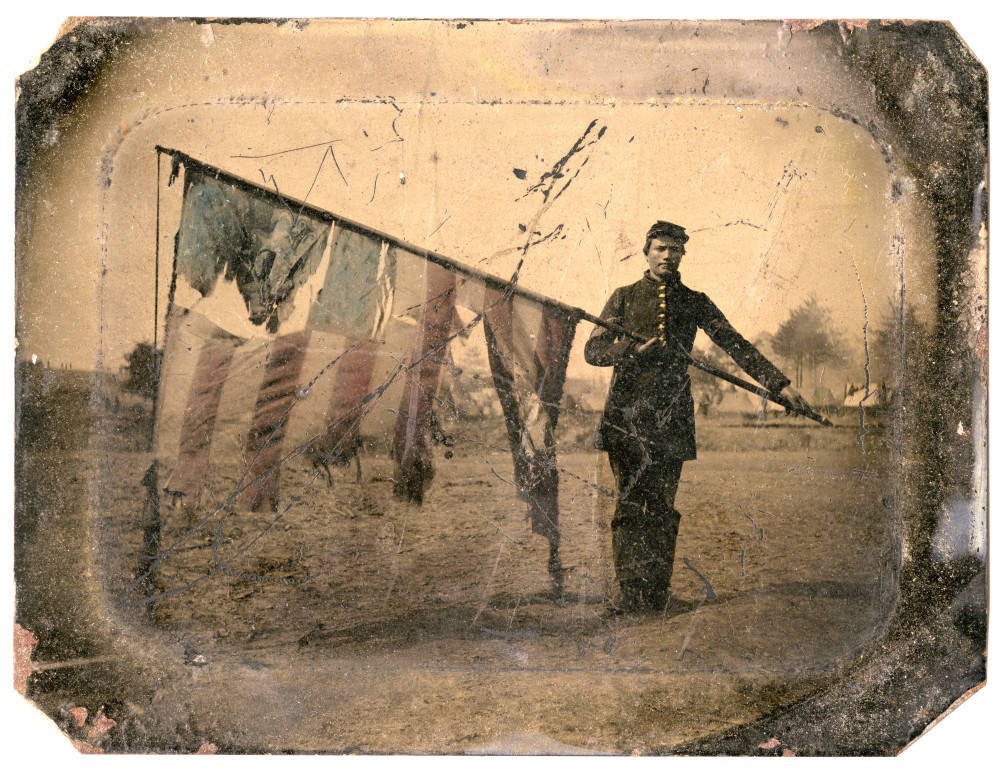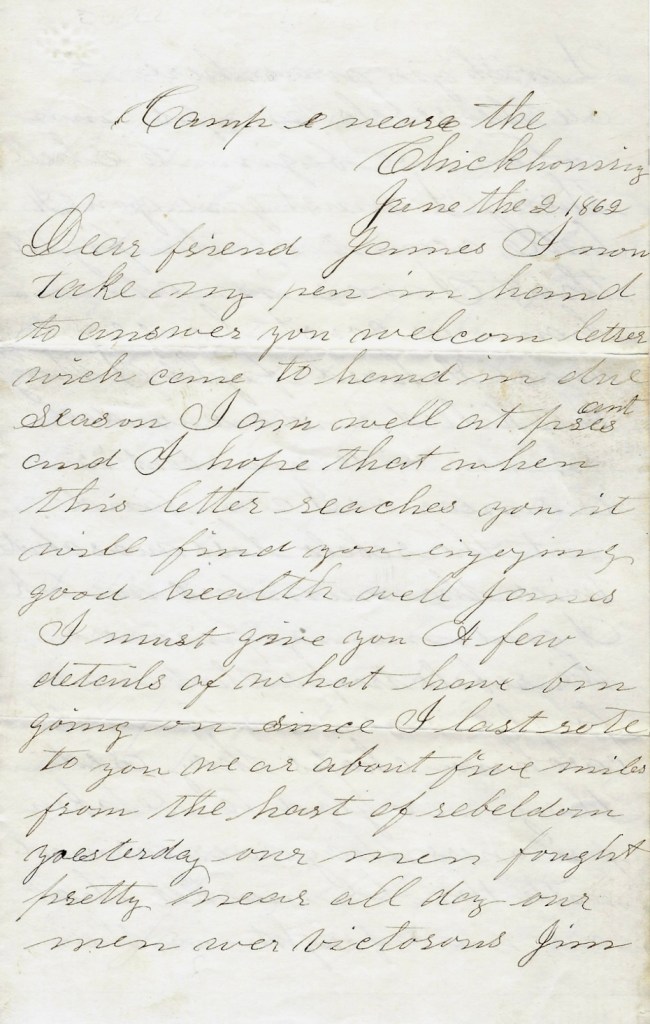
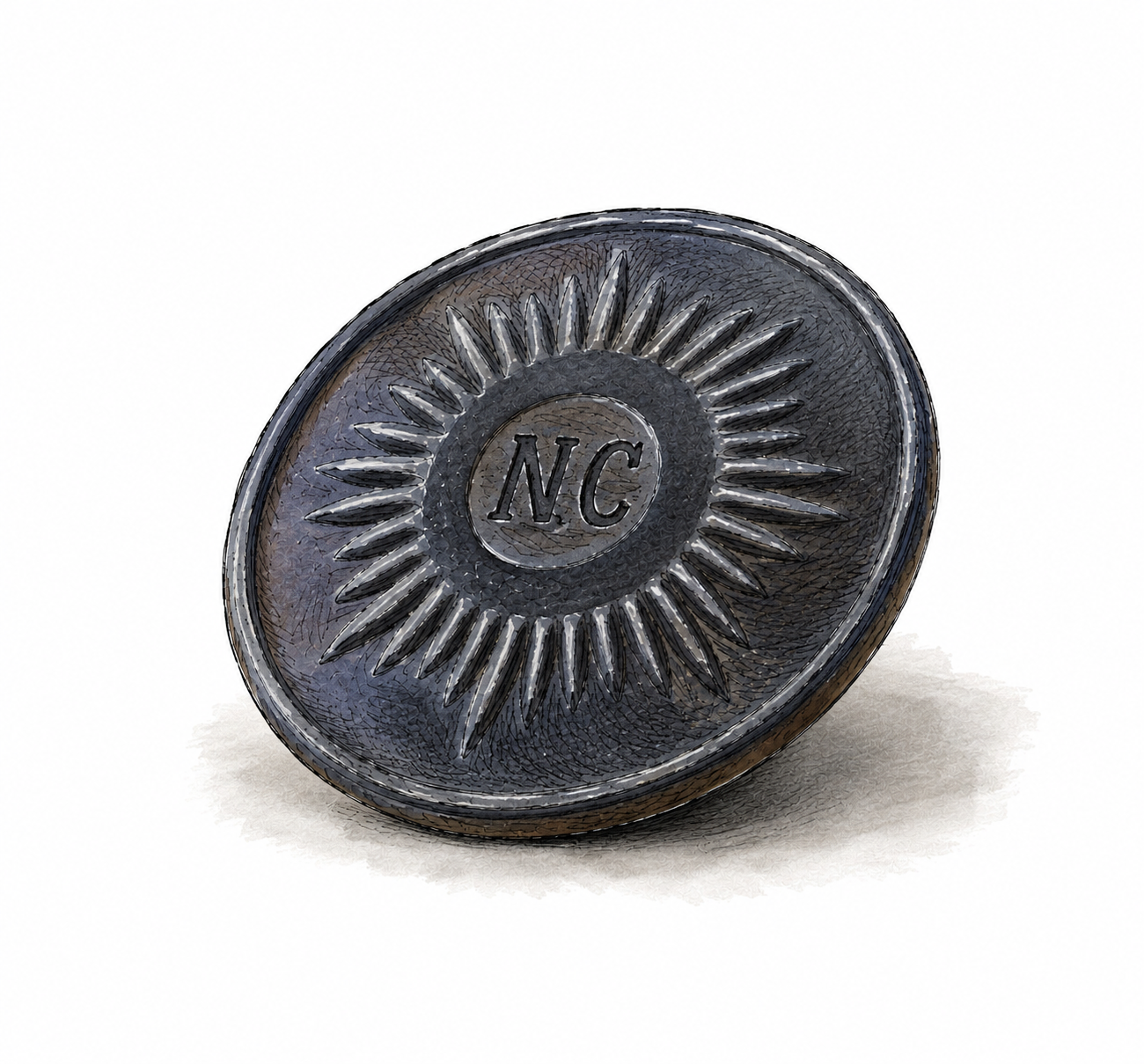
The following letters were written by Dixon Greene Conn (1840-1921) who enlisted first in the 5th North Carolina Infantry but when the regiment was reorganized in early May 1862 as the 15th North Carolina Infantry, they elected a new slate of officers and sent the old ones home. The reorganization took place near Yorktown and the regiment was one of the last to leave that stronghold before abandoning it to the Yankees. They served as the rear guard on the march to Williamsburg but were then sent to Kent Court House without engaging in the fight. “After several days of slow and tedious marching through rain and mud, occasional marches and skirmishes, with little to eat but parched corn, the regiment crossed to the south side of the Chickahominy River and encamped on the turnpike to Mechanicsville. As the Union army extended its lines to the right a portion of the regiment on picket duty at Ellyson’s Mill, and had a small engagement, capturing a few prisoners, with no loss to the regiment. On the 30th and 31st of May the regiment marched and counter-marched almost constantly between Mechanicsville and Seven Pines, and on Sunday morning, June 1st, was formed in line of battle to the right, near Fair Oaks, to reinforce and renew the attack at that point. Before advancing the order was countermanded and the.regiment took position on the Nine Mile Road above Fair Oaks, where it remained under daily fire from the enemy’s batteries” until the start of the Seven Days Battles. [Source: North Carolina in the American Civil War]
Dixon Greene Conn’s obituary informs us that he was born in Franklin county, North Carolina, on 13 March 1840 and was educated in a private academy in Louisburg in which he also served as an instructor.At the outbreak of the Civil War. he enlisted in Co. L, 5th N. C. Vols., which was the first company that went out of Franklin county. He reenlisted in Co. L. 15th N. C. Troops and next in Co. K, 32nd N. C. Regiment. He was wounded seven times in the war, five times at Malvern Hill. On account of his wounds, Dixon was discharged from the Confederate Army early in 1863 at Richmond; but before completing his convalescence, being refused active combatant service, he volunteered in the Confederate Navy and served on the Indian Chief, on which he was master at arms. From this ship he later transferred to the Pee Dee at Cheraw, South Carolina. He was taken prisoner on 6 April 1865 and confined on Craney Island for several months.
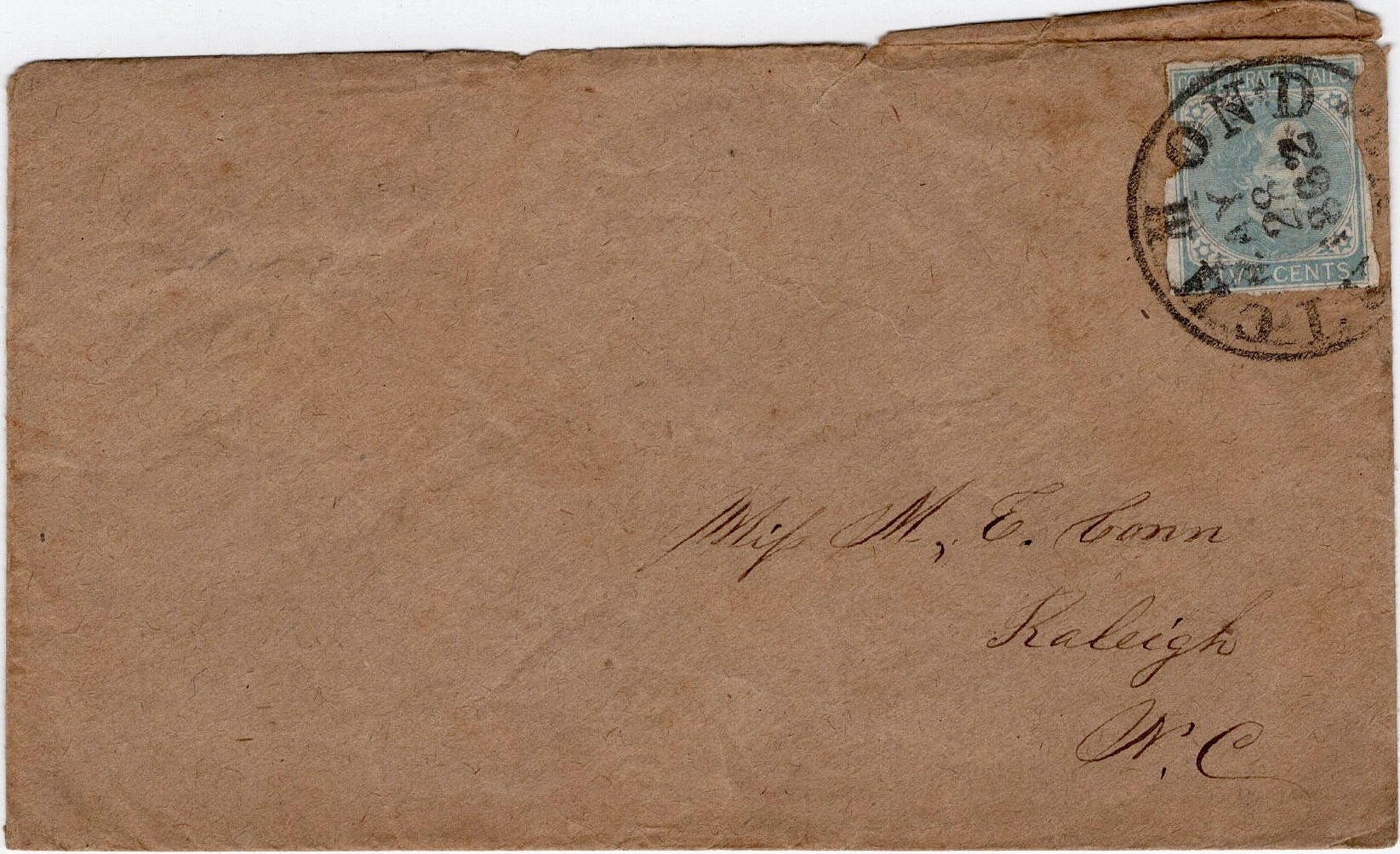
Dixon wrote the letters to his older sister, Mary Eliza Conn (1833-1914) who never married and was residing in Galloways, Franklin county, North Carolina at the time of the 1860 US Census.
Over the years I have transcribed several letters by members of the 15th North Carolina. They include:
George W. Mock, Co. F, 15th North Carolina (CSA 1 Letter)
Leander Mock, Co. F, 15th North Carolina (CSA 1 Letter)
Theophilus Thomas Spaugh, Co. F, 15th North Carolina (CSA 1 Letter)
Solomon Tesh, Co. H, 15th North Carolina (CSA 1 Letter)
Daniel Wilson, Co. H, 15th North Carolina (CSA 1 Letter)
Daniel Wilson, Co. H, 15th North Carolina (CSA 2 Letters)
William H. H. Tyson, Co. M, 15th North Carolina (CSA 1 Letter)
William H. H. Tyson, Co. M, 15th North Carolina (CSA 1 Letter)
Letter 1
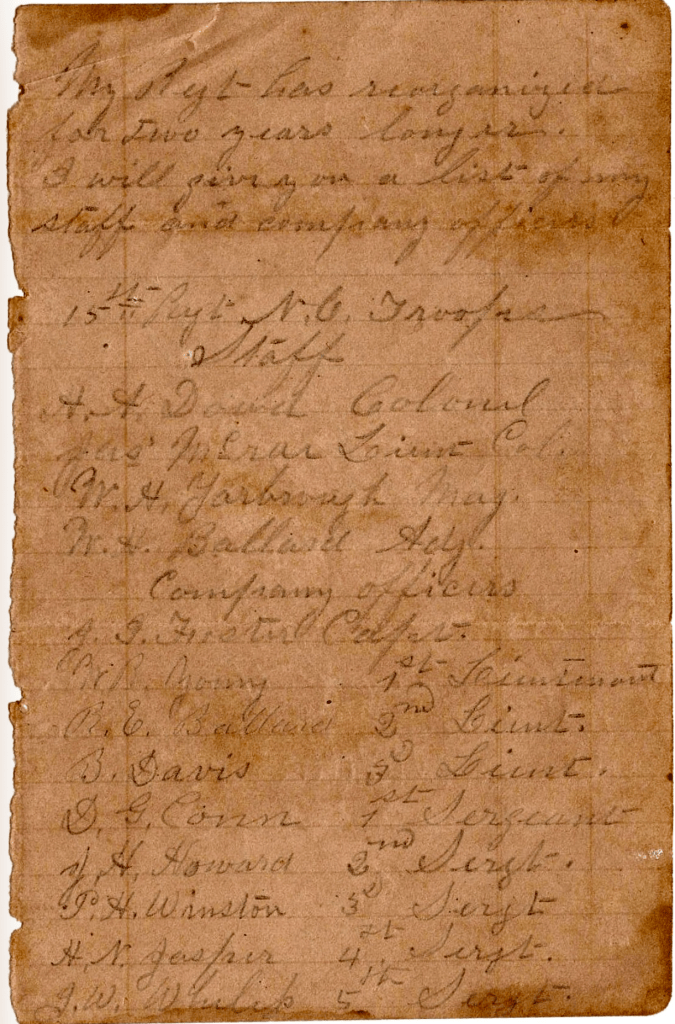
My regiment has reorganized for two years longer. I will give you a list of my staff and company officers.
15th Regt. North Carolina TRoops
Staff—-
H[enry] A. Dowd, Colonel
Jas. McCrae, Lieut. Col.
W[illiam] H. Yarborough, Major
W. H. Ballard, Adjutant
Company Officers—-
J[ames] I. Foster, Capt.
W[illiam] R. Young, 1st Lieutenant
R[obert] E. Ballard, 2nd Lieutenant
D. G. Conn, 1st Sergeant
J. H. Howard, 2nd Sergeant
P. H. Winston, 3rd Sergeant
H. N. Jasper, 4th Sergeant
J. W. Whiliss [?], 5th Sergeant
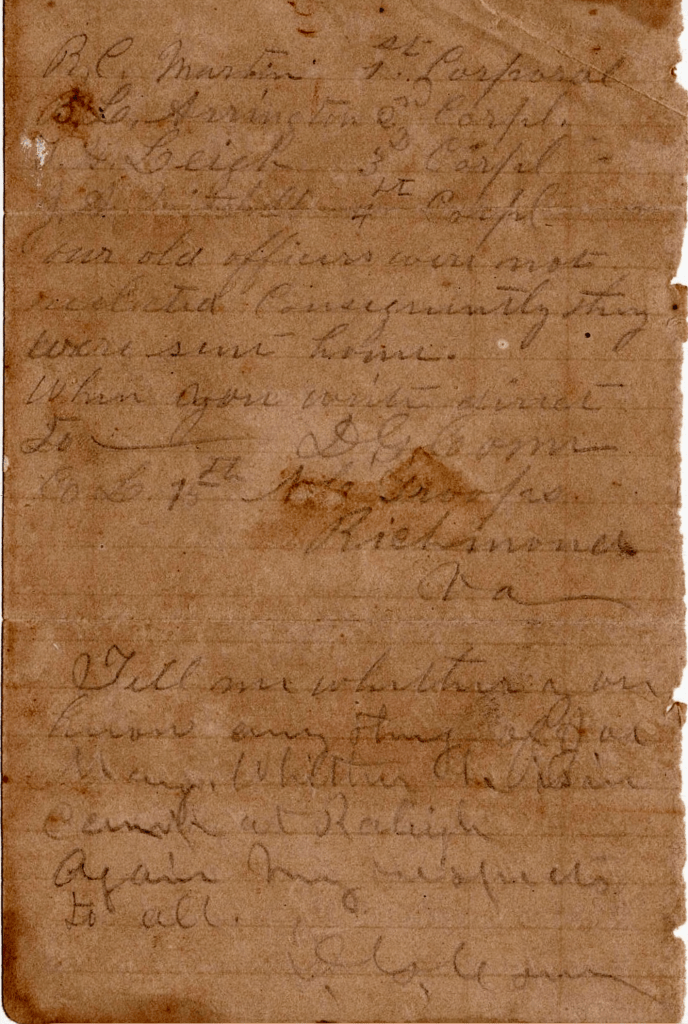
R. C. Martin, 1st Corporal
B[enjamin] C. Arrington, 2nd Corporal
T. H. Leigh, 3rd Corporal
J. S. Tuthill [?], 4th Corporal
Our old officers were not reelected; consequently they were sent home.
When you write, direct to D. G. Conn. Co. L, 15th N. C. Troops, Richmond, Va.
Tell me whether you know anything of Joe May—whether he is in camp at Raleigh. Again my respects to all. — D. G. Conn
Letter 2
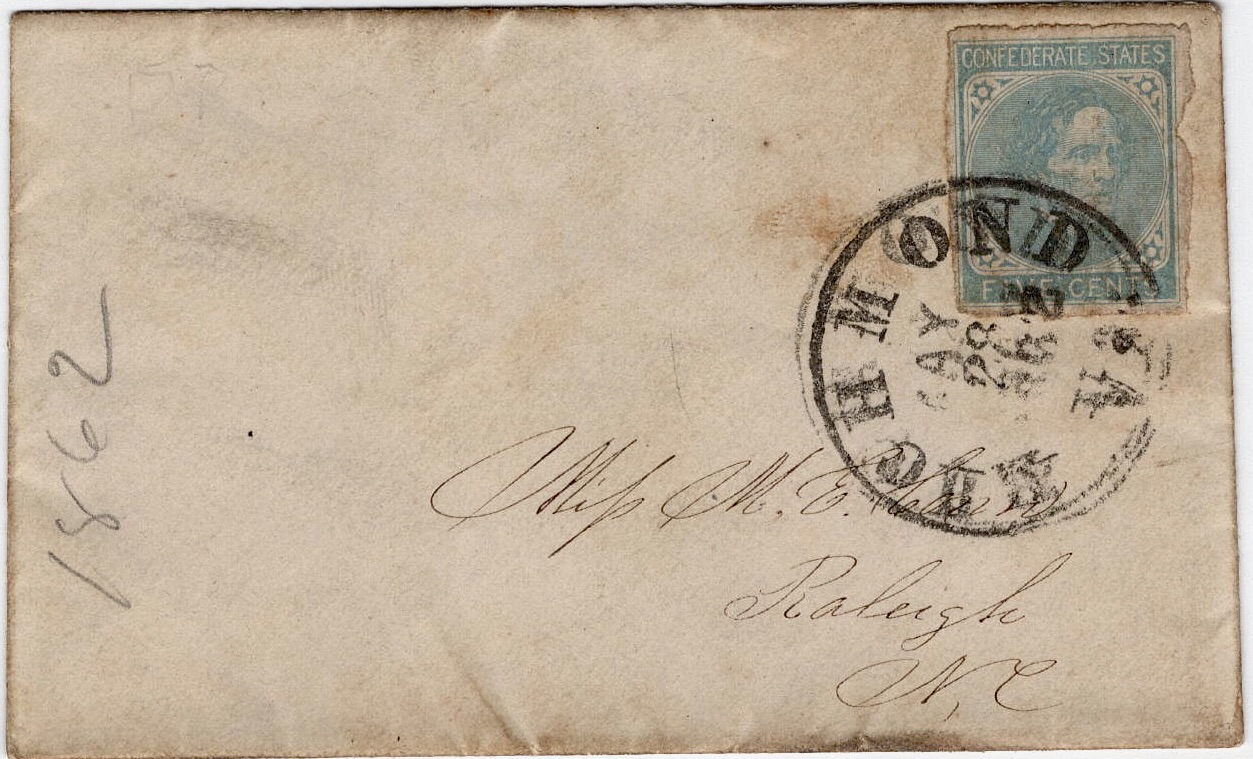
Richmond, Virginia
May the 28th, 1862
Affectionate sister,
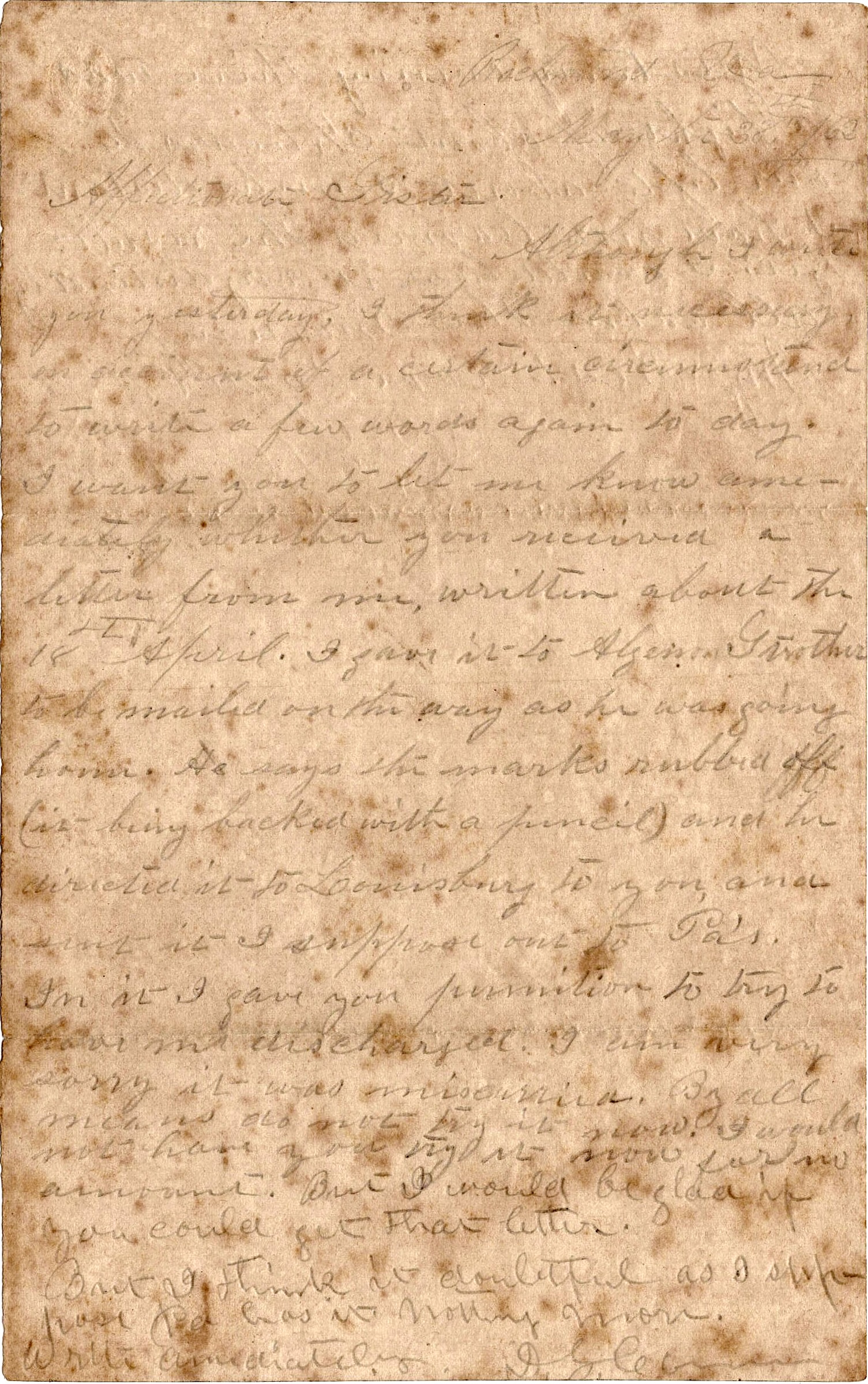
Although I wrote you yesterday, I think it necessary on account of a certain circumstance to write a few words again today. I want you to let me know immediately whether you received a letter from me written about the 18th April. I gave it to Algernon Strother to be mailed on the way as he was going home. He says the marks rubbed off (it being backed with a pencil) and he directed it to Louisburg to you, and sent it I suppose out to Pa’s. In it I gave you permission to try to have me discharged. I am very sorry it was miscarried. By all means, do not try it now. I would not have you try it now for no amount. But I would be glad if you could get that letter. But I think it doubtful as I suppose Pa has it. Nothing more. Write immediately. — D. G. Conn
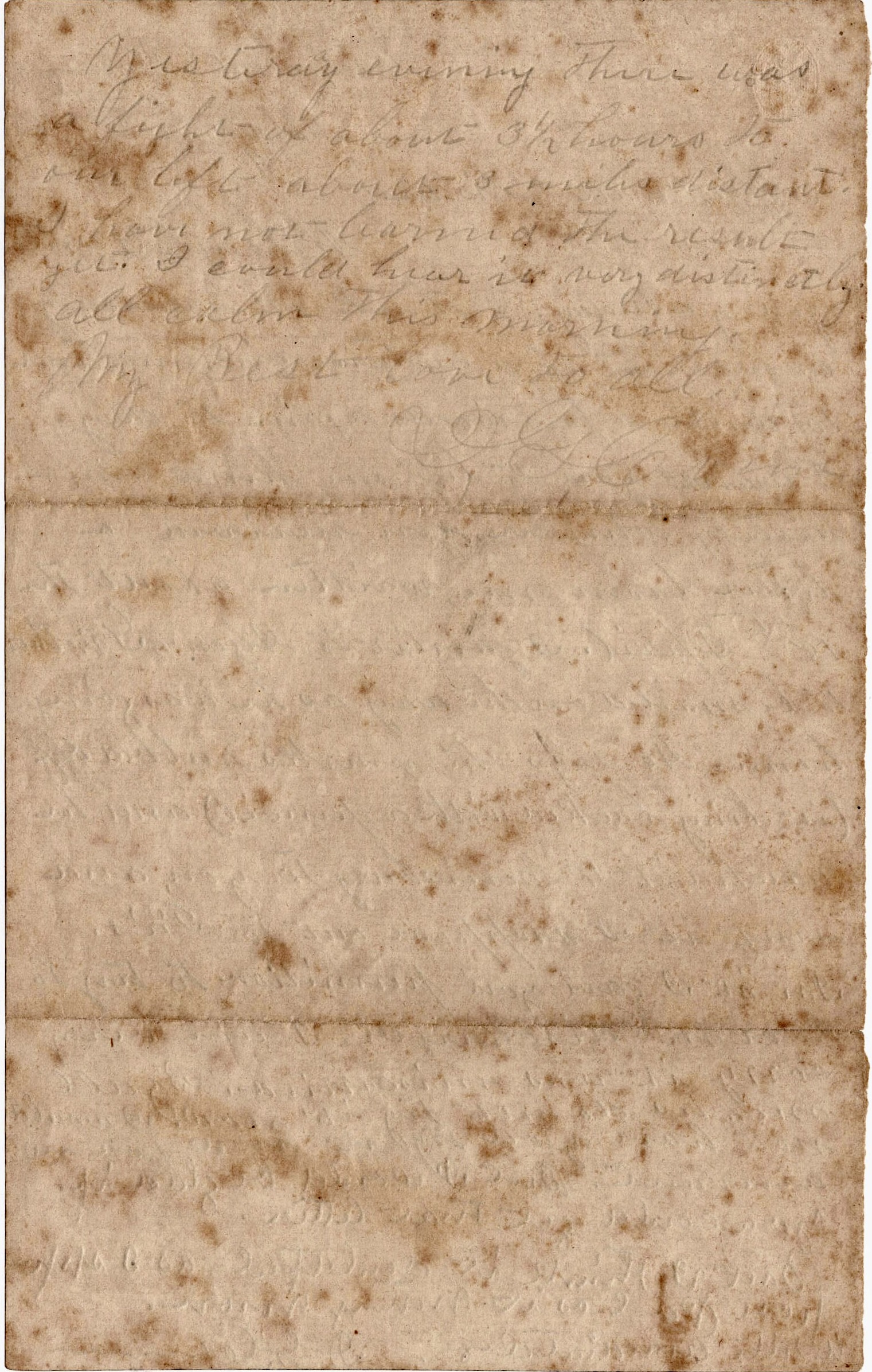
Yesterday evening there was a fight about three and a half hours to our left about three miles distant. 1 I have not learned the result yet. I could hear it very distinctly. All calm this morning. My best love to all, — D. G. Conn
1 This may be a reference to the Battle of Hanover Court House who took place during the afternoon of May 27, 1862.