
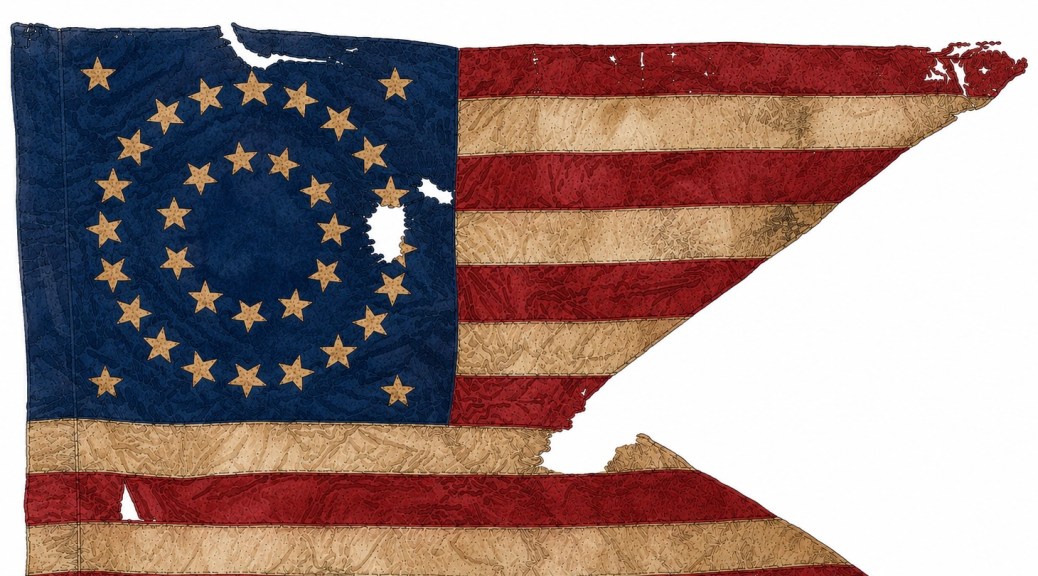
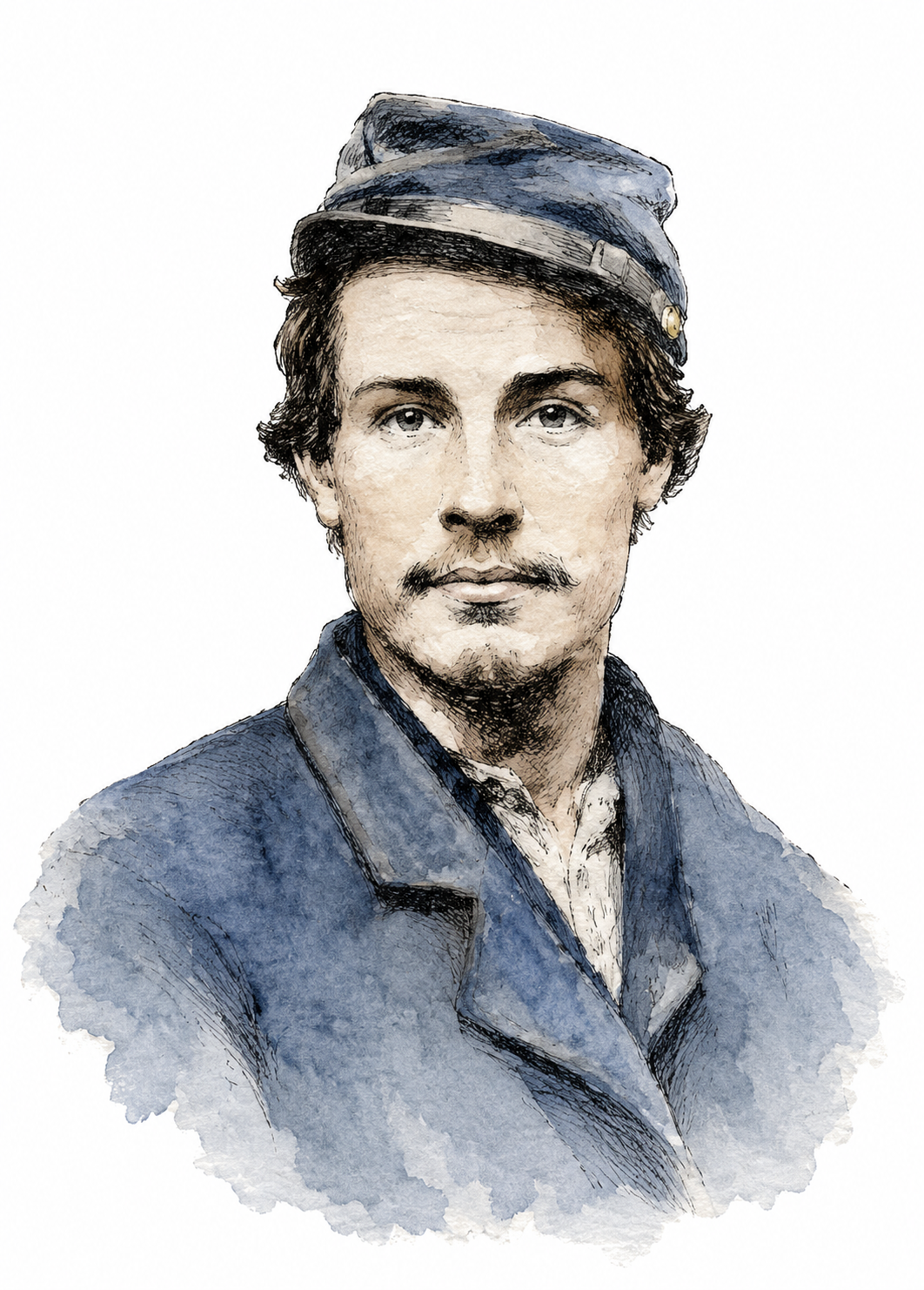
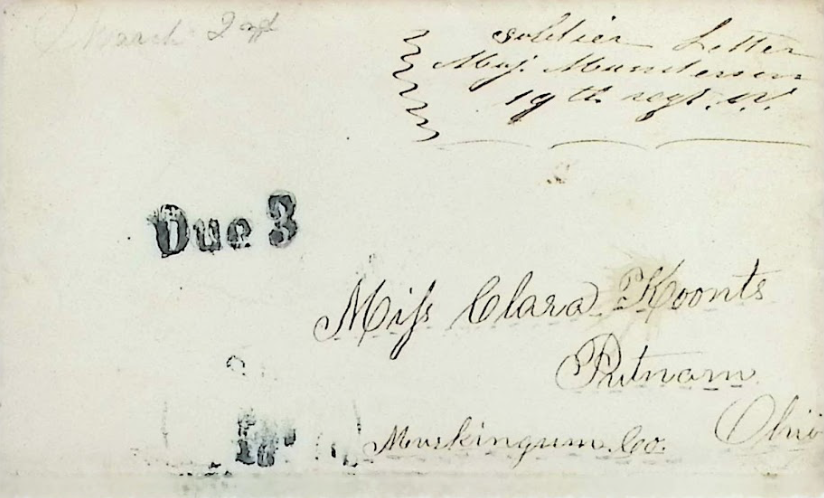
Lost his life in the Battle of Chickamauga reads the epitaph on the headstone of Charles E. Koonts (1844-1863) of Co. E, 19th Ohio Volunteer Infantry (OVI). Charles was the son of baker/confectioner Joseph F. Koonts (1819-1891) and his wife, Elizabeth Ann Munch (1822-1904), of Putnam, Muskingum County, Ohio.
Though he claimed to be 18 at the time of his enlistment in October 1861, I believe Charles was only 17. He was promoted from a private to corporal in January 1863 and was killed in action at the Battle of Chickamauga on 19 September 1863.
Charles addressed all of his letters to his younger sister, Clara Koonts. His letters epitomize most of the correspondence written by the untested, raw troops who found themselves in the Battle of Shiloh in April 1862. To their loved ones back home, they no longer wrote about hoping to see a battle; they wrote about hoping to survive the next one. It was a grim jolt of reality that hardened the young men almost overnight.
Over the years I have transcribed a number of letters by members of the 19th OVI but Koonts’ are the first from Co. E. The others include:
Moses L. Hower, Co. A, 19th Ohio (1 Letter)
Henry Raubenstine, Co. A, 19th Ohio (1 Letter)
Augustus Dilley, Co. B, 19th Ohio (1 Letter)
Jesse Smith, Co. B, 19th Ohio (1 Letter)
Lyman Tylee, Co. B, 19th Ohio (3 Letters)
Marcellus Ovando Messer, Co. C, 19th Ohio (2 Letters)
Ovando M. Messer, Co. C, 19th Ohio (1 Letter)
Jacob Ruch, Co. F, 19th Ohio (1 Letter)
Charles Frederick Frink, Co. G, 19th Ohio (1 Letter)
Henry Clay Elson, Co. H, 19th Ohio (1 Letter)
Daniel C. Lower, Co. I, 19th Ohio (1 Letter)
Letter 1
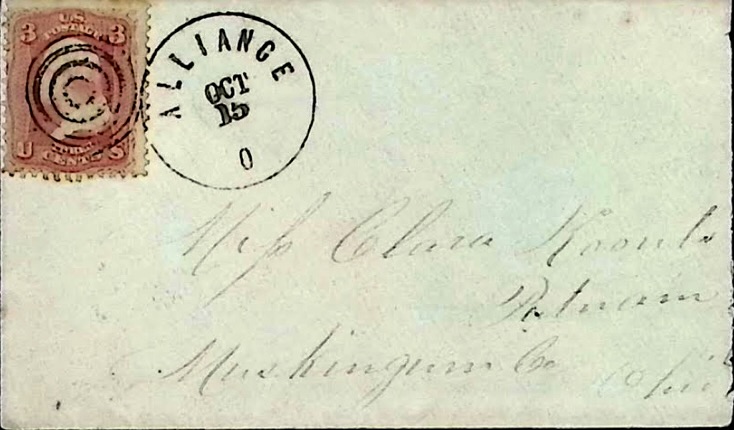
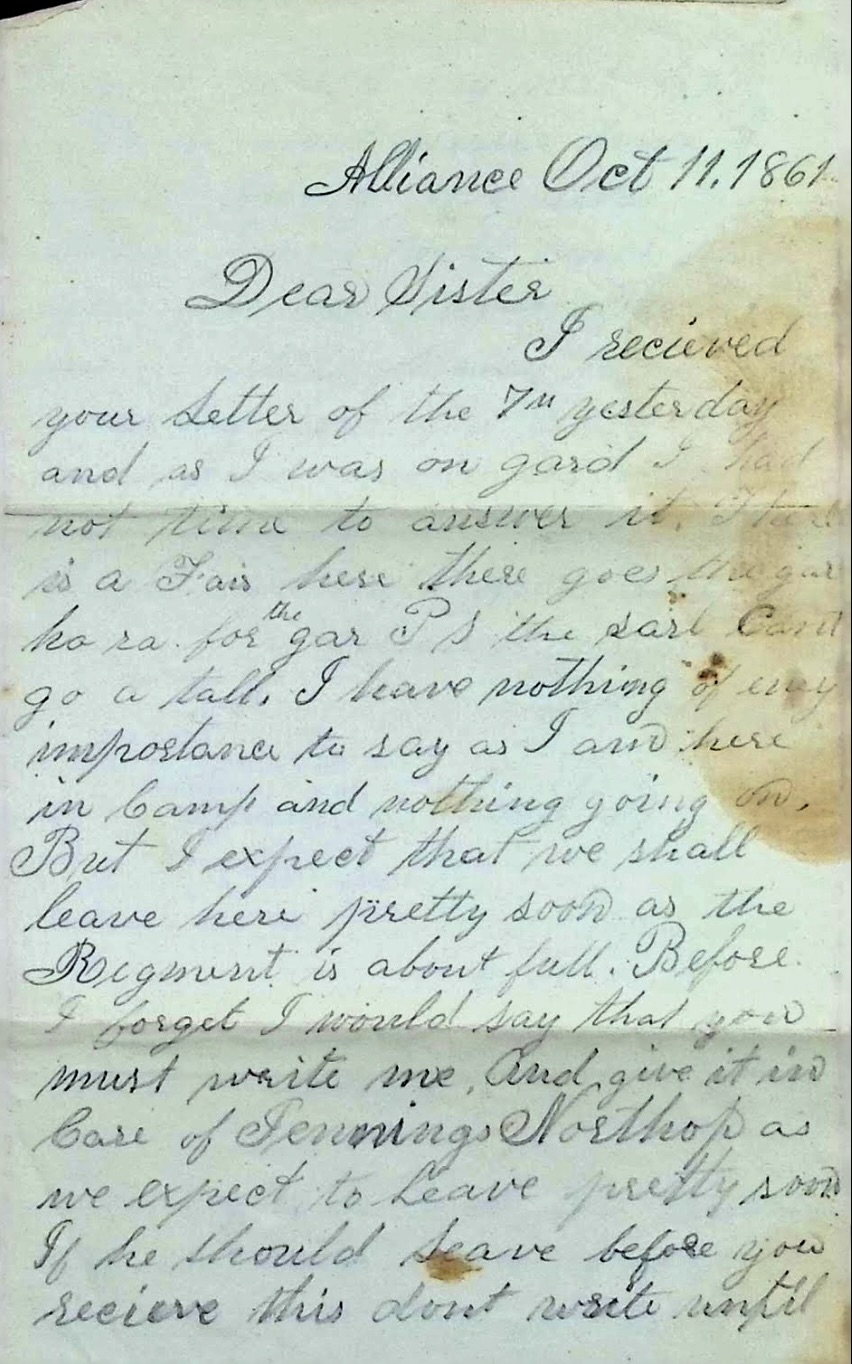
Alliance, [Ohio]
October 11, 1861
Dear Sister,
I received your letter of the 7th yesterday and as I was on guard, I had not time to answer it. There is a fair here. There goes the gar. 1 “Hurrah for the gar. P. S. the sarl can’t go at all.
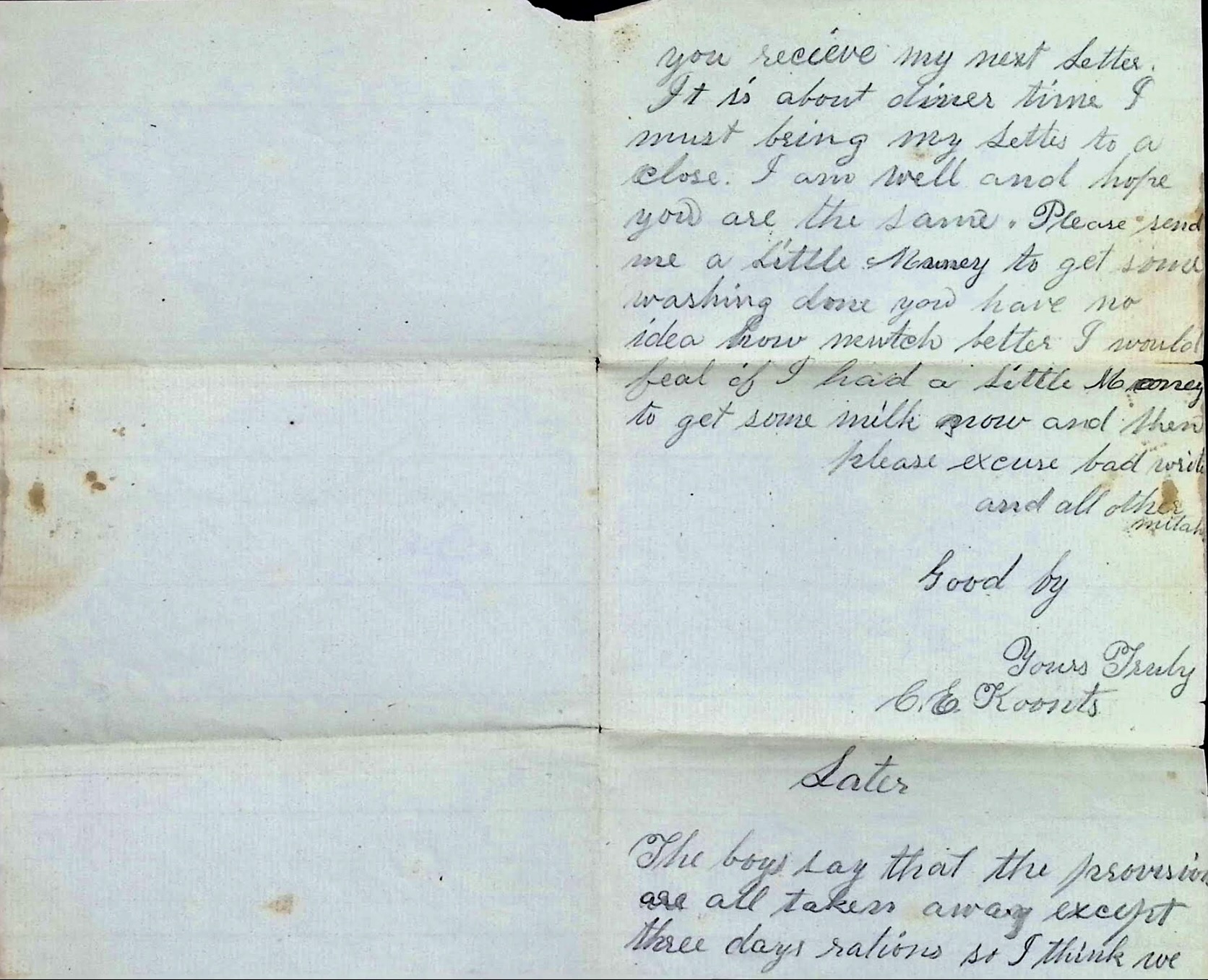
I have nothing of any importance to say as I am here in camp and nothing going on. But I expect that we shall leave here pretty soon as the regiment is about full. Before I forget, I would say that you must write me. And give it in care of Jennings Northup as we expect to leave pretty soon. If he should leave before you receive this, don’t write until you receive my next letter.
It is about dinner time. I must bring my letter to a close. I am well and hope you are the same. Please send me a little money to get some washing done. you have no idea how much better I would feel if I had a little money to get some milk now and then. Please excuse bad writing and all other mistakes.
Goodbye. Yours truly, — C. E. Koonts
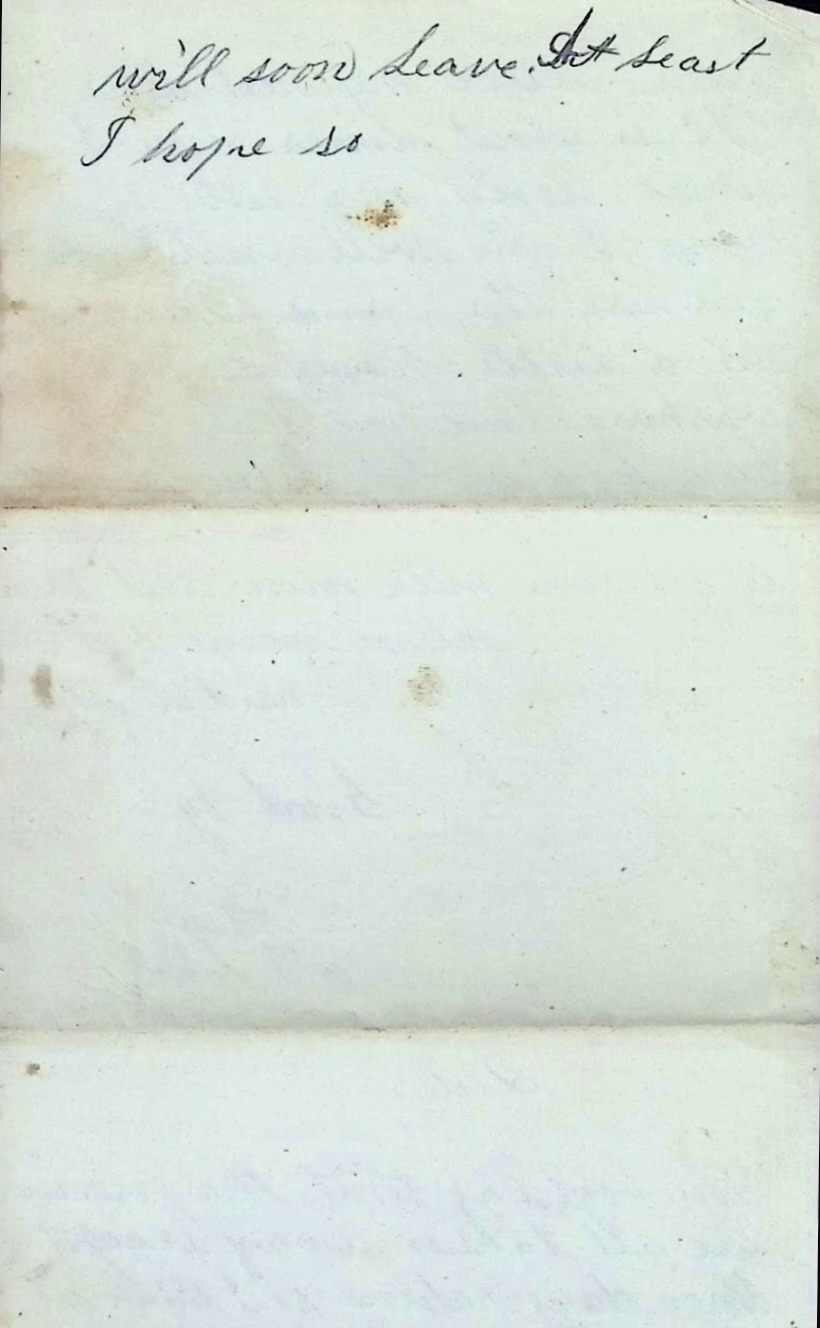
Later. The Boys say that the provisions are all taken away except three days so I think we will soon leave. At least I hope so.
1 We have come to recognize G. A. R. as the Grand Army of the Republic—an organization of war veterans created in 1866. It is reported however that “gar” referred to the grand army of the republic at an even earlier date.
Letter 2
Alliance [Ohio]
October 13, 1861
Dear Sister,
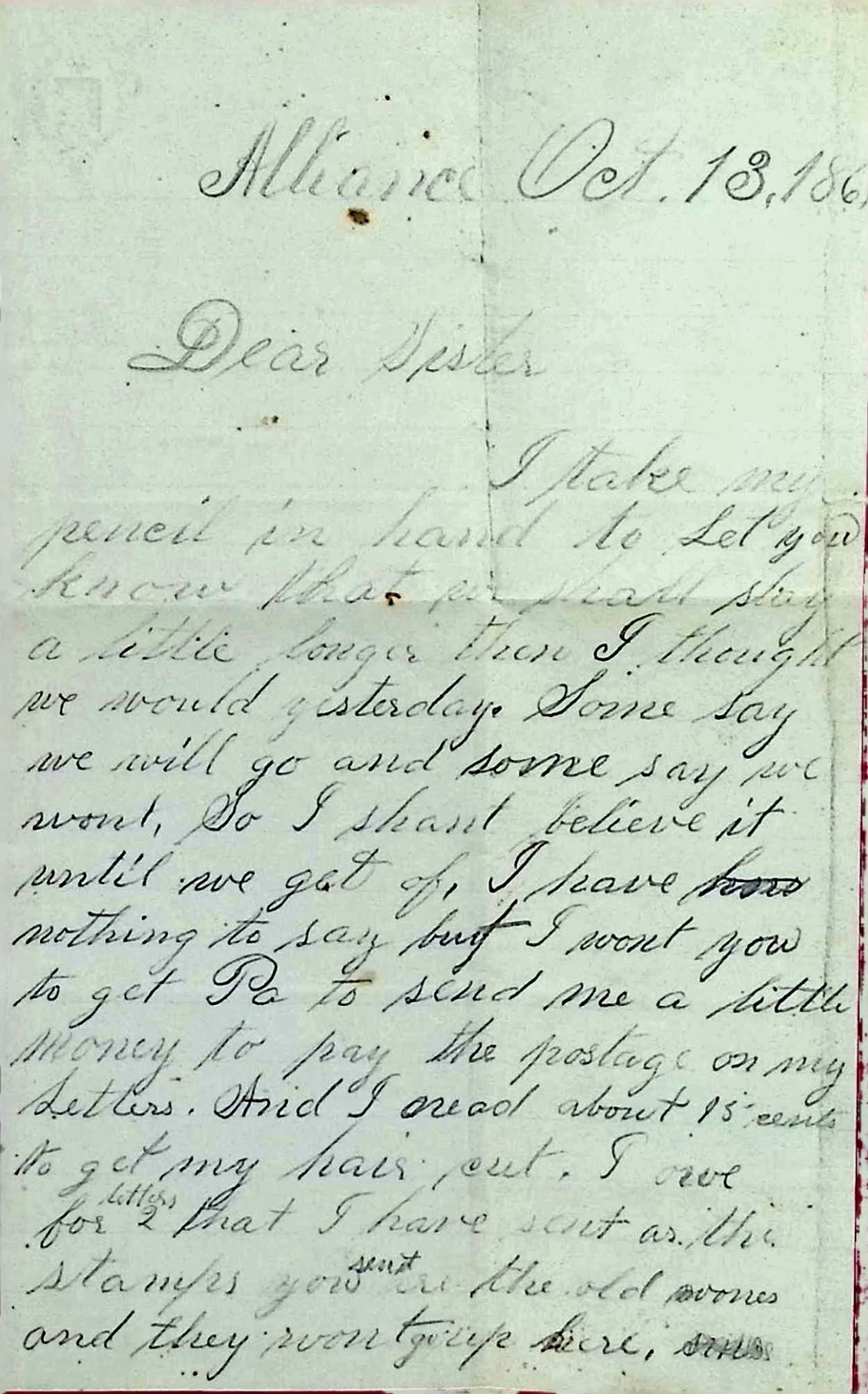
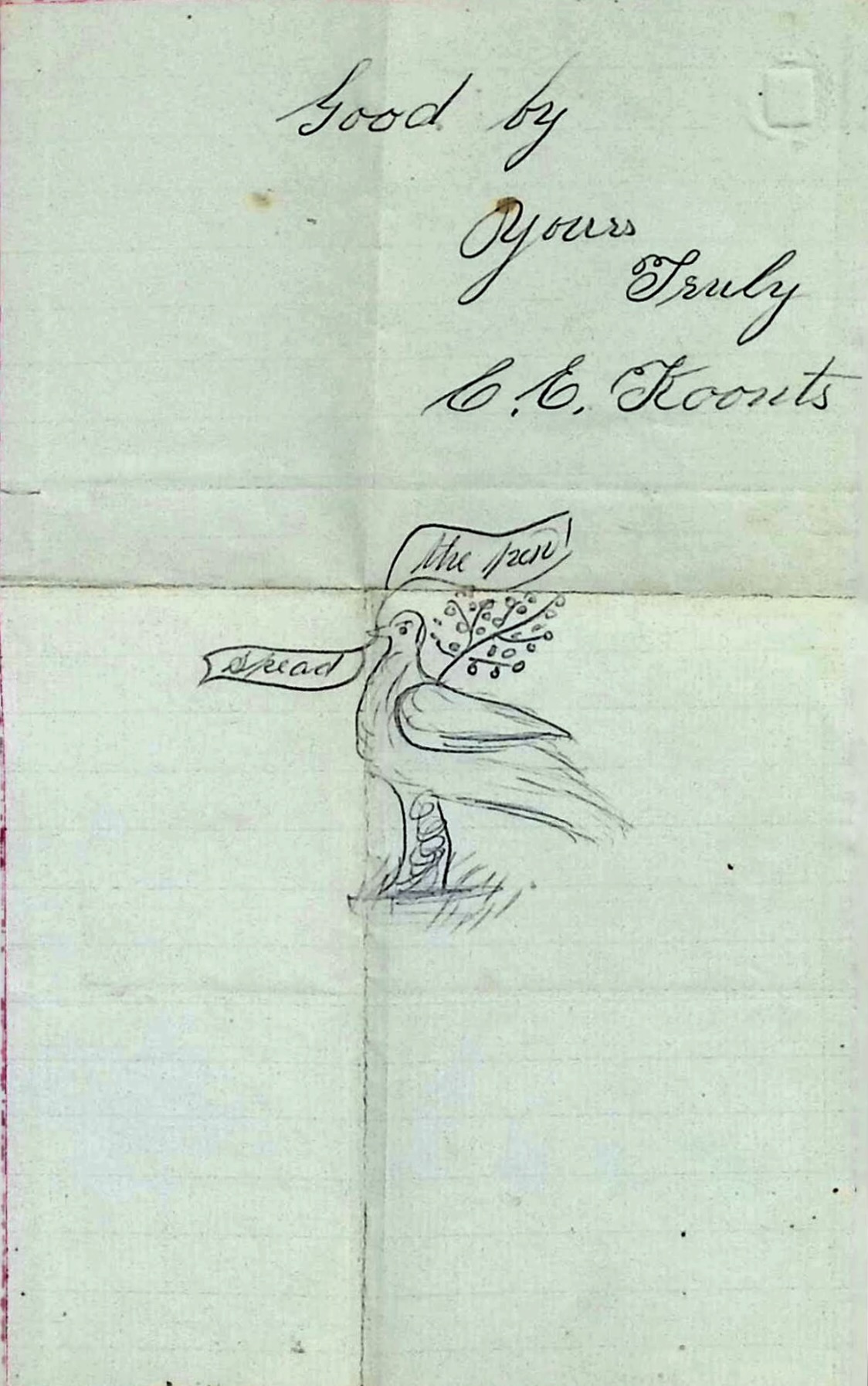
I take my pencil in hand to let you know that we shall stay a little longer than I thought we would yesterday. Some say we will go and some say we won’t. So I shant believe it until we get off. I have nothing to say but I want you to get Pa to send me a little money to pay the postage on my letters. And I need about 15 cents to get my hair cut. I owe four letters—two that I have sent as the tamps you sent are the old ones and they won’t go up here. Goodbye. Yours truly, — C. E. Koonts
Letter 3
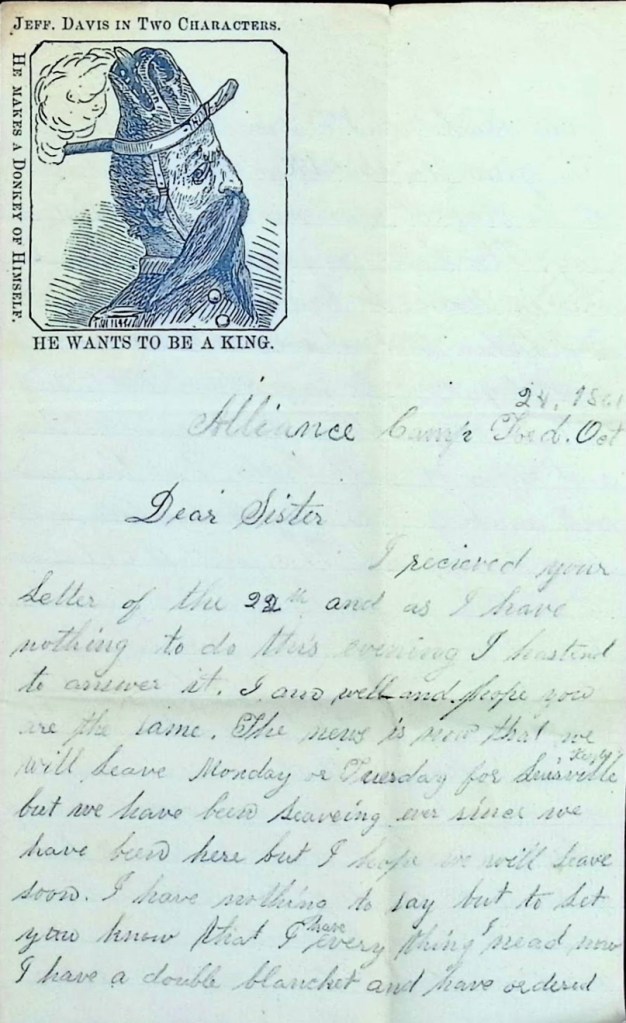
Alliance Camp Ford [Ohio]
24 October 1861
Dear Sister,
I received your letter of the 22nd and as I have nothing to do this evening, I hastened to answer it. I am well and hope you are the same. The news is now that we will leave Monday or Tuesday for Louisville, Kentucky, but we have been leaving ever since we have been here. But I hope we will leave soon.
I have nothing to say but to let you know that I have everything I need now. I have a double blanket and have ordered a gum blanket and have a nice oil cloth. The gum blanket that we have ordered are to be paid for when we draw our first pay. The captain says that when he was in Mexico, he had one of these gums and when the rest were all wet, he was dry. And he says the oil cloth will do very well until it gets cold and then it will break. But the gum will make a nice dry bed when we have to lay out.
There is that old drum a beating and I have but a few minutes to write so I must bring my letter to a close.
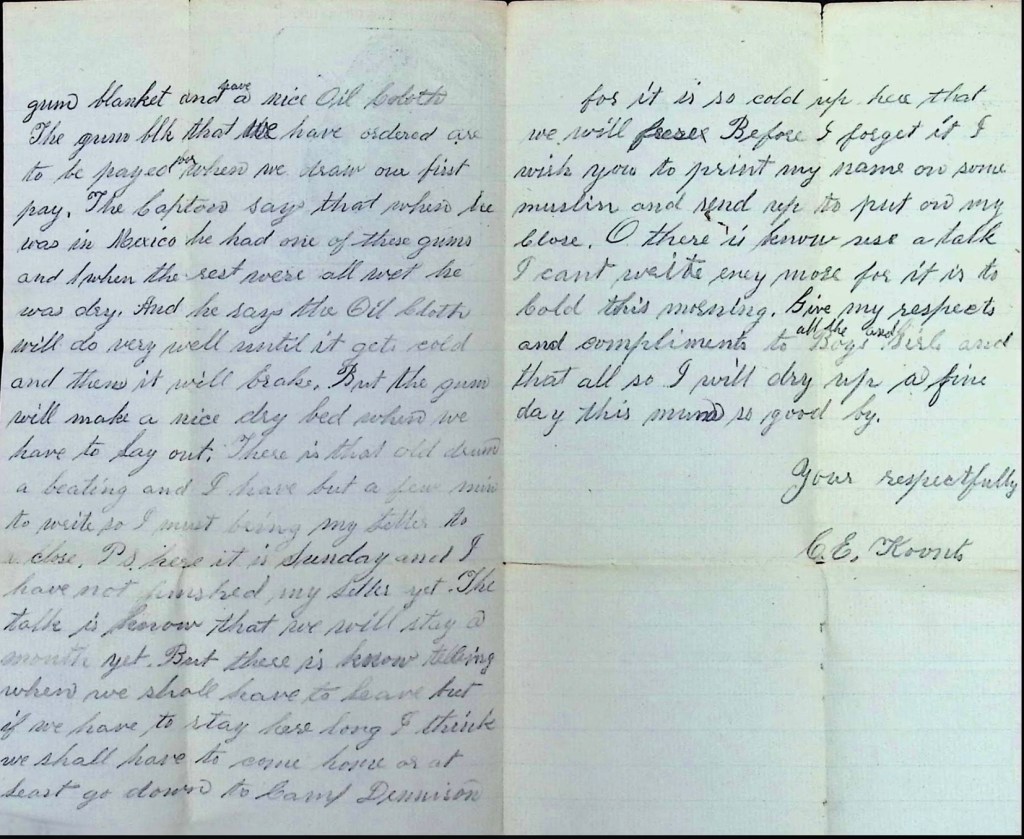
P. S. Here is it Sunday and I have not finished my letter yet. The talk is now that we will stay a month yet. But there is no telling when we shall have to leave. But if we have to stay here long, I think we shall have to come home or at least go down to Camp Dennison for it is so cold up here that we will freeze.
Before I forget it, I wish you to print my name on some muslin and send up to put on my clothes. Oh, there is no use a talking. I can’t write any more for it is too cold this morning.
Give my respects and compliments to all the Boys and Girls and that’s all. So I will dry up. A fine day this morn. So goodbye. Yours respectfully, — C. E. Koonts
Letter 4
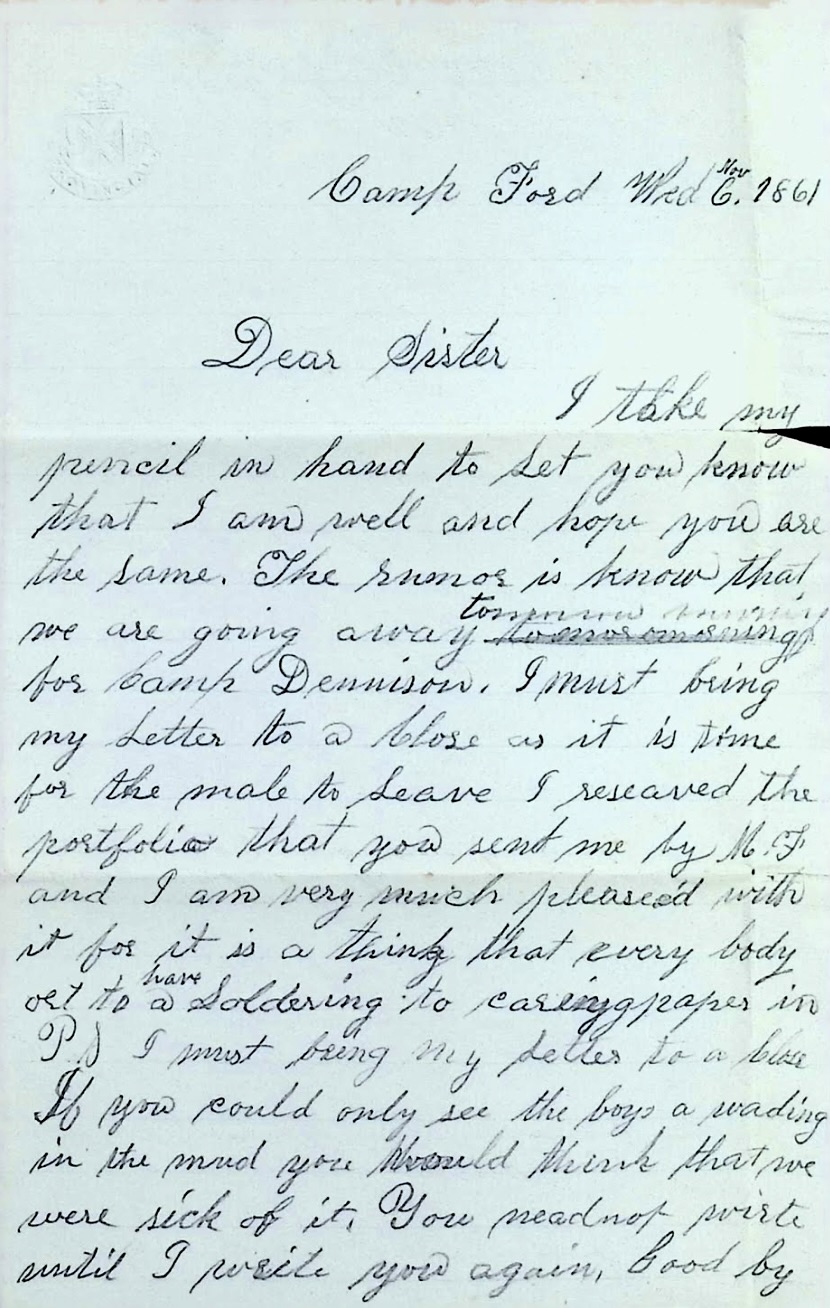
Camp Ford [Alliance, Ohio]
Wednesday, November 6, 1861
Dear Sister,
I take my pencil in hand to let you know that I am well and hope you are the same. The rumor is now that we are going away tomorrow morning for Camp Dennison. I must bring my letter to a close as it is time for the mail to leave.
I received the portfolio that you sent me by M. F. and I am very much pleased with it for it is a thing that everybody ought to have a soldiering to carry paper in.
P. S. I must bring my letter to a close. If you could only see the boys a wading in the mud, you would think that we were sick of it. You need not write until I write you again. Goodbye. Yours respectfully, — Charles Koonts
Letter 5
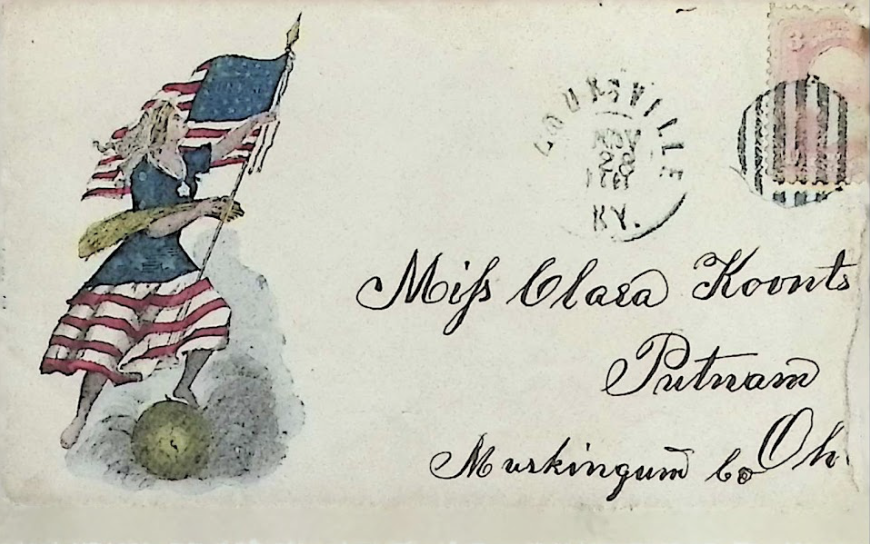
Camp Tod
November 22, 1861
Dear Sister,
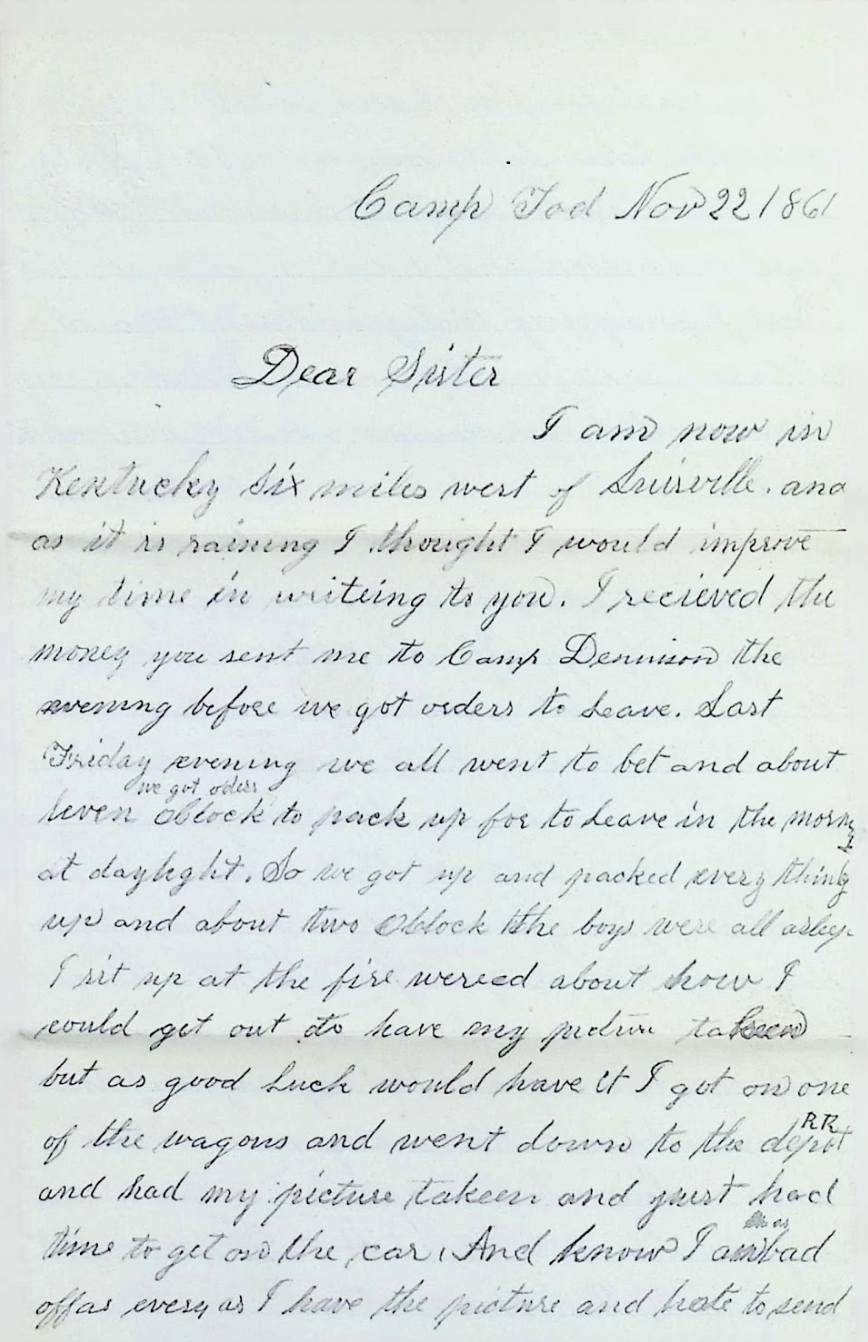
I am now in Kentucky six miles west of Louisville and as it is raining, I thought I would improve my time in writing to you. I received the money you sent me to Camp Dennison the evening before we got orders to leave. Last Frday evening we all went to bed and about eleven o’clock we got orders to pack up for to leave in the morning at daylight. So we got up and packed everything up and about two o’clock the Boys were all asleep. I sit up by the fire worried about how I could get out to have my picture taken but as good luck would have it, I got on one of the wagons and went down to the railroad depot and had my picture taken and just had time to get on the car. And now I am bad off as ever as I have the picture and hate to send it by mail for fear it will be lost. I might of had it taken by Mr. Benjamin if I could of seen him on the boat at Cincinnati but somehow it happened that I didn’t get to see him. But I am going to try and send it as a soldier’s package as I think it the best way.
You wanted to know how we live and a little about camp life. We have our tents all put up in regular order and the tents are about ten feet long and eight feet wife for eleven men to keep all their gum knapsacks, blankets, overcoats, &c.,so you can judge how much room we have. But in our tent, we have more room than the rest of them as there is three wagoners in our tent and they sleep in their wagon.

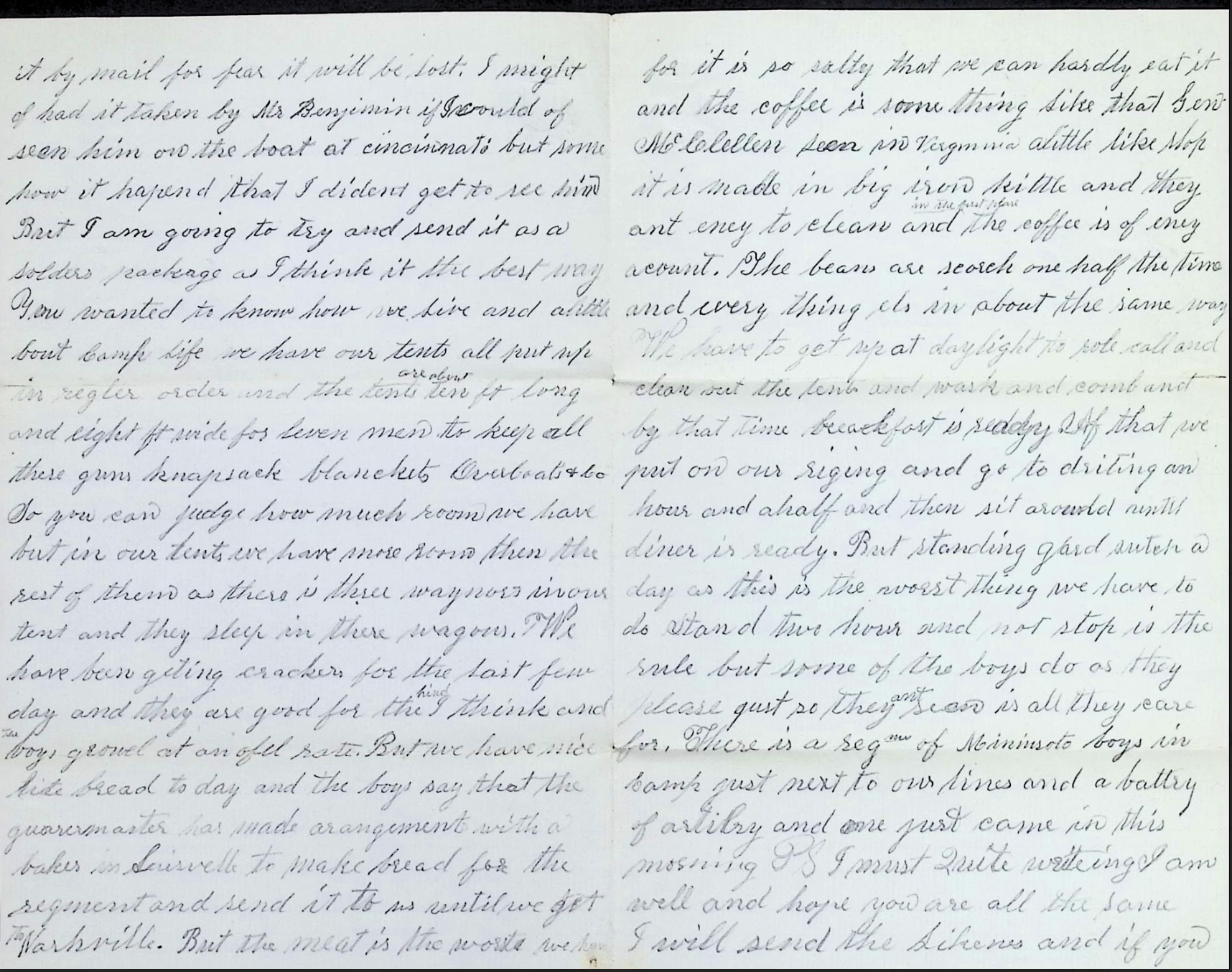
We have been getting crackers for the last few days and they are good for the kind, I think, and us Boys growl at an awful rate. But we have nice light bread today and the Boys say that the Quartermaster has made arrangements with a baker in Louisville to make bread for the regiment and send it to us until we get to Nashville. But the meat is the worst we have [had] for it is salty that we can hardly eat it. And the coffee is something like that Gen. McClellan seen in Virginia—a little like slop. It is made in a big iron kettle and they ain’t very clean and in the first place, the coffee isn’t of any account. The beans are scorched one half the time and everything else in about the same way.
We have to get up at daylight to roll call and clean out the tents and wash and comb and by that time breakfast is ready. After that we put on our rigging and go to drilling an hour and a half and then sit around until dinner is ready. But standing guard such a day as this is the worst thing we have to do. Stand two hours and not stop is the rule, but some of the Boys do as they please—just so they ain’t seen is all they care for. There is a regiment of Minnesota Boys i camp just next to our lines and a battery of artillery, and one just came in this morning.
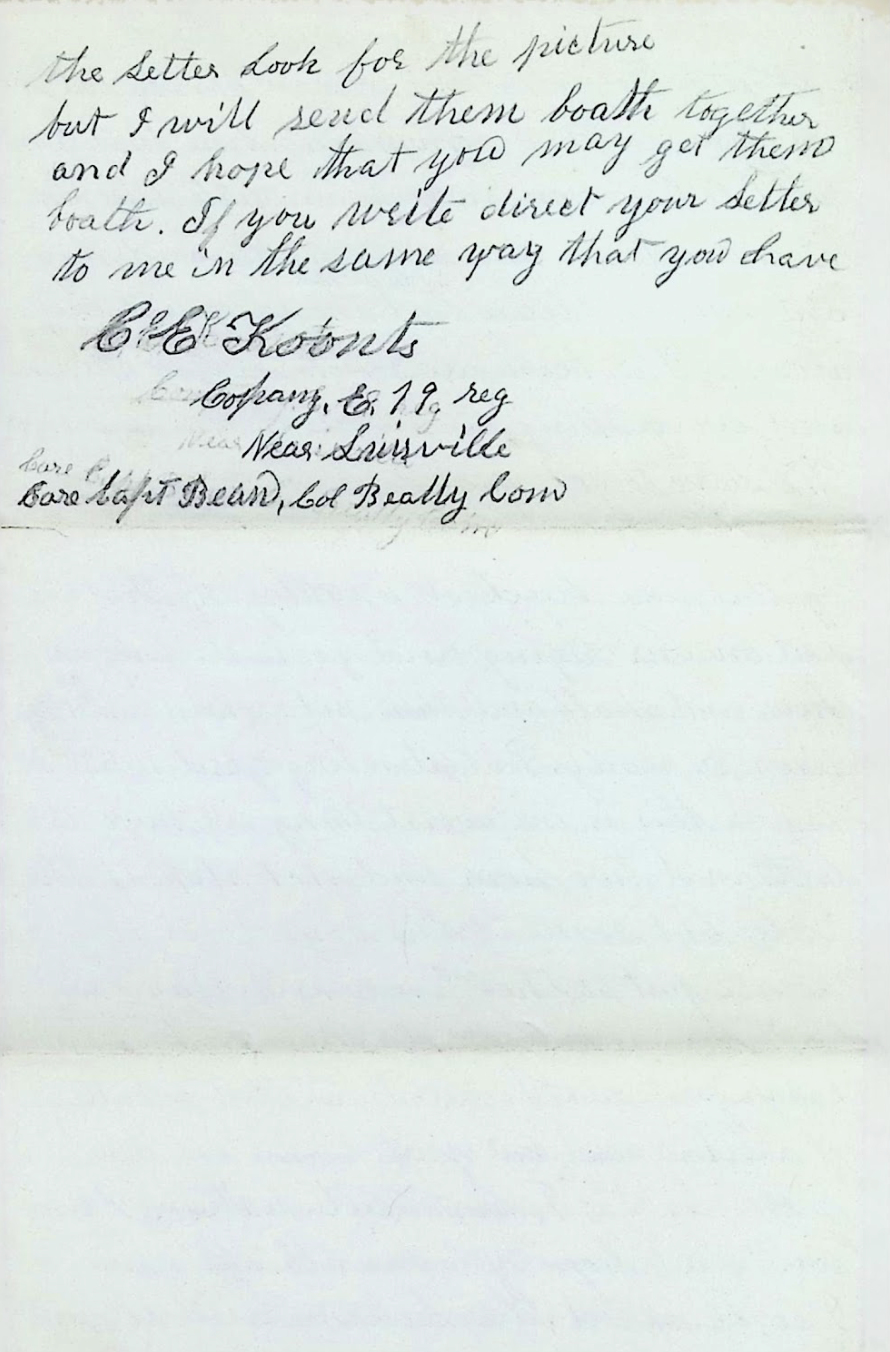
P. S. I must quit writing. I am well and hope you are all the same. I will send my likeness and if you [get] the letter, look for the picture. But I will send them both together and I hope that you may get them both. If you write, direct your letter to me in the same way that you have:
C. E. Koonts
Company E, 19th [Ohio] Regt.
Near Louisville
Care of Capt. [Urwin] Bean, Col. [Samuel] Beatty commanding.
Letter 6
Camp Jenkins near Louisville
November 28, 1861
Dear Sister,
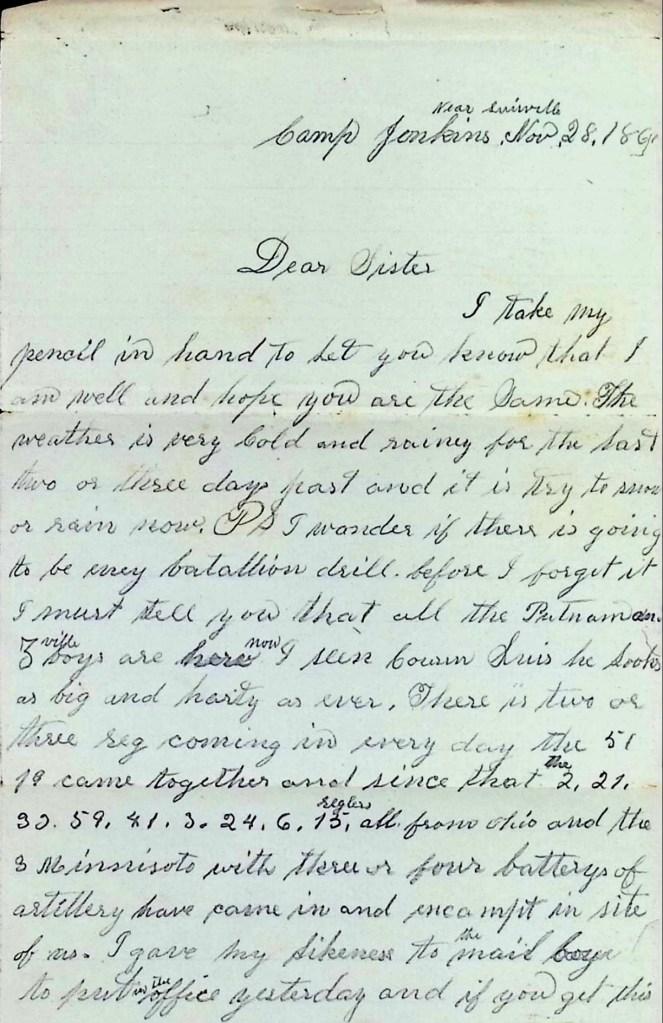
I take my pencil in hand to let you know that I am well and hope you are the same. The weather is very cold and rainy for the last two or three days past and it is trying to snow or rain now. I wonder if there is going to be any battalion drill. Before I forget it, I must tell you that all the Putnam–Zanesville Boys are here now. I seen cousin Louis. He looks as big and hearty as ever. There is two or three regiments coming in every day. The 51st and 19th came together, and since that the 2nd, 21st, 33rd, 59th, 41st, 3rd, 24th, 6th, and 15th Regulars, all from Ohio, and the 3rd Minnesota with three or four batteries of artillery have come in and encamped in sight of us.
I gave my likeness to the mail boy to put in the office yesterday and if you get this letter first, you must look out for it. I suppose you are and have looked for it if you got my last letter for I told you I would send it and neglected it for two or three days. And if you got the last letter, I expect you have been worried about it. But it is on the road now and I hope it will get to you as it is impossible to get one now unless there should be a car come in camp.
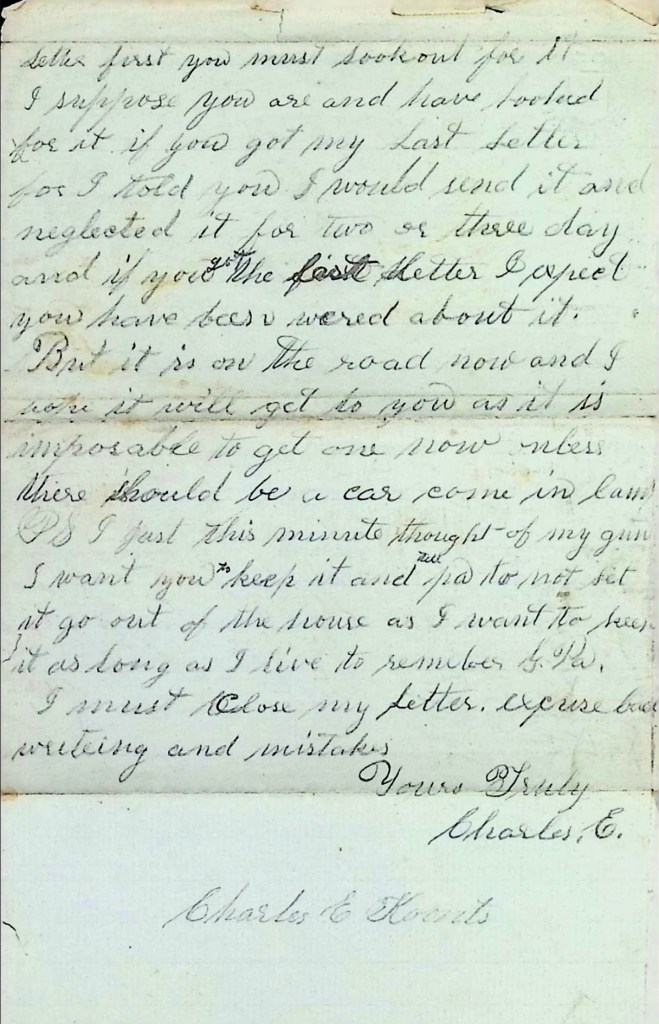
P. S. I just this minute thought of my gun. I want you to keep it and tell Pa to not let it go out of the house as I want to keep it as long as I live to remember grandpa. I must close my letter. Excuse bad writing and mistakes. Yours truly, — Charles E. Koonts
Letter 7
[Camp Boyle]
Columbia [Adair county, Kentucky]
December 29, 1861
Dear Sister,
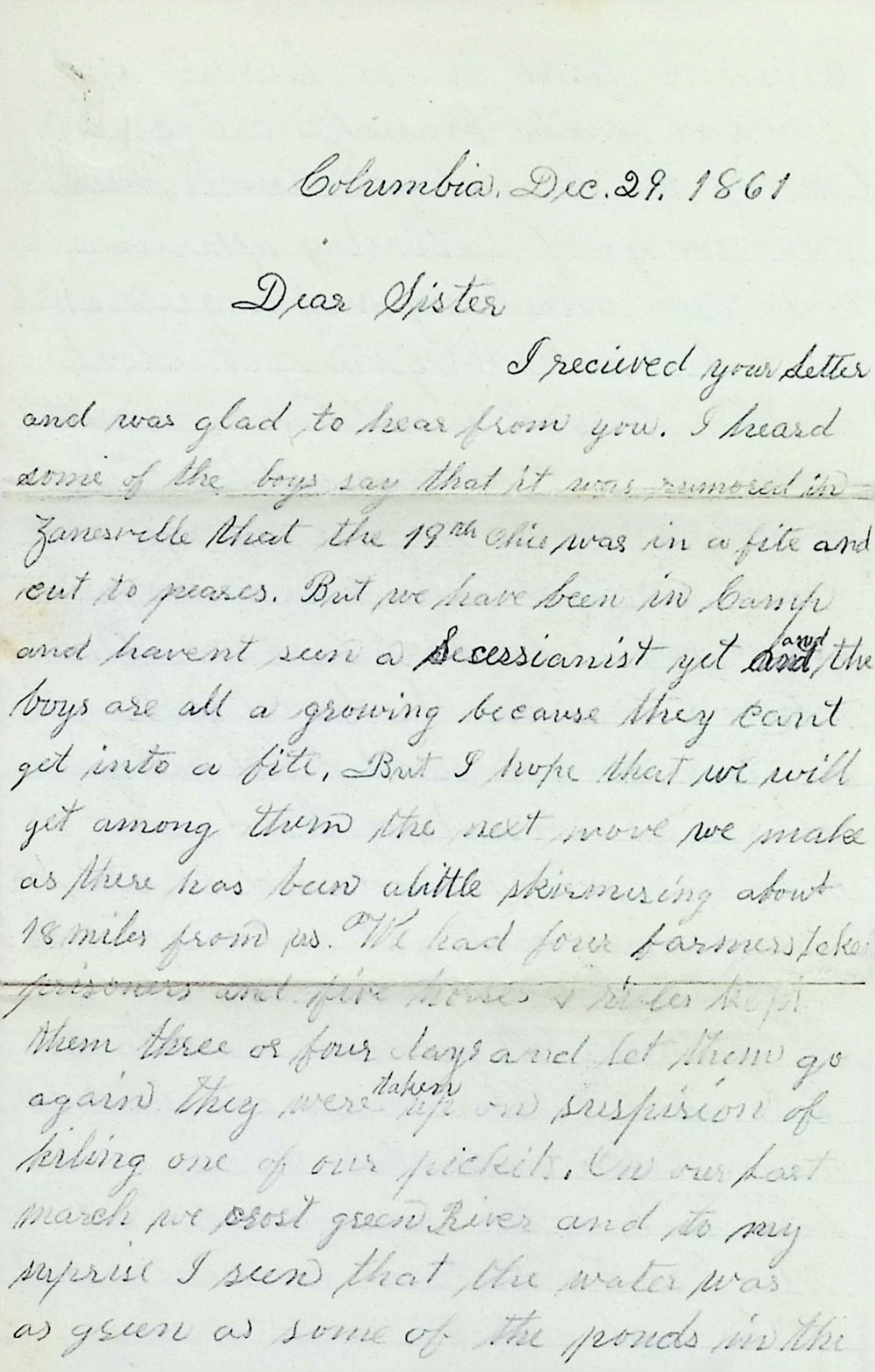
I received your letter and was glad to hear from you. I heard some of the Boys say that it was rumored in Zanesville that the 19th Ohio was in a fight and cut to pieces. But we have been in camp and haven’t seen a secessionist yet and the Boys are all a growing [ornery] because they can’t get into a fight. But I hope that we will get among them the next move we make as there has been a little skirmishing about 18 miles from us. We had four farmers take prisoners and five horses and rifles. They kept them three or four days and let them go again. They were taken up on suspicion of killing one of our pickets.
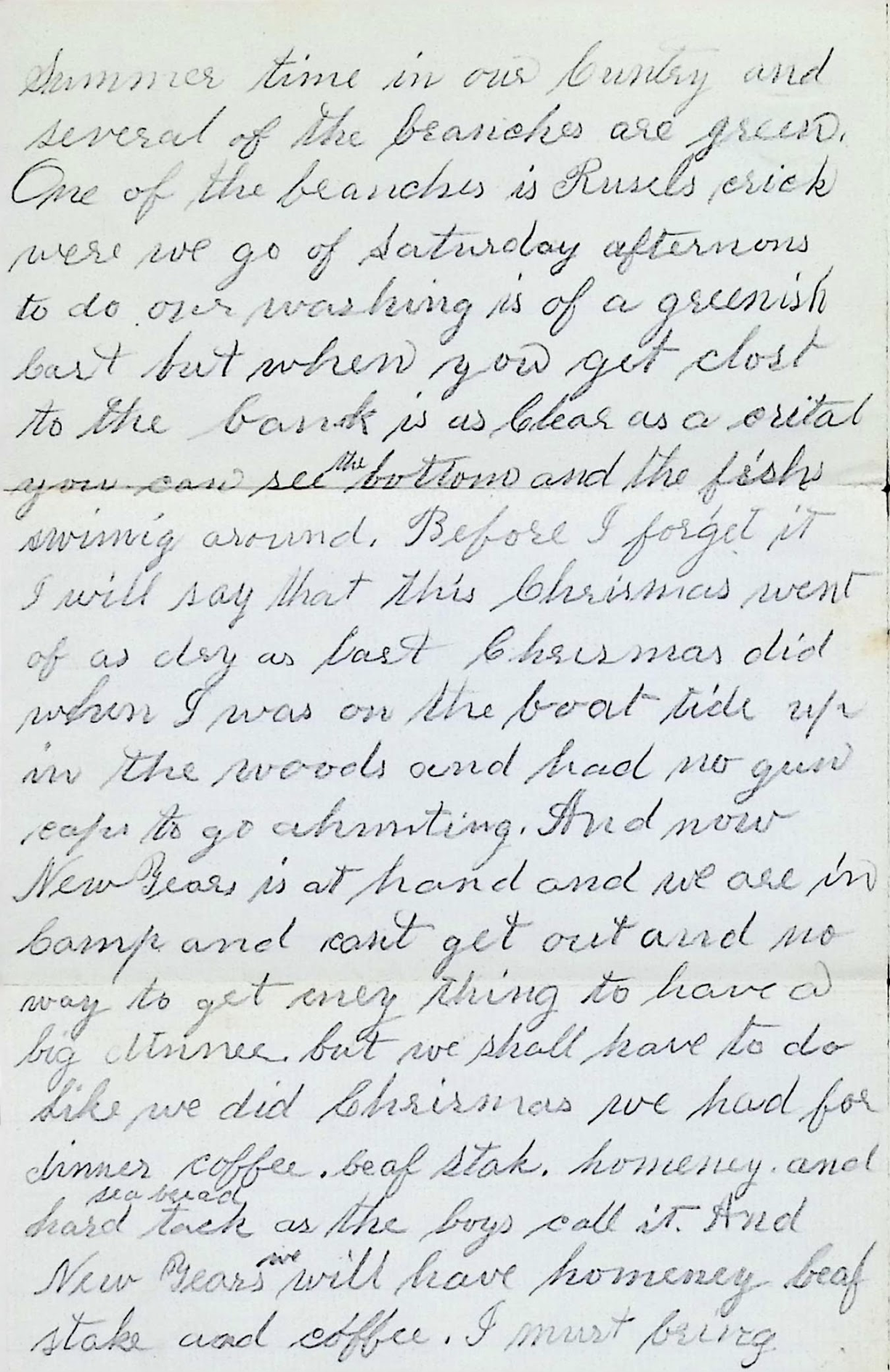
On our last march, we crossed Green river and to my surprise, I seen that the water was as green as some of the ponds in the summer time in our country and several of the branches are green. One of the branches is Russell’s Creek where we go Saturday afternoons to do our washing. It is of a greenish cast but when you get close to the bank, is as clear as a crystal. You can see the bottom and the fish swimming around.
Before I forget it, I will say that this Christmas went off as dry as last Christmas did when I was on the boat tied up in the woods and had no gun caps to go a hunting. And now New Years is at hand and we are in camp and can’t get out and no way to get anything to have a big dinner. But we shall have to do like we did Christmas. We had for dinner coffee, beef stake, hominy, and hard tack—sea bread, as the boys call it. And New Years we will have hominy, beef stake, and coffee.
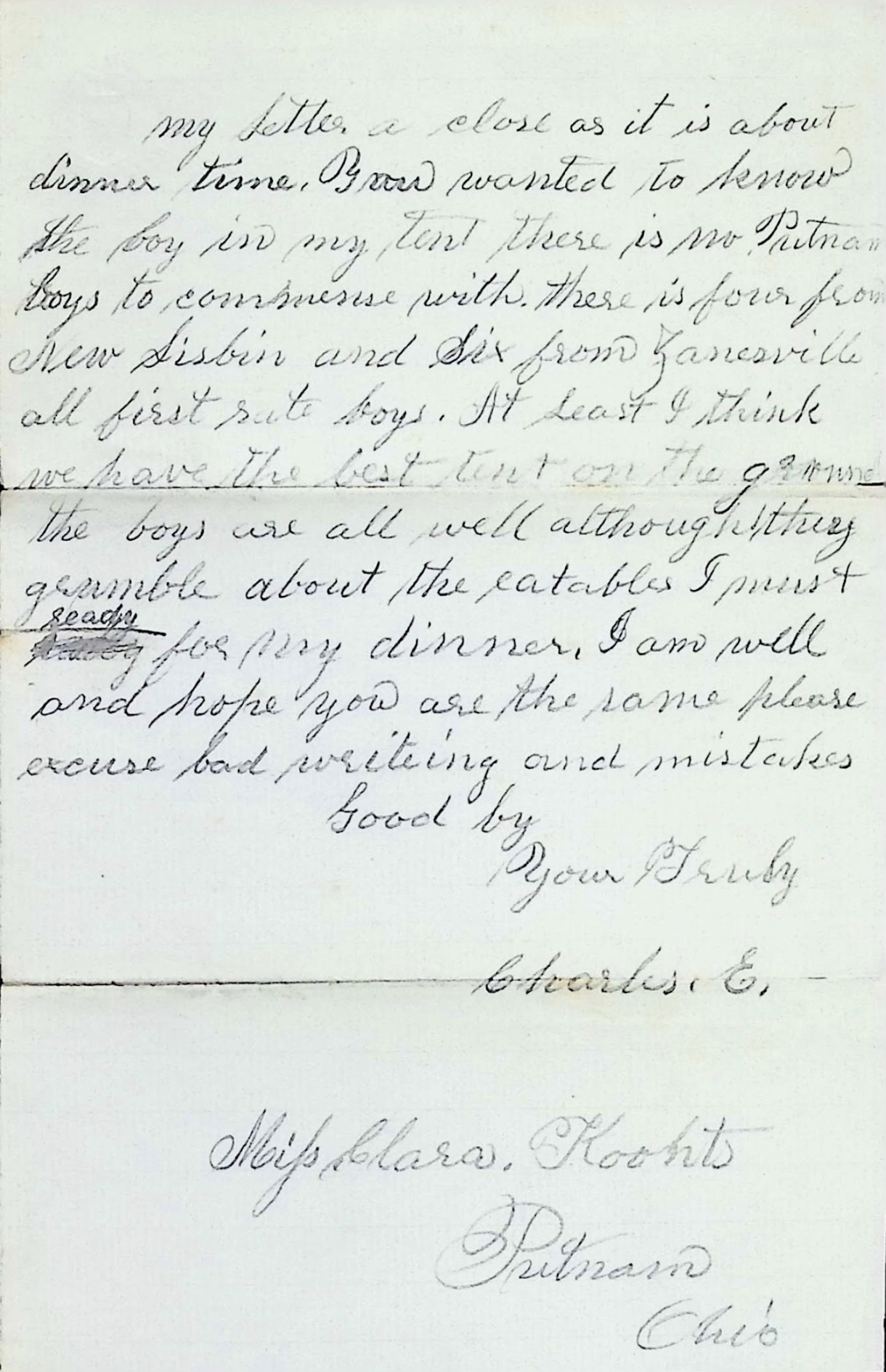
I must bring my letter to a close as it is about dinner time. You wanted to know the boys in my tent. There is no Putnam Boys to commence with. There is four from New Lisbon and six from Zanesville—all first rate boys. At least I think we have the best tent on the ground. The boys are all well although they grumble about the eatables. I must get ready for my dinner. I am well and hope you are the same. Please excuse bad writing and mistakes. Goodbye. Yours truly, — Charles E.
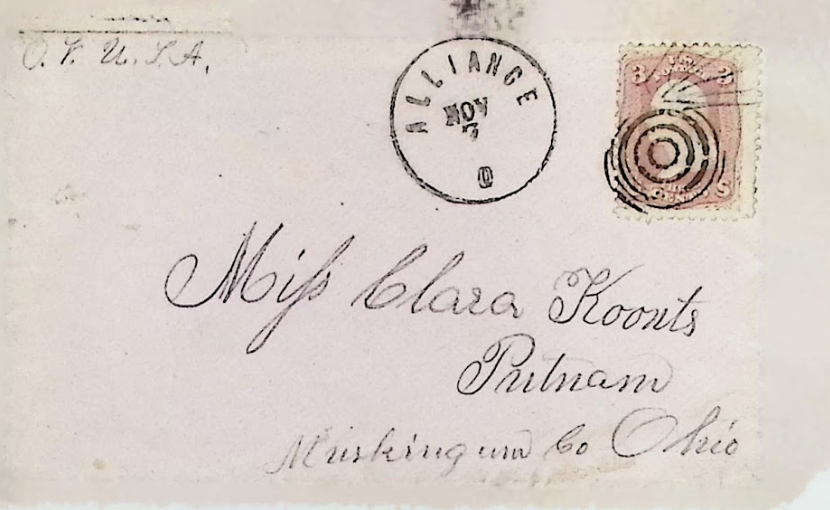
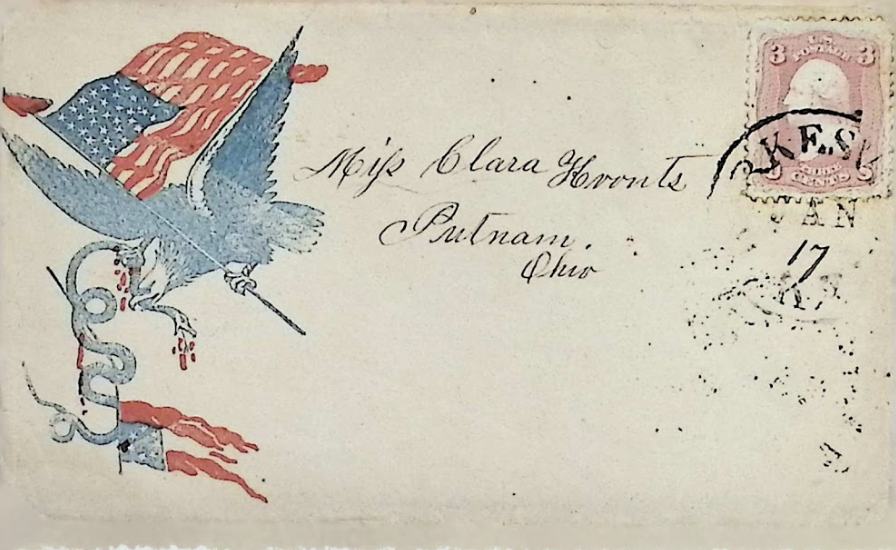
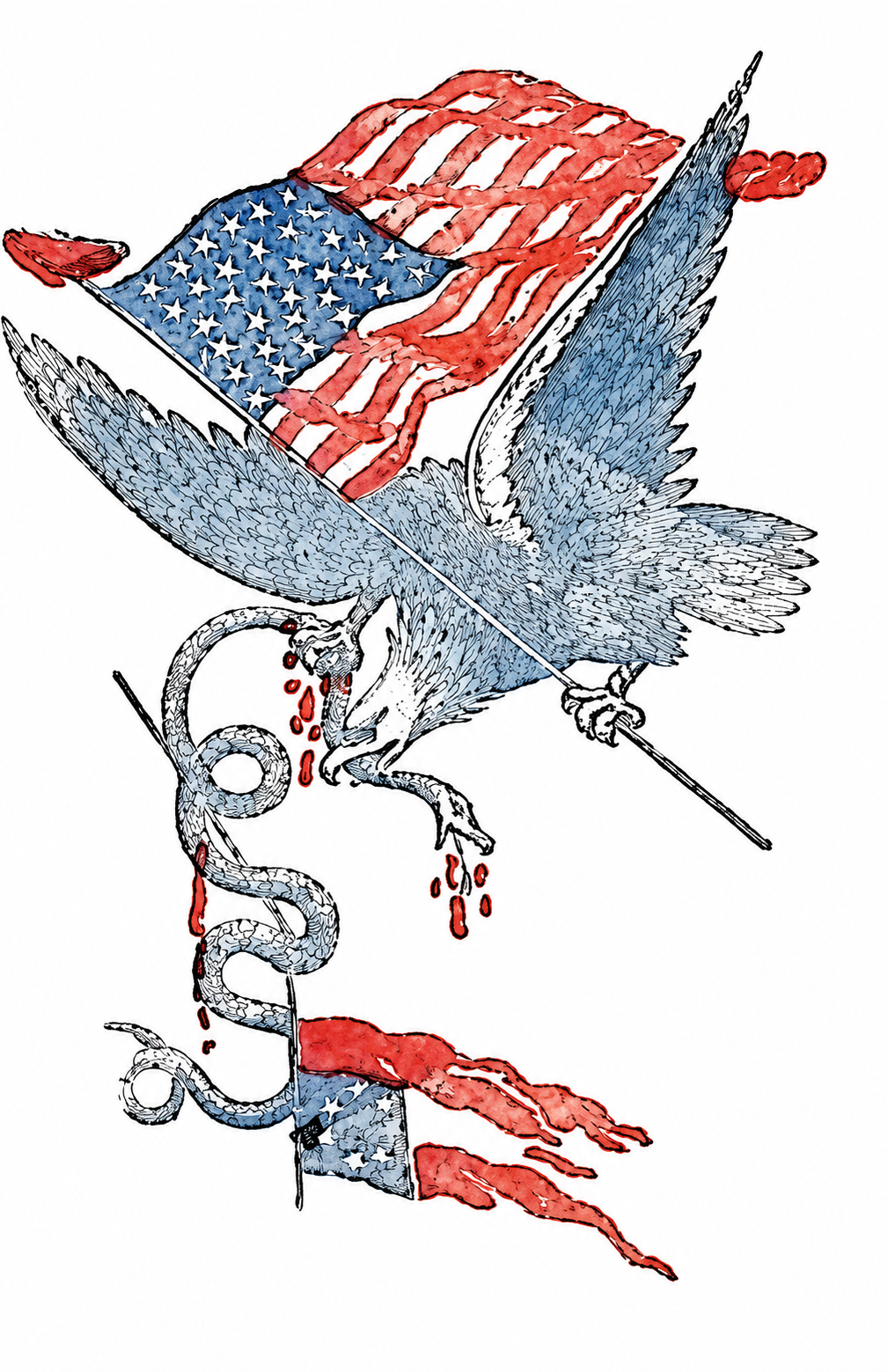
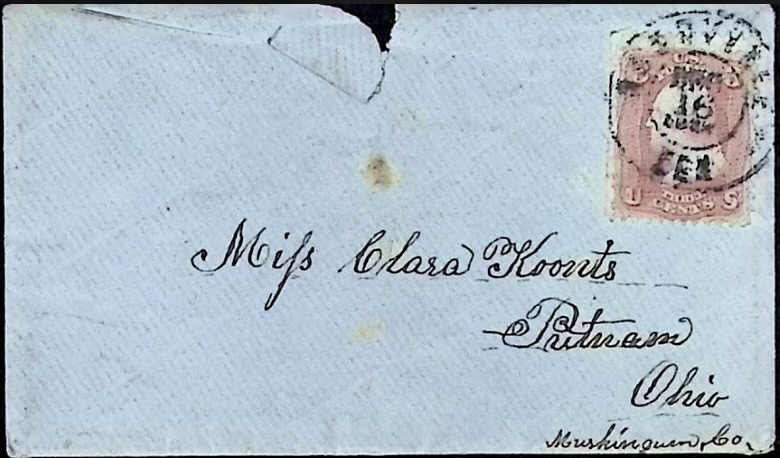
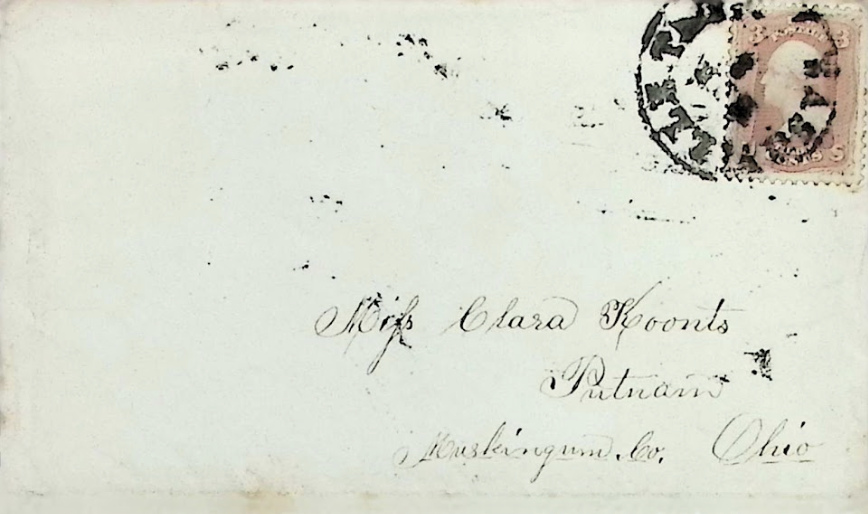
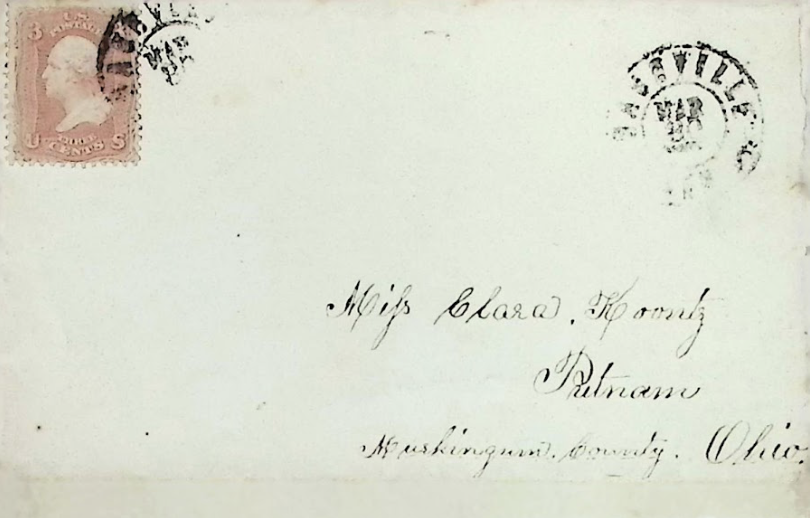
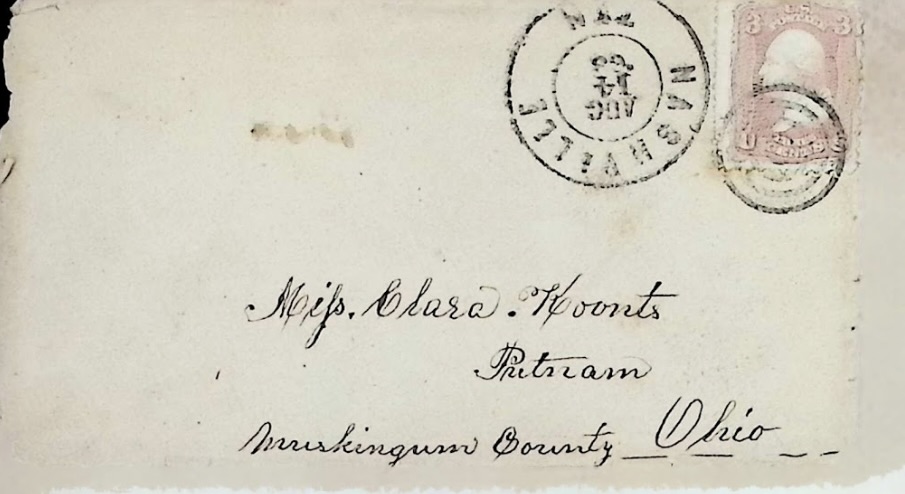
To Miss Clara Koonts, Putnam, Ohio
Letter 8
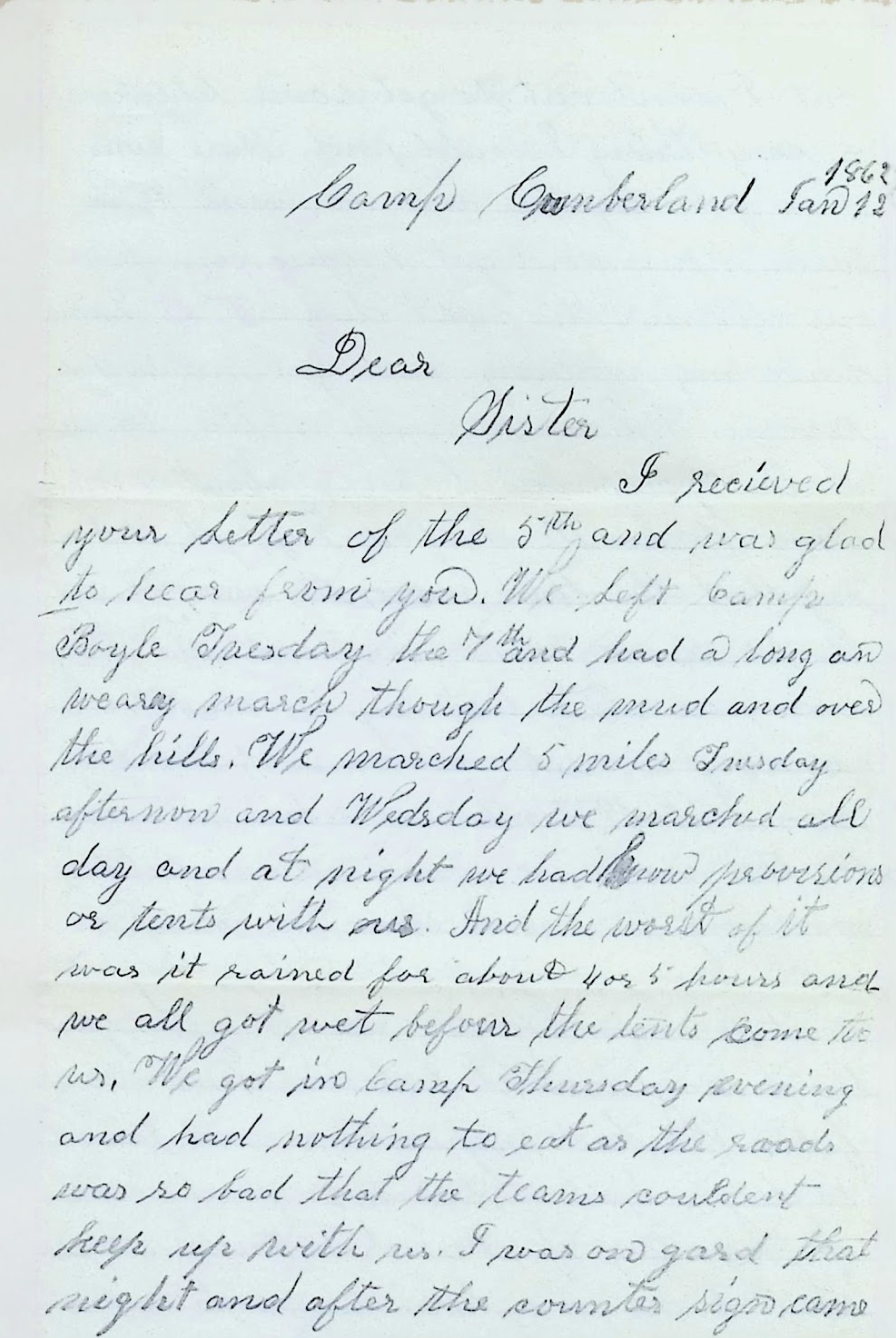
Camp Cumberland
January 12, 1862
Dear Sister,
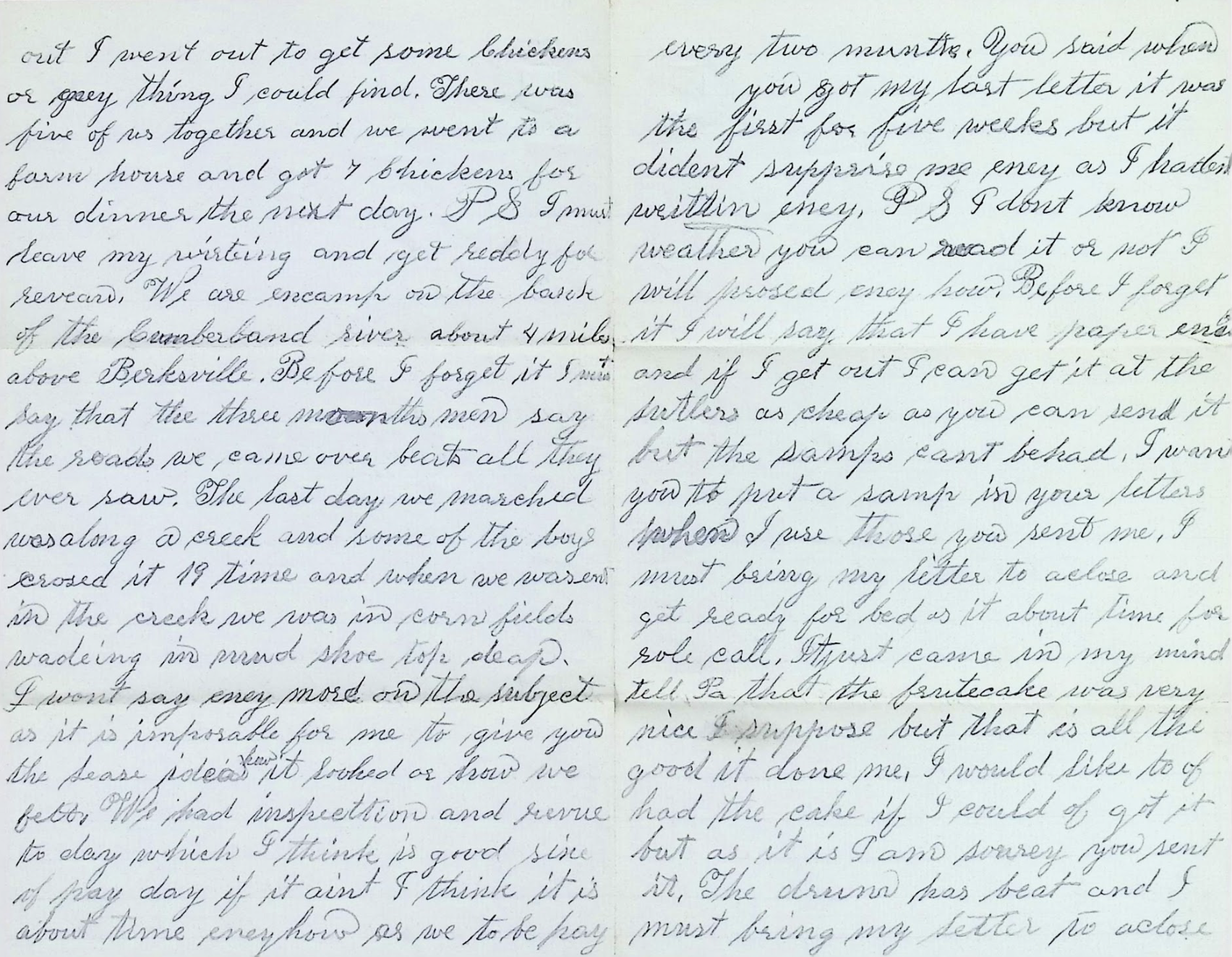
I received your letter of the 5th and was glad to hear from you. We left camp Boyle Tuesday the 7th and had a long and weary march through the mud and over the hills. We marched 5 miles Tuesday afternoon and Wednesday we marched all day and at night we had no provisions or tents with us. And the worst of it was it rained for about four or five hours and we all got wet before the tents came to us. We got in camp Thursday evening and had nothing to eat as the roads was so bad that the teams couldn’t keep up with us. I was on guard that night and after the countersign came out, I went out to get some chickens or anything I could find. There was five of us together and we went to a farm house and got seven chickens for our dinner the next day.
P. S. I must leave my writing and get ready for reveille. We are encamped on the bank of the Cumberland river about 4 miles from Burkesville. Before I forget it, I must say that the three months men say the roads we came over beats all they ever saw. The last day we marched was along a creek and some of the boys crossed it 19 times and when we wasn’t in the creek, we was in cornfields wading in mud shoe top deep. I won’t say anymore on the subject as it is impossible for me to give you the least idea how it looked or how we felt.
We had inspection and review today which I think is a good sign of pay day. It if ain’t, I think it is about time anyhow as we [are] to be paid every two months. You said when you got my last letter, it was the first for five weeks but it didn’t surprise me any as I hadn’t written any.
P. S. I don’t know whether you can read it or not but I will proceed anyhow. Before I forget it, I will say that I have paper and if I get out, I can get it at the sutlers as cheap as you can send it but the stamps can’t be had. I want you to put a stamp in your letters when I use those you sent me. I must bring my letter to a close and get ready for bed as it is about time for roll call. It just came in my mind—tell Pa that the fruitcake was very nice, I suppose, but that is all the good it done me. I would like to have had the cake if I could of got it but as it is, I am sorry you sent it.
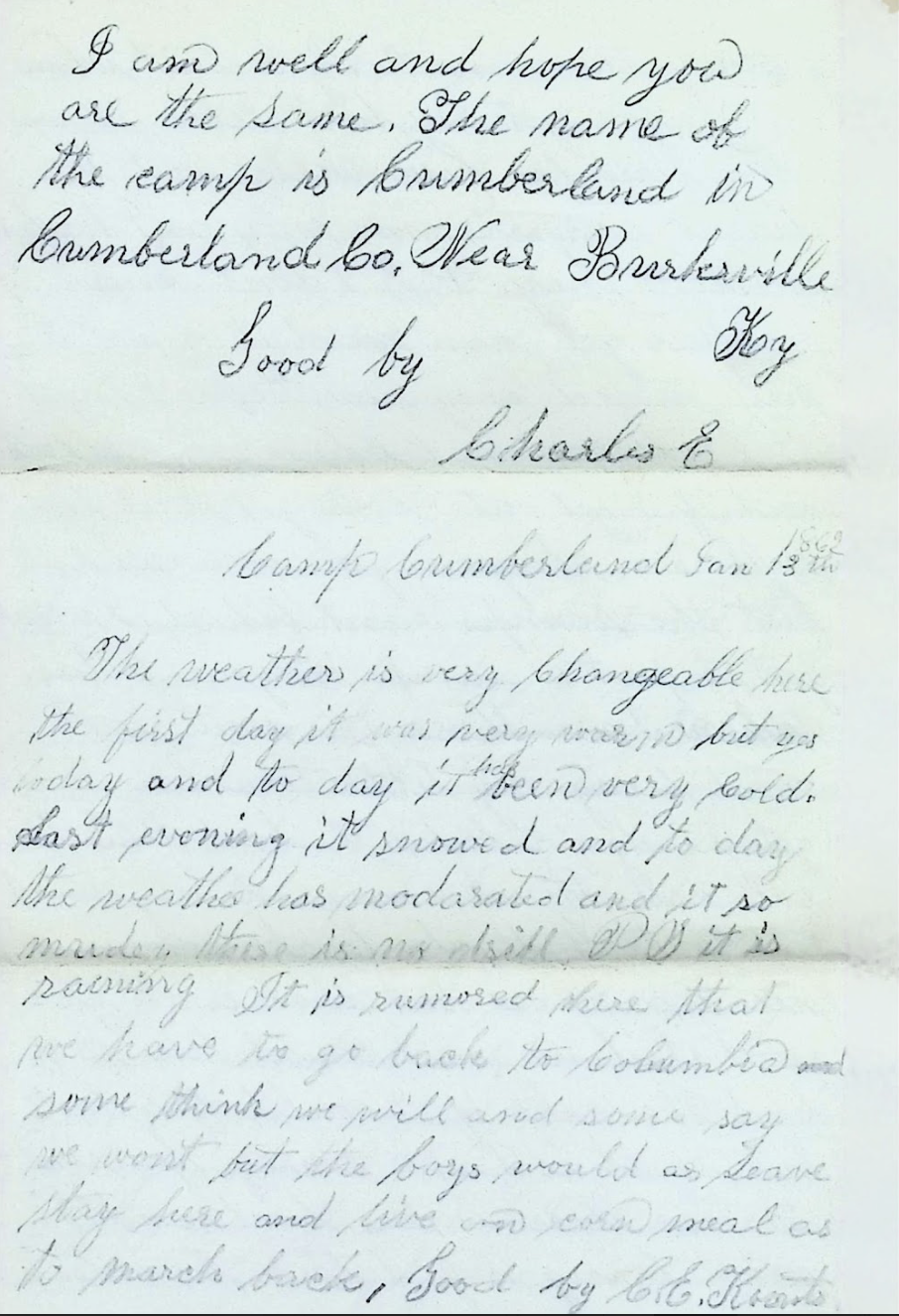
The drum has beat and I must bring my letter to a close. I am well and hope you are the same. The name of the camp is Cumberland in Cumberland county near Burkesville, Kentucky.
Goodbye, — Charles E.
Camp Cumberland, January 13th
The weather is very changeable here. The first day it was very warm but yesterday and today it has been very cold. Last evening it snowed and today the weather has moderated and it is so muddy. There is no drill & it is raining. It is rumored here that we have to go back to Columbia and some think we will and some say we won’t. But the Boys would as leave stay here and live on corn meal as to march back. Goodbye. — C. E. Koonts
Letter 9
Camp Green
January 29, 1862
Dear Sister,
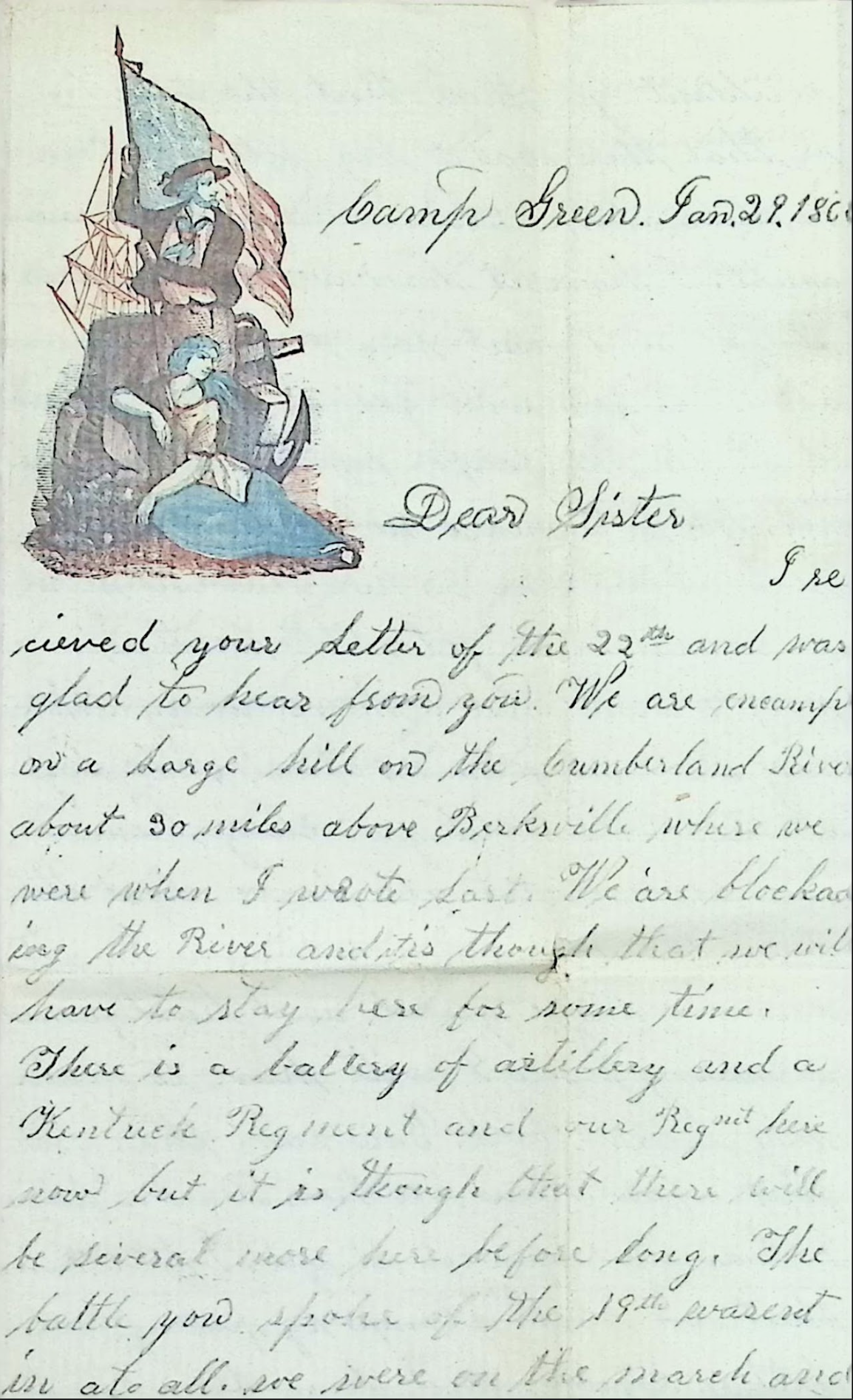
I received your letter of the 22nd and was glad to hear from you. We are encamped on a large hill on the Cumberland River about thirty miles above Burkesville where we were when I wrote last. We are blockading the river and it is thought that we will have to stay here for some time. There is a bettery of artillery and a Kentucky regiment and our regiment here now but it is though that there will be several more here before long.
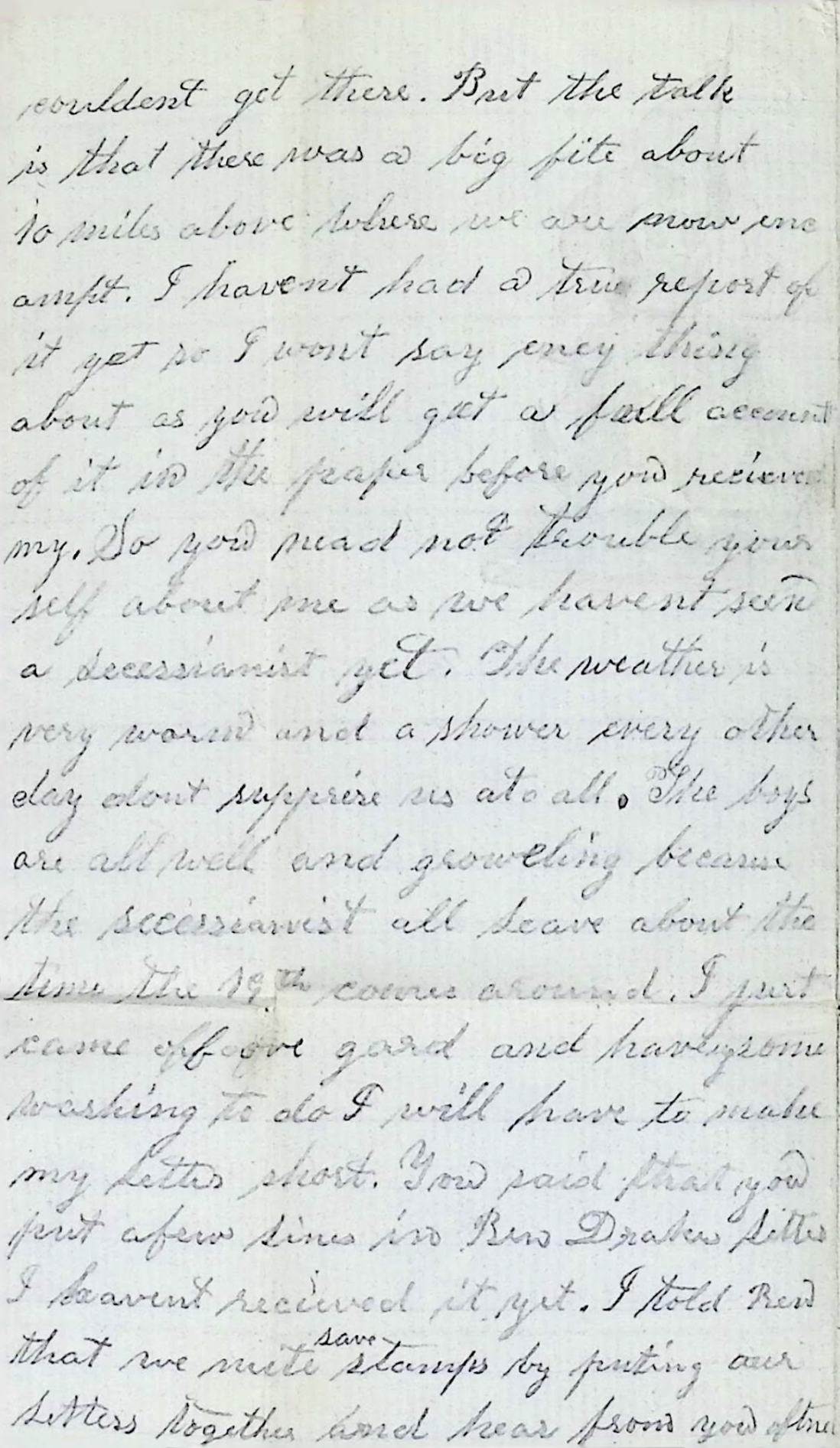
The battle you spoke of the 19th wasn’t in at all. We were on the march and couldn’t get there. But the talk is that there was a big fight about ten miles above where we are now encamped. I haven’t had a true report of it yet so I won’t say anything about it as you will get a full account of it in the paper before you receive my [letter]. So you need not trouble yourself about me as we haven’t seen a secessionist yet.
The weather is very warm and a shower every other day don’t surprise us at all. The Boys are all well and growling because the secessionists all leave about the time the 19th [Ohio] comes around. I just came off guard and have some washing to do [so] I will have to make my letter short. You said that you put a few lines in Ben Drake’s letter. I haven’t received it yet. I told Ben that we might save stamps by putting our letters together and hear from you oftener.
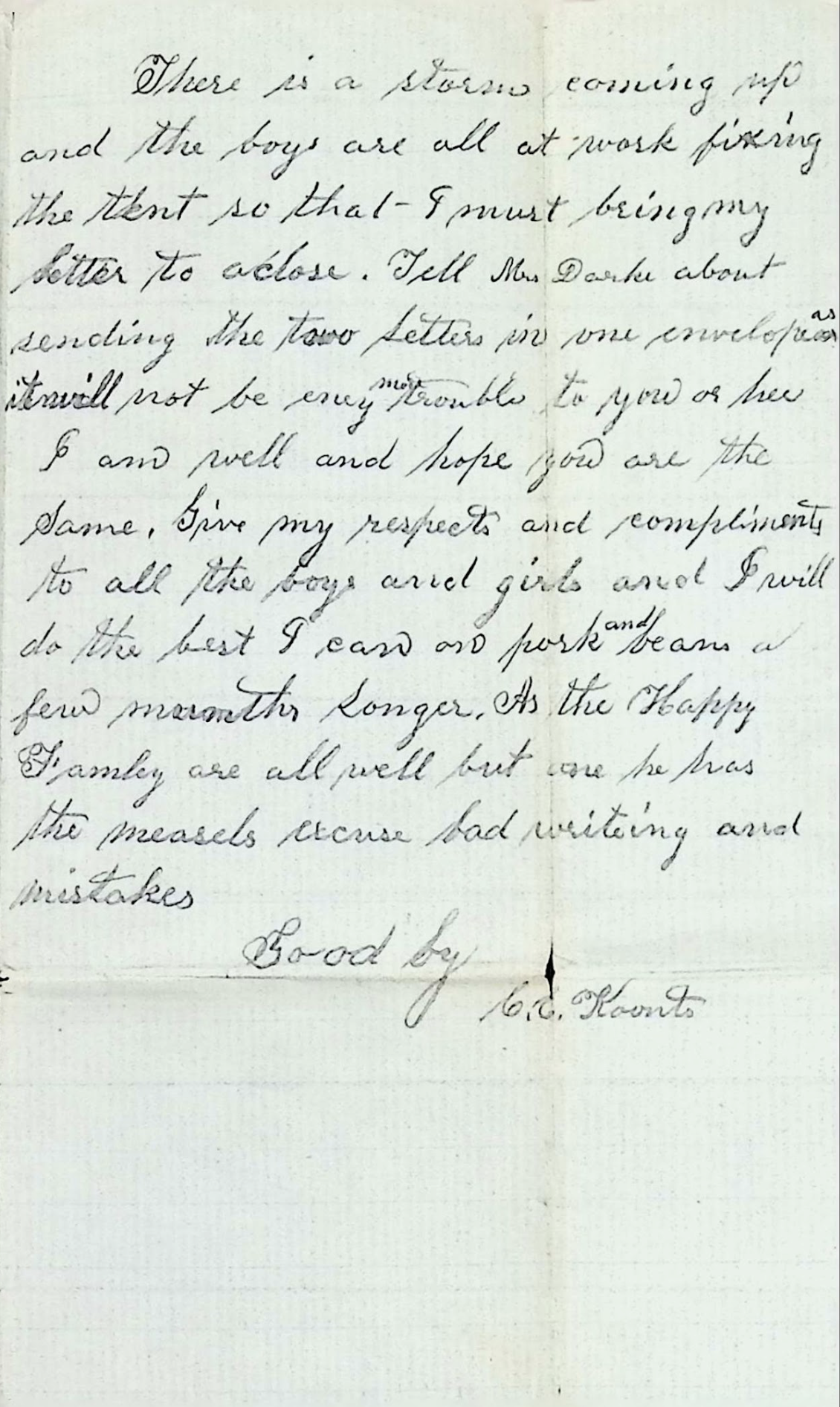
There is a storm coming up and the boys are all at work fixing the tent so that I must bring my letter to a close. Tell Mr. Drake about sending the two letters in one envelope as it will not be any more trouble to you or her. I am well and hope you are the same. Give my respects and compliments to all the boys and girls and I will do the best I can on porks and beans a few months longer. As the happy family are all well but one, he has the measles. Excuse bad writing and mistakes. Goodbye, — C. E. Koonts
Letter 10
Camp Green
February 19, 1862
Dear Sister,
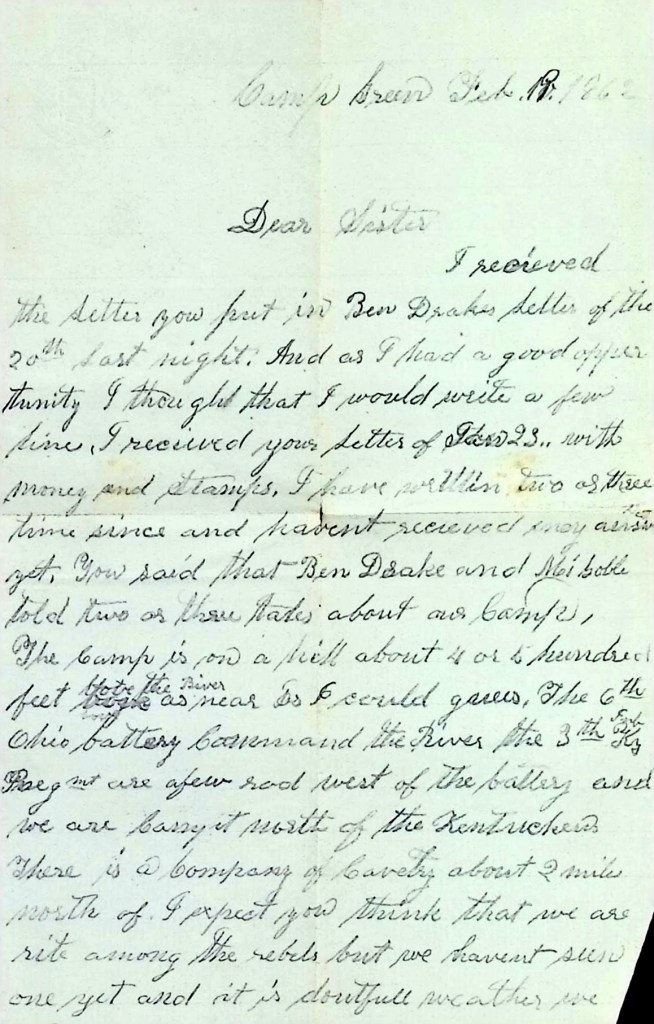
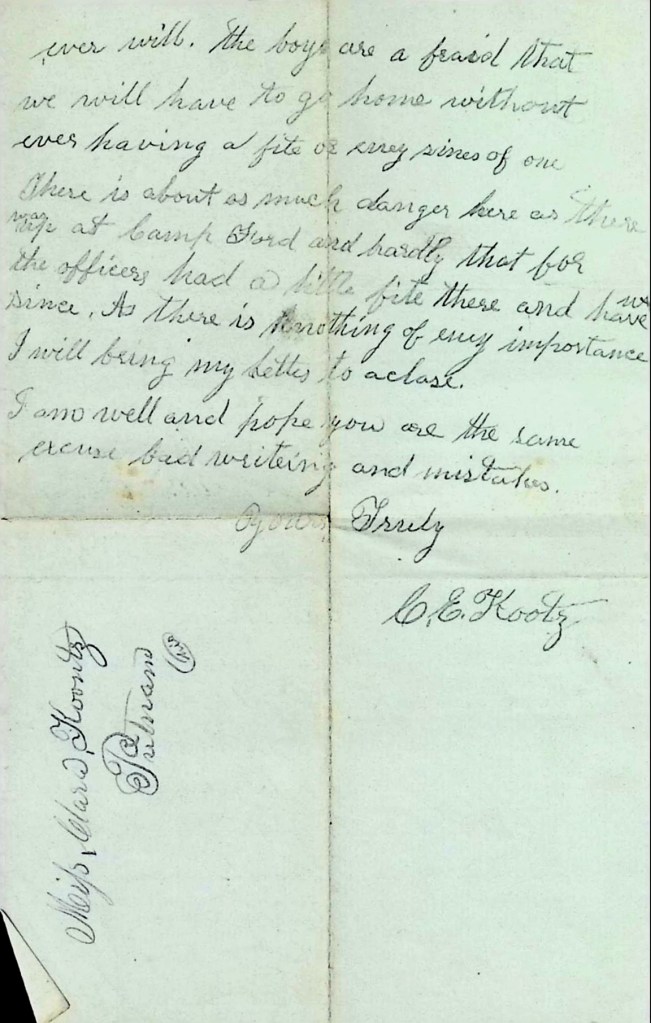
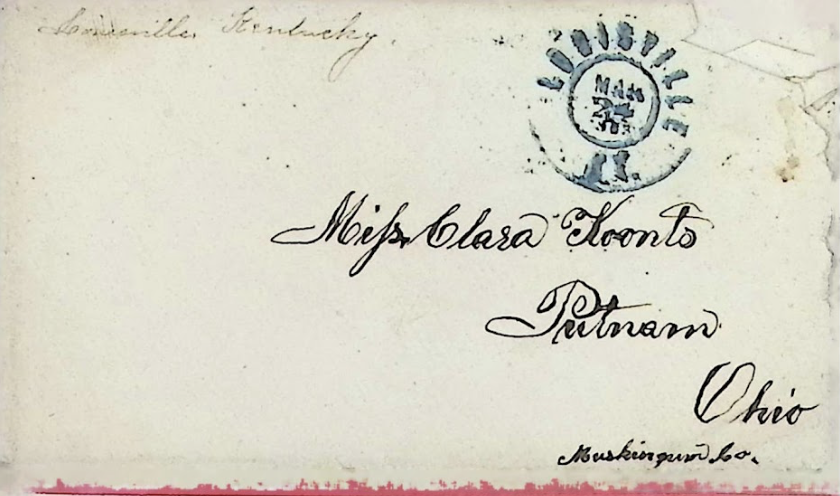
I received the letter you put in Ben Drake’s letter of the 20th last night and as I had a good opportunity, I thought that I would write a few lines. I received your letter of January 23rd with money and stamps and haven’t received any answer yet. You said that Ben Drake and Mehitable told two or three tales about our camp. The camp is on a hill about four or five hundred feet above the river as near as I could guess. The 6th Ohio Battery commands the river. The 3rd Kentucky Infantry regiment are a few rods west of the battery and we are [ ] north of the Kentuckians. There is a company of cavalry about two miles north of [us]. I expect you think that we are right among the rebels but we haven’t seen one yet and it is doubtful whether we ever will. The Boys are afraid that we will have to go home without ever having a fight or any signs of one. There is about as much danger here as there was up at Camp Ford [in Alliance, Ohio] and hardly that for the officers had a little fight there and haven’t since.
As there is nothing of any importance, I will bring my letter to a close. I am well and hope you are the same. Excuse bad writing and mistakes. Yours truly, — C. E. Koonts
Letter 11
Camp Andrew Jackson
March 13, 1862
Dear Sister,
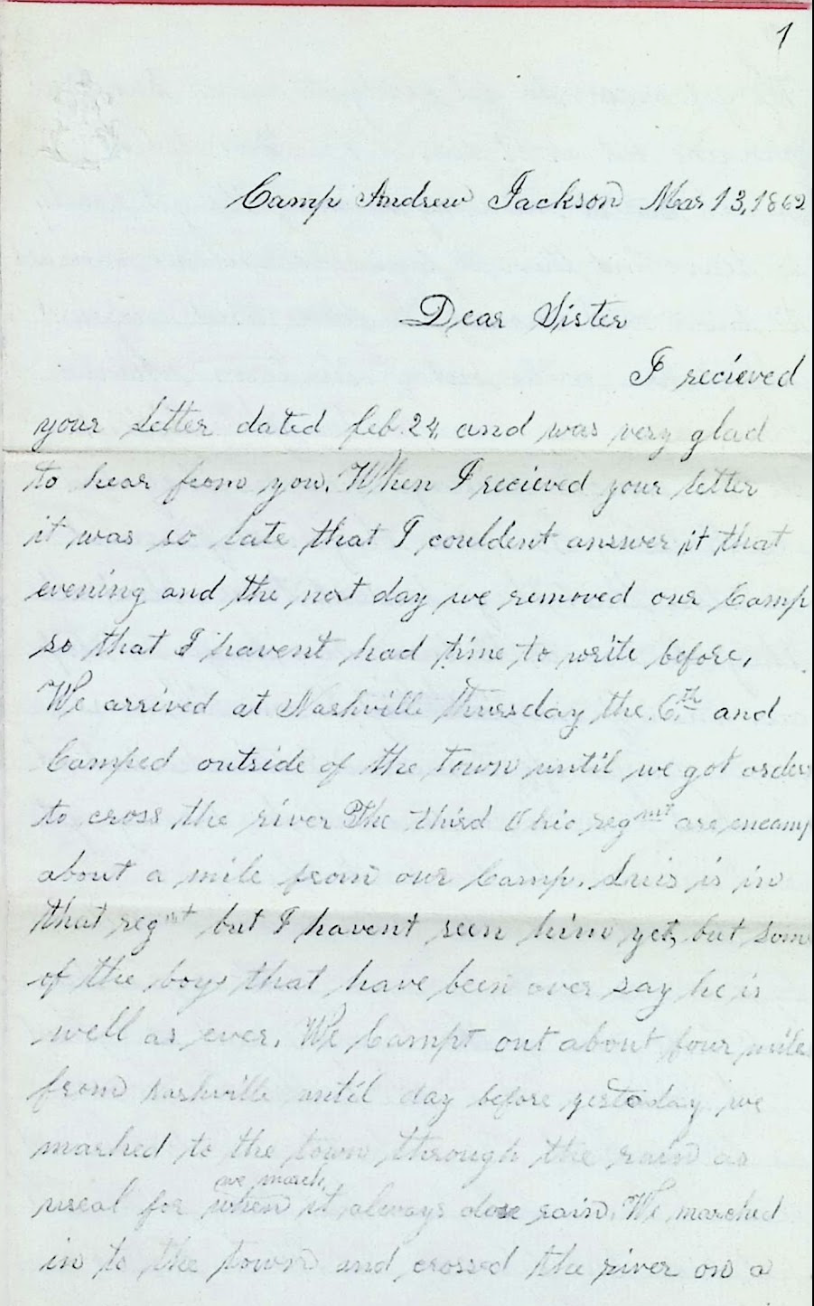
I received your letter dated February 24th and was very glad to hear from you. When I received your letter it was so late that I couldn’t answer it that evening and the next day we removed our camp so that I haven’t had time to write before. We arrived at Nashville Thursday the 6th and camped outside of the town until we got orders to cross the river. The 3rd Ohio Regiment are encamped about a mile from our camp. Luis is in that regiment but I haven’t seen him yet. But some of the boys that have been over say he is well as ever.
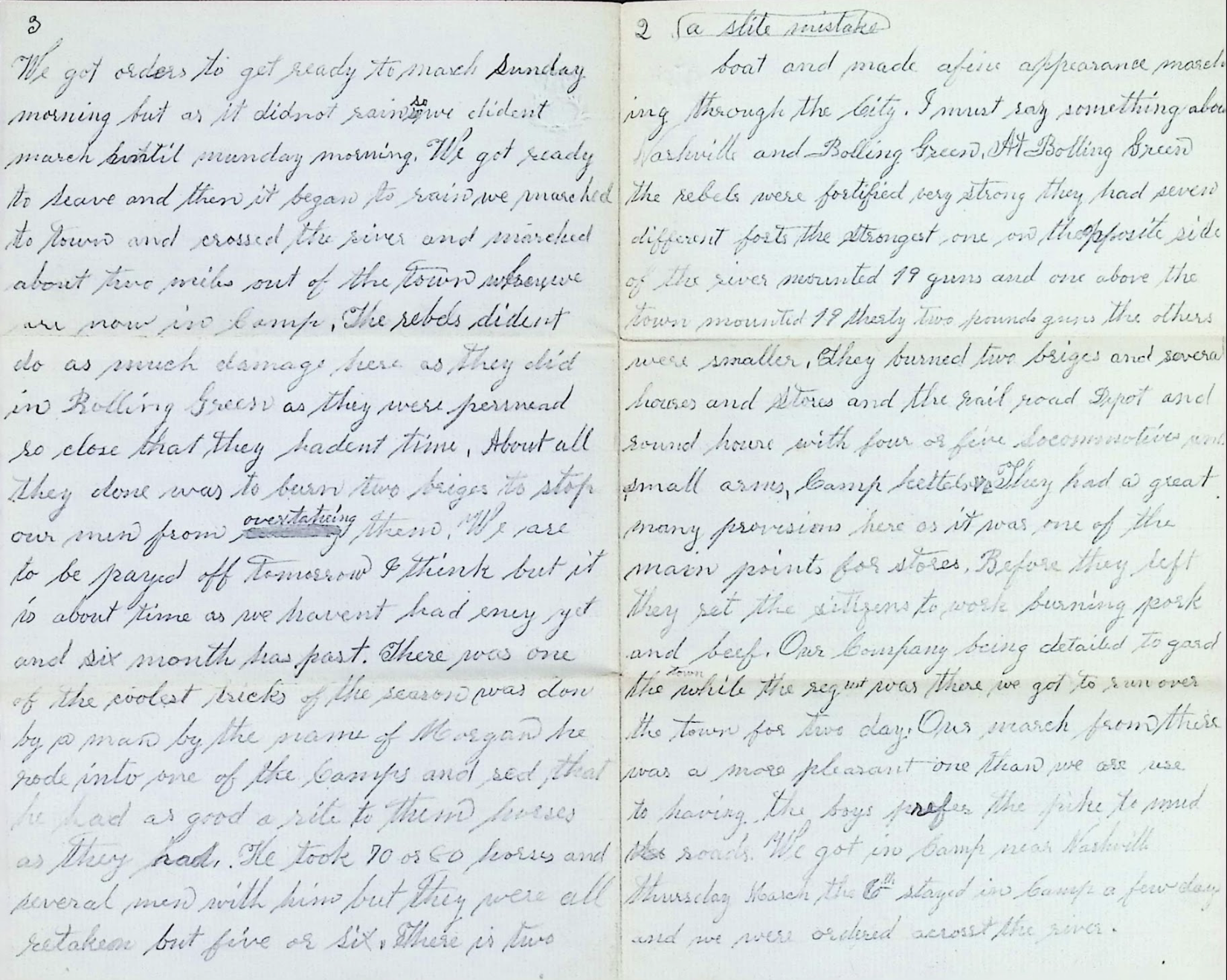
We camped out about four miles from Nashville until day before yesterday [when] we marched to the town through the rain as usual for when we march, it always does rain. We marched into the town and crossed the river on a boat and made a fine appearance marching through the city.
I must say something about Nashville and Bowling Green. At Bowling Green the rebels were fortified very strong. They had seven different forts. The strongest one, on the opposite side of the river, mounted nineteen guns, and the one above the town mounted nineteen 32-pound guns. The others were smaller. 1 They burned two bridges and several houses and stores and the railroad depot and round house with four or five locomotives and small arms, camp kettles, &c. They had a great many provisions here as it was one of the main points for stores. Before they left, they set the citizens to work burning pork and beef. Our company being detailed to guard the town while the regiment was there, we got to run over the town for two days.
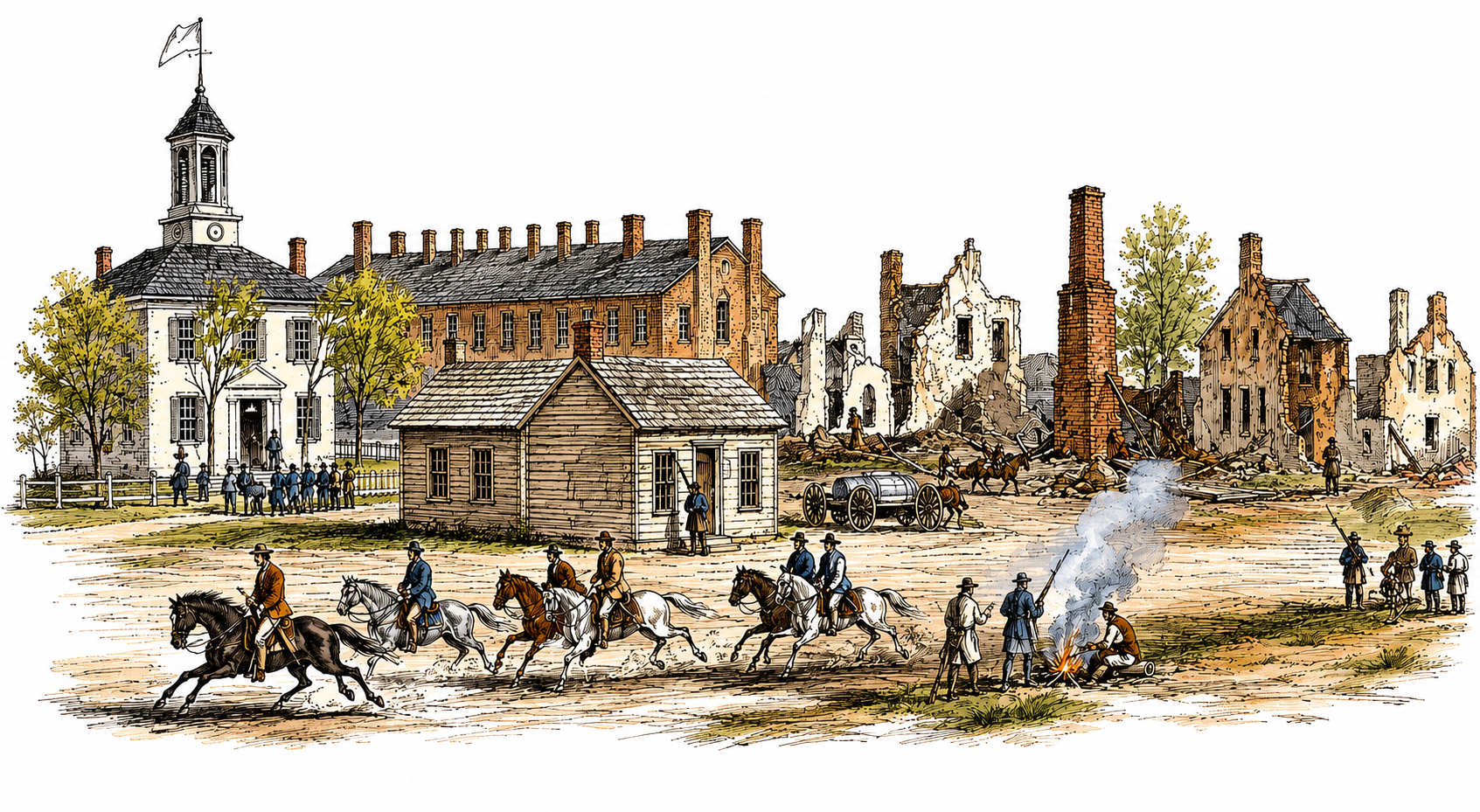
Our march from there was a more pleasant one that we are use to having. The Boys prefer the pike to mud roads. We got in camp near Nashville Thursday, March the 6th, stayed in camp a few days, and [then] we were ordered across the river. We got orders to get ready to march Sunday morning but as it did not rain, so we didn’t march until Monday morning. We got ready to leave and then it began to rain. We marched to town and crossed the river and marched about two miles out of the town where we are now in camp. The rebels didn’t do as much damage here as they did in Bowling Green as they were pressed so close that they hadn’t time. About all they done was to burn two bridges to stop our men from overtaking them.
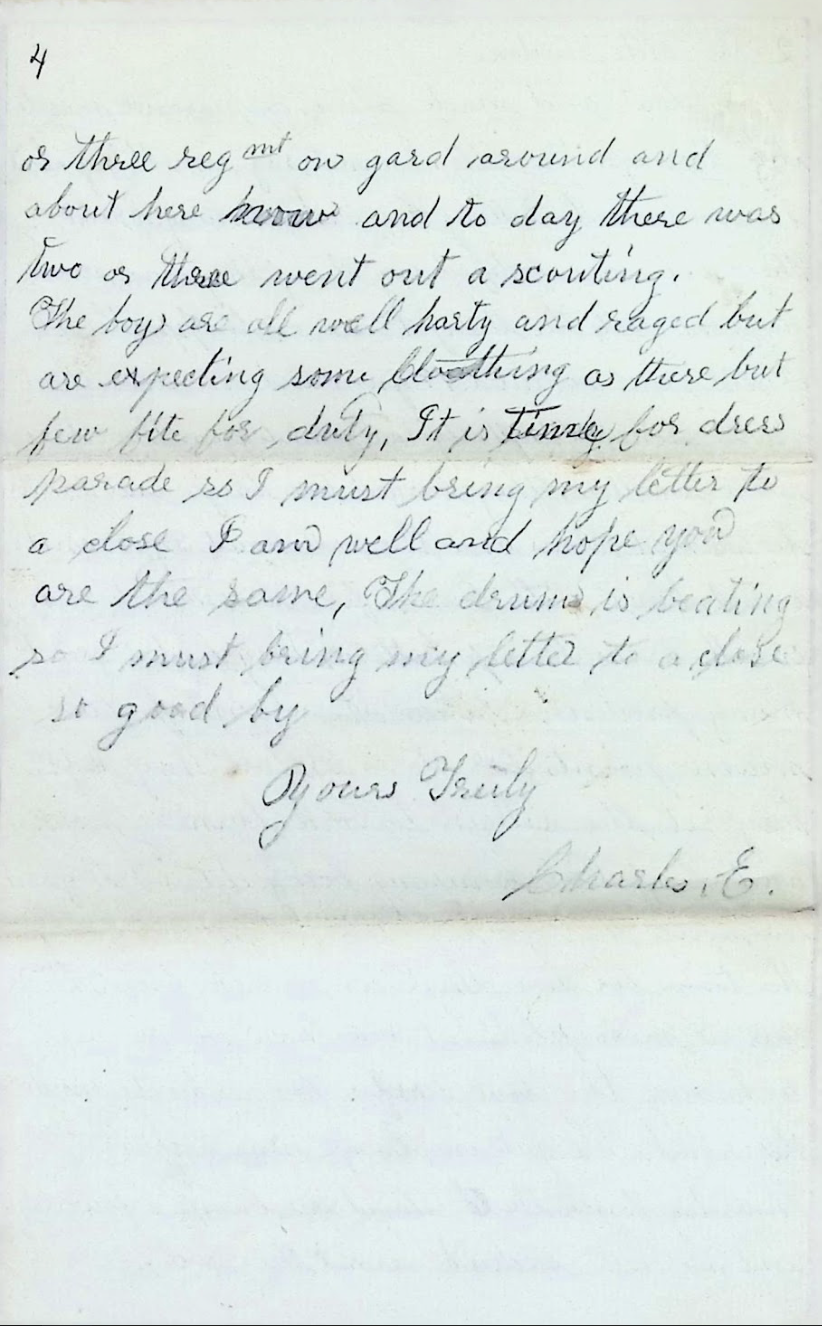
We are to be paid off tomorrow, I think, but it is about time as we haven’t had any yet and six months has passed. There was one of the coolest tricks of the season was done by a man by the name of Morgan. He rode into one of the camps and said that he had as good a right to them horses as they had. He took 70 or 80 horses and several men with him but they were all retaken but five or six. There is two or three regiments on guard around and about here now and today there was two or three went out a scouting.
The boys are all well, hearty, and ragged but are expecting some clothing as there [are] but few fit for duty. It is time for dress parade so I must bring my letter to a close. I am well and hope you are the same. The drums is beating so I must bring my letter to a close. So goodbye. Yours truly, — Charles E.
1 Another soldier, Lt. David P. Doughtery of Circleville who served in the 13th Ohio Infantry, described Bowling Green in similar terms in a letter to his wife on 16 February 1862: Before leaving they [the Rebels] set fire to the town, burning a great portion of the best buildings. They have been leaving here for a week, or even since they got news of our advance, which was no doubt as soon as we started, as we are in an enemy’s country, and must expect them to have spies. But Kentucky is now ours once more and I don’t know where they will stand and fight if they won’t here. You would be surprised to see the fortifications that they have made around here. I have been in two of the forts. They are very formidable indeed. There are eleven different fortifications in the vicinity of town, and besides those is miles of breastworks strung along the ridges on this side of the river. It certainly does appear to me that they never do intend to give us a fight. I certainly think that twenty thousand good men in these forts could whip one hundred thousand of the best soldiers in the world that would come against them. All I can say in the matter is, “I am completely beat,” to know that they, after so much labor and preparation, have quit them without a fight. The rebels have retreated from here to Nashville, Tennessee, and it is said that they will make a stand there, and I expect that in a very short space of time we will be moving on again after them. If we are successful in driving them out of there, they will have nothing left to do by to “sue” for “Peace,” for they can go no farther….[Source: The Western Theater in the Civil War, by Darryl Smith, 4 August 2021]
Letter 12
Chicksaw Bluffs 1
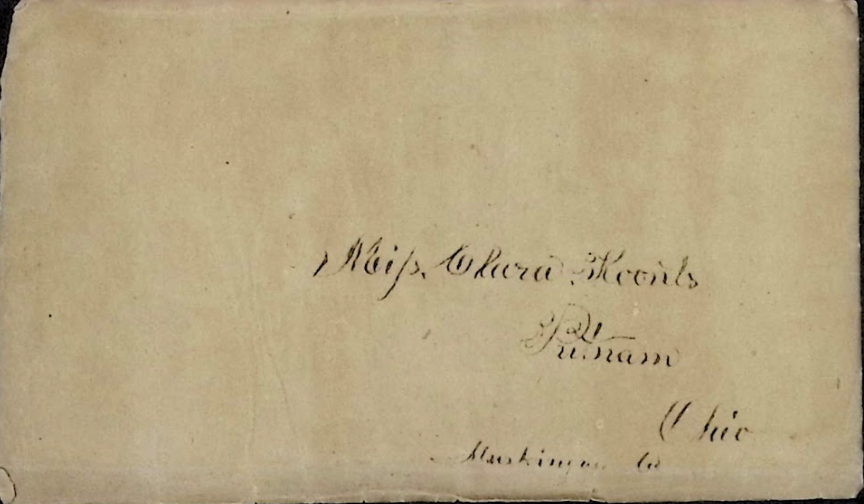
April 12, 1862
Dear Sister,
I received your letter dated March 20th and was glad to hear from you. The reason I haven’t written was because we have been marching so much that I haven’t had time and when we have time, we can’t always send our mail.
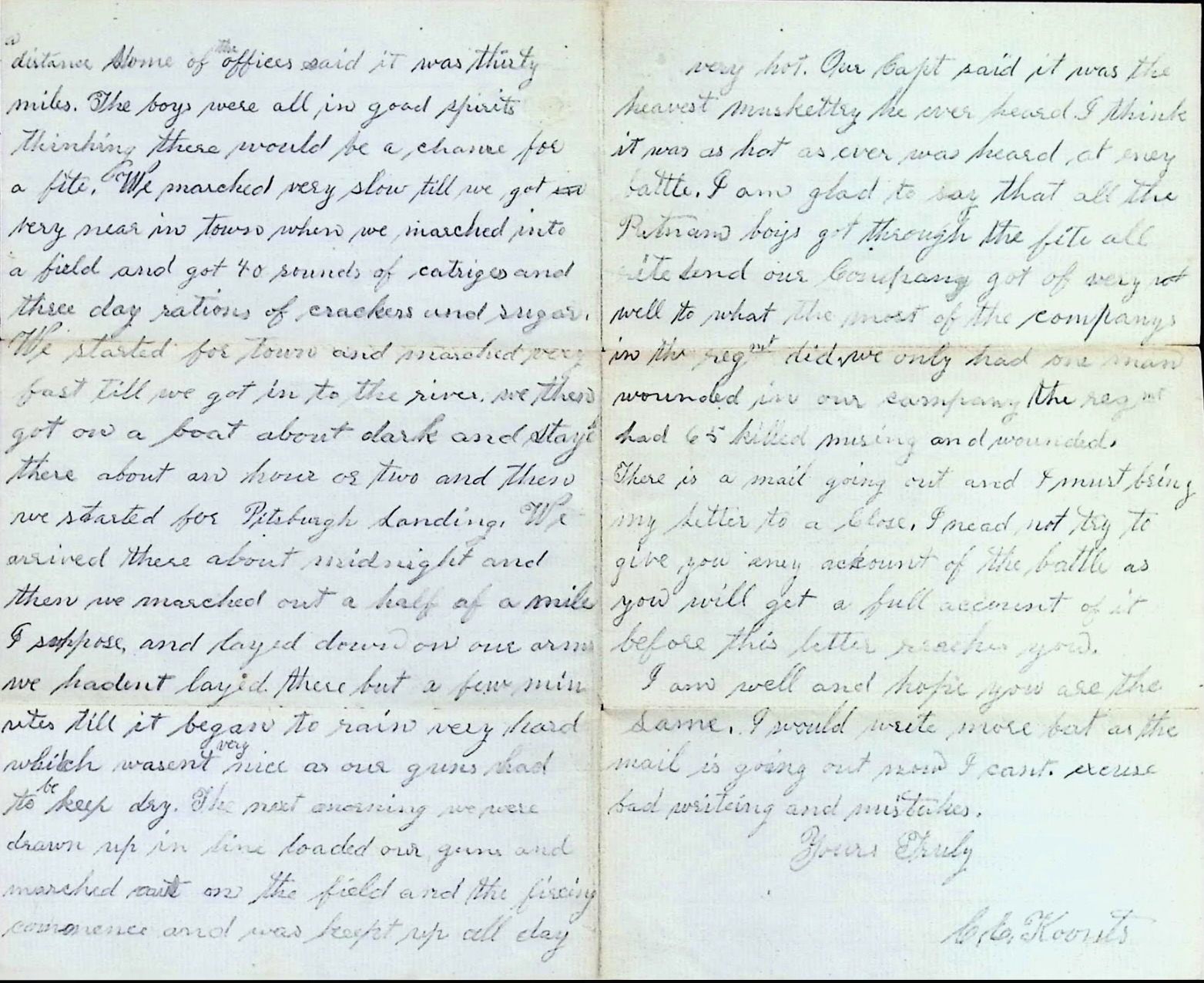
You have told me that I always know where to direct my letters and ought to write oftener than I do, but I never told you that we were in an enemy’s country and it’s very seldom we can mail our letters. This day one week ago we encamped about eight miles from Savannah [Hardin Co., Tennessee]. Sunday morning when we got up the sun was shining and the orders were to pack up our knapsack as it was but a short march to Savannah. We started and about ten o’clock we heard cannonading off at a distance. Some of the officers said it was thirty miles.
The boys were all in good spirits thinking there would be a chance for a fight. We marched very slow till we got very near in town when we marched into a field and got 40 rounds of cartridges and three days rations of crackers and sugar. We started for town and marched very fast will we got to the [Tennessee] river. We then got on a boat about dark and stayed there about an hour or two and then we started for Pittsburg Landing. We arrived there about midnight and then we marched out a half of a mile I suppose and laid down on our arms. We hadn’t laid there but a few minutes till it began to rain very hard which wasn’t very nice as our guns had to be kept dry.
The next morning we were drawn up in line, loaded our guns and marched out on the field and the firing commenced and was kept up all day very hot. Our captain said it was the heaviest musketry he ever heard. think it was as hot as ever was heard at any battle. I am glad to say that all the Putnam boys got through the fight all right and our company got off very well [compared] to what most of the companies in the regiment did. We only had one man wounded in our company. The regiment had 65 killed, missing, and wounded. 2
There is a mail going out and I must bring my letter to a close. I need not try to give you any account of the battle as you will get a full account of it before this letter reaches you. I am well and hope you are the same. I would write more but as the mail is going out now, I can’t. Excuse bad writing and mistakes. Yours truly, — C. E. Koonts
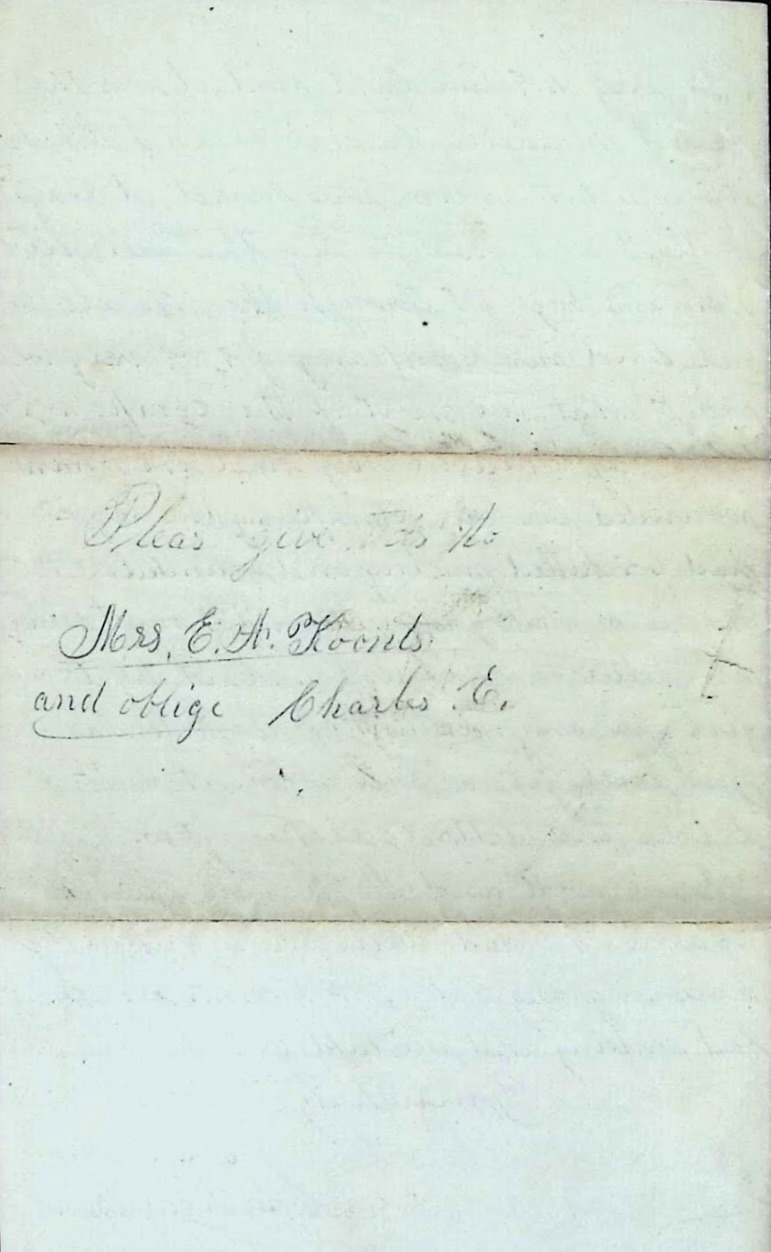
Please give this to Mrs. E. A. Koonts and oblige. — Charles E.
1 The datelining of Koonts’ letter makes no sense to me whatsoever. The 19th OVI remained in the vicinity of Pittsburg Landing until advancing with the army on Corinth soon after this letter was written. Period newspapers refer to “Chickasaw Bluffs (4 different locations!) in the spring of 1862 but these are all in reference to sites near Memphis on the Mississippi river—not the Tennessee River.
2 “The 19th OVI arrived at Pittsburg Landing late in the evening on April 6, 1862, disembarking from the steamer Planet and forming a line behind the 59th Ohio Infantry. On April 7, attached temporarily to General William Nelson’s division within the 11th Brigade under Brigadier General Jeremiah T. Boyle, the 19th advanced under General Thomas L. Crittenden’s orders, shifting front to support Captain Joseph Bartlett’s Battery G on a hill brow [some 250 yards north of the Hornet’s Nest on the Eastern Corinth Road] while deploying skirmishers against Confederate positions in an open field. Facing intense artillery and sharpshooter fire, the regiment delivered volleys, dispatched two companies as skirmishers to aid Nelson’s division, and captured 10 to 12 prisoners while helping repel enemy assaults, demonstrating endurance in its first major combat despite heavy exposure. Losses included 4 killed (among them Major Lyman S. Edwards acting as lieutenant colonel), 44 wounded, and 8 missing, as reported by Colonel Samuel Beatty on April 9.” [Grokipedia]
Letter 13
Camp Childs
May 9th 1862
Dear Sister,
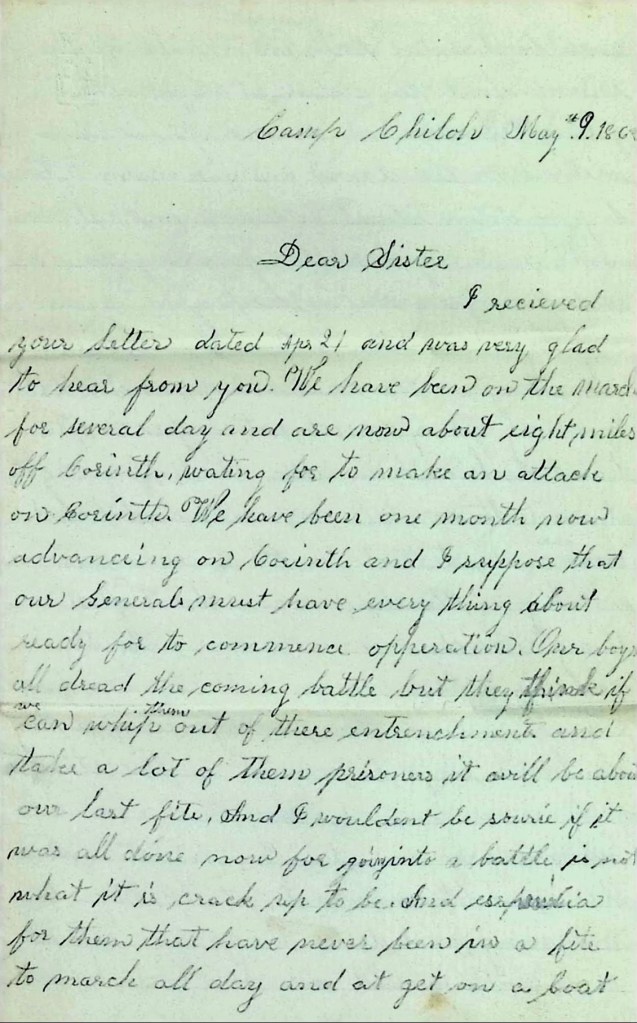
I received your letter dated April 21st and was very glad to hear from you. We have been on the march for several days and are now about eight miles off Corinth waiting for to make an attack on Corinth. We have been one month now advancing on Corinth and I suppose that our generals must have everything about ready for to commence operations.
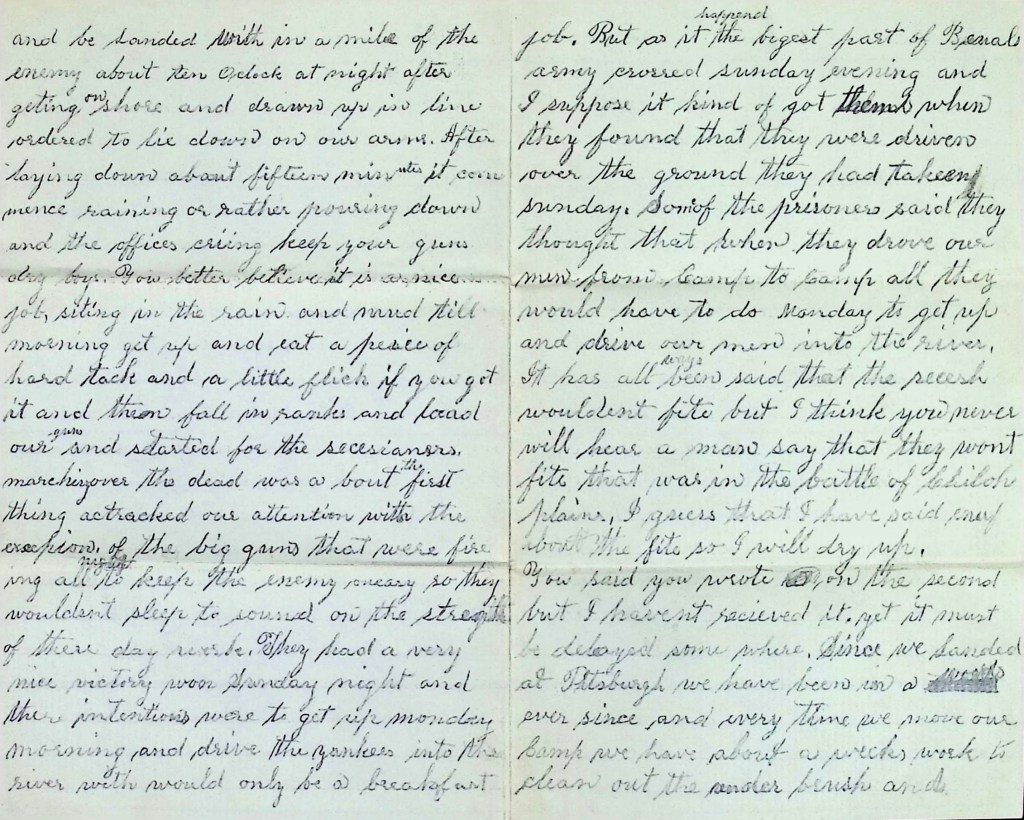
Our boys all dread the coming battle but they think if we can whip them out of their entrenchments and take a lot of prisoners, it will be about our last fight and I wouldn’t be sorry if it was all done now for going into a battle is not what it is cracked up to be—especially for them that have never been in a fight, to march all day and get on a boat and be landed within a mile of the enemy about ten o’clock at night after getting on shore and drawn up in line, [and] ordered to lie down on our arms. After laying down about 15 minutes, it commenced raining or rather pouring down and the officers crying, “Keep your guns dry, boys!” You better believe it is a nice job sitting in the rain and mud till morning, get up and eat a piece of hard tack and a little flick [flitch]—if you got it—and then fall in ranks and load our guns and start for the secessioners.
Marching over the dead was about the first thing attracted our attention with the exception of the big guns that were firing all night to keep the enemy uneasy so they wouldn’t sleep too sound on the strength of their day’s work. They had a very nice victory won Sunday night and their intentions were to get up Monday morning and drive the Yankees into the river which would only be a breakfast job. But as it happened, the biggest part of Beull’s Army crossed [the river] Sunday evening and I suppose it kind of got them when they found that they were driven over the ground they had taken Sunday. Some of the prisoners said they thought that when they drove our men from camp to camp, all they would have to do Monday [would be] to get up and drive our men into the river. It has always been said that the secesh wouldn’t fight but I think you never will hear a man say that they won’t fite that was in the battle of Chiloh [Shiloh] plains. I guess that I have said enuf about the fite so I will dry up.
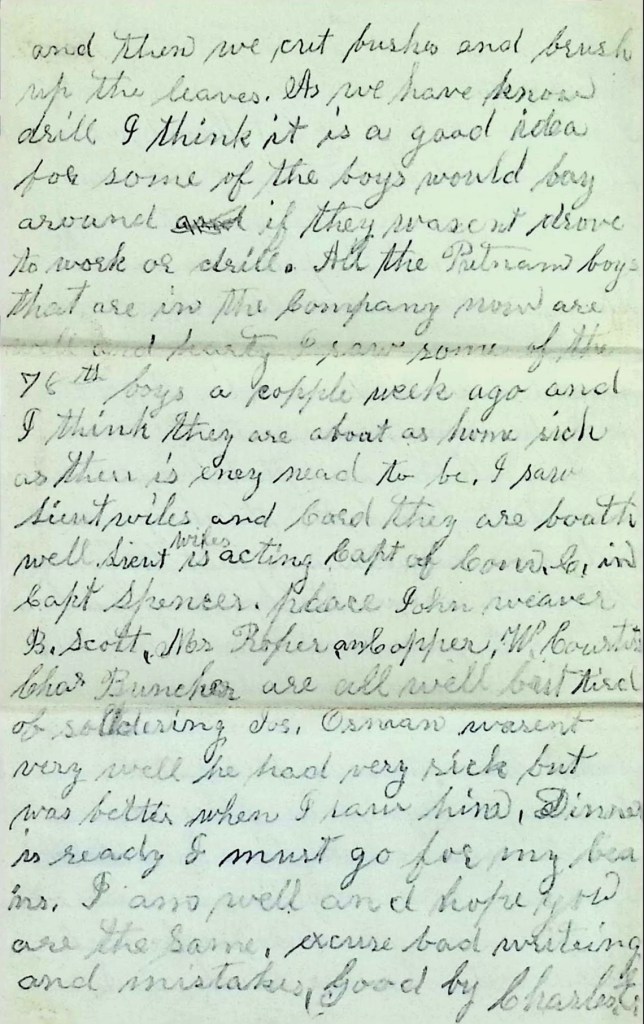
You said you wrote on the second but I haven’t received it yet. It must be delayed somewhere. Since we landed at Pittsburg, we have been in a wood ever since and every time we move our camp we have about a week’s work to clean out the underbrush and then we cut bushes and brush up the leaves. As we have no drill, I think it is a good idea, for some of the boys would lay around id they wasn’t drove to work or drill. All the Putnam boys that are in the company now are well and hearty.
I saw some of the 78th [Ohio] boys a couple weeks ago and I think they are about as homesick as there is any need to be. I saw Lieut. [Greenbury F.] Wiles and Card. They are both well. Lieut. Wiles is acting captain of Co. C in Capt. [Samuel W.] Spencer’s place. John Weaver, B. Scott, Mr. [William] Roper and [Asuph] Cooper, W. Curtis, [&] Chas. Buncher are all well but tired of soldiering. Jos. Osman wasn’t very well. He had [been] very sick but was better when I saw him.
Dinner is ready [and] I must go for my beans. I am well and hope you are the same. Excuse bad writing and mistakes. Goodbye, — Charles E.
Letter 14
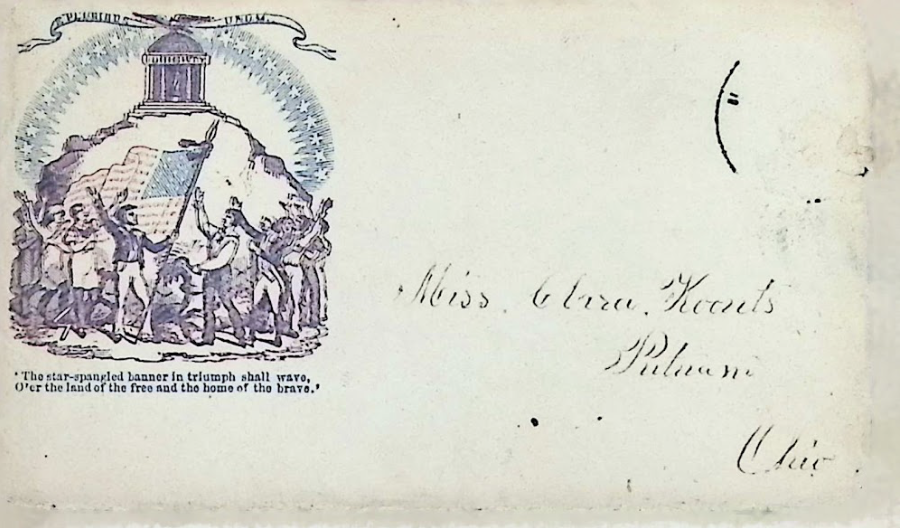
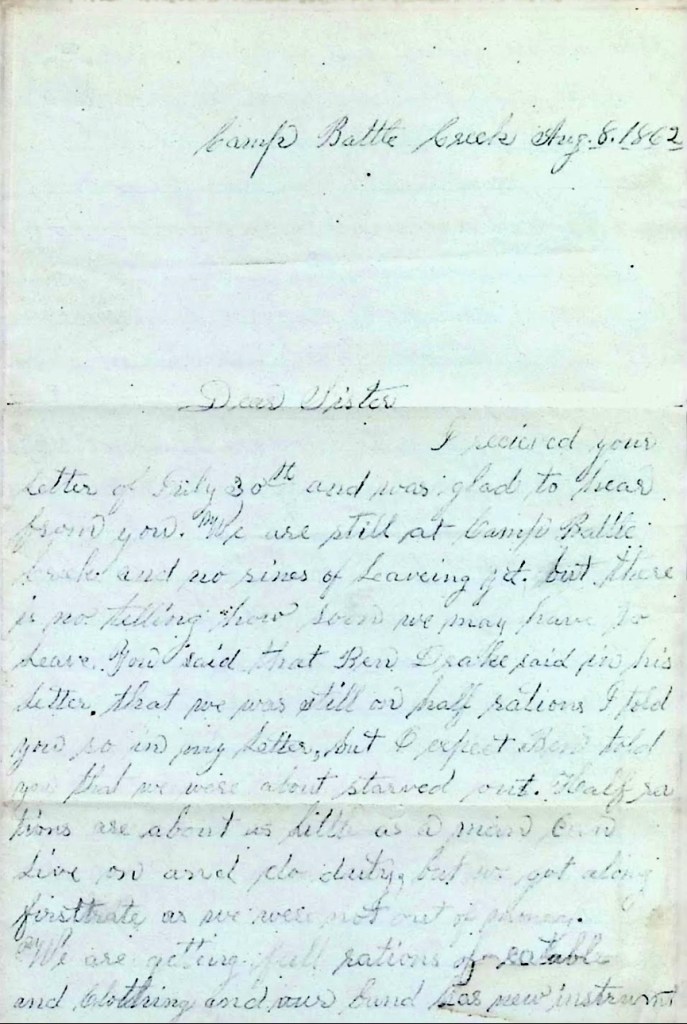
Camp Battle Creek
August 8th 1862
Dear Sister,
I received your letter of July 30th and was glad to hear from you. We are still at Camp Battle Creek and no signs of leaving yet but there is no telling how soon we may have to leave. You said that Ben Drake said in his letter that we was still on half rations. I told you so in my letter but I expect Ben told you that we were about starved out. Half rations are about as little as a man can live on and do duty but we get along first rate as we were not out of money. We are getting full rations of eatables and clothing and our band has new instruments and we are getting full rations of music. It would be a great expense to the government to furnish each regiment with a band but we couldn’t get along without ours for we have had a band ever since we started and to be without it would make every day as dry as Sunday.
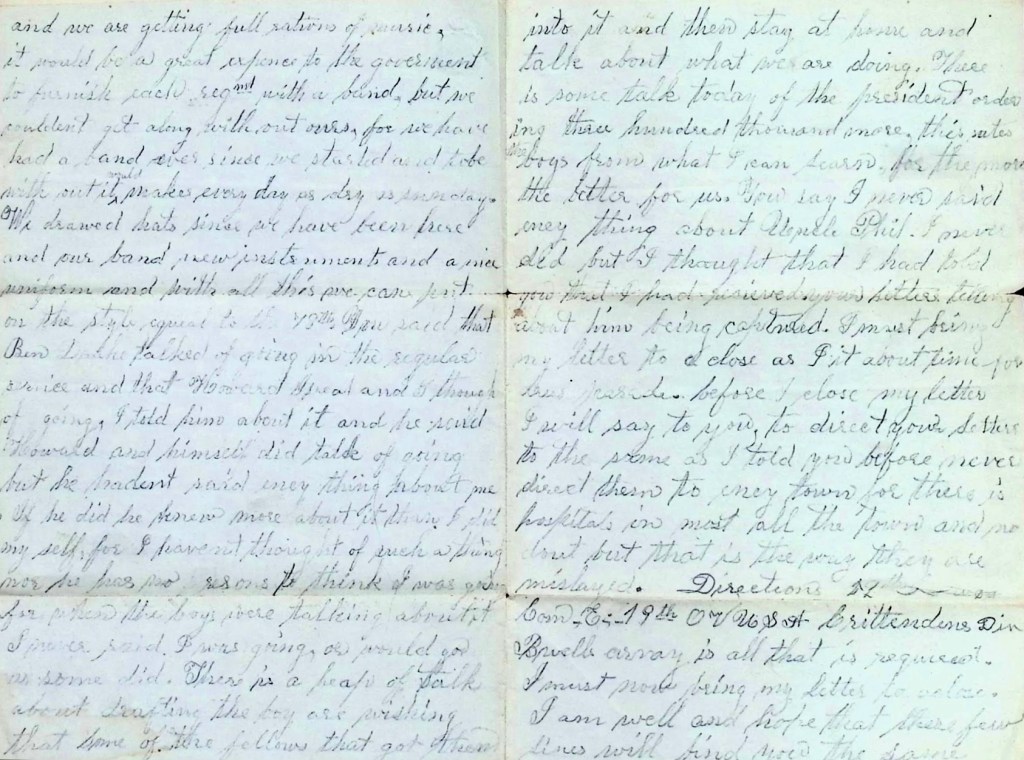
We drawed hats since we have been here and our band new instruments and a nice uniform and with all this, we can put on the style equal to the 78th [Ohio].

You said that Ben Drake talked of going in the regular service and that Howard [ ] and I thought of going. I told him about it and he said Howard and himself did talk of going but he hadn’t said anything about me. If he did, he knew more about it than I did myself for I haven’t thought of such a thing nor he has no reason to think I was going for when the the boys were talking about it, I never said I was going or would go as some did. There is a heap of talk about drafting. The boys are wishing that some of the fellows that got them into it and then stayed at home and talk about what we are doing [would be drafted]. There is some talk today of the President ordering three hundred thousand more. This suits the boys from what I can learn for the more the better for us.
You say I never said anything about Uncle Phil. I never did but I thought that I had told you that I had received your letter telling about him being captured.
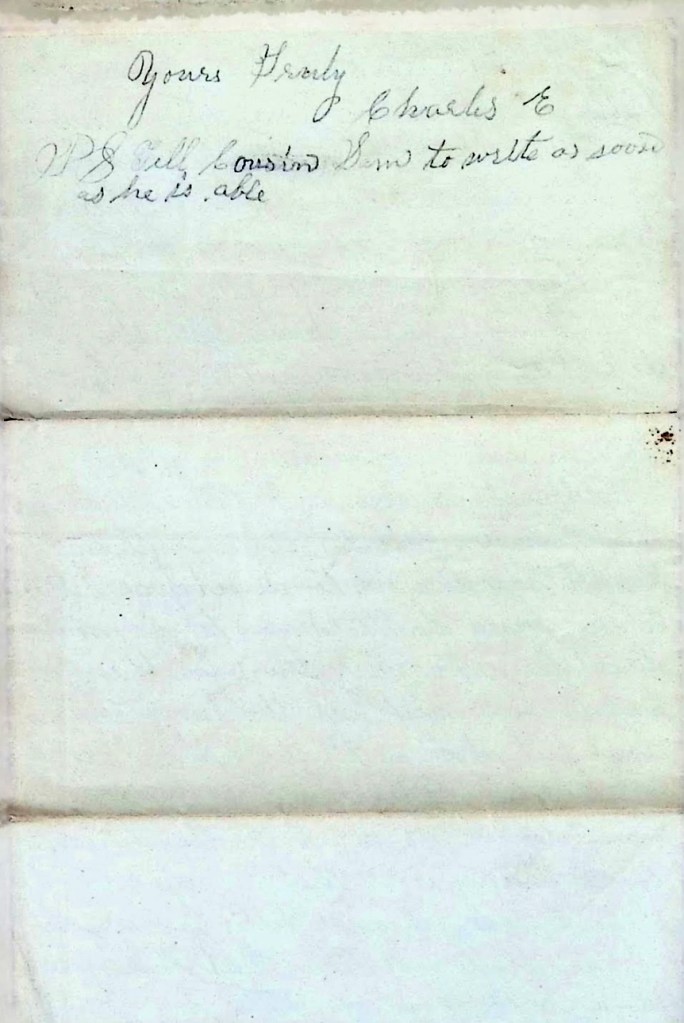
I must bring my letter to a close as it is about time for dress parade. Before I close my letter I will say to you to direct your letters to the same as I told you before. Never direct them to any town for there is hospitals in most all the towns and no doubt but that is the way they are mislaid. Directions: Co. E, 19th Ohio Vols., USA, Crittenden’s Division, Buell’s Army [of the Ohio], is all that is required. I must now bring my letter to a close. I am well and hope that these few lines will find you the same. Yours truly, — Charles E.
P. S. Tell cousin Sam to write as soon as he is able.
Letter 15
[Nashville, Tennessee]
Saturday, December 3, 1862
Dear Sister,
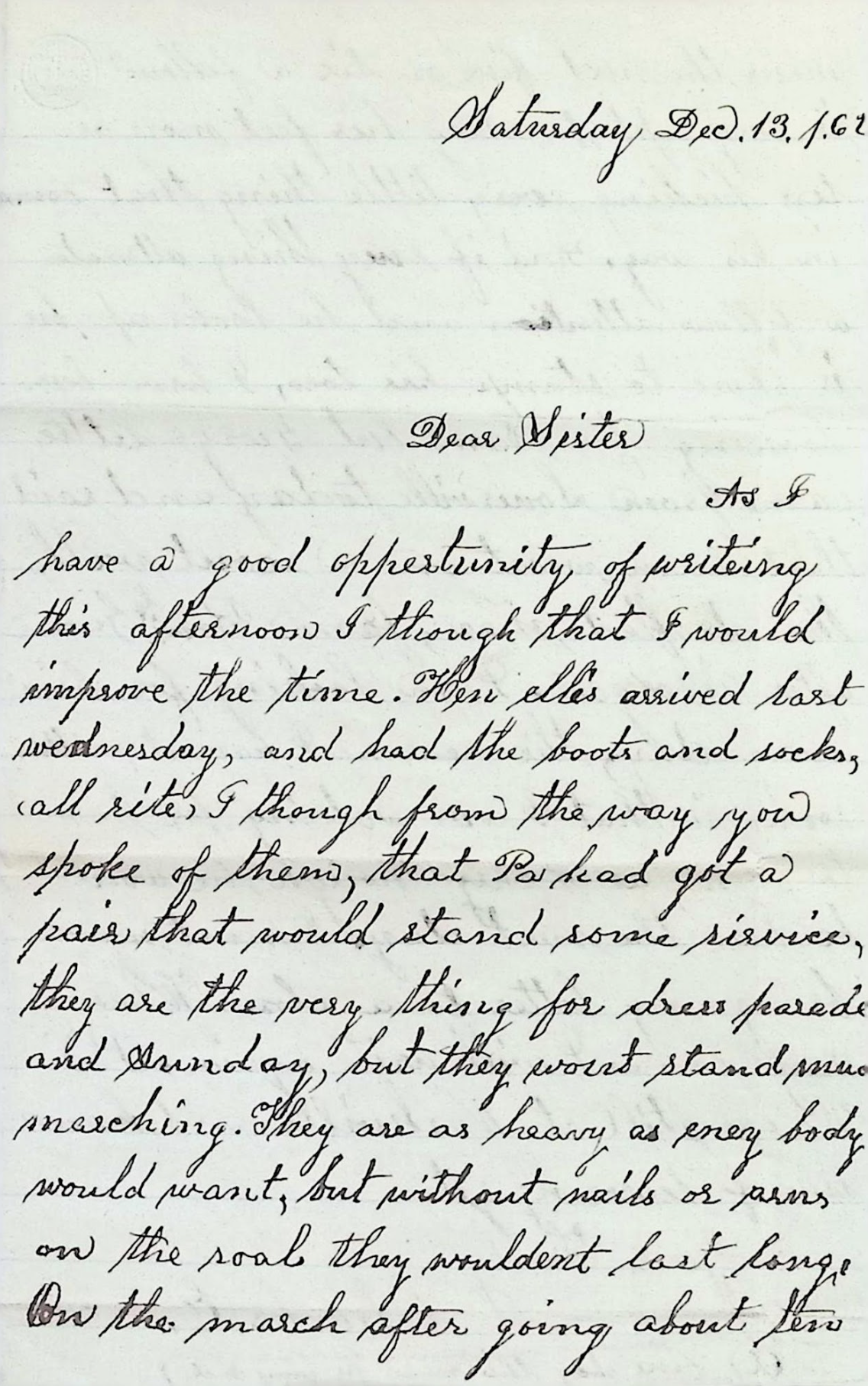
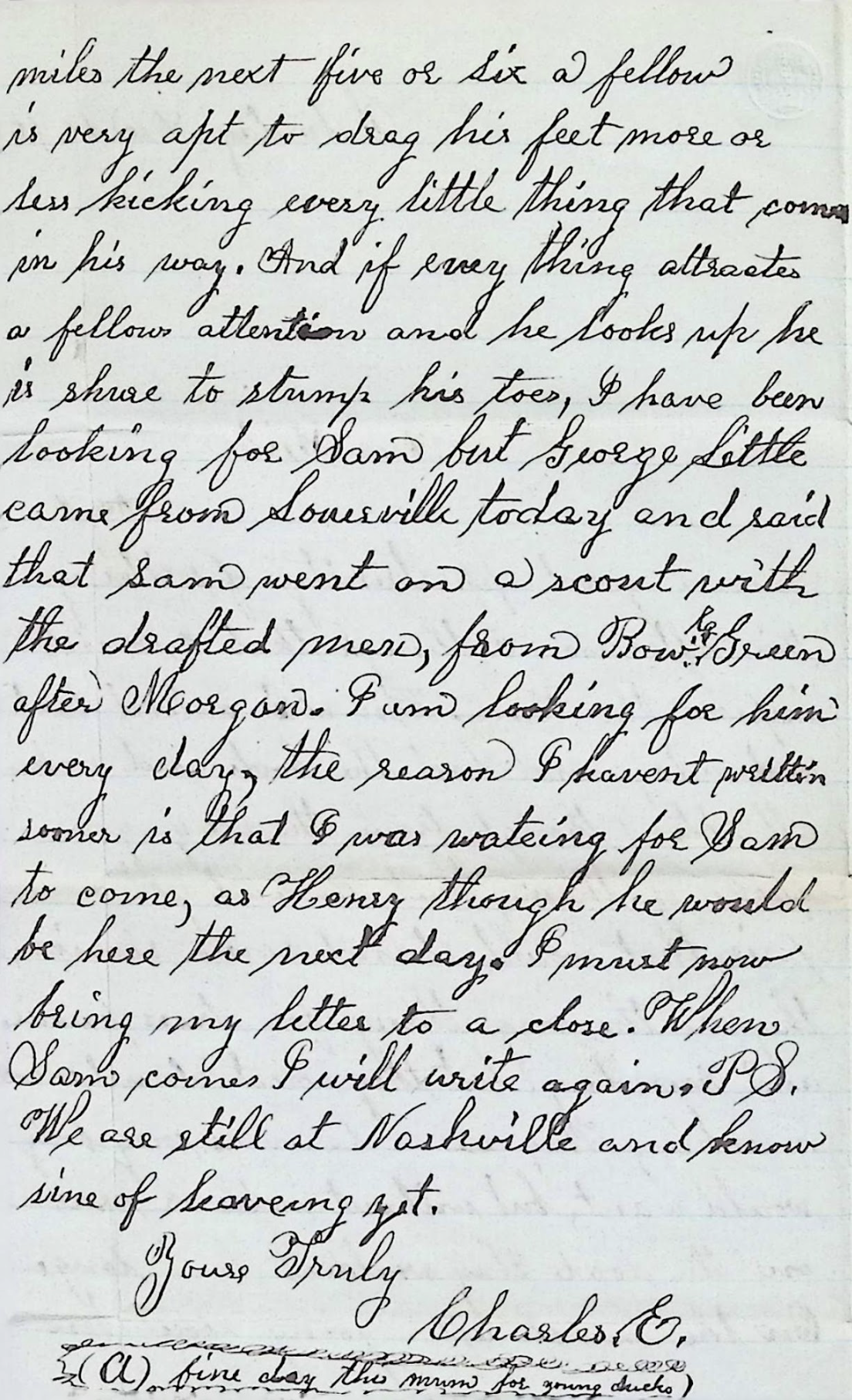
As I have a good opportunity of writing this afternoon, I thought that I would improve the time. Hen Ellis arrived last Wednesday and had the boots and socks all tight. I thought from the way you spoke of them that Pa had got a pair that would stand some service. They are the very thing for dress parade and Sunday, but they won’t stand much marching. They are as heavy as anybody would want but without nails or pins on the sole, they wouldn’t last long. On the march, after going about ten miles, the next five or six a fellow is apt to drag his feet more or less, kicking every little thing that comes in his way. And if anything attracts a fellow’s attention and he looks up, he is sure to stub his toes.
I have been looking for Sam but George Little came from Louisville today and said that Sam went on a scout with the drafted men from Bowling Green after [John Hunt] Morgan. I am looking for him every day. The reason I haven’t written soon is that I am waiting for Sam to come and Henry thought he would be here the next day.
I must now bring my letter to a close. When Sam comes, I will write again.
P. S. We are still at Nashville and no sign of leaving yet. Yours truly, — Charles E.
A fine day this morn for young ducks.
Letter 16
[Camp near Nashville, Tennessee]
Tuesday morning, December 23, 1862
Dear sister,
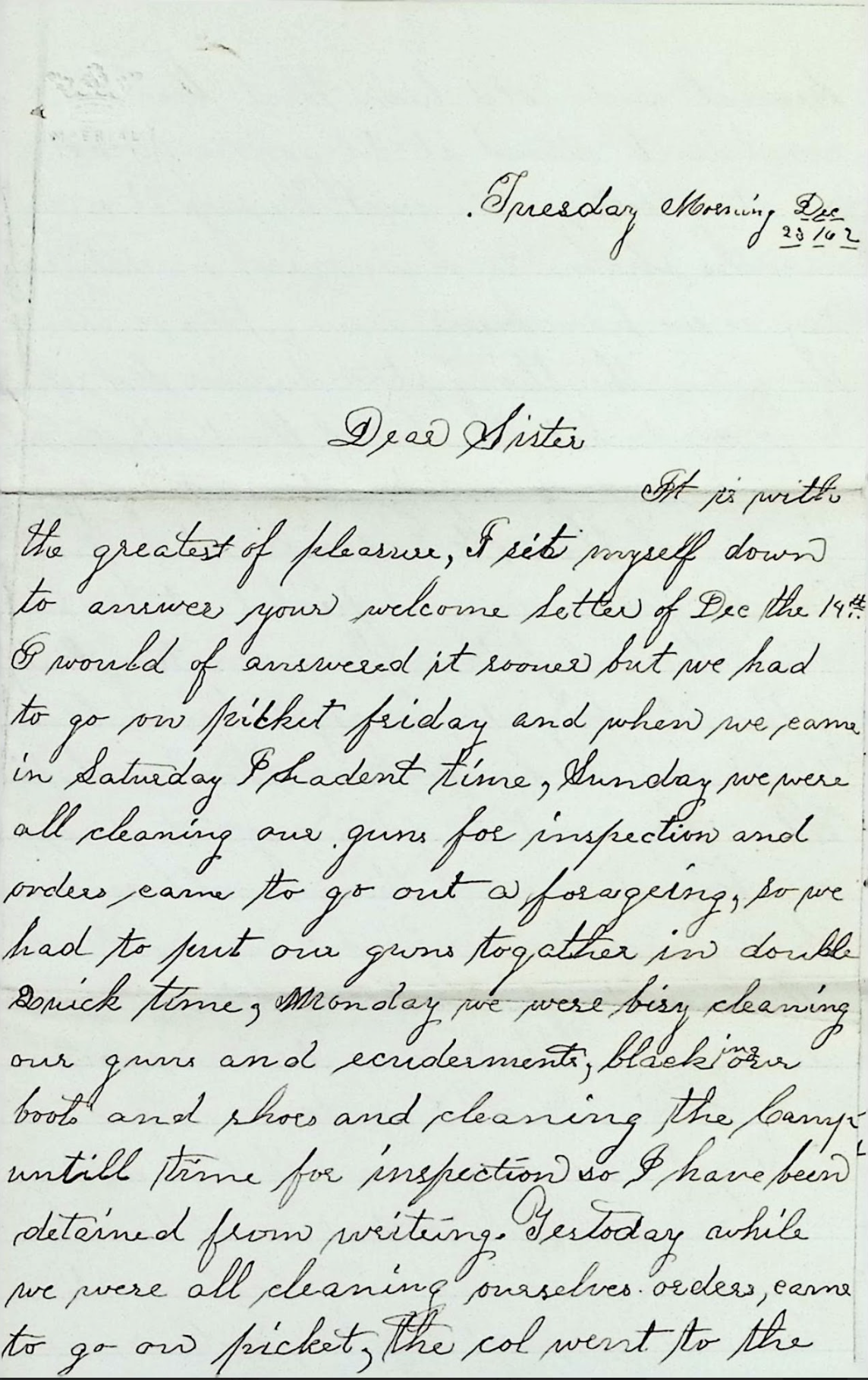
Itis with the greatest of pleasure I sit myself down to answer your welcome letter of December the 14th. I would of answered it sooner but we had to go non picket Friday and when we came in Saturday, I hadn’t time. Sunday we were all cleaning our guns for inspection and orders came to go out a foraging so we had to put our guns together in double quick time. Monday we were busy cleaning our guns and accoutrements, blacking our boots and shoes, and cleaning the camp until time for inspection so I have been detained from writing.
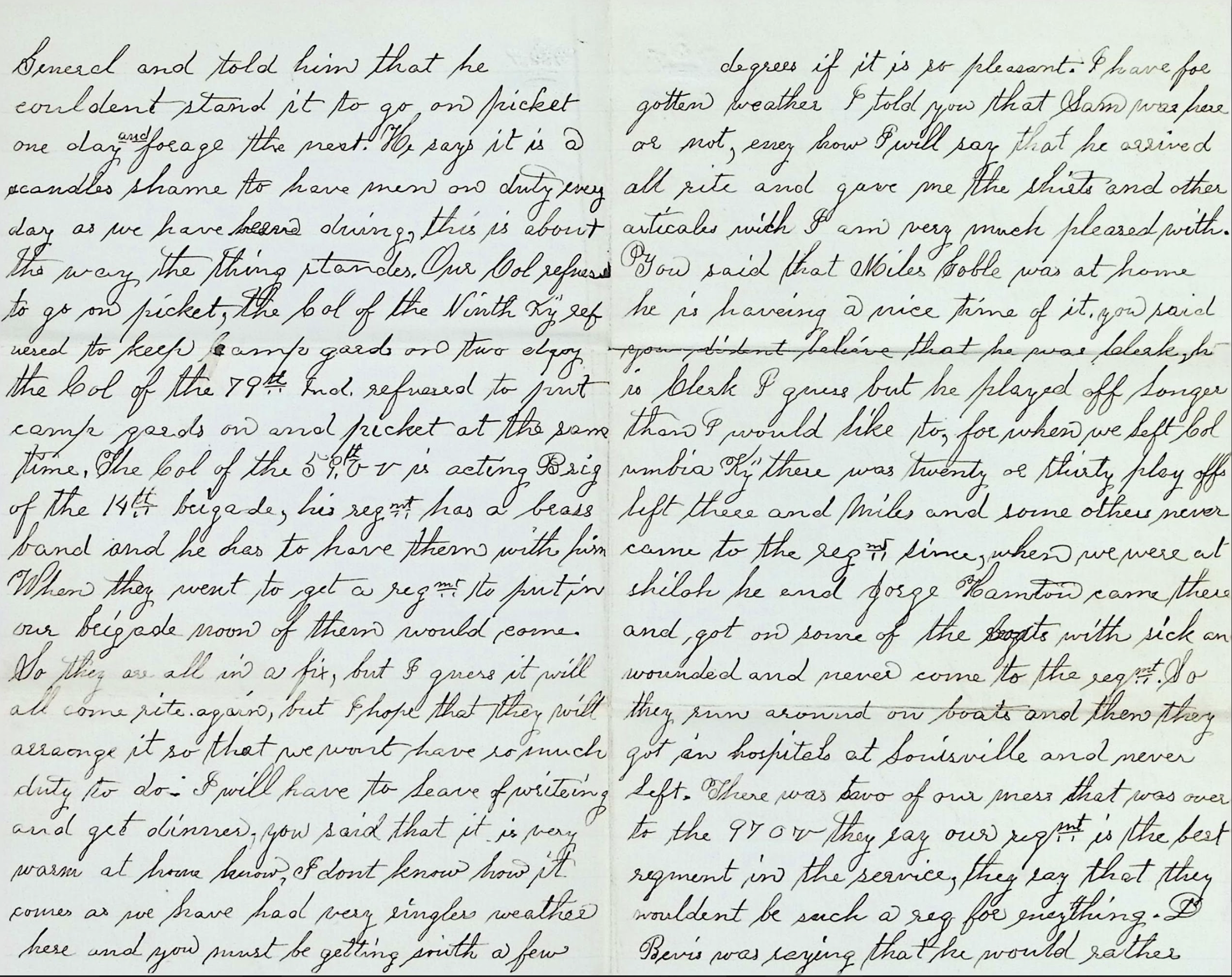
Yesterday while we were all cleaning ourselves, orders came to go on picket. The Colonel went to the General and told him that he couldn’t stand it to go on picket one day and forage the next. He says it is a scandalous shame to have men on duty every day as we have been doing. This is about the way the thing stands. Our Colonel refused to go on picket. The Colonel of the 9th Kentucky refused to keep camp guard on two days. The Colonel of the 79th Indiana refused to put camp guards on and picket at the same time. The Colonel of the 59th O. V. is acting Brigadier of the 14th Brigade. His regiment has a brass band and he has to have them with him. When they went to get a regiment to put in our brigade, none of them would come so they are all in a fix. But I guess it will all come right again but I hope they will arrange it so that we won’t have so much duty to do.
I will have to leave off writing and get dinner. You said that it is very warm at home now. I don’t know how it comes as we have had very singular weather here and you must be getting south a few degrees if it is so pleasant.
I have forgotten whether I told you that Sam was here or not. Anyhow, I will say that he arrived all right and gave me the shirts and other articles which I am very much pleased with. You said that Miles Goble was at home. He is having a nice time of it. You said you didn’t believe that he was clerk [ ] I guess but he played off longer than I would like to for when he left Columbia, Kentucky, there was 20 or 30 play off left there and Miles and some others never came to the regiment since. When we were at Shiloh, he and George Hampton came there and got on some of the boats with the sick and wounded and ever came back to the regiment. So they run around on boats and then they got in hospitals at Louisville and never left. 1
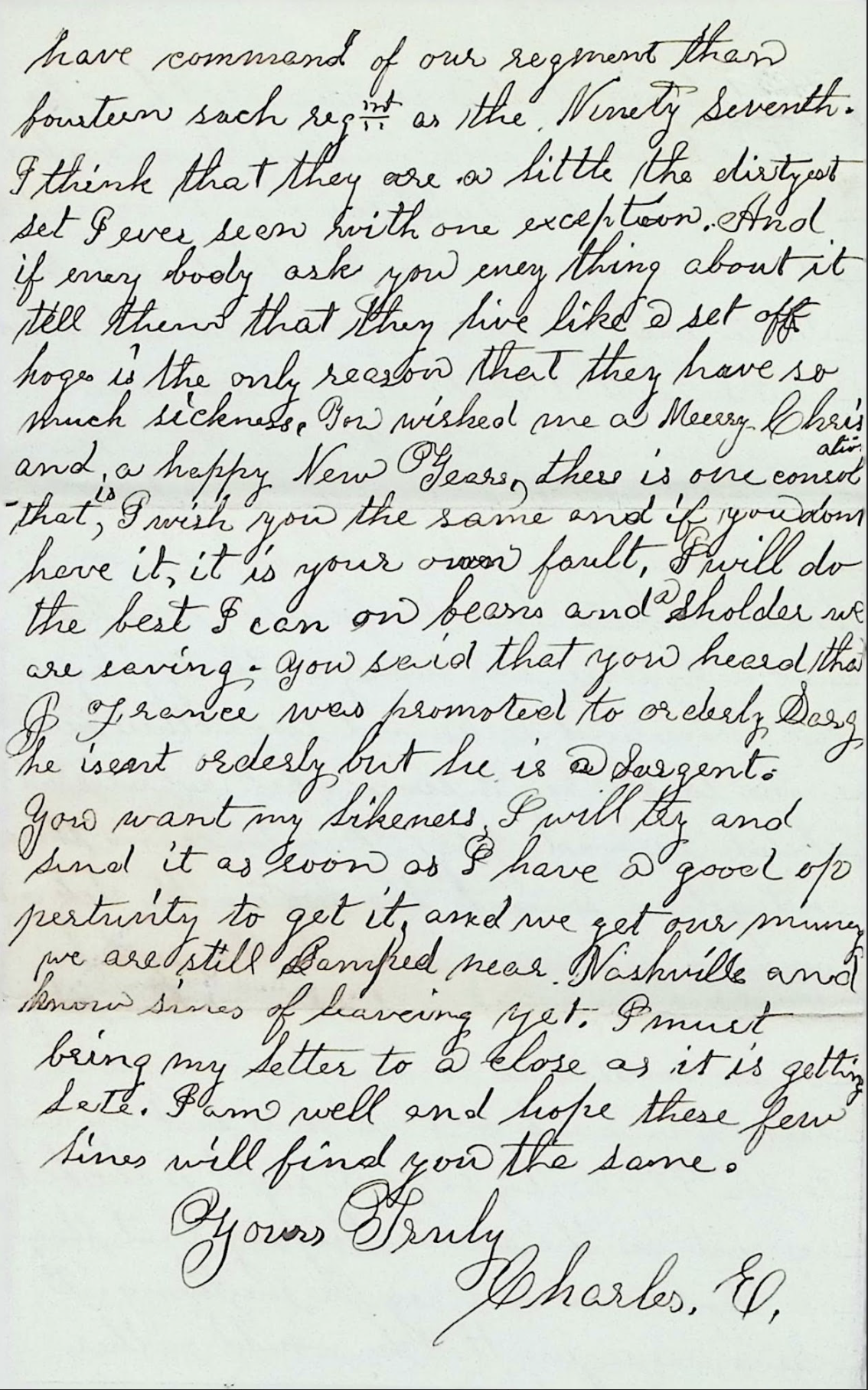
There was two of our mess that was over to the 97th O. V. They say our regiment is the best regiment in the service. They say that they wouldn’t be such a regiment for anything. [Sgt.] D[aniel] Bevis was saying that he would rather have command of our regiment than 14 such regiments as the 97th. I think that they are a little the dirtiest set I ever seen with one exception. And if anybody asks you anything about it, tell them that they live like a set of hogs is the only reason that have so much sickness.
You wished me a Merry Christmas and a Happy New Years. There is one consolation—that is, I wish you the same and if you don’t have it, it is your own fault. I will do the best I can on beans and a shoulder we are saving. You said that you heard that J[ohn A.] France was promoted to Orderly Sergeant. He isn’t Orderly but he is a Sergeant. You want my likeness. I will try and send it as soon as I have a good opportunity to get it and we get our money.
We are still camped near Nashville and no signs of leaving yet. I must bring my letter to a close as it is getting late. I am well and hope these few lines will find you the same. Yours truly, — Charles E.
1 Miles D. Goble was taken prisoner at the Battle of Chickamauga and died at Andersonville. George W. Hampton survived the war and mustered out in 1865 as a veteran.
Letter 17
[Murfreesboro, Tennessee]
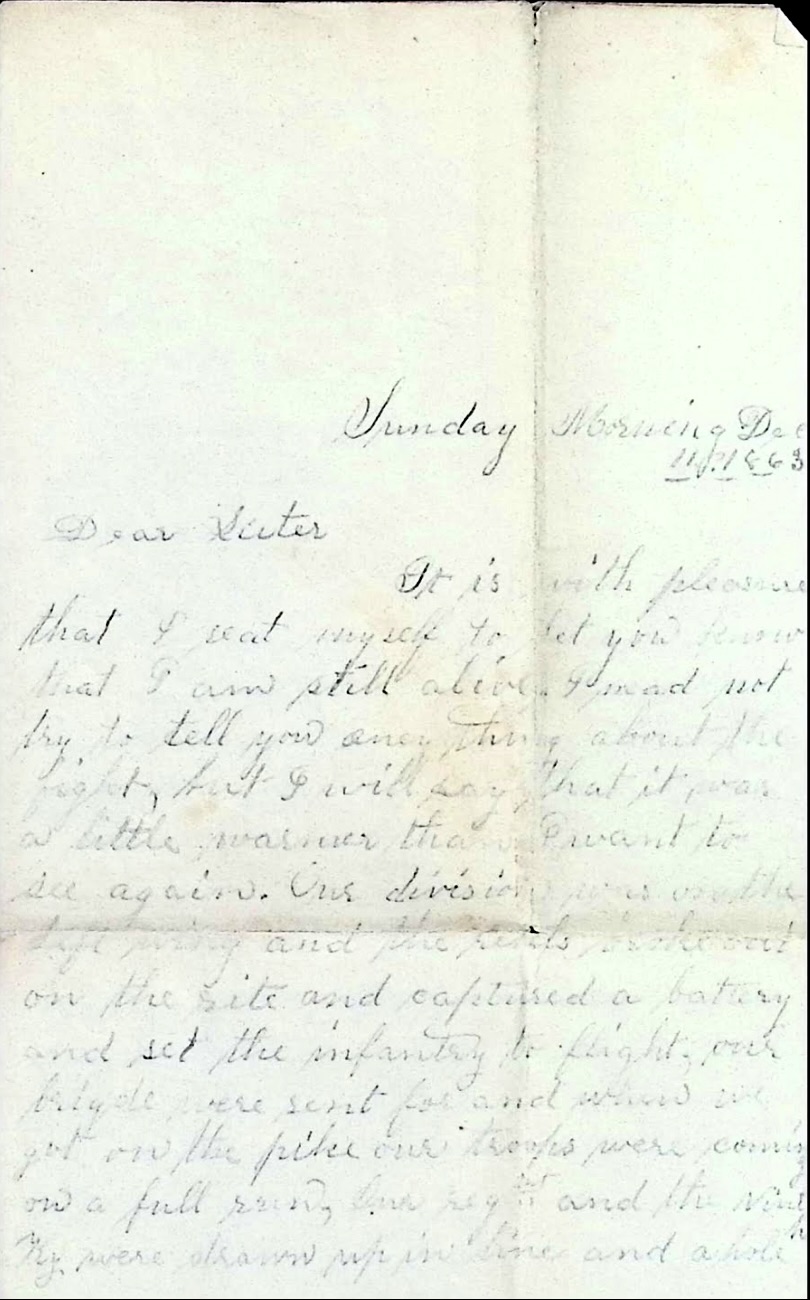
Sunday morning, December [January] 11, 1863
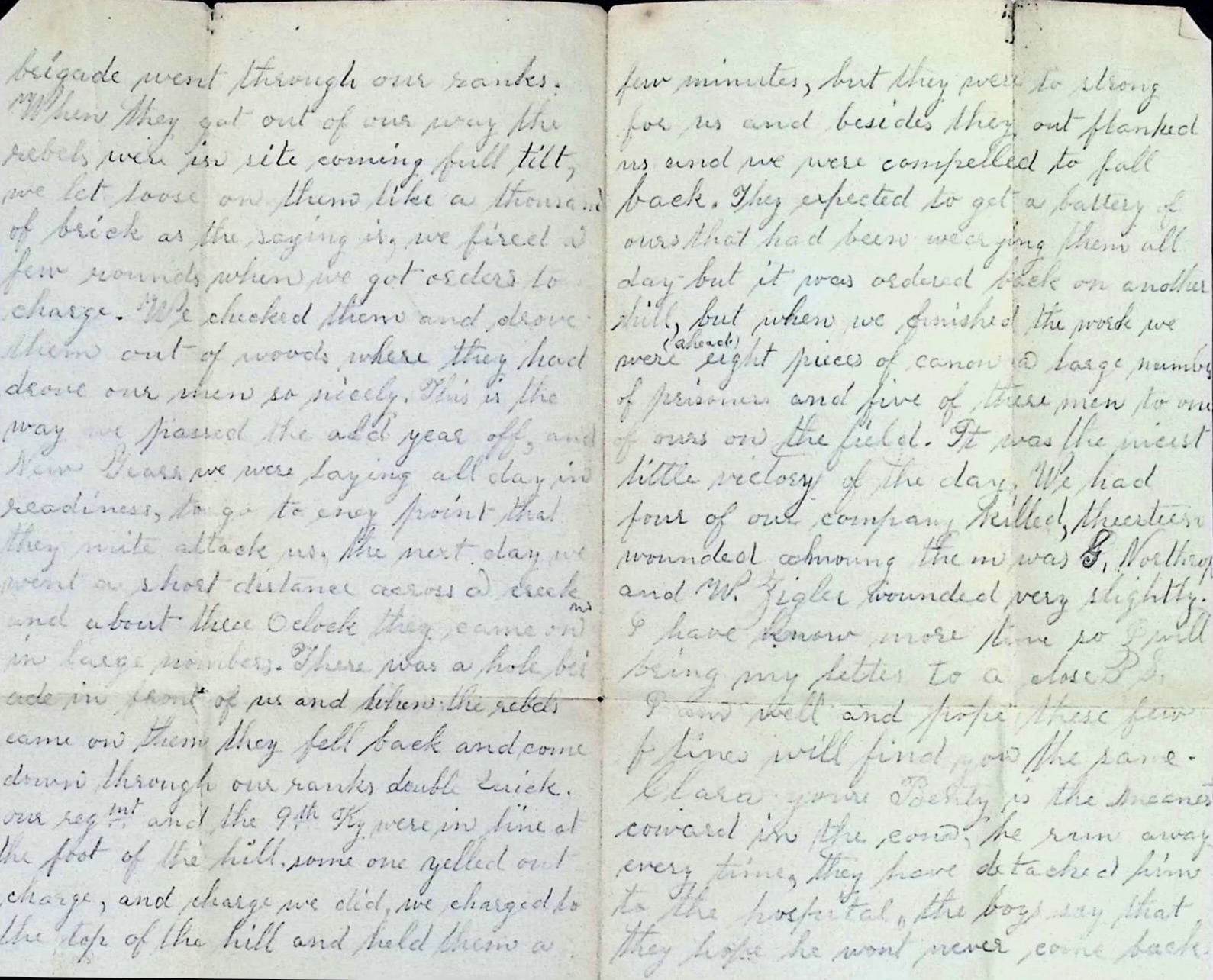
It is with pleasure that I seat myself to let you know that I am still alive. I may not try to tell you anything about the fight [at Stones River], but I will say that it was a little warmer than I want to see again. Our division was on the left wing and the rebels broke out on the right and captured a battery and set the infantry to flight. Our brigade were sent for and when we got on the pike, our troops were coming on a full run. Our regiment and the 9th Kentucky were drawn up in line and a whole brigade went through our ranks. When they got out of the way, the rebels were right in sight coming full tilt. We let loose on them like a thousand of brick, as the saying is. We fired a few rounds when we got orders to charge. We checked them and drove them out of [the] woods where they had drove our men so nicely. This is the way we passed the old year off and New Years.
We were lying all day in readiness to go to any point that they might attack us. The next day we went a short distance across a creek and about three o’clock they came on us in large numbers. There was a whole brigade in front of us and when the rebels came on them, they fell back and come down through our ranks double quick. Our regiment and the 9th Kentucky were in line at the foot of the hill [when] someone yelled out, “Charge!” and charge we did. We charged to the top of the hill and held them a few minutes but they were too strong for us. And besides, they outflanked us and we were compelled to fall back. They expected to get a battery of ours that had been wearying them all day but it was ordered back on another hill. But when we finished the work, we were ahead eight pieces of cannon, a large number of prisoners. and five of their men to one of ours on the field. 1
We had four of our company killed, thirteen wounded. Among them was [Jennings] Northup and W[illiam] Zigler wounded very slightly. I have no more time so I will bring my letter to a close.
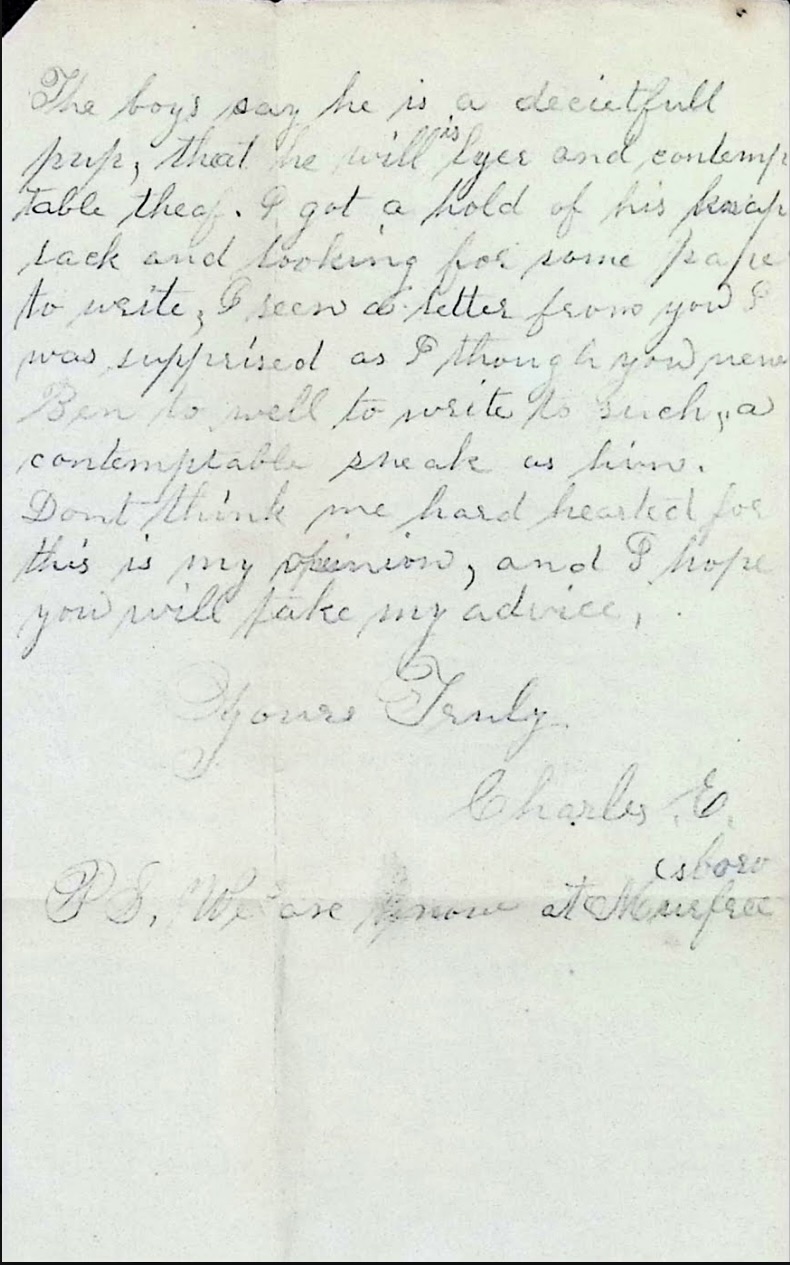
P. S. I am well and hope these few lines will find you the same. Clara, your Benty [Lewis Benjamin Drake] is the meanest coward in the company. He runs away every time. They have detached him to the hospital. The boys say that they hope he won’t never come back. The boys say he is a deceitful pup—that he is a lier and contemptible thief. I got a hold of his knapsack and looking for some paper to write, I seen a letter from you. I was surprised as I thought you knew Ben too well to write to such a contemptible snake as him. Don’t think me hard-hearted for this is my opinion and I hope you will take my advice. Yours truly, — Charles E.
P. S. We are now at Murfreesboro.
1 Readers interested in more accounts of the advance against the rebels by the 19th Ohio and 9th Kentucky are referred to The 9th Kentucky at Stones River. Another interesting account of the attack is given by Capt. Oscar O. Miller of the 19th OVI which claims that “General Rosecrans came up and asked the name of the regiment; being answered ‘the 19th Ohio’ he said, ‘I can trust you to save us,’ and soon ordered a charge.” See “Soldier gives details of furious Tennessee battle.”
Letter 18
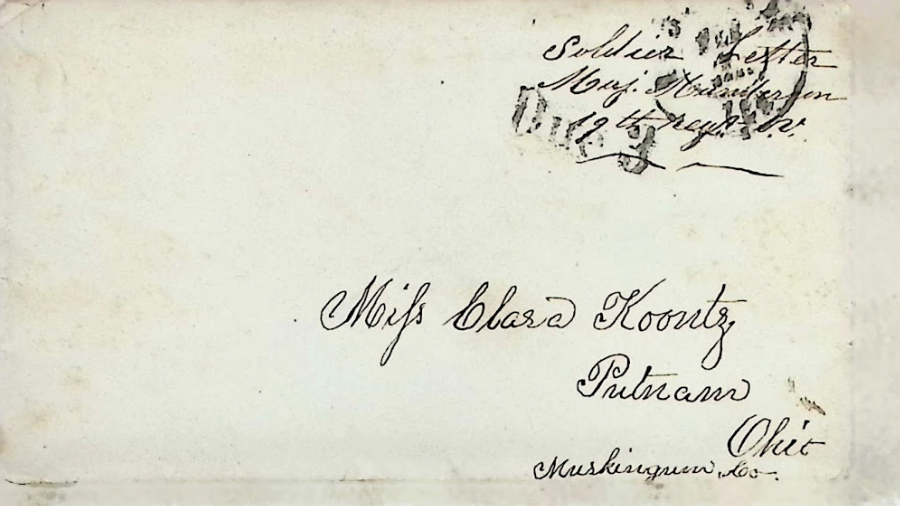
Camp near Murfreesboro [Tennessee]
January 31, 1863
Dear Sister,
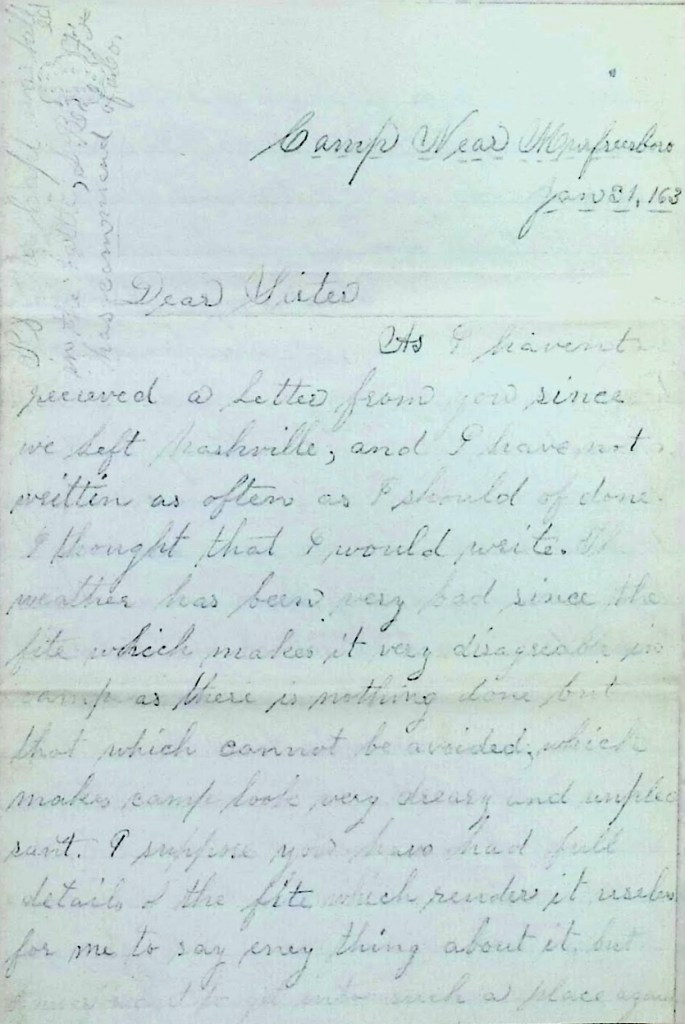
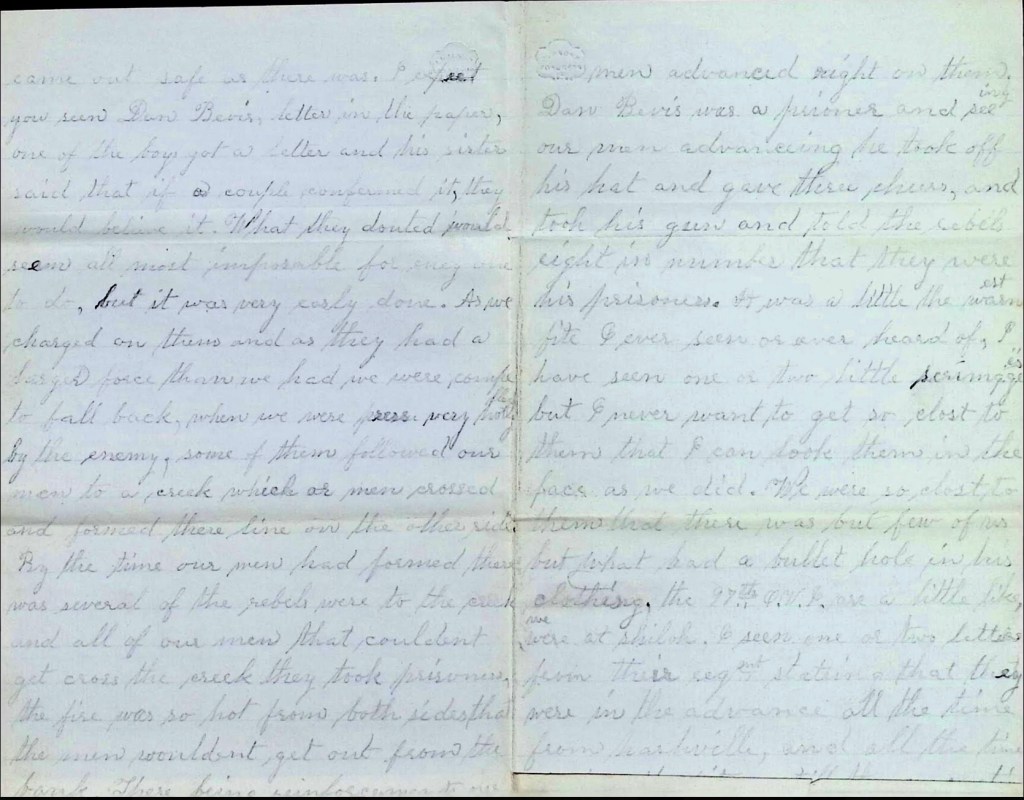
As I haven’t received a letter from you since we left Nashville and I have not written as often as I should of done, I thought that I would write. The weather has been very bad since the fight [at Stones River] which makes it very disagreeable in camp as there is nothing done but that which cannot be avoided, which makes the camp look very dreary and unpleasant. I suppose you have had full details of the fight which renders it useless for me to say anything about it. But I never want to get into such a place again. [paper cut off]…came out safe as ther ewas. I expect you seen Dan Bevis‘ letter in the paper. One of the boys got a letter and his sister said that if a couple confirmed it, they would believe it. What they doubted would seem almost impossible for anyone to do but it was very early done.
As we charge on them andas they had a larger force than we had, we were compelled to fall back when we were pressed very hotly by the enemy. Some of them followed our men to a creek which our men crossed and formed their line on the other side. By the time our men had formed, there was several of the rebels were to the creek and all of our men that couldn’t get across the creek they took prisoners. The fire was so hot from both sides that the men wouldn’t get out from the bank. There being reinforcements, our men advanced right on them. Dan Bevis was a prisoner and seeing our men advancing, he took off his hat and gave three cheers and took his gun and told the rebels right in number that they were his prisoners. 1
It was a little the warmest fight I ever seen or ever heard of. I have seen one or two little skirmishes but I never want to get so close to them that I can look them in the faces as we did. We were so close to them that there was but few of us but what had a bullet hole in his clothing. The 27th OVI are a little like we were at Shiloh. I seen one or two letters from their regiment stating that they were in the advance all the time from Nashville and all the time [paper cut]
[rest of letter is missing]
1 In his book, “Hell by the Acre,” Dan Masters wrote of this incident (p. 576) regarding Corp. Daniel Bevis of the 19th OVI that he found published in the Zanesville Daily Courier, January 20, 1863: “As soon as our men came in sight, I took my hat and gave three cheers and then took the guns from the Rebels telling them that the tide had changed and they were now my prisoners. I gave the prisoners in charge of some of our men, picked up my gun, and commenced pouring it into them as fast as I could load.”
Letter 19
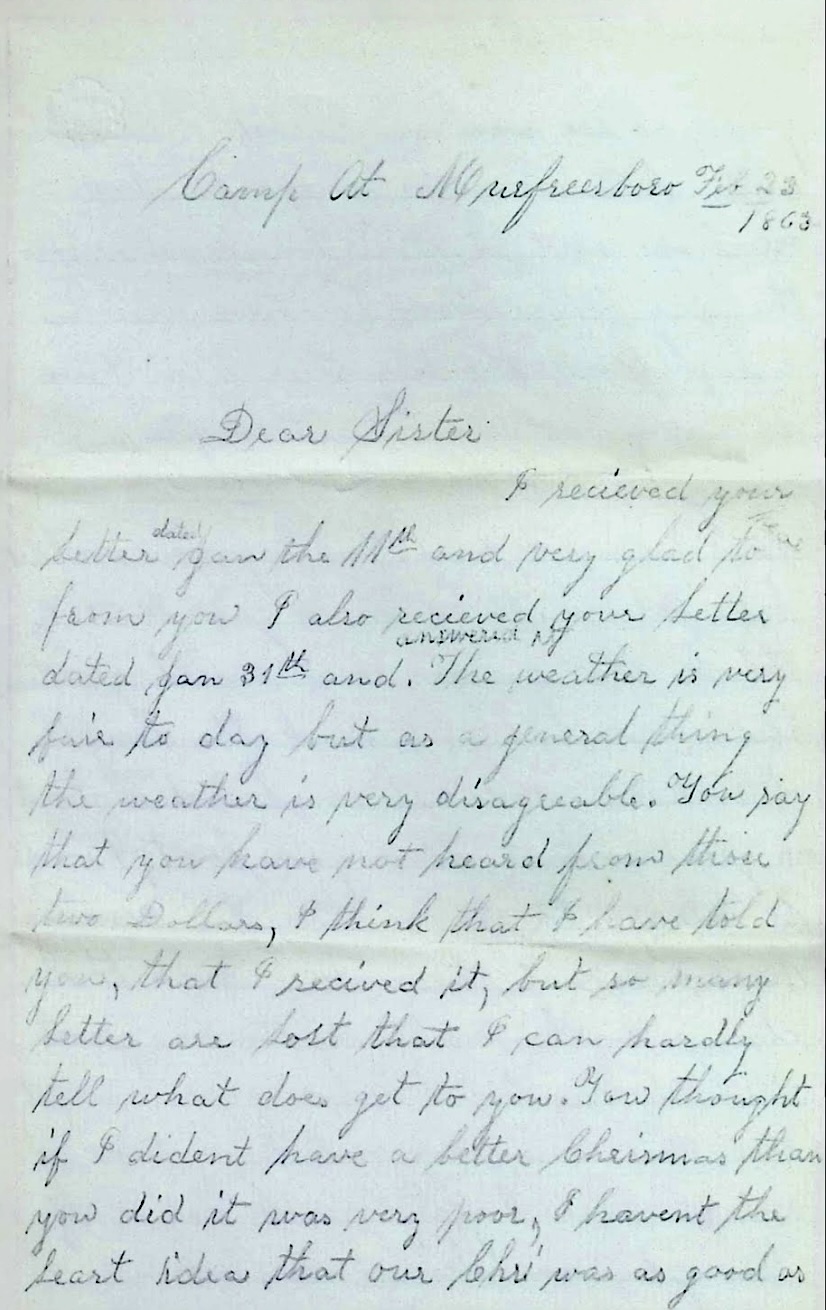
Camp at Murfreesboro, [Tennessee]
February 23, 1863
Dear Sister,
I received your letter dated January the 11th and was very glad to hear from you. I also received your letter dated January 31st and answered it. The weather is very fair today but as a general thing, the weather is very disagreeable.
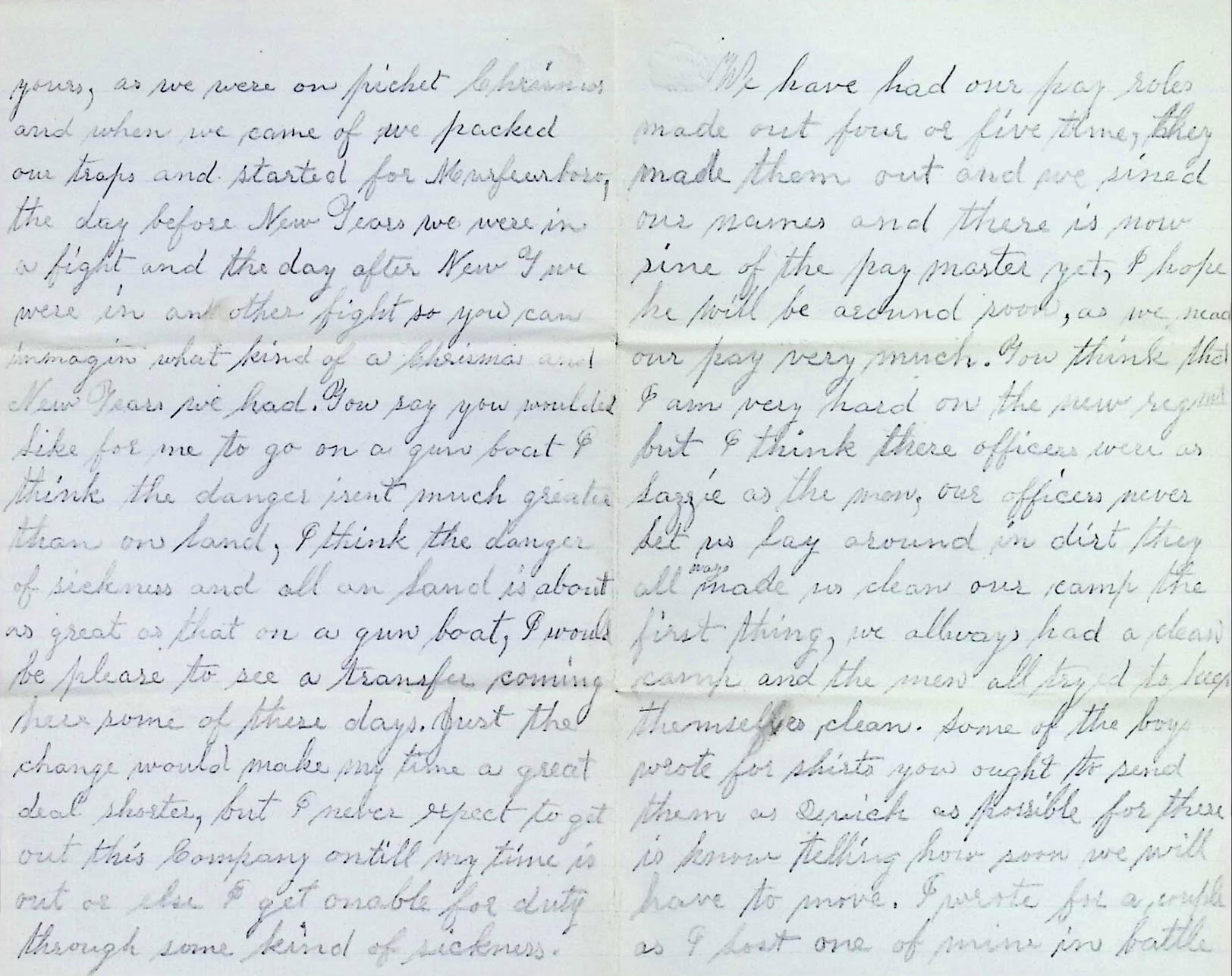
You say that you have not heard from those two dollars. I think that I have told you that I received it, but so many letters are lost that I can hardly tell what does get to you. You thought if I didn’t have a better Christmas than you did, it was very poor. I haven’t the least idea that our Christmas was as good as yours as we were on picket Christmas and when we came off, we packed out traps and started for Murfreesboro. The day before New Years we were in a fight and the day after New Years we were in another fight. So you can imagine what kind of a Christmas and New Years we had.
You say you would like for me to go on a gunboat. I think the danger isn’t much greater than on land. I think the danger of sickness and all on land is about as great as that on a gunboat. I would be pleased to see a transfer coming here some of these days. Just the change would make my time a great deal shorter. But I never expect to get out of this company until my time is out or else I get unable for duty through some kind of sickness.
We have had our pay rolls made out four or five times. They made them out and we signed our names and there is no sign of the pay master yet. I hope he will be around soon as we need our pay very much.
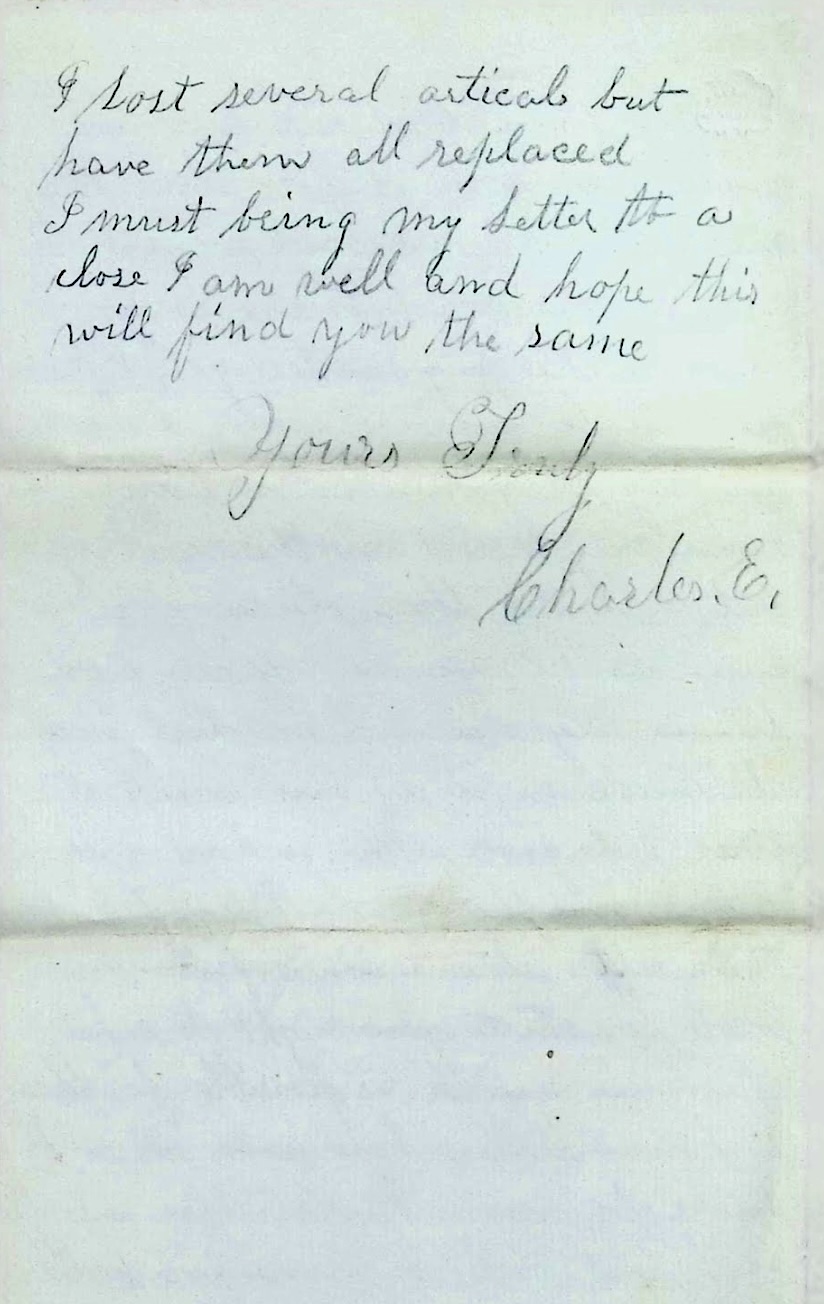
You think that I am very hard on the new regiment but I think their officers were as lazy as the men. Our officers never let us lay around in dirt. They always made us clean our camp the first thing. We always had a clean camp and the men all tried to keep themselves clean. Some of the boys wrote for shirts. You ought to send them as quick as possible for there is no telling how soon we will have to move. I wrote for a couple as I lost one of mine in battle. I lost several articles but have them all replaced.
I must bring my letter to a close. I am well and hope this will find you the same. Yours truly, — Charles E.
Letter 20
Camp at Murfreesboro [Tenn.]
March 1, 1863
Dear Sister,
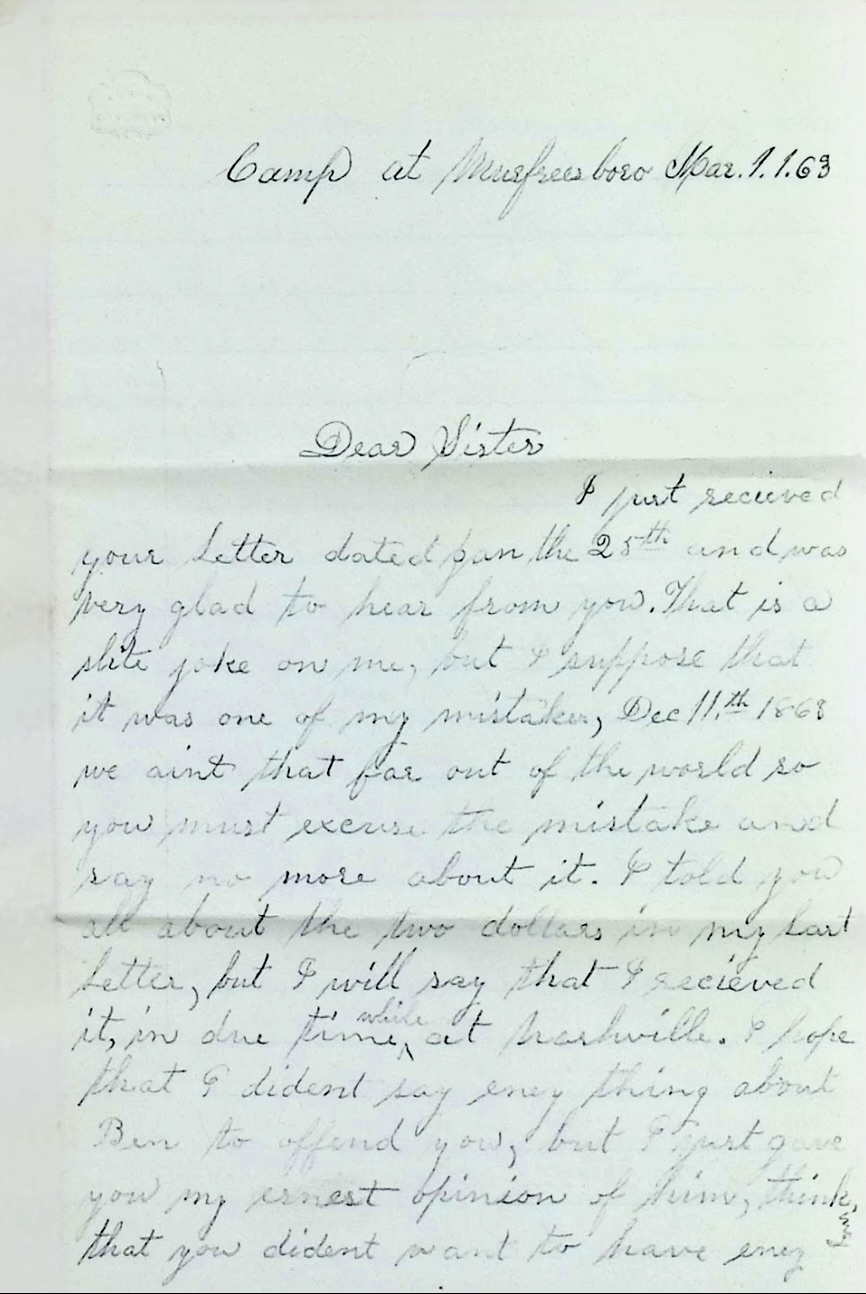
I just received your letter dated January 25th and was very glad to hear from you. That is a slight joke on me, but I suppose that it was one of my mistakes—December 11th 1863, we ain’t that far out of this world so you must excuse the mistake and say no more about it. I told you all about the two dollars in my last letter, but I will say that I received it in due time while at Nashville. I hope that I didn’t say anything about Ben to offend you, but I just gave you my earnest opinion thinking that you didn’t want to have anything to do with such a wooden man as him.
As I have written several letters lately and received no answer, I will ask you to le me know how the transfer is coming on. I would give my bounty to be on the Brilliant with the Putnam boys. That boat don’t have to go into a regular engagement and the men fare as well as those in the gunboats. Tell Pa if it is in Mr. Potwin’s power, to try and get me a transfer.
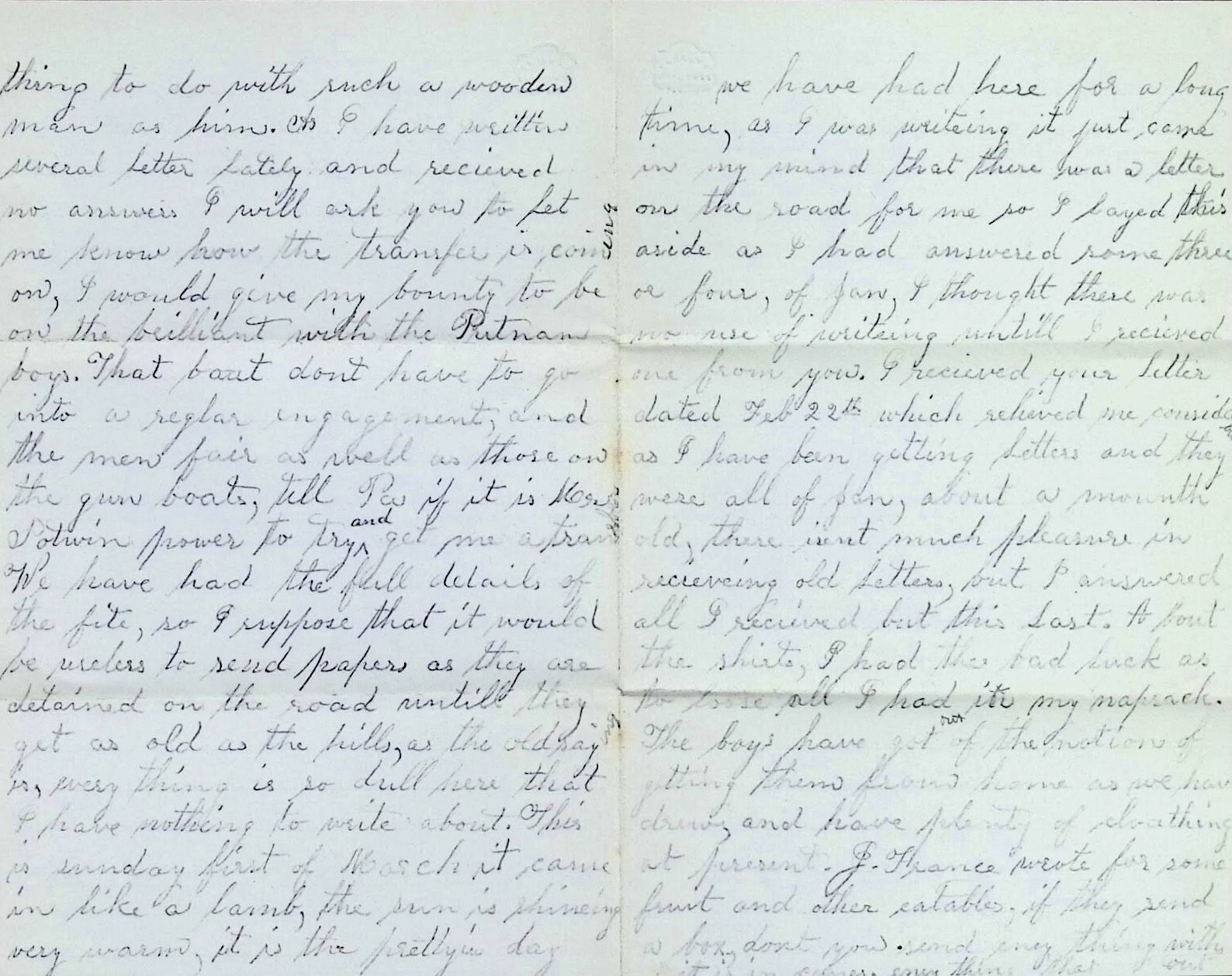
We have had the full details of the fight [at Stones River] so I suppose that it would be useless to send papers as they are detained on the road until they get old as the hills, as the old saying is. Everything is so dull here that I have nothing to write about. This is Sunday, 1st of March. It came in like a lamb. The sun is shining very warm. It is the prettiest day we have had for a long time.
As I was writing, it just came in my mind that there was a letter on the road for me so I laid this aside as I had answered some three or four of January, [and] I thought there was no use of writing until I received one from you. I received your letter dated February 22nd which relieved me considerably as I have been getting letters and they were all of January—about a month old. There isn’t much pleasure in receiving old letters, but I answered all I received but this last.
About the shirts, I had the bad luck as to lose all I had in my knapsack. The boys have got out of the notion of getting them from home as we have drew, and have plenty of clothing at present. John France wrote for some fruit and other eatables. If they send a box, don’t you send anything in it that isn’t in cans or it will spoil. You can you your own judgement about it.
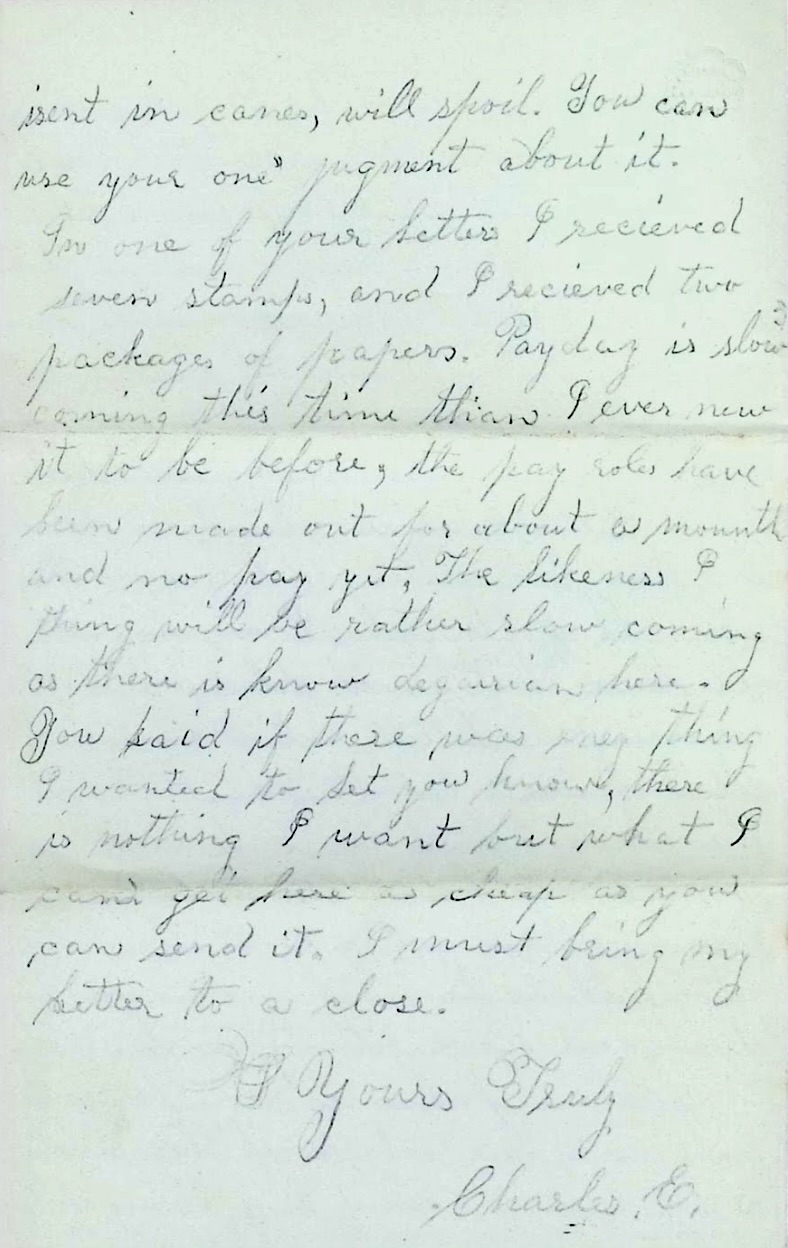
In one of your letters I received seven stamps and I received two packages of papers. Pay day is slower coming this time than I ever knew it to be before. The pay rolls have been made out for about a month and no pay yet. The likeness I think will be rather slow coming as there is no daguerreian here. You said if there was anything I wanted, to let you know. There is nothing I want but what I can get here as cheap as you can send it. I must bring my letter to a close. Yours truly, — Charles E.
Dear Father,
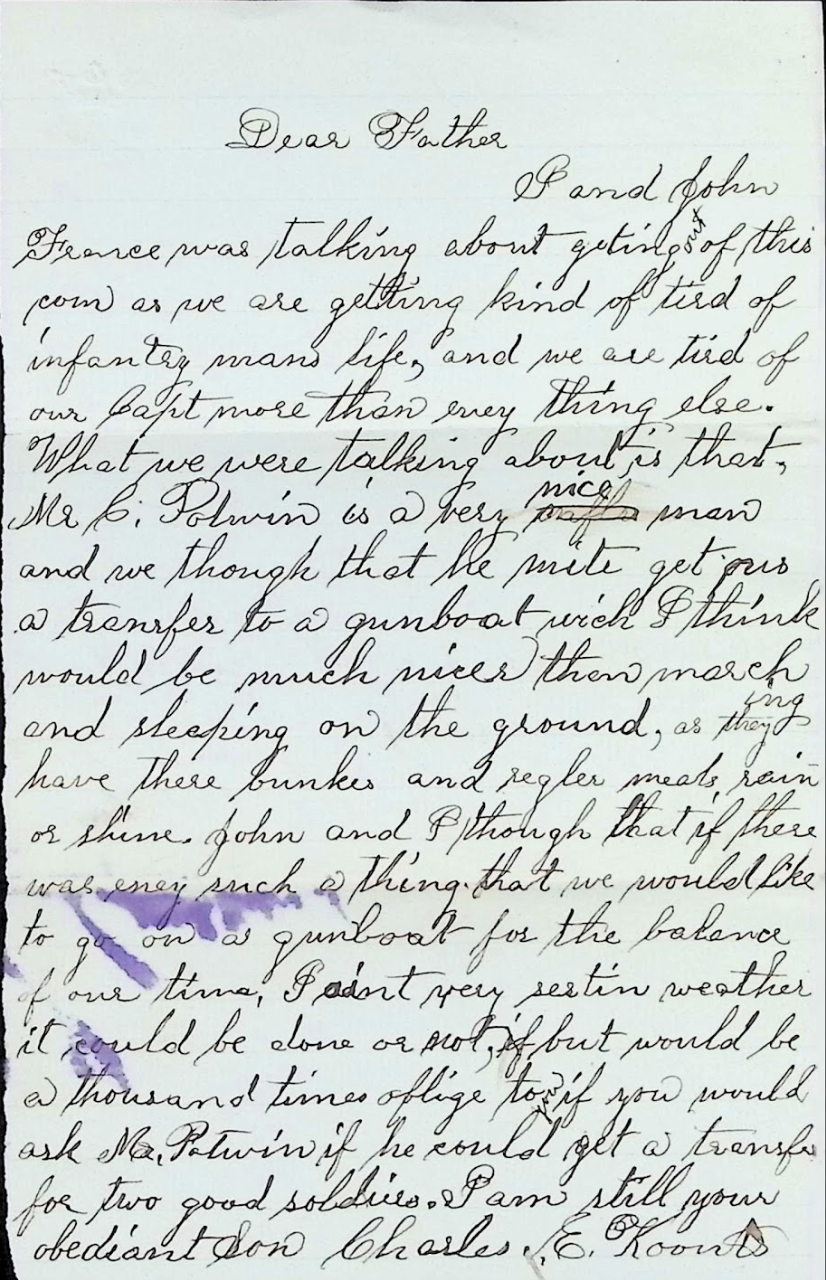
I and John France was talking about etting out of this company as we are getting kind of tired of infantry man’s life and we are tired of our captain more than anything else. What we were talking about it that Mr. C. Potwin is a very nice man and we thought that he might get our transfer to a gunboat which i think would be much nicer than marching and sleeping on the ground as they have their bunks and regular meals, rain or shine. John and I thought that if there was any such a thing, that we would like to go on a gunboat for the balance of our time. I ain’t very certain whether it could be done or not, bit would be a thousand times obliged to you if you would ask Mr. Potwin if he could get a transfer for two good soldiers. I am still your obedient son. Charles E. Koonts
Letter 21
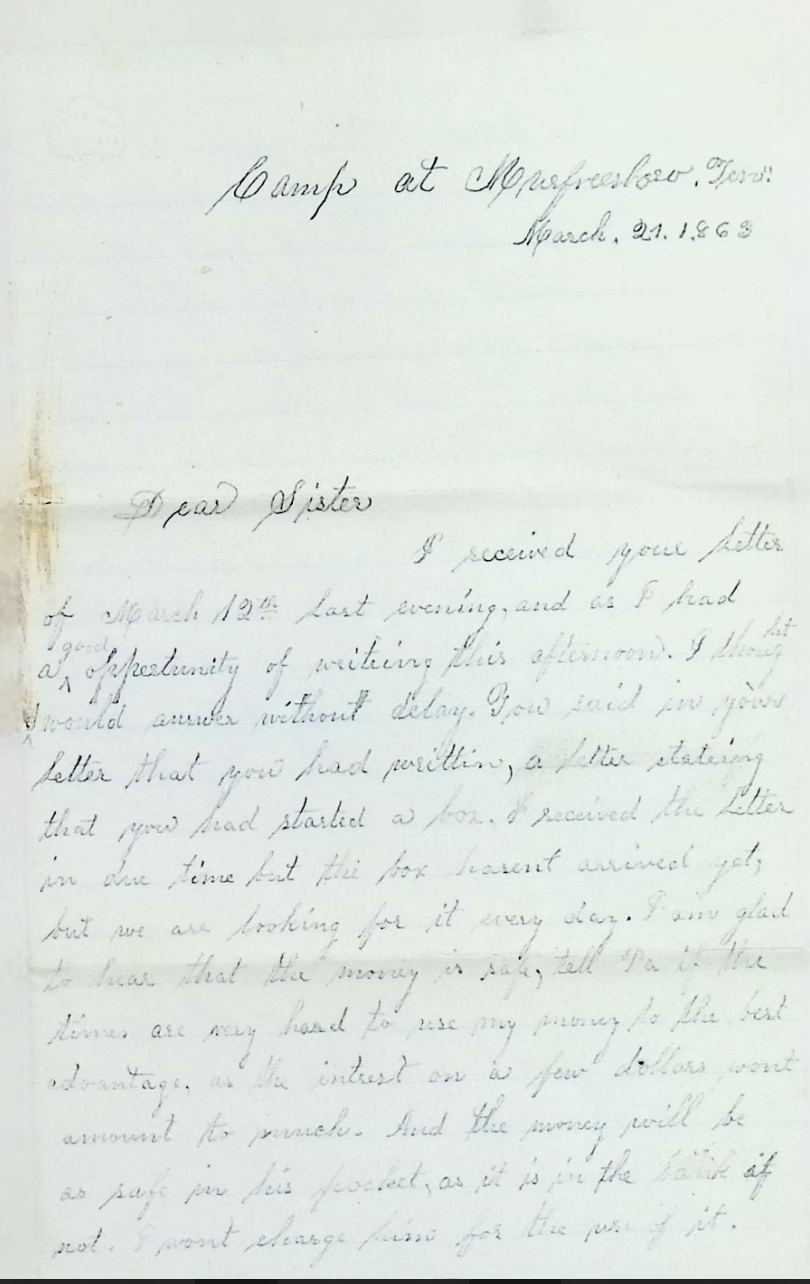
Camp at Murfreesboro, Tenn.
March 21, 1863
Dear Sister,
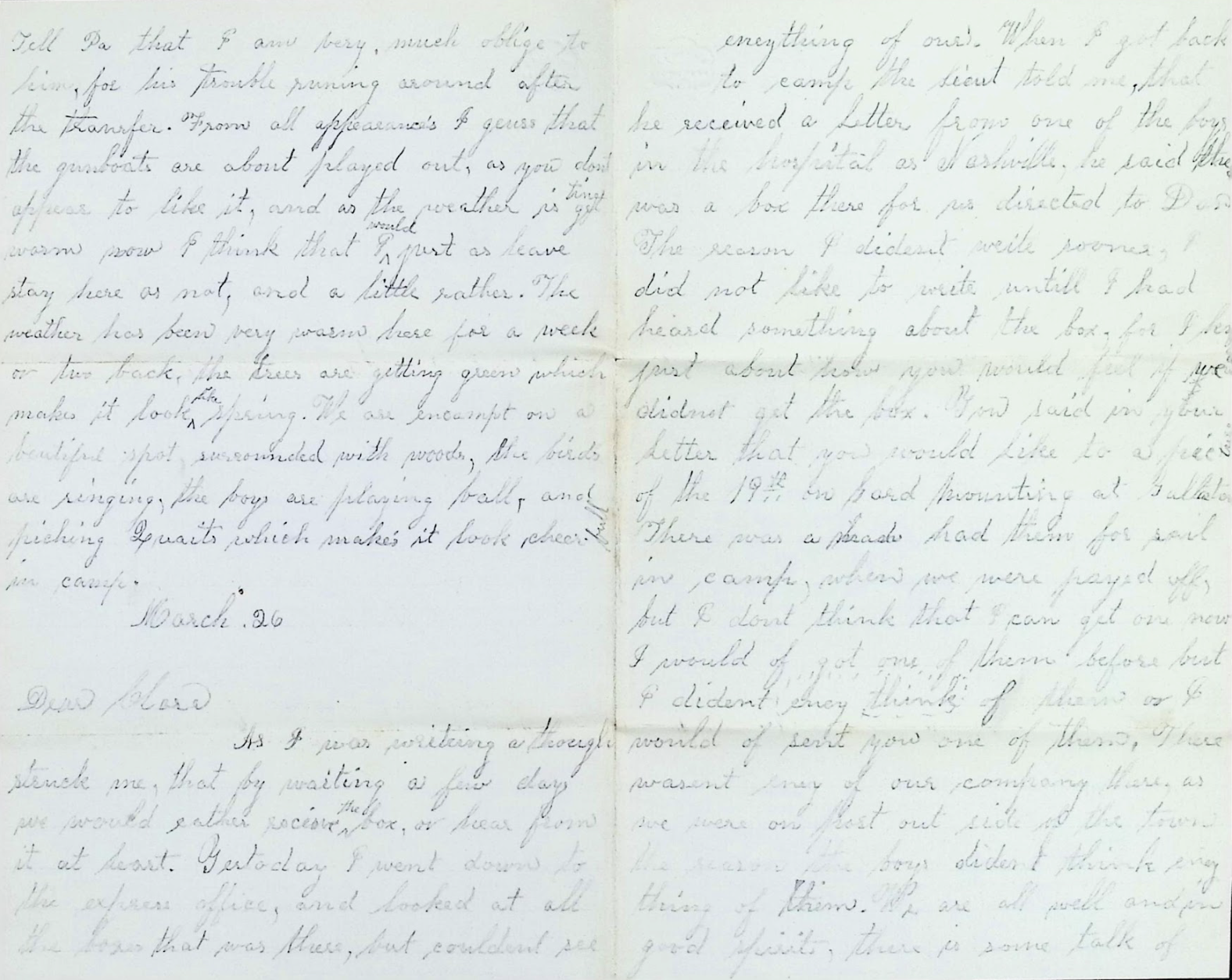
I received your letter of March 12th last evening and as I had a good opportunity of writing this afternoon, I thought I would answer without delay. You said in your letter that you had written a letter stating that you had started a box. I received the letter in due time but the box hasn’t arrived yet. But we are looking for it every day. I am glad to hear that the money is safe. Tell Pa if the times are very hard, to use my money to the best advantage as the interest on a few dollars won’t amount to much and the money will be as safe in his pocket as it is in the bank. If not, I won’t charge him for the use of it. Tell Pa that I am very much obliged to him for his trouble running around after the transfer. From all appearances I guess that the gunboats are about played out as you don’t appear to like it and as the weather is getting warm now, I think that I would just as leave stay here as not, and a little rather. The weather has been very warm here for a week or two back. The trees are getting green which makes it look like spring. We are encamped on a beautiful spot, surrounded with woods. The birds are singing, the boys are playing ball and pitching quoits, which makes it look cheerful in camp.
March 26th. Dear Clare—As I was writing, a thought struck me that by waiting a few days we would either receive the box or hear from it at least. Yesterday I went down to the Express Office and looked at all the boxes that was there but couldn’t see anything of one. When I got back to camp, the Lieutenant told me that he received a letter from one of the boys in the hospital at Nashville. He said that there was a box there for us directed to D[ ]. The reason I didn’t write sooner, I did not like to write until I had heard something about the box for I could just about [know] how you would feel if we didn’t get the box. You said in your letter that you would like to [buy] a piece of the 19th on Guard Mounting at Gallatin. There was a [ ] had them for sale in camp when we were paid off but I don’t think that I can get one now. I would of got one of them before but I didn’t any think of them or I would of sent you one of them. There wasn’t any of our company there as we were on post outside of the town the reason the boys didn’t think anything of them.
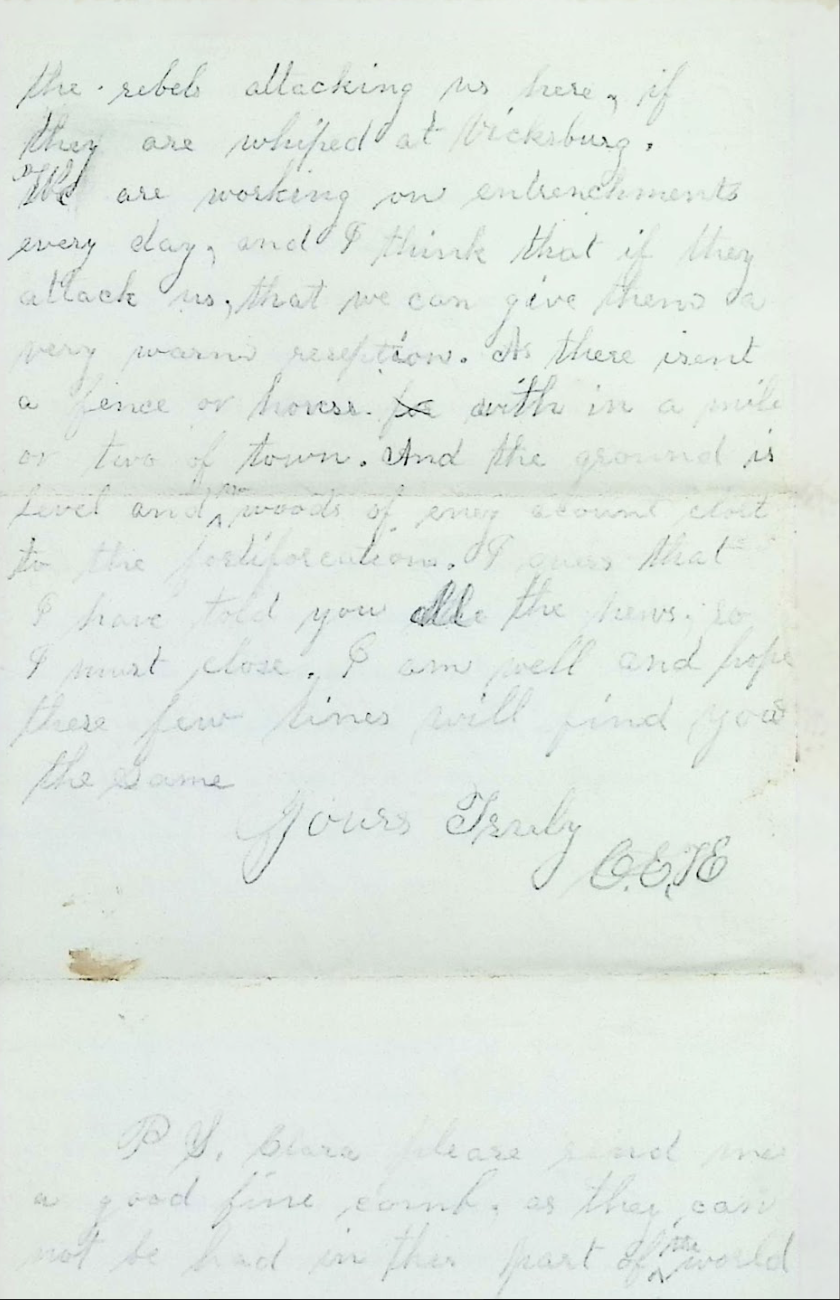
We are all well and in good spirits. There is some talk of the rebels attacking us here if they are whipped at Vicksburg. We are working on entrenchments every day and I think that if they attack us, that we can give them a very warm reception as there isn’t a fence or house within a mile or two of town and the ground is level and any woods of any account close to the fortifications.
I have told you all the news so I must close. I am well and hope these few lines will find you the same, Yours truly, — C. E. K.
P. S. Clara, please send me a good fine comb as they cannot be had in this part of the world.
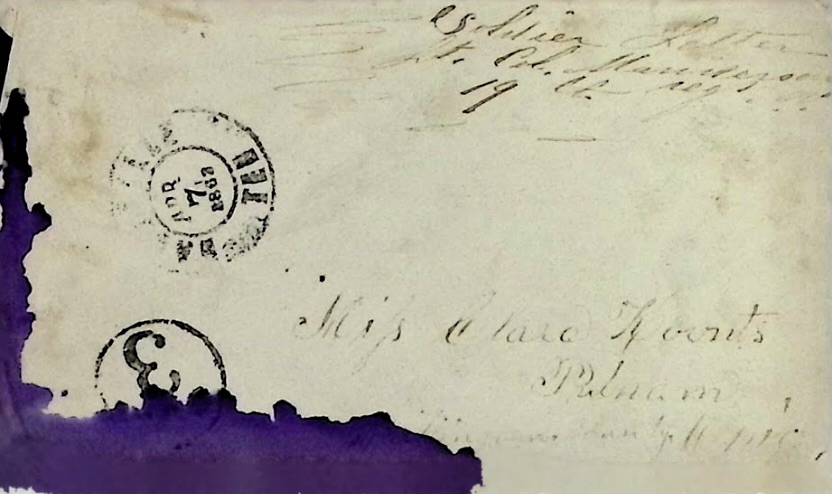
Letter 22
Camp near Murfreesboro [Tennessee]
April 3, 1863
Dear Sister,
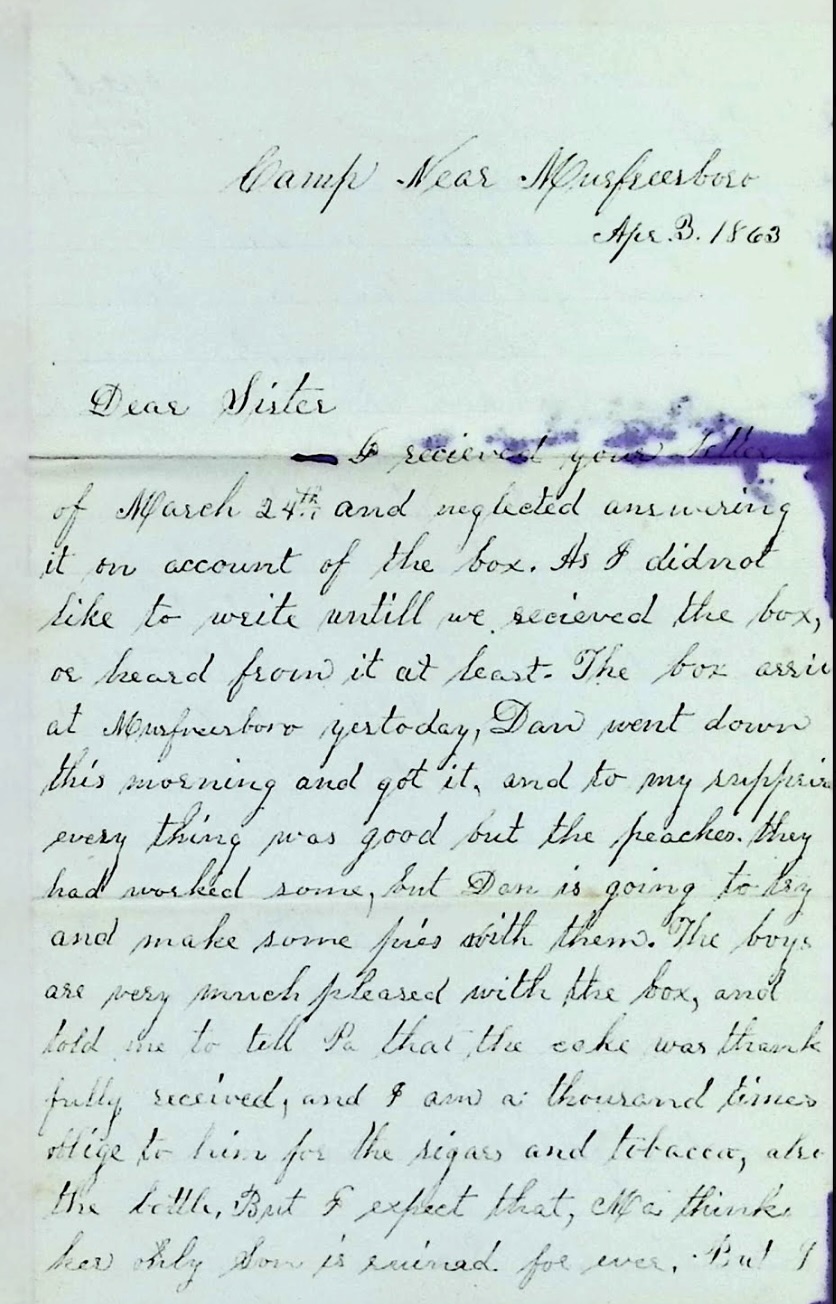
I received your letter of March 24th and neglected answering it on account of the box as I did not like to write until we received the box—or heard from it at least. The box arrived at Murfreesboro yesterday. Dan went down this morning and got it and to my surprise, everything was good but the peaches. They had worked some, but Dan is going to try and make some pies with them. The boys are very much pleased with the box and told me to tell Pa that the cake was thankfully received and I am a thousand times obliged to him for the cigars and tobacco—also the letter. But I expect that Ma thinks here only son is ruined forever. But I hope it won’t be the case.
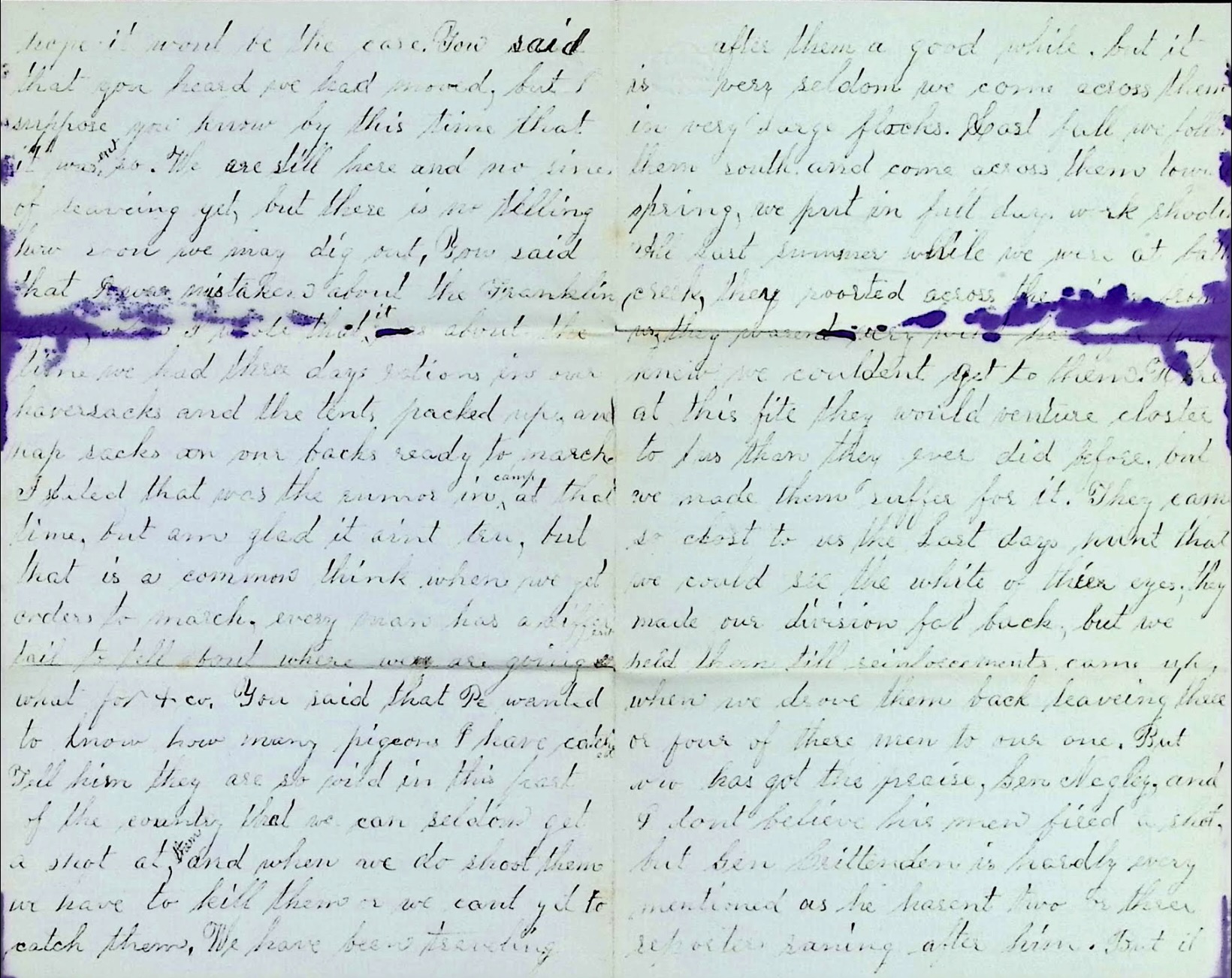
You said that you heard we had moved but I suppose you know by this time that it was not so. We are still here and no sign of leaving yet. But there is no telling how soon we may dig out. You said that I was mistaken about the Franklin [ink blotch]. I wrote it about the time we had three days rations inour haversacks and the tens packed up and knapsacks on our backs ready to march. I stated that was the rumor in camp at that time, but am glad it ain’t true. But that is a common thing when we get orders to march. Every man has a different tale to tell about where we are going and what for, &c.
You said that Pa wanted to know how many pigeons I have catched. Tell him they are so wild in this part of the country that we can seldom get a shot at them and when we do shoot them, we have to kill them or we can’t get to catch them. We have been traveling after them a good while but it is very seldom we come across them in very large flocks. Last fall we followed them south and came across them [ ] spring. We put in a full days work shooting the last summer while we were at [ ] creek. They roosted across [ink blotch] and we couldn’t get to them. At this fight, they would venture closer to us than they ever did before and we made them suffer for it. They came so close to us the last days hunt that we could see the white of their eyes. They made our division fall back but we held them till reinforcements came up when we drove them back, leaving three or four of heir men to our one. But who has got the praise? Gen. Negley, and I don’t believe his men fired a shot. But Gen. Crittenden is hardly ever mentioned as he hasn’t two or three reporters running after him. But it appears to be the case always—someone [else ] to get the praise that doesn’t deserve it.
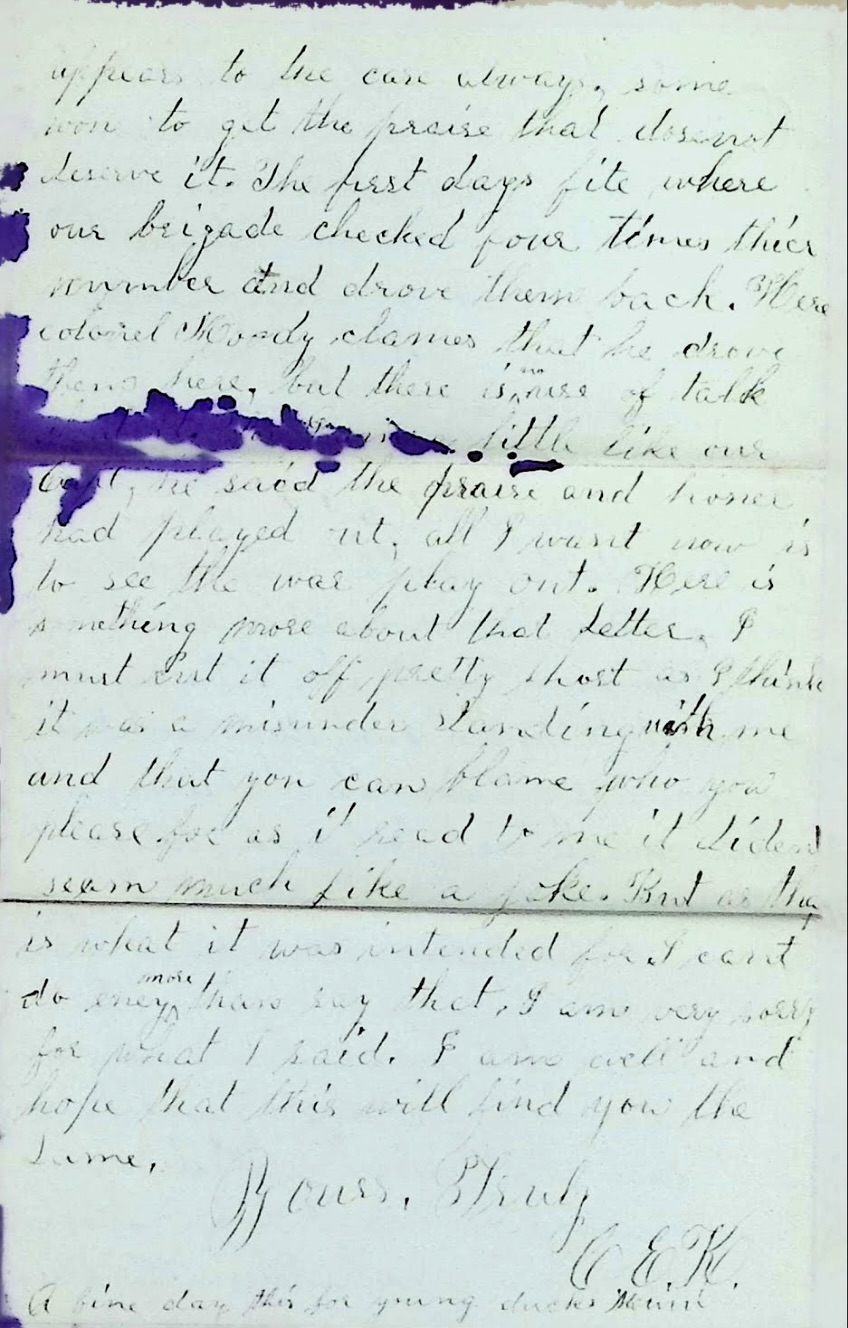
The first days fight where our brigade checked four times their number and drove them back, here Colonel [Granville] Moody [of the 74th Ohio Infantry] claims that he drove them. But there is no use of talk [ink blotch] little like our [ ], he said the praise and honor had played out. All I want now is to see the war play out. There is nothing more about that letter. I must cut it off pretty short as I think it was a misunderstanding with me and that you can blame who you please for as it read to me, it didn’t seem much like a joke. But as that is what it was intended for, I can’t do anything more than say that I am very sorry for what I said. I am well and hope this will find you the same. Yours truly, — E. E. K.
A fine day this for young ducks.
Letter 23
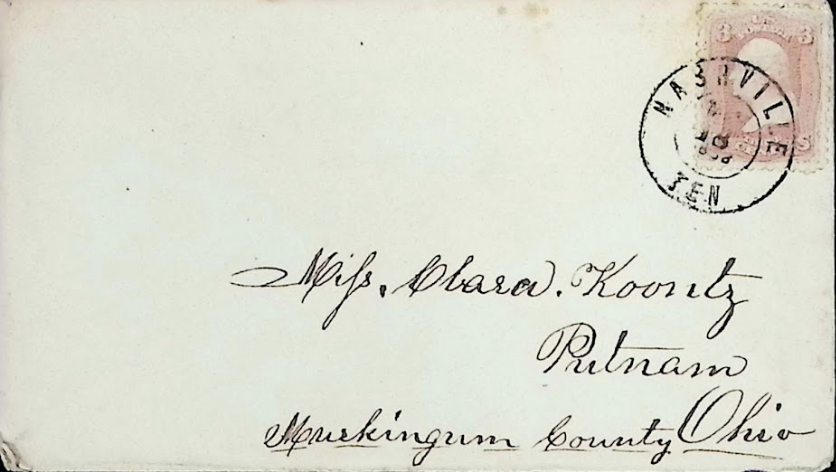
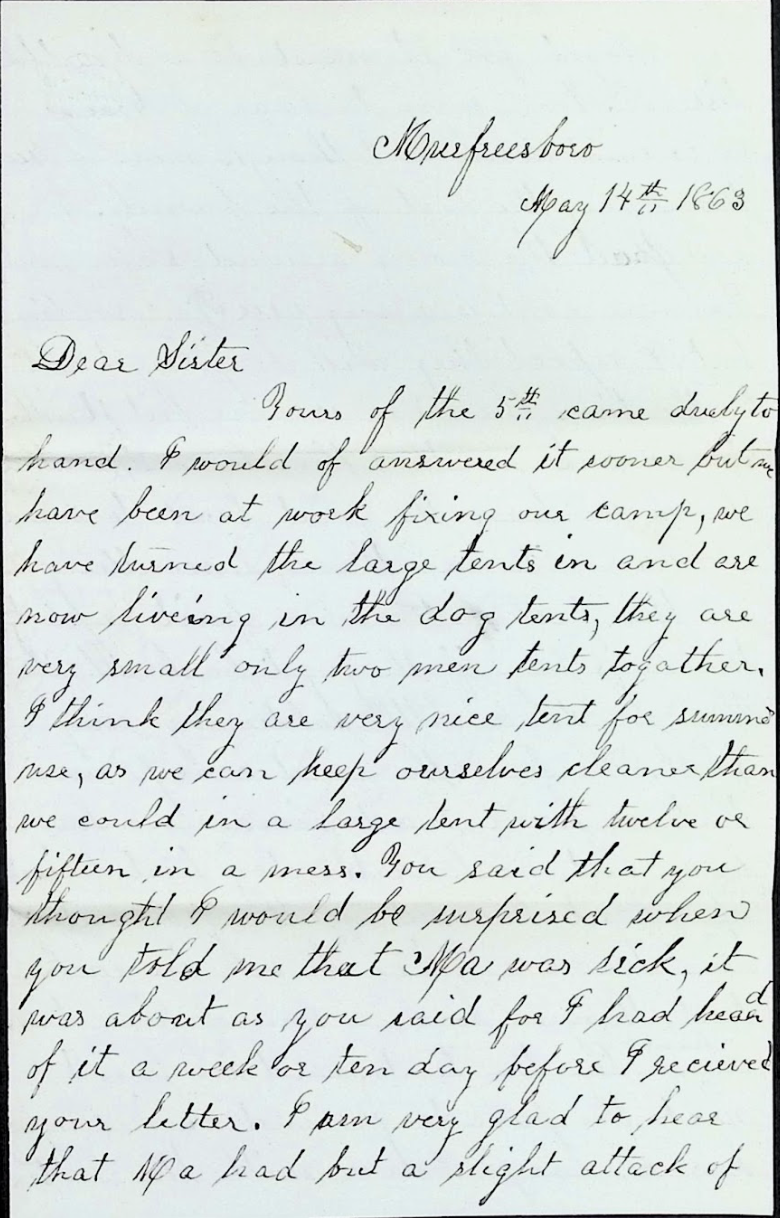
Murfreesboro [Tenn.]
May 14th 1863
Dear Sister,
Yours of the 5th came duly to hand. I would of answered it sooner but we have been at work fixing our camp. We have turned the large tents in and are now living in the dog tents. They are very small—only two men tents together. I think they are very nice tents for summer use as we can keep ourselves cleaner than we could in a large tent with twelve or fifteen in a mess.
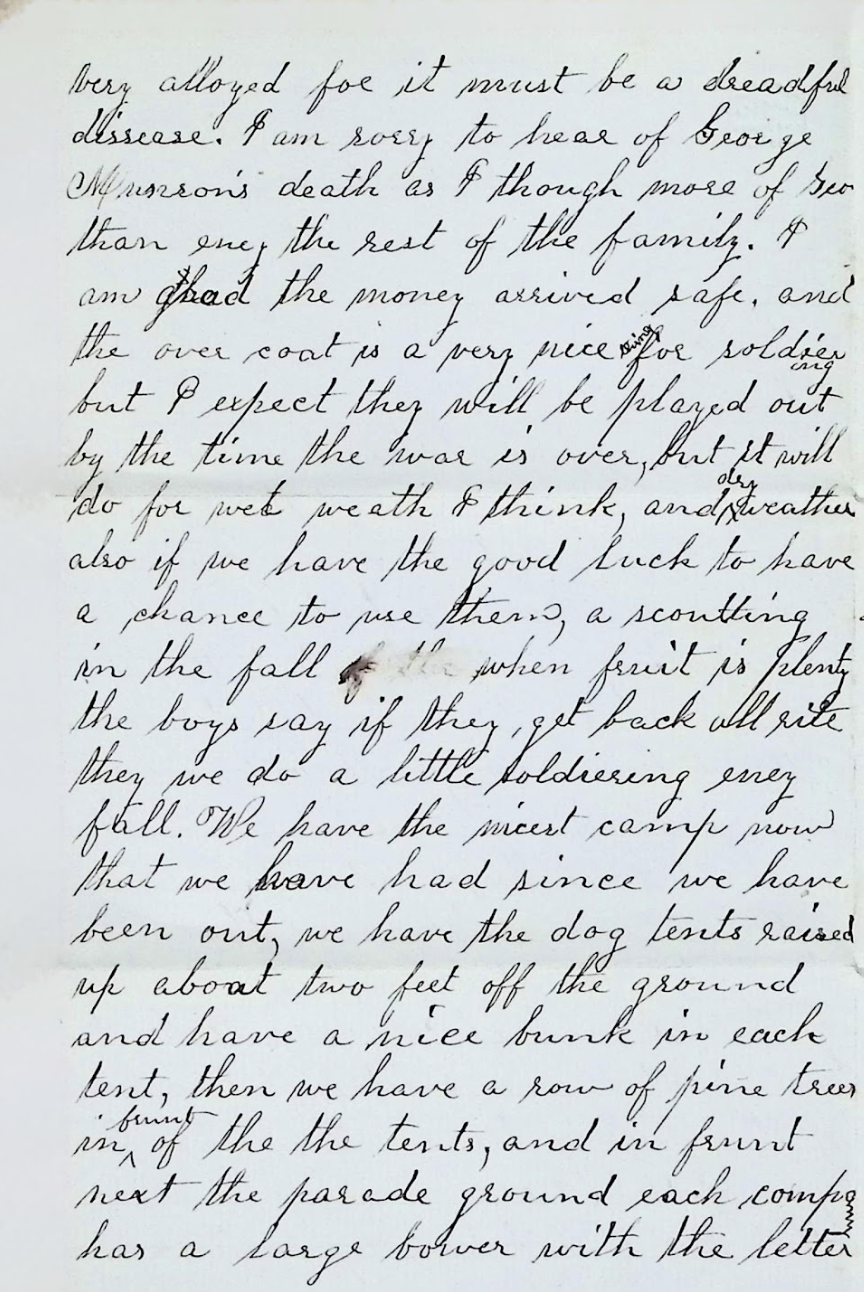
You said that you thought I would be surprised when you told me that Ma was sick. It was about as you said for I had heard of it a week or ten days before I received your letter. I am very glad to hear that Ma had but a slight attack of very alloyed [varioloid] for it must be a dreadful disease. I am sorry to hear of George Munson’s death as I thought more of her than any the rest of the family. I am glad the money arrived safe and the overcoat is a very nice thing for soldier but I expect they will be played out by the time the war is over. But it will do for wet weather I think and dry weather also if we have the good luck to have a chance to use them a scouting in the fall when fruit is plenty. The boys say if they get back all right they will do a little soldiering any fall.

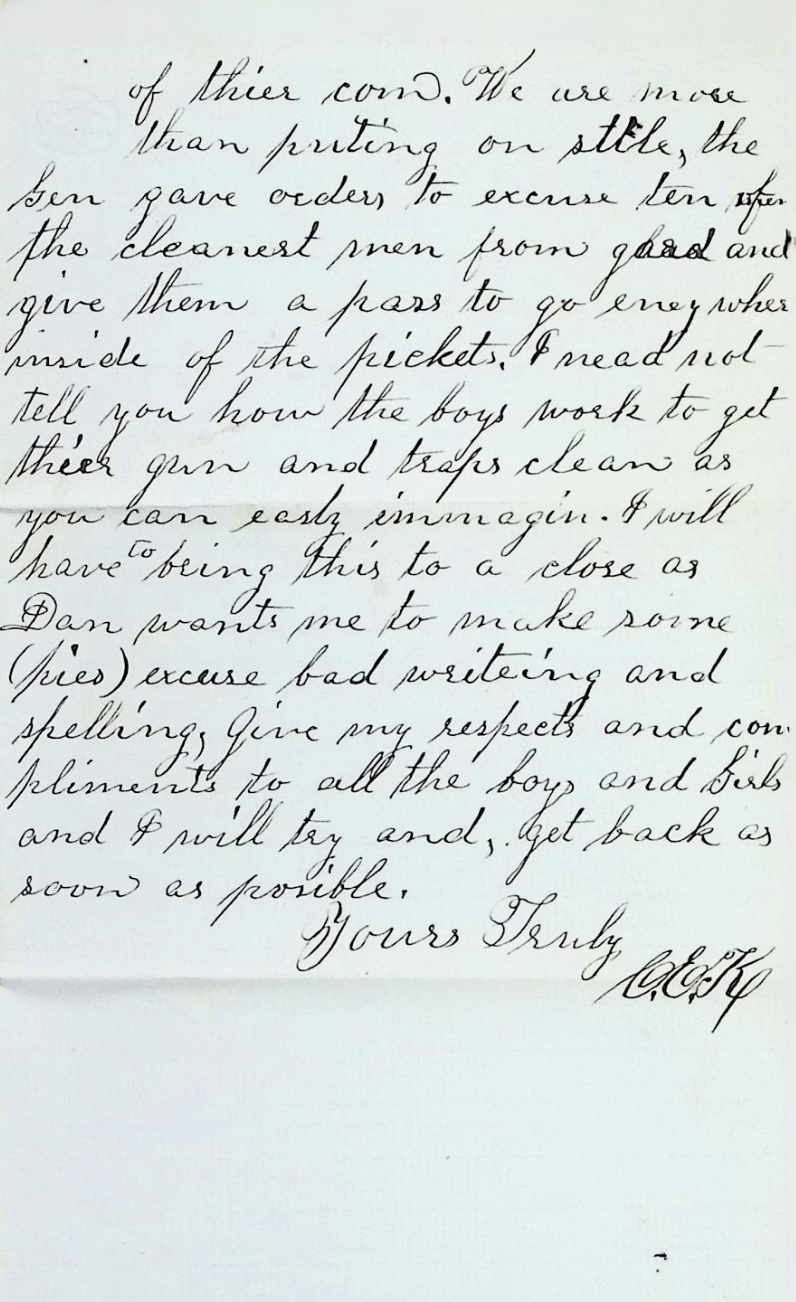
We have the nicest camp now that we have had since we have been out. We have the dog tents raised up about two feet off the ground and have a nice bunk in each tent. Then we have a row of pine trees in front of the tents and in front next the parade ground each company has a large bower with the letter of their company. We are more than putting on style. The General gave orders to excuse ten of the cleanest men from guard and give them a pass to go anywhere inside of the pickets. I need not tell you how the boys worked to get their gun and traps clean as can easily imagine.
I will have to bring this to a close as Dan wants me to make some pies. Excuse bad writing and spelling. Give my respects and compliments to all the boys and girls and I will try and get back as soon as possible. Yours truly, — C. E. K.
Letter 24
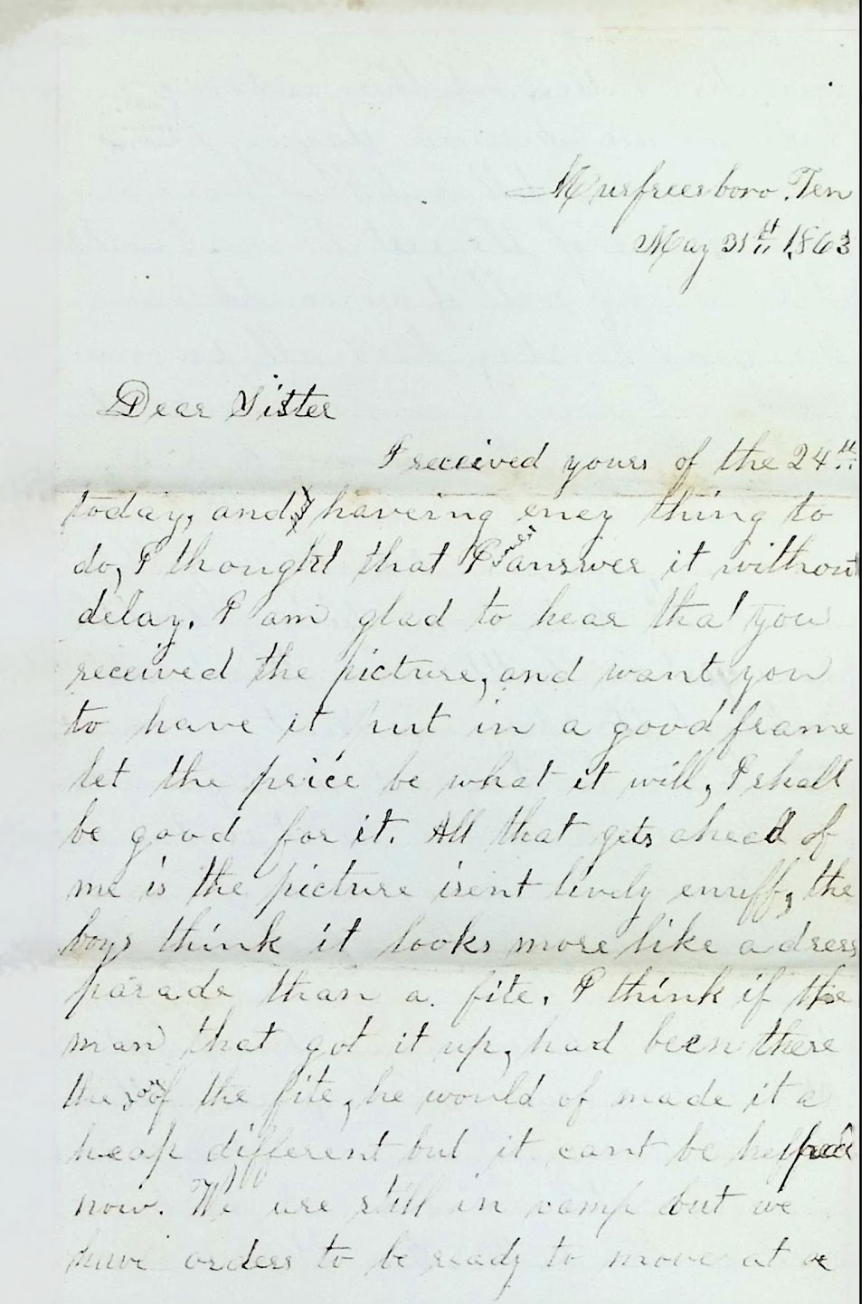
Murfreesboro, Tennessee
May 31st 1863
Dear Sister,
I received yours of the 24th today and not having anything to do, I thought that I would answer it without delay. I am glad to hear that you received the picture and want you to have it. Put in a good frame, let the price be what it will. I shall be good for it. All that gets ahead of me is the picture isn’t lively enough. The boys think it looks more like a dress parade than a fight. I think if the man that got it up had been there the day of the fight, he would have made it a heap different but it can’t be helped now.
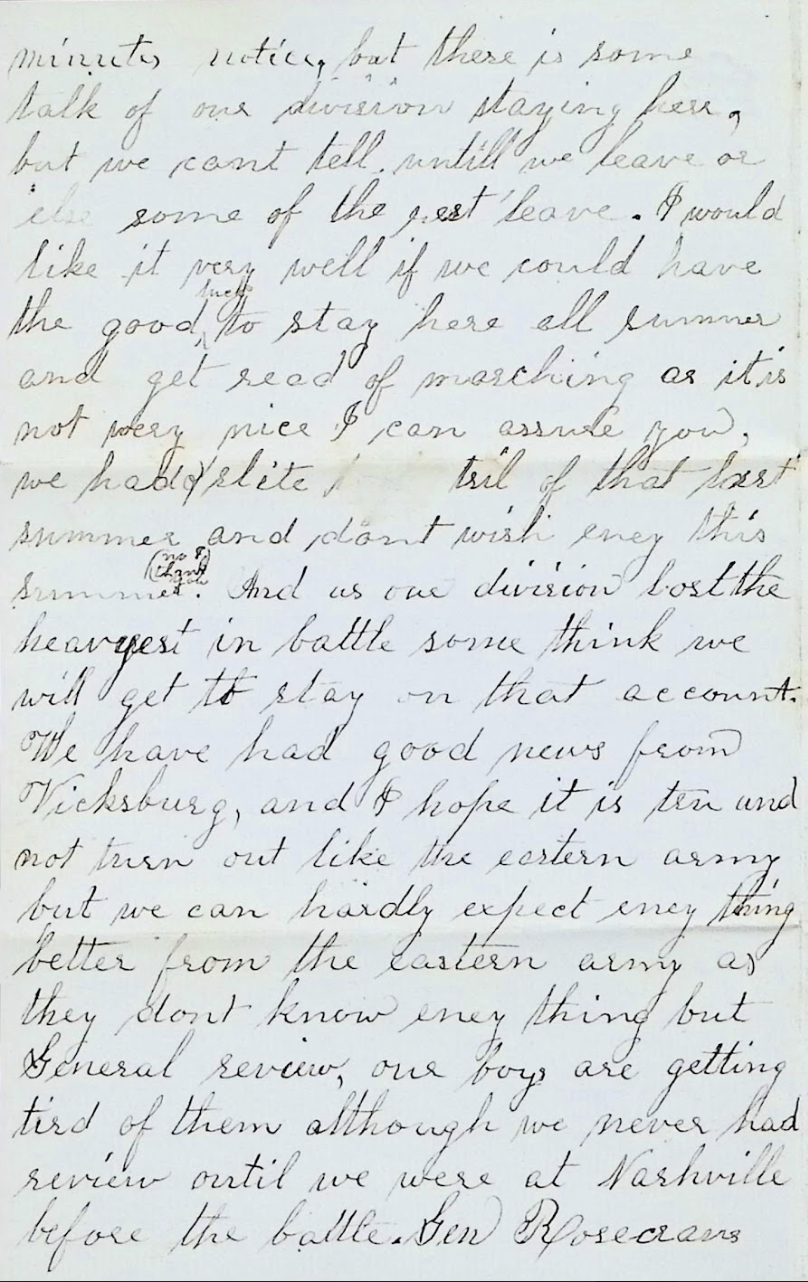
We are still in camp but we have orders to be ready to move at a minutes notice. But there is some talk of our divisions staying here but we can’t tell until we leave or else some of the rest leave. I would like it very well if we could have the good luck to stay here all summer and get rid of marching as it is not very nice, I can assure you. We had a slight [taste?] of that last summer and don’t wish any this summer. No thank you. And as our division lost the heaviest in battle, some think we will get to stay on that account.
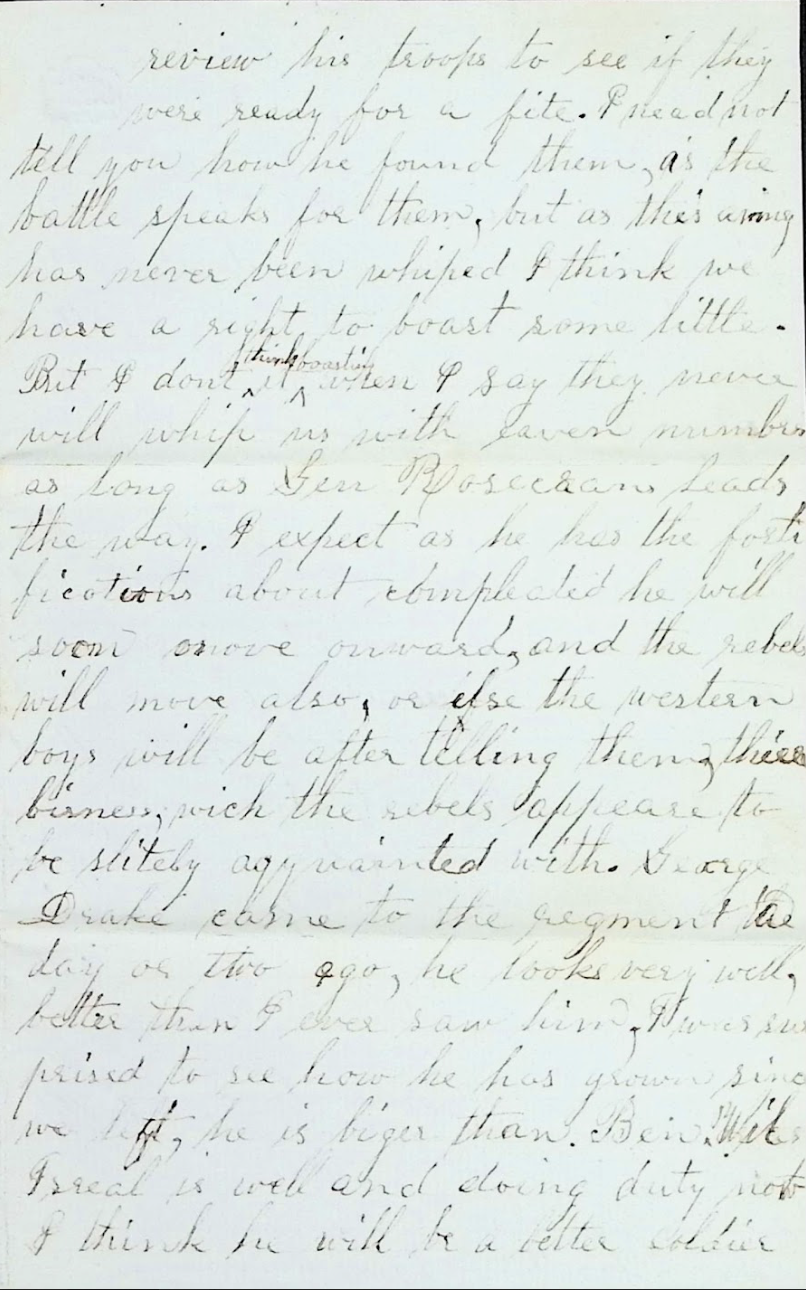
We have had good news from Vicksburg and hope it is true and nt turn out like the Eastern Army, but we can hardly expect everything better from the Eastern Army as they don’t know anything but General Review. Our boys are getting tired of them although we never had review until we were at Nashville. Before the battle, Gen. Rosecrans reviewed his troops to see if they were ready for a fight. I need not tell you how he found them as the battle speaks for them. But as this army has never been whipped, I think we have a right to boast some little. But I don’t think it’s boasting when I say they never whipped us with even numbers as long as Gen. Rosecrans leads the way. I expect as he has the fortifications about completed he will soon move onward and the rebels will move also, or else the Western Boys will be after telling them their business which the rebels appear to be slightly acquainted with.
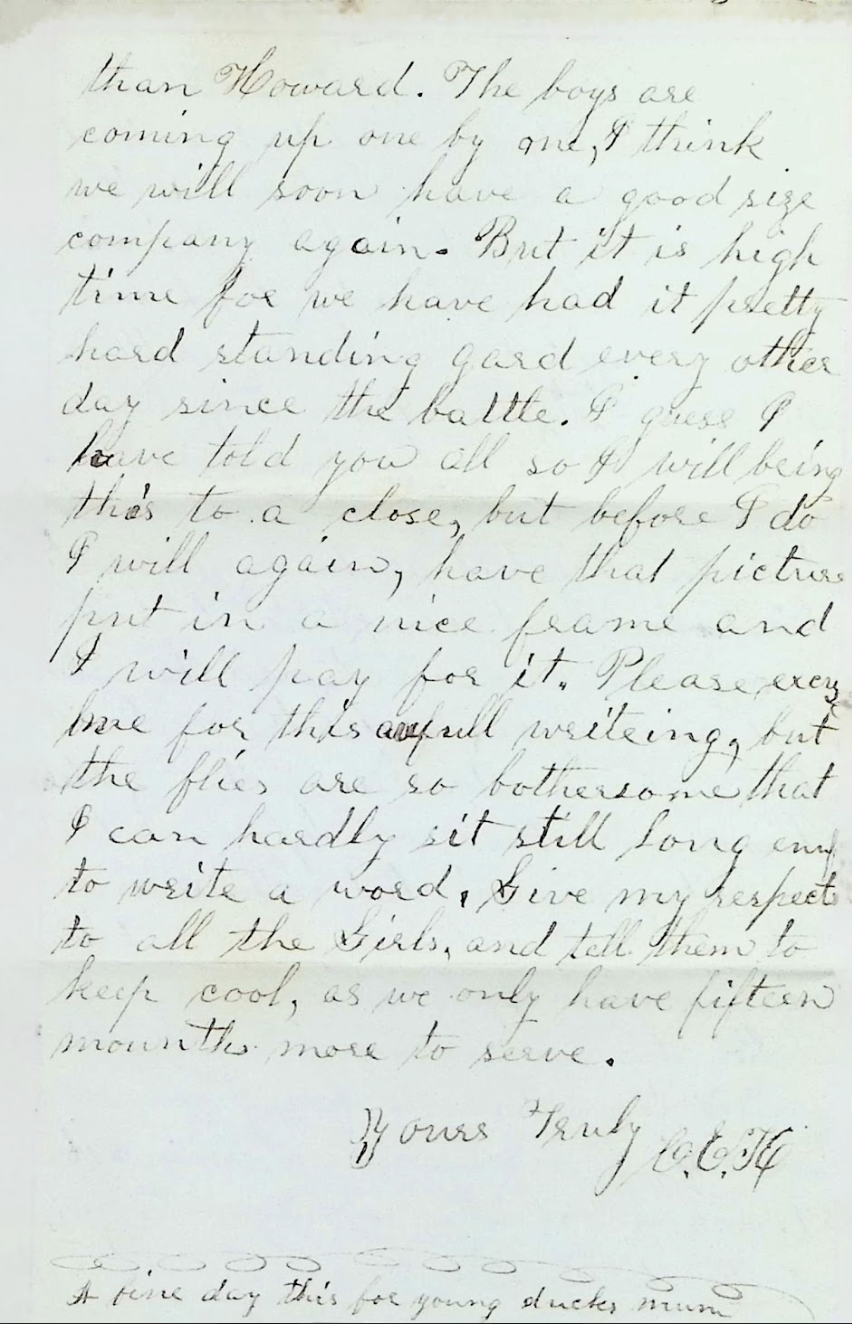
George Drake came to the regiment a day or two ago. He looks very well—better than I ever saw him. I was surprised to see how he has grown since we left. He is bigger than Ben. Wil[liam] Israel is well and doing duty now. I think he will be a better soldier than [his brother] Howard. The boys are coming up one by one. I think we will soon have a good size company again. But it is high time for we have had it pretty hard standing guard every other day since the battle.
I guess I have told you all so I will bring this to a close. But before I do, I will [say] again, have that picture put in a nice frame and I will pay for it. Please excuse me for this awful writing but the flies are so bothersome that I can hardly sit still long enough to write a word. Give my respects to all the girls and tell them to keep cool as we only have fifteen months more to serve. Yours truly, — C. E. K.
A fine day this for young ducks.
Letter 25
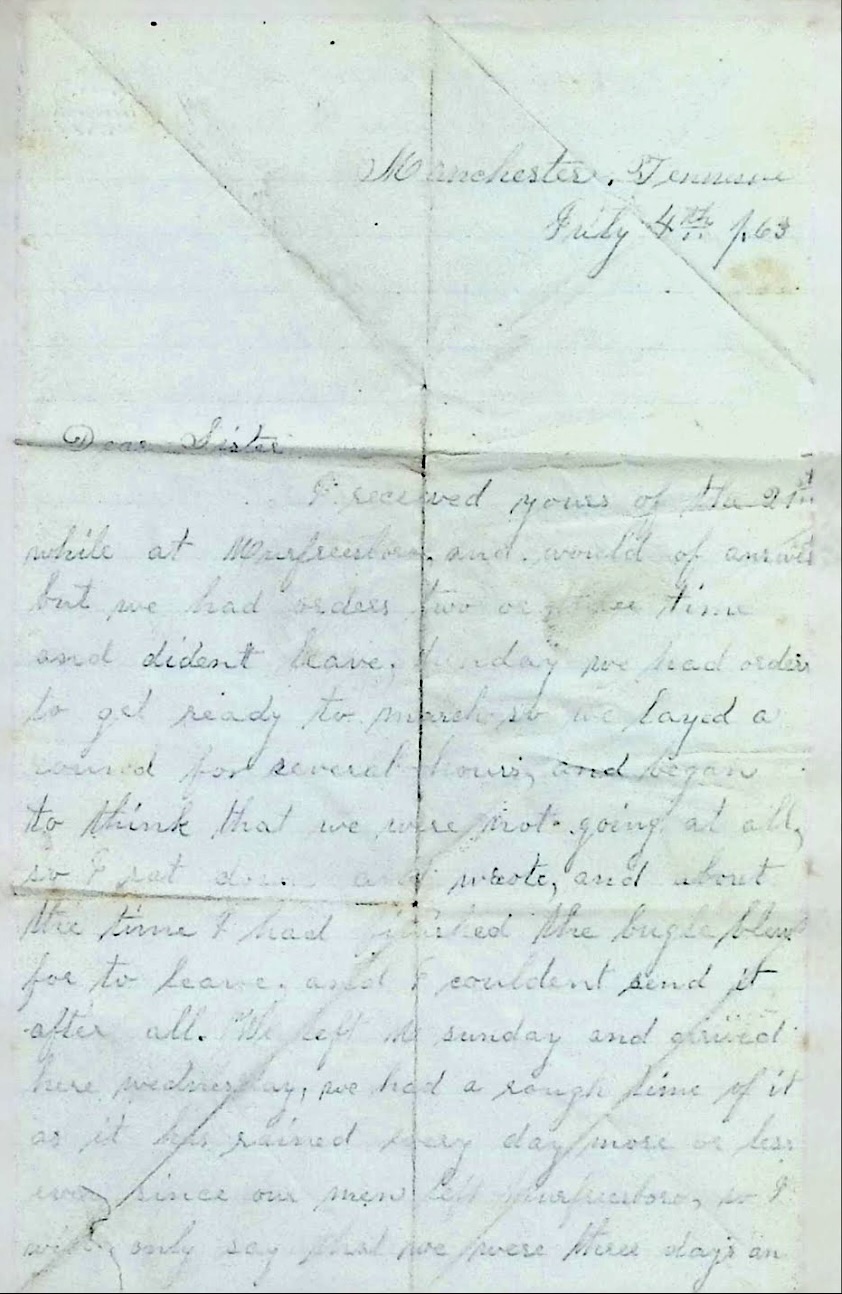
Manchester, Tennessee
July 4th 1863
Dear Sister,
I received yours of the 21st while at Murfreesboro and would of answered but we had orders two or three times and didn’t leave. Sunday we had orders to get ready to march so we laid around for several hours and began to think that we were not going at all, so I sat down and wrote and about the time I had started, the bugle blew for to leave and I couldn’t send it after all. We left Sunday and arrived here Wednesday. We had a rough time of it as it has rained every day more or less ever since our men left Murfreesboro, so I will only say that we were three days and a half on the march—only thirty miles. So you can judge how the roads were.
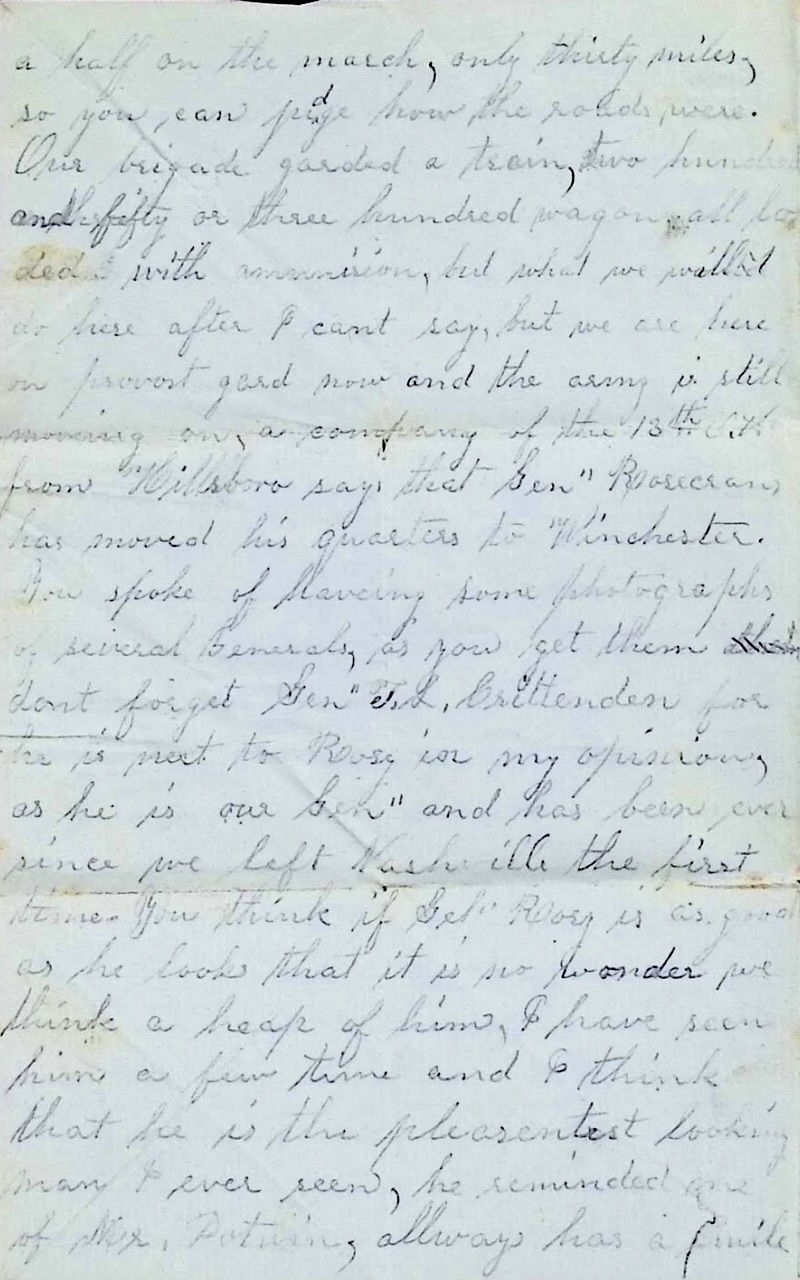
Our brigade guarded a train [of] 250 or 300 wagons all loaded with ammunition, but what we will do after [this], I can’t say but we are here on Provost Guard now and the army is still moving on. A company of the 13th OVI from Hillsboro says that Gen. Rosecrans has moved his [head] quarters to Winchester.
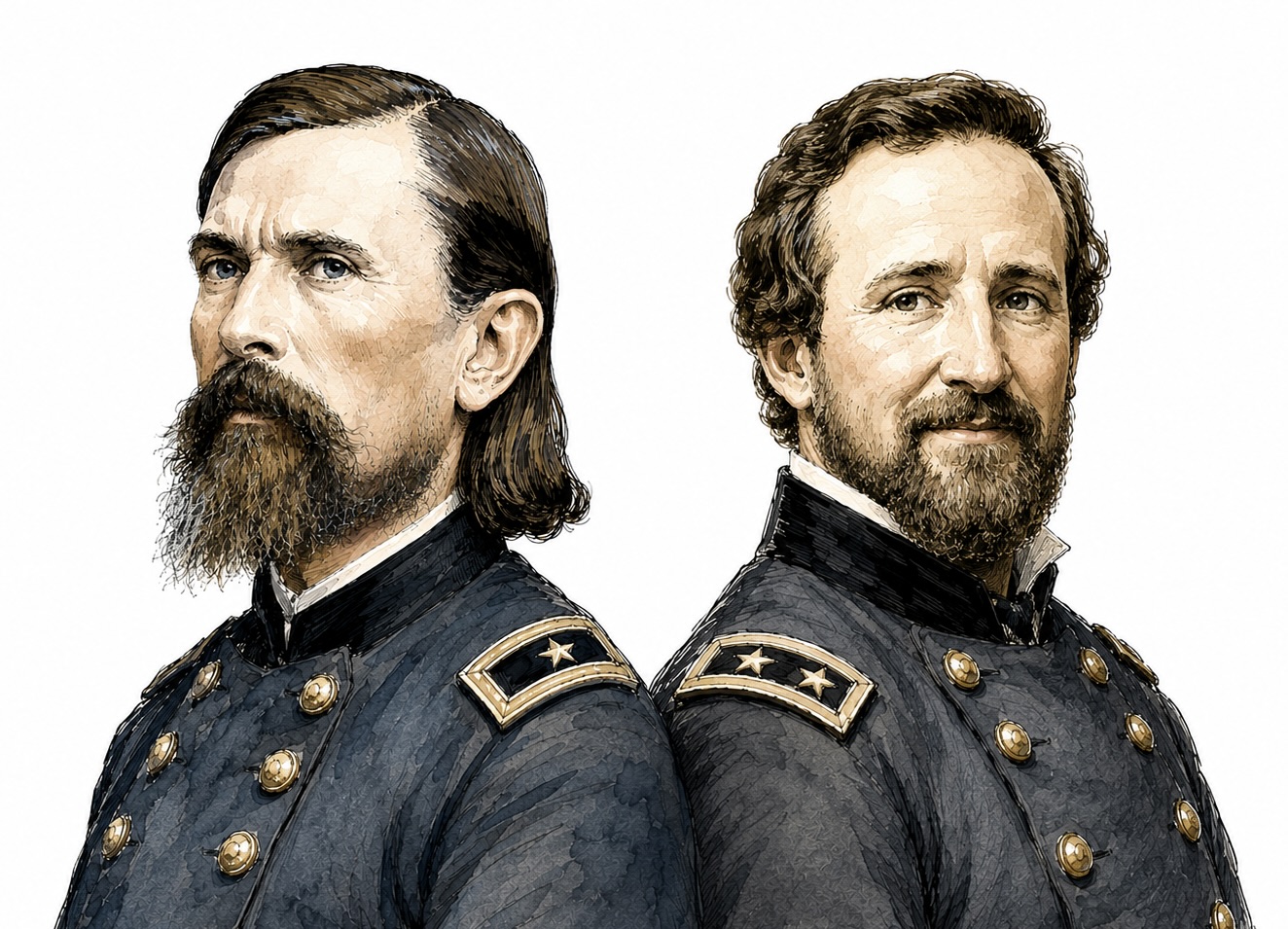
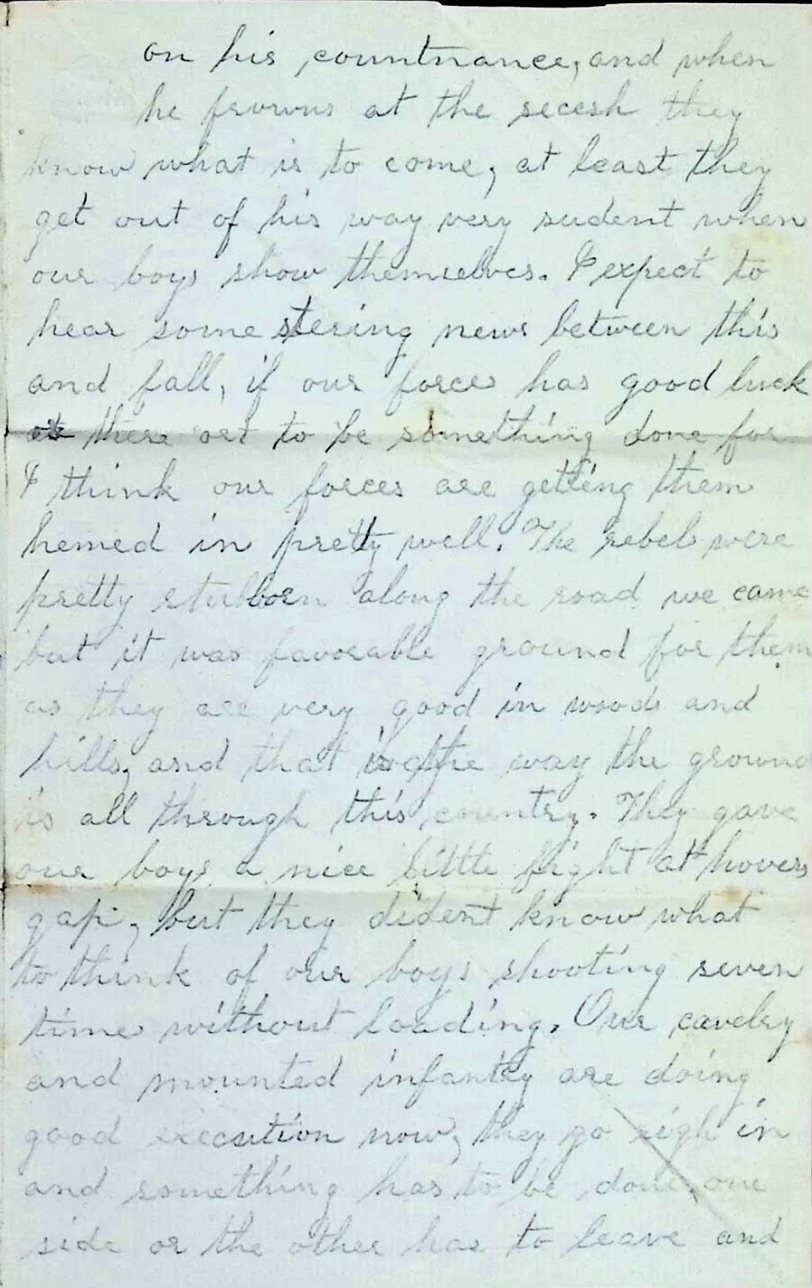
You spoke of having some photographs of several Generals. As you get them, don’t forget Gen. T. L. Crittenden for he is next to Rosy in my opinion, as he is our General and has been ever since we left Nashville the first time. You think if Gen. Rosy is as good as he looks that it is a no wonder we think a lot of him. I have seen him a few times and I think that he is the pleasantest looking man I ever saw. He reminds me of Mr. Potwin—always has a smile on his countenance and when he frowns at the secesh, they know what is to come—at least they get out of his way very sudden when our boys show themselves.
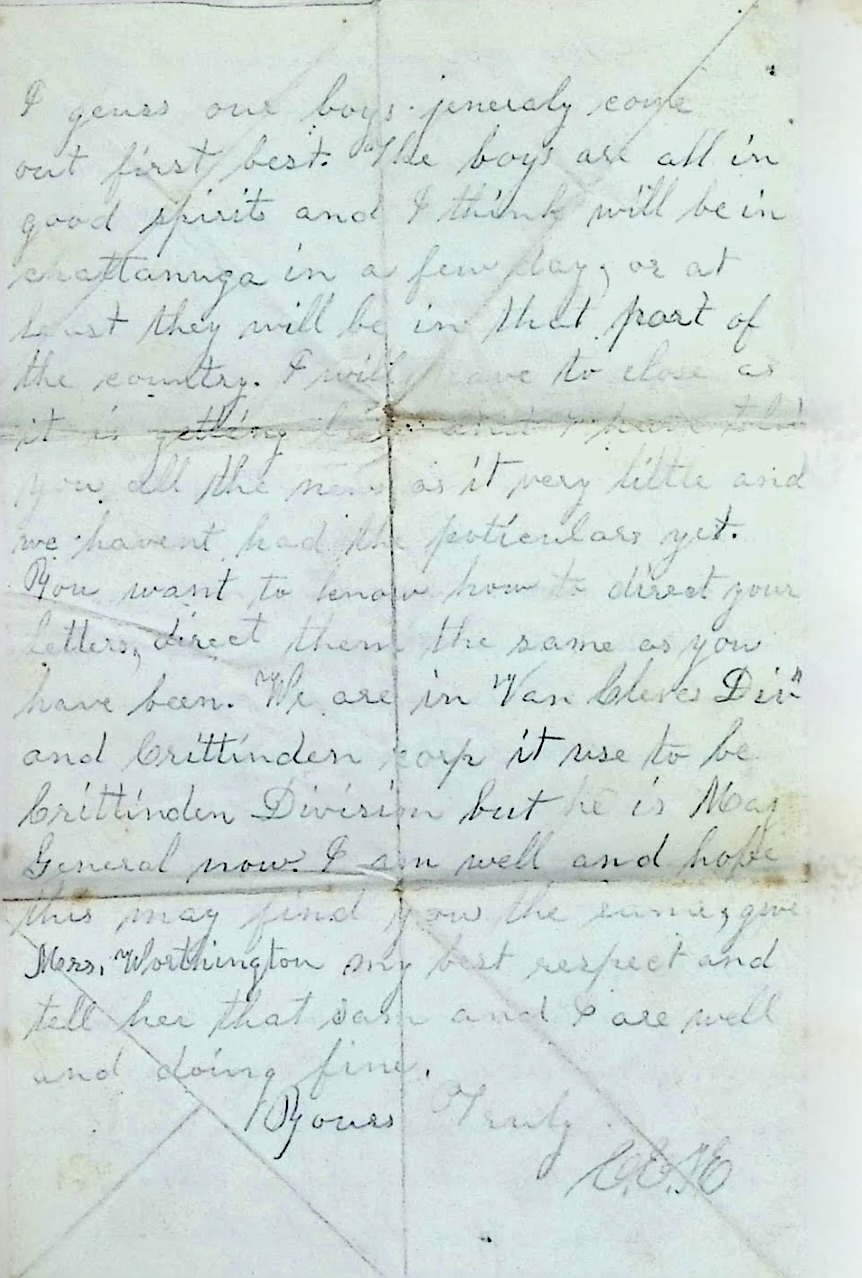
I expect to hear some cheering news between this and fall. If our forces has good luck, there ought to be something done for I think our forces are getting them hemmed in pretty well. The rebels were pretty stubborn along the road we came but it was favorable ground for them as they are in very good woods and hills and that is the way the ground is all through this country. They gave our boys a nice little fight at Hoover’s Gap but they didn’t know what to think of our boys shooting seven times without loading. Our cavalry and mounted infantry are doing good execution now. They go right in and something has to be done—one side or the other has to leave and I guess our boys generally come out first best.
The boys are all in good spirits and I think will be in Chattanooga in a few days, or at least they will be in that part of the country. I will have to close as it is getting late and I have told you all the news as it is very little and we haven’t had the particulars yet.
You want to know how to direct your letters. Direct them the same as you have been. We are in [Horatio] Van Cleve’s Division and Crittenden’s Corp. It used to be Crittenden’s Division but he is Major General now. I am well and hope this may find you the same. Give Mrs. Worthington my best respects and tell her that Sam and I are well and doing fine. Yours truly, — C. E. K.
Letter 26
McMinnville, Tennessee
July 24th 1863
Dear Sister,
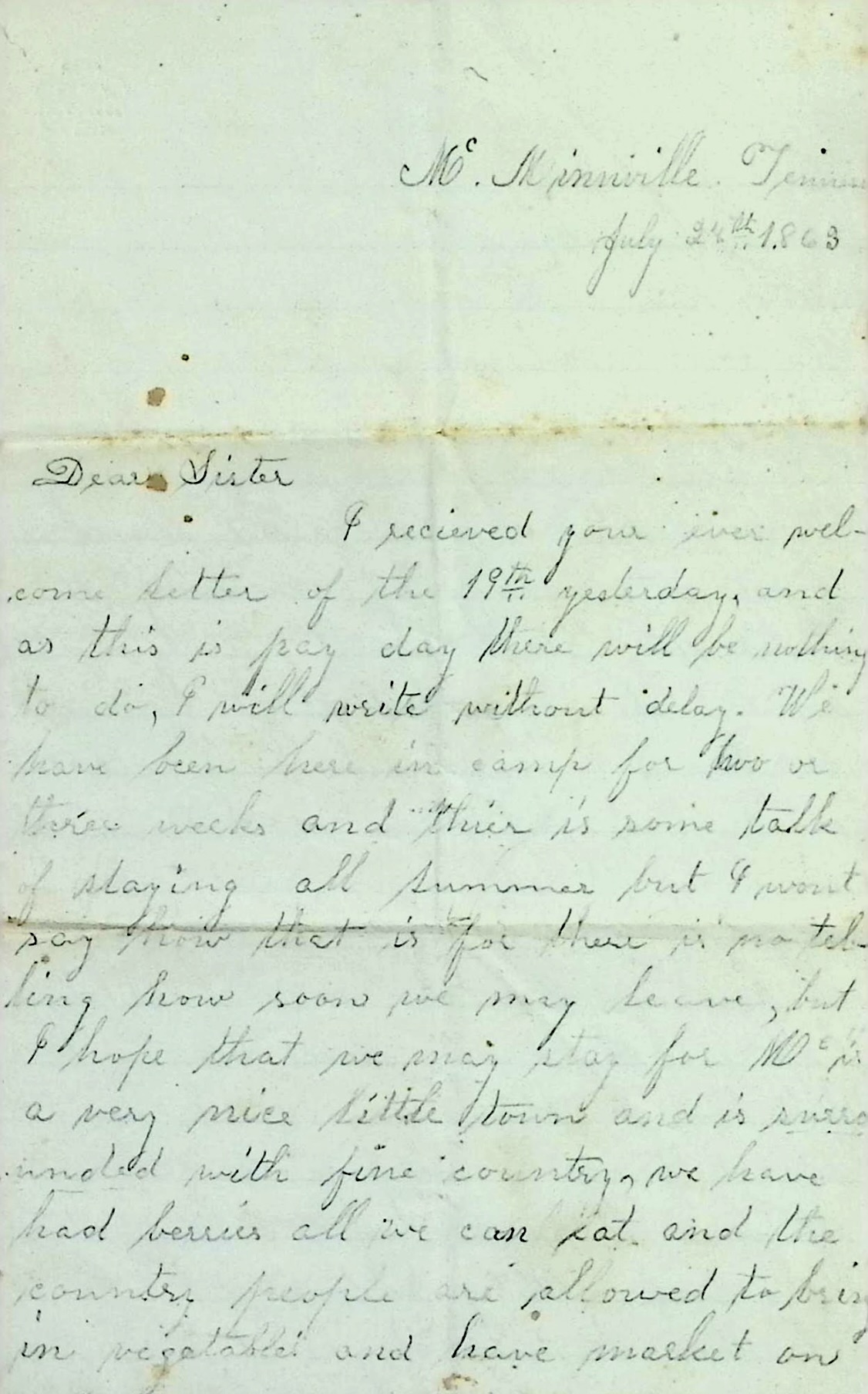
I received your ever welcome letter of the 19th yesterday and as this is pay day [and] there will be nothing to do, I will write without delay. We have been here in camp for two or three weeks and there is some talk of staying all summer but I won’t say how that is for there is no telling how soon we may leave. But I hope that we may stay for McMinnville is a very nice little town and is surrounded with fine country. We have had berries all we can eat and the country people are allowed to bring in vegetables and have market on every road leading from town. So when we get paid, we can live for a while as we can get chickens, potatoes, and milk and we can more than live for a while like fighting cocks at least as long as stay here.
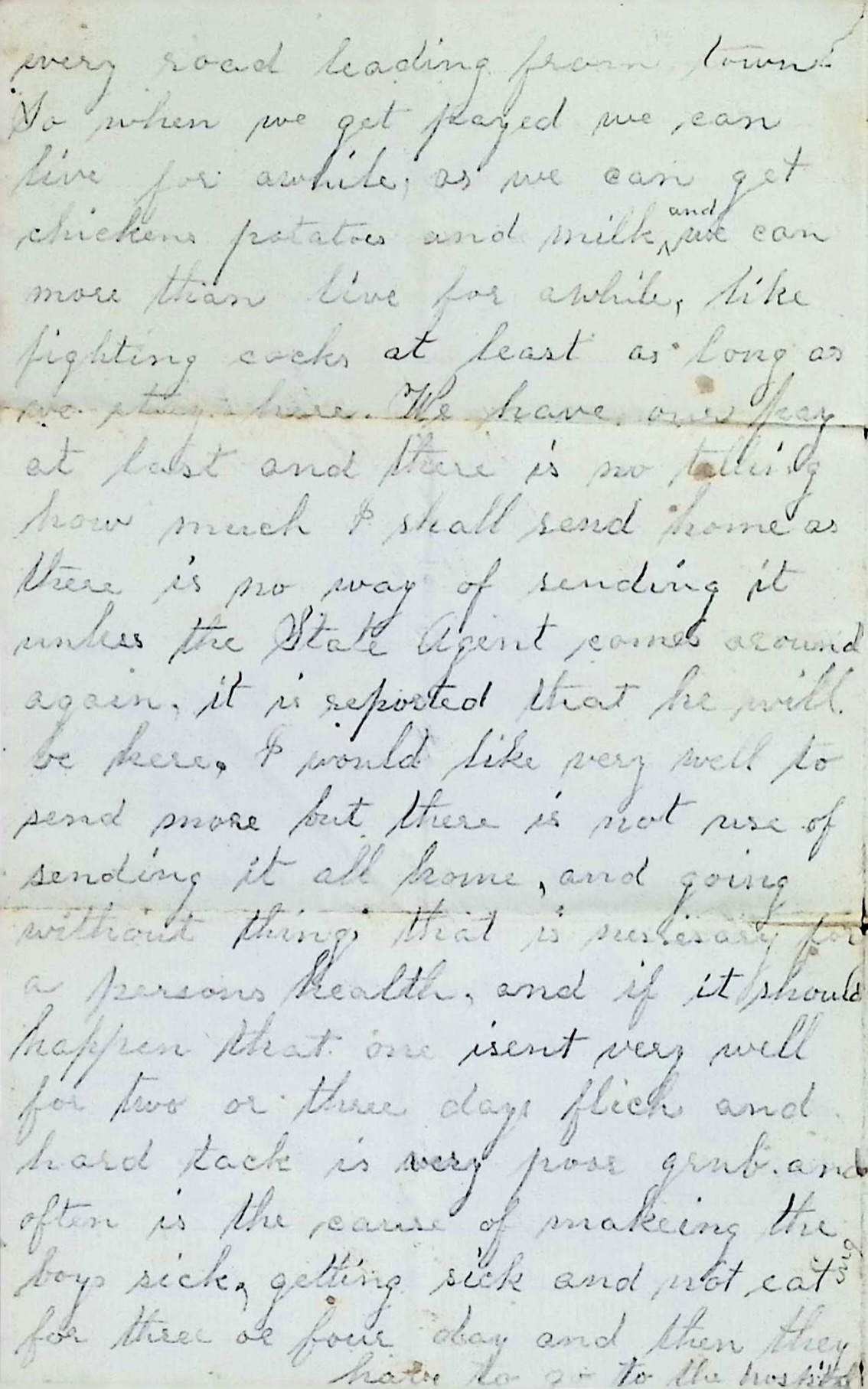
We have our pay at last and there is no telling how much I shall send home as there is no way of sending it unless the State Agent comes around again. It is reported that he will be here. I would like very well to send more but there is no use of sending it all home and going without things that is necessary for a person’s health. And if it should happen that one isn’t very well for two or three days, flitch and hard tack is very poor grub and often is the cause of making the boys getting sick and not eating for three or four days and then they have to go to the hospital.
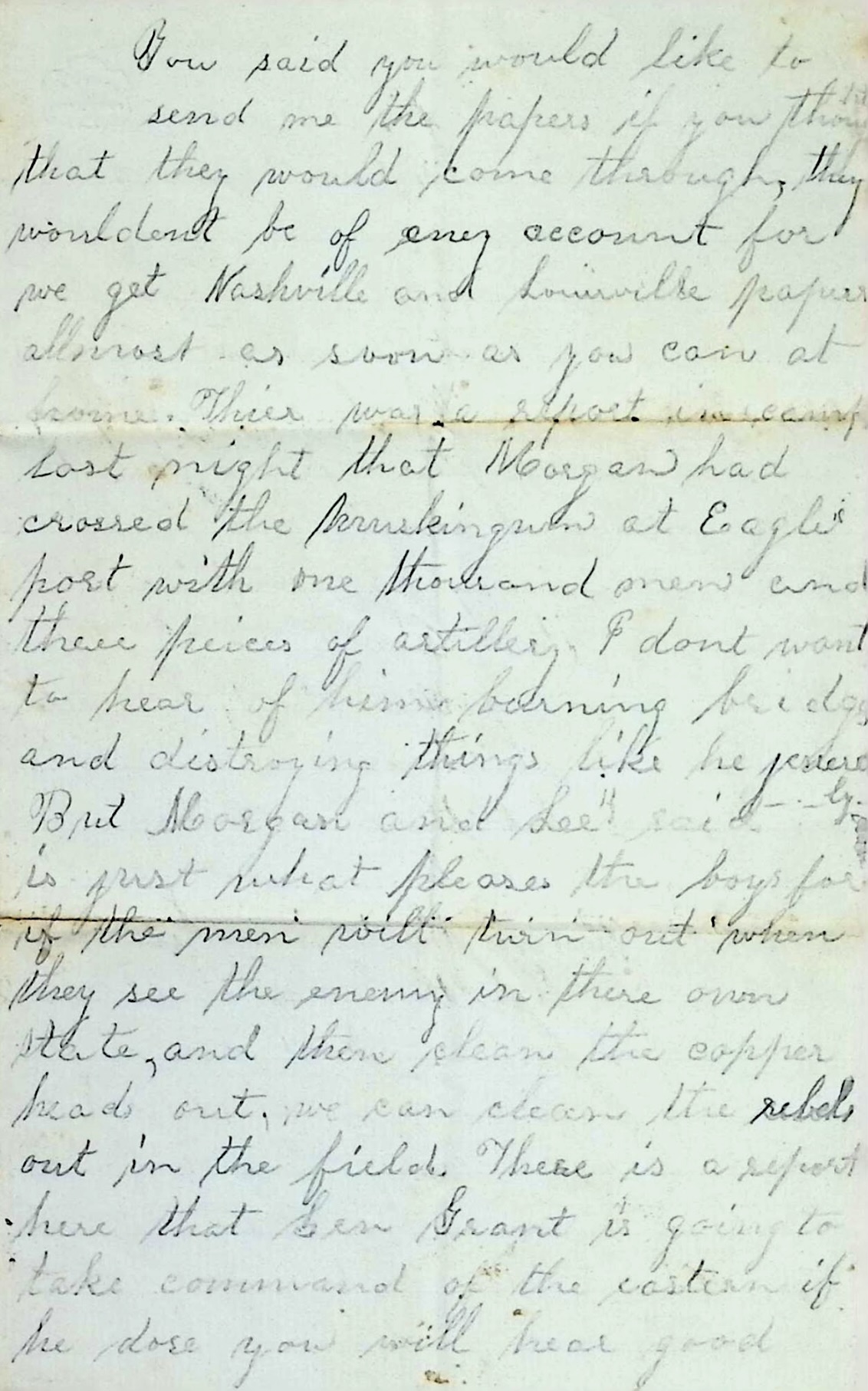
You said you would like to send me the papers if you thought that they would come through. They wouldn’t be of any account for we get Nashville and Louisville papers almost as soon as you can at home. There was a report in camp last night that [John Hunt] Morgan had crossed the Muskingum at Eagleport with one thousand men and three pieces of artillery. I don’t want to hear of him burning bridges and destroying things like he generally does. But Morgan and Lee’s raid is just what pleases the boys for if the men will turn out when they see the enemy in their own state, and then clean the Copperheads out, we can clean the rebels out in the field.
There is a report here that Gen. Grant is going to take command of the Eastern [army]. If he does, you will hear good news from there before he is there long for he is a fighting man and I suppose he will take some of his own men with him and they are like we are—don’t know what it is to be whipped.
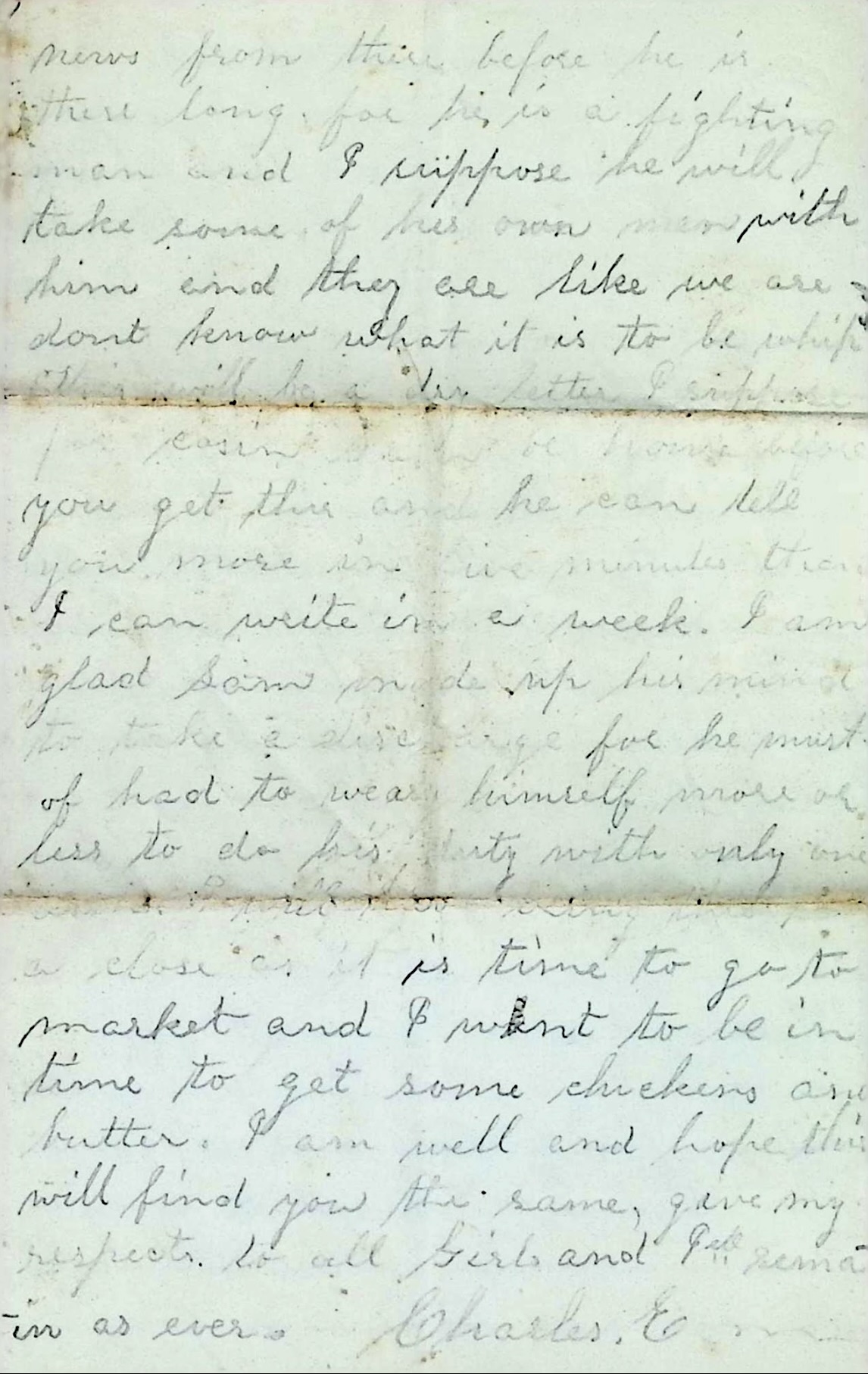
This will be a dry letter, I suppose, for cousin Sam will be home before you get this and he can tell you more in five minutes than I can write in a week. I am glad Sam made up his mind to take a discharge for he must of had to weary himself more or less to do his duty with only one arm [?].
I will have to close as it is time to go to market and I want to be in time to get some chickens and butter. I am well and hope this will find you the same. Give my respects to all the girls and tell them I remain as ever, — Charles E.
Letter 27
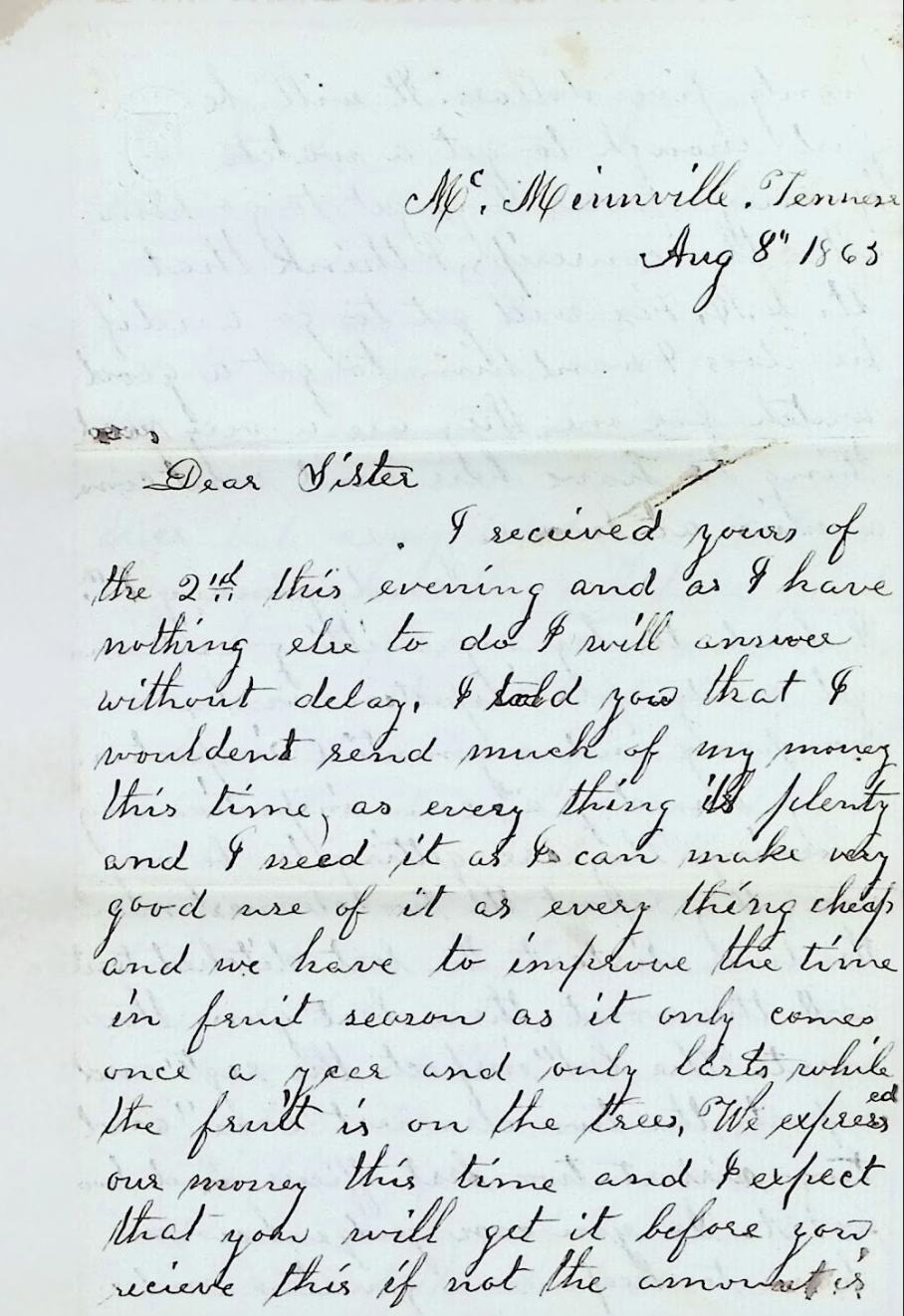
McMinnville, Tennessee
August 8th 1863
Dear Sister,
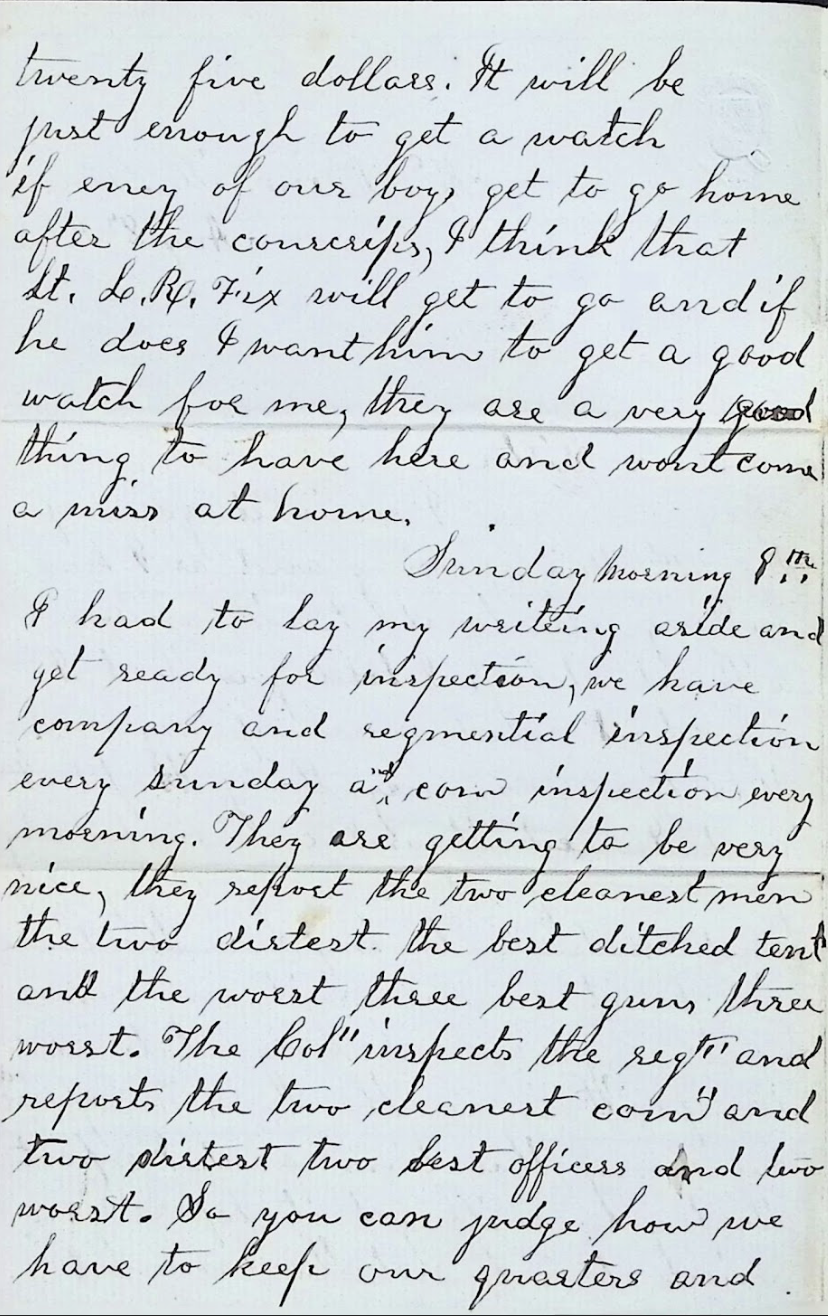
I received yours of the 2nd this evening and as I have nothing else to do, I will answer without delay. I told you that i wouldn’t send much of my money this time as everything is plenty and I need it as I can make very good use of it as everything is cheap and we have to improve the time in fruit season as it only comes once a year and only lasts while the fruit is on the trees. We expressed our money this time and I expect that you will get it before you receive this. If not, the amount is twenty-five dollars. It will be just enough to get a watch. If any of our boys get to go home after the conscripts—-I think that Lt. L[ewis] R. Fix will get to go—and if he does, I want him to get a good watch for me. They are a very good thing to have here and won’t come amiss at home.
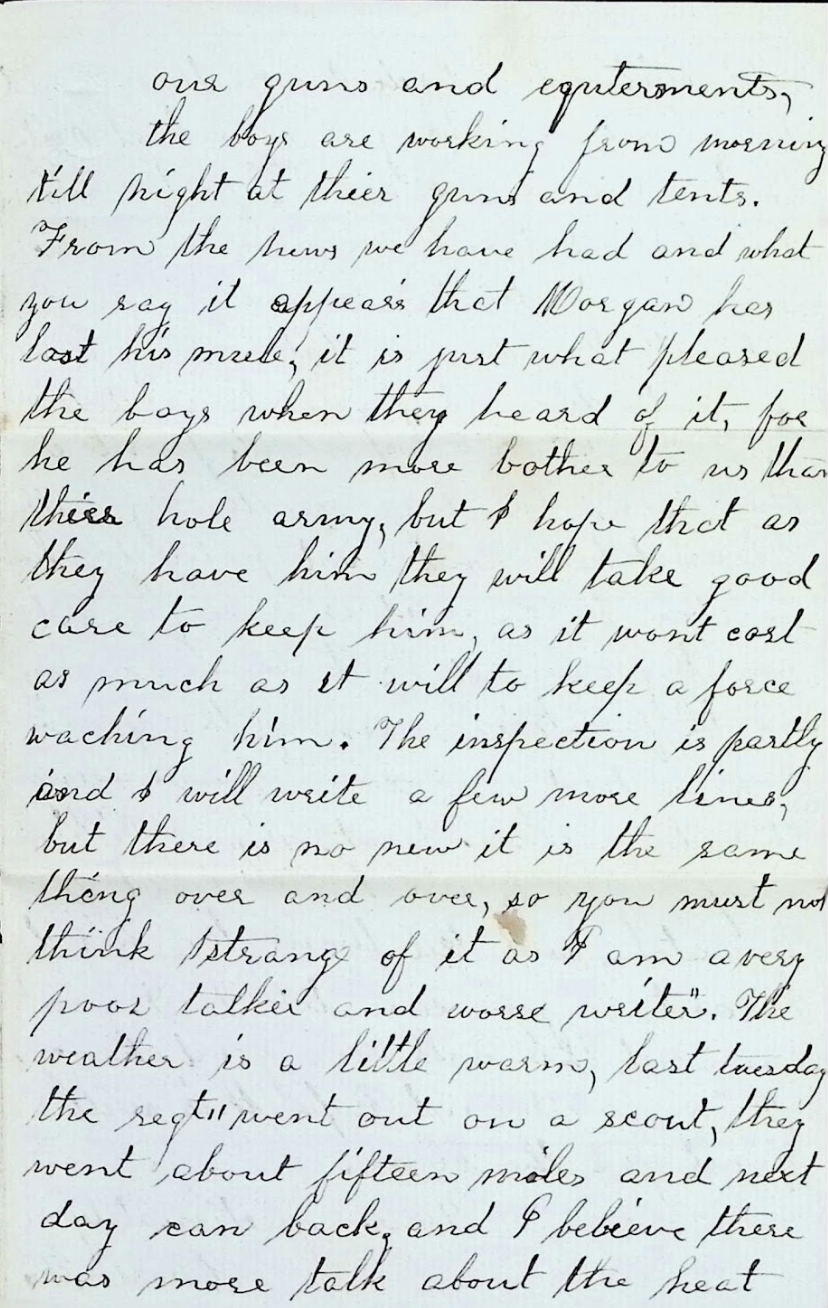
Sunday morning, 8 a.m. I had to lay my writing aside and get ready for inspection. We have company and regimental inspection every morning. They are getting to be very nice. They report the two cleanest men, the two dirtiest, the best ditched tent, and the worst, three best guns and three worst. The Colonel inspects the regiment and reports the two cleanest “com” and two dirtiest, two best officers and two worst. So you can judge how we have to keep our quarters and our guns and accoutrements. The boys are working from morning till night at their guns and tents.
From the news we have had and what you say, it appears that [John Hunt] Morgan has lost his mule. It is just what pleased the boys when they heard of it for he has been more bother to us than their whole army. But I hope that as they [now] have him, they will take good care to keep him as it won’t cost as much as it will to keep a force watching him.
The inspection is partly [over] and I will write a few more lines. But there is no news. It is the same thing over and over so you must not think strange of it as I am a very poor talker and worse writer.
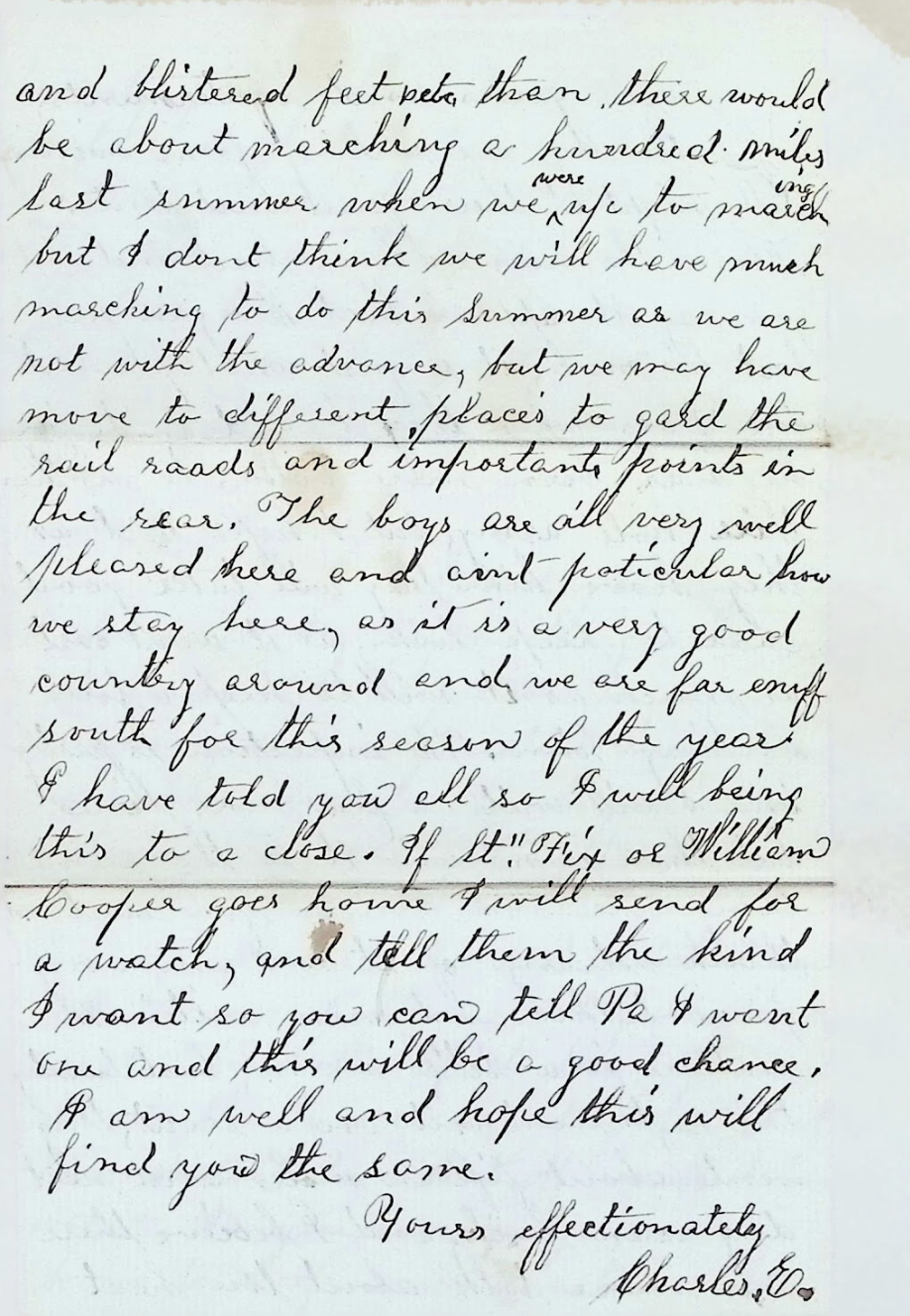
The weather is a little warm. Last Tuesday the regiment went out on a scout. They went about 15 miles and next day came back and I believe there was more talk about the heat and blistered feet, &c., than there would be marching a hundred miles last summer when we were up to marching. But I don’t think we will have much marching to do this summer as we are not with the advance. But we may have to move to different places to guard the railroads and important points in the rear.
The boys are all very well pleased here and ain’t particular how [long] we stay here as it is a very good country around and we are far enough south for this season of the year.
I have told you all so I will bring this to a close. If Lt. Fix or William Cooper goes home, I will send for a watch and tell them the kind I want so you can tell Pa I want one and this will be a good chance. I am well and hope this will find you the same. Yours affectionately, — Charles E.
 Spared & Shared 23