The following letters were written by Benjamin S. Kennicott (1817-1877) of Waukegan, Illinois. In the 1850 US Census, Benjamin—a native of Saratoga county, New York—was enumerated in Waukegan with his wife, Jane (b. 1822), and two children, Melissa (1842-1860) and John (b. 1846). At that time, his occupation was given as a bookkeeper. When he wrote these letters in late 1863, he was most likely a widower, but he remarried in April 1868 to Helen M. Edgecomb (1835-1928), the daughter of John Edgecomb (1803-1878) and Abby Gates (1806-1893) who outlived him by 50 years.
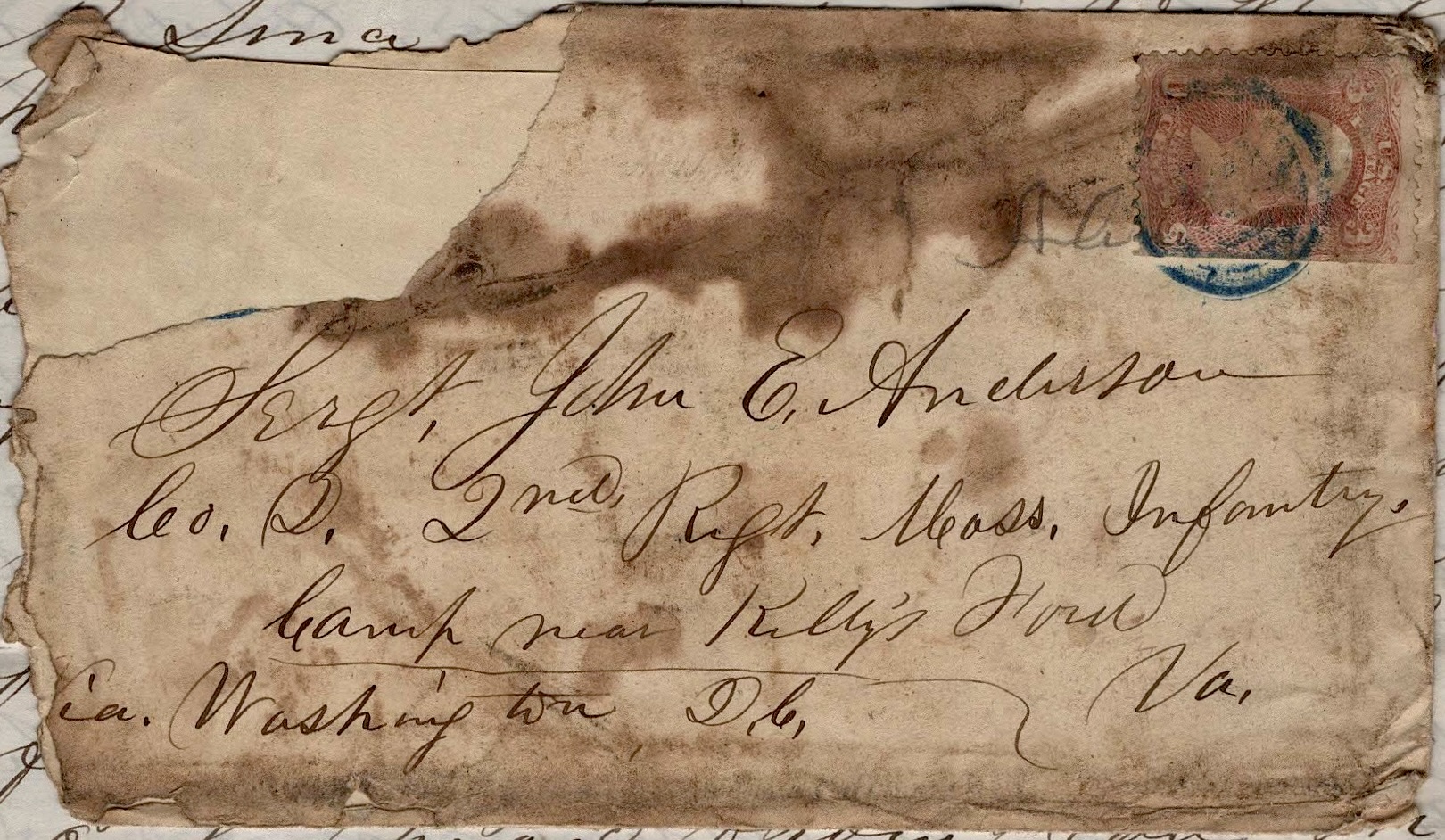
Benjamin wrote the letters to his friend John “Emerson” Anderson. At the time of the August 1863 letter, Emerson was serving in Co. D, 2nd Massachusetts Infantry and probably at the regimental camp near Kelly’s Ford, Virginia. The letter provides us with a good description of Waukegan, Illinois, where Emerson Anderson once worked as a boot maker in the S. S. Greenleaf & Company, boot & shoe manufacturing firm.
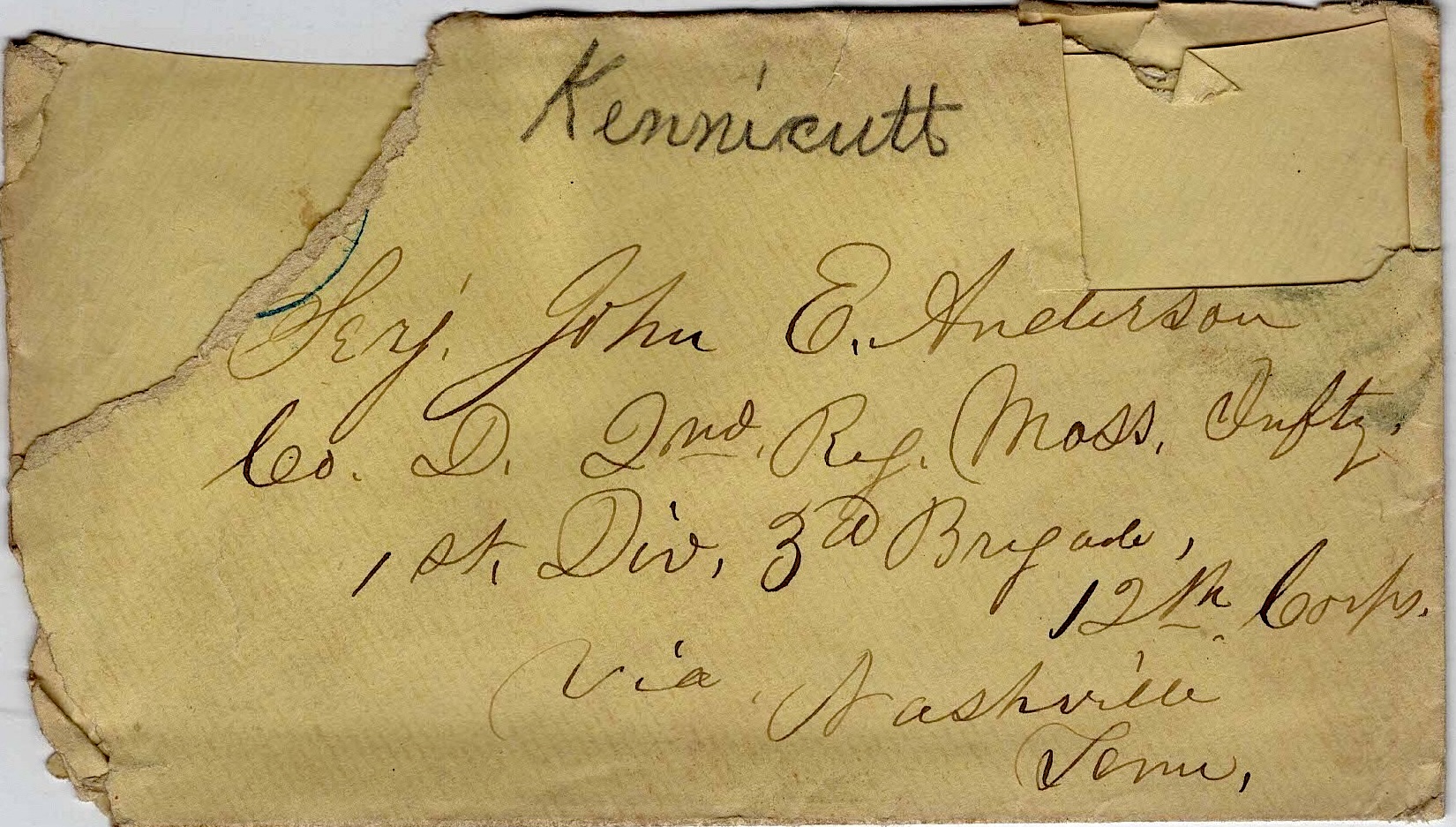
The letter of December 1863 was sent to Emerson after his regiment was transferred from the Army of the Potomac to the western theatre.
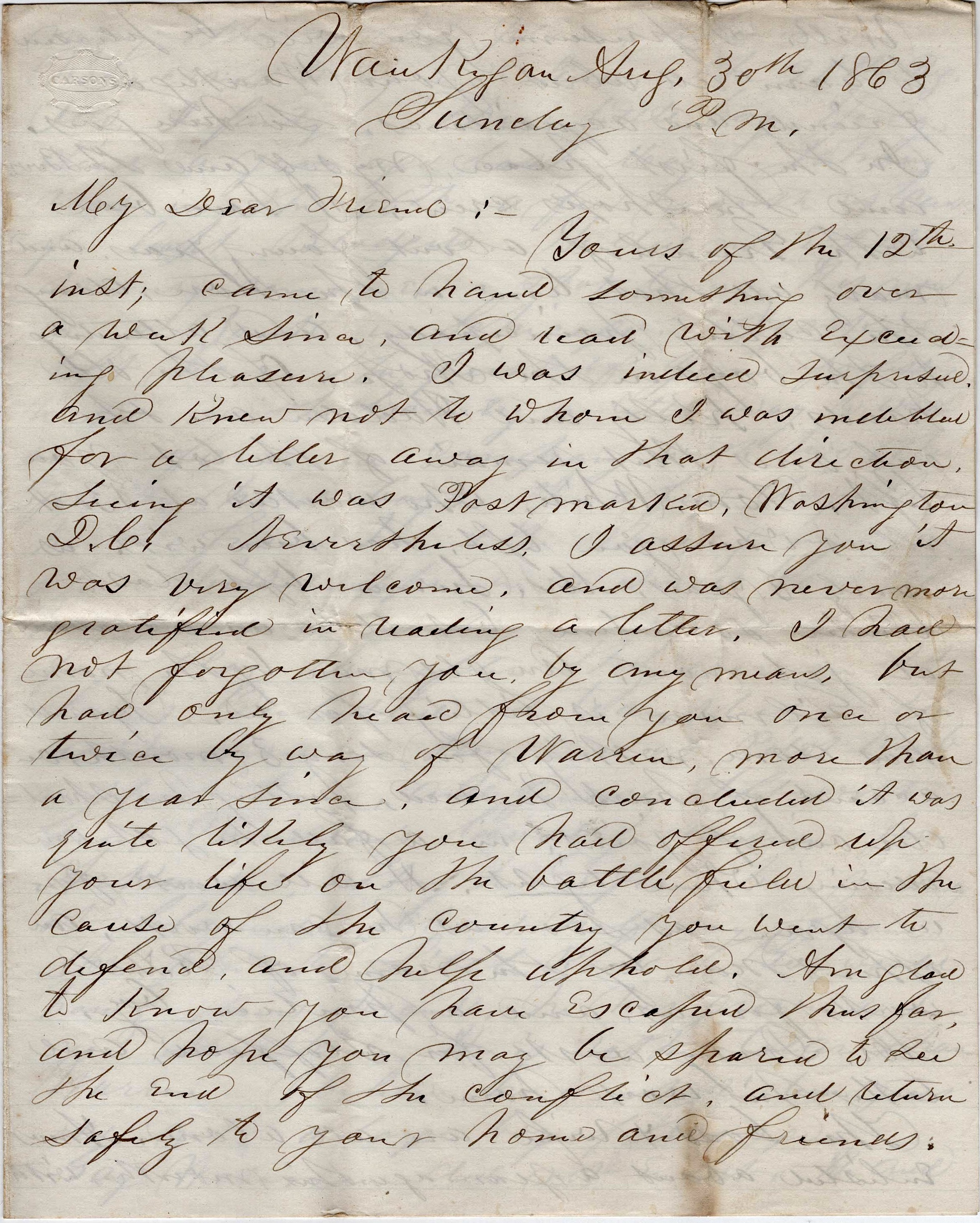
Letter 1
Waukegan [Lake County, Illinois]
Sunday p.m., August 30th 1863
My dear friend,
Yours of the 12th inst., came to hand something over a week since and read with exceeding pleasure. I was indeed surprised and knew not to whom I was indebted for a letter away in that direction, seeing it was postmarked Washington D. C. Nevertheless, I assure you, it was very welcome and was never more gratified in reading a letter. I have not forgotten you by any means, but had only heard from you once or twice by way of Warren more than a year since and concluded it was quite likely you had offered up your life on the battlefield in the cause of the country you went to defend and help uphold. Am glad to know you have escaped thus far and hope you may be spared to see the end of the conflict and return safely to your home and friends.
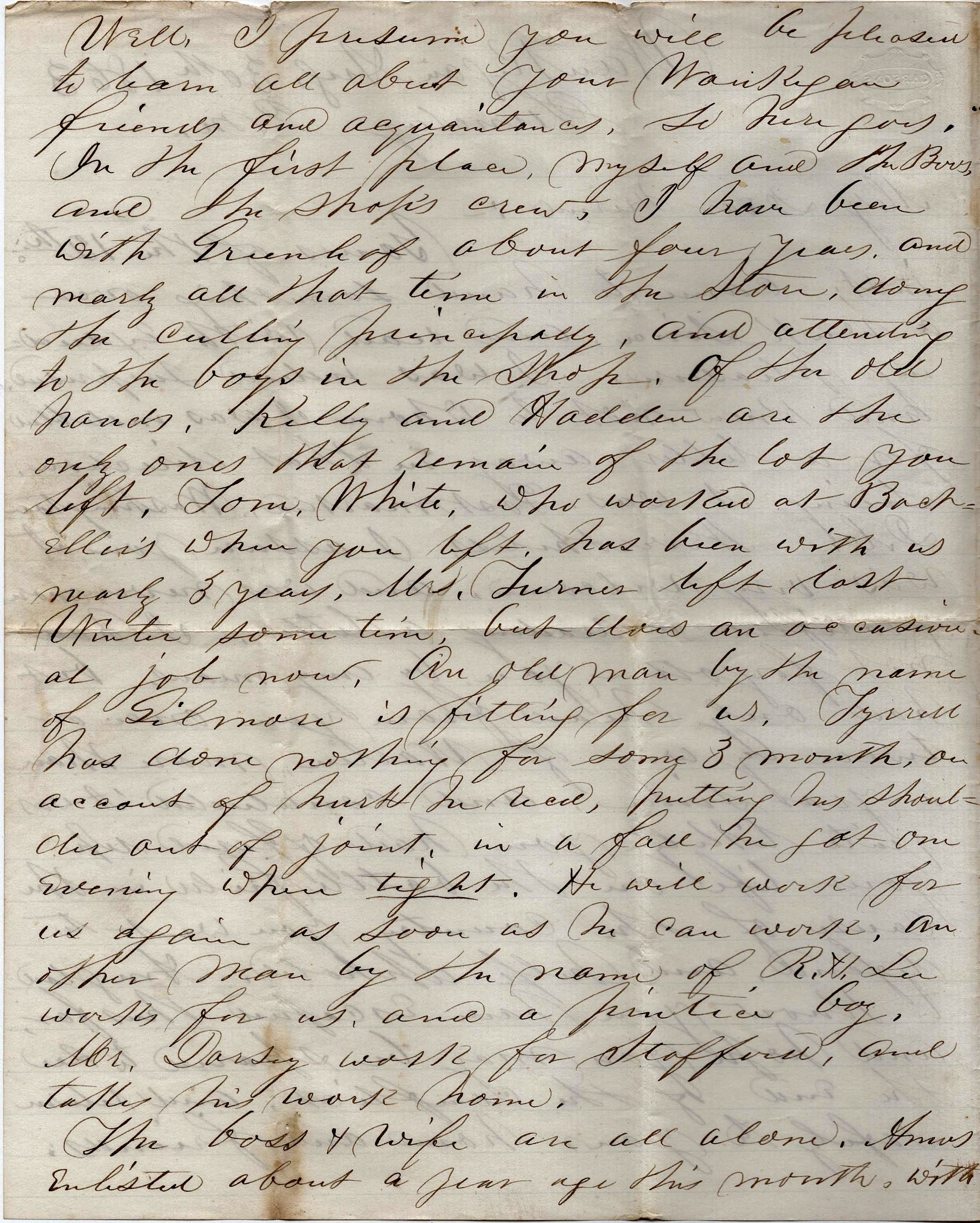
Well, I presume you will be pleased to learn all about your Waukegan friends and acquaintances, so here goes. In the first place, myself and the Boss and the shop’s crew. I have been with [Samuel Smith] Greenleaf 1 about four years and nearly all that time in the store doing the cutting principally and attending to the boys in the shop. Of the old hands, Kelly and Hadden are the only ones that remain of the lot you left. Tom White, 2 who worked at Bachellor’s when you left, has been with us nearly three years. Mr. Turner left last winter some time, but does an occasional job now. An old man by the name of [David A.] Gillmore is fitting for us. [Edward] Tyrell 3 has done nothing for some three months on account of hurt he received putting his shoulder out of joint in a fall he got one evening when tight. He will work for us again as soon as he can work. Another man by the name of R. H. Lee works for us and an apprentice boy. Mr. Dorsey works for Stafford and takes his work home.
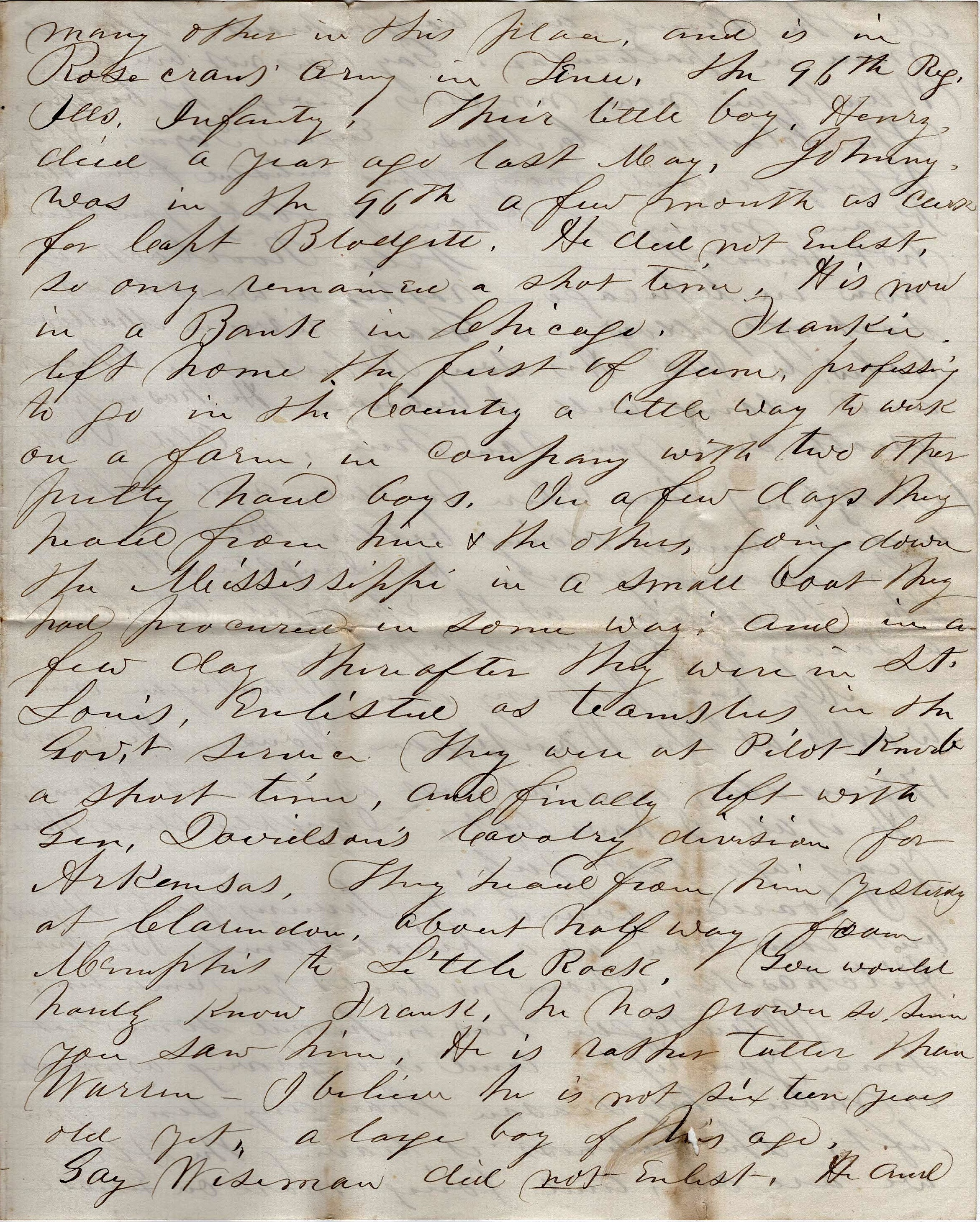
The boss & wife are all alone. Amos [Greenleaf] 4 enlisted about a year ago this month with many others in this place and is in Rosecrans’ army in Tennessee—the 96th Regiment Illinois Infantry. Their little boy, Henry, died a year ago last May. Johnny 5 was in the 96th a few months as cook for Capt. [A. Z.] Blodgett. He did not enlist so only remained a short time. He is now in a bank in Chicago. Franklin 6 left home the first of June professing to go in the country a little way to work on a farm in company with two other putty hand boys. In a few days, they heard from him & the others going down the Mississippi in a small boat they had procured in some way and in a few days thereafter they were in St. Louis, enlisted as teamsters in the Government service. They were at Pilot Knob [Missouri] a short time and finally left with Gen. Davidson’s Cavalry Division for Arkansas. They heard from him yesterday ay Clarendon, about half way from Memphis to Little Rock. You would hardly know Frank, he has grown so since you saw him. He is rather taller than Warren. I believe he is not sixteen years old yet—a large boy of his age.
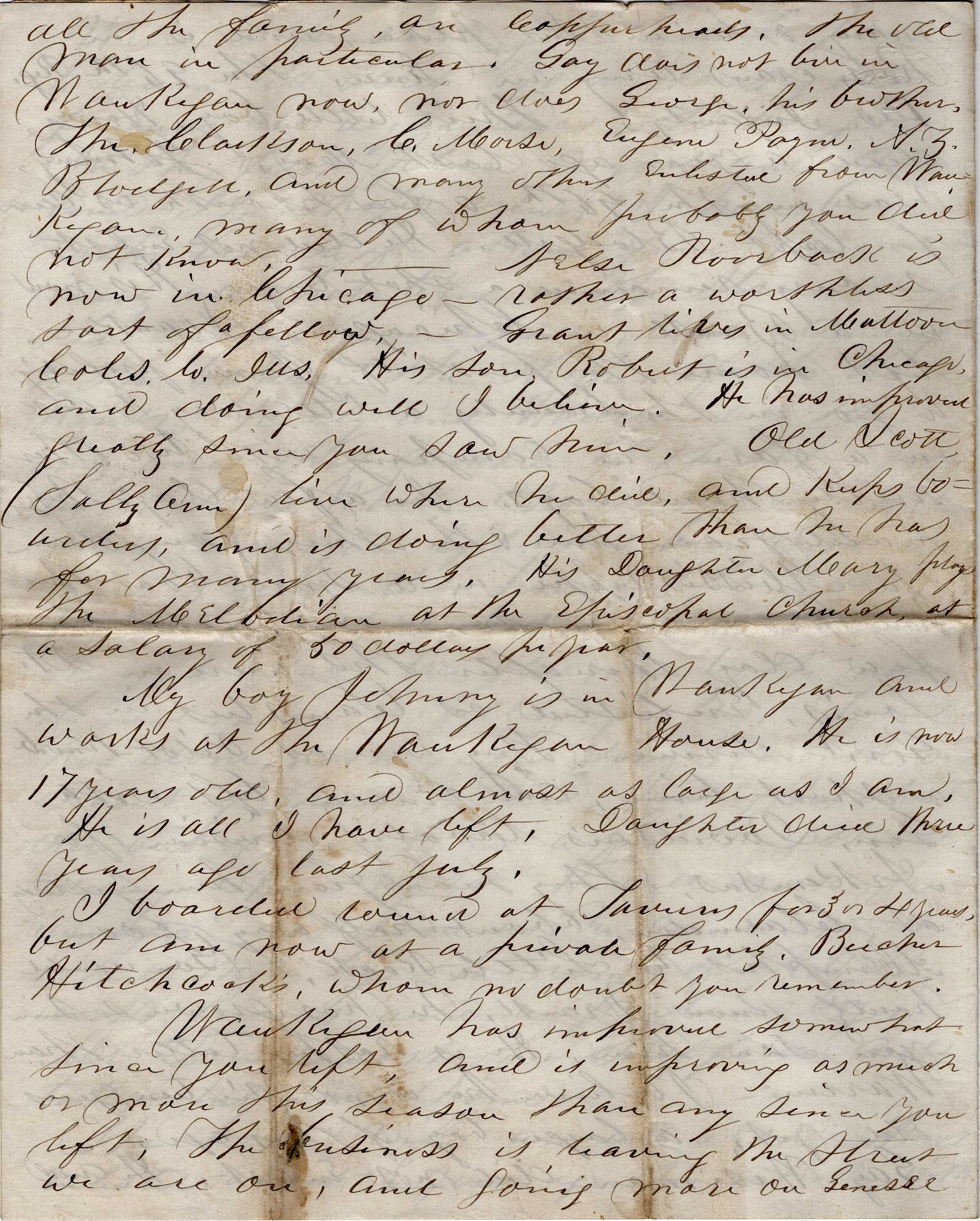
Gay Wiseman 7 did not enlist. He and all his family are Copperheads—the old man in particular. Gay does not live in Waukegan now, nor does George [Wiley Wiseman], his brother. Mr. Clarkson, C. Morse, Eugene Payne 8, A[siel] Z. Blodgett, and many others enlisted from Waukegan, many of whom probably you did not know. Nelson Roorbach 9 is now in Chicago—rather a worthless sort of a fellow.
[George] Grant lives in Mattoon, Coles county, Illinois. His son, Robert, is in Chicago and doing well, I believe. He has improved greatly since you saw him. Old Scott (Sally Ann) lives where he did and keeps boarders and is doing better than he has for many years. His daughter Mary plays the melodeon at the Episcopal Church at a salary of 50 dollars per year.
My boy Johnny is in Waukegan and works at the Waukegan House. He is now 17 years old and almost as large as I am. He is all I have left. Daughter [Melissa] died three years ago last July. I boarded round at Taverns for three or four years but am now at a private family—Beecher Hitchcock’s, whom no doubt you remember.
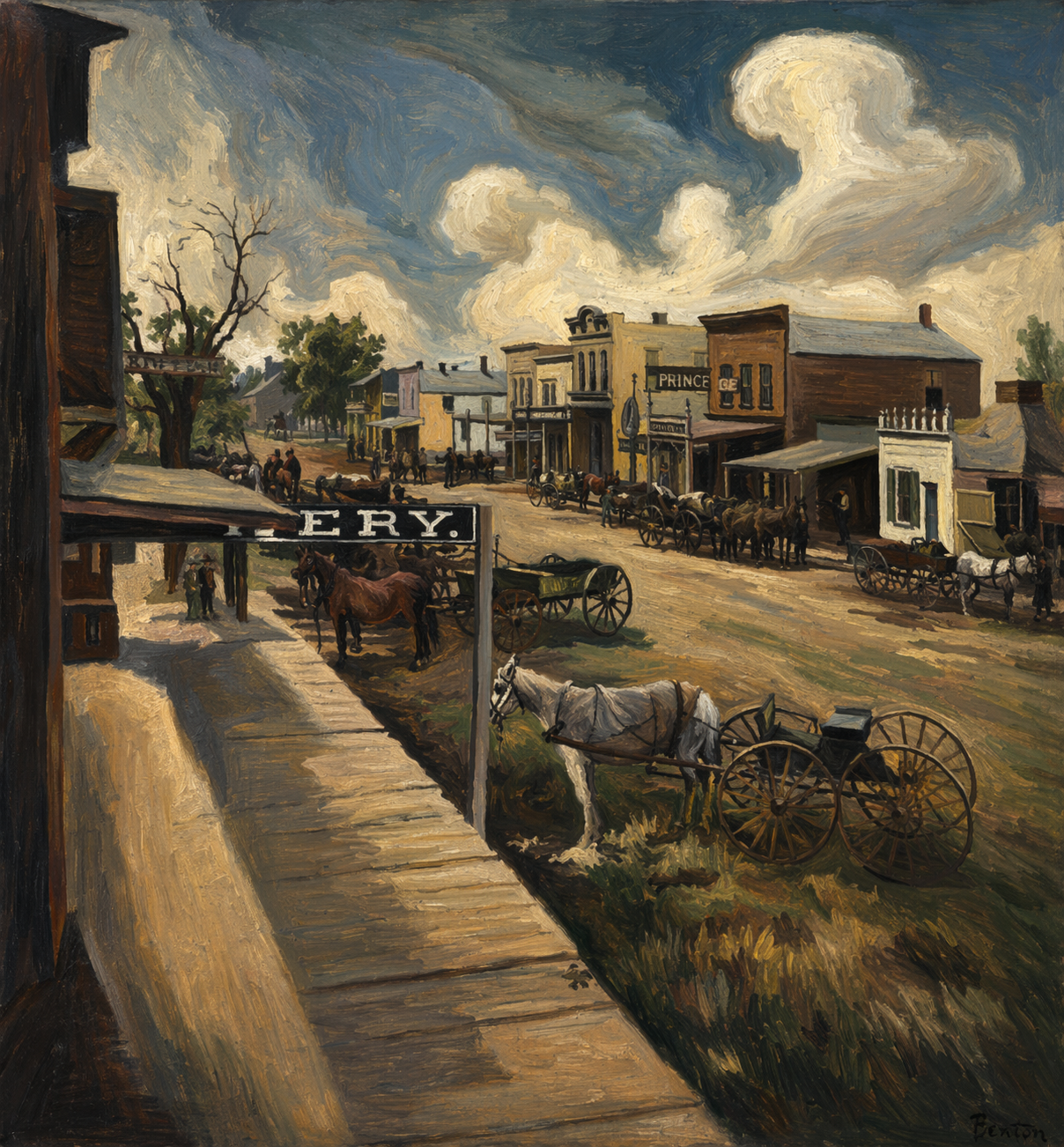
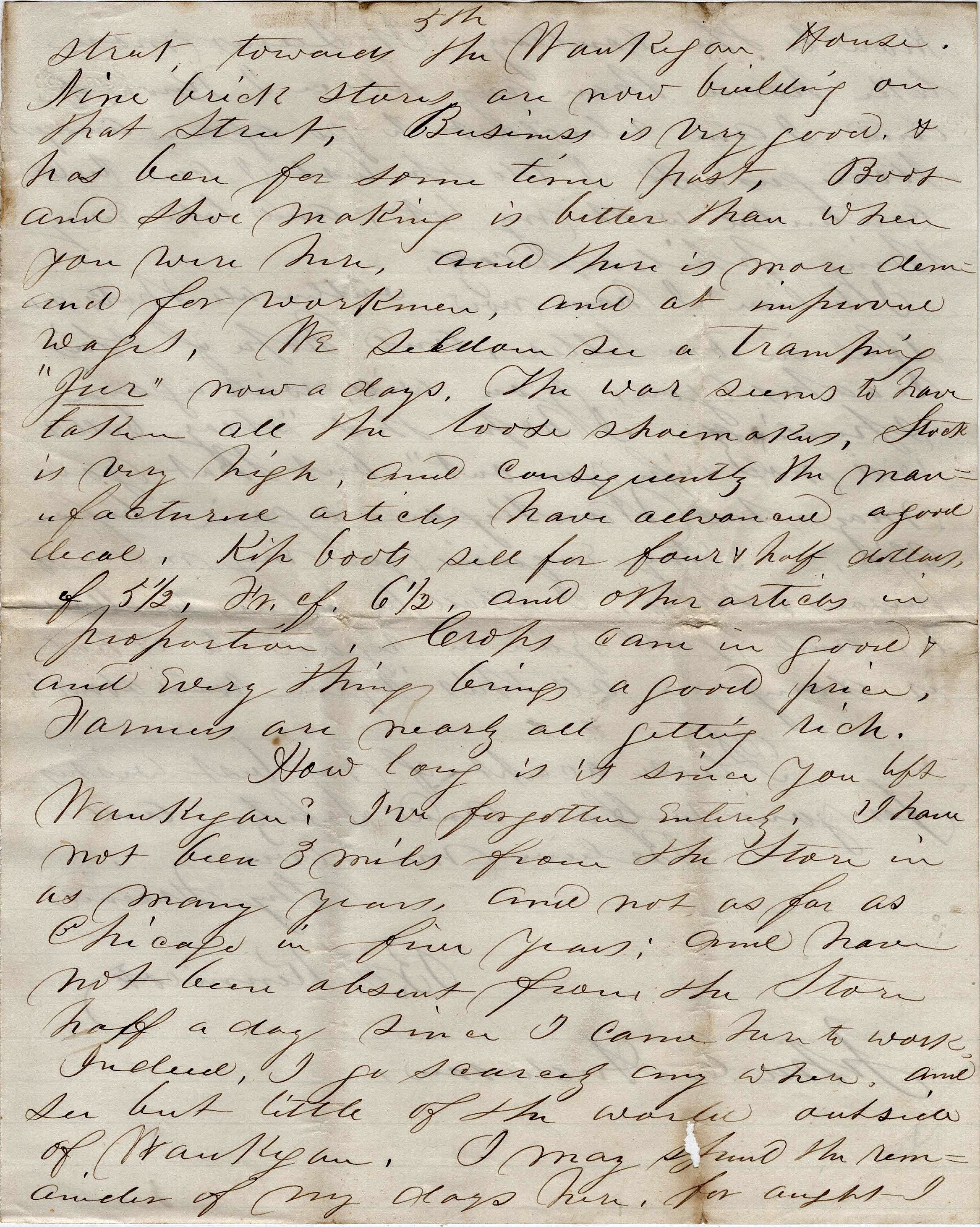
Waukegan has improved somewhat since you left and is improving as much or more this season than any since you left. The business is leaving the street we are on and going more on Genesee Street towards the Waukegan House. Nine brick stores are now building on that street. Business is very good It has been for some time past. Boot and Shoe Making is better than when you were here, and there is more demand for workmen and at improved wages. We seldom see a tramping “Jur” [Journeyman?] nowadays. The war seems to have taken all the loose shoemakers. Stock is very high and consequently the manufactured articles have advanced a good deal. Kip boots 11 sell for four and a half dollars, f 5 1/2, Fr. f. 6 1/2, and other articles in proportion. Crops came in good & everything brings a good price. Farmers are nearly all getting rich.
How long is it since you left Waukegan? I’ve forgotten entirely. I have not been 3 miles from the store in as many years and not as far as Chicago in five years, and have not been absent from the store half a day since I came here to work. Indeed, I go scarcely anywhere and see but little of the world outside of Waukegan. I may spend the remainder of my days here for aught I know to the contrary. It seems more like home than any place I know of and I am reluctant to go again amongst strangers so I do the best I can to be contented with my lot and take everything philosophically.
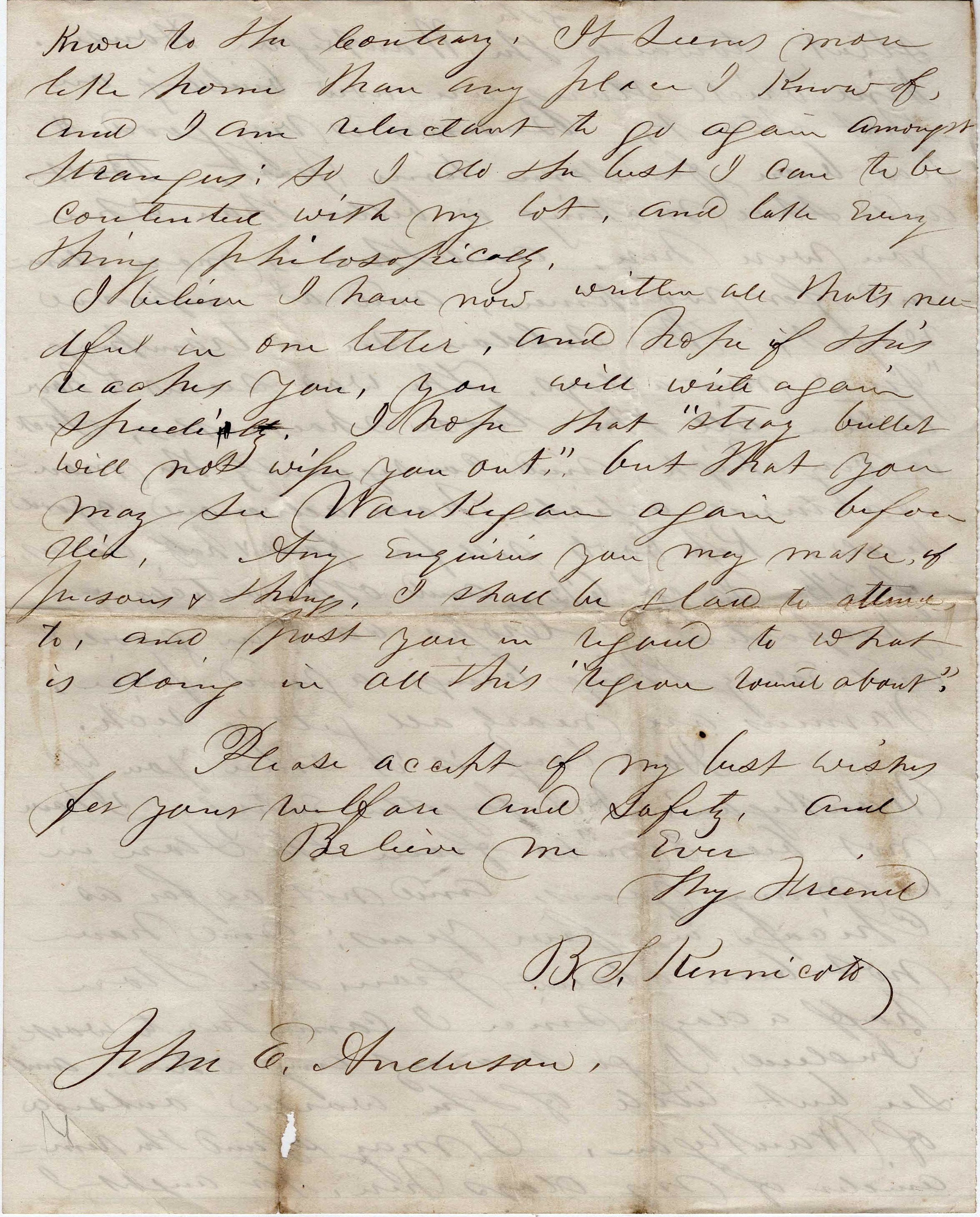
I believe I have now written all that’s needful in one letter and hope if this reaches you, you will write again speedily. I hope that “stray bullets will not wipe you out” but that you may see Waukegan again before I die. Any enquiries you may make of persons & things, I shall be glad to attend to, and post you in regard to what is doing in all this “upon round about.”
Please accept of my best wishes for your welfare and safety and believe me ever thy friend, — B. S. Kennicott
[to] John E. Anderson
1 Samuel Smith Greenleaf (1818-Aft1900), was the son of Flavel Greenleaf (1791-1850) and Eunice Smith (1794-1847). He was the owner of S. S. Greenleaf & Co., “manufacturers and dealers in boots, shoes, leather and findings” in Waukegan.
2 Thomas Francis White (1826-1879), was born in Sligo, Ireland, and came to the United States in 1847, settling first in Haverhill, Massachusetts. He moved to Waukegan, Illinois, in 1854 and worked as a bootmaker for S. S. Greenleaf in 1860. In March 1864, he mustered into the Chicago Mercantile Independent Light Battery and served until July 1865.
3 Edward Tyrell (1835-1863) was born in Ireland and came to the United States in 1848, settling first in Brooklyn. After a few years in Utica, New York, he came to Waukegan where prior to 1856. He was a shoemaker for the S. S. Greanleaf & Co.
4 Amos Greenleaf (1836-1914) was the son of Flavel Greenleaf (1791-1850) and Eunice Smith (1794-1847) of Oakland county, Michigan. Amos served as a sergeant in Co. G, 96th Regiment Illinois Infantry. In 1860, Amos was enumerated as a 24 year-old clerk in Waukegan, Illinois.
5 Johnny Flavel Greenleaf (1845-1887) was the son of Samuel Smith Greenleaf (1818-1915) of Waukegan, Illinois.
6 Samuel Franklin Greenleaf (1847-1933) was the son of Samuel Smith Greenleaf (1818-1915) of Waukegan, Illinois.
7 Gaius (“Gay’) Wiseman (1833-1918) was born in Gainesville, Wyoming county, New York. He came with his parents, James Wiseman (1799-1879) and Orril Lawrence (1804-1884), to Waukegan, Illinois, in the 1840s and married Mary Yeager in 1858. He was a tinner in Waukegan until 1863 when he left town and settled in Sycamore, DeKalb county, Illinois, employed by R. Ellwood and also the Haight Brothers.
8 Eugene Beauharnais Payne (1835-1919) of Seneca Falls, New York, came to Waukegan with his parents in 1837. In the Civil War, Eugene joined the Waukegan Zouaves who were eventually made part of the 37th Illinois Infantry. Eugene was made the captain of Co. C. He rose in rank to command the regiment and later made a Brigadier General.
9 Nelson Roorbach (1818-1904) was a shoemaker who lived in his later years in Chicago but was buried in Waukegan.
10 George Grant (1817-1891), a native of Scotland, was enumerated in 1850 and 1860 working as a shoemaker in Waukegan. His son, Robert Daniel Grant (1841-1911) lived in Chicago.
11 “Kip boots” in 1863 refers to durable, long-legged boots made from “kip leather”—a hide from a young cow, smaller than a full-grown ox but larger than a calf. These were commonly worn during the American Civil War era and were highly prized for their durability in heavy mud.
Letter 2
Waukegan, [Lake county, Illinois]
Sunday, December 6, 1863
My dear friend,
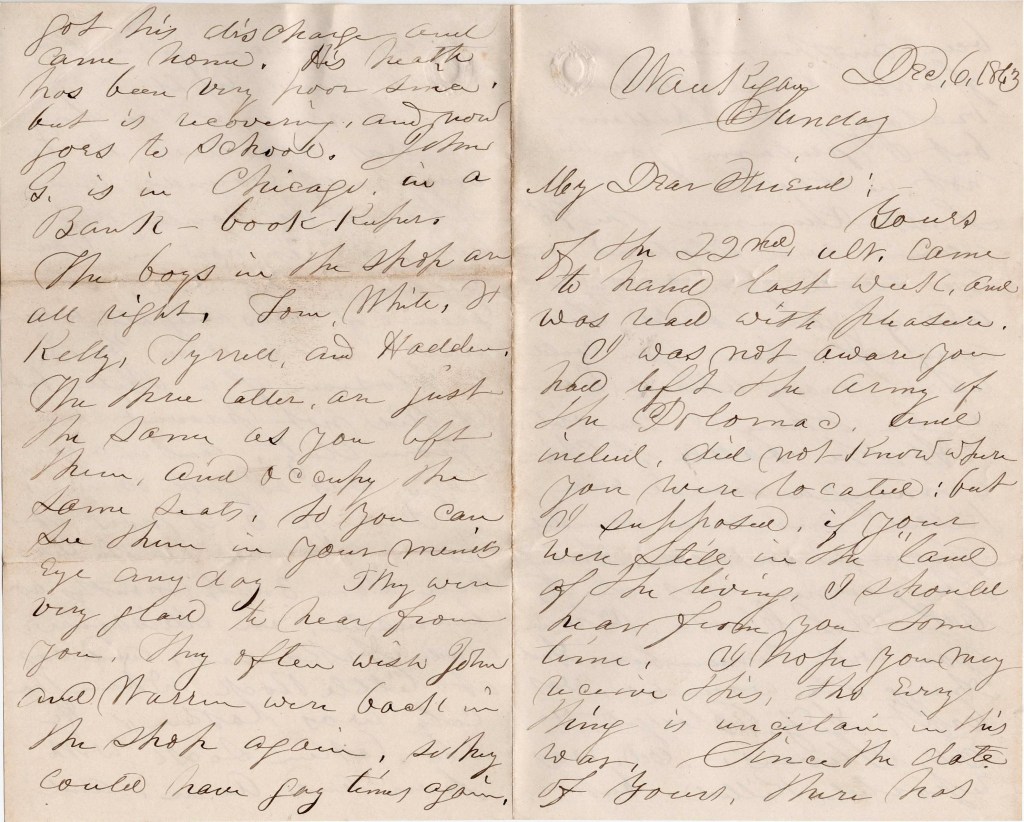
Yours of the 22nd ultimo came to hand last week and was read with pleasure. I was not aware you had left the Army of the Potomac and indeed, did not know where you were located, but I supposed if you were still in the land of the living, I should hear from you sometime. I hope you may receive though everything is uncertain in this war.
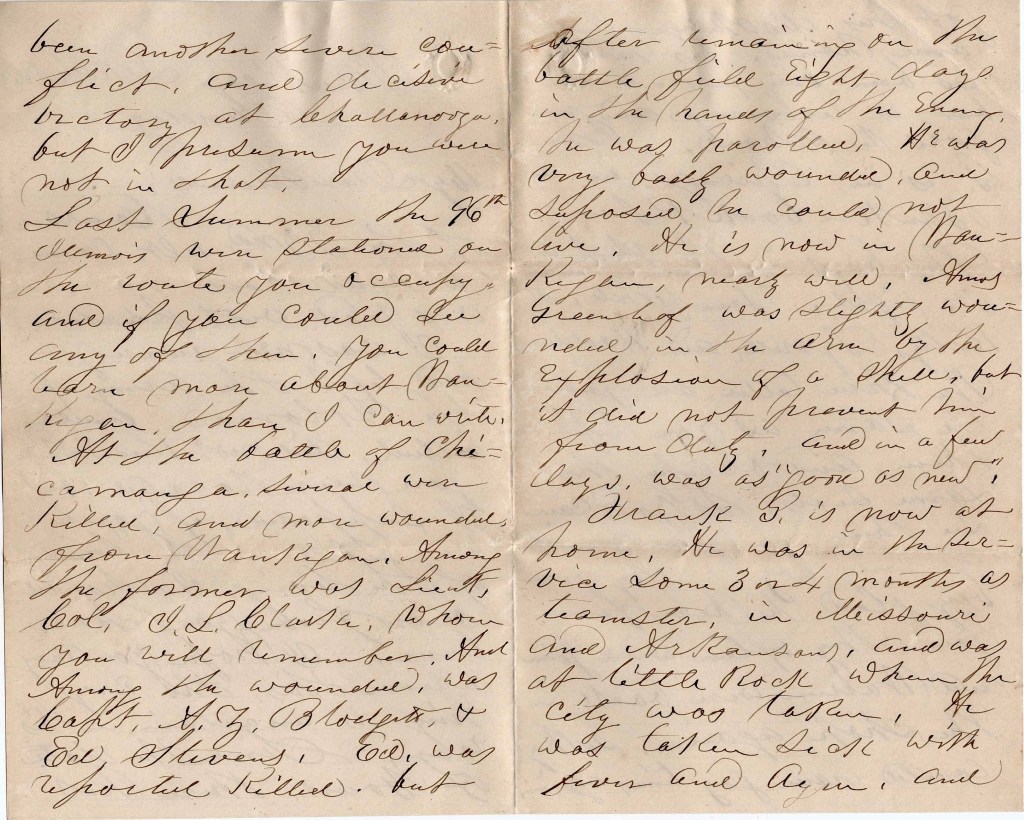
Since the date of yours, there has been another severe conflict and decisive victory at Chattanooga but I presume you were not in that. Last summer the 96th Illinois were stationed on the route you occupy and if you could see any of them, you could learn more about Waukegan than I can write. At the Battle of Chicakamauga, several were killed, and more wounded from Waukegan. Among the former was Lieut. Colonel I[saac] L. Clarke whom you will remember. And among the wounded was Capt. A[siel] Z. Blodgett & Ed[mund] Stevens. Ed was reported killed but after remaining on the battlefield eight days in the hands of the enemy, he was paroled. He was very badly wounded and supposed he could not live. He is now in Waukegan, nearly well. 1 Amos Greenleaf was slightly wounded in the army by the explosion of a shell but it did not prevent him from duty and in a few days was as “good as new.”
Frank G[reenleaf] is now at home. He was in the service some three or four months as teamster in Missouri and Arkansas and was at Little Rock when the city was taken. He was taken sick with fever and ague and got his discharge. His health has been very poor since but is recovering and now goes to school. John G[reenleaf] is in Chicago in a bank [as] bookkeeper.
The boys in the shop are all right. Tom White, F. Kelly, Tyrell and Hadden. The three latter are just the same as you left them, and occupy the same seats. So you can see them in your mind’s eye any day. They were very glad to hear from you. They often wish John and Warren were back in the shop again so they could have gay times again.
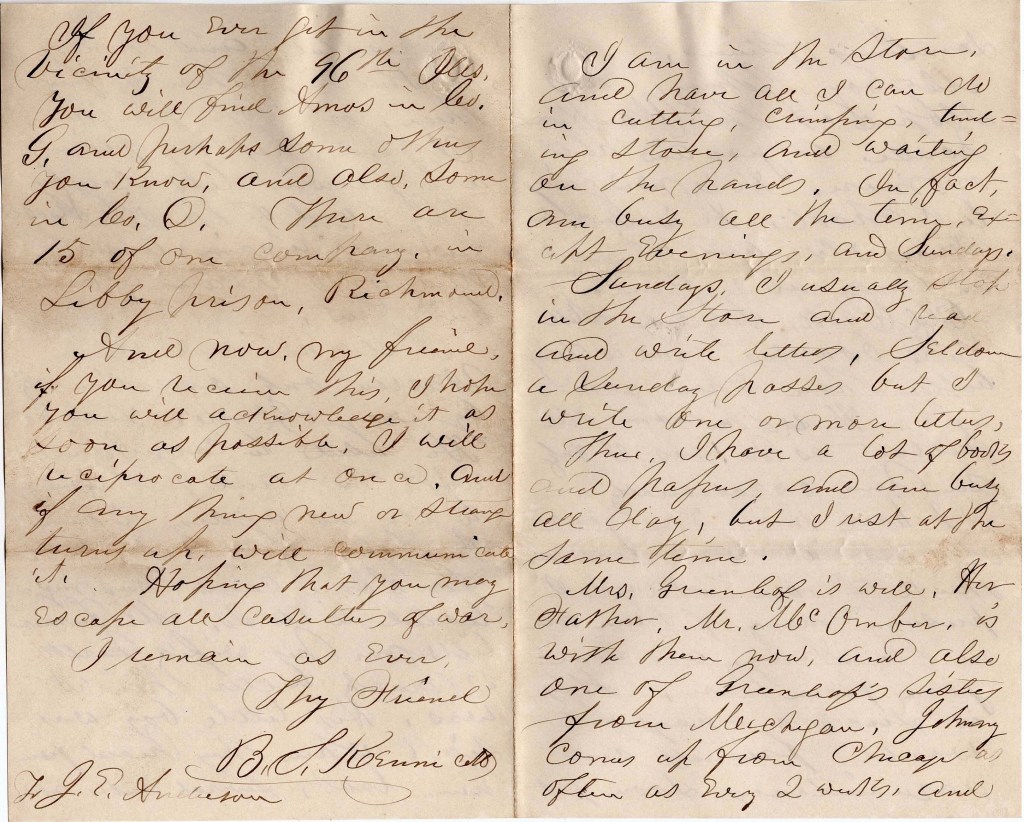
I am in the store and have all I can do in cutting, crimping, tending stove, and waiting on the hands. In fact, am busy all the time except evenings and Sundays. Sundays I usually stop in the store and read and write letters. Seldom a Sunday passes but I write one or more letters. Then I have lots of books and papers and am busy all day, but I rest at the same time.
Mrs. Greenleaf is well. Her Father—Mr. McOmber—is with them now and also one of Greenleaf’s sisters from Michigan. Johnny Conus up from Chicago as often as every two weeks, and sometimes oftener.
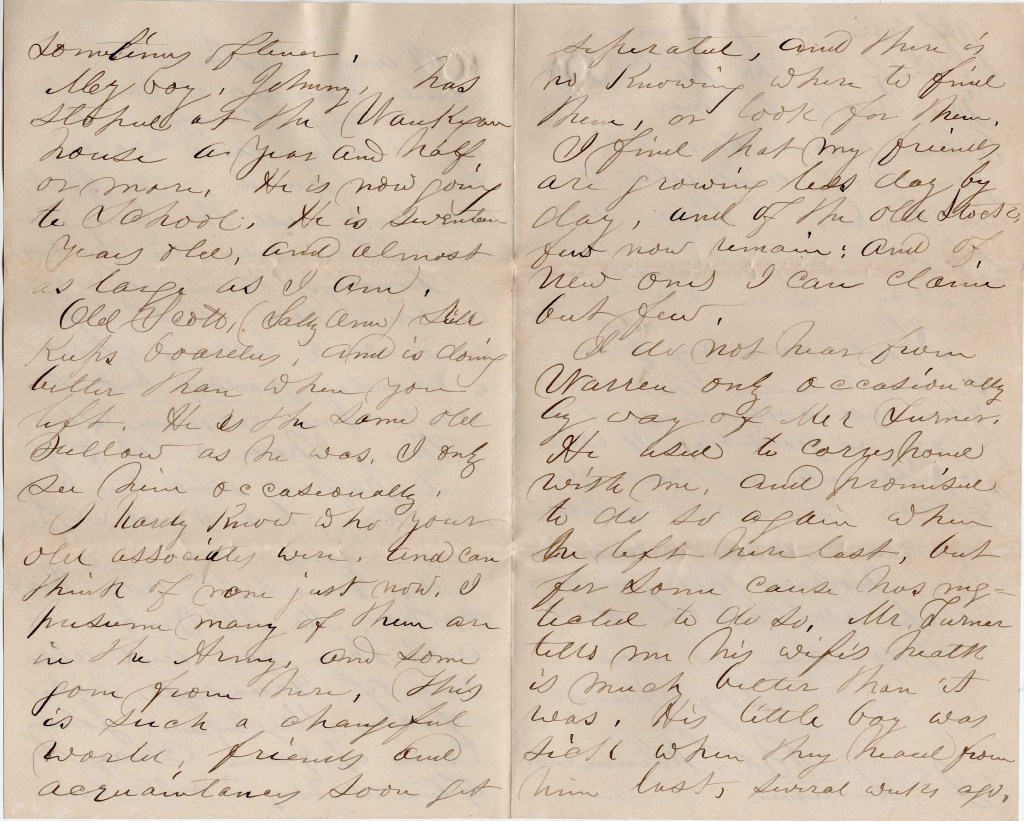
My boy, Johnny, has stopped at the Waukegan House a year and a half or more. He is now going to school. He is seventeen years old and almost as large as I am. Old Scott (Sally Ann) still keeps boarders and is doing better than when you left. He is the same old fellow as he was. I only see him occasionally.
I hardly know who your old associates were and can think of none just now. I presume many of them are in the army, and some gone from here. This is such a changeful world—friends and acquaintances soon get separated and there is no knowing where to find them, or look for them. I find that my friends are growing less day by day and of the old stock, few now remain. And of new ones, I can claim but few.
I do not hear from Warren only occasionally by way of Mr. Turner. He used to correspond with me and promised to do so again when he left here last, but for some cause has neglected to do so. Mr. Turner tells me his wife’s health is much better than it was. His little boy was sick when they heard from him last several weeks ago.
If you ever get in the vicinity of the 96th Illinois [Infantry], you will find Amos [Greenleaf] in Co. G and perhaps some others you know, and also, some in Co. D. There are 15 in one company in Libby Prison, Richmond.
And now, my friend, if you receive this, I hope you will acknowledge it as soon as possible. I will reciprocate at once. And if anything new or strange turns up, will communicate it. Hoping that you may escape all casualties of war, I remain as ever thy friend, — B. S. Kennicutt
To J. E. Anderson
1 “Edmund Stevens, who had been hurt by the shell that disabled Lieutenant Clarkson, fought on until shot through the body. He was left for dead upon the field, but subsequently revived; was exchanged in a few days, and eventually recovered, although never again able to take his place in the field.” [Source: Regimental History]