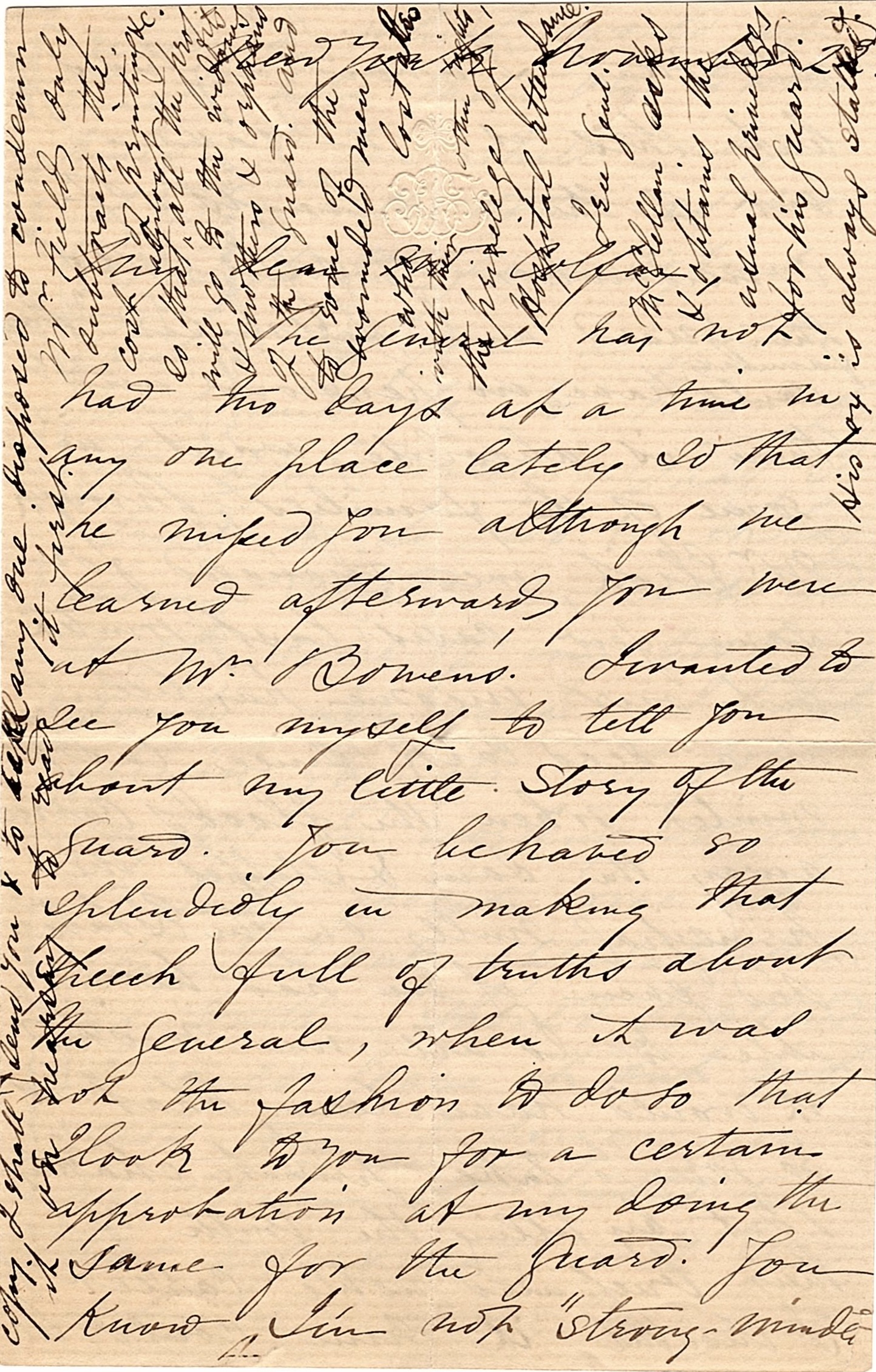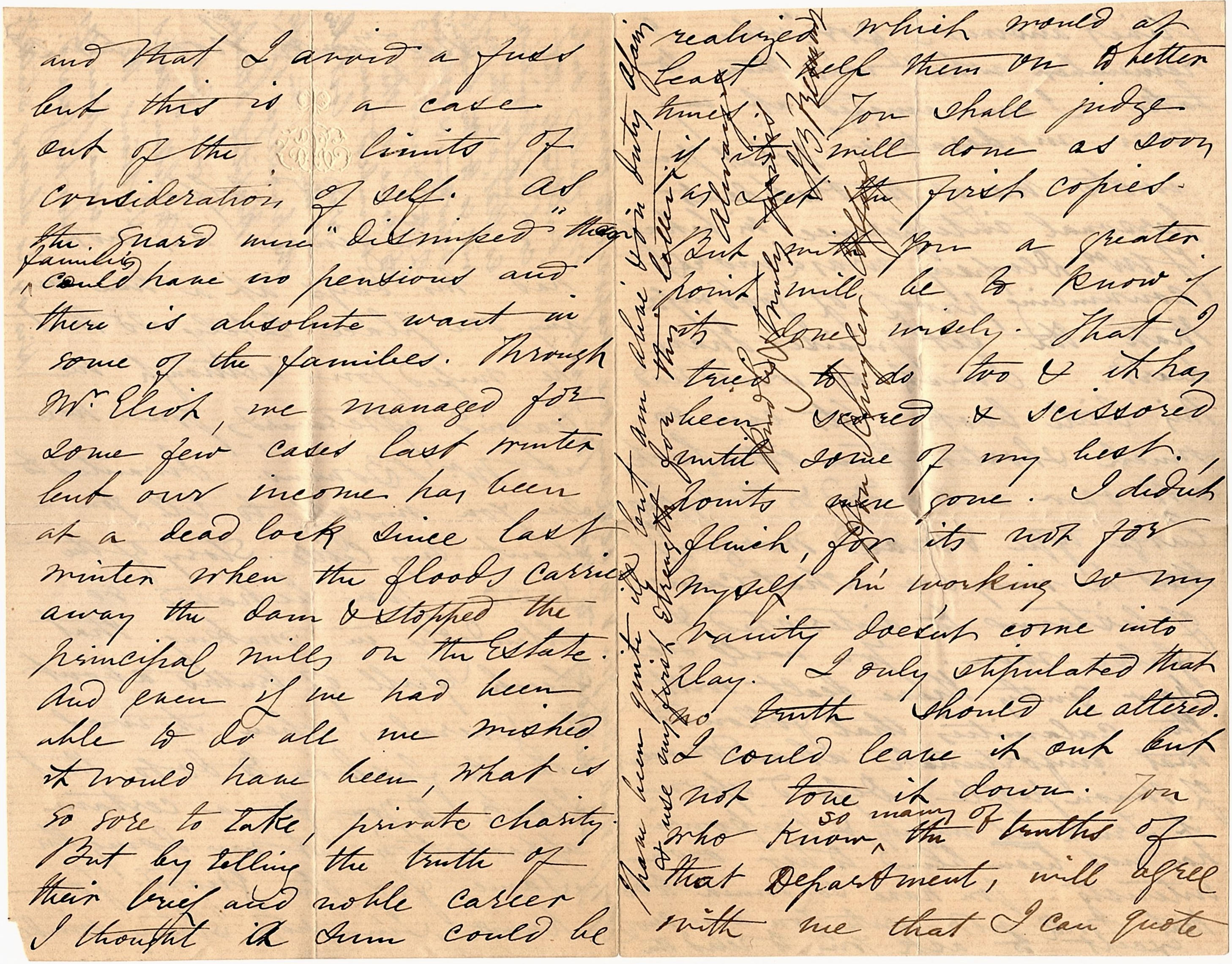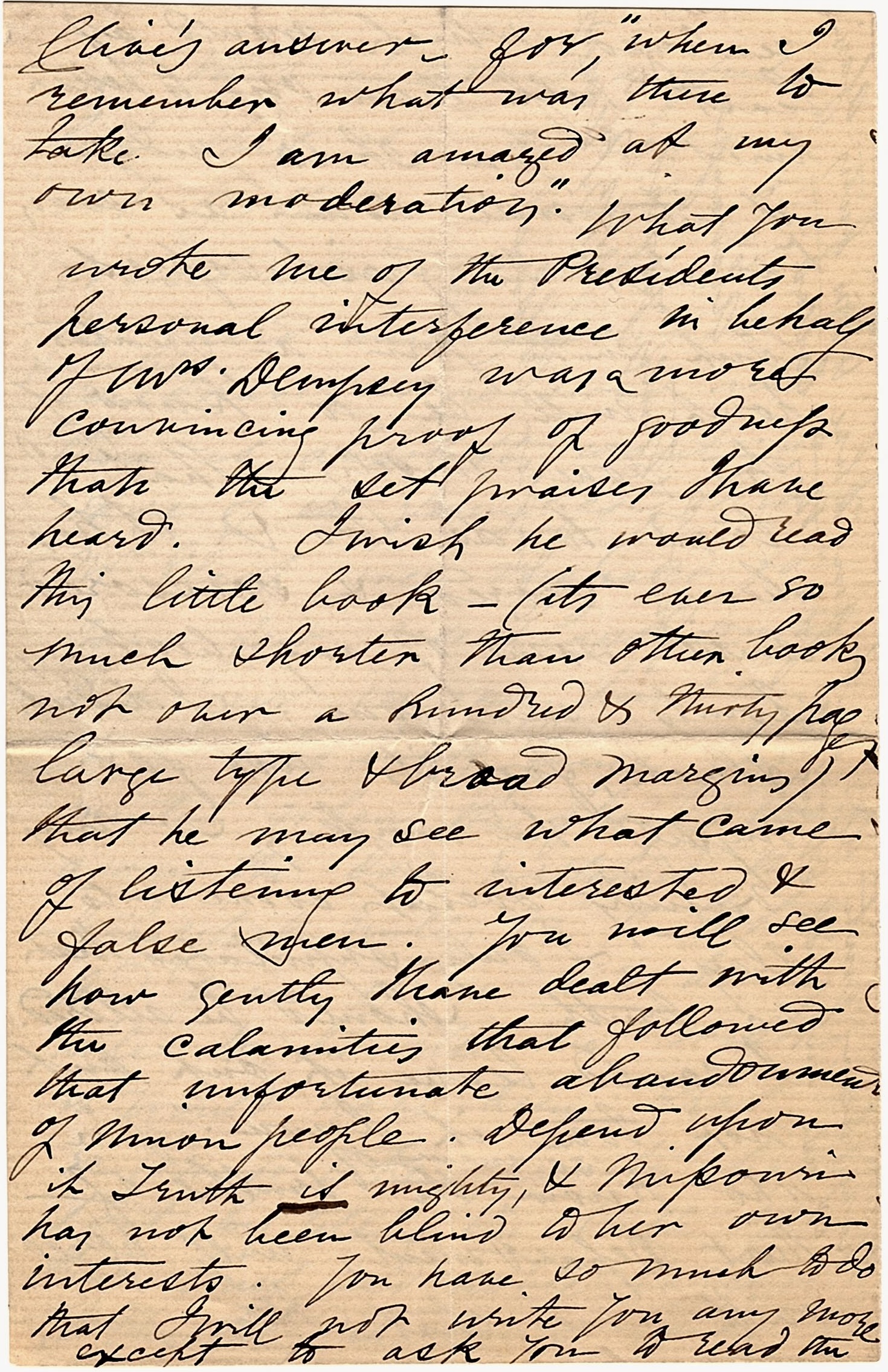
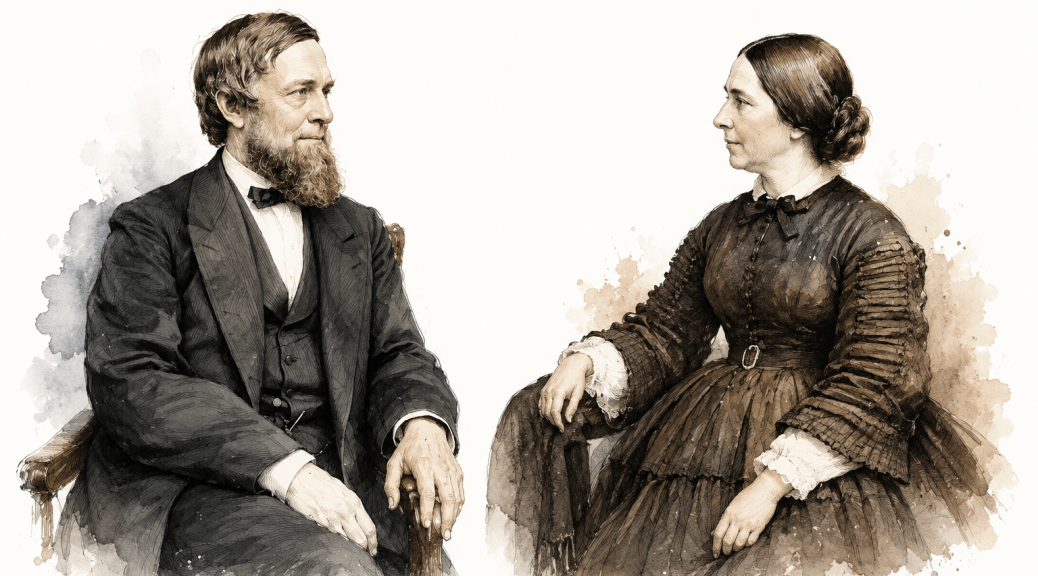
The following letter was composed by Jessie Ann Benton Frémont (1824-1902), the daughter of Missouri Senator Thomas Hart Benton and the spouse of General John Charles Frémont. It was inscribed on Jessie’s personal stationery, adorned with her monogram embossed at the top center of the first page. The letter was addressed to Schuyler Colfax, a distinguished member of the US House of Representatives whom she regarded as a political ally and supporter of her husband. She dispatched the letter in an effort to secure support for her forthcoming publication, entitled “The Story of the Guard: A Chronicle of the War.” In this work, she advocated for her husband and his distinguished bodyguard, particularly the “California Hundred”—a specialized volunteer cavalry unit. Her stated objective was to raise funds for the families of the soldiers within this unit, who had been denied pensions.
This letter resides in the personal collection of Peter G. Meyerhof, who has kindly provided me with a verified transcription for accuracy, along with comprehensive footnotes from his rigorous scholarly research. He has generously permitted the publication of the letter on Spared & Shared.
Evidence that Schuyler Colfax was a close, personal friend of President Lincoln can be found in the following letters published in Spared & Shared. See—1861-64: Letters of Charles M. Heaton.
More details of John C. Frémont’s California estate can be found in the letters of Biddle Boggs of Maricopa county, published on Spared & Shared. See—1856-61: Biddle Boggs to Sarah Sophia (Boggs) Wheldon.
T R A N S C R I P T I O N
New York, November 22 [1862] 1
My dear Mr. Colfax, 2
The General 3 has not had two days at a time in any one place lately so that he missed you although we learned afterwards you were at Mr. Bowen’s. 4 I wanted to see you myself to tell you about my little Story of the Guard. 5 You behaved so splendidly in making that speech 6 full of truths about the General, when it was not the fashion to do so that I look to you for a certain approbation at my doing the same for the Guard. You know I’m not “strong-minded” and that I avoid a fuss but this is a case out of the limits of consideration of self.
As the Guard were “dismissed” their families could have no pensions and there is absolute want in some of the families. Through Mr. Eliot, 7 we managed for some few cases last winter but our income has been at a dead lock since last winter when the floods carried away the dam and stopped the principal mills on the Estate. 8 And even if we had been able to do all we wished it would have been—what is so sore to take—private charity. But by telling the truth of their brief and noble career, I thought a sum could be realized which would at least help them on to better times. You shall judge if its well done as soon as I get the first copies. But with you a greater point will be to know if it’s done wisely. That I tried to do too and it has been scored and scissored until some of my best points were gone. I didn’t flourish, for it’s not for myself I’m working, so my vanity doesn’t come into play. I only stipulated that no truth should be altered. I could leave it out but not tone it down. You, who knows so many of the truths of that Department, will agree with me that I can quote Clive’s answer, for “when I remember what was there to take, I am amazed at my own moderation.” 9
What you wrote me of the President’s 10 personal interference in behalf of Mrs. Dempsey 11 was a more convincing proof of goodness than the set praises I have heard. I wish he would read this little book—(its ever so much shorter than other books, not over a hundred and thirty pages, 12 large type and broad margins) that he may see what came of listening to interested and false men. 13 You will see how gently I have dealt with the calamities that followed that unfortunate abandonment of Union people. Depend upon it—Truth is mighty, and Missouri has not been blind to her own interests.
You have so much to do that I will not write you any more except to ask you to read the copy I shall send you and to tell any one disposed to condemn it on hearsay to read it first. Mr. Fields 14 only subtracts the cost of printing etc. so that almost all the profits will go to the widows and mothers and orphans of the Guard and to some of the wounded men who lost also with their other rights the privilege of Hospital attendance.
I see Genl. McClellan 15 asks and obtains the usual privileges for his Guard. His ox is always stalled.
I have been quite ill but am alive and on duty again and use my first strength for this letter. Always, kindly and truly yours, — J. B. Frémont
[to] Hon. Schuyler Colfax
1) Although the year 1862 does not appear in the letter (as was typical on most of her other letters), it can be determined from dating the publication information on The Story of the Guard, the speech of Colfax, and the California flood of 1862 as provided in notes # 5, 6, and 8 below.
2) Schuyler Colfax (1823-1885), Republican Congressman from Indiana, friend of the Frémonts, energetic opponent of slavery, and later Speaker of the House of Representatives (December 1863 to March 1869), and Vice President under U. S. Grant (1869-1873).
3) General John Charles Frémont (1813-1890), husband of Jessie Benton Frémont
4) Henry C. Bowen (1813-1896), New York abolitionist, Congregationalist, cofounder of the religious weekly, New York Independent, friend of Colfax and Frémont.
5) The Story of the Guard: A Chronicle of the War, by Jessie Benton Frémont, published by Ticknor and Fields, Boston 1863, written in December 1861 – early 1862 according to JBF in her book. Temporarily withheld from publication pending possible reassignment of General Frémont to active command (according to Sally Denton in her biography on JBF, Passion and Principle).
6) Fremont’s Hundred Days in Missouri. Speech of Schuyler Colfax, of Indiana, in Reply to Mr. Blair [Francis P. Jr.], of Missouri, delivered in the House of Representatives, March 7, 1862.
7) Rev. William Greenleaf Eliot (1811-1887), Unitarian minister, founder of Washington University of St. Louis, and grandfather of T. S. Eliot. He was to use the profits of this book to pay the wounded veterans as well as the widows and orphans of the Guard. Following the Battle of Wilson’s Creek, Rev. Eliot, appalled by the inadequate facilities to treat the Federal wounded in St. Louis, approached Jessie Fremont with a plan to aid the sufferers. Jessie had already sent for Dorothea Dix, the superintendent of female army nurses, to inspect the city’s facilities, and together they agreed to Eliot’s plan to form the Western Sanitary Commission. The Commission performed invaluable work during the war, establishing hospitals, providing nurses, and soliciting funds and supplies for soldiers and refugees. Jessie also formed the Frémont Relief Society, which later merged with the Ladies Union Aid Society. http://www.civilwarvirtualmuseum.org/medicine/hospitals-and-civilian-efforts/jessie-benton-fremont.php Also see Herr, Pamela, and Spence, Mary L., eds. (1993). The Letters of Jessie Benton Frémont. University of Illinois Press, Chicago, IL, p.244
8) “The Great Flood of 1862” occurred in January 1862 and affected the entire west coast following record rainfalls. The Estate refers to Las Mariposas, the estate of the Frémonts in California, upon which a large amount of gold ore was found, but which was vigorously contested by squatters. The Alta California (1-17-1862) reported, “the Benton Mills and dam have been ruined. The loss not less than $70,000” though the estate manager estimated the loss at $100,000 (Herr and Spence, 1993) p.313. The Benton Mills were on the south shore of the Merced River just east of Hall Hollow, which was at the very northern boundary of the Las Mariposas estate. There was a dam just to the east, across the Merced River. Frémont’s residence at Bear Valley was 3 miles to the south, which in turn was about 11 miles NE of Mariposa. Fremont sold his estate in June 1863 (H & S, 249), for $2 million in shares.
9) General Robert Clive (1725-1774), British officer who secured India for the British crown, later politician. In 1772 Parliament opened an inquiry into the East India Company’s practices in India. Clive’s political opponents turned these hearings into attacks on Clive. Questioned about some of the large sums of money he had received while in India, Clive pointed out that they were not contrary to accepted company practice, and defended his behavior by stating “I stand astonished at my own moderation” given opportunities for greater gain. http://en.wikipedia.org/wiki/Robert_Clive
10) Refers to President Abraham Lincoln. By the end of 1863, with General Frémont’s failure to be reappointed to active duty, the Frémont’s felt less favorably to Lincoln and increasingly blamed the influence of the Blairs.
11) The identity of Mrs. Dempsey and the act of charity by Lincoln on her behalf cannot be corroborated. It most likely suggested that Mrs. Dempsey appealed to Lincoln, begging mercy for her son who was sentenced for some military crime. Lincoln regularly commuted death sentences throughout the war. Dempsey was the name in some of these narratives; Murphy in others.
12) The book was actually 230 pages in length.
13) “Interested and false men” refers principally to Congressman and later General, and bitter political rival of Frémont (p. 77 and The Crisis, 1861)* Francis Preston Blair Jr. (1821-1875), Postmaster General Montgomery Blair (1813-1883), Attorney General Edward Bates (1793-1869) (The Crisis, 1861), * editor and Lincoln advisor Francis P. Blair Sr. (1791-1876), and Adjutant General Lorenzo Thomas (1804-1875), named as an enemy by Frémont (p. 86). The Blairs had been close friends of the Frémonts and supported his campaign for presidency in 1856 but turned intensely antagonistic during and after Fremont’s 1861 Missouri campaign when there was evidence that self-interest by the Blairs was influencing political decisions that affected Frémont.
14) James Thomas Fields (1817-1871). Junior partner with William Ticknor of Ticknor and Fields, publishers and booksellers. Also editor of The Atlantic Monthly.
15) General George Brinton McClellan (1826-1885) had just been removed from command of the Army of the Potomac for failing to pursue General Robert Lee after the recent battle of Antietam. “I have just read your dispatch about sore-tongued and fatigued horses, General. Will you pardon me for asking what the horses of your army have done since the Battle of Antietam that fatigues anything?” Lincoln to McClellan, October 25, 1862, Washington, D.C.
*The Crisis, Columbus Ohio, October 10, 1861
The Mariposa Land & Mining Co was organized in 1871 and incorporated in the state of New York. This is one of the several companies that were formed to operate John C. Fremont’s Mariposa Estate. Frémont spent six years after California statehood attempting to have his Mexican Land Grant validated under American Law. Finally, in 1856, the Supreme Court (Heydenfeldt was on the Court at that time; a conflict of interest???) restructured and approved of his original claim. Known as the Rancho Las Mariposas. The grant included the mineral rights not previously obtained over a property area of over 70 square miles. Frémont then reclaimed the property which had been illegally claimed and developed by others. He tried to obtain financing to continue to develop the mines on the property. However, the Civil War had started and in January 1863, Frémont, then a Major-General in the Union Army, sold Rancho Las Mariposas with its mines and infrastructure to Morris Ketchum, a New York City banker, who formed a public corporation, the Mariposa Company incorporated in 1863, and sold stock. Later that year, Frederick Law Olmsted, noted New York architect, came to Mariposa as superintendent for the Mariposa Company. Olmstead was not a mining expert however, he administered investments in stamp mills, tunnels, shafts, and the other infrastructure related to nearby mining towns. The Mariposa Company was incorporated in 1863 and by the next year had five mines and five mills operating. The richest gold quartz ore came from the Princeton Mine. By 1865, the Mariposa Company was bankrupt, Olmsted returned to New York, and mines were sold at a sheriff’s sale. (Ref. Newell D. Chamberlain, 1936, The Call of Gold: True Tales on the Gold Road to Yosemite, Gazette Press, Mariposa, California and The Mariposa Estate: its past, present and future. Comprising the official report of J. Ross Browne (U.S. commissioner) upon its mineral resources, transmitted to Congress on the 5th of March, 1868). The estate encompassed Bear Valley and was encircled by Mount Bullion on the east and the lower foothills of the Sierra Nevada on the west. The Merced River ran along the northern line of the property. The Mariposa Mining Company operated, with some difficulty and constant litigation over title to the estate, until 1874, when it was bought out by the newly formed Mariposa Land and Mining Company of California, which assumed complete ownership of the Mariposa Estate. This new company owned and managed all facets of life on the estate, including the mines, water power, quartz mills, mill dams, engines, ore houses, dwellings, and stores. The principal mines on the estate were the Princeton, Josephine, Pine Tree, Linda, Green Gulch, Mariposa, and Mount Ophir mines. Ore was treated at the Ophir Mills, located on the Merced River and powered by means of the Benton Dam (and, after 1900, by the Benton Mills hydroelectric power plant). (Ref. ABN VI-331 P395) [ California