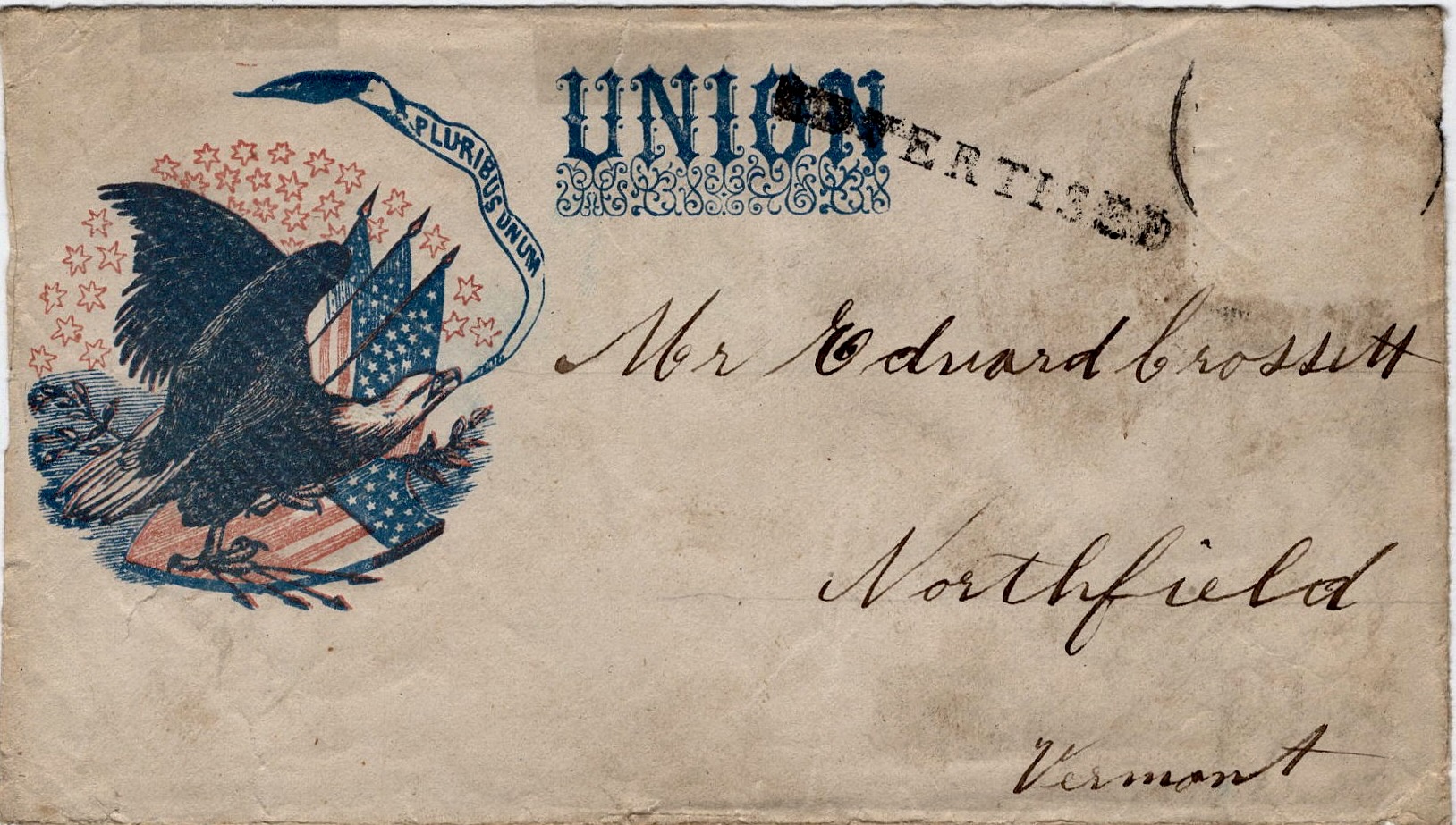
The following letter was written by Pvt. Edwin Charles Crossett (1844-1915) of Co. B, 10th Vermont Infantry. An obituary the Barre Daily Times (23 Jan. 1915) states that Edwin “was born in Waterbury June 15, 1844, the son of Gerry and Rachel (Wright) Crossett. He married Priscilla D. Johnson (1839-1903) of Waterbury who died a number of years ago…Mr. Crossett was a veteran of the Civil War and was very prominent in Edward Dilingham post, G. A. R. of this village. He was in Co. B of the 10th Vermont regiment.” Military records inform us that he enlisted on 30 July 1862, mustered in on 1 September 1862, and mustered out on 16 February 1865. It also records that he was wounded on 19 October 1864 at Cedar Creek, Virginia, which was the reason for his premature discharge.
He datelined his letter 23 January 1862 but he should have written 1863. The regimental history informs us that they mustered into U. S. service on 1 September 1862 and left Brattleboro on the 6th, reaching Washington on the 8th, and went into quarters at Camp Chase near Arlington Heights the next day. On the 17th the regiment was posted along the Maryland side of the Potomac River in little camps of three companies each from Muddy Branch to Edward’s Ferry, and ordered to guard the fords.
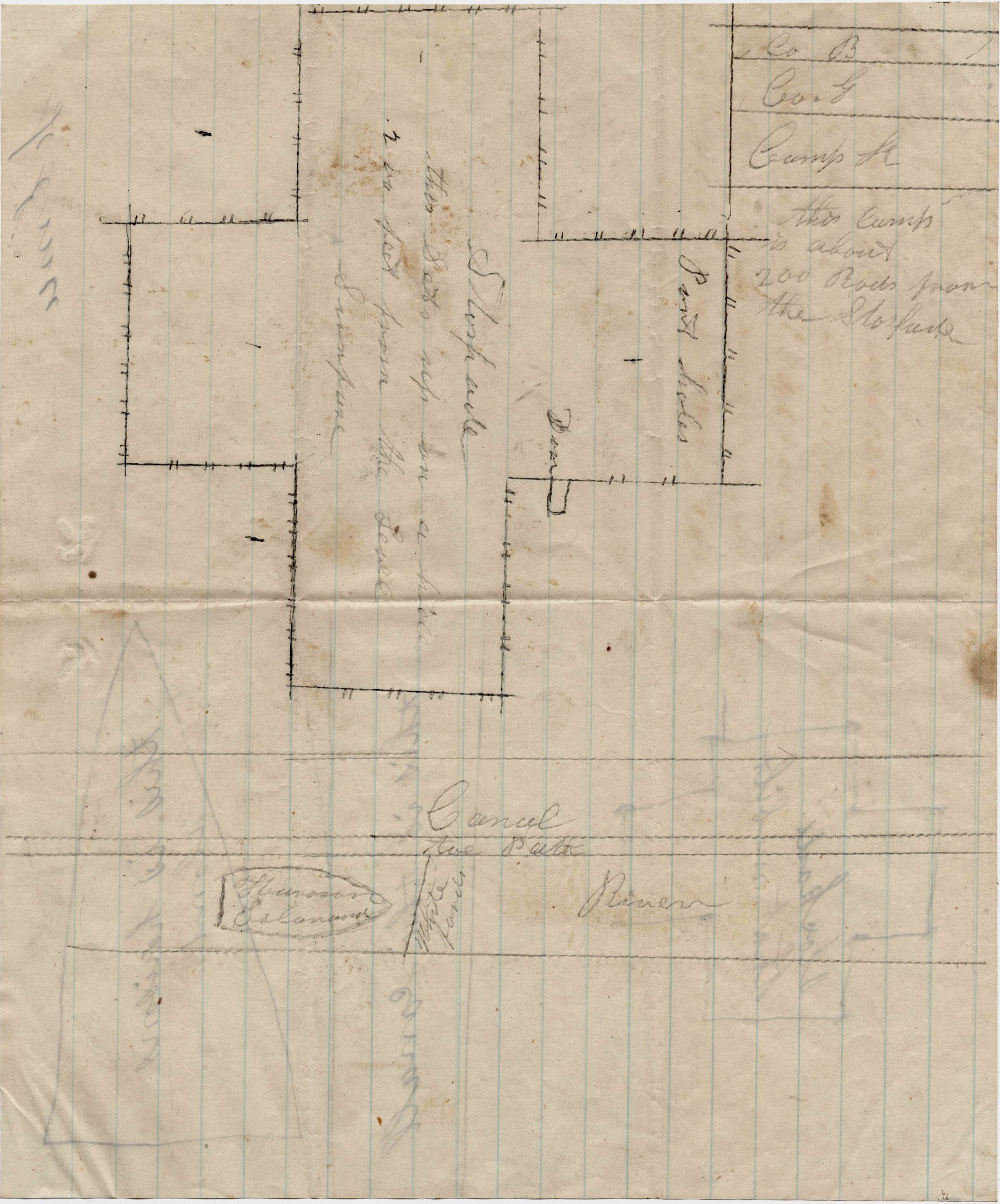
Edwin’s letter doesn’t impart much news but he enclosed a very interesting hand-drawn map that notes the camp of Cos. B, G & K of the 10th Vermont Infantry who were stationed at Conrad’s Ferry in late December 1862. “During the American Civil War, Companies B, G, and K of the 10th Vermont Infantry Regiment were stationed on guard duty at Conrad’s Ferry along the Potomac River in Maryland from late December 1862 until April 19, 1863, where they built and manned defensive stockades.” The spelling is atrocious, but I can make out labels that read, “This is Harrison’s Island” and “This is the [C&O] canal.”
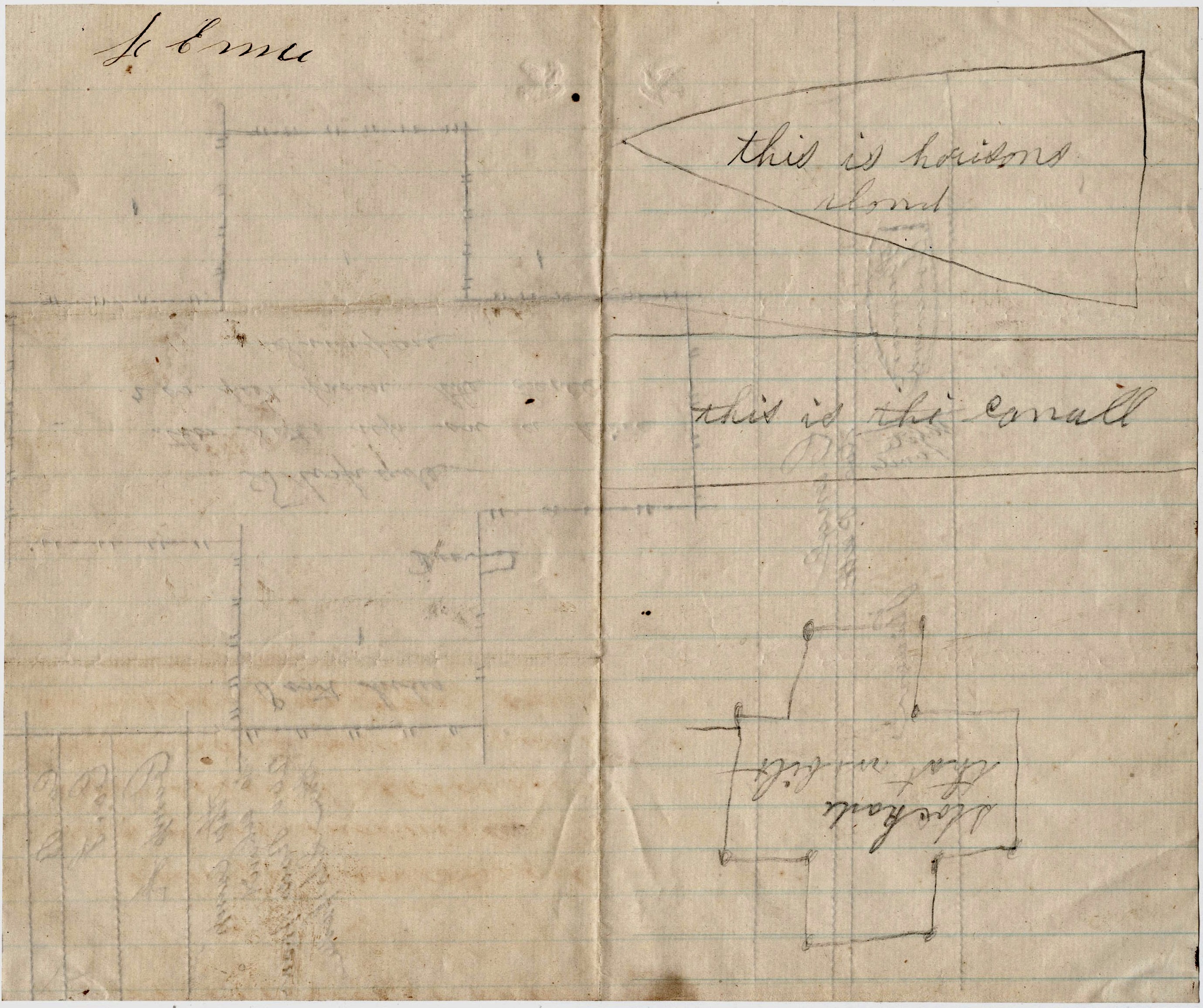
Aside from labeling the camp of Cos. B, G, and K in the upper right-hand corner of this second drawing, which he indicates was “about 200 rods [1100 yards] from the stockade,” he provides a sketch of the stockade (not to scale) on the Maryland side ofthe Potomac, which he claims was on a hill rising 200 feet above the surrounding land overlooking the canal and White’s Ford, with Harrison’s Island in the Potomac River beyond. Only the outline of the stockade is drawn which appears to be in the shape of a Greek Cross. The location of 4 or 5 port holes are indicated on each of the 12 sided structure.
This sketch indicates that the stockade was situated near White’s Ford, below Harrison’s Island, rather than in proximity to Conrad’s Ferry, leaving the precise location ambiguous. It is believed that the 10th Vermont initially established their camp near Offutt’s Cross Roads, while detachments from the regiment constructed a crescent-shaped earthwork and timber fortification near White’s Ford along the C&O Canal. However, this drawing fails to depict a crescent-shaped structure. Companies B, G, and K were transferred from Offutt’s Cross Roads to Conrad’s Ferry in late December. The description refers to “the stockade we built,” suggesting it was indeed constructed, yet the precise location remains unclear. If it were built near White’s Ford, it would have had to be set back from the canal at some distance, as the topography gradually rises to a height of 200 feet on the Maryland side of the river valley in that area.
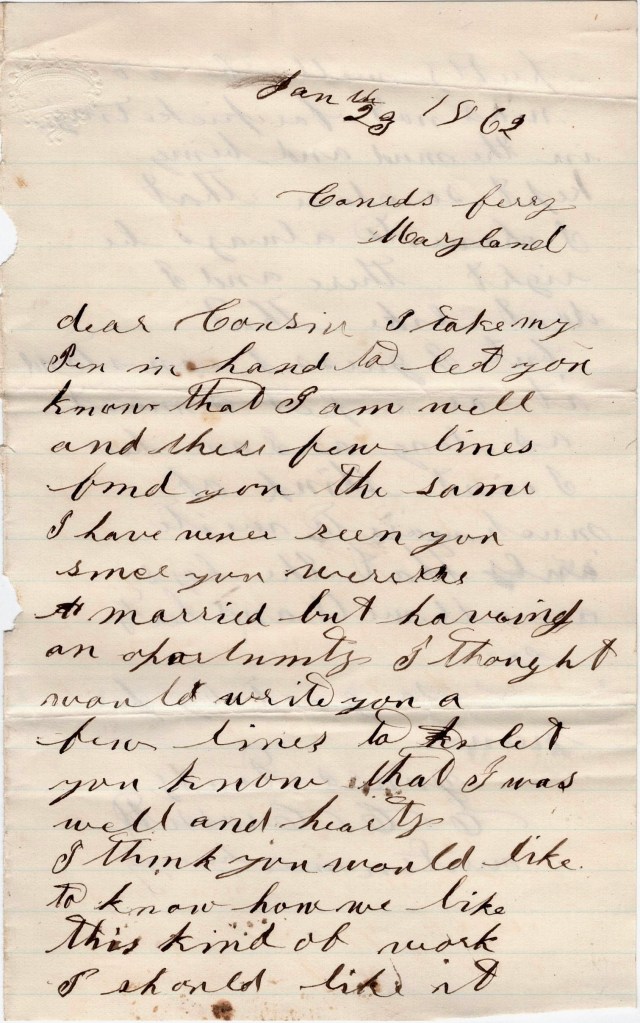
T R A N S C R I P T I O N
Conrad’s Ferry, Maryland
January 23, 1862 [1863]
Dear cousin,
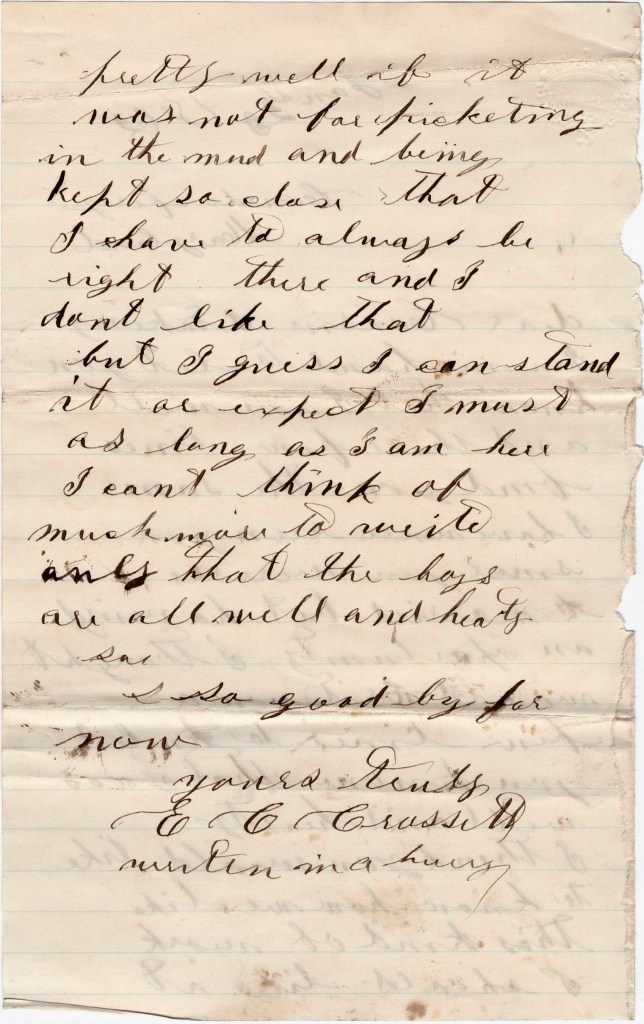
I take my pen in hand to let you know that I am well and [hope] these find lines find you the same. I have never seen you since you were married but having an opprtunity, I thought [I] would write you a few lines to let you know tat I was well and hearty. I think you would like to know how we like this kind of work. I should like it pretty well if it was not for picketing in the mud and being kept so close that I have to always be right there and I don’t like that. But I guess I can stand it or expect I must as long as I am here.
I can’t think of much more to write—only that the boys are all well and hearty. So goodbye for now. Yours truly, — E. C. Crossett
Written in a hurry.