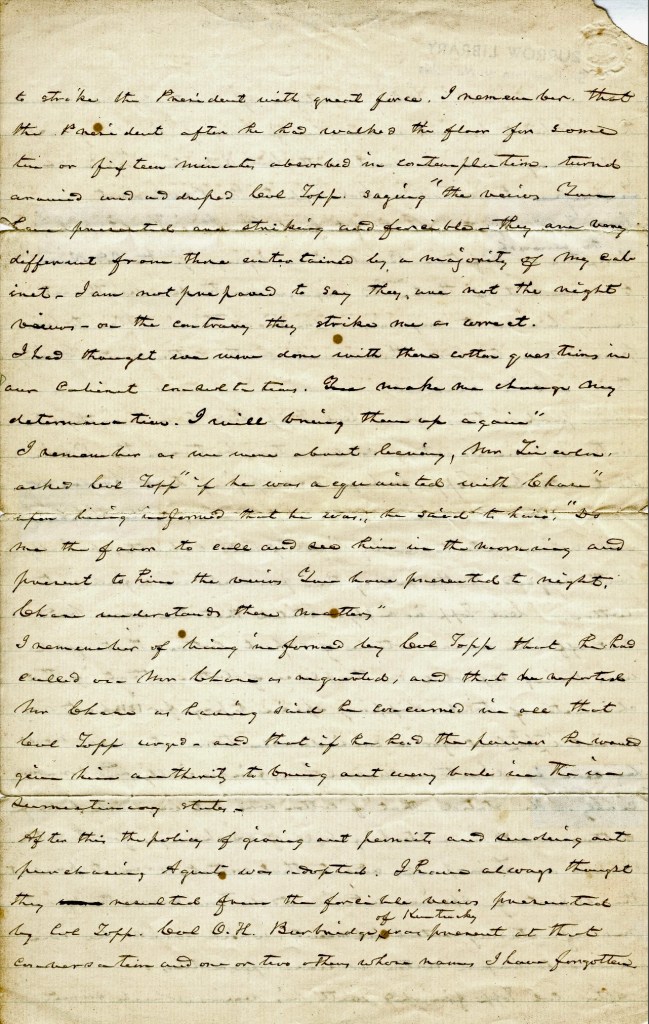
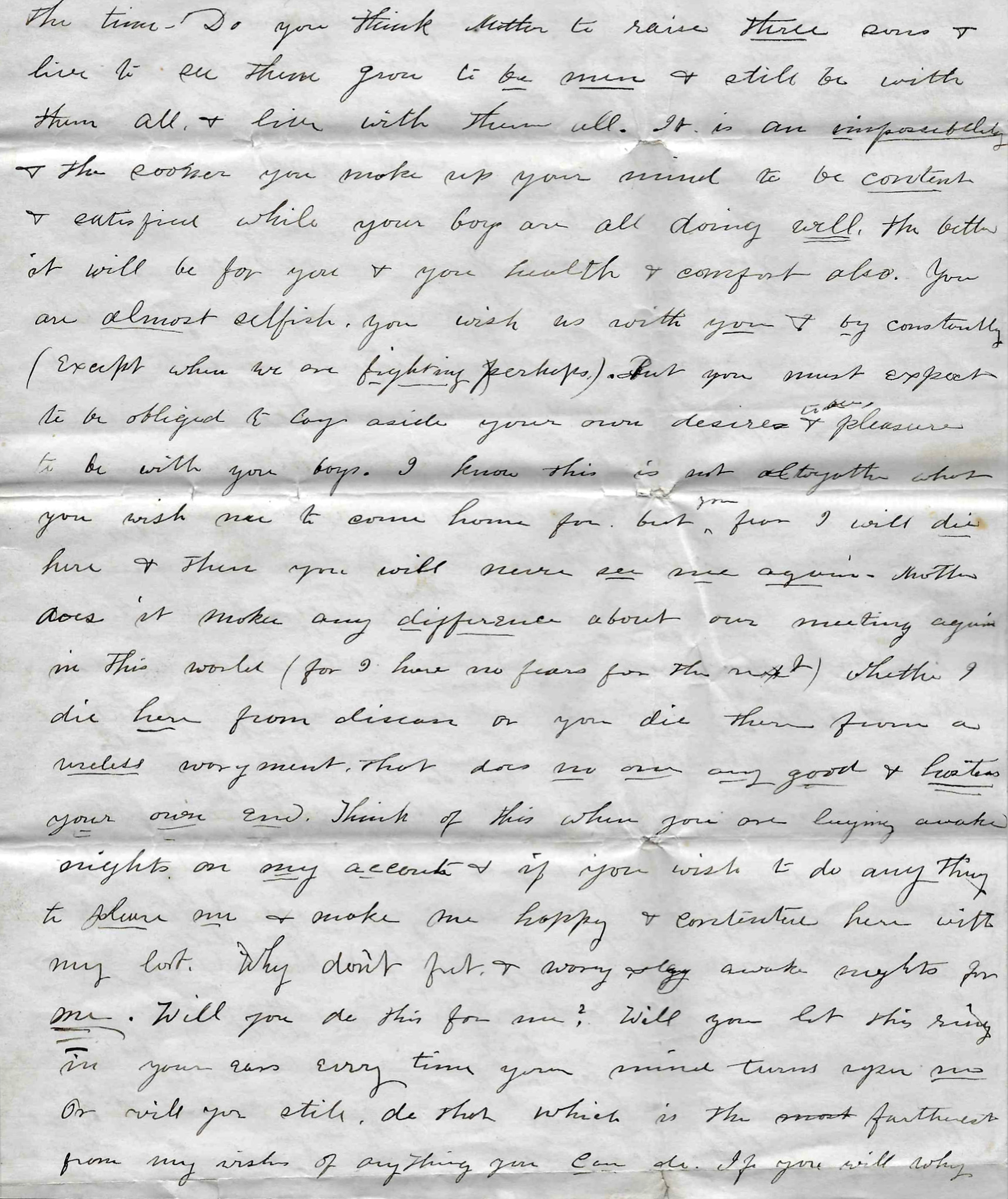
The following declaration was made years after the war by Brutus Junius Clay (1808-1878) who represented Kentucky in the 39th Congress from March 1863 to March 1865. He was the chairman of the Committee on Agriculture so naturally had reason to be concerned about the Cotton growing industry. In this statement, Clay “makes oath” that in January or February 1864, he went with Col. Robertson Topp (1807-1876), a Memphis lawyer, who made huge investments in real estate and agricultural ventures prior to the secession of Tennessee and naturally lost heavily as a result of the war. Clay claims that it was Col. Topp who convinced Lincoln to change his Administration’s policy on the sale of cotton early in 1864.
Historian Gabor Boritt argued: “The good Whig Lincoln saw commerce as a glue that bound the Union together. Throughout the war he showed much more leniency toward trade across hostile lines than did Congress, not to mention the military. Immediately after the firing on Sumter.” According to Boritt, “As Lincoln shifted the tactics of his peace work in 1863, cotton came to play an increasing role in his thinking. He tried to be careful, recognizing inherent dangers in his policy, fearing an atmosphere where ‘profit controls all,’ even the army. Nonetheless by early 1864 he prepared a careful program with the aid of Chase, and others, that invited Southern planters, for three years unable to freely market their cotton, to take the oath of allegiance and sell their product to government agents for twenty-five percent of its market value. They were to receive the rest of their purchase price after the war, provided they had remained loyal to the United States.” [Source: Gabor Boritt, Lincoln and the Economics of the American Dream, pp. 243-244]
The document resides in Burrow Library in Memphis.
Transcription
[Brutus Junius] Clay, a citizen of Kentucky, makes oath that whilst he was a member Congress in January or February 1864, he went with Col. Robertson Topp of Tennessee to introduce Col. Topp to the President. Col. Topp’s object was to get from the President permission for the owners of ten or fifteen boats then lying up the Red River to come out of that river and engage in trade without being liable to seizure or confiscation. Also to be permitted to load those boats with cotton and bring that out to market.
These propositions from Col. Topp lead to a lengthy and intensely interesting conversation between the President and Col Topp, occupying two hours or more. The President detailed at length the reasons and views entertained by himself and cabinet, especially with regard to the policy then pursued in reference to cotton. Col. Topp in reply stated that the war had cut off the usual article of export—cotton, [and] that gold was being exported in the place of cotton. That if that character of trade, shipping specie to pay for imports was permitted [ ] for a considerable time, its effect would be seen in disastrous [ ], financially and commercially. He stated that if cotton was let in, each bale of cotton would be a sterling bill of exchange for its [ ] value in Liverpool, and to that extent, serve to prevent the export of specie, and in addition, serve the great manufacturing establishments which would be compelled to import cotton or cease operations.
After Col. Topp finished with his views, which seemed to strike the President with great force, I remember that the President after he had walked the floor for some ten or fifteen minutes absorbed in contemplation, turned around and addressed Col. Topp, saying, “The views you have presented are striking and forcible. They are very different from those entertained by a majority of my cabinet. I am not prepared to say they are not the right views. On the contrary, they strike me as correct.
I had thought we were done with there cotton questions in our cabinet consultations. You make me change my determination. I will bring them up again.”
I remember as we were about leaving, Mr. Lincoln asked Col. Topp if he was acquainted with Chase. Upon being informed that he was, he said to him, “Do me the favor to call and see him in the morning and present to him the views you have presented tonight. Chase understands these matters.”
I remember of being informed by Col. Topp that he had called on Mr. Chase as requested, and that he reported Mr. Chase as having said how concerned in all that Col. Topp urged, and that if he had the power, he would give him authority to bring out every boat in the [ ] states.
After this the policy of giving out permits and searching out purchasing agents was adopted. I have always thought they resulted from the forcible views presented by Col. Topp. Col. O. H. Burbridge of Kentucky was present at that conversation and one or two others whose names I have forgotten.
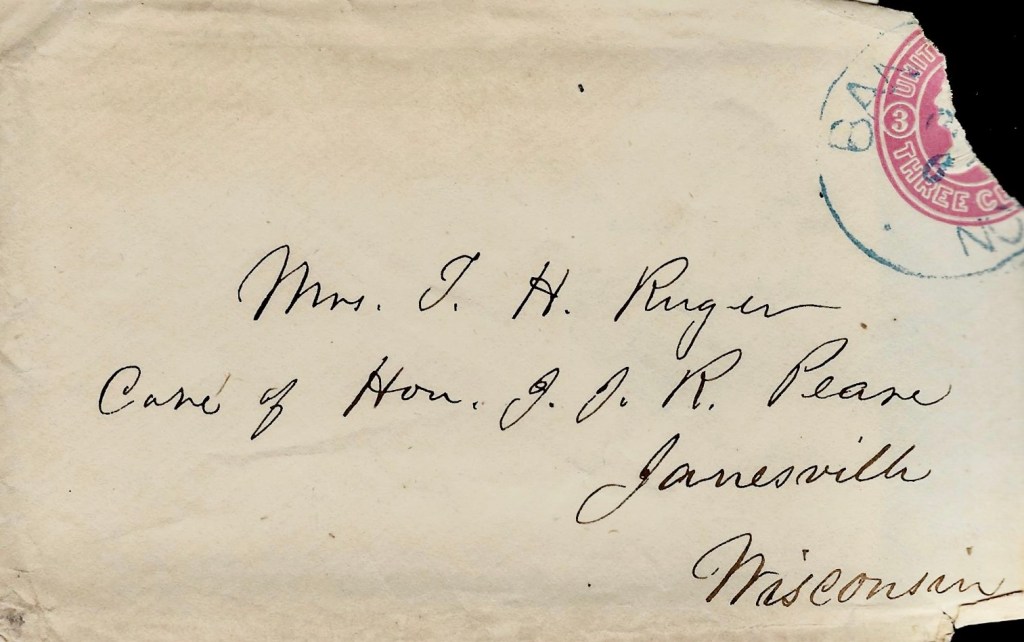
The following letter was written by Brig. General Thomas Howard Ruger (1833-1907). In 1854 he graduated from the U.S. Military Academy at West Point, and then embarked on a long and distinguished career in the military. After a brief commission with the U.S. Army Corps of Engineers, Ruger practiced law in Janesville, Wisconsin. In June 1861, he was assigned as lieutenant colonel of the 3rd Wisconsin Regiment, he rose to the rank of brigadier general, commanded a contingent in the Rappahannock maneuvers, and aided in the containment of the 1863 New York draft uprising. On November 30, 1864, he was promoted to major general for his admirable service in the Battle of Franklin. After serving as colonel of the 33rd Infantry in the U.S. Army, Ruger again was commended for his courageous service in the Battle of Gettysburg and was commissioned a brigadier general. On January 17, 1868, Major General George W. Meade, commander of the 3rd Military District, forced Governor Charles J. Jenkins out of office. Meade then appointed Ruger to serve as Governor of Georgia, a position he held until June 28, 1868. The following year, Ruger was appointed to supervise a board of U.S. officers in Atlanta, examining the qualifications of select members of the Georgia Legislature. From 1871 to 1876, he served as the superindent of the U.S. Military Academy, and was the commander of the Department of the South and West, serving until 1885. Two years after being promoted to major general, Ruger retired from active military duty. Governor Thomas H. Ruger died on June 3, 1907.
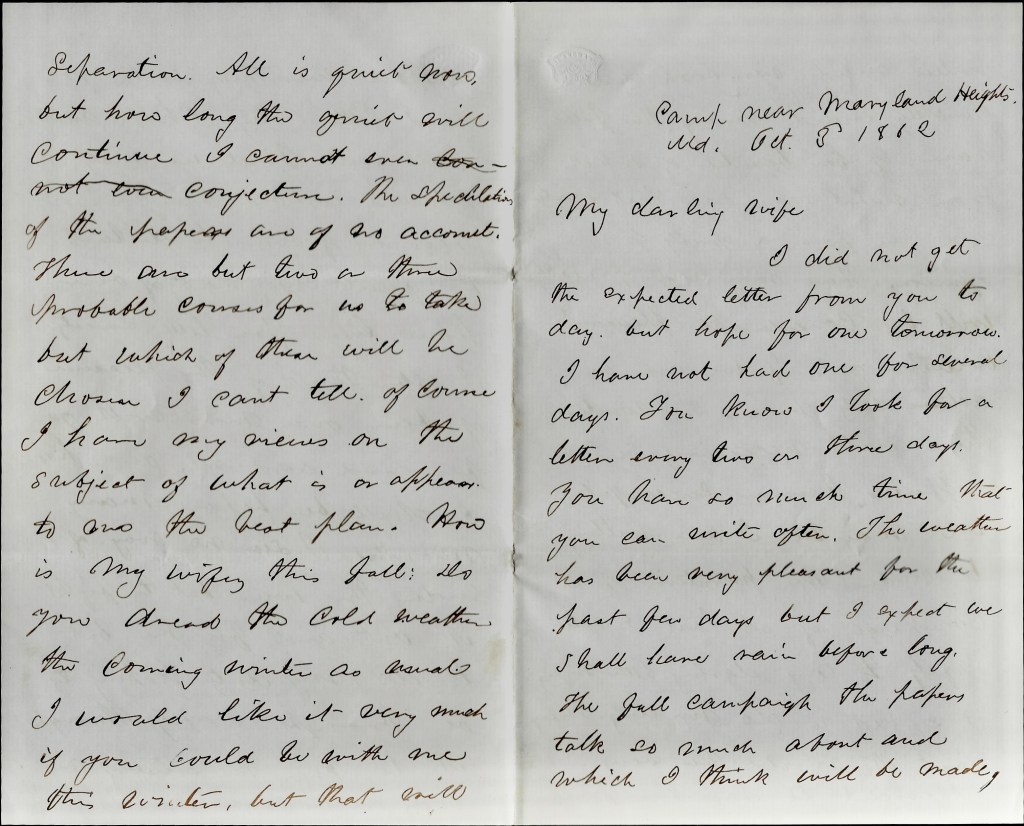
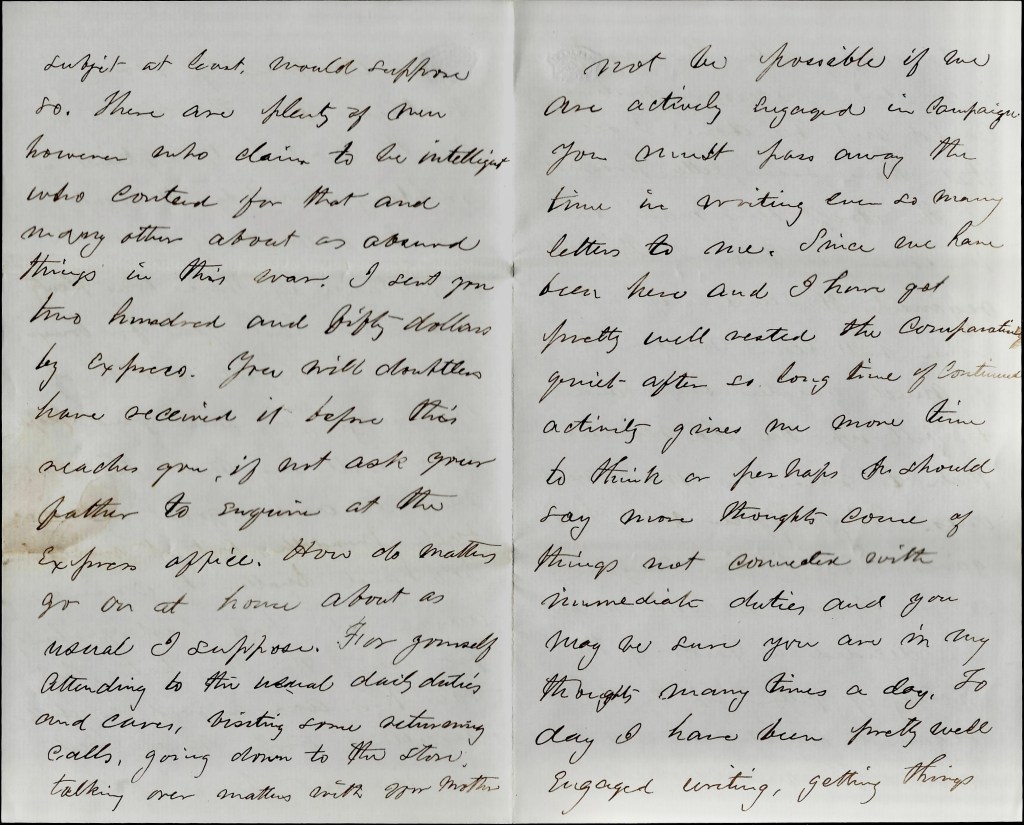
This letter to his wife was penned a couple of weeks after the Battle of Antietam and after having been introduced to President Lincoln who visited the battlefield afterward. Ruger’s impression of the President was not exactly favorable though he postulated correctly that history would be a better judge of the man. “Exact justice of opinion will be more surely found among thinking, candid men after the present condition of things has passed away and the results are seen,” he wrote.
Transcription
Camp near Maryland Heights, Maryland October 3d 1862
My darling wife,
I did not get the expected letter from you today but hope for one tomorrow. I have not had one for several days. You know I look for a letter every two or three days. You have so much time that you can write often.
The weather has been very pleasant for the past few days but I expect we shall have rain before long. The fall campaign the papers talk so much about and which I think will be made unless made very soon and quickly ended, will be made during the fall rains, of the beauties of which from what you saw last winter you can form a pretty good opinion. There may and probably will be considerable pleasant weather yet. If we are on active duty during the winter, there will necessarily be much suffering, however successful we may be. I am willing to undergo the privations of a campaign if at last I return safely to my darling little wifey, but it would be very pleasant to pass this fine fall weather with you and little Patey. I hope another fall will find us nicely situated without any war or rumors of war to disturb the quiet enjoyment of our home life.
You little sweetie. I often think of the pleasure of being once more with you for good and all, and hope I shall be before many months. I see no way of ending this war but to fight it out, and for me but to do my duty hoping to be brought safely through it to enjoy the society of my wifey all the more for the long separation.
All is quiet now, but how long the quiet will continue, I cannot even conjecture. The speculation of the papers are of no account. There are but two or three probable courses for us to take but which of them will be chosen, I can’t tell. Of course I have my views on the subject of what is or appears to be the best plan.
How is my wifey this fall? Do you dread the cold weather the coming winter as usual. I would like it very much if you could be with me this winter but that will not be possible if we are actively engaged in campaign. You must pass away the time in writing ever so many letters to me. Since we have been here and I have got pretty well rested, the comparative quiet after so long time of continued activity gives me more time to think or perhaps I should say more thoughts come of things not connected with immediate duties, and you may be sure you are in my thoughts many times a day. Today I have been pretty well engaged writing, getting things in shape after the long time when even necessary writing could not be done. I see that there seems little prospect of the draft being made in Wisconsin to fill up the old regiments. It seems as if we never will learn wisdom. It is of much greater importance to fill up the old regiments than to raise so many new ones. Every officer who has given his opinion, everyone whose opinion is worth much, has decided in favor of the policy of filling up the old regiments, but still it is not done. The new regiments are composed of good material but the officers are for the most part deficient in military knowledge. It would not be a matter of so much importance if there was plenty of time as last year for bringing the new troops into a state of efficiency.
You will find people who say that they don’t need it and a great deal more such twaddle, but it would be a hard matter to convince anyone who had had opportunity for seeing the thing tested, that raw troops are as good as drilled & disciplined troops. No one but an ignorant person on that subject at least would suppose so. There are plenty of men, however, who claim to be intelligent who contend for that and many other about as absurd things in this war.
I sent you two hundred and fifty dollars by Express. You will doubtless have received it before this reaches you. If not, ask your father to enquire at the Express Office. How do matters go on at home? About as usual I suppose. For yourself attending to the usual daily duties and cares, visiting some returning calls, going down to the store, talking over matters with your mother and Hattie, talking a great deal to Patey and watching her girlish pranks, thinking a great deal about Howard, reading the papers for war news, watching for a letter from me and hoping that all this may end and you will soon be in your own house with your husband. The picture makes you a very loving wife and is somewhat flattering to myself, but it is true, is it not wifey, you little sweet. Just imagine a good kissing.
You see I have written quite a letter. I almost forgot to tell you that the President was here yesterday. I had the honor of being introduced and hearing him tell several stories. You have heard of the Presidential inclination for stories. Old Abe is a good man but darling, not a great man for these times, which latter remark may be somewhat objectionable as implying that what is great under some circumstances may not be under others. Perhaps President Lincoln has done as well, all things considered as anyone would. The fact is, Helen, we cannot judge as truly as people will who are not actors in, and witnesses of the present scenes. Exact justice of opinion will be more surely found among thinking, candid men after the present condition of things has passed away and the results are seen.
Give my love to all. Take good care little Patey, three years and a half old by the time this reaches you, which outs me in mind of the day three days from now. Would I not like to drop in for a visit. Write often, very often, darling. With very much love, your affectionate husband, — Howard
The following letter was written by John Booton (“Boot”) Hill (1841-1913), the son of William Alexander Hill (1817-1873) and Judith Frances Booton (1822-1909) of Madison county, Virginia. Shortly after Virginia seceded from the Union, Boot enlisted on 23 April 1861 at Madison Court House to serve in the 7th Virginia Infantry. It wasn’t long before he was elected the captain of Co. A. He was later detailed to Beauregard’s Headquarters at Manassas and in the Pay Dept. of the State of Virginia. during the war, mustering out as a Major.
As indicated in his letter, Boot was residing in New York City before the war began, apparently employed as a clerk for his uncle, Major Henry Hill (1816-1866), who was the Army Paymaster of New York at the time. Henry’s resignation from the US Army was announced on local New York papers in June 1861 when he decided to cast his lot with the Confederacy.
Beneath the weight of historical significance, Boot’s letter documents the arrival of President-elect Abraham Lincoln and his entourage in New York City on 19 February 1861, en route to Washington D. C. for his upcoming inauguration in early March. While numerous eyewitness accounts of Lincoln’s arrival in New York City exist, few of them—such as Boot’s—display the disrespectful mockery of his appearance and contempt for his assumption of the presidency.
Hoping to capitalize on the crowd coming into New York City to see the President-elect, P. T. Barnum announced in advance that his museum would be exhibiting “The Great Lincoln Turkey”—alleged to be a forty pounder—that would be presented to Lincoln on Inauguration Day. New Yorkers were invited to come to the museum to not only see the turkey, but to “use its windows and balconies to observe Lincoln’s departure from the city.” [Source: The Demon of Unrest, Eric Larson, page 246.]
[Note: This previously unpublished letter resides at the Virginia Museum of History & Culture in Richmond, Hill Family Papers, 1787-1945).]
Transcription
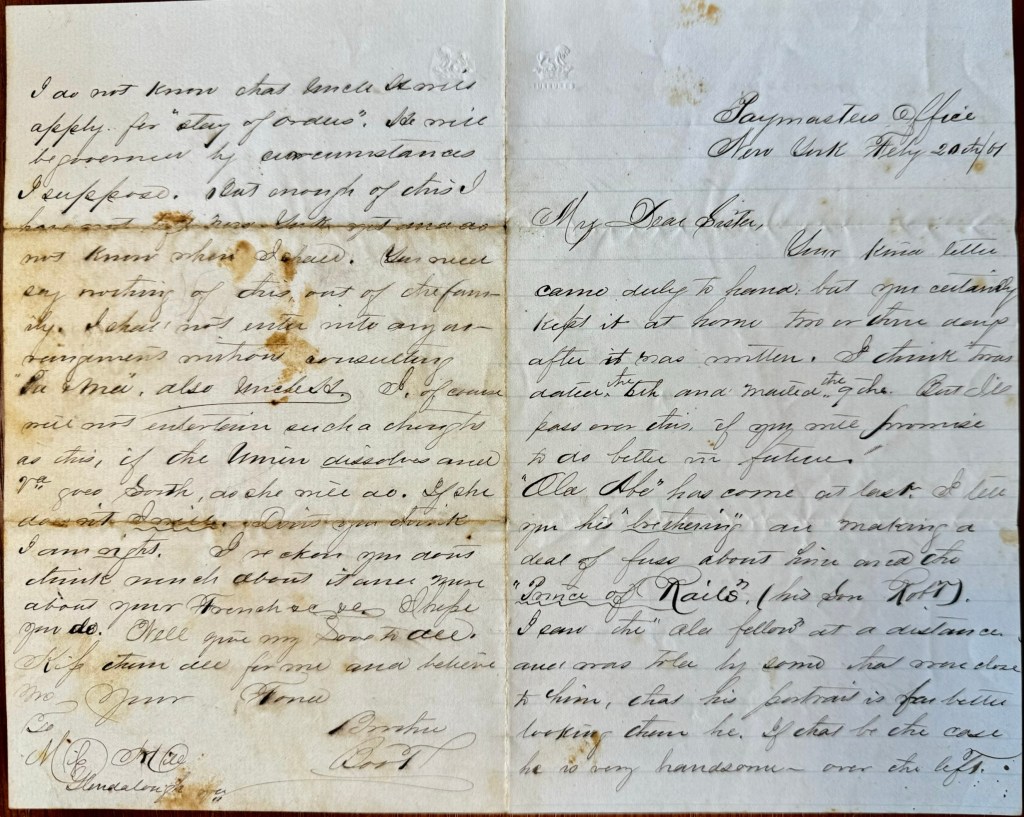
Paymaster’s Office New York [City] February 20th 1861
My dear sister,
Your kind letter came duly to hand, but you certainly kept it at home two or three days after it was written. I think ’twas dated the 6th and mailed the 9th. But I’ll pass over this if you will promise to do better in future.
“Old Abe” has come at last. I tell you his “brethering” are making a [good] deal of fuss about him and the “Prince of Rails” (his son Robt). 1 I saw the “old fellow” at a distance and was told by some that were close to him that his portrait is far better looking than he. If that be the case he is very handsome—over the left. You may form some idea of his looks by simply calling to mind Mr. Isaac Vernon who is a finer looking man than “Abe.” He’ll do now, won’t he?
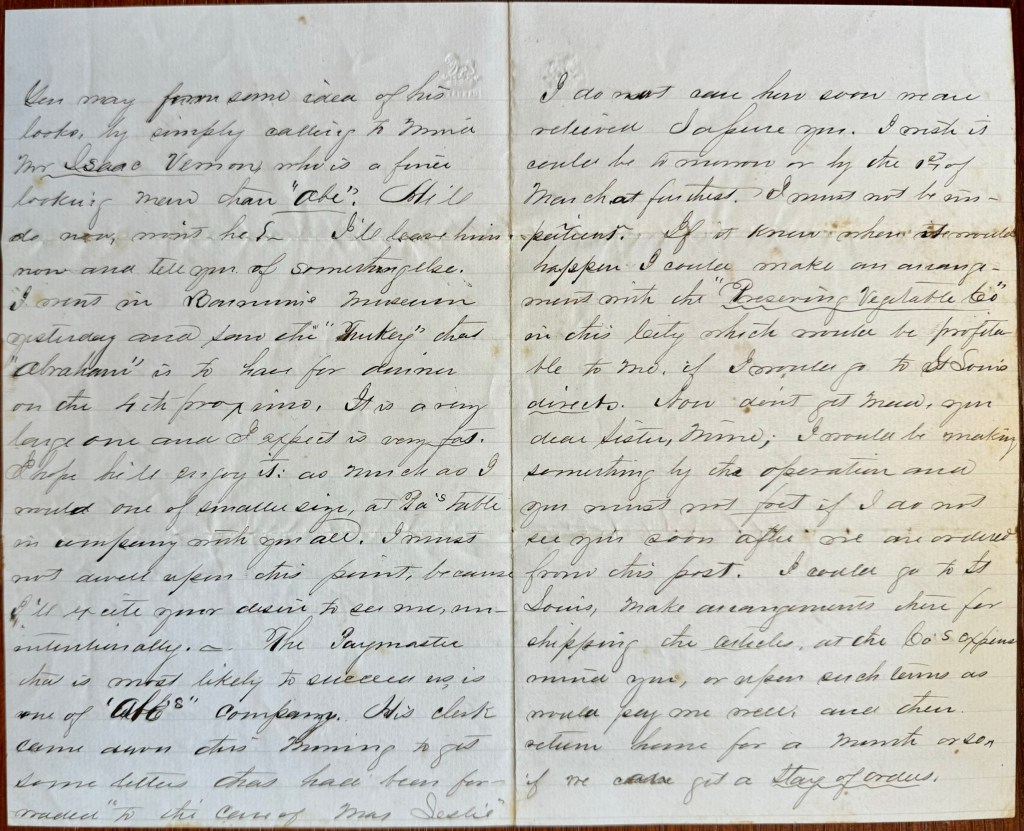
I’ll leave him now and tell you of something else. I went in Barnum’s Museum yesterday and saw the “Turkey” that “Abraham” is to have for dinner on nthe 4th proximo. It is very fat. I hope he’ll enjoy it as much as I would of smaller size at pa’s table in company with you all. I must not dwell upon this point because I’ll excite your desire to see me unintentionally.
The paymaster that is most likely to succeed us is one of “Abe’s” company. His clerk came down this morning to get some letters that had been forwarded to the care of Mrs. Leslie. I do not care how soon we are relieved, I assure you. I wish it could be tomorrow or by the 1st of March at furthest. I must not be impatient. If I knew when it would happen, I could make an arrangement with the “Preserving Vegetable Co.” in this city which would be profitable to me, if I would go to St. Louis direct. Now don’t get mad, you dear sister mine, I would be making something by the operation and you must not fret if I do not see you soon after we are ordered from this post. I could go to St. Louis, make arrangements there for shipping the articles, at the company’s expense, mind you, or upon such terms as would pay me well, and then return home for a mont or so, if we get a stay of orders. I do not know that Uncle H[enry] will apply for “stay of orders.” It will be governed by circumstances, I suppose.
But enough of this. I have not left New York yet and do not know when I shall. you need say nothing of this out of the family. I shall not enter into any arrangements without consulting “Pa & Ma,” also Uncle H.
I, of course will not entertain such a thought as this, if the Union dissolves and Virginia goes South as she will do. If she doesn’t, I will. Don’t you think I am right. I reckon you don’t think much about it and more about your French, &c. &c. I hope you do. Well, give my love to all. Kiss them all for me and believe me your fond brother, — Boot
To Miss Hill, Glendalough, [Madison] Virginia
1 Robert Todd Lincoln—“Bob” to his family and friends—was dubbed the “Prince of Rails” during his “Railsplitter” father’s 1860 campaign for president, after a visit to this country by England’s Prince of Wales. Robert was a prince who would never ascend to the throne.
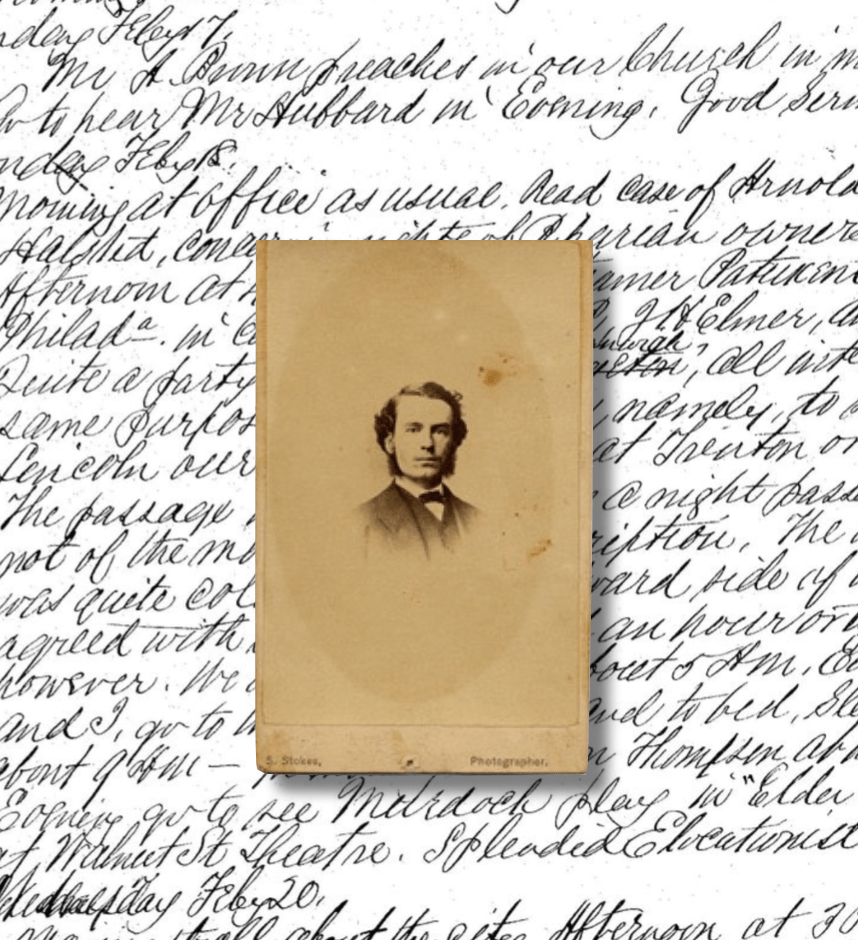
The following diary was kept by William Elmer Potter (1840-1896), the son of James Boyd Potter (1796-1865) and Jane Barron (1798-1855) of Bridgeton, Cumberland county, New Jersey. After attending public schools, William attended Harmony Academy where he remained until 1854. He then became a pupil at the West Jersey Academy during its first session, under the tutorship of Professors Snyder and Stevenson, but in October of 1857, having determined upon the law as a profession, entered the office of Hon. John T. Nixon. He remained until September 9, and the same month became a student of the law school of Harvard University. From this school he graduated in January, 1861, with the degree of L.L.B., and in September of the same year entered the junior class of Princeton College.
In July 1862, William put his collegiate studies aside and accepted a commission as 2nd Lieutenant in Co. K, 12th New Jersey Infantry and mustered into the service of the United States as such Sept. 4, 1862. He was promoted to a first lieutenancy of the same company and regiment Aug. 6, 1863, and to the captaincy of Company G Feb. 4, 1864. Capt. Potter became brevet major United States Volunteers for meritorious services, May 1, 1865, by promotion of the President of the United States, and was, in 1866, commissioned aide-de-camp to Governor Marcus L. Ward, of New Jersey, with the rank of lieutenant-colonel, upon whose staff he served for three years.
During this period Col. Potter was present in the following engagements: Chancellorsville, Gettysburg, Auburn, Bristow Station, Blackburn’s Ford, Locust Grove, campaign of Mine Run, Morton’s Ford, Wilderness, Cold Harbor, Petersburg, Deep Bottom, Crater, Deep Bottom (second engagement), Reams’ Station, Boydton Road, assault and capture of Petersburg, Rice’s Station, and Appomattox Court-House. By an order from headquarters, Twenty-fourth Army Corps, in company with five other officers, he was detailed to deliver the colors surrendered by Gen. Lee’s army, seventy-six in number, to Hon. Edwin M. Stanton, of the War Department, at Washington, which ceremony occurred on May 1, 1865. He was the only New Jersey officer present on this occasion.
During the period of time that William recorded the page of the diary presented below, he appears to have been living at home in Bridgeton, Cumberland county, New Jersey, and working as a clerk in the county court house, possible for the sheriff’s department.
[Note: This diary is housed at the Princeton University Library but has not been previously transcribed and published. See William E. Potter Diary, 1859-1862]
Transcription
Monday, February 11, 1861—As usual at office. Evening call at Mrs. Reeds. She at present is in Newcastle. See Mr. & Mrs. B. F. E. Call at Dr. William Elmer’s. Ladies not at home. Call at R[obert] S[hute] Bucks’. 1 See the young ladies. Invite me to Dancing Party at their house tomorrow evening.
Tuesday, February 12—Nothing occurs. Receive today from Messrs. Cromelien & Co. account against Joshua C. Surran to collect if the thing be possible, which query? Nothing happens of moment. Do not go up to R. S. B.’s to the little assemblage this evening. Have some reading to do.
Wednesday, February 13—Day passes as usual at office. Evening call at Jonathan Elmer’s. Meet Miss S. H. B. Play backgammon and other games. Have most pleasant evening.
Thursday, February 14—Nothing unusual occures. “Sociable” meets this evening at H. B. Lupton’s. Do not go however. Play game of chess with Frank in which I am beaten. Tennessee has gone for the Union by a majority of more than fifty thousand. The home of Jackson has again proved her devotion to the Union which he loved so well. Weather most unpleasant. Walking miserable. Evening damp and disagreeable. The winter climate of South Jersey is most uncomfortable.
Friday, February 15—Day as usual at office. Nothing of importance.
Saturday, February 16—Nothing occurs worth noting. Read anatomy, &c.
Sunday, February 17—Mr. A. Bunn preaches in church in morning. Go to hear Mr. ]Joseph W.] Hubbard [Presbyterian Church] in evening. Good sermon.
Public Ledger, 19 Feb. 1861, page 3
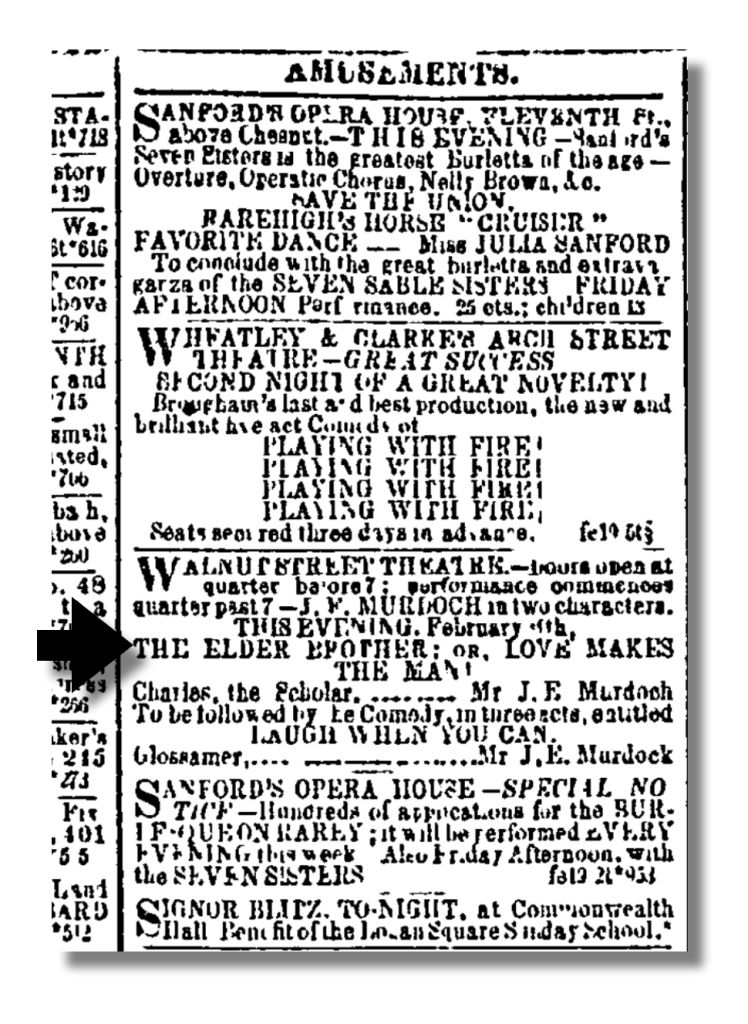
Monday, February 18—Morning at office as usual. Read case of Arnold vs. Mandy, 1 Halsted, concerning rights of Riparian owners. Afternoon at 4 pm leave in steamer Patuxent for Philadelphia in company with C. M. R., J. H. Elmer, and others. Quite a party joins us at Greenwich, all intent on same purpose with ourselves—namely, to see Mr. Lincoln, our Executive-elect, at Trenton or Philadelphia. The passage in the boat, being a night passage, was not of the most pleasant description. The weather was quite cold and the windward side of the boat agreed with the weather. I got an hour or two’s sleep, however. We arrive in Philadelphia about 5 a.m. Elmer, Riley, and I go to the Union Hotel and to bed. Sleep until about 9 a.m. In morning call on Thompson at his offfice. Evening go to see [James Edward] Murdock play in “Elder Brother” at Walnut St. Theatre. Splendid elocutionist.
Wednesday, February 20—Morning stroll about the city. Afternoon at 3 p.m. leave Kensington Depot for Trenton. Here we find most of our Cumberland Party who had gone up in the morning train. Evening, visit those celebrated rooms of Camden & Amboy Company, Nos. 10, Trenton House, and 7, American House. Am introduced to E. H. Stevens, Esq., General Cook, Hon. T. Jones Yorke and other worthies of like or lesser ilk. Many amusing things occur during the evening and we have on the whole a very lively time.
1 Robert Shute Buck (1802-1877) of Bridgeton, Cumberland county, New Jersey, was apprenticed to a miller at an early age. At 23, he entered politics as a Whig and was elected to the office of county sheriff. He then entered into the manufacture of bone buttons, and in 1836, entered into the iron business—the Cumberland Nail & Iron Company. He was married to Caroline James and their children included Sarah (“Sallie”) Buck, born 1838, and Clara Reeves Buck, (b. 1843), both mentioned in the diary pages that follow.
Thursday, February 21—Only limited number of tickets having been issued to admit persons to the Capitol, there was of course a great demand for them. Through the kind assistance of F. F. Patterson, Esq., we were admitted as a Special Reporter, on the platform close to the chair of the President of the Senate. Adjoining me were the Philadelphia Committee who had come thus far to meet Mr. Lincoln.
Mr. Lincoln and part of his suite entered about 12:15 and was introduced to President of Senate who welcomed him in a short address. Mr. Lincoln in a finely modulated voice replied, speaking of his early interest in the revolutionary struggle in New Jersey, &c. in a speech of between five and ten minutes in length. His is a very tall man, standing if I am not mistaken about six feet three inches high. His countenance bears the impress of grave and earnest thought, as well as of great coolness and determination. But when he begins to speak, how his whole face lights up with one of the most pleasant and heartfelt smiles that we have ever seen. I pray the Supreme Being who presides over the destinies of nations, and old individuals, that this grave, earnest, thoughtful, determined man, may prove, if need be, a second Washington to our Country. If there be anything in physiognomy—and experience has proven that there is—he is the man for the present crisis.
Mr. Lincoln dined at the Trenton House. Our party left Trenton at 1:32 p.m., arriving in city about 3:30 p.m. Elmer, Riley, and I go to Continental. Mr. Lincoln arrives in Philadelphia about 4 p.m., and at Continental about 6 p.m. makes short address from balcony to vast crowd assembled in front of Hotel. Evening receives citizenry in parlor of Continental. I retire early—i. e., about 12 p.m.
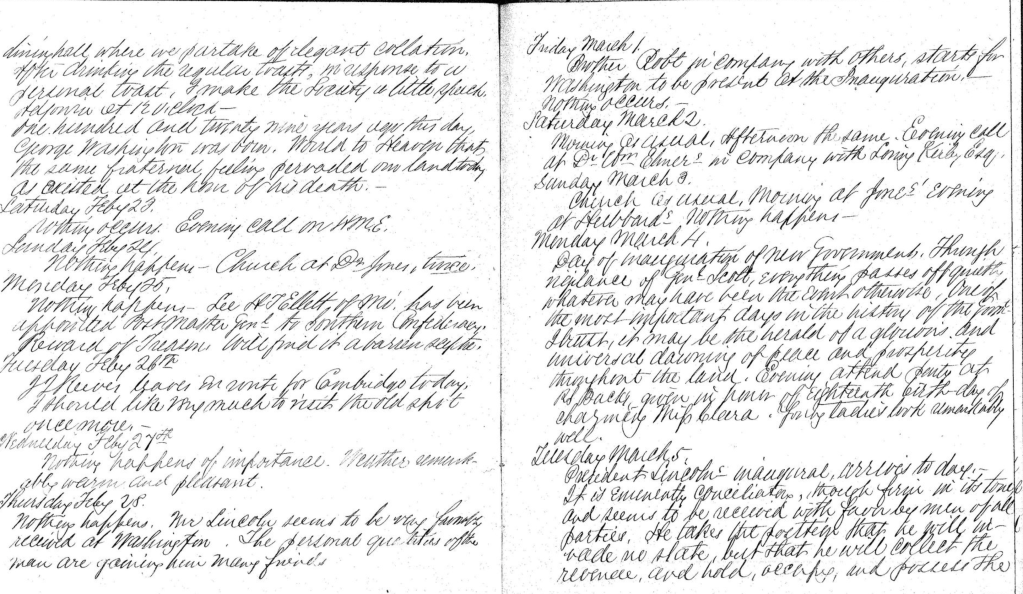
Friday, February 22—This morning at sunrise, Mr. Lincoln raised American flag to staff over Independence Hall. I do not go on account of crowd. Start for home at 9 a.m. Riley and Elmer do not go. In stage, W. G. N., P. Luellam, E. M. Hood, and others. Have quite lively ride. Stars & Stripes floating at crossroads. Cheer them in one or two instances as we ride by. Arrive home about 3:30 p.m. Evening attend Celebration of Washington Society of Andeton, in their Hall at Hotel of E. Deor’s & Son. Quite a large number of their friends present. President of Society, J. Leslie Lupton, reader of Washington’s Address, Henry Jordan; Orator of evening, William Cox. Cox speaks very well. Short addresses made by Judge Elmer & Rev. Mr. Hubbard. After which we adjourn to the dining hall where we partake of elegant collation. After drinking the regular toasts, in response to a personal toast, I make the Society a little speech. Adjourn at 21 o’clock. One hundred and twenty-nine years ago this day, George Washington was born. Would to Heaven that the same fraternal feeling pervaded our land today as existed at the hour of his death.
Saturday, February 23—Nothing occurs. Evening call on H. M. E.
Sunday, February 24—Nothing happens.Church at Dr. Jones, twice.
Monday, February 25—Nothing happens. See H[enry] T. Ellett of Mi[ssissippi]. Has been appointed Postmaster General to Southern Confederacy. Reward of treason. Will find it a barren scepter.
Tuesday, February 26—J. J. Reeves leaves en route for Cambridge today. I should like very much to visit the old spot once more.
Wednesday, February 27—Nothing happens of importance. Weather remarkably warm and pleasant.
Thursday, February 28—Nothing happens. Mr. Lincoln seems to be very favorably received at Washington. The personal qualities of the man are gaining him many friends.
Friday, March 1—Brother Robert in company with others starts for Washington to be present at the Inauguration, Nothing occurs.
Saturday, March 2—Morning as usual. Afternoon the same. Evening call at Dr. Eben Elmer’s in company with Loring Kirby, Esq.
Sunday, March 3—Church as usual. Morning at Jones’. Evening at Hubbard’s Nothing happens.
Monday, March 4—Day of Inauguration of new government. Through vigilance of General Scott, everything passes off quietly, whatever may have been the event otherwise. One of the most important days in the history of the government. I trust it may be the herald of a glorious and universal dawning of peace and prosperity throughout the land. Evening attend party at R. S. Buck’s given in honor of eighteenth birthday of charming Miss Clara. Young ladies look remarkably well.
Tuesday, March 5—President Lincoln’s inaugural arrives today. It is eminently conciliatory, though firm in its tone, and seems to be received with favor by men of all parties. He takes the position that he will invade no state, but that he will collect the revenue and hold, occupy and possess the property of the United States. The address is characterized by great ability, as well as conciseness. Its general effect cannot be anything but pacific.
Wednesday, March 6—Day nothing happens. Evening call at Miss H. M. E.’s.
Thursday, March 7—Nothing occurs. Southern papers are endeavoring to consider Lincoln’s Inaugural a declaration of war. One thing is very true, that as Mr. Lincoln’s remarks—there will be no war unless the government is attacked. If humanity is to be disgraced, civilization checked and Christianity overshadowed, by an internecine war upon this continent, it should be the prayer of the good in all lands, in light or darkness, on the battlefield or in the councils, that God will defend his unalterable right. And who can doubt that such right lies upon the side of the government.
Friday, March 8—Hon. Jno. T[hompson] Nixon returns from Washington last night. Today finish [John Henry] Stephens’ [book] on Pleading[in Civil Actions]. Commenced February 25, 1861 being third time that I have red it. Evening at home.
Saturday, March 9—Day as usual. Nothing happens. Weather March-like. Write letters to R. G. Thompson and to Father. Evening call at R. S. Buck’s. Miss Clara entertains me, Sallie being out. Have a pleasant evening.
Sunday, March 10—Morning attend Mr. Hubbard’s church. Mr. Davis of Deerfield preaches good sermon. Evening Dr. Jones.’ Rumored that small pox is in town. H. E. Hughes, Esq., has the varioloid. I was vaccinated last Thursday.
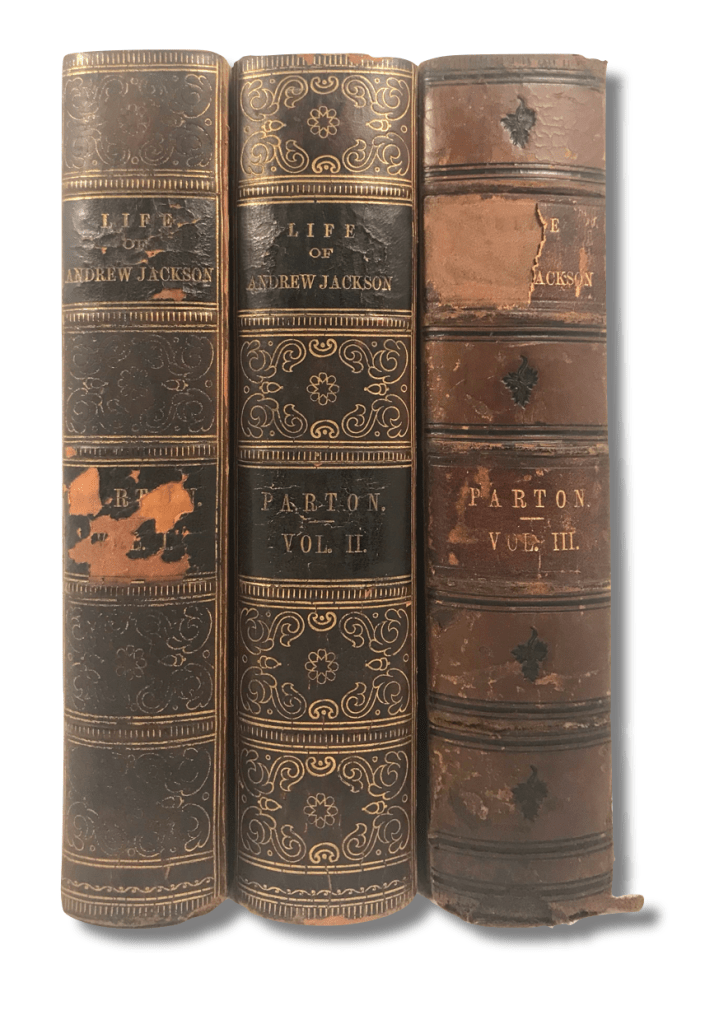
Parton’s Vol. III on Andrew Jackson considered by Atlantic Monthly to be the “best biography” written in the country.
Monday, March 11—Day as usual. Do not feel very well in morning. Think that I do not exercise enough. Evening at home. Read [James] Parton’s Jackson, Vol. III., Grote’s Greece, Vol. I. Jackson’s life gives one a good insight into the political history of the country from 1823 until Jackson’s death. The critics call it the best biography written in the country. Vide Atlantic Monthly for March.
Tuesday, March 12—Day as usual at office. Evening at home. Read Parton’s Jackson, Grote’s Greece. Nothing occurs. Rumored that troops will be withdrawn from Fort Sumpter. Trust that it may be incorrect.
Wednesday, March 13—Morning at office. Afternoon meeting of congregation to decide whether we are to enlarge our old church or not. Decided so to do by vote of fifty-two to fourteen. Old subscription collected under former vote of congregation to build church on west side of creek, ordered to be annulled. Parties who paid their money in, ordered to be paid back. Amusing scenes occurred. Weather warm. Evening lecture Dr. Jones. Call afterwards in H. M. E.
Thursday, March 14—Morning as usual. Also afternoon. Day damp and cold. Nothing occurs during day. Yesterday made a most solemn vow. Evening pleasant “Sociable” at Mrs. W. G. N.’s
Friday, March 15—Day as usual. Nothing of importance occurs. Evening call with Loring Kirby, Esq., on Miss Lillie Sheppard. See herself and sister Jennie. Have pleasant chat. Afterwards call at R. S. B[uck’s]. See the two young ladies [Clara & Sallie]. Home.
Saturday, March 16—Day as usual. J. B. B[owen] returns from Philadelphia with degree of M. S. Evening call at Dr. Wm. E’s. Have not been able to read much by gas light for some days. Eyes are growing weak, I fear.
Sunday, March 17—Morning Mr. Davis of Deerfield preached at Dr. Jones’ church. Most excellent sermon. Finest by far that I have heard since my return home. Evening go to hear Mr. Hubbard.
Monday, March 18—Day as usual. Cold and in afternoon comes on to snow with every appearance of hard storm. Evening at home. J[ohn] T[hompson] Nixon leaves for Washington.
Tuesday, March 19—Snow several inches deep this morning, with every appearance of continuation. Sleighs out. Afternoon, Jno. B[uck] Bowen 1 calls after me with horses & sleigh to go sleighing with the Misses Buck. Good time but poor sleighing.
Wednesday, March 20—Morning at office. J. S. M. quite unwell. Quite busy drawing declarations, &c. &c. On looking over Curtis’ History of Constitution a few days since, with a view to ascertain Hamilton’s views on our Constitution, found that in the convention he stated his opinion to be (Vol. II, page 113): 1st, That he believed the British Constitution was the best form of government the world had then produced, citing the praise bestowed on it by Hecker “That it is the only government which unites public strength, with individual security.” 2nd, That he was equally convinced that none but a republican form could be attempted in this country, or would be adapted to our situation. 3rd, That he proposed to look to the British Constitution for nothing but those elements of stability and permanency which a republican system requires, and which may be incorporated into it, without changing its characteristic principles. Curtis gathers this summary of his opinions from the Brief of Hamilton works, Vol. II, 409., collated with Madison’s Report and Judge Yates’ Minutes,
Since Wednesday last, it has been a dark week with me. I a great trouble pressed me down. I trust that a kind and merciful God may cause it soon to pass away from our family. It is said, in old tradition, that there is a ghost in every house. This may be the mere embodiment of the idea that every family has their own peculiar subject of anxiety and distress. This last week, I shall always remember as a sad period. It has witnessed for myself, however, a most important resolution. God help me to keep it.
1 Dr. John Buck Bowen (1839-1888) was the son of Dr. William Smith Bowen (1802-1872) and Martha Hawthorn Buck (1814-1847) of Bridgeton, Cumberland county, New Jersey. John later served as an Assistant Surgeon in the 34th New Jersey Infantry.
The papers today bring the news, which is some measure rumor has forestalled, that the orders for the evacuation of Fort Sumpter have at length been issued. This will be received with sorrow by many, and can be justified on the ground that if it is done as a military move only.
Thursday, March 21—Day as usual. Snows all morning. Quite wintry for this time in March. Evening call with Jno. B. B[owen]. at Dr. Wm. Elmer’s. Also at R. S. B[uck’s]. Not able to read on account of eyes at night.
Friday, March 22—Morning as usual at office. Nothing happens of very much importance. Evening call at Charles E. Elmore’s. See himself and wife. President Lincoln has appointed Mr. [William Lewis] Dayton Minister to France. This has deservedly caused great rejoicing in New Jersey.
Saturday, March 23—Day passes at office, Nothing unusual occurs. Read Williams Exec. as usual. Afternoon in company with Jno. S. Mitchell, ride out to Wildwood. Visit Railroad which begins to assume the appearance of a reality. Evening at home.
Sunday, March 24—Church at Dr. Jones’ morning & evening. Nothing happens of importance. Sermons dullish. Weather clear.
Monday, March 25—Day as usual. Evening with article of Chronicle on the “Defect in our Government.” Take ground that its great defect is the want of internal strength. Do not read much this evening. Receive letter from Thompson.
Tuesday, March 26—Day as usual. Call on Miss Sallie B[uck] Have very pleasant evening. Nothing occurs today of importance.
Wednesday, March 27—Day as usual. Evening attend little company at Jno. B. Bowen’s. Quite a number there. Seem to enjoy themselves, one and all.
Thursday, March 28—Day as usual at office. Still reading, William’s Executors. Nothing important occurs. Evening “Sociable.” Meet at D. P. Elmer’s. I attend. Pleasant evening. Moonlight walk afterwards.
Friday, March 29—Pleasant weather. Sunshine prevails for once at least over the storm. Morning nothing occurs. Evening call in H. M. E. Lizzie L. & Maggie, Elmer call. Pleasant evening. Affairs of our Nation grow no better. The present position of an American citizen is, that he is secure under the protection of his government, all over the world, except within the borders of the United States. A loyal citizen may be murdered in South Carolina, and by the state authorities too, for expressing his allegiance to the United States, and our general government cannot punish the offenders.
Saturday, March 30—Morning as usual. Nothing happens of interest. Evening spent at Sarah’s. F. F. Westcott, Esq., of Cedarville being there. Also Miss Sallie H. B[uck]. Pleasant evening.
Sunday, March 31—Morning church at Dr. Jones.’ Take dinner at Sarah;s with F. F. W[estcott] After dinner walk out with him as far as Shiloh Bridge. Evening church at Dr. Jones.’ Have resolved today if possible to enter Princeton College in the summer. I shall regret it all my life if i enter upon the duties of my profession without a collegiate education—not that a collegiate education is indispensable to success, but because the want of it must in the nature of things, be severely felt through life. One does not feel that confidence in himself that he otherwise would. At least, such is my experience. I do not feel entitled to demand of Father, after all his kindness to me, this additional favor, but if he will send me, I will most gladly go.
Weather pleasant today, though windy as usual. Tomorrow is April 1st. The month of March has slipped by most rapidly—so rapidly indeed that it seems that one can hardly realize that it has come and gone.
Monday, April 1st—Morning as usual. Speak to Father concerning my going to college. He says he will take time to consider it. I do not know what decision he may give, but hardly think he will refuse me when he sees that I really desire to go. Rainy day. April begins in a cool, disagreeable mood.
Receive today, pamphlet from J. J. Reeves, Esq., containing Parson’s discourse on Constitution of United States delivered before Law School, March 7, 1861, as introduction to his course on Constitutional Law. Evening home.
Tuesday, April 2nd—Pleasanter than yesterday. At work nearly all day writing Sheriff’s Deeds. Evening at home. Read Parton’s Life of Jackson. Is an admirably written biography giving an insight into the political history of the country which I have obtained nowhere else.
Wednesday, April 3rd—Morning clear and bright. Have placed today in the front part of this diary the remarks of Alexander H. Stephens, V. President of the revolutionary government in the South, concerning the principles upon which said government is founded. He abandons the old untenable ground that slavery is a national institution, and lays down the proposition that under the new government, slavery is recognized as the fundamental basis of the government. He says, “that the prevailing ideas entertained by Jefferson and most of the leading statesmen at the time of the formation of the constitution, were that the enslavement of the African was in violation of the laws of nature; that it was wrong in principle, socially, morally, and politically. These ideas, however, were fundamentally wrong. Our new government is founded upon exactly the opposite idea; its foundations are laid, its cornerstone rests upon the great truth, that the negro is not equal to the white man. That slavery, subordination to the superior race, is his natural and moral condition. This, our new government, is the first in the history of the world based upon this great physical, philosophical and moral truth.”
Such is the testimony of Alexander H. Stephens, the leafing statesman of the South. The government of the United States is founded upon the eternal basis of Freedom, the revolutionary government has for its base and cornerstone the principle that human bondage is the only true condition of a perfect government. It has taken the world six thousand years to make this discovery at all, and we trust it will be longer than that ere it abandons one inch beyond its present position. The two governments are before the world, one based upon freedom, the other on slavery. Can there be any doubt concerning their future history?
Wrote to James J. Reeves at Cambridge. Evening spend with Jno. S. Mitchell at his house. We read Carlyle’s Essay on Burns—a most beautiful production. Pass an unusually pleasant evening.
Thursday, April 4th—Day opens finely, clear and bright, with just sufficient breeze to make the atmosphere bracing. How one’s pulse beats upon a morning like this when walking in the open air. How bright the future seems, how clear is the brain. So much does our intellectual, yes, even our moral feeling depend upon our physical condition. Ill health makes many a misanthrope, while on the other hand, a sound physical organization, and an abundance of animal spirits, enables many persons to exceed the great mass of their fellows in pursuits for which intellectually speaking, they are by no means peculiarly fitted. Evening attend the exhibition of the students of West Jersey Academy in Grosscup’s Hall. On the whole, the students perform well. My nephew, Boyd. N., declaims well. Bridgeton Brass Band makes its first appearance in a public meeting. They were only organized about the middle of November last and already are quite proficient, playing some thirty tunes. the Hall was much crowded with the friends of the Academy and everything passed off pleasantly.
Friday, April 5th—Morning as usual at office. Nothing happens. Afternoon 4:45 p.m., walk up to Tumbling Down with Oring Kirby. In coming down on Race side, see some ladies waving handkerchief on other sie to which we reply by waving our own. Take tea at W. G. N.’s. Evening pass at R. S. Bucks with Miss Sallie. Clara absent.
Saturday, April 6th—Morning office as usual. Pleasant day. Afternoon at office. Write letter to George T. Slack, Esq., at Cambridge. Papers today bring us the news that Government is preparing to assert and defend its rights. It has the sympathy of the civilized world and the support of eighteen millions of freemen. God grant us all the disposition, the heart and hand, to play a patriotic part in the coming struggle. Mail today to W. Cromelieu & Co., 721 Market Street, Philadelphia the account against Joshua Surran, Esq., sent me some time since for collection. Surran having no property, and not paying, it is impossible to do anything with it. Evening call with Miss S[allie] H. B[uck] and Lillie S. Very pleasant evening.
Sunday, April 7th—Church at Dr. Jones’ morning & evening. Good sermon in morning. In evening after church walk with C. M. R. as far as Academy. Nothing occurs important.
Monday, April 8th—Morning dull and cloudy. At office as usual. Evening attend the Sabbath School Concert. Afterwards walk out with H. M. E. and make a call at her house.
Tuesday, April 9th—Father gives me no answer as yet with regard to my entering college in August. Very perplexing to know what is my fate.
Wednesday, April 10th—Let this day be marked with a white stone. Father today told me to go to college if I so desired. How kind it is in my Father thus to offer me every advantage. I shall do my utmost to improve the opportunity thus given me. I feel assured that I can appreciate a college course at this time much better than ever before. Read 1st Volume of Williams’ Executors to page 267. Here most probably will begin an interruption on my legal studies. I lay them temporarily aside with regret mingling with my pleasure. I have enjoyed the study of law since my first entrance in it more than any study which I ever pursued. I feel that I have only entered the outer courts of the great temple of jurisprudence, but even here, I can discern how fair is its architecture, how magnificent its proportion’s. Evening studying at home.
Thursday, April 11th—Study morning…Evening at home.
Saturday, April 12—Morning study at home. Read thirty lines…After dinner, walk down to the wharf to witness launching of the new schooner. Through some accident, she does not go off. The papers today bring us the tidings that the rebels opened their fire upon Fort Sumpter. The war commenced upon Friday last, Who, oh who, knows the ending thereof?
Sunday, April 13th—Nothing of importance happens.
Monday, April 14th—All excitement. Fort Sumpter surrendered, or rather was evacuated after forty hours continual bombardment. The excitement in Philadelphia is terrible. All united for the government. President issues a proclamation calling for seventy-five thousand of the militia of the United States to suppress the insurrection. Response being made all over the country.
Tuesday, April 15—Excitement increasing. But one feeling in the North—to support our flag at all hazards!
Wednesday, April 16—Excitement still increasing. Volunteer companies being raised constantly. New York appropriated three millions of money and is to raise thirty thousand volunteers.
Thursday, April 17—No particular news. Excitement intense.
Friday, April 18—Massachusetts regiment arrived in Philadelphia.
Saturday, April 19—Start this morning for Philadelphia in early line to Glassboro. Arrived in Philadelphia about 10 a.m. People greatly excited about the attack made by mob in Baltimore upon Massachusetts troops. Several of Mass. troops killed. They fire upon mob killing a number. Pennsylvania troops also attacked. Being unarmed, they are forced to return to Philadelphia. The attack upon the unarmed troops has greatly excited the Philadelphians as well as the whole country. The North has become so fully aroused that nothing but the omnipotent hand of God can stay their vengeance. Evening walk about the city with Thompson and John B[uck] Bowen. J. B. B. spends the night with me at hotel.
Sunday, April 20—Morning walk about city. Afternoon go with Thompson to Jno. Chambers’ church. Evening go with Thompson and Bowen to hear Wadsworth. No being in his pulpit, we do not stay. Great excitement at Continental [Hotel]. Meet Robert there.
Rumor of arrival of three hundred thousand improved arms from Europe. Philadelphia presents today almost the appearance of a vast military camp. The public squares full of troops drilling the whole day through as also were the various [ ].
Monday, April 21—Morning do errands about the city. Afternoon at 3 p.m., start for home. Arrive per New Jersey Railroad and Glassboro stage, about 8 p.m. Find that a large meeting was held in Bridgeton on Saturday evening. Resolved to raise funds to support the families of volunteers. Company is being raised. Numbers already fifty-six men. Greatest excitement in Bridgeton that I have ever seen.
Tuesday, April 22—At home all day. Nothing of importance except the military excitement. Was measured while in the city for coat at Ethan Thompson’s. Vest & pants. At parties at southeast corner 6th & Market. Frank unwell.
From April 22nd to May 11th. Most stirring period in our country’s history. Troops called out by President. Three hundred thousand men arriving in North. Cannot recount in this diary the events.
Wednesday, May 8th—Today presentation of flag to “Cumberland Grays” by ladies of Bridgeton too place. P. T. Jones, Esq., of Philadelphia, made address in behalf of ladies. I received it on part of the company un few remarks. Grosscup’s Hall crowded. See Chronicle of May 11th.
From May 11th to June 23—Great events occurring in country. Make one or two visits to Philadelphia.
June 24, Monday—Start for Princeton to be examined for admission to Junior Class. W. E. Lufton also. J. Leslie, Superintendent for Admission to Sophomore. I stop at Philadelphia, go to Trenton at 6 P.M. Meet them there having returned from the examination.
Tuesday, June 25—Am today examined by Prof. Cameron in Greek…Latin…Mathematics. Am admitted.
Wednesday, June 26—Pass to Princeton with W. Elmer & friends. Commencement today.
Thursday, June 27—Stop in Trenton. See grand review of three regiments of volunteers at Camp Olden by Gov. Olden and staff. Stop at Continental at Philadelphia.
Friday, June 28—Reach home. Nothing new.
…..
Wednesday, July 17—Meet Wm. Keighler, Esq. of Baltimore on cars. Find his views have changed since last winter. Now almost if not entirely secessionist. Arrive in Washington at 6 p.m. Put up at Ebbitt House, not being able o get into Willard’s. Evening pass in room of Messrs. [John Thompson] Nixon and [John L. N.] Stratton. Army of Union made advance on Fairfax today.
Thursday, July 18—Pass in visiting Patent Office, Capitol, etc. In Congress, Mr. Nixon introduced us to Emerson Etheridge, [Robert] Mallory of Kentucky, Col. Crittenden of do. [Charles] Delano of Mass., Frank P. Blair of Mo., &c. Etheridge most agreeable conversationalist.
Friday, July 19—Visit Alexandria, now occupied by our troops. Deserted city. Houses closed. Grass growing in streets. Secessionists plenty but silent. Three secessionists in a Slave Pen taken night before at Bulls Run. Return to Washington, hire hack, and cross Long Bridge into Virginia. Visit Forts Runyon, Albany, and Corcoran, Arlington House, headquarters at present of New York 8th commanding beautiful view of Washington and the Potomac. Return to Washington, visit Capitol. Evening spend with Messrs. Stratton and Nixon.
Saturday, July 20th—Start for W at 4:15 a.m. Reach Philadelphia at 10:30 a.m. Start for Bridgeton at 3 p.m., arriving at home much pleased with visit at 7 p.m.
Sunday, July 21—Nothing of particular importance occurs in Bridgeton.
Monday, July 22nd—Learn that great battle occurred yesterday between our forces and the rebels. Our army after driving enemy before them until 4 p.m. were repulsed. Enemy was too much exhausted to pursue or else were not aware of our condition. Great slaughter on both sides.
Tuesday, July 23—Troops pouring into Washington from all directions. Gen. McClellan has been sent for from Western Virginia and will assume command at once. The country seems to be recovering from the first alarm, and considers our repulse in the light of salutary lesson. It appears that with a force of at most fifty thousand men under McDowell, we attacked 90,000 in their entrenchments. No wonder that we did not succeed. Yet even under these disadvantages we were nearly victorious. If the reserve of 18,000 men under Col. Miles had been ordered up promptly, we would have gained the day, for at the very time we retired, the enemy was falling back along his whole lines.
From Tuesday, July 23 to Wednesday August 13th, nothing of importance occurs to me personally. Great events are occurring with such rapidity in the country at large that I find it impossible to chronicle them here. Time passed principally in boating, riding, loafing, and other like employments. Impossible to study on vacation and under a July sun.
The letter below was written by John Deering, Jr. (1842-1915), the son of Capt. John G. Deeering, Sr. (1806-1875) and Mary Downing Bachelder (1806-18xx) of Saco, Maine. John, Jr. started at Bowdoin College in 1860, but then joined as a private in Co. K, 13th Maine Infantry in December 1861 and served until 16 August 1862. He had to leave due to a disability, no doubt related to an accident while working as a clerk in the partially constructed custom office at New Orleans. According to his biographical sketch in a family history, he fell through a scuttle in the custom house roof and dropped thirty feet, but somehow managed to survive the fall.
The Maine Democrat, 17 June 1862
Following his discharge, he worked for a time in the Treasury Department and earned a degree from the Columbia College Law School in 1866. His obituary, published in the Lewiston Sun on 1 December 1915, claims that he “saw the assassination of President Lincoln and heard the last speech by the President, made from a window of the White House three days before he was shot…He was employed as a clerk in the Treasury Department at the time and continued in that department more than 15 years.”
By the time of the 1880 US Census, John had left his government job and returned to Saco, Maine, where he practiced law and worked as a pension agent. He married Lizzie H. Chase (1844-1894) in August 1866.
[Note: This unpublished letter resides in the Virginia Museum of History and Culture in Richmond. See Stacy Family Papers, 1802-1889, 51 items. Mss1ST124a.]
Transcription
Washington [District of Columbia] January 10, 1865
Dear William,
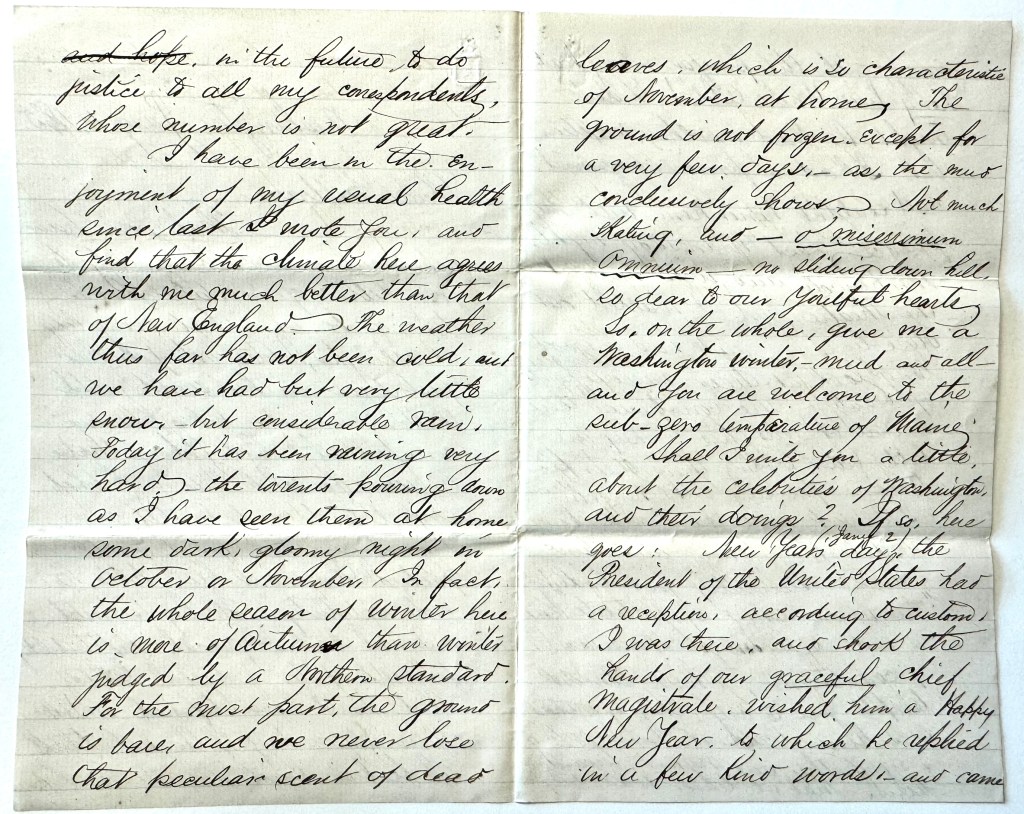
That you have not ere this received a reply to your letter of December 6th proves two facts—viz: that everybody at all times does not get his just dies in this world, and that I am not a punctual correspondent. But I always have a reason for what I do and what I fail to do, and in this case, I must say that for a month past, I have not been able to write or study. It has seemed a moral and physical impossibility for me to write a decent letter and so I have deferred what is usually a very pleasant task. I feel a reaction now, and hope in the future to do justice to all my correspondents whose number is not great.
I have been in the enjoyment of my usual health since last I wrote you, and find that the climate here agrees with me much better than that of New England. The weather thus far has not been cold, and we have had but very little snow—but considerable rain. Today it has been raining very hard—the torrents pouring down as I have seen them at home some dark, gloomy night in October or November. In fact, the whole season of winter here is more of autumn than winter judged by a Northern standard. For the most part, the ground is bare, and we never lose that peculiar scent of dead leaves which is so characteristic of November at home. The ground is not frozen except for a very few days as the mud conclusively shows. Not much skating and—O miserrimum omnium—no sliding downhill, so dear to our youthful hearts. So, on the whole, give me a Washington winter—mud and all—and you are welcome to the sub-zero temperatures of Maine.
Shall I write you a little about the celebrities of Washington and their doings? If so, here goes. New Years day (Jany. 2) the President of the United States had a reception, according to custom. I was there and shook the hands of the graceful Chief Magistrate, wished him a Happy New Year, to which he replied in a few kind words, and came away with the prayer in my heart, “Long live Uncle Abe!” Last night he had another reception but I had a prior engagement and couldn’t honor him with my presence. Last Wednesday night, Mr. Lincoln and wife were at the Theatre, and I walked out close by them, and had a good long look at their various points of beauty. The conclusion there arrived at was this: They are both better looking than their pictures—especially Mrs. Lincoln. I do not call the President a bad-looking man, and think Mrs. Lincoln decidedly good-looking. “Our honored Chief Magistrate” has a sad, despairing expression of countenance, which almost tempts you to cry. Anyone that sees him cannot help feeling a sympathy and regard towards him. That at least was my experience, and others speak in a similar strain.
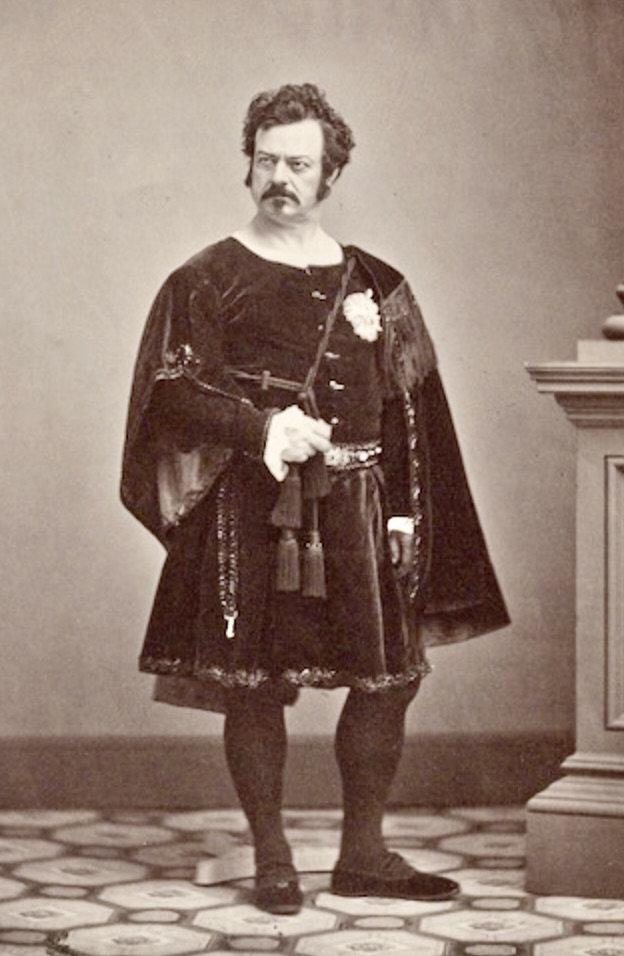
Edwin Forrest as Hamlet
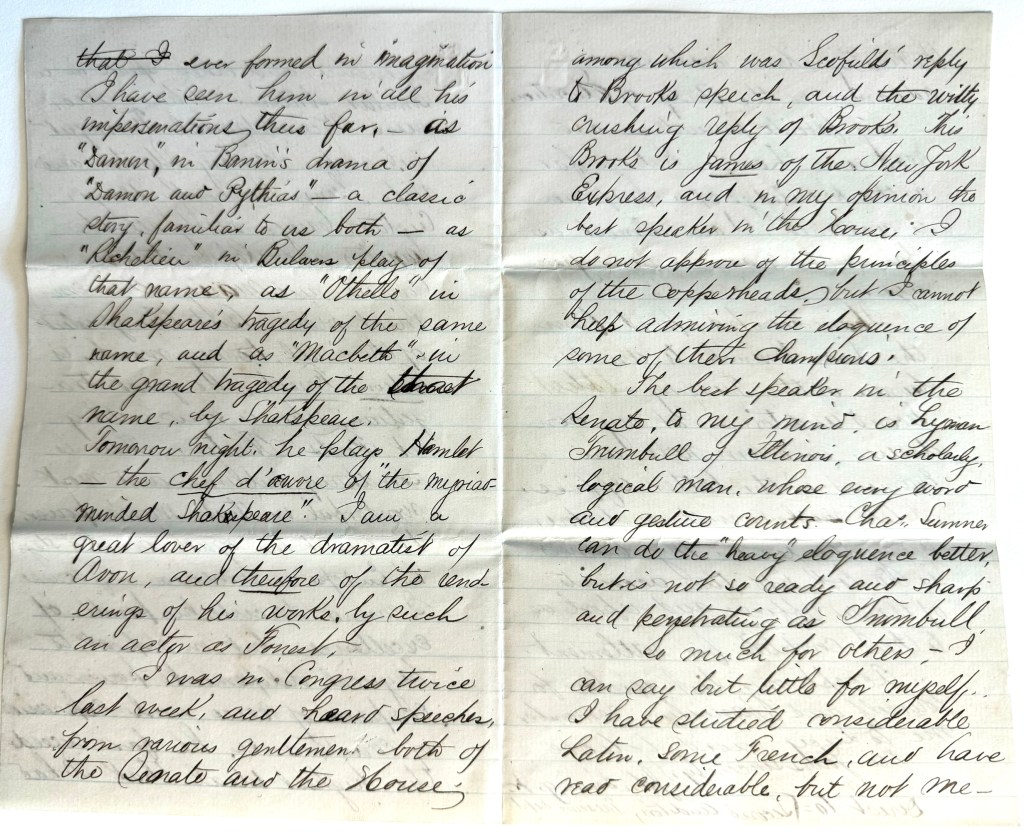
I have also seen Vice-Admiral Farragut and wife, Secretary Staton and wife, Gens. Hancock, Meigs, Custer, Casey, nearly all the Senators and Representatives in Congress, and many other eminent men. But the greatest of them all, to my mind, is Edwin Forrest, the great tragedian, who is now acting at Ford’s Theatre. There is something sublime and most wonderful in that man’s power. He hasn’t his equal on the stage in Europe or America. Of course I cannot describe his points of excellence, but in respect to physical development, power and compass of voice, and expression of countenance, he far exceeds the highest ideal that I had ever formed in imagination. I have seen him in all his impersonations thus far, as “Damon” in Banim’s drama of “Damon and Pythias”—a classic story, familiar to us both; as “Richelieu” in Bulwer’s play of that name; as “Othello” in Shakespeare’s tragedy of the same name; and as “Macbeth” in the grand tragedy of that name by Shakespeare. Tomorrow night he plays Hamlet—the chef d’amour of “the myriad minded Shakespeare.” I am a great lover of the dramatist of Avon, and therefore of the renderings of his works by such an actor as Forrest.
I was in Congress twice last week, and heard speeches from various gentlemen both of the Senate and the House, among which was [Glenni William] Scofield’s reply to [James] Brooks’ speech, and the witty, crushing reply of Brooks. This Brooks is James of the New York Express, and in my opinion the best speaker in the House. I do not approve of the principles of the Copperheads but I cannot help admiring the eloquence of some of their champions. 1
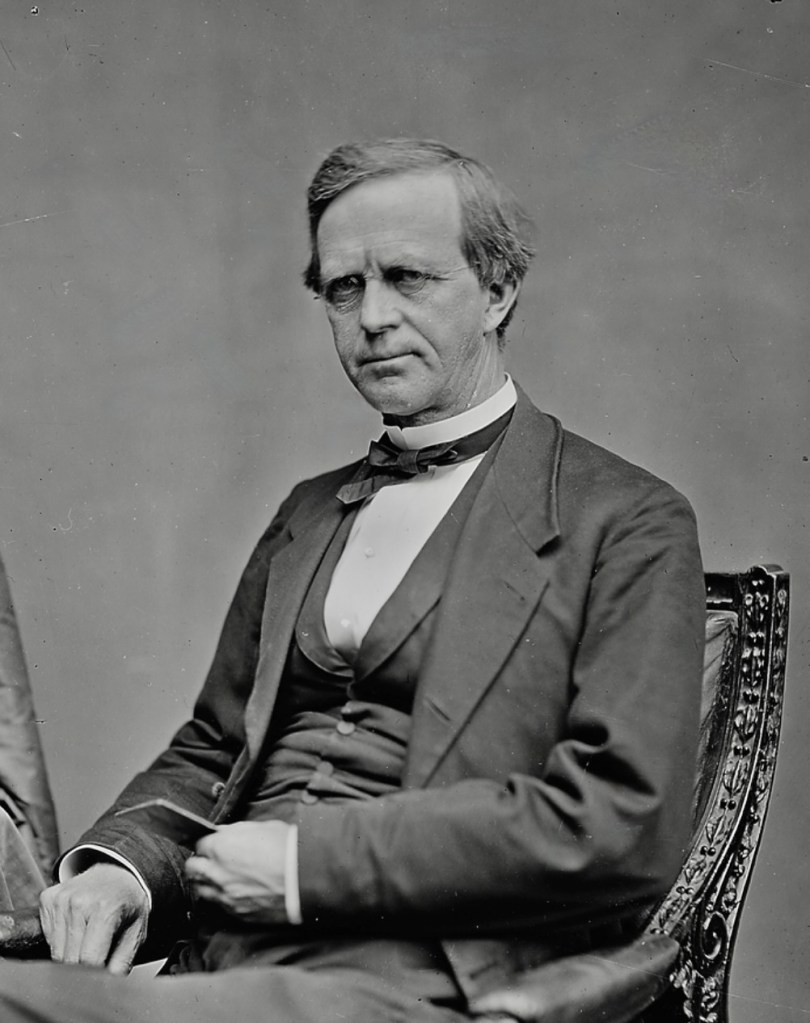
Hon. Lyman Trumbull of Illinois
The best speaker in the Senate, to my view, is Lyman Trumbull of Illinois, a scholarly, logical man, whose every word and gesture counts. Charles Sumner can do the “heavy” eloquence better, but is not so ready and sharp and penetrating as Trumbull.
So much for others, I can say but little for myself. I have studied considerable Latin, some French, and have read considerable, but not methodically. Have made some advance in the study of Elocution—my favorite pursuit—and read some law. But as far as the knowledge of a profession is concerned, I am almost as far in the rear as four years ago.
I have been transferred from the Loan Branch to another Bureau of the Treasury—the Second Auditor’s—at my own desire, and am now an Examiner in the latter office. I like as well as before to say the least. My business is to look into the accounts of Army Office and report as to their condition for settlement.
Accept my best wishes for yourself and family. Remember me to Lucy and believe me yours sincerely, — John Deering, Jr.
Direct to Second Auditor’s, Treasury Department
1 This repartee between Scofield and Brooks is covered in the New York Times edition on 7 January 1865.James Brooks (1807-1873) represented NYC in the House of Representatives for seven consecutive terms, moving from the Whig to the Democratic Party and an outspoken critic of the Lincoln Administration. He died in office in 1873 while under scrutiny and formal censure for attempted bribery in connection to the Credit Mobilier scandal.
This incredible letter was written by John Fales (1841-1918), the son of John Smith Fales (1800-1861) and Charlotte Leland (1807-1850) of Sherburn, Middlesex county, Massachusetts—both parents dead by the time this letter was written in September 1861. He wrote the letter to his older sister, Charlotte Adelaide Fales (1832-1908), mentioning too a younger brother, Charles Leland Fales (1843-1902) who was serving in Co. B, 16th Massachusetts Infantry. From enlistment records we know that John stood 5′ 9″ tall, had brown hair, light eyes, and a fair complexion.
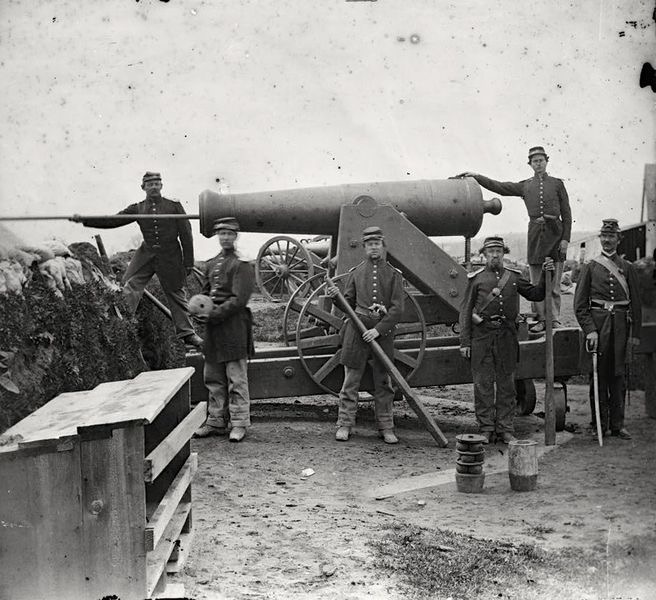
John wrote the letter while serving in the 3rd Light Artillery, Battery E, of the US Artillery (Regular Army)—commonly referred to as “Sherman’s Battery.” His enlistment was recorded as 17 April 1861 and his battery was mobilized and placed in a defensive position near Arlington Heights in late May. At least two of the guns were stationed at Pearl’s farm “north of the wagon road, half a mile east of Ball’s Crossroads” by early July. They were attached to William T. Sherman’s Brigade 1 of McDowell’s Army at the time of the Battle of Bull Run—their participation described by Captain Romeyn B. Ayres, who commanded the Battery at Bill Run, in the following after action report:
LIGHT COMPANY E, THIRD ARTILLERY,
Camp Corcoran, Virginia, July 25, 1861.
SIR: I have the honor to report the part taken in the battle of the 21st instant by this battery.
The battery advanced in the morning with the brigade to which it was attached—Col. W. T. Sherman’s—on the center route upon the front of the enemy’s position. The battery operated from this position at times upon the enemy’s batteries and troops as occasion offered. About noon I started with the brigade, as ordered, to cross the open ground, the run, and to rise the bluff, with a portion of the battery, one section being detached at this time, operating upon a battery to the left. On arriving at the run it at once was apparent that it was impossible to rise the bluff opposite with the pieces. I sent an officer immediately to report the fact to Colonel Sherman and ask instructions. I received for reply that I should use my discretion.
I immediately returned to the central position. I remained at this point, operating upon the enemy’s guns and infantry, till ordered by General Tyler to cover the retreat of the division with the battery.A body of cavalry at this time drew up to charge the battery. The whole battery poured canister into and demolished them. The battery moved slowly to the rear to Centreville.
I will add, that the coolness and gallantry of First Lieut. Dunbar R. Ransom on all occasions, and particularly when under fire of three pieces, with his section at short range, when the battery was about to be charged by a large body of cavalry, and also when crossing a broken bridge in a rough gully, and fired upon in rear by the enemy’s infantry, were conspicuous. The good conduct of First Lieut. George W. Dresser, Fourth Artillery, was marked, especially when threatened by cavalry, and at the ravine referred to above. Second Lieut. H. E. Noyes, cavalry, was energetic in the performance of his duties.
I lost four horses killed on 18th; two horses wounded on 18th; seven horses on 21st; three caissons, the forge, and a six-mule team and wagon (excepting one mule), on the 21st. I sent all these caissons, &c., ahead when preparing for the retreat, to get them out of the way. The fleeing volunteers cut the traces and took the horses of the caissons.
Very respectfully, your obedient servant, — R. B. AYRES, Captain, Fifth Artillery, Commanding Company E.
Battery E, 3rd US Artillery (“Sherman’s Battery”) as it appeared on its return from the Battle of Bull Run (New York Historical Society Museum)
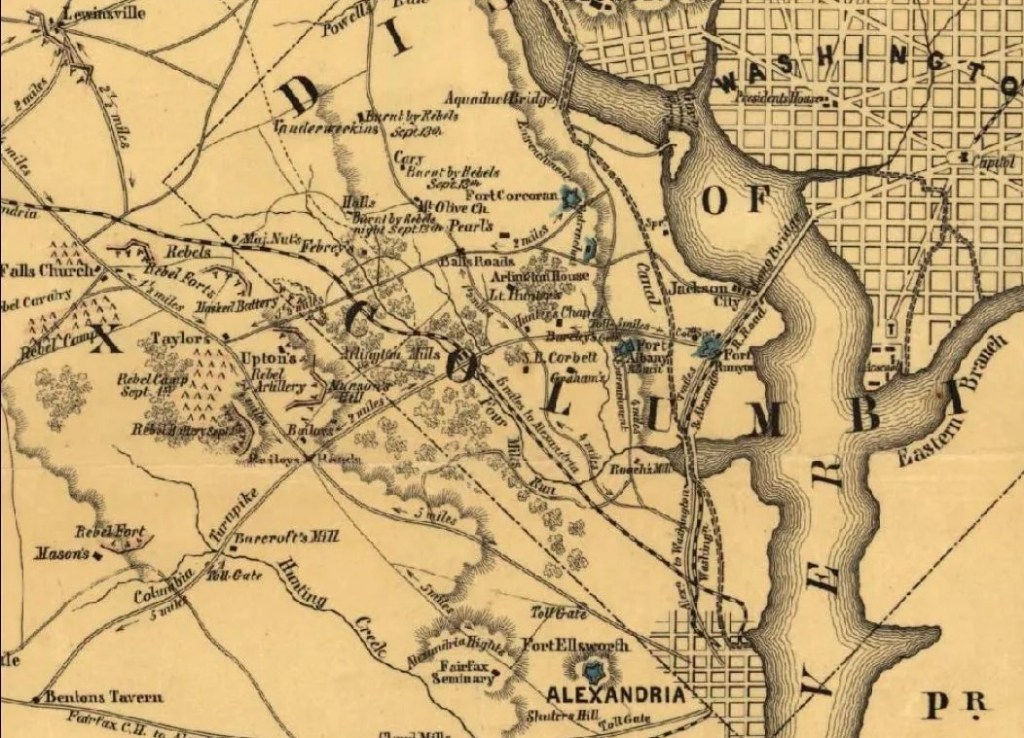
John datelined his letter from “Arlington Heights” on 5 September 1861. He indicates that the battery was near Fort Corcoran. More precisely the battery was positioned a quarter of a mile soutwest of W. Ross’ farm Rossyln.
Before the Civil War ended, John would enlist twice more in his country’s service. After his three years in Battery E, US Artillery, he reenlisted in Co. E, 60th Massachusetts Infantry on 16 July 1864 and served until 30 November 1864. Following that he reenlisted again in the 3rd Massachusetts Artillery and served until 1868. His military records indicate he was wounded once—at the Battle of Olustee (Florida) on 20 February 1864. In his later years, John worked in Boston as a locomotive fireman—a job that no doubt gave him the cataracts that plagued him in his later years, not to mention his loss of hearing.
[Note: This letter is from the personal collection of Megan Lynn and was transcribed and researched by Griff for publication on Spared & Shared with Megan’s consent.]
Transcription
Addressed to Adelaide Fales, South Framingham, Massachusetts
Arlington Heights [Thursday] September 5th 1861
Dear Sister,
As I have a little time today, I thought I would write & let you know that I am safe & well. We are here in the same place but we have just got orders to get ready to move. I do not know where we are going but I expect we are going to advance on to Fairfax.
Mr. Lincoln reviewed us last Monday 2 & after the review he came to our camp & examined our rifle cannons. 3 He thanked us very kindly for our gallant conduct at the battle of Bulls Run & when he went away he went up to where our cook was getting dinner & took a brand of fire & lit his cigar & sit down and had a long talk with our captain. 4 He is a very pleasant talking man. Anyone would not think he was President of the United States if they did not know who he was.
One of the 24-pounder guns in Fort Corcoran (LOC)
The 18th Massachusetts Regiment came over here from the city. 5 The Massachusetts soldiers are the best looking soldiers here. All the regiments here are at work every day. They are throwing up breastworks here in all direction & mounting heavy guns. Fort Corcoran has 8 guns which carry a 68 lb. ball & four 24-pounders. This fort commands the road from Georgetown to Fairfax & the Potomac. You can see all over the city of Washington. Our battery is about a quarter of a mile from this fort. It is large enough to hold 1500 men. I have got a picture of this fort but it does not look exactly as it does now.
I have not heard from [brother] Charlie yet. I do not know whether his regiment is in the city or not. We have got a large balloon here in our camp. He went up yesterday to take a look at the rebels. He could look right down onto them & see what they were doing. After he had been up a little while, the rebels fired a cannon ball at him but they could not reach him. He had ropes fixed to a large tree so that he would not blow away. 6
I have not anymore to write now. Remember me to all the folks. I am your affectionate brother, — John Fales
Footnotes
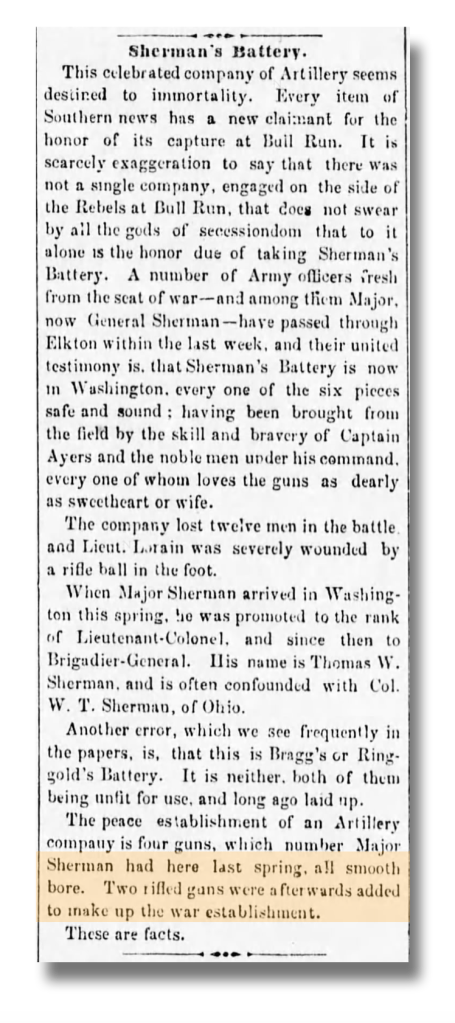
The Cecil Whig, 17 August 1861
1 The celebrated Battery E of the 3rd US Regulars was led during the War with Mexico by Thomas West Sherman and it was often referred to as “Sherman’s Battery,” even when it was lead, as it was at Bull Run, by Capt. Romeyn B. Ayres. Adding greater confusion, the Battery was assigned to the command of Col. William Tecumseh Sherman just prior to the Battle of Bull Run.Ayres was at Old Point, Virginia, until 7 July 1861 when he was ordered to Washington to take command of “Sherman’s Battery.” His was the only artillery unit to save all of his guns from the battlefield and even brought off two others. Ayres was transferred to Philadelphia to recruit for the 5th US Artillery shortly afterward. [Daily National Democrat, 20 September 1861]
2 “Last Monday” would have been 2 September 1861. According to the Lincoln Log, Lincoln and Secretary Seward reviewed the 2nd & 5th Wisconsin Infantry Regiments of Gen. Rufus King’s Brigade [NY Times, 3 September 1861].
3 Sherman’s Battery went into the fight at Blackburn’s Ford and Bull Run with four smoothbore cannon—two 6-pounders and two 12-pounder field howitzers, as well as two 10-pounder Parrott rifles as a reserve. The Parrott rifle was still somewhat of a novelty in 1861. It was developed in 1860 and were easily recognized by the wrought-iron reinforcing band wrapped around the breech. They were simple for the gun crews to operate and could be mass produced inexpensively.
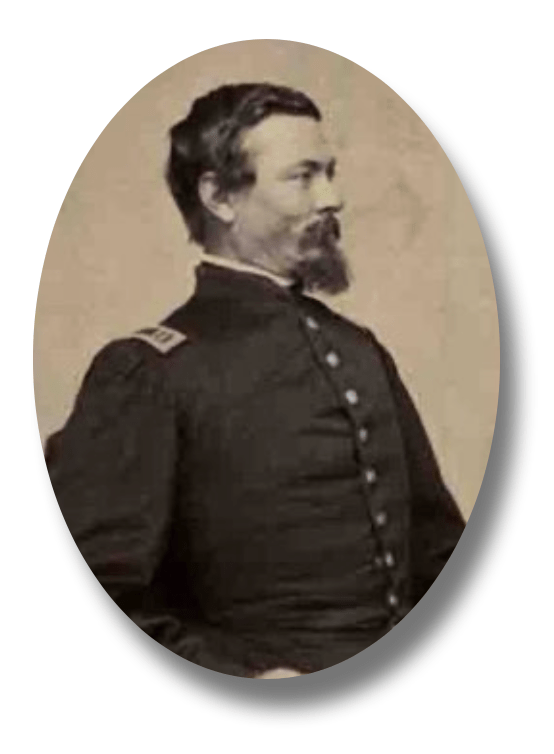
Capt. John H. Hamilton(1823-1900)
4 Though it was Capt. Romeyn B. Ayres of the 5th US Artillery who temporarily commanded the battery at Bull Run, by early August 1861 the battery was commanded by Capt. John H. Hamilton, West Point Class of 1847. Hamilton had received his promotion to captain in late April but he was in San Francisco at the time and he did not arrive in Washington D. C. until after the Battle of Bull Run. In short, it would have been Capt. Hamilton who enjoyed a cigar with President Lincoln, not Capt. Ayres.
5 The 18th Massachusetts was mustered into federal service on 27 August 1861 with eight companies. They were ordered on the 3rd of September to cross the Potomac and report to Gen. Fitz John Porter. They set up their camp near Fort Corcoran on ground previously occupied by the69th New York. Later in September they were moved to Hall’s Hill, then the outpost of the Union army.
6 Thaddeus Lowe’s newly created Balloon Corps was quite active prior to and after the Battle of Bull Run. On the day of the battle the balloon was accidentally ripped on the way to the battlefield so they were foiled in their ascension that day, but three days later, Lowe made an ascent at Fort Corcoran to look for an indications of a march on Washington by the Rebel army. Later that same day, he ascended again to check the Confederate bivouacs at Manassas and Centreville. To gain higher altitude for a better view, Lowe asked for the tethering cables to be released and the balloon drifted toward Alexandria where he was actually fired upon by Union troops thinking the Rebels were attacking by air. A number of ascents were made near Arlington Heights during August 1861 to keep an eye on the Rebel army’s movements. It was on August 29th at Ball’s Crossroads when Lowe’s balloon “Union” was fired on by a Rebel cannon commanded by Lt. Thomas Rosser of the New Orleans Washington Artillery from their position on Munson Hill. Though Fales could not have known it at the time, the Confederates attempted to send up its own “spy balloon” at Munson’s Hill on September 4th but the bag ripped before it could get off the ground. On September 5th, the date of Fale’s letter, it was reported that Union generals Irvin McDowell and Fitz-John Porter went up in Lowe’s balloon, and McClellan did likewise on September 7th. [See Arlington and Fairfax Counties: Land of Many Reconnaissance Firsts, by Dino A. Brugioni, published in Northern Virginia Heritage]
A map of the area and localities mentioned in the letter and footnotes.
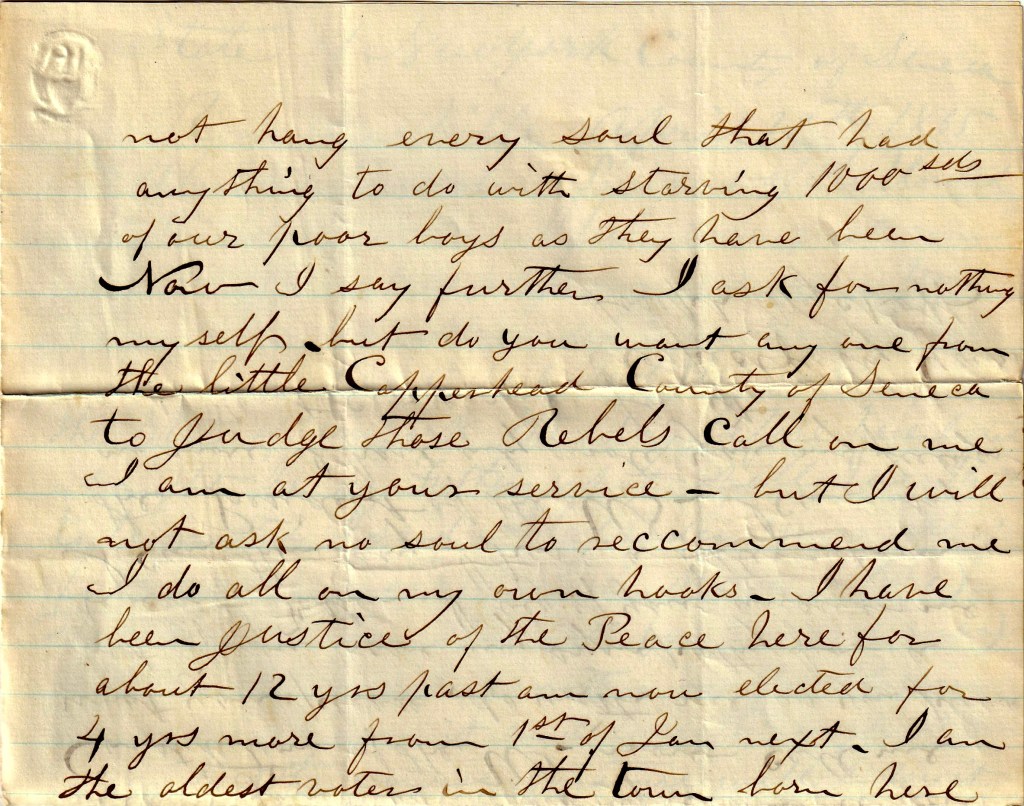
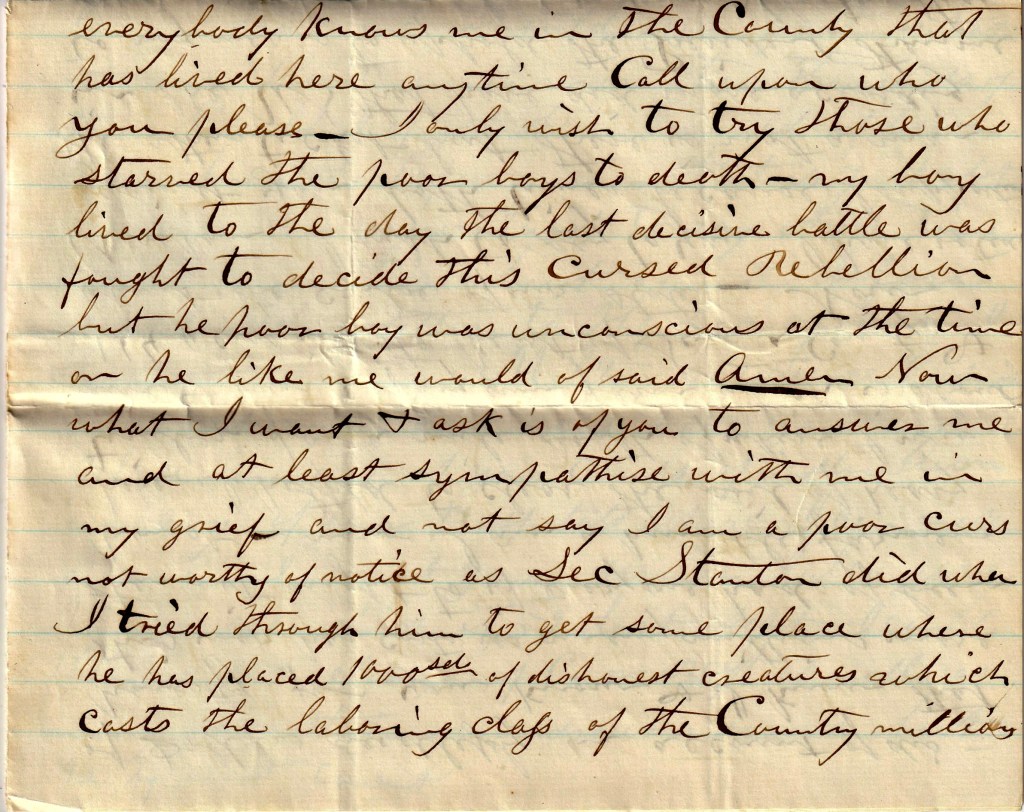
This amazing handwritten letter to President Abraham Lincoln was penned by a distraught father, Joseph Wyckoff (1805-1886), who lost his son as a result of confinement at Andersonville where he was starved to death. The letter was dated 12 April 1865—just three days after Appomattox and two days before Lincoln’s assassination. In his letter, Wyckoff pours out his grief to Lincoln, whom he admits he did not vote for, and, though he asks for the chance to judge those who caused his son’s death, we learn that what he really wants is a chance to vent some anger at—and gain some sympathy from—the Lincoln Administration.
Joseph’s son, Alexander Baldridge Wyckoff (1841-1865), was 21 when he enlisted 4 August 1862 at Varick, New York, as a Private. He was mustered into Co. C, 126th New York Infantry. On 15 September 1862, just a month after enlisting and before they had hardly been equipped and drilled, Alexander and other members of his regiment were surrendered to Stonewall Jackson’s men at Harper’s Ferry, Virginia, during the Antietam campaign, earning them, through no fault of their own, the unfair sobriquet “Harpers Ferry Cowards.” After their release from a parole camp in Chicago, the regiment worked hard to gain back their reputation, especially at Gettysburg where they sustained 57% casualties in capturing five stands of colors. Alexander was wounded on 10 May 1864 at Po River, Virginia, and on 25 August 1864 he was again captured, this time at Reams’ Station, Virginia. He was sent to Andersonville prison in Georgia, from which he was eventually paroled but died on 2 April 1865 at Baltimore, MD, according to his father, from illness sustained during his imprisonment.
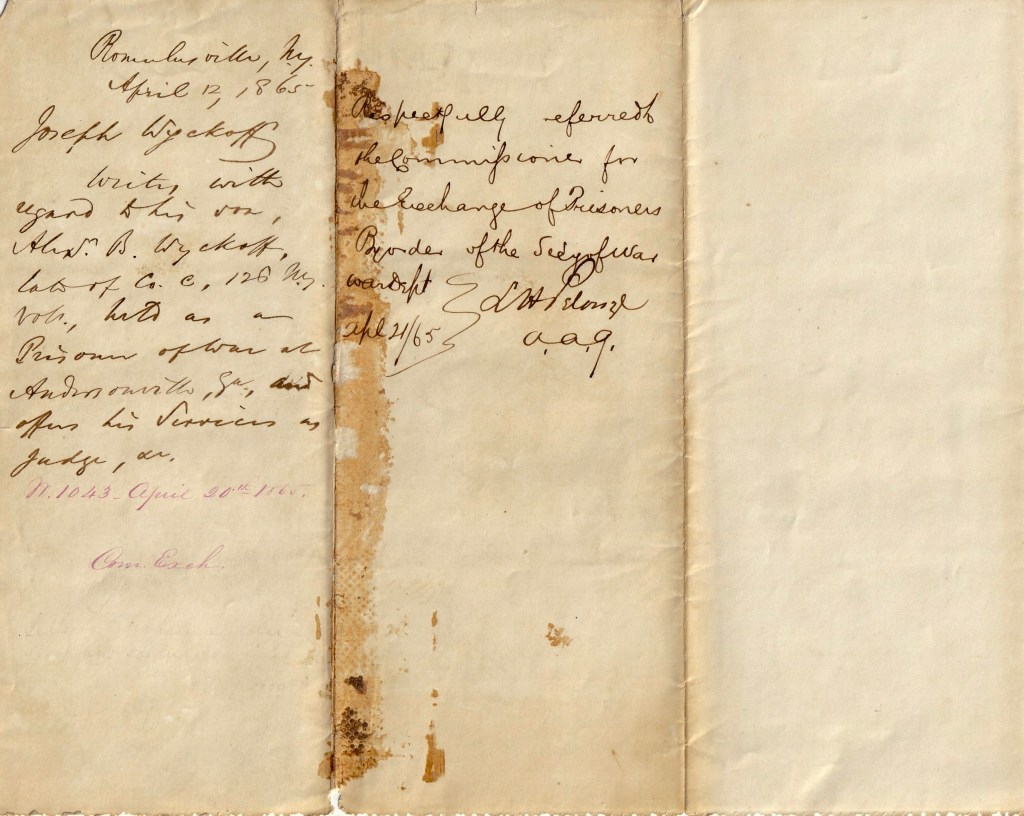
From the timing, it is unlikely that the letter ever got to Lincoln, but rather was processed by the President’s staff in the days following the assassination. The letter does, however, appear to have been read by the Secretary of War, Stanton, who Wyckoff, in his letter, implies might have been soft on corruption, though facts do not bear this out. Docketing at the end of the letter reads “W1043 April/65” (the President’s staff may have recorded correspondence alphabetically according to the last name of the writer). The letter also comes with a folded piece of ledger paper that reads “Romulusville, NY/ April 12, 1865/ Joseph Wyckoff/ Writes with regard to his son, Alex. B. Wyckoff late of Co. C. 126 NY Vol. Held as a Prisoner of War at Andersonville, Ga and offers his services as judge, etc.” On the back of the ledger paper it reads “Respectfully referred to the Commissioner for the Exchange of Prisoners By order of the Secy of War, War Dept. April 21/65 – L[ewis] H Pelouze/A.A.G.”
[Note: This letter is from the private collection of Richard Weiner and was made available for transcription and publication on Spared & Shared by express consent.]
Transcription
State of New York County of Seneca, Romulusville April 12th 1865
To Abraham Lincoln, President of the United States,
Dear Sir, I feel sore just now. I can’t help but express my feelings to you. I buried my son Alexander B. Wyckoff (9th inst). He was a member of Co. C ,126 Regt. U. S. Volunteers from the State of New York. The day before he enlisted, at night, he said, Father, what shall I do? I hate to be drafted. I said, Alexander, you are of full age (he was 21 years old in March before). That was under the call for 500,000 men. Our country is good for nothing so, should you go and help save it and live through it, you according to the course of nature will enjoy it longer than me. Should you fall, what is your blood worth more than thousands of others. Could I of got there I would have been there six months before now. That is just what I told him.
Now I wish to say at the time I told him this about six months before I addressed a letter to the Secretary of War. I there gave him my military experience (which was about 12 years) and said, have you any place in any of your camps of instruction, in any of your hospitals, where I can make a man? I am at your service. I also gave him my age which is now 59 last Sept. I could then of took charge of a Company or Regiment as well as many others that never drew a sword but he by silent consent passed by – by a silent nothing. Well, what is the consequence? We are taxed here to pay millions of dollars for some contemptible rouges that was well recommended which he nor you knew nothing of—only the recommend[ation] that accompanied their application.
Now my boy enlisted in the service, t’will be 3 years next August. He was captured in August last 25th. He was starved to death at Andersonville but he got a parole and died at Baltimore, April 2nd instant. His Mother was with him when he died. Now, could I of stooped so low as to ask for any position during the war, I know I could of got all the principle men in our county to of signed a recommend[ation] for me as a suitable person for the position—tis no matter what [position]. But I could not—I would not—and neither would I [even if it] was it to gain the Chief Justiceship of the U. S. But I now say one thing to you, if I had the Judgeship to investigate and try those who starved those poor prisoners to death, if found guilty by evidence, I would hang every soul of them. But to stoop so low as to ask any man or any set of men to recommend me, I will never do it. But I say cursed be the man, or any set of men, that will not hang every soul that had anything to do with starving thousands of our poor boys as they have been.
Now I say further, I ask for nothing myself, but should you want anyone from the little Copperhead County of Seneca to judge those rebels, call on me. I am at your service. But I will not ask no soul to recommend me. I do all on my own hooks. I have been Justice of the Peace here for about 12 years past, am now elected for 4 years more, from 1st of Jan next. I am the oldest voter in the town—born here—everybody knows me in the county that has lived here anytime. Call upon who you please. I only wish to try those who starved the poor boys to death. My boy lived to the day the last decisive battle was fought to decide this cursed rebellion, but the poor boy was unconscious at the time, or he—like me, would of said, Amen.
Now, what I want and ask of you is to answer me and at least sympathize with me in my grief and not say I am a poor cur not worthy of notice as Secretary Stanton did when I tried, through him, to get some place where he has placed thousands of dishonest creatures which cost the laboring class of the country millions of dollars needlessly on account of dishonesty, for you know and I know that this war has cost us many millions more than it ought to if everyone had of been honest. Now I am a humble farmer here. I helped to clear the soil of heavy timber for a mile south of where I now live & over half of my own farm which is about 164 acres in the heart of Seneca County & about the center of our state.
Now, Abraham, I wish to say to you, I have voted against you both times because I supported the other ticket, but there is not a man in the U. S. that have did more according to my means to uphold the President than me because you was elected agreeable to the constitution of the U. S. Now, call me what you please, do with me as you please, but if you have any sympathy for a bereaved Father, I beg of you answer me. I can then say I have a letter from the President of the U. S. I can say no more. I have only wrote you my feelings and do not curse me for it.
I could not find an image of Benjamin but here’s one of Henry Baker who served in Co. H, 141st Pennsylvania Infantry (LOC)
The following letters were written by Benjamin M. Dunham (1840-1863), the son of John L. Dunham (1811-1861) and Laura Cheney (1812-1894) of LaPorte, Sullivan county, Pennsylvania. Benjamin enlisted as a private in Co. K, 141st Pennsylvania Infantry. Benjamin enlisted with his older brother Henry R. Dunham (1838-1877) who was made the 1st Lieutenant of the same company for his efforts in raising the company. However, ill health resulted in his resigning is commission in late December 1862 and returning home where he remained until 1864 when he accepted a commission in Co. E, 13th USCT.
According to the regimental history, Benjamin M. Dunham was a young man of more than ordinary ability and character. Said one who knew him: “He was characterized by untiring energy and intense application to his studies. No lesson or duty was ever assigned that he did not grapple with all his powers. He loved study. He was impetuous almost to a fault. Whatever he did, he did with all his might. His moral character was without reproach. He could be relied on implicitly in all he said or did. He was, in ‘ short, one of Nature’s noblemen, an honest man. His dear remains rest in an unknown grave, on hostile ground, and his spirit has gone to God who gave it.” Benjamin was killed at Chancellorsville.
Letter 1
In Camp near Falmouth, Va. February 24th 1863
My dear Mother,
I yesterday received a letter from you full of your anxious fear about me. I hear nothing from you but a constant lament that I am where I am! Nothing but worriment about & fears that I am suffering here where I am. Now let this be enough for you, Mother, as it ought to be for anyone to know that I am doing well, getting over my lameness, and in fact, I have almost gained my flesh again. I have been on duty and took no cold from it & I hope I am none the worse for it. I asked to be put on [duty], it is true, for I knew there were some who would think I did not want to do [my] duty, but I did and so I went on. And as I said before, I am not sorry.
Now, Mother, what more under the light of Heaven could a son write to a Mother that would be of more cheering—I mean real cheering news—than what I have just written to you which is God’s truth and no deception, for I have not now nor never intended to deceive you. I know, Mother, there is news that I could write that might be more pleasing such as that I was coming home soon or something like this. But do I not tell you, Mother, that if I have my health, which I now hope to get, that I had just as leave be in the army here at such a time as this as at home. Maybe you think I lie, but I tell you that I can stand it here from my friends & family, if old grey-headed men who have children & a wife to think of & long to see, for this is the great, the most difficulty the soldiers has to contend against.
Don’t understand me to say that I like the hardships & hard marching of our life. But Mother, I do say in view of all things now, I—a single man [with] no one to depend on me [and] no one to suffer from my loss if should be the case, and no one’s support arising from my earnings—I say I and those in like circumstances are just the ones to be where I am if they have their health.
Mother, be reasonable! Look about you & see if you can point to another Mother who has three able bodied (for such I am now called & hope Henry is) Republican son who have no wives & little ones, no farms & workshops to hinder their being in the army of our Nation. I say, see if you can find another Mother who still has two sons with her at home all the time. Do you think, Mother, to raise three sons and live to see them all grow to be men & still be with them all & live with them all? It is an impossibility & the sooner you make up your mind to be content & satisfied while your boys are all doing well, the better it will be for you and your health and comfort also. You are almost selfish. You wish us with you & by constantly (except when we are fighting perhaps). But you must expect to be obliged to lay aside your own desires to see & pleasure to be with your boys.
I know this is not altogether what you wish me to come home for but you fear I will die here & then you will never see me again. Mother, does it make any difference about our meeting again in this world (for I have no fears for the next). Whether I die here from disease or you die there from a useless worriment, that does no one any good & hastens your own end. Think of this when you are lying awake nights on my account & if you wish to do anything to please me & make me happy and contented here with my lot. Why, don’t fret and worry & lie awake nights for me. Will you do this for me? Will you let this ring in your ears every time your mind turns upon me. Or will you still do that which is the farthest from my wishes of anything you can do? If you will, why then I cannot help it.
Again, my complaint (diarrhea & rheumatism), Mother, is not a thing you need to worry about at all. Why, do you not know that those who die with the chronic diarrhea live for four or five months & that there is no need of men to be sick that long in this army and not be sent home. As to the rheumatism, I do not fear death from that at all. So be contented & satisfied with your lot.
Mother, as to what you say about getting into this army, you did not such thing at all. I came of my own free will & you never asked me to come at all so I want you never to think of that again. Oh! you are a queer woman, Mother, & I hope you will try and exercise a little more your reasoning & relective faculties a little more & your caution a little less and it will be better for us both.
Our Captain has returned & I like him very much indeed so far & all the boys seem to almost worship him. We have just received orders to be ready to move over into Ward’s Brigade & the 4th Maine is to come into our Brigade. It is but a few rods between us. The trade is from some cause, I know not what. Time will tell.
Brewster, I think, will come home on a furlough but I do not know whether he can get it or not. Hank Gunn too, if he’s able. I shall try and get one if I can but I have little hopes as there is so many ahead of me. Do not build up any hopes of my coming home this winter.
An J. H. Winslow silver watch with engraving of soldier, perhaps like the one Benjamin purchased.
I yesterday received returns from my little investment (J. H. Winslow and Co., of New York) and I have me a larger patent lever silver watch and gold chain for which I have been offered $20 in cash besides selling some ten dollars worth of tickets to the boys and keeping for myself a ticket that calls for a watch worth fifteen dollars & ever so many other tickets calling for articles valued at eight and ten dollars. In fact, Mother, I have an agency here from which I can make double my wages & do it just as honestly as anything else.
So be content. Be satisfied & do not for God’s sake, kill yourself by worrying yourself about me. Have you any help yet? I will send you a circular of J. H. Winslow & you can see what I am doing. — B. M. Dunham
Letter 2
Stoneman’s Switch in May 1863.
[Note: This letter is from the personal collection of Keith Fleckner and was offered for transcription and publication on Spared & Shared by express consent.]
In Camp near Stoneman’s Switch Wednesday, April 8th 1863
My Dear Mother–
I have at last succeeded in getting you a picture which I hope will be satisfactory to all. I think if you compare this with those taken before I left home, you will find I am still “the same old six pence.” I have the locket filled which I think will be—or at least I hope will be—satisfactory to you also. I have been asked by several for pictures and all want photographs which I cannot get here in the army as there is no one who takes them on this side of the Potomac that I know of. The only way I can think of to get them is to send this to [ ] with Edwin and let Mr. Wood copy it. Then when you get a negative, I suppose you know you can get as many as you choose & give them to whom you choose. If you think this one not large enough, I will get a half-sized picture and let that be used in its stead.
Mother, have you received that package of old letters I sent home some time ago but have not heard from them. I do hope they are not lost for I value them too highly to lose them now. I wrote to Edwin day before yesterday. Have you received that yet? I have just received your letter of March 31st also. I am very glad to say it was the most encouraging thing I have had for many a day. It cheered my feelings very much & I hope I will not run to enquirer “if there is any letters for me” very often without being answered in the affirmative.
Well Mother, I have seen Honest Old Abe, President of these Dis-United States and I consider it one of the greatest treats I have had since I left Little Sullivan. As you are aware if you have read my letter to Edwin, this Brigade is on picket for three days and I was left behind for camp guard. I was relieved yesterday and had the day to myself, so I took a french furlough and went over to Stoneman’s Switch after the pictures I now send to you. While there, I heard the awfullest cheering and shouting heard in all my life and was soon told that the President was with Hooker reviewing the Army, or rather riding around from regiment to regiment as they were drawn up in line to receive them. Out I went and took across the fields on double quick to where I saw a long line of troops drawn up. It was quite a piece but on I went, through mud sometimes nearly to the top of my big boots, but I got there just in time to have him ride close along side of me. He was followed by General Hooker & staff, and one battalion of Rush’s Lancers. (I believe they called them Rush’s Lancers). He was then, at the time I saw him, just reviewing Berdan’s Sharpshooters.
I then turned and went back, and as I crossed the road, I looked behind me and saw him & [ ] coming at a full gallop. I stopped—there was four or six with me—and they did the same. They all fell back from the road and said, “Oh, don’t stand so close! Don’t stand so close.” But I didn’t run all this distance to spoil it all now, so I stood in front and when the honest old fellow came along, I gave him a military salute and he returned it with all the grace imaginable. Three cheers for our President was then proposed, and if I didn’t give my old Methodist lungs rent then, I never did. It raised Old Abe’s hat right off his head and he smiled as pleasantly as you please. It did me good I can tell you, and I guess if he ever hears me cheer again, he will know he has heard me before. When he took off his hat, I could see he looked for all the world just like the pictures of him. He rode a very beautiful horse on which was a very handsome saddle but not a very handsome man. He wore a tall black hat which was put on the back of his head and made him look like an old farmer by the side of the many dashing looking exquisites who call themselves officer who followed him. I saw old Gen. Hooker and a number of other Major Generals I did not know.
I began to think Mother from appearances that we are not agoing to be moved from here right off. I do not think now we will move before the last of this month and perhaps not before June or July owing to the weakening of our army by the leaving of many troops. Both the nine-months men from Pennsylvania and the two-year men from New York leave about the same time which will weaken us until their places are supplied by other troops which will take some time to do—two or three months at least. I will put this in the mail and the locket the next if I cannot get it done up for this one. If I do, I will send it in this. Sam sits here as I write and wishes me to say that he sends his best wishes to you and all the family. I wish to be remembered to all who inquire after me, especially to Mrs. Finch. Tell her I will write to her in a day or two or as soon as I can find time. I wish Aunt Annie would write to me. Has she forgotten me or has she no time to do so as I hope all will write often.
I could not find an image of Walter but here is a tintype of Alfred T. Groat who also served in Co. G, 72nd New York Infantry (Photo Sleuth)
The following letter was written by Walter A. Bowdish (1839-1862), the son of Daniel Platt Bowdish (1812-1861) and Martha Caroline Granger (1813-1894) of Portland, Chautauqua county, New York.
Walter enlisted on 24 July 1861 as a private in Co. G, 72nd New York Infantry—Sickles’ Excelsior Brigade. He was known to have been wounded in the fighting at Turkey Bend (Malvern Hill) on July 1, 1862 and was carried as missing in action following that date. No identifiable body was ever recovered and all of the records of soldiers in Rebel prisons were examined following the pension application filed by Walter’s mother. Lt. James A. Smith of Co. I claimed he attempted to help Walter off the battlefield but Walter’s leg wounds were so severe (his blood “flowing in jetts” indicating a severed artery) that he had to leave him after struggling only a few steps. There was one letter written by Alfred found in his mother’s pension application submitted as proof of Walter’s sending her money while in the service. It was dated 2 May 1862 and I have included a transcript of it below.
Walter wrote the letter to Maria Agnes Fellows (1840-1911), the daughter of John Andrews Fellows (1806-1888) and his second wife, Olive Thwing (1809-1884) of Portland, Chautauqua county, New York. Agnes never married, though she clung to this letter the remainder of her life, dying in 1911.
Transcription
Addressed to Miss Agnes Fellows, Portland, Chautauqua county, N. Y.
Camp Caldwell Monday, September 30th 1861
Miss Agnes Fellows Dear Agnes,
Long had I waited for a reply to my last letter and had concluded that you were offended with the same. But Saturday the long looked for letter came. It had been very long on the way but the contents rewarded e for the anxiety it had caused me. Agnes dear, that letter has been perused many times since received. It has caused a new interest in my present situation.
You say in your letter that I was not too bold in writing as I did. You also wanted me to consider before going farther. I honor you for those words, yet I must say that this has not been the work of nor impulse of a few days or weeks, but has long been on my mind. The thought that your pure mind would revolt at my love has unlocked a secret in my breast. The night you attended the concert at Fredonia with me was a night of tumult on my heart. Oh how I longed to whisper in your ear that eve a tale of love. But the thought of slight acquaintance and a rejection kept it back.
Agnes dear, I can not write as I could talk to you were you here, but be assured that I love you deeply, truly and fondly. My love is no boyish love but a deep and lasting one. All I ask is a kind thought or word from you occasionally until my return. If with God’s mercy I am permitted, then will I convince you that I am serious in what I say.
Think not of your misfortune but as one of the dispensations of an “All wise Providence.” Bear it with the thought that it does not make you look any the less in my eyes. But to the contrary. endear you in my eyes and makes me long to be with you and protect you with an ever helping hand. Write to me, Agnes, and tell me truly whether you can return the love of the lone soldier boy. If you cannot, let this secret remain locked in your breast and forget that I ever offered the love of a true and honest heart to the kind and lovely Agnes Fellows.
The soldier in his far off tented field turns his thoughts to a loved home or some dear one. Why should not I as well? Waiting anxiously a reply to these few lines, I remain yours truly, fondly, and devotedly, — Walter A. Bowdish
[On a different sheet]
Our present situation is at the old camp (Caldwell). We cannot tell how long we stay here but I think not long as we have orders not to leave the camp on any account and to keep our knapsacks packed. Our forces on the other side of the [Potomac] river has begun to advance and are already in possession of Munson Hill and Fairfax Court House. This has been done without the loss of a single life.
Friday and Saturday there passed over the Long Bridge into Virginia over 180,000 troops. Things begin to look warlike now. On our regiment being reviewed by President Lincoln, he said we were the best body of men but one he had seen.
Last week there was a rumor afloat that we were to remain in our present situation as a home guard for the City on account of being the best drilled body of men in the service this side of the [Potomac] River. I have had a chance to leave this regiment and be in the Regular service [and] shall think of it a spell. If I go in the Regulars, I must stay three years—war or no war. If I stay where I am, I may be discharged before that time.
Since I commenced this letter I hear the 1st Regiment of the Brigade has received orders to march. They are encamped about half a mile from here. There is the drum beat for dress parade. More Anon. — Walter Bowdish
Letter 2
[Note: The following letter was found in the Pension Application File for Walter A. Bowdish. It was probably one of his last letters home.]
Camp Winfield Scott Near Yorktown, Virginia May 2nd 1862
Dear Mother,
Yours of the 26th came duly to hand this morning finding me at camp but not very well, having just returned from picket duty yesterday morning, the 30th. We laid in sight of the Rebs Battery all day and night in the midst of a heavy rain. We went into the trenches in the course of the night. Our pickets were driven in and then we stopped the Rebels there. They fell back to their Battery and then commenced firing shell. Some fell close to us but no one injured. In half hour they ceased firing.
At 8 o’clock we returned to camp, found the Pay Master and got two months pay. This morning we were mustered in for two months more and the pay master says he will be able to pay us in 12 or 15 days. ($20) twenty dollars of which I got is in the shape of an Allotment Bill and is payable to you or Order at any Bank, and when you present it, try and get half cent premium for they send them to New York City and get the gold which is worth 708 percent on the dollar. I have seen the Lieut. (Smith) and he promises to pay me soon, I hope, but fear him. I shall report to the Col. (Taylor) if he fails me. I send the $20 dollar bill and will send more in the next letter. Use them to your advantage and you will do all right…
I must close. I have one favor to ask. Write a long letter and tell something about how the neighbors are and write the news. I like to get letters but after waiting 10 or 15 days, get one with only a few lines, it disheartens one. I want something bedsides dead and wounded men to think of. Give love to all and tell them we expect battle soon. I remain your dutiful son, — Walter A. Bowdish
I could not find an image of Norman in uniform but here is Lavern Burdick who also served as a private in Co. B, 189th New York Infantry (Photo Sleuth)
This letter was written by Norman Orlando Wheeler (1843-1929) who enlisted at the age of 20 at Hornellsville to serve one year in Co. B, 189th New York Infantry. He survived the war and mustered out of the service on 30 May 1865 near Washington D. C. Norman and his company did not see much action until the last month of the war when they participated in the fight at Hatcher’s Run and the Appomattox Campaign.
Norman was the son of Horace Wheeler (1816-1900) and Rhoda Ann Mack (1821-1900) of Hornellsville, Steuben county, New York.
Norman’s letter describes the journey of the 189th New York from Washington D. C. to City Point, Virginia in late October 1864, including a stop at the White House “where Old Abe come out to see us and after talking to us a few minutes.”
Transcription
City Point, Virginia October 25, 1864
Dear Father & Mother,
I have just received your letter with the one from Henry & Aunt Rebecca. I was very glad to hear from you and to hear that you were all well and getting along with the work so well but was surprised to think that you could not make out them figures. I thought them was plain as could be. It is the one hundred and eighty-ninth regiment. It is a new regiment to be sure. Your directions was alright on this letter. Try and write them as plain as you can. I guess I have got all the letters has been wrote to me. That one you sent with Jimmy’s letter in which I answered immediately and which it seems you had not got when you wrote, & one from Amelia & one from Isadore [where] she wrote about that wedding & said that she & Robin were going to stand up, I shouldn’t wonder if they did the same before long.
Well I guess I will tell you a little about how I am getting along. We got orders last Friday to start for City Point but did not start till Saturday [Oct 22] noon when we was ordered to fall in with everything on—namely knapsack with my clothing, blanket, and everything almost in and overcoat strapped on top, haversack, canteen, gun, cartridge box with 40 rounds of ammunition in. Quite a load! After standing about one half an hour, we marched up to the White House where Old Abe come out to see us and after talking to us a few minutes, we marched down to the wharf and got aboard a steamer tired enough having marched about 4 miles besides standing with all on.
We started down the Potomac that night. Had good comfortable quarters and enough to eat but next morning [when] we got into Delaware Bay, the wind blowed considerable and the boat wagged one side and another and you had better believe there was some seasick boys aboard. I was sick for a spell but after throwing up some, I felt better.
We passed Fortress Monroe about noon. It is a huge looking fortress with some big looking guns sticking their mouths towards us. There was some large man-of-war & ironclads there. We turned up the James River there and a noble-looking steam it is. We arrived at City Point about 10 o’clock Sunday night, stayed on board all night, and next morning we got off and marched about one mile towards Richmond & drawled our tents and went to work & put them up. There is three in a tent. Hub[bard W. K. Head], Andrew [Kilbury], and I go in one. They are nice.
I am sitting in my tent tonight. I have got a lot of corn husks on the bottom and cloth all around which makes it as warm and comfortable as can be. We have good fare—better than we have had before. We can hear the guns at Richmond & Petersburg. We have to do guard duty now. I am well and hearty as ever. — N. O. Wheeler
I have got a good watch & look out for it. I have got my knife yet. I have seen Seely and Mike Smith. They are well. They have been here about 3 weeks. Grant is fixing for a battle but tain’t likely we shall be sent on. Write soon & all the news.