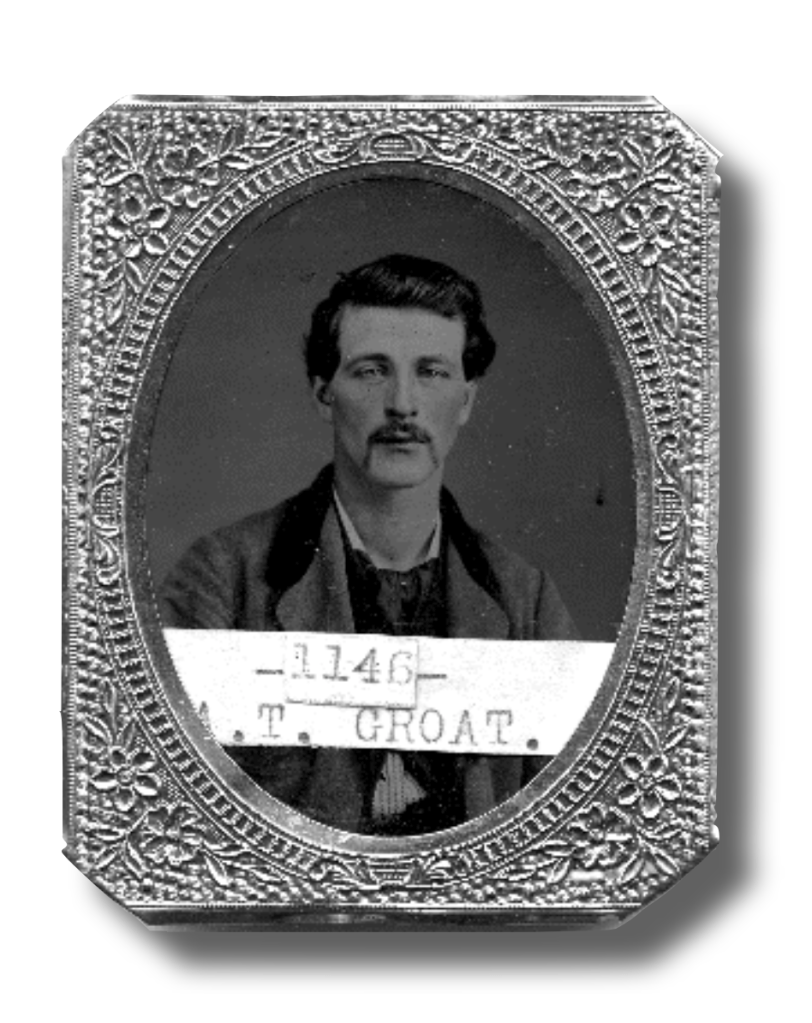
The following letter was written by Walter A. Bowdish (1839-1862), the son of Daniel Platt Bowdish (1812-1861) and Martha Caroline Granger (1813-1894) of Portland, Chautauqua county, New York.
Walter enlisted on 24 July 1861 as a private in Co. G, 72nd New York Infantry—Sickles’ Excelsior Brigade. He was known to have been wounded in the fighting at Turkey Bend (Malvern Hill) on July 1, 1862 and was carried as missing in action following that date. No identifiable body was ever recovered and all of the records of soldiers in Rebel prisons were examined following the pension application filed by Walter’s mother. Lt. James A. Smith of Co. I claimed he attempted to help Walter off the battlefield but Walter’s leg wounds were so severe (his blood “flowing in jetts” indicating a severed artery) that he had to leave him after struggling only a few steps. There was one letter written by Alfred found in his mother’s pension application submitted as proof of Walter’s sending her money while in the service. It was dated 2 May 1862 and I have included a transcript of it below.
Walter wrote the letter to Maria Agnes Fellows (1840-1911), the daughter of John Andrews Fellows (1806-1888) and his second wife, Olive Thwing (1809-1884) of Portland, Chautauqua county, New York. Agnes never married, though she clung to this letter the remainder of her life, dying in 1911.
Transcription

Camp Caldwell
Monday, September 30th 1861
Miss Agnes Fellows
Dear Agnes,
Long had I waited for a reply to my last letter and had concluded that you were offended with the same. But Saturday the long looked for letter came. It had been very long on the way but the contents rewarded e for the anxiety it had caused me. Agnes dear, that letter has been perused many times since received. It has caused a new interest in my present situation.
You say in your letter that I was not too bold in writing as I did. You also wanted me to consider before going farther. I honor you for those words, yet I must say that this has not been the work of nor impulse of a few days or weeks, but has long been on my mind. The thought that your pure mind would revolt at my love has unlocked a secret in my breast. The night you attended the concert at Fredonia with me was a night of tumult on my heart. Oh how I longed to whisper in your ear that eve a tale of love. But the thought of slight acquaintance and a rejection kept it back.
Agnes dear, I can not write as I could talk to you were you here, but be assured that I love you deeply, truly and fondly. My love is no boyish love but a deep and lasting one. All I ask is a kind thought or word from you occasionally until my return. If with God’s mercy I am permitted, then will I convince you that I am serious in what I say.
Think not of your misfortune but as one of the dispensations of an “All wise Providence.” Bear it with the thought that it does not make you look any the less in my eyes. But to the contrary. endear you in my eyes and makes me long to be with you and protect you with an ever helping hand. Write to me, Agnes, and tell me truly whether you can return the love of the lone soldier boy. If you cannot, let this secret remain locked in your breast and forget that I ever offered the love of a true and honest heart to the kind and lovely Agnes Fellows.
The soldier in his far off tented field turns his thoughts to a loved home or some dear one. Why should not I as well? Waiting anxiously a reply to these few lines, I remain yours truly, fondly, and devotedly, — Walter A. Bowdish
[On a different sheet]
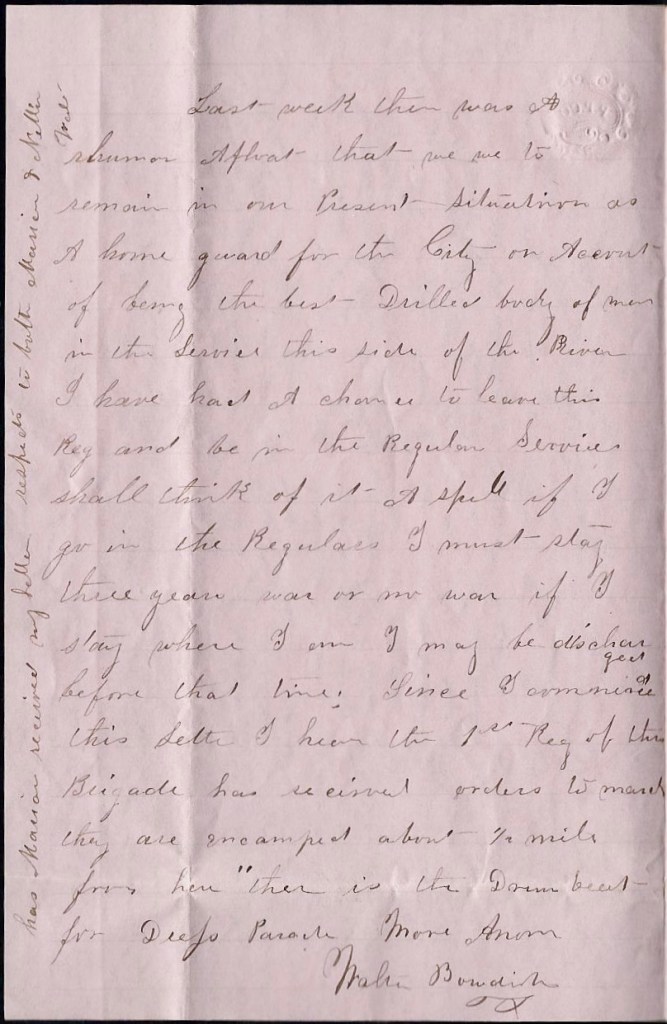
Our present situation is at the old camp (Caldwell). We cannot tell how long we stay here but I think not long as we have orders not to leave the camp on any account and to keep our knapsacks packed. Our forces on the other side of the [Potomac] river has begun to advance and are already in possession of Munson Hill and Fairfax Court House. This has been done without the loss of a single life.
Friday and Saturday there passed over the Long Bridge into Virginia over 180,000 troops. Things begin to look warlike now. On our regiment being reviewed by President Lincoln, he said we were the best body of men but one he had seen.
Last week there was a rumor afloat that we were to remain in our present situation as a home guard for the City on account of being the best drilled body of men in the service this side of the [Potomac] River. I have had a chance to leave this regiment and be in the Regular service [and] shall think of it a spell. If I go in the Regulars, I must stay three years—war or no war. If I stay where I am, I may be discharged before that time.
Since I commenced this letter I hear the 1st Regiment of the Brigade has received orders to march. They are encamped about half a mile from here. There is the drum beat for dress parade. More Anon. — Walter Bowdish


Letter 2
[Note: The following letter was found in the Pension Application File for Walter A. Bowdish. It was probably one of his last letters home.]
Camp Winfield Scott
Near Yorktown, Virginia
May 2nd 1862
Dear Mother,
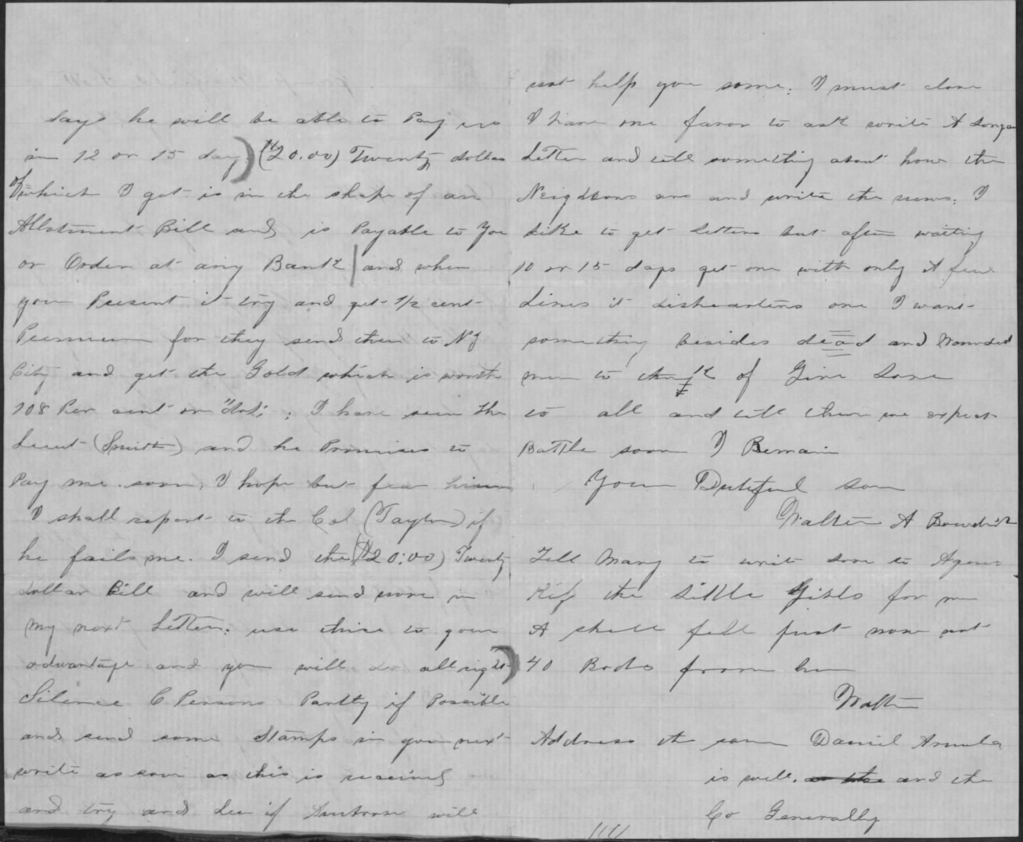
Yours of the 26th came duly to hand this morning finding me at camp but not very well, having just returned from picket duty yesterday morning, the 30th. We laid in sight of the Rebs Battery all day and night in the midst of a heavy rain. We went into the trenches in the course of the night. Our pickets were driven in and then we stopped the Rebels there. They fell back to their Battery and then commenced firing shell. Some fell close to us but no one injured. In half hour they ceased firing.
At 8 o’clock we returned to camp, found the Pay Master and got two months pay. This morning we were mustered in for two months more and the pay master says he will be able to pay us in 12 or 15 days. ($20) twenty dollars of which I got is in the shape of an Allotment Bill and is payable to you or Order at any Bank, and when you present it, try and get half cent premium for they send them to New York City and get the gold which is worth 708 percent on the dollar. I have seen the Lieut. (Smith) and he promises to pay me soon, I hope, but fear him. I shall report to the Col. (Taylor) if he fails me. I send the $20 dollar bill and will send more in the next letter. Use them to your advantage and you will do all right…
I must close. I have one favor to ask. Write a long letter and tell something about how the neighbors are and write the news. I like to get letters but after waiting 10 or 15 days, get one with only a few lines, it disheartens one. I want something bedsides dead and wounded men to think of. Give love to all and tell them we expect battle soon. I remain your dutiful son, — Walter A. Bowdish