Category Archives: Presidential Election of 1864

1864: Menzo Klock to Samuel R. Green

This letter was written by Menzo Klock (1835-1891), the son of Jonas Klock (1801-1881) and Mary Polly Klock (1807-1884). Menzo was married to Mary Diefendorf (1836-1865) at the time he wrote this letter from their residence in St. Johnsville, Montgomery county, New York.

He wrote the letter to Samuel R. Green who was serving in the 146th New York Infantry at the time.

Klock’s letter refers extensively to the late Presidential election.

Transcription

St. Johnsville [Montgomery county, New York]
November 30th 1864

Mr. S. R. Green
Dear sir,

You last came to hand day before yesterday after having been patiently waited for three or four weeks. I was happy to learn that you are yet in the land of the living and enjoying good health and hope and pray that you may pass unharmed through the fiery ordeal of battle and return home to your family and friends to enjoy the gratitude of a free and liberty-loving people whose homage shall never cease to our heroic soldiers whose blood and toil shall have sealed forever the unalienable rights of man.

The status at St. Johnsville is the same as when I last wrote. The bitterness and determination with which the opposition entered the Presidential canvass has subsided into quiet and apparent submission. Never did democracy enter a canvass with greater resolution to regain her ancient prerogative than the one just closed and never did it leave the contest so much discomfited and with greater apparent resignation. The threats of resistance to the Administration, if successful in its reelection, their declamations of bankruptcy and ruin to our country and impossibility of subduing the rebellion, the usurpations of the President in the conduct of affairs with a thousand frightful scenes designed to destroy in the minds of the people the belief in justice of our cause and that the Administration was incompetent to conduct the country safely through its trial proclaimed everywhere in loud and stirring tones have not been heard or seen since election day.

Since my last, we have heard of Robert Vandusen’s death who was in the army and enlisted when DeWitt did. Aunt Lydia Green was also buried some six weeks since. Old Mrs. Curren and Julia attending the funeral, they being at St. Johnsville on a visit. We gave them your address and let them read your letters which pleased them much. You likely will soon hear from them as they have returned home to the west.

We shall expect to hear from you soon and would like to receive a visit from you which would be far more agreeable. Mrs. Klock sends her request that you send her your photograph if you have it in soldier’s likeness but will not refuse any other if you prefer to send one. Do not neglect to write and if you come gome be sure to make us a good long visit.

With respect, I remain as ever your friend and servant, — Manis Klock

I have written badly having a lame hand.

1864: Alburtus H. Peckham to Asahel G. Eggleston

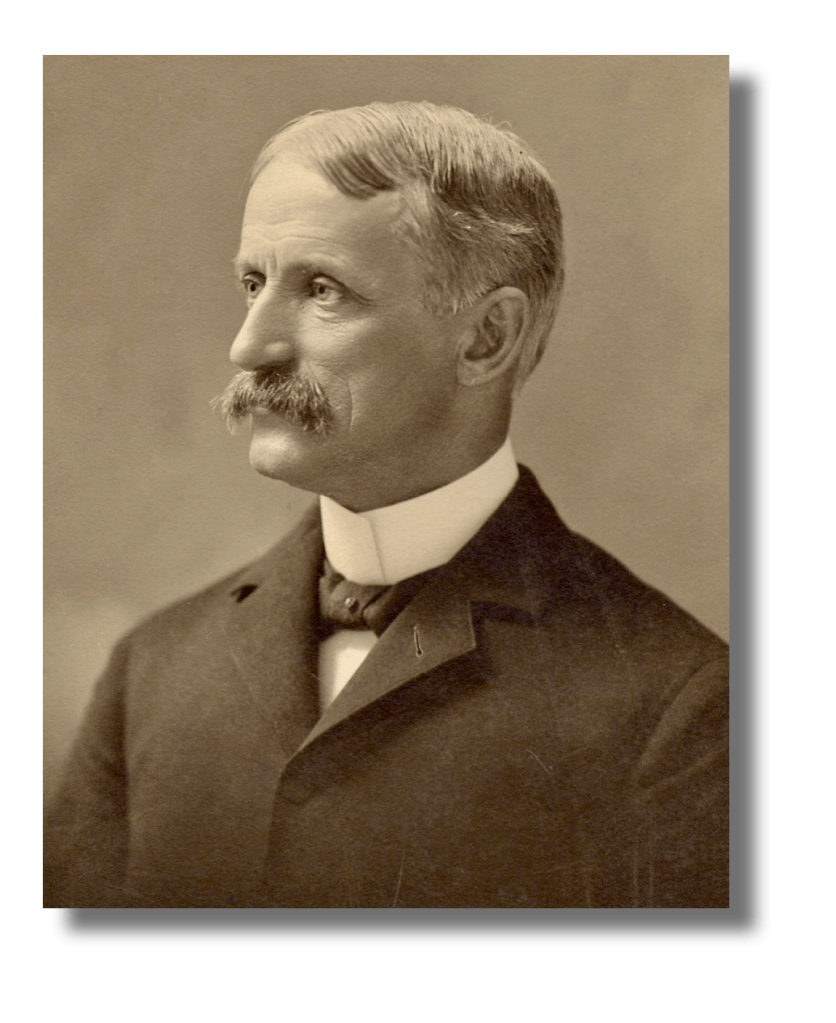
A post-war image of Alburtus H. Peckham

This letter was written by Alburtus H. Peckham (1841-1919), the son of William Robinson Peckham, Jr. (1816-1886) and Maria Schermerhorn Kettle (1819-1887) of Cortlandville, Cortland county, New York.

At the age of 23, Alburtus enlisted on 1 September 1864 as a private in Co. F, 185th New York Infantry—a one-year regiment. He was wounded (gun shot through left thigh) on 29 March 1865 in the fighting at Quaker Road (see Battle of Gravelly Run) and transported to the Lincoln Hospital in Washington D. C. where he was discharged on 8 June 1865.

After the war, Alburtus was a merchant in Virgil, New York. He married Lydia Ann Smith (1842-1903) in 1870 and moved to Michigan prior to 1900.

Alburtus wrote the letter to Asahel G. Eggleston (1813-1897) and his wife, Louisa Kenney (1818-1897) of Cortland, New York. Asahel was a farmer in Cortland county. Alburtus does not appear to have been a relation but perhaps he had been previously employed by Asahel as a farmhand.

Transcription

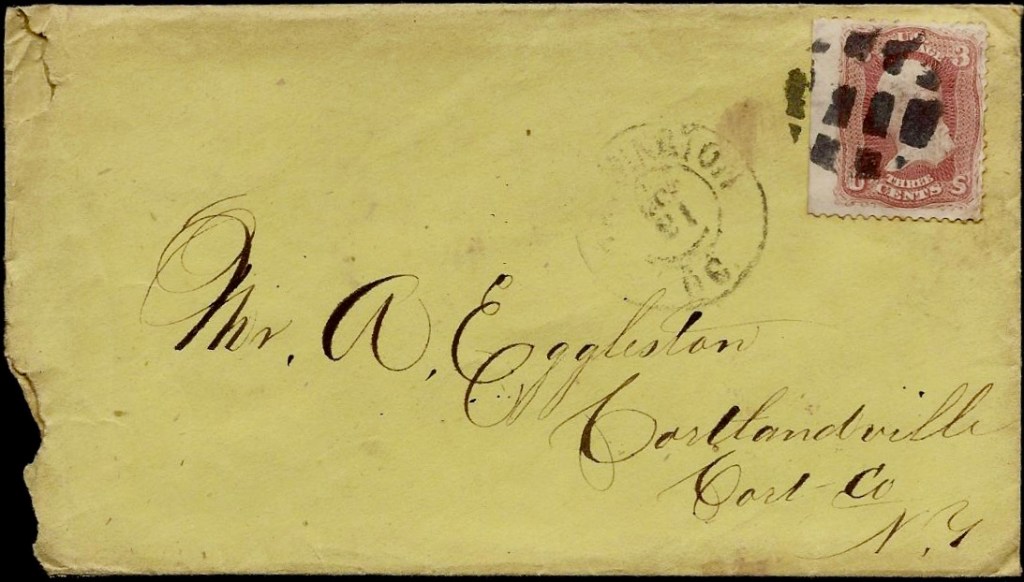
Addressed to Mr. A. Eggleston, Cortlandville, Cortland county, New York

Camp on the front
October 15th 1864

Mr. and Mrs. Eggleston,

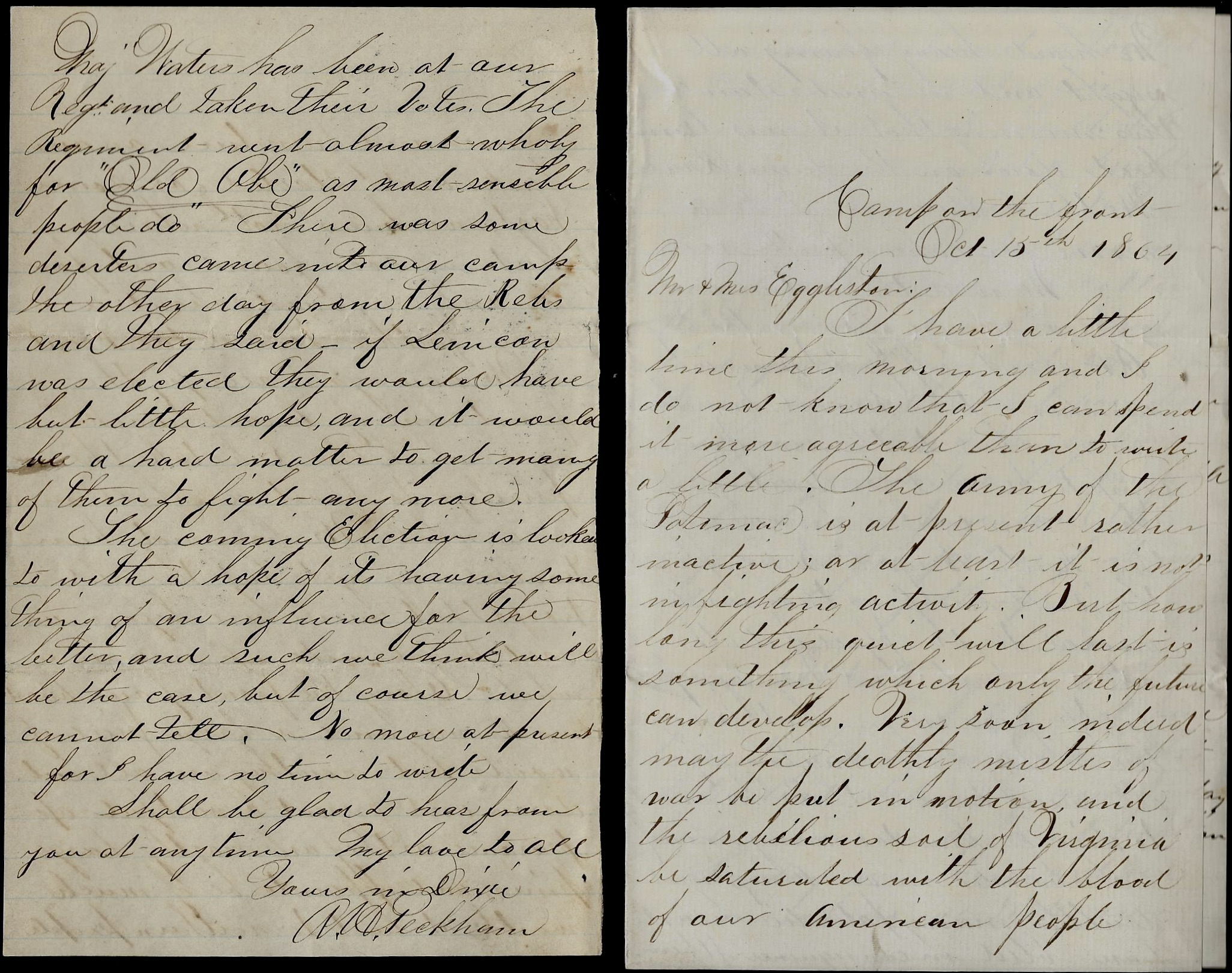
I have a little time this morning and I do not know that I can spend it more agreeable than to write a little. The Army of the Potomac is at present rather inactive—or at least it is not in fighting activity. But how long this quiet will last is something only the future can develop. Very soon indeed may the deathly missiles of war be put in motion and the rebellious soil of Virginia be saturated with the blood of our American people. We heard heavy firing all night and we understand this morning that it was gunboats down on the James River. We think there must be a move somewhere pretty soon.

We were the witnesses of rather a solemn affair yesterday. At about half past nine, a member of the 2nd Maryland was marched to the rear of our camp to be shot for desertion. 1 Four men carried his coffin and the 9th Brigade Band played the “Death March” as thousands moved to the place of death. Many hearts beat in sympathy for the poor victim but from the history of his military life all were assured that he ought to die. We have too many men of such character in our army and doubtless many patriotic hearts have bled in consequence of them.

Our camp at present is located on the farm of a rebel officer. It does not look much like farming here now. Not a building except the house nor a fence is to be seen. The ground was the past summer covered with tobacco and cotton. We find occasionally a cotton plant standing now. I have not seen a stone of any kind since I have been in Virginia. Some of the company have seen one or two. The principle timber here is pine and the boys use it too, just as if it was not worth anything.

October 18

I did not have time o finish and mail this letter last Saturday and today finds us in a different location. Sunday we were ordered to march so we took our house and furniture on our backs and started for some part, we knew not where, but we soon found out for we only moved about a mile farther toward the front.

We now again occupy the front line of breastworks, over which the Rebs take the privilege to boost a shell once in awhile. We have not been troubled any yet but the old troops that were here before us used to get “woke up” once in awhile. Along the front of our breastworks was once a large piece of woods but now they are all cut down and present a wasteful appearance as they are mostly large pines, and appear to be of much worth—at least to northern people.

The regiment went almost wholly for “Old Abe” as most sensible people do. There was some deserters came into our camp the other day from the Rebs and they said if Lincoln was elected, they would have but little hope and it would be a hard matter to get many of them to fight anymore.

—A. H. Peckham, 185th New York, 18 October 1864

Maj. Waters has been at our regiment and taken their votes. The regiment went almost wholly for “Old Abe” as most sensible people do. There was some deserters came into our camp the other day from the Rebs and they said if Lincoln was elected, they would have but little hope and it would be a hard matter to get many of them to fight anymore. The coming election is looked to with a hope of its having something of an influence for the better, and such we think will be the case, but of course we cannot tell. No more at present for I have no time to write.

Shall be glad to hear from you at anytime. My love to all. Yours in Dixie, — A. H. Peckham


1 The soldier from the 2nd Maryland who was shot for desertion on 14 October 1864 was Charles H. Merling.