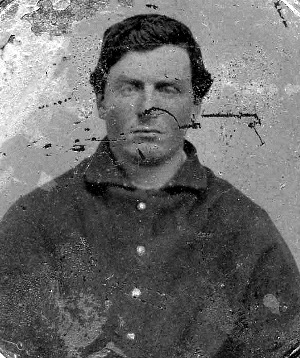
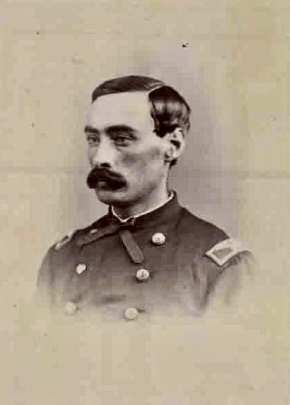
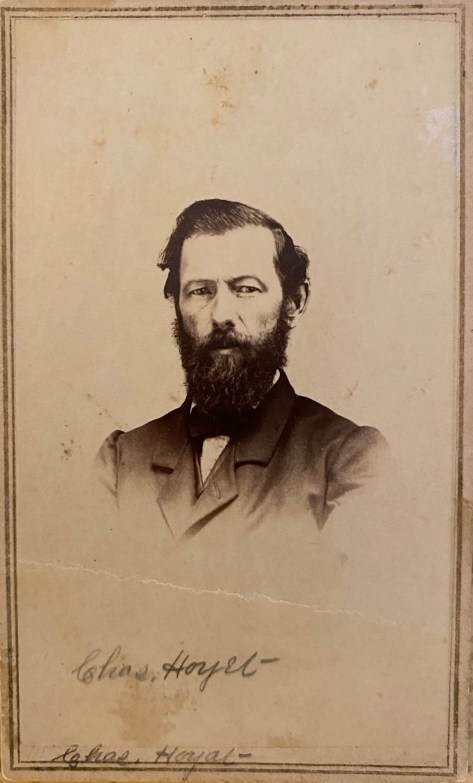
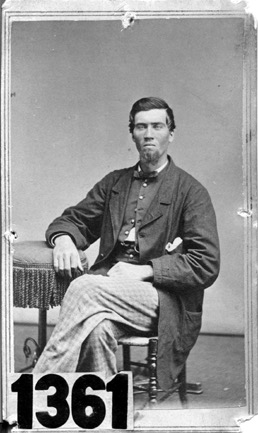
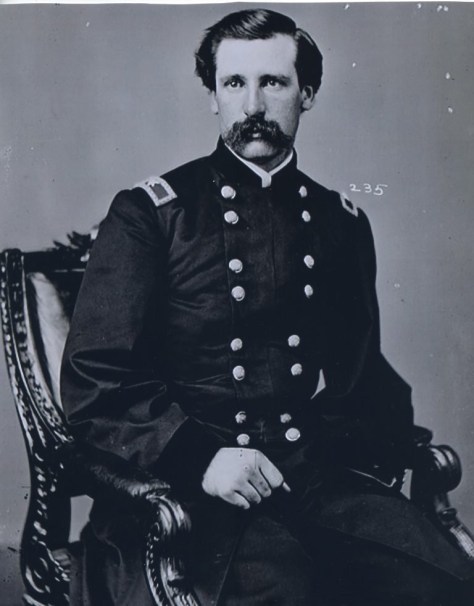
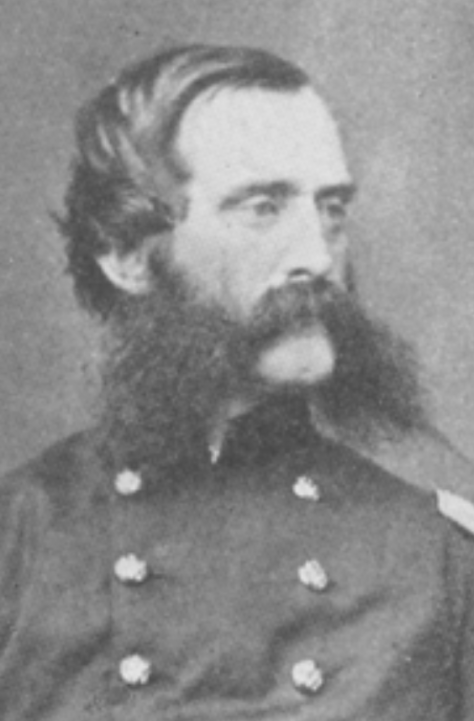
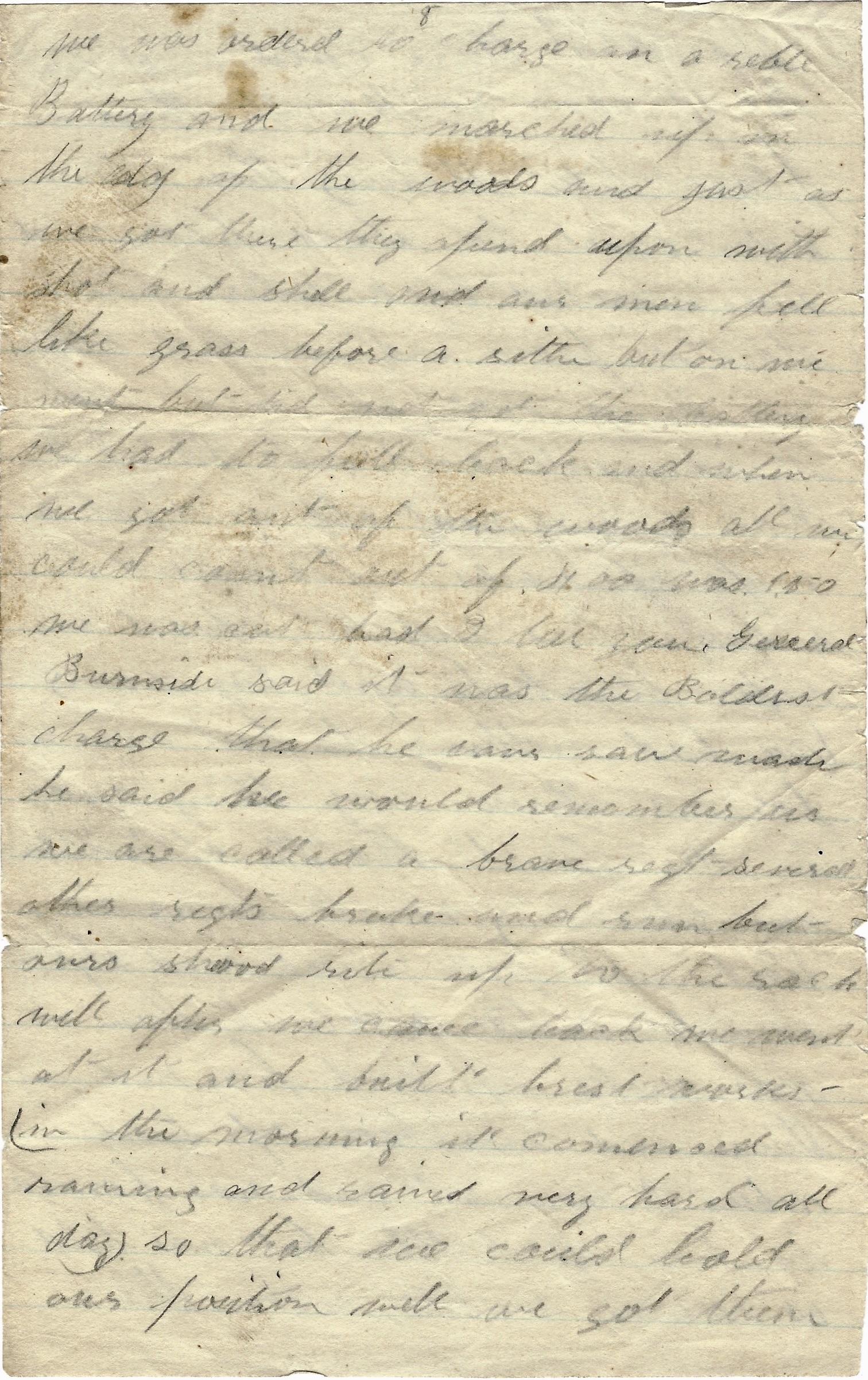
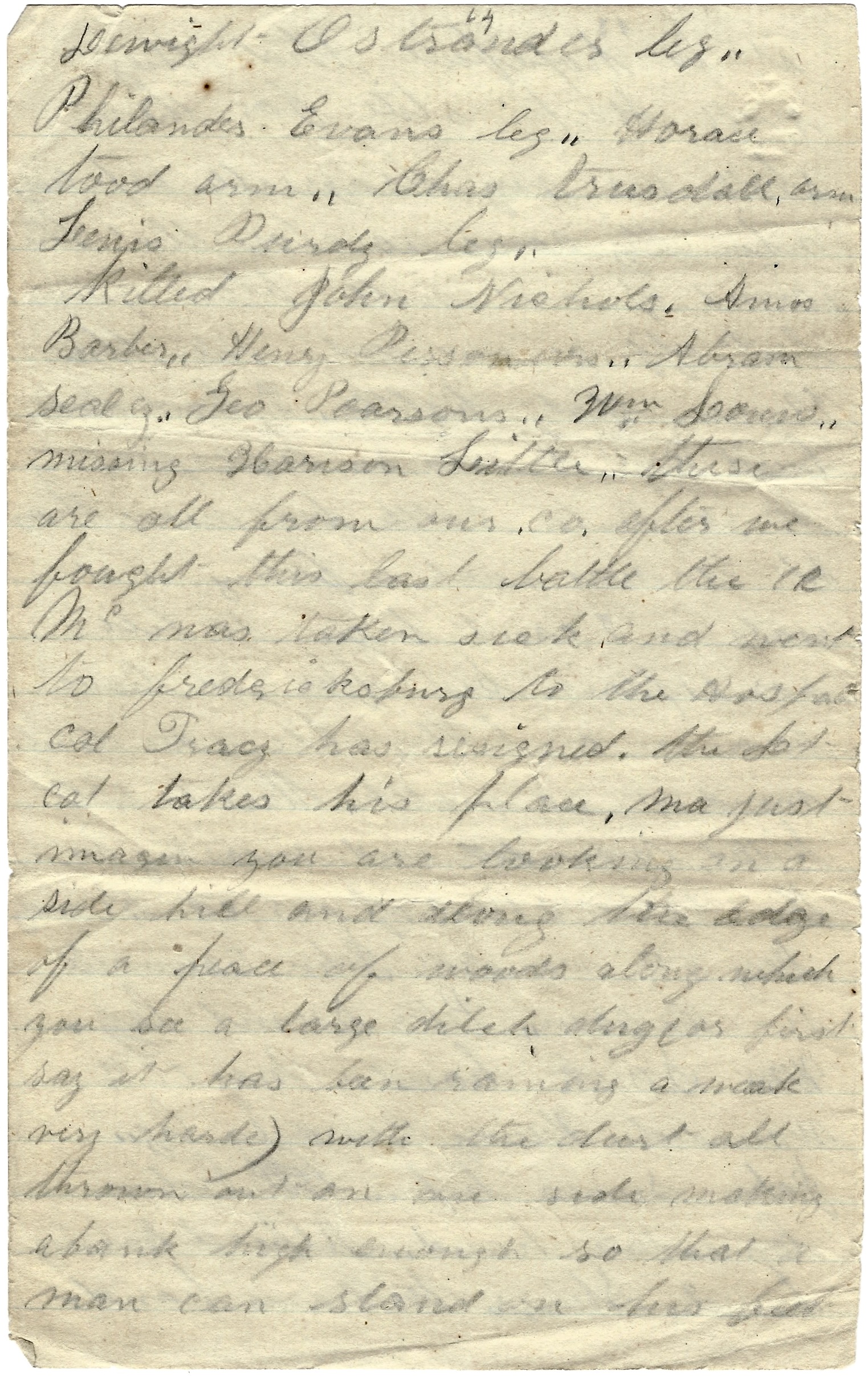
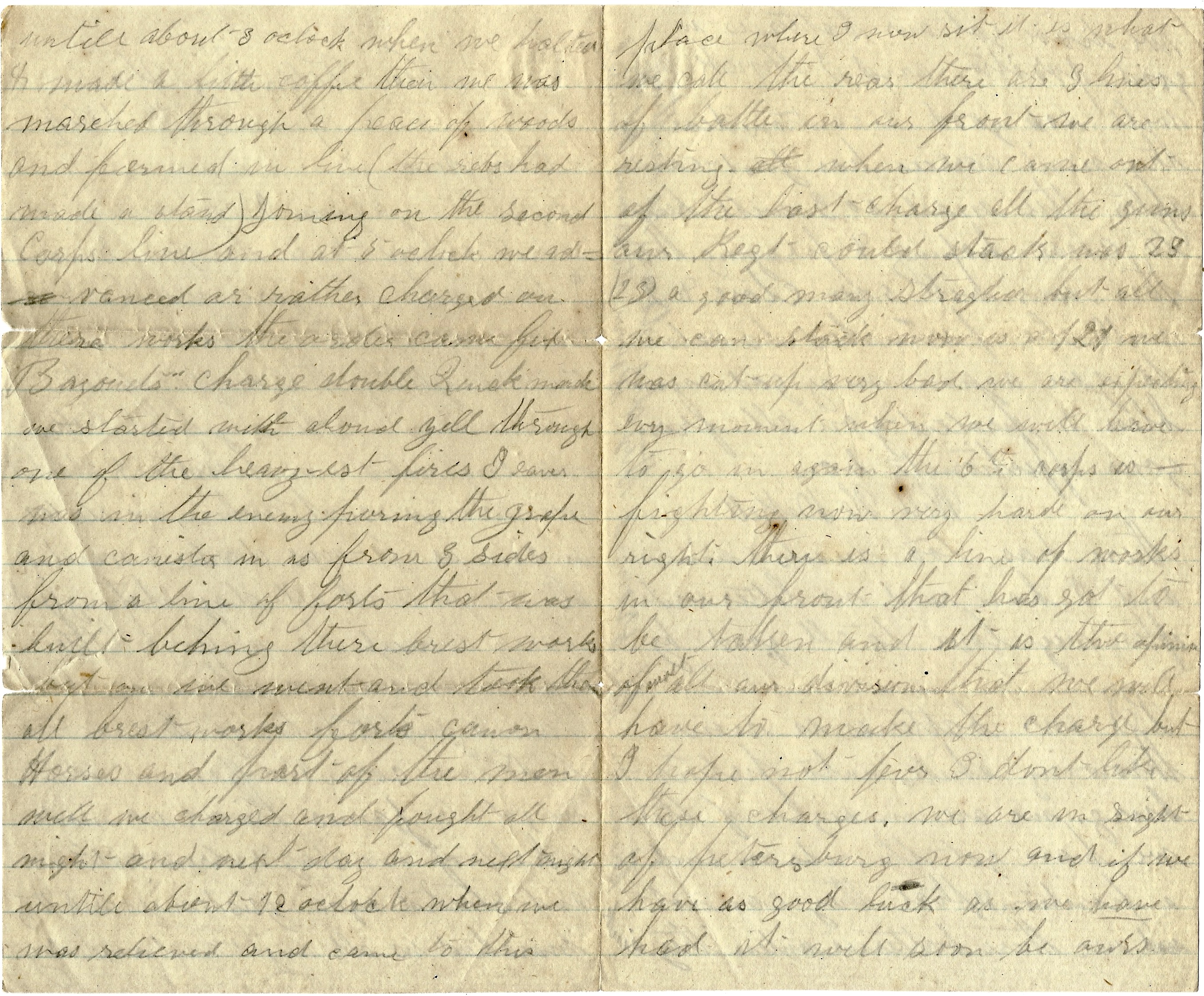
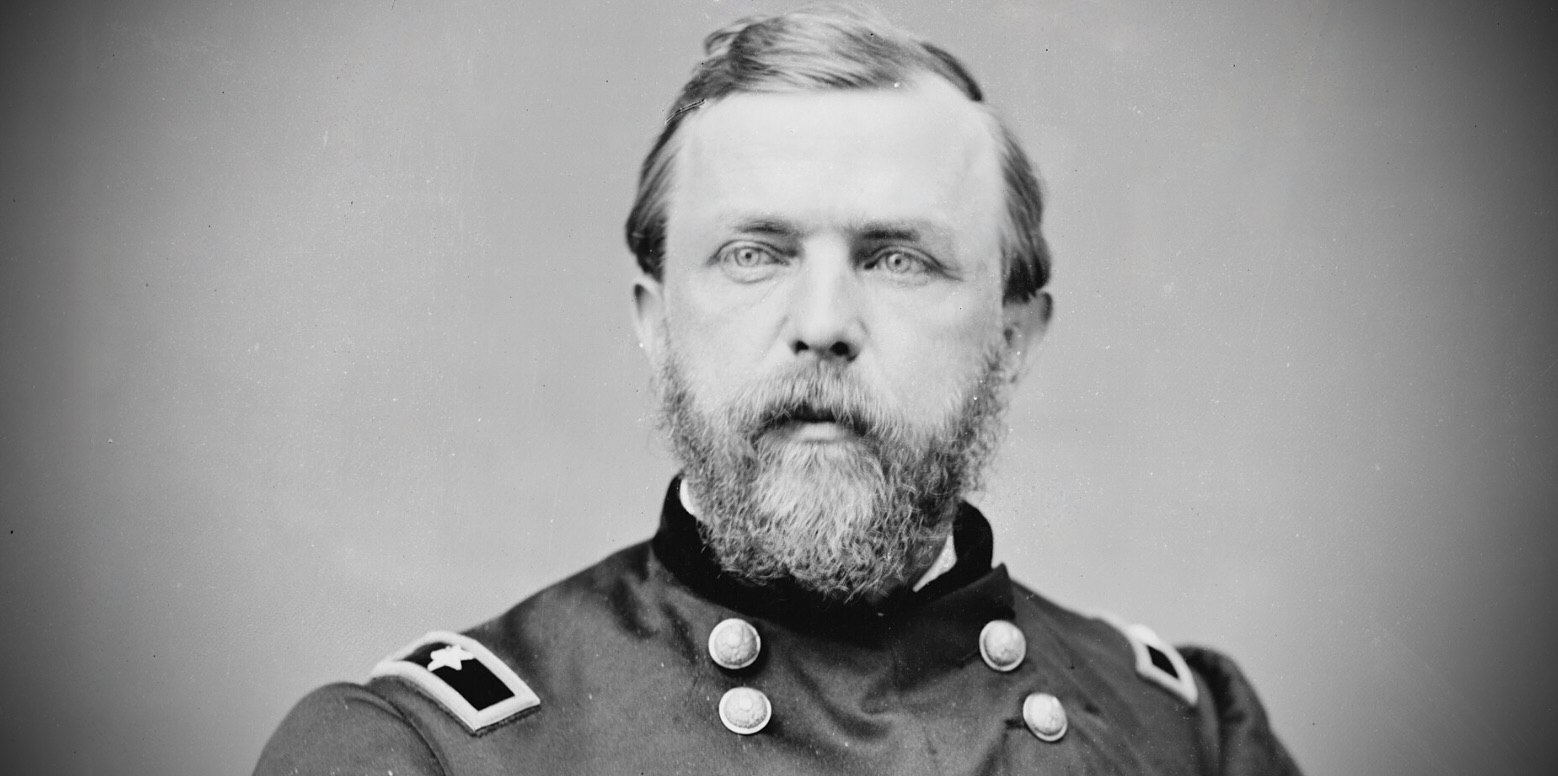
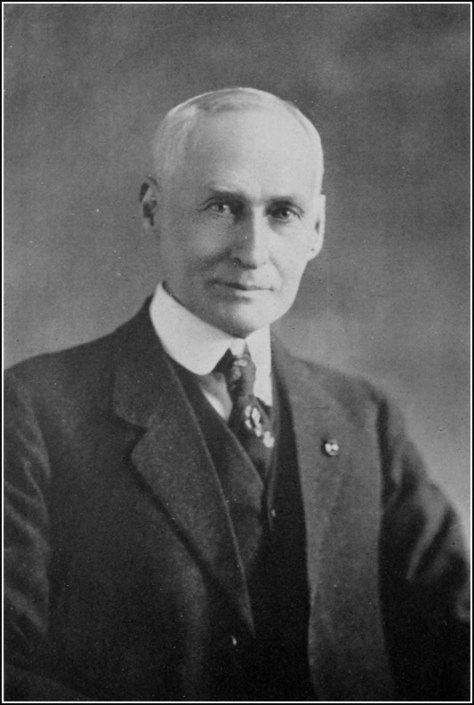
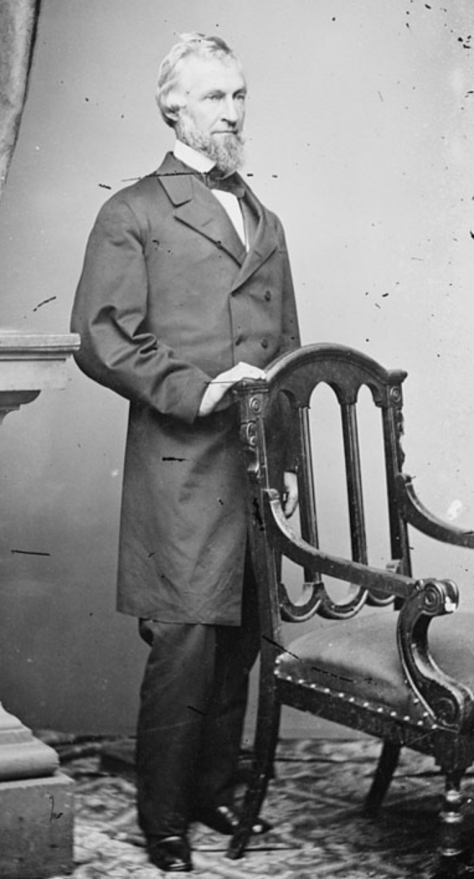
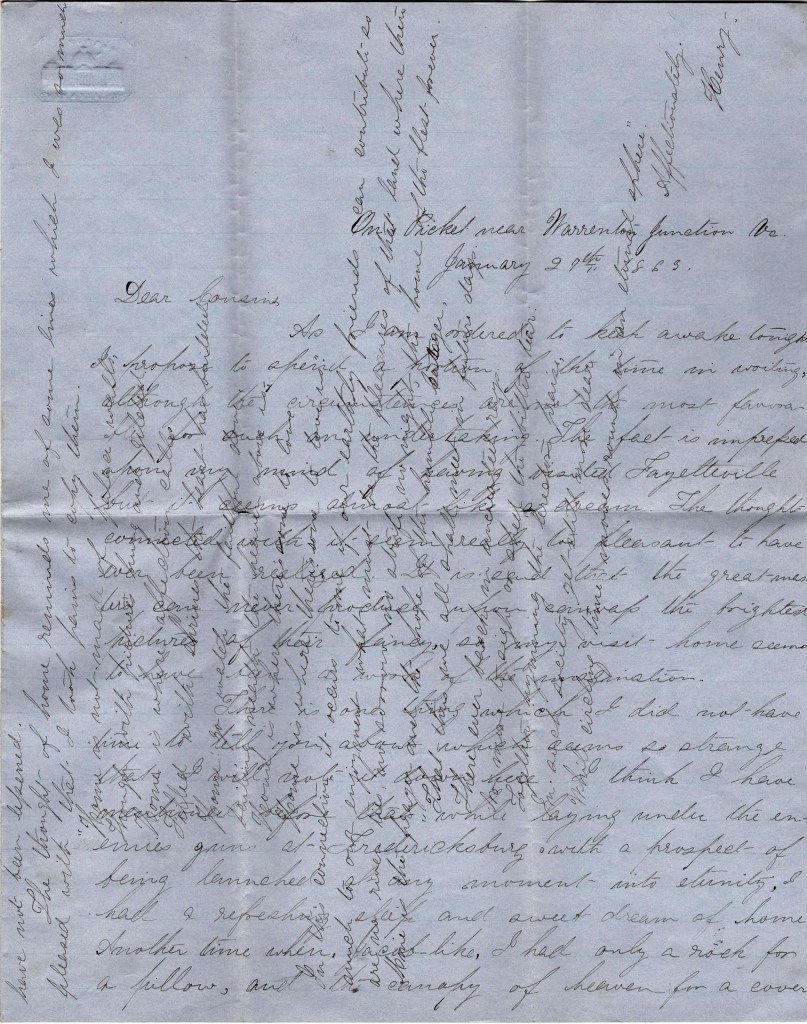
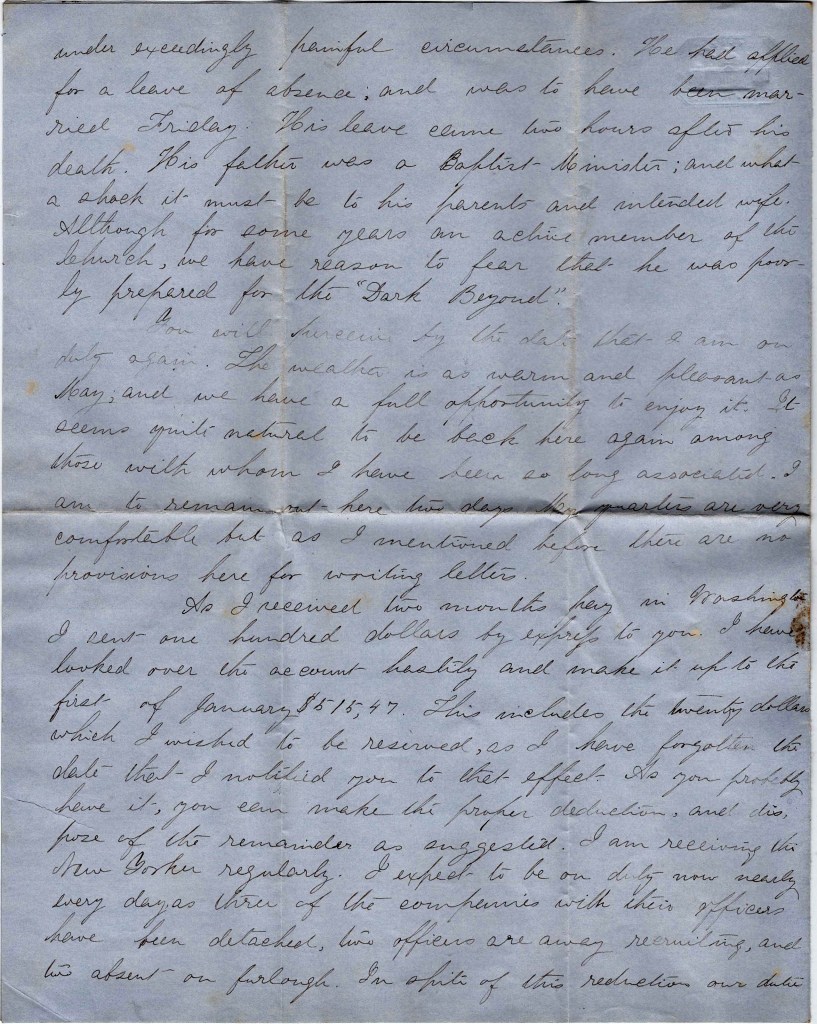
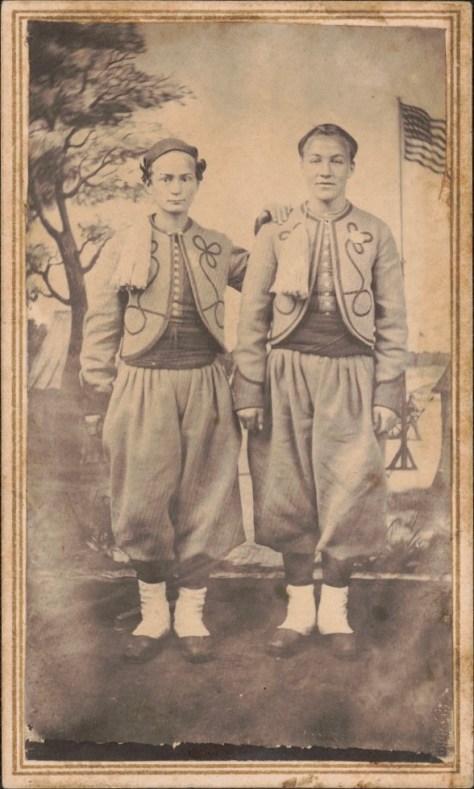
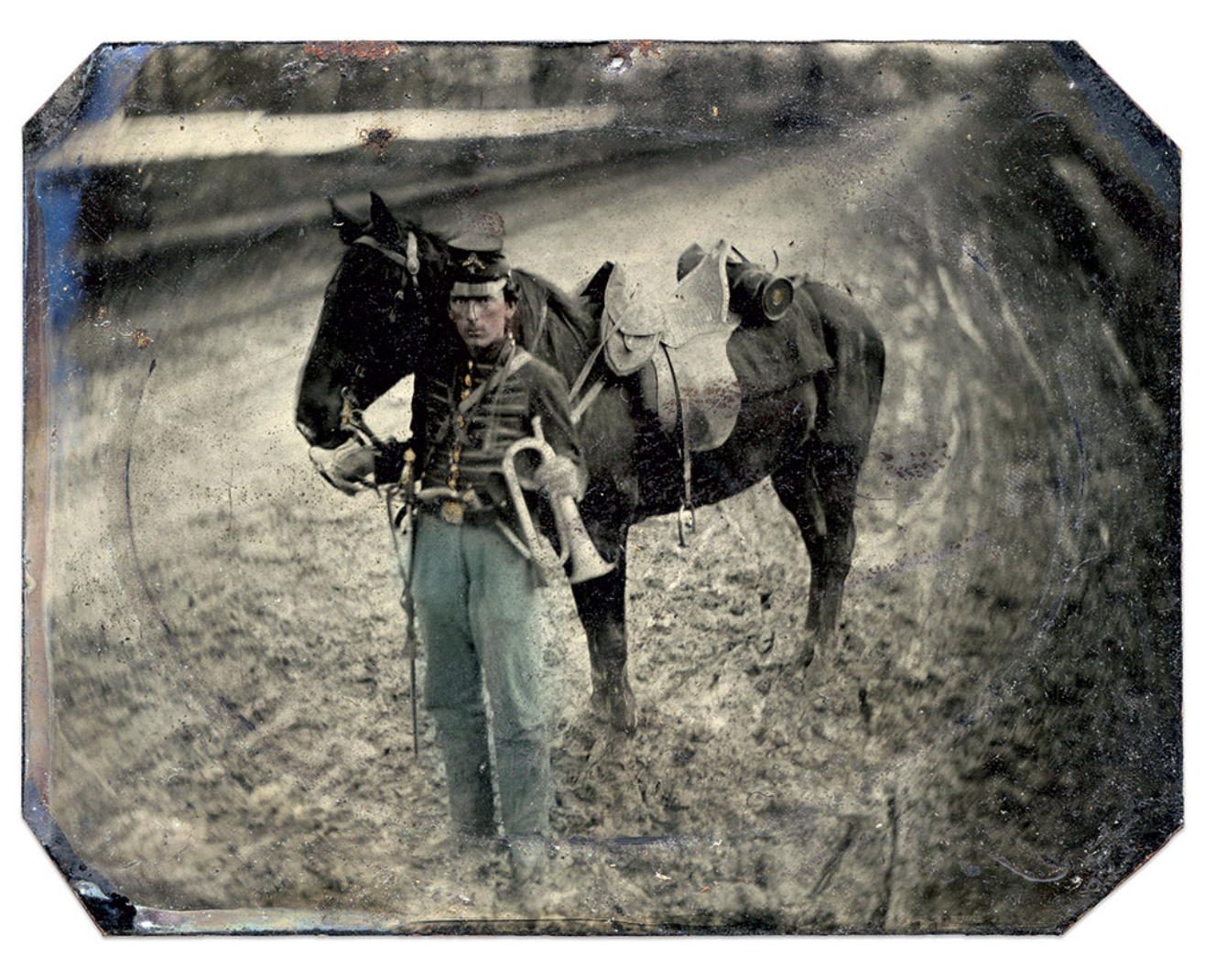
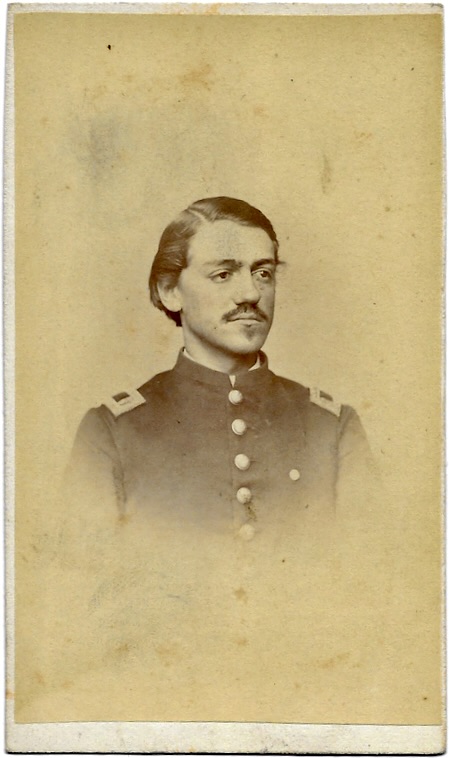
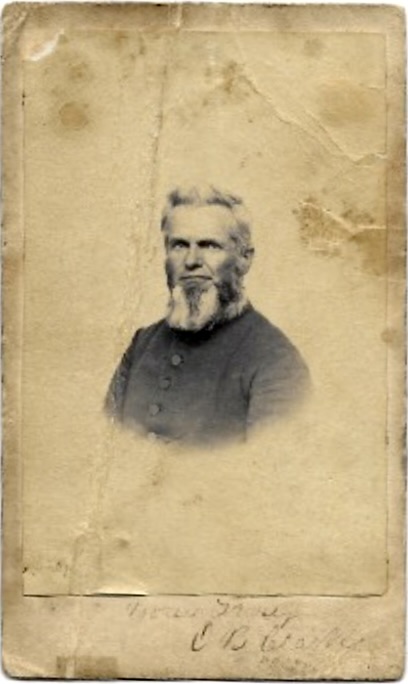
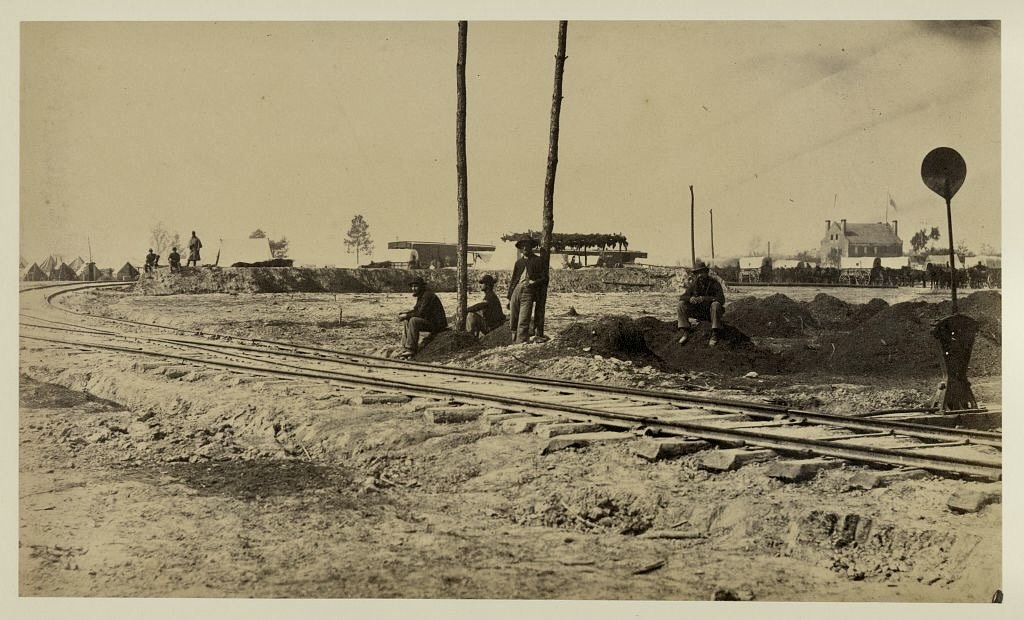
I could not find an image of David but here is one of George Higgins of Co. K, 6th New York Heavy Artillery
The following letters were written by David H. Barber who enlisted in December 1863 as a private in the 14th New York Heavy Artillery and was transferred to Co. L, 6th New York Heavy Artillery on May 10, 1864. He was transferred to Co. C on June 27, 1865 and mustered out with company, August 24, 1865, at Washington, D. C.
David was born in Onondaga county, New York in 1841. On the muster rolls, at the time of his enlistment, he was described as a 5′ 3″ farmer with black eyes and black hair.
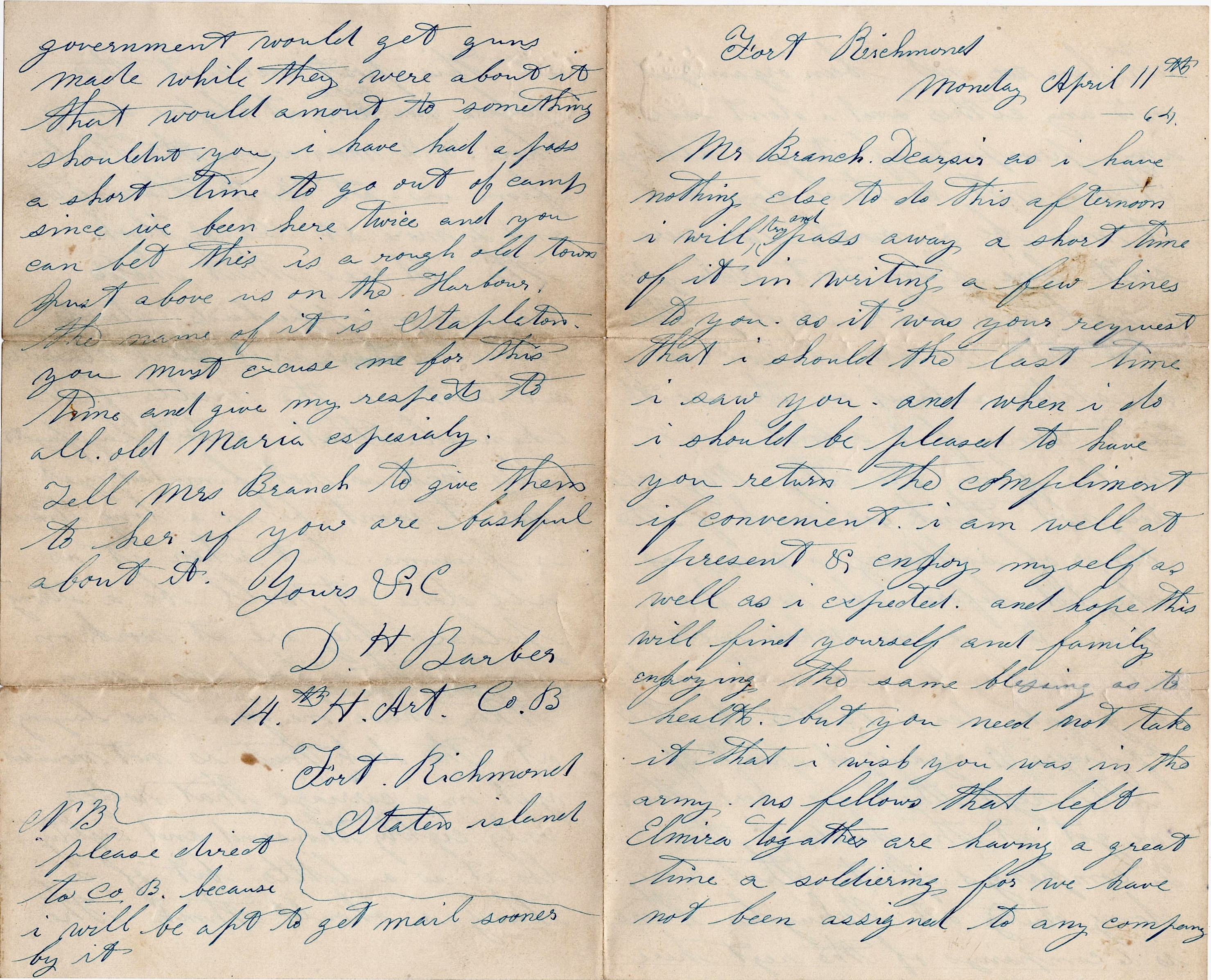
Letter 1
Fort Richmond Monday, April 11th 1864
Mr. Branch,
Dear sir, as I have nothing else to do this afternoon, I will try and pass away a short time of it in writing a few lines to you as it was your request that I should the last time I saw you. And when I do, I should be pleased to have you return the compliment, if convenient.
I am well at present & enjoy myself as well as I expected. And hope this will find yourself and family enjoying the same blessing as to health. But you need not take it that I wish you was in the army. Us fellows that left Elmira together are having a great time a soldiering for we have not been assigned to any company nor have not been organized into any either, and I don’t see any prospects of it yet although it may not be three days and may be a month.
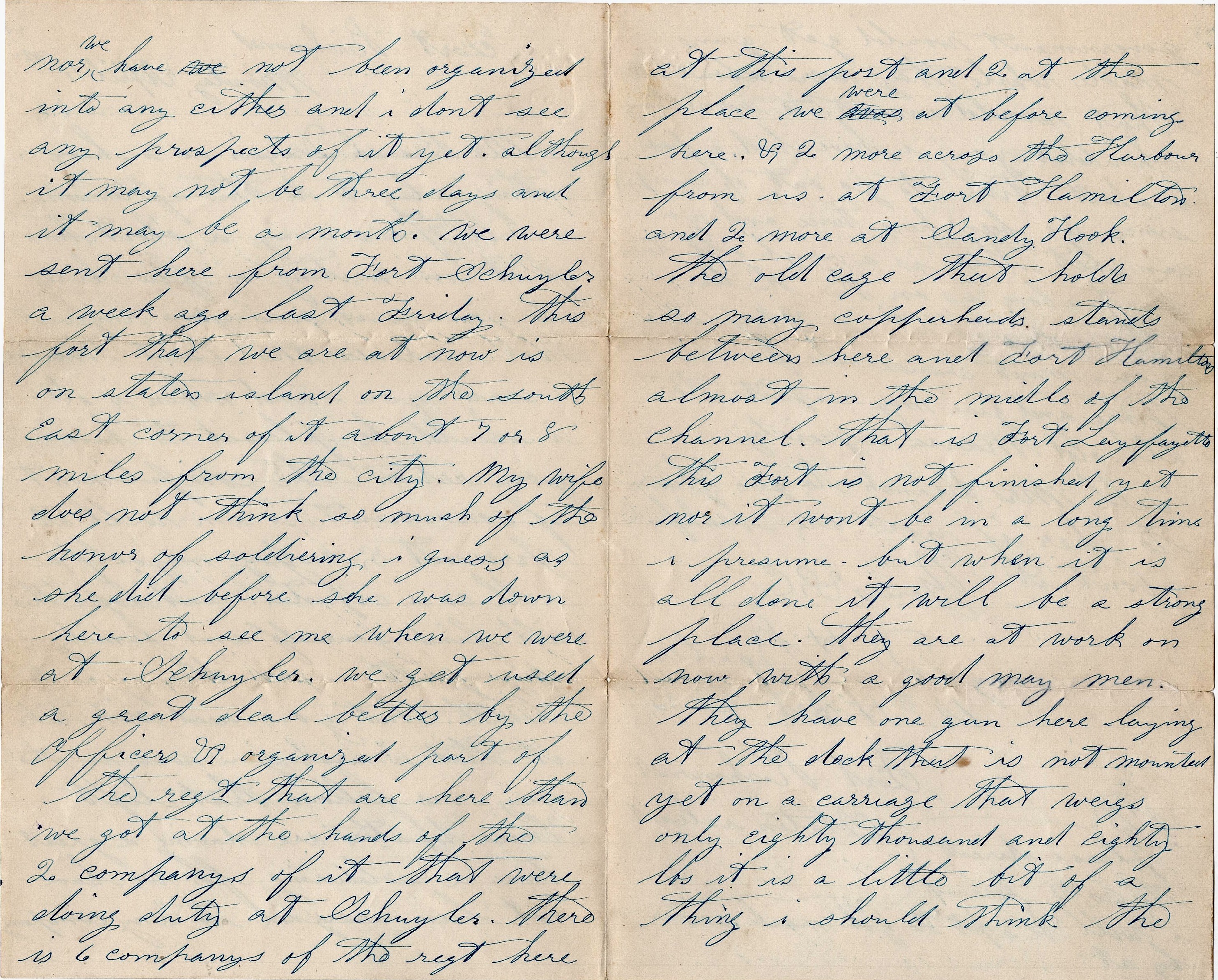
We were sent here from Fort Schuyler a week ago last Friday. This fort that we are at now is on Staten Island on the southeast corner of it, about 7 or 8 miles from the City. My wife does not think so much of the honor of soldiering I guess as she did before she was down here to see me when we were at Schuyler. We get used a great deal better by the officers & organized part of the regiment that are here than we got at the hands of the two companies of it that were doing duty at Schuyler. There is six companies of the regiment here at this post and two at the place we were at before coming here. And [there are] two more across the Harbor from us at Fort Hamilton and two more at Sandy Hook.
The old cage that holds so many Copperheads stands between here and Fort Hamilton, almost in the middle of the channel. That is Fort Lafayette.
This fort is not finished, nor it won’t be in a long time, I presume. But when it is all done, it will be a strong place. They are at work on it now with a good many men. They have one gun here laying at the dock that is not mounted yet on a carriage that weighs only eighty thousand and eighty lbs. It is a little bit of a thing. I should think the government would get guns made while they were about it that would amount to something, shouldn’t you?
I have had a pass a short time to go out of camp since we been here twice and you can bet this is a rough old town just above us on the harbor. The name of it is Stapleton. You must excuse me for this time and give my respects to all—old Maria especially. Tell Mrs. Branch to give them to her if you are bashful about it. Yours, &c. — D. H. Barber, 14th H. Artillery, Co. B, Fort Richmond, Staten Island
N. B. Please direct to Co. B because I will be apt to get mail sooner by it.
Letter 2
Camp near Petersburg on or near the James River, Va. Monday, June 20th 1864
Mr. Branch,
Dear friend, as I now have an opportunity, I will try to write you a few lines and let you know where I am and what I am doing. But first I must beg your pardon for not writing to you as I agreed when I saw you last, And now I will tell you the reason.
When we left New York Harbor, I was put into the 6th New York Heavy Artillery and sent right into the field and have had to march and fight ever since, night and day, so you see that I could not even get a chance to write to my own home as often as would have done. But for the past two weeks, I have been detailed to help drive cattle & butcher so I can have a little better chance to write once in a while.
After I got to this regiment, we started right out on the march from a place called Brandy Station and marched 3 days and 2 nights when we got out to where the Battle of the Wilderness was, in time to get into that the second day of the fight. And we have been right in the front line of battle about all the time up to this place where we now are. If not in one battle that was going on, it was on the skirmish line in another. So you can judge for yourselves whether I have seen and realized any of the hardships of this summer’s campaign.
And now, while I am writing this morning, our batteries are shelling the City of Petersburg in sight of where I am. But I am in the rear with a herd of cattle and close by the ammunition train of the 5th Army Corps. That is what we are in. So you see that I am not in a very dangerous position just at present. This is the 4th day they have been fighting at this place and all around where I am now I can go in the field and pick up a musket or cannon ball at any place almost.
Our regiment was out on the extreme skirmish line all day yesterday and day before yesterday our Corps made a charge on the Johnnies and drove them from their breast works and drove them away from the railroad that runs into Petersburg. And we hold it yet.
I was in the Battle of Bethesda Church and all through where we happened to be along the line of Lee’s army up to this place. We crossed the James river last Thursday about noon so we are now nearly south as near as I can judge from Richmond.
I have seen Charlie Beers once since we have been down here. Andrew, you people at home can form no kind of an idea of this war by what you read at home. It is awful to look upon. It is far different from what I thought it was before I had had the experience myself—to see men all shot and mangled to pieces in every way you can think of. But thank God I have been spared so far. The other day I witnessed the explosion of one of the enemy’s shells that was sent at us in the Battle of Bethesda Church. We were in the first line of battle at the time and our Brigade—that is, our Regiment and the 15th New York Heavy Artillery that constitutes it—were in a little piece of woods and it burst in the 15th and tore both legs and one arm off a poor fellow and a great many others just about as bad I have seen with my own eyes.
But if I was sure of staying where I am now in this business, I should feel quite contented. But I am here and it’s no use for a man to flinch from his duty or what is called by some shoulder strapped men. They—some of them—know other men’s duty as a soldier but they don’t know their own. But dear friend Branch and family, one and all, enough of this for the present. I should like to hear from you all as soon as you get this and tell me all the news for it is the only consolation a poor soldier gets here in his letters from his home or some friends of his for we can’t get any papers to read or anything of the kind here unless it is sent to us. I have lately got a letter from my wife about every time.
[no signature]
Letter 3
Camp near Petersburg, Va. Monday, July 18th 1864
Mr. Branch,
Dear sir, I received your letter a week ago yesterday & have neglected to write again until now. But an old saying is you know, better late than never.
I am now about a mile or a little over perhaps from where we were camped when I wrote to you last. We are camped now about a mile from the Norfolk & Petersburg Railroad. This road is not used any now at this end of it nor it has not been since we came up to this place. We had our camp right alongside of it for a couple of weeks back until one day last week we were ordered to move back a little farther to keep out of the way of the Johnnies’ shells which they throwed once in a while pretty close to our ammunition & commissary trains and cattle herds.
I am with our Brigade herd yet but how long I will be kept on this duty, I can’t say, but hope it will be the remainder of this campaign. I have to go out to the front and help to butcher every other day. That is about as often as I care about unless I go up one in a while to my company and get my letters for they shoot right at our fellers, you know, with their cannons.
Our regiment has been in the front line of battle all the while since we came to this place with the exceptions of two days [when] they were relieved by another Brigade. They are laying behind breastworks and our line of works is not more than 80 or 100 rods from the rebel breastworks at this place. I have been outside of the works once to see a man that was on picket. The pickets do not fire at each other here where our Brigade lays at all. They are within a stone’s throw of each other and sometimes go to a spring about halfway between them to get water at the same time.
But they get to playing ball once in a while about every day with their batteries and that makes the men keep their heads below the top of the breastworks when they get at that. There has not been very many killed out of our regiment since we got into the breastworks. There was one struck last week one day with a solid shot and tore all to pieces, but he was a man that I was not acquainted with. He did not belong to our company. We have not had any killed here out of Co. L since we have been in these works or had not the last time I was up to them which was last Saturday afternoon. But there has been a good many wounded with pieces of shells.
The Butcher has just got orders to go out and butcher now but we won’t go till just before sundown. I saw Frank Sparks & Abe Decker yesterday. They are camped near us now. They are at work in the woods near us now for a few days. Frank says tell the folks when I write that he is well. They look tough and healthy. I was in this camp an hour or so yesterday. I saw Delos Green too. He is in the same company with them.
You will have to excuse me for this time so I will bid you goodbye for the present. This leaves me in good health and I hope it will find you and family enjoying the same blessing. Yours truly, — D. H. Barber, 6th New York Heavy Artillery, Co. L, Washington D. C.
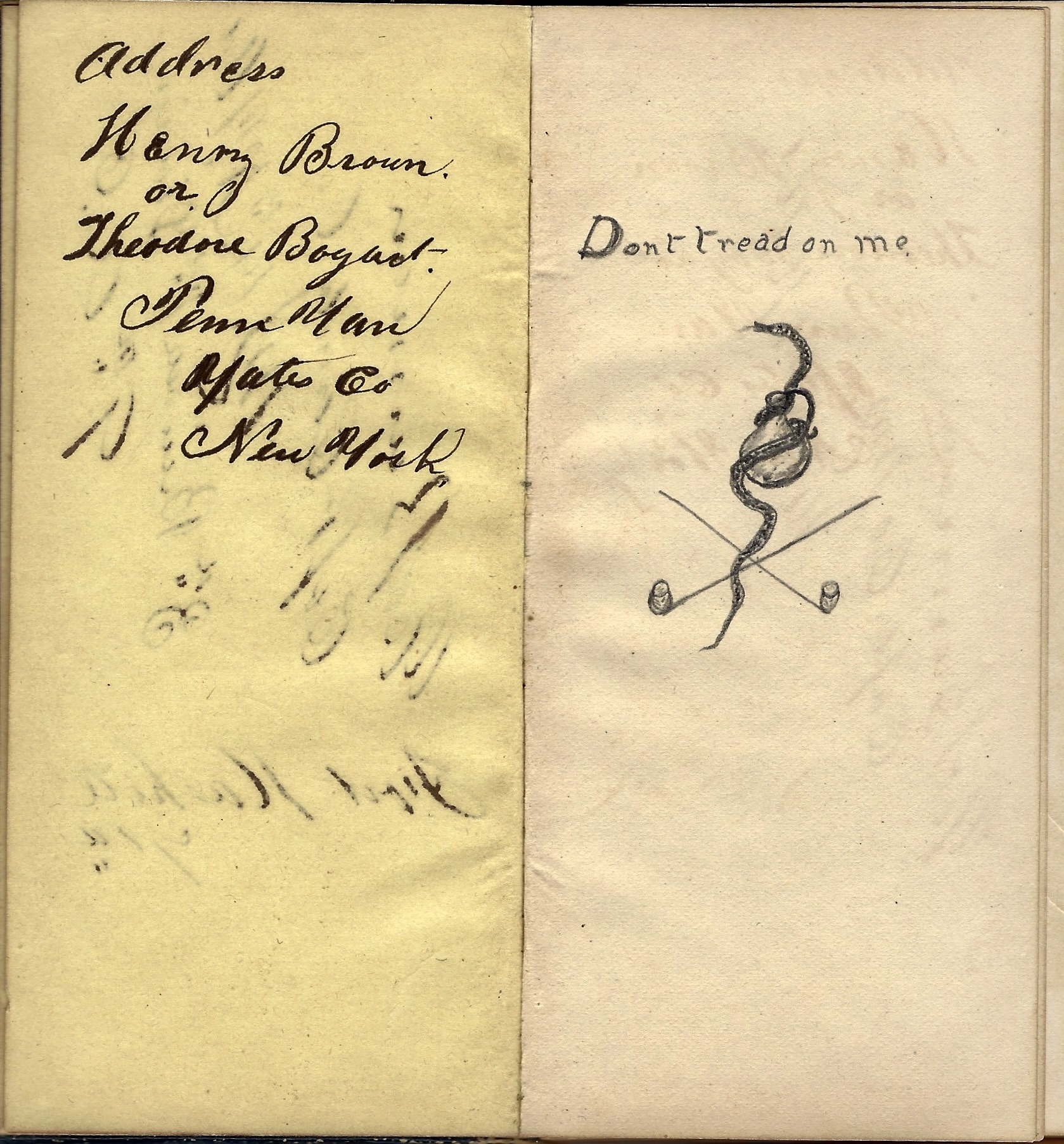
The following diary was kept by George Brennan (b. 1838), the son of Irish emigrant, Daniel P. Brennan (1804-1864) and Canadian-born Mariah Mills (1803-1890) of Milo, Yates county, New York. George’s older brother Charles (b. 1831) was a boatman and his older sister, Mary Ann (1836-1876) was married to Theodore Bogart (1828-1895) of Penn Yan, Yates county, in 1863. George’s father died of consumption on 1 October 1864.
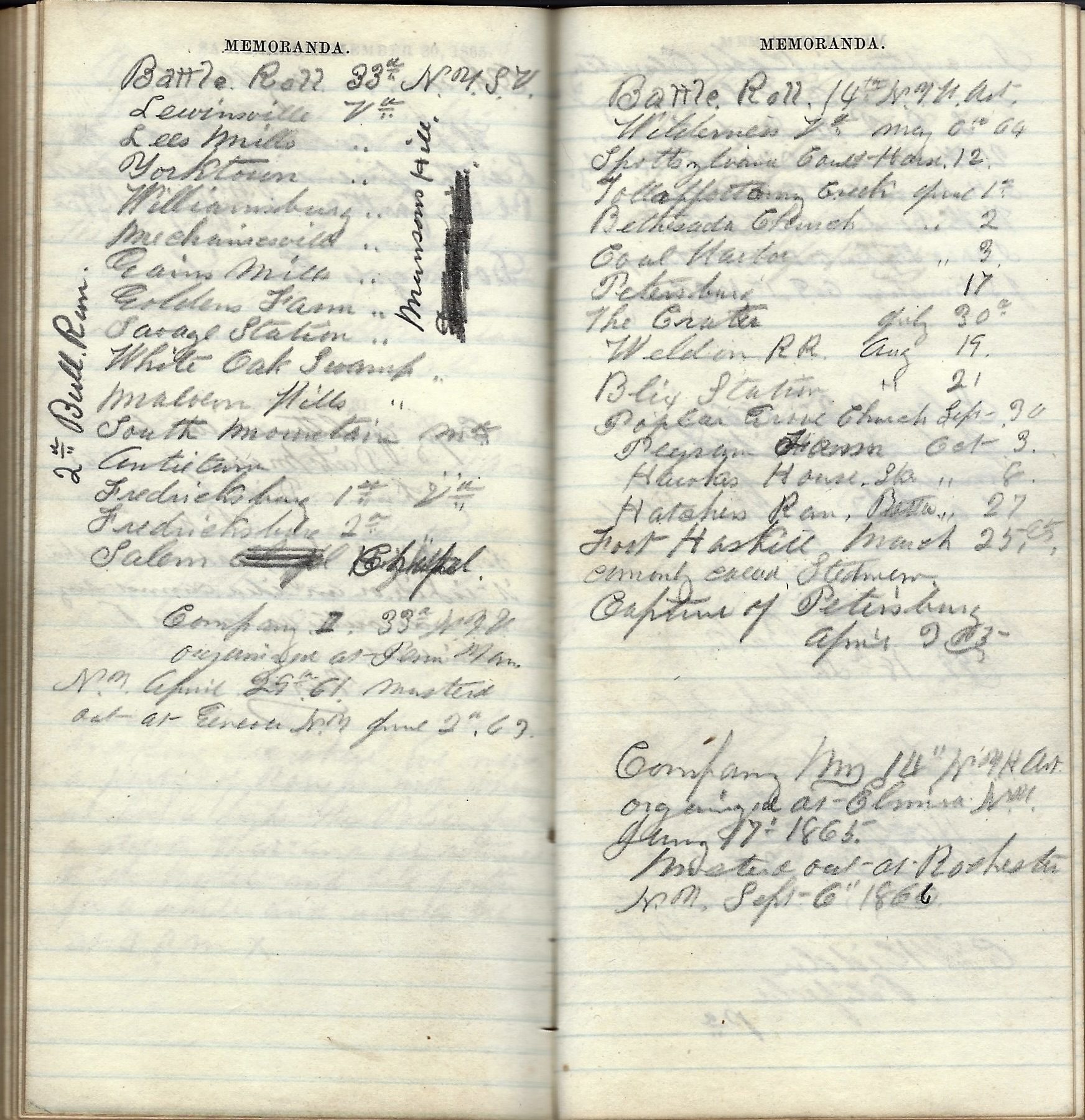
The 1860 Federal Census indicates that George Brennan was a 22-year-old painter residing in Milo, Yates, New York. Only a month after the Rebels fired on Fort Sumter, George joined other young men from Penn Yan as a private in Co. I, 33rd New York Infantry. Three months later he was promoted to sergeant and before the close of 1862 he was made the 1st Sergeant of his company only to be commissioned a 1st Lieutenant a couple months later. He mustered out of the 33rd New York Infantry on 2 June 1863 after two years’ service. In the back of his 1865 Diary, George enumerated the various battles he had participated in while in the 33rd New York Infantry. These included, “Lewinsville, Lees Mills, Yorktown, Williamsburg, Mechanicsville, Gaine’s Mills, Golden’s Farm, Savage Stations, White Oak Swamp, Malvern Hill, South Mountain, Antietam, Fredericksburg, Fredericksburg 2nd [Chancellorsville], Salem Chapel, and 2nd Bull Run.”
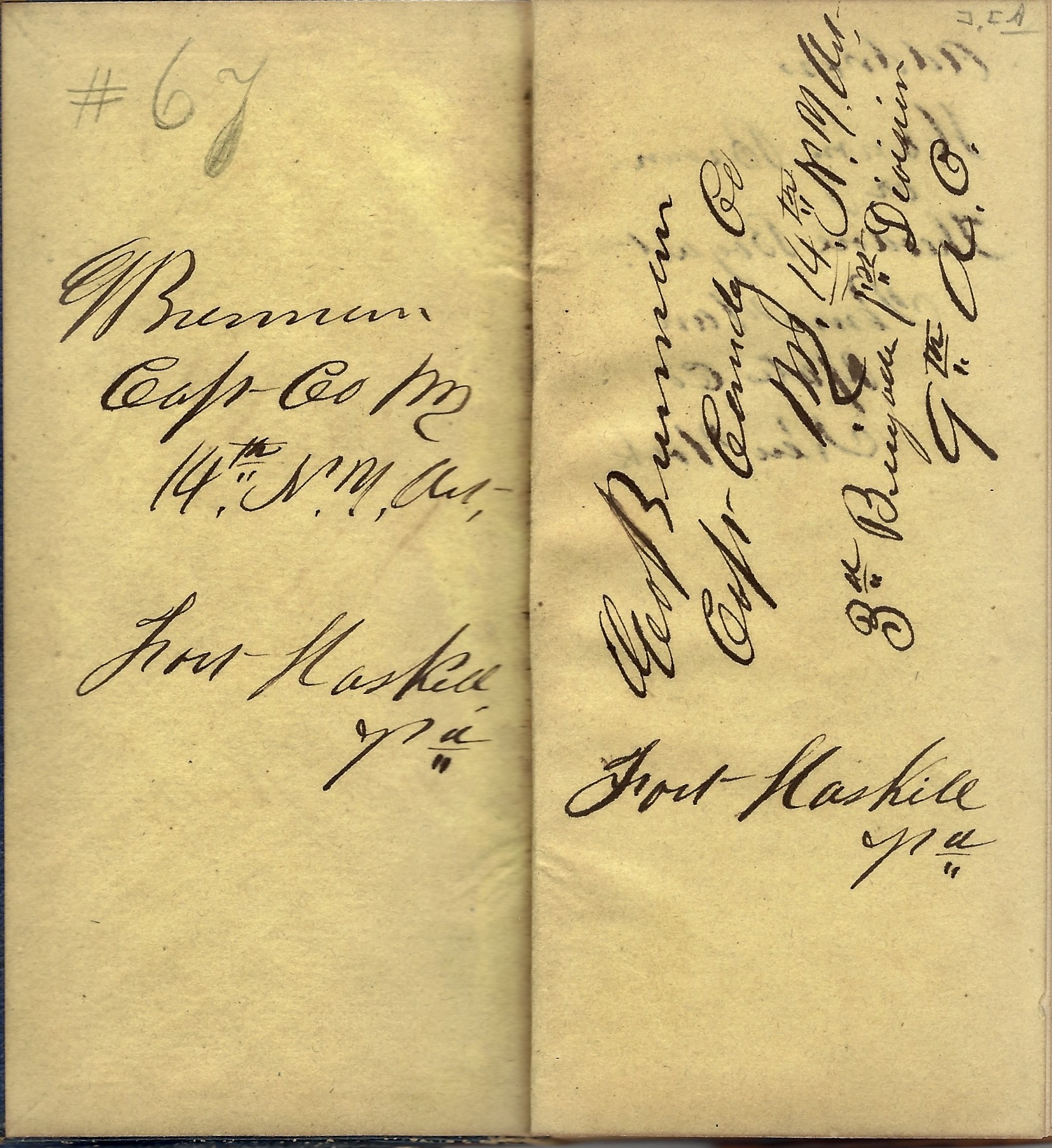
After a few months at home, George offered his services again as a 1st Lieutenant, and was commissioned into Co. M, New York 14th Heavy Artillery. One year later, on 5 December 1864 he was promoted to Captain. He was mustered out of the service on 26 August 1865 at Washington, D.C. The 14th NY Heavy Artillery was heavily engaged during Grant’s Overland Campaign, and the Appomattox Campaign. The regiment participated in Battle of the Wilderness, Cold Harbor, the Siege of Petersburg, Boydton Plank Road, and Fort Stedman, among other engagements.
After initially garrisoning New York Harbor, like other Heavy Artillery regiments, the 14th New York “Heavies” were ordered to join the Army of the Potomac to participate in Grant’s Overland Campaign as infantrymen. The diary has been transcribed through mid-October, some six weeks after he was discharged from the service after which he visited his brother Charley in Toronto and then returned to Yates county, New York. I did not transcribe the last couple of months though there are scans of those diary pages posted which describe visits to friends, theater performances attended, &c. The last notice of him I can find in census records was in 1865, residing in his brother-in-law’s home in Milo with his Mother and sister. He was employed once again as a painter. It’s suspected that his abuse of alcohol as the war drew to a close may have caused a premature and tragic ending to his life.
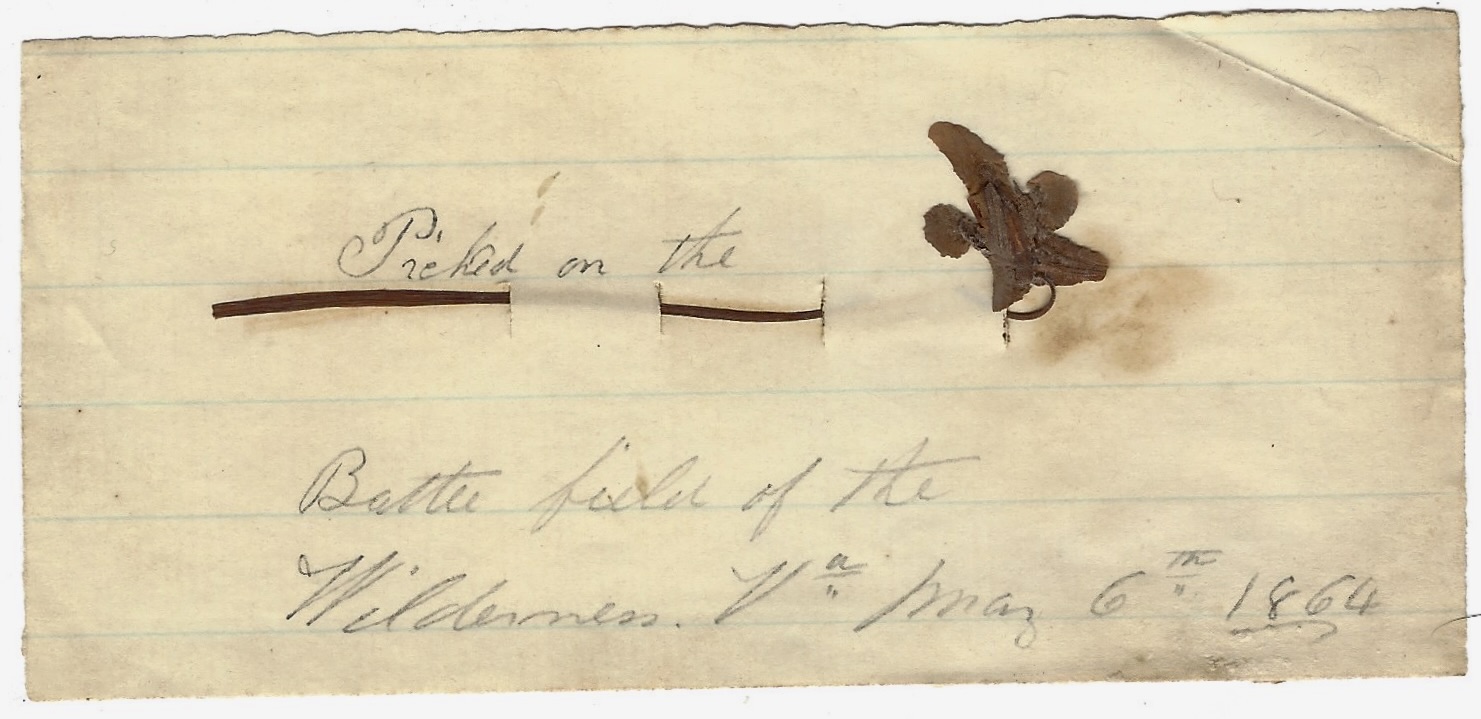
Inserted into the back pocket of the diary was this slip of paper with a wildflower picked on the Battlefield of the Wilderness on May 6th 1864.
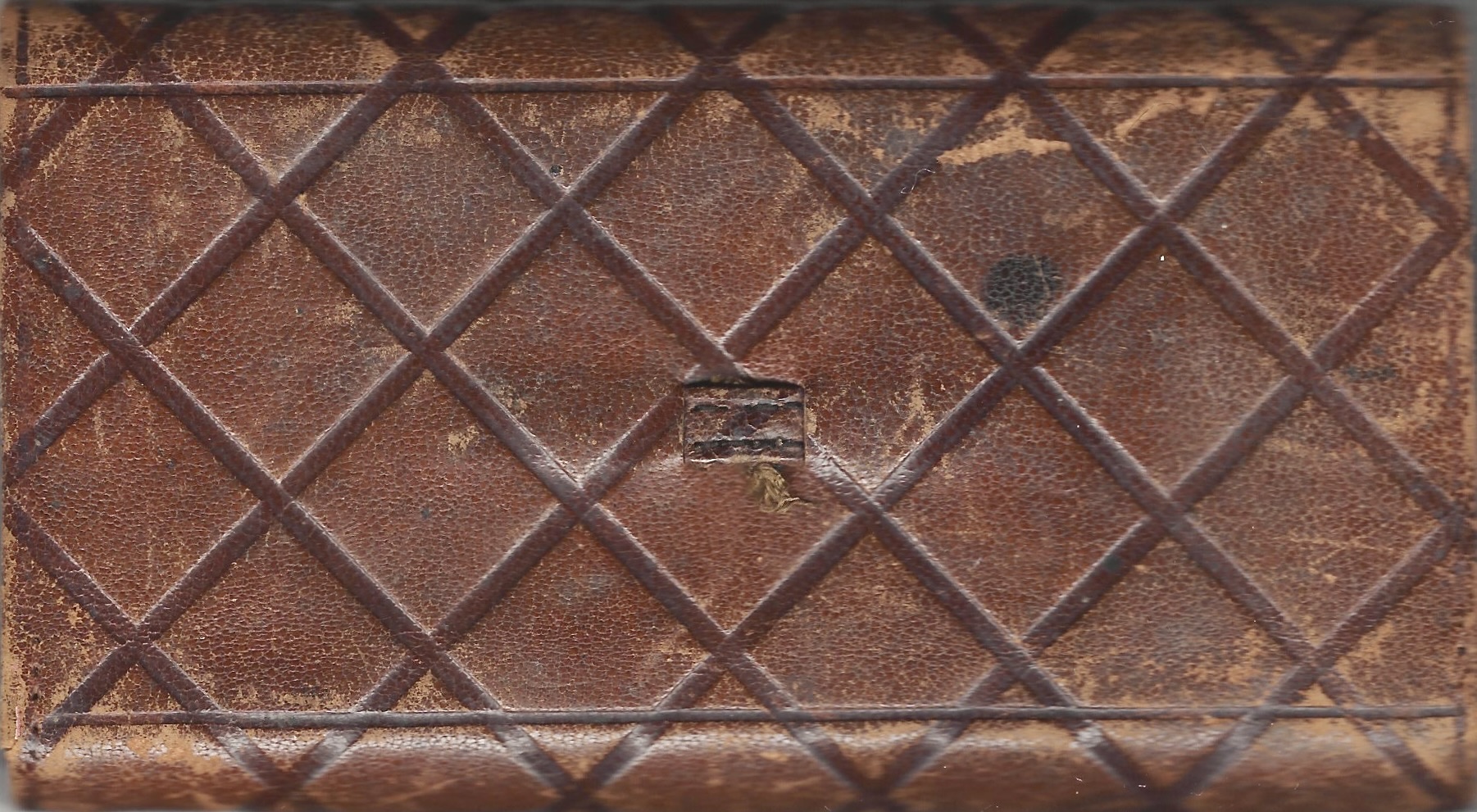
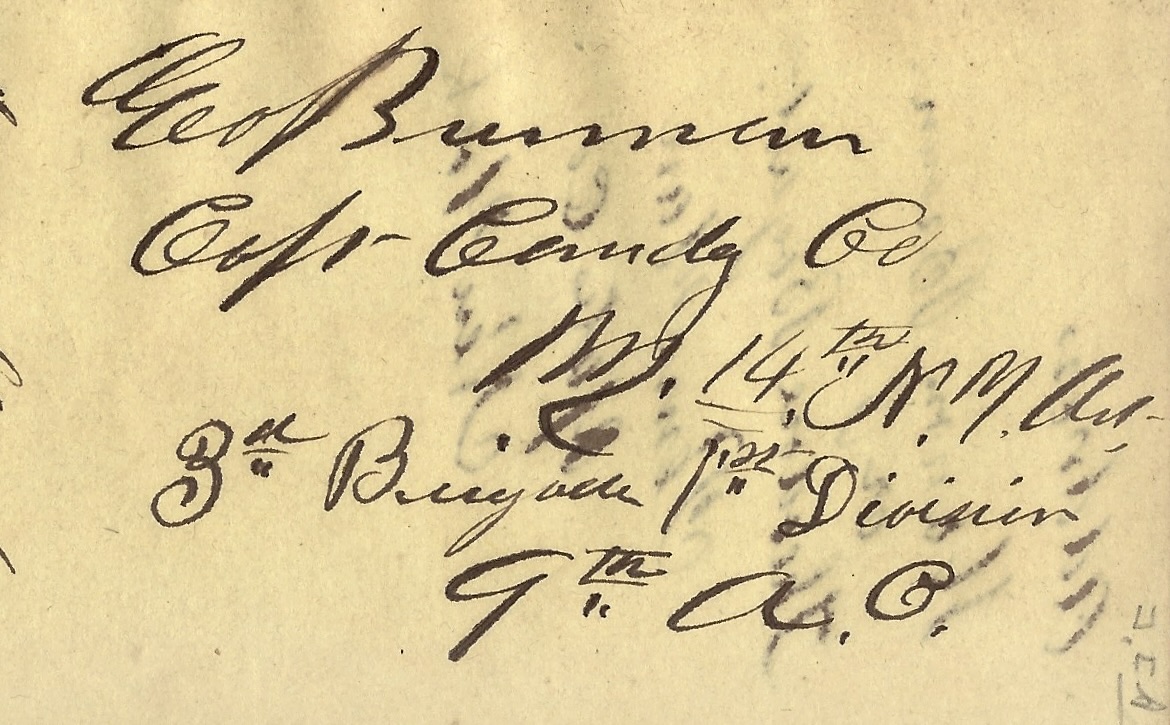
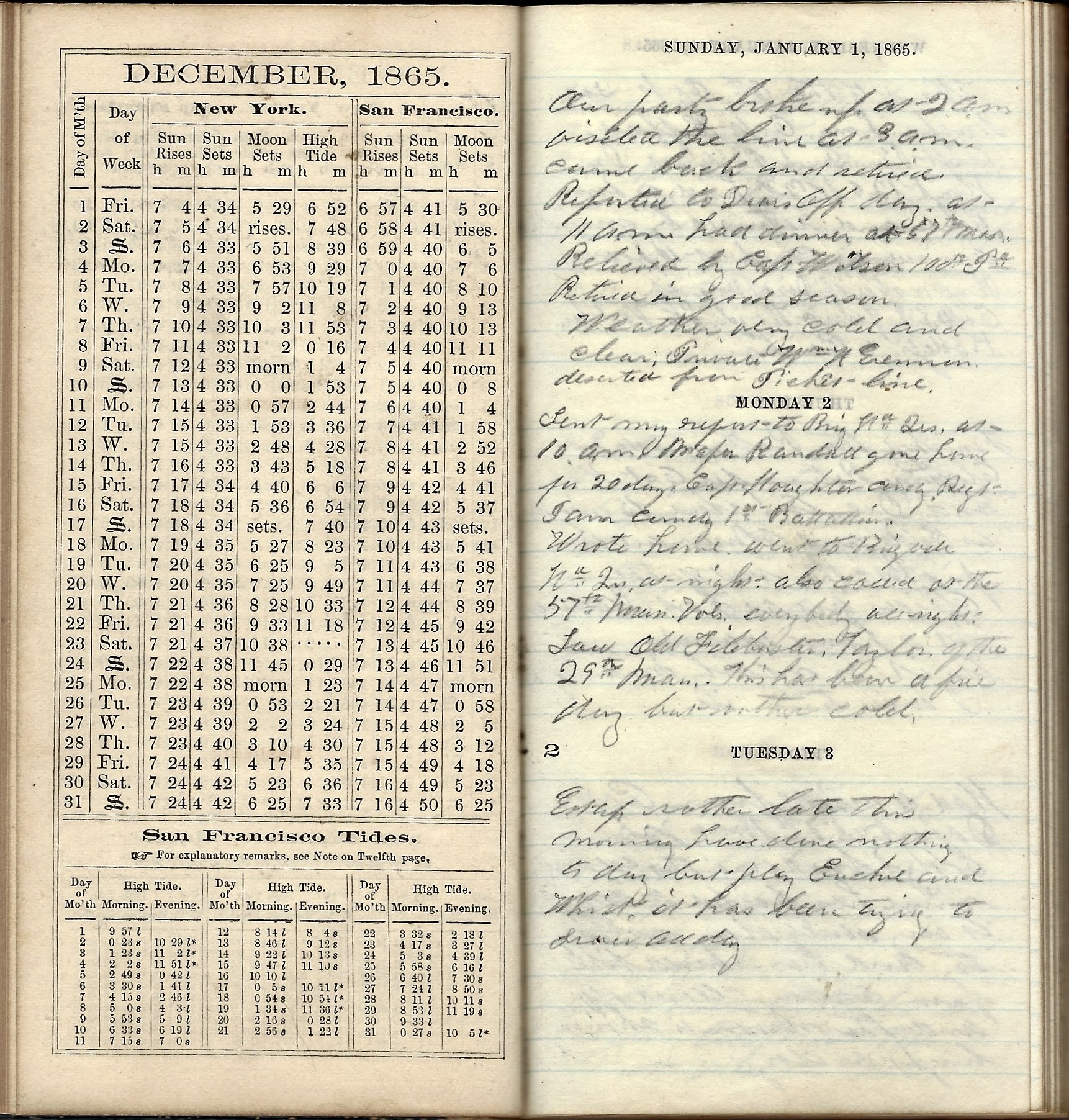
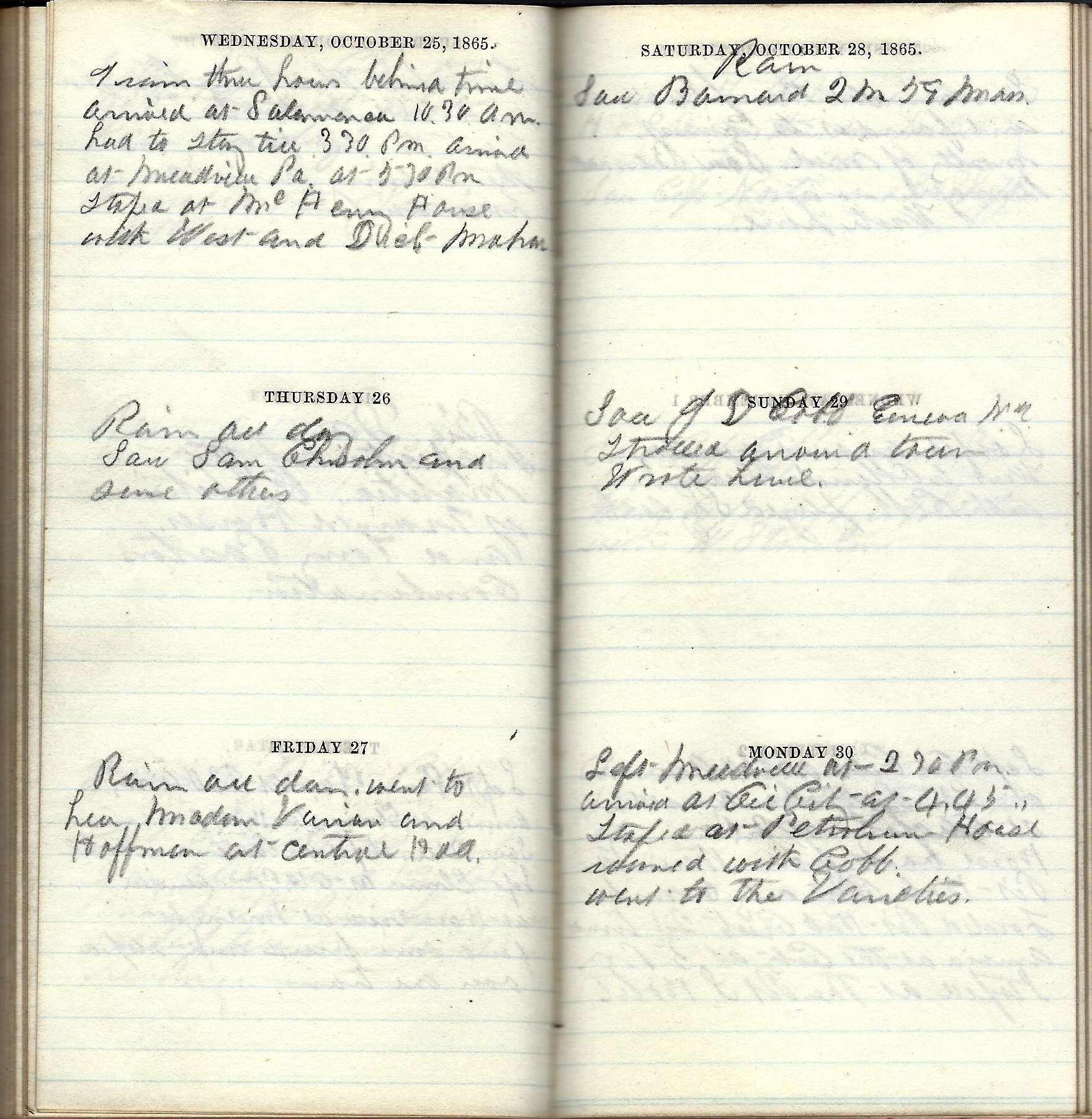
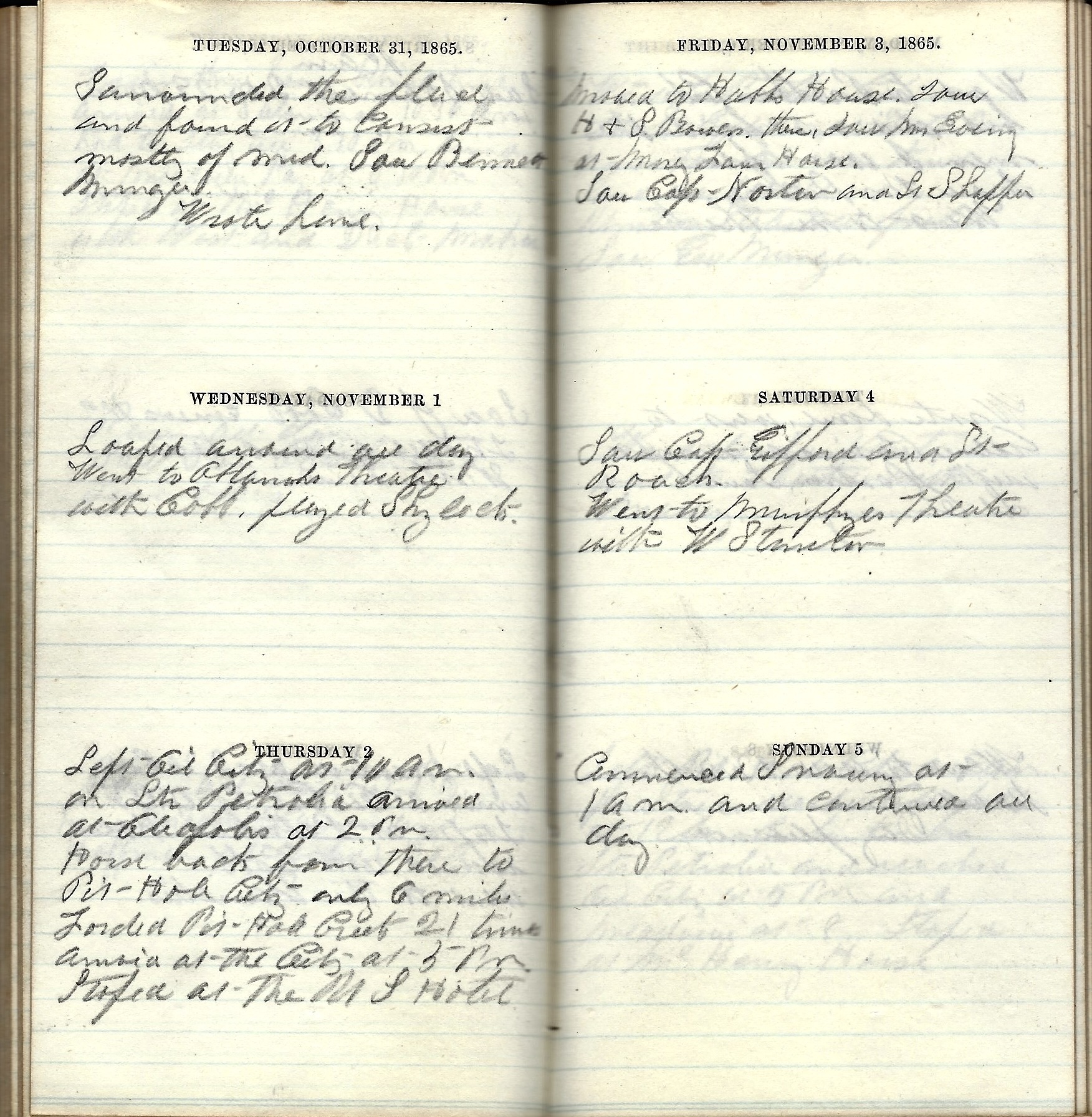
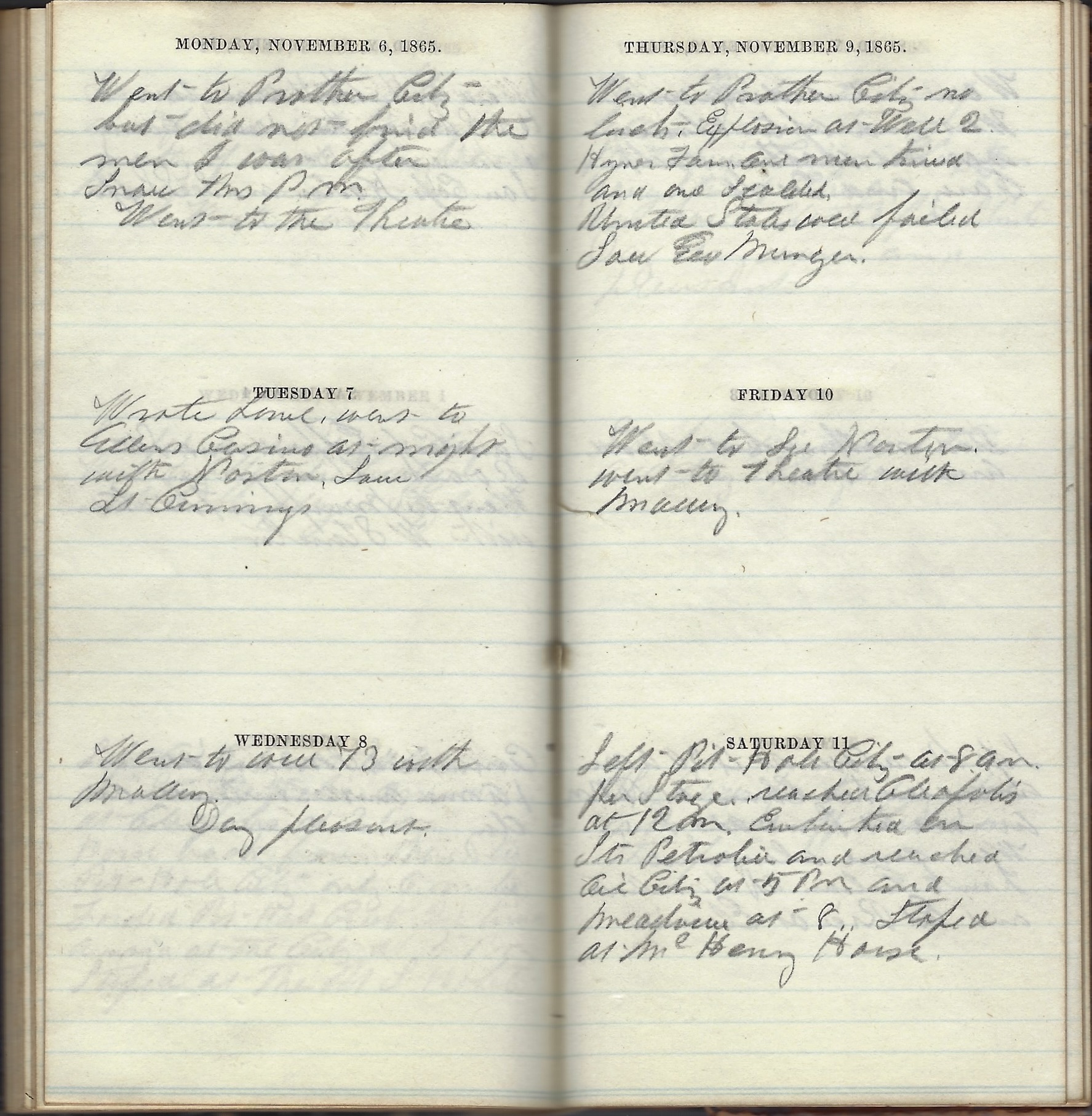
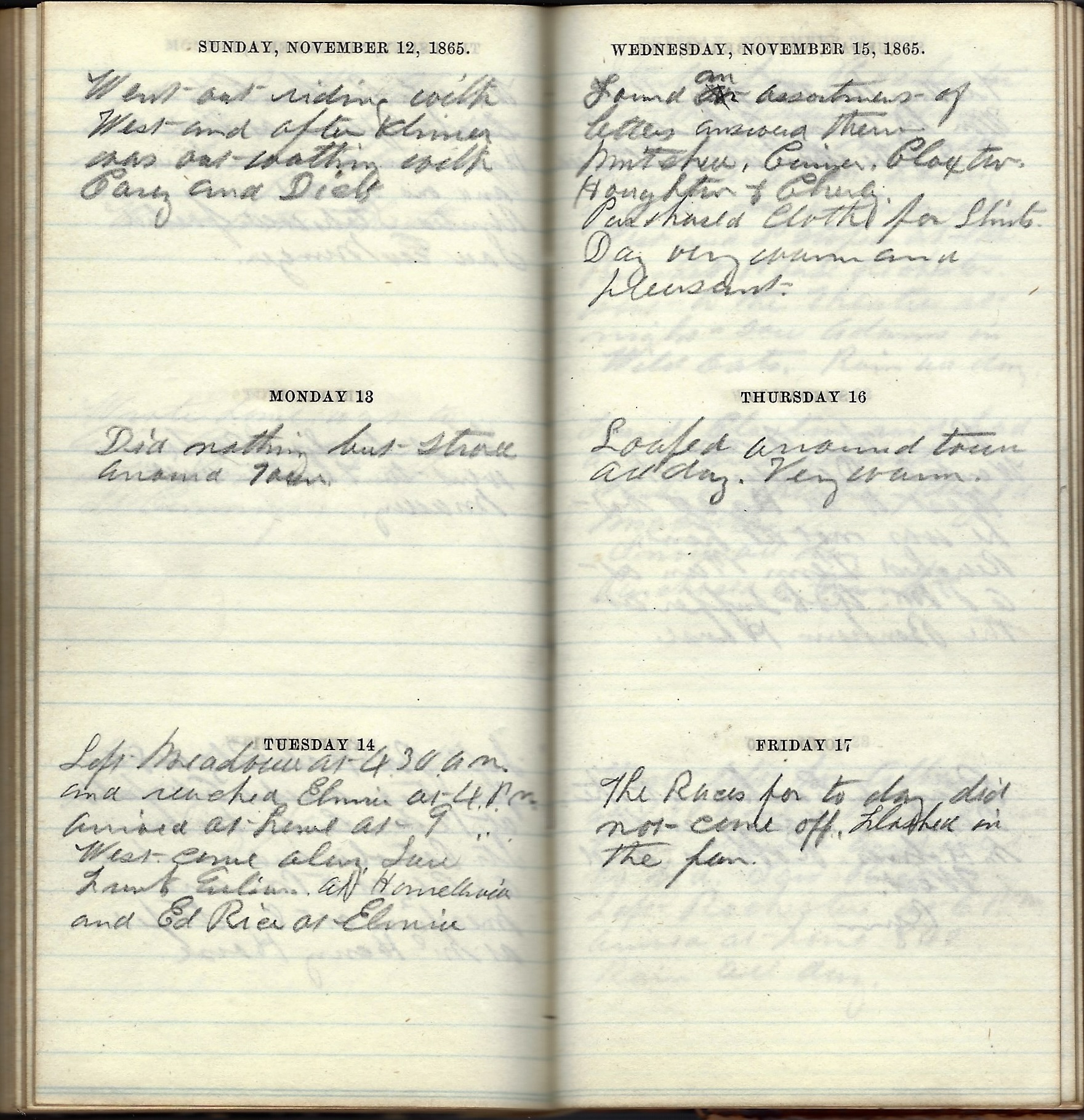
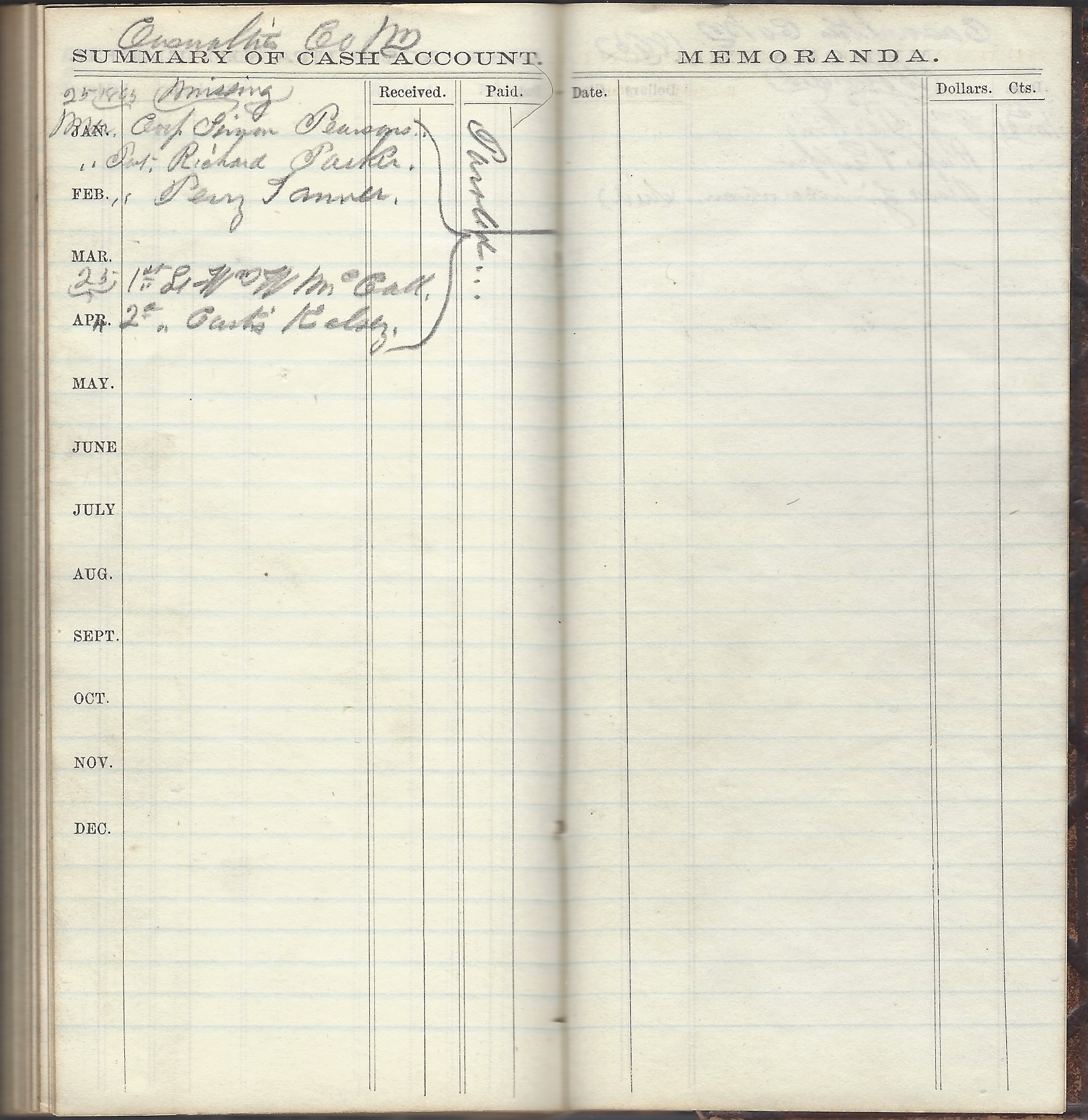
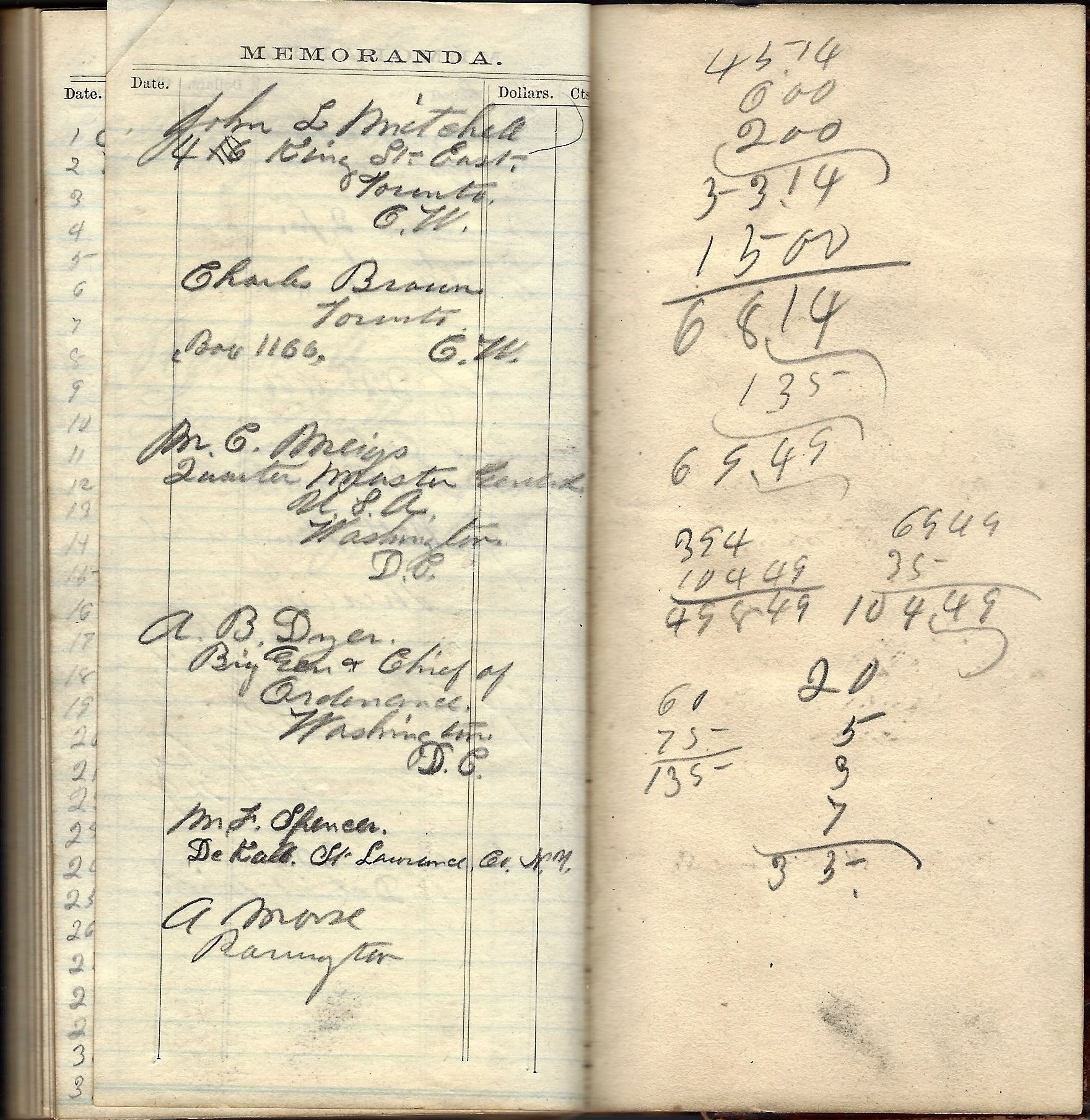
Brennan’s 1865 diary is bound in leather and was published by John O’Hara, No. 27 Beekman Street, New York. It is identified in multiple instances to George Brennan, Captain Commanding Co. M, 14th N.Y. Artillery. 6 x 3 1/4 in., approx. 133pp, pencil entries in 3 days per page format (light wear to leather, pencil occasionally light or smudged but overall very legible and clean). Daily entries from 1 January 1865 – 31 December 1865, plus Memoranda and Cash Account notations.
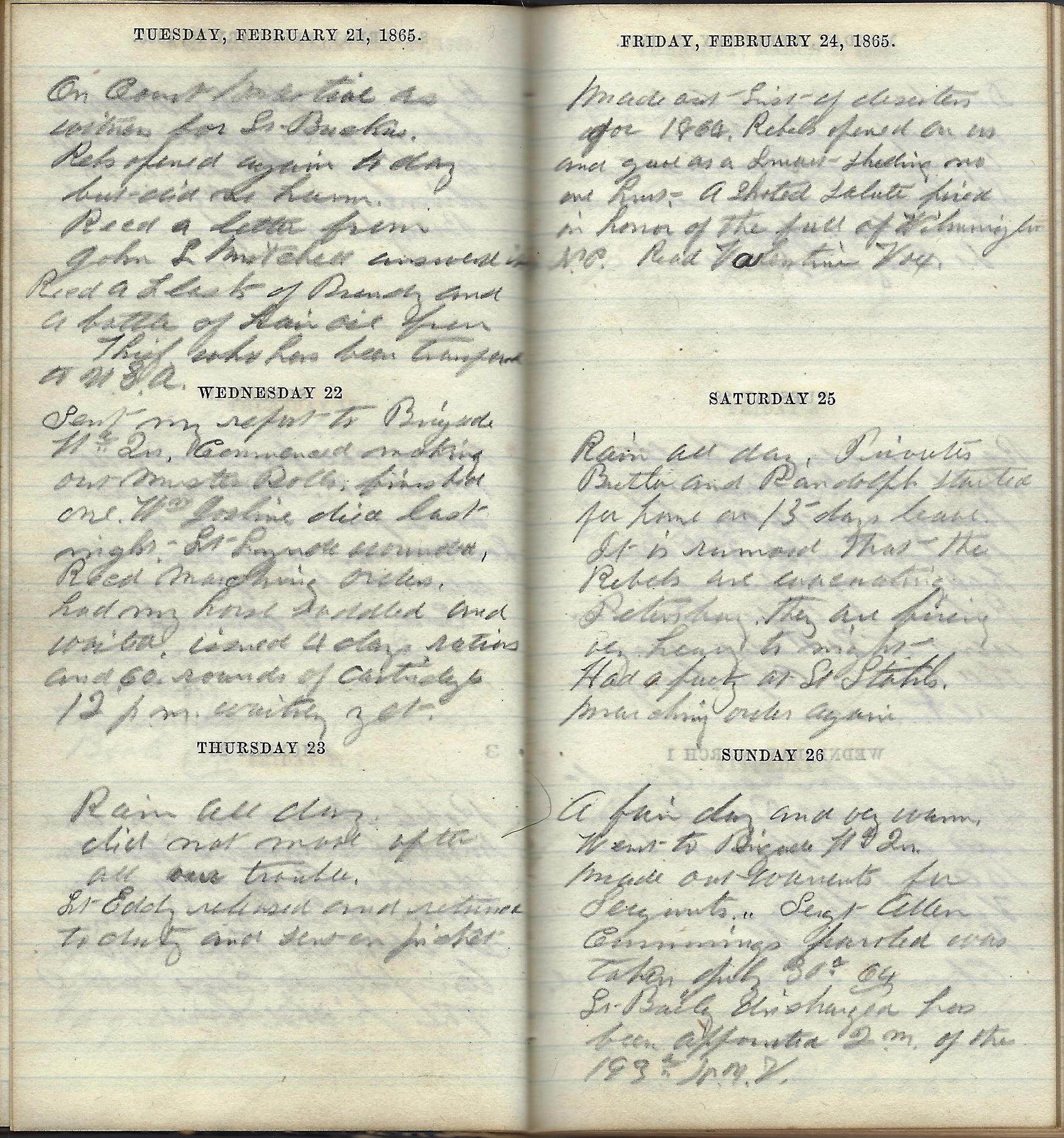
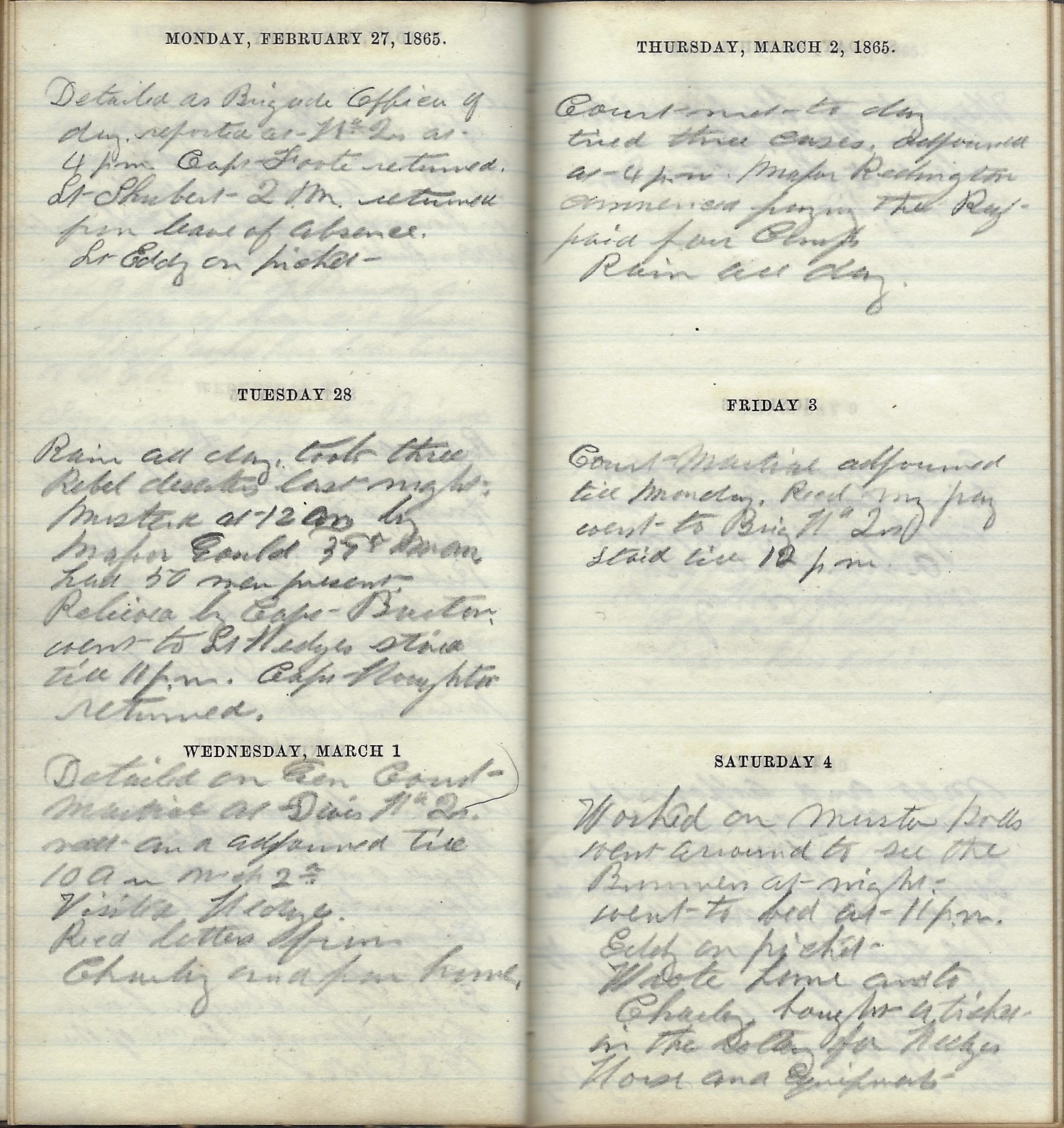
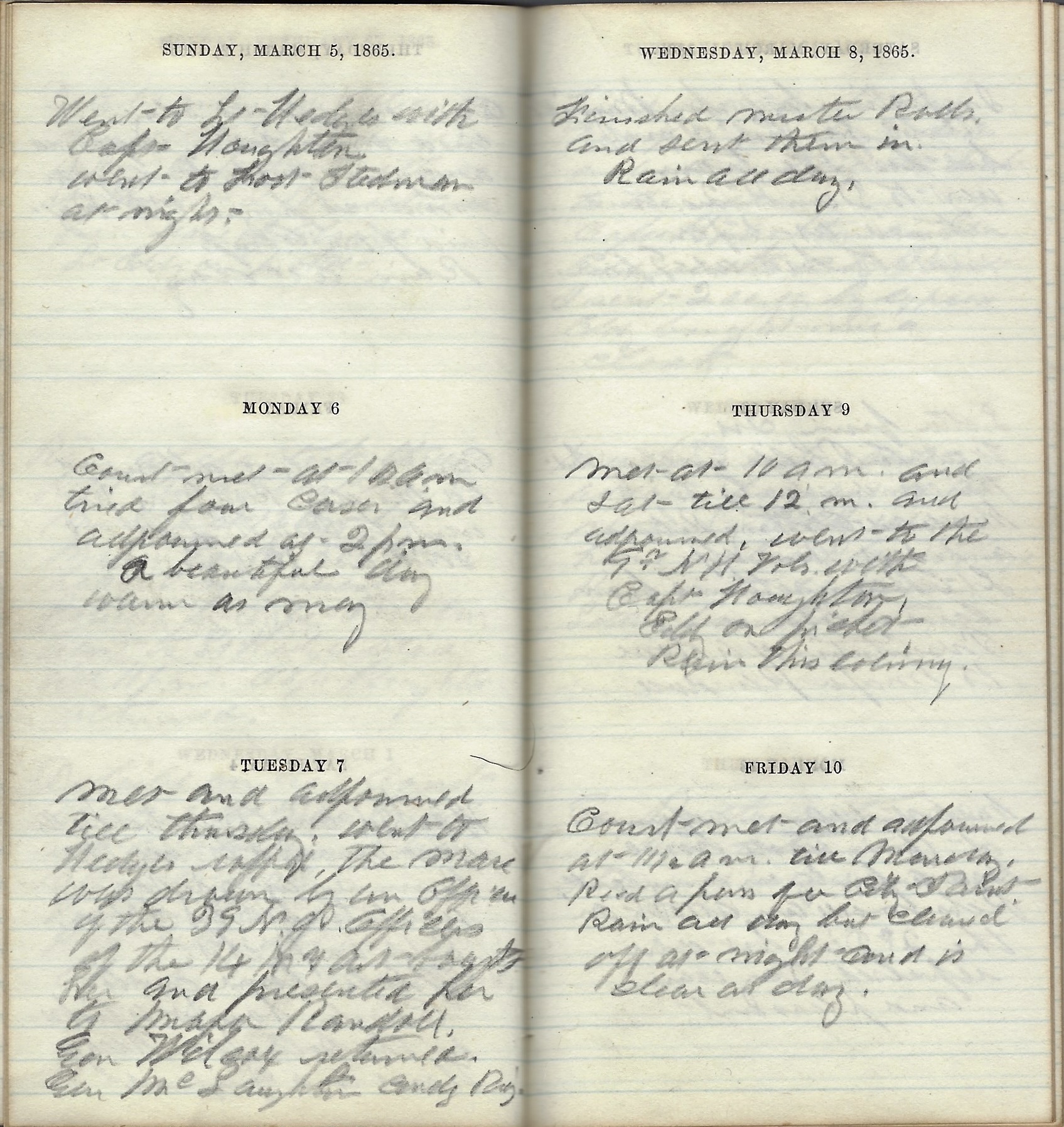
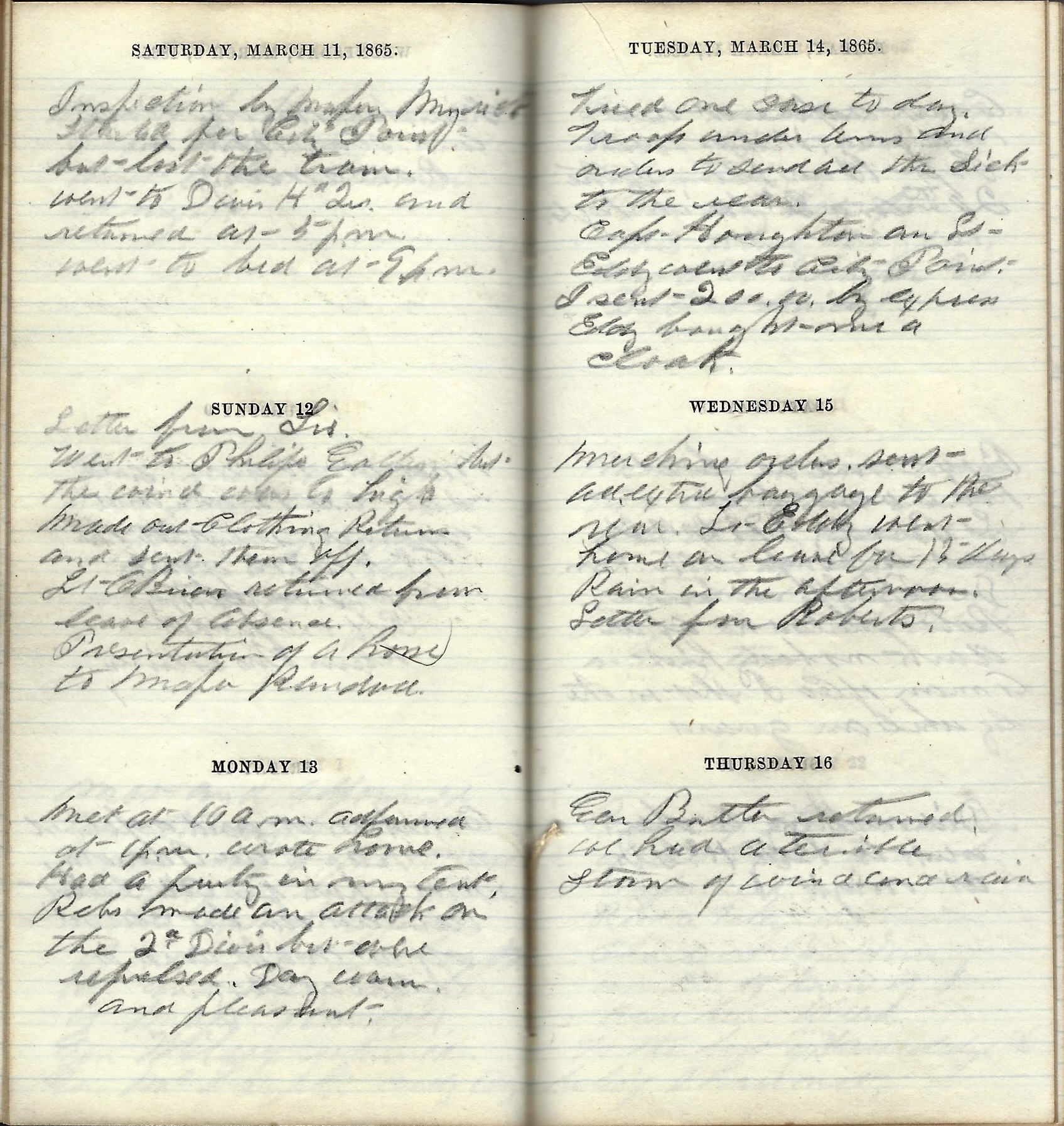
George Brennan’s 1865 Diary
T R A N S C R I P T I O N
1865
George Morton Randall
Sunday, January 1, 1865—Our party broke up at 2 a.m. Visited the line at 3 a.m. Came back and retired. Reported to Division Officer of the Day at 11 a.m. Had dinner at 57th Mass. Relieved by Capt. [Charles] Wilson 100th Pa. Retired in good season. Weather very cold and clear. Private Wm. H. Grinnon deserted from picket line.
Monday, 2—Sent my report to Brigade Headquarters at 10 a.m. Major [George Morton] Randall gone home for 20 days. Capt. Houghton commanding Regiment. I am commanding 1st Battalion. Wrote home. Went to Brigade Headquarters at night. Also called at the 57 Mass. Vols. Everybody all right. Saw Old Filibuster [George H.] Taylor of the 29th Mass. This has been a fine day but rather cold.
Tuesday, 3—Got up rather late this morning. Have done nothing today but play Euchre and Whist. It has been trying to snow all day.
Dr. Charles S. Hoyt, 126th New York Volunteers
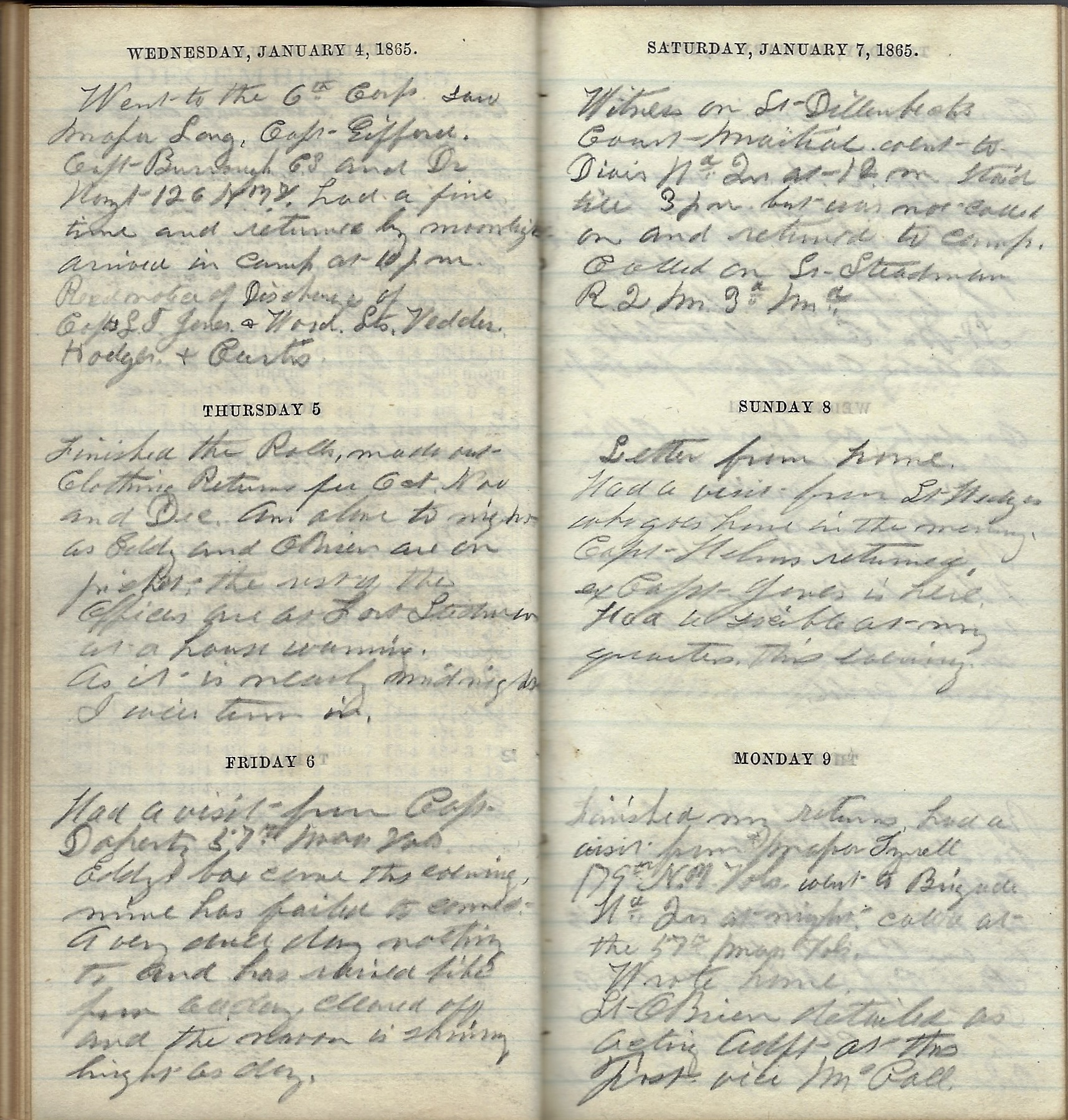
Wednesday, January 4, 1865—Went to the 6th Corps. Saw Major Long, Capt. Gifford, Capt. Burrough, 63rd, and Dr. [Charles S.] Hoyt, 126th N. Y. V. Had a fine time and returned by moonlight. Arrived in camp at 10 p.m. Received notice of discharge of Capts. Lorenzo I. Jones & Ward, Lieutenants [Charles A.] Vedder, [Henry L.] Hodges, and [Henry R.] Curtis.
Thursday, 5th—Finished the rolls. Made out clothing returns for October, November, and December. Am alone tonight as [Charles C.] Eddy and [Charles A.] O’Brien are on picket. The rest of the officers are at Fort Stedman at a house warming. As it is nearly midnight, I will turn in.
Friday, 6th—Had a visit from Capt. Doherty, 57th Mass. Vols. Eddy’s box has come this evening. Mine has failed to come. A very dull day. Nothing to do and has rained like fun all day. Cleared off and the moon is shining bright as day.
Saturday, January 7, 1865—Witness on Lt. [Jerome] Dillenbeck’s Court Martial. Went to Division Headquarters 12 M. Stayed till 3 p.m. but was not called on and returned to camp. Called on Lt. Steadman, R2, M 3rd, Md. [?]
Sunday, 8—Letter from home. Had a visit from Lt. [Henry L.] Hodges who goes home in the morning. Capt. [William R.] Helms returning. Ex-captain [Lorenzo I.] Jones is here. Had a sociable at my quarters this evening.
Monday, 9—Finished my returns. Had a visit from [ ] Tyrell, 179th New York Cols. Went to Brigade Headquarters. In at night. Called at the 57th Mass. Vols. Wrote home. Lt. O’Brien detailed as Acting Adjutant at this post, vice McPall [?].
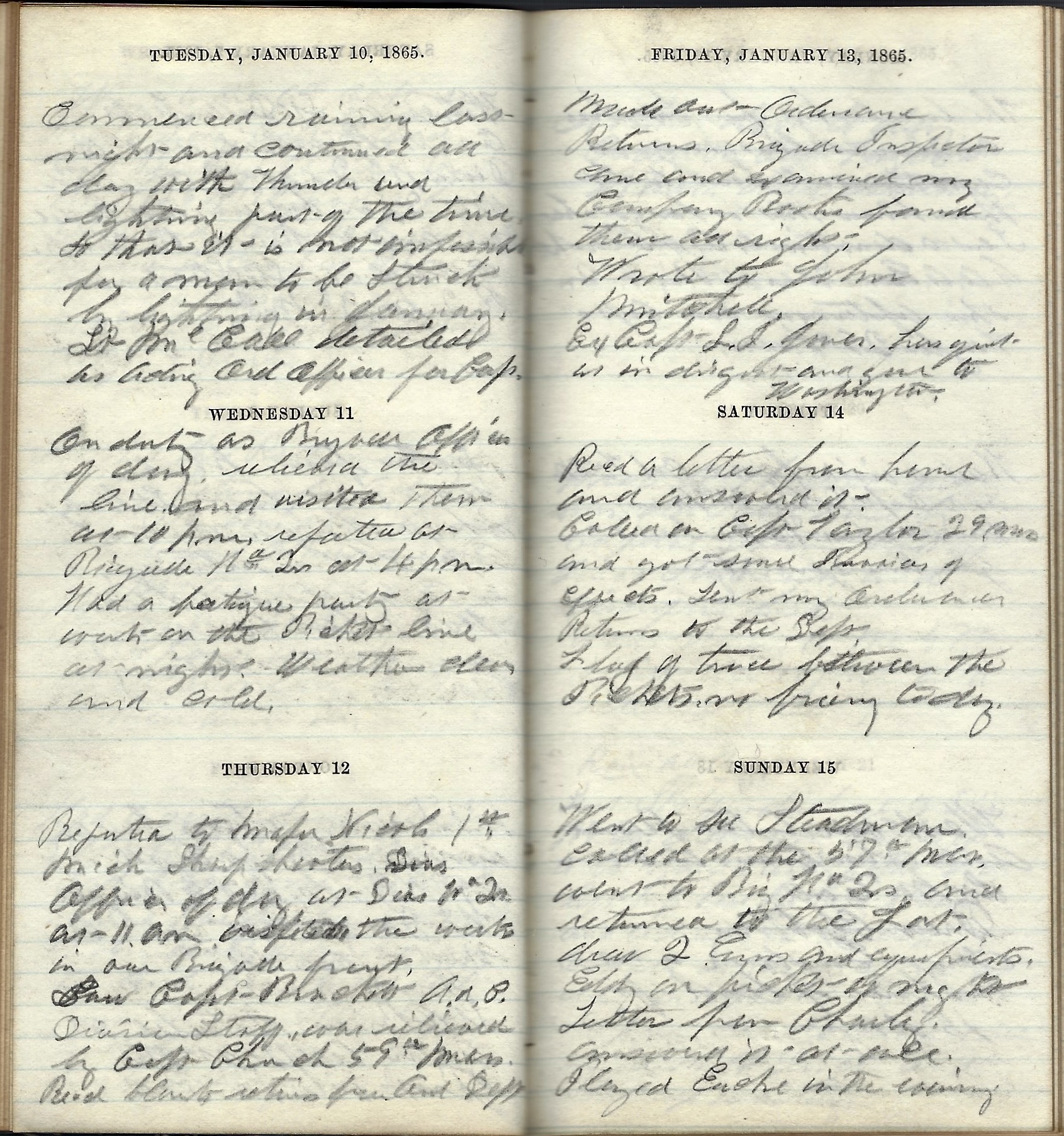
Tuesday, January 10, 1865—Commenced raining last night and continued all day with thunder and lightning part of the time so that it is not impossible for a man to be struck by lightning in [ ]. Lt. McCall detailed as Acting Ord. Officer for Co.
Wednesday, 11—On duty as Brigade Officer of Day. Relieved the line and visited them at 10 p.m. Reported at Brigade Headquarters at 4 p.m. Had a fatigue party at work on the picket line at night. Weather clear and cold.
Thursday 12—Reported to Major [Asahel W.] Nicols, 1st Michigan Sharpshooters, Division Officer of the Day at Division Headquarters at 11 a.m. Visited the works in our Brigade front. Saw Capt. [Levi Curtis] Brackett, A. A. G., Division Staff. Was relieved by Capt. Church[?], 59th Mass. Received blank returns from [ ].
Friday, January 13, 1865—Made out ordnance returns. Brigade Inspector came and examined my company books. Found them all right. Wrote to John Mitchell. Ex-Capt. Lorenzo I. Jones has quit us in disgust and gone to Washington.
Saturday, 14—Received a letter from home and answered it. Called on Capt. Taylor, 29th Mass. and some [ ] of effects. Sent my ordnance returns to the Department. Flag of truce between the pickets. No firing today.
Sunday, 15—Went to see Fort Stedman. Called at the 57th Mass. Went to Brigade Headquarters and returned to the fort. Draw two guns and equipments. [Lt.] Eddy on picket tonight. Letter from Charley. Answered it. Played Euchre in the evening.
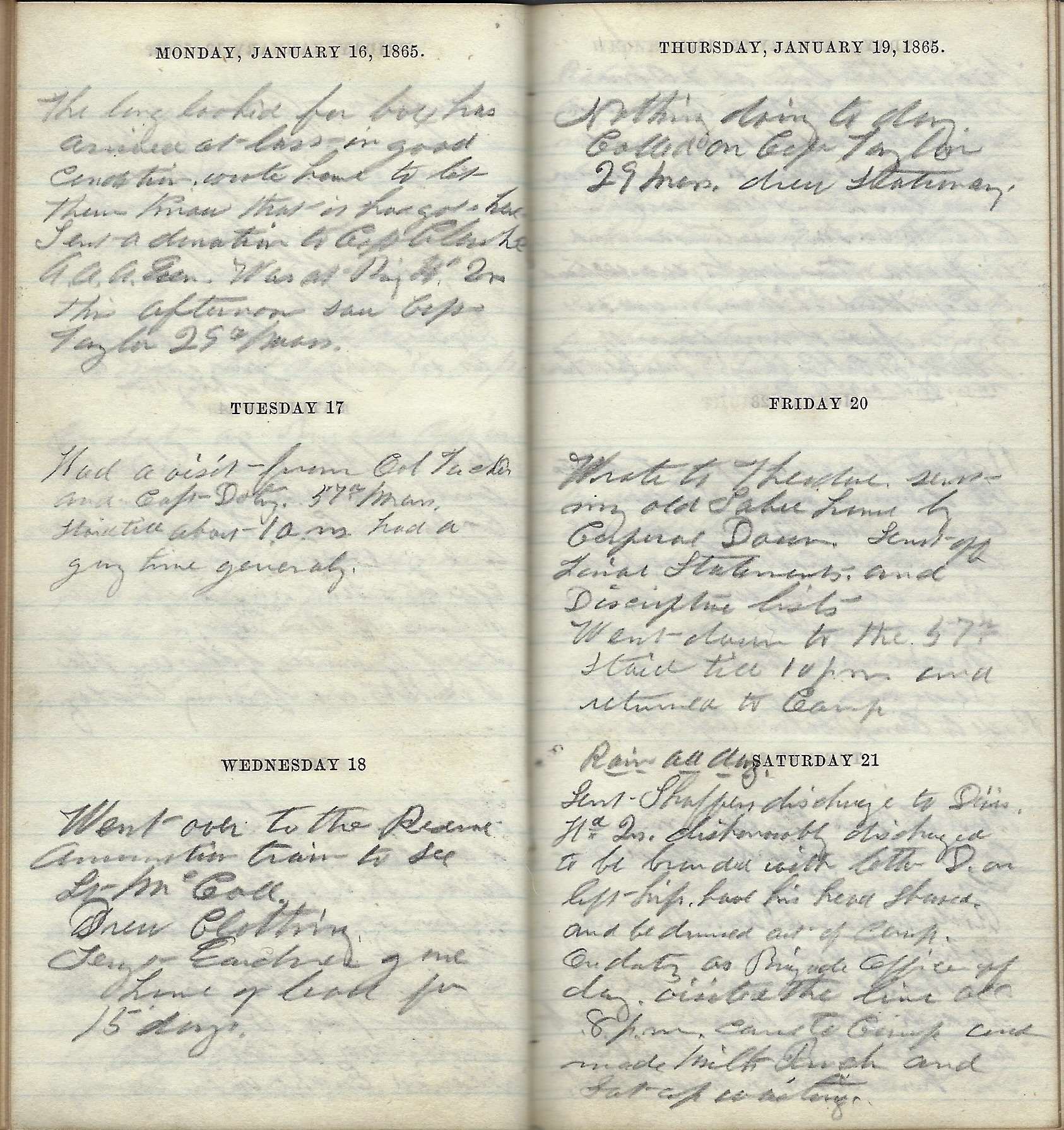
Monday, January 16, 1865—The long looked for box has arrived at last in good condition. Wrote home to let them know that it has got here. Sent a donation to Capt. Clarke, A.A.A. Gen. Was at Brig. Headquarters this afternoon. Saw Capt. Taylor, 29th Mass.
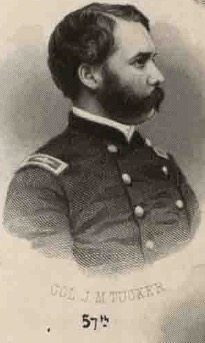
Col. Julius M. Tucker, 57th Mass. Vols.
Tuesday, 17—Had a visit from Col. [Julius M.] Tucker and Capt. [Albert] Doty, 57th Mass. Staid till about 1 a.m. Had a gay time generally.
Wednesday, 18—Went over to the reserve Ammunition Train to see Lt. McCall. Drew clothing. Sergt. [ ] gave me line of lead for 15 days.
Thursday, January 19, 1865—Nothing doing today. Called on Capt. Taylor, 29th Mass. Drew stationery.
Friday, 20—Wrote to Theodore. Sent my old saber home by Corporal [William H.] Down. Sent off Final Statements and Descriptive Lists. Went down to the 57th [Mass. and] staid till 10 p.m. and returned to camp.
Saturday, 21—Rain all day. Sent [Charles] Shaffer discharge to Division Headquarters, dishonorably discharged to be branded with letter D on left hip, have his head shaved, and be drummed of camp. On duty as Brigade Officer of the Day. Visited the line at 8 p.m. Came to camp and made milk punch and sat up writing.
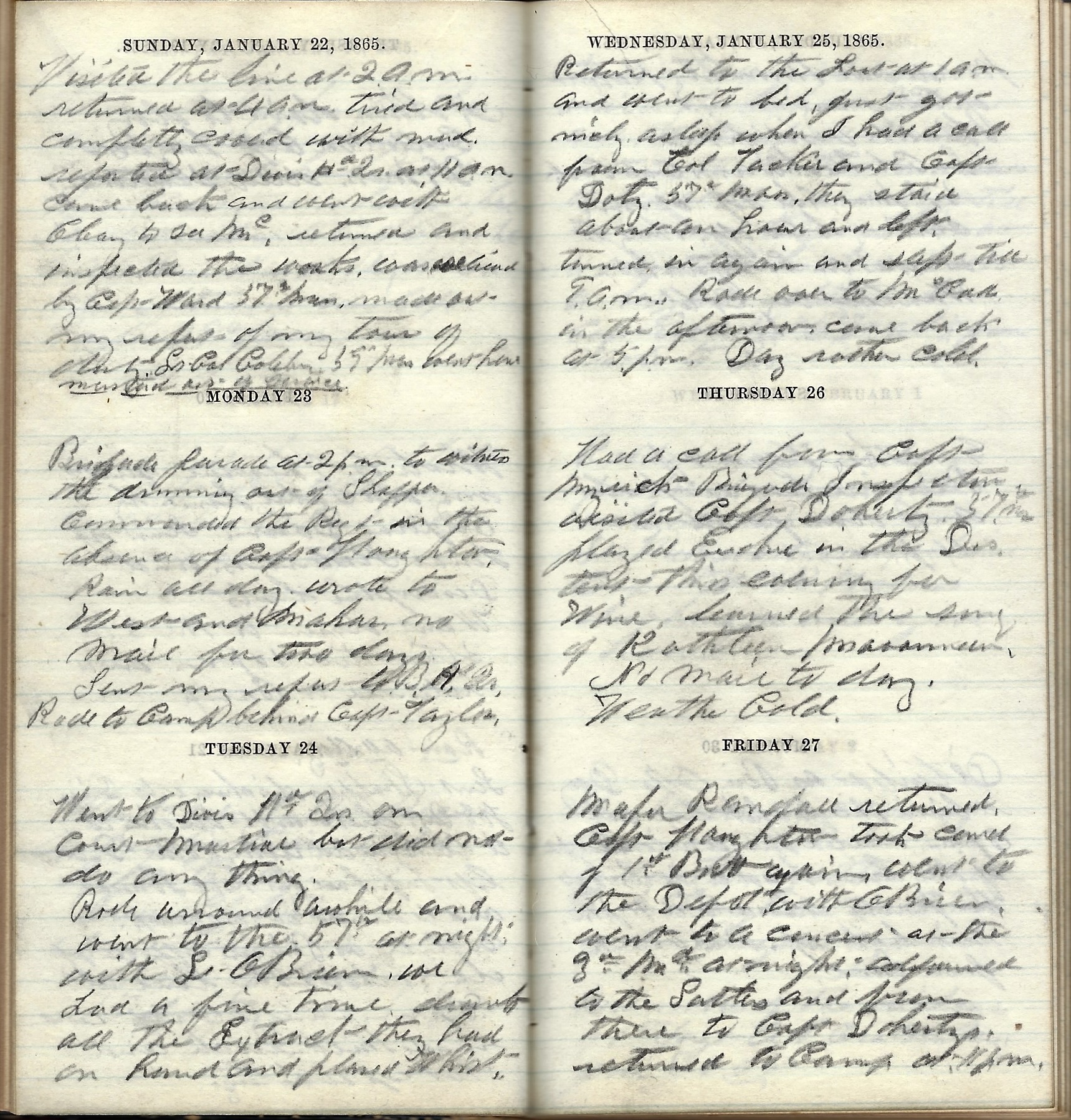
Sunday, January 22, 1865—Visited the line at 2 a.m. Returned at 4 a.m. tired and completely covered with mud. Reported at Division Headquarters at 11 a.m. Came back and went with Chas. to see Mc. Returned and inspected the works. Was relieved by Capt. Ward, 37th Mass. Made out my report of my tour of duty. Lt. Col. [Joseph] Colburn, 59th Mass. went home, mustered out of service.
Monday, 23—Brigade parade at 2 p.m. to witness the drumming out of [Charles] Shaffer. Commanded the regiment in the absence of Capt. Houghton. Rain all day. Wrote to West and Mahan. No mail for two days. Sent my report to Brigade Headquarters. Rode to camp behind Capt. Taylor.
Tuesday, 24—Went to Division Headquarters on court martial but did not do anything. Rode around awhile and went to the 57th [Mass.] at night with Lt. O’Brien. We had a fine time. Drank all the extract they had on hand and played Whist.
Wednesday, January 25, 1865—Returned to the fort at 1 a.m. and went to bed. Just got nicely asleep when I had a call from Col. Tucker and Capt. Doty, 57th Mass. They stayed about an hour and left. Turned in again and slept till 9 a.m. Rode over to McCall in the afternoon. Came back at 5 p.m. Day rather cold.
Thursday, 26—Had a call from Capt. [ ]. Brigade Inspector. Visited Capt. [James] Doherty, 57th Mass. Played Euchre in the Division tent this evening for wine. Learned the song of Kathleen [Masander?]. No mail today. Weather cold.
Friday, 27—Major Randall returned. Capt. [Charles H.] Houghton took command of 1st Battalion again. Went to the Depot with [Lt.] O’Brien. Went to a concert at the 3rd Maryland at night. Afterward to the sutler’s and from there to Capt. [James] Doherty’s. Returned to camp at 11 p.m.
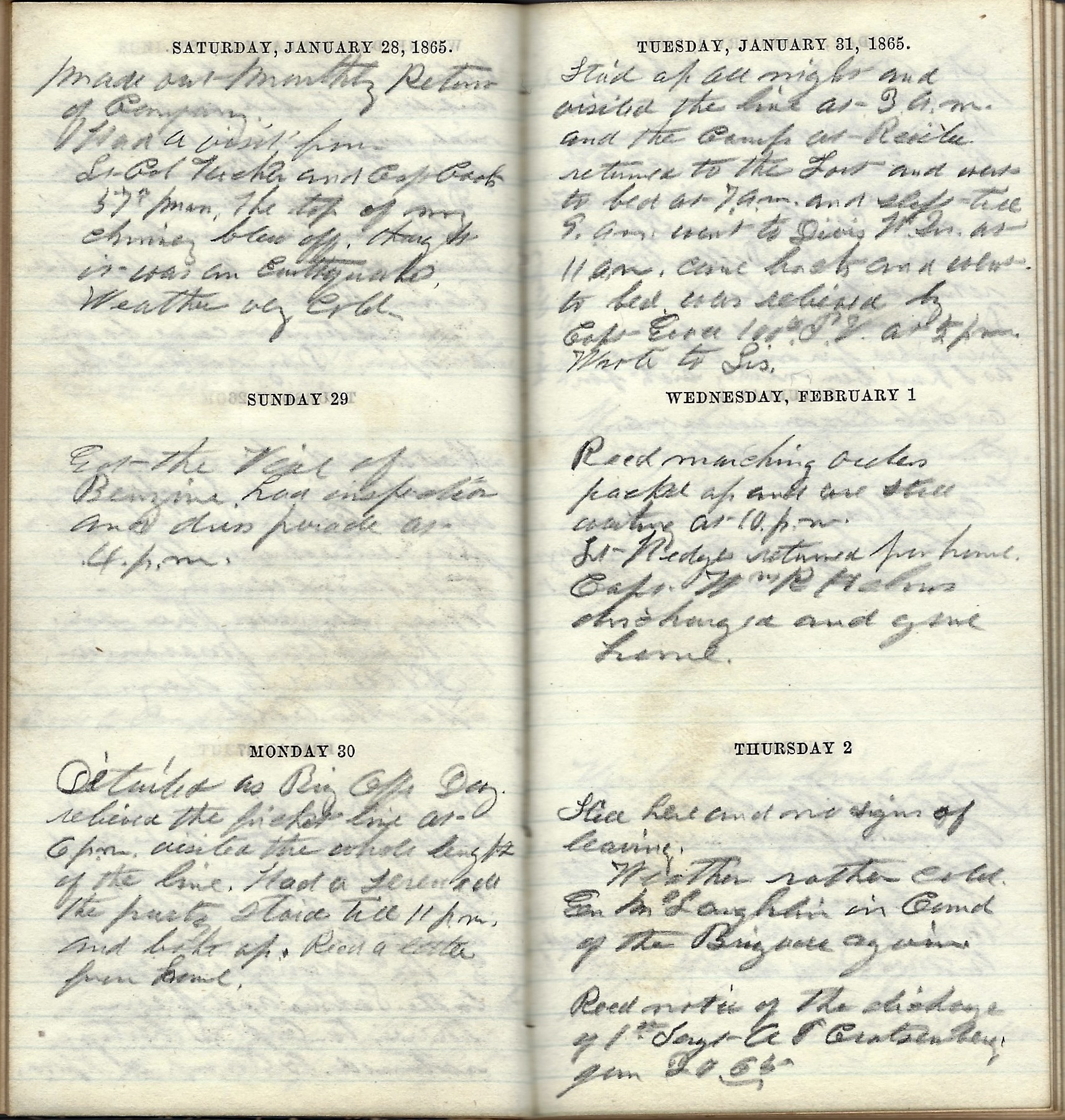
Saturday, January 28, 1865—Made out monthly returns of company. Had a visit from Lt. Col. Tucker and Capt. C___[?], 57th Mass. The top of my chimney blew off. Thought it was an earthquake. Weather very cold.
Sunday, 29—Got the vial of benzine. Had inspection and dress parade at 4 p.m.
Monday, 30—Detailed as Brigade Officer of the Day. Relieved the picket line at 6 p.m. Visited the whole length of the line. Had a serenade. The party stayed till 11 p.m. and [ ]. Received a letter from home.
Tuesday, January 31, 1865—Stayed up all night and visited the line at 3 a.m. and the camp at reveille. Returned to the fort and went to bed at 7 a.m. and slept till 9 a.m. Went to Division Headquarters at 11 a.m. Came back and went to bed. Was relieved by Capt. [James W.] Bard, 100th Pennsylvania Vols. at 5 p.m. Wrote to Sis.
Wednesday, February 1, 1865—Received marching orders. Packed up and are still waiting at10 p.m. Lt. Hedges returned from home. Capt. Wm. R. Helms discharged and gone home.
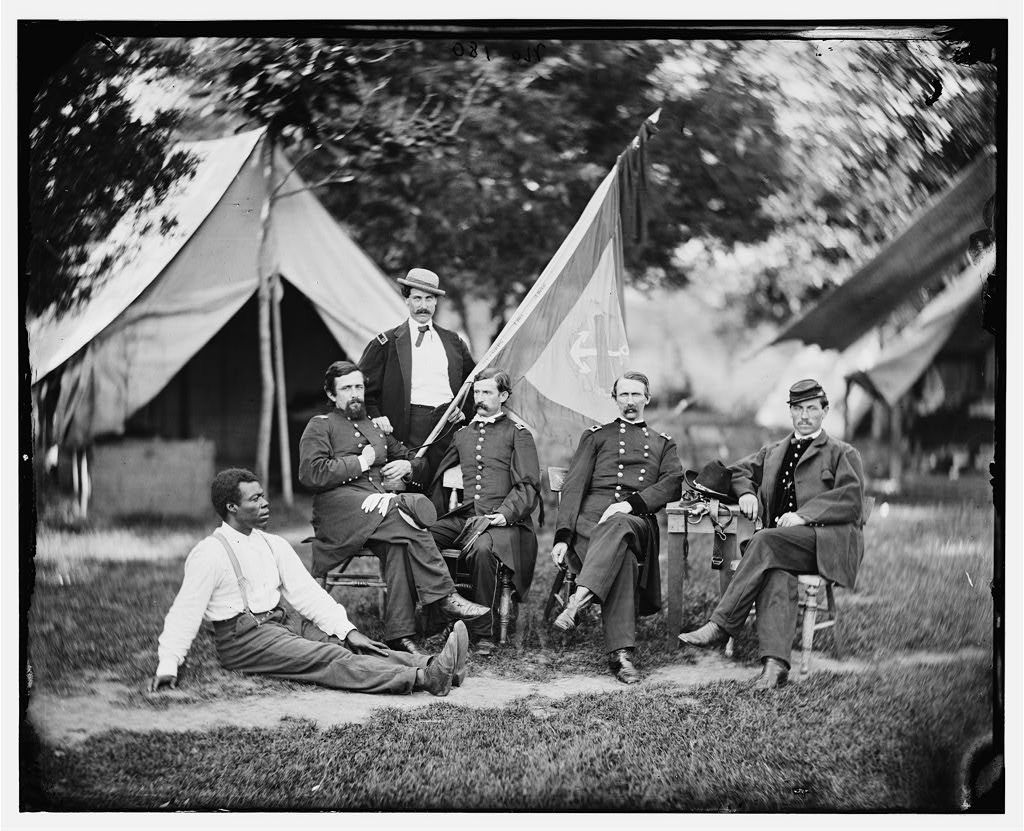
Brig. Gen. Napoleon McLaughlin (seated second from right) with staff and camp servant. (Library of Congress)
Thursday, 2—Still here and no signs of leaving. weather rather cold. Gen. [Napoleon B.] McLaughlin in command of the Brigade again. Received notice of the discharge of 1st Sergt. Adam I. Cratzenberg, January 20th 1865.
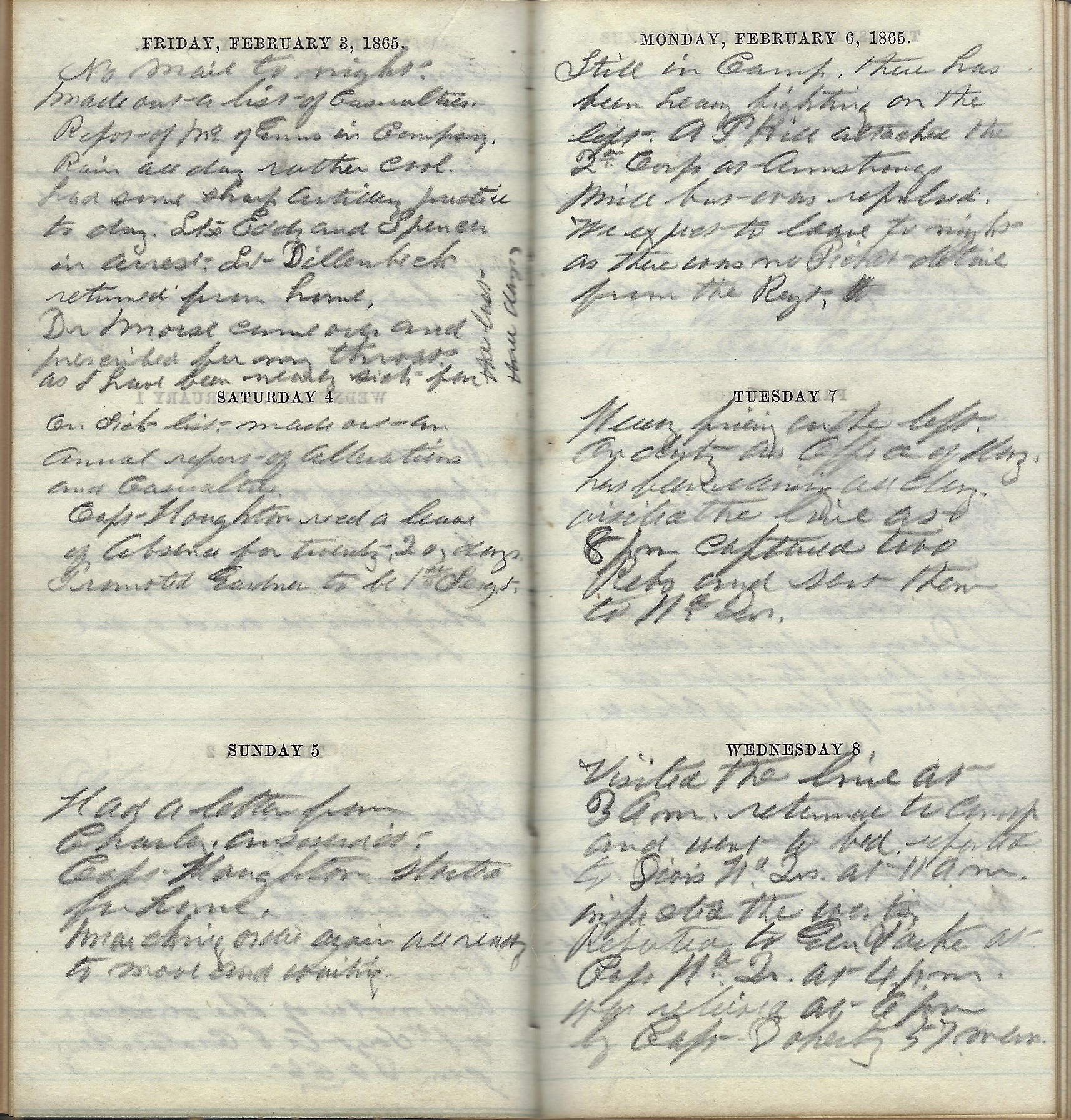
Friday, February 3, 1865—No mail tonight. Made out a list of casualties. Report of [ ] in company. Rain all day. Rather cool. Had some sharp artillery practice today. Lts. [William] Eddy and [Robert H.] Spencer in arrest. Lt. Dillenbeck returned from home. Dr. [Sherman] Morse came over and prescribed for my throat as I have been nearly sick for the last three days.
Schuyler Gardner, 14th NY Heavy Artillery, Co. M.
Saturday, 4—On sick list. Made out an annual report of alterations [?] and casualties. Capt. Houghton received a leave of absence for twenty days. Promoted [Schuyler] Gardner to be 1st Sergeant.
Sunday, 5—Had a letter from Charles. Answered. Capt. Houghton started home. Marching orders again. All ready to move and waiting.
Monday, February 6, 1865—Still in camp. There has been heavy fighting on the left. A. P. Hill attacked the 2nd Corps at Armstrong’s Mill but was repulsed. We expect to leave tonight as there was no picket detail from the regiment.
Tuesday, 7—Heavy firing on the left. On duty as Officer of the Day. Has been raining all day. Visited the line at 8 p.m. Captured two rebs and sent them to Headquarters.
Wednesday, 8—Visited the line at 3 a.m.. Returned to camp and went o bed. Reported to Division Headquarters at 11 a.m. Inspected the works. Reported to Gen. [John Grubb] Parke at Corps Headquarters at 4 p.m. Was relieved at 6 p.m. by Capt. Doherty, 57th Mass.
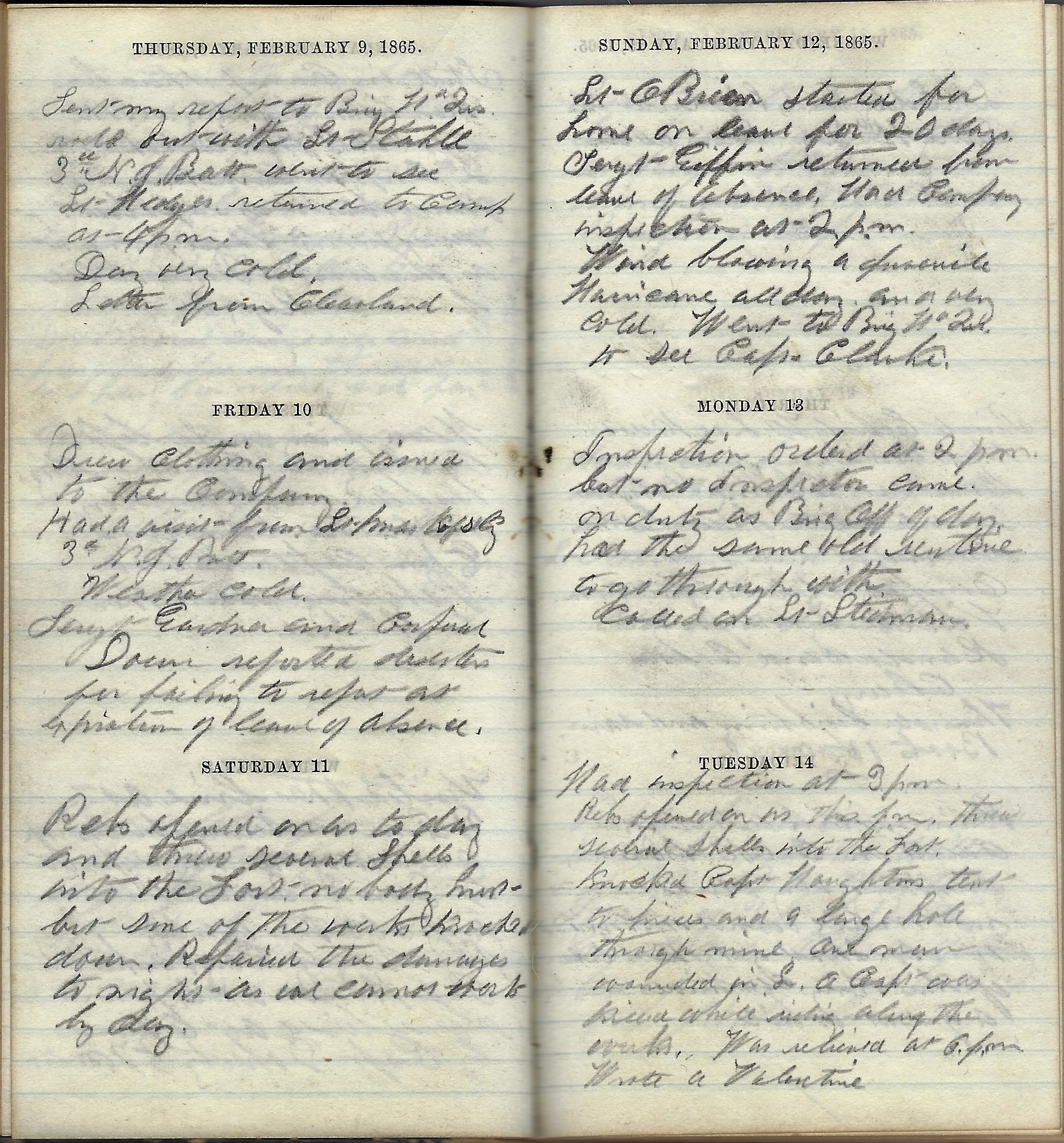
Thursday, February 9, 1865—Sent my report to Brigade Headquarters. Rode out with Lt. Stahll, 3rd New Jersey Battery. Went to see Lt. Hedges. Returned to camp at 4 p.m. Day very cold. Letter from Cleveland [?].
Friday, 10—Drew clothing and issued to the company. Had a visit from Lt. M___, 2rd New Jersey Battery. Weather cold. Sergt. Gardner and Corporal Down reported deserters for failing to report at expiration of leave of absence.
Saturday, 11—Rebs opened on us today and threw several shells into the Fort. No [one] badly hurt, but some of the works broken down. Repaired the damages tonight as we cannot work by day.
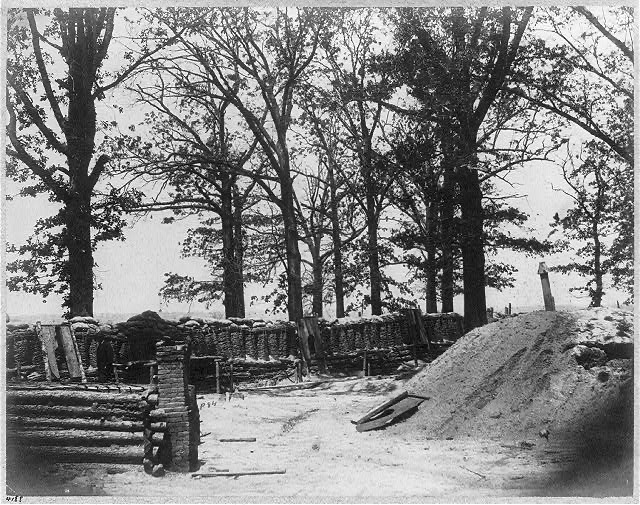
Inside Fort Stedman, LOC
Sunday, February 12, 1865—Lt. O’Brien started for home on leave for twenty days. Sergt. [David H.] Giffin returned from leave of absence. Had company inspection at 2 p.m. Wind blowing a perfect hurricane all day and very cold. Went to Brigade Headquarters to see Capt. Clarke.
Monday, 13—Inspection ordered at 2 p.m. but no inspection came on duty as Brigade Officer of the Day. Had the same old routine to go through with. Called on Lt. Stedman.
Tuesday, 14—Had inspection at 3 p.m. Rebs opened on us this past.m. Threw several shells into the fort. Knocked Capt. Houghton’s tent to pieces and a large hole through mine. One man wounded in [ ]. A captain was killed while riding along the works. Was relieved at 6 p.m. Wrote a valentine.
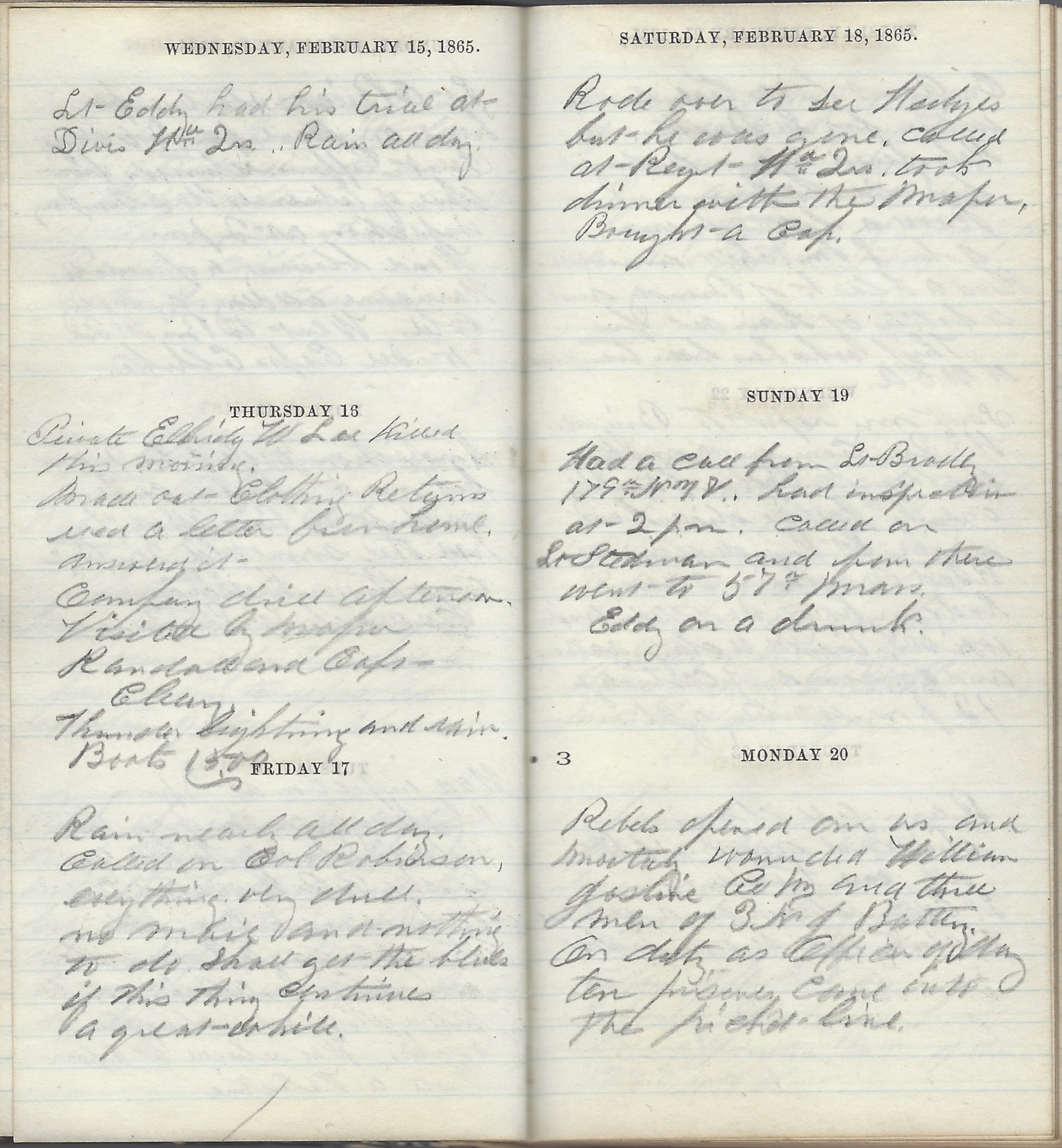
Wednesday, February 15, 1865—Lt. [William] Eddy had his trial at Division Headquarters. Rain all day.
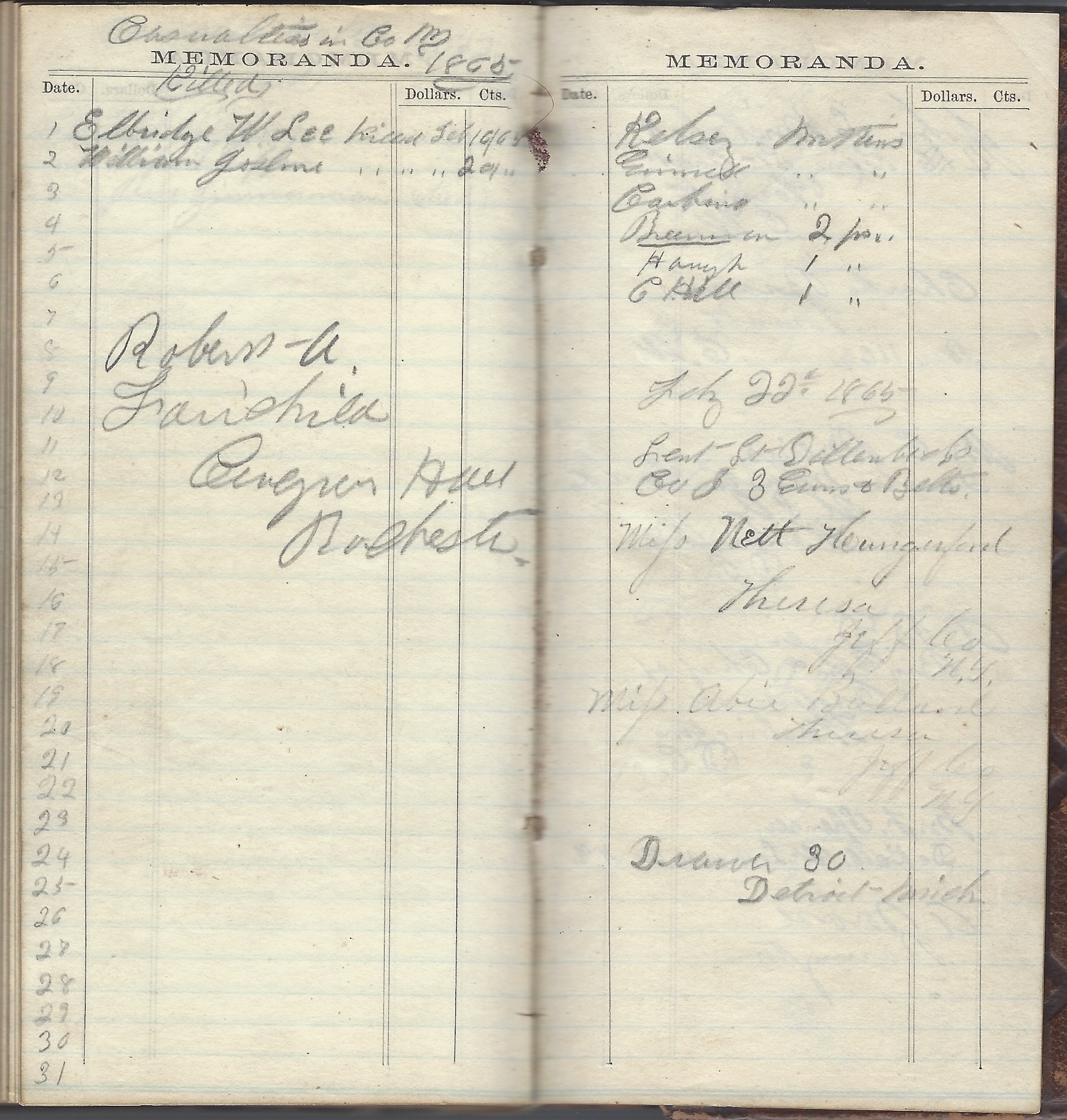
Thursday, 16—Private Elbridge W. Lee killed this morning. Made out clothing Returns. Received a letter from home. Answered it. Company drill in afternoon. Visited by Major Randall and Capt. [Joseph P.] Cleary. Thunder, lightning, and rain. Boot $15.
Friday, 17—Rain nearly all day. Called on Col. Robinson. Everything very dull. No mail and nothing to do. Shall get the blues if this thing continues a great while.
Saturday, February 18, 1865—Rode over to see Hodges but he was gone. Called at Regimental Headquarters. Took dinner with the Major. Bought a cap.
Sunday, 19—Had a call from Lt. Bradley, 179th New York Vols. Had inspection at 2 p.m. Called on Lt. Stedman and from there went to 57th Mass. [Lieutenant William] Eddy on a drunk.
Monday, 20—Rebels opened on us and mortally wounded William Josline, Co. M, and three men of 4rd New Jersey Battery. On duty as Officer of the Day. Ten prisoners came into the picket line.
Tuesday, February 21, 1865—On court martial as witness for Lt. Backus. Rebs opened again today but did no harm. Received a letter from John L. Mitchell. Answered it. Received a flask of brandy and a bottle of hair oil from thief who has been transferred to USA.
Wednesday, 22—Sent my report to Brigade Headquarters. Commenced making our Muster Rolls. Finished one. Wm. Josline died last night. Lt. [ ] wounded. Received marching orders. Had my horse saddled and waited. Issued 4 days rations and 60 rounds of cartridge. 12 p.m. waiting yet.
Thursday, 23—Rain all day. Did not move after all our trouble. Lt. [William] Eddy released and returned to duty and sent on picket.
Friday, February 24, 1865—Made out list of deserters for 1864. Rebels opened on us and good as a smart shelling. No one hurt. A shotted salute fired in honor of the fall of Wilmington, N. C. Received Valentine box.
Saturday, 25—Rain all day. Butler and Randolph started for home on 15 days leave. It is rumored that the Rebels are evacuating Petersburg. They are firing very heavy tonight. Had a party at Lt. Stahl’s. Marching orders again.
Sunday, 26—A fair day and very warm. Went to Brigade Headquarters. Made out warrants for Sergeants. Sergt. Allen Cummings paroled. Was taken July 30th, ’64 [in Battle of the Crater]. Lt. [Charles H.] Bailey discharged. Has ben appointed Quartermaster of the 193rd New York Volunteers.
Monday, February 27, 1865—Detailed as Brigade Officer of the Day. Reported at Headquarters at 4 p.m. Capt. [Homer] Foote returned. Lt. [Adolph] Shubert, Quartermaster, returned from leave of absences. Lt. Eddy on picket.
Tuesday, 28—Rain all day. Took three rebel deserters last night. Mustered at 12 a.m. by Major [Ezra Palmer] Gould, 39th Mass. Had 50 men present. Relieved by Capt. Boston. Went to [see] Lt. Hedges. Stayed till 11 p.m. Capt. Houghton returned.
Wednesday, March 1, 1865—Detailed on Gen. Court Martial at Division Headquarters. Roll and adjourned till 10 a.m. March 2nd. Received letter from Charley and from home.
Thursday, March 2, 1865—Court met today. Tried three cases. Adjourned at 4 p.m. Major Redington commenced paying the regiment. Paid off our camp. Rain all day.
Friday, 3—Court martial adjourned till Monday. Received my pay. went to Brigade Headquarters. Stayed till 12 p.m.
Saturday, 4—Worked on Muster Rolls. Went around to see the [ ] at night. Went to bed at 11 p.m. Eddy on picket. Wrote home and to Charley. Bought a ticket in the battery for [Seth N.] Hedge’s horse and equipments.
Sunday, March 5, 1865—Went to Lt. Hedges with Capt. Houghton. Went to Fort Stedman at night.
Monday, 6—Court martial at 10 a.m. Tried four cases and adjourned at 2 p.m. A beautiful day. Warm as May.
Tuesday, 7—Met and adjourned till Thursday. Went to Hedges [ ]. The mare was drawn by an officer of the 39th New York. Officers of the 14 N. Y. Artillery brought her and presented her to Major Randall. Gen. Wilcox returned. Gen. McLaughlin commanding Regiment.
Wednesday, Mach 8, 1865—Finished Muster Rolls and sent them in. Rain all day.
Thursday, 9—Met at 10 a.m. and sat till 12 M. and adjourned. Went to the 9th N. H. Vols. with Capt. Houghton. Eddy on picket. Rain this evening.
Friday, 10—Court met and adjourned at 11.30 a.m. till Monday. Received a pass for City Point. Rain all day but cleared off at night and is clear all day.
Saturday, March 11, 1865—Inspection by Major Myrick. Started for City Point but lost the train. Went to Division Headquarters and returned at 5 p.m. Went to bed at 9 p.m.
Sunday, 12—Letter from Sis. Went to Philip’s earthworks. The wind was too high. Made out clothing returns and sent them off. Lt. O’Brien returned from leave of absence. Presentatio of a horse to Major Randall.
Monday, 18—Met t 10 a.m. Adjourned at 1 p.m. Wrote home. Had a party in my tent. Rebs made an attack on the 2nd Division but were repulsed. Day warm and pleasant.
Tuesday, March 14, 1865—Tried one case today. Troops under arms and orders to send all the sick to the rear. Capt. Houghton and Lt. Eddy went to City Point. I went $200 by Express. Eddy bought me a cloak.
Wednesday, 15—Marching orders. Sent all extra baggage to the rear. Lt. Eddy went home on leave for 15 days. Rain in the afternoon. Letter from Roberts.
Thursday, 16—Gen. Butler returned. We had a terrible storm of wind and rain.
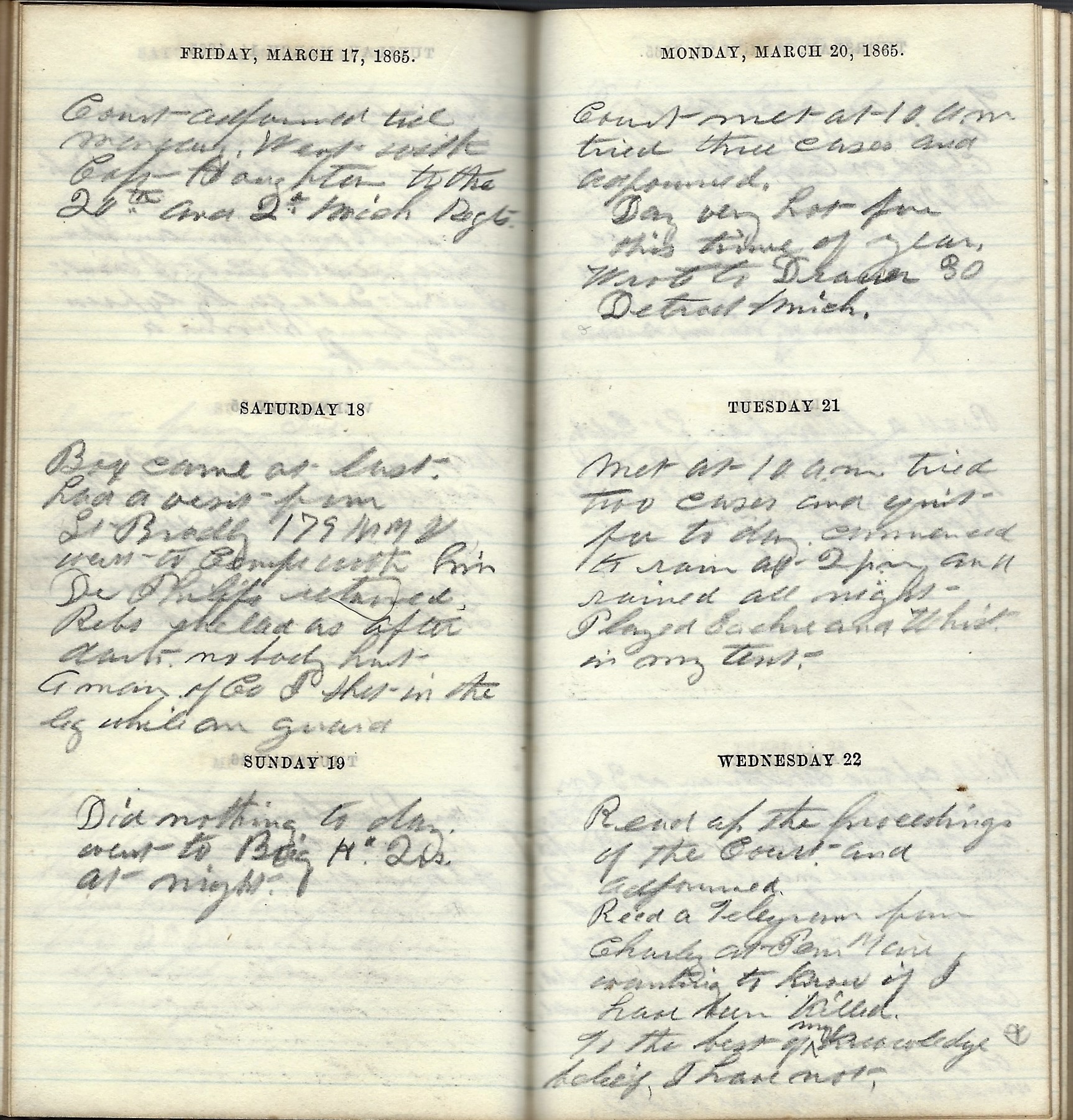
Friday, March 17, 1865—Court adjourned till Monday. Went with Capt. Houghton to the 20th and 2nd Michigan Regiments.
Saturday, 18—Box came at last. Had a visit from Lt. Bradley, 179th N Y. Vols. Went to camp with him. Dr. [Luther] Phillip returned. Rebs shelled us after dark. Nobody burt. A man in Co. I shot in the leg while on guard.
Sunday, 19—Did nothing today. Went to Brigade Headquarters at night.
Monday, March 20, 1865—Court met at 10 a.m. Tried three cases and adjourned. Day very hot for this time of year. Wrote to Drawer 30, Detroit, Michigan.
Tuesday, 21—Met at 10 a.m. Tried two cases and quit for today. Commenced to rain at 2 p.m. and rained all night. Played Euchre and Whist in my tent.
Wednesday, 22–Read of the proceedings of the court and adjourned. Received a telegram from [brother] Charley at Penn Yan wanting to know if I had been killed. To the best of my knowledge & belief, I have not.
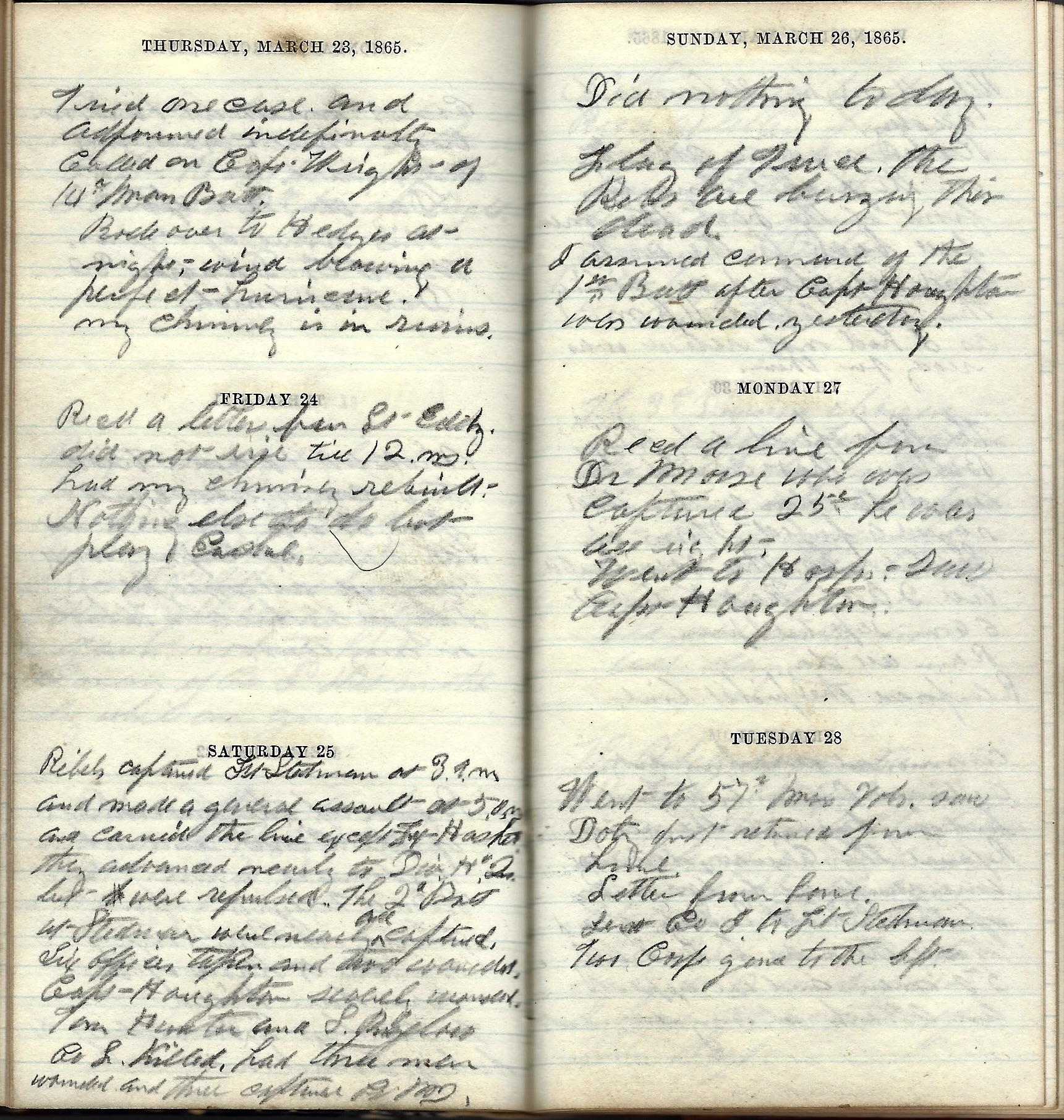
Thursday, March 23, 1865—Tried one case and adjourned indefinitely. Called on Capt. [Joseph W. B.] Wright of 14th Mass. Battery. Rode over to Hedges at night. Wind blowing a perfect hurricane. My chimney is in ruins.
Friday, 24—Received a letter from Lt. Eddy. Did not rise till 12 M. Had my chimney rebuilt. Nothing else to do but play Euchre.
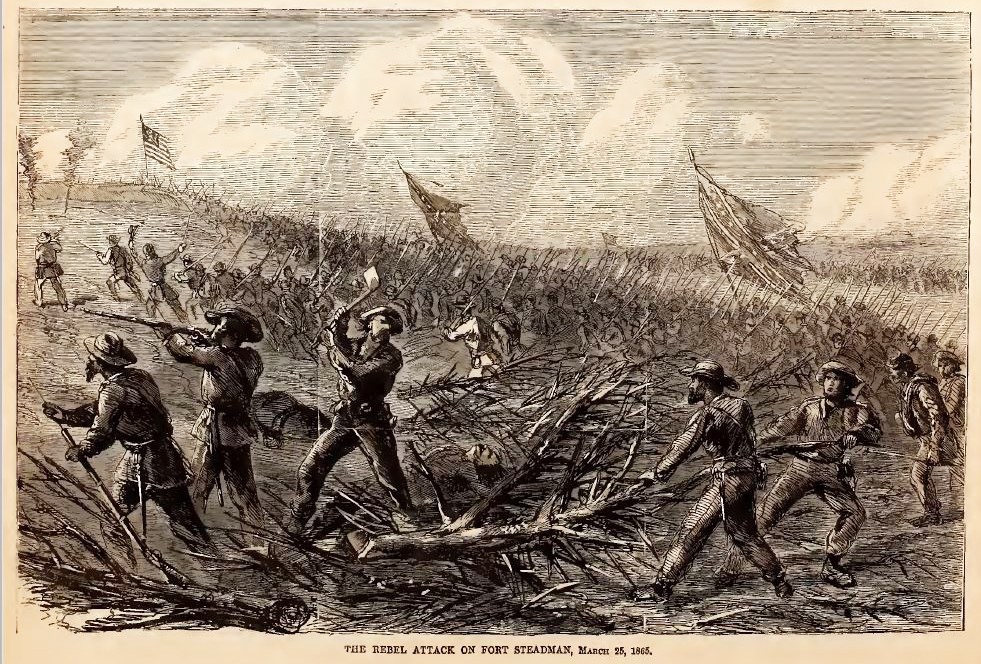
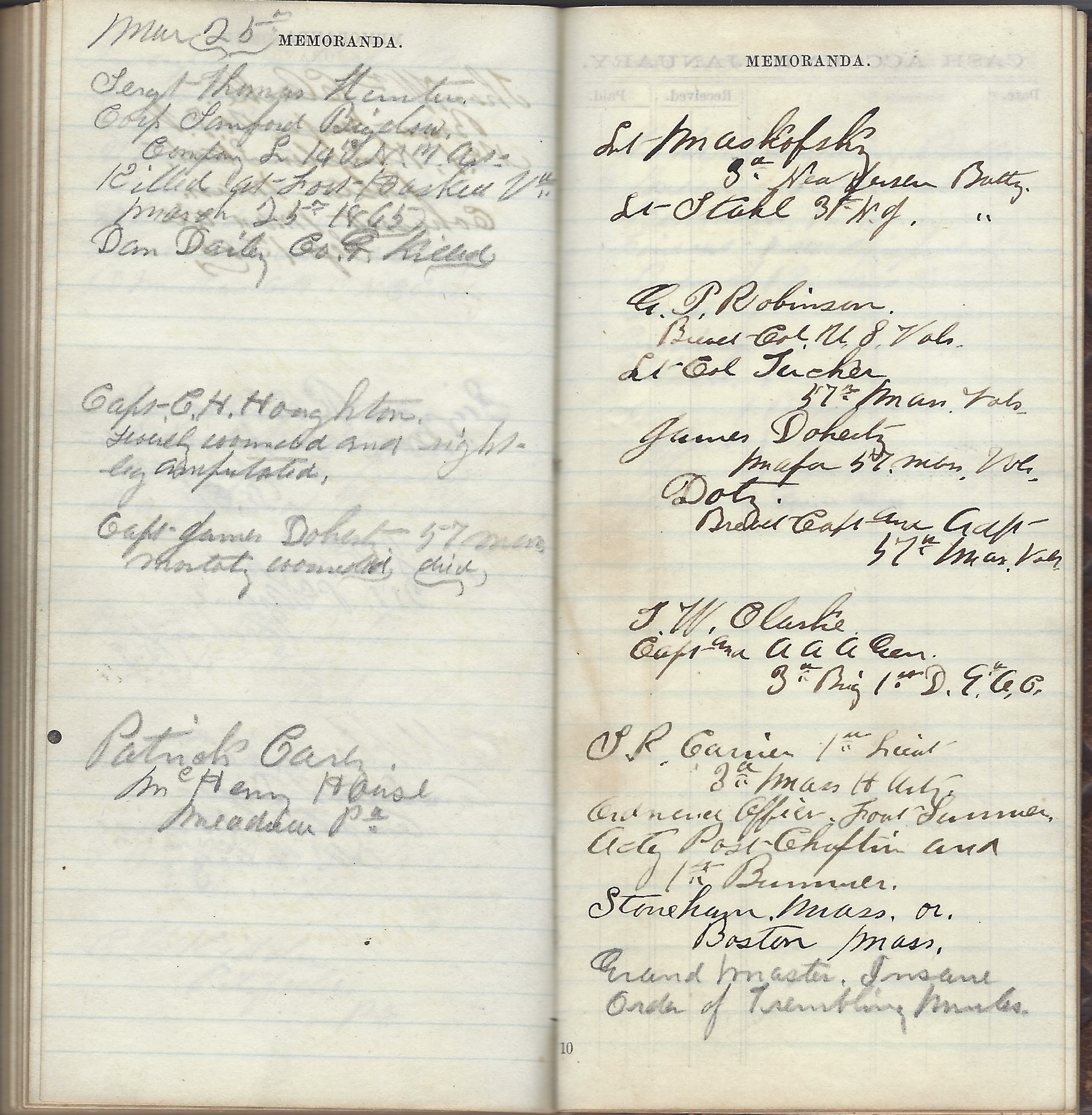
Saturday, 25—Rebels captured Fort Stedman at 3 a.m. and made a general assault at 5 a.m. and carried the line except Fort Haskell. They advanced nearly to Division Headquarters but were repulsed. The 2nd Battalion at Stedman were nearly all captured. Six officers taken and two wounded. Capt. Houghton severely wounded. Tom Hunter and S. [ ], Co. L killed. Had three men wounded and three captured in Co. M.
Sunday, March 26, 1865—Did nothing today. Flag of Truce. The rebs are burying their dead. I assumed command of the 1st Battalion after Capt. Houghton was wounded yesterday.
Monday, 27—Received a line from Dr. Morse who was captured on the 25th. He was all right. Went to Hospital. Saw Capt. Houghton.
Tuesday, 28—Went to 57th Mass. Volunteer. Saw Doty, just returned from home. Sent Co. I to Ft. Stedman. Two companies gone to the left.
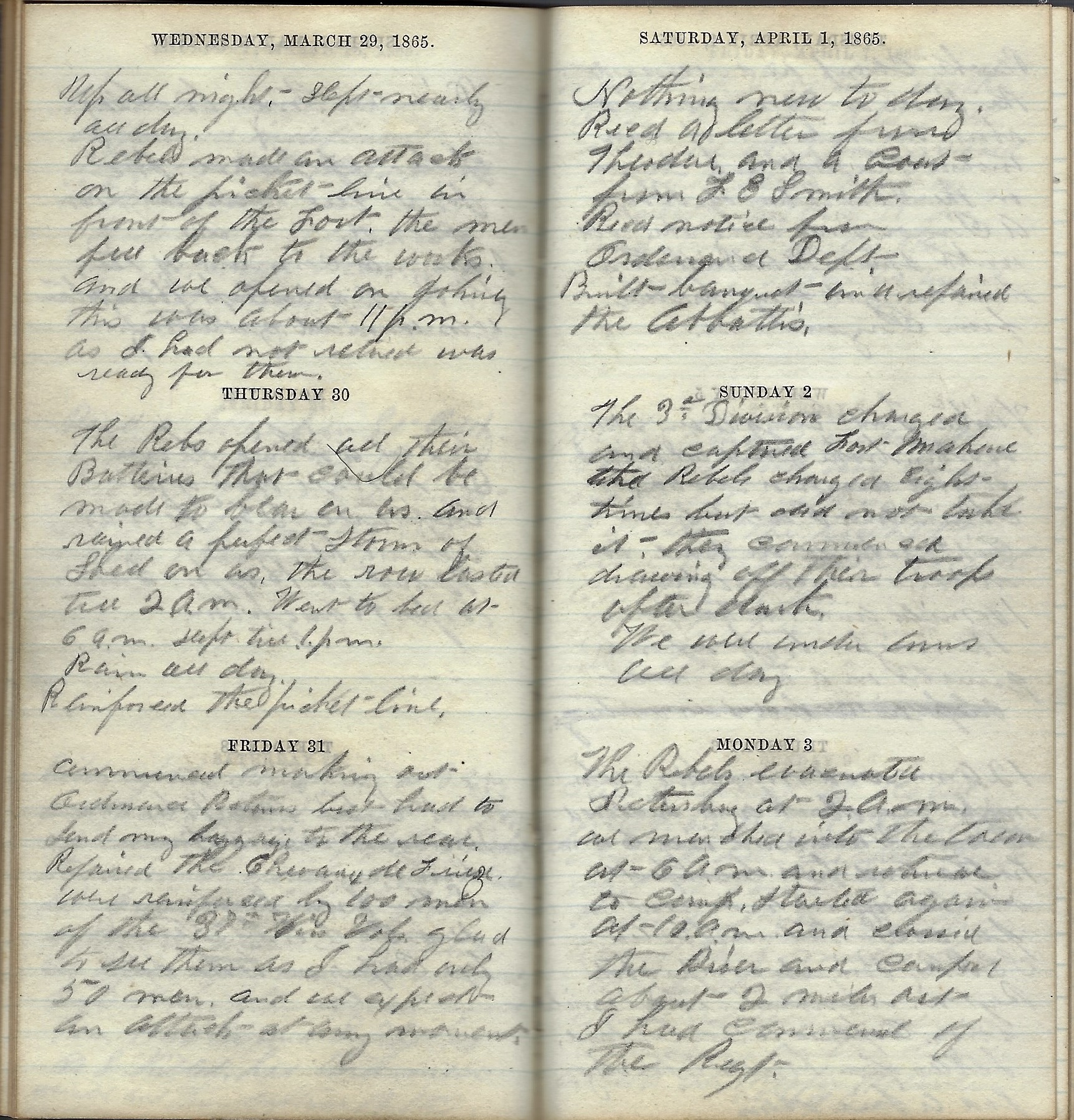
Wednesday, March 29, 1865—Up all night. Slept nearly all day. Rebels made an attack on the picket line in front of the Fort. The men fall back to the works and we opened on Johnny. This was about 11 p.m. As I had not retired, was ready for them.
Thursday, 30—The Rebs opened all their batteries that could be made to bear on us and rained a perfect storm of shell on us. The row lasted till 2 a.m. Went to bed at 6 a.m. Slept till 1 p.m. Rain all day. Reinforced the picket line.
Friday, 31—Commenced making out Ordnance Returns but had to send my baggage to the rear. Repaired the Cheveaux de Frise. Were reinforced by 100 men of the 37th Wisconsin Vols. Glad to see them as I had only 50 men as we expect an attack at any moment.
Saturday, April 1, 1865—Nothing new today. Received a letter from [brother-in-law] Theodore and a coat from F. E. Smith. Received notice from Ordnance Dept. Built banquet and repaired the abatis.
Sunday, 2—The 3rd Division charged and captured Fort Mahone. The rebels charged eight times but did not take it. They commenced drawing off their troops after dark. We were under arms all day.
Monday, 3—The Rebs evacuated Petersburg at 2 a.m.. We marched into the town at 6 a.m. and retired to camp. Started again at 10 a.m. and crossed the river and camped about 2 miles out. I had command of the regiment.
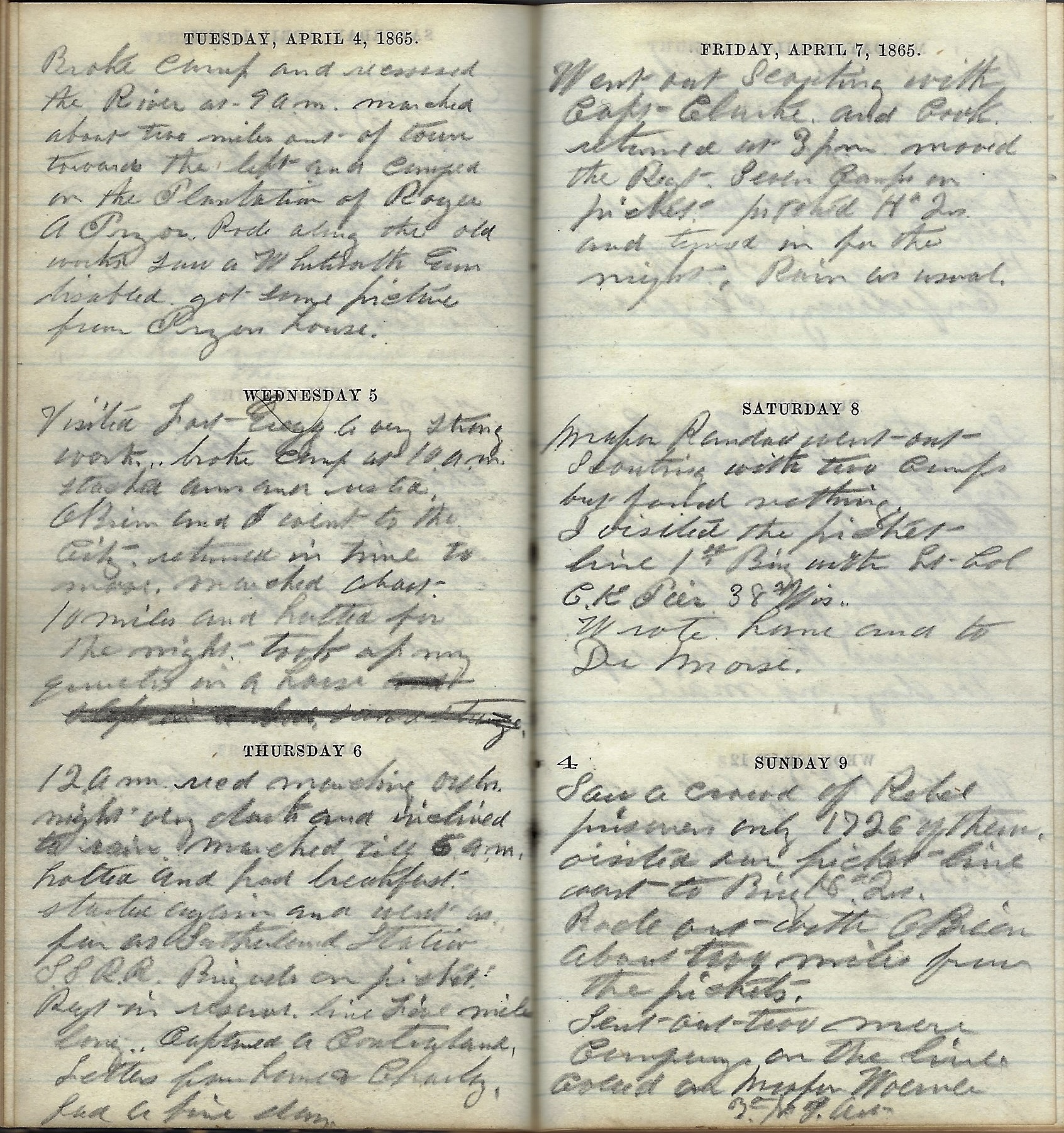
Tuesday, April 4, 1865—Broke camp and recrossed the river at 9 a.m. Marched about two miles out of town toward the left and camped on the plantation of Roger A[tkinson] Pryor. Rode along the old works. Saw a Whitworth Gun disabled. Got some picture from Pryor House.
Wednesday, 5—Visited Fort Gregg—a very strong work. Broke camp at 10 a.m., stacked arms and rested. [Lt.] O’Brien and I went to the City. Returned in time to move. Marched about ten miles and halted for the night. Took up my quarters in a house.
Thursday, 6—12 a.m., received marching orders. Night very dark and inclined to rain. Marched till 5 a.m., halted and had breakfast. Started again and went as far as Sutherland Station, Southside Railroad. Brigade on picket. Regiment in reserve line five miles long. Captured a contraband. Letters from home & Charley. Had a fine day.
Friday, April 7, 1865—Went out scouting with Capt. Clarke and Cook. Returned at 3 p.m.. Moved the regiment. Pitched headquarters and turned in for the night. Rain as usual.
Saturday, 8—Major Randall went out scouting with two companies but found nothing. I visited the picket line, 1st Brigade, with Lt. Colonel C[olwert] K[endall] Pier, 38th Wisconsin. Wrote home and to Dr. Morse.
Sunday, 9—Saw a crowd of Rebel prisoners—only 1,726 of them. Visited our picket line. Went to Brigade Headquarters. Rode out with O’Brien about two miles from the pickets. Sent out two more companies on the line. Called on Major [Christian] Woerner, 3rd New Jersey [Light] Artillery.
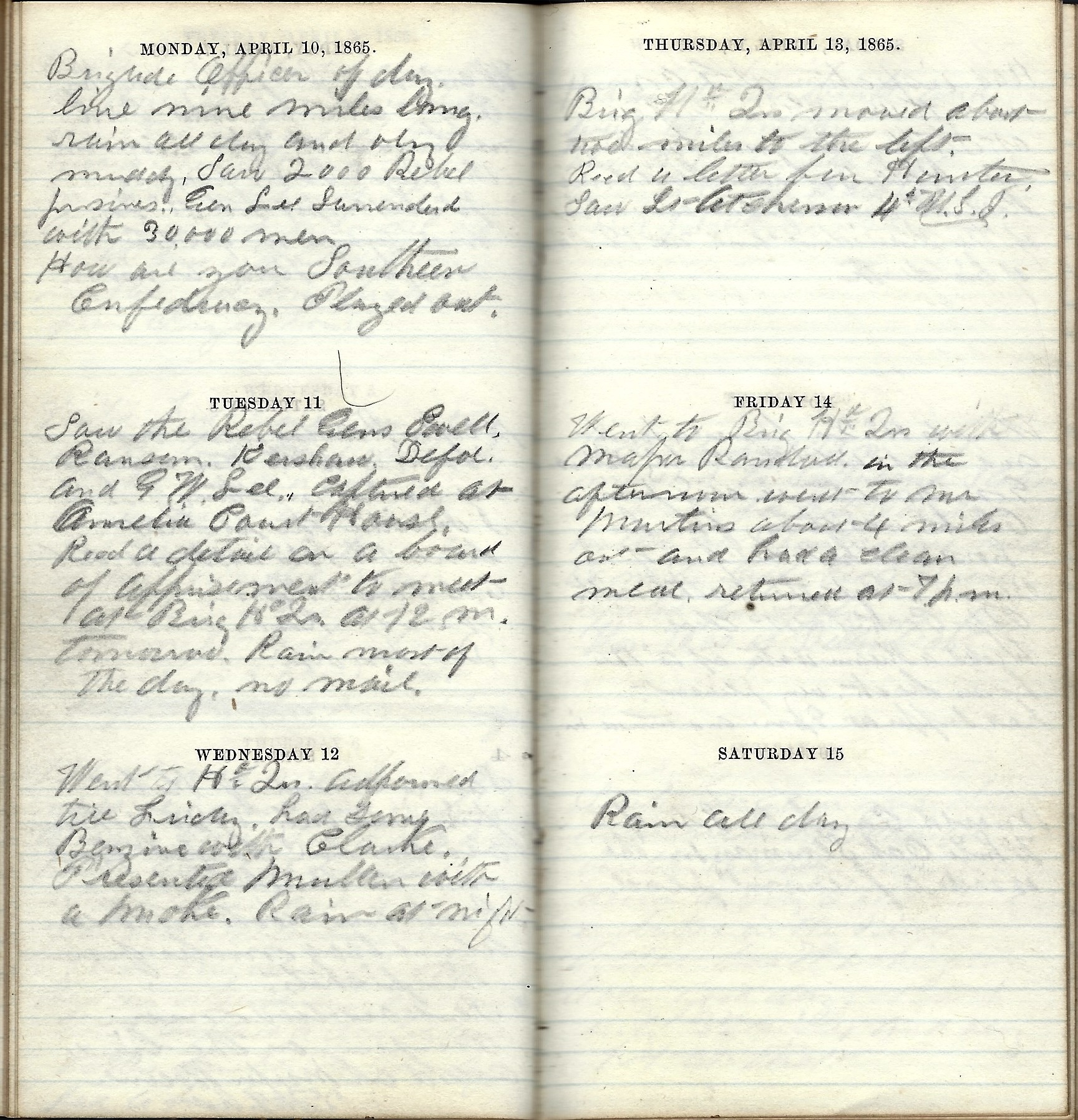
Monday, April 10, 1865—Brigade Officer of the Day. Line nine miles long. Rain all day and very muddy. Saw 2,000 Rebel prisoners. Gen. Lee surrendered with 30,000 men. How are you Southern Confederacy? Played out.
Tuesday, 11—Saw the Rebel Generals Ewell, Ransom, Kershaw, Defoe, and G. W. Lee, captured at Amelia Court House. Read a detail on a board of apprisement to meet at Brigade Headquarters at 12 M tomorrow. Rain most of the day. No mail.
Wednesday, 12—Went to Headquarters. Adjourned till Friday. Had some Benzine with Clarke. Presented Mullen with a smoke. Rain at night.
Thursday, April 13, 1865—Brigade Headquarters moved about two miles to the left. Received a letter from Hinton. Saw Lt. Atchison, 4th US Infantry.
Friday, 14—Went to Brigade Headquarters with Major Randall. In the afternoon, went to Mr. Martin’s about 4 miles out and had a clean meal. Returned at 7 p.m.
Saturday, 15—Rain all day.
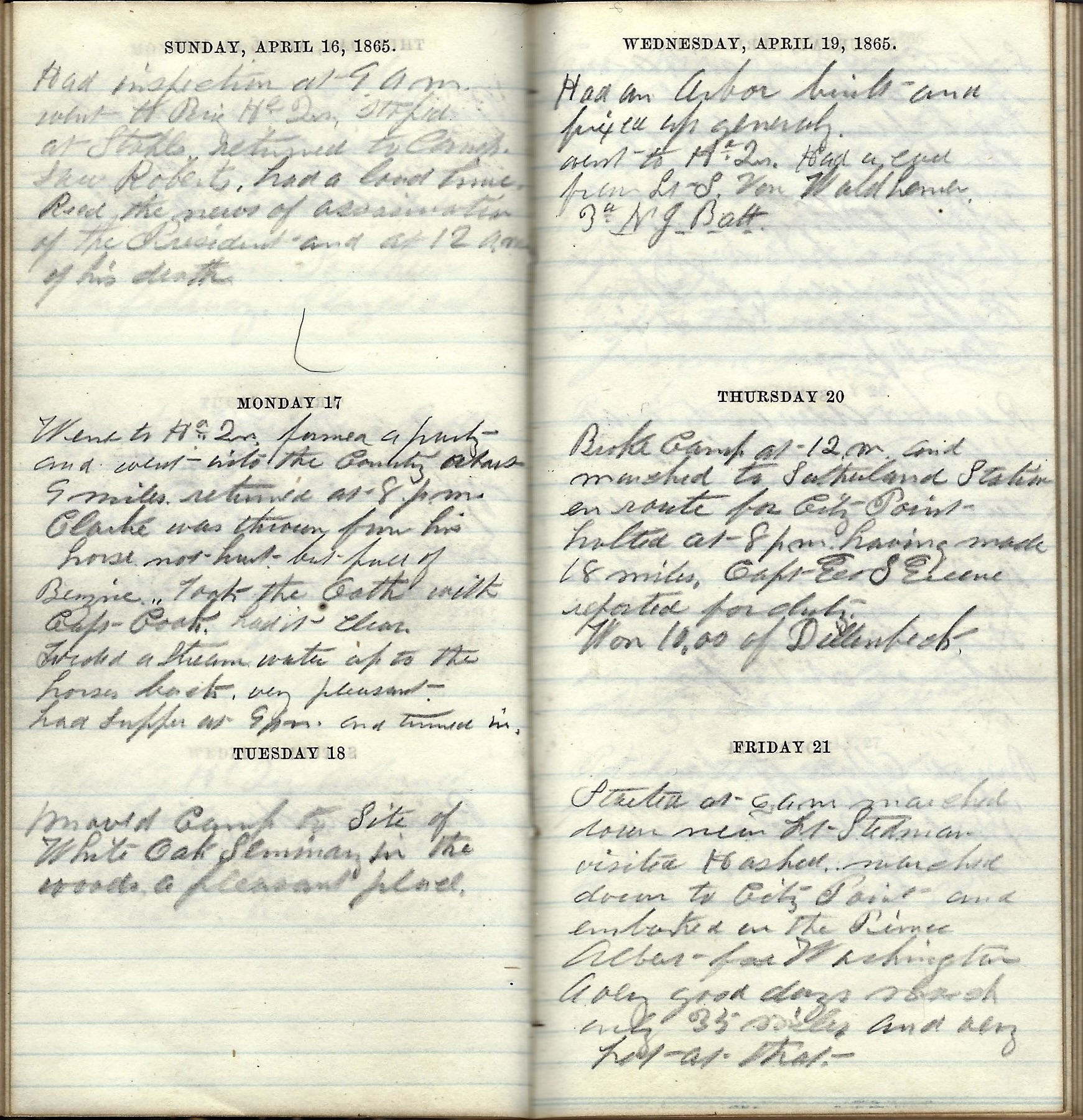
Sunday, April 16, 1865—Had inspection at 9 a.m. Went to Brigade Headquarters, Stopped at Stables. Returned to camp. Saw Roberts. Had a loud time. Read the news of assassination of the President and at 12 of his death.
Monday, 17—Went to Headquarters. Formed a party and went into the country about 9 miles. Returned at 8 p.m. Clarke was thrown from his horse, not hurt but full of Benzine. Took the oath with Capt. Cook. Had it clean. Forded a stream of water up to the horses back. Very pleasant. Had supper at 9 p.m. and turned in.
Tuesday, 18—Moved camp to site of White Oak Seminary in the woods—a pleasant place.
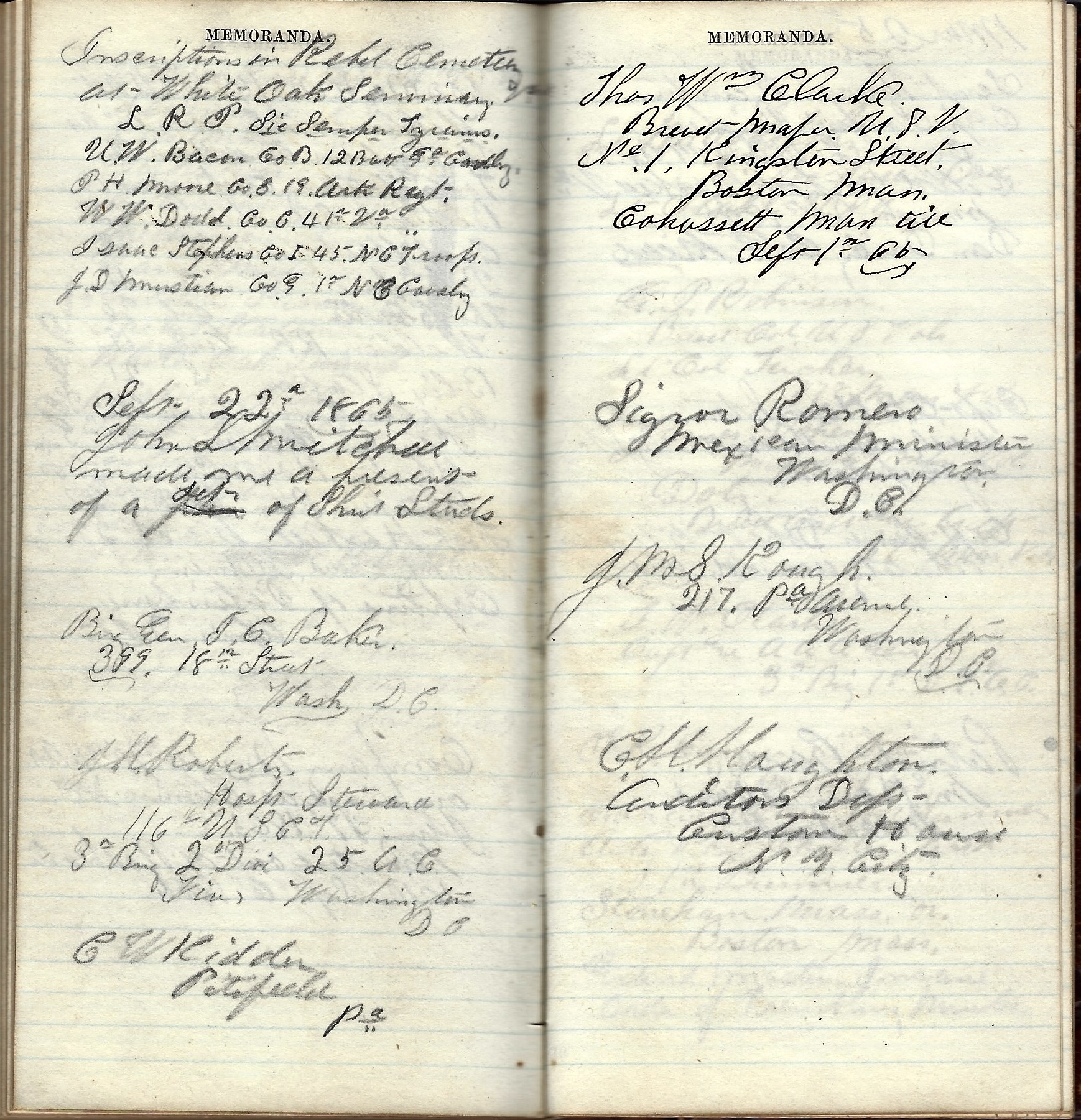
[Editor’s note: At the end of this diary, George records the names of some Confederate soldiers buried in the cemetery at the White Oak Seminary.]
Wednesday, April 19, 1865—Had an arbor built and fixed up generally. Went to Headquarters. Had a card from Lt. S. VanWaldhamer [?], 3rd New Jersey Battery.
Thursday, 20—Broke camp at 12 M and marched to Sutherland Station en route for City Point. Halted at 8 p.m. having made 18 miles. Cpt. Geo. S. Greene reported for duty. Won $10 of Dillenbeck.
Friday, 21—Started at 6 a.m. Marched down near Ft. Stedman. Visited [Ft.] Haskell. Marched down to City Point and embarked on the Prince Albert for Washington. Only 35 miles and very hot at that.
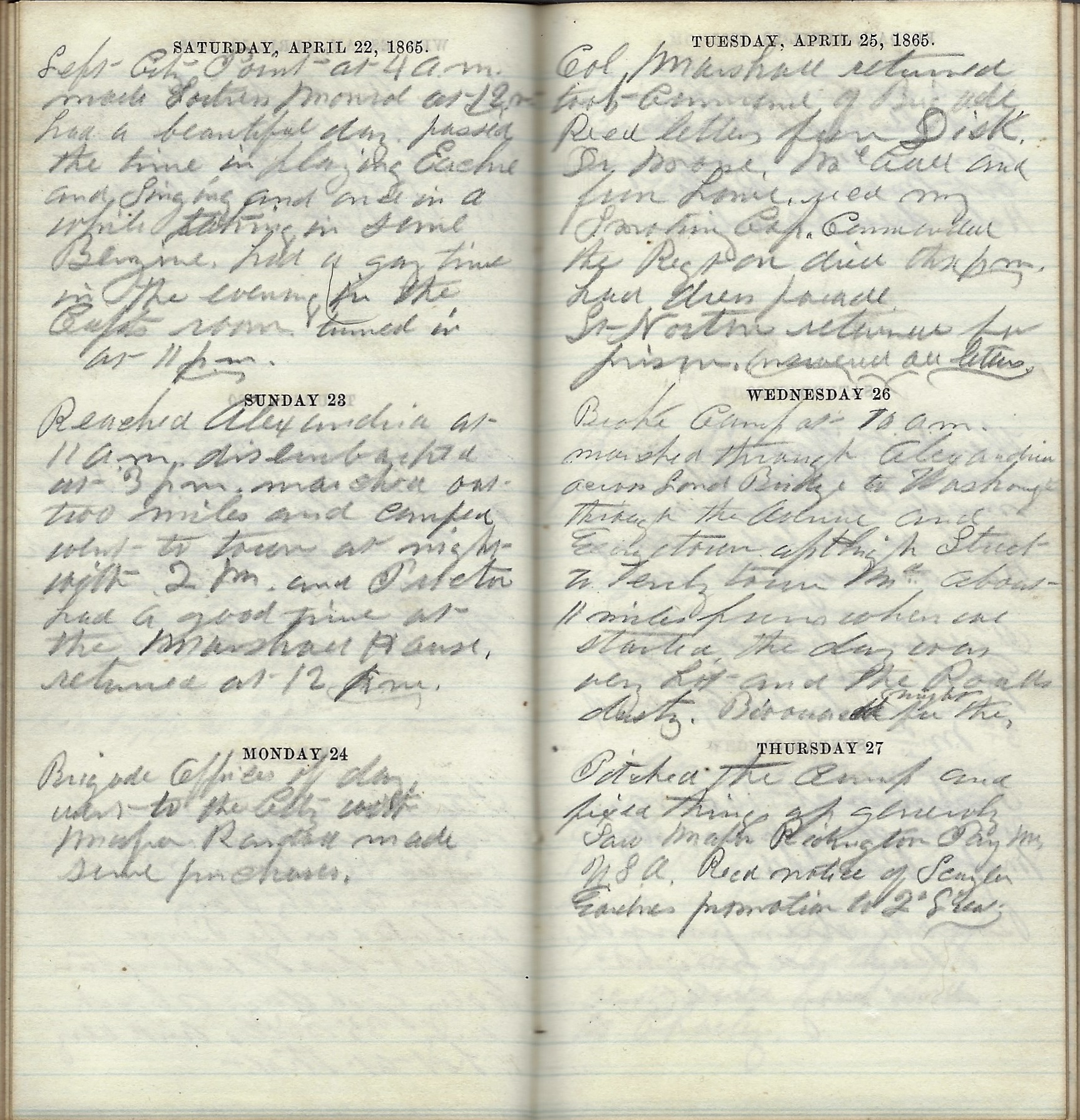
Saturday, April 22, 1865—Left City Point at 4 a.m. Made Fortress Monroe at 12 M. Had a beautiful day. Passed the time in playing Euchre and singing and once in a while taking in some Benzine. Had a gay time. In the evening in the Captain’s room. Turned in at 11 p.m.
Sunday, 23—Reached Alexandria at 11 a.m., disembarked at 3 p.m., marched out two miles and camped. Went to town at night with Quartermaster and Prictor [?]. Had a good time at the Marshall House. Returned at 12 p.m.
Monday, 24—Brigade Officer of the Day. Went to the City with Major Randall. Made some purchases.
Tuesday, April 25, 1865—Col. Marshall returned [and] took command of Brigade. Received letters from Dick, Dr. Morse, McCall, and from home. Received my smoking cap. Commanded the regiment on drill, the p.m. had dress parade. Lt. [William H.] Norton returned from prison. Answered all letters.
Wednesday, 26—Broke camp at 10 a.m. Marched through Alexandria across Long Bridge to Washington, through the Avenue and Georgetown, up High Street to Tenleytown, Maryland, about 11 miles from where we started. The day was very hot and the roads dusty. Bivouacked for the night.
Thursday, 27—Pitched the camp and fixed things up generally. Saw Major Redington, paymaster USA. Received notice of Schuyler Gardner’s promotion to 2d Lieutenant.
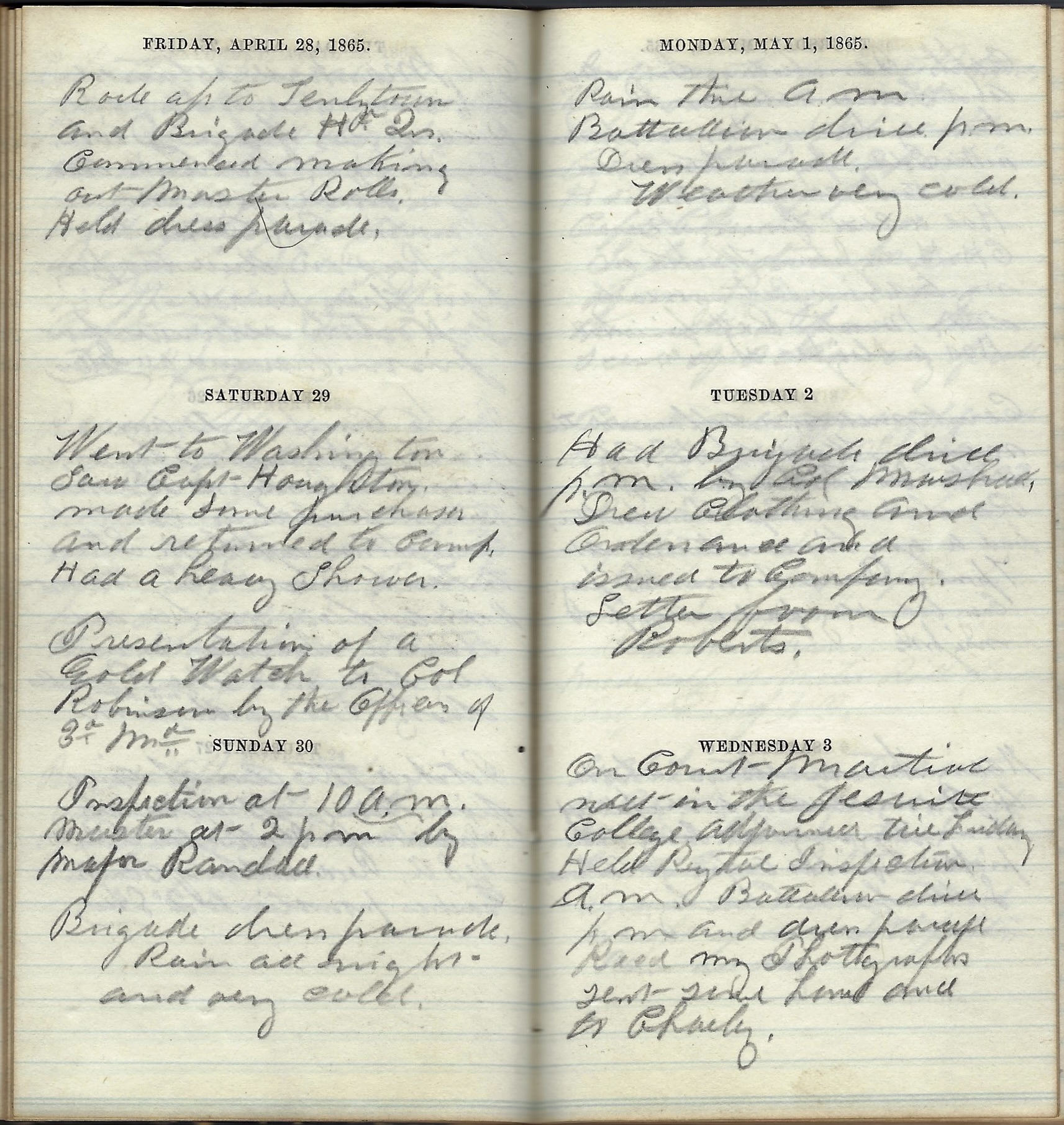
Friday, April 28, 1865—Rode up to Tenleytown and Brigade Headquarters. Commenced making out Muster Rolls. Hold dress parade.
Saturday, 29—Went to Washington. Saw Capt. Houghton. Made some purchases and returned to camp. Had a heavy shower. Presentation of a gold watch to Col. Robinson by the officers of 3rd Maryland.
Sunday, 30—Inspection at 10 a.m. Muster at 2 p.m. by Major Randall. Brigade dress parade. Rain at night and very cold.
Monday, May 1, 1865—Rain this a.m. Battalion drill p.m. Dress Parade. Weather very cold.
Tuesday, 2—Had Brigade drill p.m. by Col. Marshall. Drew clothing and ordnance and issued to company. Letter from Roberts.
Wednesday, 3—On Court Martial. Met in the Jesuit College. Adjourned till Friday. Held Regimental inspection in a.m. Battalion drill p.m. And Dress Parade. Received my photographs. Sent some home and to [brother] Charley.
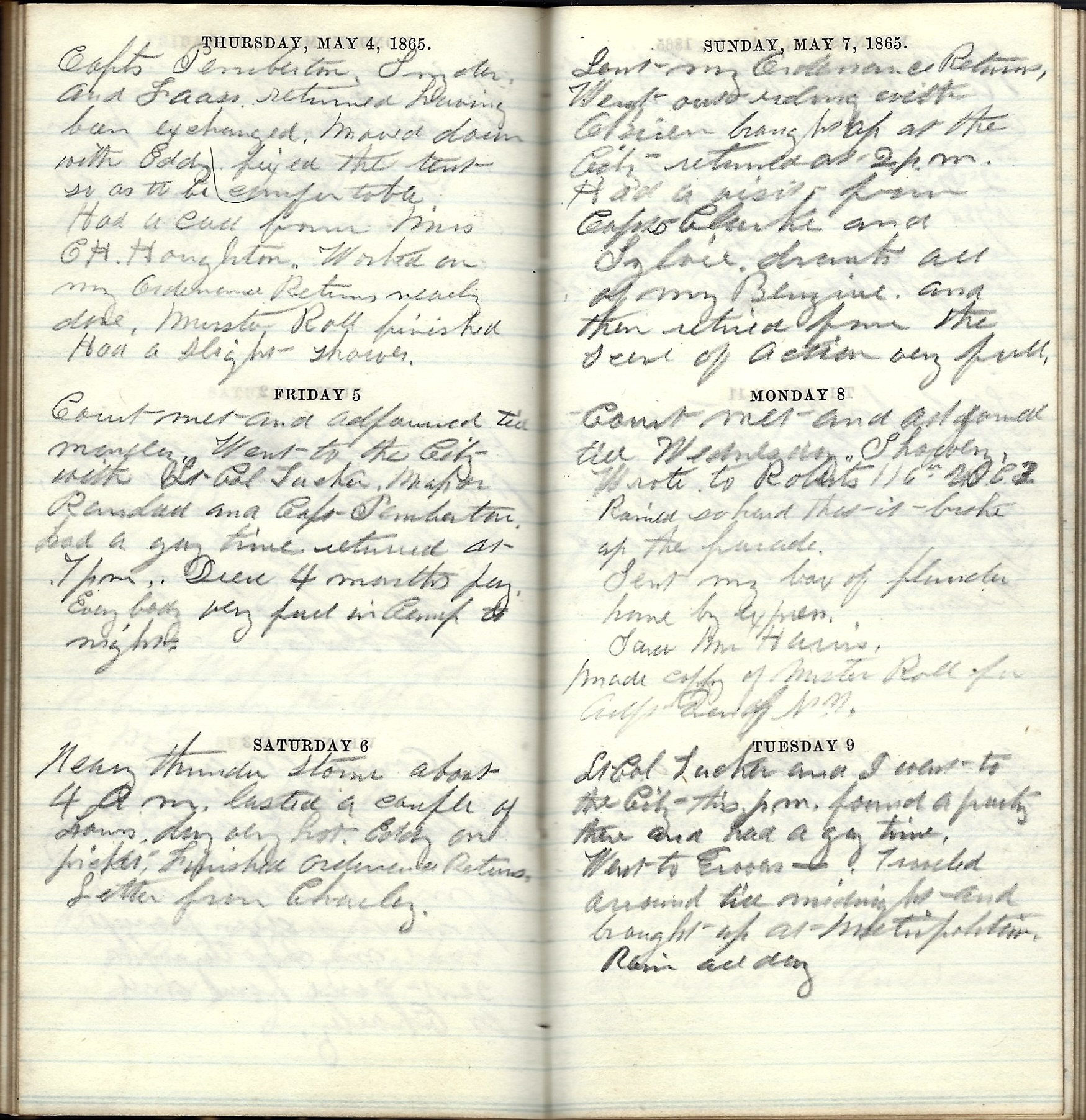
Thursday, May 4, 1865—Capts. [Henry V.] Pemberton, [John] Snyder, and [Louis] Faass returned, having been exchanged. Moved down with [Lt.] Eddy. Fixed the tent so as to be comfortable. Had a call from Miss C. H. Houghton. Worked on my Ordnance Returns. Nearly done. Muster Rolls finished. Had a slight shower.
Friday, 5—Court met and adjourned till Monday. Went to the City with Lt. Col. Tucker, Major Randall, and Capt. Pemberton. Had a gay time. Returned at 7 p.m. Drew 4 months pay. Everybody very full [drunk] in camp tonight.
Saturday, 6—Heavy thunder shower about 4 a.m. Lasted a couple of hours. Day very hot. Eddy on picket. Finished Ordnance Returns. Letter from [brother] Charley.
Sunday, May 7, 1865—Sent my Ordnance Returns. Went out riding with O’Brien. Brought up at the City. Returned at 2 p.m. Had a visit from Capt. Clarke and Sylvie. Drank all of my Benzine and then retired from the scene of action very full.
Monday, 8—Court met and adjourned till Wednesday. Showery. Wrote to Roberts, 116th [?] Rained so hard that it broke up the parade. Sent my bag of plunder home by Express. Saw Mr. Harris. Made copy of Muster Roll for [ ].
Tuesday, 9—Lt. Col. Tucker and I went to the City this p.m. Found a party there and had a gay time. Went to Grover’s [Theatre]. Traveled around till midnight and brought up at Metropolitan [Hotel]. Rain all day.
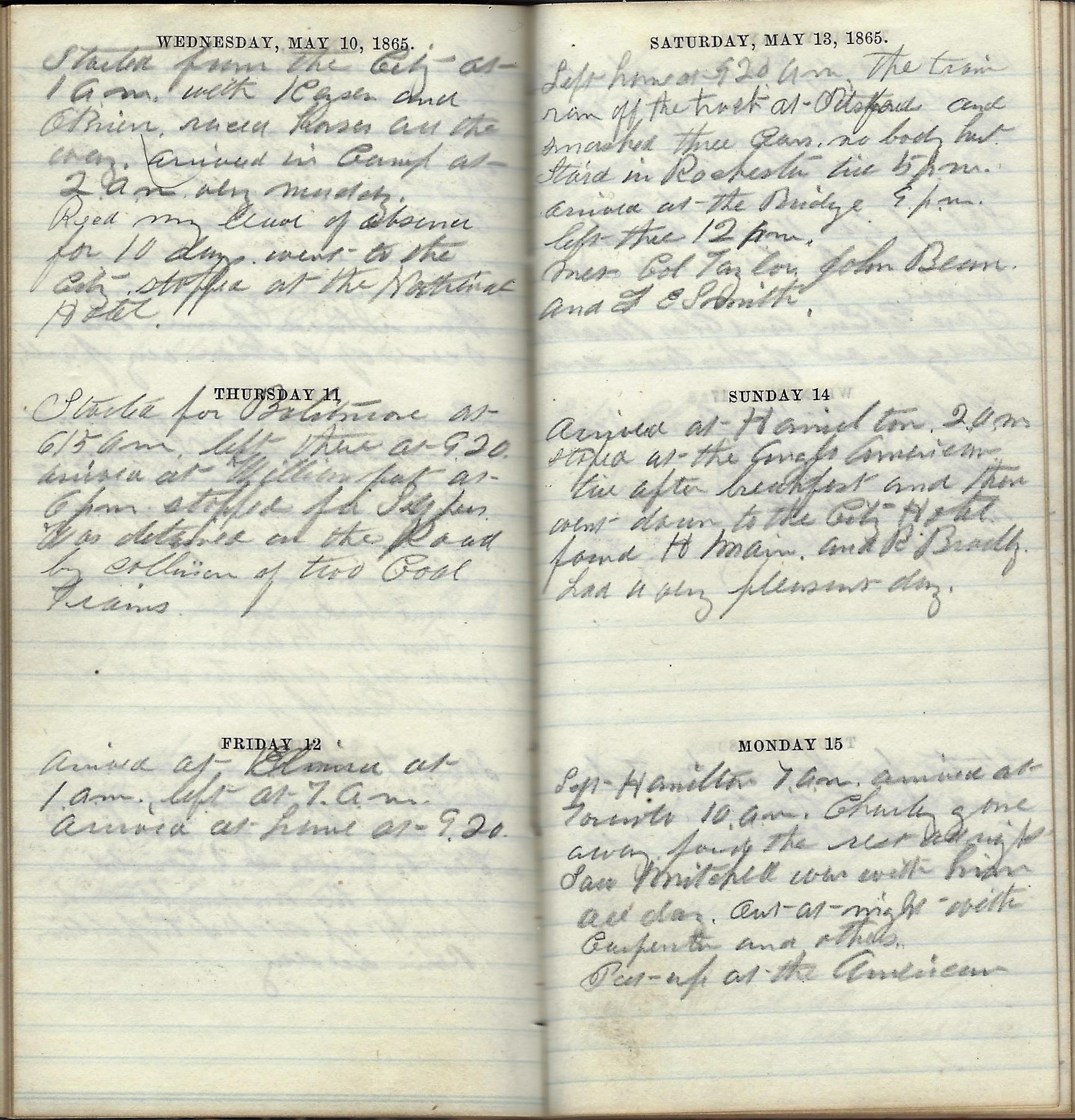
Wednesday, May 10, 1865—Started from the City at 1 a.m. with [ ] and O’Brien. Raced horses all the way. Arrived in camp at 2 a.m. very muddy. Received my Leave of Absence for 10 days. Went to the City. Stopped at the National Hotel.
Thursday, 11—Started for Baltimore at 6.15 a.m. Left there at 9.20. Arrived at Williamsport at 6 p.m. Stopped for supper. Was detained on the road by collision of two coal trains.
Friday, 12—Arrived at Elmira at 1 a.m. Left at 7 a.m. Arrived at home at 9.20.
Saturday, May 13, 1865—Left home at 9.20 a.m. The train ran off the track at Pitsfords [?] and smashed the cars. Nobody hurt. Stayed at Rochester till 5 p.m. Arrived at the Bridge 9 p.m. Left there 12 p.m. Met Col. Taylor, John Bean, and F. E. Smith.
Sunday, 14—Arrived at Hamilton 2 a.m. Stopped at the Anglo American till afterr breakfast and then went down to the City Hotel. Found H. Main and R. Bradley. Had a very pleasant day.
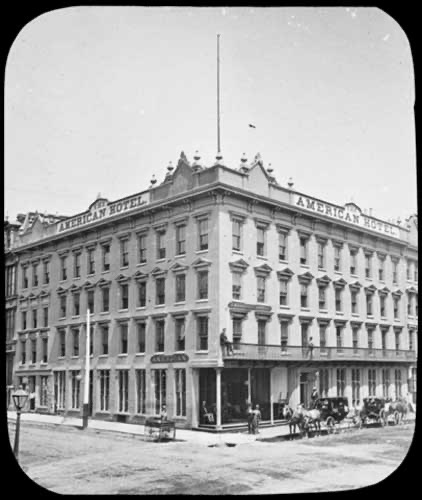
American Hotel in Toronto, Canada
Monday, 15—Left Hamilton 7 a.m. Arrived at Toronto 10 a.m. Charley gone away. Found the rest alright. Saw Mitchell. Was with him all day. Out at night with Carpenter and others. Put up at the American.
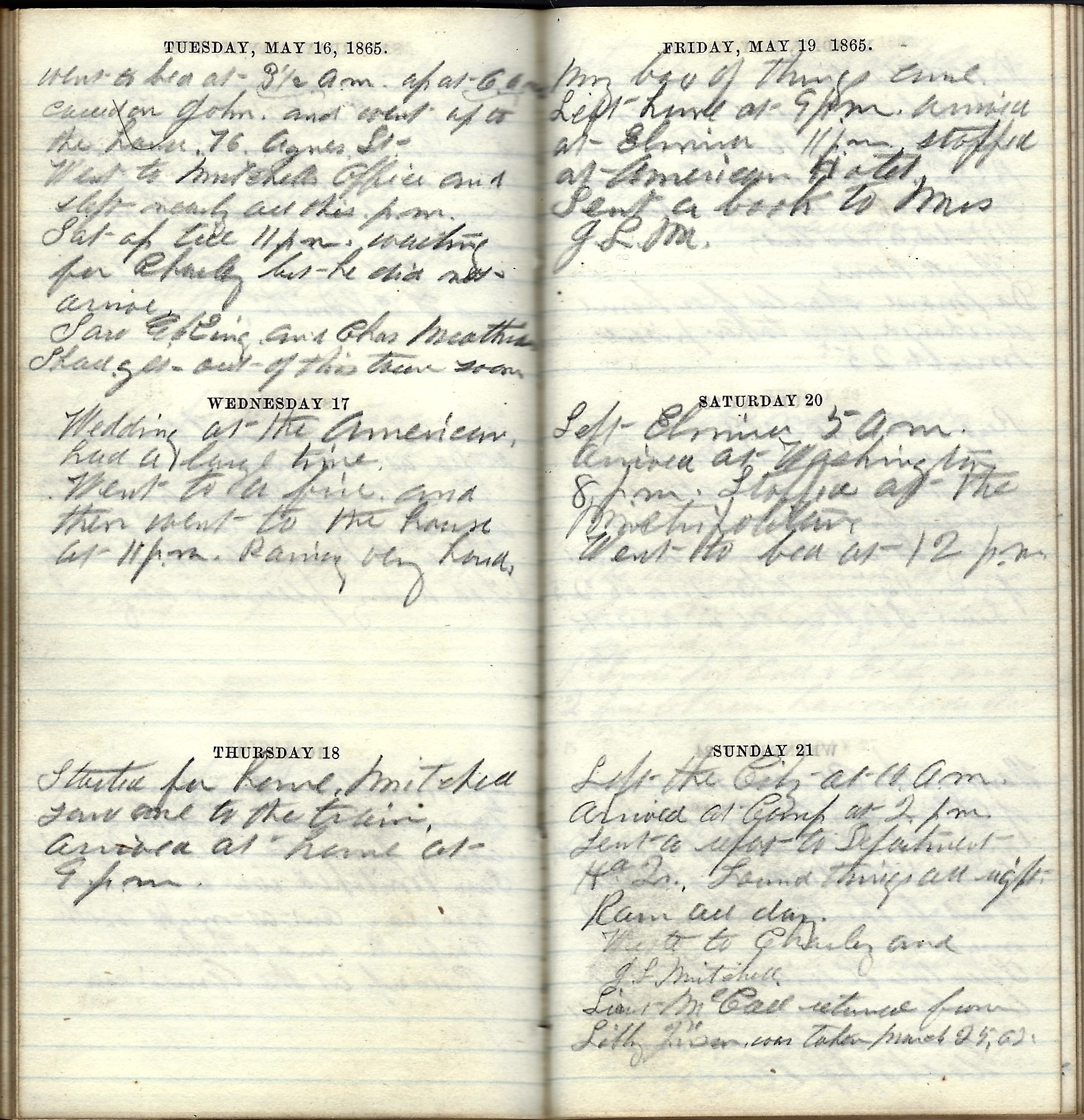
Tuesday, May 16, 1865—Went to bed at 3.30 a.m. Up at 6 a.m. Called on John and went up to house—76 Agnes Street. Went to Mitchell’s Office and slept nearly all this p.m. Sat up till 11 p.m. waiting for [brother] Charley but he did not arrive. Saw [ ] and Chas. Meatherian [?] I had got out of this town soon.
Wednesday, 17—Wedding at the American. Had a large time. Went to a fire and then went to the house at 11 p.m. Raining very hard.
Thursday, 18—Started for home. Mitchell saw me to the train. Arrived at home at 9 p.m.
Friday, May 19, 1865—My box of things came. Left home at 9 p.m. Arrived at Elmira 11 p.m. Stopped at American Hotel. SEent a book to Miss J. L. M.
Saturday, 20—Left Elmira 5 a.m. Arrived at Washington 8 p.m. Stopped at the Metropolitan [Hotel]. Went to bed at 12 p.m.
Sunday, 21—Left the City at 10 a.m. Arrived at camp at 2 p.m. Sent a report to Department Headquarters Found things all right. Rain all day. Wrote to Charley and J. L. Mitchell. Lieut. [William W.] McCall returned from Libby Prison. Was taken prisoner Mach 25, 1865.
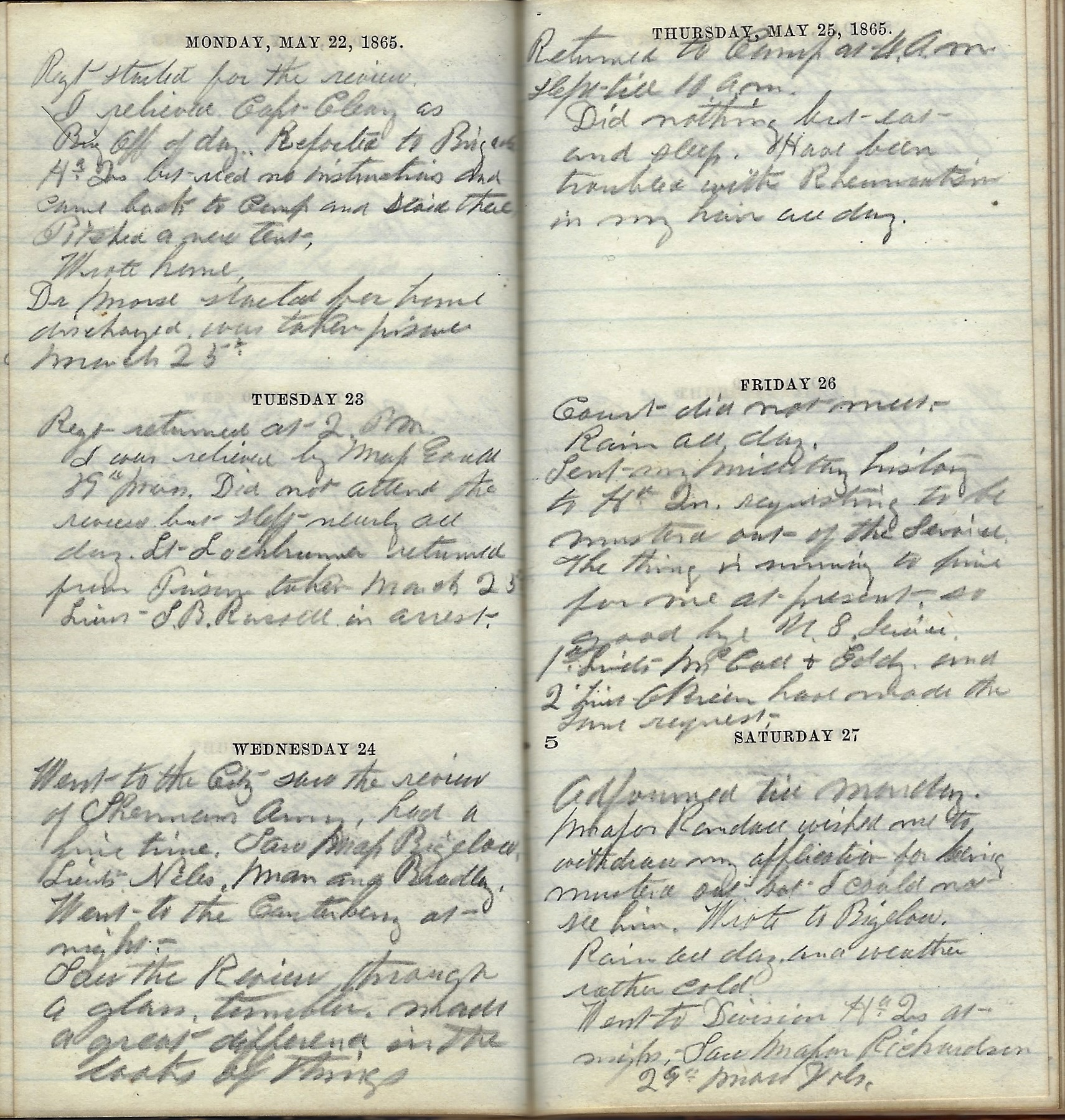
Monday, May 22, 1865—Regiment started for the review. I relieve Capt. [Joseph P.] Cleary as Brigade Officer of the Day. Reported to Brigade Headquarters but received no instructions and came back to camp and stayed there. Pitched a new tent. Wrote home. Dr. [Sherman] Morse started for home discharged. Was taken prisoner March 25 [at Fort Stedman].
Tuesday, 23—Regiment returned at 2 p.m. I was relieved by Major Gould, 59th Mass. Did not attend the review but slept nearly all day. Lt. [Charles A.] Lochbrunner returned from prison. Taken March 25th [at Ft. Stedman]. Lieut. [Stephen B.] Russell in arrest.
Wednesday, 24—Went to the City. Sw the [Grand] Review of Sherman’s Army. Had a fine time. Saw Major Bigelow, Lieutenants Niles, Man and Bradley. Went to the Canterbury [Theatre] at night. Saw the Review through a glass tumbler. Made a great difference in the looks of things.
Thursday, May 25, 1865—Returned to camp at 4 a.m. Slept till 10 a.m. Did nothing but eat and sleep. Have been troubled with rheumatism in my hair all day.
[Editor’s Note: Ingestion of Benzine can cause joint or muscle pain and also result in rheumatic diseases.]
Friday, 26—Court did not meet. Rain all day. Sent my Military history to Headquarters requesting to be mustered out of the service. The thing is running too fine for me at present so goodbye US Service. 1st Lieutenants McCall and Eddy and 2nd Lieutenant O’Brien have made the same request.
Saturday, 27—Adjourned till Monday. Major Randall wished me to withdraw my application for being mustered out but I could not see him. Wrote to Bigelow. Rain all day and weather rather cold. Went to Division Headquarters at night. Saw Major Richardson, 29th Mass. Vols.
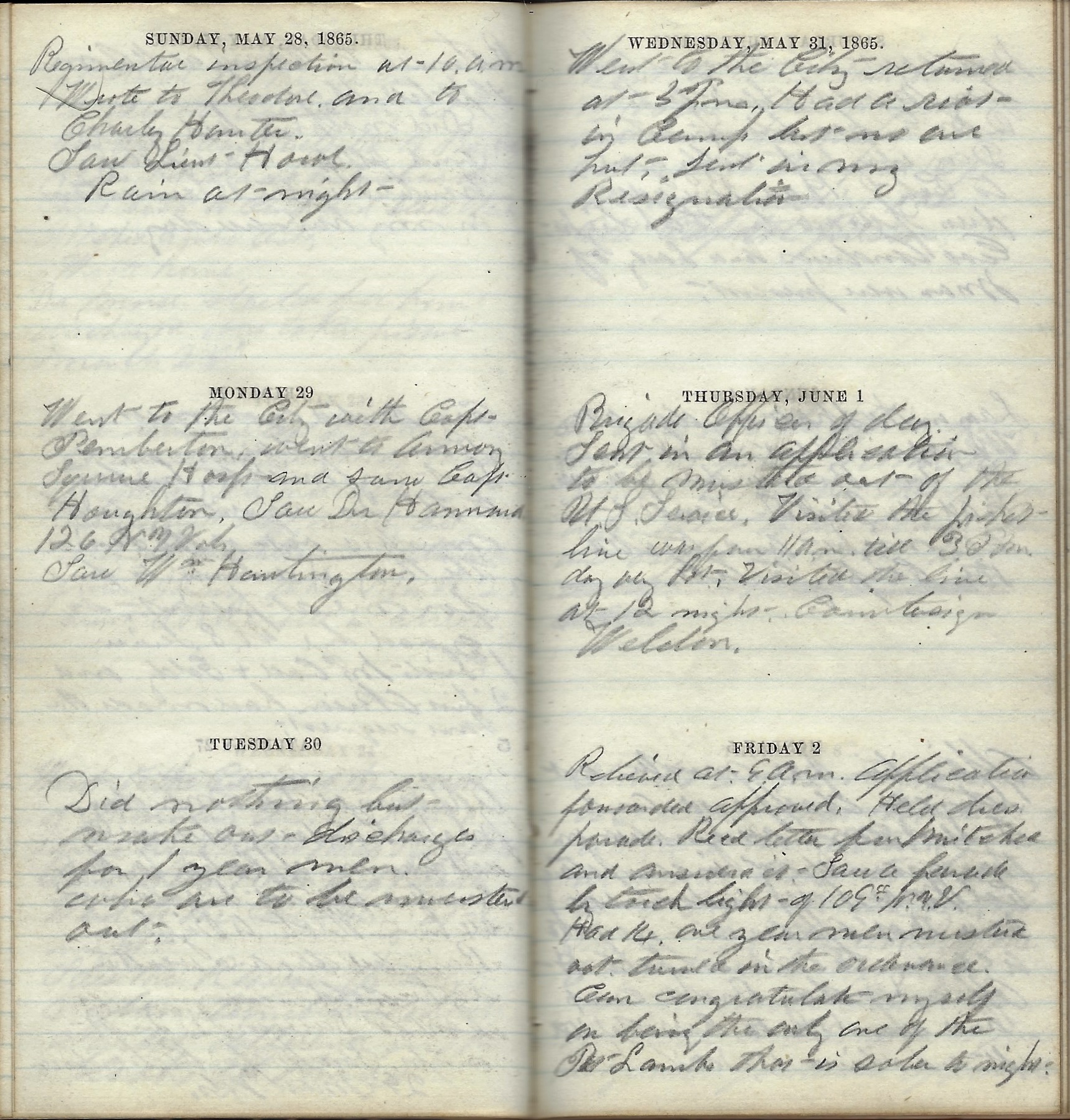
Sunday, May 28, 1865—Regimental inspection at 10 a.m. Wrote to [brother-in-law] Theodore and to Charley Hunter. Saw Lieut. Howe. Rain at night.
Monday, 29—Went to the City with Capt. Pemberton. Went to Armory Square Hospital and saw Capt. Houghton. Saw Dr. [Fletcher M.] Hammond, 126th New York Vols. Saw Wm. Huntington.
Tuesday, 30—Did nothing but make out discharges for 1 year men who are to be mustered out.
Wednesday, May 31, 1865—Went to the City. Returned at 5 p.m. Had a riot in camp but not one hurt. Sent in my resignation.
Thursday, June 1—Brigade Officer of the Day. Sent in an application to be mustered out of the US Service. Visited the picket line. Was from 11 a.m. till 3 p.m. Day very hot. Visited the line at 12 night. Countersign “Weldon.”
Friday, 2—Relieved at 9 a.m. Application forwarded approved. Held Dress Parade. Received letter from Mitchell and answered it. Saw a parade by torchlight of 109th New York Volunteers. Had 14 one-year men mustered out. Turned in the ordnance. Can congratulate myself on being the only one of the pet lambs that is sober tonight.
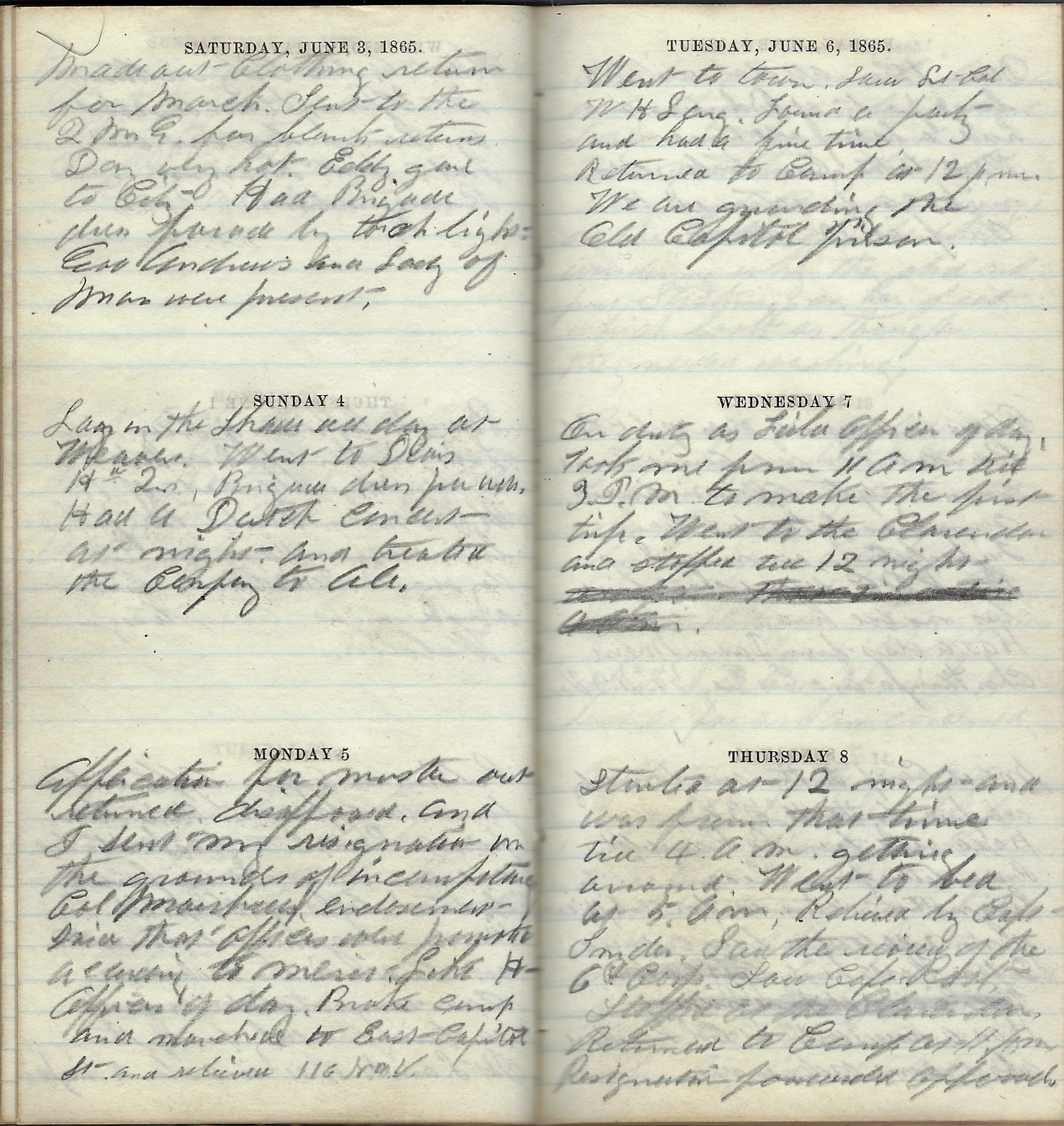
Saturday, June 3, 1865—Made out clothing return for March. Sent to the Quartermaster General for blank returns. Day very hot. Had Brigade Dress Parade by torchlight. Gov. Andrews and Lady of Massachusetts were present.
Sunday, 4—Lay in the shade all day at Weaver’s. Went to Division Headquarters. Brigade Dress Parade. Had a Dutch [German] Concert at night and treated the company to ale.
Monday, 5—Application for muster out returned disapproved and I sent my resignation on the grounds of incompetency. Col. Mansfield endorsement said that officers would be promoted according to merit like Officer of the Day. Broke camp and marched to East Capitol Street and relieved 116th New York Volunteers.
Tuesday, June 6, 186—Went to town. Saw Lt. Col. W. H. Lang. Found a party and had a fine time. Returned to camp at 12 p.m. We are guarding the Old Capitol Prison.
Wednesday, 7—On duty as Field Officer of the day. Took me from 11 a.m. till 3 p.m. to make the first trip. Went to Clarendon * and stopped till 12 night.
* The “Clarendon” referred to a hall in Washington, D.C. that hosted performances, including minstrel shows and men’s club frolics. It was one of several performance venues in the city’s theater district, located near the White House, that offered a variety of entertainment alongside more traditional theaters.
Thursday, 8—Started at 12 night and was from that time till 4 a.m. getting around. Went to bed at 5 a.m. Relieved by Capt. Snyder. Saw the review of the 6th Corps. Saw Capt. Rost [?] Stopped at the Clarendon. Returned to camp at 11 p.m. Resignation forwarded approved.
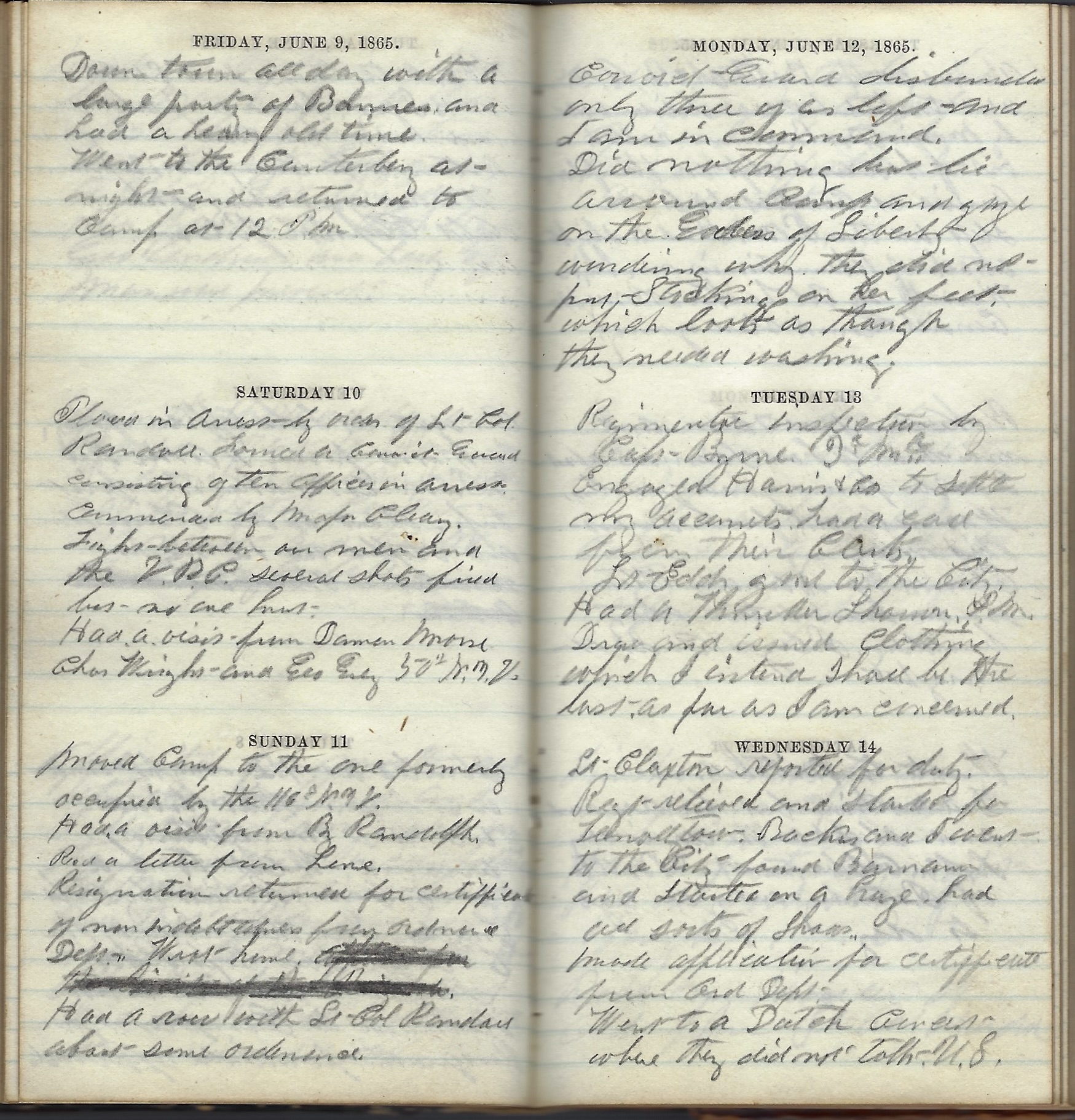
Friday, June 9, 1865—Down town all day with a large party of Bummers and had a hearty old time. Went to the Canterbury [Theatre] at night and returned to camp at 12 p.m.
Saturday, 10—Placed in arrest by order of Lt. Col. Randall. Formed a Convict Guard consisting of ten officers in arrest commanded by Major [Joseph P.] Cleary. Fight between our men and the Veteran Reserve Corps. Several shots fired but no one hurt. Had a visit from Damen Morse, Charles Wight, and George Esty, 50th New York Volunteers.
Sunday, 11—Moved camp to the one formerly occupied by the 116th New York Vols. Had a visit from B. Randolph. Received a letter from home, Resignation returned for certificate of non indebtedness from Ordnance Department. Wrote home. Had a row with Lt. Col. Randall about some ordnance.
Monday, June 12, 1865—Convict Guard disbanded. I am in command. Did nothing but lay around camp and gaze on the Goddess of Liberty wondering why they did not put stockings on her feet which looks as though they needed washing.
Tuesday, 13—Regimental inspection by Capt. Byrne, 3rd Mass. Engaged Harris & Co. to settle my accounts. Had a card from their clerk. Lt. Eddy gone to the City. Had a thunder shower p.m. Draw and issued clothing which I intend shall be the last as far as I am concerned.
Wednesday, 14—Lt. Claxton reported for duty. Regiment relieved and started for Tenleytown. Backus and I went to the City. Found Bymann and started on a huge. Had all sorts of [ ]. Made application for certificate from Ordnance Department. Went to a Dutch [German] Concert where they did not talk U. S. [English].
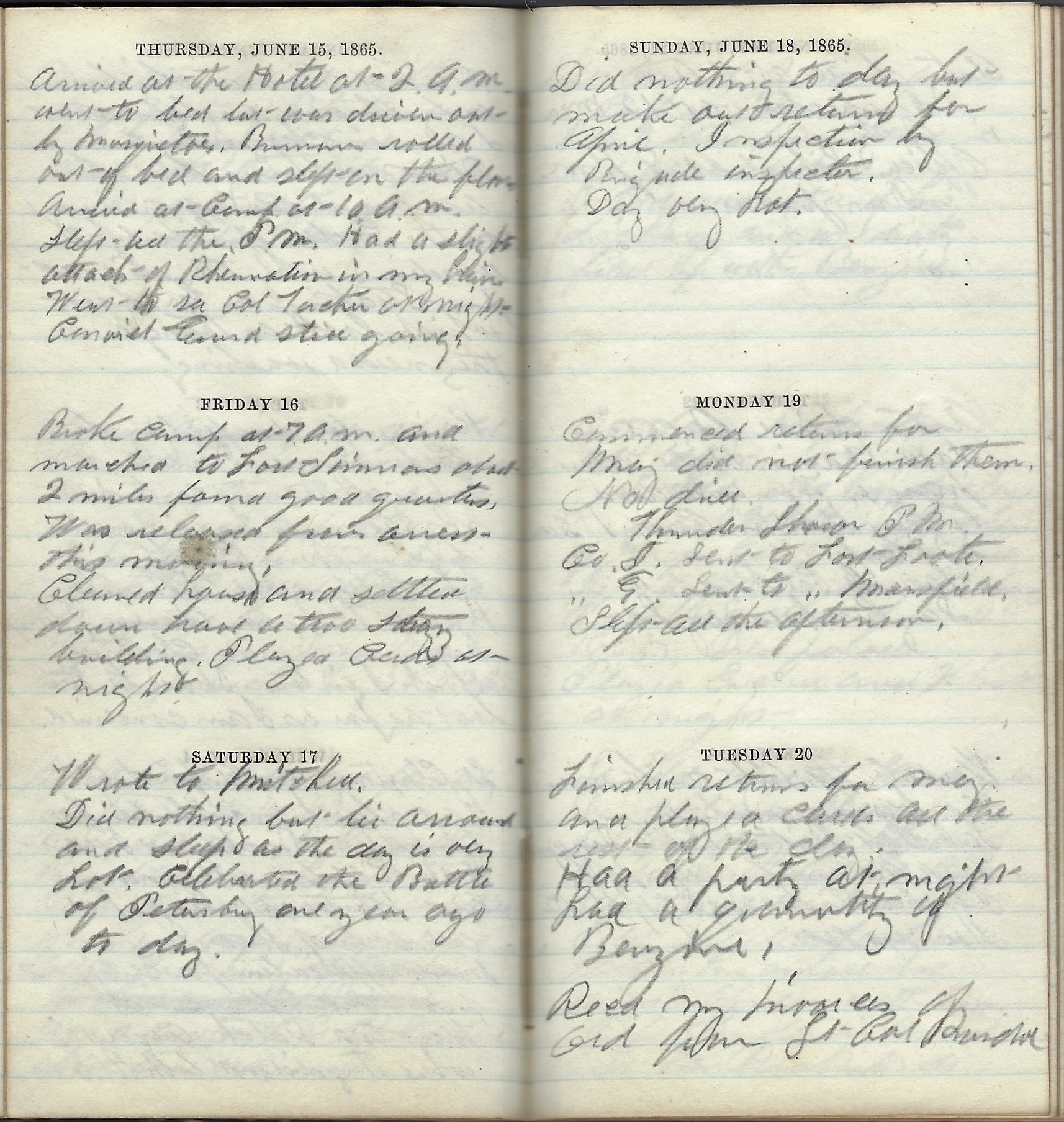
Thursday, June 15, 1865—Arrived at the hotel at 2 a.m. Went to bed but was driven out by mosquitoes. Brennan rolled out of bed and slept on the floor. Arrived at camp at 10 a.m. Slept till the p.m. Had a slight attack of rheumatism in my hair. Went to see Col. Tucker at night. Convict Guard still going.
Friday, 16—Broke camp at 7 a.m. and marched to Fort Simmons about two miles. Found good quarters. Was released from arrest this morning. Cleaned house and settled down. Have a two story building. Played cards at night.
Saturday, 17—Wrote to Mitchell. Did nothing but lie around and sleep as the day is very hot. Celebrated the Battle of Petersburg one year ago today.
Sunday, June 18, 1865—Did nothing today but make out returns for April. Inspection by Brigade Inspector. Day very hot.
Monday, 19—Commenced returns for May. Did not finish them. No drill. Thunder shower p.m. Co. I sent to Fort Foote. Co. G sent to Fort Mansfield. Slept all the afternoon.
Tuesday, 20—Finished returns for May and played cards all the rest of the day. Had a party at night. Had a quantity of Benzine. Received my invoices of Ordnance from Lt. Col. Randall.
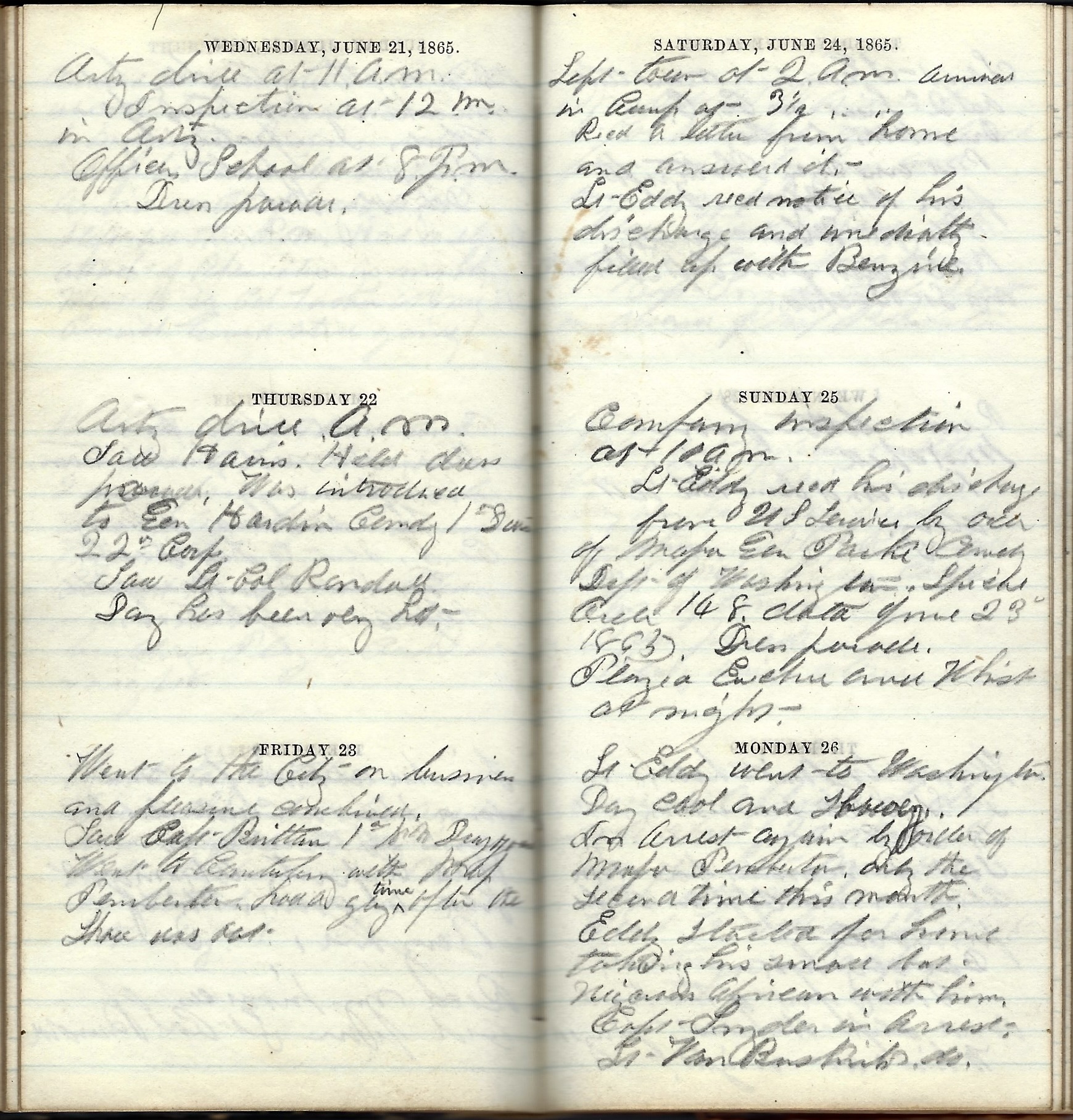
Wednesday, June 21, 1865—Artillery Drill at 11 a.m. Inspection at 12M in artillery. Officer’s School at 8 p.m. Dress parade.
Gen. Martin Davis Hardin, ca. 1865
Thursday, 22—Artillery drill in a.m. Saw Harris. Held Dress Parade. Was introduced to Gen. [Martin Davis] Hardin, commanding 1st Division, 22nd Corp. Saw Lt. Col. Randall. Day has been very hot.
Friday, 23—Went to the City on business and pleasant [ ]. Saw Capt. Brittan, 1st [ ]. Went to Canterbury with Maj. Pemberton. Had a gay time after the show was out.
Saturday, June 24, 1865—Left town at 2 a.m. Arrived in camp at 3.30 a.m. Received a letter from home and answered it. Lt. Eddy received notice of his discharge and immediately filled up with Benzine.
Sunday, 25—Company inspection at 10 a.m. Lt. Eddy received his discharge from US Service by order of Major Gen. Parke, Commanding Dept. of Washington, Special Order 148, dated June 23rd 1865. Dress Parade. Played Euchre and Whist at night.
Monday, 26—Lt. [Charles C.] Eddy went to Washington. Day cool and showery. In arrest again by order of Major Pemberton. Only the 2nd time this month. Eddy started for home taking his small boy [ ] African with him. Capt. Snyder in arrest. Lt. Van Bushkirk ditto.
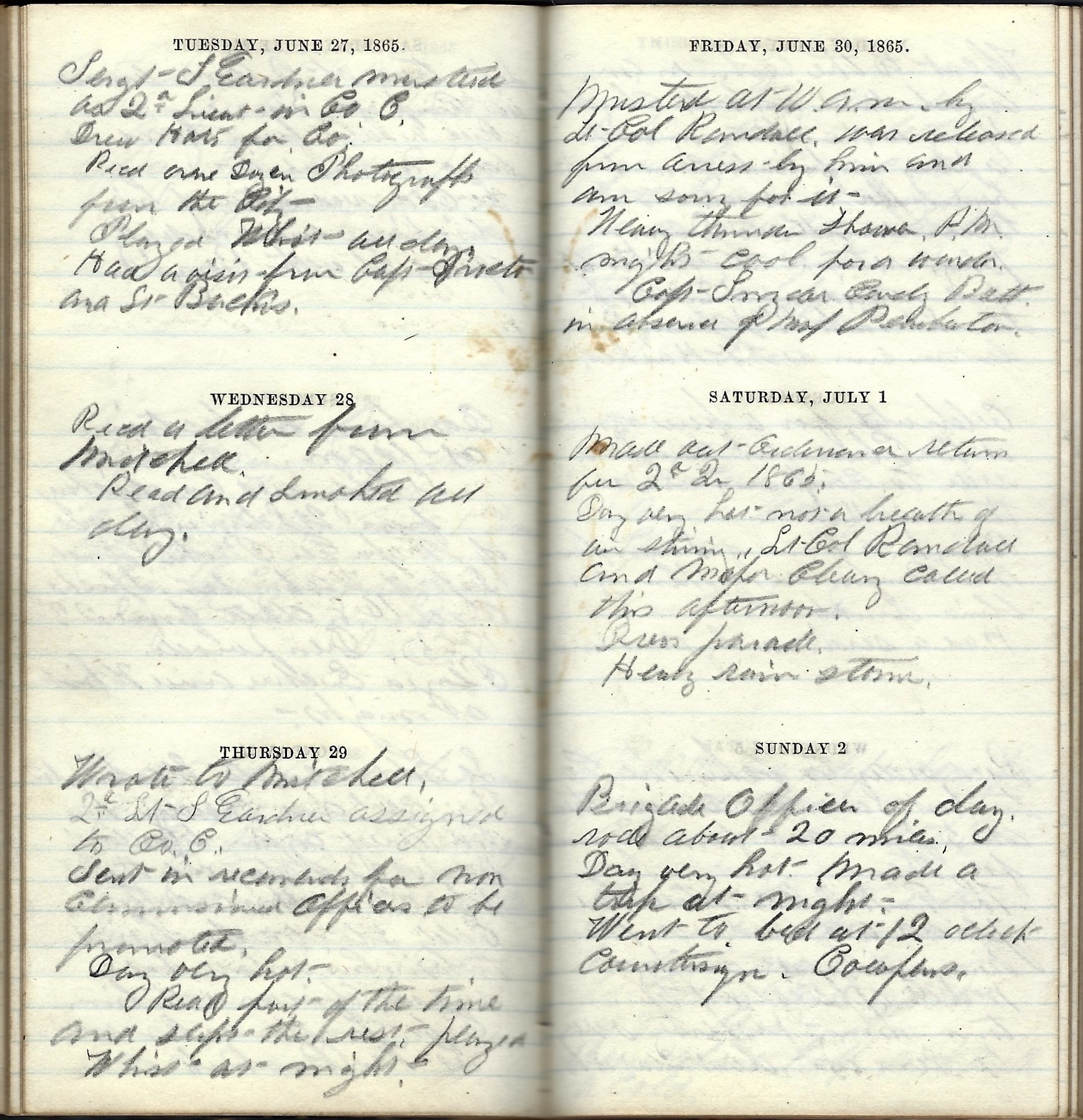
Tuesday, June 27, 1865—Sergt. S[chuyler] Gardner mustered as 2nd Lieutenant in Co. C. Drew hats for company. Received one dozen photographs form the City. Played Whist all day. Had a visit from Capt. [ ] and Lt. Backus.
Wednesday, 28—Received a letter from Mitchell. Read and smoked all day.
Thursday, 29—Wrote to Mitchell. 2nd Lt. S. Gardner assigned to Co. C. Sent in recommends for non-commissioned officers to be promoted. Day very hot. Read part of the time and slept the rest. Played Whist at night.
Friday, June 30, 1865—Mustered at 10 a.m. by Lt. Col. Randall. Was released from arrest by him and am sorry for it. Heavy thunder shower p.m. Nights cool for a wonder. Capt. Snyder commanding Battalion in absence of Maj. Pemberton.
Saturday, July 1—Made our Ordnance Returns for 2nd Quarter 1865. Day very hot. Not a breath of air stirring. Lt. Col. Randall and Major Cleary called this afternoon. Dress Parade. Heavy rain storm.
Sunday, 2—Brigade Officer of the Day. Rode about 20 miles. Day very hot. Made a trip at night. Went to bed at 12 o’clock. Countersign, “Cowpens.”
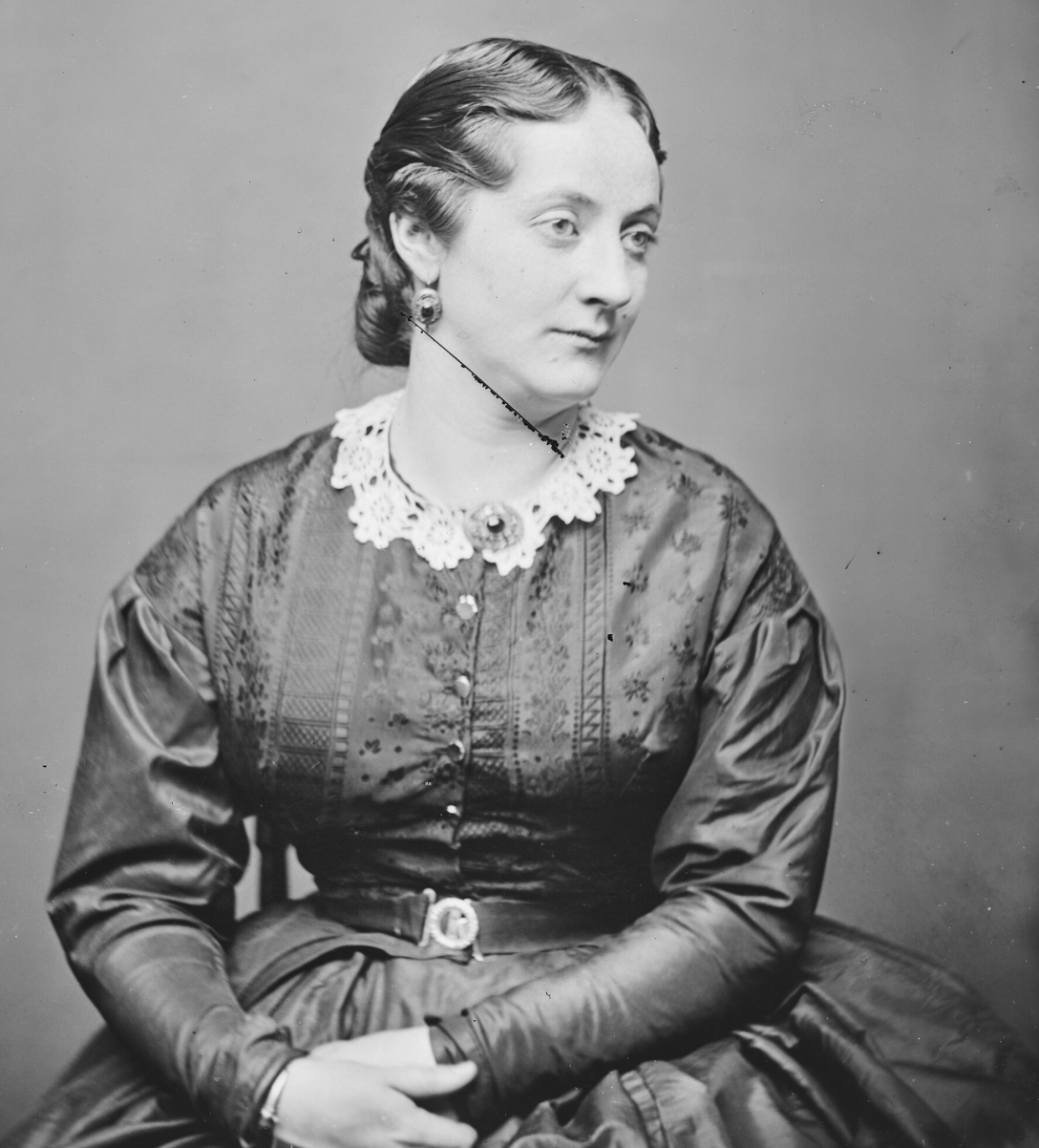
Kate Denin (1837-1907), American stage actress. She appeared at the Washington Theatre (corner of 11th and C Streets near Pennsylvania Avenue on 3 July 1865. She played the Widow Cheerly in the comedy, “Soldier’s Daughter.”
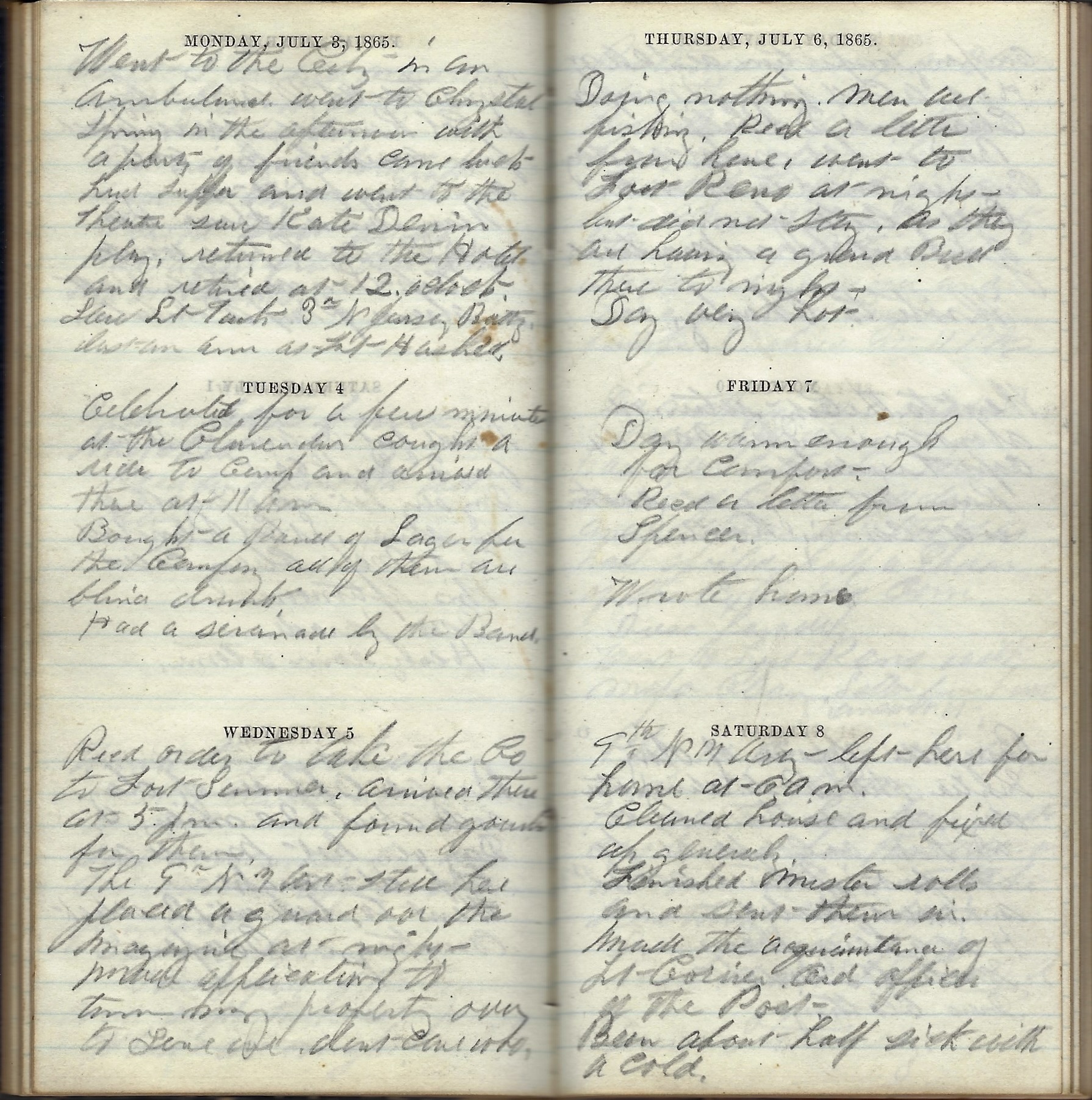
Monday, July 3, 1865—Went to the City in an ambulance. Went to Crystal Spring in the afternoon with a party of friends. Came back, had supper, and went to the theatre. Saw Kate Denin play. Returned to the hotel and retired at 12 o’clock. Saw Lt. [ ], 3rd New Jersey Battery. Last saw him at Ft. Haskell.
Tuesday, 4—Celebrated for a few minutes at the Clarendon. Caught a ride to camp and arrived there at 11 a.m. Bought a round of lager for the company. All of them are blind drunk. Had a serenade by the band.
Wednesday, 5—Received orders to take the company to Fort Simmons. Arrived there at 5 p.m and found quarters for them. The 9th New York Artillery still has placed a guard over the magazine at night. Made application to turn my property over to someone—we don’t care who.
Thursday, July 6, 1865—Doing nothing. Men are fishing. Received a letter from home. Went to Fort Reno at night but did not stay as they are having a Grand Ball there tonight. Day very hot.
Friday, 7—Day warm enough for comfort. Received a letter from Spencer. Wrote home.
Saturday, 8—9th N. Y. Artillery left here for home at 6 a.m. Cleaned house and fixed up generally. Finished muster rolls and sent them in. Made the acquaintance of Lt. Coriner [?], Ordnance Officer of the Post. Been about half sick with a cold.
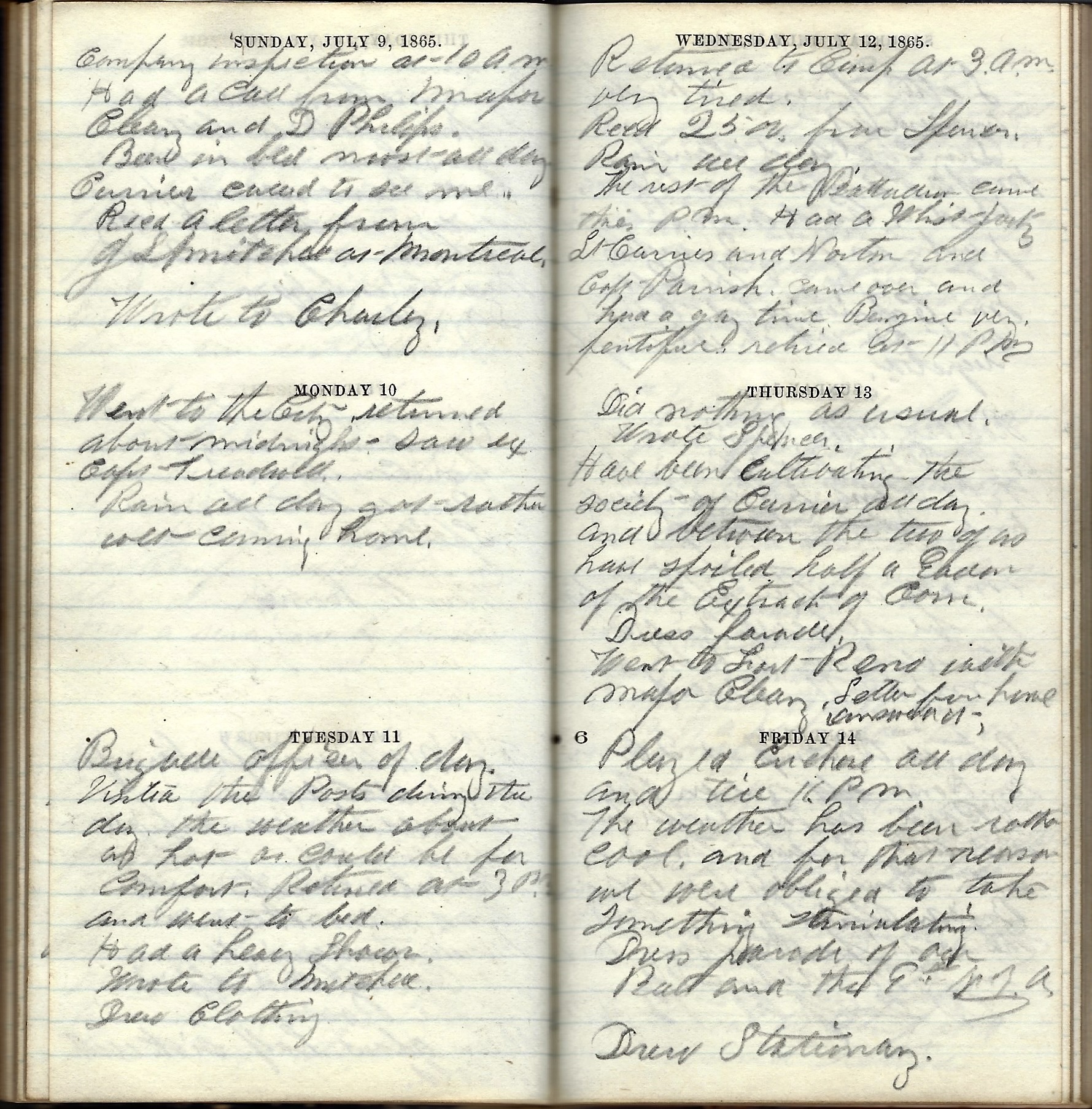
Sunday, July 9, 1865—Company inspection at 10 a.m. Had a call from Major Cleary and D. Philips. Been in bed most all day. Farrier came to see me. Received a letter from J. S. Mitchell at Montreal. Wrote to Charley.
Monday 10—Went to thr City returned about midnight. Saw ex-Capt. Treadwell. Rain all day. Got rather wet coming home.
Tuesday, 11—Brigade Officer of the Day. Visited the posts during the day. The weather about as hot as could be for comfort. Returned at 3 p.m. and went bed. Had a heavy shower. Wrote to Mitchell. Drew clothing.
Wednesday, July 12, 1865—Returned to camp at 3 a.m. very tired. Received 25.00 from Spencer. Rain all day. The rest of the Battalion came this p.m. Had a Whist party. Lt. Carnes and Norton and Capt. Parrish came over and had a gay time. Benzine very plentiful. Retired at 11 p.m.
Thursday, 13—Did nothing as usual. Wrote Spencer. Had been cultivating the society of Currier all day and between the two of us have spoiled half a gallon of the extract of corn. Dress Parade. Went to Fort Reno with Major Cleary. Letter from home. Answered it.
Friday, 14—Played Euchre all day and till 11 p.m. The weather has been rather cool, and for that reason we were obliged to take something stimulating. Dress parade of our Battalion and the 9th New York Artillery. Drew stationery.
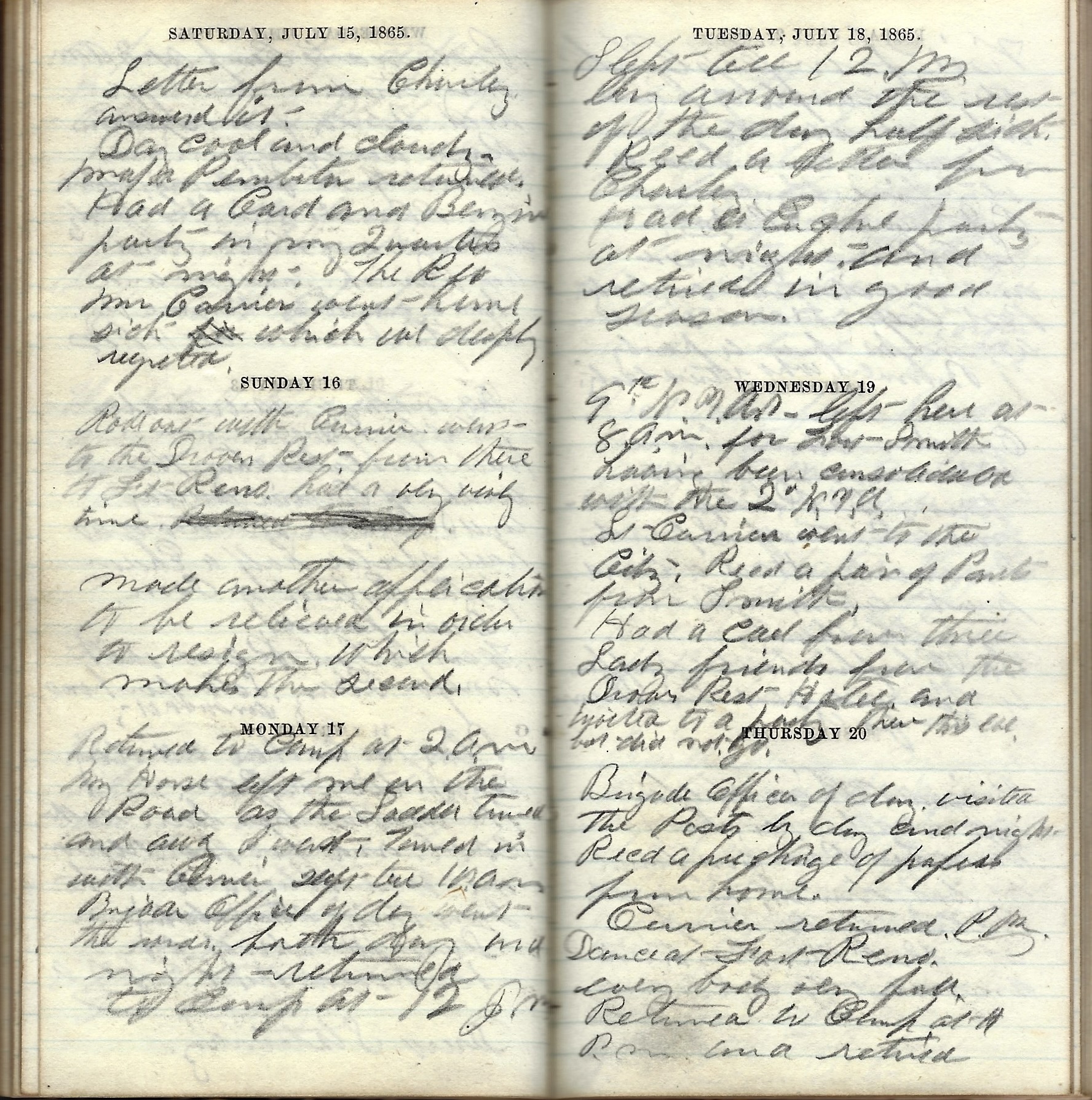
Saturday, July 15, 1865—Letter from Charley. Answered it. Day cool and cloudy. Major Pemberton returned. Had a card and Benzine party in my quarters at night. The [ ] Mr. Carrier went home sick which we deeply regretted.
Sunday, 16—Rode out with [ ] to the Drover’s Rest [Hotel]. From there to Ft. Reno. Had a very [ ] time. Made another application to be relieved in order to resign which makes the second.
Monday, 17—Returned to camp at 2 a.m. My horse left me on the road as the saddle turned and I went…
Tuesday, July 18, 1865–Slept till 12 M. Lay around the rest of the day half sick. Received a letter from Charley. Had a Euchre Party at night and retired in good season.
Wednesday, 19—9th New York left here at 8 a.m. for Fort Smith having been consolidated with the 2nd New York Artillery. Lt. Carrier went to the City. Received a pair of pants from Smith. Had a call from three lady friends from the Drover rest Hotel and invited to a party there this eve but did not go.
Thursday, 20—Brigade Officer of the Day. Visited the posts by day and night. Received a package of papers from home. Currier returned p.m. Dance at Fort Reno. Everybody very full [drunk]. Returned to camp at 11 p.m. and retired.
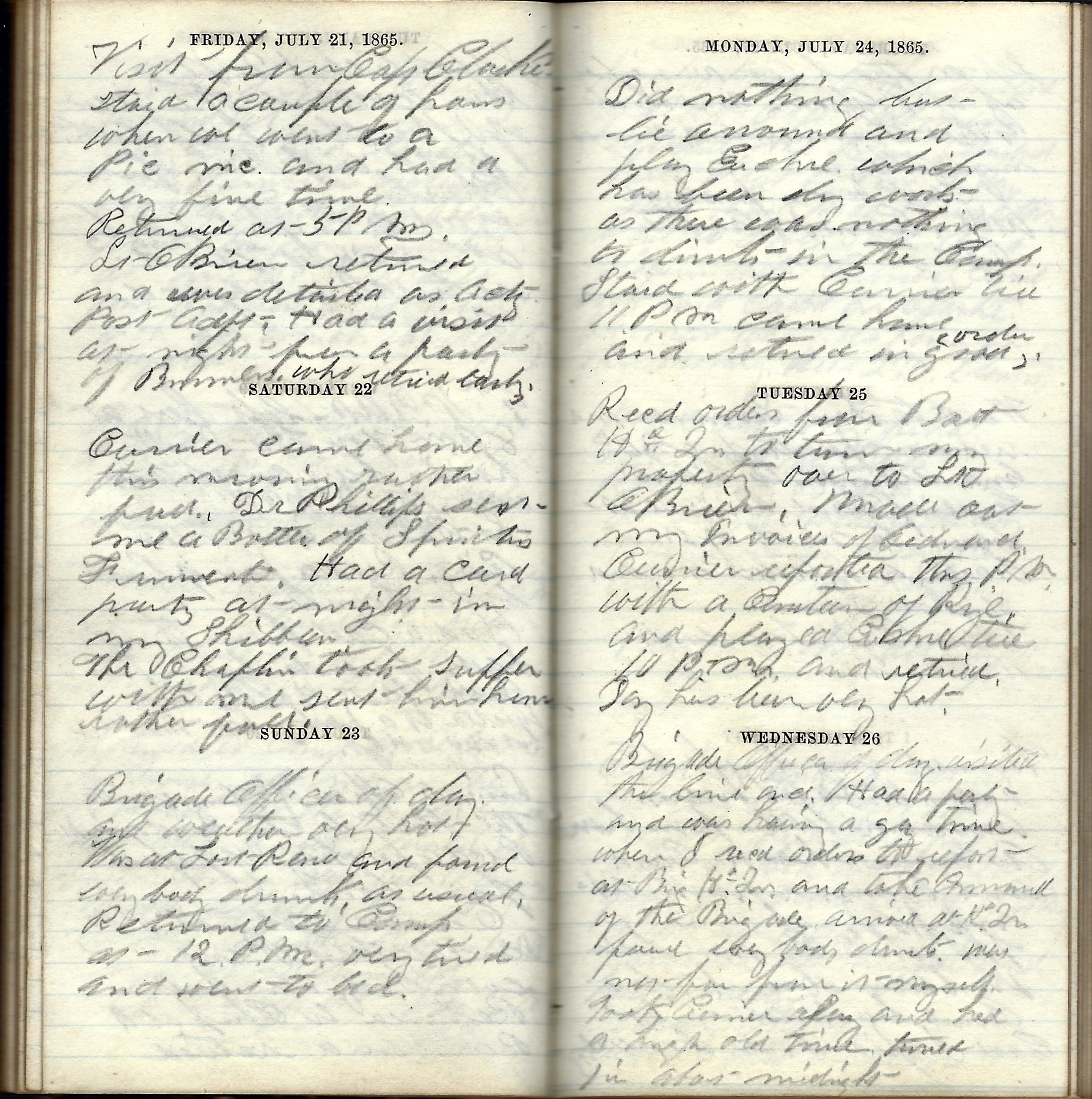
Friday, July 21, 1865—Visit from Capt. Clarke. Stayed a couple of hours when we went to a picnic and had a fine time. Returned at 5 p.m. Lt. O’Brien returned and was detailed as Acting Post Adjutant. Had a visit at night from a party of Bummers who retired early.
Saturday, 22—Currier came home this morning rather full [drunk]. Dr. Phillips sent me a bottle of spirits [ ]. Had a card party at night in my shebang. The chaplin took supper with me. Sent him home rather full [drunk].
Sunday, 23—-Brigade officer of the Day. Weather very hot. Was at Fort Reno and found everybody drunk as usual. Returned to camp at 12 p.m. very tired and went to bed.
Monday, July 24, 1865—Did nothing but lie around and play Euchre which has been dry work as there was nothing to drink in the camp. Stayed with Currier till 11 p.m.. Came home and retired in good order.
Tuesday, 25—Received orders from Battalion Headquarters to turn my property over to Lt. O’Brien. Made out my invoices of ordnance. Currier reported this p.m. with a canteen of Rye and played Euchre till 10 p.m. and retired. Day has been very hot.
Wednesday, 26—Brigade Officer of the Day. Visited the line and had a party and was having a gay time when I received orders to report at Brigade Headquarters and take command of the Brigade. Arrived at Headquarters. Found everybody drunk. Was not far from it myself. Took [ ] and had a high old time. Turned in about midnight.
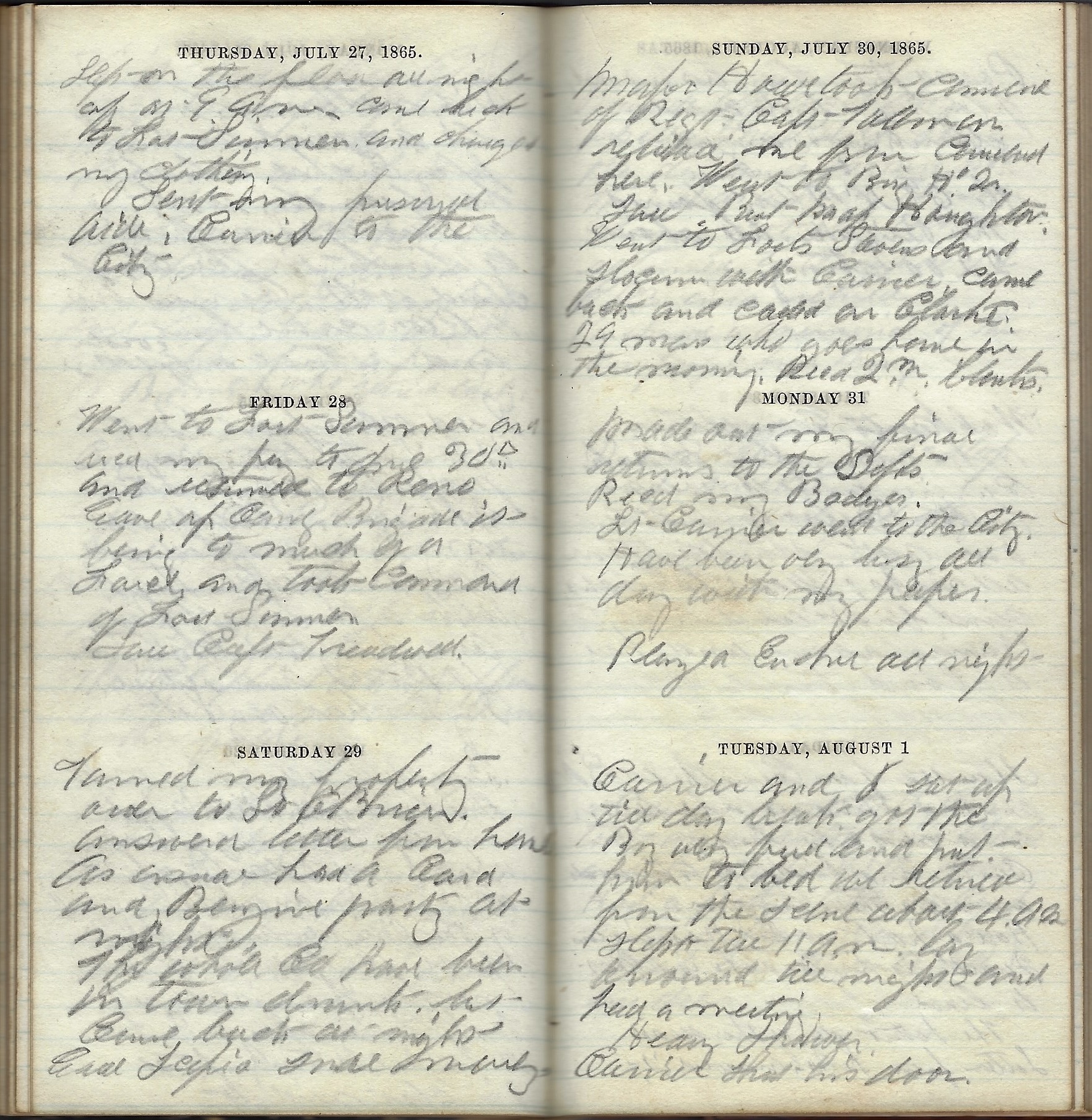
Thursday, July 27, 1865—Slept on the floor all night. Up at 9 a.m. and rode to Ft. Simmons and changed my clothes. Sent my personal aide Currier to the City.
Friday, 28—Went to Fort Simmons and drew my pay to April 30th and returned to Reno. Gave up commanding Brigade, it being too much of a farce and took command of Fort Simmons. Saw Capt. Treadwell.
Saturday, 29—Turned my property over to Lt. O’Brien. Answered letter from home. As usual, had a card and Benzine party at night. The whole company had been in town drunk but came back at night [ ].
Sunday, July 30, 1865—Major Howe took command of the regiment. Capt. Tallman relieved me from command here. Went to Brigade Headquarters. Saw [ ] Houghton. Went to Forts Stevens and Slocum with Cainer. Came back and called on Clarke. 29 men who go home in the morning. Received quarter mster blanks.
Monday, 31—Made out my final returns to the Departments. Received my badges. Lt. Currier went to the City. Have been very busy all day with my papers. Played Euchre all night.
Tuesday, August 1, 1865—Carmin [?] and I sat up till day break. Got the boy very full [drunk] and put him to bed. We retired from the scene about 4 a.m. Slept till 11 a.m. Lay around till night and had a meeting. Heavy shower. Carmin shut his door.
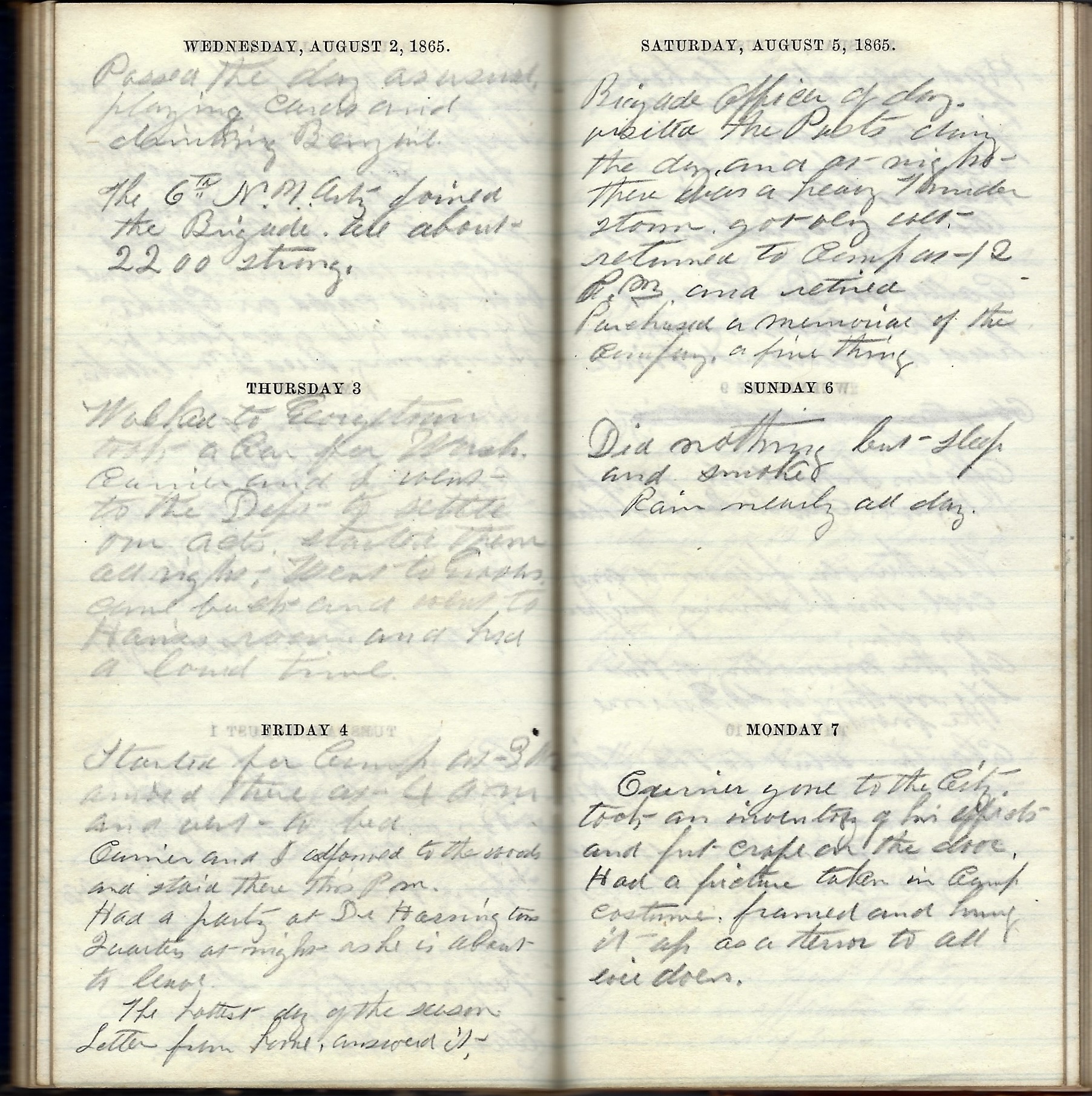
Wednesday, August 2, 1865—Passed the day as usual playing cards and drinking Benzine. The 6th New York Artillery joined the Brigade. All about 2200 strong.
Thursday, 3—Walked to Georgetown. Took a car for Washington. Carmin and I went to the Dept. to settle our accounts. Started them all right. Went to Groovers. Came back and went to Hane’s [?] room and had a loud time.
Friday, 4—Started for camp at 3 a.m. Arrived there at 4 a.m. and went to bed. Carmon and I [ ] to the woods and stayed there this past.m. Had a party at Dr. Harrington’s Quarters at night as he is absent to leave. The hottest say of the season. Letter from home. Answered it.
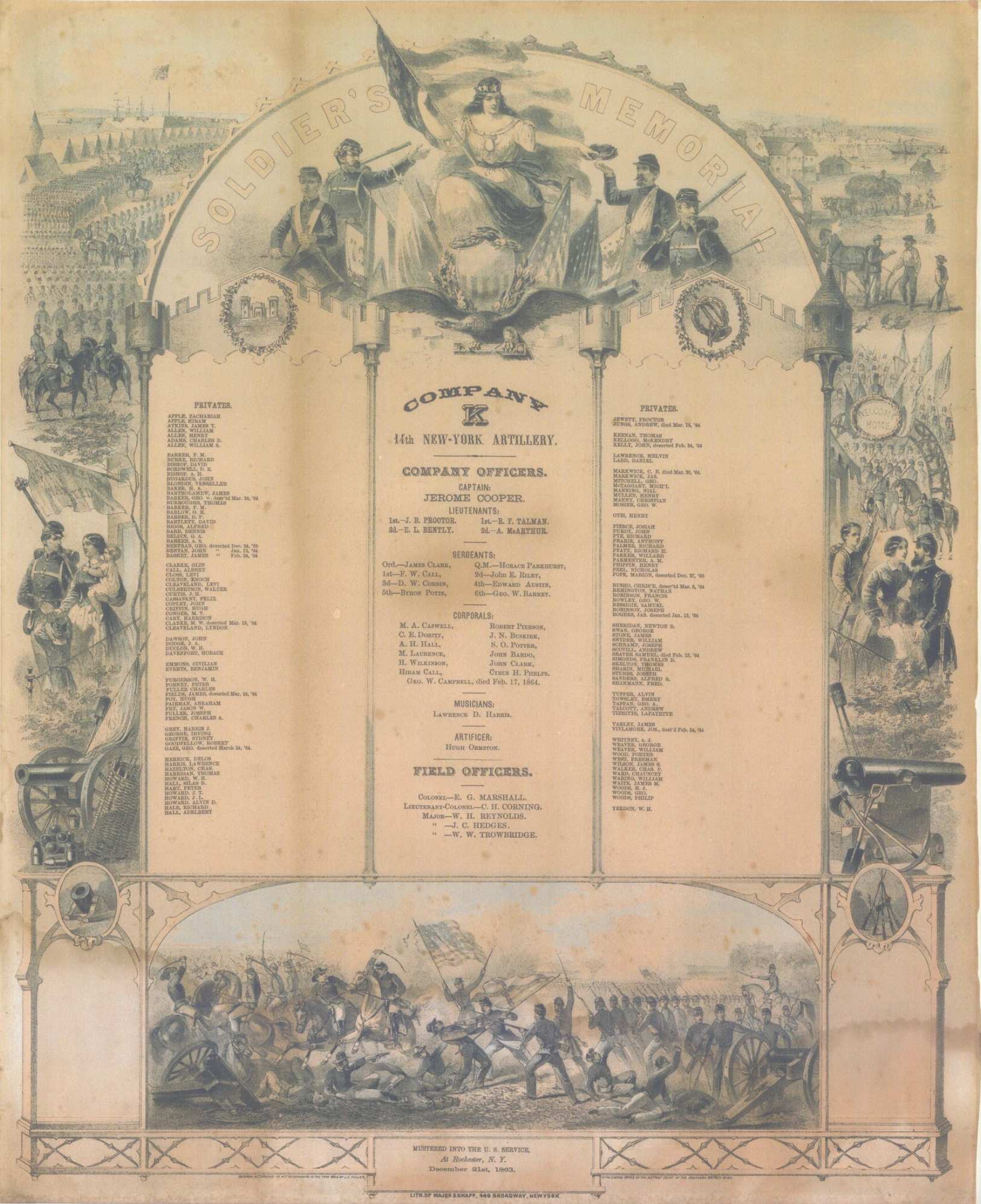
Saturday, August 5, 1865—Brigade Officer of the Day. Visited the posts during the day and at night. There was a heavy thunderstorm. Got only wet. Returned to camp at 12 p.m. and retired. Purchased a memorial of the company—a fine thing.
This is the Soldier’s Memorial for Co. K of the 14th New York Artillery. George would have purchased one like it for Co. M with the names of all the officers and enlisted men in the company.
Sunday, 6—Did nothing but sleep and smoke. Rain nearly all day.
Monday, 7—Curnier gone to the City. Took an inventory of his effects and put crepe on the door. Had a picture taken in camp costume framed and hung it up as a terror to all evil doers.
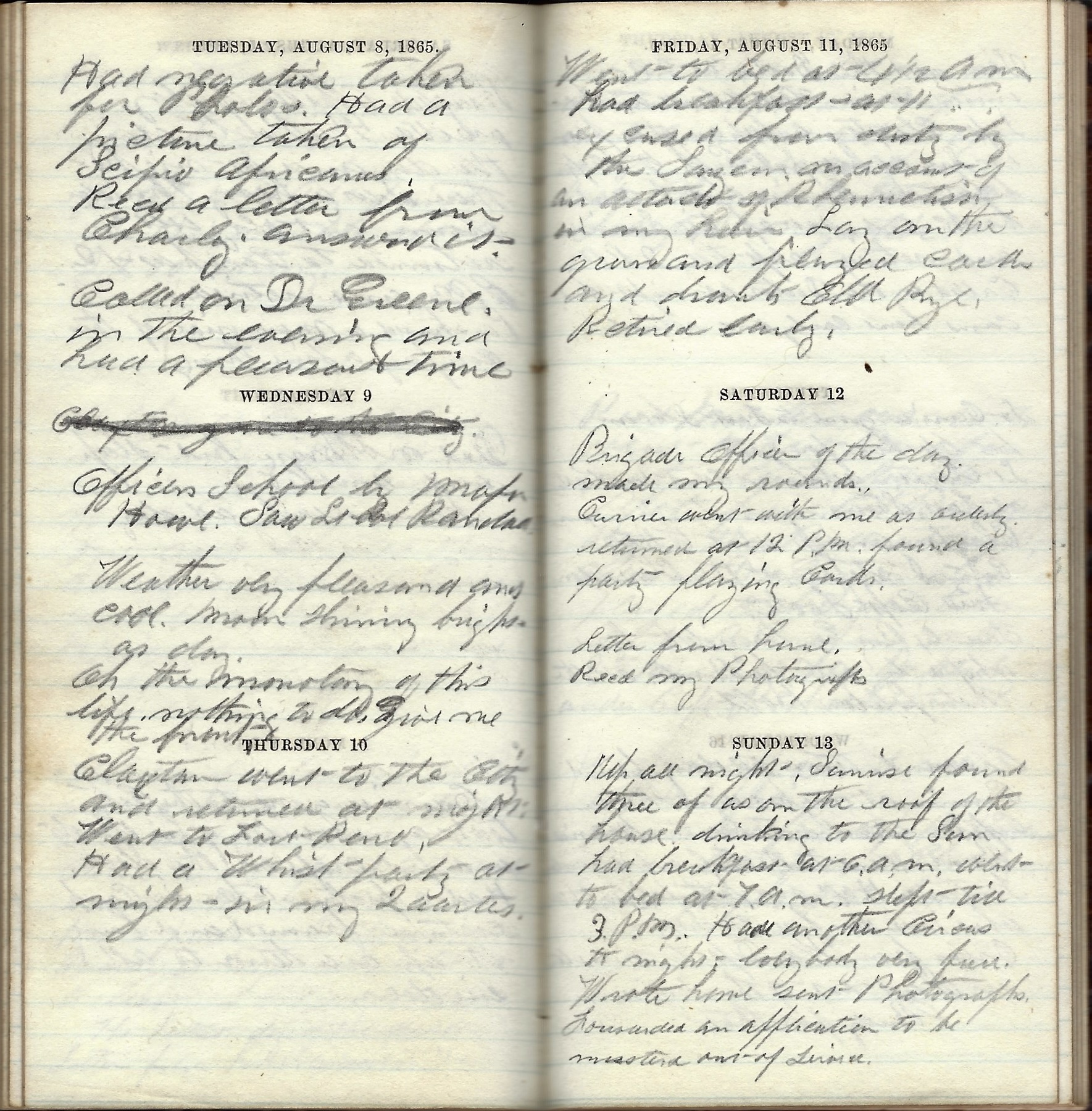
Tuesday, August 18, 1865—Had negative taken for photos. Had a picture taken of Scipio, Africanus. Received a letter from Charley. Answered it. Called on Dr. Greene in the evening and had a pleasant time.
Wednesday, 9—Officer’s School by Major Howe. Saw Lt. Col. Randall. Weather pleasant and cool. Moon shining bright as day. Oh the monotony of this life. Nothing to do. Give me the front.
Thursday, 10—Clayton went to the City and returned at night. Went to Fort Reno. Had a Whist party at night in my quarters.
Friday, August 11. 1865— Went to bed at 4.30 a.m. Had breakfast at 11. Excused from duty by the Surgeon on account of an attack of rheumatism in my hair. Lay on the ground and played cards and drank old Rye. Retired early.
Saturday 12—Brigade Officer of the Day. Made my rounds. Carmin went with me as orderly. Returned at 12 p.m. Found a party playing cards. Letter from home. Received my photographs.
Sunday, 13—Up all night. Sunrise found three of us on the roof of the house drinking to the sun. Had breakfast at 6 a.m. Went to bed at 7 a.m. Slept till 3 p.m. to add another circus tonight. Everybody very fun. Wrote home. Sent photographs. Forwarded and application to be mustered out of service.
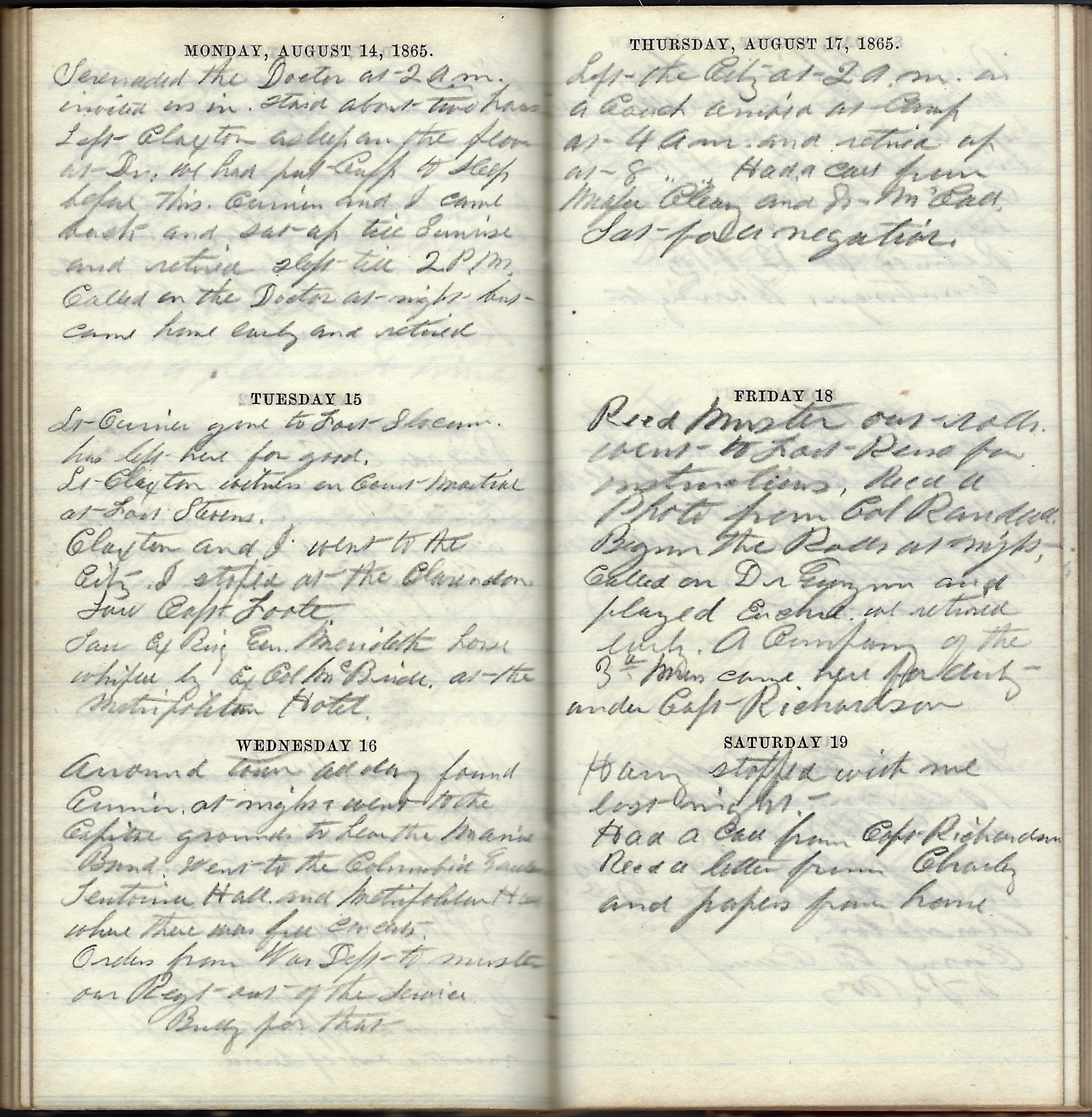
Monday, August 14, 1865—Serenaded the doctor at 2 a.m. Invited us in. Stayed about two hours. Left Clayton asleep on the floor at Dr. We had put [ ] to sleep before this. Carmin and I came back and sat up till sunrise and retired. Slept till 2 p.m. Called on the Doctor at night but came home early and retired.
Tuesday, 15—Lt. Curnier gone to Ft. Slocum. Has left here for good. Lt. Clayton witness on Court Martial at Fort Stevens. Clayton and I went to the City. I stopped at the Clarendon. Saw Capt. Foote. Saw ex-Brig Gen. Meredith. Horse whipped by Ex Col. McBride at the Metropolitan Hotel.
Wednesday, 16—Around town all day. Found Curnier at night. Went to the Capitol grounds to hear the Columbia Guards. Tentonia Hall and Metropolitan Hotel where there was free concerts. Orders from War Department to muster our regiment out of the service. Bully for that.
Thursday, August 17, 1865—Left the City at 2 a.m. in a coach. Arrived at Camp at 4 a.m. and retired at 8. Had a call from Major Cleary and McCall. Sat for a negative.
Friday, 18—Received muster out rolls. Went to Fort Reno for instructions. Received a photo from Col. Randall. Begun the Rolls at night. Called on Dr. [ ] and played Euchre. We returned early. A company of the 3rd Mass, came here for duty under Capt. Richardson.
Saturday. 19—Harry stopped with me last night. Had a call from Capt. Richardson. Received a letter from Charley and papers from home.
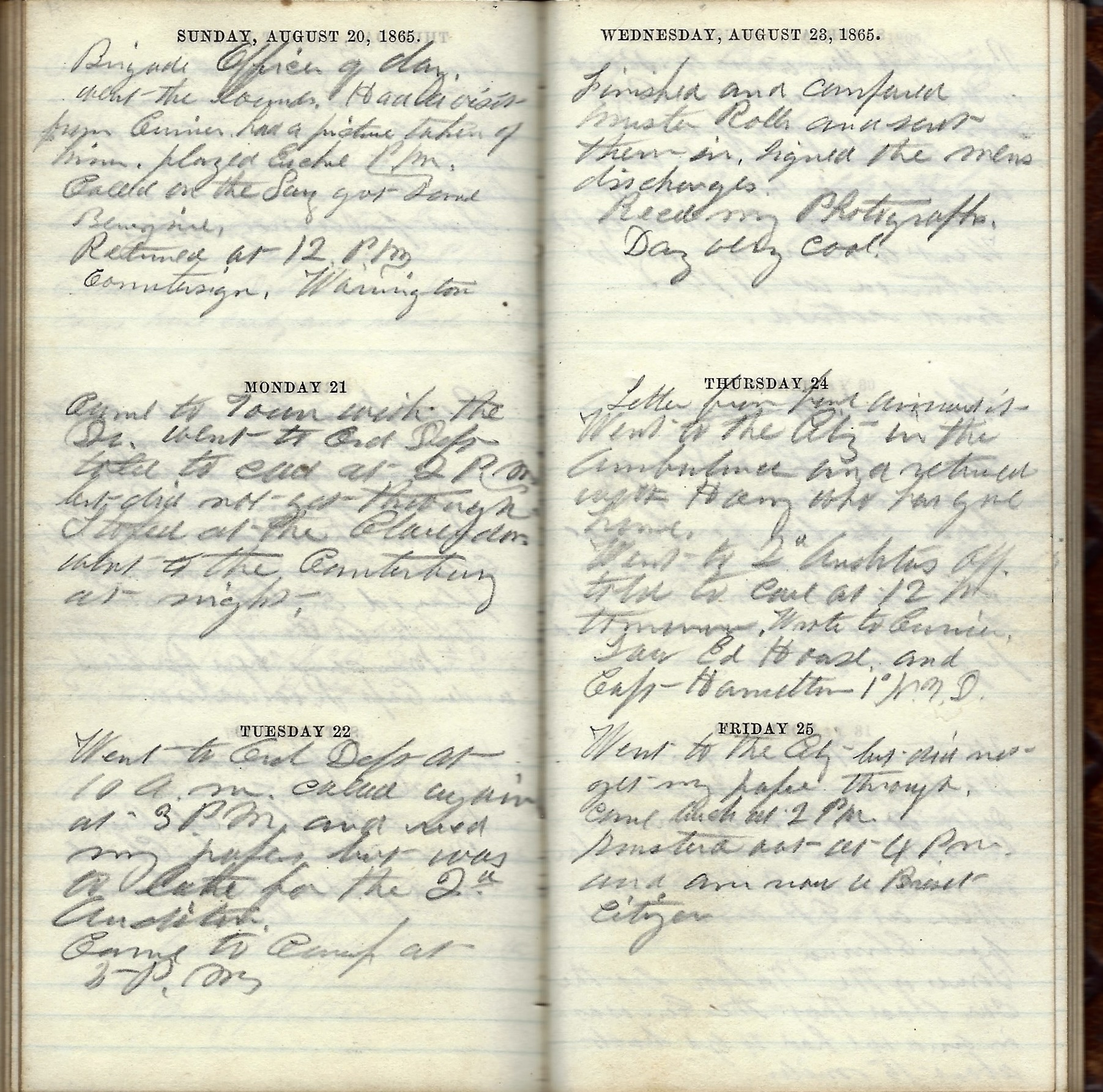
Sunday, August 20, 1865—Brigade Officer of the Day. Went to rounds. Had a visit from Curnier. Had a picture taken of him. Played Euchre p.m. Called on the [ ]. Got some Benzine. Returned at 12 p.m. Countersign, “Warrington.”
Monday, 21—Went to town with the Doctor. Went to Ordnance Department. Told the [ ] at 2 p.m. but did not get through. Started at the Clarendon. Went to the Canterbury at night.
Tuesday, 22—Went to Ordnance Dept. at 10 a.m. Called again at 3 p.m. and received my papers but was too late for the 2nd Auditor. Came to camp at 5 p.m.
Wednesday, August 23, 1865—Finished and [ ] muster rolls and sent them in, Signed the mens discharges. Received my photographs. Day very cool.
Thursday, 24—Letter from home. Answered it. Went to the City in the ambulance and returned with Harry who has gone home. Went to 2nd [ ] Off. told to call at 12 M tomorrow. Wrote to Curnier. Saw Ed House and Capt. Hamilton, 1st New York D.
Friday, 25—Went to the City but did not get my paper through. Came back at 2 p.m. Mustered out at 4 p.m. and am now a private citizen.
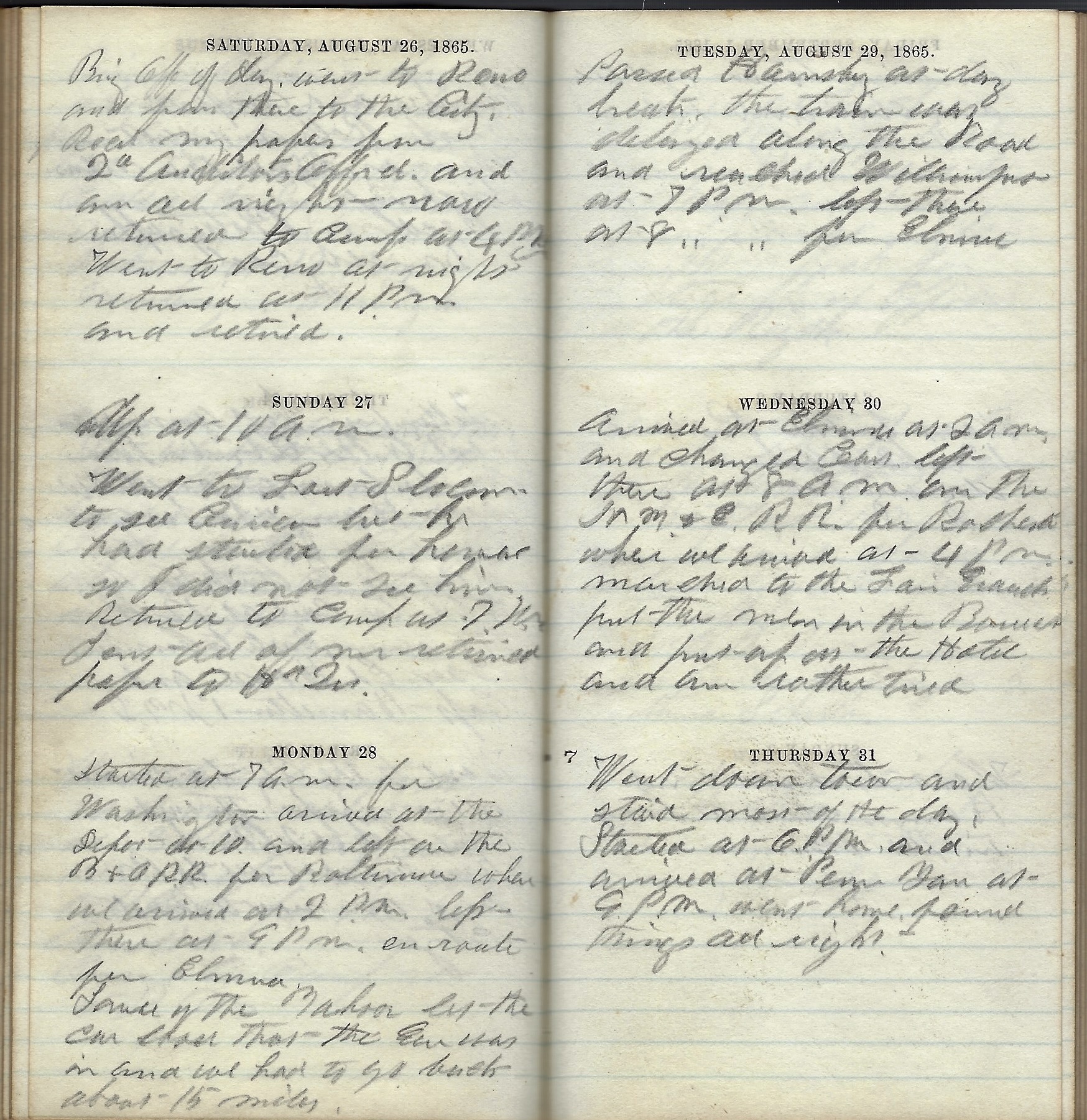
Saturday, August 26, 1865—Brigade Officer of the Day. Went to Reno and from there to the City. Received my papers from 2nd Auditor’s [ ] and all night. Now returned to camp at 4 a.m.. Went to Reno at night. Returned at 11 p.m. and retired.
Sunday, 27—Up at 10 a.m. Went to Fort Slocum to see Curnier but he had started for home so I did not see him. Returned to camp at 7 p.m. SEnt all of my returns papers to Headquarters.
Monday, 28—Started at 7 a.m. for Washington. Arrived at the Depot at 10 and left on the B&O RR for Baltimore where we arrived at 2 p.m. Left there at 9 p.m. en route for Elmira. [ ] and we had to go back about 15 miles.
Tuesday, August 29, 1865—Passed Harrisburg at daybreak. The train was delayed along the road and reached Williamsport at 7 p.m. Left there at 8 for Elmira.
Wednesday, 30—Arrived at Elmira at 2 a.m. and changed cars. Left there at 8 a.m. on the [ ] RR for Rochester where we arrived sat 4 p.m. Marched to the Fair Grounds, put the [ ] in the [ ] and put up on the Hotel and am rather tired.
Thursday, 31—Went down town and stayed most of the day. Started at 6 p.m. and arrived at Penn Yan at 9 p.m. Went home. Found things all right.
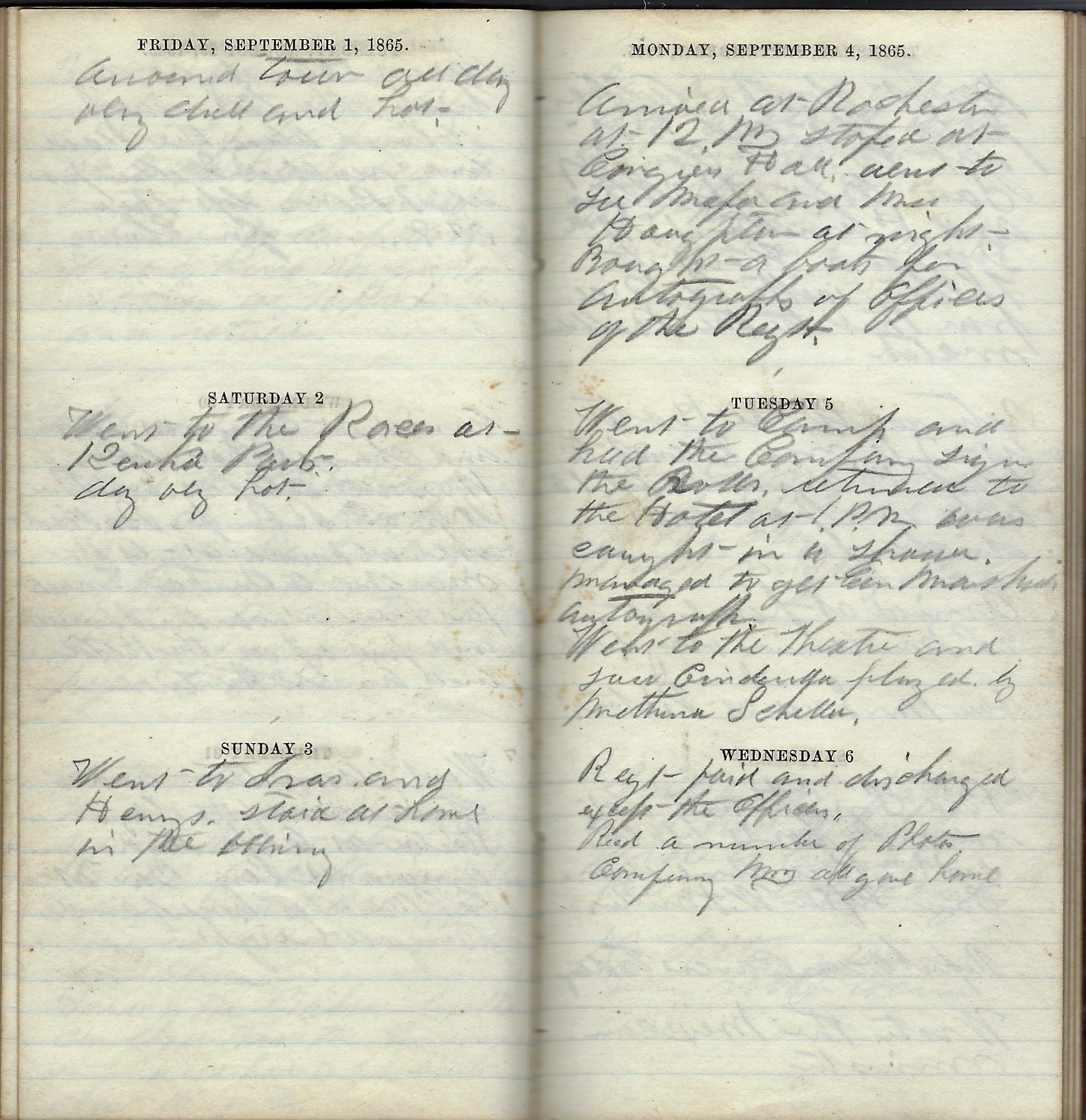
Friday, September 1, 1865— Around town all day. Very dull and hot
Saturday, 2—Went to the races at Kenka Park. Day very hot.
Sunday, 3—Went to Ira’s and Henry’s. Stayed at home in the evening.
Monday, September 4, 1865—Arrived at Rochester at 12 M. Stopped at Congress Hall. Went to see Major and Miss. Houghton at night. Bought a book for autographs of officers of the regiment.
Tuesday, 5—Went to camp and had the company sign the rolls. Returned to the hotel at 1 p.m. Was caught in a shower. Managed to get Gen. Marshall’s autograph. Went to the theatre and saw Cinderella played by Methena Scheller.
Wenesday. 6—Regiment paid and discharged except the officers. Received a number of photos. Company M all gone home.
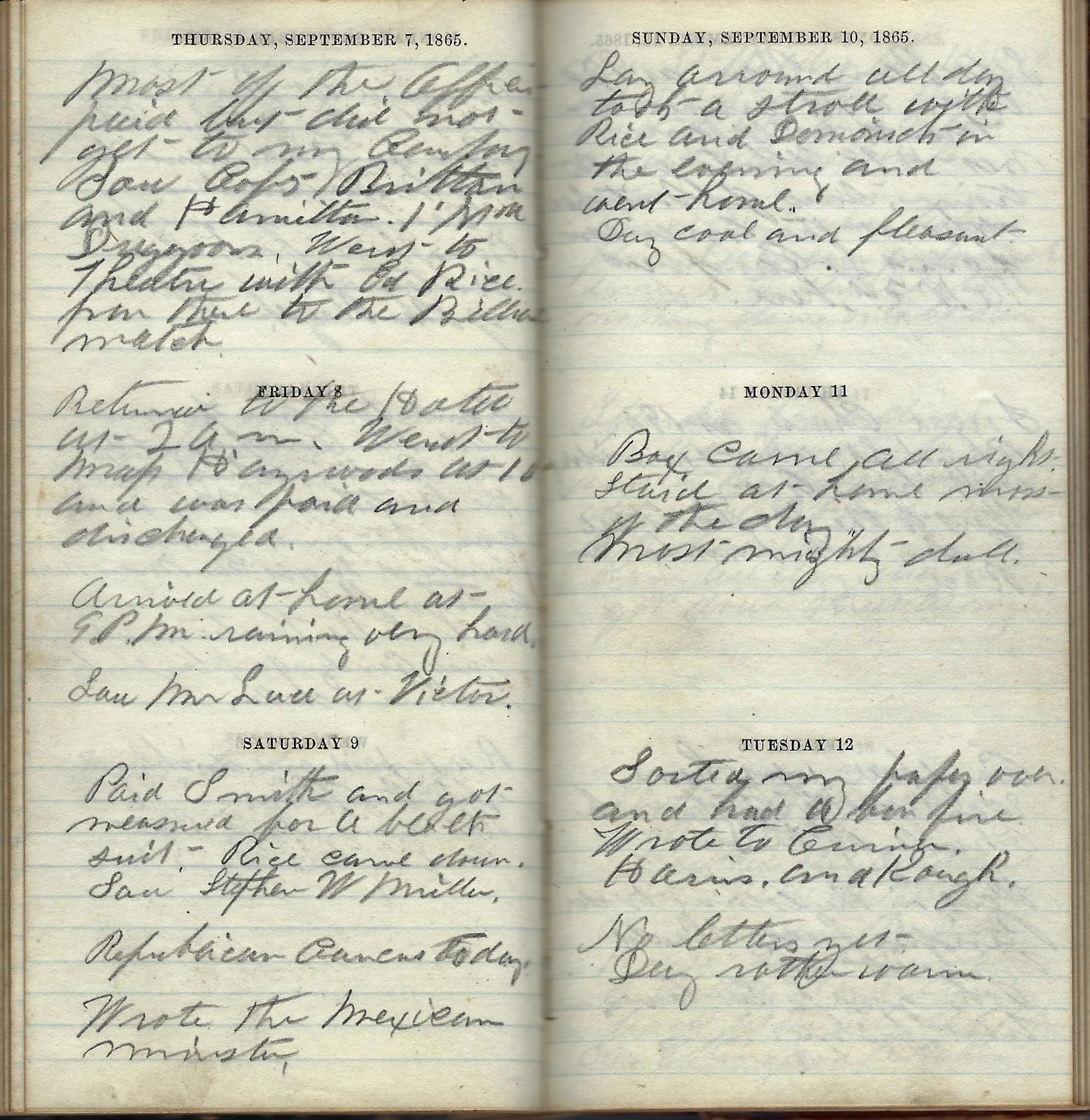
Thursday, September 7—Most of the officers paid but did ot get to my company. Saw Capt. Britton and Hamilton, 1st Mass Dragoons. Went to theatre with Ed Rice. From there to the billiard match.
Friday, 8—Returned to the hotel at 2 a.m. Went to Maj. Hayward’s at 10 and was paid and discharged. Arrived at home at 9 p.m. raining very hard. Saw Mr. Luce at Victor.
Saturday, 9—Paid Smith and got measured for a [ ] suit. Rice came down. Saw Stephen W. Miller. Republican causus today. Wrote to Mexican Minister.
Sunday, September 10, 1865—Lay around all day. Took a stroll with Rice and Dominick in the evening and went home. Day cool and pleasant.
Monday, 11—Box came all right. Stayed at home most of the day. Most mighty dull.
Thursday, 12—Sorted my papers over and had a bon fire. Wrote to Curnier, Harris, and Kough. No letters yet. Day rather warm.
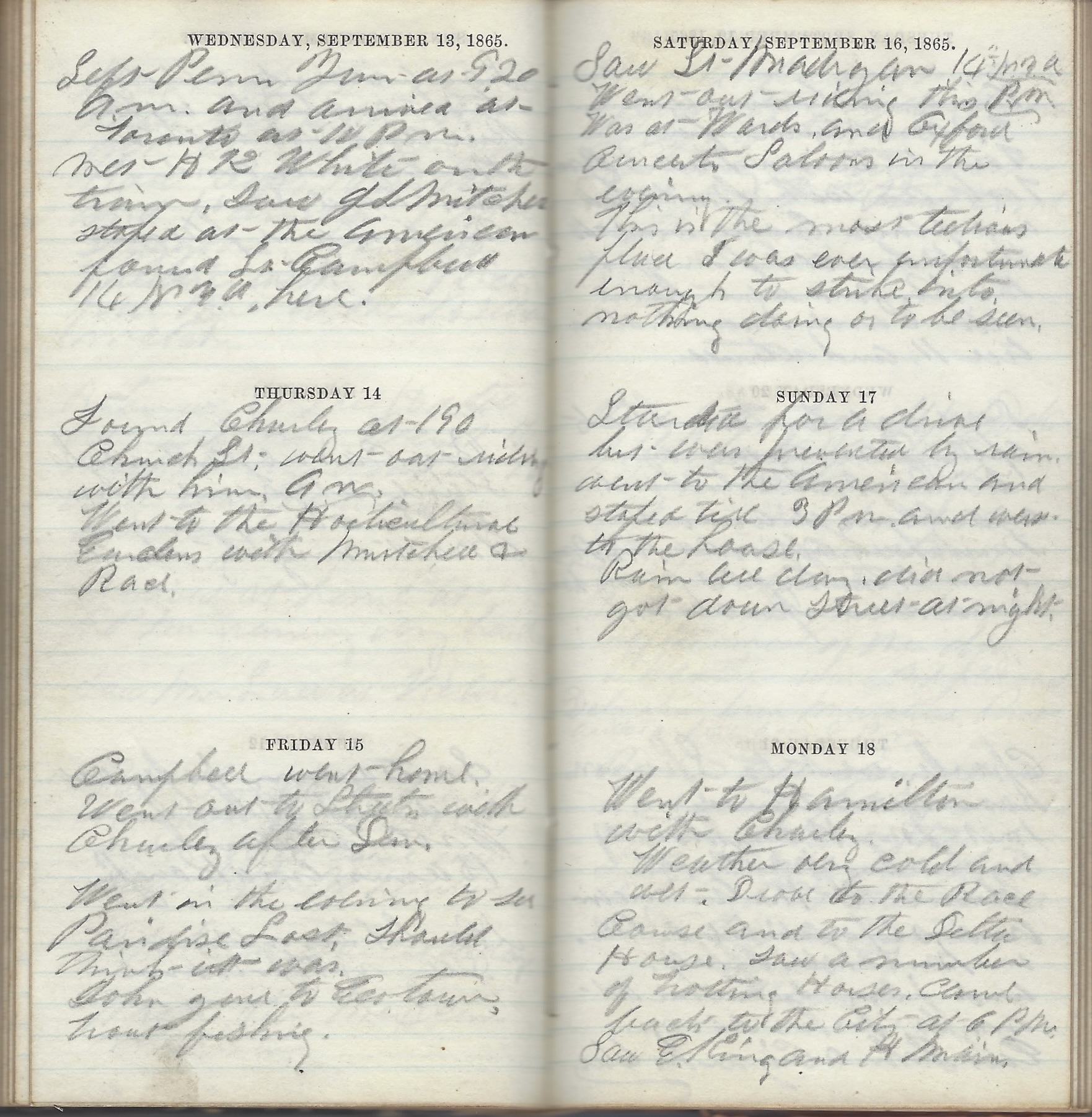
Friday, September 13, 1865—Left Penn Yan at 9.20 a.m and arrived at Toronto at 10 p.m. Met H. K. White on the train. Saw G. S. Mitchell. Stopped at the American [House]. Found Lt. Campbell, 14 N. Y. Artillery here.
Thursdaym 14—Found [brother] Charley at 190 Church Street. Went out riding with him and went to the Horticulture Gardens with Mitchell & Rad [?].
Friday, 15—Campbell went home. Went out to station with Charley after dinner. Went in the evening to see Paradise Lost. Should think it was. John gone to Georgetown trout fishing.
Saturday, September 16, 1865—Saw Lt. Madegan, 14th N. Y. Artillery. Went out riding this past.m. Was at Wards and Oxford Concerts Saloon in the evening. This is the most tedious place I was ever unfortunate enough to strike into. Nothing doing or to be seen.
Sunday, 17—Started for a drive but was prevented by rain. Went to the American [House] and stopped till 3 p.m. and went to the house. Rain all day. Did not go down street at night.
Monday, 18—Went to Hamilton with Charley. Weather very cold and wet. Drove to the race course and to the Delta House. Saw a number of trotting houses. Came back to the city at 6 p.m. Saw E. King and H. Main.
Tuesday, September 19, 1865—Around town till 3 p.m. Started for Toronto. Arrived there 5 p.m. Took tea with Mitchell and played Euchre. Went to the house at 9 p.m. Got the [ ]. Went home with Sandy M____. Stayed till 11 and returned.
Wednesday, 20—Drove out to Tim [?] Streets after Da. Called on W. Doyle. Wrote home and laying around. Mitchell’s office all this p.m. Went to the Oxford at night. Made some purchases.
Thursday, 21—Charley went to Sharon. Has not returned. Mr. Houghton of Ogdensburg, N. Y. Took dinner at the American [House] and slept all the p.m. in Mitchell’s office and played Euchre at night in his room. Gave John a cigar holder.
Friday, September 22, 1865—Had a present of a pair of studs from G. L. Mitchell. Charley returned at night. Wm. Reid came with him.
Saturday, 23—Received letters from H. M. Backus, J. H. Roberts, 116th N. Y., Brig. General Baker, and from the Mexican Minister. Had some money changed at 31 cents discount. Lay around Mitchell’s office most of the day. Weather warm and pleasant. Delegation from Maritime Provs. arrived here at 8 p.m.
Sunday, 24—Rain all day which is decidedly pleasant. Was on board the Steamer Maple Leaf. Returned to the house at 9 p.m. as the town is as dead as a graveyard.
Monday, September 25, 1865—Charley started on his trip up the country. Was out with a party and had a gay time.
Tuesday, 26—With Mitchell all day. Played Euchre in his room at night till 9 p.m. and went to the house and retired in good season.
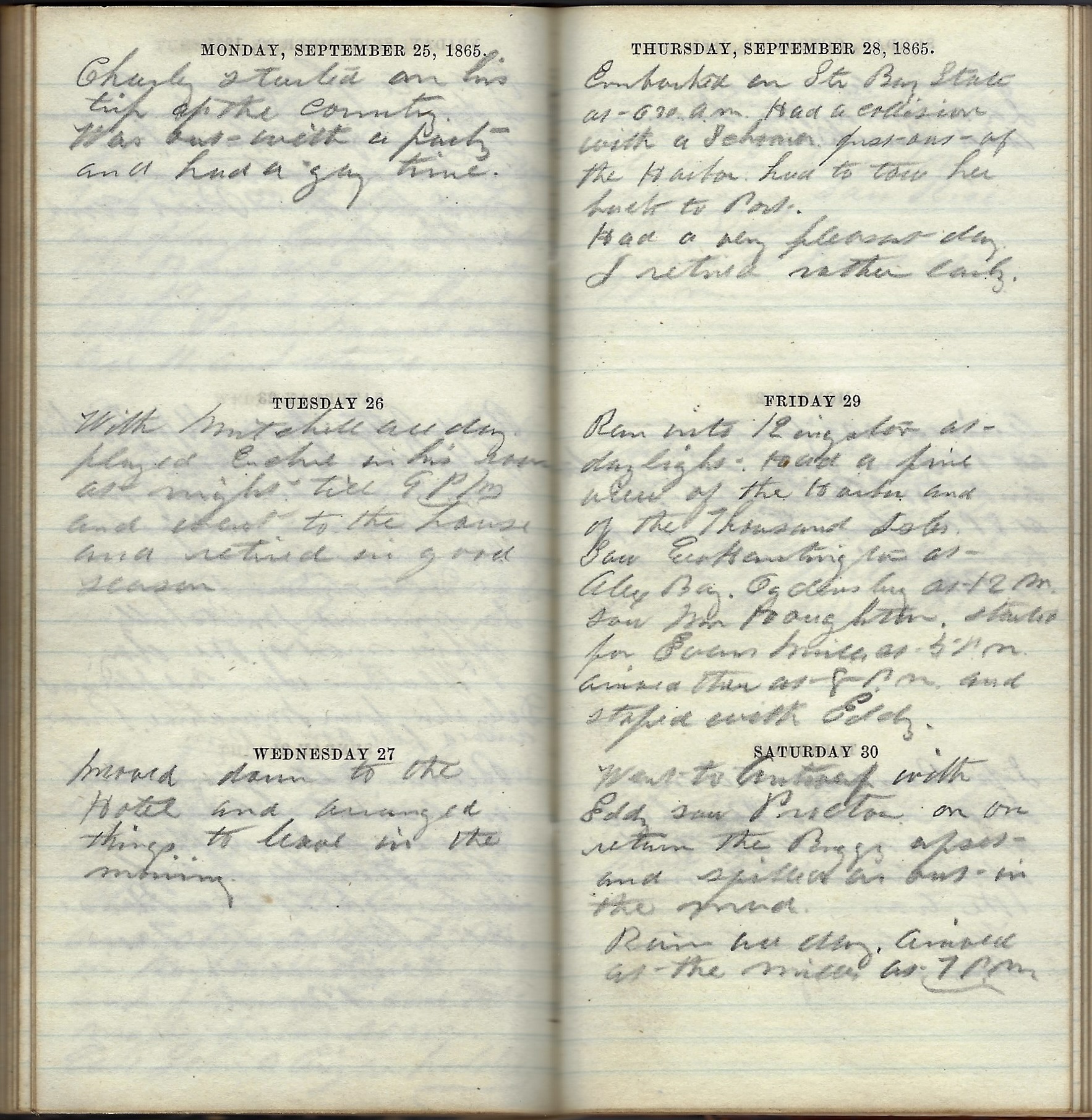
Wednesday, 27—Moved down to the Hotel and arranged things to leave in the morning.
Thursday, September 28, 1865—Embarked on Steamer Bay State at 6.30 a.m. Had a collision with a schooner just out of the harbor. Had to tow her back to port. Had a very pleasant day. I retired rather early.
Friday, 29—Ran into Kingston at daylight. Had a fine view of the harbor and of the thousand isles. Saw Geo. Huntington at Alex. Bay, Ogdensburg at 12 M Saw Mr. Houghton. Started for Town [?] Mills at 5 p.m. Arrived there at 8 p.m. and stopped with Eddy.
Saturday, 30—Went to Antwerp with Eddy. Saw Proctor and on return the buggy upset and spilled us out in the mud. Rain all day. Arrived at the Mills at 7 p.m.
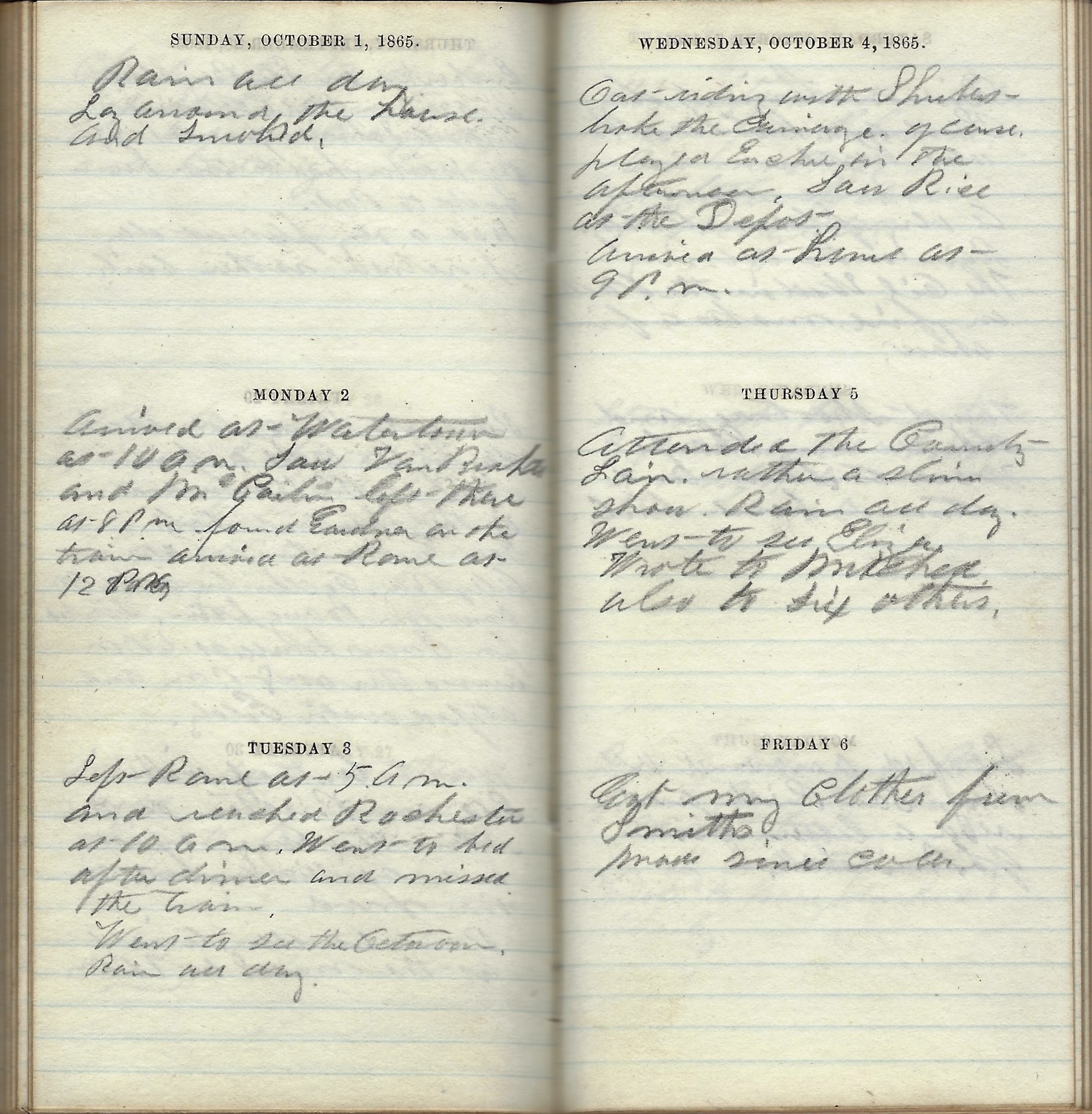
Sunday, October 1, 1865—Rain all day, Lay around the house and smoked.
Monday, 2—Arrived in Watertown at 10 a.m. Saw Van Broke and McCaiton [?]. Left there at 8 p.m. Found Gardner on the train. Arrived at Rome at 12 p.m.
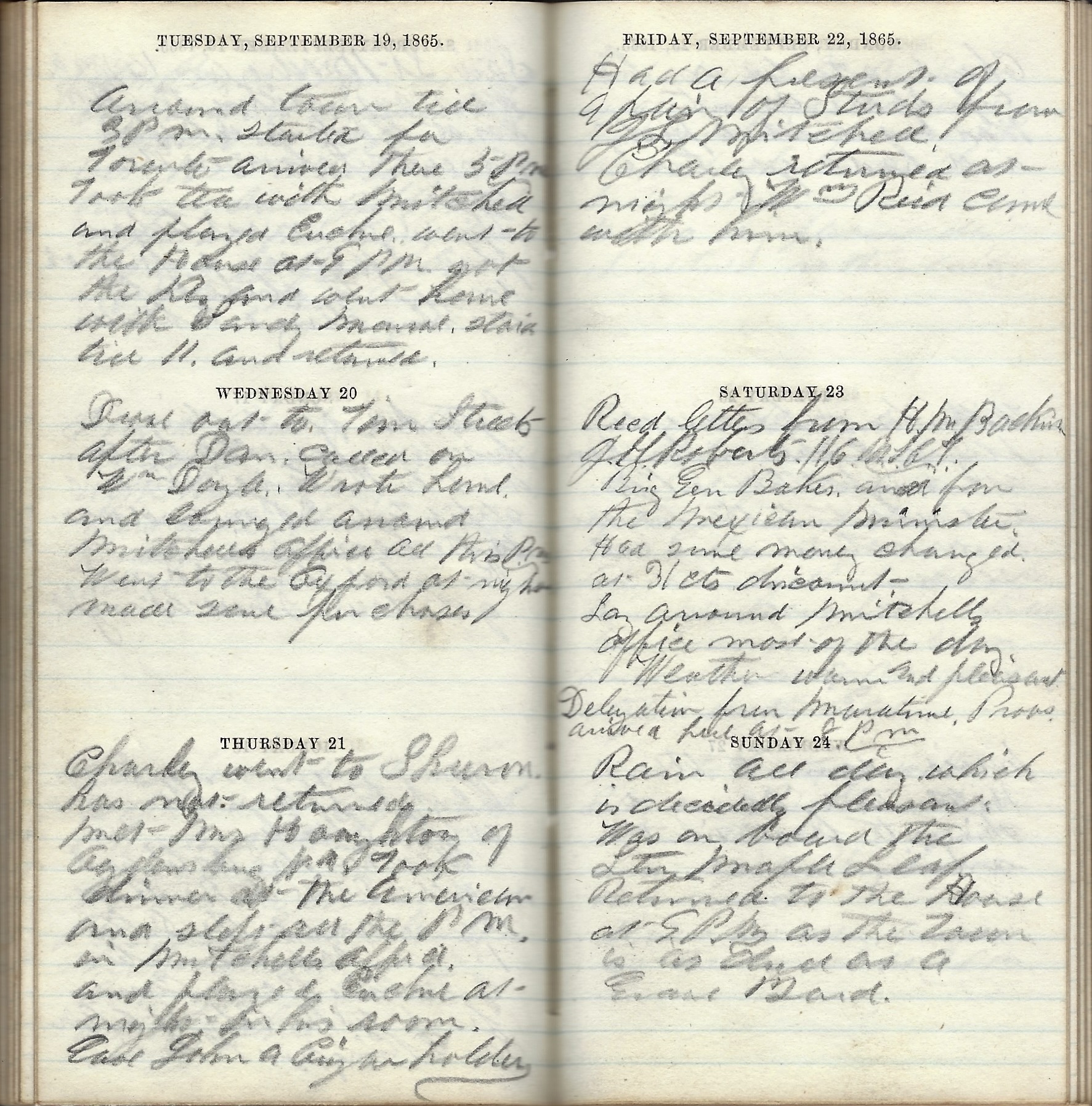
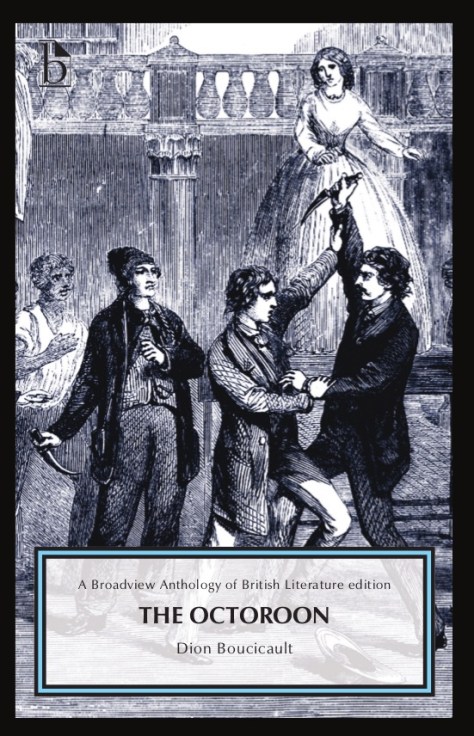
Tuesday, 3—Left Rome at 5 a.m. and reached Rochester at 10 a.m. Went to bed after dinner and missed the train. Went to see TheOctoroon. Rain all day.
Wednesday, October 4, 1865—Out riding with Shules. Broke the carriage of course. Played Euchre in the afternoon. Saw Rice at the Depot. Arrived at home at 9 p.m.
Thursday, 5—Attended the County Fair. Rather a slim show. Rain all day. Went to see Eliza. Wrote to Mitchell. Also to six others.
Friday, 6—Got my clothes from Smith’s. Made some calls.
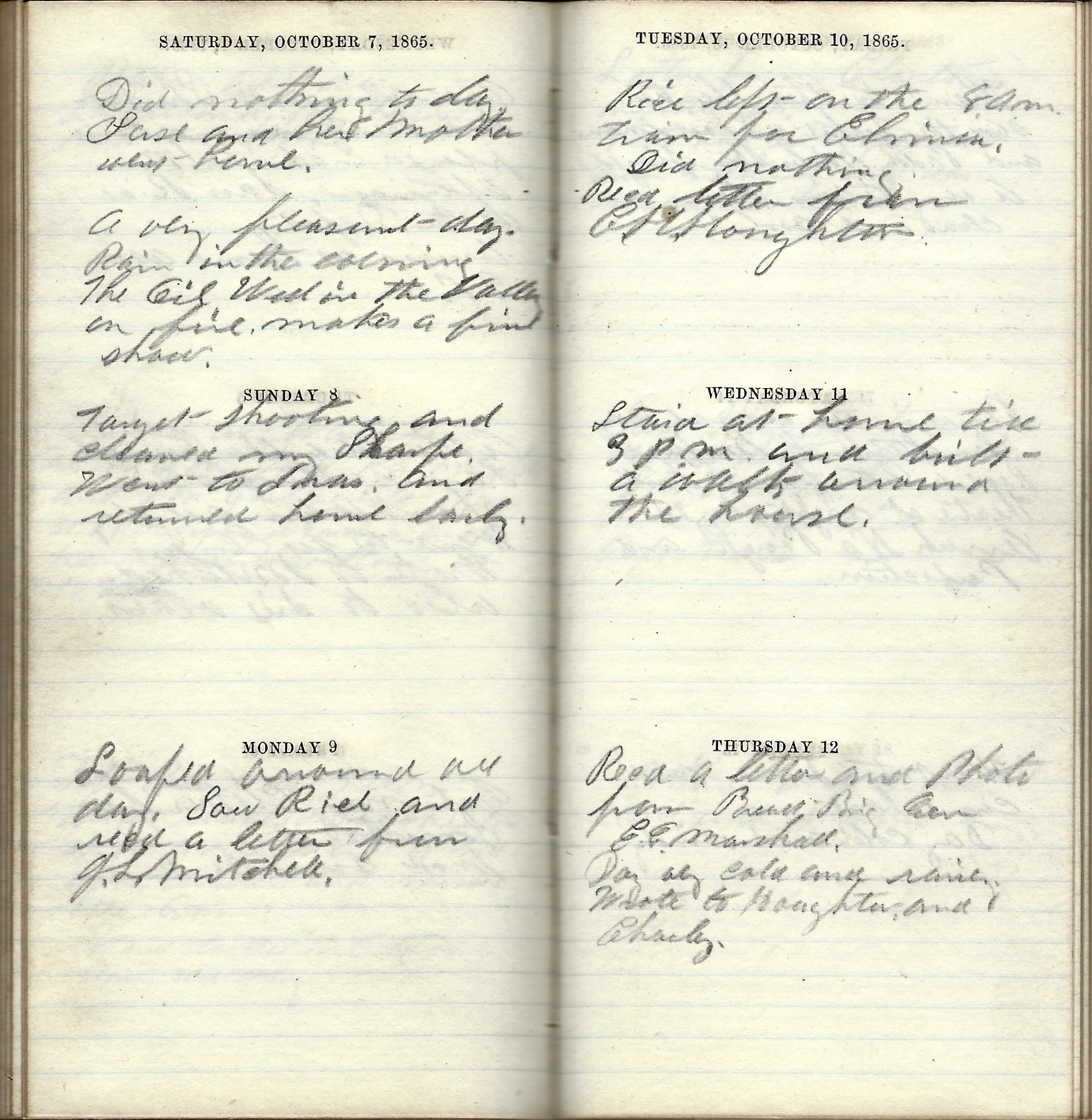
Saturday, October 7, 1865—Did nothing today. [ ] and his mother went home. A very pleasant day. Rain in the evening. The oil well in the valley on fire. Makes a fine show.
Sunday, 8—Target shooting and cleaned my Sharpe. Went to John’s and returned home early.
Monday, 9—Loafed around all day. Saw Rice and received a letter from J. L. Mitchell.
Tuesday, October 10, 1865—Rice left on the 8 a.m. train for Elmira. Did nothing. Received letter from C. H. Houghton.
Wednesday, 11—Stayed at home till 3 p.m. and built a walk around the house.
Elisha G. Marshall
Thursday, 12—Received a letter and photo from Brevet Brig. General E[lisha] G. Marshall. Day was cold and rainy. Wrote to Houghton and Charley.
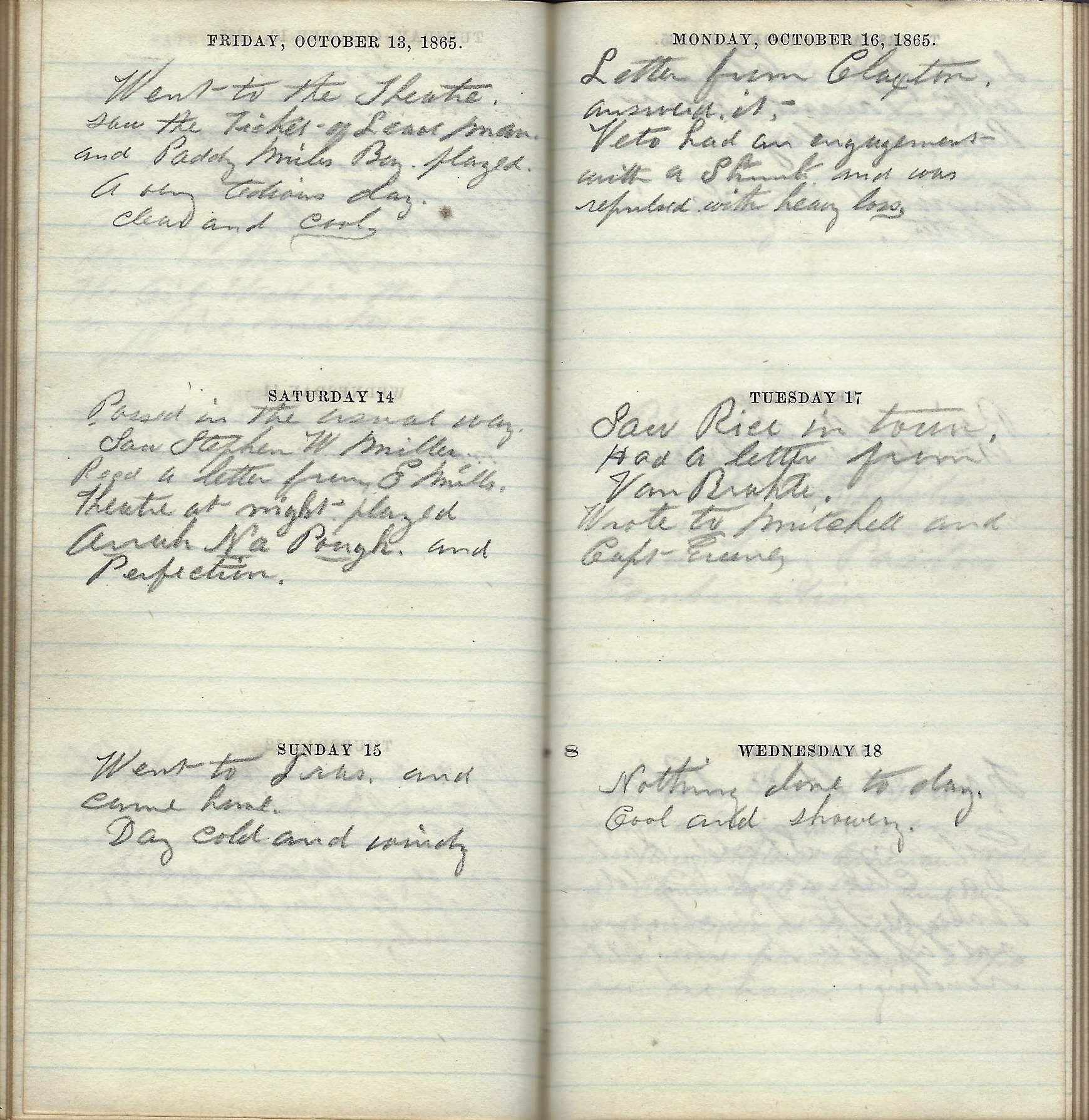
Friday, October 13, 1865—Went to the theatre. Saw the tickets of Lead Man and Paddy Miles Boy played. A very tedious day. Clear and cool.
Saturday, 14—Passed in the usual way. Saw Stephen W. Miller. Received a letter from E. Mills. Theatre at night played Arrah-na-Pogue and Perfection.
Sunday, 15—Went to [ ] and came home. Day cold and windy.
Monday, October 16, 1865—Letter from Clayton. Answered it. Veto had an engagement with a skunk and was repulsed with heavy loss.
Tuesday, 17—Saw Rice in town. Had a letter from Van Bruht. Wrote to Mitchell and Capt. Greene.
Wednesday, 18—Nothing done today. Cool and showery.
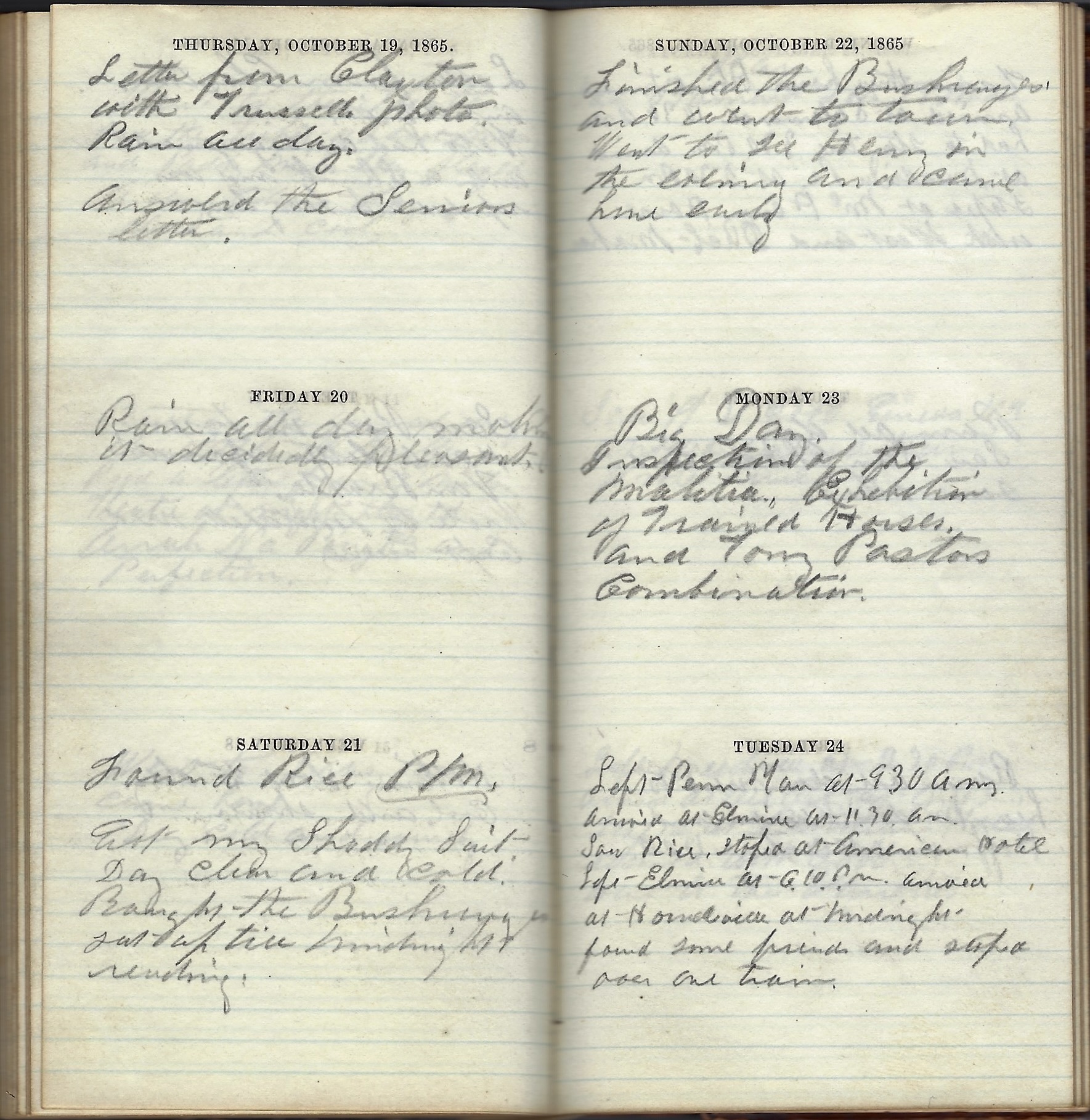
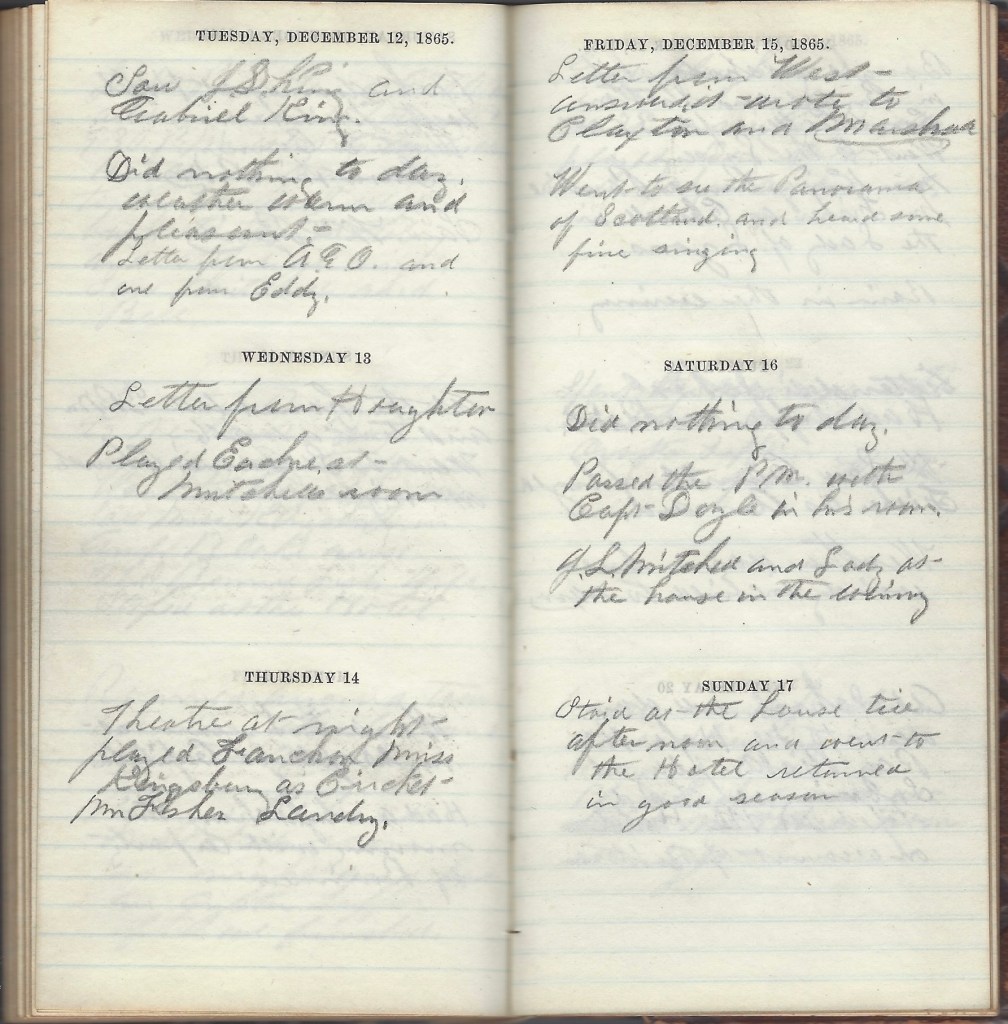
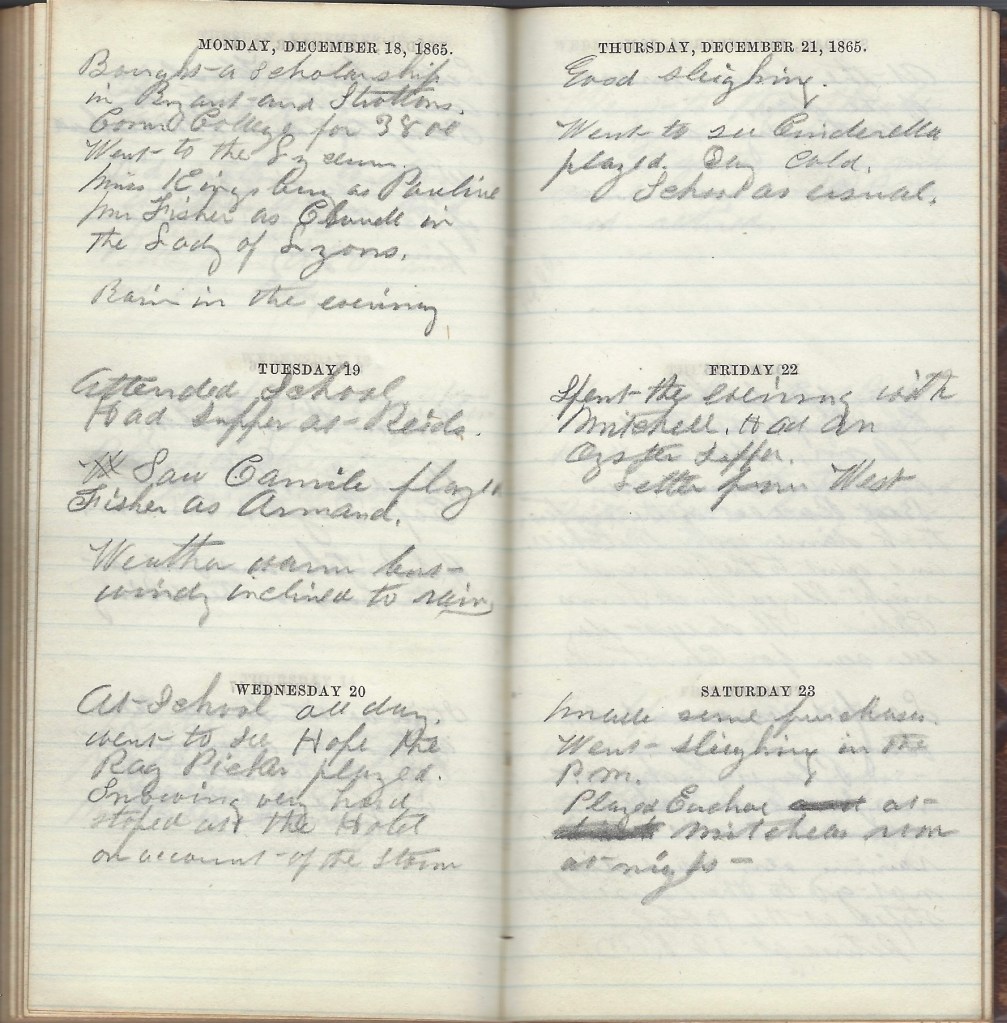
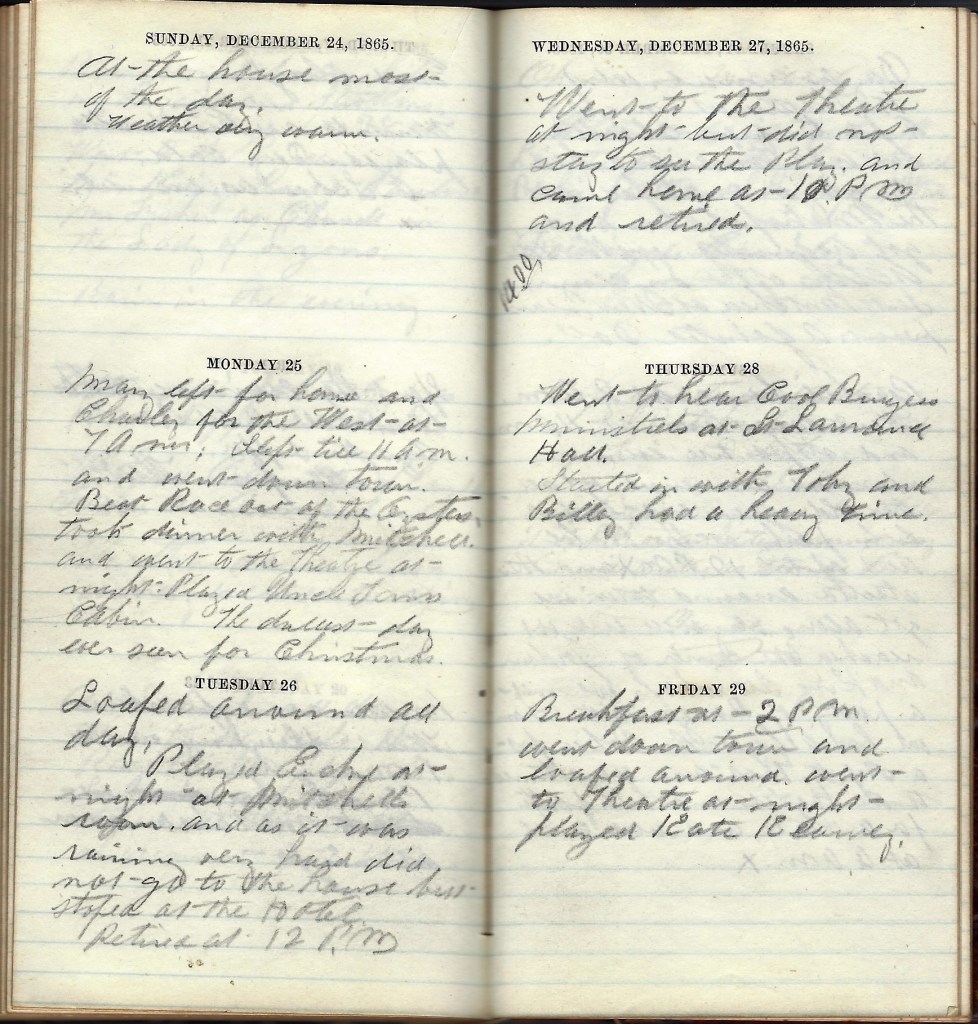
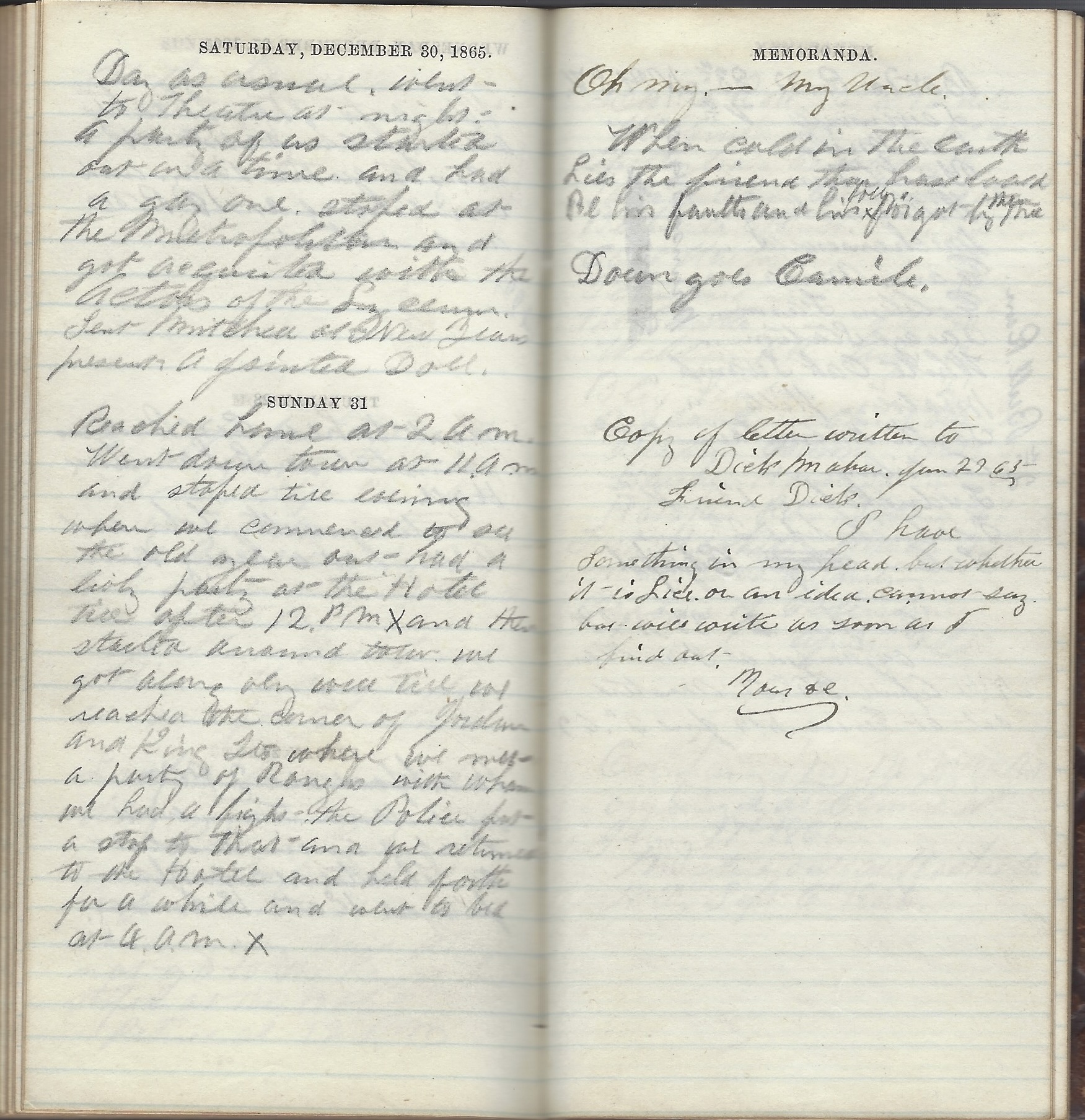
October 18, 1865 through November 5, 1865
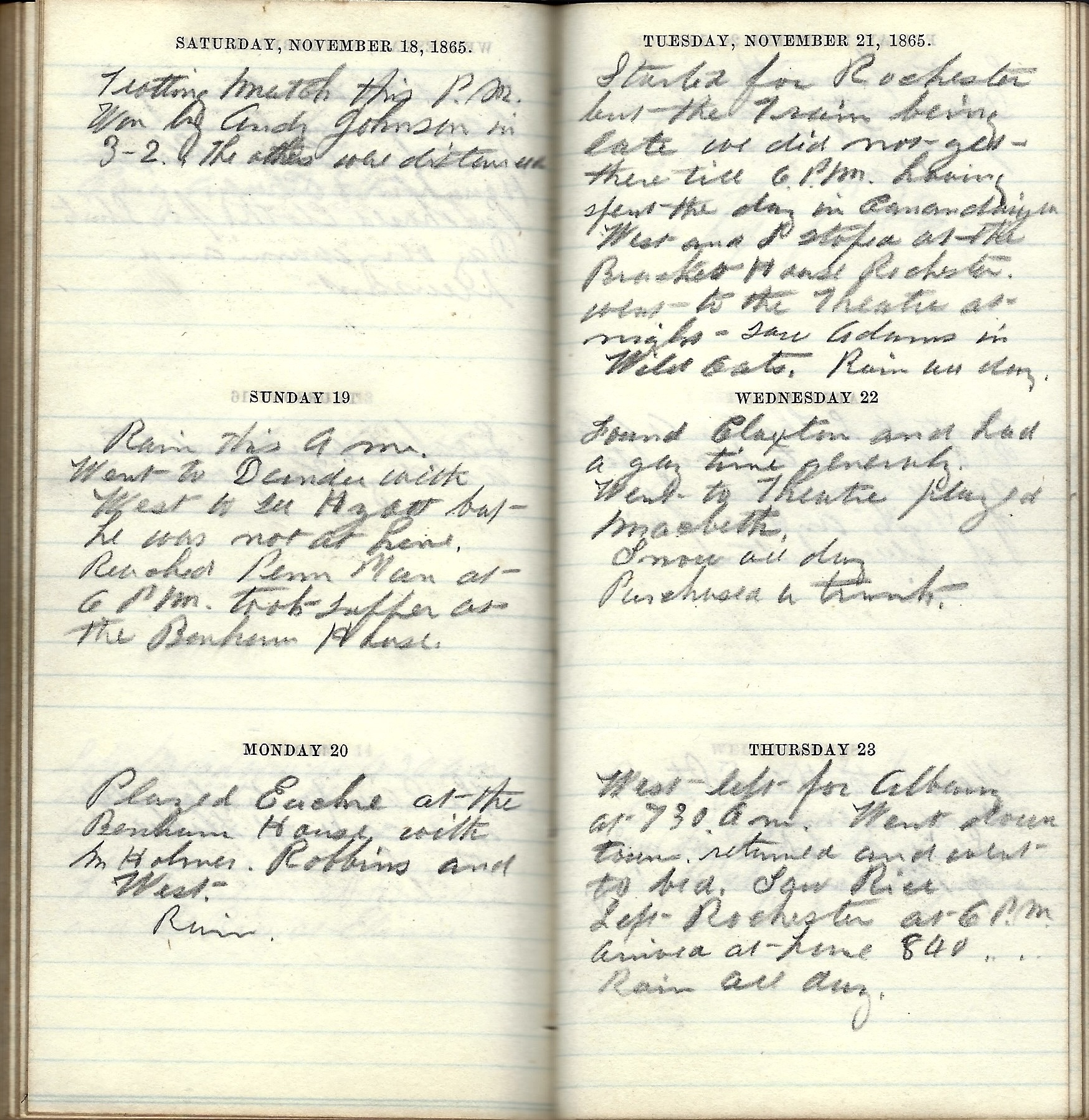
November 6, 1865 through November 23, 1865
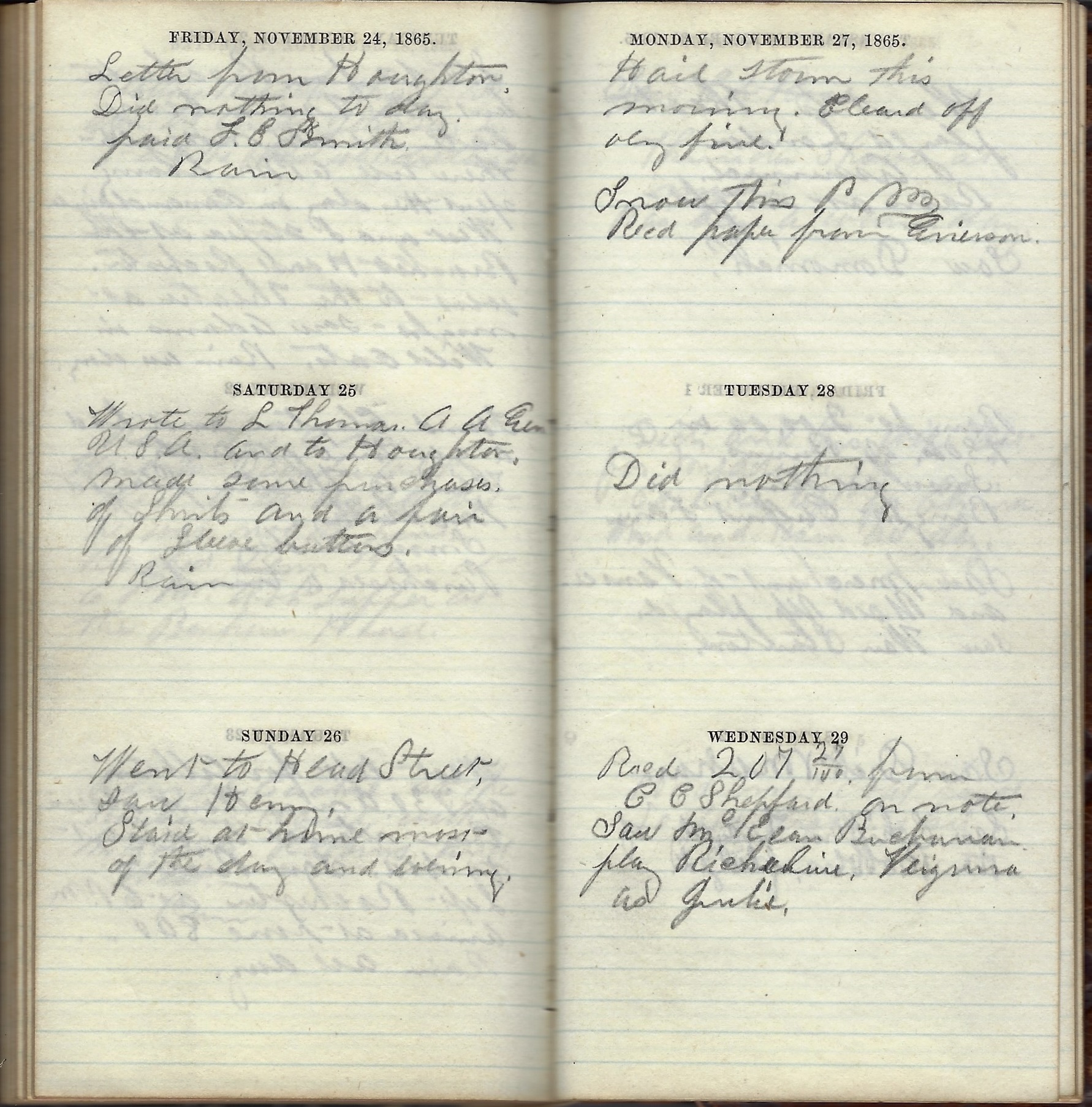
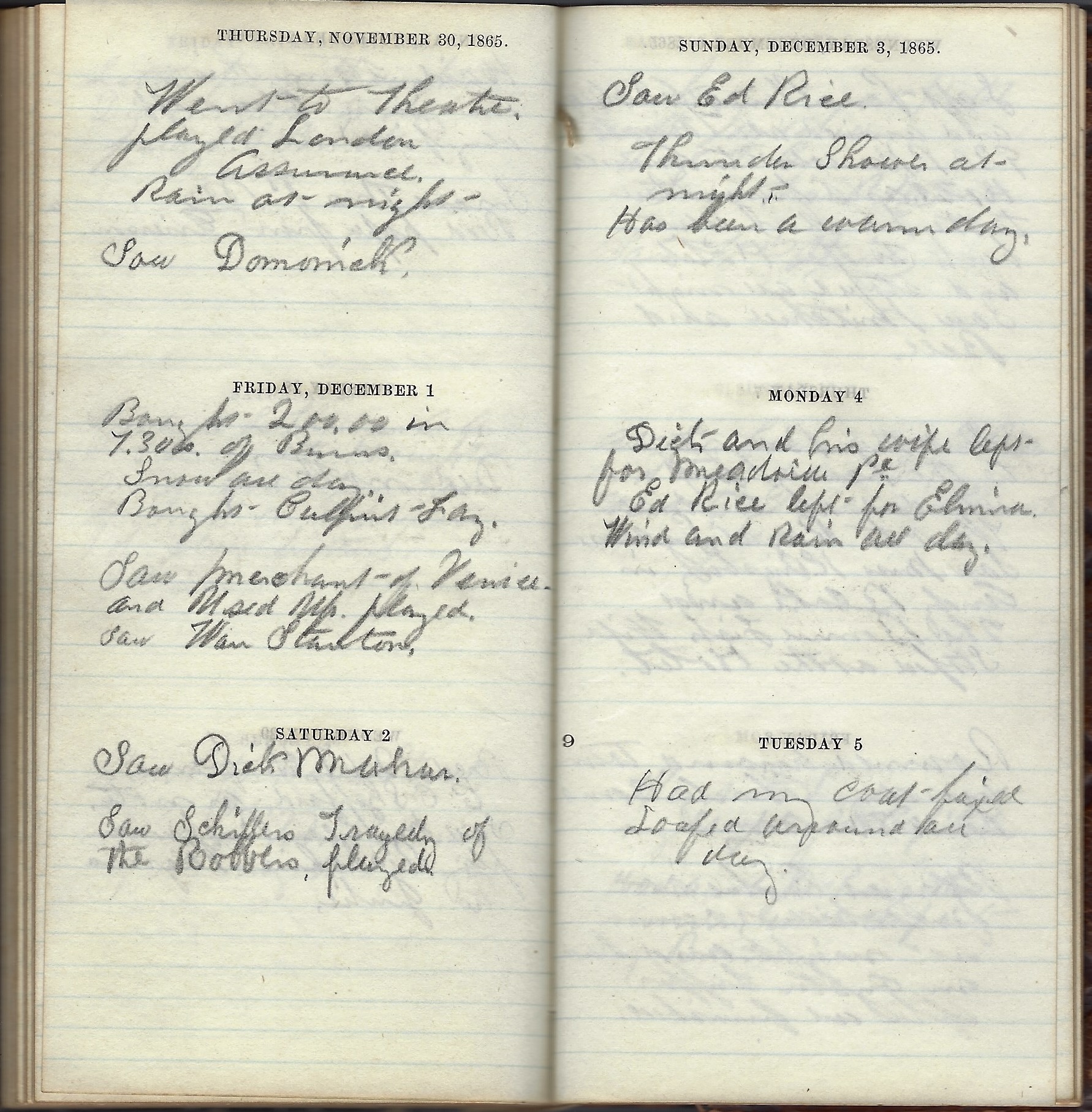
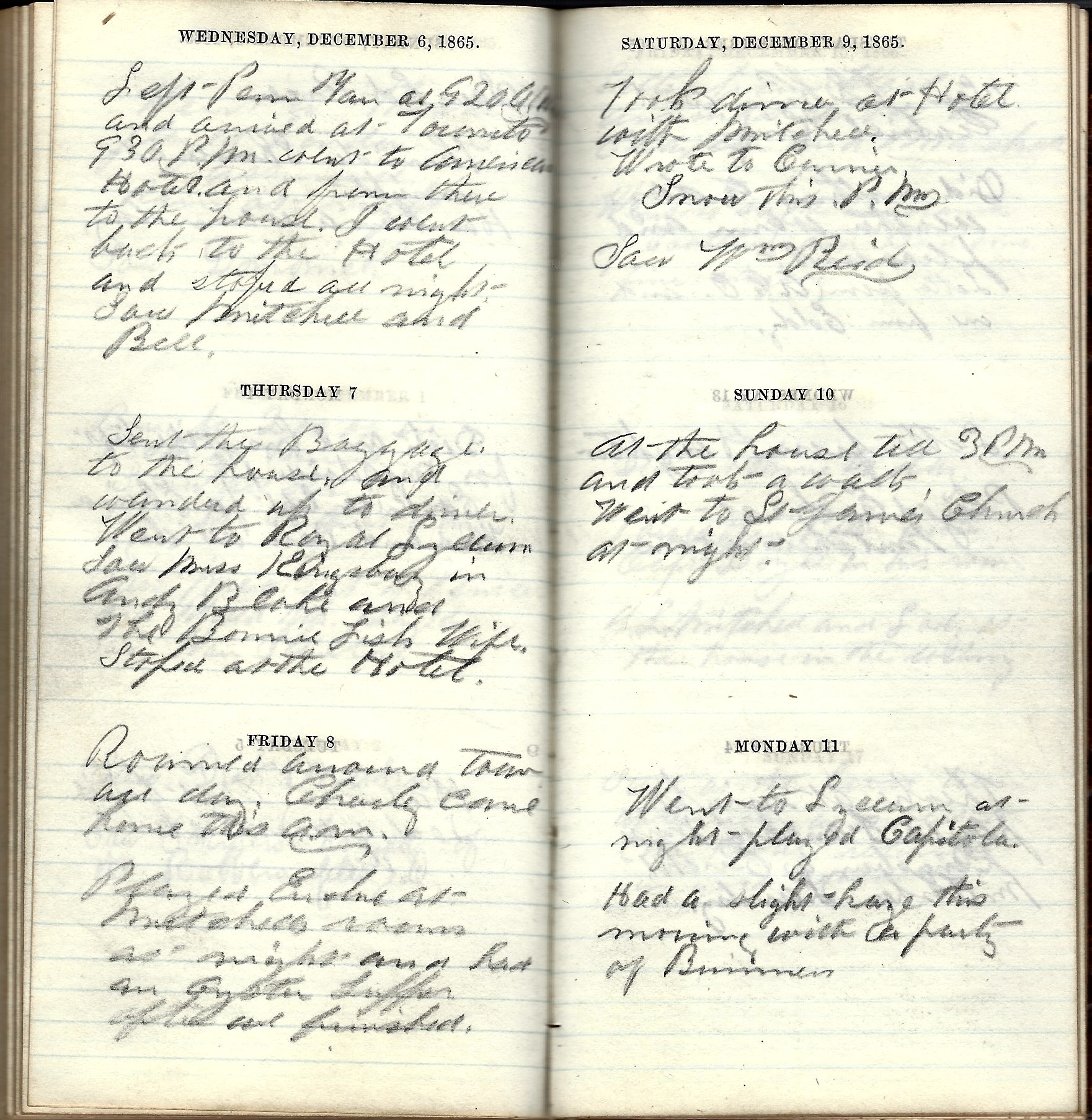
November 24, 1865 through December 11, 1865
December 12, 1865 through December 29, 1865
List of battles in which the 33rd New York Infantry was engaged as well as those in which the 14th New York Heavy Artillery was engaged.
Inscriptions in Rebel Cemetery at White Oak Seminary [in Confederate records, called the “White Oak Hospital” in Petersburg. L. R. P. Sic Semper Tyranus U. W. Bacon, Co. B, 12 Batt. Georgia Cavalry P. H. Moore, Co. E, 19th Arkansas Regt. [died at White Oak Hospital in Petersburg 28 July 1863] W[illiam] W. Dodd, Co. C, 41st Virginia [died at White Oak Hospital in Petersburg 22 July 1863, cause of death Anasarca.] Isaac Stephens, Co. I, 45th North Carolina Troops [50 y.o. from Caswell Co.] J. D. Mustian, Co. G, 1st North Carolina Cavalry
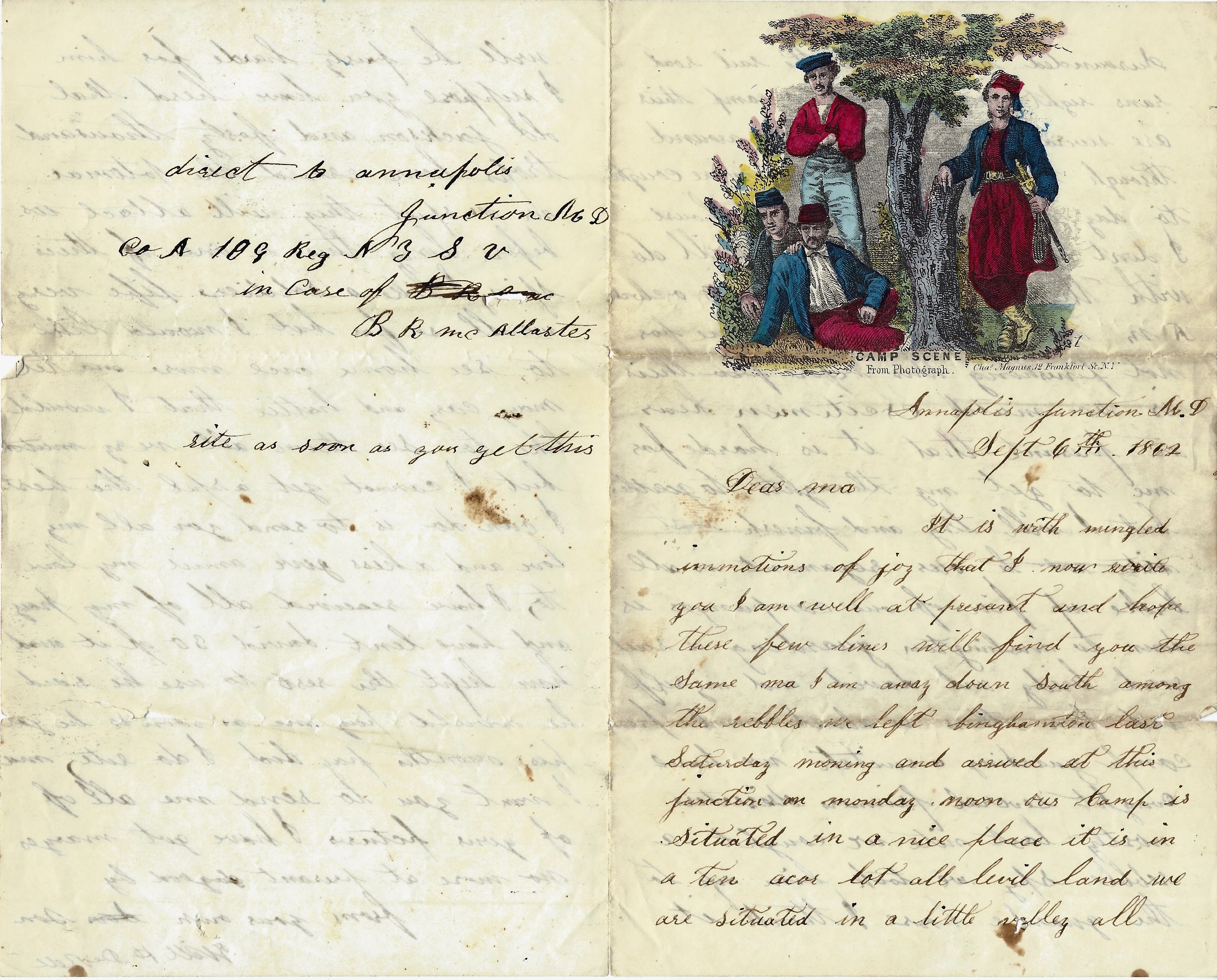
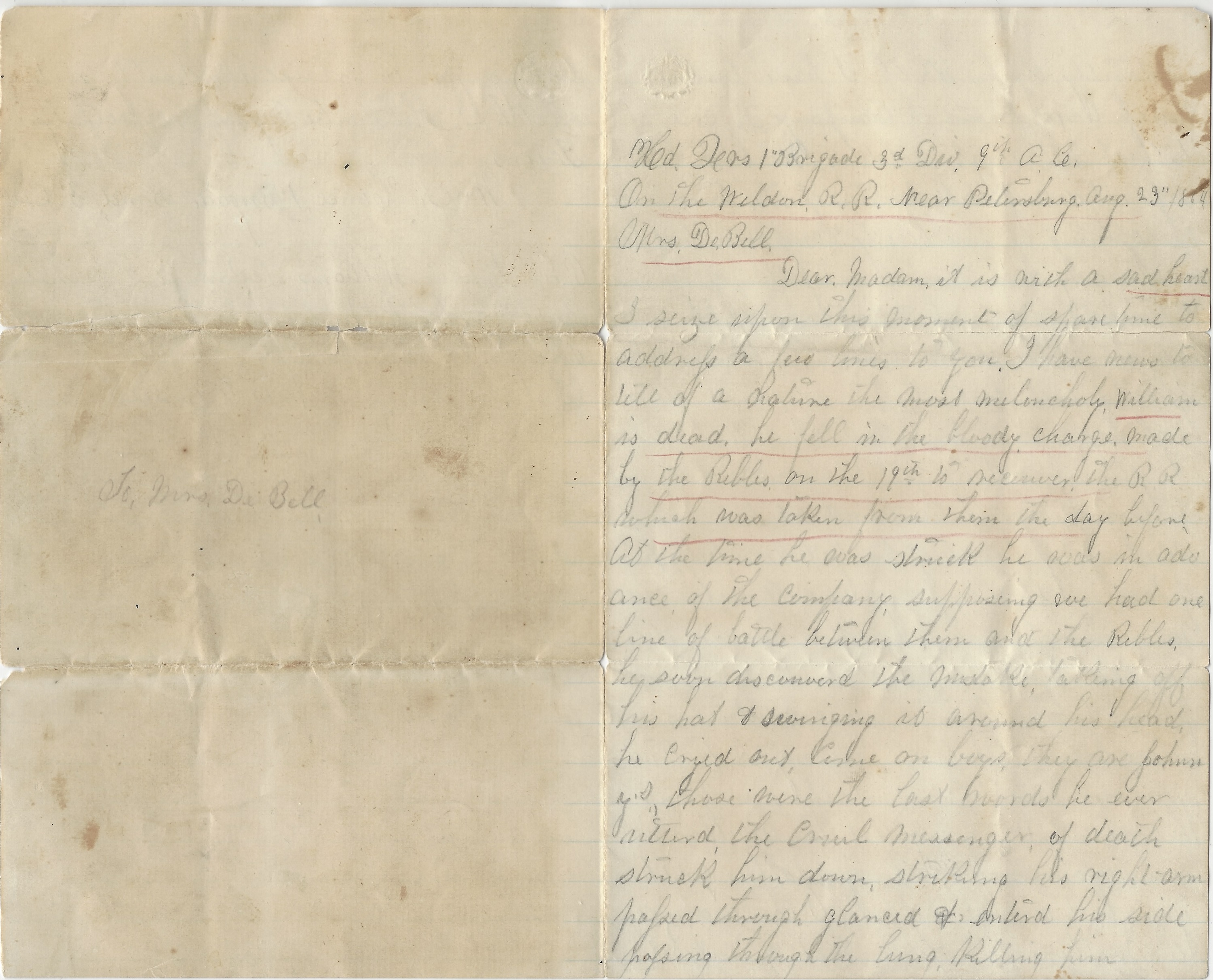
The following letter was written William (“Bill”) H. Debell (1844-1864) who accepted a $70 bounty and enlisted when he was 18 as a private in Co. A, 109th New York Infantry. He was the son of Daniel W. DeBell (1810-1881)—sometimes spelled Dibble—and Phebe Ann Fairchild (1814-1910) of Danby, Tompkins county, New York. Bill was not close to his father. His father and mother separated in January 1858 leaving Phebe without property and offered no further support to his wife and the four children (including Bill) who were left in the household. In the 1850 census, the DeBell family was enumerated in Shandaken, Ulster county, New York, where Bill’s father worked as a millwright. At that time, there seven children in the family ranging in age from 1 to 16.
(courtesy Don Andrew Collection)
Company A of the 109th New York Infantry was primarily recruited from the towns of Newfield, Caroline, and Danby in Tompkins County, New York. Bill took his place in the ranks with other young men from Tompkins county, many of whom were his friends from Danby. The Regiment began its assignment during the first week of September, 1862. A few days later several companies were detached to garrison Laurel, MD (about 8 miles SE of Annapolis Junction) to guard the main railroad junctions located there. The 109th remained at this assignment but was reassigned in October 1862 to the 22nd Army Corps as railroad guards and part of the 22nd’s overall defense of the Capital at Washington, DC against the threat of Gen. Robert E. Lee’s Army of Northern Virginia’s presumed invasion. The invasion never came. Their job was tedious and boring and they saw no military action of any kind.
The 109th did its duty from September 1862, the remainder of 1862, all of 1863 and through the end of March 1864. Then in April, 1864 the 109th was ordered to join the 9th Army Corps then assembling at Annapolis, MD in preparation for action against General Lee at Petersburg, VA. The 109th Regiment became part of Hartranft’s battle-tried 1st Brigade, Wilcox’s 3rd Division, 9th Army Corps, Army of the Potomac. The 9th Corps left Annapolis on 23 April, 1864 headed for the crossing at the Rapidan arriving there on the 4th of May, 1864. The next morning, 5 May, 1864, the 109th, after crossing the Rapidan as one of the lead units, were immediately fully engaged with the enemy in the Battle of the Wilderness. Though they had been in the service 1 year, 8 months, and 9 days since they organized in the late summer of 1862 at Binghamton, New York, it was their first taste of battle.
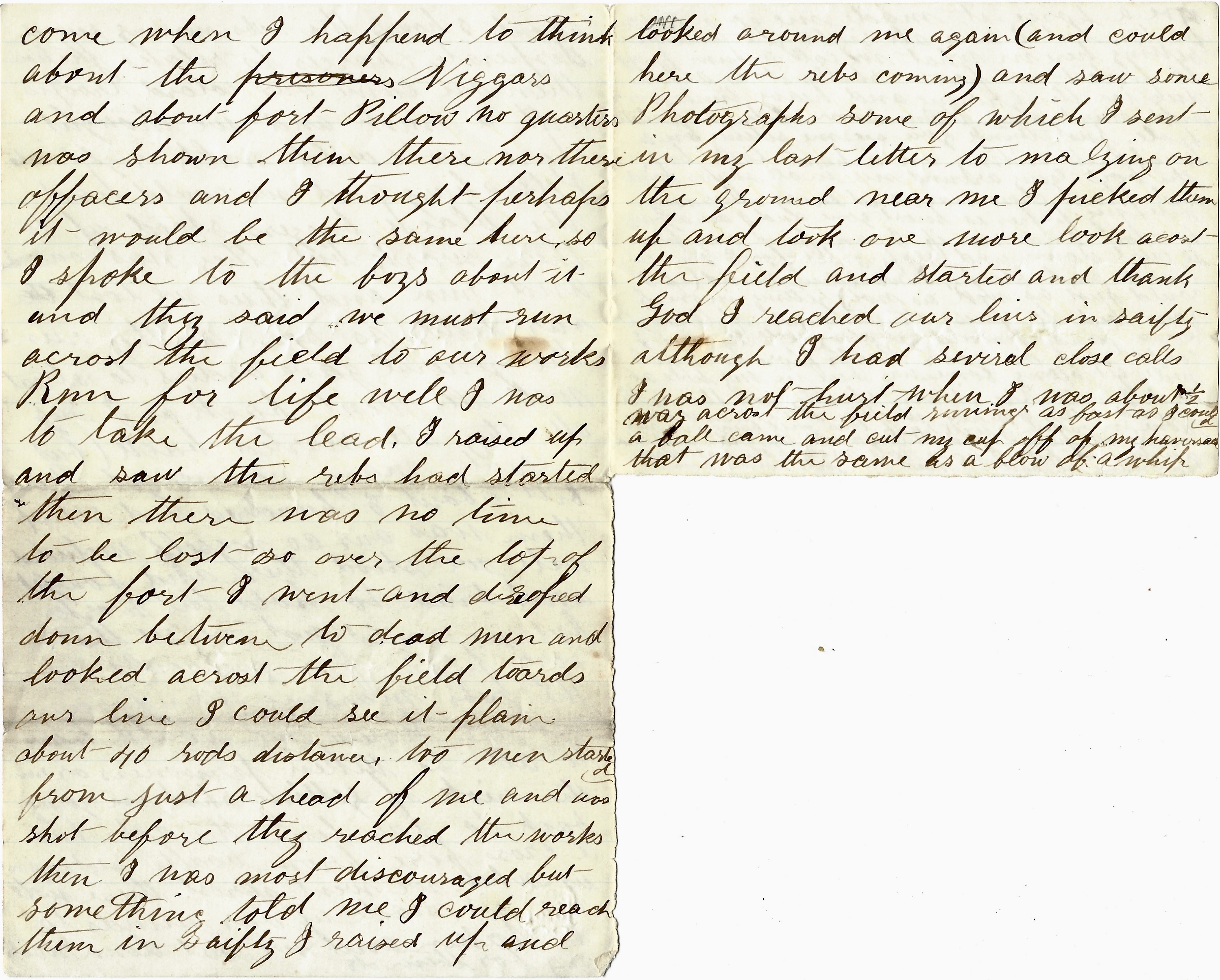
Bill would go on to fight in eight major pitched battles with the 109th New York until he was finally cut down in the Battle of Weldon Railroad on 19 August 1864. there are seven letters presented here by Bill DeBell and two by William A. Hance, a comrade in Co. A who wrote letters to Bill’s family informing them and providing some details of Bill’s death.
These letters are from the personal collection of Don Andrew who sent them to me for transcription and publication on Spared & Shared by express consent.
Those interested in the 109th New York may find any of the following published on Spared & Shared equally good reading:
It is with mingled emotions of joy that I now write you. I am well at present and hope these few lines will find you the same. Ma, I am away down South among the rebels. We left Binghamton last Sauturday morning and arrived at this Junction on Monday noon. Our camp is situated in a nice place. It is in a ten-acre lot, all level land. We are situated in a little valley all surrounded with woods. The railroad runs right in front of our camp. There are several of the rebels around through the woods. Two of them were caught today and put in the guard house. I don’t know what they will do with them.
Monday morning, 8 o’clock a.m. Ma, you must excuse me for not finishing this before for there is so much excitement here at present that it is hard for me to get my thoughts together but I will try and finish. Our regiment is all broke up. Five of our companies is down to Washington guarding a railroad bridge and David and myself and ten others is about a mile from camp guarding a switch. We have caught several prisoners—[Union] deserters mostly. Last night we caught a rebel spy. We took him up to the guard house. I think it will be pretty hard on him. I suppose you have heard that Old [Stonewall] Jackson and forty thousand troops have crossed the Potomac. We expect they will attack us before long. This is one of their spies.
I like a soldier’s life very well so far but I would like to see home once more and tell Mary, Carrie, and Hattie that I would like to see them all very much but I cannot yet a spell. The best I can do is to send you all my love and a kiss. Give Annie my love too. I have received all of my pay and have lent David 30 of it and have kept the rest to use. He said he would pay me as son as he got his month’s pay. Did I do right, Ma? I want you to send me all of your pictures. I have got Mary’s. No more at present so goodbye from your own son, — Will H. DeBell
Direct to Annapolis Junction, Maryland Co. A, 109th Regt. N. Y. State Volunteers in care of B. R. McAllaster. Write as soon as you get this.
Letter 2
[Not transcribed. Words to Just Before the Battle, Mother.]
Letter 3
[Editor’s Note: In this 16 page letter to his mother of 17 May, 1864, Bill describes seeing the elephant for the first time.]
Spotsylvania Court House, Va. May 17th 1864
Dear Ma,
Once more I am seated to write to you although I may never get the letter finished for I am on picket within 20 rods [@ 100 yards] of the enemy and they are firing at us every moment. There are three of us on a post and we have a little breastwork thrown up before us about two feet high. I am sitting close down behind it writing on my cartridge box & every moment a bullet whistles over my head. I wrote you a letter when we was at Warrington Junction. Little did I think then that we was coming so soon to the front but we left there the day after I wrote to you and never stopped until we arrived at Wilderness Church. We was three days a marching it. We crossed the Rapidan in the afternoon & was marched about 5 miles & put on picket—
Dear Ma, just as I wrote the word picket, one of the men that was on post with me was shot through both thighs [?]. Poor fellow. I sent to the regiment and some of his company came and got him.
—and kept on all night and about 5 o’clock in the morning we fell in and was marched about 3 miles without any breakfast to the battlefield. Oh! I cannot tell my feelings when we was marched up in front of the Rebel batteries, the shell a flying. but we did not flinch and only 8 of us men was wounded, none killed.
About noon we fell in [and] marched off to the left. As we was marching by the left flank, the rebels poured a whole volley into us that confused and excited us and we fronted and fired on them and we fought there all the afternoon and only three got wounded out of our company, none killed. We made four charges and drove the enemy out of their rifle pits and captured about 5 prisoners. Our firing ceased about dark and we built breastworks and lay in them two or three days and held our position. Then one night the rebels set up a terrible hootin’ and hollerin’ and we thought they was agoing to charge on us but it was [only] to blind a movement. They moved off to our right so that night about 2 o’clock we was ordered to fall in and was marched until daylight and made a halt for breakfast after which we took up the line of march again & marched until about 4 p.m. and made a halt and drew 5 days rations.
Stayed there until 5 in the morning and marched again to this place & was double quicked up a long hill through shot and shell to the very front, formed in line, and drove the enemy back. Then we throwed up breastworks with our bayonets and plates & lay there two or three days, the enemy making several desperate attacks to break our line but did not.
On May 11th, they made their last attempt at that point and here is memoranda I kept from that time. “May 11th, 6 p.m. The enemy commenced shelling us in our rifle pits and their pickets advanced on us at the same time so we sent out 100 men out of our regiment as skirmishers and they advanced and drove them back a ways. Then our batteries opened on them and soon silenced theirs. Then we was ordered to advance out of our pits so the whole Brigade marched over and cautiously approached them. We—the 109th—had went only a short distance when we was ordered to support the 8th Michigan Regiment. We was marched by the right face, then left flank and formed in about 50 rods behind them and lay down flat. The bullets flew very thick but there was but a few wounded. One poor fellow from the 8th Michigan got his leg shot off.
Well, we lay in that position about an hour. Then we was ordered to form a junction with the breastworks we had just left, so the Brigade formed in line and marched directly southeast until we came to a piece of woods. Then we changed direction to the right and marched southwest about a mile and fronted, then lay down & watched until morning. At daylight we was ordered to build breastworks so we went at them and have them done and are waiting for the attack.
It is Friday, 13th. I left off writing the 11th while in the above named breastworks. Well, we had no attack that day. About 3 o’clock we was ordered to fall in. We did so and was marched to the rear—that is, off the field. Then it commenced raining very hard. Well, we was marched down in an open field and those that had tents put them up and those that did not had to take the rain. Well we had just got our suppers a cooking and the order came to fall in double quick. We did so and was marched back about halfway to the field and halted and we stood there in the rain and mud about an hour (Ma, could you but have known my thoughts while standing there, cold and wet. Be it ever so humble, there is no place like home!) Then the order came to about face and was marched back where we started from and camped down. Our things was all wet and it was quite cold.
Well [Daniel] Mc[Pherson] & G[eorge] Roe & me went off and got a couple of rods of rails apiece and built a large fire and we spread our rubber blankets and lay down. (We had nothing to put over us for we threw everything away in the first battle at Wilderness Church.) We all being very tired, soon fell asleep and slept sound until 2 o’clock. Then we was woke up and packed our things and marched up here where I now sit and was formed in line of battle but was held in reserve until noon. Then we was ordered to charge on a Rebel battery and we marched up in the edge of the woods andjust as we got there, they opened upon [us] with shot and shell and our men fell like grass before a scythe. But on we went, but did not get the battery. We had to fall back and when we got out of the woods, all we could count out of 400 was 150. We was cut bad, I tell you. General Burnside said it was the boldest charge that he ever saw made. He said he would remember us. We are called a brave regiment. Several other regiments broke and run but ours stood right up to the mark.
Well, after we came back, we went at it and built breastworks—(in the morning it commenced raining and rained very hard all day)—so that we could hold our position. Well we got them done and got in them, mud up to our knees, but we had to lie down and we lay there all night and are here yet and this is the 3rd day.
May 15th—Well here we are yet and still it rains and the mud. Last night the enemy’s pickets bothered us all night and it was so cold and it rained so hard that it was very uncomfortable. It is morning now and we are still in the mud and rain but there is some very encouraging news and it [illegible]…Colonel told us that we had taken 8,000 prisoners and 40 pieces of artillery and also Richmond was in our possession. I hope it is so. I just heard from our chaplain that there was two Corps down to the rear that was agoing to relieve us and I must say I hope they will for this is the tenth day we have been out to the very front of the battle. I never heard of such a thing before—keeping men out on the front so long without a relief. Our men are getting very tired and wore out (tell Sarh she would not know the 109th if she should see it now. The regiment looks when it’s all together about like a good company).
It is Sunday the 15th. We are still in the pit and we begin to think we are agoing to stay in them for all being relieved. The enemy was very quiet in our front last night, but on our left they had a heavy battle. Yesterday afternoon the Johnnies charged on one of our batteries & they opened on them with 16 pieces and cut them full as bad as they did us the 12th. The Rebel sharpshooters troubles us very much for every time one of us raises our heads or stirs around, they shoot at us too and there was two men from some other regiment got killed yesterday, the 12th, and one today. Every man that goes out has to go on his hands and knees or go half double. The officers is the main thing they are after.
May 16th. Still in the entrenchments. The sharpshooters trouble us yet but they do not advance. We sent out a heavy line of skirmishers today so as to advance our pickets. Done t without much trouble. Last night our Corps fetched us up a kettle of beef stew. It was good, I tell you, for we was all very hungry.
May 18th. There is my memoranda from the 11th to 17th. I am back in with the company. I was relieved last night about six o’clock from picket. Came here and George Roe 1 had my supper ready for me. I eat it and we spread our rubber [blankets] and lay down. Slept until morning when we was woke up for our coffee. After we drank that and eat our crackers, we was startled by the rattle of musketry on our front. We jumped to our places, sat there a spell, and found it was nothing but the pickets. But about half an hour and our batteries opened, the enemy’s replied, and they kept up all the forenoon. It has ceased now but expect every moment when they will open again but it is hopeful that they will keep still for them shells are very disagreeable—especially when they come so close that the wind of one will blow your hat off as one did me the 12th in that battle. I have always heard say it was an awful feeling to go into battle but never thought it was such a feeling as it really is. I can’t begin to tell nor explain but after you have been in a little while, you don’t mind it so much.
There is 230 killed, wounded and missing in the battle, 21 out of our company. Namely: May 6th, wounded, John Conners in the arm; Peter Swint [in the] leg, and William Smith [in the] hand. May 12th, wounded, Henry Beardsley [in the] leg. John Sumers [in the] hip, Colins Causdale [in the] hand, Alfred Earsley [in the] hand, Sturgis Williams [in the] hand, Dwight Ostrander [in the] leg, Philander Evans [in the] leg, Horace Todd [on the] arm, Charles Truesdell [in the] arm, Lewnis Purdy [in the] leg. Killed, John [G.] Nichols, Amos Barber, Henry Person, Abram Scales, George Pierson, William Lours. Missing, Harrison Little. These are all from our company.
After we fought the last battle, the Capt. Mc[Allister] was taken sick and went to Fredericksburg to the hospital. Col. [Benjamin F.] Tracy has resigned. The Lt. Colonel [Isaac S. Catlin] takes his place.
Ma, just imagine you are looking on a side hill and along the edge of a piece of woods along which you see a large ditch dug (or first say it has been raining a week very hard) with the dust all thrown out on one side making a bank high enough so that a man can stand on his feet and look over and occasionally you will see a small piece of [ ] stuck up. Well down in this pit or ditch you will see all along against the bank a row of guns with bayonets on and down in the bottom you will see men dying in all shapes in the mind. In imaging this, you will see the 109th and about the center of the pit you will see one with a small piece of board on his knee with pencil & paper writing. You may guess who it is. This paper I picked up in the battlefield. Some of the boys said that they saw David go through Chancellorsville the other day. You will, perhaps, know more about it than I would for I presume you hear from him and I don’t. I hope he has not been in this last battle for there was a large number of cavalry captured and poor Franky might have been one of them.
Ma, I will have to bring this to a close for the muskets begin to rattle and I am afraid I cannot send it at all. Goodbye. Write soon. — Will H. DeBell
Goodbye all until you hear from me again. Write soon.
1 George Roe (1831-1864) served with Bill DeBell in Co. A, 109th New York. They were both from Danby in Tompkins county, New York. Three of his letters were published on Spared & Shared in April 2025 (see 1863: George W. Roe to Sarah Adeline (McPherson) Roe.) In his letter of 9 September 1863 written from Annapolis, George mentions William DeBell as follows: “Reuben Youngs got his face severely burned this afternoon. It happened in this way. William DeBell—one of our tent mates—got a cannon cartridge while on patrol down to Savage & brought it to camp & hung it up in the tent. While he was out, Harrison [Tompkins] and Reuben thought they would come a joke on Bill so Rube took the powder & some matches & went out back to explode it. He placed a piece of paper on the powder & placed fire at the other end. He thought it was not going & so he moved the paper so that the wind would blow it towards the powder [and] at that instant, sparks blew into the powder & it exploded & burned his face quite badly. I think, however, he will get along without much trouble as it is not burned very deep.”
Letter 4
Near Petersburg, Virginia June 20, 1864
Dear Ma,
Again I am seated to write a few lines to you. Since I last wrote to you, we have [illegible due to crease in paper] marching and fighting. The night of the same day I wrote my last letter, we evacuated our position & started we knew not where. We started as soon as it was dark & marched all night and all day, stopping just long enough to make a little [illegible due to crease in paper]…all we had to eat was corn & coffee and when we got to the James River we made a half of one day & drew rations and started again just night and they marched us all night and next day until about 3 o’clock when we halted and made a little coffee.
Then we was marched through a piece of woods and formed in line (the rebs had made a stand), joining on the 2nd Corps line, and at 5 o’clock we advanced or rather charged on their works. The order came “Fix bayonets, charge double quick” made, we started with a loud yell through one of the heaviest fires I ever was in, the enemy pouring the grape and canister in us from three sides from a line of forts that was built behind their breastworks. But on we went and took them all—breastworks, forts, cannon, horses and part of the men. Well we charged and fought all night and next day and next night until about 12 o’clock when we was relieved and came to this place where I now sit. It is what we call the rear.
There are three lines of battle in our front. We are resting. When we came out of the last charge, all the guns our regiment could stack was 23. A good many straggled but all we can stack now is [ ]. We was cut up very bad. We are expecting every moment when we will have to go in again. The 6th Corps is fighting now very hard on our right. There is a line of works in our front that has got to be taken and it is the opinion of most all our division that we will have to make the charge but I hope not for I don’t like these charges.
We are in sight of Petersburg now and if we have as good luck as we have had, it will soon be ours. We have got our batteries in a good position and I think they will do good execution.
Dear me, the mail carrier has just come after the mail so I will have to close hoping and praying that war will soon close & I will be permitted to return to you again. May God save, bless and protect you all. From your affectionate son. — Will H. DeBell
There has two mails come in and I have received no letter. Write often. My love to you all.
P. S. Our batteries is now throwing shells into Petersburg. We are in sight of there. We have got the rebs in such a position so that they cannot use their batteries unless they sink them in the ground so that nothing is above ground but the muzzle.
Letter 5
On picket near Petersburg, Va. June 28, 1864
Dear Ma,
Again I am seated to write you a few lines to inform you that I am still alive and well and hope this will find you all the same. I have written two letters to you since I have received any. Our mail comes in regular every day & I can’t imagine why I don’t get them. I can’t think but what you have written but maybe I will get one tomorrow so I will wait patiently.
I came on picket night before last & have been on nearly 48 hours. I was to be relieved last night but the whole regiment came out on the picket line to stay 48 hours so I had to stay with them so that will keep me on 84 hours. I was on the advance line yesterday which is within a stones throw of the reb’s main line. They have got a very strong line. Every little ways they have a piece of artillery planted. Both armies are building and strengthening their works. Our men are preparing to siege them and I hardly think there will be much infantry fighting unless they attack our lines and that is just what we want so we don’t feel much alarmed.
The rebs have got two large forts in sight of us & our men are digging under one of them to blow it up. They are half way now and I think in the course of a week, they will lift it with powder. Our armies has got an awful strong position here. Artillery siege pieces & mortars—there is no end to them. We all expect a hard time when they commence the siege. The rebs are getting the range of us with their mortars now. Every once in a while a large fifty to a hundred pound shell will come over in our lines and burst.
In the 2nd Corps joining on our corps there is brass band playing “When this Cruel War is Over.” Oh it does sound splendid. The sun is down and it is cool & pleasant. All is quiet except the picket firing. Oh, if it was only in time of peace and I was sitting in the door of our house, just had my supper, and all the work done, oh how we could enjoy ourselves. Oh, then if I could hear a band play, I could enjoy it. But here it sounds so lonely and brings afresh all the ties of home. Sometimes when I am sitting all alone and get to thinking of my loves ones at home, then the thought of where I am comes back again. Well I won’t try to tell the feeling that comes over me for a few moments. Then after that, it will be three or four days, perhaps a week, before I think of it again. But enough of this.
I expect we will have a lively time tonight with the mortars from both sides for our men has got ever so many of them (mortars) planted and I think they will open them as soon as it is dark & it is so near that now I will have to stop writing until tomorrow. So good night.
Wednesday, June 29th & 4 p.m. Again I am seated. I have just had a good nap and finished a part of a can of beans that I had left from my dinner and I feel some better. It was not as I expected last night—about the shelling. All was quiet except the pickets. The Rebs kept up a steady fire all night which made it very disagreeable for their bullets come fairly closae—especially to where I lay. I have got a little post about ten feet from the company all alone by myself. It would be very pleasant if it was not for them (the bullets). It is a little hole dug in the ground about two feet deep and long enough to lie down in with the dirt all thrown upon one side for a breastwork. Then up on the top of that, I have a heavy log laid with holes under to look through. Then I have my piece of tent & rubber blanket put together for a shelter or shade and my wool blanket under me.
Our regiment grows smaller and smaller as the time passes on. Most every day, one or more of our men is killed. Last Saturday a man in our company by the name og John Cortright [of Owego] was killed and one in Co. K day before yesterday by the name of Edward [Edwin] Wilber [of Owego] and another wounded. I did not hear his name. And today one of Co. F was shot through the right eye and was killed instantly. Take our sick and all together our regiment won’t number over 400 and when we came in the field, it was 1015 strong so you can see that we have been cut up pretty bad.
Our men has just sent mortars and the rebs is replying but the shells from both sides goes over us. Well Ma, it is getting late and I will have to close for we are to be relieved as soon as it is dark and I will have to get my supper and pack up my things. I wish you all could take supper with me tonight. I am going to have fried pork, fried hard tack, ad coffee. But I think I had rather take supper with you but I hope you will eat just as though I was there & I will try and eat just as though you was here. Do all of you write to me often. I bid you all an affectionate goodbye until you hear from me again. I remain your affectionate son, — Will H. DeBell
Washington D. C. Co. A, 109th N. Y. S. V. 1st Brigade, 3rd Division, 9th Army Corps
P. S. I give my love to all the girls and tell them to write. It is quite lonesome here in the company for me now for all of my old tent mates is away. George is sick, off to the hospital. Also [William] H. Forsyth and D[aniel] McPherson is Co. cook. He only comes to the company once in a while.
Letter 6
Still on the Front Line near Petersburg, Va. July 3rd 1864
Dear Ma,
Again I am seated to write to you. I received your long looked for letter yesterday and was very glad to hear from you and hear you was well. I am well and doing as well as can be expected. It is all quiet in our front but on the right and left, there is some fighting every day. But perhaps you hear of the news as quick or quicker than we do. I hear it rumored that the siege is to commence tomorrow but we can’t tell much about it. I hardly know how to commence or finish this unless I commence back and give you the details of my diary from the time we left Cold Harbor.
Sunday, June 12th. Still on duty as supporting picket of the fort. There is great excitement today and it is said the 9th Corps evacuates their position.
13th—As I expected, last night as soon as darkness covered our movements, moved out in a southern direction. Marched all night.
14th—Today crossed the Chickahominy and at night found ourselves near the James River where we encamped for the night.
15th—Today are lying where we camped last night, resting out. D[aniel] H. McPherson and me have just been down to the river bathing. Swam to the island, Then drew 4 days rations—coffee, pork, hard tack.
16th—Last night was routed out just dark, crossed the [James] River on pontoons, traveled all night and all day today—a forced march. Have reached the rebs’ works near Petersburg & formed in line of battle.
Friday, 17th—It will never be forgotten by the 9th A. C. Fought all day and charged on the Rebs four times and lost nearly all the remainder of the regiment. After the fight, we had only 37 men to stack arms.
18th—Still fighting and gradually gaining ground although it costs heavy and blood and life. Petersburg is plain to be seen from the parts we took from the Johnnies.
19th—Have been lying in the woods facing the enemy. No fighting in our corps today except the pickets.
20th—Last night charged across the railroad and took the heights beyond but again fell back into the woods where we now are.
21st—Today have had general inspection and every regiment in our Brigade has orders to be ready to move at a moment’s notice.
22nd—Moved some distance to the right last night but still on the same line of works.
23rd—We are still holding our position. I was on picket yesterday and was relieved last night. All quiet along the lines. Under marching orders.
24th—Last night were relieved by the 10th Corps and moved some distance to the left. We are next to the front line and are supported by our Colored Division.
25th—Started constructing a new line of works or rather pits. The enemy’s sharpshooters annoy us incessantly.
26th—This morning a man in our company by the name of John Cortright 1 was shot on picket line and died in two hours. I helped carry him off the picket line.
27th—Today our Colored Division has been busy filling bags with sand. They are to be used for breastworks.
1 John Cortright (1816-1864) was a 40 year-old farmer from Owego, Tioga county, New York, when he enlisted in December 1863 in Co. A, 109th New York Infantry.
Letter 7
Near Petersburg, Virginia August 10th 1864
Dear Sister,
I am seated in a bomb proof to write you a few lines as it is raining and it is very lonesome here on the picket line. We came here last Saturday night and expect to stay until next Saturday night. We are all in great fear here on the line for the rebs is undermining us as we did them. Our men are countermining as fast as they can but the rebs has several days the start of us and we are all afraid they will blow us up before we can stop them. But we have got stay and run our chances the same as in battle.
I presume you have read in the papers before this time about the undermining of the reb fort. Well our regiment was on the picket line at the time it was hoisted (the same line we are on now). Well the night before is was hoisted, as I said before, about 5 o’clock in the afternoon, we had orders to be ready to move at a moments notice and we supposed we was agoing to be relieved for we had been on the line 15 days. Well we got ready and sat around until dark and the expected relief did not come. Some of the boys fell asleep and some sat talking and wondering why the relief did not come. I was numbered with the sleepers.
Well, about 11 o’clock p.m., I was woke up and ordered to report to Headquarters. I did so and found a squad there and we was sent to Brigade Headquarters after spades and picks. Well then I began to smell the rat (I knew that the fort was all ready to blow up.) Well, we got them (the spades & picks), came back, and distributed them among the companies. Then I lay down and soon fell asleep with my things all on and when I awoke, it was 3 a.m. and there was a line of men formed in our rear in the same pits and we all thought sure they was the long wished for relief. But not so.
The explosion that created the Crater. From a contemporary sketch by Alfred Waud entitled “Before Petersburg at sunrise, July 30th 1864”
We had just got in line when to our astonishment we felt the ground rise up under our feet but we looked over the works and —– oh —— the awfullest sight that ever man beheld was there to be seen. Men’s heads, legs, arms, hands and whole bodies, artillery rails, mortars flying in the air. I took but one look and turned my head. But to see a sight which made another chill run through me, I saw a heavy line of battle moving forward. Then I knew for certain that we had to charge. On they came over our works. They went with a terrible yell (as soon as they got over our works in the line of battle, all the artillery along our line opened) and into the heap of ruins they went. And they had just got there when the rebs recovered from their panic and they opened all along their line.
Then the order [came] to our ears, “Forward 109th!” I looked in the direction the order came from and saw Col. [Isaac] Catlin 1 up on the breastworks swinging his sword, crying out, “Forward Boys!” and over we went. Well, I have been in several battles and I never was under such a heavy fire before. Well, a great many never reached the fort and oh! another such a sight. Men cut in all sorts of pieces and twisted in all shapes, some with their heads sticking out of the dirt, some with a hand and arm out, some with their legs out. It was awful. But we went to work and made good use of the “shubels & picks” in rescuing some of the rebs from being buried alive. Well, we got out several and took a number of others prisoners. Then we rallied on the next line and stood and fought about three hours, the rebs making several desperate charges to retake the line.
Then on came our colored troops with a rush and we thought sure we could walk right into Petersburg and we could [have] had the black buggers stood up to their work, but they was cowards and run and thus we lost our hold. As soon as they run, the General gave orders to retreat. Well, all went back or I say all. They all started back (but a great many never got there) but about 8 hundred, and six of them was our company, myself included. Well we stood there and fought and tried to hold the works but we could not see that very plain for we could see the rebs massing their forces and we knew we would have to all be taken prisoners or run the risk of getting shot in going back to our line. The rebs had a cross fire from both sides on us when we went across there.
Well, we six made up our minds to be taken and we sat down waiting for them to come when I happened to think about the niggers and about Fort Pillow [where] no quarter was shown them there nor their officers and I thought perhaps it would be the same here. So I spoke to the boys about it and they said we must run across the field to our works. Run for life, [indeed]. Well I was to take the lead. I raised up and saw the rebs had started. Then there was no time to be lost so over the lot of the fort I went and dropped down between two dead men and looked across the field towards our line. I could see it plain—about 40 rods [over 200 yards] distance. Two men started from just ahead of me and was shot before they reached the works. Then I was most discouraged but something told me I could reach them in safety. I raised up and looked around me again and could hear the enemy coming and saw some photographs, some of which I sent in my last letter to Ma lying on the ground near me. I picked them up and took one more look across the field and started and thank God, I reached our lines in safety and although I had several close calls, I was not hurt. When I was about halfway across the field, running as fast as I could, a ball came and cut my cup off of my haversack. That was the same as a blow of a whip on a horse. It made me go a little faster.
But I am alright and am sitting here in what we call a bum [bomb] proof to protect us from shells. It is a whole dug in the ground and heavy timbers over and dirt on them, some like a potato hole. Just think you see me sitting on a knapsack writing on a hard tack box, the boys lying around me in all shapes, heads and pints cross ways and every other way.
Well my paper is most gone and I am agoing to close and see if I can find ay place to curl down and sleep. I wouldn’t mind (if I could just as well as not getting in one of your beds to pass the remainder of the night. I bet I could sleep onyour parlor floor but I guess I will get along some way here in my hole. At least I will try it very shortly. Now this is the 2nd letter I have written to you and have none in return…
I like to forgot to say that the other 5 boys got out safe into our lines. If you want me to write again, you must send me some stamps as it is very hard to get them here. Write and tell me all the particulars concerning the fair maids &c. &c. of Ithaca. David & Frank also. I wrote to them some time ago but have received no answer. When you answer this, you must think up enough to full up two sheets at least. Now remember. Well here goes for a sleep so good night. May God protect you all. Goodbye.
1 Isaac Catlin was Promoted to full colonel on July 29, 1864, he led the 109th New York in the Battle of the Crater at Petersburg, Virginia, the next day. During the battle, he was seriously wounded but returned to the field and continued to lead his regiment until being struck a second time. The second wound necessitated the amputation of his right leg. For this action, he was given a brevet promotion to major general on March 13, 1865, and awarded the Medal of Honor several decades later, on January 13, 1899.
Col. Isaac Catlin lost a leg leading the 109th New York Infantry at the Battle of the Crater.
Letter 8
[Editor’s Note: The following letter was written by William A. Hance, the son of John L. Hance and Almira Bruster, who also served in Co. A, 109th New York Infantry. He enlisted at Danby on 12 August 1862 and mustered out with the company on 5 June 1865. His letter informs Hattie DeBell of the death of her brother Bill, killed in the Battle of Weldon Railroad on 19 August 1864 and of his burial on the battlefield.]
Headquarters Ist Brigade, 3rd Division, 9th A. C. On the Weldon R. R., near Petersburg, Va., August 23, 1864
Mrs. DeBell,
Dear Madam, It is with a sad heart I seize upon this moment of spare time to address a few lines to you. I have news to tell of a nature most melancholy. William is dead. He fell in the bloody charge made by the Rebels on the 19th to recover the railroad which was taken from them the day before.
At the time he was struck, he was in advance of the company, supposing we had one line of battle between them and the Rebels. He soon discovered the mistake. Taking off his hat and swinging it around his head, he cried out, “Come on boys, they are Johnnys!” Those were the last words he ever uttered [before] he cruel messenger of death struck him down. Striking his right arm, [the ball] passed through, glanced and entered his side, passing through his lung, killing him instantly. By his death, I have lost a much loved friend and Co. A one of its best and bravest soldiers. We have been separated a great portion of the time since the opening of this bloody campaign but have occasionally met and spoken together of home and friends far away and anticipated the happiness in store for us when this cruel war should end. But alas, he is gone and all our bright hopes with him. And I am left to tell the gloomy intelligence.
William was a good soldier—always to be found at his post, discharging his duty nobly and manfully. His place in the company, as well as in the memory of those who knew him in this life, can never be filled until we have followed him to that same mysterious end. Allow me in behalf of Co. A to tender you our heartfelt sympathies in your bereavement. Having lost two brothers in the same manner, I can sympathize with you. But I suppose I cannot realize a mother’s feelings on such a subject. Asking you to excuse this hastily written sketch, I subscribe myself, respectfully yours, Wm. A. Hance, 1st Brigade Band, 3rd Division.
P. S. I have William’s testament and pocket book which I will forward to you the first opportunity. — W. A. Hance.
Letter 9
[Editor’s Note: The following letter was written by William A. Hance who also served in Co. A, 109th New York Infantry. He enlisted at Danby on 12 August 1862 and mustered out with the company on 5 June 1865. His letter informs Hattie DeBell of the death of her brother Bill, killed in the Battle of Weldon Railroad on 19 August 1864 and of his burial on the battlefield.]
Headquarters, Ist Brigade, 3rd Division, 9th A. C. Near Petersburg, Va. September 13, 1864
Miss Hattie,
Having a few moments to spare, the first I have had since the receipt of yours containing inquiries concerning your poor brother, I concluded to devote them in answering them as well as I can. I was out to the regiment the 11th and made inquiries of all I saw that I thought would know anything of him. All I could learn was that another regiment were detailed to bury the dead, but that Will was buried by our pioneers & who they were, I could not find out. There are but few of the boys left and nearly all of my acquaintances are either dead or wounded or sick. I shall try and find where his grave is. I do not know whether the Rebels or our men hold the ground for since the battle, things have changed. Our lines have been formed on the most advantageous ground and our division has moved several times since. We are now about three miles from where he fell.
But rest assured Miss Hattie, I will make every effort to find his resting place and will mark it so in case you should ever want to find the spot, there will be something to show you the spot where your brave soldier brother sleeps.
You ask how many battles Will was engaged in. There were eight pitched battles, 1 Wilderness, 2 Spotsylvania, 3 Bethesda Church, 4 near Hanover Church, 5 Cold Harbor, 6 near Petersburg, June 18th, 7 July 30th near Petersburg [The Crater], 8 Weldon R. R. Aug. 19th, besides numerous skirmishes on the picket line. After all he had passed through unharmed, it seemed doubly hard to believe that he could be taken down by a traitor’s bullet. You inquired about D[aniel] H. MePherson. The last I saw of him was the 17th of July. Your brother was helping him to the hospital. He was taken with typhoid fever [and] he died a short time after. I will inform you of whatever I learn concerning Will. Asking you to excuse this, I will close by presenting my best respects to your mother. I remain your friend, — W[illiam] A. Hance
The following letters were written by Henry Loomis (1839-1920) of Fayetteville, Onondaga county, New York, who enlisted as a private in the 146th New York Infantry and was mustered into Co. G as a sergeant on 30 August 1862. He was promoted to 1st Sergeant on 10 December 1862 and then commissioned a 2nd Lieutenant of Co. K on 1 February 1863. In July 1864, he was transferred to Co. D, and then made 1st Lieutenant of that company on 16 September 1864. He mustered out of the regiment as Captain of Co. D on 16 July 1865 at Washington D. C.
Rev. Henry Loomis (1839-1920)
Henry was born in Otsego county to Noah Coleman Loomis (1792-1857) and Mariah Meech (1799-1843). After his parents died, Henry resided for a time with his relatives in Fayetteville. He entered Hamilton College in 1860 but left school in 1862 to enlist in the 146th New York Volunteers. His obituary states that he participated in 24 battles during the war. After he mustered out in 1865, he returned to college and graduated in 1866. “He then entered Auburn Theological Seminary and was appointed by the American Board to be a missionary to China after graduation, but ill health kept him stateside, and for a year he was pastor of the Presbyterian Church at Jamesville, New York. There he met and married Jane Herring Greene on March 6, 1872. Jane’s brother, Rev. Daniel Crosby Greene, was a distinguished missionary with the American Board in Japan, and by the end of 1872 they went out to Japan. Henry organized and became the first pastor of the Yokohama Shiloh Church at Onoye-cho. After 4 years in the field, he furloughed to the States. When he returned to the field, it was under the service of the American Bible Society. In Japan, and in coordination with the British Societies, he was responsible for the publication and distribution of the Scriptures in Japan.
Ill health plagued him again forcing him to spend 5 years in California. His interest in horticulture resulted in his introducing the Japanese Persimmon into the United States. His reports to the US Department of the Interior on the Gypsy Moth in Japan and the natural predators that kept it in check helped save the US apple industry. During the Sino-Japan and Russo-Japan Wars, he successfully developed mutual relationships with the Japanese government and was supported by Army generals and Naval Admirals. This created a level of comfort and trust, and the Mission, known as the Bible House, was a conclave for American and other foreign visitors to Japan without governmental interference. Henry passed away in September 1920 and was buried at the Gaikokujin Bochi in Yokahama.” See Find-A-Grave.
Henry wrote all of the letters to his cousin, Clara Park Collin (1850-1912) or her siblings, the children of David Collin IV (1822-1908) and Clara Park (1822-1881) of Fayetteville, Onondaga county, New York.
The 146th New York Infantry, also known as “Garrard’s Tigers,” was a Union Army regiment organized in October 1862 that served throughout the Civil War. This regiment at first wore the regular dark blue New York state jacket, light blue trousers, and dark blue forage cap, but when the veterans from 5th New York Volunteer Infantry Regiment—a famous Zouave unit—were transferred to the 146th New York, the regiment switched over to the colorful Zouave dress on 3 June 1863 at Falmouth, Va. The zouave uniform consisted of large baggy trousers, blue in color, which were fastened at the knees; a fez cap, bright red in color, with red tassel; a long white turban which was wound around the hat, but worn only for dress parade; a red sash about ten feet long which was wound about the body and afforded a great comfort and warmth; and white cloth legging’s extending almost to the knees. The new uniform was not actually Zouave, but rather the colorful dress of the French-Turco style.
The 146th New York fought in a number of major battles including Fredericksburg, Chancellorsville, Gettysburg (see Garrard’s Tigers at Gettysburg, July 2, 1863), and the Wilderness, and was present at Lee’s surrender at Appomattox Court House. I have yet to identify the soldier from the 146th NY Volunteers who wrote two great letters of the Battle of Fredericksburg and the Battle of Chancellorsville. See—1862-63: “George” to his Family at Home.
Letter 1
Addressed to Miss Clara P. Collin, Care of David Collin, Jr., Fayetteville, Onondaga county, NY
Camp near Potomac Creek, Virginia March 5th 1863
Dear Cousin Clara,
You wished me to write to you and let you know how we lived in camp and I will endeavor to do so although I can give you but a very imperfect idea of camp life. It consists of two parts which in many respects are quite similar yet in experience there is a vast difference. The first part is life in the ranks and the second is life as an officer.
All persons are considered as being in the ranks excepting those who have commissions. They live in what are called shelter tents. Each soldier has to carry in his knapsack a piece of cloth nearly as large as a sheet and when they encamp from two to six will button their pieces together and form a tent. Figure No. 1 is a picture of a piece with the buttons and the button holes and also the loops for fastening the edges down. Figure No. 2 is a picture of the tent after it is struck. You see that it is held up in the middle by a pole which rests upon the two crotches.
Henry’s sketch of shelter tent half and its appearance once struck.
The tent, which I occupied until about two months ago was like that which you see in the picture. We had a fireplace built of sod in one end which would work very well when the wind was in the right direction. We rained the tent up from the ground about a foot by means of boards and rails and then we dug down about another foot so that we could nearly stand up in the center.
We obtained a little [illegible] and some evergreen boughs as bedding and when we lay down at night, there was just room enough in one end to stow away our canteens and haversacks. Our knapsacks we used as pillows. When the weather was cold and the chimney would not draw, we had to use our blankets to keep warm. We brought the wood upon our backs and we sometimes would go a mile or more to obtain it.
The reveille sounds about daylight in the morning when we were all obliged to be up and answer to roll call. Our company cook would generally have a cup of coffee ready for us then which with a piece of pork and hard bread constituted our breakfast. For dinner we would have either pork, (potatoes about once a fortnight) fresh beef, beans or some kind of soup. For supper we would sometimes have rice but we generally had coffee and hard bread. We would get tea about twice a week. We had just about sugar enough to sweeten our coffee so that is we used it in that way we had to eat our rice without, or vice versa.
We had quite a number of ways of making our hard bread relish such as frying, roasting, soaking in coffee, and we would also pound them up and make cakes and puddings. I have been so hungry at times that a piece of cold pork and “Hard Tack” (the name for our bread) would taste better than any cake that I ever ate at home. I do not wish to complain, however, as i think that very few of the volunteer regiments have fared as well as ourselves.
As to work, we always had enough to do to keep us healthy. Besides drilling, we had to bring wood and water, clean up our clothing, guns, and the streets, do guard duty and other things too numerous to mention. We had about one candle for our tent every three or four days so that when we wished to sit up at night we had to burn the lard which came from the pork. To eat with we had a tin cup, a tin plate, a knife, a fork, and a spoon. We would generally sit in the manner of a tailor and use our laps as a table. Some of the time we were fortunate enough to obtain a board or box for that purpose.
Such was my life for nearly two months and such is the life of nearly the whole “Union Army.” Soft bread has lately been added but that will be discontinued as soon as the army begins active operations. It was just what I expected and I have never regretted that I have an opportunity of fighting for my country.
As an officer, I have plenty to eat and plenty of time. My wood and water are brought by the company and I expect to have a servant soon to do my cooking. For the present I do my own cooking but as I have a considerable experience of late, I make it do very well. We can obtain certain articles at the commissaries as cheap as in Washington or New York. He keeps bread & fresh beef, pork, rice, coffee, tea, candles, sugar, beans, potatoes, onions, and molasses. This is the whole list of articles but it is very seldom that they have more than half of them on hand at a time. You see that we can live very comfortable now and you may be sure that I can appreciate the change. I am very hearty and have grown fleshy so fast that I don’t believe I can wear the suit of clothes which I sent for. Did I not think that I have another work to do I should be perfectly contented to be a soldier.
I hear that there is a revival at Lafayetteville. It is my prayer that if may prove a blessing to you all. Each one of you must write as often as possible for not even my commission gave me so much pleasure as your letters. Please accept the kindest regards of — Cousin Henry
Camp near Potomac Creek March 9th 1863
I have nearly finished a letter for Eddie but as I am Officer of the Day, I cannot complete it before tomorrow. The money and barrel have arrived in safety and were very acceptable. I will enclose two laurel rings for your Mother and a bone one which was manufactured by a Union prisoner while confined in Richmond jail. The bone was given him as his rations. I will enclose some pebbles also from Potomac Creek. In haste, — Henry
Letter 2
On picket near Potomac Creek, Virginia June 1st 1863
Dear Cousin,
It is one oof the most beautiful mornings of the season and a gentle breeze makes it perfectly delightful. The trees and shelter tents furnish a protection from the sun while we are perfectly free from the dust which is at times very annoying. The bed of leaves serves to soften our couch and the song of the whippoorwill to lull us to sleep. As there is so much that is pleasant about this place, we care very little about the trouble which we may experience from mosquitoes, deer flies, and lizards, snakes and squirrels, The latter are very bold and readily infiltrate whatever they can find in our haversacks.
I was along the line last night from twelve until two and shall be on again today from ten to twelve. The rest of the time I can read, write or sleep so that it is much preferable to bring in camp. Having said so much by way of preface, I propose to tell you whatever I think will be interesting that has not already been written.
Although I have been in the two most bloody battles of the war, yet I have not seen more than fifty of the wounded and scarcely any bad. The reason of this is that I have as far as possible avoided such sights. I have not seen men who were struck within a few feet of me. As others had been detailed to take care of such, it was our duty to keep our places and be ready for action. Of necessity, I have seen some but not the excitement of a contest. They produce nothing like the effect which they would at other times. In the late fight [Chancellorsville], a sergeant was struck with a shell but a short distance in front of me. As I [ ] he gave me such an imploring look as I shall never forget. He was borne to the rear a few minutes afterwards by the Chaplain and some others.
As to the present condition of our army, it has been considerably reduced by the departure of old regiments but they have not lost their confidence in Hooker nor can Northern papers convince them that the Rebels were not the greatest sufferers. If Northern editors had their deserts, a great number of them would be enjoying the hospitalities of the “Sunny South.” They are the greatest enemies that we have to contend with. As John Hook went about crying “beef. beef”, so they [ ] the cry of “Party, Party” for the sake of which they are willing to let the Union slide. The results of their labors can be seen on every hand. I very seldom meet a group of soldiers but what some one of them will be repeating the strain of “Nigger War”—“Inefficient Leaders”—“the Rights of the South”—“The hopelessness of our Cause,” and a multitude of such falsehoods which the Copperheads have disseminated. The result of this is that a great many of the soldiers think they have been deceived and a majority are anxious to return if they could only see their friends. However, I think the most of them would consent to come back. The greater part of the army seemed to think when they enlisted that it would be all boys play.
But I am giving the worst side of the picture. In spite of all the complaining, there cannot be found a more healthful and cheerful body of men than are contained in the Army of the Potomac. Having suffered any amount of privation, defeats, and abuse, they will fight better today than ever before. A captain of our regiment was told by Rebel officers that at the Battle of Chancellorsville, our troops displayed such bravery as could not be surpassed. They admitted that the extension of this war was not owing to our soldiers but to those who had lead them.
But I think I hear you say, “Why don’t the Army of the Potomac move?” I used to ask the same question but I can see the reason now. In the first place, the army may be said to have just recovered from the effects of the late campaign. To restore vigor to the jaded out soldiers by proper food, to provide them with a new supply of clothing and the necessary stock of ammunition, is not the work of a day or a week. The heavy storm had injured the railroad to such an extent that it was several days before we could obtain the necessary rations. One of the men on guard at that time told me that all he had for breakfast was two Hard Tack (which is about the same as two soda crackers) and this was the condition of the whole company; and I think I may say of the regiment. Although they were short of food for several days, they endured it like heroes and yet would hardly hear a word of complaint. It is a shame that such an army should be cursed by Northern influence. Were the same efforts used to encourage that now tend to dishearten, the days of this Rebellion would soon be numbered.
Another reason why we do not move is that a definite plan must be perfected and every arrangement made. Even when plans have been made, which would seem to ensure success, a very slight matter would render the whole impracticable. An instance of this was the delay in the pontoons reaching Fredericksburg. The occurrence of a storm or the movement of the enemy’s forces has frequently rendered force here to prevent our crossing in their face; and they have now taken preventions against another movement like the last. The only possible way is to keep quiet and ready for any opportunity that may offer.
One thing has been fully demonstrated and that is that the Rebel army is not to be despised as they always have the advantage and fight with perfect desperation. I used to hear windy orators boast how they would make them skedaddle but for my part, I “can’t see it.”
As to the worst condition of the army, a greater part of the soldiers spend their leisure time in card playing and a great many of them gamble. In this they have the example of the officers, many of whom are very proficient in the art. Capt. [James] Stewart told me yesterday that a certain lieutenant of our regiment had a debt amounting to two hundred dollars. The great apology for the practice is the want of something to occupy the mind. The want of paper or books causes a great number to engage in card playing merely for amusement. Much of it would be prevented if there was only a proper supply of reading matter. For want of something else, the enormous price of ten cents is paid for a daily paper and the miserable yellow covered trash of the sutlers is equally devoured. Profanity is also [practiced?] although I think not as much as formerly.
The power which the intoxicating cup has over its victims is fully demonstrated here. The sutlers succeed in smuggling small quantities of the article into the lines and the soldiers will “eagerly” but it at the rate of seven and nine dollars a quart. The officers can but the poison at the commissaries at the rate of ninety cents per gallon but it is a privilege (or curse) which is limited to the officers only. Whiskey passes in the army as “commissary” as it is from that source that it is desired. The amount of this article which the favored few consume is perfectly fabulous. I know two officers who purchased three gallons the other day and I think it lasted them about a week. It is often the case that it cannot be obtained and then what a thirsty set! To this rule there are in the regiment some four or five exceptions. Tis not so elsewhere.
I have now given you the dark side of the picture. It is possible that you have come to the conclusion that our army is ruined and the Nation lost. I however am not discouraged but I will say of the soldiers as Cowper did of his native country, “With all their faults, I love them still.” They have as high an appreciation as ever of what is true and good while they openly condemn what is low and mean. Very few are anxious to fight when they can help it, but a coward is utterly despised, Though divided into clans according to their various tastes, yet they have a common sympathy which is often seen displayed in the dividing of the last morsel.
As a general thing, our religious meetings are largely attended. Although many of those which are often present are non professors, yet they are exceedingly respectful and attentive. They are always ready to converse on religious subjects and will very thankfully receive any reading matter of that class. I have conversed with middle-aged men upon the subject of salvation while the tears would roll down their cheeks. Can you wonder then that I like the soldiers.
But the word “Home” is the open [ ] to every heart. Speak of wife, child, mother, or sister and under all circumstances you will see the face light up with joy. You have touched a tender chord and its vibrations will brighten every countenance. Those loved ones furnish an endless theme of conversation while every little token is preserved as a sacred trust. It was but yesterday that I saw both officers and men gazing with admiration and delight upon the picture of a little boy which had been lately received from home.
But I think I hear you say, “Enough of this; what are the prospects?” Judging from what I have seen and been able to learn, I think that with the blessing of God, the days of peace are not far distant. The reverses which we may experience does not weaken but only protract. It is not so, however, with the Rebellion. Everything that is available has been brought into requisition. Each blow which they receive diminishes their strength and is felt throughout the whole Confederacy. The death of [Stonewall] Jackson was a greater blow to them than the loss of Hooker and his whole army would be to us. It is said that quite a number of Rebel soldiers have come within our lines within a few days, having become satisfied that their cause was hopeless. Fifteen happy contrabands passed here yesterday morning, just effected their escape. They brought along a wagon and several horses belonging to their master. There seems to be but one way that the Rebels can keep their property secure, and that is to place them in this army where they can be constantly guarded.
As to the general character of the country in this vicinity, the soil is sandy and I should think if properly cultivated it would be very productive. It is gently undulating and can be very easily tilled. The style of farming here seems to have been in succession of crops as long as it is profitable and then the land is left to grow up to timber. I have passed through many pieces of good timber land where the rows of corn could be distinctly traced. The timber consists of oak, ash, sweet gum, white wood, pine, red cedar, and walnut. Peach, apple, and pear trees are very abundant and thrifty. It only need Norther industry here to make this country a perfect garden. Wood, water, soil and climate are all as favorable as could be desired.
The style of dwelling here is about fifty years behind the times. Omitting the Negro quarters, the buildings here will not average as good as those between your house and Hartsville, omitting Mr. Gardner’s. Men owning five and six hundred acres of land live in houses which present no better appearance externally than the one which John Roe occupies although they are much more commodious. The negroes have almost entirely deserted the country. The few inhabitants that remain are as a class incapable of military service. They profess to be “Union” or indifferent, but I should think a majority of them are in favor of the South.
It has been several weeks since we have had any rain here and the ground has become so hard that it has been impossible to till it. A few patches of corn were put in by the natives but I imagine that they have been ruined by the drouth. There is nearly vestige of a fence in this whole region, as the rails were long ago converted into firewood. The inhabitants say that they never knew it to be so backward here before. I think I never saw things so late at the North. Strawberries are found to some extent although they are not abundant. Blackberries and huckleberries promise to be very plenty.
We return to camp Wednesday. It is said that our new uniform is there and better still, the paymaster. It is rumored that some of our regiment are to shot for desertion. I will give you further particulars when I reach camp.
In camp, June 3rd. The paymaster was here as we anticipated and I had the pleasure of pocketing two hundred and five dollars as the amount due for two months service. I shall send a portion of it to you as soon as possible. A leave of absence for five days is all that can be obtained and that only in urgent cases. I have applied for permission to go to Baltimore but as some of them have been refused, I shall not be disappointed if they treat me in the same manner.
Four men are to be shot here next Friday for desertion. One of them by the name of Harrington is from Utica. He joined a two-year’s regiment and deserted from it. After coming into ours he deserted at Fredericksburg, was captured by the enemy and paroled. After deserting from Parole Camp, he returned to Utica where he was captured and sent back to the regiment. Two of the others were members of Duryee’s Zouaves but deserted on learning that they were to be transferred to our regiment. The Colonel would have been very lenient with them but they positively refused to do any further duty. They are all three very tough cases and in no way prepared to die. The fourth one I know nothing about as he belongs to another regiment. They are to be shot in the presence of the whole division. It seems hard but I think it is necessary as nothing else will put a stop to this great evil in the army.
We have now a complete Zouave uniform. It is bright (or sky) blue, trimmed with buff. I don’t think that it can be surpassed for beauty, durability and ease. I will endeavor to obtain a picture which will give you an idea of it. You see that we are not going to be behind anybody.
A sky blue with buff colored trim jacket said to have been worn by a member of the 146th NY
One thing more and I will conclude this medley. There is not a paper that I have been able to get hold of that can be relied upon for information covering the army. You have undoubtedly observed the conflicting statements that may always be found. Some regiments have gained a most brilliant reputation by the circulation of absolute falsehoods. Instances of this kind have come under my own observation. I think that I speak without any prejudice when I say that the Republican press is far the most reliable. In this respect the Tribune ranks high. I cannot speak of the Post as I never see it. Everything seems to be magnified. A slight success becomes a splendid victory and the least reverse a terrible disaster. If you will pardon me for a bit of advice, I would simply say “Look on the brightest side and leave the result to Providence.”
I am greatly indebted to you for your promptness in forwarding funds. I hope that the money which I shall be able to send home from time to time will be equally accepted. If you have been able to derive any pleasure or profit from this lengthy epistle, the object in view will be fully accomplished by, — Cousin Henry
P. S. I will enclose some laurel; flowers and much love to all.
Letter 3
Camp near Richard’s Ford, 1 Virginia June 5th 1863
Dear Cousin,
I finished my letter about ten o’clock Wednesday night and as my sleep had been broken for three days past, I retired with the prospect of a good night’s rest. I had slept about an hour and a half when the order came to be ready to march at three o’clock. By diligent labor we succeeded in getting ready at the appointed time and started we supposed for United States Ford.
We reached tyhat place which was about twelve miles from camp at ten o’clock. A part of our brigade was left there but our regiment was sent to Richard’s Ford which is about three miles farther up the river. We passed “Eagle Gold Mine” 2 on the way where four hundred men are said to have been employed for three years. There is a large steam mill for crushing quartz and the ground in this vicinity has been mined to a considerable extent.
We are encamped in a thick pine woods about a half a mile from the river. Our pickets are along the shore and the Rebels on the opposite. I am going down to see them soon. From all appearances I should judge that we are not to remain here long. I think the enemy are moving and we shall probably change our “base of operations.” Should they attempt to cross here, we have a battery and rifle pits ready to give them a warm reception.
I wish you could see us as we are encamped here in the woods. The gay uniform of the boys contrasts finely with the dark hue of the pines. The boys are very much pleased with their dress and a more jovial set of fellows you cannot find anywhere. Could you see them pitching quoits, laughing, chatting and enjoying themselves generally, you would little imagine that a deadly foe was within a few rods of them. But so it is with soldiers. It seems more like a grand picnic than anything else.
David W. Allen, Chauncey B. Smith, Jesse C. Johnson, and John Duckworth posed for this photograph while on duty in Elmira, N. Y., in 1863. Smith is shown holding the <1859 Sharps Rifle, never issued to the regiment, but were in two companies of the 5th New York which he transferred from. (Brainard) Source: “Splendid Appearance:” Extracts from the 146th N. Y. Infantry 1862-64. by Paul Luks, Jason Spellman, and John Yoho.
I have just returned from the river. The rebel pickets can be very plainly seen on the opposite bank. The river itself is from four to six rods [30 yards] in width and I think that is some places it would hardly be knee deep between the two shores. I saw some of the Rebels point me out and survey me rather closely which I suppose was caused by my shoulder straps. It is said that they very often approach to the brink of the river and salute our officers as they pass. They all wore a butternut colored suit that I saw. They are cavalry as they come down with their horses which they tie close at hand and then lie down leisurely under the trees.
I will enclose a flower of the Labratar [?] tribe which I plucked upon the shore. Also a singular leaf. — Henry
1 Coming upriver from the Rapidan confluence, the first Culpeper ford is Richard’s Ford.
2 Stafford’s most productive mine was Eagle, also known at various times as the Rappahannock Gold Mine, which operated from before 1833 to around 1897. By 1847, it was operated by the Virginia Gold Belt Company of Philadelphia who changed the name from Rappahannock to Eagle Gold Mine. By 1850, it was owned by Bettle Paul of Philadelphia. In 1860, Samuel Smith of Boston bought it. Mining was carried on here continuously from the 1830s until 1861. Eagle Mine re-opened after the Civil War and mining continued sporadically here until around 1897.
Letter 4
Camp at Beverly Ford, Virginia August 22nd 1863
Dear Cousin,
I think I have written to about all of the other members of the family and not wishing to be partial, I propose to address you a few lines. You may be sure that you have not been forgotten although not previously addressed, as I should be very ungrateful were I to be unmindful of the many kindnesses which I have received at your hand. The experience of the last twelve months renders still more attractive the enjoyment of a quiet and cheerful home.
Another week completes a year in the service of the United States. It has been a season of great trial, yet rich in experiences and mercies. Never for a moment have I regretted my enlistment. Until I became a soldier, I never knew what it was to enjoy good health. With the exception of slight attacks of the diarrhea, I have been uniformly well and hearty. Although addicted to the use of tea and coffee, yet my aversion to tobacco and shiskey is so strong as ever. To this fact, and the blessing of a kind Providence, I attribute my power of endurance, which from actual test I have found to be equal to almost any in the regiment.
I think that it is from my taste for the romantic rather than from a pugnacious disposition that I find the life of a soldier so agreeable. Nature and human nature, as viewed from this position, furnishes a wide and interesting field for study. The difference also between free and slave institutions is worthy of observations. Should the extermination of slavery be the only result of this war, I think the country would be amply rewarded for all the sacrifice which has been made. From my intercourse with members of the Confederate army, I am fully convined that free and slave institutions can never exist together.
I have already remarked that this past year has been rich in mercies. Allow me to particularize to some extent. Of the thirty line officers connected with this regiment at its organization, only six remain. In my old company (G), the Captain is still at his post. The 1st Lieutenant now commands Co. K. The 2nd [Lieutenant] has been placed in charge of the Ambulance Corps. Of the five sergeants associated with me, the Orderly is now 1st Lieutenant in Co. E, the 2nd is in command of the Pioneers, the 4th discharged, and the Fifth reduced to the ranks. Six of the privates are now paroled prisoners at Alexandria. Six have died from disease. A large number are at hospitals sick or wounded, and several have deserted. In fact, only about one-fourth are now here for duty. With little variation the history of this company is the history of all.
One more reason for the gratitude you know that I proposed to enlist in several other regiments previous to the organization of the 146th. The history of the 114th (from Cazenovia) you probably know better than myself. The 126th was nearly annihilated at Gettysburg in the endeavor to rid themselves of the stigma of cowardice. I think I wrote to Clare about the death of Cook. The 157th Regiment (from Madison and Chenango counties) entered the service about the same time as ourselves. Chancellorsville and Gettysburg have reduced their number to less than one hundred effective men. Of two classmates in that regiment, one was wounded twice in the face, the other was killed or captured. The 117th (which left Oneida previous to us) has been building forts, throwing up entrenchments, and doing garrison duty for nearly a year. Although they have seen no hard fighting yet, I think they have lost more by sickness and other causes than ourselves.
The 152nd Regiment (from Otsego) has seen no fighting, yet incompetence and severe marching has reduced them to a mere skeleton of a regiment. I will not criticize the 199th as they are from Onondaga. Tis a good regiment, but I could not think of exchanging. The history of our regiment you are already familiar with. Of all the regiments that have come under my observation, ours has been the favored one. We have already required a reputation to be envied and in all probability it will yet stand second to none.
Artist Don Troiani’s rendition of the 146th New York Infantry uniform.
Our uniform is acknowledged to be the finest in the service. A location where we can be seen is all that is required to render us famous. Perhaps I estimate the 146th too highly. If so, the future will reveal it.
I received Mary’s letter last evening but did not find the badge enclosed. I hope you will be sure and enclose my college badge in my next letter. There is a poem also that I should like very much to obtain as it is one of the most vivid pictures of a soldier’s experience that I have ever seen. I think its title was “The Picket.” It gives an account of a soldier on picket duty by the side of a river and closes with his death by the hand of an unseen foe. I remember only the last line which is as follows: “The pickets off duty forever.” It went to the rounds of all the papers about a year ago and you will find it in The Rural New Yorker, in case you have preserved copies of that date. 1
The country in this vicinity is much more pleasant than in the vicinity of our winter quarters. Although the weather is very warm yet, we are getting along very comfortably. Wild flowers are quite plenty in this vicinity, some specimens of which you will find enclosed.
Sometime previous to the Battle of Fredericksburg, I penned a few thoughts in the shape of poetry. Having a little leisure, I copied them off the other day in order to send them to you. Please don’t make them public as they are very imperfect and merely written to give expression to a few thoughts. As you have so many cares and responsibilities, I shall hardly expect an answer. You can delegate some of the children to write in your place. A copy of the poem which I wish to obtain will do just as well in case you should wish to preserve the original.
Accept for all the kindest regards of—cousin Henry
“The Picket Guard” by N.C. Wyeth, painted in 1922, was inspired by the Civil War poem of the same name by Ethel Lynn Beers
1 “All Quiet along the Potomac Tonight” was a popular Civil War song, published in 1863. The lyrics, written by Ethel Lynn Beers, were originally published as the poem “The Picket-Guard” in Harper’s Weekly in 1861. The song was composed by John Hill Hewitt in 1863. The last stanza reads:
Hark! Was it the night wind that rustled the leaves, Was it moonlight so wondrously flashing? It looks like a rifle — “Ah! Mary, good-bye!” And the lifeblood is ebbing and splashing. All quiet along the Potomac tonight, No sound save the rush of the river; While soft falls the dew on the face of the dead – The picket’s off duty forever. “All quiet along the Potomac tonight!”
Letter 5
Camp near Culpeper, Virginia October 1st 1863
Dear Cousin,
The money and letters reached me two days ago. It was rather too late to be of any special benefit as we were paid off this morning. I shall send you a hundred and twenty dollars the first opportunity. I wish you to keep twenty dollars of it by you or in the bank so that I can obtain it immediately upon application. I wish no interest upon it as circumstances may arise where it would be almost impossible to do without it. Experience has taught me that pay days are very uncertain and unless an officer can pay down he must beg of his comrades or starve. It is probable that I shall never call for it under four weeks after pay day, and you are welcome to any use you can make of it during that period. I wish to have this sinking fund kept until further orders. My expenses have been unusually large during the last two months and I think I shall be able to reduce them in the future.
I would like very much to have you let me know if I can give you any information in reference to military matters. As I have seen nothing of civil life for a year past, I hardly know what would be of most interest to those away from the army. I will endeavor to enlighten you or your friends upon any subject in the line of observation should the question still arise in your mind, “Why don’t the army move?” I think I can give you a satisfactory answer.
I suppose I shall startle you somewhat when I say that the people of the North know but very little of the army. It has been repeatedly stated in the most reliable papers that we were in the possession of Gordonsville, I suppose most of you believe it but the fact is that in practically we are just as far from it as from Richmond and it would be no less absurd to say that we held the latter place.
On the contrary, some of the most important movements of this army have been kept from the public. Miss Columbia has learned that it is best not to divulge everything that is going on in the household. She would be very blind not to heed the lessons which have been taught by so much of bitter experience. For the past few weeks, troops have been leaving this army almost as fast as it was possible to transport them, but whether their destination was Charleston or Tennessee, I am unable to state. Perhaps you begin to surmise already why we don’t move. you see statements of our strength, and probabilities of an immediate attack. but you must remember that our generals are no so strictly conscientious as not to practice deception when any important object can be gained thereby.
I went out on picket yesterday and was relieved this morning in order to be paid. As I was on duty from eleven until after two last night, I feel rather more like sleeping than writing letters. I will answer the children’s letters soon. Enclosed are some attempts at poetry which I wrote on learning that those addressed had united with the church. They are but a faint expression of my feelings upon the subject to which I could not fully give utterance.
We may spend the winter here and you may [know] I should not be surprised if my next was dated from Morris Island or Chattanooga. It is useless even to surmise what is in the future, Providence being with us for the present, it matters not. With kindest regards to all my friends, I remain as ever, simply Henry
Letter 6
On picket near Warrenton Junction, Virginia January 27th 1863 [should be 1864]
Dear Cousins,
As I am ordered to keep awake tonight, I propose to spend a portion of thetime in writing although the circumstances are not the most favorable for such an undertaking. The fact is impressed upon my mind of having visited Fayetteville but it seems almost like a dream. The thoughts connected with it seem really too pleasant to have ever been realized. It is said that the great masters can never produce upon canvas the brightest pictures of their fancy; so my visit home seems to have been a work of the imagination.
There is one thing which I did not have time to tell you about which seems so strange that I will note it down here. I think I have mentioned before that while laying under the enemy’s guns at Fredericksburg with a prospect of being launched at any moment into eternity, I had a refreshing sleep and sweet dream of home. Another time when, Jacob like, I had only a rock for a pillow and the canopy of heaven for a covering (the rain pattering into my face broke the spell), I mingled once more in th family group around the fireside. But while at home, where externally everything was reversed, I dreamed of fierce battle and the field of strife.
I cannot thank you both enough for your kindness during my visit. You seemed to have anticipated my every wish and to have spared no pains to have them gratified. Having so many things to converse about, I omitted to express my gratitude although it was by no means unfelt. The many assurances of regard were very cheering, suggesting thoughts which are extremely pleasant in this isolated life. As to the the coming season, I have no anxiety but can trust in Him who has been my stay and protection in days that are past.
I was greeted very warmly at Clinton, and would like to have spent more time there had not my time of absence been so limited. I met sister Lucy and Adelbert at Utica who accompanied me to Quaker Street. I met Daniel there so that with the exception of Mary, all of [my] own brothers and sisters were there. It would be superfluous to add that I had an excellent visit.
I called on Edward Payson in New York and I hope I shall be able to get him the Chaplaincy of our regiment, but I had rather you would not mention it as it is very uncertain. I spent a few moments at cousin Norton’s and found them well. On Sunday I heard Beecher, as to whose orthodoxy I can now agree with you. Taking up the strain of the Universalists, his theme was principally love and charity. He contended that a deed of benevolence was a proof that there was so much God in the donor. I very much prefer the theology of Burns on this point, who says:
“The heart benevolent and kind The most resembles God.”
Faith and repentance were left entirely in the background. The singing was fully in accordance with my idea of worship, and in fact, seemed the best part of the exercise.
California Senator James A. McDougall; In March 1864, the California Senate passed a resolution censuring McDougall and requesting him to resign his seat for failing to represent the loyalty of the State and for physical disability (drunkenness) to discharge the duties of his office.
Having some time in Washington, I visited the Capitol and had the privilege of hearing Senators Sumner, Doolittle, Johnson, and one or two others. Sumner’s remarks were quite lengthy and I had a fine opportunity to see and judge of the man. The question of taking the Oath was the subject of debate. Senator [James Alexander] McDougall of California was attracting considerable attention about town with his Mustang pony and Mexican hat (which evidently contained “a brick”). On the whole, his conduct was far from being creditable to a man in his position. 1
This morning I attended the funeral of one of the Captains of our Brigade who was drowned under exceedingly painful circumstances. He had applied for a leave of absence and was to have married Friday. His leave came two hours after his death. His father was a Baptist minister and what a shock it must be to his parents and intended wife. Although for some years an active member of the church, we have reason to fear that he was poorly prepared for the “Dark Beyond.”
You will perceive by the date that I am on duty again. The weather is as warm and pleasant as May and we have a full opportunity to enjoy it. It seems quite natural to be back here again among these with whom I have been so long associated. I am to remain out here two days. My quarters are very comfortable but as I mentioned before, there are no provisions here for writing letters.
As I received two months pay in Washington, I sent one hundred dollars by Express to you. I have looked over the account hastily and make it up to the first of January $515.47. This includes the twenty dollars which I wished to be reserved as I have forgotten the date that I notified you to that effect. As you probably have it, you can make the proper deduction and dispose of the remainder as suggested. I am receiving the New Yorker regularly. I expect to be on duty now nearly every day as three of the companies with their officers have been detached, two officers are away recruiting, and two absent on furlough. In spite of this reduction our duties have not been lessened.
The thought of home reminds me of some lines which I was so much pleased with that I took pains to copy them. [Line from poem not transcribed]
Affectionately, Henry
1 While serving in the U.S. Senate during the Civil War, McDougall worked on behalf of a Pacific railroad project, but alcohol abuse made him ineffective. By 1862, McDougall was making a spectacle of himself and neglected his Senate duties. He fought against some of Lincoln’s war measures, but he was mostly dysfunctional. Not once did he travel back to California during his entire six-year term. Upon leaving office, McDougall retired to his boyhood home in Albany, New York, where he died on September 3, 1867, presumably of alcoholism.
Letter 7
Warrenton Junction, Virginia March 4, 1864
Dear Cousin,
I suppose you are so busy and so happy going to school that you hardly have time to think of the “boys” in blue down here in Virginia. But you may be sure that we do not forget the kind friends far away and the thoughts of of them always cheer us amidst all the hardships and dangers that we are called to endure. I believe too that the thoughts of loved ones praying at home have been the means under God of converting many of the soldiers.
One of the men was showing me a letter the other day which he received from his little brother Charlie. The letters were printed as Charlie was only six years old. It told about going to Sabbath school, his good teachers, &c. The soldier seemed to think the letter was a great treasure and said he should keep it and carry it with him. It reminded him of when he used to go to Sabbath school and although he was not a Christian now he said he wanted to be one and to live as he was taught to live when he was a boy.
Shown in this photograph are 146th New York Infantry musicians James Shaw (left) and Alfred H. Palmer. Of the three Zouave regiments in Ayers’ brigade, the 146th New York received their Zouave uniforms the earliest, acquiring them before the Battle of Gettysburg. Note: The yellow trim on their jackets apparently appears as if it is darker in period photographs. (Library of Congress)
Perhaps you remember singing “The Dying Drummer Boy” to me when I was at home. I have thought of it much every day since, and it seemed so sweet. I attended a prayer meeting the night after reaching camp and on returning one of my company remarked, “We have been having a glorious time since you have been gone.” And laying his hand on the shoulder of a drummer boy who was walking by his side, he added, “Here is one of our recruits,” Yes, that little boy had enlisted in the Army of Jesus and he is now one of the best Christians in the regiment. By his efforts and two or three others, several of his comrades have been led to such an interest in the Savior. He is not much larger than Rosy and we call him “Little Sammy Shaw.” 1 Do you wonder now that I think so often of that other little “Drummer Boy” who prayed before he died?
One night when I was out on picket, one of the men in our company came into my tent and seemed to want to talk with me. After some little conversation, I ascertained that a little girl of his about four years old had died just before he came to the war. With tears in his eyes, he told me that he had been thinking about her ever since and he wanted to become a Christian now so that he would be ready to meet his dear Minnie in Heaven. Although he did not go to meetings before, he had been very willing to attend since and we are hopeful that he will give his heart to Jesus and be ready to meet his darling never more to be parted.
The interest in our meetings has been continually increasing. The Chapel and Christian Commission tent are filled every evening. Mr. Hatter [?] (who preaches in the Brigade Chapel) told me this morning that he had been busy every afternoon this week conversing with inquiries. On Tuesday evening there were about twenty at the depot who remained after meeting for the purpose of conversation. Tis a good work and we thank God for it. May He watch over and keep you all. Tuesday was the only stormy day that we have had in a long time. It rained nearly all day and turned to snow at night. In the morning the snow was about an inch deep but it all vanished in a short time.
We were under orders to march for several days but they were revoked yesterday. I have enclosed for you one of my photographs which I think I promised before I came to the war. I am going to send one to your Mother as soon as I receive some that were taken in New York. I enclose also a little story for you and Hattie and Minnie, and a book for Willie. When you have time, don’t fail to write to your soldier cousin, — H. Loomis
1 “Little Sammy Shaw” must have been James Shaw who claimed to be 16 years old (actually only 14 or 15) when he enlisted as a musician in Co. C at Utica on 10 October 1862. He mustered out with the company on 16 July 1865 at Washington D. C. I believe he was the son of Sidney R. Shaw (1822-1863) and his wife Sarah J. (b. 1825 in Ireland). I cannot account for Henry calling him Sammy unless it was because he forgot the name or it was Shaw’s middle name.
Letter 8
Camp near Petersburg, Va, July 7th 1864
Dear Cousin,
At length we have had a rest. A week ago Tuesday we were relieved from the sandy pit in which my last was written, and placed on reserve. After eleven days of such experience, there is an enjoyment of rest and quiet which persons in civil life will hardly appreciate. But rest and quiet with us is comparative. Nearly every moment has been occupied in making out Muster Rolls and returns of various kinds. And quiet consisted in listening to the crack of rifles and “the music of the spheres” without any fear of being harmed thereby.
Although it is now nearly nine oclock at night the pickets are still at work, and the intervals between the reports are numbered by only a few seconds. I presume it will be the same all night as it has been so for nearly three weeks past.
This last remark refers more particularly to the right of our line. Soon after we were relieved there was a mutual agreement to cease firing at that point and until yesterday it was perfectly quiet. I took a walk out in that direction the day before, and going out to where the pickets were stationed, I had a fine view of the two lines of battle. Away to the right the works of each were not more than fifty rods distant, and little tufts of smoke almost constantly rising indicated that both were busily employed in firing from their lines. Ours and Rebel mortars were at work and the operations of each could be distinctly witnessed. I saw one burst in their line, and one in ours; and judging from the effect ours must have been much the largest.
In front of me the Rebel pickets were but little more than a stones throw distant, and were sitting quietly under the temporary shelter which they had erected to protect them from the sun. They looked at me very unconcernedly, though I thought they seemed to regard me a little more closely than usual on account of my strange uniform. I suspect shoulder straps would stand a very poor chance in that position today. A little to the left they would come half way and exchange papers, tobacco for coffee, and I have heard even play cards with our men, but it was soon prohibited on both sides, and they are not allowed even to speak to each other now.
The fighting qualities which each have manifested have created a mutual respect for each other, and when permitted to meet, they are like old friends instead of foemen, If our prisoners were under the charge of old soldiers instead of raw militia, their treatment would be far less severe. I had rather be guarded three months by the soldiers of Lee’s army than one month by those who have never been in the field. One of the 44th New York who was captured at Spotsylvania and retaken by Gen. Custer told me that the Provost Guard would divide their rations with our men, although they were themselves short at that time. By the way, the guard belonged to the 10th Virginia Regiment whose Colonel and Major were killed in the charge which was made by us on the 5th of May.
I believe the fighting on the 16th of June has done as much for our cause as any other battle of the campaign. It demonstrated to a certainty that the negroes can and will fight. Their conduct on that occasion has been the theme of converse ever since. It was sickening before to hear the ignorant and unthinking repeat the sneers and insinuations of Northern Copperheads. From the same ones you now hear, “Bully for the Niggers!” and so it is the same through the whole army. It will make a soldier mad now to tell him the negro won’t fight. Henceforth he will be regarded as a companion in arms, and to deprive him of his blood bought laurels would be an injustice to all. Their soldierly bearing and superb deportment is remarked by all who have ever seen them.
The results of the campaign have been nearly all that we could expect. Those who thought we were going directly to Richmond were unacquainted with the art of war, or shut their eyes on the interfering obstacles. No greater piece of folly could have been committed than to have rushed on to the entrenchments of Richmond when the whole strength of the Confederacy was massed within. In no way has Grant shown his abilities so conspicuously in drawing his opponent out of their works. The time to begin a siege is when Lee is so much weakened that he dare not come out. The people at the North do not bear in mind as they should that success now is death to the Confederacy. The Rebels know and acknowledge it, and have staked everything on the result. Remember there is but one Richmond and have patience.
The rise in gold is a mystery to us. If Wall Street brokers were here (would that they were), they would see affairs in a different light. We have yet to lose confidence in our own abilities, in Gen. Grant, and above all in Him under whom success is certain. We are resting now because we need it and furthermore because we have earned it. Tis not all rest however. Though not heralded in the papers, every day is telling on the Confederacy.
We are encamped a little more than half a mile in the rear of the front line/ Being in the woods, we are as comfortable as could be expected at this season of the year. Although it is very sultry, there is generally a cool breeze during the day. As there has been no rain in more than a month. the dust is now supreme where the mud has been universally conceded to hold sway. Streams have long since ceased to exist and we can only get supplies of water by digging wells. By going down from five to twenty feet we get a very good article. The one from which our regiment is supplied is about eight feet in depth. Considering the season and what we have endured, the health of the men is excellent. I think only about one in twenty of our men is reported sick and these are mostly cases of the diarrhea. The increase in the quantity and quality of the food since we reached here is working wonders in the improvement of the army. In sending supplies of onions, the Sanitary Commission have acted wisely. Nothing would be more beneficial or acceptable. Sutlers supplies are now plenty also.
For the past two days the newsboys have sold all their papers before reaching here so that we are ignorant of what is going on in Maryland. I am heartily glad that the Rebels are trying to divert us from here. If the troops which have gone from here are properly reinforced. that army will rue the day they ever crossed the Potomac. I only wish we had the whole of Lee’s army in Pennsylvania or Maryland. There is a marked difference between aggressive and defensive fighting. Nothing would rejoice the army more than to meet the Rebels on fair ground. Gettysburg tells what we can do even when far inferior. With an equal or superior number, the result can be surmised.
July 8th 1864 It is much more quiet today than yesterday. The picket firing was kept up very briskly during the night but has ceased almost entirely today. There is an occasional rifle shot and boom of cannon but much less frequently than usual. I think we shall remain here some time and probably without much fighting, yet we may leave before night. Present appearances seem to indicate that we are to remain on the reserve and certainly we shall not object. We have been continually gaining ground upon the right and shall probably push the enemy back to Petersburg. As the Rebels have strong works, it will of necessity be a work of time. They as well as ourselves place an abatis in front of their line which are very pleasant to be behind, but uncomfortable to come in contact with. An abatis consists of trees from three to six inches in diameter, placed close together in the ground at an angle of about 25 or 300.
A rude sketch may illustrate better than any description. The points of the tree are sharpened and as there is a continuous line of them within a short distance of the works. It is much easier to charge them in fancy than in reality. While charging on the 18th ult. I ran into several holes which had been bored into the ground by an instrument for setting posts. As there is nothing but sand here, it can be used to great advantage. The depth of the excavation was about four feet and they were just large enough to admit one foot.
But I think it is time to digress although I see no limit to the subject. Last evening we had a very good prayer meeting and two evenings before preaching. Another meeting is appointed for tonight. The evenings are delightful and a quiet spot in the woods is a most fitting place of worship. Constantly reminded of the dangers through which we have passed and of those which even now threaten us, we feel the need of Him whose presence alone can give comfort and support. Earnest are the prayers that are offered for us, our country, and the loved ones at home. It seems almost a special providence that any of us are spared. As I look about me,
“I feel like one who treads alone Some banquet hall deserted The lights that shone now dimmed and gone And all but Him departed.”
Two of my old Co. G are holding commissions besides myself with the original officers. There are six of us. All are safe and with the exception of Capt. Powell on duty. Of the remaining 77, three are on detached duty and six are in the ranks. One of these returned day before yesterday from the hospital, having been wounded at Laurel Hill.
A word of business and I must close. We have not been paid since February and I see no prospect of a pay day for some time to come. As I have written before, I shall need about five dollars per week. If you can send it without much inconvenience, it will be a great accommodation. Much love to all. From yours as ever, — Henry
Letter 9
Yellow House [Globe Tavern], Virginia August 24, 1864
Dear Cousin and Friend,
Tonight completes another year of a soldiers life. Having written to you a year ago today, I propose to address to you another annual letter, grateful to Him whose care I have enjoyed and whose presence has saves me in every dark and perilous hour. I thought I had seen it all then, but a later experience has shown me that at that time I did not know what war was.
I am writing in a merely temporary shelter, with a warning to be ready to move at any moment. In the direction of Petersburg there is an almost constant booming of cannon and mortars, and what may be the result, or object, we know not. It is hardly to be supposed that the Rebels will permit us to hold so important a point without another effort to dislodge us. But we are well prepared here; and they will be very loth to repeat the sacrifice of Sunday the 21st.
In the battle of the 18th [see Battle of Weldon Railroad], our regiment was deployed as skirmishers, and as soon as the Rebels were repulsed, Lieut. [Arthur V.] Coan and myself were sent forward again with what portion of our regiment had rallied. Being senior to him, I was for a time in command. We were together most of the time, and I had left him but a few moments when a stray ball passed through his breast, inflicting a serious if not fatal wound. He was a member of Co. G and succeeded me as Orderly. On the same day, Capt. Stewart was taken prisoner. We were on the line together, when a part of it was driven back and he probably walked into the enemy’s lines supposing that he was still within our own.
The next morning we found that the Rebels had fallen back and we that were on picket were ordered forward to ascertain their position. We found in doing so that only their own wounded had been removed, leaving all the dead and our wounded still on the field. Such is war. Nor will I attempt to describe the pictures.
About five in the afternoon, the Rebels advanced upon us in two lines of battle. Amid a shower of bullets, we made our way back to the line. Here we found the Third Division (Crawford’s) had been flanked, and in a short time nearly the whole line gave way and started for the rear. It seemed then that everything was lost; and so it would have been had it not been for the best of Generals, Ayres, Griffin, and Warren. Our lines were quickly formed while the artillery kept the enemy at bay. This being done, we moved forward and retook our old position. We moved on Saturday night and a new line established. Early the next morning the Rebel batteries opened upon us from two sides. We were moved into some breastworks, but it was some time before we could decide which way was the front as the shells swept both sides alike. It may seem strange, but there were many jokes and some laughter, as we jumped back and forth for shelter. Had their fuses been good we would have suffered terribly, and perhaps the whole result would have been changed. But it was Sunday work, and as ever, God frowned upon it.
How the Rebels came out of the woods and found they were deceived as to our position. How they were swept down by our canister and musketry. How they made signs of surrender and then escaped, you have already learned from the papers. Seventeen North Carolinians came into our lines in front of our regiment, glad of an opportunity to desert. I think as many more were killed of the same squad before their object was known to us. It is by no means an unimportant fact that there were gray-haired men and even boys among the number. As I have said before, the North has yet to learn the meaning of the word sacrifice.
Of the thirteen lieutenants who left Warrenton Junction, but two of us are left. Being in command of two companies, I have less time to myself than heretofore. Day after tomorrow is Muster Day & and to prepare eight Muster and Pay rolls is a work of no small difficulty or importance.
September 2nd. I had not finished the last sentence when orders came to pack up immediately and be ready for action. Some musketry was heard in the direction of Petersburg and soon the news comes in that the Rebels had charged on a signal station and the [W. W.] Davis House and captured several of our men. The latter place is on the Weldon Railroad and about three miles distant from Petersburg. This movement of the enemy was supposed to be preliminary to a general attack. As our forts were not then completed, their chances were much better then than now.
The same night I was sent out on picket for three days. I was stationed at the Davis house which was the extreme outpost and the scene of the trouble in the morning. Early the next day I saw the Rebels coming down that track and in a few moments the bullets were flying thickly, and my squad of twenty-five were replying as best they could. After an hour and a half of such work, a newspaper was waved by them, and two of their number throwing off their accoutrements, came down to where we were wishing to exchange papers and establish a truce. I agreed to cease firing but would not exchange until conferring with my superiors. Having obtained a paper and permission, I started out to find my late visitors, but they had fallen back nearly three-fourths of a mile.
Reaching their advanced post, I requested an interview with their commanding officer. Presently Maj. Worden of the 16th North Carolina Regiment came down the track, accompanied by Capt. Malone—a Rebel Quarter Master. 1 He extended his hand with a “Good morning, Lieutenant,” and as I grasped it and looked into that generous, manly face, it hardly seemed possible that it was such men we were fighting. He was about thirty years of age, full six feet in height, and a perfect picture of health and strength. In his manners and conversation, he was a gentleman, yet under the circumstances it was a little difficult to occupy the whole time in conversing. Of course both wished to obtain information which neither were willing to give. As near as I can remember we conversed as follows, having first been requested to take a seat by his side in the shade.
Maj. W: “What is the news this morning?” Lieut. L: “Nothing. Have you any?” M: “No, we always get it from your papers. Have you a paper to exchange?” L: “Yes” (I then looked at the one furnished me and found the date to be Aug.. 23, and so I could not fairly ask for an exchange. he still kept his of Sept. lst in his hand. I then apologized as I had not examined the date before but supposed it to be the last.) M: “What Corps do you belong to?” L: “Fifth. What is yours?” M: “Hills Corps, Hokes Division. Who commands your Corps.” L: “Genreal Warren.” M: “I think I like our manner of designating the Corps better than yours. Ours are known by the names of their commanders, as Hills Corps, Mahone’s Division, Archers Brigade.” L: “But the frequent change of commanders renders such a system objectionable.” M: “Yes, but for a time the old name can be added.” L: “Your men requested a cessation of picket firing. Does it meet with your approval?” M: “Certainly. Picket firing is simply murder, but should either line advance of course this agreement is at an end. I wish we might stop the whole fighting as easily.” L: “Were you at Reams Station the other day?” M: ” Yes, and a hot time we had of it too!” L: “Then your loss was heavy?” M: “Yes it was.” L: “I see you wear the badge of our Second Corps.” M: (blushing) “Yes, one of my men got this hat off a prisoner the other day.”
A lieutenant of the 5th N.Y. being introduced, remarked that it was a pleasant day. “Yes,” replied the Major, “too pleasant for such work.”
We passed nearly an hour conversing in this manner when with another shake of the hand and a mutual desire to meet under more favorable circumstances we separated. The Major wore a shabby dress coat of blueish gray, with two rows of buttons in front, and a lace star on his collar to designate his rank. His pants were blue, like those which our privates wear, and I should judge the same. His shoes were coarse and of English make. His neck tie was of cotton and very much faded. Both his hat and buckskin gloves were of very ordinary material. Such was the outward man such in part the interview. I cannot think him treacherous, yet what I have yet to narrate shows there was a lack of honor somewhere.
I met the Rebels twice afterwards during the day; bought a couple of papers and engaged some for the next morning. One of them I sent home. A brother of Gen. Warren and a Captain on his staff were out with me once. Early in the morning following. I was relieved by Lieut. [Charles L.] Buckingham [of Co. B] in order that I might make out my Muster Rolls. Scarcely an hour had elapsed before word was brought that he had been shot. He had gone out to get my papers and some for himself when some South Carolinians it is supposed got in his rear and, as he returned, shot him through the body. He escaped however but died the same day. 2 He was wounded at the Battle of the Wilderness and had joined the regiment but two days before. Thus they have fallen, yet God has spared me. Why I know not but I will try to do my duty and when missing here, I trust I shall answer “aye” at the heavenly roll call.
I look back over the past two years with no regret that I have chosen such a life. It has been a season fruitful of experience yet still more rich in mercies. We of the army are not discouraged. We can see progress and not far in the distance a glorious end. In the thought of what is to be accomplished, we forget our present toils and dangers. It is not ease or luxury that gives enjoyment, but “the path of duty is the path of peace.” I love not my friends and home less, but in peaceful days shall enjoy them more. Thank God for the & victories at Mobile Bay and Atlanta. May the days of peace be thus hastened is the prayer of your soldier cousin, — Henry Loomis
P. S. We are now well fortified here and can hold this position against almost any force. We have now in our regiment a Major, two Captains and two Lieutenants (one Lieutenant is absent on leave and due tomorrow). The Major has command of the regiment and we four have the rest of the wash to do. I think we shall remain here some time; perhaps be assigned to hold this position. Col. Stone (formerly Gen. Stone of Balls Bluff fame) commands our Brigade… I enclose a flower from the battle field. — H. L.
1 I cannot find a Major Worden in the 16th North Carolina Infantry; neither can I find a Capt. Malone as a Quartermaster in the Confederate army.
2“Lieut. Charles Levi Buckingham, a graduate of the Class of ’62, Hamilton College, and an officer of the 146th Regiment, N. Y. V., died in the service of his country on Monday, Sept. 5th. He had but just reached his command, and while upon picket duty was returning from an exchange of papers with a rebel officer, when a party of the enemy from an ambush fired upon him, inflicting a wound from which he died. The hearts of all who knew him are chilled by the sad news. Charley Buckingham as a collegiate ever excelled. An accurate and faithful scholar, a polished and brilliant orator, the successful winner of the “Clark Prize” over competitors, as those of us have reason to know, of splendid attainments; the genial companion and pride of his classmates and friends. As a soldier he discharged his duties well, receiving in the battle of the Wilderness a honorable wound, from the effects of which he had hardly recovered, when the last fatal bullet cut short his young life.”
Letter 10
Camp near Hatcher’s Run, Virginia March 28th 1865
Dear Cousin,
We were not engaged in the fight on Saturday but expected that we should be as we were moved up as a support. The campaign seems to have fairly opened. We expect to move tomorrow morning for some point at present unknown, and in all probability we shall strike another blow at the rebellion.
You will see from the enclosed letter that I have cancelled my indebtedness to the Educational Society. My health is very good, It is fine weather but there is the appearance of rain soon. The mail is waiting for me and I must close. Sending a present to Willie. Goodbye all. God bless you. — Henry
Letter 11
Camp on Arlington Heights, Va. May 26th 1865
Dear Cousin,
Mary’s letter containing twenty-five dollars reached me last night. It was very welcome as it is quite expensive living here. Our camp is but a short distance from the one we occupied in October/November 1862. We have a fine view from here of Washington, the Potomac, and surrounding scenery. I have not been to the city yet as we have so many papers to attend to.
We were expecting to be mustered out at once, but from present indications it may be some time before we are released from the service. We have had no orders as yet as to what is to be done. Most everyone is hoping to be mustered out soon.
I went over to the Freedman’s Village last Sabbath and enjoyed my visit there very much. There was a Temperance Meeting for the colored children, and seventy of them signed the pledge. The children appeared much better than could be expected from those who had been subject to such treatment. They sang very well. In the afternoon a colored chaplain preached a sermon which would compare in every respect with some of the ablest preachers. I was fortunate enough to meet Mr. [H. E.] Simmons, the Principal, who showed me about the place and made it much more interesting. I think I shall go down and visit the school if we remain here much longer.
Detail from illustration entitled “Freedman’s village, Arlington, Virginia” published in Harper’s Weekly, v. 8, 1864 May 7. Library of Congress Now part of Arlington National Cemetery, the Freedman’s Village included houses, churches, schools, and other structures where formerly enslaved Black men and women built new lives and opportunities for themselves as free citizens. The school at the Freedmen’s Village was conducted by H. E. Simmons and a half dozen female assistants paid by the American Tract Society. .
If we are not to be mustered out before long, I think I will apply for a leave. I have only one company now to attend to and I can get away much better than heretofore. I enclose a memento for your father. I am going to send your mother a little book made from the tree under which Gen. Lee surrendered but I have not finished it yet.
We have not seen Mr. Erdman yet. I suppose their regiment is somewhere about here but I do not know where. It is a very warm day and I am not in much of a mood for writing letters. Love to all, from cousin Henry
Letter 12
Camp near Arlington, Virginia July 5, 1865
Dear Mother,
As you were so kind as to term me your “oldest boy,” I have changed the address accordingly and will earnestly endeavor to be a good and dutiful son. I am grateful for an assurance that I have a place in your household and hearts, and only regret that I am not more worthy of the honor thus conferred. The thoughts of a happy home and of the loved ones there have been a great source of comfort and strength during all the fearful past and I have faith to believe that it is because of earnest prayer in my behalf that I am among the few who have been spared through it all.
I have deferred writing for some days that I might be able to inform you as to our future prospects. Under the existing orders we shall remain until October but it is probable that we shall be able to get mustered out before that time. Several petitions have already been worded (both to the War Department and Gov. Fenton) for this purpose. Thus it is still indefinite as to when we are to come home. Unless we are mustered out soon, it is ordered that we shall go to Maryland and camp somewhere in the vicinity of Frederick City or Harpers Ferry. By the late consolidation of the troops, we are in the 3rd Brigade, 3rd Division, Provisional Corps. Gen. Hayes commands the Brigade. Gen. Ayres the Division and Gen. Wright the Corps.
I have been very bust since my return in making out the muster rolls and settling up all the men’s accounts that we might have no delay in case they should muster us out. I completed all my returns this morning and I shall now have it easier again. There was but little done about here yesterday as most of the prominent men in the city went to Gettysburg. The Freedmen had quite a large celebration in the town and another smaller one at Freedmen’s Village. By a special invitation the Chaplain and myself attended the latter. The day passed off very pleasantly and we had a splendid time. I will enclose a leaf and petal of a flower from the old home of Gen. Lee at Arlington.
I suppose Mary will tell you about our visit to Guildrland &c. We had strong suspicions that she would make arrangements to remain in that country but the arrangements did not seem to have been perfected at the time I left. For further particulars, inquire of Mary or a certain Mr. G—s. (I omitted the full name as I though Mary and Mr. Jones might prefer to have me do so.)
I took the day boat from Albany and had a delightful trip down the [Hudson] River. The day could not have been more propitious, and finding some pleasant companion, I had a really grand time. I intended to have spent a day in New York but when I reached there, concluded I was too much fatigued to enjoy a day’s tramp through the city. On this account, I reached the regiment before my term of leave had expired. It was fortunate that I did so, as the one in charge of my company was wholly unable to make out the muster rolls which were due on the 30th.
I think I left a part of my photographs in the parlor. I may want them again, but you can keep and use them until called for. If they are going to keep us until October, I shall probably get another leave. It is really very dull here since such a splendid time at home. I am very thankful to you all for so pleasant a time, not forgetting Hattie and Minnie’s reception. Kind regards to friends and much love to all at home. Affectionately, your soldier boy, – Henry
The following letter was Reuben Wheeler Coy (1843-1896), a former student of Genessee Wesleyan College, who enlisted on August 5, 1862, when he was 19 years old as a private in Co. K , 1st New York Mounted Rifles. He was appointed as company bugler and served in the regiment until June 12, 1865, when he was mustered out at Richmond, Va. After the war, he came to Michigan and settled in Elk Rapids where he taught school for one year. He then entered the employ of Dexter and Noble, as a salesman in their store. In 1870, he resigned his position, opened a general store in Helena Township and platted the village of Spencer Creek, now called Alden. A few years later, he built a gristmill at the site of the old gray building on the southeast side of Spencer Creek at Coy Street and subsequently a sawmill. Three years later he married Helen M. Thayer, the daughter of Lucius and Helen Thayer of Clam River. Helena Township was named for Coy’s mother-in-law Mrs. Thayer, the first woman pioneer in the area.
Reuben was the son of Benjamin Chambers Coy (1806-1897) and Caroline Reed (1811-1899) of Livonia, Livingston county, New York. Reuben wrote the letter to his older brother, Justus F. Coy (1840-1920) who enlisted as a sergeant in Co. G, 1st New York Dragoons, and later rose to Captain of his company. He was wounded on 11 June 1864 at Trevillian Station, Virginia. but survived and mustered out of the service in June 1865.
An unidentified bugler from the David Holcomb Collection (Military Images Magazine, June 2021)
T R A N S C R I P T I O N
Camp 1st Mounted Rifles N. Y. Volunteers Point of Rocks, Virginia June 20th 1864
Dear brother Justus,
Where under the sun are you, I wonder. You are somewhere under the sun I suppose but that is about as far as my knowledge extends for I have not heard from or about you since the first of May. Grant’s army is here and part of Sheridan’s cavalry also dismounted. I have read about the Dragoons in the papers and suppose now that you are left on the north side of the James to look after prowling bands of rebels.
The cavalry opened the attack on the place and its works. Kautz’s division, the Mounted Rifles, and a brigade of colored infantry were sent out last Tuesday night where Grant’s troops commenced landing here. Our band had to go with the doctor to pick up the wounded. We marched all night and came on the rebel works about broad daylight. The cavalry dismounted as artillery supports and attacked immediately. The 16 shooters of the 3rd New York Cavalry did good service here for they got up into the trees and kept up a continual fire on the rebel gunners so that they could hardly work their pieces. But we failed to get them out of the place so the cavalry were sent off to get around in their rear and make a clean capture of them if possible leaving the infantry to keep them engaged in front.
Our forces here are laying siege to Petersburg on the south side of the Appomattox but they haint taken the place yet. The city lies in a hollow with our batteries planted on the hills south and the rebel batteries on the hills north so that the town lies between two fires very much as it was at the Battle of Gettysburg. One of Gen. Smith’s orderlies told me yesterday that Gen. Martindale’s division of the 18th [Army Corps] had planted their batteries where they easily commanded the town and all the bridges across the river. If that be true, the town cannot hold out long—especially as a force is to be sent to attack the rebels in their rear.
“I assure you the white troops here are beginning to open their eyes as to the fighting qualities of the darkies. Wilson’s Landing and Petersburg will convince skeptics on that point.“
— Reuben Coy, 1st New York Mounted Rifles, 20 June 1864
But we had not gone more than five miles before we saw the infantry coming upon a cross road to meet us and on inquiry, we found they had charged the rebels and drove them out at the point of the bayonet, had captured a number of prisoners, and two Napoleon 12-pounders. Pretty good, wasn’t it? I assure you the white troops here are beginning to open their eyes as to the fighting qualities of the darkies. Wilson’s Landing [see Battle of Wilson’s Wharf] and Petersburg will convince skeptics on that point.
We next attacked the batteries on the railroad but here we were not so successful. We fought three hours but it coming on night, we were obliged to fall back a couple of miles where we bivouacked for the night. I was awakened the next morning by heavy cannonading and on inquiry, found that four Army Corps—2nd, 5th, 9th, and 18th—had all come up during the night and had already commenced the attack. By noon we had the first line of entrenchments and about 5 o’clock p.m. our forces made a tremendous charge on the rebels on their 2nd line but failed to carry the works. Heavens! What a noise they do make in these charges. Half a dozen thunderstorms condensed into one could hardly equal to it. Pop, pop, pop, boom—whiz—zi—zit. But though we failed that night, we found the next morning that the rebels had deserted them and fallen back to their last line on this side. Up to the time we left in the p.m., there was but little fighting and even since we arrived in camp, I learn that little or no advance has been made.
I am beginning to see more of war now than I have ever seen before. One sight I saw fairly sickened me. It was a dead rebel lying right in the road with the ambulances and artillery and everybody running over his legs and not paying the slightest attention to him. Suppose that you or I were treated in that way by the rebels. We can easily imagine how the other must feel should he be aware of it. It certainly would not be strange if we should proclaim against them as unfeeling, inhuman monsters. Yet such is war. At the best it will have its revolting scenes and there are times when it is impossible to pay that respect to the dead which humanity would dictate.
Do you hear from Samuel any nowadays? I haven’t received one solitary letter from him since he went to war. Maria’s last letter reports their progress in house cleaning and that Mother is going to Rochester to get a sofa and a new carpet. It would be quite pleasant just now, wouldn’t it, to be home for about a week, attend commencement at Lima, have a grand picnic at Hemlock Lake, give Father and Eddy a life at hoeing corn or mowing clover, and evening have a blow on those old saxhorns. We would live on bread and milk, hitch up the horse and buggy once in a while and go around and see the folks. But what am I talking about. Here I am a full grown young man of twenty-one and still as boyish as ever. But you of all others can appreciate me and my whims so I shall offer no apology.
It was rumored yesterday that the 10th and 18th Corps were ordered to Edenton, North Carolina. If that be true, the Mounted Rifles will go too. The horses are all being shod up for some long tramp anyhow and I do not think my next letter will be dated here. The weather is very warm and the roads awful dusty. Fraternally and perspiringly yours, — R. W. Coy
The following letter was written by Sgt. William Henry Sipe (1844-1864) of Co. I, 188th Pennsylvania Infantry, formerly a member of Battery C, 3rd Pennsylvania Heavy Artillery. He and David S. Myers (1839-Aft1900) were sergeants in Co. I. Both Sipe and Myers entered the service in October 1862 at Harrisburg. Myers survived the war but William Sipe was killed in the fighting at Chaffin’s Farm on 29 September 1864.
When he entered the service in October 1862, William was described as a 5′ 6″ tall, blue eyed, light-haired cooper from Cumberland county. He had learned the trade from his father, Peter Sipe (1798-1873). Though born in Cumberland county, Pennsylvania, Peter and his wife, Mary Ann Bowman—William’s mother—were residents of Augusta county in the Shenandoah Valley during the Civil War.
T R A N S C R I P T I ON
Camp near Petersburg, Virginia August 14, 1864
Dear Mother,
I again this morning embrace the pleasure of answering your kind and welcome letter that came to hand about ten minutes ago. And I was glad to learn from it that you were all well as this leaves myself in the best of good health at present.
Mother, we are still at the same place in the front [rifle] pits before Petersburg. There isn’t much firing done now through the day time but in the evening and morning still the ball opens for a while & the shells flys pretty thick for a while. There was three of our boys got hurt a Friday with a shell. The Johnnies planted some of them right in our pits. Bully for them good boys.
We are now in camp but we are going out to the front this evening. Our brigade was all out front last night working. They are putting up another large fort. Mother, the report is now in camp that our regiment is going to leave here before long [and] that we are going on gunboats being we know a good bit about the heavy artillery. The boys all seem to be willing to go & for my part, I don’t care where they go. I can fight a little anyplace. Only I think this month is a little too hot to do much fighting.
Mother, you seem to think in your letter that I am wounded but I don’t know what makes you think so. I haven’t been touched yet so far more than got my dry goods cut a little. But they may cut them if they let me slip. Davy Mires [Myers?] is at Hampton Hospital. His head is pretty sore. I got a letter from him the other day.
Tell Pap he better look out or the Johnny’s will make a soldier out of him yet. And I am sure I wouldn’t like to see him among the gray backs & me firing at him. And you say Jerry has enlisted and you think his wife will go to. Bully for her. She will make a good soldier & if not a good soldier, why a bully bunk mate anyhow. I think Jerry is mad at me too for I haven’t got a letter from them since I left the fort [Fortress Monroe] for they wrote me a letter and it didn’t suit me quite so I answered it accordingly. And it just broke up our correspondence. Pity me.
Mother, I got a letter from Uncle Jake Wilson the other day. He is well and all right. Bully for him. Mother, we have plenty of fruit around here now. We go foraging every time we come in from the front. We can find plenty of watermelon, apples, and grapes. You can bet we make them suffer.
Well, I believe I’ll bring my scribbling to a close for I must wash my shimy today yet. I am a bully washer, you can bet. We all have to do our own washing. Mother, tell Pap I received the $1.50 he sent me.
I’ll close as there is nothing new [or] peculiar in camp. When I write again, maybe I can tell you whether we will get on the gunboats or not. No more but remain your ever true son, — W. H. Sipe
My love to you all. Good night. Write soon. — W. H. Sipe
Tell Mrs. Gillen of she can read my letters as well as I can hers, she is a good reader for I know it takes patience to read some of mine. I always like to read a letter she writes for it always comes from home and I can read them right off without spelling words. Give her my love and best wishes, — W. H. Sipe
The following letter was written in two parts—the first by Lt. Daniel Webster Clark (1841-1932) and the 2nd by his father, Chaplain Orson Brewster Clark (1810-1885). Both father and son served in the 83rd Pennsylvania Infantry. In the 1860 US Census, they were enumerated in Tionesta, Venango county, Pennsylvania; Daniel working a miner and his father a Universalist Minister.
Daniel enlisted on 6 September 1861 and was commissioned a 2nd Lieutenant in Co. G, 83rd Pennsylvania. He was later promoted to 1st Lieutenant and Quartermaster of the regiment. On 20 May 1864, he was injured when he fell off his horse near the North Anna River. He mustered out on 28 June 1865. Daniel’s is the only signature by an officer among the “graffiti” signatures at the Blenheim House in Fairfax, Virginia. He signed his name there on 11 March 1862. [see Hagan History Center].
Orson was married in 1834 to Diadema Webster (1808-1894). Before turning to the ministry, he earned a living teaching select schools in Hornellsville, New York and Canisteo, New York. He was in the battles of Antietam, Fredericksburg, Chancellorsville, Gettysburg, Rappahanock, Kelly Fork, Preebles Station, Quaker Run, Five Forks, Wilderness Farm, Laurel Hill, Old Church, Cold Harbor. He was wounded at Mead’s Station.
Lt. Daniel Webster ClarkChaplain O. B. Clark
[Note: This letter is from the personal collection of James Campbell and was offered for transcription and publication on Spared & Shared by express consent.]
T R A N S C R I P T I O N
Park Station, Virginia October 10, 1864
Dear Brother,
Though it is late and I am somewhat fatigued with the days work and excitement, yet I feel inclined to spend a few moments with you this evening, And just here it will be just as well to apprise you at the outset that you will find nothing very new or strange for just now the organ of marvel with me is unusually quiet. As you have already seen, our forces on the left have made another advance. Like all preceding advances, it has cost blood. Yet we hold securely all the ground gained. We have not yet crossed the South Side Railroad. Yet we are near enough to it to hear the Reb cars though it is not probable thy make any unnecessary noise just now. Our men are all in fine spirits and full of confidence from the Commander in Chief down to all human appearance. The days of rebellion are numbered and its doom irrevocably sealed.
Deserters are all the time coming in. Both they and prisoners tell the same story of destitution, suffering and hopefulness for their cause. This of course elates the feelings of our boys and causes them to feel that the war has not been a failure. The assertion of the authors of the [Democratic Party’s] Chicago Platform to the contrary notwithstanding. I am told the most rabid secessionists around here snatch at Green Backs with as much avidity as a hungry dog does a piece of meat. Whatever may be their feelings in regard to their government, one thing is certain—they have no confidence in its promise to pay.
October 11, 1864. I have been at the front all day. Col. [DeWitt Clinton] McCoy 1 got back last night apparently in fine spirits. Our Pennsylvania regiments held their election today. The vote was like a jug handle—all on one side. They took an informal vote on President this morning. One hundred and thirty-eight voters were present. Of this number, one hundred and twenty-one were cast for Lincoln and seventeen for McClellan. This is about the way the whole thing will run all through the army. So much for the army vote.
“Our Pennsylvania regiments held their election today. The vote was like a jug handle—all on one side… So much for the army vote.”
— Chaplain O. B. Clark, 83rd Pennsylvania, 10 October 1864
The 3rd Division has advanced its lines about 3/4 of a mile today. There was heavy cannonading all last night, through the day, and still continues this evening in the vicinity of Fort Warren. For two days the Rebs have been cross as bears.
I saw Harry today. He feels badly enough about your leaving. They expected a great horse race today near the Yellow House 2 but for some reason it did not come off. General [Charles] Griffin’s gray was one of them.
The Yellow House (Yellow Tavern) is seen in the distance at right.
Our lines now extend from the fork on the right of the Yellow House (Fort Wadsworth) to within a mile and a half of the South Side [Rail] Road. They cross the Vaughn Road; our left resting on the Plank Road running from Stono Creek to the Sout Side [rail] Road. We have a much better & healthier position than we had when you left. It is said the Rebs charged our center last night three times and were repulsed each time.
There, I have written enough for once I think. My health continues good. Tell Ma and Vernie not to worry about me for I am old enough to take care of myself. Love to Bill and all. Good night. Your Father, — O. B. Clark
Gen. Charles Griffin
(Write)
1 DeWitt Clinton McCoy (1824-1902) enlisted in the first year of the Civil War and was chosen captain of Company F., of the 83d Regiment of Pennsylvania Volunteers. In May 5, 1864, at the Battle of the Wilderness, owing to the loss of Colonel Woodward, he took command of the regiment as lieutenant colonel. His army record was a most excellent one and he received many times, deserved compliments from his superiors. He led a brilliant charge of the 83d at North Anna, May 23, 1864, which broke the Confederate Attack and saved the Federal lines. At Gaines’ Mill [on June 27, 1864], he received a severe wound. For years he absolutely refused to apply for a pension, but owing to failing health and advanced years, by special act of Congress at the last session he was placed upon the roll.
2 The “Yellow House” refers to the Globe Tavern which served as the Headquarters of the 6th Army Corps.
The following letter makes a good read but unfortunately the soldier who wrote it only signed his name “John” and there are too few clues within the letter to lead me conclusively to his identity or even the regiment he was in. He does indicate that they were under the overall command of Gen. Henry W. Benham who was responsible for the engineering activities near Petersburg so I’m going to assume this soldier was in either the 15th or 50th New York Engineers. Early in the letter he speaks of constructing the hospitals at the “Point” which would have been City Point. This activity seems consistent with the engineers.
T R A N S C R I P T I O N
Camp near Petersburg [Monday] December 12th 1864
Dear Brother,
We have made quite a move since I wrote you last. I don’t owe you a letter but since I have the time to spare, I thought I would give you a little sketch of our march to this place.
Friday [9 December] was an awful cold day. We went down to the Point [City Point] to work on the hospitals as usual, It was rather hard work to keep warm. Friday night it commenced raining [and] in the morning [10 December] there was an inch and a half of snow on the ground. We went down to work. It grew warmer and made it too muddy to work so we came back to camp at noon. They told us we might get us up some wood for ourselves to last over Sunday [so] we started with a wheelbarrow and got two loads chopped and wheeled up into our shanty. We had to go three quarters of a mile for wood is getting about played out in this section.
When we got the wood up, it was after three. We drawed some raw potatoes at noon for supper. We was thinking what a nice meal we would have for we had not drawed any before. We got them all ready to cook but too late for at four o’clock we received marching orders, to be ready to march at 6 that night. We had to fly around, strike our tents and pack our knapsacks, but worst of all, leave our shanty. We had it fixed up warm for we had got lots of boards down to the hospitals & nails. We had just got us a table and chairs adn everything nice
At six we was all in the ranks with four days rations, knapsack with two blankets, shirts and other dry goods which a soldier needs & one piece of tent, cartridge box with 40 rounds of ammunition, belt and saber and gun—not much of a load, I thank you. No, I guess not. Bound for someplace whither we knew not. Nice time to march for the mud and snow was knee deep. The army never moves without it is muddy, by Josh.
We marched down to the railroad one quarter of a mile. There was all of our regiment awaiting for the train and some more that Gen. [Henry Washington] Benham had command of. There was said to be two thousand troops. We waited two hours before the train to come right in the mud. The band played, “The Gal we left behind me” and several other popular airs suited for the occasion. There was two trains, The first one was a wood train. Half of them got onto it. Our company got on to the second train on top. There was an inch of snow—nice and cool. We rode seven miles, got off at Meade Station. We got off and formed into line and was ordered to stack arms and unsling knapsacks and make ourselves miserable until night. I thought so too for the mud & snow was as bad as a barn yard, but sleep we had got to have. We spread down our rubber blanket and laid down. My feet was so cold, I took off my boots & warmed them up as well as I could. I never turned in quite as cold as I did that night but I went right to sleep., two of us together.
We was called up at two o’clock. It rained like shot. My blanket was wet and my feet too. We got ready in a short time and marched two hours. We halted and stacked our arms. There was a house nearby and some outbuilding (some General’s headquarters). We had got to have some wood (there was a guard around the buildings). There was no wood near so they commenced pulling down the barn and hog pen. They stripped them pretty quick. There was 50 or 60 fires started in a short time. They hadn’t got fairly to going before the order came to put them all out. If we didn’t, the shells would be a flying around us. I thought we must be amongst them for we heard the picket firing plain when daylight came. We could see our line of works plain.
We ate our breakfast, stayed there until eleven, and then we fell in and marched to where we are now. I tell you, our knapsacks was pretty heavy before we got [here]. Some of the boys threw away one of their blankets, they was so wet and heavy, but I got through with mine and stood it first rate. We got here about noon. There was winter huts built that some soldiers vacated but all mud and snow—pretty shabby for they was built in a hurry. We put our tent cloth on [one] and cleaned them out as well as we could. We had to be pretty thick for their wasn’t huts enough. There was twelve of us together—just as thick as we could stand up. I never felt thecold so much as I did that night. It seemed as though we should freeze. The wind blew hard and froze hard as a rock. It don’t look much like the Sunny South they tel about, and our old tent you could throw your hat through it anywhere.
We are within one mile of Petersburg and in the rear of Fort Petersburg. We can see the steeples at Petersburg and the buildings that they have got our prisoners in. John, you ought to see the guns that they have got mounted on this fort. They look huge, I tell you. They say they could throw a shell into Petersburg with them. I don’t doubt it for they look as though they was capable of doing. The pickets are a firing all the while at each other. I could hear them plain enough when I was at the Point and most too plain here. I would rather [ ] to the rear if they would let me,
John. I must stop for we have had orders to clean up our guns for inspection. I will tell you the rest I have done in another sheet. — George
The following letter was written by John Whitehead (1820-1864), a 44 year-old English-born tinsmith of Chester, Warren county, New York. He was married in January 1851 to Elizabeth Ann Richardson (b. 1819 in N. York State) and had at least three children ranging in age from 7 to 22 living in his household in 1860, the youngest being John Elam Whitehead (1852-1937).
John began his military service in August 1862 when he was recruited into Co. G, 22nd New York Infantry. When that regiment mustered out in June 1863, he was transferred to Co. C of New York’s 93rd Regiment to complete his three year enlistment. He was wounded in the opening action in the Wilderness but recovered to join his regiment during the siege of Petersburg. He was killed in action on 27 October 1864 near Hatcher’s Run on the Boydton Plank Road near Petersburg, just 5 days after writing this letter to his wife and son. Muster rolls inform us that he was shot through the bowels and lived about 45 minutes before he died. It is presumed he was buried on the battlefield near where he fell.
This letter is from the collection of Sharon Hall and was made available for transcription and publication on Spared & Shared by express consent.
T R A N S C R I P T I O N
Camp between Ft. Hays and Ft. Warren Near Petersburg, [Virginia] October 22, 1864
Dear Wife,
I commence to write to you with but little news but to comply with your request knowing you are always glad to hear the news from the Army of the Potomac, hoping these few lines will find you all well as it leaves me at present. We are having good fall weather—warm days—rather cool nights. We are doing picket duty where we have to be wide awake on both sides. They keep up a constant firing at times, just as much as if they was in line of battle, and other times they will cease for a few hours and the batteries will open on each other from the forts when we can see the shells very plain in the evening from both sides. Johnnies coming over to us and ours going over to them.
It is not supposed that we know what way this army will move or what a day may bring forth. We may be comfortable in our camp today, [and] the next day we may be ordered to fall in line and march, not knowing where we are going until we get there. So this is the way our army goes. But it is all for the Union. It is not for me to dictate how this war should be carried on, but many times I cannot help thinking how things are managed and it is good school to see the various characters and dispositions of mankind. There are many selfish and void of principles of any good but to fraud the government, while there are others that are always in their place and are true to themselves and their country. While I may say there is quite an army between here and the City of New York—able bodied men playing off in the hospitals, while we have men at [the] front, if they had their just dues, would be at the hospital or have their discharge. I cannot begin to pen down the money frauds and impositions on this government. But we have men that care no more for our cause than Old Jeff Davis. [They care] no more than to make money and rob our government all they can. But I must stop before you get tired out of patience on this subject.
“…I am for the Union and Old Abe with strong faith that he will be our next President. I do not know what you feel or think but it is cheering to me to think, if health permit, that we may be free once more and return to our home…”
— John Whitehead, 93rd New York Vols., 5 days before he was killed
I will not write much on politics. If I do, I would not know when to stop until this sheet was filled. But I will say so far that I am for the Union and Old Abe with strong faith that he will be our next President. I do not know what you feel or think but it is cheering to me to think, if health permit, that we may be free once more and return to our home to look back at the last two years. To me it seems but a short space of time although we have seen some sad scenes in that time amongst our neighbors [and] friends. But the hopes that this war will soon come to a close and knowing I am on the last year of the term of my enlistment, I have got so I begin to count the months by and by. I am in hopes this war will come to an end before my term of enlistment is up, but we must cheer up, hoping all things will end well and soon.
You seem to have the blues about the prices you have to pay for what you have to get. I do[n’t] know what you would do if you was here and had to buy off sutlers. I will give you a short list of the prices. We have to pay for what we get and they do a very great business at these prices. Butter 75 cents, cheese 50 cents a pound, soda crackers 50 cents per pound/ There is cans of fruit called Quart Varry from one dollar to $1.50 per can that are equally as dear. Seet potatoes 15 cents a pound, Irish potatoes or the kind you raise 10 cents a pound, onions 15 cents a pound. Fancy clothing is very high. Shirts from 12 dollars to 14 per pair. But I must stop and leave a little room for John Elam as Mr. Shaw is to the regiment. You may know I am alright if he does not inform you to the contrary for if anything should happen to him, I would be likely to inform his friends. I remain yours truly, — J. Whitehead
Dear Son, it is with pleasure I commence to you once more hoping you are all in good health. I do not have much news, therefore as you are a farmer, I will try to describe to you the country I now be. We are in a level country where there is abundance of wood—large pines and oak. Water we get by digging from ten to twelve feet. There is scarcely a stone o be found—at least I have not seen any. One half of the picket lines is surrounded with woods where our men has cut down, much what we call slashing so as to prevent the enemy from approaching our breastworks. It is good land to clear up and might raise great crops in times of peace.
Give my respects to Susan & Harland & Clarry & Mr. & Mrs. Lavery & Family & all enquiring friends, Be a good boy and be obedient to Mother and you will be well rewarded for your good doings. From your affectionate father, — John Whitehead
The following letters were written by Henry Russell (1843-1891), the son of Josiah G. Russell and Lucinda Cobb of Tioga county, New York. Henry enlisted on 1 November 1, 1861 at Binghamton to serve three years in the 16th New York Independent Battery but he was discharged for disability less than a year later on 12 August 1862 at Fairfax Seminary General Hospital. After regaining his health, Henry reenlisted on 4 January 1864 as a private in Co. E, 50th New York Engineers. He mustered out with his company on 13 June 1865, at Fort Barry, Va.
Henry wrote all of the letter to his “Dear Abbie”—Abigail Saphrona Skinner (1848-1921). They were married in 1865 when Henry returned from the service.
All three of Henry’s letters were written on patriotic stationery with printed poems or songs, including “The Battle of Antietam,” “Lady Love,” and “The Dying Soldier Boy.”
Letter 1
Camp near Petersburg October 29, 1864
Dear Abbie,
I received your kind & welcome letter today & was very glad to hear from you. I am well & hope these few lines will find you the same. I had had two other letters from you that i did not answer. I have not had any time to answer them. We have had all the work we could do. We have built three forts since I wrote to you. We have worked every day for—well, I do not know how long, Sundays and all. I have got five or six letters that I have not answered; two from Charles, one from George.
We got our last fort done last Wednesday [Oct. 26] in the forenoon. Then we had to march about three miles to where we are now. We stade here all night and the next day and until two o’clock the next morning [Oct. 28]. We then went about two miles and a half and formed a line of battle. We stade there til last night [when] we came back. There was hard fighting on our right & on our left but there was no fighting where we were not did we expect any. We were put there for a show more than anything else. If the rebs had made a charge on us, I don’t think they would have made much for we were behind strong breastworks & I do not think they could had took them very well as long as the 50th Engineers were there. Well enough of this. 1
I undertook to answer the other two letters. I wrote one but did not have a chance to send it. Then one night I built a fire and that smoked so that I could not write but I think now that [I can write as] we will have a few days rest. We have not done anything today. You thought because I did not write that I was coming home. Well, I can have a furlough for thirty days and seven hundred dollars if I will enlist for five years. Now would you enlist or not? I will do just as you say.
Well, it is getting late and I must close. I hope, dear, that I can write oftener. I wish that this cruel war, or nigger war, was over for your sake. You don’t know how I want to see you. Dear Abbie, you do not know how often I think of you. Now do not think that I will not prove true. I know that you will be true to the last. This s all. Write soon from your ever true and faithful Henry
To Abbie.
1 The “hard fighting” heard by Henry was undoubtedly from Grant’s 6th offensive against Petersburg with the goal of cutting the Confederate supply lines. An offensive was initiated on the right while Grant struck the Boydton Plank Road on the left. Troops such as the 50th Engineers temporarily filled the breastworks in the middle of the Union line while the assaults were being made.
Letter 2
Camp near Petersburg November 15, 1864
Dear Abbie,
I will try and write a few lines this morning although it is pretty cold. I don’t know but my fingers will get so cold that I can’t write but I will write what I can. I am well and I sincerely hope these few lines will find you the same.
It is a long time since I have heard from you. Have you forgotten your soldier? No, I do not believe you have. I wrote a letter to you some time agoand have not had any answer from it and I made up my mind that I would not wait any longer but would write the first opportunity. It is so cold I do not know whether there is going to be drill or not. Well, I must stop and warm my fingers.
The boys are building winter quarters. I do not think we shall have much more marching this fall. It is getting too cold. I was on guard last night and it was pretty cold. I did not get a chance to sleep a bit. The night before I was on guard, my tent mate was on guard and I did not sleep much that night because he had to take one of the blankets and it was pretty cold and I did not try to sleep that night and the next night I was on guard and there was two nights that I did not sleep. But last night I made it all up. I slept ten knots an hour. Did I not do well? I slept so sound that I did not hear the drum this morning for roll call but that did not make any difference to me. The Lieutenant sent for me and another fellow that did not get up to roll call. The Lieutenant wanted to know the reason why I was not up. I told him the reason. Well, he said, that was no excuse. I asked him what made him send for us and why he did not send for some other that did not get up to roll call. He told me to go to my tent and here I am writing. The other fellow is at work for punishment. It is the first time that I ever missed roll call.
Well, I guess I will stop writing for I can’t think of anything to write so I will close. Write often. I will try and write something of more importance next time but if you are as I am, you do not care whether the letters are of any importance or not as long as they are from one that is as dear as you are to me. Well, this is all. From your ever true and faithful soldier, — Henry Russell
Letter 3
Camp near Petersburg November 25, 1864
Dear Abbie,
I will try and write a few lines to you to let you know that I am still alive & well and I hope these few lines will find you the same. Well, now, I will try and tell you what has happened since I received your last letter. I received your last letter the 18th after dark. The next morning it rained and we were ordered to pack up so we packed up and marched in the rain about three miles. It was almost cold enough to freeze and we were wet through but at it we went and put up our shelter tents and made a fire in front of it and got pretty well dried before night. I and my tent mate got some rails to sleep on. We got some pine boughs and spread them on the rails and then we spread our overcoats on them and sleep on them. It rained all day. At night I was on guard. It rained very hard all the time that I was on. The next day it cleared off but the wind blew cold. Well, I will not [tell] all that happened, only it has been cold weather and we had suffered a good deal from cold.
I had got this letter dated the 25th but it is the 26th. I started to write this yesterday morning and the Orderly Sergeant came and told me if I wanted to go to a Thanksgiving dinner to put on my overcoat and go and get in the ambulance. Well, we had a ride of about 12 miles and had a good dinner. There was three of us out of our company. We went to the hospital where I was last summer. The doctor sent for three men out of each company—those that had been sick. Well, I will tell you what we had to eat. We had oysters, potatoes, biscuits and butter, roast turkey, chicken, mince pie, pudding, apple sauce, and a number of other things. It was a good dinner. While I was eating it, I wished the rest of the boys could all have as good a dinner but they are just as well off today. It is very pleasant and warm today.
We have got a boat train now and we expect to go on a raid in a few days and this may be the last letter that you will ever have from me. This going on raids is dangerous business, We have got the canvas boats. They are light and we can go fast with them. We have been out drilling this morning.
A canvas boat used by the 50th New York Engineers,
Well, I shall have to stop writing for I do not think you can read what I have wrote. I got a letter from Stella day before yesterday. Well, there is nothing more to write. I will write as often as I can if we go on the raid but I hope we shall not have to go. I hope that it will be the last move we will make this fall. You do not know how the soldiers have to suffer with the cold. Well, this sheet is nearly full so dear Abbie, goodbye. It may be for the last time. This from your ever true and faithful soldier, — Henry Russell
Letter 4
Camp of the 50th New York Engineers in front of Petersburg, Va, in the winter of 1864-65. Notice the canvas pontoon boats parked at left (No. 14).
Camp near Petersburg December 4, 1864
Dear Abbie,
I received your kind and welcome letter last night and was very glad to hear from you. I am well. My health was never better that it is now. I never was any fleshier that I am now and I still keep gaining.
I wrote a letter to you day before yesterday to you so I have not got much news to write but I will tell you what I have been doing since then. Day before yesterday we built a yard for our beef cattle and yesterday I went out in the woods to get cut timber for the Captain’s house and for our own houses. I have got a good house but I have got to tear it down and make them all alike. A good many of the boys have got good houses built but they has got to tear them all down and build them over again.
Well, I have not told you what we have been doing today. It is Sunday today and we had an inspection of arms and I have been to meeting today and five o’clock we have got to go out on dress parade and that will use up the day.
You wanted to know what they done to me for not being out at roll call. Well, they did not do anything with me. Last night one of our sergeants did not get out at roll call. I do not know what they will do with him but I guess not anything.
You say do not enlist. Well, I will not. I have no intention of it. It would take more than 18 or 20 hundred dollars to get me to enlist so you need not worry about that. If I get out of this alright, I think that will do, don’t you? Yes, I know you do.
It is a very pleasant day. It did not rain as I expected it would when I wrote to you. When I get my house built, I shall have more time to write, I guess, if we do not have to drill all the time. Well, if we have to drill, I can write evenings for I am going to have a table and I am going to try and have things halfway decent.
Well, I wonder what time it is. It must be about half past two, I think. I sold my watch just before I began to write this letter. I can’t keep a watch here more than three days. If I get a good watch, someone will come along and ask me what I will take for it. I tell them that I do not want to sell it. Well, what will you take for it? I will tell them when they will haul out the money and hand it to me.
Well, I must close. I have got to write two letters more today. I expect a letter from home every day now. Well, dearest and best [friend], I must close. I wish I could tell you my feelings toward you. If you knew, then you never would regret the step you have taken. I know we will meet again. Well, this is all from your faithful, — Henry