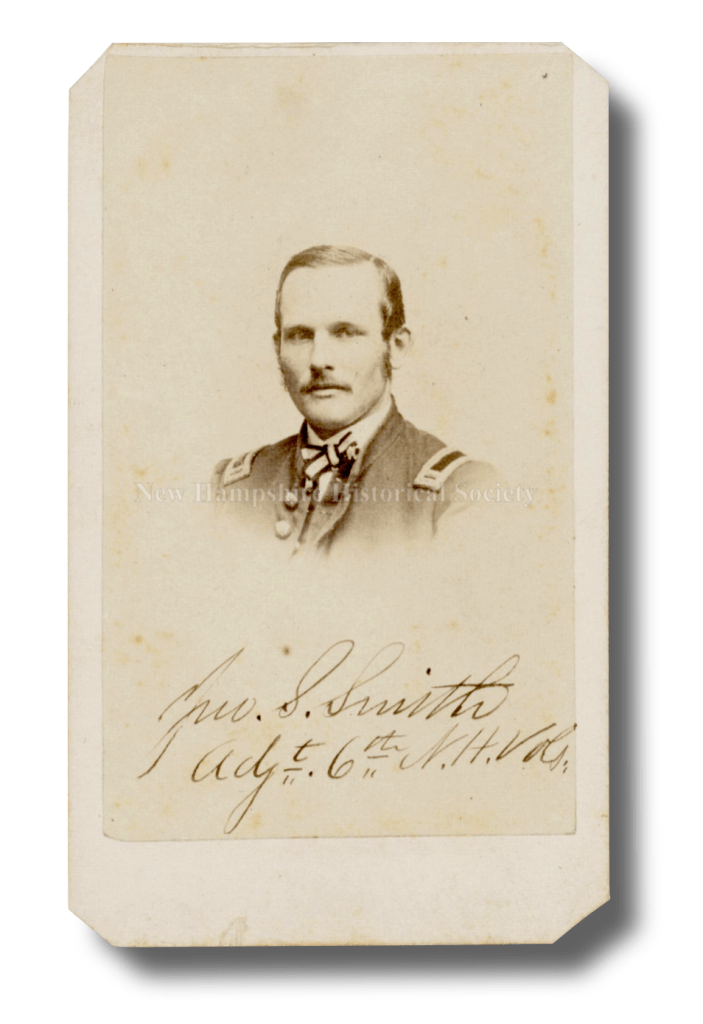
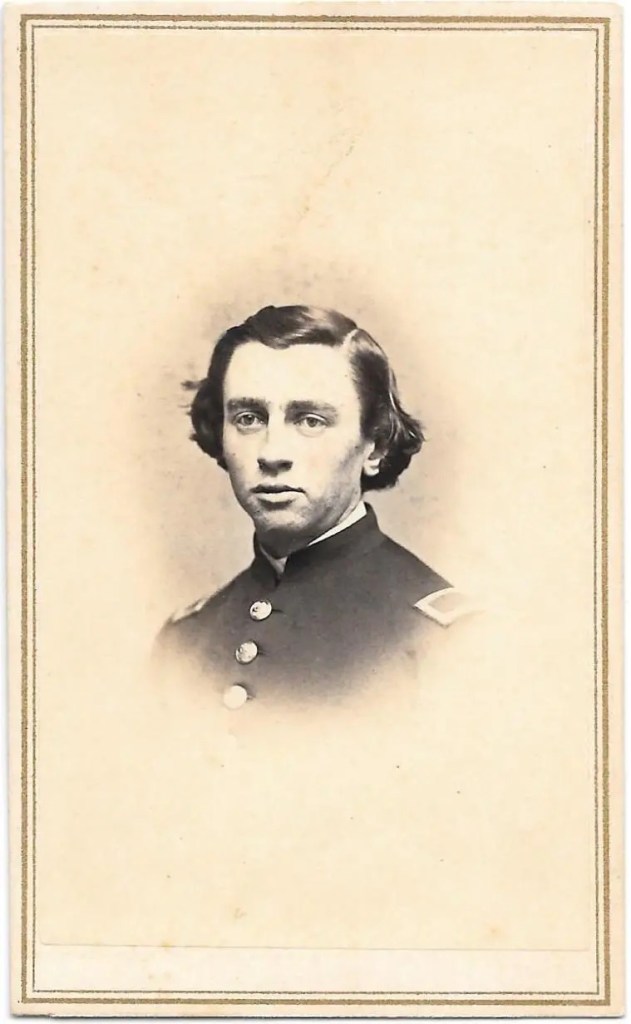
Adj. John Stearns Smith, 6th N. H. Vols. (New Hampshire Historical Society)
The following letter was written by John Stearns Smith (1837-1916) of Peterborough, New Hampshire who enlisted at the age of 23 on 4 October 1861 as a private in Co. E, 6th New Hampshire Infantry. He was wounded on 29 August 1862 at the battle of the 2nd Bull Run and again on 30 July 1864 (Battle of the Crater) at Petersburg. He was promoted up the ranks to 1st Sergeant by 1 July 1862 and commissioned a 2nd Lieutenant on 1 November 1862. He made 1st Lieutenant on 20 March 1863 and was also assigned duty as the regiment adjutant on Field & Staff at the same time.
In this letter, written from the trenches before Petersburg, the 6th New Hampshire had just settled in for a siege of the city after a failed early attempt to capture the city a week earlier.
John was born at Waltham, Massachusetts, on 27 November 1837—the son of John Smith and Susan Stearns.
Transcription
Headquarters 6th Regt N. H. Veteran Vols. Near Petersburg, Virginia June 24, 1864
My dear cousin,
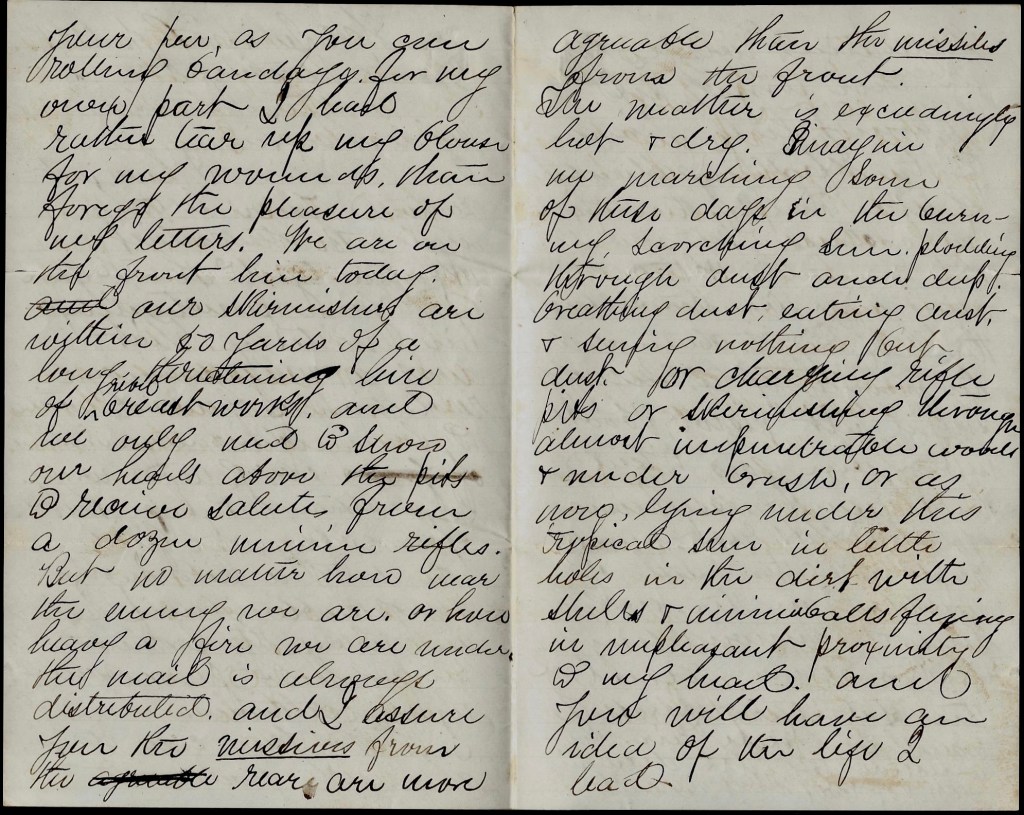
I have just received your letter and take the earliest opportunity to thank you for your punctuality in writing. That was a magnanimous resolution of yours to write to some soldier acquaintance every two weeks. I venture to hope that you will not find the duty a laborious or disagreeable one, if I am to be the fortunate recipient of your communications. I think you can do as much good with your pen as you can rolling bandages. For my own part, I had rather tear up my blouse for my wounds than forego the pleasure of my letters.
We are on the front line today. Our skirmishers are within 50 yards of a long, threatening line of rebel breast works and we only need to show our heads above the pits to receive salutes from a dozen minié rifles. But no matter how near the enemy we are, or how heavy a fire we are under, the mail is always distributed, and I assure you the missives from the rear are more agreeable than the missiles from the front.
The weather is exceedingly hot and dry. Imagine us marching some of these days in the burning, scorching sun, plodding through dust, eating dust, and seeing nothing but dust. Or charging rifle pits or skirmishing through almost impenetrable woods & under brush, or as now, lying under this tropical sun in little holes in the dirt with shells and minié balls flying in unpleasant proximity to my head, and you will have an idea of the life I lead.
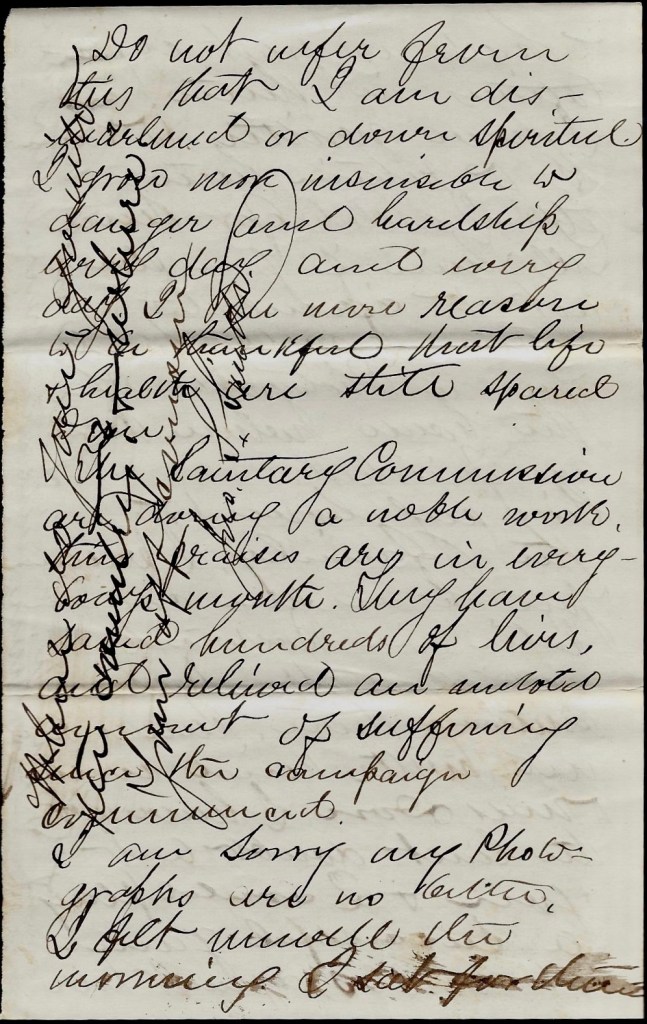
Sometimes while lying in our torrid pits I cannot help thinking of the refreshing shades of Elm Hall, the delightful coolness of the water in the well, the delicious cider in the cellar, the luxury of clean clothes, the privilege of taking off sword, belt, pistol, boots, &c., where one goes to bed with the assurance of a night’s rest uninterrupted by the rattle of musketry on the picket line & cannonading in the rear. And of the salutary effects of breathing pure air, uninfected by the decaying debris of two vast armies. Do not infer from this that I am discouraged or down-spirited. I grow more insensible to danger and hardship every day and every day I see more reason to be thankful that life and health are still spared to me.
The Sanitary Commission are doing a noble work. Their praises are in everybody’s mouth. They have saved hundreds of lives and relieved an untold amount of suffering since the campaign commenced.
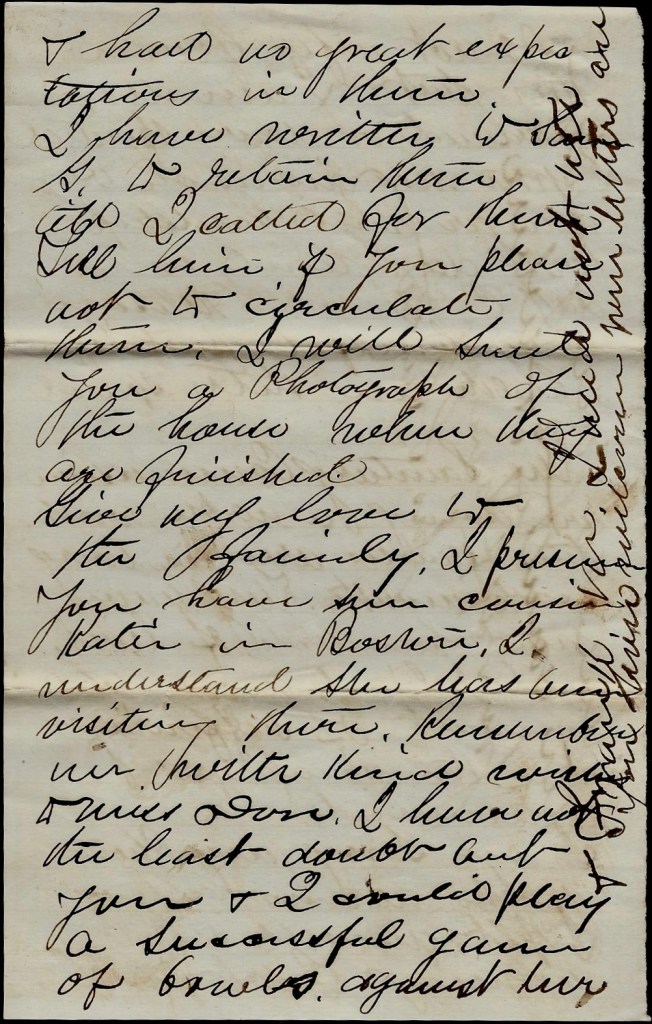
I am sorry my photographs are no better. I felt unwell the morning I sat for them and had no great expectations in them.
I have written to [ ] to retain them till I called for them. Tell him if you please not to circulate them. I will mail you a photograpg of the house when they are finished. Give my love to the family. I presume you have seen cousin Katie in Boston. I understand she has been visiting there. Remember e with kind wishes to Miss [ ]. I have not the least doubt you and I could play a successful game of bowls against her…
I could not find an image of John but here is a one of a young Georgian thought to be Thomas Blount Bowen but is unconfirmed (David Vaughn Collection)
The following letter was written by 19 year-old Pvt. John Mornington Raines (1845-1899) of Milledgeville, Baldwin county, Georgia, who enlisted in October 1863 in Co. G, 45th Georgia Infantry. He was taken prisoner on 25 March 1865 at Petersburg, Virginia, and released in June 1865 at Point Lookout, Maryland. John had a brother who served with him in the same company—Thomas Turner Raines (1838-1865)—who was probably the individual he referred to as “Bud” in this letter. I believe there was another brother names James Cadwallader Raines (b. 1840) who may have served the Confederacy in a different regiment.
John’s military records indicate that he had brown hair, blue eyes, and that he stood 5 feet 7.5 inches tall. His parents were Robert Cadwallader Raines, Jr. (1808-1860) and Matilda Caroline (“Carry”) Young (1810-1883) who were married in 1832. Cadwallader Raines died in September 1860, leaving 50 year-old Carrie with seven children and a plantation to run.
Three months after this letter was written, when the left wing of Sherman’s army marched through Milledgeville in late November 1864 on its way to Savannah, “Mrs. Cadwallader Raines, a widow and the mother of three Confederate soldiers,” found herself in the center of the Federal encampment. “She had been bedridden for several months and was attended only by two young daughters [Ellen and Mary]. Her plantation suffered complete devastation, having been depleted of all fences, livestock, and food.” A neighbor named Terrell Barksdale later wrote that, “They did not leave a living animal on her plantation…they have nothing except what the neighbors give them and they have but few of them that have anything to spare.” [“Sherman at Milledgeville in 1864” by James C. Bonner, published in The Journal of Southern History, Vol. 22, No. 3, August 1956, page 280]
I can’t be certain of the date of this letter as it is illegible on the letter itself. There were several attempts to capture the Weldon Railroad before it was finally accomplished in mid-August 1864.
Transcription
In Line of Battle near Petersburg August [ ] 1864
Dear Mother,
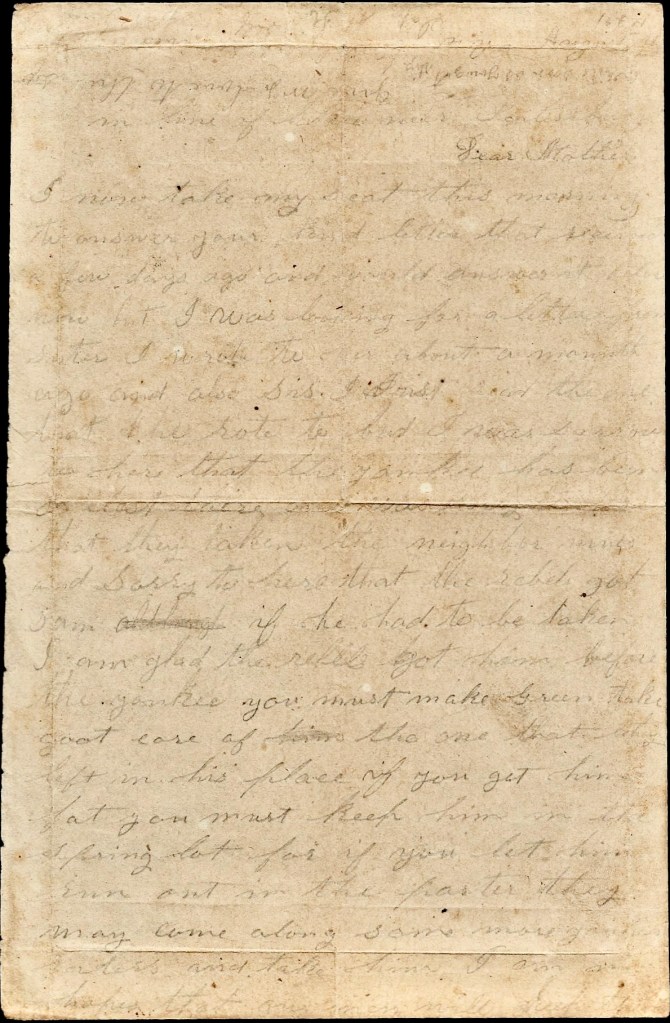
I now take my seat this morning to answer your kind letter that I received a few days ago, and would answer it before now, but I was looking for a letter from sister. I wrote to her about a month ago and also Sis. I just rec’d the one that she wrote to Bud.
I was sorry to hear that the Yankees has been so close there and was sorry also that they taken the neighbor’s mule, and sorry to hear that the rebels got Sam. If he had to be taken, I am glad the rebels got him before the Yankees. You must make Green take good care of the one that they left in his place. If you get him fat, you must keep him in the Spring lot, for if you let him run out in the pasture, there may come along some more Yankees and take him. I am in hopes that our men will keep them back from that part of the country, for they will destroy things as they go. I hope that Gen. Hood will whip them clear out from Georgia.
There was a fight here yesterday on the Petersburg and Weldon Railroad. Our men whipped them back and taken a good many prisoners. We have a fight every day on some part of the line. The Yankees is tame in front of me. We are are close enough to talk to each other when I am out on [the] skirmish [line].
I went over to the hospital this morning to see Bud. He is getting along finely. He will be able for duty in a few days. This leaves me in good health at this time, and hoping this will find you up and about and also the rest of the family. This is the 5th letter I have wrote to you since I been at this place. I only received one. I have wrote to Puss and Sister and Sis and have not got any answer from them. You must tell them to write. I will close. I will send this letter by hand with the yarn. I remain your son, — John M. Raines
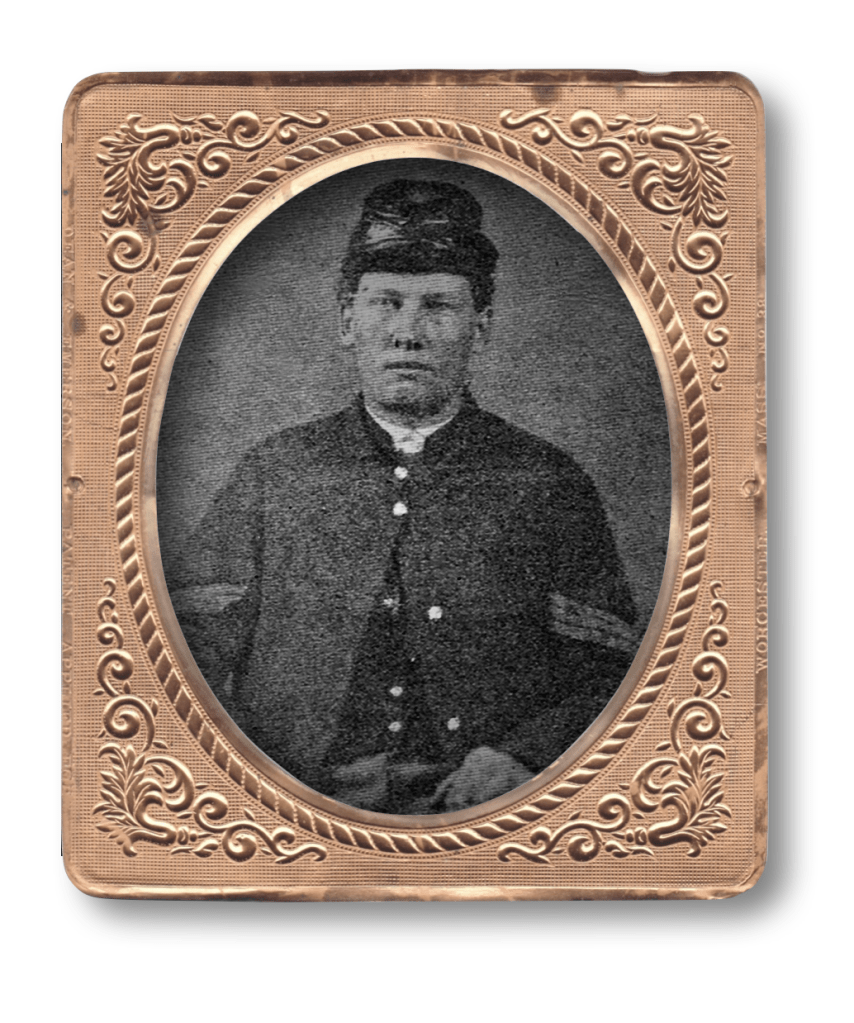
I could not find an image of Clinton but here is one of Sgt. Newton Goodbar of Co. C, 60th OVI
The following letters were written by Clinton Emory Sharp (1846-1927), the son of Stephen Alfred Sharp (1807-1886) and Hester Ann Oldham (1819-1894) of Westerville, Franklin county, Ohio.
When he was 19 years old, Clinton enlisted on 20 February 1864 in Co. A, 60th Ohio Volunteer Infantry (OVI). He took a gunshot wound in the left arm on 17 June 1864 in the first assault on Petersburg but eventually returned to his regiment and was with them until he mustered out as a sergeant on 28 July 1865.
Readers should be aware that there were two regiments called the 60th OVI. The first regiment was organized at Gallipolis in February 1862 for a one year enlistment. The second regiment by that name was organized at Cleveland and Columbus in the spring of 1864 and sent to Virginia where they fought at Spotsylvania, Wilderness and Cold Harbor before spending eight months of trench warfare in the Siege of Petersburg. After the war, one member of the regiment by the name of George Koontz in Co. I, wrote, “As our regiment was in the entrenchments nearest to Petersburg, we were the first to enter the “blockade city,” which was done early in the morning of the 3d inst. The 1st Michigan sharpshooters led the way, and the 60th Ohio followed. We found the city on fire in several places, caused by the rebels burning public stores, bridges and tobacco warehouses. The city was soon alive with Uncle Sam’s “blue birds,” and I certainly never seen troops, under similar circumstances behave themselves better. Private property, what little was left, was respected; and you could see on all hands the Union soldiers giving their rations to this half-starved chivalry, who four years ago were so defiant, proud and haughty. Not only the “white trash” were reduced to taking hard tack from our boys, but dainty-fingered ladies—real bonafide ladies—condescended to nibble them in order to keep soul and body together.” [The Gallipolis Journal, 4 May 1865]
After the war, in 1868, Clinton married Martha A. Hutches and made his living as a farmer in Delaware county, Ohio.
Letter 1
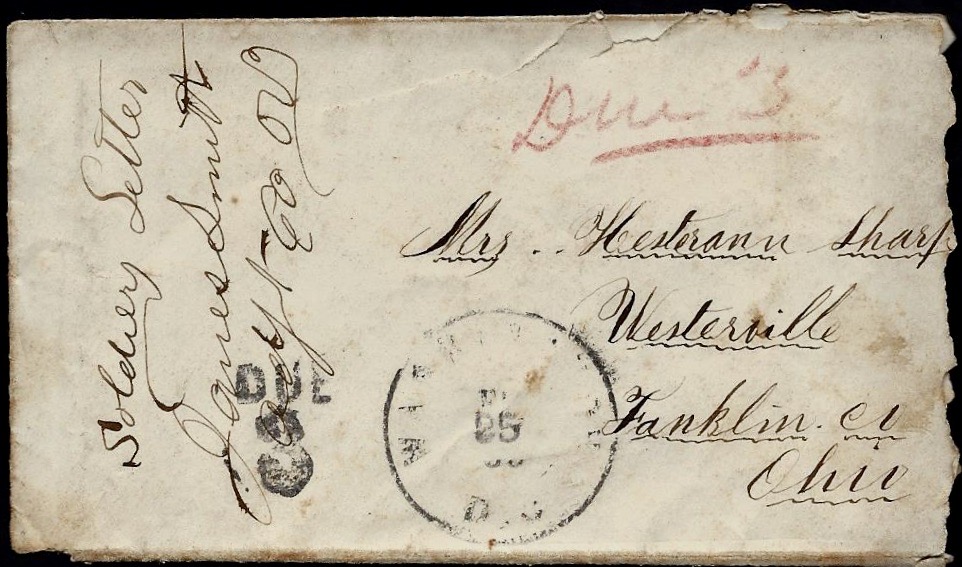
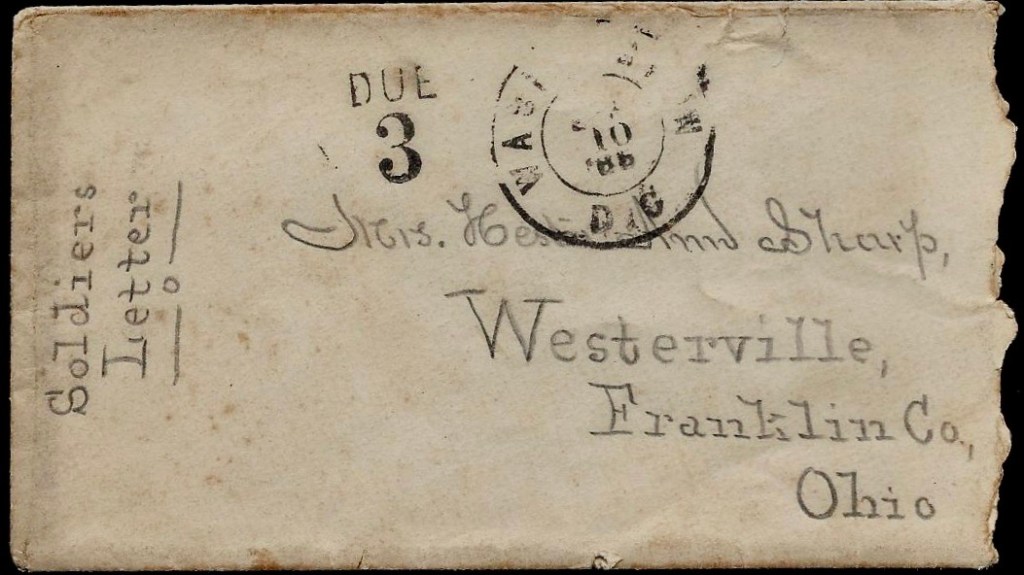
Addressed to Mrs. Hesterann Sharp, Westerville, Franklin county, Ohio
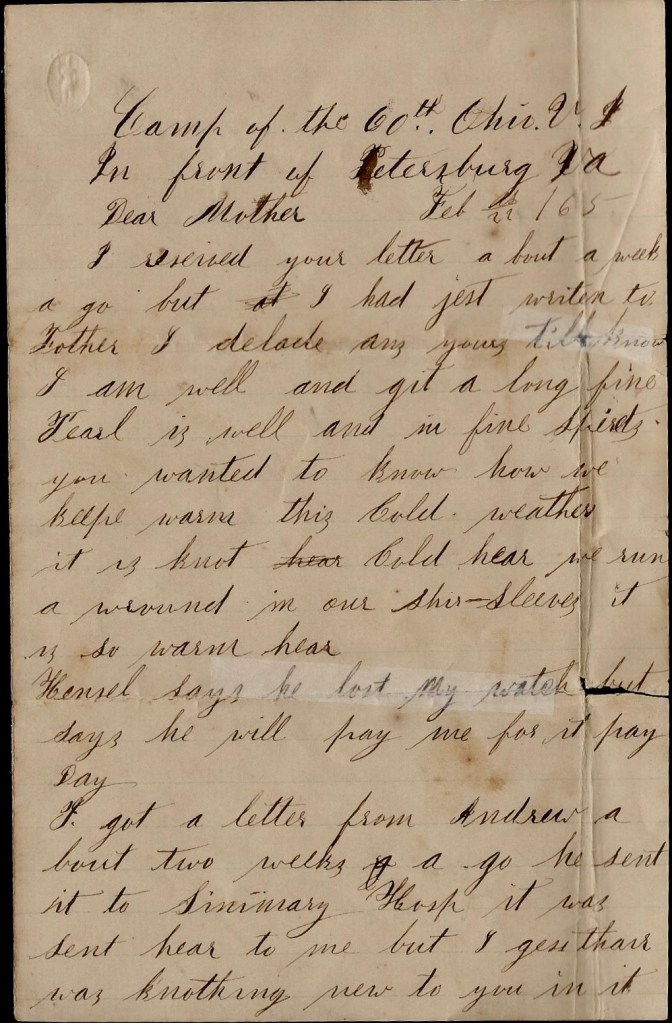
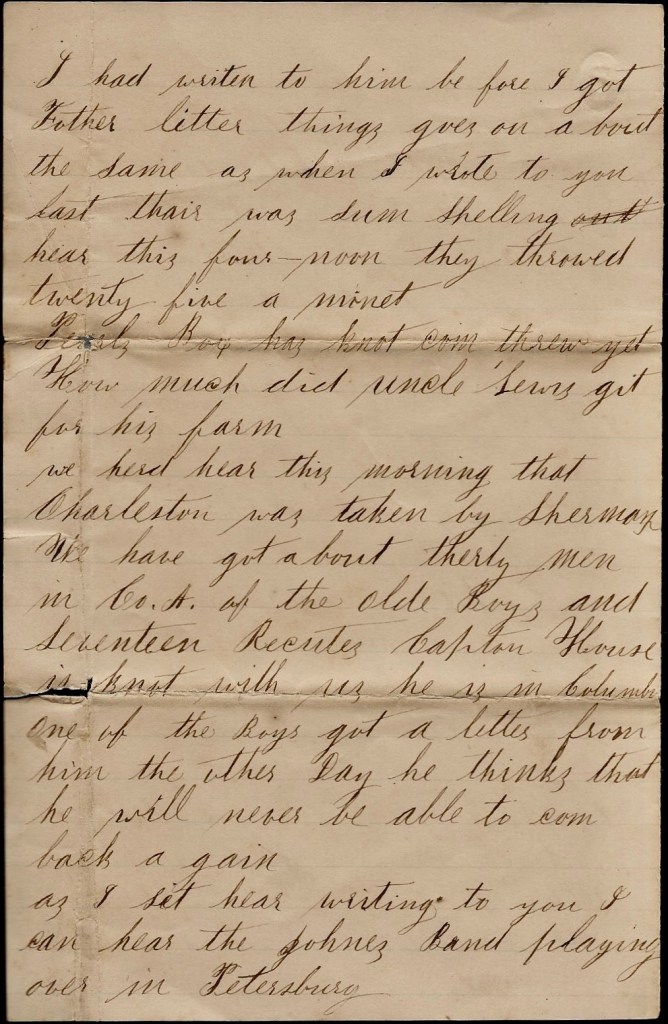
Camp of the 60th Ohio Volunteer Infantry In front of Petersburg, Virginia February 22nd 1865
I received your letter about a week ago but as I had just written to Father, I delayed on yours till now. I am well and get along fine. Pearl is well and in fine spirits. You wanted to know how we keep warm this cold weather. It is not cold here. We run around in our shirt sleeves it is so warm here.
Hensel says he lost my watch but says he will pay me for it payday.
I got a letter from Andrew about two weeks ago. He sent it to Seminary Hospital. It was sent here to me but I guess there was nothing new to you in it. I had written to him before I got Father’s letter.
Things goes on about the same as when I wrote to you last. There was some shelling here this forenoon. They throwed twenty-five a minute.
Pearl’s box has not come through yet. How much did Uncle Lewis get for his farm?
We heard this morning that Charleston was taken by Sherman. We have got about thirty men in Company A of the old boys and seventeen recruits. Captain [Elitha D.] House is not with us. He is in Columbus. One of the boys got a letter from him the other day. He thinks that he will never be able to come back again. 1
As I sit here writing to you, I can hear the Johnnies’ band playing over in Petersburg.
When you direct a letter, direct it in large, plain letters and it will come through in two or three days sooner like the one is in here. I don’t know as I have any more to write.
From your affectionate son, — C. E. Sharp
Write soon and all the news.
1 Captain Elisha D. House was wounded on 27 October 1864 in action near Petersburg and discharged on 2 March 1865 on Surgeon’s certificate of disability. He was replaced by Samuel S. Blackford who had been the 1st Lieutenant.
Letter 2
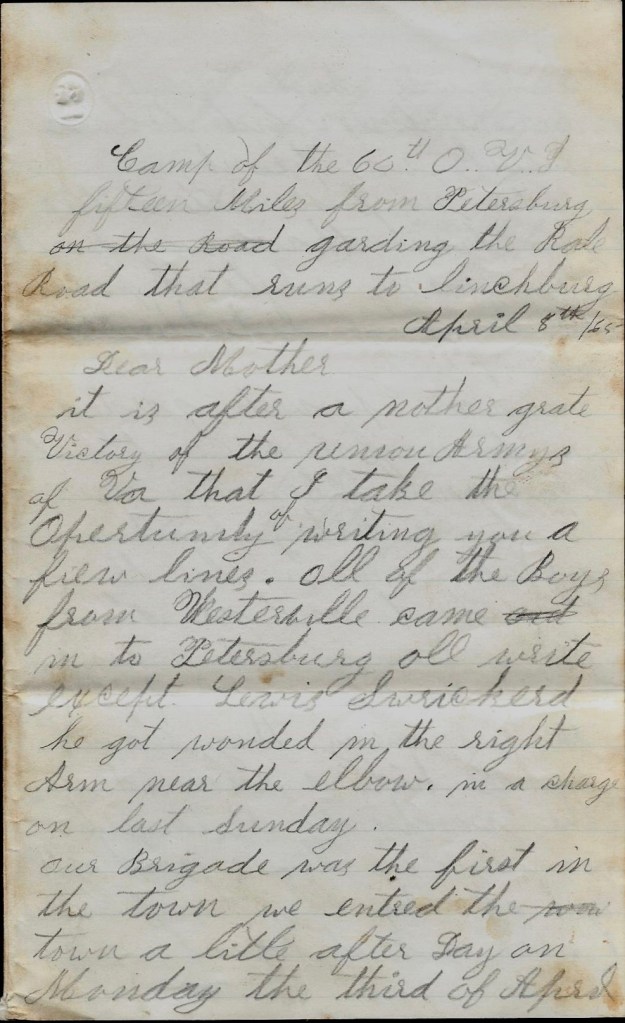
Camp of the 60th O. V. I. 15 miles from Petersburg Guarding the railroad that runs to Lynchburg April 8, 1865
Dear Mother,
It is after another great victory of the Union Army of Virginia that I take the opportunity of writing you a few lines. All of the boys from Westerville came in to Petersburg all right except Lewis Swickard. He got wounded in the right arm near the elbow in a charge on last Sunday. 1
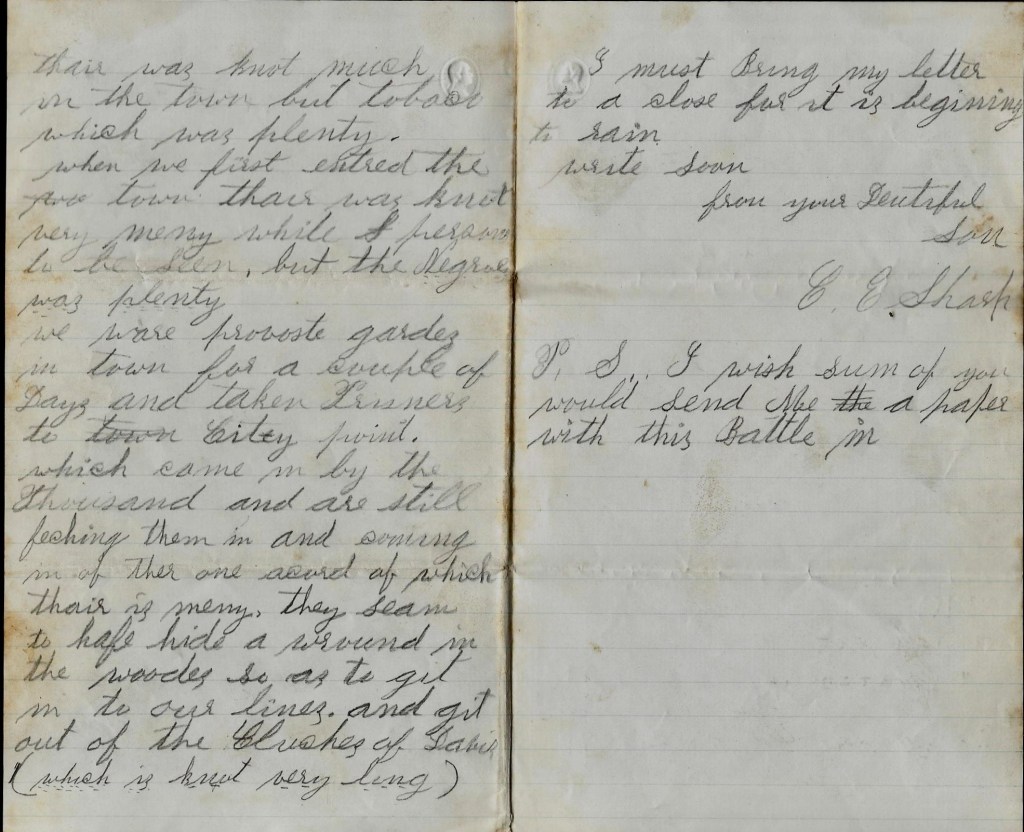
Our brigade was the first in the town. We entered the town a little after day [break] on Monday the 3rd of April. There was not much in the town but tobacco which was plenty. When we first entered the town there was not very many white persons to be seen, but the Negroes was plenty.
We were provost guards in town for a couple of days and taken prisoners to City Point which came in by the thousands are still fetching them in and coming in of their own accord of which there is many. They seem to have hid around in the woods so as to get into our lines and get out of the clutches of Davis (which is not very long).
I must bring my letter to a close for it is beginning to rain. Write soon. From your dutiful son, — C. E. Sharp
P. S. I wish some of you would send me a paper with this battle in.
1 Sgt. Lewis Swickard entered the service in February 1864 and was discharged on surgeon’s certificate on 3 June 1865.
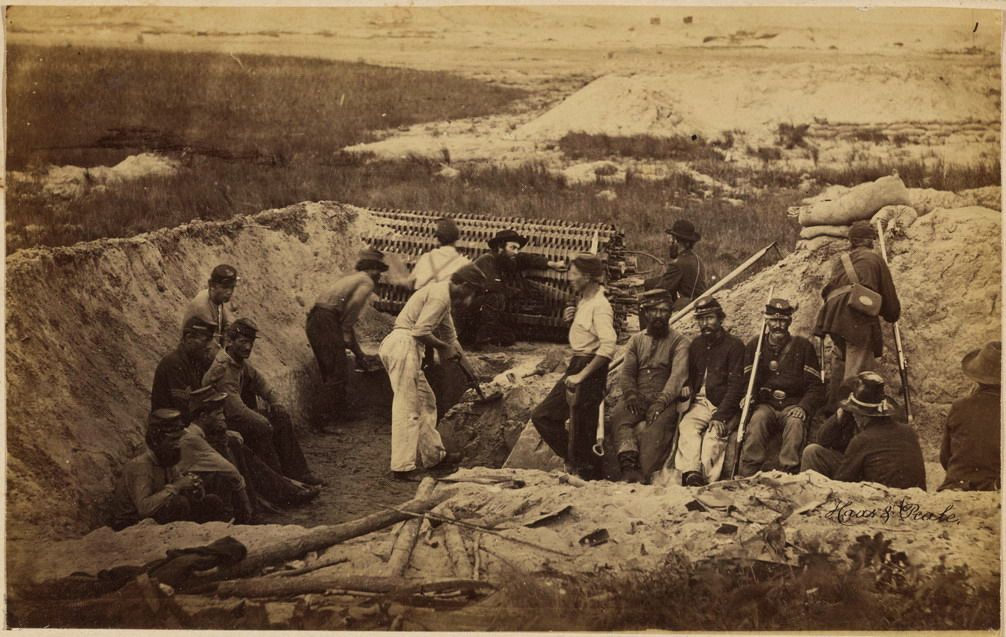
The 1st New York Engineers at work on Morris Island earlier in the war when they were used extensively for building earthworks. By 1864 and 1865, they spent their time built corduroy roads, dredged the Dutch Gap Canal, and built pontoon bridges.
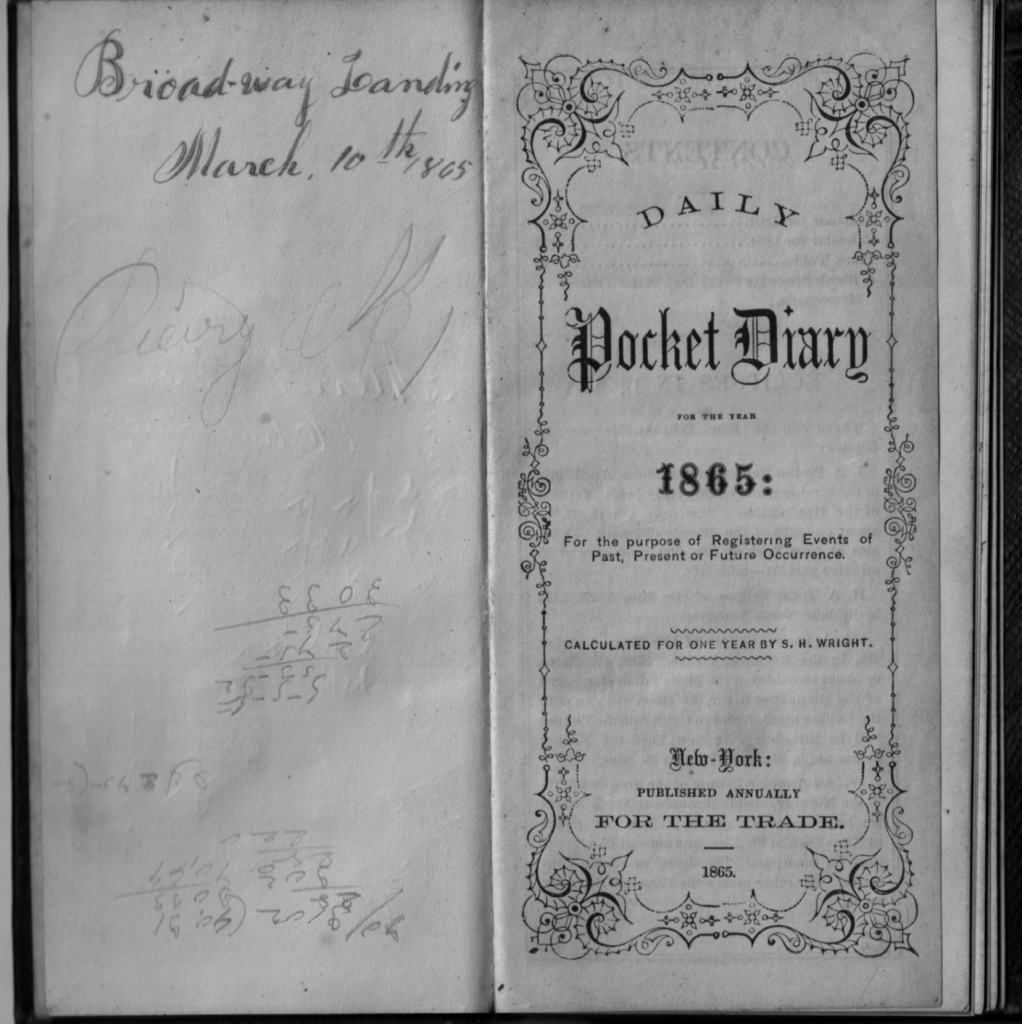
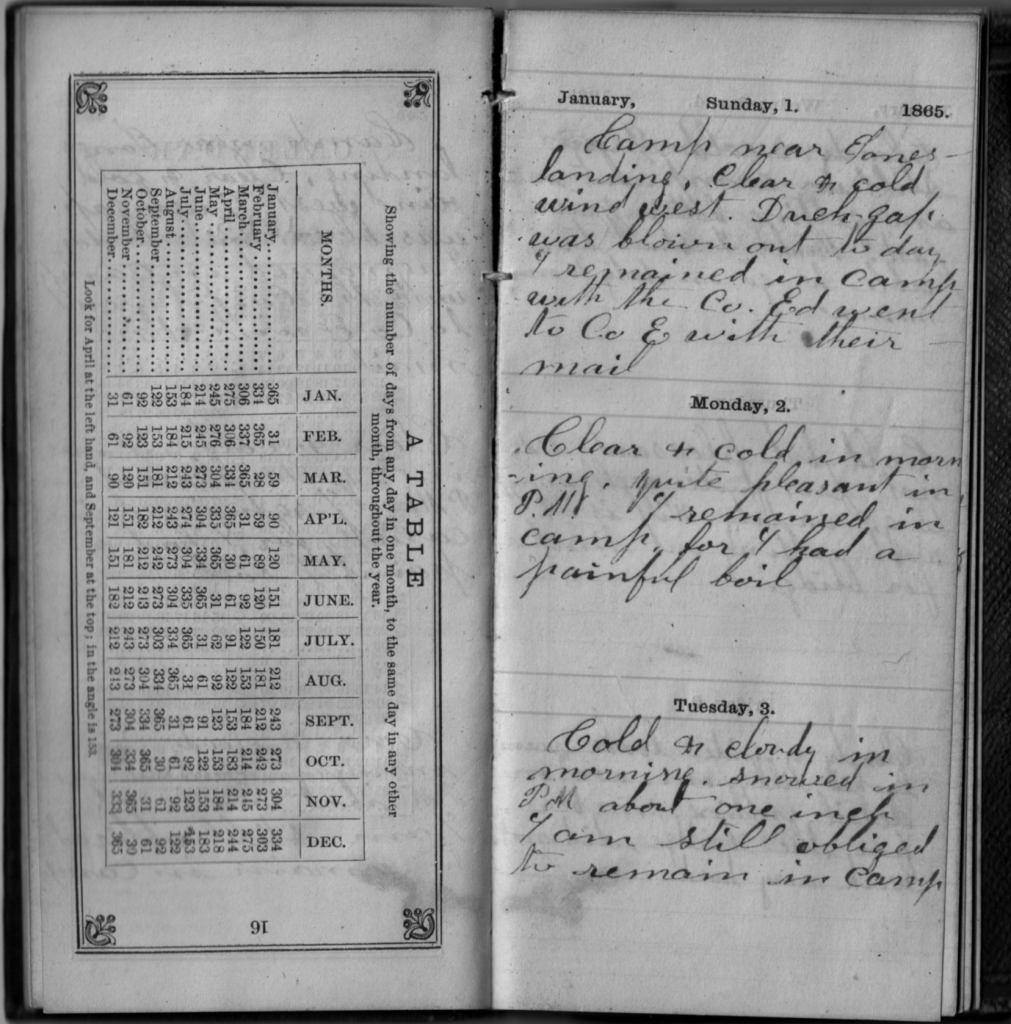
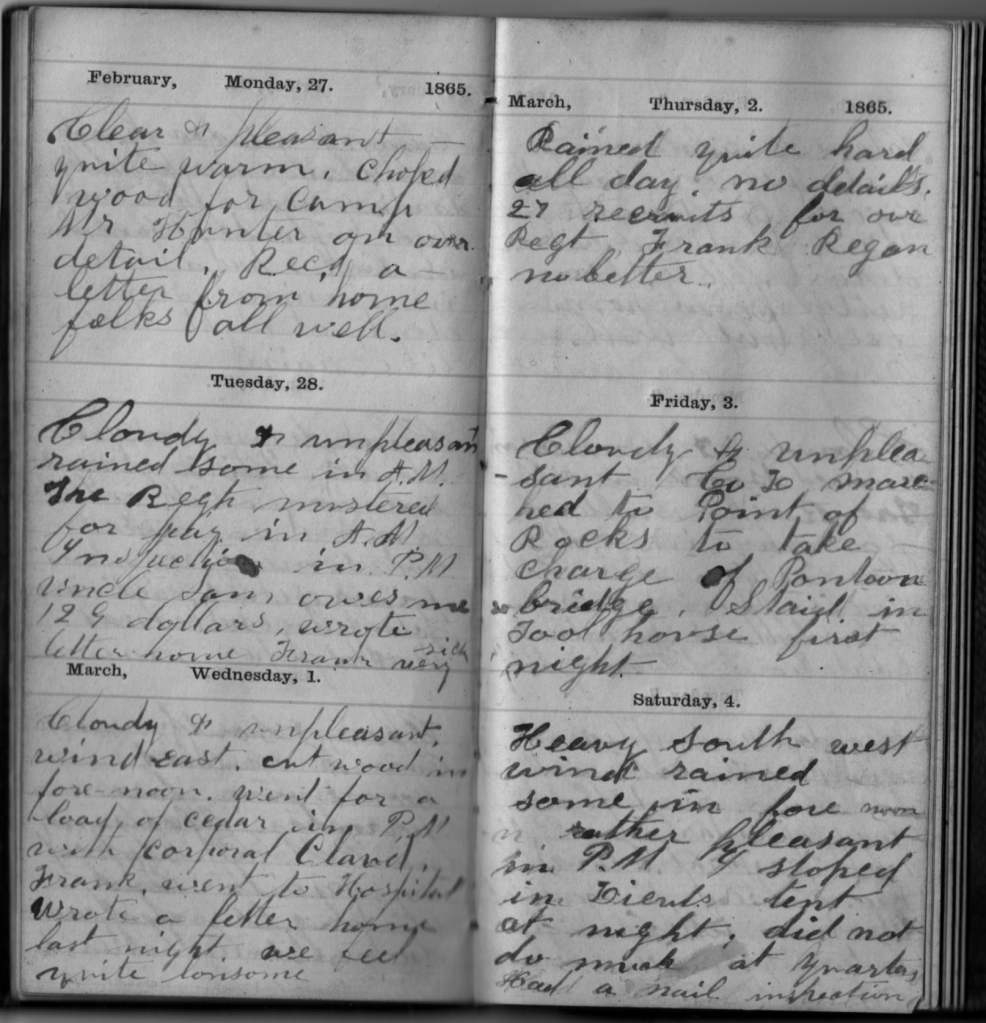
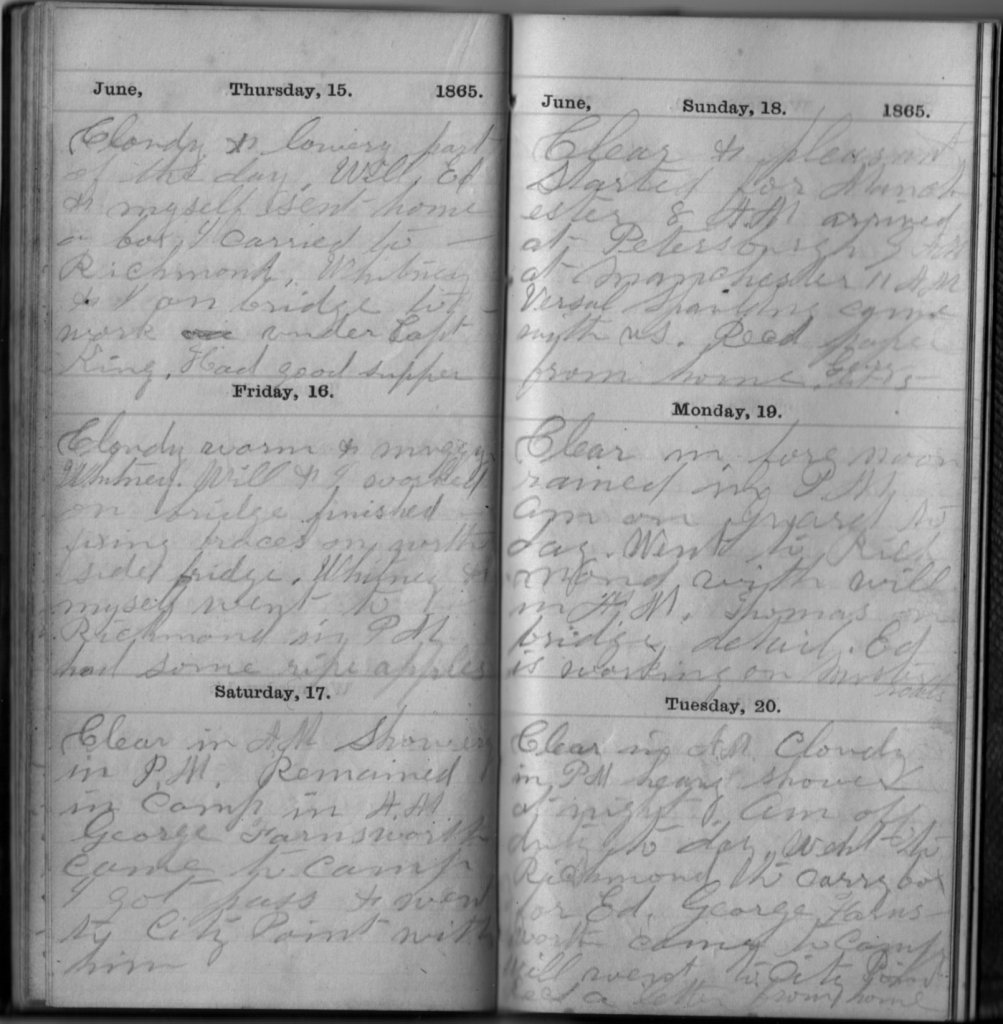
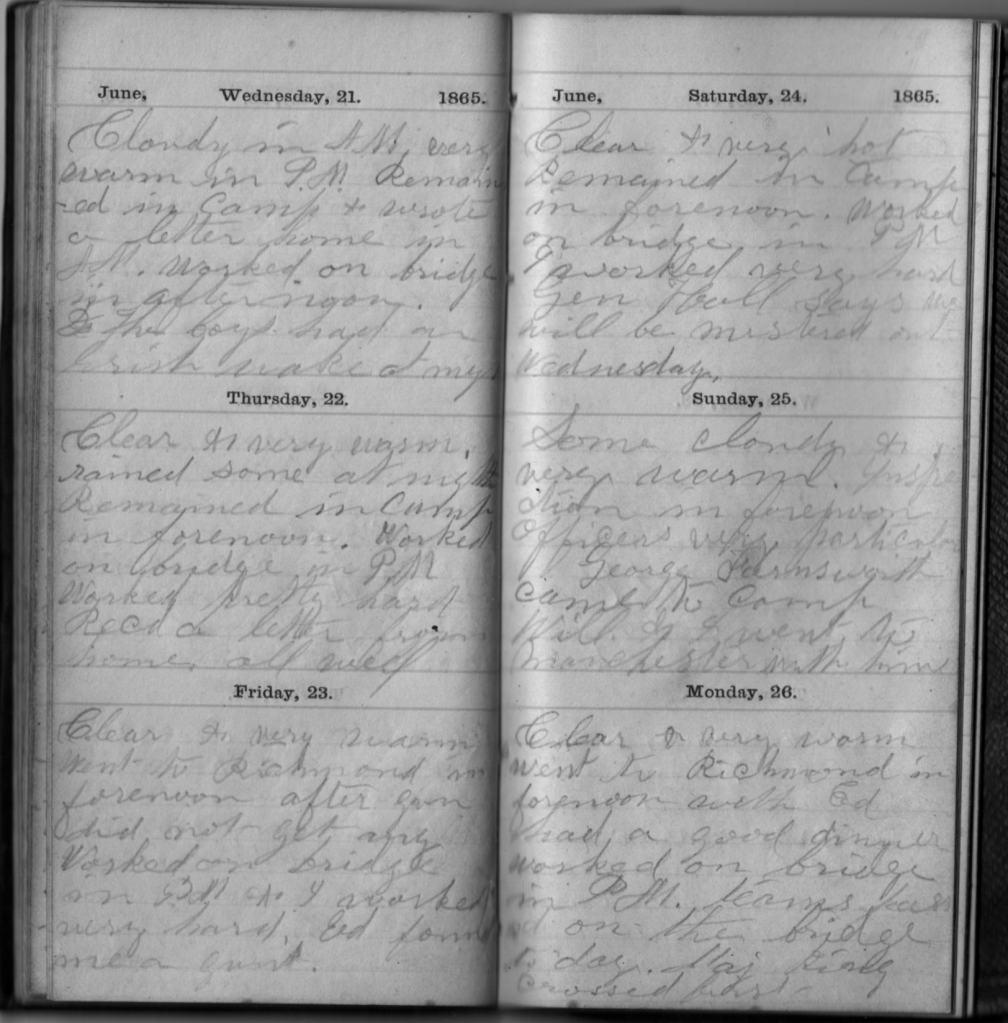
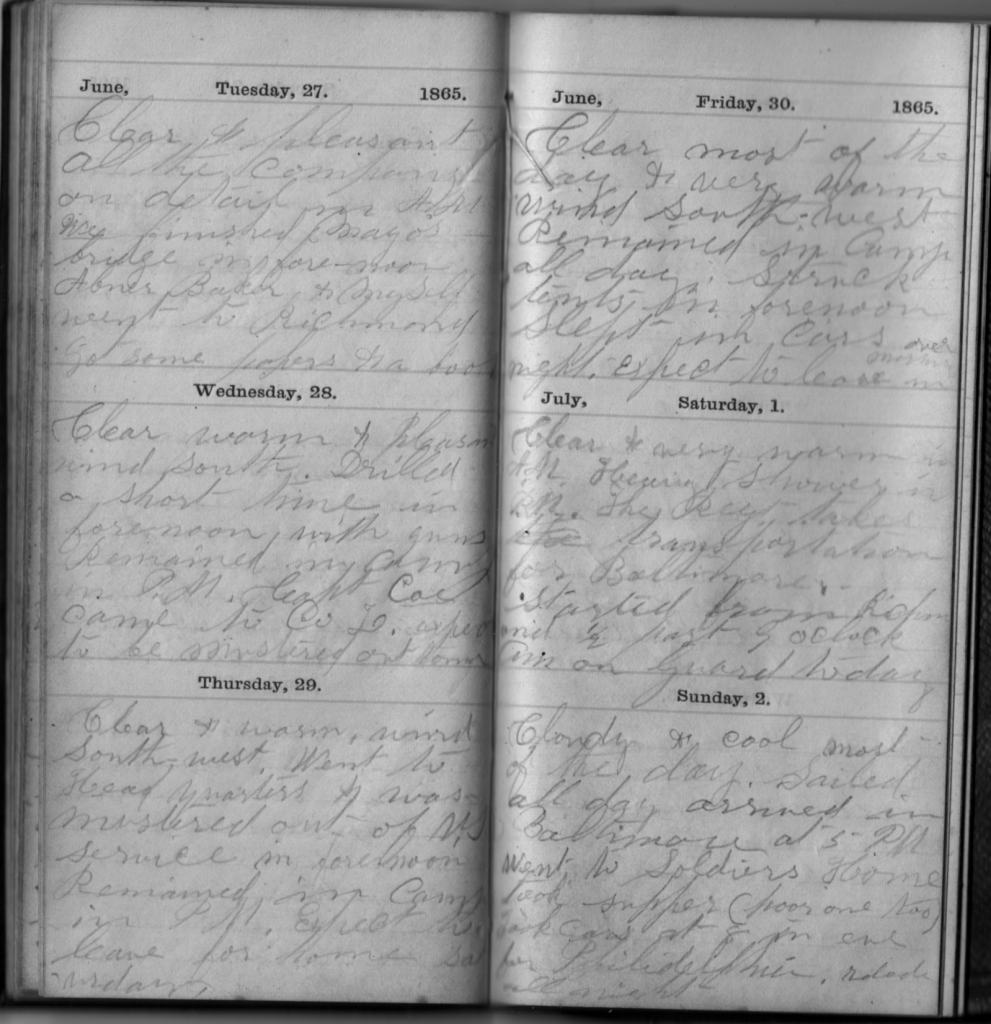
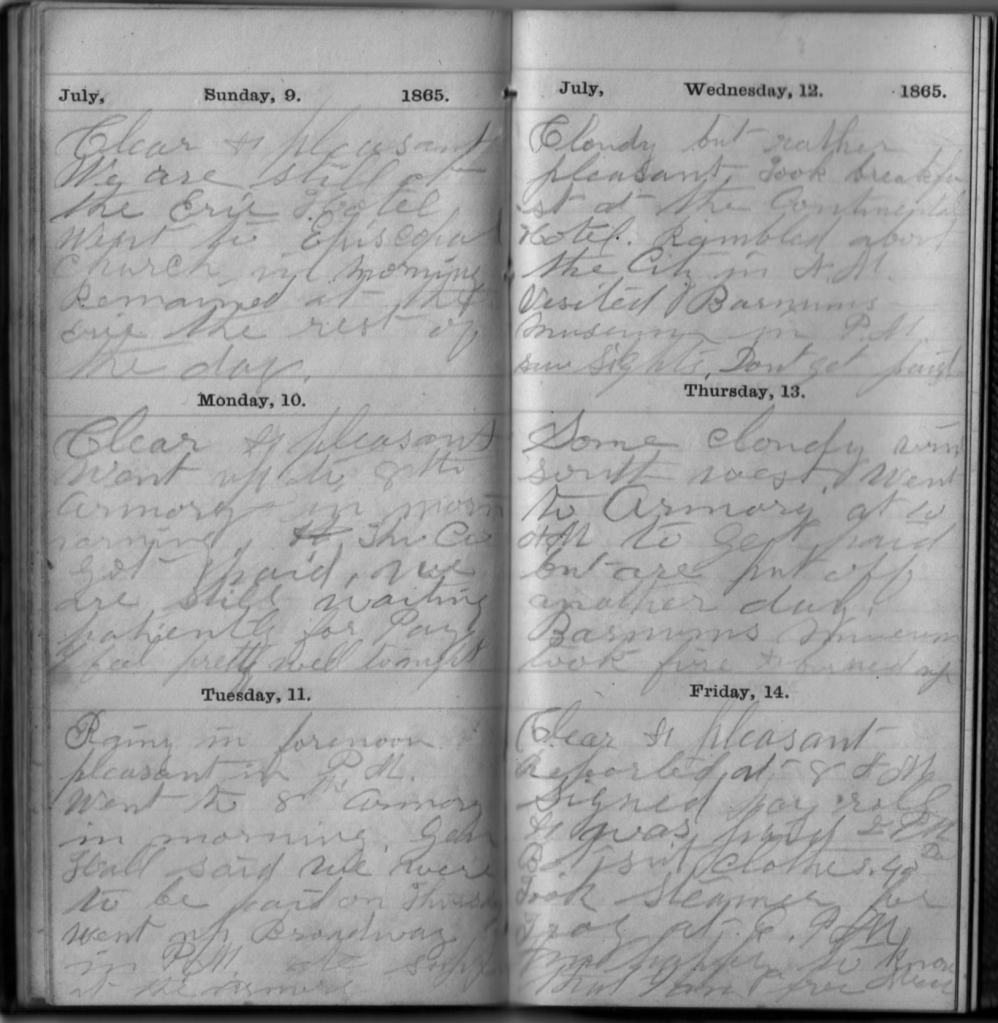
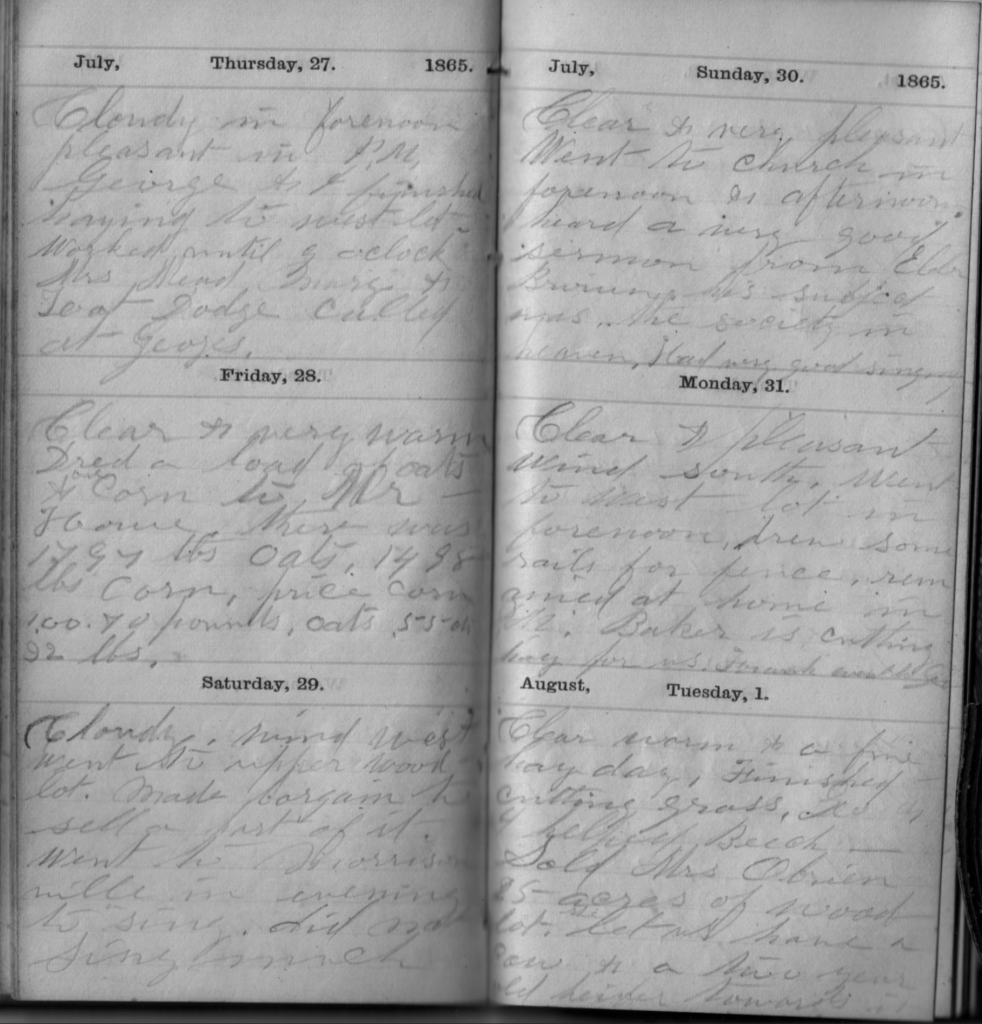
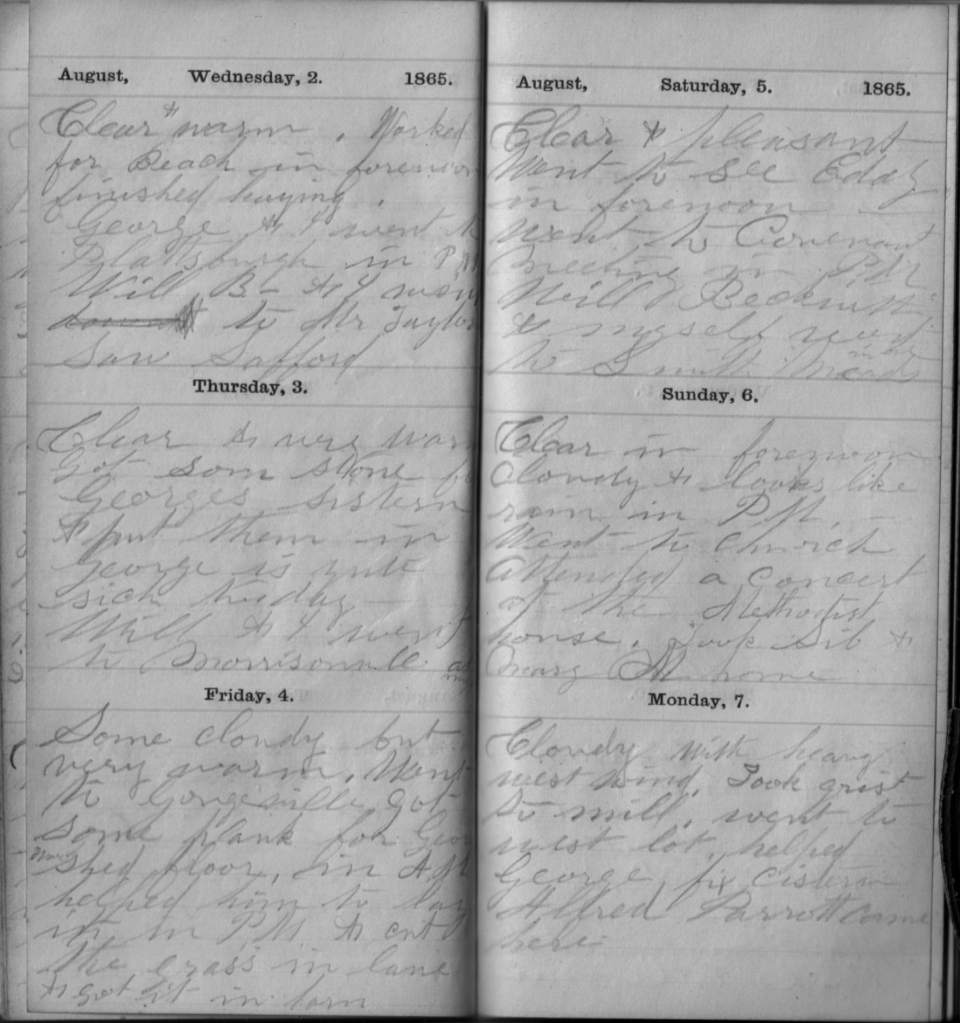
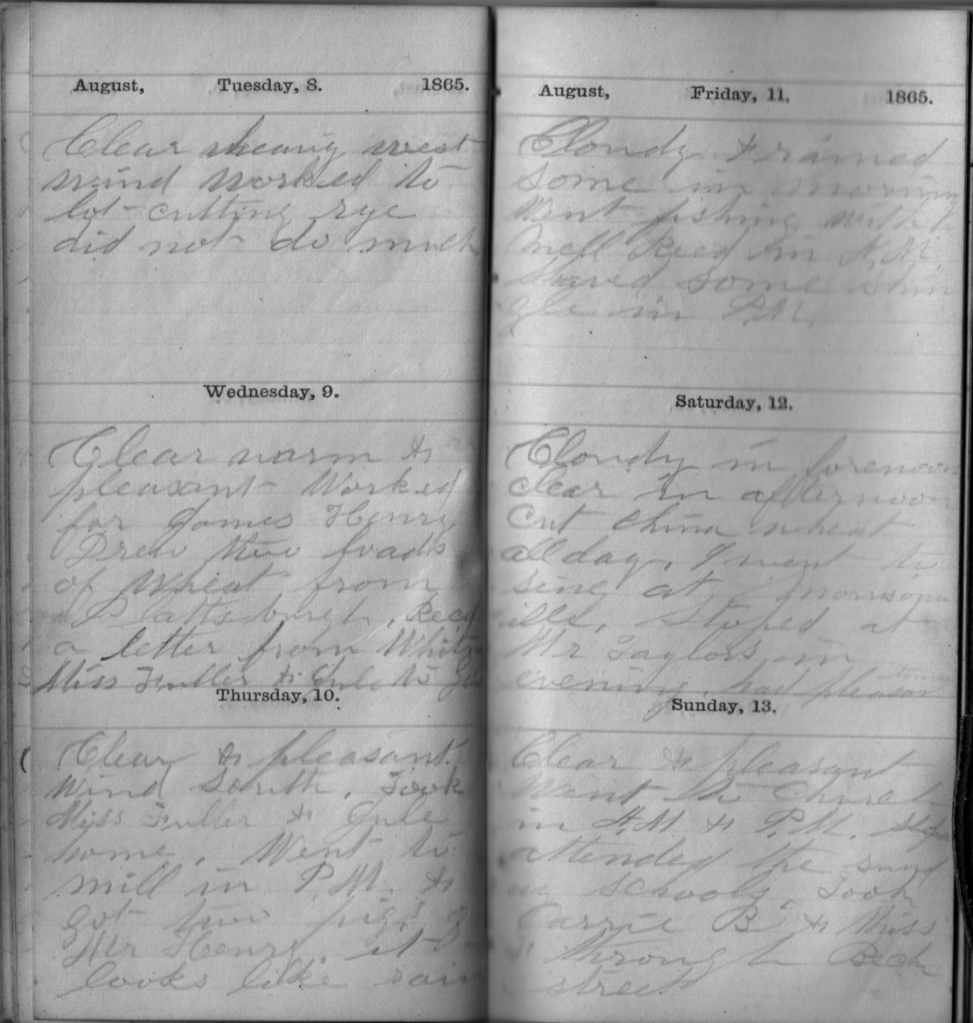
This 1865 diary was kept by Merritt L. Pierce (1842-1869), the son of Proctor Pierce (1811-1874) and Huldah Ann Reed (1816-1872) of Morrisonville, Schuyler Falls, Clinton county, New York. Merritt was 22 years old when he enlisted on 31 August 1864 at Troy as a private in Co. L, 1st New York Engineers. His decision to join the Engineers was clearly a last minute decision. Just days earlier he intended to enlist in the Navy but found the lines too long to wait in. Less than a year later, he mustered out of the regiment as an artificer on 30 June 1865 at Richmond, Virginia.
Merritt died of consumption (tuberculosis) in 1869 at the age of 28 but not before marrying Mary S. Mead (1845-1922).
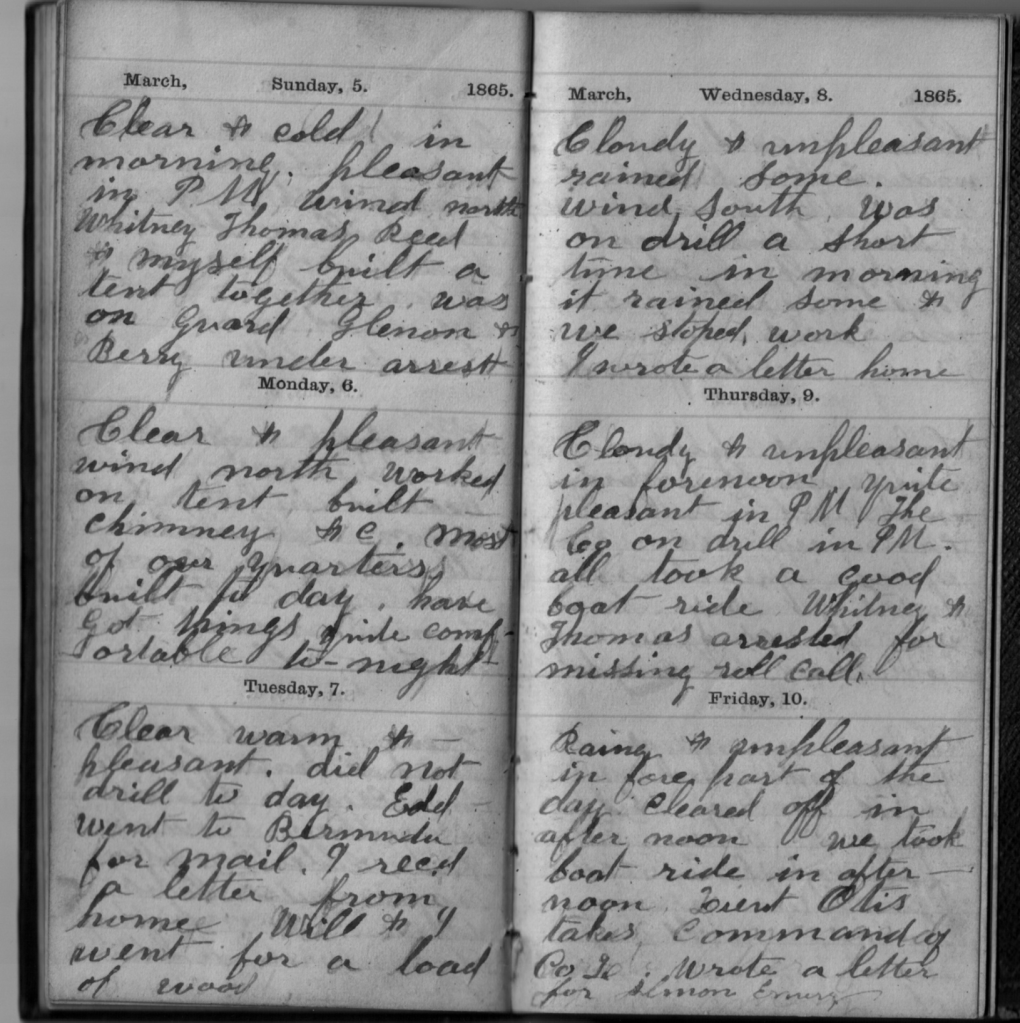
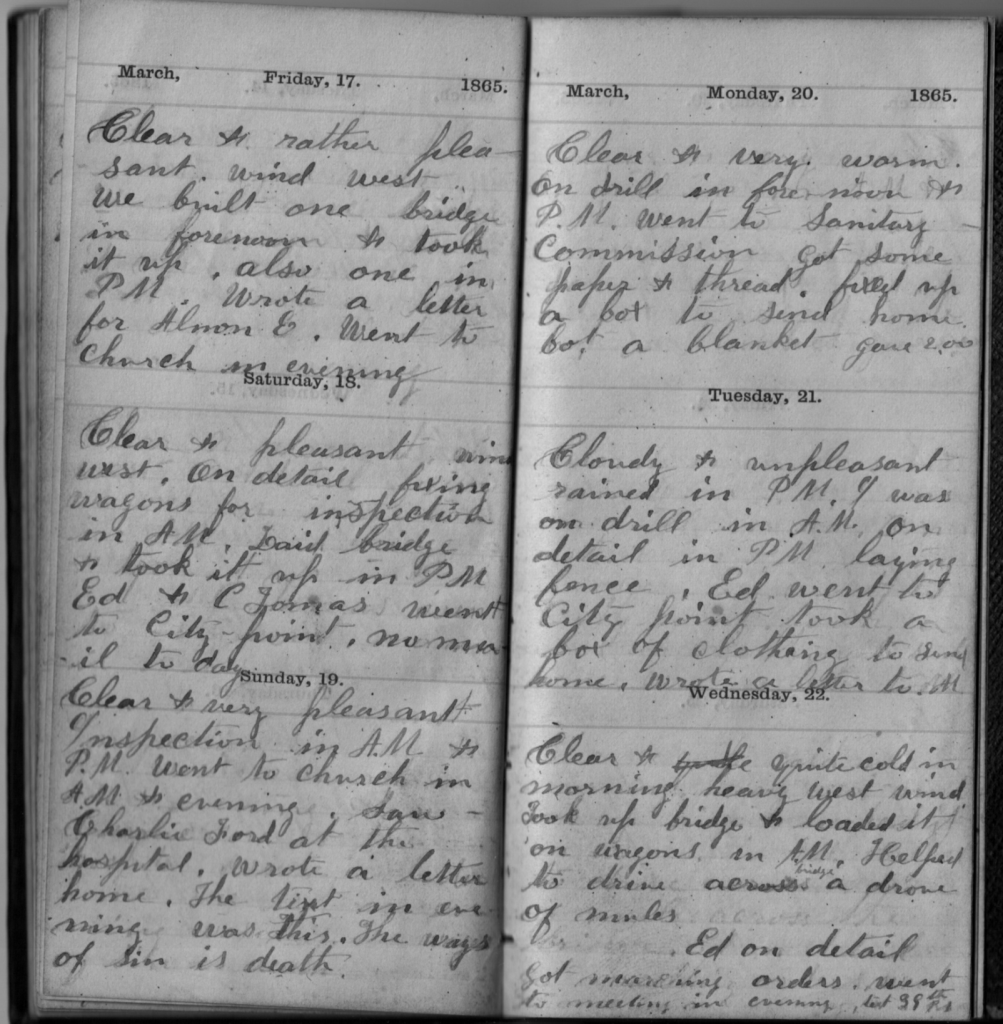
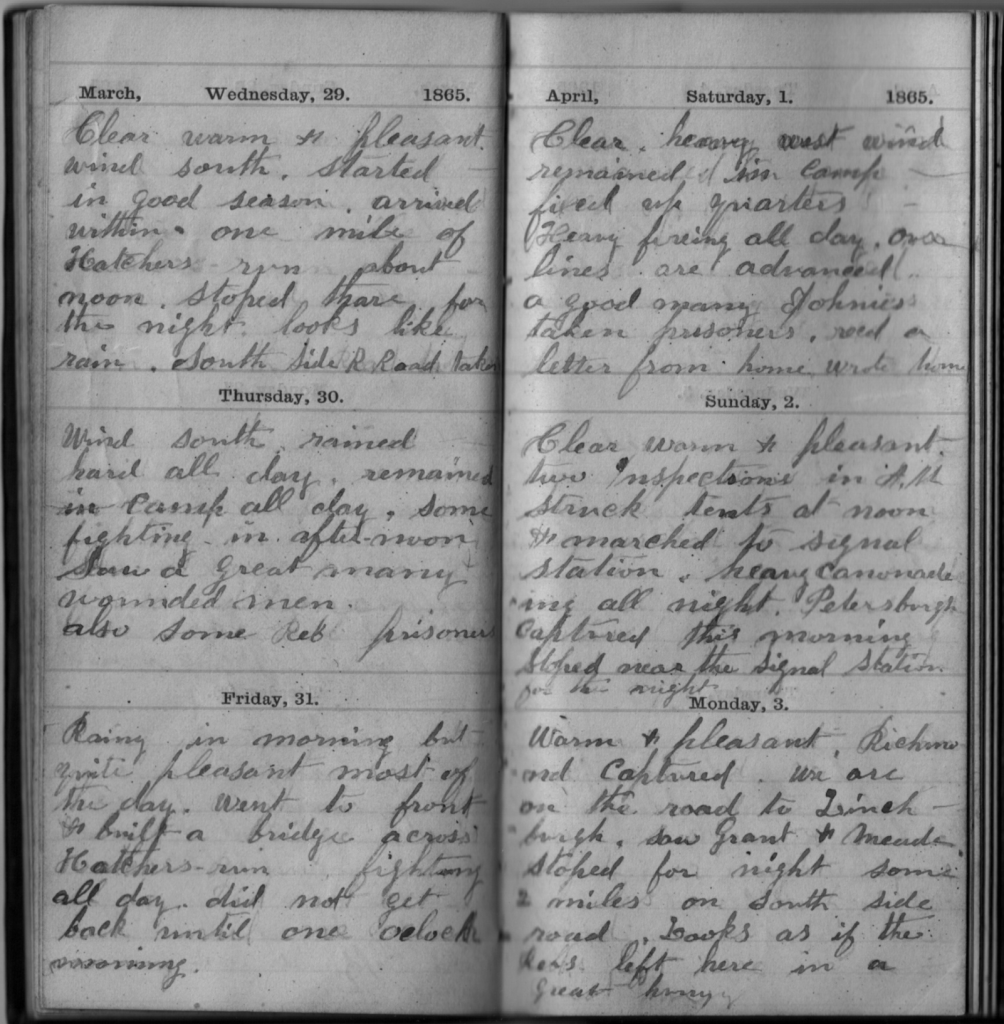
[Note: The following diary is from the personal collection of Carolyn Cockrell. Merritt Pierce was her maternal 2nd great-grandfather. The diary images were made available for publication by express consent. The transcription of the diary was done by Chuck Cockrell.]
January 1865
January, Sunday, 1. 1865—Camp near Jones Landing. Clear & cold, wind west. Dutch Gap was blown out today. I remained in camp with the company. Ed[gar Reed] went to Co. E with their mail.
Monday, 2—Clear & cold in morning. Quite pleasant in p.m. I remained in camp for I had a painful boil.
Tuesday, 3—Cold & cloudy in morning. Snowed in p.m. about one inch. I am still obliged to remain in camp.
January, Wednesday, 4. 1865—Cloudy & cold. I am still in camp but am getting better quite fast. Think I shall be able to go on duty tomorrow.
Thursday, 5—Cold but pleasant. Did not feel quite well enough to go on duty. Will [Beckwith] is at work getting out timber for bridge.
Friday, 6—Cloudy & quite warm. Looked like rain. Went on detail cutting timber for the bridge. Did not work very hard.
January, Saturday, 7. 1865—Warm & pleasant. I am on detail cutting railing for bridge. Will is on the same detail.
Sunday, 8—Cold but pleasant. We are not on detail today, except those that missed roll call during the week.
Monday, 9—It has rained all day quite hard. Did not do any duty. Received a letter from Safford Taylor.
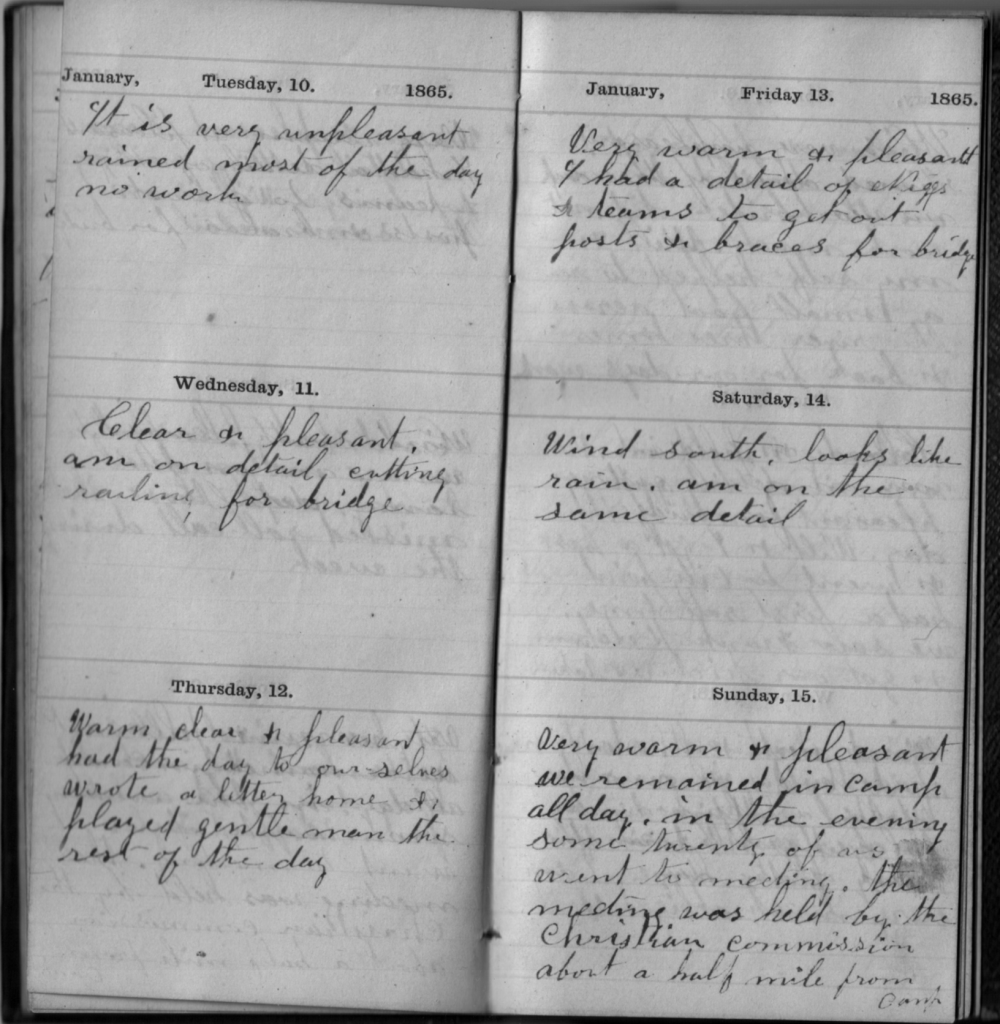
January, Tuesday, 10. 1865—It is very unpleasant. Rained most of the day. No work.
Wednesday, 11—Clear & pleasant. Am on detail cutting railing for bridge.
Thursday, 12—Warm, clear & pleasant. Had the day to ourselves. Wrote a letter home & played gentleman the rest of the day.
January, Friday, 13. 1865—Very warm & pleasant. I had a detail of Niggs & teams to get out posts & braces for bridge.
Saturday, 14—Wind south. Looks like rain. Am on the same detail.
Sunday, 15—Very warm & pleasant. We remained in camp all day. In the evening some twenty of us went to meeting. The meeting was held by the Christian Commission about a half a mile from camp.
January, Monday, 16. 1865—Clear & pleasant. I was detailed to work on the bridge. Did not work much. Will & myself helped to row a small boat across the river three times & back for our day’s work.
Tuesday, 17—Cloudy & cold in the morning but quite pleasant most of the day. Will & I got a pass & went to City Point. Had a first-rate time. We saw Frank Ketchum 1 & got our pictures taken.
1Franklin Soules Ketchum, son of Henry Ketchum and Mary Ann Soules (see town register of soldiers), brother of Hiram Henry Ketchum and Sylvia L. Ketchum who married Israel Stickle who was in the 1st New York Volunteer Engineers. He was a Sergeant Major in the 16th New York Volunteer Infantry with his brother who subsequently reenlisted into the 1st New York Volunteer Engineers. Frank Ketchum was discharged due to disability in fall of 1862.
Wednesday, 18—Wind northeast. Cloudy & quite cold. Am on detail rafting timber for bridge. I received this diary from home. I am very much obliged to them.
January, Thursday, 19. 1865—Cold & cloudy, wind north. Am not on duty today. Wrote a letter home & sent them my picture. [James] Cummings & myself carried dinner to the detail at work on the bridge. We took a boat ride.
Friday, 20—Clear & pleasant, wind east. Am on detail cutting timber for bridge. Did not work much. Saw Versal Spalding. It is ration day. We have a fresh supply of good grub, sure.
Saturday, 21—It has stormed hard all day, wind northeast. Went to commissary & bought 4 loaves of bread & 5 pounds flour in company with Will. Cost 55 cents. The boys in our tent have got their boxes. We did not get our mail today. Don’t like it much.
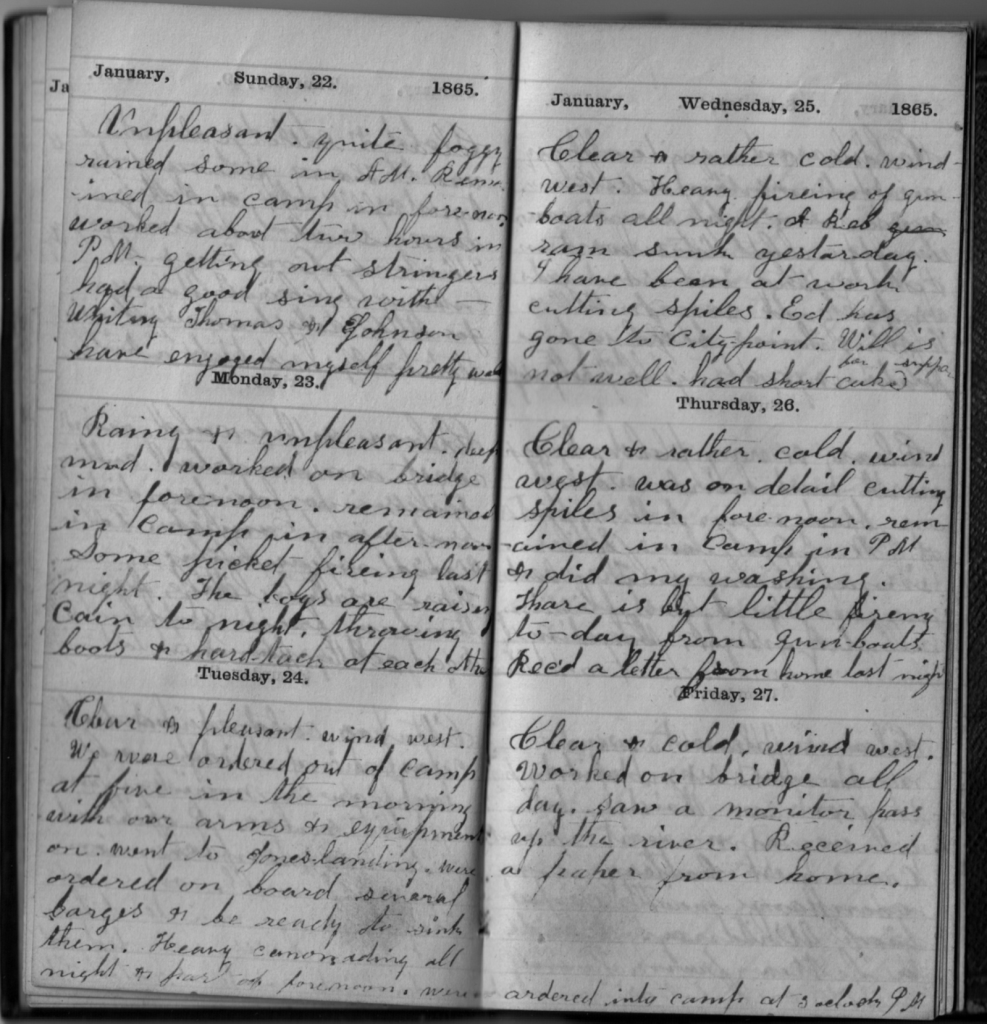
January, Sunday, 22. 1865—Unpleasant, quite foggy, rained some in a.m. Remained in camp in forenoon. Worked about 2 hours in p.m. getting out stringers. Had a good sing with Whitney, Thomas & Johnson. Have enjoyed myself pretty well.
Monday, 23—Rainy & unpleasant. Deep mud. Worked on bridge in forenoon. Remained in camp in afternoon. Some picket firing last night. The boys are raising cane tonight throwing boots & hard tack at each other.
Tuesday, 24—Clear & pleasant, wind west. We were ordered out of camp at five in the morning with our arms & equipment on. Went to Jones Landing. Were ordered on board several barges & be ready to sink them. Heavy cannonading all night & part of forenoon. Were ordered into camp at 3 o’clock p.m.
January, Wednesday, 25. 1865—Clear & rather cold, wind west. Heavy firing of gunboats all night at Reb ram sunk yesterday. I have been at work cutting spiles. Ed has gone to City Point. Will is not well. Had short cake for supper.
Thursday, 26—Clear & rather cold, wind west. Was on detail cutting spiles in forenoon. Remained in camp in p.m. & did my washing. There is but little firing today from gunboats. Received a letter from home last night.
Friday, 27—Clear & cold, wind west. Worked on bridge all day. Saw a monitor pass up the river. Received a paper from home.
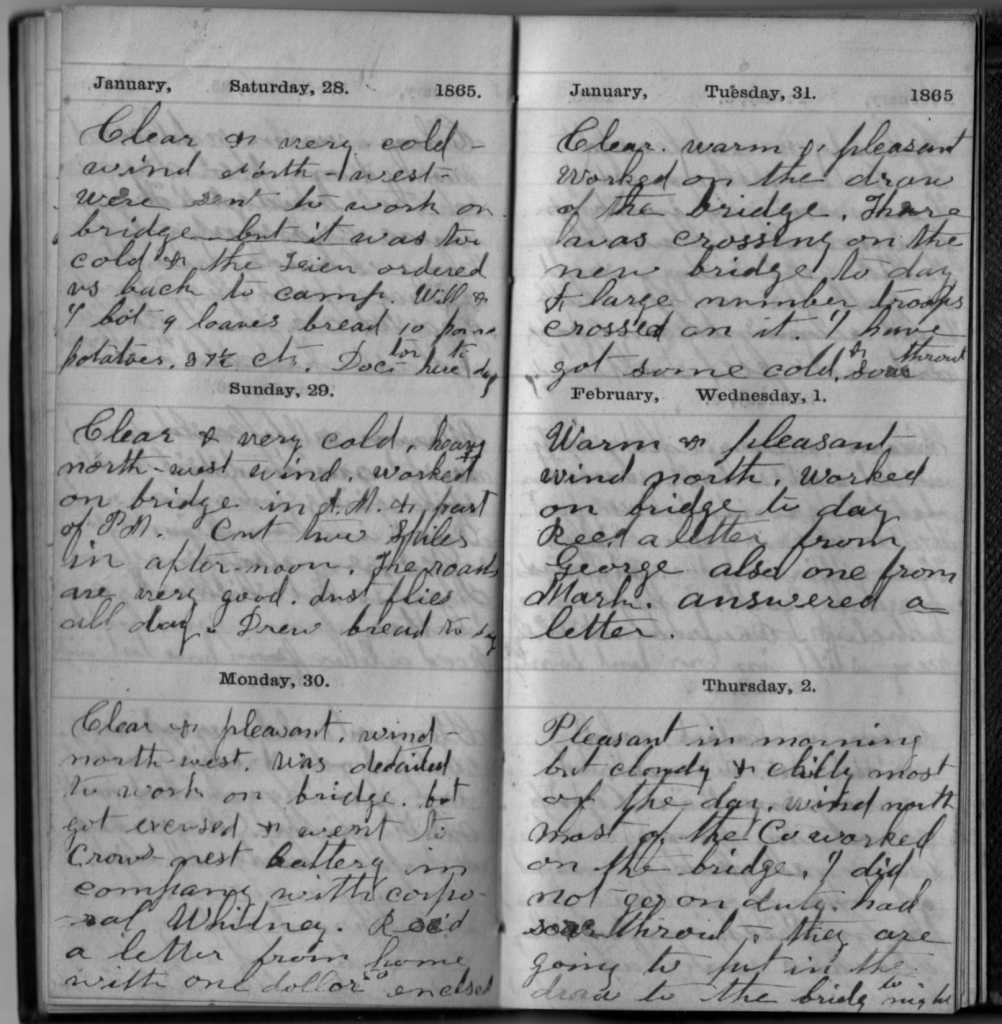
January, Saturday, 28. 1865—Clear & very cold, wing northwest. Were sent to work on bridge but it was too cold & the lieutenant ordered us back to camp. Will & I bought 4 loaves [of] bread, 10 pounds potatoes, 37 ½ cents. Doctor here today.
Sunday, 29—Clear & very cold, heavy northwest wind. Worked on bridge in a.m. & part of p.m. Cut two spiles in afternoon. The roads are very good. Dust flies all day. Drew bread today.
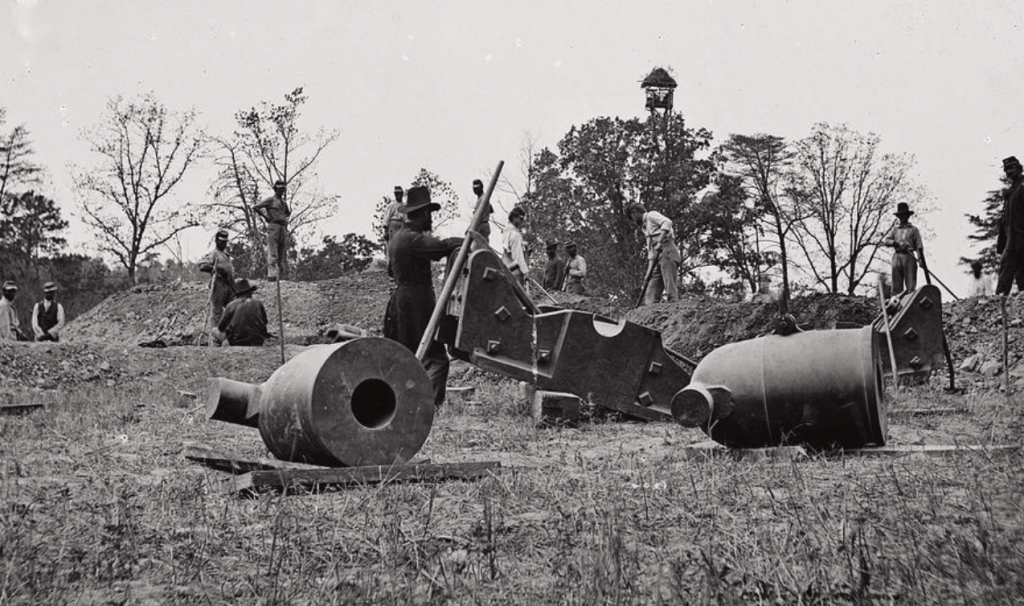
A work party placing mortars at the Crows’s Nest (visible above tree at right center) overlooking the James River opposite Dutch Gap.
Monday, 30—Clear & pleasant, wind northwest. Was detailed to work on bridge but got excused & went to Crows Nest Battery in company with Corporal Whitney. Received a letter from home with one dollar 50 enclosed.
January, Tuesday, 31. 1865—Clear, warm & pleasant. Worked on the draw of the bridge. There was crossing on the new bridge today & large number troops crossed on it. I have got some cold & sore throat.
February 1865
February, Wednesday, 1–Warm & pleasant, wind north. Worked on bridge today. Received a letter from George [Pierce]. Also, one from Mark. Answered a letter.
Thursday, 2—Pleasant in morning but cloudy & chilly most of the day, wind north. Most of the company worked on the bridge. I did not go on duty. Had sore throat. They are going to put in the draw to the bridge tonight.
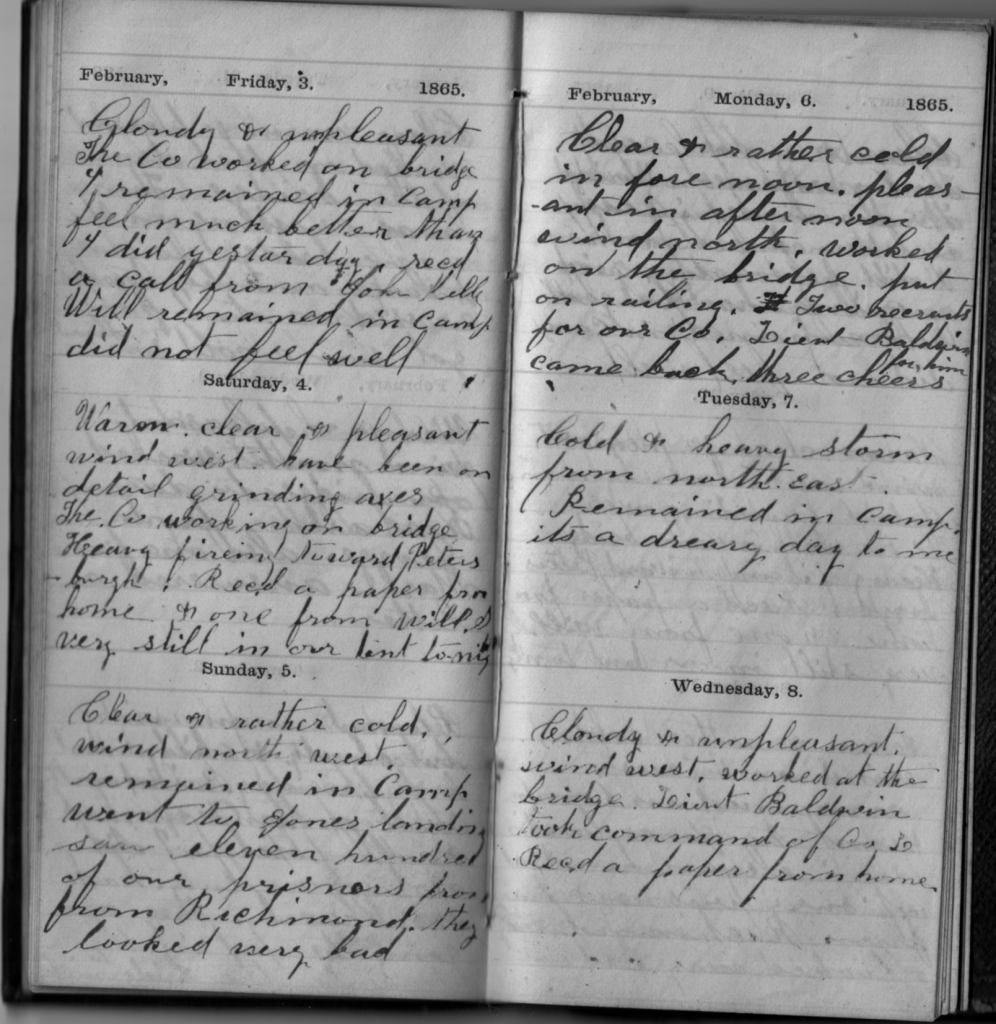
February, Friday, 3. 1865—Cloudy & unpleasant. The company worked on bridge. I remained in camp. Feel much better than I did yesterday. Received a call from John Kelly. Will remained in camp, did not feel well.
Saturday, 4—Warm, clear & pleasant, wind west. Have been on detail grinding axes. The company working on bridge. Heavy firing toward Petersburg. Received a paper from home & one from Will S[cribner]. Very still in out tent tonight.
Sunday, 5—Clear & rather cold, wind northwest. Remained in camp. Went to Jones Landing. Saw eleven hundred of our prisoners from Richmond. They look very bad.
Lt. William Henry Baldwin (Dave Morin Collection)
February, Monday, 6. 1865—Clear & rather cold in forenoon, pleasant in afternoon, wind north. Worked on the bridge. Put on railing. Two recruits for our company. Lieutenant [William H.] Baldwin came back. Three cheers for him.
Tuesday, 7—Cold & heavy storm from northeast. Remained in camp. It’s a dreary day to me.
Wednesday, 8—Cloudy & unpleasant, wind west. Worked at the bridge. Lieutenant Baldwin took command of Co. L. Received a paper from home.
February, Thursday, 9. 1865—Clear & rather cold, wind northwest. Worked at the bridge. Received a letter from home. Went to meeting in evening. Heard a good sermon.
Friday, 10—Clear & pleasant, wind southwest. I was left in camp to drill. Had a good time of it. Wrote a letter home. It is quite still in the barracks tonight. Drew bread & candles today. Received 25 cents in a letter.
Saturday, 11—Clear, warm, still, & pleasant. Worked on bridge in forenoon. Finished the bridge today. Had a game at ball in afternoon & wrote a letter for Almon Emery. We expect [ ] tomorrow. Received clothing.
February, Sunday, 12. 1865—Clear & cold with a heavy northwest wind. Went down to meeting but no preaching so we came back & spent the day as best we could reading & singing. It is the coldest night we have had this year.
Monday, 13—Clear & very cold in forenoon but quite pleasant in afternoon, wind north. The company drilled today. Mr. [John] Hunter, Mr. [Peter F.] Burdick, Will, & myself built a fire in the woods to keep warm.
Tuesday, 14—Clear & quite pleasant. We were on drill (the company) a.m. & p.m. Lieutenant [John] Archer took command of Co. L. I went to meeting in the evening in company with Mr. Hunt.
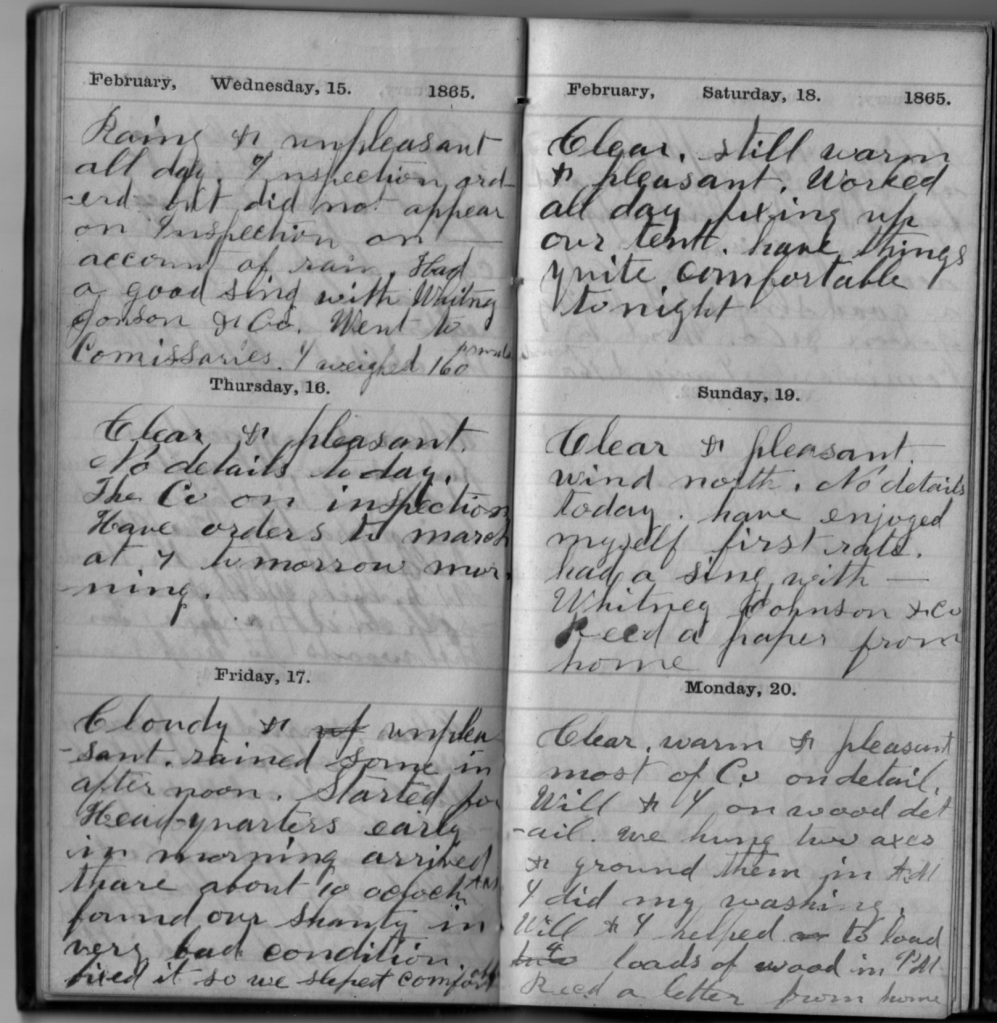
February, Wednesday, 15. 1865—Raining & unpleasant all day. Inspection ordered but did not appear on inspection on account of rain. Had a good sing with Whitney, Johnson, & company. Went to commissaries. I weighed 160 pounds.
Thursday, 16—Clear & pleasant. No details today. The company on inspection. Have orders to march at 7 tomorrow morning.
Friday, 17—Cloudy & unpleasant, rained some in afternoon. Started for headquarters early in morning. Arrived there about 10 o’clock a.m. Formed our shanty in very bad conditions. Fixed it so we slept comfortably.
February, Saturday, 18. 1865—Clear, still warm & pleasant. Worked all day fixing up our tent. Have things quite comfortable tonight.
Sunday, 19—Clear & pleasant, wind north. No details today. Have enjoyed myself first rate. Had a sing with Whitney, Johnson, & company. Received a paper from home.
Monday, 20—Clear, warm & pleasant. Most of company on detail. Will & I on wood detail. We hung two axes & ground them in a.m. I did my washing. Will & I helped to load 4 loads of wood in p.m. Received a letter from home.
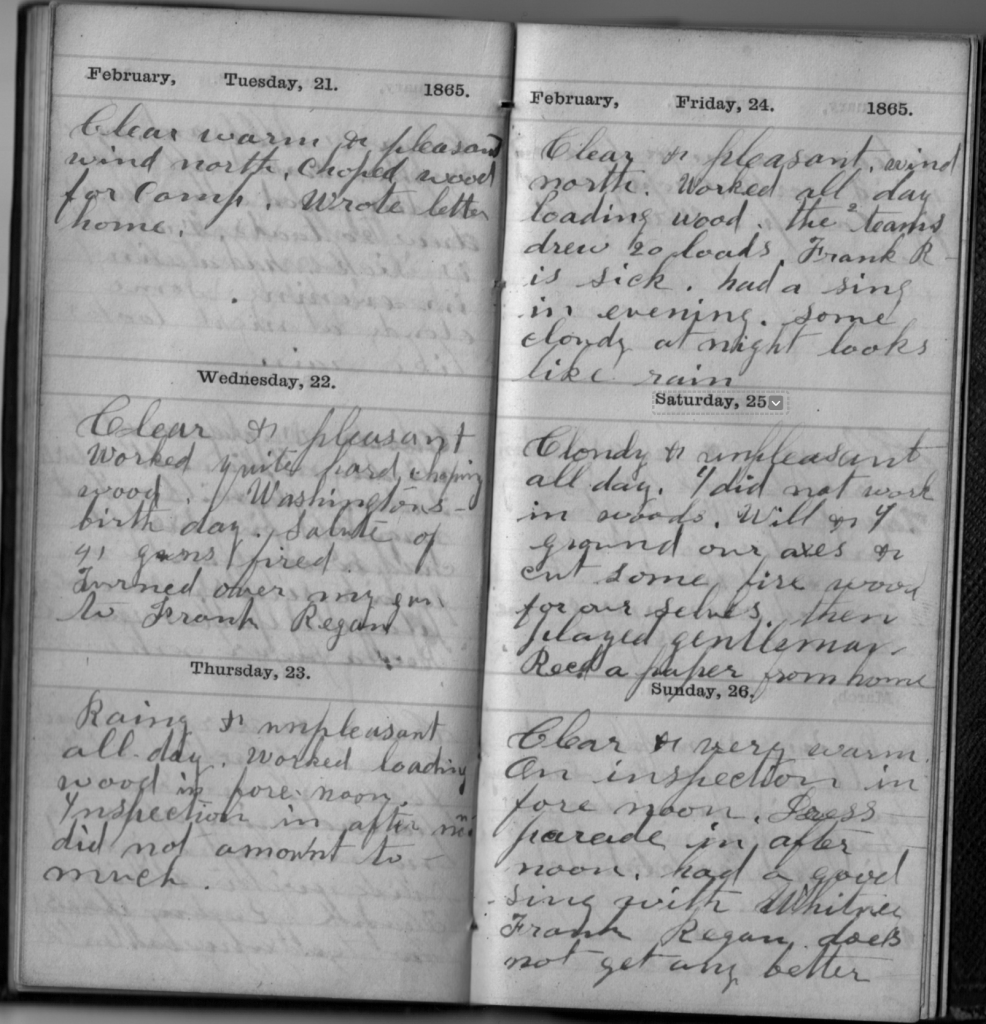
February, Tuesday, 21. 1865—Clear, warm & pleasant, wind north. Chopped wood for camp. Wrote letter home.
Wednesday 22—Clear & pleasant. Worked quite hard chopping wood. Washington’s birthday. Salute of 41 guns fired. Turned over my gun to Frank Regan.
Thursday, 23—Raining & unpleasant all day. Worked loading wood in forenoon. Inspection in afternoon did not amount to much.
February, Friday, 24. 1865—Clear & pleasant, wind north. Worked all day loading wood. The 2 teams drew 20 loads. Frank R. is sick. Had a sing in evening. Some clouds at night. Looks like rain.
Saturday, 25—Cloudy & unpleasant all day. I did not work in woods. Will & I ground our axes & cut some firewood for ourselves then played gentlemen. Received a paper from home.
Sunday, 26—Clear & very warm. On inspection in forenoon. Dress parade in afternoon. Had a good sing with Whitney, Frank Regan. Does not get any better.
February, Monday. 27. 1865—Clear & pleasant, quite warm. Chopped wood for camp. Mr. Hunter on our detail. Received a letter from home. Folks all well.
Tuesday, 28—Cloudy & unpleasant, rained some in a.m. The regiment mustered for pay in a.m. Inspection in p.m. Uncle Sam owes me 129 dollars. Wrote letter home. Frank very sick.
March 1865
March, Wednesday, 1—Cloudy & unpleasant, wind east. Cut wood in forenoon. Went for a load of cedar in p.m. with Corporal [William] Claude [Company M]. Frank went to hospital. Wrote a letter home last night. We feel quite lonesome.
March, Thursday, 2. 1865—Rained quite hard all day. No details. 27 recruits for our regiment. Frank Regan no better.
Friday, 3—Cloudy & unpleasant. Co. L marched to Point of Rocks to take charge of pontoon bridge. Stayed in tool house first night.
Saturday, 4—Heavy southwest wind, rained some in forenoon, rather pleasant in p.m. I stopped in lieutenant’s tent at night. Did not do much at quarters. Had a nail inspection.
March, Sunday, 5. 1865—Clear & cold in morning, pleasant in p.m., wind north. Whitney, Thomas, Reed & myself built a tent together. Was on guard. [Michael] Glennan & [Charles] Berry * under arrest.
* Charles Berry is also known as Charles Krensser or Creusere (1845-1922) born in Paris; immigrated to Brooklyn in 1854; became a citizen after the war; married Mary Mahoney then Evelyn Burt and died in Detroit. Ancestry info seems pretty good. There is a photo of him in old age.
Monday, 6—Clear & pleasant, wind north. Worked on tent. Built chimney, etc. Most of our quarters built today. Have got things quite comfortable tonight.
Tuesday, 7—Clear, warm, & pleasant. Did not drill today. Ed went to Bermuda for mail. I received a letter from home. Will & I went for a load of wood.
March, Wednesday, 8. 1865—Cloudy & unpleasant, rained some, wind south. Was on drill a short time in morning. It rained some & we stopped work. I wrote a letter home.
Thursday, 9—Cloudy & unpleasant in forenoon, quite pleasant in p.m. The company on drill in p.m. All took a good boat ride. Whitney & Thomas arrested for missing roll call.
Friday, 10—Raining & unpleasant in forepart of the day, cleared off in afternoon. We took boat ride in afternoon. Lieutenant [Charles D.] Otis * takes command of Co. L. Wrote a letter for Almon Emery.
* Lt. Charles Otis (1832-1905) is also know as Charles Cowdrey; born in Plymouth, New Hampshire; married Eleanora Sanburn; died in Queens.
March, Saturday, 11. 1865—Clear & rather cold, wind north in a.m., south in p.m. On drill about 5 hours. Thomas on guard. Whitney on wood detail. Reed went after the mail as usual. Had sing in evening.
Sunday, 12—Clear & pleasant, wind southwest. Inspection in a.m. & p.m. Received a letter from home. Wrote a letter to Julia Moore. Went to meeting in a.m. Walked out with Whitney & Thomas in p.m.
Monday, 13—Clear & very pleasant, wind southwest. We laid a pontoon bridge for first time. Did first rate too. Captain Lion present. Whitney on guard. Thomas wrote to his [ ].
March, Tuesday, 14. 1865—Clear & very warm, wind south. Laid bridge in forenoon. Loaded pontoon wagons in p.m. Worked very hard. Washed some clothes in afternoon.
Wednesday, 15—Wind southwest, cloudy & looks some like rain. Worked on pontoon wagon train in a.m. Took up pontoon bridge in p.m. Received a letter & paper from home.
Thursday, 16—Heavy south wind quite warm. Signed payroll & got my pay, 64 dollars. Went on drill in p.m. Wrote a letter home. Drew 2 loaves of bread. [Alfred] Hewitt paid me 3.50. Ed went for mail in afternoon.
March, Friday, 17. 1865—Clear & rather pleasant, wind west. We built one bridge in forenoon & took it up. Also one in p.m. Wrote a letter for Almon Emery. Went to church in evening.
Saturday, 18—Clear & pleasant, wind west. On detail fixing wagons for inspection in a.m. Laid bridge & took it up in p.m. Ed & C. Tomas went to City Point. No mail today.
Sunday, 19—Clear & very pleasant. Inspection in a.m. & p.m. Went to church in a.m. & evening. Saw Charlie Ford at the hospital. Wrote a letter home. The text in evening was this—the wages of sin is death.
March, Monday, 20. 1865—Clear & very warm. On drill in forenoon & p.m. Went to Sanitary Commission. Got some paper & thread. Fixed up a box to send home. Bought a blanket, gave 2.00.
Tuesday, 21—Cloudy & unpleasant, rained in p.m. I was on drill in a.m. On detail in p.m. laying fence. Ed went to City Point. Took a box of clothing to send home. Wrote a letter to M.
Wednesday, 22—Clear & quite cold in morning, heavy west wind. Took up bridge & loaded it on wagons in a.m. Helped to drive across bridge a drove of mules. Ed on detail. Got marching orders. Went to meeting in evening. Text 39th [ ].
March, Thursday, 23. 1865—Clear with a heavy west wind. Am on detail loading chess & putting boats together. [Patrick] Donnelly & [Charles] Berry got back from furlough. Let Almon have 2 dollars. Went to meeting in evening. Heard good sermon.
Friday, 24—Clear & rather cold, heavy west wind. Got marching orders in morning. Started for somewhere with pontoon train in p.m. Went as far as Deep Bottom & stopped for the night. Very cold night.
Saturday, 25—Cloudy & looks some like rain. Got up at ½ past 2 in morning. Started at daylight. Arrived at Chickahominy River at 2 o’clock p.m. Built a bridge across. Fixed a tent & stopped for the night.
March, Sunday, 26. 1865—Clear & rather cold, wind north. Took up the bridge in morning & started back. Halted just above Deep Bottom. Lost one of our Engineers Officers & one sharpshooter. Stopped at James River for night.
Monday, 27—Clear & very pleasant. Started for Broadway Landing early in morning. Arrived at Broadway in p.m. one o’clock. Worked the rest of p.m. loading boats on barge. Part of Co. L going to North Carolina, the rest to Hatcher’s Run.
Tuesday, 28—Clear & pleasant. Started on. March[ed] twenty-five miles. Arrived at Weldon Railroad at dark. Sheridan’s Cavalry with us. Also, Potomac Army. Went into camp about 8 o’clock at night.
March, Wednesday, 29. 1865—Clear, warm, & pleasant, wind south. Started in good season. Arrived within one mile of Hatcher’s Run about noon. Stopped there for the night. Looks like rain. Southside Railroad taken.
Thursday, 30—Wind south, rained hard all day. Remained in camp all day. Some fighting in afternoon. Saw a great many wounded men. Also, some Reb prisoners.
Friday, 31—Rainy in morning but quite pleasant most of the day. Went to front to build a bridge across Hatcher’s Run. Fighting all day. Did not get back until one o’clock morning.
April 1865
April, Saturday, 1. 1865—Clear, heavy west wind. Remained in camp. Fixed up quarters. Heavy firing all day. Our lines are advanced. A good many Johnnies taken prisoners. Received a letter from home. Wrote home.
Sunday, 2—Clear, warm & pleasant. Two inspections in a.m. Struck tents at noon & marched to signal station. Heavy cannonading all night. Petersburg captured this morning. Stopped near signal station for the night.
Monday, 3—Warm & pleasant. Richmond captured. We are on the road to Lynchburg. Saw Grant & Meade. Stopped for night. Some 2 miles on Southside Road. Looks as if the Rebs left here in a great hurry.
April, Tuesday, 4. 1865—Cloudy & quite cold in morning, pleasant most of the day. Started forward at 9 o’clock morning. Came 22 miles on Southside Road. Boys caught some sheep, hens, etc. I am on guard.
Wednesday, 5—Some cloudy in morning but warm & pleasant through the day. Started in good season. Marched all day. Arrived at Nottaway Station in evening. Stopped 2 hours. Then marched until morning.
Thursday, 6—Cloudy & some raining in morning, pleasant the rest of the day. Stopped a short time to rest & eat, then went on. Arrived at Burkeville at noon. Stopped there overnight. We hear good news all the time.
April, Friday, 7. 1865—Lousy & unpleasant most of the day. Cleared off just at night. Start off in good season. Marched all day & laid a bridge across the Appomattox at Farmville. Got through 12 o’clock [at] night.
Saturday, 8—Clear, warm & pleasant. Took up bridge & started on after the army. Stopped for the night some 12 miles from Farmville. It is reported we have captured 40,000 prisoners. I feel very tired tonight.
Sunday, 9—Clear, warm & pleasant. On our way toward Lynchburg in good season. Went into park at 3 o’clock. Lee has surrendered his army to Grant but many doubt it. But however it is so, we are living high.
April, Monday, 10. 1865—Rainy & unpleasant most of the day. Started out in afternoon & marched [un]til night toward Appomattox Court House. Passed a battlefield on our way. Saw several citizens today, all well.
Tuesday, 11—Unpleasant, foggy all day, quite muddy. Started off quite early on our way back to Petersburg. Marched until 4 o’clock p.m. & stopped at Davis Hill [?]. Several Reb parole cavalry passed us at night. Ed & I on picket.
Wednesday, 12—Cloudy & still in forenoon, heavy southwest wind in p.m. Started on our way in good season. Arrived at Prospect Station at 12 o’clock. [ ] teams. Ate dinner. Went on. Did not go far. Bad roads. Stopped for night, 12 miles from Farmville.
April, Thursday, 13. 1865—Clear & pleasant, wind west. Broke camp & travelled nearly to Farmville & camped for the teams are most played out. I had a good supper at a farmhouse. Did not get back until 10.
Friday, 14—Very clear, warm & pleasant. Broke camp at 9 o’clock. Arrived at Farmville at noon. Stopped for the night three miles beyond Farmville. Built a bridge across Bush River. The roads are very poor.
Saturday, 15—Unpleasant, it has rained most of the day. We have come 6 miles today. Very bad roads. Went into camp quite early. I killed a beef & we are faring first rate. The country does not look very fine here abouts.
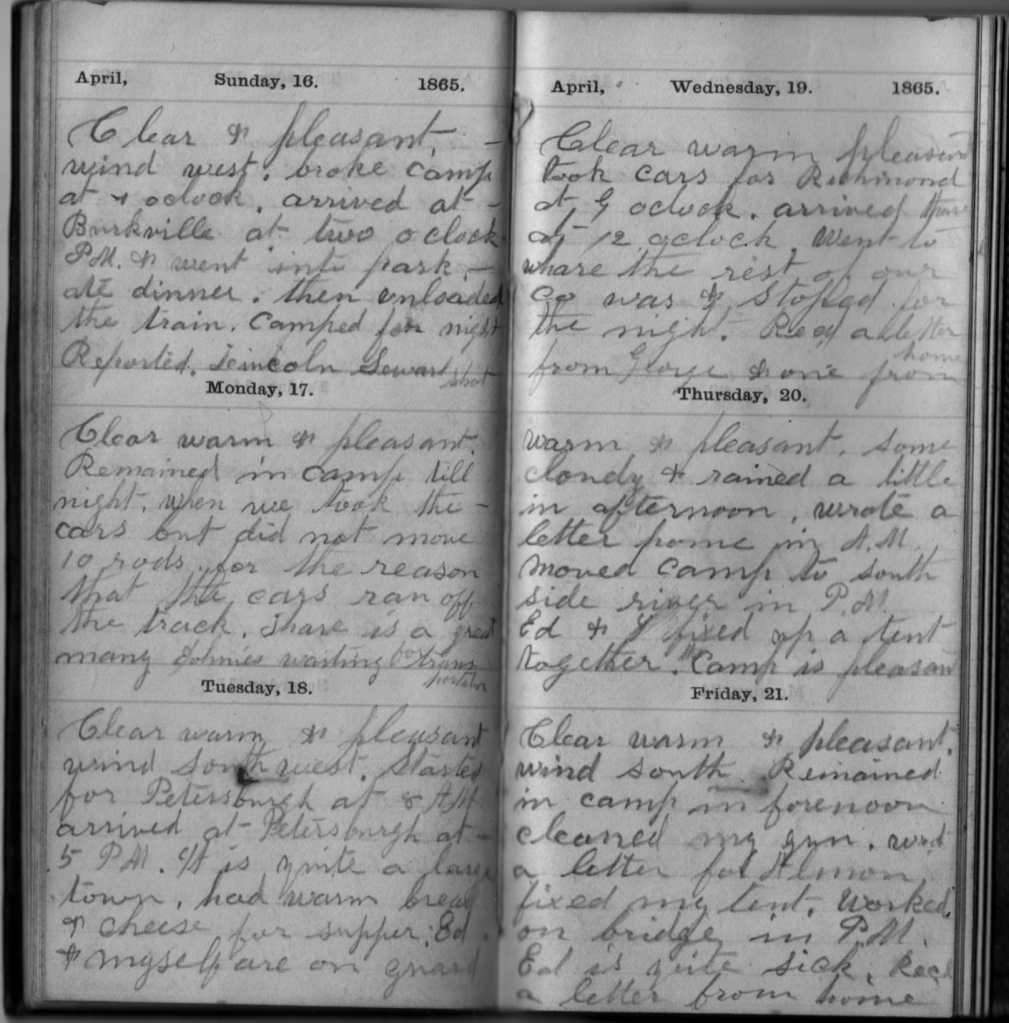
April, Sunday, 16. 1865—Clear & pleasant, wind west. Broke camp at 7 o’clock. Arrived at Burkeville at tow o’clock pm. & went into park. Ate dinner, then unloaded train. Camped for the night. Reported Lincoln, Seward shot.
Monday, 17—Clear, warm & pleasant. Remained in camp [un]til night when we took the cars but did not make more than 10 rods for the reason that the cars ran off the track. There is a great many Johnnies waiting for transportation.
Tuesday, 18—Clear, warm & pleasant, wind southwest. Started for Peterburg at 8 a.m. Arrived at Peterburg at 5 p.m. It is quite a large town. Had warm bread & cheese for supper. Ed & myself are on guard.
April, Wednesday, 19. 1865—Clear, warm, pleasant. Took cars for Richmond at 9 o’clock. Arrived there at 12 o’clock. Went to where the rest of our company was & stopped for the night. Received a letter from George & one from home.
Thursday, 20—Warm & pleasant, some cloudy & rained a little in afternoon. Wrote a letter home in a.m. Moved camp to south side river in p.m. Ed & I fixed up a tent together. Camp is pleasant.
Friday, 21—Clear, warm & pleasant, wind south. Remained in camp in forenoon. Cleaned my gun. Wrote a letter for Almon. Fixed my tent. Worked on bridge in p.m. Ed is quite sick. Received a letter from home.
April, Saturday, 22. 1865—Cloudy, wind southwest. Worked on bridge all day & finished it.
Sunday, 23—Cloudy & quite cool, wind blows quite hard from the west. Inspection in forenoon. Wrote a letter home, also to Julia. Wrote a letter for Almon Emery. Some of the boys are quite blue tonight.
Monday, 24—Clear & pleasant. I remained in camp in forenoon. Was on detail to unload a boat of lumber boards. Ed is sick. 30 recruits for Co. L. Abner Baker one of them.
April, Tuesday, 25. 1865—Clear, very warm & pleasant. On drill in forenoon. Remained in camp in p.m. Received a letter from home. Ed is some better. A squad of men away on detail.
Wednesday, 26—Clear, warm & pleasant, wind south. I am on guard. Ed is better, is doing duty in office. I wrote a letter for Almon.
Thursday, 27—Clear & pleasant. I remained in camp in a.m. Went all through Richmond in company with Mr. [John H.] Hatton. It is a beautiful city. Visited Castle Thunder, Libby Prison, the Capitol, Jeff’s house & many curiosities.
April, Friday, 28. 1865—Clear & pleasant most of the day, a slight squall in p.m. Worked on bridge all day & quite hard too. Reported surrender of Johnson. Booth shot dead.
Saturday, 29—Cloudy, wind south, rained some just at night. Worked on bridge below here. Took part of it down & put it on barge & took it to Richmond. Worked pretty hard.
Sunday, 30—Clear & pleasant but looks like [rain] tonight. Inspection at 8 morning. Mustered in afternoon. Wrote a letter home, also one for Emery.
May 1865
May, Monday, 1, 1865—Cloudy & quite cold. Remained in camp all day. Wrote a letter to Miss Mary [S. Mead]. Borrowed 19 dollars of Abner Baker. Ed at work in office.
Tuesday, 2—Some cloudy, quite cool, wind northwest. On detail to get a stick of timber from shipyard in a.m. Remained in camp in p.m.
Wednesday, 3—Clear & pleasant, wind northwest. On detail loading timber. Moved into a tent with Whitney.
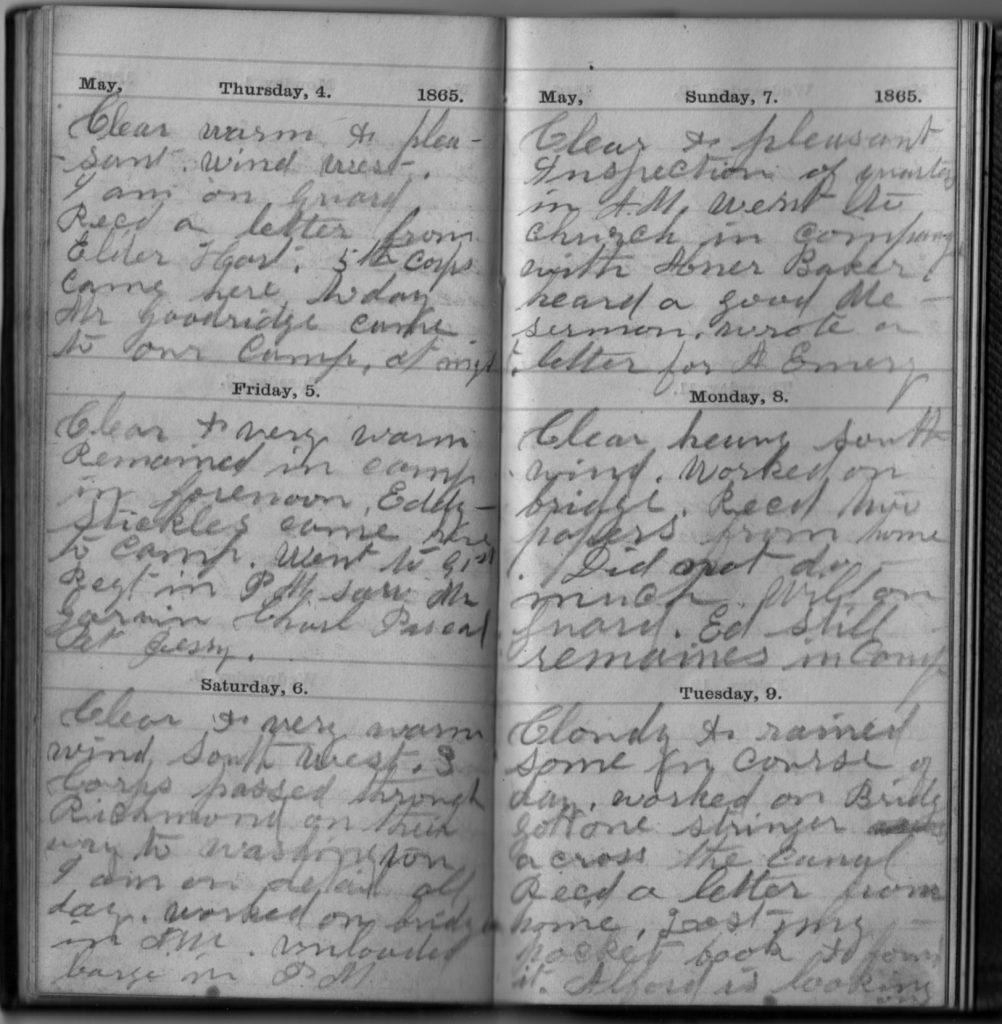
May, Thursday, 4, 1865—Clear, warm & pleasant, wind west. I am on guard. Received a letter from Elder [C. C.] Hart. 5th Corps came here today. Mr. Goodridge came to our camp at night.
Friday, 5—Clear & very warm. Remained in camp in forenoon. Eddy Stickles came here to camp. Went to 91st Regiment in p.m. Saw Mr. [Cyrus W.] Gavin, Charles Pascal, [Gilbert] Jesse.’
Saturday, 6—Clear & very warm, wind southwest. 3rd Corps passes through Richmond on their way to Washington. I am on detail all day. Worked on the bridge 1 in a.m. Unloaded barge in p.m.
1 This is the first entry Merritt makes in his diary of working on “the bridge.” He is referring to Mayo’s Bridge over the James River at Richmond which was destroyed by fire except for the stone piers. The Richmond Whig announced on 4 May 1865 that the bridge was going to be rebuilt. The Engineers worked quickly. By 13 June 1865, the Richmond Whig announced that the bridge would be completed by the end of the week. A week later they announced it was open to foot traffic and that it would soon be ready for vehicles. By the end of June 1865, the bridge was completed and the two pontoon bridges were taken up.
Ruins of Mayo’s Bridge over James River at Richmond, 1865
May, Sunday, 7, 1865—Clear & pleasant. Inspection of quarters in a.m. Went to church in company with Abner Baker. Heard a good [ ] sermon. Wrote a letter for A. Emery.
Monday, 8—Clear, heavy south wind. Worked on bridge. Received two papers from home. Did not do much. Will on guard. Ed still remains in camp.
Tuesday, 9—Cloudy & rained some in course of day. Worked on bridge. Got one stringer across the canal. Received a letter from how. Lost my pocketbook & found it. [Ransome C.] Alford is looking on.
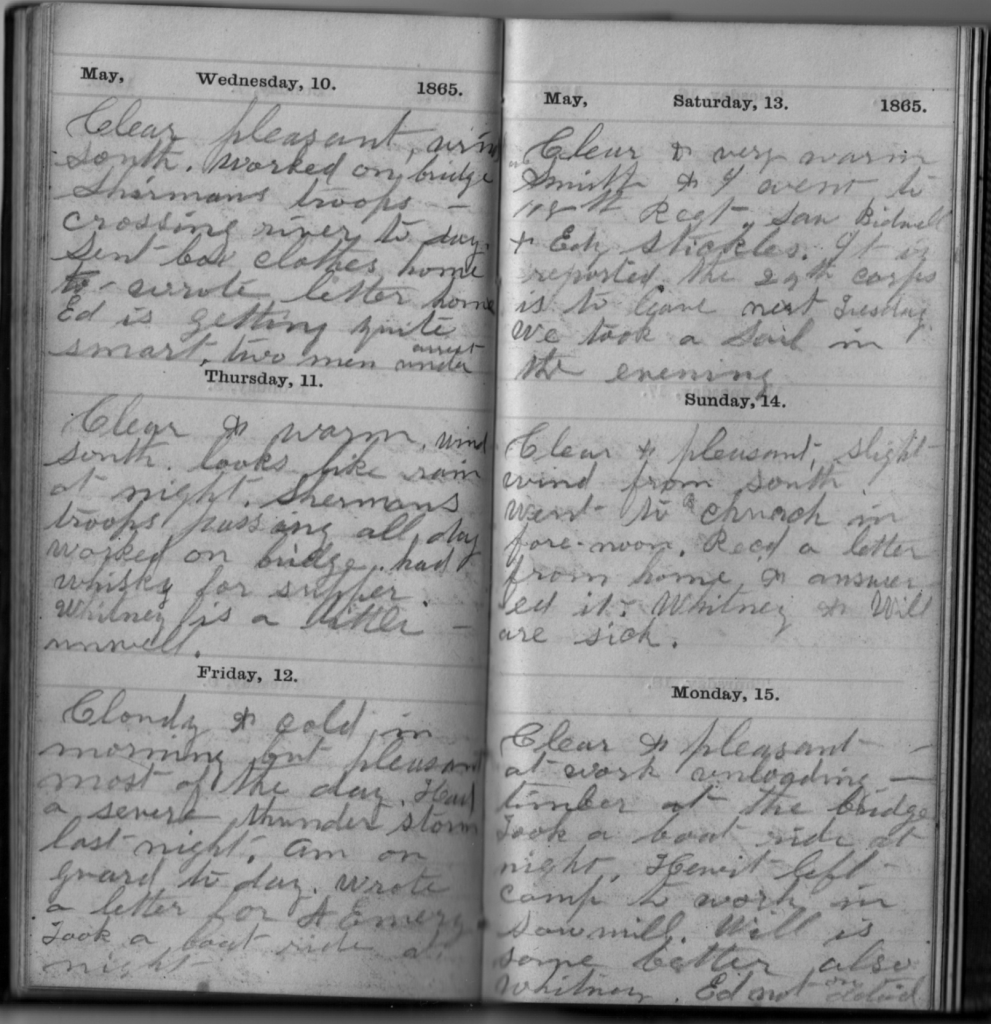
May, Wednesday, 10, 1865—Clear, pleasant, wind south. Worked on bridge. Sherman’s troops crossing river today. Sent box [of] clothes home. Wrote letter home. Ed is getting quite smart. Two men under arrest.
Thursday, 11—Clear & warm, wind south, looks like rain at night. Sherman’s troops passing all day. Worked on bridge. Had whiskey for supper. Whitney is a little unwell.
Friday, 12—Cloudy & cold in morning but pleasant most of the day, had a severe thunderstorm last night. Am on guard today. Wrote a letter for A. Emery. Took a boat ride at night.
May, Saturday, 13, 1865—Clear & very warm. Smith & I went to 118th. Saw [William] Bidwell & Ed[ward K.] Stickle. It is reported the 24th Corps is to leave next Tuesday. We took a sail in the evening.
Sunday, 14—Clear & pleasant, slight wind from south. Went to Baptist church in forenoon. Received a letter from home & answered it. Whitney & Will are sick.
Monday, 15—Clear & pleasant. At work unloading timber at the bridge. Took a boat ride at night. Hewitt left camp to work in sawmill. Will is some better, also Whitney. Ed not on detail.
May, Tuesday, 16, 1865—Clear, warm & pleasant, wind southeast. I am not on detail. Half of company is off detail now every day. Received a letter from Miss M. & answered it. Took a boat ride.
Wednesday, 17—Clear, warm & pleasant, wind south. Worked on bridge. Worked quite hard for me. Drew on pair of pants, one pair of shoes, one blouse. Will on sick list. Whitney, too.
Thursday, 18—Very warm, wind southwest & some cloudy. Took a boat ride in forenoon. Went to Richmond in p.m. with [Christopher] Soulia. Had a glass [of] beer. Will & Co___ still in camp. Co. H and M are here to camp.
May, Friday, 19, 1865—Clear & pleasant, wind south, clouded up & rained some at night. Worked on bridge. Boys got back last night from Fredericksburg.
Saturday, 20—Cloudy & showers, wind southeast. Remained in camp all day. Took a boat ride in afternoon. Received a letter from home.
Sunday, 21—Clear & pleasant most of the day. Rained some, just at night. Went to Episcopal church in forenoon. Remained in camp in p.m. & wrote a letter home. Will is sick.
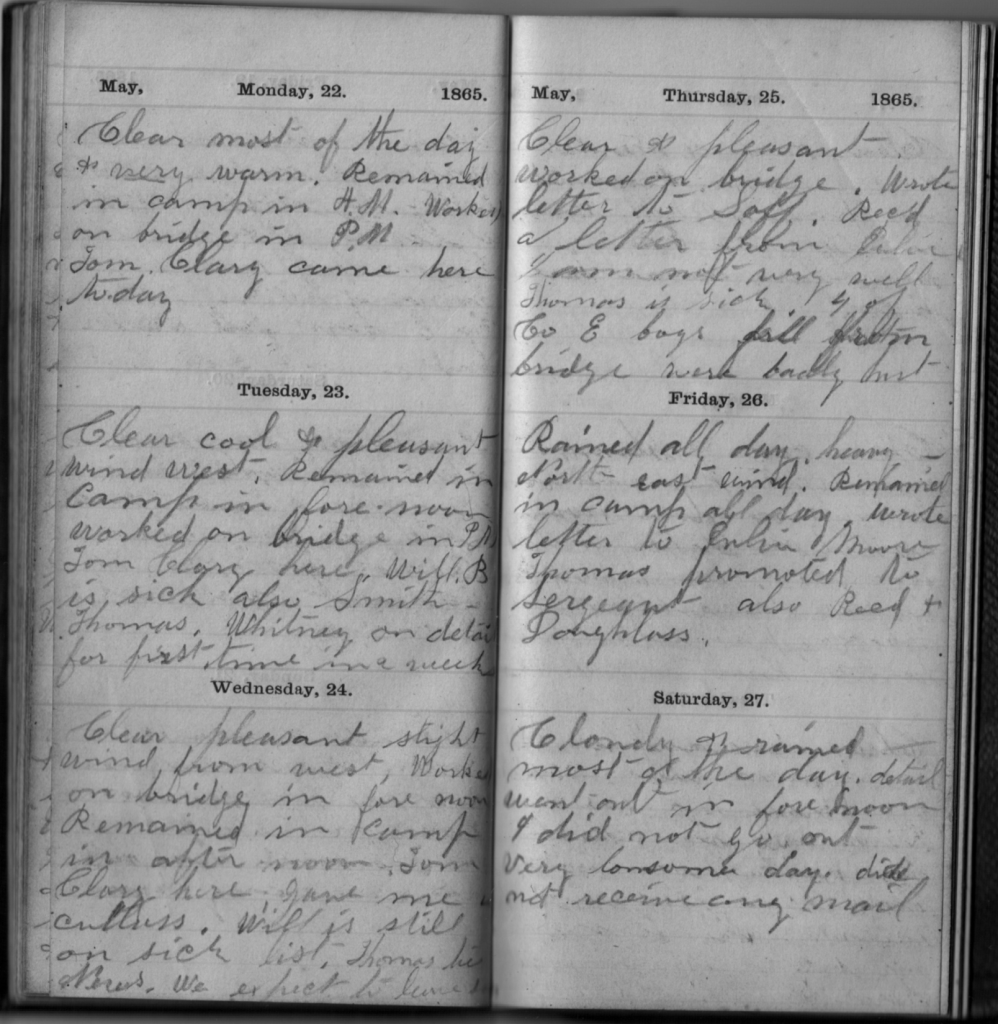
May, Monday, 22. 1865—Clear most of the day & very warm. Remained in camp in a.m. Worked on bridge in p.m. Tom Clary came here today.
Tuesday, 23—Clear, cool & pleasant, wind west. Remained in camp in forenoon. Worked on bridge in p.m. Tom Clary here. Will B. is sick, also Smith, Thomas. Whitney on detail for first time in a week.
Wednesday, 24—Clear, pleasant, slight wind from west. Worked on bridge in forenoon. Remained in camp in afternoon. Tom Clary here, gave me a cutlass. Will is still on sick list. Thomas has news, we expect to leave soon.
May, Thursday, 25, 1865—Clear & pleasant. Worked on bridge. Wrote letter to Saff[ord Taylor]. Received a letter from Julia. I am not very well. Thomas is sick. 4 of Co. E boys fell from bridge, were badly hurt.
Friday, 26—Rained all day, heavy northeast wind. Remained in camp all day. Wrote a letter to Julia Moore. [Smith] Thomas promoted to Sergeant, also [Henry S.] Reed & [James] Douglas.
Saturday, 27—Cloudy & rained most of the day. Detail went out in forenoon. I did not go out. Very lonesome day. Did not receive any mail.
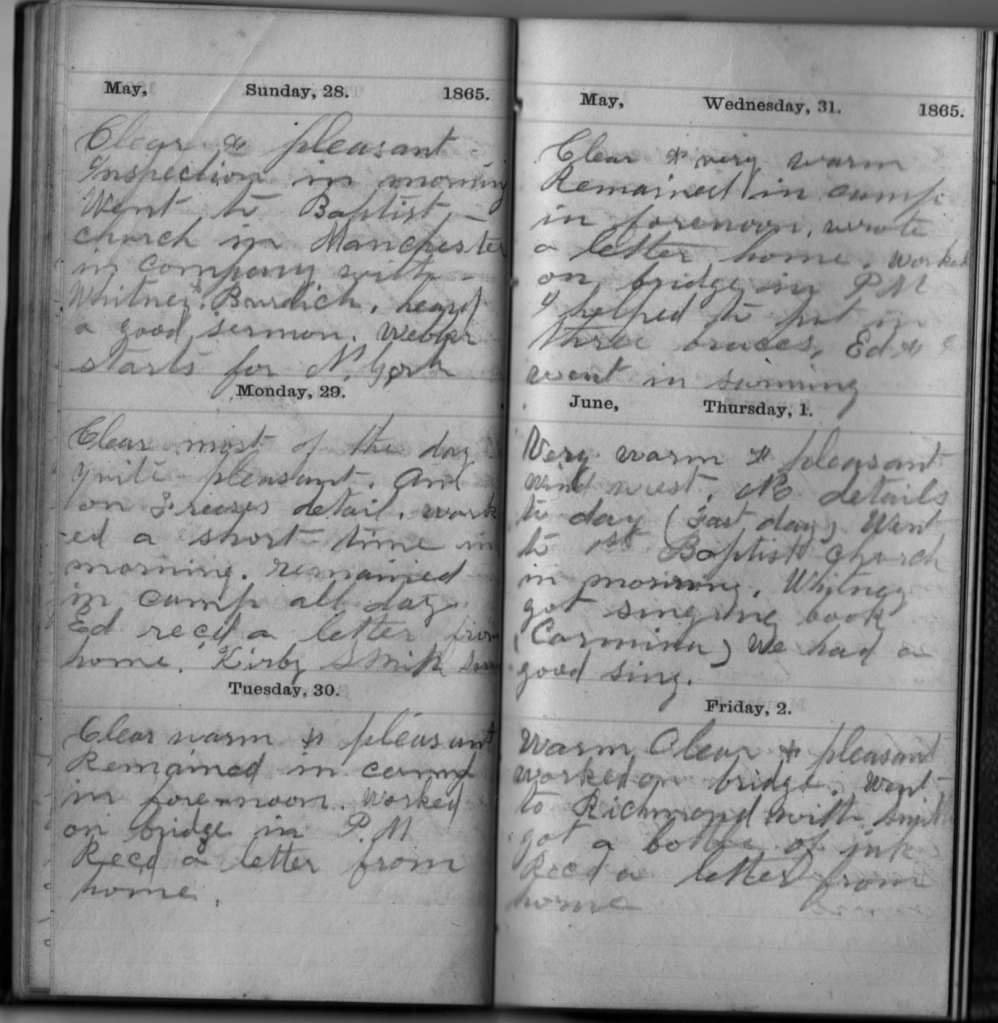
May, Sunday 28, 1865—Clear & pleasant. Inspection in morning. Went to Baptist church in Manchester in company with Whitney & Burdick. Heard good sermon. Webber starts for New York.
Monday, 29—Clear most of the day, quite pleasant. Am on trusses detail. Worked a short time in morning. Remained in camp all day. Ed received a letter from home. Kirby Smith, same.
Tuesday, 30—Clear, warm & pleasant. Remained in camp in forenoon. Worked on bridge in p.m. Received a letter from home.
May, Wednesday, 31, 1865—Clear & very warm. Remained in camp in forenoon. Wrote a letter home. Worked on bridge in p.m. I helped to put in three braces. Ed & I went in swimming.
June 1865
June, Thursday, 1—Very warm & pleasant, wind west. No details today (fast day). Went to first Baptist Church in morning. Whitney got singing book (Carmen). We had a good sing.
Friday, 2—Warm, clear & pleasant. Worked on bridge. Went to Richmond with Smith. Got a bottle of ink. Received a letter from home.
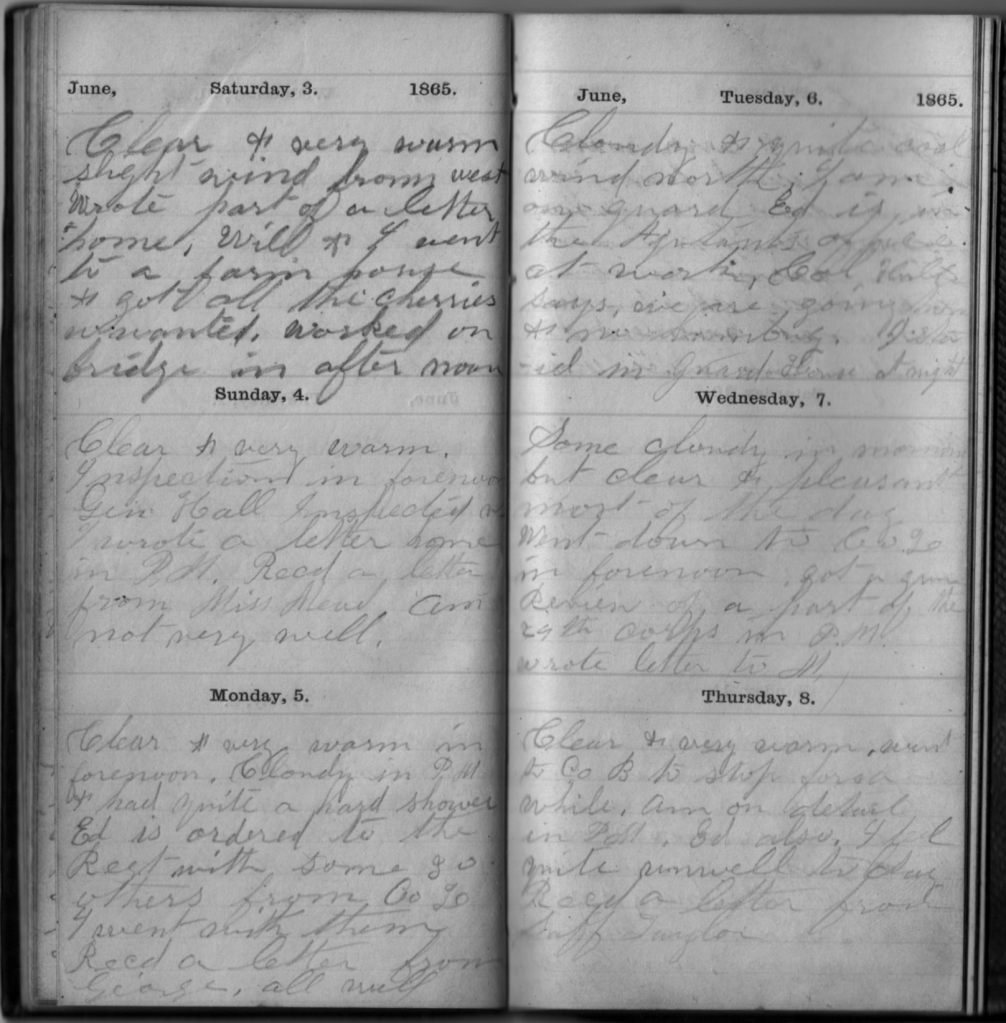
June, Saturday, 3, 1865—Clear & very warm, slight wind from west. Wrote part of a letter home. Will & I went to a farmhouse & got all the cherries we wanted. Worked on bridge in afternoon.
Sunday, 4—Clear & very warm. Inspection in forenoon. General Hall inspected us. I wrote a letter home in p.m. Received a letter from Miss Mead. Am not very well.
Monday, 5—Clear & very warm in forenoon. Cloudy in p.m. & had quite a hard shower. Ed is ordered to the regiment with some 30 others from Co. L. I went with them. Received a letter from George [Pierce], all well.
June, Tuesday, 6, 1865—Cloudy & quite cool, wind north. I am on guard. Ed is in the adjutant’s office at work. Colonel Hall says we are going home & no humbug. I stayed in guardhouse at night.
Wednesday, 7—Some cloudy in morning but clear & pleasant most of the day. Went down to Co. L in forenoon. Got a gun. Review of a part of the 24th Corps in p.m. Wrote a letter to M.
Thursday, 8—Clear & very warm. Went to Co. B to stop for a while. Am on detail in p.m. Ed also. I feel quite unwell today. Received a letter from Saff Taylor.
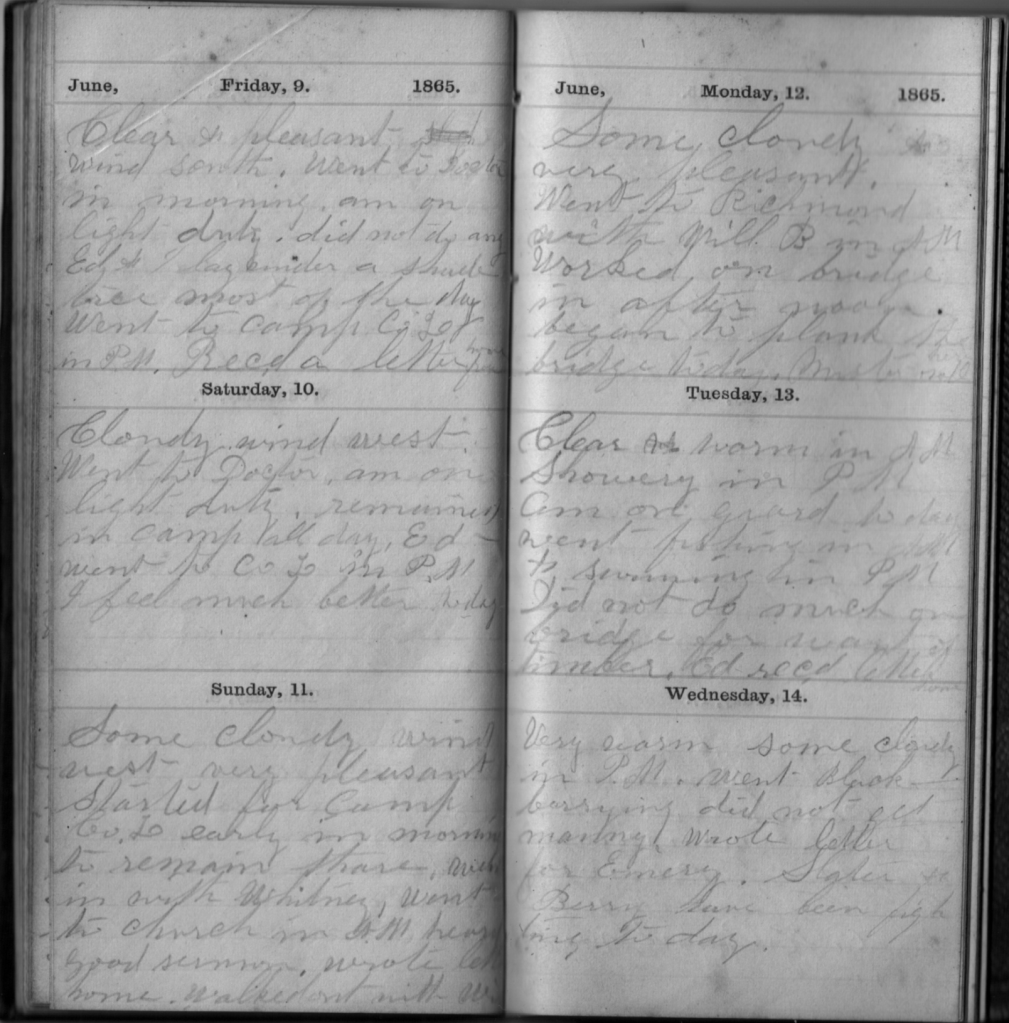
June, Friday, 9, 1865—Clear & pleasant, wind south. Went to doctor in morning a.m. On light duty. Did not do any. Ed & I lay under a shade tree most of the day. Went to camp Co. L in p.m. Received a letter from home.
Saturday, 10—Cloudy, wind west. Went to doctor. Am on light duty. Remained in camp all day. Ed went to Co. L in p.m. I feel much better today.
Sunday, 11—Some cloudy, wind west, very pleasant. Started for camp Co. L early in morning to remain there. Moved in with Whitney. Went to church in a.m. Heard good sermon. Wrote letter home. Walked out with Will.
June, Monday, 12, 1865—Some cloudy, very pleasant. Went to Richmond with Will B. in a.m. Worked on bridge in afternoon. Began to plank the bridge today. Muster roll here.
Tuesday, 13—Clear & warm in a.m., showery in p.m. Am on guard today. Went fishing in a.m. & swimming in p.m. Did not do much on bridge for want of timber. Ed received letter.
Wednesday, 14—Very warm, some cloudy in p.m. Went blackberrying. Did not get many. Wrote letter for Emery. [Joseph Schliter] & [Charles] Berry have been fighting today.
June, Thursday, 15, 1865—Cloudy & lowery part of the day. Will, Ed & myself sent home a box I carried to Richmond. Whitney & I on bridge but work under Captain King. Had a good supper.
Friday, 16—Cloudy, warm & muggy. Whitney, Will & I worked on bridge, finished fixing braces on north side bridge. Whitney & myself went to Richmond in p.m. Had some ripe apples.
Saturday, 17—Clear in a.m., showers in p.m. Remained in camp in a.m. George Farnsworth came to camp. I got pass & went to City Point with him.
June, Sunday, 18, 1865—Clear & pleasant. Started for Manchester 8 a.m. Arrived at Petersburg 9 a.m., at Manchester, 11 a.m. Versal Spalding came with us. Received paper from home, George letter.
Monday, 19—Clear in forenoon, rained in p.m. Am on guard today. Went to Richmond with Will in a.m. Thomas on bridge detail. Ed is working on muster rolls.
Tuesday, 20—Clear in a.m., cloudy in p.m., heavy shower at night. Am off duty today. Went to Richmond to carry box for Ed. George Farnsworth came to camp. Will went to City Point. Received a letter from home.
June, Wednesday, 21. 1865—Cloudy in a.m., very warm in p.m. Remained in camp & wrote a letter home in a.m. Worked on bridge in afternoon. The boys had an Irish wake at night.
Thursday, 22—Clear & very warm, rained some at night. Remained in camp in forenoon. Worked on bridge in p.m. Worked pretty hard. Received a letter from home. All well.
Friday, 23—Clear & very warm. Went to Richmond in forenoon after gun. Did not get any. Worked on bridge in p.m. & I worked very hard. Ed found me a gun.
June, Saturday, 24, 1865—Clear & very hot. Remained in camp in forenoon. Worked on bridge in p.m. I worked very hard. General Hall says we will be mustered out Wednesday.
Sunday, 25—Some cloudy & very warm. Inspection in forenoon. Officers very particular. George Farnsworth came to camp. Will & I went to Manchester with him.
Monday, 26—Clear & very warm. Went to Richmond in forenoon with Ed. Had a good dinner. Worked on bridge in pm. Teams passed on the bridge today. Major King crossed first.
June, Tuesday, 27, 1865—Clear & pleasant. All the company on detail in a.m. We finished Mayo Bridge in forenoon. Abner Baker & myself went to Richmond. Got some papers & a book.
Wednesday, 28—Clear, warm & pleasant, wind south. Drilled a short time in forenoon with guns. Remained in camp in p.m. Captain [Richard W.] Coe came to Co. L. Expect to be mustered out tomorrow.
Thursday, 29—Clear & warm, wind southwest. Went to headquarters & was mustered out of U.S. service in forenoon. Remained in camp in p.m. Expect to leave for home Saturday.
June, Friday, 30, 1865—Clear most of the day & very warm, wind southwest. Remained in camp all day. Struck tents in forenoon. Slept in cars overnight. Expect to leave in morning.
July 1865
July, Saturday, 1—Clear & very warm in a.m., heavy showers in p.m. The regiment takes transportation for Baltimore. Started from Richmond ½ past 9 o’clock a.m. On guard today.
Sunday, 2—Cloudy & cool most of the day. Sailed all day. Arrived in Baltimore at 5 pm. Went to soldiers home. Took supper (poor one too). Took cars at 8 in eve for Philadelphia. [ ] all night.
July, Monday, 3. 1865—Clear & pleasant. Arrived in Philadelphia 6 a.m. Went to Volunteer’s Restaurant & took breakfast (good one too). Took cars for Amboy, 9 o’clock a.m. Arrived in Amboy ½ 3 p.m. Took boat arrived in New York at 5.
Tuesday, 4—Clear & pleasant, wind west. We have the day to ourselves. Whitney & myself took walk in morning. Great fire works in evening. Will & myself went to City Hall. Got back a little past 9.
Wednesday, 5—Clear & pleasant. Remained at the Armory. Expect to [get] paid tomorrow. Went to Billina & took my gun. A good share of boys drunk. Went about the city where I chose.
July, Thursday, 6. 1865—Clear & pleasant. I am still in the city & not much signs of getting paid up. The regiment assembled & marched to Mechanics Hall. Heard speach.
Friday, 7—Clear & quite warm. Ed & I called on Billina in forenoon. Mr. Herrick in p.m. Borrowed 10 dollars of Mr. Herrick. Took supper at the 8th Armory. Will, Ed, I went to Erie [Hotel].
Saturday, 8—Clear & pleasant. I feel first rate today. Had a god night’s rest. Went to 8th Armory in morning. Found out that we should be paid off Tuesday next. Will received a letter from home.
July, Sunday, 9. 1865—Clear & pleasant. We are still at the Erie Hotel. Went to Episcopal church in morning. Remained at the Erie the rest of the day.
Monday, 10—Clear & pleasant. Went up to 8th Armory in morning. The company got paid. We are still waiting patiently for pay. I feel pretty well tonight.
Tuesday, 11—Rainy in forenoon, pleasant in p.m. Went to 8th Armory in morning. General Hall said we were to be paid on Thursday. Went up on Broadway in p.m. Ate supper at the Armory.
July, Wednesday, 12. 1865—Cloudy but rather pleasant. Took breakfast at the Continental Hotel. Rambled about the city in a.m. Visited Barnum’s Museum in p.m. Saw sights. Don’t get paid.
Thursday, 13—Some cloudy, wind southwest. Went to Amory at 10 a.m. to get paid but are put off another day. Barnum’s museum took fire & burned up.
Friday, 14—Clear & pleasant. Reported at 8 a.m. Signed payroll & was paid 2 p.m. Bought suit clothes, 40. Took steamer for Troy at 6 p.m. Am happy to know that I am free man.
July, Saturday, 15. 1865—Some cloudy but pleasant. Arrived in Troy 8 a.m. Took breakfast at Troy House. Called on Fred Bullis. Called on E. Beckwith. Went to Albany. Saw Harvey Dodge.
Sunday, 16—Rainy & unpleasant. Went to church in forenoon in company with Mrs. Beckwith. Remained at Mr. Beckwith’s in p.m. Had a good sing. Enjoyed myself well.
Monday, 17—Rainy & unpleasant in forenoon. Pleasant in p.m. Took cars for Whitehall 7 a.m. Arrived in Whitehall at 10 o’clock. Took boat & arrived in Plattsburgh at 6 p.m. Got home, just dark.
July, Tuesday, 18. 1865—Clear & pleasant, wind west. Went to Grandpa’s in forenoon. Called on Mrs. Beckwith’s people in p.m. Went to Morrison at night.
Wednesday, 19—Cloudy & looks like rain. Went to west lot in forenoon. Killed a woodchuck. Went to mill in p.m. Rains some at night.
Thursday, 20—Cloudy, wind west, quite pleasant. Went to Falls with some rolls[?]. Aunt Mag went with me. Went fishing up Henry Brook. Caught 25 trout.
July, Friday, 21. 1865—Cloudy & looked like rain in a.m., quite pleasant in p.m. Remained at home in forenoon. Went to Morrisonville in p.m.
Saturday, 22—Clear, warm & pleasant. Went to Grandpa’s in a.m. Settled with Ed & Will for boxes. Went to Plattsburgh in p.m. Got two teeth filled & check cashed.
Sunday, 23—Clear & pleasant. Went to church in a.m. & p.m. Heard two excellent sermons. Took Sib & Mary Mead home. Had a pleasant time.
July, Monday, 24. 1865—Clear & quite warm, wind southeast. Went to west lot & cut a load of hay. William Weaver came her at night. Let him 150 dollars.
Tuesday, 25—Clear in forenoon, rainy in pm. George & I cut a load of hay & got it in. [unreadable] helped mow.
Wednesday, 26—Cloudy, heavy west wind. Finished mowing up to west lot. Came home at night. Had garden peas for dinner.
July, Thursday, 27. 1865—Cloudy in forenoon, pleasant in p.m. George & I finished haying to west lot. Worked until 9 o’clock. Mr. Mead, Mary, & [Charlotte] Lot Dodge called at George’s.
Friday, 28—Clear & very warm. Dred [?] a load of oats & corn to Mr. Howe. There was 1797 lbs oats, 498 lbs corn. Price corn 1.00 70 pounds, oats, 55 cts. 92 lbs.
Saturday, 29—Cloudy, wind west. Went to upper wood lot. Made bargain to sell a part of it. Went to Morrisonville in evening to sing. Did not sing much.
July, Sunday, 30. 1865—Clear & very pleasant. Went to church in forenoon & afternoon. Heard a very good sermon from Elder Brown. His subject was the society in heave. Had very good singing.
Monday, 31—Clear & pleasant, wind south. Went to west lot in forenoon. Drew some rails for fence. Remained at home in pm. Baker is cutting hay for us. Frank went to [George’s?].
August 1865
August, Tuesday, 1—Clear, warm & a fine hay day. Finished cutting grass.[ ] I helped Beach. Sold Mrs. O’Brien 25 acres of wood lot. She let us have a cow & a two-year-old heifer towards it.
August, Wednesday, 2. 1865—Clear & warm. Worked for Beach in forenoon. Finished haying. George & I went to Plattsburgh in p.m. Will B. & I went to Mr. [Silas]Taylor’s. Saw Safford.
Thursday, 3—Clear & very warm. Got some stone for George’s cistern & put them in. George is quite sick today. Will & I went to Morrisonville at night.
Friday, 4—Some cloudy but very warm. Went to [ ] got some plank for George’s [ ] shed floor in a.m. Helped him to lay it in p.m. & cut the grass in lane & got it in barn.
August, Saturday, 5. 1865—Clear & pleasant. Went to see Eddy in forenoon. Went to covenant meeting in p.m. Will Beckwith & myself went to Smith Mead’s in eve.
Sunday, 6—Clear in forenoon, cloudy & looks like rain in p.m. Went to church. Attended a concert at the Methodist house. Took Sib & Mary M. home.
Monday, 7—Cloudy with heavy west wind. Took grist to mill. Wet to west lot. Helped George fix cistern. Alfred Parrott came here.
August, Tuesday, 8. 1865—Clear, heavy west wind. Worked to lot cutting rye. Did not do much.
Wednesday, 9—Clear, warm & pleasant. Worked for James Henry. Drew three loads of wheat from Plattsburgh. Received a letter from Whitney. Miss Fuller & Jule to George’s.
Thursday, 10. —Clear & pleasant, wind south. Took Miss Fuller & Jule home. Went to mill in p.m. to get two pigs of Mr. Henry. It looks like rain.
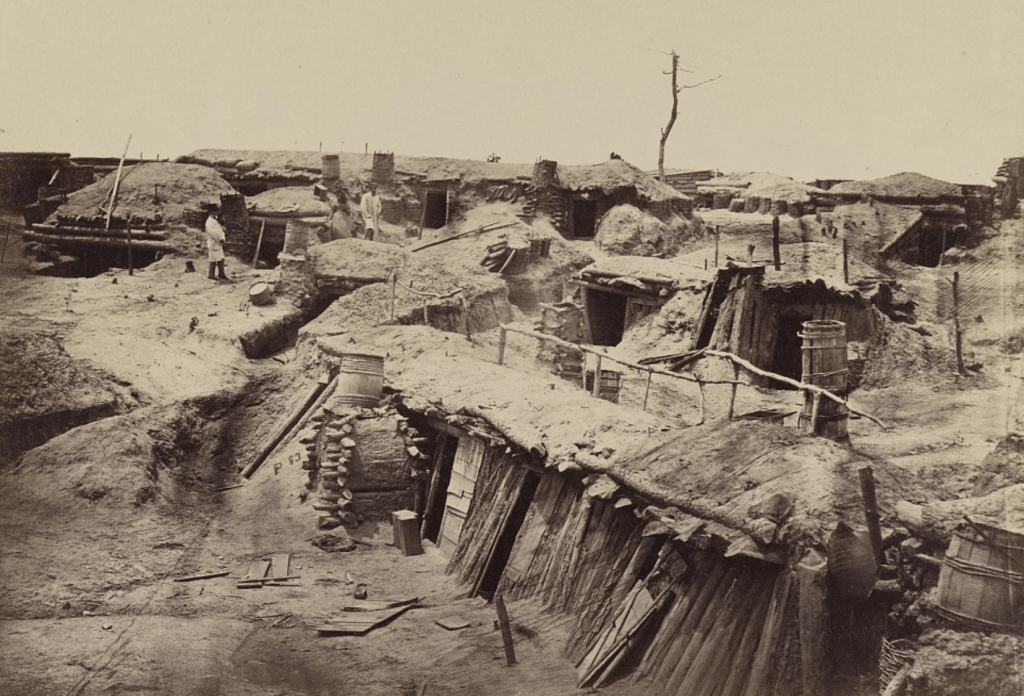
There is insufficient personal detail in the following letter to attribute it to any particular regiment, let alone any particular soldier. Numerous Union regiments were dug in near Petersburg where the city had been under siege for more than half a year by this point in late February 1865. The letter was written by a Union soldier named Edd (Edward) to his lady friend Mary who had the initials “M. E. M.” Edd speaks of the Union troops firing a salute on 24 February 1865 to celebrate the fall of Wilmington, North Carolina—the last remaining supply port for the Confederacy. In response, the Rebels in Petersburg unleashed a barrage of shells into the Union lines “quite hard.” Edd also speaks of deserters and a Peace Commission in Richmond.
Bomb-proof quarters in Fort Sedgewick in front of Petersburg (LOC)
Transcription
Before Petersburg, Virginia February 25th 1865
My dear Mary,
The times still passes off slowly yet but is on account of its being so unpleasant for it has rained nearly all the time since I got back.
We fired a salute last night for the capture of Wilmington and its surroundings. Oh, there is another peace Commission gone to Richmond but for what purpose, we have not yet heard. I hope they will do something so as to settle the war for I don’t think I should cry if it should end—not bad at any rate. The Rebs after we fired the salute last night opened on us quite hard but we would not reply to them. But I guess we didn’t get ourselves under cover anywhere. I reckon I did not for I got to the magazine and stayed until it was over. I’ll bet I didn’t wish myself at home any, Oh no!, where I was the week before. Although we all enjoyed the shelling very much, they done but little damage. Some of the shells went through some of the bomb proofs and some striking the ground and bursted which reminded me of the track we made the time we got out of the road coming home from Jane’s.
There is no news except a lot of the Rebs are deserting every night when it is dark. There was 560 came in night before last on the lines. As there is nothing more, I will close by sending my best wishes to all.
My truest love and a kiss to you. I remain your kind, true friend, — Edd
The following letters were written by 43 year-old Pvt. William (“Bill”) Buford Ayers (1820-1892) of Co. B, 28th Virginia Infantry who was recruited into the regiment on 17 August 1863 at Bedford, Virginia, for the duration of the war.
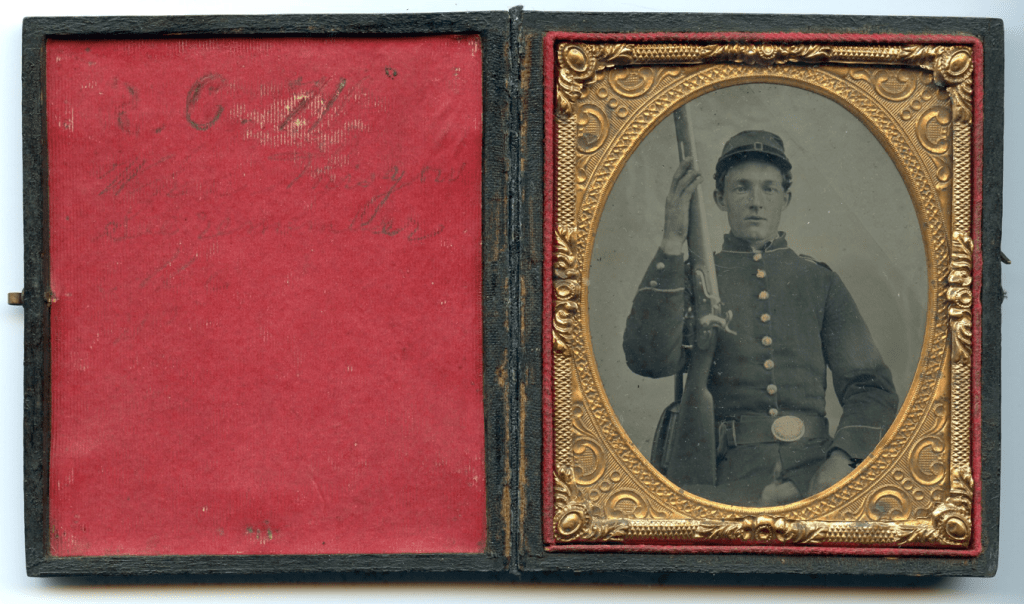
A middle-aged Reb holding a flintlock musket
William was the son of John Wesley Ayers (1787-1848) and Mary C. Powers (1788-1859) of Bedford county, Virginia. He was married in 1856 to Charlotte Morgan Lukens (1839-1920). Several of William’s brothers fought for the Confederacy. Pvt. James Wayne Ayers (1812-1890) of Lowry’s Company, Virginia Light Artillery. John and Samuel served in Co. I, 58th Virginia Infantry. Another brother, Elijah Quarles Ayers served with William in the 28th Virginia, Co. K, from the time of its formation until his death on 10 August 1862 from wounds received at the Battle of Seven Pines on 1 June 1862. A younger brother, Richard P. Ayers, served in Co. I, 58th Virginia Infantry and later transferred to Co. F, 2nd Virginia Cavalry until he was taken prisoner at Gettysburg and died of disease as a POW at Point Lookout, Maryland in January 1864. Jonathan Hersey (“Herse”) Ayers (1824-1887) served in Co. B, 14th Virginia Infantry.
Letter 1
Union prisoners being guarded by Rebel troops on Belle Isle at Richmond, Virginia.
Camp Lee (west side of Richmond, Va.) November 8th 1863
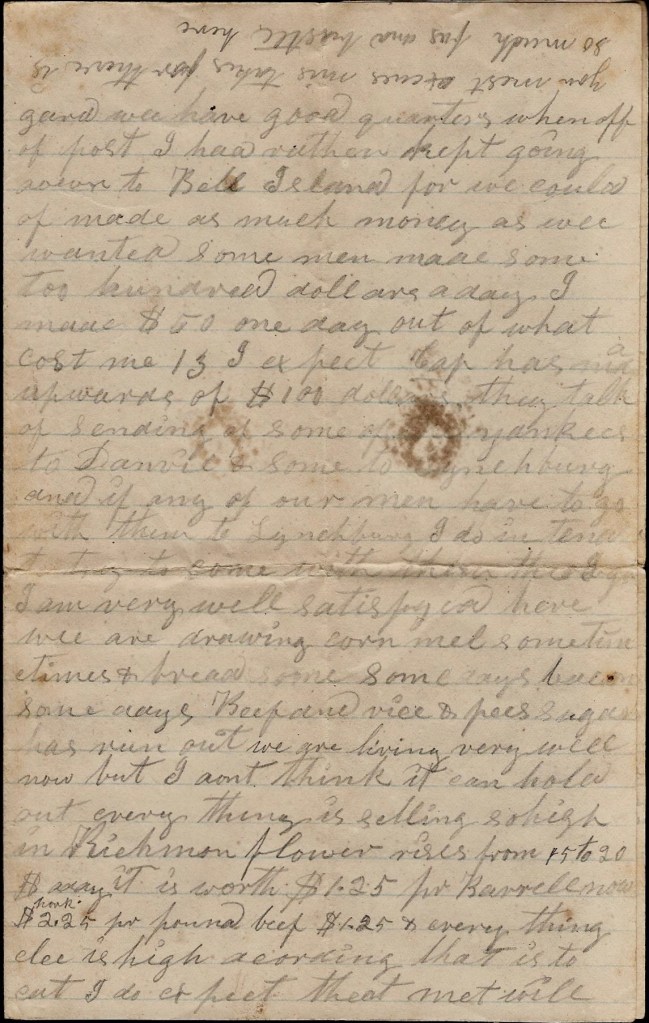
I again take my seat to drop you a few lines to let you know how we are a getting along. I and Cap are both well and hearty & have been & I hope when these few lines come to hand, you may all be enjoying the same great blessing. I have no strange news to write. We have moved in to our winter quarters. They are very comfortable plank houses with brick chimneys in the middle. They are set in the rear of head quarters. There is about one hundred men to a house. There is six men to a bunk, 3 in a berth. I and Cap & Wm. B. Jones sleep together. We sleep very warm. We have 12 blankets. I have 3 and a oil cloth. Cap has 2. Jones has 7.
We are guarding. The Yankees has little now down close to the Rocketts [Landing]. We have a long walk. We leave our camp at 8 o’clock in the morning & get back about ten next day. It is a very good place to stand guard. We have good quarters when off of post. I had rather kept going down to Belle Island for we could of made as much money as we wanted. Some men made some two hundred dollars a day. I made $50 one day out of what cost me 13. I expect Cap has made upwards of $100 dollars. They talk of sending some of the Yankees to Danville & some to Lynchburg and if any of our men have to go with them to Lynchburg, I do intend to try to come with them.
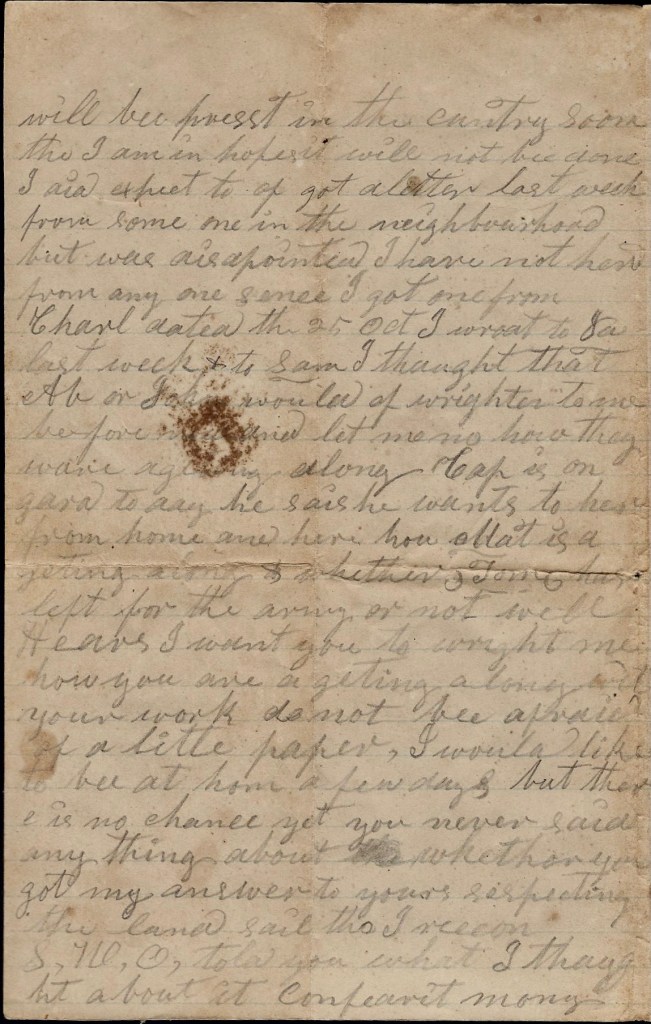
I am very well satisfied here. We are drawing corn meal sometimes & bread some days. Bacon some days, beef and rice & peas. Sugar has run out. We are living very well now but I don’t think it can hold out. Everything is selling so high in Richmond. Flour rises from 15 to 20 dollars a day. It is worth $1.25 per barrel now. Pork $2.25 per pound. Beef $1.25 & everything else is high according that is to eat. I do expect that meat will be pressed in the country soon though I am in hopes it will not be done.
I did expect to of got a letter last week from someone in the neighborhood but was disappointed. I have not heard from anyone since I got one from Charl[otte] dated the 25th of October. I wrote to James last week 7 to Sam. I thought that Ab or John would of written to me before now and let me know how they were a getting along.
Cap is on the guard today. He says he wants to hear from home and hear how Mat is a getting along and whether Tom has left for the army or not.
Well, Herse, I want you to write me how you are a getting along with your work. Do not be afraid of a little paper. I would like to be at home a few days but there is no chance yet. You never said anything about whether you got my answer to yours respecting the land sale though I reckon S.W.O. told you what I thought about it. Confederate money will not buy land about here now.
Well, Herse, if I had the chance of being free now and had the chance to trade here, I could make as much money as i would want. Shoes are worth from $20 to 50. Boots $15 to 75. If I had my leather made in shoes and here, it would bring a pile. Well, Charl[lotte], I want to see you very bad. I hope I have your prayers to sustain me this out of trouble. [I’m] hoping the time will soon come that we will soon see each other on earth. But if it is not our lot, I hope to meet you in heaven. Take care of the children. I must close hoping to hear from you all soon. You have my best wishes. May God bless you all is my prayer. So no more but remain your husband and brother till death. — Wm. B. Ayers
to C. M. Ayers & J. H. Ayers
You must excuse mistakes for there is so much fuss and bustle here.
Letter 2
Camp Lee June 9th 1864
Dear Brother & Wife,
I take this opportunity to let you know that our company has been disbanded & the most of us have to go to the field. I expect to go to the 28th Regiment & all the rest of the Bedford boys will go there too.
Well, Herse, I have sent another box to Liberty by the express. I started it today & I want you to get it home as soon as you convenient so they may be saved. They are packed very tight and are sort of damp. You will see a list of each man’s things sent in the box. you can open to take out my & Cap’s things. The box is J. B. Miles, his wife, so when it comes. Also E[dward] T. Nances’ wife also, so they may get them.
I am sorry to have to leave here on account of being convenient to the Post Office. I fear I cannot hear from you all often when I leave here. I don’t think anything will hurt me if I can shun the balls. I can hope for the best if the worst comes. I do not want any of you to be uneasy about me for I am going to try to take care of number one. Those lines leave me well and hope when they come to hand, it may find you all well.
Cap was sent before the board today & was sent back to the hospital again. He is about like he has ben for some time. I do not know where to tell you where to send your letters to till I get to my command. you can write to Cap. He may stay here some time. Our army is close round Richmond. I expect you know as much about the war news as I can tell. I have seen all of the late cavalrymen here so I will sign off hoping you all may be spared to live & make out well.
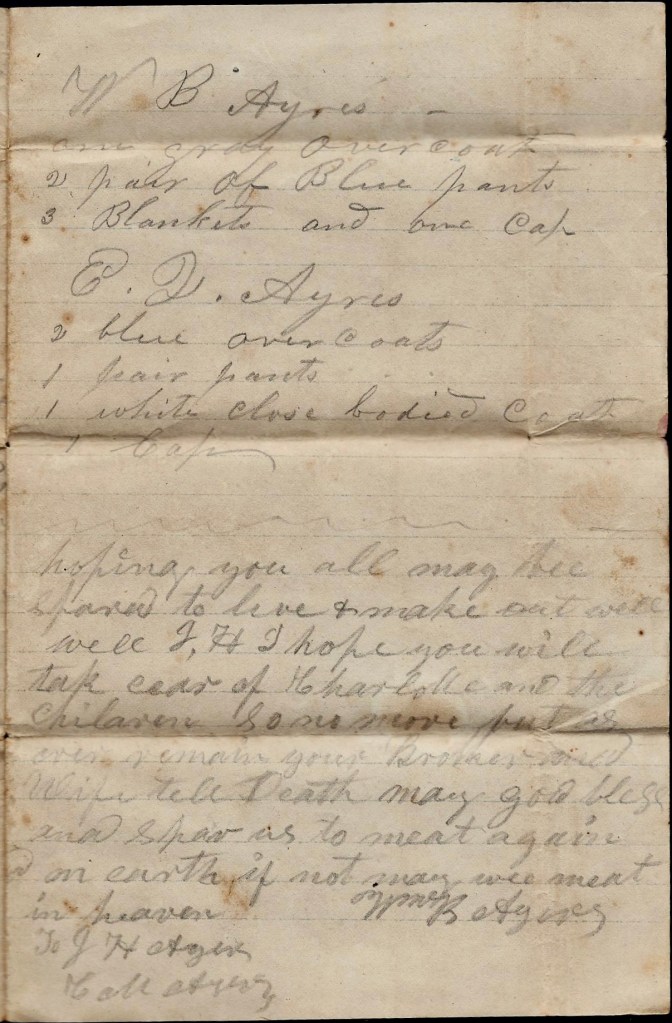
Well, J. H., I hope you will take care of Charlotte and the children. So no more but as ever, remain your brother and wife [husband] till death. May God bless and spare us to meet again on earth. If not, may we meet in heaven. — Wm. B. Ayers
to J. H. Ayres & C. M Ayers
[List of clothing sent in box belonging to W. B. Ayres, E. Q. Ayres, E. G. Nanees, and J[oseph] R. Miles.]
Letter 3
Camp near Chester Station June 19th 1864
Dear wife,
I take this chance to send you a few lines as Mr. Wi____ K______tt is in camp. I have no good news to write. I left Camp Lee [the] 9th & got to the Regiment the 12th. Then started the next day on a march. We went some 15 miles that day & rested 2 days. Then we had a forced march across the south side of the James River where we met up with the Yankees & gave them a hot time for awhile & drove them out of our breastworks. We lost some few killed & some wounded. We are right in front of them now in our breastworks firing into each others pickets. We had a hot skirmish fight yesterday. We had several killed & some wounded. I guess we will have a hot time here soon.
I was in one skirmish fight. The balls whistled like bees round me but none never touched me. One ball went through E[dward] T. Nance’s pants & burnt his skin a little. We have had a very hard time since I have been with the company though I have stood it very well. I feel very well today & I hope I may have good health so I may be able to do my duty as a soldier.
Dear wife, I do not want you to make your self uneasy about me. If I ever have the misfortune to never see you again. I hope you may be spared to have good health so you can raise our children [even] if we are run over with the Yanks. I hear the Yankees is up in Bedford [County] now. I am afraid they may come in to our neighborhood & destroy all you have to live on though I hope they may be drove back from there.
I am in the 28th Regiment, Company B, from Craig county. They are quite clever men & I am very well pleased. All of our Bradford boys are here with me. I saw J. M. J. Ayers the 11th but did not have the opportunity of talking to him. He was well. I left Cap at the hospital at Camp Lee. He was no better. Tell [my brother J. H. [Ayres] I am in hopes he can stay at home so he can make something to go on.
Well I must close for this time as I am in a hurry. My respects to you and to all who may enquire after me. May God bless and spare us to see each other again is my prayer. So goodbye for this time. From your true husband, — Wm. B. Ayres
to C. M. Ayres
Direct as follows:
William B. Ayres Richmond, Virginia Pickett’s Division Hunton’s Brigade 28th Regiment Va. Vol. Company B
N. B. I sent a box of clothes by the express to Liberty the 9th and sent you a letter to that effect. if you did not get it, you can send for the things—i.e., mine and Caps, Jo Miles, and E. T. Nance’s.
Letter 4
Camp Chester October 16th 1864
Dear Wife,
I again seat myself to drop you a few lines to let you know that I am tolerable well and hope when this comes to hand it may find you all enjoying the best of health. I am at a loss of what to write to you at this time for it has been so long since I have got any letter from Bedford that I do not know what to think is the cause. I received yours of the 24th of September. That was the last I have heard from anyone up there. This is the 4th letter I have written since I have got one. I am more than anxious to hear from you all & the relation generally.
I can say we are at the same place where we have been ever since we crossed the James River. It is thought now we will stay here this winter. We have put up very good log huts for winter quarters. I have a good one with a brick chimney to it. It is very good cool nights. We have had some very heavy rains of late & some very heavy frosts.
As for war news, I do not know what to say but it does seem like the men are becoming very tired now & I fear from the present prospect it will go on for a long time yet if we can hold out with men & provisions. But the most of the men say they will not stay any longer than next spring. Times here is very hard & from what I learn, it is getting so in the country. I fear the women and children will suffer this winter as well as the soldiers. There is a good many desertions now but if men have their wives and children in want, I fear the army will be broken up.
There has been no fighting in our front. There was a fight on the north side of the Darbytown Road [see Battle of Darbytown Road] Wednesday and we whipped the Yanks.
Well, Charl[otte], under the late order, I guess [my brother] Herse has left for the army by this time & all the rest of the detailed men & I do not [know] how you will make out. I want you to write to me what for a crop you all have made this year & how the molasses & corn turned out, and what is the chance for another year’s meat. I have most forgot about the killing of hogs. If you think you will be scarce of meat and you have not sold those two little steers, you had better fatten one and kill it for a beef though I want you to do what you think is the best for I have [no way to] help you now. I do not know what Herse is a doing or has done; consequently I cannot advise much what you had better do. If Ab has not gone in the service, I am in hopes he will write me soon and give me the points. Also tell Cap to write and let me know how he is a getting along. Tell him B. Leftwih is [in] our company.
Well, as I cannot get any letters by the mail, Mr. R. Debo is at home and if you can contrive a letter to him when he comes back, he will bring it. Well, I will close for this time as I do not think of more than will interest you at this time. I have written so often since I have heard from you all I do not want to say more.
J[oseph] R. Miles sends his respects to you all. He looks somewhat thin but is well except a bad cold. E[dward] T. Nance is improving. C. W. Allen is well.
Charl[lotte], you do not know how bad I do want to see you and the children. you must take care of them & do the best you can. May God bless us and grant us the privilege of seeing each other once more in peace is my prayer. From your true friend and husband, — W. B. Ayers
To C. M. Ayers
Letter 5
Chester Hospital December 19th 1864
Dear Wife,
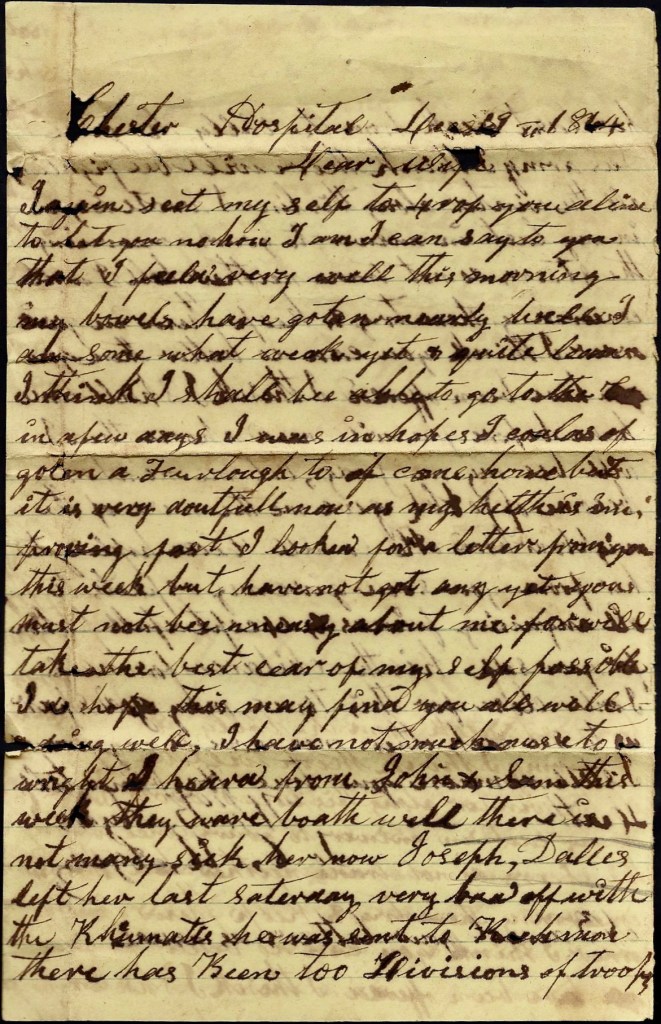
I again seat myself to drop you a line to let you know how I am. I can say to you that I feel very well this morning. My bowels have got nearly well. I am somewhat weak yet & quite lame. I think I shall be able to go to the regiment in a few days. I was in hopes I could of gotten a furlough to come home but it is very doubtful now as my health is improving fast. I looked for a letter from you this week but have not got any yet. You must not be worried about me for I will take the best care of myself possible. I do hope this may find you all well and doing well.
I have not much news to write. I heard from John & Sam this week. They were bother well. There is not many sick here now. Joseph Dalles left here last Saturday very bad off with the rheumatism. He was sent to Richmond. There has been two divisions of troops here last week from the alley to join Lee’s army. I think there will be fighting all the winter along this line.
I wrote to you in my last letter in answer to yours concerning the steers. Do not trade neither till I write concerning them. Try and keep them in good order. I think you can do better than you have been offered. I think I shall come home before you will need a horse. Then I will be my own judge. Let me know what became of Ab. Give me the news of the neighborhood. So I will close hoping to hear from you son. Give my respects to all enquiring friends & accept a full portion for yourself. Kiss the children for me. So I will close for this time. May God spare us to see each other once more is my prayer. I still remain your true husband till death. — Wm. B. Ayers
To C[harlotte] M. Ayers
N. B. Direct your letters as usual.
Letter 6
Camp near Chester January 22, 1865
Dear Wife,
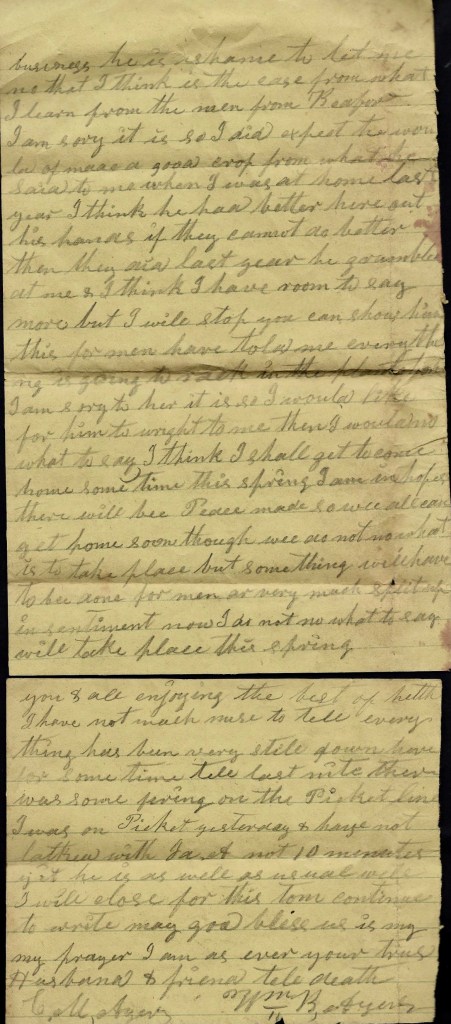
I am glad to inform you that I received yours of the 14th & of the 7th & was glad you was beset with health. I received those things you sent by Jas. A. & Cap alright. Jas. got here yesterday. Cap went to Camp Lee. I am in hopes he will have the luck to come back home again from what Jas. said about him. I was much pleased with your present to me as a Christmas & New Year’s gift. I do not know when I can pay you for it but I am in hopes I can come & bring it myself though I do not know when it will be. I was glad to have [my brother] Herse had the good luck to come home. I tried to get a furlough to come home while he was there but there is no chance now for me. I’m at a loss to know what to say to him to do as he has been so dilatory about writing to me. I guess he does not want me to know what he is a doing with things at home else he would of let me know. He has done such sorry business, he is ashamed to let me know that I think is the case from what I learn from the men from Bedford. I am sorry it is so. I did expect he would be of made a good crop from what he said to me when I was at home last year. I think he had better hire out his hands if they cannot do better than they did last year. He grumbled at me & I think I have room to say more but I will stop. you can show him this for men have told me everything is going to rack in the plantation. I am sorry to hear it is so. I would like for him to write to me. Then I wouldn’t have to say.
I think I shall get to come home sometime this spring. I am in hopes there will be peace made so we all can get home soon though we do not know what is to take place but something will have to be done for men are very much split up in sentiment now. I do not know what to say will take place this spring. I am in [hopes] from what I can learn that things will change soon. If not, I do not know what the people in the country will do for I learn the press masters are taking most everything that the women and children will do to live. But I believe everybody is for self now and I fear that God is for not many. Tell [my brother] Hearse to write & give me a history of his travels if he will not of home & our business.
This leaves me quite well at this time hoping it may find you & all enjoying the best of health. I have not much news to tell. Everything has been very still down here for some time till last night there was some firing on the picket line. I was on picket yesterday and have not talked with Jas. A. not ten minutes yet. He is as well as usual. Well, I will close for this time. Continue to write. May God bless us is my prayer. I am as ever your true husband & friend till death, — Wm. B. Ayers
to C. M. Ayres
Letter 7
Camp near Chester February 5, 1865
Dear wife,
I again will try and answer yours of 22nd and of the 30th. I was very uneasy when I heard [our son] Milton was sick though you said you would attend to him. That I was satisfied you would do. You said [my brother] Herse had been to Lynchburg & had got 100 dollars [ ] for the Brandy. That looks like a big price but if he has to buy anything, it will not count much—at least from what you said in your last. Herse had not gone back when you wrote.
You said you all was laid up with bad colds. I was sorry to hear that but its common with as cold winter like this has been. Last Friday and Saturday was as cold here as I ever saw. The James River was frozen solid from bank to bank. It would of bore a man to of crossed on it. I saw it myself. I went to see John & Sam at Chaffin’s Farm. I guess they are both at home now from what I have [heard] since I left them. They looked like they were very well smoked & was sick of their hard times [I] am down with the same complaint but I cannot help myself. But I am in hopes there is a better day coming soon. If not, it will be a heap worse. Some men are hope up with the idea of peace as there is men gone to Washington on that business. I fear it will be to no effect.
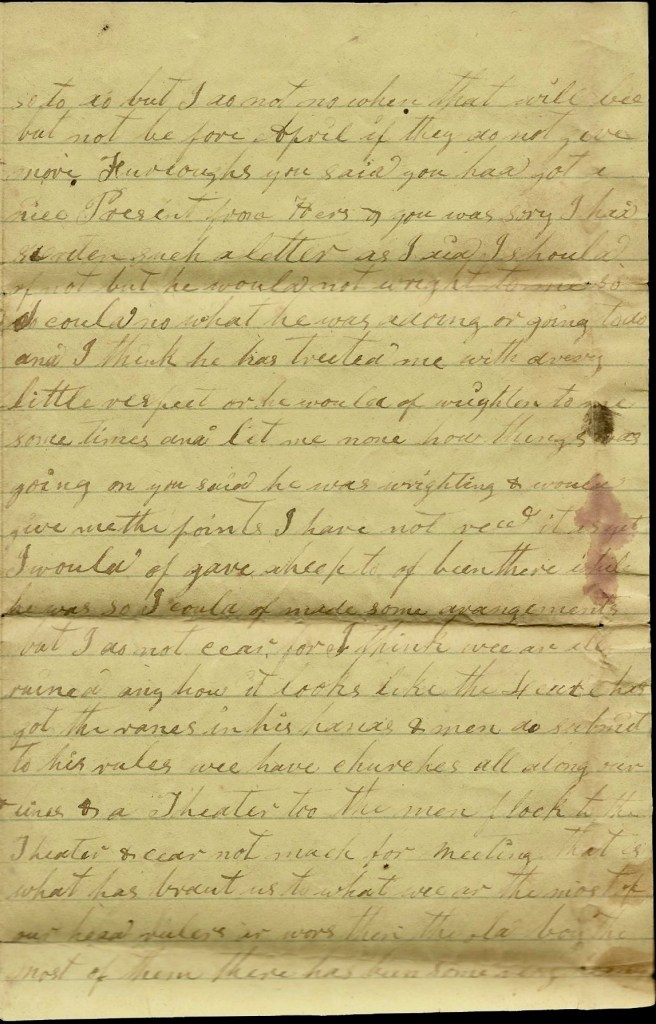
There is not much [fighting] on our lines. Looks like peace. But the boys have a good deal of fun playing ball. Times is hard & rations scarce. But the men looks very well. From what I learn, we are doing better than some in the country. We never eat but twice a day. I have had plenty for some time but Old Jeff did not furnish it….You said in one of your letters to me something about sending Laura to school. I want her to go all good weather. Tell her she must be smart and learn how to read for Pap when he comes home.
You said I must come and bring you a present. I would so to do but I do not know when that will be but not before April if they do not give more furloughs. You said you had got a nice present from Herse & you was sorry I had written such a letter as I did. I should of not but he would not write to me so I could know what he was a doing or going to do and I think he has treated me with very little respect or he would have written to me sometimes and let me know how things was going on. You said he was writing and would give me the points. I have not received it as yet. I would of have gave a heap to of been there while he was so I could of made some arrangements but I do not care for I think we are all ruined anyhow. It looks like the [ ] has got the reigns in his hands & men so submit to his rules. We have churches all along our lines & a theatre too. The men flock to the theatre & care not much for meeting. That is what has brought us to what we are. The most of head rulers are worse than the old boys, the most of them.
There has been some very heavy shelling over towards Petersburg for the last two days. That does not sound much like peace. Well, Charl[lotte], you must not be uneasy about me. Try and do the best you can for yourself & children till I can come. I am in hopes [brother] Herse will write to me before he goes back. This leave me well as common. I am gaining in flesh very fast. The health of our company is very good now. You must excuse bad writing for my eyesight is so I cannot see to write. I guess I have said enough for this time as I said too much in my last. I want you to tell John I want him to not to forget to do what he promised he would do for me concerning a [ ]. Jas. & T is well. I have not heard from Cap yet [or] what he is doing. My love to you. Kiss the children for me. Give my respects to all. — Wm. B. Ayers
Capt. J. Leroy Bell, Co. G, 11th New Hampshire Infantry wearing Lincoln Mourning Band(1865)
These letters were written by Charles Henry Bell (1842-1898), the son of James Bell (1792-1864) and Rebecca Fletcher (1800-1883) of Haverhill, Grafton county, New Hampshire. Charles was single and working as a house painter when he was drafted on 31 May 1864. I can’t find him in military records but he indicates on his letterhead that he was a member of the “1st Division Sharpshooters.” His letter suggest that the regiment was being recruited as most of the veterans had mustered out by the time of these letters.
After he was mustered out of the service, he married Ann Allissa Willoughby (1847-1926) and lived in Boston where he returned to house painting. He wrote the letters to his older sister, Licetta Bell (1840-1902), living in Boston at the time. Licetta never married and lived many years with her older sister Calista Bell who was married in 1848 to Rev. William McPherson.
In one of his letters, Charles mentions his cousin Jacob Leroy Bell who was Captain of Co. G, 11th New Hampshire Infantry.
Addressed to Miss Licetta Bell, No. 9 Dwight Street, Boston, Mass.
Letter 1
Camp 1st Division Sharpshooters January 9, 1865
Dear Sister,
I thought that I would write you a few lines to let you know where we are. We have got our camp nearly all cleared off now so that it begins to look a little more like home. Egan [?] and me have got our tents [ ] done except some new men that just come last night and will [ ] here their tents up for me shall all help them and it won’t take long to get them done. We have yet only about 75 men now but they are going to fill us up to 100 in a few days and then we shall have target practice every day and by spring shall get to be quite good shots for we have improved a great deal since we were organized. And now when we get short of rations, we go out and shoot some wild turkey or squirrel but we have got them pretty well thinned up now for there has been so many after them.
The regiment got some more recruits last week and they were all foreigners but they are a better lot of men than the ones they sent before for them can understand english and the others could not.
I wonder why that John don’t write, I have written to him several times but don’t get any answer so that I shall quit writing to him now for awhile at least.
How does Henry Mitchel? I suppose that he is enjoying the honeymoon now and I wonder if it is as grand as the honey that we got one night by moonlight when we was on the raid. I went to taste a piece in the dark and there was a bee in it that showed his contempt for the Yanks by stinging me on the tongue. But a thing that is not worth fighting for is not worth having.
I don’t hear of any news except the report that the Pay Master is coming soon and that is good news if it is true for we have not been paid for 4 months now and a [ ] from him would be very acceptable.
When does Capt. Leroy Bell intend to come back to the army. His camp lays about 3 miles from us now. We lay outside of the rear line of works near the Jerusalem Plank Road, He will know where that is for his regiment laid there in the camp quarters that ours built. Please remember me to him.
Give my love to all the folks. Your affectionate brother, — C. H. Bell
Letter 2
Camp 1st Div. Sharpshooters May 1st
Dear Sister,
I was very glad to receive a letter from you and to know that you had received some of my letters at last for I heard that you had not any of you heard from me. I was very anxious to hear from you. I do not see why my letters were delayed so long on the road and was very sorry to learn that you had been so anxious about me for I was well all the time but I came very near going to Richmond on the first day’s fight, for the Rebs drove us out of the woods in rather a hurry and I had to make my legs do their duty for I had made up my mind not to be taken prisoner. But we soon made them run faster than they made us for we opened our artillery on them and the Old 3rd Brigade charged at the same time and they left in a hurry.
We are under orders to march again and shall probably start in the morning. I don’t know where we are going. Some say that we are going to march over land to Fairfax and others say that we are going to City Point to take transports for Alexandria but we shall know by tomorrow night. I think that it won’t be long now before we are home again for there is nothing more to do now and they won’t keep the whole army long. I had as leave stay here now until fall for so many of the boys get sick that go home in the summer.
Please give my love to all. Your affectionate brother, — C. H. Bell
I could not find an image of Frank but here is a private believed to be from New Jersey (Melissa Hacker Winn Collection)
These letters were written by Benjamin Franklin (“Frank”) Titsworth (1843-1918), the son of Isaac Dunham Titsworth (1805-1897) and Hannah Ann Sheppard (1813-1895) of New Market, New Jersey. According to an obituary in the Sabbath Recorder (1918):
Frank was born in Shiloh, New Jersey in September 1843 and came with his parents to Plainfield, N. J. when he was nine years old. Soon after they relocated again to New Market (now Dunellen), N. J., where he attended school at the New Market Academy, and where, after baptism by Rev. H. H. Baker, he united with the Seventh Day Baptist Church of Piscataway.
On August 1, 1862, at the age of nineteen, he enlisted as a private in Co. D, 11th Regiment, New Jersey Infantry, and was mustered out of service June 6, 1865. An incident which he was fond of relating in this connection was that, in the final review before President Lincoln in Washington, his division was the last in the procession, as was his regiment and his company, and he was in the last line and would have been the last man in forming single rank. He was promoted to detached service first in the brigade general’s office and afterwards in the adjutant general’s office, where his duties were largely clerical because of his clear and fine penmanship and systematic methods.
On his return to civil life he attended Alfred Academy for a time, and afterwards engaged in business with his father and brothers, first in Dunellen, N. J., and afterwards in Milton Junction, Wis. While living at Milton Junction he married Emeline A. Langworthy, of Little Genesee, N. Y., whom he first met while attending school at Alfred. This was on October 11, 1871, and she died November 19, 1873. While living at Milton Junction he was made a deacon of the Milton Seventh Day Baptist Church. In 1880, he moved to Farina, Ill., and engaged in the grocery and drug business, and at one time was cashier of the Farina Bank. On February 21, 1881, he married Genevra Zinn, of Farina, and to them were born three children, – Bertha, now of Durham, N. H., Adeline, now of Pittsburgh, Pa., and Lewis, now of Brawley, Cal. There are two grandchildren, Phillip and Genevra, living in California. In 1896, the family moved to southern California and later to the city of Riverside, where they were prominent in the Seventh Day Baptist church, where he retained his membership until the time of his death. In 1908, the family removed to Alfred, where he lived at the time of his death.
The first two letters that Frank wrote in this small collection were sent under the name of “Frank Marlow”—a false identity. They were sent to a correspondent who had answered an advertisement he had placed in the newspaper looking to open a correspondence with “a few young ladies of the North.” See ad below:
I am a true soldier of Uncle Sam, belong to the Army of the Potomac and having lots of spare time, nothing would suite me better than to correspond with a few young ladies of the loyal North. Object, mutual improvement and to pass away the dull hours of camp life. Address FRANK MARLOW, Hd. Qrs. 1st Brig., 2nd Div., 3d Corps, Washington, D.C.
Responding to the ad was a young woman named Amanda Wallace of Lawrenceville, Alleghany county, Pennsylvania, who also began her correspondence with Frank under a false name and address—“Amy Waterman” of Pittsburgh. Beginning with the third letter in this collection, both parties apparently had convinced themselves they wished to continue their correspondence and to do so under their real names. Whether they carried on their correspondence beyond the last of these letters is unknown but is doubtful. In any event, Frank’s letters provide some good information on the closing days of the war around Petersburg.
Letter 1
3rd Brigade Headquarters, 3rd Division, 2nd Corps December 14th 1864
Friend Amy,
I was really surprised and happily disappointed to have the pleasure of reading another one of your letters. I had made up my mind that you had not received mine in answer to your first one, or if you had, thought you wouldn’t wish to correspond with one no more punctual than I was and I couldn’t blame you. It would give me pleasure to be numbered among your correspondents. I promise to be more punctual in the future.
I intended to answer this as soon as received but the next day we went on an expedition and was cut off from all communication for three or four days. We returned last Monday after destroying several miles of the Weldon Railroad below Stoney Creek Station and nearly to Hicksford Station. If you have a map of Virginia, it might interest you after reading a detailed account of it in the papers, which will be better than I can give you.
We had very disagreeable weather. Nevertheless it was exciting and therefore enjoyed. We marched at a good rate going and some of the men straggled. On our way back we found some of those men murdered. They were completely stripped of their clothing and shot through the head and some were bruised terribly in retaliation of which General Warren—commanding 5th Corps and commanding the expedition—ordered all buildings not containing families to be destroyed. It is supposed the outrage was committed by guerrillas, inhabitants of the country we passed through. It was a splendid sight destroying the railroad and the boys seemed to enjoy it and went at it with a will. No force troubled us. It was reported that some force was awaiting our advance at Hicksford but we gave them the slip and got home safe with only one casualty in this brigade.
All is quiet at present but there is appearance of an important move. I wish it would come off soon so we could build winter quarters. You say you thought my address might change and so it has. It is now Headquarters 3rd Brigade, 3rd Division, 2nd Army Corps. I have nothing of interest to relate. We are enjoying ourselves and looking forward to the time of our deliverance from the clutches of Uncle Sam—eight months from the 18th of this month. How will it seem to be citizens once more and free. But I must close and do some work.
Believe me your true friend, — Frank Marlow
Letter 2
Addressed to Miss Amy Waterman, 885 Penn Street, Pittsburg, Pa.
Headquarters 3rd Brigade, 3rd Division, 2nd Corps February 7th, 1865
Friend Amy,
I received yours of the 27th last in due time. I am glad you reminded me of my tardiness. I now propose a withdrawal of correspondence. Do not be astonished. I make this proposal for one reason—that I do not want to favor this manner of corresponding. I have found nothing in your letters which tempts me to do this. No—I am sorry to lose such a correspondent. I admire your sentiments both religiously and political. Your letters have been a source of pleasure to me as well as instructive. If you wish to continue the correspondence, I propose that we do it with our true names.
It has been a cold, dreary, stormy day and a lonesome one to me. Last Sunday morning, two divisions of the 2nd Corps, parts of the 5th and 6th, marched to the left. Sunday afternoon heavy musketry firing could be heard and it was reported afterward that the enemy charged on our Brigade and were repulsed with heavy loss which has proved true. Yesterday and today the 5th Corps, on the left of ours, has had some severe fighting. I haven’t heard yet how it turned out except heavy loss on both sides. Some great movement is afoot, I think. This force of ours has gone out to hold a strong force of the enemy while our cavalry operates on some point or they have gone there maybe to capture the South Side Railroad or establish a new line so the enemy will have to rally theirs. We have received some reinforcements lately. Grant will not be idle long at a time.
You are surprised that I have not been absent from the army since my first winter, 1862/1863. The next winter I gave away to a friend as he had urgent business which called him home. And when he came back, the reenlisting order was received which deprived all of furloughs but those who reenlisted, and as I hadn’t been out long enough to reenlist, I lost my furlough that winter. And my time is so near now, I don’t wish to go home. As you say, “The long absence will make my return more joyous.” I was born and always lived in New Jersey—and still live there. I have a very pleasant home, as good parents as anyone could desire and patriotic too for they have sent four sons into armed service and two sons-in-law. Maybe you think it strange I am not with the troops. Well I’m left in charge of the camp. It is the first time I have been left so far in the rear for some time.
But I must draw this to a close. Hoping to hear from you and your mind on this subject, I remain as ever your friend, — Frank Marlow
P. S. Please excuse my writing. I am doing it in a hurry. — F.
Letter 3
Addressed to Miss Amy Waterman, 885 Penn Street, Pittsburg, Pa.
Camp 11th New Jersey Volunteers March 1st 1865
Friend Amy,
Yours of the 13th was duly received. Believing that our further correspondence will be not only a pleasure to me but instructive, I cheerfully extend my hand in favor of its continuance. I think there will be no harm in divulging my real name so here goes—B. Frank Titsworth. You may have heard that name before if you had lived in Jersey City.
Since the last of January I have changed my position from clerk at Brigade Headquarters to Quartermaster Sergeant of my Regiment. Quite a jump you might say from a private to a sergeant. The Colonel couldn’t get me back for less promotion. As I had been in the Adjutant General’s Department so long, I had fully become acquainted with the business and the Adjutant General was bothered to let me go. I’m very well satisfied with my new position as it gives me more time to myself. I can improve my mind by reading too. My time is very well occupied at present, making out the Quartermasters Monthly Returns, etc.
We have been having some very wet and stormy weather for the last few days. Doesn’t appear much like clearing off yet. Winter is gone—my last winter as a soldier but I can hardly realize it. In fact, the remainder of my time in Uncle Sam’s service appears longer than what I have passed through. If I devote my mind to other things, the time will seem to pass away quicker and likely be more healthful to my mind for as a person is apt to become partly deranged by setting his thoughts on one object like that and fretting on account of its nonappearance.
But this is not of any interest to you. I have no news of interest to relate. It has been so long since I saw a daily paper that I am hardly acquainted of the situation. I don’t see what is the matter that the newsboy doesn’t make his appearance now that we have just been paid off four months pay. It appears that Sherman still marches on triumphantly.
Last night just after dark, the Rebs in our front commenced to cheer and yell. We could hear them very distinctly. We couldn’t imagine what was up. Some thought Sherman had likely been defeated. But last night two deserters came into our brigade picket line and they stated the cause to be that a ration of whiskey was issued the men and also that their brigade commander told them to cheer and holler for an attack was expected from us. The cheering appears only in our front. There was noise enough for a pretty large force.
The situation of affairs looks very bright I think at present. And if divine providence continues his smile upon us, we shall soon crush this rebellion and live once more a united North and South under the best government on the earth. Deserters are coming in to our lines continually and tell stories of woe and suffering. It is my prayer that this war may be done with as little bloodshed as possible. Hoping to hear from you soon. I will subscribe myself, your friend, — B. F. Titsworth, Quartermaster Sergeant 11th New Jersey Volunteers
Direct to B. F. Titsworth, Quartermaster Sergeant , 11th New Jersey Volunteers, 2nd Army Corps
Letter 4
Addressed to Miss Amanda Wallace, Lawrenceville, Alleghany county, Pennsylvania
Wagon Park in the field Quartermaster Department 11th New Jersey Volunteers
April 1st 1865
Friend Amanda,
It gives me pleasure to address you thus, not only because we believe each other to be corresponding under pure motives, which I hope I’ll never give you cause to doubt the same of me, but I believe I have found a true soldier’s friend—a patriotic Lady. I received yours of the 11th and would have answered it ere this had not a move of the army prevented it.
We are still on the move. Broke camp last Wednesday morning and the troops marched to the left where they have been since advancing gradually. The 5th Corps and Sherman’s cavalry force are on the left of us. There has been fighting every day. The wagon train lies near Humphrey’s Station—the farthest station on General Grant’s railroad. My new position requires me to accompany the train. The wounded are brought to this station after having their wounds dressed at the field hospital, put aboard the cars and sent to the General Hospital at City Point. I have been over to the station frequently when wounded came in and I saw some very severe cases.
All is reported progressing finely for our side. General Grant is here supervising the move. It was reported two days ago that General Sheridan had cut the South Side Railroad and destroyed ten miles of it, then moved off in the direction of Burkesville—the junction of the Danville and Lynchburg Roads. That report was contradicted this morning. I won’t vouch for the truth of either. I’m not afraid but Grant will carry things through alright. I have unbounded confidence in that General.
Sherman no doubt is resting his army now at or near Goldsboro [and] well he might. Twenty thousand of his men were unshod when they reached that place. After they are reclothed and recruited, I expect we will hear more good news from “Sherman and his Veterans.” We can afford to let them rest a while. We have had two days of very heavy rain which left the roads almost impassible. Yesterday some supplies were sent to the front and almost every team mired. They returned this morning. Today is a regular March day—very windy and it’s throwing the rain on my paper. You must excuse me if my paper doesn’t look as neat as it might. We haven’t any log houses now. However, we get along first rate with tents as it is not very cold weather. I guess I have built my last log house and I hope the army has as a general thing. But I must give way for the cook to set the dinner table.
Hoping to hear from you soon, I remain as ever, your true friend, — B. Frank Titsworth, Quartermaster Sergeant, 11th New Jersey Volunteers
Letter 5
Addressed to Miss Amanda Wallace, Lawrenceville, Alleghany county, Pennsylvania
Camp 11th Regiment, New Jersey Volunteers Near Burkeville, VA April 24th 1865
Friend Amanda,
Your last kind missive bears date April 10th. It was received with many others on the 15th after having no mail for nearly two weeks. I tell you, it was appreciated. During the absence of all this mail, news from home, our spirits were not allowed to become morose and demoralized. How could we when we were pursuing a fleeing enemy so successfully and every new engagement and day brought to light that Lee couldn’t hold out much longer without surrendering or being annihilated. The long wished for surrender came at last. On Sunday, April 9th 1865, General Lee surrendered the Army of Northern Virginia to General Grant—the object fought for by the Army of the Potomac for the last four years. It is my opinion that if any other man but Grant had been put in command of this army, it would not be here as it is this day, enjoying easy camp life, no fear of the presence of an enemy, and hardly duty enough to keep the men from becoming lazy. Grant can’t see defeat.
While we have been made to rejoice over these victories, God has seen fit to stricken us as a Nation with a great affliction—yes, it seems to me, one of the greatest afflictions He could throw at us. It was evidently the will of God that President Lincoln should depart this world and we are invited to “trust in Him for He doeth all things well.” “Cast your burden upon the Lord and He will sustain thee.” I speak of the many sad hearts that will remain after this cruel war is over—yes, and even now are suffering from the loss of bosom friends by the hand of traitors. Many a sad heart will exist to tell the tales and horrors of this war. God has been very merciful to my Father’s family thus far. Of six sons and sons-in-law in the Army and Navy, all still live to share in Heaven’s blessings. You ask me if I am not glad that my position is such that I am not exposed to the fire of the enemy. Of course I shall answer in the affirmative, but don’t let this allow you to think that if my duty called me on the battlefield, I would act the part of a coward. Never.
I believe I can justly say I have always performed my duty. I have been in but one battle with my musket. You may want to know why I say with my musket. Well, I have been in battle while I was performing the office of clerk. But I won’t flatter myself in past doings.
I have now not quite four months to stay in the service. The time passes away quickly, as rumors are afloat all the while that we are going home in a very short time. I will credit that as soon as I hear of the surrender of General Johnston. You write as though you thought I had become weary of your letters. Far from it, much the other way. I love to receive and peruse them. Do you read anything in my letters that make you think so?
But I must close. Ever your friend, — Frank
11th Regiment, New Jersey Volunteers
Letter 6
Addressed to Miss Amanda Wallace, Lawrenceville, Alleghany County, Pennsylvania
Camp 11th Regiment, New Jersey Volunteers Near Washington, DC May 19th 1865
Friend Amanda,
Yours of April 30th was received the day we reached Manchester. I hoped to answer it before but pressure of business would not permit. Leaving Burkeville at the time we did put me behind in my monthly papers. But since we reached this camp, I have worked pretty busy and finished them this forenoon. We have commenced to make out our “muster out rolls” and “discharge papers” and shall be very busy until we start for home which time, I think, will not be two weeks from date. The boys are highly pleased at the prospect of getting home so soon. Nothing would suit me better. I have made up my mind to be a citizen by the sixth of next month (June). That is giving us sufficient time to make out any papers.
On our march from Burkeville to our present camp, we passed through Manchester, Richmond, Fredericksburg and Falmouth. I broke off from the column after we marched into the City of Richmond and took my own route accompanied by a friend. We visited the places of interest—the Capital, Jeff’s mansion, &c, &c. It has been a very nice city, but most of the principal streets was destroyed which damages the looks of the best part of it somewhat. It is not as large as I thought. There is some very splendid country around it.
We passed through some very nice country during our march. Fredericksburg and Falmouth looked natural as well as the country around them. We didn’t exactly pass the ground of our (3rd Corps’) old camp but saw some houses which were near there. The nearer we got to Washington each day the more it felt like home.
We are now lying on Arlington Heights near Four Mile Run. On a hill near our camp, Washington can be seen in the distance. It is about six miles. Next Tuesday and Wednesday the army is to be reviewed. I believe it is to pass through Washington. I suppose a number of visitors from the North will be present to witness it. I believe I should rather be a witness than a participant.
Since the receipt of your letter many glorious news have been received—that of the capture of Jeff Davis, &c. I haven’t had a chance to see a paper lately so I don’t know much of what is transpiring in relation to the assassins. I hope the Government is successful in ferreting them out and give them their just desserts. It seems they have been very successful thus far.
You say that “you have never told me directly but once that you did not wish my correspondence.” I don’t recollect the time. I guess I didn’t mean it. You spoke about writing this letter on the Sabbath. I suppose you want my opinion on the subject. When I was at home, I wouldn’t write a letter on the Sabbath unless to a soldier engaged in active service. I don’t know as there is any sin in writing on the Sabbath. However, I very seldom do it.
We are having very pleasant weather. I think I will be in the service by the time you write me next. If you do not write by the 6th of next month, direct to New Market, New Jersey.
Ever believe me your friend, — Frank
Excuse my hurry.
Letter 7
Addressed to Miss Amanda Wallace, Lawrenceville, Alleghany County, Pennsylvania
New Market, New Jersey June 20th 1865
Friend Amanda,
It has now been nearly one month since the receipt of your last and welcome letter. I hope and think you will pardon me for this long neglect if I tell you the circumstances. When I received your letter, we were busy finishing the muster out rolls and proper papers for our discharge. As soon as they were completed, we reported to Trenton, NJ, and while lying there, all was excitement and hurry so I couldn’t get my mind near enough pacified to write one letter. I meant to write you there. We received our discharges and pay last Friday so you see we haven’t been home long.
“Home at last,” I can hardly realize that I am home for anything except on furlough, unless [it is] the fact that I have donned the citizen’s garb. I found everything looking natural, more so than I expected to. So much the better. We are having nice times now. We are waiting now for three more boys to return; one at school and two in the navy. Then our family will be made up—all home together for the first time in four years.
We are having splendid weather—very sultry and greatly in want of rain. It has made several attempts to rain for two weeks but never made out anything. The ground is getting very dry.
They are preparing to celebrate the 4th of July in this place. Several have met at our house a few times to practice singing. I believe they are going to have a speaker, &c., and I don’t know what all. Can’t expect much from a small village like this. I think this fourth will be more generally observed than it has for many years past. Since the war, there appears to be a more patriotic feeling—a greater love for our country. I believe this war has instilled into the heart of our people a greater knowledge of the worth of our country.
New Jersey is a copperhead state. We have a copperhead governor. When we (the 11th Regt. N. J. Vols.) arrived at Newton, we marched to the State House and Governor Parker came out to make a speech. The New Jersey soldiers all hate Parker and when he commenced his speech (if it can be called such) the boys instead of cheering, groaned at him and called for Marcus L. Ward (Mayor of Newark, NJ and a great friend of the soldier). They kept it up during his remarks. It was an ungentlemanly way of acting but they were soldiers from the front and would rather have a dinner than all their speeches, though we didn’t get any dinner until two or three days afterwards and then [only] through the unceasing efforts of the ladies. I don’t know what we would have done in many instances if the ladies hadn’t taken an interest in us.
In your letter you say you would like to have been at the [Grand] Review at Washington. It was a grand sight. My Regiment was the last one to pass in review the first day.
Well, my soldier life has passed and I must habituate myself to a citizen’s life again—almost the same as a start in a new life. But I must close. Hope to hear from you soon again. I remain as ever, your friend, — Frank
Pvt. William D. Semans, wounded at Ft. Stedman Find-A-Grave
These two letters were written by William D. Semans (1844-1924), the son of Nelson Semans (1819-1891) and Hannah Briggs (1826-1905) of Starkey, Yates county, New York. William enlisted as a private in Co. L, 14th New York Heavy Artillery, in December 1863. He was wounded in the jaw by a shell fragment at Fort Stedman on 25 March 1865, five weeks after writing his friend, “I have not got a scratch yet nor do not want any.” He was treated for his wound at Armory Square Hospital in Washington D. C., from which place he was discharged from the service.
The 14th New York Heavy Artillery saw hard service. After manning the batteries in New York Harbor, they were ordered to the front as infantrymen in the 9th Corps. They passed through the Wilderness, then suffered heavily at Spottsylvania, Cold Harbor, and the first assault on Petersburg. In the Battle of the Crater they were one of the first to plant the colors on the enemies works. They occupied Fort Stedman at the time of the enemy attack in March 1865 and fought their way to Fort Haskell.
The letter was addressed to Adam S. Miller of Starkey, Yates county, New York, who enlisted in August 1862 but mustered out of the regiment on 8 January 1864 for disability.
Letter 1
[Fort Richmond, New York (?)] January 6th 1864
Remembered friend,
I received your welcome and unexpected letter. I was glad to hear from you. I thought you had forgot me, I had not heard from you in so long a time. I was sorry I did not see you before I left home. I suppose your soldiering is is done, or did you like it well enough to enlist over if your health was good? Sometimes I like it and again I am sick of it. When we have a long march or a hard fight, then I am sick of it. But when we are laying still [with] not much to do, then I like it. But it is all in three years.
“Tell them if they want to see hard times, to go for a soldier. But take Billy’s advice and live free while they can. Soldiering will do to talk about when you are in the bar room or some other safe place.”
— Pvt. William D. Seman, Co. L, 14th N. Y. Heavy Artillery
You must keep things all straight around there. Have you seen Arch lately? Do you remember what good times we used to have up there? What good times we had running up and down the lake all day Sunday, fishing and swimming, nothing to eat in all day—only berries. But those times have passed away and us three boys have parted and are far from each other and God only knows whether we will ever meet together again or not. I for one hope we may, but the case is a dark one. I have got two dark years before me. I would like to see Henry Welter and all the boys. Tell them if they want to see hard times, to go for a soldier. But take Billy’s advice and live free while they can. Soldiering will do to talk about when you are in the bar room or some other safe place.
It is raining now very hard and I guess I will have to go on picket tonight. God damn the luck. Jennison 1 is on picket now, I think. This rain will give him a good washing. It will loosen up his hide so he will grow. Write and tell me how things stand around there. Answer soon. From your friend, — William Semans.
1 George A. Jennison (or Jamison) enlisted at age 18 with William Semans in December 1863 in Co. L, 14th New York Heavy Artillery. He was wounded on 12 May 1864 and again on 25 March 1865. He mustered out of the regiment from Lincoln US General Hospital.
Letter 2
[Fort Stedman near Petersburg, Va.] February 18th 1865
Remembered friend,
I now take my pen in hand to write you a few lines to let you know that I am still alive and well. I received your letter a long time ago and am almost ashamed for not writing sooner, but you must not wait for me but keep a writing as you have more time than I do.
We are lying in the same place as we did when I wrote before. We have been here about six weeks and have had only one man wounded in our company but there has been several killed and wounded in the regiment. I have not got a scratch yet nor do not want any. I would like to see the old lake once more and to roam up and down its shores with you and Old Carmer. Then was when I enjoyed myself eating berries and stealing Mr. Conkling’s apples. But apples are scarce here. They cost five cents apiece and not very large at that.
You spoke about your sweetheart Nelly. Tell me her other name so if I ever get a furlough, I can find her. There is not much firing going on here. They get to shelling every two or three days. There has three shells bursted in our company. Only wounded one and scared the rest pretty badly. Please answer soon from your friend.
The author of this sheet is not identified but it is clear from the daily description of troop movements that he was from one of the regiments participating in the Stony Creek (or “Applejack”) Raid led by Major General Gouverneur Warren’s 5th Corps with the aim of destroying a portion of the Weldon Railroad in December 1864. To accomplish this objective, Warren had 22,000 infantry and 4200 cavalry at his command. “The infantry consisted of his own three Fifth Corps divisions under Crawford, Griffin, and Ayres and Mott’s Division of the Second Corps. The men were given 60 rounds of ammo and 4 days rations to carry, with 40 more and two more in wagons One battery of artillery accompanied each infantry division in support.” The expedition began at 4 a.m. on the morning of 7 December 1864. “Crawford’s Division was in the lead, followed by Griffin, Ayres, and Mott in that order. After marching down the Jerusalem Plank Road, the column crossed the Nottoway River around 5 p.m. at Freeman’s Ford…At the end of this first day, Warren’s column was strung out, divided by the Nottoway River. Griffin and Ayres were still north of that waterway, with Mott and the supply train just to its south, and Crawford and Gregg in the lead at Sussex Court House.”
On December 8th, Warren got his Union troops up early. “The divisions of Griffin and Ayres north of the Nottoway were aroused at 2 a. m. in order to make sure they reached the Weldon Railroad by the end of the day. Both divisions had crossed the river two and a half hours later. Once this occurred, Warren had his pontoon bridge pulled up to prevent any Confederates from following the column from the direction of the Jerusalem Plank Road.” [See The Siege of Petersburg Online]
We learn from the author’s description of his movements on that raid that he was among the “3 and 4 thousand stragglers” who failed to cross the pontoon bridge at the Nottoway River and were marched back north to 2nd Corps Commander’s Humphreys’ headquarters and then to Fort Emory. I believe he was a member of Warren’s 5th Corps but there is nothing in the content that would lead us to which regiment or even which division of that Corps.
Yellow Tavern on Weldon Railroad
Transcription
Dec. 6th — Was relieved by part of the 2nd Corps and broke camp. Stopped over night about three miles from camp. Started on the morning of the 7th at daylight on a forced march. Marched about 12 miles and fell out. Stopped that night near Stony Creek. The last troops crossed the bridge at 3 o’clock a.m.
Dec. 8 — Rained all day & night. The pontoon bridge was taken up & the stragglers was sent back by the cavalry. We started about 7 o’clock. There was between 3 and 4 thousand stragglers. About 270 taken prisoners coming back. There was 7 from my company in the crowd. We arrived at Gen. Humphreys’ Headquarters about midnight after marching 20 miles. The weather very cold. Slept all night in an open field without any fires.
Dec. 9th — Was turned out at daylight and marched to an old camp to fill a place left by the 2nd Corp. Stopped there about two hours and was then started to another part of the line where there was no troops. Had good quarters. Snowed and rained all night.
Dec. 10th — Weather—snow on the ground & very cold. Nothing new turned up until about dark when the 2nd Corps came back and we had to pack up and start for Fort Emory. The officers in charge of us got us four days rations before starting. Got fixed up in good tents at Ft. Emory 1 about 11 o’clock p.m.
Dec. 11th — Some rain last night. Continues cold. No news from the 5th Corps. Cleared off cold. Wind northwest. In camp of the 124th New York.
Dec. 12th — Weather very cold. Heavy cannonading heard this morning. 3rd Division of 2nd Corps came back.
December 13th — Weather continues cold. 5th Corps came back to the Jerusalem Plank Road last night.
[sketch]
Soldier’s sketch showing location of Yellow House on the Weldon Railroad, Southside Railroad, and Petersburg
1 Fort Emory was established in 1864 as a Union earthworks fort along the outer secondary line south of Petersburg, Virginia. The fort was situated between Fort Cummings and Fort Siebert and connected to them by entrenchment. These forts all guarded the southern approaches to the Union seige line around Petersburg.