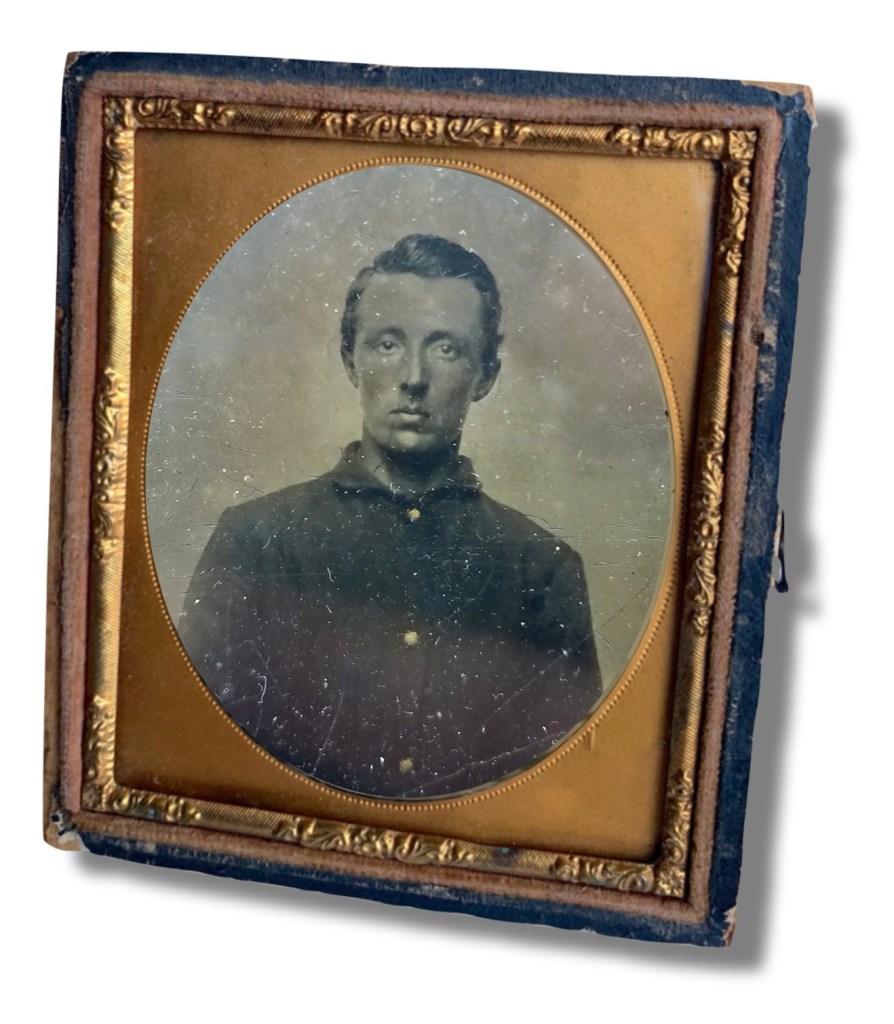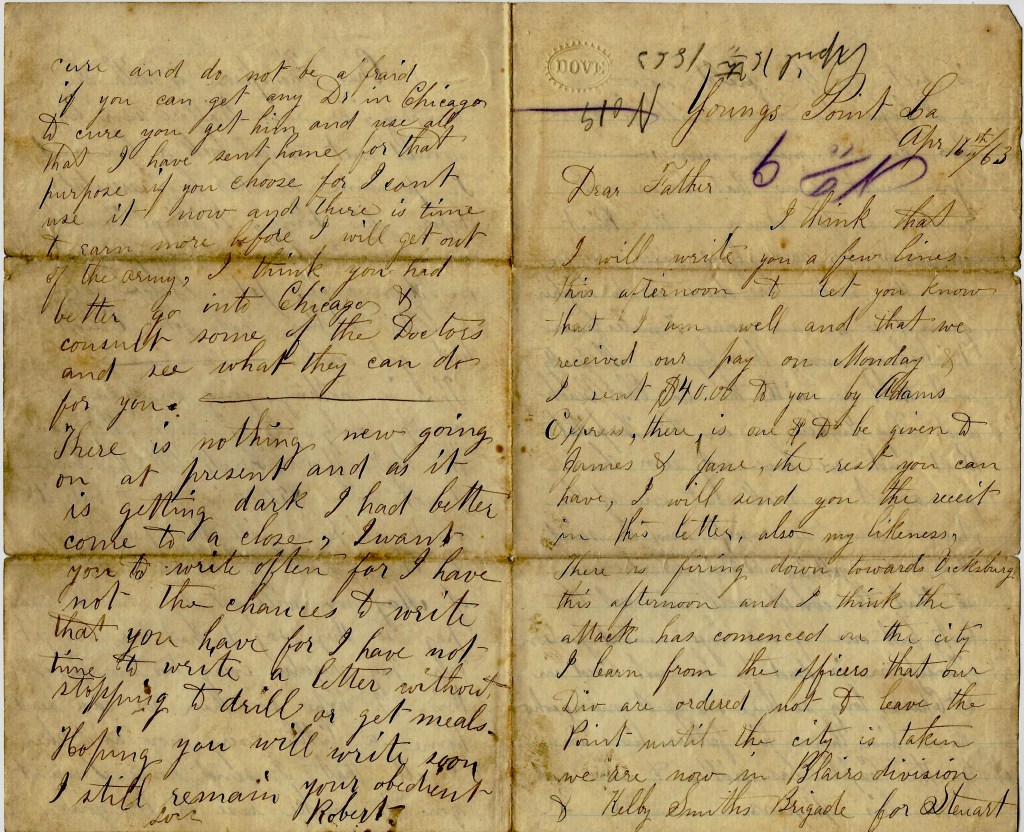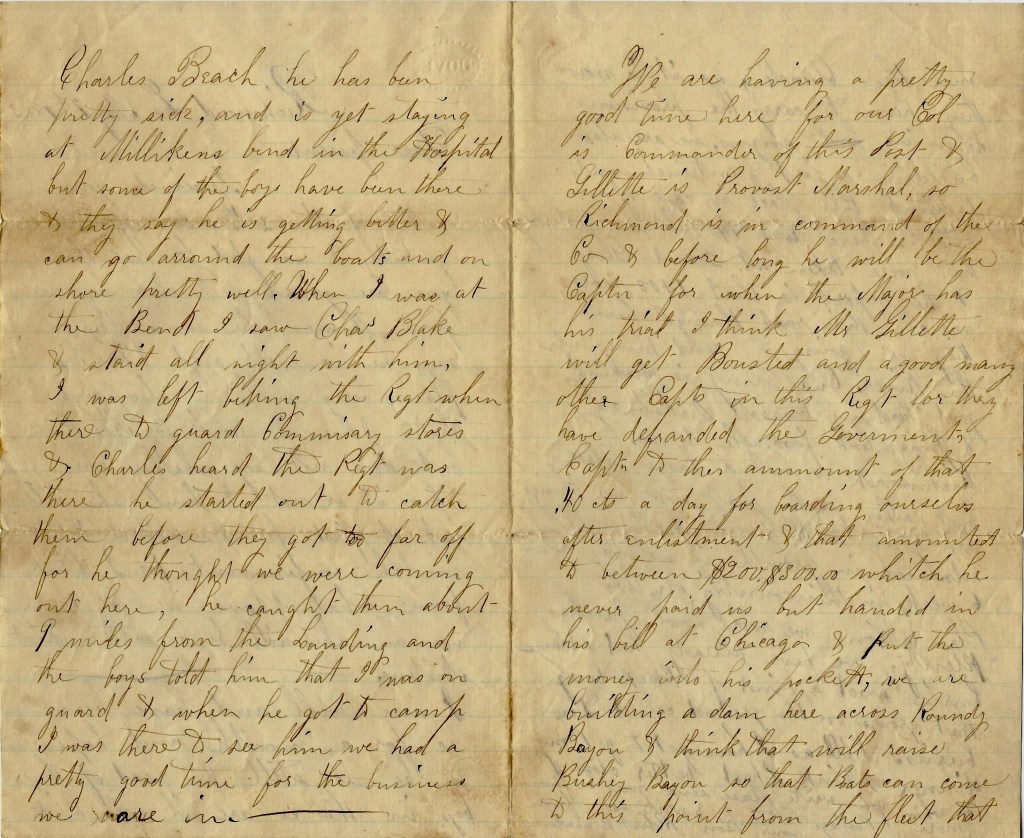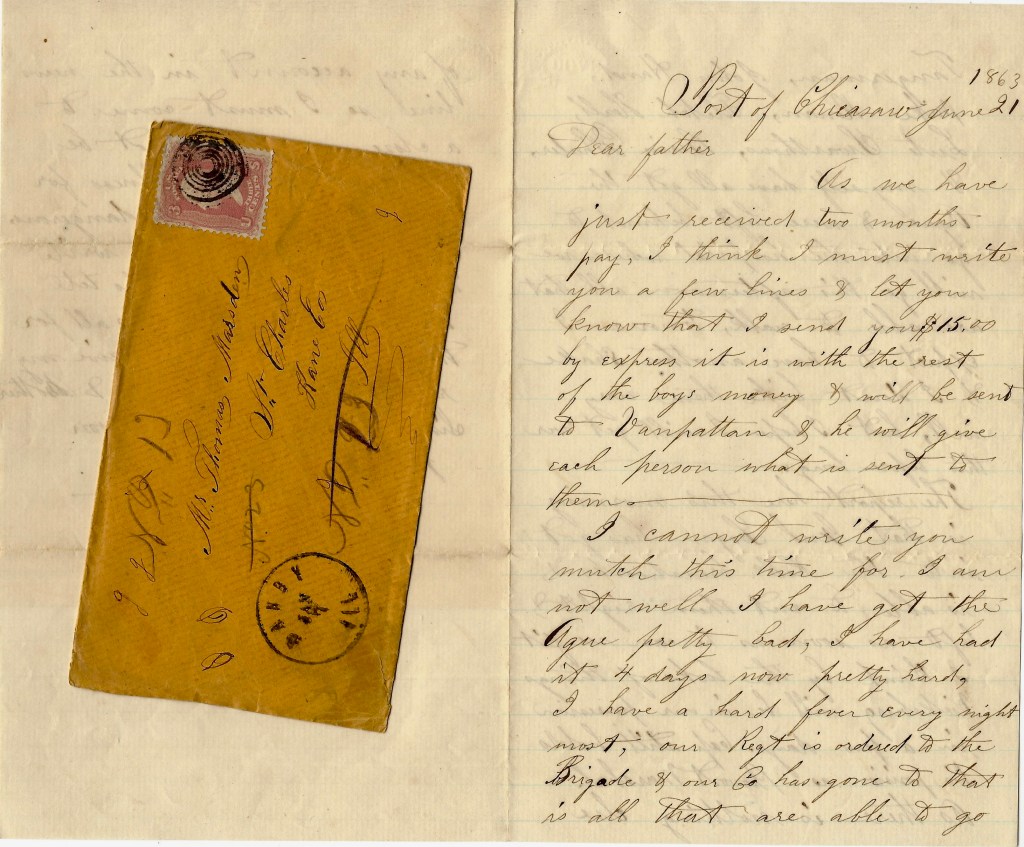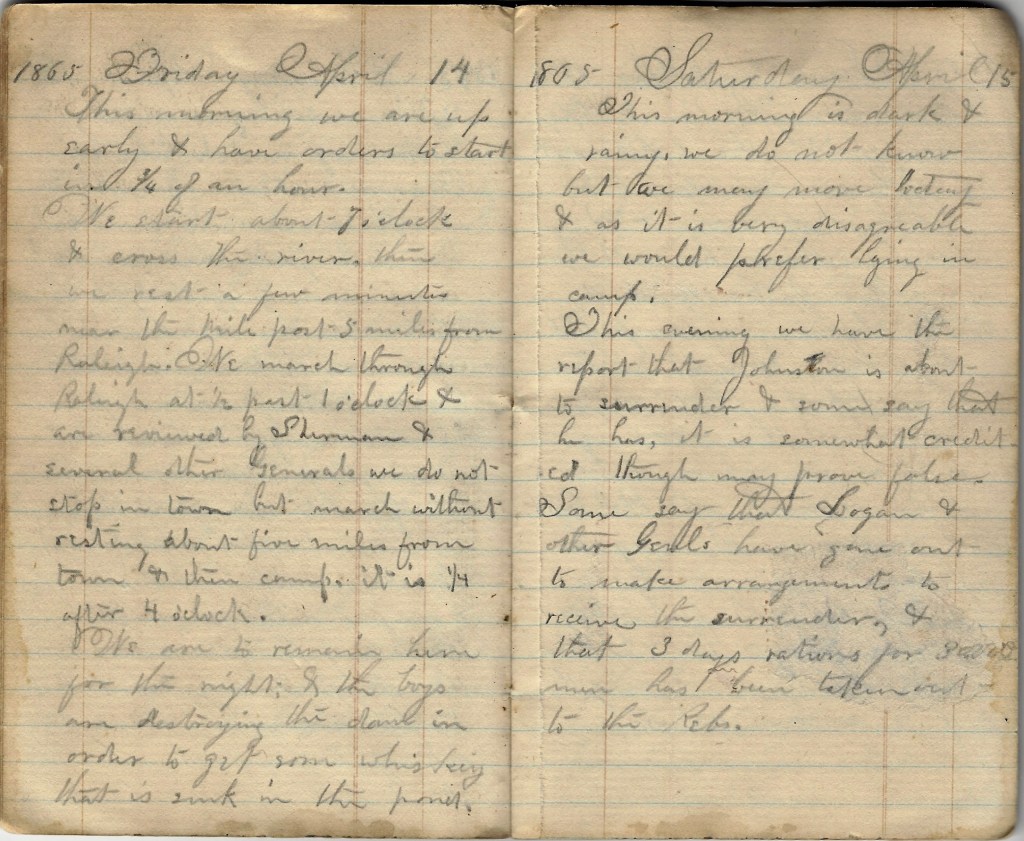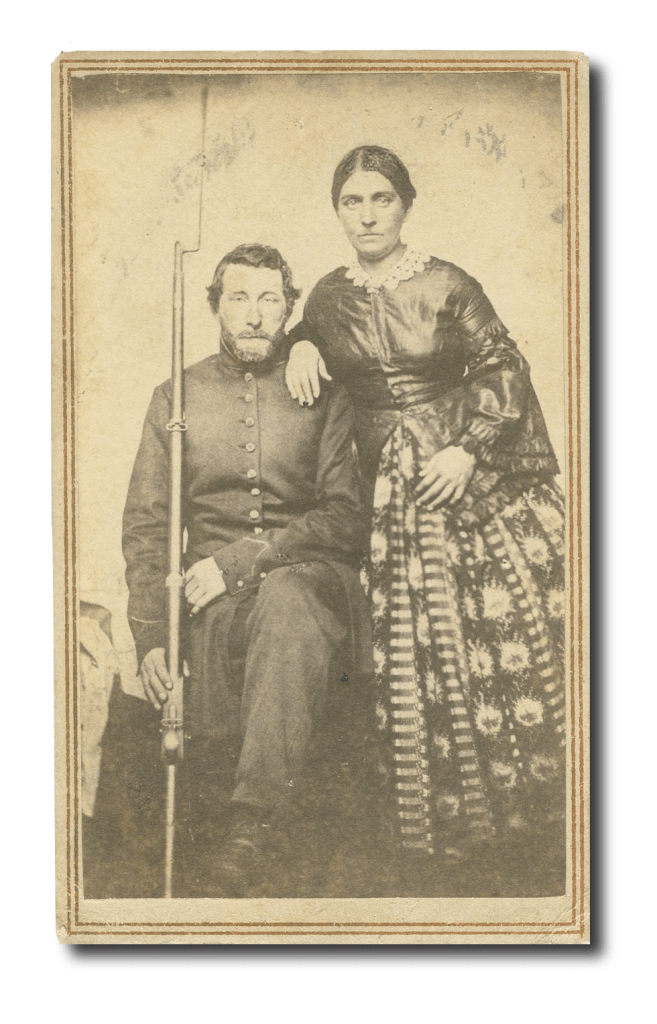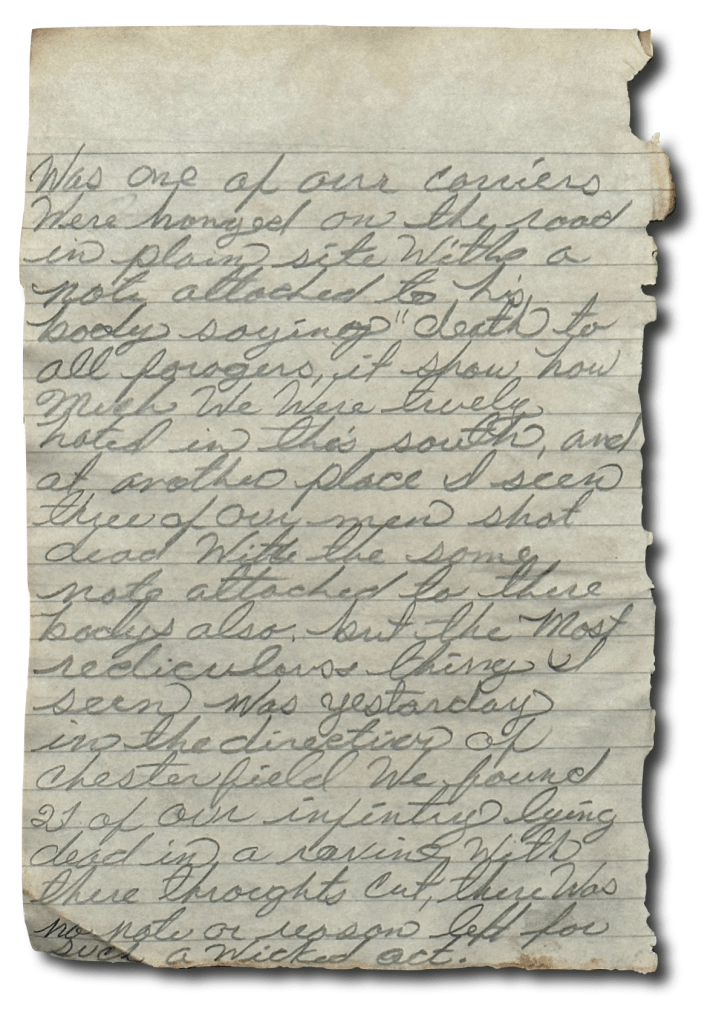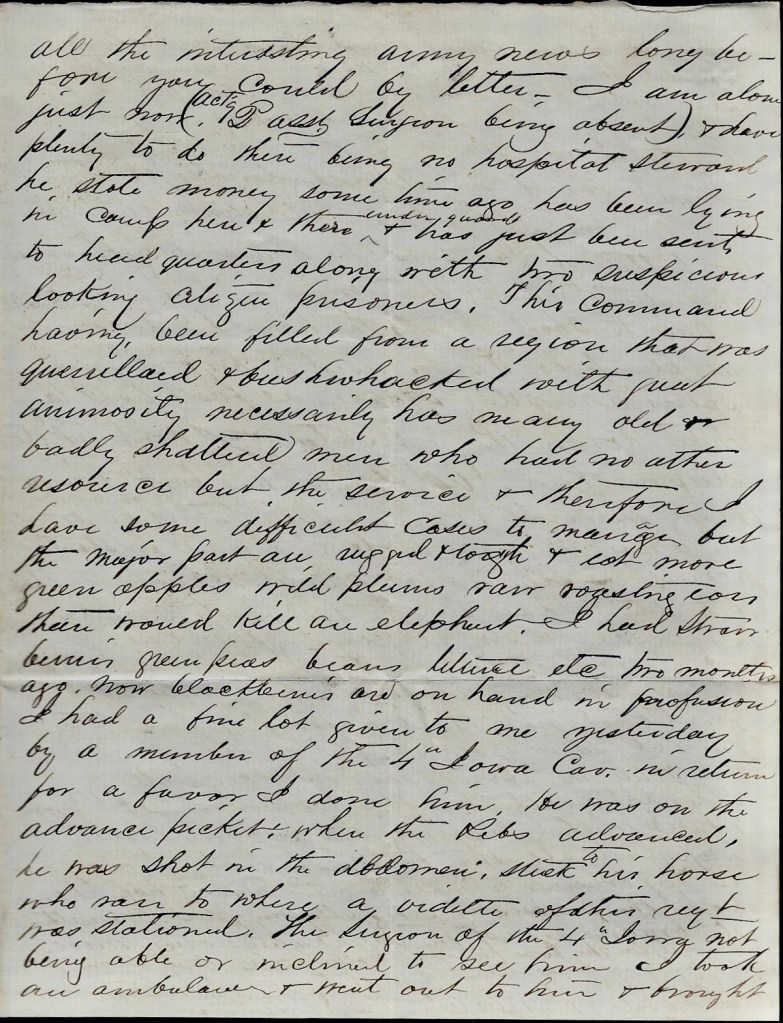
The following diary (or series of small diaries) were kept by Joseph Lawrence Murray (1840-1927) during his service in the Civil War. Joseph was the son of Henry Murray and Rebecca Lininger of Cairo, Louisa county, Iowa. In the 1860 US Census, 19 year-old Joseph was enumerated as the oldest child in his parent’s household. His younger siblings were 17 year-old Henry, 14 year-old Eliza, 8 year-old John P., and 4 year-old Rebecca.
According to military records, Joseph enlisted on 21 January 1862 and was mustered three days later as a private into Co. E, 16th Iowa Infantry under the able command of Colonel Alexander Chambers (1832-1888)—an 1853 graduate of West Point who had previously fought in the Third Seminole War and was still in the Regular Army when the Civil War began. As we learn from Joseph’s diary, the regiment was formed quickly and hustled into the field of action before it had time to be properly equipped and drilled, receiving cartridges for their muskets for the first time only as they disembarked from the boat at Pittsburg Landing. Only ten days before being sent onto the battlefield at Shiloh, Joseph confessed to his diary that “most all the guys I’ve talked to don’t even know how to load their guns, including myself.”
“This is a test of your courage and discipline!” shouted Colonel Chambers to his men as he led them onto the battlefield; it certainly wasn’t a test of their drilling for they had had none. “This was hard to believe for us guys who had just a few days before now were all home in Iowa, ” wrote Joseph as he witnessed wounded and panic-stricken soldiers stream past their column heading to the rear.
Following the Battle of Shiloh—the 16th Iowa Regiment now part of “Crocker’s Iowa Brigade”—Joseph’s diary takes us on the march to Corinth where, during a brief but desperate fight with the rebels, Joseph shares his experience in killing a Rebel with his bayonet. “The look that was in his eyes I will never forget,” wrote Joseph. “His blood hit me right in the face. As I pushed my tip further in the chest, he never made a sound. He just stared—eyes wide open as his life was leaving him.”
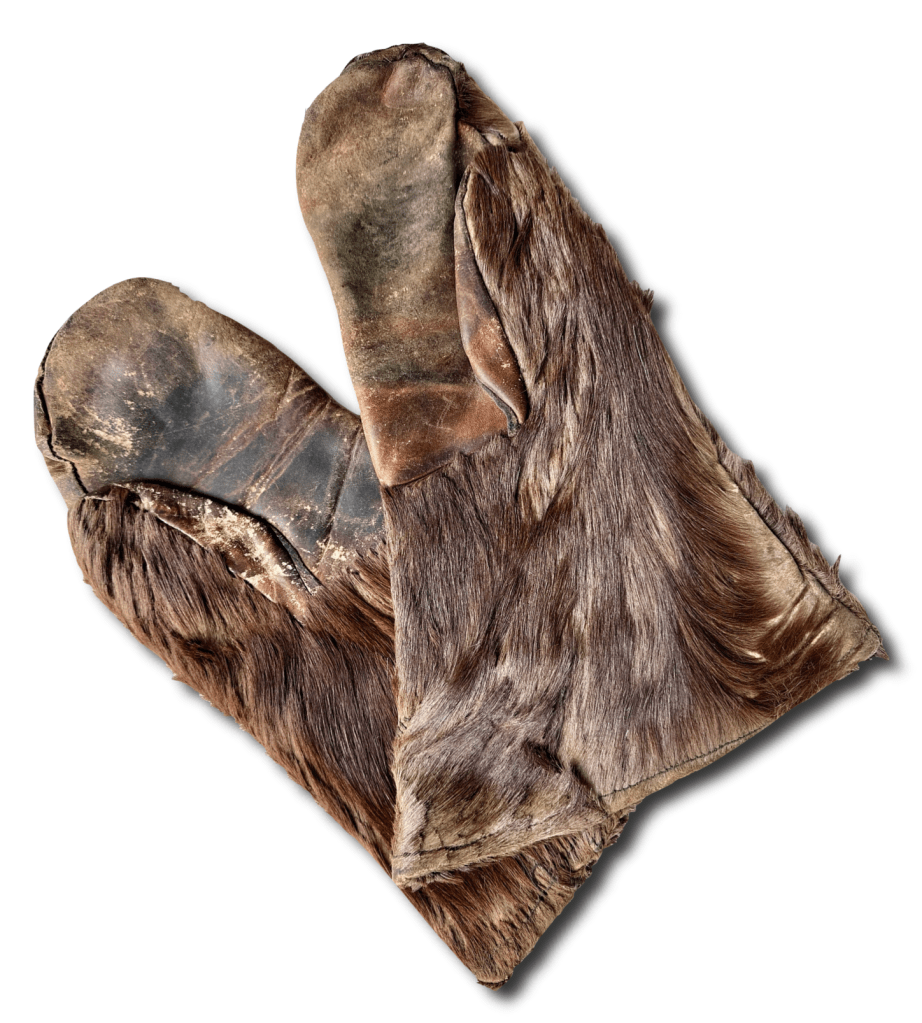
General Sterling Price’s Buffalo Mittens taken as a relic of war by Joseph L. Murray, 16th Iowa Vols.
Following the siege of Corinth, Joseph describes the march to Bolivar, the Battle of Iuka, the 2nd Battle of Corinth, and the pursuit of Price and Van Dorn’s army immediately after. From his diary we learn that the 16th Iowa came so near capturing Gen. Sterling Price that he only escaped with his life, leaving all his headquarter’s baggage in a camp to become the treasured souvenirs of Joseph and his comrades. For his war relic, Joseph came home with the buffalo mittens of Gen. Price while several of his comrades cut up the General’s buffalo blanket. A description of these relics are included near the end of Joseph’s second diary.
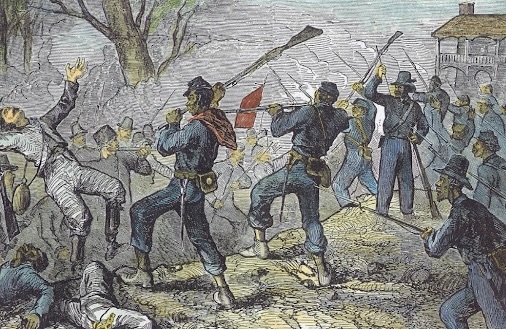
Joseph’s diary then describes the Vicksburg Campaign, including the mine explosion in late June 1863 when the men of the 16th Iowa “were ordered to push forward” and “surged straight ahead at the Rebels only to be met by counter attack by the enemy. At that moment it was hand-to-hand combat for what seemed to be hours and hours,” wrote Joseph. “At least five men fell at my hands and those Rebels came out of everywhere although a lot of them were killed. So were many of us.”
In the third diary, Joseph describes the entire Atlanta Campaign which came to it successful conclusion before he and the other veterans of the 16th Iowa could finally get a furlough. The fourth diary describes the march to Savannah and the Carolina Campaign.
Joseph’s diaries may be one of the best descriptions of the 16th Iowa Infantry’s record of service as I have not found any published works devoted exclusively to that unit although there are some written on “The Iowa Brigade.” Joseph was a zealot, both in terms of his faith as well as his patriotism. Anyone publishing Joseph’s war experience and searching for an appropriate title could do no better than “God bless the Union!” which he frequently used to sign off his day’s journal entries. Joseph entered the war as a green recruit, unfamiliar with the use of firearms, but eager to do his part to save the Union, including shrugging off some battle wounds and enduring the hardships and rigors of three years of war, compiling a war record to be proud of.
[Editor’s note: Joseph’s diaries are from the Sic Parvis Magna, Gratias Lesu Collection and remain in private hands. They were graciously made available expressly for transcription and publication on Spared & Shared. ]
Transcription
Diary 1
Joseph’s first diary spans the period from 20 March 1862 to 9 April 1862
20 March 1862—at 8 o’clock we are headed down to the levee. I’m told we have to wait until the quartermaster with his detail got the commissariat loaded, putting it upon our steamer and the two little barges, one on either side. It’s noon and all is ready and we marched on board, some going upon the steamer and soe upon the barges. Finally it’s 2 p.m. and we’re leaving Davenport for St. Louis. Citizens turn out in large numbers. My Ma gave me this book to write in whenever I get a chance so I’ll try to keep when I can.
21 March 1862—I had a pretty stiff introduction to my first night on a steamboat. My bunkmate, William Webster Butler, and I lay down on the deck with our heads to the smoke stack instead of our feet in order to avoud lying with our heads down hill. At 8 a.m. we landed at Montrose where two companies were transferred from our boat to another boat in order to lighten our boat for the purpose of passing through the rapids just above Keokuk in safety. About noon we are going on shore so we can cook some provisions. It’s dusk and we just returned to the boats. We are being transferred to another boat which lay at Keokuk. At night, while our steamboat proceeded down the river, we the 16th Iowa Infantry and the German Iowa Regiment have been consolidated so our regiment is called the Sixteenth Iowa Infantry, I was told. From St. Louis we will be marching to Benton Barracks. I try to write in my book as best I can because we have not yet hit any problem yet.
22 March 1862—We just left Keokuk. It’s daylight and I don’t know how long we will be on the steamer this time. Well, I’ll write some more a little later. They are saying we are going to tie up for the night. They are saying we could encounter a “secesh” battery on the banks. The weather is delightful and riding on the waters can be very enjoyable during such a time.
23 March 1862—We started down the river again at daylight and reached St. Louis at 3 p.m. We landed and marched to Benton Barracks where we were to be at home. Just as we left the boat, it commenced to rain a downpour. We marched the whole way in the rain which soaked our clothes heavily. When we got to the Barracks we built fires to dry our clothes before retiring for the night.
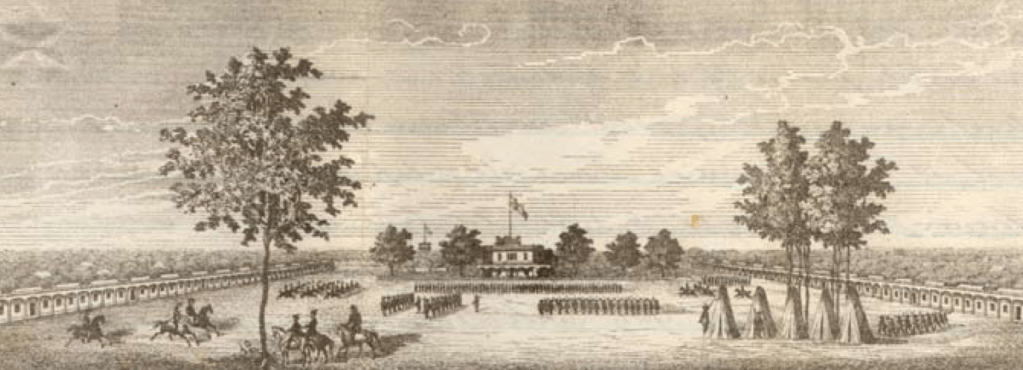
Benton Barracks in St. Louis, Missouri
24 March 1862—This morning we finished drying our clothes after which we cleaned up. There are several thousand troops—infantry, cavalry, and artillery here in camp. These barracks are ordinary frame structures and built around the drill grounds. Today we received our arms with no ammunition, and field equipment. I’m already missing home.
26 March 1862—New troops are arriving all the time and there are something like forty thousand men in the Barracks at present. This camp has the appearance of being nearer the seat of war. It is a novel experience for us country boys to see so many men all armed for war, some on guard duty, others leaving for the front, while still others are arriving. The commissary work of the camp is thorough and organized. Each company has a detail of cooks which serves a week at a time and then is relieved by another shift. The cooks go to the quartermaster and get the rations for five days at a time. The food is being cooked in kettles hung in a row in the rear of the Barracks and is served on long stationary stables, each accommodating a full company.
27 March 1862—We cleaned up today preparing for our first inspection and review at Benton Barracks. One of the guys, George Bedford, 1 said we should be doing drills soon. Funny thing is most all the guys I’ve talked to don’t even know how to load their guns including myself. We had our first inspection today and General Review at five o’clock. We were on dress parade but we haven’t done any drilling yet.
1Bedford, George. Age 21. Residence Deep Creek, nativity Canada West. Enlisted Jan. 13, 1862. Mustered Jan. 28, 1862. Killed in action Sept. 19, 1862, Iuka, Miss.
28 March 1862—Nothing of importance today. Camp life is a big change from life at home. In the army every man simply obeys orders. He knows his place and keeps it. Our officers are normally kind to us—especially if you are trying to do your duty. It’s my turn to go on camp guard for the first time. It takes at least five hundred men to go around the camp and I [am] glad to do it because sleep don’t come easy now-a-days. Me and two brothers—and yes, they are real brothers (one is Joseph L. Wood and the other is John H. Wood 2)—are on guard duty with me. They told me their family has been in every war America has seen.
2Wood, John W. [Alternate name John H. Wood] Age 20. Residence Mill Rock, nativity Missouri. Enlisted Jan. 3, 1862. Mustered Jan. 28, 1862. Died May 12, 1862, Camp near Shiloh, Tenn.
29 March 1862—I hear that over on the west side of camp that a soldier was engaging in cleaning his rifle today when by some movement it was accidentally discharged and hit and killed another soldier on the other side of the ground. I say prayers for his family. This is not the first time since we have been here either.
30 March 1862—No news of importance. There are troops from all over the western states here in camp and working together in harmony. Very warm and pleasant. There are soldiers drilling almost all the time. We get the St. Louis paper in camp every morning and keep posted on the movements of all parts of the army in the field. I don’t get a lot of time to write so I am trying to write down what I can in the time I have.
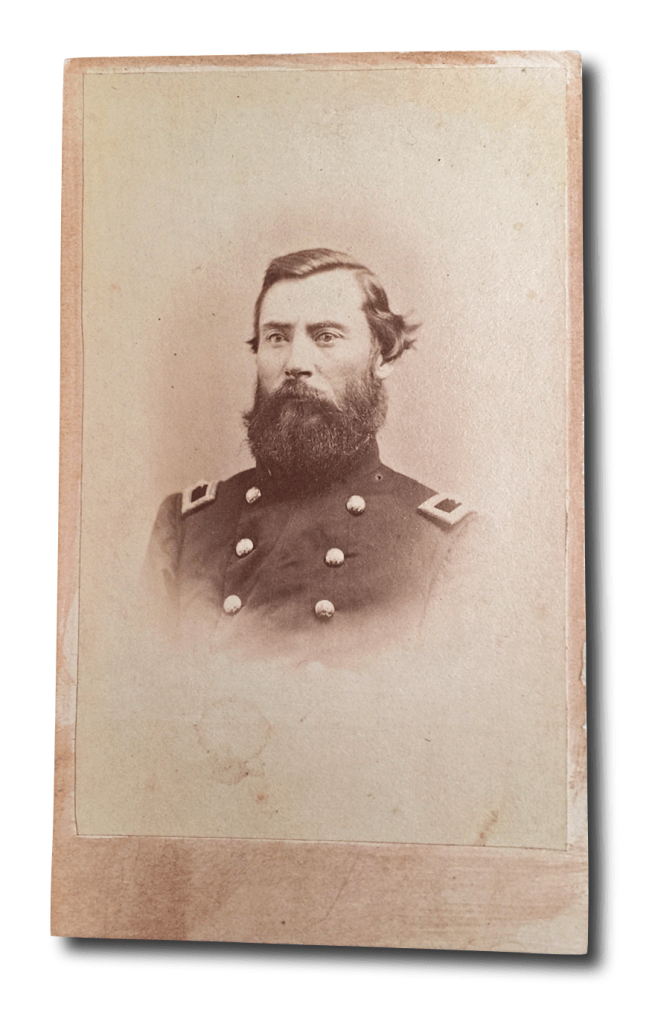
A CDV of Alexander Chambers from later in the war when he was a General.
31 March 1862—Our commander is Colonel [Alexander] Chambers. I hear he was the captain of the Eighteenth Regiment Infantry of the regular Army and had been acting as Mustering Officer for Iowa troops since the commencement of the war. And I can see he has lots of military training and experience in the war. We still have not done any drilling yet. The food is OK—plenty of bacon and potatoes to eat. The Colonel says we will be moving out soon. That’s good because me and the guys are getting anxious and are ready to fight. Well, time to get some sleep. I’ll write tomorrow if God wills.
1 April 1862—Reveille sounded this morning at 2 o’clock. We jumped out of our bunks, packed our knapsacks, and got started for the steamboat. Colonel Chambers and our regiment have been ordered to proceed to Pittsburg Landing, Tennessee. Upon arriving, we will be assisting Gen. Grant. So this is it, I[‘m] heading to the war to serve my country. Before leaving, me and the guys prayed together that we make it back home to our family. Well, I have to stop now. Time to leave.
2 April 1862—Today the sun shines. I won’t be able to write as much as before. It is important for me to pay attention to our commanding officers because the further we get away from Benton, the more the intensity builds up. Our company still has not received any ammunition yet. My old friend David Hiller 3 from Louisa county and I was talking about home. As we were talking, we heard firing sounds come from the banks to the right side. I started to laugh thinking that I have not reached the war yet and am already hearing the enemy. Then I said, got to keep our eye open.
3Hiler, David. (Veteran.) Age 21. Residence Louisa, County, nativity Ohio. Enlisted Dec. 23, 1861. Mustered Jan. 28, 1862. Re-enlisted and re-mustered Feb. 28, 1864. Promoted Second Corporal May 1, 1864. Wounded in right side July 4, 1864, Kenesaw Mountain, Ga. Promoted Fourth Sergeant. Mustered out July 19, 1865, Louisville, Ky.
5 April 1862—I haven’t been able to write much. The closer we get to Pittsburg Landing, the more I can hear the fighting in different areas. We should be in the field by tomorrow morning. I know I won’t be sleeping much tonight. I don’t think any of the guys will be tonight. Time to get some supper and a nap before it gets late. I don’t want to hit the battle tired.
6 April 1862—It is sunrise and we cannot only hear the cannons, you can feel every time they fire, or it might be the gunfire from the gunboat. All I can think is God be with us all. One of the guys—Lorenzo Chrisman 4—is telling me that there’s no time for writing in my book. Colonel Chambers said we are going straight to the hunt as soon as we touch the ground. We will receive ammunition when we reach land but we will fight. God bless the Union.
4Chrisman, Lorenzo D. Age 28. Residence Polk County, nativity Illinois. Enlisted in Co. D on Jan. 5, 1864. Mustered Jan. 5, 1864. Wounded in left side and arm severely July 21, 1864, Nickajack Creek, Ga. Discharged for disability June 1, 1865, Keokuk, Iowa.
9 April 1862—On April 6th we arrived at Pittsburg Landing as planned. The fight at Shiloh had already begun and the roar and rumbles of the conflict at the front line was heard as we were leaving the boat. They were handing out ammunition as we were getting off the boat so we were loading our guns for the first time that morning. There were wounded men and panic stricken soldiers began to arrive from the front line with talk of disaster to our Union troops indicating that the Rebels were superior in numbers and were victorious on every part of the field. This was hard to believe for us guys who had just a few days before now were all home in Iowa. Our commander yelled that this is the test of our courage and discipline, that is even before we are ordered forward to meet the enemy. The order come and our regiment marched bravely and proud to the front under the leadership of our gallant Colonel Chambers to aid the troops who were being advanced on by the enemy.
We strongly stood our ground in the conflict from 8:30 to 10:30 a.m.—the time it took to reach the battlefield. We come across more men returning but let me say this, of the men from the state of Iowa, not one of us ran from battle, While we were crossing an open field where the rebels were positioned, some of our men were wounded. Our regiment was lined on the right of this field in the back of a fence. Colonel Chambers orders us to lie down. After the greater part of the enemy’s fire passed harmlessly over us, there were several men wounded including my first bunkmate, William Butler, was wounded severely, not even a bull dog into battle from our position. [?] Colonel Chambers ordered us forward to the edge of timber to close range of the enemy. Many of our regiment were wounded including Colonel Chambers at that time by cannon and muskets.
For nearly an hour our regiment held its ground against a much larger force of the enemy supported by artillery when it was ordered to [retreat] before the destructive force or be captured. A retreat had been ordered [and] while retreating our regiment got mixed up with other regiments because of Col. Chambers injury. I think he got shot in the side or somewhere like that but I can tell he was in plenty pain. I seen Gen. Sherman and his troops pass by and Gen. Grant walking with a crutch. 5
5 In Grant’s Personal Memoirs he mentions having wounded his ankle in a fall on his horse just prior to the Battle of Shiloh and stating that “for two or three days after I was unable to walk except with crutches.”
Col. told us that we are going to be now raised by the gallant Lieut. Col. A[ddison] H. Sanders who posted us in the rear of the Battery during the remainder of the fight and those who had been mixed up forming line was back to their own regiments. I could hear pitiful cries of wounded and dying men on the field and it could be heard throughout the night. A thunderstorm passed through the area and rhythmic shelling from our gunboats made the night miserable and [ ]. The next day we held the same position in rear of the battery during the fight. It rained all night.
The battle was renewed this morning at 6 o’clock. Yesterday all our horses in the field and [ ] were killed or wounded. [That was the same] as the enemy. The enemy picked off our most prominent officers in this charge. Company E had it greatest loss of the day. Also wounded the first day was Pvt. John L. Wood, the brother of Joseph H. Wood whom I held ground with. I seen a ball strike a man and take his head right off his body. There is dead men everywhere and the Rebels were still fighting desperately while falling back all the while with a great slaughter of men. The dead lay so close that one could walk on dead bodies for some distance without touching the ground. There were thousands dead on the battlefield, and hundreds of dead horses not counting the men severely wounded, not yet dead, but surely are dying. What an awful sight for anyone to witness—the dead lying as far as I can see in the field.
We were told to bury our dead by their companies and all the same company in the same grave. We were ordered to bury the rebels side by side in a large grave and all horse carcasses were to be burned. Sadly to say at this time we still are not assigned to any brigade. I’ll write again when I get a chance. This battle has lasted a long time, We are being ordered to Corinth from here. While Gen. Grant’s army advance, we were finally organized as a brigade. It consisted of the Thirteenth Iowa, Eleventh, Fifteenth, and Sixteenth [Iowa] and Colonel Crocker is our commander and they now give us the name of “Crocker’s Iowa Brigade.” I’ve now got the hang of all things and it has been much easier to load my musket. The only thing I have to get use to is the smell of the dead. It is a smell that I wish not to have to smell ever again. I could not write everything that I wish to but I will try to do the best I can as long as I get some time to do so.
A German soldier gave me this bible to read. He was severely wounded and died of his wound. His name is Adolph Knocke 6 from Davenport, Company A, Fourteenth Infantry. He was disabled from his wounds. I will try…[illegible]
6Knocke, Adolph. Age 44. Residence Davenport, nativity Germany. Enlisted Oct. 23, 1861. Mustered Jan. 14, 1862. Discharged for disability July 31, 1862, Corinth, Miss. See Co. A, Fourteenth Infantry.
Diary 2
Joseph’s second diary spans the period from 20 May 1862 to 7 October 1862
20 May 1862—Not much going on. Things are a little quiet today. I’m not hearing cannons so much. They’re not so brisk at this movement but as for the skirmishers, they fire all along the line.
21 May 1862—The rebels tried to drive our line back and surely they failed at it. Today there was very heavy cannon[ading] and skirmishing going on. I am told that Gen. Pope and his men are under attack. Gotta go.
28th May 1862—It’s been very hard fighting. We got cannons on the left and firing on the right. Some of our lines have been driven back but we rallied and we regained our ground. At this time we have taken some prisoners and there were many killed on both sides.
31st May 1862—There’s not that much fighting except for the Rebels that are still firing. We got more prisoners but on the 29th there was heavy cannon fire on the left side and the pickets were dealing with heavy fighting. Gen. Pope has cut the railroad. The Second Iowa Cavalry I’m told burned a car of trains and had taken stands of arms and all [on] the 30th. They told us that Corinth had been evacuated during the night and while the Rebels were leaving, the Rebels burned the depot and several houses and a lot of other property and blew up their powder magazine. They even burned a lot of their own supplies at they could not retreat with. At daylight our forces entered Corinth still in pursuit of the Rebels. Like I said, today is Saturday and we’re dealing with the last of these running Rebels fleeing from Corinth.
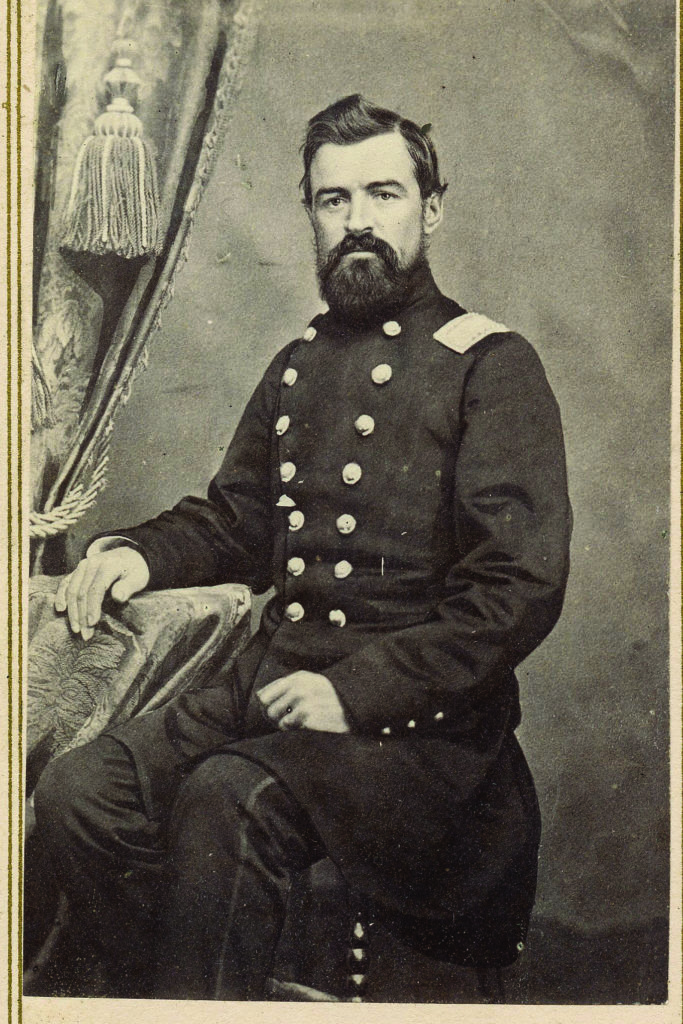
Marcellus M. Crocker led the Iowa Brigade following the Battle of Shiloh
1 June 1862—Corinth at this time is deserted. It gives the look of dilapidation, so much has been destroyed of it. It looked to be a fine place at one time in the past. It had a couple of railroads that ran through its town. You can tell the importance of education by the schools they had there. It seems to be a very rich and well [ ] formerly [ ] as I said. As of April we are now a full brigade consisting of us, the Sixteenth, the Eleventh and the Thirteenth and Fifteenth Regiments of Iowa Infantry. And Col. M[arcellus] M. Crocker of the Thirteenth Iowa is now our gallant commander. 7
At Shiloh we lost from our regiment at least 15 men, not counting officers. At least a hundred of our regiment was wounded and there were some missing also, During our siege of Corinth our regiment with full brigade participated in the evacuation of Corinth to loosen the Rebels stronghold. At that time, Gen. Grant had ordered an assault upon the fortifications. The full evacuation took place last night. Our regiment now are in camp near Corinth. We will remain here until we are given orders to move.
4 June 1862—I’m told that some of the troops are returning to Pittsburg Landing. Part of them will be assisting the army in eastern Tennessee and the other will be going with other forces down the good old Mississippi.
5 June 1862—Were given orders and one day ration. I hear Gen. Buell and the Army of Ohio are planning to move into central Tennessee. The sun is beaming down on the head of us soldiers.
6 June 1862—We just were told to strike our tents at 7 a.m. and prepare to march. We marched back through Corinth and back into camp about one mile from town and we were told that we would be going out on picket the next day. Was on picket all day long. We were relieved in the evening. We were about two miles out in very high timbers. it was by a main road that led into town, There’s not much water and the taste is bad too. We had to go far just to get drinking water and water to wash our clothes.
9 June 1862—Today we are building fortifications on a massive and large scale. I know that Corinth is an important point for either side in this war. It is a key area for the control of Mississippi and Alabama. There are lots of men left from the Army of the Tennessee. Those under the command of Col. [Gen.] Halleck were sent to other commands to be of reinforcement. I wrote my father and mother and sent some greenbacks inside of it. We built our wedge tents up from the ground and built bunks for our beds. No lying on the ground today. Will be resting in a bunk. I noticed how a lot of the fields in Corinth were completely destroyed during our siege of Corinth.
13 June 1862—Once again coming off picket we were relieved by the Eleventh Iowa. I do not have much idle time here to be writing besides keeping camp and cleaning our own clothes and picket duty, fatigue duty on these fortifications. The six Division was ordered to go and cut trees around the fortifications around the camp. Were told that they cut trees. The Colonel told us the reason we cut trees so that they fall to the front forward so that they would fall outwards towards an approaching enemy. The branches of the trees are cut to a real sharp point. They call this an abatis. In such a short time I have seen so much. In such a little time I have witnessed death in many forms. Seeing dead bodies ain’t that bad now. I figure as long as I’m seeing them, I’m still here. Thank God.
18 June 1862—Under the circumstances I am doing well here today. Those who were wounded in the Battle at Shiloh and those who were given a pass home because of sickness they had encountered, were now returning to their commands. We have no Sunday service but the guys make sure to have prayer meeting when we get a chance to.
23rd of June—Nothing of importance at all. Picket duty and drilling during the day. Wash my clothes and get ready for supper. As I look across the grounds, I see some of the men giving their clothes to the Colored women to wash for them. Not I. I will gladly do mine myself.
28th June 1862—Plenty rain this morning. It smells so good and fresh. We spent all day cleaning up and polishing our belt, shoes, cartridge boxes, and muskets. We are always ready to move in a moment’s notice.
4th July 1862—The weather is pretty warm today. It makes me think of back home with the folks. This is some of our first 4th of July in the army. Parts of today is sad. The guys of the battery of our brigade took guns outside camp and fired a salute in a celebration of this day. It’s getting close to supper time OK. As I think back to the Battle of Shiloh, there lay at least 20 thousand men lay dead or wounded on the battlefield. I remember looking around and there was legs and arms and even heads just sitting there. Shiloh was a horrible scene. Now being under the command of M. M. Crocker. Shiloh was my first taste of endurance. It was what prepared me for what I am dealing with at this present moment. I remember the march toward Corinth. It was only 22 miles but it took weeks to get there. The weather could not have been worse at that time. Maj. Gen. Henry Halleck. We had to cut our way through thick forest and the terrain was rugged as it could have been. A lot of the soldiers are getting sick from this southern weather. Some die from their sickness losing the battle.
When we were about ten miles out from Corinth, I remember the Rebels began their attacks on us. Colonel Halleck ordered us to dig trenches as the enemy tried to advance. Our trenches were made to conform with the nature of the ground following the crest of the ridges. They consist of a single ditch and a parapet only designed to cover us against those projectiles coming from the enemy. Corinth was another test of our endurance, digging trenches and fighting at the same time. On the 25th of May, the fight got very intense. We got information from a Rebel soldier that an attack was being ordered by Beauregard but we were too strong at the time, out-numbering them by at least two to one. As the rebels advanced towards us, we were ordered to advance. It was a small but deadly fight. I remember I and a Rebel running at one another with our musket in hand. He lunged but was too late and too slow because I hit him in the chest. The look that was in his eyes I will never forget. His blood hit me right in the face. As I pushed my tip further in the chest, he never made a sound. He just stared—eyes wide open as his life was leaving him.
After our deadly battle in Shiloh, the rebels retreated to the city of Corinth and because of their wounds, all the houses and buildings had become hospitals. Because of the rebels’ overwhelming numbers of their casualties, more than ever the Rebels thought they could hold the city od Corinth. At the time, all that was on my mind was Beauregard, the commanding officer of the Rebels. We knew that by taking control of Corinth we would be getting control of the Mississippi Valley. We knew they were weak from the Battle of Shiloh. Under the command of Colonel Halleck, this was the largest amount of soldiers I had ever seen at this time. Despite our size, Col. Halleck had us digging trenches every night and day, staying to be prepared for any sneak attack. As I looked at those Rebel eyes of death through my Union eyes. God bless the Union.
We were planning a large siege of the City of Corinth. We got word that a lot of the Rebel soldiers had been falling sick and Colonel Halleck said it was time to put Beauregard on the wing. In some of the positions of the Rebels, we found Quaker guns which were logs painted black to give the appearance that they were real guns. That was dumb but clever for a try. The Rebels were jumping trains with their sick and wounded heading southward, hoping to find safety from us Union men. When the trains would return, we would hear loud cheers coming from the Rebels but we had Rebels sneaking to our side and telling us that there is no hope of reinforcements coming, or at least not enough to help. The Rebel soldiers that come to us with information said that Beauregard had ordered the enemy to begin evacuating the city of Corinth and those that tried to stand while leaving were wither killed or taken prisoners so the cheering of the Rebels was a hoax planned and acted out by Beauregard and their officers. When we finally marched into the city of Corinth, we found it to be deserted. So Beauregard and his army had escaped. We did not pursue the running Rebels. Colonel Halleck said we needed to take hold of the city of Corinth. Colonel Halleck was promoted and Grant was now the commanding officer. Gen. William S. Rosecrans felt it better that we should build better fortifications to defend against any surprise attack on the city Corinth.
Colonel Halleck ordered a series of batteries to be built. I heard Gen. Rosecrans say that he believed an inner line of batteries would be better protection for the railroad so we began building forts. One morning we were working and came upon Rebels. A skirmish took place and the enemy retreated. Periodically we had skirmishes with the Rebels with the Union coming out on top. God bless the Union. Right now our troops are spread throughout this area. While the biggest part of the army was under the command of Col. Halleck, we the Sixteenth march to the orders of Col. Crocker and Maj. Belknap and the Fifteenth Iowa were inside the works to guard.
28 July 1862—Colonel Crocker gave the orders to prepare to march. We are heading to Bolivar to stop the advance of the enemy. He has heard that the enemy is planning an attack. The guide that was leading us took us down the wrong path which caused us to be at the point we started at, almost. I heard the guide was tied and taken to Corinth. The roads here are very dusty. because we were marching on high grounds, water was not very easy to come by and when we did get some, the taste was not much to talk about at all. We marched for fifteen miles and bivouacked for the night. the weather is hot but with all that we carry, it seems much hotter. The roads are so dusty and with all us men marching on it, the dust clouds are easily kicked up. A soldier named Orlando Stout also of Company E fell behind out of ranks and has been taken prisoner by the enemy. it is important that we stay close to one another when marching.
30 July 1862—We camped in a plantation said to be owned by a general of the Rebel army so it was ours now. We killed all cattle that we wanted and took plenty of honey—all that we can carry with us. We marched on fifteen miles again, We started at eight in the morning marching. We arrived at Bolivar at noon. We camped 2 miles east of town on the banks of the Hatchie river. We camped within a nice area of timber. The shade felt so good but the weather being so hot, it was hard to carry knapsacks and accoutrements and keep up with the company but I did. I had to. The officers are expecting us to be attacked at this place and have put three or four hundred negroes to work throwing up breastworks.
1 August 1862—Everyone is at work cleaning up the camp. We keep a very clean camping ground and it sits right on the bank of the river. Our whole entire Crocker Brigade is at this camp and is in the command of the gallant General Crocker. The colonel has been feeling sick lately. His health has ben not doing well. We continue to change our command but we still carry the title of Crocker’s Iowa Brigade. When we headed back towards Corinth, there were lines the whole way so we would not to stop and engage constantly. Some of the men would call them skirmishes but I say they were battles. There’s nothing small about the amount of men who died during that time. As we got closer to Iuka, the Rebels had the fords all around. We fought and would move the lines back some two or three miles each time and the more we came close to Iuka, the more the Rebels made themselves visible. They claimed this to be one of their stronghold positions.
15th September 1862—At this time our regiment is back under the command of Colonel Chambers. We are about 2 miles outside of Iuka on road named Burnsville. The information that has been given to us is that Gen. Price has a strong presence of troops in and around the city. As we continue to fight, this was slowing down our movement and time of arrival to support the other troops waiting to be reinforced. The Rebels were strong in force so we were waiting for a plan to be ordered of how to take the Rebels.
17 September 1862—Before reaching Iuka as we advance today towards the city, we were ordered to the left to reinforce Colonel [John B.] Sanborn and Colonel [Jeremiah C.] Sullivan who were being hit heavily by the enemy. By the position you could tell that they had set up prior to us arriving. When we reached the front line we immediately went into hand-to-hand combat. The Rebels were charging forward. General Grant and Commander Ord was supposed to be coming to reinforce our lines against Price and his Rebels but they haven’t shown yet. Last I heard they were fifteen miles out.
As we rushed forward against the Rebels, while the balls and rifle shell pass over head, we—the 16th—fought blow for blow with the enemy, never backing down unless we are ordered to go backwards. Nothing but top honors go to Gen. Rosecrans for his gallant leadership. I just killed two Rebels. The first I shot through his chest. The second [was in] hand-to-hand combat. When my blade went into his chest, he was yelling and the first thought that came to mind was do they have schools here in the South because even in death, they seem to have no education. With blood spewing out his mouth, he was yelling something that surely did not sound like English.
Our line is between the two—Sanborn’s Brigade on my left and [Charles S.] Hamilton’s Division on the right at this time. We are the only regiment from Crocker’s Brigade on the front line. There were five batteries moving ahead, even then, we had less than the Rebels. We were able to hold them off from advancing while in line of battle. We drove the Rebel pickets in. The Eleventh Iowa was on a high piece of ground and waiting for their orders to advance [when] a line of Rebels came forward and fired a few shots from a battery of four-pounders. But then our battery of heavy guns lying in front of us opened up on theirs and stopped all that. They were running for cover. When the Rebels first began their attack, I was taking me a small nap. Two balls went straight over me, striking one of the men behind me. Gen. Rosecrans said the Rebels are moving back—that’s good. It’s evening now and we got word that the enemy are retreating.
We fought hard, being out numbered three to one. We were successful. A lot of Union boys died here last evening. Reinforcements never come. We—the Sixteenth Iowa of Crocker’s Brigade—were detached from our brigade and sent forward. We were the only regiment from our brigade engaged in the fight [and on the ] front line till the end. Our losses at this time I am writing is fourteen from my regiment. During the night all was quiet as the brigade fell back to the last line of the fortification which extended almost around the town had been built in the last few days and here we lay in the line of battle all night. The Rebels commenced to throw shells into town. The Rebels threw some ten or twelve shells before our battery could get the range of them but when they did, they opened on them some sixty-four pounders and soon put the Rebel’s battery out of commission. [ ] charged to the left with my regiment which was advancing to support a battery.
About 10 o’clock the Rebels made a charge to our right and tried to break our lines at that point but failed. This was being done by the [3rd] Texas Cavalry 8 dismounted. They came clear over the hill, driving some of our artillery away from their guns but they were soon over powered. Some were killed, some we took prisoner. Their colonel ran forward and tried to plant their flag where we were and I immediately killed him. Many rebels were dead in front of me laying three or four deep and their blood ran in streams down the trenches. The Rebels finally withdrew about 4 o’clock leaving heir dead and wounded. Our regiment moved to the left in support of a battery and engaged for the rest of the day. As of now we only had one killed but 17 wounded. The Eleventh [Iowa] had 3 killed and the Thirteenth [Iowa] had one killed. We are moving forward. I’ll write again if the Lord allows. God bless the Union and our beloved army.
8 On 19 September 1862, the regiment suffered its worst losses of the war in the Battle of Iuka, with 22 killed, 74 wounded, and 48 captured. During the battle, the 3rd Texas Cavalry was assigned to Hebert’s brigade in Lewis Henry Little’s division. A few weeks earlier, the 3rd Texas Cavalry sent their horses to graze so they fought the battle on foot. Hebert ordered the regiment to form a skirmish line and advance into a ravine in front of the Union positions. As Colonel Hinchie P. Mabry led the 3rd Texas Cavalry forward, Union riflemen and artillery opened fire at a range of 150 yd (137 m). Sergeant W. P. Helm watched as a round shot beheaded his company commander, while canister shot chopped a lieutenant and a private in half. Soon Hebert’s brigade attempted to seize the 11th Ohio Battery, which became the focus of the fighting. Part of the 3rd Texas Cavalry helped the 1st Texas Legion rout the 48th Indiana Infantry Regiment and reach the top of the ridge. Sam Barron saw four men killed near him while Sergeant Helm claimed that 27 of 42 men from his company were casualties. The 3rd Texas Cavalry lost some men to friendly fire when the 1st Texas Legion mistakenly shot at them. After a terrific struggle, the 3rd Texas Cavalry and other units captured the Ohio battery. Barron remarked of the Federal gunners, “the brave defenders standing nobly to their posts until they were nearly all shot down.” Colonel Mabry was wounded in the ankle. [Wikipedia]
21 September 1862—We have got rest in a camp that the Rebels vacated. Their tents are badly torn but there are wooden bunks that are in pretty good shape for sleeping. Our wounded are being cared for and we just buried our dead. A detachment of our army are still in pursuit of the Rebels and we’re now being ordered to engage in that pursuit. Iuka will be fully evacuated by evening. We have been ordered to return to Corinth, the Rebel forces were being rapidly concentrated for an attack, and it was evident that another battle is going to soon occur at or near Corinth. We also knew that the enemy would make a desperate struggle to regain possession of Corinth so all our Union forces were ordered to concentrate for its defense. Our once so gallant commander Colonel Chambers was wounded in the Iuka Battle, I think in the neck and side. I pray for him. He was a great man to serve under.
Pvt. Andrew Shiner Drake served with Joseph in Co. E, 16th Iowa Infantry. Drake, born in New Jersey, enlisted on 29 October 1861 in Muscatine, Iowa. He died on 22 September 1862 in Jackson, Tennessee due to the effects of chronic diarrhea. He is buried in Corinth, Mississippi. [Stan Hutson Collection]
3 October 1862—We formed a line on the left side of Cane Creek. To our left was a battery in front of our line and to the left of them was two lines held by Kissat [?] Road lead by [John] McArthur as word went through the ranks that Price and Van Dorn had combined their forces to strengthen their attack on Corinth. As the Rebels were watching from a distance, they began to move forward. Shells were passing overhead. The battery to my left began to respond. As we were ordered to march forward, there were outer line rifle pits covering the right side of the city but there were none on the left where we fought. We had three batteries—one in front and two behind. We kept marching at their line and they had three sharpshooters that were picking some of the men off. Once Colonel Crocker got a handle on where the sharpshooter was, they were handled and we continued to keep charge at the enemy.
This bloody fight [lasted] the whole day and evening until the enemy fell back in their lines, not yet or fully retreating to their lines behind them. They would come right back even with their losses. In the process, as they kept pushing forward, the battery to our left front [decided] to abandon the battery and get behind our lines. Surrendering men were killed and many more would have been wounded but we bravely stood our ground until the enemy began the retreat back behind their lines. This lasted all the way into the evening. We can still see them from a distance. We held our position and settled for the evening keeping watch on the enemy.
Peter Kiene served with Joseph in Co. E, 16th Iowa Infantry. He was wounded and taken prisoner in the 2nd Battle of Corinth on 3 October 1862 [Mark Warren Collection]
4 October 1862—Sunrise, the battle was back at full force again and it was real hard fighting, mainly off to the right side of us and we soon fell back to the first line of breastworks. We were flanked and had to pull back to the second line of breastworks, regrouped and at Colonel Crocker’s orders, began to to push forward. We could hear gun fire in the city. Then we received word that the Rebels had gotten between two lines and entered the city. We held them off until reinforcements came and then we went forward—deadly forward. Later in the day we gained control of the battle and were told that Van Dorn and Price were calling for the Rebels to retreat as we were the pursuing side now. We were very tired and worn. About evening there was some very heavy cannonading. As we were very worn out and fatigued, but every man was willing to go on if it meant the capture of General Price.
5 October 1862—As we passed the hospital of the Confederates on the Corinth [Road], formed a line of battle. We could hear some very heavy cannonading out on Hatchie River in our front. Gen. Hurlburt had cut off the retreat of the rebels at the bridge crossing the river but still after a hard fight, they still got away and continued their retreat to the south on the east side of the river. We resumed our pursuit of them until night fall. The Second Iowa Cavalry was ordered back to Corinth while we will be in high pursuit of Price.
6 October 1862—We started this morning at daylight and crowded the Rebels very hard all day, capturing their trailers and some of their artillery, ammunition, arms, and caisson. I never saw such an attack in all my life. It was like a stampede. We had the Rebels on the run and their Gen. Price right there with them. I just wanted to capture Price and punish him for all the people of the good state of Iowa whose family was taken because of this rebellion. As we continued the attack, they continued to run south. They were driving their wagons and artillery through the timber and over fallen trees two and three at a time, wiggling through the standing timber as best they could with every Rebel for himself. Some of their men—the artillery men—their cannons off the running gear, and was throwing them into gullies and covered them with leaves. Everything imaginable was thrown along the road by these running Rebels—tents, bake ovens, corn meal, fresh beef, and a great many other things, They even burned up some of their supplies to keep it from ever falling into our hands.
General Price had set a camp that he used as his headquarters. [When he became] aware that we were on the attack to get him, he ran and left everything behind. We captured some of General Price’s headquarters supplies. Among it was a buffalo robe and a pair of gloves made of buffalo fur which I took as a souvenir. These were the personal effects of Gen. Price, commander of the Confederate army, running for his life, leaving all his possessions. Well, still I want to capture him or Van Dorn—any of them I’m glad to have. I also cut some patches of all of Price’s uniform. The rest of the guys cut up the buffalo robe into pieces and all took a part as souvenirs also and we didn’t stop marching forward until 1 a.m.
Joseph’s “souvenir” or war relic—“a pair of gloves (mittens) of buffalo fur…that were the personal effects of Gen. [Sterling} Price, commander of the Confederate Army.”
7 October 1862—We were all very tired yet still willing and anxious to go on if only we could capture Price or even a part of his officers. Leaving our bivouac at eight o’clock this morning we gain started after Price. We soon come upon the rebels and shelled their rear guard almost all day. We took a great many of the prisoners. It is reported that they are breaking up battlefield. I seen at least eighteen of their dead. From the looks of them, they died from their wounds. They were lying side by side and almost black in the face which I was told had something to do with drinking a mixture of water, vinegar, and gun powder. We had barrels of vinegar, one for each regiment, so stationed as to permit us to come and help ourselves to it. Our quartermaster in hastily removed the commissary’s supply back to the inner lines during the battles somehow left these barrels for use.
Well as for now I am running out of paper in this book so until I get another one and if God allows me to continue to live through these battles and then survive the war. They say before its over we will take Louisiana and Georgia and all these other southern states if God wills. If I do not survive this War of Rebellion or any battle herein, this is to show that I loved the United States and fought for its unity, willing to die for this cause. So far I have marched under some of the most honorable command and officers in this war.
Diary 3
Joseph’s third diary spans the period from 22 April 1863 through the Atlanta Campaign. A corner of the diary pages has been chewed by rodents.
22 April 1863—We got orders to move again and our tents and it commenced raining. We marched to the boat through mud at least a mile as we got on the boat with our equipment and took time to get sleep. We [ ] at Milliken Bend about five miles from Duckport Landing about nine. We got off the boat and marched. Pitched our tents and set up camp. We will be here until the end of the week. Then we were told to turn over our tents and prepare to march. We marched about ten miles and then camped out over night. We are headed across land to get to the better area of Vicksburg.
27th April 1863—It’s raining pretty hard but we have been ordered to march. Its been about ten miles. We are somewhere by Richmond, Louisiana. We found a cotton house and stayed there over night.
28th April 1863—We are ordered to march again this morning. We marched about three miles again. This time there was this large plantation that we camped out in over night. I think it belonged to Senator Holmes. I am told that we may be here a few days.
30th April 1863—We have been ordered to march to Bruinsburg [Mississippi] and assist Gen. Grant’s army on their campaign to Vicksburg. As we reached Grand Gulf, we engaged the enemy near Port Gibson. This was around the first of May and successfully moved the Rebels.
3rd May 1863—We engage once again with the Rebels time time at Mile [?] Creek. We defeated them both times. They sustained heavy losses. Gen. Grant then ordered us to move out with rapid movement and march to the north in order to seperate garrison of Vicksburg from the covering army of Johnston. This movement was followed by a battle at Raymond on May 12th. It was successful. The enemy stood many losses once again.
14th May 1863—We engage once again with the enemy lines out at Jackson and was successful, not having much of a loss but the enemy was defeated again.
16th May 1863—We continued to advance forward. As we march we came across the Rebels line at Chapel Hill and engaged once again and they retreated back as continued to advance.
17th May 1863—These Rebel lines just keep on passing up. As we approach Big Black River, they fired shells on us but were not successful. We found our line and engaged and successfully defeated them, taking prisoners and killing those that not got away with the Rebels having lost more than we had. The march was successful. I am told we are moving toward Vicksburg next. We have been on the front line separated from our brigade fighting along with or behind Gen. Grant’s army. Cannon [balls] continue to fly overhead. A few struck our lines and men were killed.
18th May 1863—Today I was on picket. My regiment was out on scout up the Big Black River to cut a raft. We are now under the command of Colonel [William] Hall of the Eleventh Iowa. Our first Colonel Chambers was still out on account of his wounds received at Iuka and we also were under the command of [Lt.] Colonel [Addison] Sanders for some time even though he was wounded in Corinth, he continued to lead until he was removed to get his health in place again. After Sanders was relieved, [Lt.] Colonel [William] Purcell took command. At this time there was at least 20 of our regiment there in place at Vicksburg waiting for the order to come through. We have lost a lot of men at this time. I never knew when we were sailing here on the boat that we would head into the Rebel hands like this. We march over two hundred miles in a fortnight and have fought six hard battles in as many days and we felt we were ready to take Vicksburg by storm. The attempt to take the city and let free the water of the Mississippi have already cost us at least ten thousand men killed or wounded and now we stand here ready to be sacrificed for the Union and I can hear some of Grant’s soldiers saying that we should attack the enemy lines at once. We have formed a semi-circle around Vicksburg rebels and fortifications. Sherman’s army held the right and McClernand on our left side while McPherson’s guys held up the center. Our set position was not yet complete because there was a gap on the left side for a few days but later we got that closed. Our lines were nearly eight miles long and confronting us are fortifications that have been pronounced by Sherman to be stronger than the words of Sevestopol because the soldiers defending them were veteran and they were on their own soil.
They were telling us the Rebels under the order of General Johnston were trying to build up their position along Black River to attack Gen. Grant’s army in the rear because the enemy believed that Grant was at a loss from where he was positioned. The Rebels had at least nine major fortifications that anchored their lines, each covered the roads and railroads that constituted our best avenue of approach. Rifle pits connecting the major works made the Rebel lines more or less continuous. They had set Vicksburg up like an entrenched camp more than a fortified place. And using much of its strength to the difficult ground obstructed by fallen trees in its front which rendered rapidity of movement and ensemble coordination in an assault impossible. Terrain obstacles and their fire worked in concert to stop our attacks. Enemy fire and artillery raked our lines and flanked as they plunged into the ravine where they had wire that would entangle us, and they had these pits that were covered with grass that also broke up our rushing forward. General Smith’s Brigade did make it to the top of the hill dodging artillery shells the rebels rolled down on them from some Redon. At nightfall we fell back to our lines. By then our flagstaff was in three pieces and the flag itself had as many as fifty holes in it. As we come back behind our lines, we had to leave lots of dead soldiers behind that were killed. There has been thousands of men killed. I thought that the first battle was the worse that I had been in but this has been the most deadly battle thus far.
26th May 1863—I only have a few minutes to write. This has been a horrible fight. The Rebels have his city locked from all angles. I expect that they would have planned this raid like all the others. There is not a regiment or brigade that has not stood many losses during this fight. Johnston and his Rebels have held their ground. Every time we charge, a lot of men die. Knowing that is the chances of war, a lot of our leading officers have been killed or wounded but us men of the Iowa [Brigade] continue to march forward and we will see the end of the war to the end as God stands witness to these words I speak. We are close to getting control of this battle. The fortifications and batteries are a strong part of the problem. Well I got to get back into the thick of it now.
5th July 1863—Gen. Grant ordered all supplies cut off from the town Whites. We are being told that Grant was putting together a siege plan, not by advancing by force. Commander Hall ordered us to dig trenches around the town in a zig zag fashion that brought us closer to the enemy lines which I thought was very tactical thinking. He had us dig underneath the Rebels and plant barrels of black powder under the Rebel’s works and at his order they blew them and at the same time we were ordered to push forward so we surged straight ahead at the Rebels only to be met by counter attack by the enemy. At that moment it was hand-to-hand combat for what seemed to be hours and hours. At least five men fell at my hands and those Rebels came out of everywhere although a lot of them were killed. So were many of us. Also it took hours of killing before we were ordered to fall back behind our lines, leaving all of our dead and wounded on the battlefield facing the lines of the enemy. We blew our black powder mines a second time but this time we did not advance as we waited in line for orders. Cannon shells were being fired daily by our artillery that was positioned around the town and the heavy fire from our fleets but on the river their food supply had been cut off. I was told that horses, dogs, cats, and even rats had become a source of diet and food supply for the Rebel soldiers and civilans alike in the town.
Finally on the 3rd of July, Pemberton, the General of the Rebels, came out to discuss a safe surrender to Gen. Grant. Although it was said that he was named the “Unconditional,” yet this “surrender” our honorable commander Grant agreed to parole Gen. Pemberton’s men. The next morning the 4th of July, the Rebel soldiers began piling out and stacking their guns. The civilians of Vicksburg did not get to celebrate the 4th of July but the Union did for claiming the siege of Vicksburg after just one part of this battle. At least nine thousand men lay dead and that was just in the beginning of battle. We really lost more soldiers to sickness than to battle.
6th July 1863—We have advanced to Jackson, Mississippi. We got a short rest from the field. We are ordered to guard the ammunition and subsistence train. it was a short rest from battle but it did not last too long. We still had some skirmishes while guarding the train. I have to stop now.
22 September 1863—Grant has now been promoted to Lt. General of the full Union army. He is now general-in-chief and General Sherman has replaced Grant as the commander of Military Division of the Mississippi. Our General Hall told me that Sherman said that President Lincoln said that Richmond, Virginia, and Atlanta, Georgia, were important territory for the Union to gain control of so that was the word around camp for some time. One thing was for sure, that we were going to join with Sherman as we were also under General McPherson, Army of the Tennessee.
14th October 1863—We have been on the move constantly back and forth fighting along the way non stop. We are in Canton. The Rebels are here so the fighting continues. Got to go. I’m on guard duty.
7 December 1863—Rainy day in camp. Will be moving out to start on march to the Meridian. The Rebels seem to be just about everywhere.
10 December 1863—Still raining and we are still skirmishing throughout the day. They continue the worse back though they try to stand.
11 December 1863—Nothing special today except on guard.
March 1864—Most of the Iowa Infantry Volunteers have been allowed to go on furlough but the majority of us, the 16th Iowa Crocker Brigade are kept in battle on the front lines and serving in what ever way we are needed.
10th April 1864—Now in Clifton, Tennessee marching to connect up with Sherman’s army and march towards Atlanta and head towards Ackworth. I heard Grant and Gen. Meade went after Lee’s army in Virginia and we, the 16th Iowa, are now with Sherman’s army marching toward Atlanta.
23rd June 1864—The rest of the infantry is back from furlough. The Iowa infantry are back strong again and ready to fight. We have marched with Sherman’s army for two months now, fighting all the way and we are almost there. I shot two more raccoons and cut their tails to take home to my mother. She can put them on a hat or something. Now after 70 miles of marching and hard fighting all the way, maneuvering in and out of battle, our path to Atlanta became blocked by imposing Rebel fortifications on Kenesaw Mountain near Marietta, Georgia. It took at least one day to get past these country rebels and move them back so we could execute our plan of attack.
26th June 1864—We fought hard and managed to make the rebels wilt from the path that they were blocking us. Got to go. On the 24th June we were told to prepare for an all out assault on the enemy the morning of the 27th June at 8:30 a.m.
27th June 1864—It’s a warm morning and death is in the air. We have been ordered to prepare for the attack. Will write later.
7 July 1864—General Sherman ordered an all out frontal assault on the 27th of June. We, the 16th Iowa, advanced against the enemy on the north side of Kenesaw Mountain. McPherson of the Tennessee Army, while his Corps under General Logan assaulted Pigeon Hill on the southwest corner, while at the same time Gen. Thomas made a strong attack on Cheatam Hill at the center of enemy lines. See now [that] Atlanta is critical to capture because it held four important railroad lines that supplied the Rebel army and was known for its military manufacture arsenal in its own right. Atlanta held the nickname the “Gate City of the South” and it wore that name well. If we could capture it, it would open then deep south to the Union. General Grant’s orders to Sherman was to move against Johnston’s army, to attack and break it up, get into the center of the interior of the enemy’s country as far as we can, and inflict major damage as we can against the enemy. Destroy their war resources.
Back on the 27th June, the day we started our assault at Kenesaw Mountain, our artillery opened a ferocious bombardment with over 200 guns on the enemy’s works, and the enemy responded to the call unkindly. Kenesaw smoked from all the fire blazing across it like a volcano. We began to move forward soon after, itching to fight with the enemy. At 8:30 a.m. our forst three brigades began to move and attack. General Smith’s Division and Gen. Logan’s Corp and us and the Army of the Tennessee fighting against [William W.] Loring’s Corp on the southern end of their line. Our lines are now in close contact and it’s heavy fighting going on at every side with heavy artillery. As fast as we gain position, the enemy has another line all ready for us.
I see that Kenesaw is the key to the Georgia country. We weakened the enemy lines by hitting them on the northern outskirts of Marietta and the northeastern end of Kenesaw Mountain with our infantry and cavalry and made a firing assault on their southwestern end of Little Kenesaw Mountain while the Thomas army was attacking the Rebel fortifications in the center of their lines. The Rebels reset their lines from Kenesaw Mountain to Little Kenesaw Mountain. General Hood attempted an attack but failed south of Little Kenesaw. General Hall stalls our infantry about fifteen miles north of Atlanta because the roads were a mess and our railroad supply lines would be dominated by Johnston’s position on the top of Kenesaw Mountain. This whole Georgia country is a vast fort. They had at least fifty miles of connected trenches with abatis and furnished battery. We continue to gain ground fighting; these southern boys will fight.
10th July 1864—On the 8th we struck up battle ferociously again. McPherson out maneuvered Gen. Johnston by advancing t his right and crossing over the Chattahoochee near the mouth of Sope Creek which was the last area holding us from entering Atlanta. Well, the Rebels color officer was killed and in their retreating, they were running backwards and did not get their flag which was so full of holes that the Rebels, I guess, felt it not worth getting killed over. Guys from the Brigade tearing it into pieces to remember the taking of Kenesaw Mountain of Georgia. I got a small piece of it. As we continued to march forward, we wanted Atlanta and we wanted it now. But afraid for the danger of Atlanta, the rebel army began to withdraw their army and then we were told that their leader Jefferson [Davis] relieved Johnston on the morning of the 17th of July 1864 and replaced him with General Hood. The 18th is the first day in the month it seems that there is not a sound of heavy battle.
24th July 1864—Hood has tried twice to attack—once at Peachtree Creek on the 20th, and Atlanta and Decatur on the 22nd. But once again failed. Each try is closer to its capture completely.
30th July—general Hood tried again on the [ ] at a place called Exra Church and he suffered enormous casualties without any tactical advantage. In August we took hold of Atlanta and thank God I was approved for a thirty day furlough. Remember most of our Brigade went on furlough back in April but the 16th Iowa was at the front line and was needed until the end of the Atlanta Campaign.
26th of August—I’m great today. I am on my way home. Can’t wait to see my father and mother, brother and sister.
Well, just got home today. The whole family was here to greet me. What a blessing to be back around family and friends. Well. I think I’ll be leaving this book home. It won’t go back into service with me.
Atlanta Campaign. I will never forget the first battle of that campaign. It was a place called Rocky Face Ridge that the enemy Johnston made a stand with his Rebels. I remember we were ordered to hit his left flank near the town of Resaca where Johnston also had a supply line on the Atlanta Railroad. But we were stopped in our tracks by a small rebel force entrenched on the outskirts of Resaca and so we pulled back to Snake Creek. We were told that Sherman was coming our way towards Resaca because Johnston had took up position there. I remember that full scale fighting erupted in Resaca on the 14th-15th of May and we flanked Johnston by crossing the Oostanaula river and Johnston withdrew and then there there also skirmishing erupted at [ ] back in [ ] and more fighting back on Johnston’s Cassville line in May also. I’m just remembering to write what I could not because I was always in the field front line. I remember Rebel Generals Hood and Polk had orders [from] Johnston to withdraw his army from Cassville and the line across the Etowah River and Johnston’s army had set their lines at Altoona Pass south of Cartersville. Sherman and his army turned Johnston’s left and he abandoned his railroad supply line and he then advanced to Dallas. I’ll never forget Johnston and his army was forced to meet us in the open for a fight not forgotten. We fought at a place called New Hope Church and Pickett’s Mills and Dallas also.
Back in June I experienced my first hard rain in Georgia so we turned back to the railroad to get our supplies and Johnston had a new supply line. it was called the Hatchie Mountain line northwest of Marietta. There was also Lost Mountain, Pine Mountain, and Brush Mountain. After 11 days of heavy rain we were ready to move out again. I remember we spotted a group of enemy officers up on Pine Mountain and General Sherman ordered one of his artillery to open fire and so-called “Fighting Bishop” (Gen. Polk) was of that group of officers killed and they withdrew quickly from Pine Mountain. We fought a very strategic but hard fight against the enemy and as I said before, I watched the enemy color officer get shelled and got me a souvenir. Well I’m home now. I just wanted to [ ] to because I could not [ ] the way. I’ll start a new book when I return in September.
Diary 4
Joseph’s 4th diary…
Well on my way back from furlough. It was great being back home with my family spending time with my father and mother, and brothers. There was a lot of people that came to see us off. It was sad but [ ]. I was glad and ready to go back into the war. I seen a few wives of men I knew who had been killed or died from disease and it was also a sad moment seeing them too knowing that me and their husband had left there together and only I returned. But I told them everything I could about their husband and that he died honorably and how great a person they were during this war.
5 October 1864—I arrived in Atlanta about 9:00 evening. Last night I stayed all night with a soldier and his family in one of his vacant rooms. I had breakfast there the next morning with them. Then I grabbed my knapsack and all and headed for the headquarters of the 17th Army Corps. From there I went to the headquarters of the Iowa Brigade and about midday joined my company and I was glad to see the boys again. I had received lots of mail while I was in route. Atlanta is quite a city. The building structures are very nice.
6 October 1864—The camp of the 17th Army Corps is about two miles outside of the city. We have a very nice camp here. The boys built good bunks out of old lumber in their wedge tents. Our tent had been stored in Huntsville, Alabama, and after the fall of Atlanta had been sent forward. Gen. Sherman’s entire army is in camp here and strongly fortified just south of Atlanta. The army is to be paid out at camp. The muster roll have to be paid by the pay master.
7 October 1864—I noticed that Atlanta was very empty. Then one of the guys told me that General Sherman had ordered a evacuation of all citizens due to a lack of food supply coming into the city because there was only one railroad coming in from the North to Atlanta and the Rebels were almost every day destroying some portion of it. One of the boys told me that General Sherman had notified Hood to come with wagons to a station south of Atlanta and take care of the citizens. While I was on furlough, they say many southerners took the Oath [of Allegiance]. Some said that they would rather die first so some did and others were taken prisoner.
8 October 1864—We just got word that there is a strong rebel force in Fairburn, Georgia. We marched about 6 miles and went into bivouac for the evening. We received a message from D. Cole of the 24th Iowa saying his regiment is now in Shenandoah, Virginia. We march about six miles before [we] came upon the rebels rear guard. There was some skirmishing with them. I caught a light wound in my hand but not bad enough to slow me down. I fatally wounded the rebel that did this to me. The nurse wrap[ped] me and I continued with my company.
9 October 1864—We are ordered to head towards Big Shanty, arriving here this afternoon. We camped. The 15th and the 17th Army Corps are sent here to put the railroad track in repair. The Rebels tore up about nine miles of tracks, burned the ties, and twisted the rails. The engineer has to get out new ties and large details of our men have to cut down lumber and hew the ties and it is reported that the Rebels are headed north.
10 October 1864—A large detail from our regiment was put to work on the railroad, Me and two other of the boys took french leave this morning and went to the top of Kenesaw Mountain. It is a grand view from atop the mountain, but we paid for this sight-seeing. When we returned, we found that our command had left. They were ordered to move quickly to Altoona, Georgia, so we had to move fast to catch up with them. Our bunk mates were carrying our knapsacks, haversacks, canteens, and rifles. They were as thankful as we were that we caught up with them for it was a heavy walk on them.
11 October 1864—The weather has been cool most of the week. Our entire Corps started early today going as ordered to Kingston. We marched through to Cartersville where we went into camp for the night. We got word that there was some very hard fighting yesterday in Altoona, Georgia, and there was heavy loss of life on both sides, but Hood did give up the mission of trying to capture the place. We hear that Hood is now moving towards Rome, Georgia.
12 October 1864—We were ordered to move out early this morning. We got within 7 miles of Rome, Georgia, by midnight and we camped for the night. We had to move very slow on account of the teams giving out. Our horses and mules are getting very thin. This is because of the scarcity of forage and then the roads are very rough which made it hard on them. Hood’s forces are said to be about thirty thousand men of all arms and we are in fine shape. We received a large mail at Kingston. I received a letter from my father and mother.
13 October 1864—We left our teams behind at Kingston and they did not catch up with us until this morning. We stayed in camp all day. About sundown we received orders to start for Adairsville, some fifteen miles from Rome. We left our teams and all artillery behind and marched through a byroad, reached Adairsville late midnight. I rested and then was placed on guard duty for the remainder of the evening.
14 October 1864—At Adairsville. We took a train composed of box carss to Resaca. We arrived about 5 in the morning. We at once was ordered to form a line of battle and we laid in line all day and the remainder of our corps soon came and later the 14th ARmy Corps arrived to assist us. The 1st Division of our Corps was sent out after the Rebels. We found them out about 4 miles out on the railroad by Resaca and Dalton, where General [John M.] Corse had flagged Gen. Sherman for reinforcements as Hood was trying to capture the place. We had about one million rations at Altoona. Sherman flagged back, hold the fort, I am coming. General Corse sent back saying that we would hold the fort to the death if need be/ The Rebels already destroyed about fifteen miles of track. We engaged in a skirmish there in which the Rebels captured all of the 17th Iowa as prisoners except a few of us but they were at once paroled. It was said that the commander of the post at Dalton surrendered the place without firing a single shot. It’s being said that the Rebels ae heading for the mountains and if they make it there before our army it will be hard to trap them because they are in their own country and of course amongst their many friends and families.
15 October 1864—We are now after the Rebels at the south entrance of Snake Creek Gap. Here we formed a line of battle and the skirmishing began. A small force of the Rebels were behind some old works that we had built last spring while advancing on Resaca. Finally we made a charge upon them and routed them. We lost at least fifty killed or wounded. The enemy then fell back through the pass, blockading it for at least nine miles by throwing trees across the roads and we did not succeed in getting through the pass until late evening. The 15th ARmy Corps was in our rear.
16 October 1864—We left camp early this morning and went about eight miles. We passed through Goose Neck Gap. It was about forty miles long and quite narrow. The Rebels did not take time to block this gap. As we advanced we come upon the Rebels and engaged in a skirmish. The Rebels are still falling back to the north. We are now in a mountain type country and thinly settled because it is so rough and rocky. The trees are of Chestnut and all varieties of Oak.
17 October 1864—We lay camped all day. At dusk we marched about four miles and again went into camp. The weather has been very pleasant for the last few days. The muster rolls of our non-Veterans of our regiment were made out today. They received their discharge papers because their three year sacrifice will be up tomorrow. There are twelve from our company, two of them I had become close friends with—Samuel Metcalf and Albert B. Stiles [both in Co. E, 11th Iowa Infantry]
18th October 1864—We started early this morning and got to Lafayette at about nine o’clock. We were there for about two hours before picking up and marching. We are heading to Summerville, Georgia. Went into camp about four miles from town. The Rebs are still moving north through Blue Mountains. I have two days rations left in my haversack this morning. When we received orders from the quartermaster it would have to run us for four days and we could not draw any until that time and there was no news from the eastern army and God bless the Union.
19 October 1864—We entered Summerville about ten o’clock and was there [until] about noon. Well, I have to go. We are being ordered to move out once again. Rebels have been spotted.
20 October 1864—We started early this morning and marched at least fifteen miles. We camped for the night near Cave Springs. Large foraging parties were sent out which brought in great quantities of provision and feeds, this area having not been run over by our armies. Cave Springs is this little village sixteen miles south of Rome, Georgia. The citizens all left their homes when hearing our armies were approaching. It was put on picket duty and as of now, all is pretty quiet.
2nd November 1864—-We started early this morning. After marching some time we camped near Van Wert, Georgia. It was raining all day. The roads became so slippery that it made for hard marching. Some men were giving out and had to be hauled for portion of the trip. The men were beginning to grow weary as we continue to march. Still raining and getting fatigued. We finally camp in Dallas, Georgia. Time to get some rest. Will write again soon.
4 November 1864—Left Dallas this morning, marched ten miles and then camped near Lost Mountain. I went out with a foraging party from our regiment. We got five heads of cattle and seven nice hogs and some cane molasses and corn meal. We also searched for cabbage but the negroes had no idea what we were talking about. I could hear them telling one of our guys that they never heard of such a thing before in their life. We found very few town folks at the homes. The ones that were there were poor families. Their men were away with the Rebel army do it has been quiet.
6 November 1864—Our Division has moved closer to town and camped there. We received orders to remain a few days, to draw clothing, and receive our pay. This was great news. We took vacant houses and proceeded to build bunks and ranches with the lumber covering them with our rubber ponchos. We, the 16th Iowa, went out with the regimental team for foraging. About nine, trains come in over the railroad from the North loaded with provisions for the army stationed at differrent points along the line and at Atlanta guys are pretty happy in town. I write soon.
7 November 1864—It is quiet and cool and cloudy. The guys from the 11th Iowa have received six months pay this day besides another installment of the bounty. We are preparing to evacuate Atlanta. The general quartermaster is loading every train going north with the surplus commissariat and all extra army baggage. It is reported that our army is going to fall back as far as Chattanooga and we are ordered to destroy the railroad as we go. There is talk that the Army of the Tennessee is going on a long expedition further south.
12 November 1864—Our corps marched out on the railroad between Marietta and Big Shanty and tore it up, burning all the ties and bending the iron. The iron rails were thrown into the fires and then twisted up. The last train went north about noon and more mail will be sent out from this part of the army for forty days. They tell us the telegraph lines between Atlanta and the North were cut soon after the last train left. The railroad from Dalton south wherever Sherman’s army goes is to be destroyed and all stations and public buildings burned.
13 November 1864—We started early morning heading towards Atlanta. After about twenty miles, went into camp for the night. The 20th ARmy Corps is stationed at the railroad bridge crossing the Chattahoochie River. We will soon destroy that bridge also and the track clear to Atlanta. The front of us is very quiet. We were ordered to burn everything in our camp yesterday that we did not need and it seems that everything in sight is being burned and every man seems to think he has a free hand to touch the match. This nice little town called Marietta will doubtless be burned before the last of Sherman’s army leaves this place.
14 November 1864—We marched five miles, then camped a mile south of Atlanta. We destroyed the railroad tracks in Atlanta and burn all the public buildings. There is a fine large station here and a nice engine house but we burned both. Most citizens are gone from Atlanta. The 14th, 15th, 17th, and 20th Army Corps in camp in the vicinity of Atlanta. They are concentrating here for the purpose of making a grand raid down south. We are ordered to take 40 days rations with us consisting of hard tack, coffee, sugar, salt, pepper, candles and soap, but we are told to forage for meat as we march the country.
15 November 1864—We are heading for the southern coast somewhere and I don’t care so long as we are being led by General Sherman. The Army of the Tennessee has the right side and the Army of the Cumberland is moving towards Milledgeville, Georgia. We have about sixty thousand men of all arms and we are in very fine spirits and eager in this campaign. We went into camp for the night about 12 miles from Atlanta and there is nothing to forage in this country at this time. All is quiet. No rebels yet in sight.
16 November 1864—Reveille sounded this morning early. We had to march over twenty-five miles. We went into camp tired and worn. We were all day on a byroad on the inside of the Right Wing and although this country is heavily timbered, yet we are blessed with a good road. We seen some fine plantations. The 14th and 20th Corps were the Left Wing. The 15th and 17th were right and both of them being covered by our cavalry. There was some skirmishing up front center but we pushed them back and the rebels began to retreat.
17 November 1864—We broke camp early morn, marched eighteen miles and then camped for the night. The 13th and us, the 16th [Iowa] had train guard. We had guard of the rear and the 13th had the front of the brigade. We marched through some really nice country today. It is good country for foraging. There was plenty of fresh pork and all the sweet potatoes we could grab. The weather is nice and we have not seen the rebels today yet.
19 November 1864—There was rain last evening so the roads are slippery today and this is hilly country [which] makes for difficult marching. We went about fifty miles and camped. Our Division was in the rear of the 17th Corps. The infantry marching at one side of the road so that the artillery and wagon trains could move together and all go into camp early and at the same time. The citizens after hearing that we were getting close, left their homes and headed for Macon. We passed through Hillsboro and the town was deserted as we burned many of the houses as we passed. I could hear the sounds of cannon off to my right towards Macon.
20 November 1864—It is still raining and the roads are full of mud. It makes it very hard for the artillery to keep up with the infantry. There are some nice, clean plantations along the way which have had good crops this season and we find plenty of sweet potatoes and fresh pork. We are on short rations now and therefore have to forage a great deal. We also found enough forage for our horses and mules so as for now everyone is getting their share of fillings.
21 November 1864—It has rained all day and the mud is causing problems for the artillery. Our regiment has been put on train guard. We corral the wagons about four miles in the rear where the 1st Division of the 17th Corps went into camp. The weather has turned cold. We left the camp early this morning with our wagon train and caught up with our division at Gordon where they were camped last night. Gordon is 15 miles from Milledgeville and is the junction of the railroad running from here to Savannah, General Sherman with the Left Wing of our army passed through here ahead of us, remaining in this town three or four days. We left Gordon about non and marched ten miles on a byroad off the right of our corps and camped near Irwinton, the county seat of Wilkinson county which was a nice little town but like every other place we pass through, it is deserted—the citizens running away at our approaching and they would leave everything with their negroes and all is quiet in the front.
24 November 1864—I lay in camp all day. I took a shot in my right shoulder back in Atlanta near Kenesaw Mountain. They took me to a field hospital, cleaned it, wrapped it, and sent me back into camp and I have been on the front lineever since but now it is beginning to turn green and black all around the wound. But I pray to God that I can hold off until the end. It has not slowed me down yet so I will fight until the end—God bless the Union.
25 November 1864—The rebels are still in front of us and could hear cannonading off to the left of me. We, the 14th and 17th [Army Corps] are on the move destroying property. The 17th Army Corps has burned all the railroad property from Gordon all the way down to the Oconee river. The 1st Brigade from our division has burned two railroads for some miles in this area. We were skirmishing in the front of us and to the right of our lines. I’ll write again later.
26 November 1864—Our brigade marched out early this morning to relieve the 1st Brigade at the railroad bridge across the Oconee river and the rebels being just beyond this point. We burned the bridge and after waiting there some time got orders to march back to Toomsboro. We reached there about seven o’clock in the evening. Went into camp. The 15th came in on the same road in order to cross the river by our pontoon bridge which the engineer’s started to build late in the evening after we had driven the rebels from the river and we took some prisoners.
27 November 1864—The 15th [Army] Corps had an engagement with the rebels near Macon and after the fight, the Rebels fell back and began to scatter, leaving their dead and wounded on the field. Their loss was about one thousand and while we lost about five hundred, they say the force was mainly state militia that out from town to oppose our approaching army. It is reported that the rebels are concentrating about fifty miles in front of us and are strongly fortified on the Ogeechee river. We only have two-thirds rations at this time but we have plenty to eat.
28 November 1864—We marched eight miles this morning and then camped for the rest of the day. As my shoulder is beginning to look bad from the wound, one of the officers says it is looking as if it is getting infected. The 15th Corps is on the right of us about two miles and the 14th and the 20th with Kilpatrick’s Cavalry are off to our left out towards Augusta, Georgia. I noticed that they have nice farms in this area.
29 November 1864—Almost every day since leaving Atlanta, a large number of negro women, children, and old men come. Some of them had walked miles to see our army come marching by. The soldier in the ranks would engage them in conversation and the odd remarks the negroes would make were often quite amusing. They were asked many questions. One, as a joke [and] a favorite with the boys, was to ask the mulatto woman to marry them. The answers would invariably be in the affirmative. These answers would cause changes and break the monotony of our long weary march.
30 November 1864—Our general direction is southeast and the west side of Savannah and Macon railroad. We went ten more miles and went into camp on the banks of the Ogeechee river. The roads were bad. It was like one continuous swamp. We came across a small farm occupied by a poor woman and some children, all the men and larger boys beig off with the Rebel army and the rebels have been keeping close on our rear. It has been reported that General Wheeler and his cavalry are in the rear. The boys all declare that it is the best place for him to be justas long as he doesn’t get too close. Since leaving Atlanta, we have been marching both day and night. We have been fighting the Rebels here and there and we have destroyed one thousand miles of railroad and burned millions of dollars of property, camping in the swamps of Georgia.
1 December 1864—Fog is heavy this morning. Our division cross the Ogeechee river this morning. The other two divisions of the Corps crossing last night. We cross near Benton station on the Savannah Railroad. Our brigade destroyed the railroad today all the way from Benton station north to Sebastopol on the road running to Augusta. Our entire Corps destroy fifteen miles of railroad.
2 December 1864—Well, I’m now in the field hospital near [illegible] is beginning to get worse and I was told to have my wound taken care of. When I reach Atlanta I will be transported to Marietta, Georgia, then to Nashville, to Chicago, and then Davenport, Iowa to Camp McClellan for surgery. I am being entirely disabled from field service at this time. My father and mother know I’m on my way back.
10 December 1864—Hospital. The doctor came in and asked to see my tongue. I stuck it out a distance at him. He looked at it and then nodded his head at me and began writing on his board. A half hour later the pill man came in ad gave me two pills and some wine to drink them down with after. I put my cap on and took a walk down to the commissary an order of apples for ten cents, some small, some large, and they were very ripe but they were very good.
11 December 1864—Today I put in for a furlough. I also have to go to Doctor Banpsted for a examination. I have to go see the doctor. I’ll write later. Well, just got back from my exam and Doctor Bampsted said that I have a general disability and he wrote in his recommendations that he would recommend a furlough if I was better the next few days. So more pills and more wine. My mother and brother came to see me today, That’s always a blessing.
12 December 1864—Again handed Maj. Stotton the request concerning the furlough. He and six others looked at me and said they would have me up and looking good in a few weeks if I would just give it time. That means I’ll be back with my company soon & I hope not in the field or on the front line but I would be willing if they would let me.
13 December 1864—I got my pill and went down t see the 11th Cavalry boys before they left for Memphis. I found them all in good spirits. I spent the day with them. I overdid myself and open up my wounds again. Had to have the Doctor reseal my wounds. I really enjoyed myself with those guys. I hate to see them leave but glad to see them go. My condition for some reason had gotten worse. I think my wound got infected again.
14 December 1864—Am not feeling very well today for some reason. Took my pills and had some wine. I can’t complain. I am alive and I saw my family. I will beat this sickness. I did not come this far through the wart to give in to this now.
15 December 1864—Stayed in the hospital today. In addition to getting my pills, I got an extra bottle of porter wine. I wrote a letter, or rather sent one, and went and visited with some of the boys to get in info. on the upkeep of the war. Some of them are being mustered out tomorrow. I am always glad to see them. They keep me strong and pressing forward.
16 December 1864—Took a bath early today before dinner and came down with a cold. It must be because of my wound infection because I would never get sick like this before in my life, One of the boys come in today from my company and told me the rebels are on the run but not before killing and wounding many of our guys. Well, I pray that this war will be over soon. I want to finish my full term. I was told I will be able to.
17 December 1864—Had inspection today. I also had a severe headache and a bad case of the chills along with vomiting.
21 December 1864—More pills and wine. The same continues and I got a pass into town. Quite cold out there. Got back and stayed in the hospital all day.
25 December 1864—My Christmas was in the hospital this year. My dinner was chicken soup at one. After that I got to go down town and return and was to the convalescent dinner at 3:30 .m. It was composed of roast pork, beef and ham, and pie, cakes, pudding and other good things so I spent Christmas and at six o’clock p.m. I had a dish of custard.
26 December 1864—Stay at the hospital all day. Then went downstair in company with M. C. McHue and had a short snack and enjoyed that day and returned.
27 December 1864—Went down town, took supper with Captain Wells and enjoyed the conversation. My writing ain’t as easy as before. My shoulder causes my whole side to hurt, even when I use my hand for writing.
1 January 1865—Got up at seven o’clock a.m. and made my bed, combed my head, and washed my face. Ate breakfast and finished reading my book from last night. Then the doctor came around and wanted to know how I felt today. I told him I feel like drinking a bottle of porter wine so he sent me whiskey and I burnt it up and then went down and then went down to the commissary and took up dinner with the boys and it was a good dinner and in the evening I went back up and wrote my brother a letter. The Colored population was celebrating the 2nd Anniversary of their freedom. It was Black. I should be heading back into the war soon. I keep you posted as best you can. This is a new year. God bless the Union and God bless America.
4 February 1865—We remain in the line of battle all night, not being allowed to build any fires. This morning we moved out about two miles. The rebels moved out during the night. We remained here fortifying the vicinity during the night. Our teams and batteries came across the bridge the following morning. General Mower’s Division lost several men here at the bridge yesterday morning morning at the bridge at the same time we were crossing below. Today the rebels are quiet.
5 February 1865—The atmosphere is clear and it is getting quite warm. We remained in our rifle pits all day but had to put our shelter tents for we actually had to suffer from the heat. All is quiet so far in the front for now and we had company inspection this morning. We are looking to take the Carolinas. Our Division, after successfully crossing the river, affected a lodgment on the main Charleston road just before the arrival of eight regiments which was sent to make god the enemy position.
6 February 1865—The weather has changed again and it has been cold and drizzly all day. We left the trenches at seven o’clock this morning and went ten miles which seemed like we were marching all day and this country area is very swampy. We had a great deal of corduroy to build and the rebels blocked our way by burning a bridge over a deep channel in the swamp. There was skirmishing in the front of us. We were ordered to leave all our surplus bacon in the company parade ground.
7 February 1865—We had another day of cold, drizzly rain. We left our bivouac at seven o’clock. We marched until about fourteen miles and stopped for the night. With every mile the road got better as we gained the higher ground and the forage got better and better. Just after we stacked arms and camping in for the night, our regiment was ordered to fall in again. We went out on the Augusta and Charleston railroad to burn the bridge over the Edisto river but the rebel pickets, on hearing our approach, but it was too dark to see anything, all hasten across the bridge and set fire to it themselves, and this saved us the trouble and we went back, reaching our camp about midnight after going about ten miles.
8 February 1865—We started out on the railroad at seven this morning and destroyed about ten miles of tracks. We then went back to camp for the rest of the night and all day and all is quiet at the moment in the front.
9 February 1865—We remained in camp until early afternoon. Then we went forward again about ten miles and set up camp on the east side bank of the Edisto river. The 1st Division waded the river to drive the enemy back so that the Engineers with our Corps could lay the pontoons for the Corps to cross the fifteenth. Me and the boys were thinking about all the fried bacon we left behind for the negroes and poor people in the vicinity and all other supplies for they had nothing before we left. The Corps cross the river about a mile above and a great deal of property is being destroyed by our army on this raid. The familiar clouds of smoke are becoming more numerous every day. Wheeler out to our left. We can count from ten to twenty of the red clouds, like in heaven every night.
10 February 1865—We stayed in camp all day. We sent large foraging parties out and they brought in lots of forage, both pork and potatoes, also food for the animals. The farms are kept up by the negro women and old men, those who could, both white and black being in the army. Mail was pretty much large today. It was the first received this month, I received two letters and two packages. Things have been quiet for some time.
11 February 1865—Today has been pretty good weather. We started out at 8 o’clock this morn and we went about 12 miles and we began skirmishing in the front and our forces moved the enemy from its strong position. So far my wounds have been healing pretty good and have not been slowing my movement at all.
12 February 1865—Our Division was ordered to relieve the 3rd Division on the skirmish line this morning. They were ordered down the river about a mile, laid the pontoon, then crossed over the river. We started skirmishing early that morning and this has been going on all day along the line for a distance of at least fifteen miles. We were throwing shells over the river into Orangeburg. They, the rebels, retreated about one o’clock. We cross the bridge about two hours later and took control of this town. Orangeburg sits on the north bank of the Edisto River and there is a railroad running from CHarleston to Columbia. This town has been deserted for some time except for the rebels that were stationed here to fight. Once removed, it is now fully deserted. One of the negroes told me before the war began there was population of three thousand. We were ordered to destroy the railroad here and then camped for the night. It is starting to get quite [cold] here in the evening.
13 February 1865—Our Corps move out about seven this morning and as we moved, we destroyed at least 25 miles of the railroad, then marched fifteen more miles. We were on the state road from Charleston to Columbia, then went into camp. This was the better road that we had been on so far and the field doctors are keeping my wounds well maintained. When the Confederates had good position, the could not make a stand and hold them for they could delay us for a time at the main crossing of the river and there was always some part of our army reaching the same area at the river by a byroad which after arriving here would go forward at the rebel lines and sometimes at the rear would move them out of the defenses, and moved their lines back out of our movements. This town was blazing with fire when we approached the town and we were told that the fire was set by the Jews in revenge for the rebels setting fire to their cotton—about fifty bales—when they were leaving this place so we help them to extinguish it.
14 February 1865—Our commander wanted to see how fast we could march because we march out fifteen miles in three hours. That was pretty fast under the condition. We went twelve more miles and then went into camp for the evening. The rebels are still retreating ahead of us so all is quiet at this moment.
15 February 1865—It has rained all day and this morning is very cold. By eight o’clock we were back on the move. Went about ten miles while pushing the rebels back. With the 15th Corps to the right of us was driving them back behind the fortification on the south bank of the Congaree River, Then we had the regular artillery fight until late evening. We were in the thick smoke of the burning pine. This has been the conditions for the last few days now. We become so blacken some times from the smoke that we would resemble negroes.
16 February 1865—It has started early this morning, cannonading had begun in front of us followed by some all out skirmishes and we routed the rebels from the works and driven them across the Congeree river. The 15th Corps then marched along the south bank of the river above the city of Columbia to the forks where the Saluda on the Broad rivers form the Congaree, and crossed the Saluda on the pontoon. While our regiment is behind on train guard and did not come into action. We were moving forward and with our Corps went into camp for the night on the south bank of Congaree just opposite of Columbia, the State Capitol, and all is pretty quiet at this time. My wounds have been holding up.
17 February 1865—The 17th Army Corps remained all day on the south bank of the Congaree river near the Salida Cotton Mills while the 15 Corps early this morning cross the river. I think about the campaign across Georgia. Our orders were of tight marching and before this raid through the Carolina country. We have received more orders to be stripped of all unnecessary articles. General Sherman himself only had a fly tent for the evenings. Because of my wounds now, I really hate carrying heavy knapsacks. I made a frame out of cracker boxes eight inches square by four inches deep and put it in my knapsack. Then I rolled up my fly tent which was four by seven feet and around it a poncho which is rubber put in on my knapsack and was ready for the march. Before I was wounded, I could easily march forty miles a day and could do it without becoming fatigued and also carrying my rifle and cartridge box, five days rations and canteen filled with water. When we entered Columbia we found that the rebels had already left it. In the meantime the 13th Iowa Regiment being on the skirmish line in front of the city cross the river in skiffs and after a little skirmishing, succeeded in placing our flag on their State House before any of the 14th Corps even got into town. So we were actually the first to enter the town of Columbia. The corps crossed the river late in the afternoon and went into camp a short distance from us.
18 February 1865—Columbia was almost completely destroyed by fire past evening and only a few building are left untouched and there are many people without places to live this morning. Columbia was a very well kept city at one time. It was sitting on the Congaree at the front of its navigation. Three railroads passed through this town. They had a new State House going up which I believe to be the State Capitol of the Southern Confederacy. Last night we passed the shed where the fine marble columns were being stored.
19 February 1865—This morning I led the boys in prayer before moving out to march out on the railroad this morning to destroy at least seven miles of tracks and then we are to return to camp. We left our knapsacks. I could hear the sound of loud and large explosions blown in Columbia and it is reported that our army has blown up that new state house. God bless the Union.
20 February 1865—We went on marching northward today about fifteen [miles]. We destroyed at least six miles of railroad. All the railroads within 2 miles of Columbia have been destroyed. Every tie has been burned and every rail has been twisted like a corkscrew. I was just told by one of the guys and they were saying that yesterday a terrible accident took place in Columbia while a detail from the 15th Army Corps were casting fixed ammunition into the river, one of the men dropped a shell on the bank of the river which exploded and set off other ammunition which ignited into a pretty large blast killing many men and wounding at least 20 to 25 others. They said when General Sherman got wind of what had happened, he responded by saying that one of his soldiers is worth more than all that ammunition or even the City of Columbia. God bless the Union.
The sound of explosion in Columbia which we heard yesterday was due to the destruction of our men of the fix ammunition found there. General Sherman saved the beautiful state building though it bore some of the earmarks of our shots and shells. The burning of Columbia resulted from the Confederates setting fire to the bales of cotton in the streets. Then at night some of our Union soldiers, drinking poor graded wines and whisky, burning with revenge, set fire to some vacant houses. The 17th Army Corps camped here last night and this morning moving north along the railroad. A lot of the town has been burned. When we left the railroad, we headed towards the east, going into camp by the Nolene river. There are many refugees here in Winnsboro, These are well-to-do citizens that have come from all parts of the South. They came from Vicksburg and Atlanta and other places which are too many to name. They came to this state, this small town [and] thought they were safe from the coming of the Yankees. They were wrong.
21 February 1865—We left camp about noon and went into camp and went forward about ten more miles. Our 1st Brigade took the railroad and they destroyed it as they went along. Things have been pretty quiet for now and we have camp for the rest of the evening.
22 February 1865—We moved out at six o’clock this morning and marched about 20 miles and we, our Brigade, tore up about five miles of railroad while moving through.
23rd February 1865—Broke camp at seven o’clock this morning and went fifteen miles going into camp at Liberty Hill at noon. We cross the Wateree river at Perry’s Ferry on a pontoon bridge that the 15th Corps had laid and crossed just ahead of us. Our Division led the advance in the 17th Corps, the other division going into camp in the rear of us for the evening. All is well and quiet at this time.
A sample of Joseph’s handwriting. All four diaries were recorded in pencil but remain in mostly legible condition despite the condition of the diaries themselves.
24 February 1865—Up early at seven in the morning. Our division again leading the advance. We went twenty-five miles and it was all the way in a fearful rain and I mean hard rain too accompanied massively by heavy wind and the roads are getting very rough. Some of our foragers have been badly butchered by the enemy calvary over the last few days. With such atrocities that I have witnessed with mine own eyes, make the battlefield seem like kids playing grounds. One terrible thing I witnessed was one of our couriers was hanged on the road in plain sight with a note attached to his body saying “death to all foragers.” It shows how much we were truly hated in this South. And at another place I seen three of our men shot dead with the same note attached to their bodies also. But the most ridiculous thing I seen was yesterday in the direction of Chesterfield. We found 21 of our infantry lying dead in a ravine with their throats cut. There was no note or reason left for such a wicked act.
25 February 1865—It has rained all day and night. We marched 15 miles through mud. My regiment is on train guard today. We had to wade through Little Lynches Creek. It had flooded [and] it was at least waist deep. The 20th Army Corps crossed before us and lifted the dam before we come across it. The supply train had a hard time crossing. The water entered the wagon boxes and wet all our hard breads. We lost lots of cattle in the flood also. These hills are freightful and very muddy. God be with us.
12 March 1865—The 15th Army Corps came in today. The engineers laid the pontoons across the river. Fayetteville is just across the river on the east bank of the river and the head of navigation ninety miles from Wilmington on the coast. A boat come up this morning from Wilmington. We did not burn much of the town—only the public buildings were burned.
13 March 1865—The 17th Army Corps crossed the river this morning and marched a mile where we halted till late this afternoon when we moved forward a few miles and then camped for the night. A few boats come up from Wilmington today. They will be loaded with refugees and contraband confiscated by Sherman’s army the last few days.
16 March 1865—We had a thunder storm about two o’clock p.m. and then it rained all day. We went twelve miles in heavy mud. Once again our division was taking the lead front line which is an honor. We crossed the south river after dark on the stringers of the bridge. The rebels have burned a part of this bridge, Our engineers have to lay the pontoon for our artillery to be able to cross. This country is very poor and forage is very scarce. All is quiet.
18 March 1865—Yesterday was pretty rough. We moved out pretty early today, the 3rd Division being in the advance. We had to cross a wide swamp which was knee deep. Our crossing was very slow because we had to lay a large amount of corduroy so the artillery and trains could pass over the deep holes. A lot of us are almost barefooted and our clothing is nearly worn out. This morning our men drew some shoes sent from home Washington. God bless this.
19 March 1865—We are now marching through fine country. The roads were good and there were no swamps to cross. There were good crops here last season. The can tell that there’s plenty of forage so we filled our knapsacks. I could hear some heavy loud cannonading off to the left of us in the front line of the 20th Corps but all is still here for my division.
20 March 1865—Reveille sounded at one a.m. this morning. With the 15th Army Corps moving in front, we took up the line of march and moved about 15 miles where we found the rebels sitting fortified on the west side of the Neuse river near Bentonville. We drove them back inside their works, then formed a line of battle, moving closer to their works as we could and built a line of rifle pits. The rebels are said to be about thirty thousand men under the order of General Johnston and General Schofield is coming this way from the coast.
21 March 1865—We advance our battle line a half a mile, driving in the rebel skirmishers and we lost a lot of men in killed and wounded. All our artillery had to go into action and the roar of the cannons was fearful but the rebels made no reply. Their count in killed and wounded was also large. There was hard skirmishing on both sides. The 5th and 24th under the command of General Ord joined us today, thus reinforcing our army. Now the Union is in fine spirits.
23 March 1865—An order from General Sherman was read this morning stating that the campaign was over and that we had actually won the war. This battle proved to be our last and we then began to call it the Battle of Bentonville. Johnston was to surrender at Raleigh, North Carolina. Now we could prepare to take a short rest. We left the rifle pits at seven o’clock and camped within a few miles of Goldsboro. Our army is concentrating there and we are to get supplies, rest up, and prepare for another campaign.
24 March 1865—We left camp at seven this morning and marched to Neuse river and cross near Goldsboro on a pontoon bridge. As we went through town, we were reviewed by General Sherman, passing him by platoon form while marching to martial music. We looked pretty hard after such a long raid. We were ragged and almost barefooted but we felt repaid for we had accomplished the task which we had set out to do when we left Savannah.
26 March 1865—The 11th Iowa was sent out with a foraging train to get corn and fodder for the mules and horses of our brigade. They went 13 miles to get the feed. I being on camp duty did not go. A train of cars came in from New Bern loaded with supplies for the army and the quartermaster received clothing for our regiment.
27 March 1865—We cleaned up our camp today and are building ranches with expectation of staying here awhile. We have a nice camp ground with plenty of fresh water at our hands. Large foraging parties are being sent out for corn and fodder. All is quiet in the front. Nothing of importance being said. God bless the Union. I’ll write again soon.
28 March 1865—It is very rainy today. We are now in spring quarters. Some of the guys in the regiment get teams from the quartermaster and go out to vacant houses and barns and get lumber to build ranches. Jed Moore and William Green brought in a load of lumber today and this afternoon built a small house for us and I drew a pair of pants and blouse, a pair of drawers, and a pair of socks. Our regiment out on dress parade has the appearance of a new regiment. God bless the Union.
31 March 1865—Cloudy and windy today. We are ordered to have company drill four hours a day and dress parade at five o’clock in the evening, and this is all the duty we have to perform. We don’t even have camp guard or provost duty. There is no picket duty either. the 20th Army Corps is out in front of us. We are drawing full rations now and have plenty of clothing. This is fine soldiering from just back awhile ago wading through swamps and muddy lands. God bless the Union.
6 April 1865—The weather is good. Our company had two hour drills today. Our brigade was inspected by General Smith today and a statement was read to us today by the Assistant Adjutant General of our brigade stating our losses in Richmond and also that of the enemy. Our loss was seven thousand dead and two thousand taken prisoner while the enemy was forty thousand dead and wounded and prisoners.
9 April 1865—Our division was inspected by General Smith. Two regiments did not pass and were sent back to the ranches to get themselves up to Union army standards, then come back at four o’clock for inspection again. We, the 16th [Iowa], were complimented for our neat and uniformed appearance. We were ordered to come to General Smith’s Headquarters for Dress Parade at five o’clock this day. The two failing regiments were ordered to come also to see our regiment go through the manual of arms and our dress parade.
10 April 1865—Rain all day. Our entire army moved forward today. Some moved early. We left about 10 o’clock this morning. While we were waiting, some of the boys from the 24th Iowa Regiment that arrived at Goldsboro came over to our ranches for a visit from Homer Curtis of Company G, 24th Iowa. The 15th and the 17th Army Corps formed the Right Wing; the 23rd Corp in command of Gen. Schofield, the Center. 14th and 20th Corps form the Left Wing. Some cannons blast off to the left.
12 April 1865—We marched at eight o’clock this morning about five miles, all the way through a swamp area and then news came that General Lee had surrendered his army to General Grant. It was glorious news to hear. The next morning we started for Raleigh, One of the two regiments sent in front of us was ordered to halt while we were ordered into the front of them. As we passed by them, they could not find words strong enough to express their contempt for our regiment. As we were marching past the whole regiment, [we] began to sing aloud John Brown’s Body lies a Moulderin’ in the Grave as We go Marchin’ On. God bless the Union.
14 April 1865—We marched twenty-one miles, crossed the Neuse river at noon ands passed through Raleigh about dusk, going into camp about four miles west of town and not a building was burned. Our regiment had the advance while the 11th and 13th [Iowa] had train guard.
15 April 1865—We marched only five miles and went into camp again and news just came from the front that Johnston had stopped fighting for the purpose of surrendering his army to General Sherman. It rained hard all day but we don’t mind that because of the great news. We had just received the surrender of Johnston. God bless the Union. All is well with the soldier.
16 April 1865—The weather is warm and pleasant. We remained in camp all day and all is quiet in the front and both armies a resting under the flag of the truce. Neither army is allowed to change position while the agreement is enforced. God bless the Union this war is almost over, All is well.
17 April 1865—Just received horrible news that our President Abe Lincoln has been killed, assassinated at Washington in a theater and also Secretary Seward and his son and when the news came of the death of our President the safety guards were placed at houses to protect the families from violence. When the [news was] received, General Sherman at once commanded an answer from General Johnston by tomorrow in regard to the surrender. There was a soldier from another company that was put under arrest for saying that the President should have been shot three years ago. He was only with the company a short time. He enlisted for a big sum of money. I’m on picket this morning. All through the war the President was spoken of as Abe. Rest in peace to our great President.
18 April 1865—General Sherman went out to the front on the cars and the two generals agreed to the terms of the surrender of Johnston’s army. Both armies are to go into camp and to remain until the terms of surrender have been approved by the War Department at Washington. We are ordered to go into camp in the vicinity of Raleigh and the rebels in the vicinity of Chapel Hill. We come in from picket this morning after 2 p.m. All is well in the front.
24 April 1865—We march to Raleigh this afternoon and was reviewed by Lieutenant General Grant and Major General Sherman. The review stand was in front of the Governor’s Mansion. The army was glad to see their old commander once again. We received orders to move out in the morning since the terms of the surrender was not yet approved by the War Department at Washington but we are hoping that Johnston surrenders without anymore fighting and all is well here now.
25 April 1865—We broke camp at seven this morning and started to move forward with our division taking up the rear. We marched six miles and went into camp for the night. All is quiet in the front. Deserters from Johnston’s army are still coming in from the front. They declare that they do not wish to fight any more because they know that their cause is lost. They also express the belief that Johnston will surrender without any more fighting anymore. All is well.
26 April 1865—We remain in camp all day. Lieutenant General Grant and Major General Sherman went to the front early this morning and the report just come in to us that Johnston has surrendered his entire army to Sherman. There is great rejoicing in our camp at this time. Johnston is to retain one-seventh of his small arms until his men start for their homes. It is time for celebrating because the war is over—yes, it has ended. God bless.
2 May 1865—By one p.m. we were at home again and enjoying ourselves. We are now waiting for orders to start for our homes and we are wondering which way we will go. Some say that we will go back to the coast and take a ship for New Orleans but I’ll leave that to General Sherman. He has never yet made a mistake leading us so far through this war for the Union has accomplished what was set out and ordered by our leader and commanders in and through the war. God bless.
28 May 1865 [date wrong]—We received orders to start for Washington this morning. We are all in great spirits today. I will surely be home soon with my family once again, not having to return again. God bless the Union and all the commanding officers who have given their life for this cause of unity here in America. The negroes are also yelling and celebrating this great time of freedom, stepping to music as we left our camp singing and shouting. Long live the Union of America.
3 June 1865 [date wrong] —We marched twenty miles today. The crops and country look fine. There are a great amount of rebel soldiers here who have returned from the armies of Johnston and Lee. Our army for the first time is passing through this country without destroying this place. That is a sign this war has ended. The 15th Infantry is in advance of us and we at this time are bring up the rear. This country is looking good. The sun is out, bright and shining.
6 May 1865—We cross the state line into Old Virginia this morning at one o’clock. We crossed the Meherrin river and after marching 26 miles for the day, went into camp and there is fine roads out here. We just got news that the men who shot the President and Sward and his son have just been caught. One of the men is a man named Booth—not caught alive. They have been killed by officers of the Union army. All is well now here. The following officers were in command of the different departments. Major Gen. O. O. Howard was in command of the Army of the Tennesee. General John H. Logan commanding the 15th [Army] Corps.
Joseph L. Murray, 1865, Iowa Regiment
Very rare “Reward of Merit” certificates awarded to Joseph most likely for school work in the 1850s.
The following letter was undoubtedly written by 27 year-old Daniel Bacon Messinger, who was enumerated in the Draft Registration Records taken in June 1863 (just prior to the date of this letter) as a resident—a “surgeon”—of Hillsdale, Columbia county, New York. A search of military records reveals that he was not in the service, however, at the time that he wrote this letter from the headquarters of the 6th Missouri Cavalry at Camp Wright on 2 July 1863. The location of the camp is not given but it is presumed they were among the troops laying siege to Vicksburg at the time. How or why Daniel came to be at the camp remains a mystery but my hunch is that he was hired as a civilian to augment the medical staff. Civilian doctors were hired during the Civil War but held no commissions and did not wear uniforms. There was little or no military board review for volunteer or contracts surgeons either. It is estimated that as many as 5500 civilian doctors assisted the military during the war.
Daniel attended the University of Michigan in 1864 and in 1871 graduated from the Bellevue Medical College of New York. He was born in Egremont, Berkshire county, Massachusetts, on 7 May 1836, the son of William Henry Messenger (1793-1852) who emigrated from Massachusetts to Michigan before his death in 1852. His mother was Annie Winchell (1793-1877).
Transcription
Addressed to Mr. Darwin W. Esmond, Henry, Marshall county, Illinois
In the Field Headquarters 6th Missouri Cavalry at Camp Wright July 2, 1863
Darwin Esmond, Esqr.,
Dear Cousin. You promised me when I parted with you that all letters you received from me wold be duly answered. You said this in a smiling manner but I presume you were in earnest and that you will keep your word. I have for several obvious reasons neglected writing to you and therefore, you will not be surprised to receive a letter from me at this late date. I have the satisfactions of informing you that I am very well though how long I may be is a dubious proposition for the weather is very dry & hot & being camped on level ground and among timber (something like I have seen in “openings” in Michigan or the blue grass region of Kentucky), the breezes do not play through my tent to tent to the extent I would like.
But the nights are beautiful now, cool and pleasant, and during these moonlit nights I have frequently been impressed with the requisite beauty of the scene spread before me—the fading campfires, the pale radiance of the glinting moon beams on the foliage and tents, squads of our troopers coming in from a scout or going out to relieve pickets, the swelling cadence of a few singing praises to God, the mellow notes of the bugle calling retreat to quarters—-all this and more attracts my notice & thrills me with its peculiar power.
A. R. Waud’s sketch of a nighttime encampment
The regiment was raised in southwest Missouri and many of the officers and men are of the fearless type of frontiersmen. They have been in over 20 fights & have not been whipped but once and then [only] by overpowering numbers. The chaplain quit some time since in Missouri having been elected member of Legislature. Whiskey, poker, and Seven Up 1, etc. etc. are sometimes heard of here. And the only way I can tell when the Sabbath comes is by the extra number of negro wenches gaudily dressed who perambulate about the camp, visiting the cooks and servants of the officers. One ambulance driver and two cooks for surgeon’s mess & hospital on blocks. I write you these trifles incident to camp in lieu of anything more important knowing that you get by telegraph all the interesting army news long before you could by letter.
I am alone just now (acting 2nd Asst. Surgeon being absent) & have plenty to do, there being no hospital steward. He stole money some time ago, has been lying in camp here and there under guard, and has just been sent to headquarters along with two suspicious-looking citizen prisoners. This command having been filled from a region that was guerrilla’d and bushwhacked with great animosity necessarily has many old & badly shattered men who had no other recourse but the service & therefore I have some difficult cases to manage. But the major part are rugged and tough and eat more green apples, wild plums, raw roasting ears than would kill an elephant. I had strawberries, green peas, beans, lettuce, &c. two months ago.
Now blackberries are on hand in profusion. I had a fine lot given to me yesterday by a number of the 4th Iowa Cavalry in return for a favor I done him. He was on the advance picket when the Rebs advanced. He was shot in the abdomen, stuck to his horse who ran to where a vidette of another regiment was stationed. The surgeon of the 4th Iowa not being able or inclined to see him, I took an ambulance and went out to him and brought him into our camp. He had concluded he would have to sink or swim along until he saw me. One would of a ball through the left lung he has recovered from, is young and tough, and will recover & join his regiment soon.
I met one of my old school mates at the Division Hospital & had a pleasant reunion & chatted of “Lang Syne.” He had a very romantic narrative—more so than mine.
Owing to short rations, the horse I ride is not as plump as “Prince” used to be & I find spurs are getting scarce. As fasts as I lay them down, they get stolen & I don’t like to sleep in them. Asst. Gardner has lost divers (he says innumerable) knives & says that if he was on a jury, he would sentence a man for stealing a knife same as for murder. I have only had three stolen. I have seen the last pants a man had taken. This is a very free country down here.
I wish you to give me the Hillsdale [New York] news—in fact, anything you think will interest me for I have not heard a word from there since I saw you so put on your thinking cap and tell me about my “julockeys” all.
This hot weather has taken me down 15 lbs. from what I weighed last winter, but my health is improving all the time just now. I may have an opportunity to make a visit home & hope I can have the pleasure of seeing all of my friends and breathe the bracing air of the Saghkanics once more. Give my love to your Mother and all. Write soon. Yours truly, — D. B. Messinger
Address Care of Col. Clark Wright, 6th Cav. Mo., 9th Division, 13th Army Corps, Dept. of the Tennessee
1 Seven-up was a popular card game in the Civil War. It was also known as “Old Sledge” or High Low Jack.”
I could not find an image of George but here is Pvt. Robert M. Burnard of Co. A, 47th Ohio Infantry (Tom Liljenquist Collection)
These letters were written by George Washington Sheldon (1845-1864), the son of Benjamin Sheldon (1811-1872) and Louisa Gustin (1824-1927). In the 1860 US Census, 15 year-old George was enumerated with the rest of the family on his parents farm in Perry township, Brown county, Ohio. However, letters mailed home to his parents during the Civil War were addressed to Blanchester in Clinton county. According to muster records, George enlisted at the age of 17 in Co. F, 47th Ohio Volunteer Infantry (OVI) on 7 August 1861. It’s possible he may have only been 16 and lied about his age. Sometime after his enlistment he seems to have been transferred to Co. E.
One of the letters published here was datelined from the camp of the 47th OVI in the rear of Vicksburg on 24 May 1863. After spending the early months of 1863 in a futile attempt to dig a canal that would allow Union gunboats to bypass the Confederate stronghold out of reach of the enemy’s cannons, the regiment participated in Grant’s advance upon Vicksburg’s rear. By May 18, the regiment had arrived at Walnut Hills, Mississippi, on Vicksburg’s outskirts. On May 19 and 22, 1863, the 47th attacked the Confederate position on Cemetery Hill. The regiment seized this position on May 22, 1863 and occupied the Cemetery Hill Fort for the duration of the Siege of Vicksburg.
Another letter published here was datelined from line of battle before Atlanta on 23 July 1864. The first part of the letter was written by George just prior to Lt. General John B. Hood’s attack on Maj. General William T. Sherman’s troops in what would be the Battle of Atlanta. The second part of the letter was penned by William (“Bill”) H. Orr, George’s bunk mate, who informed George’s parents that George had been taken prisoner in the battle. We learn from prison records that George was taken to Andersonville where he died of diarrhea on 10 September 1864 and was buried in Grave 8319.
Letter 1
Camp opposite Vicksburg State of Louisiana February 13, 1863
Dear Parents,
I take my pen in hand to let you know I am well and hope you are all the same. Well, I will tell you that I han’t got a letter from home since I left and I want you to write.
We are laying here within two miles of the Rebel Army but we don’t know when we will go into battle. We have about 90 thousand fighting men and it will be a hard and bloody battle if we ever get at it. But we have been here 3 weeks and no sign of a fight, though our pickets are in talking distance.
Where we are camped is very flat, swampy land and awful bad water. The old troops are very sickly. But the Virginia troops or the 47th, 30th, 37th, and 4th Vol. Regiments are all healthy. But how long we will be healthy is hard to say. For my part, I am as fat and hearty as I need to be. Well, it is very hot here and I don’t know what we will do when it comes summer for it is too hot now for me for I have got so lazy that I can’t cook my own grub though I han’t much to cook. Only once and a while I get into the woods and kill some fox squirrels or a coon for there is plenty of both and plenty of wild geese and ducks. But all in all we have a durned hard time.
The Rebels send a few shot and shell into our camp every day. Yesterday they sent a solid mortar ball that weighed two hundred pounds and you may believe it or not, but I saw it. It went into the ground eleven feet. It is the largest that has been shot at us yet. It was fired from a mortar.
Well, we expect our money every day. There is 6 months pay coming to us now. When I get mine, I will send it home. All the boys are well but [Jared] Nelson Overy. He is sick but is getting better. I think there has been over 2 thousand died since we came here but not a man from the 47th. [Letter is unsigned or the remainder of it is missing]
Letter 2
Camp in the rear of Vicksburg May 24th 1863
Dear Parents,
I take my pen in hand to let you know that I have received your letter and that it gave me great pleasure to hear you was all well.
I have been in an awful battle. It has now lasted six days and [involved] about 25 or twenty-six thousand of our men. I have made two desperate bayonet charges with my company. I will now tell you who fell in defending our liberty in the great siege of Vicksburg.
In Company E—that is my company and as brave a set of men as ever went out to battle for their country: Lieutenant [John W.] Duchemin, Orderly Sergeant Peter Hallsted, Sergeant Adrian A. Shields, Privates Francis [M.] Glancy, Mahlon T. Hall killed. Only one man killed. The rest are wounded. One man is killed, I suppose, who we cannot find. Many a poor soldier lies rotting on the battlefield. Jonathan Casto is killed. Jim Jester is killed and a great many more whose names I do not know, and God only knows how many more will fall.
The Old 47th Ohio done as good work as any soldier ever done in this or any other war. We have abandoned the idea of ever taking the city by storm so we are now fortifying and we have laid siege to the town and expect to starve them out. We have captured 13 or 14 thousand prisoners but they have a very large force yet.
That 50 dollars—you hire hands with it if you want to. Do just as you please with it. Isaac is all well. He is now elected to the office of Corporal. I can’t write much for I am in 150 yards of the Rebs’ breastworks and they are shooting all the time. But I am behind a hill and there is no danger. Bill Boggs is driving team. I got them postage stamps all right.
There is a good many more things that I would like to mention but I have no time. Goodbye. I hope I will get through this battle but if I should fall, remember I fall in a good cause. No more. Tell Benejah to write.
— George W. Sheldon
Letter 3
In line of Battle near Atlanta, Georgia July 23, 1864
Dear Parents,
I take my pen in hand to let you know I am well & hope you are all the same.
The Rebels abandoned their first line of works last night and we moved forward this morning. We are now within one mile and a quarter of the City. The artillery is keeping up a constant roar from both sides. Several shells have [ ] near where I am sitting. There is a 12 pound spherical case shell lying close to me. It came [with]in 3 or 4 feet of Bill Orr while he was picking blackberries. It was filled with musket balls.
July 24, 1864—Mr. Sheldon. Dear sir, I sit down to inform you of our sad disaster yesterday. Shortly after your son George stopped writing, the enemy moved on us in solid column and after twenty minutes heavy fighting, they took our works. We clubbed muskets with them but they over powered us and we were driven back in disorder. 1 Our company lost 20 men. Your son is a prisoner.
“General Logan road along the line and cheered up the boys. He said he would have a rally before the sun set.”
William H. Orr, Co. E, 47th Ohio Infantry, 23 July 1864
As I said, we were driven back nearly one and three-quarters of a mile and rallied. General Logan road along the line and cheered up the boys. He said he would have a rally before the sun set. We formed in line of battle and when the signal was given, we moved forward and retook the works and as many prisoners as they took from us. Their dead lay thick around our works. We expect them to try us again this evening. If they do, they will find it more of a task than they did yesterday.
After Maj. General James B. McPherson was killed during the pitched fighting of 22 July 1864, Maj. General John A. “Black Jack” Logan took command and rallied the troops by riding along the line, hat in hand, and organized a successful counterattack in the Battle of Atlanta.
Our regiment lost 107 men. Our company lost 20 men killed, wounded, and missing. I will give you a list of the company below.
Sergt. [Galen B.] Ballard killed Sergt. P[eter] L. Hallsted killed Sergt. [Jesse] Shumaker wounded severely Corp. [Thomas J.] Rogers wounded severely Private [John N.] Eckes wounded in 3 places Private [Jacob B.] Flory killed Private [William] Garrett wounded severely Private [George W.] Lazure wounded in 4 places severely Private [John K. R.] Torrie wounded in two places severely Missing Corporal Liddel, R[obert] M. Corporal Craig, A[braham] T. Corporal Justin, Isaac Private Dungan, A[ndrew] W. Private Garrison, Peter Private Means, Wm. Private Moon, Private Sheldon, George W. Private Rude, [Nicodemus] Private Girton [George W.] Private Fisher, J[oshua W.]
A few of the envelopes George used to send letters home to Ohio
That is a full list of to-date in our company. Our Lieut-Col. [John Wallace] was wounded and taken prisoner. One of our color bearers was killed and the other wounded. The Rebs got hold of our flag and one of the guards killed him and brought the flag off the field. The staff of the battle flag was shot in two 4 times and the stars and stripes was shot in two pieces. Neither one has got a staff now. 2
We have the 5th Sergeant to command the company. I believe I have said enough as your son was a bunk mate of mine, I thought it my duty to write and inform you of his capture.
I am your truly, — Wm. H. Orr
1 “At the works a fierce struggle and hand-to-hand conflict occurred over our colors, in which the enemy were punished most severely. In this struggle Corporal McCarthey, of the color guard, was captured; Corpl. Abraham T. Craig, of the color guard, wounded and captured, and Henry Beckman, color–sergeant, wounded. Lieut. Col. John Wallace, commanding the regiment, and Capt. H. D. Pugh were captured while bravely laboring to form a new line.” [After action report by Thomas T. Taylor, Maj., Commanding.]
2 “After proceeding a short distance, one small company and men from various regiments joined my line, swelling the number to about 250, with whom, wholly unsupported, I charged, and succeeded in approaching within a few feet of the works, when, such was the storm of fire which swept over this gallant band, that both flag-staffs were shot off and the regimental standard torn from the staff by the fragment of a shell. One of the color bearers, Corpl. Joseph Ludborough, was killed, Corporal Roemhild, of the color guard, wounded.” [After action report by Thomas T. Taylor, Maj., Commanding.]
The following letter was written by 1st Lieutenant Winslow D. Emery (1825-Aft1870) who served in Waddell’s Alabama Battery. The battery of six guns was commanded by James Fleming Waddell and nearly destroyed at the Battle of Champion Hill on 16 May 1863. He was later taken prisoner at the surrender of Vicksburg on July 4, 1863 but soon after exchanged. He later rose in rank to Captain and commander of his own battery in Waddell’s Battalion. Winslow initially enlisted in May 1861 in Co. E, 6th Alabama Infantry at Montgomery. In the 1850 US Census, Winslow was identified as a native of Vermont and enumerated as a 23 year-old clerk residing in the household of W. T. Mitchell, a Montgomery merchant. He was still residing in Montgomery in 1870.
Emery wrote the letter to Sallie S. Green (1845-1917), the daughter of Bishop William Mercer Green (1798-1887) and the brother of Duncan Cameron Green (1844-1878) who was mentioned in this letter. Duncan was only 17 years old when in June 1861 he first enlisted in Co. K, 18th Mississippi Infantry. His name, “D. C. Green” was enumerated as a sergeant on the list of members in Waddell’s Battery submitted by their commander, J. F. Waddell, following the surrender at Vicksburg. Later in the war, Duncan was elevated to a 1st Lieutenant in Emery’s Battery A, 20th Alabama Light Artillery Battalion. Like his father, the Bishop of the Episcopal Church in Mississippi, Duncan was devout and after surviving the war became a minister of the gospel.
Transcription
Camp near Vicksburg, Mississippi March 24th 1863
Miss Lilly (Susan S.) Green Jackson, Miss.
I take great pleasure in returning thanks for the beautiful souvenir received through the politeness of your brother Duncan. I prize it highly for the donor’s sake. Your brother is with us now & is quite an acquisition to our Corps. With my best wishes for “your” happiness and that of your relatives, I am yours very truly,
The following two letters came to me for transcription from Jen Foley with the following request:
I could not find an image of Vincent but here is one of Patrick Monaghan of Co. K, 22nd Iowa Infantry. He was wounded in the same battle where Vincent was killed.[Iowa Civil War Faces]
“I recently came across your page on Facebook and it’s really amazing what you are doing. Not too long ago I acquired the pension files of my great-great-granduncle, Vincent Lilly, who served in the 22nd Iowa Infantry and was killed at Vicksburg in 1863. The file included a few letters he had written to his mother and brother. I have been in the process of transcribing one letter he wrote to his mother, my great-great-great-grandmother Elizabeth Mills Lilly. The ink is mostly legible and it’s just a matter of trying to read the handwriting. But I have been at a loss as to what to do with the other letters because the handwriting is so faded that I can’t make it out in most places. This is an important piece of my family history and it’s especially important to me to honor Vincent, who was just 21 when he died. His younger brother James was my great-great-grandfather. James was too young to enlist though another brother, Charles, also served in the 22nd Iowa Infantry. Fortunately Charles survived the war and lived on until 1911.“
Vincent Francis Lilly (1841-1863) was the son of Francis Lilly (1812-1872) and Frances Elizabeth Mills (1821-1898) of College, Linn county, Iowa. The Lilly family resided in Lancaster, Ohio, until sometime in the 1850s when they relocated to Iowa. Vincent and his younger brother Charles (“Charley”) E. Lilly (1844-1911), enlisted on 9 August 1862 in Co. H, 22nd Iowa Infantry. Charley survived the war, Vincent did not. He was killed on 22 May 1863 in the “suicidal frontal assault” on the Railroad Redoubt (or “Fort Beauregard”) near Vicksburg. Several members of the 22nd Iowa actually made through a ditch of the redoubt, up the side and through a hole blasted in the parapet by Union artillery fire where they fought hand to hand and planted their flag on the ramparts, but they were eventually driven back.
Both of these letters were written from the camp of the 22nd Iowa Infantry as they awaited transports to cross the Mississippi River below Vicksburg in mid-April 1863.
The 22nd Iowa National Flag that flew over Vicksburg on May 22nd, 1863 rests in the basement of the Iowa State Historical Building at Des Moines, Iowa. This flag is one of over 200 Civil War battle flags in the Civil War Battle Flag preservation project at the State Historical Society of Iowa in Des Moines. Due to damage, the flag is not fully unfurled and represents only a portion of its original size. Pictured above: Flag preservation staff from Iowa State Historical Society (Sheila and Sarah), 24th Iowa Re-enactor, Terry Folkerts – Iowa Ghost Town Project videographer, Jeffry Burden – 22nd Iowa Infantry historian and editor of Vanishing Footprints, and Kathy Baker, Marshall County Recorder. Lt. Nick Messenger was the Marshall County Recorder from 1872 through 1880.
Letter 1
Camp near Carthage, Louisiana April 17th 1863
Dear brother Sam,
We have moved 20 miles below Vicksburg I do not know what we are going to do. It is supposed that we will work our way in the rear of Vicksburg. We have march through this state here. We had been within 6 miles of Vicksburg. This is the beautifulest country I ever seen. The land is level and rich. We are camped in a large cotton field. As we moved down here, the inhabitants leave everything and flee. The most of them burnt their cotton and grain. Most every plantation has a saw mill and cotton gin on. Our boys uses the saw mills to saw lumber for flat boats to cross steams in and to fix the roads with. We are within 5 or 6 miles of 4 or 5,000 rebels that is on an island and they can’t get out and yet we can’t get them for water and swamp, but we are building boats as fast as we can so that we can get at them. They are getting reinforcements from Vicksburg and I think it will make that place easier to take. They do not want to lose the island for they save all the stock that was in this county there and I guess we will fool them.
Well Sam, Charley is detached from our company to a 1st Iowa Battery. He is cannoneer of a 6-pounder. That battery is in our Brigade near the rear. A great many troops are here now. I don’t know how many there is—somewhere in the neighborhood of 100,000. We have plenty of negroes to do our work. We don’t have any fatigue duty to do and are getting lazy as dogs. I seen Charley last night. He is well and likes his exchange very well. They do not have to march; they ride o the cannon [caissons]. We just come here yesterday from Richmond and cut a cross a short bend in the river.
Well, Sam, I guess you can’t get this letter til after the. battle for they have stopped the mail at present and I don’t know whether we can get any or not. They stop our mail….
Yesterday we marched 16 miles and over the prettiest country I ever seen. We are going to stay over here two or three days. A[ddison J.] Booth is well and fat as a pig. He is cook for his mess of 4. John Carmichael and Anderson Purcell is sick. They was left at Richmond. They had the mumps pretty bad but are getting better. They was walking around yesterday morning.
Sam, our regiment has some 50 nigger waiters and we find them awful handy. Sam, A[ddison] Booth commenced to write on this sheet and spill the ink on it so he tore it off. I commenced this letter the 17th. It is now the 18th. It rained last night and is awful muddy this morning. Everything is still except we send the rebels a shell once in a while. We have got them where we want them. Our troops is camped on the island and more going over to camp. There is also several gunboats watching them.
Well, Sam, I forgot to tell you that I am well and enjoying myself very well and hope you are enjoying the same blessing. The 24th [Iowa] is here. I am going to see them so I will have to close for this time by requesting you to write as soon as you get this letter.
P. S. I received the package of papers and book you sent to us. We are going to draw our pay this week and will send it home by James Shrader. No more. This from you affectionate brother, — V. F. Lilly.
Give my love to all the girls.
P. S. Sam, we have marching orders. We have to march at 2 o’clock this morning with 2 days rations in our haversacks and the boys is up cooking. I will enclose $20.00 and Charley will send $20.00 by Jim Shrader. He is coming there. I went to see Charley to get his [money] and it was dark as the devil and muddy as hell. We will have a nice time marching in the dark. No more.
Letter 2
Camp near Carthage, Louisiana April 21st 1863
Dear Mother,
I received your kind letter last evening and was glad to hear from you. It has been a good while since I heard from you, or I thought it was. Your letter found us well and in good spirits and I hope when these few lines comes to hand, they will find you the same.
Well Mother, I was a Carthage yesterday. That is where the rebels was but they left. We burnt the town and found a great many horses and cattle that they could not take with them. Also a large quantity of cotton and you better believe we had a nice bon fire. We are going to attack Vicksburg as soon as we get in the rear. There is something like 100,000 troops to cross the river and it takes a good while. Our Division commenced crossing today. Our Brigade will cross tomorrow and as soon as we take Vicksburg, we are coming North to tend to the traitors there.
Charley was in our tent last night. He is well and like his change very well.
Well, Mother, things you sent in the box has not come yet. I guess the things that was sent will never get too Co. H. We will draw our pay tomorrow. I will send it home by James Shrader. We expected it three days ago but there is so many troops to pay that it takes a good while to get around.
Well, Mother, I have no news to tell except there is preparations for a big battle and I guess we will have a finger in the pie for we want to put down this rebellion or get whipped for we are tired of soldiering. We have to drill hard every day from daylight till dark and it is awful hard work. We have three hours [off] at noon for it is awful hot. I will tell you the drills we have to perform every day. In the morning from 6 till 8 company drill, from 8:30 till 11 Battalion drill. Brigade drill 11 till 4. Then Division drill till 6 tor 7. Then dress parade and we are willing to quit. In the morning we will cross the river and it tickles the boys considerable.
Well, Mother, I don’t know what to write for there is nothing going on in camp so I will have to close for this time by requesting you to write soon. This from your affectionate son, — V. F. Lilly
Send along love to all enquiring friends. I wrote to Sam the other day and have not had a chance to send it yet so I will put this in it.
They are calling roll for drill. Goodbye for this time. — V. F. L.
P. S. I received two months pay this afternoon but I don’t know how to get it home as James Shrader is not going home till after the battle and we don’t like to risk it by mail. There is no Express Office here so we will have to keep it till we get where we can send it. Mother, please send us some postage stamps and get them here.
Troops is crossing the river as fast as they can cross in skiffs, flatboats, coal barges, gunboats, rafts, steamboats, and everything they can get. Thy have to go by water about 6 miles down the bayou, then cross the river. It is raining now pretty hard. You use to think that Iowa mud was so sticky and hard to clean up. You should see this [mud] when we go out. It will stick to our feet and we have to kick off every step.
I could not find an image of Thomas but here is Sgt. Isaac King of Co. A, 1st Mississippi Light Artillery (Julie King Olsen Collection)
These letters were written by Thomas E. Atkinson (1831-1904), the son of William H. Atkinson (1788-1848) and (1793-1872) Elizabeth Harrison. Thomas’s father moved from Nash county, North Carolina to Hinds county, Mississippi, in 1833 when Thomas was only two years old. He was raised on his father’s plantation and received a “good practical” education in a neighborhood school, enabling him to clerk in a store. He married in February 1859 to Elizabeth (“Lizzy”) Hunter (1838-1907), the daughter of Joseph Lane and Susan (Stuart) Hunter of Noxubee county, Mississippi. Their two eldest children were Clara (b. 1 Dec. 1859) and Emma (b. 12 Nov. 1862).
When he was 31 years old, Thomas enlisted as a private in Co. A (“Jackson Light Artillery”), 1st Mississippi Light Artillery. At the time of his enlistment in May 1862, he was described as standing 5 feet 7 inches tall, with dark hair and grey eyes. His muster rolls credit him with having participated in the battles at Baker’s Creek (Champion’s Hill), Big Black River Bridge, and the Siege of Vicksburg where he was wounded in “several places” by a shell and taken prisoner when the city was surrendered on 4 July 1863. He was paroled on 7 July 1863 and apparently went home and did not report to to the rendezvous point in Alabama when he was ordered and subsequently considered to absent without leave or a deserter.
Post-war images of Thomas’s daughters, Clara and Emma
Letter 1
Addressed to Mrs. Lizzie Atkinson, Jackson, Mississippi
July 7, 1862
Dear Lizzie,
I received your kind letter of the 2nd July on the 4th & feel more than grateful to kind Providence that He has blessed you with health & protection since I left you. Darling, you know not how glad I would be to see you but can see no chance to do so unless you come down here. I know not whether to ask you to do so or not as I am not aware of your condition to travel or leave home. Mr. [Frank] Davis 1 speaks of writing to Bettie to come down. If you had a carriage to come in, it would not fatigue you much to make a day and a half trip of it. Ladies come here very frequently to see their husbands & stop all night at some house nearby. One came down last Sunday & spent the day & went home in the evening. I think it impossible to get a furlough unless something very serious was to happen at home which I hope will never be. If you or Clara or Ma get sick, I want you to let me know, or if any of the negroes get unmanageable, I will try to come to see you. I have not applied for a furlough & do not expect to until I think there is some probability of getting one.
The health of our company is better than it has been but we are sending one or two to the hospital at Miss Springs nearly ever day. I understand they are sent from there home. John Hendricks 2 was sent there this morning. It seems hard for him to get well. We have only three left in our tent—[A. Leland] Hatch, 3 [Bourbon] Shotwell, 4 and myself. Shotwell has been quite unwell several days with diarrhea. There is a great deal of sickness in the army at this post. Capt. [Andrew J.] Herod’s Company [B] has only fifty men out of 150 that [are] well enough for duty.
Darling, the bugle has sounded for drill [so I] will finish in the morning. Goodbye.
[July] 8th. Darling, I find soldiering quite a different life from what I expected. It’s a very inactive life. I was lazy enough before I came here and afraid I will be no more account if [I] stay in the army long.
The news from Virginia is glorious but sad to hear of the many good boys that suffered in the great cause. Darling, I can’t think we will have any fight here very soon , if at all. The Yanks has evidently been disappointed in their calculations & have to fall upon some other plan to accomplish their determination to open the navigation of the Mississippi. They commenced cutting a canal across the bend opposite Vicksburg to turn the river but [I] learn they have give up that plan and are now making a railroad across there.
I sent the bag that contained the potatoes with other things to Mr. Mann’s. Have the jars & bag that contained rye yet. Will send them some other time.
Darling, I heard you were very much disappointed yesterday week when you were in Jackson & did not get a letter from me. I write two or three to everyone I get. I did not get any you mailed that day. I hope you did not go to Jackson & not mail a letter for me. I expect one every time you send to office.
Darling, I do not wish the Weekly Mississippian as we get to see one nearly every day. If you wish the Daily Mississippian, take it. The Weekly would be of no use as the news would be old before you would get it. When you send after your paper, send me a letter. Darling, write me all the news about the crop, stock, &c. Continue to plant out potato vines up to the 15th or 20th of July. Would market as much as possible if have anything to market or learn everything in the way of vegetables is very high in Jackson.
Mose [Simpson] is well. Has the cooking to do for the mess by himself. Does very well. The other two boys are both gone home sick. Expect Shotwell’s boy soon. He is to bring something to eat when he comes back. Send us a ham if can spare it but don’t deprive yourself. We have plenty to eat, such as it is. Everything is very scarce here. Can hardly buy anything. We paid one dollar for a peck of peaches yesterday & they were not half ripe, and a dollar for half bushel apples. We had a cobbler yesterday and apple pies occasionally.
It’s very dry here. Everything is suffering very much. Corn is generally very sorry here. Fruit very scarce.
Give my respects to Nat Moore. 5 Tell him if he intends to let Toby join any company, I think artillery is much more preferable than infantry for many reasons. I find the infantry have a hard time here. My love to all. Kiss sweet little Clara & accept one for yourself. Every your affectionate darling, — Thos.
1 Francis (“Frank”) C. Davis of Jackson was a 33 year-old farmer when he enlisted as a private in Co. A, 1st Mississippi Light Artillery in late March 1862. He was descried as standing a little over 6 feet tall, with black hair and black eyes. He was promoted to corporal in December 1862 and to quartermaster sergeant in July 1864. He was married in November 1858 to Bettie Hendrick (1839-1919).
2 John A. Henrick was a 19 year-old student when he enlisted as a private in Co. A, 1st Mississippi Light Artillery in April 1862. He stood a little over 5 feet 10 inches tall, had light hair and grey eyes. Later in the war he was with General Forrest’s command in the Battle of Harrisburg.
3 Twenty-nine year-old A. Leland Hatch, a Jackson (MS) nurseryman, was elected Sergeant of his Co. A, 1st Mississippi Light Artillery when he enlisted in May 1862. He stood 6 feet tall, had blue eyes and light colored hair.
4 Bourbon Shotwell of Jackson, Mississippi, was appointed a corporal when he enlisted in Co. A, 1st Mississippi Light Artillery in May 1862. He stood 5 feet 11 inches tall, had auburn hair and grey eyes.
5 Nathaniel (“Nat”) Moore (1808-1865) farmed on land very near to the Shotwells near Jackson, Mississippi. He died in Clarke county, Alabama, in January 1865, never having returned to his home in Mississippi.
Letter 2
Addressed to Mrs. Lizzie Atkinson, Jackson, Mississippi
Camp Yazoo September 4th 1862
My Dear Lizzie,
I am very tired but must write to you this evening so that you may hear from me this week. I have just returned from fishing. The boys are cleaning them while I write. We have bought a trot line. Dan Mann, Bill Hendrick, and myself went a mile on the other side of the river to a large lake. We caught forty perch & found two small catfish on the line as we returned to camp weighting about eight lb. apiece which will give us a fine bait of fish tonight. I wish you had some of them.
We have moved our guns about half mile from the river. We all stay in camp except two men to guard the gun every day and night. There is some negroes here digging pits and throwing up powder magazines ready to mount the guns before they bring them here. There was a rumor in camp this morning that the Yanks were coming up but suppose it was a false alarm as it is very doubtful whether they can get in at the mouth of the river. The river is falling very fast & it is quite probable they are afraid to venture up.
About 1200 of our men that were captured at Fort Donelson was returned to Vicksburg a few days since. I read a dispatch from Jackson yesterday giving the news of another glorious victory in Virginia. May God continue to bless our arms & it may not be long before this inhumane war will close.
Darling, I was made to rejoice yesterday evening by receiving your letter of the 2nd. It always gives me pleasure to hear from you and more especially to hear you are so happy with your Mother and sisters. Give my love to them all. I would like very much to be with you all but cannot tell when. Tell Sue to write to me some time. I am always glad to get a letter. I wrote three day before yesterday. We have more fish tonight than we know what to do with. Since writing, the boys have brought another catfish weighing about 20 lbs. & 38 perch.
Darling, send us a bushel of corn meal the first opportunity. The health of our company is very good. Our mess are all well except Rob. He is having chills. Mrs. [Isaac] King is here on a visit to see her husband. She informed me that Mat Mann 1 was agoing to take a school [and] that Mr. Mann was going to build a house for her near her house on the opposite side of the road. I was surprised to hear that she would take a school. Think she will get tired before long. Darling, if you can find a pair of blankets for sale, I wish you would get them for me—the heaviest you can find. If you have any red braid or tape, I wish you would sew it on the seam of my grey pants—the outside seam of the leg.
Give my love to Ma. Kiss little darling. Write when convenient. Nothing more. The bugle has blown to put out lights. Good night, my darling.
Your most affectionate, Thos. A.
Toby sends his love to all. Says tell his Pa to send him some shoes. He wants him to send a boy also.
1 Mattie J. Mann (1842-1927), was the daughter of Daniel Mann (1812-1868) and Penina Atkinson (1821-1912). Se married Henry Goodloe in 1864. After he died in 1870, she married Moses Philip Simpson (1835-1892) who served with Thomas Atkinson in Co. A, 1st Mississippi Light Artillery.
Letter 3
Addressed to Mrs. Lizzie Atkinson, Jackson, Mississippi
Camp on Yazoo October 2nd 1862
My Dear Darling,
Our camp is now 12 miles above Vicksburg on the Yazoo & Vicksburg road situated in a high hill overlooking the Yazoo river. We moved here last Monday supposing it to be a more healthy location which I hope it may prove. It’s really alarming to see so much sickness in our detachment. We only have one cannoneer & others are equally as bad as ours. I don’t know what we would do if the Yanks were to come now. Our guns are at the same place on the river. We have regular pits dug & earthworks thrown up for the protection of the men in case of an attack. There has been a rumor of an attack here but I think it like all heretofore false.
Mr. Davis came back last night & was taken sick soon after arriving. Billy Mann is little sick. I think [he] will be up soon. Toby is very well and hearty. Is taken with the idea of fishing. He went down to the river yesterday morning and caught a fine string—enough for three messes. This morning he caught a nice string. One very fine drum [fish] suppose would weigh four or five lbs.
Darling, your letter by Mr. Shotwell was received Tuesday evening. I was very sorry to hear that little darling [Clara] was sick. Hope she is better by this. Had rather you would not call on Bright to see or prescribe for her. It is best to have but one doctor. Hope you will spare no expense or trouble to have her attended to. I was truly glad, my darling, that you were well and almost regained your strength. I hope you will not fatigue yourself too much. A little prudence might prevent another spell.
Mr. Miller was here yesterday to see his son John. He came up to Jackson to bring his negroes. He says the Yanks are stealing negroes so rapidly in his country that he was afraid to keep him there any longer. He says he will move his family up here somewhere after awhile. He left Mary Miller— his wife, and children all well. If you have heard from Arkansas lately, please let me know so that I may write to them. John Miller is quite sick here. If can get off, he wants to go to some house near Jackson. I told him to g to our house—that you would take as good care of him as you could.
Darling, you need not buy any material to make me a coat. The government is going to furnish coats, overcoats, &c. When they come, will write you what I will need. I know will need no more outside clothes but will write more particularly about it next time. It is late at night. Must close.
May God protect your. Good night. Your affectionate, — Thos.
My love to Ma and all who may enquire after me. Kiss little Clara,
Letter 4
Addressed to Mrs. Lizzie Atkinson, Jackson, Mississippi
Snider’s Bluff October 19th, 1862
My Dear Lizzie,
Your very interesting letter of the 12th was gladly received on the 15th bearing the good news that all were in good health at home. I am happy and truly thankful to out heavenly Father to inform you in return that I am enjoying better health than usual. I know not how to account for it unless it is taking more exercise than usual. I have had charge of our detachment since [Leland] Hatch & [Bourbon Shotwell has been sick which has given me a good deal more to do than usual. The health of the company has improved very much. All of our detachment that are at camp are well, or nearly so.
I hope to have an opportunity to send some clothing home soon. Have too much here.
The sickness has generally been light—common chill & fever. Bob Goodloe & Mr. [John Alexander] Forest are both at Mr. Hodges sick. I learn from their boy that they are improving. Their wives have been with them. I hear Mrs. Forest leaves for home in the morning. It is sad to inform you of the death of Mr. Fario. He died yesterday evening. I learn it was inflammation of the bowels that caused his death. He has been sent to Scott county to be buried with some relation.
Darling, I see the government has been giving eight sacks of salt for one bale of cotton but see in yesterday’s Miss. that planters need not send anymore cotton there to exchange for salt so I hardly know what to advise you to do. I learn the government has made arrangements to exchange 1,000 bales of cotton for 10,000 sacks of salt & the government only allows two sacks to one family. If that is true, you can get four sacks by claiming two for Ma and two for ourselves, and probably you could get two for Toby. Do the best you can. We will need all you can get but I think that somebody must have swindled Nat for if the government makes the exchange at all, they certainly do give more than two sacks for one bale. Mr. Shotwell says his father has made the exchange and got eight sacks for one bale. Mr. Davis says Mr. [Daniel] Mann is going to exchange a bale for him and wants us to take some if he gets it. You take as much as they will spare for fear you will not be able to get any more, but make the exchange if you can.
[ ] Hendrick has been conscripted & sent to our company. He got here last night.
If you have not separated the hogs, I think you had better do so if there is anything in the field for them to get. Turn the sows & pigs in the woods or oat pasture & let the killing hogs remain in the field & feed them well with corn. If there is nothing in the field for them, probably you had better have them put in a pen or lot for fattening. It’s time they were getting fat. Let me know in your next how they are getting on picking cotton & hauling wood. Tell Nat I thought it best to send Horace home as it is a very poor place to take care of a sick negro.
My love to Ma. Kiss little darling [Clara] for Pa Pa. May God care for & protect you in the prayer of your affectionate— Thos. A.
Letter 5
Addressed to Mrs. Lizzie Atkinson, Jackson, Mississippi
In camp, March 4, 1863
My dear Lizzie,
Your letter of the 27th was received Monday evening bringing the news of Ma’s bad health. Am very sorry to hear she has the rheumatism. I know she suffers a great deal but hope she will recover soon. I reckon she has exposed herself too much in the cold this winter. I hope you will not spare any expense or trouble in furnishing her anything she wants or may need. I have felt some uneasiness about her since I heard she was sick. Wish you to let me know as often as you can how she is.
I have fine health now. I feel like it’s a great waste of time to be sitting around here doing nothing this pretty weather. How long do you expect to keep your cousin’s negroes? If you think they will stay during the cultivating season, would have more planted . Think you can cultivate all the land we have. Don’t forget to plant a large patch of potatoes. I want about ten acres in potatoes this year. Plant a great many vegetables for the negroes & to market on. It will pay better than anything else. A large watermelon patch will be profitable.
Very little sickness in camp now. All the boys are well. It seems impossible to get Toby to write to his Pa. Have done my best to get him to write but have not succeeded. Gave him a talk last night and all I could get out of him was that he didn’t want to write.
Two Yankee deserters have just passed which makes four deserters & two prisoners that passed here this week. They have no news of importance. Seem to know but little about the Yankee’s plans. They say the Yanks are dying very fast of the other side [of the Mississippi]. Some of them think it impossible to take Vicksburg and some think they will. It is believed here the gunboat Indianola has not been blown up but it undergoing repairs to be ready for the next boat that may come down.
Give Ma my love & tell her I hope she will be up soon. Kiss the sweet little darlings [Clara and Emma]. Goodbye.
Your affectionate, — Thos. A.
Tell Nat Moore he need not be uneasy about Horace. He is well.
Darling, have you received the different boxes sent home. One sent to Mr. [Daniel] Mann’s with my blue coat in it with other things. Sent a jar to Betty Davis’s.
This journal was kept by Captain Samuel Holmes Doten (1812-1906) of the 29th Massachusetts Volunteer Infantry. The diary opens on June 12th, 1862 during the Peninsular Campaign with a note: “At retreat from before Richmond, I lost all my baggage and with it my diary of army life up to this date—June 12.” The diary is pretty much continuous from that date onward until he was mustered out on May 30, 1864.
Doten’s handwriting is good, his observations keen and many. The diary includes battle descriptions and accounts of many skirmishes, crossing paths with many Union generals, detailed accounts of what befell men in his Company E and in other companies and regiments from Massachusetts’ south shore area including the town of Plymouth, Doten’s home town, and daily observations of weather, his surroundings, his duties and company assignments, and his health.
Doten first made his living as master of the packet ship “Atlanta” that plied the coastal waters between Plymouth and Boston. His seafaring experience reveals itself in the acute observations of the weather he notates in his diary—particularly the wind directions, and use of such nautical descriptions as “tempests” and “squalls” to record what ordinary soldiers might call storms and showers. He later got into the lumber business and followed it for many years before the Civil War erupted.
Doten was 48 years old when he enlisted in May 1861 in the 29th Massachusetts Infantry and commissioned captain of Co. E. He mustered out of the regiment on 30 May 1864.
There are several newspaper clippings that I have inserted in the journal at chronologically appropriate locations that add color and context beyond what Doten has recorded. The clippings are from hometown (Plymouth) newspapers that were transcribed from letters written by members of the regiment, particularly Co. E that was raised in Plymouth. I feel strongly that many of the anonymous letters should be attributed to Doten. These clippings were found in the book published by Donald A. Dewey, entitled, “Return of the Dead, Plymouth During the Civil War.”
Officer’s Cap Insignia of Lt. John M Deane, 29th Massachusetts, Co. K
[Note: This diary is from the personal collection of Jim Doncaster and was transcribed & published on Spared & Shared by express consent.]
Transcription
Note: At retreat from before Richmond, I lost all my baggage and with it my diary of army life up to this date.
June 12 [1862]—Nothing of importance has occurred today. The left wing of the army made a successful advance and the right is endeavoring to cross the Chickahominy. We have had a still day though [ ] Delawa__ came here today.
Friday, June 13, 1862—We have had the usual alarms today. Regiment engaged in entrenchments. Nothing unusual has transpired.
“We are stopping within about 30 rods [@500 feet] of the rebel pickets. We have to stand in line of battle most all the time. We expect to have to go into action every minute. There has got to be a great battle fought at Richmond yet, I think…We have to sleep out doors most of the time. We have to turn out in the night and 4 times in the night. We have to eat hard bread and water most of the time. We don’t get much time to sleep now. I have got tired of such living, sleeping outdoors in the mud and rain. Our sharpshooters are picking off the rebel pickets. There is a large tree close by that we can get up in the top of it and we can see the rebels quite plain, but if the rebels see you, they shoot at you. I went up in the tree yesterday with a Lieutenant. We got fired at twice—both of the balls struck the tree.” — Pvt. George Peirce, Co. E, 29th Mass., 13 June 1862 (Source)
Saturday, June 14—We were on guard at the entrenchments last night at half past 2 a.m. Was called into line expecting an attack. At 10 a.m. was again called into line at a different point and stayed till 4 p.m. when we were ordered for guard at the outside picket.
Sunday, June 15.—At 4 o’clock p.m. my guard was attacked by one and one half regiments of Rebels during a heavy thunder shower. I had command of Co. E, 88th N. Y., and Co.’s E & C 29th Mass. My men fell back from the edge of the woods as the Rebels attempted to flank us. We lost two killed and three wounded. Chas. Klinhaus of my company was wounded. After about thirty minutes skirmishing we got back to our post and soon regularly relieved, tired and wet.
“Wounded. Co. E, 29th Mass. Reg., under command of Capt. S. H. Doten, of this town, was engaged in a skirmish with the rebels on the 15th, in which they came off victorious, and without loss. but one man private C. C. Klinhaus, was wounded; he had a narrow escape, the ball passing through his cartridge box and lodging in his side from whence it was extracted without making a dangerous wound. Nine dead rebels were found on the field after he fight.”
Monday, June 16th—We stood at the breast works till 7 o’clock this morning, wet & cold, with the ground covered with water and mud. The men were most used up. The Capt. that relieved us yesterday found eighteen dead Rebels in front of our lines. We have moved back our camp to good ground to rest the Regiment. Lieut. Collinwood was ordered back to the company yesterday by special order. Gen. McClellan was here today. The troops cheered him as he passed. He told us (it is said) that this was the last stopping place short of Richmond. My wounded man is doing well.
Tuesday, June 17—It has been beautiful weather today. We had quite a still time last night & today. My company has been to work on the Redoubts near the woods. There has been heavy firing towards the James River.
Wednesday, June 18th—Thirteen months since we left home and we are now before Richmond on the advance. We had a night of alarms last night. All quiet today. At 4 o’clock p.m. our skirmishers drew the fire of the Rebels and we were all called into line ready to advance.
Thursday, June 19th—The advance had quite a battle last night. The 16th Mass. lost 56 killed, wounded & missing. We have had no alarm today and hope to have none at night. It has been good weather. There has been quick firing on the right afternoon. Lieut. J[ohn] B. Collingwood has been placed under arrest.
A newspaper article dated 4 October 1862 states, “We are glad to learn Lt. J. B. Collingwood of the 29th Regt. has been ordered to join his regiment and informed that the proceedings instituted against him by Col. Peirce have been quashed as being trivial. This is a fitting commentary upon the proceedings of this Colonel.”
Friday, June 20th—My command was on fatigue today building trenches near the place where we was attacked Sunday. About 2 o’clock the Rebels began to shell the Right and Left Wings and sent a few of their compliments to us. No damage. All quiet. [Capt. William] Windsor returned last night.
Saturday, June 21st—Our pickets were driven in this p.m. & at four o’clock were again driven in by a large force and we had quite a battle on the left of our division. We had four wounded. Loss to Rebels not known. Took some prisoners. We gave them a good shelling. Weather good.
Sunday, June 22nd—The Rebels have kept unusually still today. Everything is quiet. We were turned out five times by alarms and fully expected to have a fight this morning. The alarms were occasioned by the Rebels burying their dead from last evening’s battle.
Monday, June 23rd—This a.m. we had good weather. At M [noon] we had a tempest and at that time was ordered out on picket duty at the place where we were attacked before. At two o’clock we were ordered to advance our pickets into the swamp. We advanced and soon found the Rebel picket and began a brisk skirmish which was kept up till night. No loss on our side. Weather squally.
Tuesday, June 24th—Last night at ten o’clock we had a severe tempest with heavy rain and very dark. This morning at daylight the Rebels opened fire upon us which we returned. At 7 o’clock the sun came out and warmed us up a little as we were very wet and cold. At Nine o’clock we were relieved and returned to camp.
Seven Days’ Battles
Wednesday, June 25th—We have had quite a battle today. A part of our Brigade and a part of Hooker’s & Casey’s division made an advance of some half mile. We met with heavy loss as well as the enemy. We lost many officers. Our batteries have been playing all this p.m. Two hundred men from our regiment are cutting down the forest day and night. Our regiment has been in line all day. Weather good.
Thursday, June 26th—Co. E is again ordered for picket duty. We have had near double picket duty to any other company in the regiment. Our guard is in the swamp where we have made an advance picket. At 4 o’clock a heavy firing of cannon & musketry was heard on the right and we suppose that Porter is trying to make an advance. This evening the bands were playing and troops cheering in all the camps but as we were swamped we could not find out its meaning.
Friday, June 27th—We heard early this morning that Porter was attack[ing] and that he was driving the Rebels and had taken Mechanicsville. This morning at 3:30 o’clock the cannonading began with musketry and kept up till afternoon. At five o’clock our Brigade was ordered at a moment’s warning to march for the battlefield five miles distance at double quick in fifty minutes and arrived just before dusk, formed line of battle, and was ordered to charge over a hollow to the hill beyond. As we filled into the hollow and were getting ready for the charge, a shell killed Lieut. [Thomas] Mayo, cutting the bayonet off J. F. Hall’s musket at the same time. We started up the hill and halted as it was too dark to charge. We were then ordered to “advance till we felt the enemy” which we did and soon felt them, our left drawing their fire. Halted & laid down but were soon ordered to silently retreat back to our old position. We were now at Gainesville near Gains’ Mills.
Saturday, June 28th—At two o’clock this morning we were ordered to cover the retreat of the army. We left the field—the last regiment that crossed the Chickahominy and arrived back at our camp at about five o’clock this morning. We have been quite still all day but are getting ready for a move in retreat and probably shall start tonight. All my sick and disabled are going with the doctor. Where we are going, I do not know but think James River. The Rebels are very still. I have not slept for 40 hours. We have got a few rations ready for a move and are all ready.
Sunday, June 29th—We started from camp at 9:30 o’clock last evening and marched as read guard to the division. We marched down the railroad to Savage Station and waited there till daylight. We again marched back about two miles for stragglers, deployed into a field and waited [—-ments]. Soon after we marched back below the Station near two miles. We were then ordered to march back again and report to Gen. Sumner. After reporting, he ordered us back again. We marched back two or three miles to where the troops were forming line of battle and there halted. The thermometer has stood at near 100 all day and not a breath of air to be felt. Quite a number have been sun struck today and quite a number of officers have been sun struck and given out. At 4 o’clock p.m., I had but about twenty men. At half past five p.m., we again started at the rear of the army. The Rebels attack us this p.m. and we are having a battle. At seven p.m. we were ordered onto the field as it was our division that was at it. Our Brigade went in strong and drove the Rebels hard. We took a few prisoners who say we fairly slaughtered the Rebels. At half past ten p.m. we again took up our line of march in the rear. It has rained hard this evening and made the roads very slippery and it is also very dark. We traveled to the White Oak Swamp Bridge. The bridge is over an extensive mud-hole. We crossed it at about two o’clock Monday morning and encamped on the side of a hill fairly used up, but about twenty of my company held out to get here. I had a slight sun stroke today but recovered in a short time. We have traveled all of twenty-five miles today.
Monday, June 30th—We were ordered into line at sunrise this morning and immediately the Brigade formed into line of battle at the Rebels were pressing in close. We eat what we could hastily from our haversacks which was nothing but hard bread and taking a drink of good water, the first we have had since we left, we fell into line and was after much marching placed in line of battle where we rested till noon. We had hard bread again dealt out to us here but no meat or coffee. At one o’clock we were surprised by a severe attack from a heavy battery that had been placed in position by the Rebels.
Col. Ebenezer Weaver Peirce
There was a stampede of mules about 100 of them being chained or rather harnessed into six mule teams and unhitched from the wagons and they stampeded among the regiments. Our regiment was immediately put in position to support the Batteries. We, not being in the right position at first, we were ordered by Gen. Richardson to march to the left, he executing this movement. Col. Peirce had his arm shot off, three men were killed, and a number wounded. We soon got our position and a perfect shower of shot and shell fell around us for near six hours. We laid as close to the ground as possible. In this battle we had eighty seven killed, wounded, and missing. At five o’clock p.m., the firing slackened and we had time to get some water and to bury the dead. Soon the Rebels began again and we again took our position till near seven o’clock.. At about three o’clock p.m., a heavy sharp firing was opened on the right where General ____ with a heavy force had been sent early in the day to protect our flank. At seven o’clock our regiment was called to go to the battlefield about two miles distant. We started at double quick and soon arrived at the field and was drawn up in line of battle for charging, but the cheering when they saw us enter on the field and the supposition that we were the whole Irish Brigade, served to check the Rebels and they soon ceased firing. It was quite dark and we stood in line till nine o’clock pm. and we were enticed to lay down on our arms. We tried to get water as we were very thirsty but it could not be found.
Our division had whipped the Rebels hard and they had given way before dark and our troops were driving them. Their loss must have been very heavy. Four of my men have been wounded today but none dangerously. at near twelve o’clock midnight we were ordered to fall in and march onward. Gen’ls. Sumner, Richardson, & Meagher showed themselves to be brave men today and they have the confidence of the troops. Gen’l Richardson is called “Fighting Dick.” He is cool, decided and energetic. As the mules had stampeded, we had to burn our pontoon bridges before leaving the first fighting ground. When the shot & shell was flying fastest. Gen’l. [Thomas F.] Meagher walked in front of the Brigade the whole length of the line to the batteries. As he passed our regiment when we were receiving the most attention from the Rebels, he remarked, “Hell boys, at this rate, you’ll soon want umbrellas here.”
“Brian K. Burton’s book Extraordinary Circumstances: The Seven Days Battles makes reference to an account of a fascinating incident that occurred at White Oak Swamp Bridge on 30th June 1862, part of the Peninsula Campaign. The Irish Brigade were positioned here as part of the Union rearguard during the Federal retreat/change of base to the James River. Confederate General Stonewall Jackson was tasked with applying pressure to the Union positions at this location, and the fighting principally manifested itself in the form of an intense artillery duel. William Watt Hart Davis of the 104th Pennsylvania Regiment was also present as the shells began to fall, and he witnessed an extraordinary sight as the Irish Brigade endured the barrage:
An Irish camp woman, belonging to a New York regiment, made herself quite conspicuous during the action. She remained close to the side of her husband, and refused to retire to a place of security. She was full of pluck. Occasionally she would notice some fellow sneaking to the rear, when she would run after him, seize him by the nape of his neck and place him in the ranks again, calling him a “dirty, cowardly spalpeen,” and other choice epithets. The flying shells had no terrors for her. During the hottest of the cannonade, this courageous woman walked fearlessly about among the troops, encouraging them to stand up to their work. Her only weapon, offensive or defensive, was a large umbrella she carried under her arm. In one instance she shamed a commissioned officer into returning to his duty. She belonged to the Irish Brigade, and her stout person, full, red face and broad language betrayed her undoubted origin.” [Source]
Tuesday, July 1, 1862—At one o’clock this morning our Brigade was called into line and ordered to take up their line of march for James River. We traveled about five miles and at sunrise fell again into line at what was called McClellan’s Headquarters, in about two hours after we were ordered out to support the batteries with some six or eight more regiments. We took a good smart shelling from Rebel batteries that we could not silence, receiving no damage. The batteries were ten withdrawn as well as ourselves and our regiment put on picket duty. At 4 o’clock p.m., Gen’l Meagher told us to kill six of the sheep in sight of us and also one bullock for our regiment. The sheep were dressed and divided among the men, fires built ready for cooking, but at that moment there was an alarm and we jumped to our arms and was immediately on the march. Lucky for us it proved a false alarm and we marched back and cooked our sheep. We had no salt but it was sweet and good as we had no meat for some time. The part of the bullock that fell to our share we immediately cut up into steaks and divided and put it away in our haversacks and luckily that we did as the rebels were pressing hard at the battle progressing on the right and for which we were held in reserve.
At five o’clock the time had come for us to march to “Malvern Hills” nearby and do our part of the days duty. We was soon on the field and a hard fought field it was. We were ordered to support the batteries. There was near fifty Parrott Rifle Guns in position. “Magruder,” the Rebel General charged three times on this battery but it was useless and we finally charged on them and drove them from the field. It is said that the Rebel army consisted of 40,000 men. Ours did not exceed 20,000. They lost very heavy as near three thousand lay dead in front of the guns. Our loss was quite large but the victory was ours decidedly. Near 100 guns continued to shell the woods for near one hour. It was a grand sight. [Charles E.] Merriam received a slight wound from a ball in his thigh.
Battle of Malvern Hill on 1 July 1862
Wednesday, July 2—This morning at one o’clock we were ordered to leave the battlefield and take up the line of march. By three o’clock the army was all on the march. Our Brigade bring up the rear as usual. At 4 a.m. it began to rain. Soon the roads were all mud and as we had now come up with our teams who had to take one side of the road while the batteries took the other, and three regiments passing side by side, it was a hard dirty mess. The regiment marched by the flank & by file through woods and fields never losing each other’s lead. We were soon covered with mud from head to foot & it rained very hard all the time. We marched sixteen miles to Harrison’s Landing where we encamped. We had but few tents and many of us had to lay out in the rain. Muddy and wet, wet all day and sleep wet all night with a cold chill wind is not the most agreeable way of resting from a hard days labor. We made shelters of our blankets as best we could and fixed for an uncomfortable night. We have suffered much for want of water on this march. Men have drank from puddles & pools of stagnant water and have suffered severely by so doing and many of these are sick and more will be. Although we have retreated from before Richmond and are sorely disappointed, yet we have confidence in our generals and especially in our Commander-in-Chief, General McClellan. This retreat has as we think been conducted with a masterful hand and a quick eye, and adds to, rather than takes from, his fame.
Capt. Josiah C. Fuller (Nelson-Atkins Museum of Art)
Thursday, July 3rd—We turned out soaking wet. It was a cold night and the most of us were so uncomfortable that we could not sleep. I have not slept any of consequence for a week and am most sick. Most of us are weak for want of proper food. At eleven o’clock a.m. we were called out as we were ed but before we got there, the troops engaged had taken the Battery engaged against us. We are now turned on the defensive and it will be dangerous to meddle with us. We changed to a new camp ground which is far better than the last. The 32nd Reg. Mass. Vol. arrived here today and was fully introduced to the sacred mud of Virginia. Some of the Plymouth boys came to see us. Saw Capt. J[osiah C.] Fuller [Co. C, 32nd Mass]. He was looking well. Some of our men who have straggled came in yesterday and today.
Friday, July 4th—This has been a very hot day. I went to the river and had a good wash. Took off my under clothes and pants and washed them and then sat and waited for them to dry. It did not seem much like the “Glorious Fourth.”
Saturday, July 5th—We were ordered to encamp in a piece of woods nearby. We laid out our new camp and soon removed ourselves to the new abode beneath the sheltering trees. It is better than the hot sun.
Sunday, July 6th—A very hot day. Everything goes on as usual. My men are getting over their fatigue a little, but many of them are sick.
Monday, July 7th—Still another hot day. We have kept as still as possible. At night we went to the James river about a mile distant to bathe. It was a real luxury.
Tuesday, July 8th—Hot again. We moved our camp further into the woods and have more shade though less air. We had dress parade this evening.
Wednesday, July 9th—Still hot. Everything seems to have settled down to the usual rounds. Went to the river and bathed.
Thursday, July 10th—We have shelter tents given out to us and have pitched them. Had them all struck this p.m. and ground well policed. Pitched my shelter tent in a good place and fixed it up quite comfortable. Had company today.
Friday July 11th—It rained hard all day and last night. No military movements today. Wrote home for chest or box.
Saturday, July 12th—Weather pleasant and good. The cavalry made a reconnoissance last night and brought back six prisoners.
Sunday, July 13th—Good weather. We went through inspection this a.m. and dress parade at p.m. I have drawn from the quartermaster shoes, shirts, and drawers and gave them out to the company.
Monday, July 14th—Was invited over to the 18th Reg. to dine with Capt. Collingwood & others. Had a good dinner—the first I have had since I left Fair Oaks. Spent the time quite pleasantly. We had Company & Battalion drills this morning. Weather hot. My men have all come except six and they are to be counted missing.
Tuesday, July 15th—The weather is very hot and sultry. Everything goes on as usual. It rained hard last night.
Wednesday, July 16th—I was sent with seventy-five men this morning to report to Gen’l. Richardson. He sent us to police the plain, bury old horses, &c. It was so hot that we could do but little and was sent back at noon.
Thursday, July 17th—we were again on police on the plain. It was a decidedly hot day.
Friday, July 18th—Just fourteen months since we left home. It rained hard all night and today. I have been quite unwell today with the piles.
Saturday, July 19th—We were mustered today. I made out our pay roll to muster by. We had a drill this morning but I was not able to attend. The weather has been quite cool.
Sunday, July 20th—Everything as usual with the usual Sunday inspection. Weather very hot.
Monday, July 21st—We had company drill this morning. The weather has been quite cool. I have been quite unwell today.
Tuesday, July 22nd—A stormy day and no drills.
Wednesday, July 23rd—It rained this p.m. I have been quite sick today. There is much sickness in the camp.
Thursday, July 24th—I went to the river and bathed today but it was too much for me and I have been quite sick with the neuralgy this afternoon. Cornelius Bradford came up from the Fortress Monroe to see me last night. He brought me some soft bread—the first I have had for a long time. He brought some cooking utensils that I sent down for. He went back today. It was quite hot. Drills as usual.
Friday, July 25th—This has been a very hot day. I have been quite sick today but went on dress parade for fear I should get lazy. It was rather too much but I stood it quite well. Saw William H. Johnston today.
Saturday, July 26th—Sick as usual and a bad head ache.
Sunday, July 27th—Inspection day. The company passed inspection and after that I dealt out pants to them.
Monday, July 28th—I am about the same as yesterday and suffer much with my head. The doctor pronounces my sickness Typhoid Fever.
Tuesday, July 29th—Sick as usual and have lost all appetite for food.
Wednesday, July 30th—Had a bad night last night and a sicker day than yesterday.
Thursday, July 31st—Felt a little better today and with assistance, went to the Brigade Surgeon to get twenty days leave of absence. “No go.” Just my luck. It has rained hard today.
Friday, August 1st—Have had quite a good day today but eat nothing of consequence. We were shelled from the other side of the river last night but it did but little damage.
Saturday, August 2nd—A bad day today. I find I grow weak very fast. The weather is good. 400 contrabands were sent over today escorted by a brigade of infantry to throw up breastworks on the other side of the river.
Sunday, August 3rd—I have been very sick today.
[No entries for a week]
Sunday, August 10th—I am better but weak. I have not been able to keep my journal for the past week. The regiment have gone out on picket guard without blankets or tents. I am very weak now. I took command of the camp by special request of Col. [Joseph H.] Barnes.
Monday, August 11th—Good weather. The Brigade has orders to get ready to move at 2 o’clock p.m.
Tuesday, August 12th—We have not started yet. All our knapsacks are on board transports as well as our tents. The regiment has been out on picket duty since Wednesday week.
Wednesday, august 13th—Nothing out of the usual routine of duty today. Weather warm.
Thursday, August 14th—Weather very hot and oppressive. I had all the sick in camp examined and those not excused I sent to the regiment. I think I am somewhat better today.
The Steamer S. R. Spaulding was used to transport sick and wounded soldiers in 1862
Friday, August 15th—The regiment came in from picket duty today. The sick are ordered to go to the hospital at one o’clock p.m. At two o’clock I was helped to the boat but had to walk near a mile in the hot sun. After a long delay, I was got on board a small steam tug and put on board the steamer, S. R. Spaulding. I was put in a good berth and had good attention shown me by kind female nurses. The arrangements on board the Spaulding for sick are good and they give attention to the sick. It did seem quite good to lay upon a bed again. We have some six hundred sick onboard.
Saturday, August 16th—We stopped at Fortress Monroe till about ten o’clock a.m. for orders and soon after sailed for New York with a cold head wind and strong breeze.
Sunday, August 17th—We have been at sea all day with a strong head wind. It is not very rough and the steamer moves along easily. I feel better than I have for some time. The sea air braces me up. The nurses are very kind and attentive. We expect to arrive by tewlve o’clock tonight.
Monday, August 18th—We arrived off New York at eleven o’clock last evening and anchored off Castle Garden. I got on deck and took my first view of the City. At ten o’clock a.m. two steamers came alongside and took us all on board. One steamer took those who were able to walk about to Fort Hamilton. The rest of the sick, myself included, were taken on board the other steamer and sent Newark, New Jersey. we sailed by Staten Island and sick as I was, I could not help getting up to the window and admiring the beautiful island and its fairy scenery. At 2 o’clock p.m. we arrived at our destination and landed into the hospital. I was much disappointed at not stopping at New York.
Tuesday, August 19th—I did not sleep much last night as it was the first time for near six months that I have slept without my clothes on. I took a little medicine last night and feel rather better today.
Wednesday, August 20th—Slept well last night and feel better today. Eat some fruit. Quarreled with the ward master about the food and had a row generally. Think I feel better for it.
Thursday, August 21st—Things go better with the promise of further improvements and change. I was most agreeably surprised with a visit from two of my New York cousins today—Deborah and Rebecca. Both came down to see me. I was very glad to see them as it is many years since I saw them before. I am very weak as yet but feel that I am gaining. I did not know Deborah at first and mistook her for “Kate.” I walked to the street with help and bought some fruit. Doctor [Henry B.] Wheelwright was here today and promised to do all he could to get the four officers here belonging to the Mass. 29th into Massachusetts “Doubtful.” The four officers belonging to the 29th are myself, Lieut. [William R.] Corlew, Lieut. [Freeman Augustus] Taber, & Lieut. [Henry S.] Braden.
Friday, August 22nd—We have a good hospital and good attendants. Doctor [John H.] Janeway, US Surgeon is at the head of it and the ladies of the city do all that they can to alleviate suffering. They are very kind. There is fourteen hundred at this hospital and the deaths are not over one per day on an average. I think myself better but little appetite, but it’s coming.
Saturday, August 23rd—Today I received a telegraph from Charley that they would break camp tomorrow. I have not been so well today.
Sunday, August 24th—The church bells sound good and I feel glad to hear them. Once more I am better than I was yesterday. I walked out a little way today.
Monday, August 25th—Better than yesterday. I walked to the depot and waited almost all day to see Charley. He did not come as I expected.
Tuesday, August 26th—Cousin Kate came to see me today and brought me oranges and lemons. I was very glad to see her. Lieut. Corlew and Taber started for home this afternoon to be back on Friday. Received telegraph from Charley that he would be here tomorrow.
Wednesday, August 27th 1862—Passed a restless night last night. At eight o’clock a.m. I got to the depot and waited till two o’clock p.m. at which time the cars came along with the 38th Mass. Regt. I saw Charley but had not time to talk with him. Saw other Plymouth boys. got back to the hospital most tired out.
Thursday, August 28th—I am not so well today as I had a bad night. This p.m. Mrs. Nichols and Mrs. Miller took me into their carriage and took me round the City. I was much pleased and it did me good. Newark is a very pleasant place, well situated, but not so business like as I should expect being only seven miles from New York. still it is a fine, healthy place and people kind and friendly.
Friday, August 29th—We were told by the Surgeon that he could give us a permit to go home. I immediately telegraphed home to send nothing to me as I was about to “change station.”
Saturday, August 30th—I got my papers fixed at eleven o’clock a.m. and then took the cars for New York. Went to see my friends and dined & spent the afternoon with them. At five o’clock took the Fall River boat for home. Met Lucius Mott on board the boat and took supper with him on board.
Sunday, August 31st—We arrived at Fall River and took the cars for Middleborough and there took a private carriage for Plymouth where I arrived at ten o’clock a.m. I was glad to get there and they were all glad to see me.
There were no entries from 31 August 1862 until 24 October 1862 while Capt. Doten was at home recuperating from his illness. During his absence from the regiment, the 29th Mass—the only non-Irish regiment of the Irish Brigade—participated in the Battle of Antietam where they fought in line between the 63rd and 69th New York regiments in the assault on the Confederate positions in the Sunken Road. Their losses were somewhat less severe than the other regiments in the Brigade because they were somewhat sheltered by a slight dip in the ground at their position overlooking the road.
Not long after the battle, Mrs. Doten received a letter—obviously a scam—purporting to come from Capt. Doten in New York, asking for money which read:
New York September 23, 1862
My Dear Wife,
I have just arrived here wounded in the arm from the battle. I shall not have to lose my arm but it will lay me up for some time. I am under the care of Dr. Cotton, and get him to write to you as I am unable to write. I shall be on to Plymouth in a day or two, as soon as I can get leave from Washington. Send me on by return mail $50 to pay some expenses. Don’t delay as I need it badly. Direct to me and put the envelope in another directed to Dr. Jesse B. Cotton, New York, then I shall get it safe. Expect me in a day or two. Don’t feel uneasy for my wound is not very bad. Don’t make it public until I get there. Love to all. Your affectionate husband, — Samuel H. Doten
On 6 September 1862, the local Plymouth paper published the following: “Arrived Home. Although sorry to owe it to his illness, yet it afforded us great pleasure to take the hand of Capt. S. H. Doten last Sunday upon his arrival from the Hospital at Newark, N. J. Capt. Doten was taken ill soon after the battles of the Peninsular, and although sick and hardly able to leave his tent he stayed with his company until the evacuation of Harrison’s Landing, when, being unable to proceed with his company he was sent to Newark, from where he had leave to visit his family, and under home influence recruit his health. Although Capt. D looks thin and worn, he is impatient to be again in the field leading his brave comrades against the rebels, and will join them at the earliest possible moment.”
Monday, October 24th 1862—I left home again and started for the army at 9 o’clock a.m. this day. Arrived at Boston and dined with B. Hathaway at Mrs. Goddard’s. Left Boston in the 5:30 o’clock p.m. train for New York by the Fall River route and am now on board the Steamer Metropolis. It is a fine night and cool.
Samuel C. Wright, Co. E, 29th Massachusetts, won the Medal of Honor for bravery at Antietam when he volunteered to run ahead and take down a split rail fence blocking the Iron Brigade’s approach to the Sunken Road.
October 21st, Teuesday—Arrived safe at New York at 7 o’clock this morning. Went to see the Bradford’s and took dinner and supper with them. Saw Sam Merriam, Nickerson, Sampson, & others and took a ride up Broadway. It is a splendid sight and well worth the trouble. Put up for the night at the Courtland House and had a good night’s rest. Went to Newark in the course of the day. Saw Mrs. Nichols but did not see Mrs. Miller. Went to her house. Went back to the hospital and got my discharge and then back to New York [City].
Wednesday, October 22nd—Started this morning for Baltimore at 7 o’clock a.m. and passed through Trenton, New Jersey, and crossed the Delaware River near where Washington crossed in ’76. We passed through a beautiful country, very level and fertile. After crossing the river, we passed through the town of Bristol—a nice farming town—and across the New York canal, passed through Lyconia on the Delaware River. It is an old town to appearance but good farming. Passed through Kensington and arrived at Philadelphia at 10:30 o’clock. Took the horse cars, passed through Philadelphia, and again took cars for Baltimore. At 12 M [noon] crossed the Schuylkill river, passed through Chester—rather a rough looking place, the land apparently good for farming and grazing and appears to be well improved. Soon after left the state Pennsylvania and came to Wilmington, Delaware. It appears to be quite a business place but rather dirty. Took my dinner in a dining car, probably a Yankee invention, w going at the rate of twenty miles per hour. We soon left the little state of Delaware and passed through the towns of Winchester, Perryville, and Havre-de-Grace where the trains cross the Susquehanna River on a steam railroad ferry boat. The river here is near half mile wide. We crossed in about fifteen minutes and arrived at Baltimore at half past three p.m. nd put up at the Eutaw House. W. T. Davis came there in the evening from Washington. I was much gratified to meet Major Christensen there. He is aide to Gen. Wool.
Thursday, October 23rd—This morning took a walk around the city and was much pleased with the appearance. Went out to Camp Emory, saw Capt. C. C. Doten and others belonging to Plymouth. Saw Col. Ingraham, returned to the city, and dined with Capt. C. C. Doten. saw George Cobb and took supper at a restaurant. Saw Joseph P. Maury at the hospital at Camp Emory.
Friday, October 24th—Capt. C. C. Doten stopped with me at the Eutaw House last night. This morning at 8 o’clock a.m. started for Washington and arrived at 10 a.m. went to the hospitals to find my men. Could find but one—Sergt. P[eter] Winsor at the Finlay Hospital. Went to the Patent Office which is filled with sick and wounded. Saw the Post Office Building. The Post Office and Patent Office are splendid marble buildings. Went to the Capitol and into it. Saw all the paintings in the rotunda. They are splendid and beautiful. Went through the Capitol grounds and at night put up at Willard’s Hotel.
Saturday, October 25th—This morning went to the Washington and as it is on the banks of the Potomac River, I had a good view of both. saw Washington Heights so famous in this rebellion as also the residence of Gen. Lee which is on Arlington Heights. Saw the Long Bridge. From there went to the pay masters and got my pay. Went again to the Capitol and got permission to go to the top of the rotunda. It is a splendid sight and beautiful prospect from there. We could see regiments moving mid clouds of dust and the Potomac with all its windings was before us. Got my money ready and sent it home by Adams Express. Saw Lieut. [Abram A.] Oliver [Co. I] and [Thomas H.] Husband [Co. F] and Capt. [Charles] Brady all of the 29th. Saw the Treasury Buildings and went through the grounds. The building is splendid but the grounds are poorly laid out as is all that I have seen yet. It wants Yankee industry and Yankee enterprise and ingenuity as well as Yankee thrift to make Washington what it should be. It is now splendid, magnificent, dirty and squalid and is really neither southern or Yankee. The weather has been fine since I started from home. Got my valise that I checked through from New York.
Sunday, October 26th—It rains hard today. Went to Gen. Banks’ Headquarters and got a pass for Sergt. Winsor. After dinner saw Mr. Bates of New York and in the evening saw Maj. Gen. McDowell. It has rained hard all day.
Monday, October 27th—Went this morning and got a pass for self, Lieut. Collingwood, and Winsor for Harpers Ferry. Went to the White House and went into the reception room. It was splendid. Went to the Smithsonian Institute. Saw the equestrian statue of Gen. Jackson at the grounds of the White House. The curiosities at the Smithsonian Institute are well worthy of a long journey and carefree observation. At 3:30 o’clock p.m. took the cars for Harpers Ferry at a cost of four dollars. Passed through Bladensburg and other towns to the Relay House at the junction where we left the Baltimore Road and took the road for Harpers Ferry.
Tuesday, October 28th—We arrived at Harpers Ferry at 4 o’clock this morning having been delayed by the trains running over a cow. Took a walk round the place and a look at the destruction of public property. Harpers Ferry is surrounded by high mountainous heights. Louden, Maryland, and Bolivar, the last of which our regiment is encamped upon. Went to the regiment at 11 o’clock a.m. and saw the company who were very glad to see me as I was to see them. I found them in shelter tents and at night took up my quarters in camp.
Wednesday, October 29th—Had a cool night with heavy frost. Was busy all day answering letters that had been sent while I was absent, Made out a large lot of Descriptive Lists for men in hospitals, Began my muster notes and pay rolls. At 4 o’clock p.m. had orders to pack up for a march and at 6 p.m. started, bag and baggage. Crossed the Shenandoah River over the pontoon bridge and followed the Potomac River down on the Virginia side beneath Bolivar Heights. It was a rough and hard road, mostly cut out of the solid rocks which were two to three hundred feet high and almost perpendicular. The scenery was grand and beautiful and I did wish to have had daylight to have enjoyed it.
We marched to Pleasant Valley about four miles and at 8:30 p.m. encamped for the night. I stood the march as well as I expected but sweat much, not being very strong. The weather was cool. I reported for duty today and was again placed in command of my company. We sleep without tents on the ground.
Thursday, October 30th—At 4 o’clock this morning the call was beat and the regiment ordered to be ready at sunrise for marching. And just as the sun peeked over the hills, we were in line ready for the march. We have a large force with us and three or four light batteries and all of our train of wagons and a large number of cavalry. At 7:30 o’clock we started and at 10:30 o’clock halted in the valley. This division was then divided and marched on each side of the road in line of battle. The battery, cavalry & teams came up and we proceeded to pitch our tents. I went to work again on my pay rolls. The weather is very good. We are here advancing to protect this valley gap and it is said to be important.
Friday, October 31st—This morning was again busy on muster rolls. Was detailed as Officer of the Day. Got Lt. Collinwood to take my place. About 9 o’clock a.m., the regiment were ordered to fall in for picket duty. We were about two miles from camp and companies were ordered on different roads to reconnoiter. Nothing discovered of the enemy. We were mustered in by Col. [Ebenezer W.] Peirce while out on duty. At night, set picket guard at a piece of woods on the north side of the road, the 116th Pennsylvania Regiment being on the south side. I had the 9 o’clock to one with three companies under my charge. Weather pleasant but cool.
Saturday, November 1st—The relief guard fell in at daylight and stood to their guns till sunrise when they had liberty to get their breakfast and as they had nothing to eat, it was soon accomplished. Some of the men killed a small pig. I bought two chickens and had them cooked. At ten o’clock we were ordered to camp and to pack up and march immediately. At about 11:30 a.m. we started at the rear of our Brigade followed by all Hancock’s Division and five or six batteries and marched about six miles and stopped to rest. At half past 3 p.m. we again took up line of march and marched about six miles and encamped for the night. It was pleasant weather but I could hardly hold out. My feet and legs were so swollen, I could hardly step when we encamped.
Sunday, November 2nd—We were called into line this morning at daylight, broke ranks for breakfast and at 7:30 o’clock started. Marched a short distance and deployed into a field and formed line of battle. We marched in line over fields, fences, &c. near one mile till we were opposite Snicker’s Gap through the mountain. The batteries came into line and took their station. Gen. Hancock was round. He appears smart and active. At 11:30 a.m. our regiment were rested near a fence in front of the gap.
This p.m. Porter’s Corps came up and at night encamped with us. There is a very large army here and we expect to advance in the morning. There has been heavy cannonading to the south of us all day. The weather is light and good.
Monday, November 3rd—Last night was cold with showers and heavy wind squalls. Went over to the 18th Mass. as they were near us, Saw Capt. Collingwood and Drew. Went to the 32nd Mass. but Capt. Fuller & company were detailed for ammunition guard. At 11 o’clock a.m. took up line of march. Went over five miles and encamped on the best farm I have yet seen in Virginia. Our army travels in three lines by different roads. We are now on the road to Winchester. The weather is cold but pleasant. Legs pretty well done for.
Tuesday, November 4th—This morning at two o’clock we drew one days rations and divided it out. Our advance cavalry under Gen. Pleasanton with some five or six thousand cavalry and ten batteries started early this morning and Porter’s Corps followed soon after. We rested here till night and encamped.
Wednesday, November 5, 1862—This has been a good day. At 1:30 o’clock p.m. we were ordered to fall in and march. We went about seven miles and encamped on a rough hillside, the wind high and cold, looking much like a storm. We had a hard march over high hills and deep valleys and a very rough road. I finished my pay rolls this a.m.
Thursday, November 6, 1862—The wind changed to the northeast about midnight and was very cold with rain and the wind blowing a gale. We drew our days rations this morning and at 7 o’clock took up line of march and marched through Piedmont where the railroad passes through. We crossed one other railroad about one mile from the first and encamped for dinner. After dinner fixed our camp and at six o’clock I was detailed for picket guard and sent with 100 men under my command about two miles. It is very cold and having marched near ten miles, I can hardly step but don’t give up yet.
Example of Capt. S. H. Doten’s Journal
Friday, November 7th—It was a very cold night on guard. I laid down on the ground about half hour but gave it up, it was so cold. I walked my guard all night twelve hours and was chilled through. We were not allowed any fire on the pickets. At 10 o’clock it moderated and commenced snowing. Snow fell to the depth of three or four inches. It snowed nearly all day. Got a letter from home. Our tents got up with us tonight and I have pitched mine for the first time since we left the Ferry. It is reported here that the Rebels have taken possession of Snicker’s Gap.
Saturday, November 8th—At 4 o’clock this morning we were ordered to draw one day’s rations and be ready to start early. At even and a half o’clock we started and traveled about 12 miles and encamped at the edge of a wood. McClellan and Burnside passed us today and a very large train of wagons. Our batteries are placed near us to prevent surprise and are placed in good position. This looks rather squally. The weather looks threatening but it is not so cold and the snow is fast disappearing. No tents tonight.
Gen’ls. Burnside & McClellan ride past the troops on the march in November 1862.
Sunday, November 9th—It was a cold night and snowed. At 9 o’clock a.m. we had services and started on the march. We marched about eight miles to Warrington where we arrived at 2 o’clock p.m. This place is Burnside’s Headquarters at present. There is a great number of troops here. We have about one thousand head of cattle with us. At three o’clock p.m. we encamped for the night. Our tents came up and we pitched them. Saw Capt. Fuller of the 32nd Mass. as we came into town. The weather is fine but cool.
Monday, November 10th—This morning we were called into line at 6:15 o’clock as Gen. McClellan was to take a final leave of the army. At 9 o’clock the troops were all in line and soon after the General came past and was saluted by the soldiers. There was many wet eyes as the officers and soldiers think highly of him and felt bad to have him leave us. It has been a beautiful day. We cheered McClellan heartily as he passed. We expect to leave here tomorrow. Got my pay rolls read over today & got clear of them.
Tuesday. November 11th—This has been a good day and as it is warm, I have improved the day to get my writing and correspondence square.
Wednesday, November 12th—We have had a pleasant day. Went up to Warrenton and took a look at the town. It is an old place. Has six churches—two of them Methodist, two Presbyterian, one Episcopal. and one Catholic—three hotels, and quite a number of stores. The business of the place is principally farming. There is some manufactories of cloth ad some small manufactories of other business. There is many quite fine residences and before this war it was called quite a healthy place. The town stands mostly on an eminence overlooking the surrounding country. The place looks squalid and dirty. There is quite a large number of sick secesh prisoners here, mostly wounded in the last battle [Antietam] and as they left here in haste they could not take them away with them. I went over to the 18th Regt. and took supper with Capt. Drew and others. Saw Capt. Fuller at Warrenton. He looked well and hearty.
A sketch of Warrenton, Virginia, appearing in Harper’s Weekly, November 1862
A letter submitted to a hometown paper by an an anonymous contributor from the 29th Massachusetts wrote the following of Warrenton, mocking the village:
We expected before this time to have advanced still farther into the heart of Old Virginia and give the rebels a second revised edition of what they received at Upperville a few days since, but delay seems to be the order of the day whether McClellan or Burnside guides the arms of State or leads on to battle; when the rebels get sufficient distance from us that there will be no danger in following them, we should probably follow in the tracks, but at sufficient distance to secure safety.
Warrenton, near which we are encamped, is what would be called in Massachusetts, quite a village, but is near dignified with the title of a city, it is situated on a high rising ground and like all else in Virginia, has the look of ages past, when architecture was in its infancy, and deformity the ruling passion. Rural and modern architecture would certainly blush at the huge stone or brick chimneys that are generally erected at both ends of the houses on the outside, and at the abortive attempts at portico and piazza, which are as heavy with lumber as a Dutchman’s eyes with slumber. We should as soon look for beauty in form and feature in the wooden Gods of the Chinese mandarins, as to look for beauty or taste in architecture among the F. F. V’s, in Virginia. Nature having formed the foundations, of the street (as it has but one principal street) of this city of a composition almost adamantine, it has been kept in a decent state of preservation, but the sidewalks, that have the appearance of once having been formed of brick have long since passed away and their material, in imitation of human nature, returned to the dust from which they were first created. At the crossings and as further evidence of its antiquity, are heavy stepping stones probably in imitation of the ancient druids, or in fear that the time of which we often read might come, even here, of streets deluged in blood, at which time those who were bootless could pass over and not wet their feet. Having some curiosity in knowing what could possess human beings to locate themselves here, and railroad victims to make a branch railroad to this place, and to understand what could support either, we asked a cadaverous looking specimen of humanity, that looked for all the world as if a spirit had left its earthly home unbeknown to its shadow, and left that God forsaken: “What was the principal business of the place, from which increase could be desired for the support of man and beast?”
Thursday, November 13th—Slight showers last night. Weather moderate. We have had a pleasant day. We were called out to greet Gen. Burnside but as he did not appear, we saved our greetings for another time. Had an invoice of stockings, shoes & overcoats and issued them. The overcoat I took myself.
Friday, November 14th—We have beautiful weather and moderates. Drew two days rations this a.m. and this evening we were ordered to draw one more ration and be ready to start early tomorrow morning. Nothing unusual has occurred today. Got my outside coat fixed.
Saturday, November 15th—Started at 7:30 o’clock this a.m. and marched about ten miles to near Warrenton Junction. Crossed the railroad and encamped for the night at about 4 o’clock p.m.
“You see we are on the move again. we arrived here in Warrenton last Sunday, having made a longer stop here than at any other place since leaving Bolivar Heights. This morning, however, we are to move again, report says towards Culpepper. The order came last evening to be ready for a move, and Chaplain Hempstead had the men got together, when he addressed them upon matters pertaining to the soul. It was a solemn time, for the hour was an unusual one, and the Chaplain spoke with unwonted earnestness. I think the meeting will not be forgotten soon by those who attended.
Since leaving Bolivar Heights, we have been blessed with pretty good weather, with the exception of one day, when we had quite a snow storm. The nights are very cold and with nothing but our small shelter tents, it seems as if we must freeze.
Capt. Doten and Lieut. Collingwood joined the company before leaving Bolivar Heights, much to the gratification of the boys, and this morning I noticed the shoulder straps on Lieut. (late Sergt.) Winsor, who has received a second Lieut’s. commission, and been appointed to our company, another cause for congratulation.
There is nothing of interest occurring with us now. We march day after day without seeing or hearing of a rebel, at least, since leaving Snicker’s. We eat our daily portion of raw salt pork and hard tack, and wait patiently for the “coming event,” for we are all king for a fight, Gen. McClellan is superseded by Gen. Burnside, and something must be done, and that quickly, or Burnside will be superseded, as an officer said the other day, it was nothing but say good bye to one General, and “how d’ye do” to another, in this Army of the Potomac.” — Letter by Pvt. Henry H. Robbins, Co. E, 29th Mass., dated 15 November 1862
Sunday, November 16th—Started at 7:30 o’clock this a.m., our Brigade in advance and our regiment in advance of the Brigade. As we were the advance, so we were the skirmishers for the day. We marched fourteen miles through the woods and fields. The army advances in three columns, one in the road and one on each side of it. We encamped at 4 o’clock p.m. tired and weary.
Monday, November 17th—Got our breakfast and started at 9 o’clock a.m. as rear guard for the teams. We marched to the road and waited till near twelve o’clock before the rear of the train came up when we fell in at 5 o’clock p.m. We encamped having marched about eight miles. There has been heavy cannonading in advance all day. We had quite a rain last night.
Tuesday, November 18th—We were ordered to fall in this morning at 6:30 o’clock. We got our breakfast and was ready. Marched to near Falmouth and encamped. Our troops appear to be in good spirits.
Wednesday, November 19th—We still remain at our camp. Troops have been passing us all day.
Thursday, November 20th—We had heavy showers last night and through the day. I went to Falmouth about one mile distant from our camp. it is an old town and looks like most of the towns in Virginia—about run out. I could not get anything to eat but a few potatoes and some corn cakes. Potatoes are four dollars per bushel and very poor. Potatoes were planted this spring but the Rebels pulled them up when they were about half grown. Consequently they are very scarce. We here get our first sight of the Rappahannock River. The bridges are all destroyed but the river at this place is fordable. I get quite a good view of Fredericksburg on the opposite side of the river. The burial ground of this town has like the place, gone to decay. Saw quite a number of the graves of our cavalry in this burial place. They fell in the battle near here in April last.
Friday, November 21st—We still hold our position as we were. Nothing new transpiring.
Saturday, November 22nd—At 11:30 o’clock this a.m. we were called for picket duty. Our regiment is posted on the banks of the river. We can see the Rebels opposite and they appear to have a large army. Set our pickets, Co. E being the reserve. I went to a house near the river by permission and stopped for the night as I am not well.
An anonymous member of Co. E, 29th Mass. Infantry wrote a hometown paper on 22 November 1862: “There is now for duty in Co. E, 2 commissioned officers, 6 non-com officers, and 17 privates…Co. E, may be, and is, harder detailed than any other company in the regiment; but as to sick, it has less than the general average, but what is left of them the elements, fatigue, and hunger, seem to make no impression upon.”
Sunday, November 23rd—Slept in a house last night on the floor. At daylight we were ready as we expected the battle would open. Rode down the line of pickets with the Colonel. Saw plenty of Rebels on the opposite side of the river and their batteries. The people of Falmouth have most all left. They expect to be shelled today. Mr. Bryan * owns the house and farm [above Falmouth] where we stopped last night. It is a splendid farm. I took breakfast with him. At 1:30 o’clock p.m. we were relieved by the New York 7th Regiment—our old Newport News friends. When we got back to our camp we found it removed about three quarters of a mile to a piece of woods and in a good place.
* The Bryan house was located above Falmouth on the Rappahannock River. In his after action report of the Battle of Fredericksburg, Capt. Jacob Roemer, commanding Battery L, 2nd New York Artillery, wrote of planting his battery in the front yard of the Bryan house and in the peach orchard to the left of it. [Source]
Monday, November 24th— Had a cold night last night. Ice quarter inch thick this morning. I was ordered to lay out the camp and have it regulated. We were ordered to have a day’s ration cooked this evening and be ready to start early tomorrow morning. Everything apparent quiet along the line.
The following extract from a letter sent anonymously from the 29th Massachusetts to a hometown paper was written most likely by Capt. Doten: We have been here since the 18th inst., doing nothing and living from hand to mouth, but provisions are so scant with us that the hand often goes to the mouth empty, and when it will be so as to have it go full, it is hard to predict. We have here at this time about one hundred and ten thousand troops, it being the Right Grand Division of the Army of the Potomac, and in what it consists. The Army of the Potomac has been divided into three Grand Divisions consisting of the second and ninth army corps, and of which the 29th Reg. forms a part, is under the command of Maj. Gen. Sumner, The Center Grand Division, consisting of the third and fifth army corps, is under the command of Maj. Gen. Joseph Hooker. The Left Grand Division, consisting of the first and sixth army corps, is under the command of Maj. Gen. W. H. Franklin; and the eleventh army corps, with such others as may be hereafter joined to it, constitutes the reserve, and is under the command of Maj. Gen. Sigel. The grand whole under the command of Gen. Burnside is supposed to be safely moving towards Richmond. We of the Right Grand Division, have located ourselves at this place, nearly opposite Fredericksburg, and have sent threatening notes to and received short answers from the rebels. We have told them if they did not leave within sixteen hours, and did not stop sending goods, cloth, grain, &c., south to Richmond on the railroad, we should certainly shell them. The Mayor of the city said it should be stopped, perhaps he did stop it, but we could hear the cars on the steady run all the time, and at least four times sixteen hours have passed, no shells have whistled through the air and still the cars keep running. We have been correctly informed, as we believe, that when our advance arrived here, there was not over ten thousand rebel troops near here or Fredericksburg, and that we could have easily passed over the Rappahannock and taken possession of the City. Longstreet did not arrive at Fredericksburg till two days after we arrived here, and now with the two Gen. Hill’s Divisions, they probably do not number less than ninety to one hundred thousand; yet still we wait and threaten. Sunday, this regiment was on picket guard on the banks of the river, the rebel pickets were within speaking distance. We could see the lights of their camp fires for miles away; see the brigades of troops moving, and see them throwing up earthworks and entrenching themselves. The rebel pickets are often bright and saucy. One of those punning rascals called out of one of our pickets: “Say Yankee, do you intend to go to Richmond this time?”
“Well,” said the Secesh, “if you do, you’ll have to pass over a Longstreet, between two Hills, and over a hard Stonewall, before you get there!”
Tuesday, November 25th—We have had a pleasant day and everything is quiet along the line. I took command of the regiment on dress parade this p.m. for the first time.
Wednesday, November 26th—I took command of the regiment today at review and inspection, also at dress parade. Made out well. We were reviewed by Gen. Sumner. Everything about as usual.
Thursday, November 27th—This is Massachusetts Thanksgiving Day and the officers of the regiment had a dinner together and it was quite good. Mr. Young, reporter of the Boston Herald dined with us. The weather was fine.
Friday, November 28th—Had the picket guard under my charge. My picket is to the rear of the army where it is said [Stonewall] Jackson is approaching. Had a pleasant guard. Good men and watchful.
Saturday, November 29th—Was relieved from guard at ten o’clock a.m. and returned to camp about three miles distant. Went to work and fixed up my tent, floored it over with small poles and made out my monthly reports.
Sunday, November 30th—Monthly inspection. Was inspected by Gen’ls. Meagher and Hancock. The latter informed us that we we were to be transferred to [Benjamin C.] Christ’s Brigade, [William W.] Burns’ Division, [Orlando B.] Wilcox’s Corps of the First Grand Division under command of General Sumner.
It’s interesting to observe that the transfer of the 29th Massachusetts out of the Irish Brigade may have actually been brought about by the offer of a green flag, emblematic of the Irish Brigade, for the 29th Mass. to carry into battle. Following a heated exchange between Gen. Meagher and Lt. Col. Barnes of the 29th Mass., each insulting the other, the banner was declined. One member of the 29th Mass. wrote a home town paper, “We are now clear of the Irish Brigade in which we have experienced many hardships and much suffering, both in camp and battlefield. We joined them without wish and we leave them without regret; glad to get in any position where reason sets enthroned with solid judgment, and where principle (not ambition) is the fountain of action.”
Monday, December 1st—This morning we were ordered to pack up for a change of camp. We marched about four miles and encamped. We are attached to Col. Christ’s Brigade. There is no general commanding this brigade. We had slight showers today.
Tuesday, December 2nd—All hands employed in fixing camp. Had drills at a.m. and p.m. Weather quite pleasant.
Wednesday, December 3rd—I was Brigade Officer of the Day and was introduced to Col. Christ. He appears to be a fine man. Our regiment was ordered to furnish 200 men for picket. Could muster but 184 on pickets at the river. Weather cold.
Thursday, December 4th—Had a very cold night last night. It froze hard and was very uncomfortable. Ice made half inch thick in my tent. The day has been quite comfirtable. The regiment came in from guard at 5 o’clock p.m.
Friday, December 5th—Had a heavy snowstorm today. Snow fell to the depth of about six inches. Made requisition for clothing, arms, &c.
Saturday, December 6th—Another very cold night. There was a total eclipse of the moon this morning. I saw it at about three o’clock. P[jilander] Freeman, T[homas P.] Mullen, O[rrin D.] Holmes, T[homas] Collingwood, and J[ohn] Shannon returned to the company today. It has been a very cold day.
Sunday, December 7th—A cold still day, from two to four inches of ice made. Had inspection and dress parade. H[orace] A. Jenks and John Washburn returned today.
The following undated letter was sent anonymously to a Plymouth hometown newspaper by a member of the 29th Mass. Infantry. My hunch is that it was written by Capt. Doten: Nothing new, nothing especial, and all quiet along the line, must be our heading at this time. Secesh keeps remarkably quiet, and we as usual, keep remarkably still, and in such a cold snap as we are now experiencing, we hardly see how it can be otherwise. Last Friday, snow fell to the depth of about six inches, since then it has been severely cold, and how men stand such weather in their little shelter tents, with no fires, and with nothing between themselves and the earth, but a rubber blanket, and nothing between themselves and the open air, but their cotton tents and woolen blankets, God only knows, and we think he must be a little surprised to see so many of them live through it; but be that as it may, they do live and move, and have a being, but as Sam Slick says “it is a mighty hard chance” and “won’t stand practice.” Human nature can’t and won’t stand it, and yankees have a large amount of human nature in their composition. We are often told of the soft and balmy air of Southern climes; of gentle breezes; air filled with delicious fragrance; and land flowing with milk and honey. We’ve listened to the song of “Way down South in the Dixie,” and a dozen other songs expressive of sunny hours and heavenly bliss, south of the Potomac, and we’ve had eighteen months experience; we’ve Wintered and Summered in Dixie, and experience tells us that as far as we have been, it is decidedly an unmitigated humbug as far as Virginia is concerned. We hope we are not prejudiced against the mother of Presidents, as Virginia is called, but we do sincerely thank God that, “our lives were cast in more pleasant places,” and that the old Harlot is but a distant connections of ours, and we hope before we leave her disagreeable profile, to reduce her to the lowest terms, and her system of slavery to a vulgar fraction. Since we wrote you last, quite a number of absent ones from Co. E, have returned, and it seems quite pleasant to have them again with us. Among them are Orderly Sergeant H. A. Jenks, John Washburn, James Stillman, T. P. Mullen, Moses S. Barnes, Orrin D. Holmes, Corporal John Shannon, Philander Freeman and Thomas Collingwood. These men have rejoined their company as soon as they were able or free from their detail, but there are a few who are shirking round Hospitals, and Convalescent camps with no sickness or disease upon them accept the “SHELL FEVER,” and nothing to keep them from joining their company, except the disinclination, and lazyness [sic]. In this category is not of course included such as are really sick, but only those who are hanging about Convalescent camps praying for a discharge. Throughout the army there is a great and growing tendency to hospital loafing, and many who are now all doubled up, and who appear older than their grandfathers, walking with canes and crutches, would if a discharge were placed in their hands, straighten up, throw cane and crutch away, and dance as merrily as a jackass in a field of thistles. We see by the papers that the powers that govern us at Washington, have decided that there should be no Winter quarters for the Army of the Potomac. If they will finish up the war through that means every officer and soldier will hold up both hands, and agree to suffer almost any privation to effect that purpose, and although the cold is severe, rations short, and duty hard, we hear less grumbling at this time among the soldiers than we ever have known since we have been in the service, and all this is because the hope and belief of all is, that this is to be the last Winter of our discontent” and another summer will see them wending their way homeward to their own loved valleys, kindred and families, rejoicing that the war is at an end, our honor vindicated, our country united, and the glorious star spangled banner still floating over the land of the free and the home of the brave, so mote it be.”
Monday, December 8th—It was very cold last night but today the weather has changed and it is rather warmer. Had company drill today.
Tuesday, December 9th—Weather more moderate and everything about as usual.
Wednesday, December 10th—Weather still moderate. Had inspection and ordered to have three days rations cooked, sixty rounds of cartridges ready in our boxes, and be ready at a moment’s notice to fall in.
The Battle of Fredericksburg
Thursday, December 11th—We were ordered at one o’clock this morning to issue clothing to the men and at 8 o’clock we were in line ready to start. We waited till 4 o’clock p.m. and marched to the banks of the river when we were ordered back again. We pitched some of our tents. Everything had been got ready to leave this place for the other side of the river. At daylight this morning, our batteries opened and were replied to with spirit. We have 140 guns in position and shelled the woods and city. The city was soon on fire in several places and was burning. We laid three pontoon bridges over but with heavy loss and sent over a Brigade but it was then too dark to send more. The Rebels made some good shots at the bridge. Columbus Adams returned to the company today.
Friday, December 12th—Broke camp at about 8 o’clock this morning and took up line of march for the river at 10 o’clock. We crossed over the pontoon bridge at double quick and into the city and formed line of battle. The city is badly riddled with shot and shell. At 3 o’clock p.m. our batteries begun to shell over us and the enemy to reply. Troops have been crossing above and below all day. At 3:30 o’clock p.m. the Rebel batteries got good range of us and dropped their compliments among us. Lieut. Carpenter [Co. H] was wounded in the arm and many shells struck close to us. At sunset the shelling stopped. I found a Secesh flag—a small one. It was in a house that had been shelled. We held our position for the night and laid down on the ground beside our stacks.
At eight o’clock on the morning of the 12th, the Brigade was again ordered under arms, marched to the river, and crossed on a pontoon bridge. The enemy had previously been dislodged from the formidable works on the water-side of the town, and hence no opposition was made to the crossing of the Brigade. The regiment remained near the river all day, and, except a portion of the afternoon, was not under fire. The air was filled with a thick fog, and was intensely cold; without tents or any adequate covering, the men spent that long, cheerless, winter night on the banks of the river, half paralyzed with the cold, waiting for the day to break, which, as they supposed, was to usher in a terrible battle, and in which it then seemed probable they would take a conspicuous part.When the day came, the fog-cloud lifted, and the sun shed upon the waiting army its cheering beams of warm light. Soon after sunrise, the order came for the Brigade to form in line of battle, but it did not move till near nightfall. For the first time in its field life, the regiment was on the reserve line all day, but within full view of the battle, which raged and roared from sunrise till far into the night. When it was quite dark, the line was advanced into the outskirts of the town; the men not being permitted to enter the houses, remained in the streets. The battle had gone against us, and during the night some of the shattered regiments, which had been at the front all day, filed sadly through the streets on their way to the river, telling their story of disaster as they passed along.[Source]
Saturday, December 13th—We passed a chilly night. Got breakfast at 7 o’clock and at 9 o’clock formed in line of battle and marched down river. At 9:30 the rebels fired the first gun. It is a good day and pleasant but very smokey. The firing has been very heavy on the right and left flanks and at times the musketry has also been heavy. We are the centre division and stationed in front, close to the banks of the river. At 4 o’clock we were ordered to the left. The Brigade formed in line of battle on the battlefield just within reach of the rebel guns. We remained here ready for action but was not called in. J[ames] L. Pettis of my company was wounded by a rile shot.
It was by a mere accident that the regiment did not become actively engaged in the battle. On the afternoon of the 13th, the division of General Burns was ordered to support General Franklin’s corps; in moving towards Franklin’s position, 206it became somewhat exposed to the artillery fire of the enemy, and Lieutenant Carpenter of Company H (Twenty-ninth), was slightly, and James L. Pettis of Company E severely, wounded. The other regiments of the Brigade (Christ’s) suffered some loss, the Twenty-seventh New Jersey, which was next the Twenty-ninth in the line, losing seventeen killed and wounded.
Capt. William Henry Winsor, Co. F, 18th Mass.; He was wounded in the head at the battle of Fredericksburg on Dec. 13, 1862, the ball striking him on the left temporal bone and fracturing the skull for three inches towards the left ear, and leaving him partially deaf in the left ear. He was treated at a temporary hospital established in a house in Fredericksburg, before he was transferred to a Field Hospital on Dec. 17, and ultimately to the St. Dennis Hotel Hospital, Washington D.C. William was subsequently discharged on March 13, 1863 due disability caused by his wound.
Sunday, December 14th—We started last night at about twelve o’clock and went to the bridge to relieve the Brigade, then on guard. When we got there we found it already done by Gen. Sigel so we marched back to where we started from at daylight, position just to the right of the one near the river under the hill. At 7 o’clock we fired our first gun for the day and was quickly replied to. We soon after marched back to near the bridge and then stood all day in the mud. As the City Mayor’s house was nearby, I went into it. It is terribly shattered and torn to pieces. It was an elegant house and surrounded with beautiful grounds. after dinner I heard that some of the captains of the 18th Mass. Regt. were wounded. Went up to a house nearby that was used for a hospital and found Capts. [William H.] Winsor & Drew of Plymouth, both wounded quite severely. They told me that Capt. Collingwood of Plymouth was also wounded but I could not find him. At night our regiment took position on higher ground and aid down for the night.
Monday, December 15th—This morning the sunrise was bright and clear. We found that our troops on the other side of the river had not been idle through the night but had thrown up four batteries for large guns as we cannot make headway with small guns or light batteries against their entrenchments. It is said that we have 10-inch Columbiads in Battery. If so, we shall soon have music about us. Our plans of operation seem to be Hooker on the right, Franklin on the left, and Sumner in the center. Hooker and Franklin were engaged yesterday and suffered severely and apparently gained nothing. Sumner was also engaged and suffered some with a like result. we have lost from six to eight thousand in killed, wounded, and missing. We have stood to our arms all day ready for any emergency. At about eight o’clock this evening we were ordered to be ready to march and all orders to be given silently as possible. Soon all the troops were moving as they have been ever since dark over the pontoon bridge back to the old camps. All the afternoon the ambulances have been very busy carrying over the wounded. We have orders to bring up the rear and to take up the bridge over the creek three in number.
Tuesday, December 16th—We succeeded in taking up all the bridges and loading them into boats and as they were outside of our picket line and the pickets taken off, it was dangerous work but we accomplished it by two o’clock this morning and then took up our line of march over the river bridge and back to our old camp where we arrived at three o’clock this morning, tired and wet through with sweat. Thus ends our crossing of the Rappahannock. We did not expect to get much sleep and was not disappointed at at daylight this morning we had rain and having no tent up, we had to get wet. At about 9 o’clock a.m. it cleared away cold. We pitched our tent and tried to dry our clothes. [James L.] Pettis was carried to Washington. [Benjamin F.] Bates, when he found or rather thought we were going into battle, made good time over the bridge to Falmouth. Six batteries have been shelling the rebel’s batteries. What we are to do next is not yet revealed. quite a number of stragglers left over the other side were taken prisoners this morning. The bridges are all taken up and as far as that is concerned, all is about as it was before.
“Late in the afternoon, after it was decided to recross the river, the regiment was directed to remain until the other troops of the corps had crossed, when it was to remove three small pontoon bridges that had been thrown across a canal or creek which ran between the Rappahannock and the enemy’s works, and then emptied its waters into the river. The Brigade commander, Colonel Christ, intimated that he considered the undertaking a hazardous one, and scarcely worth the risk. The corps commenced crossing shortly after dark, the regiment remaining in its position until all were fairly across, and then moved forward and a considerable distance to the left, and commenced at once the work assigned to them. A captain, with a sufficient number of men, was detailed for each bridge, and the work went on rapidly and noiselessly, the regiment mean-while remaining in line of battle, ready for any emergency. It was remarkable that a work of this nature could be done so quietly; but the men, as well as the officers, fully realized the necessity of stillness. Only once in the course of the labor was any noise made, and this was caused by the falling of a plank against one of the boats. Even this noise was not great; but it seemed to the anxious listeners like a peal of thunder, that was likely to be followed by the crash of the enemy’s muskets. Fortunately it did not arouse the enemy; but it called out a large bloodhound, with powerful voice, which came running down to the opposite shore of the creek, and commenced baying and howling, keeping up its savage cries till the work was ended, annoying the men greatly, as they suspected that the next yelp would be followed by the enemy’s charging yell. Finally, after what seemed an age, but which in reality was only a short time, the three bridges were all removed, without the loss of a single piece, and the boats successfully floated across the Rappahannock. If the enemy had moved forward,—and it is surprising that they did not,—the result would have been disastrous to the regiment, perhaps cost it its very existence; and had this result followed, the attempt would have been deemed an act of folly. As it was, the plan was successfully carried out, and the regiment was warmly congratulated.” [Source]
Reenactors at Fredericksburg pontoon crossings (Pinhole-Civil War 150)
Wednesday, December 17th—It is a very cold morning. Had a good night’s rest last night. At 12 o’clock we were ordered for picket duty. Started after dinner. I had one half of the pickets & Lt. Col. Barnes the other half. Set the pickets above the railroad bridge on the river. They exchanged prisoners today. Saw a lot of secesh prisoners. They were a motley group and poorly clad but full of grit. Said they were tired of the war but could hold out as long as we could. I am acting Major of the regiment. It is very cold weather.
Thursday, December 18th—It has been a bitter cold night but as the sun gets up, it is a little warmer. Everything has been quiet through the night. A fatigue party went over to bury the dead. We were relieved by the 7th Connecticut at about six o’clock p.m. and got back to camp at about 7:30 p.m. Got supper and turned in for the night.
Friday, December 19th—It was quite pleasant this a.m. but after dinner the wind hauled to the N. N. E. and it grew cold fast. David Williams returned today.
The following comes from a letter sent anonymously to the a hometown newspaper by a member of the 29th Massachusetts, Co. E: The long agony is over; the Rappahannock has been crossed, Fredericksburg taken, shelled, and nearly destroyed, the river recrossed, and our troops at their old quarters this side the river. We have been much like the pig, that run through the hollow log and came out the same side of the fence; but not so much surprised. We have lost some ten or twelve thousand men in killed, wounded and missing; laid under the rebel guns four days; fought two hard battles; seen hard work and hard times; crossed the river for a political necessity, and recrossed it from military necessity, and are now, as far as the 29th Reg. Mass. Vols. is concerned, on guard at the river, our Reg’t having one Lieutenant slightly wounded, eight privates taken prisoners, and quite a number that were severely frightened. Co. E, had two who, when we fell in as was supposed for a night attack on the batteries, made as good time over the Pontoon bridge to the opposite side of the river as was ever made on the Cambridge race course. We should be willing to swap off their courage, for a small, yellow, bobtailed pup, but for speed, with a decent scare behind them, we will bet on their heads against any foot-race in existence and throw in the aforesaid pup gratis. Most all of your readers have before this time had all the details of the crossing, the battles, and recrossing, and the final result; and probably you will have a number of correspondents who will be happy to furnish full details of incidents, enough to cloy the most ravenous appetite for all that is horrible and distressing, and fill the sensitive heart of humanity with the liveliest sympathies for the broken-hearted and sorrowing, the light of whom household has gone out forever. As to ourselves, we are humbled in our feelings and wounded in our pride, and we do not feel heart or inclination to write its incidents, or to speculate on its probable results; and as we before said, we shall leave it to others and wish we could as easily take leave of it ourselves, and blot it out of thought and memory. Beyond the incidents of the battle there is not much that is new or interesting. At our pickets there is now going on an exchange of prisoners, and such a looking set as the secesh prisoners are, it would be hard to find short of Falstaff’s Ragged Regiment. Many of them had pieces of carpet for blankets, straw hats, and some of them were in their stocking feet; but they were cheerful and apparently satisfied and full of pluck; said “they were ready to go to battle again and that we did just the best thing that we could do for ourselves, to step back to this side of the river.” Those men were most all from the good Union State of North Carolina, and they were the most thorough secesh, I have yet seen; uncompromising and expressing the most thorough disgust and hatred of Yankees. They all seem to be laboring under a wrong and strange impression as to the right and actual notions of the North. They seem to think that subjugation and tyrannical government is the sum total of the war, and that should the North gain the ascendancy, that the liberty of the South would be in an eternal eclipse, and themselves in a worse bondage than we consider the slave at the South, and yet they tell us that they are heartily tired of the war and wish it to an end. They tell us that they have as many plans to take Washington, as we have to take Richmond, and that there prospect of success is full equal to ours. They laugh at our attempts to take Richmond from this way; but have some fear as to our attempts to take it by the way of the James river. The night we left Fredericksburg, the 29th Reg. was detailed to wait until the Army was across, and to take up three pontoon bridges over the creek outside of the picket. It was done so noiselessly and quietly, that the Commanding General gave us quite a compliment, and seemed much pleased at the result, as we were close to the rebel pickets, and but little noise would betray us and bring a hornets nest about our ears. We did not cross the bridge ’til near three o’clock the next morning and the whole of this grand army had crossed between that hour and seven of the evening before. It was quick work, well planned and well executed. We think we never read or heard of such skillful, and masterly retreats as are made by our Generals: McClellan on the Peninsula, Banks at Front Royal, Pope at Centreville, and Burnside at Fredericksburg, are movements that will stand in history of what they accomplished and of the valor and efficiency of the Union army. In fact if masterly retreats would finish this war, we feel that we have the men to do it and the leaders that seem to understand its principles of action and have proved themselves fully capable to execute its peculiar movements, and wind up all our troubles, trials and difficulties in military parlance, by inversion.
We have very cold weather here at this time, the river was nearly skimmed over this morning and the ground frozen quite deep. It was so cold it was impossible to sleep in our shelter tents, and as we were on picket we were obliged to keep wide awake and perfectly cool.
It looks quite probable that this army will soon go into winter quarters, perhaps not here, and we hope before we write you again that we can speak and show of more decisive action that will differ for from what we communicate to-day and be more pleasing as to its results.
Saturday, December 20th—The night has been very cold and the day the same. We had an inspection of men and teams which looks some like moving.
Sunday, December 21st—The regiment is on picket guard today. It is cold but clear. Our picket is below the railroad bridge on the Washington farm.
Monday, December 22nd—Nineteen months today since we were mustered into the service and it is also the anniversary of the landing of the Pilgrims. We were relieved from guard at about 9 o’clock this morning. The Rebels have been throwing up rifle pits through the night near the banks of the river. Our chaplain [Henry E. Hempstead of Watertown] died yesterday. He was a fine, worthy man and he is a great loss to the regiment. He was sent home today.
Tuesday, December 23rd—The weather is moderate and quite pleasant. We had a review of the Right Grand Division. We were reviewed and inspected by Gen. Sumner very closely which seems to indicate a move of some kind.
Wednesday, December 24th—The weather is still moderate. We had slight showers today.
Thursday, December 25th—Fine weather for a Merry Christmas. By special orders, there is no drill today and not any work. Everything is quiet and still. Received today from the quartermaster clothing, kettles, axe, &c.
Friday, December 26th—Went to work today and built a sod chimney to my tent and it works well. Weather good and pleasant.
Saturday, December 27th—The weather is fine today. Helped Lieut. [Peter] Winsor build a chimney to his tent.
Sunday, December 28th—Had company inspection this a.m. at 1:30 o’clock p.m. Were ordered out for division inspection and marched in review. The division was reviewed by Gen’ls. Burnside and Burns. Weather good.
Monday, December 29th—Nothing unusual today. The weather still holds mild and pleasant—a blessing for the soldiers.
Tuesday, December 30th—Col. Barnes is Officer of the Day and I am in command of the regiment. We are hard at work on our muster rolls. Weather pleasant, at night slight showers.
Wednesday, December 31st—Muster day & the last day of 1862. We were mustered by the Lieut. Colonel of the 46th New York. It is a cold, bleak, windy day. So ends the year.
1863
Thursday, January 1st—A New Year and I hope a happy one to my country and myself. The weather is beautiful. It has been made a holiday for the army. Home thoughts and home feelings are thick around us as we think of loved ones at home “far away.”
Friday, January 2nd—Lieut. Augustus D. Ayling reported to me for duty today as 1st Lieutenant but to date of yesterday is yet left in command of Co. H. Weather pleasant & good.
Saturday, January 3rd—Weather still pleasant. Sent my payrolls in to the mustering officer and tried to finish up my 1862 correspondence. Big guns are speaking up river of us.
Sunday, January 4th—Quite pleasant. We are ordered out for review but the order was countermanded. Slight showers this p.m.
Monday, January 5th—Still another pleasant day. Lieut. [Peter] Winsor is in guard. “All quiet along the line.”
Tuesday, January 6th—It has rained all this afternoon. At 1 o’clock p.m. we were ordered out for review with the division. I am Brigade Officer of the Day. The division was reviewed by Gen. Burnside.
Wednesday, January 7th—The weather is quite cold. George T. Bradford returned to the company. He was taken prisoner June 29th. The weather grows cold again fast.
Thursday, January 8th—Samuel H. Harlow was discharged on the 6th inst. and left for home today. I am again Brigade Officer of the Day at the picket for the first time having been appointed Acting Major of the Regiment. The weather is very cold.
Friday, January 9th—Came off picket this morning. All was quiet on the river and I was quite successful for my first appearance as Major of the pickets.
Saturday, January 10th—It rained hard this p.m. and evening. It is very muddy. Nothing new or exciting today.
Sunday, January 11th—A cold morning and very muddy under foot. John F. Hall (discharge date January 9, 1863) started for home today. It rained this evening.
Monday, January 12th—Quite pleasant but very muddy. I took charge of dress parade. We have very hard and discouraging news by the papers. The loss of the Harriet Lane, &c.
Tuesday, January 13th—Everything is as usual. Nothing new or interesting. Weather good and clear. All quiet along the line.
Wednesday, January 14th—A pleasant day and warm. Drew from the quartermaster rubber blankets, dress coats, pants, &c. Took charge of dress parade.
Thursday, January 15th—It has been a blustering day and the wind of course was south. Still it was warm. I have been very busy with my government accounts all the week thus far. Heard today of the death of Thomas P. Mullen. He died January 9th at General Hospital, Washington. In his loss, I have lost a good soldier.
Friday, January 16th—It rained hard all night. This morning it cleared away very cold with heavy wind northwest. It looks this evening like snow. Got all my government returns ready and sent them to the department today. We are ordered to have three days rations cooked immediately and be ready to start early tomorrow morning. I am detailed as Brigade Officer of the pickets for tomorrow.
Saturday, January 17th—Went on picket this morning with 400 men. It was bitter cold. Got my pickets set near the river, found our men in communication with the Rebels by means of little boats that they went across the river on which they put a little coffee and the papers and the Rebs sent back tobacco & papers. Put a stop to it as other “information” might be sent as I think this army is about to make an important movement. We have had a very cold & clear day.
Since late December 1862, the Union and Rebel soldiers appear to have been trading coffee for tobacco between the picket posts on opposite sides of the Rappahannock River, One soldier wrote about it: “Some Yankee, desperately hungry for tobacco, invented [small boats] for trading with the Johnnies. They were hid away under the backs of the river for successive relays of pickets. We got out the boats. An old handkerchief answered for a sail. We loaded them with coffee, sugar, pork, and set the sail and watched them slowly creep to the other shore. And the Johnnies? To see them crowd the bank and push and scramble to be the first to seize the boats, going into the water and stretching out their long arms. Then, when they pulled the boats ashore, and stood in a group over the cargo, and to hear their exclamations, “Hurrah for hog.” “Say, that’s not roasted rye, but genuine coffee. Smell it, you’uns.” “And sugar, too!”” [Source]See also “Beyond the Ritual of Exchange.“
Sunday, January 18th—Had a very cold, disagreeable night on picket and was relieved at ten o’clock this morning. Find we have marching orders. Suppose for tomorrow. Took command of the dress parade. Lieut. [Thomas H.] Adams [Co. B] to get his resignation forwarded.
Monday, January 19th—The weather has been quite cool and pleasant. We have been expecting orders to move all day.
Burnside’s Mud March
Tuesday, January 20th—Cold and disagreeable. Troops are moving and have been all day. We had Order No. 7 from Gen. Burnside read at dress parade saying that we were to meet the enemy once more and under more favorable circumstances and we were to strike a heavy blow for justice, our country, and the right “so mote it be.” It rains hard this evening and it is setting in for a N. E. storm. How unfortunate. It sometimes seems to me as if Providence was against us.
Wednesday, January 21st—It was a dreadful storm last night. It rained very hard and the wind was heavy. About sixty thousand troops have broke camp and were on the march. They must have suffered severely. It has stormed severely all day. We have been waiting anxiously for orders from headquarters. I fear much that this storm will thwart our plans and spoil the movement.
Thursday, January 22nd—It stormed very hard last night. This p.m. it has moderated but the weather is still thick and rainy. Our pontoon teams and batteries have got fixed in the mud and cannot reach their destination. The most determined efforts have been made to accomplish their mission. Some of the troops are returning to their old camps thoroughly drenched and cold. I fear we shall have to give up the expedition and it will result in a failure. Better luck next time.
Friday, January 23rd—The weather has moderated and the sun gave us a good look at its cheerful countenance bot Oh! how muddy. The 27th Regiment N. Jersey Volunteers left our Brigade tonight. I do not know their destination. Albert Robbins returned to camp today. The Rebels the other side of the river stick up boards chalken thus, “Burnside’s Army Stuck in the Mud!” and it is really so. The pontoon train could not get nigher than two miles of the river. It will be hard work to get back and all snug again as they was before.
Saturday, January 24th—The weather has been quite warm and pleasant today. I went over to the 21st Mass, to see Mr. Ball but found he had resigned and gone home. The regiment was about two miles from us. The batteries and troops are coming along back all the time. While traveling over to the 21st, saw a good-looking soldier laid out on the ground. He had just dropped there, probably wore out and heart disease.
Burnside’s Mud March, January 1863
The following was written on January 25, 1863 and submitted anonymously to the editor of a Plymouth newspaper for publication by a member of Co. E, 29th Massachusetts Infantry; I have a strong hunch it was written by Capt. Doten: “It must certainly rejoice your republican hearts to learn from our own lips that we are yet here, safe. We are in no danger from the enemy, for they, the impudent rascals, cannot get to us, and we the great and glorious Army of the Potomac, are ingloriously stuck in the mud and cannot get at them; and what is worse than all, the enemy know it, and no doubt are this day taking advantage of it and sending their troops to the West and to North Carolina to reinforce their troops at those places. Knowing as they do that we cannot cross or even get to the river, they can readily spare twenty-five or fifty thousand men for a short time and use them beneficially in other localities. It does seem to us sometimes as if we were not only fighting the rebels, but the elements. There has been hardly a move of much importance made, either by land or sea, but what have had to encounter severe weather, gales of wind at sea, and terrific storms on land, and always under the most disheartening circumstances. These storms ever making it necessary for us to delay action, which for good and practical results should be immediate, and for which purpose such action was intended. A practical illustration of an elementary idea is now before us, and its results are this day more disheartening to this army than the repulse at Fredericksburg. On Sunday, Jan. 18th, a movement of the army was in progress, but for some probable good reason, was postponed till Tuesday, when at an early hour of the day the sixth Army Corps, Gen. Smith, of Gen. Franklin’s Division, commenced moving from their position below Falmouth up to the right, but still to the rear to prevent observation. About the same time, or rather later, Hooker’s Centre Grand Division took up its line of march towards a place called “Bank’s Ford,” and they, of course to prevent observation, marched some way back from the River. This was but the preliminary movement of the whole army, the pontoon train having started in advance and some of the heavy batteries. The weather, which through the day had been cold, blustering and disagreeable, at sun-down set in with rain and heavy wind from the northeast, and a darkness that would make sunlight glisten through a bag full of minks, and every one of them look like silver stars in a golden firmament, settled down, not only over and around us, but its dark shades penetrated the hearts of the soldiers, and fears and doubts began to mingle with the aspirations of patriotic thoughts and hopes of a bold strike for freedom and the right. Still the longest night (except possibly the night of death,) must have an end; so with Tuesday night, and daylight of Wednesday ushered in as disagreeable a day as one could wish for his most bitter enemy. But in our hearts were wishing that the bright sun would shed its effulgent light and rosy beams this day on our enemies, feeling that we were so near to them that we could not be left out in the cold, and if patience and perseverance were of any account, we should soon make them take the wings of the morning and alight some miles nearer Richmond.
But in this, as in all things else, we were doomed to bitter disappointment. It did seem to us as if not only the windows of heaven were open, but that the whole broad side had fallen out. The gale that through the night had been only singing, now commenced screaming. The rain that is so often described as falling in gentle showers upon the thirsty earth: now seemed to have the idea that the earth had got on a blow and wanted the water in torrents “to” (as sailors say) “cool her coppers.” But men and horses were not to give up at trifles till rifles get too big to contend against. The Pontoon trains and batteries were again in motion, driving on through mud and mire to get to the appointed place of crossing and to accomplish their part of this movement. The army was soon in motion; Generals and men were in earnest and all seemed determined. Confidence was not lacking, for we had all confidence in our Generals and felt satisfied that they would not move this army again, unless, onward to what should to them, seem a sure and decided victory and success. They had laid their plans deep and with caution. They had fully surveyed their ground and thoroughly. They had by threatening the enemy at different points compelled him to scatter his forces over a distance of near twenty five miles, and then in that long distance had truly ascertained its weakest point and had rapidly concentrated our army, reserving only enough to make a feint at different points, that they might not know where the blow was to fall, and was now about to strike that blow sanguine and sure of success. But for some reasons in the all wise Providence of God this was not to be; our star was not yet to shine bright on the horizon, and the finger of Faith was yet to point upward and bid us wait. The rain through the night had taken the frost from the ground and left it soft and yielding as youthful hearts in Hymen’s Market, when it is getting to be about Saturday night with many of them. After an advance of about three miles the wheels of the pontoon train would sink down to the hubs, and it was utterly impossible for the teams to haul them out. Men worked and labored as only men can do. Mules and horses did their utmost, but it was useless, it was beyond their power, and darkness closed the day of labor and toil as cold, wet, and dreary as it had done the day previous. Another night of the pitiless storm drenched the army, and another dark and gloomy night fell cheerless on the hearts of all. Thursday morning broke upon us only to show us the utter helplessness of further effects and that the expedition for the time being must come to an end, and the Army get back to their old quarters as best they could. This has partially been accomplished and we shall soon be in regular trim again. A part of our Batteries and pontoon trains yet remain fast in the mud, but as the weather has cleared and the sun is shining brightly we think it will soon dry up so that we can get all together again.
We believe that the plan of this movement was good—that its full success looked to its projectors certain, and that every caution had been taken and chances carefully weighed that nothing should be lacking to make it all that could be desired. It seems hard that after so much labor and exposure we should be so disappointed and that the utmost superhuman efforts of this army should result in worse than a defeat; but so it is and the morale of the Army, its discipline, and its effectiveness has had a severe shock from which it will be hard for it to recover. To make the Army of the Potomac again effective it must change its ground. It can never be effective here. In all the battles of the rebels, where we have been the attacking party, they have never given us battle at the same place with the same Army. Men who have once been defeated on the battle field dread to try the same field again, but lead them to some other locality, even if it is more difficult, and the old spirit again bursts forth and the old confidence is restored. McClellan knew this when he took the defeated Army of Gen. Sherman up to Arkansas Post and there gained a brilliant victory, and these same soldiers now return filled with fresh courage and flushed with victory and again attack Vicksburg, when before it would have been almost an impossibility to have led them up to a second engagement at the same place.
Gen. Burnside has done all that could be reasonably asked of him. He has been ever active and ever on the alert; and has done all but control the elements that was beyond him; and no doubt this is a bitter disappointment to him and more so than to the country at large.”
Sunday, January 25th—There has been nothing unusual today. The ground begins to dry up again. It rained some last night but it has been a good day/ I took charge of the dress parade this evening. Adams & Albert Robbins went to the hospital today. [George H.] Partridge will soon be out. Received shirts and tents & issued them today.
Monday, January 26th—I am this day Office of the Picket Guard. The weather is quite good but threatening. The Rebels are throwing up rifle pits and redoubts for batteries. They are close to us—not over four hundred yards from our guard and in plain sight. I have five hundred men in my guard and a reserve of 27th New Jersey making about 800 men.
Tuesday, January 27th—Came off guard this morning about 11 o’clock. It began to storm this morning about two o’clock and quite cold and has rained all day. I have been very sick today with the neuralgy in my head and neck having got cold by being wet and laying out in the we last night.
Wednesday, January 28th, 1863—It stormed all night last night and today it snows and is cold. It is a very severe storm from the northeast and snows hard. Maj. [Charles] Chipman returned to camp today having been home to recruit his health.
Thursday, January 29, 1863—It was a terrible storm all night and this morning the snow is quite deep and drifted. It has been quite cold through the day.
Friday, January 30th—The weather has been quite warm but not enough to melt the snow much. Everything is about as usual.
Saturday, January 31st—Made my monthly returns. Sent in requisition for February. Got my January receipts of clothing &c. Had monthly inspection. Weather good but not very warm. The pay master arrives here tonight.
Sunday, February 1st 1863—We were paid off for two months by paymaster Stone today. It is mean and cruel in the government to hold the little pittance of the soldier back from his family. They owe all of the men now three months pay and some of them five and six months. The weather has been quite good till night when we had slight showers. There was a row as usual on pay day. It was between the 50th New York Vols. and the 29th Regiment. Guns were used but no serious injury was the result. Col. Dawes and Major Chipman was into the thickest of it and it was mainly to them credit is due that nothing serious occurred. I enclose two hundred dollars and sent by mail this day, as there is no other way, to send it, I do not like to risk it but see no other way.
Monday, February 2nd—This morning is cool and windy but clear. Most of our men are on picket guard and that will I hope serve to cool their heated imaginations and keep them quiet. Was ordered for inspection. Inspection deferred till tomorrow. 11 o’clock, order to give furloughs read on dress parade. Gave an account of absent men. Weather good.
Tuesday, February 3rd—Weather very cold and sharp—the coldest we have yet had. It has been the coldest day of the season. Nothing unusual & all quiet.
Wednesday, February 4th—The rebels threw three or four shells into Franklin’s camp today probably for diversion and we threw a few back. The weather has slightly moderated.
Thursday, February 5th—Another bitter cold night. It began to snow early this morning and continued through the day. The weather moderated this p.m. Just before dark the Corps had orders respecting a movement of this division to Fortress Monroe and then to report to Gen. Dix. We expect the order to move tomorrow morning. It is raining hard this evening.
Friday, February 6th—It rained this morning but after dinner it cleared up and is now quite cold and chilly. Our Brigade started last night and this morning we are ordered to have three days provisions in our haversacks and the teams to take ten days more and be ready at any time. I got my box last evening. Must of the contents were spoiled.
Saturday, February 7th 1863—It is a beautiful & pleasant day. Columbus Adams was carried from the regimental hospital to General hospital. There was a drunken row in Co. D this evening. The regiment is very much demoralized and but little discipline.
Sunday, February 8th 1863—The Lieut. Col. commanding has established a regimental guard today to preserve better order in the regiment. I am detailed as officer of the day, as usual, when any new guard is to be posted. I drew from the quartermaster shoes, stockings, blouse, &c. last evening and issued them. Had a woods chase for one man of Co. D who had been fighting. Caught him and tied him to a tree till 12 midnight. Then sent him to his quarters.
Monday, February 9th—Quite pleasant but still muddy. Everything quiet as usual. The ground is getting settled but the roads are dreadful.
Tuesday, February 10th—Had a very pleasant day though troops are moving away fast. We received orders to start tomorrow morning at 6:30 o’clock.
Wednesday, February 11th—It began to storm this morning. We received orders last night not to start as ordered as transports were not ready to receive us. It has rained all day with the wind at east.
From the Regimental History: The departure of the regiment did not take place till the 12th of the month, though each day it had received orders to 216march, which were as often countermanded as issued. The men were aroused at four o’clock in the morning of the 12th, and at five o’clock marched to Falmouth Station, where, after some delay, they took the cars for Aquia Creek Landing, arriving there before noon. At this place the regiment embarked on the transport steamer “Hero,” which also took on board Company B of the Twenty-seventh New Jersey Regiment, a squad of the One Hundred and Third New York Volunteers, several of the corps officers, and for freight fifty horses and several tons of baggage; the steamer also towed down into the bay a schooner laden with mules and army wagons. At night it was rough weather, the wind blew hard, and the transport came to anchor off “Piney Point,” starting again the next morning. Before night of the 13th, the steamer had entered Hampton Roads, and come to anchor under the walls of the old fortress. Soon after arriving, Colonel Barnes, then in command of the regiment, went ashore for orders, but received none, making it necessary for the officers and men to spend another night on the crowded transport. On the morning of the 14th, the Colonel again went ashore, and this time received orders to report to General Willcox at Newport News. After some delay, the transport steamed up the James River, and at two o’clock in the afternoon the regiment landed and marched through the fortifications, halting on the banks of the river and forming its camp not far from the old “Brick House.” The barracks erected by the Battalion in the autumn of 1861 had been torn down. With this exception Newport News looked very familiar, and one of the officers remarked at the time, “It seems as though the war is over, and we have all at last returned home.”
Thursday, February 12th—With feelings of regret we packed up this morning at four o’clock and at seven we started through the mud for the railroad adn proceeded by rail to Aquia Creek where after some delay we were embarked on board the steamer Hero with a part of the 27th New Jersey Regiment and stragglers from some of the other regiments to go to Newport News, Virginia. We started at about 2 o’clock p.m. The weather was good til night when it set in thick and windy with rain. We anchored near the mouth of the Potomac. The wind hauling to the north, we started again and made a harbor of “Point of Pines” where we lay in harbor. We have a schooner in tow with a deck load of mules. There was many vessels at the Creek which is a large business place built by government which is still building wharves, storehouses, &c. to be burned and wasted as heretofore when we leave it.
Friday, February 13th 1863—Started from point of Pines this morning at about seven o’clock and proceeded on our voyage. It was quite cool and the Chesapeake Bay a little rough. There was quite a large fleet of vessels in the bay and several steamers having vessels in tow. At about four o’clock p.m. we found York river and shortly after five o’clock arrived at Hampton Roads where we anchored for the night and also for orders.
Saturday, February 14th 1863—At half past nine o’clock a.m. we started for Newport News where we soon arrived and waited as usual for orders some four or five hours when at half past three o’clock we were allowed to go ashore and marched about one and a half miles up on the banks of the river and encamped for the night. We had on board of the transports about one hundred horses which made it very unpleasant, dirty and disagreeable.
Sunday, February 15, 1863—It has been quite rainy this p.m. Got our tents well pitched and fixed but not permanent as we expect to have to change our camp a short distance. We had no inspection today. I was Officer of the Day yesterday. I received a mail today, the largest I have had since I have been over here—nine letters and one paper.
Monday, February 16th—Went to the woods and got poles to fix my tent. The weather is quite warm but threatening. It looks like a storm. We are to have new tents. Had notice of Corp. [Alfred B.] Warner’s discharge.
Tuesday, Febriary 17th—It rained very hard all day. I yesterday had the box come that was sent by the Ladies of Plymouth the first of last August and it has just arrived. Some little of the contents was damaged but the main part was good. There was a large number of bundles for different members of the company. Also “two” for two members that have died since the box started. Our tents leak much and we can of course have no fire [because] it rains so hard and it is very cold and chilly.
Wednesday, February 18th—It is still a hard storm ay N. E. and rains hard. we are all about wet through—blankets, overcoats, and all. George Morey visited us today. He is now stationed at Suffolk.
Thursday, February 19th—Lieut. [Peter] Winsor got leave of absence for forty-eight hours to go to Suffolk and started this morning. The wind has changed to the S. W. and it does not rain. The company had new tents issued them today and have pitched the camp in advance of the old one and it is on higher ground. Maj. Chipman is sick and has gone to the Webster House to stop for few days.
Friday, February 20th—The weather has been pleasant today. We moved our tents today as is usual when we pitch our tents, never getting right the first time. I was ordered to take the general superintendence of the camp and see that it was right this time. Lieut. Winsor came back this evening and William Williams with him. He (Williams) has not seen the company for near one year. He is at Suffolk on Howard’s Battery and stands high in the estimation of his officers. We dried our blankets and clothes. I have got a severe cold by being wet and sleeping in wet blankets. We have got our camp in pretty good shape and hope to keep it so.
Saturday. February 21st—We have had a good day but cool. We have finished our company street and fixing up our tents for bad weather which the weather now threatens. I went to the Landing today for the first time and took a good look around but everything is changed. It looks dirty and disagreeable. For choice I had rather be where we now are. I sent a team and got some brick from Baker Lee’s chimneys. I helped appropriate the house last winter. I little thought that I should in another winter help appropriate the chimneys. William P. Gooding returned today from the convalescent camp. He has been absent since August 15th 1862.
Sunday, February 22nd—Last night we had a very heavy snow storm from the N. N. E. and strong wind. It blew heavy through the night. At daylight this morning it changed to rain. Quite a number of the tents were blown down—more especially the officers tents as they were old and poor. At about ten o’clock this morning, the wind suddenly changed to the south and for the space of fifteen minutes blew from all points of the compass and then settled again at the northeast with rain and cold. It was very uncomfortable, wet and no fires. The water was quite high in my tent.
Monday, February 23rd 1863—Cloudy and cold. The ground froze hard. Some of the new commissions came out today. Lieut. Carpenter was met this evening in a jolly manner.
Tuesday, February 24th 1863—Weather quite pleasant. We had company drill and battalion drill this a.m. The p.m. was ordered to be devoted to cleaning up the camp and cleaning arms &c. for review tomorrow. Lieut. [Augustus D.] Ayling was today taken from Co. E & assigned to Co. H.
Wednesday, February 25th—The Division was reviewed today by Gen. [John A.] Dix. We had a splendid day & review. There was about eighteen thousand troops and six batteries. We had no drills through the day.
From the Regimental History: “On the 25th of February, the corps was reviewed on the old parade-ground—where the Twenty-ninth had often drilled in times past—by General John A. Dix, then in command of the department of Fortress Monroe, the review occupying from ten o’clock in the morning till three o’clock in the afternoon. The corps was destined for active service in the West, and the six weeks spent at this place were almost wholly occupied by company and regimental drills. No duty in the army was so odious to the veteran as that of drilling; he considered it the worst form of the “red tape” regulations of military life, and always went about it reluctantly. There was no little ground for this belief; the majority of the soldiers were very proficient in these matters, and when their pride was strongly appealed to, they never failed to acquit themselves creditably.“
Thursday, February 26th—We have had the usual drills today. I drilled the battalion in Battalion Drill for the first time this p.m. and was quite successful. The weather has been good but night showers this p.m. Busy on my pay rolls.
Aside from completing his monthly pay rolls, Capt. Doten was probably also penning the following letter that was sent to Plymouth for publication in the local newspaper—anonymously of course. It read in part: When we left here [last May], Co. E, numbered eighty-six in rank and file, but long and weary marches, exposed to excessive heat or bitter cold, sleeping on the damp cold ground, often without shelter from rain or snow, the miasma of the swamps, and impure water, the bullets and the shell have done their fearful work and this day it numbers but fifty-four, fifteen of which are now in hospitals, and six away on detached service, leaving but thirty-three to again tread these familiar paths and look again upon our winter home.
The few that are left are hearts of oak, and iron constitutions. A rain storm and wet blankets seem to strengthen them, and they grow fat and thrive on a north-east snow storm, and hungry or cold, wet or dry they will get around the camp fire almost every evening and sing old familiar songs to cheer and comfort each other before crawling into their little tents and damp blankets. We have no knowledge of what is in store for us, or for what reason we have been sent here. Surmise or supposition avails nothing, we only know we are here, and look anxiously for the next move. We were reviewed yesterday by Gen. Dix, and believe the review was satisfactory to the General. There are quite a number of troops here, the Richmond papers say twenty-five thousand, but they only take a Yankee privilege and guess, possibly they may have guessed right, we do not know ther ore cannot say.
It has stormed almost every day we have been here, first a heavy rain storm, then a strong north-east snow storm, there was more snow fell than we saw here all last winter, the next day it turned to rain with high wind, flooding our tents and blowing down many of the officers tents, which are old and what are called A tents, literally tearing them to pieces. There does not appear to be many armed vessels in the river or around the Fortress. One or two of the iron Monitors and Galena lay near our camp, and the Minnesota and six or eight gun-boats are further down the bay. Our camp is one and a half miles up the river above the landing, and a half mile above the “Redoubt Erickson” that Co. E helped throw up while under the command of the late and much lamented Gen. Mansfield. Our Regiment has just received a supply of new A tents, which looks as if we might stop here some time, and another indication of the same is, that we have resumed Battalion and Brigade drills.
There is no dependence to be put in appearances, while writing the last sentence the Sergeant Major put his head into our tent and said “That, the number of men that had no shelter tents must be reported at head quarters before 7 o’clock tomorrow morning.” Well, we are ready. It takes but thirty minutes to put this Regiment in marching order and we are so often on the move that we now hardly speculate as to where we are going, or how, but follow our leaders with a kind of dogged resolution to take what ever comes to us with as good grace as possible, looking for the end of our enlistment as a solace for all the trials, troubles and vexations of this unhappy war.
Friday, February 27th 1863—The officers of the line have received new wall tents today. We had the usual drills this a.m. and this p.m. Brigade Drill under Col. Mindel. Pitched our tents and got all ready to pass the night in it.
Saturday, February 28th 1863—Inspection day and muster. We were inspected and mustered by Lieut. Col. Joseph H. Barnes this a.m. We have a rain storm this p.m. Got my tent well fixed with a frame inside. Got my pay rolls all made out and ready.
Sunday, March 1st 1863—This has been a rainy day and uncomfortable. We did not have our usual inspection but were ordered to inspect quarters, &c.
Monday, March 2nd 1863—We had our usual drills today. The Battalion was drilled by Capt. Richardson at a.m. and by Col. at p.m. The Battalion drilled well and had a good day for it. I got my stove from and took the first comfort of it this evening.
Tuesday, March 3rd 1863—This a.m. the Battalion was drilled by Capt. Tripp very well and at p.m. Brigade drill by Col. Christ. We had a splendid day. Henry [W.] Kimball was detailed on ambulances today.
Wednesday, March 4th—The weather has been quite cool today. We had inspection this a.m. and the usual drills this p.m.
Thursday, March 5th 1863—We have had a beautiful day today but cool. I took the regiment in hand to drill and did it to my satisfaction. Some of the men detailed for recruiting got back today. The Colonel and eight or ten officers and privates have been absent since the 17th of November and have enlisted one man and two drummer boys. Smart work. Cost the government probably three thousand dollars.
Friday, March 6th 1863—Our usual drills this a.m. The Battalion drill by Capt. Tripp. Brigade drill this p.m. by the Colonel [Mindil] of the 27th New Jersey Vols. The weather has been good and this evening is quite warm but the clouds promise a storm. First school of the officers by Col. Danes [?] this day.
Saturday, March 7th—We have had a pleasant day with slight showers this p.m. We have had no drill today and everything is about as usual.
Sunday, March 8th—It rained hard this morning but at about eleven o’clock a.m. it cleared away and we had inspection and a thorough one. The regiment was never in better order and condition since we left here last May. I am Officer of the Day. We had a good dress parade.
Monday, March 9th—The weather was good and we had all the usual drills and everything was quiet as could be wished.
Tuesday, March 10th—I am detailed as Brigade Officer of the Day in place of Maj. Chipman who is sick. It commenced raining about 9 o’clock a.m. and rained hard through the day. It was a cold N. E. storm. I had hard traveling through the day.
Wednesday, March 11th—I visited the guard in all the regiments at 1 o’clock this morning. It was dark and rainy and being alone it was slow work to get along and find the sentinels. It rained this a.m. and we had no drills. At 3 p.m. we with the division was called into line and marched out to where there was to be a flag presented to the Michigan 8th Regiment. It was well done and we was much pleased to see it.
Thursday, March 12th—We were inspected today by the commission for that purpose and think we passed a good inspection. It was very cold. Co. E was all things considered the best and so acknowledged by the officers. We had no other drills today. I took the regiment at dress parade. We were inspected by Stimson, Acting Assistant Major General. I made an application for 48 hours leave absence.
Friday, March 13th—A cold blustering day. I took the Battalion to drill this a.m. and we had Brigade Drill this p.m. Lieut. [John B.] Pizer was this day assigned to Co. E as First Lieutenant. He is now on recruiting service at Massachusetts.
Saturday, March 14th—Brigade Officer of the Day today. The weather good but cool. Nothing unusual happened and “all quiet along the line.” My turn for Brigade Officer seems to come often. Two officers have put in their resignations. Went my rounds as usual at midnight. All well.
Sunday, March 15th 1863—A cold lowery day. Short inspection and but little to do. Was relieved from guard this morning.
Monday, March 16th—Went to Fortress Monroe, Norfolk, and Suffolk. Was much pleased to get to Suffolk again and see the men that belonged to my command. They were much pleased to see me. I stopped with George Morey and boarded with Winslow Barnes.
Tuesday, March 17th 1863—This morning I saw Howard’s Battery drill. It seemed like Old Newport News times. I found the colored woman where I used to board when we were stationed there. She could hardly believe it was me as she had heard that I was as she expressed it, “done gone killed.” Eat steamed oysters for the first time. It being St. Patrick’s Day, the Corcoran Legion turned out. I did not think much of them.
Wednesday, March 18th—I left Suffolk at 10 o’clock this morning in the cars. I was seated with Lieut. Harden * of the 3rd North Carolina Reg. Cavalry. He was taken prisoner yesterday by our cavalry. He appeared to be a well informed man and talked quite reasonable. He did not think that the war would be ever ended by fighting, or that the Union could be ever reinstated.
* Possibly Frederick Harding, 1st Lt. of Co. K, 41st N. Carolina Volunteers (3rd Cavalry). He was promoted to Capt. in August 1863. Nothing about his being taken prisoner in his muster rolls.
I took the steamer City of Hudson at Norfolk and returned to Newport News without going back to the Fortress. There is to be a Ball on board the steamer tonight. At nine o’clock this evening we had orders to draw and cook five days rations and be ready to start at 8 o’clock tomorrow morning.
Thursday, March 19th—We struck tents this morning at eight and loaded all of our luggage on the trains ready to start Soon after it set in a N. E. snowstorm. We waited till about one o’clock p.m. when we marched to the landing. It snowed heavily all the time. At the landing we was put into the old log barracks cold and wet as the steamer was not ready to receive us. At 4 p.m. we sent our baggage on board and a party of men and officers and the rest of us stayed at the barracks cold, wet, and cheerless. I got a good supper at the Webster House. I am again acting Major of the regiment as Maj. Chipman started for home, sick on leave of absence. Two Lieutenants have leave of absence and two were discharged today.
Friday, March 20th—It still storms and the snow is quite deep. Capt. Leach joined the regiment today. We are having a cold, tedious time.
Saturday, March 21st—The storm broke this morning. The snow is quite deep. We went on board of the steamer City of Richmond and at 2 o’clock p.m. left Newport News for the Fortress. At 4:30 p.m. left the Fortress and proceeded to sea with the wind at east and thick. I got my box at the fortress and though myself quite fortunate. It still storms.
Sunday, March 22nd—Twenty-two months today since we were sworn into the service. There was quite a heavy sea in the bay. The boat rolled heavily. The storm continued through the night. This a.m. at about 10 o’clock it broke away and the sea was quite smooth. I have been quite sick all night and day with a severe headache. At about 3 o’clock p.m. we passed Fort McHenry and arrived at Baltimore and at nine o’clock took the cars of the Baltimore & Ohio Railroad for the West. At 10:30 p.m. we passed the Relay House.
Monday, March 23rd—At daylight this morning passed Manassas Junction * and arrived at Harper’s Ferry at 8 o’clock a.m. Left at 10:30 a.m. and passed through Martinsburg where the rebels destroyed the machine shops of the B&O Railroad, passed through Cherry Run Valley which is as beautiful and romantic as its name. We followed the various windings of the Upper Potomac River amid hill and dale, through a rich and fertile country. On leaving the valley, we arrived at Sleepy creek where the country changes to hilly and mountainous on which the snow still lingers. We passed through the town of Hancock where Stuart made his celebrated raid into Pennsylvania. we have followed the Potomac all day and at 10 o’clock p.m. we arrived at Cumberland—a coal mining town where rations were issued and hot coffee.
* Capt. Doten surely must have known that Manassas Junction was in Virginia at not on the route between the Relay House and Harper’s Ferry.
Tuesday, March 24th—On arriving at Piedmont we stopped some five hours. We are still passing through the coal regions of Maryland. The Potomac has here got reduced down to a small stream with a quick run. We passed through Bloomington where the road passes on the up grade over the mountains. The grade for 17 miles is 117 feet to the mile, then over a level of twenty miles, and then down a grade same as the up. We had to divide our train into three parts. We passed through the town of Portland which appears to be a large manufacturing town in the way of barrels, shooks, &c. We passed over Cheat Mountain and over Cheat River at a town of that name and through Kingwood Tunnel near one mile long, thence through Newburgh to Grafton where we took dinner. We here found the Union sentiments quite strong. It is the first that I have seen in Virginia. The weather is still stormy.
Wednesday, March 25th—At about seven o’clock this morning we arrived at Parkersburg—a town situated at the junction of the Little Kanawha River with the Ohio. We had hard work to get our men on board the boat as whiskey was plenty. We went on board the stern wheeler Eclipse—a new boat drawing when loaded [only] eighteen inches of water. * There is much Union sentiment displayed on the Virginia side of the river and on the Ohio side. We were greeted strongly in one little town on the Virginia side. They brought out a large new flag for the new State of [West] Virginia. They held it out for us to see. It had the initial of the new state among the stars. We have passed many coal mines and salt works today. The weather has been cold.
* The Eclipse was a 223-ton sternwheel wooden hull packet steamship constructed at Elizabeth, Pennsylvania, 16 miles southeast of Pittsburgh on the Monongahela River for Capt. George D. Moore of Wellsville, Ohio, in the fall of 1862. Construction was completed in early December and ints inaugural voyage from Pittsburgh to Louisville began on December 18th. The Cincinnati Enquirer described her as being “158 feet by 33, with a five-foot hold; cylinders 15 inches in diameter, witf five feet stroke” and could carry up to 500 tons. The ship was sold to W. E. Gibson & Co. of Aurora, Indiana in late January 1863 and soon afterwards was captained by Capt. James S. Wise who had earlier in the war served as an officer in the 48th OVI and was wounded at Arkansas Post. While docked at Cincinnati in mid-March 1863, the Eclipse was pressed into government service by the the US Quartermaster’s Department to be used as a military transport for the War Department.
Thursday, March 26th—The sun shines out today but the wind is strong ahead and weather cold. We have passed out of Virginia and entered Kentucky on the left side of the river. We begin to see vineyards covering the hills on the Ohio side. We yesterday passed the mouth of the great Kanawha River on the Virginia side. We are the first New England Regiment that has been ordered to the West and as such attract much attention. We were hailed from the Virginia side with, “What regiment is that?” — “Massachusetts 29th” — “Bully for Old Massachusetts,” said he. At 12 o’clock we arrived at Cincinnati and were invited ashore where the regiment partook of a fine [meal] and the officers were feasted at the Gibson House by the proprietors. I started and found the Robbins Boys who were glad to see me. At five p.m. we crossed to Covington, Kentucky, and took the Lexington Railroad for Paris about eighty miles distant.
Friday, March 27th—We arrived at Paris, Kentucky, at about three o’clock this morning. We stopped in the cars till morning. At 7 o’clock we marched to a camping ground just outside of the village and near the railroad bridge of which there is two, about eight hundred yards apart and about the same distance from our camp and which is to claim a good share of our attention as a large amount of stores are transported over this road to Lexington. We have been getting our camp fixed and tents pitched. The men have shelter tents and the officers have their old ones that they had at Newport News. things are quite cheap here and it is a pleasant place. The people are kind and loyal—or at least a part of them. Still there is a great number that are secretly opposed to government.
Saturday, March 28th—The weather has been quite pleasant but cool. The 27th New Jersey and the 50th Pennsylvania belonging to our Brigade passed through here last night for Lexington.
Sunday, March 29th—It has been quite pleasant. Most of our men marched to church today and created quite an impression in their favor. Our pickets were driven in this p.m.
Monday, March 30th—Nothing unusual has occurred today. Negroes that came in say that the Rebels are quite near us and advancing.
Tuesday, March 31st—Inspection day. It was quite cold and windy. We had quite a good inspection.
Wednesday, April 1st—We had orders to pack up to join our Brigade at Lexington but the people of this place were anxious for us to stop here and telegraphed to Gen. Burnside to that effect and at night the order was countermanded. We were all packed up and ready to go.
Thursday, April 2nd—Nothing unusual has occurred today. Our cavalry met about 800 of the Rebel cavalry near Mount Sterling and cut them all up, driving them into the river where many of them were drowned. They killed and drowned about 80 of them and took some prisoners. We have orders from the Colonel to move our regiment into the town tomorrow.
Friday, April 3rd 1863—It was a beautiful morning but about 9 a.m. it clouded up and we had quite a snow storm. We packed up at 10 a.m. and marched into town and took quarters at the town house for the men and a room nearby for the officers. Two of the companies had quarters in a building nearby. Officers mostly got their meals at the Paris House.
Saturday, April 4th—A rather good day. The Lieut.-Colonel with twenty-five picked men went out about six miles this evening on a scout. I was invited to Major Dunkin’s to supper this evening and went. Enjoyed myself but just as we ended supper I was sent for to take charge of the regiment as Lieut.-Colonel Barnes was found off in a raid.
Sunday, April 5th 1863—Col. Barnes and part arrived early this morning having succeeded in capturing four guerrillas—one captain and three men with their horses. It was quite an affair. We had inspection this morning and a splendid dress parade this p.m. I have the sole command of the regiment.
Monday, April 6th—Nothing unusual has occurred today and all is quiet in this vicinity.
Tuesday, April 7th—We have had quite a pleasant day this evening. I went out on the Flat Rock Pike about six miles and searched the houses of Mr. Rosebury, Mr. Bishop, and one other.
Wednesday, April 8th—We returned from our trip this morning about sunrise having traveled about fourteen miles. It was a very cold night and froze quite hard. This p.m. we had Brigade Drill under Peirce of Freetown. *
* By now it should be clear to most readers that Samuel thinks very little of Col. Ebenezer W. Peirce who lost an arm commanding the regiment during the Battle of White Oak Swamp only by foolishly maneuvering his men in an exposed position. He returned to command the regiment in November 1862 but Samuel often refers to him in his journal as “Peirce of Freetown” or “Mr. Peirce.”
Thursday, April 9th—We have had a fine day, nothing occurring only the usual course of events.
Friday, April 10th—The 45th New York Regt. left here today to join their Brigade beyond Lexington so that we are left here with the Battery & two companies of the 118th Ohio Vol.
Saturday, April 11th—We took four deserters today and three suspicious men belonging to East Tennessee. It has been a beautiful day.
Sunday, April 12th 1863—We had an inspection and muster this morning. I was invited to dine at Hon. Gerret Davis’s and enjoyed myself well. He is a fine specimen of the Old Whig Party and a strong Union man. Was an intimate friend and associate of Henry Clay. This evening twenty-five men under Col. Barnes left here for a raid out towards Mount Sterling.
A post-war view of Gerret Davis’s home (called “Woodhome”) in Paris, Kentucky, which was used as a military academy after the war. Gerret Davis (1801-1872) moved to Paris in 1823 where he was a lawyer and politician. He favored a more gradual emancipation of slaves and did not support Lincoln’s Emancipation Proclamation.
Monday, April 13th 1863—I am left in command of this post as Col. Peirce has left for a time. I had the trunk of two ladies stopped and got quite a lecture on politics & Union. They were “right sweet” scolds.
Tuesday, April 14th—We have had some rain today. I am attending to the duties of the post as the Colonel has not got back. We have not had anything of special interest today. The paymaster came last night but as the expedition has not got back, he will not pay off the regiment. Saw one of the ladies of yesterday and she had moderated her tone and got to be quite reasonable.
Wednesday, April 15th—Sent Capt. Wilson and six men out and brought in two suspicious characters. Our detachment came in this evening haven driven the Rebels from a large territory between here and Mount Sterling.
Thursday, April 16th—We were paid off today, most all receiving four month’s pay. We had quite a pleasant day but a bad evening. I stayed up till 12 o’clock and as we had some considerable trouble. Had to see to it and shut up some of the whiskey shops.
The following was probably written by Capt. Doten to his hometown newspaper where it was published: “Since we wrote you last the elections in Ohio have come off and the result is hailed with every demonstration of delight and gratification by the citizens and soldiers in this State. They feel that the attack of Vallandigham and his nest of copperheads has signally failed, and that the stain on the loyalty and integrity of their sister State has been fully washed out.
Could you but see the strong feeling that exists, and the hopes and fears that are expressed as daily the papers give doubtful news of success or defeat, you would then see the deep feeling that exists, and the strong attachment for the good old Union, that is part and parcel of their very nature, of the Union men and women of this State, and you would then see real sacrifice for principle, such as is not seen in any portion of the free States. Father and son, mother and sister, and even husband and wife take different views of the contest, and from loving friends become bitter enemies. Neighbors who have lived in perfect harmony and peace from childhood to age, now pass each other without recognition, and we have seen quite a number of families where one or more of the sons were in each army.
In the absence of the colonel a few days since, the command of the post devolved upon us, by which we had a still better chance to see the evil and misery of which we speak.
Nearly opposite our headquarters lives a family, the husband of which is in the Confederate army, and is, of course, absent; but the wife and daughter cling to the “good old Union,” as she expresses it, and is determined to stand by the flag let the consequence be what it may, she says she does so from principle as a true woman and a Christian, believing that God has pointed the way for her to pursue. Yet she is subject to all the trials of those opposed to the Government, has had her house searched, and we today, as in duty bound, stopped the trunks of the daughter as she was leaving to join her husband, to see if nothing contraband was contained therein. This was very humiliating to the pride of the mother, as she descended from the F. F. Vs. [first families of Virginia] of Virginia, and it was the first time in a long life that even suspicion of wrong was ever fastened upon her. Of course she, as well as the daughter, were very indignant, and your correspondent had about as much as he could attend to under running fire from two such batteries, of the real old Virginia blood, stung to the quick by what they deemed an insult to the honor of a long ancestral line; but still for all this they both remain strong for the Union, while the husband and sister are as strong “secesh,” and if when they are all together their exchange of sentiment bears any comparison to our own experience, the weaker vessel has our heartfelt sympathies and commiseration.
We are making frequent raids out among the secesh gentry, between here and Mt. Sterling and Winchester, and almost daily pick up soldiers and secessionists; they fear us, and do anything but pray for Massachusetts troops while it seems as if the Union people here cannot do too much for us; they are ready at feed the soldiers and do what they can for their comfort, and the sick are objects of especial attention and favor. Truly, for a season “our lines have fallen in pleasant places,” and as we have been for the last year ever on the move, faring hard,, living hard, and those who have died, dying hard, we feel truly grateful to the power above us for this probable unintentional ray of sunlight that is so cheering to the way-worn times soldier.
On Sunday last the field and line officers of this Regiment were invited to dine with Hon. Garrett Davis, who is or was formerly, a member of Congress from this district. Mr. Davis is a fine specimen of the old Henry Clay whigs of Kentucky, and is one of those true conservative Union men who stand firm on the constitution and the laws. Looks at the days of Nullification as the time, and a conflict of Southern interests and aristocratic principles as the first great cause of our present troubles. He was an intimate friend of Henry Clay and justly reveres the memory of this illustrious son of Kentucky. He is heart and soul in the Union cause and is making great sacrifices for country and principle. Such men living in a slave State and advocating such principles would put to shame, if it were possible, those Northern soft-heads, dough-faces, and maudling politicians who pander to the interests and crawl at the feet of a Southern slave-holder. Kentuckians despise such sham democracy, and Southern slaveholders spit upon them, “and use them for their mirth, yea, for their laughter when they are waspish.”
For a circle of ten to fifteen miles around here we keep the rebels well stirred up. Lt. Col. Barnes is among them when they least expect it, and will soon become (if he is not now,) as notorious as John Morgan, he is now out on a raid towards Mount Sterling, and should he attempt to make a search you may depend it will be done thorough.”
Joseph Henry Barnes (1833-1906)
Friday, April 17th—My company set home by Express $1,982—quite a large amount seeing that there is but thirty-two of us left here. Lemuel [B.] Morton came back today. There has been much drunkenness today in the regiment. We had a very cold night last night but quite warm today. Col. Barnes had his photograph taken today. I went with him and am in for one of them sure. It is quite still this evening.
Saturday, April 18th—Just 23 months since we left Plymouth. A scout went out this morning under Pierce of Freetown but accomplished nothing of course. On pickets, men fired upon last night but no damage.
Sunday, April 19th—Had the usual Monday inspection and a slight shower. Went to church at the Presbyterian and heard a god sermon.
Monday, April 20th—Resumed drills. We have two drills per day. The bridge over the Licking river on the Maysville Pike was burned by the Rebels last night. The bridge cost $80,000. It is twenty-two miles from here. The Rebels seem to be concentrating between here and Mount Sterling. I fear that they will give us the trouble of using them up soon. Our scout came in tonight but accomplished nothing as Mr. Peirce of Freetown was with them.
Tuesday, April 21st—We had our first street drill today and practiced firing in the streets. The people were much surprised to see us. We begun our drills yesterday and battalion drill today. It has been quite warm and this evening it rains.
Wednesday, April 22nd—Twenty-three months since we were mustered into the service. Col. Peirce and about sixty men went out on a scout this morning. Lieut. Col. Barnes left for Cincinnati this morning and leaves me in command of the post. It rained hard all night which was much wanted.
Thursday, April 23rd—We have had some little rain today. Nothing new transpired. A part of the company came in that were mounted at about 10 o’clock this evening.
Friday, April 24th—Beautiful weather but cool. The soldiers came in today and left Col. Peirce and the rest of the mounted men out there. They have thus far accomplished nothing. I stopped four men at Mrs. Scott’s today but after examination, let them go.
Saturday, April 25th—Lieut.-Colonel Barnes returned from Cincinnati this p.m. We had no dress parade. Orders were received to join our brigade as soon as possible which is now at Stanford, Kentucky.
Sunday, April 26th—We packed up this morning ready to start as soon as we could get transportation. Col. Peirce returned at 1 p.m. today having as usual accomplished nothing except to insult the people when he stopped. Got me a trunk made for use—good and strong. At 4 o’clock p.m. we started and at 5:30 p.m. passed through Lexington where we stopped near half hour. Saw the Henry Clay monument. It is a beautiful shaft and well worthy of the great and gifted statesman. There is not many troops at Lexington but quite a large convalescent camp. It is a beautiful country, mostly farming land, much of which is devoted to the culture of hemp, 6:30 o’clock we arrived at Nicholasville—a small town at the end of the railroad where we took up our line of march and marched half mile from the town and encamped.
Monday, April 27th—Broke camp and took up line of march at 8 o’clock a.m. for Camp Dick Robinson. At 12 M crossed the “Kentucky River.” The country has changed to hilly land and not so good. The country is mountainous, high cliffs and deep valleys. It has been very dusty and at times we can hardly see the regiment. At 4 p.m. we reached Camp Dick Robinson and encamped just beyond it. Our men are much used up and footsore. We have marched 16 miles today.
Tuesday, April 28th—We took up our line of march at 8:15 o’clock a.m. It begun to rain at three o’clock this morning and was showery all day. We marched to Lancaster and about 1.5 miles beyond the town and encamped at about 1:15 p.m. The country has again changed to large, handsome farms. We marched about ten miles today and have a good camp for wood and water.
Wednesday, April 29th—Took up line of march at five a.m. for Stanford. We had slight showers and a good road. At 7:15 a.m. crossed Dix River. The bridge had been burned and a temporary bridge thrown across. We marched through the town of Stanford to about 1.5 miles beyond and encamped at 10:30 a.m. ere we found the rest of our brigade. We have had heavy showers this p.m. The ground of our camp is very wet.
Thursday, April 30th—We had a cold, disagreeable night. The ground was cold and wet. we received orders to take two days rations and be ready to start at 8:30 a.m. which we did. We had to leave much of our baggage. We stopped for dinner at 12 M where we received letters from home. We continued our march on the Danville Pike to the town of Houstonville and about five miles beyond to Carpenter’s Creek where we encamped about 6 o’clock p.m. We marched 17 miles today and all our men kept up.
Friday, May 1st 1863—May day. We were ordered to lay out a camp and as usual it fell to my lot to do it. We have a good camp. Wood and water handy. At 9 o’clock we received orders to be ready to start at 4 o’clock tomorrow morning.
Saturday, May 2nd—The orders to march this morning were countermanded so we have a chance to rest. Our men are short of shoes but are well and hearty.
Sunday, May 3rd—It has been quite rainy today. Nothing unusual has taken place and we should hardly know it was Sunday were we not told of it.
Monday, May 4th—I have been quite sick today. We had orders to have two days cooked & 4 days rations in wagons & be ready to start at 1 o’clock tonight.
Tuesday, May 5th—We struck officer’s tents at 1 o’clock this morning at at 4 o’clock took up line of march. Raining hard. We marched over the [Pine] Knob (as it is called) in a very bad pathway, our teams going by a different route as well as the battery. At 7 o’clock a.m. we came up with the rest of our division at Middleburg. Waited there a long time for the battery and train. Crossed the Green river and at 6 o’clock p.m. encamped for the night. We have had a rough hilly road, muddy and wet. Made 17 miles.
Wednesday, May 6th—Started at 7 o’clock a.m. We crossed Fishing Creek and ascended the mountain south of it. At the summit of the mountain we stopped and I was detailed with 100 men to go back and assist the train up the mountain. This delayed us some three hours. We passed through the town of Mount Gilead, sometimes called Nunkim [?]. Marched ten miles and encamped in the rain, ground wet and muddy.
Thursday, May 7th—A hard, cold, rainy night and day. Weather very uncomfortable. All our blankets and clothing wet and but little to eat. Good news from the Rappahannock.
Friday, May 8th—Still cold and rainy. We started at 9 o’clock a.m. and marched three miles to Somerset and encamped near the town. Went to the town and got a main spring put to my watch for the modest sum of two dollars. It is quite a village—probably come 800 to 1,000 inhaboitrants. Weather this p.m. good & warm.
Saturday, May 9th—we got our camp in good order and condition. The weather is good.
Sunday, May 10th—Inspection this morning. Guns of my company in good order. I took command of Co. E again today. We have another pleasant day. Had dress parade this evening.
Monday, May 11th—Orders were received last night to have two days rations ready and be ready to march at a moment’s notice. Had dress parade as usual. Weather good. A private of the New York 46th fell dead getting a newspaper and was buried close to our camp this evening.
Tuesday, May 12th—I am Reg. Officer of the Day. The weather is beautiful. Our supply train arrived today. It is rumored that the rebels are in quite large force on the south side of the Cumberland river about five miles from here.
Wednesday, May 13th—Our regiment was inspected today by the Brigade Inspector this p.m., and evening it rained.
Thursday, May 14th—The weather good. Nothing new. We are well. How are you?
Friday, May 15th—A pleasant day. Went this morning to the mouth of what appears to be quite a cave near our camp and near to which a large stream gushes out among the rocks that form the hillside. It is a beautiful place.
Saturday, May 16th—Another pleasant day. Went with two others and explored the cave that I saw yesterday. It is but about two hundred yards deep and very low. In no place could we stand up higher and most of the way we had to crawl. Sometimes it was not two feet high but it was quite wide—often ten to fifteen feet. It was evidently once the bed of the stream that now gushes out near to it and has been changed from its original channel by falling rocks. The entrance to the cave is a high overhanging cliff of stone hanging over some twenty or thirty feet and as many high. It is grand and lofty & worth seeing.
The following was probably written by Capt. Doten in mid-May 1863 to his hometown newspaper: “We are now encamped on the battlefield where our Gen. (Carter) engaged Gen. Pegram and drove his army across the Cumberland river, which is about five miles from here. It was a sharp, short, and decisive battle, and every little hill-top covered with rifle pits show with what energy and determination our troops contended with the enemy at every point, to finally win a victory as complete as it was successful. John Morgan has taken position on the south bank of the river, and, as he says, intends that to be the impassable bounds for the Union army. Perhaps John is a true prophet and will keep his intentions good, but we Yankees always have a doubt till we have a fair trial, and then, (as in law) take the benefit of the doubt. Before this Brigade came here Morgan, although driven across the river, seemed to feel equal to the task of regaining a foothold on this side, and was continually making raids near here, but now he seems to have a wholesome dread of ‘McClellan’s old troops’ (as they call us here) and is very quietly waiting for the spirit to move us, to give him battle. We are not one of the anxious kind and are not “spoiling for a fight” like many that have only “snuffed the battle from afar;” our regiment has been in seven regular stand up battles, where the rebels have thrown their shot and shell among us with a “perfect looseness” and without regard to human life. We have seen the elephant in his different positions; admired him when he stood on four legs, and wondered when we see him stand on two, and are no longer anxious to see him again even if he should stand on one leg; but just at this time, and under all the circumstances, we should like to be near enough to exchange cards and take his photograph. We are daily expecting fifteen to twenty thousand troops here, and when they arrive there must be a move of some kind or we shall all starve, as we do not have but two-thirds rations now. And here let me possibly enlighten you and your numerous readers by giving you the true reason, for often after a decisive battle in which our troops have been victorious, and when it seems to you at home that that victory should have been followed up, it is not done, and our army retreats back. This army is now in exact position to illustrate. Should we move forward and defeat the rebel army we could not possibly follow them twenty-five miles without waiting for our supply train to come up, and as we are now on two-thirds rations, the supply then would be, of course, very short. All our supplies have to be carted sixty miles, as the country has been foraged by both armies till the inhabitants themselves are suffering for the common necessaries of life. There is neither hay nor grain to be found for a great distance around us, and the horses look as if they had passed through the first year of the Egyptian famine. This may explain to you why in this country the many victories are not followed up, although it may not explain why Hooker did not follow up that great victory for which he thanked God and the soldiers. Paris, Ky., is still a military post, but for what purpose I cannot tell. At this time the shadow of six defunct old ladies would afford sufficient protection for the town, and a dozen or two of Hoosier soldiers would keep the railroad bridges from harm or danger; and why the War Department should deem it necessary to keep some three hundred good men at that place is hard to understand, when their presence in the field of active service would be more for the benefit of the country, more especially when so many are leaving whose term of service has expired. It is a good safe place for those who in the hour of battle have “their hair stand on end like quills upon a fretful porcupine;” but it is no place for those who wish to see our beloved country once more at peace and again blessed with the smiles of God, prosperous and happy.
Major Chipman is again with us restored to health and as ready as ever to do good service in battle for his country, and while the regiment is under the command of such men as Lt. Col. Barnes and Major Chipman you need have no fear for the result when in action, as they are composed of that stern, solid material that makes men heroes and patriots. Co. E has been twice disgraced by desertion; two of its members have ingloriously deserted the flag of their adopted country, and have not only disgraced the service but have doomed their friends to bear the stigma of the disgraceful and dishonorable act. These two worthies bear the cognomen of john E. Morrison and Patrick Smith. If they should return to Plymouth, don’t for Heaven’s sake send them back here, but keep them as select specimens of how low a man can degrade himself and still live and breath in this land of liberty…”
Sunday, May 17th 1863—Sunday inspection as usual. We got a large mail of papers today that had been at Stanford for some time. We have had a very pleasant day.
Monday, May 18th—We are having fine weather. I took a stroll to see what troops we had around us. Saw the 45th Ohio—a fine regiment. 112th Mounted Infantry—a fine regiment. 32nd Kentucky—a very poor regiment. 2nd Ohio Cavalry—very full and good. Mountain Howitzer Battery—good. Rhode Island Battery—excellent. Illinois Battery—fair. There were a number of others I did not visit.
Tuesday, May 19th—I am Reg. Officer of the Day. Have five teams and twenty-five men detailed to get trees to shade the camp. This does not look much like moving soon.
Wednesday, May 20th—The weather has been quite hot today. Nothing unusual has occurred. we hear that the Rebels have crossed the river at or near Richmond.
Thursday, May 21st—A warm day. We have been through the usual round of camp duty. I went to the town today but did not stop long.
Friday, May 22nd—Two years of our time has this day ended and we are now on our last year of our enlistment. There is forty-eight members of this company on the rolls and thirty are present in all. We have had in all (with recruits) ninety-one.
Saturday, May 23—We have received orders for the officers to turn in their wall tents and receive shelter tents instead. This looks some like moving. Weather hot.
Sunday, May 24th—A very warm day. inspection in company streets. I am on duty as Officer of the Day.
Monday, May 25th—A rather warm day. I began work early on my tent as I drew shelter tents yesterday and got enough to make us as large a tent, if not so good as we had before, and I have a good one made like my old one—all call it the handsomest & best on the line of the brigade. We had an alarm this a.m. and have drawn up in line of battle as the Rebs crossed the river and had a little skirmish with [Col. Frank] Wolford’s Cavalry. There was a few killed on both sides and we took five prisoners & they about as many and recrossed the river.
Tuesday, May 26th—Nothing new or interesting today. It has been very hot. we have good news from the West from Gen’l. Grant. It puts the troops in good spirits.
Wednesday, May 27th—We still have good news from the West. The day has been very warm. I had a sick night last night but am quite well again.
Thursday, May 28th—The 50th Pennsylvania of our brigade changed their camp today. We had orders to keep all the men in camp. The batteries were harnessed up and ready. Lieut. [Peter] Winsor is on picket guard. It rains lightly this evening.
Friday, May 29th—The day has been rainy with a strong wind at east and south-east. My tent stood well and did not leak much. We were ordered to be specially on the alert at night and guards to be very vigilant.
Saturday, May 30th 1863—This p.m. we had a heavy squall of rain accompanied with thunder and lightening. Our little shelter tents were but poor protection as the rain beat right through and wet our things and ourselves. Luckily It did not last long. all our tents were flooded. Our cavalry with the pieces of the battery crossed the Cumberland today and gave chase to the Rebels some ten or fifteen miles and took—it is said—eighty prisoners. I am Officer of the Day today.
Sunday, May 31st—We had the usual Sunday inspection this morning. With good weather and quite cool. I did not go on inspection.
Monday, June 1st 1863—We had a rain squall last evening. The weather is quite cool today. Our pontoon train came in today.
Tuesday, June 2nd—We received orders today to send all extra baggage (over thirty pounds to each officer and more than one shift of clothes to a private) to the rear, and that the men shall have three days rations in their haversacks and five days rations in their knapsacks making eight days rations. Accordingly, our extra baggage has gone and we have taken as I think a “last fond look” at it as I doubt if ever we see it again. I am Officer of the Day and quite busy today. A part of our pontoon train arrived last night. All the troops in this department have the same orders with ourselves.
Wednesday, June 3rd—Nothing new or exciting today. Everything goes along about as usual. Weather fine. Capt. [Thomas William] Clarke [of Co. A] returned to the regiment today after being absent nine or ten months “beating it” round Washington. Got the headache tonight. Wrote to the [Old Colony] Memorial [& Plymouth Rock Newspaper] today.
Here is what Capt. Doten wrote to the newspaper on 3 June 1863: “The symptoms of active warfare begin to assume a serious aspect in these regions, and our little army stationed at this place are kept in constant readiness to move at a moment’s warning. Last week the rebels became quite troublesome, and quite a body of them made a raid across the river near the mouth of “Fishing Creek” and “Mill Spring” about twelve miles from here, and captured some of our pickets and a few horses. A cavalry force under Col. Krantz, of the 2d Ohio Mounted Infantry, was immediately dispatched to the scene of action, which not only made the rebels double on their own track, but doubled quite a number of them up, marked and labeled for a ground sweat, besides taking a number of prisoners and horses. These raids are getting most too common and the enemy too familiar with our pickets, and orders have of late been given to shoot whoever appears on the south side of the river in the shape of soldiers, let them be pickets or otherwise. This has had a salutary effect and the rebels give the banks of the river a wide berth, although they show themselves on the highlands beyond. Some eight hundred cavalry exposed themselves to the admiring gaze of our pickets a few days since, but accidentally a section of the Mountain Howitzer Battery got sight of them and sent a few compliments on their first appearance in the shape of a shell, that so astonished them that the place that knew them for a moment will probably know them no more at present, if ever. A day or two since our cavalry crossed the river with a section of the Mountain Howitzer Battery and made a raid of ten or twelve miles, taking eighty prisoners, securing quite a number of horses, and returned. With our cavalry it seems to be a perfect mania to secure horses, and frequently on a raid if they find a horse better than the one they have and they have no means to bring it to camp, they change saddles and turn their horse loose to shift for himself, while they flourish and curvet [a leap of a horse from a rearing position] the new one, and probably give him his first introduction to the use of the spur and carbine, and it is astonishing how soon they become accustomed to both. On Sunday that never-failing sign of a forward movement, a Pontoon train, arrived here, or at least the first section, the other having been delayed…No provision is made for soldier’s blanket or tent, but we suppose he will be allowed to carry them if he can possibly stand up and travel under his load. As to the officer’s baggage the valise or trunk generally weighs from ten to twenty pounds, the books and papers of his company as much more, so that if he goes according to regulations he will have to march in about the same uniform that clothed our first parents when they left Eden. We have a hard march before us, and when we shall have out where we go to, probably you will say the same troops that have been on a part of the route give hard descriptions and think that hunger will follow close upon us, as it did upon them, and if we look for hardships, hard fare, and labor, to say nothing of fighting, we shall not be disappointed, however, we shall anticipate, but take it as it comes, and having got pretty well used to it for the last two years, we think we can stand most anything reasonable. As frequent inquiries are made about who are with Co. E at this time, we give below the following list of officers and men present – true it is small, but it is good: Captain, S. H. Doten; 2d Lieut., Peter Winsor. Sergeants, H. W. Jenks, G E Wadsworth, J S Holbrook, H Kimball. Corporals, S W Paty, S Wright, J Shannon, J K Alexander, M Barnes, T Hayden, T Collingwood. Privates C Atwood, E D Barnes, B F Bates, G F Bradford, N Burgess, G E Burbank, S L Churchill, W P Gooding, O D Holmes, W. Howland, LB Morton, WT Nickerson, G H Partridge, GT Peckham, A R Robbins, J. Stillman, W Thompson, J Washburn, J B. Whiting, David Williams. The above list comprises all of Co. E present or that came with the company into Kentucky, except Frank H. Simmons, who not only has proved a disgrace to his friends but a disgrace to his company and regiment, by deserting his country’s service in the hour of peril, and deserting that flag that has been his protection of the ocean and on the land. Any man that will steep his brain in whiskey and then let a courtesan seduce him from his duty, clean, and then clear him out, has certainly drunk deep at the bitter fountain, and his hopes of happiness in this world must rest on a small foundation.“
Thursday, June 4th—We received orders at one o’clock this morning to get ready for a march at daylight and soon had all hands getting ready and something to eat. At 5:30 o’clock a.m. we started on the march to Stanford. Marched to Waynesboro eighteen miles and encamped for the night. It was a hot day but everyone of my men came in on time. Capt. Thomas W. Clarke returned to the regiment today having been absent near ten months “beating it” round Washington.
Friday, June 5th—My birthday. We started this morning at 5:30 o’clock and marched to Stanford where we encamped having arched sixteen miles. My men all kept up or was in very soon after we got to our camp. We encamped on the same ground that we left the 13th day of April last. We got here early and as the paymaster was here, we had our pay rolls signed and have the promise of receiving our pay here, as we are to march tomorrow. It has been hot and dusty today and hard traveling.
Saturday, June 6th—Started from Stanford at 4:30 o’clock a.m. & marched to Camp Dick Robinson. It is good weather but very hot and dusty. I was very tired and had the chills very hard after we arrived here. We suffered much on the march on account of dust. Often we could not see the regiment ten yards distant. My ankles were much swollen. We marched seventeen miles.
Sunday, June 7th—Started this morning at 5 o’clock and marched to Nicholasville where we arrived at about 1:30 o’clock p.m.—a distance of fourteen miles. The dust was the same as yesterday. The men are very much used up with forced marching. We encamped in a field about quarter mile from the depot. I was Officer of the Day but had to give it up to Capt. Clarke who had a horse and I assisted him what I could.
Monday, June 8th—Took the cars for Cincinnati where we arrived at about 7 o’clock p.m. and where we were furnished with a [ ] and at about 10 o’clock p.m. we took the cares for Cairo, Illinois. I have had a hard job as Officer of the Day.
Tuesday, June 9th—We traveled all last night with poor accommodations in box cars—no place to lay down or to rest. We passed through a number of towns on the line of the road and stopped at Washington, Davis county, Indiana, where we were supplied with refreshments by the ladies who were very kind and would take no pay for anything. One lady sung to us the beautiful song of, “May Brave Boys Will Fall,” which was listened to with much pleasure by the regiment. Many cards were exchanged, bouquets of flowers presented and kind greetings given. We sped away with hearty cheers for the kind-hearted people of Washington, Indiana. At about 5 o’clock p.m. we crossed the Wabash river and entered the State of Illinois and crossed over some of the rich prairie lands of the state. It was the first time I ever saw the grand prairies of the West.
Wednesday, June 10th 1863—We changed cars at the junction and took the cars for Cairo about two o’clock this morning. It is about 120 miles to Cairo. We are still on the great prairies. They are level as far as the eye can see. The towns and villages look strange and setting level as they do, make anything but a pretty appearance. It has rained all the morning. We have been kindly received all along the route. No log cabins so poor but what the kind-hearted inhabitants waved their handkerchiefs. We arrived at Cairo at 4:30 o’clock p.m. and embarked on board the steamer Mariner and waited for orders. It is 365 miles from Cincinnati to Cairo.
Thursday, June 11th—At 11 o’clock last evening we received orders to start and was soon out of the Ohio river and on the broad Mississippi. We sailed along down river all day. The scenery does not meet my expectation. The river is not so wide as I expected and but few settlements. We passed a few settlements and passed Fort Jefferson, Kentucky, and the famous Island No. 10 where we stopped for orders. Passed Fort [ ] and Fort Harris.
The following was no doubt written by Capt. Doten to the editor of his hometown newspaper for publication: “Our steamer has just stopped at this famous place for orders, and as we promised to drop you a line “on the wing” thought this would be a good place to begin it.
When we wrote you last we fully expected at this time to be in East Tennessee, foot-sore and weary, traveling o’er the Cumberland Mountains. We had our rations ready and were under orders; but soldiers are creatures of chance and change; they know where they are on the hour, but where they will be the next is as uncertain as a crop of corn in a sheep pasture, or the codicil to a bankrupt’s will. On the morning of June 4th we expected to start for East Tennessee, but at one o’clock of that morning we received orders by telegraph to break camp immediately and march to Nicholsville, about seventy miles distant. We started at daylight and marched eighteen miles and encamped; the next day we marched about eighteen miles, and on the next reached Nicholsville. We had a very hard journey, as it was very hot, dry, and dusty; oftentimes the regiment could not be distinguished at ten yards distant on account of the dust, and the men and the officers were so covered with it that it was difficult to recognize them. Many of the regiment and brigade (as the whole brigade was on the move,) gave out, and were left behind to come up through the night. If they could, which some did; all of Co. E were up at ten o’clock that night, but some of them were so lame and foot-sore that they could hardly walk, but a determination not to be left behind, overcome all other feelings, and they marched along over many a weary mile, where others less determined sank by the roadside. No other company in the whole regiment did so well or stood the march so well as Co. E. On the morning of June 8th we took the cars for Cincinnati, passing through Paris, where we stopped for a few moments and saw some of the others of the 29th, who are as they say, very anxious to make their mark, yet loafing around Paris under detail, so as to keep out of the hardships and dangers of field service, where they would possibly be of some service to their country, instead of hanging around a place where they are of no more use than a boot black would be in the kingdom of Heaven, or a pair of red plush breeches to a young cherub. In all cases there are honorable exceptions. It is so here and if ever called upon we are ready to give our opinion. We arrived at Cincinnati late in the afternoon, and the whole regiment was provided with a bountiful (illegible], and at ten o’clock on that same evening we took cars for Cairo, Illinois. On the road to Cairo we passed through the States of Indiana and Illinois, and it was easy to see the difference between slave and free labor, even in comparison with old Kentucky, where slavery assumes its most favorable phase. The face of the country seems changed. Farm houses look more comfortable. The eternal log cabin of all slave states has disappeared, and in its place the small but neat cottage dots the roadside, and an air of thrift pervades the whole farming districts. Comfort and happiness sit upon the door-step, praying with bright eyed, healthy children and rosy cheeked, blooming lassies full of health and spirits, greet us at the homes and by the roadside as we pass through their villages. When we passed over the Wabash River and entered the State of Illinois, we soon opened on the immense prairie lands of that State. As far as the eye can see the broad expanse of land is level; cultivated and dotted over with farm houses and villages, and at this season of the year it is really beautiful to see the broad fields of grain waving in the wind, giving promise of abundance in the seed time and harvest of God’s promise. To us there is nothing beautiful in the look or appearance of a prairie village. The beauty of hillside and valley is lost in the dead, flat prospect; the eye catches and comprehends the whole in a moment, leaving nothing to admire or interest. When we arrived at Cairo we were immediately embarked aboard the steamer Mariner, bound down the river, but where we do not know, but suppose Vicksburg. The whole brigade had already embarked and were waiting orders. (There were five large steamers loaded with troops, and one battery on the boat with ourselves.) At 11 o’clock at night orders were received, and we were soon out of the Ohio river and steaming on the broad Mississippi; and here we are at this famous Island No. 10 receiving orders to still keep our course down river. Island No. 10 is quite pretty place, but as stronghold it does not come up to our expectations. It is about thirty feet above the level of the river now, and about twenty when the river is full. The forts have been probably leveled, as they was nothing to be seen of consequence, but it must have been quite well fortified to resist and hold out so long against the force brought against it. Still we cannot see why it should not be easily reduced at any time from the main land, and why it should be very difficult to take possession of the main land for that purpose we cannot comprehend. We don’t think so much of it as we did, and don’t think so much of the exploit of taking it as probably it deserves. We have just passed Fort Wright on the Tennessee shore, and if no untoward event happens, we expect to arrive at Memphis at about midnight, when we shall have to stop to report, and when we hope to mail letters for home.“
Friday, June 12—We arrived at Memphis, Tennessee at two o’clock this morning and proceeded to “coal up.” We are to meet the boats at the mouth of White River and proceed under convoy of gunboats. We remained here all day waiting for Gen. Potter who commands our division. Went ashore and bought e a suit of clothes and took a hasty look at the city. It seems to be a thrifty growing city, well located, and well laid out. Saw the Jackson monument, The inscription of the Federal Union must be preserved had been mutilated in the word Federal. It is in the center of a very pretty grove. Three dead bodies floated down past us today, one of which was searched by some of the river pirates who found quite a sum of money & a watch which they of course took and turned the body adrift again. A large boat came up from below with sick and wounded.
While docked at Memphis, Capt. Doten wrote the editor of his hometown newspaper: “We arrived at Memphis, Tennessee, at two o’clock this morning and found the rest of our brigade here; the other brigades of our division are ahead of us, we are to meet at the mouth of White River and all proceed to Vicksburg under convoy of gunboats. We have to stop here to coal up, and it takes a long time to do so. We are not allowed to go on shore, and for that reason have to take our view of the city from the river; but that view is rather favorable to the place and its location. It seems to be well situated on a high bluff, and the buildings built in that good substantial character that is so characteristic of the West. In traveling through the West, one cannot fail to observe the singular massive style of architecture so prevalent in the cities and many of the villages. Many of the farm houses are large, massive brick houses, such as often grace the suburbs of Northern cities, and to all appearances are palatial residences, fitted up and adorned with all the elegance and taste of the most refined society. There does not seem to be any intermediate grade (or, at least, it is seldom seen) between the brick mansion and the log cabin, and society seems to partake of the same nature, more especially in Kentucky, the wide gulf between master and slave is as wide between rich and poor, and is as hard to cross. The height of learning and the lowest depths of ignorance live side by side in the villages, and in the city vice in all its forms takes the highest seat in the temple, and is caressed and petted by all grades of society.“
Saturday, June 13th—Two more dead bodies floated past today. It has been a very hot day. We are still waiting the arrival of the general.
Sunday, June 14th—Went to church this forenoon and took some of my men with me. It is a very hot day. Gen. Potter arrived today and about 4 o’clock p.m. we started down the river. Our fleet of steamers consists of the Dakotah, Diamond, Meteor, Lenora, and Mariner.
Monday, June 15th 1863—Stopped at 12 o’clock last night and laid till daylight when we proceeded. Stopped at the town of Helena for orders adn at 4 o’clock p.m. stopped at the mouth of the White River (or of the cutoff) for the night. We had to go on shore and throw out pickets which were fired upon and half of the regiment kept under arms all night.
Tuesday, June 16th—started again at daylight. Good weather but very hot. I am Officer of the Day. This a.m. we were fired upon by guerrillas which we returned with our battery as we have one on board as well as with our rifles. No one hurt. The gunboats stopped and shelled the woods and then went ahead and did the same. At 4 o’clock p.m. we had a severe squall across the river which blowed one boat ashore, we hardly escaping. Just at this time our boat took fore over the boilers but was soon got under. We arrived at Lake Providence about 6 o’clock p.m. where we stopped for the night. We had a second tempest this evening. This place is guarded by the 1st Kansas Regiment and a Negro Regiment.
Wednesday, June 17th—Started at 4:30 o’clock this morning for down river. Weather good. At 10:30 o’clock a.m. we entered the mouth of the Yazoo River and at 1 o’clock p.m. we arrived at Snyder’s Bluff and landed. There is some fifteen large transports here and thirty below about three miles.
The Siege of Vicksburg
Thursday, June 18th—We marched last evening about three miles towards Vicksburg and encamped and today have pitched our tents. There is a very large body of western troops around here. I traveled three miles and back over to the 40th Iowa thinking that probably the Cooper that is Lieut.-Colonel might possibly beWm. Cooper but found him to be Samuel F. Cooper—a native of Stockbridge, Massachusetts—a fine, sociable man. It is hard work for officers to get anything to eat here. I had to lay out the camp as usual.
Friday, June 19th—It has been a very warm day. I have been busy getting my accounts ready for the quarter. There was heavy cannonading this morning. Everything seems quiet in this place. Some of our stragglers came up today.
While encamped some three miles from Snyder’s Bluff, north of Vicksburg, Capt. Doten finished his letter to the hometown newspaper begun at Memphis: “We waited here for the arrival of Gen. Potter, who commands our division, till Sunday at four P. M., when we started on our voyage down river. Our fleet consists of five large steamers: the Dacotah, Diamond, Meteor, Lenora, and Mariner, all well fitted with troops. Ours (the Mariner) has on board besides the 29th Regt., one New York battery with all their horses, guns and camp equipage, making a crowded mess of men on one of the meanest steamers, or rather one of the meanest conducted steamers probably on the river if there is any other whose officers are meaner or more despicable, we pity those who have to take passage with them; for ourselves we would sooner take passage from Cairo to New Orleans in a good sized alligator a la Jonah, than to be at the tender mercy of such a set of Jews, and narrow, contracted, half-souled Israelites, whose sole idea seems to be how to get the most money for the smallest compensation, and how to rob the soldier of his hard earned gains in the meanest, smallest, and most scientific manner. We told them we would give them a first rate notice, and we again say that a man can get starved for the most money on that boat than on any other in the river, and if this boat is a sample of the living on board of the Mississippi River steamboats, God pity the river travelers. We proceeded on our voyage down the river to the mouth of White river, where we stopped for the night, and in the morning was taken under convoy of two gunboats. Our pickets were fired upon here, as we were obliged to picket the woods for fear of a surprise, but no damage to our side. On Tuesday we were fired upon by guerillas from the shore, and returned the fire from our battery, the gunboats shelling the woods at the same time. During a severe squall one of our boats was blown ashore, and our boat grounded once, and in the height of the squall took fire over the boilers, which was soon got under without material damage. We again stopped at Lake Providence for the night, and Wednesday morning started for the Yazoo river. We arrived at Snyder’s Bluffs at noon, and disembarked, and were marched about three miles toward Vicksburg, where we now (June 19) are encamped. You need have no fear for Vicksburg, it is surely ours, and we believe the large part of Johnston’s army will be so in a short time. Our government is at work with a will and determination to end this war on the Mississippi, and is exerting all its energies for that purpose, and it will be accomplished. As the mail is about to start we must close. We are now in Christ’s Brigade, Potter’s Division, 9th Army Corps, near Vicksburg. In giving you the names of those who are now with the company, and who went with it to Kentucky, we omitted the name of Charles E. Tillson of Plymouth, one of our best men, and one who has always been with his company, faithful to his trust and to his duty. Company “E’ has received thirteen recruits since it left Plymouth, of which, only Tillson and G. F. Peckham have been able to stick the fatigues incident to camp life, and they are the only ones with the company at this time.“
Saturday, June 20th—There was very heavy firing this morning and through the night towards Vicksburg. It has been a good day though warm.
Sunday, June 21st—I have been sick today with my head. It has been very much swelled up & I can hardly see out of my eyes. It is said that the rebels made a sally out of Vicksburg yesterday morning and took one of our batteries. Our troops got a cross fire on them & they had to leave it. Also we took one of theirs. Had some blackberries today.
Monday, June 22nd—I have had a sick miserable day’s excessive pain in my head and my eye’s so swollen that I could hardly see. There was heavy cannonading all night at Vicksburg.
Tuesday, June 23rd—I have been a little better today but had a hard night. My head is not so painful. Lieut. [Peter] Winsor is out in fatigue duty and one hundred men from this regiment under Maj. Chipman digging entrenchments, rifle pits, &c. Weather good. We expect Gen. Johnston down on us soon as it is said he is making a move to try to relieve Vicksburg.
Wednesday, June 24th—We had a good shower last evening but it did not wet down much. The heavy guns have been firing all day and night at the rate of near two per minute.
Thursday, June 25th—A very warm day. Regiment again on fatigue digging rifle pits and entrenchments. Johnston crossed the Big Black River and attacked Grant’s rear but was defeated and recrossed the river, eaving his dead and wounded.
Friday, June 26th—Yesterday our troops sprung a mine and blowed up quite a piece of one of the rebel redoubts and immediately tool possession with a loss on our side of fifteen and quite a large loss to the enemy. It has been a very hot day. The cannonading has been steady for the last forty-eight hours.
Saturday, June 27th—One year today since the Battle of Gaines’ Mill where Lieut. Mayo was killed. We have one hundred and thirty men detailed for fatigue on the trenches. Nothing much has occurred today. We had orders to have 60 rounds per man & five days rations ready.
Sunday, June 28th—Finished my muster rolls today and they are ready.
Monday, June 29th—Started from Millville [Milldale], Mississippi, and marched about six miles. Thermometer at 100 in the shade. It was very hot and near one half of the regiment fell out. Captains Clarke and Lee were sun struck and other officers had to fall out. I stood it through quite well. We camped in the woods near half way to the Bog Black River from the Yazoo. Water is very hard to get here.
Tuesday, June 30th—We were mustered today by Lieut.-Col. Barnes. We left all our things at the old camp as we have no transportation. went blackberrying and went through a canebrake for the first time and I think it will be the last of my own accord. Weather very hot.
Wednesday, July 1st—A detachment of the 9th New Hampshire are cutting down the forest at our camp and our officers have to remove their quarters. The weather is very hot. We have no tents now.
Thursday, July 2nd—Heavy firing at Vicksburg. All else quiet. Got a paper from home but no letters. Still very hot.
Friday, July 3rd—Ninety-five men were detailed under my command for wood cutting. We cut over several acres of good tiber to expose a ravine to our shells and keep it from being used as a cover by the Rebels. Weather good and cloudy.
Saturday, July 4th—Vicksburg capitulated today. We received orders to march with four days rations and at 3:30 o’clock p.m., started for the Big Black river. We marched till 9 o’clock and encamped. We received all our back mail today. I have twelve letters and lots of papers.
Sunday, July 5th—Marched to near the Big Black and encamped. Had considerable skirmishing through the night. The 4th Iowa lost 4 killed and 40 wounded as they were the skirmishers. Very hot and dusty.
Monday, July 6th—We still remain in camp. Our skirmishers are still at work. We are advancing in (it is said) three columns, one crossing above & one below us—we holding the center. We have orders to march this evening. A heavy squall prevented our advance. Lieut. [Peter] Winsor received his discharge today and left for home.
Tuesday, July 7th—A splendid morning and nothing to eat. We took up line of march at 1 o’clock p.m. It was very hot. We crossed the Big Black at 3:15 o’clock p.m. and marched till about 11 o’clock p.m. At 8 o’clock we had a heavy, severe tempest and made it very heavy traveling. It was so dark that we had to take hold of each other to keep our way and the lightning very blinding. We did not advance more than two miles in the last two hours. We were wet through and laid down so.
Wednesday, July 8th—We had for our comfort another thunderstorm during the night and at 4 o’clock this morning, we again took up our line of march, [but] as we had not but little sleep, it was hard work. The roads were good today.
Thursday, July 9th—We marched till two o’clock this morning and encamped and at 7 o’clock a.m. started again. It has been very hot and men have fallen out in large numbers. Four died from sun stroke. We marched till 8 p.m. and encamped. we passed near Clinton, Mississippi, at 10 o’clock. Our regiment was ordered on picket. A fine house near us that the owners had left was burned with all its fine furniture by our troops.
Siege of Jackson, Mississippi
Friday, July 10th—We came off picket this morning and having piled up our knapsacks as per order and left a guard on them, we started for our position near Jackson, Mississippi. We marched through woods and fields of corn to the north of the city and stopped to rest about four miles from the city, it being very hot. We have marched through splendid fields of corn that were miles in extent and looked beautiful. At 9 o’clock p.m., we took position near the city on the Jackson & Memphis Railroad to support a battery (as usual). Our troops burned a large number of cotton presses & one fine mansion today as we passed along.
Saturday, July 11th—This morning our skirmishers opened on the Rebel pickets and drove them in and at 6:30 o’clock our batteries opened with shell. We support the New York Battery “L.” We passed the Insane Asylum belonging to the State. It is a beautiful structure & grounds well laid out. we had a severe tempest today. The 2nd Michigan lost severely by storming a redoubt which they took but could not hold, not being properly backed up & the 36th Massachusetts lost severely by skirmishing. At 7 o’clock p.m. we were ordered to throw up six barbettes for the 20 rifle guns of “Benjamin’s Battery.” All my men are present tonight.
Sunday, July 12th—We worked all night and at 6 o’clock this morning finished our work. Our men are pretty well used up with hard labor and no sleep and half rations. At 6:30 o’clock we were ordered to take position on the left near the woods. At 7:15 a.m. all our batteries opened on the Rebel batteries and the city. At 9:30 o’clock a.m., the batteries in front of us ceased to reply except occasionally. We are close to our line of skirmishers and are the support. At ten o’clock the Rebs get good range of our regiment and their shot truck close. One of our sergeants was sun struck today.
Monday, July 13th—We held our position through the night. The skirmishers were relieved this morning by the 7th Rhode Island. The Rebels are popping away quite smart this morning. The Rebels in front of us was supposed to be reinforced by three regiments last night and were at work all night supposedly on rifle pits. Lieut.-Colonel Barnes and myself went out to the skirmishers and each took a shot at the Rebels—he at the battery, I at the flag. At 2 o’clock the Rebs attacked our line of skirmishers but were driven back. Lieut. Colonel [Thomas S.] Brenholtz of the 50th Penna. was severely wounded.
Tuesday, July 14th—We were relieved this morning and sent to the rear to rest as we have been to the front so long that the men are most used up. Yesterday on our right we got a raking fire on the rebel rifle pits and killed a large number. We have given then under a flag of truce till 4 o’clock p.m. to bury their dead. At 6 o’clock p.m. my company was ordered out for picket.
Wednesday, July 15th—Was relieve from picket this morning by Co. D and returned to the regiment. Mended up my clothes & haversack. We are ordered to keep a good look out as we expect a sortie from the rebels. We have been shelling the city to try to provoke it all night.
Fires broke out in Jackson, Mississippi, from the shelling of the city during the July Siege.
Thursday, July 16th–At 3 o’clock this morning our regiment relieved the line of skirmishers in our front. Soon after daylight, got in position and deployed. At about noon the whole line was ordered to advance till we met the rebel kine. We advanced and exchanged a large number of shots, but the right could not advance. We stood under fire near half hour and then fell back to the old line again, [John] Scully—a private in Co. A—was killed.
From the regimental history:
“On the morning of the 11th, the Brigade was relieved and ordered to the rear, resuming its former position near the lunatic asylum; but in the afternoon of the same day it was again ordered forward, and again supported Captain Edward’s battery. Here it remained till the morning of the 16th, when an advance of the whole line was made, the Twenty-ninth passing up under a heavy fire to within forty rods of the enemy’s works, bristling with cannon, the right of the regiment going into the rifle-pits. Once in the pits, there 246was no such thing as leaving them while it was daylight, and here the “boys” spent the day, constantly engaged with the enemy’s sharpshooters. Though considerably exposed, there was but one casualty during the day, Private John Scully of Company A being instantly killed, the ball penetrating his brain. The regiment in this position held the extreme left of the picket line of our army, its right resting in the rifle-pits, and its left in dense woods, retired so as to form nearly a half-circle.”
Friday, July 17th—We were relieved at about three o’clock this morning and put on the suppers at 5:30 o’clock. It was supposed that the enemy had evacuated and left. We were immediately ordered to advance and found that the rebels hd left. We found two formidable redoubts in one of which was a rifled 32-pounder and plenty of ammunition. We marched to the city. entered the principal street & stacked arms. We here ascertained that Johnston had about 25,000 troops and that he crossed the Pearl River with his army last night with all his baggage and artillery. We also ascertained from the inhabitants that we killed a large number of them in and out of the city. The inhabitants of the city hd dug large holes in the ground and covered them so as to protect themselves from our shells. Our men were allowed to go into the stores and help themselves. The officers of the 29th stopped at the home of [ ]. He had left. Most of his things had been appropriated. At noon we marched back to our old camp. Our troops set fire to many fine buildings and the destruction of the city will be the end. One of the Massachusetts regiments (the 35th as I am informed) raised their flag on the state house first of all in Jackson, Miss.
Saturday, July 18th—We are now at our old camp near the Asylum and are resting the best we can this hot weather & trying to clean up a little. We have burned many buildings near here today, most all nice, handsome buildings.
Sunday, July 19th—I washed out my underclothes today as we are expected to move. We have orders to march back to Milldale, about 60 miles. Our regiment is the provost guard of the division for the whole march & Lieut. Col. Barnes Provost Marshal. An order was read a day or two since that as there was some trouble marching down as regards properly. the best regiment would be selected provost guard.
Monday, July 20th—We started today. One half of our regiment in front of the division, the rest at the rear. We marched ten miles and encamped for dinner. In the afternoon we marched ten miles and encamped at 11:30 p.m. Weather very hot and dusty.
Tuesday, July 21st—We were called at 3:30 o’clock this morning to draw half rations as we were to start at 4:30 o’clock. We halted at ten o’clock having marched ten miles. At 3:30 p.m. we started ad marched till 8 p.m. and encamped in a corn field about 1.5 miles from the BigBlack river. We traveled 20 miles today. One of our wagons filled with young negroes upset today. The team running away with them. Four reported missing. Water very scarce and bad. Our men live on green corn. A few peaces are found on the road & some ripe melons.
Wednesday, July 22—We started this morning and marched a short distance ot the woods and encamped to wait for stragglers as more than half of the division had given out in the march. We yesterday passed through the town of Brownsville which is quite a village. I had but eight men with me last night when we encamped. It is stated that some fourteen men died in the march from the effects of the sun and over exertion. We started from the woods at 4 p.m., crossed the Big Black river at 5 p.m. and at 9 p.m. encamped in a wet field. wet through, and covered with mud. While we were crossing the river, we had a very heavy tempest for two hours. It rained very hard and the road that over shoe with dust in twenty minutes was half leg deep with mud and water.
Thursday, July 23rd—We started at 5 o’clock this morning and marched to Milldale where we arrived at 8 o’clock a.m. and encamped in our old camp ground. Found our baggage mostly safe but many who were left behind sick with the chills which is very prevalent here. We have a great many men behind. Wagons have been sent to gather up the hardest cases and let the rest hobble on.
Friday, July 24th—There is nothing unusual today. It is said that we are to stay here some time. I hope not but fear that it may be so. It is very hot here.
Saturday, July 25th—It has been very hot today. My Orderly Sergeant [Horace A.] Jenks is very sick at the hospital. It is now said that we are to leave here as soon as transports can take us. It is very sickly here.
Sunday, July 26th—Orderly Sergeant Horace A. Jenks of my company died this morning at two o’clock. Disease—typhoid fever. At 4 o’clock p.m. we buried him close to a large Gum tree on which was cut in deep letters, Lieut [Sergt?] Horace A. Jenks, 29th Reg. Mass Vol., died July 26, 1863, aged 31 years. It is on a side hill about three hundred yards from a log cabin and about as far from and close to the farm of our camp. As but one chaplain could be found and he was sick, I made some remarks at the grave and he was buried under the Episcopal service. He was escorted to the grave by the whole company and the drum corps of the 50th Pennsylvania Volunteers. Three volleys were fired over the grave. We had a very hard tempest at half past four p.m. The lightning striking near us several times.
Monday, July 27th—We had a very heavy shower last night and the weather has been cloudy all day. Had quite a sick night last night & have not been out of my tent much today.
Tuesday, July 28th—This p.m. had very heavy showers and high wind. Got everything wet and the water run right through my tent. My leg troubles me much today.
Wednesday, June [July] 29th—Quite a pleasant day with a god breeze of wind. I am Officer of the Day today but do not feel like doing its duties but as I have had but little to do have got along quite well. There is no movements making. Expect to make coffins for which there is a goodly call and nothing new transpiring.
Thursday, July 30th 1863—Quite a warm day. Our sick are ordered away which looks like a move somewhere. Hope so as it is very sickly here.
Friday, July 31st—a warm day. Most of the men have boils and eruptions consequent on our manner of living. I have been and am now troubled with a large one. I got my clothing accounts done today which is some relief. At 5 o’clock had inspection by company officers. Guns in better order than could be expected.
Saturday, August 1st 1863—A warm forenoon but pleasant afternoon. Had heavy showers at noon. It is said we are to start from here tomorrow. The 100th Pennsylvania [Roundheads] have gone to the Landing to embark. I sent my ordnance returns today. took it back from the mail.
Sunday, August 2nd—Nothing unusual today. Had a heavy rain this p.m. No inspection.
Monday, August 3rd—A warm day. The 20th Michigan & 2nd Michigan left here today.
Tuesday, August 4th—A very warm day. The 35th & 36th Massachusetts went to the Landing today.
Wednesday, August 5th—Another hot day. Nothing unusual occurring.
Thursday, August 6th—I traveled to the Landing and went on the steamer Catahoula to Vicksburg with the commissary. We arrived at Vicksburg at four o’clock p.m. and I had about two hours to look about the city. It is a rough-looking place—very hilly and situated in high bluffs. The Court House is on the highest bluff and can be seen a long distance on the river. The river makes a deep bend here but the land is low on the opposite side so that it does not interfere with the sight, or interfere with the use of the batteries as they could and did shoot across it at our boats. The river appears to be at this place not over one third of a mile wide and how our boats could run the batteries with safety or but little injury is hard to tell. It looks about impossible. There is a great number of places dug into the banks on the streets to get into when the city was shelled. The city is dirty and rough about the levee but probably in time of peace looks better. But there is not that air of thrift that there is about Memphis. Its whole dependence is the surrounding country, the Yazoo & Big Black Rivers, for support. I also saw where the attempted canal across the bend was to be. The river is so low now that the bed of the cut off is six feet above the river. The bottom of the canal is hard blue clay and would not wash out and the force of the water could not start it.
We left the city at six o’clock and slowly steamed our way back to the Yazoo. The city looked pretty by lamp light as we could see it for a long distance across the land. We arrived back to the bluffs at about ten o’clock p.m. Many of the houses were destroyed and I saw one church where a shell had entered and burst almost destroying it and many houses were hit but little injured.
Friday, August 7th 1863—Slept aboard the steamer as I did not feel able to walk back to camp. Eat breakfast on board and at ten o’clock got into a team and rode back to camp. Our regiment is out on picket duty. There is many negroes at the Landing trying to get away from here. Tey are real objects of pity as they wish to escape from slavery but only escape to suffer more than ever and many of them are glad to get back to their masters again, sick and weary and disappointed. It is a beautiful day. Slight showers this p.m.
Saturday, August 8th—Regiment came in from picket this a.m. Weather very hot. Bought five cents worth of butter—the first I have tasted for a long time.
Sunday, August 9th—We were ordered to pack up and march to the bluffs but when we were ready to start, tents all struck &c, the order was countermanded and we pitched our tents again. Hot day.
Monday, August 10th—Got our breakfast at 3 o’clock this morning and at about 6 o’clock a.m. marched to Snyder’s Bluffs. When we got there, it was found that the boat would not hold the [entire] brigade. The 46th New York, 50th Pennsylvania, & one battery embarked on board of the steamer South Wester and our regiment was left behind. We pitched our tents on the bluffs for the night.
Tuesday, August 11th—The Catahoula steamer came up today and after taking on teams, &c. we were ordered to go on board at about 8 o’clock p.m. we struck tents, fell into line, and marched on board. We have the upper deck.
Wednesday, August 12th—Started at daylight this morning. The weather hot but good. Came down the Yazoo and turned into the Mississippi. I am Officer of the Day and plenty of work. Yesterday the gunboats left Yazoo City and cane down past us at the Bluffs. We passed Millikin’s Bend, also Tompkin’s Bend. At each of these there is a post of infantry and cavalry. At about 10 o’clock we found Lake Providence where there is also a strong force and at about 12 o’clock at night settled at Island No. 93 till daylight. Placed a picket on shore.
Thursday, August 13th—This morning at daylight, started on our journey with good weather. The night was excessive hot and no sleep. I had a hard 24 hours work. Was relieved at 8 o’clock a.m. by Capt. Leach. We had a pleasant day but hot. In the afternoon had showers and a cool breeze. At 9:30 o’clock p.m. stopped on the Mississippi side of the river for the night. This p.m. we passed the place where we were fired into when we went down river.
Friday, August 14th—Started this morning at 3:30 o’clock. Weather good. Went through the new cutoff at the mouth of the [Ar]kansas river and arrived at the mouth of the White river. At 1:30 o’clock p.m., as we was nearly out of coal, stopped here and got a little out of a wrecked barge and at 6:30 o’clock p.m. started again up river. Last one of Major Chipman’s horses overboard soon after we started.
Saturday, August 15th—The last night was very dark and it was hard work for the pilots to run. Had to stop at three o’clock this morning to clean out our furnaces as the coal we get was very dirty. At 4 a.m. started again and at seven a.m. stopped at a bend in the river about 40 miles below Helena to pick up driftwood as we had used up all our fuel. The weather is hot and our men are getting sick very fast. We have but five captains for duty today. Got what driftwood we could and started again at 11 a.m. At 12 M. met Gunboat No. 26 and put on board of her a bearer of dispatches. Stpped at about 12:30 p.m. at a wood yard and wooded up. Started at 3 o’clock and at 11:30 p.m. reached Helena. While at the wood yard, one of our men [George W. Sprague of Co. G] was drowned while bathing.
Sunday, August 16th—Left Helena at about 3 o’clock this morning and made good headway under wood and coal. Just as we were turning into Helena, we lost another horse overboard. We arrived at Memphis at about ten o’clock p.m. I have been very sick today.
Monday, August 17th 1863—I am rather better this morning. The doctor thinks I was threatened with the Yellow Fever. Hope it is nothing more than that. We steamed up to the coal barge to coal up. The 53rd Massachusetts came in last night. They are 9-month’s men bound home from New Orleans. After coaling we steamed down to the Landing and took on board our quartermaster stores and at about six o’clock started for Cairo.
Tuesday, August 18th—Nothing unusual occurred last night and as I have slept all day under the influence of opiates, I know nothing of occurrences except at about 6 p.m. we run aground but was off in a few minutes. I was very sick all night with a pain in my head & could getno rest. I have eat nothing for days. The opiates make me feel stragely.
Wednesday, August 19th—We stopped at a wood yard and wooded up at about midnight and worked our way slowly up the river all day. Weather very hot and myself getting sick fast.
Thursday, August 20th—I was quite sick through the night. We did not run a part of the night and arrived at Cairo somewhere near noon where we disembarked and took the cars and at about midnight started for Cincinnati. The weather still warm and oppressive.
The following portion of a letter was written by some anonymous contributor from the 29th Massachusetts, not believed to be Capt. Doten:
“We left Milldale on the 10th inst., marched to Snyder’s Bluff, and there encamped. We remained here till the night of the 11th, when we embarked on board this steamer. On the morning of the 12th we left the bluffs and passed out of the Yazoo, with the hope that it will be a long time before we again visit its malarial regions, drink its dirty water, or breathe its infectious air; and as we have before said, we would not swap our right to a decent burial place in good old Massachusetts for the whole region of country laying between the Yazoo and Big Black rivers, if we were obliged to pass our days upon it.
As we sailed out on the broad Mississippi, it was with a gratified feeling that now in its length and breadth it was free for commerce of the world; that the rebels had no foothold upon its banks, and that the good old 29th had done good service in assisting to accomplish this great result, and now after our object has been accomplished we are returning North to the scenes of our former labors, decimated in numbers by the bullet and disease, many sick with the pestilential fevers common to this region, but all hearts beating with hopes of rest when we reach the soil of Old Kentucky. God grant that it may be so, and that we be permitted to recruit our wasted energies in some good place, where some of the necessaries of life may be within our reach, and a paymaster to give us the means to sustain ourselves.
Our boat is a slow old boat and well loaded. We have the lower deck filled with wagons, one hundred mules, and twelve or fifteen horses. There is no room on the second deck except forward, and that is used for a hospital. So the third and upper deck is for the regiment; where under a broiling sun the men must try to live to the best of their abilities. When it came night to our infinite astonishment as well as disgust, we had to tie our old steamer up to stump, our pilots not being acquainted enough to run nights.
On Friday, 14th inst., we arrived at the mouth of White River, where we endeavored to procure coal from an old coal barge that had been shipwrecked, and nearly covered with mud; after working some four hours, we obtained enough to start with, and proceeded on our journey. Just at dark a beautiful horse belonging to Major Chipman, stepped overboard, and that was the last we saw of him. The next morning we stopped at a bend in the river to pick up drift wood, as we were out of coal and no wood yard in sight. With what drift wood we picked up here we reached a wood-yard, where we wooded up in good shape. While here our men took the opportunity to bath in the river; one fine young man by the name of Sprague, belonging to Co. G, in diving from the boat, struck his head against a snag and sunk to rise no more. In the course of the evening another horse stepped overboard. We reached Helena, about midnight, where we stopped till morning, and where we buried one of our men that died that day; on Sunday night we arrived in Memphis. We stopped at Memphis through the day, loaded up, took on board our rations, and again wheezed our way up the Mississippi.
We arrived at Island No. 10, and as we have to take the east channel past the Island, the current made it hard work for our old boat, and it was a long time doubtful which would beat, the Island or the boat; but we finally worked up abreast of the Island, when a gun from the fort admonished us that we were to stop and report, which we did, when we put out again, and after a severe struggle of near two hours, as nigh as we could judge, the Island dropped down stream and let us go by; and here let us say, that we have more respect and a better feeling toward Island No. 10, than we wrote you when we passed it going down river. We had a good full view of it this time, and must say it is a port of superior strength, and by patriots in a good cause, could be held against almost any power that could be brought against it. On Tuesday, the 20th inst., we arrived at Cairo, having been eight days on board the boat, and for all that time not one single breath of wind from any quarter to cool the fevered brow; but the hot sun all day with the dread malaria, striking one after another, till but very few officers or men are fit for duty. And a more thankful set of men we never saw than when our old boat wheezed up to the shore and our feet again touched the soil of a country free from the pestilential vapors and dread malaria of the Mississippi river and its tributaries.
Friday, August 21st—We left Cairo about midnight. The weather warm and oppressive. There was more air this morning and as we advance into the state of Illinois, the air seems to change. Fruit plenty and at reasonable prices. We stopped at the town of Tamaroa some time and got well supplied. We again crossed those beautiful prairies waving with crops nearly ready for the harvest. At 2 o’clock p.m. we stopped at Centralia and arrived at the junction at 4 o’clock p.m. The junction is at a place called Sandoval [Marion county, Illinois]. Lieut. Col. Barnes, Capt. Tripp and myself went to the American House and took a room to try to get some rest but was not very successful. The landlady—Mrs. Stearns—got us some supper of nice tea ad toast, but I could eat nothing, but drank some tea. I have had the fever very hard this p.m. We started from here about 11 o’clock p.m. The landlord charged us all but one dollar.
Saturday, August 22—I have been very sick through the night. Took a Dover’s powders and slept near two hours. We crossed the Wabash river at about 11 a.m. We stopped at Vincennes for dinner and rations and started again at 12:30 p.m. We arrived at the town of Vernon and waited orders. I am very sick and my fever is running high.
Sunday, August 23rd—We remained here all night. We should have been in Cincinnati this morning. This delay is dreadful. I fainted away in the cars from exhaustion. We got into Cincinnati about 11 o’clock a.m. and I was left at the depot till near 4 p.m. when I was taken in an ambulance and carried to the Soldier’s Home here. I was put on a bed and had my clothes changed. Col. [ ], Superintendent, was very kind and obliging.
Monday, August 24th—I got into a bathing tub this morning and had a good bath. Stayed here till three o’clock p.m. and then was taken in an ambulance to the railroad for Camp Dennison where after a tedious time, I was finally got into a shanty and put to bed nearly used up with a pulse at 100 and a hard fever.
Tuesday, August 28th—I am of course very miserable today, but rested. Lieut. Pray and Goodwin are in the same building with me.
Wednesday, August 26th—Feel somewhat better today. Have a large abcess forming under my right arm. I sent to the regiment, which is at Covington, Kentucky, and got my trunk today. My old stove came with it.
Thursday, August 27th—I am much better this morning but my arm troubles me much.
Friday, August 28th—This morning the surgeon opened the abcess under my arm and ran freely. The weather was quite cold last night and there was considerable frost.
Saturday, August 29th—My fever has nearly left me and I feel quite encouraged. Have to take great care of my arm. No appetite for anything.
Sunday, August 30th—Had to exert myself and make out two descriptive lists for two of my men that are here—[David] Williams & [James E.] Stillman. Did very well.
Monday, August 31st—I still continue in the poultice business. Have no appetite. Got some stuff today called milk [ ]. The cooking here is dreadful.
Tuesday, September 1st—Walked out a little way today but found I was too weak to do much. Very little fever.
Wednesday, September 2nd—About as usual today. The fever still hangs round. Went into the next ward to see the doctor dress a sore on the back of one of our regiment. It was dreadful. It was 4.5 inches square and near an inch deep and when he came here it was full of maggots. The doctor says he will cure it up. We have a first rate surgeon. He is a young man but kind and knows his business. He is a mason.
Thursday, September 3rd—I think I am on the mending hand. Walked out a short distance.
Friday, September 4th—Slept but little last night. Today went into the next ward and saw two more of our regiment very sick. No appetite yet.
Saturday, September 5th—About as usual. Nothing new.
Sunday, September 6th—We had a heavy thunder shower at three o’clock this morning and cleared the air nicely. It is very still and quiet in the camp. We had no mail Saturday.
Monday, September 7th—We have fine weather here. I received two papers from home. Drummer [Alonzo F.] Howe of Co. H died today. He belonged to the 29th Regt. Thus they go.
Tuesday, September 8th—Took quite a walk this morning but the weather warm and it was hard work. I was very tired when I got back. “Howe” was buried today.
Wednesday, September 9th—Think I am better today and took a good walk as the weather was cool and bracing.
Thursday, September 10th—The paymaster is paying off in the camp today and I am in hopes to get my pay tomorrow. I am about as yesterday.
Friday, September 11th—I was much and agreeably surprised this p.m. by seeing J. C. Cooper from Boston. He stopped here on his way west and stayed five or six hours. It made my heart glad and I enjoyed it. He brought me some little presents from Mary which was very acceptable. Lieut. Pray and myself tried to get our pay today but was unsuccessful. We have got to go to Cincinnati & get leave of absence first.
Saturday, September 12th—We went to Cincinnati today and did not accomplish anything except as it come on to rain with a chill wind, I took cold and am again down with the fever this evening. Saw Samuel Robbins at Cincinnati. J. Whiting came up with me in the cars, he having been ordered to this camp.
Sunday, September 13th—I had a feint spell last night and today have lost my appetite which was getting very good. Hope it will prove nothing serious.
Monday, September 14th—I walked down to the paymaster this morning—tis but a short distance—to try again for my pay but did not succeed. While there, I was taken with the most violent ague I have had yet and vomited. They put me to bed down there and then the fever set in “nigh smart.” The hospital attendant came and with his assistance. I got back to camp used up. The doctor being gone, I did not get any medicine till evening. David Williams of my company died 5 o’clock this morning and was buried this evening.
Tuesday, September 15th—Took good strong medicine last night and had a very quiet night and this morning am quite bright but with loss of appetite and strength. Did not dress myself today but kept my bed. Had an ague spell at noon and high fever all the p.m. got my pay & sent $400 home by the Adams Express Company. Had a hard sweaty night all night but no fever of consequence, but very weak. I sent yesterday to Cincinnati and got some good beef, sweet potatoes, and fruit and oysters & onions. I don’t eat fruit. Have eaten but little a yet. Started my furlough [request] today with the hope of getting it.
[Wednesday, September 16th]—Eat onions & part of sweet potato for breakfast and tasted quite good. Dressed myself today.
Thursday, September 17th—Dressed myself this morning and did not sweat so much. As usual, our doctor leaves us today and a new one is to be tried. I dread it. He has been a good one for us all. My furlough was signed by all the officers here today and I will go to Cincinnati tomorrow where I shall hear from it again. it is impossible to tell. Had a letter from home.
Friday, September 18th—I feel decidedly better today as I slept well last night. Had a good night. Stillman goes home on a furlough today. It rained hard last night all night and today the wind is northwest and cloudy so that I dare not venture out today.
Saturday, September 19th—Lieut. Pray went to Cincinnati today and our new doctor gave us his first visit. Doctor [George S.] Courtright * left us this morning. he came in and took leave of us. We were sorry to have him go. He gave me his address. The weather has been cold and cheerless so that I have not ventured out. My doctor ordered me to take some wine. On sending to the dispensary, no such thing was to be had. This camp is the greatest one-horse concern that I ever saw. It has somehow acquired quite a name for a great place but if I am any judge, it is an unhealthy, miserable concern for the purposes for which it is used. It is situated on the bottom land near the Little Miami River and enclosed with high hills all round. It would make a great drill ground & Camp of Instruction, being originally designed for that purpose, and that is its best use. The cooking and furnishing department are poor, and the commissary department decidedly mean. I have but little cause to find fault at present as I did it when I first got here and soon had all right as far as self was concerned.
*I feel certain that the physician was George Stout Courtright (1840-1915), of Pickaway county, Ohio. His biographoical sketch on Find-A-Grave states: George S. Courtright attended school in Walnut Township and later was a student at South Salem Academy and in 1862 in the Medical College of Ohio. In 1861 he was resident physician of St. John’s Hospital and later of the old City Hospital of Cincinnati. In November, 1862, he entered the Union Army as a surgeon and continued a contract surgeon until August, 1863, when President Lincoln appointed him an assistant surgeon in the U. S. volunteers serving in the Department of Ohio, under General Burnside. In September of the same year he received an order from the Secretary of War to report to the general commanding the Department of New Mexico at Santa Fe. At that time the only railroad constructed reached no farther west than St. Joseph, Mo., a small branch being projected a little farther to touch Fort Leavenworth, but he found that his best method would be to travel by boat to Kansas City and during the voyage an exciting incident was the lodging of the boat on a sand bar. After finally reaching Kansas City he traveled the intervening 1,000 miles in the Government mail coach, along the mail route, stopping only long enough to change horses at irregular distances. The young surgeon finally reached his destination and served until December, 1865, his headquarters having been at Santa Fe, New Mexico, and later at Fort Craig, N. Mex. During 1866-7, he was demonstrator of anatomy in the Miami Medical College, Cincinnati, in 1867 was resident physician of the Cholera Hospital at Cincinnati, Ohio, and in 1868 he came to Lithopolis, where he has been established ever since. While he had charge of the Cincinnati Cholera Hospital, there were 2,000 victims in that city. He was also one of the four physicians who survived the succeeding epidemic of smallpox. He is a member of the Hocking Valley and Fairfield County Medical Association and is an honorary member of the medical society of Middleport, O. For four years he served as president of the Pension Examining Board and has often been particularly honored by various medical bodies.
Sunday, September 20th—The day has been cold and I have ventured out but little. Nothing unusual occurring, Have nothing to record.
Monday, September 21st—Walked out to the station but found I was very weak. Many of the privates here are getting furloughs. Hope to hear from mine today.
Tuesday, September 22nd—Nothing unusual through the day. The weather good and fine. Lieut. bought us some native wine.
Wednesday, September 23rd—Went to Cincinnati to get furlough. Stopped at Soldier’s Home and was kindly entertained by Col. Andrews from whom I have received many favors. Dined with him and then returned to camp having been through Col. Andrews successful as to furlough, and at 8:30 o’clock p.m., took cars again for Cincinnati and put up at the Walnut Street House. Had rather close quarters.
Thursday. September 24th—Got up at 4 o’clock a.m. and eat breakfast. Started for home on the Little Miami Railroad at 7 a.m. We passed through many very pretty towns and following the course of the Little Miami River to Freeport where I think we left the course of the river and arrived at Xenia where we stopped some time, and at 11:15 o’clock a.m. reached Columbus—a distance of 120 miles. The corn crop in the country through which we passed is very fine and most of the land seems devoted to its culture. We again started and arrived at Cleveland at 3:30 p.m., a distance of 138 miles, where we dined and at 4 o’clock p.m. started for Erie, distance of 95 miles, where we arrived at about 6 o’clock p.m. Left Erie for Buffalo where we arrived at 10:30 o’clock p.m., a distance of 88 miles. Started for Albany….
Friday, September 25th—where we arrived at 8:15 a.m. this morning. I took the sleeping cars and got some rest, being much exhausted. Distance from Buffalo to Albany 300 miles. Started for Boston at 9:10 a.m., arrived at Springfield at about 1 o’clock p.m. where we dined and arrived at Boston at 5 o’clock p.m. It has been a hard storm since we left Cleveland. Had to stop in Boston & so took carriage up to 64 Newton Street.
Saturday, September 26th—It is a cold stormy day. went downtown and bought some things and at 5 o’clock p.m. started over the O. C. Road for home where I arrived at 7 o’clock p.m., tired & sick. Rather guess they were all glad to see me as I was them.
1864
Monday, January 18th 1864—Started from home for Boston on my journey west to join my regiment. stopped at Boston. Went to Surgeon Dale and got my furlough extended twenty days.
Tuesday, January 19th—went down to Long Island, saw Capt. Smith and dined with him. It was very stormy and rained all day.
Wednesday, January 20th—The 25th Regiment arrived at Boston today and very well received by the Governor. Gen. Burnside was present.
Thursday, January 21st—Did nothing worthy of note. Was dull in feelings and deep in thought and was rather miserable in general.
Friday, January 22nd—Took the 2:30 o’clock train for Worcester and stopped at Mr. Farley’s as I did not feel able to go further.
Saturday, January 23rd—The weather is good and I took a good range round the town and was much pleased with the looks of the place and its industry.
Sunday, January 24th—Repacked carpet bag and got ready to start i nthe morning for Cincinnati. Selected some things to send home.
Monday, January 25th—It is fine weather. I started at 10 o’clock a.m. from Worcester and at 12:30 p.m. crossed the Connecticut River. At 5 p.m. crossed the Hudson river at Albany on the ice and at 6 o’clock p.m. started for Buffalo.
Tuesday, January 26th—Arrived at Buffalo at 7:30 o’clock this morning and took the Lakeshore road. Lake Erie is frozen as far as the eye can see. At 3:30 p.m. we arrived at Cleveland and dined. as I had some spare time, I took a stroll around the city, Found it to be a very thrifty place. Well laid out and good looking but rather muddy. There is much business done here and everything indicates prosperity. At 7:30 p.m. took cars for Cincinnati.
Wednesday, January 27th—At 9 o’clock this morning, arrived at Cincinnati and stopped at the Gibson House. Our Col. Christ, who told me that the 29th Regiment had reenlisted and advised me to go to headquarters and see about it, which I did and was told it was correct.
Thursday, January 28th—Went to headquarters and reported myself for duty and was ordered to stop in the city for the present & to report myself daily. Went to barracks and saw [one of my former men] Joseph Whitten [Joseph B. Whiting]. Found him in [Co. G, 7th Infantry] Invalid Corps well and hearty.
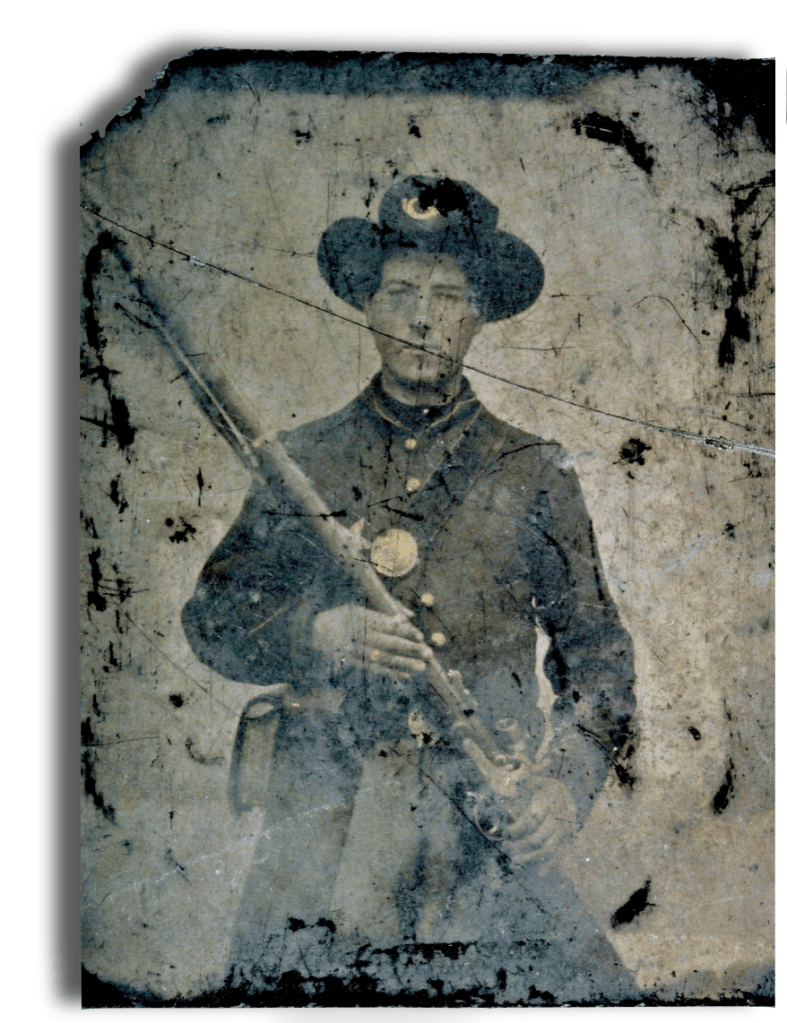
Friday, January 29th—Went to Camp Dennison and saw [James E.] Stillman of my company, and others of the 29th Regiment. Found things much changed since I left there. At 10 o’clock returned. Went over to Covington, Kentucky, and took the cars for Paris, Kentucky, where I arrived at 6 o’clock p.m. and took up my quarters at the Paris Hotel. In the evening, called upon Doctor Griffin.
Saturday. January 30th—Saw many of my old acquaintances but everything looked about as usual except they have had quite a fire in the business portion of the town and destroyed many stores.
Sunday, January 31st—Did not go to church today and have not heard anything from the regiment. The weather is good. It is rather dull here and one day is as good as a week to see all that there is of this place.
Monday, February 1st 1864—Court day at this place is quite amusing to a stranger. it occurs on the first day of each month. It is a day of general sales of stock which is disposed of in large numbers. Much young stock is disposed of to grocers and large numbers of mules for work. We saw it was put up at auction and $1225 bid but withdrawn as the asking price was over $2000. The people for miles around attend this [ ] & stock market and it is quite a gala day.
Tuesday, February 2nd—Saw Mrs. Scott today. She told me she had been to Washington and saw ex-Governor [George Sewall] Boutwell of Massachusetts and he told her that Peirce of Freetown [Col. Ebenezer Peirce] was not thought anything of at home. She despises him as thoroughly as all others do. It is a rainy day. Paid my bill. Ready for a start for Cincinnati n the morning.
Capt. James Farrand (1830-1864), 2nd Michigan Infantry. He was killed at the Battle of Spotsylvania Court House on 12 May 1864
Wednesday, February 3rd—Arrived at Cincinnati this morning and reported at headquarters. and was ordered to Camp Nelson. Capt. [James] Farrand of 2nd Michigan being also ordered to the same place, we went in company. It is supposed that the 29th will come through Camp Nelson and I shall be with them sooner if there.
Thursday, February 4th—Started in company with Capt. Farrand for Camp Nelson and arrived at Nicholasville at noon. Got dinner and took an ambulance for the camp about seven miles distant. Reported at headquarters and put up for the night at Mrs. McKenney’s about 1.5 miles from the camp. Saw [William T.] Nickerson of my company at the camp.
Friday, February 5th—This morning walked out to some graves that I passed and found the graves of [Thomas W.] Hayden, [George E.] Wadsworth, and [Thomas] Collingwood. My company fixed up the head boards. At noon went to camp and reported. Saw [Benjamin F.] Bates and [Sylvanus L.] Churchill of my company at the camp.
Saturday, February 6th—Have been quite sick today and could not get up to camp to report. Capt. Farrand reported me. The weather has ben quite cold and it commenced snowing at night.
Sunday, February 7th—Was so unwell as to be confined to the ouse for the day and could not go out. Weather cold and roads muddy.
Monday, February 8, 1864—Was ordered to bring my things into camp today and occupy a tent that had been just vacated by some officers going to the front. Capt. Farrand and myself did so and slept in tent for the first time since leaving home [last month]. Weather cold.
Tuesday, February 9th—Went to headquarters this morning and saw Capt. [William D.] Tripp of the 29th. He is command of Crab Orchard. He is quite bitter on [Col.] Peirce. He dislikes him much. Had a severe attack of the shakes and fever and had to turn in. Was rather better at night.
Wednesday, February 10th—Have been very miserable today. Had the shakes again this evening and quite sick. I am detailed as Officer of the Day for tomorrow.
Thursday, February 11th—Was sick with ague and fever most of the night but managed to do my duty as Officer of the Day, The rounds are a long distance and much to be attended to. Had a good day and did not feel much worse for the duty.
Friday, February 12th—Was very lame today from riding so much. Gooding of my company is here. He came to my tent. Wrote home.
Saturday, February 13th—Weather pleasant and good today. Do not hear any news from the regiment that can be relied upon, Had a hard night last night. Coughed most of the time.
Sunday, February 14th—This Sunday passed as Sundays usually do in the army. It is hard to tell when Sundays come, so little is thought of it. A large train of pack mules left here for Burnside’s Point today. They each carry about the heft and bulk of four bushels of corn.
Monday, February 15th—It has rained hard all day and it is very muddy. Nothing certain from my regiment. Other officers have been out into my tent.
Tuesday, February 16th—a few regiments came into camp today from the front. They bring no news of the 29th.
Wednesday, February 17th—It was very cold last night. Froze my ties but not very bad. Snow squalls all night.
Thursday, February 18th—The weather is yet cold. No troops moving. A few came in from the different convalescent camps to be sent to the front. It is thirty months today since we left home.
Friday, February 19th—A beautiful, pleasant day and but little duty to perform.
Saturday, February 20th—Quite a number of troops are going to the front today. The weather is cheerful and bright and I begin to feel more at home.
Sunday, February 21st—Capt. Farrand started today for Cincinnati as his regiment has arrived there. I expect to be sent off with a detachment of convalescents. I do not like the job.
Monday, February 22nd—Again on duty as Officer of the Day. Rode out beyond the lines with Capt. Heald and took a good range outside.
Tuesday. February 23rd—Nothing has transpired today beyond the usual routine of camp life.
Wednesday, February 23rd—No news of the regiment yet. Had a letter from Capt. Farrand saying that the 29th had not arrived at Cincinnati.
Thursday, February 25th—It has been very muddy today. I slept at a house near the camp and had a good bed but it was not like sleeping on the ground. My cough holds on. Had my first letter from home today.
Friday, February 256th—Everything is as usual at the camp. There are many troops coming and going with good weather for marching.
Saturday, February 27th—Capt. Wells of the 9th Michigan Cavalry who tents with me left today on a visit to Nicholasville. No news of the regiment yet.
Sunday, February 28th—A dirty, rainy, muddy day. I drew a cavalry overcoat today by the way of Ellis Barnes. The price is 8.75. I am detailed for tomorrow, Telegraphed to Capt. [Edward S] Leadbetter [Co. G, 27th Michigan] at headquarters at Cincinnati to telegraph if the 29th should arrive by the railroad route from Tennessee.
Monday, February 29th—Had a severe snow storm all day and on duty as Officer of the Day. Major Stewart, Inspector Camps, inspected the camps in this place and I had to be with him. We were in the saddle till after dark and did not get through them [all]. Many of the camps are in good condition but some are very dirty.
Tuesday, March 1st 1864—It stormed all night and nearly all day today. The snow is six inches deep and weather very cold.
Wednesday, March 2nd—Capt. T[homas] W. Clarke of our regiment was here today. He came last evening and stopped with me. He gives me much information about the regiment. He comes to get all the baggage of the regiment that was left behind and have it sent to Cincinnati—if he can find it.
Thursday, March 3rd—The weather is good but camp very muddy. Capt. Clarke left here this morning. I have eight reenlisted men to take to Cincinnati. Got my order and transportation ready to start tomorrow.
Friday, March 4th—Started this morning with eight men. Went to Nicholasville and then took the cars for Covington, Kentucky. Arrived at Covington at dark, crossed the ferry to Cincinnati and marched to the Soldier’s Home. Got supper and had a chat with Col. Andrews. Stopped at the home for the night.
Saturday, March 5th—Went to paymaster [William] Cumback to see about my pay. Found I had been reported as absent without leave and could not be paid till the regiment came here. Saw Capt. Clarke. He took steamer for Louisville. Reported at headquarters and took a team around the city.
Sunday, March 6th—Pleasant but cool. Saw J. Whiting & others of the 29th Regiment. Reported at headquarters. Went to meeting at the home—had a good one.
Monday, March 7th—Saw the copies of the Memorial. A communication of mine was put before the board of commissions in which I have spoken highly of the Soldier’s Home and its influences. They were much pleased with it. Engaged clothing as I am pretty well wore out.
Tuesday, March 8th—Have no news from the regiment as yet. Saw [ ] Robbins. went to the theatre in the evening.
Wednesday, March 9th—Borrowed money of Robbins and bought gloves, straps, &c. and shall try to look a little more decent in clothing.
Thursday, March 10th—Bought me jacket and vest today. There has nothing transpired out of the usual course of events.
Friday, March 11th—It being a cold day, put on my new rig and felt more respectable. The 8th Michigan returned today from [veteran’s] furlough bound to the front. Bought me a haversack and wrote home.
Saturday, March 12th—The world moves as usual, but today it adds nothing new or interesting to my first idea of its cause and effect.
Sunday, March 13th—One of those cold, stormy, cheerless days that humanity dreads. went to headquarters. saw steamer come in with troops. Felt most sure that it was my regiment. Got disappointed. Besides too late for church in the evening. Went to Methodist Church.
Monday, March 14th—Cold and stormy. Streets all mud. Rain in torrents. Noah’s Flood. Dull and gloomy. Shut up tight Realy glad when it is night.
Tuesday, March 15th—The same as yesterday. It stormed all day. It stormed all night. I hear the regiment is coming through Cumberland Gap.
Wednesday, March 16th—“Older yet and yet, still colder.” Snow and rain, then rain and snow.
Thursday, March 17th—Snow and hail, fire and vapor. How it tingles round my ears.
Friday, March 18th—Today the gentle sun is shining on the snow and ice so bright. Hope this little bit of rhyming will not keep me wake at night.
Saturday, March 19th—Warmer!!!
It seems likely the following anonymously submitted letter to the hometown newspaper also came from Capt. Doten:
Whenever we have spoken of Kentucky we have always spoken of her as a discontented, disaffected and largely disloyal state. Such she has ever been since the first day that the hydra of secession dared openly to show its ugly head or dared to take the initiative step towards the separation of these United States. She has been from first to last secesh to the heart, although strongly professing Union sentiments and acting with the Union party. But there is not now, nor never has been, any heart or vigor in her actions to repel invasion or to disperse even the guerillas in her own borders, but she has been continually calling upon the general government to protect her and her slave property, and government has done this to an extent that we fully believe is a gross injustice to all other slave States where the loyal citizens are endeavoring to again return to the Union, and by the protection of her slaves, a gross insult to the free Northern sentiment. The slaves of Kentucky should have been freed by the President’s proclamation just as much as the slaves of Tennessee, and Tennessee is this day far the most loyal State, and will give the government much less trouble to protect it. All that has kept Kentucky from being first and foremost in the ranks of secession is her geographical position and her fear for her peculiar institution. Had she been in the place of Tennessee, there would have not been a more bitter State among the Confederates; but bordering on the glorious State of Ohio, where freedom is one of the strongest institutions in the body corporate, she has smothered the sinister feelings of her black heart and shown miserable pretense of loyalty.
Gov. Bramlette in his address to the people of Kentucky, talks of Unionism and of Union sentiment; advises obedience to the laws and tells about driving to an ignominious distance those who in the agony of our conflict have perverted their sacred trusts to the base uses of partisan ends and fanatical purposes, when but a few days previous he presided at a sword presentation to Colonel Frank Wolford, and when the Colonel in answer expressed the strongest disloyal sentiments, advising resistance to the draft and armed resistance to the taking of slaves for government use, calling President Lincoln a traitor and usurper, and intimating that he was ready to draw the aforesaid sword to make good his words, Gov. Bramlette instead of rebuking the Colonel, by his silence, gave full assent to the sentiments presented. Finding however that public sentiment was pressing hard upon him, and that he was holding a very equivocal position before the country, he has issued a proclamation to the people of his State, coldly advising them how to act under the pressure of circumstances.
We have passed through the length and breadth of Kentucky; we have studied her people, their character and disposition, mingled with her citizens at their homes and with her soldiers on the battlefield, place our feet beneath the mahogany of the Hon. Gerritt Davis and eat of the good things of this world, and sat beside the black in the humble log cabin and eat of the infallible and eternal smoked hog that morning, noon and night helps sustain Kentucky poverty and gives tone to her principles; we have traveled on her poverty-stricken railroads, where they depend upon the Almighty for depots, being either too poor or parsimonious to furnish them; we have seen her huge distilleries, where liquid damnation is distilled for the multitude, and seen her tobacco consuming citizens trying to strengthen their nerves by the insidious poison, and we fully believe that if Kentucky had joined the Southern theifocracy at the first it would have been better for the government and for the State. Had she done this, Gerritt Davis’s weak, insolent voice would not have been heard in the Senate, and her grumbling, fault-finding, and bitter opposition of all the acts of the administration would have been met with a decided change. Slavery would have been abolished, and her State government been administered to those whose firmness and integrity would need no proclamation to defend their position. Gov. Bramlette claims that fifty-one thousand of Kentucky’s sons are in the Federal army, and we speak what we honestly believe when we say that clear of their troops that are kept at home for their own protection, and those in hospital, that there is not fifteen thousand effective men in the field belonging to that State. Thank God, things are fast approaching a crisis in Kentucky. The day and hour has come when she must be true to her motto, and stand united and firm with her sister loyal States, or she must fall ignominiously into the dirty pool of secessionism, only to feel the weight of her degradation, and then shorn of her besetting sin of slavery and humbled in her pride, she must return to the fold of liberty, of which Abraham Lincoln is the shepherd.
There is no war news here at this time. Several expeditions are getting ready and we think that the west of the Mississippi will give us but little trouble. Most all of the old regiments have been home, and are now returning with filled ranks to the front, and the army of the Cumberland is now fully able to do all that is required of it.”
Sunday, March 20th—Went to church!!!!
Monday, March 21st—I am tired of waiting here for the regiment and have applied at headquarters to be sent to the front. I took a long range over to Covington. Don’t like the place but it is quite neat for a slave city. Better than the average.
Tuesday, March 22nd—Heard nothing new from the regiment.
Wednesday, March 23rd—weather good and cool.
Thursday, March 24th—News that 300 of those who are unable to travel of the 9th Army Corps will be here soon by rail. This looks as if the whole Corps will come out from Tennessee.
Friday, March 25th—Cold, rain & snow. The 300 arrived today and men sent to the 5th Street Barracks. Went to see them and found a number of my company and many of the regiment also. Lieut. Long and [Henry S.] Braden have arrived at Gibson’s . Lieut. Braden is quite unwell The regiment has stared with the Corps to come over the mountains. Col Peirce has leave of absence for sickness for thirty days and as they would not give him transportation for his horse, he has started over the mountains on horseback to save the freight of his horse on the railroad.
Saturday, March 26th—A few more of the 29th have arrived here today and yet more are on their way. The weather is better. Col. Peirce, Captains Oliver & Wilson arrived here this p.m. from Paris, Kentucky. The Colonel looks rusty, seedy. The others first rate. All the soldiers that have arrived have been sent over to the Covington Barracks. Orin D. Holmes of “E” has arrived. He is a good soldier.
Sunday, March 27th—Quite a number more of the 29th arrived today from Camp Nelson. The weather is pleasant.
Monday, March 28th—The first brigade baggage arrived today and three more of my men. Lieut. [Augustus D.] Ayling came through in charge. The mun have been unruly and drunk but none of my company. I have no fears from them. They are under too good discipline.
Tuesday, Mach 29th—Weather dark and cloudy. Some rain. Last night seven hundred of the 9th Corps started for Wheeling, Va. , on their way to Annapolis. Most of the 29th stopped back as usual. Went over to Newport and at the Barracks. Walked round the town, It is quite a good looking place—much better than Covington, but not so large. It is laid out in squares like Cincinnati. Many of the houses are of brick. There is some manufacturing going on here, principally iron work and large rolling mills. The streets are quite clean and tidy. Went across the wire bridge over the Licking river to Covington and up to the barracks. Went back to Cincinnati and got a letter unexpectedly from home. Was much pleased ot get it. Capt. Oliver has the shakes and fever today. Wrote a letter to wife & one to William Lane at Illinois.
Wednesday, March 30th—Cold and disagreeable. Wrote to the Memorial. Mr. Peirce of Freetown [Col Ebenezer Peirce] dined with us at the Soldier’s Home today. Capt. Richardson arrived today.
Thursday, March 31st—It is said that the regiment is one day’s march from Nicholasville. If so, they will some of them be along tomorrow night. The weather is yet cool and cloudy. Saw Capt. [Daniel C.] Buswell of the 9th New Hampshire. He left here tonight.
Friday, April 1st—The regiment arrived last night and camped over to Covington about a half mile from the barracks. Went over with Peirce to see them. They look rusty and hard. They had a hard march over the mountains. In the afternoon they came over to Cincinnati and went to the 6th Street Barracks. Reported myself to Maj. Chipman, he being in command of the regiment.
Saturday, April 2nd—Dark and cloudy. Took my men up to the barracks and ordered them to report to their several companies. A court of enquiry was called and I am ordered to appear and show cause why I had been absent. I produced my papers &c., was examined. The court was called by Lieut. Col. Barnes, then in command of the brigade and consisted of Maj. Chipman, Lieuts. Brown and Whitman. Capt. Tripp, Oliver & Wilson were before the court, they having been reported the same as myself. Got muster rolls and filled them out for my men who had reenlisted at Camp Nelson. all the men who have not reenlisted were transferred to the 36th Regiment Massachusetts Volunteers.
Sunday, April 3rd—This day get my enlistment papers for Bates & Nickerson and had them examined. It was a vexatious job. Got the decree of the court that I was all right as I expected. Peirce of Freetown was very good to me. Wonder what is wanted. He told me lots of vulgar stories as usual. I reported to Maj. Chipman and was ordered to duty Co. E.
Monday, April 4th—A muddy, rainy day. Got my pay after much trouble. Paid Sam. Ribbins borrowed money & lent Bates and Nickerson twenty-five dollars each.
Tuesday, April 5th—Officer of the Day. Got my rolls signed. Drew clothing & ordnance and issued them. Charged and got receipts. Went to the gift swindle and got took in a little.
Wednesday, April 6th—The men were paid off this a.m.—all but those who reenlisted here—and they have spent their money freely. I sent five hundred and fifty dollars home by Adams & Co. Express and wrote wife about it. We are ordered to be in line tomorrow morning at 6 o’clock to start for home.
Thursday, April 7th—Regiment in line at 6:30 o’clock and marched to the Little Miami Depot. The men are in box cars and an old car for the officers. Started at 8:30 o’clock. Changed cars at Cleveland at midnight and proceeded onward.
Friday, April 8th—Arrived at Erie at sunrise this morning. Weather cool and good. Arrived at & left Buffalo at 12 M. Sick with the headache very bad this p.m.
Saturday, April 9th—Arrived at Albany at 2:30 a.m. and started for Boston at 7 a.m. where we arrived at 5 p.m. and were quartered in the Beach Street Barracks.
Sunday, April 10th—Stayed ay Beach Street Barracks all day . Weather cold and stormy.
Monday, April 11th—Regiment got into line at 11 o’clock a.m. and were escorted by the City Guards and Band through different streets to the State House where they were joined by the Governor and then proceeded to the American House where a bountiful entertainment was provided by the City of Boston. After an introduction by Mayor [Frederick W.] Lincoln [Jr.] and a speech from the Governor [John A. Andrew] and having partaken of the splendid repast, the regiment was again formed into line and marched to the Beach Street Barracks where the men were furloughed for thirty days form the 12th inst.
Tuesday, April 12th—Got my men furloughed and state pay roll signed and at 2:30 p.m. started for home where I arrived at 4:30 p.m.
Veteran Furlough for 29th Massachusetts
Thursday, May 12th 1864—This day reported at Boston as per order and returned home again at night.
Friday, May 13th—Reported at Boston gain in the early train. Was detailed Office of the Day. Had considerable trouble as the soldiers were quite drunk and troublesome. Wife came up in the late train.
Saturday, May 14th—Weather thick and foggy. Not more than four men stayed at the barracks last night as thy had passes. Most of the men were around the city.
Sunday, May 15th—A stormy, dirty day. Went to church. Heard Mr. Webb and went out to Dorchester in the afternoon.
Monday, May 16th—Received orders to leave Boston at 5 o’clock p.m. Got ready and formed line at 4 p.m. and marched to O[ld] C[olony] Depot and and started by the Fall River line for New York. Took the steamer Metropolis. Weather thick and foggy and sea rough.
Tuesday, May 17th—Had a thick and foggy night on the Sound. Arrived at 9:30 o’clock this morning and was landed at the New Jersey Railroad [and] at about 11:30 a.m. took cars or Philadelphia. Passed through Trenton and Princeton. they are very pretty places. We have been riding along the banks of the canal. The country is beautiful and looks good as everything is issuing forward fast. There is very large peach orchards on the road. At 4:30 p.m., we came to Schuylkill River where the canal ends. At about 5:30 p.m. we arrived at Philadelphia where we were provided with a colation and at 9:30 p.m. left for Baltimore.
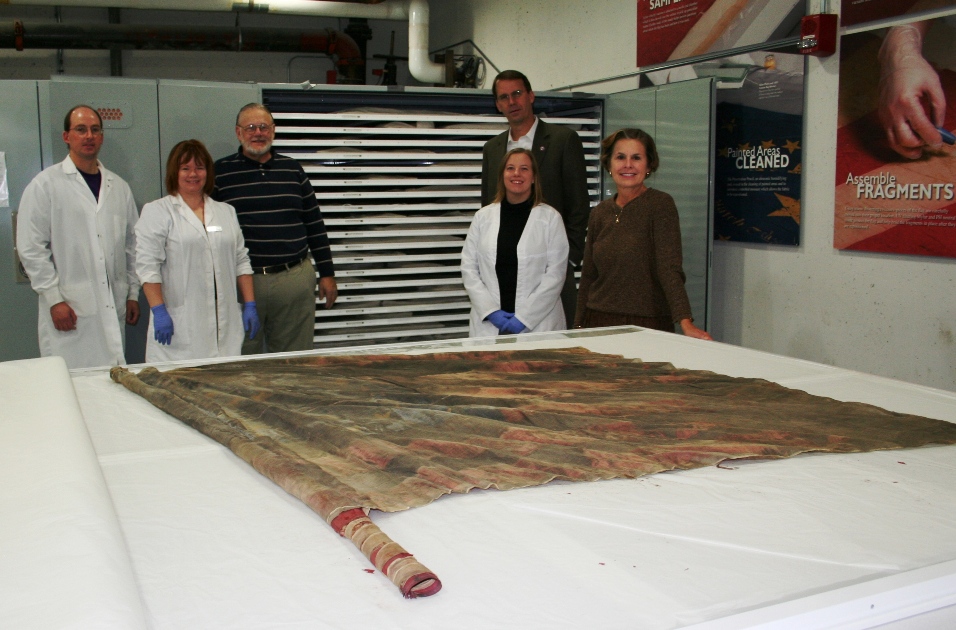
Wednesday, May 18th—Rode all night and at 5:30 a.m. crossed the Delaware river on the boat at Haver-de-Grace, the cars going on the boat. We arrived at Baltimore at 8:30 a.m. and left for Washington at 12 M and arrived at Washington at 3:30 p.m. in a hard rainstorm. The regiment was put into the Soldier’s Retreat and the officers went to the U.S. Hotel for the night.
Thursday, May 19th—weather good. We have orders to march at 8 o’clock tomorrow morning. Have drawn clothing &c. Are ordered to have five days rations and 100 rounds of cartridges. Got my pay today and sent home $260 dollars by Adams & Co. Express. Bought carpet bag. Ten of my men that had been turned over to the 36th Massachusetts arrived here today to be discharged.
Friday, May 20th—Regiment in line at 7 o’clock this morning and marched to the steamer Wawashe for Belle Plains. We started at 9:30 a.m. and arrived at Belle Plains at 1 p.m. and encamped near the Landing. Three of the 29th who were at Washington returning home cheered us heartily as we passed.
Saturday, May 21st 1864—My three years service expires today. Capts. Leach, Oliver, Lieuts. Braden, Whitman, Conant, Darby, Atherton, Goodwin, & Ayling have got permission from Gen. Abercrobie who commands here to go to Washington to be mustered out of the service. These are nearly all of the officers of the Old Battalion. I do not like to be left alone so this p.m. I made a separate application and got it approved. I have been very busy getting ready. It is hard to leave though I have but six men in my company. But this is the only good time I could take for the purpose and shall improve it. The weather is good and troops are passing here both ways—some for home, and some for the front.
Sunday, May 22nd—I have been hard at work today to get ready and to turn over to Lieut. Long my ordnance stores and camp & garrison equippage and get receipts for it. I dislike much to leave but I never could stand another term of service like the last and I think it best to leave with the rest. My men took my things down to the wharf for me and we started for Washington at about three o’clock p.m. where we arrived and put up at the National Hotel. there was a number of Rebel officers on the boat with us as prisoners. They said they were full of hope as to the final result and believed that they should accomplish their object.
Monday, May 23rd—If the Nation was like the National Hotel, it would not be worth fighting for. Provisions small and bugs large. Think the latter fare better than the boarders. Moved my quarters to the Clarendon Hotel and fared rather better. Got my papers ready to go to Boston to be mustered out of the service. The other officers got theirs and started at 5 p.m. I have concluded to stop and settle up with the departments before I leave here. I have begun today. It looks like a hard job to go through all the departments.
Tuesday, May 24th—Capt. Leach is yet here but is mustered out of the service. I have worked hard all day but made but little progress. We had a heavy squall today that cooled the air. It has been very hot here today. Had green peas and strawberries for dinner today. Sergt. Holbrook’s Father and Mother-in-law is here looking for him. Made some progress in my accounts.
Wednesday, May 25th—A good cool day and weather fine. Found Sergt. Holbrook at the Finlay Hospital. He has a severe wound in his foot—the ball passing through his great toe. I was often at the Ordnance Department and made good progress.
Thursday May 26th—Got through the Ordnance Department and begun in the clothing department and made good headway. Took supper with Capt. Charles Drew. He is in the Veteran Reserve Corps and has a good place.
Friday, May 27th—My accounts are all settled up with all the departments satisfactorily at 4:30 p.m. All the officers of the departments have used me very gentlemanly and I have received all the attention possible with the result. At 7:30 o’clock took cars for Baltimore and Philadelphia and New York, leaving Washington gladly as it is in my estimation the meanest place of note in the United States and deeply steeped in secessionism.
Saturday, May 28th—Arrived at New York this morning and had the gratifying intelligence that the baggage cars run off the track near Philadelphia and that probably the baggage would not get along for a day or two. Put my check in the hands of Boyd’s City Express and took the New Haven train for the East and arrived at Worcester at about 3:30 o’clock p.m where I stopped tired and sleepy. Found wife had left for home this morning.
Sunday, May 29th—Went to church this a.m. with Mr. Farley with whom I stopped. Stayed at home in the afternoon and after supper, took a turn around the city.
Monday, May 30th—Took early train for Boston and the 2:30 train for Plymouth where I arrived in due time to make all my friends glad to find that I had got safe home from a three years experience of the service and hardships of war. I have not yet been mustered out of the service nor shall be probably for some time yet as my men that came home are not mustered out yet.
This letter was written by William Henry Scarbrough (1842-1903), the son of James Scarbrough (1807-1896) and Elizabeth Breckenridge (1816-1904) of Liberty, Knox county, Ohio. The Scarbrough family were farmers and active members of the Methodist Episcopal Church.
William enlisted on 12 August 1862 to serve in Co. B, 96th OVI. Prior to his promotion to corporal in April 1863, he participated in the battles of Chickasaw Bluffs and Fort Hindman. He was with his regiment in the rear of Vicksburg when he wrote this letter in mid-June 1863 but became ill and was sent to the hospital on 4 July where he remained for a couple of weeks. He returned to his regiment and participated in the battle of Grand Coteau where he was wounded in the left index finger, was promoted to sergeant in December 1863, and and participated in the battles of Sabine Crossroads, Fort Gaines and Morgan, Spanish Fort and Mobile, Alabama.
William H. Scarbrough of Mt. Vernon, Ohio. Photographer L. K. Oldroyd w. tax stamp. (Paul O’Neill Collection)
Advertisement for Oldroyd’s Gallery in the Mt. Vernon Republican, December 1864.
Previously published Spared & Shared letters by members of the 96th OVI: Albert S. Coomer, Co. C, 96th Ohio (3 Letters) Alfred Alverson Thayer, Co. C, 96th Ohio (3 Letters) Joseph C. Arnold, Co. E, 96th Ohio (3 Letters)
Addressed to Mr. James Scarbrough, Mt. Vernon, Knox County, Ohio
Rear of Vicksburg, four miles on the Battlefield June 17, 1863
Dear Parents,
This beautiful morning finds me seated for the purpose of writing you a few lines. However, I do not owe you any letter but if I did not write when I only received letters, I would not write very often. Since last writing you, nothing of interest has occurred more than usual. Last Sabbath morning as Orderly Lore and myself were laying in the beautiful shade with our Testaments in our hands and talking of home and the pleasant times we have had and soon hope to enjoy again, we were called—or rather aroused—by a Rebel shell which soon brought us to our feet and instead of reading our Bibles, had to lay in the rifle pits the balance of the day. Such is the theme of war. You do not know from one minute to another what you will be called on to do. Persons not acquainted or used to the Army would think it a strange place. I do not mind the hardships of war anymore for tis of no use. I thank God for sparing my life through so many dangers and hardships and good health. Since coming here, many of our boys have taken sick with disease, chills, and fever. Consequently the duty we have to perform (which is very heavy) comes harder upon those that are well.
John Law is not very well at this time but is now improving slowly. I wrote a letter stating that I would like if you could send me a couple of good woolen shirts—something of good quality. I am nearly out of anything in the shirt line and do not like the army shorts. If you have any chance, send them, or if you think it safe to Express them.
If you want to see a map of Vicksburg and of the charges [that have] been made and where the Federal Army lays and even [the] 96th [OVI], look in Leslie’s Illustrated Newspaper. It is being made and will be sent to him soon. You can see the position of all out forces and 20th, 96th, or any regiment you wish to see. I have nothing more of interest to communicate. I hope to hear from you all soon.
Send me postage stamps. I am out and will have to frank this letter. My love to all friends after reserving a share for yourselves. Yours topographically and fraternally, — William H. Scarbrough, soldier boy.
[to] James and Elizabeth Scarbrough
Direct to camp near Vicksburg, Miss., 96th Regiment OVI, Company B, Care of Capt. Joseph Leonard
I could say many things concerning the army but will be useless for the papers can and will give you a better statement than myself. I hope to hear from you soon.