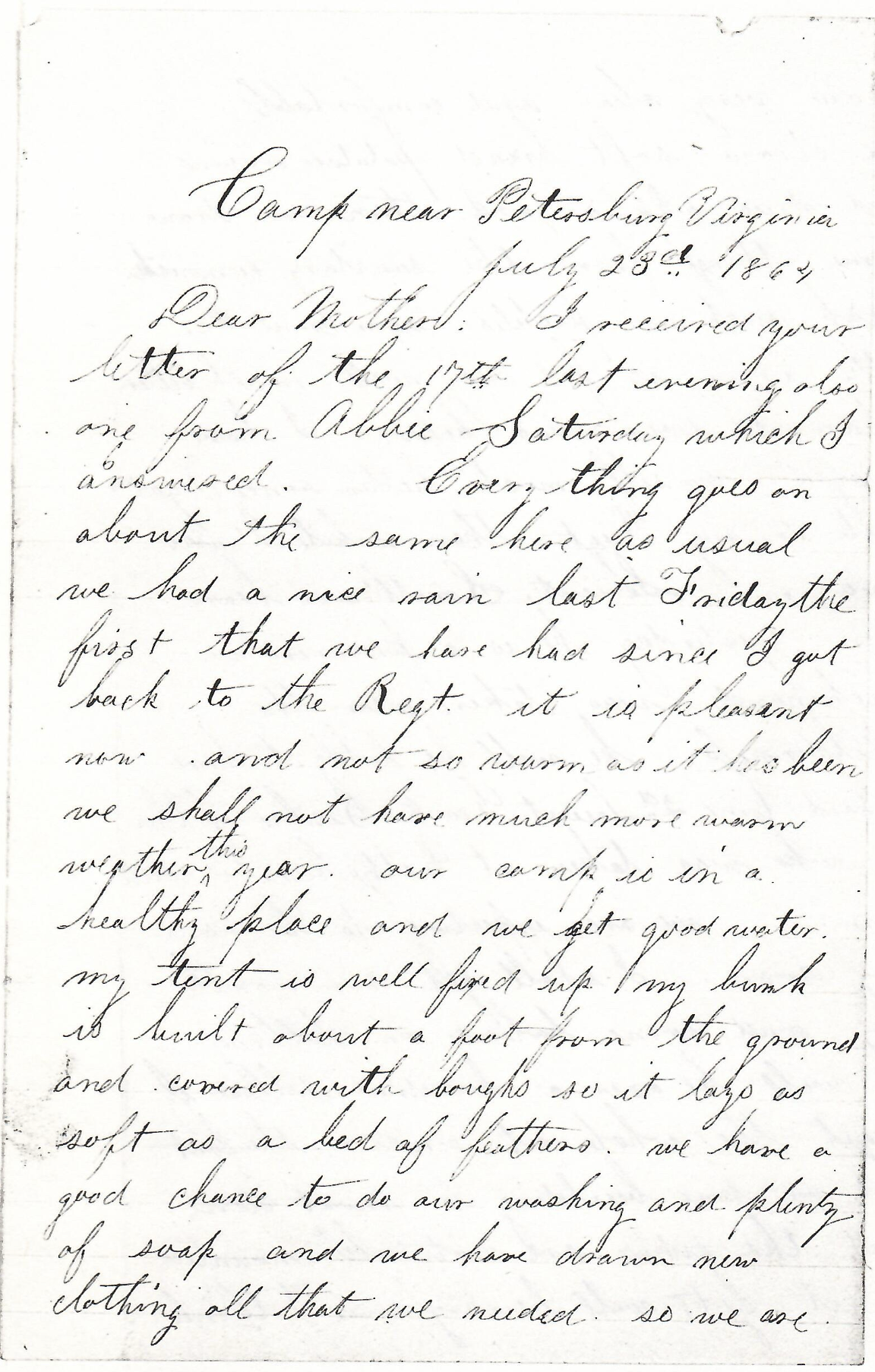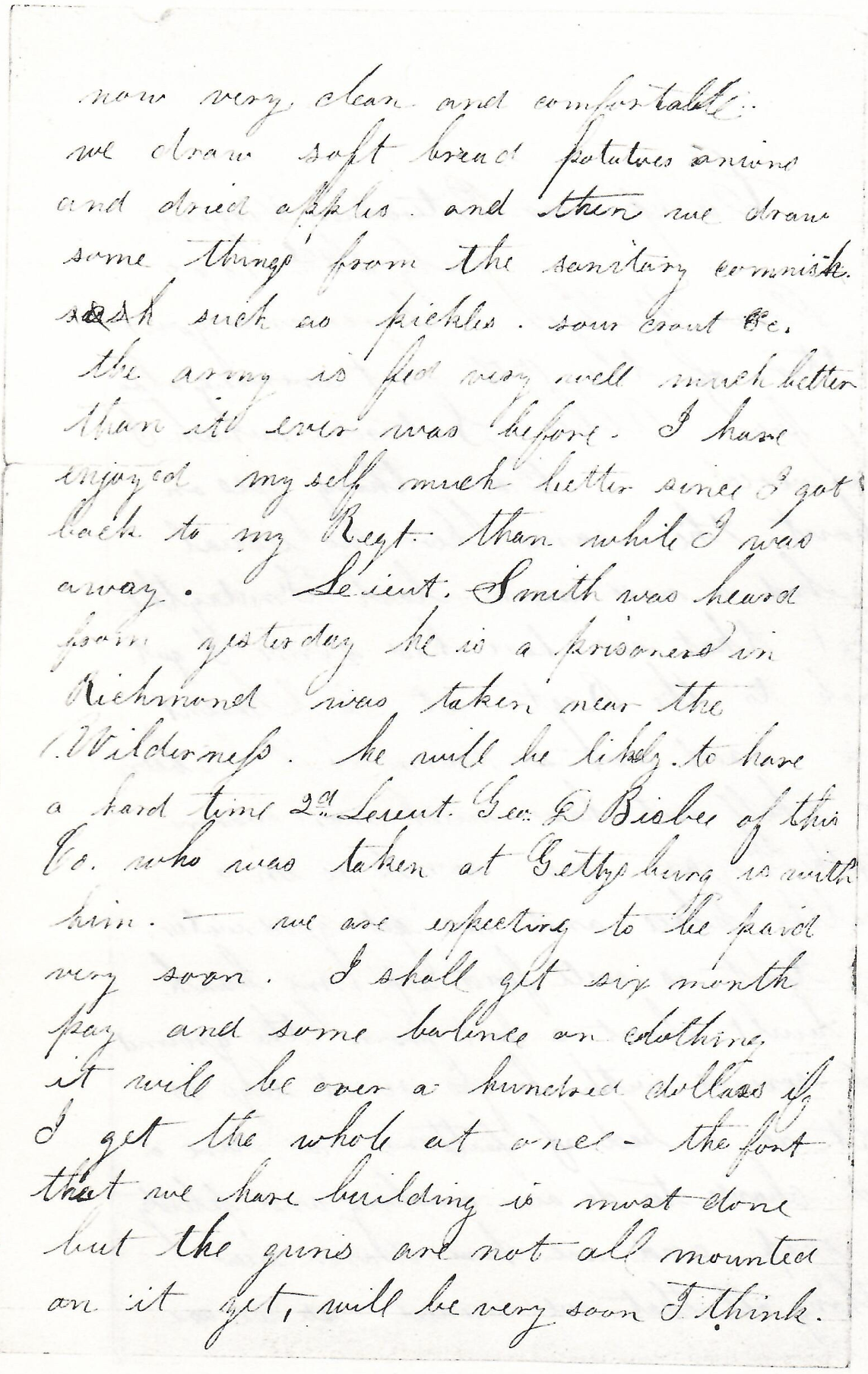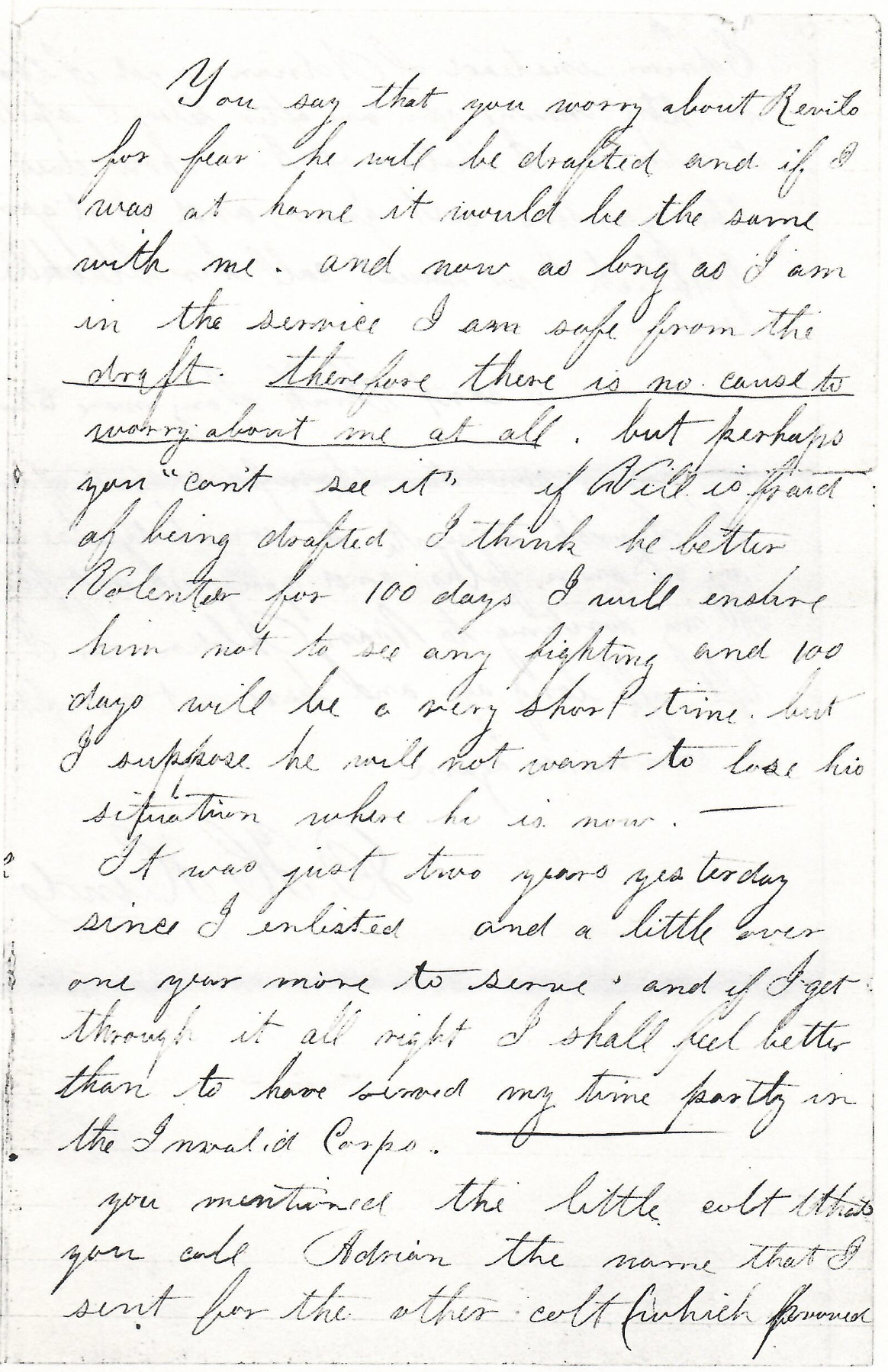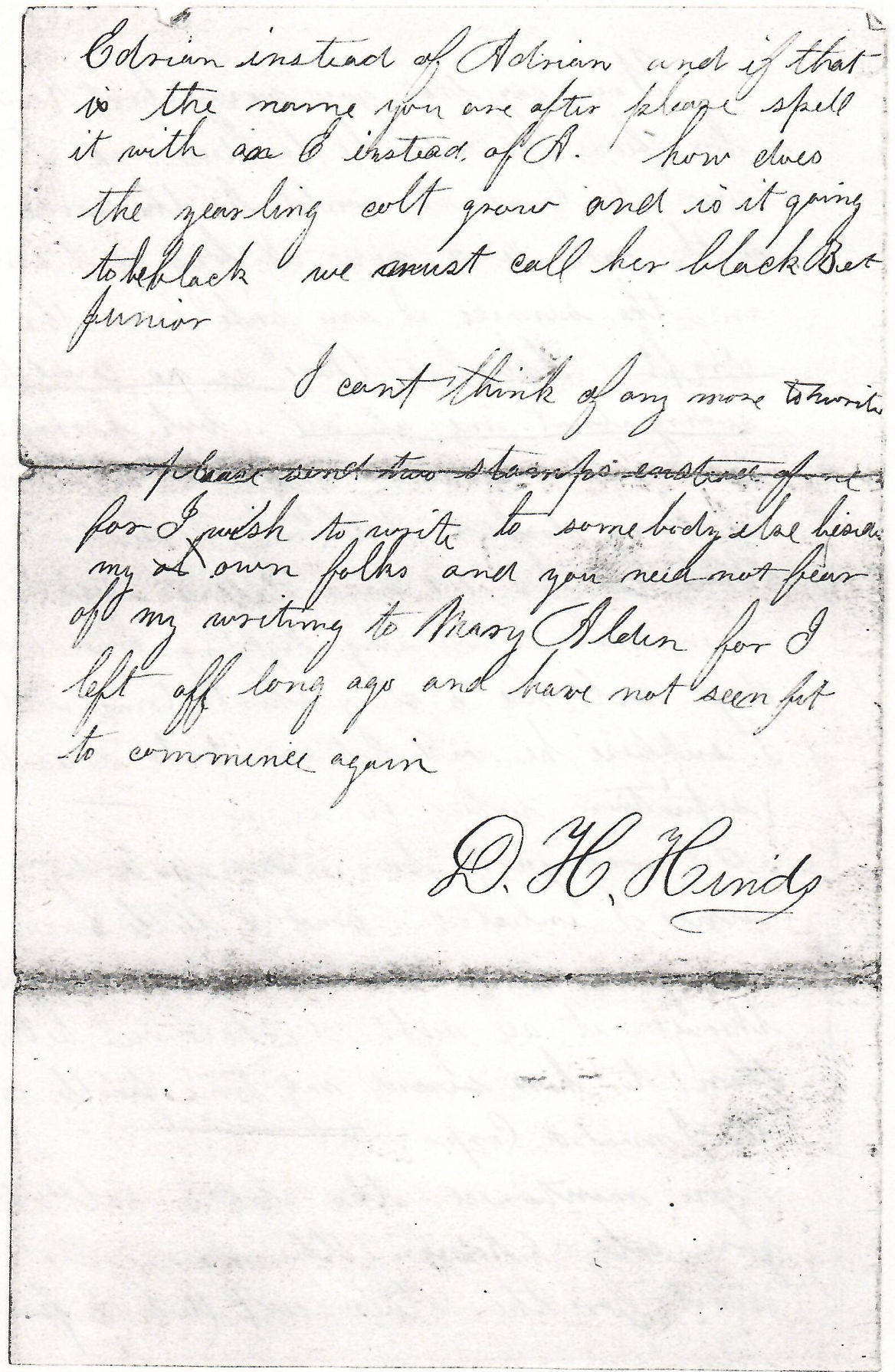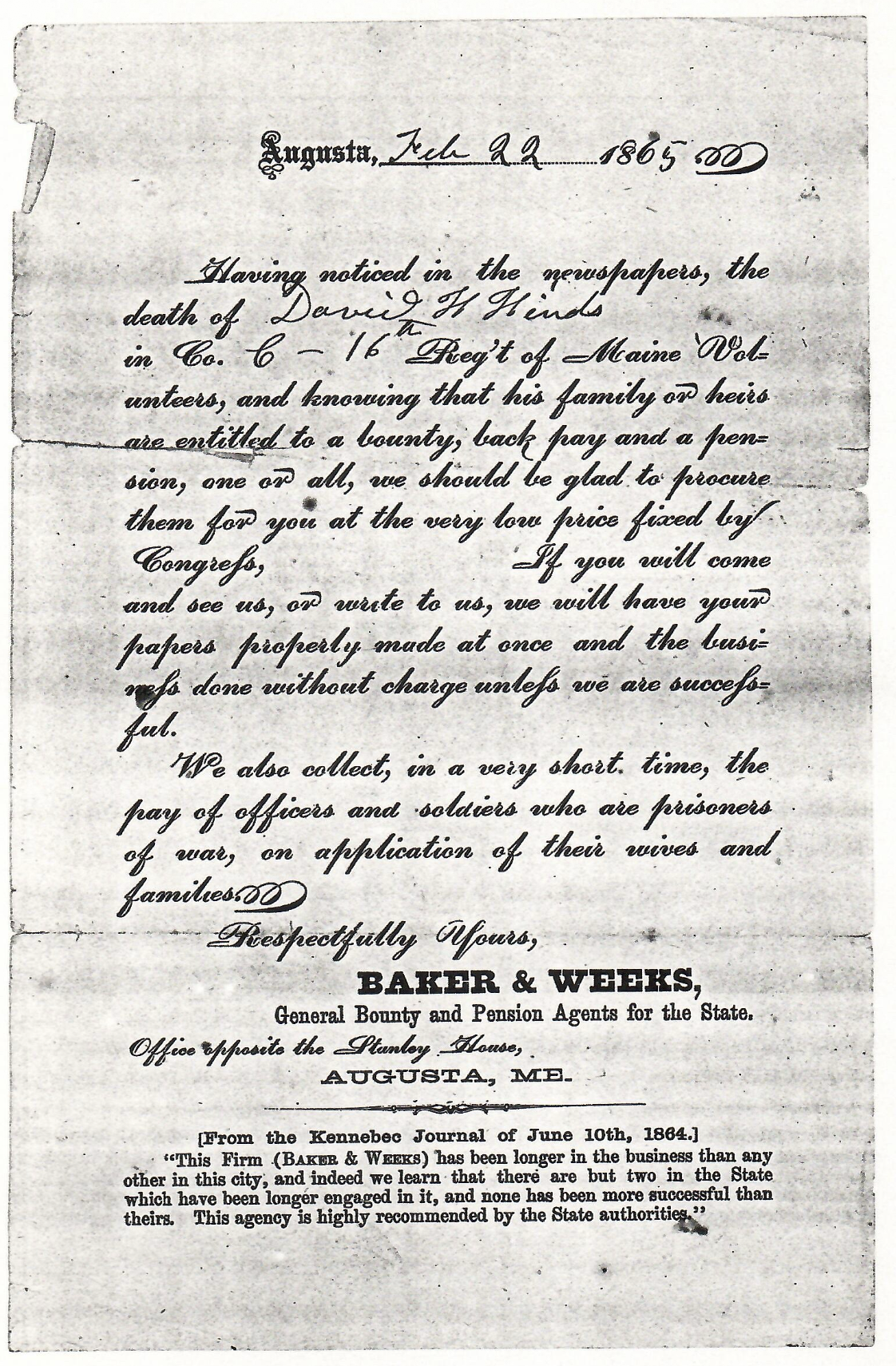
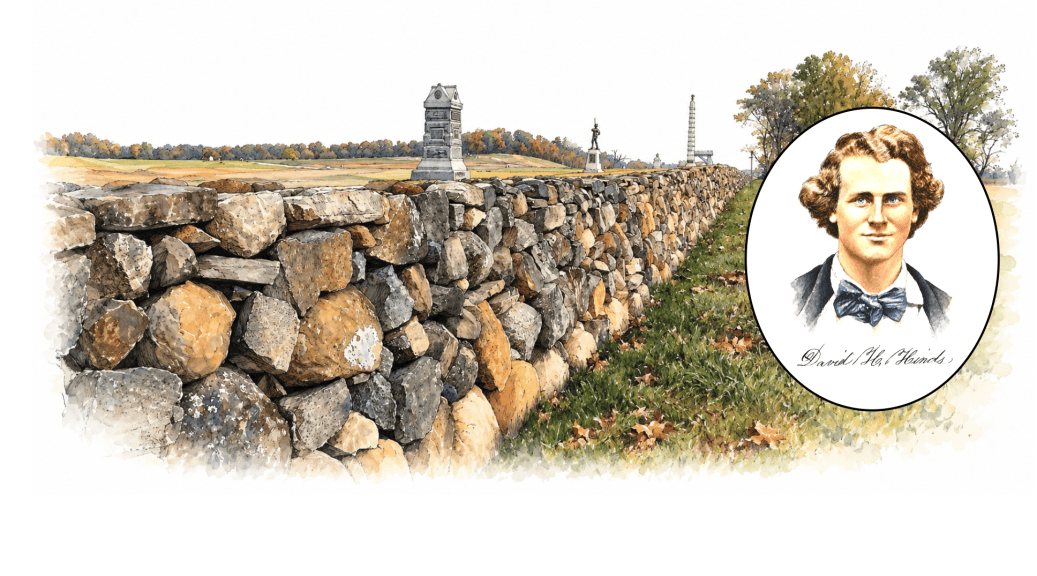
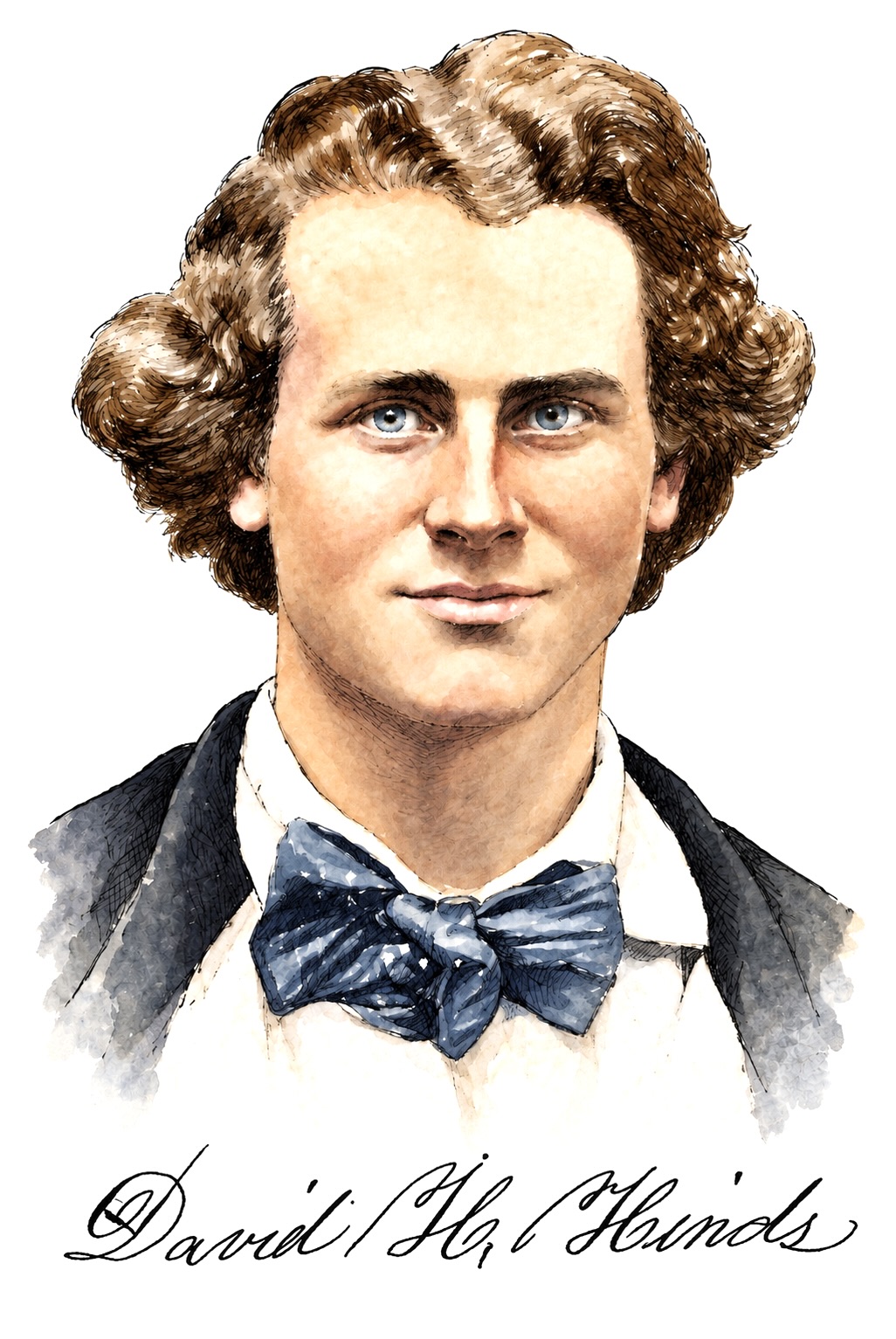
The following letters were penned by David Hathaway Hinds (1844-1864) of East Livermore, Androscoggin county, Maine—a small, tight-knit and deeply patriotic rural community. Though historically and yet largely agricultural, the arrival of the Androscoggin Railroad a decade before the Civil War was opening new markets and industrializing the economy. Because so many young men like David enlisted to fight in the Civil War, many farms faced a severe labor shortage, forcing women, children and even elderly grandparents to pick up the workload. Unlike many families in the 19th Century, David’s parents—Elkanah Leonard Hinds (1811-1888) and Mary Hathaway (1816-1887)—did not have many children. The 1860 US Census that they had only five. They were in birth order: Revillo or “Vill” (b. 1841), Abigail or “Abbie” (b. 1842), David (b. 1844), Frank (b. 1848), and John (b. 1858).
When David reached the age of 18, he enlisted on 14 August 1862 in Company C of the 16th Maine Infantry. He sustained wounds during the Battle of Gettysburg, where the 298 members of his regiment received the perilous order to maintain their position on Oak Ridge at all costs to facilitate the retreat of the Union’s 1st Corps—an order executed with unwavering commitment, resulting in near annihilation for the regiment. The surviving soldiers, David among them, continued to fight in the Overland Campaign. After nearly a year spent in hospitals, David steered clear of the Invalid Corps and rejoined his regiment in June 1864. He was with them until 19 August 1864, when he was captured in the 2nd Battle of the Weldon Railroad. Tragically, he succumbed to death three months later while imprisoned in Salisbury, North Carolina. No memoir, no biography recounts the life of this young man; only a collection of letters, cherished and preserved by his family, tells of his valor and sacrifice. Thus, David stands as the solitary voice articulating his personal narrative of loyalty and service to his country in the 16th Maine.
There are 58 letters in this collection, a great many of them written from hospitals at Gettysburg, York, Baltimore, Washington City, David’s Island, and Bedloe’s Island, as well as at the Convalescent Camp and Distribution Camp in Virginia. Though these were not written at the front, David shares interesting observations of the scenes and sights before him.
Over the years I have transcribed a number of letters by soldiers serving in the 16th Maine Infantry. They include:
Albert Church Brown, Co. C, 16th Maine (38 Letters)
William Henry Broughton, Co. D, 16th Maine (1 Letter)
Daniel Franklin Houghton, Co. E, 16th Maine (1 Letter)
John F. Robinson, Co. E, 16th Maine (1 Letter)
John H. Fraine, Co. G, 16th Maine (8 Letters)
James Thomas Dakin, Co. K, 16th Maine (1 Letter)
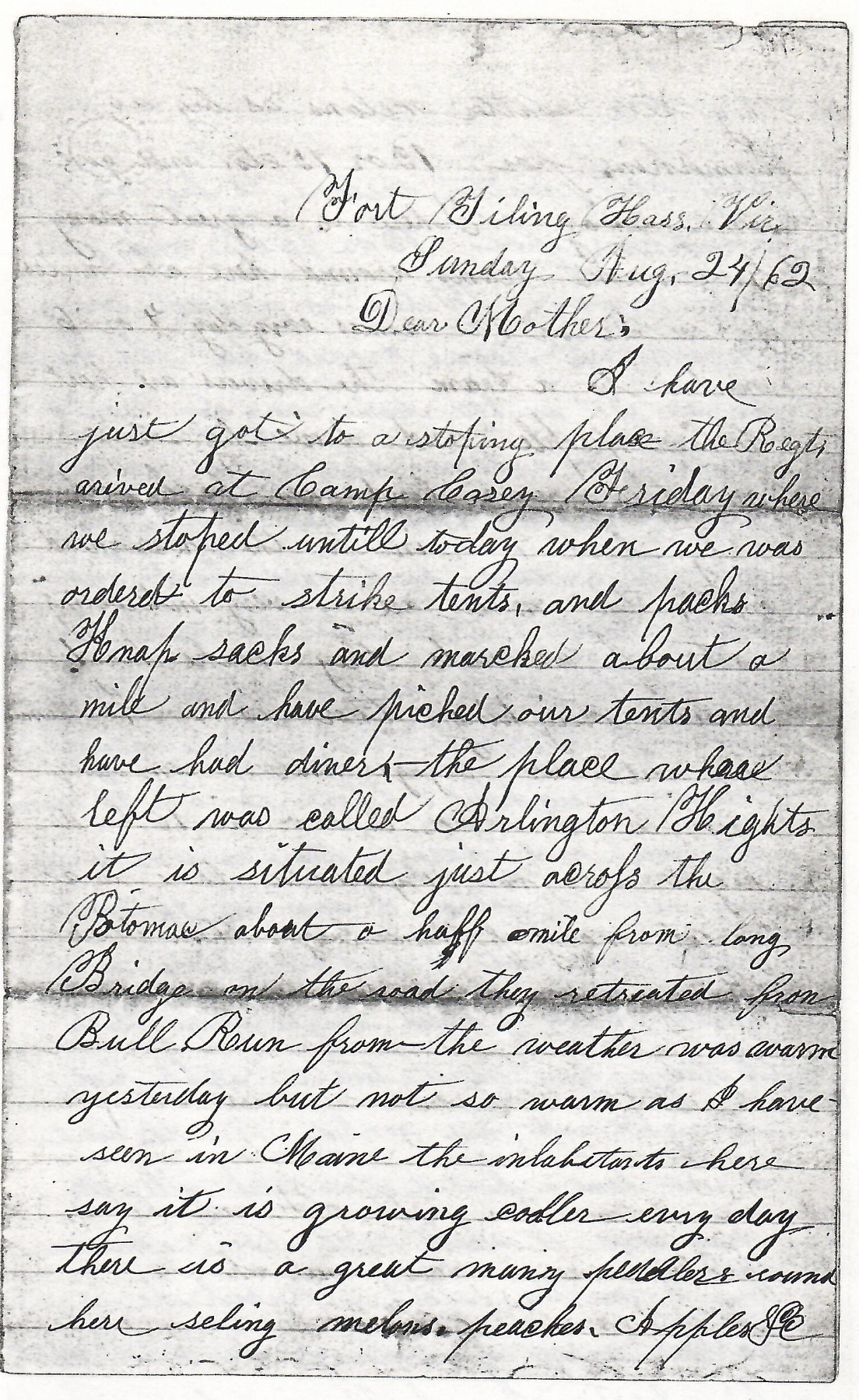
Letter 1
Fort Tillinghast, Virginia
Sunday, August 24, 1862
Dear Mother,
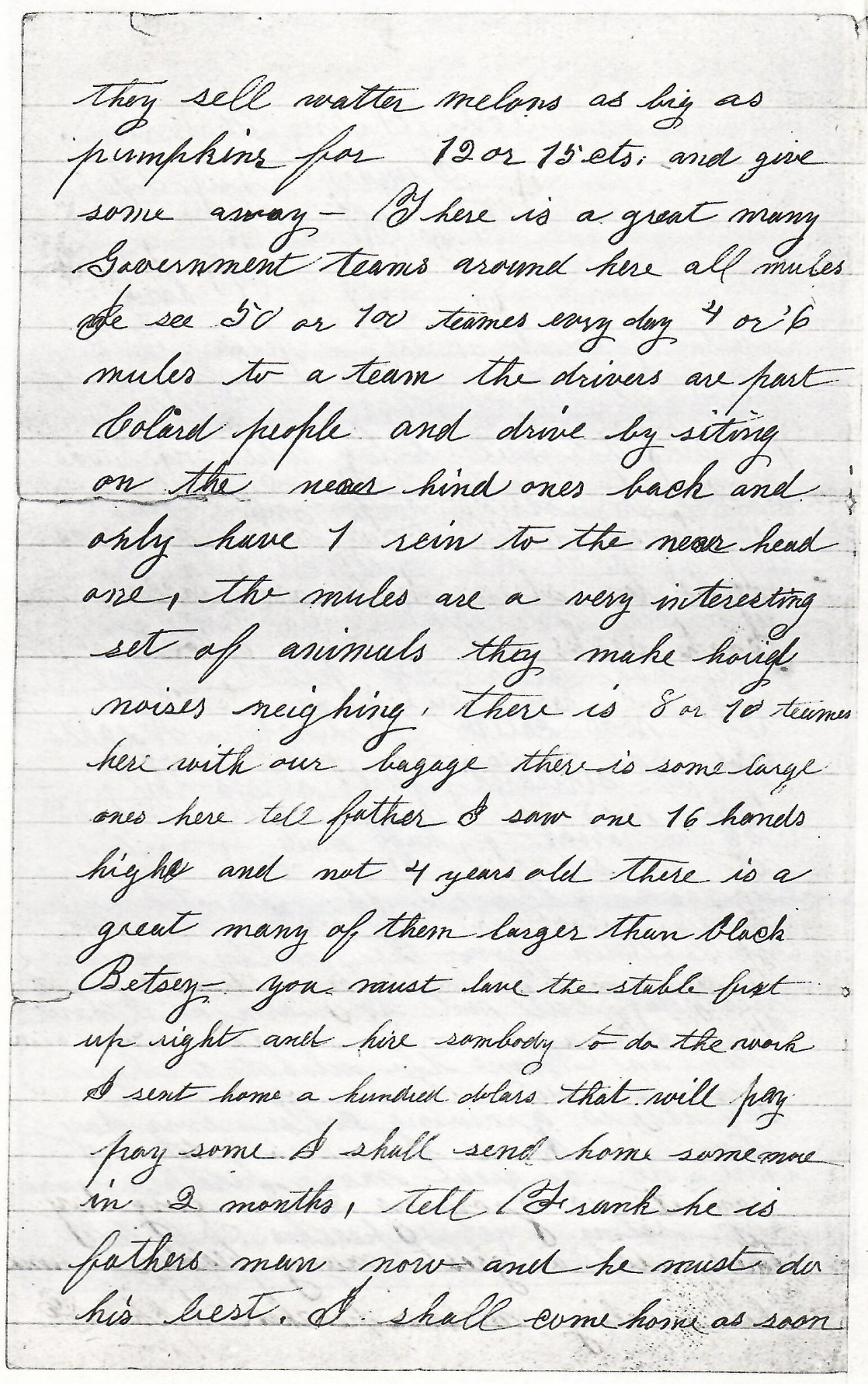
I have just got to a stopping place. The regiment arrived at Camp Casey Friday where we stopped until today when we was ordered to strike tents and pack knapsacks and marched about a mile and have pitched our tents and have had dinner. The place we left was called Arlington Heights. It is situated just across the Potomac about a half mile from Long Bridge on the road they retreated from Bull Run from. The weather was warm yesterday but not so warm as i have seen in Maine. The inhabitants here say it is growing cooler every day. There is a great many peddlers round here selling melons, peaches, apples, &c. They sell watermelons as big as pumpkins for 12 or 15 cents and give some away.
There is a great many government teams around here—all mules. We see 50 or 100 teams every day, four or six mules to a team. The drivers are part colored people and drive by sitting on the near hind one’s back and only have one rein to the near head one. The mules are a very interesting set of animals. they make horrid noises neighing. There is eight or ten teams here with our baggage. There is some large ones here. Tell father I saw one 16 hands high and not 4 years old. There is a great many of them larger than Black Betsy. You must have the stable put up right and hire somebody to do the work. I sent home a hundred dollars that will pay some. I shall send home some more in two months. Tell Frank he is father’s man now and he must do his best. I shall come home as soon as he wants to enlist.
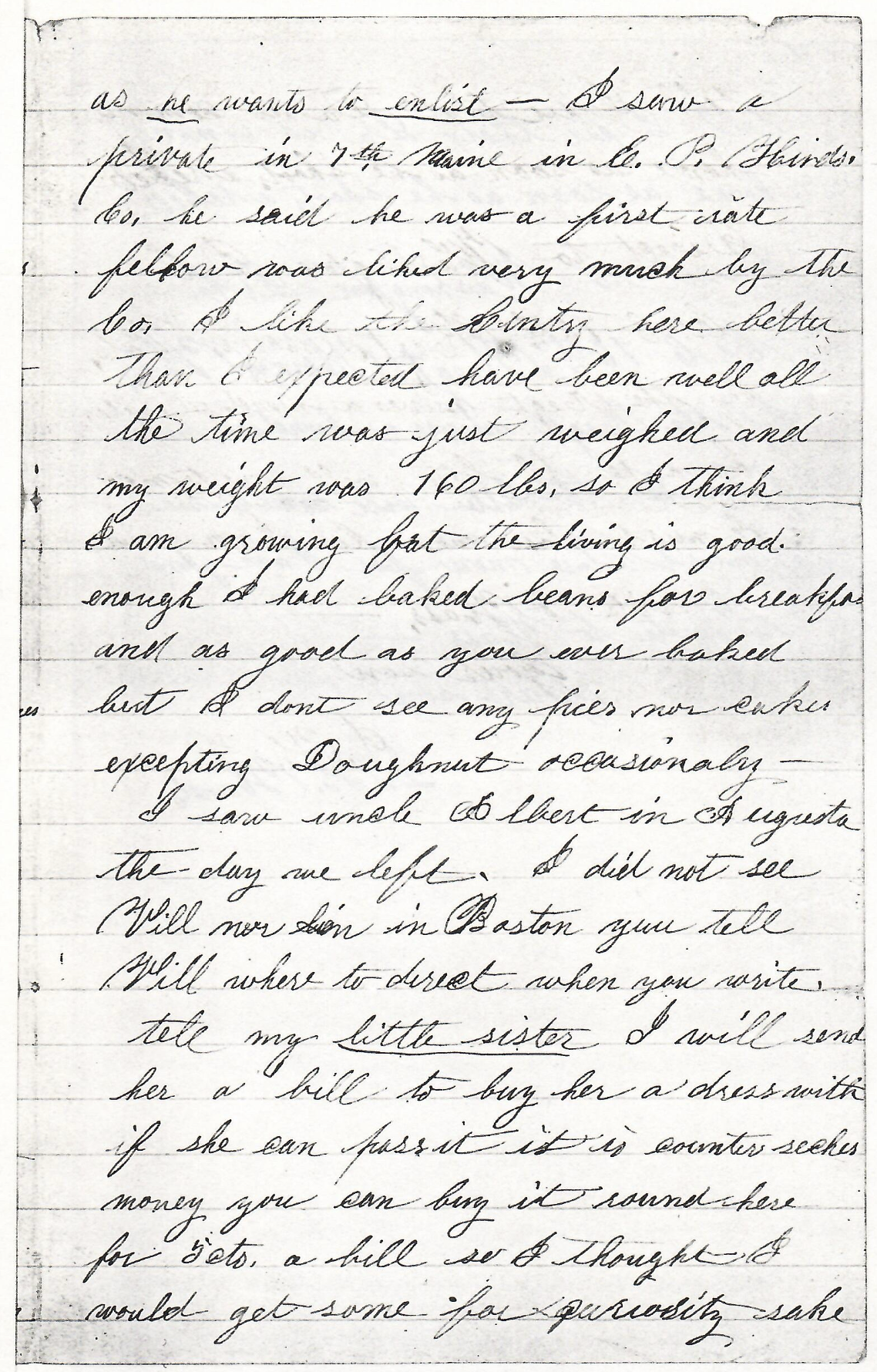
I saw a private in the 7th Maine in E. P. Hinds’ company. He said he was a first rate fellow [and] liked very much by the company. I like the country here better than I expected. Have been well all the time. Was just weighed and my weight was 160 pounds so I think I am growing fat. The living is good enough. I had baked beans for breakfast and as good as you ever baked. But I don’t see any pies nor cakes excepting doughnuts occasionally.
I saw Uncle Albert in Augusta the day we left. I did not see Vill nor Lin [?] in Boston. You tell Vill where to direct when you write. Tell my little sister I will send her a bill to buy her a dress with if she can pass it. It is counter[feit] secesh money. You can buy it round here for 5 cents a bill so I thought I would get some for curiosity sake.
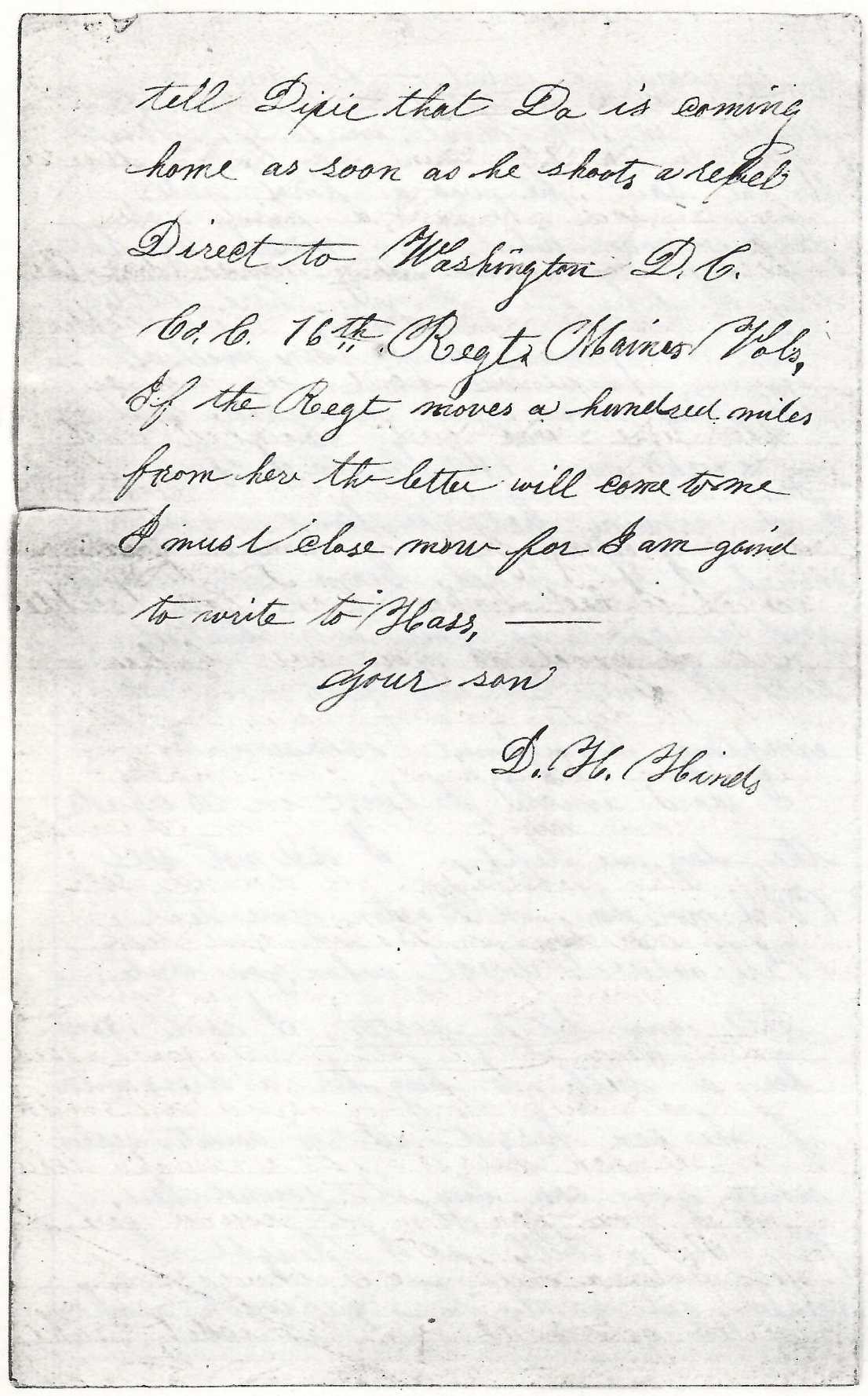
Tell Dixie that Da [David] is coming home as soon as he shoots a rebel. Direct to Washington, D. C., Co. C, 16th Regt., Maine Volunteers. If the regiment moves a hundred miles from here, the letter will come to me. I must close now for I am going to write to Hoss [?]. Yours son, — D. H. Hinds
Letter 2
Camp Whipple
Arlington, Virginia
August 30th 1862
Dear Mother,
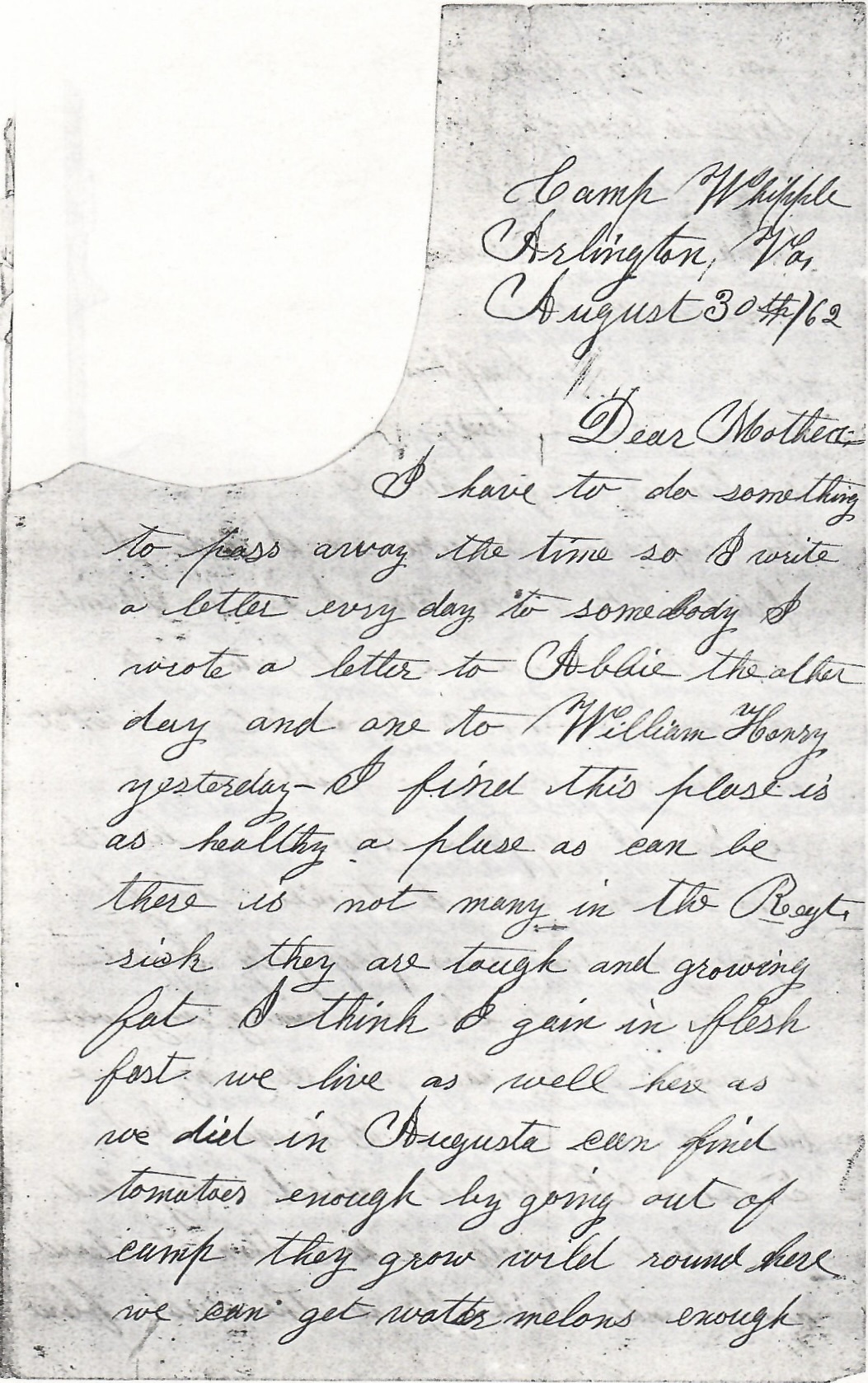
I have to do something to pass away the time so I write a letter every day to somebody. I wrote a letter to Abbie the other day and one to William Henry yesterday.
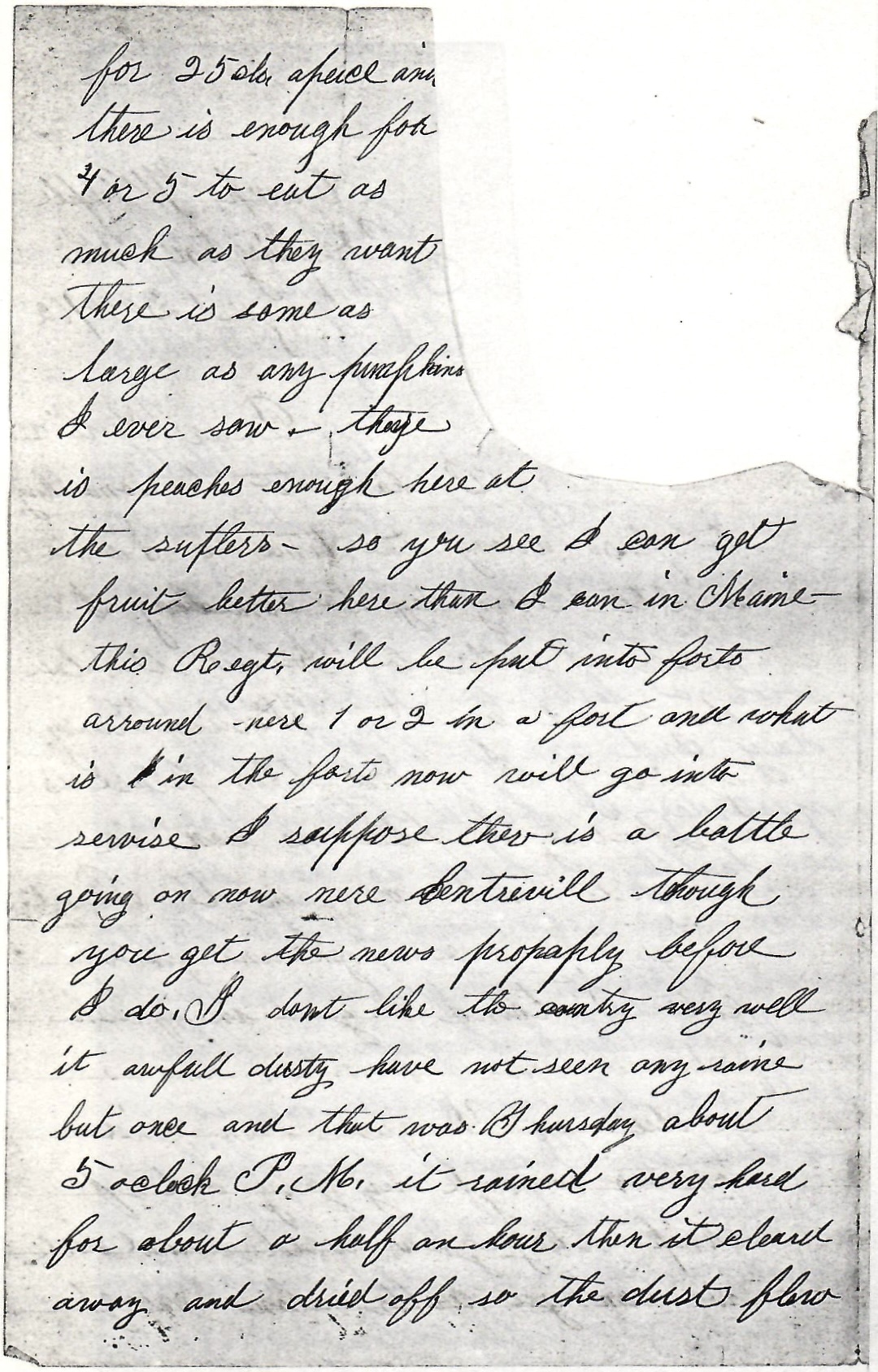
I find this place as healthy a place as can be. There is not many in the regiment sick. They are tough and growing fat, I think. I gain in flesh fast. We live as well here as we did in Augusta. Can find tomatoes enough by going out of camp. They grow wild round here. We can get watermelons enough for 25 cents a piece and [paper torn]…There is peaches enough here at the sutlers so you see I can get fruit better here than I can in Maine. This regiment will be put into forts around here—one or two in a fort and what is in the forts now will go into service. I suppose there is a battle going on now near Centreville though you get the news probably before I do. I don’t like the country very well. It’s awfully dusty. Have not seen any rain but once and that was Thursday about 5 o’clock p.m. It rained very hard for about a half an hour, then it cleared away and dried off so the dust flew [paper torn] day as well as ever.
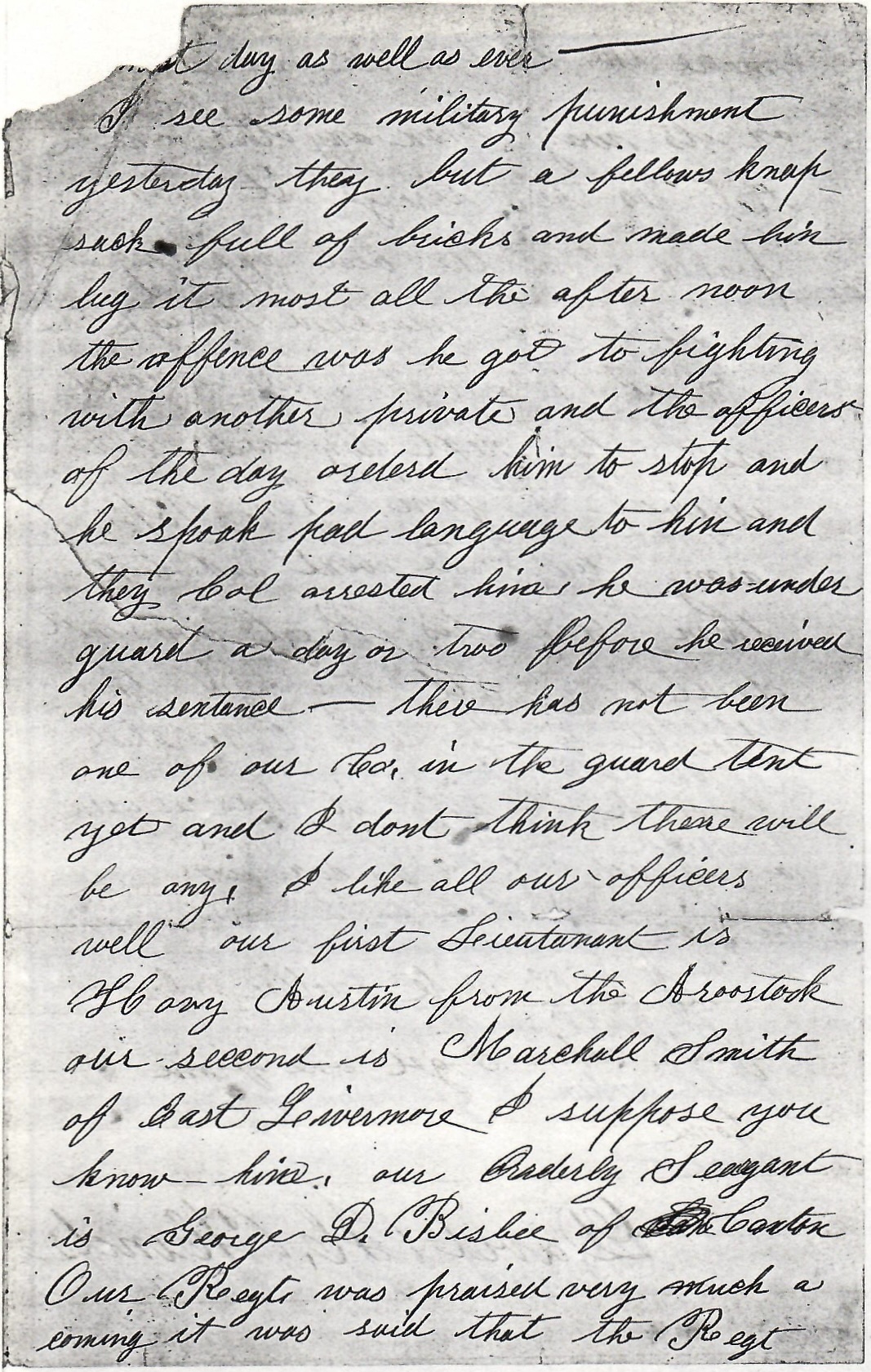
I seen some military punishment yesterday. They put a fellow’s knapsack full of bricks and made him lug it most all the afternoon. The offense was he got to fighting with another private and the Officer of the Day ordered him to stop and he spoke bad language to him and the Colonel arrested him. He was under guard a day or two before he received his sentence. There has not been one of our company in the guard tent yet and I don’t think there will be any.
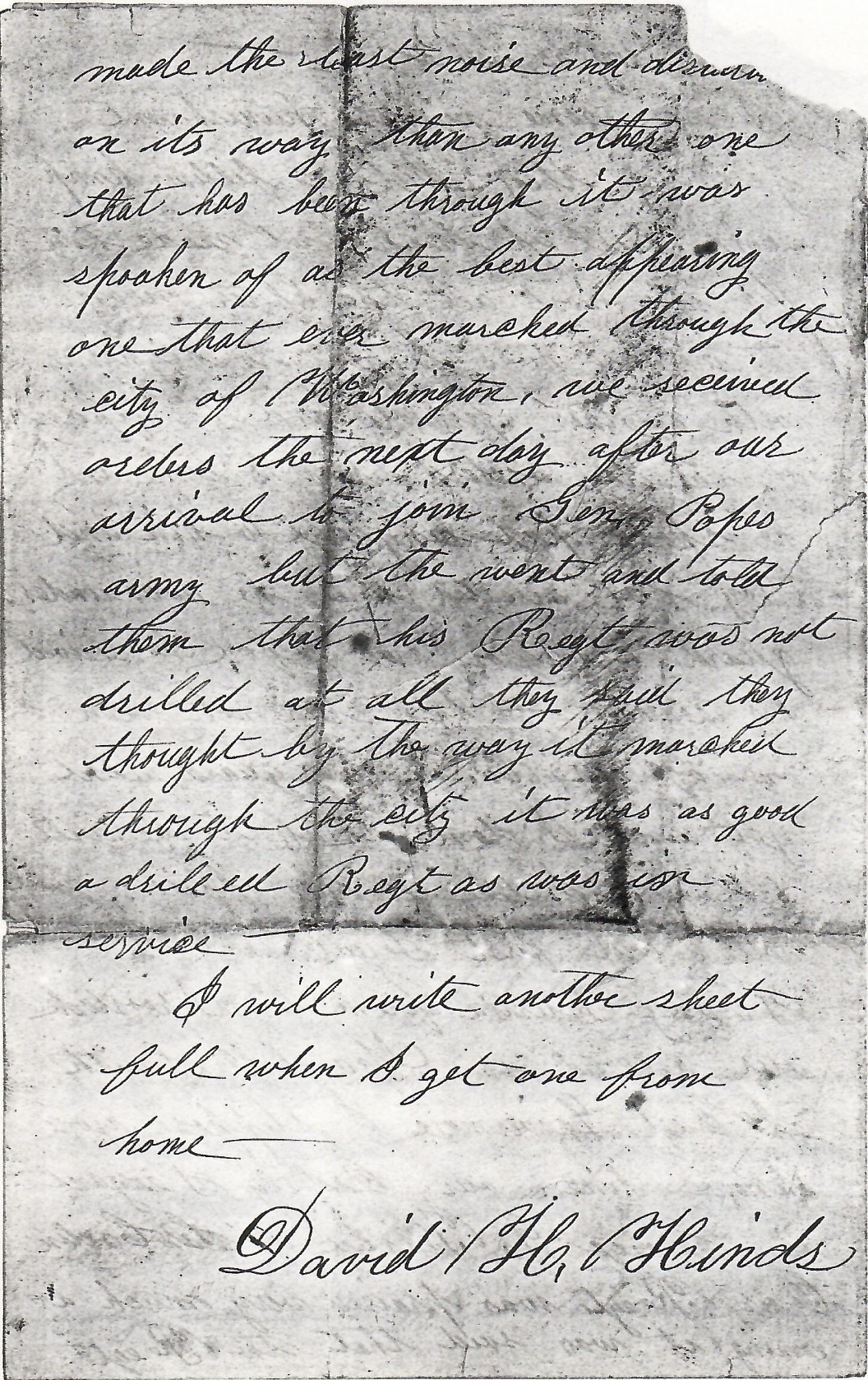
I like all our officers well. Our 1st Lieutenant is Harry Austin from the Aroostook. Our 2nd [Lieutenant] is Marshall Smith of East Livermore. I suppose you know him. Our Orderly Sergeant is George D. Bisbee of Caxton. Our regiment was praised very much a coming. It was said that the regiment made the least noise and [paper torn] on its way than any other one that has been through. It was spoken of as the best appearing one that ever marched through the City of Washington.
We received orders the next day after our arrival to join Gen. Pope’s Army but they went and told them that his regiment was not drilled at all. They said they thought by the way it marched through the city it was as good a drilled regiment as was in the service.
I will write another sheet full when I get one from home. — David H. Hinds
Letter 3
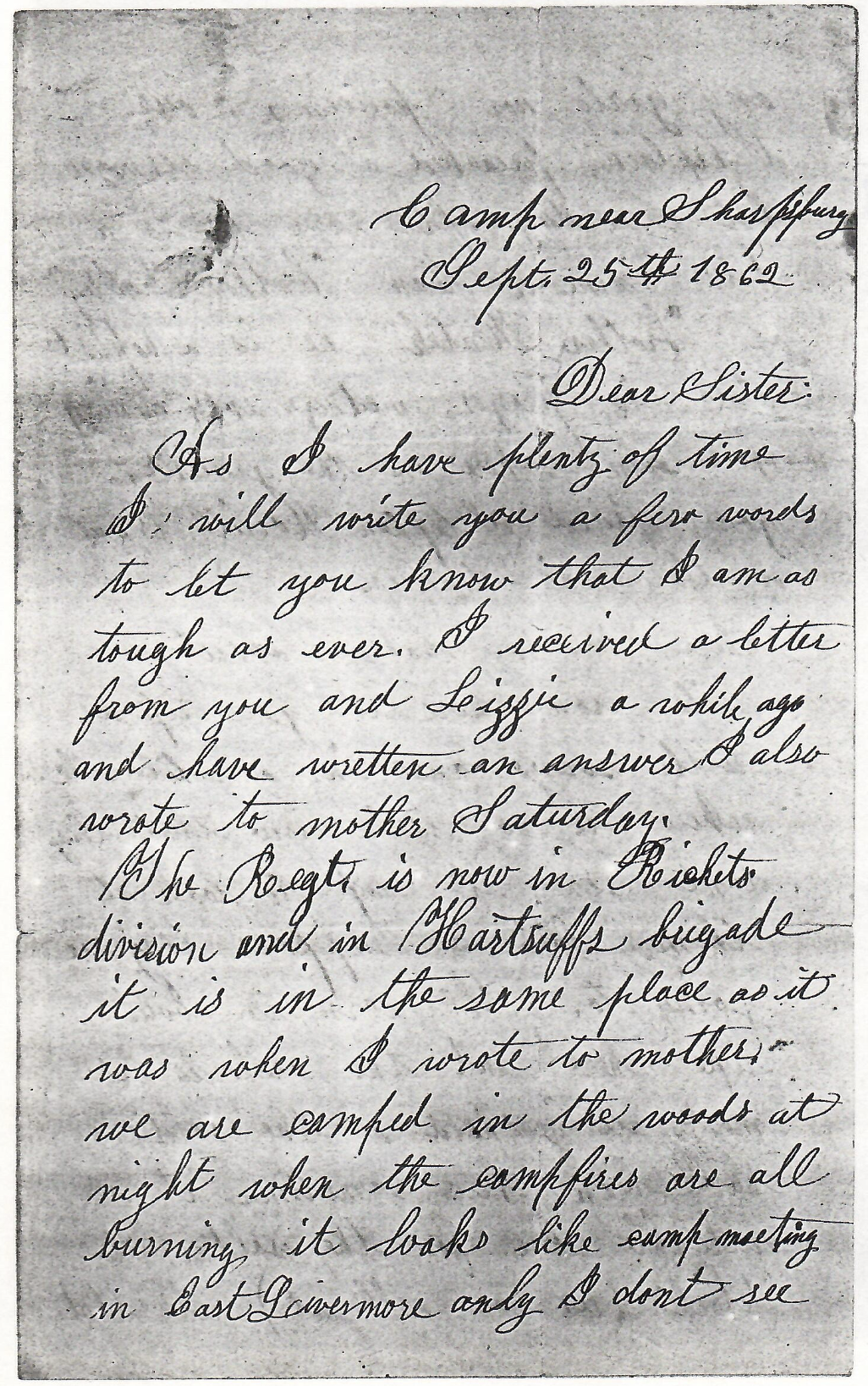
Camp near Sharpsburg [Maryland]
September 25th 1862
Dear Sister,
As I have plenty of time, I will write you a few words to let you know that I am as tough as ever. I received a letter from you and Lizzie a while ago and have written an answer. I also wrote to mother Saturday.
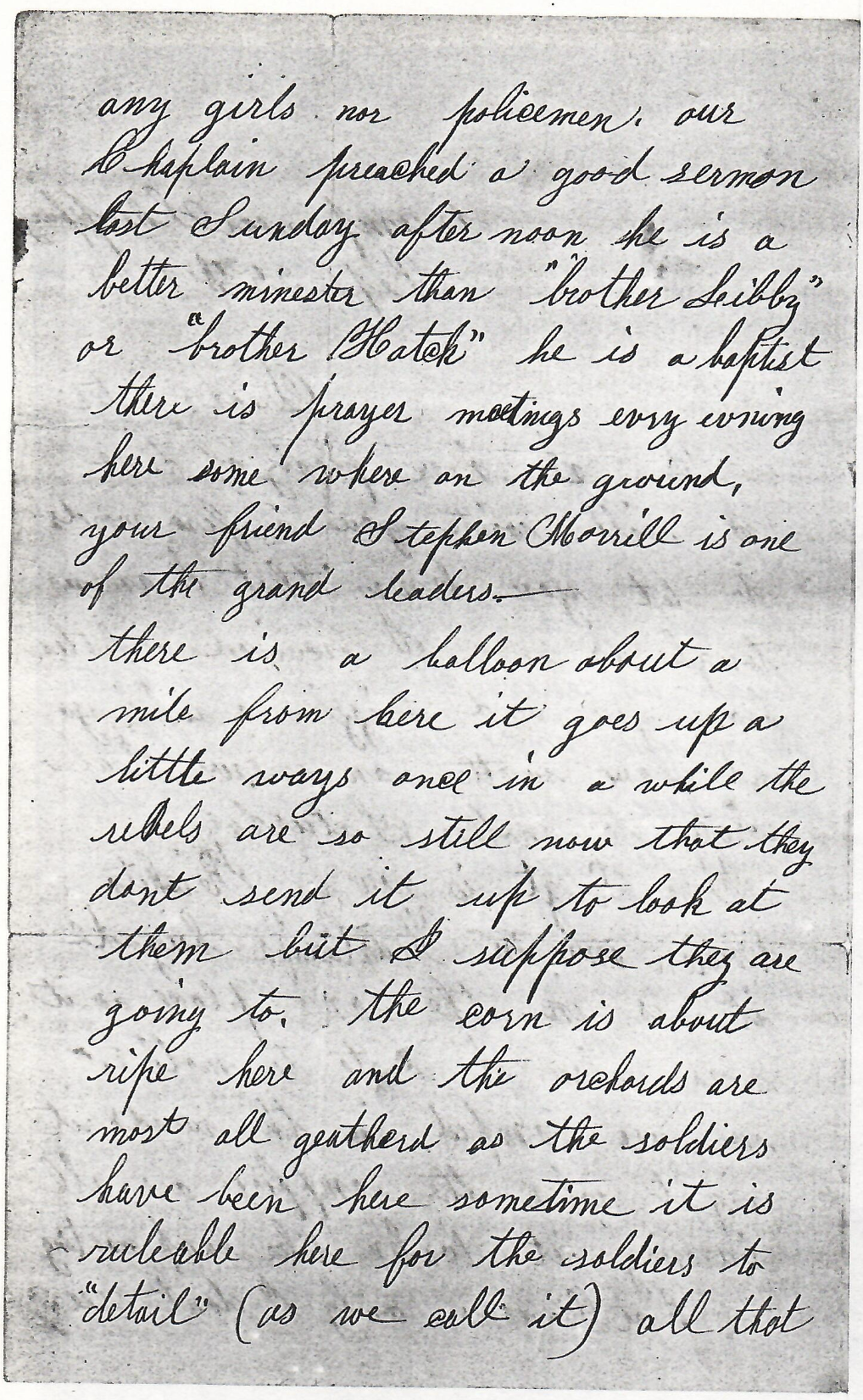
The regiment is now in Rickett’s Division and in Hartsuff’s Brigade. It is in the same place as it was when I wrote to mother. We are camped in the woods. At night when the campfires are all burning, it looks like a camp meeting in East Livermore, only I don’t see any girls nor policemen. Our chaplain preached a good sermon last Saturday afternoon. He is a better minister than “brother Libby” or “brother Hatch.” He is a Baptist. There is prayer meetings every evening here somewhere on the ground. Your friend Stephen Morrill is one of the grand leaders.
There is a balloon about a mile from here. It goes up a little ways once in a while. the rebels are so still now that they don’t send it up to look at them but I suppose they are going to.
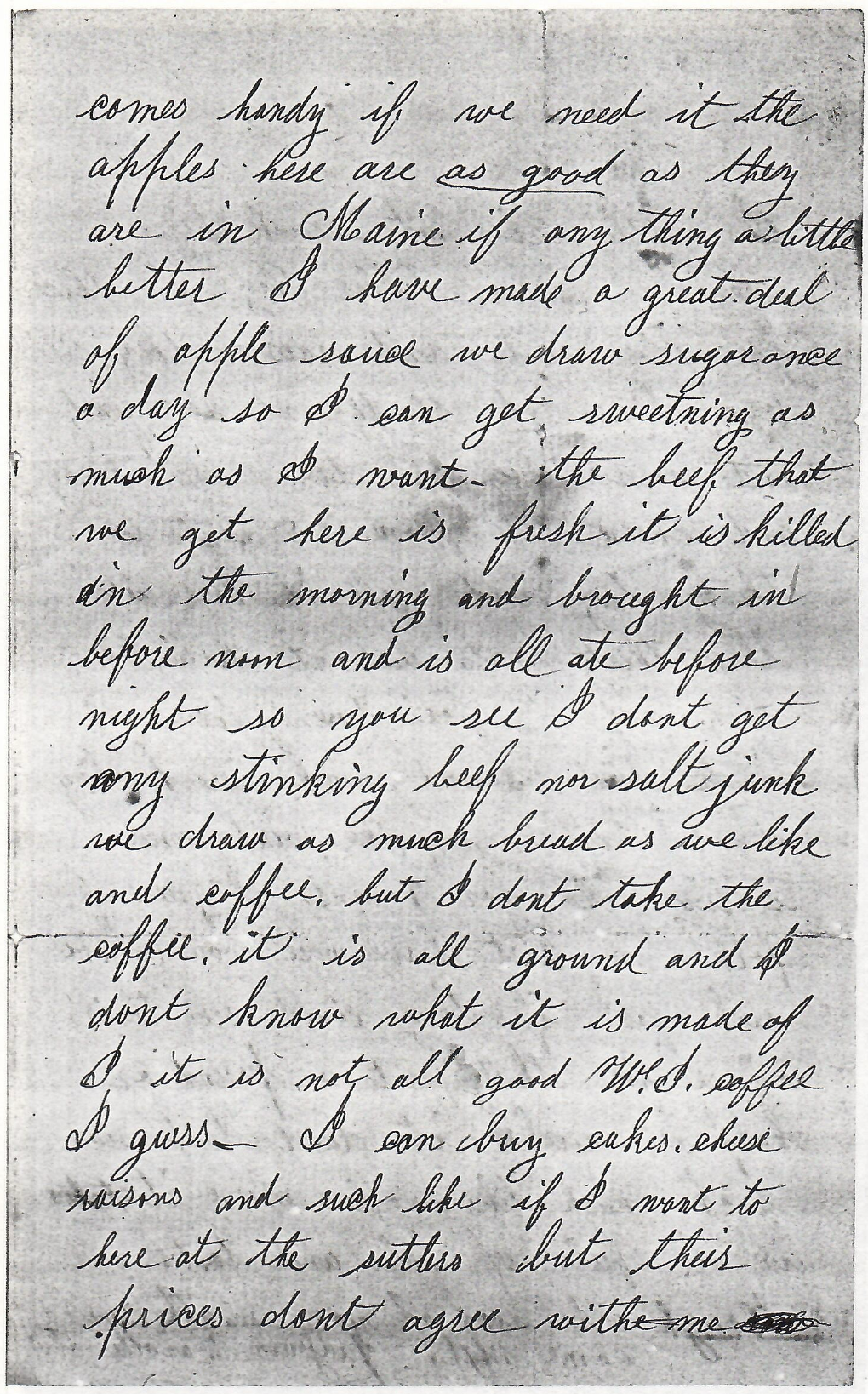
The corn is about ripe here and the orchards are most all gathered. As the soldiers have been here some time, it is ruleable here for the soldiers to “detail” (as we call it) all that comes handy if we need it. The apples here are as good as they are in Maine—if anything, a little better. I have made a great deal of apple sauce. We draw sugar once a day so I can get sweetening as much as I want. The beef that we get here is fresh. It is killed in the morning and brought in before noon and is all are before night so you see I don’t get any stinking beef nor salt junk. We draw as much bread as we like, and coffee. It is all ground and I don’t know what it is made of. It is not all good. W. I. [West Indies] coffee I guess.
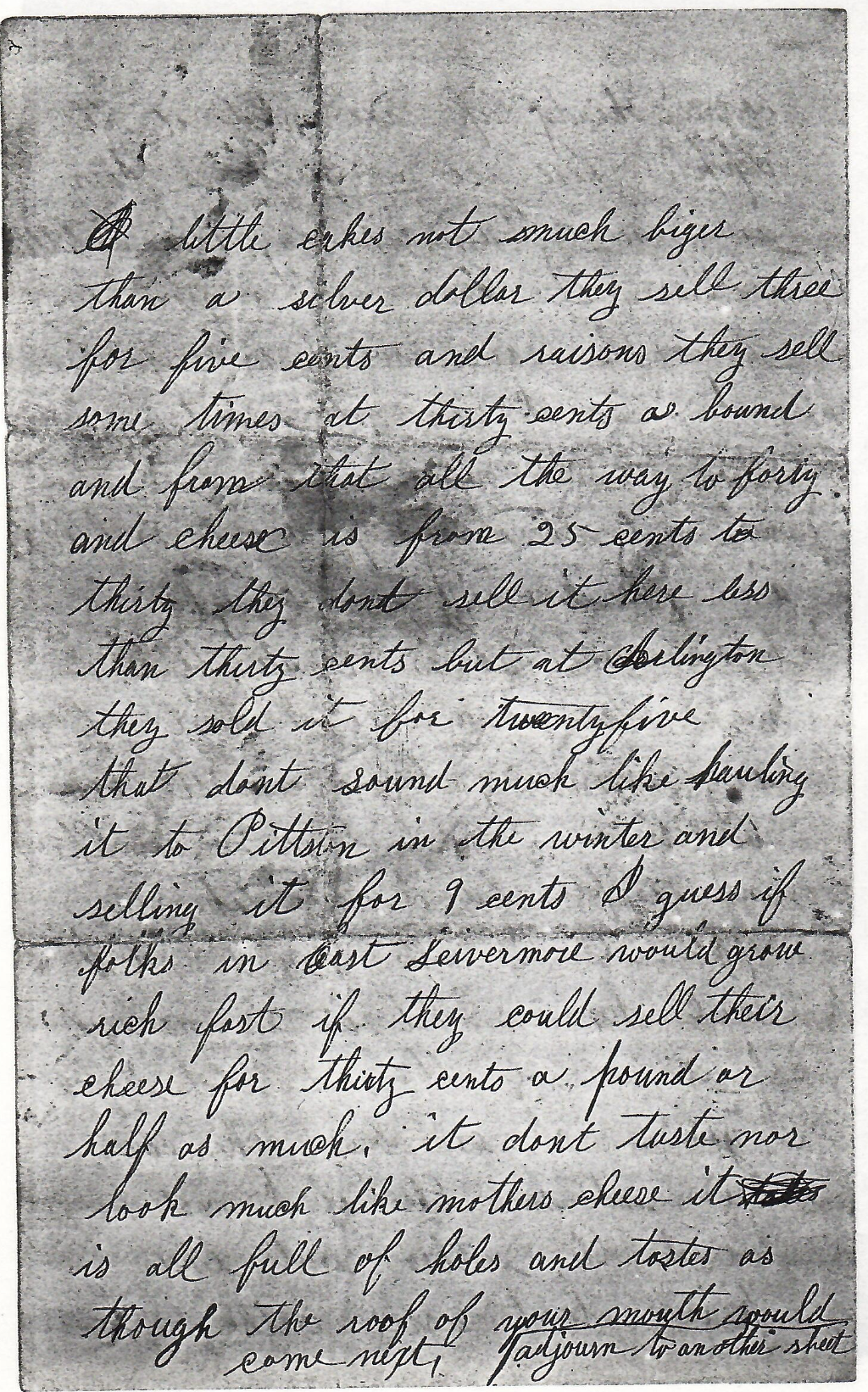
I can buy cakes, cheese, raisons, and such like if I want to here at the sutlers’ but their prices don’t agree with me. Little cakes not much bigger than a silver dollar, they sell three for five cents, and raisons they sell some times at thirty cents a pound. and from that all the way to forty, and cheese is from 25 cents to 30. They don’t sell it here less than 30 cents but at Arlington they sold it for 25. That don’t sound much like hauling it to Pittston in the winter and selling it for 9 cents. I guess folks in East Livermore would grow rich fast if they could sell their cheese for 30 cents a pound or half as much. It don’t taste nor look much like mother’s cheese. It is all full of holes and tastes as though the roof of your mouth would come next. [rest of letter is missing]
Letter 4
Camp near Sharpsburg, Maryland
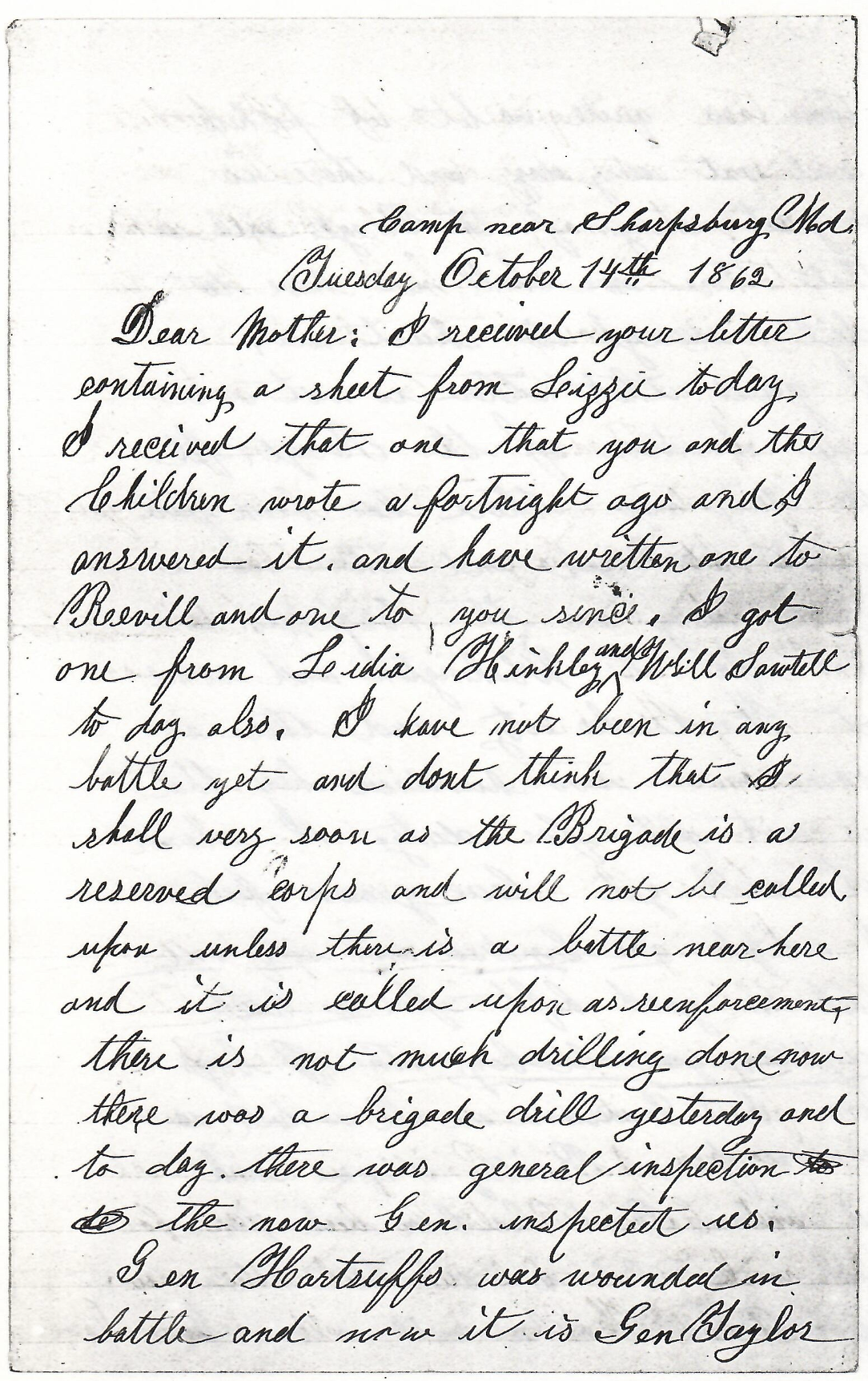
Tuesday, October 14th 1862
Dear Mother,
I received your letter containing a sheet from Lizzie today. I received that one that you and the children wrote a fortnight ago and I answered it and have written one to Revill and one to you since. I got one from Lydia Hinkley and Will Sawtelle today also.
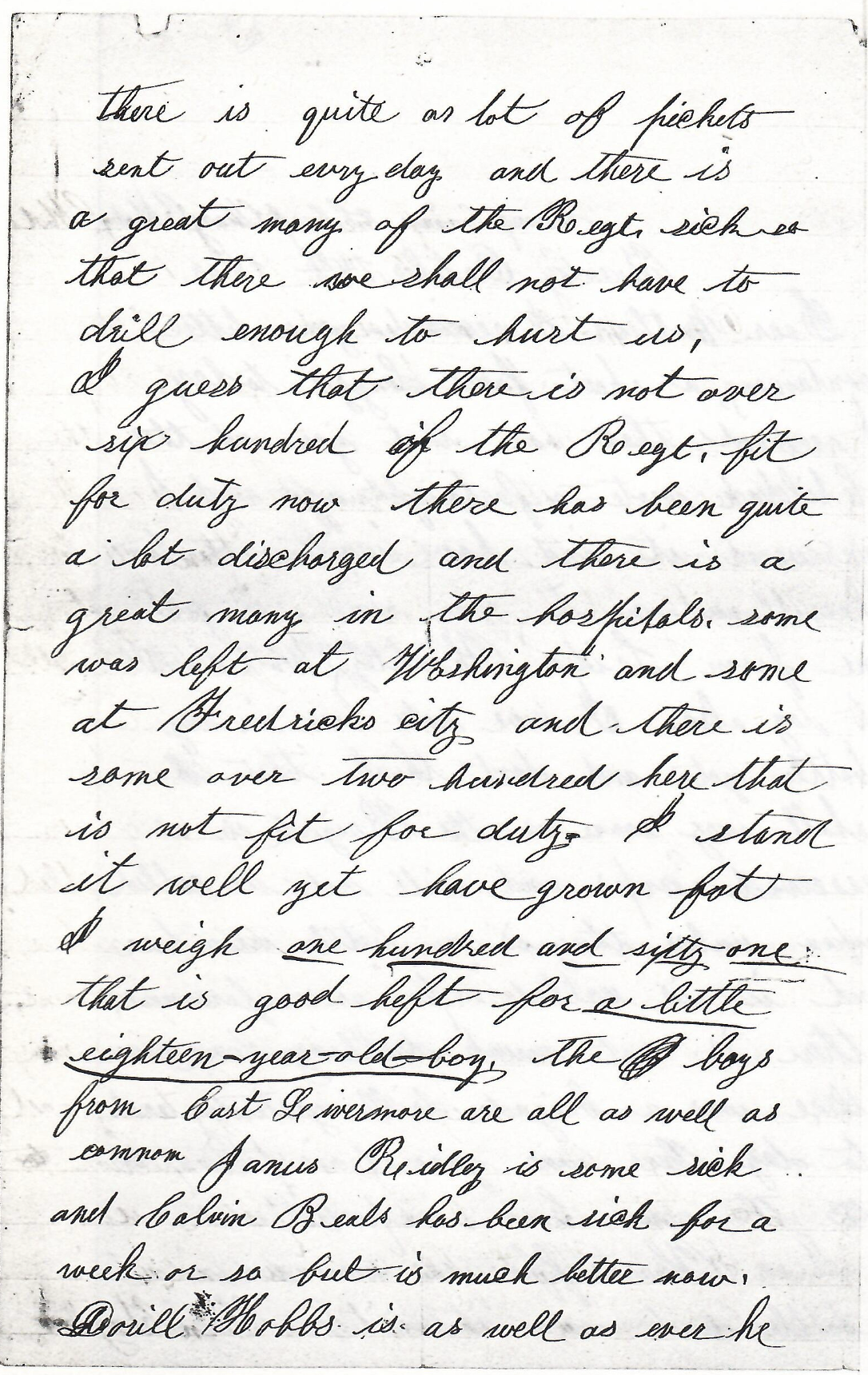
I have not been in any battle yet and don’t think that I shall very soon as the Brigade is a reserve corps and will not be called unless there is a battle near here and it is called upon as reinforcement. There is not much drilling done now. There was a brigade drill yesterday and today there was general inspection. The new general inspected us. Gen. Hartsuff was wounded in battle and now it is Gen. Taylor. There is quite a lot of pickets sent out every day and there is a great many of the regiment sick so that we shall not have to drill enough to hurt us. I guess that there is not over six hundred of the regiment fit for duty now. There has been quite a lot discharged and there is a great many in the hospitals. Some was left at Washington and some at Frederick City. And there is some over two hundred here that is not fit for duty. I stand it well yet. Have grown fat. I weigh one hundred and sixty-one. That is good heft for a little 18 year-old boy.
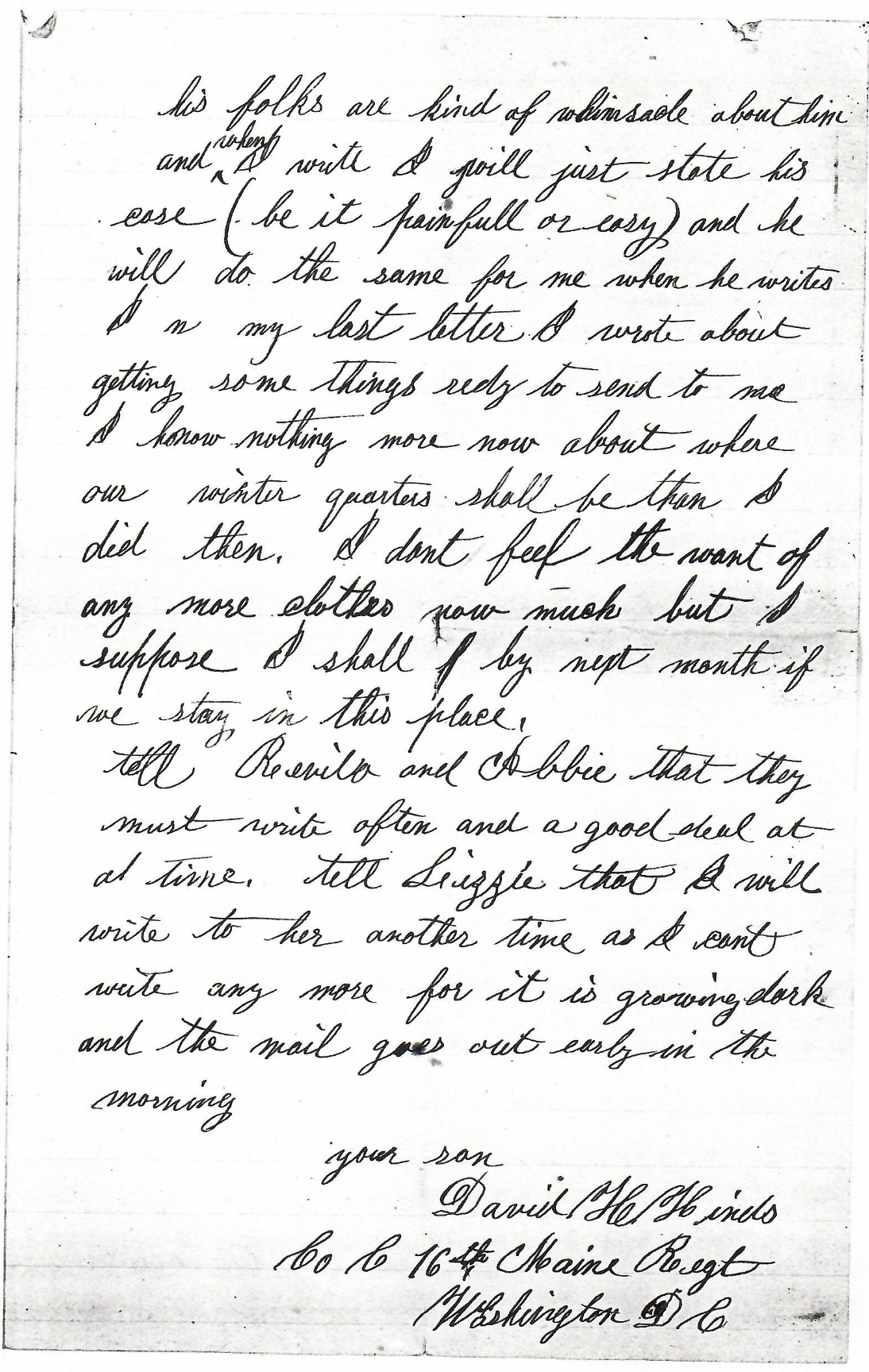
The boys from East Livermore are all as well as common. James Ridley is some sick and Calvin Beals has been sick for a week or so but is much better now. Dorill[us] Hobbs is as well as ever. His folks are kind of worried about him and when I write, I will just state his case (be it painful or easy) and he will do the same for me when he writes.
In my last letter I wrote about getting somethings ready to send to me. I know nothing more now about where our winter quarters shall be than I did then. I don’t feel the want of any more clothes now much but I suppose I shall by next month if we stay in this place.
Tell Revillo and Abbie that they must write often and a good deal at a time. Tell Lizzie that I will write to her another time as I can’t write any more for it is growing dark and the mail goes out early in the morning.
Your son, — David H. Hinds
Co. C, 16th Maine Regt.
Washington D. C.
Letter 5
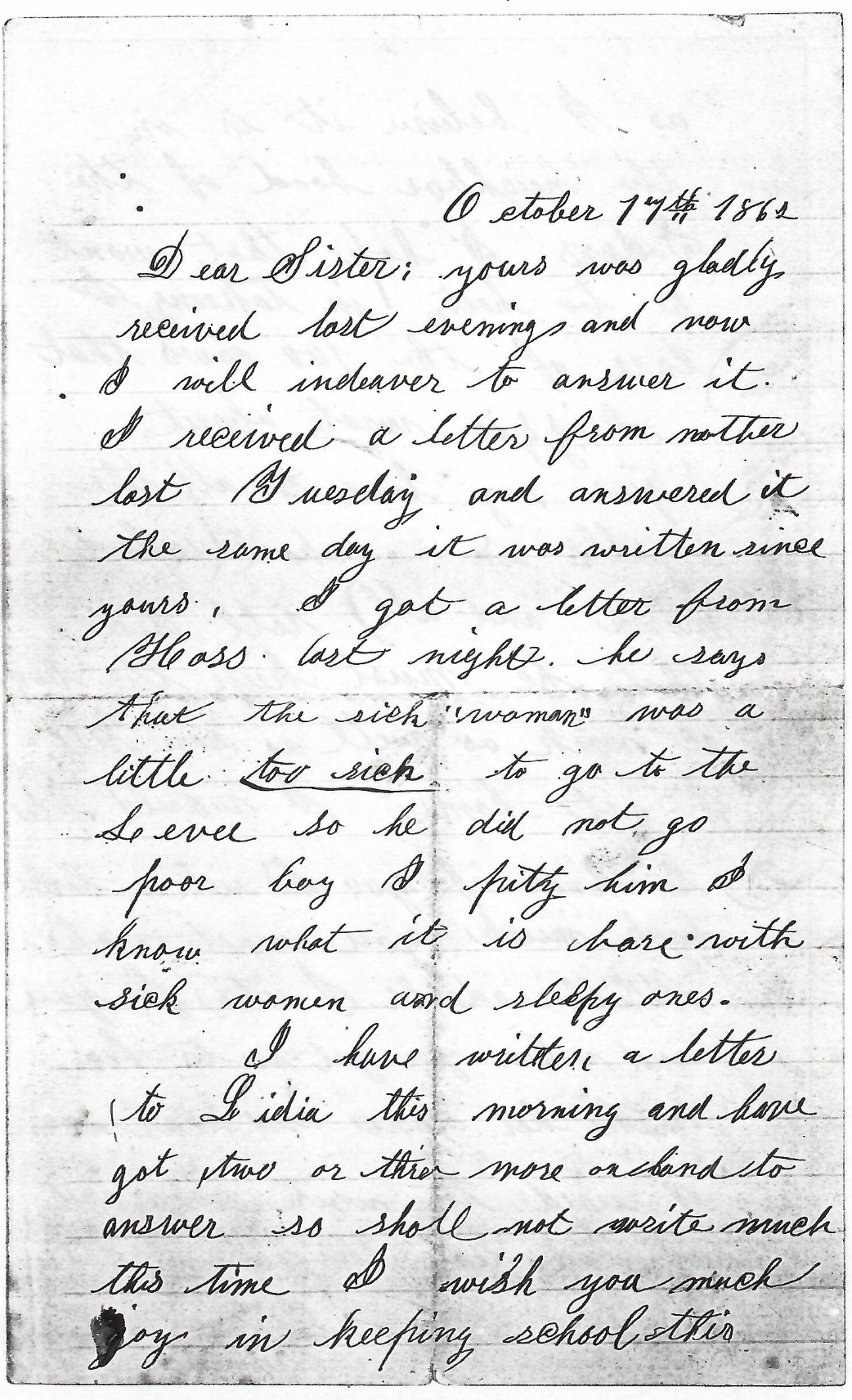
October 17th 1862
Dear Sister,
Yours was gladly received last evening and now I will endeavor to answer it. I received a letter from mother last Tuesday and answered it the same day. It was written since yours. I got a letter from Hoss last night. He says that the sick “woman” was a little too sick to go to the levee so he did not go. Poor boy. I pity him. I know what it is to [ ] with sick women and sleepy ones.
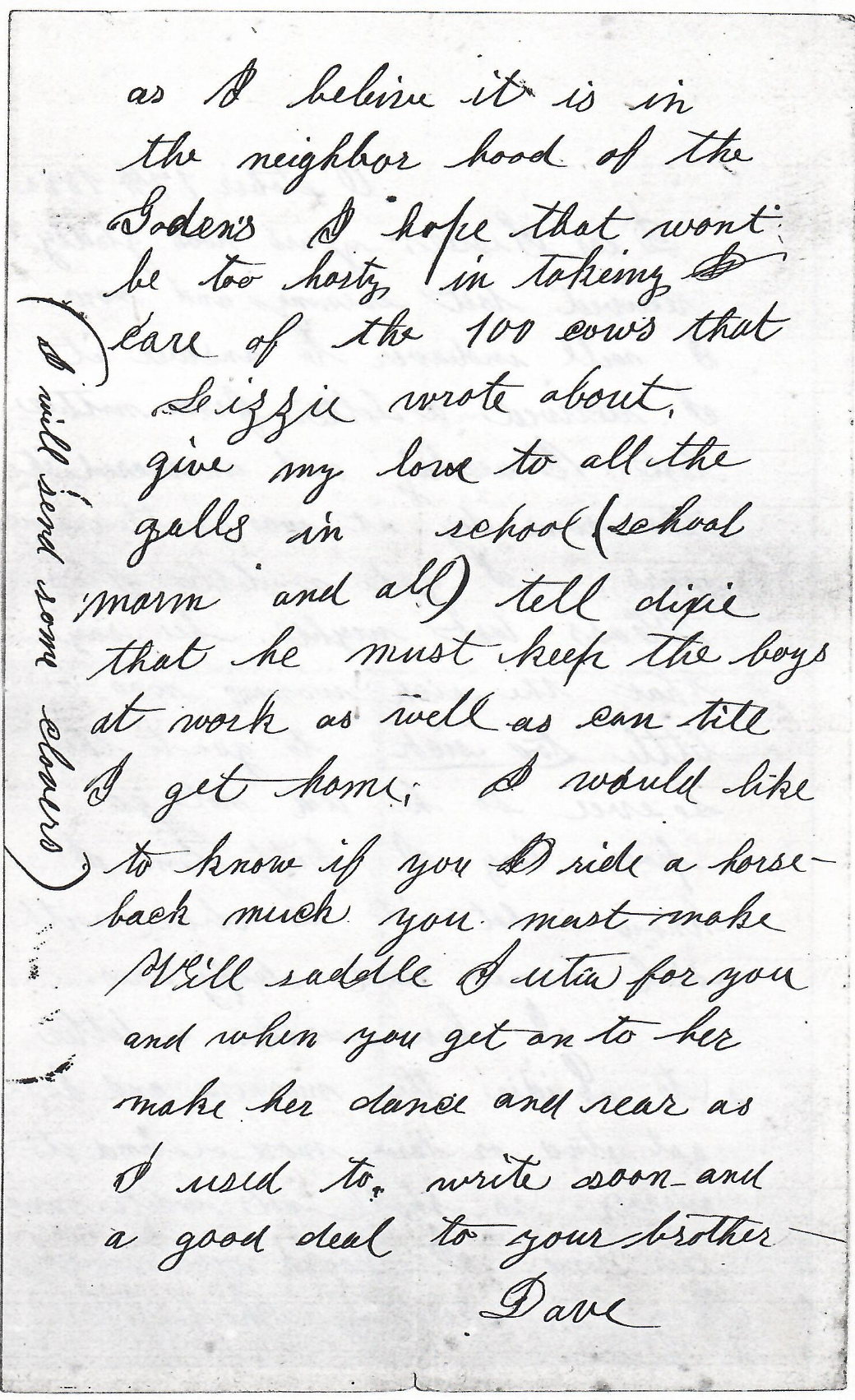
I have written a letter to Lydia this morning and have got two or three more on hand to answer so shall not write much this time. I wish you much joy in keeping school this [fall] as I believe it is in the neighborhood of the Goden’s. I hope that won’t be too hasty in taking care of the 100 cows that Lizzie wrote about. Give my love to all the galls in school (school marm and all). Tell Dixie that he must keep the boys at work as well as he can till I get home. I would like to know if you ride a horseback much. You must make Vill saddle Julia for you and when you get on to her, make her dance and rear as I used to. Write soon and a good deal to your brother. — Dave
Letter 6
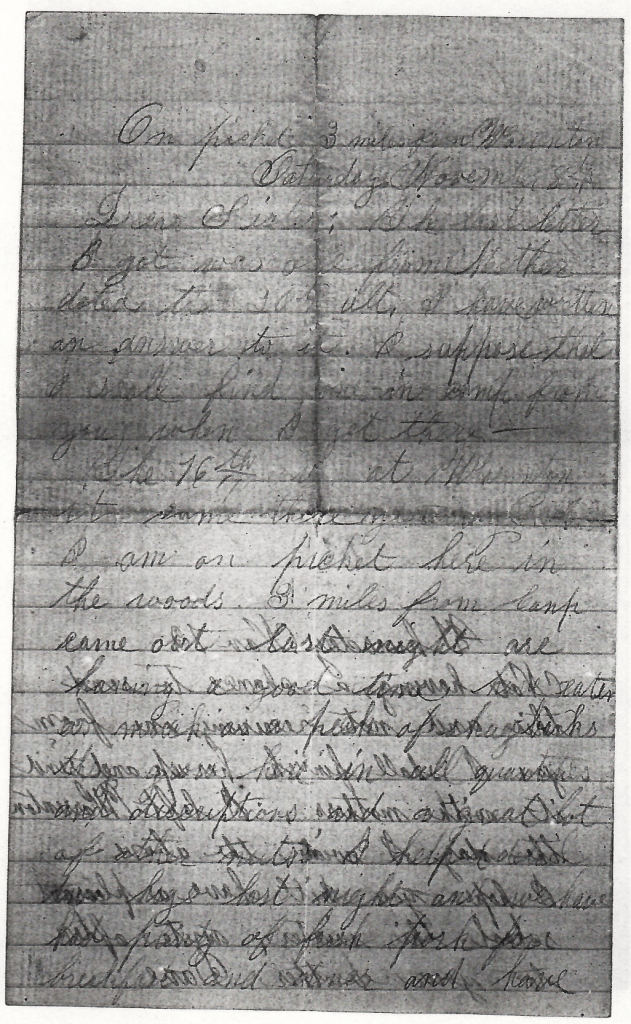
On picket 3 miles from Warrenton [Virginia]
Saturday, November 8th [1862]
Dear Sister,
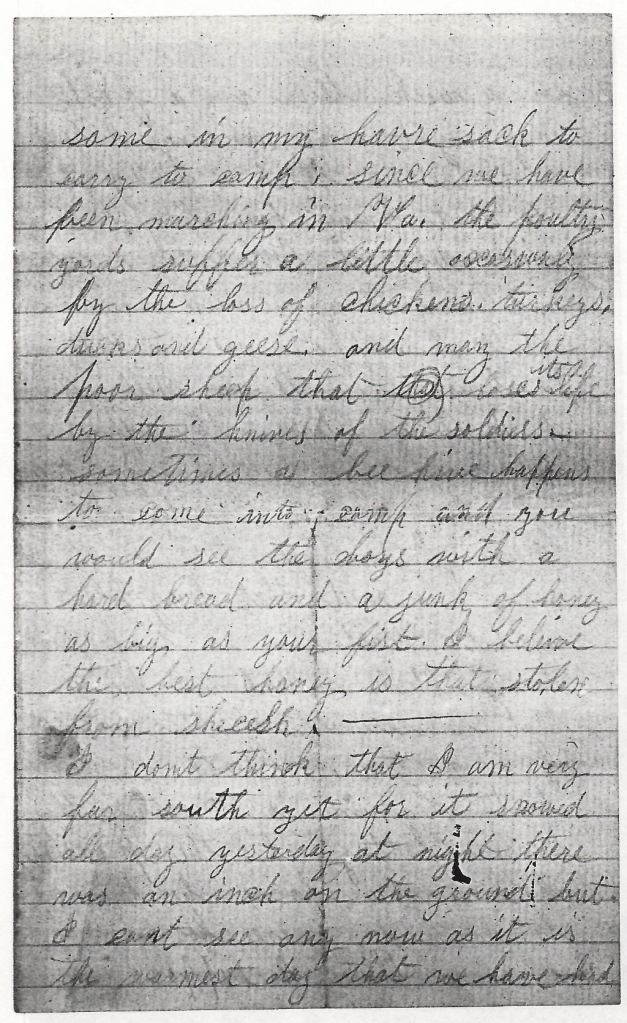
The last letter I got was one from Mother dated the 30th. I have written an answer to it. I suppose I shall find one in camp from you when I get there. I am on picket here in the woods 3 miles from camp. Came out last night. Are having a good time. Have eaten as much as a peck of shagbarks. They grow here in all quantities and descriptions and a great lot of other nuts. I helped catch two hogs last night and we have had plenty of fresh pork for breakfast and diner and have some in my haversack to carry to camp. Since we have been marching in Virginia, the poultry yards suffer a little occasionally by the loss of chickens, turkeys, ducks and geese and many the poor sheep that loses its life by the knives of the soldiers. Sometimes a bee hive happens to come into camp and you would see the boys with a hard bread and a hunk of honey as big as your fist. I believe the best honey is that stolen from the secesh.
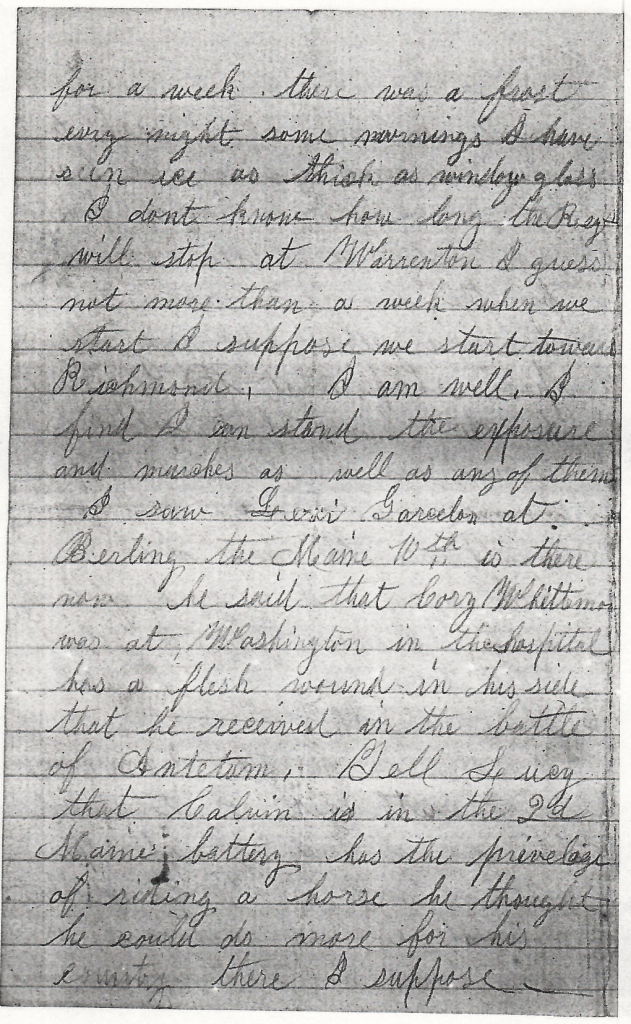
I don’t think that I am very far south yet for it snowed all day yesterday. At night there was an inch on the ground. But I can’t see any now as it is the warmest day that we have had for a week. There was a frost every night. Some mornings I have seen ice as thick as window glass.
I don’t know how long the regiment will stop at Warrenton. I guess not more than a week. When we start, I suppose we start towards Richmond. I am well. I find I can stand the exposure and marches as well as any of them. I saw Levi Garcelon at Berlin [now Brunswick]. The Maine 10th is there now. He said that [Eben] Cory Whittemore was at Washington in the hospital has a flesh wound in his side that he received in the battle of Antietam. Tell Lucy that Calvin [Beals] is in the 2nd Maine Battery [and] has the privilege of riding a horse. He thought he could do more for his country there I suppose.
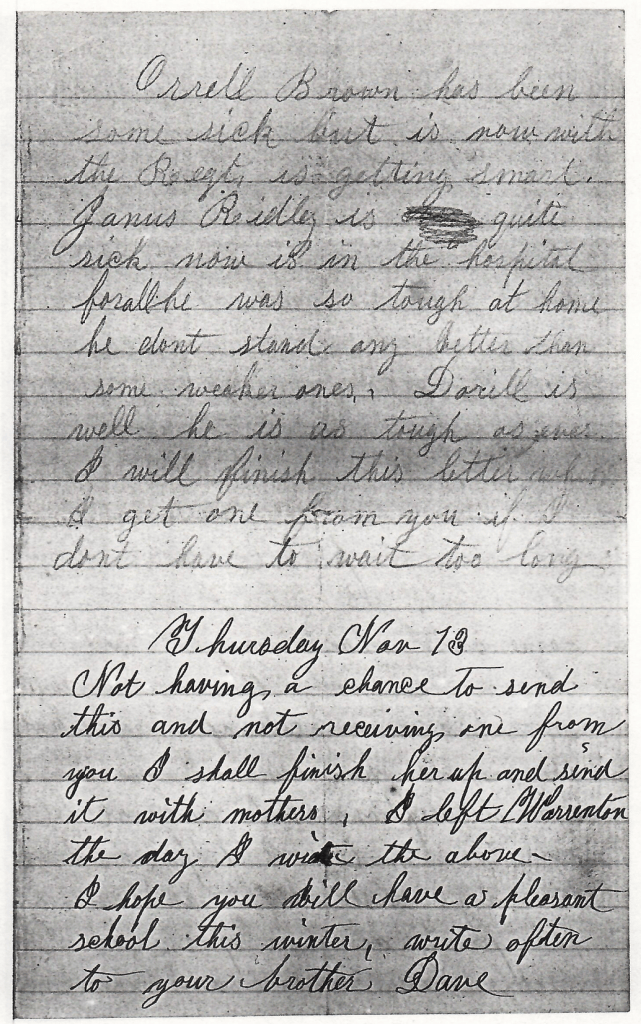
Orrel Brown has been some sick but is now with the regiment. He is getting smart. James Ridley is quite sick now [and] is in the hospital. For all he was so tough at home, he don’t stand any better than some weaker ones. Darill is well. He is as tough as ever. I will finish this letter when I get one from you if I don’t have to wait too long.
Thursday Nov 13—Not having a chance to send this and not receiving one from you, I shall finish her up and send it with mother’s. I left Warrenton the day I wrote the above. I hope you will have a pleasant school this winter. Write often to your brother, — Dave
Letter 7
Camp near Rappahannock Station, Va.
Wednesday, November 12th 1862
Dear Mother,
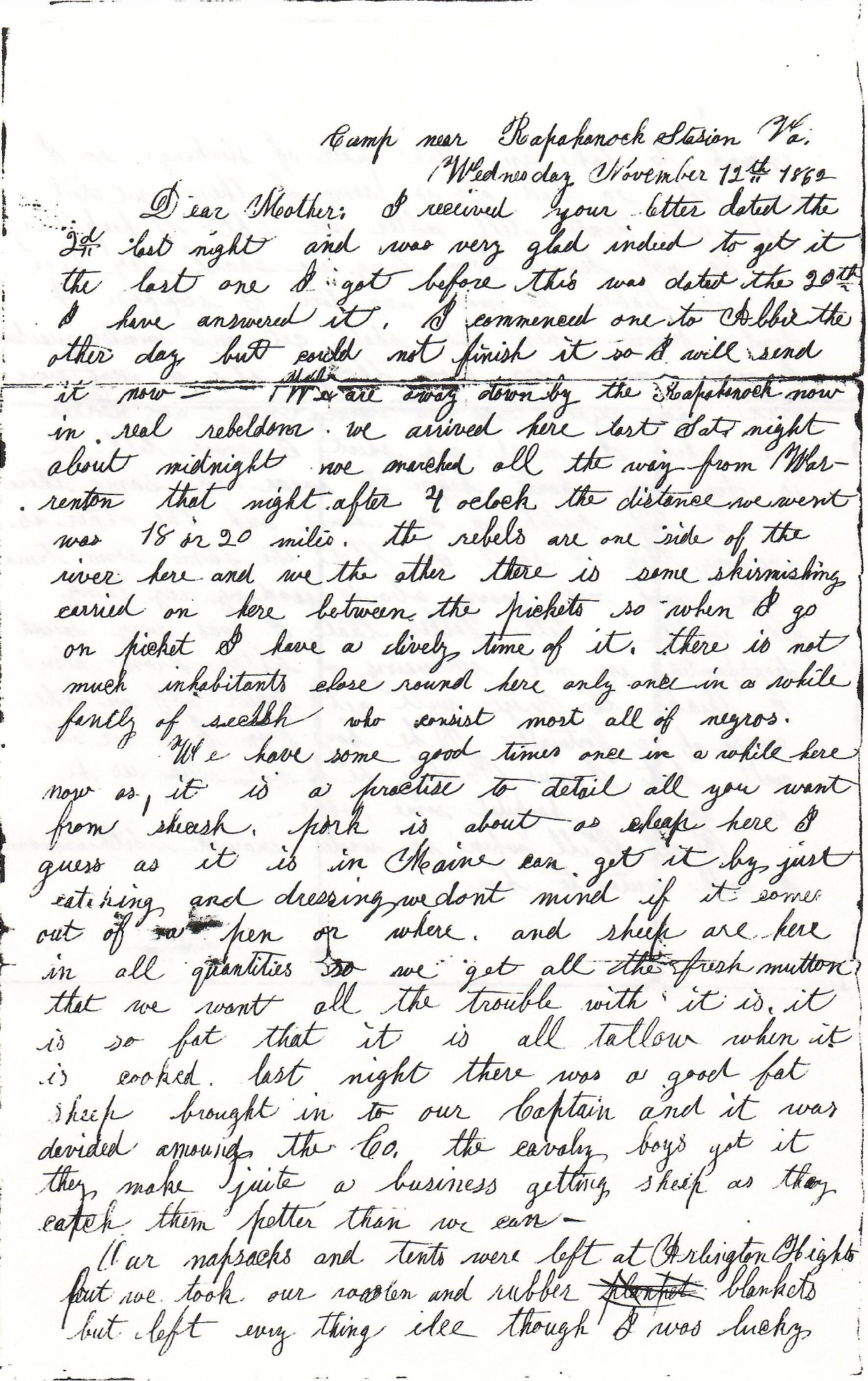
I received your letter dated the 2nd last night and was very glad indeed to get it. The last one I got before this was dated the 20th. I have answered it. I commenced one to Abbie the other day but could not finish it so I will send it now.
We are away down by the Rappahannock now in real rebeldom. We arrived here last Saturday night about midnight. We marched all the way from Warrenton that night after 4 o’clock. the distance we went was 18 or 20 miles. the rebels are on one side of the river here and we the other. there is some skirmishing carried on here between the pickets so when I go on picket, I have a lively time of it. There is not much inhabitants close round here—only one in a while a family of secesh who consist most all of negroes.
We have some good times once in a while here now as it is a practice to detail all you want from secesh. Pork is about as cheap here I guess as it is in Maine. We can get it by just catching and dressing. We don’t mind if it comes out of a pen or where, and sheep are here in all quantities so we get all the fresh mutton that we want. All the trouble with it is it is so fat that it is all tallow when it is cooked. Last night there was a good fat sheep brought in to our captain and it was divided around the company. The cavalry boys got it. They make quite a business getting sheep as they catch them better than we can.
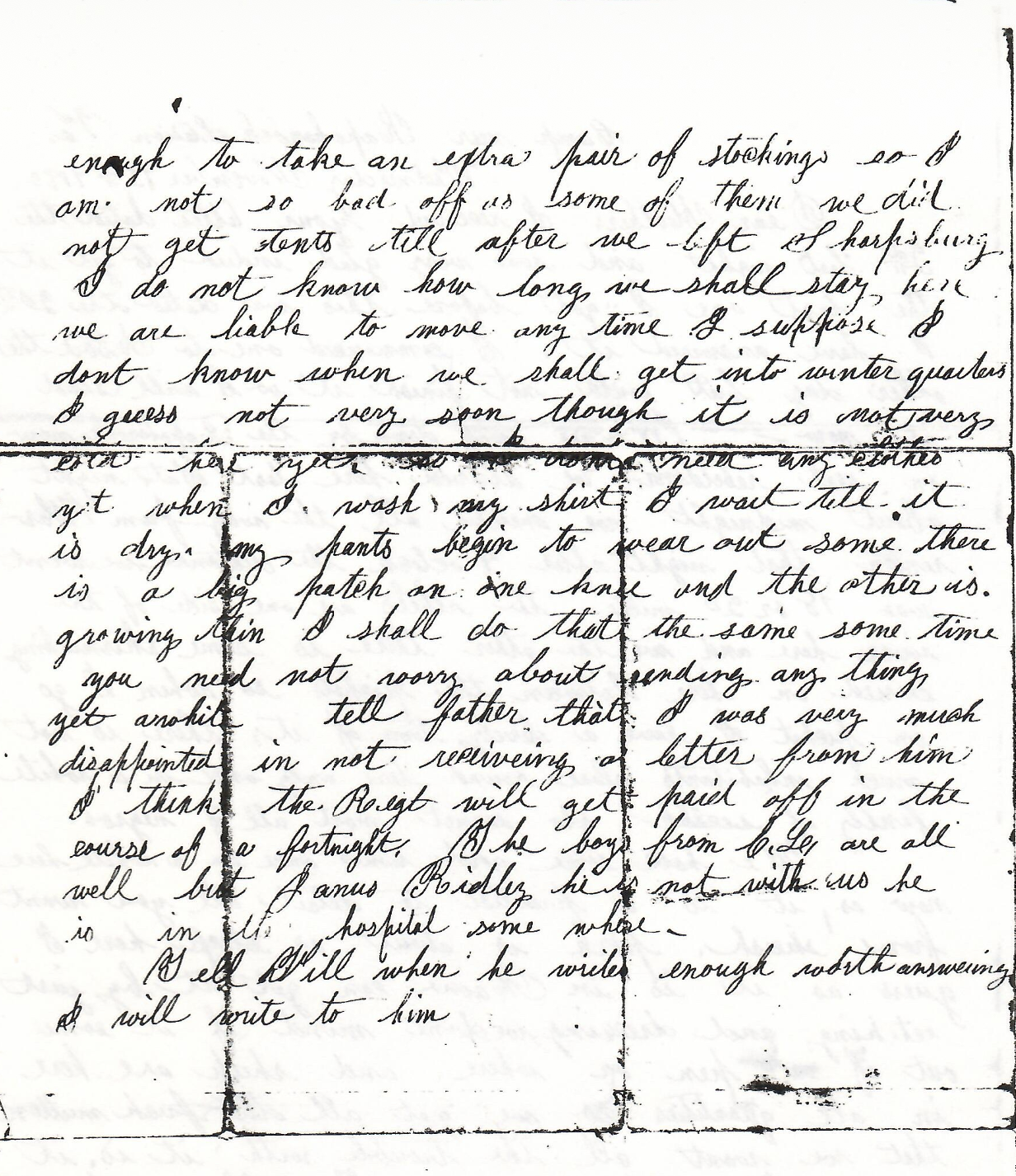
Our knapsacks and tents were left at Arlington Heights but we took our woolen and rubber blankets but left everything else though I was lucky enough to take an extra pair of stockings so I am not so bad off as some of them. We did not get tents till after we left Sharpsburg. 1
I di not know how long we shall stay here. We are liable to move any time, I suppose. I don’t know when we shall get into winter quarters. I guess not very soon though it is not very cold here yet so I don’t need any clothes yet. When I wash my shirt, I wait till it is dry. My pants begin to wear out some. There is a big patch on one knee and the other is growing thin. I shall do that the same sometime. You need not worry about sending anything yet awhile.
Tell father that I was very much disappointed in not receiving a letter from him. I think the regiment will get paid off in the course of a fortnight. The boys from East Livermore are all well but James Ridley. He is not with us. He is in the hospital somewhere.
Tell Vill when he writes enough worth answering, I will write to him.
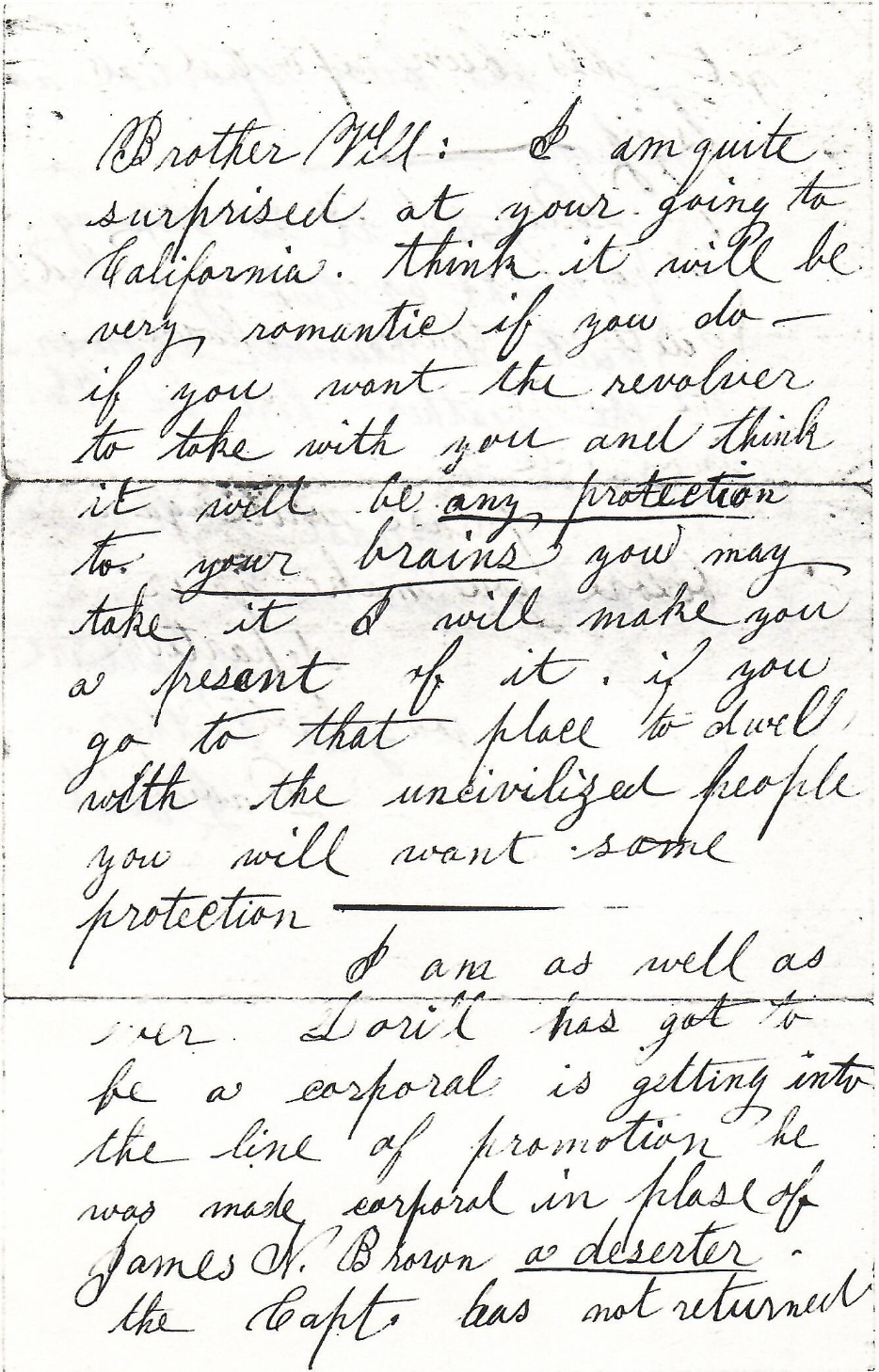
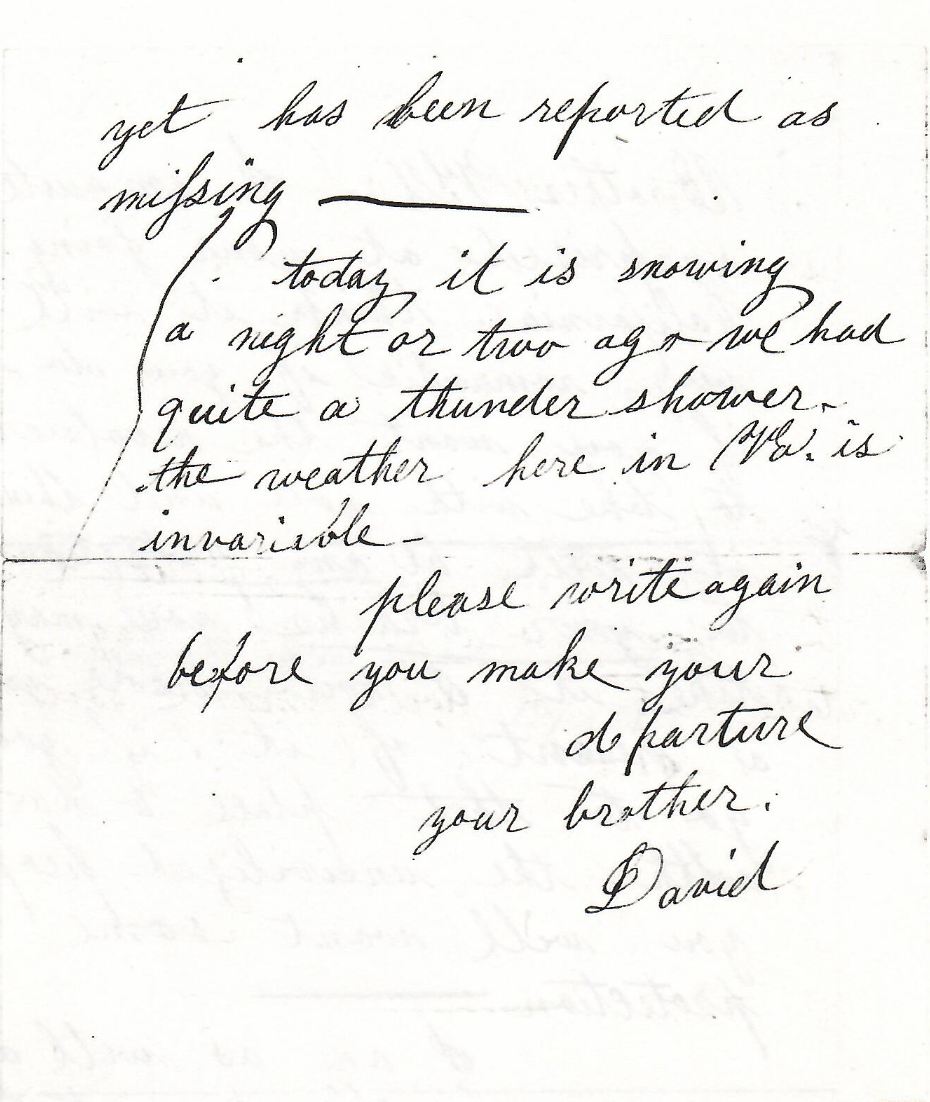
Brother Vill—I am quite surprised at your going to California. Think it will be very romantic if you do. If you want the revolver to take with you and think it will be ant protection to your brains, you may take it. I will make you a present of it. If you go to that place to dwell with the uncivilized people, you will want some protection. I am as well as ever. Dorill[us Hobbs] has got to be a corporal [and] is getting into the line of promotion. He was made corporal in place of James N. Brown, a deserter. The captain has not returned yet. Has been reported as missing. Today it is snowing. A night or two we had quite a thunder shower. Their weather here in Virginia is invariable. Please write again before you make your departure. Your brother, — David
1 David’s letter speaks on the regiment having only their blankets and no tents. They marched and camped through much of the wet autumn weather in 1862 without tents, overcoats, or proper gear, and were forced to wrapt themselves in blankets to sleep at night. This situation was so striking that other regiments sometimes mocked them and called them the “Blanket Brigade.”
Letter 8
Rappahannock Station
Sunday, November 16th
Dear Sister,
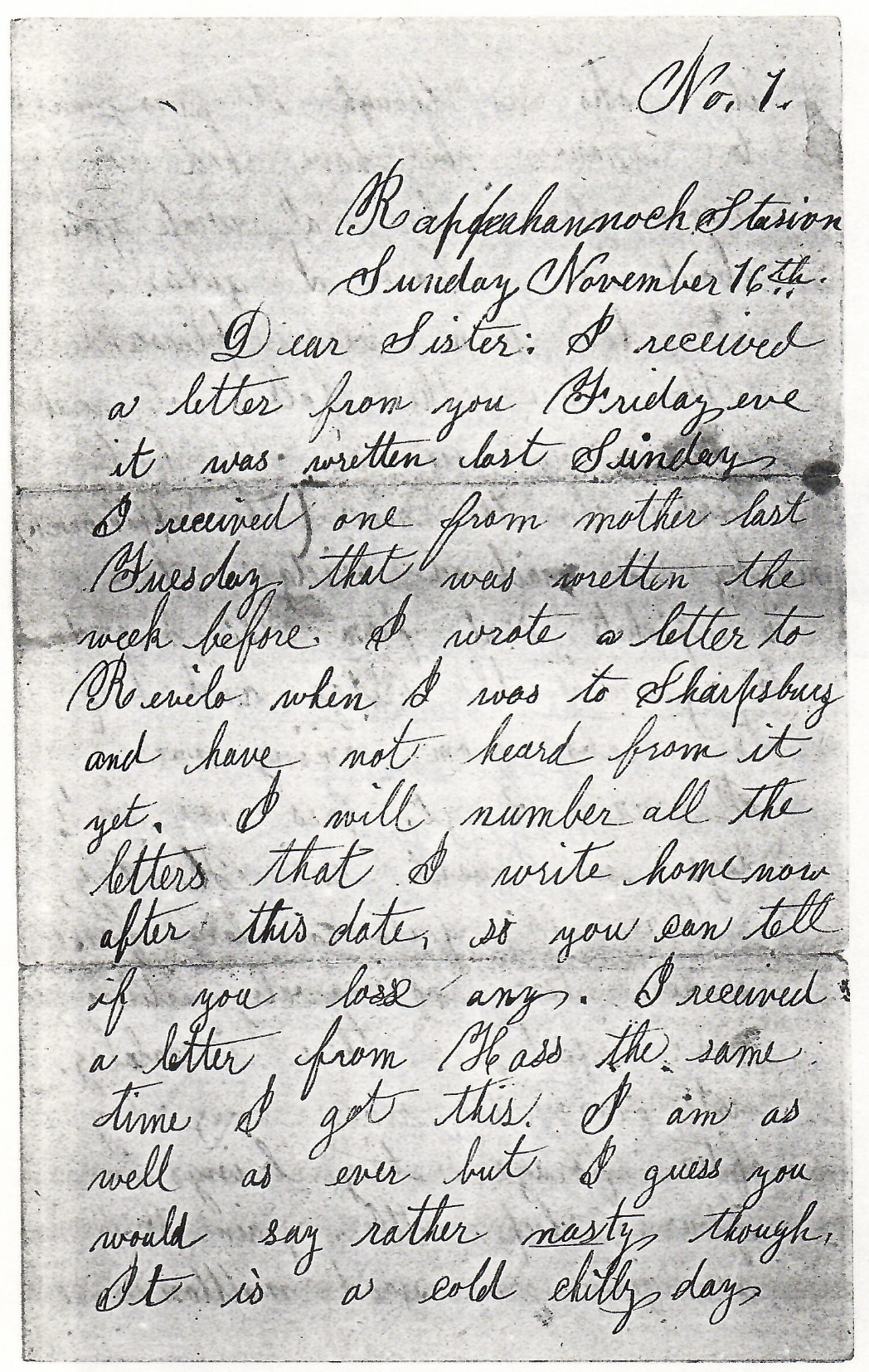
I received a letter from you Friday eve. It was written last Sunday. I received one from mother last Tuesday that was written the week before. I wrote a letter to Revillo when I was to Sharpsburg and have not heard from it yet. I will number all the letters that I write home now after this date so you can tell if you lose any. I received a letter from Hoss the same time I got this.
I am as well as ever but I guess you would say rather nasty though. It is a cold, chilly day. It looks as though it was going to snow storm here. I wrote you about it before, I guess. It has been very pleasant weather here this fall—not much rain.
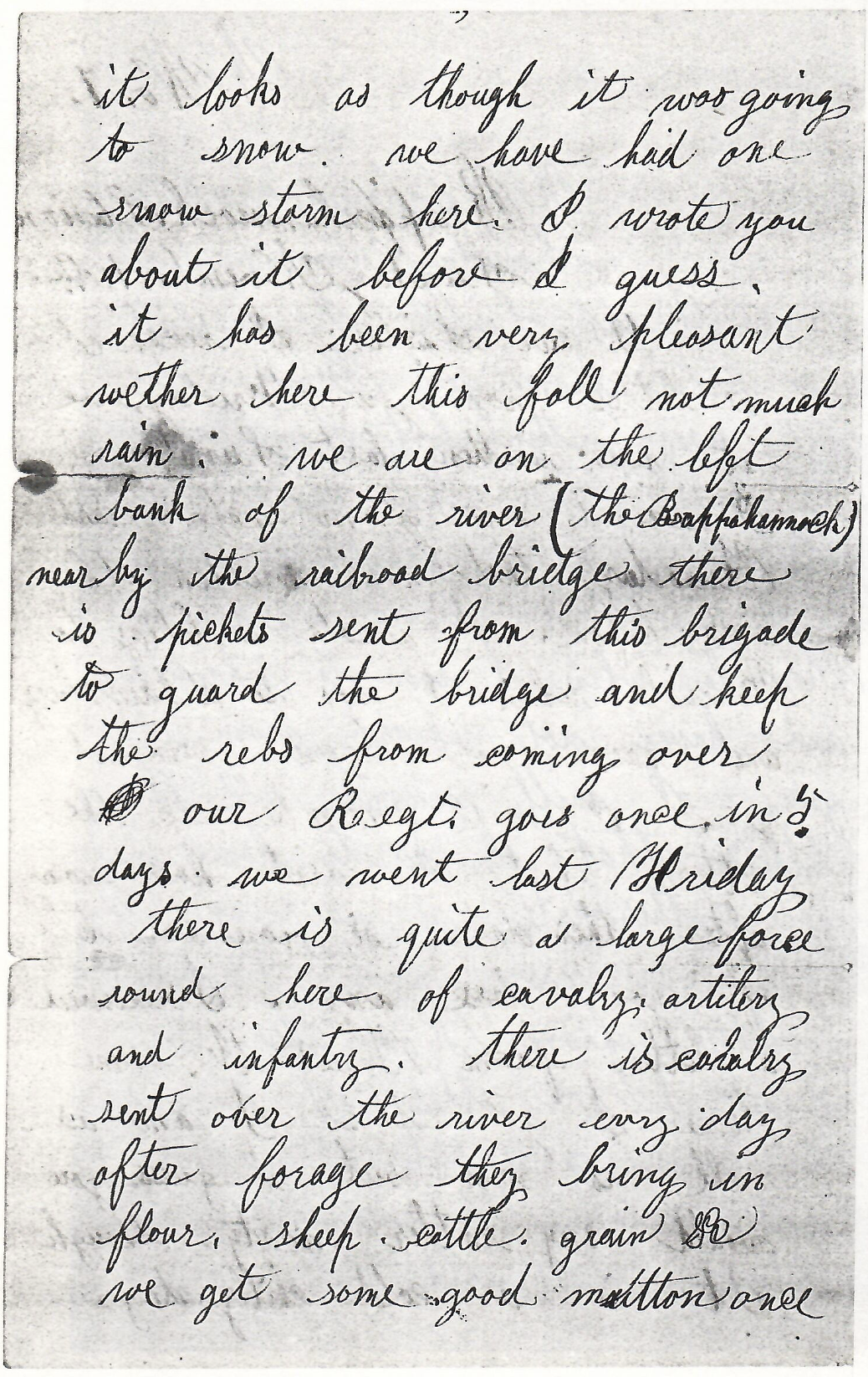
We are on the left bank of the river (the Rappahannock) near by the railroad bridge. There is pickets sent from this brigade to guard the bridge and keep the rebs from coming over. Our regiment goes once in five days. We went last Friday. There is quite a large force round here of cavalry, artillery, and infantry. There is cavalry sent over the river every day after forage. The bring in flour, sheep, cattle, grain, &c. We get some good mutton once in a while. It is the biggest half grease. The sheep out here are very fat.
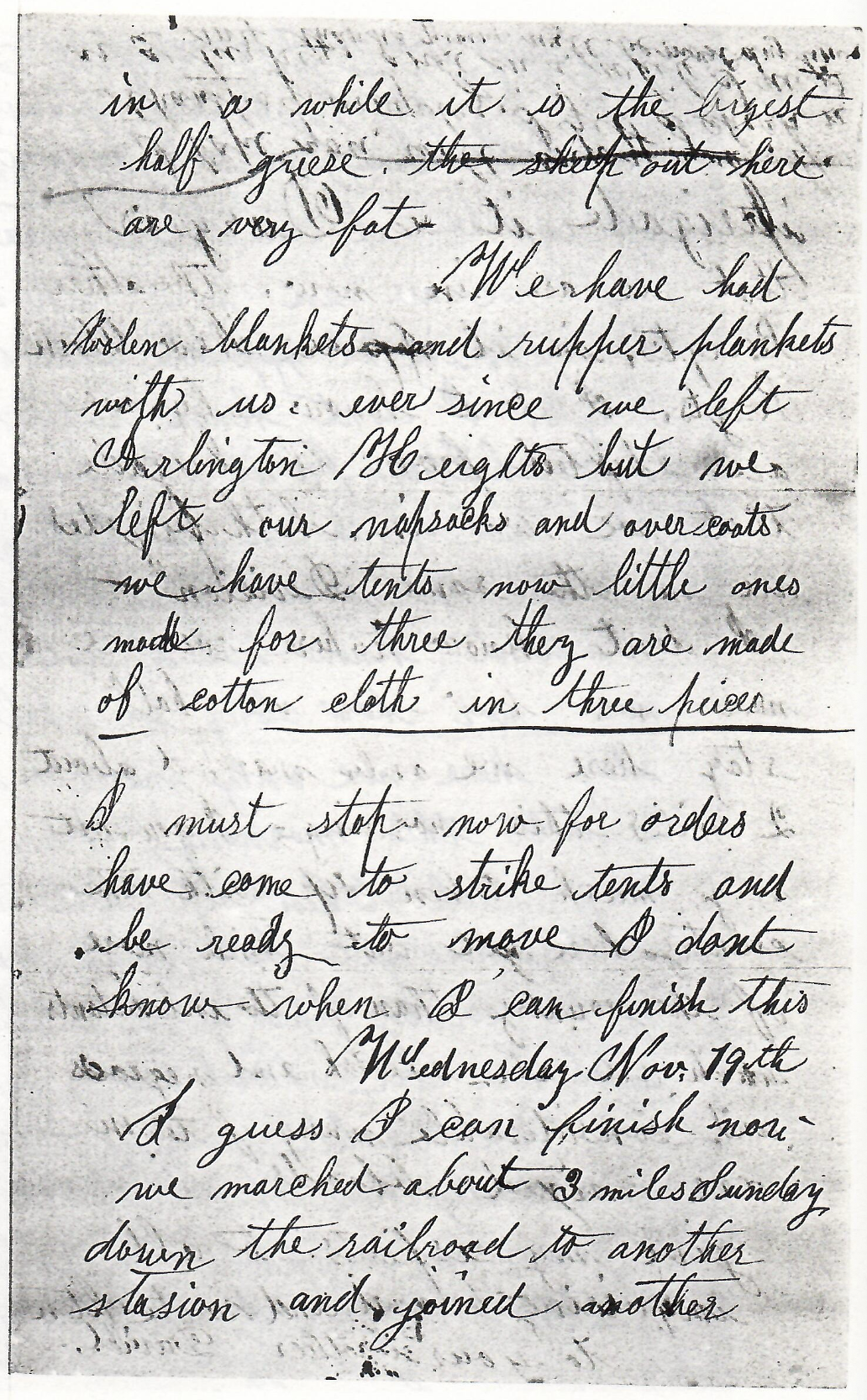
We have had woolen blankets and rubber blankets with us ever since we left Arlington Heights but we left our knapsacks and overcoats. We have tents now—little ones made for three. They are made of cotton cloth in three pieces.
I must stop now for orders have come to strike tents and be ready to move. I don’t know when I can finish this.
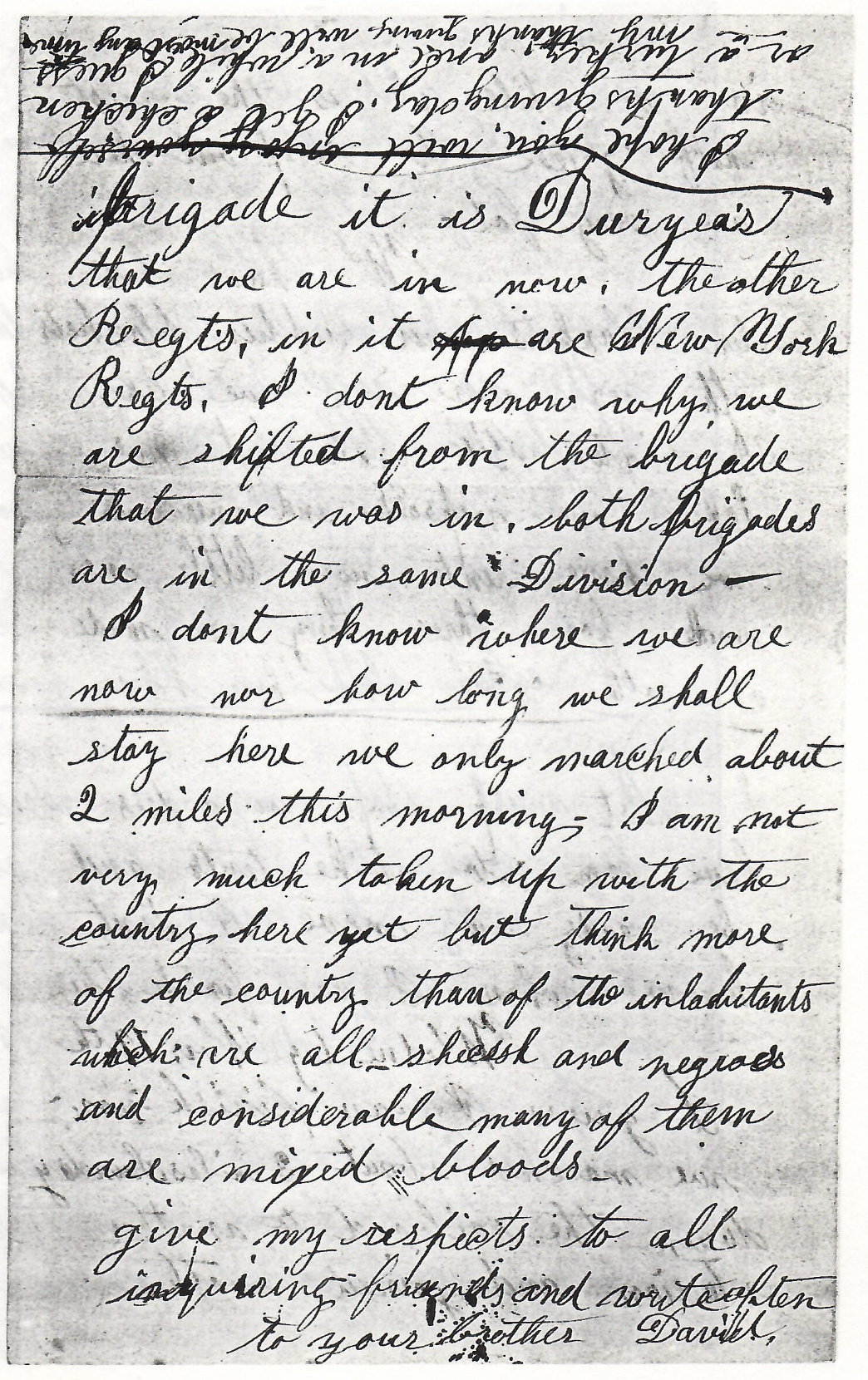
Wednesday, November 19th 1862—-I guess I can finish now. We marched about three miles Sunday down the railroad to another station and joined another brigade. It is Duryea’s that we are in now. The other regiments in it are [all] New York regiments. I don’t know why we are shifted from the brigade that we was in. Both brigades are in the same division.
I don’t know where we are now nor how long we shall stay here. We only marched about two miles this morning. I am not very n=much taken up with the country here yet but think more of the country than of the inhabitants which are all secesh and negroes and considerable many of them are mixed breeds.
Give my respects to all inquiring friends and write often to your brother, — David
I hope you will enjoy yourself Thanksgiving Day. I get a chicken or a turkey once in a while. I guess my Thanksgiving will be most anytime.
Letter 9
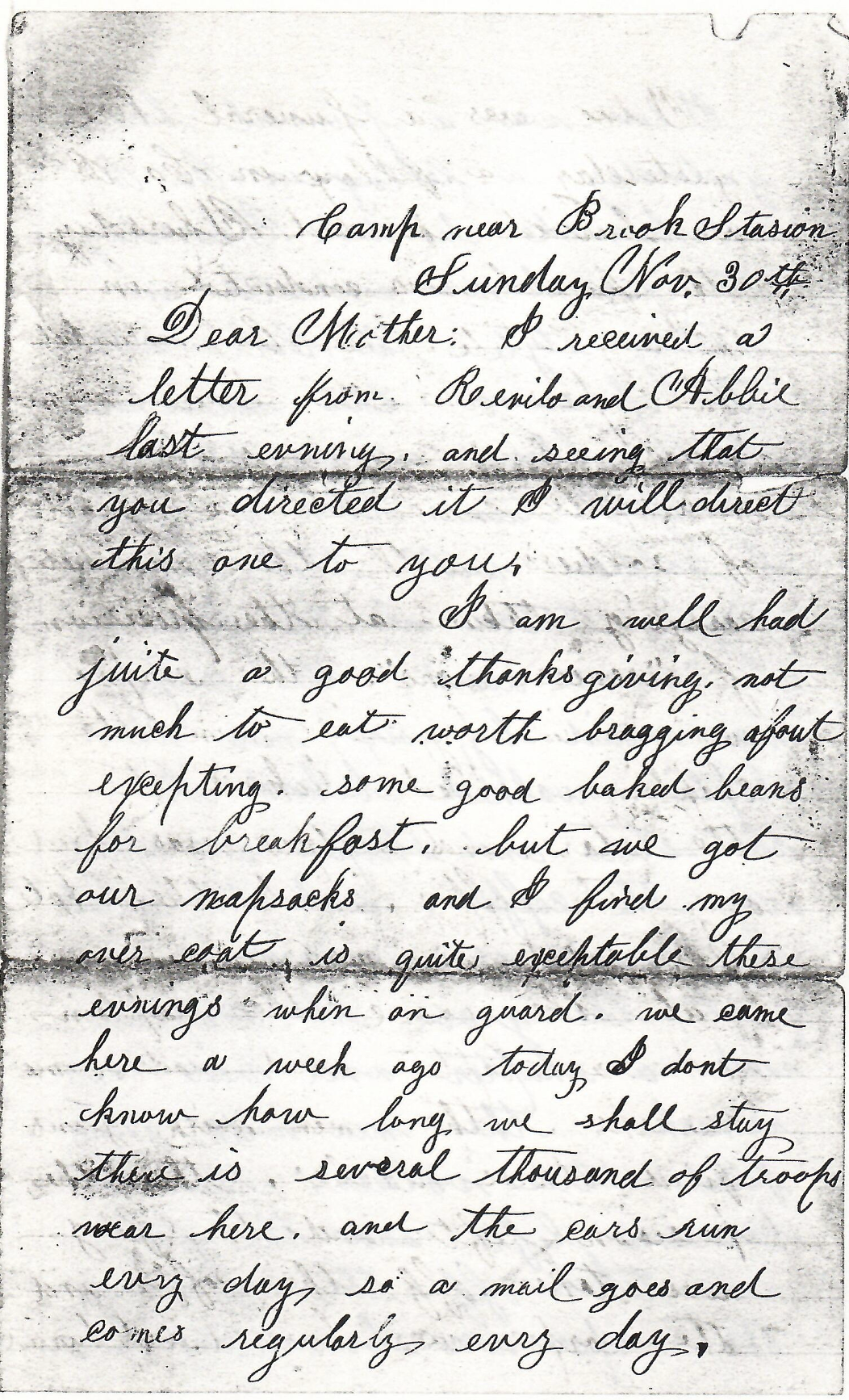
Camp near Brook Station
Sunday, November 30th [1862]
Dear Mother,
I received a letter from Revillo and Abbie last evening, and seeing that you directed it, I will direct this one to you.
I am well. Had quite a good Thanksgiving. Not much to eat worth bragging about excepting some good baked beans for breakfast. But we got knapsacks and I found my overcoat. It’s quite acceptable these evening when on guard. We came here a week ago today. I don’t know how long we shall stay. There is several thousands of troops here and the cars run every day so a mail goes and comes regularly every day.
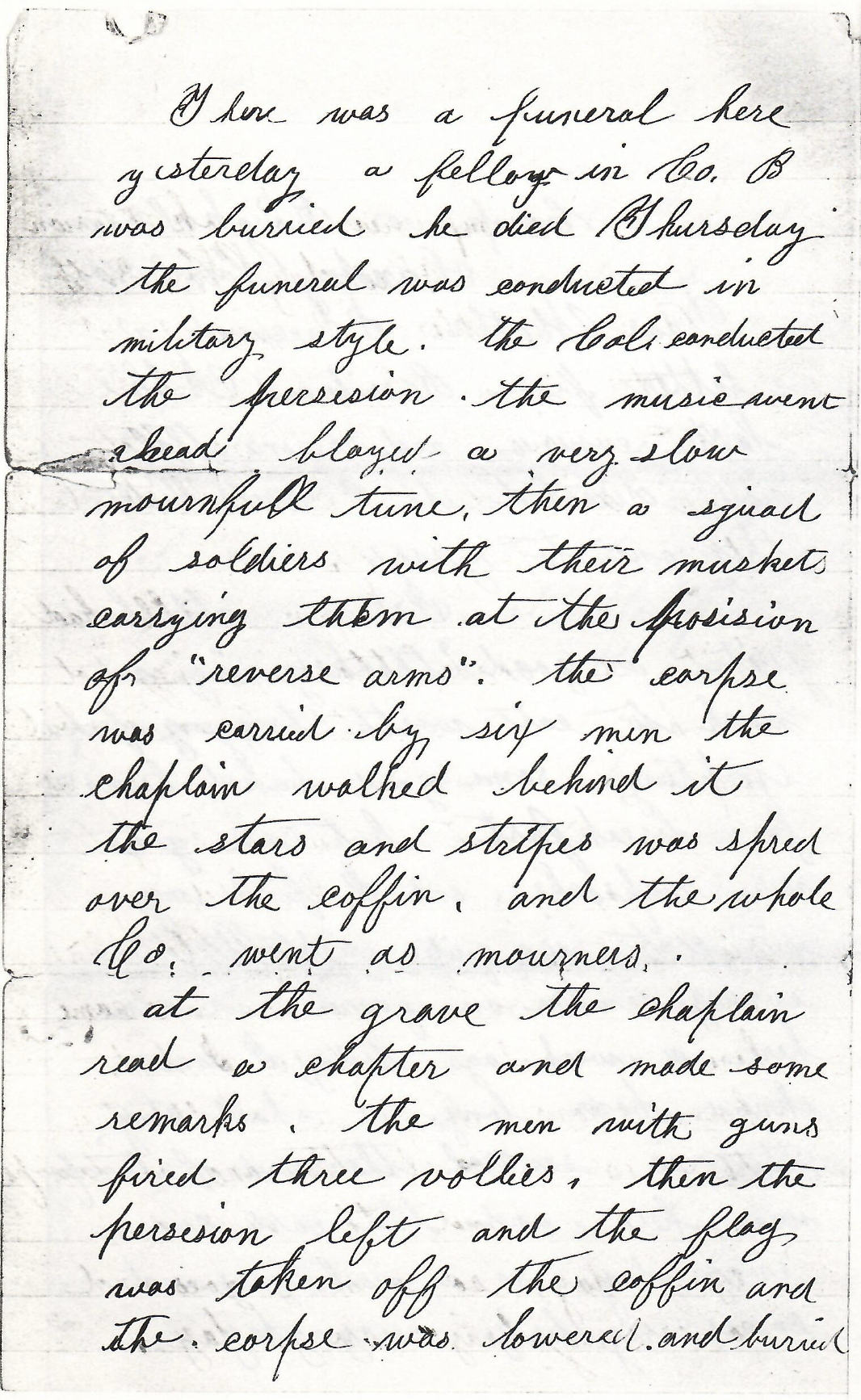
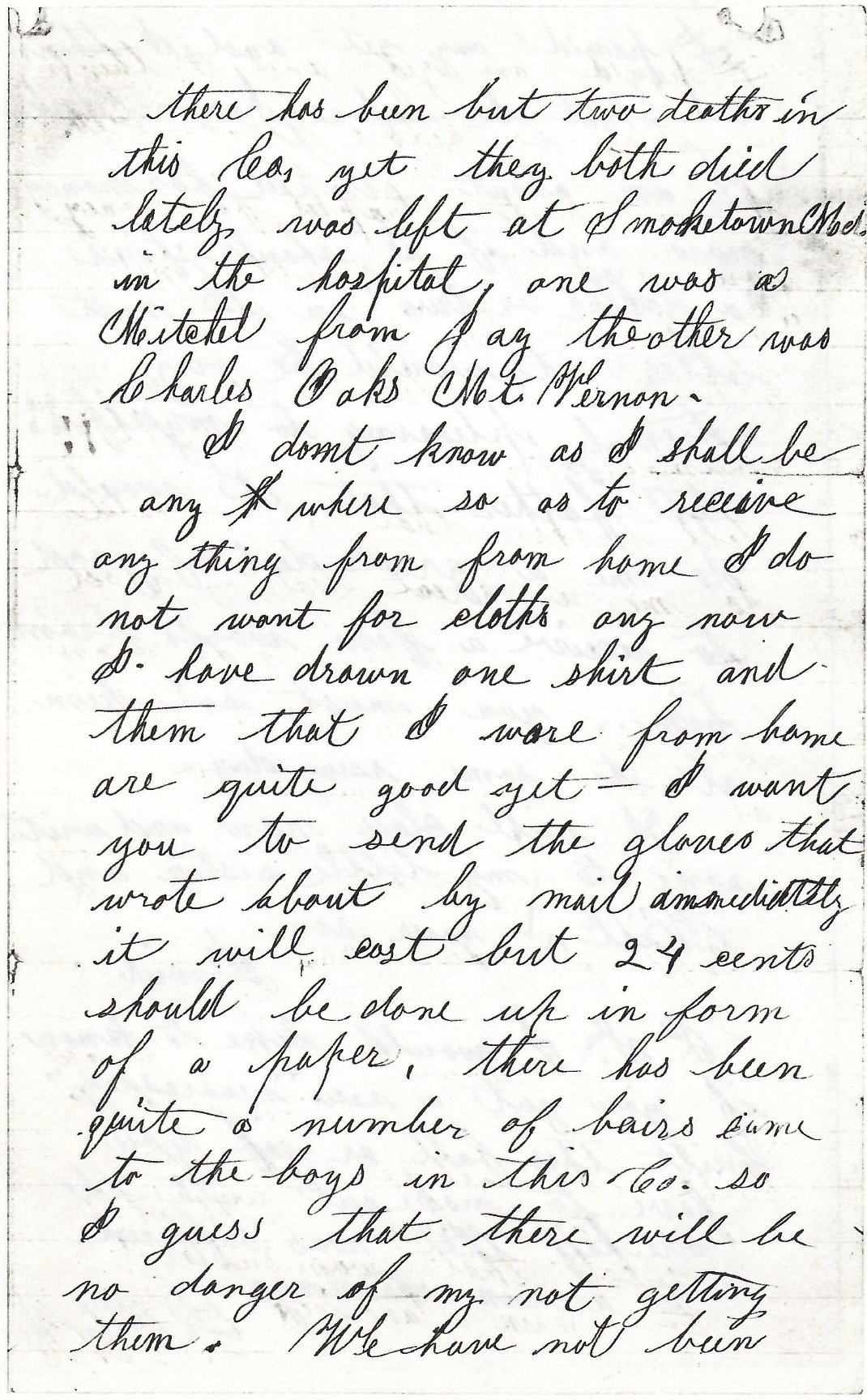
There was a funeral here yesterday—a fellow in Co. B was buried. He died Thursday. The funeral was conducted in military style. The Colonel conducted the procession. The music went ahead [and] played a very slow mournful tune. Then a squad of soldiers with their muskets, carryingthem at the position of “reverse arms.” The corpse was carried by six men. The chaplain walked behind it. The stars and strips was spread over the coffin and the whole company went as mourners. At the grave the chaplain read a chapter and made some remarks. The men with guns fired three volleys. Then the procession left and the flag was taken off the coffin and the corpse was lowered and buried. There has been but two deaths in this company yet. They both died lately. Was left at Smoketown, Maryland, in the hospital. One was a Mitchell from Jay. The other was Charles Oaks, Mt. Vernon.
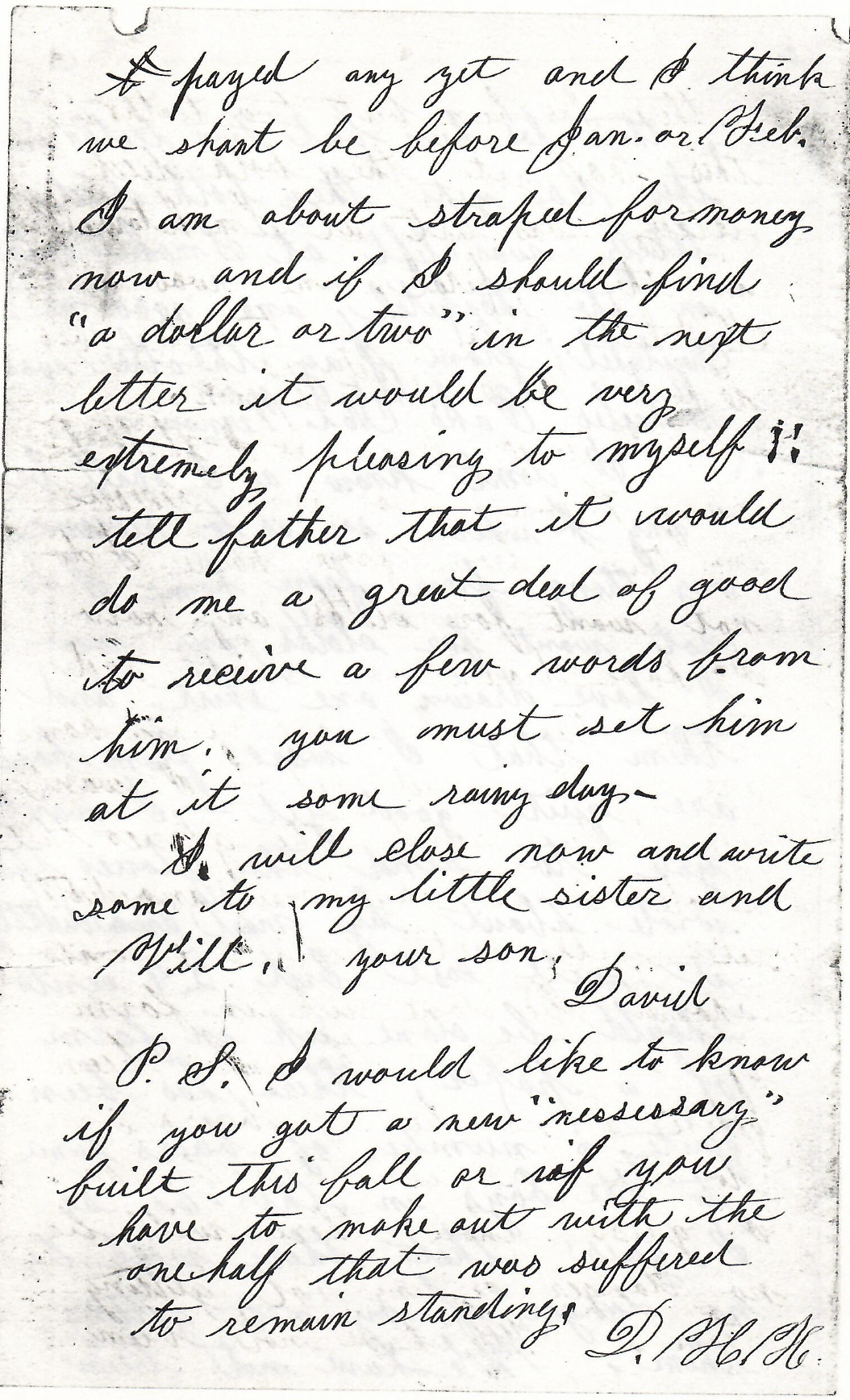
I don’t know as I shall be anywhere so as to receive anything from home. I do not want for clothes any now. I have drawn one shirt and them that I wore from home are quite good yet. I want you to send the gloves that [I] wrote about by mail immediately. It will cost but 24 cents. Should be done up in form of a paper. There has been quite a number of boxes come other the boys in this company so I guess that there will be no danger of my not getting them. We have not been paid any yet and I think we shan’t be before January or February. I am about strapped for money now and if I should find a “dollar or two” in the next letter, it would be very extremely pleasing to myself!
Tell father that it would do me a great deal of good to receive a few words from him. You must set him at it some rainy day. I will close now and write some to my little sister and Vill. Yours son, — Davis
P. S. I would like to know if you got a new “necessary” built this fall or if you have to make out with the one half that was suffered to remain standing. — D. H. H.
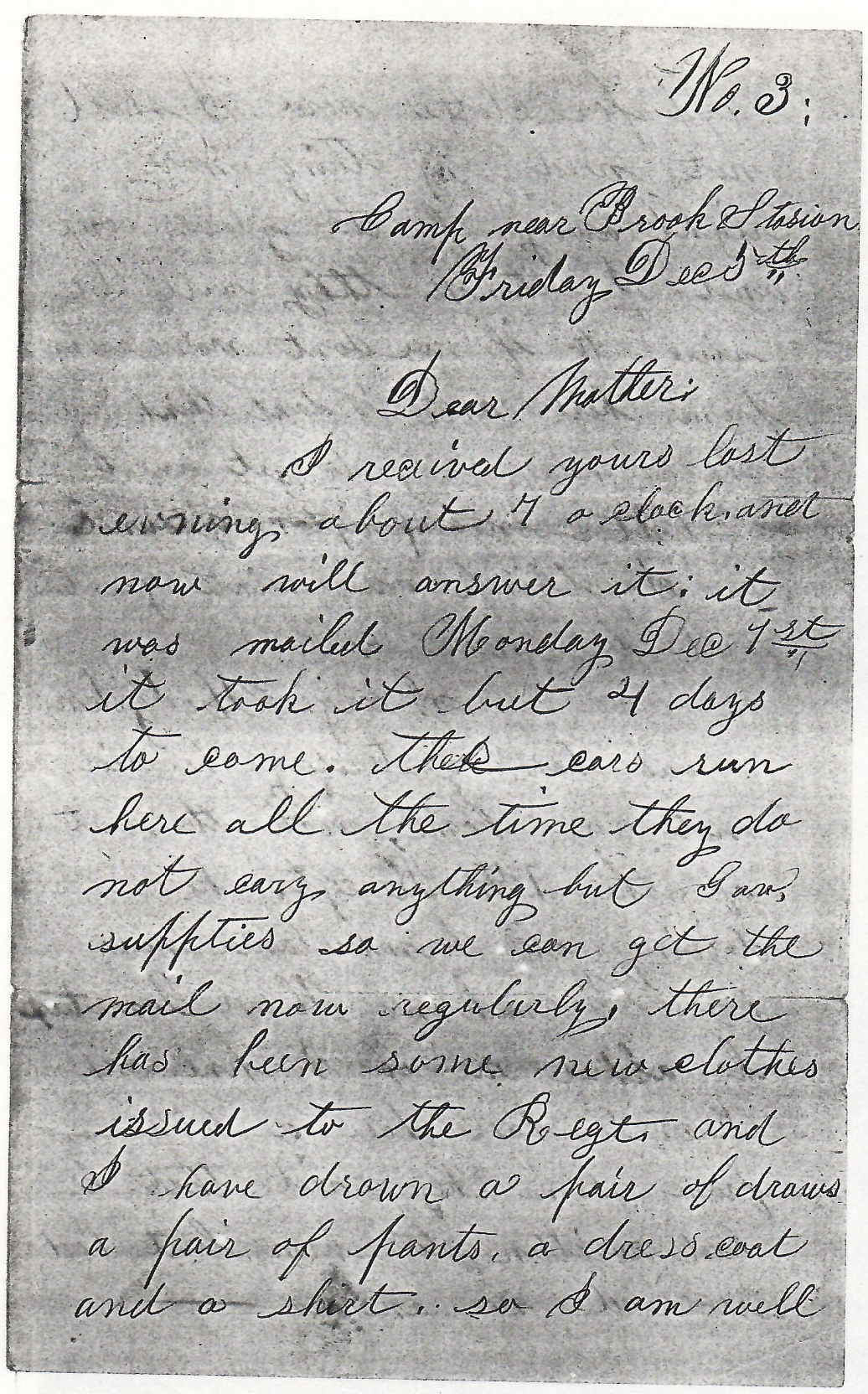
Letter 10
Camp near Brook Station
Friday, December 5, 1862
Dear Mother,
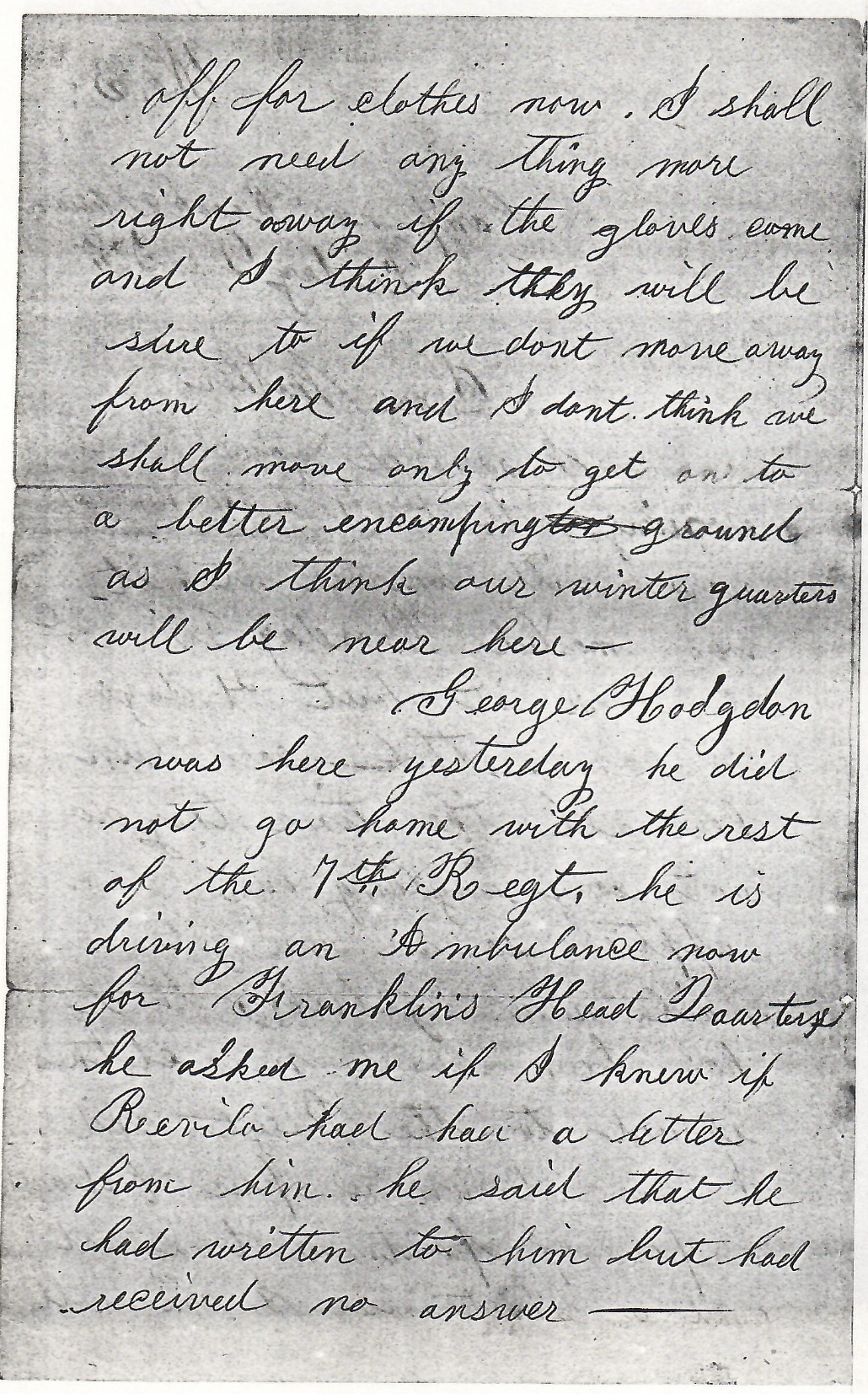
I received yours last evening about 7 o’clock and now will answer it. It was mailed Monday, December 1st. It took but four days to come. The cars run here all the time. They do not carry anything but government supplies so we can get the mail now regularly. there has been some new clothes issued to the regiment and I have drawn a pair of drawers, a pair of pants, a dress coat, and a shirt so I am well off for clothes now. I shall not need anything more right away if the gloves come—and I think they will be sure to if we don’t move away from here. And I don’t think we shall move, only to get a better camping ground as I think our winter quarters will be near here.
George Hodgdon was here yesterday. He did not go home with the rest of the 7th [Maine] Regiment. He is driving an ambulance now for Franklin’s Headquarters. He asked me if I knew Revillo had had a letter from him. He said that he had written to him but had received no answer.
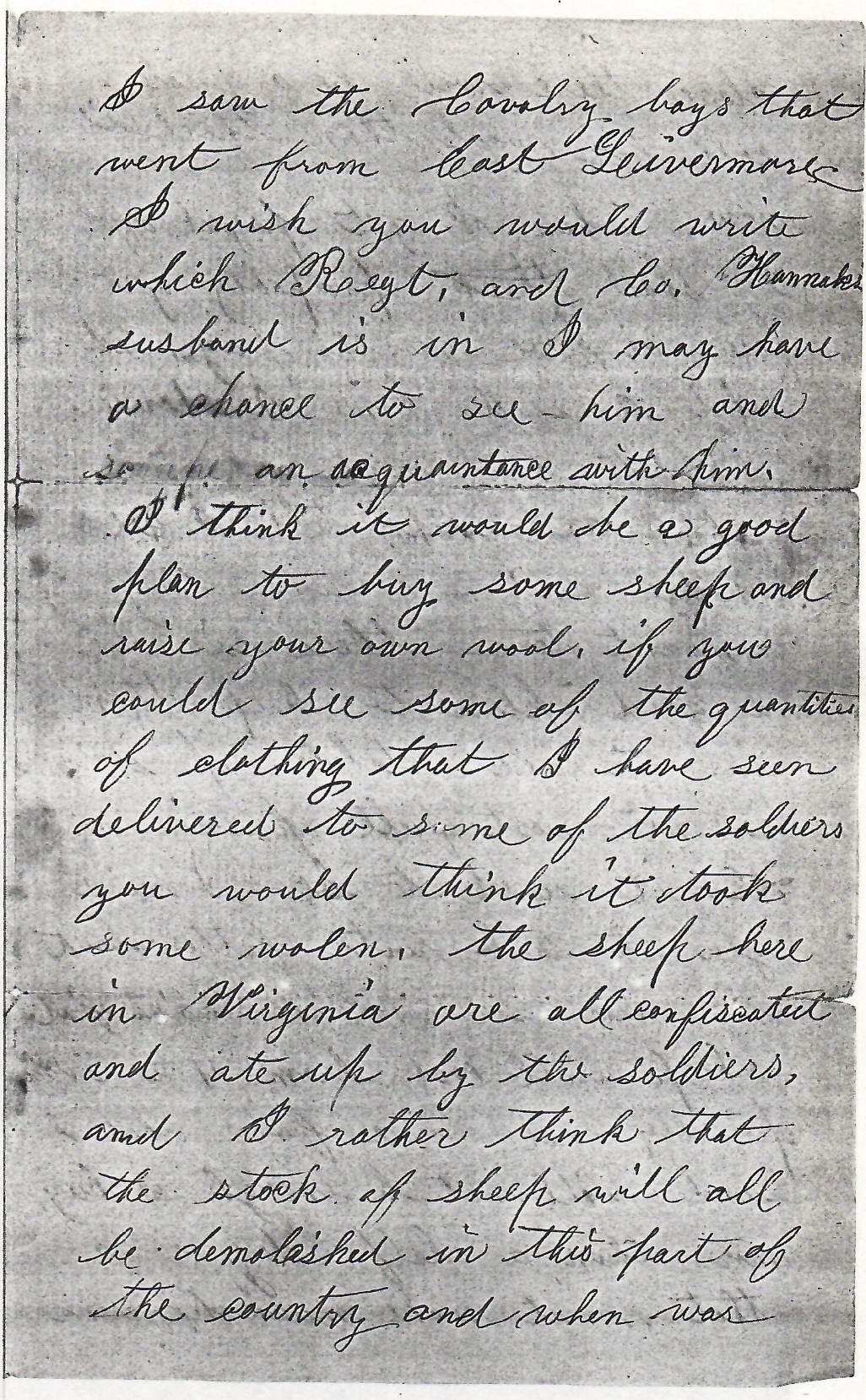
I saw the cavalry boys that went from East Livermore. I wish you would write which regiment and company Hanna’s husband is in. I may have a chance to see him and strike an acquaintance with him.
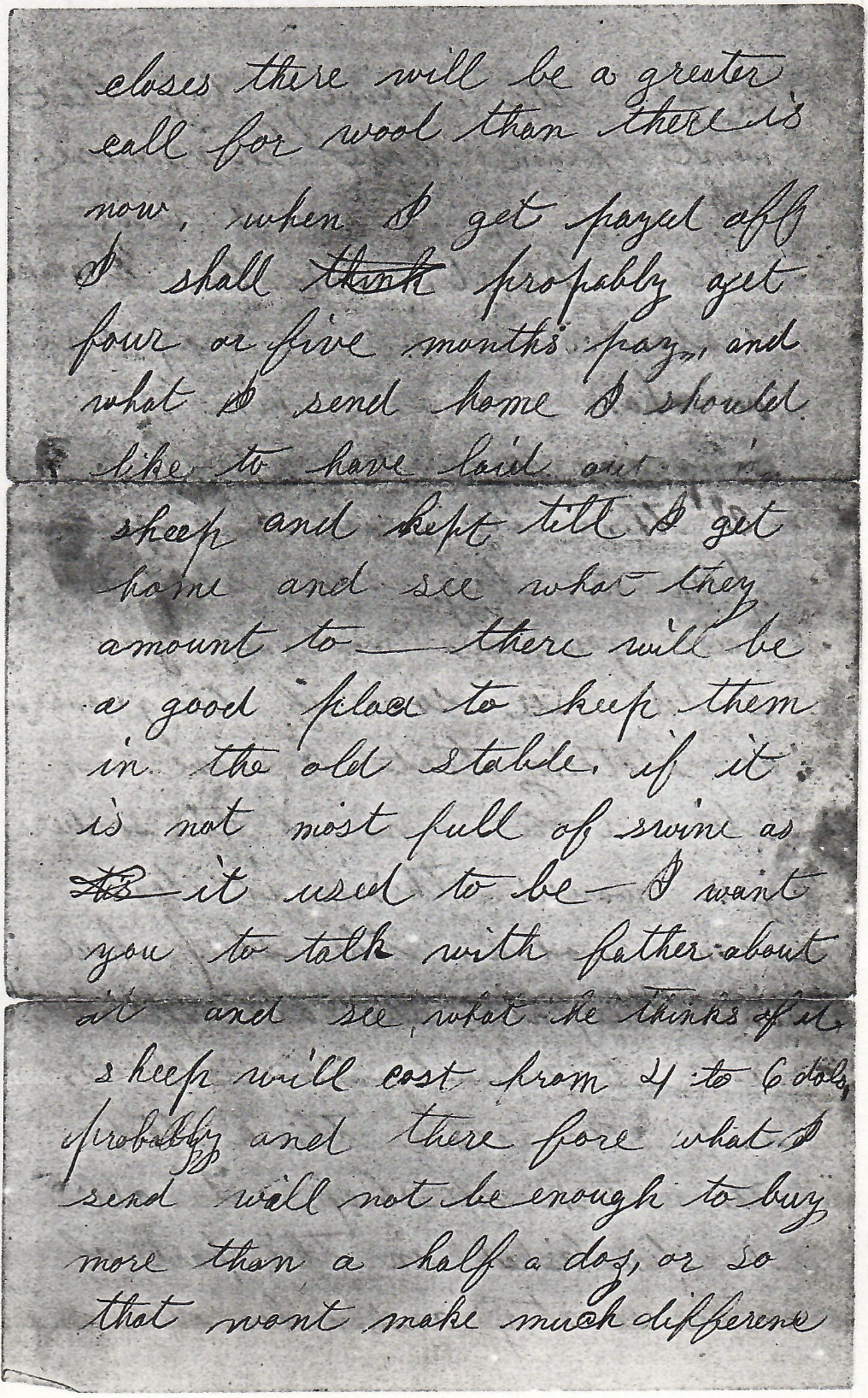
I think it would be a good plan to buy some sheep and raise your own wool. If you could see some of the quantities of clothing that I have seen delivered to some of the soldiers, you would think it took some wool. The sheep here in Virginia are all confiscated and ate up by the soldiers and I rather think that the stock of sheep in this part of the country and when war closes there will be a greater call for wool than there is now.
When I get paid off, I shall probably get four or five months pay and what I send home I should like to have laid out in sheep and kept till I get home and see what they amount to. There will be a good place to keep them in the old stable if it is not full of swine as it used to be. I want you to tell father about it and see what he thinks of it. Sheep will cost from 4 to 6 dollars probably and therefore what I send will not be enough to buy more than a half a dozen or so. That won’t make much difference. [remainder of letter missing].
Letter 11
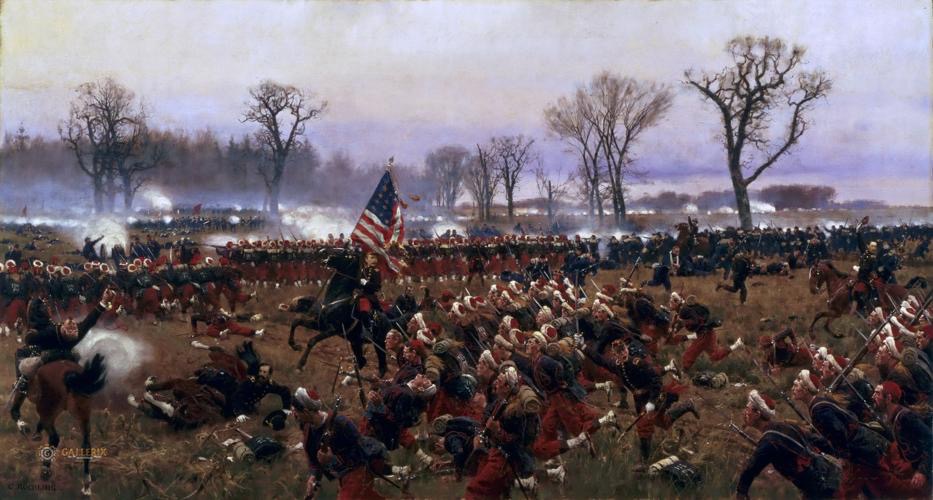
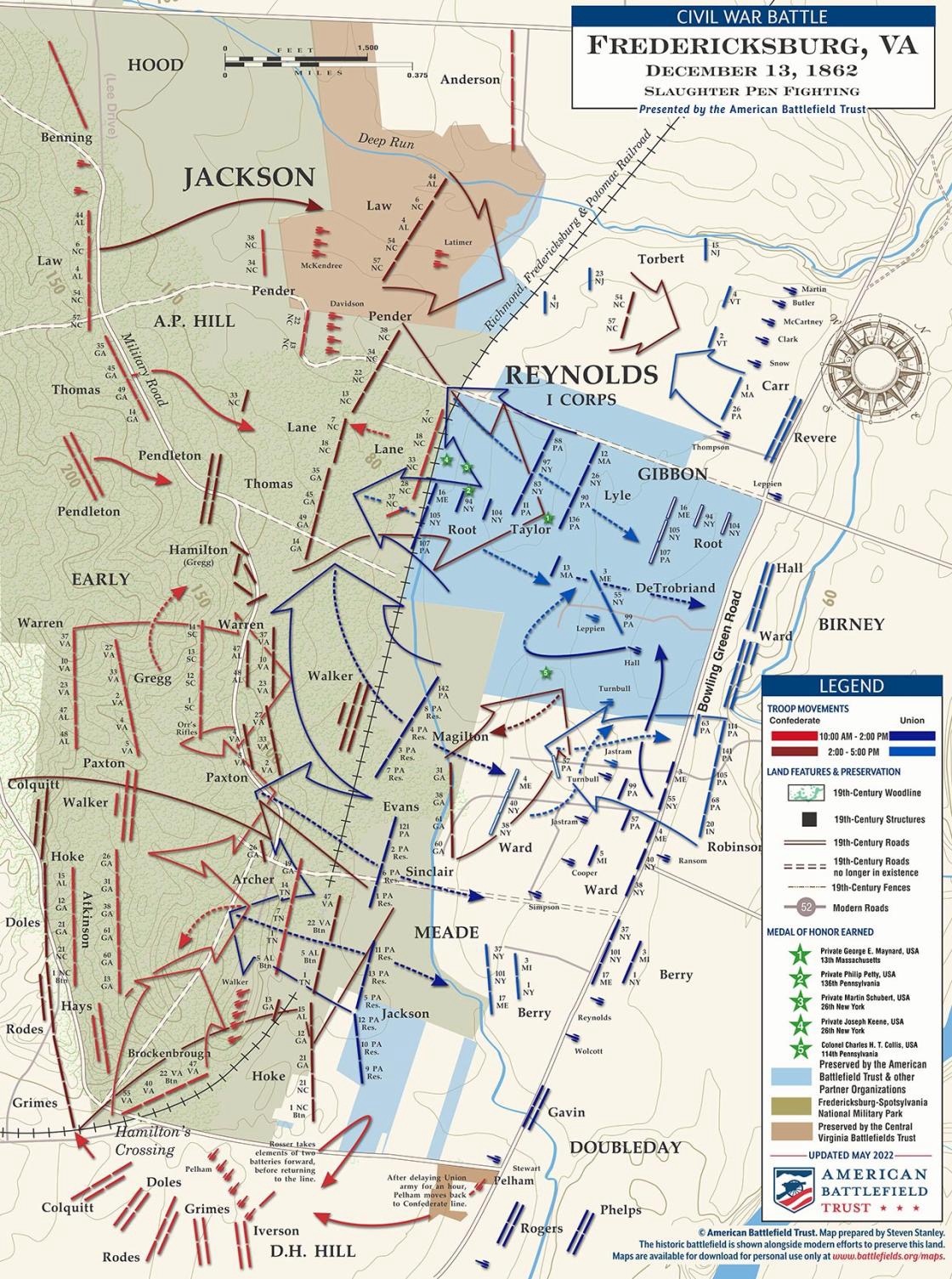
[Editor’s Note: In the letter that follows, David describes the fighting by the 16 Maine on the Union left flank at the Slaughter Pen Farm under the command of General George Meade. On 13 December 1862 they charged across an open muddy field towards a heavily defended Confederate line entrenched along the Richmond, Fredericksburg & Potomac Railroad embankment. In a ferocious “bulldog” effort, they actually broke through the Confederate line, suffering a devastating 54% casualty rate but winning the deep respect of the entire Army of the Potomac. See Horror and Heroism at the Slaughter Pen Farm by Kristopher D. White.]
Camp near Fredericksburg, Virginia
Thursday, December 18th [1862]
Dear Mother,
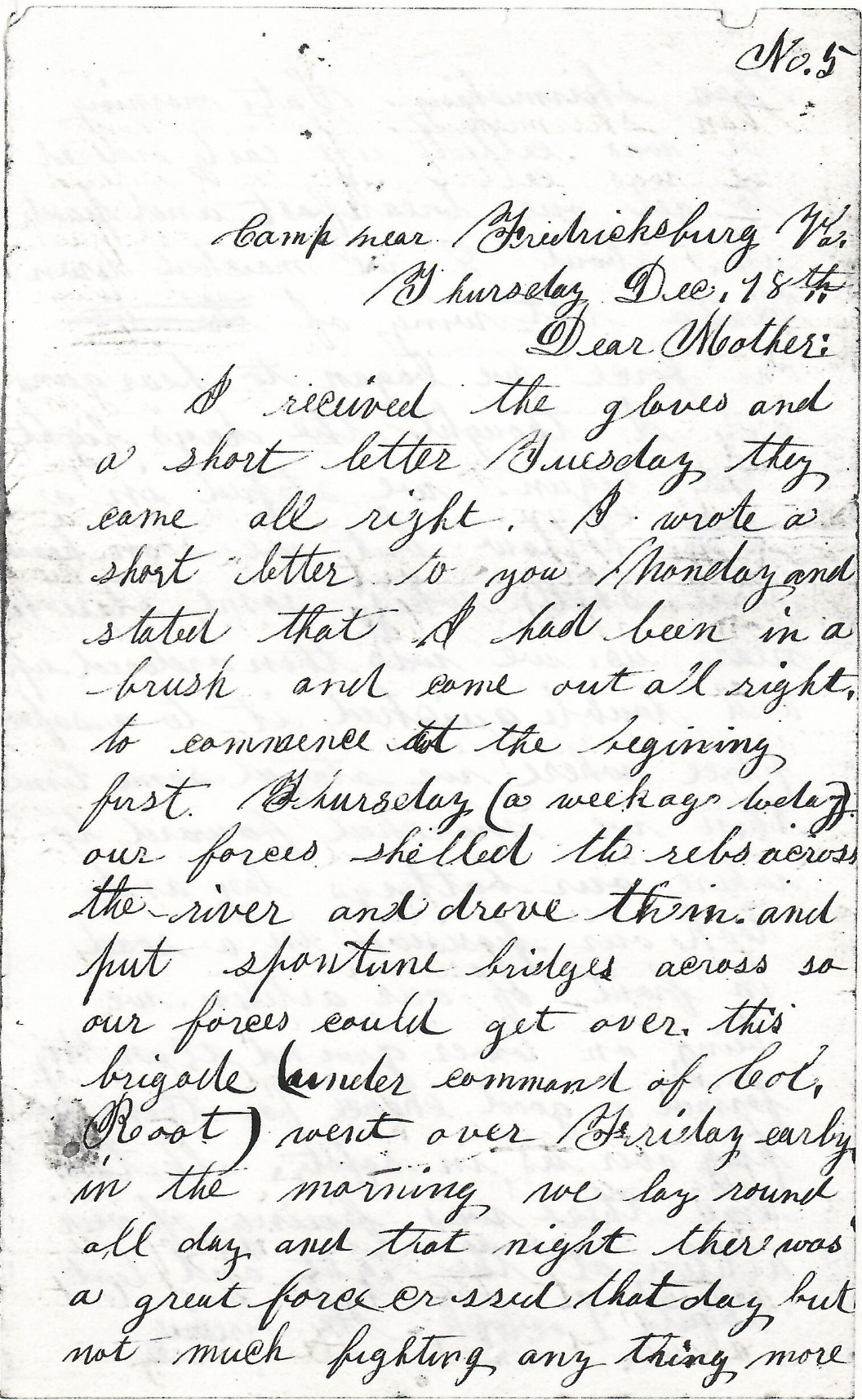
I received the gloves and a short letter Tuesday. They came all right. I wrote a short letter to you Monday and stated that I had been in a brush and came out all right.
To commence at the beginning (a week ago today), our forces shelled the rebs across the river and drove them and put spontune [pontoon] bridges across so our forces could get over. This brigade (under command of Col. Root) went over Friday early in the morning. We lay round all day and that night there was a great force crossed that day, but not much fighting—anything more than skirmishing.
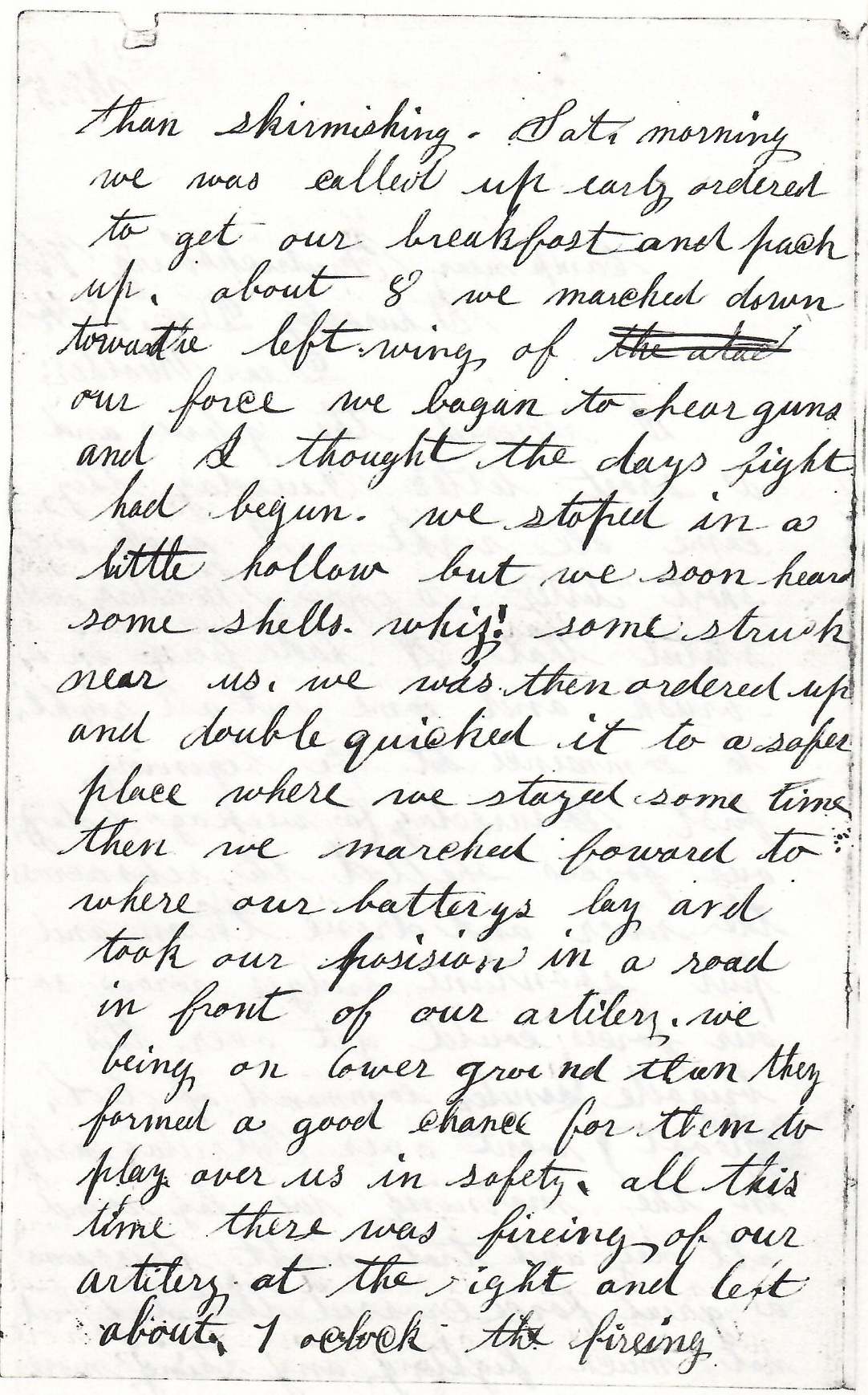
Saturday morning we was called up early, ordered to get our breakfast and pack up. About 8 we marched down toward the left wing of our force. We began to hear guns and I thought the day’s fight had begun. We stopped in a little hollow but we soon heard some shells whiz! Some struck near us. We was then ordered up and double-quicked it to a safer place where we stayed some time. Then we marched forward to where our batteries lay and took our position in a road in front of our artillery [where] we, being on lower ground than they, formed a good chance for them to play over us in safety. All this time there was firing of our artillery at the right and left.
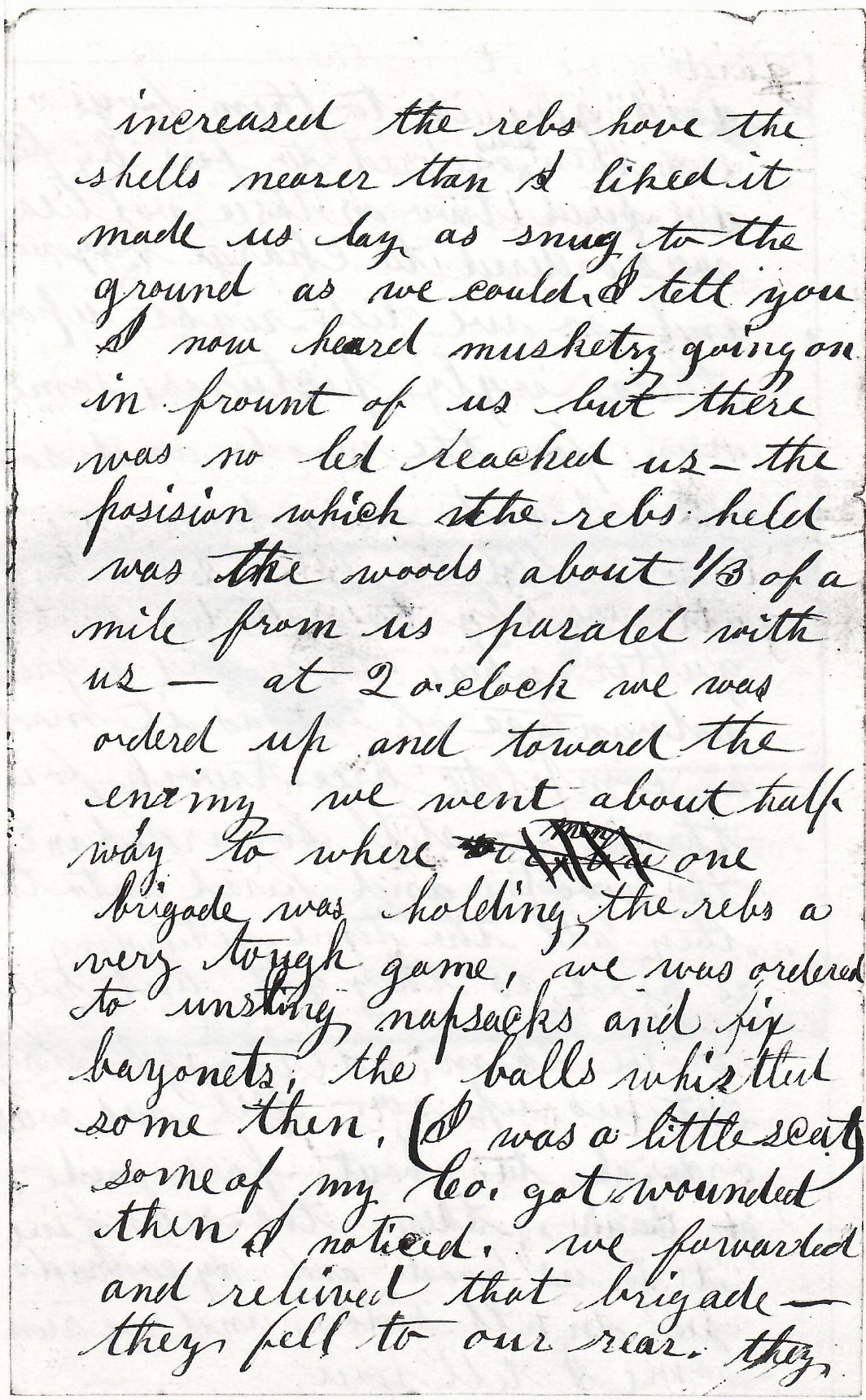
About 1 o’clock the firing increased. The rebs have the shells [landing] nearer than I liked it [which] made us lay as snug to the ground as we could, I tell you. I now heard musketry going on in front of us but there was no lead reached us. The position which the rebs held was the woods about one-third of a mile from us, parallel with us. At 2 o’clock we was ordered up and toward the enemy we went, about halfway to where one brigade was holding the rebs a very tough game. We was ordered to unsling knapsacks and fix bayonets. The balls whistled some then (I was a little scared). Some of my company got wounded then I noticed. We forwarded and relieved that brigade—they fell to our rear. They said, “Give it to them boys!”
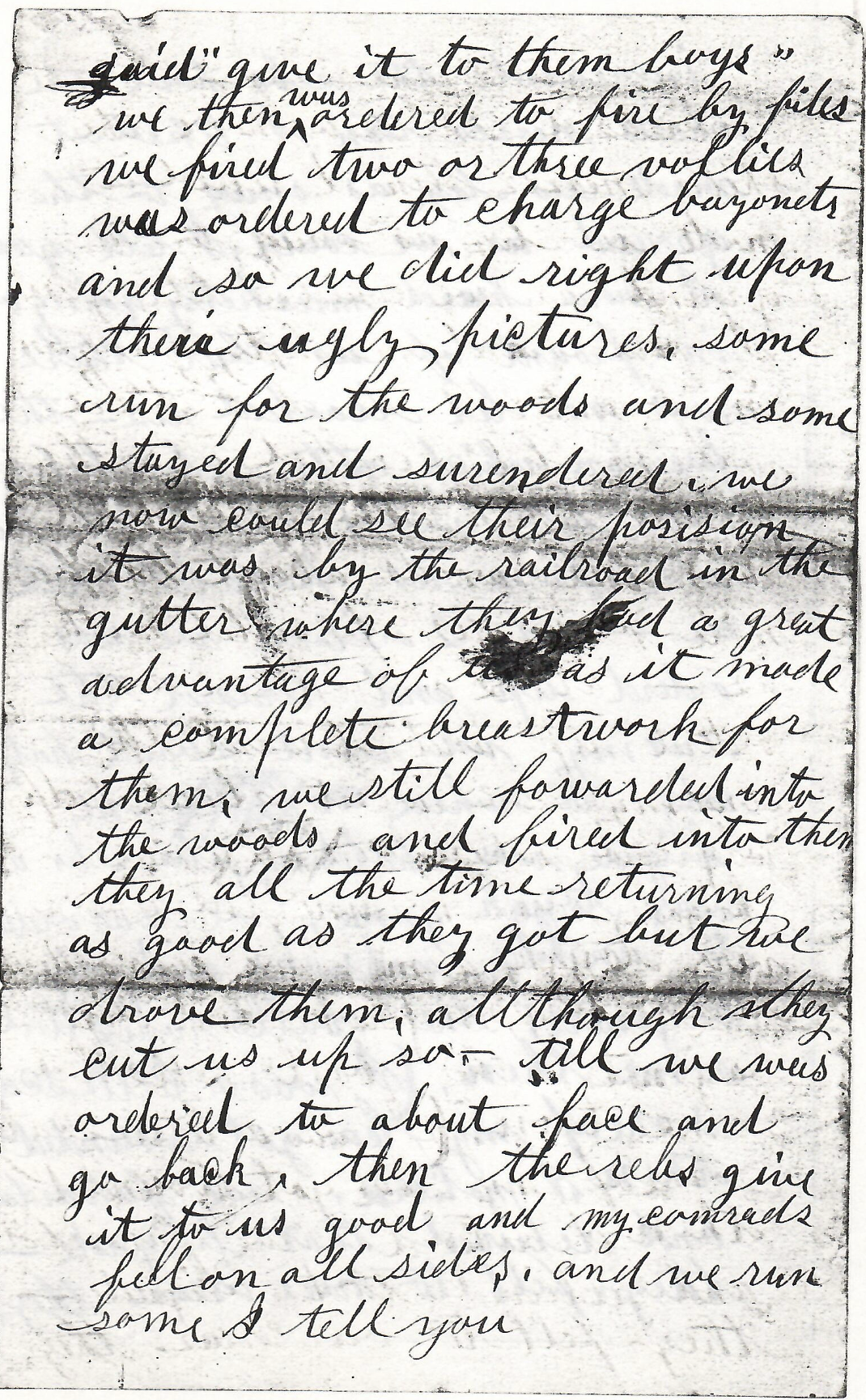
We then was ordered to fire by files. We fired two or three volleys, was ordered to charge bayonets, and so we did, right upon their ugly pictures. Some run for the woods and some stayed and surrendered. We now could see their position [more clearly]. It was by the railroad in the gutter where they had a great advantage of us as it made a complete breastwork for them. We still forwarded into the woods and fired into them, they all the time returning as good as they got, but we drove them although they cut us up so till we was ordered to about face and go back. Then the rebs give it to us good and my comrades fell on all sides and we run some, I tell you.
Letter 12
Camp (I don’t know where)
Monday, December 22nd, [1862]
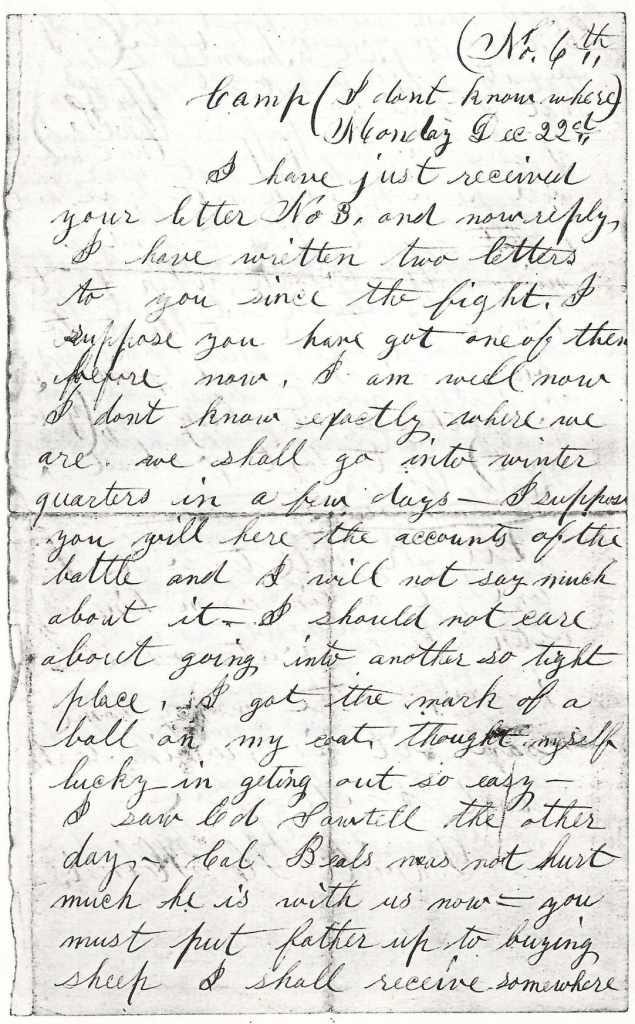
I have just received your letter No. 3 and now reply. I have written two letters to you since the fight. I suppose you have gone one of them before now. I am well now. I don’t know exactly where we are. We shall go into winter quarters in a few days.
I suppose you will hear the accounts of the battle and I will not say much about it. I should not care about going into another so tight place. I got the mark of a ball on my coat, thought myself lucky in getting out so easy. I saw Ed Sawtelle the other day. Cal[vin] Beals was not hurt much. He is with us now.
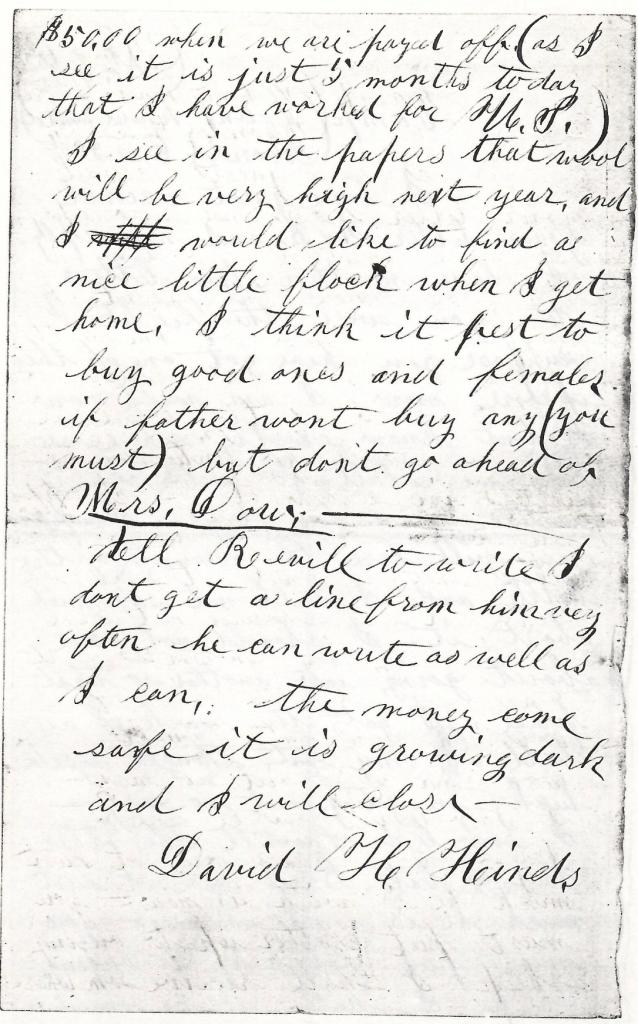
You must put father up to buying sheep. I shall receive somewhere around $50 when we are paid off (as I see it, it is just 5 months today that I have worked for U. S.). I see in the papers that wool will be very high next year and I would like to find a nice little flock when I get home. I think it best to buy good ones and females. If father won’t buy any, you must. But don’t go ahead of Mrs. Dow.
Tell Revill to write. I don’t get a line from him very often. He can write as well as I can. The money come safe. It is growing dark and I will close. — David H. Hinds
Letter 13
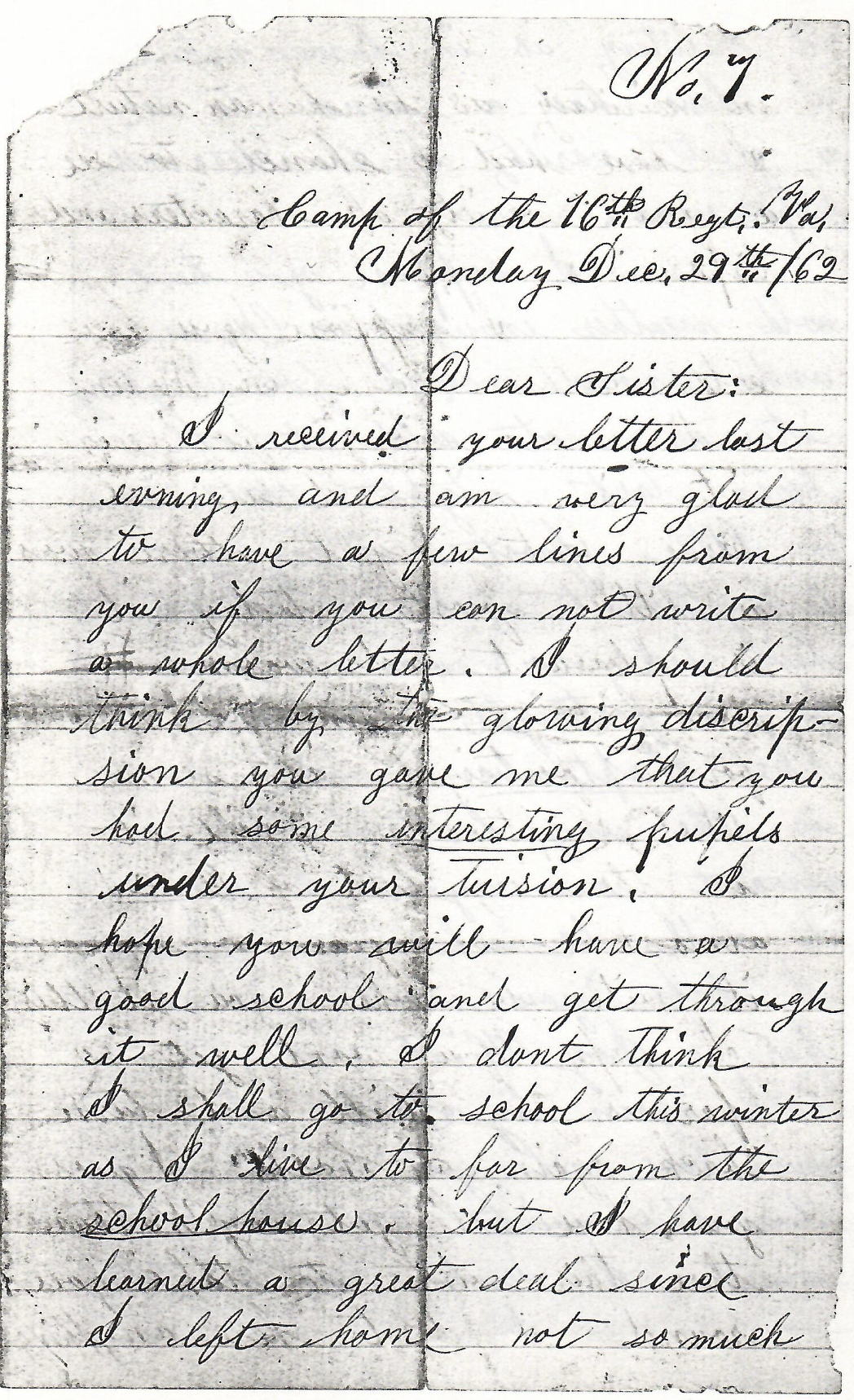
Camp of the 16th Regiment, Virginia
Monday, December 29th 1862
Dear Sister,
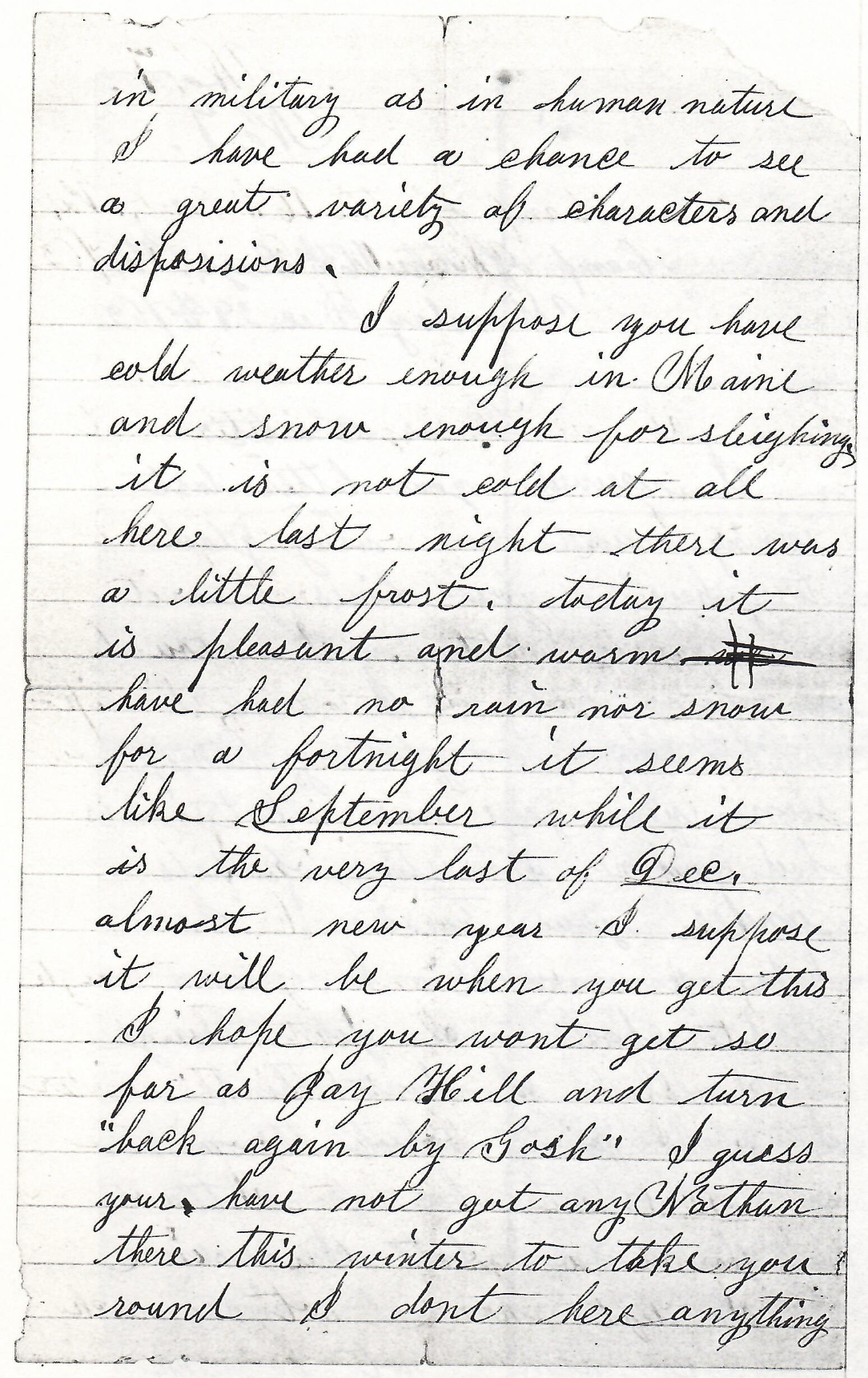
I received your letter last evening and am very glad to have a few lines from you [even] if you cannot write a whole letter. I should think by the glowing description you gave me that you had some interesting pupils under your tuition. I hope you will have a good school and get through it well. I don’t think I shall go to school this winter as I live too far from the schoolhouse. But I have learned a great deal since I left home—not so much in military as in human nature. I have had a chance to see a great variety of characters and dispositions.
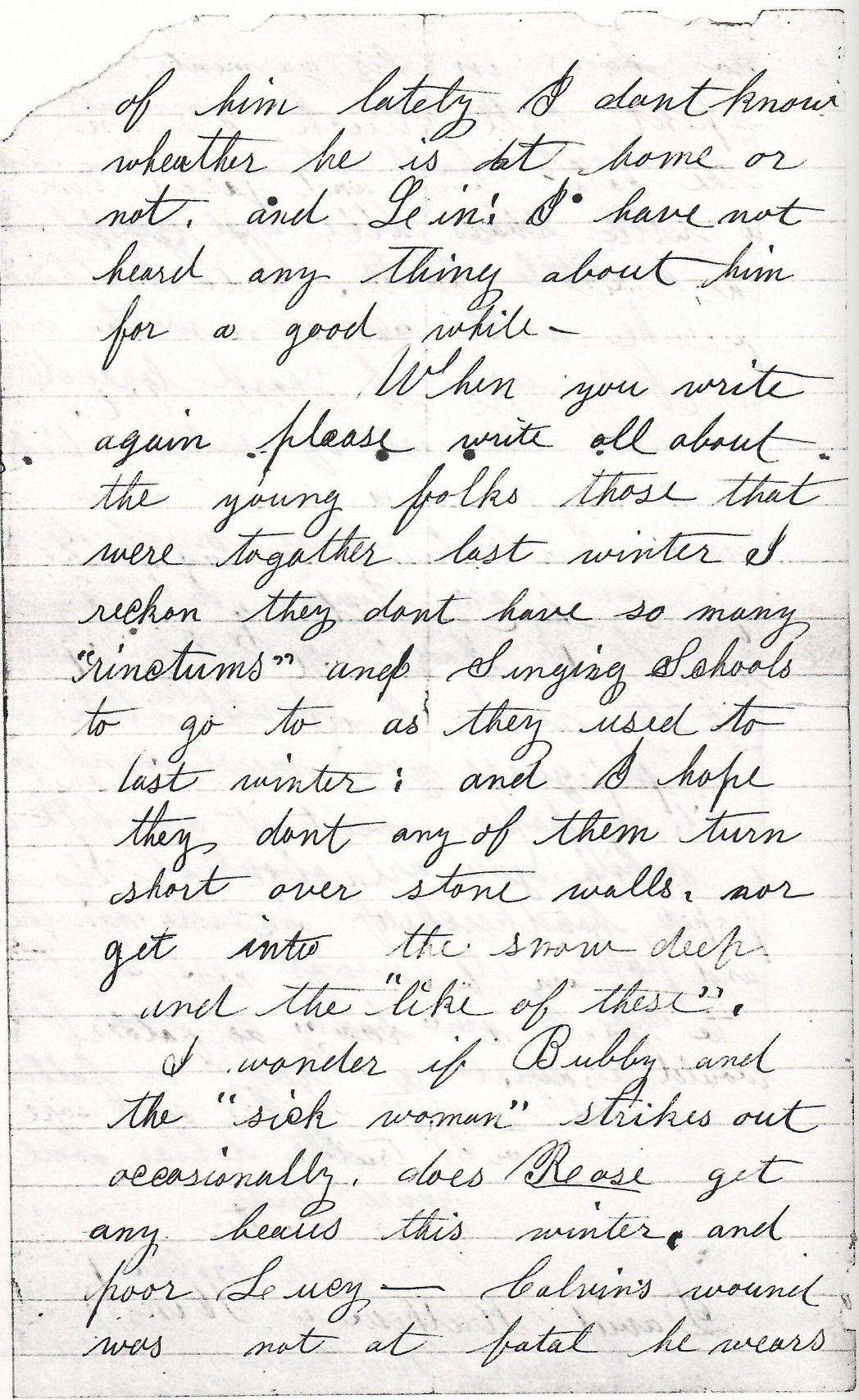
I suppose you have cold weather enough in Maine and snow enough for sleighing. It is not cold at all here. Last night there was a little frost. Today it is pleasant and warm. Have had no rain nor snow for a fortnight. It seems like September while it is the very last of December—almost New Years. I suppose it will be when you get this. I hope you won’t get so far as Jay Hill and “turn back by gosh.” I guess you have not got any Nathan there this winter to take you round. I don’t hear anything of him lately. I don’t know whether he is at home or not and Lin: I have not heard anything about him for a good while.
When you write again, please write all about the young folks—those that were together last winter. I reckon they don’t have so many “rinctums” and singing schools to go to as they used to last winter. AndI hope they don’t any of them turn short over stone walls, nor get into the snow deep and the “like of these.”
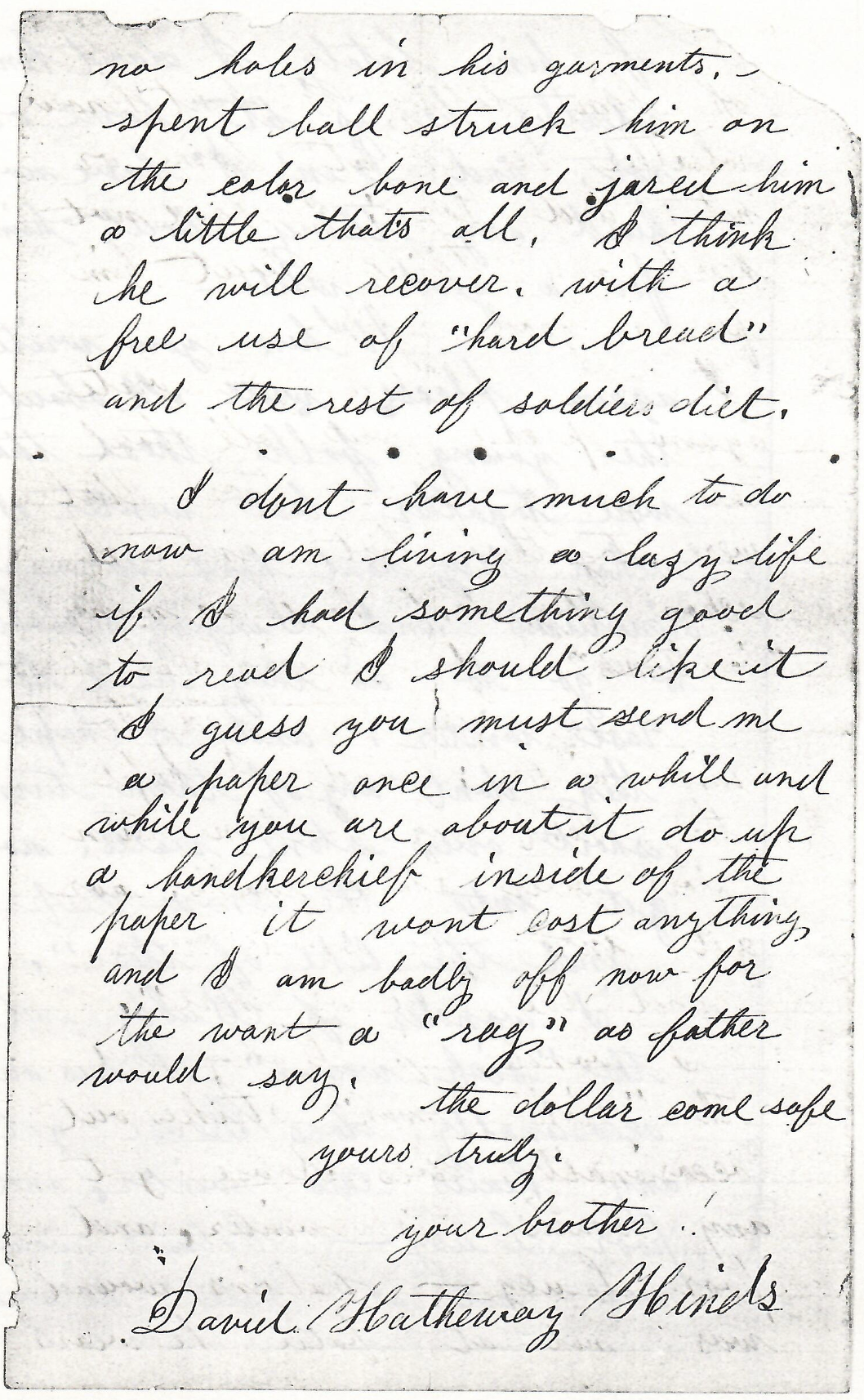
I wonder if Bubby and the “sick woman” strikes out occasionally. Does Rose get any beau’s this winter? And poor Lucy. Calvin [Beal]’s wound was not at [all] fatal. He wears no holes in his garments. A spent ball struck him on the collar bone and jarred him a little, that’s all. I think he will recover with a free use of “hard bread” and the rest of soldier’s diet.
I don’t have much to do now. Am living a lazy life. If I had something good to read, I should like it. I guess you must send me a paper once in a while and while you are about it, do up a handkerchief inside of the paper. It won’t cost anything. And I am badly off now for the want of a “rag” as father would say. The dollar came safe. Yours truly. Your brother, — David Hatheway Hinds
Letter 14
Camp of the 16th Maine Regiment
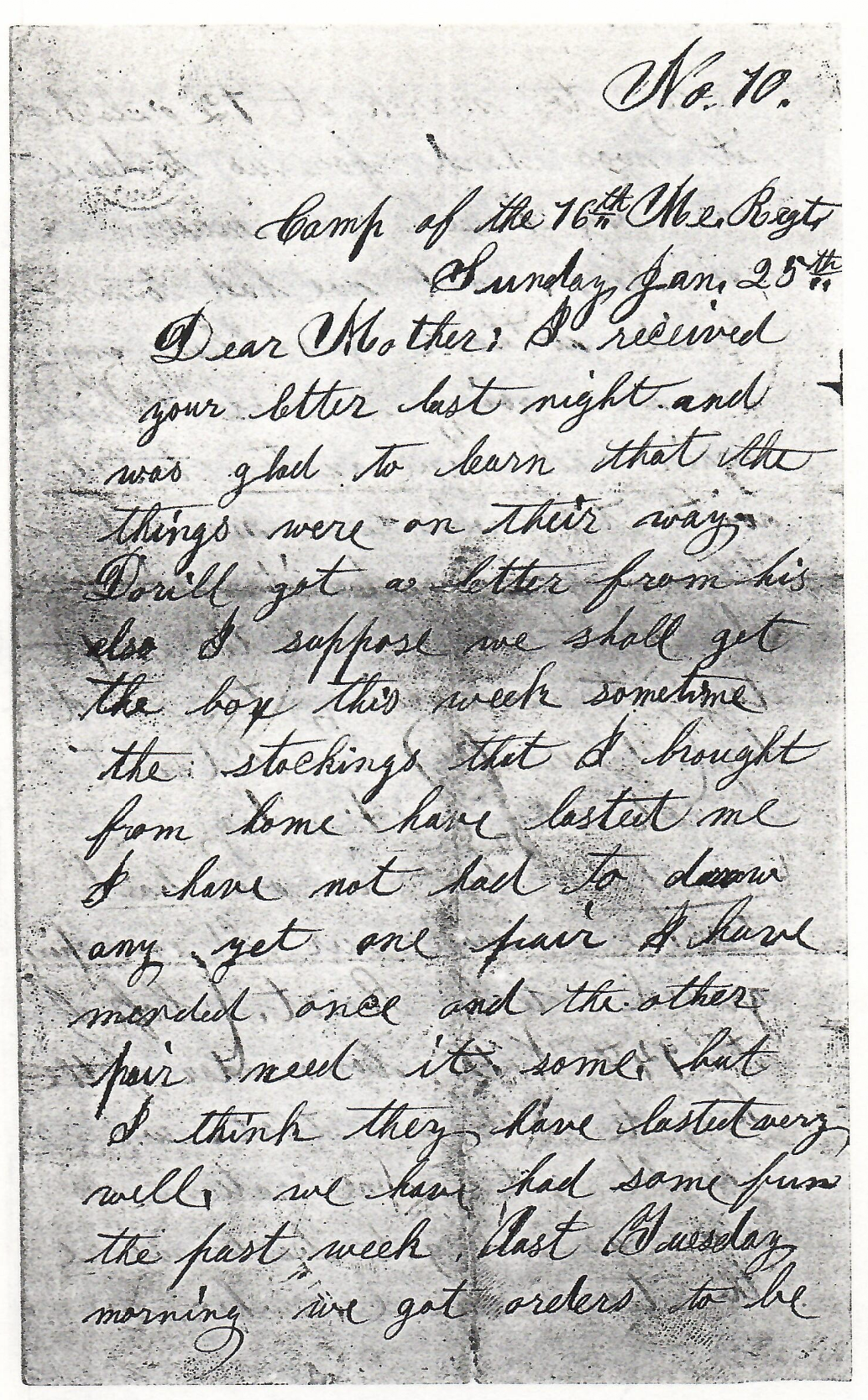
Sunday, January 25th [1863]
Dear Mother,
I received your letter last night and was glad to learn that the things were on their way. Dorill[us Hobbs] got a letter from his [mother] also. I suppose we shall get the box this week sometime. The stockings that I bought from home have lasted me. I have not had to draw any yet. One pair I have mended once and the other pair needs it some but I think they have lasted very well.
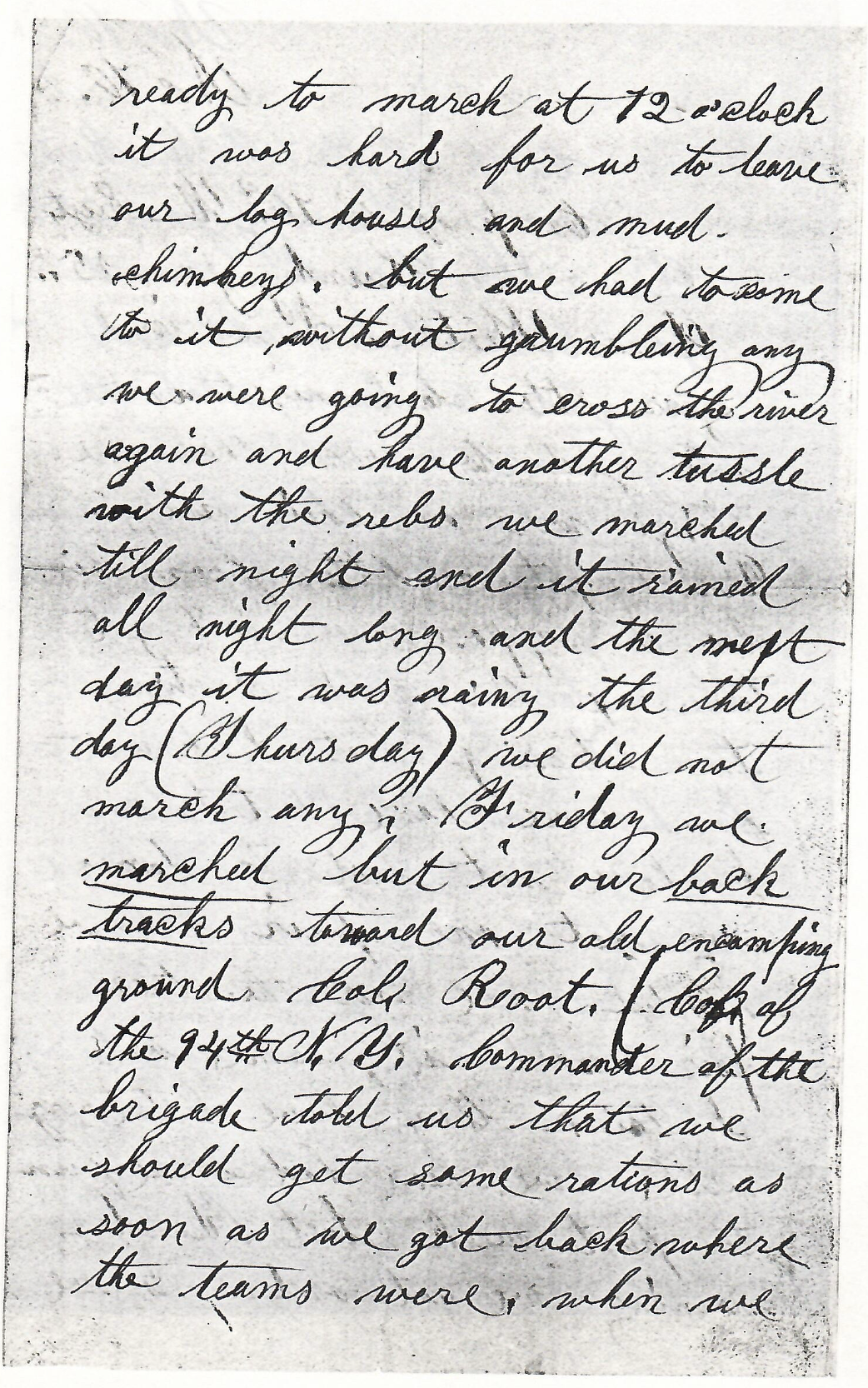
We have had some fun the past week. Last Tuesday morning we got orders to be ready to march at 12 o’clock. It was hard for us to leave our log houses and mud chimneys but we had to come to it without grumbling any. We were going to cross the river again and have another tussle with the rebs.
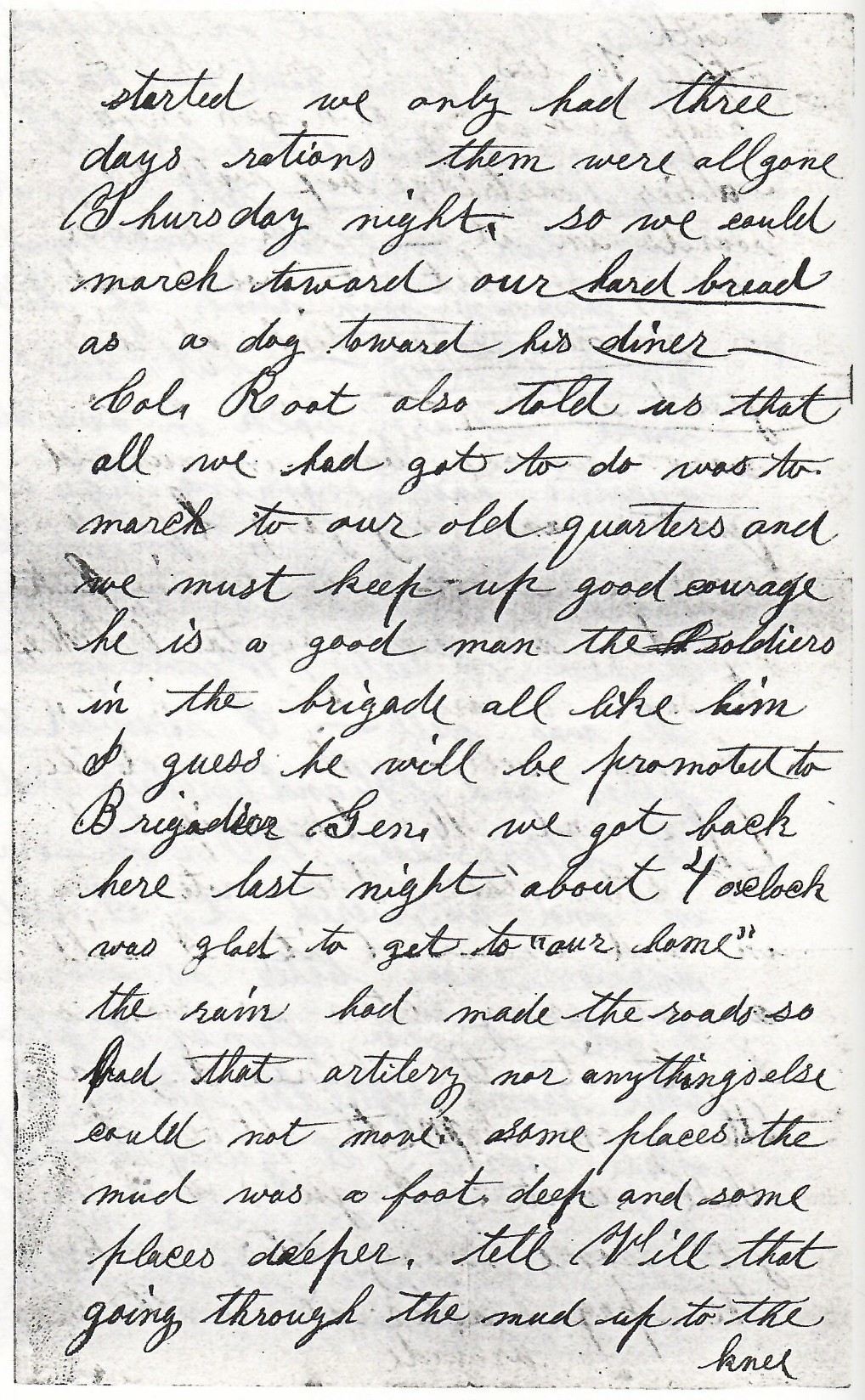
We marched till night and it rained all night long adn the next day it was rainy. The third day (Thursday) we did not march any. Friday we marched but in our back tracks toward our old camping ground. Col. [Adrian Rowe] Root (Col. of the 94th New York, commander of the Brigade), told us that we should get some rations as soon as we got back where the teams were. When we started we only had three days rations. Them were all gone Thursday night so we could march toward our hard bread as a dog toward his dinner. Col. Root also told us that all we had got to do was to march to our old quarters and we must keep up good courage. He is a good man. The soldiers in the brigade all like him. I guess he will be promoted to Brigadier General.
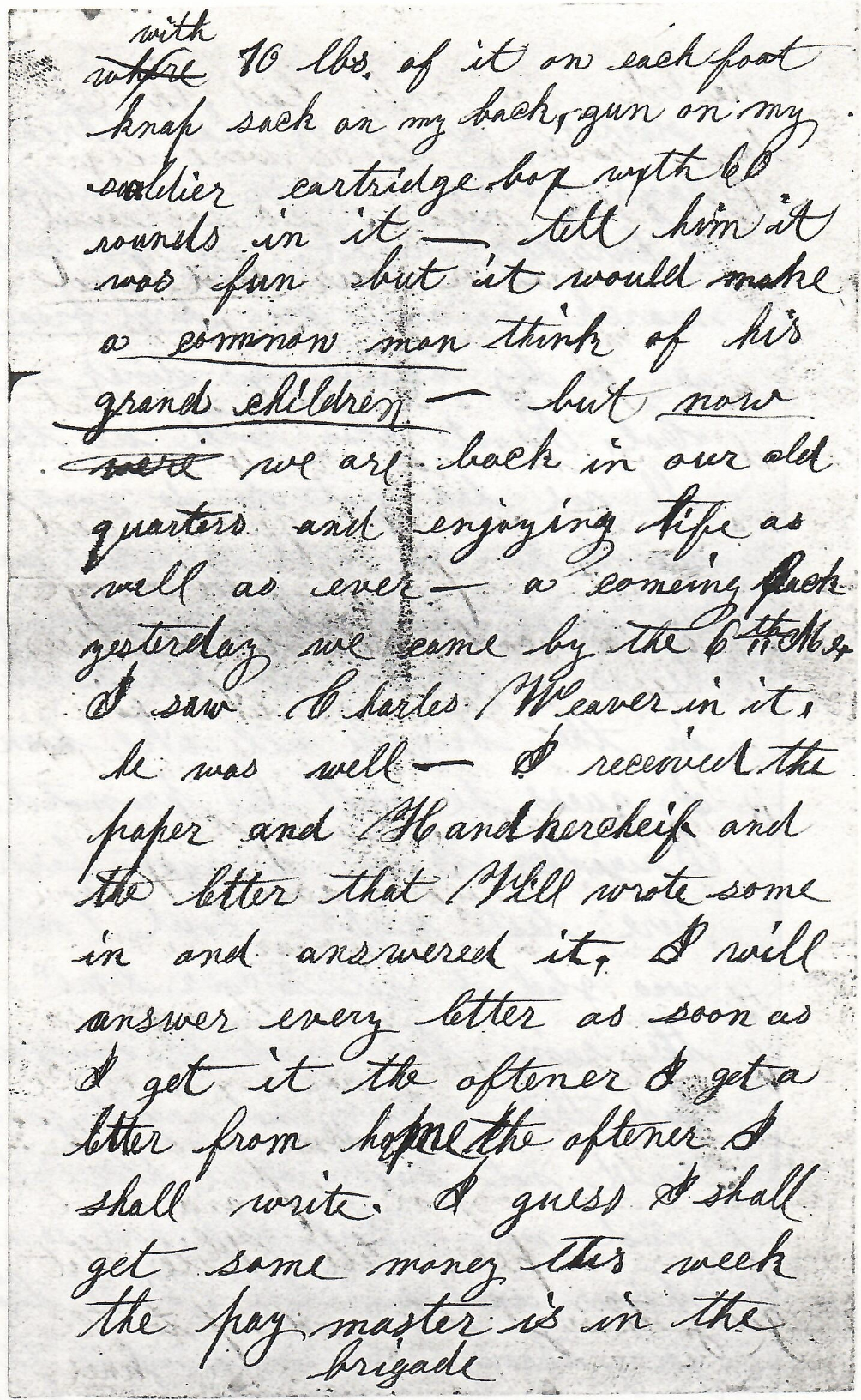
We got back here last night about 4 o’clock. Was glad to get to “our home.” The rain had made the roads so bad that artillery nor anything else could not move. Some places the mud was a foot deep and some places deeper. Tell Will that going through the mud up to the knee with 10 pounds of it on each foot, knapsack on my back, gun on my shoulder, cartridge box with 60 rounds in it—tell him it was fun. But it would make a common man think of his grand children. But now we are back in our old quarters and enjoying life as well as ever.
Coming back yesterday, we came by the 6th Maine [Regiment]. I saw Charles Weaver in it. He was well. I received the paper and handkerchief and the letter that Will wrote some in and answered it. I will answer every letter as soon as I get it. The oftener I get a letter from home, the oftener I shall write. I guess I shall get some money this week. The paymaster is in the brigade.
Letter 15
Camp of the 16th Maine Regiment
Thursday, February 5th [1863]
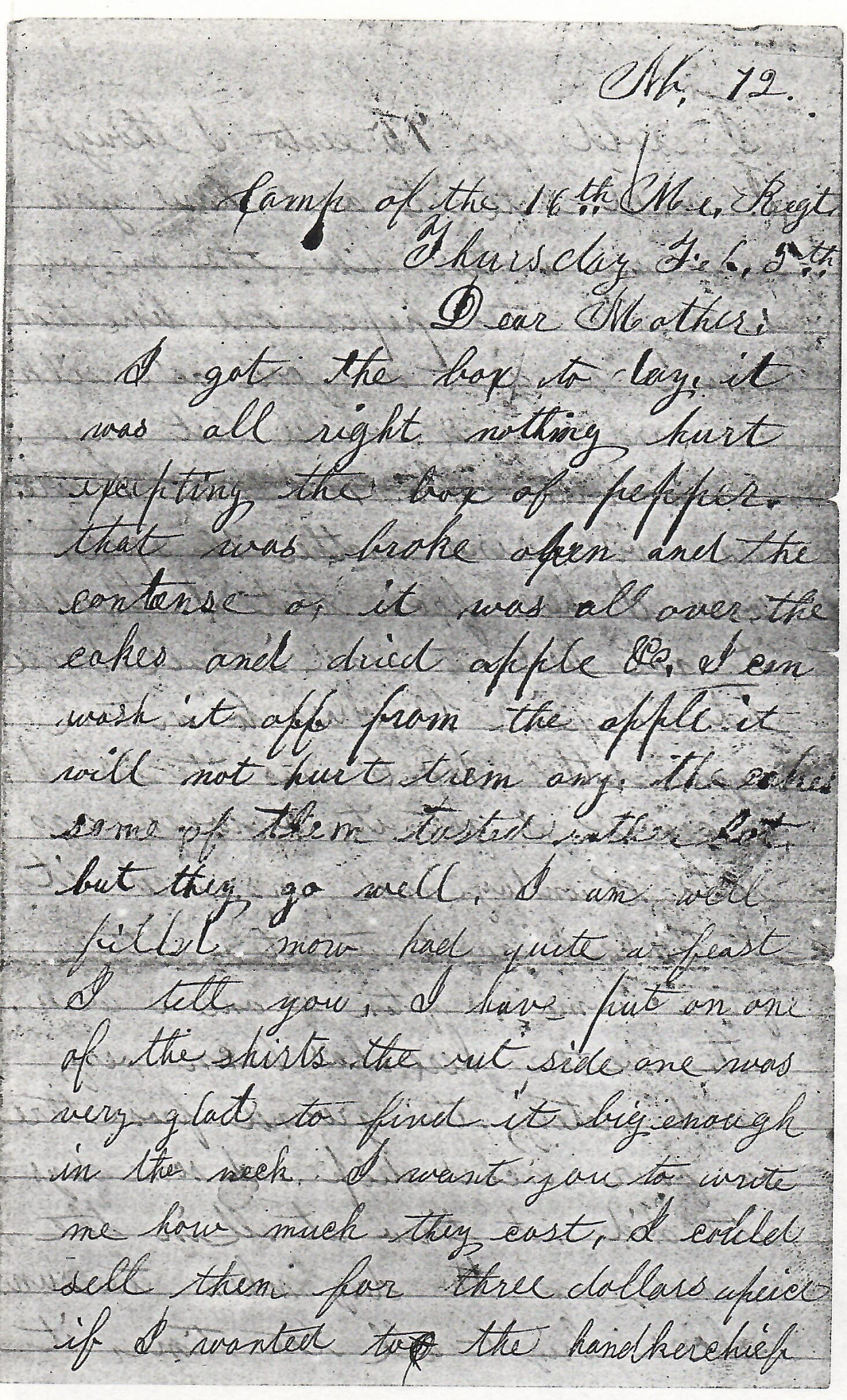
Dear Mother,
I got the box today. It was alright. Nothing hurt excepting the box of pepper. That was broke open and the contents was all over the cakes and dried apples, &c. I can wash it off from the apples. It will not hurt them any. The cakes—some of them—tasted rather hot but they will go well. I am well filled now. Had quite a feast, I tell you.
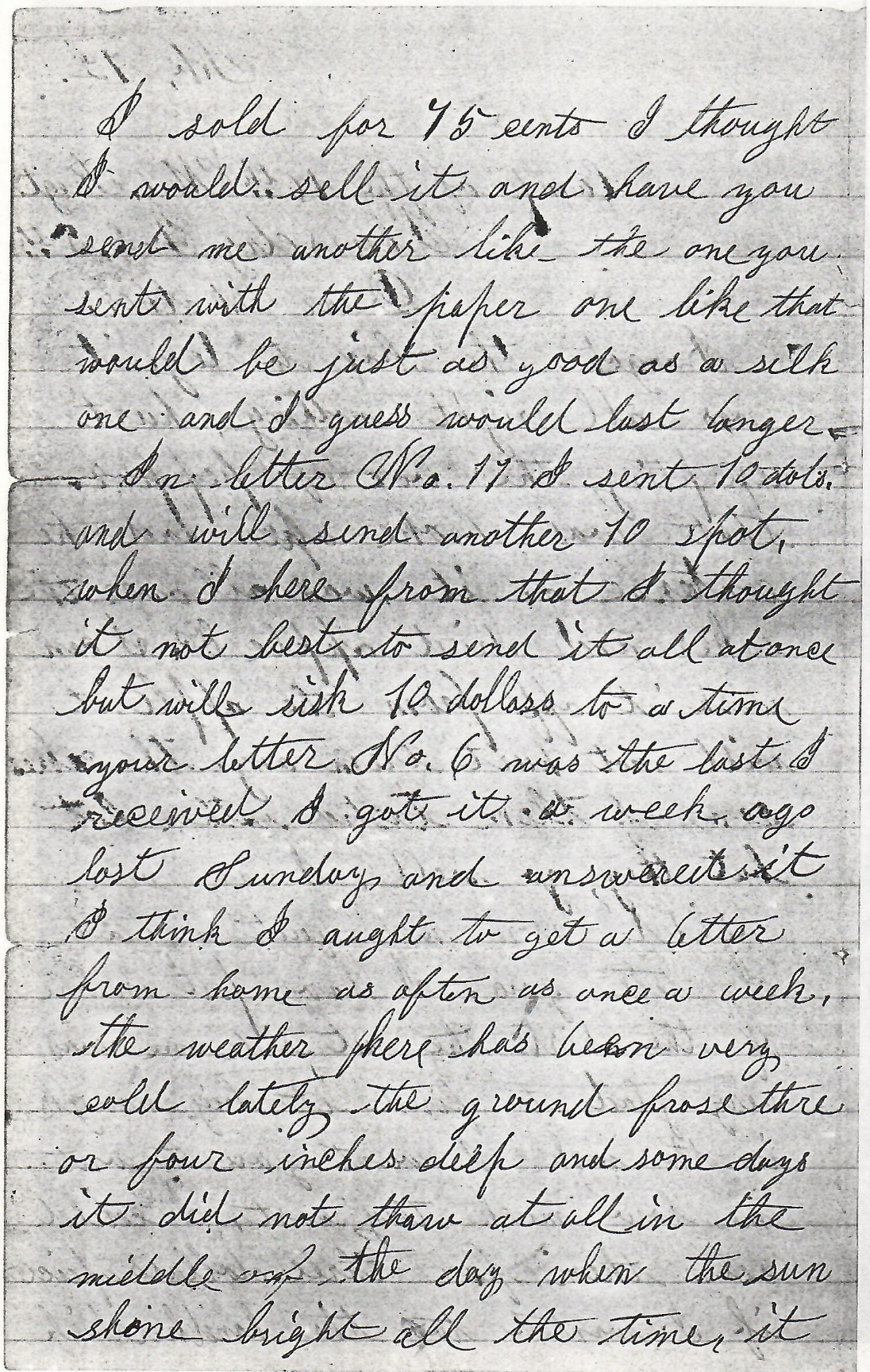
I have put on one of the shirts—the outside one. Was very glad to find it big enough in the neck. I want you to write me how much they cost. I could sell them for three dollars apiece if I wanted to. The handkerchief I sold for 75 cents. I thought I would sell it and have you send me another like the one you sent with the paper. One like that would be just as god as a silk one and I guess would last longer.
In letter No. 11 I sent 10 dollars and will send another 10 spot when I hear from that. I thought it not best to send it all at once but wil risj 10 dollars to a time. Your letter No. 6 was the last I received. I got it a week ago last Sunday and answered it. I think I ought to get a letter from home as often as once a week.
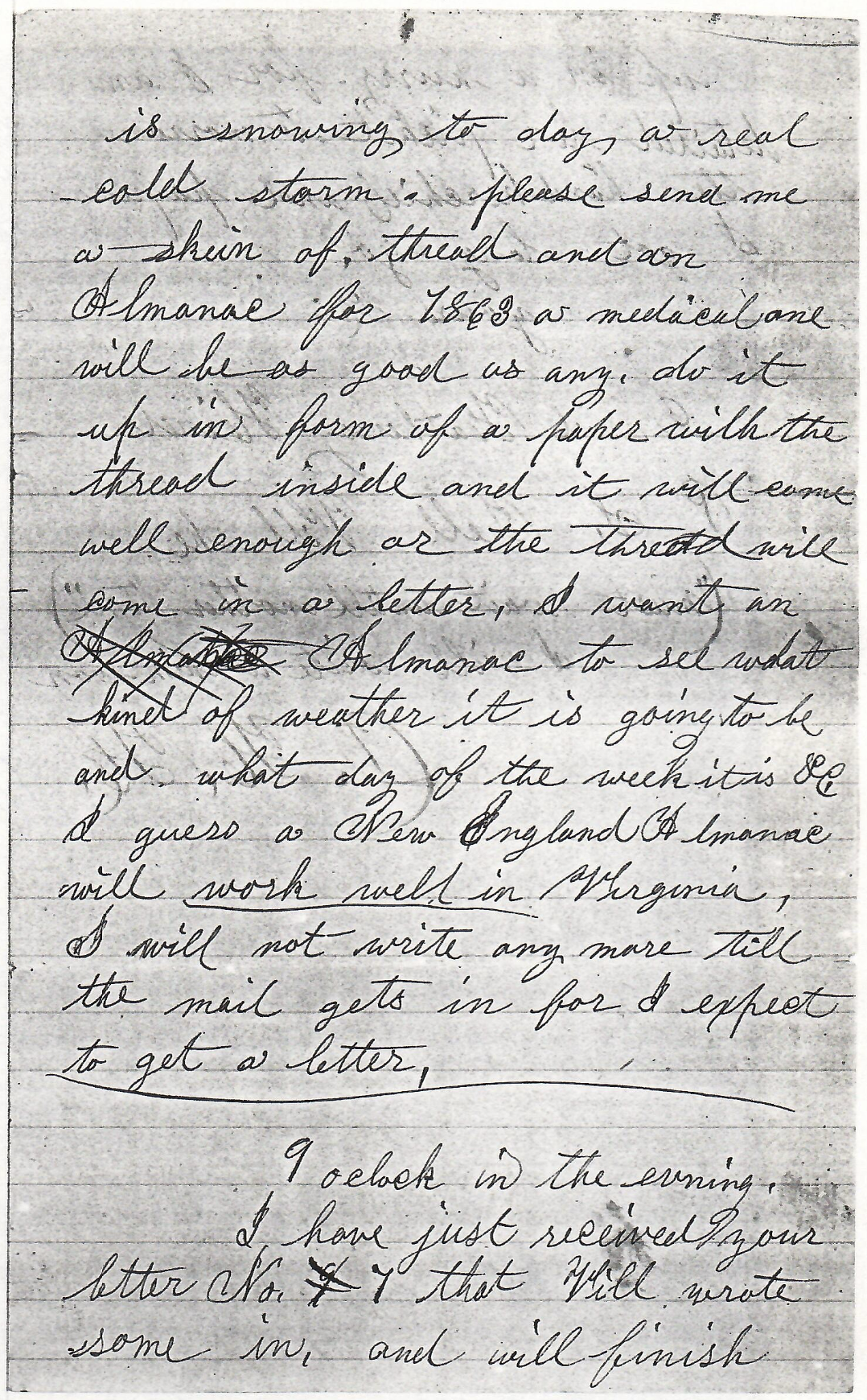
The weather here has been very cold lately. The ground froze three or four inches deep and some days it did not thaw at all in the middle of the day when the sun shone all the time. It is snowing today—a real cold storm. Please send me a skein of thread and an Almanac for 1863. A medical one will be as good as any. Do it up in form of a paper with the thread inside and it will come well enough. Or the thread will come in a letter. I want an Almanac to see what kind of weather it is going to be and what day of the week it is, &c. I guess a New England Almanac will work well in Virginia.
I will not write anymore till the mail gets in for I expect to get a letter.
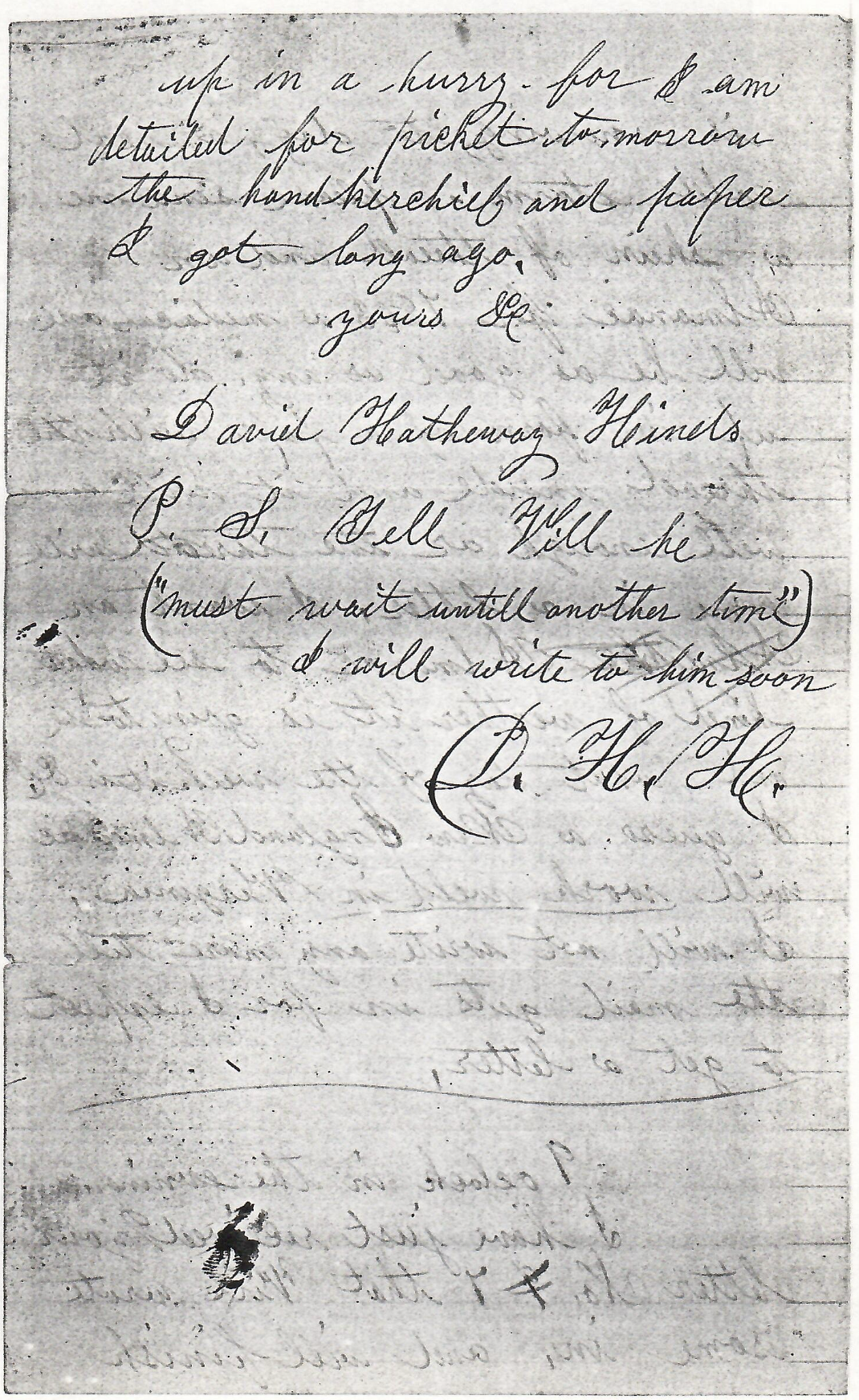
9 o’clock in the evening. I have just received your letter No. 7 that Vill wrote some in and will finish up in a hurry for I am detailed for picket tomorrow. The handkerchief and paper I got long ago. Yours, &c. — David Hatheway Hinds.
P. S. Tell Vill he “must wait until another time.” I will write to him soon. — D. H. H.
Letter 16
Camp of the 16th Maine Vols.
Monday, February 23rd [1863]
Little sister,
I received your letter No. 9 last Saturday, the almanac, and thread the day before. I am well and fat. I weight 175 and a half avodupois [avoirdupois]. I want you to be weighed and write how much you weigh. I guess you won’t go much more than I do.
It is a very pleasant day. It snowed Friday. There is eight or ten inches of snow on the ground now. It is very muddy sometimes here. A snowstorm is worse than a rain.
I got a letter from Lin the same time I got yours.
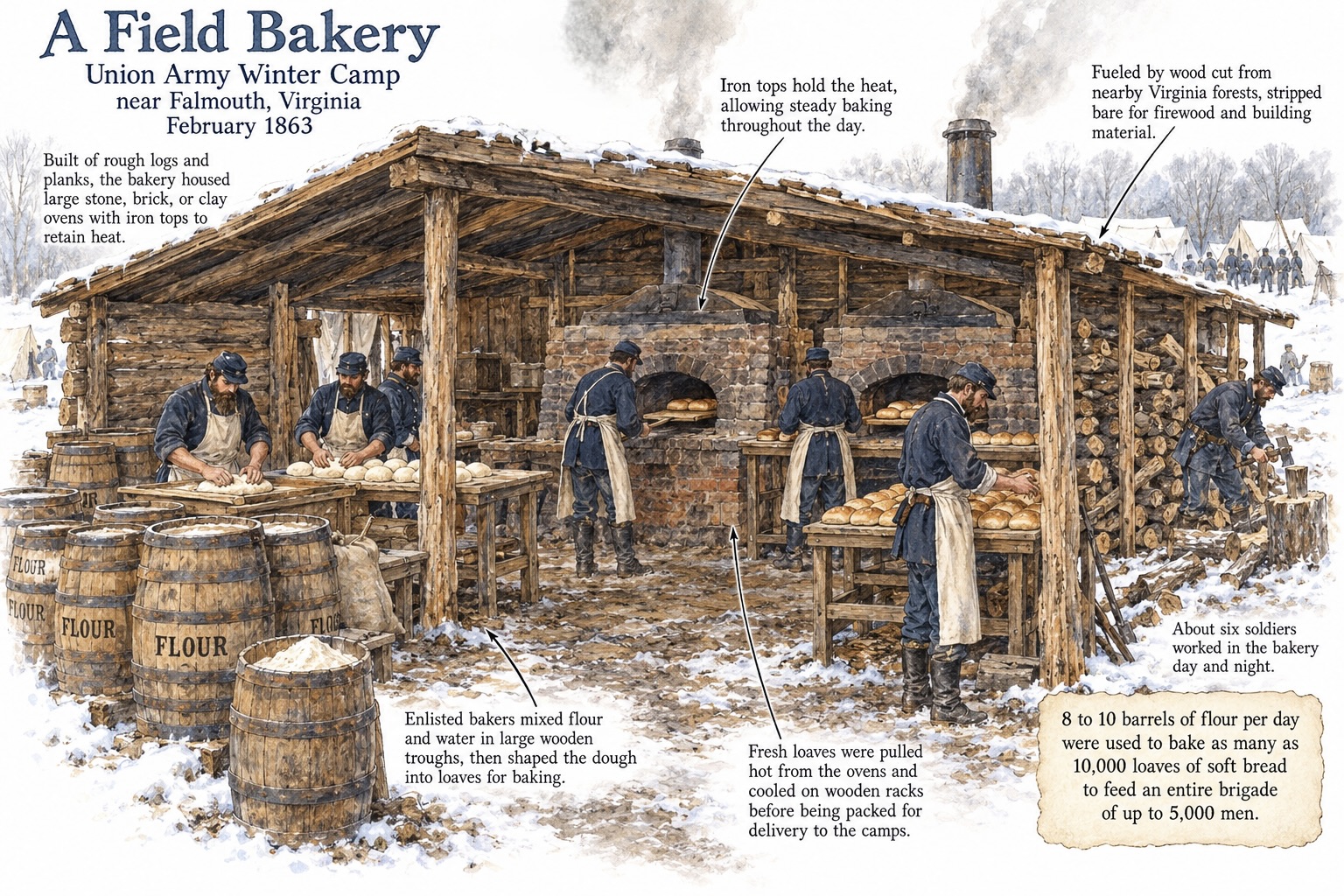
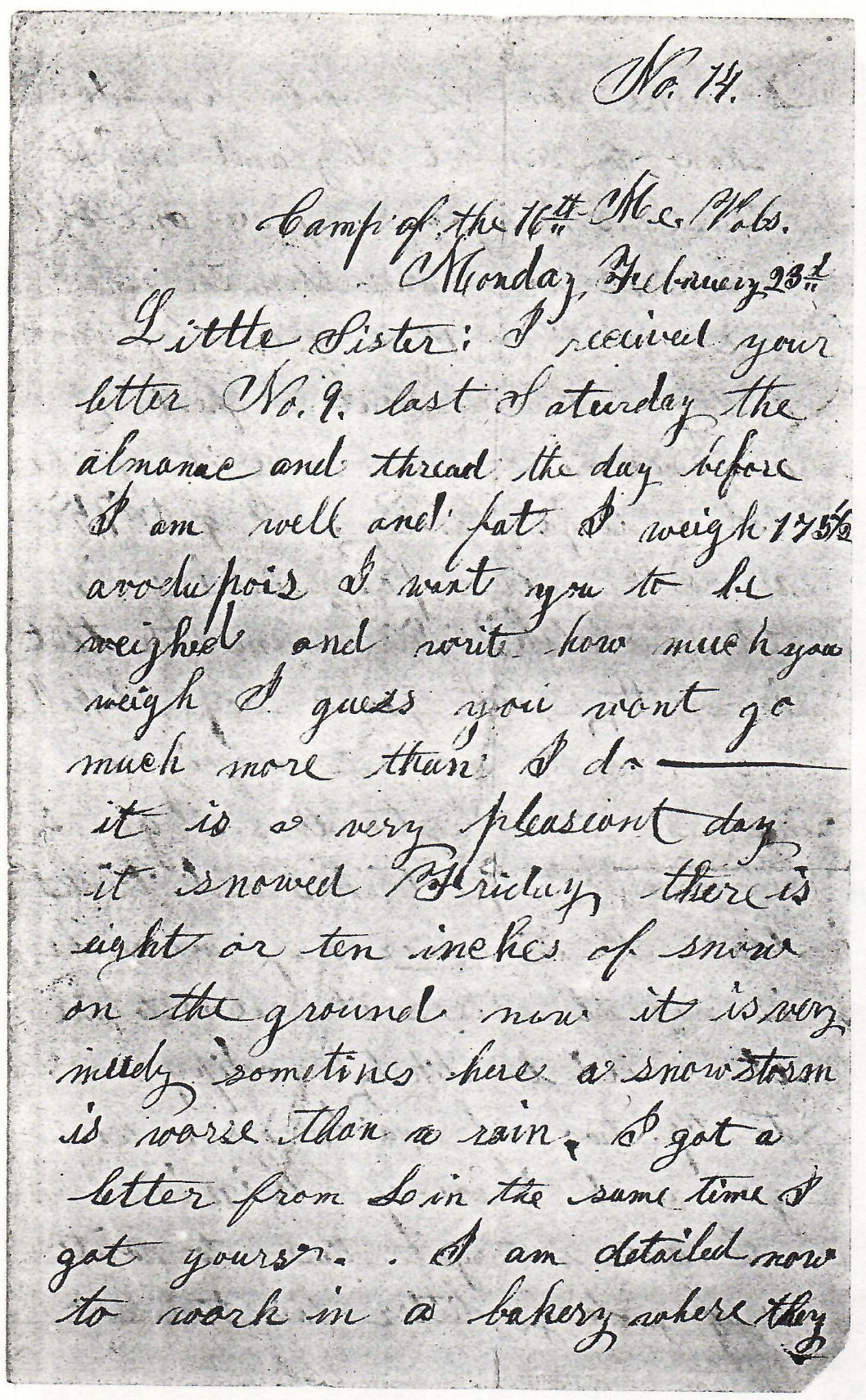
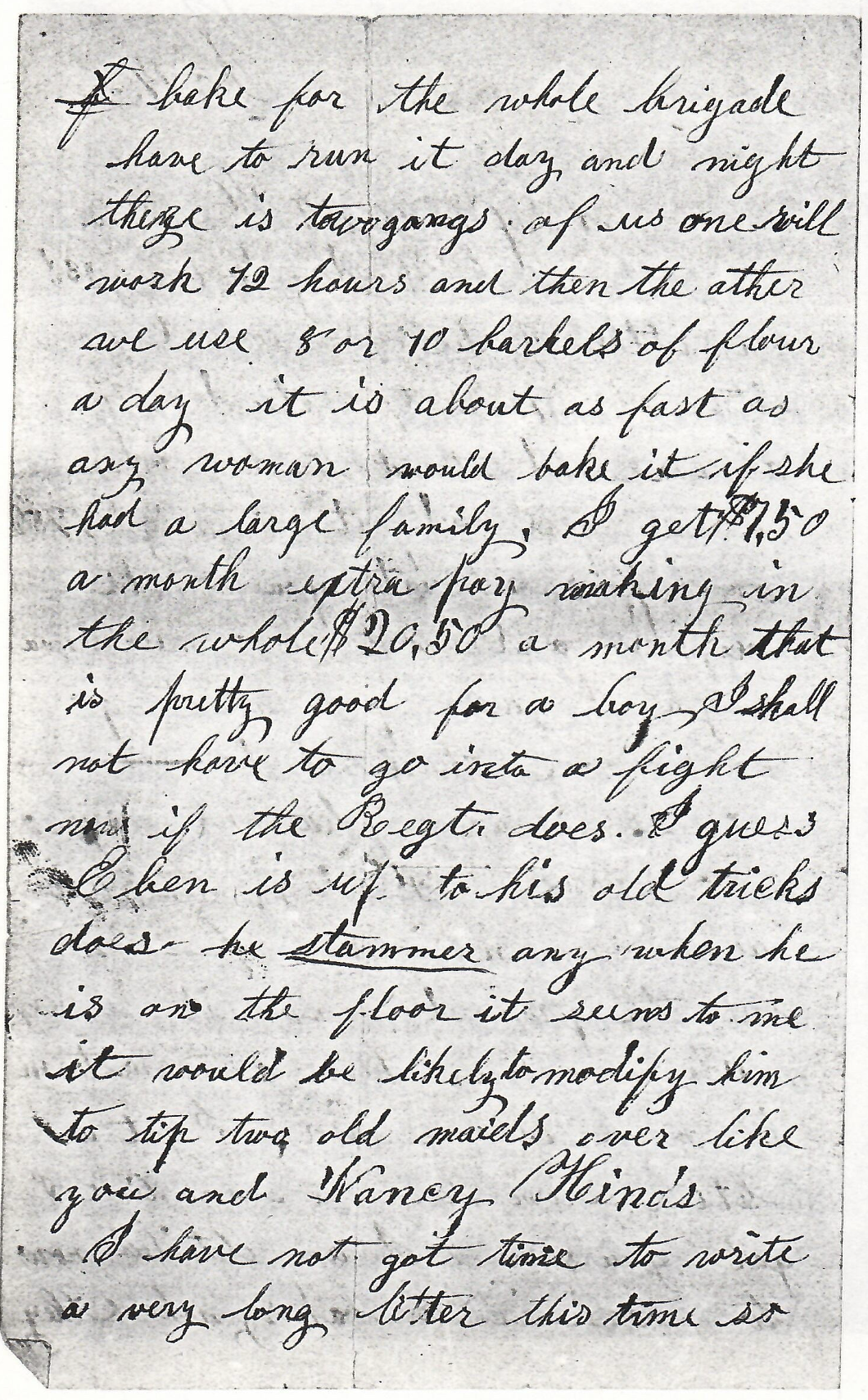
I am detailed now to work in a bakery where they bake for the whole brigade. Have to run it day and night. There is two gangs of us. One will work 12 hours and then the other. We use 8 or 10 barrels of flour a day. It is about as fast as any woman would bake it if she had a large family. I get $7.50 a month extra pay, making in the whole $20.50 a month. That is pretty good for a boy. I shall not have to go into a fight now if the regiment does.
I guess Eben is up to his old tricks. Does he stammer any? When he is on the floor, it seems to me it would be likely to modify him to tip two old maids over like you and Nancy Hinds.
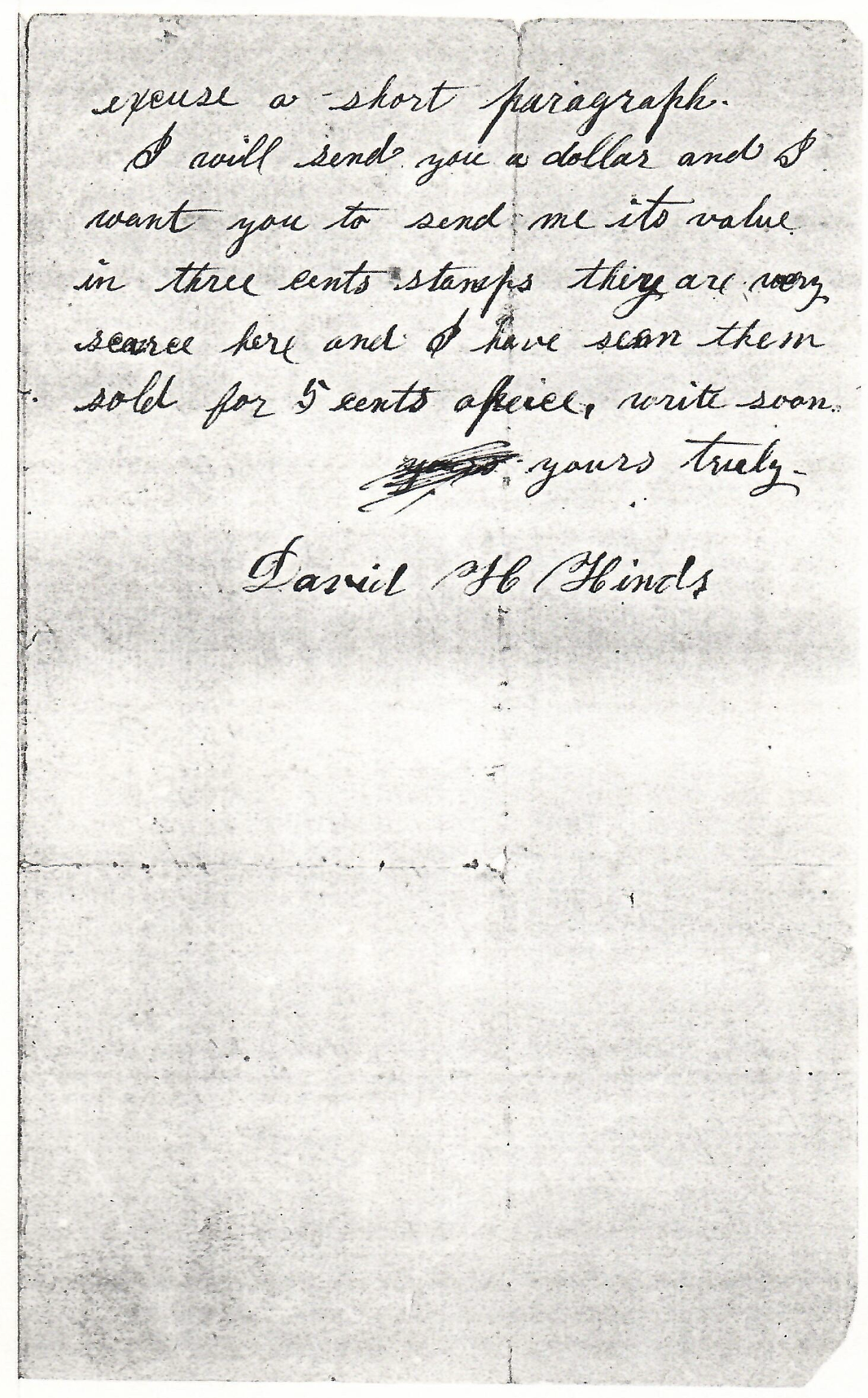
I have not time to write a very long letter this time so excuse a short paragraph. I will send you a dollar and I want you to send me its value in three sent stamps. They are very scarce here and I have seen them sold for 5 cents apiece. Write soon. Yours truly. — David H. Hinds
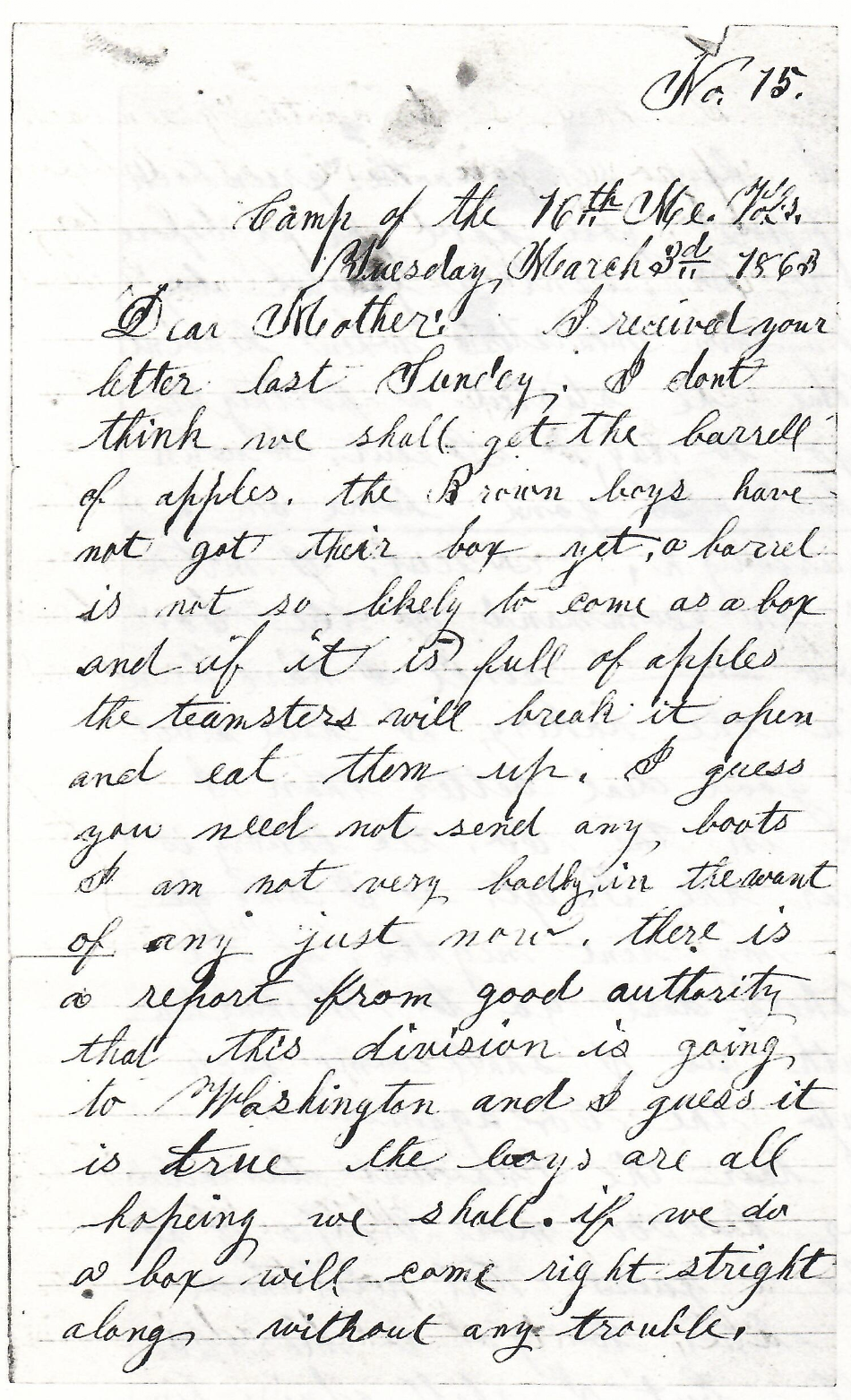
Letter 17
Camp of the 16th Maine Vols.
Tuesday, March 3rd, 1863
Dear Mother,
I received your letter last Sunday. I don’t think we shall get the barrel of apples. The Brown boys have not got their box yet. A barrel is ot likely to come as a box and if it is full of apples, the teamsters will break it open and eat it up. I guess you need not send any boots. I am not very badly in the want of any just now.
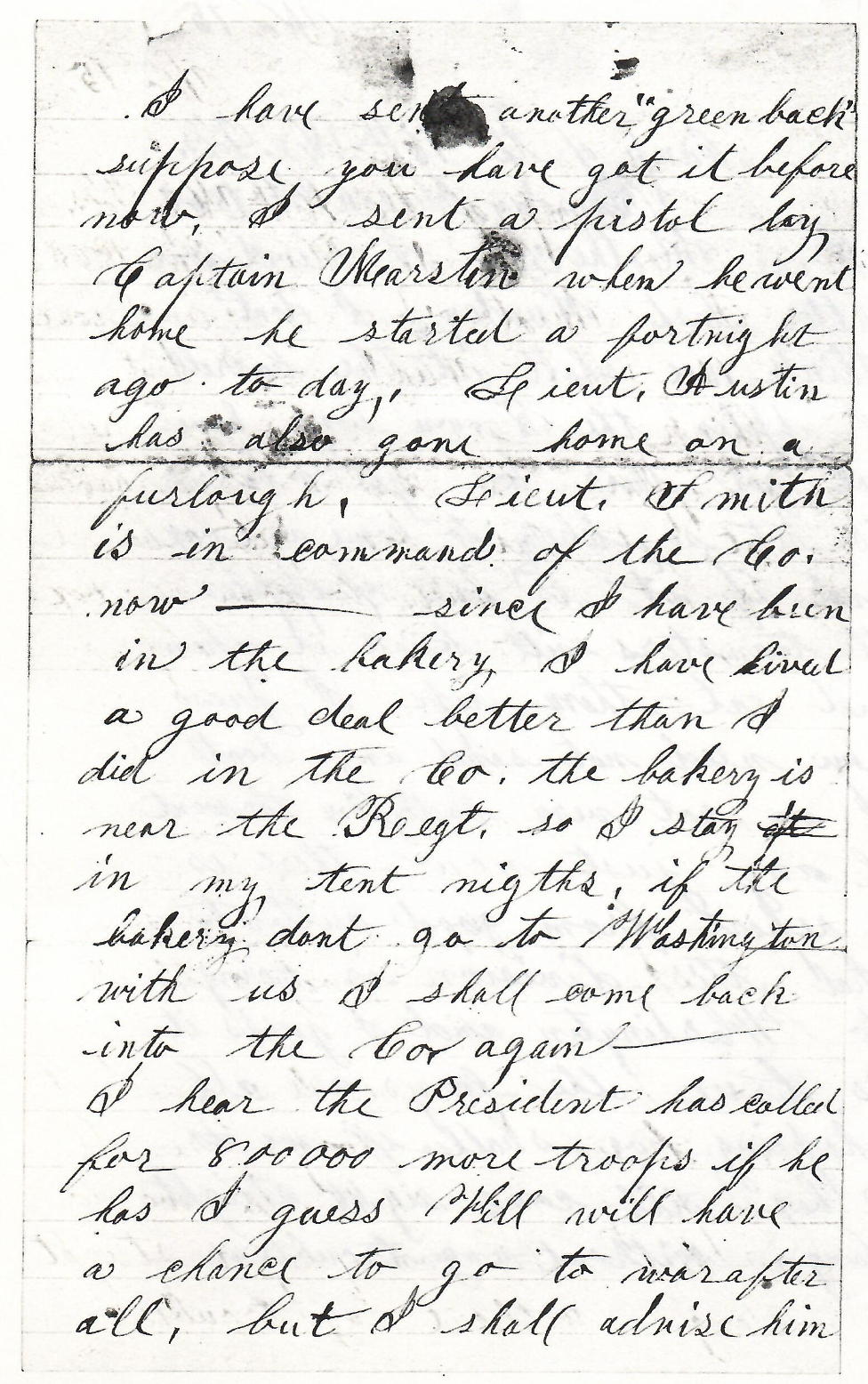
There is a report from good authority that this division is going to Washington and I guess it is true. The boys are all hoping we shall. If we do, a box will come right straight along without any trouble. I have sent another “greenback.” Suppose you have got it before now. Capt. [Daniel] Marston, when he went home, he started a fortnight ago today. Lieut. [Hovey] Austin has also gone home on a furlough. Lieutenant [Marshall] Smith is in command of the company now.
Since I have been in the bakery, I have lived a good deal better than I did in the company. The bakery is near the regiment so I stay in my tent nights. If the bakery don’t go to Washington with us, I shall come back into the company again.
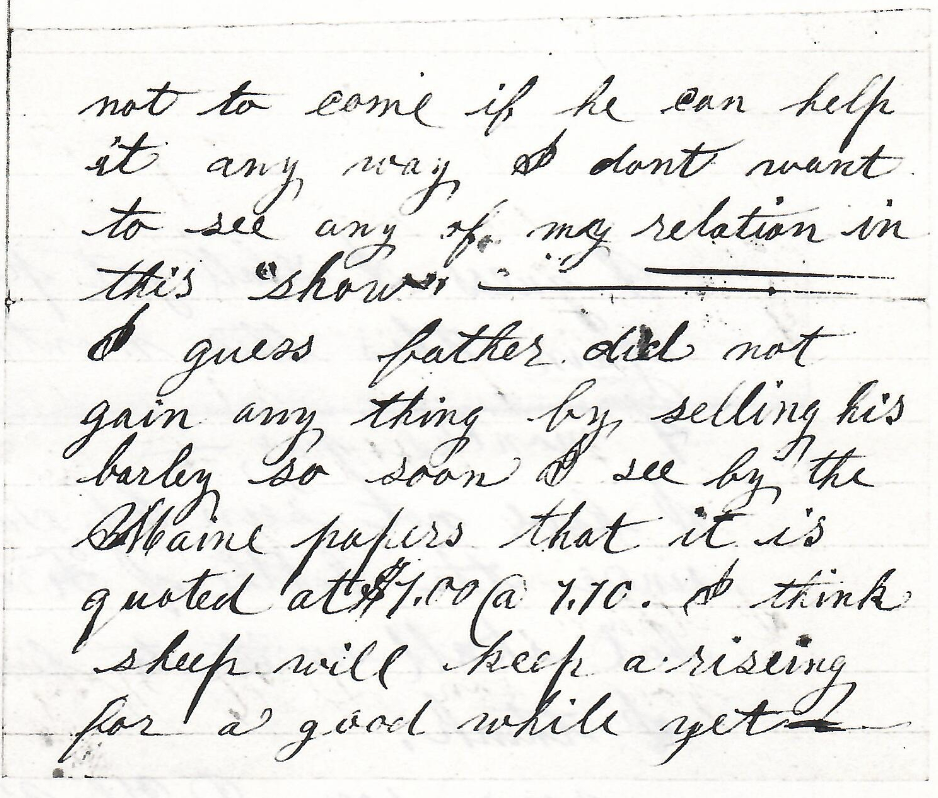
I hear the President has called for 800,000 more troops. If he has, I guess Vill will have a chance to go to war after all. But I shall advise him not to come if he can help it any way. I don’t want to see any of my relation in this “show.”
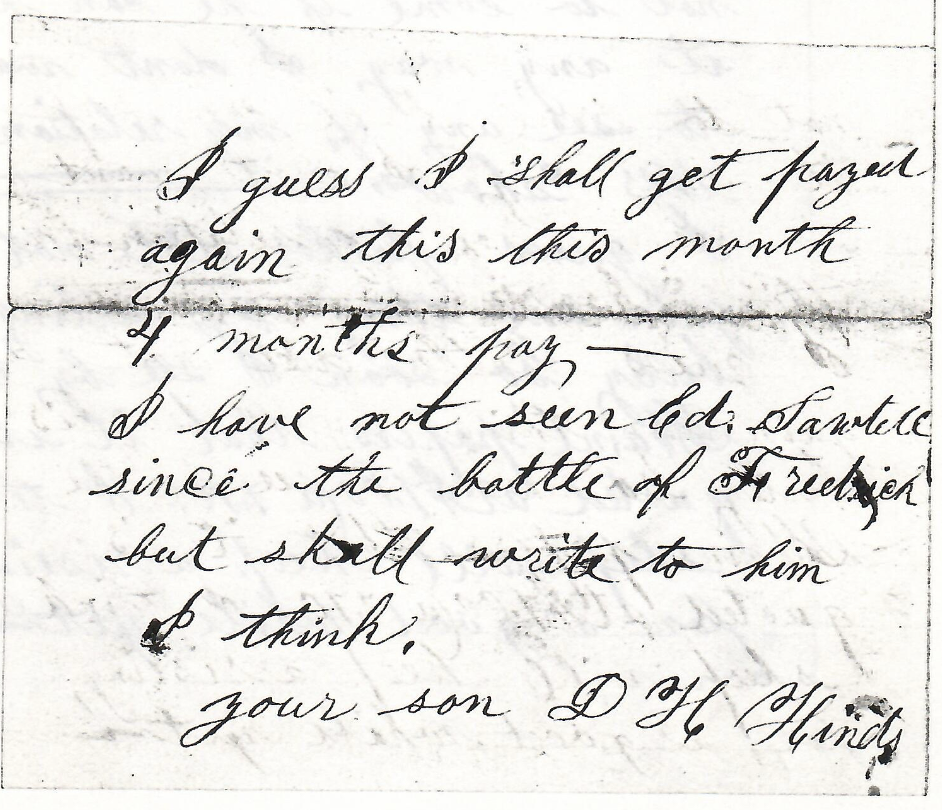
I guess father did not gain anything by selling his barley so soon. I see by the Maine papers that it is quoted at$1.00 @ 1.10. I think sheep will keep a rising for a good while yet. I guess I shall get paid again this month four months pay.
I have not seen Ed Sawtelle since the Battle of Fredericksburg but shall write to him, I think. Your son, — D. H. Hinds
Letter 18
Camp of the 16th Maine Vols.
Sunday, March 8th 1863
Sister Abbie,
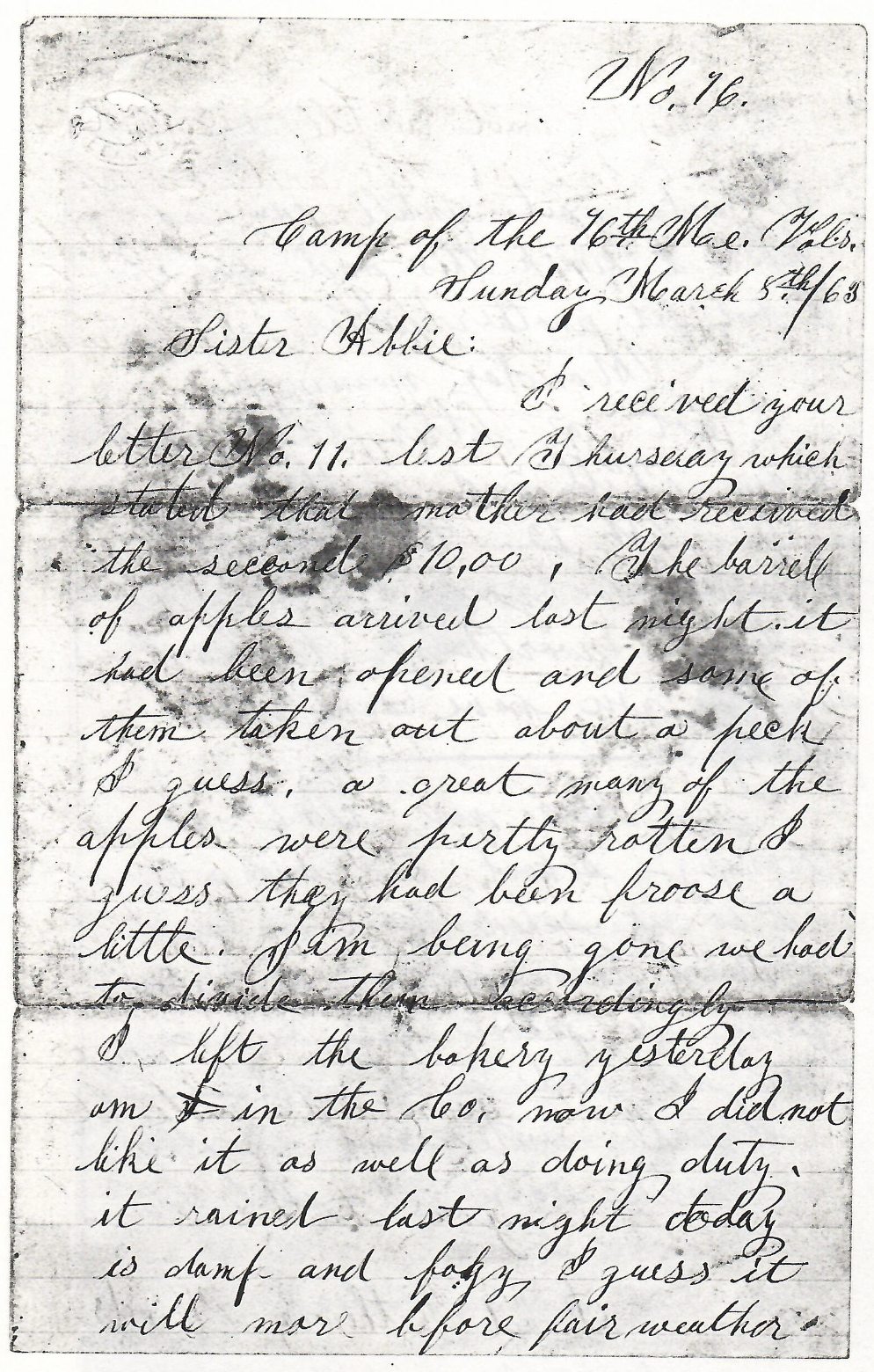
I received your letter No. 11 last Thursday which stated that mother had received the second $10. The barrel of apples arrived last night. It had been opened and some of them taken out—about a peck I guess. A great many of the apples were pretty rotten. I guess they had been froze a little. Jim being gone, we had to divide them accordingly.
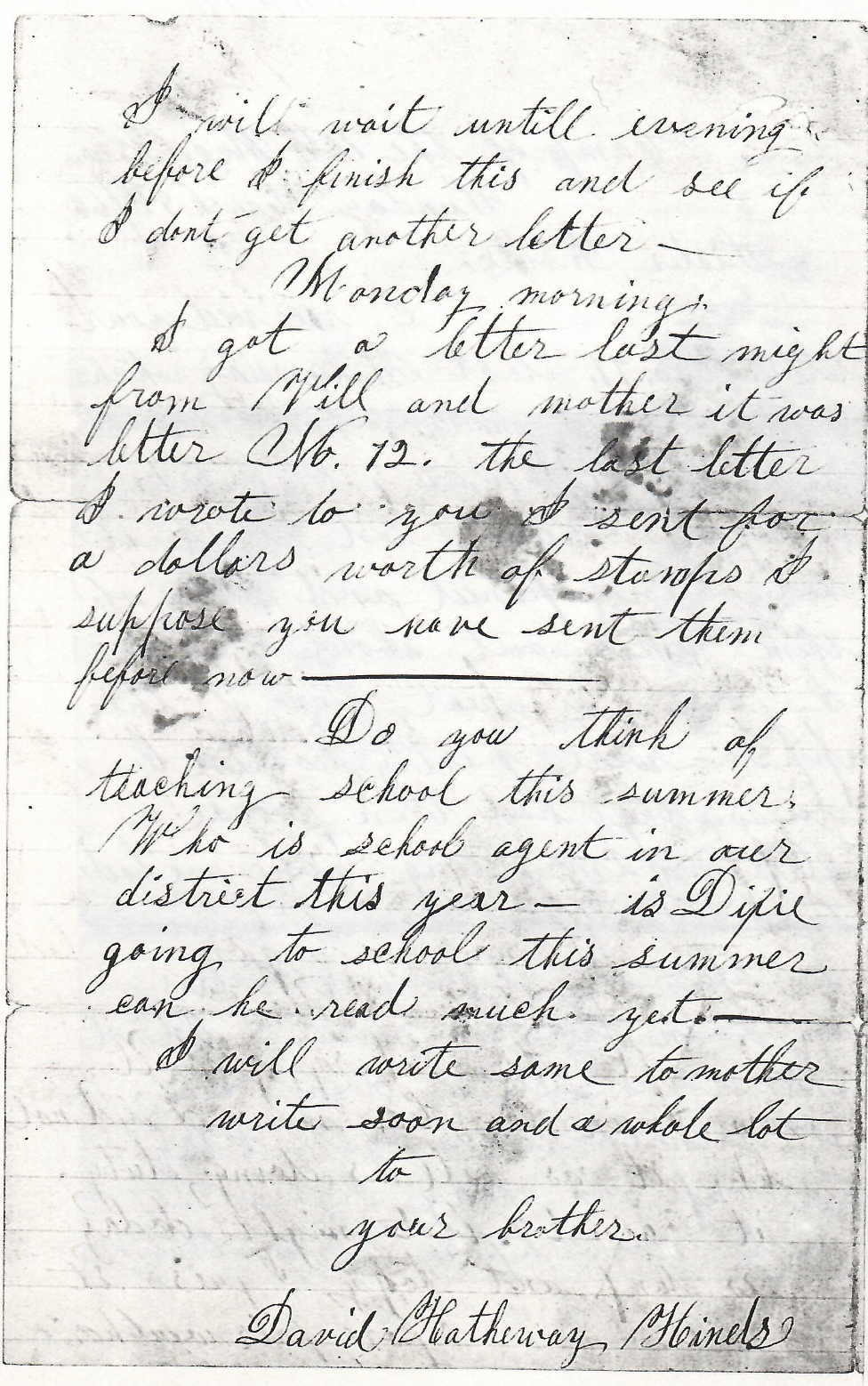
I left the bakery yesterday. Am in the company now. I did not like it as well as doing duty. It rained last night. Today it is damp and foggy. I guess it will [rain] more before fair weather. I will wait until evening before I finish this and see if I don’t get another letter.
Monday morning. I got a letter last night from Vill and mother. It was letter No. 12. The last letter I wrote to you I sent for a dollar’s worth of stamps. I suppose you have sent them before now.
Do you think of teaching school this summer? Wjis is school agent in our district this year? Is Dixie going to school this summer? Can he read much yet? I will write some to mother. Write soon and a whole lot to your brother, — David Hatheway Hinds
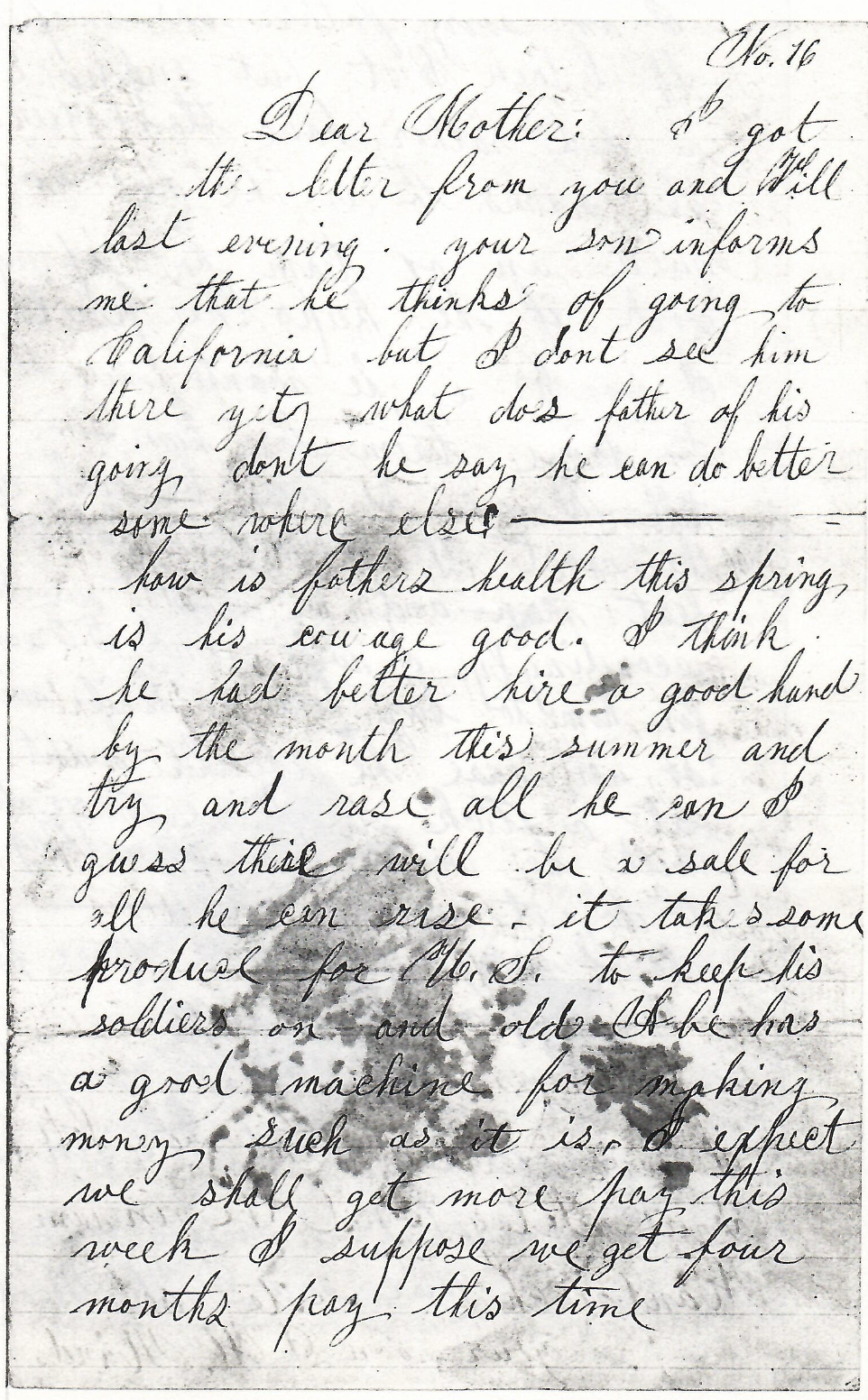
Dear mother, I got the letter from you and Vill last evening. Your son informs me that he thinks of going to California but I don’t see him there yet. What does father [think] of his going? Don’t he say he can do better somewhere else?
How is father’s health this spring? Is his courage good? I think he had better hire a good hand by the month this summer and try and raise all he can. I guess there will be a sale for all he can raise. It takes some produce for U. S. [Uncle Sam] to keep his soldiers on and Old Abe has a good machine for making money—such as it is. I expect we shall get more pay this week. I suppose we get four months pay this time.
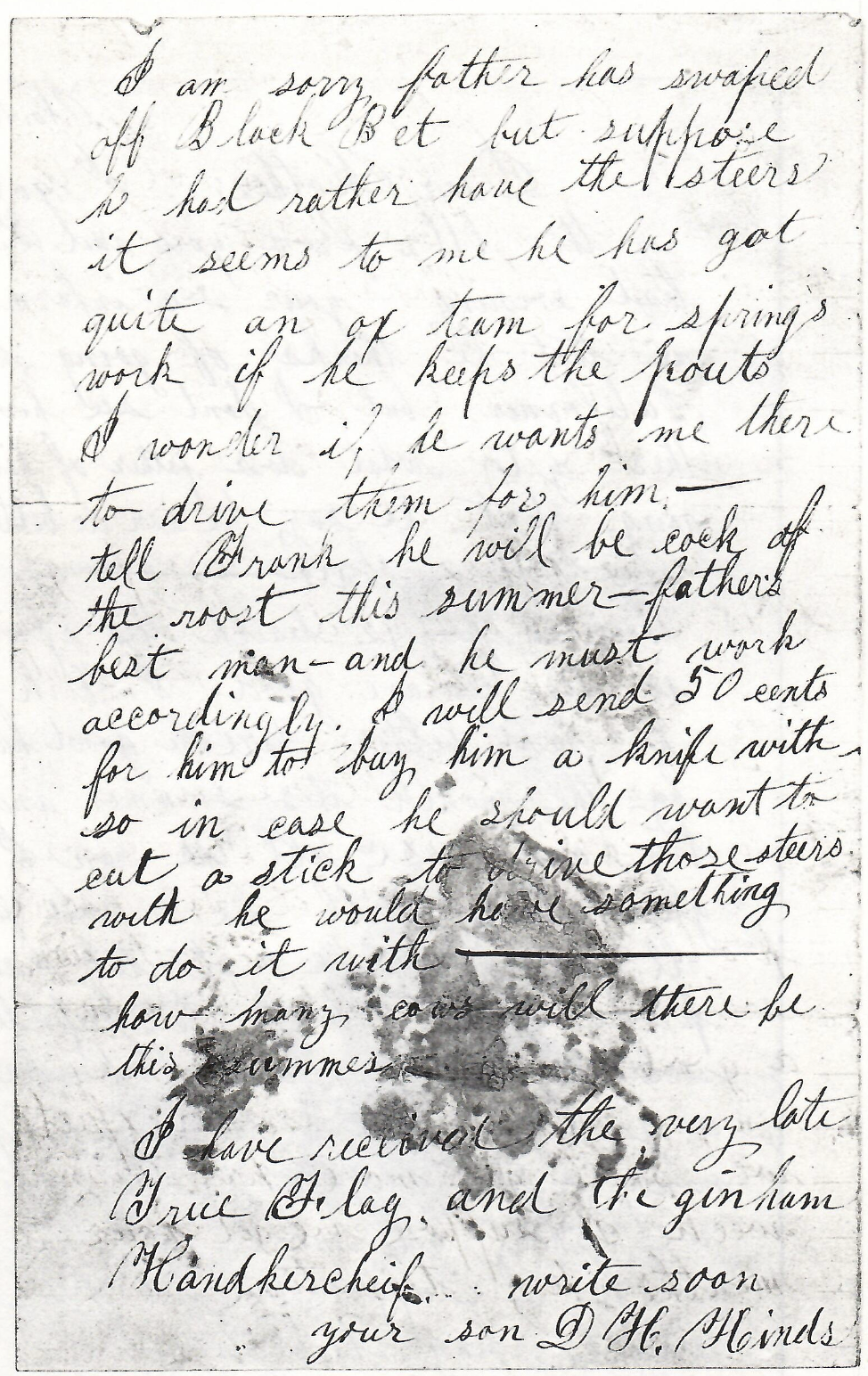
I am very sorry father has swapped off Black Bet but suppose he had rather have the steers. It seems to me he has got quite an ox team for spring work if he keeps the pouts [foals?]. I wonder if he wants me there to drive them for him.
Tell Frank he will be cock of the roost this summer—father’s best man—and he must work accordingly. I will send 50 cents for him to buy him a knife with so in case he should want to cut a stick to drive those steers with he would have something to do it with. How many cows will there be this summer?
I have received the very late [Boston] True Flag and the gingham handkerchief. Write soon. Your son, — D. H. Hinds.
Letter 19
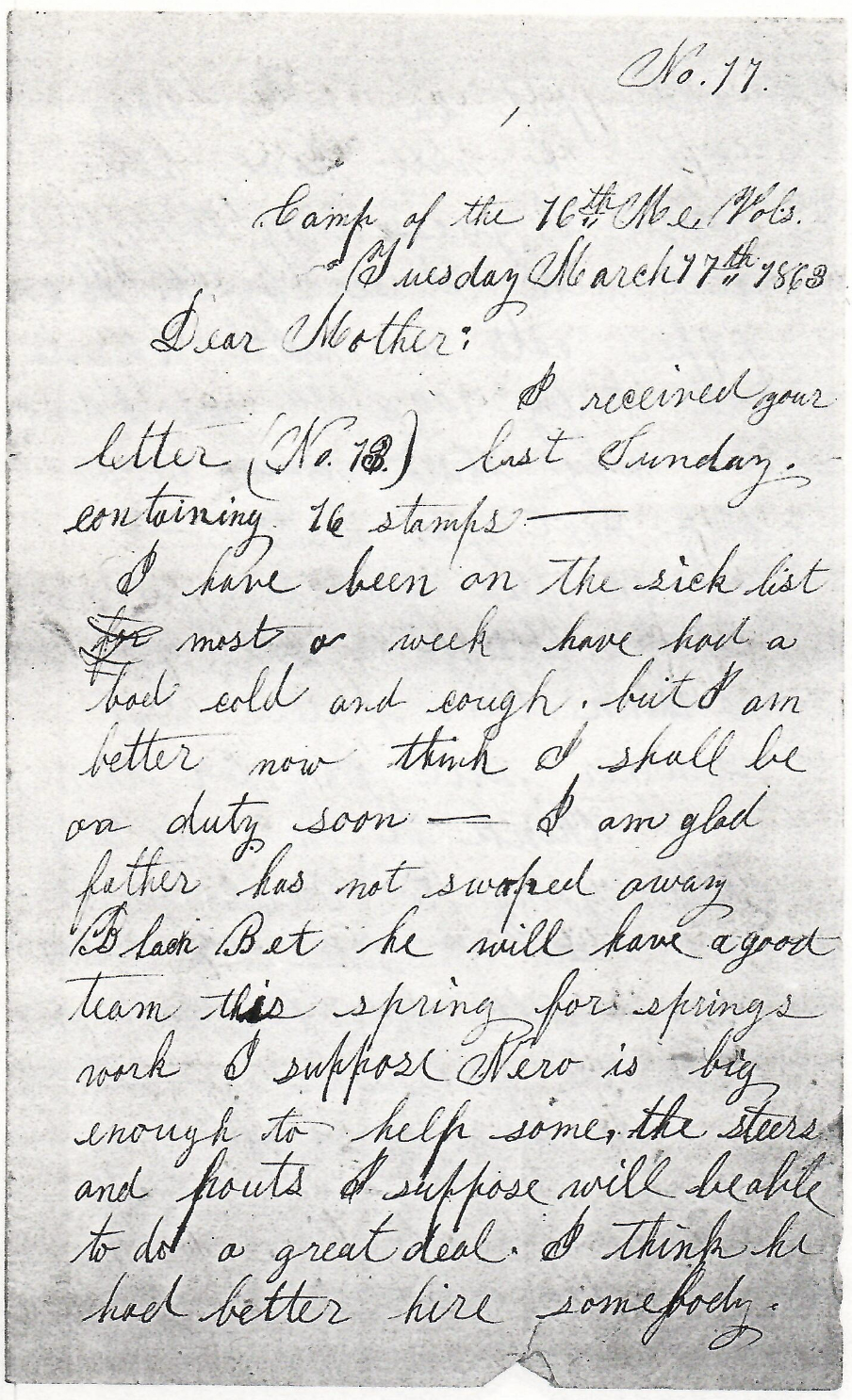
Camp of the 16th Maine Vols.
Tuesday, March 17th 1863
Dear Mother,
I received your letter (Bo. 13) last Sunday containing the 16 stamps.
I have ben on the sick list most a week. Have had a bad cold and cough but I am better now. Think I shall be on duty soon.
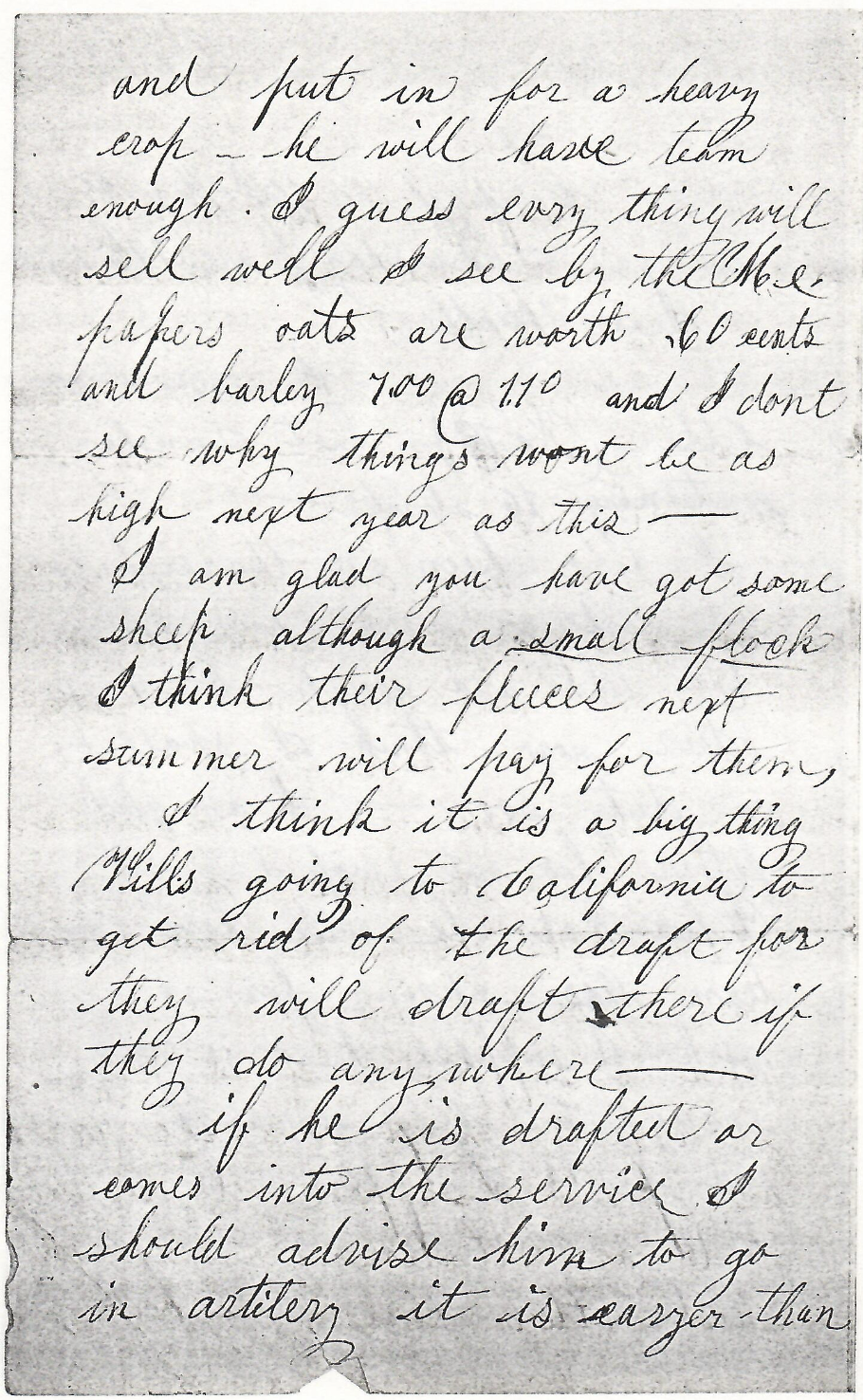
I am glad father has not swapped away Black Bet. He will have a good team this spring for spring work. I suppose Nero is big enough to help some. The steers and foals I suppose will be able to do a great deal. I think he had better hire somebody and put in for a heavy crop. He will have team enough. I guess everything will sell well. I see by the Maine papers oats are worth 60 cents and barley 1.00 @1.10 and I don’t see why things won’t be as high next year as this.
I am glad you have got some sheep although a small flock. I think their fleces next summer will pay for [keeping] them.
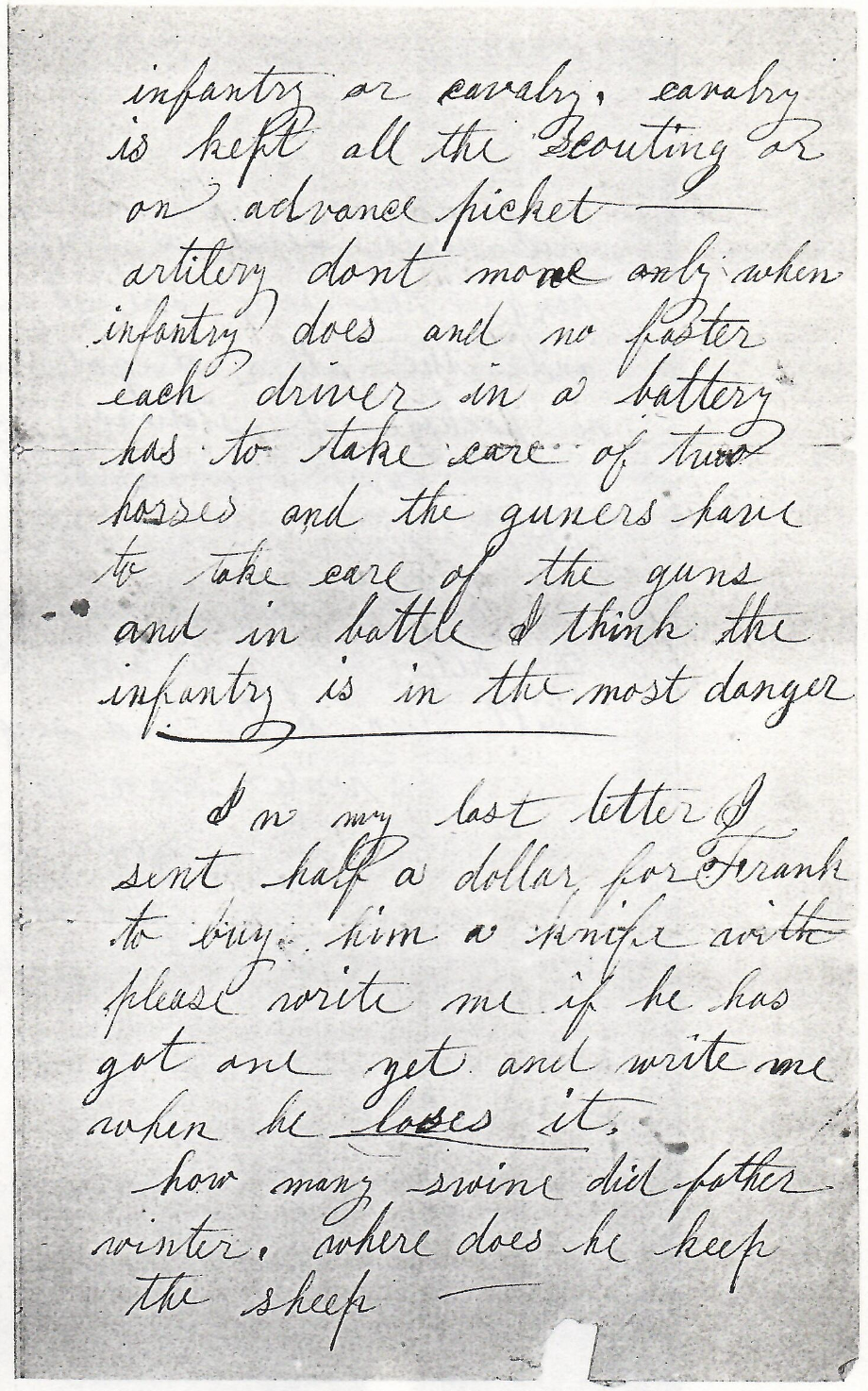
I thin kit is a big thing—Vill’s going to California to get rid of the draft for they will draft there if they do anywhere. If he is drafted or comes into the service, I should advise him to go in artillery. It is easier than infantry or cavalry. Cavalry is kept all the [time] scouting or on advanced picket. Artillery don’t move—only when infantry does, and no faster. Each driver in a battery has to take care of two gorses and the gunners have to take care of the guns and in battle, I think the infantry is in the most danger.
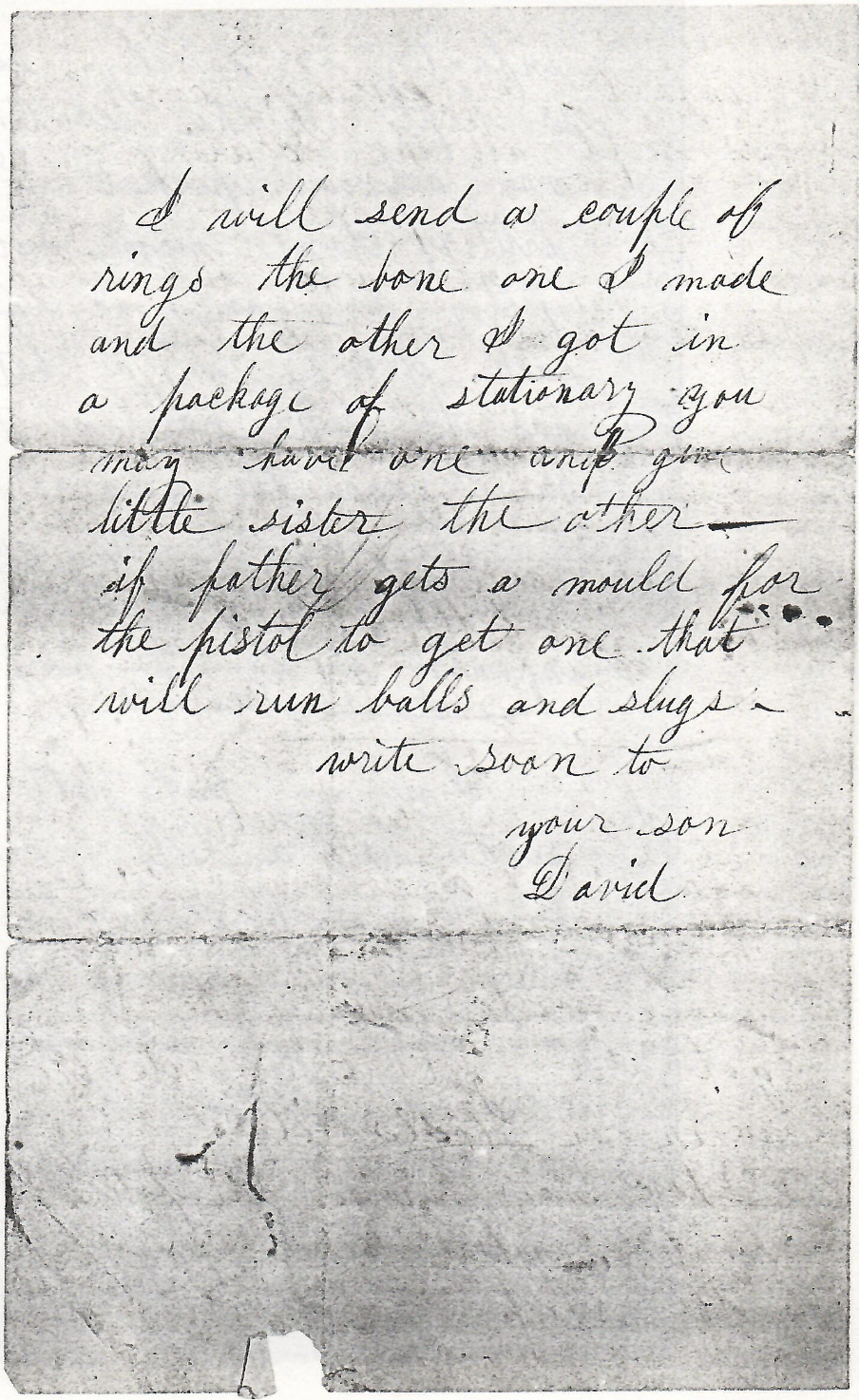
In my last letter I sent half a dollar for Frank to buy him a knife with. Please write me if he has got one yet and write me when he loses it. How many swine did father winter? Where does he keep the sheep? I will send a couple of rings. The bone one I made and the other I got in a package of stationery. You may have one and give little sister the other. [Tell] father if he gets a [bullet] mold for the pistol, to get one that will run balls and slugs. Write soon to your son, — David
Letter 20
Camp of the 16th Maine Vols.
Friday, March 27th 1863
Dear Mother,
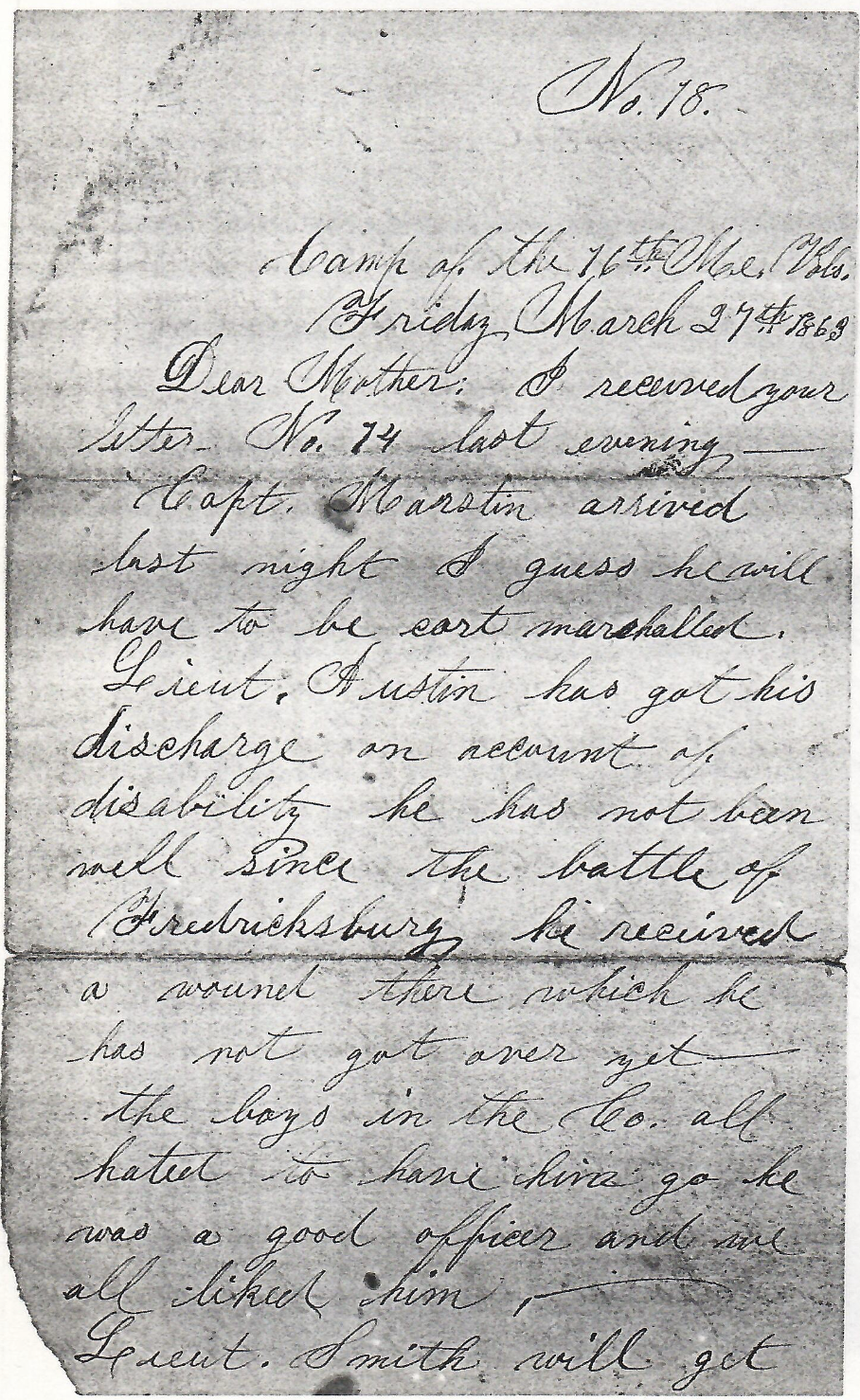
I received your letter (No. 14) last evening. Capt. Marston arrived last night. I guess he will have to be court martialed. Lieut. Austin has got his discharge on account of disability. He has not been well since the Battle of Fredericksburg. He received a wound there which he has not got over yet. The boys in the company all hated to have him go. He was a good officer and we all liked him. Lieutenant Smith will get promoted to 1st Lieutenant and if our Capt. is dishonorably discharged, Lieutenant Smith will be Captain of Co. C.
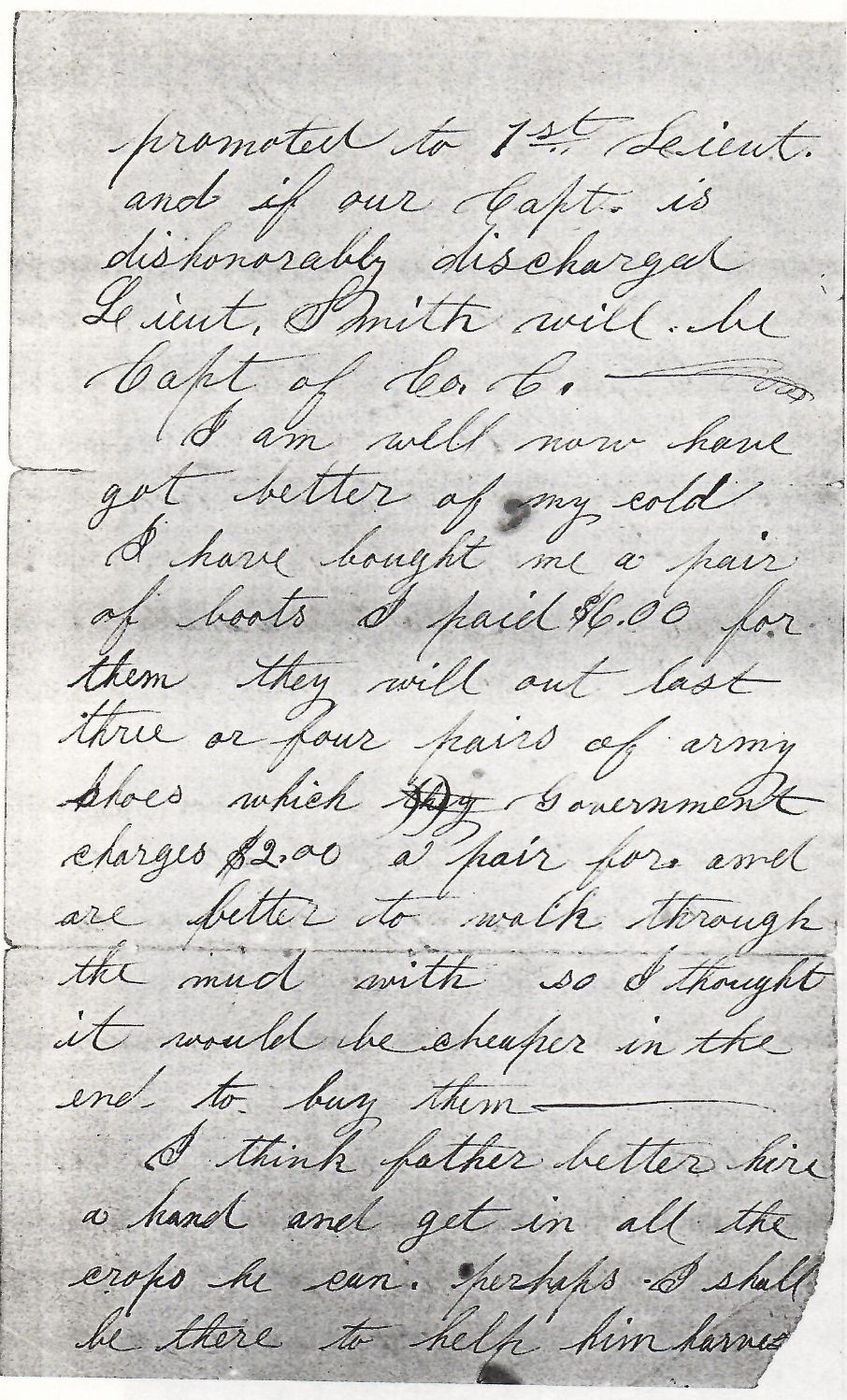
I am well now. Have got better of my cold. I have bought me a pair of boots. I paid $6 for them. They will outlast three or four pairs of army shoes which the government charges $2 a pair for and are better to walk through the mud with so I thought it would be cheaper in the end to buy them.
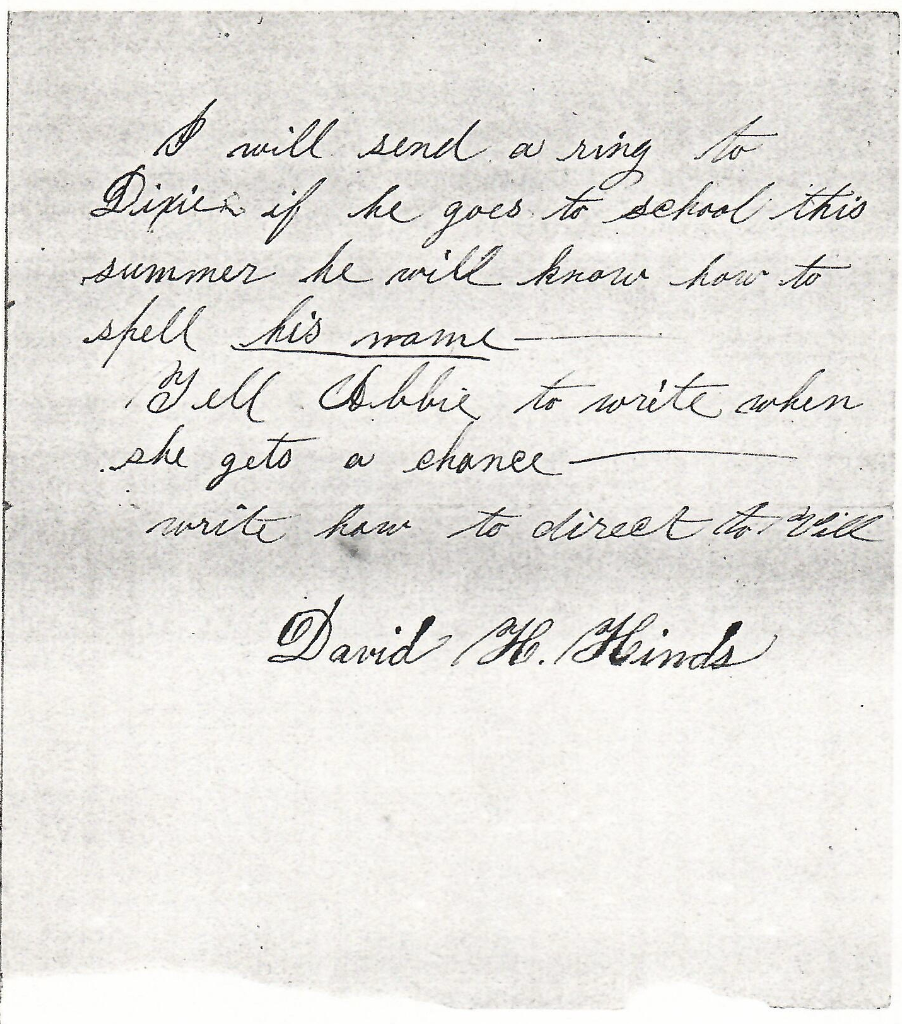
I think father better hire a hand and get in all the crops he can. Perhaps I shall be there to help him harvest. I will send a ring to Dixie if hegoes to school this summer. He will know how to spell his name. Tell Abbie to write when she gets a chance. Write how to direct to Ville. — David H. Hinds
Letter 21
Camp of the 16th Maine Vols.
Wednesday, April 15th 1863
Dear Mother,
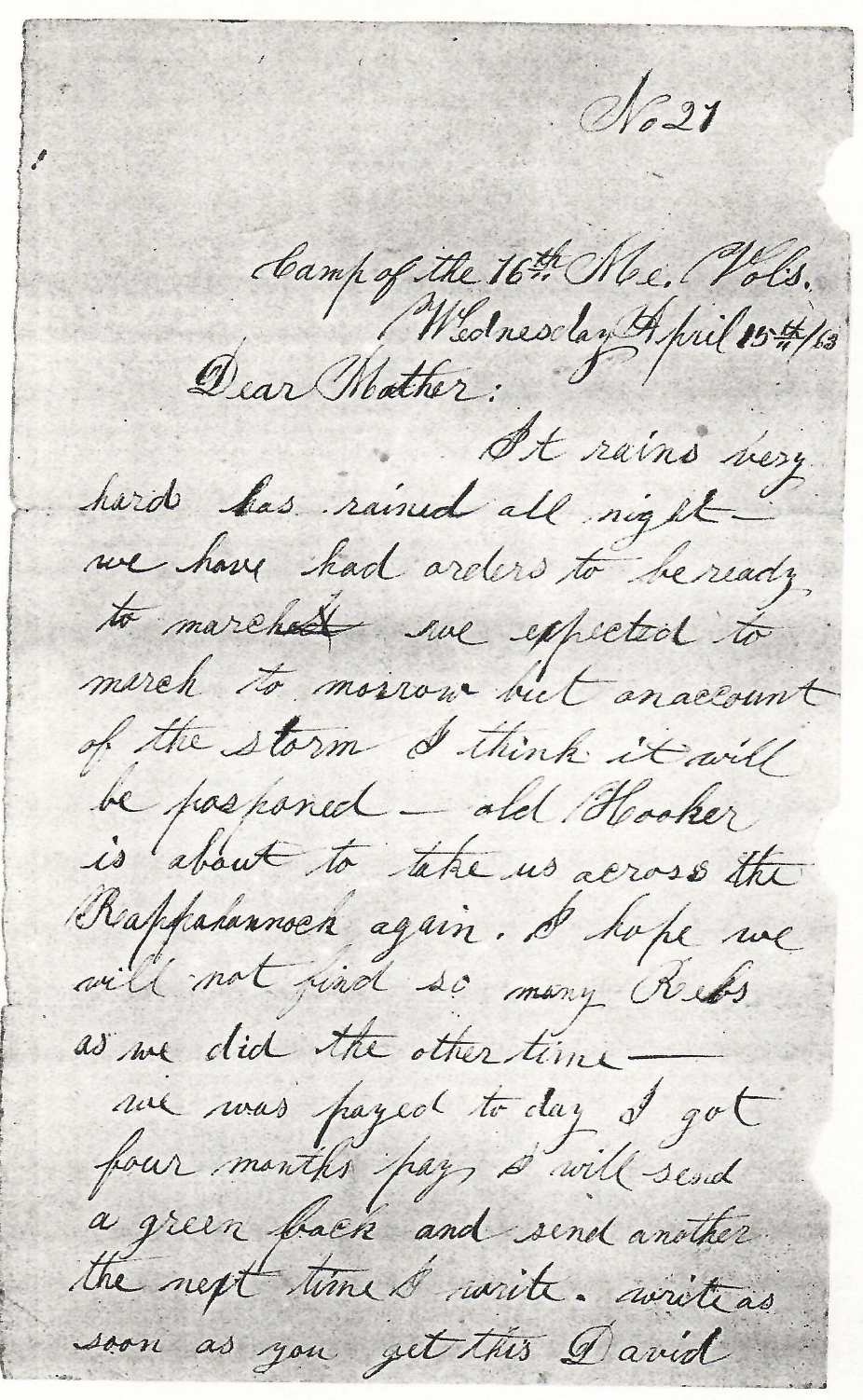
It rains very hard. Has rained all night. We have had orders to be ready to march. We expected to march tomorrow but on account of the storm, I think it will be postponed. Old Hooker is about to take us across the Rappahannock again. I hope we will not find so many Rebs as we did the other time.
We was paid today. I got four months pay. I will send a greenback and send another the next time I write. Write as soon as you get this. — David
Letter 22
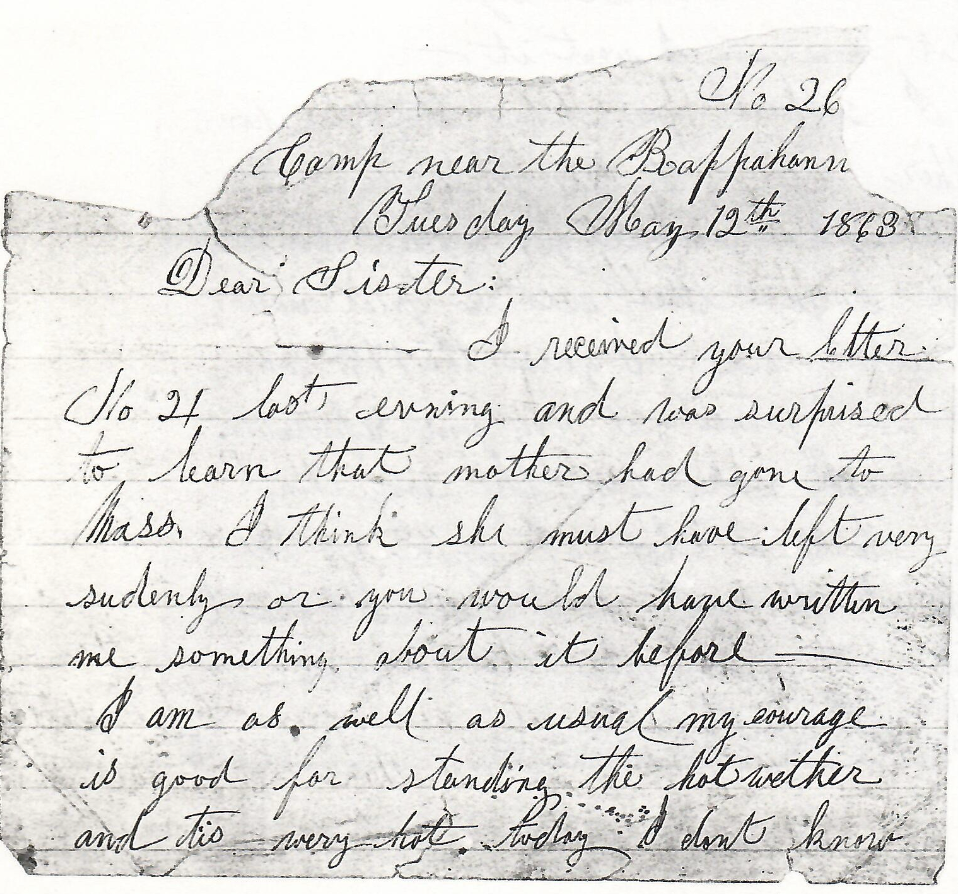
Camp near the Rappahannock
Tuesday, May 12th 1863
Dear Sister,
I received your letter No. 21 last evening and was surprised to learn that mother had gone to Massachusetts. I think she must have left very suddenly or you would have written me something about it before.
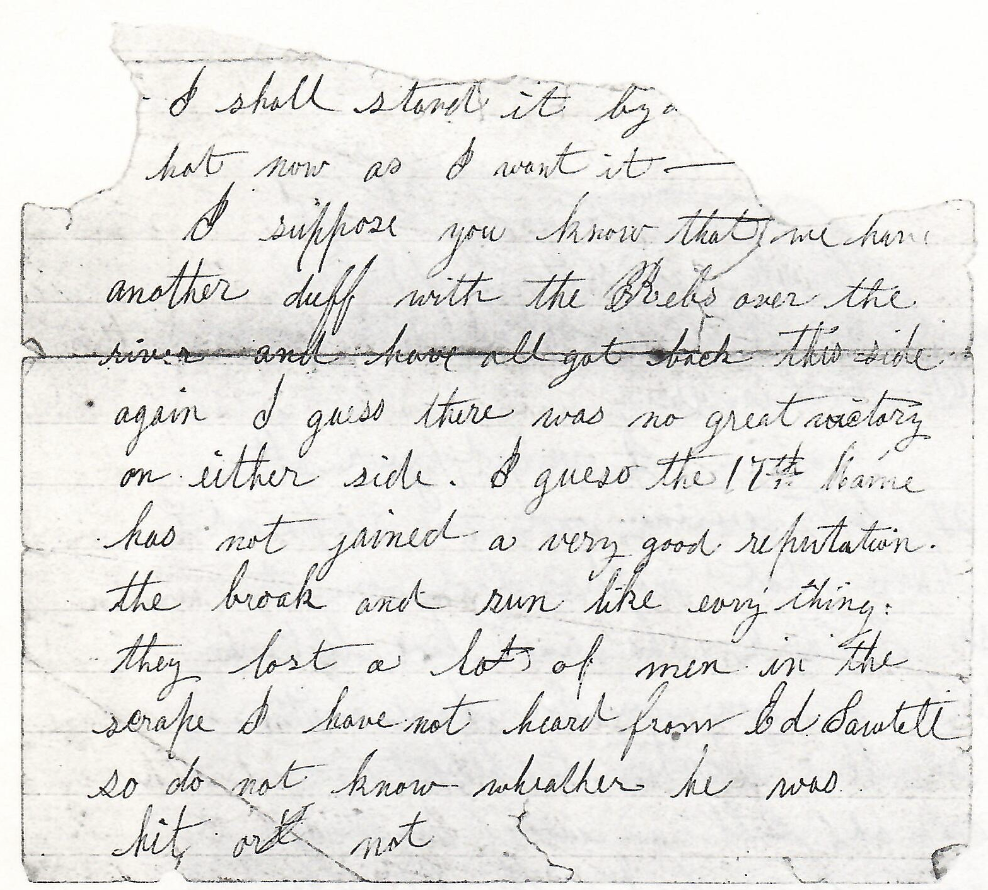
I am as well as usual. My courage is good for standing the hot weather and tis very hot today. I don’t know how I shall stand it by [summer as it is as] hot now as I want it.
I suppose you know that we have [had] another duff with the Rebs over the river and have all got back this side again. I guess there was no great victory on either side. I guess the 17th Maine has not gained a very good reputation. They broke and run like everything. They lost a lot of men in the scrape. I have not heard from Ed Sawtelle so do not know whether he was hit or not.
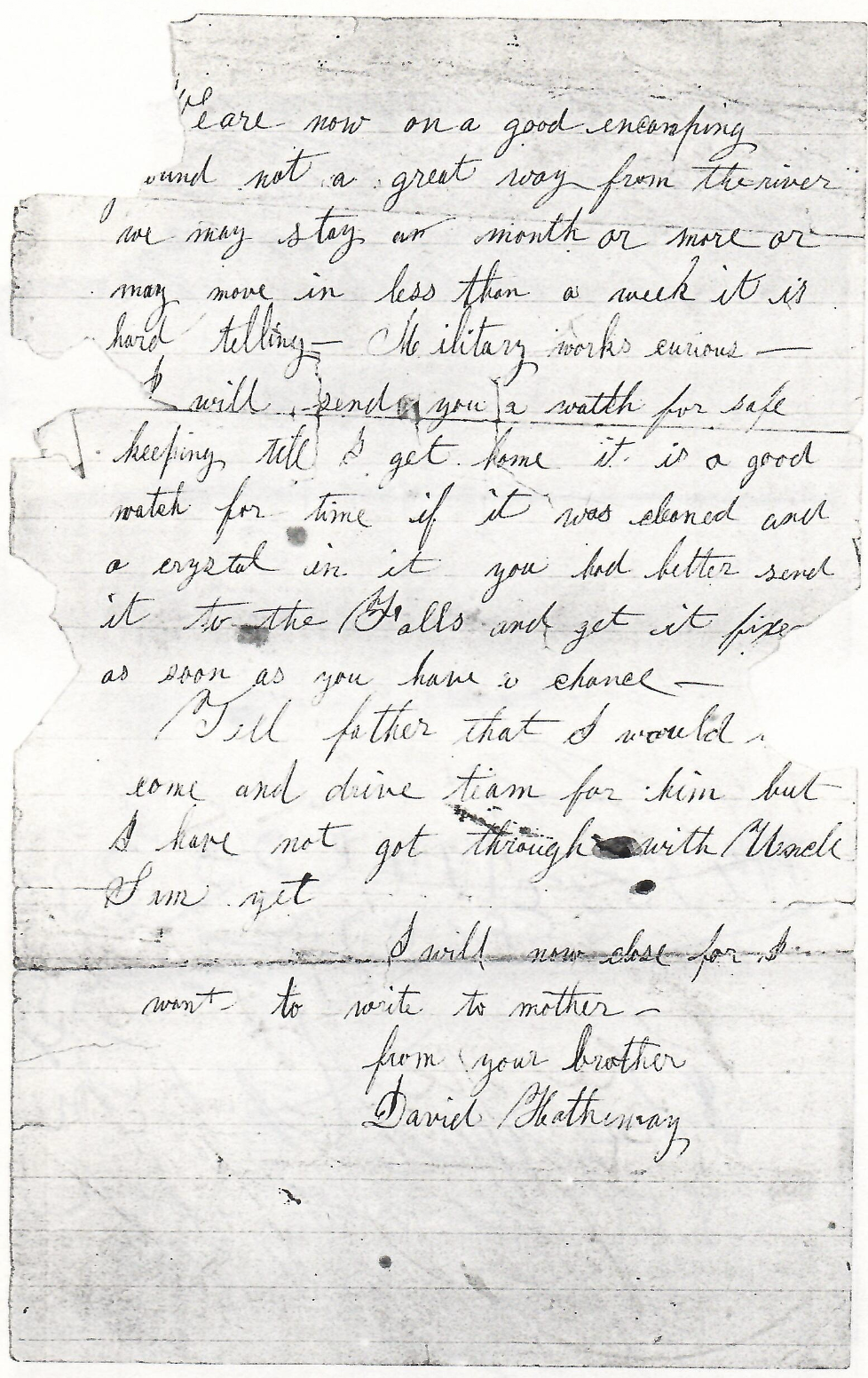
We are now on a good camping ground not a great way from the river. We may stay a month or more or may move in less than a week. It is hard telling. Military works curious.
I will send you a watch for safe keeping till I get home. It is a good watch for time if it was cleaning and a crystal [put] in it. You had better send it to the Falls and get it fixed as soon as you have a chance.
Tell father that I would come and drive them team for him but I have not got through with Uncle Sam yet. I will now close for I want to write to mother. From your brother, — David Hatheway [Hinds]
Letter 23
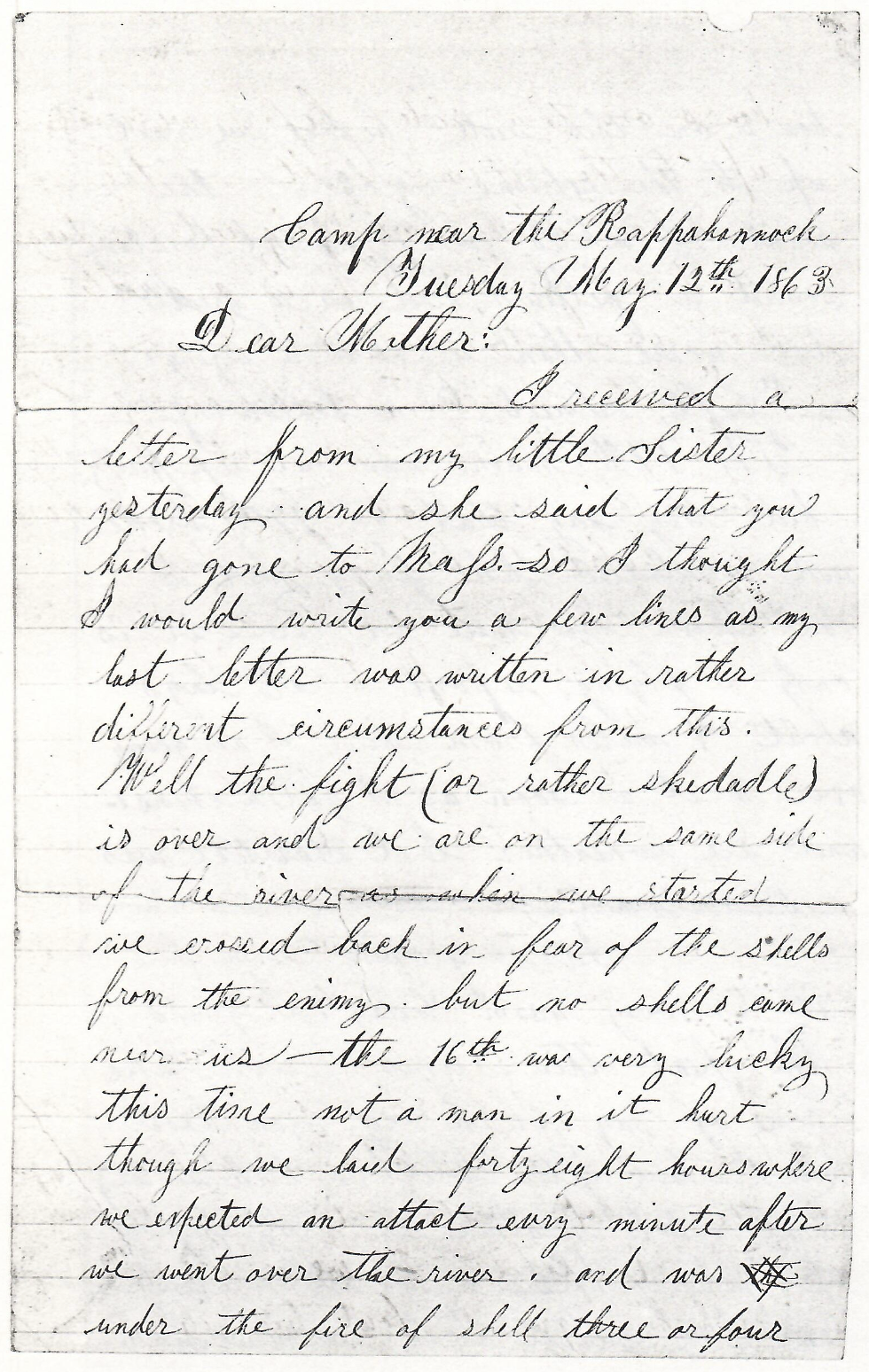
Camp near Rappahannock
Tuesday, May 12th, 1863
Dear Mother,
I received a letter from my little sister yesterday and she said that you had gone to Massachusetts so I thought I would write you a few lines as my last letter was written in rather different circumstances from this.
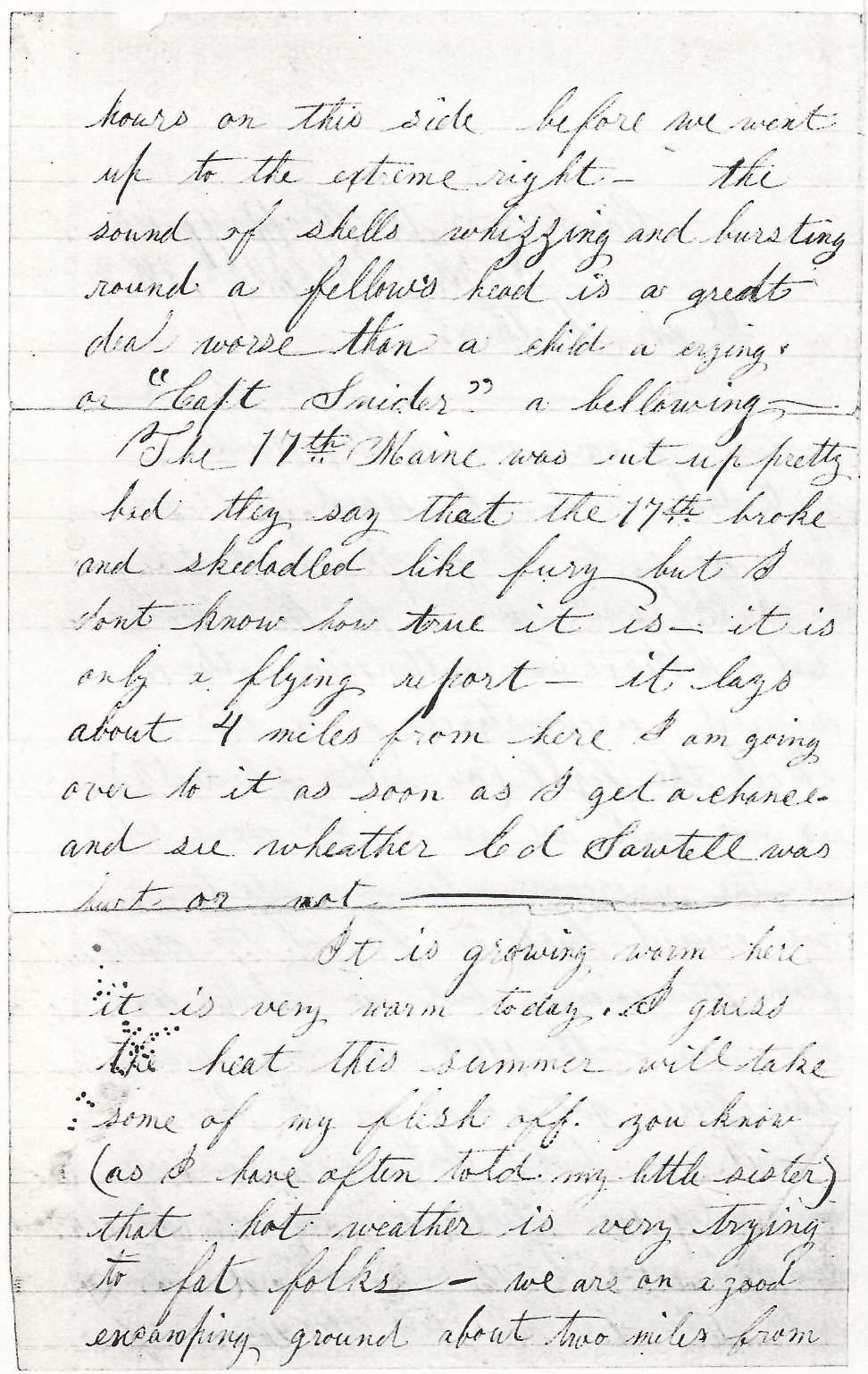
Well, the fight (or rather skedaddle) is over and we are on the same side of the river as when we started. We crossed back in fear of the shells from the enemy but no shells came near us. The 16th [Maine] was very lucky this time. Not a man in it hurt though we laid 48 hours where we expected an attack every minute after we went over the river and was under the fire of shell three or four hours on this side before we went up to the extreme right. The sound of shells whizzing and bursting round a fellow’s head is a great deal worse than a child a crying or “Capt. Snider” a bellowing.
The 17th Maine was cut up pretty bad. They say that the 17th broke and skedaddled like fury but I don’t know how true it is. It is only a flying report. It lays about four miles from here. I am going over to it as soon as I get a chance and see whether Ed Sawtelle was hurt or not.
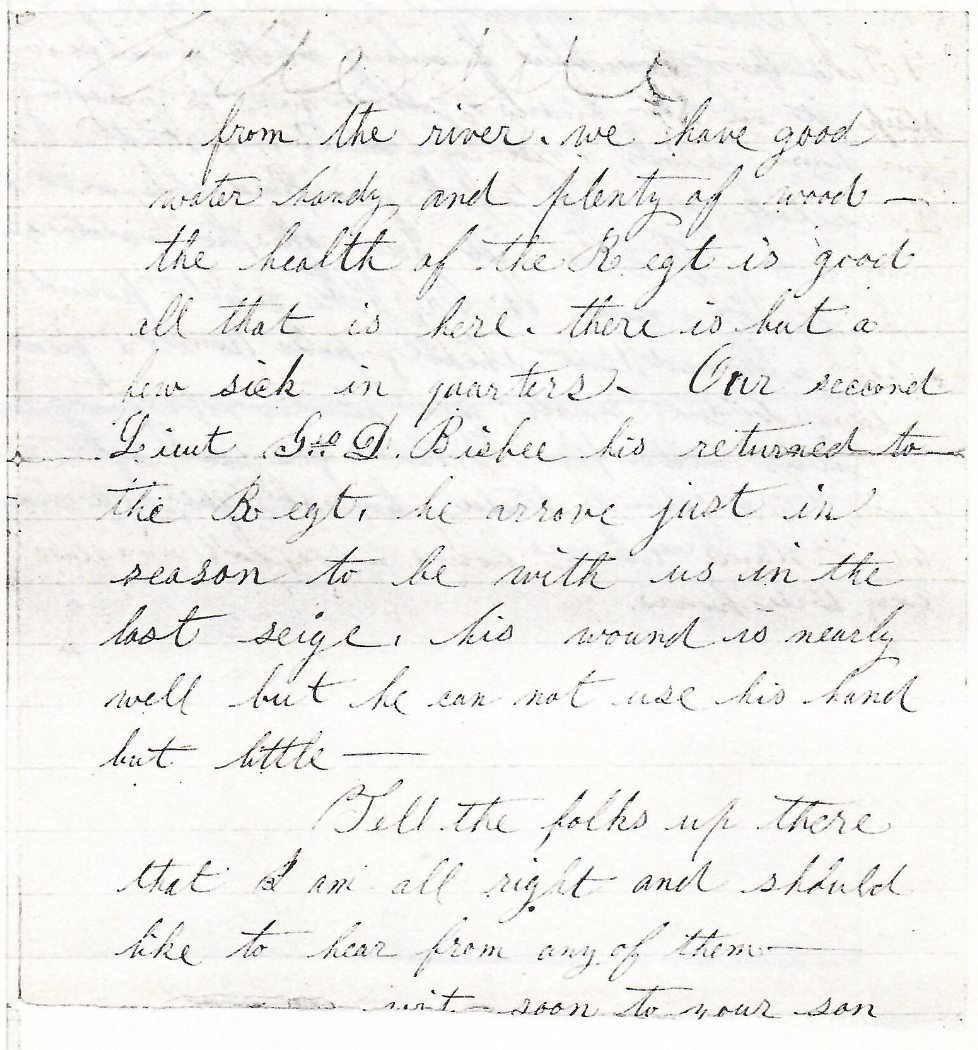
It is growing war, here. I ti s very warm today. I guess the heat this summer will take some of the flesh off. You know (as I have often told y little sister) that hot weather is very trying to fat folks. We are on a good camping ground about two miles from the river. We have good water handy and plenty of wood. The health of the regiment is good—all that is here. There is but few sick in quarters.
Our 2nd Lieutenant George D. Bisbee has returned to the regiment. He arrived just in season to be with us in the last siege. His wound is nearly well but he cannot use his hand but little.
Tell the folks up there that I am all right and should like to hear from any of them. Write soon to your son — David
Letter 24
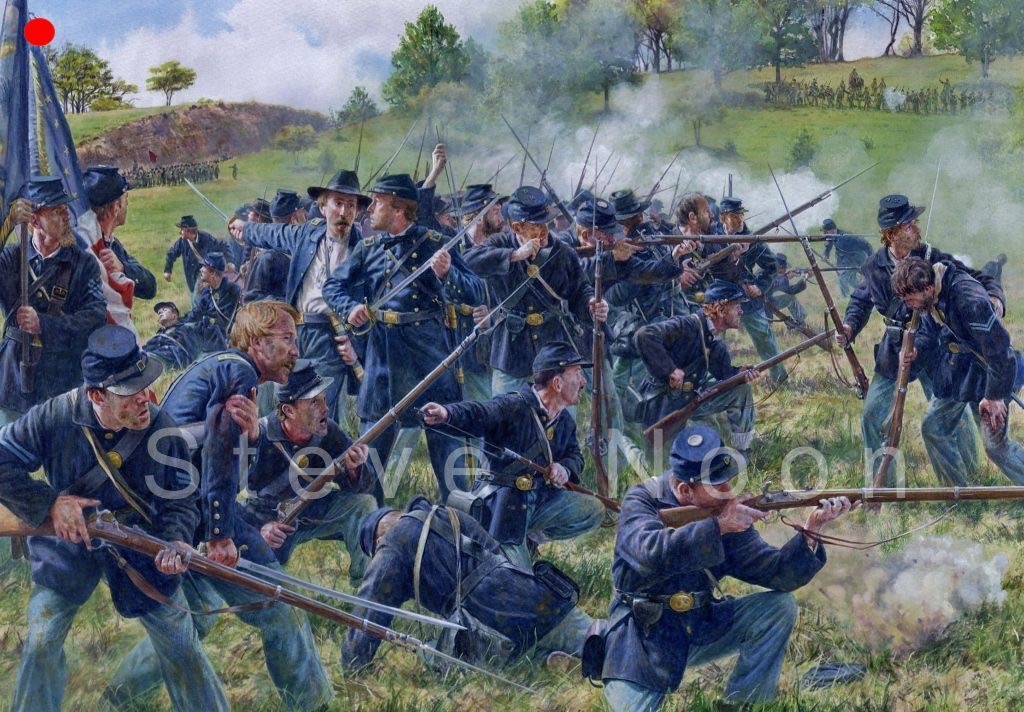
Hospital near Gettysburg, Pennsylvania
July 9th 1863
Dear Mother,
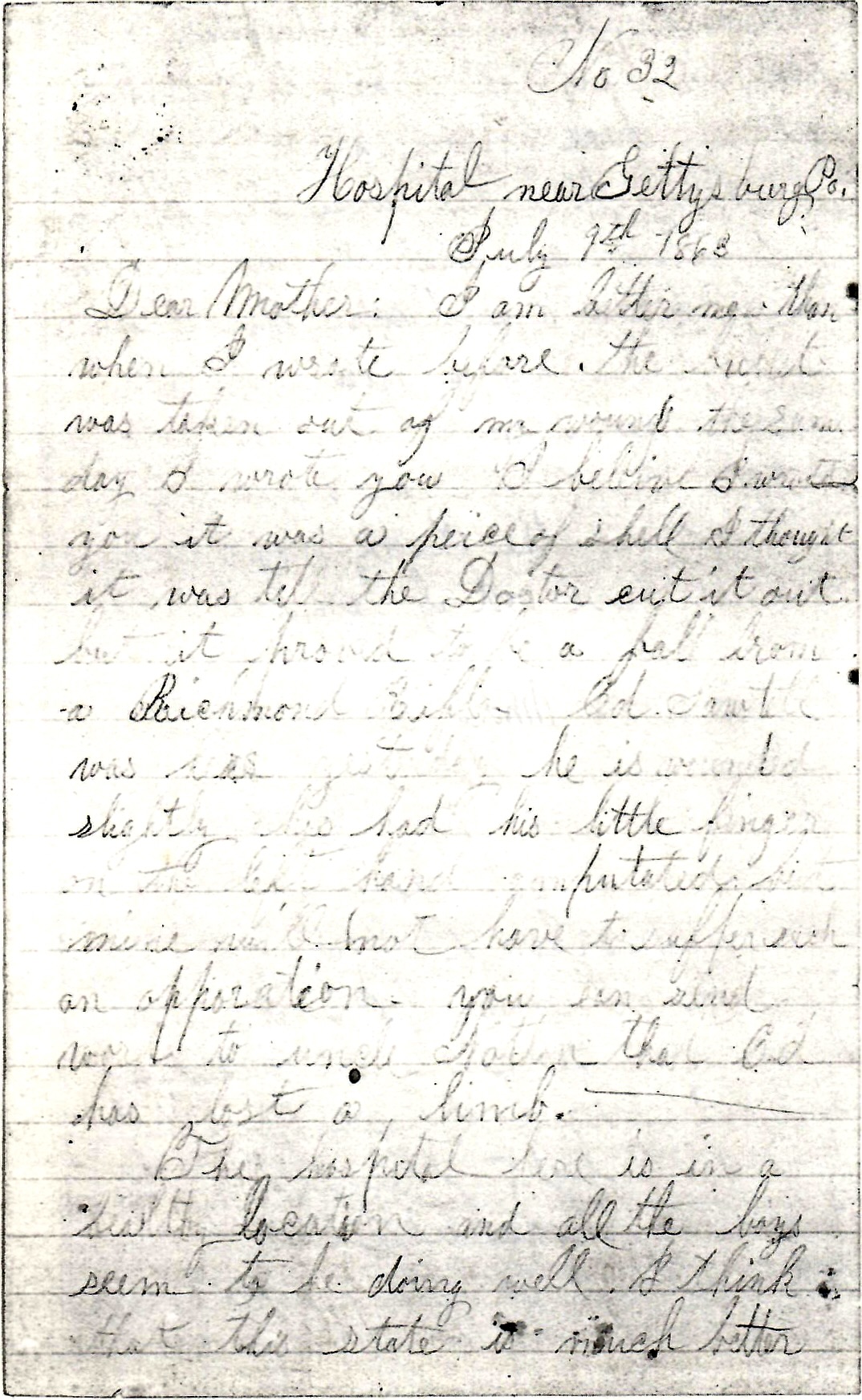
I am better now than when I wrote before. The bullet was taken out of my wound the same day I wrote you. I believe I wrote you it was a piece of shell. I thought it was till the doctor cut it out. But it proved to be a ball from a Richmond rifle. Ed Sawtelle was here yesterday. He is wounded slightly. He had his little finger on the left hand amputated but mine will not have to suffer such an operation. You can send word to Uncle Nathan that Ed has lost a limb. 1
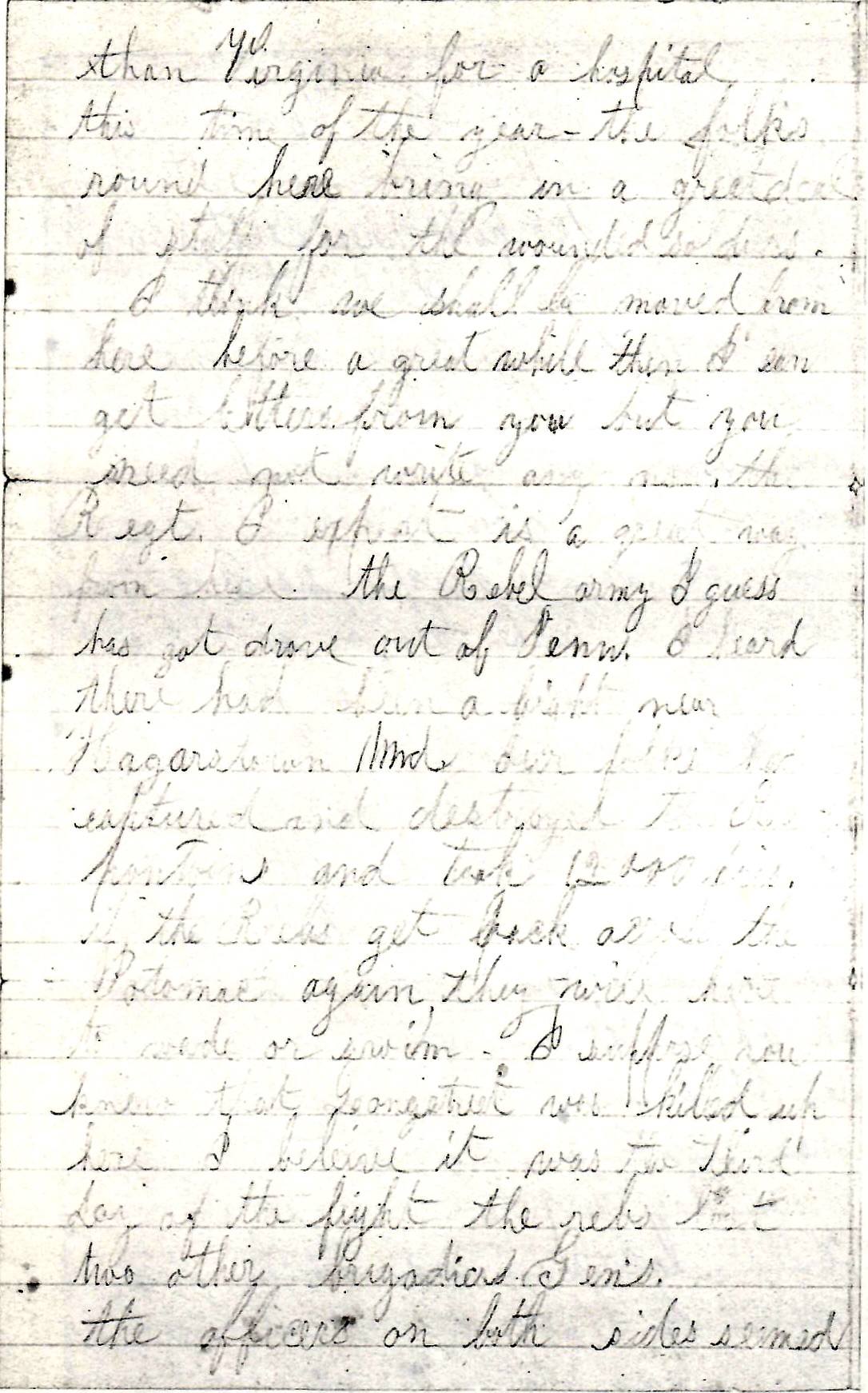
The hospital here is in a healthy location and all the boys seem to be doing well. I think that this state is much better than Virginia for a hospital this time of the year. The folks round here bring in a great deal of stuff for the wounded soldiers. I think we shall be moved from here before a great while. Then I can get letters from you but you should not write any number of the regiment. I expect it is a great way from here.
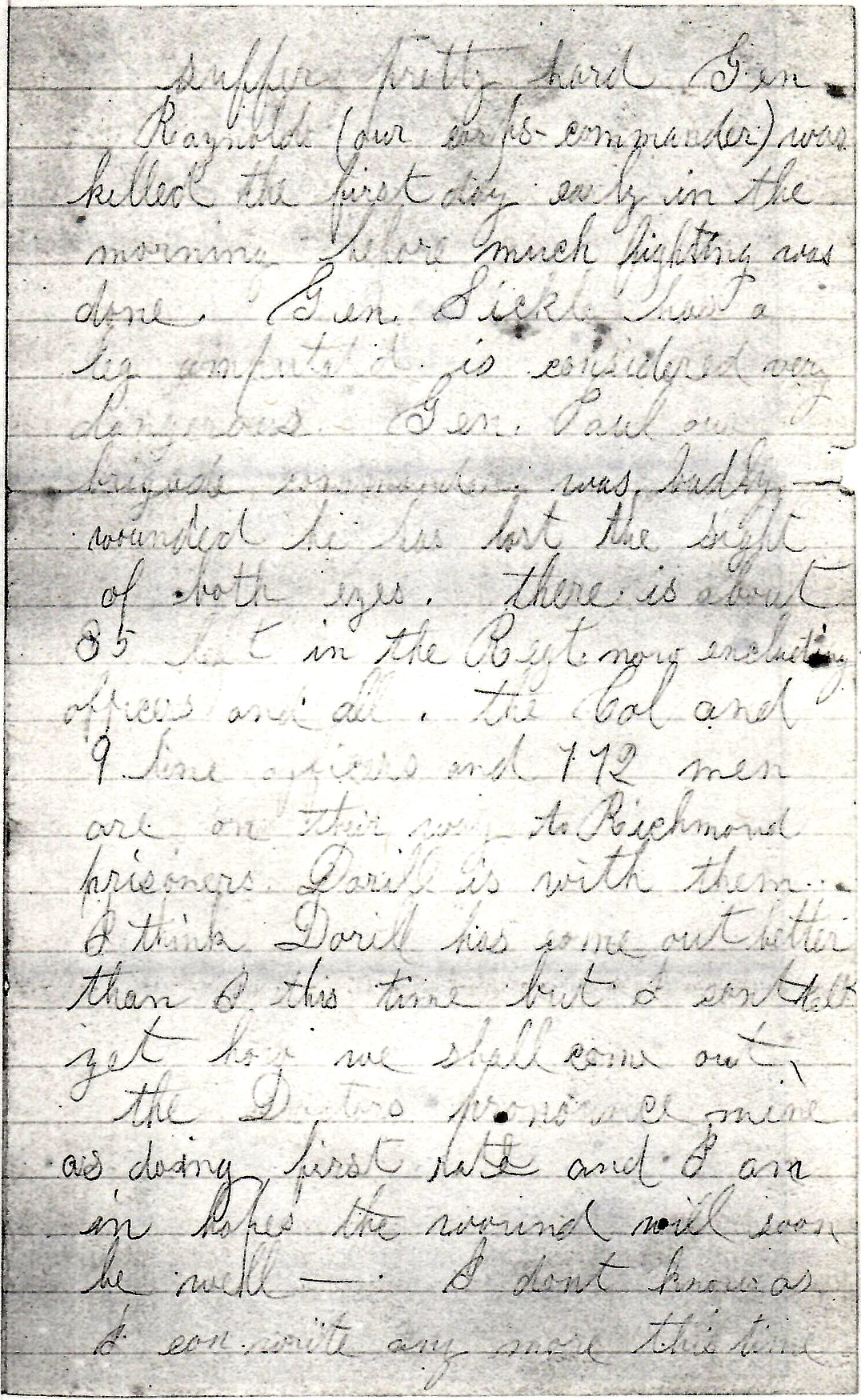
The Rebel army, I guess, has got drove out of Pennsylvania. I heard there had been a fight near Hagerstown, Maryland. Our folks have captured and destroyed two Rebel pontoons and took 12,000 prisoners. If the Rebs get back across the Potomac again, they will have to wade or swim. I suppose you knew that Longstreet was killed up here. I believe it was the third day of the fight. The Rebs two other brigade generals. The officers on both sides seemed to suffer pretty hard. Gen. Reynolds (our Corps Commander) was killed the first day early in the morning before much fighting was done. Gen. Sickles has a leg amputated [and] is considered very dangerous. Gen. Paul, our Brigade commander, was badly wounded. He has lost the sight of both eyes. There is about 85 left in the regiment now including officers and all. The Colonel and 9 line officers and 112 men are on their way to Richmond prisoners. Dorill[us] Hobbs] is with them. I think Dorill[us] has come out better than I this time but I can’t tell yet how we shall come out. 2
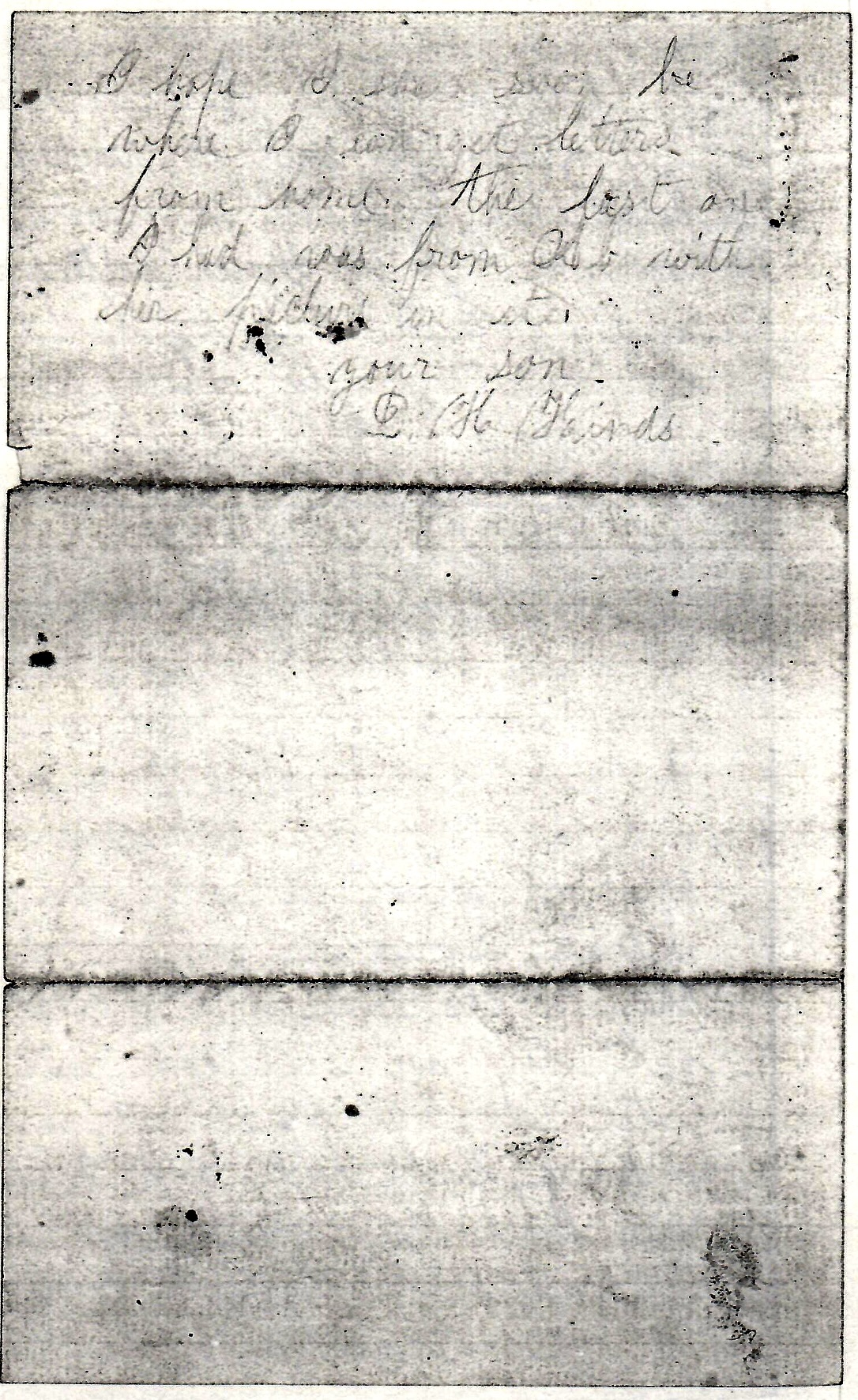
The doctors pronounce mine as doing first rate and I am in hopes the wound will soon be well. I don’t know as I can write anymore this time. I hope I shall soon be where I can get letters from home. The last one I had was from Abbie with her picture in it. Your son, — D. H. Hinds
1 Zephaniah Eddy Sawtelle (1839-1887) was the son of Nathan Hale Sawtelle (1800-1872) and his first wife, Olive Whitman (1800-1836) of Turner, Androscoggin county, Maine. After his first wife died, Nathan married Maria Hinds (1807-1898). Ed served in Co. F, 17th Maine Infantry from August 1862 to June 1864.
2 Dorillus Hobbs served with David in Co. C, 16th Maine Infantry. He was one of the 159 men from the regiment taken prisoner by the Confederates in the desperate stand on the first day of Gettysburg. He was sent to prison in Richmond, Virginia, where he died in captivity in November 1863—a year earlier than David.
Letter 25
In hospital near Gettysburg, Pennsylvania
Sunday, July 12th 1863
Dear sister,
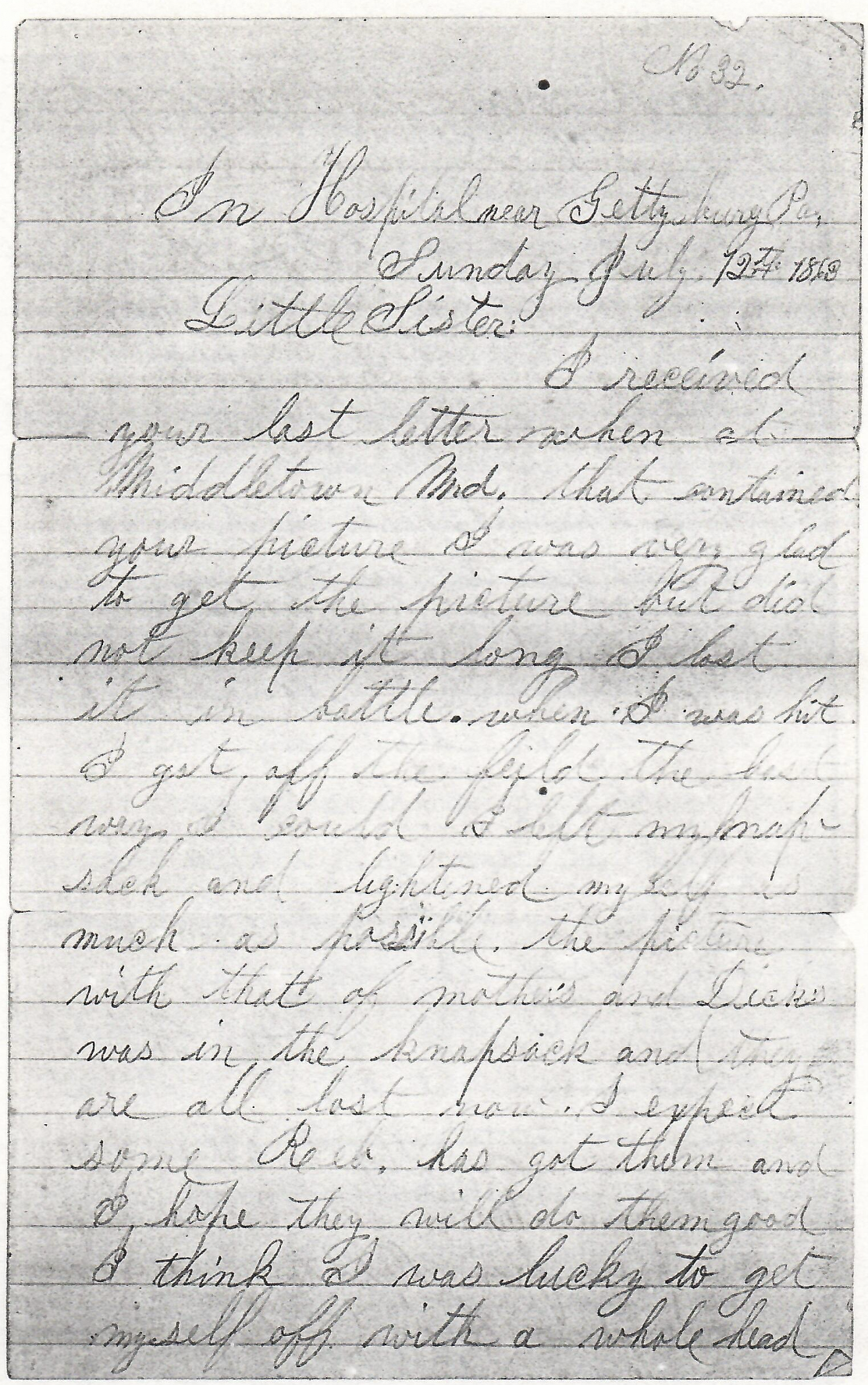
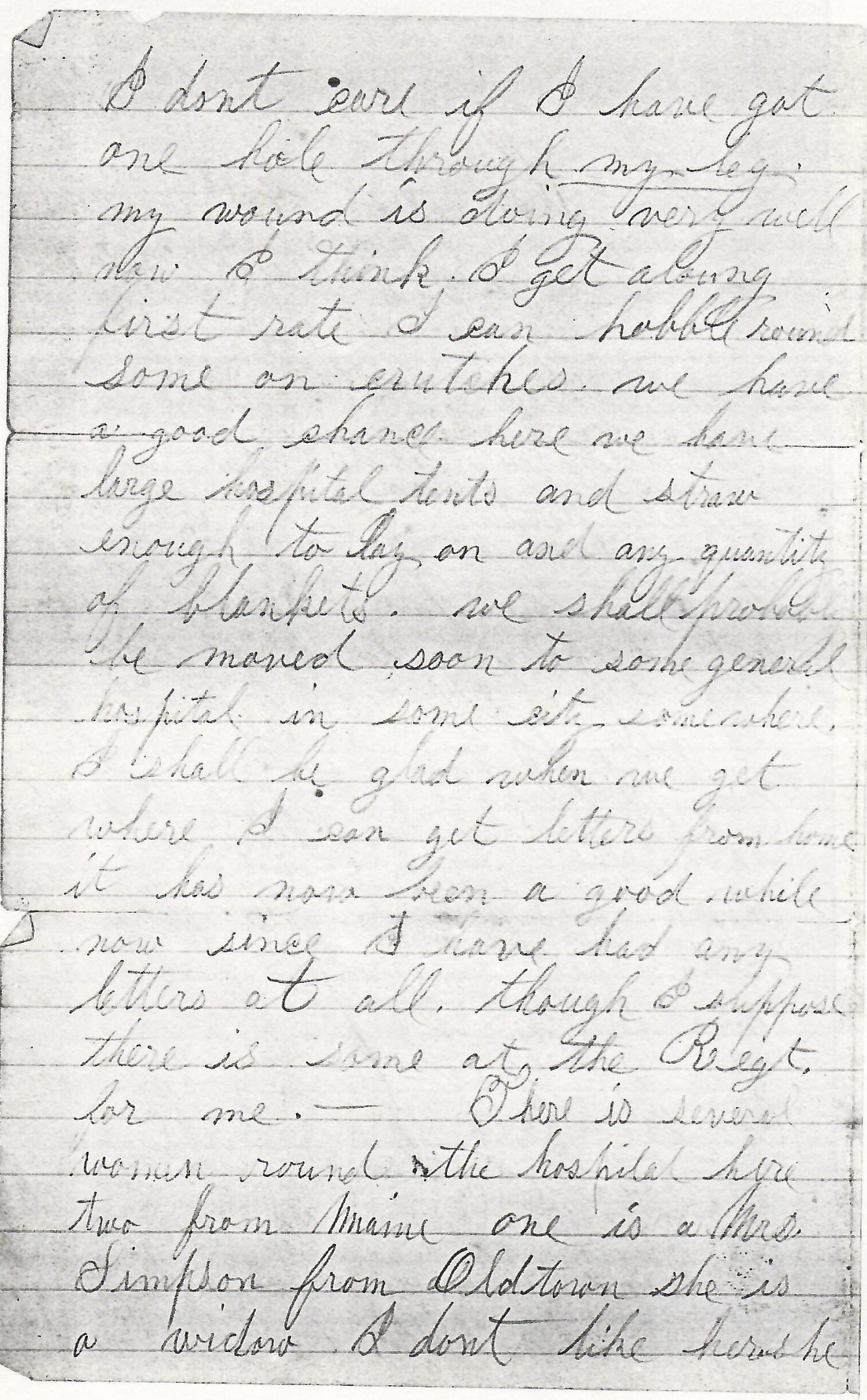
I received your last letter when at Middletown, Maryland, that contained your picture. I was very glad to get the picture but did not keep it long. I lost it in battle when I was hit. I got off the field the best way I could. I left my knapsack and lightened myself as much as possible. The picture with that of mother’s and Dick’s was in the knapsack and they are all lost now. I expect some Reb has got them and I hope they will do them good. I think I was lucky to get myself off with a whole head. I don’t care if I have got one hole through my leg. My wound is doing very well now. I think I get along first rate. I can hobble round some on crutches. We have a good chance here. We have large hospital tents and straw enough to lay on and any quantity of blankets. We shall probably be moved soon to some general hospital in some city somewhere. I shall be glad when we get where I can get letters from home. It has now been a good while since I have had any letters at all though I suppose there is some at the regiment for me.
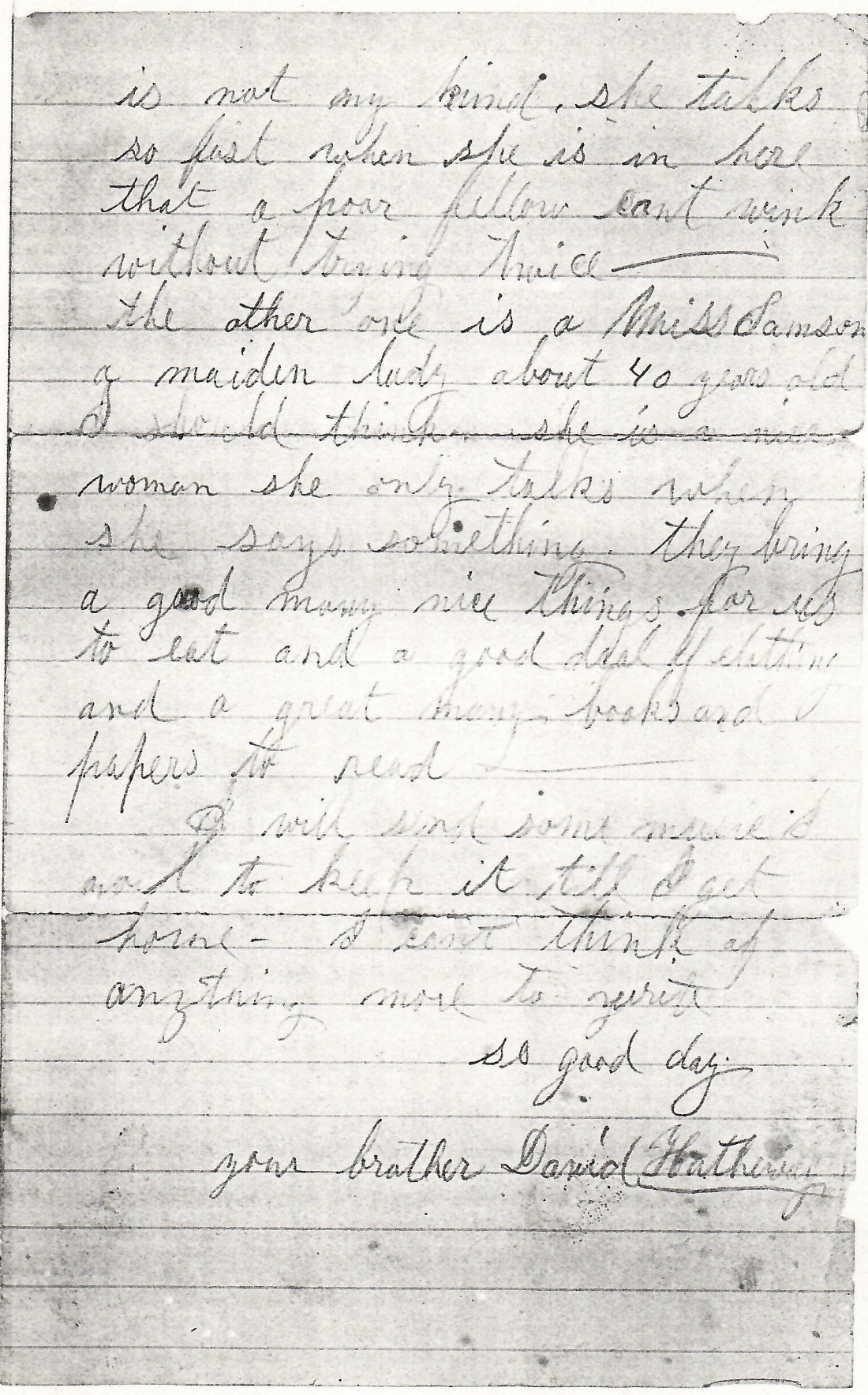
There is several women round the hospital here—two from Maine. One is Mrs. Simpson from Old Town. She is a widow. I don’t like her. She is not my kind. She talks so fast when she is in here that a poor fellow can’t wink without trying twice. The other one is a Miss Lamson [Samson?], a maiden lady about 40 years old I should think. She is a nice woman. She only talks when she says something. They bring a good many nice things for us to eat and a good deal of clothing and a great many books and papers to read. 1
I will send some music. I want [you] to keep it till I get home. I can’t think of anything more to write. So good day. Your brother, — David Hatheway [Hinds]
1 These ladies may have been sponsored by the Maine Soldiers’ Relief Association. One such lady was known to be Sarah Smith Sampson of Bath, Maine, who’s husband Charles served as a captain in the 3rd Maine Infantry. She spent four intensive weeks at Gettysburg nursing the wounded after the battle.
Letter 26
York, Pennsylvania
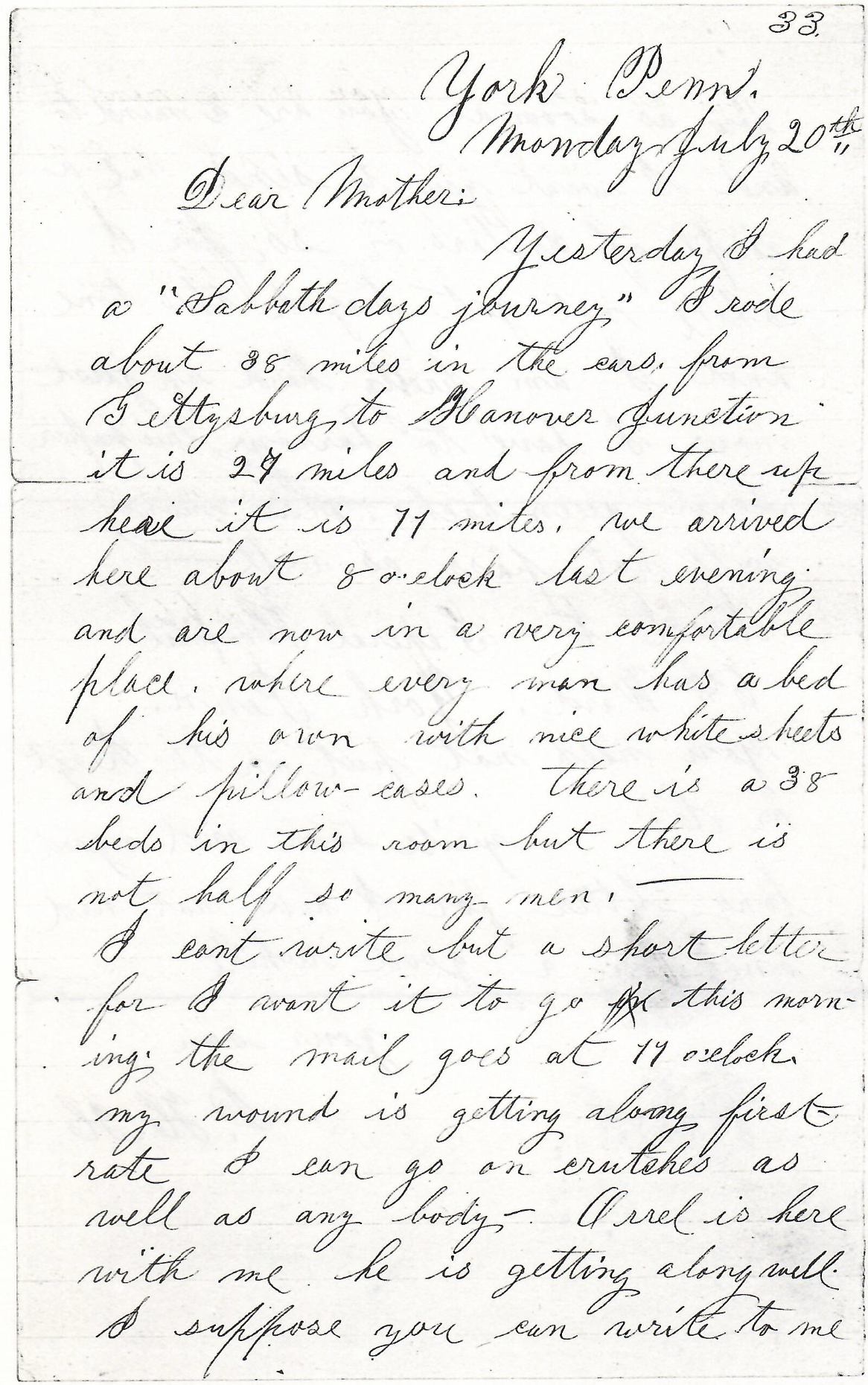
Monday, July 20th [1863]
Dear Mother,
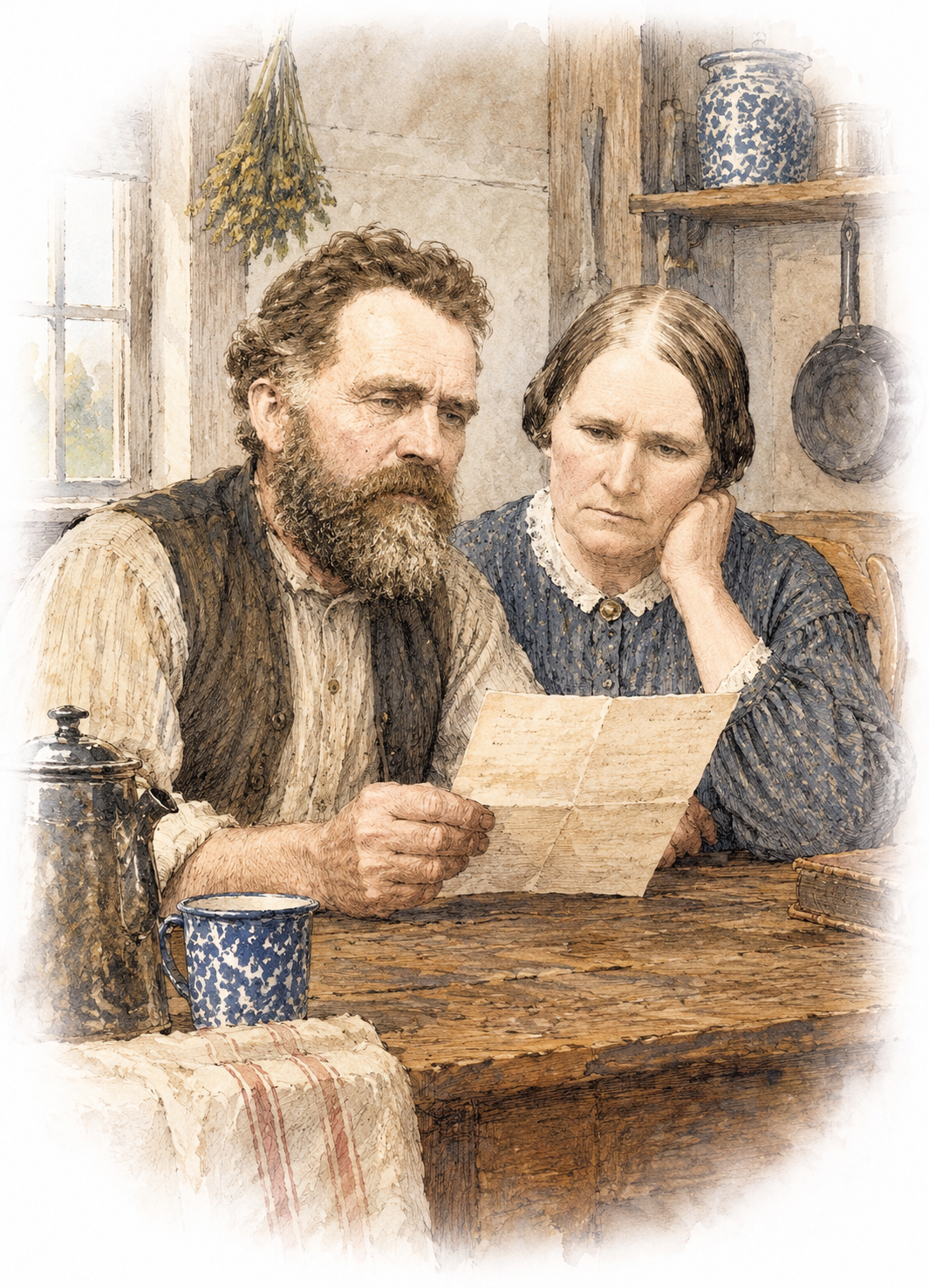
Yesterday I had a “Sabbath Day’s journey.” I rode about 38 miles in the cars from Gettysburg to Hanover Junction. It is 27 miles and from there up here it is 11 miles. We arrived here about 8 o’clock last evening and are now in a very comfortable place where ever man has a bed of his own with nice white sheets and pillow cases. There is 38 beds in this room but there is not half so many men.
I can’t write but a short letter for I want it to go this morning. The mail goes at 11 o’clock.
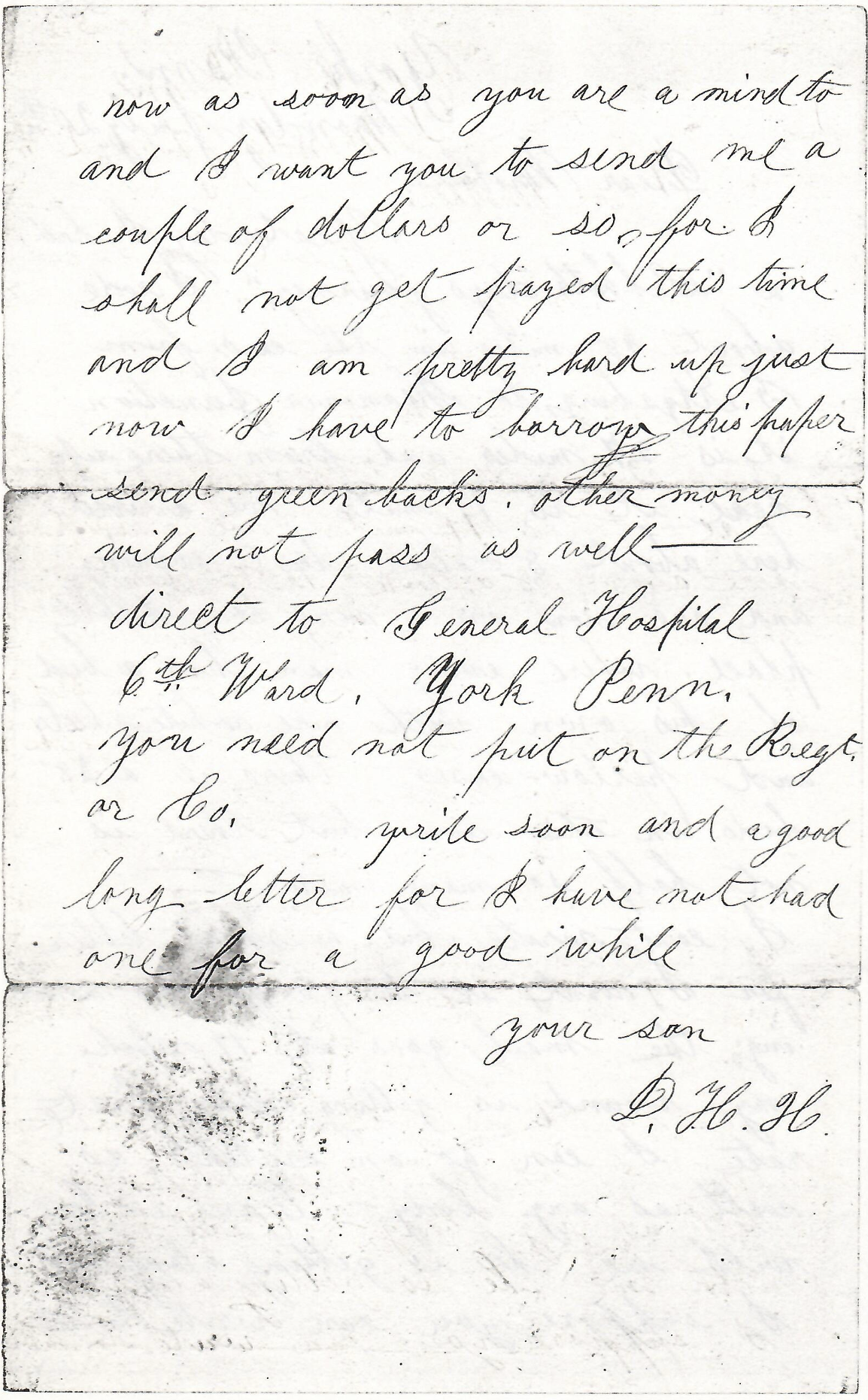
My wound is getting along first rate. I can go on crutches as well as anybody. Orrel [Orvel Brown] is here with me. He is getting along well. I suppose you can write to me now as soon as you are a mind to and I want you to send me a couple of dollars or so for I shall not get paid this time and I am pretty hard up just now. I have to borrow this paper. Send greenbacks. Other money will not pass as well. Direct to General Hospital, 6th Ward, York, Pennsylvania. 1 You need not put on the regiment and company. Write soon and a good long letter for I have not had one for a good while. Your son, — D. H. H.
1 The US General Hospital at York, Pennsylvania was described by Pvt. James Mills Smith of Co. G, 149th New York Infantry shortly after his arrival there at the same time as David. On 25 July 1863 he wrote: “Our hospital is simple, a piece of ground in the form of a square containing perhaps 20 acres & bounded on two sides by a double row of one story buildings & on the other 2 by a high & close board fence; & was originally designed & used for a camp ground & barracks for soldiers & consequently in accommodations & comfort is I suppose far inferior to most or all regular General Hospitals. The rooms are low and ill ventilated, there is not a tree or bush in the ground, & the number of seats outside the building is very small. When I first arrived here we had about 1150 patients & now we must have many more & consequently on many accounts we fare worse than we would with fewer patients, previous to the battle of Gettysburgh that number was 160. Fortunately for wounded men we have had cool cloudy weather most of the time since the battle. These is a Post Office & small soldiers library on the ground. In about the centre of our enclosure there is an open shed under which they have lately conveyed a few benches, & religious meetings are held there in the evenings & on Sundays. York contains about 8000 inhabitants & seems to have a fine agricultural country around it. Our hospital buildings are divided into wards & the wards into rooms: our room contains 40 patients, none them very badly wounded & most of them doing well; we have 3 nurses to take care of us & the room, & the Dr. comes around occasionally. Every man who is considered well enough can obtain a pass to go (out) into town once in 3 days, between the hours of 1 & 5 P.M. In other Hospitals I am told furloughs can be easily obtained & passes more easily frequented & for a longer time that here. Here they say it is useless to ask for a furlough, but I did not design to ask for one but would have much preferred to have gone to some Hospital in Philadelphia or New York.”
Letter 27
U. S. General Hospital
York, Pennsylvania
July 30th 1863
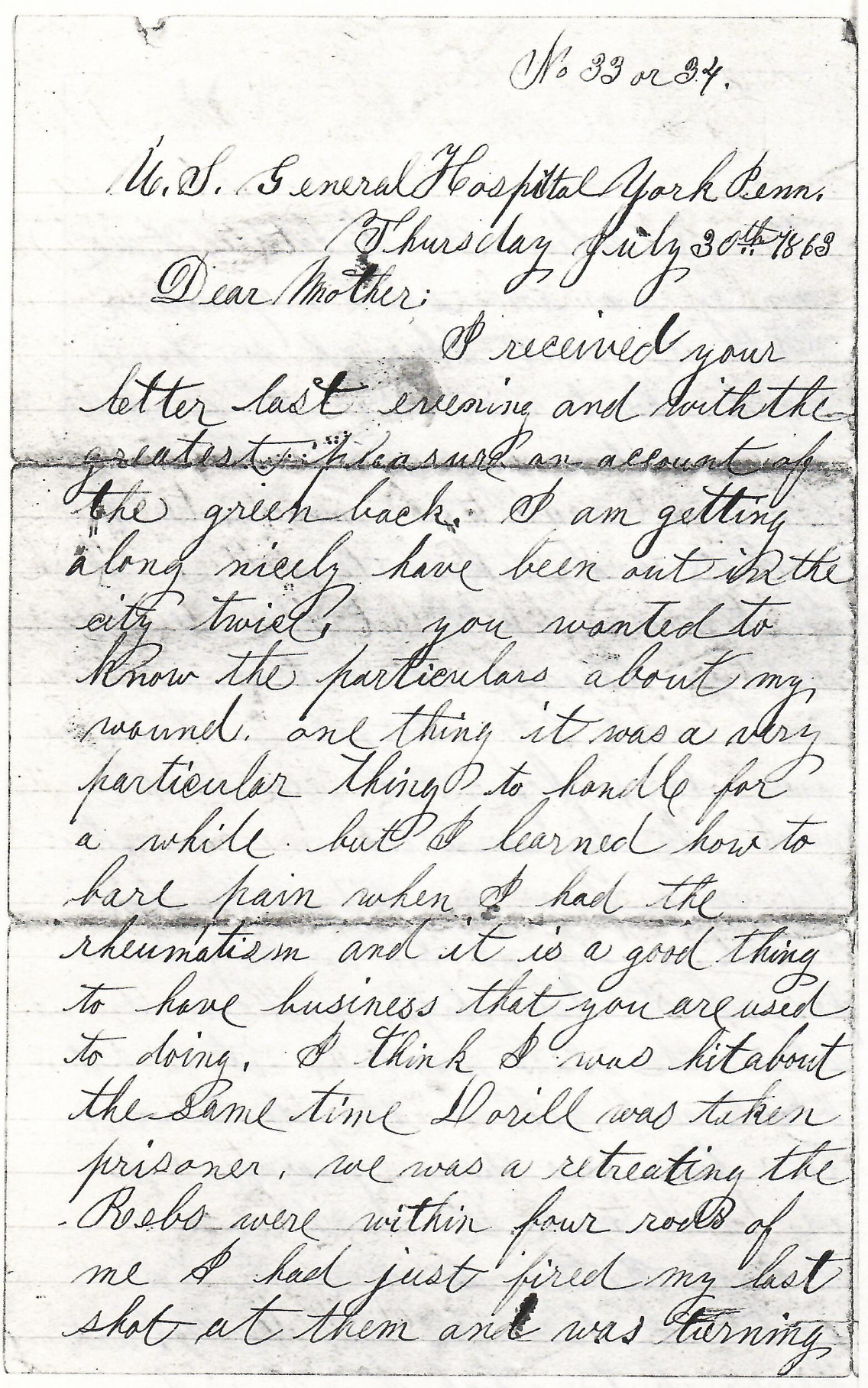
Dear Mother,
I received your letter last evening and with te greatest pleasure on account of the greenback. I am getting along nicely. Have been out in the city twice.
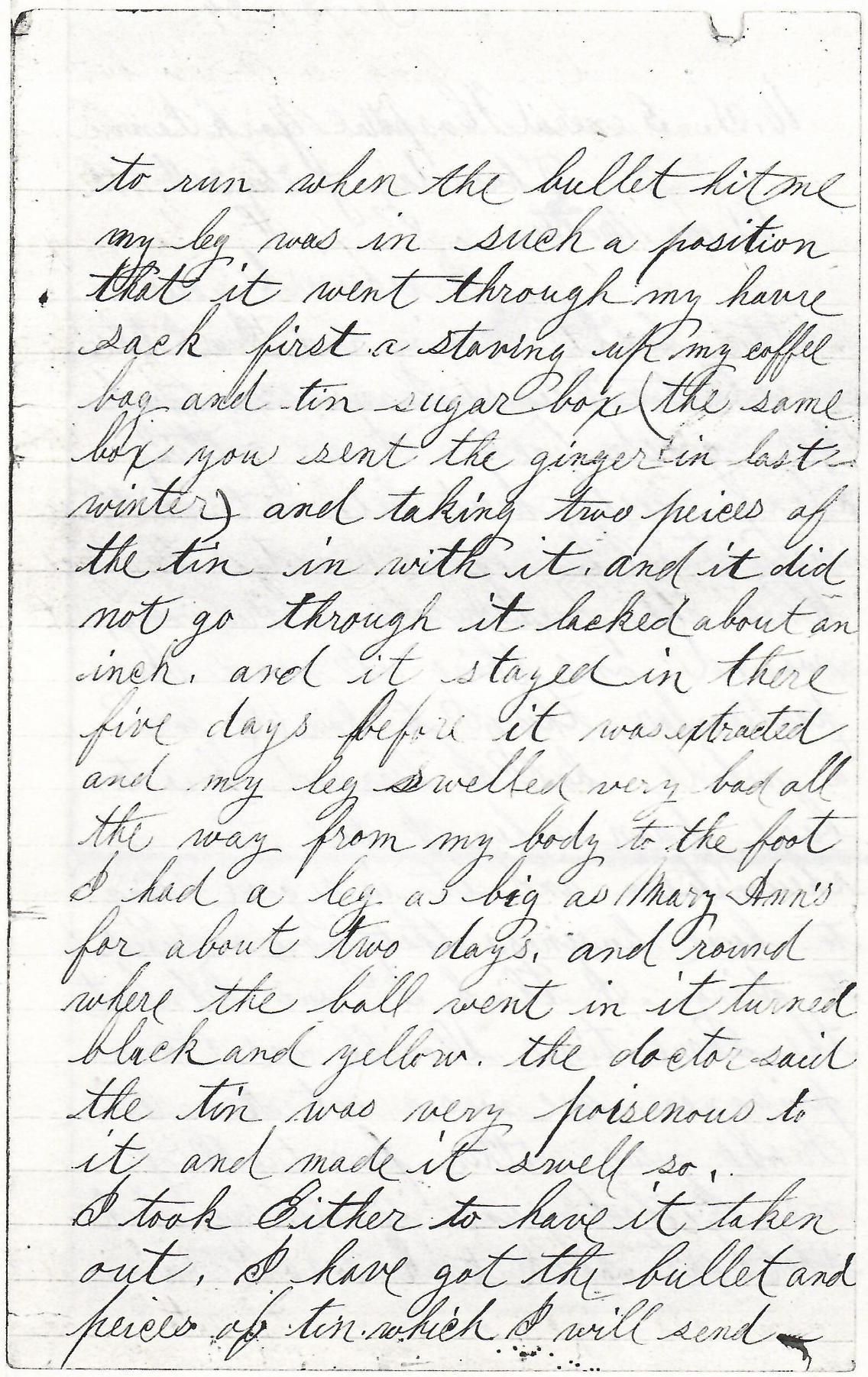
You wanted to know the particulars about my wound. One thing—it was a very particular thing to handle for awhile but I learned how to bear pain when I had the rheumatism and it is a good thing to have business that you are used to doing. I thin I was hit about the same time Dorill[us] was taken prisoner. We was a retreating. The rebs were within four rods [22 yards] of me. I had just fired my last shot at them and was turning to run when the bullet hit me. My leg was in such a position that it went through my haversack first, stoving up my coffee bag and tin sugar box (the same box you sent the ginger in last winter) and taking two pieces of tin in with it, and it did not go through—it lacked about an inch—and it stayed in there five days before it was extracted and my leg is swelled very bad all the way from my body to the foot. I had a leg as big as Mary Ann’s for about two days and round where the ball went in. It turned black and yellow. The doctor said the tin very poisonous to it and made it swell so.
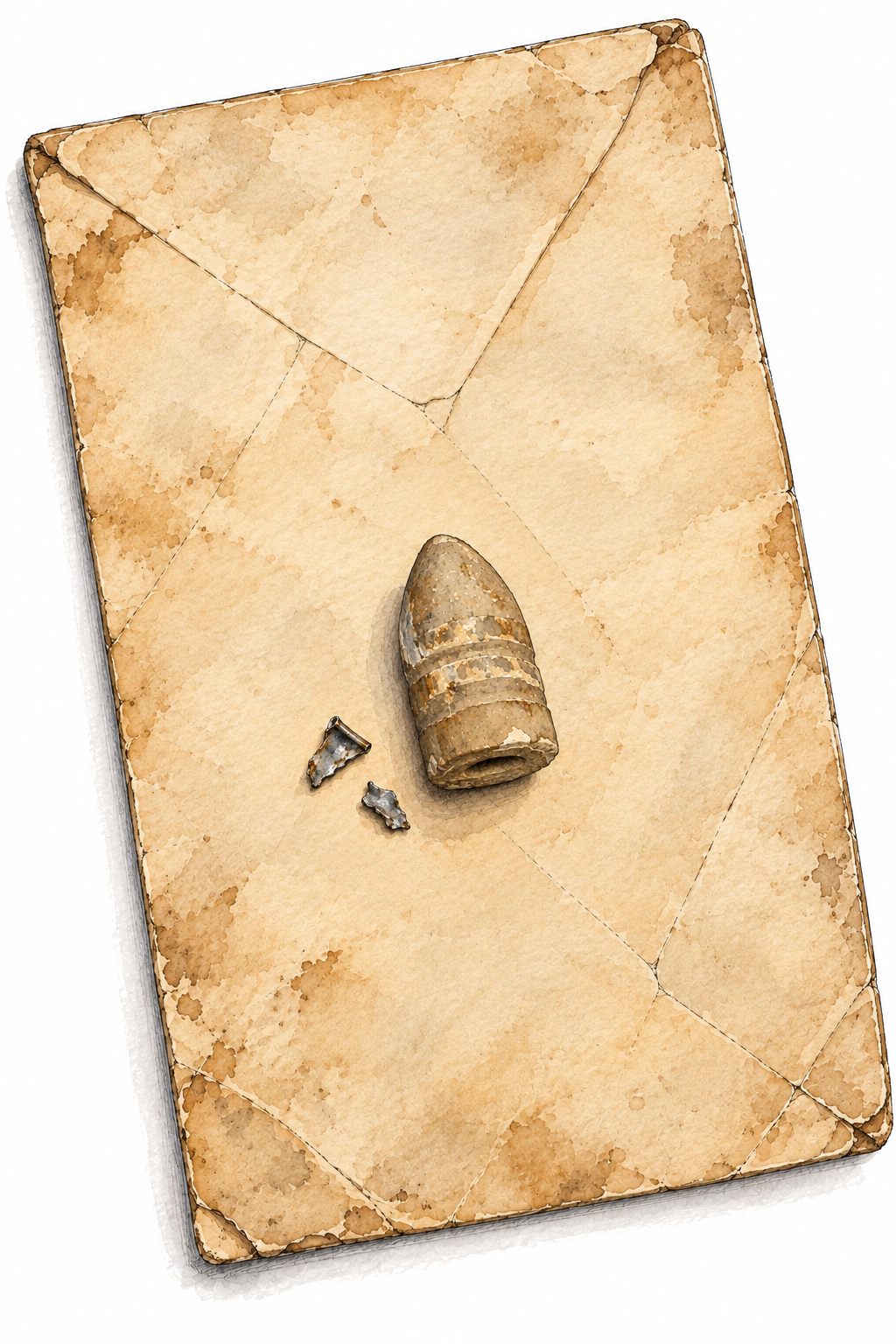
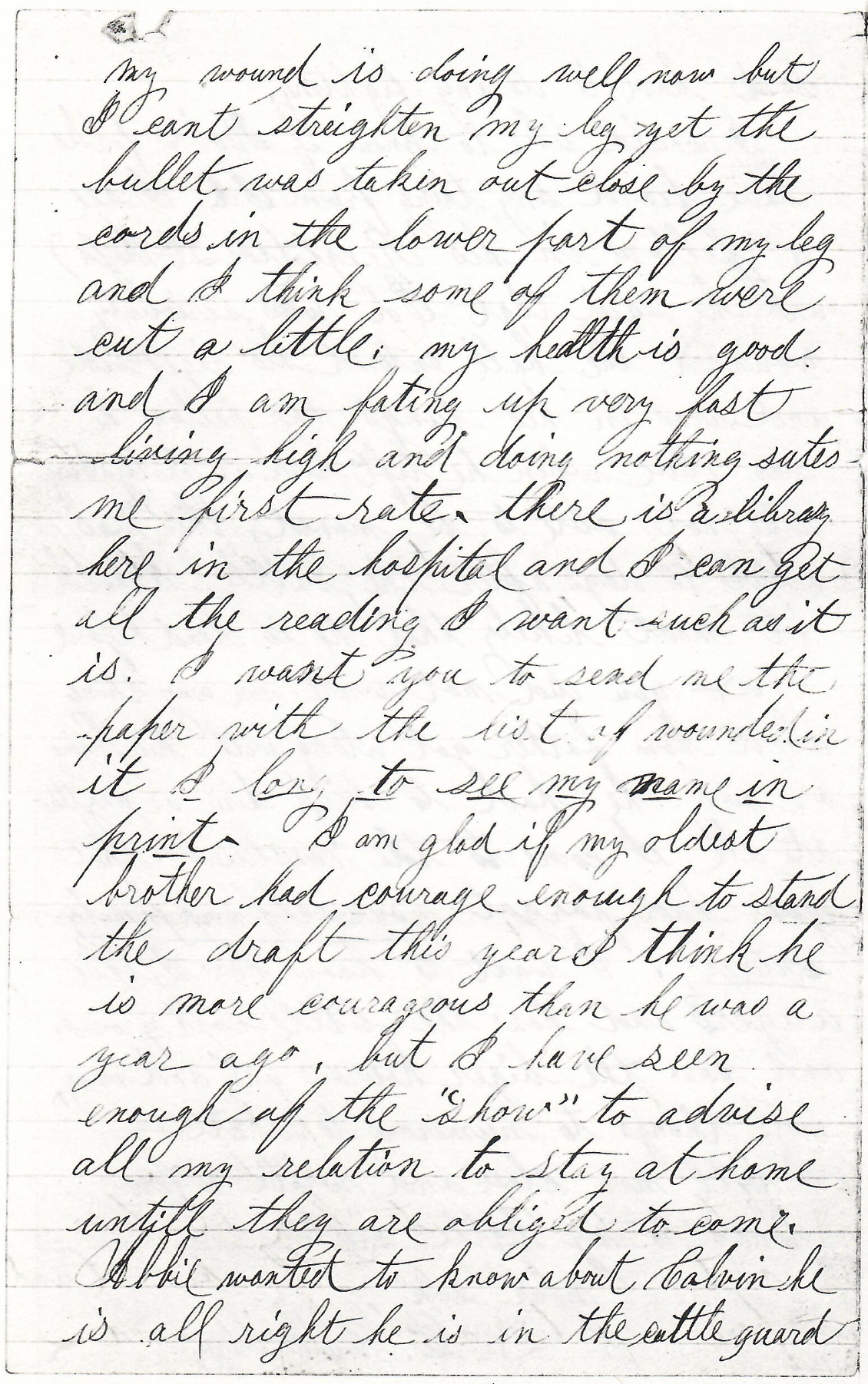
I took ether to have it taken out. I have got the bullet and pieces of tin which I will send [home]. My wound is doing well now but I can’t straighten my leg yet. The bullet was taken out close by the cords in the lower part of my leg and I think some of them were cut a little. My health is good and I am fatting up very fast, living high and doing nothing suits me first rate.
There is a library here in the hospital and I can get all the reading I want—such as it is. I want you to send me the paper with the list of wounded in it. I long to see my name in print. I am glad if my oldest brother had courage enough to stand the draft this year. I think he is more courageous than he was a year ago. But I have seen enough of the “show” to advise all my relation to stay at home until they are obliged to come.
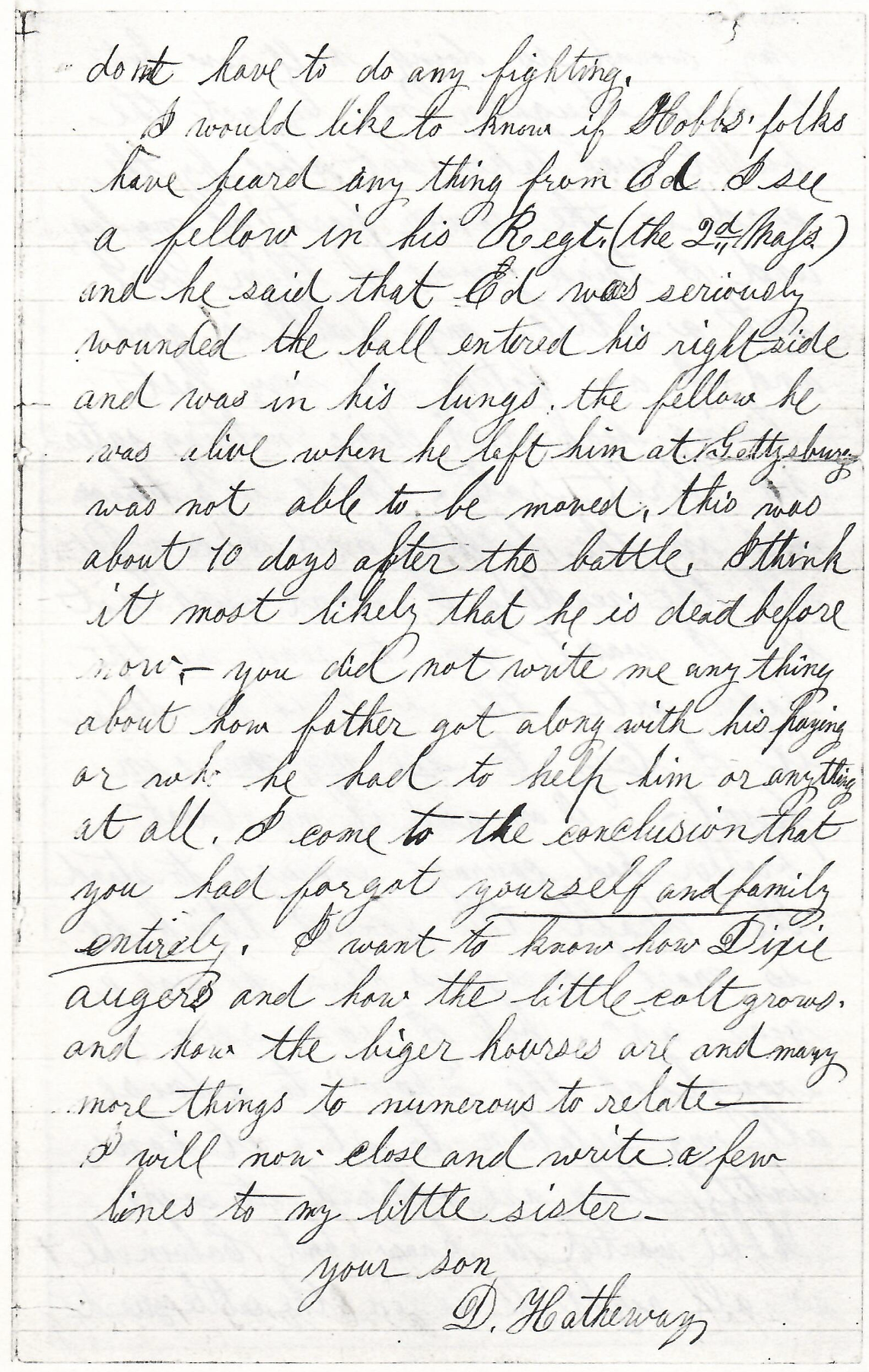
Abbie wanted to know about Calvin [Beals]. He is all right. He is in the cattle guard [and] don’t have to do any fighting. I would like to know if Hobbs’ folks have heard anything from Ed. I see a fellow in his regiment (the 2nd Massachusetts) and he said that Ed was seriously wounded. The ball entered his right side and was in his lungs. The fellow [said] he was alive when he left him at Gettysburg [but] was not able to be moved. This was about ten days after the battle. I think it most likely that he is dead before now.
you did not write me anything about how father got along with his haying or who he had to help him or anything at all. I came to the conclusion that you had forgot yourself and family entirely. I want to know how Dixie augurs and how the little colt grows and how the bigger horses are and many more things too numerous to relate.
I will now close and write a few lines to my little sister. Your son, — D. Hatheway
Letter 28
York, Pennsylvania
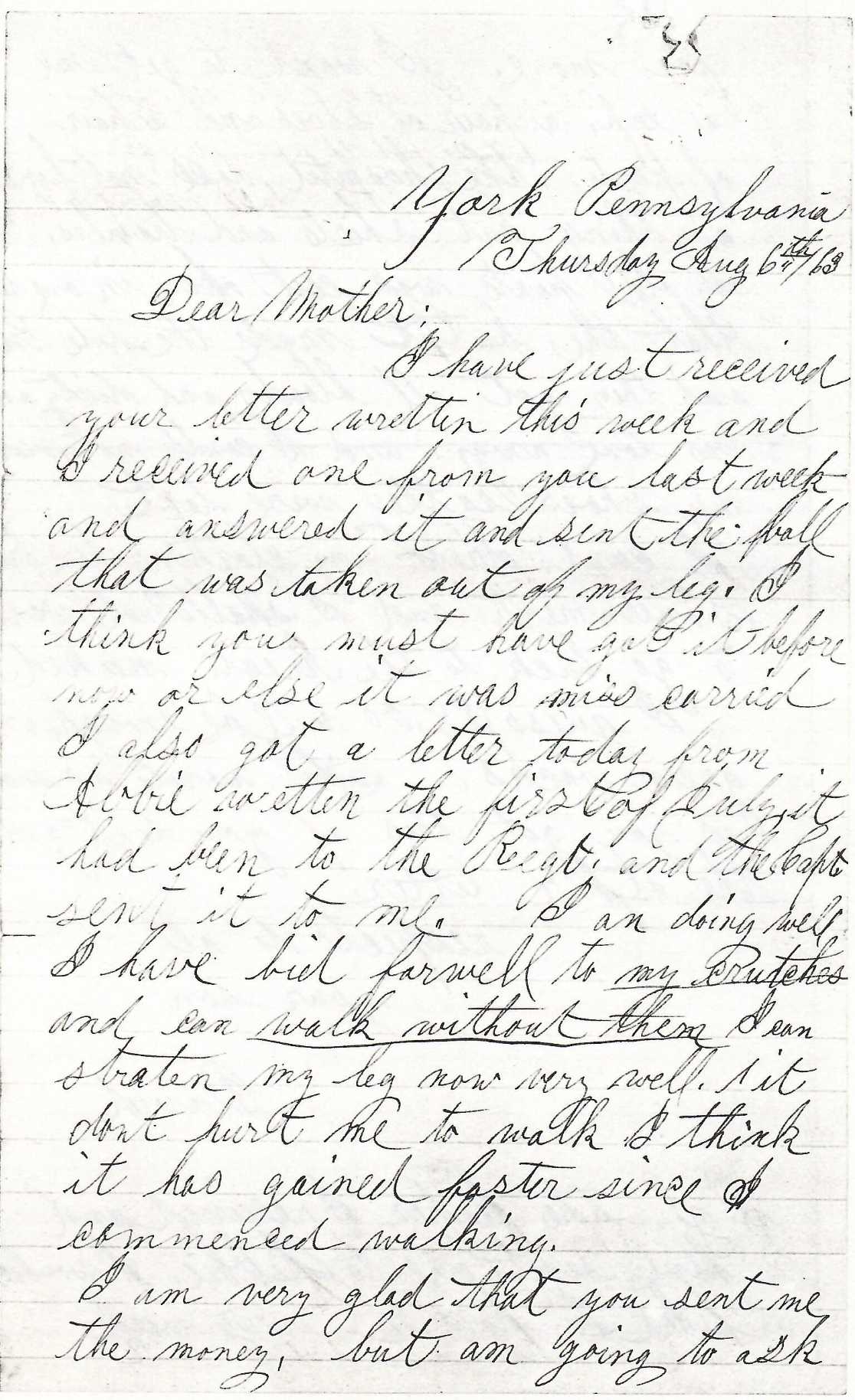
Thursday, August 6th 1863
Dear Mother,
I have just received your letter written this week and I received one from you last week and answered it and sent the ball that was taken out of my leg. I think you must have got it before now or else it was miss carried. I also got a letter today from Abbie written the 1st of July. It had been sent to the regiment and the Captain sent it to me.
I am doing well. I have bid farewell to my crutches and can walk without them. I can straighten my leg now very well. It don’t hurt me to walk. I thin kit has gained faster since I commenced walking.
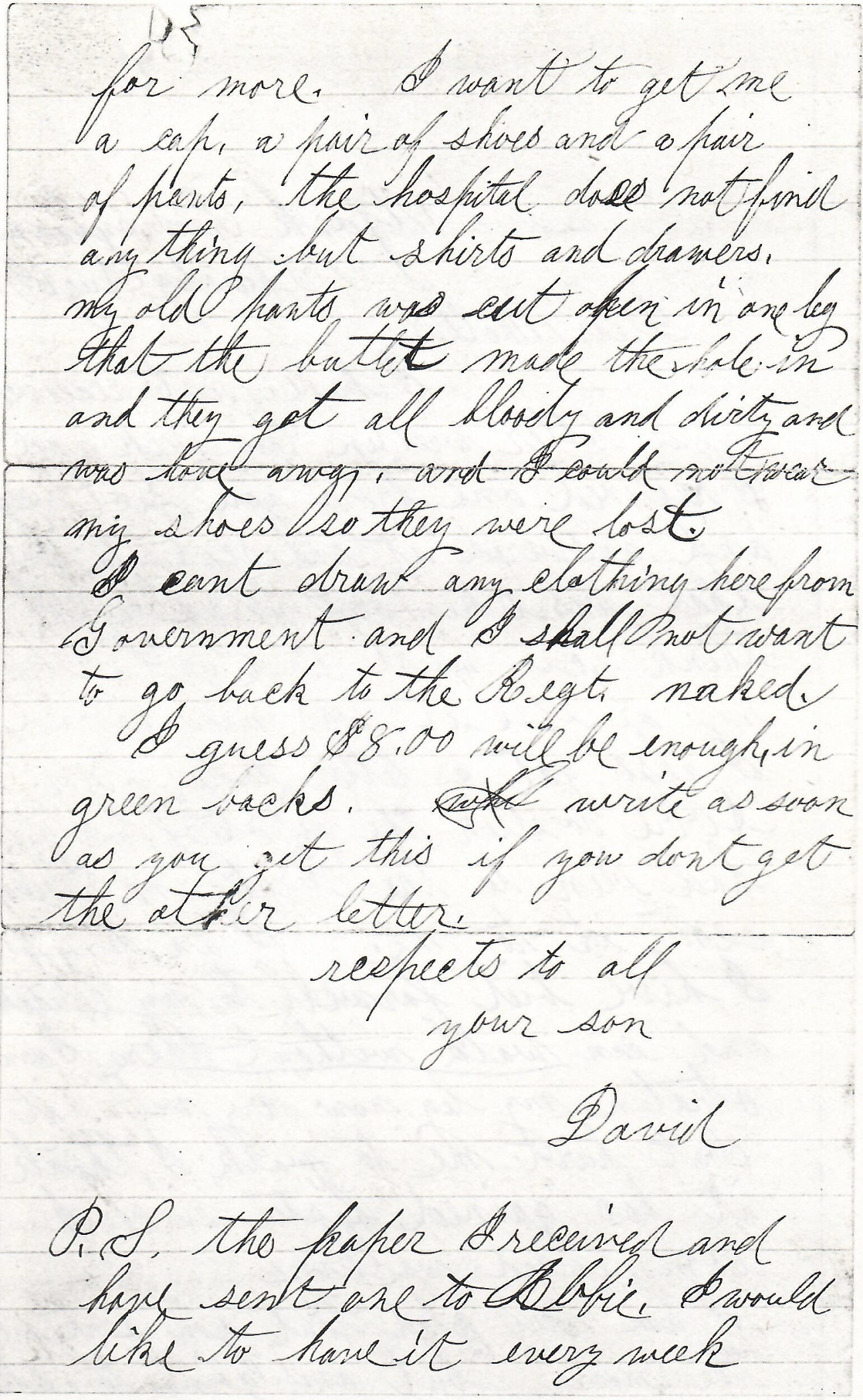
I am very glad that you sent me the money but am going to ask for more. I want to get me a cap, a pair of shoes, and a pair of pants. The hospital does not find anything but shirts and drawers. My old pants was cut open in one leg that the bullet made the hole in and they got all bloody and dirty and was thrown away and I could not wear my shoes so they were lost.
I can’t draw any clothing here from the government and I shall not want to go back to the regiment naked. I guess $8 will be enough in greenbacks. Write as soon as you get this if you don’t get the other letter. Respects to all. Your son, — David
P. S. The paper I received and have sent are to Abbie. I would like to have it every week.
Letter 29
York, Pennsylvania
Wednesday, August 12th 1863
Dear Mother,
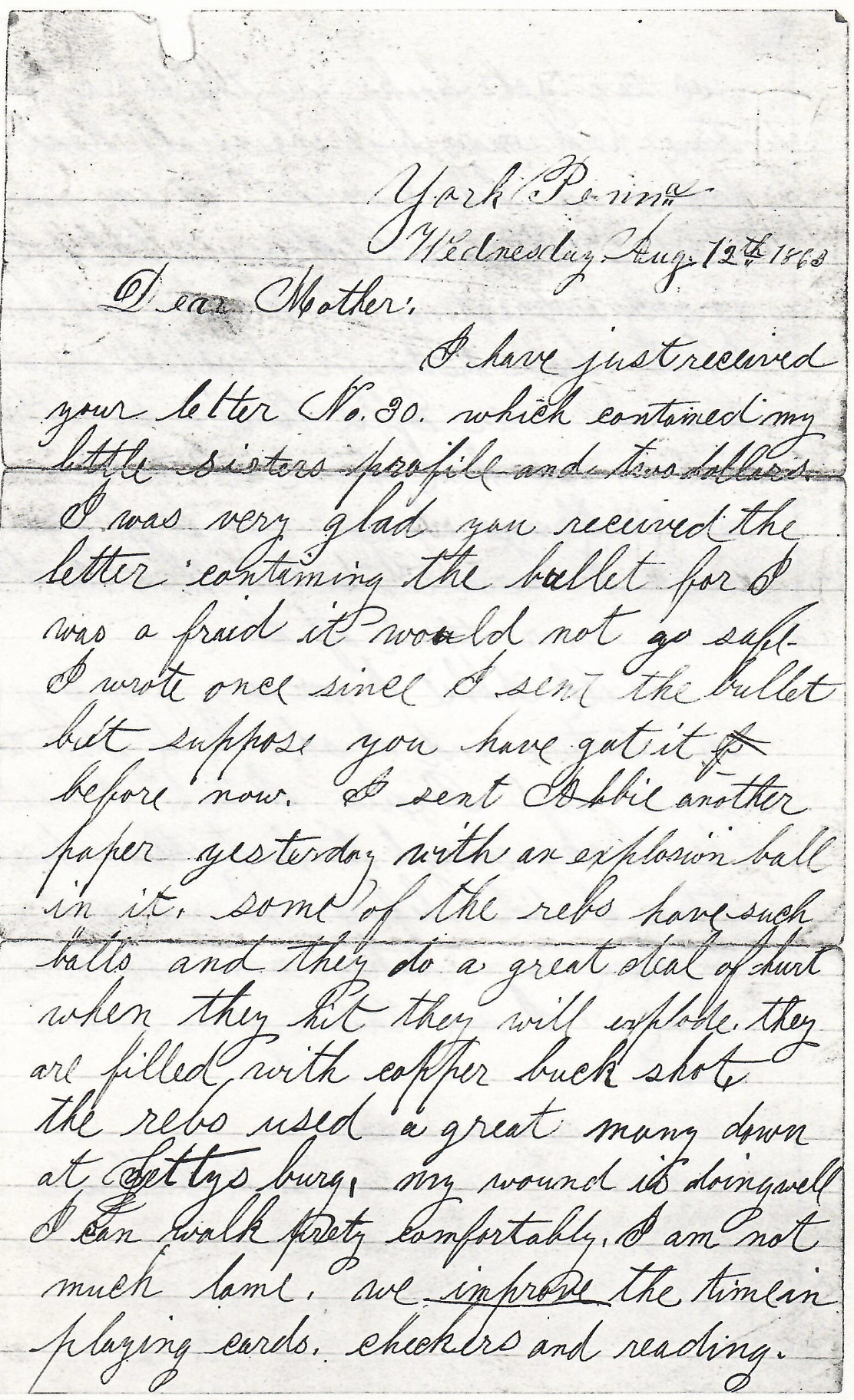
I have just received your letter No. 30 which contained my little sister’s profile and two dollars. I was very glad you received the letter containing the bullet for I was afraid it would not go safe. I wrote once since I sent the bullet but suppose you have got it before now. I sent Abbie another paper yesterday with an explosion ball in it. Some of the rebs have such balls and they do a great deal of hurt. When they hit, they will explode. They are filled with copper buck shot. The Rebs used a great many down at Gettysburg. 1
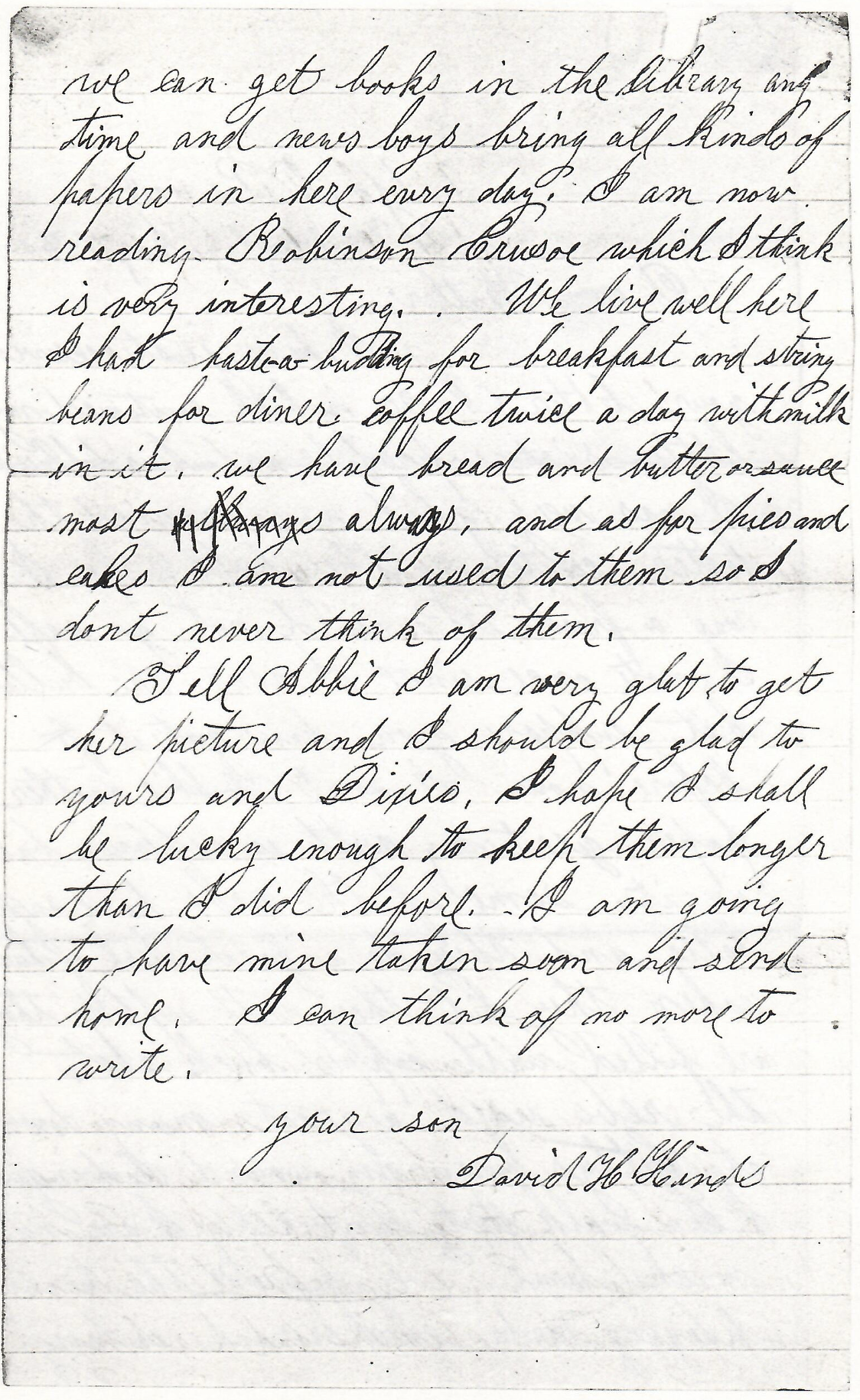
My wound is doing well. I can walk pretty comfortably. I am not much lame. We improve the time in playing cards and checkers and reading. We can get books in the library any time and newsboys bring all kinds of papers in here every day. I am now reading Robinson Crusoe which I think is very interesting.
We live well here. I had hasty pudding for breakfast and string beans for dinner. Coffee twice a day with milk in it. We have bread and butter or sauce most always and as for pies and cakes, I am not used to them so I don’t never think of them.
Tell Abbie I am very glad to get her picture and I should be glad to get yours and Dixies. I hope I shall be lucky enough to keep them longer than I did before. I am going to have mine taken soon and sent home. I can think of no more to write. Your son, — David H. Hinds
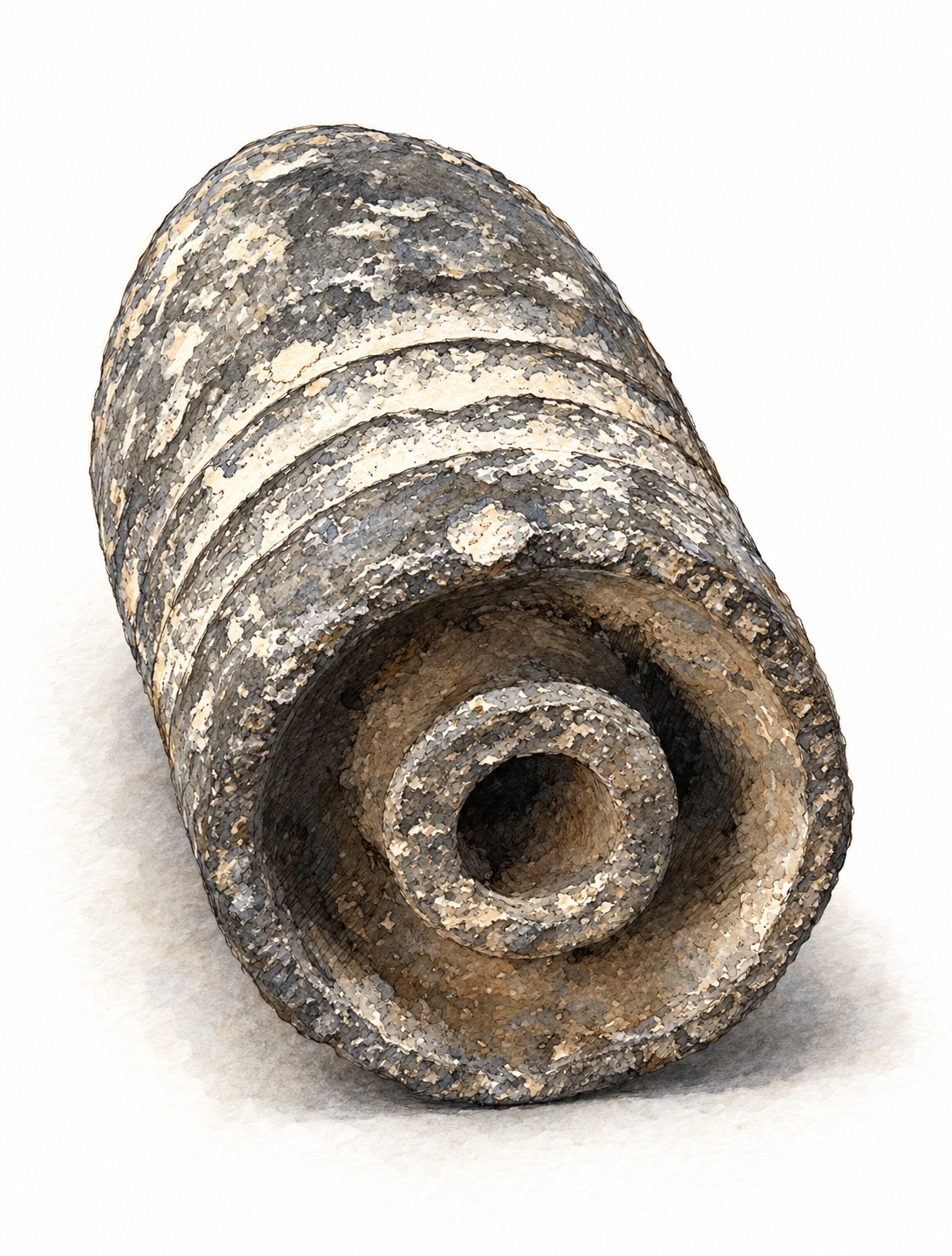
1 The “explosion ball” David refers to was probably the .58 caliber Gardiner Explosive Bullet. It combined a unique design featuring a powder-filled copper chamber inside a pewter or lead shell. When fired, a fuse at the base of the bullet would ignite, detonating the inner copper vessel a few seconds later to spray deadly fragments.
Letter 30
York, Pennsylvania
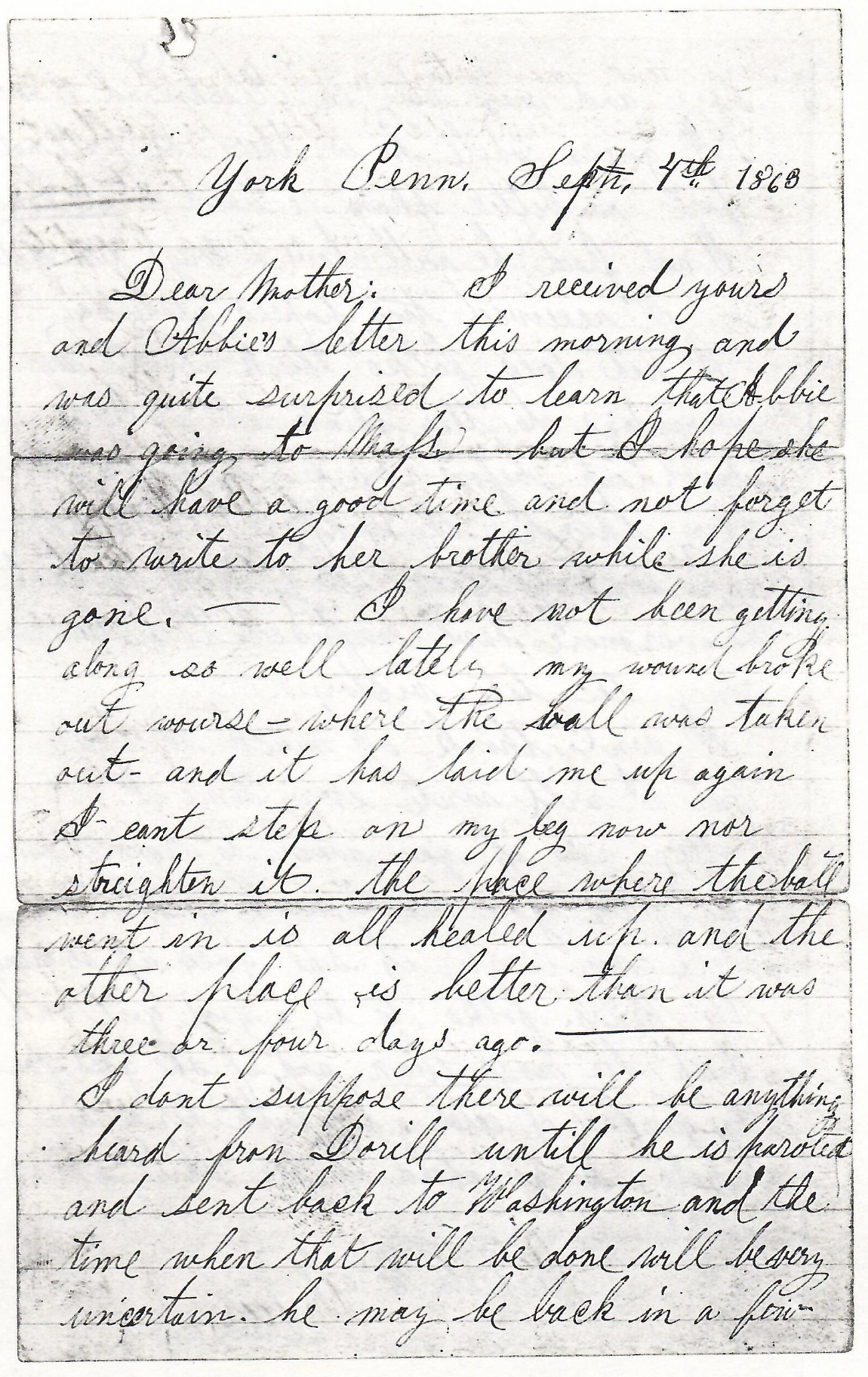
September 4th 1863
Dear Mother,
I received yours and Abbie’s letter this morning and was quite surprised to learn that Abbie was going to Massachusetts but I hope she will have a good time and not forget to write to her brother while she is gone.
I have not been getting along so well lately. My wound broke out worse where the ball was taken out and it has laid me up again. I can’t step on my leg now nor straighten it. The place where the ball went in is all healed up and the other place is better than it was three or four days ago.
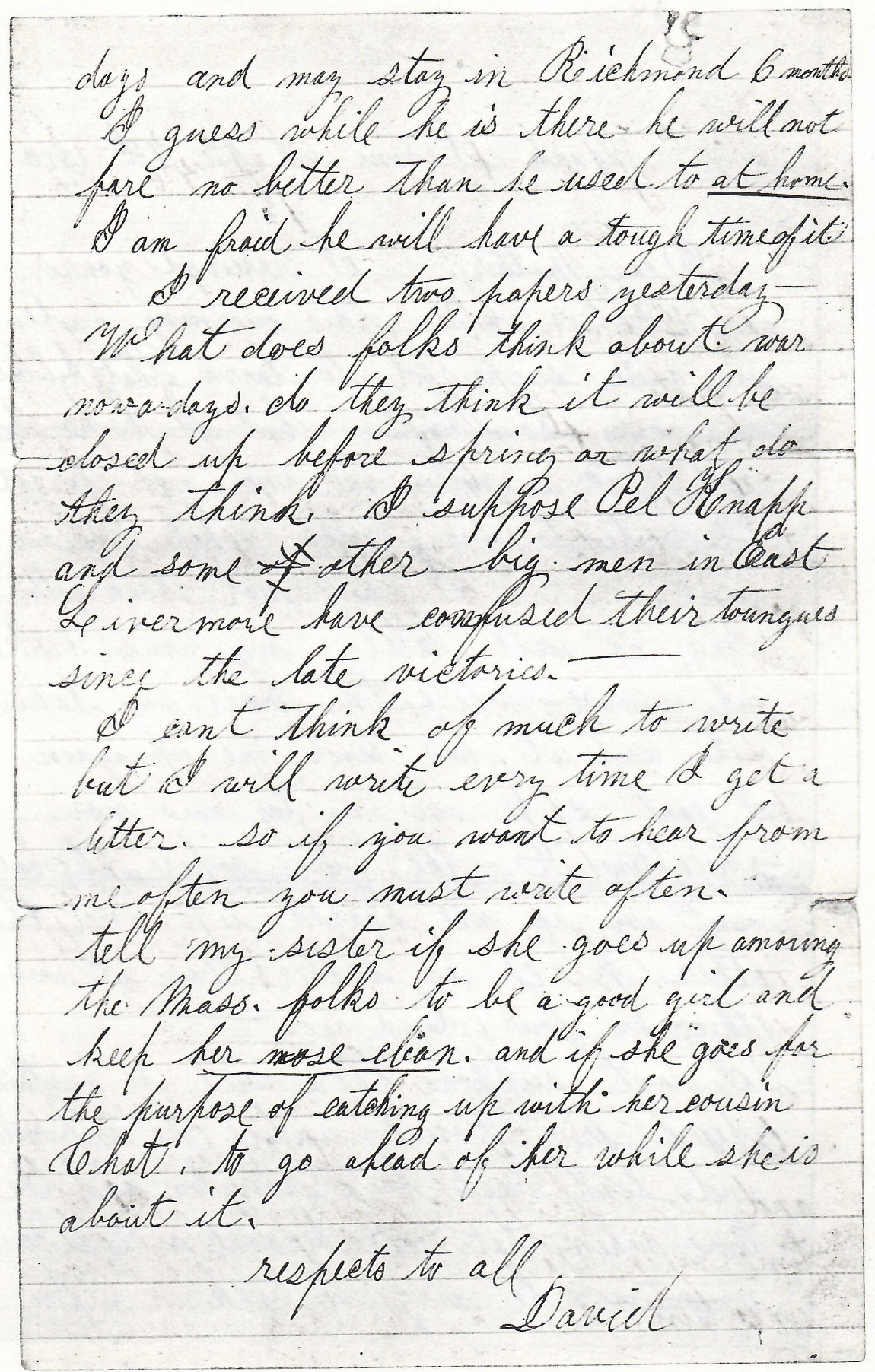
I don’t suppose there will be anything heard from Dorill[us] until he is paroled and sent back to Washington and the time when that will be done will be very uncertain. He may be back in a few days and may stay in Richmond 6 months. I guess while he is there he will not fare better than he used to at home. I am afraid he will have a tough time of it.
I received two papers yesterday. What does folks think about war now-a-days? Do they think it will be closed up before spring or what do they think? I suppose Pel Knapp and some other big men in East Livermore have confused their tongues since the late victories.
I can’ think of much to write but I will write every time I get a letter. So if you want to hear from me oftener, you must write often. Tell my sister if she goes up among the Massachusetts folks, to be a good girl and keep her nose clean and if she goes for the purpose of catching up with her cousin Chat, to go ahead of her while she is about it. Respects to all, — David
Letter 31
York, Pennsylvania
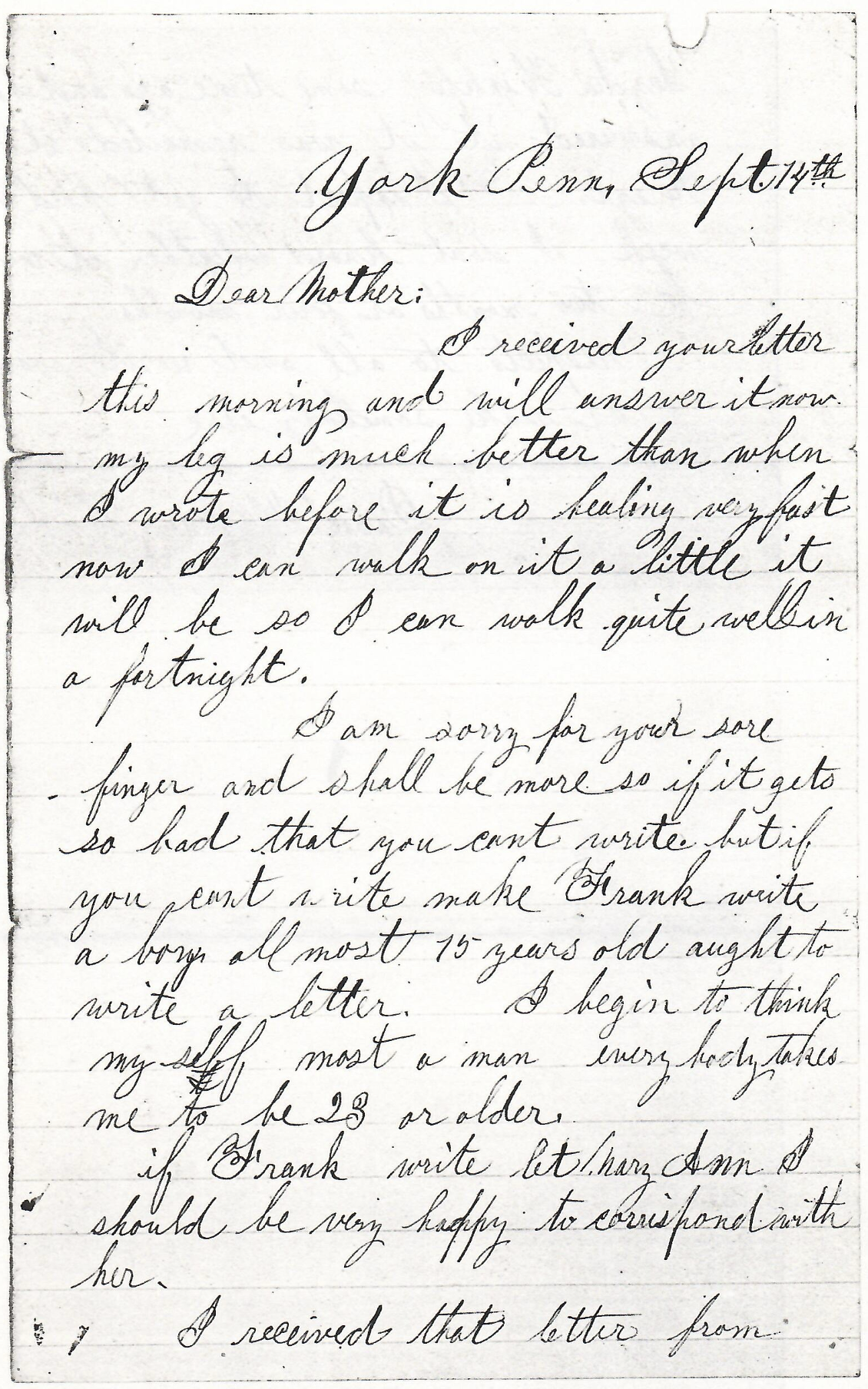
September 14, [1863]
Dear Mother,
I received your letter this morning and will answer it now. My leg is much better than when I wrote before. It is healing very fast now. I can walk on it a little. It will be so I can walk quite well in a fortnight.
I am sorry for your sore finger and shall be more so if it gets so bad that you can’t write. But if you can’t write, make Frank write. A boy most 15 years old ought to write a letter. I begin to think myself most a man, Everybody takes me to be 23 or older. If Frank [won’t] write, let Mary Ann. I should be very happy to correspond with her.
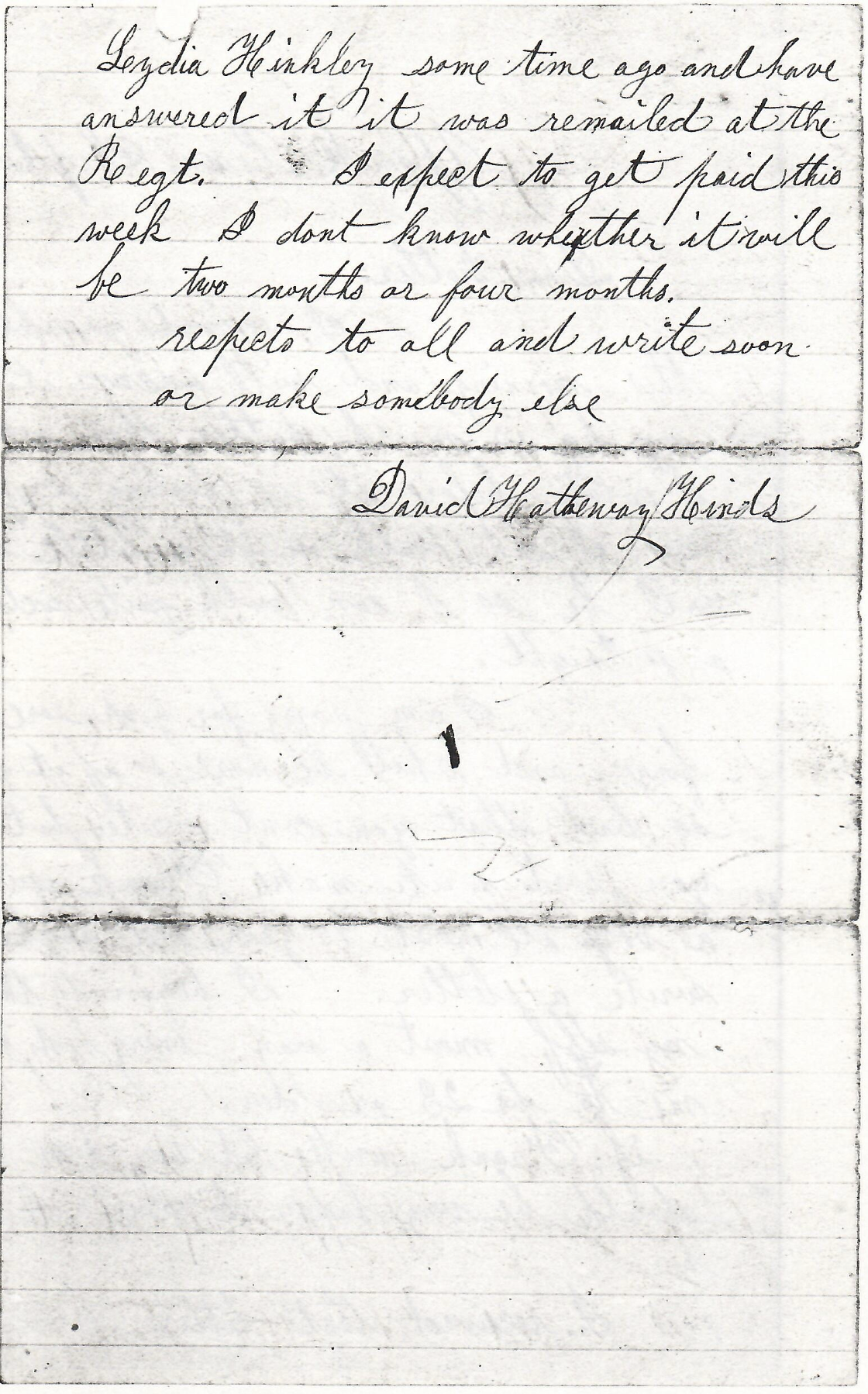
I received that letter from Lydia Hinkley some time ago and have answered it. It was remailed at the regiment. I expect to get paid this week. I don’t know whether it will be two months or four months. Respects to all and write soon or make somebody else. — David Hatheway Hinds
Letter 32
York, Pennsylvania
September 16, [1863]
Dear Mother,
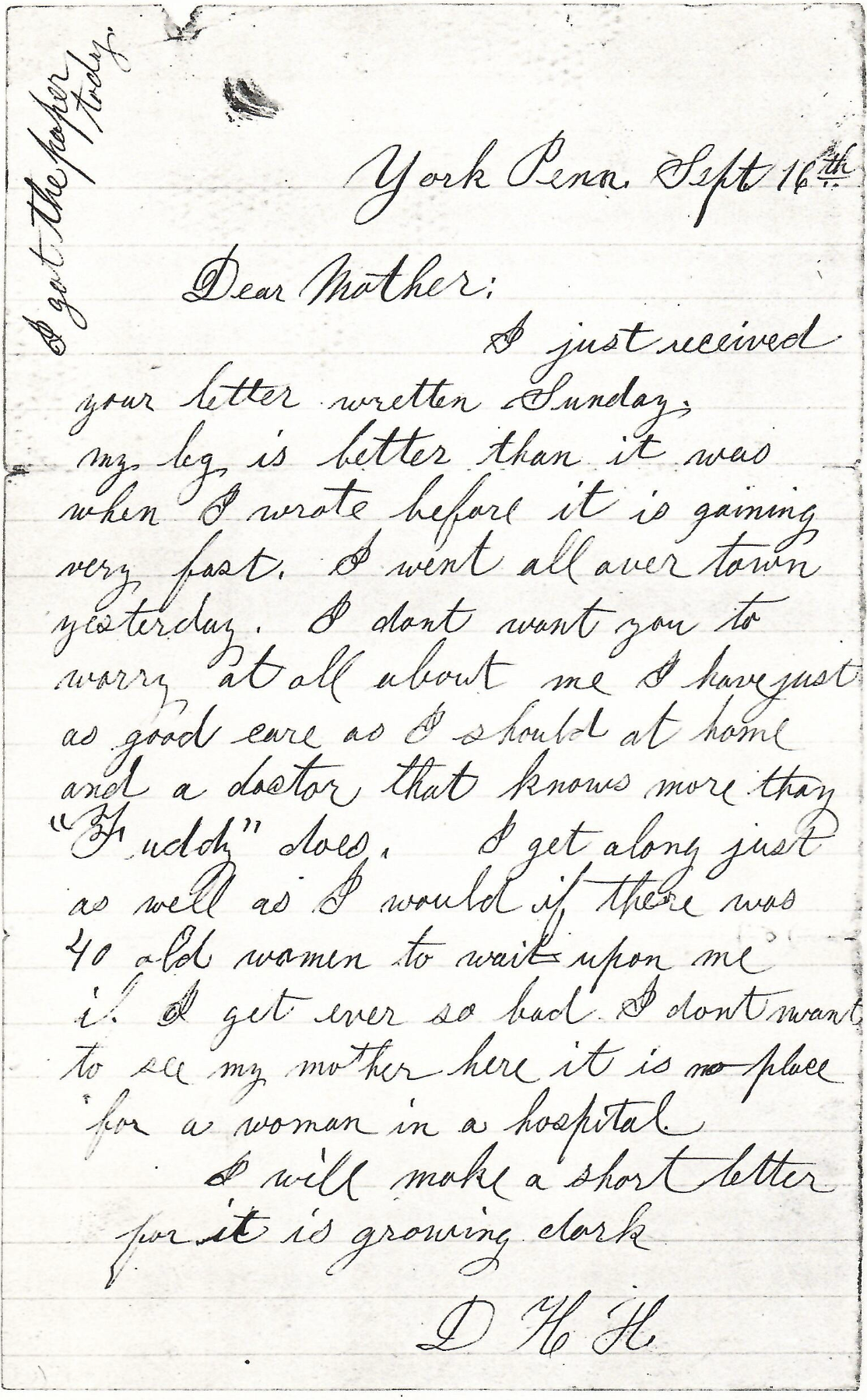
I just received your letter written Sunday. My leg is better than it was when I wrote before. It is gaining very fast. I went all over town yesterday. I don’t want you to worry at all about me. I have just as good care as i should at home and a doctor that knows more than “Fuddy” does. I get along as well as I would if there was a 40 year-old woman to wait upon me. If I get ever so bad, I don’t want to see my mother here. It is no place for a woman in a hospital.
I will make a short letter for it is growing dark. — D. H. H.
I got the paper today.
Letter 33
York, Pennsylvania
September 21, 1863
Dear Mother,
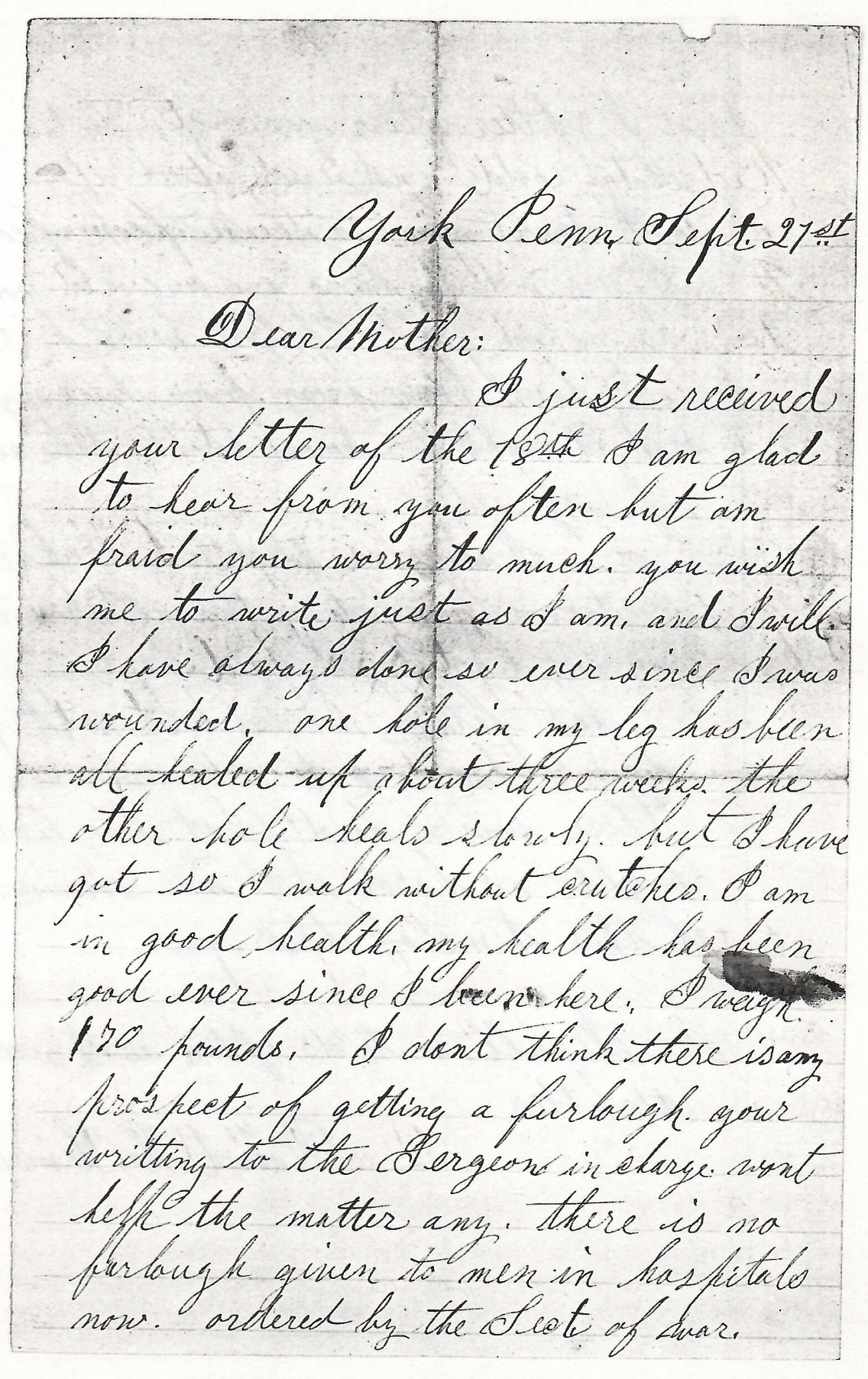
I just received your letter of the 18th. I am glad to hear from you often but am afraid you worry too much, You wish me to write just as I am and I will. I have always done so ever since I was wounded. One hole in my leg has been all healed up about three weeks. The other hole heals slowly but I have got so I walk without crutches. I am in good health. My health has been good ever since I been here. I weigh 170 pounds.
I don’t think there is any prospect of getting a furlough. Your writing to the Surgeon in charge won’t help the matter any. There is no furlough given to men in hospitals now, ordered by the Secretary of War.
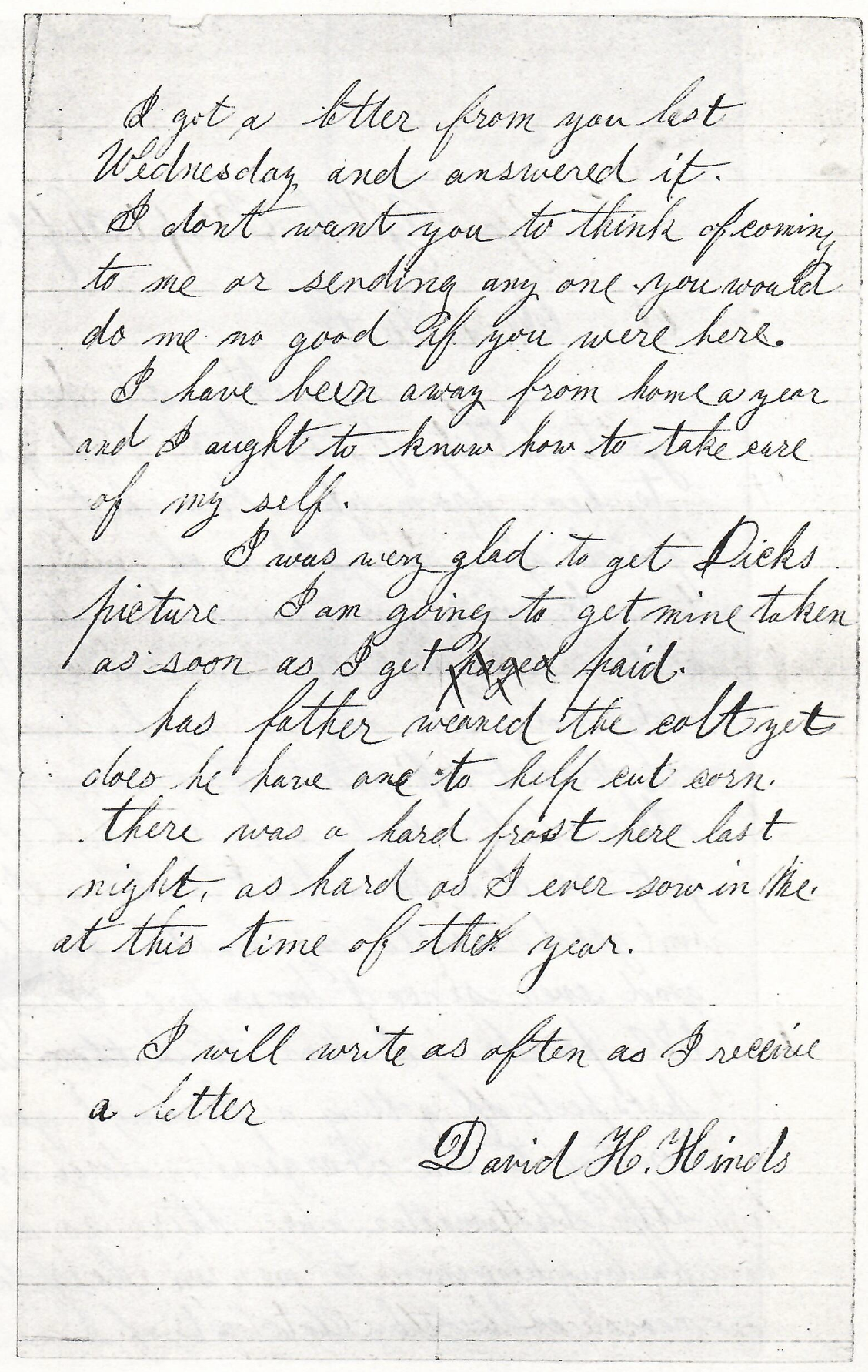
I got a letter from you last Wednesday and answered it. I don’t want you to think of coming to me or sending anyone. You would do me no good if you were here. I have been away from home a year and ought to know how to take care of myself.
I was very glad to get Dick’s picture. I am going to get mine taken as soon as I get paid. Has father weaned the cold yet. Does he have one to help cut corn? There was a hard frost here last night—as hard as I ever saw in Maine at this time of the year.
I will write as often as I receive a letter. — David H. Hinds
Letter 34
York, Pennsylvania
September 24 [1863]
Brother Vill,
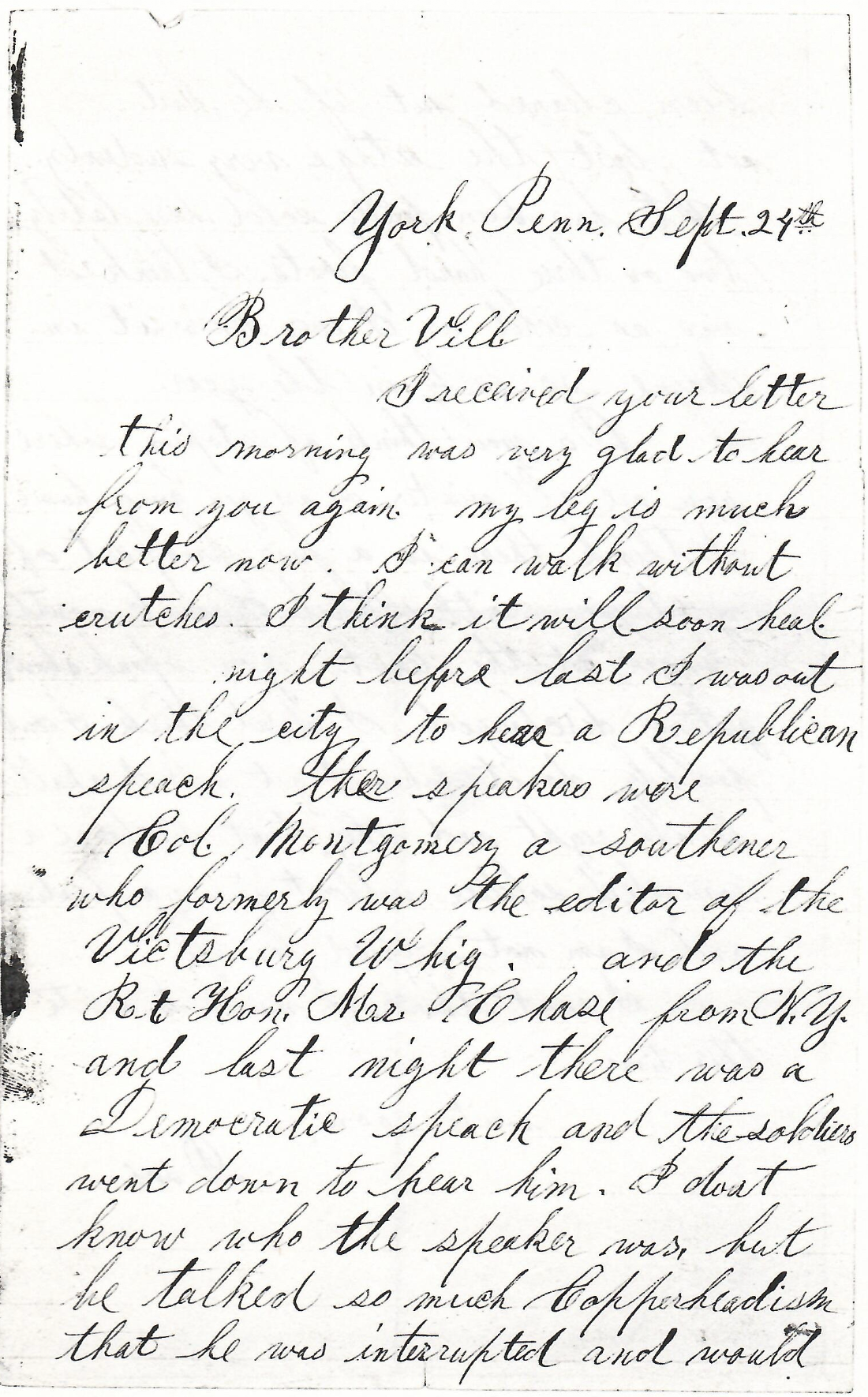
I received your letter this morning [and] was very glad to hear from you again. My leg is much better now. I can walk without crutches. I think it will soon heal.
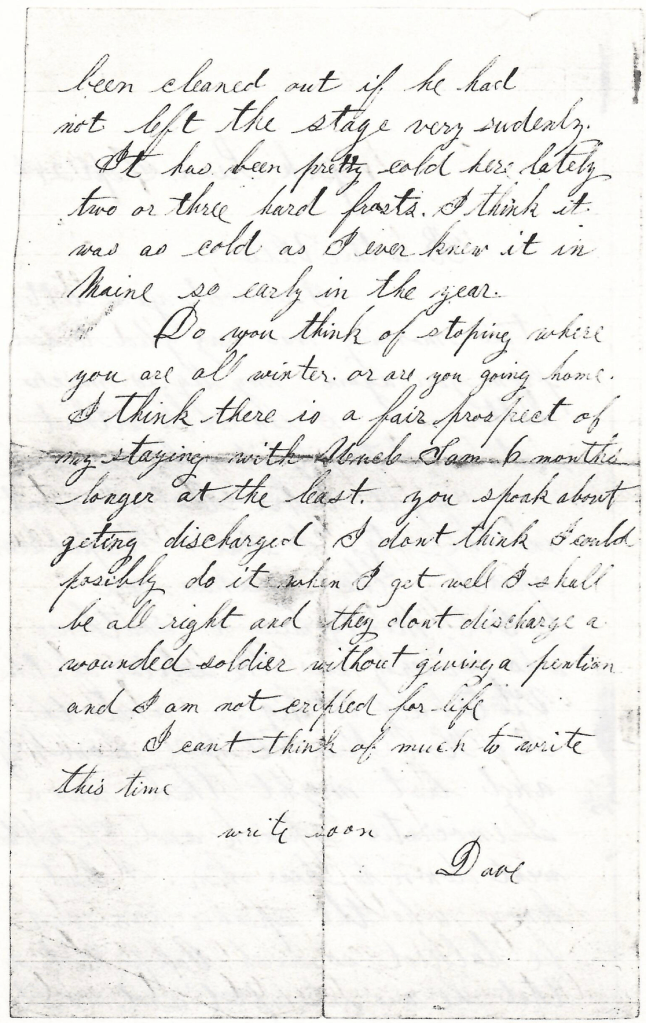
Night before last I was out in the city to hear a Republican speech. The speakers were Col. [Frederick] Montgomery—a southerner who formerly was the editor of the Vicksburg Whig, 1 and [also] the Right Honorable Mr. Chase from New York. And last night there was a Democratic speech and the soldiers went down to hear him. I don’t know know who the speaker was but he talked so much Copperheadism that he was interrupted and would have been cleaned out if he had not left the stage very suddenly. 2
It has been pretty cold here lately. Two or three hard frosts. I think it was as cold as I ever knew it in Maine so early in the year.
Do you think of stopping where you are all winter or are you going home? I think there is a fair prospect of my staying with Uncle Sam six months longer at the least. You spoke about getting discharged. I don’t think I could possibly do it when I get well. I shall be all right and they don’t discharge a wounded soldier without giving a pension and I am not crippled for life.
I can’t think of much to write this time. Write soon. — Dave
1 Col. Frederick Montgomery, unlike many of his peers in Mississippi, “strongly opposed secession and maintained a fierce allegiance to the Union. Because of his outspoken views, he was proscribed and essentially forced into exile by Confederate authorities. Around 1862, he was permitted or managed to escape into Union lines. Northern newspapers at the time famously compared his release to that of Parson Brownlow (the pro-Union editor of the Knoxville Whig). Throughout 1863 and 1864, Col. Montgomery toured the North—including Illinois, Wisconsin, Ohio, and New York—giving highly popular lectures under the auspices of the Union League. He spoke eloquently about the internal realities of the rebellion, his personal acquaintance with Jefferson Davis, and the harsh treatment of Southern Unionists. Newspapers described him as an incredibly witty, sarcastic, and powerful orator who could move crowds from tears to roaring laughter.” [Source: https://museum.dmna.ny.gov/unit-history/conflict/us-civil-war-1861-1865/counties-state-new-york-during-war-rebellion/erie-county-new-york-civil-war/erie-county-new-york-civil-war-newspapers-draft-and-conscription]
2 Pennsylvania was in the midst of fiercely contested gubernatorial election at the time of this letter. Incumbent Governor Andrew Curtin faced the Democratic challenger George Washington Woodward. York county leaned heavily Democratic and most of the locals opposed Lincoln’s wartime policies, particularly emancipation and conscription. Citizens from York county even passed a resolution condemning the Lincoln Administration: “Resolved: — That Abraham Lincoln, President of the United States, has perverted this government, from the constitutional one heretofore established and administered, into a military despotism as absolute and oppressive as that of the Czar of Russia. He has, by military violence, overthrown the government of Sovereign States, of this union and established others in their stead, subservient to himself. He has in those states, unscrupulously arrested and imprisoned men without any charge of crime and without any authority of law, whenever they stood in the way of his designs. He has by similar violence dragged the Judges of State Courts, from the bench, degraded them from their official positions, and subjected them to brutal and barborous treatment, for no cause except, that of a firm and faithful discharge of their duties according to their consciences and oaths of office. He has overthrown the supremacy of the civil laws of the land, and established military power in their place; abolished the right of trial by Jury; instructed his officers and minions to refuse obedience to the civil process of the courts of law, and resisted the enforcement of such process by violence. He has caused, thousands of men, women and children, free citizens of these States, to be illegally seized and transported to public Bastiles, where he has kept them immersed in loathsome dungeons, far from their homes and families, and beyond the limits of their States, and afterwards, at his own caprice turned them out of prison, without accusation, trial or judgement, and without reparation for the injury. He has suppressed newspapers, letters and documents, and denied their transmission, through the government mails, has established an odious censorship, over the telegraph and press, has converted these great means for the circulation of public intelligence into instruments for the accomplishment of unjust and partizan purposes, and has denied to the free citizens of this country, the liberty of speech and of the press. He has ordered illegal searches and seizures of persons and papers, has condemned freemen unheard, & without trial according to law, and has inflicted on them cruel, unusual and illegal punishments. He has transformed the public armed forces of the nation from a means of public warfare, into a partisan police, for the execution of tyrannical and unconstitutional edicts, against those who disapproved his administration. He has destroyed the freedom of elections, by placing whole States under martial law, stationing armed men at the polls, and permitting none to vote except his own political partizans. He has perverted the war, which was originally waged for the purpose of restoring the Supremacy of the constitution over the Seceded States, into an unholy and unconstitutional crusade against Slavery, and for the freedom of the negro; and for this purpose, has armed the Slaves of the Southern people against their masters, incited them to insurrection, and to the perpetration of the most horrible atrocities, has plundered their property, burned their homes, and ravaged and laid waste their country.” Curtin only managed to win his re-election by a major influx of absentee ballots from soldiers in the field, but York county went for Woodward.
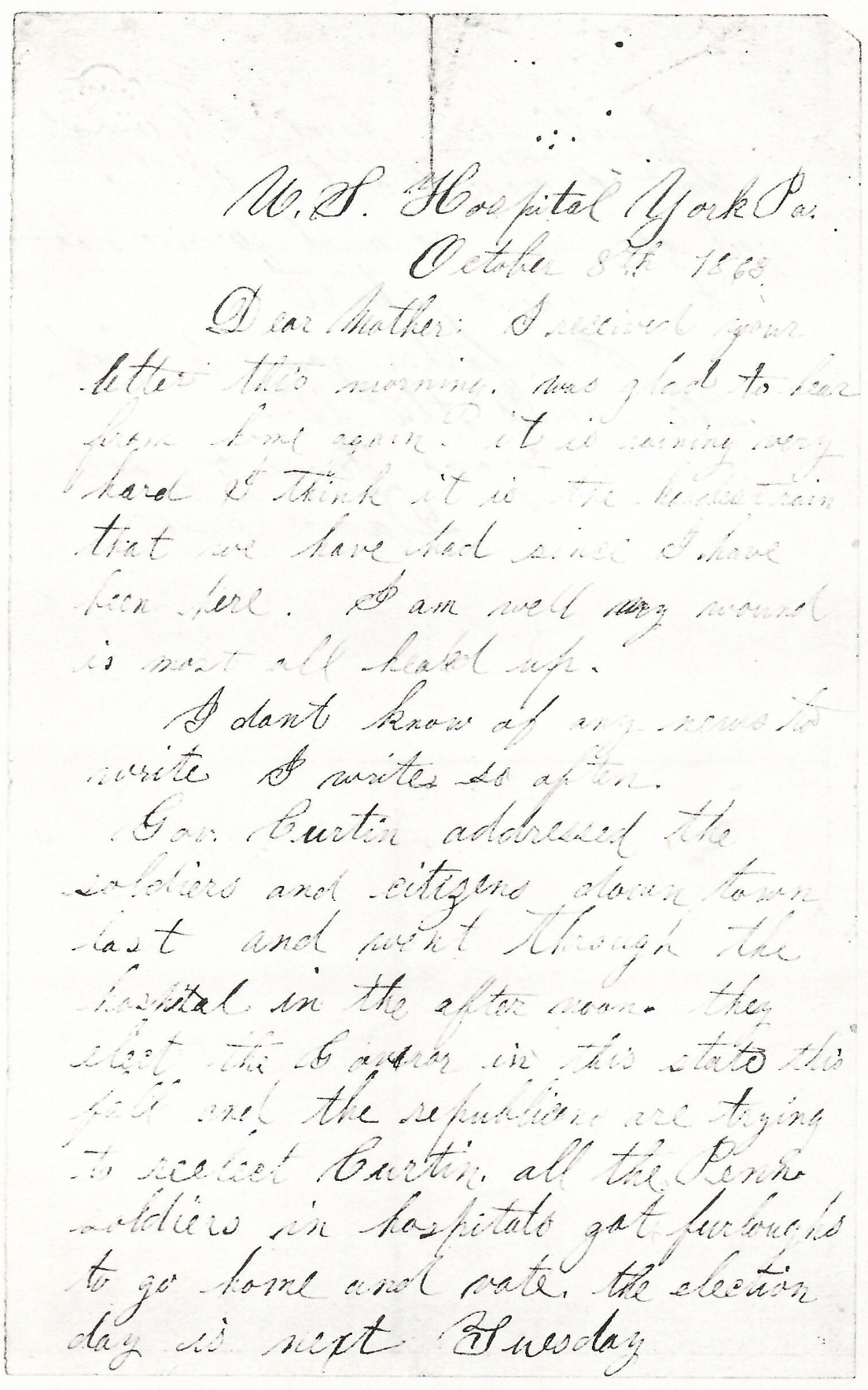
Letter 35
U. S. Hospital, York, Pennsylvania
October 8th 1863
Dear mother,
I received your letters this morning [and] was glad to hear from home again. It is raining very hard. I think it is the hardest rain that we have had since I have been here. I am well. My wound is most all healed up.
I don’t know of any news to write, I write so often.
Gov. Curtin addressed the soldiers and citizens down town last [ ] and went through the hospital in the afternoon. They elect the Governor in this state this fall and the Republicans are trying to reelect Curtin. All the Pennsylvania soldiers in hospitals get furloughs to go home and vote. The election day is next Tuesday.
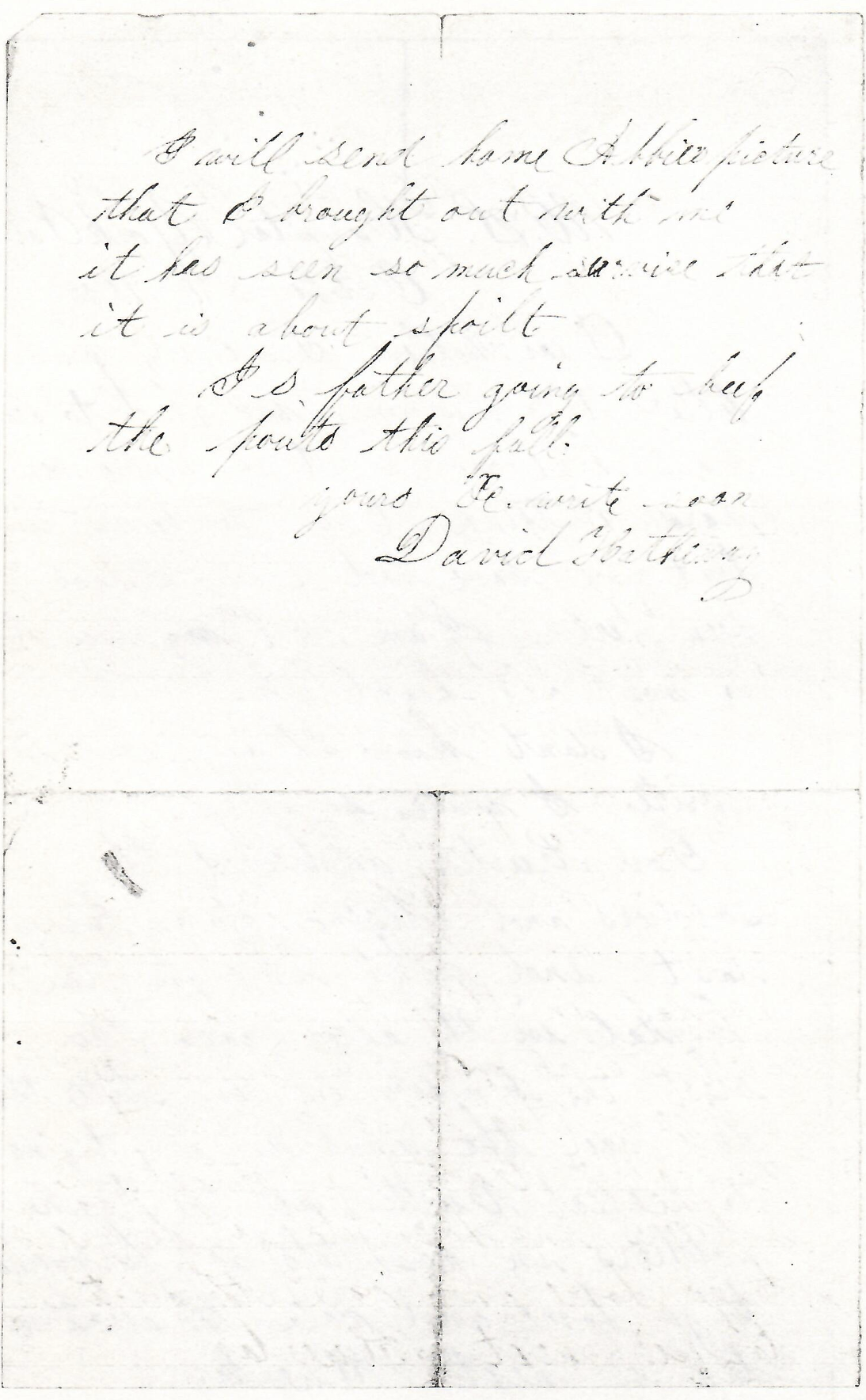
I will send home Abbie’s picture that I brought out with me. It has seen so much service that it is about spoilt. Is father going to beef the pouts this fall?
Yours, &c. Write soon. — David Hatheway
Letter 36
U. S. Hospital, York, Pennsylvania
October 14th [1863]
Dear Mother,
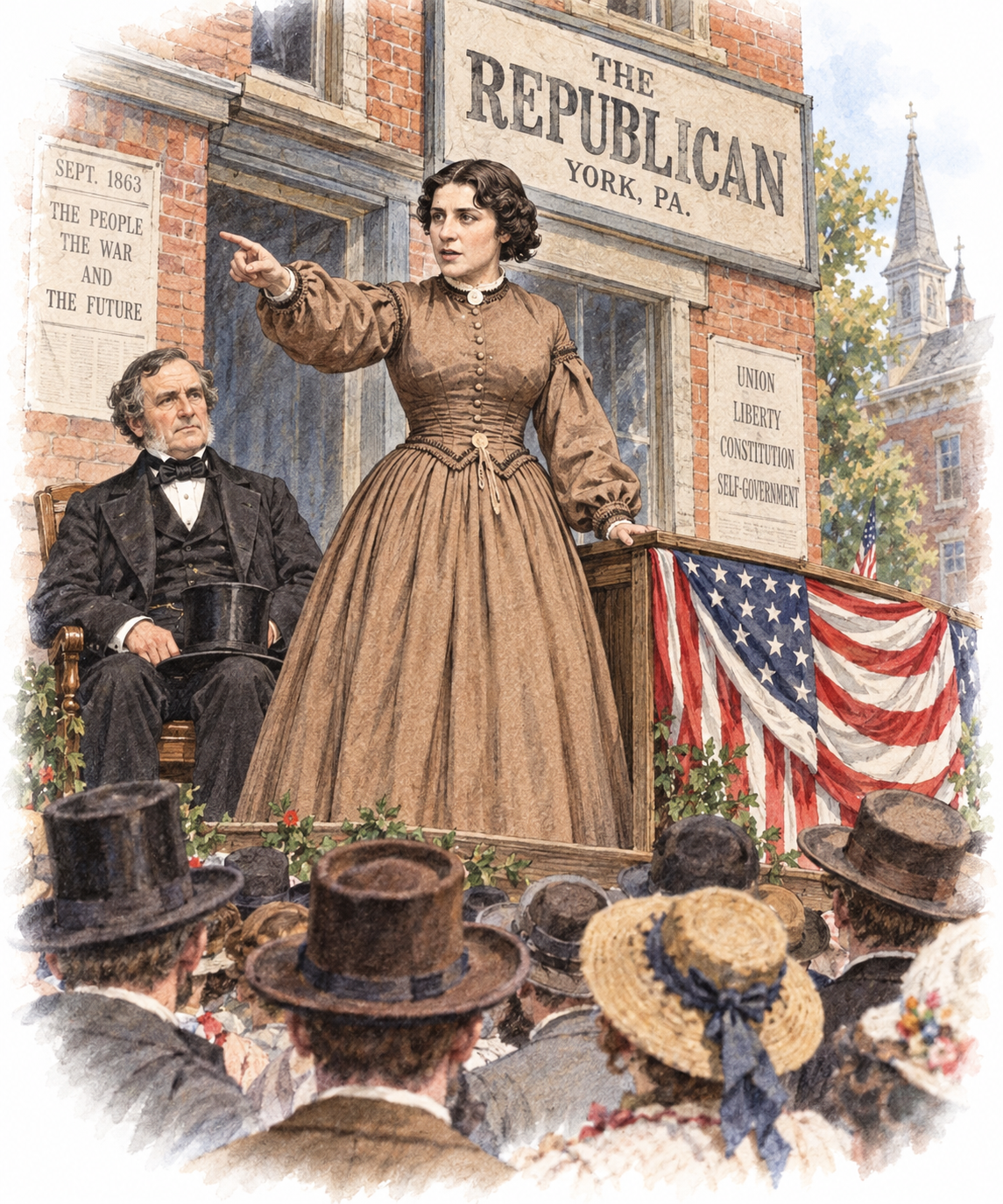
I received your letter last night. We get paid today. I will send some money. I am well and fat. The Amy of the Potomac have had a little fight and I see by the papers that some of the regiment are wounded. Last Friday evening the Right Honorable Miss [Anna Elizabeth] Dickinson from Philadelphia addressed the soldiers and citizens here upon the crisis of the times & Gov. Curtin [also]. She spoke very well. She had a voice like a bull. She is a young woman of Irish descent, not far from 22 years old, I should think, and quite good looking. I suppose you have heard of her before. I did not fancy her much myself. I think the females better display their talents some[where] else besides the public. 1
I have been talking with Orrel [Brown] about sending for a box of things and he thinks we had better send together and if I thought Darill[us] would get [paroled and sent] to the regiment as soon as I do, would send some things for him in the same box. But I guess he won’t get back very soon. I want three pair of stockings and two outside shirts—either red or gray flannel. You need not send anything to eat. Send it to either one of us by Adams Express and it will come clear to our room. Better send it as soon as you can conveniently.
I will send a greenback. write soon. — D. H. H.
1 Many male politicians were reluctant to enter Copperhead dominated regions of Pennsylvania like York county to stump for Gov. Curtin’s reelection but Miss Anna Elizabeth Dickinson was not. She was a 20 year-old Philadelphia Quaker who wore her hair short and delivered her speeches with fierce sarcasm, blistering rhetoric, and unflinching moral conviction. She pushed publicly the idea of arming Black men to fight for the Union and likened the war to a holy crusade against the sin of human bondage. Democratic journalists ridiculed her for claiming an intellectual equality with men.
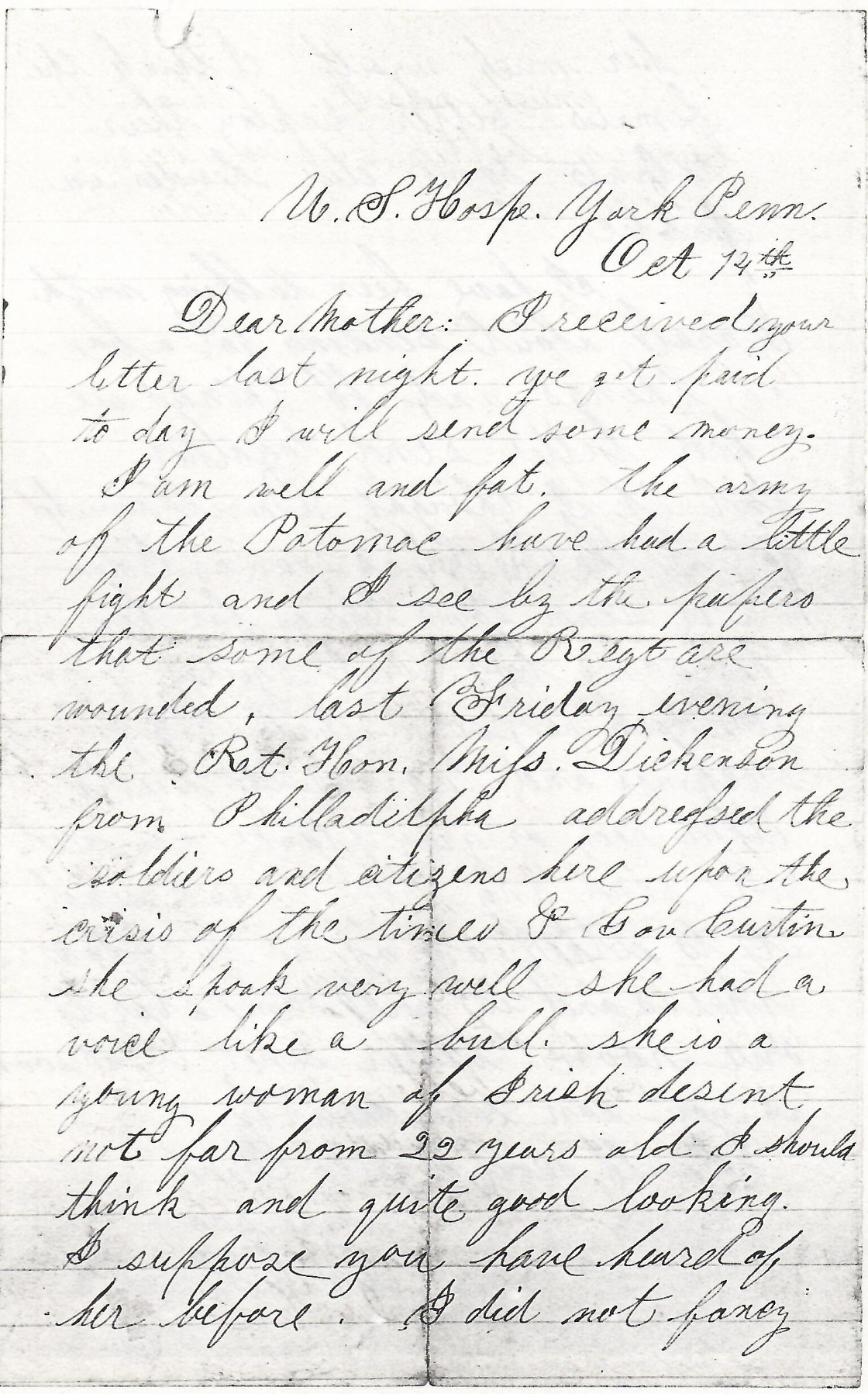
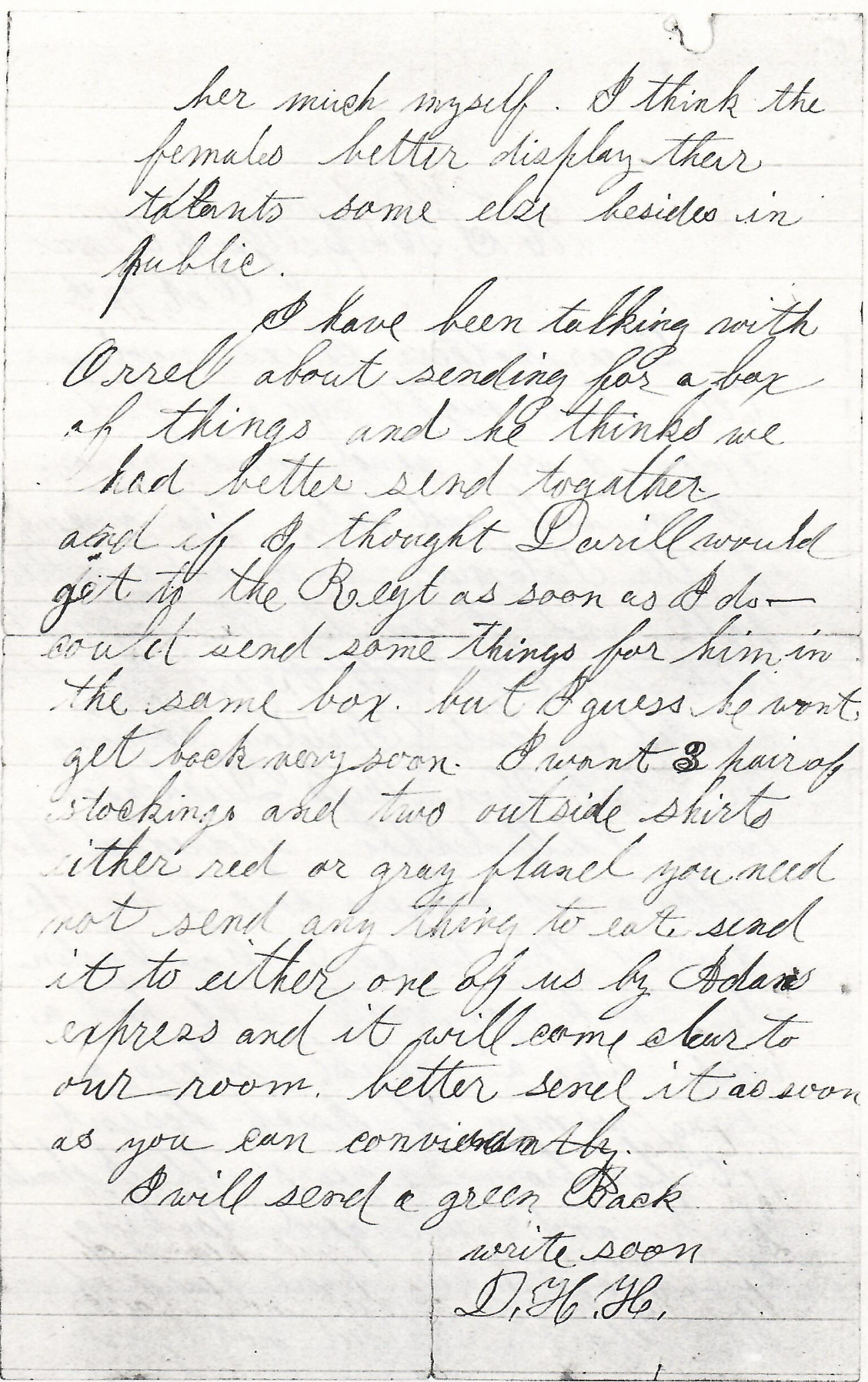
Letter 37
U. S. Hospital, York, Pennsylvania
October 21st [1863]
Dear Mother,
I just received your letter written Sunday. I wrote you a letter last week sending you some money. I just write a short letter for I have got leave of the Doctor to go out in the city this evening.
I am getting along well but I shall not be in a hurry to go to the regiment. Orrel [Brown] is well but his wound is getting along slowly. I think there was a bone broken in his foot. He can’t walk much on his foot yet. I weighed myself yesterday and go just 179 pounds. That is big enough for a boy. Respects to all and write soon. — David H. Hinds
I got a letter from Abbie last week.
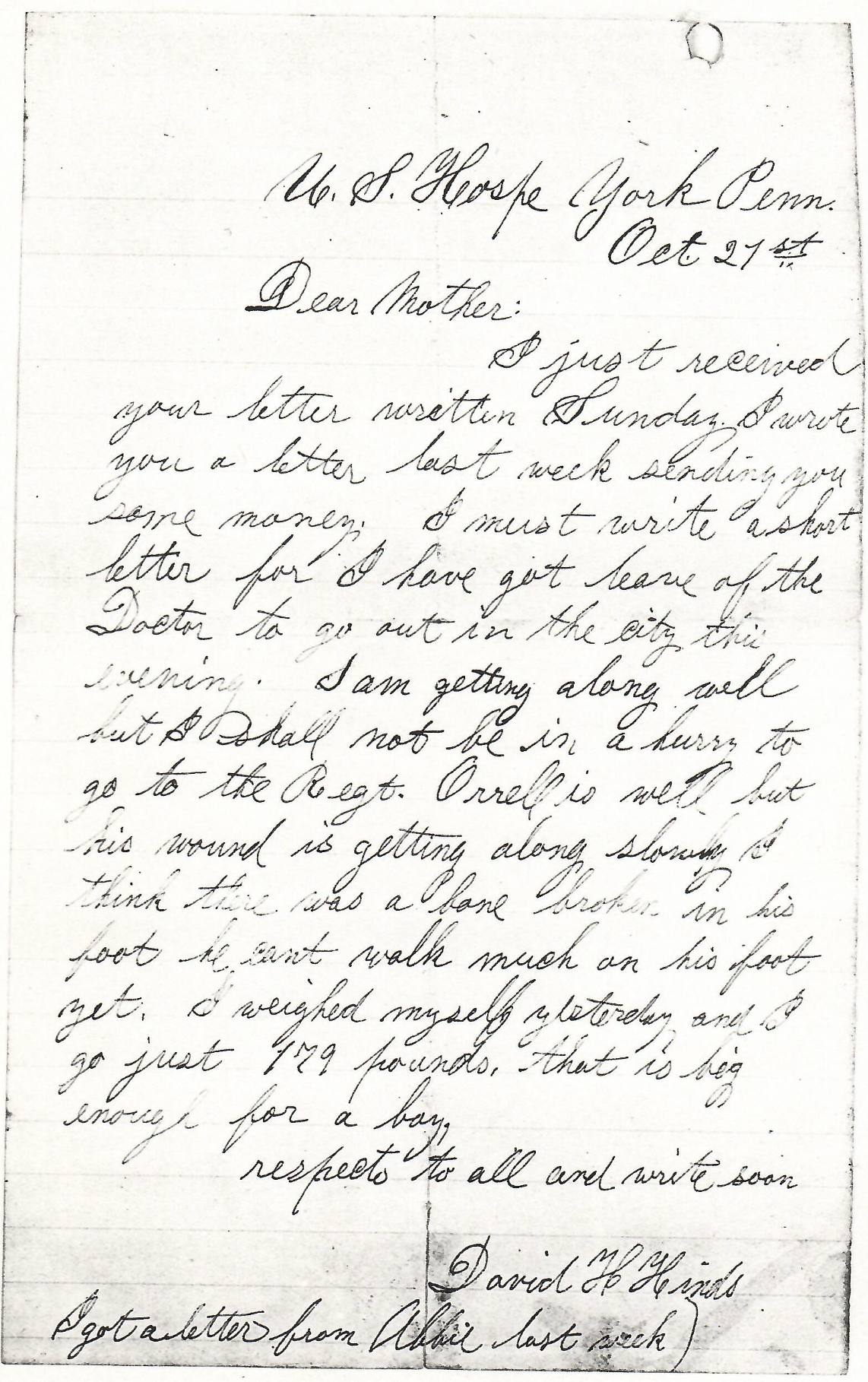
Letter 38
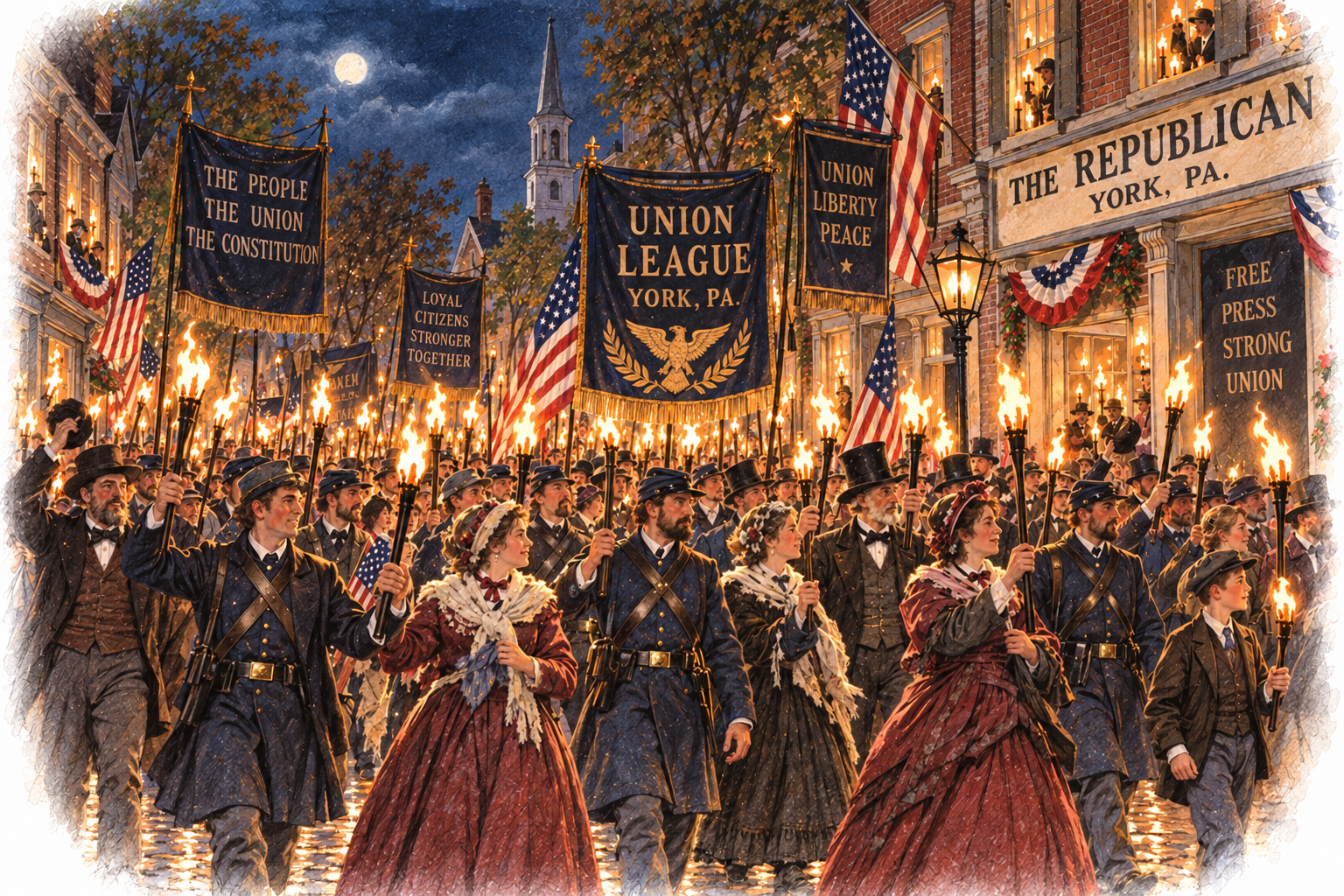
U. S. Hospital, York, Pennsylvania
October 30, [1863]
Dear Mother,
I received your letter last night. I was out last evening to see a torchlight procession given in honor of the [re]election of Gov. Curtin. It was a big time. The soldiers joined with the citizens. I think there was as man as two thousand lights carried and the windows in the houses were all lighted so it made a grand sight. 1
I got four months pay this time. I sent you ten and Abbie ten and I have bought me some clothes and that used some of it and I want to keep some with me. I don’t want you to keep any account of what I send home. All that I send home before I am of age, I will give for my time.
We have not got the box yet but I suppose we shall get it today or tomorrow.
Who keeps the school this winter? When is Thanksgiving? Is father going to sell the Pouts this fall?
I got a letter from Abbie last Monday. She seems to be having a good time. I can think of no more to write. Your son, — David Hatheway
1 Governor Andrew Gregg Curtin was reelected on 13 October 1863. He defeated Democratic challenger George W. Woodward by only 15,000 votes statewide.
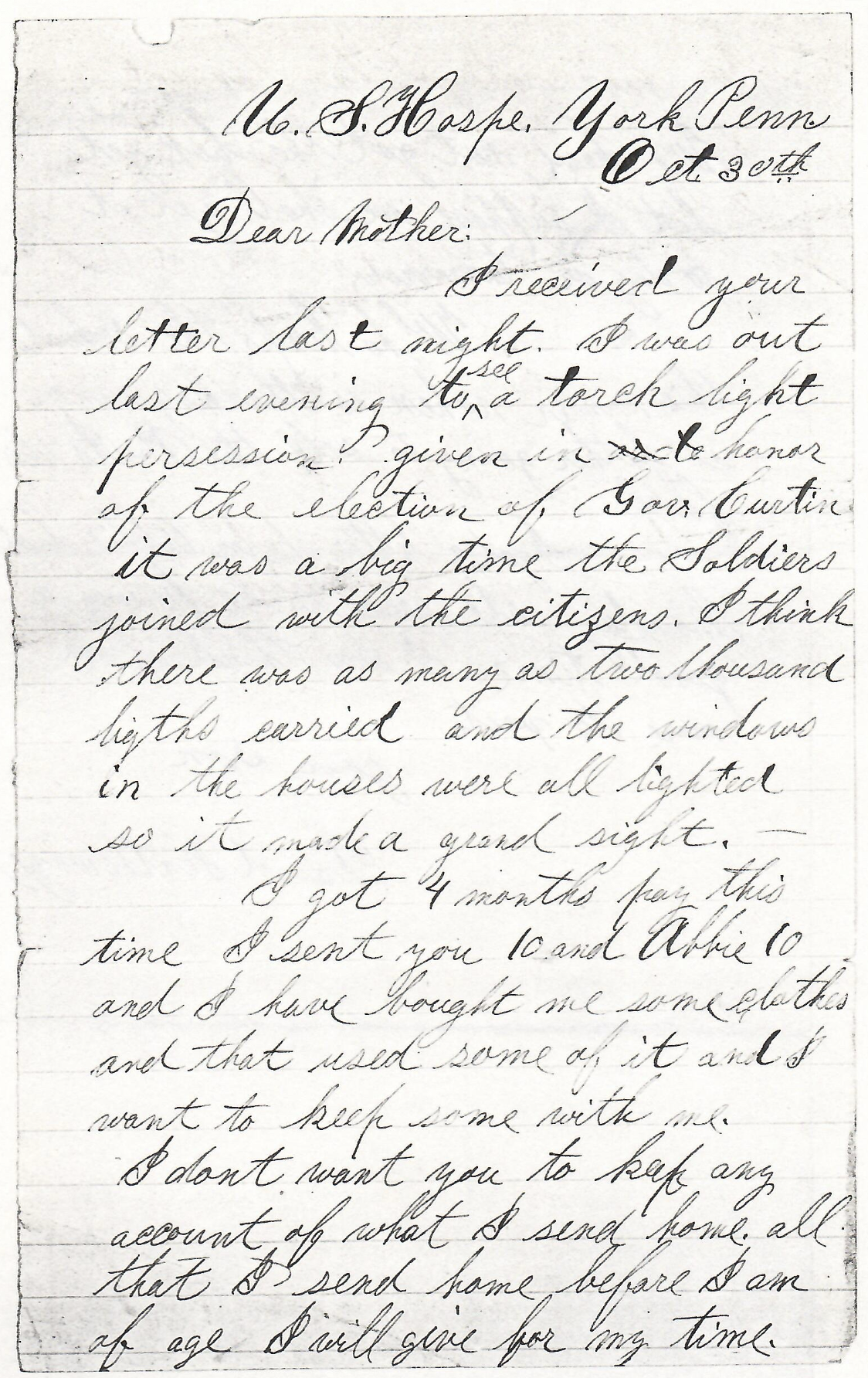
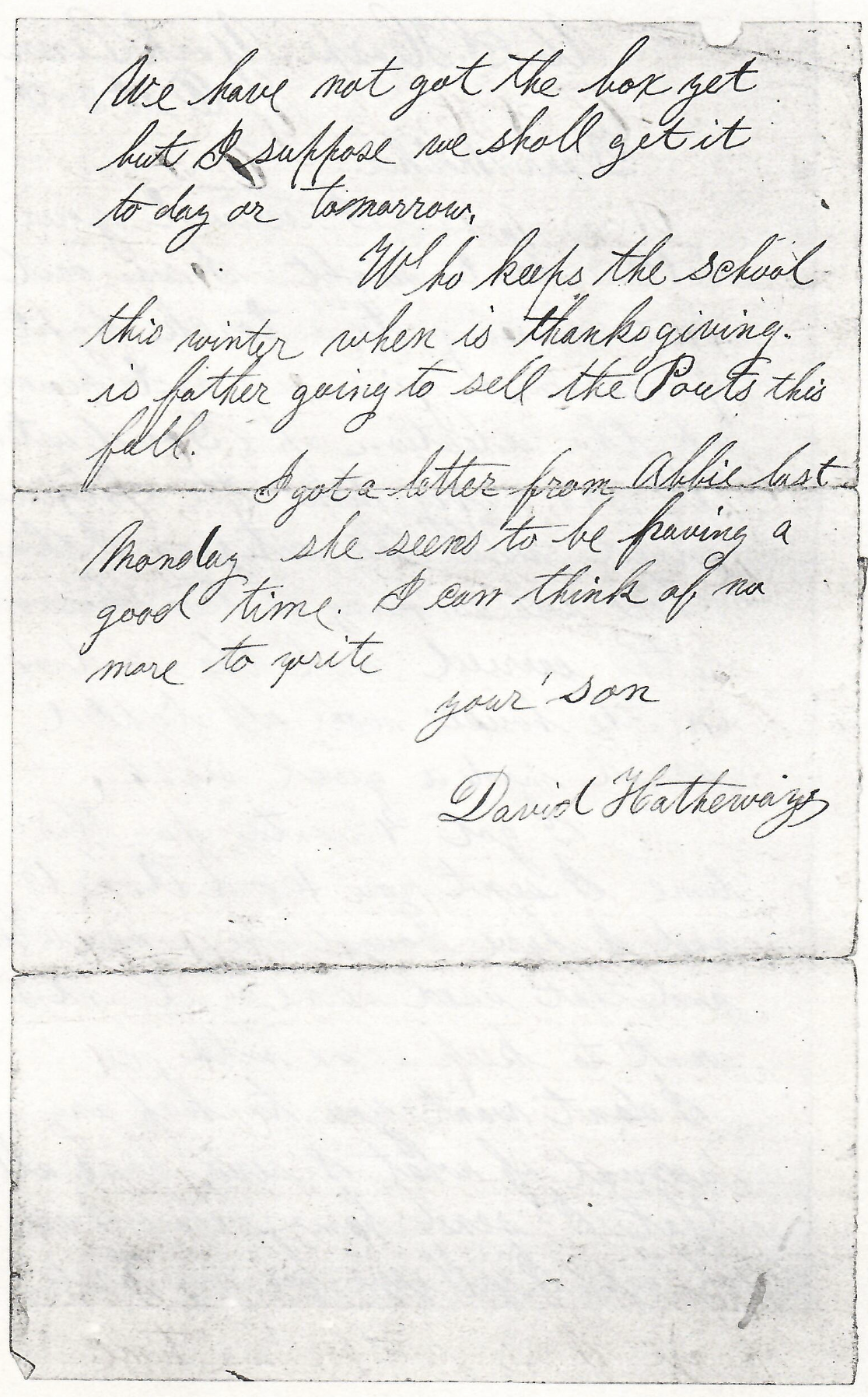
Letter 39
U. S. Hospital, York, Pennsylvania
November 4th 1863
Dear sister,
I received your letter this morning and I will answer it now so you can have no excuse for writing again when you get this.
It is a very pleasant day. It has been good weather for a good while but cold nights. I am going out tonight. I got a pass from 6 to 10 and I am going to see my Dutch girl. She is 18 years old with black eyes—awful handsome—and her name is Henrietta. Don’t you think it is quite a romantic name? The gir;s here are all right with the soldiers.
Orrel [Brown] and I got a package from our ma’ams last Saturday. We got two woolen shirts and two pair of stockings apiece. We are preparing for winter.
I don’t know of any news to write that will interest you. I expect to get two months pay next week and then I don’t care how soon I go to the regiment but I can’t go until the doctor sends me. My wound is not quite well yet but I am not lame any. I shall be able to go, i think. Write soon to your brother, — D. H. Hines
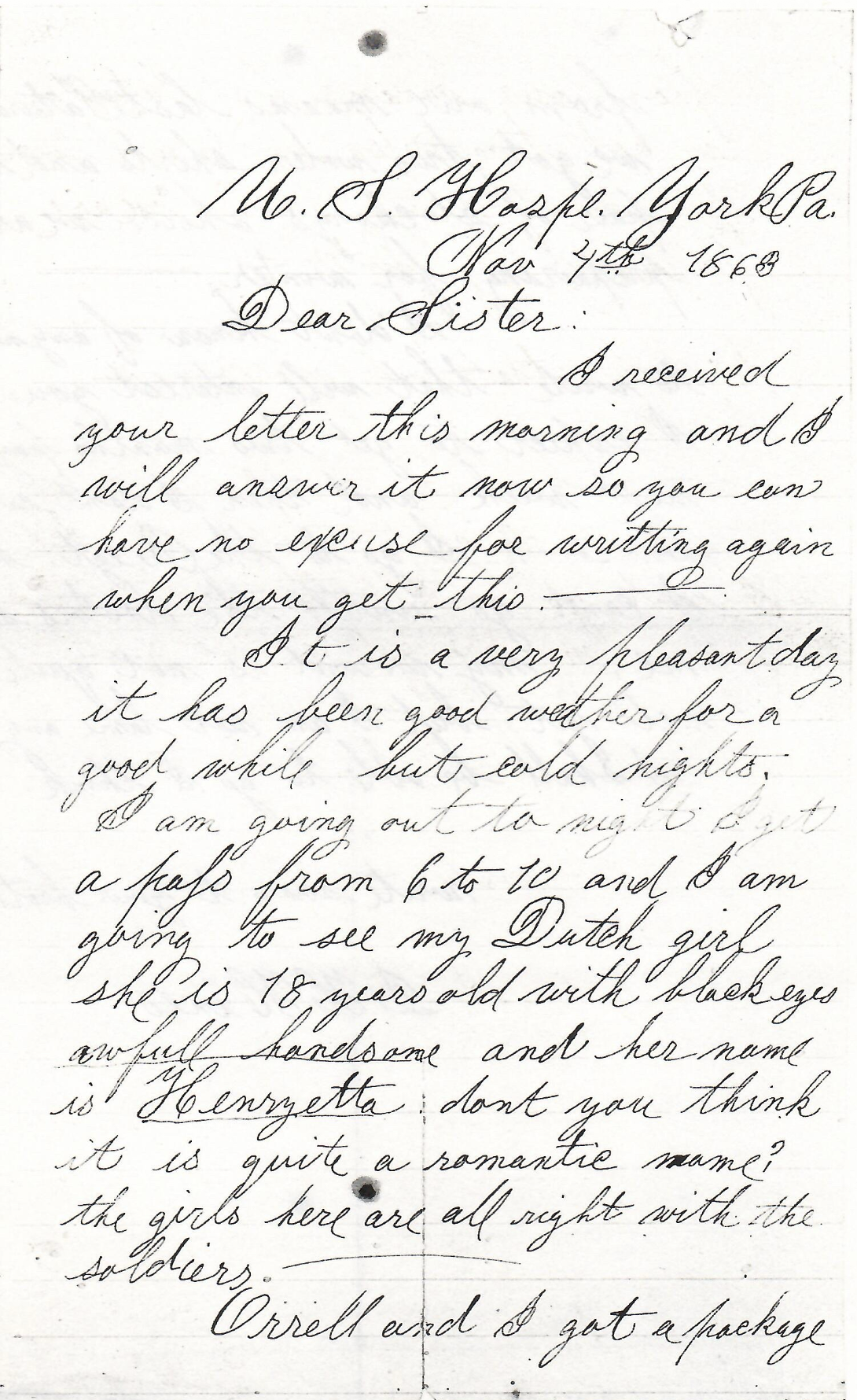
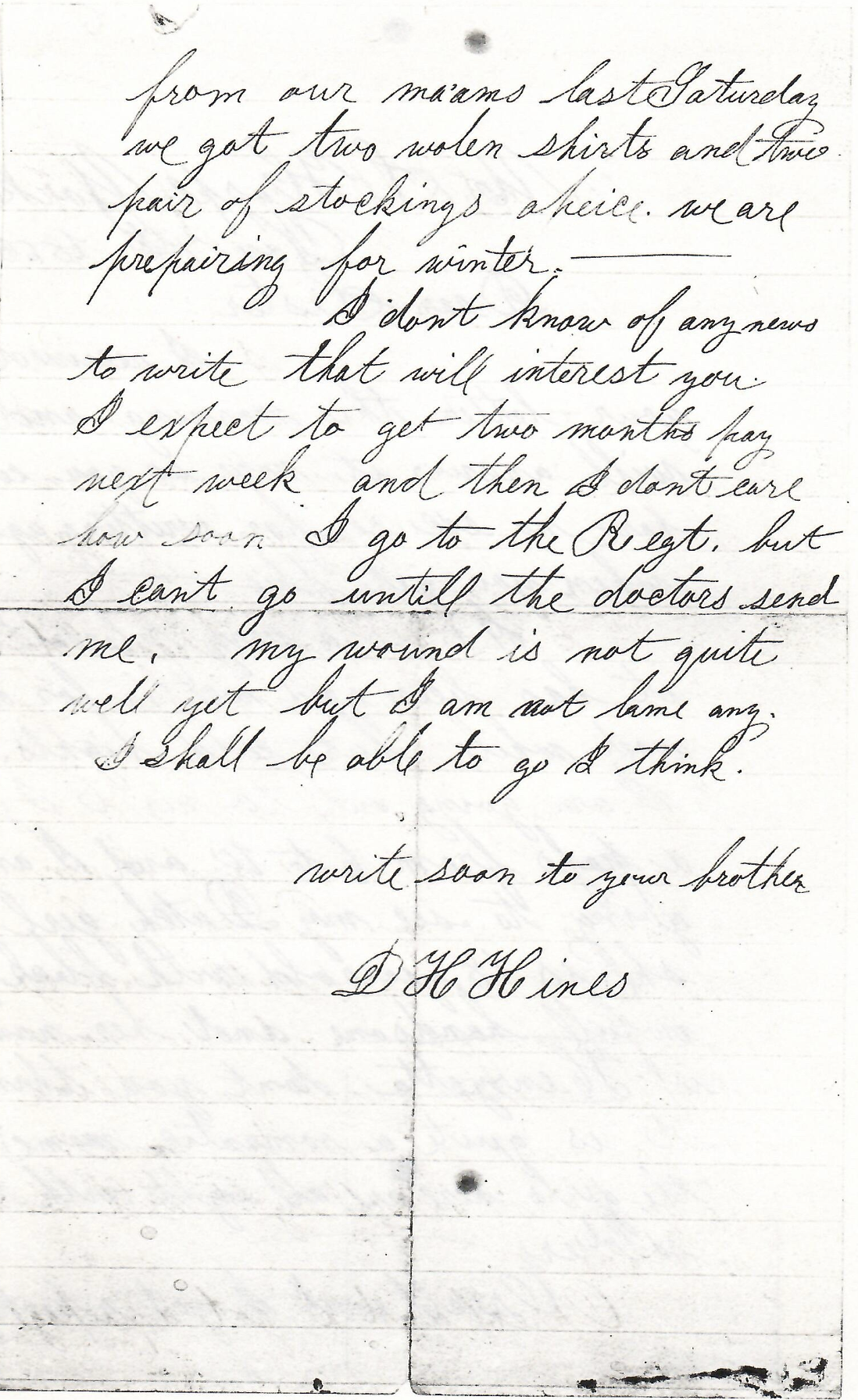
Letter 40
U. S. Hospital, York, Pennsylvania
November 12th [1863]
Sister Abbie,
I received your letter last night and was very glad to hear from you again. If you write as often as i do, it will be all I ask. I think you are making quite a long visit among your relation [in Massachusetts]. but go ot while you are young for when you are old, you can’t.
I can’t think of much to write but will write a little for your benefit as well as my own.
There is going to be a big time at Gettysburg the 19th of this month. [There is] going to be a consecration of the soldier’s burying ground. All the soldiers here that want to can have a 24-hour pass and go there. I don’t know whether I shall go or not. I was there once and did not get used very well but I don’t suppose there is any Rebels there now—only dead ones.
I am well and expect to start to the regiment soon. I was out in the city last night from 6 to 10. I saw lots of girls and had a good tie with them—the same as I always do with females. Give my respects to all and write soon. —David H. H.
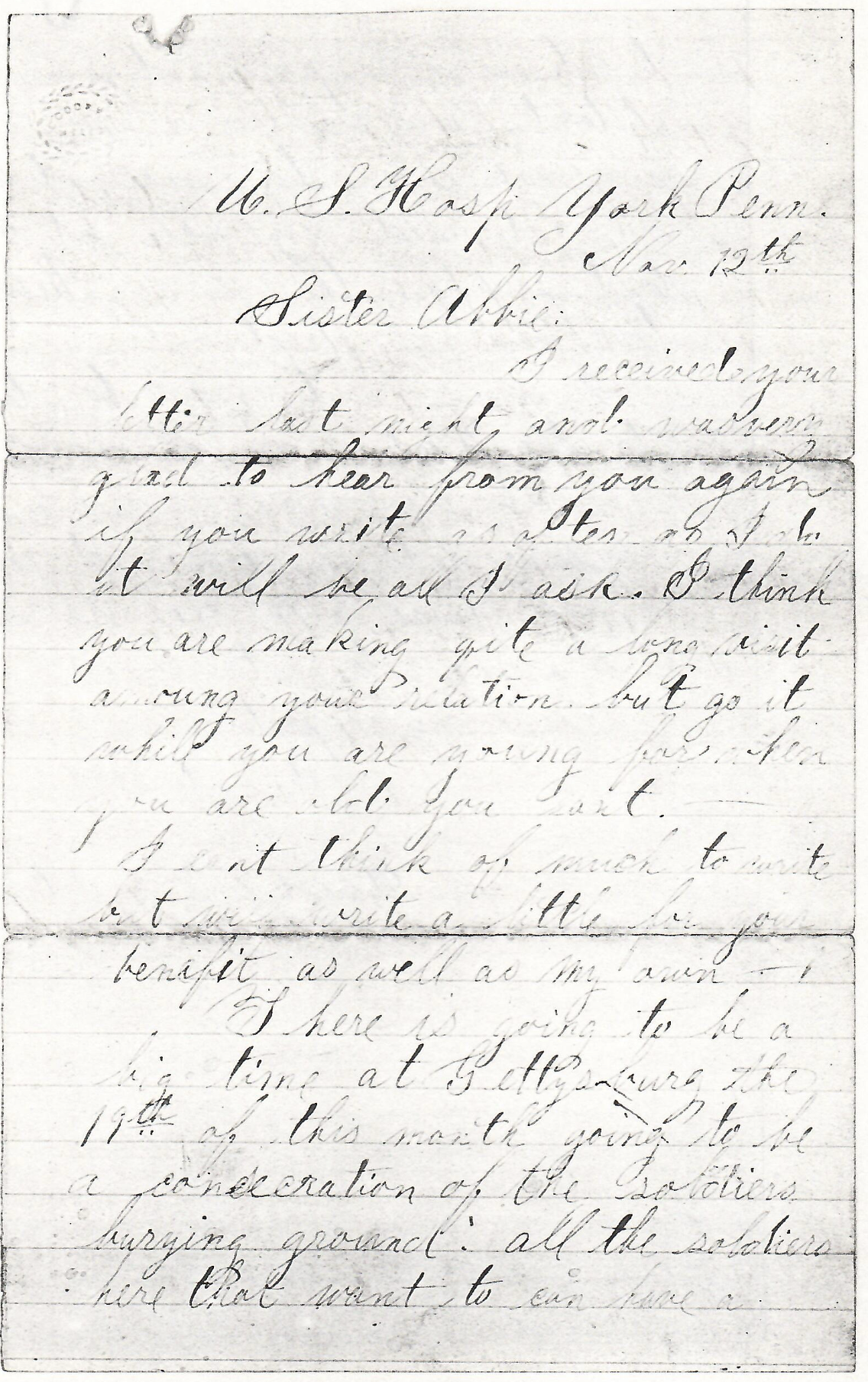
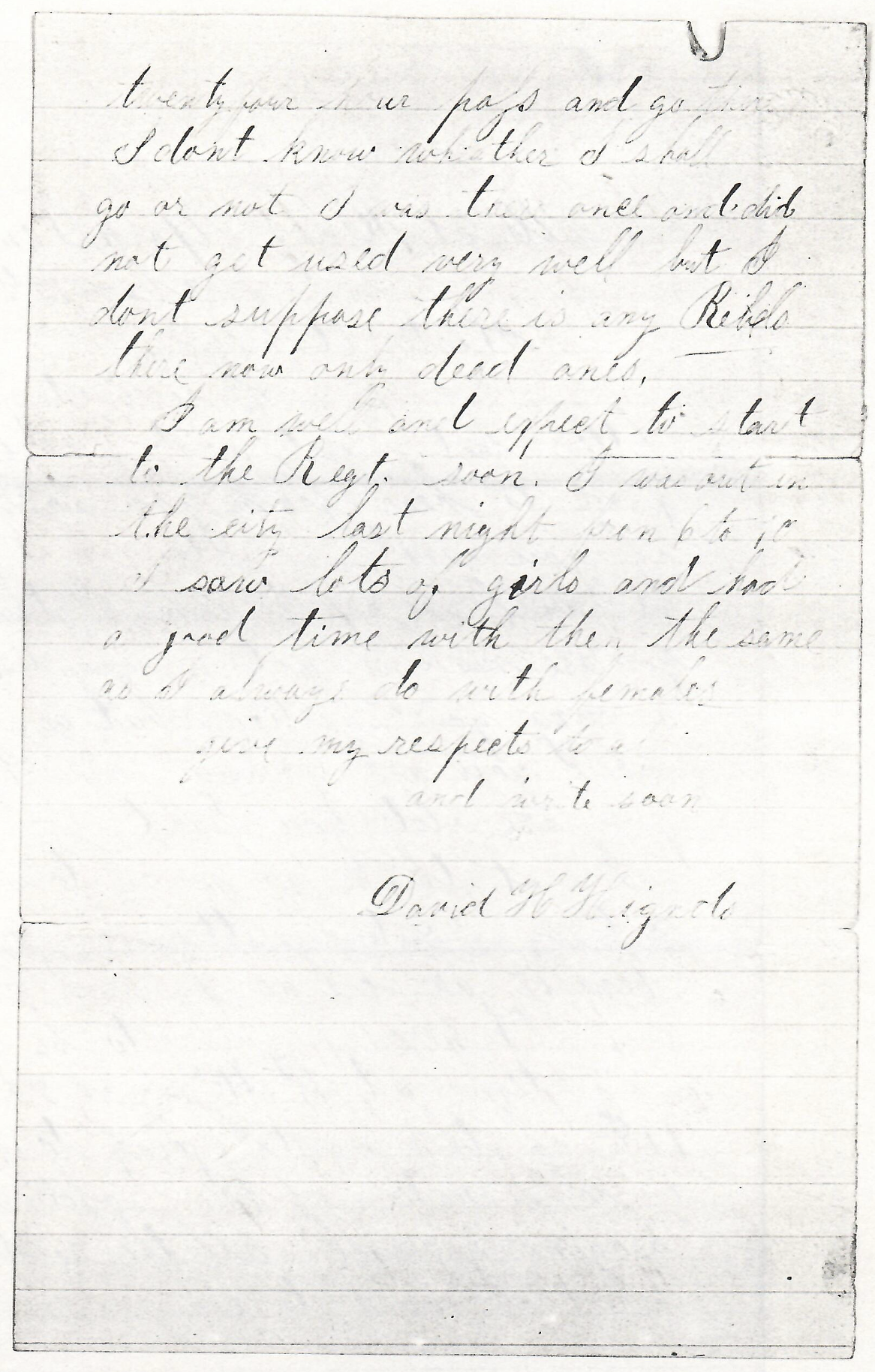
Letter 41
U. S. Hospital, York, Pennsylvania
November 19th 1863
Dear Mother,
I received your letter last night and as you sent paper and envelope both, I suppose you intended me to write as soon as I got it.
A good many of the boys from the hospital have goe to Gettysburg this morning to the consecration but I thought I would not go as it would cost considerable and I have not much money to spare. The wounded are all moved away from Gettysburg now. Some of them come [home] and some to other hospitals. 1
There is two Rebs in the room with me that are wounded very bad—neither of them can sit up. One belongs to the 11th Alabama and the other to the 8th Georgia regiments. 2
It has been rather cold here but no snow yet.
My wound is about healed but the doctors will not let me go to the regiment yet and as long as they keep me here, I shall not find any fault with it. I can think of no more to write. Write soon to your son, — David H.
1 There is a letter in the Brown Family file at the Jacksonville Public Library (Florida) that was written by a wounded soldier in the US Hospital at York, PA, who made the trip to Gettysburg as mentioned by David. The author of the letter was “Johny”—otherwise unknown. It was datelined, “Ward 8 or 9, York, Pa., US Gen. Hospital, November 20th 1863.” The body of the letter reads:
Beloved Wife and Children, As I am in a pretty good state of health considering my disease, and somewhat lonesome, I thought I would drop you a line this evening, giving you the events of the few past days. We were informed Monday last that there would be transportation for 60 delegates to go to Gettysburg to be present at the Dedication of the National Cemetery. We went over the road free of charge. We started at two o’clock in the morning of Thursday last. We did not get to Gettysburg until eleven o’clock a.m. We then formed in line and marched to the cemetery. There was perhaps 10,000 people present. The vast assemblage was addressed by the Hon. Edward Everett, and Abraham Lincoln. We then put off around the old battlefield, and see all that could be seen after so short a time line [?] the most of the relics are picked up along ago. We left Gettysburg at eleven o’clock last evening and arrived here at 6 this morning. Well, I cannot think of much to write [describes an enclosed $20 bill]. Well, I hope to hear from you soon, have rec’d no letter from you since Sunday or Monday. This from your most affectionate husband Johny. Give my love to father, mothers, sisters and brothers. May this go safe and benefit you accordingly. Yours forever, Johny [Source: Civil War Talk, March 2021]
2 It’s curious that David reports two seriously wounded Rebels in his “room” as the Dr. Henry Palmer, chief surgeon of the York General Hospital famously refused to admit wounded Confederate prisoners, leaving it to sympathetic local civilian doctors in York to treat wounded Southerners in the Odd Fellows Hall on South George Street. [Source: Scott Mingus, “Gettysburg Confederate Casualties buried in York, PA”]
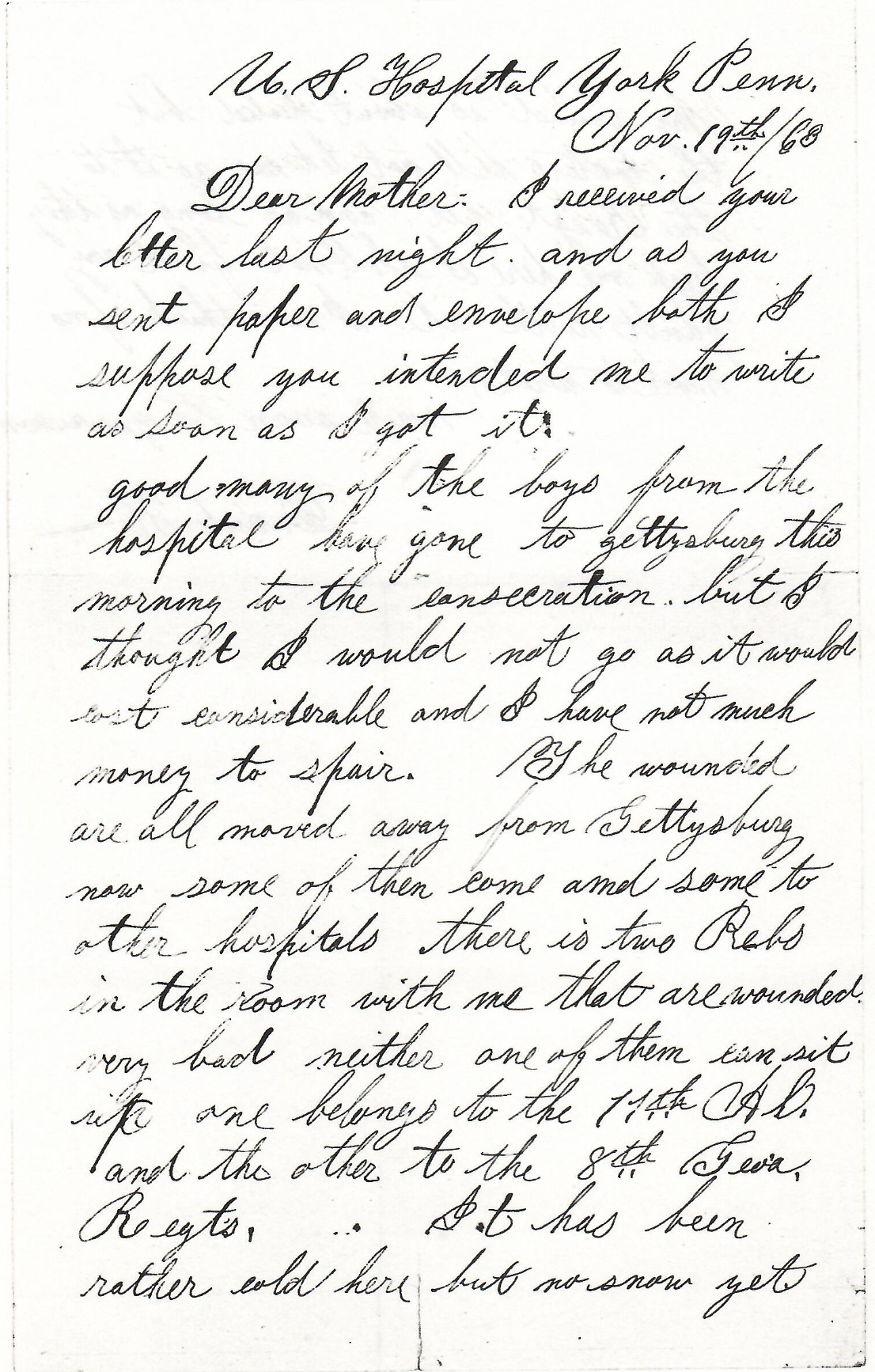
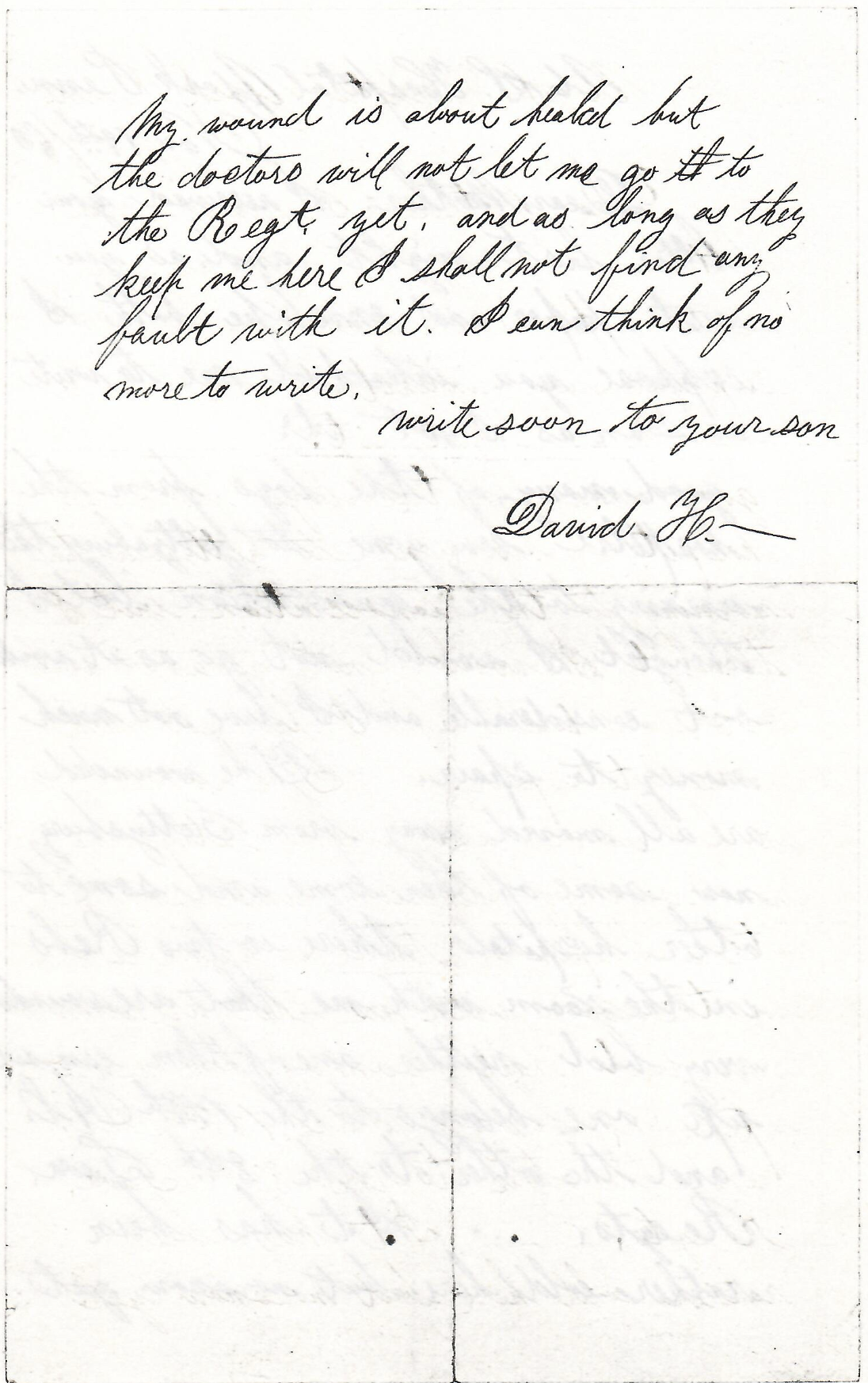
Letter 42
U. S. Hospital, York, Pennsylvania
November 25th 1863
Dear Mother,
I received your letter this evening as I always [do on] Wednesday evenings. Tomorrow is Thanksgiving day at this state 1 and we are going to have a big dinner here in the hospital and by the ladies in town. The ladies in town here have done a great deal for the soldiers since I have been a patient here. One lady in particular by the name of Mrs. Fulton has done a good deal for us. The boys in this ward made her a present the other day of a very nice album which cost 25 dollars. I gave 50 cents toward it. 2
We shall have a pretty good dinner tomorrow I expect. But I had just as leave drop in at my old home and take dinner whether I found anything good or not. This makes two Thanksgivings that I have been away from home and there is a fair prospect of my being away from home another. I think I shall be likely to stay the three years out and I feel contented to do so. A soldier has some very pleasant times and the days and months seem to slip away easy. It has been over four months since I came to the hospital here and by getting wounded as I did, have saved me from a great deal of hard marching and exposure, both to the weather and bullets.
You say you feel easier about me while I am here than you do when I am at the regiment. But the time seems longer to me than it does when I am in the field with the boys. There with so many boys together, there is always something going on to pass away the time. While here there is nothing but the same thing over and over again. We have to go to our meals three times a day and between meals we do what we can to “kill time.” We play cards, checkers, &c. but I have played so much that I have got sick of the sight of them.
I don’t care how soon I go to the regiment. The Colonel of the regiment, I suppose you know, was taken prisoner and is now in Richmond. I feel anxious for him to get back for he was a very good and brave man. He never wanted a man to go where he did not lead them. The Lieut. Colonel who is now in command of the regiment is a good man and I don’t know but just as good as Col. Charles W. Tilden.
I think I have written a very long letter for me but I don’t suppose you will get tired of reading it.
Now my little sister has got home, I suppose she will have talking enough to do for a month. Does she intend to go to school this winter? How much did father get for Black Bet? I think he has got plenty of land now if he don’t buy any more. I suppose he is going to get a pair of oxen or steers before spring. From your son, — David H. Hignds [Hinds]
1 Until November 1863, Thanksgiving was celebrated on different dates in different states, usually set by the Governors and timed with the autumn harvest in late November or early December. President Lincoln set the date in 1863 to urge national unity during the Civil War. Congress didn’t set the holiday as the 4th Thursday of November until 1941.
2 This may have been Ann (Grace) Fulton (1811-1876), the widow of Thomas Hamilton Fulton (1807-1851) who was enumerated in York with three of her children at the time of the 1860 US Census. Her youngest and only surviving son David was 17 when he enlisted in Co. B, 209th Pennsylvania in September 1864.
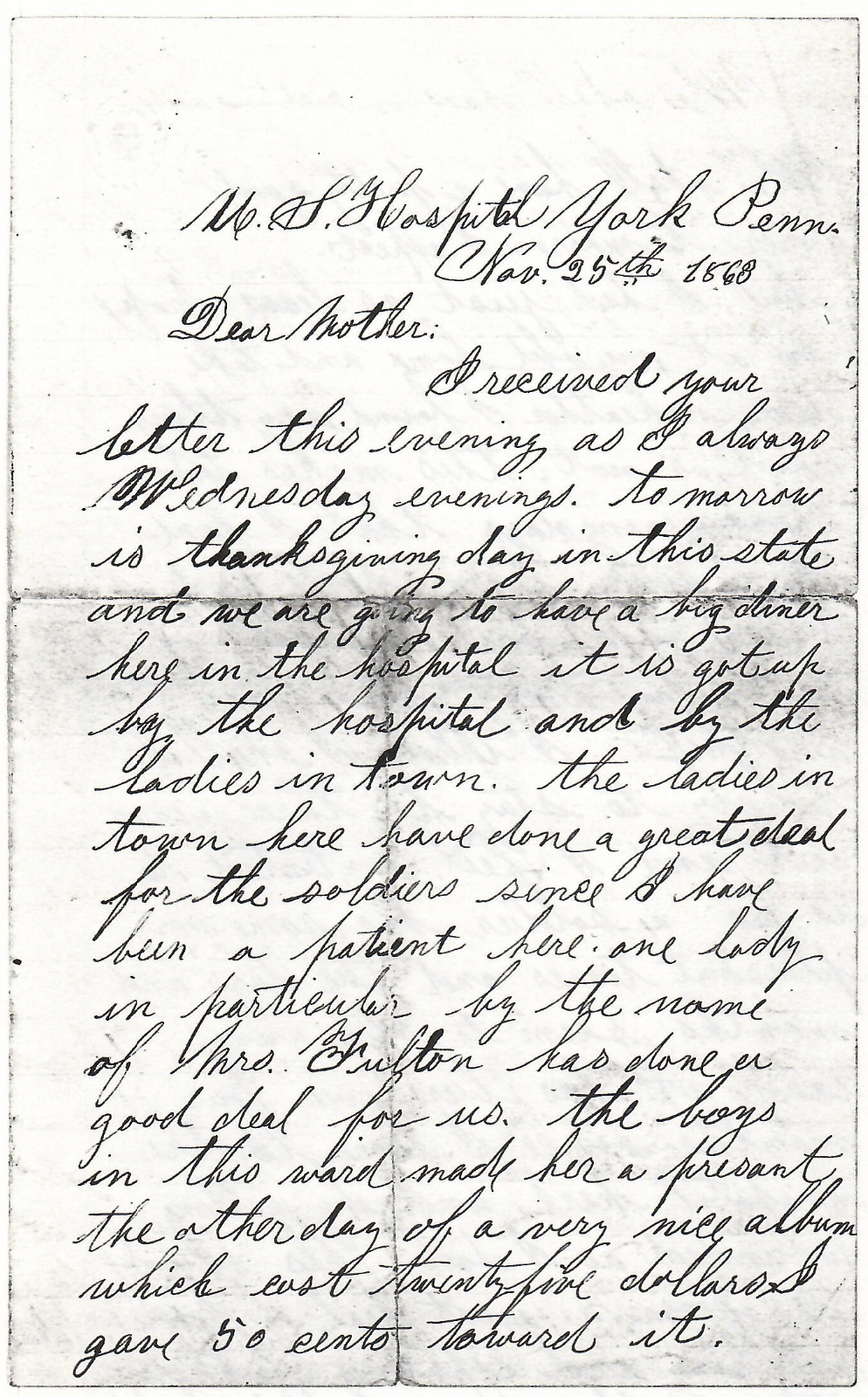
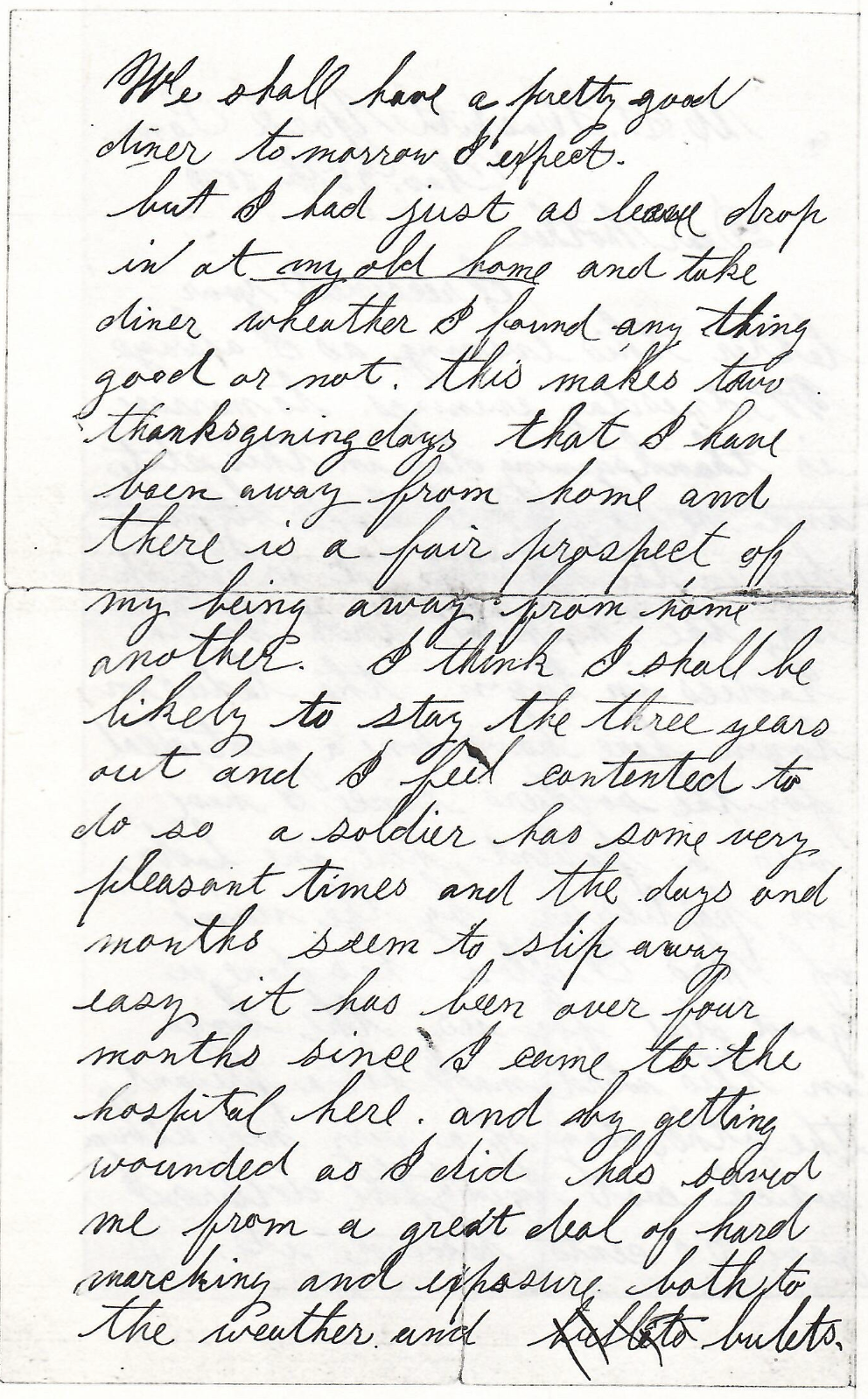
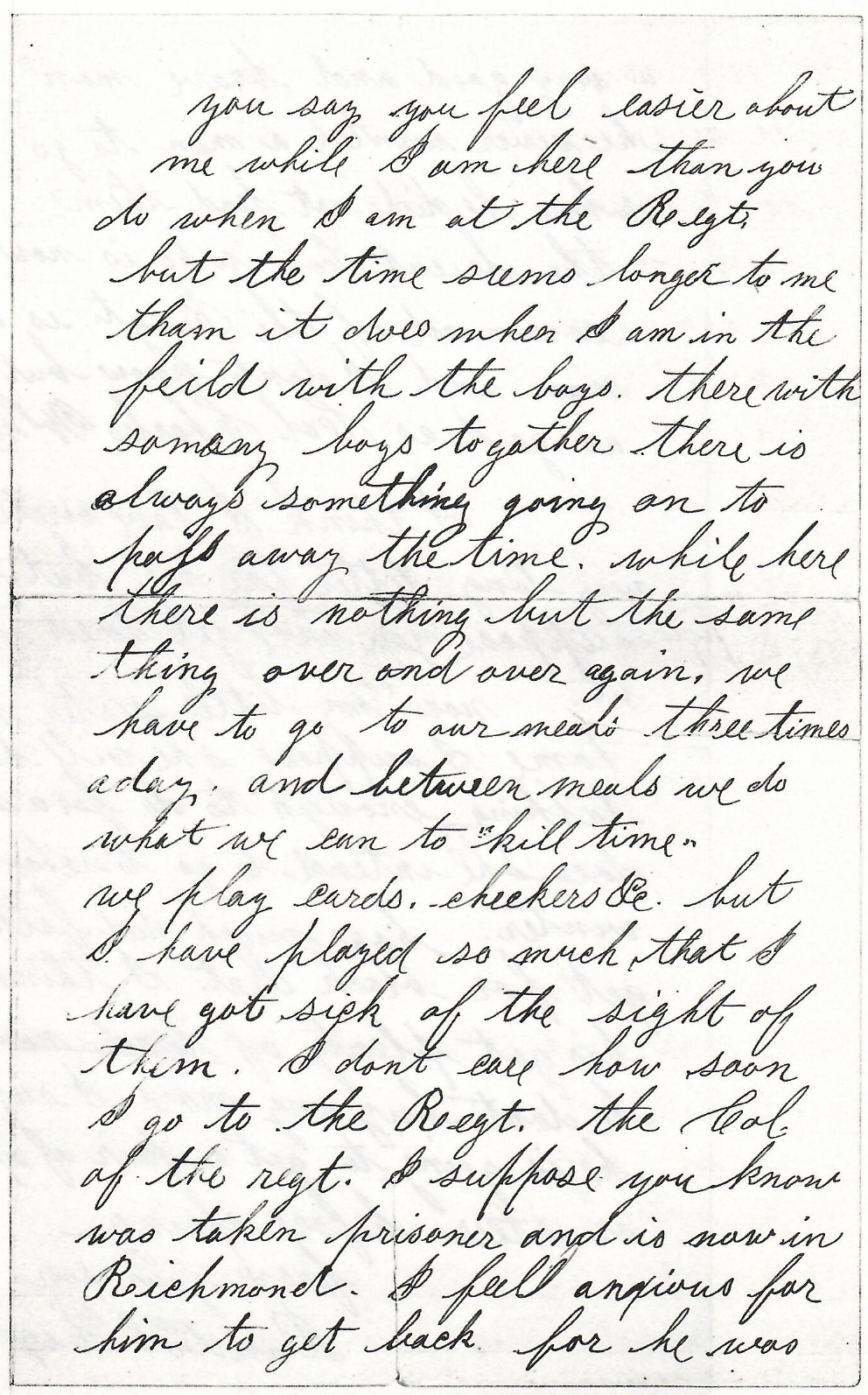
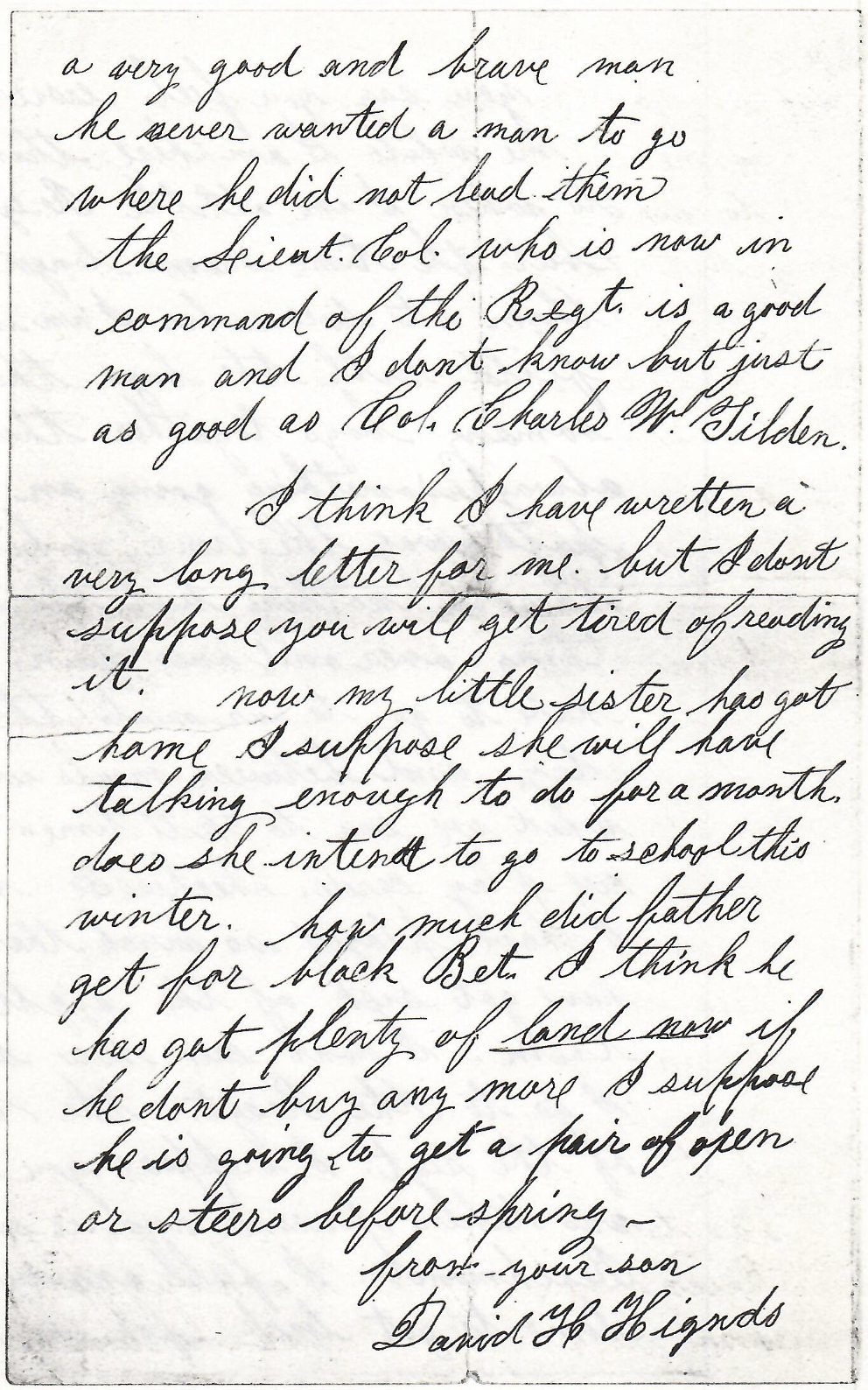
Letter 43
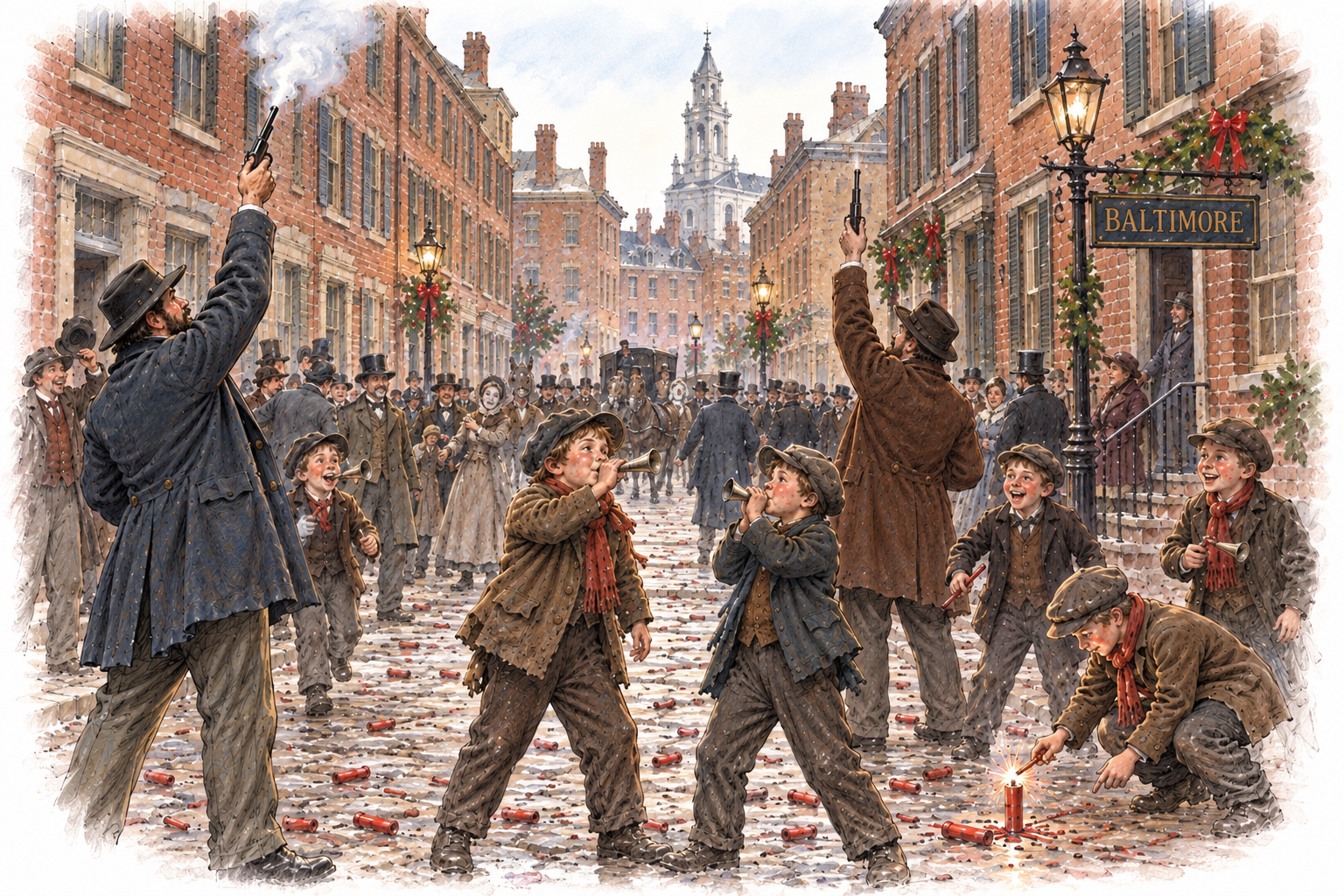
Baltimore, Maryland
Sunday, December 27th 1863
Dear Mother,
I received your letter last evening and will answer it now. I don’t get a letter as soon as I did in York, Pennsylvania.
We had a splendid dinner here Christmas. We had oysters and any quantity of pies. I was out in the city in the afternoon and evening and I find they celebrate Christmas different from the way they do at home. They are firing guns and fire crackers all day and all night long. Every boy big enough to walk had a tin trumpet and kept tooting all day. They made a real Fourth of July of it.
It has been pretty cold here the past week—cold enough to make skating on the ponds—but today it is raining hard. I think it will be a long storm. It will be nice to make mud down in Virginia but I shall not be there to wallow through it.
You wanted to know what I done with all my money. Well, when I was paid last, I got two months pay and I did not send any home because I was in hopes to get a furlough. I want it to pay my fare home. But I have not got a furlough yet. I can get one here for ten days but that will give me just time enough to go home and say “goodbye” and I thought that would not pay.

I have spent money rather freely since I have been in the hospital but a soldier has a hard time in the field and I believe he better enjoy some of his money when he can. Probably I shall go to the regiment soon where I can’t spend any money.
What does Vill think about enlisting now? Is he going to face the conscription? Every letter that I get from the vicinity of E. Livermore, I hear about his famous mustache. One of my correspondents said it was “decidedly ornamental to his noble physiognomy.” And please tell him he will greatly oblige me by sending me his picture with his mustache on.
I guess I have written enough upon that subject so will close. Write soon to your son, — David H. Hinds
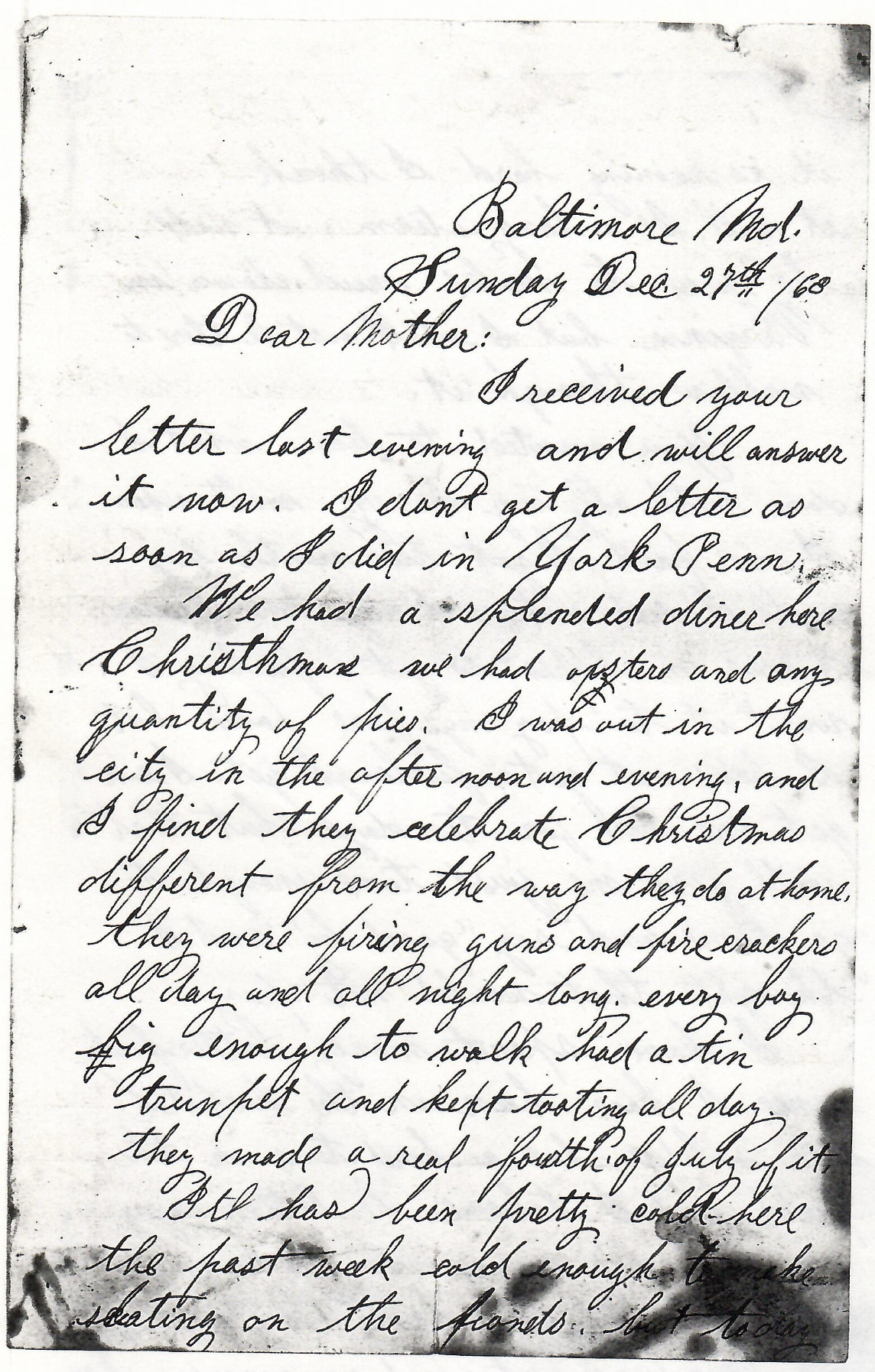
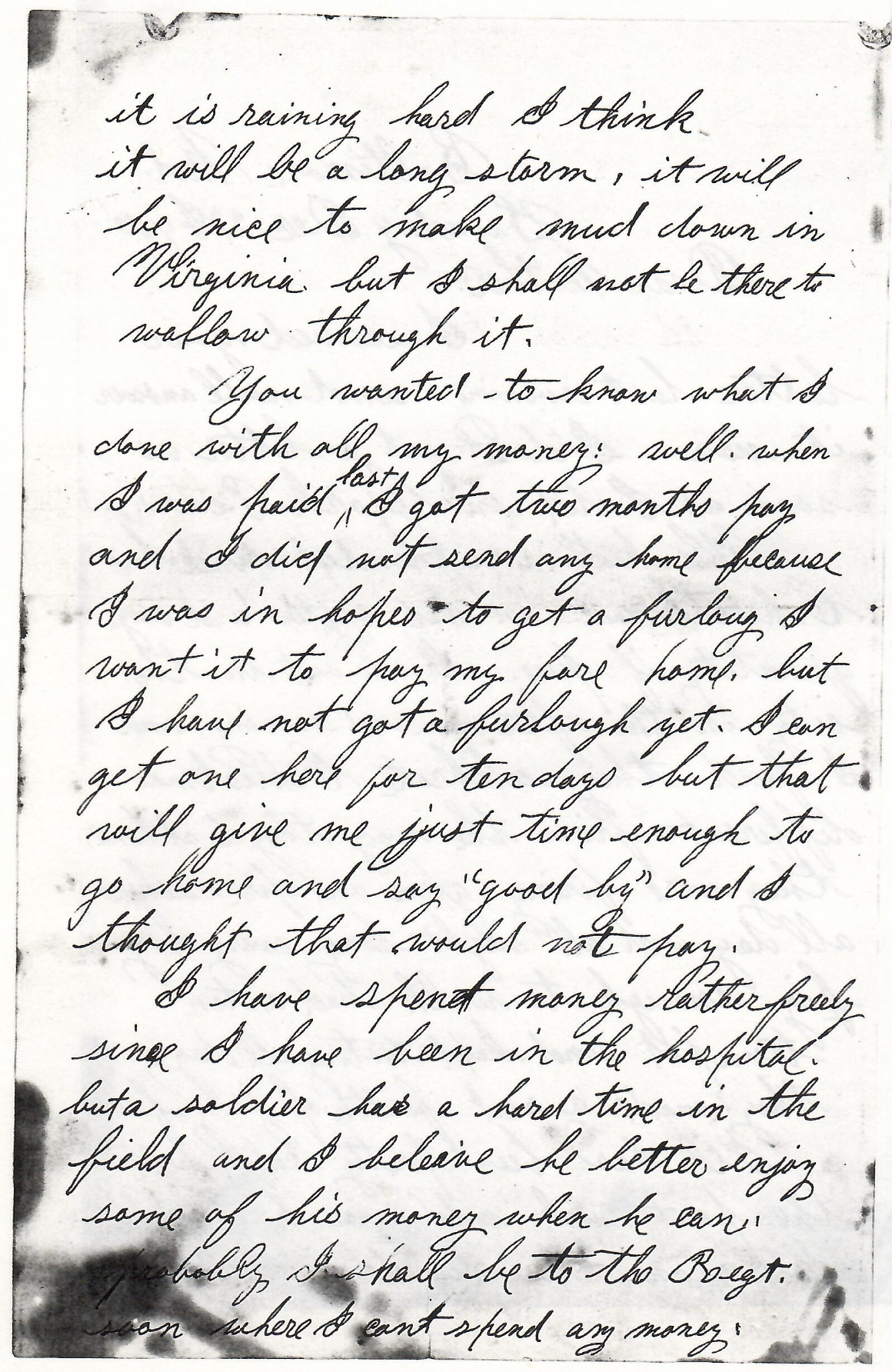
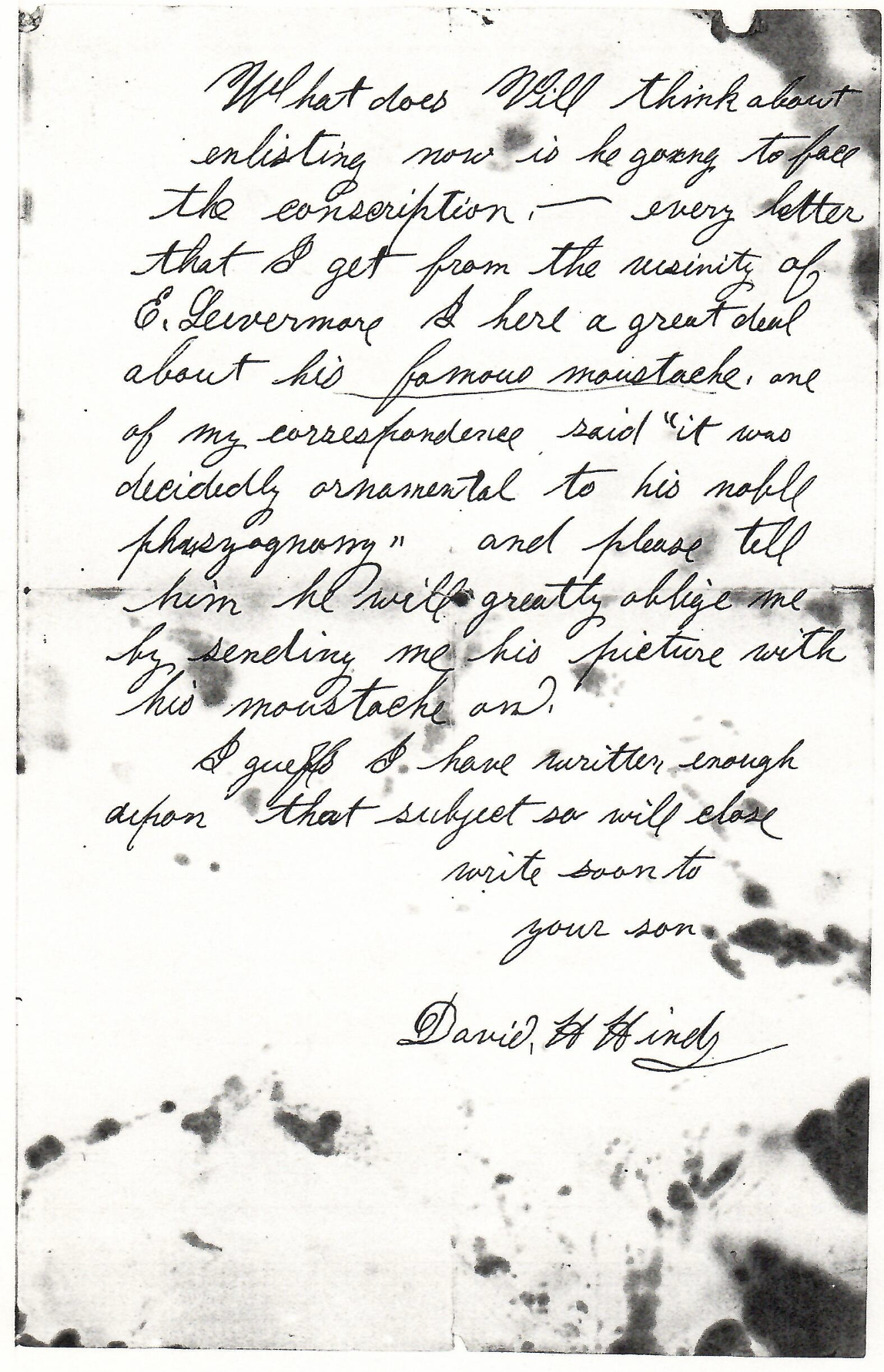
Letter 44
Baltimore, Maryland
January 14, 1864
Dear Mother,
I received your letter last evening and hope I shall not have to wait two weeks for a letter again. So I will answer this one this morning so as to set you a good example.
I am gettin along well. I want to go to the regiment as soon as I can but I hear they are not going to send any more away until spring. I like staying here well enough but I am very apt to spend money too fast and I think the best thing I can do is to go to the regiment and there a fellow can’t spend his money for there is nothing to be bought.
You say that a part of the regiment has [re]enlisted for three years longer. Do you think I had better do so? If the war should close, I think soldiering would be fun but as it is now, it is not very nice to be a soldier.
You wanted to know whether my leg was as strong as the other or not. I don’t think it is quite now but I think it will be in the course of time. I should go into the Invalid Corps but I don’t fancy it much. If times was as they were a year and a half ago, I could get discharged but as it is now, I don’t think I can.
I can’t think if any more to write. Write soon to your son, — David H. Hignds [Hinds]
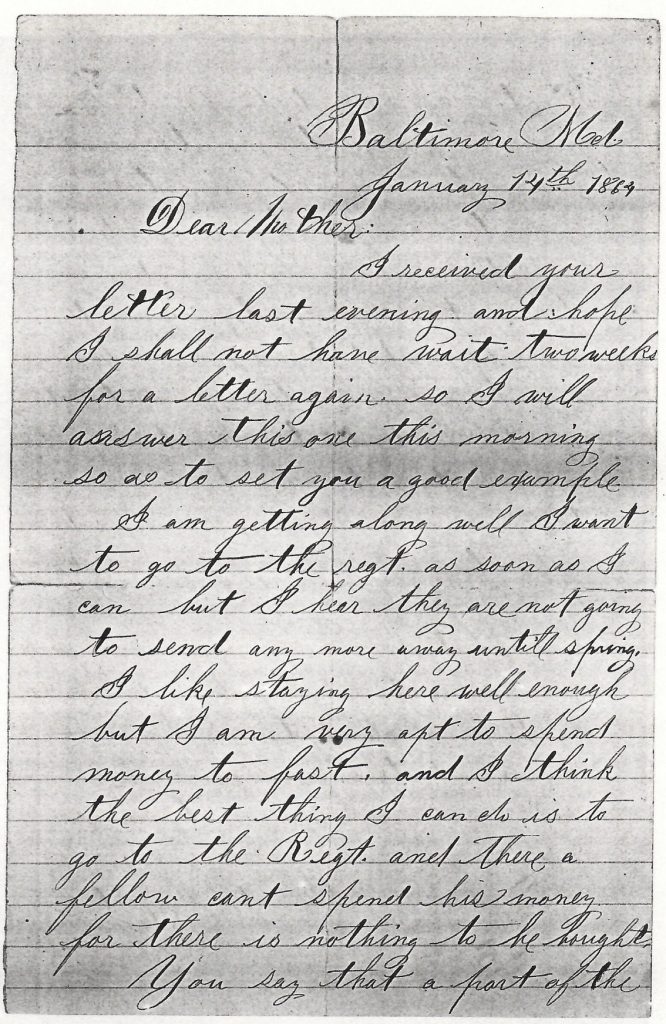
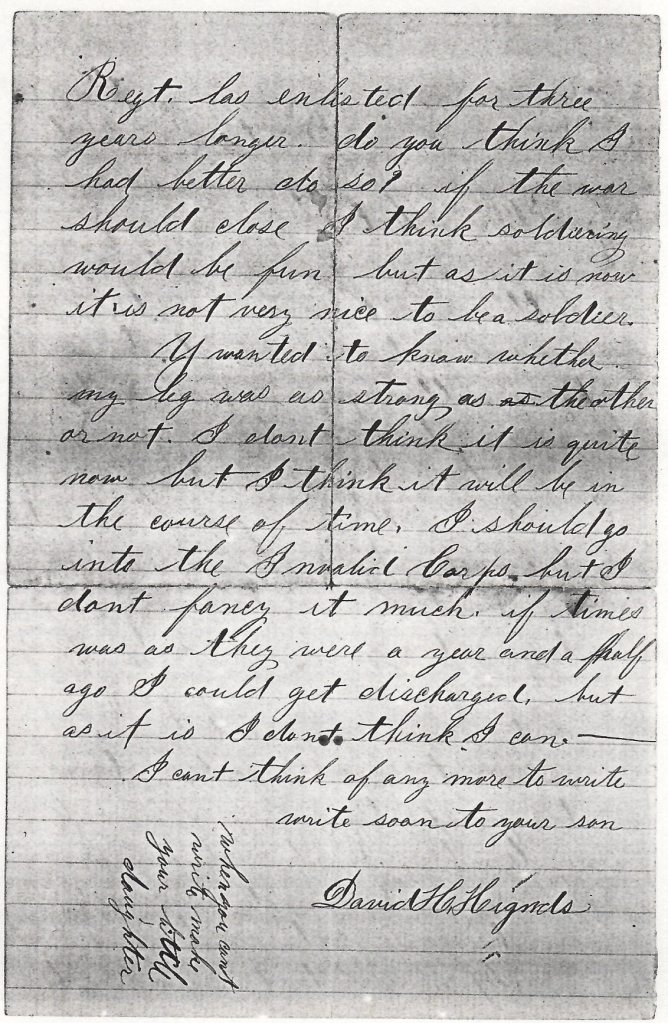
Letter 45
Baltimore, Maryland
January 19th 1864
Dear Sister,
I received your letter yesterday and was very glad that you happened to write and I hope you will continue to do so if your business is not too pressing. And make Master Frank write [too]. I heard about his taking a certain young lady by the name of Miss Lucy Ellen Dutton to a party and if he is big enough to do that, he is big enough to write a letter.
It was a rainy day here yesterday but it has cleared away this morning. The snow is all gone and it looks like spring again.
I was in the city last evening and went to the Melodeon (a kind of theatre). It was a good show. I enjoyed it first rate. 1
I can’t think of much to write. Everything goes about the same. I think I may as well stay here until spring as anywhere. There is a fiddle here in the room and I saw on that once in a while. I have learned about all that I forgot since I left home. Respects to all and write soon, — David H. Hignds [Hinds]
1 The Melodeon theatre in Baltimore staged the production “Take It or Leave It” as a burlesque to a sold out audience on 18 January 1864. The venue was located on East Baltimore Street next to the bridge.
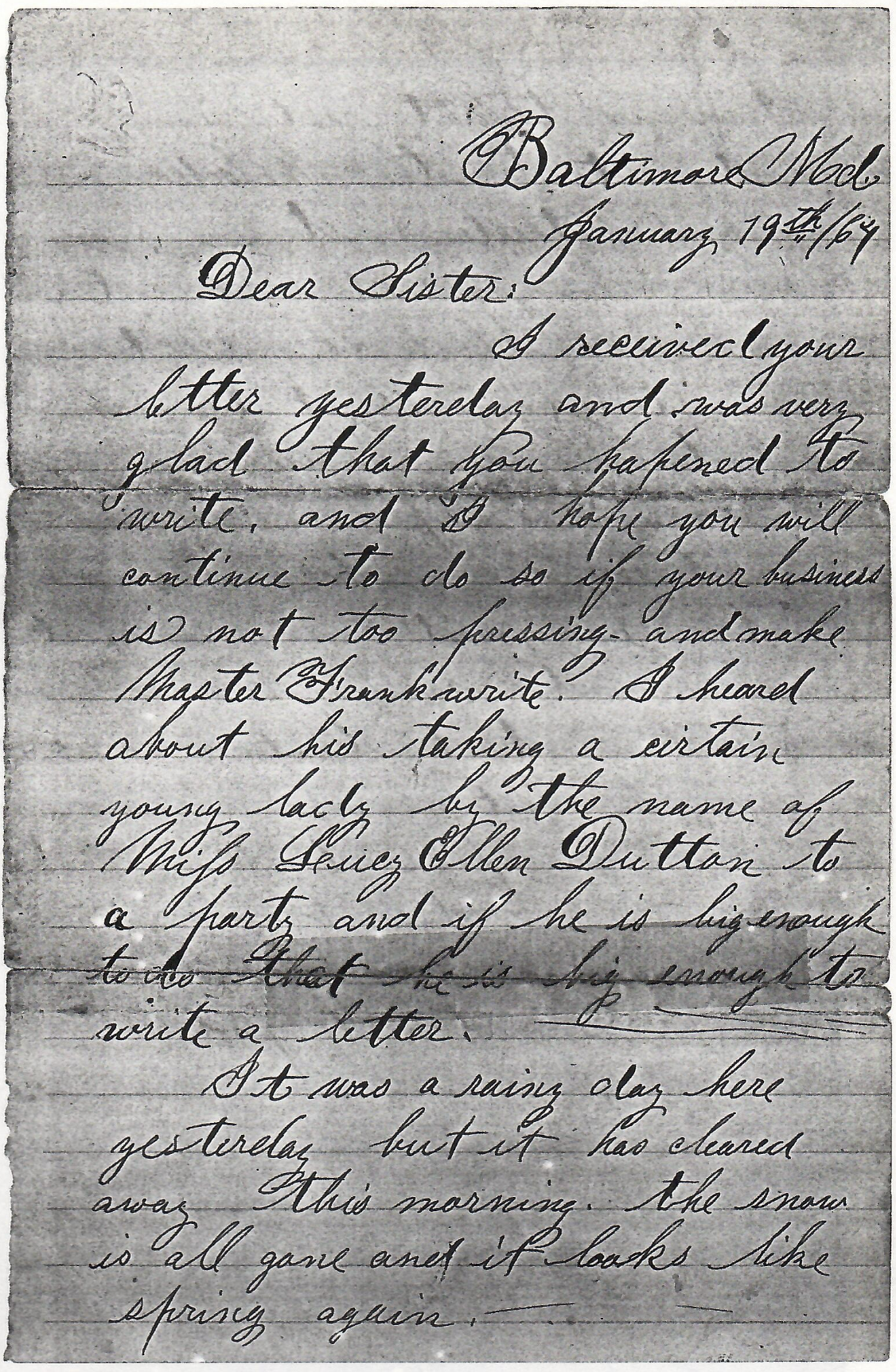
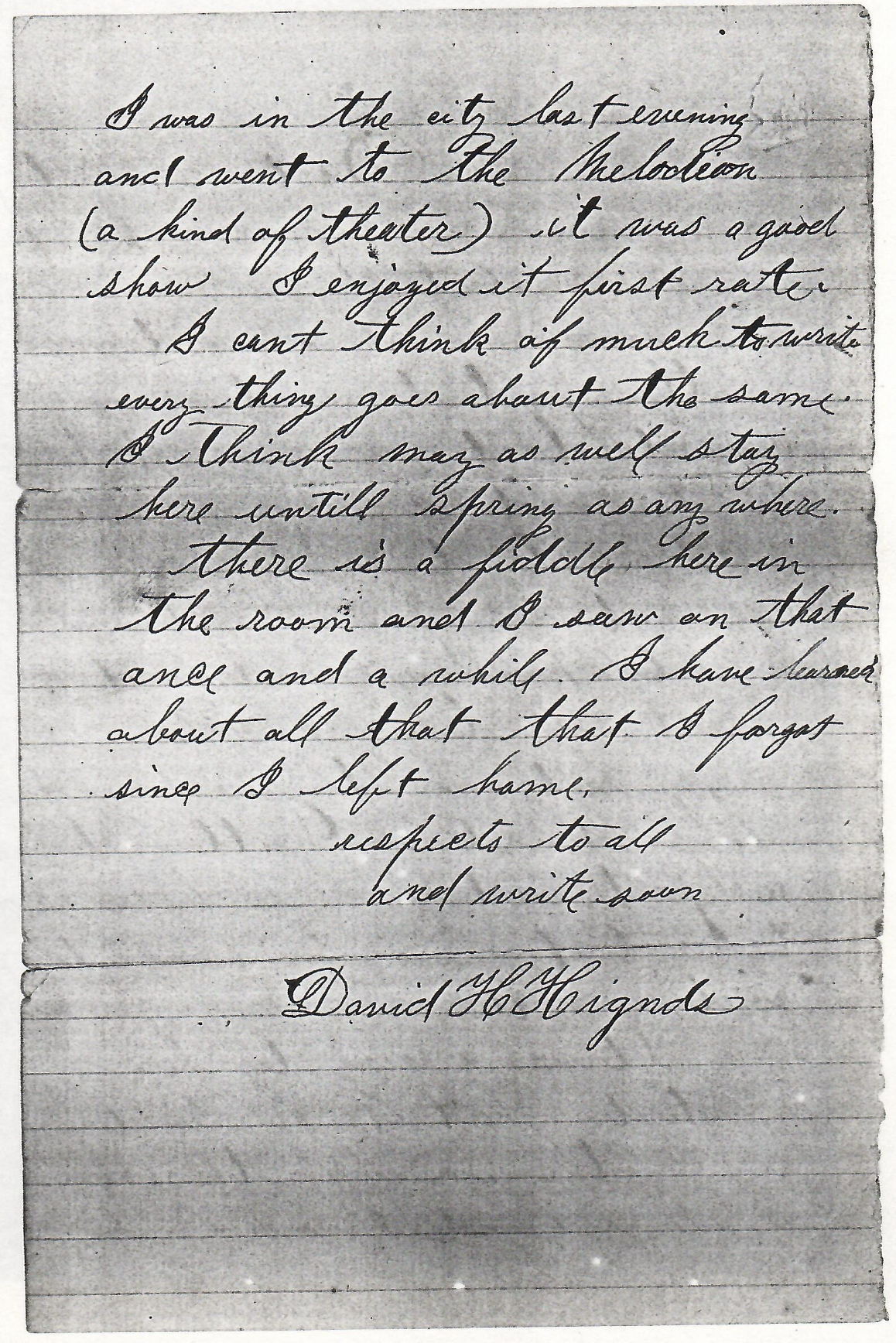
Letter 46
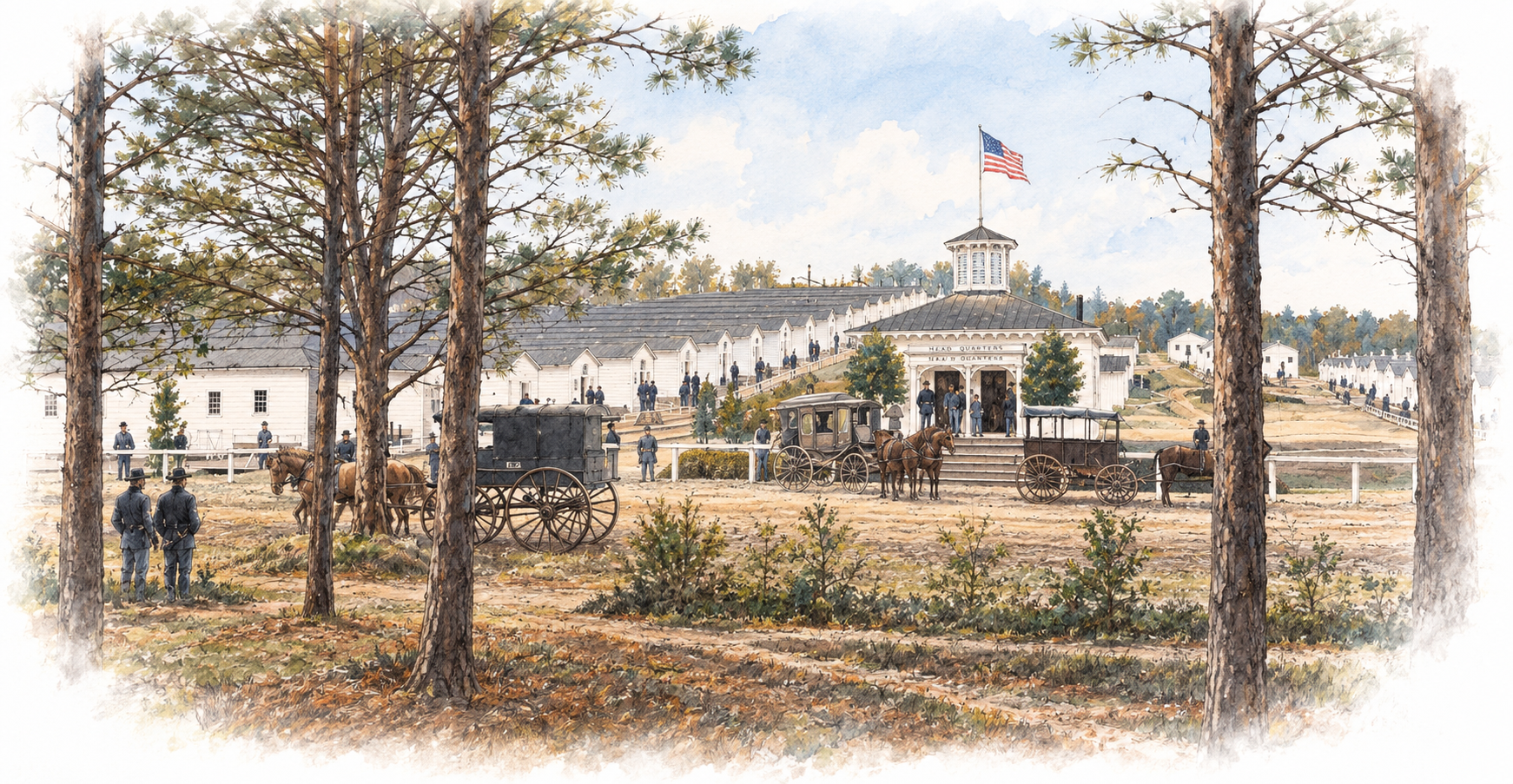
Convalescent Camp, Virginia
January 26th 1864
Dear Mother,
I received your letter the day before I left Baltimore and have not had a chance to answer it till now. I arrived here last Saturday about noon. I started from Baltimore Friday p.m. and stayed in Washington over night in the Soldier’s Rest.
What they will do with me, I don’t know yet but I am afraid they will put me into the Invalid Corps. But I had rather be anywhere else. But they are putting them into the Invalid Corps here very fast. I think I will have to work sharp to keep out of it.
This is a pretty nice place. There is nice barracks and we have good straw beds to sleep on but they are pretty strict. A soldier has to keep himself straight or he is put into the guard house.
It is most supper time and I must close. Don’t write until you hear from me again and that will be when I know my destination. — David H. Hinds
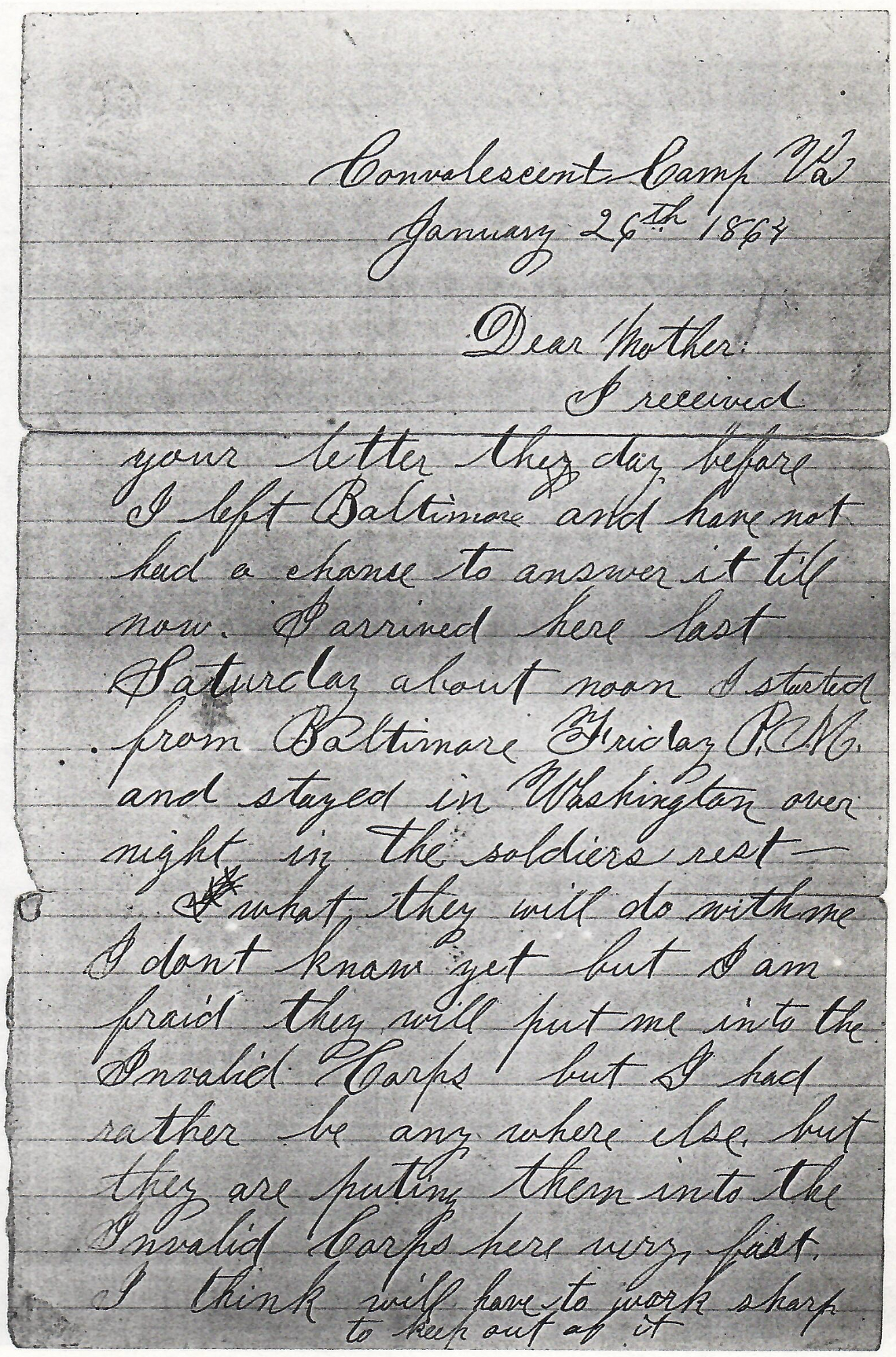
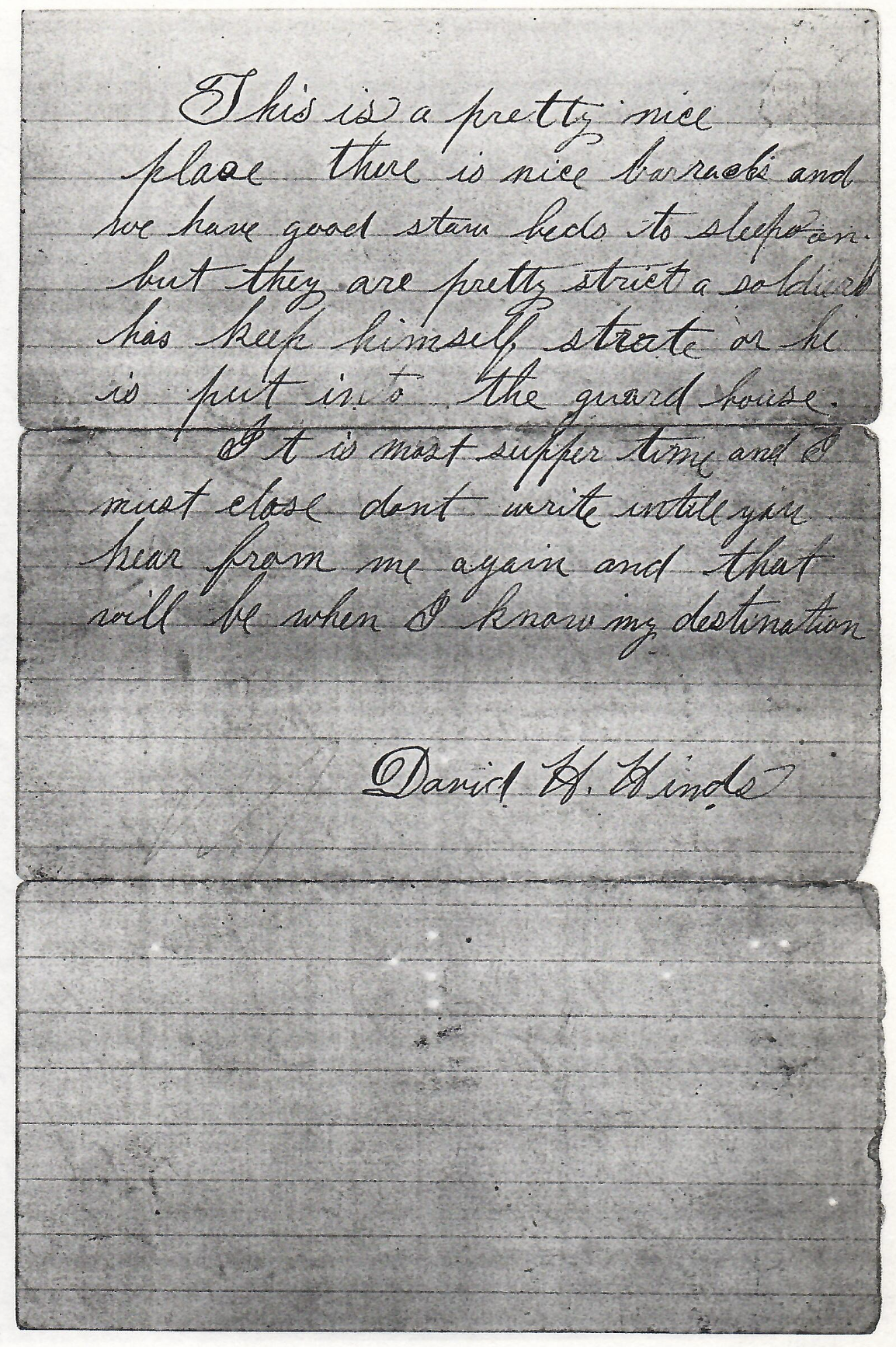
Letter 47
Convalescent Camp Hospital, Virginia
February 19th 1864
Dear Mother,
It has been a long time since I have written to you—the longest I think since I left home. But I think I have a good excuse. In my last letter I told you I would write again when I knew my destination. Well, I have found it out to my sorrow. I came to this hospital the 2nd of this month where I have had a sweet time with the rheumatism. For about ten days, I was entirely helpless—the same as I was when I had it before. This time it is true, I did not have a mother and sister to take care of me and make my bed up soft. But I was cared for better than I expected. Whenever I wanted to be moved or wanted anything, there was someone ready to wait upon me—either a nurse or a night watch—and I had a pretty soft bed, a straw tick, and a hair mattress on the top of it so I had it quite comfortable considering. And one thing, I have a great deal better doctor than ever William B. Small [of East Livermore] dared to be.
I am quite comfortable now. The pain and aches have about left me. I sit up and can walk some and don’t mean to have exercise and get worse again. I get good living and the doctor says I am gaining fast.
I don’t know of any news to write so will stop. Direct to Augur General Hospital, 3rd Ward, Virginia
I received your letter written the 25th ult. remailed at Baltimore. write soon as I have not heard from home in a long time. Your son, — D. H. Hinds
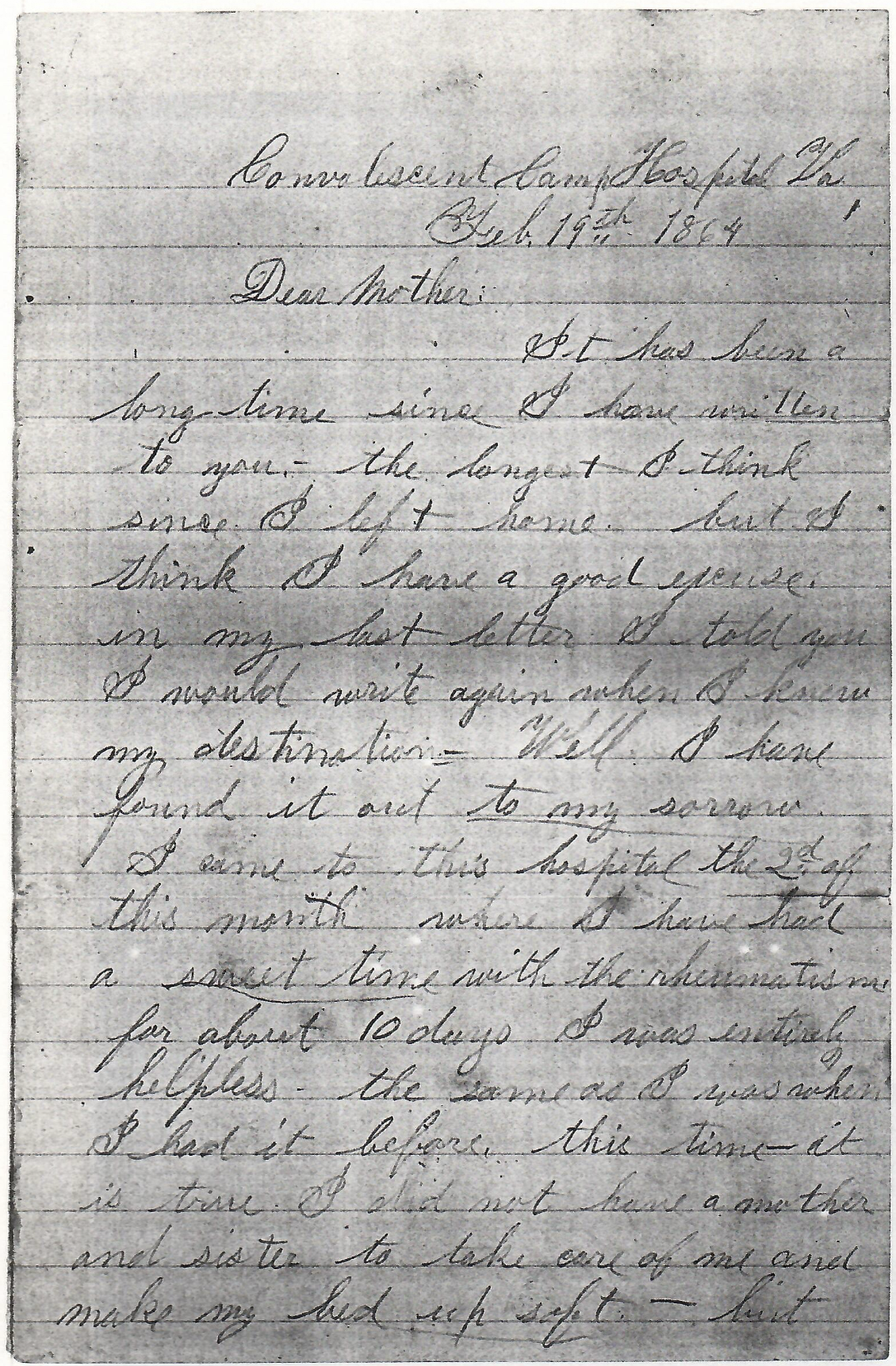
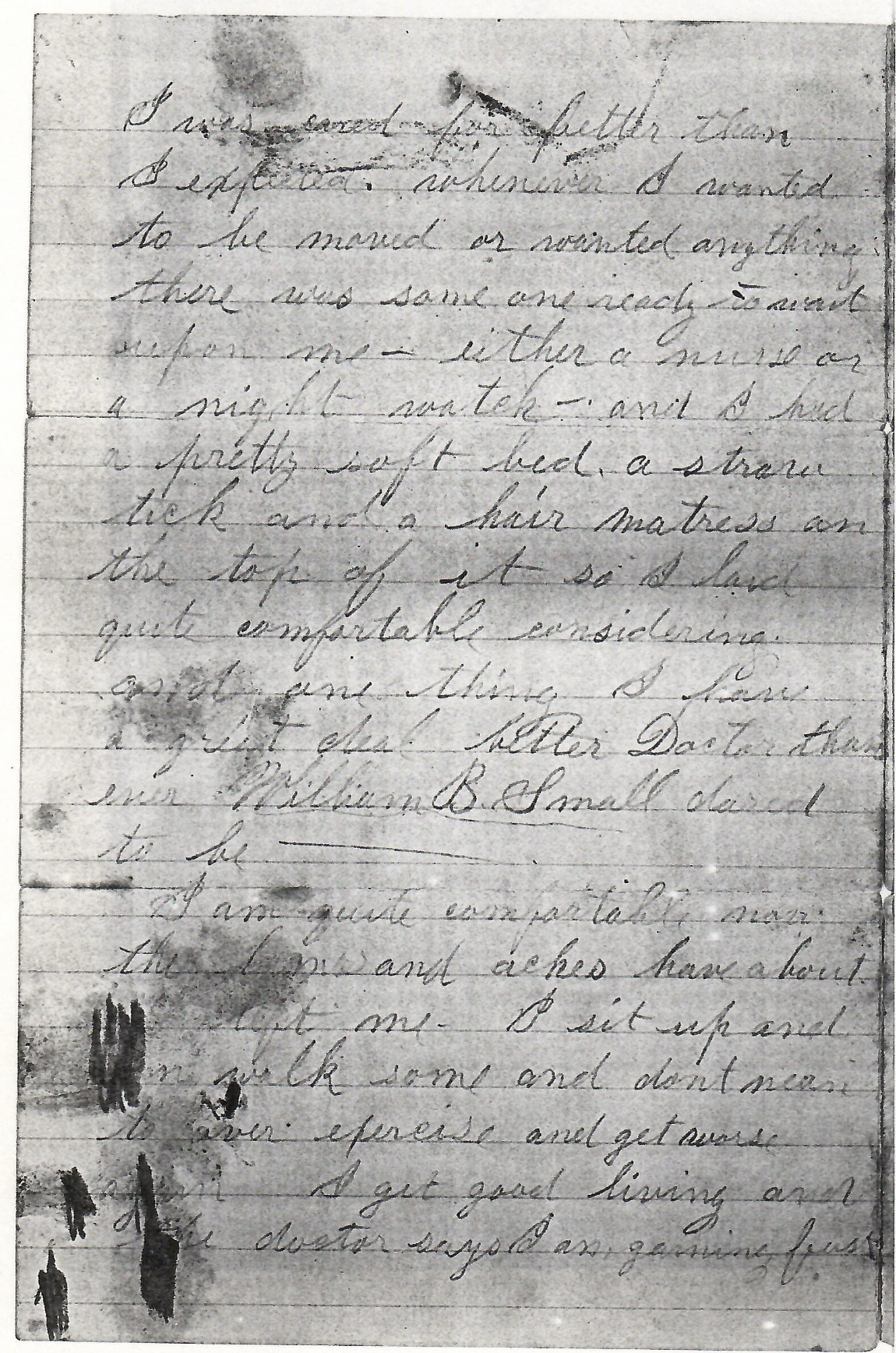
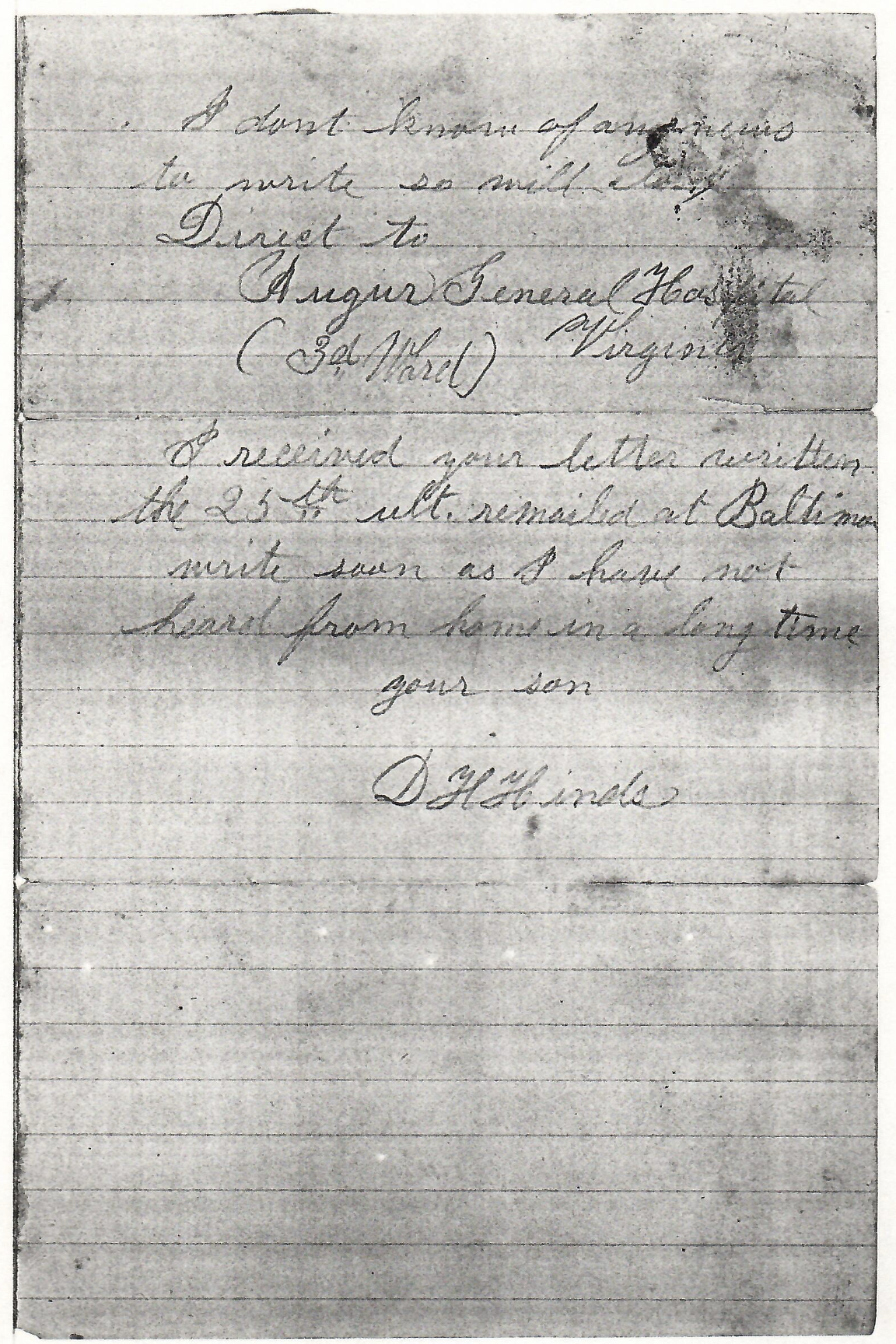
Letter 48
Augur Hospital, Virginia
Sunday, February 28th 1864
Dear Mother,
I received your letter yesterday and was glad to hear from home again after so long a time. I have gained some since I wrote before but I don’t think I can do duty very soon. You mentioned something about my getting a discharge. It is possible that I may by and by but I don’t think Capt. [Daniel] Marston could help me any if he should try.
I am in a good place now and shall stay here till they do something [with] me. They may put me into the invalid Corps but I shan’t go if I can help it. I would rather go to the regiment.
You say that father has not got any oxen or steers. I suppose he is going to get some before it is time to work on the land. If he don’t, it seems to me that he will have rather a small team for such a large farm.
I can’t think of much to write. There is nothing doing here of any account. I have not been out of the ward since I came here so I have not seen much to write about.
You wanted to know about a Francis George in the 16th. I believe there was such a man in Co. E but did not know him. 1
Make my little sister write a long letter about her school.
— David H. Hinds, Augur General Hospital, Ward 3, Near Alexandria, Virginia
1 Francis George of Leeds, Maine, was 21 when he enlisted in Co. E, 16th Maine Infantry. He was detailed as a hospital nurse during his time in the service.
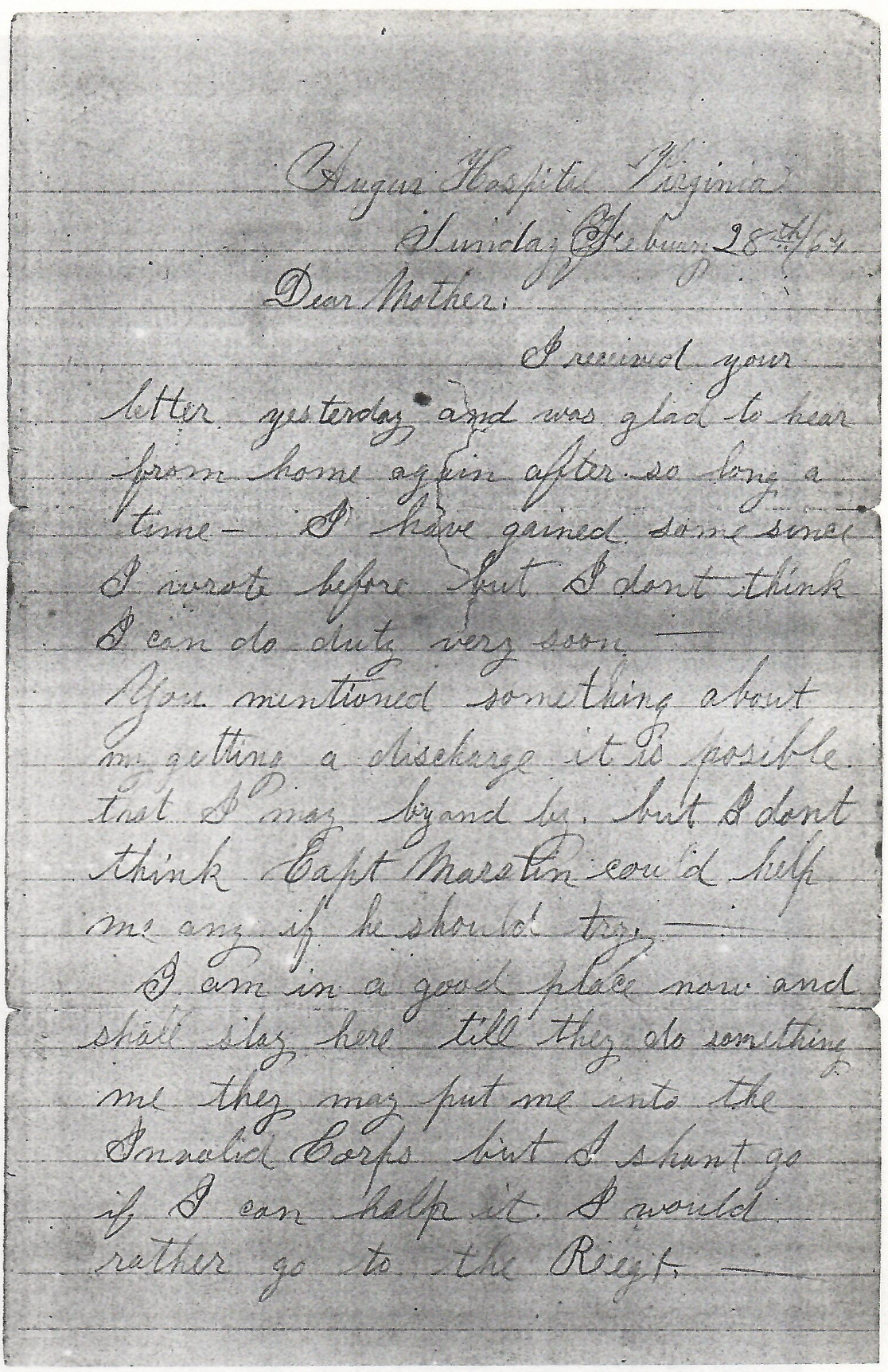
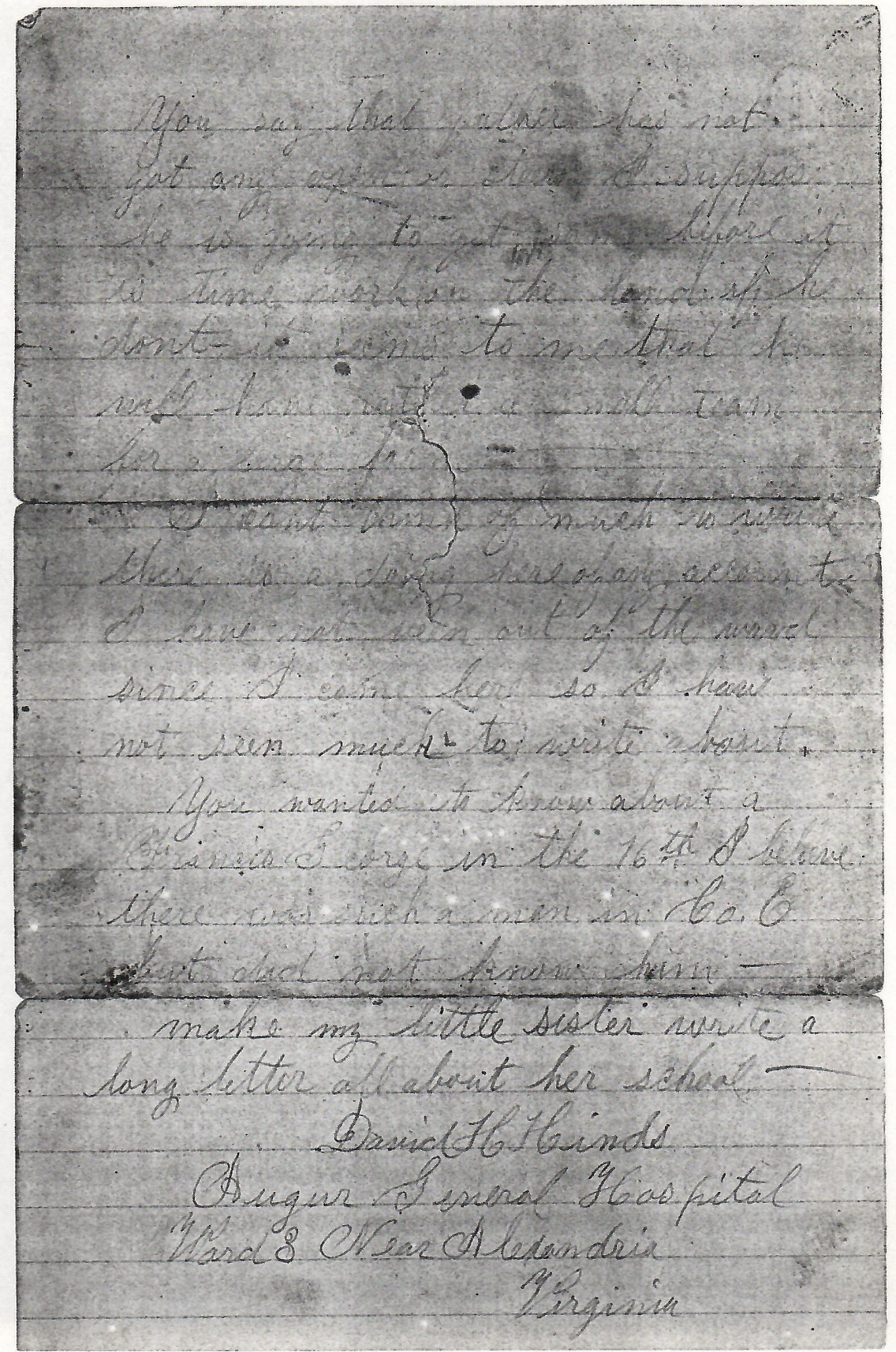
Letter 49
Augur General Hospital
March 11th 1864
Dear Sister,
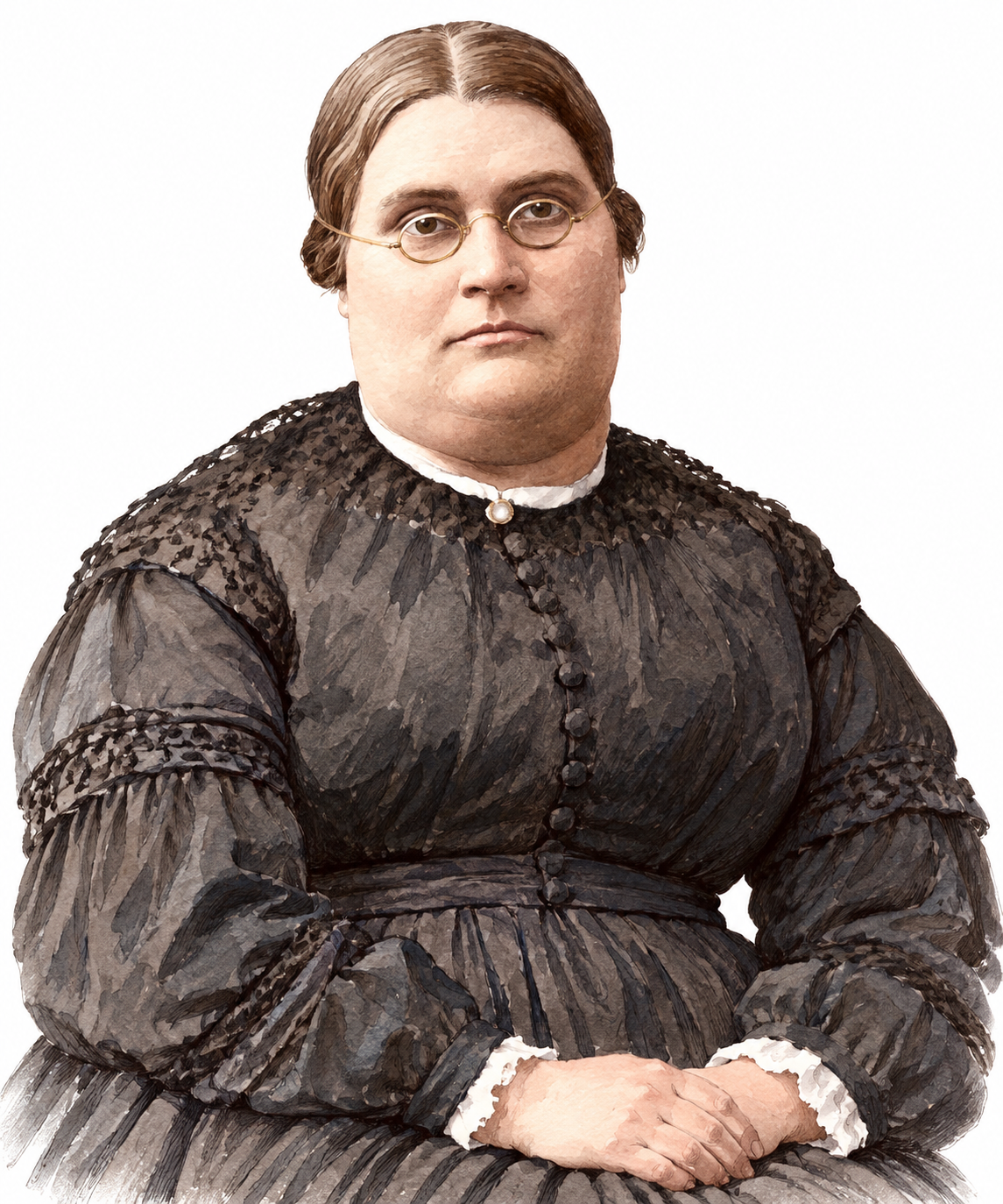
I received your letter yesterday with the stockings and was very glad to hear you were well and enjoying yourself. I suppose you laugh and grow fat as you used too. How much do you weigh now-a-days? I don’t reckon you go far from 200. I think I weigh about 145 now. I am very poor. My weight was 179 when I left Baltimore but they don’t use me as well down here in Virginia.
I am getting along pretty well now. I can walk some but I have not been out door since I came here. But I am going out in a few days when it comes fair. It has been raining now for two or three days and it’s raining this morning.
I can’t think of much to write and you did not write much in your letter than was of any account. But I am thankful for a little. In naming your different studies, you said one was “Gramma.” You see I have not been to school any for two years and I have come to the conclusion that it is a new study just come into fashion.
You tell that Nellie Martin that I have about as many correspondents as I can attend to but will tell some good looking soldier if she wishes. Give my respects to all and write soon. — D. H. Hinds
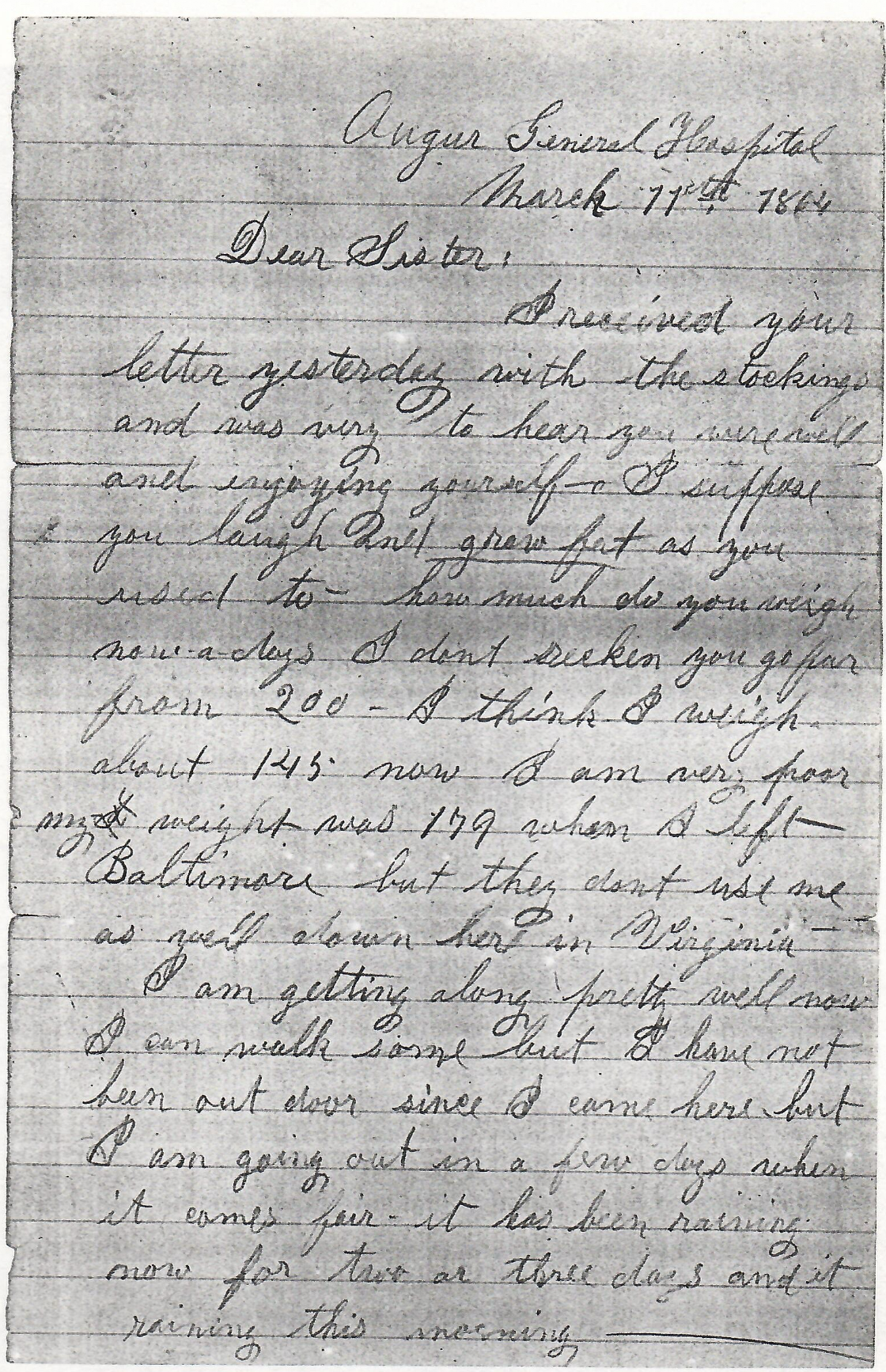
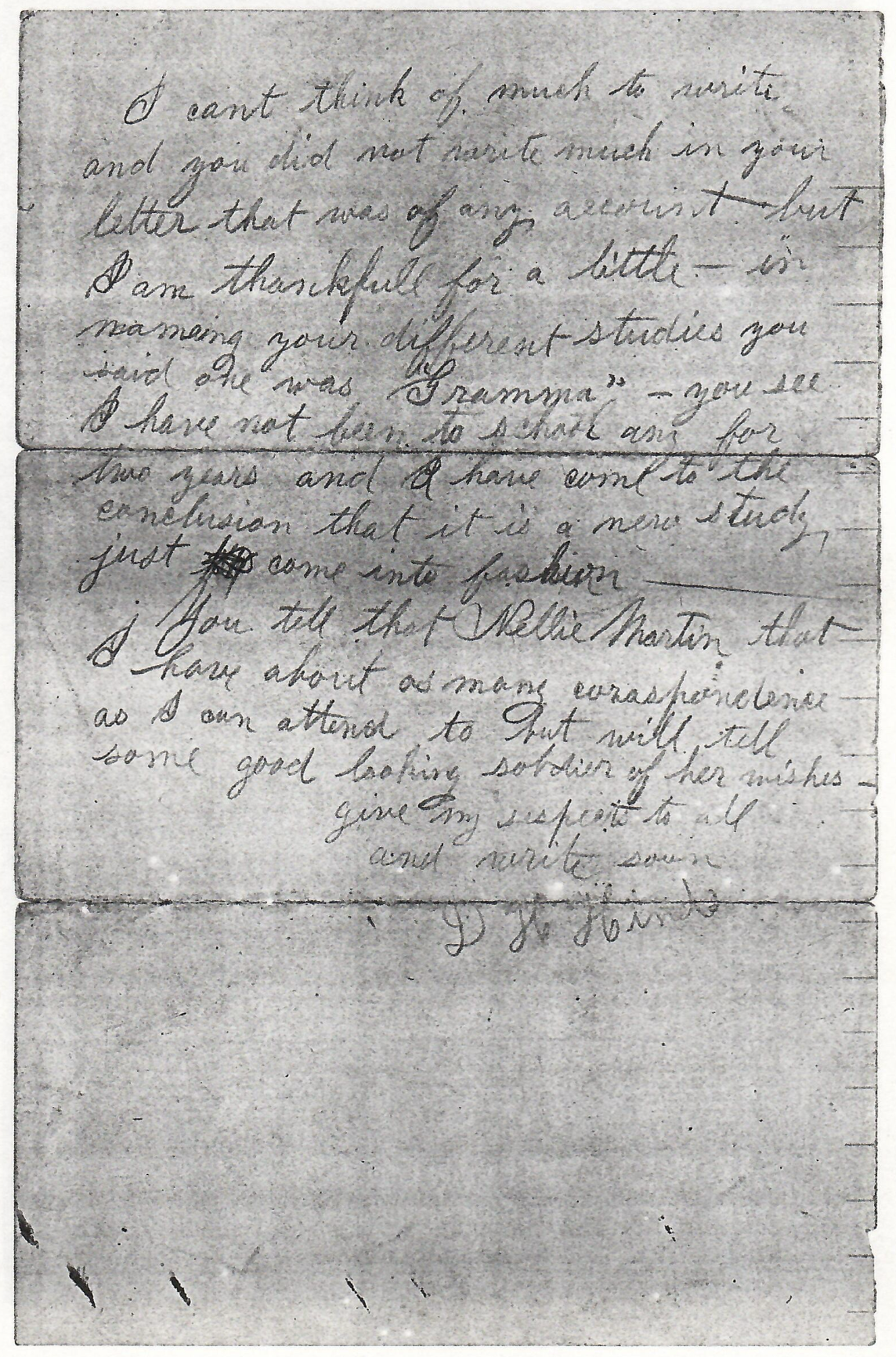
Letter 50
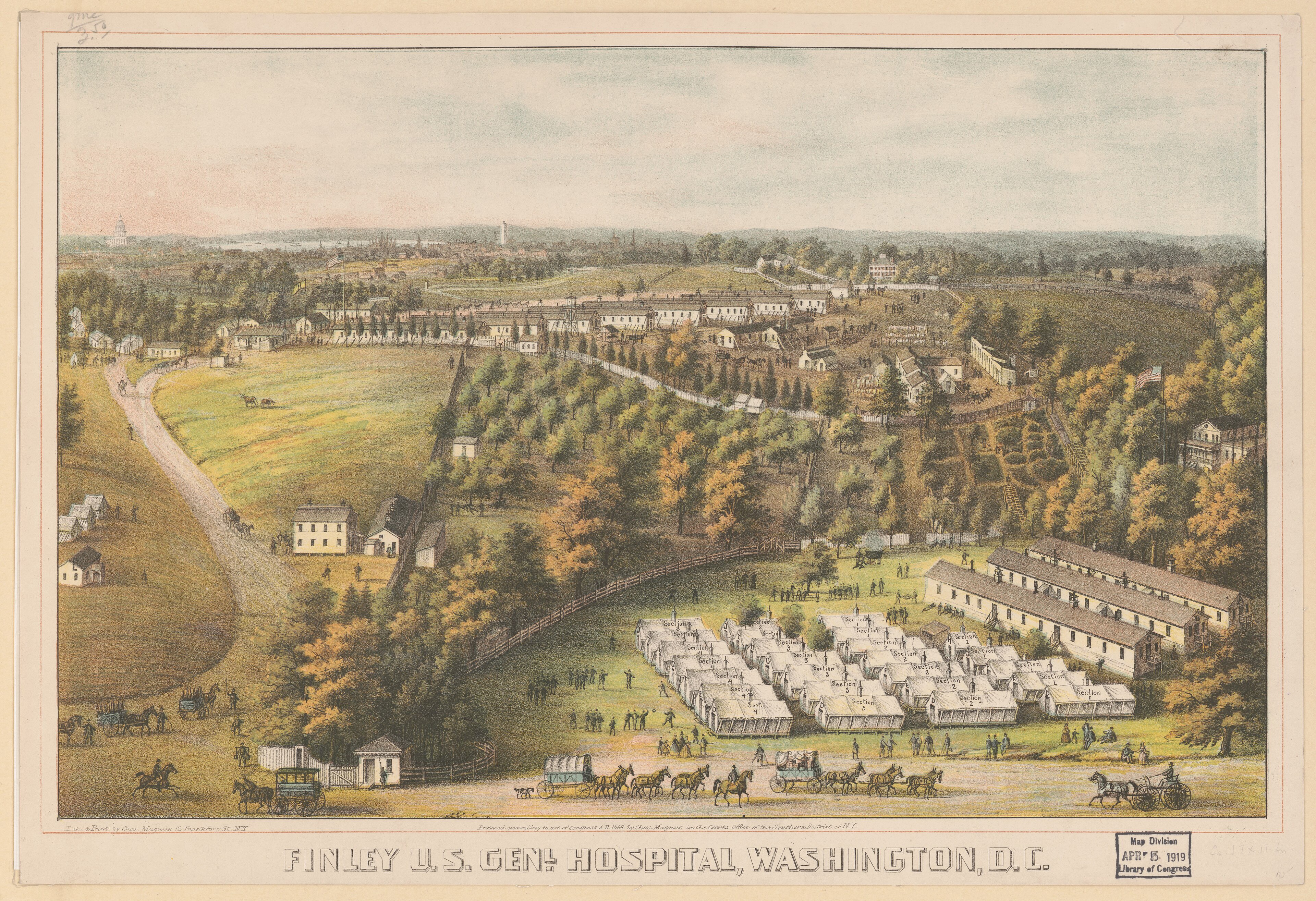
Finley Hospital, Washington
April 8th 1864
Dear Mother,
I received your letter yesterday. I was glad to hear from you but am sorry that I cannot write anything encouraging about coming home. I heard the other day that the Surgeon-in-charge said he was expecting an order to discharge all men not fit for the 1st Battalion Invalid Corps and if that is the case, I stand a chance, I think, but I don’t put much faith in these flying rumors. Ed Sawtelle was here last Saturday and could not stay but a few minutes. He said he thought I would be discharged. Yesterday I was down to see him but I did not find him. His company had moved from where it was when he was here.
The weather is very warm and pleasant now after a long rain. It commenced raining last Friday and kept at it until Wednesday but now it is fair and nice and I suppose the Army of the Potomac will make a move soon. It is my private opinion that Grant will get whipped the first fight. I think that a general that has been with the Army of the Potomac a year or two would know more about Virginia than Grant would. I don’t think that Grant has as much experience as some other men that are just as smart.
What is father’s opinion about the war? I suppose he can see peace before fall as he did in the spring of 1861. Tell him he has got a big idea into his head when he thinks I won’t be fool enough to come home to live on the farm when I have seen so many places so much better (poorer).
I don’t think of much to write. I don’t hear of any news nor anything else. I have not got any pay since February and shall get four months next time. — David H. Hinds
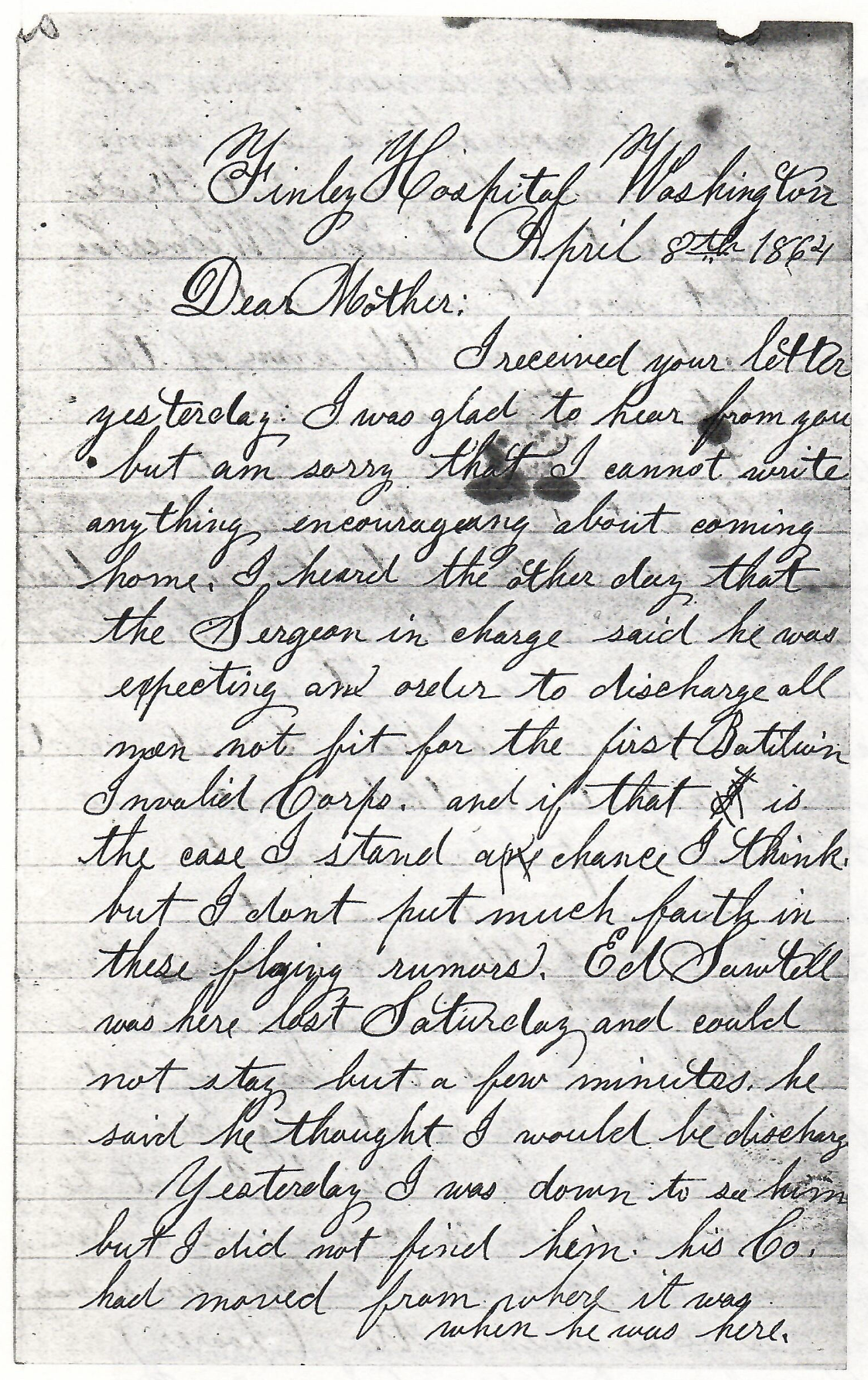
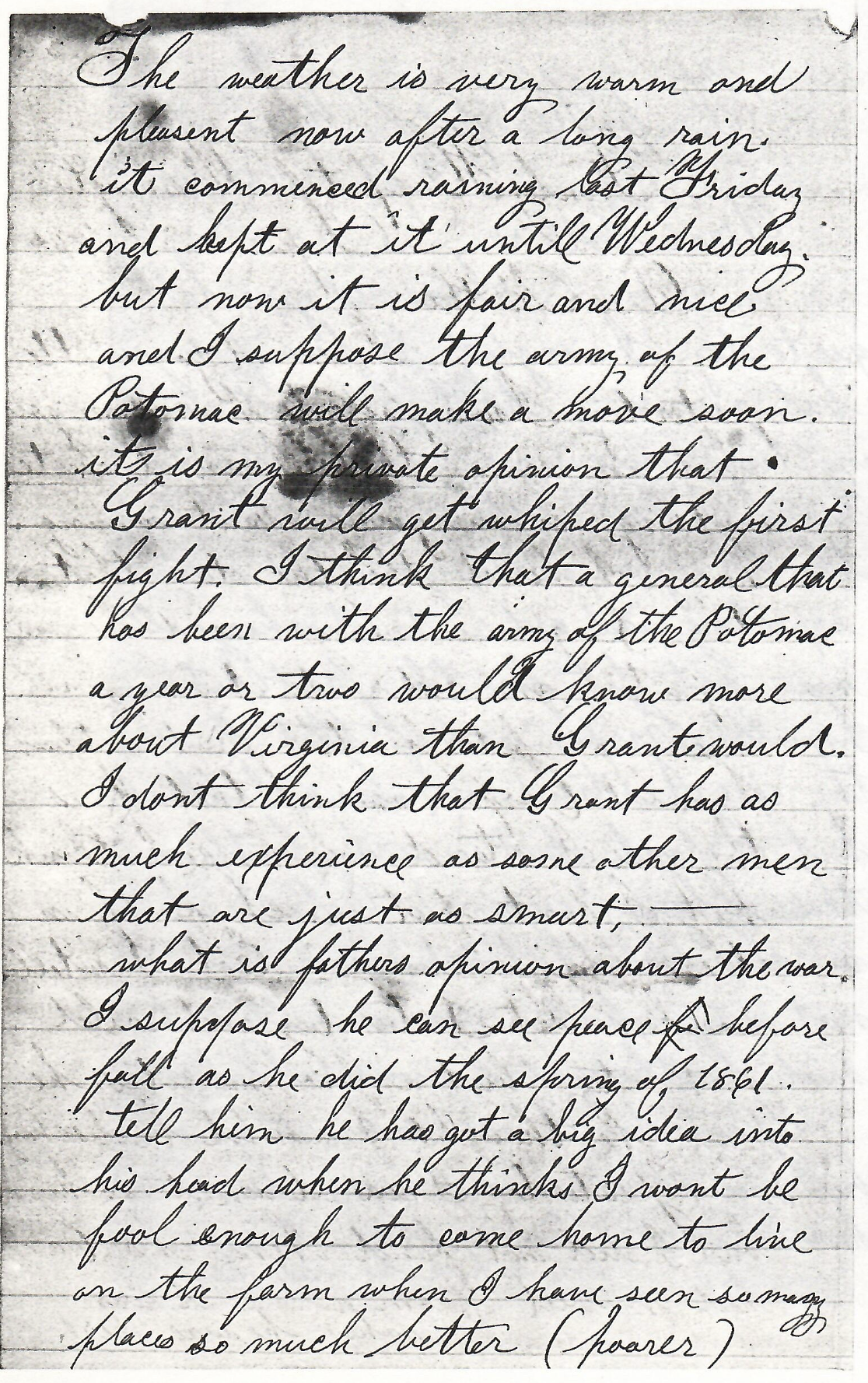
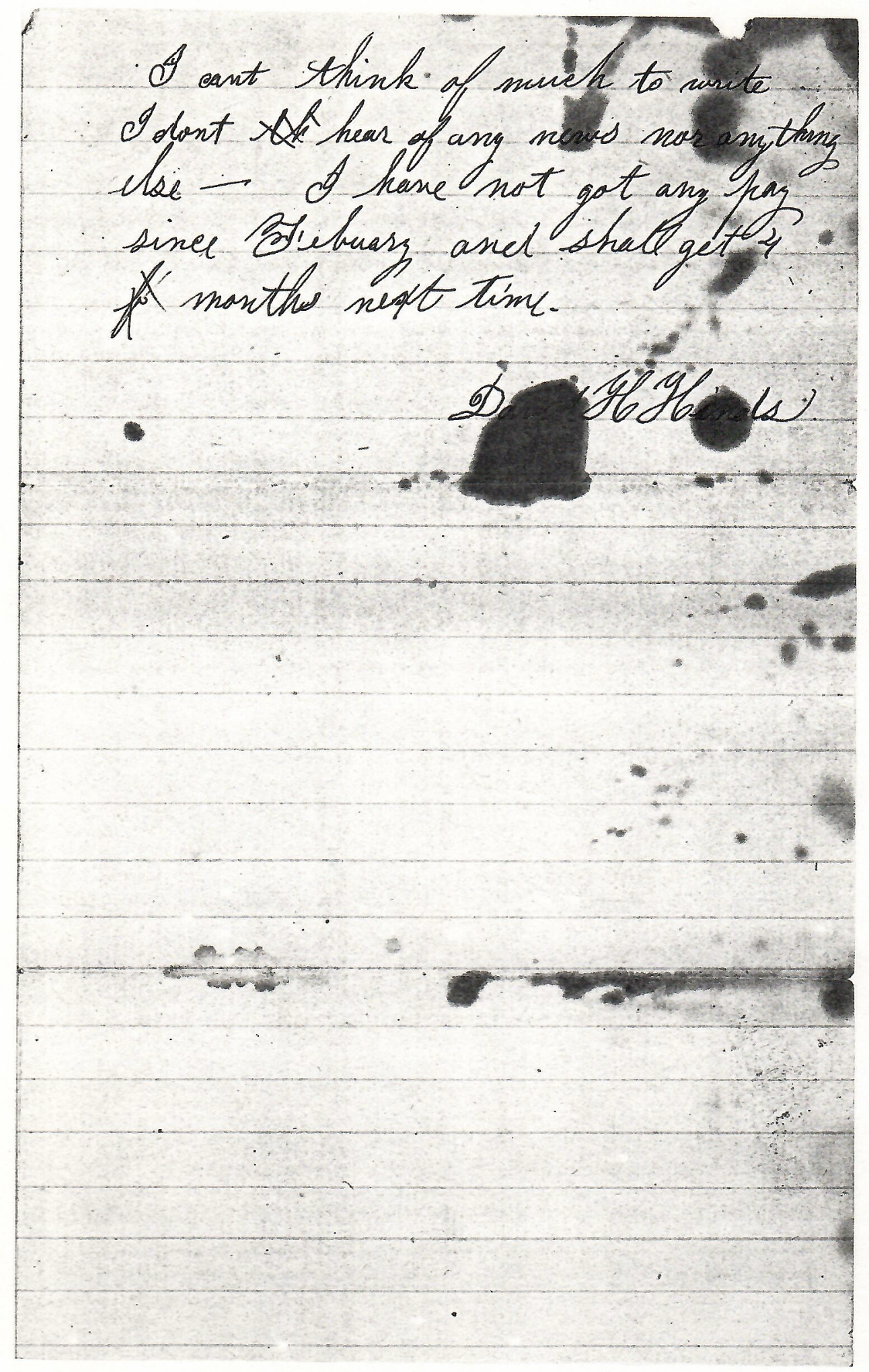
Letter 51
Finley Hospital, Washington D. C.
Sunday April 17th, [1864]
Dear Mother,
I received your letter yesterday morning and was glad to hear from you [even] if it was a short letter. I have just been to dinner. We had boiled mutton soup, potatoes, onions, bread, and apple pie. We get pie every Sunday for dinner. We get better living than in any other hospital that I ever was in. I am doing a little light duty here now and I think I shall stay here as long as I can if I can’t do anything any better. I wrote a letter to Abbie day before yesterday for I thought I should not get one from you as I most always get one that is written [on] Sunday the next Wednesday or Thursday.
It is quite warm here today but it rained hard yesterday. It has been very rainy here this spring and the roads are bad and muddy now. They call this a warm country but the seasons don’t make out to be any longer after all. It has not been so that the farmers could do much of anything on land yet and it looks as though they could not do much very soon. I should want to be in the State of Maine rather than here to live by farming.
My rheumatism is getting better every day and I believe it will be as well for me to stay in the service a spell longer as it would be to come home. I don’t think I should be able to do much this summer if I was at home but here my pay goes on the same whether I am sick or well. And I get board and clothes too. I try to be as contented as I can, and it is no disgrace to be a soldier three years. You need not be afraid of me going to the regiment. I don’t think I could get there anyway. I asked the doctors to send me the other day—told them I had rather go there than into the Invalid Corps—but they said they would not send me and that I was not fit to go.
Revillo sent me a little pocket diary a while ago and I am keeping a journal now and an account of all the money that i spend. He says that business is very good in Boston and I think he is doing as well if not better soldiering.
I hope that Frank don’t want to enlist. If he does, I will give him some advice upon the subject. I think he had better wait until I get out of it anyway. I suppose Dixie is quite a boy now. He will have to go to school alone this summer. Is his little sister going to keep school this summer or not? I want to know who the town of East Livermore has for town officers. You never have wrote anything about the March meeting.
Tell Frank if he will write me a letter, I will send him something. — David H. Hinds
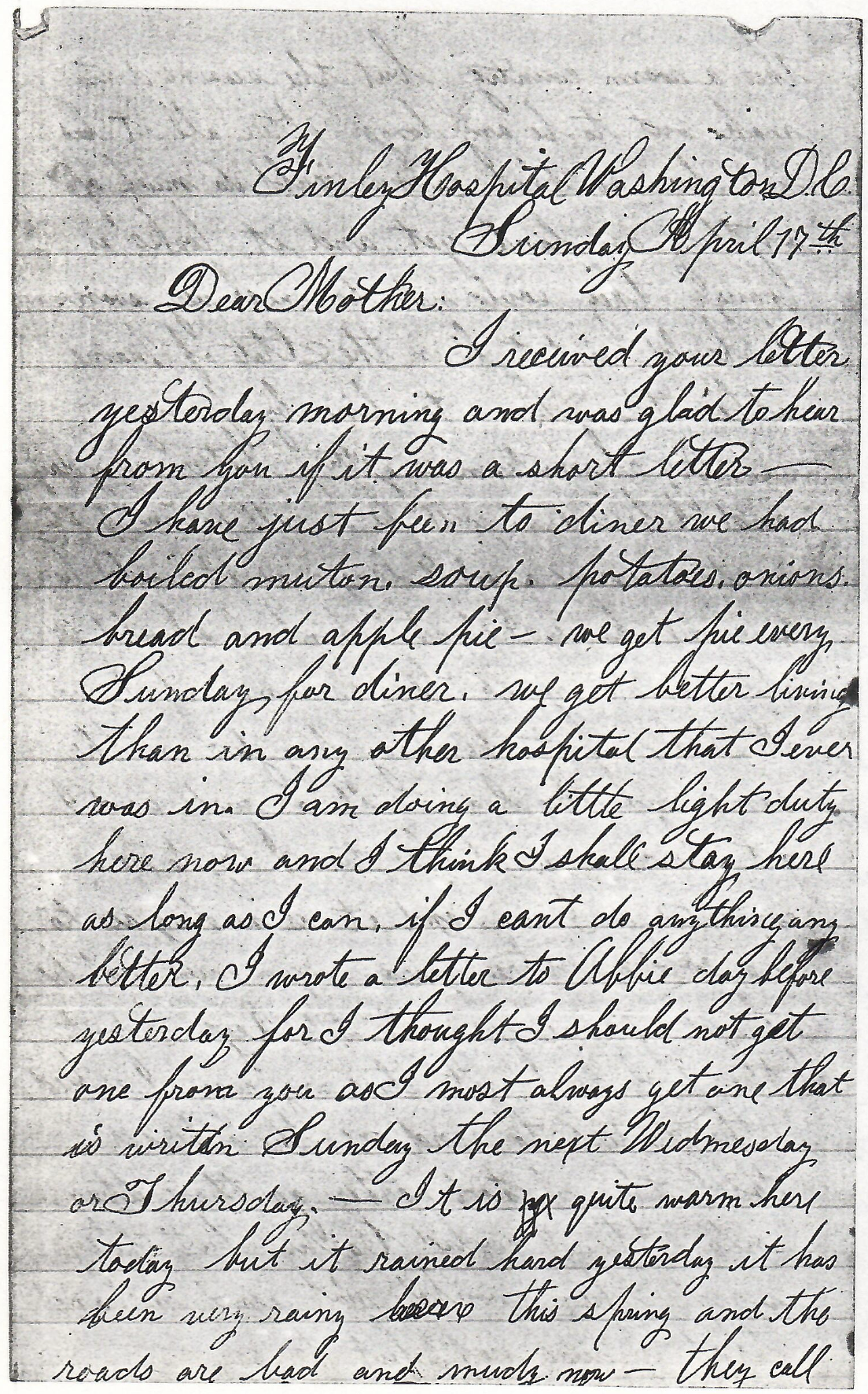
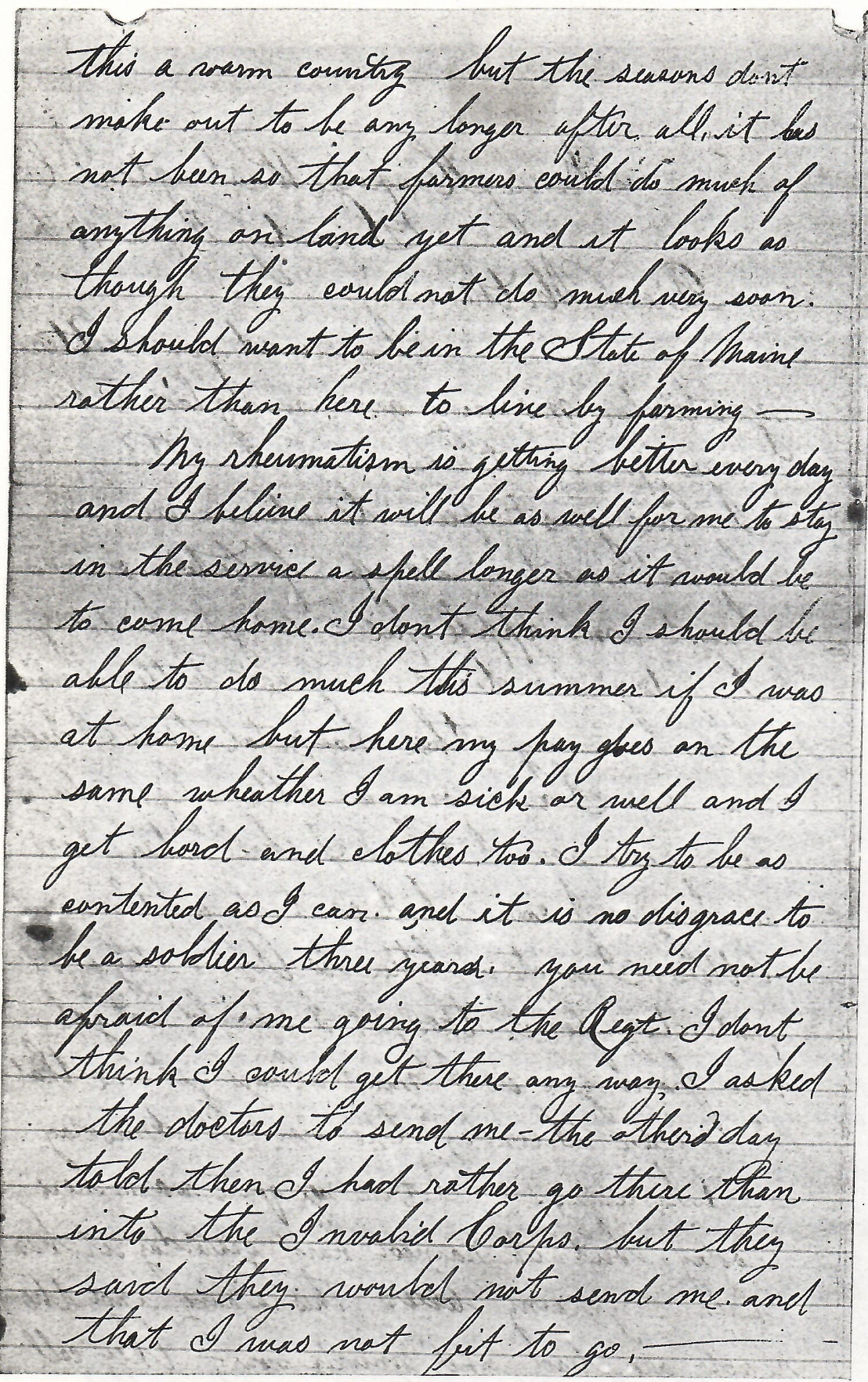
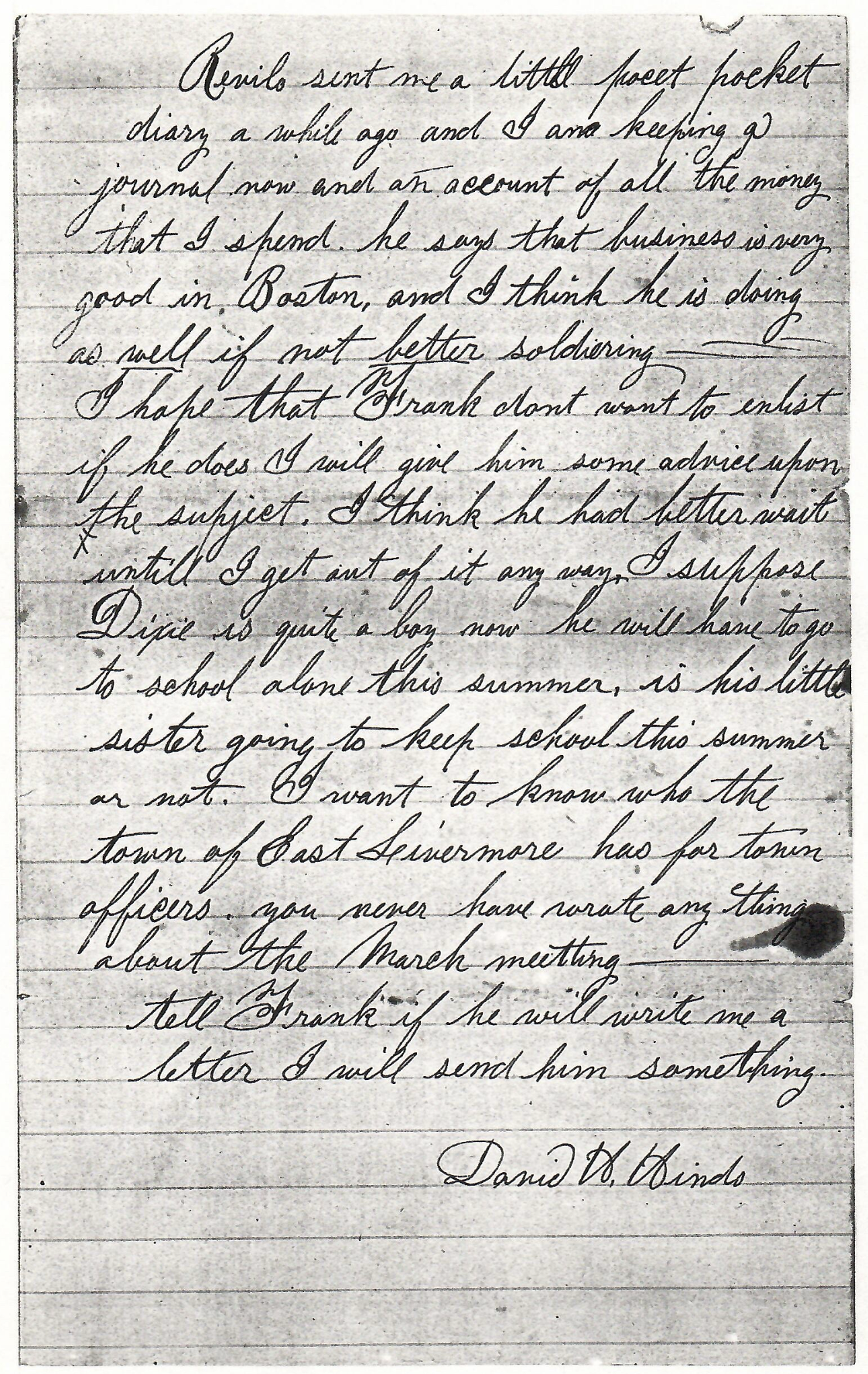
Letter 52
David’s Island, New York
May 11th 1864
Dear Sister,
I received yours and other’s letter this morning and was glad to hear from you both. I am going to make it a rule to answer a letter as soon as I get one so you can have no excuse for not writing after. Well you say your school is finished and I suppose you will remain at home this summer as usual. I should be very happy to be there with you if the circumstances would permit but suppose I shall have to be in the service the remainder of three years.
I see by the morning [paper] that there is some big fighting going on down in Virginia. Heavy losses on both sides. The paper stated that Maj. Gen. Sedgwick was killed and Lieut. Gen. Longstreet of the Confederate army was reported to be mortally wounded. But I presume you get the news as soon as I do.
My old Col. Charles W. Tilden has been promoted to Brigadier General. He is a good man and has well earned his position. I don’t hear anything more about being sent farther north. There is various rumors upon the subject all the time but nothing that I can believe.
I wrote to you last Sunday and to mother Monday so I guess you will hear from me often enough this week. When I come to examine your letters very close, I find a great many words miss-spelled and I suppose also that you do in mine. But I think you ought to spell a great deal better than I for your education is much better. I will correct a few of yours or rather send them back and will give you the same privilege to do so with mine. In yours I find the words which I consider as not spelled correctly. “Lyseum” Lyceum. “healther” healthier, “exersize” exercise, “librarian and island” should have began with capitals, “funerel” funeral. I hope you will not feel put out at this for you, being my little sister and a schoolma’am “to boot,” it really dashed my modesty.
Dinner is ready and I will adjourn. Dinner is over and I am writing on a full stomach. We had baked beans and pork, boiled turnip, bread and cold water. At supper time we get tea (awful strong) and bread and molasses or applesauce. The living is rather course but I can get along very well for I have been a soldier long enough to learn how to eat anything that is eatable.
It is very pleasant here today. The sun shines warm and there is a cool breeze from the salt water. I can see two steamboats from Fall River just going past to New York. This will be a very healthy place in the summer time but I had rather be somewhere where I could get out and see somebody once in a while, to go to New York City. But I have not been yet for it is so far that I could not go and get back in one day. There is a boat employed by the U. S. that runs to the city every day and a soldier can go on it for nothing. I think I shall get a pass when I find somebody going that is acquainted [with the city] for I never was there and should be afraid of getting lost.
I can think of no more to write this time. I have found a few four leaf clovers which I will send. Write soon to your brother, — David H. Hinds
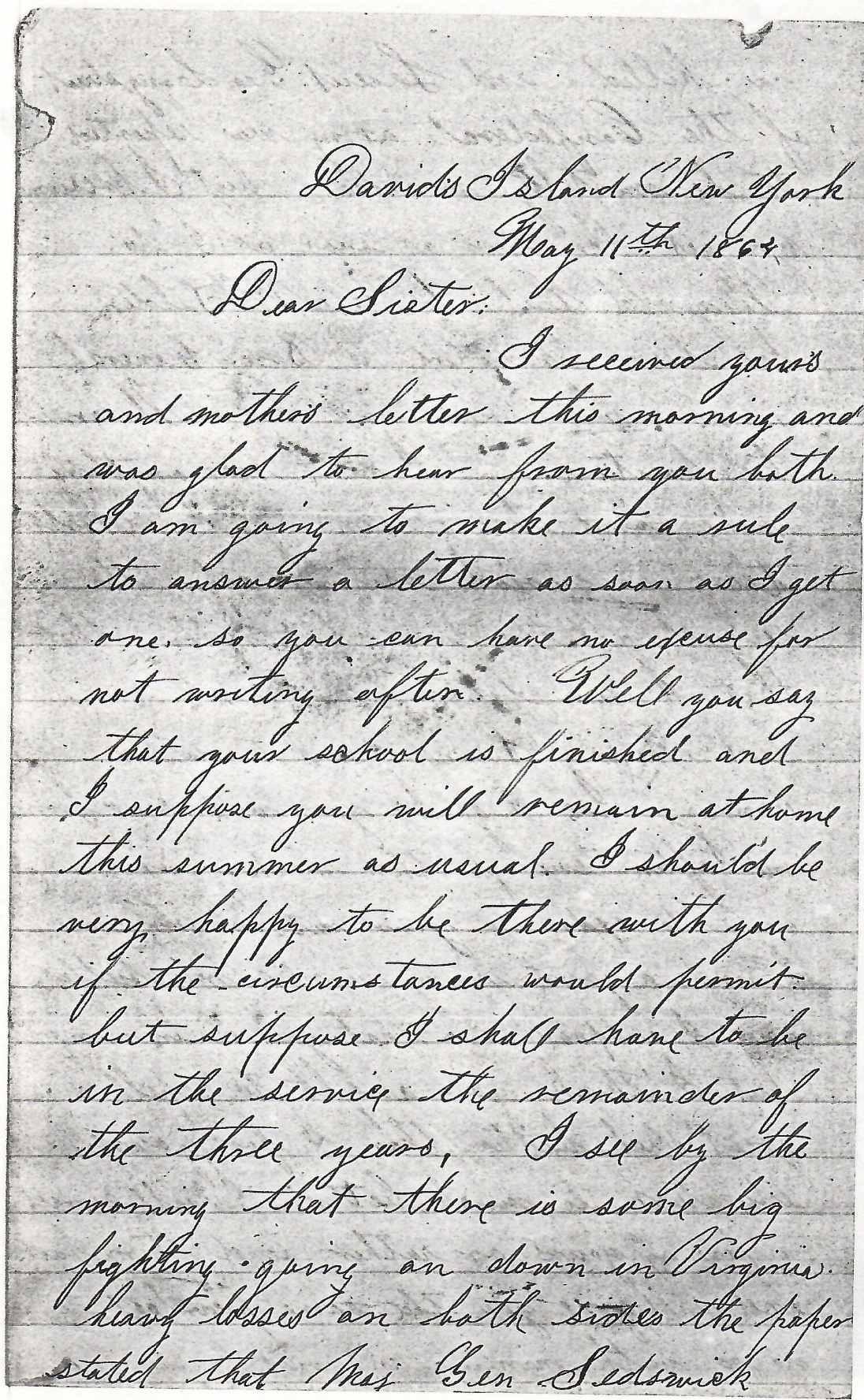
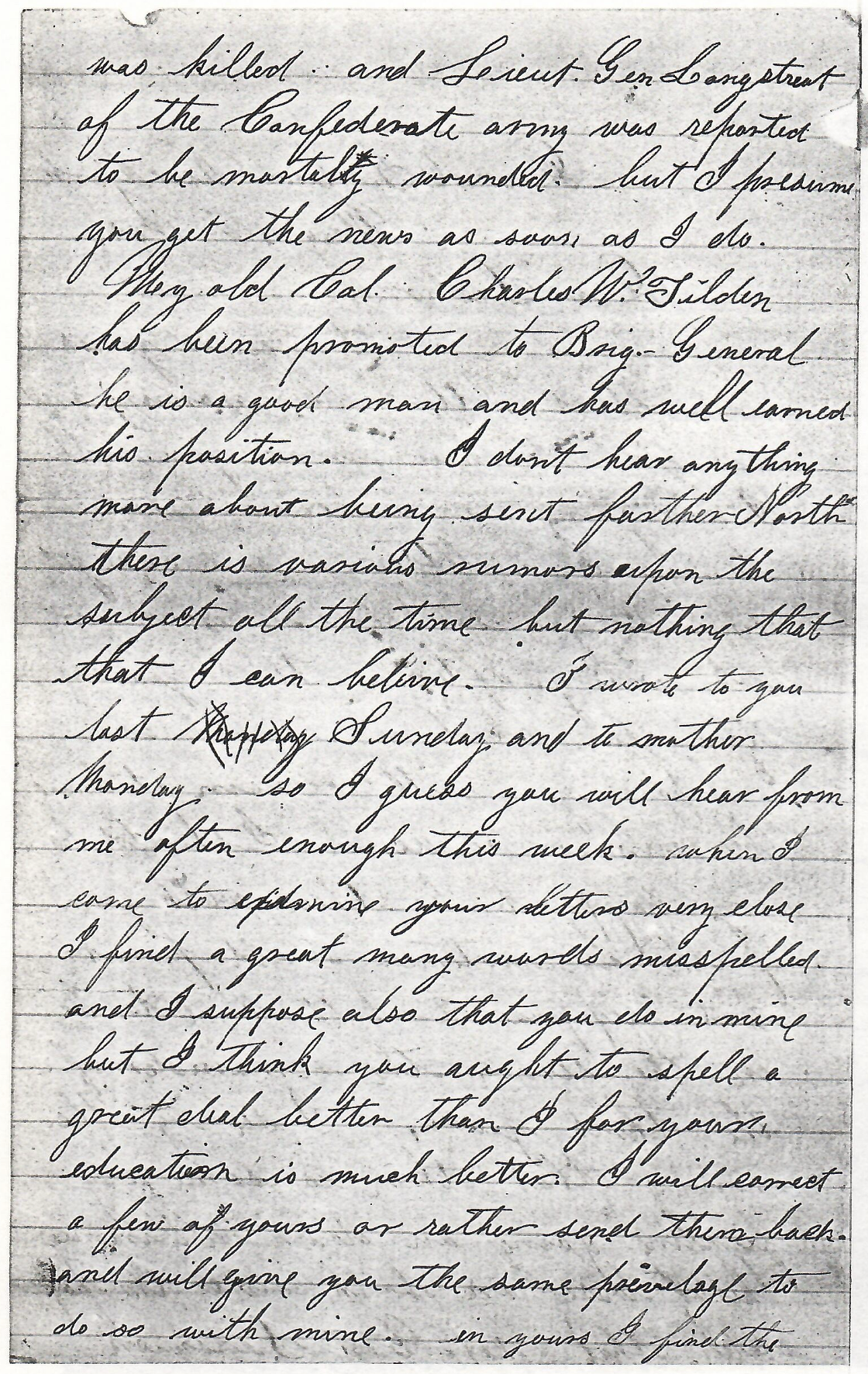
Letter 53
David’s Island. New York
May 18th 1864
Dear Mother,
I received your letter of the 15th this morning and will answer it now. There is nothing for me to write about as I write so often that nothing occurs worth mentioning. Everything goes on here about the same. I heard good news from the army every day and in reading the daily papers I am growing quite contented in thinking how much easier time I am having than the poor fellows down across the Rapidan. I have had experience enough to know how to appreciate the good things of a hospital and the hard usages in the field. I see by the lists of wounded and killed in the late battles that there is quite a lot of my regiment and perhaps if I had been there, my name would have been among them.
I believe we must think it is all for the best whatever befalls us. I got wounded bad at Gettysburg and I suffered a good deal with the effects of it, but it may have been the means of saving my life. If I had not been wounded as I was, I should probably have been taken to Richmond and there my fate would have been very uncertain. When a person is well off, he is sometimes not apt to realize it. I have made up my mind to be contented through the remainder of my time of service, wherever I may be placed. I am doing nothing now and under no treatment. I have not been asked to go into the Invalid Corps nor to the regiment. I think I shall try for a furlough by and by if you think it best and would like to have me come home for a short tie. It will be likely to cost about ten or twelve dollars—not any more. Traveling expenses would not be over nine dollars at the most but I should be apt to spend some considerable besides.
I have not received any pay yet but I think I shall get paid before next month. I am enjoying very good health. Living near the salt water agrees with me tiptop. I generally walk down to the beach and back again every morning before breakfast (when I get up soon enough) and the day is spent in various ways—walking round, playing cards, reading and doing nothing. I can’t think of anything more. — David H. Hines
P. S. That book that father received I sent from Finley Hospital. I bought it for $1.25. I read it and thought it very interesting and so sent it home.
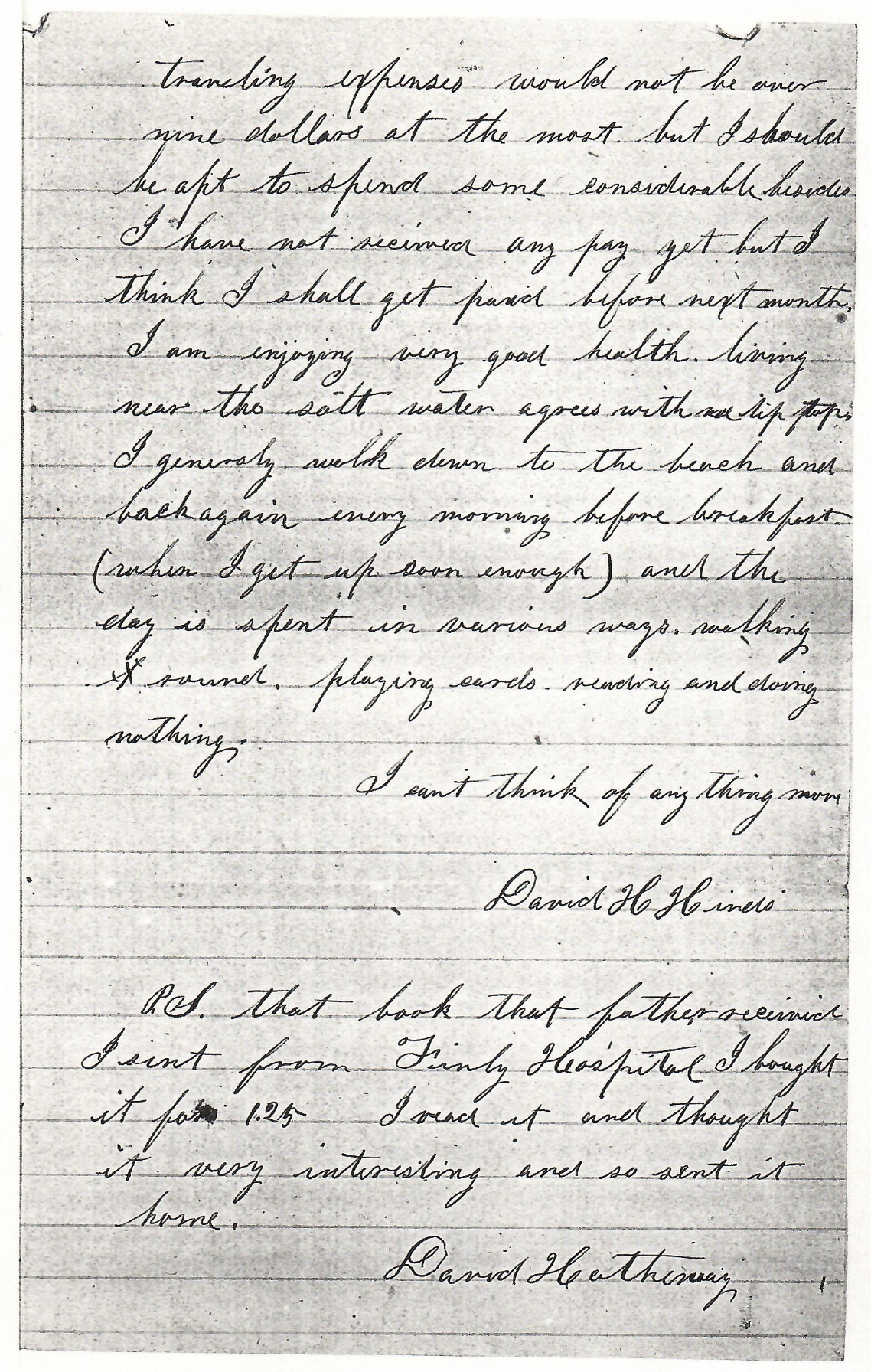
Letter 54
David’s Island, N. Y.
May 26th, 1864
Dear Sister,
I received your letter yesterday and was very glad to hear from you again. I am getting along well and pretty contented. I get enough to eat—such as it is—and a good bed to sleep on and that is more than the fellows down in the Army of the Potomac are sure of.
I was examined yesterday but I don’t know what will be done with me. But I rather think I shall be sent away from here and put into the Invalid Corps. I suppose I shall have to stay my time out and I may as well be contented wherever I am put. I shall not have to stay but 14 months longer anyway.
It is raining very hard today and the wind blows very cold and chilly but there is a good fire in the room so we manage to keep warm by playing cards.
I have not got anything to write about this time. Shall have to fill my letter with nothing, I reckon.
It is most noon and I am pretty hungry. We get a good meal every day at noon but the breakfasts and suppers are rather poor. Yesterday for dinner we had baked beans and greens. Today it will be vegetable soup.
I can’t think of anything more to write this time so I will close. Write soon and direct to this place for if I go away, my letters will be sent after me. Yours truly, — David H. Hinds
P. S. Tell Abbie Munroe that her few lines were very acceptable she she said she thought they was not worth answering. Well I am of the opinion that she is correct in her views of the matter.
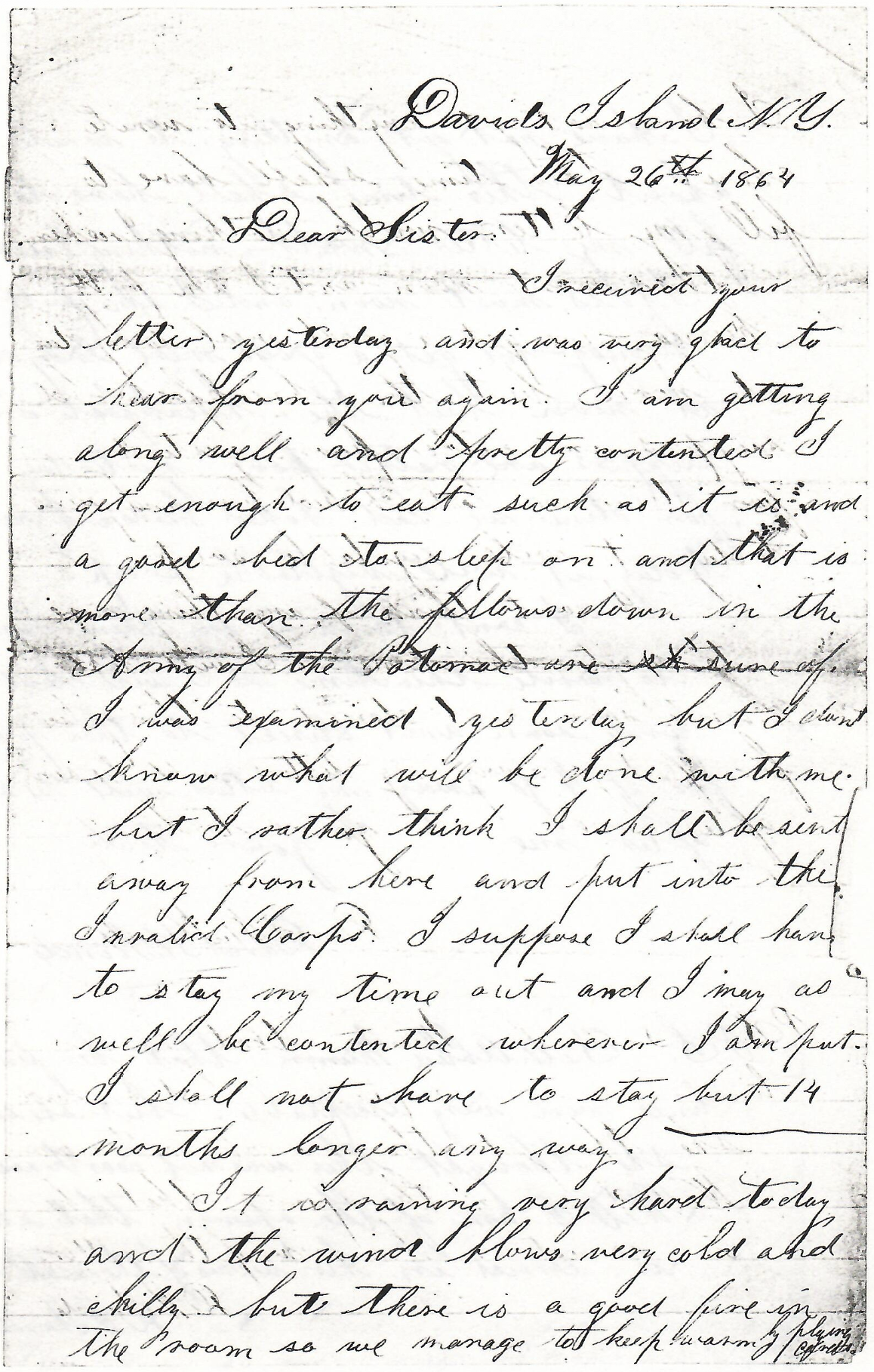
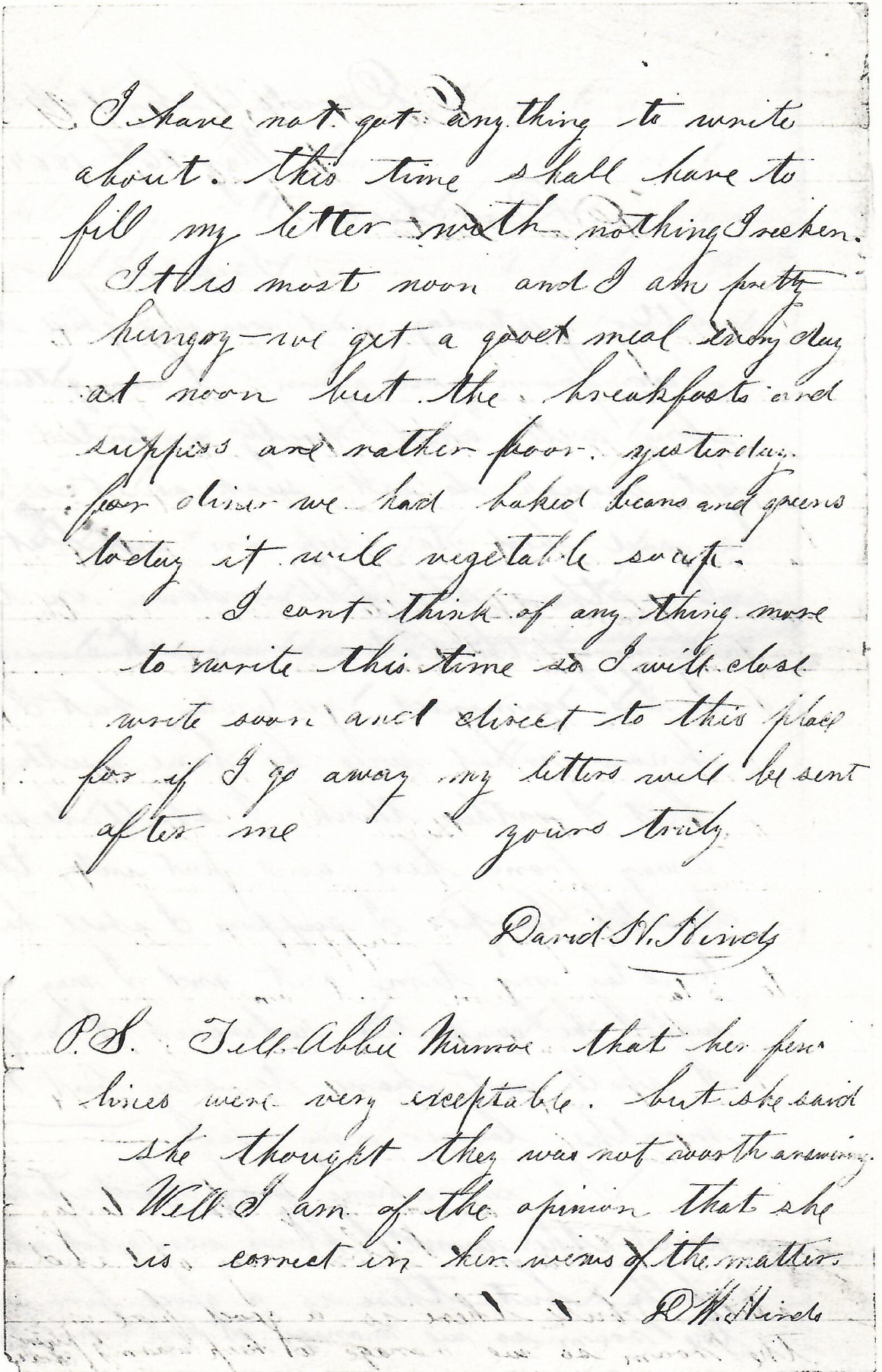
Letter 55
Bedloes Island
N. Y. Harbor
May 31st 1864
Dear Mother:
You will see by the heading of this that I have changed my place of board
and so I will write you a few lines to let you know where I am. I arrived here Friday last, the same day that I left David’s Island and expect to be sent away from here very soon. I shall go to Camp Distribution at Alexandria and I expect to be put into the Invalid Corps to remain the rest of my time. I would like to have got a furlough to come home a short time when I was so near. I should have got one long ago but I expected to get paid before this and thought I would not get a furlough until I did get paid. There will be six months pay due me the next time I get pay. I have not received any pay since January and shall not be likely to get any until the last of July.
I don’t like the idea of being put into the Invalid Corps but I may as well take things easy the remaining fourteen months of my time. There is some fellows here that belonged to my regiment in the Invalid Corps and they say they like it pretty well.
I received a letter from Abbie last week and answered it. When you
write, please direct to Rendezvous of Distribution near Alexandria Virginia. I shall probably by there in a week or less. Write soon to you son,
— David H. Hinds
P. S. Please send me some postage stamps.
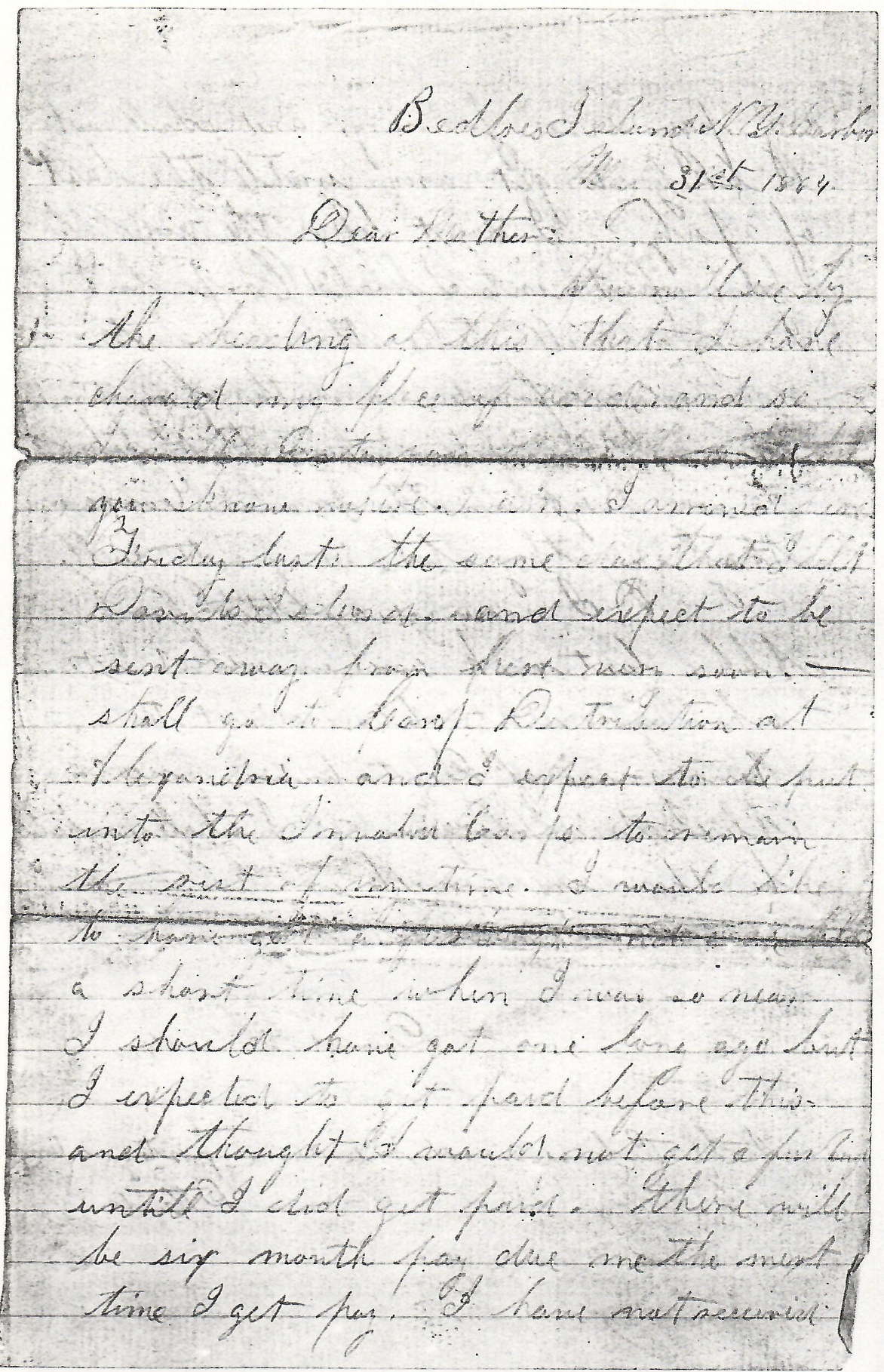
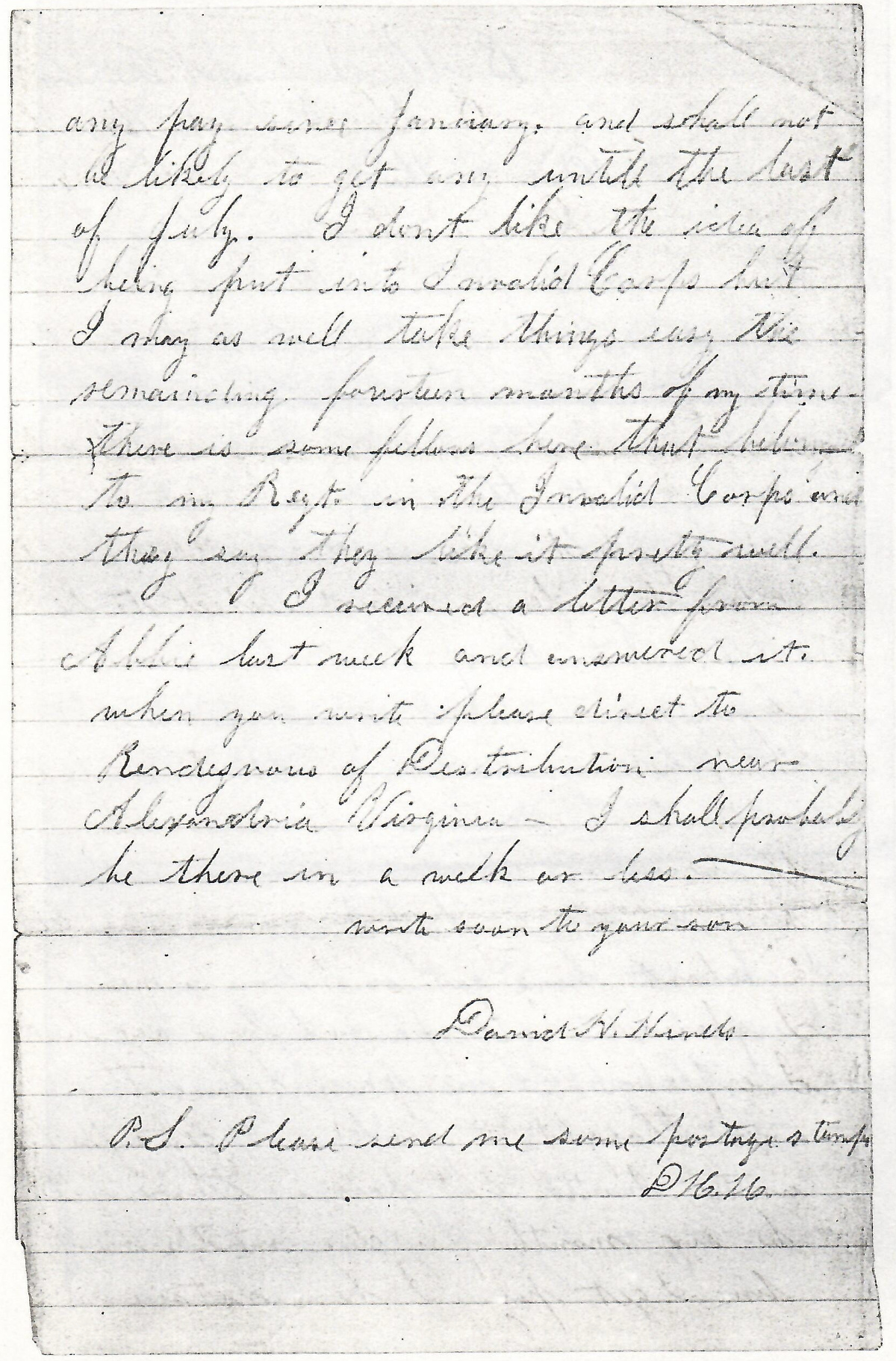
Letter 56
Camp near Charles City Courthouse, Virginia
June 14th, 1864
Little sister,
I shall write you a few lines now as I have plenty of time. We arrived here in camp about 11 this morning. Have been marching more or less now for three days. We are very near the James River now. I think our next move will be to cross.
I have been well since I arrived at the regiment. Can stand marching better than I expected. I had rather be here than in the Invalid Corps. My captain was very glad to see me back again and the old boys in the company gave me a hearty welcome. I have got the same one for a tent mate that I used to have which is C C. Jones of Fayettte. Everything begins to seem like old times and all reminds me of being a soldier in the field before and the land round me looks like the “sacred soil of old Virginia.” The country that we have been marching through is little better than it is between Fredericksburg and Alexandria. It is not so thinly settled but there is more timber land and the fields all look more fertile. It is pretty warm down here but I can stand the heat first rate.
I believe the soldiers are all in better spirits than I ever before see them. They have great faith in our commander Gen. Grant and think Richmond will be ours before this month is out.
I have not received any letters since I came to my regiment. Those that were sent to Camp Distribution I shall be likely to lose as I did not stop there only 24 hours before I wrote to mother when I was out on White House Landing. Suppose she has received it before now. Write soon to your brother, — D. H. Hinds, Co. C, 16th Maine Vols. , Washington D. C.
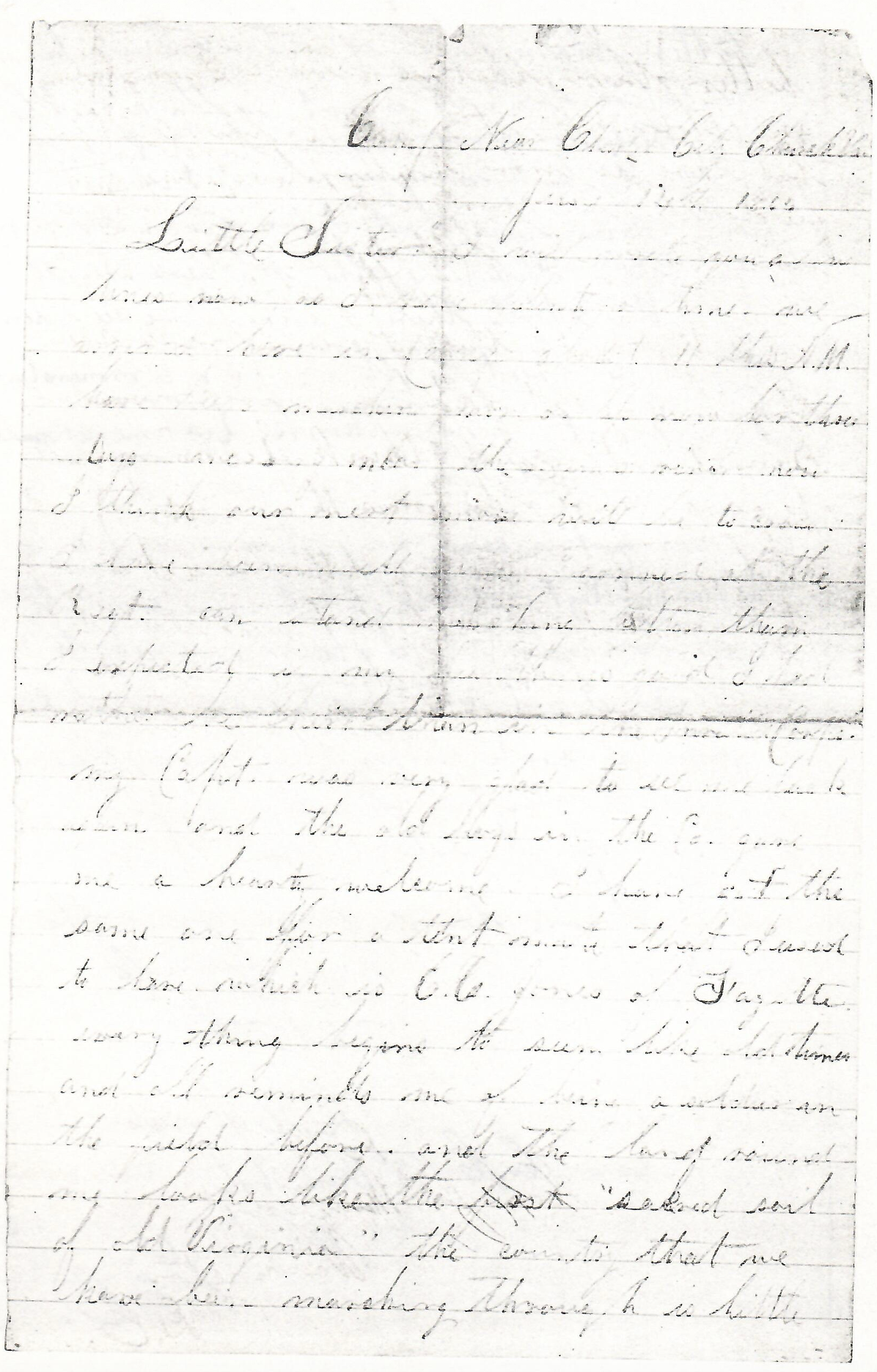
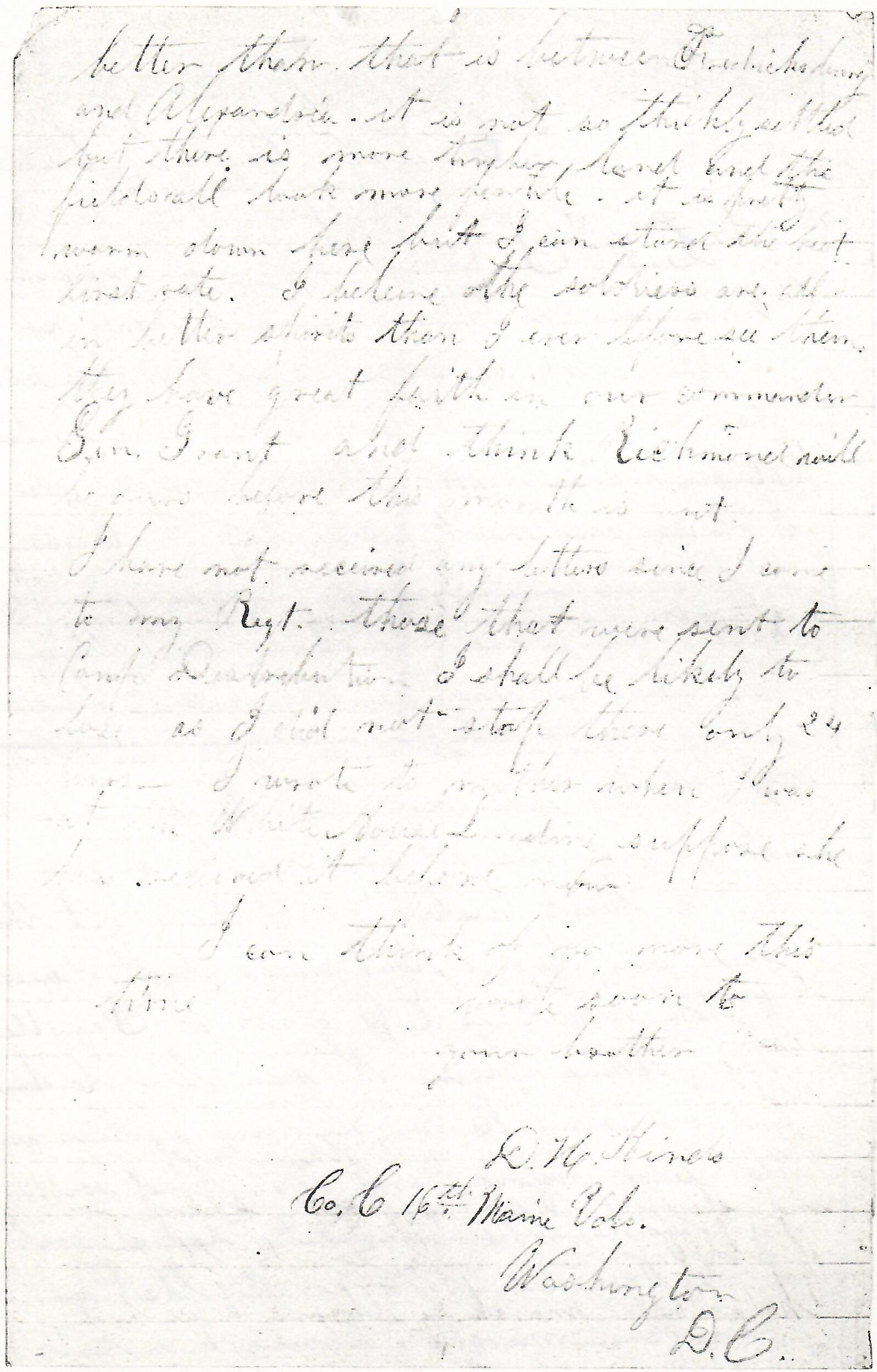
Letter 57
Camp near Petersburg, Virginia
July 18th 1864
Dear mother,
I have not received a letter for more than a week but I will try and write as often as every week whether I receive a letter or not.
We remain in the same place as when I wrote before and are fortifying stronger every day. Have been here at work on a fort for almost a fortnight and it is not entirely finished yet. It is four hundred feet square and will contain twenty or more large guns and mortars when it is completed and fully mounted. There is a detail from the regiment every day to work on it and the other regiments in the Brigade are in the fort and work as much as we do, while we are just in front of the fort behind breastworks. 1
There has been a negro brigade at work on the fort and they do about as much as two white soldiers. They stand the heat better and don’t understand how to shirk as well as we do. It was very amusing to me to stand and watch then and hear them talk and gass one another. They make a great deal of sport and there is some pretty bright fellows among them.
Our picket duty here is very pleasant. The lines of pickets are not a hundred yards apart and the Johnnies and our fellows are very friendly toward each other. They are talking and trading together all the time. I swapped a knife (worth about 25 cents) the other day for tobacco and sold the tobacco for $2. There has been no shooting for more than ten days and they are always in plain sight of one another and on both sides they have agreed to fire the first shots high in case they should have orders to fire.
There is deserters coming in from the Rebs every day. Two hundred in one squad came in together up in Burnside’s Corp., farther to our right. One came in to our brigade yesterday.
I am all right. My health is very remarkably good. Virginia agrees with me first rate. I will write no more tonight for I expect a letter in tonight’s mail and will not mail this until the mail comes in. Goodbye for now, — D. H. Hinds
Tuesday morning. Dear sister, As I expected I got a letter last night and it was from you. I was very glad to hear from you and that father is getting along so well with his haying. I would like to know what father’s political views are. Is he going in for the reelection of President Lincoln? I think it would be a big step toward losing the war to elect some other man that is just as smart. I can’t write any more this morning for I have to go on fatigue very soon. There are two letters that you have not received—one to you and one to mother. Give my respects to all and write soon to your brother,
— D. H. Hinds
1 The fort that the 16th Maine helped to build in July 1864 was Fort Sedgwick (called Fort Hell by the troops). It was located right along the Jerusalem Plank Road and was subject to constant Confederate artillery fire. The “negro brigade” was likely from Brig. Gen. Edward Ferrero’s Fourth Division.
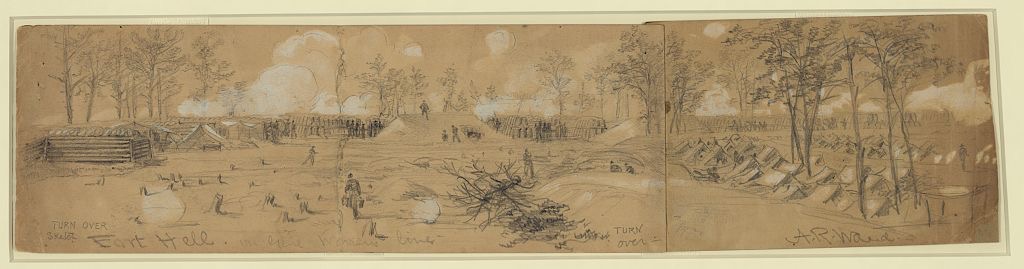
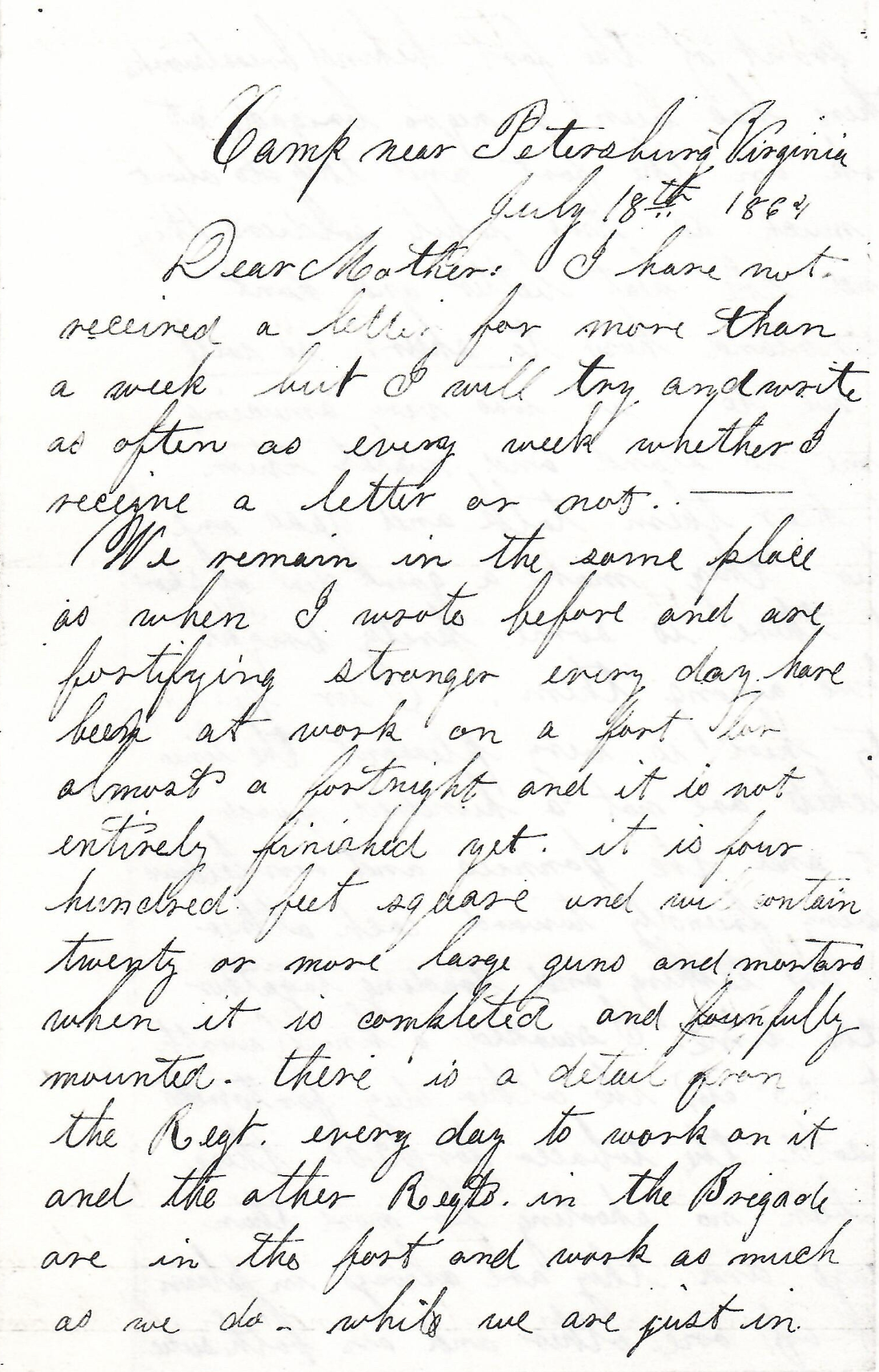
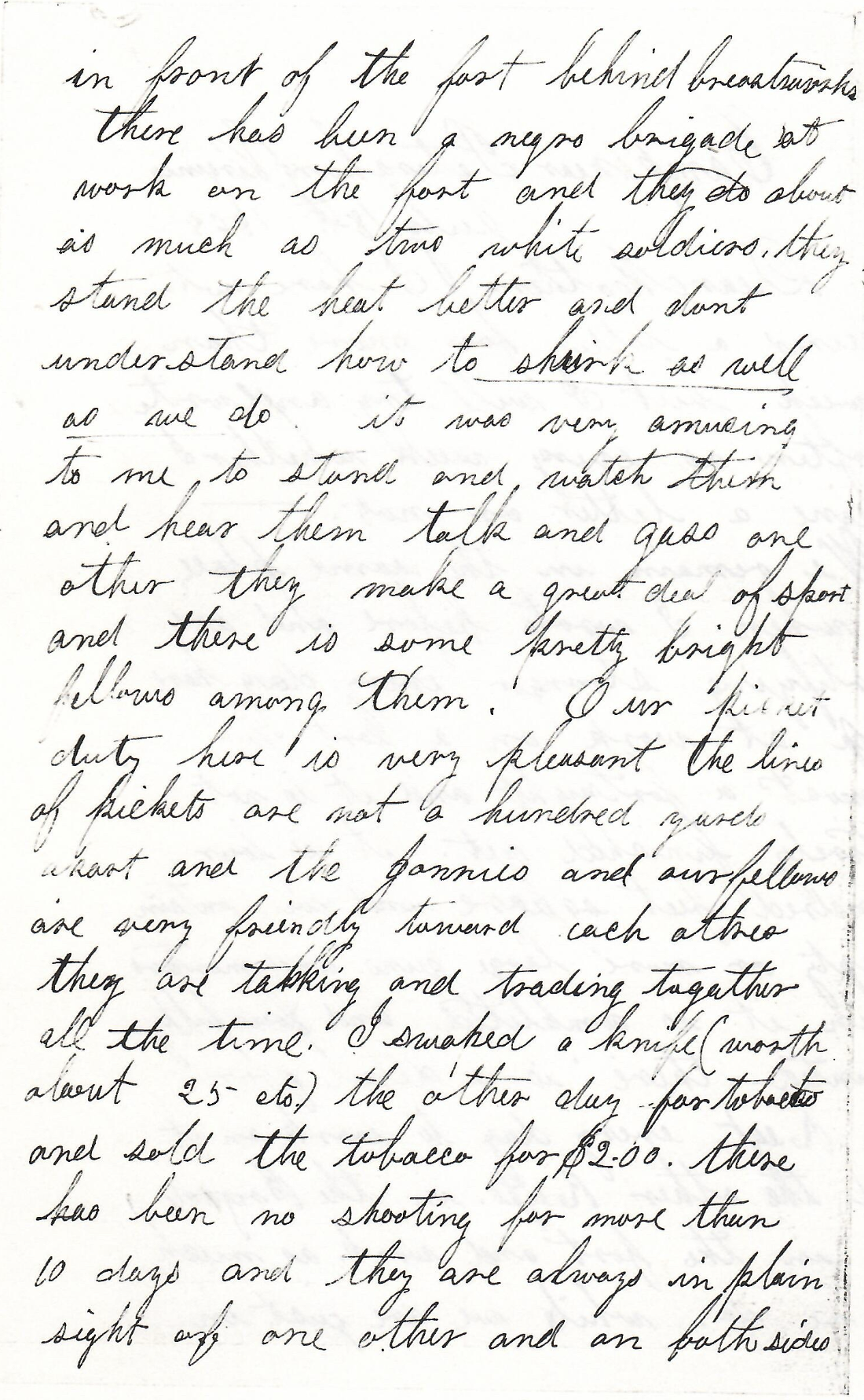
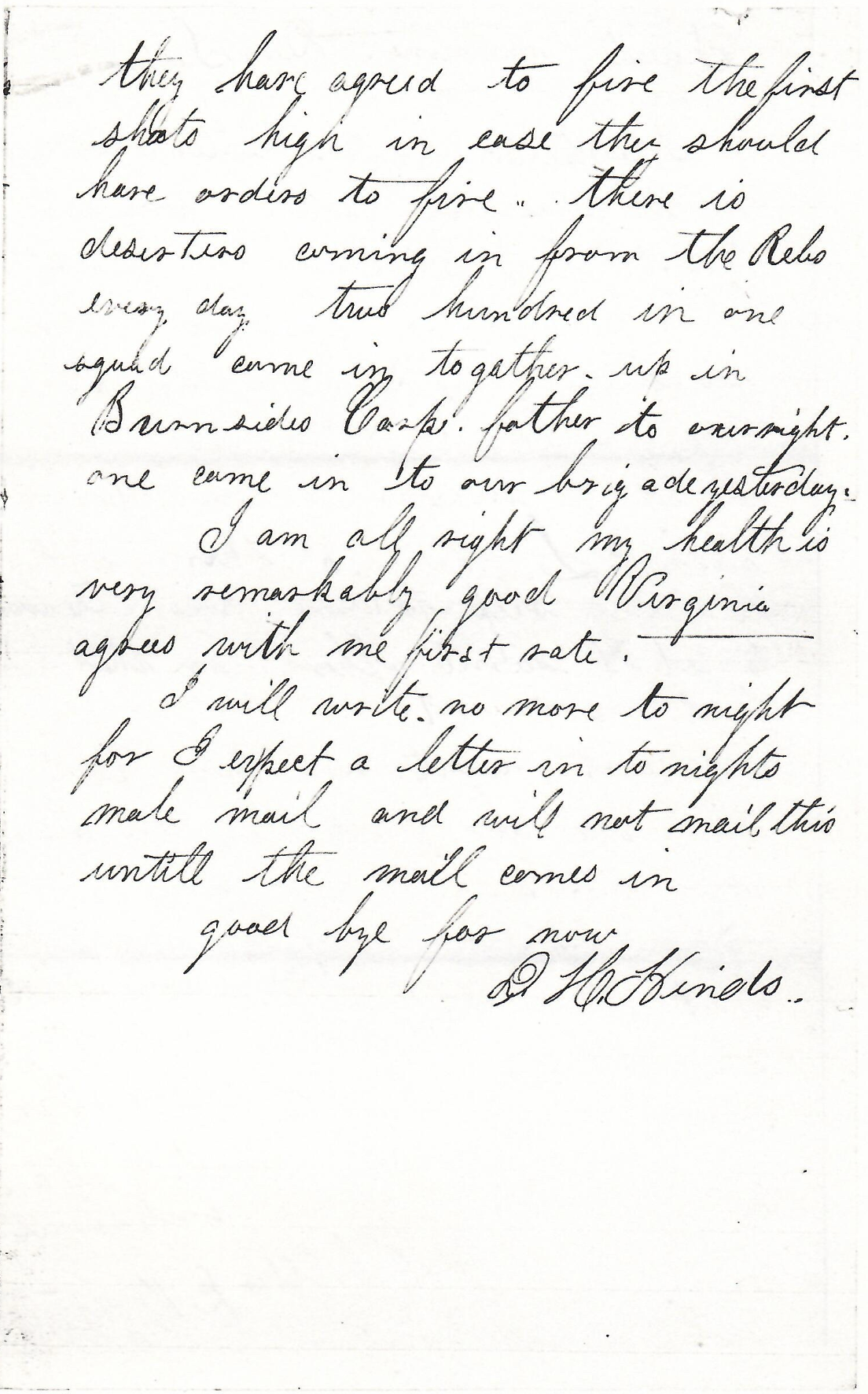
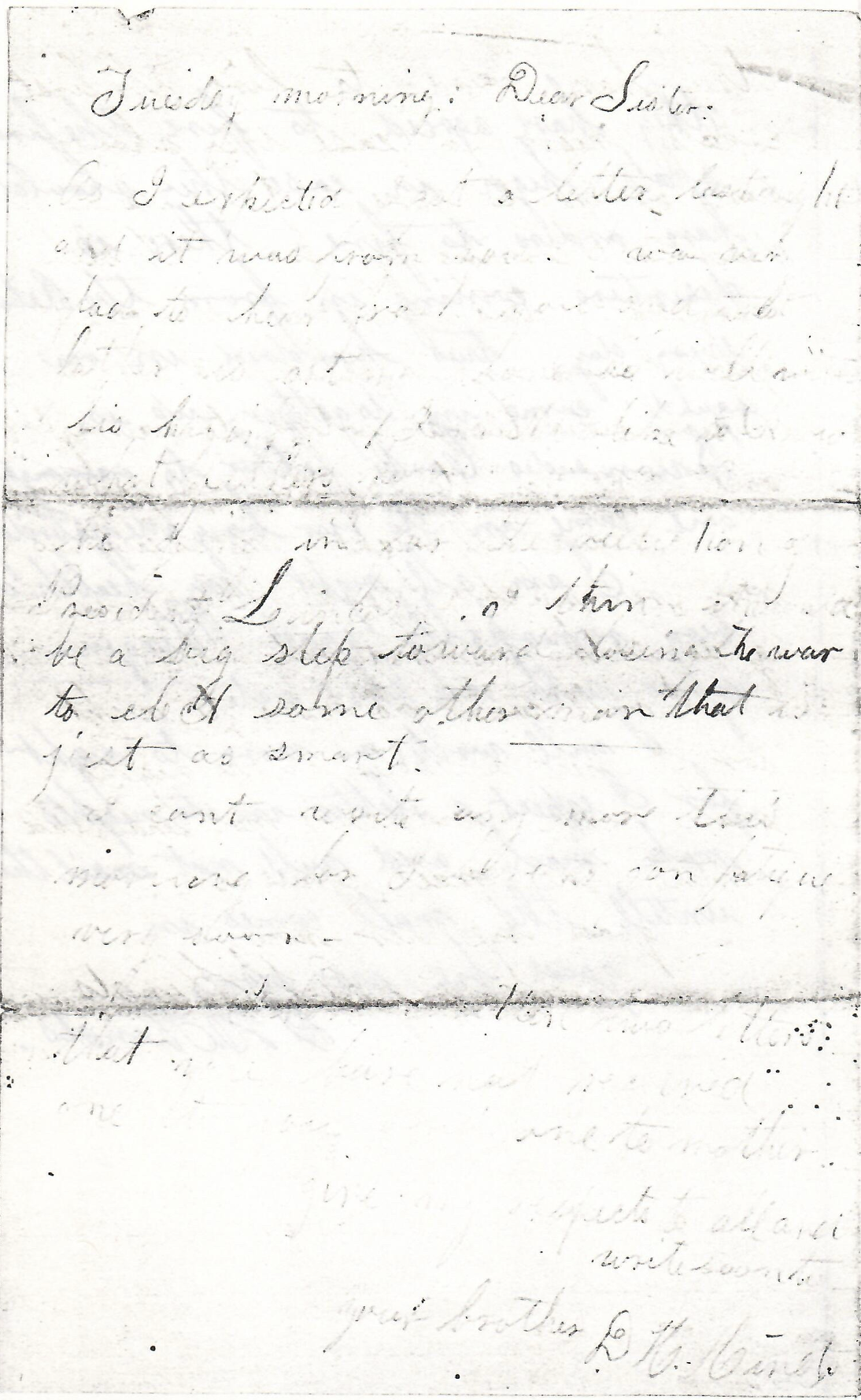
Letter 58
Camp near Petersburg, Virginia
July 23rd 1863
Dear Mother,
I received your letter of the 17th last evening. Also one from Abbie Saturday which I answered. Everything goes on about the same here as usual/ We had a nice rain last Friday—the first that we have had since I got back to the regiment. It is pleasant now and not so war as it has been. We shall not have much more warm weather this year.
Our camp is in a healthy place and we get good water. My tent is well fixed up. My bunk is built about a foot from the ground and covered with boughs so it lays as soft as a bed of feathers. We have a good chance to fo our washing and plenty of soap and we have drawn new clothing, all that we needed, so we are now very clean and comfortable. We draw soft bread, potatoes, onions, and dried apples, and then we draw some things from the Sanitary Commission such as pickles, sauerkraut, &c. The army is fed very well—much better than it ever was before. I have enjoyed myself much better since I got back to my regiment than while I was away.
Lieut. [Marshall S.] Smith was heard from yesterday. He is a prisoner in Richmond. Was taken near the Wilderness. He will be likely to have a hard time. 2nd Lieutenant George D. Bisbee of this company who was taken at Gettysburg is with him.
We are expecting to be paid very soon. I shall get six months pay and some balance on clothing. It will be over a hundred dollars if I get the whole at once.
The fort that we have been building is most done but the guns are not all mounted on it yet. They will be very soon, I think.
You say that you worry about Revillo for fear he will be drafted and if I was at home, it would be the same with me. And now as long as I am in the service, I am safe from the draft. Therefore there is no cause to worry about me at all. But perhaps you “can’t see it.” If Vill is afraid of being drafted, I think he better volunteer for 100 days. It will ensure him not to see any fighting and 100 days will be a very short time. But I suppose he will not want to lose his situation where he is now.
It was just two years yesterday since I enlisted and a little over one year more to serve, and if I get through it all right, I will feel better than to have served my time partly in the Invalid Corps.
You mentioned the little colt that you call Adrian—the name that I sent for the other colt (which proved Edrian instead of Adrian) and if that is the name you are after, please spell it with an E instead of an A. How does the yearling cold grow and it is going to be black? We must call her Black Bet Junior.
I can’t think of any more to write. Please send two stamps instead of one for I wish to write to somebody else besides my own folks and you need not fear of my writing to Mary Alden for I left off long ago and have not seen fit to commence again. — D. H. Hinds