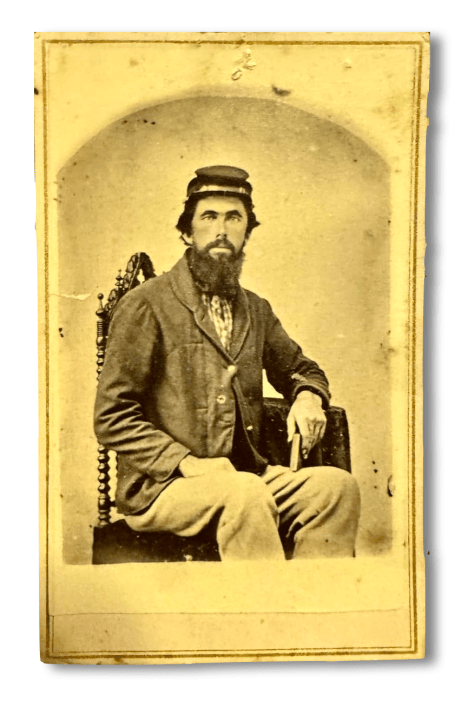
I could not find an image of Jacob but here is one of Albert C. Wentz who served in Co. F, 83rd Pennsylvania Infantry.
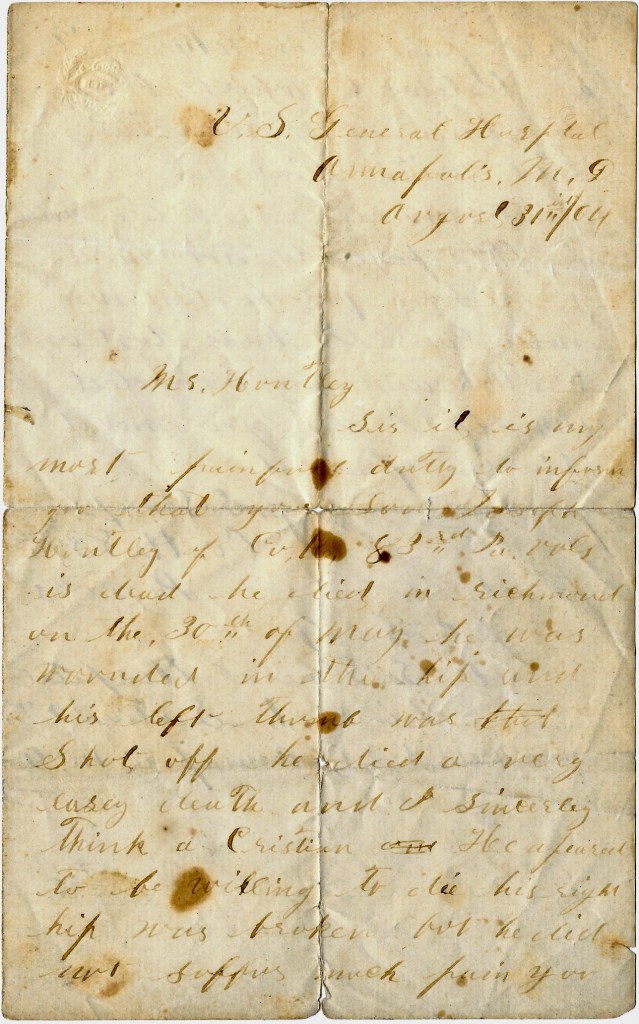
The following letter was written by Jacob E. Swap (1846-1925), the son of William Swap (1807-1881) and Amanda Karl (1805-1881) of Crawford county, Pennsylvania. Jacob was born in August 1846 and had only turned 15 years old when he enlisted as a private in Co. H, 83rd Pennsylvania Infantry. Jacob served completely through the war and entered the Wilderness Campaign as a seasoned veteran before he was 18. In the contest at Laurel Hill on 8 May 1864, Jacob was wounded five times and taken prisoner. He had been exchanged and was being treated for his wounds at the US General Hospital at Annapolis when he wrote this letter on 31 August 1864—three and a half months later. His bravery on the field earned him the Medal of Honor in 1897.
Jacob’s letter was written to the father of one of his comrades in the same regiment (different company) who died in Richmond on 30 May 1864. He named the deceased as “Joseph” Huntley but the soldier by that name was 38 years old and a draftee in Co. K when he entered the service in 1863 and he was definitely not wounded in the Battle of Laurel Hill. In fact, he was transferred to Co. F and mustered out with that company later in 1865. My hunch is that the soldier that Jacob meant was actually Corp. Joel Huntley of Crawford county who served in Co. K and was listed as having been “killed at Laurel Hill on 8 May 1864. More likely than not, Joel was wounded in that action and taken prison, like Jacob, and taken to Richmond where he died nearly three weeks after the battle. I’ve seen similar cases where there were discrepancies with the date and location of soldier’s deaths.
[Note: This letter is from the private collection of James Campbell and was transcribed and published on Spared & Shared by express consent.]
Transcription
U. S. General Hospital Annapolis, Maryland August 31st 1864
Mr. Huntley,
Sir, it is my most painful duty to inform you that your son Joseph Huntley of Co. K, 83rd PA Vols. is dead. He died in Richmond on the 30th of May. He was wounded in the hip and his left thumb was shot off. He died a very easy death and I sincerely think a Christian. He appeared to be willing to die.
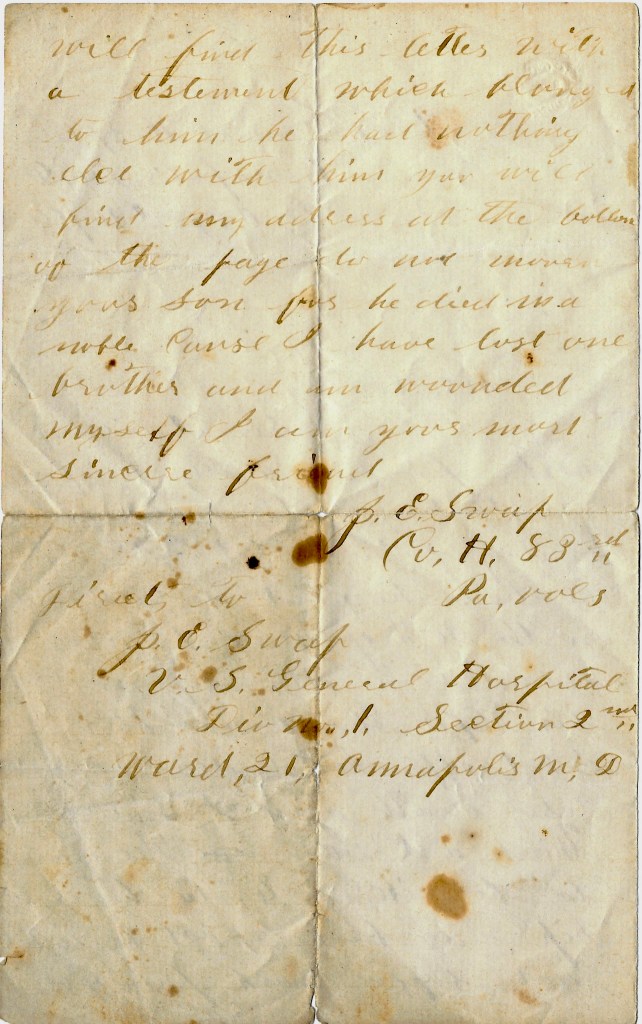
His right hip was broken but he did not suffer much pain. You will find this letter with a testament which belonged to him. He had nothing else with him. You will find my address at the bottom of the page. Do not mourn your son for he died in a noble cause. I have lost one brother and am wounded myself. I am your most sincere friend. — J. E. Swap, Co. H. 83rd Pa. Vols.
Direct to J E. Swap, U. S. General Hospital, Div. No. 1, Section 2nd, Ward 21, Annapolis, Maryland
This unusual letter was written by Samuel “Frank” Haskell (1839-1922), the son of Jasper Haskell (1805-1874) and Salley Fickett (197901871) of Poland, Androscoggin county, Maine. Frank was wounded in the right arm on 16 June 1864 in the opening assault on Petersburg while serving as a sergeant in Co. C, 17th Maine Infantry. His wound was so severe that it required the amputation of his arm and resulted in his discharge on 15 December 1864.
We learn from Frank’s letter that he first enlisted in Co. K, 5th Maine Infantry. He was mustered into that regiment on 24 June 1861 and was taken a prisoner in the Battle of Bull Run on 21 July. His military record states that he was confined at Richmond, Va, and Charleston, S. C. before being released sometime in mid-February 1862.
Frank’s letter provides us with a description of his attempt to escape Libby Prison in the fall of 1861, which was successful, but he was recaptured just before making it back to Union lines.
Frank wrote the letter to William Oland Bourne (1819-1901), editor of The Soldier’s Friend, who sponsored a contest in 1865-1866 in which Union soldiers and sailors who lost their right arms by disability or amputation during the Civil War were invited to submit samples of their penmanship using their left hands. The contest, which awarded a total of $1,000 in prizes for the winning entries, was followed in 1867 by a second contest, which awarded $500 in prizes. A very large number of letters were submitted to Bourne which are now housed in the Library of Congress along with some photographs on the contestants. Most likely the following letter was a personal copy (or first draft) of the letter than Frank submitted. Unfortunately Frank’s picture is not among those in the Library of Congress. See Wm. Oland Bourne Papers.
[Note: This letter is from the personal collection of Greg Herr and was transcribed and published on Spared & shared by express consent.]
S. Frank Haskell is listed as Contributor No. 41 on this published sheet.There were at least 267 entries.
Transcription
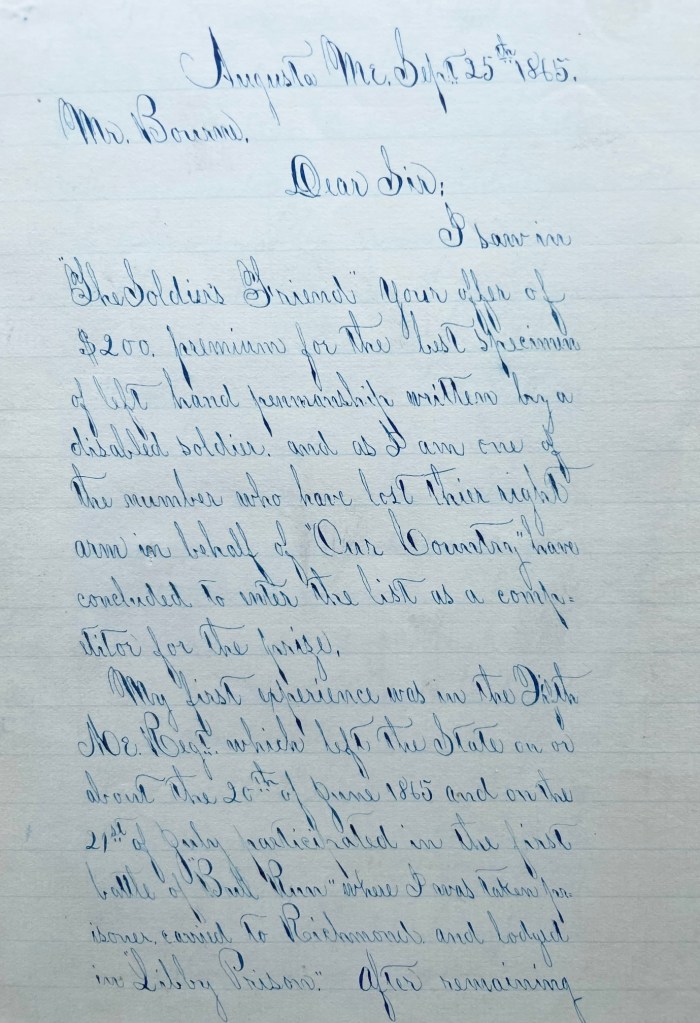
Augusta, Maine September 25th 1865
Mr. Bourne,
Dear sir, I saw in “The Soldier’s Friend” your offer of $200 premium for the best specimen of left hand penmanship written by a disabled soldier and as I am one of the number who have lost their right arm in behalf of “Our Country” have concluded to enter the list as a competitor for the prize.
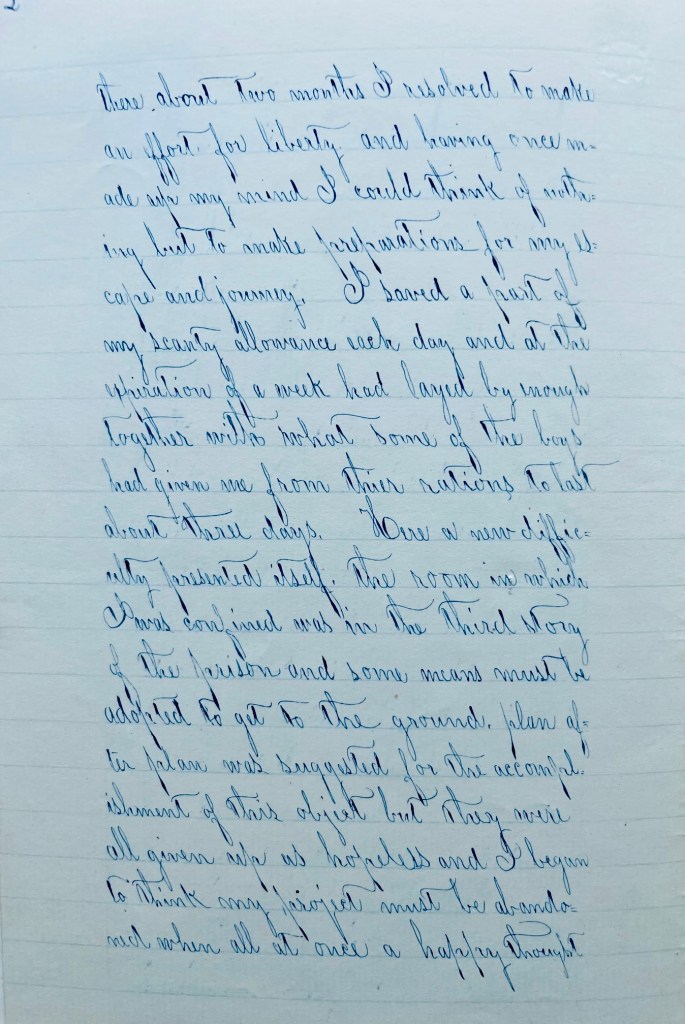
My first experience was in the Fifth Maine Regiment which left the State on or about the 20th of June 1865 [1861] and on the 21st of July participated in the first battle of “Bull Run” where I was taken prisoner, carried to Richmond, and lodged in “Libby Prison.” After remaining there about two months, I resolved to make an effort for liberty and having once made up my mind I could think of nothing but to make preparation for my escape and journey. I saved a part of my scanty allowance each day and at the expiration of a week had layed by enough together with what some of the boys had given me from their rations to last about three days.
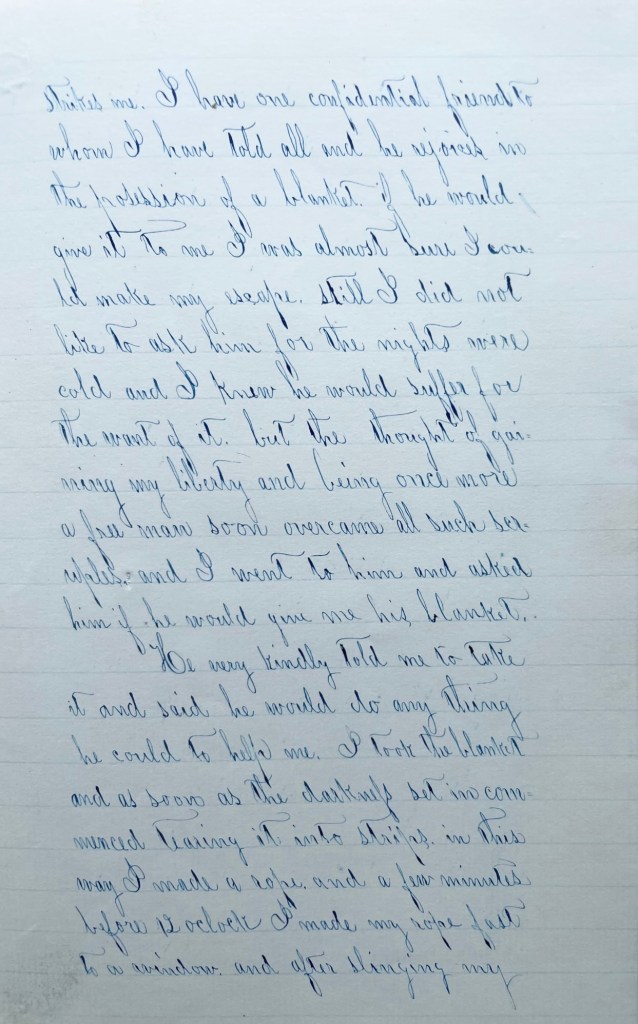
Here a new difficulty presented itself. The room is which I was confined was in the third story of the prison and some means must be adopted to get to the ground. Plan after plan was suggested for the accomplishment of this object but they were all given up as hopeless and I began to think my project must be abandoned when all at once a happy thought strikes me. I have one confidential friend to whom I have told all and he rejoiced in the possession of a blanket. If he would give it to me, I was almost sure I could make my escape. Still I did not like to ask him for the nights were cold and I knew he would suffer for the want of it. But the thought of gaining my liberty and being once more a free man soon overcame all such scruples and I went to him and asked him if he would give me his blanket.
He very kindly told me to take it and said he would do anything he could to help me. I took the blanket and as soon as the darkness set in commenced tearing it into strips. In this way I made a rope and a few minutes before 12 o’clock, I made my rope fast to a window and after slinging my haversack on my shoulder and saying goodbye to my friend, I began my descent. I succeeded in reaching the ground in safety and gave the rope a slight jerk which was the signal to draw it up and that all so far had worked well. 1
I was now outside of the prison but I still had a high fence to climb and outside of this fence the guards were posted. Fortunately for me, however, the night was pitchy dark and the rain falling in torrents. I suppose the guards were all under an old shed that stood near trying to keep out of the rain. At all events, they were no doing their duty and I succeeded in reaching the street without further difficulty. But it would occupy too much space to give all the particulars of my journey so I will only say that after traveling ten days, sleeping in the woods, living on green corn and sometimes a piece of corn bread from a negro cabin, I was recaptured within half a mile of our pickets and taken back to Richmond. A few days after this I was sent to Charleston, S. C. with a lot more of the most unruly and insubordinate of the prisoners (we saw this paragraph in [one] of their papers) for safekeeping. I was at length paroled after spending nearly ten months in prison.
I came home and stopped about two months. At that time the 17th Maine was being organized and feeling that I had not seen quite enough of “the show,” I enlisted in that regiment and was with it until the 16th of June 1864. On that day, while charging a line of the enemy’s works, a minié ball struck my right arm, fracturing the elbow joing so as to cause amputation. While in the 17th, I participated in the following battles—Fredericksburg, Chancellorsville, The Cedars, Mine Run, Locust Grove, Gettysburg, The Wilderness, Coal [Cold] Harbor, North Anna River, Spottsylvania, and number of smaller engagements not worth mentioning. I am at present attending the Augusta Commercial College. I have been here about three weeks. Enclosed please find a sample of my writing written the day I commenced taking lessons at this Institution. My Post Office address is Augusta, Maine.
Very truly yours, — S. Frank Haskell, late Sergt. in Co. C, 17th Maine Regt.
1 Early in the war when the tobacco warehouse was first used as a prison, the windows did not have bars on them.
The following letter was written by various members of the Floyd family. We learn from the letter that Enoch Floyd (1808-1855) and Sarah Ingersoll (Harvey) Floyd (1816-1889) made the overland journey from the Great Salt Lake over the Sierra Mountains to the vicinity of Sacramento in the spring of 1856 with their family of five children. They were Enoch Harvey Floyd (1834-1860), Lyman Floyd (1837-1863), Leonard Floyd (1837-1916), Sarah Elizabeth Floyd (1841-1866) and Julia Ann Floyd (1852-1860). Two of their youngest daughters, Martha and Lucy died within days on each other in 1853 probably from some childhood disease. The family resided in Newbury, Essex county, Massachusetts, before making the overland journey.
Transcription
June 27, 1854
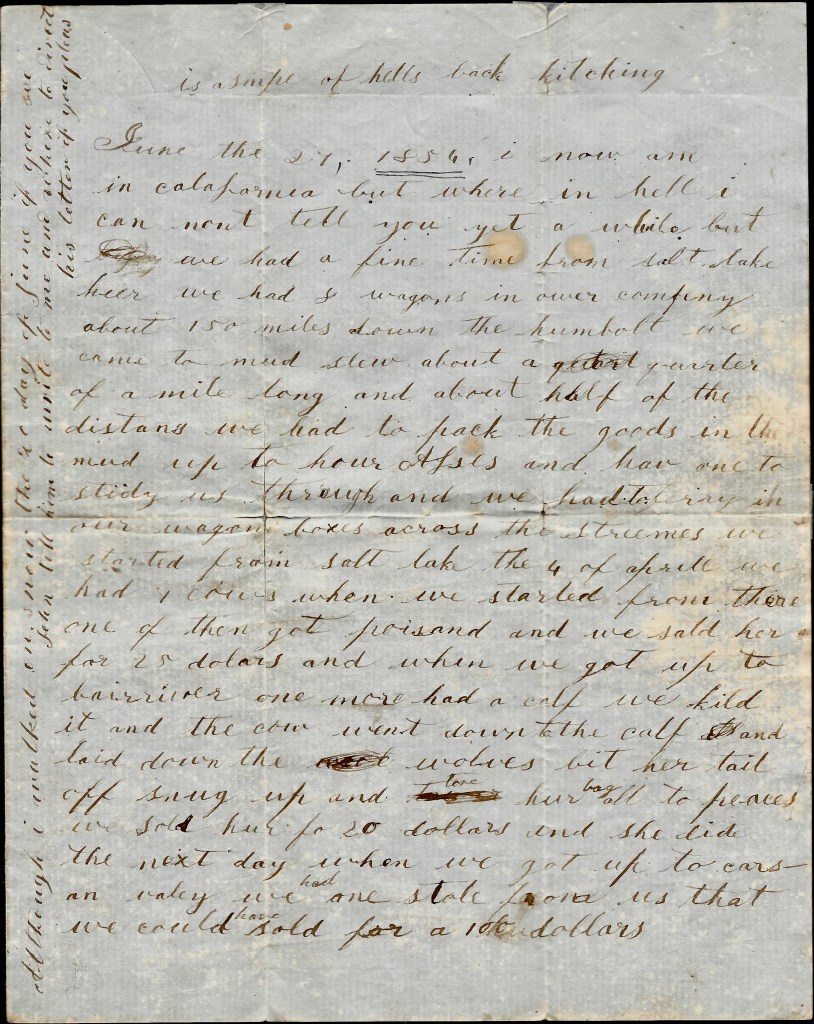
i now am in california but where in hell i can nont tell you yet a while but we had a fine time from salt lake heer we had 8 wagons in ower compeny about 150 miles down the humbolt we came to mud slew about a quarter of a mile long and about half of the distans we had to pack the goods in the mud up to hour asses and have ont to stidy us through and we had to ferry in our wagon boxes across the steemes we started from salt lake the 4 of aprill we had 7 cows when we started frome there one of them got poisand and we sold her for 25 doars and when we got up to bairriver one more had a calf and laid down the wolves bit her tail off snug up and tore hur bag all to peaces we sold hur for 20 dollars and she dide the next day when we got up to carsan valey we had one stray from us that we could have sold for a 100 dollars
we are now in prairie sitty all well at this time Enoch is in hangtown to work in the mines for 60 dollars a moth and his board lyman and i have not got enny work yet they are agoin to opin a new mine here and we think taking up a claim or tow and see how we can makit i don’t know of enny thing more to writ
from your obedident servant—Leonard Floyd
Dear frien i will write a few lines i have not got rested enough yet to write or do much else we have had a very tedious journey from Salt Lake here we was from the 4 of April to the 25 of june geting to hangtown or placerville 800 miles from Salt Lake i had rather come from kanesville to Salt Lake 4 times than to come from there here once we are all well but about tired out crosing the siera nevada mountains is enough to kill anybody or thing that ever stood on feet we were one whole day climbing one mountain one and a half miles it is like going up and down the roof of a house with the exception of the sharp edge and rocks in the road as high as the wagon bodys the rocky mountains is nothing to compare to these.
Enoch has kept a journal of Our journey and some time some of us will will write it enoch is 30 miles from us now.
[in a different hand]
if you read this you will do well write as soon as you get this and direct it to sacramento we are 20 miles north of it but where we shall stop i do not know but we shall get the letter When we had all of the goods out of our wagon we had on nine yoke of Oxen to our wageon that would girt from 6 to 7 ft and we spird and sashed them til the blud run their sides to take the empty [wagons] over the siinavada Mountain. Enoch Floyd, Jr.
July 1 since the above was writen we have moved within 5 miles of sacramento Leonard and Lyman are at work for two dollars per day for A short time and their board board is from 6 to 9 dollars per week for constant boarders transient ones more when we got to Carson valley we expected to wait for the snow to go of the carson route so Enoch came on ahead of us he had to pay 11 dollars A week but he got work and i hope will do well but we came the joHnson cut off this road is worse than the other but no snow in the road.
this is A mixed up letter but never mind as long as we know how better in hangtown they have up bets so i am told as high as fifteen hundred dollars to see who will go down to Carson valley and steal the most cattle from emigrants the whites are A great deal worse than the indians the indians seldom troubel any companies unless they are as small as from 5 to 8 men than they will steal their cattle and sometimes fire upon the men but where there is from 15 to 25 men there is no trouble we had 22 men Mr Silas Barn[e]s from Boston with his family came through with us from Salt Lake he lived there two years and A half 1 and Mr. William Paterson formily of haverhill Mass.
We had no serious sickness in our family or company nor Deaths little Julia is cuting Double teeth and it makes her rather cross but she is a good littl girl Sarah send her love to grandmother and grandfather and all the rest of the folks if you could see the style that i write in you would say it is time to say good by till A more conveint time. so good by — Sarah I. Floyd
1Silas P. Barnes was born in Deering, New Hampshire in 1805. He moved to Boston as a young man and married Olive Chapman. In 1851, he settled up his business in Boston and embracing the doctrines taught by Joseph Smith, made his way with his family of nine children to Council Bluffs, Iowa, where they joined a caravan of 60 wagons to journey to Salt Lake City. They lived near Dry Creek until Indian troubles threatened danger and in so they decided in April 1854 to go to California. After a three month’s journey they reached the Golden State and settled in Yolo county. Silas died there in 1888.
The following letter was written by 41 year-old Squire Green Sherman (1821-1869) who mustered in as a private in Capt. Claudius Buster’s Company, Elmore’s 20th Texas Infantry at Hempstead, Texas, in late April 1862. Muster rolls indicate that he enlisted in Burleson county. In January 1863 he was promoted to 2nd Sergeant of Co. C. and was later detailed as a a clerk to Gen. McCulloch’s Headquarters in Galveston and later in Houston—a situation held throughout the remainder of the war.
Sherman’s letter includes a description of the Confederate defenses at Galveston Bay in January 1863, which was blockaded by Union gunboats. “We are expecting an attack constantly & the probability is that but little resistance will be made on our part. The fact is, we cannot hold the city against their fleet, as it cannot be fortified so as to successfully defend it,” he wrote.
Sherman wrote the letter to Sarah (“Sallie”) Elizabeth Johnson (1843-1901) with whom he married in 1864 or 1865.
[Note: The family name was originally spelled Shearman.]
Transcription
Addressed to Miss Sallie E. Johnson, Caldwell, Texas
Galveston, [Texas] January 30th 1863
My dear Sallie,
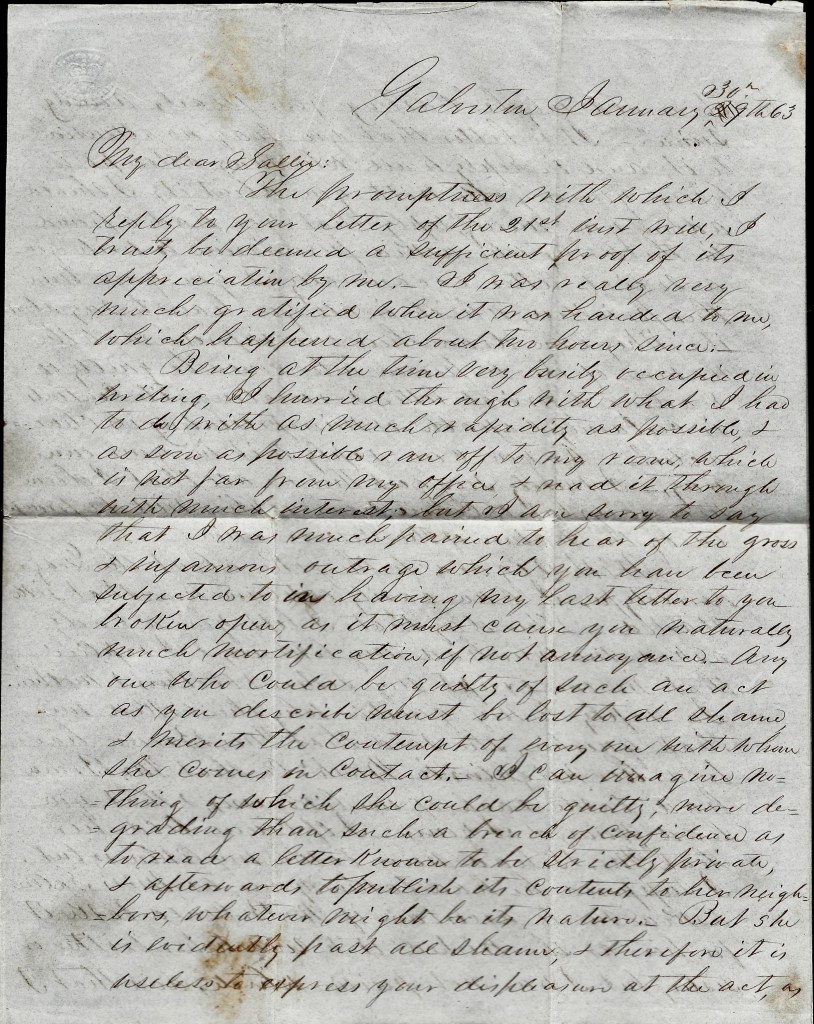
The promptness with which I reply to your letter of the 21st inst. will, I trust, be deemed a sufficient proof of its appreciation by me. I was really very much gratified when it was handed to me, which happened about two hours since.
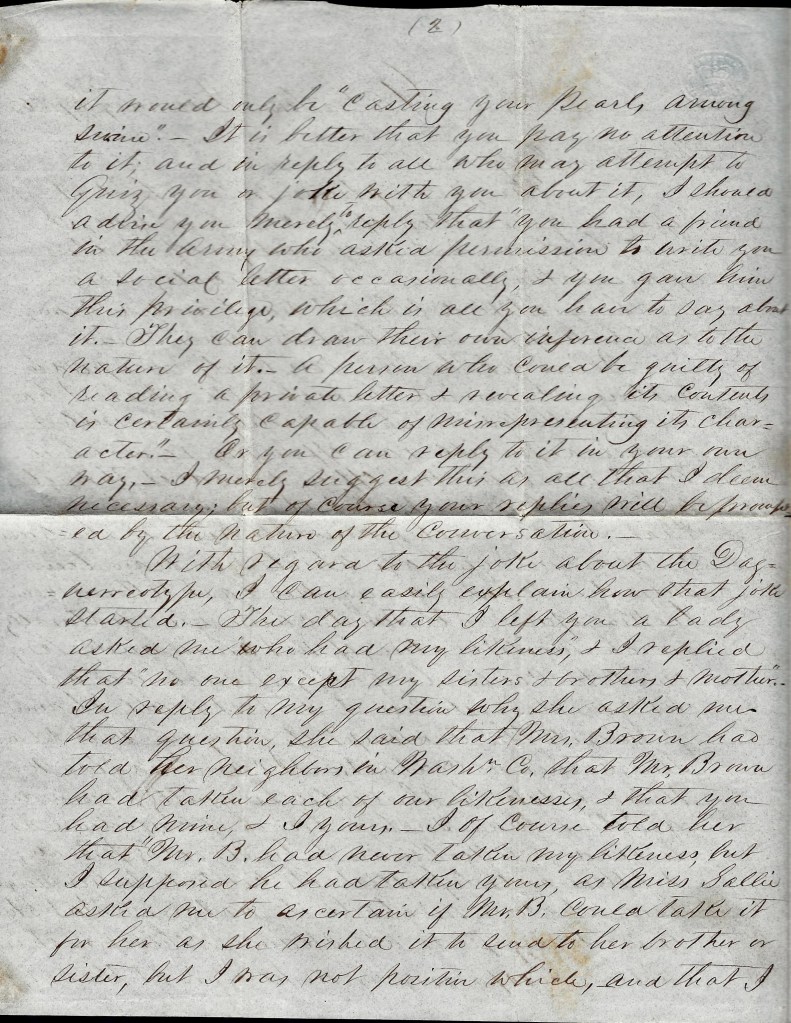
Being at the time very busily occupied in writing, I hurried through with what I had to do with as much rapidity as possible, & as soon as possible ran off to my room which is not far from my office & read it through with much interest, but I am sorry to say that I was much pained to hear of the gross& infamous outrage which you have been subjected to in having my last letter to you broken open as it must cause you naturally much mortification, it not annoyance. Anyone who could be guilty of such an act as you describe must be lost to all shame & merits the contempt of everyone with whom she comes in contact. I can imagine nothing of which she could be guilty more degrading than such a breach of confidence as to read a letter known to be strictly private, and afterwards to publish its contents to her neighbors, whatever might be its nature. But she is evidently past all shame and therefore it is useless to express your displeasure at the act, as it would only be “casting your pearls among swine.” It is better that you pay no attention to it; and in reply to all who may attempt to quiz you or joke with you about it, I should advise you merely to reply that you had a friend in the Army who asked a permission to write you a social letter occasionally, & you gave him this privilege, which is all you have to say about it. A person who could be guilty of reading a private letter & revealing its contents is certainly capable of misrepresenting its character. Or you can reply to it in your own way. I merely suggest this as all that I deem necessary; but of course your replies will be prompted by the nature of the conversation.
With regard to the joke about the daguerreotype, I can easily explain how that joke started. The day that I left you, a lady asked me “who had my likeness,” & I replied that no one except my sisters & brothers & mother. In reply to my question why she asked me that question, she said that Mrs. Brown had told her neighbors in Washington county that Mr. Brown had taken each of our likenesses & that you had mine, & I yours. I of course told her that “Mrs. Brown had never taken my likeness, but I supposed he had taken yours, as Miss Sallie asked me to ascertain if Mr. Brown could take it for her as she wished it to send to her brother or sister, but I was not positive which, and that I heard you afterward speak of it as having been badly taken on account of some defect in the chemicals.” I let the subject drop, after laughing at the absurd reports people would start, not even mentioning that I wait with you to get it taken. The best way is to let them talk on—it cannot hurt you, if you deem me worthy of your esteem, & are not ashamed to have me known as your affianced. I should like to know which of the Fullerton’s told about the likeness. They both love to talk, & say a great many things merely for the sake of talking. But enough of this. I have devoted already more space to it than you will consider it deserves—at least I hope so.
I had not heard of Mr. Beard’s death. I should like to hear what was the cause of it. I feel much sympathy for his large family who are left with but little means of support.
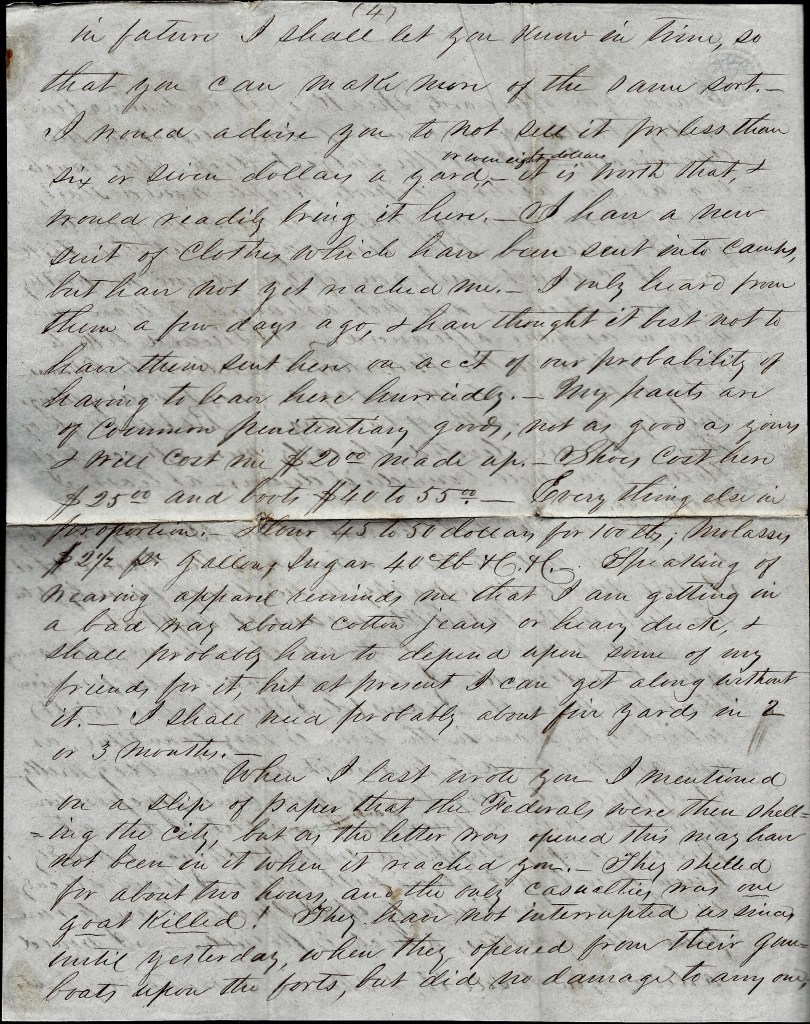
As you are not much of a hand at praising your handiwork, I have formed an impression that the piece of Jeans (do I spell this word right) which you have in the loom is very beautiful, as you are inclined to praise it as being very pretty. I appreciate very highly your kind proposition to me me have a pair of pants; but I am at present amply supplied with clothing & hardly know how to get along with what I have already on hand—particularly if I should have to run from the Yankees which is possible. I would advise you to sell it & should I want any pants in future, I shall let you know in time, so that you can make more of the same sort. I should advise you to not sell it for less than six or seven dollars a yard—or even eight dollars. It is worth that & would readily bring it here. I have a new suit of clothes which have been sent into camp but has not yet reached me. I only heard from them a few days ago & have thought it best not to have them sent here on account of our probability of having to leave here hurriedly. My pants are of common penitentiary goods, not as good as yours, & will cost me $20 made up. Shoes cost here $25 and boots $40 to 55. Everything else in proportion. Flour 45 to 50 dollars for 100 lbs., molasses $2.5 per gallon, sugar 40 cents a lb., &c. &c. Speaking of wearing apparel reminds me that I am getting in a bad way about cotton jeans or heavy duck, & shall probably have to depend upon some of my friends for it, but at present I can get along without it. I shall need probably above five yards in two or three months,
When I last wrote you I mentioned on a slip of paper that the Federals were then shelling the city, but as the letter was opened, this may have not been in it when it reached you. They shelled for about two hours and the only casualties was one goat killed! They have not interrupted us since until yesterday when they opened from their gunboats upon the forts, but did no damage to anyone. But we are expecting an attack constantly & the probability is that but little resistance will be made on our part. The fact is, we cannot hold the city against their fleet, as it cannot be fortified so as to successfully defend it. They threaten, I hear, to send “a fleet here that will teach us a lesson which we will not soon forget.” If a very large force is sent, the city will no doubt be left without resistance, as they otherwise would be enabled to claim a victory which we do not wish. Everything, however, is uncertain & what I state, of course, is only intended for you in confidence. One week may materially alter the aspect of affairs. There are now in sight four boats which are here merely to keep the city blockaded.
We have disastrous news from Vicksburg today to the effect that it has been taken by the enemy, but no particulars. Also that 8,000 of our army have been taken prisoners in Arkansas. I sincerely hope these rumors are false, but fear they are true.
You seem to constantly entertain the hope that the war will end soon, but my dear Sallie, I am sorry to say that I see things in a very different light. There is in my estimation no prospects—not the slightest—of a speedy termination of this struggle. This is only my opinion, but wait, & I doubt not you will find that I am right in these views.
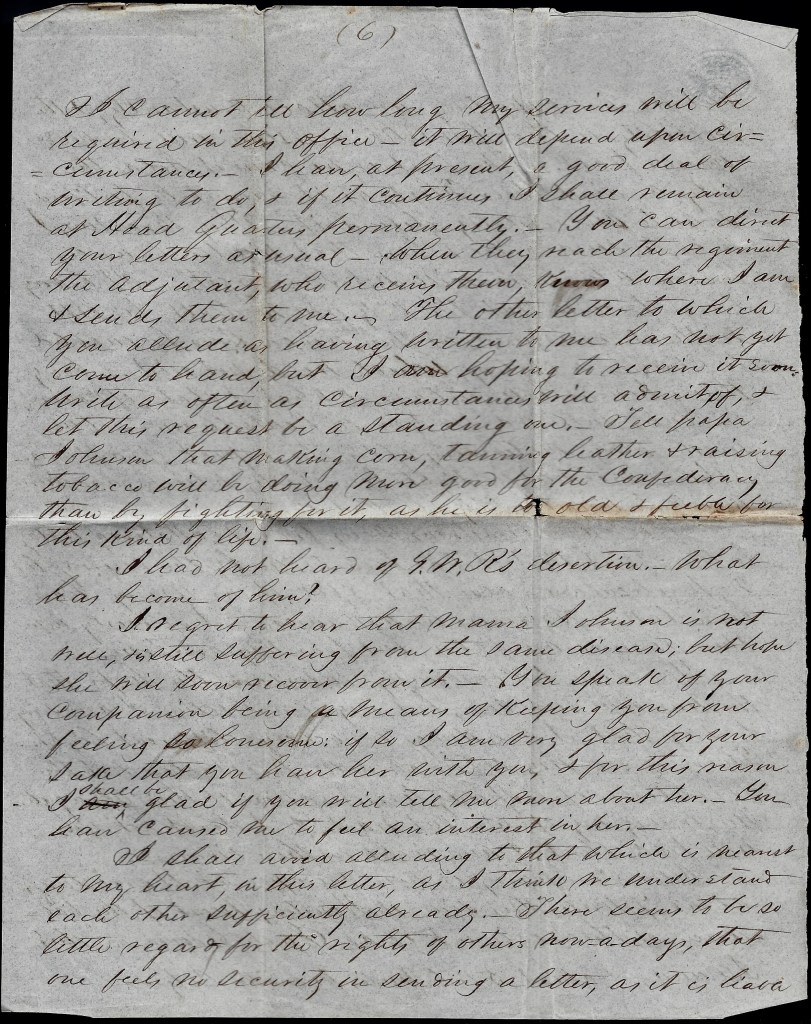
Our company is now camped at Harrisburg, about 7 miles this side of Houston; most of the balance of the regiment is at Eagle Grove on this Island, & about 5 or 6 miles from the city. I cannot tell how long my services will be required in this office. It will depend upon circumstances. I have at present a good deal of writing to do, & if it continues, I shall remain at Head Quarters permanently. You can direct your letters as usual. When they reach the regiment, the adjutant, who receives them, knows where I am and sends them to me. The other letter to which you allude as having written to me has not yet come to hand but I am hoping to receive it soon. Write as often as circumstances admit of & let this request be a standing one. Tell papa Johnson that making corn, tanning leather, & raising tobacco will be doing more good for the Confederacy than by fighting for it, as he is too old and feeble for this kind of life.
I had not heard of G. W. R’s desertion. What has become of him?
I regret to hear that mama Johnson is not well & is still suffering from the same disease; but hope she will soon recover from it. You speak of your companion being a means of keeping you from feeling so lonesome. If so, I am very glad for your sake that you have her with you, & for this reason I shall be glad if you will tell me more about her. You have caused me to feel an interest in her.
I shall avoid alluding to that which is nearest to my heart in this letter as I think we understand each other sufficiently already. There seems to be so little regard for the rights of others now-a-days, that one feels no security in sending a letter, as it is liable [remainder of letter missing]
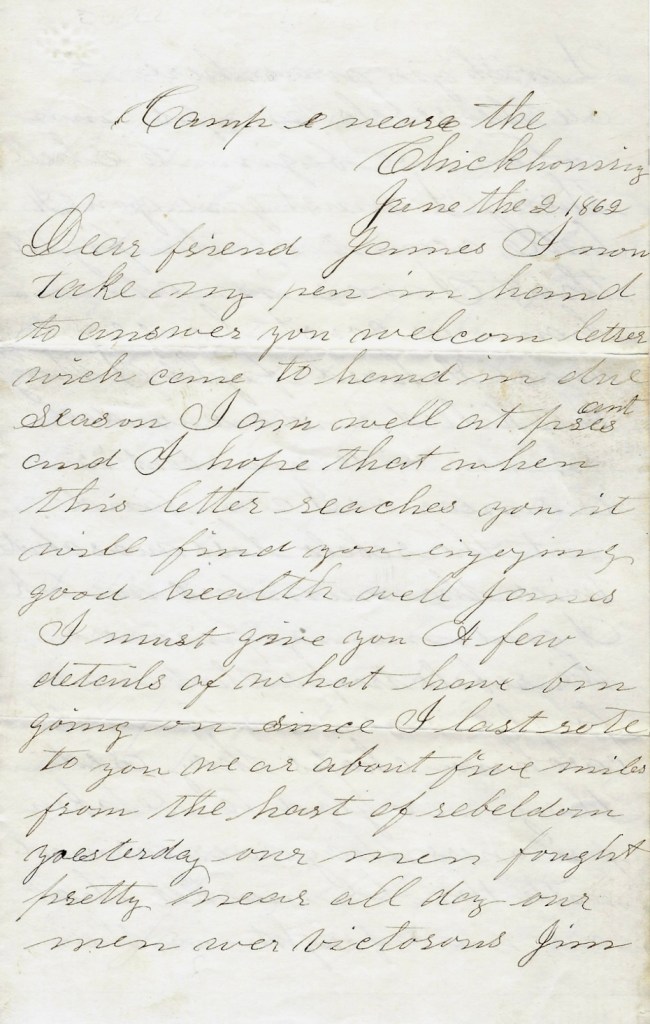
The following letter was written by Charles E. Pettis, a native of Vermont, who enlisted at Erie as a private in September 1861 to serve in Co. K, 83rd Pennsylvania Infantry. He was discharged for disability in mid-September 1862. His residence was given as Garland, Warren county, Pennsylvania.
Charles’ letter, dated 2 June 1862 during the Peninsula Campaign, makes reference to the recent fighting at Hanover Court House, where the 83rd Pennsylvania, part of Fitz John Porter’s V Corps, clashed with Branch’s North Carolinians. Being outnumbered three to one, the Confederates suffered a decisive defeat at Peake’s Crossing. The letter suggests that the victory was facilitated by the inferior weaponry and lack of enthusiasm among the North Carolinians.
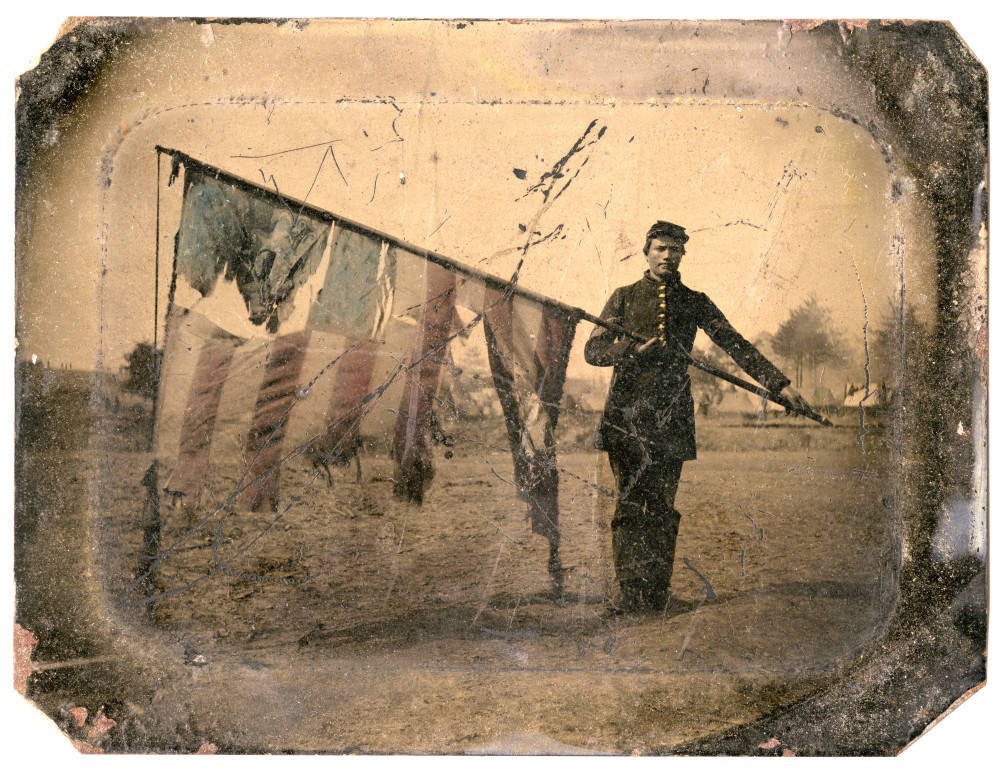
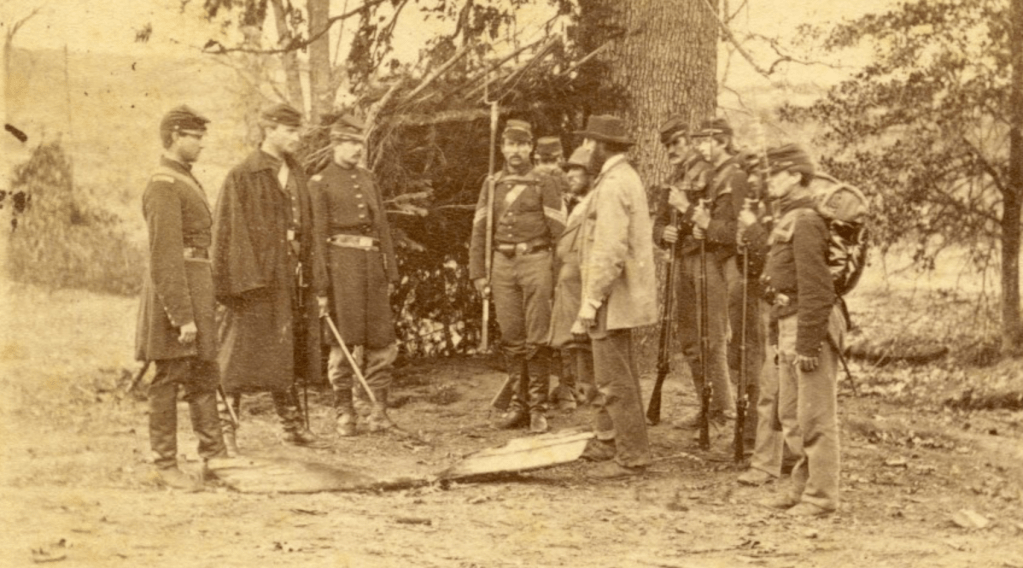
The original tintype of the 1st State Colors of the 83rd Pennsylvania Infantry with colorbearer Alexander Rodgers. The CDVs of the image were copy shots of this tintype. From the collection of Captain John Sell of the 83rd in the archives of CalState Northridge.
[Note: This letter is from the private collection of James Campbell and was offered for transcription and publication on Spared & Shared by express consent.]
Transcription
Camp near the Chickahominy June the 2, 1862
Dear Friend James,
I now take my pen in hand to answer your welcome letter which come to had in due season. I am well at present and I hope that when this letter reaches you it will find you enjoying good health. Well James, I must give you a few details of what have been going on since I last wrote to you. We are about five miles from the heart of rebeldom. Yesterday our men fought pretty near all day. Our men were victorious. 1
Jim, I wish you were here to see the rebel pimps run when we begin to shell them. I must give you a little account of the fight that I was in at Hanover Court House. It was a hard fight. I thought the killed and wounded on our side was about 75. As near as I can find out, the rebels loss was about twice the number. We took a good many prisoners. The rebel troops that we fought was mostly North Carolina chaps. They said they were glad to be taken prisoners. They were armed with the old musket that our men fought in the revolution. They were very poorly dressed and said they had not enough to eat.
While we was out there, we destroyed the rebels railroad bridge and tore their telegraph and we captured a large amount of tobacco and sugar. We killed a large supply of fresh meat. The weather is very warm here. Corn is about eight inches high. Winter wheat is all headed out. I think that before next Saturday that Richmond will be in our hands. I hope so.
Well James, I don’t know that I can give you any more news this time. You must write very soon. Yours truly, C. E. Pettis
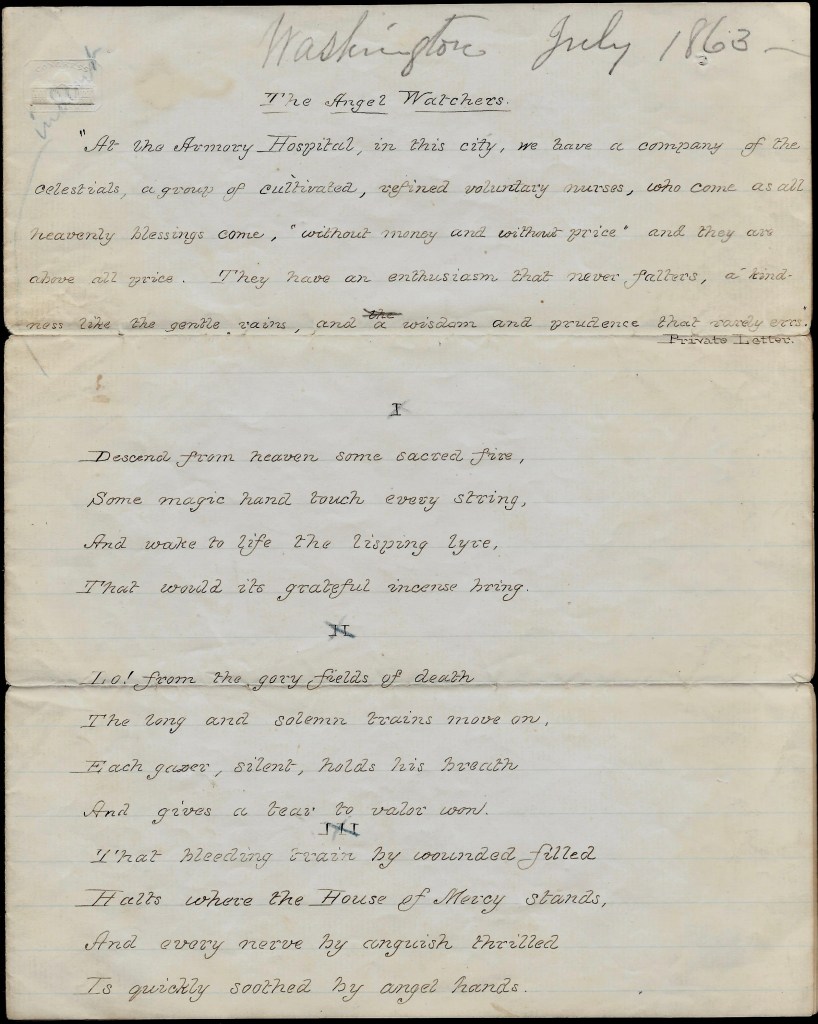
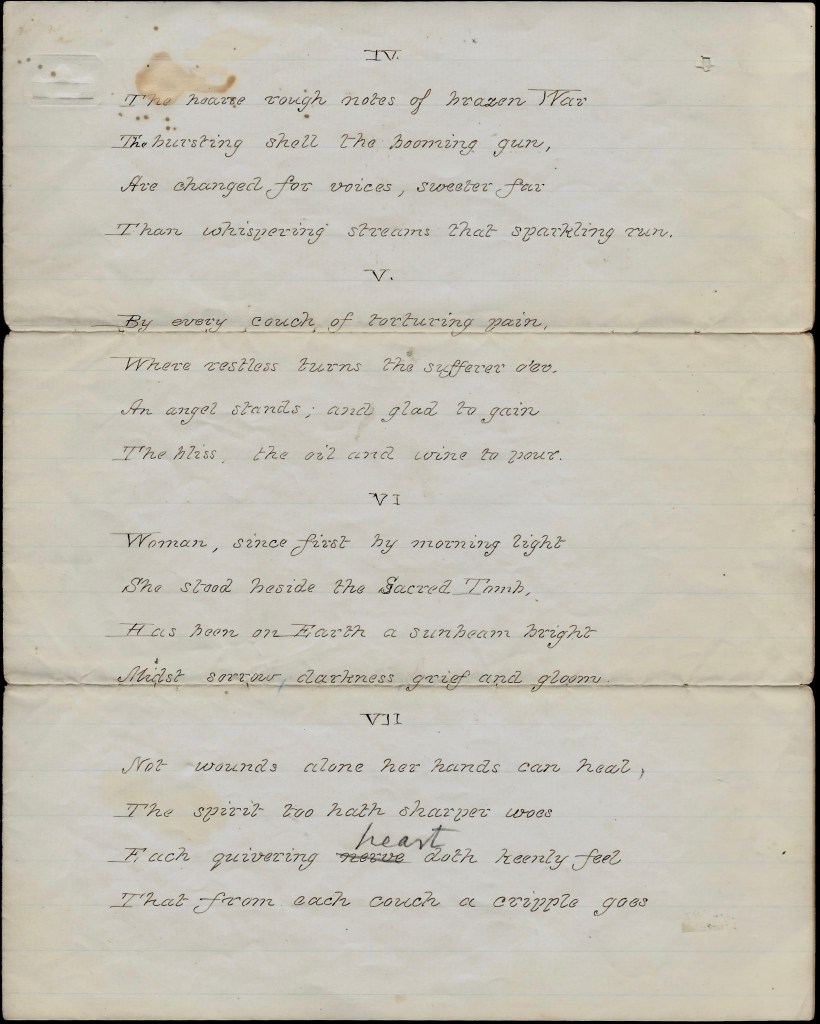
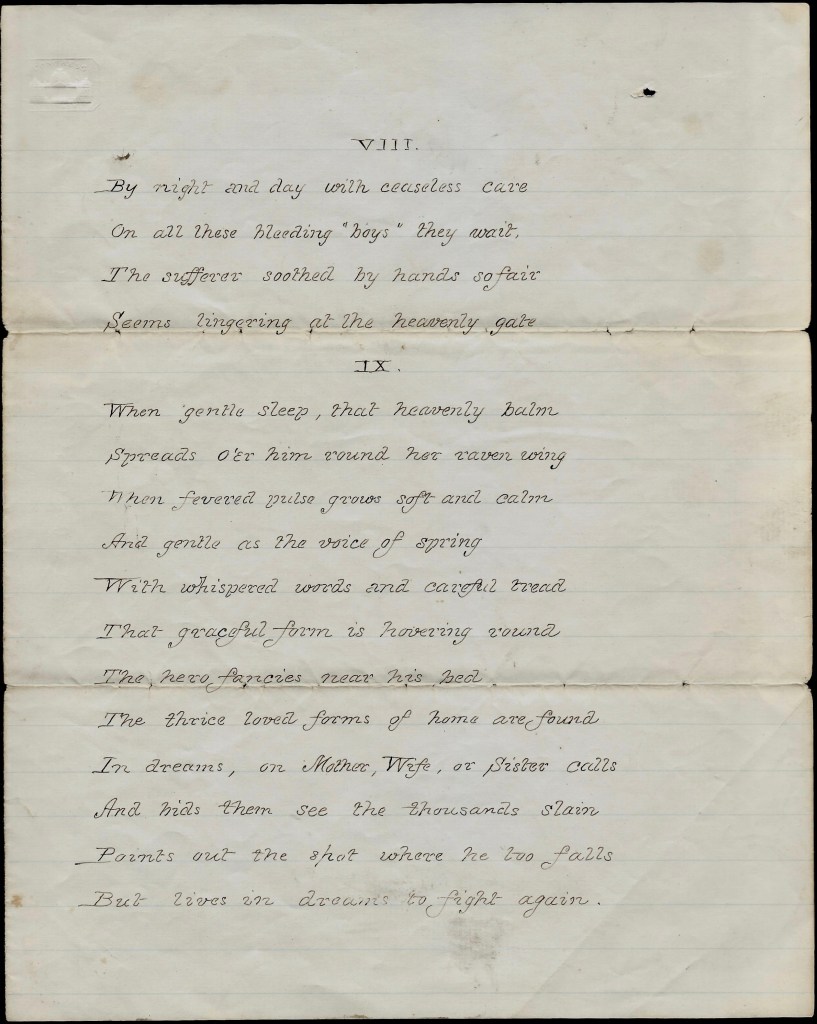
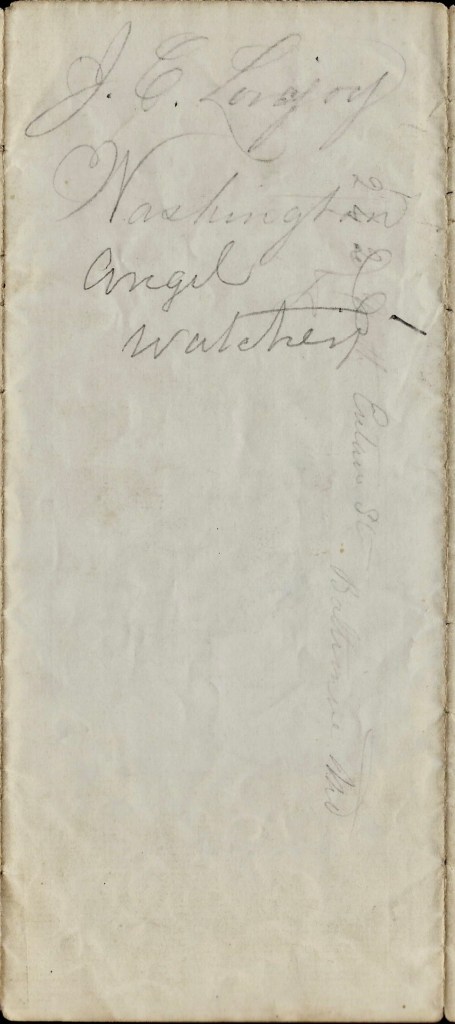
The poem titled “The Angel Watchers” comes from a private collection and is a precious piece of history. It was penned presumably in July of 1863, as indicated at the top of the page. On one of the pages, the name “J. C. Lovejoy” is inscribed, sparking curiosity about the author’s identity. Months after I posted this poem on Spared & Shared, I received a solid clue (see comments) from Eric Pominville who suggested the poem was written by Joseph Cammett Lovejoy (1805-1871), the older brother of Congressman Owen Lovejoy. According to Eric, who has been researching Armory Square General Hospital, he reports that Amanda Akin Stearns (1909) memoir, The Lady Nurse of Ward E, Mr. Lovejoy was a frequent visitor at Armory Square and was well known to the hospital staff. Writing under the date May 14, 1863: “A gallant old gentleman in Congress (brother of Owen Lovejoy, the noted Abolitionist) was introduced to us by Mrs. [Henrietta Crosby] Ingersoll. He says, “We can take care of the soldiers, and he will take care of us,” so he comes quite often to accompany us in a walk after supper through the Capitol grounds. He writes verses, and is a friend of Mrs. Sen. [Henry Smith] Lane. Tomorrow for diversion, he is to take a party of us to another hospital, where they have theatrical entertainments.” Akin, The Lady Nurse of Ward E, (1909), p. 27-28.
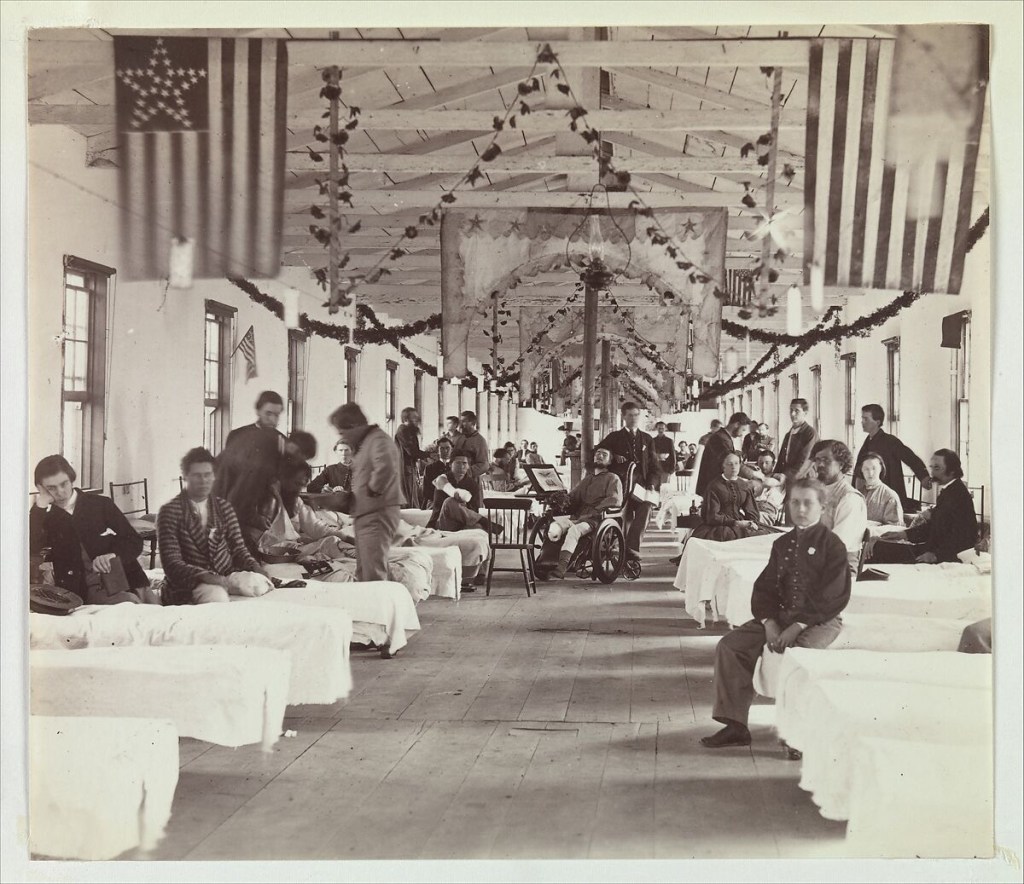
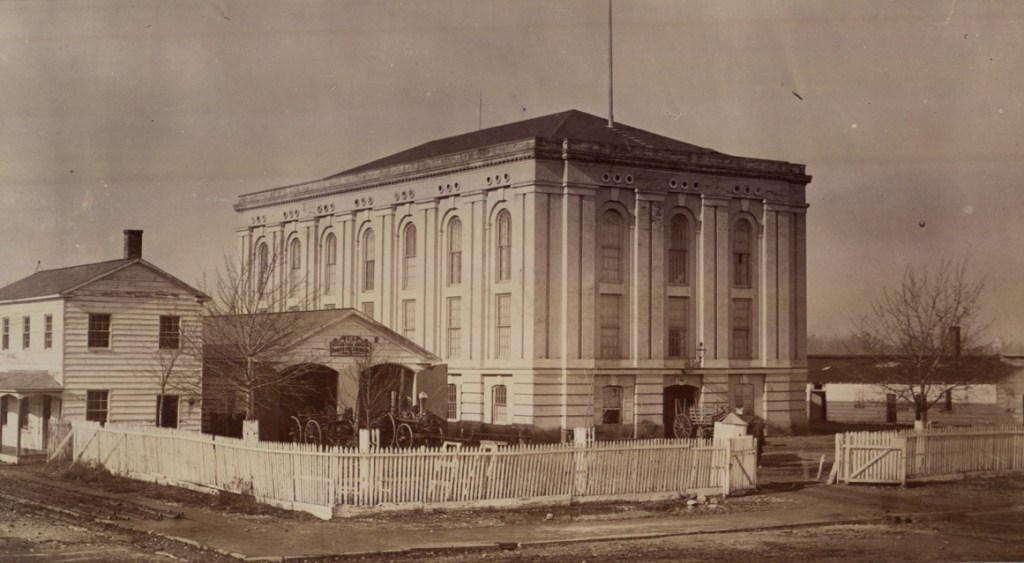
I have searched the internet extensively to look for evidence that this poem was published at some time but could not find it. That search included newspapers and “Google Books,” etc. The Armory Hospital was established in 1862. It was constructed on land adjacent to the Smithsonian Institution, approximately where the National Air and Space Museum is today. There was an anniversary celebration at the hospital in August 1863. Perhaps that is when this photograph was taken and was the occasion for the poem.
Armory Hospital in the District of Columbia
The Angel Watchers
At the Armory Hospital, in this city, we have a company of the celestials, a group of cultivated, refined voluntary nurses, who come as all heavenly blessings come, “without money and without price” and they are above all price. They have an enthusiasm that never falters, a kindness like the gentle rains, and a wisdom and prudence that rarely errs. Private Letter.
Descend from heaven some sacred fire, some magic hand touch every string, And wake to life the lisping lyre, That would its grateful incense bring.
Lo! from the gory fields of death The long and solemn trains move on, Each gazer, silent, holds his breath And gives a tear to valor won.
That bleeding train by wounded filled Halts where the House of Mercy stands, And ever nerve by anguish thrilled Is quickly soothed by angel hands.
The hoarse rough notes of brazen war The bursting shell the booming gun, Are changed for voices, sweeter far Than whispering streams that sparkling run.
By every couch of torturing pain, Where restless turns the sufferer o’er, An angel stands, and glad to gain The bliss, the oil and wine to pour.
Woman, since first by morning light She stood beside the Sacred Tomb, Has born on Earth a sunbeam bright Midst sorrow, darkness, grief and gloom.
Not wounds alone her hands can heal, The spirit too hath sharper woes Each quivering heart doth keenly feel That from each couch a cripple goes.
Nancy Maria Hill, one of the nurses that worked at Armory Square Hospital(LOC)
By night and day with ceaseless care On all these bleeding “boys” they wait, The sufferer soothed by hands so fair Seems lingering at the heavenly gate.
When gentle sleep, that heavenly balm Spreads o’er him round her raven wing When fevered pulse grows soft and calm And gentle as the voice of spring
With whispered words and careful tread That graceful form is hovering round The hero facies near his bed The thrice loved forms of home are found
In dreams, on Mother, Wife, and Sister calls And bids them see the thousands slain Points out the spot where he too falls. But lives in dreams to fight again.
Exterior of Armory Square Hospital during the Civil War,
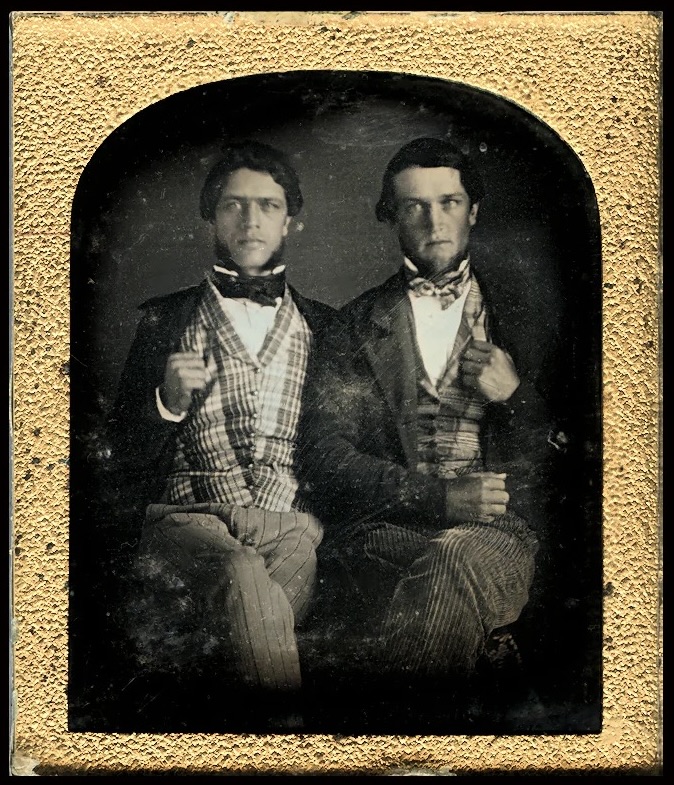
How these two friends might have looked at the time.
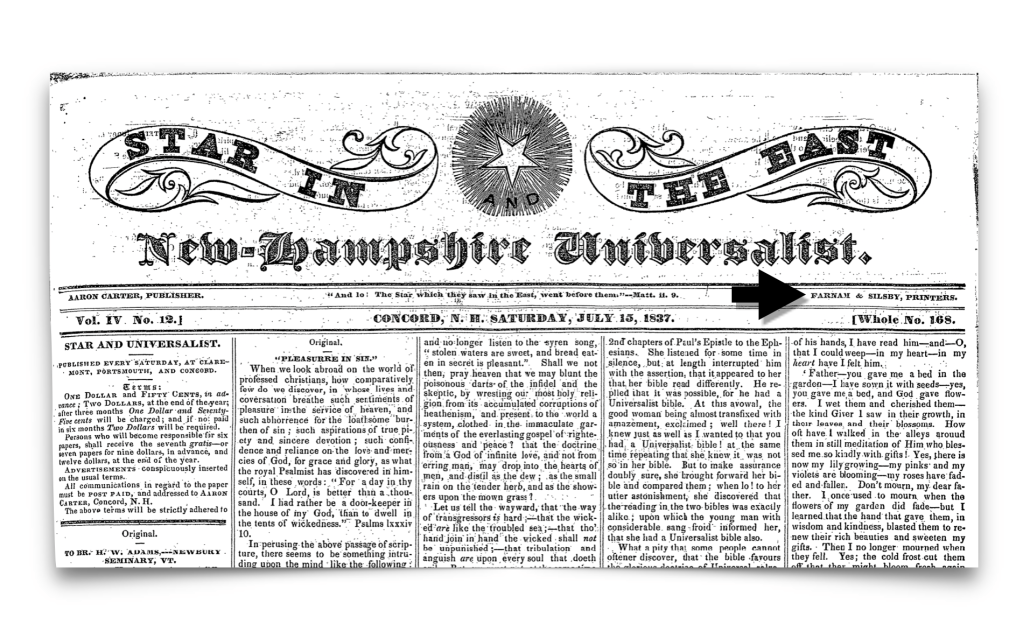
The following letter was written by Henry Simpson Mesinger Farnam (1815-1878), the son of Roger and Susan (Everett) Farnam of Attleboro, Massachusetts. Henry wrote the letter to his friend, George Henry Hough Silsby (1817-1892), the son of Ozias and Francis (Jones) Silsby of Hillsboro county, New Hampshire. We learn from the letter that Henry and George were former partners in the publication, “Star in the East“—a religious newspaper out of Concord, New Hampshire. The letter was written in the midst of the financial depression that occurred in 1837 so my assumption is that the newspaper failed as did many small businesses at that time.
From what little I could find on both young men, George remained in Concord all of his life. He ran for the position of town clerk in Concord, N. H. in 1849 but was defeated. In the 1850s he was a partner in the printing firm of Morrill & Silsby on Main Street in Concord. George was a stationer, printer, and bookbinder, and followed that business during the active period of his life.
Henry left Concord and attempted to earn a living in the District of Columbia, in New York City in the early 1840s. He may have been the same Henry S. M. Farnam (Farnam & Osgood) groceries and dry goods, who was listed in the 1867 Concord, New Hampshire.
Henry’s letter is a tantalizing treasure trove of historical tidbits delving into the social and political scene of the District of Columbia in the late 1830s. Within its pages, he regales us with colorful depictions of Henry Clay, James Buchanan, and John Quincy Adams, shedding light on the excessive alcohol consumption among Congressmen and the proliferation of brothels in the city.
The July 1837 Issue of the “Star in the East” printed by Farnam & Silsby in Concord, N.H.
Transcription
Washington D. C. April 23, 1838
Friend Silsby,
“God bless you!” is just such a salutation as I should greet you with were I to meet you in person or perhaps might “run in this wise”—“God bless you, Squire, give us your hand.” But as it would be useless and vain for me to add the request here, I will content myself with invoking the blessing.
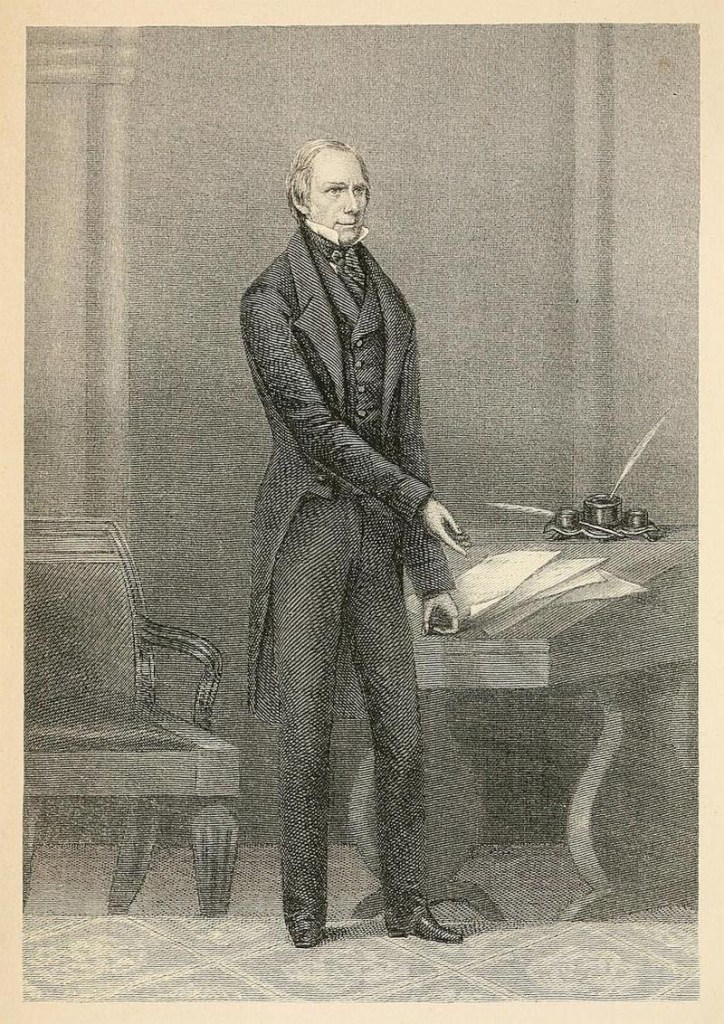
Henry Clay as he appeared in the late 1830s.
I am on a furlough this afternoon which you know is a very desirable respite to a jour[neyman] printer—especially when he has the consolation of knowing when Saturday night comes round that he shall find his bill docked at the rate of 20 cents per hour during his absence. But I shall be called on duty again tomorrow morning, while three poor devils received the gratifying intelligence when they come into the office this morning that that their services were no longer required. Four of us were furloughed for this afternoon only, one of whom concluded that it would be a good time to take a “round turn” as they call it here—what we at the North usually call a “bust“—and he has probably arrived at the corner and capsized before this; while two others and myself took a “B-line” for the Capitol where we hear Henry Clay make one of his best speeches, a short one however, and a reply to it from Buchanan of Pennsylvania. Clay is a noble-looking fellow, and his eloquence when speaking exceeds all the lofty opinions I had ever formed of it from what I had read and heard of his greatness as an orator and debater. the likeness in his biography, which you have seen, is a good one. Buchanan too is one of the finest speakers in the Senate. I have heard the most of the distinguished men in the Senate speak a few minutes each, and some of the most talented ones in the House. 1
I went into the House a few moments this afternoon. Old Johnny Q. [John Quincy Adams] had the floor, and, as usual, expressing his opinions without “fear or favor.” But the way some of the Senators and Reps. “liquor up” and “lay in” makes it profitable for those [who] deal in brandy and “balm!” You know what kind of an article Hodgdon kept, which the owl said was “tainted by the sea breezes,” don’t you? Well then you know what “balm” is, as it is termed here.
One of the Reps. the other day got his feet knocked from under him on Pennsylvania Avenue by an ungrateful little fellow by the name of alcohol whom he had very hospitably given shelter in his head, but the little rascal having a curiosity to see what was in the other extremes of the premises took the liberty of intruding himself into the props of his protector, and upset his corporation. Another one took a “round turn” with one of the jours. of our office last week and the story is (and it is true) that the honorable M. C. fell into the canal which probably cooled him off a little! As for the article of “balm”, I suppose there is no city of its size in the Union where such an extensive business is done at it as in this—so I have been told—and so I should think from the number [of] establishments that have been pointed out to me—and the great quantity of frail sisters who promenade the streets both day and night.
I received this morning a letter from Isaac Davis—Young’s private secretary, I suppose, as it was in answer to a letter I wrote Young. It was a very interesting letter and I think Young has made a very good selection. He stated that you read my letter to him and so you got most of the particulars of my journey here. The Stonington Excursion was rather a “hard siege” taking everything into consideration but we made the best of it and that night and the next day we were a jolly crew. Old Finn, the comedian, was one of the number, and he gave us puns and conundrums enough to make up for our bad fare, extra expense, and lost time. I came on in company with him from Boston to this place. He played here a few nights.
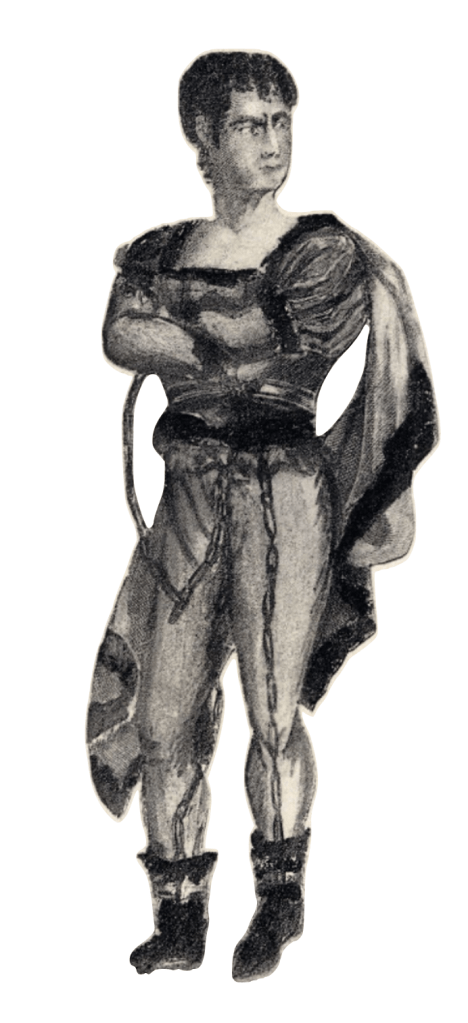
Edwin Forrest in his William Tell costume (Illinois Library Digital Collections)
They have a good theater building here but a poor set of stock actors. Forrest and Booth have both played here since I came to this city, I saw Booth in Brutus and Forrest in Richard, William Tell, Virginians, and two or three other characters. I never saw so noble-looking fellow as Forrest is—and then his acting, my God! if it wouldn’t bear one “on the wings of poetry to the regions of ineffable refulgence!” He must be as “devoid of soul as a statue!” Booth is a small man but he is a powerful actor.
Well, Squire, how “wags the world” with you in these hard times? You are having you $7 per week and a permanent situation, I suppose. I wish to God I was as well off. It is true, I am having pretty good wages just now, but then in a month from now. I expect to be on my oars when I shall have to make tracks for some other region and spend what I have earned in traveling and lounging about in cities with nothing to do. A good cit. [situation] in Concord at 7 per week is not to be sneered at and I advise all who have got such an [one] to hold on to it as long as they can.
The blues crawl over me sometimes when I think of the pleasant days I have spent in Old Concord, and among the best of those I may reckon my sojourn at the “Star” office, with you as a comp[anion], when our names went forth weekly to give character and influence to the important and sacred truths contained in the sheet which bore them; scattering light from the darkest corners of the Grany State, to “Bluffsdale, Green county, Illinois”—the residence of that believer “in the faith and delivered to the Saints,” Abram Coon!! 1 It is strange that we could not have been contented while enjoying such a distinction! But man is never satisfied, you now, until contentment would be of no avail, and then he only thinks he should be. However, I think we did enjoy ourselves during that period; at any rate, I would be willing to try it over again. But the fact is, I don’t expect I shall see Concord again very soon, but I should like to see all of the old acquaintances that I formed there—especially the members of the craft. But that never will be “this side of the gate whereof St. Peter holds the key.” They are scattered over the earth and will probably never be collected until Gabriel blows his bugle for the last time. But without any joking, it akes me feel melancholy to reflect on it.
Squire, I haven’t a friend on God’s earth whom I would give more to see than Silsby! If you were here, I should feel perfectly contented, come what would. But as that is altogether out of the question, there is one way in which you can render me a very essential service—and that is—as you cannot “shed upon me the light of countenance“—-to “shed upon me the light of your mind,” through a sheet of foolscap! Yes, I want you to fill out one of the largest kind, with close matter, and thin-spaced (minion type) of all the interesting events, &c. that have transpired in Concord and vicinity since I left. Winter, I understand, has left Barton’s and Foster has taken his place. What was the trouble?
I see by the Bap[tist] Reg[ister] that there has been a great revival in Concord, and that great numbers have been added, &c. Just give us the names, if there has been any remarkable instances. There are at least forty things that I intended to have mentioned when I commenced this letter I have forgotten. I shall probably go to New York when I am out here and if I don’t get work there, I don’t know whether I shall go to Boston or to the West! Oh, by the way, I received a letter from Sherman the other day. He says he is in the paper-making business yet. Fisher is with him. He didn’t say whether they were in the money-making business or not. Tell Isaac that I will endeavor to answer his letter before long. Tell Elder Morse if he goes to New York to let me know it.
Now Squire, I want you to answer this without delay. Don’t be afraid of exposing your penmanship to my criticisms, although it may not bear a comparison with mine!! Give my respects to all who recollect me. I must wind up by subscribing myself your everlasting friend, “in the bonds of the gospel” — H. S. M. Farnam
P. S. I dare not read this over, and, shall have you to correct the errors. I will endeavor to a more interesting next time, that after I receive one from you which I shall expect soon. I suppose you are freezing in New Hampshire yet. We have had it hot enough to “scorch a feather”—peach trees blossomed a week ago. We have pretty good living here—poultry a plenty of it, from turkeys down to robins, blue birds, and even yellow birds—four to the mouthful. Possums too brought into market every morning! Oh, I’ve left off chewing tobacco–[ ] today! and take but 3 glasses of ale a day! — H. S. M. F.
1 In 1837, Henry Clay was hard at work in a successful effort to organize and strengthen the new Whig party. In his attempt to provide for it an ideological core, he emphasized restoration of the Bank of the United States, distribution of the treasury surplus to the states, continued adherence to his Compromise Tariff Act of 1833, and federal funding of internal improvements. The achievement of these goals, Clay reasoned, would mitigate the severe impact of the Depression of 1837 and sweep the Whigs into the White House in 1840.A review of the newspapers at the time of this letter suggests Clay’s speech probably had something to do with the distribution of the treasury surplus.
2 Abraham Coon (1810-1885) was a member of the Church of Jesus Christ of Latter-day Saints.
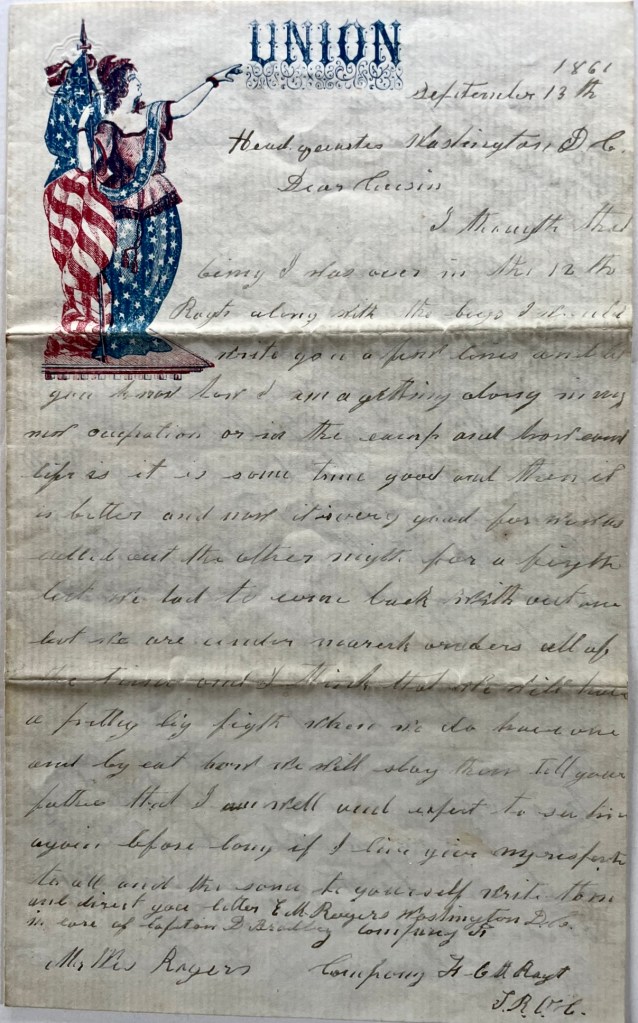
The first part of this letter was written by Elephalet Mason Rogers (1831-1862), the son of Isaac Rogers (1771-1846) and Zilpha Mason (1806-1859) of Bradford county. Eliphalet enlisted in July 1861 in Co. F (the “Northern Invincibles”), 6th Pennsylvania Reserve Infantry (35th Regt. Pennsylvania Vols.) and was killed in action at the Battle of Antietam on 17 September 1862. 1 He wrote the letter to his cousin, John Wesley Rogers (1840-1932), the son of Moses Austin Rogers (1806-1879) and Jane Sadler (1810-1892) of Forksville, Sullivan county, Pennsylvania. Wesley later enlisted in Co. G, 26th Pennsylvania Militia.
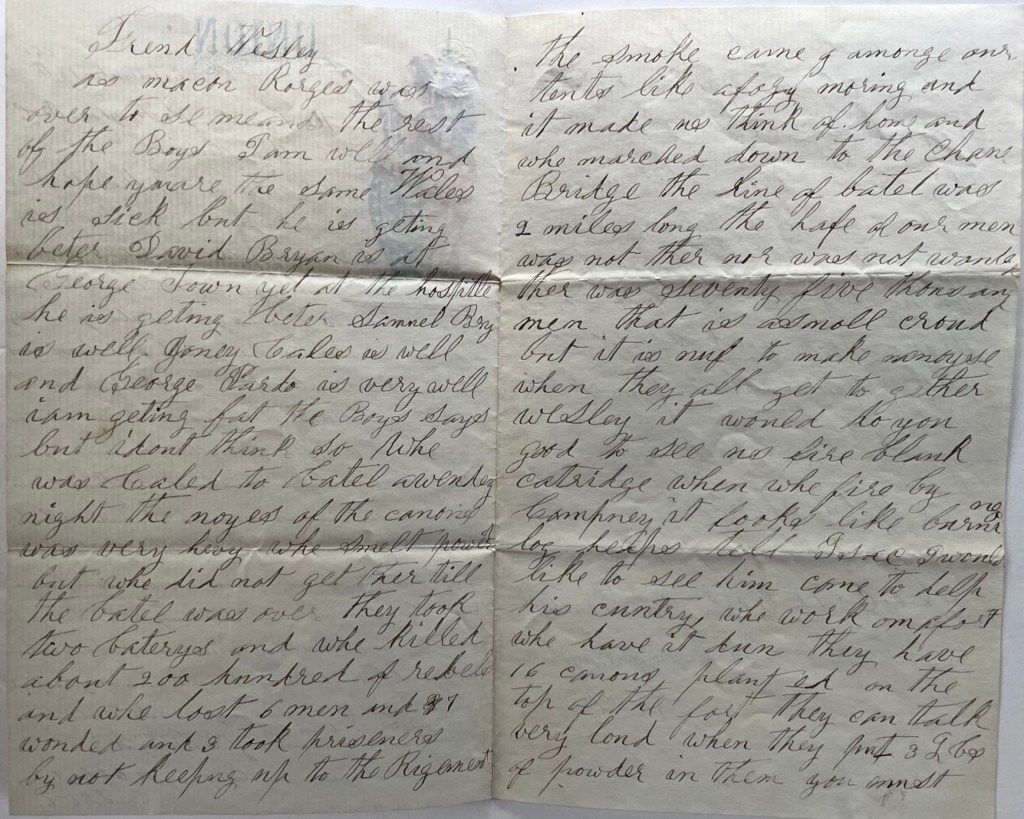
The second part of the letter was written by John Speaker Osler (1839-1934) who enlisted as a private in Co. C, 12th Pennsylvania Reserves (41st Regt. Pennsylvania Vols.). John was the eldest son of John Hinkle Osler (1808-1891) and Jane Myers (1813-1891) of Forksville, Sullivan county, Pennsylvania. John mustered into the regiment in August 1861 as a corporal. He was discharged for disability on 31 May 1862 after 11 and a half months of service. His letter mentions the Battle of Lewinsville that took place two days earlier.
The “Cameron Highlanders” of the 79th New York are reprising their roles as pickets during their reconnaissance of Lewinsville, Virginia on Sept. 11, 1861. (LOC)
[Note: This letter is from the personal collection of Greg Herr and was transcribed and published on Spared & Shared by express consent.]
Transcription
Headquarters, Washington D. C. [Friday] September 13th 1861
Dear Cousin,
I thought that being [as] I was over in the 12th Regt. along with the boys, I would write you a few lines and let you know how I am getting along in my new occupation, or in the camp and brass wood [?] life. It is sometimes good and then it is better and now it is very good for we was called out the other night for a fight, but we had to come back without one. But we are under marching orders all of the time and I think that we will have a pretty big fight when we do have one, and by [ ] we will stay there. Tell your father that I am well and expect to see him again before long if I live. Give my respects to all and the same to yourself. Write to me and direct your letter—E. M. Rogers, Washington D. C., in care of Captain D. Bradley, Company F.
Company F, 6th Regt. P. R. V. C.
To Mr. Wes Rogers
[in a different hand]
Friend Wesley,
As Macon Rogers was over to see me and the rest of the boys, I am well and hope you are the same. Wales is sick but he is getting better. David Bryan is at Georgetown yet at the hospital. He is getting better. Heter Samuel Brey is well. Joney Cales is well and George Parks is very well. I am getting fat, the boys says, but I don’t think so.
We was called to battle Wednesday night [11 September 1861]. 2 The noise of the cannons was very heavy. We smelled powder but we did not get there till the battle was over. They took two batteries and we killed about 200 hundred of rebels and we lost 6 men and 7 wounded and 3 took prisoners by not keeping up to the regiment. The smoke came among our tents like a foggy morning and it made me think of home and we marched down to the chain bridge. The line of battle was two miles long. The half of our men was not there nor was not wanted. There was seventy-five thousand men—that is a small crowd, but it is enough to make a noise when they all get together.
Wesley, it would do you good to see us fire blank cartridges when we fire by company. It looks like burning log [ ]. Tell Isaac I would like to see him come to help his country, who work on a fort. We have it done. They have 16 cannons planted on top of the fort. They can talk very loud when they put 3 lbs. of powder in them.
You must write to me and let me know all about the young folks. I send my best respects to all of the boys. Let my folks know that you got a letter from me. Will have to bring my scribbling to a close. Write soon and so goodbye. Your friend, — John S. Osler.
How to direct to me:
John S. Osler, Co. C, 12th Regiment, Pennsylvania Regt. Vols., In care of Captain [Richard] Gustin
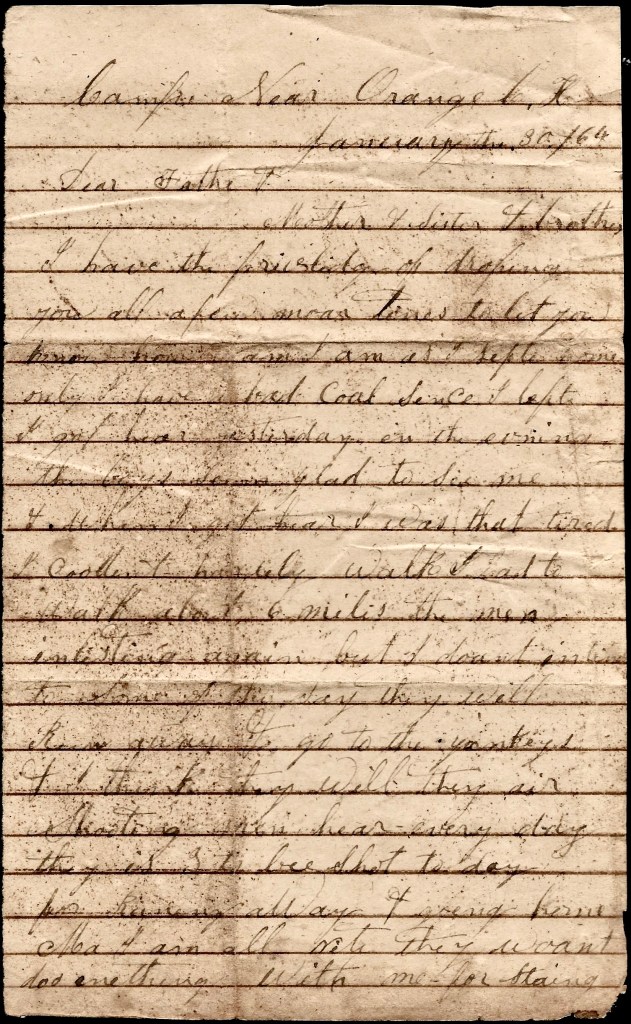
The following letter was written by Franklin L. Stuard (1839-1865), the oldest son of Mathaniel Thomas Stuard (1817-1897) and Caroline Jane Robeson (1816-1896) of Lincolnton, Lincoln county, North Carolina.
According to Muster rolls, Frank enlisted in May 1861 as a private in Co. B, 23rd North Carolina Infantry. He was severely wounded two years later in the Battle of Chancellorsville and treated at Winder Hospital in Richmond but returned to his regiment in January 1864 when this letter was penned. It was the 23rd North Carolina that took the lead in Stonewall Jackson’s immortal night march that fell upon the unsuspecting right flank of Hooker’s army. Frank’s military record does not inform us of his death but his grave marker stated that he was killed on 5 April 1865, most likely in the Battle of Amelia Springs.
Transcription
Addressed to Mr. N. T. Stuard, Lincolnton, North Carolina
Camp near Orange Court House January the 30th 1864
Dear Father & Mother & Sister & Brothers,
I have the privilege of dropping you all a few more lines to let you know how I am. I am as I left home only I have a bad cold since I left. I got here yesterday in the evening. The boys [were] some glad to see me & when I got here I was that tired, I couldn’t hardly walk. I had to walk about six miles. The men are enlisting again but I don’t intend to. Some of them say they will run away & go to the Yankees & I think they will. They are shooting men here every day. There is three to be shot today for running away & going home.
Ma, I am all right. They won’t do anything with me for staying at home without furlough but if I had of stayed any longer, they might of tried it. But as it is, they don’t say anything.
I haven’t any news to write that will interest you in the least. I [had] written to you all [the news] when I was at Richmond. I wrote on Thursday & I thought I would write a few lines today. Ma, I want you to write & tell me how Harriet is getting along. I want to see her mighty bad. I won’t say any more for the present—only I want you to write as soon as you get this & give me all of the news.
Direst your letters to Orange Court House, Va.
So I will stop for the present. So goodbye, — F. L. Stuard
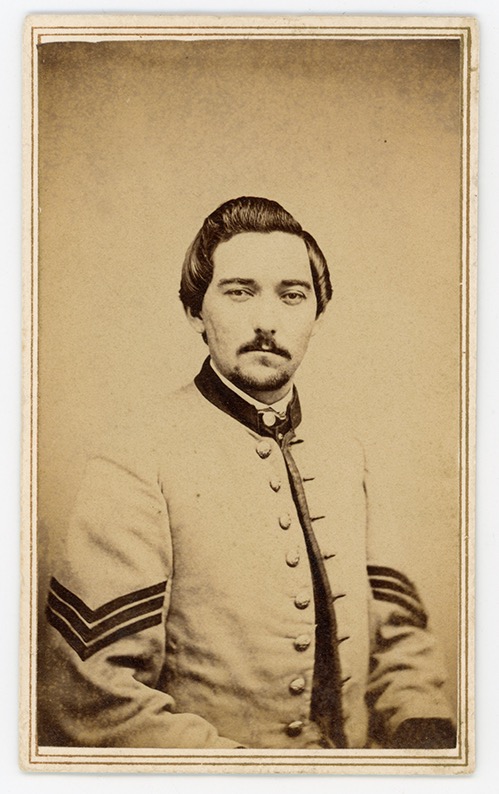
I could not find an image of Samuel but here is one of Henry P. Ralston who also served in the 13th Michigan (Co. H). He was transferred to the VRC in January 1864. (Dale Niessen Collection)
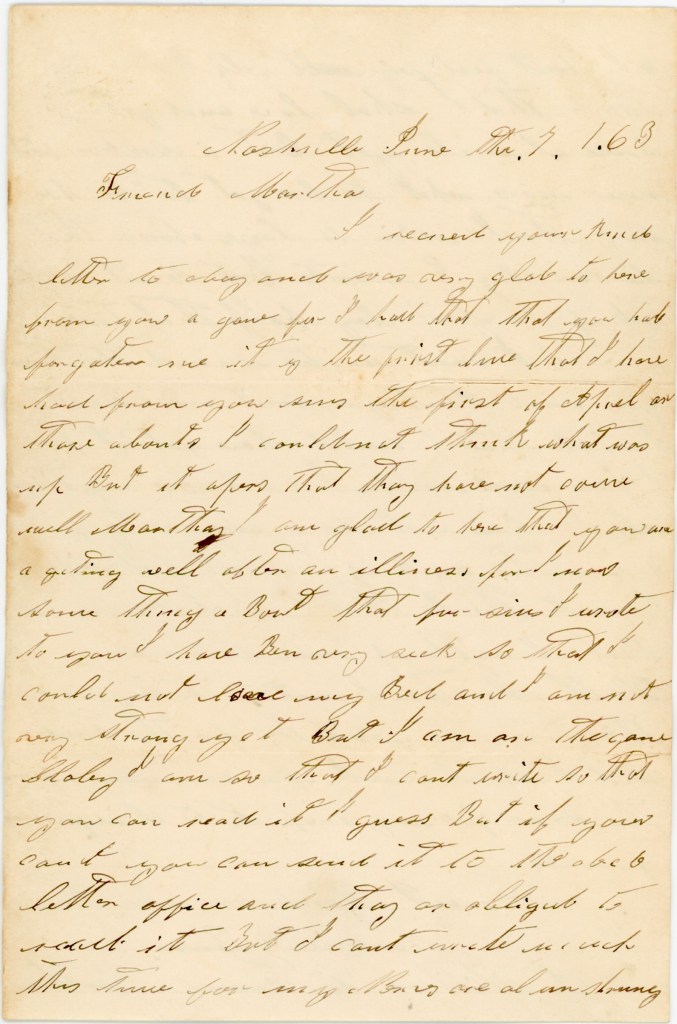
The following letter was written by Samuel Elisha Stillson (1833-1902) of Co. B, 13th Michigan Infantry. In the 1860 US Census, Samuel was enumerated in Manlius township, Allegan county, Michigan, working as a day laborer. He was mustered into the regiment as a private in January 1862 but we learn from his letter, datelined from Nashville in June 1863 that he had been ill and unfit for duty at least nine months. And though he seemed uncertain if he would return to duty, his military record indicates that he had returned to his regiment three months later as he was wounded in action at the Battle of Chickamauga on 20 September 1863 and promoted to corporal in April 1864.
Ancestry.com has a genealogical record that informs us Samuel’s parents were William Briggs Stillson (1804-1881) and Sophia Hutchins (1805-1870) of Ganges township in Allegan county, formerly of Rochester, New York. No marriage date is given but multiple sources give Mariah Billings (1843-1899) as his wife. Given her age and the dates of her children, the marriage must have occurred in 1859 when she was barely 16.
[Note: This letter is from the private collection of Dale Niessen and was transcribed and published on Spared & Shared by express consent.]
Transcription
Addressed to Mrs. Martha A. Haines, Saugatuck, Allegan county, Michigan
Nashville [Tennessee] June the 7th, 1863
I received your kind letter today and was very glad to hear from you again for I had thought that you had forgotten me. It is the first line that I have had from you since the first of April or thereabouts. I couldn’t think what was up but it appears that they have not come.
Well, Martha, I am glad to hear that you are a getting well after an illness for I know something about that, for since I wrote to you I have been very sick so that I could not leave my bed and I am not very strong yet. But I am on the gain slowly. I am so that I can’t write so that you can read it, I guess. But if you can’t, you can send it to the dead letter office and they are obliged to read it. But I can’t write much this time for my nerves are all unstrung. I don’t feel my self but I think that I shall live and get home alright yet. But a soldier don’t never know what he has got to know. He may think when he lays down that he can lay five minutes but he ain’t disappointed if he about lay half that time.
Well, I can’t write much this time. You said that you sent me a book. I wish that I could have got it for I can read when I can’t do anything else. I have not have any duty for 9 months and if I don’t [soon] feel different, I don’t think that I shall do any for that length of time to come.
Well Martha, I can’t write any more this time so goodbye for this time and I shall look for an answer from this soon. Give my respects to all enquiring friends. Direct [to] Woods [?] Convalescent Camp, Nashville, Tenn.



















 Spared & Shared 23