1862: Daniel Wilson George to Edward Warner

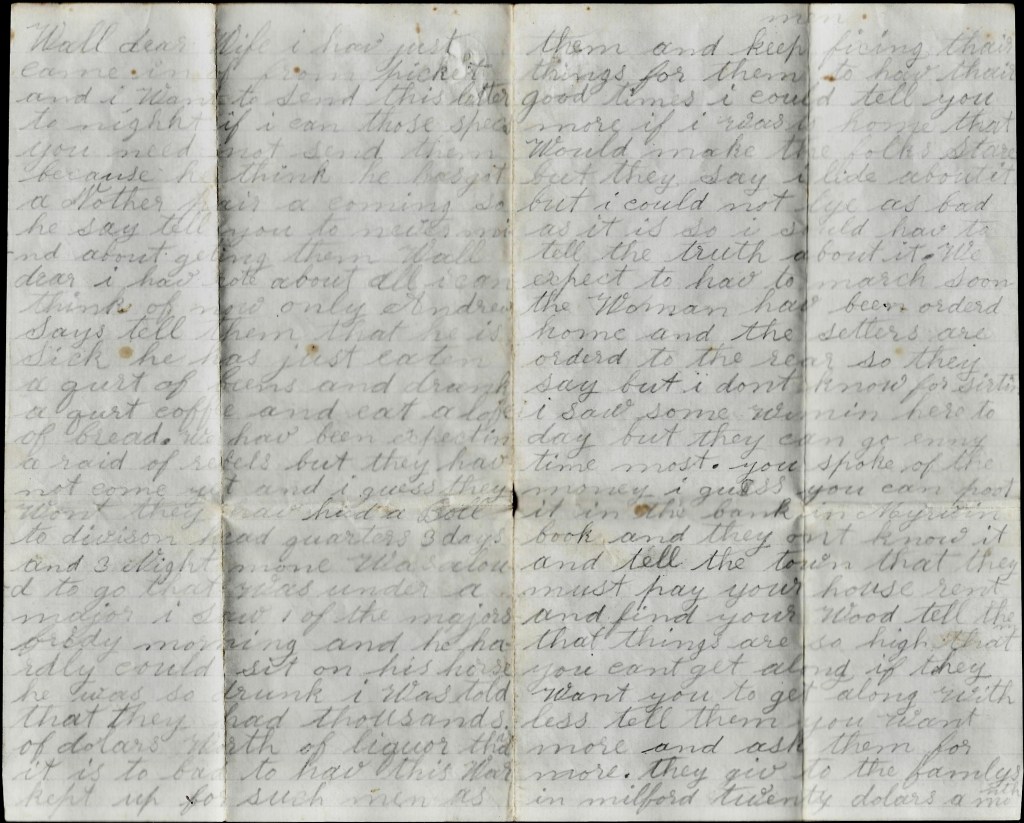
The following letter was written by Daniel W. George (1843-1876), the son of Roswell and Julia George. He wrote the letter to his cousin, Edward Warner in Acworth, New Hampshire.

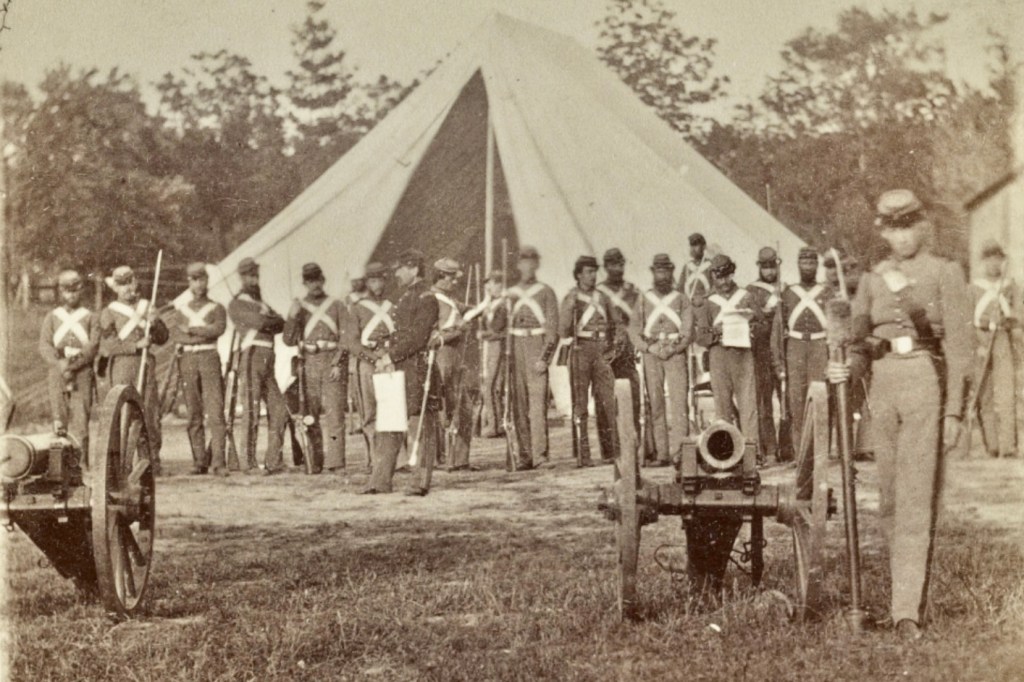
I could not find an image of Daniel but here is Joseph H. Whitehouse, a drummer boy who served in Co. D, 5th New Hampshire Infantry (Ancestry)

Daniel named Acworth as his birthplace at the time of his first enlistment as a private in Co, D, 1st New Hampshire Infantry on 24 May 1861. He mustered out three months later on 9 August 1861. Later, in September 1861, he reenlisted in Co. E, 5th New Hampshire Infantry, in which regiment he was serving at the time he wrote this letter from Falmouth, Virginia, just after the Battle of Fredericksburg in which they participated and suffered heavy casualties. Daniel survived the war, mustering out on 28 October 1864, and later (1867) married Sarah C. Russell in Ashburnham, Massachusetts.

The 5th New Hampshire, sometimes called “the Fighting Fifth,” sustained more battle deaths than any other regiment—nearly 300 killed or mortally wounded in their four years of service. They were ably led by Colonel Edward E. Cross until he was mortally wounded himself at Gettysburg. At the Battle of Fredericksburg, the regiment entered the fray on the heels of the Irish Brigade where they immediately fell under heavy fire of shell, grape and canister. When the Irish Brigade stumbled, the 5th continued their ascent on the enemy works but were also cut down. “My brave boys never faltered,” Col. Cross later wrote of the attack.

Transcription

Addressed to Edward Warner, Esq., Acworth, New Hampshire

Camp near Falmouth, Va.
December 19, 1862

Dear Cousin,

With much pleasure I take my pen in hand to let you know that I am alive and well. I have been in a great many hard places since that I left New Hampshire and expect to go into some more before I get home. Last Saturday I was in a battle and a hard one too. This regiment lost one hundred and seventy-eight men killed and wounded and there is eight for duty now in the 5th New Hampshire Vols. I got two guns shot out of my hands and got knocked over in the bargain, lamed my back but I have got over it now so that I am alright. Morrison [George] 1 got shot through the thigh. It was a flesh wound. Joseph George 2 got hit but not bad.

I have been in nine battles and this is the first time that I have got hit atall. I have been well through this campaign and hope to remain so. I have been with the regiment wherever they have been—through thick and thin.

We are expecting to go to some place to garrison but I don’t know whether we shall go or not. I hope so at any rate.

Eddy, I want you to get me three or four postage tamps and I will make it all right with you if ever I come home for I can’t get them here for love or money. Tell Marden to write and Frank too and I will answer them if I can. Give my love to Aunt and Uncle and all inquiring friends. I can’t think of any more now. Please write soon. Goodbye.

This from your cousin, — Daniel W. George

Excuse this dirt.


1 Morrison A. George was a resident of Acworth and served in Co. E, 5th New Hampshire Infantry. He was 21 when he enlisted in September 1861 and was wounded on 1 June 1862 at Fair Oaks, on 13 December 1862 at Fredericksburg, and then promoted to corporal in November 1863. He mustered out in October 1864.

2 Joseph E. George was a resident of Acworth and was 25 when he enlisted in Co. E, 5th New Hampshire Infantry on 12 August 1862. He was discharged in May 1865.

1865: Benjamin Willson Briggs to Rhoda Sophia Briggs

The following letter was written by Benjamin Willson Briggs (1842-aft1920) to his older sister Rhoda Sophia Briggs (1840-1921). They were the only children of Asa Barnard Briggs (1785-1863) and Jane Winslow (1788-1870) of Pierrepont, St. Lawrence county, New York. Rhoda was yet unmarried in 1865 when this letter was written but married Howard William Burt in 1875. Benjamin married in 1867 to Jane S. Striver (1843-1919) in Springfield, Illinois.

From the content of the letter and from the envelope it appears that in 1865, Benjamin was working for the Assessors’s Office of the US Internal Revenue Service, 8th Illinois District. We know that he married Jane in Springfield in 1867 which leads us to conjecture that he may be the same “Benjamin W. Briggs” of Pekin indicted in 1876 on petty charges of conspiring to defraud the United States in matters related to tax collecting. Later in life he appears to have taken his family to Omaha, Nebraska, where he worked as a baggage agent.

In this letter, Benjamin describes the emotional impact on himself and the community of Bloomington, Illinois, upon receiving news of the assassination of President Abraham Lincoln. He also shares a remembrance of having been at a Ford’s Theatre performance the previous September when the news of the fall of Atlanta was announced, in stark contrast to the news of the assassination. He also, surprisingly, shares his wonderment that an assassination attempt had not been made previously during Lincoln’s daily sojourn to the cottage he kept at the Soldier’s Home. Finally he mentions briefly the arrest and near hanging of a resident in Bloomington who celebrated Lincoln’s death.

[Note: This previously unpublished letter was graciously made available for transcription and publication on Spared & Shared expressly by the Sic Parvis Magna, Gratias Lesu Collection.]

Transcription

Bloomington, [Illinois]
April 16, 1865

Dear Sister,

I have received two letters from you since I have written to you. I will now endeavor to answer them both at once but I am afraid that it will be but a poor attempt for I do not feel much like writing letters today. The excitement occasioned by the terrible news of yesterday has not yet entirely subsided and therefore it is difficult for me to keep my thoughts together long enough to get them upon paper. Abraham Lincoln is no more!

No longer ago than day before yesterday the people here were all elated at the glorious prospects before them. Recruiting to be stopped and the expenses reduced. Surely the end was drawing nigh. All were gay and joy gleamed from every countenance. All were congratulating each other that this cruel war was over. What a contrast was yesterday—a fearful gloom overshadowing every countenance while the doleful gun, the tolling bell, and the city draped in mourning told of the terrible bereavement which the Nation had been doomed to suffer. The greatest and noblest of men, the national Chief Magistrate, had been stretched upon a bloody bier by the hand of a skulking assassin. Citizens looked each other in the face in blank astonishment while deep in their eyes was a troubled look that bespoke of sorrow mingled with terrible vengeance.

Last summer while I was at Washington I twice visited Ford Theatre. Once, while there, in the very midst of a play, the stage manager came forward and said, “Ladies and Gentlemen, official intelligence has just been received that Atlanta is ours. Gen. Sherman’s forces entered it at three o’clock this morning,” and he added with a triumphant air, “you can see what a man can do that gets up in the morning.” The applause was loud and long. Every loyal heart was full and every loyal mouth was open. The audience nearly all arose to their feet, hats and handkerchiefs were waved, and cheer after cheer was lustily given. The old theatre resounded with the welcome of good news. The tumult would subside at times at times seemingly to be renewed again with greater vigor. When the joy had spent itself, silence again resumed its sway and the play proceeded.

Daily National Republican, W. D. C., 3 September 1864. Mr. William Jermyn Florence (1831-1891)—who made the announcement according to the newspaper clipping—and his wife, Malvina Pray, were actors performing a Benefit at Ford’s Theatre on that evening. William’s actual surname was Conlin. He generally portrayed an Irishman and she a Yankee.

While sitting there that night enjoying the good news and the theatre, how little did I think of the awful, great, real tragedy so soon to be enacted there. I looked at the private boxes well. I remember they were filled with military personages, and the stars upon their shoulder straps told that they ranked of the first order. Abraham Lincoln was not there and it would have perhaps been well for him if he had never have gone there; and yet not there alone was he exposed to the assassin’s bullets. Always about six o’clock in the evening he would leave the Executive Mansion for his cottage in the suburb of the city. On that occasion he always had a body guard and there were always from ten to twenty curiosity seekers there eager to see him take his departure. Any man with nerves steady and strong enough to take unerring aim could easily have sent the deadly bullet on its awful mission then, and I thought to myself that by taking the precaution to become acquainted with the grounds, and have a secure hiding place looked out in case that he should effect his escape, he could stand half a chance to get away even though he did the deed before the very face and eyes of a body guard of fifty men all mounted and armed to the teeth.

The southern people must have ben actuated by a blind and bigoted vengeance to have plotted such a scheme as the one which they have carried into execution. They know not what is for their own good and they care less. They have killed a great and noble man—one whose bosom was incapable of harboring a single revengeful feeling—one who though he has been stern and unceasing in his endeavors to crush the rebels, has always held the olive branch to their view and who has declared to them that if they would lay down their arms, he would exercise “justice tempered with mercy.” Who will pardon Jeff Davis now? Aye, the bullet that laid Abraham Lincoln low killed the southerners best friend and roused a longing for revenge in northern men that one generation cannot clear away.

I cannot stop to tell you of what was done here today. How a man said if he thought the news was true, he would swing his hat high—how the mob got after the wrong man—how they finally got the right man—and how, but for the vigilent energies of the police, they would have swung him higher than he could have swung his hat. 1

It is getting dark and I must close. I have written much longer than I thought I possibly could when I sat down. My love to all with a big slice for yourself.

Your affectionate brother, — B. W. Briggs


1 I could not find and newspaper account of this incident in Bloomington, Illinois, but I don’t doubt it. There were numerous incidents of Union soldiers being arrested for saying similar things upon hearing of the assassination of the President.

1864: William Y. Joslin to Rachel (Case) Joslin

I could not find an image of William but here is one of Ezra Joseph Davy of Co. D, 121st OVI

The following letters were written by William Y. Joslin (1836-1923), the son of Jonas Joslin (1807-1886) and Lucy Butterfield (1807-1886) of Liberty, Delaware county, Ohio. William was married to Rachel S. Case (1837-1905) in 1855 and they had two children, Jenette (“Netty”) and Irvin by the time William enlisted in August 1862 as a private in Co. C, 121st Ohio Volunteers (OVI). In the 1860 US Census, the Joslin’s were enumerated in Dublin, Delaware county, Ohio.

The 121st OVI participated in the battle of Perryville in October 1862. Then, in January, 1863, it moved into Tennessee, joined Rosecrans, and was actively employed until September, when it participated in the hard fought battle of Chickamauga, with a loss of 87 men. The Regiment took part in the battles of Lookout Mountain and Mission Ridge, and in May, started on Sherman’s Atlanta campaign, taking part in all of the battles along the way. In the fall of 1864, it operated against Hood in Alabama and then joined Sherman’s march to the Sea and through the Carolinas. After Johnston’s surrender it marched via Richmond to Washington, participated in the Grand Review, and was mustered out at Columbus, Ohio, June 12, 1865. William mustered out with his company as a corporal at war’s end.

Letter 1

Nashville, Tennessee
Hospital No. 12, Ward No. 6
Monday, June 22, 1863

My dear beloved wife and children,

I once more seat myself to answer a kind letter that I received from your precious hand. It finds me improving in health very much. I don’t have any diarrhea now nor have had for over a week and my breast is getting better but I have a very lame back yet and that is most that is the trouble with me now so you needn’t feel alarmed about me for that is not dangerous.

Well, Rachel, as for getting a discharge is almost a thing impossible or a furlough the same. A man has got to be pretty badly afflicted before he can get either. I spoke to the old doctor this morning after I got the letter about examining me and he said that I better wait a while yet. I suppose he thinks that he can doctor me up so that I will be able to do duty in the hospital, if not in the field. But as for soldiering and field duty, I don’t much expect to do much more of it unless I feel better than I have this spring. But maybe I may be able to do hospital duty again. If I do, you must try and do the best you can and make the time pass off as fast as possible and think that you have got a beloved husband that thinks enough of his country to go in peril of his life to fight the battles for the country that our forefathers fought for us, although it was the hardest thing that ever came over me to leave my dearest little family and go. But I make as much calculations on getting home as I do on going to bed at night. So you may think that I hain’t give up ever getting home again.

You wanted to know what I wanted you to do with the 20 dollars that I sent you. Use what you want of it and keep some by you for you may need it occasionally. Did you get you a tea kettle and stove boiler when you was in Delaware? Tell me when you write again. You asked me how much it cost me to send my overcoat. It cost 25 cents. It was rolled up in a round roll and had two leather straps around it and a paper pinned onit directed to Mrs. William Joslin in care of Mr. Hastings, Richwood, Union county, Ohio. And W. Joslin worked in letters on the lining in the back of it if I remember right. Did you see the letters of my name on my overcoat that you remember of when I was home?


Letter 2

Camp of the 121st OVI near the Chattahoochie river
July the 14th, 1864

My dear wife & children.

I seat myself this morning to write a few lines in answer to yours of the 5th of July. It came to hand last evening and found me quite unwell. I have had the headache and a lame back and the diarrhea for the last two days but I have been taking some medicine and feel some better this morning. I have received that letter that Lucretia sent to me but I haven’t answered it yet. But I think I must today. You spoke about sending me some envelopes. I would be very glad if you would send about two or three packages of envelopes and a whole ream of the best kind of letter paper and let me hear what it cost you there so if I want to sell any of it that I will know what to ask a quire for it. You can send it by mail and it won’t cost more than ten or fifteen cents.

Well, Rachel, we have been in this camp about three days but I don’t know how long we will stay here—maybe a week or two and maybe not longer than today. We drawed some new clothes yesterday and there is some talk of getting our pay before we leave here but there ain’t nothing certain about it. If we do, I don’t expect to get more than four months pay this time.

Well, Rachel, you said that you wanted to know what I thought about you taking in some boarders. I don’t know anything about the folks in Lewisburg but I expect they are like they are in all other little towns. There would be some that would have something to say about it so I would not advise you to keep any for I don’t want anyone to have a chance to start any of their lies on you. But as for renting a part of the house, I have no objections to that if you think the family would be company for you and if he is good for the rent. You can do what you think best about it. What can you rent a part of it for? Let me know when you write to me again.

You asked me if I was with my cousin when he was shot. I was not. I was about a half a mile from him. He only lived about 5 or 6 minutes after he was shot and his messmate was with him and he said that he was sensible and talked as rational as a well person and he said that he wanted to be buried decent and where his folks could find him.

Well, I believe I have wrote all the news for the present and as for the news of the fight, you can see that in the papers plainer than I can tell you. So now, I will close hoping to hear from you once a week anyhow. Direct as before to Co. C, 121st OVI, Chattanooga, Tenn.  Goodbye for now, — William Joslin

to Rachel S. Joslin


Letter 3

[Before Atlanta]
August 16th 1864
Mrs. Rachel S. Joslin

My kind and affectionate wife,

I seat myself this afternoon to inform you that I am well and hoping this may find you and the dear little children enjoying the same blessing—good health. Well, you spoke in your letter about Mr. William Hunter in the 17th Ohio Vols. I went and saw him this forenoon and found him well and hearty. He is a very genteel appearing young man and a good-looking fellow. I think that he will be over to see me in a day or two and if we stay close together, I shall go and see him often. He told me that he received a letter from his sister last evening.

Well, Mrs. Joslin, I would be very happy to get home & get acquainted with Mr. and Mrs. Hunter for I have no doubt but they are good neighbors to live with and I think by the description of your little house and the situation of it, that it is a nice, pleasant piece of property and I would advise you to keep it until I return home, if I am so lucky as to get there, which I expect to.

Well, Rachel, I have no doubt but you see very sad, lonesome houses but to think of the way that our women in the North are situated and how much better they are provided for than the women here in the South—the principal part of the women and children here goes half naked and I think about half starved by the looks of them. There is four families living right here in our camp close to the line of breastworks where the musket balls are flying around the house and their little children running around the yard where there is as much danger as [where] we are and it seems rather hard. But they have a cave to go into at night and in the daytime when the Rebels [are] throwing their shells. But they are [mostly] in their house daytimes. It seems hard. But let them quit this fighting and go to their homes and we will do the same.

“One of the caves at Atlanta made by citizens to escape shells during the bombardment—from a sketch by our special artist”

Well, I think we will have a shower this afternoon from the appearances at the present. Well now, I think I have written all that would interest you at the present so I will close by asking to write soon and oblige your affectionate husband, — William Y. Joslin

Give my best wishes to Mr. and Mrs. Hunter and tell them their son is well. Please direct to Co. C, 121st OVI via Chattanooga, Tennessee

Well, Netty, can you and Irvin get your likenesses taken and send them to your good pa if he will send the money to you?  — Wm. Y. Joslin

The Civil War Diary of Joseph Lawrence Murray, Co. E, 16th Iowa Infantry

A post war sketch of Joseph Lawrence Murray

The following diary (or series of small diaries) were kept by Joseph Lawrence Murray (1840-1927) during his service in the Civil War. Joseph was the son of Henry Murray and Rebecca Lininger of Cairo, Louisa county, Iowa. In the 1860 US Census, 19 year-old Joseph was enumerated as the oldest child in his parent’s household. His younger siblings were 17 year-old Henry, 14 year-old Eliza, 8 year-old John P., and 4 year-old Rebecca.

According to military records, Joseph enlisted on 21 January 1862 and was mustered three days later as a private into Co. E, 16th Iowa Infantry under the able command of Colonel Alexander Chambers (1832-1888)—an 1853 graduate of West Point who had previously fought in the Third Seminole War and was still in the Regular Army when the Civil War began. As we learn from Joseph’s diary, the regiment was formed quickly and hustled into the field of action before it had time to be properly equipped and drilled, receiving cartridges for their muskets for the first time only as they disembarked from the boat at Pittsburg Landing. Only ten days before being sent onto the battlefield at Shiloh, Joseph confessed to his diary that “most all the guys I’ve talked to don’t even know how to load their guns, including myself.”

“This is a test of your courage and discipline!” shouted Colonel Chambers to his men as he led them onto the battlefield; it certainly wasn’t a test of their drilling for they had had none. “This was hard to believe for us guys who had just a few days before now were all home in Iowa, ” wrote Joseph as he witnessed wounded and panic-stricken soldiers stream past their column heading to the rear.

Following the Battle of Shiloh—the 16th Iowa Regiment now part of “Crocker’s Iowa Brigade”—Joseph’s diary takes us on the march to Corinth where, during a brief but desperate fight with the rebels, Joseph shares his experience in killing a Rebel with his bayonet. “The look that was in his eyes I will never forget,” wrote Joseph. “His blood hit me right in the face. As I pushed my tip further in the chest, he never made a sound. He just stared—eyes wide open as his life was leaving him.”

General Sterling Price’s Buffalo Mittens taken as a relic of war by Joseph L. Murray, 16th Iowa Vols.

Following the siege of Corinth, Joseph describes the march to Bolivar, the Battle of Iuka, the 2nd Battle of Corinth, and the pursuit of Price and Van Dorn’s army immediately after. From his diary we learn that the 16th Iowa came so near capturing Gen. Sterling Price that he only escaped with his life, leaving all his headquarter’s baggage in a camp to become the treasured souvenirs of Joseph and his comrades. For his war relic, Joseph came home with the buffalo mittens of Gen. Price while several of his comrades cut up the General’s buffalo blanket. A description of these relics are included near the end of Joseph’s second diary.

Joseph’s diary then describes the Vicksburg Campaign, including the mine explosion in late June 1863 when the men of the 16th Iowa “were ordered to push forward” and “surged straight ahead at the Rebels only to be met by counter attack by the enemy. At that moment it was hand-to-hand combat for what seemed to be hours and hours,” wrote Joseph. “At least five men fell at my hands and those Rebels came out of everywhere although a lot of them were killed. So were many of us.”

In the third diary, Joseph describes the entire Atlanta Campaign which came to it successful conclusion before he and the other veterans of the 16th Iowa could finally get a furlough. The fourth diary describes the march to Savannah and the Carolina Campaign.

Joseph’s diaries may be one of the best descriptions of the 16th Iowa Infantry’s record of service as I have not found any published works devoted exclusively to that unit although there are some written on “The Iowa Brigade.” Joseph was a zealot, both in terms of his faith as well as his patriotism. Anyone publishing Joseph’s war experience and searching for an appropriate title could do no better than “God bless the Union!” which he frequently used to sign off his day’s journal entries. Joseph entered the war as a green recruit, unfamiliar with the use of firearms, but eager to do his part to save the Union, including shrugging off some battle wounds and enduring the hardships and rigors of three years of war, compiling a war record to be proud of.

[Editor’s note: Joseph’s diaries are from the Sic Parvis Magna, Gratias Lesu Collection and remain in private hands. They were graciously made available expressly for transcription and publication on Spared & Shared. ]

Transcription

Diary 1

Joseph’s first diary spans the period from 20 March 1862 to 9 April 1862

20 March 1862—at 8 o’clock we are headed down to the levee. I’m told we have to wait until the quartermaster with his detail got the commissariat loaded, putting it upon our steamer and the two little barges, one on either side. It’s noon and all is ready and we marched on board, some going upon the steamer and soe upon the barges. Finally it’s 2 p.m. and we’re leaving Davenport for St. Louis. Citizens turn out in large numbers. My Ma gave me this book to write in whenever I get a chance so I’ll try to keep when I can.

21 March 1862—I had a pretty stiff introduction to my first night on a steamboat. My bunkmate, William Webster Butler, and I lay down on the deck with our heads to the smoke stack instead of our feet in order to avoud lying with our heads down hill. At 8 a.m. we landed at Montrose where two companies were transferred from our boat to another boat in order to lighten our boat for the purpose of passing through the rapids just above Keokuk in safety. About noon we are going on shore so we can cook some provisions. It’s dusk and we just returned to the boats. We are being transferred to another boat which lay at Keokuk. At night, while our steamboat proceeded down the river, we the 16th Iowa Infantry and the German Iowa Regiment have been consolidated so our regiment is called the Sixteenth Iowa Infantry, I was told. From St. Louis we will be marching to Benton Barracks. I try to write in my book as best I can because we have not yet hit any problem yet.

22 March 1862—We just left Keokuk. It’s daylight and I don’t know how long we will be on the steamer this time. Well, I’ll write some more a little later. They are saying we are going to tie up for the night. They are saying we could encounter a “secesh” battery on the banks. The weather is delightful and riding on the waters can be very enjoyable during such a time.

23 March 1862—We started down the river again at daylight and reached St. Louis at 3 p.m. We landed and marched to Benton Barracks where we were to be at home. Just as we left the boat, it commenced to rain a downpour. We marched the whole way in the rain which soaked our clothes heavily. When we got to the Barracks we built fires to dry our clothes before retiring for the night.

Benton Barracks in St. Louis, Missouri

24 March 1862—This morning we finished drying our clothes after which we cleaned up. There are several thousand troops—infantry, cavalry, and artillery here in camp. These barracks are ordinary frame structures and built around the drill grounds. Today we received our arms with no ammunition, and field equipment. I’m already missing home.

26 March 1862—New troops are arriving all the time and there are something like forty thousand men in the Barracks at present. This camp has the appearance of being nearer the seat of war. It is a novel experience for us country boys to see so many men all armed for war, some on guard duty, others leaving for the front, while still others are arriving. The commissary work of the camp is thorough and organized. Each company has a detail of cooks which serves a week at a time and then is relieved by another shift. The cooks go to the quartermaster and get the rations for five days at a time. The food is being cooked in kettles hung in a row in the rear of the Barracks and is served on long stationary stables, each accommodating a full company.

27 March 1862—We cleaned up today preparing for our first inspection and review at Benton Barracks. One of the guys, George Bedford, 1 said we should be doing drills soon. Funny thing is most all the guys I’ve talked to don’t even know how to load their guns including myself. We had our first inspection today and General Review at five o’clock. We were on dress parade but we haven’t done any drilling yet.

1 Bedford, George. Age 21. Residence Deep Creek, nativity Canada West. Enlisted Jan. 13, 1862. Mustered Jan. 28, 1862. Killed in action Sept. 19, 1862, Iuka, Miss. 

28 March 1862—Nothing of importance today. Camp life is a big change from life at home. In the army every man simply obeys orders. He knows his place and keeps it. Our officers are normally kind to us—especially if you are trying to do your duty. It’s my turn to go on camp guard for the first time. It takes at least five hundred men to go around the camp and I [am] glad to do it because sleep don’t come easy now-a-days. Me and two brothers—and yes, they are real brothers (one is Joseph L. Wood and the other is John H. Wood 2)—are on guard duty with me. They told me their family has been in every war America has seen.

2 Wood, John W. [Alternate name John H. Wood] Age 20. Residence Mill Rock, nativity Missouri. Enlisted Jan. 3, 1862. Mustered Jan. 28, 1862. Died May 12, 1862, Camp near Shiloh, Tenn. 

29 March 1862—I hear that over on the west side of camp that a soldier was engaging in cleaning his rifle today when by some movement it was accidentally discharged and hit and killed another soldier on the other side of the ground. I say prayers for his family. This is not the first time since we have been here either.

30 March 1862—No news of importance. There are troops from all over the western states here in camp and working together in harmony. Very warm and pleasant. There are soldiers drilling almost all the time. We get the St. Louis paper in camp every morning and keep posted on the movements of all parts of the army in the field. I don’t get a lot of time to write so I am trying to write down what I can in the time I have.

A CDV of Alexander Chambers from later in the war when he was a General.

31 March 1862—Our commander is Colonel [Alexander] Chambers. I hear he was the captain of the Eighteenth Regiment Infantry of the regular Army and had been acting as Mustering Officer for Iowa troops since the commencement of the war. And I can see he has lots of military training and experience in the war. We still have not done any drilling yet. The food is OK—plenty of bacon and potatoes to eat. The Colonel says we will be moving out soon. That’s good because me and the guys are getting anxious and are ready to fight. Well, time to get some sleep. I’ll write tomorrow if God wills.

1 April 1862—Reveille sounded this morning at 2 o’clock. We jumped out of our bunks, packed our knapsacks, and got started for the steamboat. Colonel Chambers and our regiment have been ordered to proceed to Pittsburg Landing, Tennessee. Upon arriving, we will be assisting Gen. Grant. So this is it, I[‘m] heading to the war to serve my country. Before leaving, me and the guys prayed together that we make it back home to our family. Well, I have to stop now. Time to leave.

2 April 1862—Today the sun shines. I won’t be able to write as much as before. It is important for me to pay attention to our commanding officers because the further we get away from Benton, the more the intensity builds up. Our company still has not received any ammunition yet. My old friend David Hiller 3 from Louisa county and I was talking about home. As we were talking, we heard firing sounds come from the banks to the right side. I started to laugh thinking that I have not reached the war yet and am already hearing the enemy. Then I said, got to keep our eye open.

3 Hiler, David. (Veteran.) Age 21. Residence Louisa, County, nativity Ohio. Enlisted Dec. 23, 1861. Mustered Jan. 28, 1862. Re-enlisted and re-mustered Feb. 28, 1864. Promoted Second Corporal May 1, 1864. Wounded in right side July 4, 1864, Kenesaw Mountain, Ga. Promoted Fourth Sergeant. Mustered out July 19, 1865, Louisville, Ky. 

5 April 1862—I haven’t been able to write much. The closer we get to Pittsburg Landing, the more I can hear the fighting in different areas. We should be in the field by tomorrow morning. I know I won’t be sleeping much tonight. I don’t think any of the guys will be tonight. Time to get some supper and a nap before it gets late. I don’t want to hit the battle tired.

6 April 1862—It is sunrise and we cannot only hear the cannons, you can feel every time they fire, or it might be the gunfire from the gunboat. All I can think is God be with us all. One of the guys—Lorenzo Chrisman 4—is telling me that there’s no time for writing in my book. Colonel Chambers said we are going straight to the hunt as soon as we touch the ground. We will receive ammunition when we reach land but we will fight. God bless the Union.

4 Chrisman, Lorenzo D. Age 28. Residence Polk County, nativity Illinois. Enlisted in Co. D on Jan. 5, 1864. Mustered Jan. 5, 1864. Wounded in left side and arm severely July 21, 1864, Nickajack Creek, Ga. Discharged for disability June 1, 1865, Keokuk, Iowa.

9 April 1862—On April 6th we arrived at Pittsburg Landing as planned. The fight at Shiloh had already begun and the roar and rumbles of the conflict at the front line was heard as we were leaving the boat. They were handing out ammunition as we were getting off the boat so we were loading our guns for the first time that morning. There were wounded men and panic stricken soldiers began to arrive from the front line with talk of disaster to our Union troops indicating that the Rebels were superior in numbers and were victorious on every part of the field. This was hard to believe for us guys who had just a few days before now were all home in Iowa. Our commander yelled that this is the test of our courage and discipline, that is even before we are ordered forward to meet the enemy. The order come and our regiment marched bravely and proud to the front under the leadership of our gallant Colonel Chambers to aid the troops who were being advanced on by the enemy.

We strongly stood our ground in the conflict from 8:30 to 10:30 a.m.—the time it took to reach the battlefield. We come across more men returning but let me say this, of the men from the state of Iowa, not one of us ran from battle, While we were crossing an open field where the rebels were positioned, some of our men were wounded. Our regiment was lined on the right of this field in the back of a fence. Colonel Chambers orders us to lie down. After the greater part of the enemy’s fire passed harmlessly over us, there were several men wounded including my first bunkmate, William Butler, was wounded severely, not even a bull dog into battle from our position. [?]  Colonel Chambers ordered us forward to the edge of timber to close range of the enemy. Many of our regiment were wounded including Colonel Chambers at that time by cannon and muskets.

For nearly an hour our regiment held its ground against a much larger force of the enemy supported by artillery when it was ordered to [retreat] before the destructive force or be captured. A retreat had been ordered [and] while retreating our regiment got mixed up with other regiments because of Col. Chambers injury. I think he got shot in the side or somewhere like that but I can tell he was in plenty pain. I seen Gen. Sherman and his troops pass by and Gen. Grant walking with a crutch. 5

5 In Grant’s Personal Memoirs he mentions having wounded his ankle in a fall on his horse just prior to the Battle of Shiloh and stating that “for two or three days after I was unable to walk except with crutches.”

Col. told us that we are going to be now raised by the gallant Lieut. Col. A[ddison] H. Sanders who posted us in the rear of the Battery during the remainder of the fight and those who had been mixed up forming line was back to their own regiments. I could hear pitiful cries of wounded and dying men on the field and it could be heard throughout the night. A thunderstorm passed through the area and rhythmic shelling from our gunboats made the night miserable and [   ]. The next day we held the same position in rear of the battery during the fight. It rained all night.

The battle was renewed this morning at 6 o’clock. Yesterday all our horses in the field and [  ] were killed or wounded. [That was the same] as the enemy. The enemy picked off our most prominent officers in this charge. Company E had it greatest loss of the day. Also wounded the first day was Pvt. John L. Wood, the brother of Joseph H. Wood whom I held ground with. I seen a ball strike a man and take his head right off his body. There is dead men everywhere and the Rebels were still fighting desperately while falling back all the while with a great slaughter of men. The dead lay so close that one could walk on dead bodies for some distance without touching the ground. There were thousands dead on the battlefield, and hundreds of dead horses not counting the men severely wounded, not yet dead, but surely are dying. What an awful sight for anyone to witness—the dead lying as far as I can see in the field.

We were told to bury our dead by their companies and all the same company in the same grave. We were ordered to bury the rebels side by side in a large grave and all horse carcasses were to be burned. Sadly to say at this time we still are not assigned to any brigade. I’ll write again when I get a chance. This battle has lasted a long time, We are being ordered to Corinth from here. While Gen. Grant’s army advance, we were finally organized as a brigade. It consisted of the Thirteenth Iowa, Eleventh, Fifteenth, and Sixteenth [Iowa] and Colonel Crocker is our commander and they now give us the name of “Crocker’s Iowa Brigade.” I’ve now got the hang of all things and it has been much easier to load my musket. The only thing I have to get use to is the smell of the dead. It is a smell that I wish not to have to smell ever again. I could not write everything that I wish to but I will try to do the best I can as long as I get some time to do so.

A German soldier gave me this bible to read. He was severely wounded and died of his wound. His name is Adolph Knocke 6 from Davenport, Company A, Fourteenth Infantry. He was disabled from his wounds. I will try…[illegible]

6 Knocke, Adolph. Age 44. Residence Davenport, nativity Germany. Enlisted Oct. 23, 1861. Mustered Jan. 14, 1862. Discharged for disability July 31, 1862, Corinth, Miss. See Co. A, Fourteenth Infantry. 

Diary 2

Joseph’s second diary spans the period from 20 May 1862 to 7 October 1862

20 May 1862—Not much going on. Things are a little quiet today. I’m not hearing cannons so much. They’re not so brisk at this movement but as for the skirmishers, they fire all along the line.

21 May 1862—The rebels tried to drive our line back and surely they failed at it. Today there was very heavy cannon[ading] and skirmishing going on. I am told that Gen. Pope and his men are under attack. Gotta go.

28th May 1862—It’s been very hard fighting. We got cannons on the left and firing on the right. Some of our lines have been driven back but we rallied and we regained our ground. At this time we have taken some prisoners and there were many killed on both sides.

31st May 1862—There’s not that much fighting except for the Rebels that are still firing. We got more prisoners but on the 29th there was heavy cannon fire on the left side and the pickets were dealing with heavy fighting. Gen. Pope has cut  the railroad. The Second Iowa Cavalry I’m told burned a car of trains and had taken stands of arms and all [on] the 30th. They told us that Corinth had been evacuated during the night and while the Rebels were leaving, the Rebels burned the depot and several houses and a lot of other property and blew up their powder magazine. They even burned a lot of their own supplies at they could not retreat with. At daylight our forces entered Corinth still in pursuit of the Rebels. Like I said, today is Saturday and we’re dealing with the last of these running Rebels fleeing from Corinth.

Marcellus M. Crocker led the Iowa Brigade following the Battle of Shiloh

1 June 1862—Corinth at this time is deserted. It gives the look of dilapidation, so much has been destroyed of it. It looked to be a fine place at one time in the past. It had a couple of railroads that ran through its town. You can tell the importance of education by the schools they had there. It seems to be a very rich and well [   ] formerly [   ] as I said. As of April we are now a full brigade consisting of us, the Sixteenth, the Eleventh and the Thirteenth and Fifteenth Regiments of Iowa Infantry. And Col. M[arcellus] M. Crocker of the Thirteenth Iowa is now our gallant commander. 7

7 Readers are referred to Marcellus Crocker: Grant’s Hammer in the Western Theatre by Frank Jastrzenbski.

At Shiloh we lost from our regiment at least 15 men, not counting officers. At least a hundred of our regiment was wounded and there were some missing also, During our siege of Corinth our regiment with full brigade participated in the evacuation of Corinth to loosen the Rebels stronghold. At that time, Gen. Grant had ordered an assault upon the fortifications. The full evacuation took place last night. Our regiment now are in camp near Corinth. We will remain here until we are given orders to move.

4 June 1862—I’m told that some of the troops are returning to Pittsburg Landing. Part of them will be assisting the army in eastern Tennessee and the other will be going with other forces down the good old Mississippi.

5 June 1862—Were given orders and one day ration. I hear Gen. Buell and the Army of Ohio are planning to move into central Tennessee. The sun is beaming down on the head of us soldiers.

6 June 1862—We just were told to strike our tents at 7 a.m. and prepare to march. We marched back through Corinth and back into camp about one mile from town and we were told that we would be going out on picket the next day. Was on picket all day long. We were relieved in the evening. We were about two miles out in very high timbers. it was by a main road that led into town, There’s not much water and the taste is bad too. We had to go far just to get drinking water and water to wash our clothes.

9 June 1862—Today we are building fortifications on a massive and large scale. I know that Corinth is an important point for either side in this war. It is a key area for the control of Mississippi and Alabama. There are lots of men left from the Army of the Tennessee. Those under the command of Col. [Gen.] Halleck were sent to other commands to be of reinforcement. I wrote my father and mother and sent some greenbacks inside of it. We built our wedge tents up from the ground and built bunks for our beds. No lying on the ground today. Will be resting in a bunk. I noticed how a lot of the fields in Corinth were completely destroyed during our siege of Corinth.

13 June 1862—Once again coming off picket we were relieved by the Eleventh Iowa. I do not have much idle time here to be writing besides keeping camp and cleaning our own clothes and picket duty, fatigue duty on these fortifications. The six Division was ordered to go and cut trees around the fortifications around the camp. Were told that they cut trees. The Colonel told us the reason we cut trees so that they fall to the front forward so that they would fall outwards towards an approaching enemy. The branches of the trees are cut to a real sharp point. They call this an abatis. In such a short time I have seen so much. In such a little time I have witnessed death in many forms. Seeing dead bodies ain’t that bad now. I figure as long as I’m seeing them, I’m still here. Thank God.

18 June 1862—Under the circumstances I am doing well here today. Those who were wounded in the Battle at Shiloh and those who were given a pass home because of sickness they had encountered, were now returning to their commands. We have no Sunday service but the guys make sure to have prayer meeting when we get a chance to. 

23rd of June—Nothing of importance at all. Picket duty and drilling during the day. Wash my clothes and get ready for supper. As I look across the grounds, I see some of the men giving their clothes to the Colored women to wash for them. Not I. I will gladly do mine myself.

28th June 1862—Plenty rain this morning. It smells so good and fresh. We spent all day cleaning up and polishing our belt, shoes, cartridge boxes, and muskets. We are always ready to move in a moment’s notice.

4th July 1862—The weather is pretty warm today. It makes me think of back home with the folks. This is some of our first 4th of July in the army. Parts of today is sad. The guys of the battery of our brigade took guns outside camp and fired a salute in a celebration of this day. It’s getting close to supper time OK. As I think back to the Battle of Shiloh, there lay at least 20 thousand men lay dead or wounded on the battlefield. I remember looking around and there was legs and arms and even heads just sitting there. Shiloh was a horrible scene. Now being under the command of M. M. Crocker. Shiloh was my first taste of endurance. It was what prepared me for what I am dealing with at this present moment. I remember the march toward Corinth. It was only 22 miles but it took weeks to get there. The weather could not have been worse at that time. Maj. Gen. Henry Halleck. We had to cut our way through thick forest and the terrain was rugged as it could have been. A lot of the soldiers are getting sick from this southern weather. Some die from their sickness losing the battle.

When we were about ten miles out from Corinth, I remember the Rebels began their attacks on us. Colonel Halleck ordered us to dig trenches as the enemy tried to advance. Our trenches were made to conform with the nature of the ground following the crest of the ridges. They consist of a single ditch and a parapet only designed to cover us against those projectiles coming from the enemy. Corinth was another test of our endurance, digging trenches and fighting at the same time. On the 25th of May, the fight got very intense. We got information from a Rebel soldier that an attack was being ordered by Beauregard but we were too strong at the time, out-numbering them by at least two to one. As the rebels advanced towards us, we were ordered to advance. It was a small but deadly fight. I remember I and a Rebel running at one another with our musket in hand. He lunged but was too late and too slow because I hit him in the chest. The look that was in his eyes I will never forget. His blood hit me right in the face. As I pushed my tip further in the chest, he never made a sound. He just stared—eyes wide open as his life was leaving him.

After our deadly battle in Shiloh, the rebels retreated to the city of Corinth and because of their wounds, all the houses and buildings had become hospitals. Because of the rebels’ overwhelming numbers of their casualties, more than ever the Rebels thought they could hold the city od Corinth. At the time, all that was on my mind was Beauregard, the commanding officer of the Rebels. We knew that by taking control of Corinth we would be getting control of the Mississippi Valley. We knew they were weak from the Battle of Shiloh. Under the command of Colonel Halleck, this was the largest amount of soldiers I had ever seen at this time. Despite our size, Col. Halleck had us digging trenches every night and day, staying to be prepared for any sneak attack. As I looked at those Rebel eyes of death through my Union eyes. God bless the Union.

We were planning a large siege of the City of Corinth. We got word that a lot of the Rebel soldiers had been falling sick and Colonel Halleck said it was time to put Beauregard on the wing. In some of the positions of the Rebels, we found Quaker guns which were logs painted black to give the appearance that they were real guns. That was dumb but clever for a try. The Rebels were jumping trains with their sick and wounded heading southward, hoping to find safety from us Union men. When the trains would return, we would hear loud cheers coming from the Rebels but we had Rebels sneaking to our side and telling us that there is no hope of reinforcements coming, or at least not enough to help. The Rebel soldiers that come to us with information said that Beauregard had ordered the enemy to begin evacuating the city of Corinth and those that tried to stand while leaving were wither killed or taken prisoners so the cheering of the Rebels was a hoax planned and acted out by Beauregard and their officers. When we finally marched into the city of Corinth, we found it to be deserted. So Beauregard and his army had escaped. We did not pursue the running Rebels. Colonel Halleck said we needed to take hold of the city of Corinth. Colonel Halleck was promoted and Grant was now the commanding officer. Gen. William S. Rosecrans felt it better that we should build better fortifications to defend against any surprise attack on the city Corinth.

Colonel Halleck ordered a series of batteries to be built. I heard Gen. Rosecrans say that he believed an inner line of batteries would be better protection for the railroad so we began building forts. One morning we were working and came upon Rebels. A skirmish took place and the enemy retreated. Periodically we had skirmishes with the Rebels with the Union coming out on top. God bless the Union. Right now our troops are spread throughout this area. While the biggest part of the army was under the command of Col. Halleck, we the Sixteenth march to the orders of Col. Crocker and Maj. Belknap and the Fifteenth Iowa were inside the works to guard.

28 July 1862—Colonel Crocker gave the orders to prepare to march. We are heading to Bolivar to stop the advance of the enemy. He has heard that the enemy is planning an attack. The guide that was leading us took us down the wrong path which caused us to be at the point we started at, almost. I heard the guide was tied and taken to Corinth. The roads here are very dusty. because we were marching on high grounds, water was not very easy to come by and when we did get some, the taste was not much to talk about at all. We marched for fifteen miles and bivouacked for the night. the weather is hot but with all that we carry, it seems much hotter. The roads are so dusty and with all us men marching on it, the dust clouds are easily kicked up. A soldier named Orlando Stout also of Company E fell behind out of ranks and has been taken prisoner by the enemy. it is important that we stay close to one another when marching.

30 July 1862—We camped in a plantation said to be owned by a general of the Rebel army so it was ours now. We killed all cattle that we wanted and took plenty of honey—all that we can carry with us. We marched on fifteen miles again, We started at eight in the morning marching. We arrived at Bolivar at noon. We camped 2 miles east of town on the banks of the Hatchie river. We camped within a nice area of timber. The shade felt so good but the weather being so hot, it was hard to carry knapsacks and accoutrements and keep up with the company but I did. I had to. The officers are expecting us to be attacked at this place and have put three or four hundred negroes to work throwing up breastworks.

1 August 1862—Everyone is at work cleaning up the camp. We keep a very clean camping ground and it sits right on the bank of the river. Our whole entire Crocker Brigade is at this camp and is in the command of the gallant General Crocker. The colonel has been feeling sick lately. His health has ben not doing well. We continue to change our command but we still carry the title of Crocker’s Iowa Brigade. When we headed back towards Corinth, there were lines the whole way so we would not to stop and engage constantly. Some of the men would call them skirmishes but I say they were battles. There’s nothing small about the amount of men who died during that time. As we got closer to Iuka, the Rebels had the fords all around. We fought and would move the lines back some two or three miles each time and the more we came close to Iuka, the more the Rebels made themselves visible. They claimed this to be one of their stronghold positions.

15th September 1862—At this time our regiment is back under the command of Colonel Chambers. We are about 2 miles outside of Iuka on road named Burnsville. The information that has been given to us is that Gen. Price has a strong presence of troops in and around the city. As we continue to fight, this was slowing down our movement and time of arrival to support the other troops waiting to be reinforced. The Rebels were strong in force so we were waiting for a plan to be ordered of how to take the Rebels.

17 September 1862—Before reaching Iuka as we advance today towards the city, we were ordered to the left to reinforce Colonel [John B.] Sanborn and Colonel [Jeremiah C.] Sullivan who were being hit heavily by the enemy. By the position you could tell that they had set up prior to us arriving. When we reached the front line we immediately went into hand-to-hand combat. The Rebels were charging forward. General Grant and Commander Ord was supposed to be coming to reinforce our lines against Price and his Rebels but they haven’t shown yet. Last I heard they were fifteen miles out.

As we rushed forward against the Rebels, while the balls and rifle shell pass over head, we—the 16th—fought blow for blow with the enemy, never backing down unless we are ordered to go backwards. Nothing but top honors go to Gen. Rosecrans for his gallant leadership. I just killed two Rebels. The first I shot through his chest. The second [was in] hand-to-hand combat. When my blade went into his chest, he was yelling and the first thought that came to mind was do they have schools here in the South because even in death, they seem to have no education. With blood spewing out his mouth, he was yelling something that surely did not sound like English. 

Our line is between the two—Sanborn’s Brigade on my left and [Charles S.] Hamilton’s Division on the right at this time. We are the only regiment from Crocker’s Brigade on the front line. There were five batteries moving ahead, even then, we had less than the Rebels. We were able to hold them off from advancing while in line of battle. We drove the Rebel pickets in. The Eleventh Iowa was on a high piece of ground and waiting for their orders to advance [when] a line of Rebels came forward and fired a few shots from a battery of four-pounders. But then our battery of heavy guns lying in front of us opened up on theirs and stopped all that. They were running for cover. When the Rebels first began their attack, I was taking me a small nap. Two balls went straight over me, striking one of the men behind me. Gen. Rosecrans said the Rebels are moving back—that’s good. It’s evening now and we got word that the enemy are retreating.

We fought hard, being out numbered three to one. We were successful. A lot of Union boys died here last evening. Reinforcements never come. We—the Sixteenth Iowa of Crocker’s Brigade—were detached from our brigade and sent forward. We were the only regiment from our brigade engaged in the fight [and on the ] front line till the end. Our losses at this time I am writing is fourteen from my regiment. During the night all was quiet as the brigade fell back to the last line of the fortification which extended almost around the town had been built in the last few days and here we lay in the line of battle all night. The Rebels commenced to throw shells into town. The Rebels threw some ten or twelve shells before our battery could get the range of them but when they did, they opened on them some sixty-four pounders and soon put the Rebel’s battery out of commission. [   ] charged to the left with my regiment which was advancing to support a battery.

About 10 o’clock the Rebels made a charge to our right and tried to break our lines at that point but failed. This was being done by the [3rd] Texas Cavalry 8 dismounted. They came clear over the hill, driving some of our artillery away from their guns but they were soon over powered. Some were killed, some we took prisoner. Their colonel ran forward and tried to plant their flag where we were and I immediately killed him. Many rebels were dead in front of me laying three or four deep and their blood ran in streams down the trenches. The Rebels finally withdrew about 4 o’clock leaving heir dead and wounded. Our regiment moved to the left in support of a battery and engaged for the rest of the day. As of now we only had one killed but 17 wounded. The Eleventh [Iowa] had 3 killed and the Thirteenth [Iowa] had one killed. We are moving forward. I’ll write again if the Lord allows. God bless the Union and our beloved army.

8 On 19 September 1862, the regiment suffered its worst losses of the war in the Battle of Iuka, with 22 killed, 74 wounded, and 48 captured. During the battle, the 3rd Texas Cavalry was assigned to Hebert’s brigade in Lewis Henry Little’s division. A few weeks earlier, the 3rd Texas Cavalry sent their horses to graze so they fought the battle on foot. Hebert ordered the regiment to form a skirmish line and advance into a ravine in front of the Union positions. As Colonel Hinchie P. Mabry led the 3rd Texas Cavalry forward, Union riflemen and artillery opened fire at a range of 150 yd (137 m). Sergeant W. P. Helm watched as a round shot beheaded his company commander, while canister shot chopped a lieutenant and a private in half. Soon Hebert’s brigade attempted to seize the 11th Ohio Battery, which became the focus of the fighting. Part of the 3rd Texas Cavalry helped the 1st Texas Legion rout the 48th Indiana Infantry Regiment and reach the top of the ridge. Sam Barron saw four men killed near him while Sergeant Helm claimed that 27 of 42 men from his company were casualties. The 3rd Texas Cavalry lost some men to friendly fire when the 1st Texas Legion mistakenly shot at them. After a terrific struggle, the 3rd Texas Cavalry and other units captured the Ohio battery. Barron remarked of the Federal gunners, “the brave defenders standing nobly to their posts until they were nearly all shot down.” Colonel Mabry was wounded in the ankle. [Wikipedia]

21 September 1862—We have got rest in a camp that the Rebels vacated. Their tents are badly torn but there are wooden bunks that are in pretty good shape for sleeping. Our wounded are being cared for and we just buried our dead. A detachment of our army are still in pursuit of the Rebels and we’re now being ordered to engage in that pursuit. Iuka will be fully evacuated by evening. We have been ordered to return to Corinth, the Rebel forces were being rapidly concentrated for an attack, and it was evident that another battle is going to soon occur at or near Corinth. We also knew that the enemy would make a desperate struggle to regain possession of Corinth so all our Union forces were ordered to concentrate for its defense. Our once so gallant commander Colonel Chambers was wounded in the Iuka Battle, I think in the neck and side. I pray for him. He was a great man to serve under.

Pvt. Andrew Shiner Drake served with Joseph in Co. E, 16th Iowa Infantry. Drake, born in New Jersey, enlisted on 29 October 1861 in Muscatine, Iowa. He died on 22 September 1862 in Jackson, Tennessee due to the effects of chronic diarrhea. He is buried in Corinth, Mississippi. [Stan Hutson Collection]

3 October 1862—We formed a line on the left side of Cane Creek. To our left was a battery in front of our line and to the left of them was two lines held by Kissat [?] Road lead by [John] McArthur as word went through the ranks that Price and Van Dorn had combined their forces to strengthen their attack on Corinth. As the Rebels were watching from a distance, they began to move forward. Shells were passing overhead. The battery to my left began to respond. As we were ordered to march forward, there were outer line rifle pits covering the right side of the city but there were none on the left where we fought. We had three batteries—one in front and two behind. We kept marching at their line and they had three sharpshooters that were picking some of the men off. Once Colonel Crocker got a handle on where the sharpshooter was, they were handled and we continued to keep charge at the enemy.

This bloody fight [lasted] the whole day and evening until the enemy fell back in their lines, not yet or fully retreating to their lines behind them. They would come right back even with their losses. In the process, as they kept pushing forward, the battery to our left front [decided] to abandon the battery and get behind our lines. Surrendering men were killed and many more would have been wounded but we bravely stood our ground until the enemy began the retreat back behind their lines. This lasted all the way into the evening. We can still see them from a distance. We held our position and settled for the evening keeping watch on the enemy.

Peter Kiene served with Joseph in Co. E, 16th Iowa Infantry. He was wounded and taken prisoner in the 2nd Battle of Corinth on 3 October 1862 [Mark Warren Collection]

4 October 1862—Sunrise, the battle was back at full force again and it was real hard fighting, mainly off to the right side of us and we soon fell back to the first line of breastworks. We were flanked and had to pull back to the second line of breastworks, regrouped and at Colonel Crocker’s orders, began to to push forward. We could hear gun fire in the city. Then we received word that the Rebels had gotten between two lines and entered the city. We held them off until reinforcements came and then we went forward—deadly forward. Later in the day we gained control of the battle and were told that Van Dorn and Price were calling for the Rebels to retreat as we were the pursuing side now. We were very tired and worn. About evening there was some very heavy cannonading. As we were very worn out and fatigued, but every man was willing to go on if it meant the capture of General Price.

5 October 1862—As we passed the hospital of the Confederates on the Corinth [Road], formed a line of battle. We could hear some very heavy cannonading out on Hatchie River in our front. Gen. Hurlburt had cut off the retreat of the rebels at the bridge crossing the river but still after a hard fight, they still got away and continued their retreat to the south on the east side of the river. We resumed our pursuit of them until night fall. The Second Iowa Cavalry was ordered back to Corinth while we will be in high pursuit of Price.

6 October 1862—We started this morning at daylight and crowded the Rebels very hard all day, capturing their trailers  and some of their artillery, ammunition, arms, and caisson. I never saw such an attack in all my life. It was like a stampede. We had the Rebels on the run and their Gen. Price right there with them. I just wanted to capture Price and punish him for all the people of the good state of Iowa whose family was taken because of this rebellion. As we continued the attack, they continued to run south. They were driving their wagons and artillery through the timber and over fallen trees two and three at a time, wiggling through the standing timber as best they could with every Rebel for himself. Some of their men—the artillery men—their cannons off the running gear, and was throwing them into gullies and covered them with leaves. Everything imaginable was thrown along the road by these running Rebels—tents, bake ovens, corn meal, fresh beef, and a great many other things, They even burned up some of their supplies to keep it from ever falling into our hands.

General Price had set a camp that he used as his headquarters. [When he became] aware that we were on the attack to get him, he ran and left everything behind. We captured some of General Price’s headquarters supplies. Among it was a buffalo robe and a pair of gloves made of buffalo fur which I took as a souvenir. These were the personal effects of Gen. Price, commander of the Confederate army, running for his life, leaving all his possessions. Well, still I want to capture him or Van Dorn—any of them I’m glad to have. I also cut some patches of all of Price’s uniform. The rest of the guys cut up the buffalo robe into pieces and all took a part as souvenirs also and we didn’t stop marching forward until 1 a.m.

Joseph’s “souvenir” or war relic—“a pair of gloves (mittens) of buffalo fur…that were the personal effects of Gen. [Sterling} Price, commander of the Confederate Army.”

7 October 1862—We were all very tired yet still willing and anxious to go on if only we could capture Price or even a part of his officers. Leaving our bivouac at eight o’clock this morning we gain started after Price. We soon come upon the rebels and shelled their rear guard almost all day. We took a great many of the prisoners. It is reported that they are breaking up battlefield. I seen at least eighteen of their dead. From the looks of them, they died from their wounds. They were lying side by side and almost black in the face which I was told had something to do with drinking a mixture of water, vinegar, and gun powder. We had barrels of vinegar, one for each regiment, so stationed as to permit us to come and help ourselves to it. Our quartermaster in hastily removed the commissary’s supply back to the inner lines during the battles somehow left these barrels for use.

Well as for now I am running out of paper in this book so until I get another one and if God allows me to continue to live through these battles and then survive the war. They say before its over we will take Louisiana and Georgia and all these other southern states if God wills. If I do not survive this War of Rebellion or any battle herein, this is to show that I loved the United States and fought for its unity, willing to die for this cause. So far I have marched under some of the most honorable command and officers in this war.

Diary 3

Joseph’s third diary spans the period from 22 April 1863 through the Atlanta Campaign. A corner of the diary pages has been chewed by rodents.

22 April 1863—We got orders to move again and our tents and it commenced raining. We marched to the boat through mud at least a mile as we got on the boat with our equipment and took time to get sleep. We [      ] at Milliken Bend about five miles from Duckport Landing about nine. We got off the boat and marched. Pitched our tents and set up camp. We will be here until the end of the week. Then we were told to turn over our tents and prepare to march. We marched about ten miles and then camped out over night. We are headed across land to get to the better area of Vicksburg.

27th April 1863—It’s raining pretty hard but we have been ordered to march. Its been about ten miles. We are somewhere by Richmond, Louisiana. We found a cotton house and stayed there over night.

28th April 1863—We are ordered to march again this morning. We marched about three miles again. This time there was this large plantation that we camped out in over night. I think it belonged to Senator Holmes. I am told that we may be here a few days.

30th April 1863—We have been ordered to march to Bruinsburg [Mississippi] and assist Gen. Grant’s army on their campaign to Vicksburg. As we reached Grand Gulf, we engaged the enemy near Port Gibson. This was around the first of May and successfully moved the Rebels.

3rd May 1863—We engage once again with the Rebels time time at Mile [?] Creek. We defeated them both times. They sustained heavy losses. Gen. Grant then ordered us to move out with rapid movement and march to the north in order to seperate garrison of Vicksburg from the covering army of Johnston. This movement was followed by a battle at Raymond on May 12th. It was successful. The enemy stood many losses once again.

14th May 1863—We engage once again with the enemy lines out at Jackson and was successful, not having much of a loss but the enemy was defeated again.

16th May 1863—We continued to advance forward. As we march we came across the Rebels line at Chapel Hill and engaged once again and they retreated back as continued to advance.

17th May 1863—These Rebel lines just keep on passing up. As we approach Big Black River, they fired shells on us but were not successful. We found our line and engaged and successfully defeated them, taking prisoners and killing those that not got away with the Rebels having lost more than we had. The march was successful. I am told we are moving toward Vicksburg next. We have been on the front line separated from our brigade fighting along with or behind Gen. Grant’s army. Cannon [balls] continue to fly overhead. A few struck our lines and men were killed.

18th May 1863—Today I was on picket. My regiment was out on scout up the Big Black River to cut a raft. We are now under the command of Colonel [William] Hall of the Eleventh Iowa. Our first Colonel Chambers was still out on account of his wounds received at Iuka and we also were under the command of [Lt.] Colonel [Addison] Sanders for some time even though he was wounded in Corinth, he continued to lead until he was removed to get his health in place again. After Sanders was relieved, [Lt.] Colonel [William] Purcell took command. At this time there was at least 20 of our regiment there in place at Vicksburg waiting for the order to come through. We have lost a lot of men at this time. I never knew when we were sailing here on the boat that we would head into the Rebel hands like this. We march over two hundred miles in a fortnight and have fought six hard battles in as many days and we felt we were ready to take Vicksburg by storm. The attempt to take the city and let free the water of the Mississippi have already cost us at least ten thousand men killed or wounded and now we stand here ready to be sacrificed for the Union and I can hear some of Grant’s soldiers saying that we should attack the enemy lines at once. We have formed a semi-circle around Vicksburg rebels and fortifications. Sherman’s army held the right and McClernand on our left side while McPherson’s guys held up the center. Our set position was not yet complete because there was a gap on the left side for a few days but later we got that closed. Our lines were nearly eight miles long and confronting us are fortifications that have been pronounced by Sherman to be stronger than the words of Sevestopol because the soldiers defending them were veteran and they were on their own soil.

They were telling us the Rebels under the order of General Johnston were trying to build up their position along Black River to attack Gen. Grant’s army in the rear because the enemy believed that Grant was at a loss from where he was positioned. The Rebels had at least nine major fortifications that anchored their lines, each covered the roads and railroads that constituted our best avenue of approach. Rifle pits connecting the major works made the Rebel lines more or less continuous. They had set Vicksburg up like an entrenched camp more than a fortified place. And using much of its strength to the difficult ground obstructed by fallen trees in its front which rendered rapidity of movement and ensemble coordination in an assault impossible. Terrain obstacles and their fire worked in concert to stop our attacks. Enemy fire and artillery raked our lines and flanked as they plunged into the ravine where they had wire that would entangle us, and they had these pits that were covered with grass that also broke up our rushing forward. General Smith’s Brigade did make it to the top of the hill dodging artillery shells the rebels rolled down on them from some Redon. At nightfall we fell back to our lines. By then our flagstaff was in three pieces and the flag itself had as many as fifty holes in it. As we come back behind our lines, we had to leave lots of dead soldiers behind that were killed. There has been thousands of men killed. I thought that the first battle was the worse that I had been in but this has been the most deadly battle thus far.

26th May 1863—I only have a few minutes to write. This has been a horrible fight. The Rebels have his city locked from all angles. I expect that they would have planned this raid like all the others. There is not a regiment or brigade that has not stood many losses during this fight. Johnston and his Rebels have held their ground. Every time we charge, a lot of men die. Knowing that is the chances of war, a lot of our leading officers have been killed or wounded but us men of the Iowa [Brigade] continue to march forward and we will see the end of the war to the end as God stands witness to these words I speak. We are close to getting control of this battle. The fortifications and batteries are a strong part of the problem. Well I got to get back into the thick of it now.

5th July 1863—Gen. Grant ordered all supplies cut off from the town Whites. We are being told that Grant was putting together a siege plan, not by advancing by force. Commander Hall ordered us to dig trenches around the town in a zig zag fashion that brought us closer to the enemy lines which I thought was very tactical thinking. He had us dig underneath the Rebels and plant barrels of black powder under the Rebel’s works and at his order they blew them and at the same time we were ordered to push forward so we surged straight ahead at the Rebels only to be met by counter attack by the enemy. At that moment it was hand-to-hand combat for what seemed to be hours and hours. At least five men fell at my hands and those Rebels came out of everywhere although a lot of them were killed. So were many of us. Also it took hours of killing before we were ordered to fall back behind our lines, leaving all of our dead and wounded on the battlefield facing the lines of the enemy. We blew our black powder mines a second time but this time we did not advance as we waited in line for orders. Cannon shells were being fired daily by our artillery that was positioned around the town and the heavy fire from our fleets but on the river their food supply had been cut off. I was told that horses, dogs, cats, and even rats had become a source of diet and food supply for the Rebel soldiers and civilans alike in the town.

Finally on the 3rd of July, Pemberton, the General of the Rebels, came out to discuss a safe surrender to Gen. Grant. Although it was said that he was named the “Unconditional,” yet this “surrender” our honorable commander Grant agreed to parole Gen. Pemberton’s men. The next morning the 4th of July, the Rebel soldiers began piling out and stacking their guns. The civilians of Vicksburg did not get to celebrate the 4th of July but the Union did for claiming the siege of Vicksburg after just one part of this battle. At least nine thousand men lay dead and that was just in the beginning of battle. We really lost more soldiers to sickness than to battle.

6th July 1863—We have advanced to Jackson, Mississippi. We got a short rest from the field. We are ordered to guard the ammunition and subsistence train. it was a short rest from battle but it did not last too long. We still had some skirmishes while guarding the train. I have to stop now.

22 September 1863—Grant has now been promoted to Lt. General of the full Union army. He is now general-in-chief and General Sherman has replaced Grant as the commander of Military Division of the Mississippi. Our General Hall told me that Sherman said that President Lincoln said that Richmond, Virginia, and Atlanta, Georgia, were important territory for the Union to gain control of so that was the word around camp for some time. One thing was for sure, that we were going to join with Sherman as we were also under General McPherson, Army of the Tennessee.

14th October 1863—We have been on the move constantly back and forth fighting along the way non stop. We are in Canton. The Rebels are here so the fighting continues. Got to go. I’m on guard duty.

7 December 1863—Rainy day in camp. Will be moving out to start on march to the Meridian. The Rebels seem to be just about everywhere.

10 December 1863—Still raining and we are still skirmishing throughout the day. They continue the worse back though they try to stand.

11 December 1863—Nothing special today except on guard.

March 1864—Most of the Iowa Infantry Volunteers have been allowed to go on furlough but the majority of us, the 16th Iowa Crocker Brigade are kept in battle on the front lines and serving in what ever way we are needed.

10th April 1864—Now in Clifton, Tennessee marching to connect up with Sherman’s army and march towards Atlanta and head towards Ackworth. I heard Grant and Gen. Meade went after Lee’s army in Virginia and we, the 16th Iowa, are now with Sherman’s army marching toward Atlanta.

23rd June 1864—The rest of the infantry is back from furlough. The Iowa infantry are back strong again and ready to fight. We have marched with Sherman’s army for two months now, fighting all the way and we are almost there. I shot two more raccoons and cut their tails to take home to my mother. She can put them on a hat or something. Now after 70 miles of marching and hard fighting all the way, maneuvering in and out of battle, our path to Atlanta became blocked by imposing Rebel fortifications on Kenesaw Mountain near Marietta, Georgia. It took at least one day to get past these country rebels and move them back so we could execute our plan of attack.

26th June 1864—We fought hard and managed to make the rebels wilt from the path that they were blocking us. Got to go. On the 24th June we were told to prepare for an all out assault on the enemy the morning of the 27th June at 8:30 a.m.

27th June 1864—It’s a warm morning and death is in the air. We have been ordered to prepare for the attack. Will write later.

7 July 1864—General Sherman ordered an all out frontal assault on the 27th of June. We, the 16th Iowa, advanced against the enemy on the north side of Kenesaw Mountain. McPherson of the Tennessee Army, while his Corps under General Logan assaulted Pigeon Hill on the southwest corner, while at the same time Gen. Thomas made a strong attack on Cheatam Hill at the center of enemy lines. See now [that] Atlanta is critical to capture because it held four important railroad lines that supplied the Rebel army and was known for its military manufacture arsenal in its own right. Atlanta held the nickname the “Gate City of the South” and it wore that name well. If we could capture it, it would open then deep south to the Union. General Grant’s orders to Sherman was to move against Johnston’s army, to attack and break it up, get into the center of the interior of the enemy’s country as  far as we can, and inflict major damage as we can against the enemy. Destroy their war resources.

Back on the 27th June, the day we started our assault at Kenesaw Mountain, our artillery opened a ferocious bombardment with over 200 guns on the enemy’s works, and the enemy responded to the call unkindly. Kenesaw smoked from all the fire blazing across it like a volcano. We began to move forward soon after, itching to fight with the enemy. At 8:30 a.m. our forst three brigades began to move and attack. General Smith’s Division and Gen. Logan’s Corp and us and the Army of the Tennessee fighting against [William W.] Loring’s Corp on the southern end of their line. Our lines are now in close contact and it’s heavy fighting going on at every side with heavy artillery. As fast as we gain position, the enemy has another line all ready for us.

I see that Kenesaw is the key to the Georgia country. We weakened the enemy lines by hitting them on the northern outskirts of Marietta and the northeastern end of Kenesaw Mountain with our infantry and cavalry and made a firing assault on their southwestern end of Little Kenesaw Mountain while the Thomas army was attacking the Rebel fortifications in the center of their lines. The Rebels reset their lines from Kenesaw Mountain to Little Kenesaw Mountain. General Hood attempted an attack but failed south of Little Kenesaw. General Hall stalls our infantry about fifteen miles north of Atlanta because the roads  were a mess and our railroad supply lines would be dominated by Johnston’s position on the top of Kenesaw Mountain. This whole Georgia country is a vast fort. They had at least fifty miles of connected trenches with abatis and furnished battery. We continue to gain ground fighting; these southern boys will fight.

10th July 1864—On the 8th we struck up battle ferociously again. McPherson out maneuvered Gen. Johnston by advancing t his right and crossing over the Chattahoochee near the mouth of Sope Creek which was the last area holding us from entering Atlanta. Well, the Rebels color officer was killed and in their retreating, they were running backwards and did not get their flag which was so full of holes that the Rebels, I guess, felt it not worth getting killed over. Guys from the Brigade tearing it into pieces to remember the taking of Kenesaw Mountain of Georgia. I got a small piece of it. As we continued to march forward, we wanted Atlanta and we wanted it now. But afraid for the danger of Atlanta, the rebel army began to withdraw their army and then we were told that their leader Jefferson [Davis] relieved Johnston on the morning of the 17th of July 1864 and replaced him with General Hood. The 18th is the first day in the month it seems that there is not a sound of heavy battle.

24th July 1864—Hood has tried twice to attack—once at Peachtree Creek on the 20th, and Atlanta and Decatur on the 22nd. But once again failed. Each try is closer to its capture completely.

30th July—general Hood tried again on the [   ] at a place called Exra Church and he suffered enormous casualties without any tactical advantage. In August we took hold of Atlanta and thank God I was approved for a thirty day furlough. Remember most of our Brigade went on furlough back in April but the 16th Iowa was at the front line and was needed until the end of the Atlanta Campaign.

26th of August—I’m great today. I am on my way home. Can’t wait to see my father and mother, brother and sister. 

Well, just got home today. The whole family was here to greet me. What a blessing to be back around family and friends. Well. I think I’ll be leaving this book home. It won’t go back into service with me. 

Atlanta Campaign.  I will never forget the first battle of that campaign. It was a place called Rocky Face Ridge that the enemy Johnston made a stand with his Rebels. I remember we were ordered to hit his left flank near the town of Resaca where Johnston also had a supply line on the Atlanta Railroad. But we were stopped in our tracks by a small rebel force entrenched on the outskirts of Resaca and so we pulled back to Snake Creek. We were told that Sherman was coming our way towards Resaca because Johnston had took up position there. I remember that full scale fighting erupted in Resaca on the 14th-15th of May and we flanked Johnston by crossing the Oostanaula river and Johnston withdrew and then there there also skirmishing erupted at [    ] back in [  ] and more fighting back on Johnston’s Cassville line in May also. I’m just remembering to write what I could not because I was always in the field front line. I remember Rebel Generals Hood and Polk had orders [from] Johnston to withdraw his army from Cassville and the line across the Etowah River and Johnston’s army had set their lines at Altoona Pass south of Cartersville. Sherman and his army turned Johnston’s left and he abandoned his railroad supply line and he then advanced to Dallas. I’ll never forget Johnston and his army was forced to meet us in the open for a fight not forgotten. We fought at a place called New Hope Church and Pickett’s Mills and Dallas also.

Back in June I experienced my first hard rain in Georgia so we turned back to the railroad to get our supplies and Johnston had a new supply line. it was called the Hatchie Mountain line northwest of Marietta. There was also Lost Mountain, Pine Mountain, and Brush Mountain. After 11 days of heavy rain we were ready to move out again. I remember we spotted a group of enemy officers up on Pine Mountain and General Sherman ordered one of his artillery to open fire and so-called “Fighting Bishop” (Gen. Polk) was of that group of officers killed and they withdrew quickly from Pine Mountain. We fought a very strategic but hard fight against the enemy and as I said before, I watched the enemy color officer get shelled and got me a souvenir. Well I’m home now. I just wanted to [   ] to because I could not [   ] the way. I’ll start a new book when I return in September.

Diary 4

Joseph’s 4th diary…

Well on my way back from furlough. It was great being back home with my family spending time with my father and mother, and brothers. There was a lot of people that came to see us off. It was sad but [  ]. I was glad and ready to go back into the war. I seen a few wives of men I knew who had been killed or died from disease and it was also a sad moment seeing them too knowing that me and their husband had left there together and only I returned. But I told them everything I could about their husband and that he died honorably and how great a person they were during this war.

5 October 1864—I arrived in Atlanta about 9:00 evening. Last night I stayed all night with a soldier and his family in one of his vacant rooms. I had breakfast there the next morning with them. Then I grabbed my knapsack and all and headed for the headquarters of the 17th Army Corps. From there I went to the headquarters of the Iowa Brigade and about midday joined my company and I was glad to see the boys again. I had received lots of mail while I was in route. Atlanta is quite a city. The building structures are very nice. 

6 October 1864—The camp of the 17th Army Corps is about two miles outside of the city. We have a very nice camp here. The boys built good bunks out of old lumber in their wedge tents. Our tent had been stored in Huntsville, Alabama, and after the fall of Atlanta had been sent forward. Gen. Sherman’s entire army is in camp here and strongly fortified just south of Atlanta. The army is to be paid out at camp. The muster roll have to be paid by the pay master.

7 October 1864—I noticed that Atlanta was very empty. Then one of the guys told me that General Sherman had ordered a evacuation of all citizens due to a lack of food supply coming into the city because there was only one railroad coming in from the North to Atlanta and the Rebels were almost every day destroying some portion of it. One of the boys told me that General Sherman had notified Hood to come with wagons to a station south of Atlanta and take care of the citizens. While I was on furlough, they say many southerners took the Oath [of Allegiance]. Some said that they would rather die first so some did and others were taken prisoner.

8 October 1864—We just got word that there is a strong rebel force in Fairburn, Georgia. We marched about 6 miles and went into bivouac for the evening. We received a message from D. Cole of the 24th Iowa saying his regiment is now in Shenandoah, Virginia. We march about six miles before [we] came upon the rebels rear guard. There was some skirmishing with them. I caught a light wound in my hand but not bad enough to slow me down. I fatally wounded the rebel that did this to me. The nurse wrap[ped] me and I continued with my company.

9 October 1864—We are ordered to head towards Big Shanty, arriving here this afternoon. We camped. The 15th and the 17th Army Corps are sent here to put the railroad track in repair. The Rebels tore up about nine miles of tracks, burned the ties, and twisted the rails. The engineer has to get out new ties and large details of our men have to cut down lumber and hew the ties and it is reported that the Rebels are headed north.

10 October 1864—A large detail from our regiment was put to work on the railroad, Me and two other of the boys took french leave this morning and went to the top of Kenesaw Mountain. It is a grand view from atop the mountain, but we paid for this sight-seeing. When we returned, we found that our command had left. They were ordered to move quickly to Altoona, Georgia, so we had to move fast to catch up with them. Our bunk mates were carrying our knapsacks, haversacks, canteens, and rifles. They were as thankful as we were that we caught up with them for it was a heavy walk on them.

11 October 1864—The weather has been cool most of the week. Our entire Corps started early today going as ordered to Kingston. We marched through to Cartersville where we went into camp for the night. We got word that there was some very hard fighting yesterday in Altoona, Georgia, and there was heavy loss of life on both sides, but Hood did give up the mission of trying to capture the place. We hear that Hood is now moving towards Rome, Georgia.

12 October 1864—We were ordered to move out early this morning. We got within 7 miles of Rome, Georgia, by midnight and we camped for the night. We had to move very slow on account of the teams giving out. Our horses and mules are getting very thin. This is because of the scarcity of forage and then the roads are very rough which made it hard on them. Hood’s forces are said to be about thirty thousand men of all arms and we are in fine shape. We received a large mail at Kingston. I received a letter from my father and mother.

13 October 1864—We left our teams behind at Kingston and they did not catch up with us until this morning. We stayed in camp all day. About sundown we received orders to start for Adairsville, some fifteen miles from Rome. We left our teams and all artillery behind and marched through a byroad, reached Adairsville late midnight. I rested and then was placed on guard duty for the remainder of the evening.

14 October 1864—At Adairsville. We took a train composed of box carss to Resaca. We arrived about 5 in the morning. We at once was ordered to form a line of battle and we laid in line all day and the remainder of our corps soon came and later the 14th ARmy Corps arrived to assist us. The 1st Division of our Corps was sent out after the Rebels. We found them out about 4 miles out on the railroad by Resaca and Dalton, where General [John M.] Corse had flagged Gen. Sherman for reinforcements as Hood was trying to capture the place. We had about one million rations at Altoona. Sherman flagged back, hold the fort, I am coming. General Corse sent back saying that we would hold the fort to the death if need be/ The Rebels already destroyed about fifteen miles of track. We engaged in a skirmish there in which the Rebels captured all of the 17th Iowa as prisoners except a few of us but they were at once paroled. It was said that the commander of the post at Dalton surrendered the place without firing a single shot. It’s being said that the Rebels ae heading for the mountains and if they make it there before our army it will be hard to trap them because they are in their own country and of course amongst their many friends and families.

15 October 1864—We are now after the Rebels at the south entrance of Snake Creek Gap. Here we formed a line of battle and the skirmishing began. A small force of the Rebels were behind some old works that we had built last spring while advancing on Resaca. Finally we made a charge upon them and routed them. We lost at least fifty killed or wounded. The enemy then fell back through the pass, blockading it for at least nine miles by throwing trees across the roads and we did not succeed in getting through the pass until late evening. The 15th ARmy Corps was in our rear.

16 October 1864—We left camp early this morning and went about eight miles. We passed through Goose Neck Gap. It was about forty miles long and quite narrow. The Rebels did not take time to block this gap. As we advanced we come upon the Rebels and engaged in a skirmish. The Rebels are still falling back to the north. We are now in a mountain type country and thinly settled because it is so rough and rocky. The trees are of Chestnut and all  varieties of Oak.

17 October 1864—We lay camped all day. At dusk we marched about four miles and again went into camp. The weather has been very pleasant for the last few days. The muster rolls of our non-Veterans of our regiment were made out today. They received their discharge papers because their three year sacrifice will  be up tomorrow. There are twelve from our company, two of them I had become close friends with—Samuel Metcalf and Albert B. Stiles [both in Co. E, 11th Iowa Infantry]

18th October 1864—We started early this morning and got to Lafayette at about nine o’clock. We were there for about two hours before picking up and marching. We are heading to Summerville, Georgia. Went into camp about four miles from town. The Rebs are still moving north through Blue Mountains. I have two days rations left in my haversack this morning. When we received orders from the quartermaster it would have to run us for four days and we could not draw any until that time and there was no news from the eastern army and God bless the Union.

19 October 1864—We entered Summerville about ten o’clock and was there [until] about noon. Well, I have to go. We are being ordered to move out once again. Rebels have been spotted.

20 October 1864—We started early this morning and marched at least fifteen miles. We camped for the night near Cave Springs. Large foraging parties were sent out which brought in great quantities of provision and feeds, this area having not been run over by our armies. Cave Springs is this little village sixteen miles south of Rome, Georgia. The citizens all left their homes when hearing our armies were approaching. It was put on picket duty and as of now, all is pretty quiet.

2nd November 1864—-We started early this morning. After marching some time we camped near Van Wert, Georgia. It was raining all day. The roads became so slippery that it made for hard marching. Some men were giving out and had to be hauled for portion of the trip. The men were beginning to grow weary as we continue to march. Still raining and getting fatigued. We finally camp in Dallas, Georgia. Time to get some rest. Will write again soon.

4 November 1864—Left Dallas this morning, marched ten miles and then camped near Lost Mountain. I went out with a foraging party from our regiment. We got five heads of cattle and seven nice hogs and some cane molasses and corn meal. We also searched for cabbage but the negroes had no idea what we were talking about. I could hear them telling one of our guys that they never heard of such a thing before in their life. We found very few town folks at the homes. The ones that were there were poor families. Their men were away with the Rebel army do it has been quiet.

6 November 1864—Our Division has moved closer to town and camped there. We received orders to remain a few days, to draw clothing, and receive our pay. This was great news. We took vacant houses and proceeded to build bunks and ranches with the lumber covering them with our rubber ponchos. We, the 16th Iowa, went out with the regimental team for foraging. About nine, trains come in over the railroad from the North loaded with provisions for the army stationed at differrent points along the line and at Atlanta guys are pretty happy in town. I write soon.

7 November 1864—It is quiet and cool and cloudy. The guys from the 11th Iowa have received six months pay this day besides another installment of the bounty. We are preparing to evacuate Atlanta. The general quartermaster is loading every train going north with the surplus commissariat and all extra army baggage. It is reported that our army is going to fall back as far as Chattanooga and we are ordered to destroy the railroad as we go. There is talk that the Army of the Tennessee is going on a long expedition further south.

12 November 1864—Our corps marched out on the railroad between Marietta and Big Shanty and tore it up, burning all the ties and bending the iron. The iron rails were thrown into the fires and then twisted up. The last train went north about noon and more mail will be sent out from this part of the army for forty days. They tell us the telegraph lines between Atlanta and the North were cut soon after the last train left. The railroad from Dalton south wherever Sherman’s army goes is to be destroyed and all stations and public buildings burned.

13 November 1864—We started early morning heading towards Atlanta. After about twenty miles, went into camp for the night. The 20th ARmy Corps is stationed at the railroad bridge crossing the Chattahoochie River. We will soon destroy that bridge also and the track clear to Atlanta. The front of us is very quiet. We were ordered to burn everything in our camp yesterday that we did not need and it seems that everything in sight is being burned and every man seems to think he has a free hand to touch the match. This nice little town called Marietta will doubtless be burned before the last of Sherman’s army leaves this place.

14 November 1864—We marched five miles, then camped a mile south of Atlanta. We destroyed the railroad tracks in Atlanta and burn all the public buildings. There is a fine large station here and a nice engine house but we burned both. Most citizens are gone from Atlanta. The 14th, 15th, 17th, and 20th Army Corps in camp in the vicinity of Atlanta. They are concentrating here for the purpose of making a grand raid down south. We are ordered to take 40 days rations with us consisting of hard tack, coffee, sugar, salt, pepper, candles and soap, but we are told to forage for meat as we march the country.

15 November 1864—We are heading for the southern coast somewhere and I don’t care so long as we are being led by General Sherman. The Army of the Tennessee has the right side and the Army of the Cumberland is moving towards Milledgeville, Georgia. We have about sixty thousand men of all arms and we are in very fine spirits and eager in this campaign. We went into camp for the night about 12 miles from Atlanta and there is nothing to forage in this country at this time. All is quiet. No rebels yet in sight.

16 November 1864—Reveille sounded this morning early. We had to march over twenty-five miles. We went into camp tired and worn. We were all day on a byroad on the inside of the Right Wing and although this country is heavily timbered, yet we are blessed with a good road. We seen some fine plantations. The 14th and 20th Corps were the Left Wing. The 15th and 17th were right and both of them being covered by our cavalry. There was some skirmishing up front center but we pushed them back and the rebels began to retreat.

17 November 1864—We broke camp early morn, marched eighteen miles and then camped for the night. The 13th and us, the 16th [Iowa] had train guard. We had guard of the rear and the 13th had the front of the brigade. We marched through some really nice country today. It is good country for foraging. There was plenty of fresh pork and all the sweet potatoes we could grab. The weather is nice and we have not seen the rebels today yet.

19 November 1864—There was rain last evening so the roads are slippery today and this is hilly country [which] makes for difficult marching. We went about fifty miles and camped. Our Division was in the rear of the 17th Corps. The infantry marching at one side of the road so that the artillery and wagon trains could move together and all go into camp early and at the same time. The citizens after hearing that we were getting close, left their homes and headed for Macon. We passed through Hillsboro and the town was deserted as we burned many of the houses as we passed. I could hear the sounds of cannon off to my right towards Macon.

20 November 1864—It is still raining and the roads are full of mud. It makes it very hard for the artillery to keep up with the infantry. There are some nice, clean plantations along the way which have had good crops this season and we find plenty of sweet potatoes and fresh pork. We are on short rations now and therefore have to forage a great deal. We also found enough forage for our horses and mules so as for now everyone is getting their share of fillings.

21 November 1864—It has rained all day and the mud is causing problems for the artillery. Our regiment has been put on train guard. We corral the wagons about four miles in the rear where the 1st Division of the 17th Corps went into camp. The weather has turned cold. We left the camp early this morning with our wagon train and caught up with our division at Gordon where they were camped last night. Gordon is 15 miles from Milledgeville and is the junction of the railroad running from here to Savannah, General Sherman with the Left Wing of our army passed through here ahead of us, remaining in this town three or four days. We left Gordon about non and marched ten miles on a byroad off the right of our corps and camped near Irwinton, the county seat of Wilkinson county which was a nice little town but like every other place we pass through, it is deserted—the citizens running away  at our approaching and they would leave everything with their negroes and all is quiet in the front.

24 November 1864—I lay in camp all day. I took a shot in my right shoulder back in Atlanta near Kenesaw Mountain. They took me to a field hospital, cleaned it, wrapped it, and sent me back into camp and I have been on the front lineever since but now it is beginning to turn green and black all around the wound. But I pray to God that I can hold off until the end. It has not slowed me down yet so I will fight until the end—God bless the Union.

25 November 1864—The rebels are still in front of us and could hear cannonading off to the left of me. We, the 14th and 17th [Army Corps] are on the move destroying property. The 17th Army Corps has burned all the railroad property from Gordon all the way down to the Oconee river. The 1st Brigade from our division has burned two railroads for some miles in this area. We were skirmishing in the front of us and to the right of our lines. I’ll write again later.

26 November 1864—Our brigade marched out early this morning to relieve the 1st Brigade at the railroad bridge across the Oconee river and the rebels being just beyond this point. We burned the bridge and after waiting there some time got orders to march back to Toomsboro. We reached there about seven o’clock in the evening. Went into camp. The 15th came in on the same road in order to cross the river by our pontoon bridge which the engineer’s started to build late in the evening after we had driven the rebels from the river and we took some prisoners.

27 November 1864—The 15th [Army] Corps had an engagement with the rebels near Macon and after the fight, the Rebels fell back and began to scatter, leaving their dead and wounded on the field. Their loss was about one thousand and while we lost about five hundred, they say the force was mainly state militia that out from town to oppose our approaching army. It is reported that the rebels are concentrating about fifty miles in front of us and are strongly fortified on the Ogeechee river. We only have two-thirds rations at this time but we have plenty to eat.

28 November 1864—We marched eight miles this morning and then camped for the rest of the day. As my shoulder is beginning to look bad from the wound, one of the officers says it is looking as if it is getting infected. The 15th Corps is on the right of us about two miles and the 14th and the 20th with Kilpatrick’s Cavalry are off to our left out towards Augusta, Georgia. I noticed that they have nice farms in this area.

29 November 1864—Almost every day since leaving Atlanta, a large number of negro women, children, and old men come. Some of them had walked miles to see our army come marching by. The soldier in the ranks would engage them in conversation and the odd remarks the negroes would make were often quite amusing. They were asked many questions. One, as a joke [and] a favorite with the boys, was to ask the mulatto woman to marry them. The answers would invariably be in the affirmative. These answers would cause changes and break the monotony of our long weary march.

30 November 1864—Our general direction is southeast and the west side of Savannah and Macon railroad. We went ten more miles and went into camp on the banks of the Ogeechee river. The roads were bad. It was like one continuous swamp. We came across a small farm occupied by a poor woman and some children, all the men and larger boys beig off with the Rebel army and the rebels have been keeping close on our rear. It has been reported that General Wheeler and his cavalry are in the rear. The boys all declare that it is the best place for him to be justas long as he doesn’t get too close. Since leaving Atlanta, we have been marching both day and night. We have been fighting the Rebels here and there and we have destroyed one thousand miles of railroad and burned millions of dollars of property, camping in the swamps of Georgia.

1 December 1864—Fog is heavy this morning. Our division cross the Ogeechee river this morning. The other two divisions of the Corps crossing last night. We cross near Benton station on the Savannah Railroad. Our brigade destroyed the railroad today all the way from Benton station north to Sebastopol on the road running to Augusta. Our entire Corps destroy fifteen miles of railroad.

2 December 1864—Well, I’m now in the field hospital near [illegible] is beginning to get worse and I was told to have my wound taken care of. When I reach Atlanta I will be transported to Marietta, Georgia, then to Nashville, to Chicago, and then Davenport, Iowa to Camp McClellan for surgery. I am being entirely disabled from field service at this time. My father and mother know I’m on my way back.

10 December 1864—Hospital. The doctor came in and asked to see my tongue. I stuck it out a distance at him. He looked at it and then nodded his head at me and began writing on his board. A half hour later the pill man came in ad gave me two pills and some wine to drink them down with after. I put my cap on and took a walk down to the commissary an order of apples for ten cents, some small, some large, and they were very ripe but they were very good.

11 December 1864—Today I put in for a furlough. I also have to go to Doctor Banpsted for a examination. I have to go see the doctor. I’ll write later. Well, just got back from my exam and Doctor Bampsted said that I have a general disability and he wrote in his recommendations that he would recommend a furlough if I was better the next few days. So more pills and more wine. My mother and brother came to see me today, That’s always a blessing.

12 December 1864—Again handed Maj. Stotton the request concerning the furlough. He and six others looked at me and said they would have me up and looking good in a few weeks if I would just give it time. That means I’ll be back with my company soon & I hope not in the field or on the front line but I would be willing if they would let me.

13 December 1864—I got my pill and went down t see the 11th Cavalry boys before they left for Memphis. I found them all in good spirits. I spent the day with them. I overdid myself and open up my wounds again. Had to have the Doctor reseal my wounds. I really enjoyed myself with those guys. I hate to see them leave but glad to see them go. My condition for some reason had gotten worse. I think my wound got infected again.

14 December 1864—Am not feeling very well today for some reason. Took my pills and had some wine. I can’t complain. I am alive and I saw my family. I will beat this sickness. I did not come this far through the wart to give in to this now.

15 December 1864—Stayed in the hospital today. In addition to getting my pills, I got an extra bottle of porter wine. I wrote a letter, or rather sent one, and went and visited with some of the boys to get in info. on the upkeep of the war. Some of them are being mustered out tomorrow. I am always glad to see them. They keep me strong and pressing forward.

16 December 1864—Took a bath early today before dinner and came down with a cold. It must be because of my wound infection because I would never get sick like this before in my life, One of the boys come in today from my company and told me the rebels are on the run but not before killing and wounding many of our guys. Well, I pray that this war will be over soon. I want to finish my full term. I was told I will be able to.

17 December 1864—Had inspection today. I also had a severe headache and a bad case of the chills along with vomiting.

21 December 1864—More pills and wine. The same continues and I got a pass into town. Quite cold out there. Got back and stayed in the hospital all day.

25 December 1864—My Christmas was in the hospital this year. My dinner was chicken soup at one. After that I got to go down town and return and was to the convalescent dinner at 3:30 .m. It was composed of roast pork, beef and ham, and pie, cakes, pudding and other good things so I spent Christmas and at six o’clock p.m. I had a dish of custard.

26 December 1864—Stay at the hospital all day. Then went downstair in company with M. C. McHue and had a short snack and enjoyed that day and returned.

27 December 1864—Went down town, took supper with Captain Wells and enjoyed the conversation. My writing ain’t as easy as before. My shoulder causes my whole side to hurt, even when I use my hand for writing.

1 January 1865—Got up at seven o’clock a.m. and made my bed, combed my head, and washed my face. Ate breakfast and finished reading my book from last night. Then the doctor came around and wanted to know how I felt today. I told him I feel like drinking a bottle of porter wine so he sent me whiskey and I burnt it up and then went down and then went down to the commissary and took up dinner with the boys and it was a good dinner and in the evening I went back up and wrote my brother a letter. The Colored population was celebrating the 2nd Anniversary of their freedom. It was Black. I should be heading back into the war soon. I keep you posted as best you can. This is a new year. God bless the Union and God bless America.

4 February 1865—We remain in the line of battle all night, not being allowed to build any fires. This morning we moved out about two miles. The rebels moved out during the night. We remained here fortifying the vicinity during the night. Our teams and batteries came across the bridge the following morning. General Mower’s Division lost several men here at the bridge yesterday morning morning at the bridge at the same time we were crossing below. Today the rebels are quiet.

5 February 1865—The atmosphere is clear and it is getting quite warm. We remained in our rifle pits all day but had to put our shelter tents for we actually had to suffer from the heat. All is quiet so far in the front for now and we had company inspection this morning. We are looking to take the Carolinas. Our Division, after successfully crossing the river, affected a lodgment on the main Charleston road just before the arrival of eight regiments which was sent to make god the enemy position.

6 February 1865—The weather has changed again and it has been cold and drizzly all day. We left the trenches at seven o’clock this morning and went ten miles which seemed like we were marching all day and this country area is very swampy. We had a great deal of corduroy to build and the rebels blocked our way by burning a bridge over a deep channel in the swamp. There was skirmishing in the front of us. We were ordered to leave all our surplus bacon in the company parade ground.

7 February 1865—We had another day of cold, drizzly rain. We left our bivouac at seven o’clock. We marched until about fourteen miles and stopped for the night. With every mile the road got better as we gained the higher ground and the forage got better and better. Just after we stacked arms and camping in for the night, our regiment was ordered to fall in again. We went out on the Augusta and Charleston railroad to burn the bridge over the Edisto river but the rebel pickets, on hearing our approach, but it was too dark to see anything, all hasten across the bridge and set fire to it themselves, and this saved us the trouble and we went back, reaching our camp about midnight after going about ten miles.

8 February 1865—We started out on the railroad at seven this morning and destroyed about ten miles of tracks. We then went back to camp for the rest of the night and all day and all is quiet at the moment in the front.

9 February 1865—We remained in camp until early afternoon. Then we went forward again about ten miles and set up camp on the east side bank of the Edisto river. The 1st Division waded the river to drive the enemy back so that the Engineers with our Corps could lay the pontoons for the Corps to cross the fifteenth. Me and the boys were thinking about all the fried bacon we left behind for the negroes and poor people in the vicinity and all other supplies for they had nothing before we left. The Corps cross the river about a mile above and a great deal of property is being destroyed by our army on this raid. The familiar clouds of smoke are becoming more numerous every day. Wheeler out to our left. We can count from ten to twenty of the red clouds, like in heaven every night.

10 February 1865—We stayed in camp all day. We sent large foraging parties out and they brought in lots of forage, both pork and potatoes, also food for the animals. The farms are kept up by the negro women and old men, those who could, both white and black being in the army. Mail was pretty much large today. It was the first received this month, I received two letters and two packages. Things have been quiet for some time.

11 February 1865—Today has been pretty good weather. We started out at 8 o’clock this morn and we went about 12 miles and we began skirmishing in the front and our forces moved the enemy from its strong position. So far my wounds have been healing pretty good and have not been slowing my movement at all.

12 February 1865—Our Division was ordered to relieve the 3rd Division on the skirmish line this morning. They were ordered down the river about a mile, laid the pontoon, then crossed over the river. We started skirmishing early that morning and this has been going on all day along the line for a distance of at least fifteen miles. We were throwing shells over the river into Orangeburg. They, the rebels, retreated about one o’clock. We cross the bridge about two hours later and took control of this town. Orangeburg sits on the north bank of the Edisto River and there is a railroad running from CHarleston to Columbia. This town has been deserted for some time except for the rebels that were stationed here to fight. Once removed, it is now fully deserted. One of the negroes told me before the war began there was population of three thousand. We were ordered to destroy the railroad here and then camped for the night. It is starting to get quite [cold] here in the evening.

13 February 1865—Our Corps move out about seven this morning and as we moved, we destroyed at least 25 miles of the railroad, then marched fifteen more miles. We were on the state road from Charleston to Columbia, then went into camp. This was the better road that we had been on so far and the field doctors are keeping my wounds well maintained. When the Confederates had good position, the could not make a stand and hold them for they could delay us for a time at the main crossing of the river and there was always some part of our army reaching the same area at the river by a byroad which after arriving here would go forward at the rebel lines and sometimes at the rear would move them out of the defenses, and moved their lines back out of our movements. This town was blazing with fire when we approached the town and we were told that the fire was set by the Jews in revenge for the rebels setting fire to their cotton—about fifty bales—when they were leaving this place so we help them to extinguish it.

14 February 1865—Our commander wanted to see how fast we could march because we march out fifteen miles in three hours. That was pretty fast under the condition. We went twelve more miles and then went into camp for the evening. The rebels are still retreating ahead of us so all is quiet at this moment.

15 February 1865—It has rained all day and this morning is very cold. By eight o’clock we were back on the move. Went about ten miles while pushing the rebels back. With the 15th Corps to the right of us was driving them back behind the fortification on the south bank of the Congaree River, Then we had the regular artillery fight until late evening. We were in the thick smoke of the burning pine. This has been the conditions for the last few days now. We become so blacken some times from the smoke that we would resemble negroes.

16 February 1865—It has started early this morning, cannonading had begun in front of us followed by some all out skirmishes and we routed the rebels from the works and driven them across the Congeree river. The 15th Corps then marched along the south bank of the river above the city of Columbia to the forks where the Saluda on the Broad rivers form the Congaree, and crossed the Saluda on the pontoon. While our regiment is behind on train guard and did not come into action. We were moving forward and with our Corps went into camp for the night on the south bank of Congaree just opposite of Columbia, the State Capitol, and all is pretty quiet at this time. My wounds have been holding up.

17 February 1865—The 17th Army Corps remained all day on the south bank of the Congaree river near the Salida Cotton Mills while the 15 Corps early this morning cross the river. I think about the campaign across Georgia. Our orders were of tight marching and before this raid through the Carolina country. We have received more orders to be stripped of all unnecessary articles. General Sherman himself only had a fly tent for the evenings. Because of my wounds now, I really hate carrying heavy knapsacks. I made a frame out of cracker boxes eight inches square by four inches deep and put it in my knapsack. Then I rolled up my fly tent which was four by seven feet and around it a poncho which is rubber put in on my knapsack and was ready for the march. Before I was wounded, I could easily march forty miles a day and could do it without becoming fatigued and also carrying my rifle and cartridge box, five days rations and canteen filled with water. When we entered Columbia we found that the rebels had already left it. In the meantime the 13th Iowa Regiment being on the skirmish line in front of the city cross the river in skiffs and after a little skirmishing, succeeded in placing our flag on their State House before any of the 14th Corps even got into town. So we were actually the first to enter the town of Columbia. The corps crossed the river late in the afternoon and went into camp a short distance from us.

18 February 1865—Columbia was almost completely destroyed by fire past evening and only a few building are left untouched and there are many people without places to live this morning. Columbia was a very well kept city at one time. It was sitting on the Congaree at the front of its navigation. Three railroads passed through this town. They had a new State House going up which I believe to be the State Capitol of the Southern Confederacy. Last night we passed the shed where the fine marble columns were being stored.

19 February 1865—This morning I led the boys in prayer before moving out to march out on the railroad this morning to destroy at least seven miles of tracks and then we are to return to camp. We left our knapsacks. I could hear the sound of loud and large explosions blown in Columbia and it is reported that our army has blown up that new state house. God bless the Union.

20 February 1865—We went on marching northward today about fifteen [miles]. We destroyed at least six miles of railroad. All the railroads within 2 miles of Columbia have been destroyed. Every tie has been burned and every rail has been twisted like a corkscrew. I was just told by one of the guys and they were saying that yesterday a terrible accident took place in Columbia while a detail from the 15th Army Corps were casting fixed ammunition into the river, one of the men dropped a shell on the bank of the river which exploded and set off other ammunition which ignited into a pretty large blast killing many men and wounding at least 20 to 25 others. They said when General Sherman got wind of what had happened, he responded by saying that one of his soldiers is worth more than all that ammunition or even the City of Columbia. God bless the Union.

The sound of explosion in Columbia which we heard yesterday was due to the destruction of our men of the fix ammunition found there. General Sherman saved the beautiful state building though it bore some of the earmarks of our shots and shells. The burning of Columbia resulted from the Confederates setting fire to the bales of cotton in the streets. Then at night some of our Union soldiers, drinking poor graded wines and whisky, burning with revenge, set fire to some vacant houses. The 17th Army Corps camped here last night and this morning moving north along the railroad. A lot of the town has been burned. When we left the railroad, we headed towards the east, going into camp by the Nolene river. There are many refugees here in Winnsboro, These are well-to-do citizens that have come from all parts of the South. They came from Vicksburg and Atlanta and other places which are too many to name. They came to this state, this small town [and] thought they were safe from the coming of the Yankees. They were wrong.

21 February 1865—We left camp about noon and went into camp and went forward about ten more miles. Our 1st Brigade took the railroad and they destroyed it as they went along. Things have been pretty quiet for now and we have camp for the rest of the evening.

22 February 1865—We moved out at six o’clock this morning and marched about 20 miles and we, our Brigade, tore up about five miles of railroad while moving through. 

23rd February 1865—Broke camp at seven o’clock this morning and went fifteen miles going into camp at Liberty Hill at noon. We cross the Wateree river at Perry’s Ferry on a pontoon bridge that the 15th Corps had laid and crossed just ahead of us. Our Division led the advance in the 17th Corps, the other division going into camp in the rear of us for the evening. All is well and quiet at this time.

A sample of Joseph’s handwriting. All four diaries were recorded in pencil but remain in mostly legible condition despite the condition of the diaries themselves.

24 February 1865—Up early at seven in the morning. Our division again leading the advance. We went twenty-five miles and it was all the way in a fearful rain and I mean hard rain too accompanied massively by heavy wind and the roads are getting very rough. Some of our foragers have been badly butchered by the enemy calvary over the last few days. With such atrocities that I have witnessed with mine own eyes, make the battlefield seem like kids playing grounds. One terrible thing I witnessed was one of our couriers was hanged on the road in plain sight with a note attached to his body saying “death to all foragers.” It shows how much we were truly hated in this South. And at another place I seen three of our men shot dead with the same note attached to their bodies also. But the most ridiculous thing I seen was yesterday in the direction of Chesterfield. We found 21 of our infantry lying dead in a ravine with their throats cut. There was no note or reason left for such a wicked act.

25 February 1865—It has rained all day and night. We marched 15 miles through mud. My regiment is on train guard today. We had to wade through Little Lynches Creek. It had flooded [and] it was at least waist deep. The 20th Army Corps crossed before us and lifted the dam before we come across it. The supply train had a hard time crossing. The water entered the wagon boxes and wet all our hard breads. We lost lots of cattle in the flood also. These hills are freightful and very muddy. God be with us.

12 March 1865—The 15th Army Corps came in today. The engineers laid the pontoons across the river. Fayetteville is just across the river on the east bank of the river and the head of navigation ninety miles from Wilmington on the coast. A boat come up this morning from Wilmington. We did not burn much of the town—only the public buildings were burned.

13 March 1865—The 17th Army Corps crossed the river this morning and marched a mile where we halted till late this afternoon when we moved forward a few miles and then camped for the night. A few boats come up from Wilmington today. They will be loaded with refugees and contraband confiscated by Sherman’s army the last few days.

16 March 1865—We had a thunder storm about two o’clock p.m. and then it rained all day. We went twelve miles in heavy mud. Once again our division was taking the lead front line which is an honor. We crossed the south river after dark on the stringers of the bridge. The rebels have burned a part of this bridge, Our engineers have to lay the pontoon for our artillery to be able to cross. This country is very poor and forage is very scarce. All is quiet.

18 March 1865—Yesterday was pretty rough. We moved out pretty early today, the 3rd Division being in the advance. We had to cross a wide swamp which was knee deep. Our crossing was very slow because we had to lay a large amount of corduroy so the artillery and trains could pass over the deep holes. A lot of us are almost barefooted and our clothing is nearly worn out. This morning our men drew some shoes sent from home Washington. God bless this.

19 March 1865—We are now marching through fine country. The roads were good and there were no swamps to cross. There were good crops here last season. The can tell that there’s plenty of forage so we filled our knapsacks. I could hear some heavy loud cannonading off to the left of us in the front line of the 20th Corps but all is still here for my division.

20 March 1865—Reveille sounded at one a.m. this morning. With the 15th Army Corps moving in front, we took up the line of march and moved about 15 miles where we found the rebels sitting fortified on the west side of the Neuse river near Bentonville. We drove them back inside their works, then formed a line of battle, moving closer to their works as we could and built a line of rifle pits. The rebels are said to be about thirty thousand men under the order of General Johnston and General Schofield is coming this way from the coast.

21 March 1865—We advance our battle line a half a mile, driving in the rebel skirmishers and we lost a lot of men in killed and wounded. All our artillery had to go into action and the roar of the cannons was fearful but the rebels made no reply. Their count in killed and wounded was also large. There was hard skirmishing on both sides. The 5th and 24th under the command of General Ord joined us today, thus reinforcing our army. Now the Union is in fine spirits.

23 March 1865—An order from General Sherman was read this morning stating that the campaign was over and that we had actually won the war. This battle proved to be our last and we then began to call it the Battle of Bentonville. Johnston was to surrender at Raleigh, North Carolina. Now we could prepare to take a short rest. We left the rifle pits at seven o’clock and camped within a few miles of Goldsboro. Our army is concentrating there and we are to get supplies, rest up, and prepare for another campaign.

24 March 1865—We left camp at seven this morning and marched to Neuse river and cross near Goldsboro on a pontoon bridge. As we went through town, we were reviewed by General Sherman, passing him by platoon form while marching to martial music. We looked pretty hard after such a long raid. We were ragged and almost barefooted but we felt repaid for we had accomplished the task which we had set out to do when we left Savannah.

26 March 1865—The 11th Iowa was sent out with a foraging train to get corn and fodder for the mules and horses of our brigade. They went 13 miles to get the feed. I being on camp duty did not go. A train of cars came in from New Bern loaded with supplies for the army and the quartermaster received clothing for our regiment.

27 March 1865—We cleaned up our camp today and are building ranches with expectation of staying here awhile. We have a nice camp ground with plenty of fresh water at our hands. Large foraging parties are being sent out for corn and fodder. All is quiet in the front. Nothing of importance being said. God bless the Union. I’ll write again soon.

28 March 1865—It is very rainy today. We are now in spring quarters. Some of the guys in the regiment get teams from the quartermaster and go out to vacant houses and barns and get lumber to build ranches. Jed Moore and William Green brought in a load of lumber today and this afternoon built a small house for us and I drew a pair of pants and blouse, a pair of drawers, and a pair of socks. Our regiment out on dress parade has the appearance of a new regiment. God bless the Union.

31 March 1865—Cloudy and windy today. We are ordered to have company drill four hours a day and dress parade at five o’clock in the evening, and this is all the duty we have to perform. We don’t even have camp guard or provost duty. There is no picket duty either. the 20th Army Corps is out in front of us. We are drawing full rations now and have plenty of clothing. This is fine soldiering from just back awhile ago wading through swamps and muddy lands. God bless the Union.

6 April 1865—The weather is good. Our company had two hour drills today. Our brigade was inspected by General Smith today and a statement was read to us today by the Assistant Adjutant General of our brigade stating our losses in Richmond and also that of the enemy. Our loss was seven thousand dead and two thousand taken prisoner while the enemy was forty thousand dead and wounded and prisoners.

9 April 1865—Our division was inspected by General Smith. Two regiments did not pass and were sent back to the ranches to get themselves up to Union army standards, then come back at four o’clock for inspection again. We, the 16th [Iowa], were complimented for our neat and uniformed appearance. We were ordered to come to General Smith’s Headquarters for Dress Parade at five o’clock this day. The two failing regiments were ordered to come also to see our regiment go through the manual of arms and our dress parade.

10 April 1865—Rain all day. Our entire army moved forward today. Some moved early. We left about 10 o’clock this morning. While we were waiting, some of the boys from the 24th Iowa Regiment that arrived at Goldsboro came over to our ranches for a visit from Homer Curtis of Company G, 24th Iowa. The 15th and the 17th Army Corps formed the Right Wing; the 23rd Corp in command of Gen. Schofield, the Center. 14th and 20th Corps form the Left Wing. Some cannons blast off to the left.

12 April 1865—We marched at eight o’clock this morning about five miles, all the way through a swamp area and then news came that General Lee had surrendered his army to General Grant. It was glorious news to hear. The next morning we started for Raleigh, One of the two regiments sent in front of us was ordered to halt while we were ordered into the front of them. As we passed by them, they could not find words strong enough to express their contempt for our regiment. As we were marching past the whole regiment, [we] began to sing aloud John Brown’s Body lies a Moulderin’ in the Grave as We go Marchin’ On. God bless the Union.

14 April 1865—We marched twenty-one miles, crossed the Neuse river at noon ands passed through Raleigh about dusk, going into camp about four miles west of town and not a building was burned. Our regiment had the advance while the 11th and 13th [Iowa] had train guard.

15 April 1865—We marched only five miles and went into camp again and news just came from the front that Johnston had stopped fighting for the purpose of surrendering his army to General Sherman. It rained hard all day but we don’t mind that because of the great news. We had just received the surrender of Johnston. God bless the Union. All is well with the soldier.

16 April 1865—The weather is warm and pleasant. We remained in camp all day and all is quiet in the front and both armies a resting under the flag of the truce. Neither army is allowed to change position while the agreement is enforced. God bless the Union this war is almost over, All is well.

17 April 1865—Just received horrible news that our President Abe Lincoln has been killed, assassinated at Washington in a theater and also Secretary Seward and his son and when the news came of the death of our President the safety guards were placed at houses to protect the families from violence. When the [news was] received, General Sherman at once commanded an answer from General Johnston by tomorrow in regard to the surrender. There was a soldier from another company that was put under arrest for saying that the President should have been shot three years ago. He was only with the company a short time. He enlisted for a big sum of money. I’m on picket this morning. All through the war the President was spoken of as Abe. Rest in peace to our great President.

18 April 1865—General Sherman went out to the front on the cars and the two generals agreed to the terms of the surrender of Johnston’s army. Both armies are to go into camp and to remain until the terms of surrender have been approved by the War Department at Washington. We are ordered to go into camp in the vicinity of Raleigh and the rebels in the vicinity of Chapel Hill. We come in from picket this morning after 2 p.m. All is well in the front.

24 April 1865—We march to Raleigh this afternoon and was reviewed by Lieutenant General Grant and Major General Sherman. The review stand was in front of the Governor’s Mansion. The army was glad to see their old commander once again. We received orders to move out in the morning since the terms of the surrender was not yet approved by the War Department at Washington but we are hoping that Johnston surrenders without anymore fighting and all is well here now.

25 April 1865—We broke camp at seven this morning and started to move forward with our division taking up the rear. We marched six miles and went into camp for the night. All is quiet in the front. Deserters from Johnston’s army are still coming in from the front. They declare that they do not wish to fight any more because they know that their cause is lost. They also express the belief that Johnston will surrender without any more fighting anymore. All is well.

26 April 1865—We remain in camp all day. Lieutenant General Grant and Major General Sherman went to the front early this morning and the report just come in to us that Johnston has surrendered his entire army to Sherman. There is great rejoicing in our camp at this time. Johnston is to retain one-seventh of his small arms until his men start for their homes. It is time for celebrating because the war is over—yes, it has ended. God bless.

2 May 1865—By one p.m. we were at home again and enjoying ourselves. We are now waiting for orders to start for our homes and we are wondering which way we will go. Some say that we will go back to the coast and take a ship for New Orleans but I’ll leave that to General Sherman. He has never yet made a mistake leading us so far through this war for the Union has accomplished what was set out and ordered by our leader and commanders in and through the war. God bless.

28 May 1865 [date wrong]—We received orders to start for Washington this morning. We are all in great spirits today. I will surely be home soon with my family once again, not having to return again. God bless the Union and all the commanding officers who have given their life for this cause of unity here in America. The negroes are also yelling and celebrating this great time of freedom, stepping to music as we left our camp singing and shouting. Long live the Union of America.

3 June 1865 [date wrong] —We marched twenty miles today. The crops and country look fine. There are a great amount of rebel soldiers here who have returned from the armies of Johnston and Lee. Our army for the first time is passing through this country without destroying this place. That is a sign this war has ended. The 15th Infantry is in advance of us and we at this time are bring up the rear. This country is looking good. The sun is out, bright and shining.

6 May 1865—We cross the state line into Old Virginia this morning at one o’clock. We crossed the Meherrin river and after marching 26 miles for the day, went into camp and there is fine roads out here. We just got news that the men who shot the President and Sward and his son have just been caught. One of the men is a man named Booth—not caught alive. They have been killed by officers of the Union army. All is well now here. The following officers were in command of the different departments. Major Gen. O. O. Howard was in command of the Army of the Tennesee. General John H. Logan commanding the 15th [Army] Corps.

Joseph L. Murray, 1865, Iowa Regiment

Very rare “Reward of Merit” certificates awarded to Joseph most likely for school work in the 1850s.

1862: Jacob B. Eshleman to John B. Eshleman

The following letter was written by Jacob Bruckart Eshleman (1843-1864), the son of Jacob S. Eshleman (1813-1889) and Fanny Bruckart (1816-1890) of West Hempfield township, Lancaster county, Pennsylvania. The letter was mailed to his older brother, John B. Eshlen (1839-1906).

Jacob enlisted at the age of 19 on 29 August 1862 to serve as a private in Co. B, 45th Pennsylvania Infantry. His name appears on muster roles as Echelman but the family gravestones spell the name as he has signed this letter, Eshleman. He was taken prisoner at Poplar Springs Church, Virginia, on 30 September 1864 and ultimately taken to the stockade at Salisbury, North Carolina, where he died of disease. On June 4, 1883, Jacob applied for a father’s pension but did not receive it. On December 2, 1887, Fanny applied for a mother’s pension and did receive it. 

Jacob wrote this letter less than three weeks before the Battle of Fredericksburg in which his regiment was held in reserve and suffered no casualties. They were, as stated in the letter, attached to the 3rd Brigade (Leasure), 1st Division (Burns), 9th Army Corp (Willcox). The regiment was brigaded with the 36th Massachusetts and the 100th Pennsylvania.

To read letters by other members of the 45th Pennsylvania Infantry that I have transcribed and posted on Spared & Shared, see:

Lawrence P. Williams, Co. D, 45th Pennsylvania (1 Letter)
William B. Glenn, Co. E, 45th Pennsylvania (3 Letters)
Homer S. Thompson, Co. E, 45th Pennsylvania (1 Letter)
Henry Tyrus Rice, Co. G, 45th Pennsylvania (1 Letter)
Eli Smith, Co. G, 45th Pennsylvania (1 Letter)
William Chase, Co. I, 45th Pennsylvania (2 Letters)
Thomas Layton, Co. I, 45th Pennsylvania (1 Letter)

I could not find an image of Jacob but here is one of George Henry Bockus of Co. G, 45th Pennsylvania Infantry

Transcription

Fredericksburg, Va.
November 26th 1862

Dear brother,

I will inform you a few lines to let you know that I am well. I received your letter of the 17th and that pin cushion. I was glad to get it but there is something wanting yet and that is a shears or scissors.

Tell father to come down for he can find us. It is strange that you did not send something with Welch for I am the only one in the company that did not get anything. Benjamin got a pair of boots and cigars and a pair of gloves and some other things. But it is all right. Tell father to come right on sight.

Washington Hershey says that his father is coming down and that he drawed his bounty $41.44 cents so I suppose you drawed mine, and father can take of that money to pay his fare. They may have all that but when I send for a little, I want you to send it. When father comes, let him be prepared to leave $5 here for me. And tell them to bake some custard and cakes and bring some [  ] along and two good cotton shirts—dark colored, and two pair of cotton stockings, boots, and a pair of gloves, and a good pair at that. A yard of that good pocket strip for pockets in my overcoat and blouse. Tell him to come to Washington D. C. and then to Aquia Creek. He must enquire for the regiment. If it ain’t there, then come up the river to Fredericksburg along the railroad and after the army.

The regiment is in the 1st Division, 3rd Brigade, 9th Army Corps. But I think we will stay here for the Colonel reported his regiment not fit for duty. There are not more than 350 men fit for duty now. I wish we would stay.

Amos Hogendobler 1 is close with us. He was picked up as a straggler and put under arrest. It was the greatest wonder in the world that I kept after for we march 15 and 20 miles every day for 4 days and with our knapsacks on. If Hogendoblers want to send anything to Amos, he can bring it along. Tell him to come as soon as he possibly can.

Your brother, — Jacob Eshleman

To John Eshleman


1 Amos Hogendobler was not in the 45th Pennsylvania Infantry. Rather, he served in Co. K, 34th Pennsylvania Infantry. He was also from Lancaster county, Pennsylvania.

1864: M. L. Shipman & Thomas Crosby to Sarah Williams

I could not find an image of Daniel but here is one of David Laraw (Laro) of Co. L, 2nd NY Veteran Cavalry who was about the same age. David drowned in Dec. 1864.

The following two letters pertain to the death of 18 year-old Pvt. Daniel H. Williams (1845-1863) of Co. M, 2nd New York Veteran Cavalry. Daniel died of typhoid fever on 23 July 1863 at the General Hospital in New Orleans. His remains were laid to final rest in the Chalmette National Cemetery in St. Bernard Parish, Louisiana, Section 52, Plot 4086. Daniel H. Williams was son of John and Sarah (“Sally”) Williams of Newburgh, Orange County, New York. Pension records indicate that Sally was dependent on her son’s wages, however, as her husband abandoned her in 1858. Sarah applied for and received a pension in 1868 for her son’s service that terminated with her death in 1895.

One of the letters was written by Thomas Crosby who was drafted into Co. M and who also died at the US Army General Hospital in New Orleans. His death occurred on 22 September 1864. The other letter was written by someone named “M. L. Shipman” who was not in the same regiment; in fact, he may not have even been in the military service. He may have been a civilian volunteer in the hospital. I have transcribed both letters as written without corrections to spelling or grammar. This is not my custom as it makes searching for key words less successful on the internet but there is little in these letters that lend themselves to searches.

According to pension records, Daniel enlisted in the 2nd Veteran Cavalry Regiment (nicknamed the “Empire Light Cavalry”) at New York City on 1 December 1863. It was stationed at Washington during the ensuing winter, whence it embarked for New Orleans, and there joined the Department of the Gulf. Its entire term New York Regiments 203 of service was spent in the South, where it formed part of Arnold’s cavalry division, 19th corps. Assigned to the 5th cavalry brigade, it took part in Banks’ Red River campaign, in which it was 18 times in action. It was assigned to the 4th cavalry brigade on its return and through June, July and August was engaged in a number of raids and scouting expeditions, meeting with some losses.

Letter 1

Addressed to Mrs. Sarah Williams, Newburgh, Orange county, New York

U. S. Barracks
General Hospital
Neworleans, La
July 24th 1864

Mrs. Williams,

Madam, I take this opertunity to perform a duty witch as regards the human family we ow one a nother but it is a sad duty for me to inform you of the sickness of your son he came here the 18th of this month verry sick with the Typhoid Fevor and all though he had as good care as a soaldier can bestow he did not have that care that he should have for one of his age (A Mothers care) and last night 15 minutes before 11 o’clock he breathed his last to day he wil be burried with all the honors of a soaldier during his ilness here he was most of the time sense less therefore I cannot tel you what his last words were that is all that I have to say if there is eny thing that you wish to find out concerning your son, you wil have to write to the chaplain of this hospital and he wil inform you he is the best man for sutch buisness that I ever saw.

yours truly. — M. L. Shipman, Chief Nurce of Ward 29, Barracks US Hosptl, Neworleans, La


Letter 2

U. S. A. Hospital
July 24th

Mrs. Williams,

I am sorry to state to you that your sun Daniel H. Williams one that belongs to Mi Company was taken very sick with the Tyfoid Fever and died last nite it is a hard job fore me to rite such bad news to you I came with your sun to the Hospital sick altho I dun all I cold for you poor sick boy But He hast gone to a better World then this Before we left the Regment your sun sent you 80 dolrs by Adams Express Co. I will send the receipt His discharge was maid out but he was to sick to come.

Yours with respets, — Thomas Crosby

U.S.A. Hospital, New orleans, La.

The Civil War Letters of Stephen Selby Fish, 17th New York Infantry

Stephen “Selby” Fish (ca. 1839-1874) enlisted in the 17th New York Infantry in May 1861. Not long after his arrival in Virginia, Selby contracted typhoid and was hospitalized for two months. The disease left him permanently weakened and he was again hospitalized in May 1862 with an unspecified illness. By that summer, Selby had recovered sufficiently for active service, and under McClellan, took part in the Peninsular Campaign (the siege at Yorktown and the Seven Days Battles) and in Pope’s campaign in northern Virginia (including 2nd Bull Run). In 1863, Selby returned to Williamson to study law. He was admitted to the bar one year later and, in November of 1864, moved to New Orleans where his uncle Wright R. Fish was a probate court clerk. Wright Fish was a member of the Southern Rights Secret Association, a secessionist group active during the war. While attending a radical Republican convention in 1866, Selby was shot twice and severely beaten when a violent mob of citizens and police disrupted the meeting. He recovered and set up the Fish & Dibble law firm (1866-1867) and in August 1867, was appointed attorney by Philip Sheridan. Selby married Josephine (Josie) of Marion, New York, in 1870. He died in early 1874, and was buried in Williamson in the spring of 1874.

Selby wrote all of these these letters to Eliza C. Boyce (1841-1915), the daughter of Peter Henry Boyce (1812-1890) and Eunice Davis (1813-1860). Eliza was born in Marion, Wayne county, New York. Her siblings included Armina (1834-1915), Sarah Jane (1837-1928), Emily (1842-1898), Carolina (1845-1925) and Clinton (1850-1900). Eliza married George Franklin Harvey (1838-1866) in Cook county, Illinois, on 15 November 1863. The couple had one child named Maud Harvey (1864-1926) before George died in 1866, leaving Eliza to raise her only child.

We owe a debt of gratitude to Eliza for preserving Selby’s letters. Some of the letters Selby wrote to his family are preserved at the University of Michigan (see below), but the following letters to Eliza (or “Lide” as he sometimes called her) are in a private collection and accompanied by a handwritten note that reads, “I wonder if he kept my letters, packed away somewhere. I don’t think his heart was involved; he never did come to Chicago to see me. He promptly and I suppose properly cancelled our correspondence when he learned of my betrothal. Later on he married a girl from his home town by the name of Josie Eddy, then went to New Orleans to work on a newspaper. He was the innocent bystander who was shot in a street riot. Poor dear, Stephen Selby Fish.”

Selby Fish’s Obit in NEW ORLEANS REPUBLICAN

More on the Fish Family Letters

The University of Michigan houses a large collection of the Fish Family Papers, 1847-1933. The Fish family letters subseries (336 items) largely document the lives of Dan, Carlton, Selby, and Julia Fish. Throughout, the siblings discuss their deep animosity toward their father. The first four letters (1847-1850) are between Wright R. Fish, in Poughkeepsie, New York, and his father Isaac Fish, in Williamson, New York. Letters written during the Civil War-era include 18 letters from Carlton, 27 from Selby, 14 from Daniel, 9 from Judson Rice (all addressed to Julia), and 49 letters from Julia to Carlton (with 3 additional, post-war letters). These include descriptions of the Peninsular Campaign (Yorktown and the Seven Days Battles, particularly Gaines’s Mills) by Selby, and Judson Rice’s account of 1st Winchester. Both Selby and Carlton commented on their regiment’s occasional ill discipline and low morale. Selby described his experience in army hospitals and sometimes reflected on death, war, and the hard life of a soldier. 

Dan’s letters, written mostly from California and Oregon, provide commentary on the life of an itinerant (and sometimes vagrant) traveler in the gold fields of the Far West. Julia described local events and family news, frequently discussing family strife. She occasionally discussed the politics and society in Williamson. In a particularly notable incident on July 17, 1864, Julia consulted a psychic to diagnose Carlton’s mysterious illness, which appeared during the siege of Yorktown in May 1862. Many Civil War era letters contain illustrated letterheads.

17th New York Infantry, Library of Congress

To read other letters by members of the 17th New York Infantry transcribed and published on Spared & Shared, see:

William Bragg, Co. A, 17th New York (1 Letter)
George W. Westfall, Co. I, 17th New York (1 Letter)
Manser M. Dunbar, Co. K, 17th New York (1 Letter)

Letter 1

Marion, New York 1
11th September 1860

Friend Eliza,

While the elements seem combined in a scheme to give poor weak man a particular soaking, I sit in my room perfectly quiet with “none to molest.” And by the way, the rain which is now pouring down reminds me of my journey from Palmyra when a “fish out of water” was not an appropriate title for me; but in the mean time, I had the pleasure of a fast ride.

I was at William’s last evening. They had just received a letter from you. I learn that you arrived in Chicago safe though at a later hour than you expected. Had a pleasant ride, I suppose. You received a scolding; did it make a good impression? How do you find the flock of little ones who had come together without a shepherd? Has Chicago remained unchanged during your absence? If not, what improvements have been made in the social, moral, or political aspect of affairs?

“Uncle Stephen” was the Hon. Stephen A. Douglas of Illinois who ran for President in 1860.

How is Uncle Stephen 2 prospering in your community? 

Was at Mr. Phelps Sunday evening. Had a good visit with Aunt Minerva and some sport withal, which perhaps it will not be worth while to mention. Dela & Herbert have not yet returned from their western tour. Hope they will arrive in better spirits (not champagne) than they departed. I spent Saturday last at home with Julia & Newton and pleasantly the hours glide away at home; though perhaps not as profitably as it is but little that I study when there. Julia has received a likeness of you & is much pleased therewith. Marion is rolling on about as usual, with occasionally a little excitement such as is induced by a Political Caucus or display of smoke lamps.

We had a right old-fashioned sermon last Sabbath by a Mr. Eldridge. His theme was founded upon the whole bible with no text except nominally. Yet he advanced some important truths and in a very amusing manner which might have done good if they had been put in a shape to be remembered.

The school has had quite an addition to its number of pupils since you left, among which are those Southern gentlemen that arrived in town the night before you left. They attended an Antislavery Lecture given in the place Sunday. How such things will take with them, I don’t know. One thing is certain—that they’ll not stay in Marion without hearing some opinions advanced which they are not accustomed to in Old Alabama.

There is to be a concert in the Hall this evening. The hero of the occasion is James G[owdy] Clark—“the celebrated balladist [balladeer]” 3 [and] one of Aunt Minerva’s favorites. Think I shall not go up as brother Greek and I have had a falling out this afternoon and it will need all my time this evening to get reconciled again.

The bell is ringing for the students’ prayer meeting and I must away. I shall expect to hear from you by return mail according to contract. Respectfully your friend, — S. S. Fish

[to] Miss E. C. Boyce, Chicago, Illinois

1 Selby wrote several letters from Marion, New York, where he was undoubtedly attending the Marion Collegiate Institute. The school obtained its charter in 1855 and started with 90 students in an upper room over a store. In 1856, a three-story brick building was completed and the expense largely borne by the Baptist Church. It remained in operation for 49 years until taken over as a Union Free School in 1904.

2 This is a reference to Stephen A. Douglas, a candidate for US President—nominee of the Northern Democrats.

3 James Gowdy Clark (1830-1897) was a composer of poems and music. “He is now largely forgotten, but when the war broke out, he was already well-known as a poet, singer, and songwriter, and he tried to enlist in a regiment from New York. Just as in later wars, where celebrities got put in mostly non-combat roles, the Army decided to send Clark out as a celebrity recruiter. Unfortunately, he got sick on the recruiting trip, acquiring a serious lung infection that required months of recuperation. At the recommendation of his doctor, he was released from the Army, ending his “military” career without his firing a shot. However, he later performed many concerts, with one-third of the gross gate money at each one being donated to the U.S. Sanitary Commission. That kept him fed, and the musical theaters happy, but the overall result was that the money flowed in to purchase supplies to aid wounded and sick soldiers. He continued to write songs and poems, ranging from heavily patriotic to extremely sentimental, matching the tastes of the time. The fact that he both composed and performed gained him additional notoriety. His poetry was compared by major journals to the quality of others such as John Greenleaf Whittier, but it was pointed out that Clark could also perform his work.”


Letter 2

Williamson, New York
September 22nd 1860

Dear Friend,

Your letter was duly received and perused with interest. You speak of my allusion to a contrast of which you have “no recollection of being a party to.” Now we sometimes use the expression “return mail” without meaning the first return. Of course, I shall not expect to receive an answer to a letter by mail in the same direction. Such an idea would be in opposition to all mathematical calculation and philosophical reasoning. If by the statement I am to understand that you do not desire a correspondence, I certainly would have no inclination to urge it; perchance my “imagination” to the contrary notwithstanding.

Armina is indeed on earth, or was yesterday, as you are aware by the reception of her letter, as she wrote you a week or more ago. Uncle Stephen 1 you say is nowhere. No if you could have seen him at Clifton last week surrounded by twenty thousand (according to his own statement) eager listeners grasping each word as crystals from the pure fountain, perhaps you might change your opinion. What gave him such success there was the fact that he had succeeded in at last fingering his affectionate mother. He must be a very ungrateful son indeed who could not gain inspiration from such an occasion. Think of scores of carloads of Irishmen arriving from both Syracuse and Rochester to hear the illustrious man and then talk of his being “nowhere!!”

You say that Chicago is a good Republican city and in the next breath say that the morals of the place are at the lowest point. These statements are incompatible with each other. Which shall I credit? Pardon my dissension, for I cannot believe them both. If the latter is the true one, then if there be one sot found in the city, my advice to him would be to flee hence to be no more there.

Old Wayne witnessed the largest general assemblage of its sons and daughters ever known last Tuesday at Palmyra in the form of a Republican Mass Meeting. The number present was estimated to be not less than fifteen thousand coming from the various towns in processions formed of teams of from one to eight horses. With banners flying and Rails and Buttis [?] waving. Among the speakers was Senator Wade of Ohio—a noble specimen is he. In the evening following I had the honor to be one among seventeen hundred who promenaded the streets under the Wide Awake Banner. Such demonstrations would seem comparatively infantile to you who are accustomed to witness the immense gatherings in the large cities but we of the country seldom congregate in so large numbers.

Cousin Asa Wright Russell was buried yesterday. He died very suddenly Tuesday evening calmly and without a struggle. We believe he died as he has lived—a sincere and devoted Christian. Eliza, there is a pleasing thought connected with the death of the righteous. Goodbye. Your friend, — Selby

1 This is a reference to Stephen A. Douglas who spoke from his barouche for two hours in Clifton Springs, New York, on 15 September 1860. An estimated 15,000 to 20,000 people were said to be present.


Letter 3

Marion [New York]
October 11th 1860

Eliza,

We have had two days of fine, warm weather in succession. What a luxury. How I prize it. It is something we have scarcely been blessed with heretofore for weeks. Well, I suppose if we did not have some of the bitter, we could not duly prize the sweet. Yet it is not always convenient to be thankful for adversities even in so small an affair as the state of the weather.

Marion people are all prospering well; feeling well, or at least I am. How my own family are doing I cannot say as I have not been home in about three weeks. Yet I have had communication. Newton has met with an accident by way of a fall in the barn which will probably disable him for a few weeks. I trust not worse. I shall go home tomorrow night to see “the Old Folks at Home.” Think it is quite probable I shall run wild Saturday to see if there is any virtue in a variety of exercise.

Your letter was duly received. I was sorry to read that you judged our correspondence had become distasteful to me. Yet perhaps your inference drawn from my statement may be reasonable. I did not intend to be thus misunderstood. I did and do desire the correspondence. Had I not, I should not have requested it. I trust that I have too much sense of honor to make any such proposition for compliment’s sake, or to “urge” a request of a lady which I have reason to believe is against her wishers, for my own gratification. It was from fear of a violation of this last principle (though perhaps from  wrong interpretation of the statement that I referred to in my last letter) that I wrote as I did.

I have not the honor of an acquaintance with the gentleman of whom you speak as being very “clever” but the character you delineated, I am well acquainted with. I see such every day & a surplus of them too. For my part, I like to see people take a decided and high position either for good or bad and let the world know their whereabouts. I can enjoy either honey or vinegar but deliver me from a compound milk and water. I can sympathize with you in your deep distress & hope you may yet have an opportunity to see America’s noblest son. You reiterate the statement which you previously made and upon which I joined issue with you & challenge me to prove its contrary. Now I believe it is the custom in debate for the affirmative to not only make their statements but to give the onus probandi before they call for disproof; consequently I shall not as yet accept your offer.

You saw the celebrated Prince of Wales; probably you came to the conclusion as others have that he was but a man, although he is imprisoned by a band of noblemen. Would you not like to exchange positions with him? I think I should (not). Then indeed you have at last seen friend Stephen [A. Douglas]! Now do you think he is nowhere? S. is the theme by day and the song by night. Truly his name rings in public places.

Think I shall attend a large political gathering in my native town Saturday evening and witness the maneuvering of several companies united, of political [     ]; the people out that way are becoming Wide Awake and are holding discussions between men of different parties. Think Williamson will yet be the center of the World.

Write soon. Your friend, — S. S.


Letter 4

Marion, [New York]
Saturday, 3rd November 1860

Dear Friend,

I received your letter Wednesday but have been very much engaged since until now. I prize the leisure of Saturday when I do not feel impelled to labor with all my might for the recitation. I have been studying very had for some weeks past but have learned that I cannot and therefore shall not continue to overtax my powers of mind. How well I shall follow my determination, the future will determine. We frequently hear the enquiry, why hurry through the world. And sure enough, why the folly of crowding the whole earthly existence in a few short years. For my part, I believe it better to be content with Nature’s order of things. Yet notwithstanding my philosophy, when I reflect upon what is before me that I wish to attain, do not feel at rest without the greatest effort to obtain the long desires of my aspirations. I cannot conceive [   ] happiness multitudes of men can possess who blindly pass through the world, live, die, and are forgotten persons who never have an aspiring thought, and much less perform a noble deed. Yet a large portion of mankind never know that there is anything in this world worth investigation, who do not even know that they possess qualities superior to that of the brute creation, and I sometimes very much doubt whether they do, for certainly their actions indicate a great inferiority. How a being that has an intellect, stamped with image of Divinity, can sleep away life without a thought except to eat, drink, and be merry, is what augury has not taught me. But such is life and such all the creatures that we are to encounter through its course.

You speak highly of Williamson. I presume you don’t think that the most important place in the world, but we will show you next Tuesday [Election Day] what Williamson is. Then perhaps your disapprobation will be changed to exultation and praise. If credit can be given to your opinion of Chicago, then certainly it will not be advisable to move our great emporium any nearer your degenerated city unless it should be to cast reforming influence over your darkened minds.

Attended a Republican meeting in this place last evening. Was there three minutes in which time I got my head crammed with precious truths and vivid illustrations by the way of cats, chickens, bugs, garden plants, &c. &c. But you think they must have been interesting? But don’t judge such to be a specimen of one old story. You know we must have a variety to spice life, but sometimes we get too much spice for the proportion of nutriment in which case it is like the salt that hath lost its savor. You charge the men of esteeming the opposite sex in general knowledge. Now is not this the case? There are to be sure noble exceptions but as a general rule the ladies are not exceedingly well versed beyond light poetry and novel discipline. As a sample illustration, last Wednesday Mr. Spencer assigned to a portion of the school to write a composition upon a certain branch of political economy on account of which a prominent young lady of the school came to me with the doleful inquiry, “Where can I find the Constitution of the United States?” The supposition that the young lady devoid of common sense and mobility of character is more attractive in the estimation of the opposite sex is apparently too true. But Eliza, the young man of sense does not respect the flirt, however much he may appear to, and not infrequently when the vain and deceitful creature glories over her success, she finds to her sorrow that she herself is the deceived one. This appears evident from the fact that three ladies who attain noble positions are not hollow-hearted, self-conceited, nonsensical class of girls.

I was at home last Saturday and Sabbath. My good sister permitted me to read her letter from you. I think that when you and she become beacon lights for the rest of the world, and the rest of the world follow these lights, we shall have a glorious old time indeed. I have hastened to prepare this for this morning’s mail but I see that I am late. Yes, I do think you are becoming quite a politician though none too much so. But I as an aged and experienced man would counsel you to be mindful of how you commence your political career and how you cast your first vote. Such is the advice of—

Yours in friendship, — Selby


Letter 5

Williamson [New York]
December 23rd 1860

Eliza,

Sunday evening I improve the opportunity of writing to our absent friend. Your letter reached here about ten days ago but I was not favored with a perusal of its contents until after ten o’clock last evening as I have not been home for two weeks past. Saturday & Sabbath last I spent at Marion. People in that locality are preparing for a day of festivity to commence the 1861. Expect they will surpass anything on record. I have the honor of an appointment as committeeman. Don’t you envy me? Furthermore, I received an invitation to contribute anonymous letters or Valentines for the New Year’s Post Office. But such a delightful enterprise I resign to be carried on by those of a more fanciful and loving mind. The only thing with which Chicago is not blessed (or cursed) we have in abundance, so you must admit that we are ahead of you once in awhile. This one thing has been improved by all parties in the community where I am located.

The industrious and worldly are extending their piles of burning material or feeding the saw mills, but another portion of community have been improving the fine roads and light nights by pleasure rides, donation visits, and another institution—perhaps peculiar to the community where I stay—called surprise parties. 1 But lest the surprise should cause consternation and mortification to favor such a drive in with my presence, it confirmed my dislike for such performances. I am fond of society and am in favor of young people having social gatherings if they can be conducted so as to be of any benefit to the parties either socially or morally, yet I do not favor the idea of young men and women and even girls with short dresses assembling at from nine until ten o’clock and then running, chasing, grabbing, hugging, kissing until morning. Such I do not believe to be conducive either to morals or social qualities. I believe them to be one of the seven plagues of modern times.

Death and marriages alternate in quick succession in Old Wayne this season. Four happy pairs started on a wedding tour from Marion at one time a few days since. Miss Matilda Bitter is to be united with Mr. Rice Tuesday next. Dr. Fuller has taken to himself Miss Adaline Eldridge. Oh vanity of vanities, all is vanity saith the preacher.

You accuse me of extreme audacity in addressing Pip. I felt guilty at the time and I crave ten thousand pardons for applying to you such a homely, uncouth appellation. What that superior name shall be of which you speak, I know not. Perhaps I can think of some good one by the close of this scrip.

I admire your judgement of the right suffrage to be extended to women but do not agree that women would be less liable to be swayed by the “tin and a glass of lager” were the temptation placed before them. I believe that the woman first fell and consequently brought misery into the world. My experience and observation lead me to believe that the female exercises less power of resistance to temptation than the man and were they placed in the same situation, I believe would become more polluted than the stronger sex. You do not believe that the colored rare in its “purity is equal to the white.” Read the words, “All men are created free and equal.” Then decide whether you will agree with Thomas Jefferson or Jefferson Davis.

By your friend, — Selby

To the school marm.

1 In this letter and in several more to follow, Selby mentions the “surprise parties” which were popular among the young people at the time. These were simply a horde of uninvited guests that showed up at someone’s house, sometimes with food and drink and musical instruments, sometimes not. It’s clear that Selby did not think highly of this diversion, believing it an imposition on the host with an opportunity for embarrassment or mortification. It had similarities to a charivari which was also popular at the time though the uninvited guests did not generally remain long and limited their activities to banging pots and pans when a newly married couple attempted to spend their first night together.


Letter 6

Williamson [New York]
January 14th 1861

Friend Eliza,

I obtained your epistle from the Post Office Saturday night. Pardon my confession of merriment at your “speculation.” Strange it seems to write under date of ’61 yet the old year with all its pleasant associations are passed into oblivion. No! it is not so. The transactions of the past year are never to be effaced from the memory of Americans. The New Year is created amid scenes—social and political—which can never pass from the mind as long as the remembrance of the once glorious Republic of America shall be on record. You state that you were celebrating the movements of Colonel Anderson [at Fort Sumter]. Demonstrations of singular nature have been made throughout the East. It is a thing so unusual for an officer under the Executive Department of Government to do his duty that who dares to assume the position of a man is immediately extolled as a hero; and is saluted with demonstrations of honor never so enthusiastic. Our Chief Magistrate [James Buchanan], notwithstanding all his corruption and treason, says that if he survives until the 4th of March, he will ride to the Capitol with Old Abe even if he is to be assassinated for the act! A bold assertion for an unrighteous coward—a man who dares not use rightful powers to quell disturbances which he has control over and who asks Americans to pray for him in his weakness and yet shows no signs of retracing his wrong steps.

It is true that great events develop great characters. In my mind the noble men of the early history of our nation would on ordinary occasions, many of them. been considered not more than ordinary men. Patrick Henry was but a homespun, ignorant man till the great principles of Freedom permeated his whole being. Then he gave utterance to those words which have since been the motto of every man. I deem that we have men in the present age with greater talents and more capable of understanding any emergency than the “Immortal Washington,” and yet for such sentiments I should be considered as unworthy to enjoy the great blessing won by that worthy patriot. You do not believe that the words “All men” in the great Declaration of Human Rights included Africans. Now Eliza, what language can be more comprehensive than “All men?” Yet if more proof is necessary to convince you of his sincerity, listen further to the out-gushings of the same noble mind. “Indeed, I tremble for my country when I reflect that God is just; that His justice cannot sleep forever.” If we allow that the colored man is an inferior being, and should be degraded, treated as a brute—in short, that slavery is right, then certainly its extension and predominance is just and normal. 

[possible page missing?]

But they will feel worse if the report be correct that he has ordered Sumter to be evacuated so that they will be less likely to see the Republican Party plunge the country into Civil War. Such a thing would be a sad disappointment to those whose chief ambition is to see a general smash up of that great political organization. Eliza, I have read in the language of Americans about “The first in war, the first in peace,” but I also read when as very small urchin (or brat) “that we should not believe all we hear or even read in books.” I would not pluck one flower from the wreath upon his brow yet because some extravagant eulogist has pronounced him the Demigod or Co. God of all creation, I am in no way bound to worship him, others may do so if they choose. you say had it not been for the efforts of Washington, Adams, and Jefferson would not have had the opportunity of founding the Republic. I say had it not been for the efforts of John Adams, Washington never would have been the leader of the Colonial forces. And had it not been for the great efforts put forth by those and other high minded statesmen, her never could have succeeded. Such thoughts as you express savors too much of the principle of honoring the doer of an act at the expense of him who plans it and promotes its execution.

Yours with a merry hearty, — Selby


Letter 7

Sodus [New York]
February 6th 1861

Eliza,

For two months past we of the “East” have been luxuriantly blessed with the only thing of which Chicago is minus. The condition of the elements at present remind me of the lines:

“All above was in a howl
All bellow a clatter
The earth was in a frying pan
Or some such hissing matter.”

Yes, Eliza, I know woman makes it her “particular promise to indulge in small talk;” perhaps this should be so to some extent, but I glory that some of the “fairer sex” can rise above the fashionable routine of versatile “accomplishment.” My school has been thinned today by preparations for another of those detestable parties. If such institutions sink to the lowest depth of hell (there they are sending multitudes of their victims), I could sing the funeral dirge with joy. When young people so much more highly prize the cultivation of their passions of a lower grade than the intellect that they will leave school to ride fifteen miles in a pelting storm to attend a miserable surprise party—to say the least it calls to mind the words, “what is man that thour art mindful of him.” If there was any advancement of social interests therein I could look upon such proceedings with some allowance; but that is beyond the picture. One of more experience than I hath said that “We must take this world as we find it.” But Eliza, would it be sufficient to be willing to leave it as as find it? That, I deem a serious question. Now don’t excuse me of being an “Old Deacon” for to be honest, I don’t feel very pleasantly just now.

Probably we should not agree as to the construction to be placed upon the Declaration of Human Rights if we should dispute till the last trumpet should sound (there is one expedient left—i.e., the right of disagreeing. But I will venture in a few words more. Our forefathers must have included the African in “All men” unless they considered him a brute. There can be no denying both of these positions without imputing hypocrisy to those time-honored veterans. The latter cannot be or Washington would never have emancipated his slaves or Adams would never fought with such desperate energy all attempts to fasten the fetters that bound the “brute.”

Henry, Pinckney, Hancock & others would not have given their curses against the system of oppression; Jefferson would not have left on record his solemn protest against the degradation of one portion of the human family. If Jefferson had believed in the system of human degradation, why did he present and manage through Congress a bill to consecrate forever that vast Northwest Territory to freedom which [are] now the states of Michigan, Ohio, Indiana, Wisconsin, and Illinois. The founders of the Confederacy looked upon slavery as a then existing evil (those who gave it any degree of tolerance) and deemed it a matter of expediency to let it remain for the present. They hoped and expected that the “Inhuman Traffic” would soon be abandoned.

I cannot join you in your opinion that the time ever was when Washington might have worn the “Royal Crown.” He believed that a kingdom would be the strongest form of government but his opinions met with so great opposition that he did not urge them, and afterwards rejoiced that they were rejected. Washington nobly “fought our battles,” and nobly wielded the reins of state, yet he had far less to do with laying the foundation of the Republic than did Adams or Jefferson.

You think there is not a slaveholder who deems slavery morally wrong. I have conversed and corresponded with friends from and in the midst of slavery. Their report is that the majority of the slaveowners hold that it is a moral evil and founded in wrong, yet they deem it would be a greater evil to leave the ignorant race to their own support, or to wrest from the owner his property.

Eliza, would you consider that person a more desirable companion who has attempted to cultivate social qualities at the expense and in the absence of intellectual attainments, that he who cultivates the intellect at the expense of the social faculties? I believe that instances are numerous where the “intellect” and “heart”, or both, have received a great degree of cultivation. I contend that the former is the servant of the latter. That in proportion as man’s mental powers are developed in such ratio are his capacities for happiness or misery increased. I think the quotation I made from Pollok is the bright side of one extreme and the verses you quoted a beautiful illustration of the dark side of the other extreme. To find the golden mean should be the aim of all.

Eliza your fears as to my patience need no other comment than that it may be often troubled in the same way is the wish of your friend, — S


Letter 8

Williamson [New York]
March 16, 1861

Esteemed Friend,

Well, Eliza, those dark visions have all passed away now for “small talk.” The clouds have fled before the gentle rays of the sun. The wind has passed its searching gale, the drifting snow storm has changed to fine weather, [and] there is not a wrinkle on my brow. I regret that I expressed so much ill humor in my last letter. I strive to so govern my temper as to avoid all appearance of ill nature, whatever be the surrounding circumstances, for ill will furnishes no good entertainment at any time in any place. But I frequently find times when I have not the power to resist passions force; perhaps forbearance is not a virtue in all cases. If it is, then virtue and I are often aliens.

If I said aught in condemnation of social parties, it was in the heat of passion. Let the Graces witness that there is naught in my heart averse to social enjoyment, if it does not trample upon the rights of other accomplishments. Such things as I referred to near no resemblance to social parties. “Let my right hand forget its cunning” if in anyway I bar the social pass. Cornwell’s language about King James the First, when charged with wanting allegiance, has a significant application here. It is thus: “No, I am true in my allegiance to the king. Bring me a king and I am ready to bow down to him and to do reverence, to obey his authority. But this thing that you have here is a heartless effeminate boy. There is nothing kingly in his person or his life. And by virtue of all my regard for true kingly dignity, I am bound to see that this thing be displaced from the seat of a king.”

I received your letter a week ago on which account I fear a scolding. But my stars inform me that you are not the only one that has reason to complain. I have not thus delayed writing in many months before; though frequently I have not received letters until several days after they were due or been able to mail mine as soon as written on account of absence from home. I deem myself excusable this time as this has been an uncommonly busy week with me. The secret of the affair is this—I have a new sister. I have lately read “The Lady of the Lake”—one of Scott’s legendary poems and a spirited thing it is too. Allen and I are to play a part of this, including the combat between Fitz James and Rhoderic Dhn [?] at an exhibition of his school a few days hence.

Yes, Eliza, the Democrats do feel chagrined because Lincoln did not give their clansmen a chance to make an example of their barbarity upon him at Baltimore. Upon such a premises what have those who claimed to be a party of “Freedom: been contending for? Why have they, by “staying the tyrannical hand of oppression” brought confusion and turmoil upon this government.” The concession that I understand you to make is the very starting point of the difficulties, which have now culminated into almost an overthrow of the principles of “American Liberty.” Be not offended if I charge you with an ironical flourish as I have placed an estimate upon your wisdom and good sense to credit that you could give such advice in sincerity. As to the pleasure of the revels attending those advertised surprise parties, I consider that should be of a secondary consideration.

“Not enjoyment, and not sorrow

Is our destined end or way;

But to act that each tomorrow

Find further than today.”

If I consider it unpleasant to be “sent to Rome,” what must it be for the lady who is supposed to have a proper share of modesty. I consider it (in most cases) more distasteful than unpleasant, but to answer the question, I suppose that a lady had the same right (or should have) to refrain from participating in such scenes as a gentleman. I attend weekly a Lyceum in our village of which I am a member, where I have join in discussion, not only with those of my own age, but old and experienced men. Such exercise, although sometimes embarrassing, is interesting and profitable. In a former epistle you refer to the country school teacher as public property. All I tried to say as to that is the public sometimes fail to control their property…

— S


Letter 9

Marion [New York]
April 14th 1861

Dear Friend,

Upon my return from Rochester last evening I found your letter which had been forwarded to me from Williamson, and by the way my address for a few weeks will be to Marion, notwithstanding the day I write, for the morning’s mail.

Eliza, where there is honor attached to any pursuit or occupation persons may occupy one of two positions; either they may honor their position or their position may honor them. I hold that the greater share of nobility is attached to the former. Now with the opinion that I hold in regard to surprise parties, I cannot conceive it to be an enviable compliment to “be honored by receiving a surprise party” if as you assume there is no favorable difference between the institution in Chicago and the thing I described. You consider that certain amusements are looked upon with a greater degree of favor in the West than East. I think there is not as much difference as you suppose in the so called “beau monde.” Marion excepted—such amusements employ the principle attention, even in the East. I claim and want no such title as “model for morality and virtue;” neither do I deem that because I disapprove one set of evils that I must necessarily sustain another. There are many things fashionable, very popular, yet to my mind this is no valid reason for indulging them if they are not proper. Fashion, I admire. But it should have no force beyond conscientious limits. Though the best members of society or of the church approve an evil, that will be no shield for me when the final account is “posted and the balance struck.”  Character can only be estimated by the light of comparison, but who is to be the beay ideal of perfection? Can we find a human being worthy of our imitation in all respects? Or shall we not rather compare our lives with that of the Immaculate? You may think this a grave subject for your people to trouble their minds with, but Eliza, we should certainly refuse those enjoyments which have a known tendency to draw the mind from all association with religious subjects.

Grace Greenwood (1823-1904), a.k.a. Sarah J. Clarke; Joining the lecture circuits in the 1850s, she spoke on the need for peace, prison reform, and the abolition of capital punishment. During the Civil War she sold her writing to raise money for the U.S. Sanitary Commission and frequently lectured to patriotic organizations and troops, earning the title “Grace Greenwood the Patriot” from President Lincoln. 

I congratulate you upon hearing the lecture of the talented Grace Greenwood. I could have enjoyed the repast with a good relish, even though the speaker was out of her “peculiar sphere.” 

I wish you a right merry vacation and a pleasant trip to the Mississippi if such you have. People are very much excuted about the war programme at present and probably will be for some time. Yesterday’s reports about its progress we don’t want to believe. Each minute will seem as an hour until we get tomorrow’s papers. Now that the war has commenced, I hope that the Government will give it a vigorous prosecution nor cease till every traitor is among the things that were and the leading rebels are stretched till they are dead! dead! dead!

Then you have had more rain than your share of rain, have you? I think you have had part of ours and demand a speedy return. Longfellow’s poem of which you spoke I have not read. I am now much interested in Homer’s Illiad translated from the Greek, as the events are intimately connected with those. I have been reading in Virgil’s Latin Poem. Now Good Night. From your friend, — S. S.


Letter 10

Marion [New York]
May 1st 1861

Eliza,

With pleasure I received your epistle last evening. Marion had “heard of the war;” moreover we hear by via Rochester dailies twice each day. If you had placed more confidence in the “classical allusion” that “all things noble, intelligent, and intellectual spring from the oriental regions,” you would not have asked such a foolish question.

Illinois’ sons have done nibly but New York has done equally well. Although our noble brothers have not entered the St. Louis Arsenal and borne its treasures hence upon Freedom’s soil, yet they have powerfully and promptly entered the service of their country and in a manner that reflects honor upon the “Old Empire State.” Today’s paper gives an account of a committee from New York visiting the President and tendering him an addition of 75,000 men and 100,000,000 dollars to keep open the road from Pennsylvania to Washington through Baltimore. 

Week ago Sabbath, a sermon was preached in nearly all the churches in Old Wayne [County]. To arms! is the cry. The council fires have been lighted. The tomahawk has been dug up. Let us be cautious how we raise the death blade against our brother in civil war. But when we are compelled to do this, let it drink deep at life’s fountain and leave no vestige of rebellion—neither its first great cause. If our fair land must be washed in blood, give it a thorough purging. Dig out the deep worm and accursed stain of slavery. Let “Our country” emanate from the scenes of blood and carnage awaiting it purer, spotless. Let her stand emphatically before the glaring world what she has long professed to be—a “Land of the Free.”

I attended a war council in Williamson last evening. Several have been held in this place. A company of minute men being formed here in which your humble friend bears a part, though that does not exactly satisfy my desire to be “off” in the defense of right. Farnsworth, an intimate friend of mine, and I have been discussing the propriety of going to Rochester tomorrow and enlisting with a company of volunteers. This we have decided not to do at present—perhaps not at all. That will depend upon news from the seat of war. Julia says if I go, she will not remain behind.

I was much pleased with your turn of the subject of being honored and doubt not that you are sincere and right in your last decision without making any allowance for egotism. Eliza, you must stir up a more patriotic feeling than to restrain your friends from scenes of danger when our country and honor depends upon their speedy and vigorous action. I thank you for the honor attributed to me for my position in certain respects; I hope that my actions may ever merit such honor; that I may act conscientiously and rightfully, wavering not for public opinion or fashion. I learn from late accounts that the man you hold up as an example of patriotism has abandoned his position as a soldier and soon sails for Europe. 

Please write again soon you your friend, — S


Letter 11

Williamson [New York]
May 20th 1861

Dear Miss Lide,

Your advice I accept and will obey at present. Now that the fever has somewhat abated and there seems to be no urgent demand for soldiers, I have no inclination to take up with camp fare. At one time there seemed to be a demand for the service of all that would enlist under the glorious old banner of Liberty. Then I was ready to obey the call of a country that was well worth protecting; nor was I hasty in my determination for with that hardship, temptations, and danger of a soldier’s life in mind and duly considered, I determined that my life was no better to be sacrificed upon our country’s alter (if sacrifice must be made) than others. As long as there are more in the “Old Empire State” offering their service than can be provided for, you may rest assured that I shall not be among the “Soger boys.”

In Old Wayne [County], we are forming state militia companies in the different towns, in which we shall learn something of military life. The company in Williamson which I have joined meets tomorrow evening to perfect their organization. 

Well, Lide, if you are sincere that you could not consent to their exposure to danger, it is truly providential that “big brothers” are given to those of more generous emotions; but I am unwilling to believe that you are not deceived as to your own patriotic judgement. If, as you fear, the Union is to lose supporters on account of the affair at St. Louis. let them go! We don’t want any of that class of supporters and well would it have been for the Union if that class of Union men—or rather Union traitors—had all sunk down to the lowest depths of Davis’ Confederacy long ago.

Lide, how are those sixty urchins prospering [in your school]? You have written me nothing about them in a long time. Can they all run alone and talk a—b—c yet?

Your old friend Stephen [A. Douglas], I suppose, had a brilliant reception upon his return from Washington. Did you witness the scene? 1

Your melancholy weather has a parallel here for even now, past the middle of May, one hardly dares venture from the fireside without his great coat and mittens. Such weather furnishes a dark prospect for farmers. And yet there is an old saying, that “a bad beginning makes a good ending” which, if verified in this case, will render a most bountiful harvest.

[Sister] Julia requests me to ask if you received her last letter which she wrote some time since. I did survive “the infliction;” but if you pass a very mild judgement upon the epistle, it may be that it was written in the dark. Now good night. Yours with much respect. — Selby

1 Little could Selby have imagined that in less than two weeks Senator Stephen A. Douglas—the “Little Giant” of Illinois—would be dead. The senator died in his Chicago hotel room on 3 June 1861 after an exhausting effort to rally public support for the Union and to prevent the South from seceding. His speech before the Illinois legislature just before his death included the statement, “You all know that I am a very good partisan fighter in partisan times. And I trust you will find me equally a good patriot when the country is in danger.” 


Letter 12

Camp Mansfield
Washington
July 1st 1861

My friend Lide,

Little did I think a few weeks ago that I should be as negligent about writing to my friend as I have, but from either laziness or want of time, I have not written since I came here except one saucy letter to New York. I begin to know something of soldier’s life. While in New York, all was sunlight in comparison with the reality of soldiering. You say all those who wear uniforms in Chicago are petted, lionized, &c. They will find much of this to be delusion when they pass beyond the danger of desertion and many a smile upon the face of him who wished to obtain the command of the various bodies of soldiers will be changed to a repulsive frown; many a young man now bitterly curses the men whom they supposed to be “very clever” because they do not prove to be in reality what they took them to be.

Our lieutenant—although considered a brave and honorable man—was thought to be a surly and independent fellow, but he proves to be the most sympathetic officer of the company and the one who has the most regard for his men. Quite the reverse is true with many commanding officers. For my own part, I have nothing of which to complain for I expected “hard fare” and was prepared to meet it without complaint.

Our regiment left New York for Staton Island on the 14th of June. There we remained a week, then returned to the city, marched through Broadway and set out [by train] for Washington via Harrisburg  & Baltimore. Our journey was slow but we arrived at the Capitol after a ride of nearly two days, quite hungry and well prepared to enjoy a good night’s repose upon a board. I kept quite close watch of the scenery from the cars but I found nothing that would compare favorably with Western New York. Through Pennsylvania I saw no fine houses at all and but very few in Maryland. All through Maryland the railroad was lined with “picket guards” particularly near bridges, several of which were new, having been burned and rebuilt. In every village north of Baltimore there were more Federal flags flying than in any other state through which we passed and greater demonstrations of all kinds were made. In Baltimore, no banners were flying but the soldiers were treated more courteously than in any northern city or village.

In Washington, we spent one day. I visited the Capitol and spent several hours there. It is an immense structure and when finished will be a splendid-looking mansion on the outside as it is on the inside now. I looked with much interest upon the surroundings of the place where Senator Douglas has so long and so prominently acted—but acted for the last time. Well, Lize, I say that writing with a rubber blanket on my knees for a table and a stick of wood for a seat is not very pleasant, but it will do. Though when one has not a dozen about to converse with and try to hector and hinder in such a case as has been mine while writing this, if anybody can collect any thoughts worthy of notice, they have a better discipline than I.

Since I commenced, we have had a pelting thunder shower. The rain came down in torrents for about half an hour. Most of our tents were not prepared to resist such a messenger. In consequence, most of us have to bunk in wet places tonight. This will be remedied to some extent in the tent which I occupy as we have rubber blankets enough to cover the bottom. Some of the boys I pity.

All but one of the boys in our are wont to commune with the Great Father. We have a prayer circle each evening which tends in a great measure to render the camp more pleasant to me. I cannot help being influenced in some degree by the rough associations characteristic of such a place and keep as clear from them as I can conveniently. Yet it is only by trusting in the Ruler Supreme and by continual watching and prayer that I expect to quit the soldier’s life uncorrupted.

I hear from and write to [sister] Julia quite often though not half as frequently as I would like to. No one has greater claim upon me than she. I have received a letter from her and several others since my stay in Camp Mansfield whither we came week ago yesterday, or one day after our arrival in Washington. We are about three miles northwest from the city. There are encamped almost in the same field about a dozen regiments. On the Virginia side of the river are over sixty thousand U. S. soldiers, Scouting parties have frequent skirmishes. No heavy battle is anticipated for some days to come. I remain yours truly, — S. S. Fish

Capt. [Andrew] Willson, 1 [Seymour] Lansing’s 2 Reg. 17th New York Volunteers, Washington D. C. 3

1 Capt. Andrew Willson mustered in as Captain of Co. I, 17th New York Volunteers. He was mortally wounded in the 2nd Battle of Bull Run on 30 August 1862.

2 H. Seymour Lansing was the Colonel of the 17th New York Volunteers, sometimes called the Westchester Chasseurs.

3 The 17th New York Infantry was stationed at Camp Mansfield/ Woolsey, in the vicinity of Columbia College, on Meridian Hill, west of Fourteenth Street Road, D. C., on 23 June, 1861.


Letter 13

Camp Mansfield
Washington D. C.
July 7th 1861

Lide,

Having sought a pleasant spot in solitude beneath Nature’s tents, I will pen a few thoughts to those far away from those around whom my affections are intertwined, and whom there are many chances never to meet again on earth—it may be a reunion in a better land. My thoughts have been led to look upon death as a messenger near at hand, more during the last few hours than ever before. One of our company who less than two  days since was as healthy as any of us now lies a lifeless corpse. He was taken ill night before last and in twenty hours breathed his last. Many of us think he had the cholery [cholera] though the physician will not admit it. Thus in life we are in the midst of death. Two of our most robust boys have now fallen and we have not seen the battlefield, and what is worse, both of them had given no true attention to the “great future” and on their sick bed had no chance for repentence.

The climate here is not much warmer than in New York but our food is not as it should be. The water is very unhealthy. A large number of the 17th Regiment are daily on the sick list and the remainder are unfit for the rigid drill which is imposed upon them. We shall, I think, remove to Harpers Ferry in a few days. Then I hope we shall be situated in a more healthy position. On the 4th [of July]] we marched down to Washington and by the White House in front of which were stationed the President, his cabinet, and Gen. [Winfield] Scott. 1 I was so much interested in the President and the old general that I overlooked the rest entirely. Lincoln is much finer looking than I supposed him to be judging from reports and quite a small man too beside [Gen.] Scott. 2

Yesterday, I received a number of card photographs forwarded from New Yorkm one of which I enclose to you which is the best I can do at present. I have no citizen dress with me.

I have been quite unwell for a few days past but am better now. I have just received a letter from home—the first in several days. The cause I don’t know. I think I may with propriety ask you to forward your likeness to me. In doing so, you would please your true friend, — Selby

The scene outside the White House on 4 July 1861 when 23 New York Regiments passed by the President and his cabinet in the pavilion with the flag.

1 In the Lincoln Log, a Daily Chronology of the Life of Abraham Lincoln, it was recorded that for one hour and 40 minutes on 4 July 1861, from a pavilion in front of Executive Mansion, President Lincoln, with General Winfield Scott and cabinet, reviewed more than 20,000 men of the 23 New York regiments. He made brief remarks from the platform both before and after introducing Scott. Remarks at a Review of New York Regiments, 4 July 1861, CW, 4:441-42; National Republican (Washington, DC), 8 July 1861, 3:3-4; Extracts from Meigs Diary, John G. Nicolay Papers, Library of Congress, Washington, DC.

2 Gen. Winfield Scott stood at least six foot five inches tall and by 1861 weighed an estimated 300 pounds. President Lincoln stood about six foot four inches tall and weighed approximately 180 pounds.


Letter 14

This letter and a few that follow it were written from the “Georgetown Hospital” which was the Female Seminary in the rear of the Union Hotel in Georgetown. It was commandeered by the army as a Union Hospital shortly after the Battle of Bull Run. In his last letter from this hospital, Selby referred to it as “Union Hospital.”

Georgetown Hospital
August 8th 1861

My friend Lide,

Your letter of July 14th ws received in good season but I was so unwell at the time that I hardly cared enough about letters to read them and some I did not and forgot that I had them until a few days ago looking in my pockets. I have had the typhoid fever very severely. Am now recovering fast but can sit up only a little while at a time. I don’t think I would make a good heavy shadow yet. Knowing my health, you will certainly excuse a very poor hand writing. I have good treatment and the best of friends to care for me.

A boy from the regiment came over to see me a few days ago but it not being visiting day, he could not get in. He lent a five dollar gold piece for me to get extras with. I have just been eating a large piece of a noble watermelon which one of the boys of the room brought in. I have watermelon and peaches presented to me quite often. The managers are sending all the patients who are able to go home from here to Annapolis. I think they are cleaning out, expecting to have another battle near here soon and want room for the wounded. Oh, how I wish I was able to be in the regiment if they go to battle so as to perform my share in destroying the seceshers.

I think it is time that I should receive another letter from you, and perhaps there is one in the regiment. My letters all go there and as it is some ten or twelve miles away over in Virginia, I don’t have communications very often. On Friday next I expect to see the boy here who takes charge of my letters. It will be a pleasant meeting, I can assure you, if he does come. You need have no fears about the direction of letters if they are only directed to the regiment and company. — Selby

S. S. Fish, Co. I, Lansing’s Regiment No. 17 New York Volunteers, Washington D. C.


Letter 15

Georgetown Hospital
August 25, 1861

Must respected friend Lide,

I was favored a few minutes since with a package of letters and was much pleased to find among them one from my Chicago friend. The last received from you before this was written, I think, July 12th. Have you written since then, before now? If so the letter has “deserted.” Friday I received a letter from William and Armina, the latter of who I suppose is with you. I am sure you will have a joyful time. Am sorry to learn that William is not as well this summer as usual.

You ask my opinion about a certain man and of characters similar to his. My answer is that any man who has not had a course of military study that is too good to enlist as a private is not good enough for an officer. The man you speak of would be likely to be treated as many officers have and as many more will be if the solemn and earnest vows of some of their men are carried into effect—i.e., when the first opportunity presented itself upon the battlefield, they fall by the bullets of their own men. You may think this an unruly mode of court marshaling an officer but such instances are not unfrequent.

When I saw your letter, as I opened the package, I expected to see your “face,” but was disappointed. The last letter I wrote you I presume was a pretty rough concern (more so than usual). I don’t know what it contained and don’t know as I did at the time.

Yesterday I rode over to Washington [and] visited the Patent Office. Have been allowed to go into the streets several times. Think I shall soon be able to join the regiment again.

Lide, I am heartily glad that you are reforming and hope that you will continue the good work. This is the wish of your sincere friend, — Selby


Letter 16

General Hospital
Georgetown
September 3rd 1861

Dear Friend,

Two days since I received your letter in response to mine of an old date, which had been searching the world over and at last found the little village of Chicago. That is but one of many that have lost their proper course. Both that I have sent and that have been sent to me. A long time ago I wrote to our friend Delia P. S. As I wrote without an invitation, I have thought my letter might have been unfavorably received. But am more inclined to think it “deserted.” Aunt Manerva requested by Mrs. Williams that I should write to them. Such requests reach me quite often in the same way; they would please me better if they were made by the pen of the individual making them. 

My health at present is good with the exception that I have not yet recovered my usual strength and flesh. I now sit up half of nearly every night with a wounded friend and assist in his care during the day. I wish in some way to offset the excellent care bestowed upon me by boys who have left here before now.

Today I had sent in to me an excellent vegetable dinner which is the third presented to me in about a week, by ladies who often visit the hospitals. There are many very patriotic and generous people in Georgetown and many more who will rob the soldiers of all they can if they can only get them to deal with them, but dare not show their true colors.

Spent Saturday and Sabbath with the regiment about half a mile beyond Alexandria and eight or ten from here. Our Co. I with four others were to come to Alexandria to guard the city on Monday. From a high observatory not far from our regiment can be seen both rebel and federal forces in near proximity, each entrenching and erecting batteries with all possible speed. The late victories down the seacoast is giving a new impulse to the war feeling. There must be a great battle fought in Virginia soon though perhaps not under a month. It is reported this evening that Jeff Davis has given up the war to return to his long home.

My best wishes to Armina. When you write, tell her your envelope will enclose two sheets. Yours truly, — Selby

To Eliza.  Washington D. C., 17th Regt, N. Y. V., Co. I


Letter 17

General Hospital
Georgetown D. C.
September 10, 1861

Eliza,

It seems that another of my wandering letters after performing many evolutions and circumvolutions. Instances are common with my letters of the nature of the one to which you last responded. One reached its destination more than two months after date with the dead letter stamp upon it. Thus it is proven that there are Post Masters of the old administration style yet in charge of the mail. I hope that notwithstanding the pressure of public business at present that the appointments of new mail officers will soon be made wherever that have not been.

There is indeed a certain attraction about military life of which you speak, but laying aside reason and judging from the character of those who prefer it as a profession, I should say that that charm attracted those of weak intellectual and moral endowments. I have intercourse with many soldiers of the regular army and have met with none that I thought possessed a cultivated mind or the attributes of a Christian character. There undoubtedly are men of high position in the regular service, prompted in most cases by love of fame or the income of their position endowed with high intellectual attainments. I hold war as a necessary evil—an evil it itself, but necessary in some instances. Then let the noble freemen rush around the standard and step with the beat odf drums. Let the best blood of America flow when tyranny is about to upset its free institutions. 

You accuse me of assuming “a Brutus Argument.” I would that I were worthy to claim a Brutus honor by striking the would be monarch of the Cotton Kingdom a death blow.

To think that Julie suffers more on my account than I. If she does much. It is true for most of my pains were un[    ] by me, I being insensible during most of my sickness. I have taken but very little medicine since the fever left me and become rational.

As ever yours, — Selby

Direct to General Hospital, Georgetown D. C.


Letter 18

Union Hospital
Georgetown D. C.
October 30th 1861

My Friend Lide,

Some time since your letter reached me containing a promise of your likeness in a few days. I delayed writing for some time that I might acknowledge the receipt of the likeness—which by the way, I have not received. More recently I have been determined not to remain here longer than I was obliged to. Have been undecided whether I should return to my regiment to perform the active duties of a soldier or go to another hospital of more recent formation to attend to the wants of suffering soldiers. Today I learn that several from here, including myself, are detailed to go to the Circle Hospital, Washington It is called Circle, not from the form of the building, but on account of a circular park in front around which the Pennsylvania Avenue passes and in the center of which is the statue of Washington mounted, presenting the appearance in the distance of “a lion in the way.” 1

Eliza, I did not intend to intimate that the “Lecture on Theatrical Amusements” in any way appealed to your case. I very much approved of it and deemed it would be interesting to you. Your cry of “Moderation, moderation!!” will hardly be appropriate in this age of steam and lightning. Its exponents will be left in the background before they are aware of it. 

Every letter received from home brings news of some of my old associates and acquaintances leaving for the war. In a letter of yesterday, I learn that Mr. Ethel Allen 2 and cousin Whitney Russell were about to start for Washington. A younger brother is a member of a cavalry regiment out in Maryland in which there is a large number from near our place.

Many of those who are coming now to “sustain the government” are destined to disappointment. They come forward with the idea that the war is to close in a few months and they are to have the benefit of travel and a nice bounty and go home with the honors of war indelibly attached to their immortal name. But they will learn to their sorrow that the war will last much longer than they wish to be soldiers. The government has been at work now over six months and what great advance has yet been made? Why, the great Army of the Potomac has succeeded in forcing the rebels five or six miles from the river and have been badly whipped several times at that.

Excuse my hasty and sickly letter. Yours as ever, — Selby

An 1866 view of George Washington’s equestrian statue in D. C.

1 The equestrian statue of George Washington was erected on Washington Circle in 1860. Washington Circle is at the intersection of 23rd Street, K Street, New Hampshire Avenue, and Pennsylvania Avenue, Northwest.

2 Ethel Maynard Allen (1840-1911) entered the service as 2nd Lt. of Co. C, 98th New York Infantry. He left the service as the company’s captain.


Letter 19

Washington D. C.
November 4th 1861

Dear Friend Lide,

Yesterday your long looked for letter arrived. It came to hand as I was about starting to visit my brother Carlton. 1 I found the camp of the regiment to which he belongs after a pleasant walk of 3 miles. I waited very impatiently his return as I supposed from watering his horse when , as endurance was becoming almost vile, I saw him come from his tent while he had been writing while I was becoming almost angry at his long stay at the watering place. We had a hearty reunion I tell you after a separation of six months. His Co. I of the 6th U. S. Cavalry appear to be the finest body of regulars that I have met during my sojourn in the land of war. Many inquiries were made by members of the company about differewnt New York Regiments in which I am acquainted. I conversed with a number of young men from Wyoming county from whence is one company of our regiment. One had two brothers in the 17th.

You state that Julia seemed vexed at the departure of Carlton for the war and ask if it can be possible that she is deficient many of those generous emotions of which you say I insinuated you were deficient some time since. Now Eliza, I am not surprised at all that she is furthermore must acknowledge the frailty of all——(women).

It seems that you of the West and North have come to the conclusion that Fremont will not be removed. I have heard no such assertion made here, seen in any Washington papers, or even heard it spoken of as probable. Yet the excitement which the event has produced shows the absolute slavery of soldiers, even in high positions, simply because in time of a emergency, Fremont, instead of waiting for an order, relied upon a wiser judgement than that of his superiors in office and did what he believed to be his duty, has subjected himself to be reduced from his high position and disgraced for life. 2

Eliza, the more I see of the army, the greater is my disgust for it. No sensible person that has any emotions of equal liberty and that knows what he is subjecting himself to will join the army except under necessity and imperative duty.

A sad accident occurred in the City last night. The Infirmary Hospital at which were many soldiers burned. I believe no lives were lost in the event though a few deaths were occasioned by it. 3

Respectfully & in friendship, yours Selby

Circle Hospital, Washington D. C.

1 Carlton Brewster Fish (1844-1884) served in Co. I, 6th U. S. Cavalry. He enlisted as a private on 4 September 1861.

2 “On August 30, 1861, Frémont made a decision that would start a chain of events leading to his resigning from the military. On that day, Frémont made a proclamation to institute martial law and execute any Confederate guerrilla fighter captured behind Union lines. The proclamation also called for the confiscation of the property of Confederate sympathizers in Missouri and the freeing of all slaves owned by Confederate sympathizers in Missouri. President Lincoln did not fully agree with the proclamation and tried to gently change Frémont’s mind and avoid firing him from his post. Frémont did not easily back down from his position. Lincoln sent Postmaster General Montgomery Blair and Army Quartermaster General M.C. Meigs to St. Louis to check-up on Frémont and explain the president’s position. Blair and Meigs were not happy with their meeting with Frémont and they, along with others, began to question Frémont’s ability to command. In November of 1861, President Lincoln took Frémont off command of the Department of the West.” [Source: Georgia Historical Society]

3 “The Washington Infirmary had been opened on E Street, in Washington D.C. in 1843 as a teaching institution for the George Washington University Medical School and was the first general hospital in the capital.  When war broke out, the government reclaimed the building and used it as a military hospital.  In the early morning hours of November 4, 1861, fire was discovered and very quickly the entire building was in flames.  Around a hundred patients were hastily evacuated.  Remarkably, no serious injuries were reported.” [John Osborn, House Divided]


Letter 20

Selby’s 27 November 1861 Letter contains a first-hand observation of the Grand Review of the Army of the Potomac at Bailey’s Cross Roads on 20 November 1861. “A splendid appearance,” according to Selby.

Washington D. C.
Circle Hospital
November 27, 1861

My friend Lide,

Yours of the 14th came to hand in due time. You acknowledge the receipt of mine of the 4th. I wrote a few days before which if you have not received has “played the truant” upon the road as soldiers’ letters are so wont to do. 

I witnessed the “Grand Review” of soldiers in Virginia on Wednesday week, a long detailed account of which you have undoubtedly read before now. I can truthfully say that ninety regiments of infantry with due portions of cavalry and artillery, all well uniformed and under good discipline, present a splendid appearance. This was by no means the whole “Army of the Potomac” as there were many left on guard and picket duty besides many on the extreme advance and others too far away to present themselves on that noted occasion. If the main body of this enormous army should meet an equal number of the enemy, what must be the consequences? 1

The volunteers received so much praise that the Regulars in and about Washington began to “look to their laurels.” Accordingly there was a review of all their forces yesterday. They were determined to show themselves yet “superior to the lousy volunteers.” They may excel in military discipline but in those qualities which compose the true man, they are sadly deficient. Nothing could induce me to take a position in the Regular Army for if I wished to go to Hell, I should take Old Parson Brownlow’s view of the subject and want to go direct. He didn’t wish to go round through a Southern Confederacy to get there.

There is a little excitement in Washington at present. All are anxious to hear more reliable news from Pensacola and have strong hopes of another brilliant victory as at Port Royal. Eleven seceshers were brought into the City in bonds yesterday. The particulars of their capture have not yet [been] learned.

Well, Lide, you must be quite an epicure indeed if you “believe” that “innate virtue is very often nothing but a full stomach and male vice an empty one.” I congratulate you on your “promotion” to be presiding officer of your Good Templar Lodge and by the by, I intend to join a lodge soon which has a world wide reputation though perhaps not as public in its sessions as yours. 

Every your friend, — Selby

1 The Grand Review of the Army of the Potomac with President Lincoln in attendance was held at Bailey’s Cross Roads, Virginia, in eastern Fairfax county on 20 November 1861.


Letter 21

Washington D. C.
February 2nd 1862

My worthy friend,

Your kind letter of the 21st January was received with a great deal of pleasure last evening. Your likeness, which I had begun to think for some good reason you had concluded not to send, was truly acceptable. Your “smiling”—if it be a failing—is a very good one notwithstanding the “insinuation.” Eliza, your friend Miss Young is the lady who came with you to New York and of whom you have often before written, is she not? The Society I contemplated joining when I wrote you before, I did not join’ hence, am member of no “lodge.”

You wonder as the to the cost of a redeemed inebriate is very natural; yet I believe there is rejoicing in Heaven over one victory raised from the ditch. If good can thereby be accomplished, it is often wise to perform acts which under other circumstances would be most repugnant.

I took a step a few months since which had it not been from a sense of high duty would have been most distant from my inclinations. A few days since I was at a reception given by President Lincoln. Had the pleasure of taking my honored Uncle Abraham by the hand and addressing him. 1 Society I do not mingle with but very little. I am conscious that those who do and are so favorably received are not the gainers by so doing. Those ladies who are charmed by men because they wear a government suit or perchance a shoulder strap, and who attract such notice on the part of many soldiers in Washington, I conclude are deceiving many of the “too credulous.” I know too much about soldiers to suppose that good society would confide in a stranger soldier.

A highly interesting course of lectures are being given here by the most eminent men of the country. Most of them I attend. They have all thus far been upon National questions and frequently of the character which would not have been tolerated a year ago by a Washington audience—such is the general influence of the Northern element at present in the modern Babylon. 

Eliza, you undoubtedly remember our conversation about theatres and the character of actors and actresses. You claimed that there were those of the first class of society. I disagreed with you. I have since attended the most popular of theatres and operas in New York and Washington and have failed in my observation and conversation to find one person in such association I deemed worthy of the confidence of a virtuous person. You, I presume, will differ with me in opinion but as on a former occasion, we will agree to disagree

Yes, Eliza, I do “imagine that the recent change in the Cabinet will have a good effect,” but I do not deem that the President by such act has removed one foot from the Republican platform. 2 Democrats as well as Republicans are carrying on the war for the government. Mr. Stanton is as sound on this question as any Republican. This change for the better towards the close of Buchanan’s Administration was owing in a great measure to his being a member of the Cabinet in the decline of the old fogey.

I am very much obliged to you for the compliment you give me for principles of integrity and religion. I hope I may prove myself worthy of such [___ment] but the lion often appeareth in the way.

You remarked after I sent you my card photograph that you would have preferred an Ambrotype. Please consign that one you have to the flames and I will forward the other tomorrow. I hope it may be received kindly and may it recall associations pleasant to me at least—associations which I hope may yet be renewed. Hoping that your pen will become brighter by more frequent use, I bid you adieu with the good wishes of your sincere friend, — Selby

1 Selby does not provide us with the date of his “Lincoln handshake” but my hunch is that it was during the Grand Reception at the White House on 1 January 1862, although there would have been later opportunities such as the public levees held on January 7th, the 14th, 21st, or the 28th. At the time, Lincoln was hold levees on every Tuesday evening.

2 In January 1862, President Lincoln replaced the ineffectual Secretary of War Simon Cameron with Edwin Stanton, a lawyer who opposed Lincoln’s election, but once in office, fully supported the administration in its quest to reunite the country. The men were completely different in their demeanor and characteristics but made a good team.


Letter 22

Washington D. C.
February 27, 1862

My friend Lide,

Yours of February 16th was received yesterday reciting the rejoicing in Chicago over the recent victories won by the brave “Western Soldiers.” I am sorry to acknowledge the correctness of your statement that the western soldiers were taking the laurels from the eastern. Yet if I mistake not, one of the most prominent actors of the late drama of which you boast is a bold and Christian man from the East.

Rumor this evening states that Gen. Banks’ Division on the Upper Potomac have been repulsed in an attempt to advance. This has not yet been confirmed but there is a great movement in the direction of Harpers Ferry. The railroads are under military direction. Many regiments have left here this p.m.  Others are to start in the morning. If something has happened to awaken the energy of the long dormant Army of the Potomac while in other portions so much life and activity prevails, it may be a happy event. 1

You seem to think that my Ambrotype is of a deceitful character probably possessing “secession proclivities.” If you persist in such opinion, I shall call a “court of inquiry” and have the matter laid before the “investigating committee” of Congress. I am confident that they will exonerate me as well, at least, as you have done in your own case.

Eliza, after all our “talk” on theatres there is that I can discover no difference in our opinions. I have attended them quite frequently since I came from home. There may be performances entirely of a moral character, but they are more frequently (and almost always) intermingled with scenes not appropriately brought before a moral audience or performed by moral persons. Such prevails usually where the principal part of the exercise is of an entertaining and instructive character. This has been my experience at least. I cannot condemn them altogether, but as for myself will treat them as I strive to all other things in keeping with utility but which are dictated to fill up the “bill of fare” viz; be moderate and if appetite or desire perchance is likely to overcome reason, abstain altogether.

Lide, do you indeed think that friendship and society are to be sacrificed at that period when single blessedness is reckoned among the things that were. I am inclined to hold the opinion of the French at a certain period that the lady does not rise to her social zenith until that event. I am now reading Tucker’s Life of Wellesly” or the “Duke of Wellington” and can but contrast the activity and indomitable courage of the British soldiery with the imbecility of our own.

Accept the good wishes of your friend, — Selby

1 In late February 1862, Gen. Banks’ Division crossed the river at Harpers Ferry to provide protection to B&O Railroad work crews who were making repairs to the road in northwestern Virginia that had been destroyed by retreating Confederates.


Letter 23

Camp of 17th New York near Chickahominy, Va.
June 8th 1862

My dear friend Lide,

A long time ago before I left Washington, I received the last letter from you that I gave an immediate response. Since then as far as my knowledge extends, our correspondence has been at an end. I had watched the mail and waited long in vain, then came to the conclusion that you had unceremoniously broken the correspondence. But in a late letter from [my sister] Julia, she stated that you wrote of not having heard from me in a long time, from which I inferred wither you had not received my last, or that you had written and I failed to get your letter.

I had endeavored to give a speedy reply to all my letters but after doing so awhile and waiting three or four weeks for return after letters were due from several correspondents, part of whom had urgently requested me to write them, I concluded to do as I was done by in that respect, thinking perhaps it would be the most acceptable course. This perhaps was not a good course to pursue but, Eliza, could you see with what anxiety the soldier watches the mail day after day for missives of friendship from respected ones far away, and the look of disappointment with which he turns away when he finds the welcome bag contains no message for him, you could not blame me for pursuing a course unjustifiable under other circumstances.

Today we have sent to New York as a trophy of this regiment a gold piece taken by them in the battle at Hanover Court House. This is a new 24-pound howitzer made of bell metal, and has often made music of different character from those unwelcome sounds when it was turned against our boys at Hanover.

We are all on the right of the Potomac Army and at present in a reserve corps. Gen. McClellan’s headquarters are within the lines of our corps. Professor Lowe’s balloons are in the immediate vicinity of our camp. On account of illness, I had been off duty for three weeks before the last three or four days. Am well at present and ready to help force a passage into the heart of rebeldom—a point about eight miles south of us.

We are encouraged by the news that reaches us in every day’s paper. The rebel state government of Arkansas has been blown up. We hope to hear in a few days of the clearing of the Mississippi. Beauregard’s are being riddled. The demonstration before Mobile indicates its speedy fall. The great commercial city of the South is controlled by the bald-headed Yankee [Benjamin Butler]. The alarmed people of Charleston hear the deadly roar of our Parrott guns. North Carolina is fast returning to her senses. Banks performed a most noble retreat before an irresistible force. Then the gallant Fremont rushes over the mountains for the destruction of Banks’ pursuers. In the Peninsula, we have frightened the enemy from Big Bethel, dug them out of Yorktown, fought them out of Williamsburg and West Point, whipped them on the Chickahominy and at Hanover, and will soon scatter them from their great central hole of treason. May this strife soon end.

— Selby


Letter 24

Harrison’s Landing
James River, Va.
July 7, 1862

My esteemed friend Lide,

Your very acceptable letter of June 18th came to hand this morning via Williamson. I thank you for the frankness expressed for the close of the epistle. My address has remained for the year past and probably will the remainder of my term of service (which by the way is little more than ten months yet). Letters directed as I will give below will at any time be forwarded to the various regiments. Hence you may have no doubt about directing your letters.

This has been an exceedingly warm day—in fact, so warm that is has been oppressive. I am in in fear of warm weather more than anything else. It has been the first cause of all my sickness thus far. My health is reasonably good at present and I pray that it may continue thus until the conflict shall end. I had an easy position in the hospital at Washington and was fearful of my health when I left, but I could not rest contented when my regiment went into active service to be left behind. “All is well that ends well.” I shall endeavor to make the above expression applicable to my own case. 

The army is now resting and recruiting after a long and desperate conflict. I say desperate not that our soldiers were driven to such straits, but that the fox contended with the enemy of madmen. This is probably owing in a great measure to the whiskey and powder they drank and with which the canteen of the prisoners taken were filled. The 17th [New York] was not in the principal battles recently but they several times ran the gauntlet of an overwhelming foe and nothing but a good fortune, good management, or rapid movements (or all combined) saved them from utter annihilation.

Last Thursday week before daybreak [24 June], we were up and ready to move under “light marching orders.” Our baggage was to be forwarded with the train. Hence, everything not absolutely necessary to the march was packed and left behind. It was afterward burned which leaves us quite destitute. 1 The first object of our movement was to prevent a movement from Jackson’s army up in our rear and we were expected to have a more severe time than those left behind. Two regiments of infantry (our and the 18th Massachusetts), three only squadrons of Stoneman’s cavalry, and two batteries under command of Gen. Stoneman were dispatched to the vicinity of Old Church for the above purpose. After maneuvering in this vicinity and scouting out the county several miles about, we were ordered to “double quick to the White House” [Landing], 20 miles distant, as the only means of saving ourselves form a large force already in our rear and keeping the stores at White House from rebel possession. We did arrive before the enemy did, yet not many hours before. I have seen it iterated in New York papers that no enemy appeared at that point but could they see the mark upon the gunboat Marblehead, 2 could they have heard the balls whiz about our heads or the shells fly all around us, or could they ever see our one wounded man and the bullet holes in the clothes of many more could then report bear witness to these facts, and that a small body of skirmishers went ashore and fought two advancing regiments. I think he would change his tune.

Three companies of the 17th [New York] were the last to steam down the Pamunky aboard the gunboat Marblehead. We completed the destruction of property at the White House. I then had the pleasure of seeing the residence of Col. Lee washed away beneath the devouring flames. This the place of Washington’s early married life is now owned by [  ] high as a rebel leader. yet the property has been carefully guarded until the last few days before its destruction and denied to the poor, the dying, sick and wounded soldier who lay in many instances one or two days exposed to all the inclemencies of the elements before he would be removed to a northern hospital. 

However great may be my confidence in our commanding general in other respects, I fear the spirits of many a departed soldier will cry out against him in this particular. I think he has done wrong in protecting the property of such men as would turn if they dared and murder the man who is protecting them.

We passed down the York & Chesapeake to Old Point, from thence up the James. On the sight of historic Jamestown, the ancient turf covered earth fort and the numerous barracks for Confederate soldiers adjoining is a strong blending of that patriotic with the treacherous and rebellious [   ] the fort Powhattan is another relic of history, but this too is disgraced by rebel works. 

The James is a magnificent stream and did it flow through a region of Northern enterprise and agriculture, would be renounced for its commercial capacities.

We landed at Harrison’s bar, then rejoined our division and brigade who had changed their position from the right seven miles nearly north from Richmond to one double that distance to the southeast from that place. The Corps of the Army to which we are attached is commanded by Gen. Porter. The division (Gen. Porter’s) is now commanded by Gen. Morell. Our brigade by Gen. Butterfield. By these statements you can tell when you read of our movements of of those connected with us in command.

Eliza, you think I should not have joined the army on account of not being accustomed to the hardships attendant upon a soldier’s life. This may be in a measure true, yet I am proud to own that from my earliest youth I have been accustomed to physical labor and as I had always been healthy, I knew not why I could not endure soldier’s life as well as a majority of those that enlisted. I cannot quite adopt the language of Byron:

“The Soldier braves death, for a fanciful wreat
In glory’s romantic career.”

Yet I was anxious to lay my offering upon my country’s alter. Our hopes of a speedy termination of the war (to judge from first impressions) may seem to be blighted, yet in truth there is more hope than before our recent reverses for the government is becoming alive to the fact that ours is no holiday affair, and that it will not do to treat our most deadly enemies with kindness and brotherly love.

As to the profit of holding the “seceded” states in the Union, my opinion is that could we constitutionally, peaceably, and without establishing a dangerous precedent, separate from them, it would be the best thing that could be done for us. But secession cannot be accomplished with either of these qualifications.

Your new constitution is rejected and I thank Heaven that it is so. 3 I was surprised that a convention of Illinois delegates would degrade themselves as to present such a document to the people of that state. I think you are rash, Eliza, in your wish as to the negro. It would be lamented that they are among us if they are not needed to cultivate Southern soil in a state of freedom, but they are here and are not responsible for their being here. Neither are they responsible for their present degraded state. I do not consider them as unequal nor do I think it right to mingle with them as we do with our race; yet they are human beings and it is our Christian duty to give them their rights as such.

Lide, write me about your school. I am interested in such matters—your feeling as you pursue the pleasant yet irksome task of youth training. Last winter I heard your oratorical hero. Also Gerrit Smith, Horace Greely, George B. Cheever, and many others. Also frequently witnessed the debates in Congress where eloquence and patriotism were marred by quarreling and [  ].

With sincere regards, — S. S. Fish, Co. I, 17th New York Vol., Washington D. C.

1 “White House Plantation rested on a bluff along the scenic outside bend of the Pamunkey River. White House had been the home of Martha Custis where George Washington courted her in 1758. The property then passed through Martha’s son to her grandson, George Washington Parke Custis, the father or Mary Anna Custis, who married Robert E. Lee. They moved to Arlington and Parke Custis passed the farm to Mary Lee’s son, W. H. F. “Rooney” Lee. When the war broke out Mary Lee had left Arlington and was living at White House when the Army of the Potomac advanced up the Virginia Peninsula. She was packing to move to the home of Edmund Ruffin in Marlboro, Hanover County, when the Union Army arrived. The original manor house where George courted Martha had burned and a second house was built on the original foundation. This was the house that stood on the grounds when the Union arrived in May 1862 and would become the major supply base for the Union thrust toward Richmond…The success of McClellan’s Peninsula Campaign rested on establishing his main supply base a White House Landing and making use of the York & Richmond Railroad in his advance to the outskirts of the Confederate capitol itself, Richmond…From May 10 until it was burned on June 25 [as mentioned by Selby in this letter], White House Landing served as the Army of the Potomac’s major supply base for the drive toward Richmond.” [See US Army/Transportation Corps]

2 On 29 June 1862, at daylight, Stuart’s Confederate force entered within sight of the White House and found that the Union soldiers had gone. About 1/4 mile away, the Confederates discovered the Union gunboat, USS Marblehead. Stuart ordered a 75-man detachment to attack the ship. When they were close to the ship, the ship opened fire on them. Some Federals disembarked and opened fire on the Confederates, also. Maj. John Pelham opened up with a couple of cannon shots. One of the shots exploded above the ship. The Marblehead began to gather steam and called in its skirmishers. While Pelham was continuing to fire at the ship, it withdrew downstream.

3 In the midst of the Civil War, Democrats in Illinois attempted to wrangle control back from the hands of the Republicans by proceeding with a proposal to revise the state’s constitution and codify certain provisions on banking, barring Blacks from entering the state, and gerrymandering districts that would make it more likely Democrats in less populated areas of the state would wield the power. It failed in a referendum in June 1862.

Mort Kunstler’s “The strangest Race” depicts Pelham’s battery racing the USS Marblehead downstream near White House Landing in order to fire at her as she tried to escape.

Letter 25

Harrison’s Landing, Va.
Camp 17th New York
August 6th 1862

Dear friend Lide,

Your letter bearing date July 20th reached me the 4th inst.  I know no reason why letters should be thus long on the road between Chicago and here. I get them in four or five days from home; but if not as soon as desired, they are welcome when they do arrive. I judge that you western people must be “too credulous.” It will be quite a number of day before you will have occasion to be jubilant over the downfall of Troy—I mean Richmond—but there is one thing that we may well rejoice over, i.e. the falling off of proslavery arrogancy and interest on the part of some of our important generals. This is very humiliating to many of them and their old ways hang on the last breath of a dying cat. But like the other, they must end in time. The decree has gone forth—the whole populace are expecting and demanding a change for the better.

That McClellan could not have gone into Richmond at the time of the late battle is not altogether certain. Yet had the left wing pressed forward into the City, it would have caused the total annihilation of the right wing of the army to which the 17th belong and to which Mac referred when he said, “What is worse than numerical loss—the loss is among my best troops.” We may have our own opinion about the ability to have taken the rebel den at the time the army first advanced even into its suburbs, but after we had given them a month’s time to fortify and render their force more than double our own, we could not without unwarrantable sacrifice have entered the town as conquerers.

After the six days battles, all had been quiet for nearly a month until about midnight the last day of July [when] we were aroused by the bombing of shells in our midst. The rebels had suddenly and simultaneously opened fire from three masked batteries on the opposite side of the [James] river. The scene was terrific. Shot and shell came much faster than once could count and with good aim, passing in some instances through the tops of tents, then onward to other camps before they found a resting place, or sent their broken fragments broadcast, seeking whom they might devour. It was a renewal of the siege of Yorktown. We were under this most unpleasant for for nearly an hour when our 32 lb. Parrott guns and one or two of the gunboats coming down from above told them in language too plain to be misunderstood to be off. They heeded. Next morning left no traces of them save their baggage and munitions thrown away in their preciptate flight.

The casualties of the engagement are trifling compared with the threatening aspect of the affair. Some half dozen were killed in our division. Here at the landing, one—Alex Chitry of Co. I, 17th.  We buried him with the ceremonies and honors of war. The low roll of the muffled drum and the mournful cadence contrasted strongly with the enlivening strains and quick step with which we went on parade and review but a few days before.

— Selby


Letter 26

Near Shepherdstown Ford, Maryland
September 23rd 1862

Dear friend Lide,

I will now resume the pleasant task of writing to a far off friend. If chance should allow us to remain in one position sufficiently long and I have an opportunity for mailing, you may be burdened with a few uninteresting lines form a worn out soldier. Since previously writing I have received two letters from you bearing dates August 17th and September 7th. You rightly judge when you think the battlefield not a good place for writing, and you favored me much by writing without waiting a reply.

Since the 14th August we have been continually on the march or battlefield—Sundays not excepted. In that time we had two days rest in Virginia opposite Washington but during that time I was occupied making out our muster rolls (a tedious job as our company is so much dilapidated at present). Hence, you will see that my opportunities for writing have been decidedly limited.

Your humble friend has passed the ordeal thus far without receiving a mark. Would that I could say the same of many a worthy friend who has fallen by my side within the past month. Farnworth, the young man that enlisted from Marion with me was left on the fatal Bull Run field. Our Captain was mortally wounded in the same desperate encounter. Several of our best men never left that field. Many are now writhing with pain in hospitals.

It is well that the new levies are fast moving to the seat of war for the old regiments, or a large portion of those from the Potomac Army are reduced to mere skeletons by the summer’s campaign on the Peninsula together with the long march up into western Virginia and the recent battles.

For example, our brigade—Butterfield’s—counted by the Commanding General one of the best in service, went on the Peninsula last March with five well organized and well disciplined regiments. Now there is not effective men in them all sufficient to form one maximum regiment. Our general and two colonels are away sick. One Colonel has been wounded and one killed so that we have but one Colonel (he commanding the brigade), one Lt.-Colonel, and one Major in the whole brigade. Three of the regiments being by captains. Of eight captains that went onto the field (Bull Run) with the 17th on the 30th of August, three are dead and two wounded. 1

My friend [Edward] Farnsworth 2 was a noble young man. Of poor parentage and a somewhat reckless family, he had aquired a liberal education and a young man with better principles of morality and religion is not in the circle of my acquaintance. Such things as these are uninteresting you will say and too solemn for social letters, but you will pardon me, Eliza, as war is almost the only theme of conversation or thought with us.

I like the appearance of the country and people in Maryland infinitely better than Virginia. The farms and production between this point and Washington show more northern enterprise and industry. Indeed, it seemed almost like going home after traveling six months over the worn out and fenceless farms and among the negro huts of Virginia, to march up through the well-cultivated fields and thrifty well-loaded orchards of Maryland. At short intervals on the roads that we have traveled through the state is covered with thriving villages as at the North, while in Virginia a haystack, one par post, and two mud holes compose a city.

If perchance you read eastern papers during the fore part of the Peninsula Campaign, you probably found some large ideas of the magnitude and splendor of such places of renown as Big Bethel. Little Bethel, Newport News, New Kent Court House, &c. as most people at the North did. Now to illustrate the height of the Virginia conception, I will describe a few of these places. Newport News had an old rickety wharf called a landing, a moss-covered hotel, two or three other buildings of the same character, a few negro huts, and barracks, storehouses, and docks built by the soldiers. Big Bethel contains one small church riddled by the CSA, one dwelling and a stream of water. Little Bethel has two or three little dwellings and a small stream of water. Jamestown has two farm houses, their attendant negro huts, the old fort, and a few CSA barracks. 

In western Virginia there is a little nearer approach to civilization, yet here is plainly visible the blighting influence of slavery.

In a Palmyra (Wayne county, New York) paper of late date, I read a letter from “Ned”—their “very interesting and instructive correspondent” at Harpers Ferry, being one of the “recruits” in the 111th New York Reg.  Poor boys they had to be “one whole night with no covering but the bright blue canopy of heaven.” Tis indeed hard for these “three hundred dollar” patriotic men to suffer during “one pleasant night” what the “hirelings” on the peninsula had endured without a murmur for six months during wet and dry, heat and cold. Again he “instructs” his readers by telling them they (his regiment) are joined to Col. ____’s corps, thus making a Colonel assume the command of a Major General. Also by telling them that the more wealthy class of secessionists about Harpers Ferry had gone over to rebeldom!!!

Again he tells his “instructed” readers that his regiment “have been on picket guard  every day since the day of their arrival.” People of Wayne may credit this from their “able Marion correspondent,” but I don’t think it. We know they wouldn’t be trusted in picket when the enemy were as close to them as at Harpers Ferry. And I reckon that by the time “Ned” has stood on an outpost 48 hours without shelter or fire and eaten his hard tacks and salt pork, he will learn the difference betweeb camp guard and picket duty. We have the “$200 patriots” among us and have some sport over their speculations which is about all the amusement we do have now.

You make make reference to our generals among others McClellan. Since the disaster in western Virginia, Pope has been relieved of command here, and McDowell under arrest, McClellan stock has been rising. He has successfully driven the rebels in strong force from Maryland and handled a fatigued and demoralized army in a most praiseworthy manner. Many of us may have censured Mac for his slowness heretofore and for some of his moves in eastern Virginia, but in coming from there under other commanders, we felt the loss of a true friend. After the retreat from Manassas and Centreville and Mac had been again appointed to command the armies of Virginia, there was the most unbounded enthusuasm manifested among his old soldiers as he rode through the remnants of their broken ranks.

Pardon the length of my letter. With good wishes I remain your sincere friend, — Selby

1 An after action report of the role the 17th New York Regiment played in the 2nd Battle of Bull Run was written by Major William T. C. Grower who commanded the regiment on 30 August 1862. As part of Brig. Gen. Dan Butterfield’s brigade of Fitz John Porter’s 5th Corps, the 17th New York was in the first wave of Porter’s attack on the Deep Cut. Grower was wounded during the engagement and wrote his report from a New York City hospital which read, in part: “Nothing could surpass the behavior of our officers and men, the latter steadily closing up the huge gaps made in the ranks by the terrific fire of the enemy. Placing myself at their head, I now gave the work, “Double-quick, charge,” and with a mad yell the gallant fellows rushed up the hill to what was almost certain death.” (see The 17th New York at Second Manassas)

2 Edward Farnsworth (1839-1862) was 20 years old when he enlisted on 24 May 1861 in Co. I, 17th New York Infantry to serve two years. He was promoted to corporal in August 1861 and to sergeant in late October 1861. He was mortally wounded in the 2nd Battle of Bull Run and died of a gunshot wound on 16 September 1862 in a Washington D. C. Hospital. Edward was the son of Samuel Farnsworth (1803-1874) and Betsey Helen Fisher (1815-1863)—both English emigrants who married in Oneida county, New York, and settled in Wayne county. Prior to his enlistment, Edward was a school teacher.


Letter 27

Camp 17th New York Antietam Ford
October 11th 1862

My dear friend,

Lide, it was with much please that I received a perused your letter of the 30th ult. yesterday. I hardly know whether you speak ironically of the “contrast between our letters” or to depreciate your judgement to the extent of believing you sincere. Eliza, I beg you have no more misgivings about my becoming tired of your letters. It is far otherwise and should I become disinclined to farther correspondence, I promise you to inform you honestly and frankly to that effect and trust that you would do the same.

You complain of the sameness of your letters owing to “humdrum life.” A monotony in your letters I have not noticed, think they were well spiced. And as to the lack of the wild, romantic and dangerous, I am thankful that it is so, for were they of that character, their pictures would contrast less with the realties that we here undergo and would have less tendency to divert the mind from the rough and wild scenes of camp to those most quiet and pleasant at home. Literature (farther than the daily papers) is a scarce article with us; hence correspondence with those having recourse to its beneficent volumes are to me of more interest than that of “soger boy,” filled with anecdotes such as make up ever day of my own experience.

Kellogg (from Marion) and I have just received by Express a large box filled with the good things of home and are having a “feast.” These articles serve a double purpose for while we are reaping a physical benefit from a collection of articles such as only one interested in the welfare of “soger boy” could think of, we are assured that we are not forgotten by the loved ones far away. I have to return most of my thanks to one of the best of sisters, not forgetting a sister who was not a sister when you visited Wayne county.

Yes, no doubt the 111th [New York] boys think they suffer extremely but if they should be so importunated to spend a year and a half in the service, should spend a summer’s campaign on the Peninsula of eastern Virginia, travel its length four times, then in one month travel 500 miles, 300 of them by continuous marches including within the space 12 days on the battlefield, me thinks they will have a altered views of the hardships of the “bold soger boy.” I sincerely hope they will not have to endure what we have, yet when I see the new regiment with full ranks about us—those hale men with “large bounties”—I can not help thinking, “You ought to have come before. We needed you on the Peninsula.” Neither can I think the bounty & the draft was not the great “I am” with many of them. I believe I made mention in my last letter of one in the Palmyra Courier from the 111th.

Eliza, I have endured the marches and exposures of this summer and fall campaigns far better than I anticipated—better even than most of my comrades, and I sincerely hope that I may never again be inmate of a hospital. Yet I should be almost tempted to wish it necessary for me to be laid away there again were I certain of a being done up in one of those garments “ornamented with very lengthy and elaborate stitches”—“knowing whose work it is” the very fact would be a cure for any ordinary disease.

The ladies are doing a good work not alone in supplying the poor sufferers with articles of comfort; but showing the hearts of those they most love are united with the soldier in a most just cause. The present crisis opens a field of labor for all of both sexes, and of little worth would be the friendship or esteem of anyone of whom it could be said “je has done nothing for his country during the war.” My friend [Edward] Farnsworth whom I thought killed on the field August 30th I have since learned died in Washington of wounds after suffering intensely most three weeks. I would have made most any sacrifice to have seen him before his death had it been possible.

Our position now is about eight miles above Harpers Ferry at the mouth of Antietam Creek. Most of the army have left this vicinity [and] I think have crossed into Virginia, both at Harpers Ferry and at Williamsport. We (Porter’s Corps) may remain in our present position three months, or again three days may not pass before we are on the battlefield far up the Shenandoah Valley. Such are the uncertainties of a soldier’s life. Today all is gay and propitious, tomorrow his corpse is borne to its final resting place, or perchance he has awakened to the reality of being a cripple the remainder of life. It is only by faith that the All-Wise will “order all things well” that I could enter the field of death with any degree of calmness. Although I may not have expressed such thoughts, often has it seemed probable when writing that that might be my last letter. I always strive to enter the field or post of danger with feelings of devotion and reconciliation to my Master’s will. It is a query with me how men can rush into known destruction reveling in curses and blasphemy as I have often seen them do.

As I have expressed my feelings somewhat freely, Eliza, allow me to ask your religious sentiments. Are you (I know you are not a disbeliever) a professed Christian or one waiting for a “more convenient season?” Knowing from the tone of your letters that you at least have a reverence for religion, I trust you will pardon the inquisitiveness and grant the request of your sincere friend, — Selby


Letter 28

17th New York
On the March
November 5th 1862

My dear friend Eliza,

The date above will show you that we are not idle. The Army of the Potomac is again in Virginia and on the advance. One column from Harpers Ferry up the Shenandoah Valley, another by the circuitous route of Leesburg, both towards Winchester. Porter’s Corps (the reserve in the movement) have halted at Snickersville in front of a gap by the same name in the Blue Ridge. Here we may remain several days in position to strike toward either column as occasion may demand, Our being in the “reserve corps” does not relieve us from the expectations of being actors in the great pending battle. I fear our lines (as has been the case altogether before) are too much extended as the enemy can concentrate at a single point easier than we. But McDowell is out of the way, Pope also has been relieved by one whom we believe to be more competent to command a large army and who at least has the confidence and support of his command. And now with the great addition to the strength of our army and in their present state of discipline and organization, we feel confident of success—although we expect a terrible conflict is before us. Many more will mould beneath the wasted soil of Virginia. It may be the fate of your humble correspondent to end his career in the approaching battle. Be that as it may, God is my guardian and if I but honestly perform my part all will be well.

Your letter of 20th arrived the day we commenced our march from Antietam. Your musings with the “Godess” are somewhat amusing; yet very natural. I think the [   ] Diety has flown from me at the present writing for it seems almost impossible for me to write. Yes, Eliza, it is too common for us to “modify our conversation” to accommodate our hearers; yet one does not wish to be a “lone star” by adopting a different course. I have had letters recently from Marion—Josie Vaughn is there attending school. Doubtless Armina has made you acquainted (as she has me) with the fact of her having a new relative in the person of a little Miss Pulver! Success to the most favored of parents. Lide, you say your religious sentiments are “vague and unsatisfactory.” I fear you will consider that I am taking too much liberty and think it easier to tell what to do than to follow my own teachings, yet allow me to suggest that in the cross is found a cure for those vague and wavering conceptions. The path of leads but one way. The Providence of God must be acknowledged in all our doings. My observation has taught me that character is moulded (as you say) in a great measure by the circumstances under which it is formed. In a place like Marion, one brought up with any share of parental care could hardly fail of being what the world would call goo. And yet Eliza, we must remember that where effort is small, the virtue of acquisition is also small. It is he who has borne the thorne of temptation that is prepared to buffet life’s tempests.

My associations in Marion have been somewhat extended but I have often regretted that a much larger portion of my time has been spens among the rougher elements of society. Yet as my experience increases, I look upon such associations almost as beneficial for by them I obtain a more practical knowledge of human character than can otherwise be obtained and can trust myself with impunity in positions that be dangerous were I less acquainted with the “ways of mankind” and not, in a small degree at least, prepared to meet temptations.

Then you could not school yourself to believe in Universalism? It is well that you could not. I remember once to have argued in debate that man could believe what he chose. My views have changed somewhat since then. You think the New York troops at “Camp Douglas” finer soldier than most others you have seen? I am willing to admit that such is the case with all New York soldiers and I am sure that as far as my observation extends, the “old soldiers” are as good a class of men and much more thoroughly imbued with the spirit of military than the “new levies.”

You speak admirably of a cultivated intellect. It is indeed a boon to be highly prized. I had hoped that I might possess a liberal education in its full sense. I wished to pursue a thorough college course. Such hope has withered for by the time I shall have fulfilled my engagement with my venerable Uncle, it will be too late to attempt such an object by my own efforts. These facts have caused me a great deal of thought. I do not feel sufficiently competent with my limited education to undertake the study of a profession and to fill such a position as I should want to if I undertook it and yet that has been my anticipation for several years.

I could enter with interest and enjoyment into other occupations could I become contented to do so. As it is, I have no definite plan for the future adn in this I don’t know as I am worse than the majority of mankind for I firmly believe that the greater share form no “basis of operation” for life until necessity compels them to; but it is not satisfactory to follow in the path of the multitudinous throng when conscious that that is not the true course. Julia has been quite busily engaged lately but I think there must have been miscarriage of either yours or her letters. I will mention the fact to her in my next. When it is possible, I write to her each week and expect to have a return as often. Sometimes, however, she disappoints me. Still I ought not to complain as I get more than my deserts. When I commenced, I did not expect to write much; but I see that I have considerable (in the gross) the net weight though is small.

Please remember me as often as the “Godess” is with you, and if that is not often, please do as I have had to do in this instance—write without her assistance. — Selby


Letter 29

Camp 17th New York near Falmouth
November 26th 1862

Worthy friend,

Lide, I was favored with your letter of 10th inst. two days since. But circumstances have forbidden me writing in return sooner, or of writing before its receipt. You can well imagine the inconvenience of writing when in the field, and particularly so when on the march. Just picture the seven Army Corps now under Burnside with their infantry, artillery, cavalry, and ammunition, baggage and ambulance trains forming a column (if extended on one road) over one hundred miles in extent. Mark out this picture and will see but little room for a laboratory or writing desks and you will, I am sure, make all due allowance for a badly written letter; or a seeming loss of time in attending to epistolary intercourse.

Side, I doubt not that the Illinois soldiers are good fighters. I have never heard of them as being headed by “Quaker Generals.” But in the same connection the 69th and 79th New York earned a name for their desperate courage at the first Bull Run battle; the 9th or Hawkins Zouaves at Roanoke, and again at Antietam have made their name immortal; at Hanover St. the steady fire of the 25th & 44th and the dashing charge of the 17th display courage unexcelled; in the “bloody week” the 12th, 5th, 13th, 25th, and 44th and many others reflected the highest credit upon the New York soldiery, and in the fatal 2nd Bull Run the 12th, 17th, and 44th withstood the most deadly encounter of the whole field with an energy and desperation that never would have yielded that bloody field had they been properly supported. These few instances with very many more that might be mentioned will serve to give the “old soldiers of New York” a somewhat fighting character. As to the “new levies,” it will be time to give them a name when they have earned it. 

You were inclined to the right opinion respecting the New York vote. Although we are slightly beaten on Governor, we have a majority of the representatives in Congress from the state elected. In New York City and vicinity when many Democrats have enlisted in the army, their (Democratic) majority is nearly the same as two years ago. But in western New York, from whence nearly all the soldiers are Republican, our majority has fallen off amazingly. Another item which operated somewhat unfavorably toward the election of Governor Wadsworth was his antipathy toward Gen. McClellan.

You mention an interview with Conway Young. I am but slightly acquainted with him personally; he has been away from home most of the time when I have been at Marion. His opportunities for mental culture have been very good and I suppose he has well improved them, Well it is for him if his moral and physical character are equally cultivated. Doff Page tells us that it is only by the development of these three characters that the educated man in constituted proper. Perhaps by the intercession of Gen. Wadsworth and others, the New York paroled prisoners at Chicago may be returned East. But they had better not allot too much upon getting home for disappointment maketh the heart sad.

You ask if I am in regular correspondence with Armina. Well I have written to Armina & William nearly ever since I came away and they also to me. Sometimes at longer intervals than I could wish but I was so unreasonable that I would not write to each of a dozen or more much oftener than they to me.

Eliza, I am sorry to see written over your signature such expressions concerning the removal of Gen. McClellan. I well remember how you sympathized with the “Son of the West” at the time Fremont was first deprived of command; hence I suspected you would have charity for those who have an equally strong love for and confidence in the General of the East. McClellan has made mistakes—who in commencing worse than nothing, i. e., with an utterly demoralized army would not? 

In the advance onto the Peninsula, he was too confident in his numerical force but after the battle of Fair Oaks, he too well knew that he had not sufficient force to capture Richmond. He would not have again given the enemy battle until the government had been able to largely reinforce him (which was done a few days too late) had he not been compelled to do so by the enemy’s attack. Never was there in the history of this war a better conducted battle than those under McClellan’s supervision. After the siege of Yorktown, his van pursued the foe to Williamsburg. There battle was offered which was at first unfavorable. But the timely arrival of Chief Commander insured a splendid victory. This it was in the first great series of battles before Richmond the foe were driven to their strong defenses at the very outskirts of the city. Again in the second series, when out-numbered by the vast hoards of treason, each day’s fight was in itself a victory and each night’s adventure a skillful withdrawal from an untenable position to a strong one nearer the place where the army could be safe under cover of the gunboats.

The Battle of Malvern Hill July 1st is not excelled in the history of wars. There Mack not only held his position against vastly superior forces but drove them from the field with terrible slaughter. Mack’s failure to accomplish the purpose of the Peninsular Campaign is attributable to several causes other than his own incompetency—not the least among these was the fact that McDowell instead of vanquishing the Rebel Jackson’s force, or at least holding him away from Richmond, was criminally delinquent of duty and allowed that very General to pass through his hands adn turn the right of McClellan’s army. Again a large reinforcement sent to McClellan arrived just one week too late.

When the army was again organized for another attempt on Richmond, it became necessary for them to move for the defense of Washington, Then McClellan’s command was taken from him and his men turned over to Gen. Pope. The result you well know and we deeply deplore. Then, when the army had run the gauntlet for Washington was terribly shattered and demoralized, the enemy had gained strong positions in Maryland and even raided Pennsylvania, the whole country looked with disappointment upon the maneuvers of Gen. Pope and he asked to be relieved from a command he was in no wise able to maintain, the government sought one to again assume the command of the “Potomac Army.” As I understand the matter, it was then offered to Gen. Burnside but he declined assuming it under such perilous circumstances. It was finally urged upon McClellan. His energy, skill, and promptitude until after the Battle of Antietam deserve not censure but the highest approbation of all America. How removal at the time when he had [rest of letter missing]


Letter 30

Camp 17th New York
Near Potomac Creek, Va.
December 19th 1862

My dear friend,

I opened my portfolio yesterday for the purpose of writing you then, but circumstances prevented and I was afterwards glad it was so for in the evening I was favored with your letter of the 7th inst.

Since I wrote before, we have been in active and exciting scenes, neither have the critical ad disastrous been far removed from the positions in which we have acted. However, your humble correspondent has again great reason to thank a kind Providence that he has in this instance been a favored one.

I tell you, Eliza, you can but faintly conjecture the feelings of a person when entering the jaws of death. Despite the strongest drive and the calmest mind, there are emotions that thrill the whole being of a most uncomfortable character. The feeling is prevalent to a much less degree when in a fair engagement on a charge or otherwise energetically employed than when as our Division was all day Sunday lying under a slight cover but short range from the foe, when but a stir to raise a head was a summons for a score of bullets.

The details of the Battle at Fredericksburg you will of course read in print long before this reaches you. The 5th Army Corps [of] Gen. Butterfield (formerly Gen. Porter) went upon the field Saturday p.m. They gained at dusk a ridge which had been contested for by both armies all day. This we held during the night when we were relieved. There was no general engagement Sunday except such as I mentioned above, which is more properly picket firing than a battle, but I assure you it is more torturing to be on picket where for either party but to show their heads is to call for a death warrant than to fight a fair field battle.

I know the most fictitious minded of us never hugged a delusive hope with greater ardor than we did the ground the 14th December 1862. When night brought relief, it was with ecstasy that we “Schonged posish.” That bloody chapter is ended. Many thousands of brave men have fallen victims of the foeman’s steel; yet no advantage is gained. We are no nearer the close of the war for aught that has been sacrificed to the rashness of the Commander in Chief of the USA. The foe have their position and fortifications in such a manner in the rear of Fredericksburg that will cost the sacrifice of more men than Uncle Samuel has to spare at this time.

I do not think it should be charged to the gallant Burnside that he has slaughtered a legion of freedom’s sons to no purpose; but I do think the military dictator at Washington will have to answer for the lives of thousands if he gave preemptory orders to storm the enemy’s works when the commander in the field and all his marshalls in council assembled decided that it would be of no avail. Burnside managed the fight nobly. His Marshall Corps, Division, and Brigade commanders heartily cooperated and the men fought as bravely and desperately as those engaged in a righteous cause ever could. The fight of Saturday is the true and only Waterloo that has been reenacted during the contest.

The battle opened and closed upon the same fields with but very little change of position. One Brigade and Division was led to the front; and [rest of letter missing]


Letter 31

Oakley Farms, Virginia
January 9, 1862 [should be 1863]

My dear friend Lide,

Some time since I received a “short” letter from you with a promise of another on a few days. but there seem to be many days between the arrival of the two letters. I will not say I have delayed writing a second letter since the receipt of yours on account of the  non-arrival of the expected letter for I should not, I presume, have written before I had received it as we have been quite busy and I have been quite unwell withal.

The 30th, 31st, and 1st January we were out on a reconnoissance up and across the Rappahannock. In the affair we were three days exposed to very inclement weather, the effect of which many of us still feel.

Eliza, I see that William and Armina are as strong anti-McClellan advocates as you are, and I judge that such is the general sentiment in that vicinity. And this is not the end of the matter. By the clamor of the people, rulers are induced often to do what better judgment and better knowledge of the true position of affairs would dictate. I contend that the soldier is the better judge of the merits of a general—and surely he is more interested in the character of him who is to be the guardian of his life and honor than one enjoying ease and comfort far away from danger. When soldiers have been with a general through many a hard fought battle and have given him their confidence on account of his skill and bravery, and their affections because he has manifested the greatest regard for their interest, it is a bad stroke upon the army to replace than man by some other who has a claim either upon their confidence or regards.

Veteran soldiers must have their wishes consulted or you have no right to expect them to win. Why should their judgment be weaker than their less brave associates who know nothing of military by either experience or observation, but base their ideas upon the flimsy newspaper gossip. With this portion of the army it is a most distasteful thought that at least ten thousand of their number have been shot down as victims of political heresy. One cannot blame us for railing [against] the North with bitter rage for causing such useless and wanton shedding of blood. But you will have read enough of this style.

News from the West is of importance but you get that before us. I will close this epistle andn enclose with it a few thoughts written when in a more pensive mood. — Selby


Letter 32

Oakley Farms, Virginia
February 8, 1863

My dear friend Lide,

Although I have been negligent of you this long, I trust you will pardon this once. Excuses can be formed at any time with reason or not and amount to little when offered. I will trouble you with none. January 17th I received yours dated the 2nd and postmarked 12th. The 25th, yours of the 14th came to hand. You partially admit the truth of my statements regarding McClellan, then express the hope they are not true and you wish McClellan to be covered with [____quy] in order to cover the calumny “of President & Cabinet.” Upon this I have no comments to offer; neither do I care about defending or eulogizing the man other than as a sympathetic soldier and skillful General. There is now but little hope that he will be reinstated in his command and since a set of unprincipled politicians are striving so earnestly to claim him as their own, and by his popularity with the legions of voters in the army to gain power for their broken down hobly [?], I claim no prerogative in his case other than to wait the development of future events.

Yes, Lide, “teaching” is indeed a “humble” occupation—particularly in a young lady, or at least we should judge so were we to accept snuffs and puffs of those of their own sex who live upon “tight lacing and French novels.” But Eliza, there may be some consolation in the knowledge of the fact that most of those that rise to eminence in any noble or useful calling come up from a “humble” position; while the more fastidious rise only in their own estimation, pass away and are forgotten.

“Nothing of importance to communicate from the Army of the Potomac.” The above has been the amount of press correspondence from here for several days past, yet I suspect that not many days will elapse before it will be known why theres “nothing to communicate.” The 9th Army Corps have passed down the railroad to Aquia, their destination or who will follow next would be only a matter of speculation at present with us. I hope this army will be so assigned as to do good in the coming season for here is much of our best metal yet here, as a whole, under any man that can now be assigned to its command. I cannot hope for brilliant achievement. My time is drawing to a close. I should hate to be crippled in the last end of my service after being bomb and bullet proof so long; yet if the 5th Corps should be wanted to aid in the reduction of Charleston or Vicksburg, I could not wish the 17th [New York] to be detached.

You have read our “last movement” if you see Harpers Weekly in the number for “Feb. 14th.” You will see a very good representation of our condition near “Camp Stuck in the Mud.” Some features of that movement are not given to the public and I think it well that they are not. Well indeed! for the reputation of the “new troops” and some of the old ones.

Eliza, you are six months minus one day younger than I. Your meditation on your “old age” were to me very natural. Often have I, when musing upon that subject, wondered if other people had such thoughts as my own. When free from the army, I shall be nearly 24 years of age, yet how small a beginning have I made in life’s mission. Two years though, with some addition for reust I can charge to Uncle Samuel, which I trust he will give me credit for in my final balance of accounts. Yes, I too “know that neither William nor Arminia are McClellan men” and I have very much transcended their idea of propriety in my correspondence with them. But then the truth “will out” sometimes with a soldier. The reason that he has done nothing to “command the respect of those not connected with the army is because they only look at his deeds through a colored glass. 

No, Lide, I never met the lady of whom you speak—Miss Manchester. Perhaps you are right in the opinion that “man does not expect very much of woman;” but the question now is whether or not man is right in his depreciation of woman. Who can tell? Your resolve is a good one; if for no other reason; regularity and system of habits are great benefits, yet if you knew the laxity of my habits, you would call me a hypocrite—teaching what I did not practice.

I never would advise anyone to fall in with a popular current simply to be popular but by such course it is often easy to accomplish a great good, comparatively easy, which under other circumstances would be much more unpleasant. 

You mention the efforts of “Elder Knapp—a great revivalist” in your city. Now let me ask would it not be well for you to make use of the above suggestion and attend to the most weighty matter of your life? In this you will receive the prayer of your sincere friend, — Selby


Letter 33

Oakley Farms, Virginia
March 8, 1863

Dear friend Eliza,

It is now my turn to complain of “humdrum life.” We have a little change from snow to rain, then fair weather sufficient to look out doors before it commences to snow again. When we came to our present encampment in November last, we could scarcely see daylight, the forest was so dense. But now we cannot see a tree save those few reserved as ornaments. But in their stead we cannot look amiss of a camp It has been quite awhile now since we (17th N. Y.) have done any picket duty, marching or reconnoitering, and with the monotonous routine of camp duty, times passes sluggishly on.

Your mention of your enjoyment of different works of poetry &c. brings a fait recollection that there is, or was somewhere, something in the shape of literature beside the silly novels and the daily recurring “Herald, Tribune, & Times.”  Perhaps, Eliza, your standard of oratory is too high. Wendall Philips is thought by us of the East to be among the best of his kind, but were you to hear John B. Gough, as perhaps you have, you would be sure to like him also, and be highly entertained, notwithstanding he is “theatrical” in his style.

You comment somewhat upon the arbitrary power of the military. Military law is rigid and summary but the very nature of the institution for which an army is formed and the fact that all classes and characters are massed together demand this seeing severity. All have to yield to their superiors in rank, but with a man of reason it is looked upon as necessity and done without humiliation, or “loss of self respect,” although it is by no means an uncommon occurrence to see a commanding officer have under him many who are intellectually, morally, physically, and by position (previous to the war) greatly his superiors and are under him simply from the fact that they were sufficiently zealous in their country’s cause to enlist in her cause without seeking a position.

I don’t know as I feel any more humble or deficient of self respect when associating with a superior than an equal or inferior in rank. This freedom may be owing in a measure to the fact that there is less of that aristocratic distinction between the different ranks in our regiment than in many others.

We expect to “push out” before long though we hear not the least whisper of when, where, or how the spring campaign will be made. But we believe Uncle Joseph [Hooker] will show that the Army of the Potomac is yet alive before the two-year’s men from New York leave him. — Selby


Letter 34

Oakley Farms, Virginia
March 29, 1863

Lide,

Your favor of the 20th was received two days since and its contents “devoured” with interest for although I have become emphatically and of “loving to write letters,” I still have an inclination to be exacting of others. Eliza, do not feel in mourning the loss of your sister as one in the agony of despair, for Divine wit informs us that such separations are needful and proper. I shall endeavor to make the acquaintance of your sister and her husband upon the event of their visit East next fall; provided, however, that I am at home then which event there are at present reasons to doubt.

I al glad, Lide, that you prefer “Wendall” to “John B. Gough” but something whispers to me that you must have somewhat modified your opinion regarding the “everlasting nigger”—the subject which alone calls forth the remarkable pathos of “Wendall.”

You ask if you do not write “real stupid letters” and enquire upon me to be candid & uncomplimentary. Hence, I must give a solemn answer or none at all. Now, Eliza, this is really bad in you not to allow me to mention any complimentary qualities of which your letters abound. The good taste, refined sentiment, lively style, near penmanship. As you must have an  answer, I shall say—yes! I am writing to my lady friend in the Far West and yet it almost vain that I should do so for by her last letter I am informed that she expected to “blow away.” Should you, perchance, still be of the present tense and receive this epistle, please inform me whether it was on account of age, beauty, or other quality that you entertained such “fairy notions.”

I suppose it would not seem natural to receive a letter from the army with no war items among its contents so here goes to the Army of the Potomac. With Fighting Joseph at the head, they can flog any equal force in front and the combined clan of Copperheads at the North. The army here has improved to an amazing degree within the past two months. Its numbers have been swollen largely by the return from hospital of many that were wounded in action or worn out by the long marches of last season. Also many exchanged prisoners have returned.

The reaction and almost utter demoralization of the army occasioned by the loss of their favorite leader, the defeat of Fredericksburg, and the discouraging sentiments so prevalent at the North have subsided. Gen. Hooker in his zealous efforts to discipline the army has manifested a deep interest in the welfare of his command and is fast winning their esteem and confidence. He is known to be a brave man’ we now think him competent to meet the exigencies of his present position. Many of McClellan’s warmest friends have entire confidence in Gen. Hooker. But give us the support of a united North and we will do our share.

Your true friend, — Selby


Letter 35

Oakley Farms, Virginia
April 14, 1863

My dear friend,

Your favor of the 7th inst. came to hand last evening. You state that my former letter came into your possession “about a week ago after an ominous silence of a number of weeks.” My last letter, 29th ult. was written two days after receiving yours, whereas you acknowledge a week between the date of your receipt and writing. Again, your little short letter. But my dear Miss, your letter possesses the same quality in (I think) a larger degree; but I will not scold as that wouldn’t be pretty. I shall be obliged to write a short letter this time also as we are to march early tomorrow and I have two or three letters to write besides getting ready to move to a new home. 

At the time of your writing, you were reading that beautiful poem, The Lady of the Lake. When you read that portion styled “The Combat” please, for me, remember your friend as an actor of the part of [   ] due in connection with my old chum, E. M. Allen, a soldier in the 98th New York.

I hope your expectations of coming East with your sister the coming season will be realized.

The report of the “Congressional Committee on the Conduct of the War,” recently published has to some degree caused a reaction of feeling here regarding Gen. McClellan. I suppose that your brother William will now depreciate my judgement more than heretofore for my being so recreant to Republicanism as to [  ] upon our leader with any degree of levity. While here I have often been censored for my want of confidence in Gen. McClellan. I do not think this fact is attributable to my attempting to hold a position adverse to my associates but because the position I thought to be reasonable was neither as enthusiastic as most of the soldiers nor as sarcastic as their friends at home.

A large body of cavalry move both to the right & left yesterday with necessary supports of infantry and artillery to allow them to cross the river into rebeldom. The whole army are preparing to move immediately with “eight days rations” and a large supply of ammunition. If Gen. Hooker proves to be as successful with a large army as he has with a smaller force, brilliant acquisitions will result from the campaign now begun. This is to be my last and I hope it will prove that will do honor to the “Army of the Potomac” and efficient service to the country. Hard fighting or fast running will undoubtedly occur within a few days. The same mail that brings the news of victory will cause mourning in many a household of our friends. Our trust is in God and our steel. Cheerfully yours. — Selby


Letter 36

Newark, New York
September 8, 1863

My dear friend Lide,

It has seemed a very long period since I wrote you last. And indeed it has been two months. I could not now attribute the non appearance of the highly prized epistle to the :irregularity of the mail.” And after waiting what I thought to be a long time for return, reluctantly concluded tha, from some cause, you had chosen to break our correspondence, and too, without that understanding between us expressed as well as in etiquette always implied: when the party becomes disinclined to farther correspondence. But the receipt this evening of your letter of the 6th inst. in part dispelled my unpleasant inference. Perhaps I did you injustice to entertain such thoughts.

Far from “not missing” your letters, Eliza, during this long vacation, coupled with the inference mentioned above, I have missed them more than at any former period, and partly for reasons hereafter to be made known.

New York [State], since my last writing, you are aware, has been the theatre of active events. Gov. Seymour’s dear friends have enacted a “play” which draws the attention of the world and renders the “Empire State” more conspicuous than ever before. We have also had a malignant epidemic passing, as it were, through the Heavens. So many have caught but a single draft of the infected air, have been smitten by the terrible malady. This has led to divers diseases curable only by an appeal to the learned doctors of Abraham and then in most instances the healing balm could only be obtained by the payment of $300.

I am occasionally interested in my studies but to the beginner in the [legal] profession the antiquated Commentaries of Blackstone are not the most entertaining notes that might be laid upon one who has long been unaccustomed to studious habits. My greater interest, therefore, is in expectancy rather than the obsolete forms I am now drumming over.

Lide, you are pleased that I have chosen the profession that I have, but you remain silent on a point that from our long correspondence I deem you as well, if not better, able to judge than anyone else. To wit: my mental and moral ability to e successful. My grandmother says I should have studied medicine. She says I am too slow of speech for a lawyer.

Lide, allow me to ask you to lend me your photograph in your next letter, if convenient. I am having some vignettes printed and will send you one in my next if you wish. You sent me your Ambrotype some time since but I am sorry to state the “casualties of war” robbed me of it. I believe you have mine with the “army blue” which I prefer you to destroy as I think the civilian becomes me better. 

I must close somewhat briefly but will write more at length next time. Hoping for an answer in a few days. I trust I may not be disappointed. Truly, — S. Selby Fish


Letter 37

Newark, New York
September 29, 1863

Dear friend Lide,

I have this evening returned from Marion—from a visit thither under solemn circumstances. Cousin Daniel Russell was buried today, vut off in the spring time of life. He was partner with Mr. Norton (of your acquaintance) in the Marion Foundry & Machine Shop. Well engaged in business—life’s prospect was bright before him. But alas, how soon and suddenly is it turned to naught! We would have otherwise; but our will cannot rule the destiny of man.

Were it my lot to be cut off in youth, I should wish it could have been while in the army. However sensitive others may be about their friends being buried on a distant battlefield, denied the presence of loved ones to smooth the dying pillow and to pay the last tokens of respect by a Christian burial, for me (were early life to be yielded to its giver) there could be no higher boon than for my ashes to mingle with the slain thousands of freedom’s sons.

Lide, you probably noticed that in my last letter I wrote vinettes for vignettes. I soon thereafter learned that Webster knew of no such word and I had in that particular become an author.

Your letter of the 23rd was received this evening. I do not think that my manner of writing at times has been owing (as you suppose) to any distrust of your friendship; but while in the army the absence of congenial society and since my return having been most of the time among strangers; I have felt a loneliness and expressed an impatience and puerility perhaps, which, with more consideration I should have avoided. Our intimacy has led me to be free and unguarded in my expressions, writing always upon the first impulse, judging that the less constraint and formality used the better you would like my letters. How far I have misjudged your taste in this particular, I care not to estimate at present.

I am thankful, however, to have my faults brought to my notice that I may amend my ways therein. But my friend, if recollection, or old letters testify correctly, these faults have not been all on one side. Specifications might be made, were it pleasant to do so. Enough has been said on that point.

As to your question, to wit: “Do you know or can you imagine that any circumstances or change of circumstances could occur so that our friendly letters would be no longer pleasant or proper or right?” As this question, I say, is in a form and connection to demand an answer, I will simply say that I do not know of any. But I conceive there might be such “change of circumstances” with either party as, if unknown to the other party, would render a continuance of correspondence by that party improper.

Yes, we do have sad news from Gen. Rosecrans but I can hardly agree with you that “it seems strange to hear bad news from a quarter where we have been accustomed to hear such good reports.” I hold that success or disaster depends as much upon the force brought against an army as it does upon the skill and bravery of that army. When Rosecrans was pressed by overpowering force as the ARmy of the Potomac has often been, the result with his army even, is equally to be lamented, with the worst disaster to that most noble army of the East. And on the other hand no achievements of the “Cumberland Army” or that of indomitable Grant shine with more intense luster than do many of the brilliant deeds of the Army of the Potomac. 

You see that I still claim honor for those veterans with whom I have passed so many eventful periods; neither would I cancel aught of the well-earned fame of the Western troops.

Eliza, I deem it best that our correspondence should cease for the present; however, as you have my likeness, you will not hesitate to send me your photograph as before spoken of. Your letters have been a source of great pleasure and of profit to me. I thank you for your kindness. I hope that mine have in some measure contributed to your pleasure during our three years correspondence. Wishing you much happiness, I hope ever to be remembered as your sincere friend, — S. S. Fish

to Miss Eliza C. Boyce


1863: Charles Henry Taylor to Eliza (Dingee) Armstrong

The following letter was written by Charles Henry Taylor (1846-1921) of Co. F, 38th Massachusetts Infantry who was wounded in the 14 June 1863 (2nd) assault on Port Hudson. In that assault, the 38th was brigaded with the 31st and 53rd Massachusetts, as well as the 156th New York under the command of Col. Oliver P. Gooding in Brig. Gen. Halbert Paine’s 3rd Division of the 19th Army Corps.

The regimental history of the 38th informs us that the regiment along with the 53rd, were exposed “to a severe fire” in the assault on Port Hudson and the men fell “thick and fast…the nature of the ground rendered it impossible to keep a line and the four advance regiments (which included the 8th Wisconsin and the 8th New Hampshire) soon became completely mixed up.” Hand-grenades that had been distributed to some of the men to throw into the enemies works proved “a complete failure and had been thrown back by the enemy to make sad havoc” in [the Union] ranks. “More than one third of the 38th and one quarter of the 53rd lay wounded and dying on the hills and ravines” pinned down until darkness when the scattered survivors finally withdrew from the field.

From this letter we learn that Charles was among the wounded of the 38th Massachusetts and we also learn the details of the death of a private named George Armstrong, a 19 year-old private from Gardiner, Ulster county, New York, who served as a private in Co. E, 156th New York Infantry. The company roster records George as having been wounded in the assault on Port Hudson on 14 June 1863 but attributes his death on 18 September 1863 to “disease” rather than due to his battle wound—a shell fragment to the forehead. The letter to George’s mother, in response to one received asking for the particulars of her son’s death, was penned by Charles from his home in Charlestown, Massachusetts, where he was recovering from his wound and awaiting a discharge from the service.

Charles was born in Boston in 1846 and was employed as a compositor on the Boston Traveler when he enlisted in the 38th Massachusetts. After his discharge, he studied shorthand and became a reporter for the same newspaper. He later became secretary to Gov. Claflin and a member of the Massachusetts legislature. In 1873 he became the editor of the Boston Globe and was the first Vice President of the Associated Press in 1905.

George (1846-1863) was the son of Joshua Armstrong (1811-1895) and Eliza Dingee (1826-1916) of Gardiner, Ulster county, New York. It should be noted that George’s father, Joshua, served with him in the same company and survived the war. In the following letter, Charles indicates that he gave to Joshua the bible that George carried with him. No doubt it was Joshua who informed his wife that more particulars of their son’s death might be obtained by writing to Charles.

[Note: For a good article on battle, see “Assault on Port Hudson, a Terrible Fight for Duxbury Soldiers.”]

The failed 14 June 1863 Attack on Port Hudson

Transcription

Charlestown [Massachusetts]
December 15, 1863, Tuesday evening

Dear Madam,

I have just received your letter this evening. You supposed I was in New Orleans. I was lucky enough to get a furlough and I have been at home now nearly two months. I have just got my old letters that were directed to the regiment. I suppose you have been wondering why I did not answer your letter. I can sympathize with you as I can realize how my mother would feel under the same circumstances. I readily excuse the liberty you took in writing to mem and I will try and answer your questions with regard to your son’s death.

I got acquainted with George last June in the hospital. We were wounded on the same day and sent to the same hospital. Although not in the same regiment, we were in the same brigade. I think that George was fully worthy of the esteem in which he was held by his friends at home. No mother need feel ashamed of George Armstrong as far as I have known him. He was always very conscientious and was in my belief fully prepared to die. I hope and trust that when I come to die, I shall be as well prepared as I think your son was.

We all thought as you did with regard to his getting well of his wound. I thought it strange that his head never ached. He appeared well up to within twenty-eight hours of his death. He wound was right on his forehead, not under his hair, but on the right hand side of his head. It was not any larger than a five-cent piece and he never complained of his head until the night preceding his death. We were playing cards merely for pleasure to pass away time (I never played for money in my life) and George was sitting on my bed and he said he would go to bed as his head ached (this was at about eight). At ten he was taken with fits up to the time he died. I do not think he was conscious of anything happening around him. He seemed to be in a sort of stupor and once on about six hours he has a sort of a fit. His brain was affected inside of his wound. It was called by the doctor an abscess on the brain.

You wanted to know if he died in a fit. He did not. He passed away as sweetly and calmly as though he had been sleeping. We hardly knew when he was dead—he looked so peaceful and sweet. We did not know it in fact until we found his limbs cold and stiffening. He was the sweetest and best-looking corpse I ever beheld and I have seen a great many. I was about the same age that he was and that made us think more of each other. He seemed quite pleased at the prospect of a furlough or a discharge and I know he would have been glad to have come home. His discharge had been applied for. He never said much to me on the subject of Christianity. I think he was a true and devoted Christian. He was constantly reading his Bible and showed by his speech and behavior that he had been with the Savior. There were many good men (many of them ministers) that came in to talk to us and we had quite a number of good books to read. George had some which I gave to his father with his Bible. The last words that I heard George speak rationally were the words, “I am tired, my head aches tonight and I guess I will go to bed,” The next day while in that sort of stupor I spoke of, he wanted to look in the glass and the nurse let him.

The reason I was in the hospital was because I was wounded in the right shoulder by a musket ball. It went down into my side, partially paralyzing my right arm and I expect to get discharged on it here at home, the ball being still in me. It was a piece of a shell that struck your son. I am thankful I gave my heart to Christ before I was called into such scenes as it has been my lot to pass through. 1

I believe I have written an answer to all your questions. I would that I could better satisfy your heart, but I feel that I cannot. If you see fit to answer this and wish to know of anything more, I will cheerfully answer you to the extent of my ability. I trust that God will give you strength to bear your affliction with Christian fortitude. Receive this from your sincere friend and well wisher, — Charles H. Taylor, Charlestown, Mass.

Directions 66 Ferrin Street.

1 Lewis Josselyn also served in the 38th Massachusetts and wrote the following in a letter addressed to his parents the day after the June 14th assault on Port Hudson. “The ground that lay between us was all hills and gullies or ravines as we call them , and trees were fell in all directions over the whole space, excepting in one place where there was a kind of road, the road we afterwards learned the rebels had got a cannon mounted so as to rake it, so up the road we went at the double quick the rebs pouring a perfect torrent of bullets upon us. They saw it was no use for us to go up, for every one of us would be killed so they ordered us to lay down, it was here that our Colonel was killed as you probably have heard, he had just got an order from the General when he was shot and died almost instantly. There were many others killed but it was a wonder that there was not more, for there was bullets flying by the bushel, we got in the best place we could until dark and then retreated…” See: Civil War Talk 7 August 2018.

1864: Elijah Whicker to his Family

Flag of the 38th North Carolina

These poignant letters were written in the camp of the 38th North Carolina by 29 year-old Confederate soldier Elijah Whicker (1835-1865) of Co. D. The 38th North Carolina was attached to BG Alfred M. Scales’ Brigade in MG Cadmus M. Wilcox’s Division of LTG A.P. Hill’s Third Corps. At the time that Elijah wrote these letters he was with his regiment in the defenses of Petersburg. He died on 13 January 1865— just two months after writing his family, “I would like the best of all things to be with you all and be a free man….I would rather be anywhere else that I have ever been or ever will be on earth than to be in this army…I often dream of home. Sometimes everything seems so plain that I believe I am at my home till I wake up to find myself in camp sadly disappointed.”  No details of his death could be found.

Elijah Whicker was a farmer from Deep River District in Forsyth County, North Carolina. He was married to Frances J. Thomas in 1859 and together they had a son named Moses Newton Whicker (1860-1940).

Letter 1

Camp near Petersburg, Virginia
Tuesday evening, September 6th 1864

Dear Father, Mother & Sisters,

I am in tolerable good health and hope this will find you all [in] enjoyment of good health. I am better this evening than I have been for some time. I am on picket today and expect to remain till about nine o’clock tomorrow. Last night we had a heavy rain. I did not get wet today. It rains sometimes. I have T. L. Campbell’s blanket with me. He is not on picket today. We drew some coffee and two spoonfuls of sugar the other day. 

I looked for a letter from you all today but if it came, I was not there at camp to receive it. I have received but one since I left home. J. Newton Campbell wrote to T. L. the other day that he had heard from you all the day before and you was well. The weather is damp and chilly today. Fodder here is not ready for gathering. Crops, I think, are light. 

Yesterday morning just before daybreak our Brigade had orders to be ready to march. We all gathered up and stood ready till about noon. We were told to go back in our tents.

Atlanta has gone “up the spout” is all the news I hear. The Confederate men say that Atlanta is of no importance now. I would like the best of all things to be with you all and be a free man. I have nothing good to write. I want very much to hear from you. I want you to write long letters and often. We are a great ways apart but not separated in heart. I am as ever yours truly, — E. Whicker

Camp near Petersburg, Va.
Tuesday evening, September 6, 1864

My dear wife,

I am able to be on duty this evening. I hope this will find you and Newton both well. I am on picket this evening. It is a rainy, chilly time. Nothing new around here as I know of. The heaviest cannonading I ever heard was the other night. It was on our left. Some of it was shelling Petersburg.

Jane, I cannot tell the joy it would give me to be with you and Newton this evening, and enjoy a comfortable fireside and warm supper. T. L. Campbell is well. I often dream of home. Sometimes everything seems so plain that I believe I am at my home till I wake up to find myself in camp sadly disappointed.

I mailed a letter yesterday morning and if I can get this mailed in the morning, I hope it wil reach you next Saturday. I have written several and I hope you have received most of them ere now. Letters come from High Point here in two days. Write long letters pretty often and I will, if I get them, be thankful for each line, yes word. Tell Newton to be Par’s good boy. Tell him I love him and would gladly embrace him. I want you all to the the very best you can. Eat some good peaches and think how well I would like to be there and help you. Hoping to get a letter from you all very soon, I remain your affectionate husband, — E. Whicker


Letter 2

[Letter 2 was transcribed back in 2014 and published in Spared & Shared 4. It bears the date 12 November 1864. The link to that letter is 1864: Elijah Whicker to family.]


Letter 3

Camp near Petersburg, Va.
Friday evening, November 25, 1864

Affectionate Father, Mother, & Sisters,

I am in common health, and hope this will find you all in the enjoyment of good health. My eyes are not any better now. Many of the soldiers are suffering from the smoke in their eyes. We burn pine wood. Altogether it makes a bad smoke and affects all our eyes more or less.

I received your kind and very interesting missive under date of 19th inst., and 23rd. It gives me the most exquisite pleasure to hear from you such a short time ago, and hear that you were all well. I am pleased to know that Mr. Crutchfield is at home doing so well. Write the first opportunity where you are sowing wheat this year. 36 barrels corn is a very good crop for the season you had. 

You have the particulars of the men who started west not long since, more explicit than I have. There has been many reports about who of them were killed and who went through, Mrs. W. M. Freeman seems determined to do her share towards populating the Confederacy. Jonathan Freeman is at the hospital nearly all the time. To hear him tell it, he never was a war horse. I see no chance of a furlough soon. Put up the iron vise and use it if you need it. Do as you think best about drawing anything for Jane as a soldier’s wife. The authorities have forced me into it and I don’t see as it would make it any more binding upon me any manner. We are fixing a sort of a shanty for 8 of us to quarter in. We are yet working on the breastworks. I worked on them 4 hours today. Won’t have to work till Monday.

I would like the best in the world to be at home with you all at Christmas, just a month off from now, but do not anticipate that I shall enjoy that pleasure so soon. Much is said at present about Georgia leaving off from the Confederacy. J. E. Clayton and H. Preston & others are, I am glad to know, getting their finger in. I have nothing to write that would interest at presemt. Receive my love for each of you and believe me as ever truly yours, — E. Whicker

Elizabeth, dear Sister, I am pleased to receive and read every word any of you write. Every word comes from our home speaks of home and seems yet a connecting link. A letter is indeed a tongue that speaks for those who absent dwell. Yours, — E. W.

Camp near Petersburg, Va.
Friday evening, November 25, 1864

My dear wife,

I am in common health and hope you and Newton are both well. I gladly received your kind letter of 19th inst.  The weather is very cool and we have to carry our pine limbs near a half mile. My linsey shirts you sent me receive the praise of all. They are a good thing. I wear a cotton shirt under. That is the way most of them are worn. My coat is the one I drew at Raleigh. It is not a very good one. I expect to draw a short tail sometime. Do not make yourself uneasy about my clothes now. I have not seen any snow here. I don’t think it best for you to try to send a box by Express. It costs too much. Tell Newton I love him yet and I want to see him. 
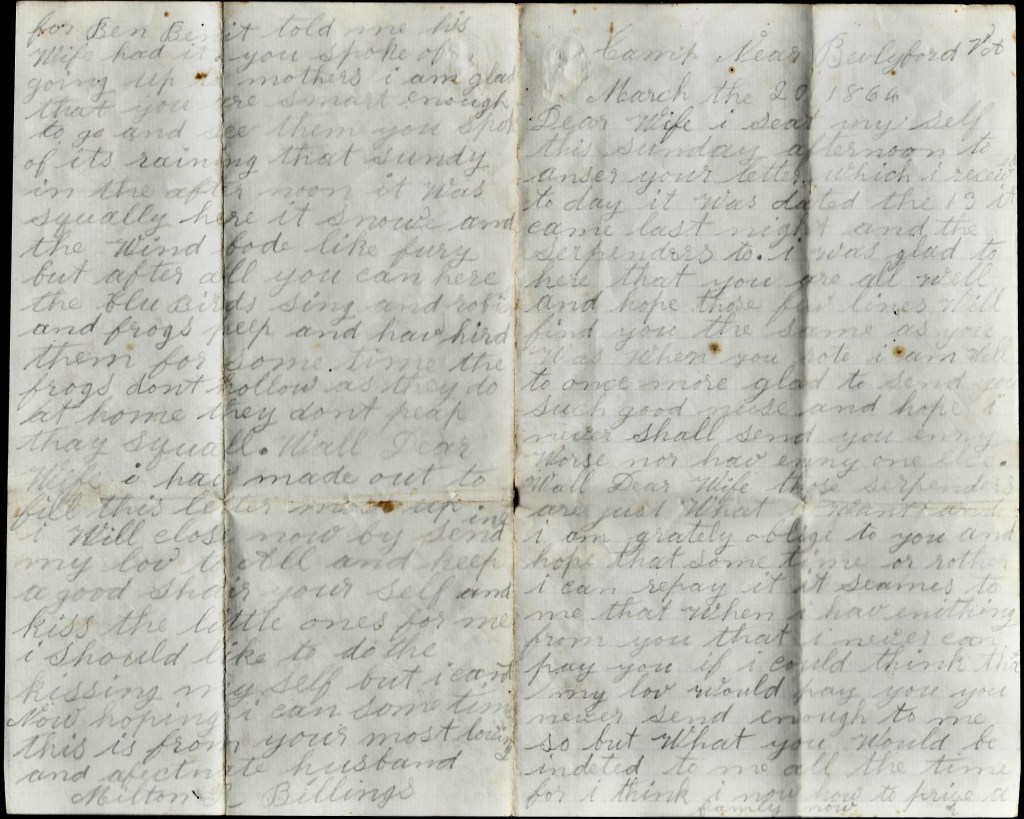
We draw corn meal now. I have much to say if I could see you. I am as ever yours truly, — E. Whicker

1862: Edwin Frank Foss to his Brothers

The following letter was written by Edwin “Frank” Foss (1846-1884), the son of Woodbury Marden Foss (1804-1869) and Eliza Foss (1811-1887) of Strafford, New Hampshire. He wrote the letter to his two older brothers, Amaziah Joshua Foss (1839-1863), and Lemuel Perkins Foss (1841-1871) who enlisted and served together in Co. F, 13th New Hampshire Infantry during the Civil War. Lemuel survived the war, but Amaziah received a severe wound in the right leg while fighting at Providence Church Road (Suffolk) on 3 May 1863. His wound required amputation of the limb and he died from loss of blood on 7 May.

Frank studied medicine, attending lectures at the University of Vermont and Dartmouth. He afterwards became a druggist.

Transcription

Strafford, New Hampshire
Sunday, April 12th 1863

Brother soldiers,

With pleasure I seat myself once more in old windy hall to write to you. I came home Friday and thus I am here and with the request of Father, undertake this note. I don’t know as I can think of much to write that will be interesting to you. You stated in your last letter to Father that you heard that the Draft was put over till July. As for the truth of such stories, none ought to vouch for there have been myriads of such stories told by the treason-sympathizing hunkers of the North, and go by the still more euphonic name of Copperheads which in my opinion is the more appropriate of the two, for they are the real serpent that has stung our Nation and are yet keeping the rebels rejoicing over their victories. Yet for all their lying and trying to scare people out of their common sense, their draft bugbear as well as other things did not carry this state Copperheaded.

Well, I was distributing votes for Gilmore at the last election where a Copperhead belonging to Bows Pond Church hailed me and began to correct me for my early deeds for thus doing, alluding to you for a proof that it was not right whereupon I directly told him that I would write to you to find out your opinion. Now I wish you to write me in your next letter what you think about the matter.—whether it was sin or not. Also by the request of said Copperhead, you will do me a great favor in giving your opinion on the Negro of which the Copperhead said you would curse to the lowest degree. I wish your opinion to see whether the said Copperhead was right or me concerning your opinion…

Well, Eldridge Foss was married to Emily Richardson. I understand that Amaziah is very anxious to know her name. She is as you doubtless know old. Richardson’s daughter that lives over to northwest—that great fat man, Well, I guess I must say a little more about the draft which is this—there will be no draft till more men are called for New Hampshire has furnished her number already. Yours, &c., — E. Frank Foss