1862: Unidentified “Josie” to his Parents

An unidentified member of Co. K, 1st US Chasseurs (65th NY Infantry) wearing the distinctive uniform and M1858 Hardee Hat (W. Griffing Collection)

The following letter was written in pencil by a soldier who served in the 65th New York Infantry, otherwise known as the 1st U. S. Chasseurs. The companies in this regiment were recruited principally as follows: A, C, G and I in New York City; B in Maine, Rhode Island and the Hudson river counties; D in New York city and Troy; E in New York City, Connecticut and Rhode Island; F and H in New York City and Rhode Island, and K in New York City and Ohio. The Chasseurs faced their baptism of fire at the Battle of Fair Oaks on 31 May-June 1, 1862 during McClellan’s Peninsula campaign. In addition to wearing a chasseur uniform, the regiment were distinct for choosing to wear M1858 uniform hats (more popularly known as Hardee hats) rather than the kepis.

Though it is certain the author served in the 1st US Chasseurs—most likely in Co. D or Co. K—he only signed his name “Josie” and there is no accompanying envelope nor additional identifying information in the letter itself to state with certainly who he was. The letter came to me for transcription attributed to Joseph P. Baugher [Actually Joseph T.] (1844-1921) of Co. K but a search of the company records reveals that Joseph was detached from the regiment in February 1862 “on western gunboat service and was discharged therefrom.” This record could have been an error, however. Joseph lived his entire life near Tiffin, Ohio, and his burial record only lists his service in the 65th New York Infantry—nothing else.

Regardless of who wrote the letter, it is a great first hand account of the Battle of Fair Oaks from the perspective of a member of the 1st US Chasseurs who “covered themselves with glory” and where “not a man flinched” on the field.

Transcription

Camp on battlefield of Seven Pines
June 7th 1862

My dear parents,

I suppose by this time you have heard of the great battle near Richmond which commenced at one o’clock on Saturday [31 May] and ended about noon the next day [1 June] by the enemy skedaddling & leaving the field in possession of the brave soldiers of the North. I received a letter from home on Saturday a short time after writing & mailing an answer.

The noise of cannons and musketry was heard directly to the front of our camp. We were soon under arms, ready to take part in the encounter with the hated rebels. Our Colonel was ordered to take the regiment to the right of the [York River] railroad to prevent being flanked. At this place the shell flew over our heads like fun, doing no damage however as the range was too high. The noise as they came whizzing by sounded rather unpleasant at first, causing the men as well as officers to bob their heads, but we soon became used to that & we stood like men & soldiers ready to do our best for the glorious cause in which we had enlisted.
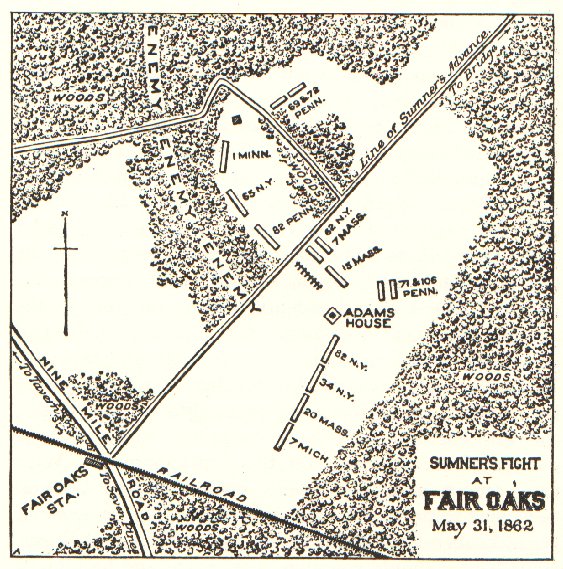
The Union line after Sumner’s troops arrived to join the 65th New York Infantry who were deployed behind a fence from which they “were loading and firing like demons.”

We soon received news that the Union forces were being driven back & that the rebels were at that time in the camps we had occupied not thirty minutes before. Such news made us feel of course rather low spirited. We fell back about half a mile and awaited anxiously for the rebels to make their appearance. After remaining at this place about 15 minutes, the right of Sumner’s line of reinforcements could be seen coming through the woods to the rear. This I can assure you was a welcomed sight. As soon as Sumner’s men had reached the field, we were ordered to double quick & take position in front of the woods on our right. We had no sooner halted than we received a sharp volley from the rebels who were at that time concealed in the woods. Without waiting for orders, we gave one in return.

“After I had fired, I hardly knew what to do but a second volley from the enemy brought me to my senses & I came to the conclusion that I had better reload. After this, I became perfectly cool and we let them have it thick and heavy for over two hours and a half…”

After I had fired, I hardly knew what to do but a second volley from the enemy brought me to my senses & I came to the conclusion that I had better reload. After this, I became perfectly cool and we let them have it thick and heavy for over two hours and a half—the enemy attempting several times to charge upon us but we would reserve our fire and when they came near, let them have it again & back they would go. I fired over 30 rounds, several times taking deliberate aim. The enemy skedaddled a little after dusk & the Chasseurs have the satisfaction of knowing that their first fight has been a victory.

After the firing was over, we turned our attention to our dead and wounded comrades. Our company lost three in killed and seven wounded; the regiment about forty & the brigade 650. The man to my right was killed; the one in front of him wounded, & I came so near that there was no fun in it—my cheek being grazed. It did not hurt me, however, so I am ready for the next battle which we expect will take place before the week is out. McClellan says it will no doubt be more bloody than the last. 1

After I had assisted in removing the wounded to the hospital and placing the dead together, I took a smoke out of the pipe which Pa gave me before leaving home & lay down where I had stood fighting and slept sound until morning—or at least daybreak when we stood under arms until about six o’clock when the rebels made their appearance intending to give us a second trial. Our regiment fired a couple of volleys when we were relieved by another regiment that had not been engaged the day previous & took a position in the woods where we remained during the day. The engagement ended about noon, the enemy being defeated.

For over 24 hours I had nothing to eat as our rations were left in camp. The next day a few crackers were brought to us and I can tell you they tasted good. We have lost all our clothes, &c. except what was on our backs as our knapsacks were left behind & destroyed by the rebels when they entered our camps. The government is going to make them good to us, I believe. I can tell you soldiering is a hard life. After our next battle, if I live through it & we reach Richmond, I shall try to get my discharge if it is possible. I can then retire with honor as I think I shall have done my share of duty in the way of fighting, &c.

When I write again, I shall no doubt have a bloody battle to describe. I hope I may come out of it safe but I am ready for it. My powder is dry, my musket (my best friend at present) in perfect order, & I shall have to take my chance with the rest. The enemy have commenced shelling us again so we will have to stand under arms again I suppose. So I must close. Goodbye. Love to all. Write very soon and often to your son, — Josie


1 According to Capt. William Halsted of Co. D, 65th New York Infantry, “Capt. Higgenbotham’s Co. [K] and mine took the worst of the fight….I lost in killed and wounded more than one-fifth of my company. Our regiment lost in killed and wounded 32 [actually 9 killed and 22 wounded]. Our men have covered themselves with glory. Not a man flinched in the field….We held our post for nearly two hours under a terrific fire. Not a cartridge was wasted. We went to work with 60 cartridges and my company averaged 40 left at night.” [Calvin Packard Civil War Battlefield Collection]

1865: Darwin Nichols to Orpha Jane Waters

The following letter was written by Darwin Nichols (1841-1901), the son of Cheney M. Nichols (1810-1892) and Almena Edson (1814-1883) of Attica, Wyoming county, New York. He wrote the letter to Orpha Jane Waters (1844-1906) with whom he married in 1865.

Darwin enlisted on 9 August 1862 as a private in Co. C, 130th New York Infantry but this regiment was converted to cavalry on 28 July 1863 and known as the 1st Dragoons or the 19th New York Cavalry. At the time of his enlistment he was described as 5 feet 7.5 inches tall, with blue eyes and light hair. He was wounded on 30 June 1864 but recovered and mustered out with his regiment on 30 June 1865. During its service, the 1st New York Dragoons fought in 64 battles, captured 19 pieces of artillery and four Confederate battle flags.

Darwin had an older brother named Edwin A. Nichols who served in Co. G, 160th New York Infantry who did not survive the war. He died at a hospital in New Orleans of an illness in December 1863.

A colt revolver that was carried by Corp. Chauncey J. Fox of the 19th New York Cavalry during the Civil War.

Transcription

[Note: This letter is from the private collection of Greg Herr and was transcribed and published on Spared & Shared by express consent.]

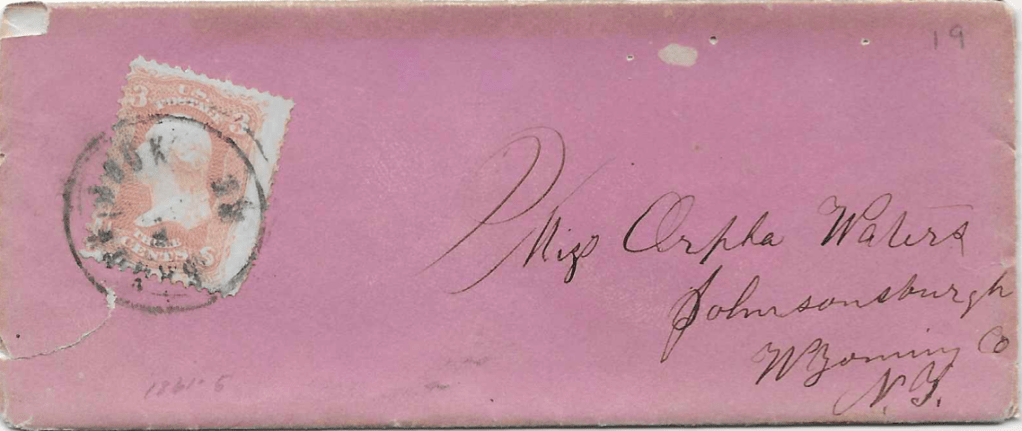
Addressed to Miss Orpha Waters, Johnsonsburgh, Wyoming county, New York

Remount Camp
Pleasant Valley, Maryland
Tuesday, April 18, 1865

My dearest Orpha,

Words nor tongue can express my delight at receiving your much welcome letter of April 14th which came duly to hand last night & also one of the 12th that has just arrived today. It being directed to Harper’s Ferry, I did not get as soon as I should if it had been directed as the other was. Under the present circumstances I shall be obliged to answer them both in one.

You will see by this that I am again at Remount Camp & shall be very likely to stay here until I am discharged. The regiment left camp at Halltown morning of the 14th. I was on a pass to Summit Point, Va., where I had been to visit my brother. I found him in good health & had a good visit with him & many others of my acquaintance. My health is about as usual. The Dr. still excuses me from duty & shall be as long as I can make the Dr. believe that I am unable to do duty.

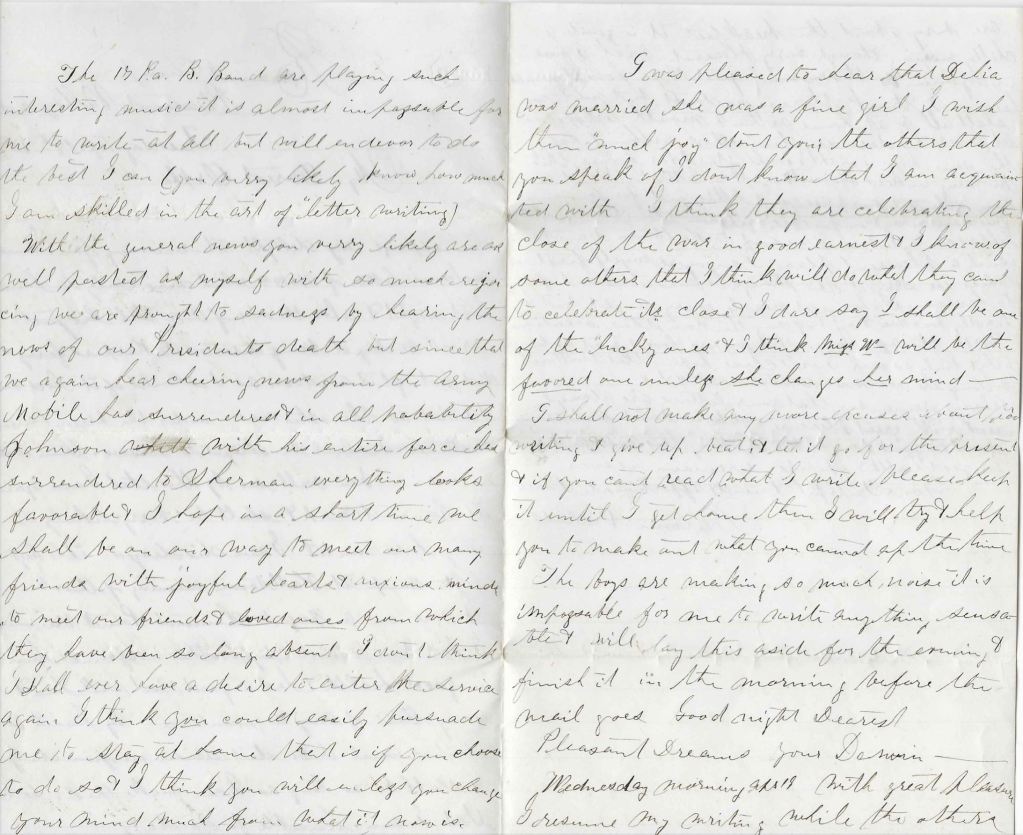
The 17th Pennsylvania Brass Band are playing such interesting music, it is almost impossible for me to write at all but will endeavor to do it the best I can (you very likely know how much I am skilled in the art of letter writing).

With the general news you very likely are as well posted as myself. With so much rejoicing we are brought to sadness by hearing the news of our President’s death. But since that, we again hear cheering news from the army. Mobile has surrendered & in all probability Johnston with his entire force has surrendered to Sherman. Everything looks favorable & I hope in a short time we shall be on our way to meet our many friends with joyful hearts and anxious minds to meet our friends & loved ones from which they have been so long absent. I don’t think I shall ever have a desire to enter the service again. I think you could easily persuade me to stay at home—that is, if you choose to do so, and I think you will unless you change your mind much from what it now is.

I was pleased to hear that Delia was married. She was a fine girl. I wish them “much joy,” don’t you? The others that you speak of I don’t know that I am acquainted with. I think they are celebrating the close of the war in good earnest & I know of some others that I think will do what they can to celebrate its close & I dare say I shall be one of the “lucky ones” & I think Miss W. will be the favored one unless she changes her mind…

The boys are making so much noise it is impossible for me to write anything sensible & will lay this aside for the evening & finish it in the morning before the mail goes. Good night dearest. Pleasant dreams, — Your Darwin

Wednesday morning, April 19

With great pleasure I resume my writing while the others are busy about the breakfast. It is quite a chilly morning though very pleasant. Wish I was in Wyoming County this morning just to see how it would seem. I think there is no doubt but what we shall all be at home within a month. I hope so at least & I dare say there are others wishing and hoping the same. How I wish I could start for home this morning instead of writing this letter. I would remain silent & surprise you a little just for fun.

We have very comfortable quarters now though I am not half contented as I was up to Halltown, Va. It was such a pleasant place. I enjoyed myself first rate while we stayed there though it was not much fun to have camp alarmed nearly every night. But I hardly ever went out of my tent on those occasions.

With the assurance that you are loved just as tenderly and truly as ever, I will close by hoping that it will not be long ere we meet to part no more. Always remember that your letters are always received with great pleasure & delight. Don’t fail to write soon and a good long letter. Hoping this will find you in good health and spirits, I remain as ever your faithful friend and affectionate lover, — Darwin Nichols

1864: W. F. Scott to his Sister

The signature of the soldier who wrote this letter is somewhat difficult to decipher but I believe it was W. F. Scott. Unfortunately there are several Confederate soldiers by that name and Lee had most of his Army of Northern Virginia encamped around Orange Court House at the time this letter was written in early February 1864.

The “shelling and skirmishing” described in the second paragraph probably refers to the Union advance who forced several crossing on the Rapidan river on 6 February 1864. This was done to divert attention from a planned cavalry-infantry raid up the Peninsula on Richmond which never materialized because a deserter tipped off the Confederates. It was Gen. Richard S. Ewell’s Corps that resisted the crossings at Raccoon Ford and Morton’s Ford so it is presumed that the author was in that Corps.

Alfred Waud’s sketch of the Reconnaissance at Morton’s Ford in February 1864

[Note: This letter is from the collection of Greg Herr and was transcribed and published on Spared & Shared by express consent.]

Transcription

Orange Court House, Va.
February 8, 1864

Dear Sister,

I seat myself this morning to drop you a few lines to let you know that I am well, hoping these few lines may find you well. I received your kind letter the other day and was glad to hear from you.

I have got back to camp. We have been down on the [Rapidan] river to meet the Yankees. We started yesterday morning and got back today. There was some fighting close to us but we weren’t in it. There was some shelling and skirmishing. They say that they took 50 prisoners from the Yankees and killed some few but I reckon they went back by us coming back to camp.

The weather is very cold here now and the mountains is white with snow but if I could stay in camp, I could do right well. We have got very good quarters now to stay in. We draw corn meal and a little meat and sometimes a little flour.

You wanted to know what I thought of your new dress. I think it looks very well. I was very much surprised to hear that Lucy and Frank was married. I never dreamed of such a thing. I wish she had a married when I was at home and let me be at the wedding.

I have wrote all that is worthy of your attention so I will close. Give my love and respects to Uncle John’s folks and tell Lucy the next time you see her she must write to me and you must write soon. — W. F. Scott

1862-63: Sarah Adeline Sparks to Caroline Dame (Tibbetts) Locke

These letters were written by Sarah Adeline Sparks (1818-1895), the daughter of Ebenezer Sparks (1792-1865) and Sally Kendall (1783-1870) of East Dover, Windham county, Vermont. Sarah apparently never married; she is buried in Dover Center Cemetery.

She wrote the letters to her friend, Caroline Dame (Tibbetts) Locke (1809-1893)—the wife of Rev. William Sherburne Locke (1808-1896). Caroline was the daughter of William S. Tibbetts (1780-1857) and Jerusha Dame (1784-1820) of Kittery, Maine. Caroline’s husband, William, was enumerated as a retired Methodist minister in Manchester, Hillsborough county, New Hampshire, in 1860. 

Letter 1

Dover
February 6th 1862

Dear sister Locke,

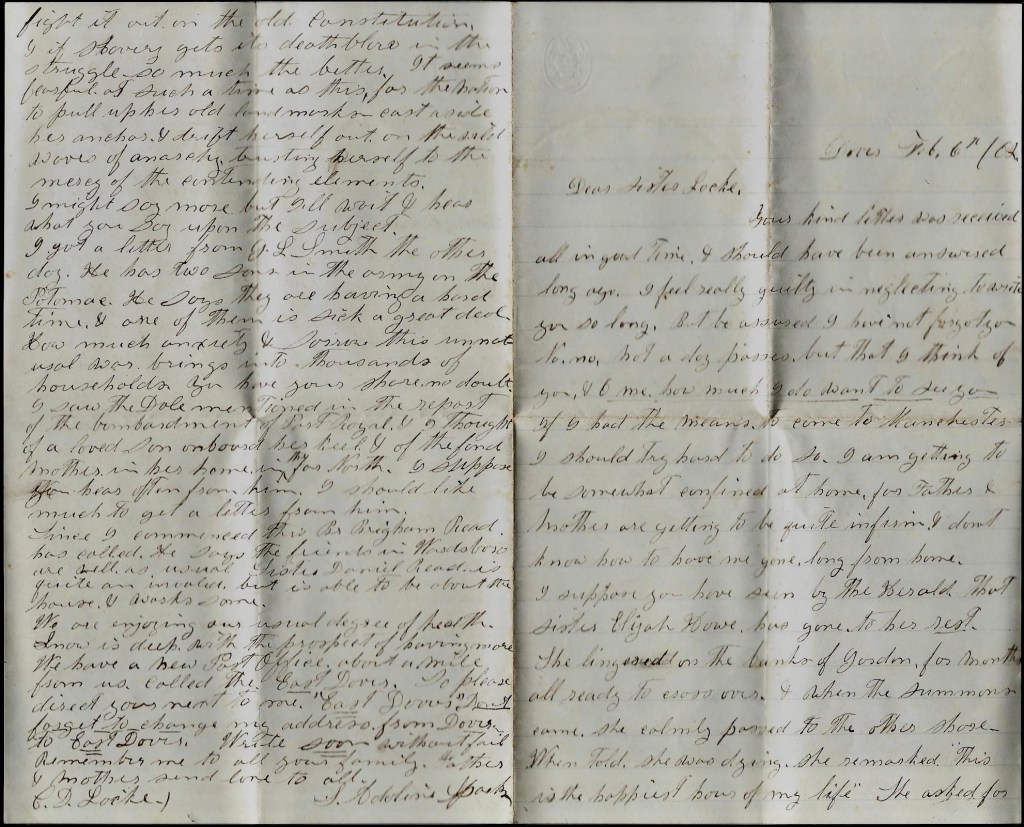
Your kind letter was received all in good time and I should have answered long ago. I feel really guilty in neglecting to write you so long. But be assured I have not forgotten. No, no, not a day passes but that I think of you & me. How much I do want to see you. If I had the means to come to Manchester, I should try to do so. I am getting to be somewhat confined at home for Father and Mother are getting to be quite inform. I don’t know how to have me gone long from home.

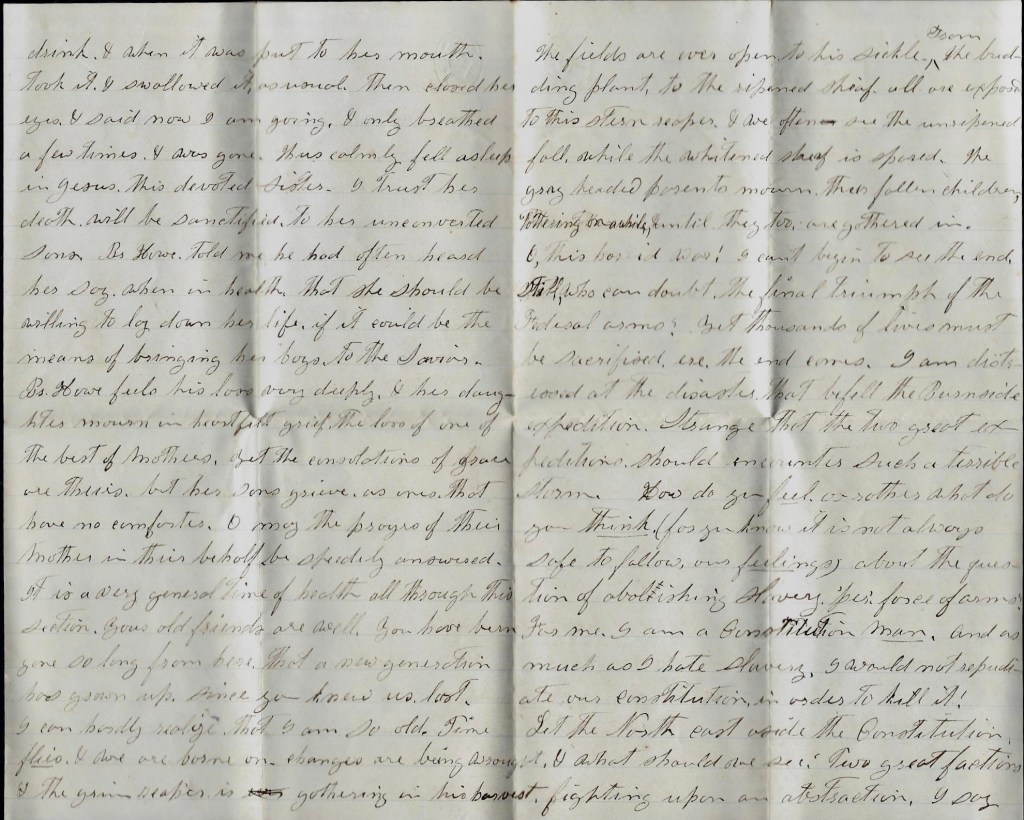
I suppose you have seen the Herald—that sister Elijah Howe has gone to her rest. She lingered on the banks of Jordan for months all ready to cross over & when the summons came, she calmly passed to the other shore. When told she was dying, she remarked, “This is the happiest day of my life.” She asked for drink and when it was put to her mouth, took it & swallowed it as usual. Then closed her eyes and said now I am going & only breathed a few times & was gone. Thus calmly fell asleep in Jesus. This devoted sister. I trust her death will be sanctified to her unconverted sons. Brother Howe told me he had often heard her say when in health that she should be willing to lay down her life if it could be the means of bringing her boys to the Savior. Brother Howe feels his loss very deeply & her daughter mourns in heartfelt grief the loss of one of the best of mothers. Yet the consolations of grace are theirs, but her sons grieve as ones that have no comforts. O may the prayers of their mother in their behalf be speedily answered.

It is a very general time of health all through the section. Your old friends are well. You have been gone so long from here that a new generation has grown up since you knew us. I can hardly realize that I am so old. Time flies & we are borne on. Changes are being wrought & the grim reaper is gathering in his harvest. The fields are ever open to his sickle from the budding plant to the ripened sheaf. All are exposed to this stern reaper and we often see the unripened fall while the whitened sheaf is spared. The gray headed parents to mourn their fallen children, tottering on awhile, until they too ar gathered in.

O, this horrid war! I can’t begin to see the end. Still, who can doubt the final triumph of the Federal arms? Yet thousands of lives must be sacrified ere the end comes. I am distressed at the disaster that befell the Burnside Expedition. Strange that the two great expeditions should encounter such a terrible storm.

How do you feel, or rather what do you think (for you know it is not always safe to follow our feelings) about the question of abolishing slavery per force of arms? For me, I am a constitution man, and as much as I hate slavery, I would not repudiate our Constitution in order to kill it! Let the North cast aside the Constitution & what should we see? Two great factions fighting upon an abstraction. I say fight it out on the Old Constitution, & if slavery gets its death blow in the struggle, so much the better. It seems fearful at such a time as this for the Nation to pull up her old landmarks, cast aside her anchor, and drift herself out on the wild waves of anarchy, trusting herself to the mercy of the contending elements. I might say more but I’ll wait & hear what you say upon the subject.

I got a letter from G. L. Smith the other day. He has two sons in the army on the Potomac. He says they are having a hard time and one of them is sick a great deal. How much anxiety & sorrow this unnatural war brings into thousands of households. You have your share, no doubt.

I saw the Dole mentioned in the report of the bombardment of Port Royal and I thought of a loved son on board her keel & of the fond mother in her home in the far North. I suppose you hear often from him. I should like much to get a letter from him.

Since I commenced this, Brother Brigham Read has called. He says the friends in Wardsboro are well as usual. Sister Daniel Read is quite an invalid but is able to be about the house and works some.

We are njoying our usual degree of health. Snow is deep with the prospect of having more. We have a new Post Office about a mile from us called the East Dover. Do n’t forget to change my address from Dover to East Dover. Write soon without fail. Remember me to all your family. Father and Mother send love to all. — S. Adoline Sparks


Letter 2

East Dover [Vermont]
March 15th 1863

Dear Sister Locke,

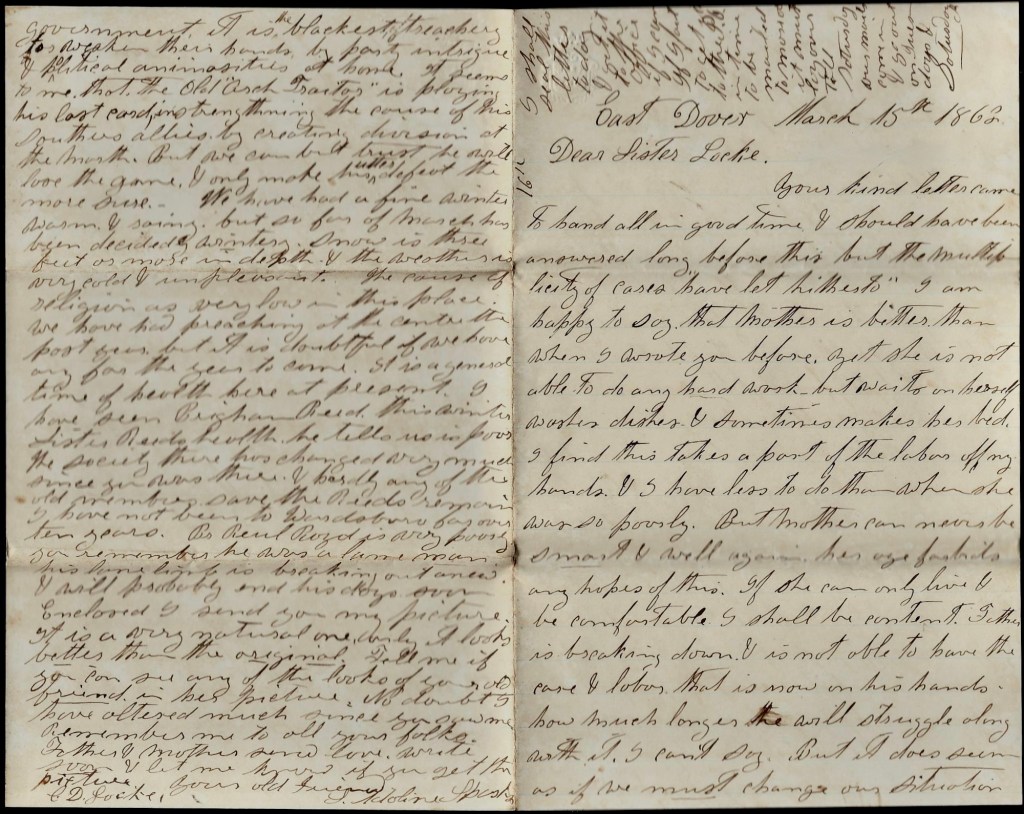
Your kind letter came to hand all in good time & should have been answered long before this but the multiplicity of cares “have let hitherto.” I am happy to say that Mother is better than when I wrote you before, yet she is not able to do any hard work but wait on herself, washes dishes, and sometimes make her bed. I find this takes a part of the labors off my hands & I have less to do than when she was poorly. But Mother can never be smart & well again. Her age forbids any hopes of this. If she can only live & be comfortable, I shall be content. Father is breaking down & is not able to have the care & labor that is now on his hands. How much longer he will struggle along with it, I can’t say. But it does seem as if we must change our situation before long. I wish our farm was sold & we were on a small place—say just large enough to keep a cow & pig. But when this change will be brought about, I don’t know. It is hard for old people to leave the old homestead, you know, and nothing short of a necessity shall ever make my Father & Mother willing to do it. So how long we shall rub along, I’m sure I can’t tell.

My health is rather better than it was last fall & first of the winter. I was then pretty well worked down.

The young soldier I wrote you about that was sick with us is dead. He stayed with us & I took care of him while he lived. His uncle came for his corpse & carried it to Andover to be buried by the side of his Father. Our country!! What can we say upon this all absorbing subject! For one, I am distressed at the present state of things & had I not an unwavering confidence in the justice of our cause, and a firm trust in the God of armies, I should almost tremble for our fate. The division and rupture among our northern politicians is to be truly deplored. It really seems that a certain set of men think more of their party than they do of their country, or their God. How men can at such a time as this, when our nation is struggling for her life, when her very existence depends upon the result, how men can at such a time stop to bicker about trifles, how they can stoop to the meanness od making party issues or war measures just for the sake of building up a party, may well excite the wonder of all true patriots and the just indignation of loyal men.

When our armies have gained a few victories such as the taking of Vicksburg, Charleston, Savanah, & so on, Copperheadism will soon begin to hide its fangs, no doubt. While the brave and noble boys are suffering the privations of the camp, enduring the labors of war, and facing the dangers of the battlefield, all for the salvation of the government, it is the blackest treachery to weaken their hands by party intrigue & political animosities at home. It seems to me that the old “Arch Traitor” is playing his last card in strengthening the course of his southern allies by creating division at the North. But we can but trust he will lose the game & only make his utter defeat the more sure.

We have had a fine winter—warm and rainy—but so far of March has been decidedly wintery. Snow is three feet or more in depth & the weather is very cold & unpleasant.

The course of religion is very low in this place. We have had preaching at the centre the past year, but it is doubtful if we have any for the year to come. It is a general time of health here at present. I have seen Brigham Read this winter. Sister Read’s health, he tells us, is poor. The society there has changed very much since you was there & hardly one of the old members save the Reads remain. I have not been to Wardsboro for over ten years…

Enclosed I send you my picture. It is a very natural one only it looks better than the original. Tell me if you see any of the looks of your old friend in her picture. No doubt I have altered much since you saw me. Remember me to all your folks. Father and Mother send love. Write soon & let me know if you get the picture. Your old friend, — S. Adeline Sparks

I shall seal this letter today & get it to the post office…

1864: Valentine A. Lewis to “Dear Brethren”

An interesting pair of letters, both in pencil and removed from a period scrapbook, one related to and the other written by Valentine A. Lewis (1839-1899). An 1858 graduate of the College of New Jersey who volunteered as a Presbyterian Chaplain in the 2nd New York Infantry, Valentine enlisted on 17 May 1861 and then resigned from that position several months later, on August 15, apparently to take a position with the U. S. Christian Commission, as these letters indicate. 

The 2nd Regiment was organized in Troy, NY and was mustered in on May 14, 1861, 3 days prior to Lewis’s joining, for a two year period of service. It saw considerable action during the Eastern campaigns, including Bull Run and Chancellorsville (May 1-5, 1863), following which it was mustered out on May 26.

The Battle of the Wilderness, in Spotsylvania County, VA (same County as the Battle of Chancellorsville one year earlier) took place on May 5-7, 1864, at which time Lewis was presumably a member of the Christian Commission, assigned to support the spiritual and emotional needs of the troops in that campaign. The Battle, which represented yet another sparring between the forces of Grant and Lee on the road to Richmond, was one of the War’s most deadly, with estimated total casualties of nearly 30,000, a majority of which were Union.

The first letter is a rushed, almost frenzied, note written by Lewis in pencil during the Battle of the Wilderness, from a field hospital where he was ministering to the dead and wounded who were streaming in.  In the letter, written to family or friends back home, he refers to several named dead and injured soldiers, indicating that they were clearly known to him and to the ‘brethren’ to whom he writes. One of these soldiers, Lt. Col [Aaron B.] Myer, was commander of the 125th New York Infantry—a unit which was formed in Troy, the same as had Lewis’s original unit, in 1862, and had a horrific history during its tenure as a unit, including the Battle of the Wilderness. The exposure to the horrors of war affecting those he knew certainly served to aggravate Lewis’s emotional state during this devastating 3-day Battle. His state of mind is well-reflected in this letter.

[Note: This letter is from the personal collection of Richard Weiner and was transcribed and published on Spared & Shared by express consent.]

Transcription

My dear brethren.

I am too tired to write particulars but brethren, pray and give.

Lieut. Colonel [Aaron B.] Myer dead and buried at Chanc. Court House.

Capt. [Edward P.] Jones dead. 1 Sword in Mr. De Golyer’s hand. Body left on field.

Charley Germain missing. 2

Lieut. [Elam S. P.] Clapp, amputated at thigh.

Green sick.

Are all I could hear so far. Will forward other names as I obtain them.

Reinforcements are pushing forward to the front. 7th Heavy Artillery as Infantry. Pray that success may attend the next move. Oh Brethren pray, pray. God only can help us. 5 from our ward carried out today. Now is the time.

Excuse incoherence. I have been dressing wounds since 5 and now volunteers are called for to go and take care of a train of 375 wounded just in. Yours in Christ, — V. A. Lewis

Written in the Battle of the Wilderness.

1 Capt. Edward P. Jones of Co. I assumed command of the 125th New York following the death of Lt. Col. Aaron B. Myer. He was likewise killed while leading the assault on the enemy’s works “Bloody Angle” at Spotsylvania at daybreak on 12 May 1864. In this same assault Lieutenants Elam S. P. Clapp and Charles E. Cleminshaw were mortally wounded.

2 Charles R. German served in Co. D, 125th New York Infantry. After recovering from his Gettysburg wound, he was killed in action on 6 May 1864 in the Wilderness.


This second letter was probably written by Rev. Hugh Wallace Torrence (1842-1897), an 1864 graduate of the Princeton Theological Seminary who served for a time in the Christian Commission and then became a Presbyterian minister. He died in Romulus, New York.

I take pleasure in stating that Rev. V. A. Lewis has been laboring for some time as a delegate of the Christian Commission in Fredericksburg in the 2nd Division, 2nd Corps, and has been wise, discreet, diligent, and faithful in the performance of all duties and as he now returns home bearing an appeal to the people of Troy in favor of the Christian Commission, we hope you will respond in such a manner as will show that you appreciate the importance of the work and are aware of the necessities.

— H. W. Torrence

— A. G. Manley, Assistant General Field Agent

1863: George and Samuel Neal to Alvina Cordelia Neal

The following letter was written jointly by George and Samuel Neal of Kittery, Maine, who were attending Harvard College during the Civil War. I can’t be certain if the letter was written in 1862, 1863, or 1864 so I guessed 1863.

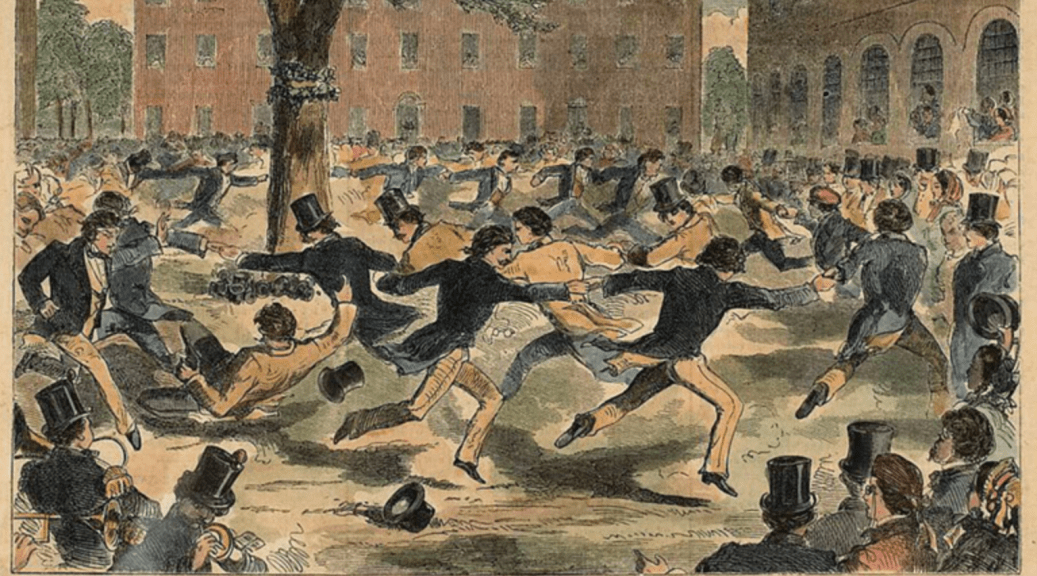
The letter, particularly the portion written by Samuel, contains a great description of the Harvard College tradition known as “Class Day.” This day marked the end of classes for the college term in June which would be followed by six weeks vacation and then when students returned to attend the next next term, the college seniors would return for their “Commencement” exercises.

According to an article appearing in the Harvard Crimson quoting a piece written in 1886, the class of 1838 inaugurated a new order of exercises to Class Day. “As soon as the morning programme was ended, the class committee placed a band in front of Stoughton, and as soon as the fair maidens could finish their ice cream and lemonade they were surprised by being invited to go down and dance about the tree. The band which had been practicing Fair Harvard (two years old) started up, also surprised, and began a series of quadrilles and waltzes, which they continued until dark. Toward evening, the seniors for the first time gathered about the old tree and began a wild quadrille of their own, in which they were soon joined by the whole college, the maidens looking on and applauding. Just as the sun was setting, the graduating class formed in line and passed around the yard, cheering the buildings in order.” The new arrangement apparently also introduced the custom of giving “Spreads” (banquets) which are mentioned in the letter following.

Transcription

Cambridge [Massachusetts’
Saturday night

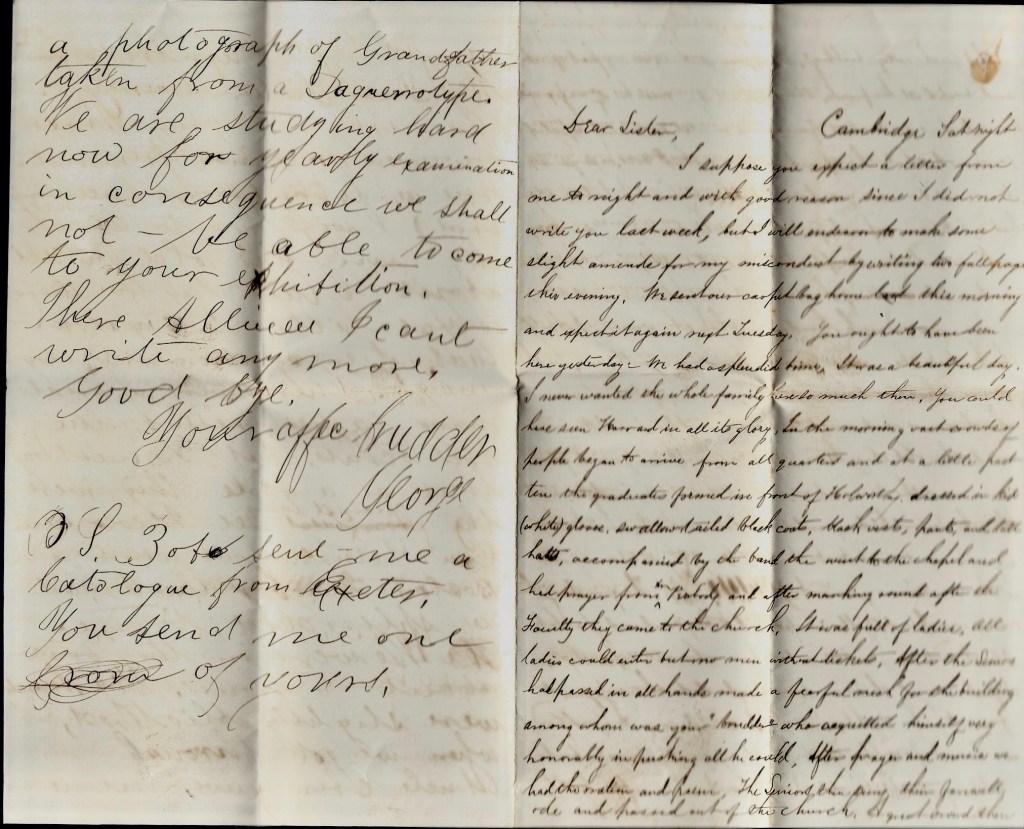
I suppose you expect a letter from me tonight and with good reason since I did not write you last week, but I will endeavor to make some slight amends for my misconduct by writing two full pages this evening.

We sent our carpet bag home this morning and expect it again next Tuesday. You ought to have been here yesterday. We had a splendid time. It was a beautiful day. I never wanted the whole family here so much then. You could have seen Harvard in all its glory.

In the morning, vast crowds of people began to arrive from all quarters and at a little past ten the graduates formed in front of Holworthy [Hall] dressed in kid (white) gloves, swallowed tailed black coats, black vests, pants, and tall hats. Accompanied by the band, they went to the chapel and had prayer from Dr. [Andrew Preston] Peabody and after marching around after the Faculty, they came to the church. It was full of ladies. All ladies could enter but no man without tickets. After the Seniors had passed in, all hands made a fearful rush for the building among whom was your “brudder” who acquitted himself very honorably in pushing all he could. After prayer and music, we had the oration and poem. The Seniors sung the farewell ode and passed out of the church. A great crowd then rushed for the college buildings. About every student (Senior) had spreads and treated all his friends.
There was a large number of negro waiters and it is said that four Seniors invited 1,800 and expected 1,000 and that the spread would cost them $4,000 so you see it was all done on a grand scale. There were some ladies who had sent to Paris expressly for bonnets for the occasion. You have never seen ladies so splendidly dressed as they were here yesterday. About all of them in light airy dresses and the dresses were much handsomer than the women. I should think that there were 4 or 5 ladies for one gentleman.

In the afternoon there was dancing on the grounds until 6 o’clock when the Seniors went round to cheer the buildings and to run round the old class tree. All the four classes formed four rings around the tree and ran round it in great style and then the Seniors had a grand break down over it. 1

Attributed to Winslow Homer, published by Ballou’s Pictorial Drawing Room Companion, 1858

In the evening a great crowd went to Dr. Peabody’s house (I got there just as the ice cream gave out) Oh!!!! The grounds of the college were splendidly illuminated and the band and glee club played and sang until a late hour when all separated. A great many of the Seniors, however, extended their enjoyments far into the night.

I wish I could come to Bradford but I can’t possibly. Don’t trouble yourself much about study or you will be all dragged out. Yours affectionate brother, — S

[In a different hand]

Cambridge
June 23rd

My dear Sister,

Since you were so kind to send me a letter (though exceedingly short), I will try to answer it. Sam has told you all about Class Day so there is but little to say about that. I enjoyed myself very much. There were a great many ladies present, & the Aristocrats, but I must say that as a whole they were the plainest looking set I ever saw.

On Saturday we went down Boston Harbor and had a splendid time. We were in the boat about five hours. My hands were slightly blistered when we got through.

Uncle Eben gave me a photograph of Grandfather taken from a daguerreotype. We are studying hard now for yearly examination. In consequence, we shall not be able to come to your Exhibition. There. Allie, I can’t write anymore. Goodbye. Your affectionate brudder, — George

P. S. [ ] sent me a catalogue from Exeter. You send me one of yours.

1 Having searched the literature for a reference to the “class tree” at Harvard, the only thing I could find was an article recently appearing in the Harvard Political Review on 17 July 2023 pertaining to the “Washington Elm” that stood in Cambridge Common, next to the historic Harvard Yard. That tree fell sometime in 1923 and was estimated to have been between 204 and 210 years old.

1861: Sarah (Cass) Locke to Caroline Dame (Tibbetts) Locke

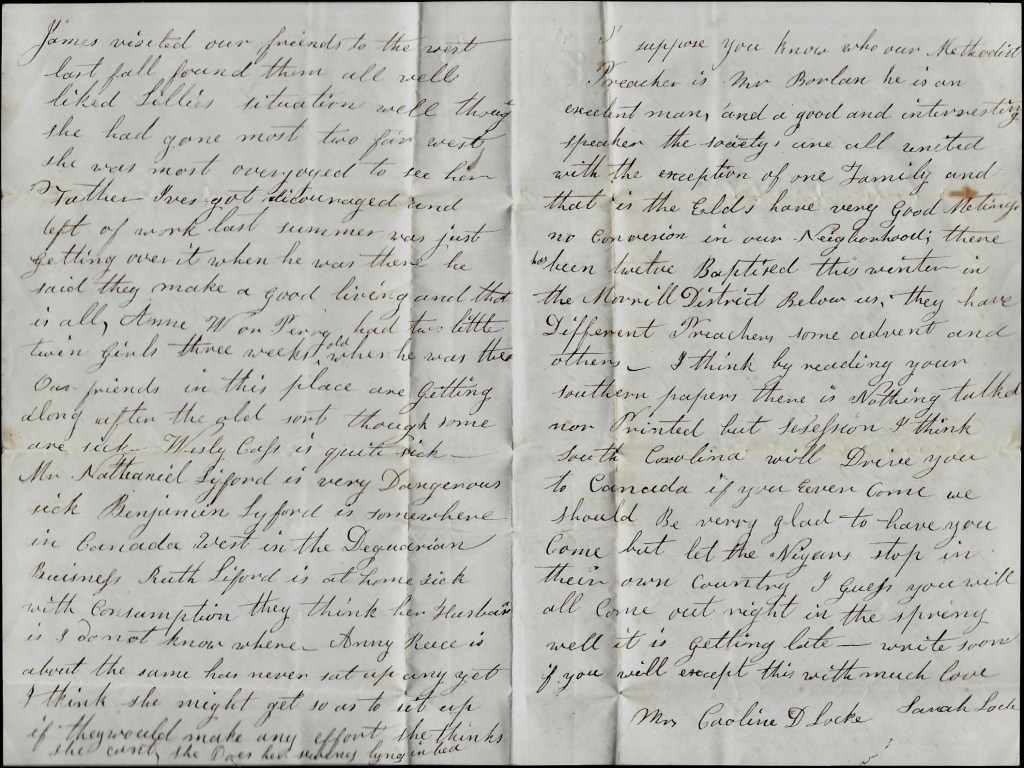
This letter was written by Sarah (Cass) Locke (1805-1884), the wife of James Munroe Locke (1804-1862) of Stanstead, Quebeck, Canada—just across the border from Vermont. She wrote the letter in February 1861 to her sister-in-law, Caroline Dame (Tibbetts) Locke (1809-1893)—the wife of Rev. William Sherburne Locke (1808-1896). Caroline was the daughter of William S. Tibbetts (1780-1857) and Jerusha Dame (1784-1820) of Kittery, Maine. Caroline’s husband, William, was enumerated as a retired Methodist minister in Manchester, Hillsborough county, New Hampshire, in 1860. He was born in Stanstead.

Most of the letter consists of family chit-chat but one paragraph in particular contains an item of historical interest. It reads: “I think by reading your southern papers there is nothing talked nor printed but secession. I think South Carolina will drive you to Canada. If you ever come, we should be very glad to have you come but let the niggers stop in their own country.” Apparently not all of Canada awaited the emigration of Blacks with open arms.

Historic Stanstead, Quebec, Canada

Transcription

Stanstead [Province of Quebec, Canada]
February 1, 1861

Dear Sister Locke,

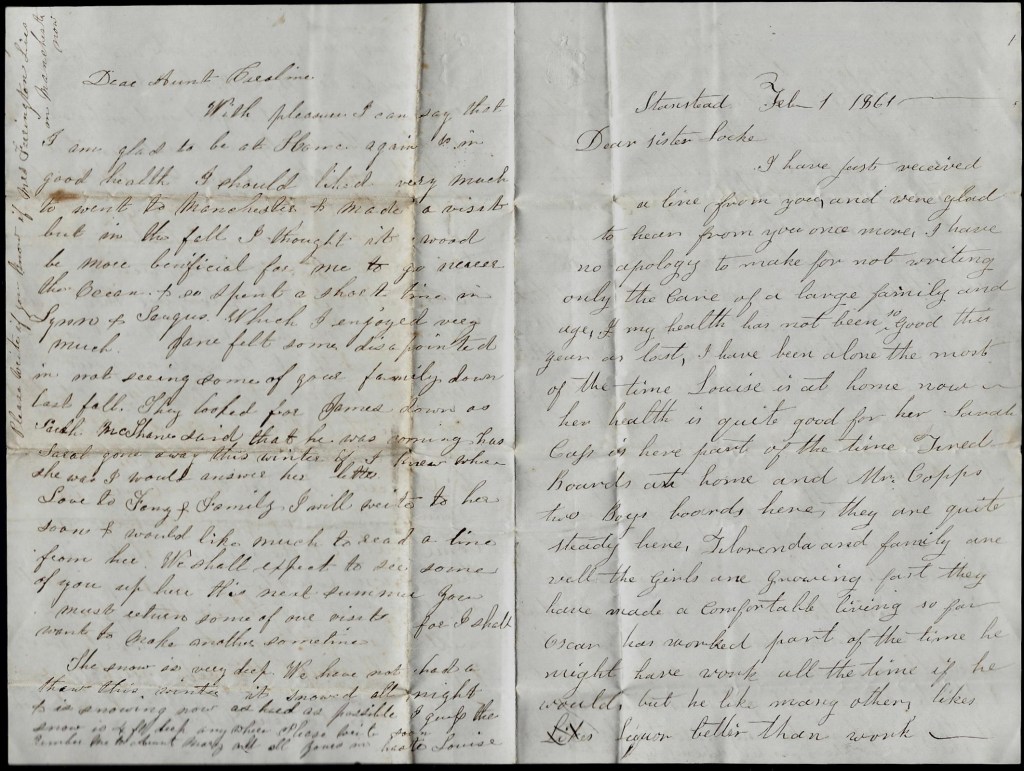
I have just received a line from you and were glad to hear from you once more. I have no apology to make for not writing—only the care of a large family and age. My health has not been so good this year or last. I have been alone the most of the time. Louise is at home now. Her health is quite good for her. Sarah Cass is here part of the time. [ ] Rounds at home and Mr. Copps’ two boys boards here. They are quite steady here.

Florinda and family are well. The girls are growing fast. They have made a comfortable living so far. Oscar has worked part of the time. He might have work all the time if he would, but he like many others, likes liquor better than work. 1

[My husband] James visited our friends to the West last fall. Found them all well. He liked Lillie’s situation well though she had gone most too far west. She was most overjoyed to see her Father Ives, got discouraged and left off work last summer, was just getting over it when he was there. He said they make a good living and that is all. Anne W. or Perry had two little twin girls three weeks old when he was there.

Our friends in this place are getting along after the old sort though some are sick. Wesley Cass is quite sick. Mr. Nathaniel Lyford is very dangerous sick. Benjamin Lyford is somewhere in Canada West in the daguerreian business. Ruth Lyford is at home sick with consumption. They think her husband is I do not know where. Anny Reece is about the same. Has never sat up any yet. I think she might get so as to sit up if they would make any effort. She thinks she can’t. She does her [s____ ] lying in bed.

I suppose you know that our Methodist preacher is Mr. [John] Borlan[d]. He is an excellent man and a good and interesting speaker. The society are all united with the exception of one family and that is the Eld’s have very good meetings. No conversion in our neighborhood. There has been twelve baptized this winter in the Morrill District below us. They have different preachers—some advent and others.
I think by reading your southern papers there is nothing talked nor printed but secession. I think South Carolina will drive you to Canada. If you ever come, we should be very glad to have you come but let the niggers stop in their own country. I guess you will all come out right in the spring.

Well, it is getting late. Write soon if you will accept this. With much love, — Sarah Locke

to Mrs. Caroline D. Locke


1 Florinda Locke (1812-18XX) was married at Stanstead in 1844 to Oscar Wyman (1822-1900)—a man that Sarah described as one who “likes liquor better than work.” The two girls “growing fast” were Flora Jane Wyman (1848-1931) and Evaline Wyman (b. 1851).

1861: George & Samuel Neal to Alvina Cordelia Neal

The following letters were written by the Neal brothers in the spring of 1861 while attending Phillips Exeter Academy in Exeter, New Hampshire. All were datelined in April and May during the excitement of the impending Civil War.

One of the authors was George William Neal (1844-1884) who, at age 16, entered Phillips Exeter Academy in Exeter, New Hampshire. George afterwards attended Harvard and graduated in 1865. He then became a teacher in Boston and died in 1884 at the age of 40. He married Delia Annah Henderson (1843-1914) and had two sons.

The other author was Samuel Badger Neal, (1842-1901), who also attended the Phillips Exeter Academy and preceded George to Harvard. All of the letters were addressed to Alvina Cordelia Neal (1840-1905) whom they called “Allie.”

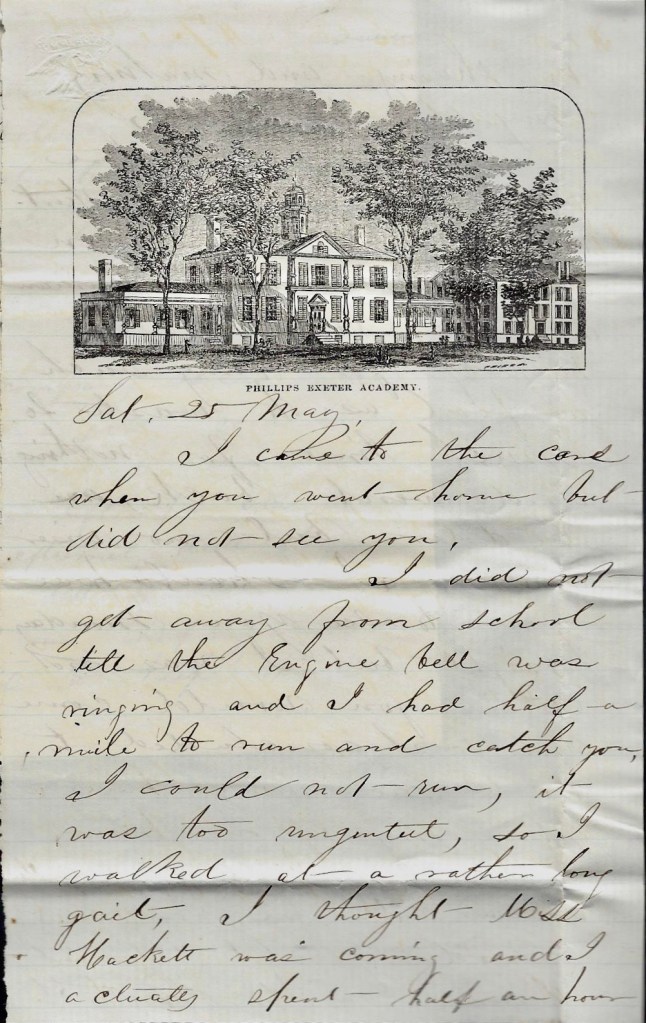
One of the letters was written on stationery with an incredible lithograph of the Academy Building which I have not found elsewhere on the internet or in the school’s archives so it must be very rare.

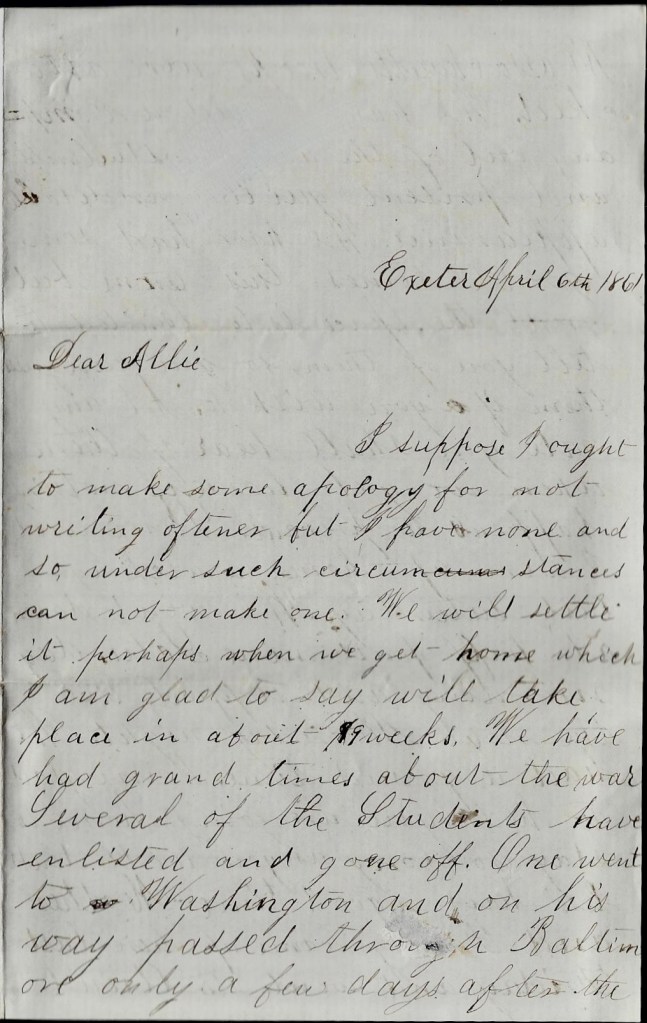
Letter 1

A CDV of the academy in the mid 1860s.

Exeter [New Hampshire]
April 6th 1861

Dear Allie,

I suppose I ought to make some apology for not writing oftener but I have none and so, under such circumstances can not make one. We will settle it perhaps when we get home which I am glad to say will take place in about 9 weeks.

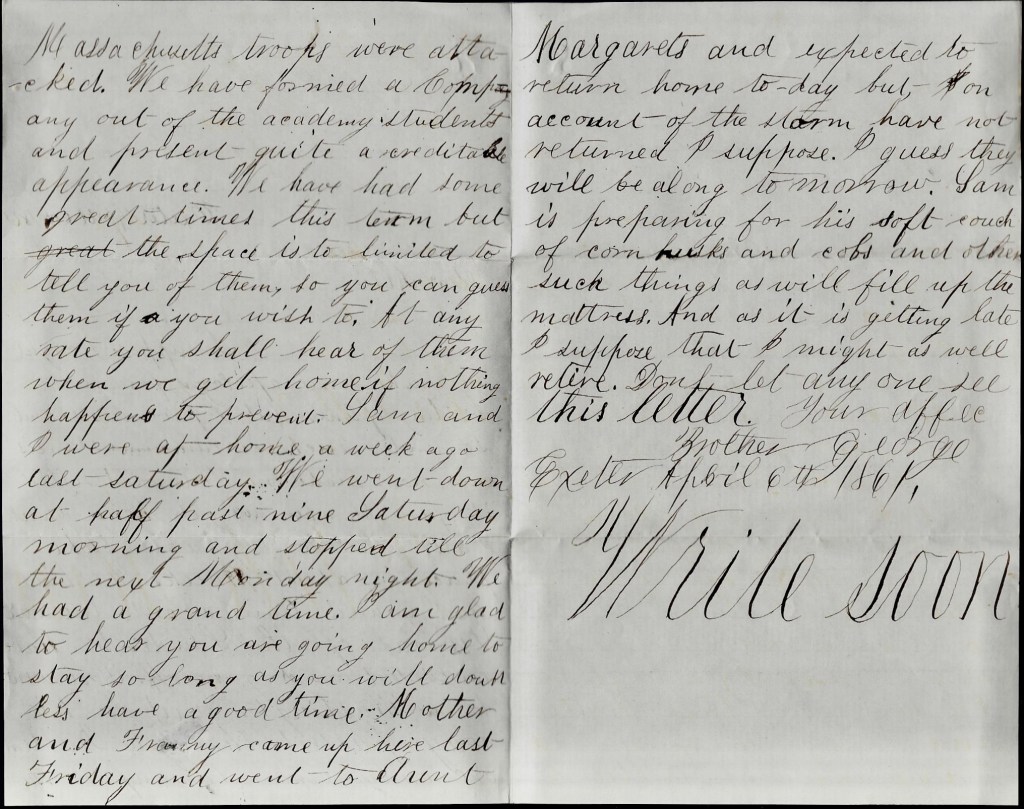
We have had grand times about the war. Several of the students have enlisted and gone off. One went to Washington and on his way passed through Baltimore only a few days after the Massachusetts troops were attacked. We have formed a company out of the academy students and present quite a creditable appearance.

We have had some great times this term but the space is too limited to tell you of them so you can guess them if you wish to. At any rate, you shall hear of them when we get home if nothing happens to prevent. Sam and I were at home a week ago last Saturday. We went down at half past nine Saturday morning and stopped till the next Monday night. We had a grand time.

I am glad to hear you are going home to stay so long as you will doubtless have a good time. Mother and Franny came up here last Friday and went to Aunt Margaret’s and expected to return home today but on account of the storm, have not returned I suppose. I guess they will be along tomorrow.

Sam is preparing for his soft couch of corn husks and cobs and othe such things as will fill up the mattress. And as it is getting late, I suppose that I might as well retire. Don’t let anyone see this letter. Your affectionate brother, — George

Write soon.


Letter 2

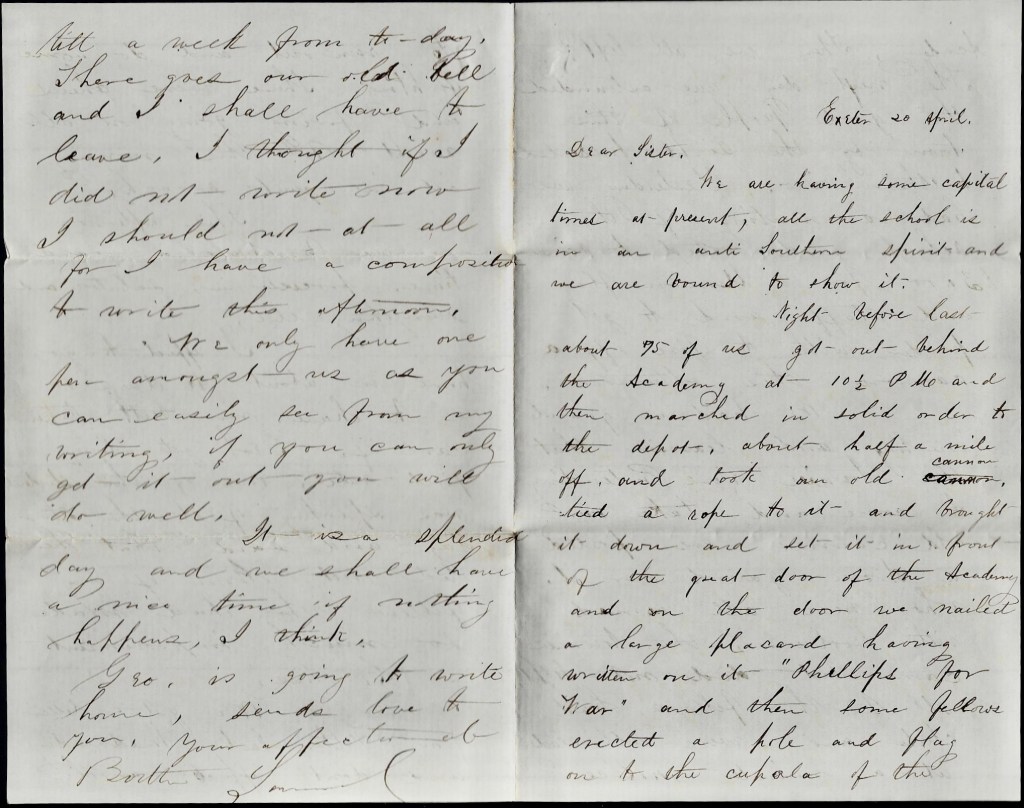
Exeter [New Hampshire]
20 April [1861]

Dear Sister,

We are having some capitol times at present. All the school is in anti-Southern spirits and we are bound to show it.

Night before last, about 75 of us got out behind the Academy at 10:30 p.m. and then marched in solid order to the depot, about half a mile off, and took our old cannon, tied a rope to it, and brought it down and sat it in front of the great door of the Academy and on the door we nailed a large placard having written on it, “Phillips for War,” and then some fellows erected a pole and flag on to the cupola of the Academy. Then we all left. The next day we astounded the good people of this town by the sight presented to their view. Yesterday we had a meeting of the school and voted to raise $30 for a Union flag and staff and to get powder with to fire off the cannon this afternoon. 1

We had a grand meeting and learning that the town were intending to come and take our old cannon, we posted a strong guard over it who were all armed with revolvers. The townies came but did not fight. All of the fellows had clubs and were all ready at a minutes notice to run out and do some fighting. There were cheers and firing going on all night, but this morning all is quiet enough.

This afternoon we are to have a grand time—processions, salutes, and everything else.

I expect to go home in about 10 days so as to have my teeth taken care of. George gets along first rate. One of the students was speaking of it the other day and said that he did not know of any fellow who had made so much improvement as George has.

We got a letter from Father last Wednesday ad don’t expect another till a week from today. There goes our old bell and I shall have to leave. I thought if I did not write now, I should not at all for I have a composition to write this afternoon.

We only have one pen amongst us as you can easily see from my writing. If you can only get it out, you will do well.

It is a splendid day and we shall have a nice time if nothing happens, I think. George is going to write home. Sends love to you. Your affectionate brother, — Samuel

1 Samuel’s version of these events varies slightly from an account that appears in a history of the school by Laurence M. Crosbie published in 1923 (page 255) which reads, “Moved by the spirit of war, some of the students one night filed silently out to Greenland, a village eight miles away, and dragged an ancient cannon, which they labeled, ‘Phillips for War!’ and planted it before the door of the recitation hall. The next morning Principal Soule eyed the gun narrowly and after formal exercises at the chapel showed his patriotism and his tact in dealing with a new problem by declaring that he was not displeased with the martial spirit of the boys, since it showed they were ready to answer the call of their country; but he added that he wondered where the engine came from, and if it was really safe to fire. His generous stand brought wild cheers from the students, whom he then directed to get permission to fire the ld brass cannon that stood near the town hall. A collection was taken to buy powder, and many rounds were fired. I that way the boys vented their enthusiasm for the cause that was to cost many of them their lives.”


Letter 3

Rare 1861 Lithograph of Phillips Exeter Academy—the second academy building that was built in 1754 (wings added in 1821). It was destroyed by a fire on 18 December 1870.

[Phillips Exeter Academy, Exeter, New Hampshire]
Saturday night, May 24 [May 25, 1861]

Dear Sister,

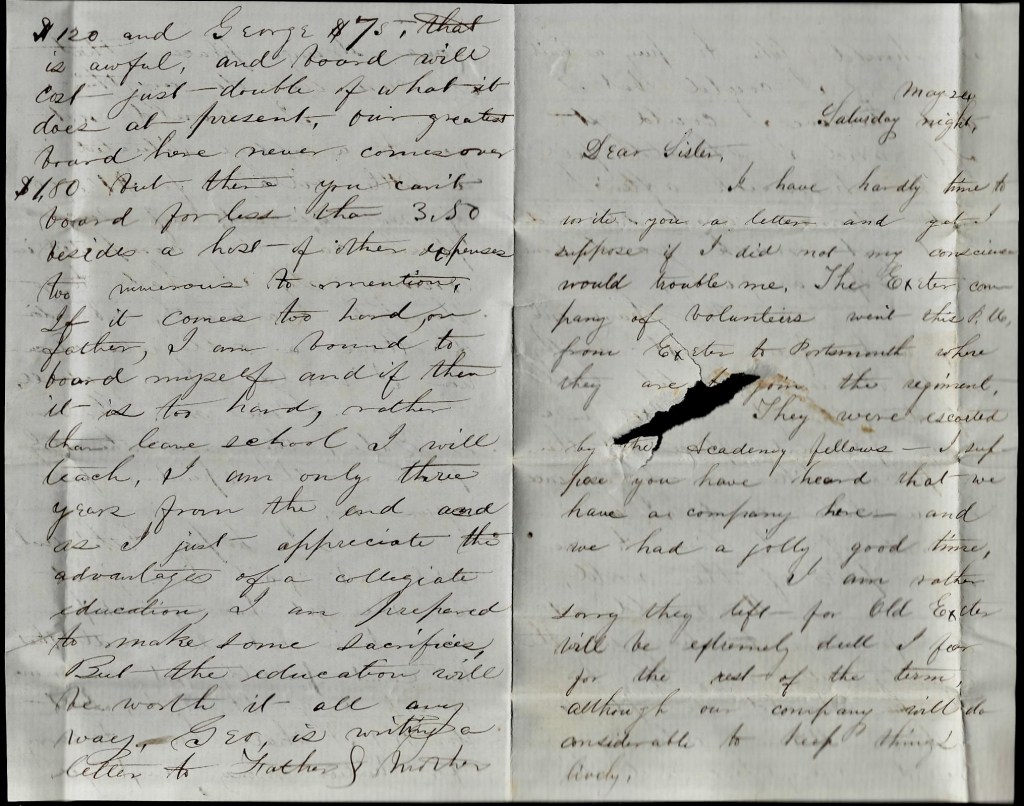
I have hardly time to write you a letter and yet I suppose if I did not, my conscience would trouble me. The Exeter Company of Volunteers went this p.m. from Exeter to Portsmouth where they are to form the regiment. They were escorted by the Academy fellows. I suppose you have heard that we have a company here—and we had a jolly good time.

I am rather sorry they left for Old Exeter will be extremely dull for the rest of the term, although our company will do considerable to keep things lively. I should like to pay a visit home if I could but I don’t believe I could get off and I should feel rather homesick after I had returned and should not get much good from the trip anyway.

We have only six weeks from next Tuesday and I am heartily glad of it though Exeter is a very pleasant place but then a person likes a change once in a while and I am bound if I live to see some parts of the world.

It would not do for me to live in the country all my life for I should be fit for nothing. It is only by going round everywhere and seeing some strange places that I can ever do anything. I would not go to college situated in a little village for $10,000 if my disgust of such places can be computed in money. If I had to go through Dartmouth or Bowdoin to obtain a collegiate education, I would not go at all. Give me Harvard or Yale. They are the only places worth spending four years in.

I hope Father’s cash will not fail him just as we get home. Ships may turn out so badly that he can’t possibly get us money enough to go through. Just think, I shall have to carry for tuition money next year $120 and George $75. That is awful. And board will cost just double of what it does at present. Our greatest board here never comes over $1.80 but then you can’t board for less than 3.50 besides a host of other expenses too numerous to mention. If it comes too hard on Father, I am bound to board myself and if then it is too hard, rather than leave school. I will teach. I am only three years from the end and as I just appreciate the advantages of a collegiate education, I am prepared to make some sacrifices. But the education will be worth it all anyway.

George is writing a letter to Father & Mother.

Saturday, 25 May [1861]

I came to the cars when you went home but did not see you. I did not get away from school till the Engine bell was ringing and I had half a mile to run and catch you. [But] I could not run—it was too ungenteel—so I walked at a rather long gait. I thought Miss Hackett was coming and I actually spent half an hour in shaving and making myself presentable. And lo, I got there just as you were starting off. I mused on the mutability of human affairs, confounded myself for being such a fool as to waste so much time for nothing, and went back sadder but no wiser man. I should have gone to see you Monday night but I was not certain you would come and so I concluded to waste no more time in getting myself in trim.

Parker says he saw a gentleman with you. Who was it? Good night. Pleasant dreams. Your affectionate brother, — G

1864: Delia Annah Henderson to Alvina Cordelia Neal

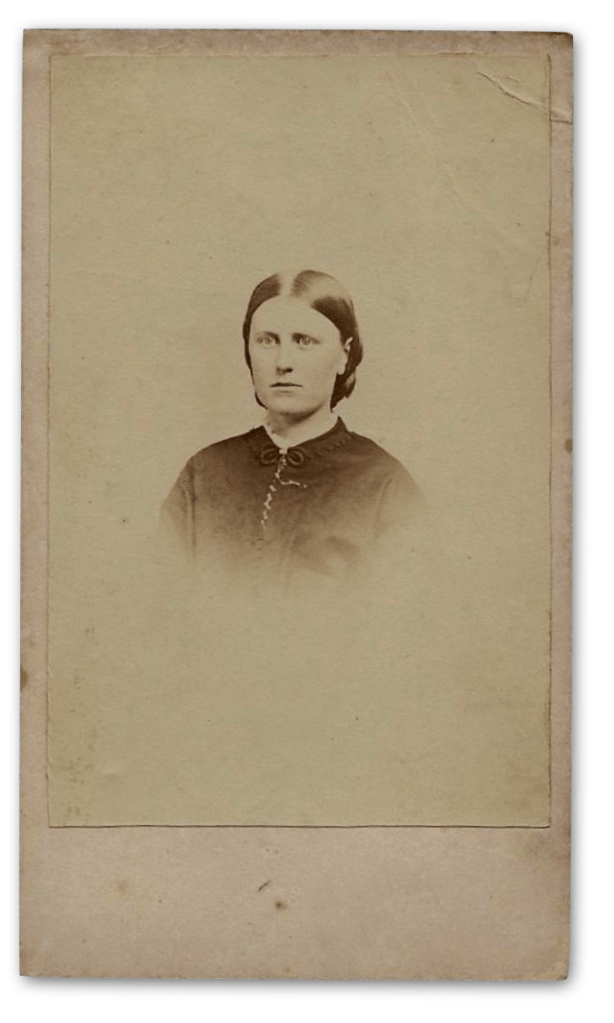
Delia Annah Henderson

The following letters were written by 21 year-old Delia Annah Henderson (1843-1914) in the days following the notice of her older half-brother’s death at the Battle of Deep Bottom on the 16th of August 1864. Delia’s brother was Lt. Colonel Thomas Albert Henderson (1833-1864) of the 7th New Hampshire Infantry. Prior to his enlistment, Thomas had graduated from Bowdoin College in 1855, the Harvard Law School in 1861, and was admitted to the Suffolk Bar in Boston.

Delia and Thomas were two of several children born to Samuel Hoyt Henderson (1798-1867) of Dover, Strafford county, New Hampshire. Thomas was borne by Samuel’s first wife, Delia Paul (1804-1837) and Delia was borne by Samuel 2nd wife, Sarah Ann Guppy (1812-1900).

Delia wrote the letters to Alvina (“Allie”) Cordelia Neal (1840-1905) who would become her sister-in-law in a few years. In August 1868, Delia and George (“Georgie”) William Neal (1844-1884) of Kittery, Maine, were married. The cdv’s on this page were attached to these two letters and since both back marks indicate they were taken by the artist E. T. Brigham in his Dover, N. H. studio, I feel confident they are of Delia A. Henderson.

Letter 1

Dover [New Hampshire]
August 23rd 1864

Darling Allie,

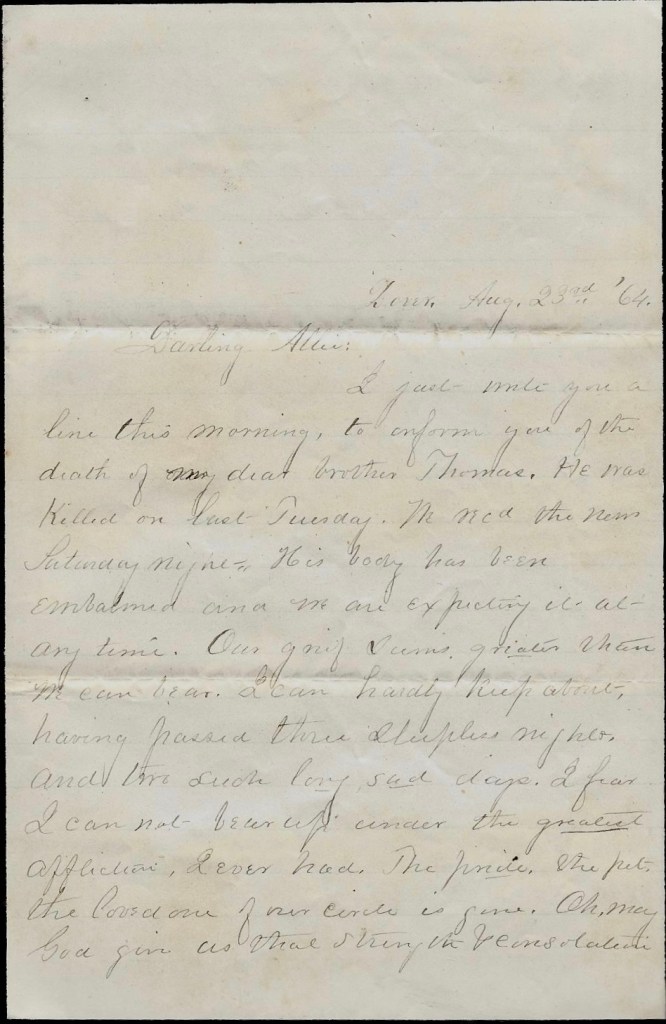
I just wrote you a line this morning to inform you of the death of my dear brother Thomas. He was killed on last Tuesday. We received the news Saturday night. His body has been embalmed and we are expecting it anytime. Our grief seems greater than we can bear. I can hardly keep about, having passed three sleepless nights and two such long, sad days. I fear I cannot bear up under the greatest affliction I ever had. The pride, the pet, the loved one of our circle is gone. Oh, my God, give us that strength & consolation which seems to cause everyone to mourn as his. I send you a paper containing a notice of his death. It has been in a number of papers but we could not obtain many except of these.

Poor dear John—away from all his friends, has to bear his shock alone. I fear we shall not have him many years. I shall have more friends in heaven that upon earth soon. Oh! how I wish I could join them now. But no, I must suffer on. We mourn and mourn deeply, but we try and not murmur. But everything seems so dark and gloomy to us. Our deep mourning garments but faintly express the blackness of all around us.

Oh Allie, I wish you were with me today. T’would be a comfort, I know. We have had so many of his friends here, but I have seen none. Mother had to see them. It seems as though his associates here could not bear it. But He who sent this affliction upon us will give us strength to bear it. It has never been so hard for me to say, “All’s for the best.” I am almost worn out with grief. But I trust I shall be able to go through the trying scenes which are yet to come. I thank you most heartily for your kind note. Tell [your brother] Georgie his letter was a source of consolation. I will write him when I am calmer. Do write soon. Pray that I may not murmur at our affliction but that God in his mercy will give me strength to bear it. Yours in the deepest sorrow and affliction, — Delia A. H.

I did not receive your letter till Saturday night.


Letter 2

Delia Annah Henderson

Dover [New Hampshire]
August 28th 1864

Dearest Allie,

I feel too sad to read, too sad to speak, and too sad to write to anyone but you. Oh such a long, sad week as this has been. But today seems sadder and longer than any of the past week because I have been so busy and we have had so many things to see to, that it has taken up my attention some. But today, everything seems so quiet and death-like. We are all too full of sorrow to speak except with tears.

The body of our dear brother has not yet arrived and you can perhaps imagine what waring anxiety & surprise we have passed through when every train we expected him. He may come at any time. The chaplain was only waiting for a leave of absence, before starting with his body. It has been embalmed, and if it was properly done, we will look as natural as when he died. What a consolation it is to us to know that he never fell into the Rebels hands, and that we can have his body to bury, and know where he is laid.

We received a letter from the Colonel yesterday saying he was wounded by a rifle ball in his thigh. He was hit at 12 and died at three o’clock, Tuesday the 16th. The Colonel spoke to him about two minutes before but had to go to the General for orders. When returning, he met a soldier carrying an officer wrapped in a blanket on his shoulders and was told ’twas Col. Henderson. He was immediately put in an ambulance in an ambulance and carried to the hospital where he had every attention but the Surgeon at once knew ’twas a mortal wound. He lingered three hours. Oh! what hours of anguish those must have been away from ever loved friend.

Thomas Albert Henderson of the 7th New Hampshire Infantry when he was a lieutenant

The chaplain was with him all the time and when he arrives we shall know many things we wish so much to know. Oh, Allie! You know not what grief our is. You can perhaps imagine how you would feel in like circumstances but when the sad reality is forced upon you, you find it ’tis very different. He was such a good, kind and thoughtful brother that it seems so hard to give him up. As everyone here says, he has not left one stain upon his name. He was too noble and brave to meet such a death, and it does not seem right that so much talent as he had should so soon be cut off. I don’t know how I can ever bear to have him buried. Then ’tis doubly hard, for he is to be buried under military & masonic orders from the church. It would be hard enough to bury him in a quiet way, but this will almost kill us. We would not consent for a long time, but as everyone most wants to attend the funeral, we had to sacrifice our feelings for others.

The past week has done the work of a year upon me. I have slept but very little and food I don’t care for, Oh! can I bear this dreadful shock. Why was the blow permitted to fall upon the idolized one. You know, Allie, he was worthy to be proud of and loved and no death has occurred in this place which this world cannot give. If convenient, please inform our friends of his death. Do write me soon.

Your friend in the deepest sorrow. — Delia A. H.


1865: James L. King to Janet Sheppard

The following letter was written by James King of New York City who wrote the letter to his aunt, Janet Sheppard (1798-Af1865), also of New York City. In the 1855 State Census, I can see that a 20 year-old young woman named Johanna King was enumerated in the household of her Aunt Janet Sheppard of No. 8, 22nd Street in NYC. Johanna was undoubtedly James’ sister. Beyond that, I have not been able to confirm King’s record of service. Neither have I been able to confirm the location of Alexander Bridge which must have been located somewhere near the Cumberland river based on the content of this letter.

Transcription

Addressed to Miss J. Sheppard, No. 8 East 22 Street, New York City

Alexander Bridge
March 7, 1865

My dear Aunt,

I have just received a bunch of Tribunes and I see by my note book that it is time I was writing you. The Tribunes are dated down to the 28th of February. They are full of the good news. I hope it will continue to tell the end of the Rebels and the war. I had a letter from home the other day. They were all well and I had a newspaper from Father and he told me in his letter that when I got a paper, I was to consider them all well.

We have been having a rainy time of it lately but it has been good weather the past two days. We have not been set to work on the new stockade yet. We expect the Major here today to say where it is to be put and where we are to get the timber. It is to be built strong enough so a shell can’t get inside. The boys do not like the idea of going to work but it will not hurt them. Our duty is light but the stockade will not go on fast as we will have our duty to do as before. But as long as we have our health, we ought not to grumble.

I hope this will find you all in good health as it leaves me at present. The grass is beginning to grow and cattle are out feeding. The planters are very slow about their work. It rains so much here that the ground is not in a fit condition to plough. The men are ploughing today for it has been dry for two days now and the wind has dried up the ground. The Cumberland river is very high. The back water comes up to our bridge and some of the fields are covered with water. The troops are going south at the rate of two or three regiments a day. I do not see how they feed so many men when it takes so much to feed our small squad. I think the Rebels will soon have a hard time to get their rations for when the railroad on our line of communications is cut, the soldiers are put on short rations and I do not see how the Rebels can feed their men except they have a different way of doing than our government has.

Well, I must close for this time. I am expecting a letter so I will wait as the mail has gone for today. I have just received your kind letter of February 28 and was glad to get it. I also received one from Tebeta of the same date as yours. They were all well.

Dear Aunt, I will try and put my letters in as good language as I can. I never did get a thorough course of instruction in grammar and if I do not make a mistake, it is in some part in not taking pains to mind what I wrote. Aunt, would it not be a good idea for you to write about 3 or 4 days after you send the papers? But I do not wish to put you to any more trouble if you have a good ways from the post office [in which case] you had better send both together as heretofore.

I have wrote all the news I can think of just now. Kind love to Aunt Elizabeth and Joan. Kindest love to yourself and I remain your affectionate nephew, — James L. King

This will go out by tomorrow’s post. I received the newspapers on Monday the 6th of March and the letter the 7th.