The following was written by Dr. William John Cavanaugh (1874-1949), the son of John M. Cavanaugh (1840-1895) and Anna Fryer (1843-1907). William’s father, John, was a veteran of the Civil War, having enlisted in September 1861 as a private in Co. F, 43rd New York Volunteers. John was promoted to 1st Sergeant of Co, B in July 1862 and commissioned a 1st Lieutenant on 2 June 1863. He was with his regiment until he was severely wounded in the fighting at the Wilderness on 4 May 1864 and underwent a leg amputation to save his life.
What is most revealing in William’s letter is the considerable pain and suffering that his father endured for thirty years after the Civil War ended. The amputation of his leg certainly saved his life but it condemned him to a life that scarred him deeply—physically, socially, and emotionally.
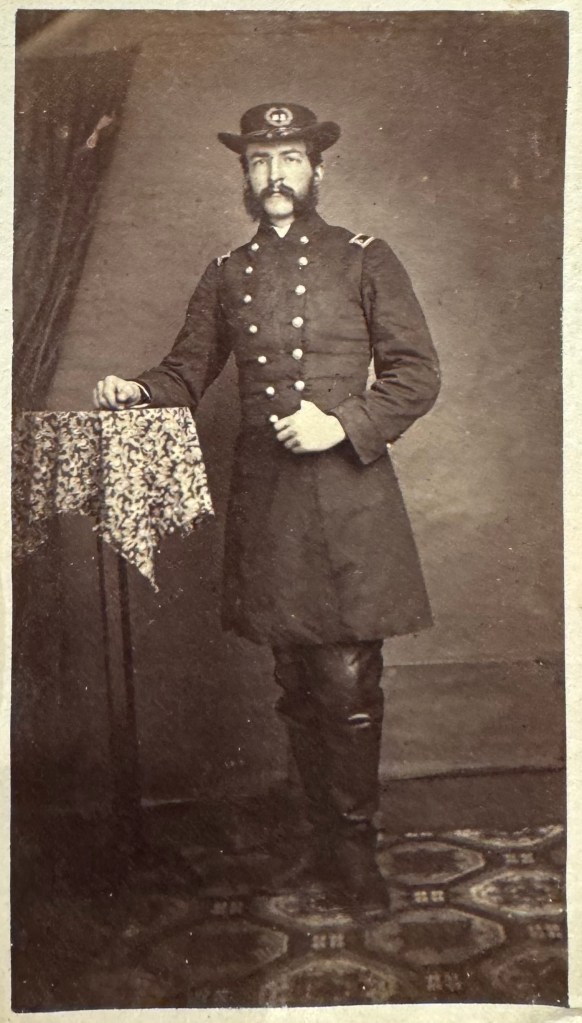
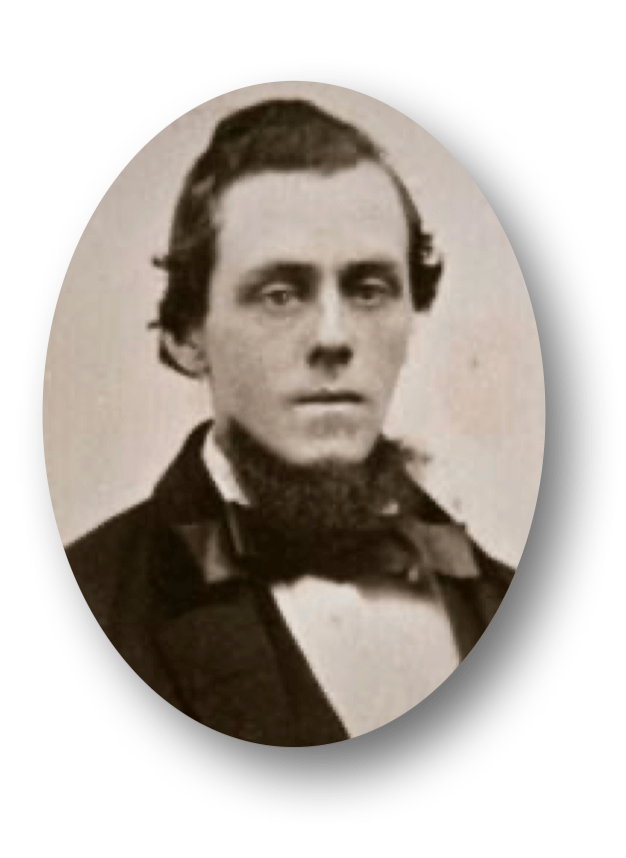
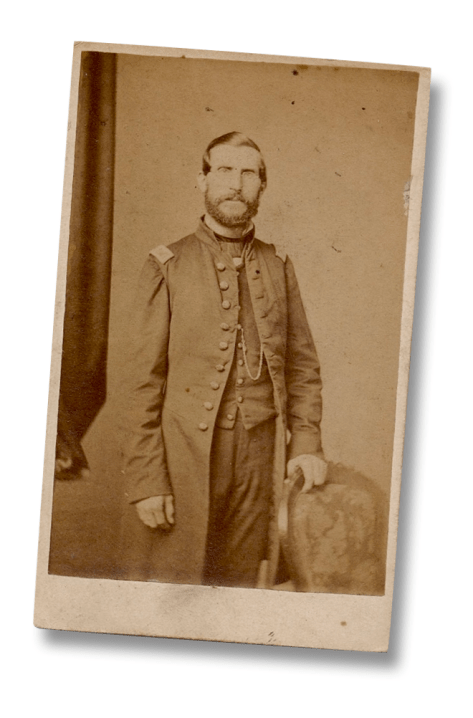
Lt. John M. Cavanaugh; the cdv at left was taken in Albany while he was home on furlough before the start of the Spring Campaign in 1864. The cdv at right was taken in Albany a year or two later. (Kevin Canberg Collection)
After his discharge, John married the younger sister of another officer in the 43rd NYVI named John Fryer; Fryer and Cavanaugh were friends who worked together on the railroad prior to the Civil War. Fryer himself was killed shortly before Cavanaugh was seriously wounded. They are all buried together in the same grave at a cemetery in the Albany area.
It isn’t clear who the document was addressed to. It was part of a massive grouping Kevin Canberg acquired several years ago related to Fryer, Cavanaugh, and the 43rd New York. The statement that he was “temperate” with no bad habits” suggests to me that it was intended for a Widow’s Pension application but I could not find one in the National Archives.
Transcription
Meigs Case, the surgeon who performed the amputation of Cavanaugh’s leg.
The amputation of the leg was not the cause of death. The result of the amputation on the nervous system after a few years of dragging an artificial leg about, the shock of the severed nerves and arteries, seem to be [the cause]. For several years the abrasions of the skin and flesh with resulting boils and ulcers: Then paroxysms of stinging pain where the scars of the stitches were would throw the man in a fever and would last from one to five minutes, with about the same time of relief. During the time these pains lasted he could not sleep only when after a while he became exhausted he would drop asleep a minute sometimes. The doctors said they could give something to deaden the pain but under the conditions, were afraid it would form a habit and could not cure.
In ’86, he had a serious abscess on the stump which extended almost into his bowels. Was confined to his bed for six weeks suffering terribly. He became greatly emaciated and for the greater portion of his time his life was despaired of. But his good constitution brought him through. After this sickness he never regained his former health. His nerves were very bad and he was excitable. His heart troubled him. He did not get out very much and his stump troubled him more than ever. The kidney trouble was quite advanced when it was first diagnosed and his face bloated some. It was said by the doctors that the kidney disease was brought on by the state of his system and the nervous condition he was in from the access which was the result of the amputation of leg. He was temperate, with no bad habits.
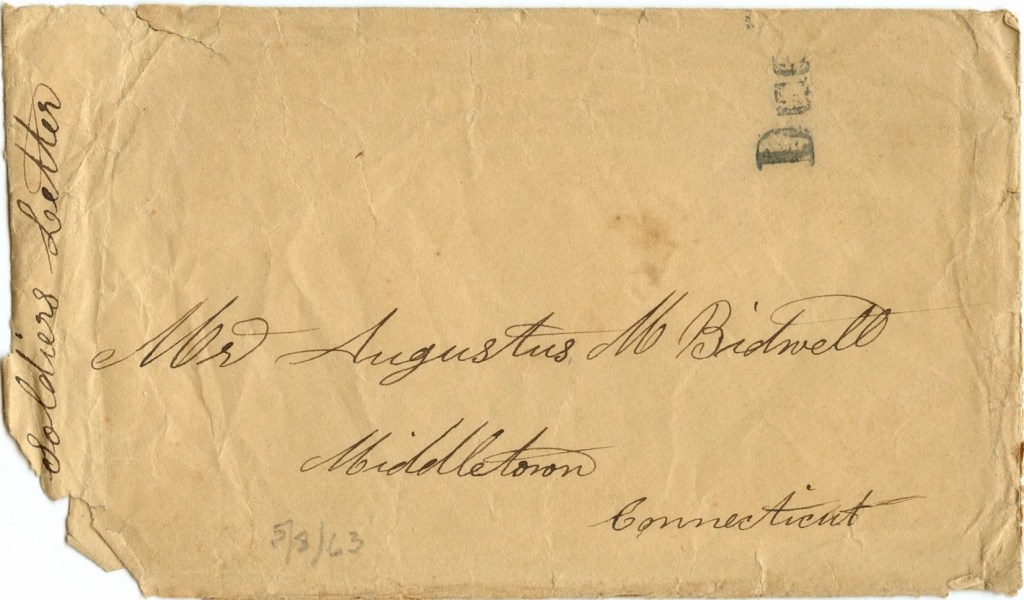
The following letters were written by Lucius E. Bidwell, Jr., (1833-1864), the son of Lucius E. Bidwell, Sr. (1806-1852) and Mary M. Barnes (1808-Aft1865) of Middletown, Middlesex county, Connecticut.
He lived in Middletown, and worked as a painter until he enlisted in Captain Elijah W. Gibbons’ famous Co. B of the 14th Connecticut Volunteers (the “Nutmeg Regiment”) in July of 1862. He was wounded at the Battle of Fredericksburg and survived, but died late in the war, in the Wilderness of northern Virginia May 5, 1864. His burial place is unknown, but a Cenotaph was erected in his name at Indian Hill cemetery in Middletown. On February 17, 1864, the local Middletown newspaper The Constitution published a letter from Bidwell that details his experiences fighting Confederate soldiers.
The first letter in this small collection provides details of the Battle of Chancellorsville. The regiment was held in reserve for the most part until Sunday, May 3rd, when they went into action and suffered several casualties, though no one was killed.
[Most of these letters were provided from the collection of the Senft Family for the express purpose of being transcribed and published on Spared & Shared.]
Letter 1
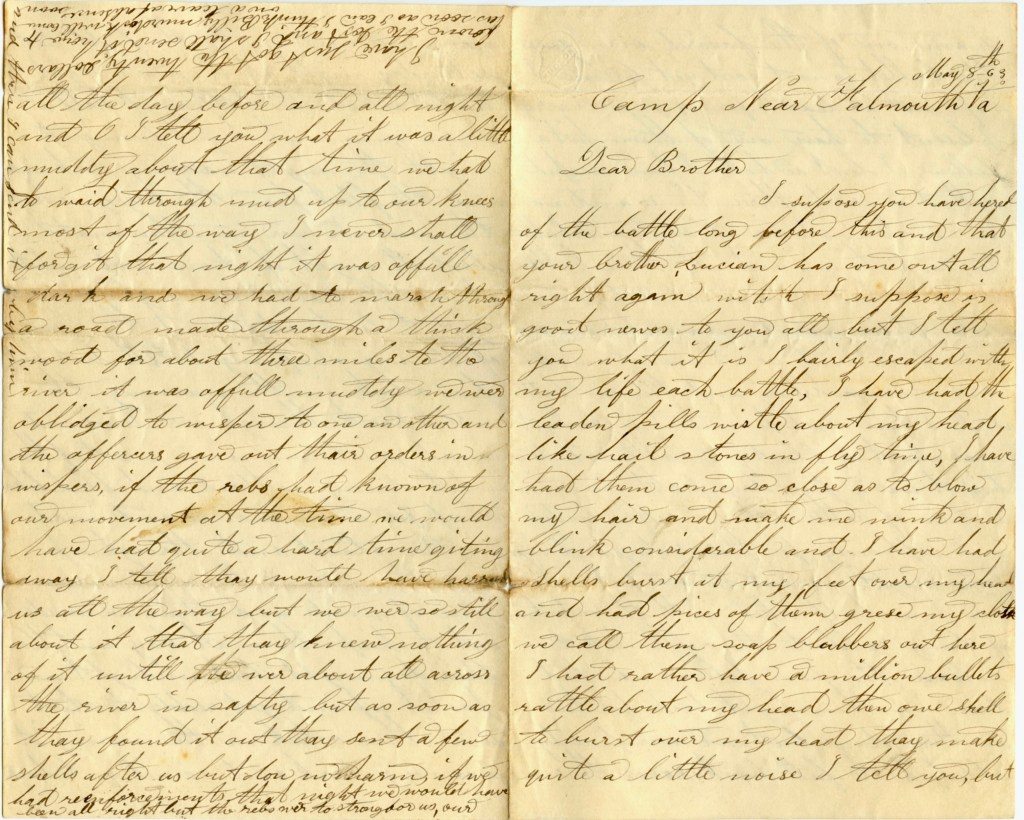
Camp near Falmouth, Virginia May 8th 1863
Dear Brother,
I suppose you have heard of the battle long before this and that your brother Lucien has come out all right again which I suppose is goo news to you all but I tell you what it is, I barely escaped with my life each battle. I have had the leaden pills whistle about my head like hail stones in fly time. I have had them come so close as to blow my hair and make me wink and blink considerable and I have had shells burst at my feet, over my head, and had pieces of them graze my clothes. We call them soap blubbers out here. I had rather have a million bullets rattle about my head than one shell to burst over my head. They make quite a little noise, I tell you.
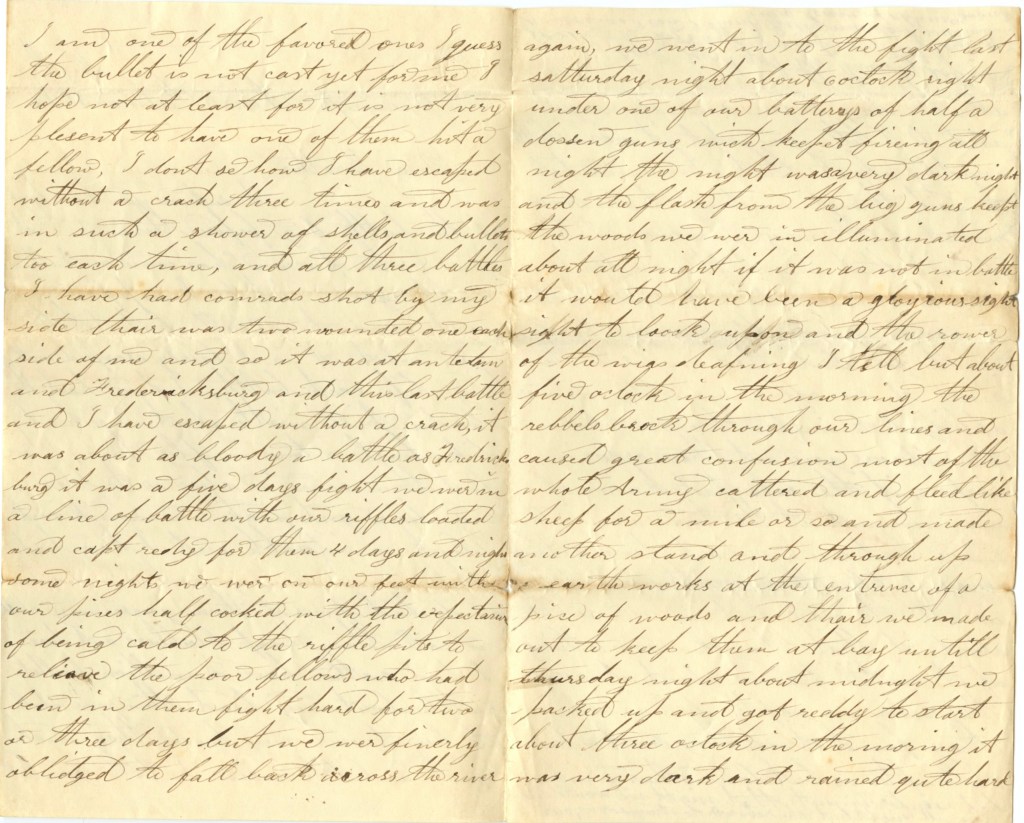
But I am one of the favored ones, I guess. The bullet is not cast yet for me. I hope not at least for it is not very pleasant to have one of them hit a fellow. I don’t see how I have escaped without a scratch three times and was in such a shower of shells and bullets too each time, and all three battles I have had comrades shot by my side. There was two wounded, one each side of me, and so it was at Antietam 1 and Fredericksburg 2 and this last battle, and I have escaped without a scratch.
It was about as bloody a battle as Fredericksburg. It was a five days fight. We were in a line of battle with our rifles loaded and kept ready for them four days and nights. Some nights we were on our feet with our pieces half cocked with the expectation of being called to the rifle pits to relieve the poor fellows who had been in them fighting hard for two or three days. But we were finally obliged to fall back across the [Rappahannock] river again. We went into the fight last Saturday night about 6 o’clock right under one of our batteries of half a dozen guns which kept firing all night. The night was a very dark night and the flash from the big guns kept the woods we were in illuminated about all night. If it was not in battle, it would have been a glorious sight to look upon and the roar of the [guns] was deafening I tell [you].
But about five o’clock in the morning the rebels broke through our lines and caused great confusion. Most of the whole army scattered and fled like sheep for a mile or so and made another stand and threw up earthworks at the entrance of a piece of woods and there we made out to keep them at bay until Thursday night about midnight [when] we packed up and got ready to start about three o’clock in the morning. It was very dark and rained quite hard all the day before and all night and oh! I tell you what, it was a little muddy about that time. We had to wade through mud up to our knees most of the way.
I never shall forget that night. It was awful dark and we had to march through a thick wood for about three miles to the river. It was awfully muddy. We were obliged to whisper to one another and the officers gave out their orders in whispers. If the rebs had known of our movement at the time, we would have had quite a hard time getting away. I tell you, they would have hurried us all the way, but we were so still about it that they knew nothing of it until we were about a;; across the river in safety. But as soon as thy found it out, they sent a few shells after us but done no harm. If we had reinforcements that night we would have been alright but the rebs were too strong for us. Our Brigadier General [William] Hays was wounded I believe very bad. He is now at Washington, they say.
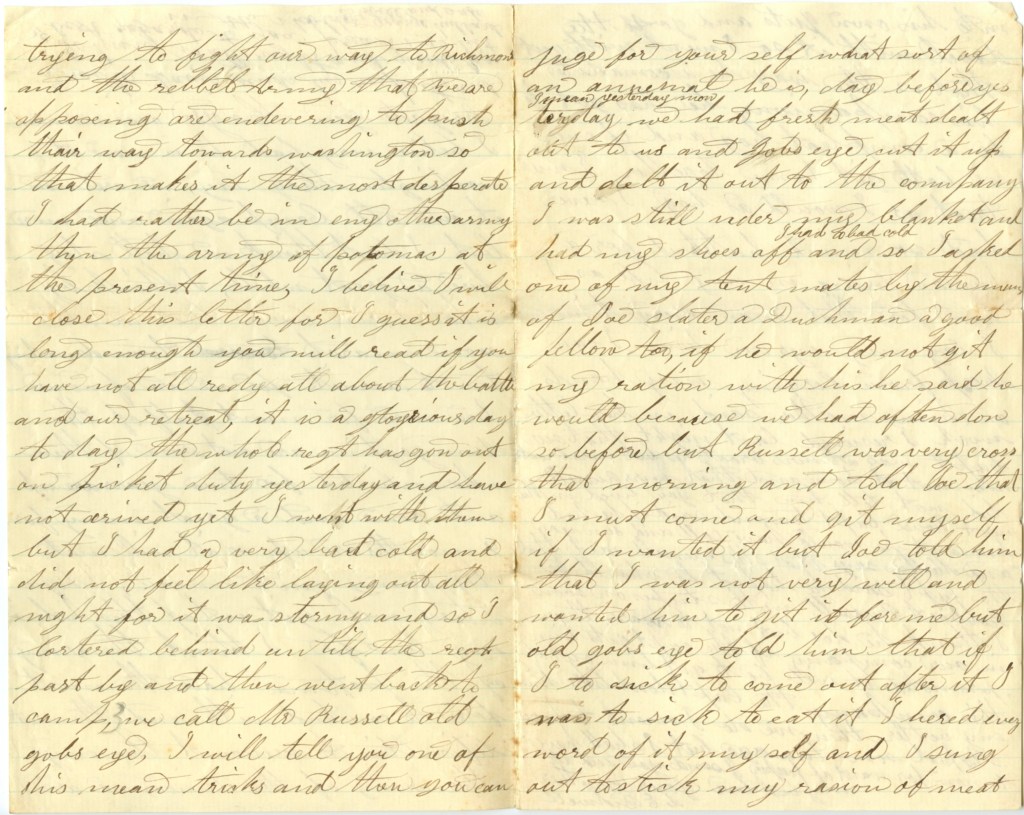
We are now at our old camp again once more but I don’t think we shall stay here a great while. I think by what I can learn that we shall soon march towards Washington to recruit for we are of no use here now for most half of this army’s time are out. Some of them who enlisted for two years are up and some—and a great many for 9 months—are up, so it will make the army quite small. I hope they will get out of this hole anyhow for I think the Army of the Potomac have the most [Rebel] force to contend with and the most difficulties to surmount than any other army of the Union. We are trying to fight our way to Richmond and the rebel army that we are opposing are endeavoring to push their way towards Washington so that makes it the most desperate. I had rather be in any other army than the Army of the Potomac at the present time.
I believe I will close this letter for I guess it is long enough you will [be tired] read[ing] if you have not already, all about the battle and our retreat. It is a glorious day today. The whole regiment has gone out on picket duty yesterday adn have not arrived yet. I went with them but I had a very bad cold and did not feel like laying out all night for it was stormy and so I loitered behind until the regiment passed by and then went back to camp.
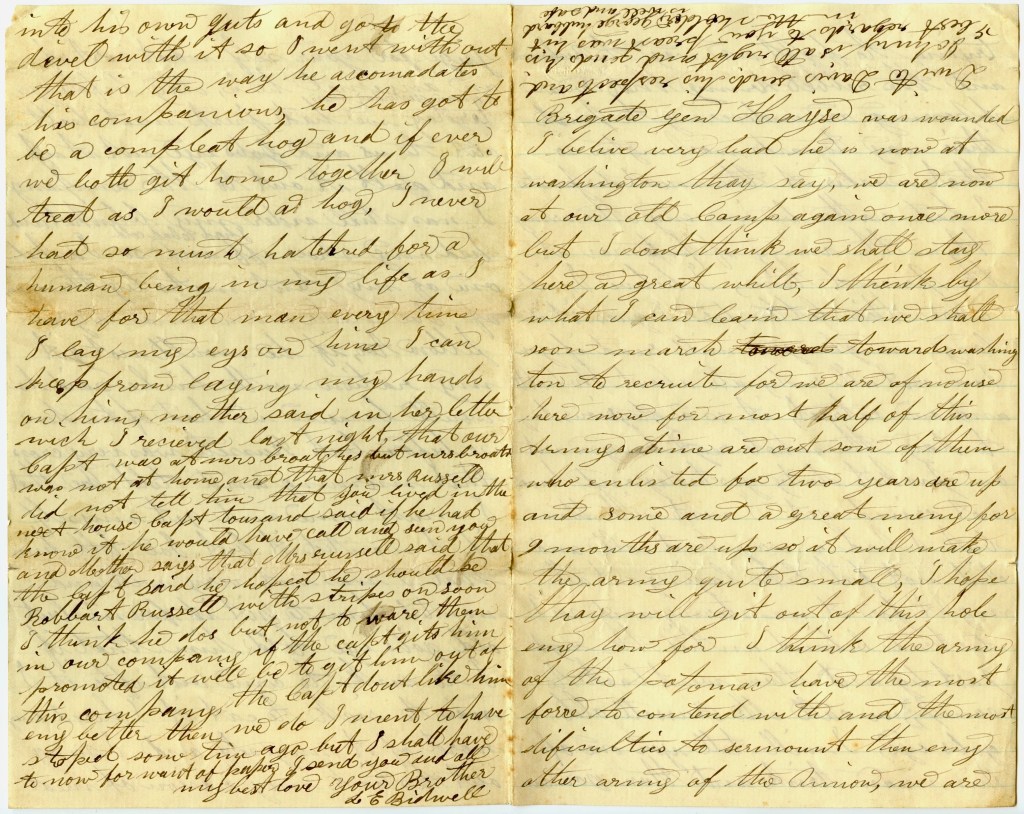
We call Mr. [Robert] Russell old Gob’s eye. I will tell you one of his mean tricks and then you can judge for yourself what sort of an animal he is. Day before yesterday (I mean yesterday morn), we had fresh meat dealt out to us and Gob’s eye cut it up and dealt it out to the company. I was still under my blanket and had my shoes off ( I had a bad cold) and so I asked one of my tent mates by the name of Joe Slater—A Dutchman, a good fellow too—if he would not get my ration with his. He said he would because we had often done so before but Russell was very cross that morning and told Joe that I must come and get myself if I wanted it. But Joe told him that I was not very well and wanted him to get it for me. But old Job’s eye told him that if I [was] too sick to come after it, I was too sick to eat it. I heard every word of it myself and I sung out to stick my ration of meat into his own guts and go to the Devil with it. So I went without. That is the way he accommodates his companions. He has got to be a complete hog and if ever we both get home together, I will treat [him] as I would a hog. I never had so much hatred for a human being in my life as I have for that man. Every time I lay my eyes on him, I can [hardly] keep from laying my hands on him.
Mother said in her letter which I received last night that our captain was at Mrs. Broatch’s but Mrs. Broatch was not at home and that Mrs. Russell did not tell him that you lived in the next house. Capt. Townsend said if he had known it, he would have called and seen you and Mother says that Mrs. Russell said that the Capt, said he hoped he should see Robert Russell with stripes on soon. I think he does but not to wear them in our company. If the Capt. gets him promoted, it will be to get him out of this company. The Capt. don’t like him any better than we do.
I meant to have stopped some time ago but I shall have to now for want of paper. I send you and all my best love. Your brother, — L. E. Bidwell
Dwight Davis send his respects and Johnny is all right and sends his best regards to you. Priest was hit in the shoulder. George Hubbard is well and safe.
1 On September 17, 1862, the regiment’s first action was at the Battle of Antietam. The regiment traveled along the flank and entered the East Woods, passing through Mumma’s orchard and cornfield toward the confederate line. The green troops performed well, but casualties came from confederate fire and accident; including a case of an exploding shell of Company D which killed 3 and wounded 4. In total, 21 men were killed and 88 wounded and 28 missing.
2 In the course of Battle of Fredericksburg, 10 men were killed, 92 were wounded and 20 were listed as missing, among the dead was Lieutenant Canfield and Captain Gibbons of Company B and the Lieutenant-Colonel Perkins was wounded.
Letter 2
Camp near Falmouth, Va. May 23, 1863
Dear Mother,
I have just seated myself under beautiful shade a few yards from our log huts and the band is playing a few yards off [from] where I am seated writing and it sounds beautifully echoing through the woods. Oh, it is such a lovely day that I cannot help enjoying it as much as I possibly can. But Mother, the thought that this cruel war is still going on almost makes it impossible for me to enjoy myself even here in this beautiful grove of pines and a plenty to eat and good spring water to drink right in our camp and a splendid band of music to enliven us.
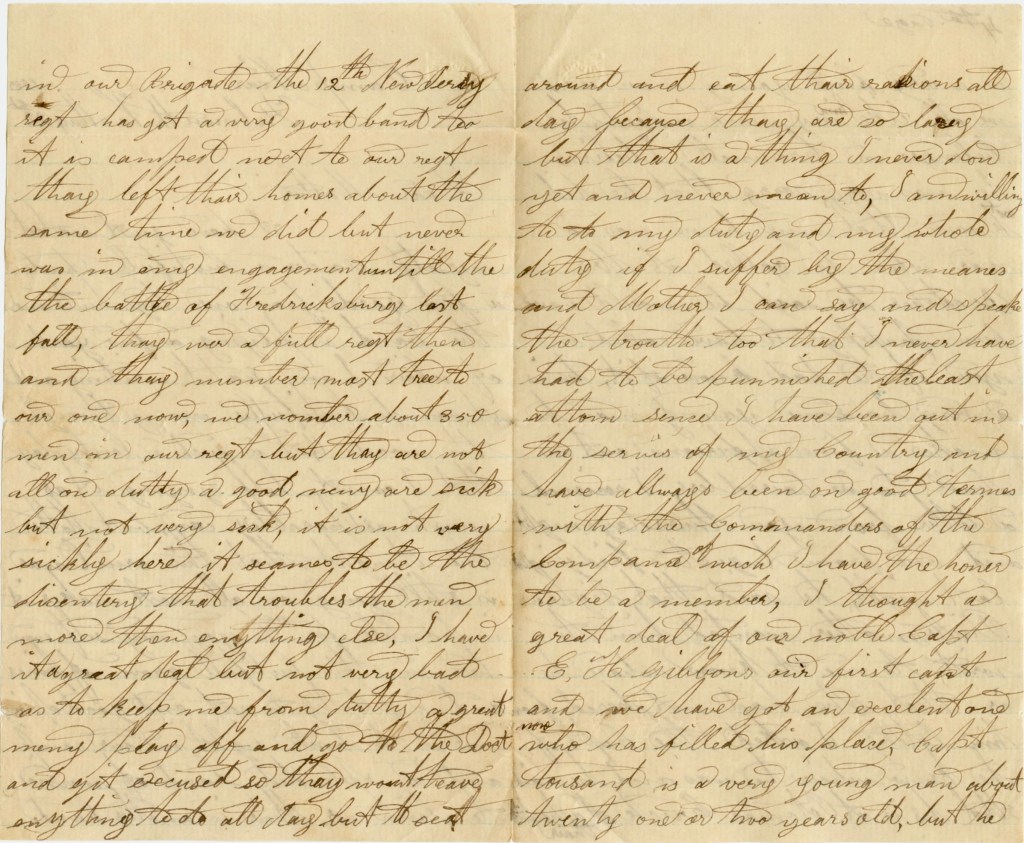
There is another band in our brigade—the 12th New Jersey Regt.—has got a very good band too. It is camped next to our regiment. They left their homes about the same time we did but never was in any engagement till the Battle of Fredericksburg last fall. They were a full regiment them and they number most three to our one now. We number about 350 men in our regiment but they are not all on duty. A good many are sick but not very sick. It is not very sickly here. It seems to be the dysentery that troubles the men more than anything else. I have it a great deal but not very bad as to keep me from duty.
A great many play off and go to the doctor and get excused so they won’t have anything to do all day but to sit around and eat their rations all day because they are so lazy. But that is a thing I never done yet and never mean to. I am willing to do my duty and my whole duty if I suffer by the means. And Mother, I can say—and speak the truth too—that I never had to be punished the least at all since I have been out in the service of my country and have always been on good terms with the commanders of the company of which I have the honor to be a member.
I thought a great deal of our noble Capt. E[lijah] W. Gibbons, our first captain. 1 And we have got an excellent one who has filled his place—Capt. [James L.] Townsend, a very young men about twenty-one or two years old, but he is a very fine young man and we all like him very much indeed. He belongs in Cromwell, I believe. He was very sorry that he did not know that my home was so near when he called to Mrs. Broatches. He said he would have been happy to have called on you if he had known of it. He is a very handsome young man. He makes a fine appearance out on drill. He is beardless.
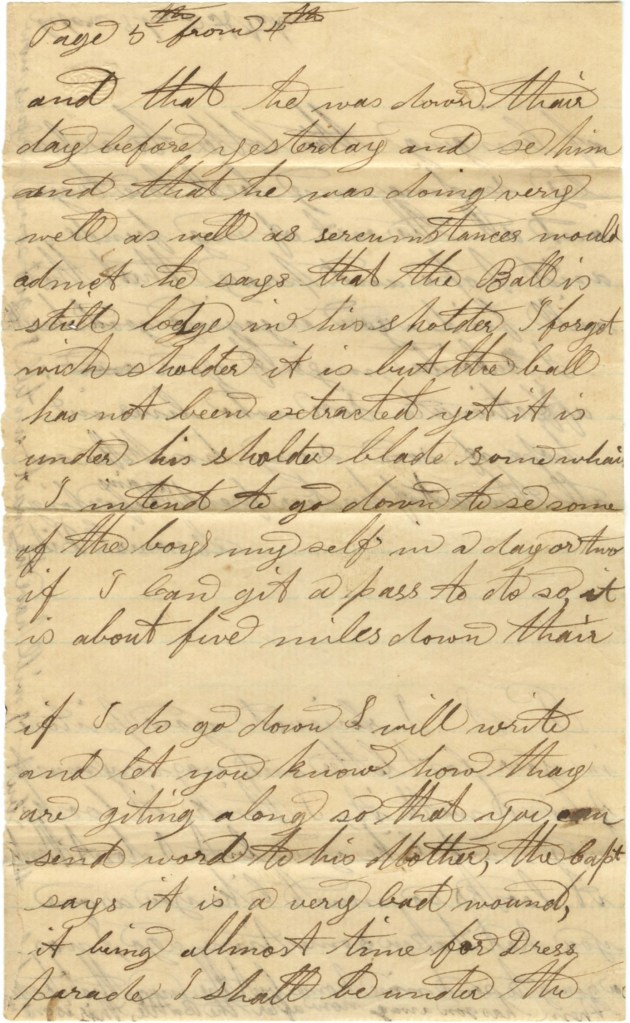
I received a letter from you Thursday night and one from Augustus Friday night last night. He said that Cyrus Priest’s 2 mother wanted him to write to me to know where he is that she had not heard from him lately. I asked the captain if he knew where he was and he said that he is at Potomac Creek at a hospital there and that he was down there day before yesterday and seen him and that he was doing very well, as well as circumstances would admit. He says that the ball is still lodged in his shoulder. I forgot which shoulder it is but the ball has not been extracted yet it is under his shoulder blade somewhere. I intend to go down to see some of the boys myself in a day or two, if can get a pass to do so. It is about five miles down there.
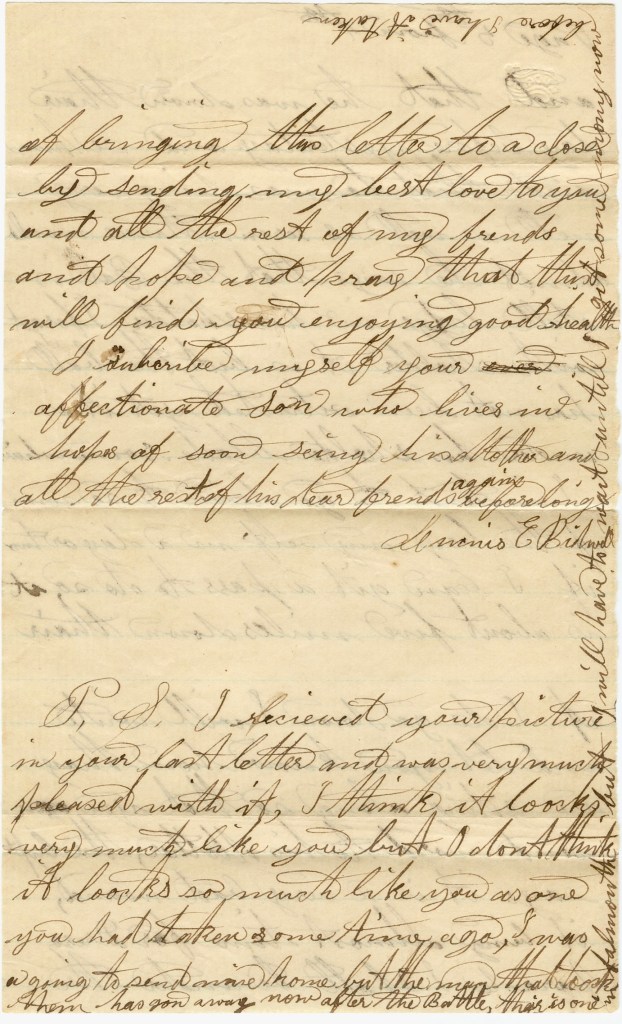
If I do go down, I will write and let you know how they are getting along so that you can send word to his Mother. The Captain says it is a very bad wound. It being almost time for dress parade, I shall be under the obligation of bringing this letter to a close by sending my best love to you and all the rest of my friends and hope and pray that this will find you enjoying good health.
I subscribe myself your affectionate son who lives in hopes of soon seeing his Mother and all the rest of his dear friends again before long, — Lucius E. Bidwell
P. S. I received your picture in your last letter and was very much pleased with it. I think it looks very much like you but I don’t think it looks so much like you as one you had taken some time ago. I was a going to send mine home but the man that took them has gone away now after the battle. There is one at Falmouth but I will have to wait until I get some money now before I have it taken.
1 Capt. Elijah W. Gibbons was mortally wounded in the Battle of Fredericksburg.
2Cyrus S. Priest (1840-1891) was wounded in the Battle Chancellorsville on 3 May 1863. He was transferred to the 159th Co., 2nd Battalion Veteran Reserve Corps on 14 September 1864 and discharge 5 July 1865.
Letter 3
Camp near Falmouth, Virginia May 28th 1863
Dear Brother,
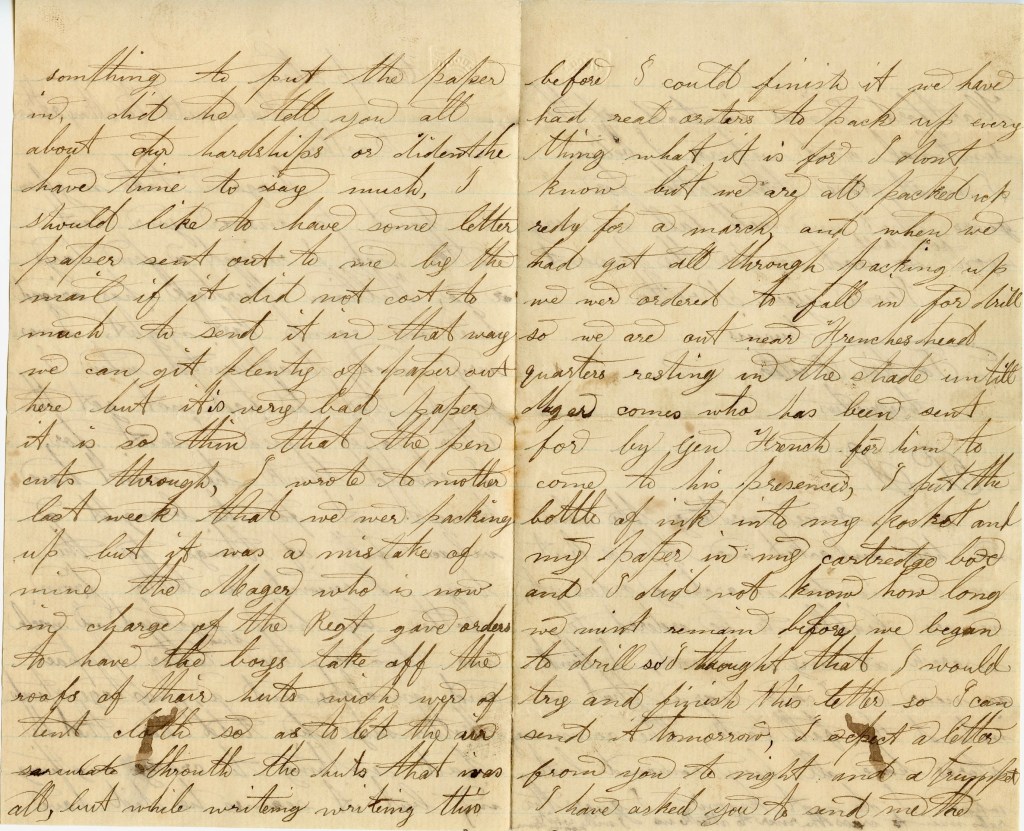
I again take my pen in hand to answer your last letter which I received a few days ago. William Murdock has arrived here in camp last night. I was very much disappointed when I found that he had not got the letter paper which I sent for. I should think he might have brought it for he brought a valise full of things for the boys. I received a letter from Mother by him enclosed in which was two or three sheet letter paper and envelopes, and a postage stamp. Mother says he told her that he had nothing to carry everything in but it seems he did have something to put the paper in.
Did he tell you all about our hardships or didn’t he have time to say much. I should like to have some letter paper sent out to me by the mail if it did not cost too much to send it. In that way we can get plenty of paper out here but it is very bad paper, It is so thin that the pen cuts through.
I wrote to Mother last week that we were packing up but it was a mistake of mine. The Major who is now in charge of the regiment gave orders to have the boys take off the roofs of their huts which were of tent cloth so as to let the air circulate through the huts. That was all.
But while writing this before I could not finish it. We have had real orders to pack up everything. What is it for? I don’t know but we are all packed up ready for a march and when we had got all through packing up, we were ordered to fall in for drill so we are out near French’s Headquarters resting in the shade until Major comes who has been sent for by Gen. French for him to come to his presence. I put the bottle of ink into my pocket and my paper in my cartridge box and I did not know how long we must remain before we began to drill so I thought that I would try and finish this letter so I can send it tomorrow. I expect a letter from you tonight and a trumpet. I have asked you to send me the Hartford Times instead of the Sentinel and Witness. I believe I must close this letter for I guess that we will fall in very soon for drill. So goodbye for the present
From your brother, — Lucous
To his brother Augustus
P. S. Since writing the above, we have unpacked our things but we are under marching orders yet. We are liable to be ordered to march at any moment. I think as near as I can learn, that we intend to fall back. The commissary stores have all been removed but where, I do not know. I guess the rebs mean to cross the river to attack us. I will write more soon.
Letter 4
Camp near Falmouth, Va. May 31st 1863
Dear Brother,
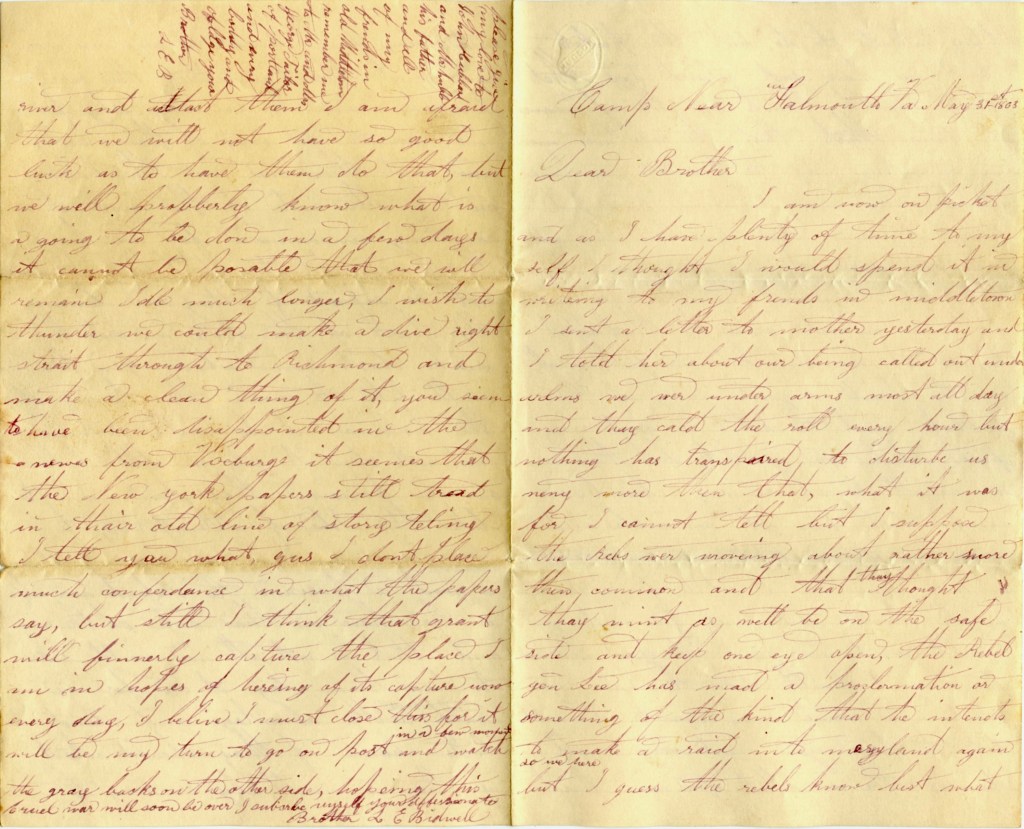
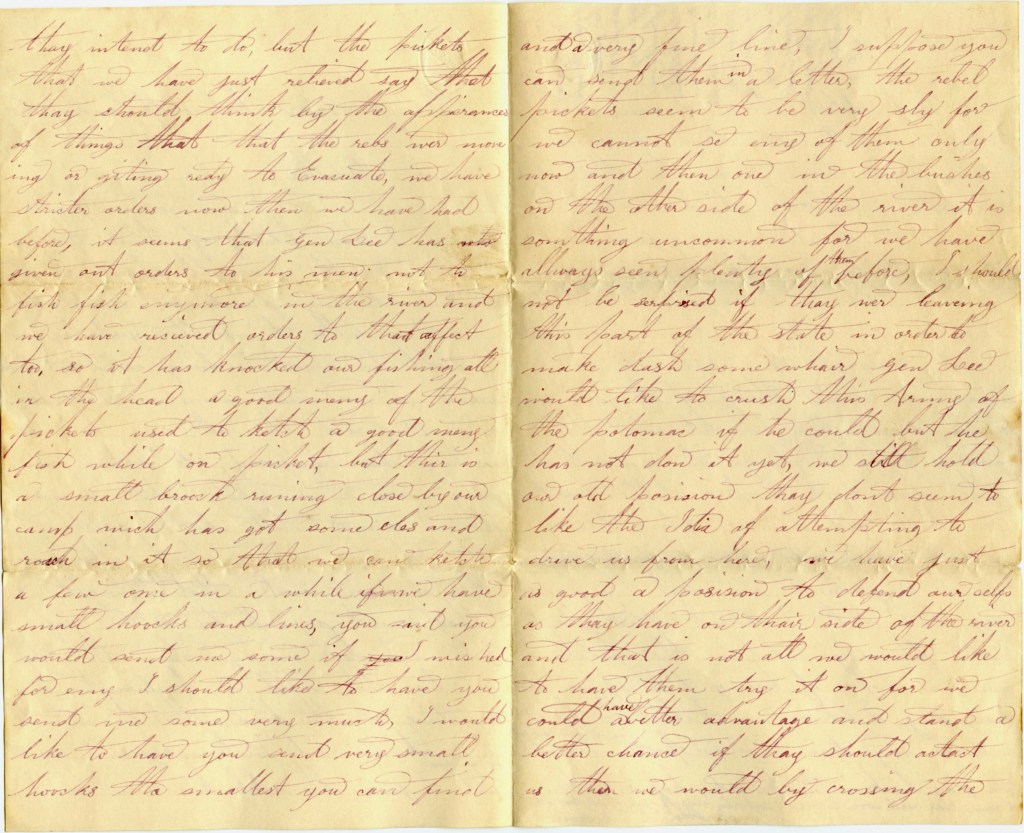
I am now on picket and as I have plenty of time to myself, I thought I would spend it in writing to my friends in Middletown. I sent a letter to Mother yesterday and I told her about our being called out under orders. We were under arms most all day and they called the roll every hour but nothing has transpired to disturb using more than that. What it was for, I cannot tell but I suppose the Rebs were moving about rather more than common and that they thought they might so well to be on the safe side and keep one eye open. The Rebel Gen. Lee has made a proclamation or something of the kind that he intends to make a raid into Maryland again so we hear, but I guess the rebels know best what they intend to do, but the pickets that we have just relieved say that they should think by the appearance of things that the rebs were moving or getting ready to evacuate. We have stricter orders now than we have had before. It seems that Gen. Lee has given out orders to his men not to fish anymore in the river and we have received orders to that effect too. So it has knocked our fishing all in the head. A good many of the pickets used to catch a good many fish while on picket, but there is a small brook running close by our camp which has got some eels and rough in it so that we can catch a few once in awhile if we have small hooks and lines. You said you would send me some if I wished for any. I should like to have you send me some very much. I would like to have you send very small hooks—the smallest you can find—and a very fine line. I suppose you can send them in a letter.
The rebel pickets seem to be very shy for we cannot see any of them only now and then, one in the bushes on the other side of the river. It is something uncommon for we have always seen plenty of them before. I should not be surprised if they were leaving this part of the state in order to make a dash somewhere. Gen. Lee would like to crush this Army of the Potomac if he could but he has not done it yet. We still hold our old position. They don’t seem to like the idea of attempting to drive us from here. We have just as good a position to defend ourselves as they have on their side of the river and that is not all. We would like to have them try it on for we could have a better advantage and stand a better chance if they should attack us than we would by crossing the river and attack them. I am afraid that we will not have so good luck as to have them so that, but we will probably know what is going to be done in a few days. It cannot be possible that we will remain idle much longer. I wish to thunder we could make a dive right straight through to Richmond and make a clean thing of it.
You seem to have been disappointed in the news from Vicksburg. It seems that the New York papers still tread in their old line of story telling. I tell you what, Gus, I don’t place much confidence in what the papers say. But still I think that Grant will finally capture the place. I am in hopes of hearing of its capture now every day. I believe I must close this for it will be my turn to go on post in a few moments and watch the gray backs on the other side. Hoping this cruel war will soon be over, I subscribe myself your affectionate brother, — L. E. Bidwell
Letter 5
[This letter by Lucius was found on the internet transcribed by someone else and I add it here for information purposes only.]
In camp on north side of Rapidan Feb. 7, 1864
My Dear Mother—
Our Heavenly Father has again saved your son Lucius safely through another battle and one of the worst kinds of a battle too. It was a night fight. Yesterday morning about 5 o’clock we were routed out of our beds with the orders to pack up and fall in. We took up our line of march for the River Rapidan at about nine o’clock in the morning and reached the river about an hour after. We crossed the Rapidan by fording it about noon. We had to ford it, it was up to our breasts and it was a very rapid stream, so much so that if we had accidentally slipped, we would have been carried down stream, and stood a very good chance of finding our graves at the bottom thereof. But as far as I know there was no accident of the kind happened, only now and then one would slip as he was crawling up the opposite bank, which was very steep, but no serious harm was done to my knowledge, but givng them a good dunking, and wetting their cartridges. The water was very cold—it makes a fellow’s feet and legs ache, I tell you! But go it, we must follow our leader through fire and water. The regiment known as the Garbaldi’s Guards, a New York Regiment composed of Dutch, Irish, and Italians refused to wade because they said it was too deep. But General Hays, knowing of it, jumped from his horse without saying a word, and left his horse this side of the river and waded across to the other side, picking out good footing, and then waded back after his horse. They saw that he got over safe, so they finally plunged in, and arrived safely on the other side. I tell you what he is – a regular tiger! I suppose you have heard of him before. He is in command of our Division, and goes by the name of ‘Fighting Ellick’. He rides along the line of skirmishers with his hat in his hand, cheering the men on, crying, ‘Give them hell boys give them hell.’ He is an old tiger, he is most always a little tight when there is fighting going on and then he is in his glory.
He thinks the Old 14th is about right he is always pressing us up. He was with us in the thickest of the fight crying out ‘give ‘em hell, 14th–Bully for you! Bully for you, go in, boys, go in 14th!’ and so on–the balls flying around his head like hailstones without flinching in the least. He is a regular dare devil!
We marched to a hollow facing the rebels breast works, and remained there until about 5 o’clock within rifle shot of their rifle-pits. They sent a few shells over to us, but most of them passed over harmless. But two or three took effect, killing three or four and wounding several. They had only fired several shots when it was ascertained that the Rebs had …a solid line of battle advancing on us. We were ordered to advance. The bully 14th taking the load, and charged at the double quick time. They met us half way and poured an everlasting fire into us which caused us to waiver for a moment, and with a deafening yell we made a rush, pouring a volley of blue pills into them which they won’t soon forget and put them to flight, and drove them to their rifle pits.
By this time it was dark as pitch, we could not see our foes until we met them face to face, some shot at one another and knocked each others brains out with the butt of the musket. We were fighting in squads most of the night, each man for himself.
Company B and G were on the left and met a stronger party of Reb skirmishers but we charged on them with our little rifles and with deafening yells, we loaded and fired and drove them back to their rifle pits. We then sculked under the cover of darkness to within a few rods of their rifle pits and then popped away at them until we were sent for to go and support our boys on the right, for the Rebs were trying to flank us.
We went it on the double quick over fences and ditches, we charged on a cluster of two or three houses which were full of Rebels. They swarmed in great numbers around the building, firing from the windows and around the corners and out houses, but we made a rush on them, driving them like sheep dragging their wounded along with them. The houses were full of them. We, and some of the others smashed in the doors, which were closed and fastened, and rushed in and some of the rebels grappled with us. We soon overpowered, but strange to say we took only one prisoner. They made their escape out the windows before we were aware of it. They then retired behind their breastworks, and we stretched out a long line of pickets, and remained so until we were relieved about one o’clock in the morning by the 1st Division and recrossed the Rapidan on a sort of bridge which was built. The rest of the troops recrossed the river again soon after.
The Rebs never molested them after we left. It was a daring undertaking in leading this dividsion over there into such a nest. I don’t know why we were not all captured, for we numbered only three thousand men. It must be the Rebs did not know how strong we were after dark or they would have come down on us in a strong body and showed us into the river and cut us all to pieces, but we got off very well after all.
I think the Rebs felt the weight of our bullets before we parted with them. We had no artillery to support us on that side of the river. We, all alone, with only our rifles. I don’t know the exact number of killed and wounded yet. They say we might have lost over one hundred. Our Color Sergeant Cody, was brought into camp and buried by the Regt. with the band. He was a noble fellow and fell doing his duty. One of my tent mates, a fine young man, was shot through the breast. He is a sailor and a native of Germany. I thought a great deal of him. His name is Harrison.
James Ingles was hit on the leg, and a man named Winks in our camp, and another German, was shot through the head (named Stinall) and another tent-mate of mine was hurt in the ankle. Our Major was slightly wounded in the leg. Capt. John Broaht, I hear, had his finger shot off, but I have not seen him yet. I hear he is detailed to go after the recruits but I don’t know how true it is. I must stop for room. Lieut. Russell is all right; he was very brave during the fight. I will write more soon.
So I will bid you good bye for the present and subscribe myself your affectionate son—Lucius Bidwell.
P.S. Since I began this , we have returned to our old camp. After being on picket 24 hours. After we arrived from the fight. McCluskey is unhurt and very well and sends his respects to you and all. Tell Mrs. Rogers that I guess she will have the pleasure of beholding us again after all. Give all the neighbors our love….
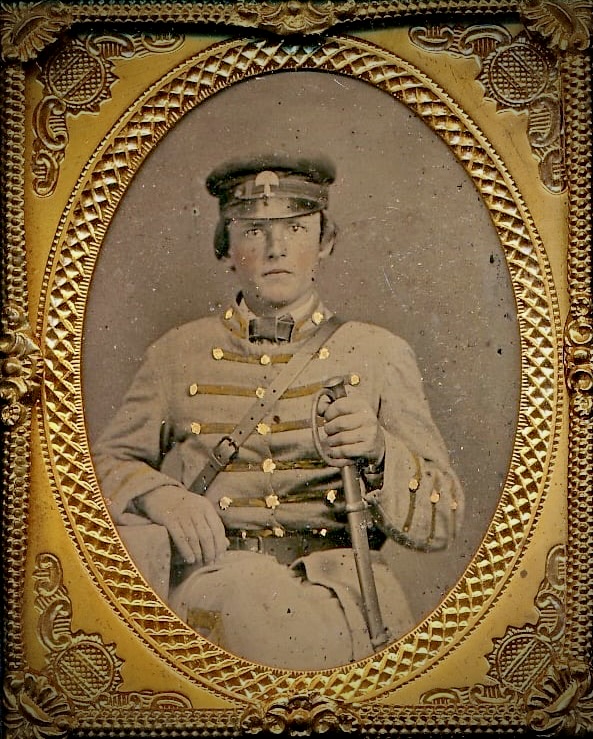
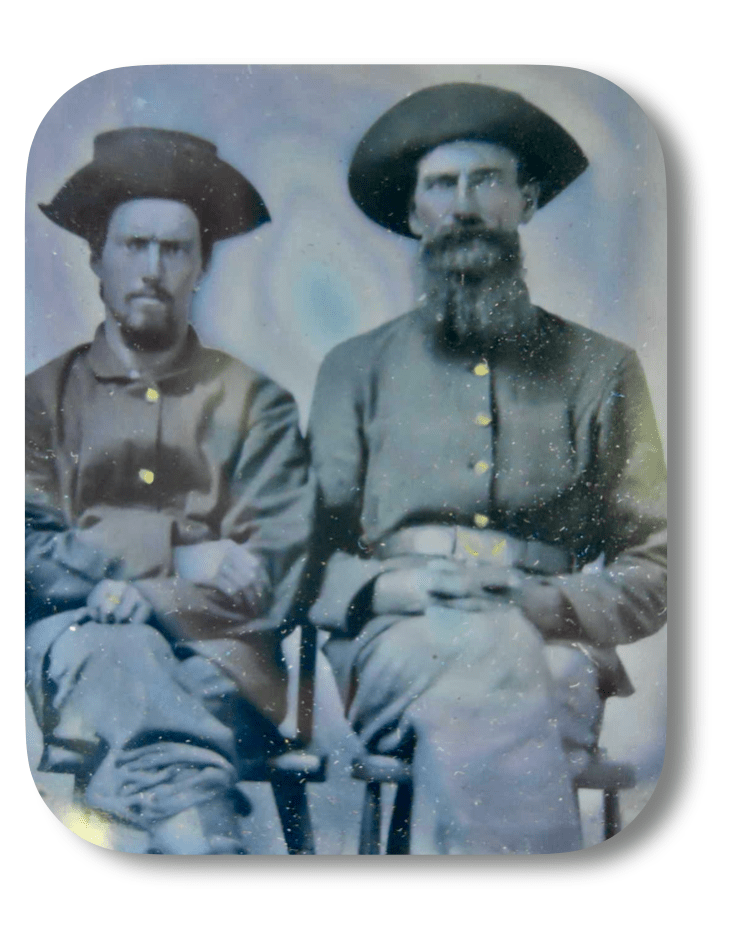
An unidentified trooper in the South Carolina Cavalry (R. J. Ferry Collection)
This letter was written by William (“Willie”) Clark Workman, Jr. (1846-1899) who enlisted in February 1864 to served in Co. K, 7th South Carolina Cavalry. During a portion of the summer 1864, Willie was being treated for syphilis in Jackson Hospital in Richmond, Virginia. In this letter, datelined from a hospital in Kershaw county, South Carolina, we learn that Willie was recovering from typhoid fever.
Willie was the son of William C. Workman (1803-1861) and Sarah Young Jenkins (1812-1863) of Camden. Willie’s gravestone in the prestigious Quaker Cemetery in Camden, South Carolina, is etched with the words, “Served with distinction, 1862-4, Co. K, 7th S. C. Cavalry, Gary’s Brigade.” His military records, including the “Confederate Home Records” prove that he did not enlist until 2 February 1864. He was married to Mary M. German (1860-1900) after the war.
Willie wrote this letter to Louisa Jane (“Janie”) Ballew (1843-1915), the daughter of Rev. David Lester Ballew (1802-1855) and Elisa Louisa James (1801-1873). Mention is made in the letter of Janie’s brother, “Ben.” This was Benjamin Franklin Ballew (1845-1913) who served in Co. I, 3rd South Carolina Infantry.
Transcription
Red Oak Camp, Lynches Creek August 6th 1864
Dear Miss Janie,
Your letter of the 19th of last month reached me this morning quite unexpectedly but I assure you, I never had a more agreeable surprise in my life. You observe from the caption of this that I am once more in the limits of “home, sweet, home.” After passing through the most arduous portion of the present campaign in the “Old Domain,” I was taken quite suddenly with a severe attack of Typhoid Fever, prostrating me in the “walls” of the most detestable of all places in creation—a hospital. I am spending a part of my “thirty days” out on Lynches Creek in the country, about 25 miles from Camden. I have been very lucky or unlucky (as you may decree it) in getting home on sick furloughs. I have been home now about two weeks; almost half of my furlough. I am recruiting my health and strength very fast but on account of the excessive state of weakness which the disease left me in, I think it will be necessary for me to apply for an extension. But since I am here enjoying the sweets of home now, I do not regret my illness much.
We have had a very severe [time] of it in Virginia this summer; continually in the saddle and on the move, with no little fighting to do. I have been quite fortunate myself for in all the “tight” places that I have been in yet, I have not been scathed. I hope it will be so in all my future career.
Our company has lost many valuable men and officers since our reparation to Virginia Some of my best friends have been killed and wounded. But I could not expect anything to the opposite as this is one of the inevitable fatalities of the carnage of battle. Satis about war, and let us [move] on [to] other topics.
Our correspondence has been broken off for some time, and I assure you, Miss Janie, I missed those sweet missives of yours, which I have been receiving from you not a little. I have just been waiting for a convenient opportunity to send a letter to town so that I could write to you. But I trust that our correspondence which has hitherto been so regular and interesting (to me) may not be interrupted again. You write me that you fear your “thoughts” will be very “dull” and “uninteresting;” let me assure you that they are decidedly just the opposite. If you had only seen how eagerly I devoured the contents of your letter this morning, you would not write thus.
Tell Jimmie I think he ought to be ashamed of himself in not coming round to see you oftener. I suppose now since he is enjoying the sweets of a married life, he has forgotten his old friends. I wish you could have gotten acquainted with his lady. I think you would have liked her so much for she has such a sweet disposition. I wish it was so that I could make it convenient to take a little tour up in Laurens and Greenville while I am home. But I am afraid that delightful pleasure will be denied me. I would like very much to pass through Laurens and see you and the rest, but as I have such a short while to remain at home, I do not think that I can possibly do it and will have to postpone it until “this cruel war is over.”
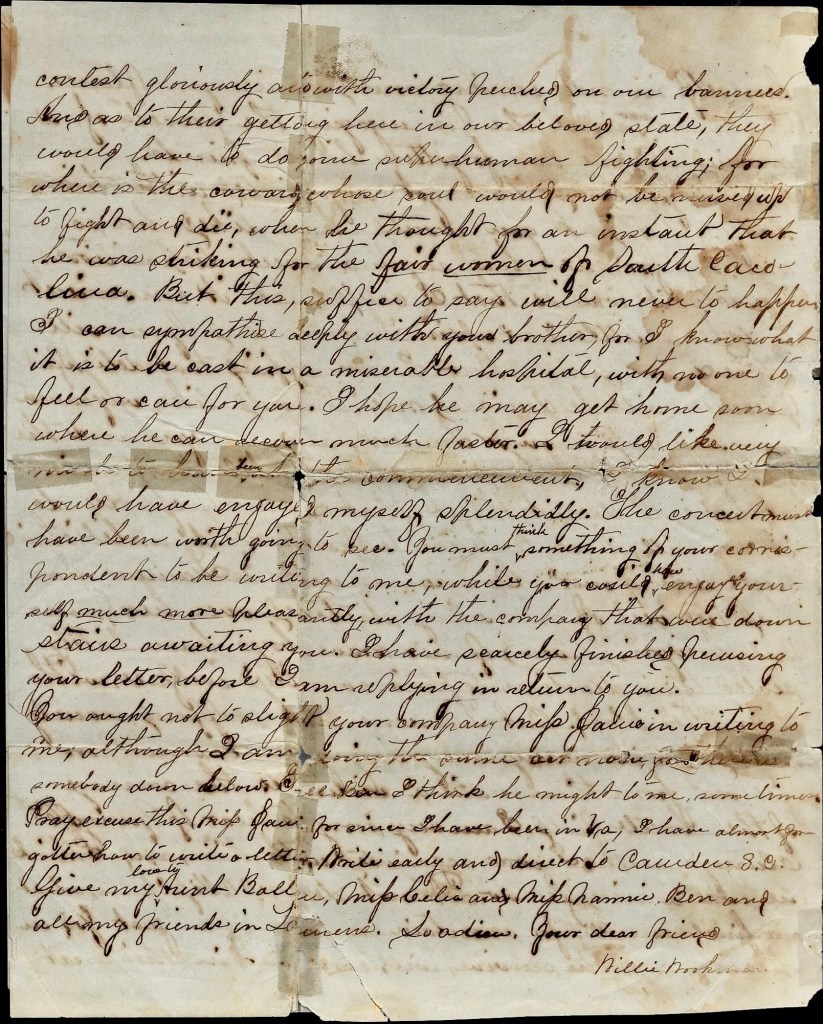
“Do not despond…about our final success for as certain as there is a just God in heaven, we, who survive, will come out in this great contest gloriously and with victory perched on our banners.”
–Willie Workman, 7th South Carolina Cavalry. 6 August 1864
Camden as well as Laurens has had the veil of mourning stretched over her peaceful horizon. Several of her brave boys have lately sealed their devotion to their country’s welfare, with their life’s blood. But Laurens has suffered severely indeed for in nearly every engagement, some poor fellow from there falls a victim to the carnage of the battlefield. I am very sorry to hear of young J. M. Cluney’s death. I was acquainted with him and I think he was a nice fellow. Do not despond Miss Janie, about our final success for as certain as there is a just God in heaven, we, who survive, will come out in this great contest gloriously and with victory perched on our banners. And as to their getting here in our beloved state, they would have to find superhuman fighting, for where is the coward whose soul would not be nerved up to fight and die when he thought for an instant that he was striking for the fair women of South Carolina. But this, suffice to say, will never happen.
I can sympathize deeply with your brother for I know what it is to be cast in a miserable hospital with no one to feel or care for you. I hope he may get home soon where he can recover much faster. I would like very much to have seen the commencement. I know I would have enjoyed myself splendidly. The concert must have been worth going to see. You must think something of your correspondent to be writing to me, while you could be enjoying yourself much more pleasantly with the company that were downstairs awaiting you. I have scarcely finished perusing your letter before I am replying in return to you. You ought not to slight your company, Miss Janie, in writing to me, although I am doing the same act now, as there is somebody down below.
Tell Ben I think he might [write] to me sometimes. Pray excuse this, Miss Janie, for since I have been in Virginia, I have almost forgotten how to write a letter. Write early and direct to Camden, South Carolina. Give my love to Aunt Ballew, Miss Celia, and Miss Nannie, Ben and all my friends in Laurens. So adieu. Your dear friend, — Willie Workman
The following letter was written by George T. Woodard (1835-1864), a native of New Hampshire, who was residing in Oak Grove, Dodge county, Wisconsin, when he enlisted in Co. D, 8th Wisconsin Infantry. He entered the service as a sergeant and was promoted to 1st Sergeant of his company before his death in 1864.
I could not find an image of George but here is one of James A. Cary who also served in the 8th Wisconsin Infantry (Wisconsin. Veteran’s Museum)
Forty-four of George’s Civil War letters are housed in the Special Collections of the University of Alabama. George wrote all of the letters to his fiancee, Gene Smith. At times he addresses letters to Genie, and the envelopes are often addressed to E. E. Smith–her name was likely Eugenia. His letters show his love and devotion to Gene and allude to activities they shared during their courtship. He also discusses camp life and the campaigns he was involved in, including the battle of Corinth and the siege of Vicksburg. A letter written on April 26, 1863, includes a small, hand-drawn battle map of Vicksburg. Many of his letters discuss his love of the Union and his willingness to sacrifice his life for his country.
In addition, there are three death notification letters written in 1864, presumably received by Gene. The nurse who cared for him at the Gayoso Hotel hospital in Memphis, Tennessee, incorrectly dated her letter on predated letterhead as February 1, 1863. Her kind letter includes details of his death, which occurred the previous day. The hospital steward at Gayoso, Michael Cahill, wrote a letter, also incorrectly dated February 1, 1863, which discusses his death and the process through which his heirs could obtain his belongings and pay. His commanding officer and friend, Lieutenant S. C. McDowell, wrote her a kind and personal sympathy letter, correctly dated February 7, 1864.
This letter was written to George’s friend from Dodge county, Wisconsin, Perry Farlow (1842-1863) who served in Co. K, 29th Wisconsin Infantry. Like George, Perry died from disease during the war almost a year to the day before George.
Transcription
Germantown, Tennessee January 30th [1863]
Friend Perry,
It is quite a number of days since I received your kind letter of the 2nd inst., but I have delayed answering it for various reasons, the most important one being the fact that I felt so confounded lazy that I could not screw myself up to the sticking point, but at last I have concluded that it would be shameful to postpone writing any longer and here I am already.
I am sorry to hear of the severe loss that your company has sustained by death. It only corroborates the truth—that camp diseases are more fatal to soldiers than the bullets of the enemy. Our company has lost by disease fifteen men; but the bullets of the enemy only four killed and thirteen wounded. And there has been seventeen discharged for disability while four have been transferred thus making a total loss to the company of forty men. And as our term of service is about half out, we can safely calculate on having a remainder of twenty men of the original one hundred at the expiration of the three years service. I wonder if I am one of that lucky twenty? That’s the question that is of more importance to me than anything else.
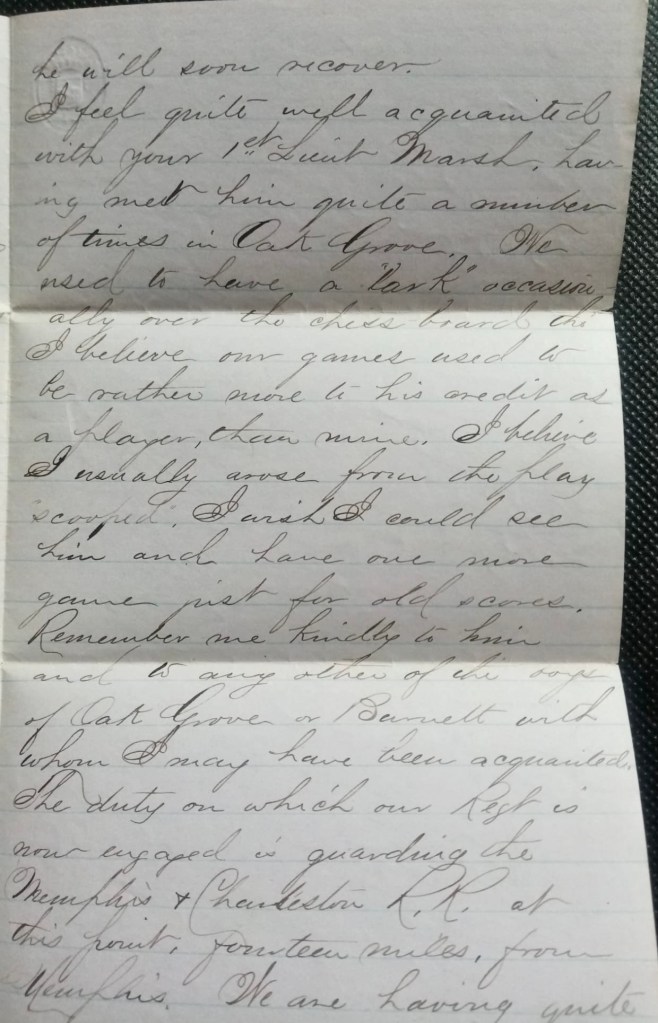
I hear that Lieut. Perry [29th Wisconsin] has gone home sick. I am sorry to hear that and trust he will soon recover.
I feel quite well acquainted with your Lieut. Marsh, having met him quite a number of times in Oak Grove. We used to have a “lark” occasionally over the chess board though I believe our games used to be rather more to his credit as a player than mine. I believe I usually arose from the play “scooped.” I wish I could see him and have one more game just for old scores. Remember me kindly to him and to any other of the boys of Oak Grove or Barnett with whom I may have been acquainted.
The duty on which our regiment is now engaged is guarding the Memphis & Charleston Railroad at this point, fourteen miles from Memphis. We are having quite a vacation after five or six months of the most active campaigning. Till we camped here, our regiment has not remained in one camp over five days at a time since the 18th of August. We have marched 1,237 miles since we entered the service, participated in three regular battles, and a half dozen skirmishes. Our severest loss was at the Battle of Corinth where we lost 132 men in killed and wounded in less than twenty-five minutes. I presume there are other regiments that have done more than we have, yet we have done enough to satisfy me with soldiering.
Write soon to your friend, — George T. Woodard
[Added note]
Germantown, Tenn. January 30th 1863
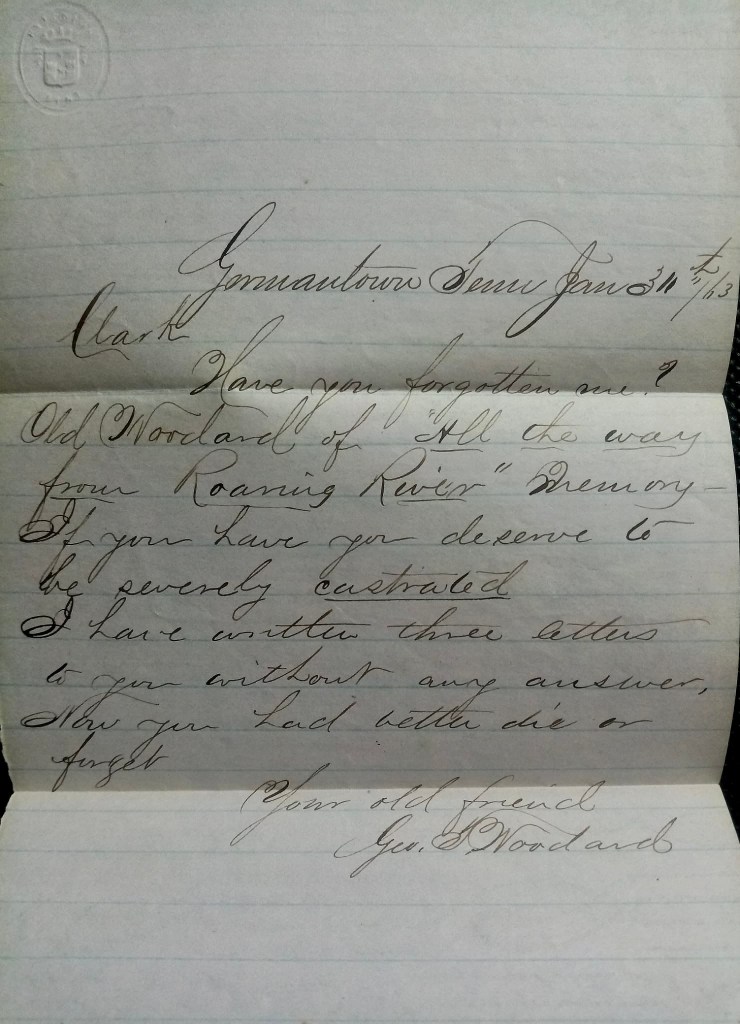
Clark,
Have you forgotten me? Old Woodard of “All the way from Roaring River” memory. If you have, you deserve to be severely castrated. I have written three letters to you without any answer. Now you had better die or forget your old friend, — Geo. T. Woodard
To Clark R. Hewitt, Trenton Company, 29th Wisconsin
From George T. Woodard, Co. D, 8th Wisconsin Regt., Memphis, Tenn.
The following letters were written by Peter Bearl (1836-1896), a coal miner who enrolled Oct. 29, 1862 as a Private in Co. A, 10th Pa. Infantry, mustering in at Harrisburg, for 3 years. He transferred to Co. I, 191st Pennsylvania Infantry June 1, 1864. Mustered out with company June 28, 1865. He served from Oct. 29, 1862 to June 28, 1865—a total of 31 month and 29 days. He applied for Invalid Pension on May 8, 1879, for Heart Disease and Rheumatism. His wife, Mary Ellen Baker (1840-1914) applied for a Widow’s Pension after his death on Sept. 25, 1896.
I believe Peter’s parents names were Henry Bearl and Mary Knopschnider.
Letter 1
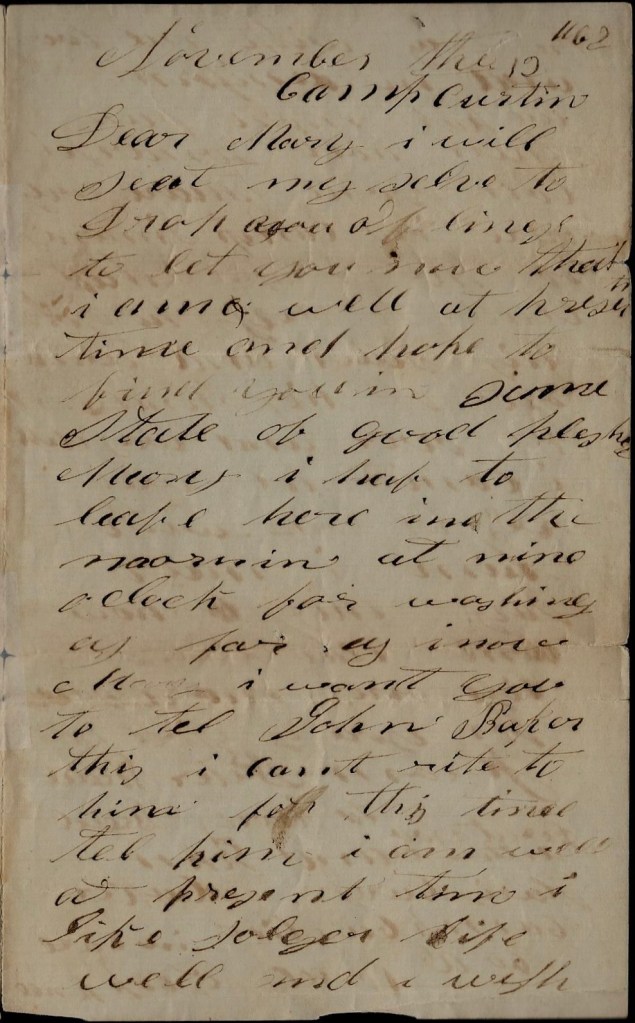
Camp Curtin November 12, 1862
Dear Mary,
I will seat myself to drop you a line to let you know that I am well at the present time and hope to find you in the same state of good flesh. Mary, I have to leave here in the morning at nine o’clock for Washington as far as I know. Mary, I want you to tell John Baker this. I can’t write to him for this time. Tell him I am well at present time. I like soldier life well and I wish he was with me too and in uniform. We have more fun than old Somerset can afford. There was one in camp Simonds of the [ ] that died today. He got his cider and went out of his tent and fell over and was dead. I can’t tell what was wrong with him. I must say this. Now don’t like [ ] life. One more song for you—a good song [The Girl I Left Behind Me]
From Peter Bearl
to Mary Bearl and John Baker
Direct your letter to Camp Curtin, Harrisburg, In care of Capt. Knee, Co. A, 10th [Pennsylvania] Regiment
Letter 2
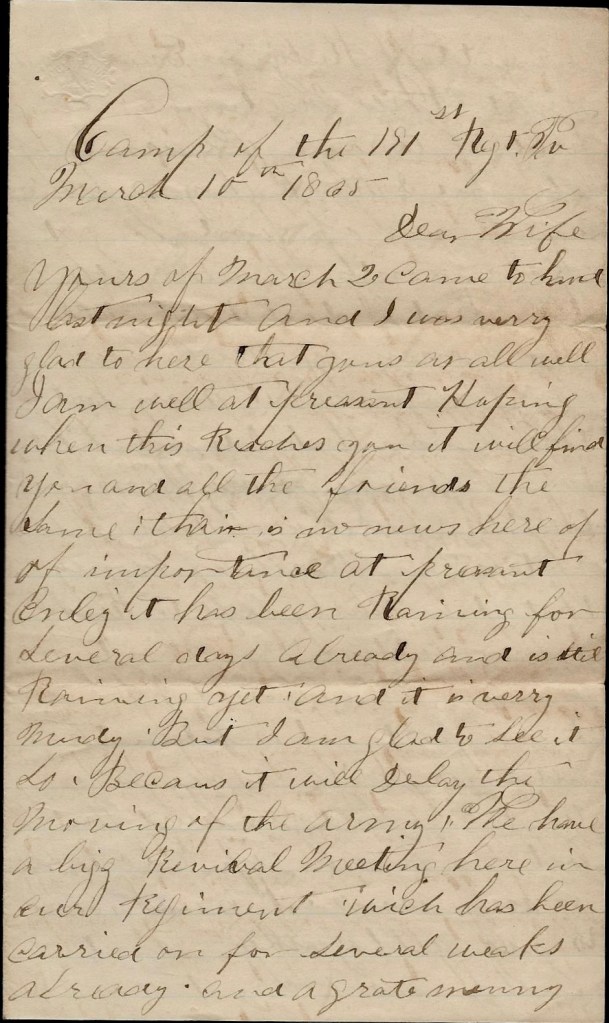
Camp of the 191st Regt. P. V. March 10, 1865
Dear Wife,
Yours of March 2 came to hand last night and I was very glad to hear that you are all well. I am well at present, hoping when this reaches you it will find you and all the friends the same. There is no news here of importance at present—only it has been raining for several days already and is still raining yet and it is very muddy. But I am glad to see it so because it will delay the moving of the army. We have a big revival meeting here in our regiment which has been carried on for several weeks already and a great many are getting religion every night. The meetings are held all through the army of late and I think they are doing a great deal of good.
We got our four months pay the other day but I do not like to send any money by mail now unless you need it very bad. The reason that I do not like to send my money is this—the mail is robbed so often it is hardly safe to risk it in a letter. You want to know how far Samuel and John and I are a part. It is between three and four miles as near as I can tell. You said you heard that I lost an arm. If I lost one of my arms, it is unknown to me altogether and I further more say it was a false report that I lost an arm.
I am sorry that my brother is in such bad health. I would like very much to come home to see my Mother but I can’t come till my time is up. I give my best respects to you all. I have no more to write this time. Write soon and give me all the news. From your husband, — Peter Bearl
To Mrs. Mary Bearl of Somerset county, Pa.
Letter 3
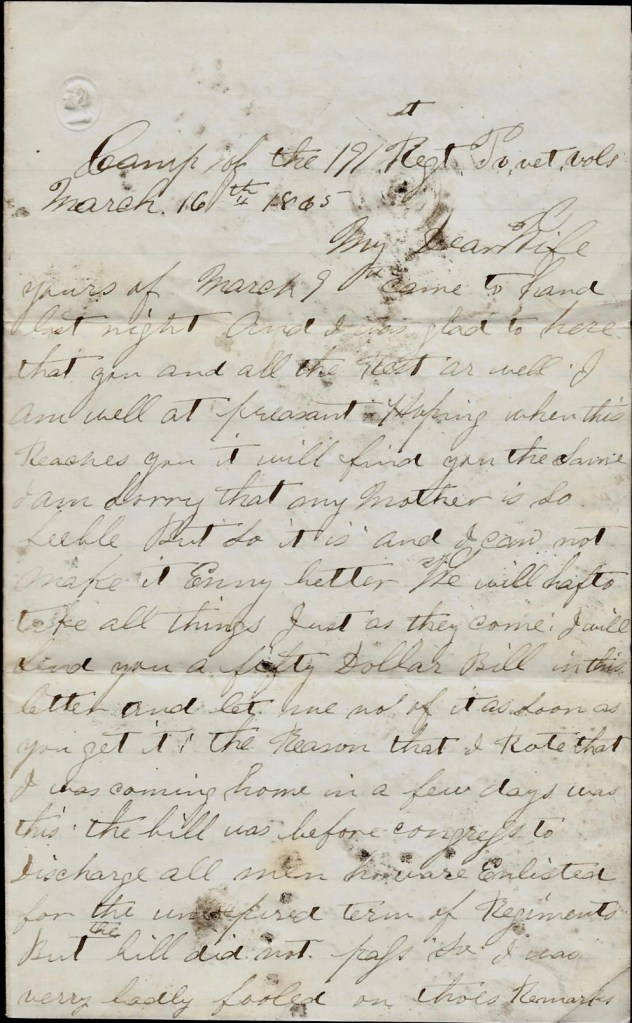
Camp of the 191st P. V. Vols. March 16th 1865
My dear wife,
Yours of March 9th came to hand last night and I was glad to hear that you and all the rest is well. I am well at present. Hoping when this reaches you, it will find you the same. I am sorry that my Mother is so feeble but so it is and I cannot make it any better. We will have to take all things just as they come. I will send you a fifty dollar bill in this letter and let me know of it as soon as you get it. The reason that I wrote that I was coming home in a few days was this—the bill was before Congress to discharge all men who were enlisted for the unexpired term of regiments, but the bill did not pass so I was very badly fooled on those remarks. I have now answered your question in regard of coming home.
Now I want you to answer my question and that is this, you say you have so much trouble. I would like very much to know what makes you trouble? Explain this to me in your next letter.
I was up to see Sam Fisher and John last Money. They are both well and in good hopes of the war ending some day or other. I also saw the letter you sent to Sam Fisher. I also saw Dan Queer, Hen Deeds, and a good many others from our neighborhood and they were all well. You stated in your letter when I come home you will go with me anyplace. If that is so, how would you like to go with me to Minnesota. I have taken up a homestead of a hundred and sixty acres. It only cost me twenty dollars—the whole thing—and I guess I’ll have to go out and improve it as soon as I come home. You can now make up your mind to go and I think this will perhaps cease your troubles.
I think the [spring] campaign will now most anyway commence. The sutlers are all ordered back and we have orders to be ready to march in a moment’s notice. Send me some stamps in your next letter or else writing will be finished. That tobacco I have not yet received. No more. Write soon. Your husband, — Peter Bearl
Letter 4
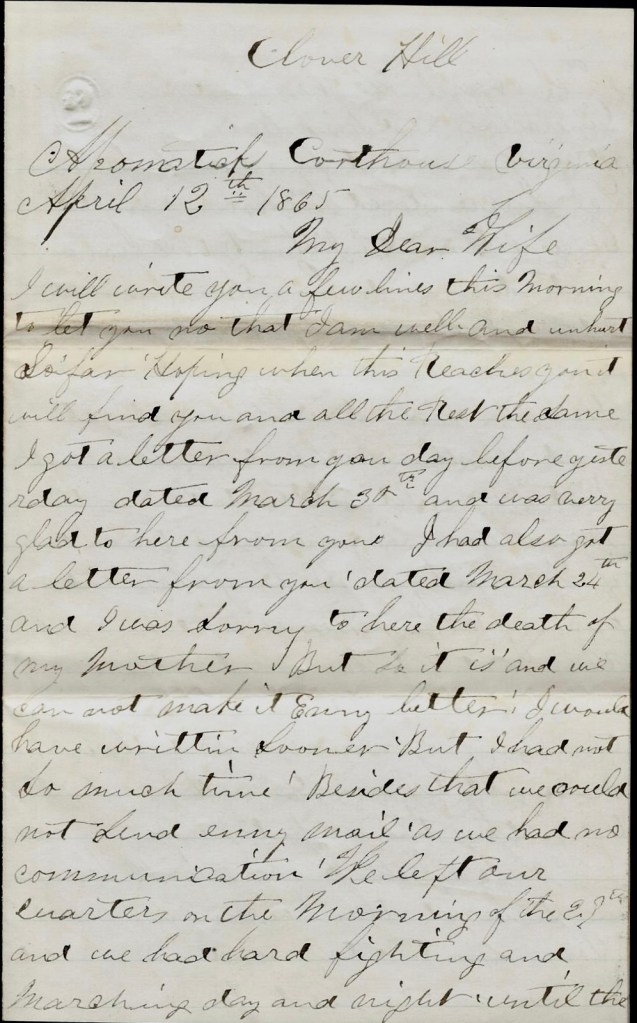
Appomattox Court House, Virginia April 12th 1865
My dear wife,
I will write you a few lines this morning to let you know that I am well and unhurt so far. Hoping when this reaches you, it will find you and all the rest the same. I got a letter from you day before yesterday dated March 30th and was very glad to hear from you. A had also got a letter from you dated March 24th and I was sorry to hear the death of my Mother. But so it is and we cannot make it any better. But I had not so much time. Besides that we could not send any mail as we had no communication.
We left our quarters on the morning of the 29th and we had hard fighting and marching day and night until the 9th of April. We then had surrounded General Lee and his whole army on the 9th of April. About four o’clock, General Lee surrendered his whole army to General Grant. I think the war is about at an end. Gen. Lee has also advised General Johnston to surrender his army to General Sherman but we have not yet heard whether he has done so or not. But he would better do so for their main army is gone now.
The soldiers of Lee’s army are all being paroled and are going to their homes and they are all very glad that they are out of the army. I have not saw Sam [Fisher] or John [Baker] since this campaign commenced. Therefore I cannot tell you anything about them this time but I hope they are all safe. I think peace will soon be declared. Then we can all come home for to stay and we would all be very glad to go home.
Don’t trouble yourself anymore about me for I think we will all soon some home and the war at an end. Don’t send anything to me anymore for I will not get it anyhow, excepting letters. You can send [letters] as often as you wish. I have my mother’s likeness yet and I am going to keep it. But it is spoiled a good deal and the glass I have broken on it. Those things of my father’s estate, just let them do as they will and when I come home I’ll see to it myself.
I will close for this time hoping to hear from you soon. I give my best respects to all the friends. You can tell Adam Ridinger’s wife that he is well, safe and sound so far. From your affectionate husband, — Peter Bearl
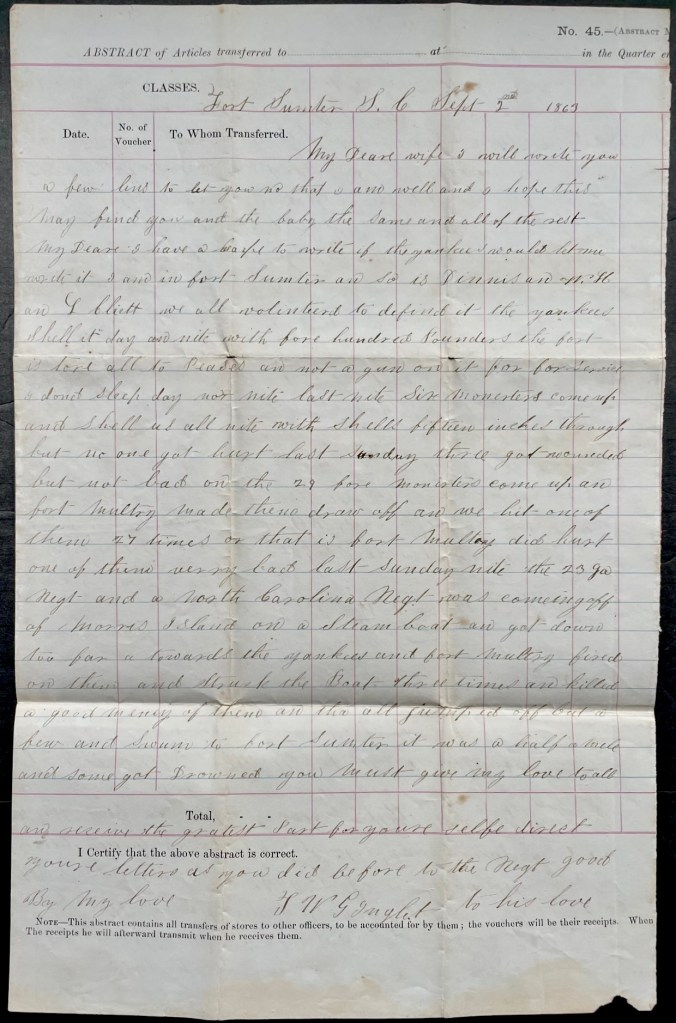
The following incredible letter was written by T. W. G. Inglet (1839-1910), the son of Mathew Wilkes Inglet (1806-1889) and Annie Baggett (1809-1873) of Bath, Richmond county, Georgia. Thomas was married to Martha Anna (“Mattie”) Palmer (1843-1916) in February 1856 when Mattie was only 16. By the time this letter was written in September 1863, 20 year-old Mattie had lost two young daughters who died within a week of each other in August 1862—probably due to some childhood illness—and her third child, Virginia (b. 18 May 1863) would die less than a year later on 28 March 1864. Thomas was a wheelwright, a trade he learned from his father.
During the Civil War, Thomas served the Confederacy by enlisting in Co. C, 28th Georgia Infantry. He was present for all of the major battle of the regiment including Williamsburg, Seven Pines, Mechanicsville, Malvern Hill, South Mountain, Boonesboro Gap, Sharpsburg, Fredericksburg, Chancellorsville and Gettysburg before this letter of 2 September 1863 when we learn that he volunteered with others of his regiment to defend Fort Sumter. It appears from his record that he was part of the Fort Sumter garrison from August through December 1863 before returning to the field and participating in the fighting in the Wilderness and defending Petersburg.
Thomas enlisted as a private on 10 September 1861. He was elected 2nd Corporal on 1 August 1863. His pension record shows he was wounded in the left hand and had two fingers amputated at Cold Harbor, Virginia, on 27 June 1862. He was wounded in the right foot at Darbytown Road, Virginia, on 7 October 1864. He was furloughed from Jackson Hospital in Richmond, Virginia, in 1864. At the close of the war he was in a hospital in Augusta, Georgia.
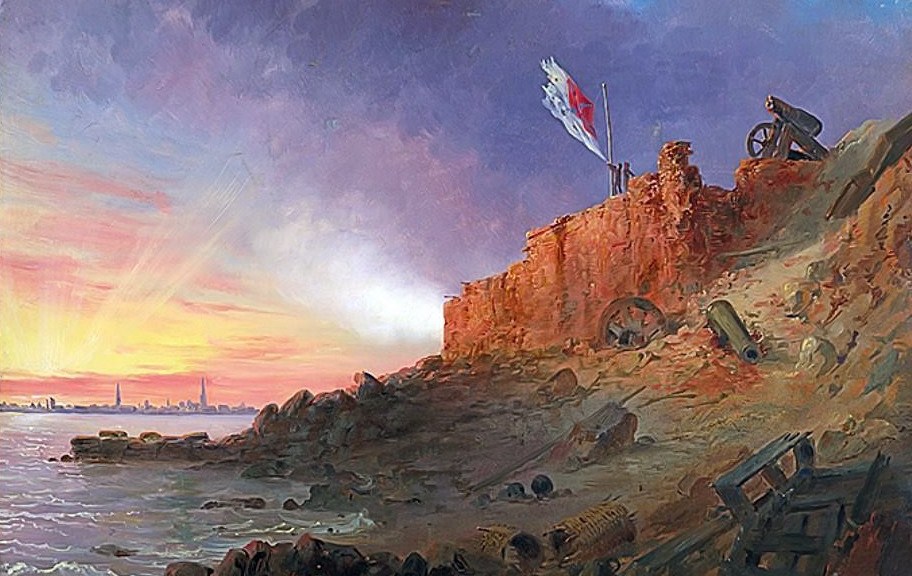
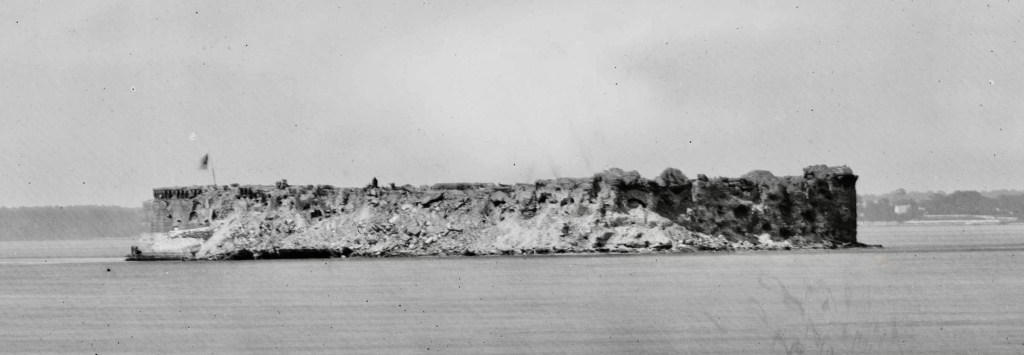
This letter was written from Fort Sumter in the days following Gillmore’s 7-day bombardment of the fort that had reduced it to a pile of rubble. Less than a week later, the fort withstood an amphibious assault planned for the night of September 8-9. The lack of cooperation between the Federal Army and Navy, however, resulting in poor coordination of the attack, and the “surprise” attack was foiled. The fighting lasted only twenty minutes and resulted in 124 Union casualties while the Confederate infantrymen defending the fort did not lose a single man.
Rebel occupied Fort Sumter as it looked in late August 1863 (LOC)
Transcription
Fort Sumter, S. C. September 2, 1863
My dear wife,
I will write you a few lines to let you know that I am well and I hope this may find you and the baby the same and all of the rest. My dear, I have a hope to write if the Yankees would let me write it. I am in Fort Sumter and so is Dennis and W[illiam] H[enry] [Little] 1 and L. Cliett. We all volunteered to defend it. The Yankees shell it day and night with four hundred pounders. The fort is tore all to pieces and not a gun on it for service. I don’t sleep day nor night. 2 Last night, six monitors come up and shell us all night with shells fifteen inches through but no one got hurt.
Last Sunday three got wounded but not bad. On the 29th, four monitors come up and Fort Moultrie made them draw off and we hit one of them 27 times, or that is Fort Moultrie did. Hurt one of them very bad.
Last Sunday night [1 September 1863], the 23rd Georgia Regiment and a North Carolina Regiment was coming off of Morris Island on a steamboat and got down too far towards the Yankees and Fort Moultrie fired on them and struck the boat three times and killed a good many of them and they all jumped off but a few and swam to Fort Sumter. It was a half a mile and some got drowned. 3
You must give my love to all and receive the greatest part for yourself. Direct your letters as you did before to the regiment. Goodbye my love, — T. W. G. Inglet
to his love.
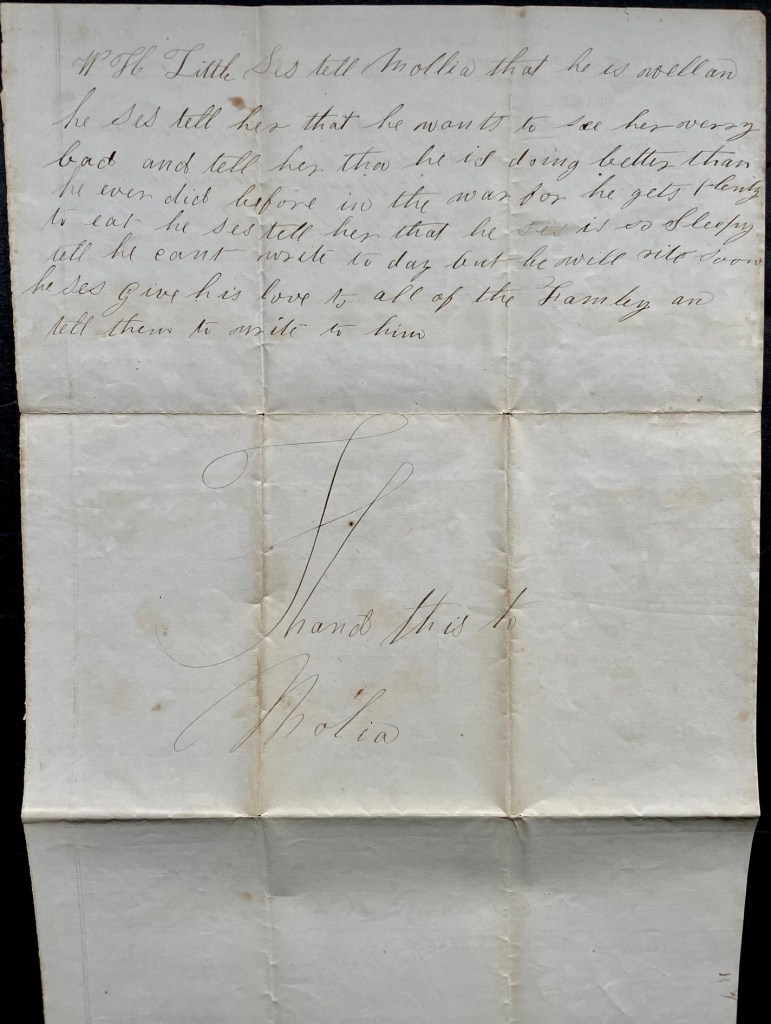
W. H. Little says tell Mollie that he is well and he says tell her that he wants to see her very bad. And tell her that he is doing better than he ever did before in the war for he gets plenty to eat. He says tell her that he is so sleepy he can’t write today but he will write soon. He says give his love to all of the family and tell them to write to him. Hand this to Mollie.
William Henry Littleof Chattanooga county served in Co. K, 21st Georgia Infantry. He was wounded at Sharpsburg.
1 William Henry Little (1840-1907) was the son of William McLaws Little and Dicey Jane Rhodes of Richmond county, Georgia. He married Mary Elizabeth Inglett on July 20, 1860 in Richmond county, Georgia and was the father of 13 known children. He became a convert to the LDS church, being baptized in 1888 in Richmond county, Georgia, and was taught the gospel by missionaries Albert Smith, David Bennion, John Browning, Moroni Dunford, William Spry, and Jed Ballentyne, among others. He immigrated to Ogden, Utah with his extended family consisting of about 57 converts in early 1889. He took a second wife, Dorothea Elizabeth Anderson, a Danish convert, marrying her on April 7, 1899. That marriage was solemnized in the Salt Lake Temple on April 11, 1899. In May, 1905, he went on a mission to the Southern States with his first wife and labored in Atlanta and Augusta, Georgia. He returned home in September, 1906. He was the proprietor of the old Lincoln Hotel on 23rd Street and the Central Hotel on 25th Street in Ogden, Utah. He died at the hotel on August 27, 1907.
2 In mid-July 1863, Gen. Gillmore gave up his plans to take Battery Wagner and turned his attention on Fort Sumter. Anticipating an attack, Confederates began rapidly strengthening the fort by bringing in gangs of Negroes to place sand against the gorge and adding a second dock, while shifting the remaining guns in the fort to better positions. The attack on Fort Sumter began on 17 August 1863 and on the first day alone, some 948 projectiles were thrown at the fort, 445 of them striking inside, 233 hitting the exterior, and 270 passing over the fort. There were only 19 casualties reported inside the fort. On the second day, 876 shots were fired at the fort. On the third day, 780 shots. On the 4th day, Union forces used a 300-pounder Parrott gun to throw shells at the fort and three slightly wounded casualties were reported. The firing continued until August 24th when General Gillmore wrote Gen. Halleck that, “I have the honor to report the practical demolition of Fort Sumter as a result of our seven days of bombardment…” Immediately after this bombardment, all but one artillery company was removed from Sumter to be replaced by 150 infantry. Presumably it was at this time that Inglett entered the fort.[See “Combat History of Fort Sumter, 1863-1865” by Hobart G. Cawed (1962).
3 This incident of friendly fire casualties sustained by the Confederacy is not well known. The incident took place during the night of 30 August 1863 when the steamer Sumter was transporting Confederate troops from Morris Island to Fort Johnson. Since the tide was too low that night to go the usual route, they went in the direction of Sullivan’s Island and were fired upon by gunners at Fort Moultrie. Capt. Mitchell of Co. C, 23rd Georgia, claimed that the troops were from his regiment as well as the 20th South Carolina. He claimed the third and fourth shots sunk the steamer
The following letter was written by William Bearl (1829-1913), a native of Germany, who was living in Somerset county, Pennsylvania, when he enlisted on 12 November 1861 to serve three years in Co. H, 85th Pennsylvania Infantry. He mustered out with the company on 22 November 1864.
William’s death certificate gives his parents names as Henry Bearl and Mary Knopschnider
Sam and Ben Marshall who both served in the 85th Pennsylvania Infantry
Letter 1
Fort Good [Hope] 1 Near Washington City February 13, 1862
Brother Peter Bearl,
I must give a few lines to you for you don’t write to me now. I will tell you now that I am well at this time and I hope these few lines may find you in the same state of health. And Now I will let you know that we had not much snow [but] a good deal of rain and the mud was shoe mouth deep and it is hard to get along. We don’t drill now [but] we stand guard. I get on guard about two times a week. One time at the camp and one time on vidette. There is no fun but we have plenty to eat and we have good clothes and [a] good bed. We split timber in two and then we lay on the soft side of it and so we sleep bully. I have plenty of money but we have to win every cent of it.
Now I would like to know how times are there. I would write a good deal more if I could write better. Now I want you to excuse my bad writing. I am afraid that you can’t read it and so I will stop it. But I will commence again for I don’t write enough. I will learn to write by it for I have plenty paper but a pen. If this letter comes to hand, then write soon. It is warm today. I was too much in a hurry. I was cooking. I am cook for the mess. But the next time I will write better.
Direct your letter to Washington City, D. C., Fort Good Hope, 85th Regiment Pa. Volunteers, in care of Captain [James B.] Treadwell, near Washington.
William Bearl to Peter Bearl
1 An anonymous letter from a soldier in the 85th PA appeared in the Monongahela Valley Republican on 20 February 1862. He wrote, “There are several forts on the heights of which ours is prominent. Fort Good Hope is, we believe, one of the largest and most important, being nearly completed. Our regiment has charge of many of these fortifications; sixty men under command of Lieutenant are each day detailed for guarding there, the furthest from camp being distant five miles. Our camp is rather pleasantly situated and our men have generally fared well. Six deaths have occurred among them since we left home nearly three months ago; three are only sixteen cases in the hospital at present.”
“Three cheers for the ladies of Montgomery County. Three cheers for the brave volunteers. Three cheers for the flag of our Union.”— Allen Quarmby, Co. K, 4th Penna. Vols.
These letters were written by Pvt. Allen Quarmby (1831-1875)—a native of Yorkshire, England. In 1860, Allen was laboring in a woolen mill at Schuylkill, Chester county, Pennsylvania. By 1861, he had married the widow Jane (Lambert) Kay (1835-1903)—an Irish-born dressmaker—and relocated to Norristown, Montgomery county, Pennsylvania, where he enlisted in Co. K, 4th Pennsylvania Volunteer (P. V.) Infantry (3 months). He mustered out of the 4th P. V. on 21 July 1861.
In the fall of 1862, Allen re-enlisted in Co. C of the 138th P. V. Infantry. Allen remained with the 138th P. V.’s until he was wounded on 6 May 1864 at the Battle of the Wilderness. He was discharged on 10 April 1865 on account of his wounds.
After the war, Allen returned to Norristown, Pennsylvania, and went to work in a cotton mill but he died prematurely in 1875 at the age of 44.
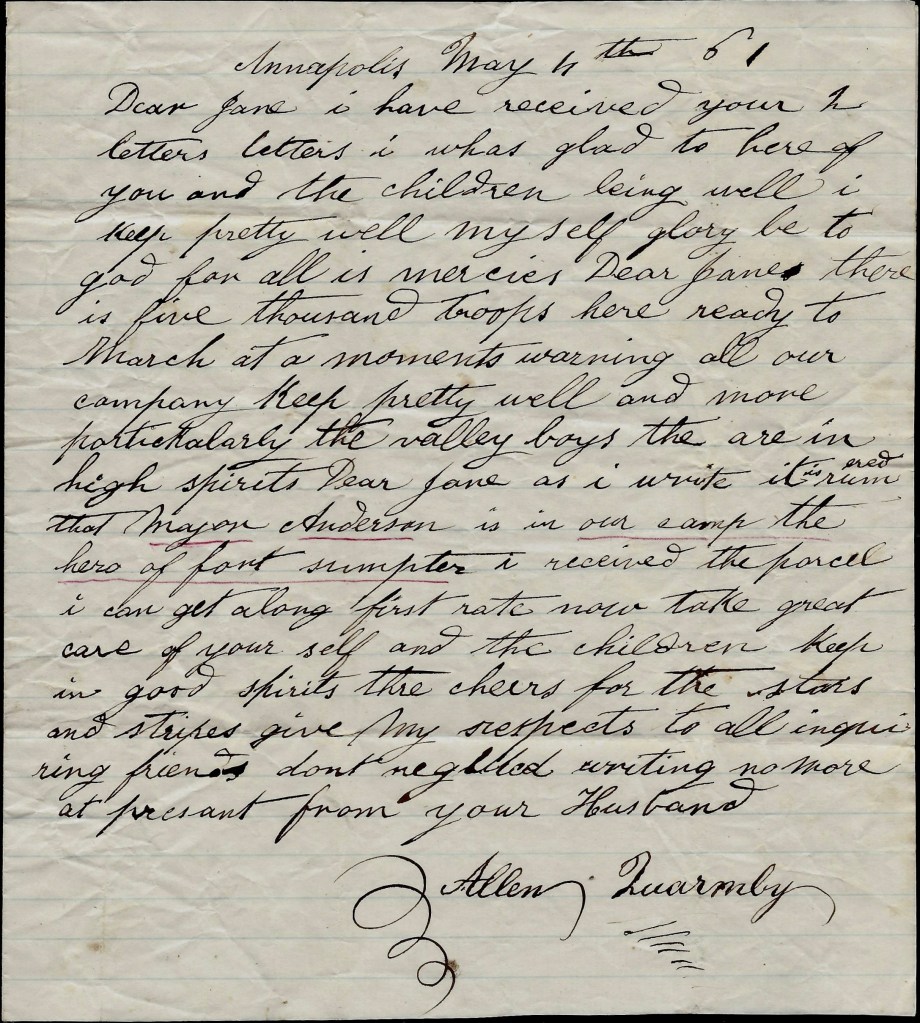
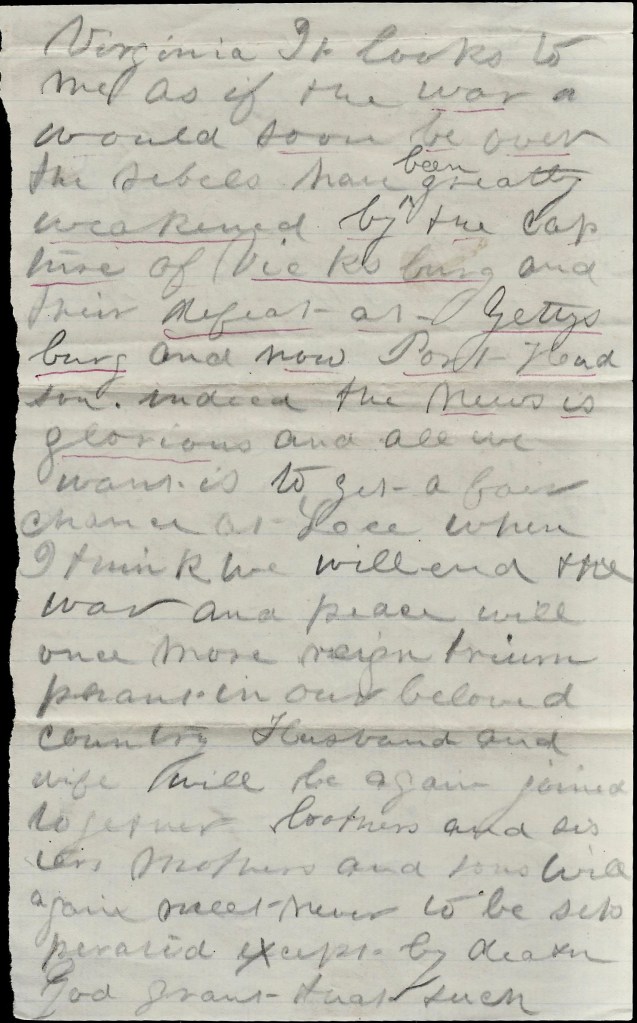
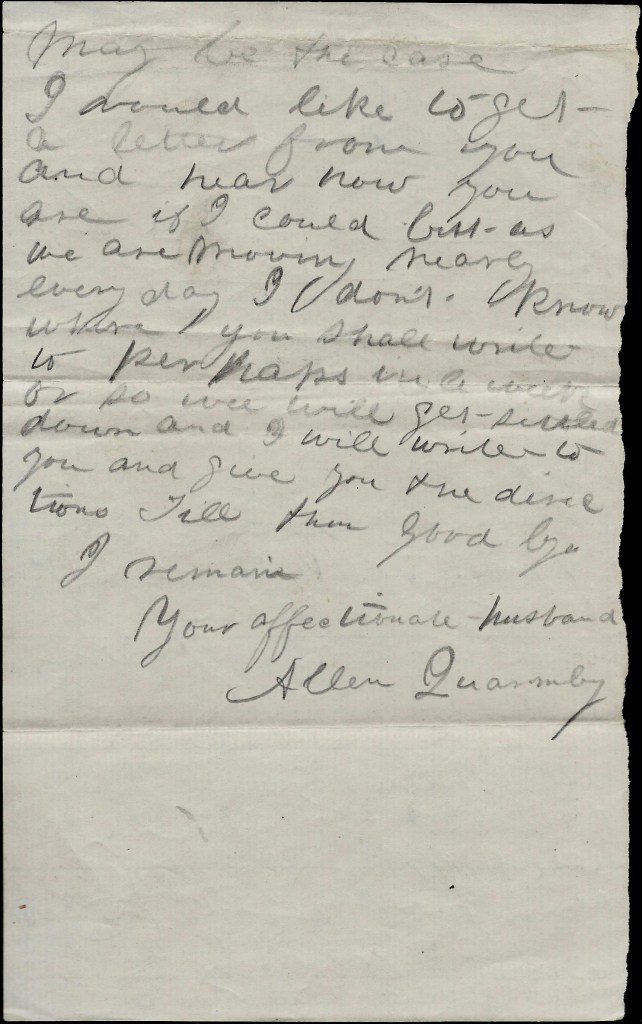
I have received your two letters. I was glad to hear of you and the children being well. I keep pretty well myself—Glory be to God for all His mercies.
Dear Jane, there is five thousand troops here ready to march at a moment’s warning. All our company keep pretty well and more particularly, the Valley Boys. They are in high spirits.
Dear Jane, as I write it is rumored that Major Anderson is in our camp—the hero of Fort Sumter.
I received the parcel. I can get along first rate now. Take great care of yourself adn the children. Keep in good spirits. Three cheers for the stars and stripes. Give my respects to all inquiring friends. Don’t neglect writing. No more at present from your husband. — Allen Quarmby
Letter 2
Washington [D. C.] May 14th 1861
Dear Jane,
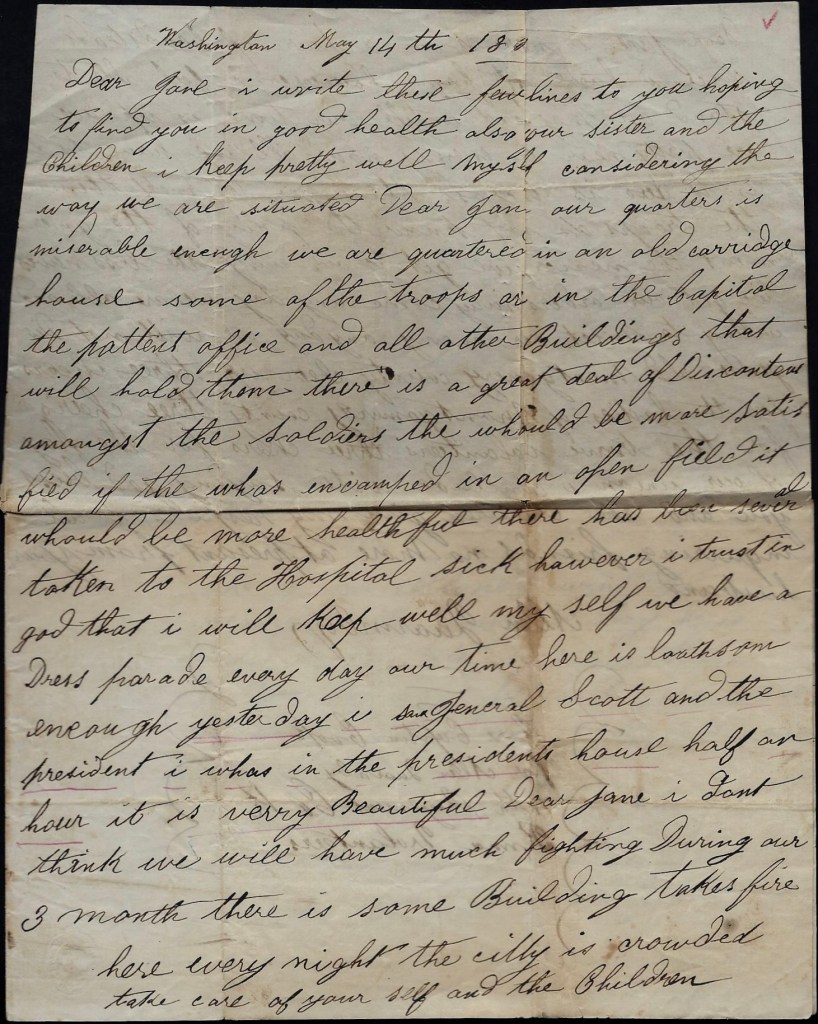
I write these few lines to you hoping to find you in good health—also your sister and the children. I keep pretty well myself considering the way we are situated. Dear Jane, our quarters is miserable enough. We are quartered in an old carriage house. Some of the troops are in the Capitol, the Patent Office, and all other buildings that will hold them. There is a great deal of discontent amongst the soldiers. They would be more satisfied if they was encamped in an open field. It would be more healthful. There has been several taken to the hospital sick, however I trust in God that I will keep well myself.
We have dress parade every day. Our time here is loathsome enough. Yesterday I saw General Scott and the President. I was in the President’s House half an hour. It is very beautiful. Dear Jane, I don’t think we will have much fighting during our three months. There is some building takes fire here every night. The city is crowded. Take care of yourself and the children.
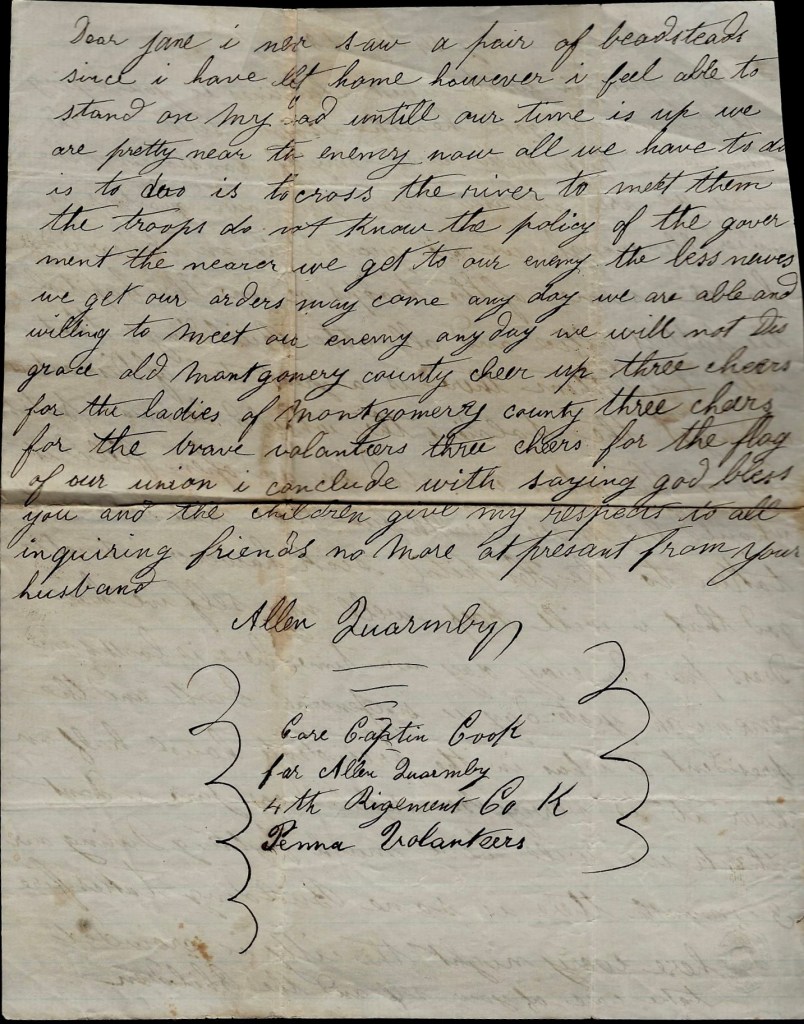
Dear Jane, I never saw a pair of bedsteads since I have left home. However, I feel able to stand on my head until our time is up. We are pretty near the enemy now. All we have to do is to cross the river to meet them. The troops do not know the policy of the government. The nearer we get to our enemy, the less news we get. Our orders may come any day. We will not disgrace Old Montgomery County. Cheer up. Three cheers for the ladies of Montgomery County. Three cheers for the brave volunteers. Three cheers for the flag of our Union.
I conclude with saying, God bless you and the children. Give my respects to all inquiring friends. No more at present from your husband. — Allen Quarmby
Care of Captain Cook, for Allen Quarmby, 4th Regiment, Co. K, Penna. Volunteers
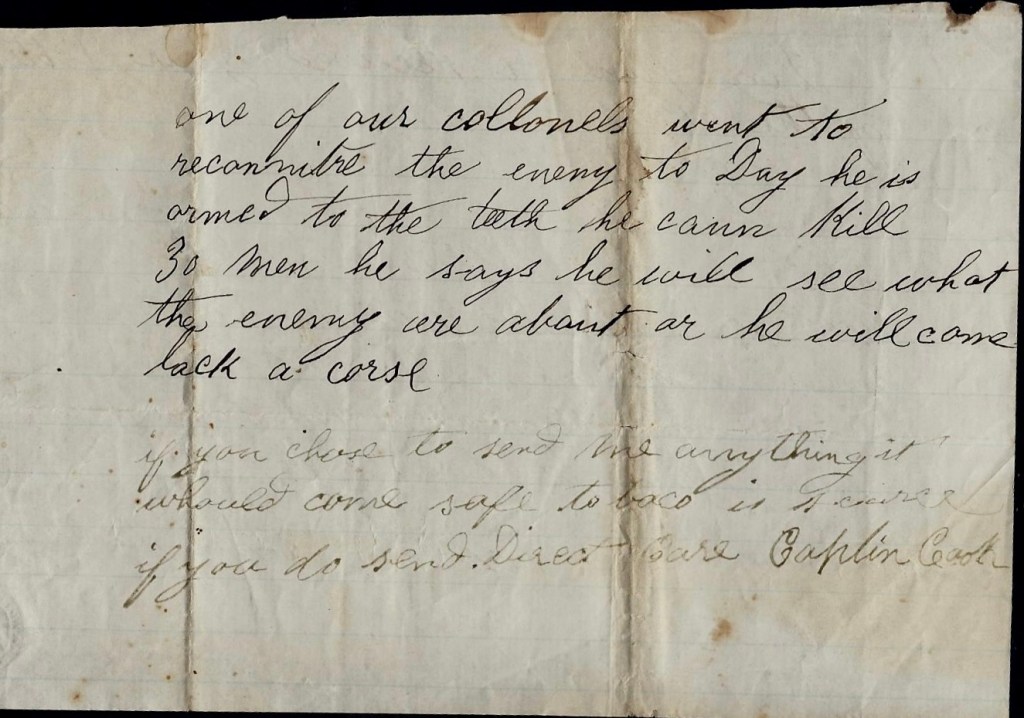
One of our colonels went to reconnoiter the enemy today. He is armed to the teeth. He can kill 30 men. He says he will see what the enemy are about or he will come back a corpse.
If you choose to send me anything, it would come safe. Tobacco is scarce. If you do send, direct care Captain [Walter H.] Cooke.
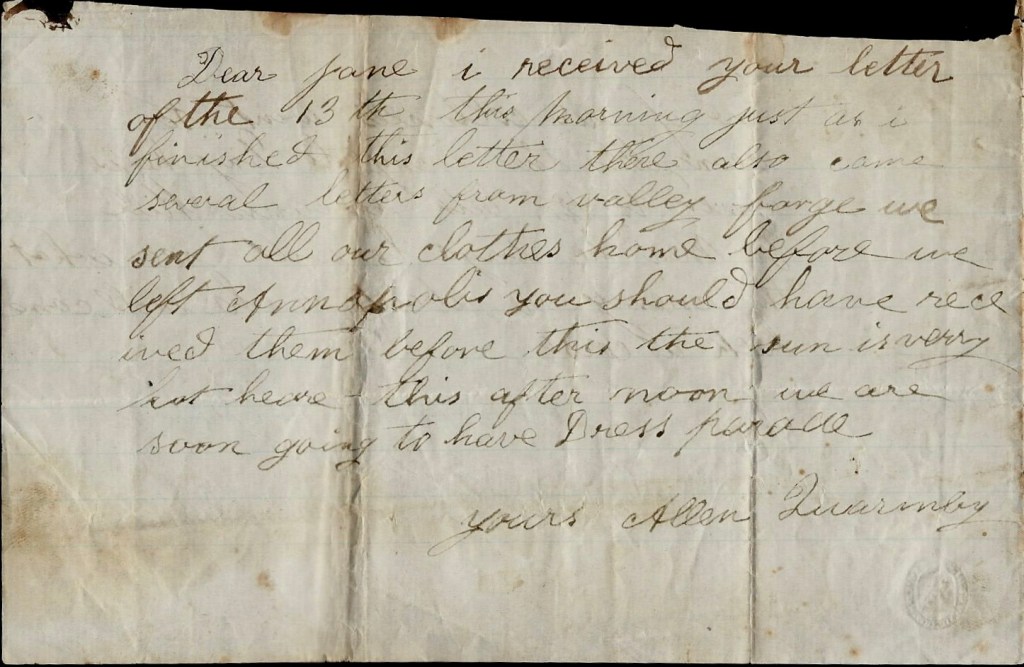
Dear Jane, I received your letter of the 13th this morning just as I finished this letter. There also came several letters from Valley Forge. We sent all our clothes home before we left Annapolis. You should have received them before this. The sun is very hot here this afternoon. We are soon going to have dress parade. Yours, — Allen Quarmby
Letter 3
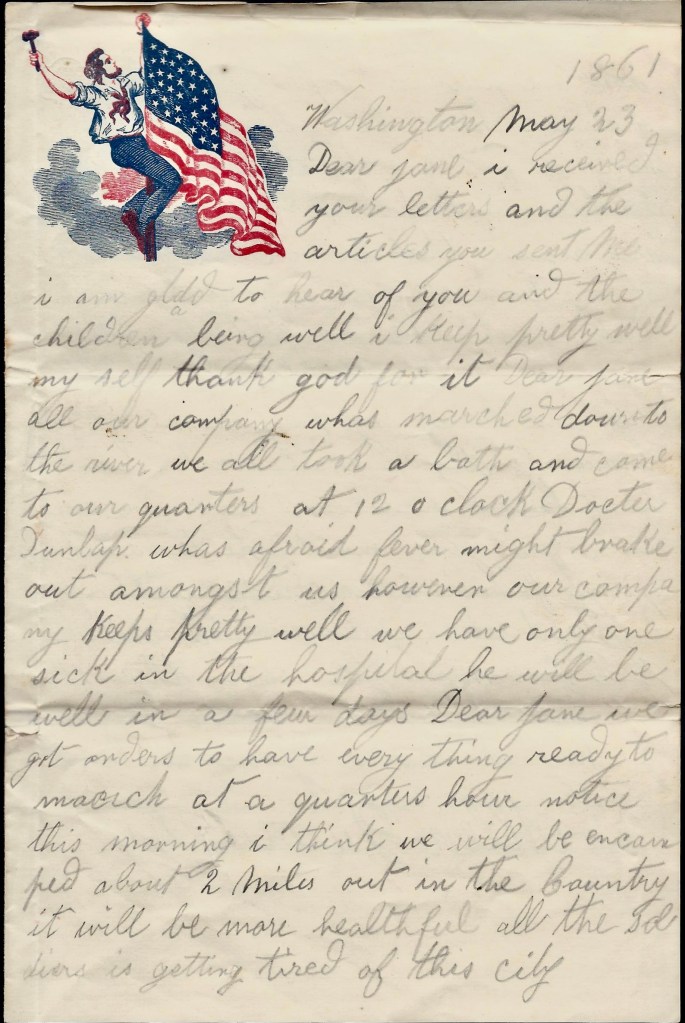
Washington [D. C.] May 23, 1861
Dear Jane,
I received your letter and the articles you sent me. I am glad to hear of you and the children being well. I keep pretty well myself, thank God for it.
Dear Jane, all our company has marched down to the river. We all took a bath and came to our quarters at 12 o’clock. Doctor Dunlap was afraid fever might break out amongst us. However, our company keeps pretty well. We have only one sick in the hospital. He will be well in a few days.
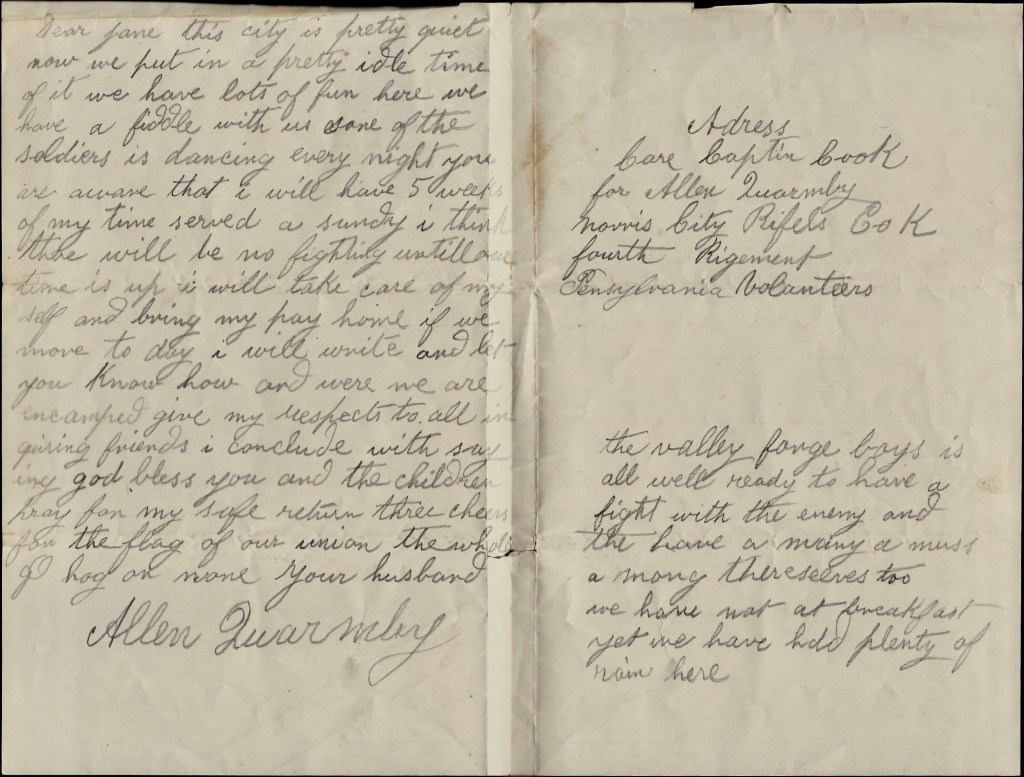
Dear Jane, we got orders to have everything ready to march at a quarter hour’s notice this morning. I think we will be encamped about two miles out in the country. It will be more healthful. All the soldiers is getting tired of this city. Dear Jane, this city is pretty quiet now. We put in a pretty idle time of it. We have lots of fun here. We have a fiddle with us. Some of the soldiers is dancing every night. You are aware that I will have 5 weeks of my time served a Sunday.
“Three cheers for the flag of our Union the whole hog or none.”
— Allen Quarmby, Co. K, 4th Pennsylvania Vols., 23 May 1861
I think there will be no fighting until our time is up, I will take care of myself and bring my pay home. If we move today, I will write and let you know how and where we are encamped. Give my respects to all inquiring friends. I conclude with saying God bless you and the children. Pray for my safe return. Three cheers for the flag of our Union the whole hog or none.
Your husband, — Allen Quarmby
The Valley Forge Boys is all well—ready to have a fight with the enemy, and they have a many a muss amongst themselves too.
Address Care of Capt. Cook for Allen Quarmby, Morris City Rifles, Co. K, Fourth Regiment Pennsylvania Volunteers.
Letter 4
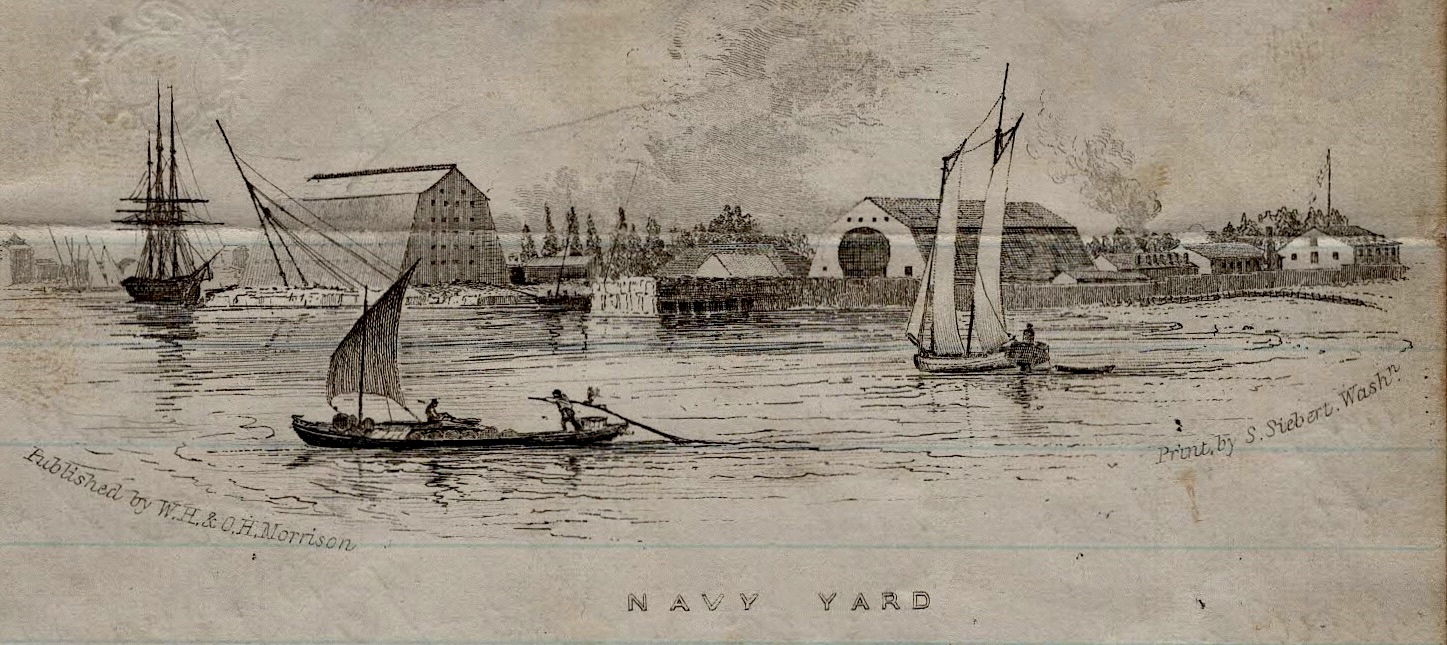
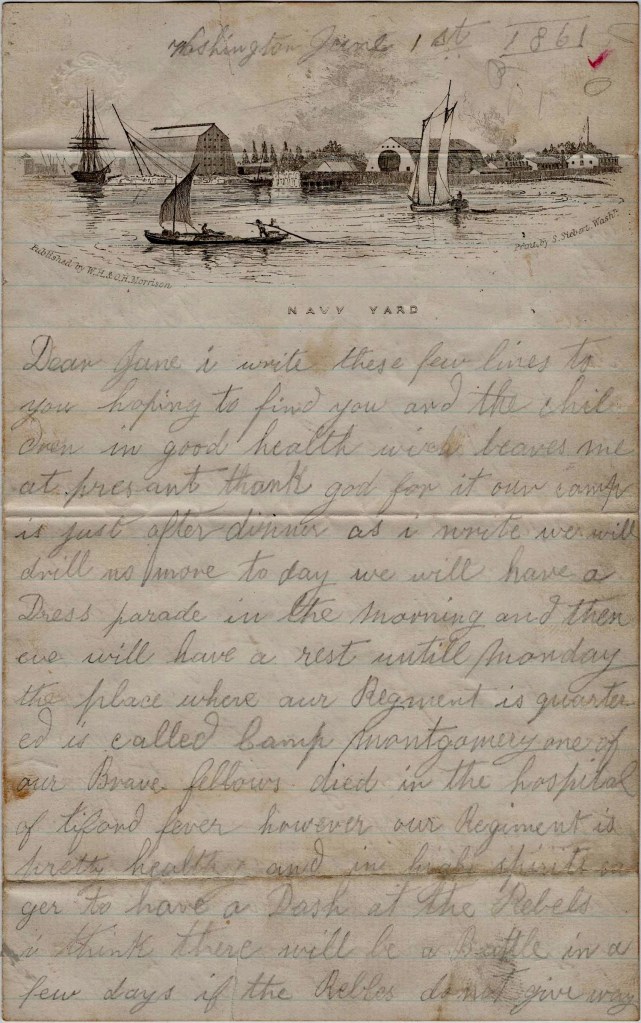
Lithograph of the Navy Yard at Washington D. C. on 1861 stationery used by Quarmby.
Washington June 1st 1861
Dear Jane,
I write these few lines to you hoping to find you and the children in good health which leaves me at present. Thank God for it. Our camp is just after dinner as I write. We will drill no more today. We will have a Dress Parade in the morning and then we will have a rest until Monday. The place where our Regiment is quartered is called Camp Montgomery.
One of our brave fellows died in the hospital of typhoid fever. However, our regiment is pretty healthy and in high spirits, eager to have a dash at the Rebels. I think there will be a battle in a few days if the Rebels don’t give way.
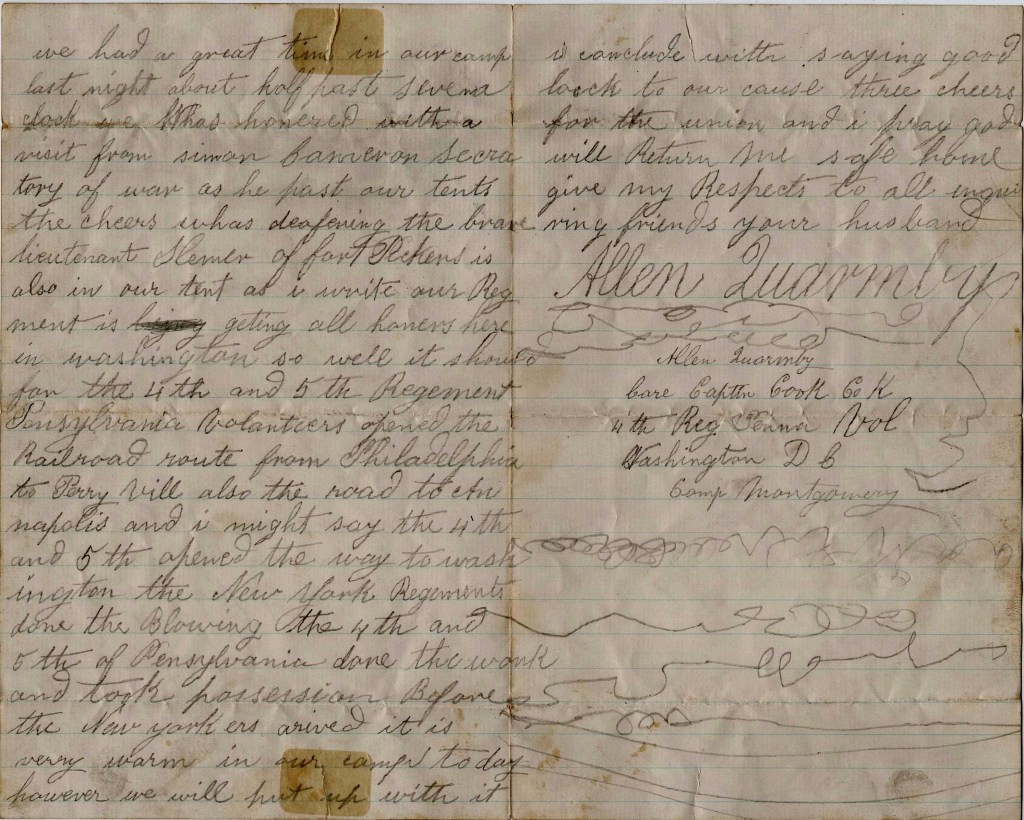
Lt. Adam Jacoby Slemmer saved Fort Pickens and the control of Pensacola Harbor.
We had a great time in our camp last night. About half past seven o’clock we was honored with a visit from Simon Cameron, Secretary of War. As he passed our tents, the cheers was deafening. The brave Lieutenant [Adam J.] Slemmer of Fort Pickens is also in our tent as I write. Our regiment is getting all honors here in Washington so well it should for the 4th and 5th Regiment Pennsylvania Volunteers opened the railroad route from Philadelphia to Perryville [and] also the road to Annapolis. And I might say the 4th and 5th opened the way to Washington. The New York Regiments done the blowing. The 4th and 5th of Pennsylvania done the work and took possession before the New Yorkers [even] arrived.
It is very warm in our camp today. However we will put up with it. I conclude with saying good luck to our cause. Three cheers for the union and I pray God will return me safe home. Give my respects to all inquiring friends. Your husband, — Allen Quarmby
Letter 5
Washington D. C. Camp Montgomery [near Bladensburg] June 9th 1861
Dear Jane,
I received your letter and present of the 6th. I was glad to hear of you being well. I feel pretty well myself, thank God for it. I think by the tone of your letter, you think I do not write often enough. However, when I do write, I tell you the truth and direct my letters properly which I know there are a great many of our men do not.
Today we have about 12 men sick in the hospital. Since the 4th left Norristown, they have lost three men by death. Our regiment is in high spirits. All we ask is an open field and a dash at the Rebels. However, I don’t think we will have any fighting—at least not before the 4th of July.
We got our uniform yesterday. 1 We also got our new blankets. Our regiment is getting all honors from the City of Washington. We have plenty of visitors at our camp. It takes one hundred and fifty small tents for your regiment. You know we are about two miles north of Washington. We have a fine view. We can see down the river as far as Alexandria where the brave Colonel Ellsworth was murdered while tearing down the Rebel flag. May his patriotic soul rest in peace. You know I have six weeks to serve yet. You must count 13 weeks for 3 months. The warm weather goes hard with some of our men.
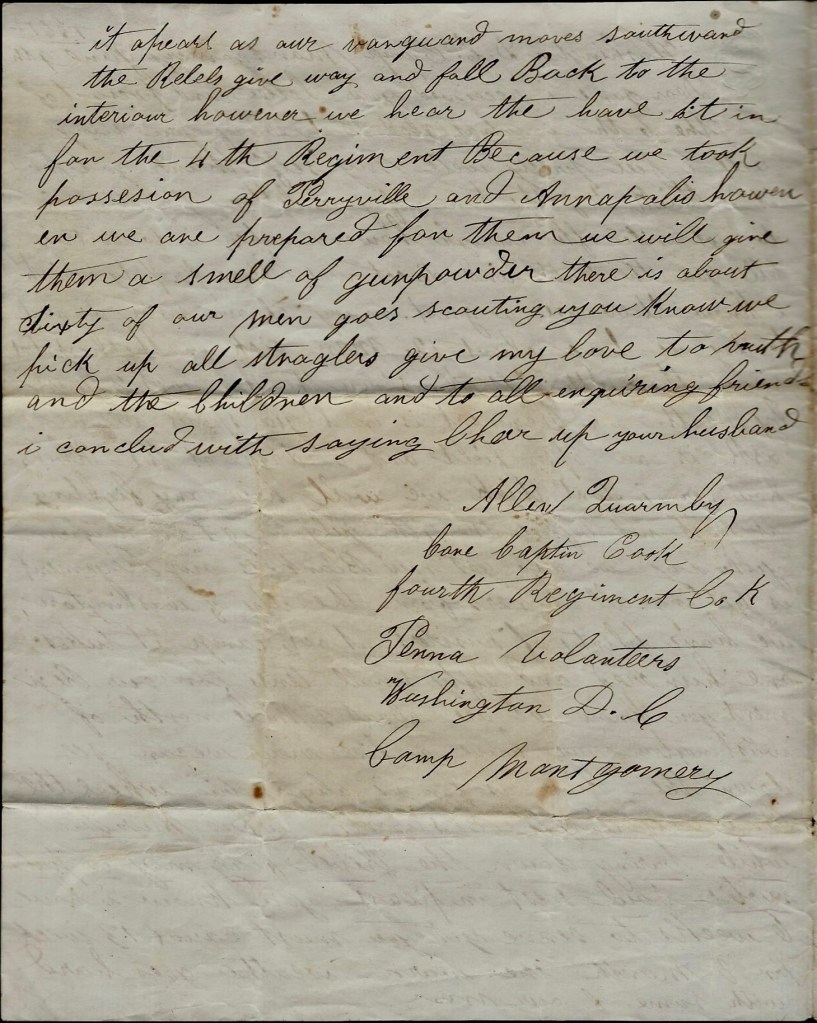
It appears as our vanguard moves southward the Rebels give way and fall back to the interior. However, we hear they have lit in for the 4th [Penn.] Regiment because we took possession of Perryville and Annapolis. However, we are prepared for them. We will give them a smell of gunpowder. There is about sixty of our men goes scouting. You know we pick up all stragglers.
Give my love to Ruth and the children and to all enquiring friends. I conclude with saying, cheer up!
Your husband, — Allen Quarmby
Care of Captain Cooke Fourth Regiment, Co. K Penna. Volunteers Washington D. C. Camp Montgomery
1 While at Annapolis on 28 April 1861, the 4th Pennsylvania received clothing that its men were not issued before their hasty departure from Camp Curtis. The blouses and pants that they received, provided to the state by war-profiteering contractors, were “made of damaged goods of inferior quality,” as observed by industrialist Benjamin Haywood, dispatched by Curtin to investigate after widespread complaints. The state accordingly changed its uniform suppliers and had the original contractors prosecuted for fraud. The 4th Pennsylvania would not receive new uniforms from the state until June. After two weeks at Annapolis, the regiment arrived at the capital on May 8; Captain William J. Bolton of Co. A wrote in his diary that it was met at the railway depot by a large crowd expecting to find a “splendid equipped regiment.” Instead, Bolton described his unit as a “sorry set of looking objects”: without knapsacks, their clothes were carried in dirty blankets on their backs. A lack of tents prevented the regiment from going into camp. It was instead billeted in the Assembly Rooms on Louisiana Avenue and the nearby Trinity Church. The resulting close quarters resulted in disease becoming rampant. When the regiment received tents, it encamped two miles from the city near Bladensburg. At the camp, it began regular drilling and inspections after receiving the necessary equipment.[Wikipedia]
Letter 6
Washington D. C. June 25th 1861
Dear Jane,
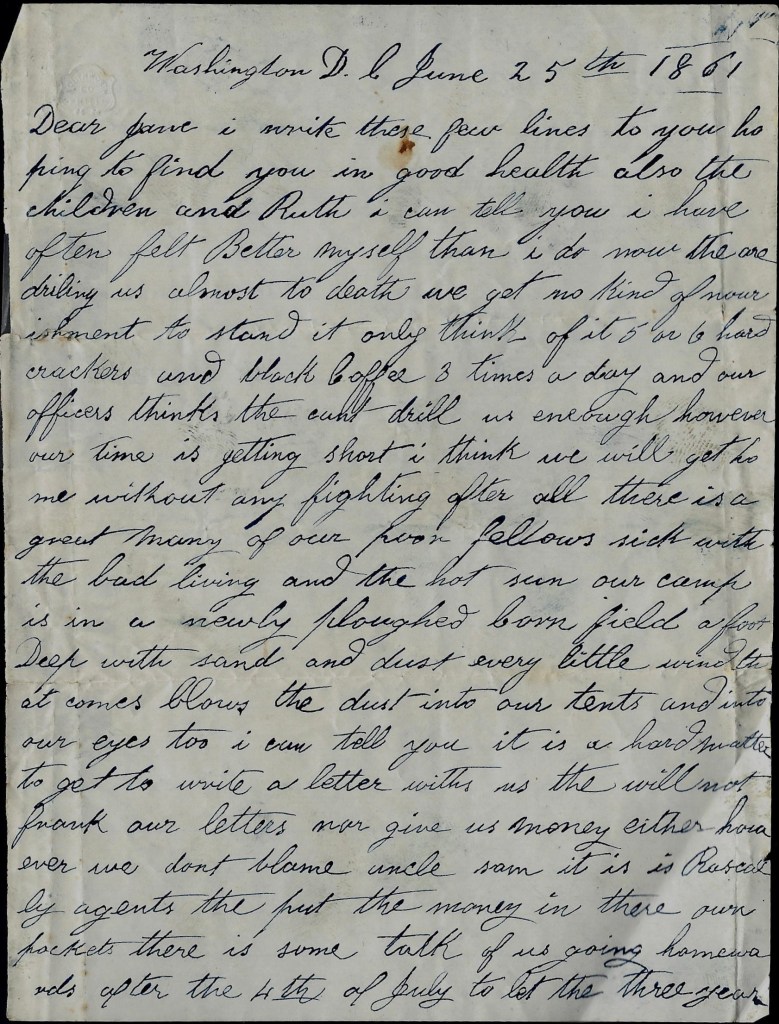
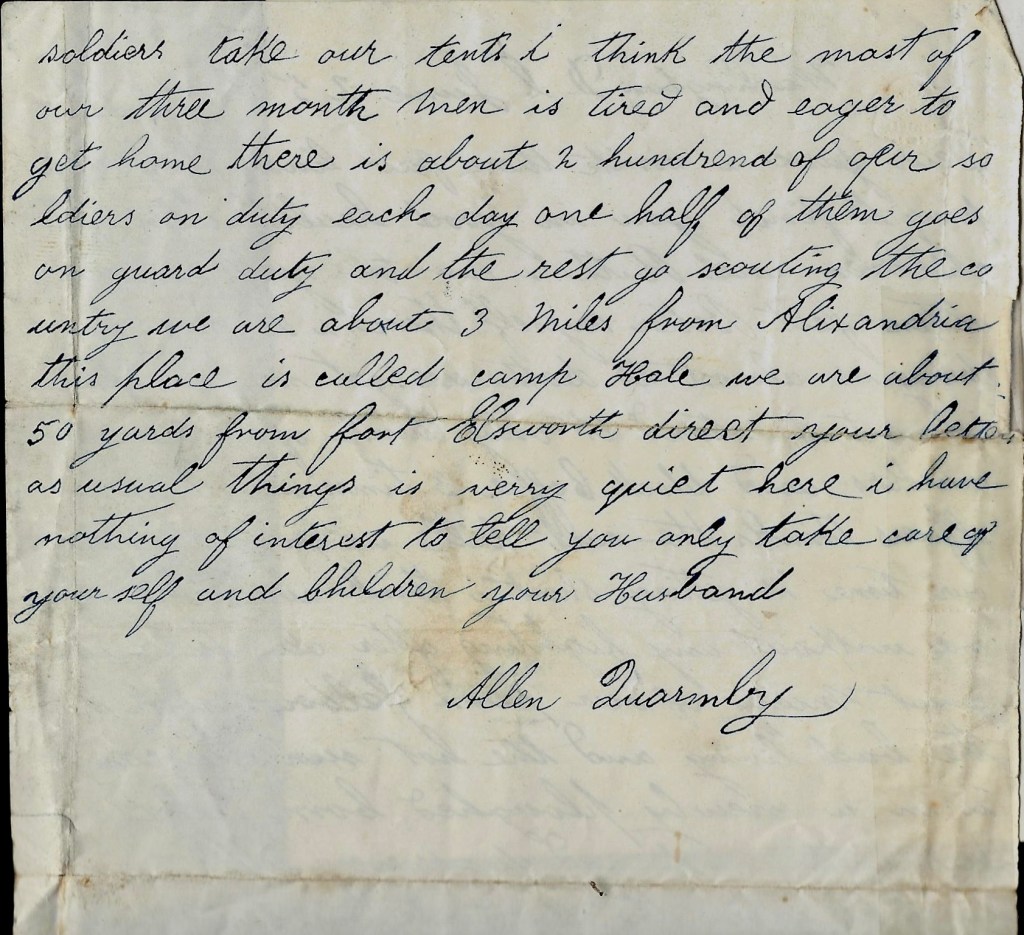
I write these few lines to you hoping to find you in good health—also the children and Ruth. I can tell you I have often felt better myself than I do now. They are drilling us almost to death. We get no kind of nourishment to stand it. Only think of it—5 or 6 hard crackers and black coffee three times a day. And our officers thinks they can’t drill us enough. However, our time is getting short. I think we will get home without any fighting after all. There is a great many of our poor fellows sick with the bad living [rations] and the hot sun. Our camp is in a newly plowed cornfield a foot deep with sand and dust. Every little wind that comes blows the dust into our tents and into our eyes too. I can tell you, it is a hard matter to get to write a letter with us. They will not frank our letters nor give us money either. However, we don’t blame Uncle Sam. It is the rascally agents that put the money in their own pockets.
There is some talk of us going homewards after the 4th of July to let the three-year soldiers take our tents. I think the most of our three month men is tired and eager to get home. There is about two hundred of our soldiers on duty each day. One half of them goes on guard duty and the rest go scouting the country. We are about three miles from Alexandria. This place is called Camp Hale. We are about fifty yards from Fort Ellsworth. Direct your letters as usual.
Things is very quiet here. I have nothing of interest to tell you—only take care of yourself and children. Your husband—Allen Quarmby
Letter 7
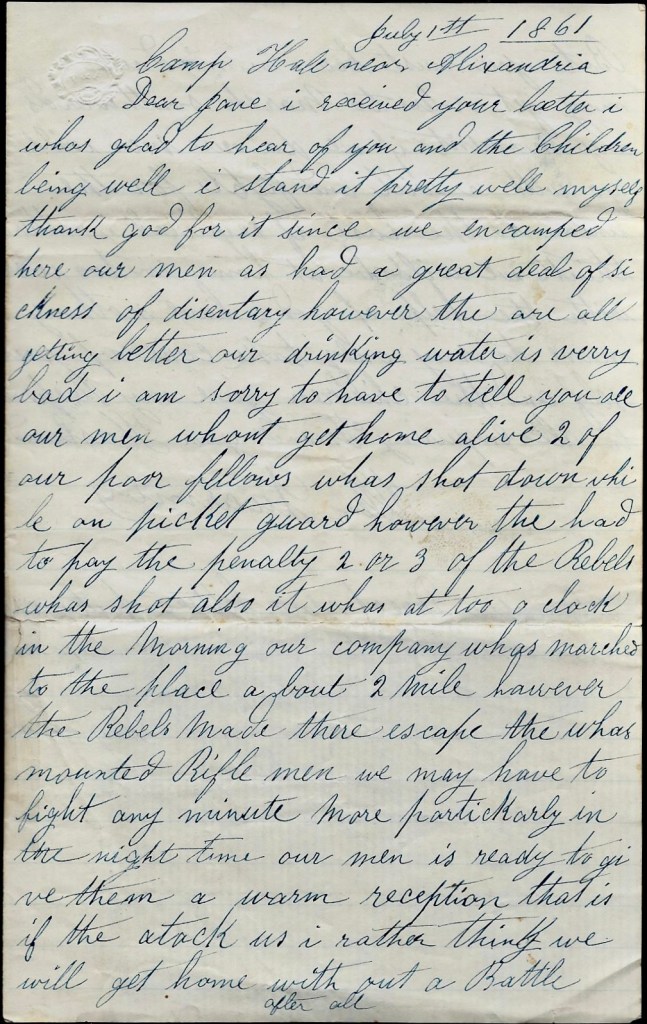
Camp Hale near Alexandria 1 July 1st 1861
Dear Jane,
I received your letter. I was glad to hear of you and the children being well. I stand it pretty well myself, thank God for it. Since we encamped here, our men has had a great deal of sickness of dysentery. However, they are all getting better. Our drinking water is very bad.
I am sorry to have to tell you all our men won’t get home alive. Two of our poor fellows was shot down while on picket guard. However, they had to pay the penalty; two or three of the Rebels was shot also. It was at two o’clock in the morning. Our company was marched to the place about two miles. However, the Rebels made their escape. They was mounted rifle men. 2 We may have to fight any minute, more particularly in the night time. Our men is ready to give them a warm reception—that is, if they attack us.
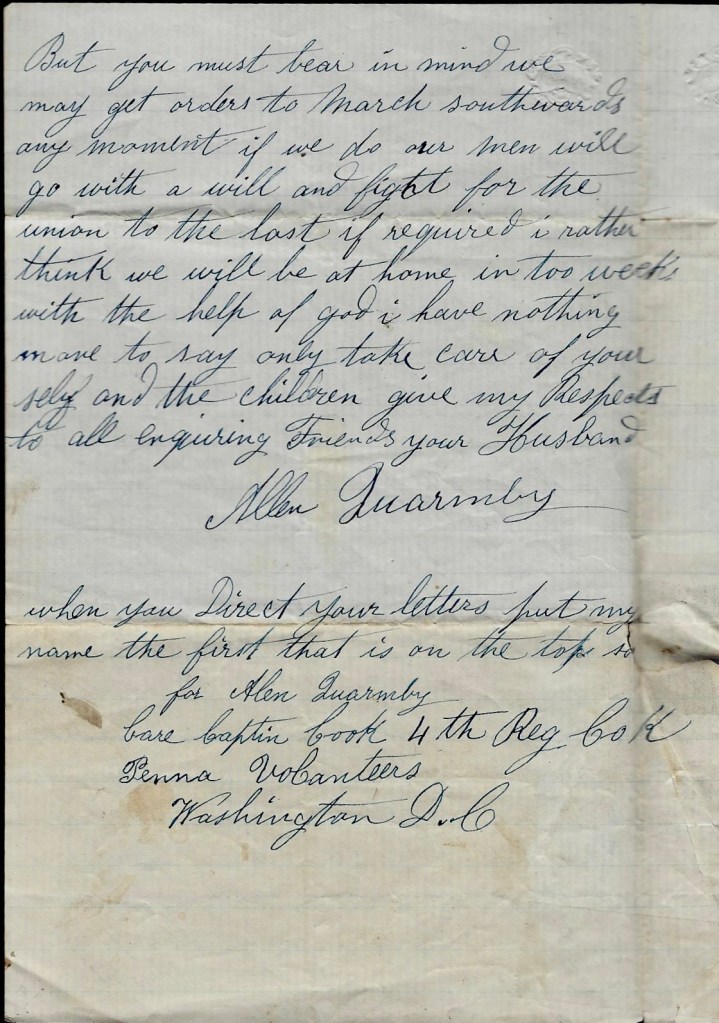
I rather think we will get home without a battle after all. But you must bear in mind we may get orders to march southwards any moment. If we do, our men will go with a will and fight for the Union to the last, if required. I rather think we will be at home in two weeks with the help of God. 3
I have nothing more to say, only take care of yourself and the children. Give my respects to all enquiring friends. Your husband, — Allen Quarmby
When you direct your letters, put my name the first that is on the top so:
For Allen Quarmby, care of Captain Cooke, 4th Reg. Co. K, Penna. Volunteers, Washington, D. C.
1 Camp Hale was sited on Shuter’s Hill near Alexandria, Virginia.
2 At 02:00 on June 30, three soldiers of the regiment on picket duty under the command of a second lieutenant from Co. B on the Old Fairfax Road were attacked by a superior Confederate force that they repulsed, killing one Confederate. Three other pickets from Co. E, attempting to rescue the original three, also engaged the Confederates, losing one killed and another severely wounded.
3 As the 4th Pennsylvania’s three-month term of enlistment expired on July 20, the soldiers of the regiment spent that day discussing whether they should remain with the army or return to Pennsylvania. McDowell sought to keep the regiment with the army for the upcoming battle, promising that the regiment would not have to serve more than two more weeks, but also stated that those who did not wish to continue their service would be sent to the rear. The appeals of McDowell and Hartranft to patriotic duty were partially successful: many in the regiment were willing to stay, but others wanted to muster out as scheduled due to their previous negative experiences with lack of equipment. The latter felt that they were entitled to a rest as they planned to reenlist in new three-year units, to be organized by officers of the regiment. Preferring not to send the 4th Pennsylvania into battle understrength with only the men who wished to remain, McDowell, who considered the repulse at Blackburn’s Ford the cause of the discord, decided to send the entire regiment to be mustered out. Hartranft and Captain Walter H. Cooke of Co. K stayed with the army, serving on the staffs of Franklin’s brigade and David Hunter’s division, respectively. Cooke, after finding that only a half dozen of his men stepped forward to fight in response to his question, left in disgust and initially started for the camp of the New York Fire Zouaves to serve as a private before being told he could be more useful with the staff of a unit. Both Hartranft and Cooke distinguished themselves during the First Battle of Bull Run and were awarded the Medal of Honor in the late 1880s.
On July 21, as the First Battle of Bull Run began, the 4th Pennsylvania remained in the rear; it and Varian’s New York Battery of the 8th New York Infantry were the only three-month units to refuse to fight in the battle. That morning, the regiment struck camp and marched back to Camp Hale under the command of Lieutenant Colonel Schall. Several witnesses reported its departure, ensuring that its actions would be widely denounced. On its way to the rear, the regiment was derided by Ambrose Burnside’s brigade and fleeing civilians. The 4th Pennsylvania was not in unanimous agreement on departing, Corporal Joseph K. Corson of Company K later recounting that he was ashamed of marching away from the sound of the guns, and that others felt similarly. Journalist William H. Russell acknowledged that “perhaps the Fourth Pennsylvania were right, but let us hear no more of the excellence of three months’ service volunteers”. At Camp Hale, the regiment was mustered out of federal service the next day and after arriving at Washington on July 23, it proceeded to Harrisburg via rail to be mustered out of state service on July 27. The companies of the 4th Pennsylvania returned to their hometowns, the Norristown units coming back to a “hearty welcome” from the locals. [Wikipedia]
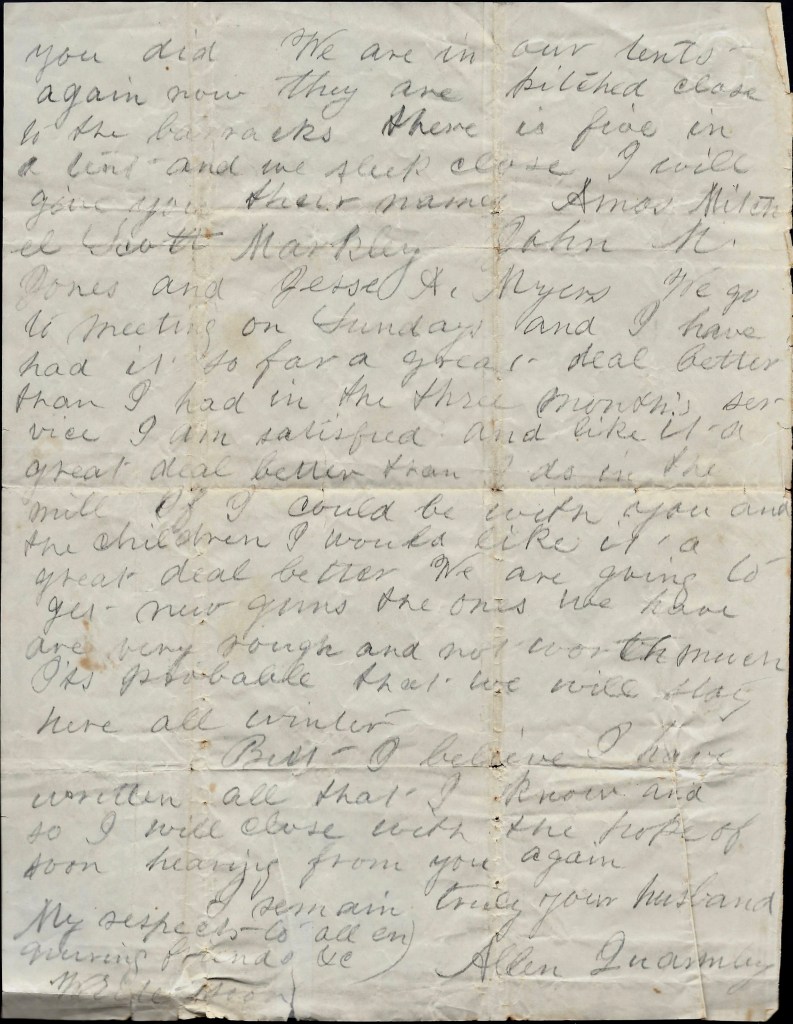
Note: The letters written beginning in the fall of 1862 were written by Allen when he served in Co. C of the 138th Pennsylvania Volunteers.
Letter 8
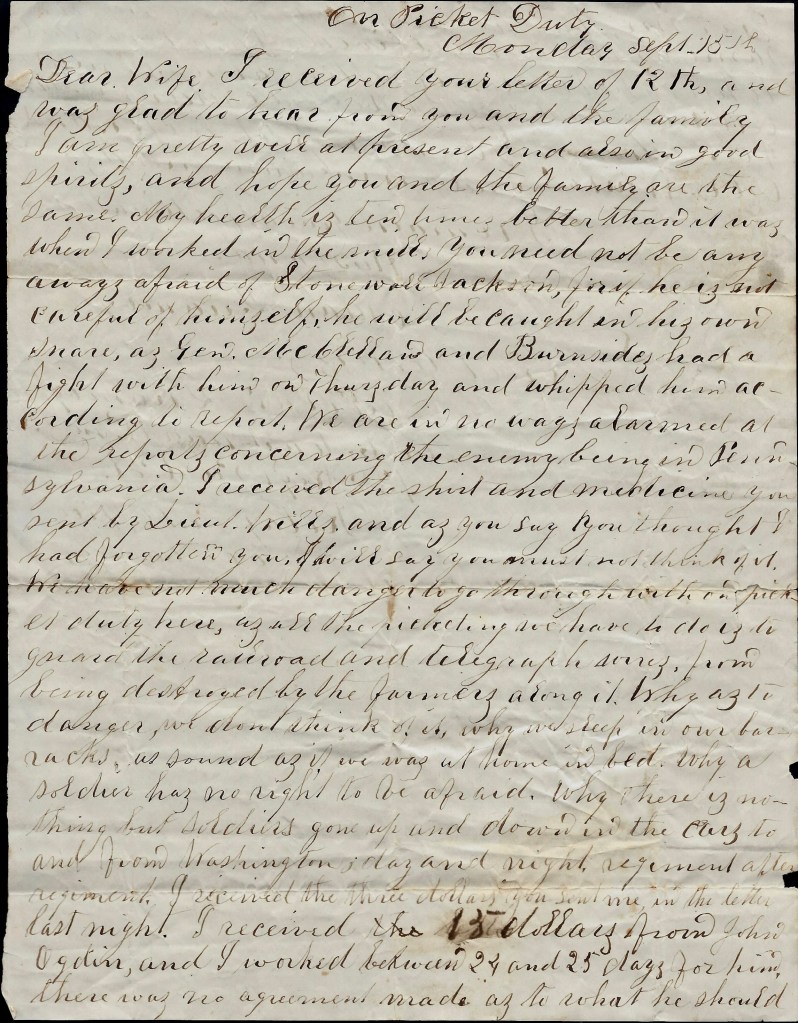
On Picket Duty Monday, September 15th [1862]
Dear Wife,
I received your letter of 12th and was glad to hear from you and the family. I am pretty well at present and also in good spirits and hope you and the family are the same. My health is ten times better than it was when I worked in the mill. You need not be any ways afraid of Stonewall Jackson for if he is not careful of himself, he will be caught in his own snare as Gen. McClellan and Burnsides had a fight with him on Thursday and whipped him according to report. We are in no ways alarmed at the reports concerning the enemy being in Pennsylvania.
I received the shirt and medicine you sent by Lieutenant Wills and as you say you thought I had forgotten you, I will say you must not think of it. We have not much danger to go through with on picket duty here as all the picketing we have to do is to guard the railroad and telegraph wires from being destroyed by the farmers along it. Why as to danger, we don’t think of it. Why we sleep in our barracks as sound as if we was at home in bed. Why a soldier has no right to be afraid. Why there is nothing but soldiers gone up and down in the cars to and from Washington day and night, regiment after regiment.
I received 15 dollars from John Ogden and I worked between 24 and 25 days for him. There was no agreement made as to what he should give me but he promised to give me the same as the rest received. I am very glad to hear that Allan is getting along so nicely. Tell Mary and Joseph to be good children until I come home. Give my respects to Mr. and Mrs. Whitam and all enquiring friends. I remain your affectionate husband, — Allan Quamby
Direct letters to Allan Quamby, Co. C, Capt. George W. Guss, 138th Regt. Pa. Vol., Relay House Office, Maryland
Letter 9
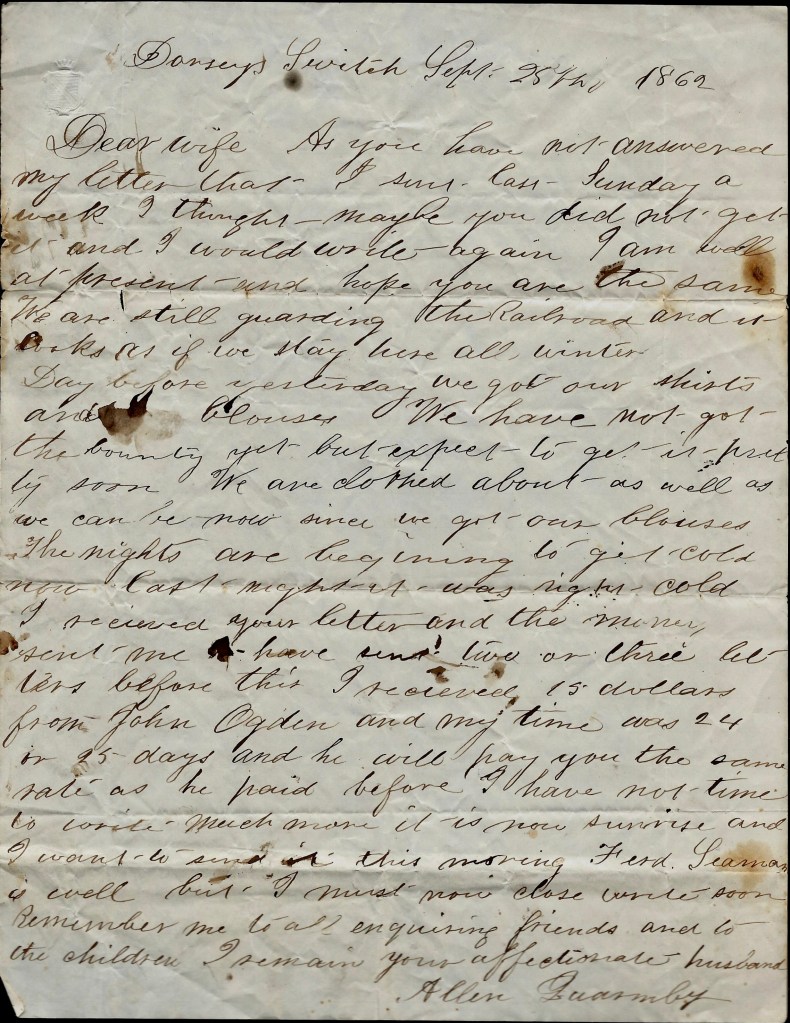
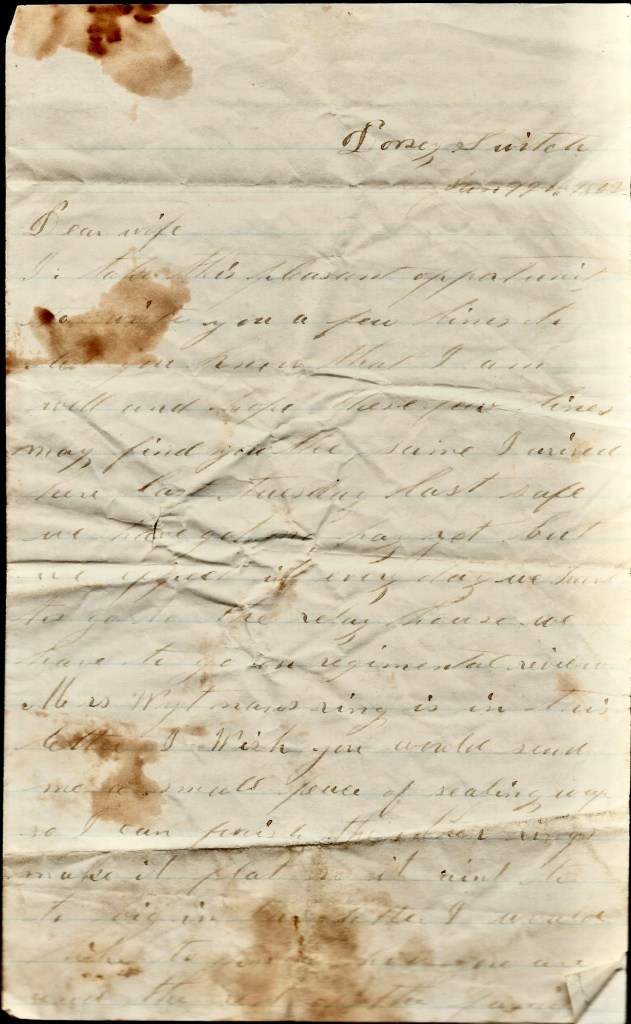
Dorsey’s Switch [Maryland] September 25th 1862
Dear wife,
As you have not answered my letter that I sent last Sunday as week, I thought maybe you did not get it and I would write again. I am well at present and hope you are the same. We are still guarding the [Baltimore & Ohio] Railroad and it looks as if we stay here all winter.
Day before yesterday we got our shirts and blouses. We have not got the bounty yet but expect to get it pretty soon. We are clothed about as well as we can be now since we got our blouses. The nights are beginning to get cold now. Last night it was right cold.
I received your letter and the money sent me. I have sent two or three letters before this. I received 15 dollars from John Ogden and my time was 25 or 25 days and he will pay you the same rate as he paid before. I have not time to write much more. It is now sunrise and I want to send it this morning. Ferd. Seaman is well. But I must now close. Write soon. Remember me to all enquiring friends and to the children. I remain your affectionate husband, — Allen Quarmby
Letter 10
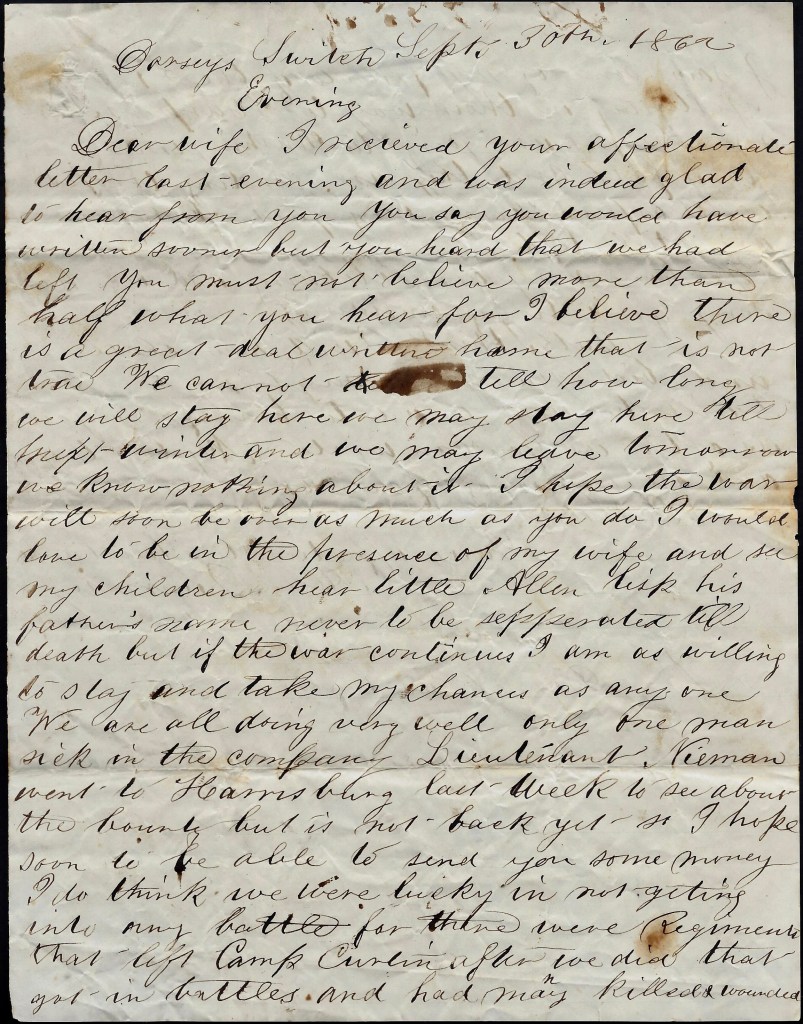
Dorsey’s Switch [Maryland] September 30th 1862
Dear Wife,
I received your affectionate letter last evening and was indeed glad to hear from you. You say you would have written sooner but you heard that we had left. You must not believe more than half what you hear for I believe there is a great deal written home that is not true. We cannot tell how long we will stay here. We may stay here till next winter and we may leave tomorrow. We know nothing about it. I hope the war will soon be over as much as you do. I would love to be in the presence of my wife and see my children, hear little Allen lisp his father’s name, never to be separated till death. But if the war continues, I am as willing to stay and take my chances as anyone.
We are all doing very well. Only one man is sick in the company. Lieutenant Nieman went to Harrisburg last week to see about the bounty put is not back yet so I hope soon to be able to send you some money. I do think we were lucky in not getting into any battle for there were regiments that left Camp Curtin after we did that got in battles and had many killed & wounded. I saw some of my friends of the 51st yesterday on their way to Harper’s Ferry. Troops are going to Washington very fast and they are sending troops to Harper’s Ferry very fast. But we are still left.
We have very good clothing and we have very good living considering. But I think I will now close and bid you good night. I will be very glad to hear from you as often as you can write. My love to you and all enquiring friends. I remain your affectionate husband, — Allen Quarmby
Direct as before.
Letter 11
Dorsey’s Switch [Maryland] October 4th 1862
Dear wife,
Col. M. R. McClennan, 138th Penn. Vols.; was promoted to Col. when Charles L. K. Sunwalt was cashiered.
I received your letter day before yesterday and was glad to hear from you. I am well, hoping you are all the same. There is no danger of us ever getting in a battle as long as we stay here and I would rather be here than I would up at Camp Relay where six companies are encamped. We have more liberty here than we would if we were under the eye of the Colonel. 1 The Colonel would not let us out of the camp once in a week but here we can go pretty much wherever we please.
We have barracks to sleep in. The bunks are large enough for two to sleep in. One spreads his blanket down on the boards to sleep on and the other blanket serves for a covering. I bunk with Jesse A. Myers—a young fellow from Montgomery Square whom I never saw before but I would not trade my bed fellow for anybody unless it was you.
That money you got paid to you was right.
We have built ourselves huts to lay in when we are on guard and we have just as good quarters when we are on guard as we would have if we were in the camp. One company got sent into the camp for making depredations on neighboring orchards but our Captain told us we could stay here as long as the regiment stayed if we would not steal from the farmers. We have a pretty honorable set of fellows so I think we will not get into camp on that account.
Ferd [Seaman] is going to send his box on Monday but I don’t think I will send anything this time. But we must drill now so goodbye. Write soon. From your affectionate husband, — Allen Quarmby
1 Col. Charles L. K. Sumwalt was not long the colonel of the regiment. According to the regimental history, though “he was a very talented man” and “had some expewrience as a Minister of the Gospel,” he “became addicted to drunkenness and lost all sense of shame, honor, or manly dignity. HIs course of deportment became so disgraceful that charges were preferred against him…and he was found guilty of conduct unbecoming an officer and a gentleman.” He was dismissed on 30 March 1863.
Letter 12
Dorsey’s Switch [Maryland] October 20th 1862
Dear Wife,
I received your letter last week and was glad to hear from you. I am well trusting you are all the same. I suppose by what I wrote before you have been looking for the bounty. Well, I have been looking for it too but it has not come yet. The last day of this month we expect to get paid but we may be disappointed again. The nights are beginning to get cold and we have had several hard frosts. We are not as comfortable here as we would be at home but we have plenty of clothing to keep us warm and while we are on guard, we can build big fires to sit by.
We received today an account of the draft. We are all glad that they have drafted at last. I expect when they go, they will come by here as they can’t get to Washington on any other road. Tell the Bridgeport fellows that we will give them three cheers when they go past. Tell them to look out for the 138th when they get to the Relay and from there on to Annapolis Junction. I am satisfied of course that you got little Allen’s show awards when you did.
We are in our tents again now. They are pitched close to the barracks. There is five in a tent and we sleep close. I will give you their names—Amos Mitchell, Scott Markley, John M. Jones, and Jesse A. Myers. We go to meeting on Sundays and I have had it so far a great deal better than I had in the three months’ service. I am satisfied and like it a great deal better than I do in the mill. If I could be with you and the children, I would like it a great deal better.
We are going to get our new guns. The ones we have are very rough and not worth much. 1 It’s probable that we will stay here all winter.
But I believe I have written all that I know and so I will close with the hope of soon hearing from you again. I remain truly your affectionate husband, — Allen Quarmby
My respects to all enquiring friends, &c. Write soon.
1 When the regiment was organized they were issued old Austrian muskets which were almost worthless. When these were turned in, they were replaced by US smooth-bore muskets, 69 caliber. They carried these muskets until the spring of 1864 when they were issued the second-hand Springfield rifled muskets.
Letter 13
Dorsey’s Switch [Maryland] November 2nd 1862
Dear Wife,
I received your letter last Friday night and was very sorry to hear that you and little Allen are not well but I hope that when you get this, you will be well. I guess you will get your pay as soon as it is collected. We haven’t got ours yet but we were mustered for pay last Friday so we may get it this week.
This is a very fine day. I am well hoping you are the same.
I must tell you of a fight we had the other night. Just after taps and lights out, we heard the report of three guns out on picket. We were soon out and marched off a double quick and when we got there we found that they had shot at a calf so the fight was over.
We sent Capt. Guss and subscribed his fare to go home to see about our wives getting the Relief. Some think you will get it this week—others don’t. But we expect to get our pay this week or next. I don’t feel much like writing today so I believe I will stop. Give my respects to all enquiring friends and write soon. I remain your affectionate husband, — Allen Quarmby
Ferd. is well except a bad cold and he can’t speak out loud.
Letter 14
Dorsey Switch [Maryland] January 19th 1862 [1863]
Dear Wife,
I take this pleasant opportunity to write you a few lines to let you know that I am well and hope these few lines may find you the same. I arrived here last Tuesday safe. We have got no pay yet but we expect it every day. We have to go to the Relay House. We have to go on Regimental Review.
Mrs. Wightman’s ring is in this letter. I wish you would send me a small piece of sealing wax so I can finish the other rings. Make it flat so it ain’t too big in the letter. I would like to [illegible]…you must not send me a postage stamp in the next letter for I can get one here. We ain’t going to stay at the Relay House. We are ust a going to be reviewed.
It is very warm here today. It has been pretty cold here for two or three days but it has got pretty warm now again.
I would like to know what letters Sarah Kay wants in her ring for I will send hers next. Let me know in the next letter if you please. I bring my letter to a close for I have no more to write about. So I send my love to you and to all the rest of my friends. So this is all at present. This is from your dear husband, — Allen Quarmby
Write soon as you can.
Letter 15
Dorsey Switch, Maryland March 26th 1863
My Dear Wife,
I take this pleasant opportunity to write you these few lines to let you know that I am well and hope these few lines may find you the same. I received your kind and welcome letter and was very glad to hear from you all. It is very cool here today. It looks as if it’s either a going to rain or snow. We have not got our pay yet but we expect to get paid next week for certain. The weather was very nice here for two or three days.
General Briggs was a coming to inspect us but he did not come so I guess he will come today. We have got our things all cleaned up for him.
I think we will stay here all summer. The Captain is getting his quarters all fixed up and they are a going to fix the branches too. We will either get paid the latter end of this week or beginning of the next. So there ain’t much news here just now. So I send my love to you and to all the rest of you. So I will have to bring my letter to a close for it is getting late. So goodbye but not forever. This is from your dear husband, — Allen Quarmby
Dorset Switch, Maryland. Write as soon as you can if you please.
Letter 16
Dorsey’s Switch [Maryland] April 14th 1863
My Dear Wife,
I take this present opportunity to write you these few lines to let you know that I am well and hope these few lines may find you the same. I received your kind and welcome letter and was very glad to hear from you all.
It was very warm here today. It was like a hot summer day. We ain’t got paid yet but we expect to get paid to this week but we don’t know whether we will or not but I hope they will pay us this week.
We had a general inspection last week. Out Lieut. Colonel inspected us and he said we looked very well. There is some talk about us a going into camp but I don’t know how true it is. I will make them rings as soon as I can. I would like to be at home to help you to make garden but you will have to do the best you can. But don’t hurt yourself.
It is a very splendid evening this evening. There ain’t much news here just now so I don’t know what to write anymore so I will have to bring my letter to a close for I don’t know what to write about. So I send my love to you all. So this is all at present. So goodbye but not forever. This is from your dear husband, — Allen Quarmby
Write soon as you can if you please.
Letter 17
Headquarters Co. C, 138th P. V. Relay House, Maryland April 24, 1863
My dear wife,
I take this present opportunity to write you these few lines to let you know that I am well and hope these few lines may find you the same. I received your kind and welcome letter and was very glad to hear from you and to hear that you were all well.
It was raining all day yesterday and all day today. It is very wet and muddy down here just now. We moved into camp on the 22nd day of April and we signed the pay rolls as soon as we got into camp. We walked into camp and that was five miles. I was a little tired when I got into camp. We have not got our pay yet but we expect it every day but we don’t know what day it will come on. I wish it would come pretty soon.
We only stay into camp a week at a time. We have to go out every other week. We don’t like it in camp anyhow. We would sooner be out on the railroad.
There was another man died in the regiment. He died with the measles. They have sent him home. I am glad to hear that you have got the garden all dug and planted. I wish I could have been home to help you to fix the garden. i am sorry I couldn’t get home to help you.
They are a raising a big fuss here about the pay master. He ought to have been here six weeks ago. There is not much sign of anybody getting home. There can’t anybody get [furloughs] unless a case of necessity. There ain’t much news here just now. So I will send my love to you and the children. So I will have to bring my letter to a close for I don’t know what to write about. So this is all at present. So goodbye but not forever. This is from your dear husband, — Allen Quarmby
Write soon as you can of you please.
Letter 18
[partial letter, mid-July 1863]
Virginia. It looks to me as if the war would soon be over. The rebels have been greatly weakened by the capture of Vicksburg and their defeat at Gettysburg and now Port Hudson, Indeed the news is glorious and all we want is to get a fair chance at Lee when I think we will end the war and peace will once more reign triumphant in our beloved country, husband and wife will be again joined together, brothers and sisters, mothers and sons will again meet never to be separated except by death. God grant that such may be the case.
I would like to get a letter from you and hear how you are if I could but as we are moving nearly every day, I don’t know where you shall write to. Perhaps in a week or so we will get settled down and I will write to you and give you the directions. Till then, goodbye. I remain your affectionate husband, — Allen Quarmby
The following letter was written by 16 year-old Hugh P. Roden (1845-1911), a native of England, who enlisted in September 1861 as a drummer boy in Co. K, 7th New Jersey Infantry. He served three full years with his company and mustered out at Trenton on 7 October 1864.
At the time that Hugh wrote this letter, his regiment was with the Army of the Potomac on the Peninsula Campaign where they were with the 3rd Army Corps. The “battle” referred to in his letter was the Battle of Williamsburg fought on 5 May 1862. Four days after this letter was written, the regiment would fight again in the Battle of Fair Oaks.
Hugh was the son of George and Rachel J. Roden. His siblings were Agnes, Elizabeth, George and Rachel. At the time of the 1860 US Census, the Roden family lived in Newark where Hugh’s father earned a living as a tailor.
After the war he went to medical school and became a physician.
Transcription
Camp 14 miles from Richmond May 27th, 1862
Dear Mother, Father, & Sisters,
Dr. Julius David Rose (“Rosey”) was the chaplain of the 7th New Jersey Infantry (Military Images)
I received your long looked for welcome letter last night dated the 20th. Dr. Rosey came in camp last night. He did not have any letter for me. You spoke about him bringing some paper for me. Did you send it? I have not received it as yet. The chaplain said he had nothing for me from home. Mother, did you send tea & sugar for Mr. Yuereagle. He has not seen them. One of our sergeants gave me a small parcel marked Hugh Roden, with salts and pills in. That is all I have seen. Was the salts for Mr. Yuereagle or for me? I wrote for some salts and I thought it was for me. I have not seen anything of the tea or sugar. I spoke to Yuereagle about it. I told he had better go and speak to the Chaplain of the 6th—Mr. Moor—about it. Mother if you want to send anything more to Yuereagle, please don’t send it in my name. Direct it to Mr. Yuereagle himself. The reason that I don’t want to be bothered with his things is when we was on the march, he had plenty of coffee and sugar. One of the boys asked me if I had any coffee. I said I wish I had some. Yuereagle heard me and he never offered me any, but just as I spoke, he shoved the coffee under his knapsack. Our wagons had not arrived yet so that I could not get any. One of the boys gave me enough to make enough to make a cup of coffee. It was mean of Yuereagle. I always gave him what I had from home. You know he mends pants and coats for the soldiers and he has plenty of money. It might be that Yuereagle did not hear me ask for coffee. Don’t judge him too hard. I might be mistaken. I never asked him for anything since I have been in the service but if you have anything, more tea, sugar, or anything else to send to Mr. Yuereagle, I want you to direct it to him, not to me.
I am sure I have wanted a little tea the other week a great many times when I was so sick I could not drink coffee. I think you might have sent me a little of something with Mr. Moor instead of using my name to send Yuereagle things. I am glad I know how much I am thought of—that accounts for me not getting any letters. I have wrote five letters since the Battle and have only received one. Yuereagle knows I wrote nearly every second day home. I told him to write and ask his wife to tell you to write. You never spoke if you received those 18 dollars I sent out of my 2-months pay. You don’t know how it makes me feel.
It is raining hard while I am writing. All the other boys have all received letters from home stating that they have received their money. We all ask each other if their money has got some safe. One of the boys asked me. I told him I did not know for I had not got a letter. Says he, your folks can’t care much whether you send your money or not. I told him I guessed you had wrote and the letter was delayed. I tell you, it makes me feel bad.
There is a great deal of sickness in camp. They send the sick down to Fortress Monroe. The ambulances carry down from five to ten every third day. The reason is we are moving every day. Some days it rains, wetting the men through. Then the orders come for to march. Then after marching in wet clothes all day, we have to put up our tents and fall asleep. I tell you, this is soldiering I never read of in the books. I have read of marching with plenty to eat, but I never read of marching every day with a couple of crackers and a piece of green pork that had been salted down. At the time Noah went into the ark, I guess this pork was some that he had left over and our contractors bought [or] picked it up. The fresh meat that we get looks as if it had been hauled through all the mud that could be scraped together between Jersey and Virginia. Now you want me to tell you the truth. I have seen the cooks put a piece of meat in the pot that had not been killed five minutes and was shaking when they cooked it. But that is nothing. It is all for Dixie Land.
I tell you what, mother, when I come home, I [want] you to have a Yorkshire pudding and a plum pudding and some crullers ready on the table so that when I come into the house, I can just make one jump for the table, kiss the pudding, then kiss all around—-that is, if I get back, for you know these rebels fire so careless they would just as leave shoot a fellow as not. But you remember the pudding and crullers and I guess I stand as good a chance as anyone getting home. But nobody knows what a day may bring forth. Boys that I had talked with the day before the battle now lay beneath the sod. Poor fellows. Little they thought they would be called away so soon. Mother, have you received a picture of our camp I sent you? A man came and drew them and then had them printed. It is a large picture. The man took it home for me and all that bought them. He is a brother to our Lieutenant.
Agnes, I don’t know the name of that boy but you shall know him in my next. Lizey, I hope I will be home to eat up all the pears so that you will not be troubled with so many but if I ain’t there in time, I pity the farmers around Dixie.
Rachel, I hope you will be a good girl and mind everything Mother & Father tell you. How is Father’s work getting along? Is father well?
But I must close. We expect another march. Goodbye. I remain your loving and affectionate son & brother, — Hugh P. Roden
The following letter was penned by Alfred Irving Young (1838-1890), the son of William Henry Young (1807-1894) and Ellen Augusta Beall (1812-1892) of Columbus, Muskogee county, Georgia. Alfred was 23 when he enlisted in Capt. Croft’s Battery Light Artillery at Columbus, Georgia, in November 1861. He was elected 1st Lieutenant but often commanded the battery (“Columbus Artillery”) in the absence of the captain.
Capt. Edward Croft of the Columbus Flying Artillery
Capt. Croft’s light artillery saw active service attached to various cavalry commands, earning the nickname “Croft’s Flying Artillery.” The battery is the subject of a 1993 history titled, “Haulin’ Brass: A Confederate Chronicle of Capt. Croft’s Flying Artillery Battery, Columbus Georgia,” by William Forbes.
The battery was recruited in 1861 largely in Russell and Muskogee counties and mustered into Confederate service at Columbus, Georgia, in early 1862. It was initially armed with four six-pound and two twelve-pound guns, reduced in late 1862 to two of each. It served first at Savannah, and in May 1863 transferred to Mississippi and in 1864 served in the Atlanta Campaign, fought with Hood in Northern Georgia and Tennessee. In August 1864 they were with Ross’s Texas cavalry in a hard-fought engagement at Lovejoy Station against Kilpatrick and in November were attached to Forrest and in fighting at Murfreesboro in December slowed a Federal charge, giving Forrest time to rally his men. After Nashville the battery was dismounted, having used a mix of mules and horses, and the men assigned to heavy artillery at Mobile. In the evacuation of Mobile they converted to infantry. The battery surrendered under Gen. Richard Taylor in May 1865 in Mississippi and was designated at the time as Young’s Light Battery, Williams’ Battalion, Smith’s Brigade.
I don’t see any evidence that Lt. Young was ever promoted to Captain though he frequently carried out the duties of command which would have included writing such letters as the following, providing the particulars of the death of a member of the battery to the grieving parents of the deceased. The deceased soldier was James Edward Booher who enlisted at the age of 17 in the Columbus Artillery in November 1861. That he exhibited immaturity early in the service is suggested in this letter as well as the fact that he was court-martialed on 1 July 1862 though his offense is not identified. He was apparently not dismissed, however, for he remained on the rolls until he died on 1 September 1862 at Camp Miller, 16 miles below Savannah.
The letter was sent to James’ father, David Lehman Booher (1811-1887)— a merchant in Columbus, Georgia, who came to Georgia from Montgomery county, Ohio, about 1842. At the time of the 1860 US Census, David owned a family of 7 slaves. His wife was Elizabeth Nutts.
I feel it a very sad duty to write you the particulars of your son Edward’s death. Nothing was so unsuspected to me as his death. On the morning of the night of his death, he was free from fever and apparently much better than he had been (never having been considered dangerously sick by the Surgeon). On that morning he walked about with the aid of his servant boy and at 12 o’clock that day, cast his vote for a member of the company at an election held for Jr. 2nd Lieutenant, indeed he was perfectly rational and appeared to be much better. Towards dark he lost consciousness & his breathing was very labored. From that time he continued to get worse until he died at half past eleven o’clock on the night of the 1st September. Everything was done for him that could possible be done. On the morning of the 1st when he seemed so much better he requested that you should be telegraphed to come down that he was sick, which was done. Had he been considered dangerously sick, I would have telegraphed myself to you but he seemed so very much better it was not necessary.
The night of his death I was confined to be with fever. I regret exceedingly that the Sergt. in charge of his body to Savannah neglected to telegraph you of his decease before the body arrived in Columbus as it was necessarily a great shock to you. I can state with pleasure that Edward seemed to improve in every respect in the last few months—his whole character changed and he was as good and faithful a soldier and as clever a man as was in the company. His death has cast a sadness over the whole company & from my heart I sympathize with you, his bereaved parents. Since Edward’s death, we have lost another & still others seemed doomed to die. May God & the knowledge that your son died in the service of his country sustain you in this day of your calamity.
With much sympathy & respect, I am yours out truly, — A. I. Young, Columbus Artillery