The following partial letter was written by Daniel Patch (1841-1862) of Co H, 8th Maine Infantry to an unnamed friend regarding his observations, expectations, and reactions about contemporary events in his life as a soldier. Notable is his rendering of a story about an African American soldier who “came across” his old master on the battlefield—a poignant and distinctly unusual event: “he up with his gun sys he to his mastar i have took of my hat to you Hundreds of times and now i want you to take yourn of to me if you don’t i blow your dam brains out and he did take it off.”
I could not find an image of Daniel but here is Sgt. James Henry Hobbs who also served in Co. H, 8th Maine Infantry. (Andrew Garton Collection)
Although the first part of Patch’s letter is missing and its precise date and location are unknown, circumstantial evidence points to the time and place being the Fall of 1862 in the coastal southern region of South Carolina (most likely Hilton Head or the surrounding area). Elements of what eventually became the 1st SC Volunteer Infantry, Colored, were first organized in the Department of the South by Gen. David Hunter at Hilton Head in May of 1862 (and without official approval from Washington) by recruiting freed male slaves from the Hilton Head area, where Patch’s Regiment was present for at least some of the time. This was a period of frequent small skirmishes between Union and Confederate forces in the area and the 1st S. C. were known to have soldiers involved in some of these, so that it would not be surprising for a black soldier to come in contact with his ex-master (as either a Confederate soldier or sympathizer). It would also be quite possible for Patch to know about the event described in the letter since both the 8th Maine and 1st S. C. were located near each other, and, for that matter, as Patch himself mentions, multiple 8th Maine soldiers had already transferred to black units as officers. Finally, Patch is known to have died of typhoid on 11 December 1862 in a Port Royal Hospital so the letter would have to have been written prior to that time. Disease was particularly a problem for troops stationed in Southern coastal areas, with 11.6% of the 8th Maine soldiers, including Patch, dying of illness.
Although the striking confrontation described in the letter between the black soldier and his ex-master may be apocryphal, other references to such an occurrence exist, although none found by me are clearly tied to the letter’s description. In any event, the confrontation was striking enough to Pvt. Patch to include it in his letter home.
Daniel was the son of George Washington Patch (1809-1896) and Elizabeth Call (1816-1902) of York Village, Yorm county, Maine.
[Note: This letter is from the personal collection of Richard Weiner and was transcribed and published on Spared and Shared by express consent. Likewise, the research and description of the contents was provided by Richard.]
Transcription
…and I expect to [see] some fighting before a great while and we are liable to fight everyday for the rebels on the other side of the river from us and they drive us off the island but they are afraid to try it for there is [too] many for them. There is 5 or 6 regiments and two batteries and one horse cavalry here and an expedition besides and they have got [authorization] from the government to get up nigger regiments here and they are going to get up 6 regiments of them here. And they have got two regiments [al]ready and we think the reason they are getting them up for is to keep them for the standing army to guard the forts after the war is over and they can stand the climate better than our folks can. But their officers is white men. We have had our 2nd Lieutenant and one of our sergeants go in one of their regiments and the niggers has the same [pay as] our soldiers—13 dollars a month—but they [have] them for five years.
Some of them will [fight] well for a squad of them was attacked by a few rebels and the niggers shot one of them prisoners and one nigger came across [his former] master. He up with his gun, says he to his master, I have took off my hat to you hundreds of times and now I want you to take yourn off to me. If you don’t, I’ll blow your damn brains out. And he did take it off and the nigger took him prisoner and brought him to Hilton Head and they put him in prison.
And so I give my love to you all and I will write to you as often as I can [and] let you know how things are and what happens. And I would like for you to write to me if you please and let me know [about the war] besides [what] is going on for I don’t hear about it here. They won’t let [us] have the papers and the reason is I think that the war is going to close soon and they don’t want us to know till we are discharged. And we get a mail as often as 2 or 3 weeks.
This is from your friend — Daniel Patch, 8th Main Regiment, US Vols.
The following letter was written by 39 year-old Rebecca Ann (Gustine) Minor (1813-1887), the daughter of James Parker Gustine (1781-1818) and Mary Ann Duncan (1790-1863). Rebecca was born in Carlisle, Pennsylvania, but raised in Philadelphia. She married in 1829 Capt. William John Minor (1808-1869) and lived most of the time in Natchez at the family residence they called Concord.
Minor owned three sugar cane plantations: the 1,900-acre Waterloo Plantation in Ascension Parish, Louisiana, as well as the 6,000-acre Southdown Plantation and the 1,400-acre Hollywood Plantation in Terrebonne Parish, Louisiana. However, as an absentee plantation owner, he did not live on those plantations. He hired overseers to make sure the slaves were working on the land. He corresponded via mail with his overseers regularly, sending them precise instructions while living in Natchez himself. Moreover, his sons lived on the plantations part of the time. From 1855 to 1861, his son Stephen lived on the Waterloo Plantation until he joined the Confederate States Army; in 1862, his other son Henry took over.Another son, William, lived at the Southdown Plantation and also managed the Hollywood Plantation.
He served as the second President of the Agricultural Bank in Natchez, Mississippi. He was well connected among the planter elite, and visited planters Duncan F. Kenner (1813–1887) and Henry Doyal as well as the McCollums, the Cages, and the Gibsons. He read De Bow’s Review and kept a diary. Politically, he was a supporter of the Whig Party. He was in favor of tariffs on sugar, which meant more profit for domestic sugar producers like himself.
During the Civil War of 1861–1865, he supported the Union and opposed secession, as he believed that would be bad for the sugar industry. However, he was arrested by Union forces with his son Henry in Houma in 1862; they were released a week later in New Orleans. Meanwhile, Unionists stole sugar and molasses from his Hollywood and Southdown plantations, under the false pretext that it had been deserted, even though overseers and servants were there. Minor was on friendly terms with Union Generals Benjamin Butler (1818-1893) and Lorenzo Thomas (1804-1875), whose forces protected Concord (his Adams County, Mississippi, plantation) on September 29, 1863, and on March 10, 1864. Both during and after the war, Minor asked for reparations for the financial losses he had endured due to the theft of commodities by Unionist forces, to no avail. By 1863, he had realized his slaves had become unwilling to work; they also killed hogs and sheep.
Because of General Order No. 12 imposed by Union General Nathaniel P. Banks, he was forced to pay them wages. Slaves, who had gotten used to working “under the threat of punishment,” were not motivated by their salaries; as a result, Minor tried to reduce their wages if they failed to work. By 1865, Minor paid one third of the crop profit at the Waterloo Plantation to his slaves. He signed a work contract with his slaves at the Southdown and Hollywood plantations whereby they agreed to work ten hours every day except for Sundays and received specific hourly wages as a result. Moreover, Minor agreed to clothe, feed and house them all. Minor was a supporter of Abraham Lincoln, whom he called “the most conservative & ablest man in the Washington Government.” He deplored his assassination, as he believed Lincoln would have been fair to Southern agriculturalists. [Wikipedia]
Transcription
Cherry Grove [Plantation] 1 July 13th, 1852
My Dear Son,
You will no doubt be much surprised to hear that we are yet in Adams county. Major [James Pierre] Surget invited us down to recruit the health of the family and he has shown us every kindness and attention. Little Frank is now recovering. He is gaining slowly his strength and is fed some six or eight times a day. Just as Frank 2 became convalescent and your Father had left me for Waluter [?] taking George Morton, and Celey Halley was taken sick with violent fever and a threatened inflammation of the stomach. I thought my evils would never end. He has however recovered having been skillfully treated by Dr. Foster. He had 12 leaches applied on his stomach and at the same time Indy was sick so that I only had Betsy and Jim Black to assist in nursing. And Kate 3 still has her screaming fits—which alarms Major Surget very much. Night before last she screamed so long that he was fearful she would go in convulsion. He ordered her a bath and with salt in it stood by, saw her put in, and then had her rolled up in his flannel gown—Kate screaming all the time. After she came out, she insisted upon Hally’s getting out of his bed for her to sleep in and then ordered the sheets to be changed. I wish only John and yourself were here.
Cousin Catherine 4 is still my favorite. She is a fine girl. I fear John will be too late. I think my prophesy will yet be fulfilled. The last of the fortunate family of S[urgets]—-will be the choice. I would rather have her for a daughter-in-law to any one I have ever seen. Her Mother and her Father I have admired more than words can express. You must see Major Surget in his family to find out his amiable qualities. I see new virtues in him every day.
We dine tomorrow at the Hylands, next day at Mrs. Denny’s, and this Friday go over to Dr. Jenkins to roll nine pins. I hope on Thursday morning your Father will return. The health of the plantation is much better. Miss Sarah Surget is a great belle. She has very pretty eyes and I am very much pleased with her. She will soon be married. Jane J. Anderson [ ] match with Dr. or Mr. Ralston has created a great sensation. Only think the marriage ceremony was performed at Richard Chitard. They had written to Henry Chitard to present them to be married at Minorca. Henry refused. I regret Richard had not sent them off. I could fill your sheets with much news but I have not the time as I must write to Aunt Sarah.
Tell John I saw Miss Dunbar this morning. Also Dr. Jenkins who gave me the news of him. I hear of his presenting bouquets to Ladies and that he is a favorite among the fair sex. I will write to him very soon. Only imagine me moving about when the thermometer is at 96 on the galley. I am more than ever anxious to return to Natchez and should not regret (excepting parting with Mr. and Mrs. Kenner) that I never return to Waterloo.
My dear son, I must scold you. you ought never to write anything that is vulgar. Now I think Mrs. Woodman’s message was decidedly so. I am sorry to find you paid this disagreeable and foolish woman any attention, and I fear she has paid court to you and flattered you. Madam Montgomery is not a Lady. She received too marked attention from gentlemen. I wish you to improve in your style of writing. Take pains with the penmanship and the style must be pure to please me. Recollect I am not able to give you a copy—but you have education. Take every advantage.
All have retired with the exception of William and Catherine. They are alone in the parlor. If William was only older, it would do. William rides out with Kate. They spent the day at Magnolia—Mrs. Denny’s place. The gentlemen have not returned from Black River. It is thought there will be no fighting.
Remember me to all friends and do let me know how Mrs. Charlotte Davis is. Tell Grandma Gus I will write to her the very first leisure moment and also offer my sincere congratulations to Aunt Matilda and to Mr. C[harles] P. Leverich on the birth of their daughter. How much pleasure it would give me to see them all. Goodnight. With most affectionate love, ever dear son [and] believe me to be your sincerely attached Mother, — R. A. Minor
1 Cherry Grove Plantation is located five miles from Natchez in Adams county on Second Creek. The mansion was built by Pierre Surget (1731-1796), a French planter, in 1788, over 2,500 acres of an English land grant, granted to him by the Spanish government. As such, it is one of the earliest private residences in Natchez. After his death, his widow Catharine (Hubbard) Surget expanded the grounds of the property. By 1850, the house belonged to their son James Pierre Surget (1785-1855), with sixteen house servants in residence. Cherry Grove has been in the continuous ownership of the same family since 1788 and has remained always a working plantation. It remains in the family of Surget descendants. Cherry Grove Plantation is today one of the best preserved and most complete plantation complexes in the Natchez area. The original plantation residence constructed by Pierre Surget and his wife Catharine burned in the mid-nineteenth century, and the present picturesque and architecturally significant residence was constructed about 1865 by Pierre Surget’s grandson James Surget, Jr. The form of the house, which consists of a residence constructed upon a fully raised basement with a central five-bay block and flanking single-bay wings, has the regionally early single-pile plan with rear “cabinet” rooms enclosing each end of a rear gallery recessed under the rear slope of the roof. Likewise, the facade of the central block features a gallery that is recessed under the front slope of the roof. These features suggest the possibility that the present house may have taken its basic form from the earlier house which burned. The original flanking wings with octagonal bays and gable-end balconies represent the concession of the builder to the popular taste of the 1860s. The collection of plantation outbuildings is exceptional and includes an unusual tenpin frame alley building with attached late-nineteenth century gymnasium, smoke house, detached kitchen building, corn crib, stables, privy, sheep stalls, and barns. Hand-hewn cypress troughs for feeding and watering the stock are rare plantation survivals, and the plantation cemetery containing the graves of Pierre and Catharine Surget and their descendants is located within sight of the main dwelling house. The plantation gains added significance from its long history of family ownership. Pierre Surget, originally a seaman by trade, was the patriarch of the Surget family in Natchez, a family that formed one of the largest planting dynasties in the entire South. Pierre’s son Frank was described by one contemporary historian as the most extensive landholder and successful planter in Mississippi.
2 Francis (“Frank”) Octave Minor was born in 1847.
3 Katherine (“Kate”) Lintot Minor was born in 1849.
4 Catherine Surget (1834-1926) was married first to James Gustine Minor (1839-1860) in 1853. She married second John Duncan Minor (1831-1869) in 1855.Catherine’s collection of letters are housed at the University of Michigan.
I could not find an image of Kelly but here is one of Spencer Young of Co. C, 3rd Arkansas Infantry (Find-A-Grave)
The following letter was written by John A. Kelly of St. Louis, Missouri, who enlisted at the age of 24 as a private in Capt. Christian’s Company L of the 3rd Arkansas Infantry. “The Third Arkansas gained a reputation as gritty, tenacious fighters, and always seemed to end up in some of the most hotly-contested parts of the battlefield—the Sunken Road at Sharpsburg—the Devil’s Den at Gettysburg—and consequently suffered a high casualty rate.” In November 1862, the 3rd Arkansas was brigaded with three Texas regiments of the Army of Northern Virginia where they would remain until the end of the war as an integral part of “Hood’s Texas Brigade.”
Kelly enlisted on 13 July 1861 and was appointed musician two weeks later. By the fall of 1862 he had been transferred to Co. A and was listed as a private on the muster rolls. Muster rolls indicate he was admitted to General Hospital No. 14 on 14 October 1862, and subsequently given a furlough to travel home a couple of weeks later. It appears he made it as far as Marie Saline, Ashley county, Arkansas (where he had enlisted) before returning. Muster rolls also indicate he was absent following the Battle of Gettysburg and Chickamauga, presumably in hospitals recovering from his wounds though it does not state where. He was reported back with his regiment by June 1864 and was with them until the surrender at Appomattox on 9 April 1865.
Kelly’s letter was addressed to Lt. Col. W. H. Smith who was serving as Superintendent of Army Records for the State of Missouri. It was written in response to a notice placed in the Daily Richmond Enquirer on Saturday, 5 November 1864 which read as follows:
To Missourians Having been entrusted with the care of Missouri army records, I desire to place therein an impartial personal record of every Missourian who has enlisted in the Southern cause. It is due them, it is due their friends. To Missourians in the armies of Virginia—of whom, I have it from good authority, that there are not less than three thousand serving in organizations from other states than their own—I would say, your cases I cannot reach unless you will send me the following information, over the signature of your officer: Name, rank, age, nativity, occupation, when and where enlisted, term thereof, your town or post office, in what battles engaged, when, where, or how wounded. Officers commanding companies in which Missourians have served will greatly oblige and facilitate my work by sending me such information of deceased soldiers, and by assisting those who yet live to give to posterity a record of their noble deeds. Address me at Columbus, Mississippi. — W. H. Smith, Lieut. Col. Superintendent of Army Records for the State of Missouri
The Daily Richmond Enquirer, Saturday, Nov. 5, 1864, Page 2
[Note: This letter is from the personal collection of Jon Dickinson and was transcribed and published on Spared & Shared by express consent.]
Transcription
Richmond, Virginia November 5th 1864
Lt. Col. W. H. Smith Dear Sir,
In looking over this morning’s paper, I saw your notice to Missourians in Army of Virginia, and being a Missourian I hasten to present my case before you. I was born in the city of St. Louis, Mo., in the year 1837 and am now (27) twenty-seven years old. I enlisted in a company made up in Ashley County, Ark., on the (13) thirteenth day of June 1861 for the period of the war, and am with the few that is left of it today. Have been in battles and skirmishes too numerous to mention. My left arm was broken by a minié ball at the battle of Sharpsburg, September 17th 1862. I was shot in the hip at the battle of Gettysburg July 2nd 1863, and had the muscle of my right arm torn out by a fragment of shell at the battle of Chickamauga September 19th 1863. Both my arms are crooked.
I have not heard from my relatives since I have been in the army. They live in St Louis. If you could inform me how to get a letter there, I would [be] under a great many obligations to you. I have written by flag of truce three times and received no answer. At the time of my enlistment, I was steam boating on the Ouachita river.
As to my character as a soldier, I will only say that I have never been under arrest or absent without leave an hour since I have been in the army. I will leave my commanding officer to say whether I have been a good and faithful soldier or not. With great respect, Colonel, I remain your obedient, — John A Kelly, Co. A, 3rd Regt. Arkansas Vol. Infantry, Gregg’s Brigade, Field’s Division, Longstreet’s Corp., Army of Northern Va.
The Brigade is known as the Texas Brigade in this arm. It is composed of the 1st, 4th, 5th Texas and 3rd Arkansas Regt.
Approved, — W. D. Scogin, 1 Lieut., Commanding Co. A, 3rd Ark.
1 William D. Scogin was 27 years old when he mustered in as 2nd Lieutenant in Capt. Tebb’s Company A of the 3rd Arkansas Infantry on 15 June 1861. He was promoted to 1st Lieutenant on 18 September 1862, the day following the Battle of Sharpsburg and was acting as commander of the company prior to the Battle of Gettysburg. William’s record indicates that before the war he had lived in California and that he intended to return there after the war.
The following letter was written by George Gates (1838-1892), a native of Rochester, New York, who enlisted in July 1861 as a private in Co. A, Chicago Light Artillery. Prior to his enlistment, George was married to a woman named Rosa and working in Chicago as an omnibus driver. For the Chicago Light Artillery, George was assigned duties as a teamster and harness maker. At the time of his enlistment, he was described as standing 5′ 10″ tall, with dark hair and hazel eyes.
Besides noting George’s physical characteristics, they might have also have noted an overactive imagination for in this letter to his aunt in Rochester he claimed that he was detailed as a “scoute and spie” by direct authority of Gen. “Cump” Sherman himself, making his way by himself through Rebel territory in both Mississippi and Arkansas, and when taken prisoner as a spy in Little Rock, bribed his way to freedom. The owner of this letter informs me that George wrote another letter in February 1863 relating a similar tale of being captured in Jackson, Mississippi, taken to Vicksburg, and escaping by similar means carrying a detailed map of the Confederate fortifications. This map appears to look much like the map that appears in Harper’s Weekly on 7 March 1863 so it was no doubt available in military camps prior to that date.
In the History of Battery A, George’s name is only mentioned in conjunction with a letter that he wrote to Maj. Gen. Sherman from their camp near Kennesaw, Georgia, on 25 June 1864, in which he identifies himself as “a private of Battery A, 1st Ill. Light artillery” and offers the gift of a bridle and collar to the General as “a token of the high regard and esteem which all soldiers entertain towards you as our commander.” No mention is made of a former acquaintance. The letter was only acknowledged in the Battery history because of the General’s response in which he accepted the gift and praised the Battery for their service.
It is my impression that Gates was otherwise not looked upon favorably by his comrades in the Battery for after his name appears what was probably a nickname (“Gen. Debility”) implying he was probably “playing off” most of the time. Following the full reprint of Sherman’s reply to George’s letter, the author of the Battery history wrote, “Poor Gates did not do well after he war, but led a dissipated life in Chicago, dying in that city, in 1890, a homeless wanderer on the streets” —not a very kind thing to say about a comrade in arms, even if true. [See History of Battery A, by Charles Bill Kimbell, 1899]
[This letter is from the personal archives of Richard Weiner and was transcribed and published on Spared & Shared by express consent.]
Transcription
Co. A, Chicago Light Artillery Camp at Memphis, Tennessee October 5th 1862
To my Aunts and others,
Your kind letter just came to hand and I was glad to hear from you and all of the folks.
On the 29th of August, I was detailed as a scout and spy for Maj. W. T. Sherman. I have been to Hernando, Senatobia, Cold Water, Holly Springs, Tupelo & Iuka, Mississippi. Also to Little Rock, Arkansas. The Rebel Gen. [Thomas] Hindman had me under arrest for ten days as a spy but I bought the Rebel Captain John McGraw, 1 Officer-of-the Day, for seventy-five dollars to pass me out of the lines and gave me a pass so as not to be retaken by the bands of guerrillas that is in the country between Little Rock and Hopefield opposite Memphis.
I arrived at Memphis Friday the 3rd of October. I learned many interesting particulars of the condition of the Southern armies and General Sherman says when I get recruited up again that I must go to Vicksburg and other points of interest to our armies. It is not pleasant work but I am willing to do anything to benefit our cause. I will start on Tuesday next and trust I will have as good luck on this job as I did on my last.
I rank as Captain 2 and get the same pay and all my bills paid by the government. I was shot at by guerrillas three different times but I was not hurt. I had one horse shot under me at Iuka, Mississippi.
1 I have not been able to find any Capt. John McGraw (or MaGraw) in the Confederate Service in Little Rock (or elsewhere)in Fold 3 Military Records.
2 George Gates entered the service of Co. A, Chicago Light Artillery as a private and mustered out in 1864 as a private. There is no indication in his Fold 3 Military records that he was paid anything but a private’s pay.
I could not find a war-time image of Levi but here is one of Ben Pratt, Co. F, 64th New York Infantry
The following letter was written by Levi Leverett Carr (1842-1900) of Randolph, Cattaraugus county, New York. The letter is not datelined but it was undoubtedly written not long after he was released from Andersonville Prison. Levi enlisted at the age of 19 in Co. B, 64th New York Infantry—the “First Cattaraugus Regiment.” According to family tradition, “In company with H. D. Litchfield of Randolph he was taken prisoner in front of Petersburg on 17 June 1864, and together they spent 10 months and 20 days in the loathsome prison pen at Andersonvllle; when the northern men were turned loose in April, 1865, Mr. Carr carried his comrade out upon his back.”
During its service the regiment lost by death, killed in action, 10 officers, 109 enlisted men; of wounds received in action, 3 officers, 50 enlisted men; of disease and other causes, 5 officers, 124 enlisted men; total, 18 officers, 283 enlisted men; aggregate, 301; of whom 1 officer and 31 enlisted men died in the hands of the enemy.
Transcription
Addressed to Miss Livonia Carr, Randolph, Cattaraugus county, New York [Envelope may be from earlier correspondence]
[April 1865?] Livonia,
If I don’t gain weight soon, I shall soon sleep in my grave. But the grave has no sting to me. You don’t know how I suffer and I never shall live through another such a time. But Livonia, it seems to me that I have been hurled into the well and through the world and I shall be chased out but I do have that trust in God [that] I shall be at rest.
My mother has worried herself almost to death to think I am sick. I had a spell the other morning that I was numb and cold, my hands to my elbows, and my feet to my knees cold and numb and crooked. You don’t know how mother was so frail. I am so tired. You can excuse my short letter for I have got to go to bed. Write all about the folks. — Levi
Many folks has been here everyday for a week till today. — E. J. Monroe
I have not been able to learn the identity of this soldier who signed his name Lewis Moore. He mentions two other soldiers in the letter who were probably in the same company but these names didn’t help me much. Based upon the content, my assumption that is that this letter was written in February 1862 from the Federal encampments in northern Virginia defending Washington D. C.
Transcription
12 February 1862
Dear sister,
Having a little leisure time, I thought I would write a few lines to you to let you know that I am well and in good spirits and I hope these few lines may find you all the same. I have not much to tell you but I thought I would write to you to keep my promise good that I made when I left home. I told you all that I would write whenever I got time and I will do so. It does me good to hear from home for I can’t come home to see you. How I wish I could see you all. It seems to me that it has been an age since I have seen any of you.
[If] this thing was settled, I would be glad to get out of this war. It is enough to kill any mighty man to tramp a lot in this place. The soil is not like I thought is was. It is clay and when it rains it gets like a mortar [ ] or like a brickyard. Stones is not so plenty as they are there. The stumps is thick as the hairs is on a dog’s back. A boy can’t walk without tripping over the stumps.
I must tell you that Bill Davis was over here on Monday and he said that the rest of the boys were well and he sends his best respects to you all. And Lou Romer is here in camp and he sends his respects to you and he has got to go out on picket with us tomorrow. This picket is on our camp ever five days and we can’t say it’s too stormy or rainy to go but we have to go, let it be as it will.
I must tell you that I can’t get home without there is some of you sick and then i must get a telegraph dispatch from the doctor from you to show the general and [there is] no other way I can get home until my three years is up. So you know what to do if any of you get sick, you must telegraph to me and I will get to come home to see you. I thought I would tell you so you could let me know if any of you got sick.
No more at present. From your little brother, Lewis Moore
The following letter was written by 30 year-old Agnes E. Patteson (1835-18xx), the unmarried daughter of William Nichols Patteson and Sarah Ann Harding (1814-1880) of Buckingham county, Virginia. William N. Patteson was Captain of the Campbell Battery, Virginia Heavy Artillery which disbanded in 1862.
Agnes’s letter gives us a hint of the anguish White residents of Hinds county felt in the days shortly after the “downfall of the Confederacy.” Even as the “darkest shadows” shrouded their uncertain future, many former planters contemplated leaving the country to put down new roots in Brazil. For those who stayed, it would be three or more generations—nearly 80 years— before the White leadership of Hinds county would celebrate Independence Day. Residents still live with a statue in front of the Raymond Court House honoring the Confederate soldiers bearing an inscription that reads: “Erected by the people of Hinds County, in grateful memory of their men who in 1861-1865 gave or offered to give their lives in defense of constitutional government and to the heroic women whose devotion to our cause in its darkest hour sustained the strong and strengthened the weak.” [Source: Confederate Statue at Raymond Courthouse…by Kayode Crown, 7 July 2020]
Transcription
Hickory Hill [Hinds county, Mississippi] Sunday evening, July 9, 1865
My dear Cousin Jim,
I received on yesterday your letter of May 30th mailed at Vicksburg June 27th by Dr. Hunt & was, I assure you, exceedingly glad to hear from you. Altho’ I had received one of a later date, still I enjoyed it very much & would like to hear from you every day if possible. I wish I could get all the letters that you have written. I am very sorry that you have received none of my letters. I wrote to you the week after you left & have written every opportunity since—whenever I thought there was any possible chance for you to get the letter. The mails are again established in this state. We still send to the office in the morning so I cannot spend my time more pleasantly this evening than in writing to you. It is very warm & there is no one here. I wrote to you just two weeks ago. Had the letter mailed in Vicksburg. I hope you have already received it.
I have no news to give you. We are getting on as well as could be expected under present circumstances. The weather has been very warm for several weeks, but we have had good rains & the crops are looking well. I have seen very few Yankees—no colored soldiers at all. There are a great many in the country tho’ but none have been here. Our provisional governor has ordered a convention so all are expecting that it will not be long before civil law will be in force & the Yankee soldiers will all leave the state.
I am sorry that you seem so low-spirited about the downfall of the Confederacy. It is surely an awful fate that will be ours & is enough to make me feel desponding, but ought we not to think that God, who holdeth the destiny of Nations in His hand, has so willed it for some good purpose & so ought to submit with all possible good, hoping that a better day is awaiting us. You might certainly take comfort from a consciousness of having faithfully performed your duty in this war. I am proud of the part you took in it. I think if all others had acted as well that we would never have been subjugated. I try to be as little troubled as possible about it & am as happy & contented as I could be anywhere away from you. We have ever enough to be grateful for even when the darkest shadows rest upon our paths & so long as we both have health & love one another, I know we will be happy here & I hope that we may both try to lead just that life that will best fit us for a home in heaven hereafter. I thank you, my dearest cousin, for thinking of me whenever you are troubled & my sincerest wish is that I had it in my power to make your life as bright & happy as I wish it. Be sure that you will ever have my love & that,
“If ever fondest prayer for others weal availed on high Mine will not all be lost in air but waft thy name above the sky.”
We all attended the commencement in Clinton this week. Mr. B. was here & went with us. He always enquires about you & says I must send his very best respects &c. Charlie comes to see us very often. Eva spent last week here. Porter & Ella 1 have just come so I will have to stop writing & go down. Will finish after supper.
Well, it is now eight o’clock & I will resume my writing. Ella & the children are well. Several of their servants have left—Milly, Aunt Julia, &c.—but they have enough yet & are getting along very well.
I forgot whether I told you in my last that I was taking music lessons on the guitar. Dr. Helwig, my old music teacher, will live here, I expect, the remainder of the year. 2 I played several songs last night on the guitar by moonlight. Could see our star & thought of you all the time.
I was down here to see the children a day or two ago. They are all well and asked about you. Mr. P[atteson] does not know where he will go next year. He & a great many others in the country speak of moving to Brazil next spring. I think that when this state is again under laws of her own making, that things will be better that we all expect & so but few will get off to Brazil or any other country. Ella is anxious to but says that she will have to live in Mississippi always.
I will not write any more tonight. I will continue to write you every week or two whether I hear from you or not. I know you will write often too & so feel that t’will be useless to ask you to do so. Good night, my dearest cousin. May Angels guard & guide you is the most sincere wish of your affectionate cousin, — A. E. P.
The servants all send love to Caesar & Henry & to all the others. I know you think this is written very badly, but I believe you will be able to read it & then I hope you will burn it & all will be right with me.
1 Nathaniel “Porter” Wells (1831-1903), a native of North Carolina, was married to Agnes’ sister, Ella Patteson (1832-1893) and had a plantation in Brownsville, Hinds county, Mississippi. Porter served from August 1862 to May 1865 as a private in the 4th Mississippi Cavalry.
2 The only Helwig appearing in the Hinds county, Mississippi, census of 1870 was Charles Helwig, born in Saxony in 1820. He was listed as a farmer in 1870.
I could not find an image of Alexis but here is one of James Beatty of Co. I, 22nd Massachusetts Infantry (Photo Sleuth)
The following diary was kept by Alexis Caswell Dean (1842-1923) of Co. C, 22nd Massachusetts. He was the son of Philip King Dean (1798-1882) and Nancy K. Thomas (1802-1857). In the 1855 Mass. Census, Alexis was enumerated as a 13 year-old in his father’s household in Raynham, Bristol county, Massachusetts. After the war, in 1866, Alexis would marry Martha (“Mattie”) Bowers Perry and settle down in Foxboro in Norfolk county where he worked as a shoe merchant.
Alexis enlisted on 2 September 1861 initially as a musician in the regiment but soon moved into the ranks where he was promoted to a corporal. He had great handwriting which afforded him the opportunity to fill in as a clerk to his Colonel and even to Gen. Fitz-John Porter during the Peninsula Campaign. He became ill following that campaign and was not with his regiment for many months. He was wounded on 23 May 1864 at North Anna River and mustered out of the regiment on 17 October 1864.
To read letters by other members of the 22nd Massachusetts Infantry that I have transcribed and published in Spared & Shared, see:
[Note: This diary is from the personal collection of Greg Herr and was transcribed and published in Spared & Shared by express consent.]
Transcription
Diary for 1862
January 1st—Very pleasant. I am in Camp Wilson, Hall’s Hill, Virginia. January 2nd—Quite cold. Brigade drill in the afternoon. January 3rd—Received a letter from Sarah and heard from Charles. January 4th—Snowed a little in the night. Exchanged guns. January 5th—Pleasant Sunday. We had a meeting in the open air and two joined the Soldier’s Church by public profession and communion services at the close of the meeting. January 6th—Snowed a little at night. January 7th—Supernumerary for guard. George is under arrest. January 8th—A rainy night. I am on guard. George had a box from home. January 9th—Came off guard. George was sent to quarters. January 10th—On fatigue duty. January 11th—Very muddy. January 12th—Pleasant. Sign the pay roll. January 13th—George was court martial and acquitted. January 14th—Quite snowy. We’re paid off. January 15th—Quite stormy. January 16th—Pleasant. January 17th—Pleasant. January 18th—Stormy and muddy. January 19th—Very stormy and muddy. January 20th—Stormy and muddy. January 21st—Stormy & muddy. January 22nd—Stormy. On picket. January 23rd—Came off picket. Received orders to box up all the things we could not carry. January 24th—Battalion drill in the afternoon & morning. Rai at night. January 25th—Went on guard. January 26th—Came off guard. January 27th—Tent caught fire and burnt up. On fatigue duty today. January 28th—Stormy. Had my miniature taken. January 29th—Washed my clothes. January 30th—Very stormy. January 31st—Company drill in the morning.
February 1st—Quite stormy. February 2nd—Pleasant Sunday. February 3rd—Snowy. Company drill in the morning. February 4th—Pleasant. Company drill in the morning. February 5th—Pleasant. Brigade drill in the morning. February 6th—Very stormy in the morning. On guard. February 7th—Came off guard. Target shooting in the morning. February 8th—On fatigue duty. February 9th—Pleasant. Sunday meeting in the morning. Sabbath School in the afternoon. February 10th—Pleasant. Had my hair cut. February 11th—Worked on the road about sick at night. February 12th—On fatigue duty again. Almost sick. February 13th—Very pleasant day. Seems like spring. Saw robins & bluebirds. Went target shooting. Nearly sick. February 14th. On fatigue duty building roads. Almost sick. February 15th—Very snowy. Went to the Dr. in the morning. February 16th—Pleasant. Sick. February 17th—Very stormy. February 18th—Very muddy. On guard. I am sick. February 19th—Very stormy. February 20th—Pleasant. On fatigue duty. February 21st—Drilled in the morning. Rather cold. February 22nd—Washington’s Birthday. Salutes were fired by the batteries. February 23rd—Cloudy. February 24th—Tremendous windy in the afternoon. It blew nearly all our tents down. February 25th—Pleasant. Battalion drill in the afternoon. February 26th—Pleasant in the morning but rained at night. Battalion drill in the morning. Brigade in the afternoon. Orders to have two days rations cooked. February 27th—Pleasant. Orders to box up everything we could not carry on our backs. February 28th—Very cold and windy. We were mustered on guard.
March 1st—Pleasant. March 2nd—Snowy in the afternoon. March 3rd—Stormy. March 4th—Pleasant. Company drill in the morning. March 5th—Company drill in the morning & afternoon orders to come out to roll call with gun & equipments. March 6th—Washed my clothes. Brigade drill in the afternoon. March 7th—Pleasant. Company drill in the morning. Battalion drill in the afternoon. March 8th—Pleasant. Brigade drill in the morning. March 9th—Pleasant. March 10th—Left Hall’s Hill at 7 o’clock for Fairfax Court House. Arrived there at 4 o’clock p.m. Rained in the morning and at night. Slept on the ground in the open air at night. George remained in camp. March 11th—Pleasant. Company drill in the afternoon. March 12th—Pleasant. Battalion drill in the morning & brigade drill in the afternoon. Reviewed by Gen. McClellan at sunset. March 13th—Rained in the afternoon. Saw 4 rebel prisoners. Company drill in the afternoon. March 14th—Rained at night. Company drill in the morning & afternoon. Saw a lot of contrabands. Nothing but 3 hard bread for breakfast, 2 for dinner, & nothing for supper. March 15th—Left Fairfax at 6 in the morning for Alexandria. Rained very hard all day. March 16th—Pleasant. Inspection in the morning. Had rubber tents. March 17th—Company drill in the morning & afternoon. Inspection at night. Pleasant. Wm. Macomber & I went in to Fort Worth. March 18th—Pleasant. Company drill in the morning & afternoon. March 19th—Pleasant. Company drill in the morn & afternoon. Left Camp California for Alexandria City at 4 o’clock p.m. Quartered in a Methodist Church. March 20th—Rather stormy. Signed the allotment roll to have $11 of my pay sent to Sarah each month. On guard at night. March 21st—Cloudy all day. Left the city for the boat at 4 o’clock p.m. March 22nd—Pleasant. Left Alexandria at 10 o’clock a.m. on board the steamship Daniel Webster. Saw Mount Vernon as we sailed down the Potomac. March 23rd—Pleasant. Raised anchor at 5 in the morning. arrived in the harbor of Fortress Monroe at 5 p.m. Saw the Monitor & saw the rebel flag flying at Sewell’s Point. March 24th—Landed at 7 a.m. Left at 10 o’clock for Hampton. Arrived there at 2 p.m. and pitched our tents. Very pleasant. March 25th. Left at 10 o’clock and went about halfway between Hampton and New Market Bridge & camped. Pleasant. March 26th—Pleasant. Washed my clothes. At 10 o’clock the regiment went out reconnoitering and were ordered to load [our guns] for the first time. Went out about 8 miles, found the rebels picket, and then returned to camp. March 27th—15,000 men passed camp this morning. 11 o’clock, I am on the bank of a little river and it is the most pleasant morn I ever saw. Brigade drill in the afternoon. saw yesterday where two regiments of our army met in battle before the fight at Big Bethel. March 28th—Pleasant. Company drill in the morning. Battalion drill in the afternoon. March 29th—Company drill in the morning. Rainy in the afternoon. 9 o’clock at night it rains very hard and the water is quite deep in the tent. We are trying to drain the water off so we can sleep and not be in the water. March 30th—Cloudy and some rain. went out on picket at 8 o’clock. posted in a swamp. At 10 o’clock at night one of our pickets was shot and [William] Fletcher & I went down and took his place until morning. March 31st—Very pleasant. Came off picket. Missed the dress parade at night. Company drill in the afternoon.
April 1st—Pleasant. Battalion drill morning and afternoon. April 2nd—Cloudy all day. Battalion drill in the afternoon. Quite heavy thunder with rain at night. On guard at the cook house at night. April 3rd—Very pleasant. Brigade drill in the afternoon. Orders to have three days rations in our haversacks and two days uncooked in boxes. April 4th—Pleasant. Reveille at 4 o’clock. Left New Market at 6 a.m. and arrived at Big Bethel at 10:30 a.m. Rested one hour, then marched to within 6 miles of Yorktown and camped for the night (orderly for the Colonel). April 5th—Left for Yorktown at 6:30 a.m. Rained very hard until 10 a.m. At 11:30 a.m. halted in an open field, unslung knapsacks, had a few moment’s rest when our regiment and the 2nd Main [Infantry] were called for by Gen. [John H.] Martindale to go and support a battery. 2 p.m., the regiment supporting battery in woods. Sunset skirmishing. Company B has just advanced into the open field and had 9 men wounded. On picket at night. Slept but three hours during the night. The rebels burned a house nearby at night.
The regiment was engaged in its first combat on 5 April 1862. Warrick Road.
April 6th—Pleasant Sunday. On picket until 11 a.m. The rebels kept throwing shell over occasionally. The last one killed two horses and wounded one man. reported that a flag of truce had been sent in giving the rebels 24 hours to surrender. April 7th—Rained in the afternoon. saw a wounded rebel that had been brought in during the night. One of the men died that was shot Saturday [Ap. 5th] in Co. H. April 8th—Rained in the morning. Cloudy in the afternoon. saw a shell that the rebels threw over that did not burst. Also rebel gun with sword bayonet which a deserter had. On guard at the cook house at night. April 9th—Cloudy in the morning. Rainy in the afternoon. The rebels threw a few shell over in the morning. The regiment was called out at 11 o’clock at night but it was a false alarm. April 10th—Pleasant. Very cold at night. Left Camp Misery at 11:30 a.m. and went back one mile and camped. April 11th—Very pleasant. Went out on picket. The rebels shelled us and came out and tried to drive us in. Several of the rebels were killed & some of our men wounded. April 12th—Pleasant. Came off picket. April 13th—Pleasant Sunday. April 14th—Pleasant. Had my hair cut. Company drill in the morning. April 15th—Pleasant. On fatigue duty building bridges. Another party went out at night. April 16th—Pleasant and warm. Company drill in the morning. Washed my clothes. On guard at night. The rebels threw some shells over and the regiment was called out and kept in line until 11 o’clock p.m. Heavy cannonading all day and was kept up all night. Reported that we had taken two forts during the day. Many prisoners. April 17th—Pleasant. Firing heard occasionally during the day. Heavy firing of cannon and musketry at 1 o’clock at night. The regiment was called out but the firing soon ceased. April 18th—Pleasant. Company drill morning and afternoon. April 19th—Pleasant during the day but rained very hard at night. Almost sick with the dysentery. Company drill in the morning. On fatigue duty building roads in the afternoon. April 20th—Quite rainy. Sunday. On fatigue duty building fortifications in front of Fort Magruder. April 21st—Showery all day. Rained into our tent very hard at night. April 22nd—Pleasant in the morning. Showery in the afternoon. Company drill in the morning & afternoon. Sharp firing of artillery at 10 p.m. April 23rd—On fatigue duty building roads. Went on guard at night. Pleasant. April 24th—Pleasant. Came off guard. The regiment went out scouting. April 25th—Cloudy & some rain. Went out on picket at 5 o’clock in the morning. 6:30 o’clock p.m. am on post alone under a tree the side of a river and am thinking of home. April 26th—Very rainy all day. Came off picket. April 27th—Sunday. Cloudy all day. Sharp firing of cannon in the afternoon and in the night by the gunboats. April 28th—Pleasant. Went on fatigue duty at 5 a.m. The rebels shell us all day. One burst over my head. We were paid off at 10 o’clock p.m. April 29th—Pleasant. Company drill in the morning. washed my clothes in the afternoon. The rebels shelled our men who were on fatigue duty and pieces came into our camp. April 30th—Cloudy all day. Orderly for Major General [Fitz John] Porter. Firing of shell in the afternoon.
May 1st—Showery in the morning. Company drill in the afternoon. Sharp firing of cannon at night. May 2nd—Cloudy in the morning. Pleasant & warm in the afternoon. Went on fatigue duty at 5 a.m. We threw up breastworks in a large peach orchard and the rebels threw shell every few minutes in the morning and occasionally in the afternoon. They fell all around us but no one was hurt. May 3rd—Very pleasant. Company drill in the morning. At night the rebels commenced shelling us and kept it up until 2 o’clock in the morning. A piece went through the Adjutant’s tent. May 4th—We were called up at 3:30 o’clock in the morning to go on picket. When we got out there we soon found out the rebels had evacuated. We went to the fort and Col. Gove raised the Stars & Stripes. We had 4 wounded as we advanced to the fort and 4 killed and two wounded when we got into the fort by torpedo shell which were placed in the ground. We returned to camp at 3 o’clock p.m. Pleasant.
Colonel Gove was the first Union officer over the earthworks at Yorktown and the 22nd Massachusetts the first regiment to plant its colors.
May 5th—Very stormy all day. The Brigade was ordered out at dark. Went to Fort Magruder and stayed all night in the rain without blankets. Numerous reports during the day and night in regard to the army. May 6th—Pleasant. Came back to camp at 10 a.m. Packed knapsacks and left at noon for the Fort Magruder. Col.’s orderly at night. May 7th—Pleasant. The regiment was called out at 10 a.m. and stacked arms and waited until 10 p.m. and then went down to the wharf and laid in the road all night. May 8th—Pleasant. Went aboard the boat at 11 a.m. and arrived opposite West Point at 7 p.m. & landed at 8 p.m. I am sick. May 9th—Pleasant. Marched a little further and made a camp. Saw the wounded that were in the battle on this ground. May 10th—Pleasant and warm. Laid in the tent all day sick. Brigade drill in the afternoon. May 11th—Pleasant Sunday. Went in bathing. May 12th—Pleasant. May 13th—Very warm and pleasant. Reveille at 3 o’clock. Left West Point at 6 a.m. for Cumberland. arrived there at 7 p.m. One man died on the march. May 14th—Cloudy all day with some rain. Reviewed by the Secretary of State [Seward] and General McClellan. May 15th—Rained very hard all day. Packed up in the morning and moved two miles in the afternoon. May 16th—Cloudy in the morning. Col’s orderly. Marched at 10 a.m. for the White House. Arrived there at 2 p.m. May 17th—Very pleasant. Washed my clothes and went in bathing. Inspection in the morning & afternoon. May 18th—Pleasant. Inspection in the morning and afternoon. May 19th—Rained in the morning. Left White House Landing for Tunstall’s Station at 6:30 a.m. Arrived there at 4 p.m. and pitched our new tents. May 20th—Pleasant all day. A shower at night. May 21st—Pleasant. Marched at 6:30 a.m. and went 5 miles. May 22nd—Very hot. A shower in the afternoon. Marched at 6 a.m. and went to Kidd’s Mills, a distance of 9 miles. May 23rd—Pleasant & hot. Almost sick. May 24th—Rained all day, On provost guard at night. May 25th—Sunday. Very pleasant. May 26th—Pleasant. Marched at 6:30 in the morning and went to Gaines Hill—a distance of 4 miles from Kidd’s Mill. May 27th—Rained very hard until 11 o’clock a.m. Marched at 5 o’clock and went 18 miles to Hanover Court House. Had a battle. Whipped the rebels and drove them back to Richmond and took a great number prisoners. Saw our dead on the field for the first time. May 28th—Pleasant. Went into the woods in the morning and counted 15 dead rebels. Went out 5 miles reconnoitering at 10 a.m. and then returned. May 29th—Pleasant. Left Hanover Court House at 1 p.m. and went back to camp. May 30th—Pleasant in the morning. A thunder shower in the afternoon and very sharp lightning until midnight. Two men were struck. One was killed in the 44th New York. May 31st—Cloudy all day. Heavy firing heard during the day.
June 1st—Called up at 4 o’clock, 3 days rations given us. Struck tents, packed knapsacks, and went out about 1 mile and stopped until 2 p.m. and then returned to camp and put up tents again. Firing heard nearly all day. Very warm and pleasant. June 2nd—Very hot. Showers in the night. Henry Galigan died. June 3rd—Very hot and commenced raining at 5:30 p.m. Went out on picket on the banks of the Chickahominy [river]. June 5th—Cloudy all day. Dress parade. At night an order was read from General McClellan that if we were successful in the coming battle, the rebels would give up or words to that effect. June 6th—Cloudy with showers. We were up cooking until one o’clock at night. June 7th—Showers in the afternoon. The regiment went out on fatigue duty, Saw a man in Company D shoot his finger off. June 8th—Pleasant all day. Sunday. June 9th—Pleasant. Rained during the night. June 10th—Rained in the morning. Cloudy in the afternoon. June 11th—Pleasant. June 12th—Pleasant. Worked in the cook house until 2 o’clock at night. Left Gaines’ Mills at 8 o’clock and went down the Chickahominy 4 miles and went on fatigue duty. June 13th—Pleasant & hot. Left at 3 p.m. and went back to Gaines’ Mills. Worked in the cook house until 2:30 o’clock at night. June 14th—Pleasant and very warm. The regiment was ordered to be ready to march at 2 o’clock but the order was countermanded. Had a pair of pants. Wm. R. Macomber died. June 15th—Pleasant. Sunday. Up cooking at night. June 16th—Pleasant. The regiment out on picket. June 17th—Pleasant. June 18th—Pleasant. The regiment was called up at 11 p.m. and went out to Mechanicsville. June 19th—Went out with the teams at 9 a.m. & came back to camp at 2 p.m. Pleasant. June 20th—Pleasant. Left Gaines’ Mills at 7 o’clock and went two miles further towards Richmond. The rebs commenced shelling our teams at 9 o’clock and hit some of them and killed one man. June 21st—Pleasant. The company came off guard. I left the cook house. Had a blouse. June 22nd—Pleasant and warm. Sunday. Went to meeting in the morning to the 4th U. S. Infantry Protestant Episcopal Church. June 23rd—Heavy showers in the afternoon and at night. Company drill in the morning. June 24th—Cloudy nearly all day. Company drill in the morning. We were called up at 2:30 a.m. June 25th—Pleasant. Company drill in the morning. Charles Jones came back from Taunton. June 26th—Pleasant. Company drill in the morning. We were called up at 2:30 a.m. and went out to Mechanicsville at 12:30 p.m. The battle commenced at 4:30 p.m. We had two men killed and one wounded. Were posted near the battlefield at night on picket. Quite cold at night. June 27th—Pleasant. Started back towards camp at 4 a.m. and got our knapsacks and went to the Chickahominy and took our position in line of battle. The rebels came up at 2:30 p.m. and the battle commenced, we repulsed them 4 times and held our position until 5 p.m. when they were reinforced by Gen. “Stonewall” Jackson and broke our lines. We formed a new line and crossed the river during the night. Nearly half of the regiment were killed, wounded or taken prisoners. Col. [Gove] killed.
Battle of Gaines’ Mill—The regiment spent most of the battle in reserve. At the end of the day the Union line broke and the 22nd Massachusetts was outflanked and forced to fall back. It lost 71 men killed, 86 wounded and 177 captured out of the 750 engaged, its heaviest loss of the war. Colonel Gove and Captain John Dunning were killed and Major William S. Tilton was wounded in the shoulder and captured. Lieutenant Colonel Griswold was absent sick, so Captain Walter S. Sampson took command.
June 28th—Pleasant. arched at 1 p.m. and crossed Bottom Bridge and camped for the night. False alarm at night. rained at night. June 29th—Pleasant. Sunday. Marched about 3 miles and stayed in the woods during the day. Troops were passing all day. Moved one mile. At night there were two alarms. There was a skirmish here in the morning. June 30th—Pleasant & very warm. Started on our march at 4:30 a.m. and went nearly to James River. There was a battle in the afternoon. We were in line but were not engaged.
July 1st—Pleasant. Stayed in the battlefield in the morning at 11:30 p.m. We took our position in line of battle and at 2 p.m. the battle commenced with artillery. At 5 p.m. the infantry were engaged. At 5 p.m. the 22nd went in and gave the rebels 60 rounds. Lost during the fight about 50 killed and wounded. At 9 p.m. all firing ceased. At 10 p.m. started down the James River. Marched all night.
Battle of Malvern Hill—The regiment supported a battery of the 5th United States Artillery, losing 9 men killed, 41 wounded and 8 captured.
July 2nd—Rained very hard all day. Arrived at Harrison’s Landing at 11 a.m. A very stormy night. Scarcely any sleep. Laid in the mud with [no] blankets or tent. July 3rd—Cloudy. The rebels commenced shelling us at 9 a.m. The whole army were in lines of battle and we captured two of the rebel pieces of artillery and several prisoners. We moved into the woods and camped. Simmonds came back from Alexandria. July 4th—Pleasant. Expected to be reviewed by Gen. McClellan but were not but by Gen. Martindale. Very quiet in camp, A few salutes were fired. July 5th—Pleasant. All quiet. July 6th—Pleasant. Sunday. Company went on guard. July 7th—Pleasant. Very warm. Went in bathing at night. Had new blankets &c. July 8th—Pleasant. Went in bathing. July 9th—Pleasant. went in bathing. Company drill in the morning. July 10th—Showery in the afternoon. Company drill in the morning. Inspection at night. July 11th—Cloudy all day with some rain. Inspection at night. July 12th—Pleasant. Inspection in the morning & afternoon. July 13th—Pleasant. Sunday. All quiet. July 14th—Pleasant. Company drill in the morning. July 15th—Pleasant & hot. A very hard shower at night. Went down to the Landing in the morning. On guard. July 16th—Pleasant with a storm at night. We were mustered for pay. July 17th—Pleasant with a very hard shower at night. Company drill morning and afternoon. July 18th—Cloudy all day. Company drill in the morning. Almost sick. July 19th—Cloudy all day. Brought water at the cook house. July 20th—Pleasant. Sunday. July 21st—Pleasant. Had our tents. Company drill. July 22nd—Pleasant. Company drill in the morning. July 23rd—Cloudy in the afternoon. Moved and went down to the Landing. went on guard at night. July 24th—Pleasant. Came off guard. July 25th—Pleasant. reviewed by Generals McClellan & Porter at 9 o’clock a.m. Orderly for the Colonel at night. July 26th—Pleasant and warm. Orderly for the Colonel. Shower at night. July 27th—Pleasant. Sunday. Went in bathing in morning. July 28th—Pleasant. Company drill in morning. Inspection at night with knapsacks. Roll call with equipments & gun. Paid off. July 29th—Pleasant. Brought water at the cook house. Company drill in the morning. Went over to see James Wady. He is very sick. July 30th—Pleasant. Company drill in the morning. Went on guard at night. Wrote a letter for James Wady. July 31st—Cloudy with some rain. Sick at night. The rebels commenced shelling us from across the river at 12 o’clock at night.
August 1st—Pleasant. Went to the Dr. in the morning. Sick. Stayed in tent all day. August 2nd—Sick in tent all day. August 3rd—Rained in the morning. Sunday. Sick. August 4th—Pleasant, Went doen to Westover Landing on guard at night and came back as 12 o’clock. Paid off. August 5th—Pleasant & very hot. Orderly for the Colonel at night. August 6th—Pleasant. The prisoners came back from Richmond. Under marching orders. August 7th—Pleasant & very hot. August 8th—Pleasant. Orderly for the Colonel at night. My box came from home. August 9th—Very warm. August 10th—Showers at night. Sunday, Had orders to be ready to march at 12 o’clock. Sent our knapsacks off. August 11th—Pleasant. Went on guard at night. August 12th—Very hot. Showers towards night. Guard. Were relieved at Westover. August 13th—Pleasant. Went down bathing at night. August 14th—Pleasant. went on guard at night. Left Harrison’s Landing at 10 p.m. and marched all night. August 15th—Marched all days and crossed the Chickahominy at sunset and camped for the night. August 16th—Pleasant. Marched at 7 a.m. and went to Williamsburg and camped for the night. August 17th—Pleasant. Marched at 6 a.m. and went to Yorktown. Sunday. August 18th—Pleasant. Marched at 5 a.m. and went within one mile of Hampton Village. August 19th—Pleasant. Left Hampton at 7 a.m. and went to Newport News. August 20th—Pleasant. Went on board the boat at 6 a.m. Sailed down the river. Made a short stop at Fortress Monroe and then started up the Potomac. August 21st—Landed at Aquia Creek at 10 a.m. and took the cars and went to Fredericksburg. Pleasant & very warm. At night it rained. August 22nd—Moved at 10 a.m. and went about 1 mile to a new camp again at 5 p.m. and marched nearly all night. Pleasant. August 23rd—A shower in the afternoon. Marched all day and stopped about 5 miles from the Rappahannock River, August 24th—Pleasant and cold night. Sunday. Went out on picket at 7 a.m. Marched again at 2 p.m. and went about 7 miles and camped for the night. August 25th—Pleasant. Left camp at 7 a.m. and went about two miles, halted in the road 2 hours, and then went back in our old camp ground. August 26th—Pleasant. Left camp at 6 a.m. and crossed the ford. August 27th—Left the ford where the fight was a few days before and marched at 6 a.m. and went to Warrenton Junction. August 28th—Extremely hot. A little shower in the afternoon. Left the junction at 4 a.m. and went down the railroad to where the fight was the day before and camped for the night. August 29th—Pleasant. Left in the morning and went down to Manassas Junction. Met the rebels and had an artillery fight. We supported a battery. The regiment was on picket at night. August 30th—Pleasant. Left in the morning and marched in the rear of Griffin’s Brigade to Centreville. Started for the battlefield of Bull Run at 5 p.m. where the rest of the Brigade was. Were stopped on the road and went back to Centreville at 9 p.m. August 31st—Rained very hard in the morning. Cloudy in the afternoon. Rained a little at night. Sunday, Saw many wounded soldiers during the day. Moved about 1 mile at noon. Expected battle in the afternoon.
September 1st—Pleasant, Under arms all day expecting at attack. Commenced moving at 10 o’clock at night. A shower at night. September 2nd—Pleasant. Left Centreville at 4 a.m., marched through Fairfax, stopped about 2 miles beyond Leesburg Turnpike at night. September 3rd—Pleasant. Marched at 7 a.m. and arrived on Hall’s Hill at 3 p.m. September 4th—Pleasant. Our pickets were driven in and we were called out but were not needed. September 5th—Pleasant. All quiet in camp. Firing heard in the afternoon. September 6th—Pleasant. We were mustered in the afternoon. Orders to march at 9 p.m. but did not until 2 o’clock in the morning. September 7th—Pleasant. Sunday. S. E. Raymond and I did not leave camp until daylight. Saw J. Young at Ball’s Cross Roads and he went along with us. Went through Washington. Stopped 3 hours and then marched to Tinleytown and stopped for the night. September 8th—Pleasant. Started for Rockville at 6 a.m. and marched within two miles of the village. September 9th—Pleasant. Marched at 5 a.m. and went to Rockville and learned that the Division was on Arlington Heights. Marched back and got to the regiment at 4 p.m. Were mustered at 5 p.m. September 10th—Pleasant. A little shower at night. Remained in camp all day. September 11th. Cloudy all day and rained very hard at night. Had our knapsacks. Received James Wady’s box. Had an overcoat & pair of socks and did not [get] receipt for them. September 12th—Pleasant. The regiment left at 8 p.m. and crossed the river. I was left behind. September 13th—Pleasant. Washed my pants. September 14th—Pleasant. Left at 9 a.m. and went to Fairfax Seminary Hospital. September 15th—Pleasant. Examined by the surgeon at noon and sent to the Convalescent Camp near Fort Ellsworth. Left the hospital at 3 p.m. September 16th—Cloudy in the afternoon. Rained at night. Remained in camp all day. September 17th—Cloudy. September 18th—Pleasant and hot. Went up into the city in the morning. September 19th—Pleasant. Went to the Dr. in the morning. Fletcher came back from the hospital. September 20th—Cloudy all day. September 21st—Pleasant. Sunday. September 22nd—Pleasant. Went up into the city and remained all day. September 23rd—Pleasant. Did some washing. Had my hair cut. September 24th—Cloudy with some rain. September 25th—Pleasant all day. September 26th—Pleasant. September 27th—Pleasant. September 28th—Pleasant. Sunday. Went up into the city and went to church in the morning. September 29th—Pleasant. September 30th—Pleasant. Commenced bedding with Fletcher.
October 1st—Pleasant. October 2nd—-Pleasant. Sick at night. October 3rd—Pleasant. Not very well. October 4th—Pleasant. Very windy. Some rain at night. Washed all my clothes in the afternoon. October 5th—Pleasant but windy. Sunday. Went up into the city with Fletcher. October 6h—Pleasant. October 7th—Pleasant. Fletcher went to the regiment with Sergeant Rock. Sent for my Descriptive List. October 8th—Pleasant. Pealed a little. October 9th—Pleasant. October 10th—Pleasant. Rained in the night. October 11th—Cloudy and cold.
[No substantive entries until November 7, 1862]
November 7th—Snowed all day and very cold. November 8th—Pleasant in the morning. Cloudy and cold in the afternoon. November 9th—Pleasant but very cold. Went to the surgeons in the morning with rheumatism. Sunday. Went to meeting in the afternoon in the open air. November 10th—Very pleasant. Sick with headache and sore mouth. November 18th—Cloudy with some rain. Sent to Fairfax Seminary Hospital. November 26th—Pleasant. Sent for my Descriptive List. December 15th—Left Fairfax Hospital at 9 a.m. Went to Alexandria. Took the cars and arrived at Philadelphia City 6:30 next morning. December 16th—Stormy in the morning. Went to the U.S.A. General Hospital in west Philadelphia in the afternoon.
[The balance of his diary, running through July 1863, indicates that he spent time in various eastern hospitals.]
The following diary was kept by J. Frederick Hemmerly of Co. B, 12th Illinois Infantry. Frederick was born in Koenigreich, Wirtemberg, Germany. He came to America on 3 October 1852.
Frederick enlisted in August 1861 at Amboy, Illinois, with two of his brothers, Martin and Jacob. Martin was wounded in the fighting before Atlanta in 1864. Jacob drowned on 15 September 1861.
Frederick Hammerly’s Diary measures 5 3/4 x 3.5 inches. Entries range from January 1, 1864 through August 6, 1864
[Note: This diary is from the personal collection of Greg Herr and was transcribed and published on Spared & Shared by express consent.]
Transcription
January 1st, 1864. Tunnel Hill, Tennessee. Weather cold. Freezing all day. Capt. Van Solers was here today and swore 20-30 from each company into the Veteran service. Snows.
Saturday, January 2, 1864. Weather cold and windy. Disagreeable.
Sunday, January 3rd. Weather cold and wet. Heard [Augustus Louis] Chetlain’s farewell address. He is made Brigadier [General] over colored troops and has to report to Vicksburg, Mississippi. I went on picket at 3 pm. A portion of Sherman’s trooops passed by here to Pulaski.
Monday, January 4th, 1864. Tunnel Hill, Tenn. It rains, is cold, and very muddy.
Tuesday, January 5th. Weather cold. Snows some, freezes hard. My enlistment papers were brought to me but I changed my mind not reenlist. Did not sign it. Received a letter from George.
Wednesday, January 6th. Weather very cold. Roads froze hard and rough. I am on picket. Citizens say it is a very uncommon cold winter.
Thursday, January 7th 1864. Tunnel Hill, Tenn. Cold severe, snows much. The ground is covered with snow. Snows very hard these eve. Had a bad night on picket.
Friday, January 8th. Weather cold. Received a letter from R. M. B. Syracuse, a 3d from Mother. Sent one to George. Another to Nashville P. O.
Saturday, January 9th 1864. Weather dry and cold. I am on picket.
Sunday, January 10th 1864, Tunnel Hill, Tenn. Weather cold and dry. Went out after shells to Richland Creek.
Monday, January 11th 1864. Weather moderate and clear. Is getting muddy again.
Wednesday, January 13th 1864. Weather cloudy. Moderate. Lieut. Hoffman of the regular army mustered all those who were swore at New Years into the veteran a and out of the 3 first year service. Came off from picket this p.m. Received a letter from Ch. Alfred, Phila.
Friday, January 15th 1864, Tunnel Hill, Tenn. Weather fair. Muddy. Went on picket this p.m. Received a letter from Johnny.
Saturday, January 16th 1864. Weather cold. Some cloudy. Sent a letter to R. M. B. to Alfred.
Sunday, January 17th Moderate weather.
Monday, January 18th. Weather growing cold, rains and snows. Freezes. The Veterans left this morning for Springfield, Illinois. Co. A left only their 2nd Lieutenant behind. I am on picket. Received a package from Rice & Co.
Tuesday, January 19th. Tunnel Hill, Giles County, Tenn. Snowed and blowed hard last night. It was a hard night on picket. Cleared off before daylight. Thawed and getting muddy. Freezing again this evening. Received one dollar regimental fund.
Wednesday, January 20th. Weather moderate. Sergeant Weldon was here. sent a letter to Mother.
Thursday, January 21st. weather moderate and pleasant. The mud seems to dry up some. Guard mounting was changed yesterday.
Friday, January 22nd 1864. Another warm and pleasant [day]. went on picket 9 o’clock this a.m. Sent a letter to John M. H.
Saturday, January 23rd 1864. Another spring like [day]. A few more days will dry up this mud. Nights are splendid & illuminated. Lieut. [Jason J.] Sanborn of Co. G took charge of this post today.
Sunday, January 24th. Weather very fine. sent a letter to Emma. Received on from Cal. and two Amboy Times. Capt. Towner sent out a squad of men, They came in with a rebel lieutenant and two privates.
Monday, January 25, 1864. Weather more than fine. As warm as summer. Have been out door nearly all day in my shirt sleeves. The 9th Illinois had a fight yesterday with Roddy’s men and are reported captured. Received a letter (with photos) from Michigan. Sent one to Cal.
Tuesday, January 26th. Another dry, warm and beautiful [day]. I am on bridge guard. After dinner we had to fall in line of battle about 20 strong. Dispatch after dispatch comes. We sent all mounted men out on the roads. Teams with negro household and negroes somewhat scared are moving by here coming from Prospect. The 9th [Illinois] is said to have fallen back to there. Orders to be ready to move to Pulaski. Another to move to Prospect. Another to stay until further orders. A wounded soldier comes and tells us that the rebs are driven out of Athens [Alabama] and everything is still. Only about 200 of them made a dash. He was wounded on picket at 4 o’clock a.m. Advanced our post and made two extra ones.
Wednesday, January 27th. Weather as yesterday. No orders to move yet. All is as usual. Duty heavier. Three posts instead of two.
Thursday, January 28th. Weather real warm Some misty. I am on picket. Received a letter from Jacob Holle.
Friday, January 29, 1864. Tunnel Hill, Tenn. Weather as yesterday. Some cloudy this eve.
Saturday, January 30th 1864. Commenced to rain this morning early but ceased before noon. I went after fodder about 7 miles out. The teamster upset twice with me going and once coming. Once he lost a [fore ward whet?] The roads are indescribable bad—so many stumps and creeks. I sent a letter to brother Johnny.
Sunday, January 31st 1864. Weather warm. Some cloudy. I am on picket. Sent a letter to Jacob Holle. Another to Adams Express, Memphis.
Monday, February 1st 1864. Commenced to rain last night at 12. Rained hard and continued nearly until daylight. Is clear all day. Brung a grindstone and made several rings on it.
Tuesday, February 2nd. Weather clear and cloudy. Fresh.
Wednesday, February 3rd 1864. Tunnel Hill, Tenn. Weather fair. Rather fresh. I am detailed on picket. A dispatch came in to move up to Richland as soon as relieved. Did not go on picket. 12 M. We are relieved and going. Received a letter from George.
Thursday. February 4th. Weather fair. Some windy. Arrived yesterday some 30 strong at Richland. Moved into E’s quarters. 8 in our shebang. I am on picket.
Friday, February 5th 1864. Richland, Tenn. Weather clear and cloudy. Chilly and windy. Rained some last night. Some cavalry passed by here south.
Saturday, February 6th. Weather windy, cloudy and cold. Rained some early this morning. Attended roll call the 1st time in a long while. Sent a letter to Nashville Express Office.
Sunday, February 7th 1864. Weather clear but cold and windy. Have roll call mornings and evenings regular. Douglas, a member of Co. K, arrived here from Memphis. He came up on the boat Glendale. They were fired on with cannon and musketry but scattered the rebs afterwards.
Monday, February 8th 1864. Richland, Tenn. Weather clear. Warmer. I am on fatigue hauling wood for the hospital and pickets. Received two Amboy Times. Sent a letter to George.
Tuesday, February 9th. weather clear, cold and dry. A scouting party left this place after a reb conscripter.
Wednesday, February 10th. Weather as yesterday. Froze ice in our shebang last night. We hear of Co. E’s veterans having a fight with the Copperheads at Paris, Illinois.
Thursday, February 11th 1864. Richland, Tenn. Weather smoky. Cold and fresh this morning.
Friday, February 12th. Weather as yesterday. I am on picket. The scouts come in with two prisoners. Received a letter from Alfred.
Saturday. February 13th. Weather clear and nice. Have ice most every morning lately.
Sunday, February 14th. Commenced to rain last night and rained all day. Some 30 of this detachment went out on a big scout.
Monday, February 15th 1864. Richland, Tenn. Weather damp, rainy and cloudy. I am on picket. Arnold arrived.
Tuesday, February 16th. Weather cold and windy. Cleared off last night. I helped get three loads of wood. Received a letter from Holle.
Wednesday, February 17th. Weather very cold. Freezes all day in our cabin. Rather windy, some cloudy.
Thursday, February 18th. Weather clear, cold severe. Another mounted party left here this morn. I am on picket. Great rejoicing over the first train arriving here.
Friday, February 19th 1864. Richland, Tenn. Weather cold. A few prisoners were brought in by this detachment.
Saturday, February 20th. weather moderate. Pleasant this p.m.
Sunday, February 21st. Weather fair. A few more prisoners and the last scouting party also some contraband arrived here. Received a letter from Memphis Express Agent.
Monday, February 22nd. Weather fine. I am on picket.
Tuesday, February 23d. Richland, Tenn. Weather very fine. Rather windy this p.m. A large train passed by here last night. After bedtime, it made an uncommon noise. It woke me.
Wednesday, February 24th. Weather fine.
Thursday, February 25th. Weather rather windy. Smoky but warm. A squad of our detachment brought in two horse thieves. Sent a letter to M. N. to Michigan.
Friday, February 26th 1864. Richland, Tenn. Weather warm and pleasant. I am on picket. A third train passed here to Prospect. The Ohio Brigade veterans are mostly all back again.
Saturday, February 27th. Weather smoky. Some windy. Warm. A small scouting party went out again. Two citizens dressed in soldier’s cloth went with them. A train with pontoons passed by here, probably to use them across the Tennessee River. Received a letter from Johnny.
Sunday, February 28th 1864. Richland, Tenn. Weather cloudy. Had several small showers. A train came down with some troops. The pontoon train returned this a.m. Whiled my time away with phrenology.
Monday, February 29th. Weather rainy, cloudy, and muddy. The creek is fast coming up. Mustered for pay. Received a letter from Mother.
Tuesday, March 1st 1864. Richland, Tenn. It rained all last night and much of today. I am on picket. The last scouts came in but couldn’t bring their horses across on account of high water. Lieut. Sanborn came nearly drowning.
Wednesday, March 2nd. Weather fair. Cleared off last night. The creek is rising yet. A detail went to take away drift wood from the railroad bridge.
Thursday, March 3rd. Weather fair. Received two months pay.
Friday, March 4th 1864. Richland, Tenn. Weather cloudy. Rains this evening. A train with timber for the pontoon bridge, a company of Negroes, and some others run off two miles above here. Our sutler got his shoulder broke. No one else hurt except slight scratches. Sent a letter to Alfred.
Saturday, March 5th, Weather some cloudy and cold. I am on picket. The [rail]road was fixed and trains are running again this eve. A rebel deserter came to my post. I took him in, found him a pair of shoes and his dinner. He was otherwise well clad.
Sunday, March 6th 1864. Richland, Tenn. Weather very nice. Went to a meeting. Mr. Graves, the preacher, is very severe on [ ]tism. Though he hinted to the soldiers. There were as many as ten or more. Saw some very fair Southern (Tenn.) belles.
Monday, March 7th. Weather damp and wet. Thundered and rained hard this p.m. and evening. At the creek I worked at the shells. Sent a letter to Cousin Fred.
Wednesday, March 9th. Weather rainy. Trains are coming more frequent. Gen. Dodge moved his headquarters to Athens [Alabama] a few day ago.
Thursday, March 10th 1864. Richland, Tenn. Weather fair, I am on picket.
Friday, March 11th. Weather chilly. Rained some last night.
Saturday, March 12th. Weather warm this p.m. Windy and cloud this p.m. We hear of our regiment leaving Chicago yesterday. Received a letter from John M.
Sunday, March 13th. Weather fair. Rather windy this p.m. Went to meeting but there was none. Our boys expected tonight or tomorrow.
Monday, March 14th. Richland, Tenn. Weather cold and windy. Our regiment is said to be in Chicago yet. I am on picket. Received a letter from Emma.
Tuesday, March 15th. Weather cold and disagreeable. Snows this p.m. About 18-20 rebels made a dash near this place and Prospect capturing three men within musket shot of their camps. Our scouts recaptured them. They came all in and went out again tonight. Sergt. Mills, Co. H now Lieut. of the 2nd Alabama. They was also captured. They took his money and arms and let him go.
Wednesday, March 16, 1864. Richland, Tenn. Weather cold. Snowed some. Received a letter from Clink.
Thursday, March 17th. Weather cold and windy. I am shivering writing his. Our regiment is expected here this eve.
Friday, March 18th. Weather moderate. Some smoky this a.m. Cloudy and windy in p.m.
Saturday, March 19th. Weather clear. Some cold this morn. Warmer this p.m.
Sunday, March 20th 1864. Richland, Tenn. Weather changeable. I am on picket. Sent a letter to R. R. Landson [and] to brother John M.
Monday, March 21st. weather cloudy, cold, and windy. Went to Mr. Howard’s with Stiver and stayed until late in the eve. Helped cut cornrocks. They are a fine Southern family.
Tuesday, March 22, 1864. Weather very chilly. Have a big fire all day and is none too warm. Received a letter from Alfred.
Wednesday, March 23, 1864. Richland, Tenn. Weather clear and windy. Warm this p.m. I am on fatigue hauling timber for a stockade. The 12th [Illinois] arrived at Pulaski. Companies B and I is to guard this place.
Thursday, March 24th. Weather clear and warm. Cloudy this p.m. Co. B and I veterans arrived here last night at 12 o’clock. I stayed over night and breakfasted to Mr. Howard’s.
Friday, March 25th. Weather damp and rainy. Co. B has only 6 new recruits.
Saturday, March 26t 1864. Richland, Tenn., Weather chilly and cloudy this a.m. Clear this p.m. I am not well.
Sunday, March 27th (Easter Day). Weather fine. Some windy this p.m. Took a dose of oil. Sent a letter to E. V. to Mother.
Monday, March 28th. weather chilly and wet.
Tuesday, March 29th. Weather comfortable. Cleared off this a.m. Received letter from Jacob Hoelly.
Wednesday, March 30th 1864. Richland, Tenn. Weather fair. Received a letter from J. G. Hoff Cal.
Thursday, March 31st. Weather comfortable but smokey. Paducah is burned we hear by Gen. Forrest and Roddy.
Friday, April 1st 1864. Weather chilly. It rained some. Capt. Moore, a famous reb guerrilla, passed here on his way to Nashville. He was captured by a detail of the 12th Illinois with the assistance of some of the 66th Illinois 40 miles from here [on the] 29th March. I was on camp guard last night. Received a letter from Cousin Cinda.
Saturday, April 2nd 1864. Richland, Tenn. Weather moderate. Some cold this a.m. Our brigade has marching orders. we expect to leave next week for Decatur. Trains are running more regular since yesterday. The train to Athens passes at 1 p.m., from Athens (or Decatur) 11 a.m.
Sunday, April 3rd. Weather clear and warm. I am on fatigue. A Copperhead riot took place at Char[les]ton, Illinois, lately. 5 of the 54th Illinois are reported killed there. Mr. Owen Lovejoy is reported dead. Sent a letter to New York to Johnny. Received one from George, from Emma.
Monday, April 4th 1864. Richland, Tenn. Weather wet, damp, rained last night. Blows hard this p.m.
Tuesday, April 5th. Weather cloudy and damp. Moderate this p.m. Our regiment expects to leave Pulaski for Athens or Decatur this week. How we have to run to be in time for a plate, fork, or knife at mealtime.
Wednesday, April 6th 1864. Weather fair. Had company drill. Sergt. Andrews of Co. C stopped here. He helped catch Capt. Moore. He says they killed one and wounded two of his men. All the scouts of this regiment returned to their respective companies.
Thursday, April 7th 1864. Richland, Tenn. Weather warm. Smokey this p.m. I am on picket. Received a letter from George, from Michigan.
Friday, April 8th. Weather damp and rainy. Much wind. Rained and blowed considerable last night.
Saturday, April 9th. Weather cloudy. Rains at intervals. The wind blows hard. The chimneys smoke out through the wrong end. Had no fork, cup, knife nor plate but plenty of coffee without bread for dinner.
Sunday, April 10th, 1864. Weather fair. I am on picket (back of Mrs. Wilkerson’s house). Received a letter from Emma.
Monday, April 11th. Weather fair. Had a comfortable night on picket. Sent a letter to George with $40.
Tuesday, April 12th. Weather cloudy. 12 o’clock M. six trains are within sight waiting for the engineers to get this bridge done. Four trains up and two down. 15 trains in all passed here, the most of them on their way to Nashville. The trains from Chattanooga are coming empty this way. Letter to Cal. to Ohio.
Wednesday, April 13th 1864. Weather cold. Four to five trains are waiting here for the Nashville train.
Thursday, April 14th. Weather cool. I am on picket.
Saturday, April 16th. Weather some chilly and windy. Farmers call this a very late spring. I sent letters to Michigan to Cousin Cinda.
Sunday, April 17th. Weather smokey. No trains from the North yesterday. We hear Forrest captured Fort Pillow killing all the negro prisoners and their officers. Also showed no mercy to the white soldiers there. An awful affair. This happened the 12th inst.
Monday, April 18th, 1864. Richland, Tenn. Weather cool. Some chilly. Windy this afternoon. We hear cannonading at Pulaski. They had Division Drill. sent a letter to E. N.
Tuesday, April 19th. Weather clear but cool again. We hear artillery practice. Received a letter from Mother.
Wednesday, April 20th. Weather fair. We hear the artillery at Pulaski again.
Thursday, April 21st 1864. Richland, Tenn. Weather warm. I’m on a fatigue. It rains this p.m. This bridge is now completed and the engineers are going down to Elk River. Sent a letter to Michigan to Mother.
Friday, April 22nd. Weather fair. I am on picket guarding the bridge. Received a letter from Alfred.
Saturday, April 23rd. Weather fair. Some cloudy. The division post master of Pulaski was taken under guard to Nashville.
Sunday, April 24th 1864. Richland, Tenn. It rained last night. Is cold and windy. Some cloudy all day.
Monday, April 25th. Weather fair. This is the first day this year I went without a coat. One of our patrols was brought in under guard by two of the 7th Iowa. Capt. Mills kept one of them in retaliation.
Tuesday, April 26th. Weather rather too warm. I am on picket. A negro soldier came in this evening late shot through the shoulder. He reports some rebs a mile from here, A squad from here are now going out to see.
Wednesday, April 29th, 1864. Weather hot. They brought in the ma—a citizen—who shot the negro. He says he shot the negro supposing him to be a thief. I had several severe sick spells. We have orders to march tomorrow.
Thursday, April 28th. Weather cloudy. Rained, thundered and blew terrible last night. 10 a.m. we are ready and waiting for orders to start. Later, the orders are to start tomorrow. Sergt. [John] Myers of the 7th Illinois Infantry was hung at Pulaski between the hours of 9-11 today. He was acquitted once. He shot his captain in self defense over a year ago at Corinth, Mississippi.
Friday, April 29th, 1864. Richland, Tenn. It rained again last night and of course we are ready to march [so] it will rain more. It is cloudy. I am not well enough to march. 9 o’clock a.m., we all have started and are waiting for the regiment on the pike 1.5 miles from our quarters. The regiment came up and Dr. Newel sent five of us to Pulaski to report to Dr. Cady–viz: Bewer, myself, Collison, and Prince and one of Co. H. We met Gen. Sweeney and staff one half mile in the rear of the Division. He passed us with but few questions. It was nearly two o’clock when Cady sent me to the R. Camp with its convalescents to stay.
Saturday, April 30th 1864. Pulaski, Tenn. Weather cloudy. The su comes out hot. Rained much and most all last night. I am thinking of the many soldiers out in this wet. I feel quite rested this morning. Our grub consists of what we pack up around the camp. We are rather poorly provided; every man for himself. I am with Sergt. [Gillispie B.] Welden (Co. G) and am doing as well or better than any of the rest. Slept in Lieut. [John] Hall’s tent. The garrison consists of the convalescents belonging to our Division. the sickest from the hospital were sent to Nashville about one hundred. This eve a company of the 9th Ohio Cavalry came in but without horses. It looks rather bare yet. Left the 12th camp and moved in the 2nd Iowa Barracks.
Sunday, May 1st 1864. Pulaski, Tenn. Weather pleasant. Some cloudy and chilly at intervals. I am on picket guarding the bridge over Richland Creek near the Depot. I went to camp after dinner. No rations. Plenty of hard tack though. They are waiting for an issue. Later 300 rations for convalescents were issued. Another company of the 9th Ohio Cavalry arrived here. An hour and a half fighting was heard near Decatur, o a railroader says. Flies are getting thick and a mosquito can be seen now and then.
Monday, May 2nd 1864. Pulaski, Tenn. Weather chilly, cloudy, and rather windy. I was relieved by the 9th Ohio Cavalry at 8:30 a.m. Many trains are going North. Rations seem to be get scaly. The papers of today have the rebel army concentrate their principal forces near Richmond. A great battle there imminent. Sent a letter to Alf to J. M. Hammerly. The citizens are rejoicing. They dream of our being driven out here. They go around like sneaks only whispering to one another.
Tuesday, May 3rd 1864. Pulaski, Tenn. Weather warm. I slept cold last night and my bunk felt hard. A Capt. came here [looking] for able bodied men to support the Elk [River] Bridge with two pieces of artillery. I am ready to go. 5:30 o’clock p.m., (the train was behind time) we arrived at Prospect, but no res near. The bridge builders are busy to work. We took possession of some old barracks bout 25-30 of us, all convalescents from different regiments. There is two blockhouses here—one not quite completed. Also an old stockade and a fort upon a high hill. Our regiment is near Chattanooga. 75,000 troops passed Huntsville, says one of Co. A who came from there this morning.
Wednesday, May 4th 1864. Prospect, Tenn. Weather fine. Eight of the 12th [Illinois] and one of the 52nd Illinois were sent to guard the sawmill 1 mile north of the bridge. Two of us are to patrol the road up to Tunnel Hill during the day. Three are on guard during the night. Only few trains are running now. I stood 3 hours guard last night. We hear of our division drawing 10 days rations (three days in their haversacks) at or near Chattanooga.
Thursday, May 5th 1864. Prospect, Tenn. Weather rather warm. We have a comfortable place, a fresh water spring and a nice creek close by. Drawed rations. It was high time. I was awful hungry. I only had ration for one mean when I left Pulaski. Perhaps tomorrow we will get soft bread. The citizens below threaten to burn the bridge. Two sneaks were discovered and fired at this morning. A squad of nine took possession of the blockhouse on the opposite side of the river to stay there permanently.
Friday, May 6th 1864. Pulaski, Tenn. Weather hot. Trains are coming thick again. They say the road has been broken near Stevenson which caused the unusual stillness of this road last night and this forenoon.
Saturday, May 7th. weather hot. I am on picket. Stood but two hours last night.
Sunday, May 8th 1864. Prospect, Gile county, Tenn. Weather rather warm. Some windy. A bridge builder was knocked off the bridge by a pulley. He is not expected to live. Mr. Thornton and Shimpock stopped here. Also two other citizens. The former is a fine Union man. The other claims to have married a relation to Dick Ogelsby but his heart is not yet right. An engine with car and engine inside (a new kind of cars) passed by here. I saw two of them at Richland Station running with their own machinery. The train which was fired into the other side of Huntsville also passed here. A fireman was killed, an engineer, and 3-4 others badly wounded.
Monday, May 9th 1864. Prospect, Tenn. Weather comfortable. This morning before breakfast we were ordered to go on picket nearer the bridge. He said (the Lieut.) that Forrest is expected. We are looking for him all day. The 14th Illinois Infantry came to reinforce us last night. Later, the 17th Corps is marching here. Also trans are loaded with troops on their way to Athens, Huntsville, and elsewhere. The biggest part of Gen. [Walter Q.] Gresham’s Division are encamped at or near Prospect. Forrest may come in now! We are relieved by the 14th Illinois after sundown.
Tuesday, May 10th 1864. Prospect, Giles county, Tenn. It rained much last night and until 11 o’clock this a.m. the wind blows a cool, steady breeze. 5 o’clock p.m., rains again and looks as if it is to continue all night. We are relieved just dark. A thousand head of cattle went past here on their way to Huntsville, Alabama. The pontoon bridge broke down with them. One broke its leg and this post has to eat him up (awful). The news is that Grant has whipped Lee at Chancellorsville, Virginia. Gen. Butler is said to be in the rear of Richmond. Gen. Banks is said to be in a bad fix [in Louisiana].
Wednesday, May 11th 1864. Prospect, Giles county, Tenn. It rained most all last night and grew colder. The cold penetrated through two thick blankets and a rubber. The 14th Illinois left here early this morning. A few of the 15th Illinois arrived here. They are expecting their veterans from home today or tomorrow. The news of yesterday is today confirmed. The battle was fought May 6th-7th. Encouraging news was received from Gen. Sherman. He is said to be near Atlanta, Georgia. This has been a cold and windy day. It is awful lonesome without mail and only a paper now and then.
Thursday, May 12th 1864. Prospect, Tenn. I slept very uncomfortable and cold last night and today it is chilly. We have no paper but hear that Grant is gaining a great victory. 10 of us came over to guard the mill again. 3 belong to the 52nd Illinois. The rest to the 12th.
Friday, May 13th. Weather quite comfortable. I am on picket this eve.
Saturday, May 14th. Weather comfortable. The news from most all quarters comes in favorable yet although it is some confounded.
Sunday, May 15th. Weather fair. We hear from unreliable sources that our division has been in a fight. Some of our regiment are said to have been seen on a train of wounded [going] to Nashville.
Monday, May 16th 1864. Weather fine. I am on picket this eve.
Tuesday, May 17th. Weather some rainy. Sent a letter to Martin, to mother, and to George.
Wednesday, May 18th. weather fair. Rather hot this p.m. The trains did not run last night owing to a rebel dash at Madison Station. The road was some damaged. The 13th Illinois driven off and 40 or more are reported captured. The papers say that Sherman fought a big battle at Resaca, Ga. driving the rebs before him. Our loss is reported 3,000, but why do we see all or most all the trains pass by here empty? Grant’s loss is said to be up to the 17th, 34,000 killed, wounded, and missing. The 2nd Corps lost alone 9,900 men.
Thursday, May 19th. Weather hot. Am on guard this evening. The trains can’t cross this bridge. The regular train went back to Nashville again. The bridge builders are laying their track. They worked all last night.
Friday, May 20th 1864. Prospect, Tenn. Weather comfortable. We drawed 11 days rations. The trains commenced running this p.m. A train passed which was fired into by guerrillas. The engine and cars showed the effects and engineer and brakeman was killed. The moon shines as bright as day tonight. So it did last night and night before last.
Saturday, May 21st. Weather comfortable. Trains are running thick again. Three cars loaded with prisoners passed here. Two trains with wounded and convalescents too passed. The bridge was finished today.
Sunday, May 22nd 1864. Prospect, Tenn. Weather very warm. Two negroes and a refugee have been found dead near the corral (Mr. Brown’s plantation) 5 miles from here. A train with rebel prisoners and deserters passed here. Also some rebel and Union wounded. Two damaged locomotives were sent by here, captured we suppose.
Monday, May 23rd. Weather very warm. Had a severe headache most all day. The night guard must have caused it. It was a fine moonlight night. A few more wounded passed here today on trains. [Alonzo P.] Sharp of Co. I has been seen wounded by one of his company yesterday on a train. He says several of the regiment have been killed and quite a number wounded, among the former is [Theodore F.] Denman of Co. A, the latter Co. F’s Lieut. [Charles Farr?].
Tuesday, May 24th 1864. Prospect, Giles Co., Tenn. Rained and thundered some last night. More of our wounded, also a few prisoners, passed here. Our regiment is said to have been in two fights and lost heavy. How anxious I am to hear from Martin. Guerrillas are said to threaten this place. A train run off [the track] near Columbia day before yesterday. Several were killed we hear. We also hear that 34 of our regiment are reported killed and many more wounded, but who they are we cannot learn. The two negroes and a white man reported killed last Sunday are all alive. No such thing has been done. James [B.] Nesbitt is reported to be one of the killed at the railroad accident near Columbia. Wonder whether true; from Herrick, Pa.
Wednesday, May 25th 1864. Prospect, Tenn. Weather cloudy. Thunders and rains at intervals. some cool. I am on picket this eve. Mr. Wilber passed here today going across the river.
Thursday, May 26th. Weather real chilly and windy. Some cloudy. A heavy thunder and hailstorm passed over us yesterday which no doubt causes this cold day. Perhaps a battle has been raging somewhere yesterday or day before. 11 carloads with prisoners passed. Also a train of sick and wounded and Buell’s Battery on their way home, we suppose. One of the 7th Iowa arrived here from the front. He reports our Division at Kingston, Alabama, drawing 20 days rations. Our regiment, the 12th [Illinois] lost but few, he says. They skirmished with the enemy last Thursday, Friday and Saturday.
Friday, May 27th, 1864. Prospect, Tenn. Weather warm but breezy.
Saturday, May 28th. weather warm. Some breezy. I am on guard.
Sunday, May 29th. Weather warm but real chilly last night. Wonder whether up north they did not have a frost. Went up (with Corporal [Jacob] Renner of Co. D) to the corral (Brown’s Plantation). The darkies had religious service in front of the old shattered mansion, afterwards a funeral procession. [Harlan] Brewer is there. Also [James] Nesbitt arrived there from Decatur Junction. No train from Nashville today. Something must be . The train from Chattanooga here this evening. Passed it [ ].
Monday, May 30th 1864. Had been real cold last night again but is pleasant, clear and warm today. The passenger train from Nashville due yesterday 3 p.m., passed here between 8-9 this a.m. The guerrillas tore up the track between Columbia and Nashville. A train with wounded passed this a.m. Also some of Roddy’s men who were captured Friday or Saturday.
Tuesday, May 31st. weather very warm. Hot this p.m. Long trains pass mostly all empty. A few cars of wounded passed this a.m. I am on guard.
Wednesday, June 1st 1864. Prospect, Tenn. Weather hot. Rains this evening and night. Drawed 10 days rations. They talk strongly about us being relieved here but have no orders to that affect yet, I have not heard from our regiment yet. Can’t hear from nowhere as i do not get any more letters. More of Roddy’s men passed here.
Thursday, June 2nd. Weather cloudy. Rain at intervals. Thunders some. Trains are coming by mostly empty. One had some of our wounded on. Received a few lines from Sergt. [Dan A.] Wilber stating that he received a letter from [William C.] Doan dated Kingston, Ga. May 21st stating that Co. B had been in several skirmishes suffering but little. They were doing provost duty at Kingston at the time.
Friday, June 3rd 1864. Prospect, Tenn. Weather cloudy. Hot when the sun is out. Considerable many wounded passed here. Also prisoners. I am on guard this evening. A young citizen came here reporting guerrillas two miles up the track. Sent to Capt. He sends us 5 men for reinforcements.
Saturday, June 4th. weather rainy, damp and wet. Rained nearly all last night. Many trains pass by last night. I hear many strange noises whilst on guard but up to this hour, 12 M, no guerrillas has been seen. The train from Nashville due at 3 p.m. has not yet arrived. We heard of guerrillas all day and squads patrolled the road.
Sunday, June 5th, 1864. Prospect, Tenn. Weather cloudy but hot and sultry. I am not well. Have a head and stomach ache. The yesterday’s and today’s train both passed here this 3 p.m.
Monday, June 6th. weather cloudy. The sun shines hot at times. There were less trains today than common. I am on guard.
Tuesday, June 7th. Weather very hot. It thunders in the far off southwest. Only one train instead of 6 to 8 passed between sun down and sunup.
Wednesday, June 8th 1864. Prospect, Tenn. Weather damp and rainy. Nights warmer than common. Only two trains from the South. Received a line from Sergt. Weldon.
Thursday, June 9th. Weather camp, cloudy but hot. Patrolled the road this morn at 4-5 o’clock. Had all the mulberries I could eat. Also some sour cherries. Sent a letter to M. N. to sister Katie.
Friday. June 10th. Weather hot. Rains at intervals. The trains commenced running again yesterday. The engineers fixed a bridge which caused the lull. A five days fight is expected in front.
Saturday, June 11th 1864. Prospect, Tenn. Rained hard last night. My bed got wet. A train loaded with wounded passed here. The day’s paper does not say anything of the fight of the 25th-30th last month.
Sunday, June 12th. Weather cold, damp, and rainy. Rained nearly all day and Jones went up to Brown’s Plantation. Had mulberry, raspberry, and [ ] pie and new potatoes for dinner with Sergt. Wilbur. I am on guard.
Monday, June 13th. Weather cloudy and cool. Is clearing off this eve.
Tuesday, June 14th 1864. Weather pleasant. Slept cold last night.
Wednesday, June 15th. Weather some cloudy. Saw C[lark] Camp of our company standing on the platform of the train this morn. I am on guard. Camp is going to Philadelphia to military school.
Thursday, June 16th. Weather rather hot but breezy. Many discharged soldiers are passing daily. Got a canteen full of sweet milk this eve. to Mr. Johnson’s (got two full ones yesterday). Several carloads of prisoners passed today. Also some of our wounded.
Friday, June 17th. Weather hot. They started this sawmill today. Some more discharged soldiers and some wounded went by here. Went after a transportation to Pulaski. Couldn’t get one.
Saturday, June 18th 1864. Prospect, Tenn. Weather fair. Somewhat hot.
Sunday, June 19th. Weather very hot. Today the trains are running 1:30 p.m. from the north and 7:30 p.m. from the south. The southern train ran off near Huntsville. Consequently no trains tonight. The trains are coming back on the other road (commenced today).
Monday, June 20th. Weather hot. Some cloudy. I went up to Pulaski this morning and came back on the noon train. About 100 convalescents had started to go to the front to join their regiment (16th Corps) but were sent back to their quarters again. The news is encouraging. Grant is seizing Richmond.
Tuesday, June 21st, 1864. Rained today. Drawed 10 days rations. I am on guard. The Pulaski convalescents passed on their way to the front. No doubt we will soon follow. Good news from both our armies. Sent a letter to Michigan. Helped in the sawmill.
Wednesday, June 22nd. Weather cloudy but hot and breezy.
Thursday, June 23rd. Weather very hot. Worked most all day in the sawmill. The 2nd, 3rd, and 4th Tennessee Cavalry and 1st Ohio Battery passed here on their way to Decatur.
Friday, June 24th 1864. Prospect, Tenn. Weather very hot. I am to work in the sawmill but do not feel too well. I am on guard.
Saturday, June 25th. Weather hot. Served orders to pack up this morn at 9 o’clock this eve. At 6 o’clock we were ordered to the station.
Sunday, June 26th. Weather immensely hot. Slept in the open air last night. The afternoon trains passed and we are yet waiting for orders or transportation. Sprinkled some this eve.
Monday, June 27th. Weather more than hot. Slept on the ground again in the open air. Came back to the mill again at 10 o’clock this morn. Train from the south 7:30 a.m. from north 1:30 p.m.
Thursday, June 30th 1864. Weather cool. Rained some. Was relieved from guard this eve.
Friday, July 1st, 1864. Weather hot. Had a severe rain. This creek swelled to more unusual height in a few minutes. Our springs are covered with the current. Favorable news from the front. Also from Grant. I have not received a letter for over two months. What causes this delay I am unable to say. It is awful inconvenient.
Saturday, July 2nd. Weather cool and rainy. I am on guard. Ran a race, got beat. Had no milk this eve. The first time in a long while.
Sunday, July 3rd 1864. Weather breezy. Thunders and rains at intervals. I am not well today.
Monday, July 4th. Weather warm. Hot some breezy. Last night some 15-20 guerrillas stopped at one of the neighbors to get a drink of water. They crossed the railroad half mile from here, shot a citizen for refusing to let his horses go. The shot was heard by our guards at 11 o’clock tonight. The citizen (Mr. Carr) died this morn at 5 o’clock. This has been a very dull fourth. Received the 1st letter in ten weeks from Mother.
Tuesday, July 5th. Weather hot, breezy. Sent a letter to Mother, to George.
Wednesday, July 6th. Weather comfortable. At guard at 6 this evening. Helped in the sawmill. There was a number of extra trains last night. Today among them was a hospital train to the front.
Friday, July 8th. Weather hot. Helped in the mill yesterday forenoon. Got sick. Feel much better today. A. A. of this post got our names today for to make out a preliminary payroll for us here. Went on guard this eve.
Saturday, July 9th 1864. Prospect, Tenn. Weather very hot. I had the ague the first time and afterward a hot fever.
Sunday, July 10th. Weather comfortable. Thunder. Rained hard this p.m.
Monday, July 11th. Weather wet. Rains at intervals. Had the ague and afterward a hot fever. Fainting twice. I thought I’d die.
Tuesday, July 12th. Weather hot. Had several little showers, I webt up to Pulaski to Hospital. The doctor had no place for me. Consig, was sent back with my pocket full of powders.
Thursday, July 14th 1864. Weather hot. Came off guard this eve. Went to the bridge and got me more powders. Had the dumb ague this forenoon.
Friday, July 15th. Weather very hot. Went after blackberry sweet and black gum root, persimmon root and peppermint. Had Irish potatoes for dinner. Went on guard this eve again. We expect to leave in a few days.
Sunday, July 17th. Weather hot. Yesterday we got orders to keep a good look out. Roddy had crossed the Tennessee River. Nothing unusual up to this hour. 2 o’clock A citizen was hung (until near dead) for his money by some 8-10 supposed guerrillas. A soldier of this post is suspected for having done it.
Monday, July 18th 1864. Weather hot. Petersburg is reported taken & Atlanta. The rebel raiders are reported out of Maryland. I am on guard. Sent a letter to Ed. Brigham.
Tuesday, July 19th. Weather moderate. Had some ripe peaches and ripe apples up to Mr. Tom Johnson’s.
Thursday, July 21st. Weather hot and sultry. Sprinkled some. Thunders much. Drawed 5 days rations. I am on guard. Clark Camp passed here yesterday on his way to the regiment. Had a chance to talk to him. He says my folks at Herrick, Pa.
Friday, July 22nd. Weather moderate. Cool this eve. Some cloudy. Received marching orders to report to Chattanooga. We are to be at the depot at 11 a.m.
Saturday, July 23rd. Weather fair. Some cloudy. Left the mill at 11 a.m. Left at the bridge at 1 p.m. I am writing on the top of a car. Rode on the second an open car left on account my clothes catching fire, Stopped at Athens awhile. It is a pretty place. Saw the provost marshal, Capt. Backard. A dispatch was received there last night stating that Atlanta, Georgia, was taken. Arrived at Huntsville, Alabama, at 6:30 p.m. It is a pretty town and a fine rolling country from Decatur down to Huntsville.
Sunday, July 24th. Weather rather hot. Left Huntsville this morn at 6:30 o’clock, arrived at Stevenson at 1 p.m. Passed over several trestle works and bridges through Larkensville and another little town. The road was lined with splendid corn and cotton fields. Peaches, apples, and blackberries are enticing—especially the latter as the former are not ripe enough. Left Stevenson at 3:30, arrived at Chattanooga at 8 p.m. General McPherson’s remains passed us between Stevenson and Bridgeport. He was killed near Atlanta the 22nd inst. We lost heavy that day but drove the rebs out of Atlanta so an engineer tells us. Also that the yesterday the rebs tried to retake the place but failed, losing heavy. At Bridgeport were two gunboats and three small steamers, Crossed two rivers at this place.
Monday, July 25th. Chattanooga, Tenn. Weather hot (my head aches). Slept well in the open air near the depot. Are waiting for orders. Later, Capt. Reiniger comes [and] order the nonveterans to stay here. The recruits and veterans are to go in front. At 3 p.m. they are to start. A large hospital train arrived from the front with many wounded. I helped carry. The most of them were minus an arm or leg. They were wounded the 20th inst. near Atlanta. 5 p.m. A train is getting ready for Nashville to take 4-500 prisoners. Among them I saw 6 line and field officers. [Michael B.] Jones of Co. F and myself pitched a tent in the 16th Corps store camp. There was five of our regiment here. Everyone on his own hook.
Tuesday, July 26th. Chattanooga, Tenn. Weather smokey but warm. Looked like rain last night. I stayed in camp all day. Many prisoners and wounded came in last night and this morn. 1,100 prisoners reported on the road. The taking of Atlanta has bit yet ben confirmed. Hard fighting has been done there. Chattanooga is a lively but small place. Lookout Mountain and Mission Ridge are within sight. Our camp is between the town and the Tennessee river. The government is putting up ever so many buildings. Also a depot and track from town to a sawmill on the river in the rear of this camp.
Wednesday, July 27th. Weather damp. Rains this morn. This p.m. I went to town. Saw two trains full of prisoners getting ready to go to Nashville—about 900 of them. Met a few of our regiment from Pulaski. They are to stay with us nonveterans. Saw our Major [James R. Hugunin] just from the front (has resigned). He had a list of the casualties of our regiment. Found brother Martin’s name on it (wounded severely). I expect him here within a few days. Also the nonveterans. Sent a letter to Michigan to Mrs. Clink.
Thursday, July 28th. Weather cloudy. The top of the Lookout Mountain is hid from sight nearly all day. The 9th Illinois arrived from the front. They say ours will soon follow.
Friday, July 29th. Chattanooga, Tenn. Weather very warm and clear. The 9th [Illinois] went home to be mustered out at Springfield. Sent a letter to Herrick, Pa.
Saturday, July 30th. Weather clear and hot. I with 5 more went up on the Lookout Mountain. It was a pleasant but rather tiresome trip. All all the whortleberries we wanted. Visited the artist on the point of Lookout (a few weeks [ago] an artist fell from one of the rocks broke neck). Also Summersville, two miles or 1.5 from the point. Gathered a few apples below the point. There is a large orchard and broken down buildings there. Coming down I blistered my toes.
Sunday, July 31st. Chattanooga, Tenn. Weather very hot. Had a hard thunder and rain shower. Went to town. Saw Gen. [Augustus Louis] Chetlain. He is here to inspect negro troops. Our boys are expected in from the front tomorrow as their time is out.
Friday, 5 August 1864. Weather hot. Had severe hard showers this week. Brother Martin arrived here (wounded) from the front with several more of the regiment. I took him to our camp and wanted him to stay (if not until his time was out) but he wanted to go home as he had a furlough and he left with a hospital train at 5 p.m. He left me about a dozen letters. Sent a letter to Cousin Fred today.
Saturday, August 6th 1864. Weather hot as can be. At intervals had some violent rain showers today. It lightened and thundered hard. The lightning killed a Lieutenant about 80 rods from here and shocked a man with me in this tent and another not far off. Our tent blew over last night and I am glad Martin did not stay else he would of got wet. Hope he will have good luck on his homeward way. Gen. [John] McArthur (our 1st Colonel) was in town. He is going to the front.
This diary was sent to me for transcription under the assumption that it was written by Martin Hammerly of Co. B, 12th Illinois Infantry. His name appears on the inside cover and he claimed the book belonged to him. However, once I began to transcribe it, I realized rather quickly that it was actually kept by Martin’s brother, J. Frederick Hammerly who served with Martin in the same company and regiment.
In fact, this diary (Diary 2) turns out to be the segment missing between the two earlier diaries of his I had transcribed last year:
J. Frederick Hammerly, born 1834 in Koenigreich, Wirtemberg, Germany. Came to America on 3 October 1852. Frederick served with two brothers in the 12th Illinois—Martin, as I mentioned earlier, and Jacob who drowned on 15 September 1861, not long after his enlistment.
Hammerly’s Diary and Keith Rocco’s Painting of the Battle at Corinth featuring the Tishomingo House
[Note: This diary is from the personal collection of Greg Herr and was transcribed and published on Spared & Shared by express consent.]
Transcription
This book belongs to Martin Hammerly from Amboy, Lee County, Illinois
General Smith died the 18 or 20 of April at Savannah (Tenn). Let Paducah on the 11th. Days march. January 15, 1862 arrived at Paducah again the 25th of January. Left Paducah again for Fort Henry February 5th. Fort Henry was bombarded ad taken February 6th. Left Camp Heiman for Fort Donelson February 12th 1862. the bombardment of Donelson last three days, February 13, 14, and 15th. Sunday morning February [paper torn] they surrendered. Left Fort Donelson February 22 and arrived at Clarksville (Tenn) in the night on board the Memphis. Arrived at Nashville, Tenn. February 27th on board the Woodford. Came back to Clarksville again March 1st, 1862. Left Clarksville March 6th, arrived at Paducah March 7th, 1862. Stayed a few hours and then went up the Tennessee River. Arrived at Savannah March 11th 1862. Arrived at Pittsburgh Landing March 17th. Camped at 18th. Battle of Pittsburg April 6th and 7th.
Continued from Vol. 1, page 89-90.
Wednesday, April 23, 1862. Nice and warm.
Thursday, April 24. Warm, afternoon commences clouding up. Rained towards evening. There was a skirmish out towards Corinth.
Friday, April 15. Rain almost all day. Received marching orders but after some of our tents were struck, the orders was countermanded.
Saturday, April 26. Fresh but clear this morning. It remained clear and proved to be a fine day.
Sunday, April 27th 1862. Weather fine all day. All of Co. B were vaccinated on account of the small pox in and around our camp.
Monday, April 28th. It has been warm all day but this evening it looks again like rain.
Tuesday, April 29th. Rained last night. Have marching orders. 8 o’clock heard heavy cannonading but about an hour after, it could not be heard anymore. 10 o’clock, are ready to march. 1 o’clock p.m. are halting near the breastworks (consisting of logs &c.) where we received a heavy fire from the secesh on Monday, April the 7th. Quite dark. We are now fixing our camp fire, Midnight, are putting up our tents for it commences raining.
Wednesday, April 30th 1862. It is sprinkling yet but seems to be clearing off. We had breakfast early and left camp right after. The cannonading yesterday was Pope shelling out a rebel camp. We marched about 4 miles and camped. A salute was fired in two places, they say in regard to the victory at New Orleans. Weather had been good and nice to march. Cloudy through all day.
Thursday, May 1st 1862. It had been quite cold last night. Had orders to leave at 11 o’clock. 3 o’clock we are again in camp two-three miles in advance. It’s very warm. Our camp is a place of romance. A bed of oysters must have been here.
Friday, May 2nd 1862. Weather very nice. Had to strike tents at 5 o’clock p.m. and left immediately.
Saturday, May 3rd. We marched last night until about 8 o’clock. Camped on an open field near a few houses. they call it Monterey. I am now on picket since 8 or 9 o’clock a.m. About 4 o’clock p.m. we heard heavy firing on our left.
Sunday, May 4th 1862. It commenced raining this morning at 10 o’clock and rained almost steady until the next morning. The cannonading yesterday was the capture of Farmington with 1500 prisoners.
Monday, May 5th. It is clearing off now. The sun is shining. Sent a letter to John Church.
Tuesday, May 6th. Weather fine. Drawed new Enfield Rifles. Received a paper from Penn,
Wednesday, May 7th. Got a letter from John Dykeman from Mo. Had brigade drill.
Thursday. May 8th. Weather good, quite warm. Left camp Monterey at 10 o’clock a.m. advanced about two miles. Camp on an open field. It is a natural prairie. Heard three or more cannon shot towards the river after sundown.
Friday, May 9th. It looks again like rain. At 11 o’clock a.m. heavy cannonading was heard towards Corinth and lasted two-three hours. This evening we hear that Gen. Pope scattered a number of secesh who came out to drive him out of Farmington.
Saturday, May 10th 1862. It has cleared off again and is getting very warm. An attack was expected all through the day.
Sunday, May 11th 1862. Breastworks were built last night a small distance from our right. Everybody is on a look out for the enemy. We heard some cannon fire way off. Some think it near General Mitchell’s Division. It is hot today. We had a little thunder shower.
Monday, May 12th. Weather quite warm. Our Colonel told us on dress parade that Memphis is taken by Commodore Porter and the Monitor sunk the Merrimack for which news three hardy cheers were given. Received two letters—one from Cousin Fred and the other from brother John M.
Tuesday, May 13th 1862. How warm it is. We left camp and advanced two miles further toward Corinth. A letter from S. Reff. Sent a letter to Rushville, Pa.
Wednesday, May14th. Weather very warm. This evening we moved our camp a few hundred rods to our right in order to cover the space between ours and Hurlbut’s Brigade. Considerable firing was done through the day and night by the pickets. three of Hurlbut’s Brigade were brought in wounded.
Thursday, May 15th. Weather a little cooler. The pickets on both sides are keeping up their fire. Water is now a very scarce article and as there is a creek between the two picket lines and both parties are determined to get their water there, it causes them to fight. Had roll call 4 times today.
Friday, May 16, 1862. Weather warm. It looks cloudy. Night cleared off again.
Saturday, May 17th 1862. Weather cooler. Advanced a half mile. Laid in an open field ready for any emergency. Had a little rain in the night. General Hurlbut drove the enemy back towards night and gained a hill.
Sunday, May 18th. We are now throwing up breastworks on a ridge on the edge of a wheat field (the wheat is ready in the milk) 5 o’clock, Martin and I are detailed for pickets.
Monday, May 19th. It is rather too much firing going on here. 10 o’clock, three companies of Sharpshooters have come to our assistance but they do the most of the firing. Secesh bullets though are coming frequently. A sharpshooter got killed by one of them this afternoon.
Tuesday, May 20th 1862. Was relieved today at 6 o’clock p.m. Had quite a rain shower last night and several showers through the day. Some firing to our left, both muskets and cannon. Several distant volleys were heard in front of our pickets. They say this evening that four Irish regiments rebelled against their secesh army and consequently we heard the firing in front.
Wednesday, May 21st 1862. Rain again last night. Left camp and went out to our picket line. The pickets had to be moved with our artillery. They were driven back twice by force before we had our breastworks done, but dared not venture to give the brigadier a call. Our pickets are advancing on them. Before night our breastworks were completed. Numerous times we had to fall in. Sent off two letters—one to Cousin Fred, another to Michigan.
Thursday. May 22nd. it was quite cool last night but today it is again very warm. It seems to be clouding up. We fell in several times but nothing but picket firing at each other was the alarm. Some cannonading was heard again to our left. Isaac Camp shot off his thumb whilst on picket.
Friday, May 23rd. For over a week we are falling in on the color line ready with two days rations and packed for a march. This morning it has been cool and damp. It commenced raining this forenoon and is raining yet (most nights). Much firing has been done today on picket.
Saturday, May 24th 1862. Army before Corinth. It has been pretty cool again last night but is quite warm today. This has been a very still day although our pickets say they heard some cannonading off to our left. For some reason or other we had to leave our supper and put on our accoutrements and stack arms on the color line. I suppose there is an attack expected. The artillery too harnessed their horses. One of our Co. C shot a part of his finger off whilst on picket.
Sunday, May 25th 1862. Cool again last night. Quite a number of the regiment out on the color line on their own hook because of a few musketry by our pickets. They are fixing a signal tree in front of our regiment. Then commenced on it yesterday.
Army before Corinth. May 26th. This has been an unusual still day until three o’clock p.m. when there was cannonading heard 4-5 miles off to our left. Later. I now hear that a brigade in Pope’s Division had advanced and with cannons had to move the enemy’s lines. The lookout tree was mounted by several men this afternoon.
Tuesday, May 27th. I am now on picket a little over half mile from camp. It has been still this forenoon (with the exception of hearing the cars and locomotives and some secesh drums) but now (nearly noon) volleys of musketry are heard a mile or two to our left. Later. Some distant cannonading can be heard way off to our right, probably on the Mississippi river.
Wednesday, May 28th. It was quite still last night. This morning early several large cannons were heard seemingly o Pope’s Division. 9 o’clock a.m. Hurlbut close to our right came out as far as the picket line and shelled out the Rebels close to our picket line. I could not hear any reply. I am now relieved. Coming to camp, orders were given to be ready to march any moment’s warning. Great cannonading now again is heard a few miles distant to our left. 12 o’clock, the cannonading on our left is increasing. A distinctive fire was kept up all the afternoon. Quite a little battle was fought where i was on picket this afternoon. 7 killed and wounded. On our right 420 are reported to be killed and wounded on our side where the great cannonading was today.
Thursday, May 29th. It has been quite warm. Yesterday and last night a few cannons were fired in front of us by Hurlbut at 2’clock last night. Considerable cannonading again since 11 o’clock a.m. Left camp and advanced half mile where some other regiment had thrown up breastworks last night. We relieved them. Instead of 420, there were only 70-80 killed and wounded & some taken prisoners.
Army before Corinth, Friday, May 30th. Two sky rockets waked me up about two o’clock last night (this was considered by all who saw them a signal of something). At daylight some peculiar explosions were heard by all the troops in the direction towards Corinth. The evacuation and the blowing up of their magazines was immediately expressed. A short time after this we heard the assurance of all this news and more, “that Beauregard had left the place in the afternoon of the 29th in a one-horse wagon and his army left in different directions.” It is the opinion of many now (as we have left our camps or position and are marching towards the left wing) that the rebels design to turn our flank right and left. We heard a few cannons this evening. Perhaps Pope and Mitchell are interfering with them.
Farmington, May 31st 1862. Camped in a wheat field on the south side of the town. Had a pretty warm time marching yesterday. Started on a new march this morning at 4 o’clock. We are suffering from heat and thirst a great deal. Water is a very scarce article this 4-4 weeks. This afternoon as we rested, we heard a few cannons and some distant musketry seemingly south of us and either in Pope’s or Mitchell’s Division. We are now south of Corinth.
Sunday, June 1st. I was detailed to help remove the old camp, Went through Corinth twice. Saw many of the evacuated breastworks and burned buildings and other property. Corinth is (or rather was) a nice place. Coming back I saw several families moving back to their old homesteads. Received four months pay. Fifty-two dollars. Martin received a letter from Amboy.
Bear Creek, Mississippi. Monday, June 2nd. Rained a considerable today. Martin and I went over to the 36th Illinois. They and many other regiments went out on a light march. It has been a pretty still day. Heard the cars come in Corinth. Three to four hundred prisoners are reported to have been taken by Pope. Two days rations were ordered to be cooked.
Tuesday, June 3rd. Several showers last night. This morning it is pretty warm. It has been a still day. We heard the news of Memphis being ours.
Wednesday, June 4th 1862. Left camp and marched about 7 miles. Went through Danesville [Danville] , Miss., passed a rebel battery where several of the 7th Illinois Cavalry were killed a few days before. [Abner] H. Jordon, Co. I, Illinois 7th Cavalry is buried there. 1
1 Corp. Abner H. Jordan was indeed in Co. I, 7th Illinois Cavalry. He was killed while on a scout on 30 May 1862 on Tuscumbia Creek. Abner was the son of William W. Jordan (1805-1853) and Philena Harris (1806-1884) of Macon county, Illinois.
Camp south of Danville, Miss., Thursday, June 5th 1862. This morning I picked two cups of ripe blueberries. Saw some wheat cut and shocked. Went on fatigue to build bridge and cut road through the woods.
South of Danville. Friday, June 6th. Weather fair. This has been a remarkable day. 3:30 o’clock orders to pack up and march immediately.
Saturday, June 7th. Left Camp about 4 o’clock yesterday and marched until midnight. Marched through a town called Rienzi. Stayed by side of a main road in thick underbrush a few miles from Booneville.
Sunday, June 8th 1862. Weather fair. Received orders to be ready with three days rations to march early the morrow morning.
Monday, June 9th 1862. Orders to march were countermanded early this morning. 5 o’clock five companies on picket this evening.
Tuesday, June 10th 1862. Weather dry and warm.
Wednesday, June 11th. Many of the troops are passing by on their way back (Very warm).
Thursday, June 12th 1862. Had a hard march today. Has been very dusty and hot. Marched through Rienzi and Danville. Camped in a large open field 4 to 5 miles south of Corinth. Memphis taken June 6th.
Friday, June 13th. Arrived at our old camp (Bear Creek) where we have been paid off. The 1st inst. a little before noon we took our quarters a little nearer toward the railroad. A locomotive and an open car passed by soon after run by our soldiers.
Saturday, June 14th. The fixing up of our quarters indicate that we may stay here for some time.
Sunday, June 15th. Weather very warm. All quiet here and vicinity. No more rebels to be heard of.
Monday, June 16th. In the afternoon we had quite a rain shower.
Tuesday, June 17th 1862. Camp at Bear Creek. Rain again last night mixed with heavy wind.
Wednesday, June 18th. Weather fair. Received a letter from Rushville, Pa. Borrowed 5 dollars of Isaac W. Camp.
Thursday, June 19th. Weather cloudy and cool.
Friday, June 20th, 1862. It has been chilly last night and night before, but today it is real warm.
Saturday, June 21st 1862. Cold last night but warm again today. Sent a letter to Rushville, Pa.
Sunday, June 22nd. It has been cold last night but is hot today. Had brigade dress parade.
Bear Creek Camp near Corinth, Miss. June 23rd 1862. Monday, it has been very warm all day. Received a letter from Chris. Alfred.
Tuesday, June 24th. It is a little cooler.
Wednesday, June 25th. Weather very warm. Later. Oh how hot.
Thursday, June 26th. Hot, hotter, hottest. Oh, how hot.
Friday, June 27th. Had a shower towards evening.
Saturday, June 28th 1862. Rained most all day.
Sunday, June 29th. Weather clear and comfortable. Got some wild cherries and blackberries. Had Brigade dress parade. Four of our sick left at Pittsburg and other places arrived.
Monday, [June] 30th 1862. Weather fair. Were mustered for two months pay. Received a letter from George and a picture of his lady. (Ch. Peterson arrived.)
Tuesday, July 1st 1862. Had several showers.
Wednesday, July 2nd 1862. Warm.
Wednesday, July 3rd 1862. We are going on picket. Had a first rate time. Had a taste of milk. Sent off a letter to George.
Fourth of July. Came back from picket at 10 a.m. Had quite a celebration, a visit and several speeches by our old Col. McArthur and Adj. Dickson and others. Also a dress parade superintended by them. They informed us of the good news of Richmond being most surely in our hands.
Saturday, July 5, 1862. Had been very war all day. Sent a letter to Mr. Brigham. Richmond is not taken yet.
Sunday, July 6th. Weather hot. Had Brigade Dress Parade. Co. B and H received marching orders but Co. E went in their stead.
Monday, July 7th.
Tuesday, July 8th. Move our camp in front.
Wednesday, July 9th. Martin and I had our pictures taken.
Thursday, July 10th. It rained a considerable.
Friday, July 11th. Had a severe rain shower.
Saturday, July 12th. Been quite warm.
Sunday, July 13th 1862. Weather hot. Had Brigade Dress Parade.
Monday, July 14th. Hot. Had several rain showers mixed with heavy showers. Received two letters—one from Conderman and one from Christian.
Tuesday, July 15th. Very warm.
Wednesday, July 16th. Weather cloudy. Had a few showers.
Thursday, July 17th. Rained most all night and had a number of showers today. Sent a letter to Mother.
Friday, July 18th. Quite cool and comfortable.
Saturday, July 19th. Had been quite breezy. Martin sent a letter to C. Church.
Camp near Corinth, Miss., Sunday, July 20th 1862. Weather warm. Had Brigade Dress Parade.
Monday, July 21st, 1862. Pretty warm. Some call it hot.
Tuesday, July 22. We (Co. B, A, and K) are out on picket again. Had been very warm.
Wednesday, July 23. It rained pretty much all last night and had been so dark for the relief to get lost (received a letter from Michigan).
Thursday, July 24th 1862. Weather cool.
Friday, July 25th
Saturday, July 26th. Weather comfortable. Sent a letter to Rushville.
Camp near Corinth, Miss., Sunday, July 27, 1862. Weather comfortable. The few last night had been rather cold. Had Brigade dress parade again.
Monday, July 28th. Weather fine. Our Brigade Drill is changed to five o’clock p.m. Received orders to have 40 rounds of cartridges each. Brigades and Division are changing their positions. Some have left all together. Some trouble is expected.
Tuesday, July 29th. Had a shower towards evening. A number of bridge burners have been caught and two who were recognized taking the oath of allegiance several days since were strung up. Sent a letter to Ed Bridgeman.
Wednesday, July 30th 1862. Had a considerable rain. Went on Brigade guard.
Thursday, July 31. Cloudy but warm. Had Division Review.
Friday, August 1st 1862. Rain fell in torrents last night. Sylvester Church had been here.
Saturday, August 2nd, 1862. Some cloudy. Rained a little. Received two letters—one from Chr. Burch, one from George. I went again on Brigade guard.
Sunday, August 3rd. It has been very warm today. Companies A, B. & C wet on picket. Sent off two letters—one o Cousin Fred and the other to G. G. Evans.
Monday, August 4th. Pickets retuned. It is awful warm.
Tuesday, August 5th. It is very warm today. Received a letter from Mother.
Wednesday, August 6th. Am on Brigade Guard. Weather hot.
Camp near Corinth, Miss. August 7th 1862. Weather more comfortable than it has been the few last days.
Friday, August 8th 1862. Weather is comfortable. Sent a letter to Michigan. Another to Mother. A third to George. Martin sent one to Hattie Conderman.
Saturday, August 9th. It has been hot today. The 13th Missouri left for Corinth. Brigade guard.
Sunday, August 10th. Hot. Martin sent a letter to J. C. Church.
Monday, August 11th. Our whole regiment on picket. Nothing transpired but the cutting of the telegraph by a person dressed in U. S. soldier’s clothing.
Tuesday, August 12th. It was ten o’clock when we came [in] this morning and how we did sweat.
Camp near Corinth, Miss. Wednesday, August 13th 1862. I was detailed to go with the foraging party. We went about 6 miles beyond the picket line. Found lots of peaches, apples, pears. Also a load or two of green corn. Women talked much S—- and too much secesh. It has been a very hot day and we were much fatigued.
Thursday, august 14th. It has been very warm today.
Friday, August 15th. We had a little rain but much wind last night after it growed cool and continued all day. Received two letters—one from Mr. Brigham, another from M. Northway. Many up home fear of being drafted.
Saturday, August 16th 1862. It is comfortable and breezy today. The papers yesterday rather give Rebel Jackson the best hand. Today we hear that he had to run. Received a letter from S. Bridgman.
Camp near Corinth, Miss. Sunday, August 17th 1862. We, the 12th Illinois Regiment, went on picket. Weather cool. Heard from G. G. Evans.
Monday, August 18th. The pickets of the 16th Wisconsin were fired on but no one hurt. The 18th Missouri started after the offenders early this morning. Heard cannonading seemingly towards Grand Junction or Jackson right after sunrise. Had general muster.
Tuesday, August 19th 1862. Weather cool and comfortable. Martin and I went to Corinth and sent off a box. Co. I received marching orders but afterwards countermanded.
Wednesday, August 20th. Weather fair. Sent a letter to M. N—-ay. Received two months pay—$26.00.
Thursday, August 21. Went on picket this morning.
Camp near Corinth, Miss. Friday, August 22d 1862. We came in after 10 o’clock this morning. Received a letter from Christian. Saw the comet for the first time. [See Comet of 1862]
Saturday, August 23d. It is pretty warm today. Sent for watches to Hubbard Brothers.
Sunday, August 24th. Weather comfortable.
Monday, August 25th. Fine weather. Sent a letter to John Dykeman.
Tuesday, August 26th. Fine weather, Came off camp guard this morning. All the guards shot at a target. I made the best shot. Received two letters—one from Mother, another from Ch. Alf from Camp Curtin, Harrisburg, Pa.
Wednesday, August 27th. Went on picket again. Weather fair.
Camp near Corinth, Miss., August 28th 1862. It was 10 o’clock when we came in from picket. The regiment had all been ordered out on the color line last night. Ten years ago today I left home. One year ago today, I joined the 12th [Illinois] at Bird’s Point, Mo. Eight years ago today my folks came to Illinois.
Friday, August 29th. Weather fair. Received a letter from George.
Saturday, August 30th. Went on picket again. Had a new position. Martin received a letter from Ch. Church.
Sunday, August 31. Came in from picket. Soon after were mustered for pay. Had quite a rain shower this afternoon. It is now cloudy and cool. Received a letter from Rushville, Pa.
Camp near Corinth, Miss., Monday, September 1, 1862. Had been quite cool today. Mosquitoes are getting bad. Sent a letter to Uncle Martin.
Tuesday, September 2nd. I am on guard today in camp. There is much excitement about the news of the Battle of Virginia [2nd Bull Run].
Wednesday, September 3rd. Had been quite cold last night. Co. B the most of them went on picket. Were ordered out for a review. 6 regiments were there. A man was said to be shot for shooting his Major but his execution is postponed. Received a letter from M. N.
Thursday, September 4th. Weather fair. Started with the teams to Hamburg, La. Sent a letter to Mr. Brigham (and George).
Friday, September 5th. Arrived at Hamburg 11 o’clock. They are preparing for an attack. Roads are very dusty.
Camp near Corinth, Miss., Saturday, September 6th 1862. Left Hamburg about 2 o’clock yesterday and arrived today at Corinth about noon. At camp at 2 o’clock.
Sunday, the biggest part of our company went on picket. Weather quite breezy. Received letter from Cousin fred.
Monday, September 8th. They came in from picket. The regiments around here received orders at 3 a.m. to be ready for action. Something was expected but as yet nothing has transpired. I went on camp guard. Sent a letter to Camp Curtin, Pa.
Tuesday, September 9th, 1862. Came off camp guard this morning. Made the best shot again. Weather comfortable but is fixing for rain. Received a letter from J. Dykeman.
Wednesday, September 10th 1862. Weather breezy. Received our watches.
Thursday, September 11th Went on picket this morning. Had some milk.
Friday, September 12th. 1862 Came in before 10 o’clock. It looks like rain. Sent a letter to Rushville.
Saturday, September 13th, 1862. Weather fair and comfortable. Rumors are afloat of an attack on this place.
Sunday, September 14th 1862. I went on Division Guard at 7:30 a.m. Had a exceptional little rain.
Monday, September 15th 1862. This morning at 3 o’clock an officer on horseback brought in some reports to Capt. Lovell (Gen. Davies’ Aide-de-Camp). Said officer had been at Iuka and Booneville. He did not see any rebels. Rosecrans’ Division came in a few days ago. They are keeping a strong look out in an easterly direction.
Tuesday, September 16th 1862. Weather cool, cloudy, and windy. I been over to see the 14th Wisconsin with Brewer. Could not hear of the 21st Missouri. 3 o’clock p.m. received ,arching orders and to be ready in 15 minutes. Sent a letter to M. N. W.
Wednesday, September 17th 1862. Got our breakfast before daylight and orders to be ready to march at 6 o’clock but it was nearly 9 o’clock a. m. before we left. Took a south easterly direction. It commenced raining about 11 a.m. and rained nearly till night. Camped at Glendale near the M & Mobile Railroad. Marched about 8 miles . As we crossed the railroad, the cars run over a team, overthrowing the wagon and killing two horses. Was on fatigue.
Thursday, September 18th 1862. Left camp about 8 o’clock and marched southeast again. Camp at Burns or Barnesville. Good news from the East. The rebel army entirely cut off. Several thousand taken prisoners. Harper’s Ferry in Burnside’s possession.
Friday, September 19th. Were ordered to get ready to march early this morning. Had inspection of arms at 6 o’clock. Stacked our arms and are now waiting for two hours to fall in. 5 o’clock p.m., we now are again on a move toward Iuka. Camped at the edge of an open field an hour after sundown.
Saturday, September 20th 1862. Were roused early this morning partly by its being so cold and partly for an early start. Left about 5 o’clock a.m. and marched until 7 when we and all the rest of the regiments formed in line of battle. A quarter of an hour afterwards, several cannons were heard in front of us but now all seems to be still. 9 o’clock all is still yet but now we have orders to advance. We advanced by the right flank on the road to Iuka. Skirmishers on the left and right. The advancing regiments arrived at Iuka about 1 o’clock when we heard of the battle fought two miles from town the day before. I saw the Iuka House full of dying and wounded, both C. S. and U. S. soldiers. They report from 1,000 to 1,200 killed & wounded on both sides and about equal on either side. Left Iuka in the afternoon. After we stayed about an hour or more, arrived at Burnsville after dark and camp a little east from town.
Sunday, September 21st 1862. Left our night quarters and marched through Burnsville. Halted west of the town about an hour when we marched back through the town again. Halted on a hill northeast of Burnsville. We were informed to garrison this place. Later, we were making ourselves comfortable gathering up all the boards and slats scattered around here. Our tents are expected tomorrow. After Peterson, Martin and I had a comfortable shed, we were ordered on picket.
Monday, September 22. It had been quite cool on picket last night. I could hardly keep from sleeping but the dogs kept up a continued fighting yell.
Tuesday, September 23rd. Had a little rain today. This forenoon we piled up scattered lumber at Burnsville. Our tents and part of our mail arrived.
Burnsville, September 24th. Weather fair. Had been quite cool last night. Went on Camp Guard this morning. Received a letter from the 141st P. V. and Martin one from R. Conderman.
Thursday, September 24th 1862. It had been very cool last night standing guard. Was relieved at 9 o’clock. Had dress parade the second time since we came here. Received a letter from brother.
Friday, September 26th 1862. Cleaned our company streets this afternoon. We had a rain shower. After supper we went on dress parade.
Saturday, September 27th 1862. Weather cool and cloudy. Had a speech from Hon. Mr. Washburn after dress parade. Received a letter from George.
Burnsville, September 28th 1862. Commenced raining about noon and rained till night. They had meeting in th Baptist Church today. Also in the evening. I was on camp guard. The 11th Ohio Artillery passed through town on the way to Desoto.
Monday, September 29th. Had been cloudy and sprinkled some. Cleared off this afternoon.
Tuesday, September 30th. Had ben cold last night but it is very warm today. Martin and I went out into the country and got persimmons and our dinner in a secesh house. I spoke to their clock and made it run.
Wednesday, October 1st 1862. 15 of us went out as picket or vedette at three in the morning. At 8 we were relieved.
Thursday, October 2nd 1862. Burnsville, Miss. Had a little rain this afternoon but a heavy wind before. Sent a letter to George and slip to Mr. Brigham.
Friday, October 3rd. Received marching orders this morning at 1 o’clock. Left Burnsville at daybreak on an open train. When we arrived at Corinth, we heard distant cannonading. Were told that the rebels was advancing on to Corinth. After an hour’s halt, we marched about 5 miles on the east side of the Memphis Road and took possession of the rebel’s old breastworks. Had fairly arrived within them when we saw the rebels through some open spaces of the timbers about 300 rods distant, marching by the flank. Our artillery discovered them and threw shell and shot among them, but nothing seemed to affect them.
Hammerly’s handwriting
Soon after about 12 o’clock p. m., they appeared in line of battle marching without faltering seemingly not to notice the deadly volleys which we poured into them. Soon they had a crossfire on our whole division. We consequently were compelled to leave the works. After falling back about two miles, we formed, advanced a few rods. We, the 12th [Illinois] supported a battery. Their men gave out and some of our regiment assisted them. I volunteered for one but had scarcely stepped out when they had to fall back. Afterwards we had a brisk fire of musketry, falling back again. The artillery from the forts finished the day’s work. Grant’s reinforcements were expected the coming morning.
I lost my hat, was run over by a man who fell on my knee with his gun, was struck in the heel of my shoe. All this was done in and within a few steps of the ditch. A few hours after, I was struck in the cartridge box, the bullet lodging in a bunch of cartridges. I was nearly gone from the effects of the hot sun and the shock. About p. m., I hunted for a hat and water. Got a hat of U. S. Artillery. Found the regiment in the morning on the right centre.
Saturday, October 4th 1862. Cannonading commenced early—before daybreak—the rebels throwing shell and shot in town. Several houses were struck. Also the Tishomingo House which was filled with the families of the officers. But soon it was deserted. Stragglers took everything they could lay their hands on. I was separated from the regiment in the evening before and in the morning coming up to headquarters was detailed as a guard over the Tishomingo House between 9-10 o’clock & was relieved and just as I joined the regiment, a terrible battle commenced. The rebels succeeded to get in town in numbers but after a hard contest, they were repulsed. Our forts had a splendid crossfire on them. One of the forts threw shell among them from our rear and as we had the rascals on a fair retreat, had to fall back to let the shells play over us. Three of our own men were killed by our shells. One of Co. A, Co. k, and Co. G. Gen. [Pleasant Adams] Hackelman was killed Friday. Gen. [Richard James] Oglesby dangerously wounded. Our company lost killed—Sergeant Hale and private Ed Jeffs. Wounded—Dewey, Donley, Barnes, Mart. Clink, Lieut. Cook, Ward, John Towner. Prisoners—Clink, Martin Hammerly, Ben West, Peterson, J. Long, Goodrich. Our regiment counts 14-15 killed, 80 wounded, and some taken prisoners.
Sunday, October 5th 1862. A portion of our regiment stood picket last night. As we came in orders were given to fall in. After taking a few rations, we marched and came through a portion of where we fought the first day. The maggots were to work on the dead and could hardly be recognized. After marching about 6 to 7 miles, we were hurried back to Corinth again. Rebels were reported in the rear but turned out to be a few guerrillas.
Monday, October 6th. We are laying a few rods from a new store or freight house filled with prisoners. Weather has been very warm since the 2nd and 3rd inst. Sent off letter to Mother.
Tuesday, October 7th. We struck up a few tents until further orders. Are expecting to move to a camp. Sent a letter to R. M. Brigham and to M.
Wednesday, October 8th. It is very muddy and dusty this morning. Are yet awaiting orders for a camping place. Went on picket.
Thursday, October 9th. Come in from picket. Had been very warm. Squads of Negros passed by on their way to their corral. They say they had the day before finished burying the dead.


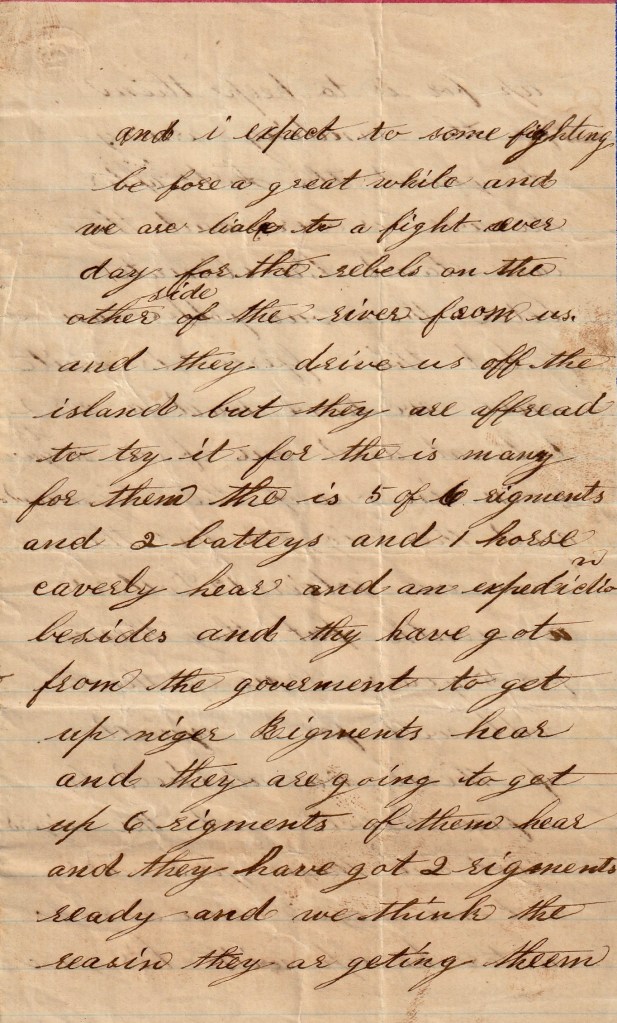
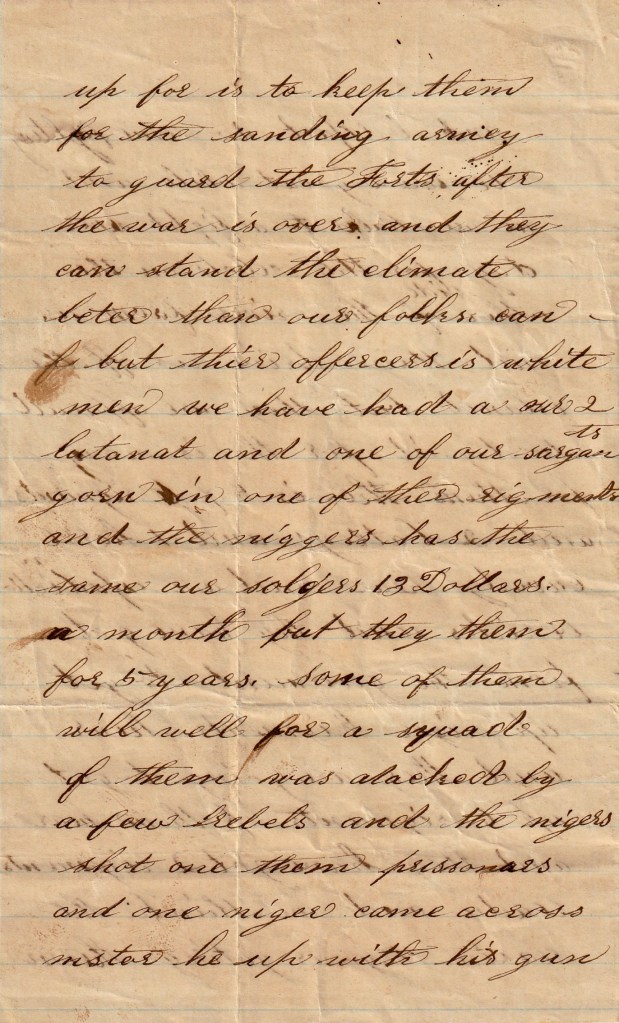

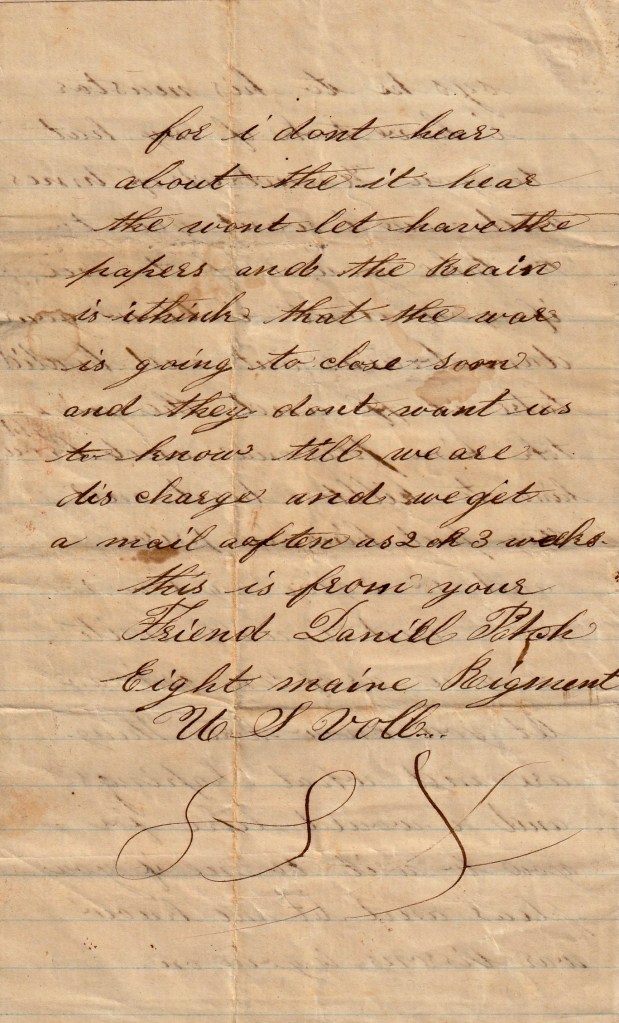
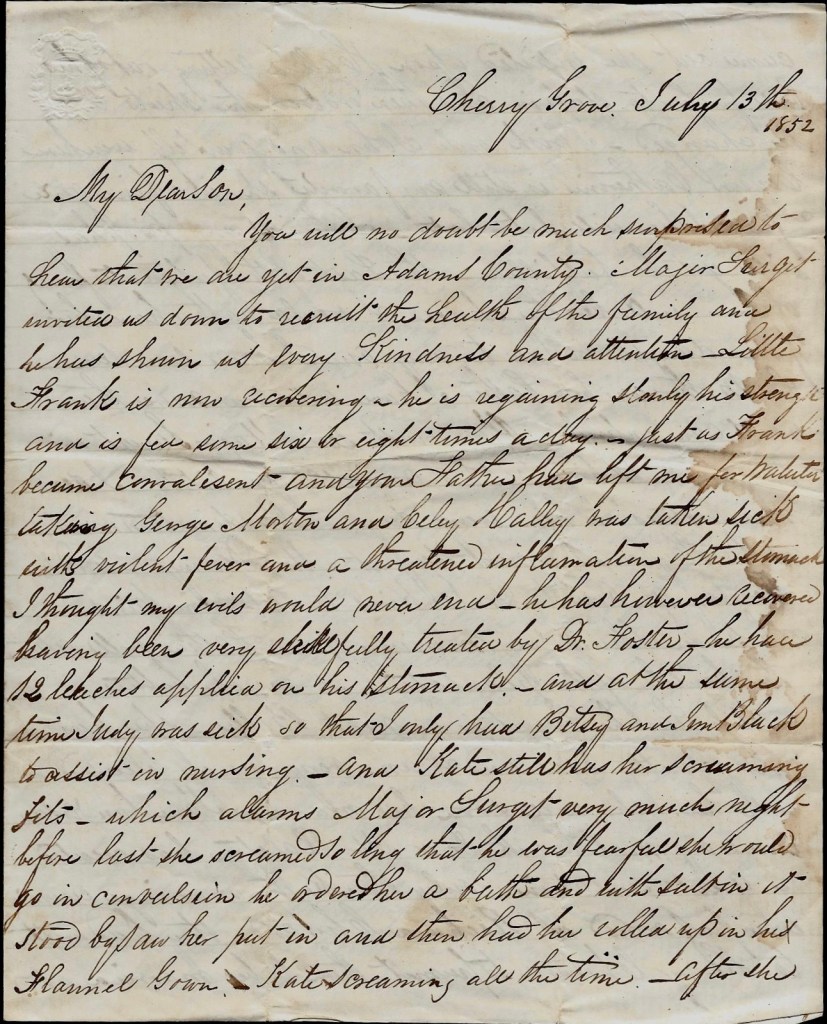
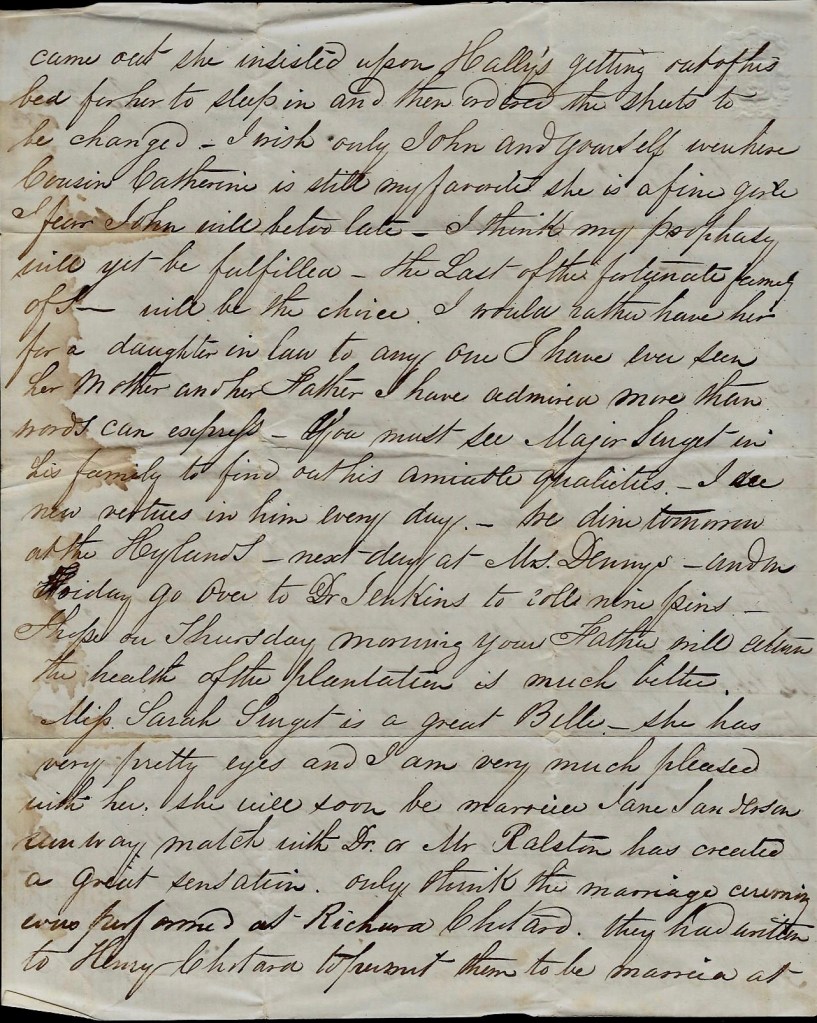

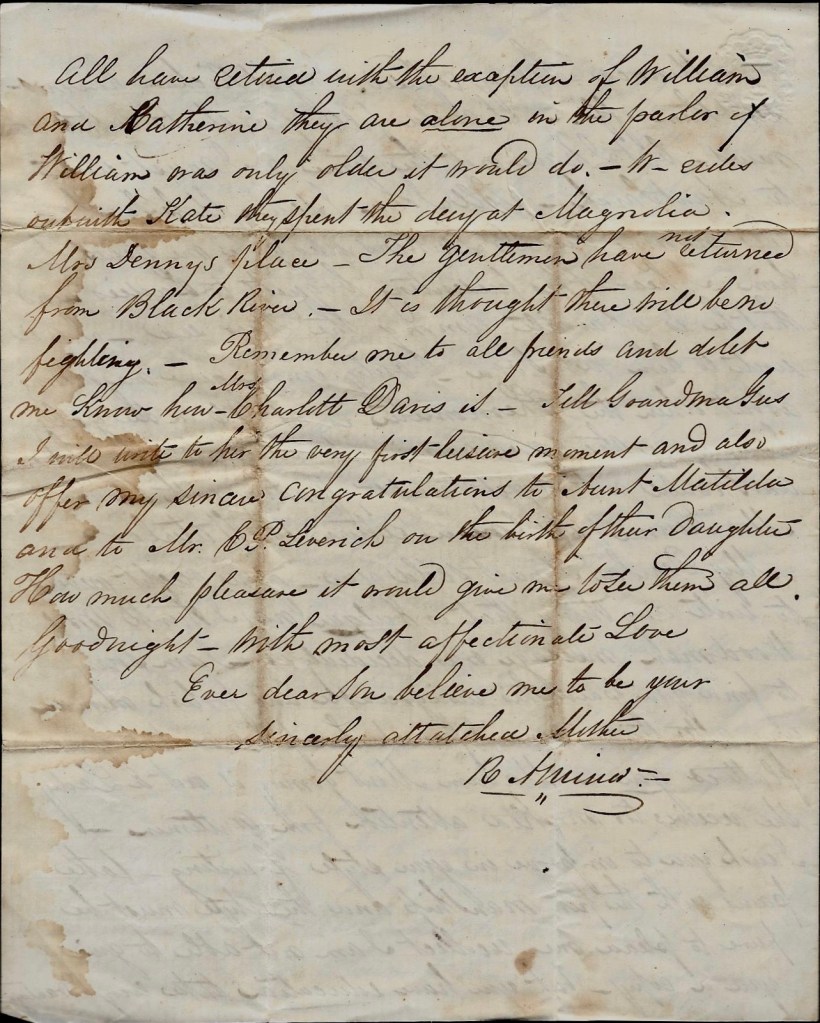
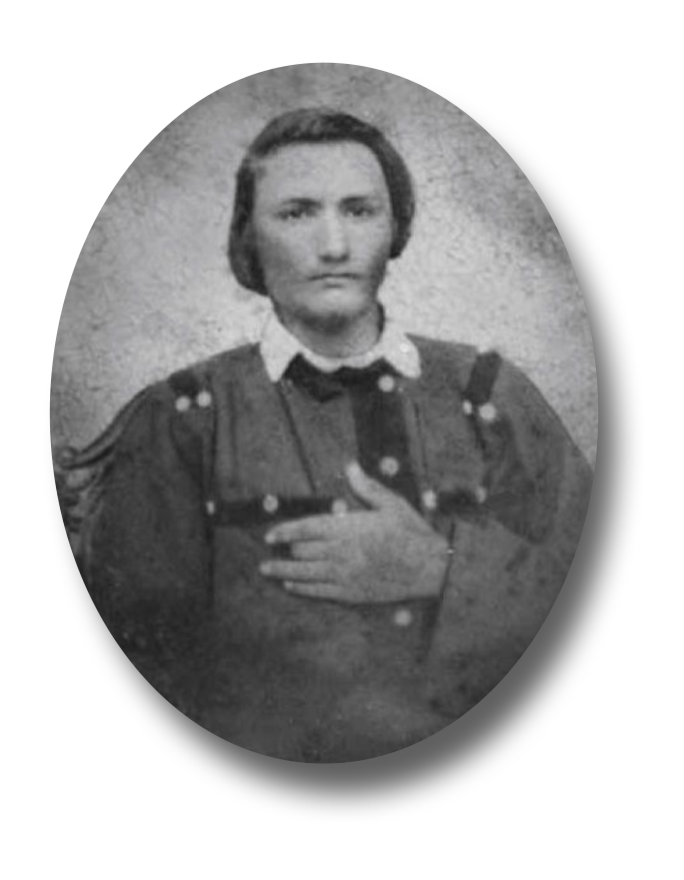

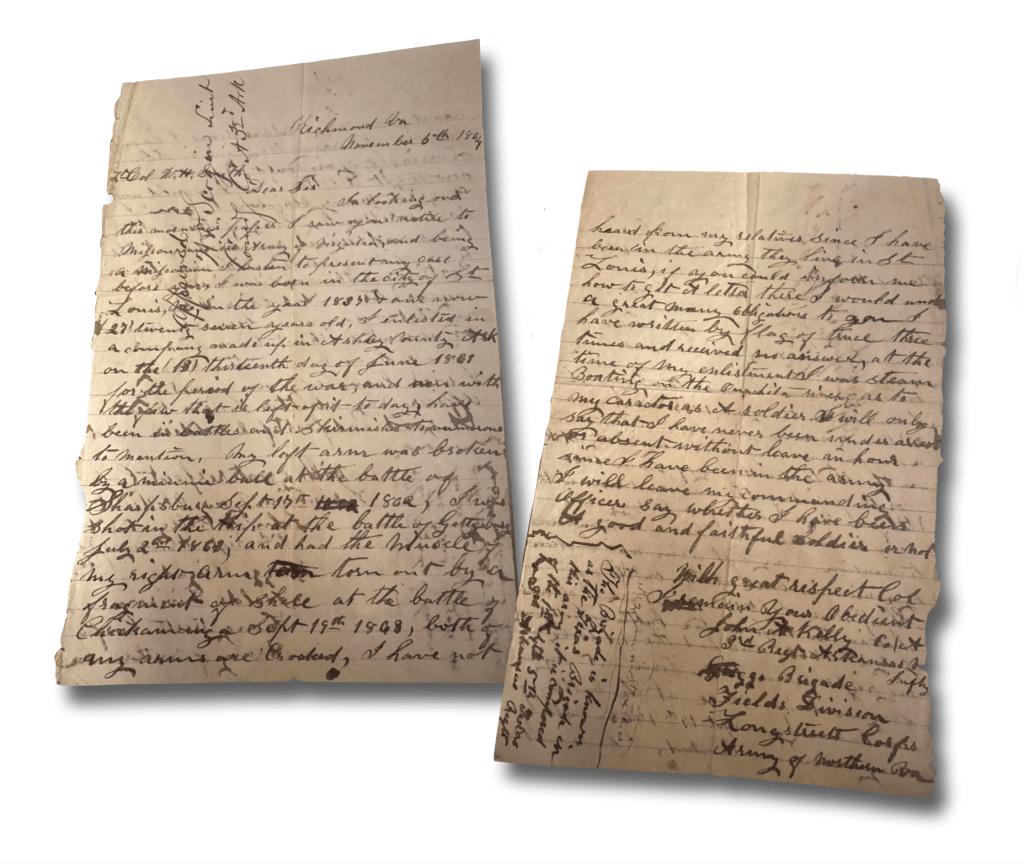


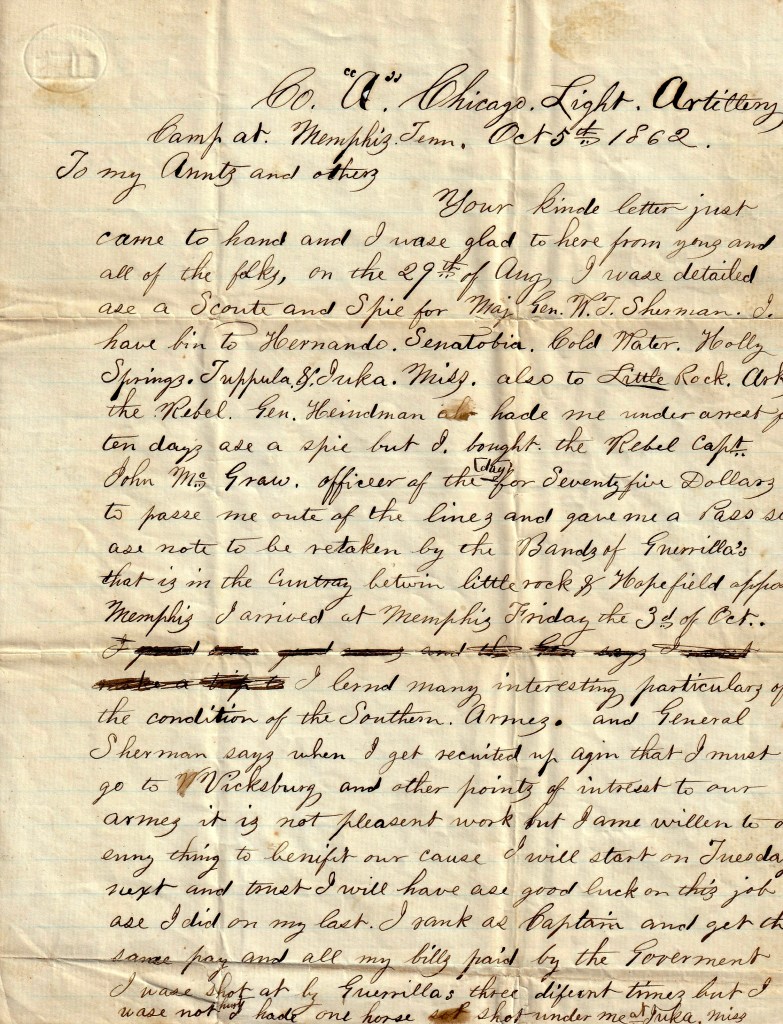


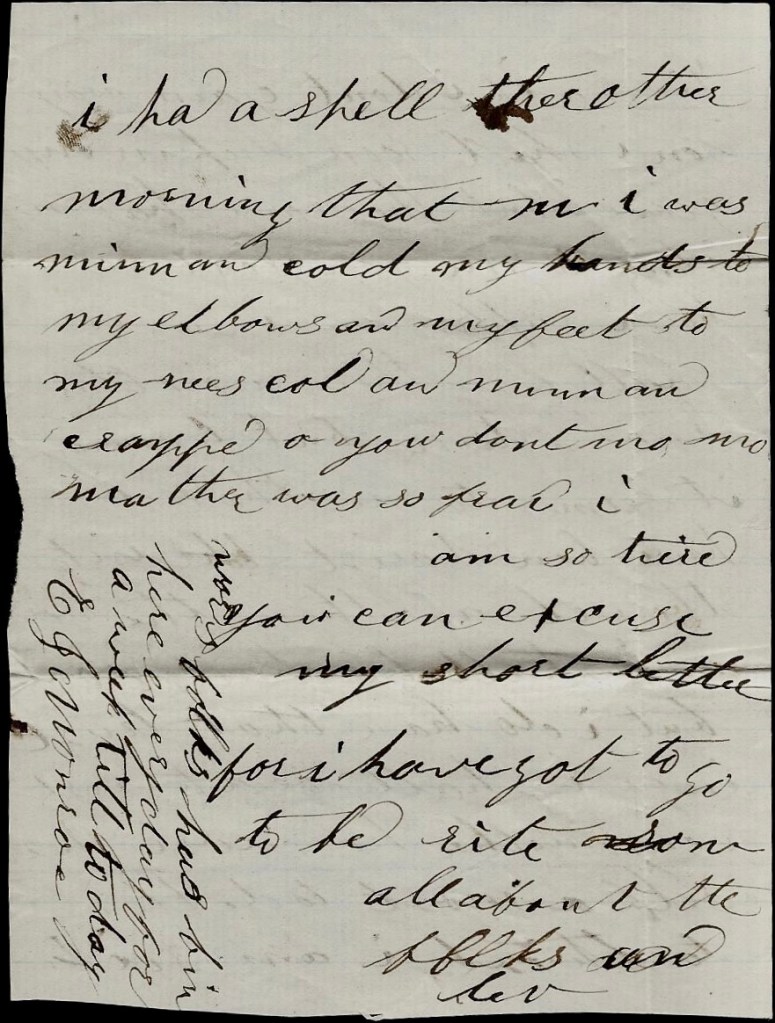
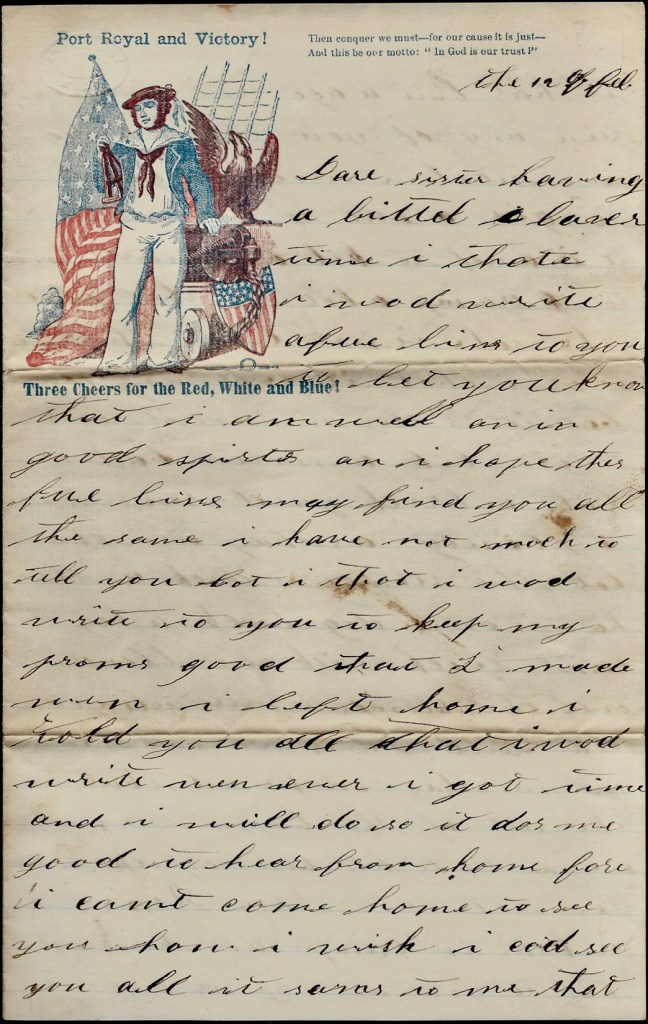


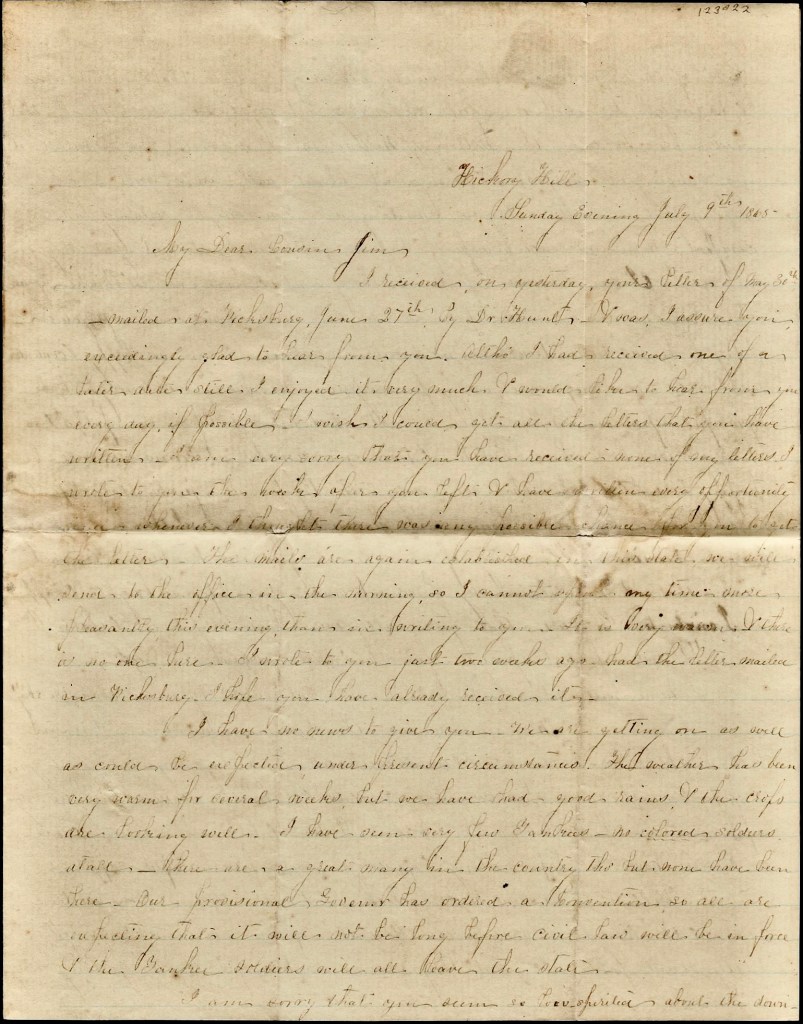
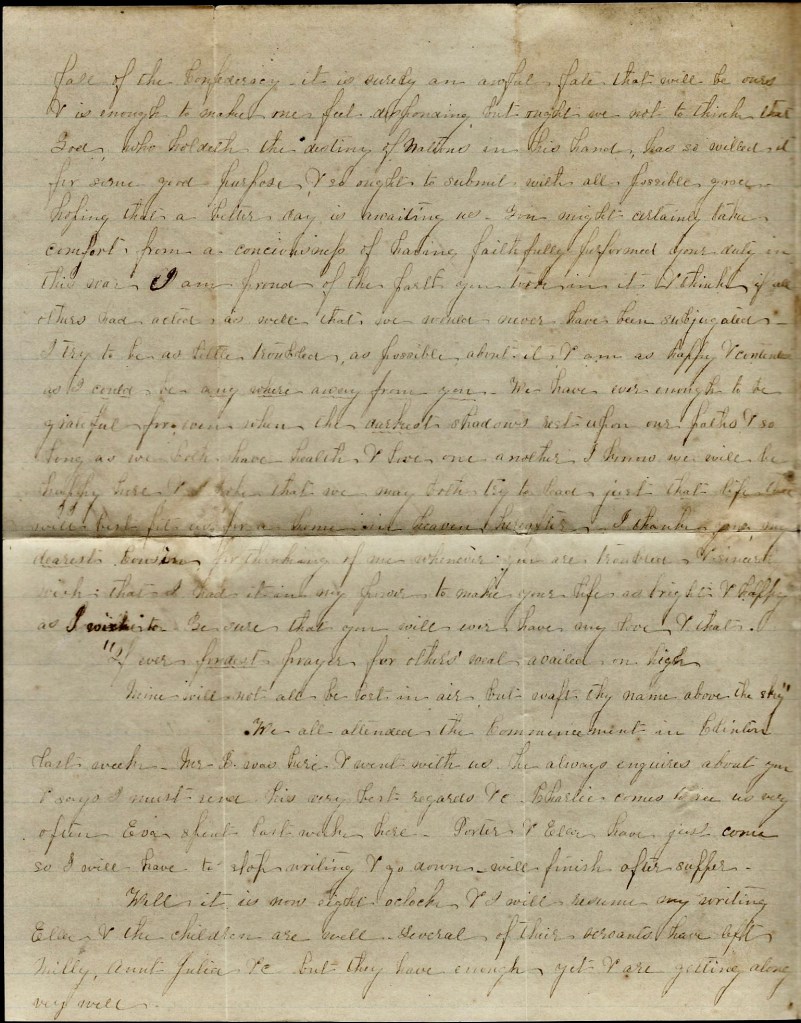
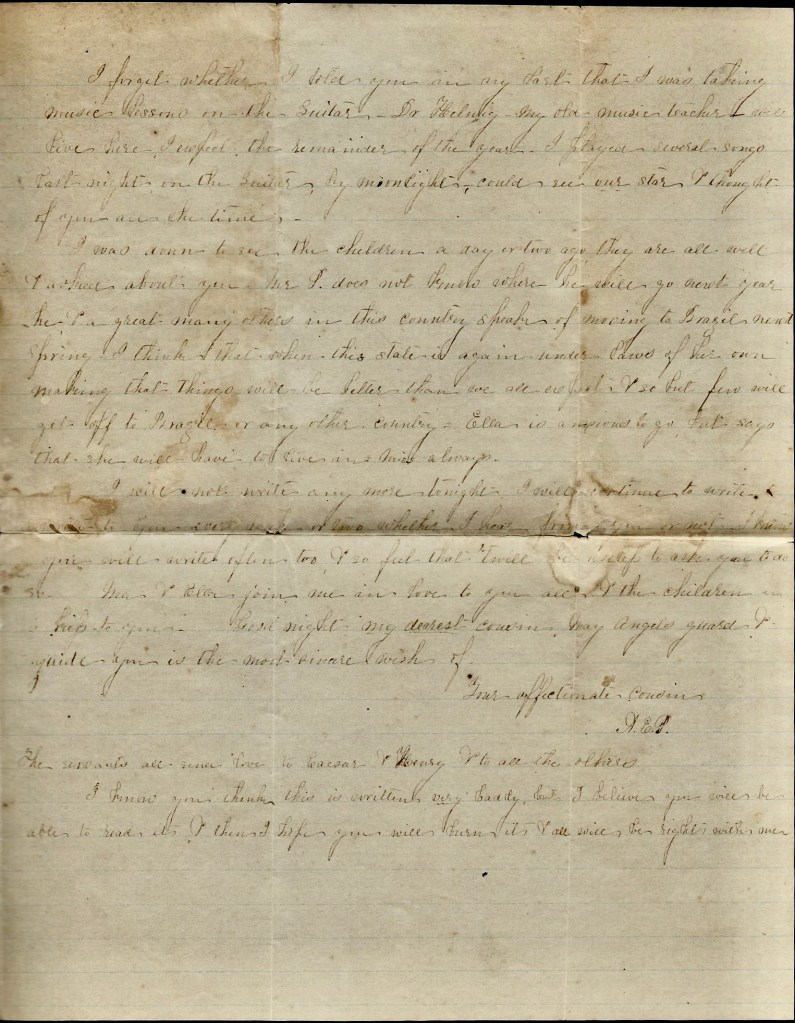

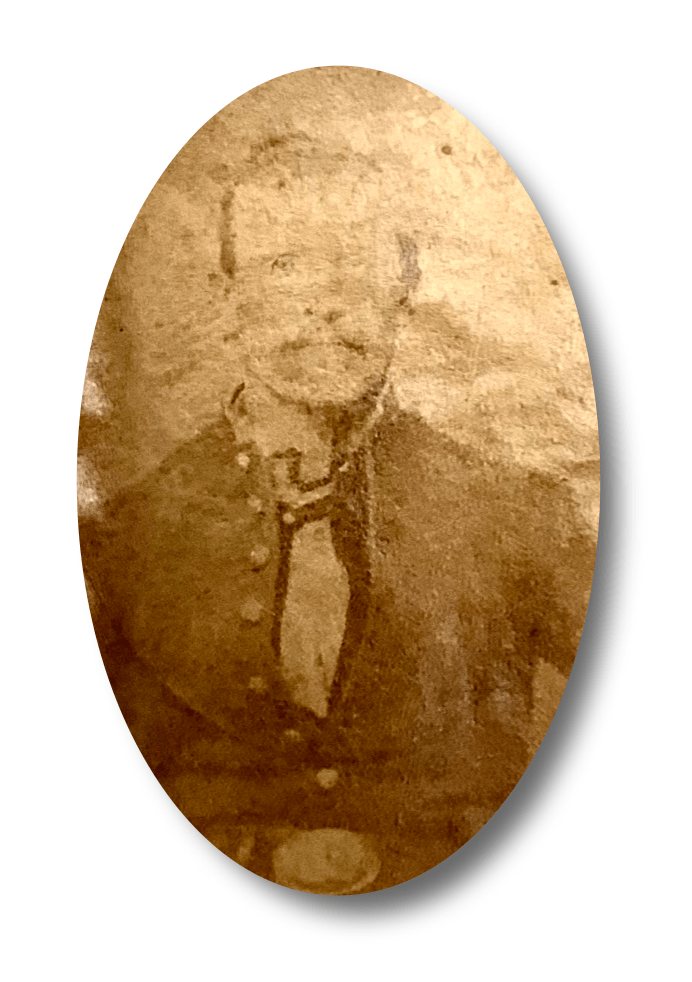
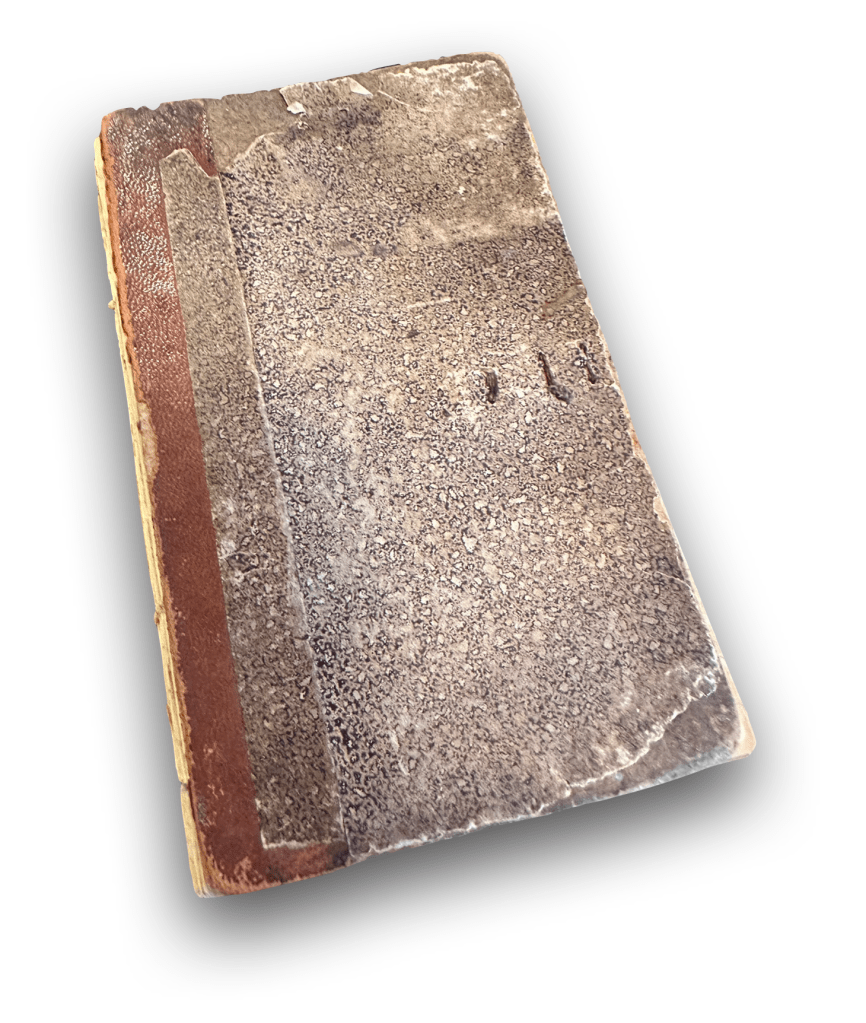

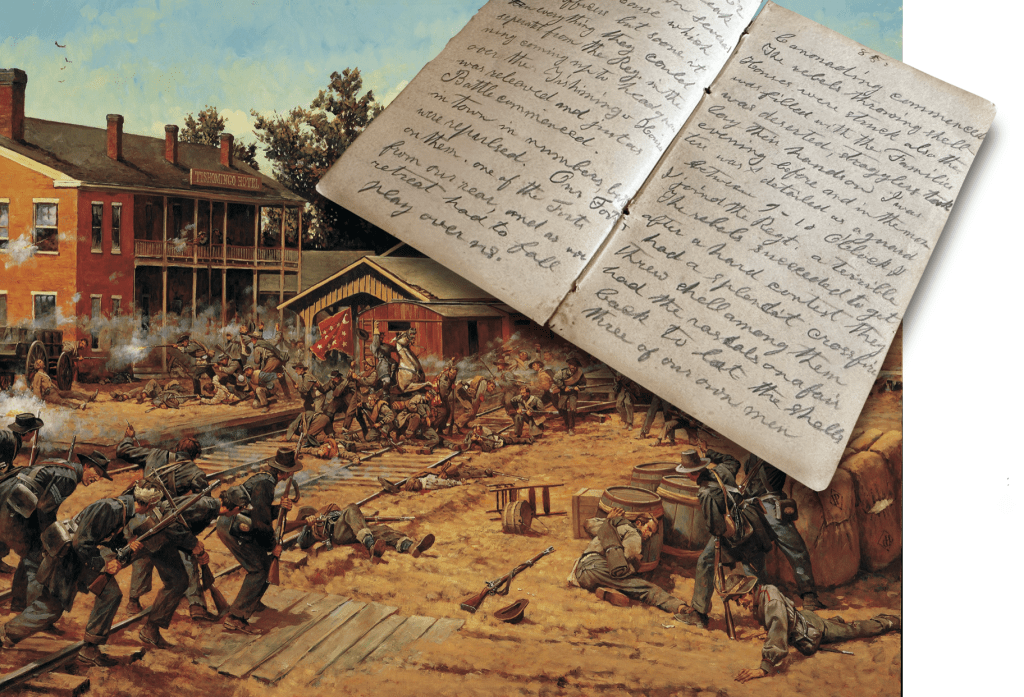
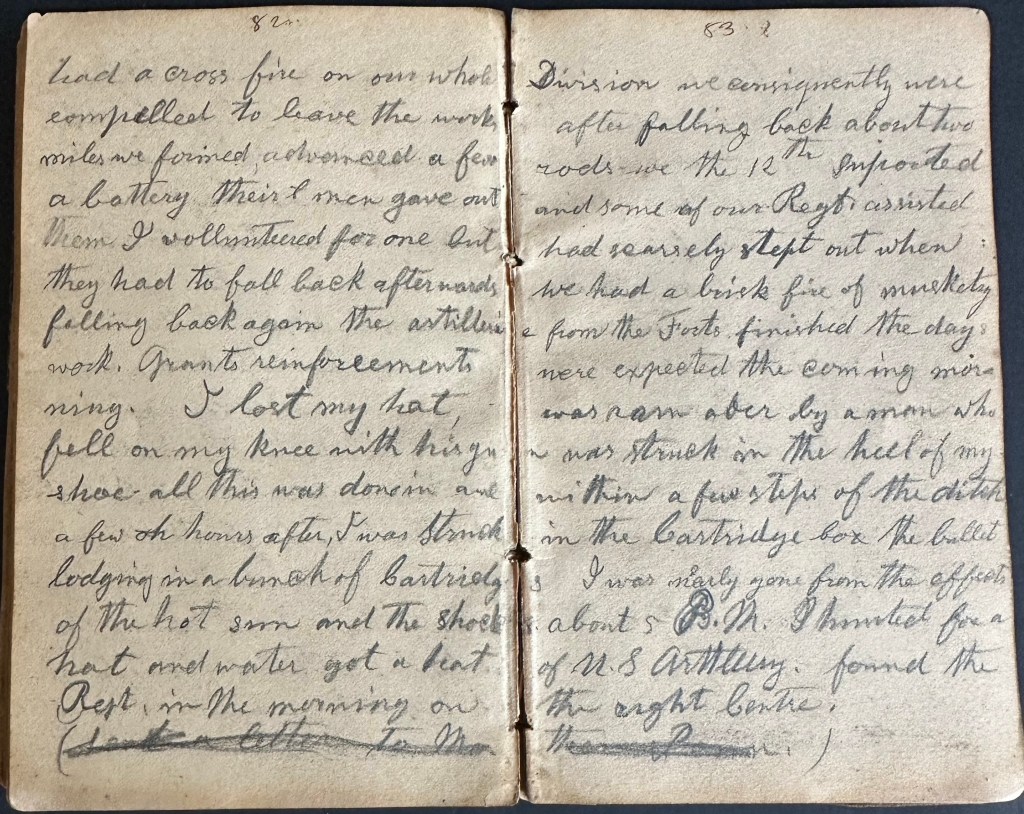
 Spared & Shared 23