This letter was written by Calvin Waldo Marsh (1825-1873), the son of Henry Marsh (1797-1852) and Sarah Whitney (1796-1883) of Berkshire county, Massachusetts. Calvin’s father, Henry, died of cholera at LaSalle, Illinois in 1852 when he was 55 years old. By that time, Calvin had already graduated from Williams College (1844) and was working as a commission merchant in St. Louis, Missouri. During the Civil War, Calvin received a commission as a Lieutenant and served consecutively on the staffs of Generals Halleck, Curtis, and Schofield in the Army of the Frontier. He was married in December 1860 to Anna W. King of Roxbury, Massachusetts. We learn from the letter that Waldo and Anna had a young child named Waldo at the time of the 1863 letter.
Despite being a letter to his mother, Waldo shares a lot of his impressions on the progress of the war and of the politics controlling the selection of generals and the campaigns they were tasked to conduct.
Transcription
Headquarters, Army of the Frontier Springfield, Mo. March 4th 1863
My very dear Mother,
I feel ashamed to think I have suffered nearly two months to elapse since I received your kind letter. My time is pretty fully occupied and it often happens that I do not get a chance to read the papers until after reasonable bed time. Another thing, ever since about the 10th of February I have been more than half sick at least two-thirds of the time and most of my bad feelings have partaken of the ague type and you know that is terribly paralyzing in its effects both upon the body and the mind. Of course this halt and delay of the army here is also very trying and there does not seem to be any object in the future towards which the Army of the Frontier is, or is to be, moving.
Anna’s letter of the 27th arrived about 7 o’clock last evening but owing to the obstinacy of our postmaster, I did not get it until about 10 o’clock this forenoon. I was really delighted with the photograph of you and think it one of the very best I can say [that was] taken in Saint Louis. You could hardly have sent me anything I could prize so much. I have been very much gratified both for his sake and yours that Charlie has been reported to be doing so well. I believe he will yet make a man of good mind. I regret that I cannot at present contribute to the defraying of the expense of his present position.
Have you laid any plans for the next year? If I am obliged to remain away from home I think I shall try to get Anna to go North or East and board during the hot weather and break up housekeeping. I have been inclined to think favorably of it—not so much as a matter of economy as an account of the danger to little Waldo. I think it would be very much better for him to leave the city during June, July, and August and perhaps September even if they went no farther away than Kirkwood or up in St. Charles county.
Senator Henry Wilson “is a bigoted radical abolitionist and proclaimed himself a fool in military affairs when he made his abusive tirade against West Point men.”
I presume the future of General [John McAllister] Schofield will be determined upon by the 10th of this month or immediately after the extra session of the Senate adjourns. I presume you can imagine how disappointed the General and his staff were yesterday when the news came by telegraph that the Senate Military Committee had failed to report his name among the selected list that the President had sent in for confirmation. Senator [Henry] Wilson of Massachusetts is the Chairman and the whole thing is political of General Blunt & Curtis through Jim Lane and others of his ilk. Wilson is a bigoted radical abolitionist and proclaimed himself a fool in military affairs when he made his abusive tirade against West Point men. Every single Rebel General of any note except Forrest and Morgan were educated at West Point but they have had an opportunity to carry on their campaigns on their own plans while every campaign we have had except one or two in the West have been managed solely by the politicians. Of one thing I feel sure, if the ultra politicians continue to rule over Lincoln and the War Department sixty days to 3 months longer, the South will certainly achieve her independence. The North has not gained one point of value for eight months & today occupies much less of the rebel soil than we did six months ago, and the rebels have probably added more men to their army than we have. If this Conscription Law is rigidly enforced and the politicians will let Lincoln and the War Department alone, I believe we shall succeed in the course of the year. I guess you will think I have croaked long enough, but although unpalatable what I have said are truths.
I have had several very pleasant horseback rides since we have been here and have been much surprised to see the quantity of birds which used to see in Massachusetts between April 1st and November 1st only. Robin red breast, meadow larks, blue birds, all kinds of sparrows, golden winged woodpecker & many others. The fields are full of them in large flocks.
Dear Mother, let me renew my expressions of love & reverence for you, and tell you that hardly a day passes that I do not look back to the many years of patient love and counsel which you gave to me. I hope time will still continue to deal gently with you and that for years I may still have your love, counsel, and prayers. With much love to all. I am your son, — Waldo
This letter was written by 24 year-old William Penn Cresson (1814-1892), the son of Caleb Cresson (1775-1821)—a prominent and wealthy Quaker merchant—and Sarah Emlen (1787-1870) of Philadelphia. William became engaged in the hardware commission business in the 1830’s and 1840’s. The company offered a variety of products with a strong focus on metal ware, household building materials and household furnishings. In the late 1840’s, the firm began selling cooking stoves, and became stove manufacturers, and likely, hollow ware manufacturers as well. During the late 1840’s and 1850’s, a number of stove patents were applied for in the firm’s name.
William wrote this letter to his wife, Susan Vaux (1813-1890). The couple were married in November 1835 at Philadelphia. The nature of William’s trip to the Alabama and Tennessee is not revealed in the letter but it was presumably connected with his hardware business. William’s letter reminds us of the dangers of traveling by steamboat on the western waters in the 1830s.
Painting by Paul Rainer
Transcription
Jackson, Madison county, Tennessee December 25, 1838
My own dear wife,
How I have wished this whole day during my lonesome ride that I was with you spending this Christmas instead of being here, an insulated being without a friend to chat over old times or cheer my fagged spirits. I have been trying but in vain to raise my spirits with the idea that more than half of my travels were over. I expect to be home about the 1st of February but there is 37 long days to pass before I can home to see you and the dear children. I should feel much better if I could hear from you but I cannot before I arrive at Florence, Alabama, which place I hope to visit about New Year’s Day and then, love, I shall devour your letters—a great feast for me. It almost makes me jump for joy to think that one short week will, with God’s blessing, find letters in my hands from my own sweet wife.
Love, write to Pittsburgh immediately on receipt of this and I think it will be in time for me. Do tell me how those dear children are. Can Sally step any? Dies she say Momma or Pappa? Does George improve much in tasing? Does he know his letters? Any letter? Does he begin to spell?
How happy should I have spent this day if I had only been home, but we will have our Christmas when I do come. Speaking of this day puts me in mind of Johnny Fassitt. Have you remembered him or did he send anything to George? Has Mrs. Fassitt been to see you? I have been thinking a good deal about Aunt Debby these last 3 days. Has she come home or have you heard from her? Has Charley written to you or me? Does Mary and Joseph say anything about coming home? Has Mrs. C. Smith got any better? I suppose Hetty Smith is married. Tell me something about it and all our friends.
I last wrote you from Randolph before I had gone down to Helena. The next day, Tuesday, I saw a steamboat coming down the river and got on board. It was the Asia, one of the 2nd class boats and by far the most splendid one that I have seen on the western waters, but still not nearly as handsome as some on our own waters except that they are 2 storied and that of course makes them look finer from the shore but the inside of our boats far surpasses these boats for elegance of furniture.
It was about 11 o’clock when we started from Randolph and we arrived at Memphis about 4 o’clock that afternoon and as they found some cotton freight we had to lay there 2.5 days days which made me sick enough, only a ride of 36 hours to take and to be detained on the road 4 days. Well there is no use of complaining. We arrived then on Friday and on Saturday I started back and arrived at Randolph again on Sunday evening. During the time, saw and heard of more destruction that had just happened to steamboats than in all of my life before. Two steamboats had just blown up—saw the fragments of one myself. Saw three boats that had either snagged or been torn to pieces by others. Saw three boats which were traveling with their bows patched to keep [out] the water but 1 pumping 10 minutes out of every 30 to keep her afloat. Heard of the boat which laid by our side at Memphis. She was going down the river and between Memphis and Helena run on a snag which almost disabled her so much that she could not proceed and to crown the whole, the Asia run aground 30 miles below Helena but with God’s blessing, no accident occurred to her.
I found my pony pretty well at R___ on Monday. Started and arrived at Brownsville about an hour after dark, the moon being almost obscured by clouds made me feel very disagreeable but I got in safe. This morning, to my sorrow, found that there was about two inches of snow on the ground and it made the traveling still worse than yesterday which was bad enough. It is snowing now very hard and probably by morning there will be a foot of snow and I shall have miserable traveling. I have 32 miles to go to McLemoresville but it must be made and I shall start by sun up, which I do almost every morning generally making my destination before 5 o’clock.
My health is perfectly good. Remember me to all our friends and I remain your own husband, — William
This letter was written by H. C. Hicks, most likely a Confederate prisoner held at the Elmira Prison Camp in Elmira, New York. He wrote the letter to Chauncey Thomas, Sr. (1813-1882), one of eleven children born to mill owner and entrepreneur Moses Thomas and his wife, Rebecca Monington of Damascus, Wayne county, Pennsylvania. He is probably best known as the owner of the four Barryville–Shohola Bridges over the Delaware River, and as the father of Rear Admiral and Commander in Chief of the Pacific Fleet, Chauncey Thomas Jr., USN.
Given the apparent casual nature of their relationship and since Chauncey lived in Shohola, Pennsylvania, I can only assume that he and Hicks became acquainted at the time of the Shohola train wreck that took place on 15 July 1864 when a train carrying 833 Confederate POWs and 128 Union guards bound for Elmira collided with a coal train coming from the opposite direction. 49 POWs and 17 guards were killed with many more seriously wounded. Most of the prisoners were from North Carolina so my hunch is the letter was written by H. C. Hicks of Co. D, 26th North Carolina Infantry but I have not been able to confirm that.
Elmira Prison, Elmira, New York
Transcription
Addressed to Mr. Chauncy Thomas, Shohola, Pike county, Pennsylvania
Prison Camp Elmira, New York November 17, 1864
Mr. Thomas, dear friend,
Yours of 14th is at hand [and] finds me well though overwhelmed in trouble on account of my dear father’s death. It seems that trouble after trouble has never ceased to fall upon my brow for the last four years but surely there is a better time not far distant when people will awake to a sense of duty and endeavor to stop this cruel war which has blood drenched our once bright and happy country.
I hope to return soon on parole or change and settle the estate of my father as there is no one but Ma and sister left to see to the farm, hands, stock, store and consequently I fear much will be destroyed ere I can return as I have no hope of going unless exchange or parole takes place which I hope will soon. Shall be under lasting obligations to you for the tobacco you spoke of sending besides duly rewarding you for all expenses [and[ troubles during my unfortunate situation. Let me know when you send it. The book has been read. I prize its contents highly. Shall keep it long as I live as a sacred memento. May God bless you.
I could not find an image of John but here is a CDV of Calvin M. Hathaway who served in Co. D, 4th MA Heavy Artillery (Andrew Garton Collection)
This letter was written by bootmaker John O. Gay (1836-1907) of Weymouth, Massachusetts, who enlisted on 9 August 1864 in Co. G, 4th Massachusetts Heavy Artillery. He served with the regiment until discharged on 17 June 1865.
In the late summer of 1864, fourteen companies of heavy artillery were raised throughout Massachusetts for the purpose of coastal defense of the state. They were to be “unattached,” thus not part of a regiment, and sent to various military locations for a one-year term. They were numbered 17 through 30, and were the Unattached Companies of Heavy Artillery. They encamped on Gallops Island in Boston Harbor, where they organized and were mustered in during latter part of August and into the first days of September 1864. In September, they were ordered to Washington, DC for garrison duty in the forts surrounding the capital.
John’s parents were Willard and Roda (Penniman) Gay. His wife was Susan A. Ware (1830-1891).
Though John’s headstone application clearly stated he served in the 4th Massachusetts Heavy Artillery, the US Government erroneously supplied a headstone with the 3rd Massachusetts Heavy Artillery on it.
Transcription
Addressed to Mrs. John O. Gay, S. Weymouth, Massachusetts
Fort Ethan Allen October [1864]
Dear wife & friends,
I received your letter with pleasure and if my letters give you as much joy as yours do me, I should want to serve my time out that way. You tell me to write often if I have leisure time. I can tell you my time is pretty well occupied—more so than any of the old soldiers that have been out before, so they say. We have some with us. In the morning when the drum beats and answer to our names and then we have breakfast at six and then we have to drill from seven until eight and they they mount guard at half past eight and then we have to go out and drill from nine until eleven o’clock a.m., dinner at twelve, and then we have to go out at two o’clock and drill until four, and then supper at five, and go out on dress parade at half past five which takes until dark and then roll call at half past eight in the eve and then go to bunk right off. You may not understand all this.
I got a pass from the Captain and went to the city today. I walked most all the way there and back. You may believe I am tired. I saw Uncle Abe just as he was going into the White House. He had about twenty cavalry horsemen doing escort duty with him. I did not get a good view of him because it was raining. I also went into it. It is a splendid building and them pictures that were hung up there you and Mrs. Shaw would admire them and the park in front—the best that I ever saw.
But Washington is a nasty city. I was disappointed. There is no order about the streets and they throw all the slops right in the streets and muddy too and they are not paved and not much business done there as I expected to see. I had my miniature taken while there. If you do not like it, you can put it out of sight and look at my old one. [Elisha] Faxon Shaw was with me. He had his taken in full but I thought you would be better pleased to have only my head and shoulders and not show more of my military suit. They say it is a good one but I am a little thin in flesh now. Well you know that the original is rather homely. You could not expect a good looking one.
Well Mrs. Shaw, I have got to go out at roll call now. Good night.
Thursday morning. I will send my picture and that will excuse me for not writing any more but I would write more if I had time. But if I did, you would not get it this week. Taking it for granted that you want to see such a pretty picture. God bless you all. My love to you all, — John O. Gay
I could not find an image of Frank but here is a private believed to be from New Jersey (Melissa Hacker Winn Collection)
These letters were written by Benjamin Franklin (“Frank”) Titsworth (1843-1918), the son of Isaac Dunham Titsworth (1805-1897) and Hannah Ann Sheppard (1813-1895) of New Market, New Jersey. According to an obituary in the Sabbath Recorder (1918):
Frank was born in Shiloh, New Jersey in September 1843 and came with his parents to Plainfield, N. J. when he was nine years old. Soon after they relocated again to New Market (now Dunellen), N. J., where he attended school at the New Market Academy, and where, after baptism by Rev. H. H. Baker, he united with the Seventh Day Baptist Church of Piscataway.
On August 1, 1862, at the age of nineteen, he enlisted as a private in Co. D, 11th Regiment, New Jersey Infantry, and was mustered out of service June 6, 1865. An incident which he was fond of relating in this connection was that, in the final review before President Lincoln in Washington, his division was the last in the procession, as was his regiment and his company, and he was in the last line and would have been the last man in forming single rank. He was promoted to detached service first in the brigade general’s office and afterwards in the adjutant general’s office, where his duties were largely clerical because of his clear and fine penmanship and systematic methods.
On his return to civil life he attended Alfred Academy for a time, and afterwards engaged in business with his father and brothers, first in Dunellen, N. J., and afterwards in Milton Junction, Wis. While living at Milton Junction he married Emeline A. Langworthy, of Little Genesee, N. Y., whom he first met while attending school at Alfred. This was on October 11, 1871, and she died November 19, 1873. While living at Milton Junction he was made a deacon of the Milton Seventh Day Baptist Church. In 1880, he moved to Farina, Ill., and engaged in the grocery and drug business, and at one time was cashier of the Farina Bank. On February 21, 1881, he married Genevra Zinn, of Farina, and to them were born three children, – Bertha, now of Durham, N. H., Adeline, now of Pittsburgh, Pa., and Lewis, now of Brawley, Cal. There are two grandchildren, Phillip and Genevra, living in California. In 1896, the family moved to southern California and later to the city of Riverside, where they were prominent in the Seventh Day Baptist church, where he retained his membership until the time of his death. In 1908, the family removed to Alfred, where he lived at the time of his death.
The first two letters that Frank wrote in this small collection were sent under the name of “Frank Marlow”—a false identity. They were sent to a correspondent who had answered an advertisement he had placed in the newspaper looking to open a correspondence with “a few young ladies of the North.” See ad below:
I am a true soldier of Uncle Sam, belong to the Army of the Potomac and having lots of spare time, nothing would suite me better than to correspond with a few young ladies of the loyal North. Object, mutual improvement and to pass away the dull hours of camp life. Address FRANK MARLOW, Hd. Qrs. 1st Brig., 2nd Div., 3d Corps, Washington, D.C.
Responding to the ad was a young woman named Amanda Wallace of Lawrenceville, Alleghany county, Pennsylvania, who also began her correspondence with Frank under a false name and address—“Amy Waterman” of Pittsburgh. Beginning with the third letter in this collection, both parties apparently had convinced themselves they wished to continue their correspondence and to do so under their real names. Whether they carried on their correspondence beyond the last of these letters is unknown but is doubtful. In any event, Frank’s letters provide some good information on the closing days of the war around Petersburg.
Letter 1
3rd Brigade Headquarters, 3rd Division, 2nd Corps December 14th 1864
Friend Amy,
I was really surprised and happily disappointed to have the pleasure of reading another one of your letters. I had made up my mind that you had not received mine in answer to your first one, or if you had, thought you wouldn’t wish to correspond with one no more punctual than I was and I couldn’t blame you. It would give me pleasure to be numbered among your correspondents. I promise to be more punctual in the future.
I intended to answer this as soon as received but the next day we went on an expedition and was cut off from all communication for three or four days. We returned last Monday after destroying several miles of the Weldon Railroad below Stoney Creek Station and nearly to Hicksford Station. If you have a map of Virginia, it might interest you after reading a detailed account of it in the papers, which will be better than I can give you.
We had very disagreeable weather. Nevertheless it was exciting and therefore enjoyed. We marched at a good rate going and some of the men straggled. On our way back we found some of those men murdered. They were completely stripped of their clothing and shot through the head and some were bruised terribly in retaliation of which General Warren—commanding 5th Corps and commanding the expedition—ordered all buildings not containing families to be destroyed. It is supposed the outrage was committed by guerrillas, inhabitants of the country we passed through. It was a splendid sight destroying the railroad and the boys seemed to enjoy it and went at it with a will. No force troubled us. It was reported that some force was awaiting our advance at Hicksford but we gave them the slip and got home safe with only one casualty in this brigade.
All is quiet at present but there is appearance of an important move. I wish it would come off soon so we could build winter quarters. You say you thought my address might change and so it has. It is now Headquarters 3rd Brigade, 3rd Division, 2nd Army Corps. I have nothing of interest to relate. We are enjoying ourselves and looking forward to the time of our deliverance from the clutches of Uncle Sam—eight months from the 18th of this month. How will it seem to be citizens once more and free. But I must close and do some work.
Believe me your true friend, — Frank Marlow
Letter 2
Addressed to Miss Amy Waterman, 885 Penn Street, Pittsburg, Pa.
Headquarters 3rd Brigade, 3rd Division, 2nd Corps February 7th, 1865
Friend Amy,
I received yours of the 27th last in due time. I am glad you reminded me of my tardiness. I now propose a withdrawal of correspondence. Do not be astonished. I make this proposal for one reason—that I do not want to favor this manner of corresponding. I have found nothing in your letters which tempts me to do this. No—I am sorry to lose such a correspondent. I admire your sentiments both religiously and political. Your letters have been a source of pleasure to me as well as instructive. If you wish to continue the correspondence, I propose that we do it with our true names.
It has been a cold, dreary, stormy day and a lonesome one to me. Last Sunday morning, two divisions of the 2nd Corps, parts of the 5th and 6th, marched to the left. Sunday afternoon heavy musketry firing could be heard and it was reported afterward that the enemy charged on our Brigade and were repulsed with heavy loss which has proved true. Yesterday and today the 5th Corps, on the left of ours, has had some severe fighting. I haven’t heard yet how it turned out except heavy loss on both sides. Some great movement is afoot, I think. This force of ours has gone out to hold a strong force of the enemy while our cavalry operates on some point or they have gone there maybe to capture the South Side Railroad or establish a new line so the enemy will have to rally theirs. We have received some reinforcements lately. Grant will not be idle long at a time.
You are surprised that I have not been absent from the army since my first winter, 1862/1863. The next winter I gave away to a friend as he had urgent business which called him home. And when he came back, the reenlisting order was received which deprived all of furloughs but those who reenlisted, and as I hadn’t been out long enough to reenlist, I lost my furlough that winter. And my time is so near now, I don’t wish to go home. As you say, “The long absence will make my return more joyous.” I was born and always lived in New Jersey—and still live there. I have a very pleasant home, as good parents as anyone could desire and patriotic too for they have sent four sons into armed service and two sons-in-law. Maybe you think it strange I am not with the troops. Well I’m left in charge of the camp. It is the first time I have been left so far in the rear for some time.
But I must draw this to a close. Hoping to hear from you and your mind on this subject, I remain as ever your friend, — Frank Marlow
P. S. Please excuse my writing. I am doing it in a hurry. — F.
Letter 3
Addressed to Miss Amy Waterman, 885 Penn Street, Pittsburg, Pa.
Camp 11th New Jersey Volunteers March 1st 1865
Friend Amy,
Yours of the 13th was duly received. Believing that our further correspondence will be not only a pleasure to me but instructive, I cheerfully extend my hand in favor of its continuance. I think there will be no harm in divulging my real name so here goes—B. Frank Titsworth. You may have heard that name before if you had lived in Jersey City.
Since the last of January I have changed my position from clerk at Brigade Headquarters to Quartermaster Sergeant of my Regiment. Quite a jump you might say from a private to a sergeant. The Colonel couldn’t get me back for less promotion. As I had been in the Adjutant General’s Department so long, I had fully become acquainted with the business and the Adjutant General was bothered to let me go. I’m very well satisfied with my new position as it gives me more time to myself. I can improve my mind by reading too. My time is very well occupied at present, making out the Quartermasters Monthly Returns, etc.
We have been having some very wet and stormy weather for the last few days. Doesn’t appear much like clearing off yet. Winter is gone—my last winter as a soldier but I can hardly realize it. In fact, the remainder of my time in Uncle Sam’s service appears longer than what I have passed through. If I devote my mind to other things, the time will seem to pass away quicker and likely be more healthful to my mind for as a person is apt to become partly deranged by setting his thoughts on one object like that and fretting on account of its nonappearance.
But this is not of any interest to you. I have no news of interest to relate. It has been so long since I saw a daily paper that I am hardly acquainted of the situation. I don’t see what is the matter that the newsboy doesn’t make his appearance now that we have just been paid off four months pay. It appears that Sherman still marches on triumphantly.
Last night just after dark, the Rebs in our front commenced to cheer and yell. We could hear them very distinctly. We couldn’t imagine what was up. Some thought Sherman had likely been defeated. But last night two deserters came into our brigade picket line and they stated the cause to be that a ration of whiskey was issued the men and also that their brigade commander told them to cheer and holler for an attack was expected from us. The cheering appears only in our front. There was noise enough for a pretty large force.
The situation of affairs looks very bright I think at present. And if divine providence continues his smile upon us, we shall soon crush this rebellion and live once more a united North and South under the best government on the earth. Deserters are coming in to our lines continually and tell stories of woe and suffering. It is my prayer that this war may be done with as little bloodshed as possible. Hoping to hear from you soon. I will subscribe myself, your friend, — B. F. Titsworth, Quartermaster Sergeant 11th New Jersey Volunteers
Direct to B. F. Titsworth, Quartermaster Sergeant , 11th New Jersey Volunteers, 2nd Army Corps
Letter 4
Addressed to Miss Amanda Wallace, Lawrenceville, Alleghany county, Pennsylvania
Wagon Park in the field Quartermaster Department 11th New Jersey Volunteers
April 1st 1865
Friend Amanda,
It gives me pleasure to address you thus, not only because we believe each other to be corresponding under pure motives, which I hope I’ll never give you cause to doubt the same of me, but I believe I have found a true soldier’s friend—a patriotic Lady. I received yours of the 11th and would have answered it ere this had not a move of the army prevented it.
We are still on the move. Broke camp last Wednesday morning and the troops marched to the left where they have been since advancing gradually. The 5th Corps and Sherman’s cavalry force are on the left of us. There has been fighting every day. The wagon train lies near Humphrey’s Station—the farthest station on General Grant’s railroad. My new position requires me to accompany the train. The wounded are brought to this station after having their wounds dressed at the field hospital, put aboard the cars and sent to the General Hospital at City Point. I have been over to the station frequently when wounded came in and I saw some very severe cases.
All is reported progressing finely for our side. General Grant is here supervising the move. It was reported two days ago that General Sheridan had cut the South Side Railroad and destroyed ten miles of it, then moved off in the direction of Burkesville—the junction of the Danville and Lynchburg Roads. That report was contradicted this morning. I won’t vouch for the truth of either. I’m not afraid but Grant will carry things through alright. I have unbounded confidence in that General.
Sherman no doubt is resting his army now at or near Goldsboro [and] well he might. Twenty thousand of his men were unshod when they reached that place. After they are reclothed and recruited, I expect we will hear more good news from “Sherman and his Veterans.” We can afford to let them rest a while. We have had two days of very heavy rain which left the roads almost impassible. Yesterday some supplies were sent to the front and almost every team mired. They returned this morning. Today is a regular March day—very windy and it’s throwing the rain on my paper. You must excuse me if my paper doesn’t look as neat as it might. We haven’t any log houses now. However, we get along first rate with tents as it is not very cold weather. I guess I have built my last log house and I hope the army has as a general thing. But I must give way for the cook to set the dinner table.
Hoping to hear from you soon, I remain as ever, your true friend, — B. Frank Titsworth, Quartermaster Sergeant, 11th New Jersey Volunteers
Letter 5
Addressed to Miss Amanda Wallace, Lawrenceville, Alleghany county, Pennsylvania
Camp 11th Regiment, New Jersey Volunteers Near Burkeville, VA April 24th 1865
Friend Amanda,
Your last kind missive bears date April 10th. It was received with many others on the 15th after having no mail for nearly two weeks. I tell you, it was appreciated. During the absence of all this mail, news from home, our spirits were not allowed to become morose and demoralized. How could we when we were pursuing a fleeing enemy so successfully and every new engagement and day brought to light that Lee couldn’t hold out much longer without surrendering or being annihilated. The long wished for surrender came at last. On Sunday, April 9th 1865, General Lee surrendered the Army of Northern Virginia to General Grant—the object fought for by the Army of the Potomac for the last four years. It is my opinion that if any other man but Grant had been put in command of this army, it would not be here as it is this day, enjoying easy camp life, no fear of the presence of an enemy, and hardly duty enough to keep the men from becoming lazy. Grant can’t see defeat.
While we have been made to rejoice over these victories, God has seen fit to stricken us as a Nation with a great affliction—yes, it seems to me, one of the greatest afflictions He could throw at us. It was evidently the will of God that President Lincoln should depart this world and we are invited to “trust in Him for He doeth all things well.” “Cast your burden upon the Lord and He will sustain thee.” I speak of the many sad hearts that will remain after this cruel war is over—yes, and even now are suffering from the loss of bosom friends by the hand of traitors. Many a sad heart will exist to tell the tales and horrors of this war. God has been very merciful to my Father’s family thus far. Of six sons and sons-in-law in the Army and Navy, all still live to share in Heaven’s blessings. You ask me if I am not glad that my position is such that I am not exposed to the fire of the enemy. Of course I shall answer in the affirmative, but don’t let this allow you to think that if my duty called me on the battlefield, I would act the part of a coward. Never.
I believe I can justly say I have always performed my duty. I have been in but one battle with my musket. You may want to know why I say with my musket. Well, I have been in battle while I was performing the office of clerk. But I won’t flatter myself in past doings.
I have now not quite four months to stay in the service. The time passes away quickly, as rumors are afloat all the while that we are going home in a very short time. I will credit that as soon as I hear of the surrender of General Johnston. You write as though you thought I had become weary of your letters. Far from it, much the other way. I love to receive and peruse them. Do you read anything in my letters that make you think so?
But I must close. Ever your friend, — Frank
11th Regiment, New Jersey Volunteers
Letter 6
Addressed to Miss Amanda Wallace, Lawrenceville, Alleghany County, Pennsylvania
Camp 11th Regiment, New Jersey Volunteers Near Washington, DC May 19th 1865
Friend Amanda,
Yours of April 30th was received the day we reached Manchester. I hoped to answer it before but pressure of business would not permit. Leaving Burkeville at the time we did put me behind in my monthly papers. But since we reached this camp, I have worked pretty busy and finished them this forenoon. We have commenced to make out our “muster out rolls” and “discharge papers” and shall be very busy until we start for home which time, I think, will not be two weeks from date. The boys are highly pleased at the prospect of getting home so soon. Nothing would suit me better. I have made up my mind to be a citizen by the sixth of next month (June). That is giving us sufficient time to make out any papers.
On our march from Burkeville to our present camp, we passed through Manchester, Richmond, Fredericksburg and Falmouth. I broke off from the column after we marched into the City of Richmond and took my own route accompanied by a friend. We visited the places of interest—the Capital, Jeff’s mansion, &c, &c. It has been a very nice city, but most of the principal streets was destroyed which damages the looks of the best part of it somewhat. It is not as large as I thought. There is some very splendid country around it.
We passed through some very nice country during our march. Fredericksburg and Falmouth looked natural as well as the country around them. We didn’t exactly pass the ground of our (3rd Corps’) old camp but saw some houses which were near there. The nearer we got to Washington each day the more it felt like home.
We are now lying on Arlington Heights near Four Mile Run. On a hill near our camp, Washington can be seen in the distance. It is about six miles. Next Tuesday and Wednesday the army is to be reviewed. I believe it is to pass through Washington. I suppose a number of visitors from the North will be present to witness it. I believe I should rather be a witness than a participant.
Since the receipt of your letter many glorious news have been received—that of the capture of Jeff Davis, &c. I haven’t had a chance to see a paper lately so I don’t know much of what is transpiring in relation to the assassins. I hope the Government is successful in ferreting them out and give them their just desserts. It seems they have been very successful thus far.
You say that “you have never told me directly but once that you did not wish my correspondence.” I don’t recollect the time. I guess I didn’t mean it. You spoke about writing this letter on the Sabbath. I suppose you want my opinion on the subject. When I was at home, I wouldn’t write a letter on the Sabbath unless to a soldier engaged in active service. I don’t know as there is any sin in writing on the Sabbath. However, I very seldom do it.
We are having very pleasant weather. I think I will be in the service by the time you write me next. If you do not write by the 6th of next month, direct to New Market, New Jersey.
Ever believe me your friend, — Frank
Excuse my hurry.
Letter 7
Addressed to Miss Amanda Wallace, Lawrenceville, Alleghany County, Pennsylvania
New Market, New Jersey June 20th 1865
Friend Amanda,
It has now been nearly one month since the receipt of your last and welcome letter. I hope and think you will pardon me for this long neglect if I tell you the circumstances. When I received your letter, we were busy finishing the muster out rolls and proper papers for our discharge. As soon as they were completed, we reported to Trenton, NJ, and while lying there, all was excitement and hurry so I couldn’t get my mind near enough pacified to write one letter. I meant to write you there. We received our discharges and pay last Friday so you see we haven’t been home long.
“Home at last,” I can hardly realize that I am home for anything except on furlough, unless [it is] the fact that I have donned the citizen’s garb. I found everything looking natural, more so than I expected to. So much the better. We are having nice times now. We are waiting now for three more boys to return; one at school and two in the navy. Then our family will be made up—all home together for the first time in four years.
We are having splendid weather—very sultry and greatly in want of rain. It has made several attempts to rain for two weeks but never made out anything. The ground is getting very dry.
They are preparing to celebrate the 4th of July in this place. Several have met at our house a few times to practice singing. I believe they are going to have a speaker, &c., and I don’t know what all. Can’t expect much from a small village like this. I think this fourth will be more generally observed than it has for many years past. Since the war, there appears to be a more patriotic feeling—a greater love for our country. I believe this war has instilled into the heart of our people a greater knowledge of the worth of our country.
New Jersey is a copperhead state. We have a copperhead governor. When we (the 11th Regt. N. J. Vols.) arrived at Newton, we marched to the State House and Governor Parker came out to make a speech. The New Jersey soldiers all hate Parker and when he commenced his speech (if it can be called such) the boys instead of cheering, groaned at him and called for Marcus L. Ward (Mayor of Newark, NJ and a great friend of the soldier). They kept it up during his remarks. It was an ungentlemanly way of acting but they were soldiers from the front and would rather have a dinner than all their speeches, though we didn’t get any dinner until two or three days afterwards and then [only] through the unceasing efforts of the ladies. I don’t know what we would have done in many instances if the ladies hadn’t taken an interest in us.
In your letter you say you would like to have been at the [Grand] Review at Washington. It was a grand sight. My Regiment was the last one to pass in review the first day.
Well, my soldier life has passed and I must habituate myself to a citizen’s life again—almost the same as a start in a new life. But I must close. Hope to hear from you soon again. I remain as ever, your friend, — Frank
I could not find an image of Ellen but here is an Ambrotype of a woman with a sweet disposition of about the same age.(Megan Kemble Collection)
These letters were written by 32 year-old Ellen Davis (1830-1902), the daughter of Pratt Smith (1788-1874) and Eleanor Wheeler (1788-1859), and the wife of John Henry Davis (1820-1883) of Deerfield, Oneida county, New York. Ellen’s mother, Eleanor Wheeler, had been married to Wheaton John Dutcher (1781-1813) before she took Pratt Smith as her second husband.
Ellen wrote all of the letters to Frederick (Fred”) A. Dutcher (1834-1863), a distant family relative with whom she apparently carried on a correspondence throughout the war though only these letters from 1863 remain which were kept by Fred when he fell ill with chronic diarrhea and eventually died of the disease. Fred enlisted as a corporal on14 August 1862 in Co. G, 27th Iowa Infantry. From the letters we learn that Fred had become hospitalized by mid summer 1863 and grew progressively worse in the ensuing months. He was officially transferred to the Veteran Reserve Corps in mid September 1863 but discharged for disability on 21 November 1863, returned home, and died a couple weeks later on 7 December 1863.
Ellen’s letters remind us of the countless hours loved ones devoted to writing soldiers during the Civil War in an attempt to lift their hopes and spirits when they faced hardship and disease.
Letter 1
Deerfield [Oneida county, New York] February 3, 1863
Dear friend Fred,
Your letter was gladly received yesterday, and I was glad to hear that you are as well as you are, for it found us sick. John is very sick. Pratt and Aunt Abby have had an attack of the typhoid fever that run about two weeks. John has some inflammation of the lungs with it. As the consequence of sickness in the family, I am very tired if not sick. Still I must write a few lines to you while I know where you are. Surely you have had a long and tedious journey since I heard from you. Little have I thought what you were going through, though I heard that you had gone to Min. but felt a little sad that you did not stop a line to let me know how it was with you. I had almost given up ever hearing from you again.
I wish you would write often even if you are moving about so that I cannot answer. You know where I am and am anxious to hear from you, and feel more so now that you are in the heart of Rebeldom. Fred, take care of yourself as well as you can. May God shield you from the hurtful bullet and the temptation that must surround you. I have been reading of the intemperance of the officers of the Army of the Tennessee. What example is that for the soldier? And I know their temptations are great, being so much exposed to hunger and suffering of every kind. But there is one that is able to keep you from all harm and bring you home in spotless manhood.
We have felt very little of the war here yet and money is plenty. Some things are getting very dear, but we have felt no inconvenience as yet.
I did not have time to finish this last evening and now our family all retired and the sick one asleep, I wish to talk a little with you and say how much I wish you was here today. And if you ever get in a situation where you can get a discharge, don’t refuse it. I think you have suffered your share. Is there anything that can atone for the suffering of your noble ones for the last two years? How many brave, educated, talented in every sense noble men have been sacrificed on the altar of this rebellion? Is it possible that God reigns and permits all this? Yes, I believe He will overrule this and bring great good out of all this evil. In your hardship, trust in Him whose eye is never off of your hope that you may be kept from all danger and permitted to come and see us where a hearty welcome awaits you and the best the house affords.
Don’t forget we are always anxious to hear from you and the more you write the better. All the particulars of a soldier’s life and hardship meets with sympathy here. Hoping to hear from you soon, I must close this. From your most sincere friend, — Ellen Davis
There is many local matters and things I would like to tell you but must leave all such things till I see you. Please excuse these blots. You would if you knew how many times I have to drop my pen.
Letter 2
Deerfield [Oneida county, New York] July 6, 1863
Dear friend Fred,
I sit down once more to speak a little with you. Your letter was gladly received very near the same time. I imagine you thought I was insane to write twice before your answer had time to come. I thought it was longer than it really was and I saw an account of fighting at Jackson. As the paper did not say, I supposed it was Jackson, Tennessee, but I see afterward it was Jackson, Mississippi, and I hope all is quiet about your camp. But how do you stand it this hot weather? It seems to me I never knew it so warm here before and how must it be there? We are afraid our dear Northern boys will all perish with the heat.
I saw a mother yesterday who had two sons in the Potomac Army. One has had it hard ever since he was there. She said he was in battle then and she almost wished they would desert and come home, and I could not blame her, such works as they have there. But we are looking for good news now and hope this rebellion will have its death blow before you get this. But Dr. Eaton and Abby have been here and he thinks it will never be. But my faith is stronger than that and I will hope and pray on that. God will take it in His own hands knowing that nothing is impossible with Him. Our God leave us not to perish in thine anger, neither chasten us in thy bad displeasure for who have we in heaven but thee and what is there on earth we desire beside thee. If every soldier would send up this fervent petition, it seems to me they never could be defeated for I believe God hears and answers prayer, and His eye is ever on us, and he has a healing balm for every wound, a cordial for every fear. How sweet it is to trust in Him and know that He cares for us.
Are you in the hospital yet? If so, you have the privilege of doing for the sick and perhaps wounded. I have often wished I was where I could do something for the suffering soldiers though I could not so much today. Dr. Eaton and Abby came down two weeks ago. He stayed one week and went home. She has gone to Trenton now. We had a very good visit but it was too much for me. It made me worse than ever. I hope the day is not far distant when we shall see you here. I have a nice lot of chickens which I am fatting up against you come. We are a going to the city this evening. If you happen in at five or six o’clock, you will be very likely to find us there. We often go down after tea.
Now, hoping God will take you under His especial care and that you will be true to Him, I shall have to bring this to a close. Please excuse this poor specimen of a letter and send me a good long one with all the particulars and when we may hope to see you here. Don’t you write a short letter because I have for I have no time. Now don’t let me write twice this time. Now I hope you are well. I have been better but I had to over exert myself to wait on my big bug visitors. Give me a plain home spun visitor. It would do me more good.
As ever your most sincere friend, — Ellen D.
Letter 3
Deerfield [Oneida county, New York] September 1, 1863
My dear friend Fred,
Your oh! how welcome letter came to hand about one hour ago. I need not nor can I tell you the anxious hours I have seen since I received your last. I was afraid August could be a hard month for you, but I hoped you would be here and I would have done for you all that could be done and every delicacy that could tempt your appetite you should have had. I shall not give up the hope that I may have the pleasure of nursing you up yet.
It pains me to see your indifference and your seeming discouraging spirits about getting a furlough. You think it would not think. it would only pay for so short a time. Don’t go home if you can get a furlough. Take the most direct route for Utica and if I cannot prove to you that it will pay, I will pay your expenses. I was in hopes that you would get a discharge on account of your knee but if you cannot, come on a furlough if you are able to travel. Write as soon as you receive this and let us know when to meet you at the cars. If you only knew how I have watched to see you coming, how I have scrutinized every countenance ad they got off the cars to see that face of yours, you would not talk about it not paying.
Now, my dear friend, there is none that can sympathize with you in the loss of [your brother] dear Wheaton more than I do and it seems to me that I can never enjoy the blessings that cost so dearly. I will cherish his memory as a sacred insence precious to my soul, but I can not realize yet that it is so. Dear friend, if you have his likeness or know of anyone that has, will you secure me one when you can ad I will send the money to pay for a copy in my next if you are not here. I wish to have a large one taken which we do here from the small ones and put in a gilt frame and your beside it. And I want you to come and pick it out.
As Bub is waiting to carry this to the office, I shall have to close now hoping that you are better and that we shall have the pleasure of seeing you soon. All hearts here are waiting to welcome you. Keep up your spirits and do not be discouraged for Jesus is your friend and I will pray to Him to watch over your sick bed and hasten the hour when I shall see you fully recovered. If you can come, I have plenty of time to take care of you which I will most faithfully.
As I received your letter, I was thinking of going to a camp meeting but I gave it up at once. Your letter sent a chill over my heart that disqualified me for everything and I almost felt that God had forgotten to be gracious. But I know by experience that behind a frowning Providences he hides a smiling face. I can but think how many costly sacrifices has been laid on the altar of our country, but life is short and uncertain at best. If we are only prepared for eternity, what matters if when we go, if we can only meet our friends on the other side, where sickness, sorrow, and death never come. What a blissful meeting that will be. My friend, may we meet there. God help us to live to that end. Then Jesus will make our dying bed feel as downy pillows are while on his breeze I lean my head and breathe my life out sweetly there. As ever your friend, — Ellen
Letter 4
Deerfield [Oneida county, New York] September 25, 1863
Dear friend Fred,
Your welcomed letter that was almost despaired of, has just arrived. I feel very sad to hear that you are so very weak and feeble although it is no wonder considering how long you have been sick. If you was in this climate, I do not think but what you would soon recover. I know of one that came home very low and the last I heard from him he was going back, and now the weather is getting cool. I hope Providence may so order that this may find you much better. It seems to me that I must see you coming and I have yet to learn the reason that you cannot come when you get able to travel.
There is a Dr. I am acquainted with that doctors chronic disease and nothing else. He lives in Buffalo but comes to Utica once in four weeks. I know of many cures he has done and I think if you could take his medicine, with proper care, you would soon recover. And if you continue in your present, feeble state which I supposed is caused by chronic diarrhea, you had better let me send you a prescription if it is possible which I think it is. I don’t think I should been living today if it had not been or this medicine.
It is a satisfaction to me to hear that you seem so composed and contented. We never can feel better than we do when our will is lost in God’s will. That is the way I wish to live. I know by experience it is sweet to trust in Him and I think I can say all my trust on thee is saved, all my help from thee I bring, cover this defenseless head with the shadow of thy wing. What poor creatures we are when left to ourselves. But he says not a sparrow falls to the ground without His notice. And again He says your very hairs are all numbered. Again ask and it shall be given you, seek and you shall find. Let not your heart be troubled nor be afraid.
Peace troubled soul, thou needs not fear. Thy great provider still is near. Who fed the last, will feed thee still. Be calm and sink into His will. (You do not say whether you have good care and comforts that your feeble state demands. I should like to know.) And did you get your pay when you was inspected? If I knew you had not, I would send you a little. Will you let me know in your next. There is an invalid corp in Utica. The soldiers that I have seen came from Illinois and Indiana and have been through those western battles and suffered almost everything and have not one cent of money in six months and it does my heart good to give them. They are young and all that I have seen are farmer boys, so gentlemanly and intelligent.
I thought you might be here to go to the fair with us but as you was not, Nella and me took our money and bought our basket full of pears ad peaches ad went to the cemetery which is very near the fairground while the boys went to the fair. The crowd was immense. I am afraid I shall weary you and must close.
God willing, I hope to have the pleasure of seeing you at pay day not far distant. In the meantime, I would be very glad to hear from you every week at least, if possible, and I will try and make amends for your trouble most sincerely. Hoping this will find you much better but should He decree otherwise, I hope we may meet on the other shore where sickness and sorrow never come. God knows what is best for us, and what He does, we know not now, but we shall know hereafter. Most heartily commending you to His love and protection, I remain as ever your most sincere friend, — Ellen Davis
P. S. If you do not feel able to write get someone to oblige your anxious friend. God grant you may be able and He shall have all the thanks. E. D.
Letter 5
Deerfield, Oneida county, New York September 29, 1863
Dear friend Fred,
Although I have just answered your letter, I did not write half I wanted to for fear I should weary you and as I think of going does tomorrow, I thought I would write a little more. I feel very anxious about you, a way off there with no kind relative near, and where it is only of our power to do anything for you. But my heart’s sympathies are with you, to think how very weak you are and I do not know whether you have good care or not. How I wish you was here today. But though this very beautiful sun shines where you are, yet long miles lie between. Yet I hope you are better today than when you wrote me. You seem to think you will regain your usual health and I do hope and pray you may, dear Fred. I miss already those good long letters I used to get, though most thankful for a short one now.
When your last letter was brought in and laid on the table before me as I stood ironing, how quick I missed that dear familiar hand that was want to direct them and almost made me fear to open it, and sadness gathered over my heart as I read how very weak you was, and my mind was pressed with alternate hopes and fears as to how you may be by this time. And although my trust is in God and I know He does all things well, on some points I am weak. I can’t help but bring home to my heart how I should feel if one of my boys was in your situation, and they may be in a worse one even. If they should be, I hope some friendly heart will feel for them as I feel for you.
Fred, the shadows are lengthening on the wall and tells me the sun is setting and the hour I gave myself to talk with you is almost past away. And so too the sun of life is ebbing downwards. A few more rising and setting suns and the strongest of us will have done with all things here. I believe we may attain a state here when we will have no more fears of death and the future than the present hour. God so unfolds the veil from the eyes of his believing ones that like Jacob, they can almost see the angels of God ascending and descending from the throne of God. I do hope and pray that He will manifest to you the exceeding riches of His grace and grant that you may be enabled to read your title clear to a mans in the skies though I hope He has years of happiness in reserve for you here and I hope to hold this pleasant correspondence with you yet a while longer, and hope yet to behold your face here. Gladly would I pay all the cost to see you here. God only knows whether we shall ever meet in this world but I have many dear ones of the other side and I hope to see you among them.
Shall we meet with many a loved one that was torn from our embrace? Shall we listen to their voices and behold them face to face? Yes, if we believe the Bible, we must believe that for every witness says yes. Dear Fred. I monist you to our Father’s care. With Him all things are possible if consistent with His holiness. I most devoutly pray that He may restore you to health. If not, may He bear you gently inHis arms to our home above. But I cannot endure the thought that it could be so and I shall hope and pray on. Now I shall have to close for this time hoping to hear from you before this get there and that I shall hear you are better when I get an answer to this.
I remain as ever your most sincere friend, — Ellen Davis
Letter 6
Deerfield [Oneida county, New York] October 6, 1863
Dear friend Fred,
Your welcome lines of September 26th I received on the 1st of October. I need not tell you how thankful I am that you are better and that you are so much nearer than when you wrote last as the recent date of your letter showed. I feel very sad that you are so very weak, but most sincerely hope that you may soon get over that. I hardly know what to think of your symptoms but hope you’re Dr. will guard against inflammation and yourself guard against taking cold. It takes but a trifle to prostrate one so weak. In the meantime, I am hoping you are quite smart by this time and that I shall hear the same from you before you get this,
I intended to have wrote a few lines as soon as I got yours but company and other extra hindrances prevented though I think of you every day and wish that I could do something for you. But you have a friend nearer than I am and one that can do more than I am capable of doping if you only commit yourself to Him, and I humbly trust you have. Jesus love is worth more than gold dug from out the richest mines. Jesus love like death untold around the heart entwines. I hope I know something about this love and can say that it is a source of happiness that the world knows not of, and I hope my dear friend is abiding in this love that makes the should happy and contented as you appear to be.
I must close this as you have my late letters and paper most likely by this time and I am afraid I have written too much already. If so for friendship sake, you will forgive, as your present and eternal welfare lays near my heart.
I hope you will keep gaining till you are able to come here if you wish tom and it is God’s will you should, I hope to see you some day ere long. Write soon and often. I should like to hear from you every day. Let me know how long you expect to stay where you are and if you are loose from the army, I suppose you have not forgotten what you promised in your letter of July 5. If you have, I have not. I remain as ever your most sincere friend, — Ellen Davis
If you can’t come and like it, I will have a copy of that paper sent you every week. If you are able to come on here and if it don’t result to your benefit, it would be my fault, as ever, — Ellen
Letter 7
Deerfield [Oneida county, New York] October 16th 1863
Dear friend Fred,
Your welcome letter of the 10th of October I received this morning. I am very sorry that you have had another relapse but glad to hear you are mending again, and I hope you may get the advantage of your disease after awhile as you seem to think. You do not say as you have had more than one letter from Memphis though I think you answer questions that was in both letters but do not speak of the paper that was sent between them. It seems I have written two letters and sent three papers that you have not received as. the writing of your last which I am afraid will get to be and old story by the time they get around.
I am anxious to know how communications go from here to your present quarters. My last ought to have been there soon after your last was written. I was very thankful that you have fared as well as you have and had good care when you was so sick at Memphis, but do not see how it is that you do not fare as well where you are as you did at Memphis as it is not as far to send and I. suppose all the hospital stores are sent from the North.
I thank you very much for the satisfactory answers to my questions and think you done wisely in keeping your money as you have o one to look out for but yourself and if you ever need anything, it is now. I supposed you had some or I should have tried to send you some. As it happened I have been a little short of pocket money on account of letting fifty dollars go (to make up a certain sum we had an opportunity to let) which I meant to have kept by me. It is beginning to come in now and I don’t mean to be caught in that trap again. I am glad that my friendship is not misplaced, that you possess the principle that I admire of all things to relieve the needy. Every good act is its own reward and will feel the truth of that verse, that it is more blessed to give than to receive. I feel that the many blessings and comforts I enjoy are the gift of God, and not to be used selfishly by me.
I am perfectly content with my portion here, though some would think it a humble one. I have kept Aunt Abby [Wheeler] seven years and I told Schuyler W[heeler]. He had better get her a place as her year is up the first of next month. He was here the other day and is determined I shall take her for life—that is, bind ourselves to take good care of her as long as she lives for what she has got, which is nine hundred and fifty dollars in money and enough other things to make up a thousand. And I think I shall do it (she has been here so long she seems about as near as the children). She wants Nellie to have one half and me the other,
You said you would write a few things you would like me to send but I do not see anything of it in the letter. Don’t forget to put it in your next. We shall likely butcher as soon as it gets cold enough to keep fresh. In the meantime let me know what you would like no matter what it is. I shall have to close this as our folks are going to the city and I wish to send this to the office.
Now hoping this will find you much better and that I shall hear again soon, and that God will take care of us all and make us just such creatures as He would own and bless, I remain as ever your most sincere friend, — Ellen Davis
Write soon. Do not forget. This is one of the loveliest days. God’s sun is shining in all its loveliness. Do not forget Him who has kept you in all your months of sickness.
Letter 8
Deerfield [Oneida county, New York] November 23, 1863
Dear friend Fred,
I take my pen once more to address a few lines to you, hoping that you are still in the land of the living and recovering your health and spirits, both of which seemed so bad when you wrote your last. I had hoped you would write a few lines just to let me know how you are getting along without my answering your last as I have nothing of interest to write. But as you have not, I feel very anxious to know how you are and if you are able, I hope you will write a few lines just to let me know.
I have been very anxious to send you a few delicacies that you could eat in your present state if I knew how and what you you would like, and propose to do so as soon as the weather gets so that I can get around to find out and if there is anything you think of that would taste good, let me know what it is. We shall butcher some next week but perhaps you could not eat hearty food. But if I have anything or the Utica market affords anything that can do a sick soldier good, it will be a pleasure to me to forward the same.
Now hoping that this will find you much better and that I shall have the pleasure of seeing you some day in better spirits than when you wrote, I remain as ever your most sincere friend, — E. Davis
Don’t forget to write a few lines when you get this if able.
P. S. John requests me to tell you we are hoping to see you here as soon as you are able to travel. — Ellen
Deerfield, Oneida county, New York
Fred’s Discharge papers from Co. G, 27th Iowa Infantry based on a Certificate of Disability, issued at Saint Louis, Missouri, on 21 November 1863. Disability described as “chronic diarrhea, great emaciation and debility, Has done no duty for six months. He is not fit for Invalid Corps.”
I could not find an image of Wheaton Dutcher but here are George W. and Miles Kennedy Ramsey of Co. E, 3rd Iowa Infantry wearing their early-war, grey-cloth battle shirts. (Michael Huston Collection)
These letters were written by Wheaton Montgomery Dutcher (1840-1863), the son of master carpenter Newman Dutcher (1813-1905) and Mary Jane Morrison (1812-1841). The Dutchers lived in Oneida and Chautauqua counties, New York, before moving to Cuyahoga county, Ohio, just prior to the 1850 US Census. After a brief stay in Wisconsin, the family moved to Charles City, Floyd county, Iowa, in 1855. Wheaton’s mother died when he was less than a year old and by the time of the Civil War, his father had married twice more fathering at least ten more half siblings. It seems that Wheaton and his father were not close; their relationship described as being not “on confidential terms.” At the time of the 1860 US Census, Wheaton was enumerated in the household of George R. Pete in Butler, Iowa, working as a hired farm hand.
According to military records, Wheaton enlisted on 20 May 1861 in Co. I, 3rd Iowa Infantry, giving his age as 19 and his residence as Waterloo, Iowa. He was officially mustered into service as a private on 10 June 1861 and served with his regiment until 12 July 1863 when he was killed in action during the Siege of Jackson.
[Note: These letters are from the private collection of Michael Huston and are published on Spared & Shared by express consent.]
Letter 1
[In this letter, Wheaton informs his father that he has decided against teaching a school in Floyd county during the winter of 1860-61, choosing instead to stay in Waterloo, Black Hawk county, Iowa, to clerk in a store and attend school himself.]
Waterloo [Iowa] November 28, 1860
Respected Father,
I have concluded not to take that school so I thought that I would write you a few lines so you could get someone else. I am going to attend store night and morning and going to school this winter in Waterloo.
Give my respects to all. Respectfully yours. — Wheaton M. Dutcher
Letter 2
Camp Benton [St. Louis, Mo.] December 25, 1861
Dear Father,
I received a letter from Frances last night. She said that you sent me some papers which I received a few days ago and am very much obliged to you for sending them for reading matter is pretty scarce here in camp for it is seldom that we get out to get any.
I am well with the exception of a bad cold. The weather is pleasant here. It seems more like summer than winter although the weather is very congenial here.
About eighteen or twenty thousand soldiers is here at present but I expect that we will leave here soon. I hope that you are well. I wish you all a Merry Christmas and New Years. I should like to be there with you but since that can’t be, I will have to wait till next time.
How is all the children? Albert is here. He is well. Give my best respects to all, yourself included. From your son, — Wheaton M. Dutcher
Letter 3
Montgomery January 19, 1862
Dear Brother,
I received your welcome letter a few days ago. When I write before, I had not received your letter but it came at had the day after I mailed my letters. We left the barracks about three weeks ago. We have had some hard times since then. The first three days we were out we got to private houses, but the poultry had to go. But I presume you have heard of it before this.
The weather is changeable. The ground is covered with snow. I am well, all but a cold which I have had for the last month.
I was out a hunting yesterday and have not much to do here on the account of it being so wet. We have not drilled any since we left the barracks. Several has died out of the Twelfth Regiment since we left. They have gone to Cairo now. I expect they will stay on the North Missouri Railroad this winter.
I haven’t see Lamon Kellogg since we left. I shall have to close my letter for the present for the drums is beating for the guards so I shall have to go giving respects to all.
Address the same as before. Write soon. From your brother, — W. M. Dutcher
Letter 4
Camp in the rear of Vicksburg June 29, 1863
Dear Brother,
I received your welcome letter in due time after date. I was well pleased to hear from you.
We are now within a mile and a half of Vicksburg. Most of the town can be seen from our lines. We have rifle pits dug within ten rods [@ 55 yards] of their forts. One night last week we had quite a skirmish. It was about ten o’clock and raining & so dark that one could not see more than two rods. The rebels came out of their works & charged on us but did not succeed to drive us out of our pits. It lasted about one hour and a half. One out of our company was killed by the bursting of a shell & two are wounded in the regiment. Their works are very strong. I think that it would be a hard matter to storm them. It may have to be done but I don’t think it will.
I am perfectly confident that our grub will hold out the longest so I think that they will have to give in after awhile. We come on picket every other night.
You must excuse my short letter this time for there is not much to write about. Write soon. From your brother, — W. M. Dutcher
Letter 5
Camp near Vicksburg July 20, 1863
B. F. Cleery, Esq. Dear Frank,
You will excuse me for addressing Mr. Dutcher under cover to you and also expressing his effects in your name which will make it necessary for you to give the order upon the express agent. I could not find among his things his father’s address and remembering that he was not on confidential terms with his father, I have barely made the announcement to him without comment.
He was a young man whose loss I regret deeply. He did not fear to do his duty. I have no doubt but you and family will unite with me to shed a tear over his untimely end.
My kind regards to the girls, Father, and brother and believe [me] yours with respects, — J. P. Knight [Capt. Co. I, 3rd Iowa Infantry]
Charles City Intelligencer, 13 August 1863
The post war image at right is Newman Dutcher, Wheaton’s father. The document at left, dated 8 October 1863, certifies Newman’s identity and may have been carried with him to Mississippi or wherever he had to go to retrieve his son’s body.
This letter was written by Lucius C. Worley—a Virginian—who volunteered his service as an unpaid private in Co. D, 1st Battalion of Artillery, Army of the State of South Carolina as early as February 1861. He was most likely present during the bombardment of Fort Sumter though muster rolls suggest he was sick during a portion of these early months of the war. He appears on the muster rolls of Fort Moultrie, his muster-in date given as 17 May 1861. By June 13, 1861 he had been promoted to sergeant of Co. D, 1st South Carolina Battalion of Artillery.
Worley did not serve for more than a few months, however. In August 1861, he received a discharge for disability. In his discharge papers, he was described as being 21 years of age, a native of Augusta county, Virginia, who stood 5 feet 10 inches tall, with a light complexion and dark hair—a blacksmith by profession.
By this description, he appears to have been the same Lucius Worley who was enumerated in the household of 35 year-old brick mason Jesse J. Dickinson of Covington, Alleghany, Virginia, where he was employed in 1860 as a blacksmith. Indeed, Lucius mentions Covington in the following letter. The identity of his Virginia cousin has not been learned.
Transcription
Fort Moultrie July 23, 1861
Dear Cousin,
I have seated myself this evening to write you a few lines to let you know how I am getting along. It is but poorly. My health is very bad. I have not done any duty for two weeks and will not be able to do any very soon.
Everything is quiet down here. We get the news by telegraph every day from Virginia. I think there is pretty hard times up there too.
It is reported that our company is going to Virginia but I don’t know how true it is. Give my best respects to all my friends and relations. You may look for me home in a week or two—not longer I do not think. If my health does not improve, I certainly will be home once more. I think I will come by Covington but if I do, I will not stop.
Nothing more but remain yours respectfully, — Lucius C. Worley
So look out for me. I have not had nothing to eat since I have been in South Carolina.
Most accounts of the Captain refer to him by the name of Andrew Leopold but his signature in this letter appears to read, “Andrew Thomas Leopole”
This letter was written by Capt. Andrew Thomas Leopole, a native of Sharpsburg, Maryland, who enlisted 20 April 1861, in Co. F, 1st Virginia Cavalry. He was then transferred to Co. D of the 12th Virginia Cavalry and promoted to lieutenant. After fighting with the 12th Virginia Cavalry and suffering three wounds at the Battle of Second Manassas, Andrew was ordered by General J. E. B. Stuart to join Capt. Redmond Burke on “detached service.” Their duty was to remain in the Potomac River area between Berryville and Shepherdstown to find conscripts, carry mail between homes and soldiers, steal horses and watch the movements of the Federal army. In carrying mail, Andrew was also abled to determine the names of, and whereabouts of, able-bodied men not enlisted in the Confederate army. After Captain Burke was killed by Unionists in late November 1862, Andrew swore vengeance on the Unionists in Jefferson county as this letter attests.
About a month after this letter was written, Andrew and a group of his men visit Shepherdstown and Sharpsburg where Andrew kills a citizen in each place, and though they escape, they are now wanted men and he was eventually captured at Castleman’s Ferry on 21 April 1863 and placed under arrest for the murders. Northern newspapers called him “a guerrilla chief and spy and murder of the blackest die.” He was held in the prison at Fort McHenry in Baltimore where he was eventually tried for the murder of the two citizens. Though he claimed he was no guerrilla, the jury rejected his defense and he was hanged on 12 May 1864, President Lincoln choosing not to overturn the sentence. He was buried in Elmwood Cemetery at Shepherdstown (see Find A Grave, “Capt. Andrew Laypole”]. While he was in irons. Lt. Leopole gave the following statement to the staff of Gen. Robert H. Milroy at Winchester, Va.:
Hometown Sharpsburg, Maryland. Enlisted in Confederate service two years ago in 1st Regiment Virginia (Rebel) Cavalry and remained in that regiment until (J.E.B.) Stuart’s appointment as brigadier. About a month after the Battle of First Manassas, became ensign of the brigade, continued until last May (1862) when transferred to 12th Virginia Cavalry as third lieutenant. Continued until after the Battle of Sharpsburg when promoted to first lieutenant of Co. D. Captured 24 November at Shepherdstown. Remained prisoner until 6 January 1863 when exchanged. Reported to Gen. Stuart and until 13 January acting as chief of couriers. On 14 January left for Castleman’s Ferry in command of 70 men and remained until captured with six of my men. My business was to observe the movement of Federal forces and report to Gen. Fitzhugh Lee. Am tired of fighting and wish to take the oath of allegiance and retire to Ohio. I have always stood high with General Stuart, enjoyed his confidence, and when at his headquarters ate at his table. — Andrew T. Leopole. (The statement transmitted to Maj. Gen. C. Schenck, in Baltimore. Official Records, Series 1, Vol. 25, Part 2, pages 252-53)
Another source spells Andrew’s surname Leopold and gives the following (long) story of his life under the title of Andrew Leopold’s Forlorn Hope on YouTube. Mary Louise Entler, the recipient of this letter, is also mentioned in this story. She corresponded with Andrew and might also have been charged with being a spy had Federal authorities elected to go after her.
[This letter is from the personal collection of Richard Weiner and is published on Spared & Shared by express consent.]
Letter
Snicker’s Ferry (in the glorious reign of Jeff Davis) February 14, 1863
Miss Mary L. Entler
I wrote you a few lines to let you know that I am out of the reach of the invaders. They followed us to Battletown where my company was stationed at the time. When we got in camp, there was but twenty men in camp & I got them all mounted & followed them as far as Charlestown & there they had twenty more men & we was compelled to fall back to our former position on account of their reinforcements & when we got to Snicker’s Ferry we was reinforced by the rest of my squad and followed them again and captured six and killed four and wounded nine of the Yankees. And then we started for camp. We rested well there when Padda commenced talking about Shepherdstown.
Miss Mary, I heard that you showed the other letter that I sent you. Don’t show this one if you please for I don’t want the Union people to find out that I am coming back for when I come, we want to take them on surprise & I will bring a plenty of men to clean up all of the Yankees that is at Kearneysville and Duffield’s Depot.
I am living now for the avenge of Capt. [Redmond] Burke 1 & for the ladies of the noble place of Shepherdstown & for the great and loved country of the Southern Confederacy so by the grace of God, if [I] am killed, I die in a good cause and die for the Ladies and for the country which gave birth to me so you know how I feel in this cause.
When I come to town, I will come to see you if I have time. We have plenty of money & of everything to eat and drink. That canteen of whiskey we got there we drank before we got to camp. The next time I come I will bring you that candy that I have here for you. When I come through town, I throwed a stone against Mr. Green Grant’s window & then he skedaddled from town at a double quick time.
Miss Mary, you will please remember me to Miss Emma and to all of the secesh ladies of Shepherdstown and if you get to Sharpsburg, please go to Mr. Hebb & tell him to send word to Morgan Miller’s and tell them that I am well and killing all the Yankees that lays in my power.
So I must end my few lines as you don’t like to read long letters. So give my love to all my friends but don’t forget that lady on Main Street and to Uncle Joe and to Sissa and to the rest of the family.
From Capt. Andrew Thomas Leopole
Command Burke Avengers
P. S. With many regards to your future health and happiness. I remain the most profound respect your only friend. Don’t forget to answer.
1 Capt. Redmond Burke led the company that Andrew served in. Capt. Burke was killed in a skirmish in Shepherdstown on 25 November 1862 and Andrew was taken prisoner by the 2nd Massachusetts Infantry.Andrew was imprisoned but a short time and then was paroled. He apparently afterward was elevated to his captain’s position.
I could not find an image of George but here is a cdv of James W. Parker of Co. I, 3rd New Hampshire Infantry (Dave Morin Collection)
These letters were written by George H. Shaw (1843-1913) of Weare, New Hampshire, who enlisted at the age of 18 as a private in Co. A, 3rd New Hampshire Infantry on 22 August 1861 and served three years, mustering out on 23 August 1864. He was born in Slatersville, Rhode Island and lived in Holyoke, Massachusetts, after the war where he worked as a lumber salesman.
George was the son of John Shaw, Jr. (1803-1886), a native of England, and Persis D. Gilbert (1808-1845), a native of Rhode Island. After his mother died in 1845, George father remarried to Lydia A. Howard (1814-1899). George regularly mentions two older siblings, John Judson Shaw (1832-1903), and Ellen Maria Shaw (b. 1840), and one younger half-sibling, Ansel Howard Shaw (1849-1899) in his letters.
A summary of the regiment follows:
After being mustered in, the 3rd New Hampshire left for Long Island, New York, encamping at Camp Winfield Scott at Hempstead Plains. From here, they went to Washington, D.C. and Annapolis,Maryland where the regiment embarked on the steamer Atlantic for the assault on Hilton Head, South Carolina. It was part of the forces used to establish Federal footholds on the South’s Atlantic Coast. Except for minor skirmishes with Confederate pickets, they did not see action until June 16, 1862, where it participated in the Battle of Secessionville. The 3rd entered battle with 26 officers and 597 men and suffered 104 casualties—27 of them killed or mortally wounded. The 3rd New Hampshire then engaged in amphibious operations for several months and was assigned to one of the brigades to attack Fort Wagner. From July 10–13, 1863, the 3rd attempted the first assault, which failed, losing seven killed and 21 wounded. The regiment lost another eight in a second failed assault which took place July 18, 1863, led by Captain James F. Randlett. During the spring of 1864, the 3rd New Hampshire was transferred north to Virginia where they joined the 10th Corps, also known as the Army of the James. Soon after, they were heavily engaged at Drewry’s Bluff on May 16, 1864, where sixty-six New Hampshire men were killed or wounded. On August 16, 1864, they also fought at Deep Bottom, Virginia, where Lt. Colonel Josiah Plimpton, in command of the regiment, was mortally wounded. On August 23, 1864, the three-year term of service was up for the original volunteers, and those who did not reenlist were mustered out and sent home. Only 180 men remained of the thousand who had left Concord three years prior.[Wikipedia]
Letter 1
North Weare, [New Hampshire] May 13th [1861]
Dear Father,
Having a few spare moments just now, I thought I would improve them by writing to you. I want to ask your advice about one & another [things]. In the first place, we are seeing hard times up this way. They are going to stop here now. The Card Room stops Wednesday night. They are going to run all the works out so you see I shall have work about 2 or 3 weeks longer and what I am a going to [do after that] is more than I know. I shall look round here and see what I can find to do. I shall take a tramp out into the country before long and see now.
What I wanted to know was this. I thought if I could not find any work, I would try the war. Now what do you think about my enlisting? I must do something. Is there any enlisting office around there? If there is, I want you to let me know. I should get 12 dollars a month & food & 12 dollars bounty—that is 12 dollars paid down to you when you enlist. I want you to write to [me] just as quick as you get this. I shall not do anything until I hear from you. I want you to write just what you think about it and if you know of any job down that way, let me know.
Has Lyman Fisk got anyone to work for him? If he has not, you tell [him] that I wanted to know about it. John wants to know if there is a chance for him down there. He says if there is, he would come down & work a spell. Harriet wanted me to tell. you that she tried some of your corn killer last night and has not troubled her since. Johnny says tell Grandpa Shaw that it is hard times up here. Says he [eats] codfish and biscuits for supper.
John’s dog got shut up in the dressing room the other day and he jumped right through that window in the door and broke every square of glass out & all of the sash so he had to get a new sash which cost him glass and all $4.00.
You must excuse this letter because I was in a hurry. Now Father, you must write quick as you get this. Write so I can get it this week. I must close. Give my love to all but keep the largest share yourself. From your son, — George Shaw
Letter 2
Addressed to Deacon John Shaw, Wales, Hampden county, Massachusetts
North Weare, [New Hampshire] July 29, 1861
Dear Father,
I now take this opportunity of informing you that I have enlisted in the 3rd New Hampshire Regiment in the 2nd company of Abbott Guard of Manchester and have enlisted during the war. I enlisted Saturday and I go to Manchester Wednesday to be sworn into the service. I stay there till the first of August. Then we go to camp at Davis Island in Lake Winnepesaukee about half a mile from the town of Meredith in this state and about 40 miles above here. Horatio Brown has enlisted in the same regiment. The company that I go with is what they call a Picked Company—that is, they don’t take everything that comes along. I think I shall be at home in about three weeks if I can get off. If I don’t, I want you to remember me in your prayers that I may always be found at the post of duty and if I should never see you again, remember that I died in a just cause.
I can write no more this time. Don’t write till you hear from me again as I don’t know where I shall be. Goodbye from you son, — George Shaw
Letter 3
Port Royal Entrance November 5, 1861
Dear Father,
I suppose that you have not got my last letter as I have not had any answer yet. We sailed from Annapolis about two weeks ago and have not gone ashore yet but expect too soon. We stopped at Fortress Monroe about a week. There is about 60 vessels in all. We had a tremendous gale while we was out at sea. It lasted two days and one night we lost two steamers loaded with provisions and one loaded with ordnance.
But to begin with, Port Royal is situated between South Carolina and Georgia. As nigh as I can find out, is is about on the line. You can find out by looking on the atlas. The place where we are a going to land is on an island which is held by about 3,000 Rebels but we came here last night and the first thing that we done was to send up about 20 of our gunboats to see if there was any game. When they found the 3,000 Rebels in the island, they commenced an engagement in which we surrounded the place and fought about an hour last night till noon today so we have got them in a tight place as they cannot get off nor on. Consequently they will be taken prisoners of war.
We have been paid off today. I had 26 dollars coming to me and I shall send 20 home to [you]. The way I shall send it, I am going to get a draft and send that. We was paid in treasury notes for which they will give you a draft on any bank in the United States. I shall send the draft in your name and on Monson Bank so you can take the money on it by going to the bank. The reason why I do this is this. If I sent the money by mail, if someone should steal it or it would get lost, I could not get anything whereas there can’t nobody draw the money but yourself. And if the money is lost, you see that I have another draft for which there can nobody draw but myself so you see I am safe all round. So when you want any money, just take that draft and go over to Munson Bank and get it and it will do my soul good to know that while I am helping my country, I am also helping my father in your declining years. If this letter gets home safe, I shall send home 20 dollars every time that I get paid off which will be once in two months if they pay us regular.
Letter 4
Hilton Head, South Carolina December 28, 1861
Dear Father,
I received your letter dated the 15th and was happy to hear from you. I also got one from John. His folks are all well. They went to Harriet’s father’s and spent Thanksgiving.
We had a General Review here today. General [Thomas West] Sherman and staff and General [Egbert Ludovicus] Viele and staff were present. And after parading for an hour or so, we were dismissed. It is reported here that England had declared war against the United States. Next time you write, let me know whether it is so or not.
I received that paper or rather two papers with the letter. We are a going to get a new uniform now in a few days. It is a going to consists of dark blue pants and dress coat. Has Ed Shaw got my letter yet? If he has, tell him to write to me. By the way, I got your postage stamps with your letter.
We are a living pretty well here now. We have soft bread now about 3 times a week. Baked beans and fried turnovers and flap jacks are among the luxuries. The boys are out playing ball and I am sitting in the kitchen writing.
I saw a report in the Boston Journal which stated that our regiment was second to none in the volunteer service.
Mother wanted me to send her out some flower seeds. Tell [her] I can’t get any here but the next time that we go out on picket duty, I will get her some. It is also reported that Charleston was burnt and I guess it is so as they are firing cannon and muskets. If England should declare war, I think we will be recalled to defend our own state—at least that is the opinion one of the Lieutenants in the 48th New York Regiment told one of our men; that we should be on our way home in two months.
Our pickets took two Rebels prisoners who were threatened to be shot if they did not tell the truth. They said that they were starving to death and that Charleston was in ashes.
As regards sickness, there has been just 80 deaths in the whole force here since we came on the island. Only nine out of this regiment and none out of our company. As regards my health, I never felt better in my life. But it is getting most drill time and I must close. Write when you get this. Goodbye for this time. From your affectionate son, — George H. Shaw
The order has been given, fall in Co. A. We presented our Orderly with a watch worth 75 dollars.
Letter 5
Hilton Head, South Carolina January 12, 1862
Dear Father,
I take my pen in haste to inform you that we leave here sometime this week. Gen. Viele has been drilling us this week just as hard as he knew how and this morning he told the regiment to prepare for the battlefield in three days and he also said he meant what he said. The Lieutenant told me that we was going with General Viele’s Brigade consisting of six regiments [and that we] was a going to leave here and [be] going up the coast to join Commodore DuPont in command of 16,000 men, and then proceed to Gen. Burnside who also has 15,000 men making in all about 40,000 men and make a decent on the main land so we are in for it now for certain.
Everything looks as though they was a going to finish this thing up as quick as possible. Regiments are sent out to practice marching. We marched 12 miles the other day for no other purpose than to get accustomed to it.
But the mail is going out tonight and I must close . The mail come in today but seemed to be an old mail as I got a only two papers and no letters. I got a Watchman and Frank Leslie’s. The Watchman was dated December 15th, being about a month on the way.
Rest assured that when we do come into action, I will never disgrace the old flag but die for it if I must. But I trust my life may be spared to return once more to the home that I have left behind.
—George H. Shaw, Co. A, 3rd N. H. Infantry, 12 January 1862
Rest assured that when we do come into action, I will never disgrace the old flag but die for it if I must. But I trust my life may be spared to return once more to the home that I have left behind.
I shall write you every opportunity and wish you to do the same. I shall. write you a line or so on our removal from here. But I must bring this letter to a close so that I can get in this mail. So goodbye for this time. I have wrote this in such a hurry that I don’t believe that you can read it. With a hearty wish for successfulness in all our engagements, I remain your affectionate son, — George H. Shaw
Give my love to all.
Letter 6
Envelope includes a rare steamship cancellation.
Hilton Head, South Carolina January 13, 1862
Dear Father,
You will be surprised to hear from me again so soon as I wrote one yesterday. I write to let you know that I received that box safe and sound but no letter to tell from whence it came but concluded it must have come from you as I wrote about the mitts. I also received apples and pies and cakes & letter paper and envelopes. I was telling the boys the other day that I wished that I could have a box sent me. It looked so good to see the boys opening their boxes and taking out pies and cakes but did not expect there was one for me. The mail came yesterday but I did not get any letters.
Professor [Thaddeus] Lowe is here with his balloon and will make an ascension here this evening. The next time that you write, let me know what company Bill Ricketts belongs to as I have forgotten.
We are on the eve of a great battle the result of which no one can tell. I shall write you every mail now until I see things in a more settled condition. Gen. Viele called his officers around him yesterday and told them to prepare themselves for the battlefield in 3 days and he also added, “I mean what I say. Much depends on the officers for our success.” That was all he said.
Our picket guard is only 50 yards from the Rebels at Pinckney Island. One of the Rebel pickets asked one of our men if he was in the Battle of Bull Run. Our picket told him to come over, then he would let him know. He replied that he was not coming over there so much as he was…
But as my dinner is ready, I must close again thanking you for the box and contents. I subscribe myself your affectionate son, — George H. Shaw
Give my love to Mother and tell her that them cookies made me homesick.
P. S. Salt pork and wheat bread and coffee for dinner. What have you got?
Letter 7
Hilton Head, South Carolina January 21st 1862
Dear Father,
I take my pen in hand to inform you that we are under marching orders to hold ourselves in readiness to march at an hour’s notice. We are having 7 days rations cooked for us. There is a large fleet laying outside the harbor. The Lieutenant said that ew would march on board the transports tomorrow morning and sail to Tybee Island and from there by the mainland to Savannah. The Rebels have evacuated Fort Pulaski and spiked the guns but I have not got time to write any more as I have to pack up.
I must close. Yours in haste. From your affectionate son, – George Shaw
More particulars next time. — Geo. H. Shaw
Direct your letter as before.
Letter 8
Hilton Head, South Carolina January 28th 1862
Dear Father,
I received your letters this morning—one dated the 9th and one dated the 20th. I received them both this morning an was shocked to hear that Ellen had acted so toward you. I could not make it seem so. I read it and reread it over and over again. You don’t know how I felt about it after all you had done for her. I know that I have done so myself many times before but did not see the consequences till after. Oh! my father, God knows that I have suffered for it in mind and heart. When I look back and view my past life, what you have done for me, it don’t seem that I could ever do enough to repay you. And to have your children act so toward you in your declining years when instead they ought to help you all they can. I have had John talk to me about it when Harriet wanted him to help her father along that he was willing to do his share of it, but at the same time he wanted to keep an eye out for you first and so it is with myself. I have nobody to look after and when you want any help, you can let me know and I will help you if it is but I will give it. We have not been paid off yet but when I am, I will let you have some of you will let me know if you want it.
As regards Ellen, I think that the best thing you can do is to let her tough it out now. Mark my word, father, she has made a very foolish move and one that she will repent of too and that before long. I have been through the mill myself. Experience is a hard teacher but a good one in the end.
I think on the whole it is for your good to let her tough it out if she wants to. It will be better for you and you will not have so much to look after. I think just the same as I always did, that if Sam Pratt is a going to have her, between you and I to speak plainly about it, he ought not to leave you to support her 3 or 4 years. And as regards the pay for her board, I honestly think that you ought to have it and to make a long story short, I should get it if I could. You have lost considerable you know on your house rent and been out of work &c., and I think that you ought to have it. When I get through with this war, I shall settle down and be a steady fellow and try and be respected as I know I can and I have made up my mind to that effect.
You wrote that you would have me enjoy the religion of Jesus Christ. God knows my head and father, I know that is a great and good thing and something which I and everyone ought to have and I would from the bottom of my heart that I had it. Pray for me that I may find it. But you say you must do something yourself towards it. I will try from this day forth to be a better man, Most every letter that I get they say that they wish I might come home a good and true man. I had a letter from Sarah Needham today.
Well, as I did not have room in the other sheet to finish my letter, I will tell you the news in this. You know that I wrote you that we were a going to leave here but we have not gone yer although we are under marching orders but one thing I do know, there has been heavy firing in the direction of Savannah all day and one of the teamsters told our 1st Sergeant that the Colonel told him to have the teams ready to move tomorrow morning. The report here is that the Stars and Stripes are floating over the walls of Fort Pulaski but cannot vouch for the truth of the thing. Do you get my letters that I send without stamps? I shall put one on this one and if you get them without, let me know and I won’t put any on. I have not had any letters from Ellen lately. I had one from John. His folks are all well and he had all the work he could do but as it is getting late, I must bring my letter to a close.
I was on guard last night and I am tired and sleepy but I could not sleep till I had written you.
By the way, I have strained my side somehow or other a lifting. The doctor said I come nigh having a breach but he gave me some lineament to put on and it is about well. I did not do anything for about a week but have gone at it again now.
The mail has not been out for a week or ten days so you can see the reason why you do not hear from me oftener but I must close. Give my love to mother & Ansel and tell Ansel to stick to his father, let come what may. Stay at home and comfort his father in his declining years. By the way, tell mother that I have not had any chance to get her any flower seed as they keep us close when we are under marching orders. Tell Aunt Dicey when she ain’t got anything else to do, to write to me. But I have wrote a good, long letter for me and if I don’t stop pretty soon, I shan’t have any paper to write another. Hoping to hear from you very soon and more cheering news next time, I remain your affectionate son, — George H. Shaw
Write soon. Goodbye.
Letter 9
Josiah Plimpton (center) of the 3rd New Hampshire Volunteers.
Hilton Head, South Carolina February 4, 1862
Dear Mother,
I received your kind letter last evening and was glad to hear from you and to hear that you was well and that the rest was the same.
I am as well as ever and continue to be so. I received a letter from John this morning. Himself and family were all well. His wages had been reduced 5 cents a day on account of the times.
I was surprised to hear that Deacon Needham was dead. I did not know that he was sick. Who will keep house for Aunt Dicey now? What does Ellen like her new boarding place? Does she ever come into the house? I suppose that she keeps clear from the house now.
There is nothing going on here now that is worthy of account. I am getting sick of it myself. What was Jane Howard’s husband’s name and what was his business? I wrote a letter to Jane the other day and directed it to Mis Jane Howard, Hopkinton, Mass. I did not know that she had married. I hope that she has got a good husband.
Did Ellen get that letter with a picture in that I sent home? If she did, let me know the next time you write.
I wrote a letter to Ansel last Sunday and told him to tell you that you need not send any more postage stamps till you heard from me. I bought a whole bunch of envelopes with stamps all on so you see that I have got a supply for the present.
I had a letter from Sarah Needham the other day. She was well as ever. Have you heard from Sarah or John lately? I wrote them about a month ago and have had no answer yet.
John sent me a Patriot today. It seems kind of old fashion to have it. I did not get any paper this last mail from home. I sent a letter to Rhea Soule with Ansel’s. You see if he got it. But I have got to clean my rifle and must close hoping to hear from you often. I remain your affectionate son, — George H. Shaw
P. S. Tell Aunt Dicey to write to me.
Letter 10
Port Royal, South Carolina February 9th 1862
Dear Father,
As you wanted me to write you once a week I thought I would write today. We had a tremendous shower last night. We all got washed out of our tents and had to go and sleep in the Captain’s tent. We are having quite a wet spell of weather being rainy more or less for a month or more.
I have been to work today all day although it is Sunday. The 47th New York Regiment left the island today and we went down there and got some spare boards and we have been laying a floor so that it seems a good deal like home.
I don’t know what to think of the movements here but regiments are leaving the island one by one and there has one left today but no one knew where it was a going.
Gen. Sherman has got Commodore Tatnall’s Mosquito Fleet anchored up in a small creek where he can neither go up nor down.
I guess that Burnside’s Fleet will. come out at the little end of the horn by the accounts that I see in the newspapers.
How does Ellen make it go and does she still board at Zeno Farrington’s? 1 If so, how does she make it go? Does she earn enough to pay her board? I have not heard from her for a long time. She has not answered my last letter yet.
I have been looking for a letter from Aunt Eliza for a long time but have not received any yet. I suppose that she has wrote before now. If so, I shall get it next mail. I wrote a little to Aunt Dicey last week. The last letter I got was not only five days a coming, that was the quickest that I ever had one come.
I begin to think now that we will not leave here now till we leave to go home which I hope will be before long. Next time you write, you [have] no need to put on so much without you are a mind to. I shall get it just the same. Direct to George H. Shaw, Co. A, 3rd N. H. Regiment, Port Royal, South Carolina.
But as my sheet is a most full, I shall have to close hoping to hear from you soon. I remain your affectionate son, — George H. Shaw
Hilton Head, S. C.
1 Zeno Farrington (1781-1864) was a tanner in Wales, Hampden county, Massachusetts.
Letter 11
The Third N.H. Regiment was fortunate to have its own brass band, organized by Second Lt. Gustavus W. Ingalls of Concord. Ingalls was in charge of 22 musicians. (New Hampshire Historical Society)
Port Royal, South Carolina February 16, 1862
Dear Father,
Another week has gone by and it is Sunday again and rainy too and I again seat myself to fulfill my promise of writing once a week. I am still enjoying the blessings of life and health and I hope this will find you enjoying the same great blessing.
We have not received any mail now for most two weeks but are expecting one most every day. Everything remains about the same in [and] around here to my knowledge as it did when I last wrote. If [Thomas W.] Sherman foes not look out, he will leave this island entirely at the mercy of the rebels as there is only about two regiments on the island now. He still keeps withdrawing troops off from the island but nobody knows where they are a going to, but I suppose that he knows what he is about.
Colonel [Enoch Q.] Fellows, the commander of my regiment, is acting Brigadier General in the place of Gen. Viele who has left the island in business. The Colonel had an invitation extended to him that his regiment might have a chance to go into battle but Sherman would not consent to have it leave the island for he said he wanted it for other purposes.
I expect that we shall have to go on picket tonight and we shall have a pretty dubious time of it if it don’t clear off very soon.
I was down to headquarters the other day and I see that they was selling this keg butter for 40 cents a pound and western cheese for 20 cents, apples 5 cents a piece, and them sold for 10 cents apiece.
I have lost about all the pity that I ever had for niggers since I have been here. We be out here sleeping on the ground in the wet and cold while the niggers have nice, warm and comfortable barracks. The fact is, I cannot see the point.
— George H. Shaw, Co. A, 3rd N. H. Infantry, 16 February 1862
I have lost about all the pity that I ever had for niggers since I have been here. We be out here sleeping on the ground in the wet and cold while the niggers have nice, warm and comfortable barracks. The fact is, I cannot see the point but suppose that it is all right.
But as my sheet is now full, I shall have to draw my letter to a close hoping to hear from you soon. I remain your affectionate son, — George H. Shaw of Hilton Head, South Carolina
Love to all. Write soon.
Letter 12
Photograph shows officers George W. Emmons and Henry C. Handerson, sitting in front of a tent at the camp of the 3rd New Hampshire Infantry. (LOC)
Hilton Head, South Carolina February 23rd 1862
Dear Father,
Another week has passed and gone and I again take my pen in hand to let you know that I am still enjoying the blessings of life and health and I hope that this will find you. the same.
Everything remains about the same as when I last wrote. The 28th Massachusetts Regiment arrived here last night and have gone into camp about a half a mile from here.
There was a mail come in here yesterday and I did not get but one letter and that was from Sarah Howard. She wrote that she was well and was keeping school and had 74 scholars and was pretty busy but had not got but one week longer to keep and then thought she should go to Aunt Addie’s to spend the vacation.
I have not had any letter from Wales now since I received Mother’s the 4th day of February. I have wrote 14 letters this month and have not received only four. You know the last time that you wrote you said that Aunt Eliza was a going to write the next day but I have not got it yet. But never mind. I shall have a pile next mail. The way I generally get my letters is one mail I will get one letter and then the next I will get 5 or 6.
We had a grand time here yesterday. It was Washington’s Birthday and the way the cannons roared was a caution to all living rebels.
I see by the papers that our forces are still doing the right thing by them and I hope they will continue so to do.
I wish the next time you write that you would send me a writing book so that I can have something to pass away the time with. Do you know whether Ellen got that likeness that I sent her or not? I will send Mother a rose which I picked here a few days ago. The fruit trees are all in bloom here now but I must bring this poorly written letter to a close hoping to hear from you. soon.
I remain your affectionate son, — George H. Shaw
What Jane Howard was that Mother wrote to me was married? Goodbye.
Letter 13
Photograph shows Company F soldiers at the Camp of the 3rd New Hampshire Volunteers posing at the cook’s galley, including a young African American boy. (LOC)
Hilton Head, South Carolina March 3rd 1862
Dear Father,
The mail came in this morning and as I wrote [before-, I received a pile. I received 8 letters. I am well as usual. I received a letter from Aunt Dicey and was very much pleased with it and shall write again. I don’t see for my part what has become of Aunt Eliza’s letter as I have not seen anything of it yet. I did not get any letter from John this time. I had three from Wales and one from Staffordville and 4 from New Hampshire but none from [brother] John. The last time I heard from John he was well. You wrote something about your wood bill. if you will let me know how much it is, I will pay it if we get paid off pretty quick and I guess that I shall as we had general muster today, the same that we always have previous to paying off the troops. And if we don’t get it like enough, I can borrow it of one of the Lieutenants. At any rate, you get your wood and I will see that it comes out all right. I was not surprised to hear the news you wrote about Zeno Farrington as I know pretty well how things would come out when I worked for him.
I see that Ellen has got home again. Well it come out just as I predicted, did it not? Well I hope she will do better in the future. You ought to see Aunt Dicey’s letter. It was a first rate one. She said that the Mary’s and the Martha’s and the Carrie Houghton prayed for the soldiers and she called me, Dear friend George.”
Well, I went to a prayer meeting myself last night and if I ever thought of home, it was then. There they was in the open air with a little bower built of brush and logs, &c., with a good fire built around. I had not been there only about an hour when the regiment began to holler and make all sorts of noises and we went out to see what the matter was when we found that it was the Major yelling for the boys to come out and hear the news of the capture of them forts [in Tennessee] and Nashville by our forces.
But as my sheet is most full I shall have to close hoping to hear from you soon. I remain your son, — George H. Shaw
Letter 14
North Edisto Island, South Carolina April 11, 1862
Dear Father,
I received your ever welcome letter last night and was glad to hear from home for I had not heard from home for most two weeks. I got one from Ansel too and tell him that I was glad to get it ad shall write to him then next time that I write. When I opened Ansel’s letter, the boys wanted to know if it was a dunning letter as they see that I had an account book come.
You see by the heading of my letter that we gave changed our quarters from Hilton Head to North Edisto Island. We are about 50 miles from Port Royal and about 20 miles from Charleston, South Carolina and in close proximity with the Rebels. They are on the same island and about a half a mile from us. They have a large force on an island adjoining this of about 6,000 men. The name of it is Johns Island. They surrounded the 45th Pennsylvania Regiment that was stationed here and killed 8 men and took about 25 men prisoners. Also one Lieut. Colonel and one Lieutenant. They have them over there and make them drill in the ranks with the privates. They also took one of our government agents.
We have been here about 10 days and they have not troubled us any yet although we are expecting an attack every night and keep our guns loaded all of the time and sleep with our guns in our hands nights. We expect that they have attacked Savannah as there have been a continual firing of heavy guns in that direction for a day and night and is still going on and the cars—which by the way are only 3 miles from us—were running up and down all night.
The next time that we are paid off, I will send you 20 or 25 dollars. I had a letter from [brother] John last night. They are all well but John is thrown out of work as the sash shop that he worked in caught fire and burnt down.
I have got to go on picket tonight and shall have to close, hoping to hear from you soon. I remain your affectionate son, — George H. Shaw
Letter 15
North Edisto Island, South Carolina May 20, 1862
Dear Father,
The long looked for mail has arrived at last and I received three letters—two from you and one from [brother] John. One of yours was dated May 5th and one May 12th. John’s folks are all well and in good spirits. John says that if Uncle Sam has not got men enough out South to whip, shoot or hang every traitor out there he has got a few more men with.
Well, Father, it is hot enough here to roast a nigger. The thermometer stands 90 degrees.
Hurrah! The Major has just got an order to be ready for a minute’s notice to move but it may turn out as it has a good many times before. But it is high time that they was doing something here if they calculate to do anything before the war closes as I think for me that this thing is being brought to and end and I hope I shall be to home before long. The Captain is sick and keeps me pretty busy and our Second Lieutenant is in the hospital sick but still I continue to enjoy good health as usual.
I received that fine comb and was most too fine, so much so that I cannot get it through my hair.
There was some contrabands at Charleston who succeeded in running away with a gunboat belonging to the Rebs while the officers were on shore and brought it down and gave it into the hands of the blockading fleet at Charleston Harbor and she carried 2 heavy guns. That was what I call a pretty good thing on the Rebs. 1
I sent Ansel a paper the other day and a short letter but I guess he has not received it yet. You cannot hear from me so often now as when at Port Royal as there don’t any mail get away from here very often. The Captain says he wants me to write a letter for him.
When you write again, let me know what you think about our getting home before long. I would like to be in Wales next 4th of July but don’t think we shall but I must close. I will write the first opportunity if we move. Hoping to hear from you soon, I remain your affectionate son, — George H. Shaw
1 For a story about Robert Smalls and his commandeering of the Planter and delivering it to the Union Blaockade chips at Charleston Harbor, see Be Free or Die, by Cate Lineberry.
Letter 16
Edisto Island, South Carolina June 5th 1862
Dear Father,
Not having [heard] from you for some time, but I suppose that you have lost your letter for I lost three letters the last mail. Our regiment have gone across on the main land. There were about 10,000 men went across and 8 pieces of artillery and the Captain told me they was a going to make a stand about 8 miles from Charleston at a place by the name of Stono.
I expect to join the regiment in two or three days if the Captain gets able to go and then I will write you the particulars. I had three letters come this last mail and they sent them down to me but I never received them.
There don’t seem to be much a doing here now but I expect there will be something done pretty soon by the appearances here now. I suppose that every[thing] goes on about the same there in Wales as [it] always has.
I am a going to send you some watermelon seeds that I got out of Governor Aiken’s house on John’s Island and you can let Ansel plant some secede watermelons. What do you have to give for molasses there? I bought a pint for the captain the other day and it cost 15 cents so that would be $1.20 a gallon. The next time that you write, let me know what company Bill Ricketts belongs to—that is, the letter of his company.
We are having a very hard rain storm here and all we have to do in the mornin is to roll over and wash our face and hands and go to sleep again.
I have got write another letter and so I shall have to close by bidding you goodbye for the present and remain your ever affectionate son, — George H. Shaw
Edisto, S. C.
Letter 17
Port Royal, South Carolina July 12th 1862
Dear Father,
I again seat myself to write you a few lines to let you know that I am well as usual. I have been sick and off duty for a week back with the malaria but am well again now. You will see by the heading of this letter that we have gone back to Hilton Head again having been obliged to evacuate James Island on account of not having troops enough to hold it. The regiment is all split up now. The companies are all separated, some being on picket duty and our company are acting as Provost Guard and I think that we have got a sure thing here for 6 months.
There was was boat came in last night from New York. It brought rather discouraging news. They that that McClellan had been defeated at Richmond and driven back 15 miles with a loss of seventeen thousand men but I Cabot hardly believe it. The 76th Pennsylvania Regiment shipped for Norfolk last night and the Lieutenant said we might go next as General Hunter said that we had got to reinforce him. If we have got whipped at Richmond, this war will not end for two years more.
This place is altered some since we left here. There is some 6 stores here. Things are rather dear though. Lemons are plenty at one dollar a dozen, butter 50 cents a pound. I wish that you would send me the New York paper that you take. I have not had a paper nor a letter from home for some time.
What kind of a time did you have the 4th of July. As for me, I had a rather poor time and shall not forget it for some time. But I must close for this time. Send my love to Mother and Ansel and Ellen and all enquiring friends. Oh by the way, I heard that Elijah Shaw was going with Jane Weaver. Tell Ansel if he had been here the 4th of July, he would have heard some big guns. They fired the big gun Beauregard that carries a 175 pound ball. I tell you what, it made a fellow’s head ache. Goodbye for the present. — George H. Shaw
Letter 18
Headquarters Provost Guard Port Royal, South Carolina September 5, 1862
Dear Father,
I received your long looked for and ever welcome letter this evening and was glad to hear from you. I am still alive and well and enjoying myself as well as can be expected at present. The hot weather is about all over here now but it is pretty sickly though I have been sick this last week the sickest I have been since I enlisted. The doctor called it the blind piles and in four days I took 4 doses of castor oil and 4 pills before I got anything to pass me but am all night now.
I am glad to see the boys turn out there for the war but there is 4 or 5 men left that I would like to see sent. There is Gilbert Farrington, Henry Royce, Ed Shaw, and a number of others that could come just as well as not. Thy will not have a chance to see much active service. They will be put in places that we have taken and are held by old troops and the old drilled troops will be put in the field where there will be something to do. I never thought that John Gale would enlist but I find that as a general thing, those that are thought the least of are the ones that can put on a stiff upper lip and go in for their country and its rights.
You wanted to know what I thought about the war. Well, I will tell this [war will] be settled one way or the other by the first of January next but how it will end, God only knows for things look discouraging and people talk so too.
The last news that we had here were that they were fighting on the old Bull Run ground again but we must not get down in the mouth. A faint heart never accomplished nothing and if they will only send in the men, we will give them a [whipping]. They keep a wondering up North why we don’t do something here. “Why don’t you take Savannah?” There is not the least doubt here but what we can take it any time but what would be the object when we could not hold it a half an hour. But never mind. It is always darkest before day.
I had a letter from John last night. His folks were all well and he had some thoughts of enlisting but don’t think he will.
But I shall have to close. Give my love to Mother and Ansel and Ellen and all enquiring friends but keep a share yourself.
— George H. Shaw
Letter 19
Headquarters Provost Guard Port Royal, S. C. September 17, [1862]
Dear Mother,
I received your ever welcome letter this morning and was very happy to hear from you and glad to hear that you was enjoying good health as well as myself but was sorry to hear that Lydia was in so poor health. As for me, I am still enjoying as good health as ever though the yellow fever [is] here. There has not any died out of our regiment with it. There has been only two cases of it here. Some say it is the Yellow Fever and some say it ain’t. At any rate, they carry them away out in the woods away from everybody so there is not much danger of catching it.
Tell Ansel that I don’t think that he would make much of a soldier if he could not stand it two nights here. I have been over a year and I honestly would not go 20 rods for the sake of sleeping in a nice bed for I could not get over it very soon, It makes a man tough to sleep on the floor. I tell you what—a man that lives through this campaign would never grumble at hard usage.
Did you see that letter that Aunt Dicey wrote me. I guess that she thought I was a going to get married pretty soon. She said that she had seen that likeness that I sent Ellen. You tell Ellen to be careful who she shoes it too. Aunt Dicey said that she was a sweet looking creature.
We have got a new general in command here. His name is Major General O[rmsby] MacKnight Mitchell. He arrived last night. I hope that they will like him better than they did Hunter. Hunter had a good man enemies in and around here.
You let me know the next time that you write where Edward B. Smith is. Give my love to Father and [tell] him that I am in good spirits and enjoying [myself] nicely and am one of the policemen of Port Royal. Tell Ansel that I will send him my card in this letter. Ask him if he got my pass that I sent him some time ago.
Give my love to Ellen and tell her not to make so much noise when you are writing. But I must close by bidding you goodbye for this time. I remain your ever affectionate son. — George H. Shaw
To his Mother
Letter 20
Headquarters Provost Guard Port Royal [South Carolina] September 26 [1862]
Dear father,
The mail has come and been given out but no letter from home for me so I thought that I would write so as to have one next time. I got a letter from [brother] John this afternoon and was glad to hear that he thought of going to Wales to work and hope that you will do all you can to get him there for I think that it would be a good chance for him. They were all well and in good spirits.
I tell you what it is, father, things have changed some since I last wrote and the affairs of the country look better. We have got the [ ] on the back track and I hope that they will keep them a going till this thing is crushed out. I am in the best spirits tonight that I have been in some time and all on account of the good news. They rather had the best of us at Harper’s Ferry but we will pay them back in their own tome. Things look the same as ever here though there is an expedition on foot here to go as I understand to Jacksonville, Florida. There is a Battery there of 16 guns.
I shall have to close this letter and go and get my supper. Bread and molasses for supper. What have you got?
I had to write this letter in a hurry for I have to go on patrol tonight. Give my love to Mother and Ellen and Ansel and all enquiring friends. I am tough and well as ever. Give my love to all enquiring friends and write soon. Yours in a hurry from your ever affectionate son. — George H. Shaw
Provost Guard, Port Royal, South Carolina. United States of America.
Letter 21
Headquarters Provost Guard Port Royal [South Carolina] September 30th 1862
Dear Father,
I received your ever welcome letter this afternoon and was happy to hear from you and to hear that you was enjoying good health. I still enjoy good health and am in good spirits as usual. Things remain about the same here as when I last wrote with the exception of a railroad that is in course of construction at this place. General Mitchell appears to take very well here.
There is a good deal of talk here about President Lincoln’s Proclamation to free all Negroes which is said to have passed but nobody knows anything about it. I can’t find a man that has seen it but still they say it is so.
The two companies of the 3rd N. H. V. on Provost Duty expect to be sent back to the regiment again—at least that is the talk here. The regiment has been excused from duty for the last thirty days in account of sickness. We discharged two men out of our company last week and expect to discharge two more this week.
I am glad to hear that John has gone to Wales to work for I think that it is a good chance for him. Give my love to John and tell him to put the best foot forward. I tell you what, father, it learns a fellow something to be in the Army. I suppose that you know something, or at least can form some opinion, how strict they are in the army. Well, I have not been punished for misconduct since I have been in the army nor been reprimanded neither and you know that I need to be pretty wild at home there and don’t mean to. The best way we can get along here is to do just what they tell you to do and not ask any questions at all.
By the way, how does Aunt Eliza get along now? You just put her in mind that she has not answered my last letter yet and if she expects me to write, she must answer.
But I must bring my letter to a close. Give my love to John and Mother & Ellen & Ansel and when you write let me know how Lydia gets along. Write soon and often and I will answer and as regards your advice that you sent in your last to acquit ourselves like men and fight like men, I will try and abide by it. And now, hoping to hear from you soon, I remain your affectionate son, — George H. Shaw
Letter 22
Port Royal, South Carolina October 15, 1862
Dear Mother,
I received your ever welcome letter yesterday and now hasten to reply. I am enjoying good health as usual but it begins to be cold here now. I think that we will feel the cold weather more this winter than we did last. We have not left the Provost Guard yet although we expect to most every day.
Everything remains about the same here as when I last wrote. The Expedition that I wrote Father about was to have started yesterday but for some means or other it did not go. I still hear the same old news. By the last mail all is quiet upon the Potomac. Too heavy weather for artillery.
You wrote to me that you would send me a box when it was a little cooler and wanted to know what I wanted. One thing I want is a pair of blue woolen shirts and some stationery & needles &thread. I will send you a piece of the stuff that I want any shirts made of.
Where is Ellen now and what is she a [doing] that she cannot get time to write to me? Tell Ansel that I shall have to write to him the net time the mail goes from here. I was surprised to hear that Miss Julia Flint was about to be married—especially to George Dimmock, but strange things will happen when you least expect it.
You tell John that George Muzzy 1 of Weare in the 9th N. H. Volunteers lost his fore finger in the Battle of South Mountain and Elijah P. Purington 2 lost his left arm. I don’t know as he knew him but he was from Weare. They was both in one company. How does John make it go and how does he like his job? Are they a going to draft there or have they got their full quota? What regiment is Julius Lyon in? I should think when the war was done that they might organize a military company there just as well.
Well now, I will see if I can finish this letter. Jim Havens has just been here to see me and he wanted me to tell John that his father had enlisted and was coming out & was on his way and he had not but just gone before Bill Ranney came in. He wanted me to give his best respects to father and tell him first rate and would when he got back. He says tell father that he is tough, ragged, and saucy. Oh, by the way, there has another mail come in this morning but we have not got it yet so I suppose that I shall have to write again very soon. So I must close hoping to hear from you again soon.
I remain your affectionate son, — George H. Shaw
1 George Muzzy of Grafton, New Hampshire, served in Co. E, 9th New Hampshire Infantry. He died of typhoid fever on 31 December 1863 at Camp Nelson, Kentucky.
2 Elijah P. Purington of Weare, New Hampshire, served in Co. B, 9th New Hampshire Infantry, was wounded at the Battle of Antietam. He was discharged for disability in January 1863.
Letter 23
Port Royal, South Carolina Sunday eve., October 19, 1862
Dear Father,
Sunday evening has come again one more and I again seat myself to inform you that I am still enjoying the blessings of life and health and hope this will find you enjoying the same blessings. Well, father, there is nothing going on here now but all the talk is about the Great Expedition of which I have wrote you before and I should think by what I have heard that it was a going to be a big thing. It’s going to be nothing more or less than a raid or sudden dash as we are going to take only 24 hours rations with us and I have found out for a pretty sure thing that we are a going to a place on the mainland known as New River some 15 or 20 miles inland to destroy communications between Charleston and Savannah.
They have detailed about 12 men out of our company to go to the assistant surgeon and learn the art of doing up wounded limbs and to carry of wounded from the field.
We have returned to the regiment and left Provost Guard Duty and we are General [Alfred] Terry’s Brigade, formerly Colonel of the 7th Connecticut Regiment and are on the left and I understand in the Expedition that we are to support the [3rd] Rhode Island Battery. And now I have told you all that I have found out so far as regards the Expedition and now I am preparing for battle. While you’re praying for my safety, I am getting ready for the battlefield. I tell you what, father, it made me think of home today when we were getting our 60 rounds of cartridges and the captain was [going] around looking at the guns and saying, “Boys, I want them guns I order tomorrow morning. I want them sure fire for we have got to use them.” I thought to myself, truly there is no Sunday in the army and instead of going to meeting, it was, “Boys, prepare for the battlefield.”
But I cannot close hoping that I may be permitted to come out of the battle safe. I will close. Give my love to Mother, Ellen and Ansel and John and keep the largest share yourself. Write soon. I remain your affectionate son, — George H. Shaw
Letter 24
Port Royal, South Carolina October 28th 1862
Dear Father,
The mail has come again this morning and no letter from home for me but I got one from Sarah and I have answered that and thought that I would drop a few lines home. Well, Father, I am still alive and well—all but a little hurt that I received at Pocotaligo Bridge last week. But it is nothing serious [and] only lay me up for 3 or 4 days. I think that I shall be able to do duty tomorrow. We succeeded in driving the Rebels 4 or 5 miles but did not succeed in burning the Pocotaligo Railroad Bridge . We lost about 50 killed and from 250 to 300 in wounded and missing but there is no need of me going into the particulars of the thing for you will get them long before you get this letter. [See Second Battle of Pocotaligo]
As I was a telling you, I had a letter from Sarah. She and the family are all well, Jim had got a good job in Providence but did not know how long he would have it. Cotton cloth was 25 cents a yard and four dollars a barrel. She says she don’t know what the poor folks are a going to do.
I was up at Beaufort the other day but could not find Mr. Phillips nor anyone that that knew him. Has John made a bargain to stay where he is yet? I did not get home from the Expedition till almost two days after the regiment came and was reported as prisoner of war and they were surprised to see me coming in. I was put on board of another boat from the regiment and the boat put in at Beaufort to leave the wounded and I could not get down but everything was all right when I came.
Oh, you tell John that I was slightly acquainted with that Rogers girl that he spoke about and I knew her father too. You tell him to give my respects to all the girls for I know most all of them. Give my best respects to the Miss Gardner over the left. Tell Ellen it is most time that she answered my letter that I wrote here some time ago.
Is Henry Nelson there on his furlough yet but I must close give my love to Mother and John, Ellen, Lydia, and Ansel and keep a large share yourself but I must close goodbye for this time hoping to hear from you soon, I remain your affectionate son, — George H. Shaw
Letter 25
Hilton Head, South Carolina December 1, 1862
Dear Father,
I received your letter dated November 15th on the 27th and was glad to hear from you. We have not moved yet. This is the first day of winter but you would not think so if you was here. I received 4 letters last time—one from John and one from Lydia and one from you and one from a girl in Frances town, New Hampshire.
Well, what did you do Thanksgiving? I have been a waiting for the Captain 3 or 4 days. I am on pretty good terms with the captain and so he got me to do his writing so you see I have a pretty good chance but you wanted to know what I done Thanksgiving. Well, I will tell you. In the first place they had an officer’s dinner. The captain had his cook cook up something nice for the table so when the time came round for the dinner. Our company was ordered out on picket so the captain told me to go up to the table and get him a leg of that turkey so I done so and when he had eaten that, he says to me, go up and get the rest of it and we finished it. So I made out a pretty good dinner. Then when we went out on picket, I had a pretty good time. It would make your eyes stick out to come down here and see the roses in full bloom.
We were out on picket on the plantation of General Drayton, the Rebel commander. He left a nice house and grounds with the roses and other flowers all over the walks.
“In the evening I went to a Negro Meeting. Every colored man touches his cap and says, “How do you do, boss”…. One of the Negroes got [up] and spoke. He said no matter whether you drown in a pond or whether snake bite, you got to go before the judgment seat of Christ. He had a funny way of getting it off but what he said was as good as any man I ever heard.”
—George H. Shaw, Co. A, 3rd New Hampshire Infantry, 1 Dec. 1862
In the evening I went to a Negro Meeting. Every colored man touches his cap and says, “How do you do, boss.” Well, I was a telling, I went in there to meeting and it was worth going to. They have a meeting every other night. They think it the worst thing ever was to hear the soldiers swear. One of the Negroes got [up] and spoke. He said no matter whether you drown in a pond or whether snake bite, you got to go before the judgment seat of Christ. He had a funny way of getting it off but what he said was as good as any man I ever heard.
I have been up to see the Adjutant of this regiment to get a job of keeping books. He says he will let me know in a day or two. If he does, I shall be discharged from duty. By the way, I saw a lot of boys from states here I the fort; Jimmy Havens and Charley Richardson and a lot more.
But I must bring my letter to a close for this time. The stamps came all right. Give my love to all. Remember to keep a share for yourself. From your affectionate son, — George H. Shaw
Direct as before.
Letter 26
Port Royal, South Carolina December 14, 1862
Dear Father,
I have almost give up the idea of looking fora letter from home as it has been four weeks since I heard from you.
As for news there is nothing of importance except Banks’ Expedition has been straggling along here for a week back. The 114th New York and the 110the New York and the 42nd Massachusetts Regt. and the 15th New Hampshire was ashore here today. They are attached to Gen. Banks’ Expedition. It is a pretty warm day here today and I am on guard.
The next time you write, let me know what regiment Warren Eager is in and where they are stationed. I had a letter from Sarah the other day. They are all well and are a going to move to Providence.
As regards war matters, I don’t see much sign of its drawing to a close although I think they done one good thing in the removal of General George B. McClellan. If they had of kept him much longer, there would not be any Grand Army of the Potomac.
Tell John I hope he had a good time at North Weare on Thanksgiving Day as I heard that he was there and had a good time and I hope that I shall be home to enjoy the next one. We are beginning to live a little better now than we have done as the supplies begin to come in and I weigh more than I ever did before. I can strike up 152 lbs. and that is doing pretty well for a fellow only 19 years old. I tell you what, Father, it don’t seems to me that I am most 20 years old, I never had time fly away so fast to me before.
But it has got to be most 2 o’clock and I must begin to think about going in guard so I must draw to a close. Give my love to John and tell him if he has got any smart members there, to tell them if they have got any spare time to write. Give my love to Ellen & Ansel and Mother and tell her that she must not let Ansel get to waiting on any of them young ladies there for I want him to live single till I get back. But I must close hoping to hear from you soon. I remain your affectionate son, — George H. Shaw
Port Royal, S. C.
Letter 27
Port Royal, South Carolina December 21st 1862
Dear Father,
I received your ever kind and welcome letter last night and now seat myself to answer it. I am still enjoying good health as I ever did and am in good spirits and getting along finely.
Well, Father, everything remains about the same here as when I last wrote with. the exception that it grows colder and it is as cold today as any day we had last winter but I suppose that we feel it more than we should if we had just come out.
The 50th Massachusetts Regiment is stopping here for a few days and the 42nd has been here but have gone on now and I have been looking for the 34th here but I guess that I shall be disappointed.
I tell you what, Father, I was surprised when I see those marriages that you wrote about. I began to think that everybody could be married when I got home and there would be a new set but I think some of them will get sick of their bargain before a great while. It reminds me of a little piece that I saw in the paper and I will send it to you.
I will send you in this a piece of cloth for my shirts and no matter if it is a little coarser and let me know what they cost. As regards paying the Express on the box, I would rather you would send it on and let me pay at this end and then if it is lost it would not cost anything neither way. And when you pack it, it there is anything in that would rot or hurt, have it so that it will not hurt anything else. Tell Mother that I don’t think that I shall want any dried apple out here.
I had a letter from Aunt Lydia Bond last week. They are living at Warren now and are all well. I was surprised to hear that Zeno Farrington was a going to sell your place. I never would do it if I was in your place. Either let him take a mortgage on it and let you have a chance to redeem it for I never would sell it because real estate is low now and you would not get half what it was worth. If you could raise the money anywhere, I should do it before I sold the place. How much did Elijah Shaw pay? Perhaps Aunt Eliza would help you or Elijah either? I for one would be wiling to help keep it for it is just what you want now as you are growing old and if nothing happens, I shall be at home in another winter. But keep up good courage and keep it as long as you can and don’t let him scare you any and be sure before you sell it that you have got to sell.
I am a going to apply tomorrow for a chance in the Quartermaster’s Department for there is a chance there where I can get $25 a month and found if I can get the chance and I guess that I can. But I must close. Please write when you get this and let me know if you have to sell your place and what you get for it. I have not forgotten that good resolution yet but I cannot seem to carry it out in everything as I ought but I must close for this time. Give my love to Mother and Ansel and all enquiring friends. So goodbye for this time. From your affectionate son, — George H. Shaw
Letter 28
Port Royal, South Carolina December 27th 1862
Dear Father,
I received your ever welcome letter last eve and was glad to hear that you was still enjoying the blessing of life and health as well as myself. Everything remains about the same here as when I last wrote but I see that Burnside has been defeated [at Fredericksburg] and driven back again across the Rappahannock. Everybody here that you ask what the news is say it is bad and I think that things look rather dark myself. If Burnside cannot lead an army on, which is the man? I hope they will get someone in there before long that will accomplish something. It seems as though everything worked against us but the best way for one to do is to look on the bright side for the old saying is that it is always darkest before day.
My box has not got along yet but I shall look for it the next boat.
An unidentified member of 165th New York Regiment (Sarah Thompson Collection)
The 165th New York Regiment is here. They are dressed in Zouave Uniform and they think they are a gay set of fellows. They made such work among the sutlers down to headquarters that the General told the Lt. Colonel that he must put a guard over them to keep them inside. The Colonel told him it would not do any good for they would get out. Then the General told him to never mind that, he would find a regiment that would keep them in so the 3rd New Hampshire Volunteers are doing the business and I guess that they will keep them.
There is a pretty good thing told here of one of the Generals here. When the 7th Connecticut Regiment left Beaufort to take them batteries on John’s Bluff, the General made a great speech as they generally do when about to go into a fight, and to close up with said, “Now boys, will you all follow me?” Of course the boys all cried, Yes!” thinking he meant on the battlefield but when the boat started, the General jumped off and one of the men that had been taking too much, jumped off and followed him. The General heard him crying out for the fellow to stop. He turned round and saw this fellow follow him and asked him where he was going. He told him he was going to do as he agreed to which was to follow him.
But my sheet is a getting about full and I must close. Tell [brother] John that I want to know what his boy’s name is. Give my best respects to Ann enquiring friends. Give my love to Mother and tell here that them red mittens she sent me last winter come in play this [week] ad I guess that I never kept a pair so long before. But I must close. Ask Ansel if he got them papers that I sent him. Give my love to Ellen and Lydia and accept a share yourself, hoping to hear from you soon, I remain your affectionate son, — George H. Shaw
Letter 29
Port Royal, South Carolina January 9th 1863
Dear Father,
Not having heard from you for some time, I thought I would write you a few lines and let you know that I am still enjoying good health as usual. we have just got home from an expedition to Florida where we had been to get some ship timber that was there for to pay taxes but they found out that we were a coming so they went to work and burnt it up and saved us the trouble of loading it and brining it off.
Well everything went on well enough until we started for home when, as we were lying around the deck sunning ourselves, we were running in close to the shore when we were surprised by a part of guerrillas who fired a volley int our and our guns were below and such scrambling you never see as there was for guns. Some fell down stairs and others run over them in their eager haste to get their guns for the purpose of getting a shot at the guerrillas but they were disappointed for after a shot or two, they skedaddled. We had not a man killed and only three wounded. John Mears of our company was wounded in the thigh but the ball was extracted. No other man in our company was hurt. So take it all round, we had a pretty good time,
We stopped a half an hour at Fernandina, Florida, and had a good time there. Tonight the boys have gone downtown to a concert given by the Rhode Island boys.
Well, Father, soldiering seems to be altogether out of my line of business lately. I was detailed tonight to go to work on a small scow that they are building here. It is the same pattern of Warren Shaw’s, only a little longer.—this being only 100 feet long and 30 feet wide so you can judge what kind of a looking thing it is.
But I must bring this letter to a close. By the way, my box has not got along yet. It may be on board the steamer Star of the South which arrived here today from New York. I got a letter from Frank Coburn tonight. The captain told us tonight that he saw an officer from Fort Pulaski who told him they took a Rebel captain prisoner who stated that General Rosecrans had given them (the Rebs) the greatest licking they ever got [at Stones River, TN], driving them a hundred miles.
Give my love to Mother and Ellen and Ansel and keep a large share yourself. So goodnight from your ever affectionate son, — George H. Shaw
Letter 30
Hilton Head, South Carolina January 20, 1863
Dear Mother,
I received your ever kind and welcome letter this morning and now seat myself to answer it. Well, I am still blessed with the blessing of life and health and am enjoying myself as well as can be expected.
It is cold and blustering weather that we are having now and it is pretty cold writing. I have not got the box yet but have not given up the hope of getting it as they don’t get half the boxes until they have been on the way two months and sometimes three. You ought to have directed the box just as you would a letter but they will forward it after awhile from Washington.
General David Hunter. “When he arrived last night, the boys was hollering three cheers for Nigger Hunter and every such thing.” Soldiers felt Hunter gave the contraband better quarters and rations than he gave them.
Gen. Hunter arrived here last night. They seemed to be down on him here. When he arrived last night the boys was hollering three cheers for Nigger Hunter and every such thing. They got down on him last time he was here. He used to give the soldiers hard bread and give the Niggers soft bread. I was out on one of the plantations the other day and the Negroes wanted to know if Massa Hunter [was coming back].
The ironclad Passaic arrived here today all right and I suppose that they will find me for it before long at Savannah or at Charleston, I don’t know which.
Oh Mother, as regards them shirts, if you have not got the cloth, you need not get it but if you have, why it is alright. I will make enquiries to the Express Office about that box, I am working at the boatyard yet and have not got the scow quite done yet. I received a box last week from a young lady in New Hampshire and found in it a nice piece of wedding cake. What do you think of that.
But I must close as the mail leaves tonight. Give my love to Father, brother, and sisters and to all enquiring friends but keep a large share for yourself. Tell Father to put the best foot forward and it will all come out right. But I must close hoping to hear from you soon. I remain your ever affectionate son, — George H. Shaw
Hilton Head, S. C. Please answer soon.
Letter 31
Hilton Head, South Carolina February 5, 1863
Dear Father,
I received your kind and welcome letter last night and now seat myself to answer. Well, Father, I am still enjoying the blessing of life and health and I hope and trust that this will find you the same.
I suppose that you will have heard before you get this of the arrival of Major General John G. Foster and his command consisting of about 60 thousand men. They are from North Carolina and mostly all seen service. The 23rd & the 24th Massachusetts Regiments are included in his command and I hear it reported that Gen. Corcoran with his men are a coming here which will make in all about 80 thousand men. So you can make up your mind that something is going to be done here shortly.
I suppose that you remember the company we had taken prisoners on Pinckney Island about 3 months ago by the Rebs. They have returned and are doing duty now in the regiment. They have been in Charleston, Columbia, and Richmond and they say that they was used first rate but did not have quite enough to eat. They were not allowed only one meal a day but by selling their sugar and meat, they would buy meal so they made out two meals a day. They have to make coffee of rice. Tea was 16 dollars a pound in Richmond when they were there but is higher now.
I had a letter from Aunt Lydia Bond the other day. They are all right. How does [brother] John make it go now-a-days? Ask him if he has forgotten that I am out here for I have not heard from him for some time. But it is getting most drill time and I must close. Give my love to Mother, Ellen, and Ansel and John and Harriet and keep the largest share yourself. Don’t forget to write often. Goodbye from your ever affectionate son, — George H. Shaw
P. S. That box has not got along yet.
Letter 32
Pinckney Island, South Carolina March 2, 1863
Dear Father,
I again seat myself to inform you that I am still alive and in good health as usual. We are again under marching orders ready to move at a moment’s notice to go anywhere they want to have us.
Well, Father, do you have many mosquitoes there yet? I guess that it would be apt to freeze them up your way. Well I was on picket last night and I could not get a minute’s rest on account of the mosquitoes being so thick, It took all of their time to tend to them and to tell the truth about it, the mosquitoes that we have here are as large as common flies that have North and when one of them bites you, it is like a hornet stinging you.
Today was the day set for an attack on Fort McAllister in Savannah River but I have not heard any firing in that direction yet. The Nashville is destroyed this time and no mistake neither. She was blown up by a shell from one of our gunboats. I tell you what it is, we are a going to have some late fighting down in this department before long & no mistake now. That is so, and it will tell the story one way or the other, I think. It will be a big thing for or against the Union, but the God of Battles only knows. But let us hope for the best and this bloody war be brought to a close soon.
The 9th Army Corps are coming into this department to cooperate with the 10th Army Corps so you can look for exciting news from this quarter before long.
I had a letter from Warren W. Eager last week. He said that the Wales boys were all well with the exception of Royal Nelson and Muton Chafee had died with the chills.
Well, Father, what do you think of the Conscription Act. Don’t you think it will make [them] tremble at the North before they get? But I can’t see how they can get out of it very well.
But I must close. Give my love to John and Harriet and keep the largest share yourself. I will keep you informed of the movements here as far as I am able but I must close for this time hoping to hear from you soon. I remain your affectionate son, — George H. Shaw
Pinckney Island, South Carolina
Letter 33
Hilton Head, South Carolina April 13, 1863
Dear Mother,
I received your ever kind and welcome letter some five days ago but have not had a chance to answer until now for when I received it, we were on our way to Charleston. Our regiment left Pinckney Island where we were stationed before on the 3rd of April and embarked on board of the gunboat George Washington and on Sunday we were put aboard of an old schooner and started off for Charleston Harbor where we arrived Sunday afternoon. Well we laid around aboard of them old boats until we was glad to get off again. We landed on Folly Island on the night of the 9th and was intending to make a dash on Morris Island in the morning but for some reason or other more than soldiers can account for, we were ordered aboard again and started back for Hilton Head where we arrived last night. And I think take it all round, it was one of the most foolish moves that we have made in this Department yet. All we did was to go up there and take a look at the place, lay around there six days, and then [come back] without accomplishing anything.
Admiral Dupont had some little trouble and so Hunter came back again. One of our monitors was sunk in 18 feet of water. It did not belong to the government but was brought down here to be tried before the government contracted for it and got pretty well tried to. It [was] hit about 100 times and fifteen balls penetrated it but when you come down to our Erickson Monitors, they were right there. One of the fellows that saw the fight said they stood it nobly. 300 guns were fired a second and the little monitor would be out of sight, and they would wait to see she had sank when up she would come all right. But the Old Ironsides was the King of the Water. She would sweep right up by everything—by forts Sumter and Moultrie, and come out again all right.
But you will probably hear all about this before you get this letter so I will not say anything more about it. I had a letter last night from George M. Stewart. He is all right. Give my love tool the folks. I tell you what it is, Mother, I am pretty well worn out laying around on them boats with nothing to eat so I will close. Give my love to Father and John and Harriet, and all the rest, hoping to hear from you again soon, I remain your affectionate son, — George H. Shaw
P. S. Tell Aunt Dicey that her letter came all right for. which I am very thankful.
Gen. Foster’s troops are all going back to Newbern, N. C. again so I guess that Charleston will stand yet.
Letter 34
On Board Schooner Highlander Off Edisto Island, South Carolina April 27th 1863
Dear father,
You will see by the heading of this letter that we are on the move again and I suppose that they are a going to try Charleston once more for there is 4 or 5 monitors here and they say that there is heavy reinforcements laying in and around Charleston Harbor and under the command of Gen. [ ]. We left Hilton Head on the 19th April and arrived here on the night of the 20th and we are laying off in the river awaiting orders and I don’t know whether we shall land here or not. I hear it talked here a good deal that we—that is, this Brigade—will make a strike on the Charleston & Savannah Railroad somewhere in the neighborhood of Adams Run to stop reinforcements coming from Savannah but I don’t think they know anything about it. One thing I do know, that is we have got to endure a pretty tedious march now till we get into Charleston and fight our way too.
We are on board of this old schooner [with] 5 companies and it is all you can do to get around here. I will try and write how every opportunity now that I can get but they will be rather short. I shall have to close this letter for the boat leaves for the Head this afternoon and I have not got time to write anymore. Give my best respects to all enquiring friends. Tell Mother that I am much obliged for her thread and needles. Please write often and I will answer. Hoping to hear from you soon, I remain your affectionate son, — George H. Shaw
Letter 35
Botany Bay Island, South Carolina May 19th 1863
Dear Mother,
I received your ever kind and welcome letter last night and now hasten to reply. I am still in the full enjoyment of life and health and I sincerely hope and trust that this will [find] you and Father and the rest of the family in the full employment of those two great blessings.
Well, Mother, you have got my last letter I suppose ere this stating my surprise on receiving the box, not knowing where it came from, not as there was one coming you see. The box got here before the letter but I know pretty well where it was from when I saw the needle book by that ribbon that you used to wear in your bonnet when I was at home and I am greatly obliged for it. It come just in time for I went on picket the next day and I had plenty to eat and that that was good too. Everything came just as nice as could be. Not a thing was hurt a might. Tell Ansel that I am much obliged to him for that ring and will wear it as long as it will last and shall have to get one made for him.
Bought a pair of woolen shirts the other day, all wool, and I paid four dollars and a quarter for them. I don’t know how they will wear but I guess they will wear pretty well.
You wrote that you always thought of me Sundays when you were at meeting. If there is ever a time that a soldier will thing of home, it is on the Sabbath. You will see them in little gatherings here and there a talking about home or else in their tents a writing to the their friends. The Sabbath is observed as much in camp when we are settled down anywhere as it is at home. We have services here every Sunday afternoon and prayer every night, Dress parade and the whole regiment on duty has t be presen.
I am troubled a great deal with my teeth lately. They are a getting so that they refuse to do duty—that is, grinding Uncle Sam’s hard bread or biscuit as some of them call them. I have not got a single tooth in my upper jaw. They are all decayed all round.
You will. have to excuse me for writing so poor a letter, Mother, for I came off guard this morning, consequently did not sleep much last night and it makes me feel dull. Give my love to Ellen and tell her that I am much obliged to her for that letter paper, It is the best I have seen for some time. Do you know why Ellen don’t write to me? I can’t account for it. Give my love to Father and John & Harriet and reserve a large share yourself. Hoping to hear from you again soon, I remain your ever affectionate son, — George H. Shaw
Letter 36
Botany Bay Island, South Carolina May 26th 1863
Dear Mother,
I received your ever kind and welcome letter of the 14th instant last night. I am still enjoying the blessing of life and health, and I hope that this will find you the same. I was sorry to hear that Father’s health was so poor but I hope that it will be better soon. I should think that he would keep out of the mill for he must know that he cannot always work in there. He is getting too old to work in the mill but it he must, why don’t he stay out summers and work winters. If I was in his place, I would get along as early as I could till. I get home and if God spares my life to ever reach my home once more, I will do all in my power to make him as last as possible through life.
Yes, mother, I have thought over my past life a great deal since I have been here and my mind is fully made up to this effect that I will if spared to return be a better and a steadier man than I have been heretofore.
Well, mother, you wanted to know if I could get you any sea shells out here. I can and will send you a box as quick as I can collect them. We are expecting marching orders here every day. All furloughs have been stopped and some men that had got started on there way home had to return again. General Stevenson told them that he was sort that they were disappointed but they should all have a chance to go North in the course of a fortnight. So I think that we are either going on the Potomac or else to North Carolina. One thing I do know, I have it from good authority that we are a going to leave this island.
The regiment never was more healthy than it is now. We only lost 5 men in five months so you can see that we are in a healthy locality. You wanted me to send you my picture. I would, mother, if I could but there is nothing on this island but the troops. They have got a daguerrian salon started at Hilton Head and if I ever go back there, I will have one taken for you. We are a going to have a grand supper tonight and you could not guess what it was in a month so I will tell you. It is Blackberry Duff [steamed pudding].
I must draw this letter to a close. Tell John G. Royce that every man in the regiment is a running to me for some of Royce’s Relief. They say it is the greatest thing for tooth ache that they ever saw. Give my respects to Asenath Green and tell her that if I was at home, I would like to go to her school this winter. Give my best respects to John & Hattie, but must close. Give my love to father and tell him to keep up good spirits until I get home which I hope will not be long.
Give my love to Aunt Eliza and let me know next time you write who Fannie Pouls was married to. What Jane Shaw was that that joined the church in W. What is Betsy Pouls a doing this summer? I don’t hear anything from Aunt Dicey lately. But I have wrote enough for I wrote last Sunday and I must close hoping to hear from you again soon, I remain your ever affectionate son, — George H. Shaw
Letter 37
St. Helena Island, South Carolina June 13, 1863
Dear Father,
Enclose I send you a roster of Co. A which I want you to keep in your care for I want to use it when I get home. It is raining very hard here now. General Hunter left for the North this afternoon. you tell Mother that I have not forgotten them shells that she wrote about but we were ordered away from there right away after I received your letter so I did not have any opportunity for getting them but will do so at the first opportunity. I have got two splendid shells now which I will send in a paper along with this letter.
We are encamped on the same island that Rev. W. P. Phillips lives on but he lives some eight or nine miles away from here. There is any quantity of plums here and all ripe and pears are selling 12 for twenty-five cents and string beans are a getting to be most too tough to eat now. I am a going to have some peas tomorrow if I can find any.
Please write immediately in the receipt of this letter so I shall know whether you get it or not. So no more at this time. All well. Give my love to all. Hoping to hear from you soon, I remain your ever affectionate son, — George H. Shaw
Letter 38
St. Helena Island, South Carolina June 23rd 1863
Dear Mother,
I received your ever kind and affectionate letter last night and now will endeavor to answer it. Well, Mother, I expect that we shall leave this place before many days for I think that General Gilmore is a going to give Charleston another trial for they are sending troops to Folly Island every day. Folly Island joins Morris Island where Fort Sumter is and the men are at work every day at Hilton Head and sometimes nights loading siege guns and ammunition for Folly Island so I expect the they are a going to try and take it by siege if they can and I hope that they will this time.
I was surprised to hear that Alice Roth was dead. When did she die and what was the matter with her? I tell you what, Mother, it looks hard and seems hard to see one of our friends and acquaintances struck down at so early a day. But it must be so…
Was that David Needham that ran away to Canada to escape the draft Lydia’s husband? He must be a very courageous man whoever he is. I should be ashamed to ever show my face back if I was in that place. That John Belcher is Sarah Needham’s husband, is it not? She has got a brave husband and no mistake. I don’t believe that they will take much comfort when we get back if they come back when the war is ended. We have got just fourteen months more today to serve and then we will come out honorably knowing that we have done our duty to our country as becomes every citizen of the United States and of every man who ever enjoyed the benefit of its laws.
We are in a new brigade now commanded by Gen. [George Crockett] Strong, formerly military governor of New Orleans but has recently been assigned a command in the Department of the South. He is a pretty smart looking fellow.
I suppose that you have heard long before now the capture of the famous Ram Fingal of Savannah which has caused us so much anxiety in this department and which has been reported taken so many times. But I must close. Give my love to Father and Ansel and all enquiring friend and now, hoping to hear from you again soon, I remain your ever affectionate son, — George H. Shaw, St. Helena Island
P. S. Please let me know the next time you write how to direct a letter to Sarah Jane so she will get it.
Wounded in July 1863—Fort Wagner??
Letter 39
U. S. General Hospital Fort Schuyler, New York October 10, 1863
Dear Father,
I seat myself once more to address a few lines to you to inform you that I have arrived in New York at last safe and sound. It was entirely unexpected by me for I did not know that I was coming until a half an hour before we started. We left Hilton Head on the morning of the 3rd of October on board of the steamer Cosmopolitan and after a pleasant voyage of 60 hours we arrived at New York Harbor and on the 6th we arrived at this place.
Well, Father, I suppose that you will want to know how and where I am situated. Well in the first place we are on a small island at the mouth of the East River almost 15 miles from the city. There is a large fort here from which the place derives its name. There is some 1,500 patients here now and we have female nurses to attend to us. There is a boat that runs between here and New York City and consequently we have a large number of visitors for they allow anyone to come here and see their friends so there is people here every day from all parts of the country. But the worst of it is that they do not have any place to stay over night and no where to get their meals short of going to West Chester some three miles from here so they cannot make very long visits.
Well, I suppose you will want to know how I am a getting along. Well as regards my health, I am enjoying good health and my wound is doing first rate but I have not got so that I can go without crutches yet. The doctor told me the first day that I came here that I must have that toe off but he has not taken it off yet. It seems to puzzle them a good deal. They don’t hardly know what to do with it, It seems rather hard to have to have it taken off now after I have put up with it for three months and if it is taken off, it will take three months more.
We duo not get very good living here as they (the soldiers) are furnished with rations by contractors and of course they have to make a little money off from the soldier as well as the rest of them. I had a letter from William Souls today and wants me to come and see him very much and said that he should expect me there to dinner tomorrow. He lives at 605 Hudson Street. I can get a pass for 24 hours to go to New York City with but I cannot get around very well with my crutches in such a place but I shall try for a furlough as quick as I can go without them,
But I must close. Give my love to John & Harriet and Mother and all of the rest. And don’t forget to take a large share yourself. So goodbye for this time. So hoping to hear from you soon, I remain your ever affectionate son — George H. Shaw
Direct your letter to George H. Shaw, U. S. General Hospital, Section C, Ward No. 1, Fort Schuyler, New York
Letter 40
U. S. Army Hospital Fort Schuyler, New York October 16, 1863
Dear Mother,
I received your ever kind letter this morning and now hasten to answer. I am getting along first rate and an getting well fast. The doctor said my toe looked better than it did when O came here and said he would save it if he could. At any rate, he would give it a chance but said it would always bother me more or less for a good while. I went to New York City last Tuesday and stayed at Aunt Eliza’s all of the time and had a first rate time of it but was homesick enough when I got back. But I feel better now. Cousin William hired a horse and carriage and carried me all over the city and had a grand time. Had turkey and partridges and lived high as you please. I tell you what, I enjoyed myself first rate. Aunt Eliza and the folks are all well.
You wrote that you would send me a box. It would be very acceptable. You can send it and direct as you do the letters and I shall get it all right. I calculate to apply for a furlough by and by after I get a little more acquainted with the doctor and will let you know before hand but I shall have to close for the mail leaves in a half an hour and dinner is most ready.
I have wrote this in a hurry and I guess it will trouble you to read it. I expect Wm. Souls down here Sunday. I tel you what, he used me first rate. I should like some of your nice pies first rate but never mind. I am in a good place now and think that I shall winter here but don’t know. But I must close. Give my love to father and Ellen, John and all the rest, and keep a share for yourself. Hoping to hear from you soon, I remain your ever affectionate son, — George H. Shaw
U. S. General Hospital Section C, Ward No. 1 Fort Schuyler, New York
Letter 41
U. S. Army Hospital Fort Schuyler, New York October 28, 1863
Dear Mother,
I received your ever kind letter the 26th but delayed answering until I should get the box. I got the letter one day and the next day I got the box and everything was nice as it could be and just as fresh as though it had come out of the oven. The doctor would not let me keep it but give it in the charge of the lady nurse for fear that I should not know when I got enough but I can get it anytime that I want it so it is just as well as though I had it myself.
Well, Mother, I expect to leave here before long for Concord, New Hampshire, for they are a going to break up this hospital and are a going to send all New England soldiers to their own State Hospitals. Consequently I should probably go to Concord as I belong to a New Hampshire Regiment. But if I get there, you can make up your mind that I shall come home if I have to go to Governor Gilmore himself for I have a good many friends in that place and I can leave that place in the first train in the morning and get into Palmer at noon the same day.
You must thank Cousin Eliza for the pies and cake which was very nice and tell her that I will make her a present the next time that I see her and when I get home. Mother, I will remember you too. I expect William Souls down here Sunday and I will find out then whether he is goin g to Wales or not.
There was some ladies in here from West Chester today. They came some 10 miles about a dozen of them and they all brought a lot of pies and so they went all around through the wards with them with a cheering word for all. That is what does the men good and makes them feel more patriotic than ever, more determined than ever to conquer or die in the defense of their country and their country’s rights.
I see that the President has called for 300,000 more men and I suppose that they will have to try the raft again there in Wales, will they not? I had a letter from Aunt Eliza. They are all well and getting along first rate. They were expecting company from somewhere when they wrote but did not say where. Tell Ansel that his chesnuts go first rate and I will take his pail along with me wherever I go. Tell him that I shall write to him on Sunday the 1st of November so he will know when to expect one from me. Tell Father not to work too hard and get sick when I come to see him for I shall want him to show me round and see all that has transpired since I left there and over.
I received a letter from Ellen this afternoon and must answer that today so I shall have to draw this letter to a close. The next time you write, let me know how Eddie Whelock gets along and how does Fred Smith like him. I suppose that he has got to be quite a boy by this time. Give my love to Father and tell him he must remember he is getting to be old and cannot do as much as he could once and not work himself sick. Give my best respects to all enquiring friends. Hoping to hear from you again soon, I remain your ever affectionate son, — George H. Shaw
Letter 42
U. S. General Hospital Portsmouth Grove, Rhode Island November 4th 1863
Dear Father,
I seat myself at this time to write a few lines to you to inform you. of my removal from the General. Hospital at Fort Schuyler to the General Hospital at this place where I arrived this morning. But how long I shall stay here is more than I can tell for we expect to be sent on to our own states but don’ know whether we shall or not. We left Fort Schuyler on the night of the 3rd and arrived here this morning. We did not get a thing to eat until today noon, consequently we were pretty hungry when we got here. We got to Newport where we had to change boats about 3 o’clock this morning and had to stand around in the cold until seven before we could get a boat to take us to this place.
Portsmouth Grove is on the Providence River about 2 miles from Providence and 7 miles from Newport, so you see I have not got much nearer home than I was before but am a little nearer Sarah and I wrote to her today to come down here and see me and I shall look for her here sometime this week.
I tell you what it is, Father. The luck seems to be against me somehow or other for if I had not left Fort Schuyler, I would have been home this month and now things look dark again for they are a great deal more strict here than it was at Fort Schuyler. But I think that I shall like it better than I did there. I calculate to get on the right side of the doctor so that he will give me a chance, if there is one, for you have to be recommended by the Surgeon in charge of ward before you can get a pass and in order to get a furlough you have to get a paper from your parents stating that it is a case of extreme necessity and have it signed by the Selectman of the place and Justice of the Peace. So if you want me to come home, you can get up one of them papers as I. have told you and I don’t think there would be any trouble in my getting one.
Must I must bring this letter to a close for I have got a number of letters to write yet and change the directions so I shall have to close for this time and next time I write I shall be better acquainted and can write you a better letter.
But one thing, Father, if I can’t get a chance to come home, you must come down here and stop at Jim’s and all hands come down. But I think that I can get home if you work as I told you. So goodbye for this time. Give my love to Mother and Ellen John and Ansel, and keep a large share for yourself. Hoping to hear from you soon, I remain your ever affectionate son, — George H. Shaw
U. S. General Hospital Ward 17, Portsmouth Grove, R. I.
Direct your letter as above.
Letter 43
Portsmouth Grove, Rhode Island January 24, 1864
Dear father,
I seat myself on the beautiful Sabbath morning to address you a few lines to inform you that I am about to leave this place as I am ordered to report to my regiment for duty and shall probably leave this place some time this week for New York and shall probably stay there a week or so to await transportation to South Carolina.
Well, Father, it does seem as though lick was against me but never mind, I don’t believe in indulging in such gloomy thoughts and I look forward with pleasure to that time when I shall be permitted to return once more to my home and the time will seem short until that time—only a little over five months and that will soon pass away. But I suppose that I might obtain a furlough for thirty days by reenlisting but I don’t think much of that, do you? Let me know what you think about it the next time you write for I have been thinking a good deal about that thing for the past week or two but have not come to any final conclusion yet. Don’t write to me again until you hear from me for I don’t know when I shall bring up but will write you as quick as I get settled down somewhere. You Tell John and the rest of the folks that I have left or are a going to leave so they will not write until they hear from me again for as I said before, I may not go any further than Bedloe’s Island, New York Harbor for there is a Convalescent Camp at that place and I shall probably stop there to await transportation to my regiment and may have to wait two weeks and may have to wait only a day or two.
I shall call for another examination when I get there if I get a chance. But I must close for I have got to write a number of letters this forenoon. Give my love to Mother and all the rest of the folks. So goodbye fr this time.
Your ever affectionate son, — G. H. Shaw
Letter 44
Yorktown, Virginia April 29, 1864
Dear Father,
I seat myself this evening to address a few lines to you to inform you of my safe arrival at the far famed place called Yorktown where General McClellan visited in his famous Peninsular war. We arrived here this morning. We left Jackson Ville on the 24th in the steamer North Star and after a very pleasant voyage of five days, arrived here. The 10th Army Corps are all here, or are to be here, as fast as they can obtain transportation and are to be under the command of General Gilmore as Corps commander and Brig. General Alfred Terry as Division commander and Col. Hall as Brigade commander. And we are getting ready as fas as possible for the coming spring campaign.
There is an order received that every man must have two pair of shoes, two shirts and three pair of stockings and the rest of his clothing must be reduced as low as possible which shows very plainly that they mean work here or somewhere else and also that they will commence operations before long. And it is my opinion that there will be some awful hard fighting this spring yet, The troops have unlimited confidence in General Grant as Commander in Chief, and think that this spring will tell the story one way or the other,
The veteran soldiers that reenlisted out of this regiment have got back all right and say that the war will be brought to a close before another presidential election comes off. This place is a very different place and well fortified. Right across the river here is Gloucester Point, Virginia, and there are also some strong fortifications there. I expect to see some pretty rough times this next three months but shall try and get along the best that I can. The regiment are getting new guns and equipments today and as I said before, everything indicates active service and that before long.
I hear that the Rebels have retaken Plymouth, North Carolina, but do not know whether it is so or not. Well, I shall have to think about drawing this letter to a close for I have got some work to do yet tonight. Give my love to Mother and John, Ellen, and all of the rest. I shall write you every opportunity that I get which may be often and may not for it depends altogether on how we are situated. Love to all, hoping to hear from you soon, I remain your ever affectionate son, — George H. Shaw
Letter 45
Camp of the 3rd New Hampshire Vols. Bermuda Hundred, Virginia June 1, 1864
Dear Father,
I seat myself this afternoon to address a few lines to you to inform you that I am still alive and well and I hope these few lines will find you in the enjoyment of the same blessings. Everything remains quiet here with the exception of a little shelling which is going on now and then. The greenbacks opened on us this morning about three o’clock with all the artillery they could bring to bear on us but we managed to silence their batteries after an hour and a half firing. They have got so that they open on us every afternoon and morning and even as I write I am expecting that they will commence shelling so that I shall have to leave and go into the rifle pits for we have some good ones here and there is not much danger of a man getting hurt when he is in there.
You can but imagine how surprised I was the other day a going through the camp of the 1st Connecticut Heavy Artillery to run across some Wales boys but such is the case for I found Jim Johnsline, Charles Davis, and Eugene Needham here and all well and looking pretty rugged. The 1st Connecticut Heavy Artillery to which they belong man the guns here on the fortifications at this place so if you see any of their folks, you can tell them that they are all well.
Well, Father, you wrote me in your last that you was almost afraid to write me anything concerning my own welfare or in other words address me on religious subjects. Well I can assure you that I have not become so hardened as that & I am always glad to have anyone write or talk to me on that subject for I think that it is something that will not hurt anyone and I think that this just the place where a man needs it if he does anywhere.
Has John received my letter yet that I wrote almost a week ago? By the way, Father, you must look after Mother a little when she directs my letters for I see that the last that I got was directed to the 16th Army Corps instead of the 10th but as luck would have it, I received it so it is all the same now, only I might not get it another time. But I suppose the reason that they know where to send it was on account of the regiment being on it (and they all know where the fighting kind is). But I must close. Give my love to Mother and John and his folks and all enquiring friends and now goodbye for this time. Hoping to hear from you again soon, I remain your ever affectionate son, George H. Shaw
George H. Shaw Co. A, 3rd N. H. Vols. 10th Corps Fort Monroe, Va.
Letter 46
Camp 3rd New Hampshire Vols Near Chester Station June 19th 1864
Dear Father,
I once more seat myself to address a few lines to you to inform you that I am still alive though I cannot say that I am enjoying very good heath. I have not been very well for the last two or tree weeks and am not able to do much now. Consequently I have not gone on duty yet but think that I shall before long if nothing happens to prevent. I am troubled a good deal with the dysentery and have to be pretty careful what I eat and drink but a fellow don’t have much choice in this part of the country as regards his food for he has to take what they give or else go without.
The climate does not agree with me half so well here as it did in South Carolina but I guess that I shall get used to it after awhile and by the time I get used to it, it will be most time for me to think about going home.
Well, Father, there is not much of anything going on here at present this side of the river though across the Appomattox, Grant is at work around Petersburg but I suppose that you will have heard all the news as regards the movements made in this department. Our regiment went outside the other day (the 16th) and had a little brush with the Johnnies and lost somewhere in the neighborhood of 30 (men killed and wounded). We had two men wounded and one taken prisoner out of my company. we also lost four officers—two captains and two lieutenants wounded very seriously.
It seems to be the general opinion around here that Grant is getting the Rebs in pretty close quarters around here and I hope he will succeed in all his undertakings and I think he will if they will let him alone.
Well, Father, who you a going to put in for President next Presidential Election, or have you not come to a conclusion yet? I suppose you know that I shall be a voter now and if I live until next fall shall cast my first vote for President. You Tell John that I am looking very anxiously for an answer to my last letter that I wrote him. Give my love to Mother, Ellen and Ansel and all of John’s folks and write soon. The Wales boys here are all well but I shall have to close as I have got to write to Sarah for I have not wrote to her since I left the Grove. Well, goodbye for this time. Hoping to hear from you soon, I remain your ever affectionate son, — George A. Shaw
Letter 47
Camp 3rd New Hampshire Vols. Bermuda Hundred July 6, 1864
Dear Mother,
I received you ever kind and welcome letter this morning and now hasten to reply. I am getting along very well at present though I must say that I am rather uneasy for the time seems to pass very slowly and days seem like weeks now…
There is nothing new of any importance going on here—only an occasional firing between the pickets and not much harm done on either side. We were expecting and attack here last night for Jeff Davis said that he would astonish the whole world on the 4th of July and we did not know but what he might take that way to have done it but I am afraid that if he had, he would have the astonished party for we was fully prepared to receive him.
I had a letter from Sarah last Saturday. They are all well. The cigar packers have struck for more pay and their employers will not give it, consequently Jim is thrown out of work for he has no cigars to pack and Sarah said that he started off a few days since to seek his fortune and find more work but she had not heard from him yet and he had been gone three days then so I guess that he has made up his mind to find some before he comes home.
I am sorry to learn that Eddie was dead for he was a good boy and I used to think a good deal of him. But I should have though they would of had him buried by the side of his mother. Mr. Smith’s folks must have felt bad about it. I should have liked to have seen Julie first rate for it has been some five years since I have seen her but I suppose she has got to be quite a girl now, has she not?…
Goodbye for this time, Please answer soon. uYour ever affectionate son, — George H. Shaw


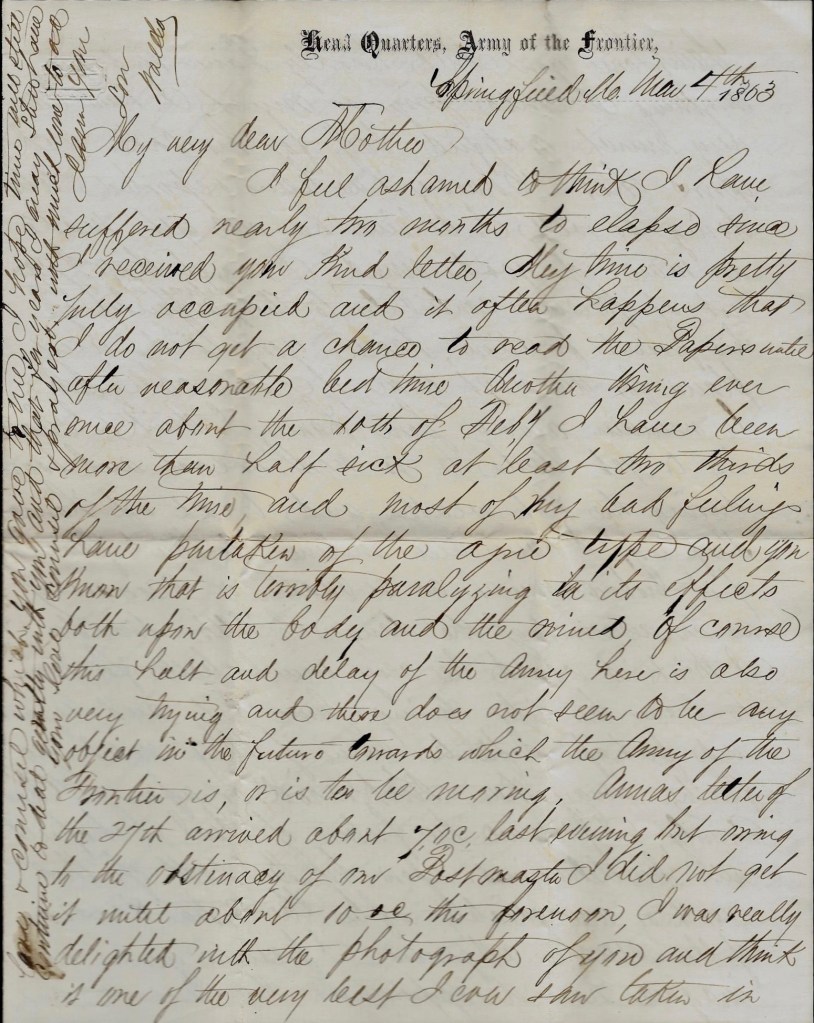

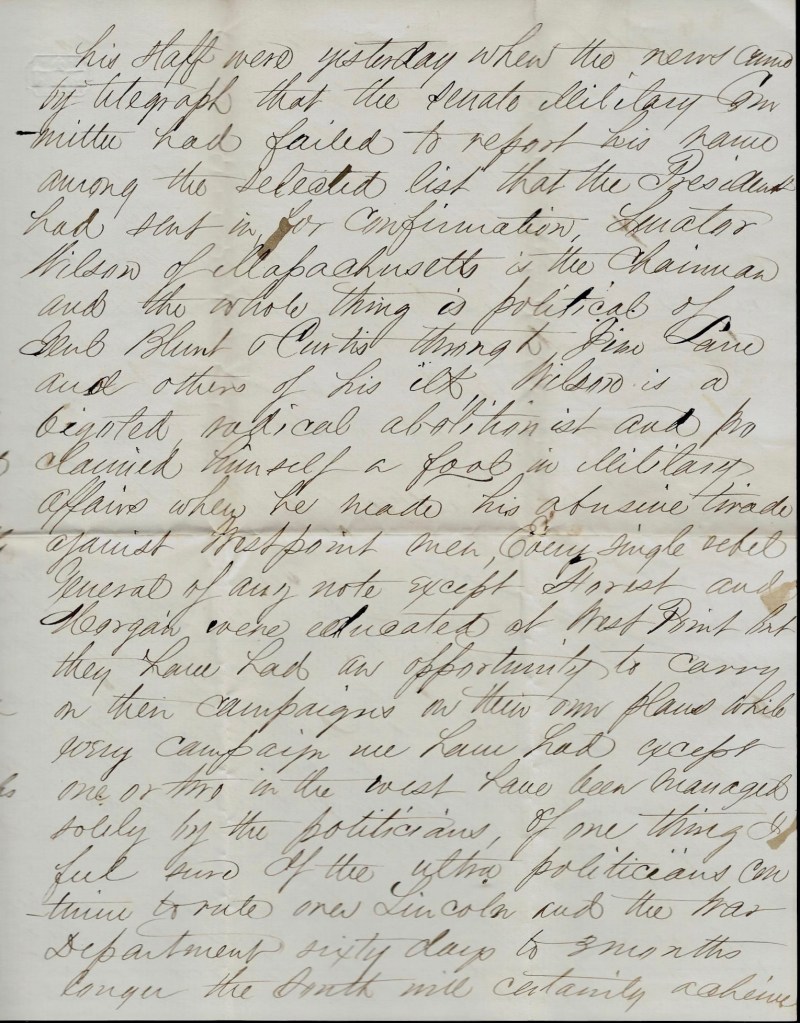
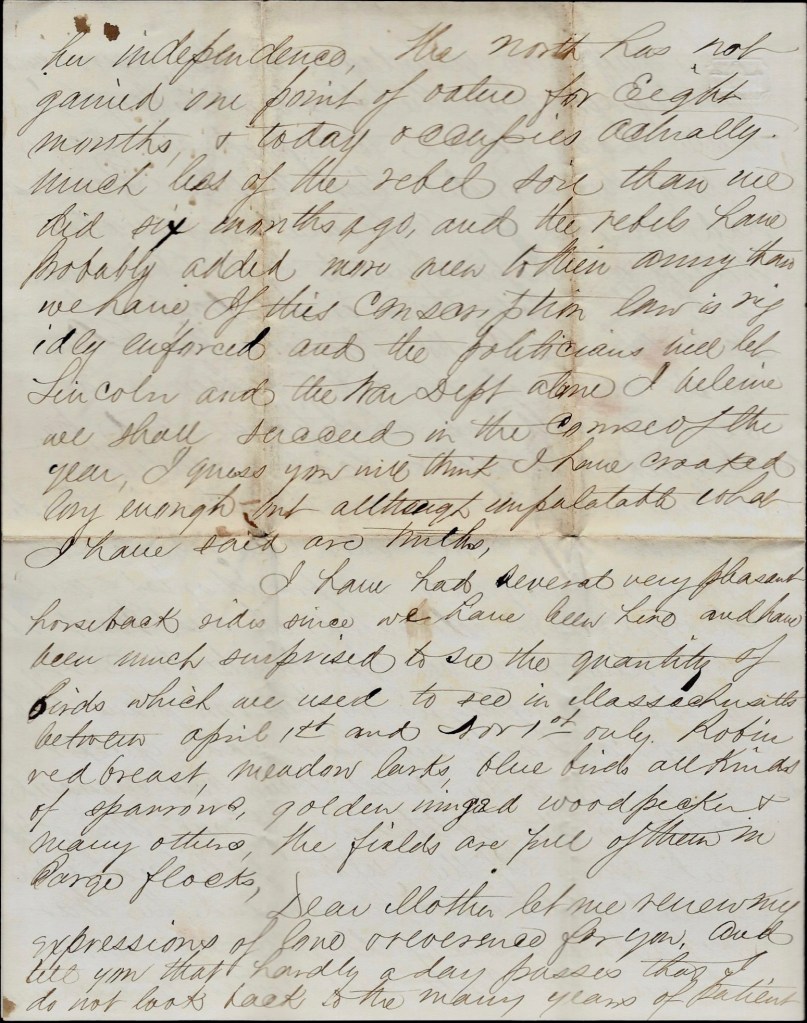
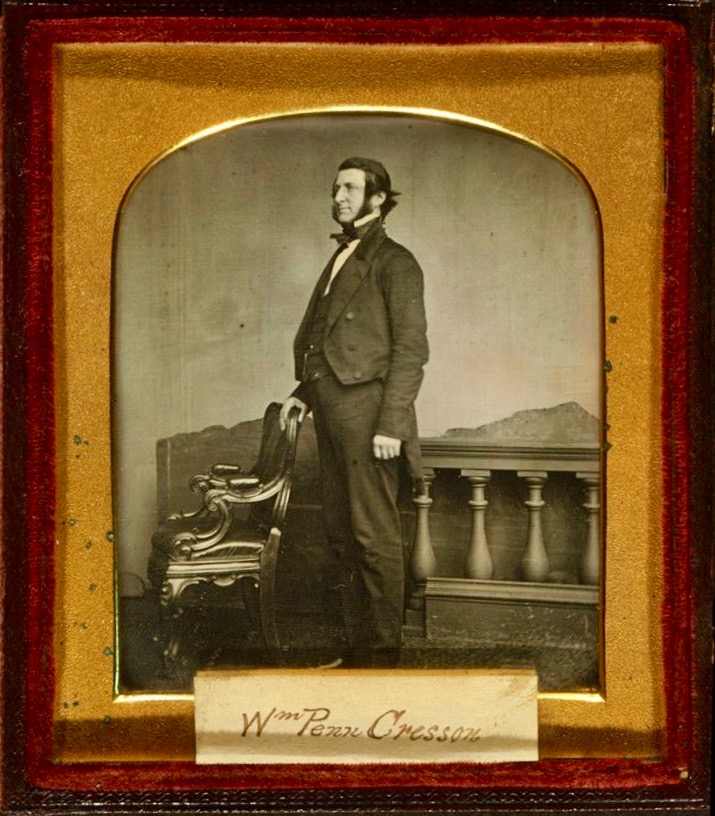
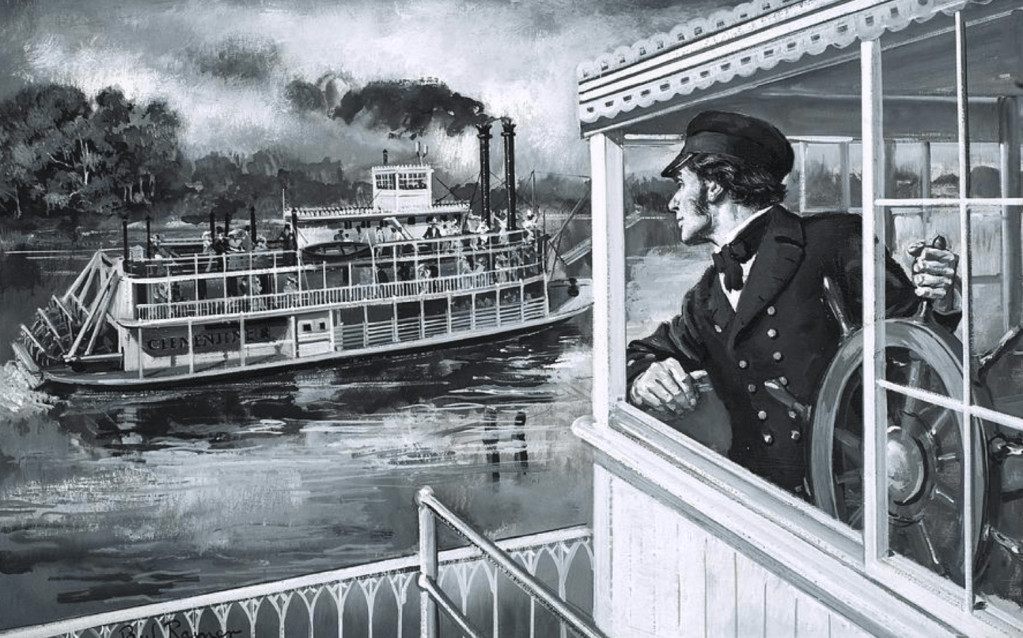
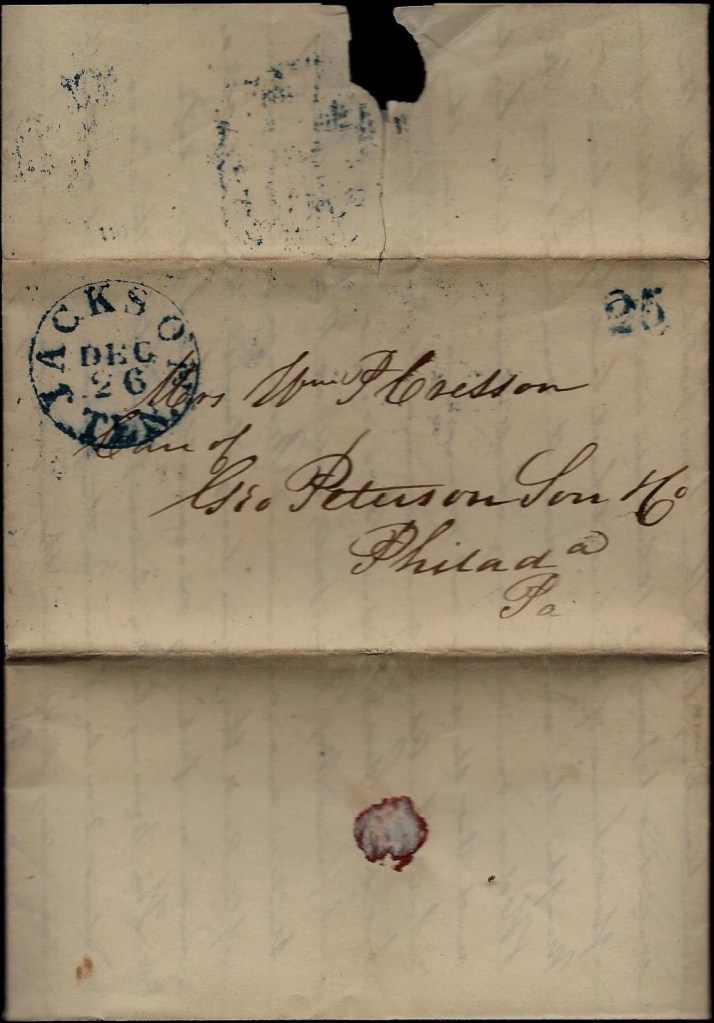
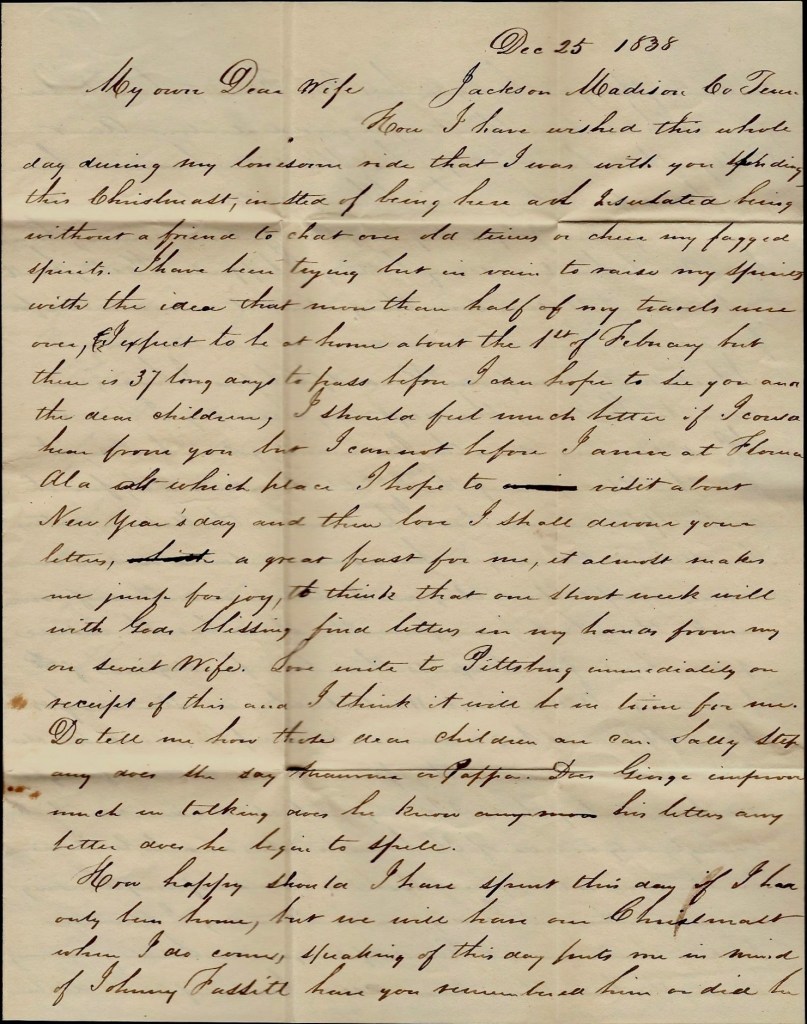
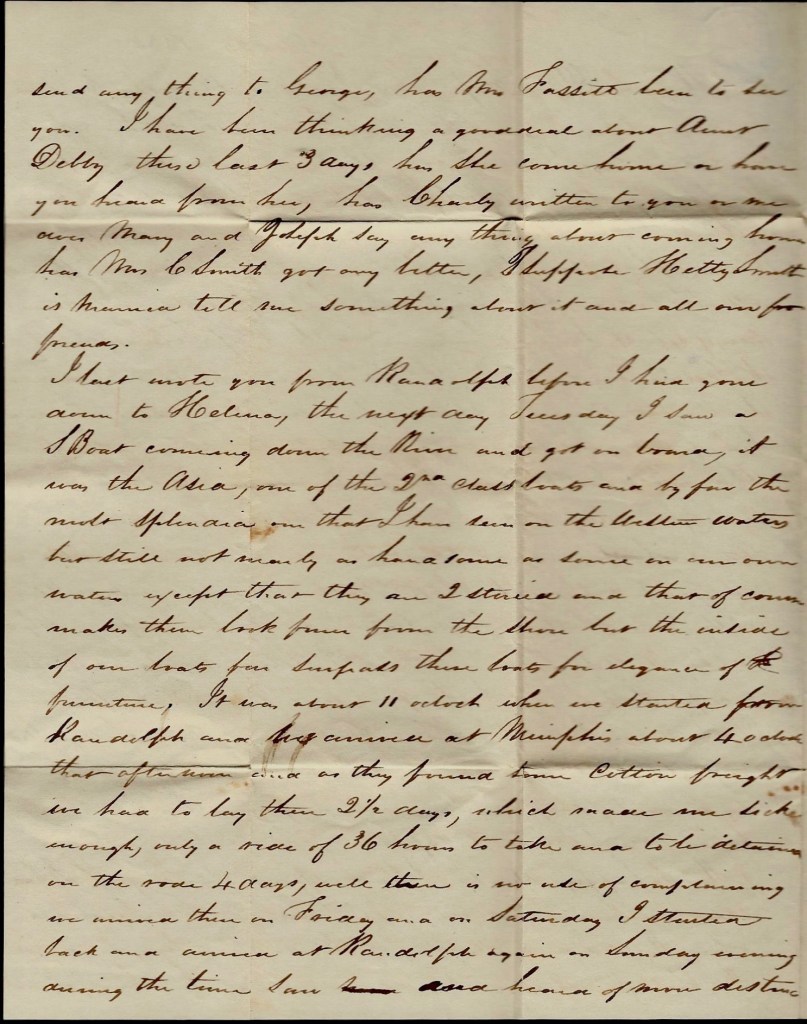
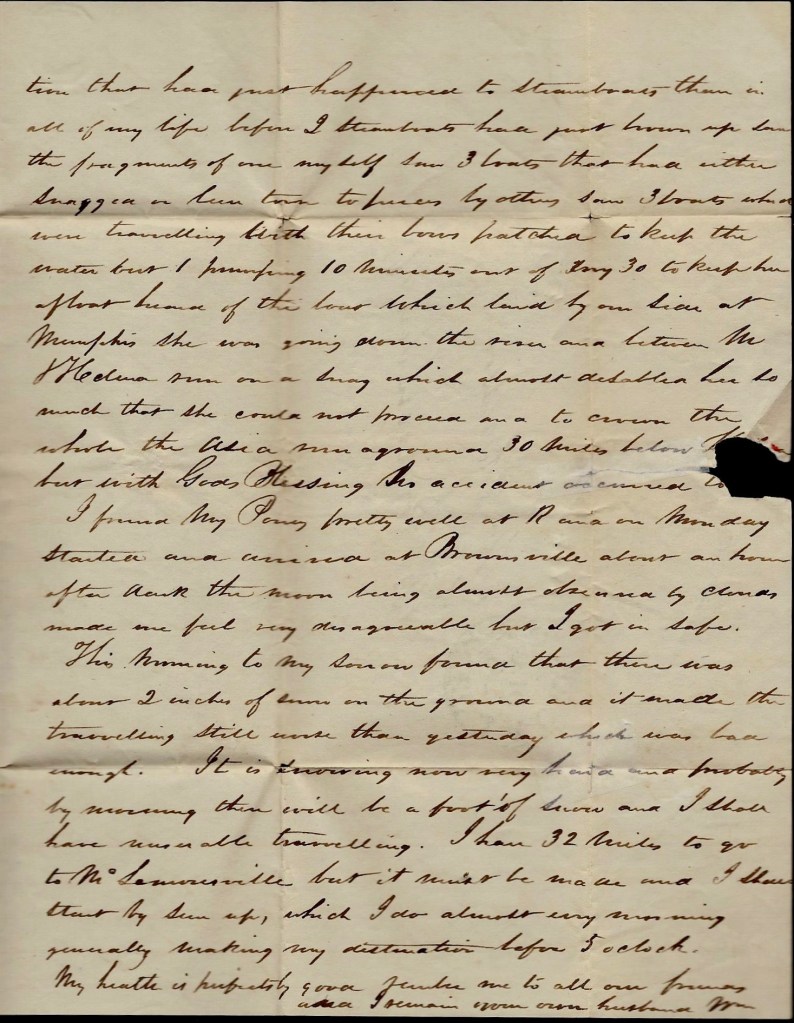


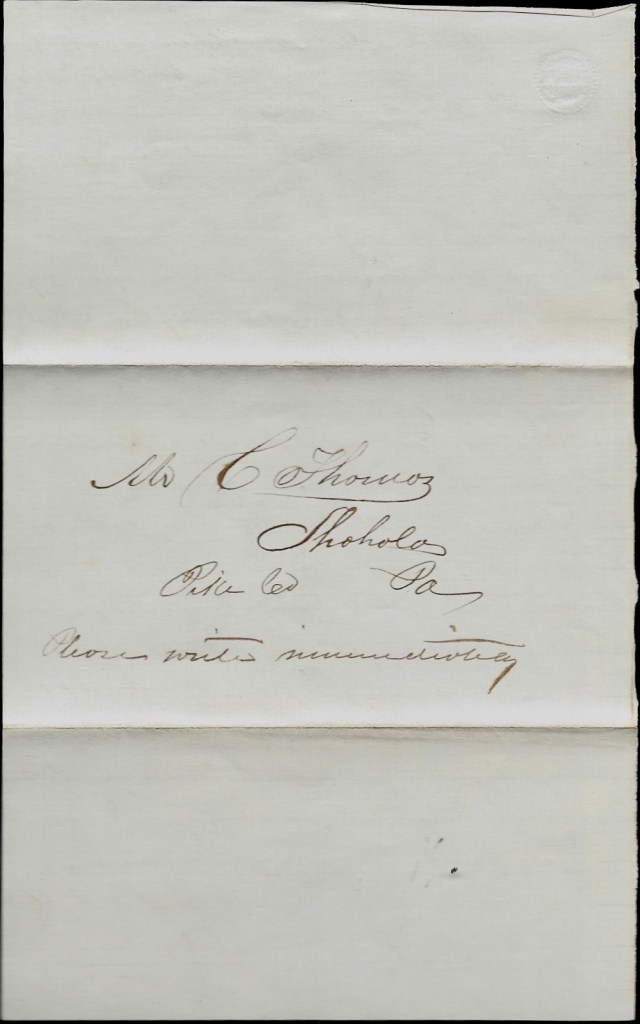


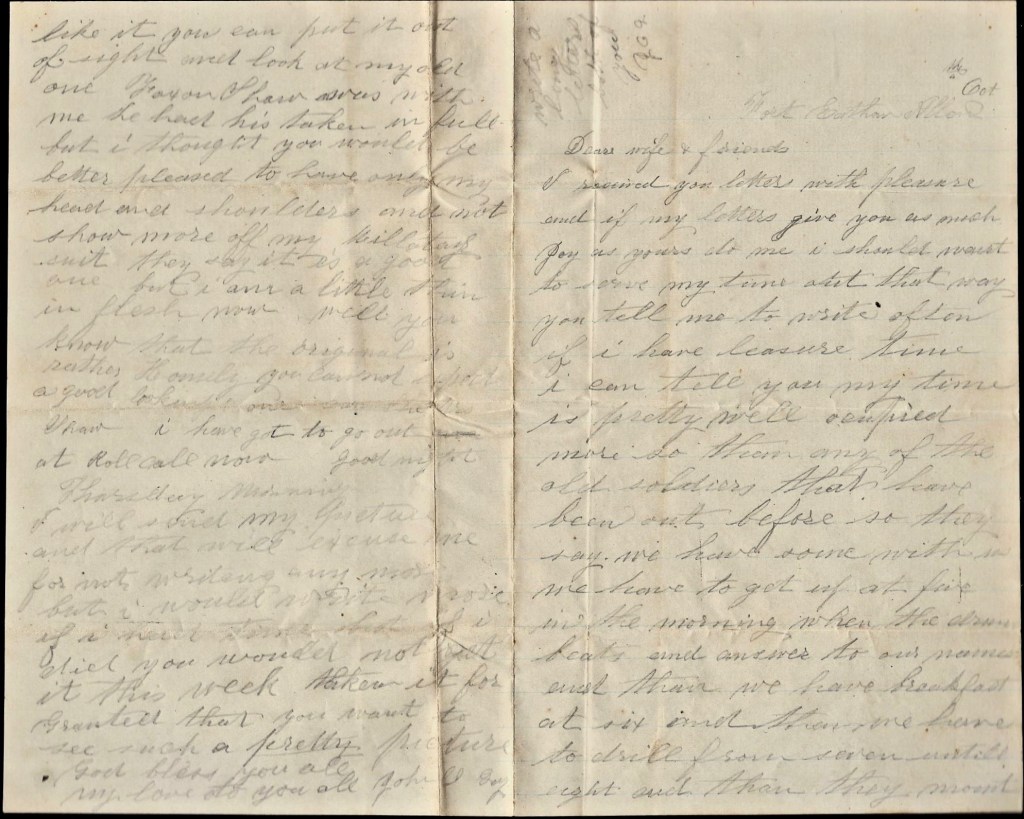
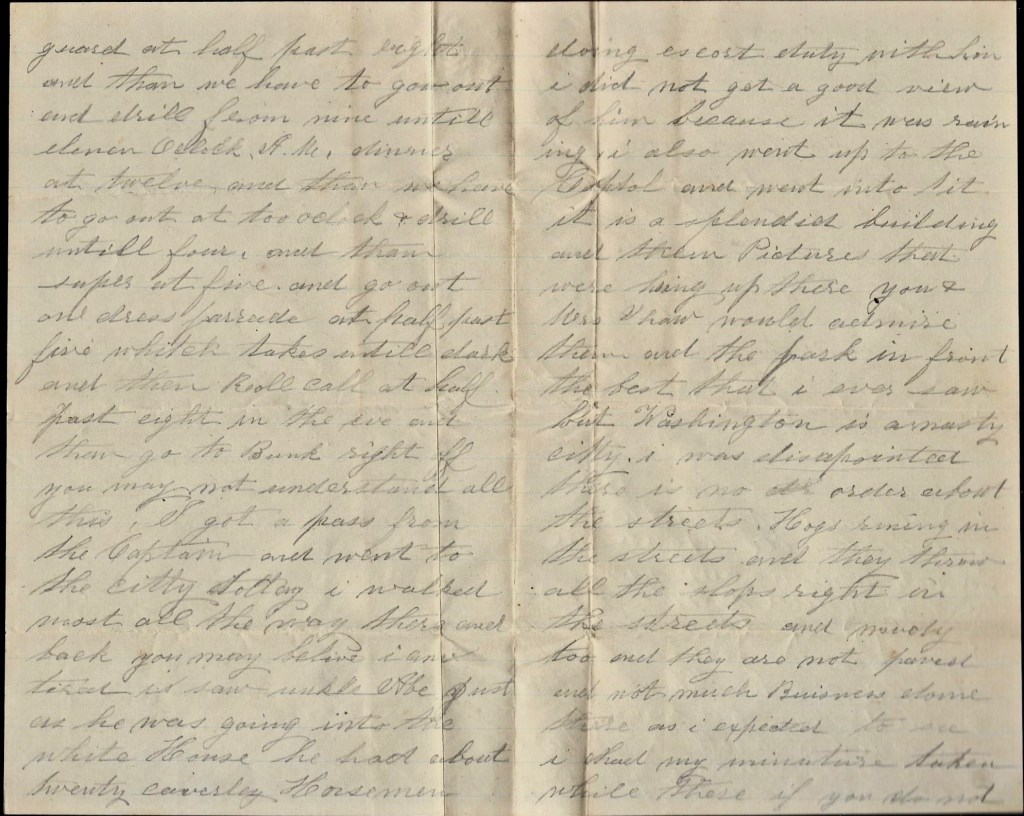
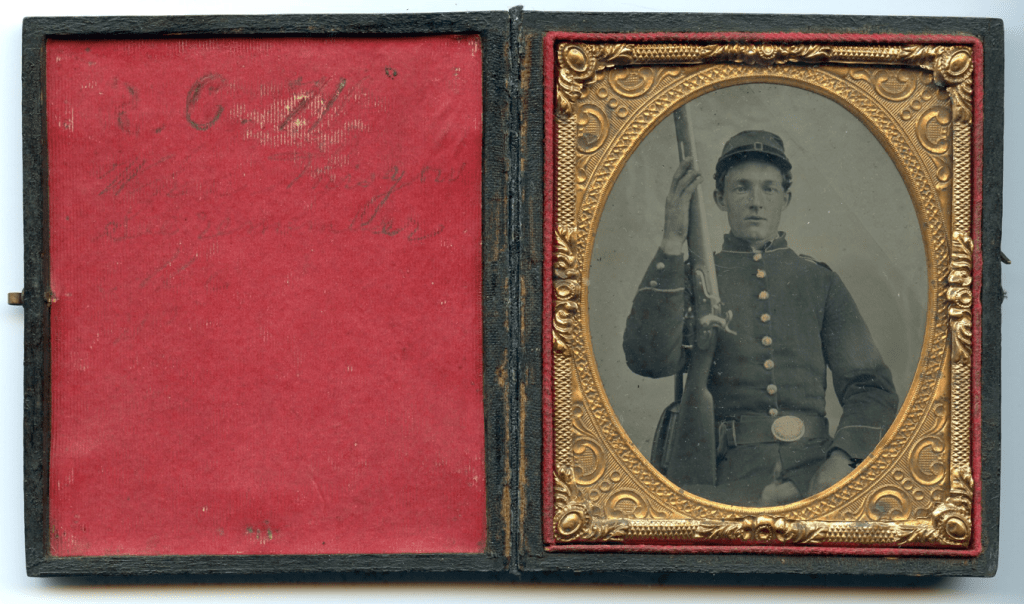
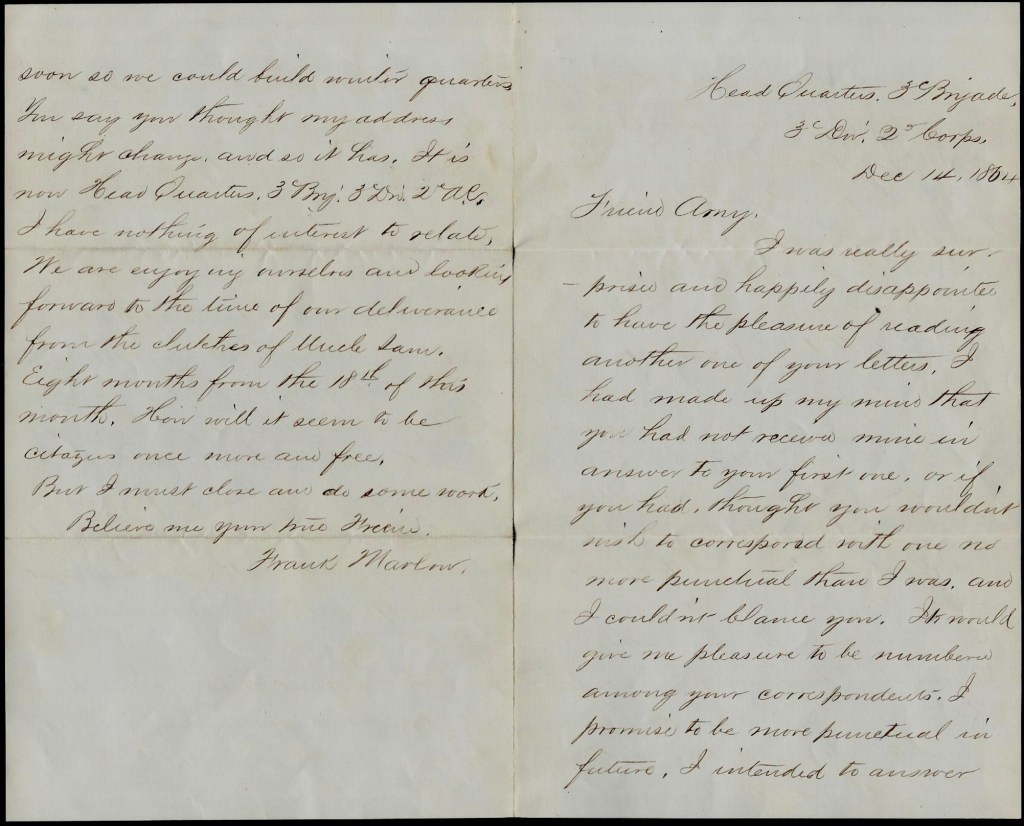

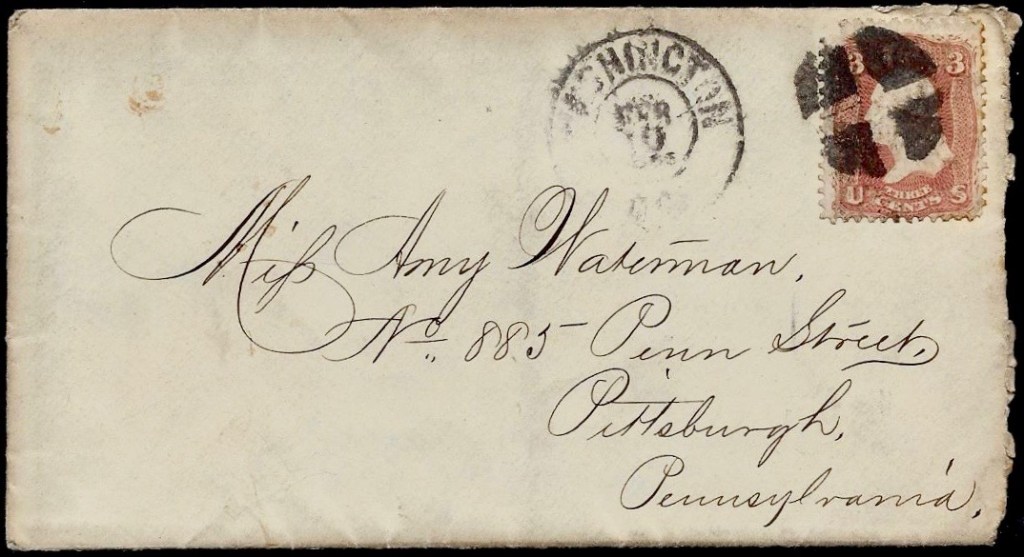


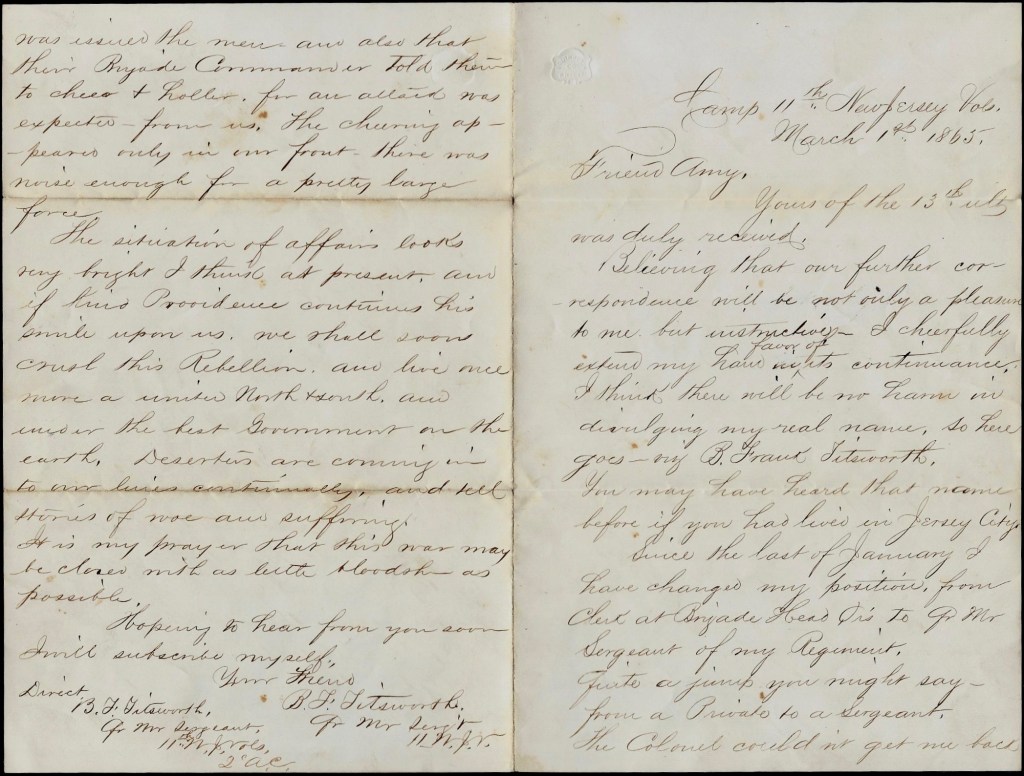


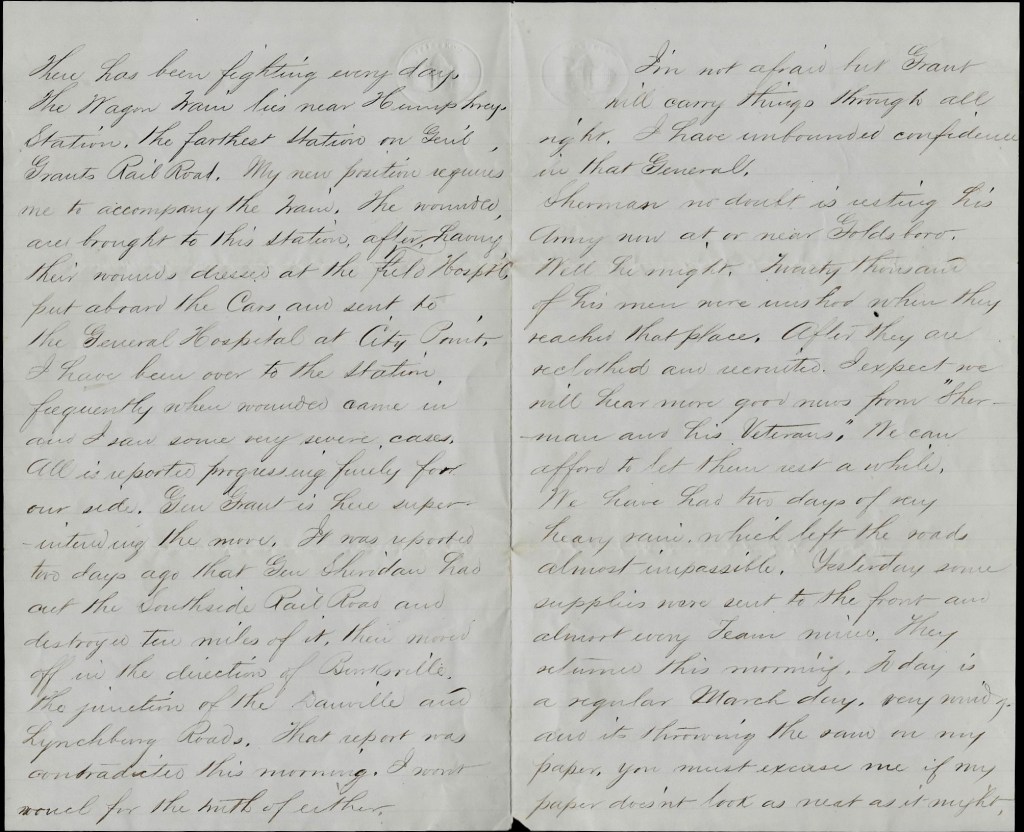


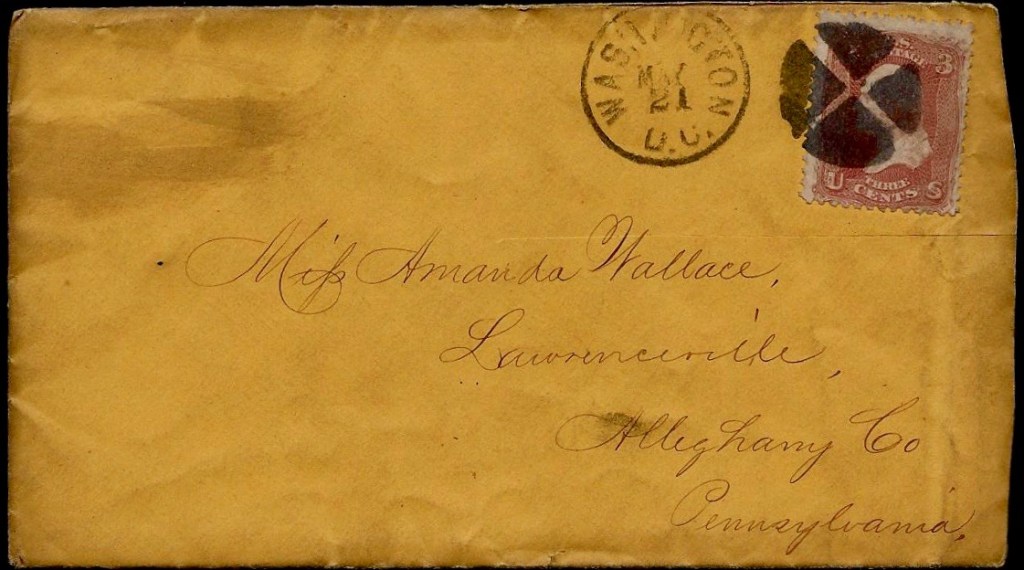

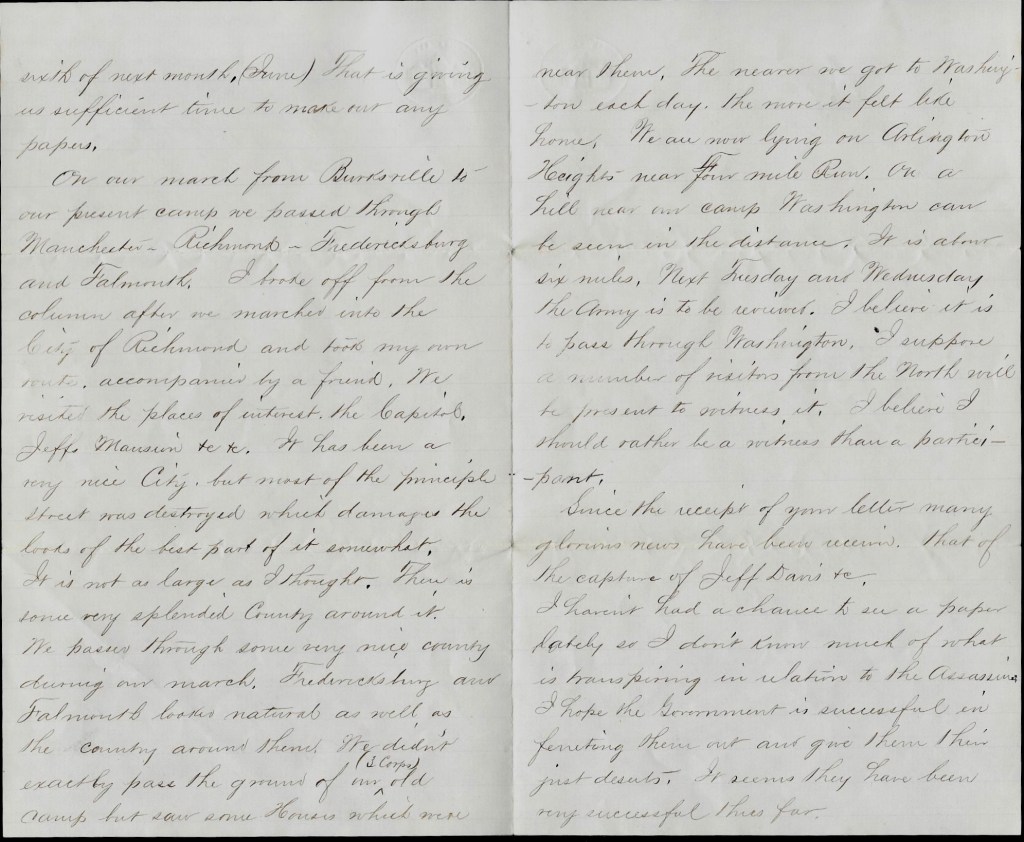


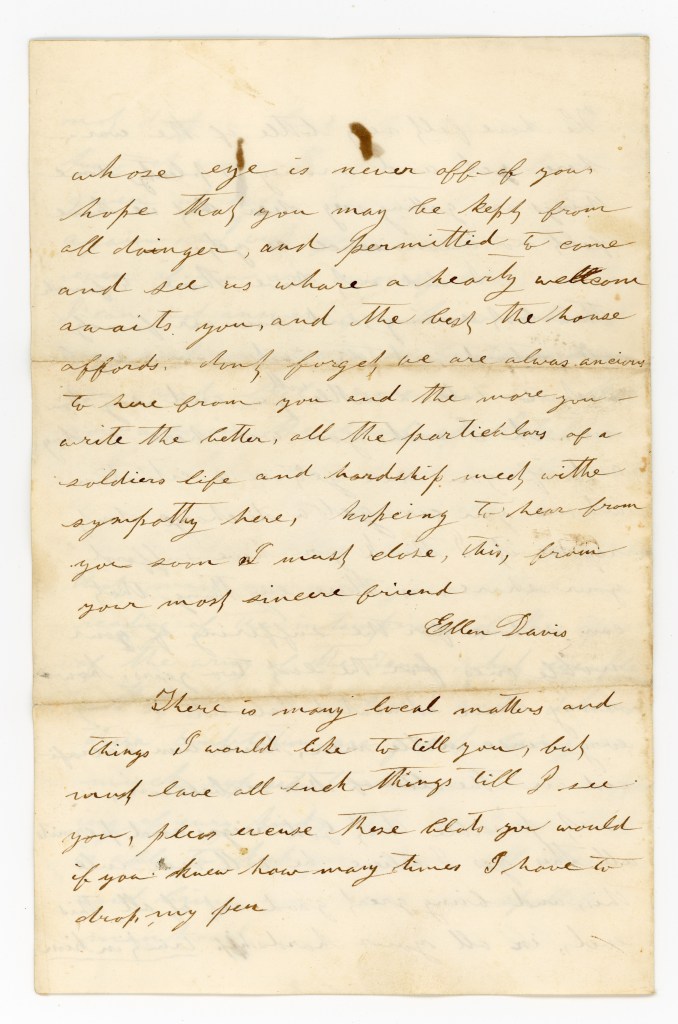

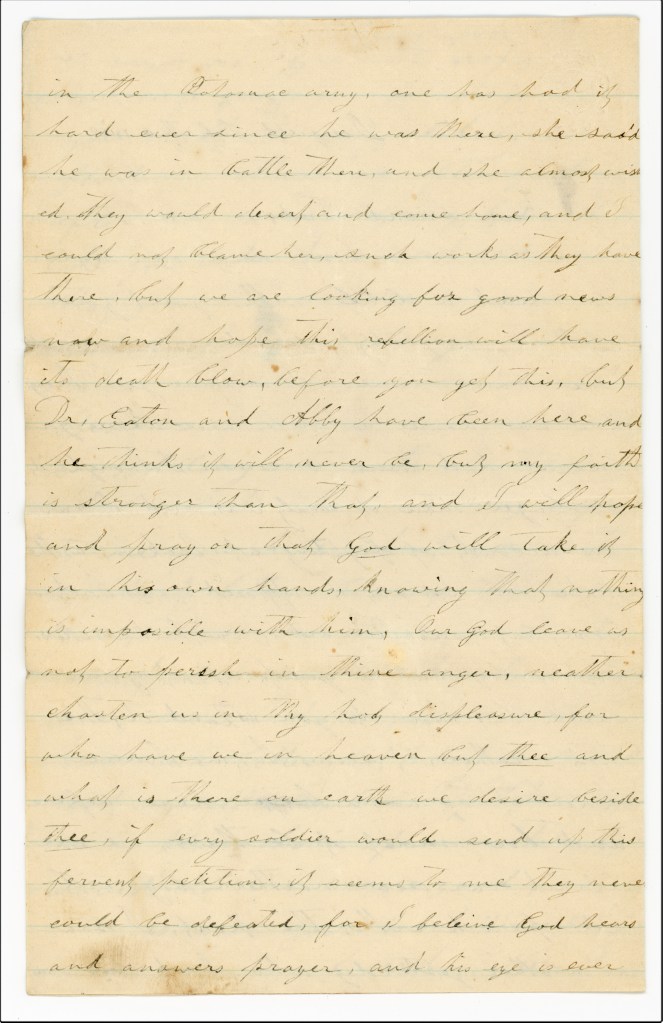
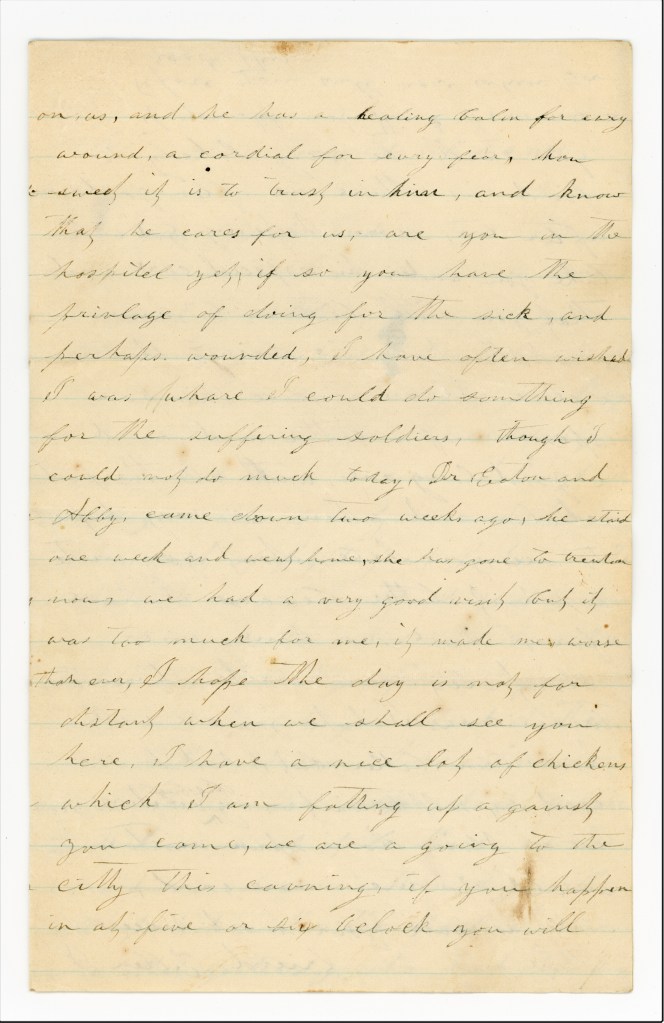
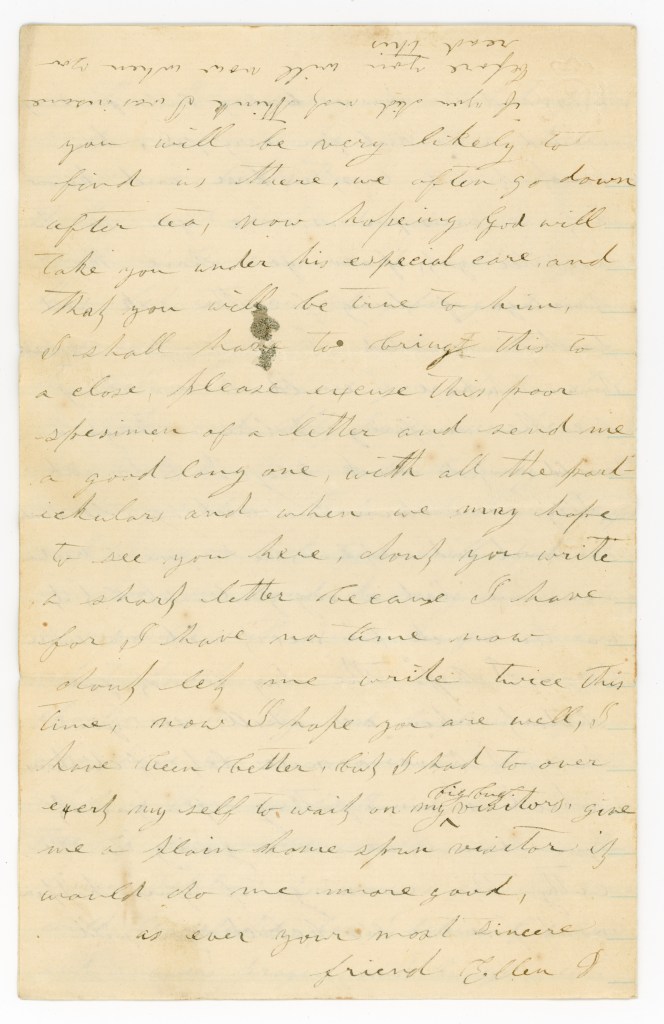


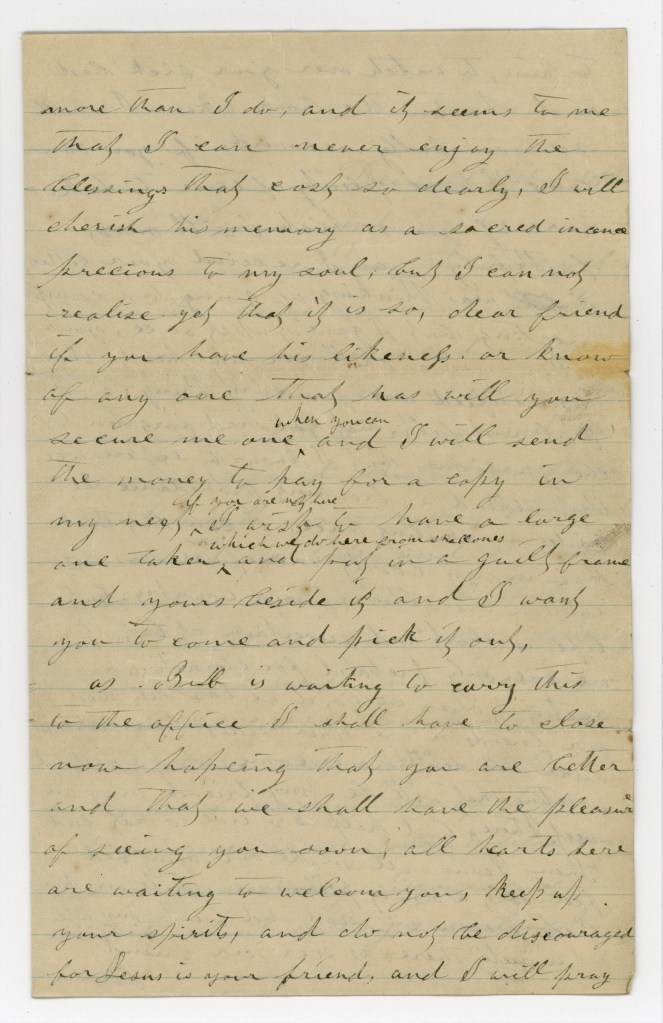

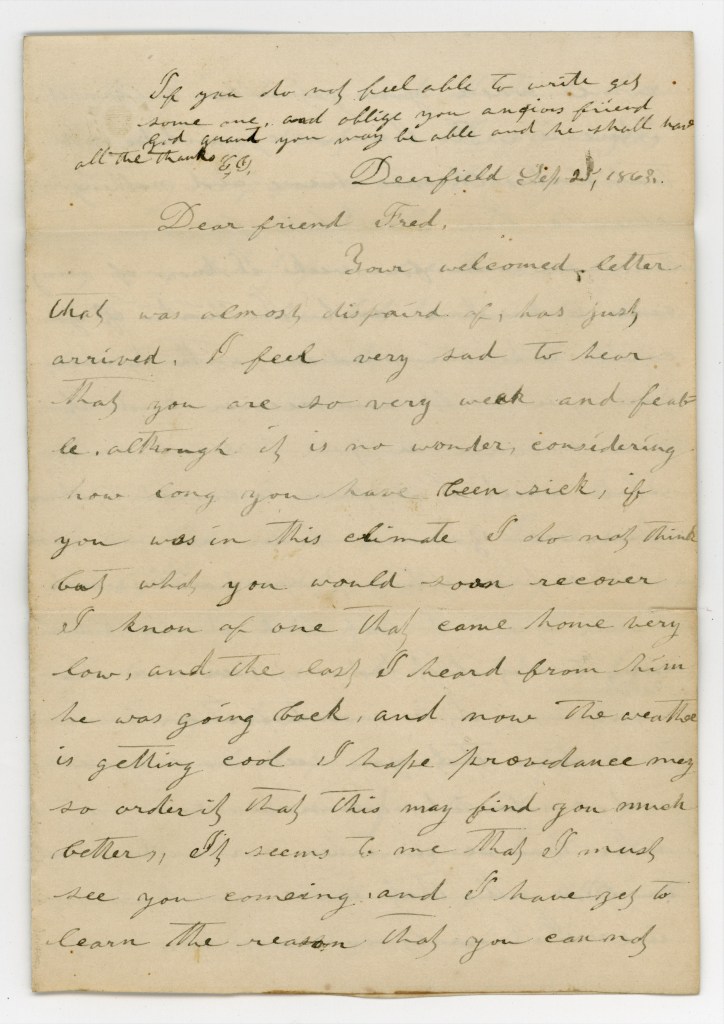
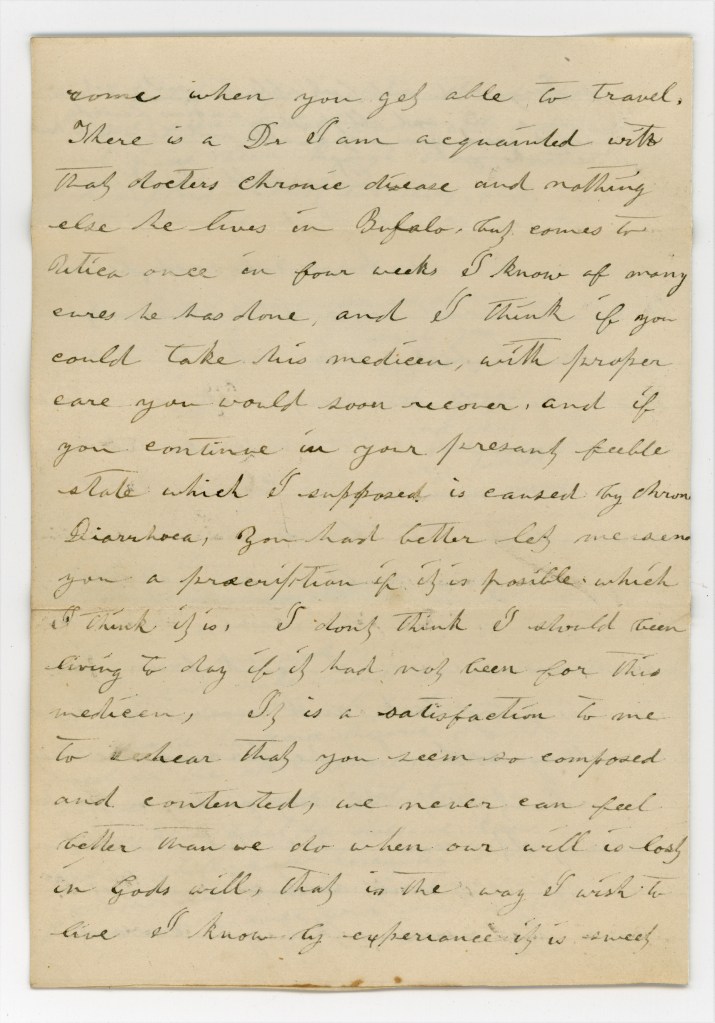

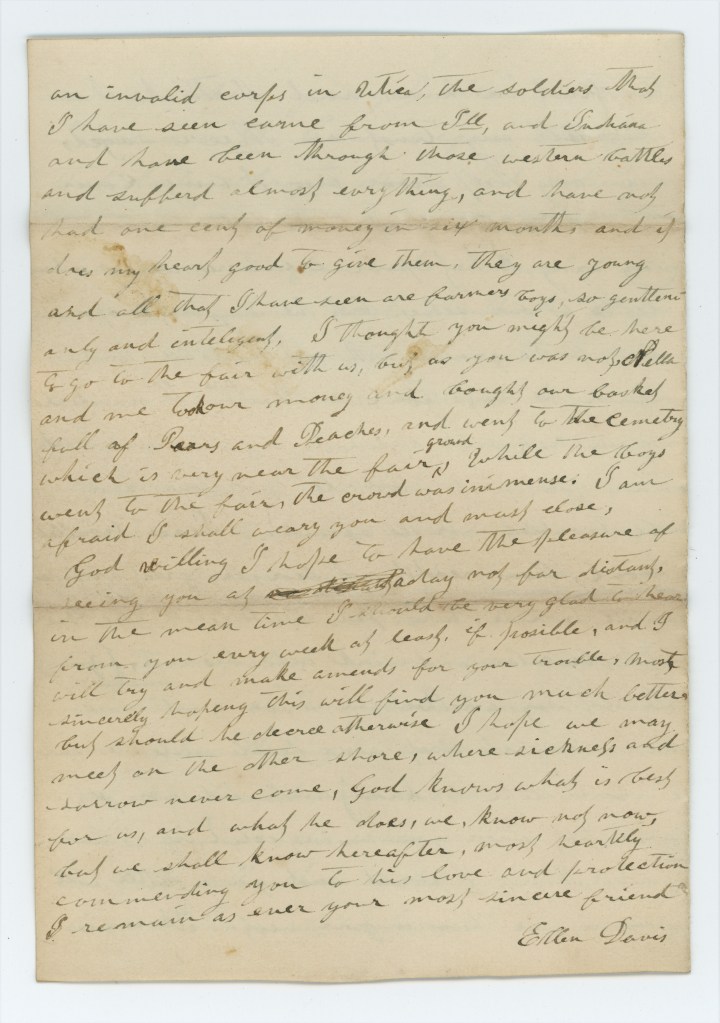

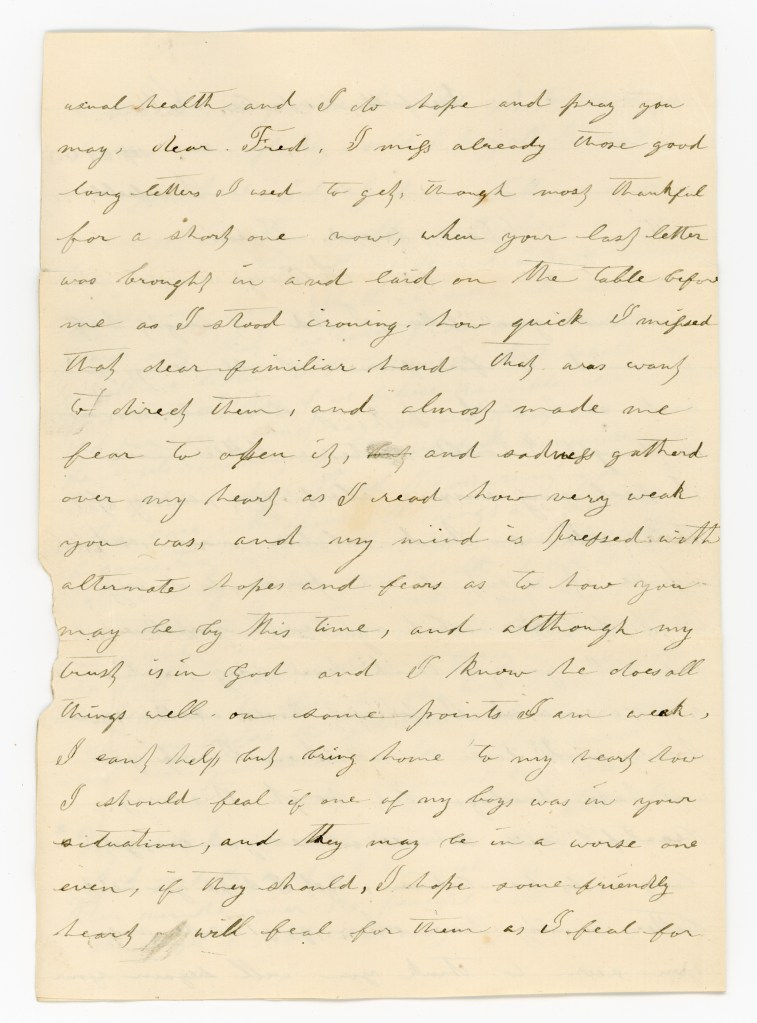


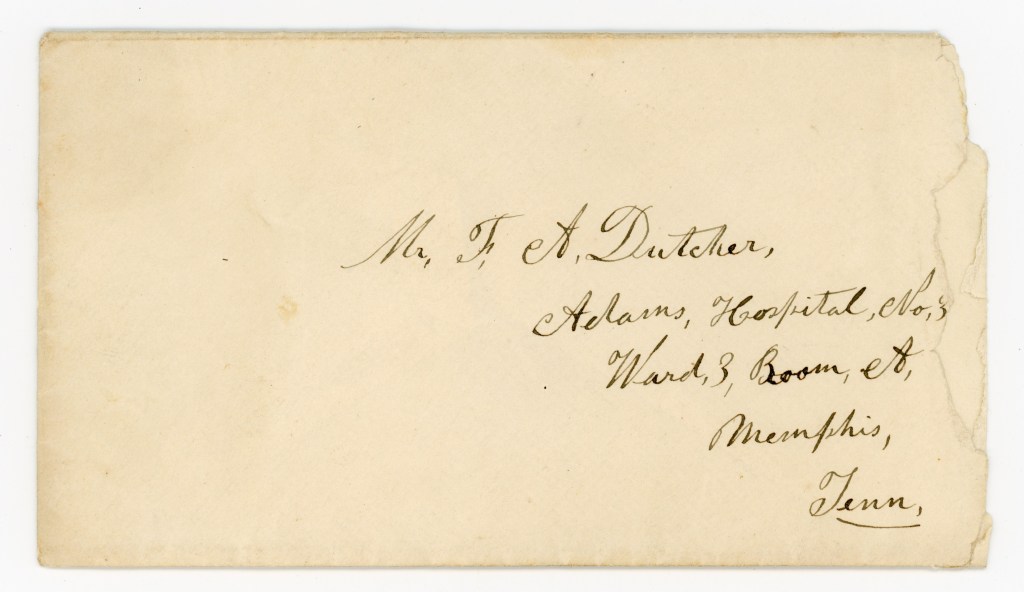

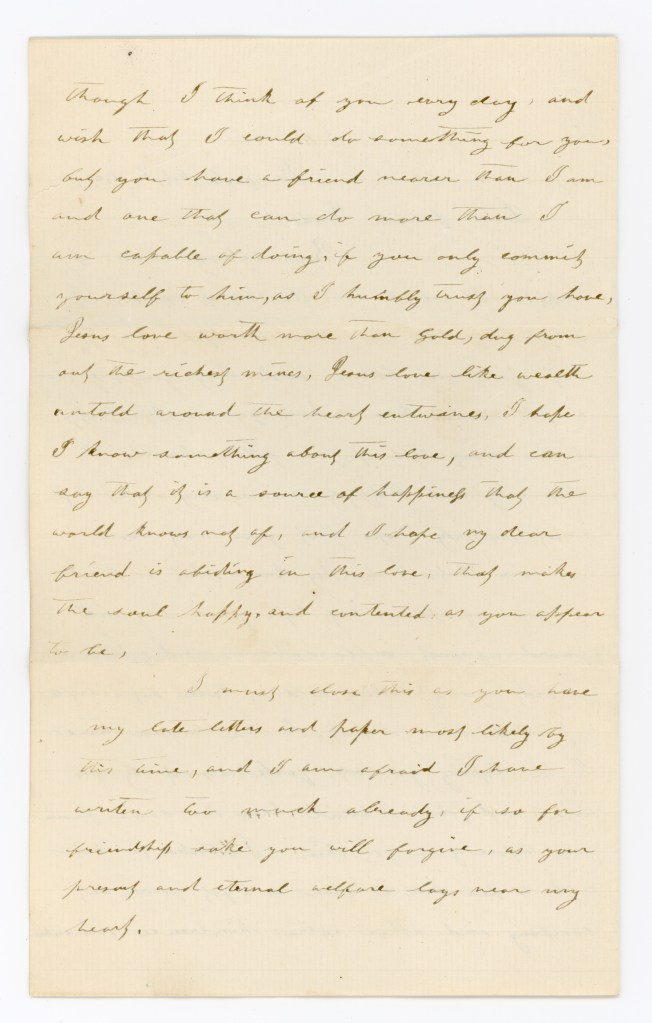
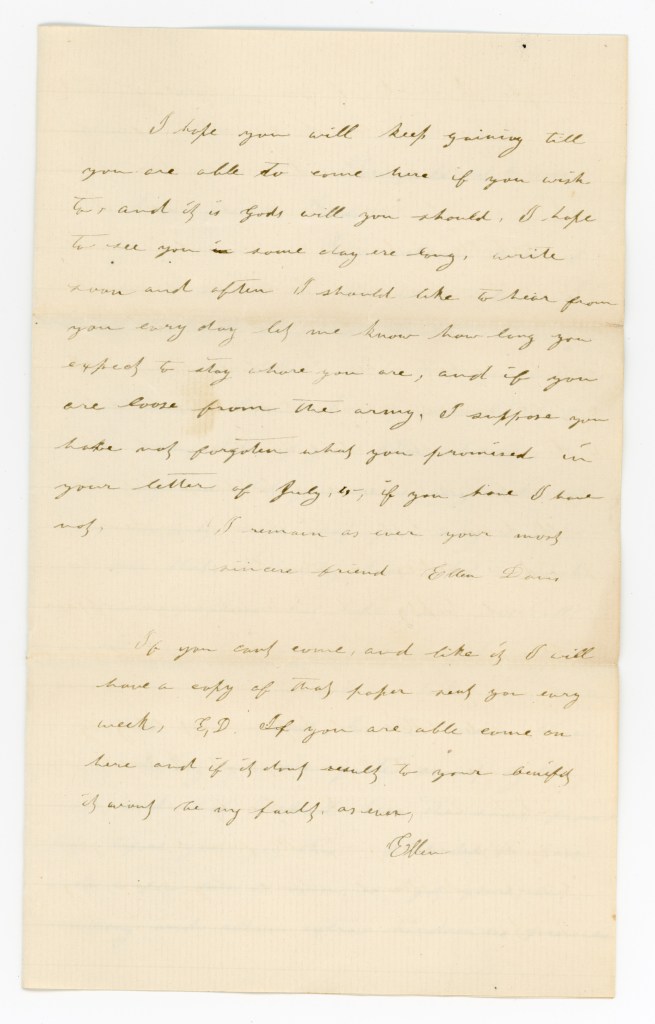

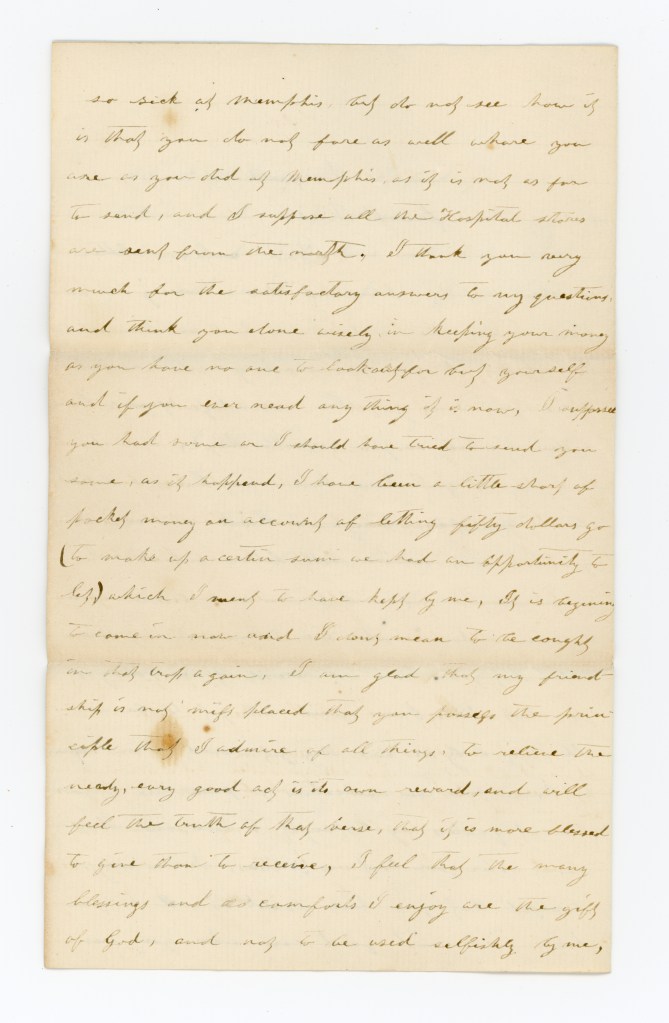


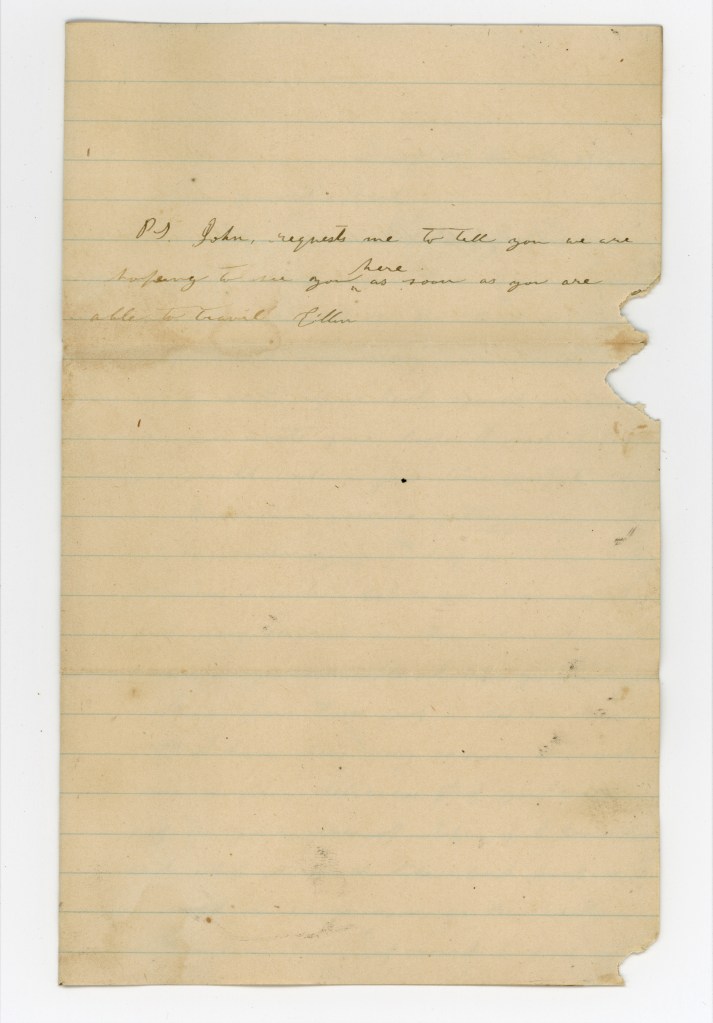

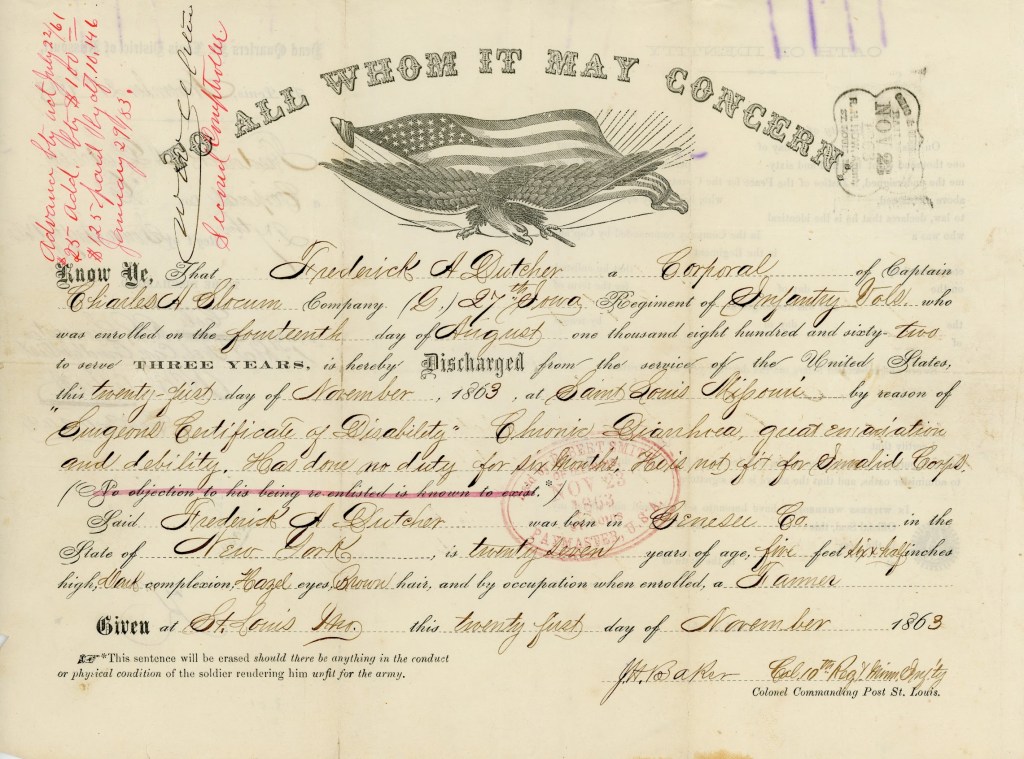
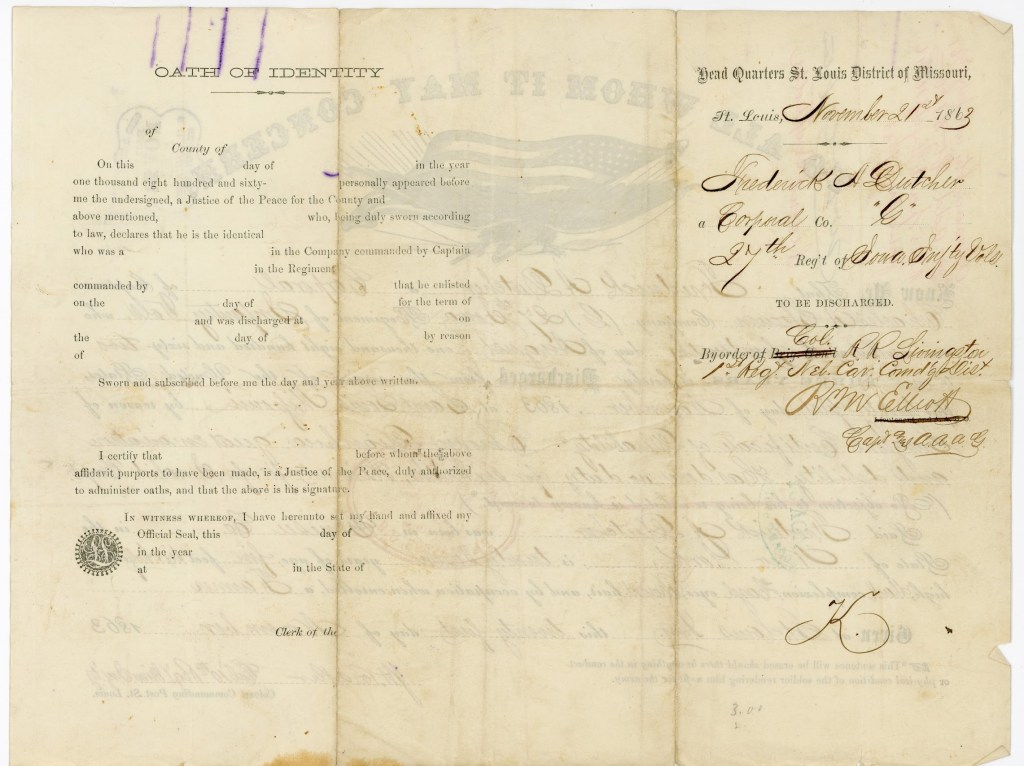


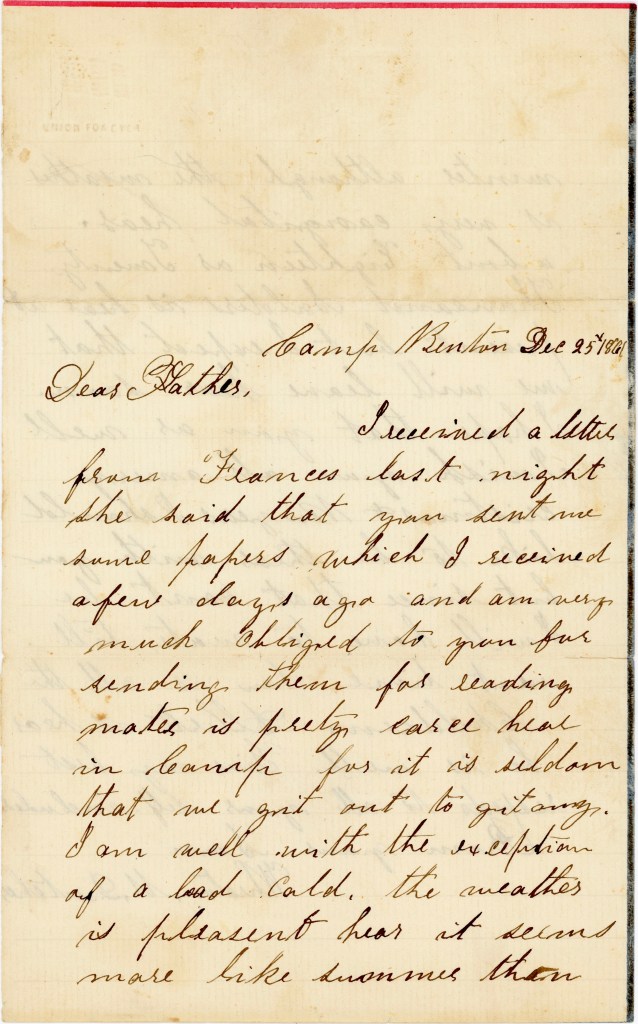


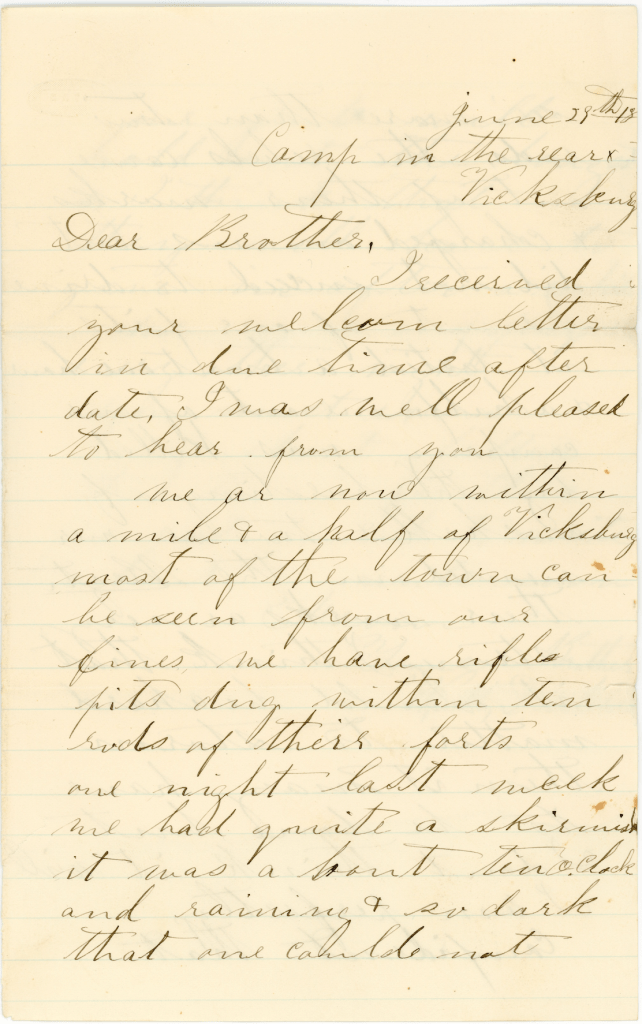
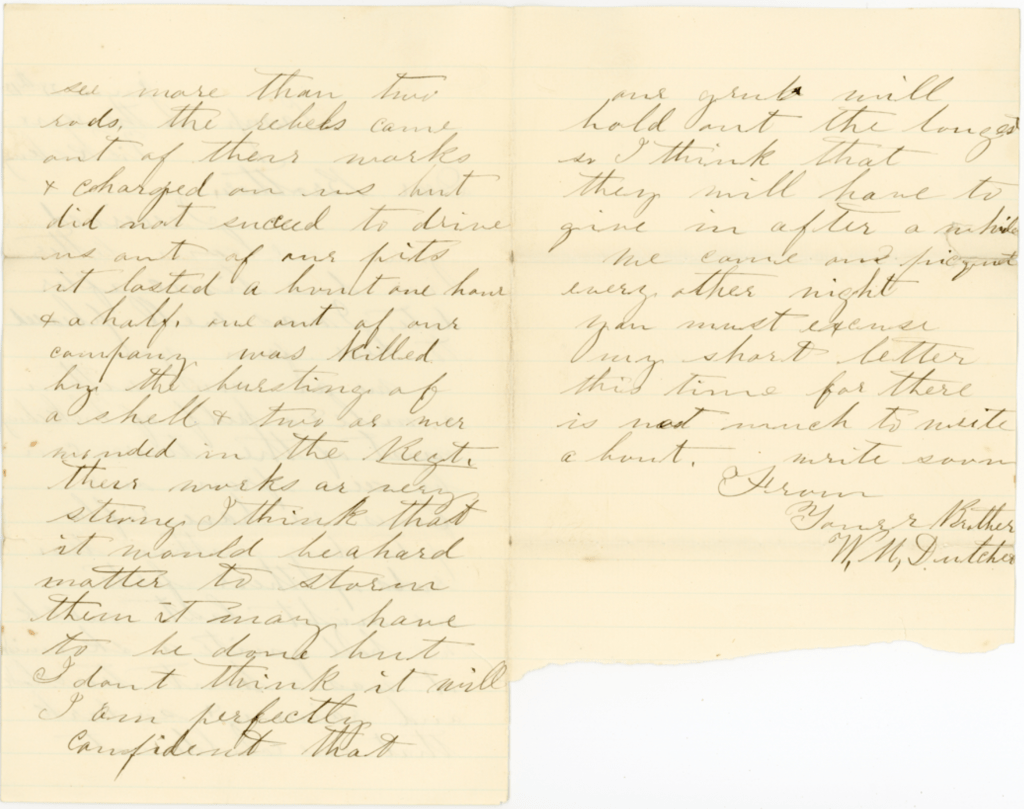
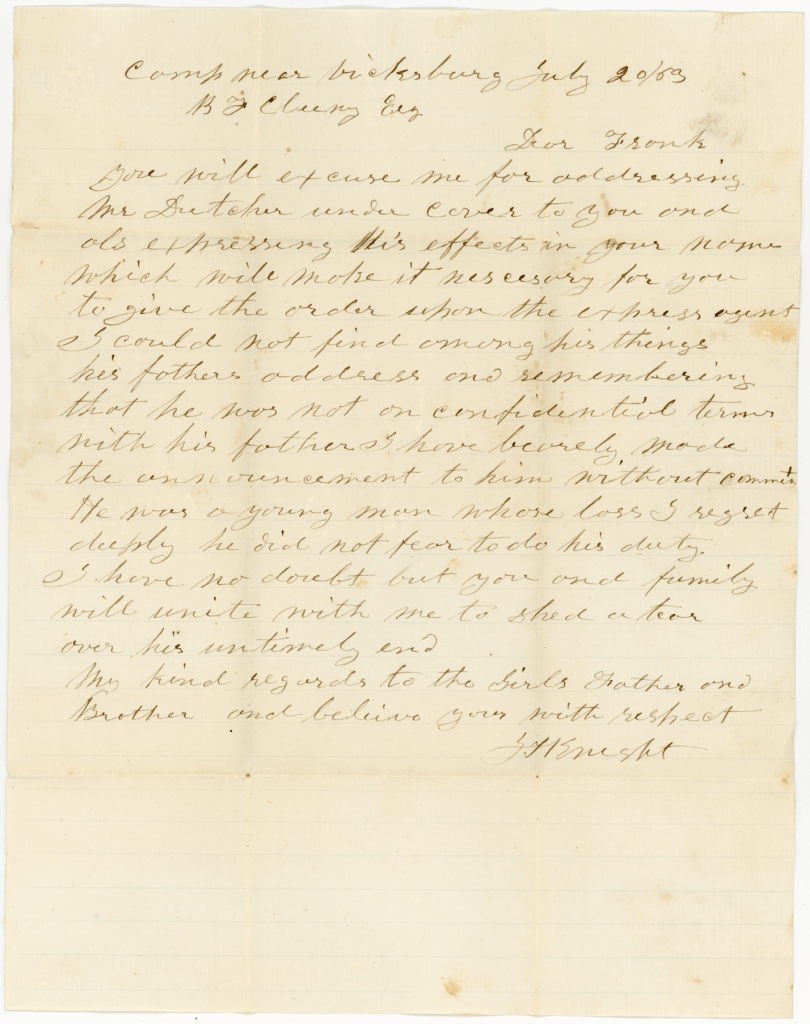


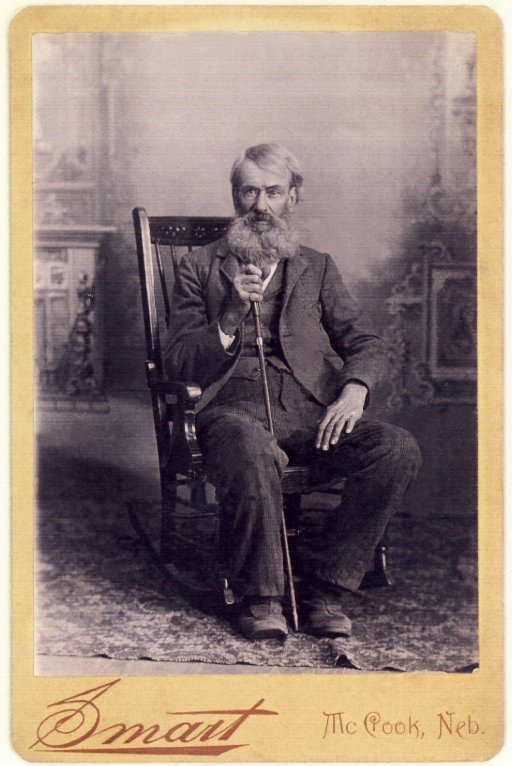

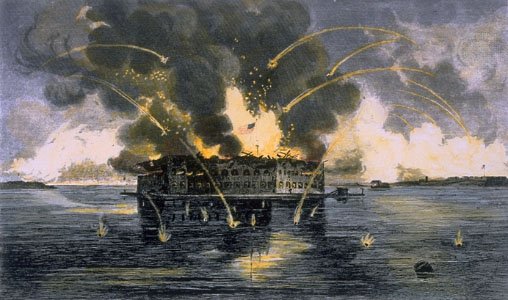
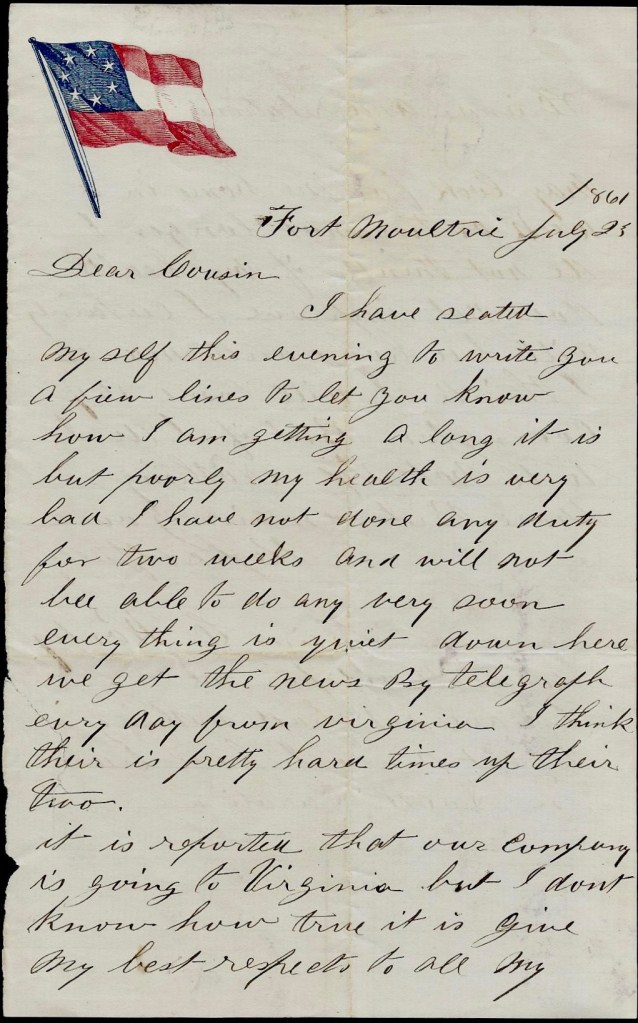

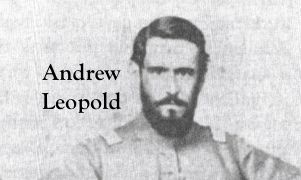
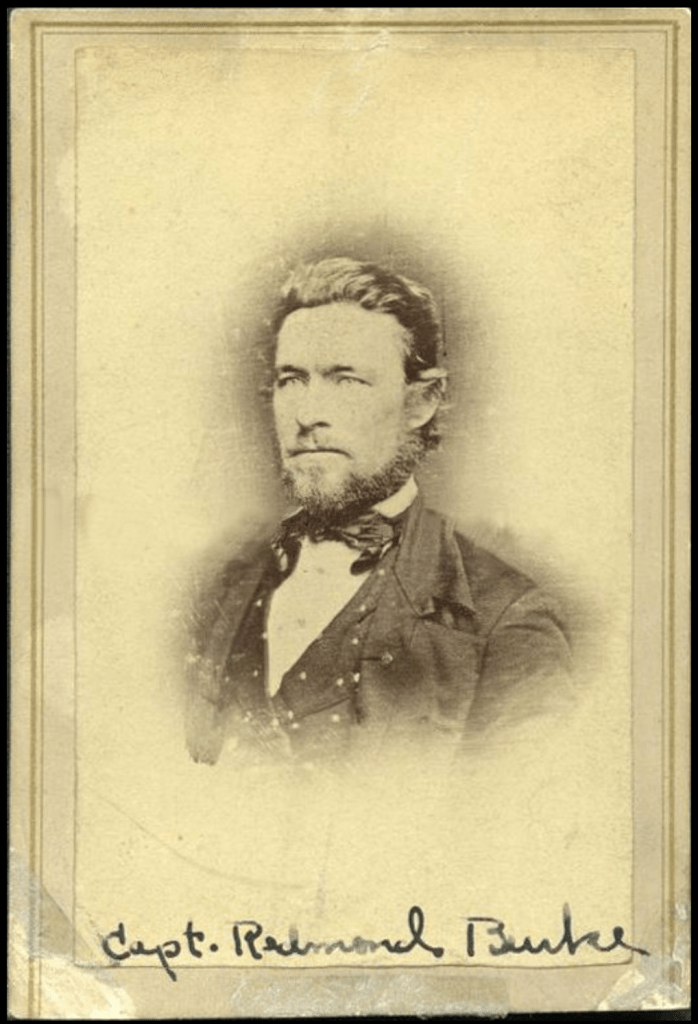
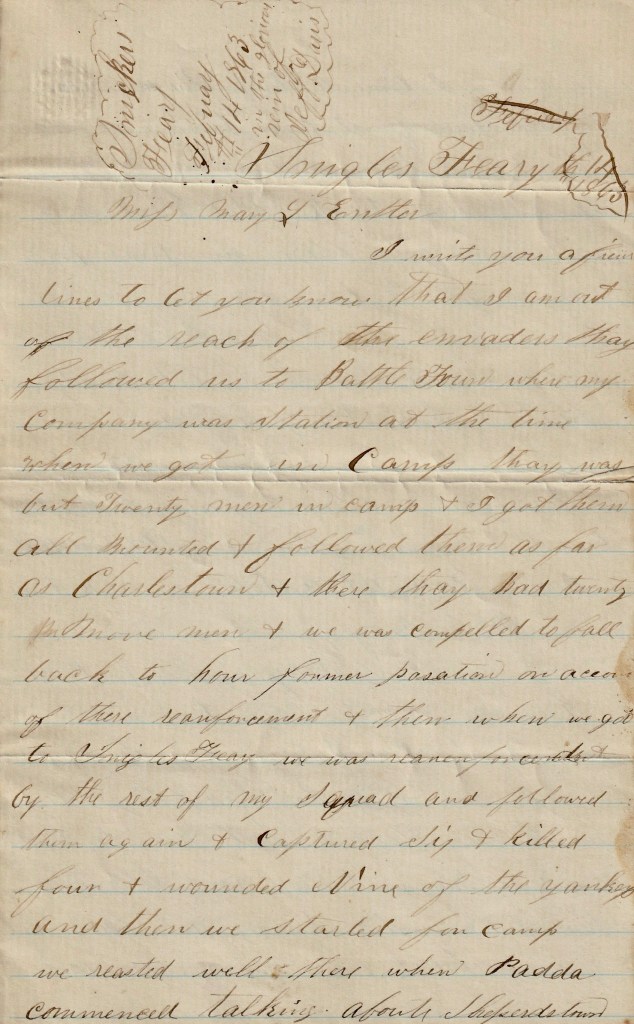
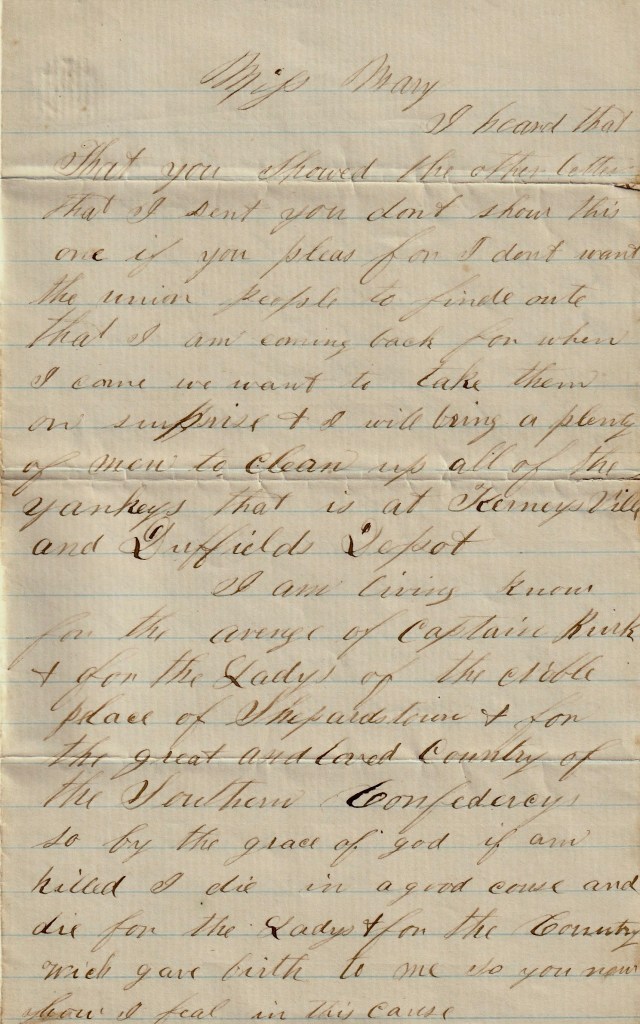
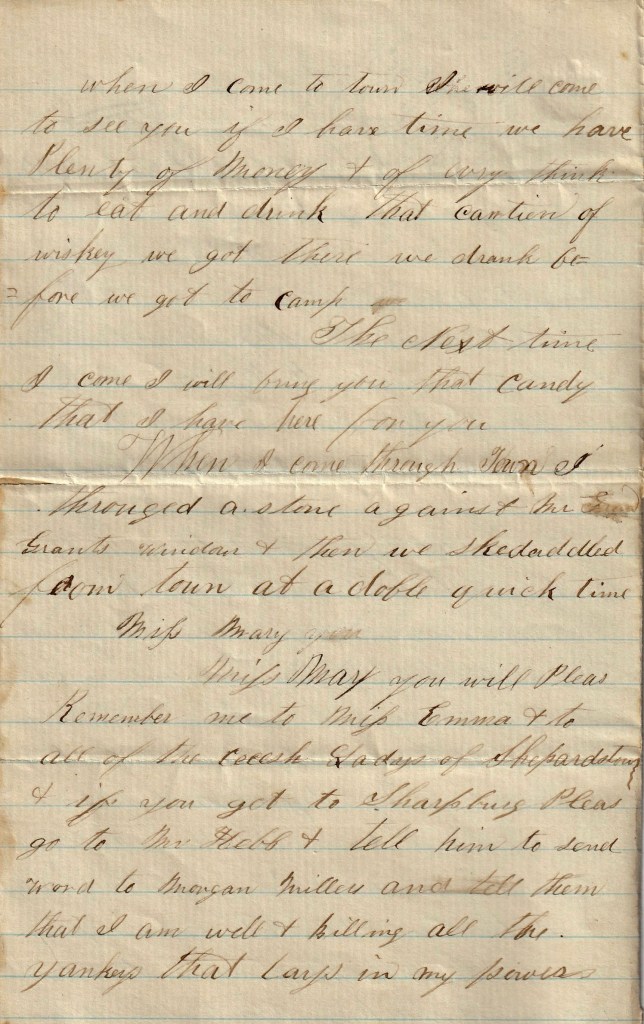


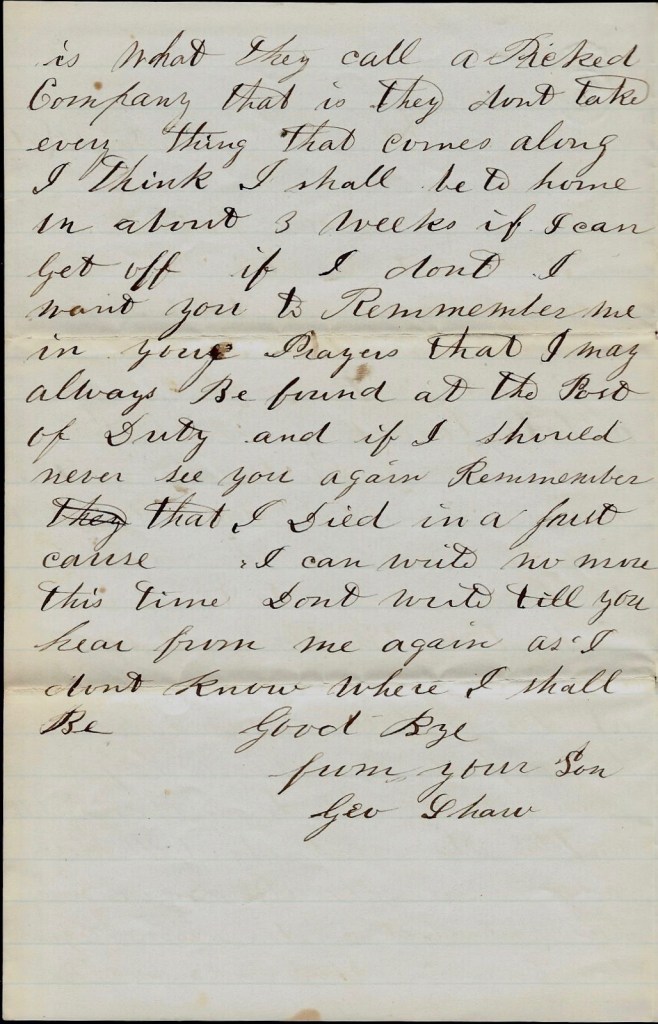

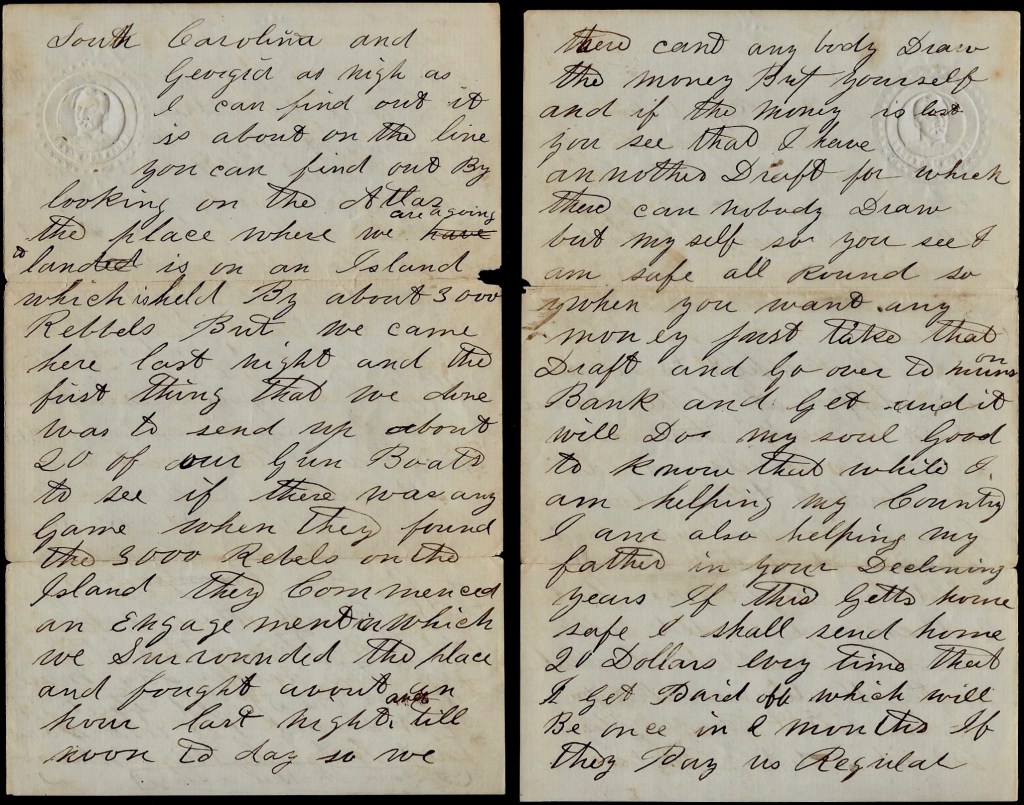
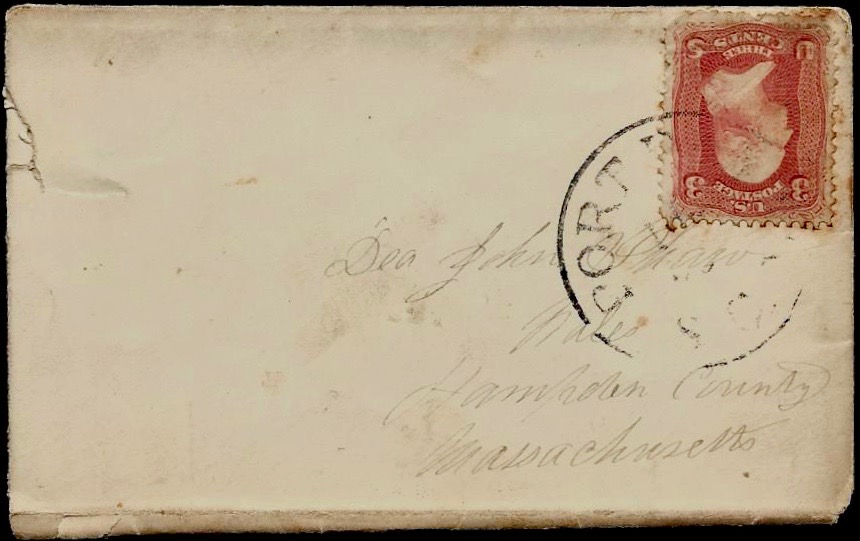


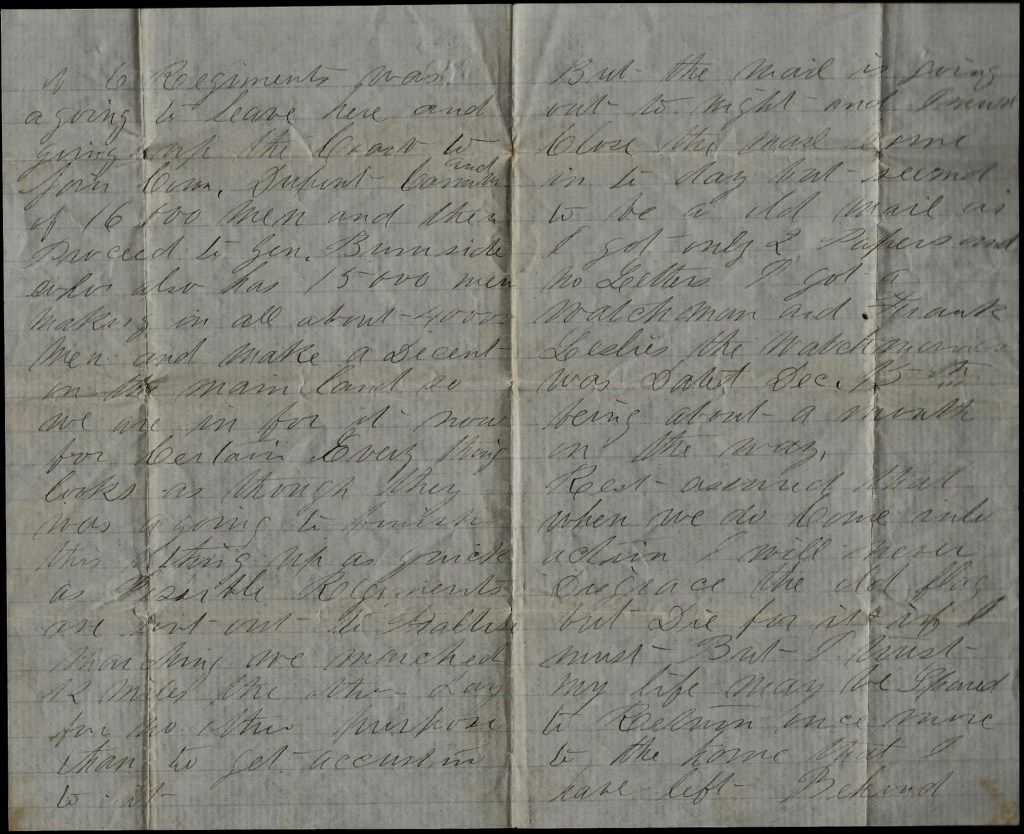



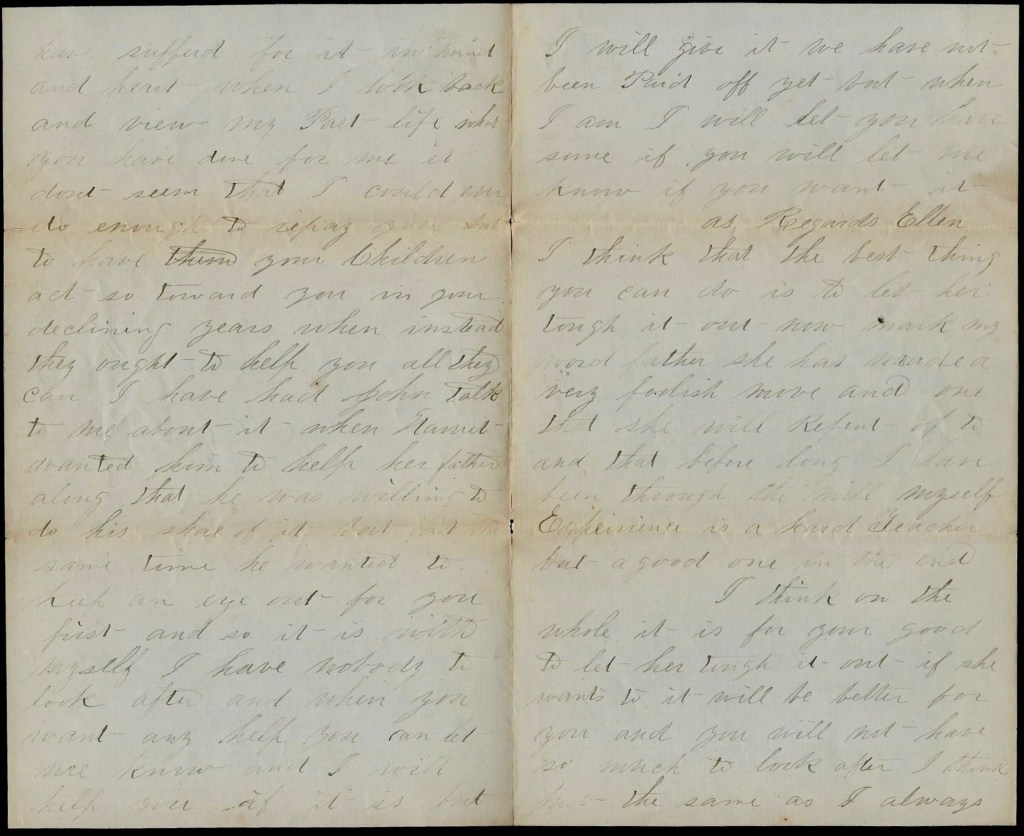





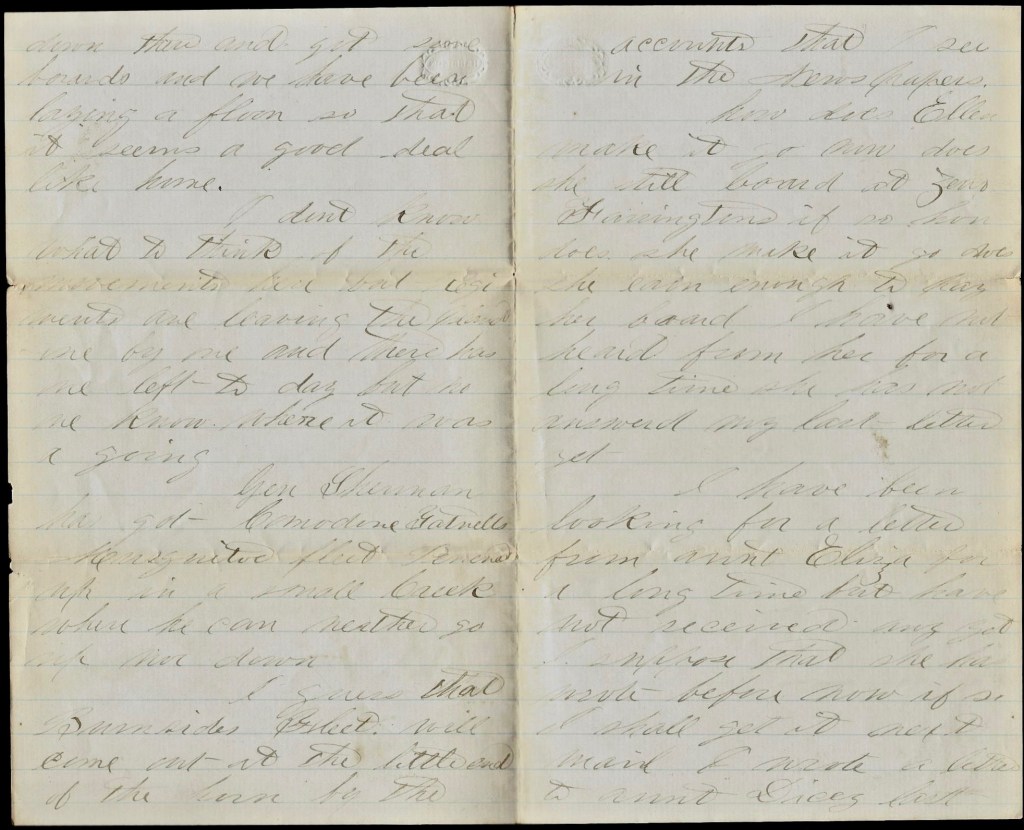


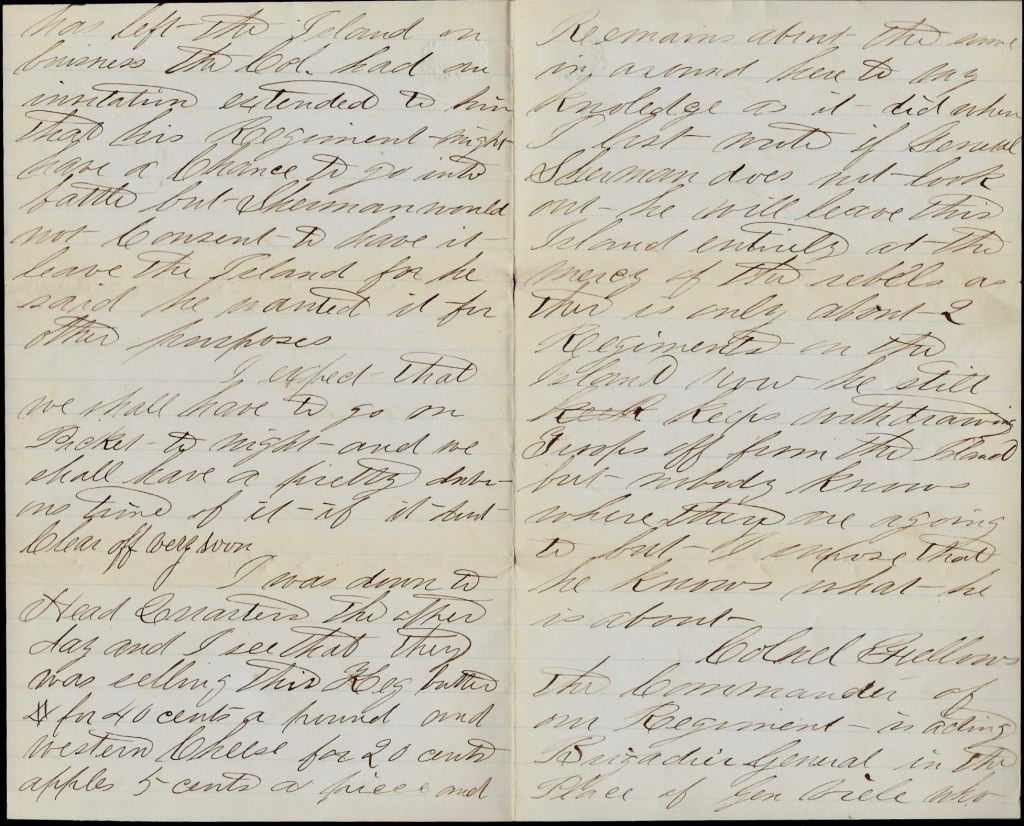
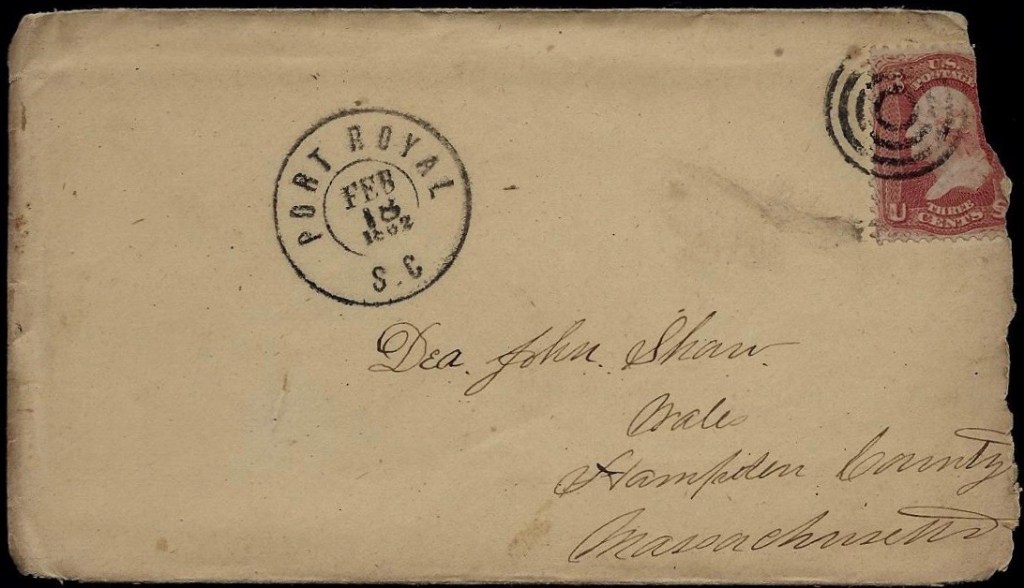


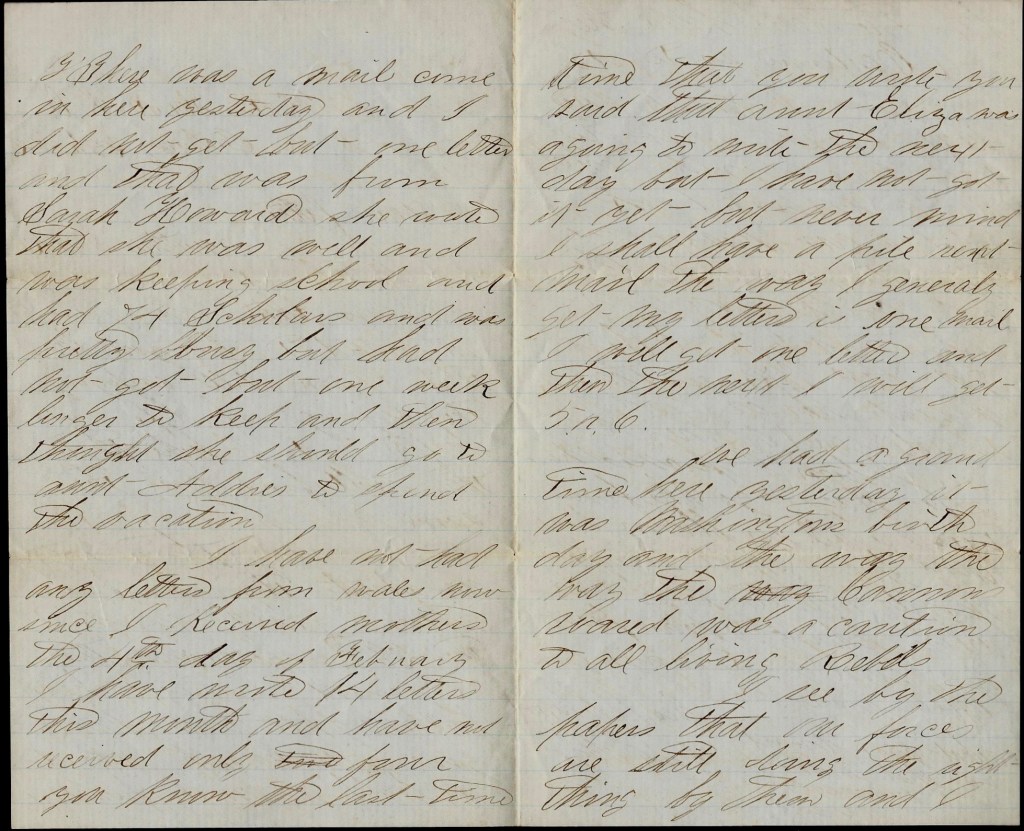

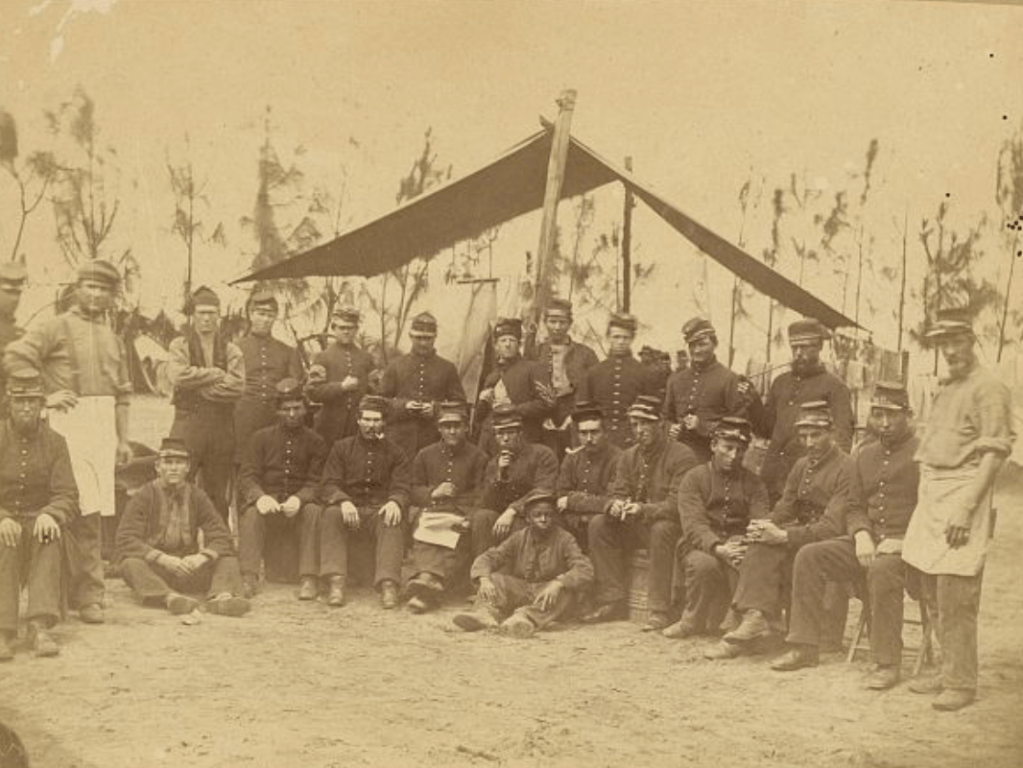
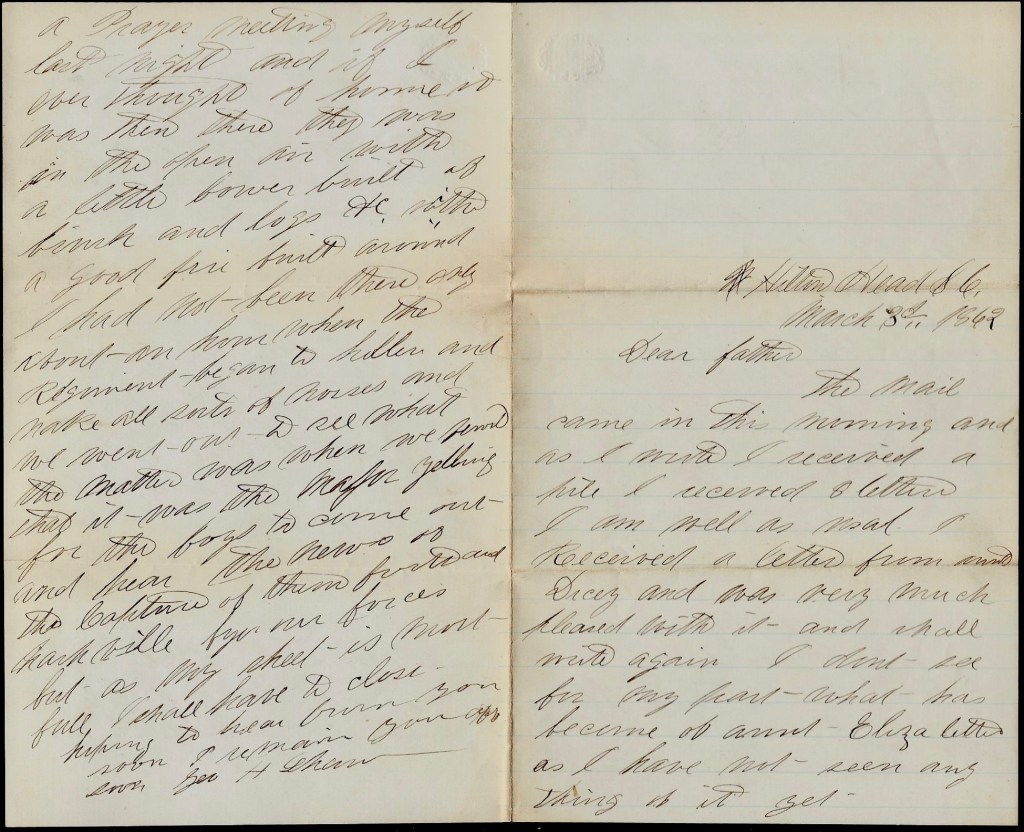


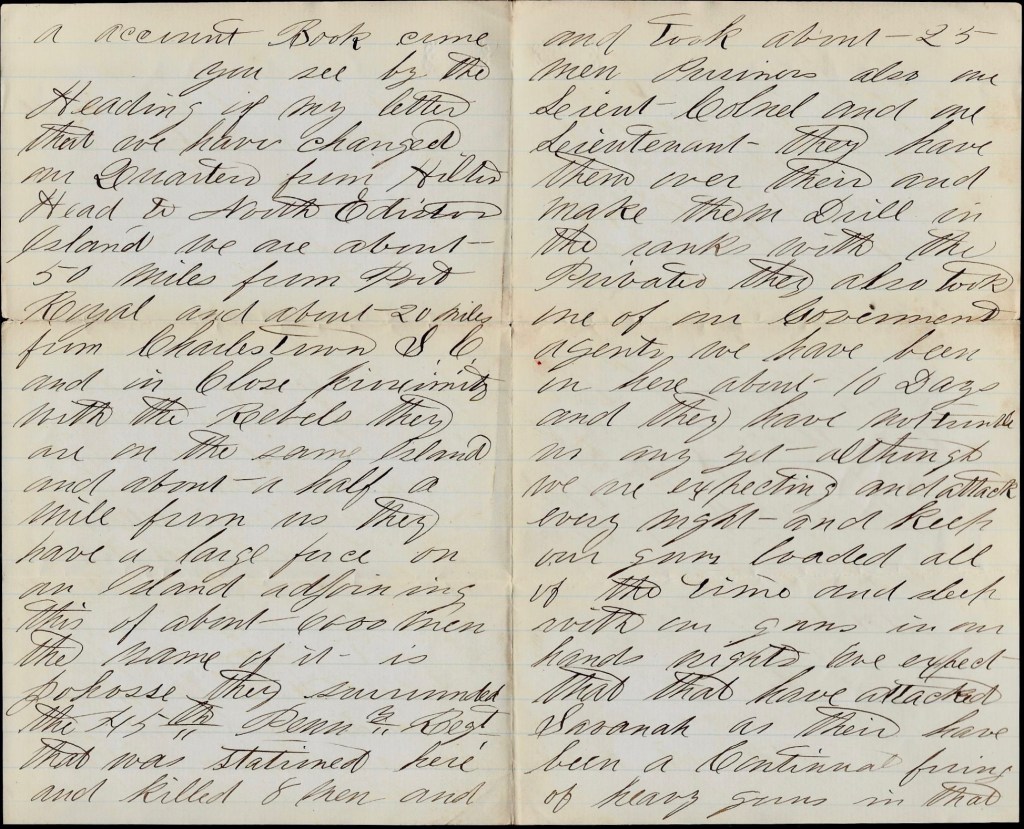


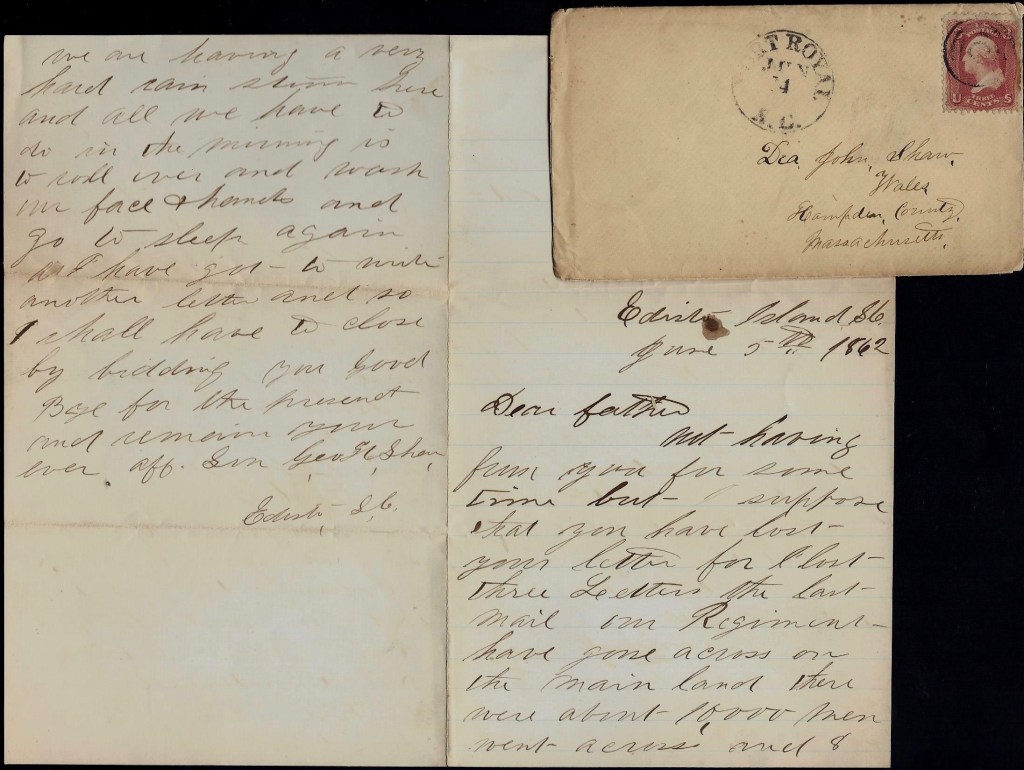


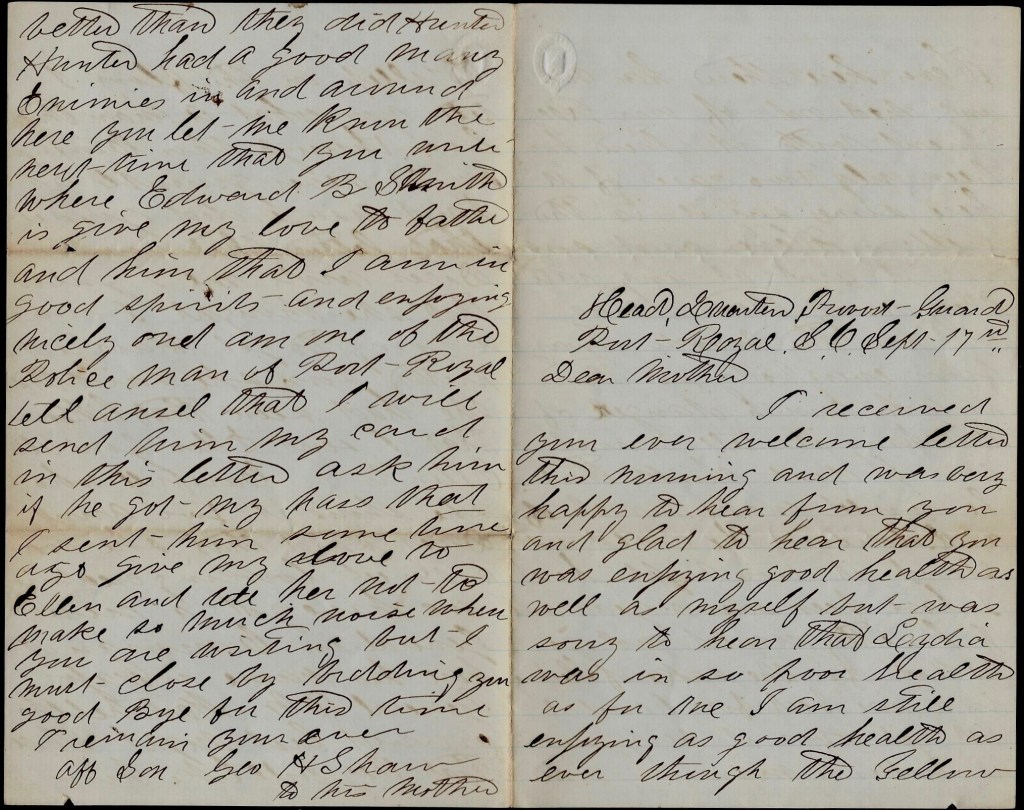


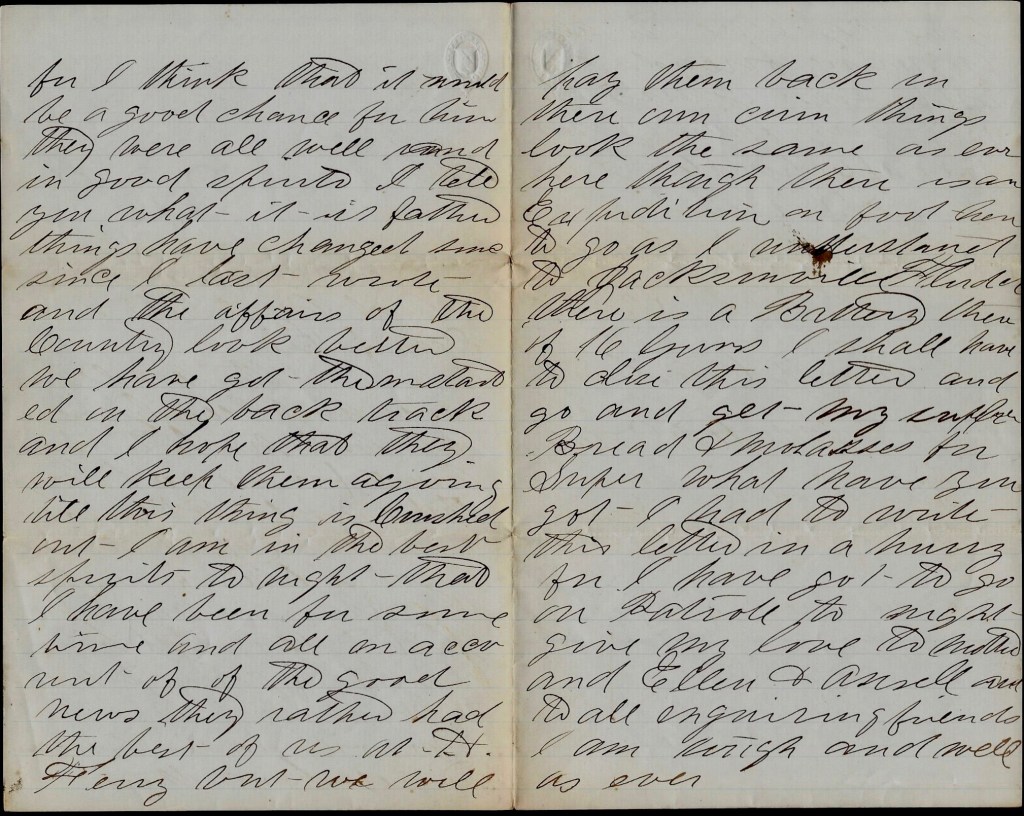


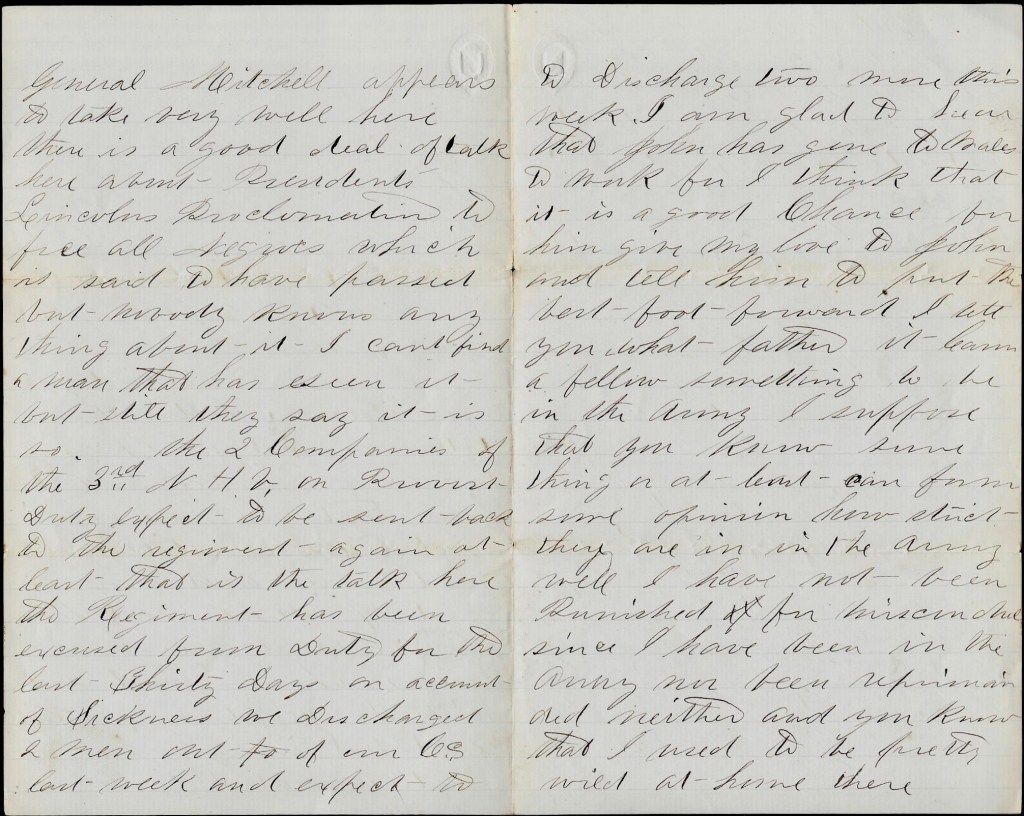


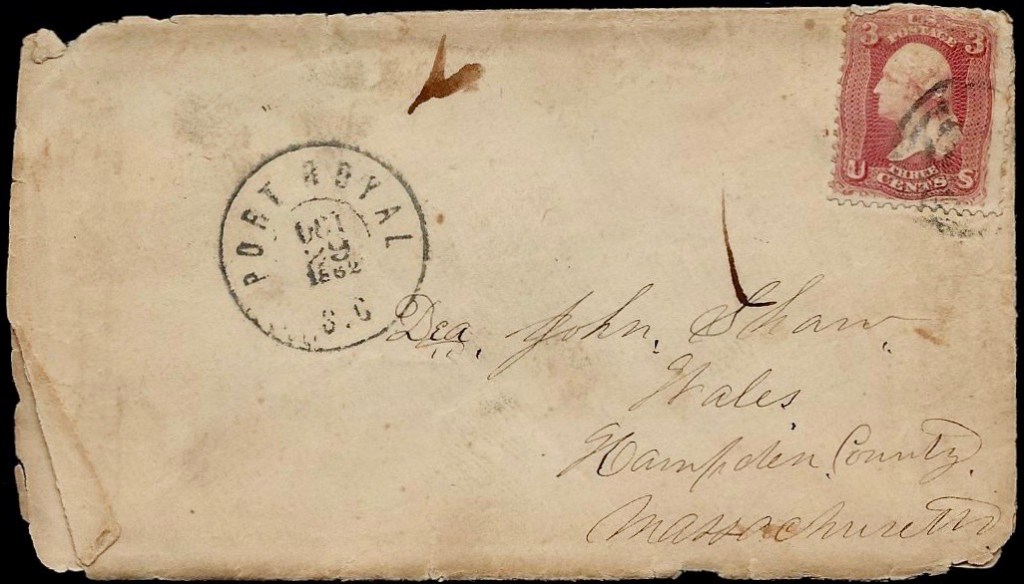

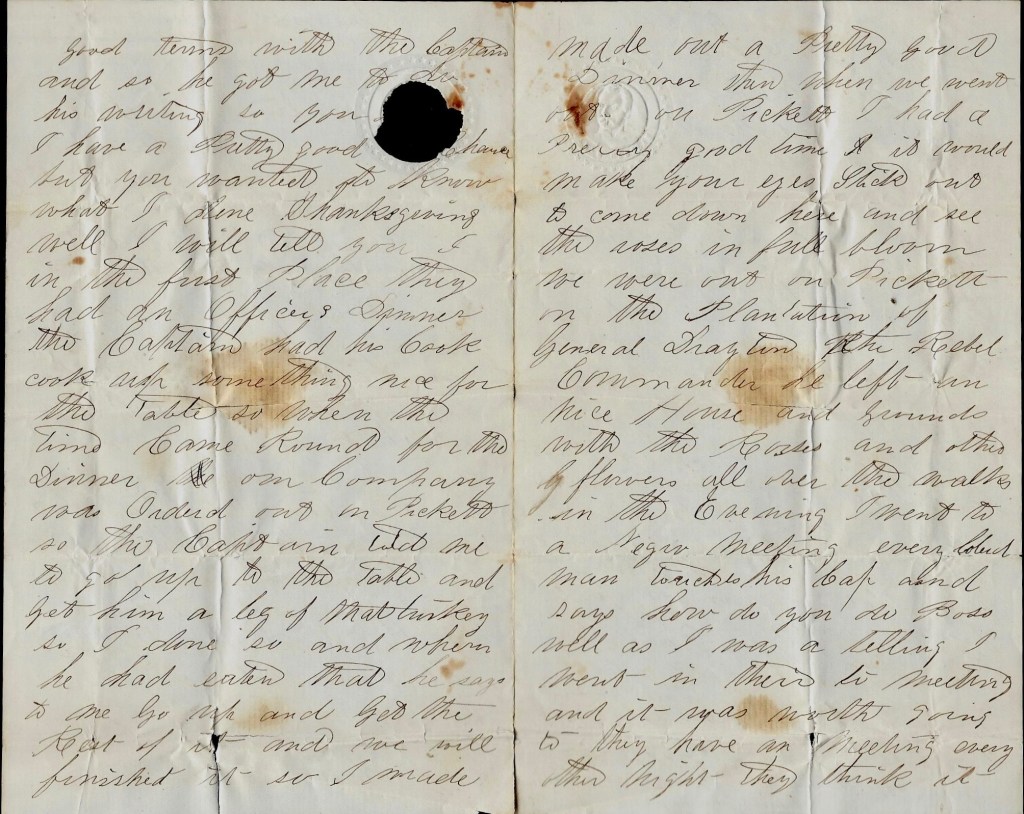
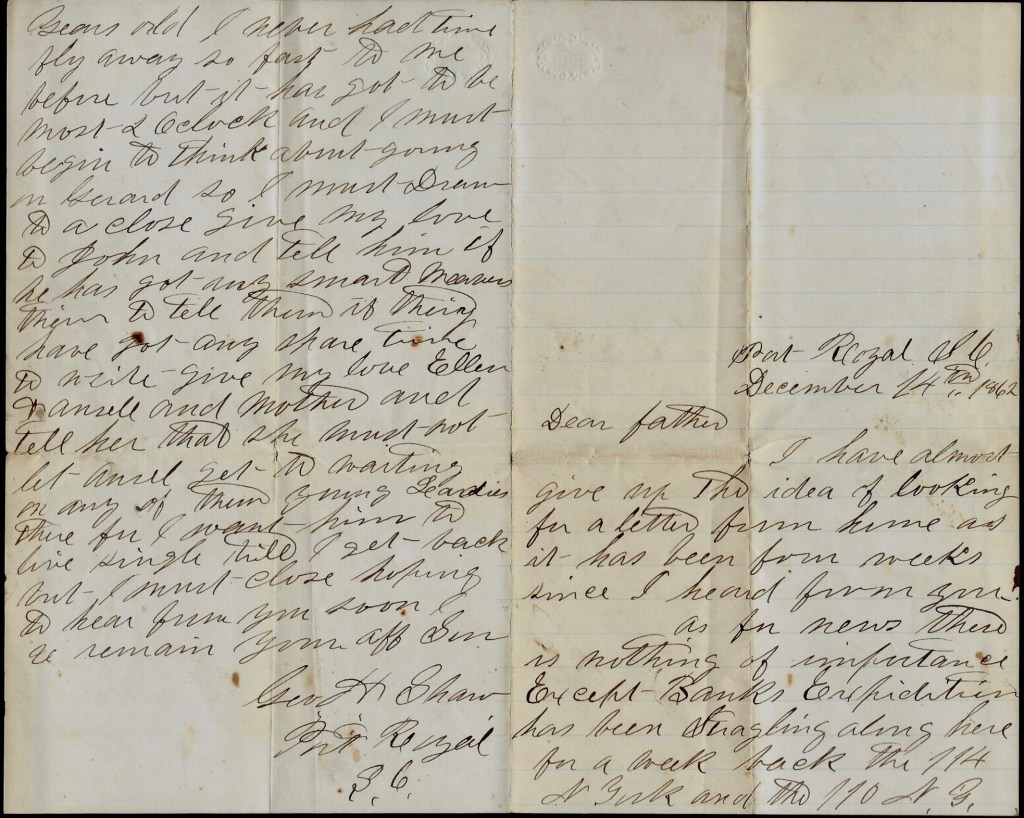

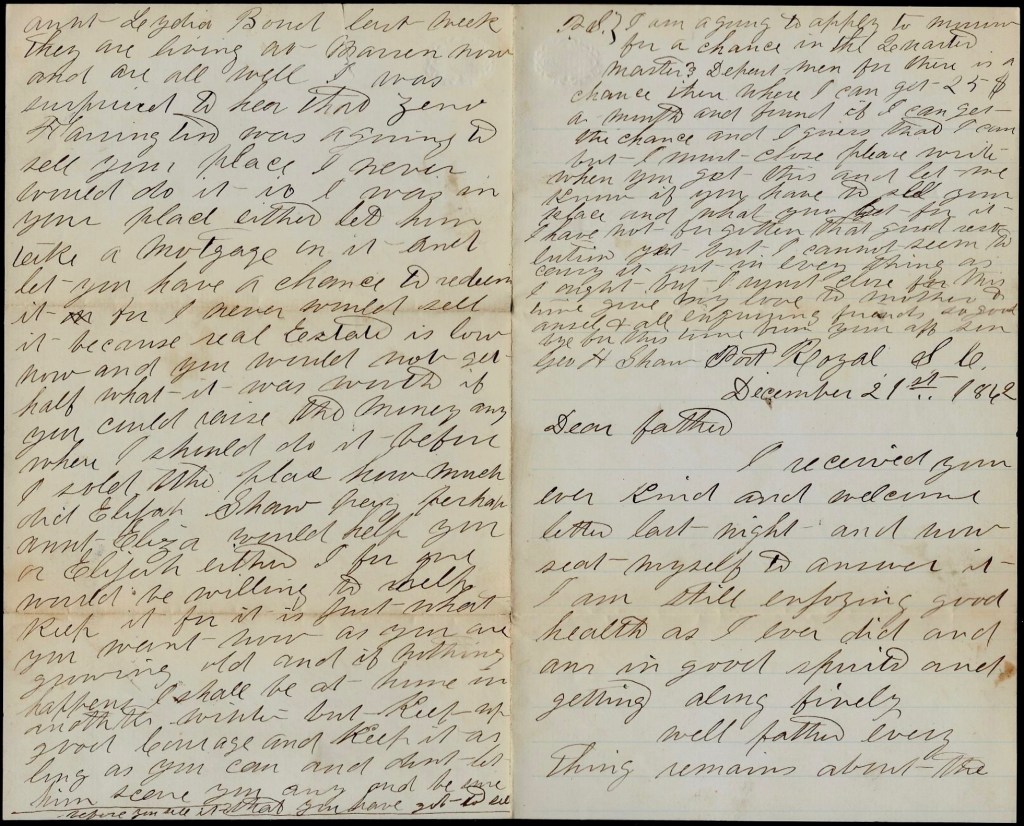

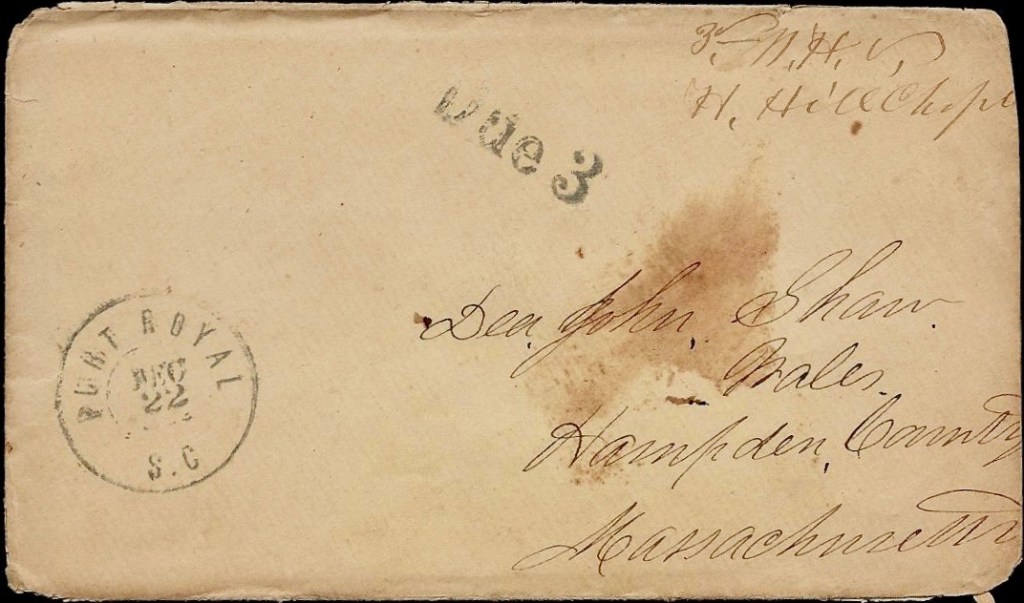

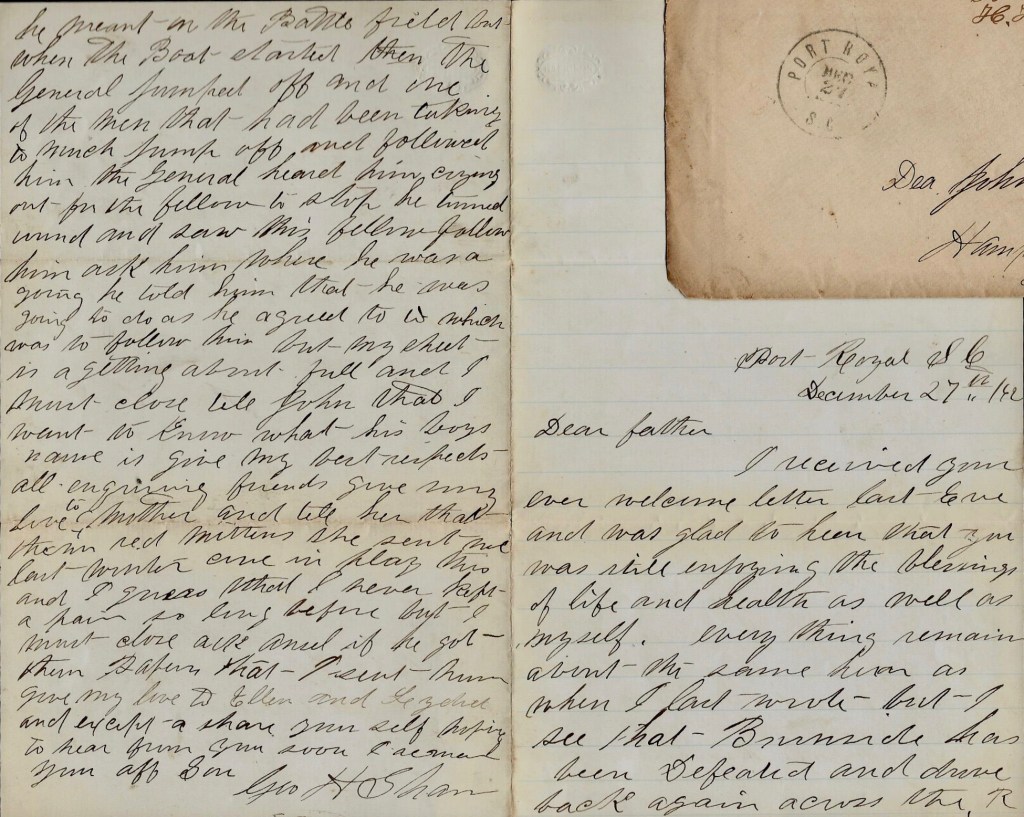


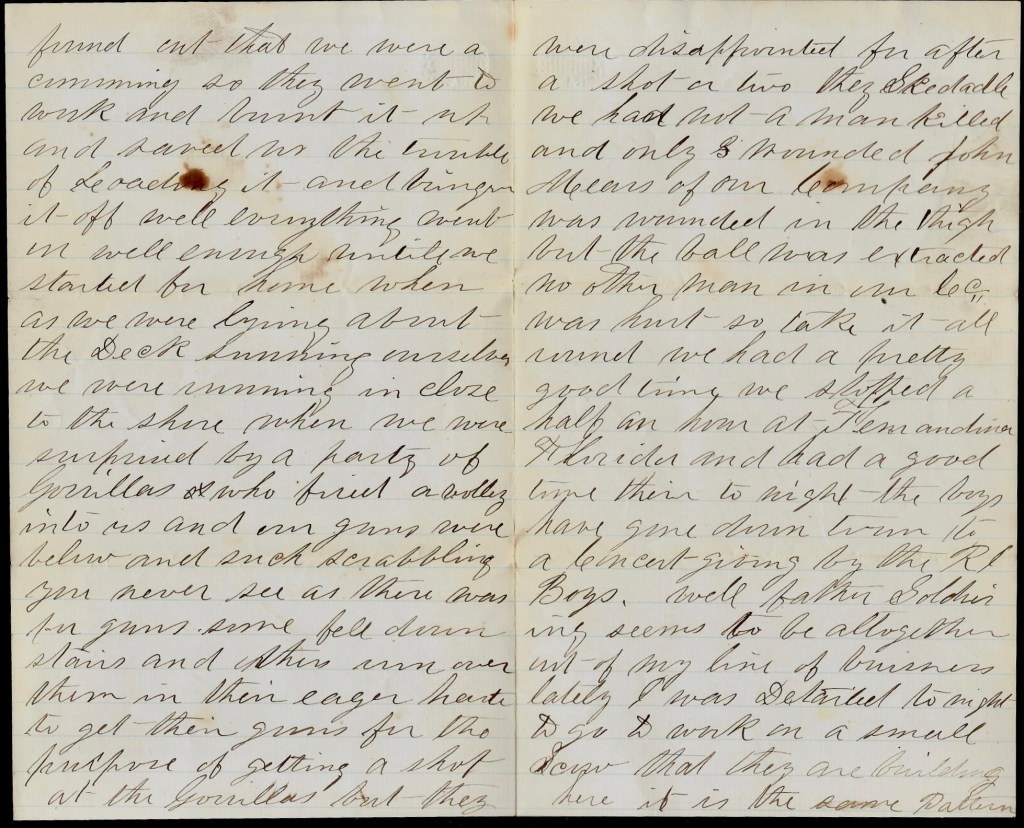

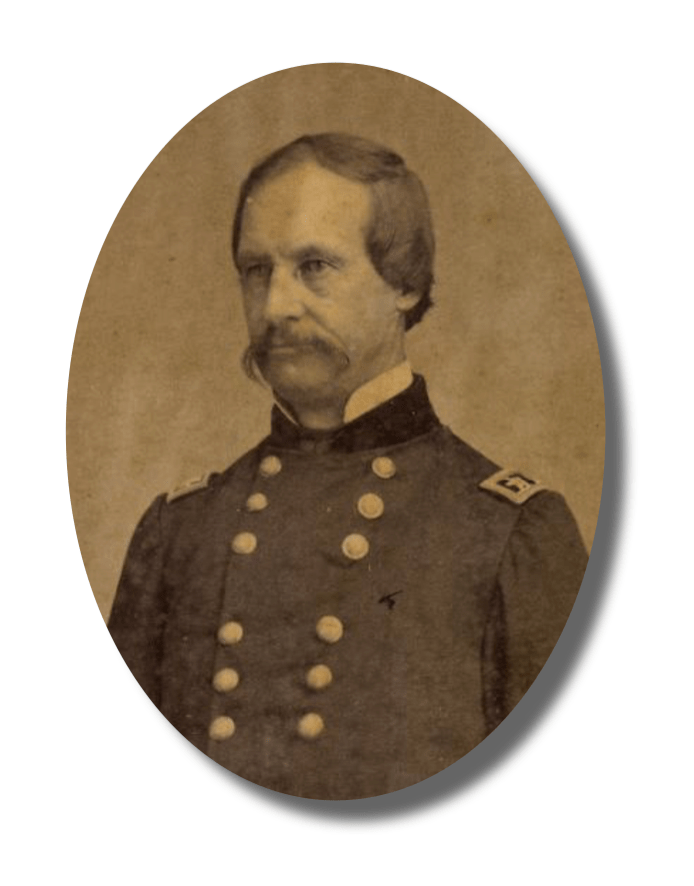
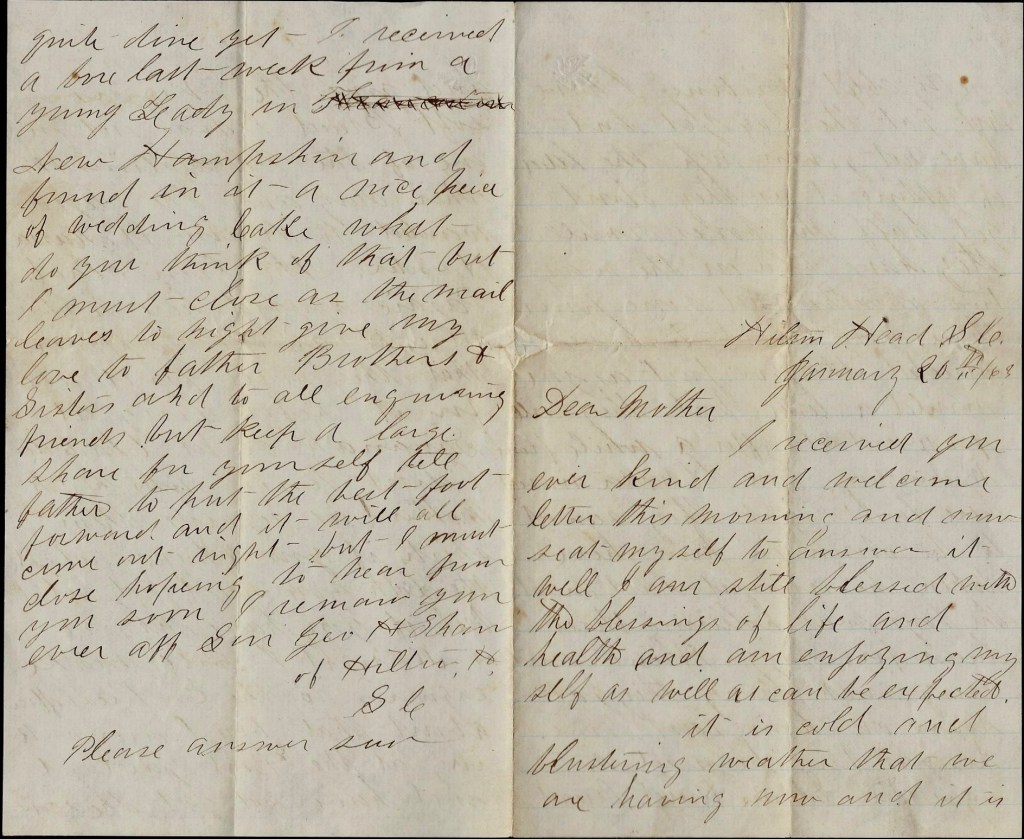
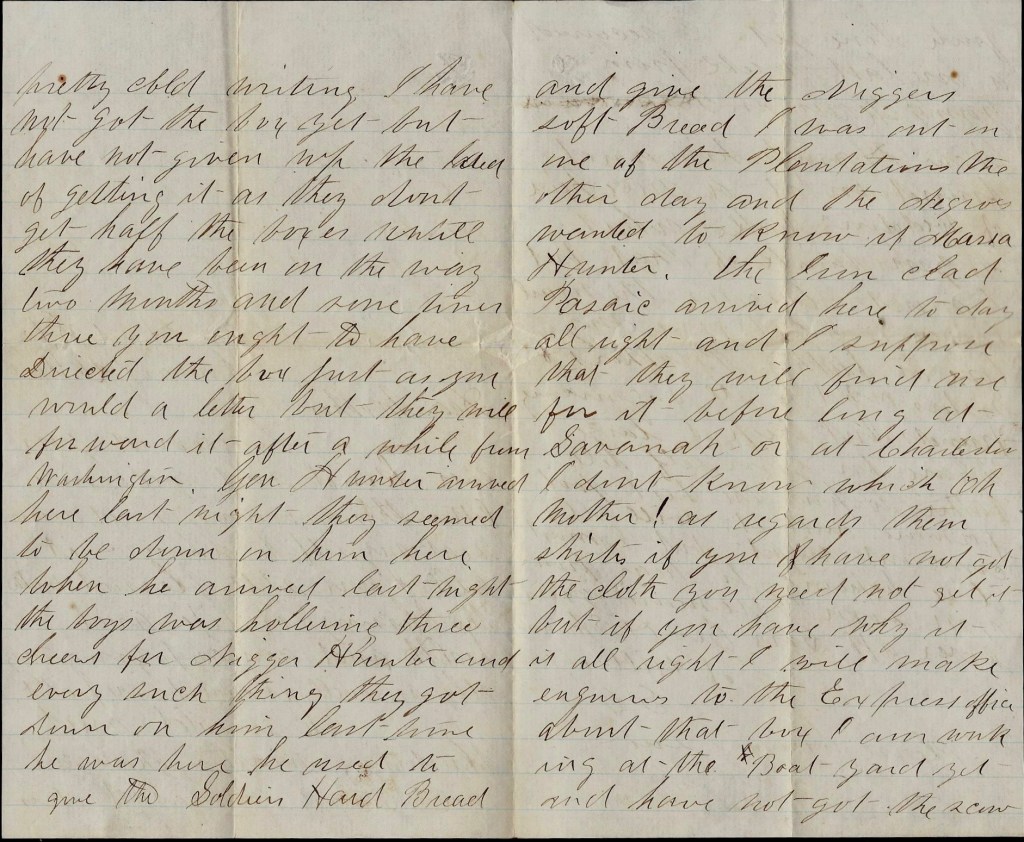


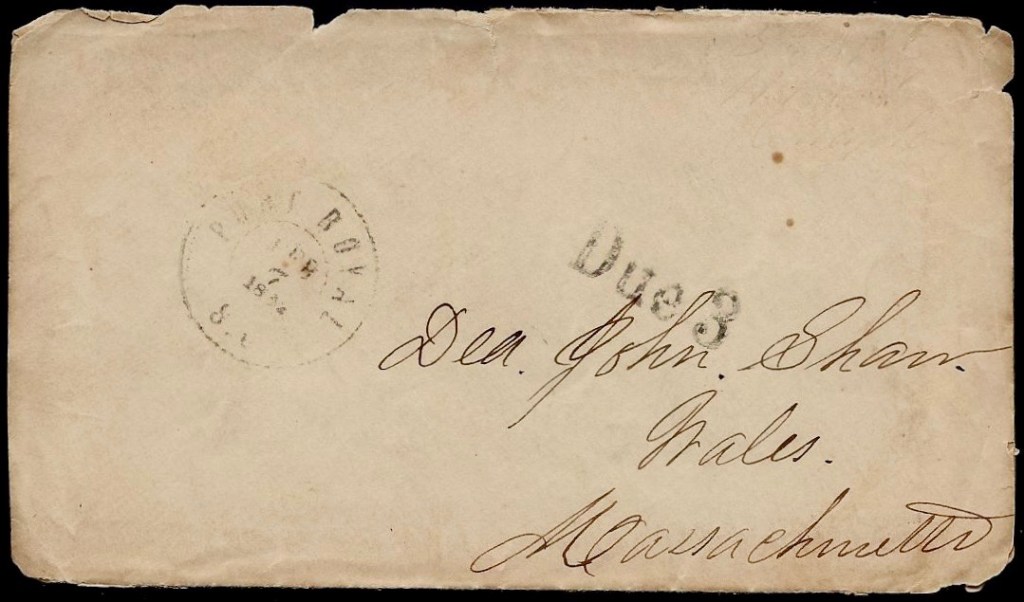


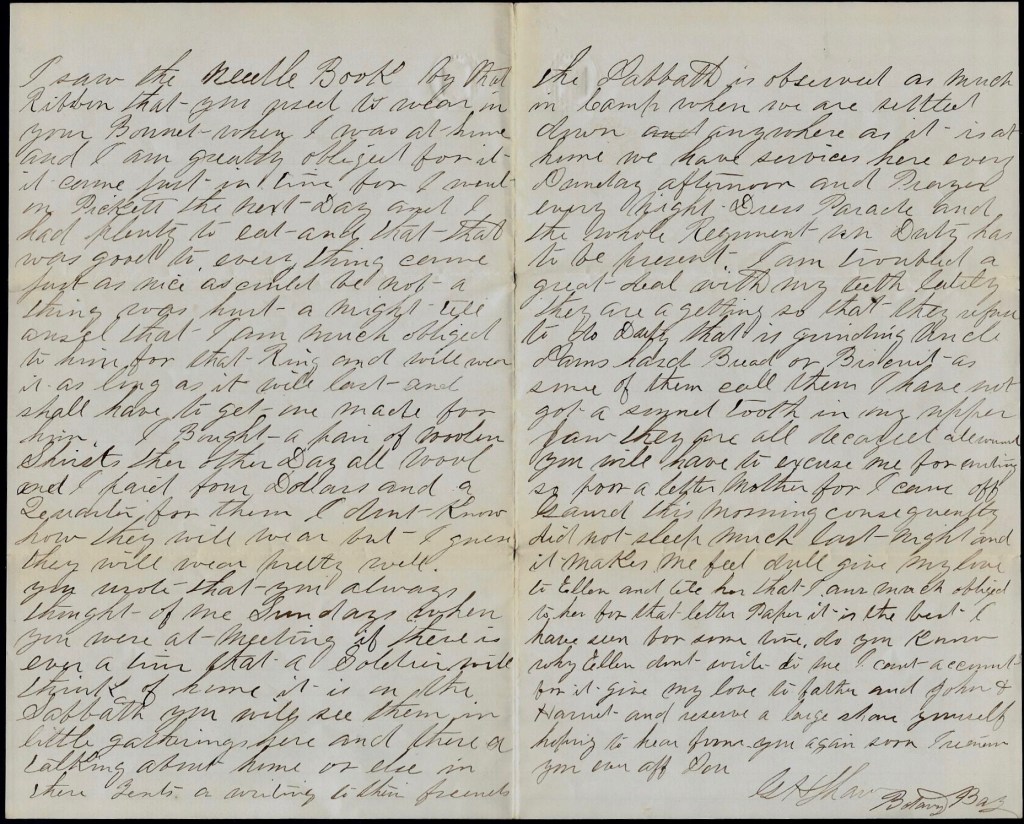
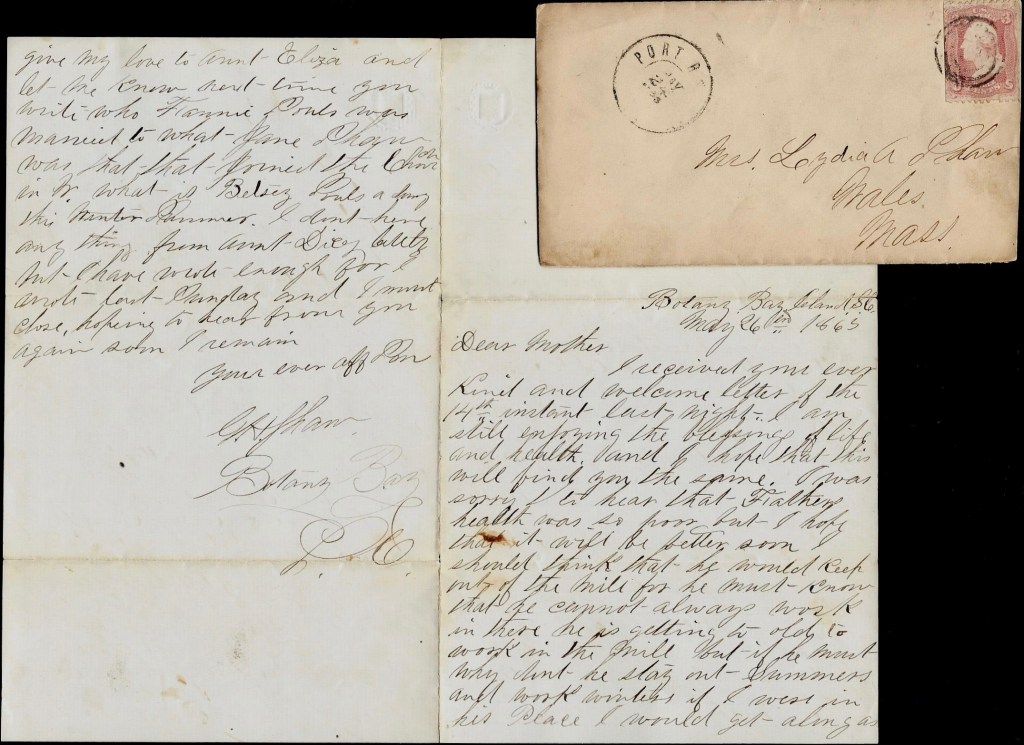






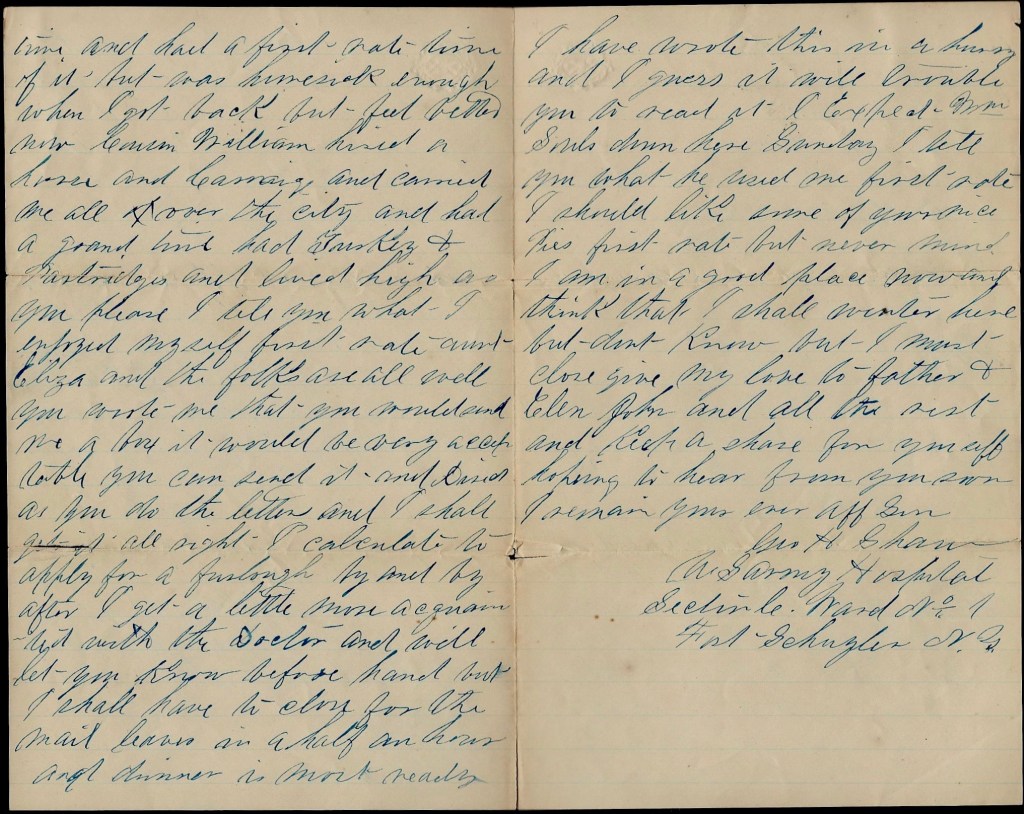


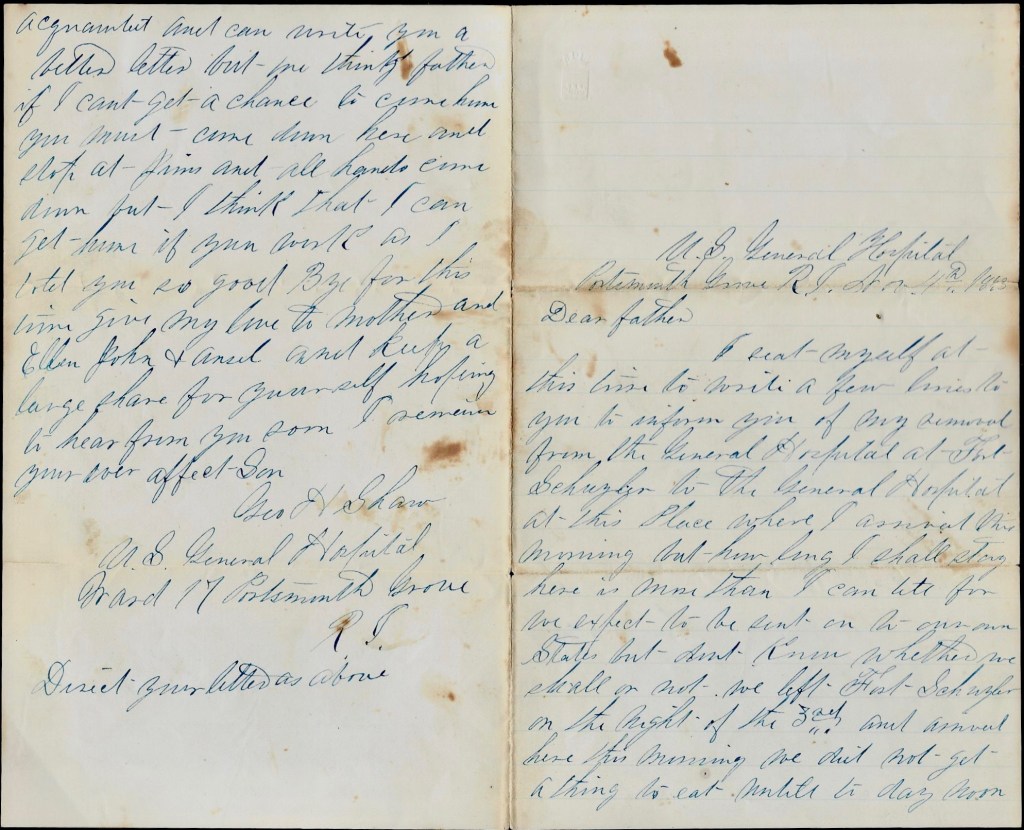
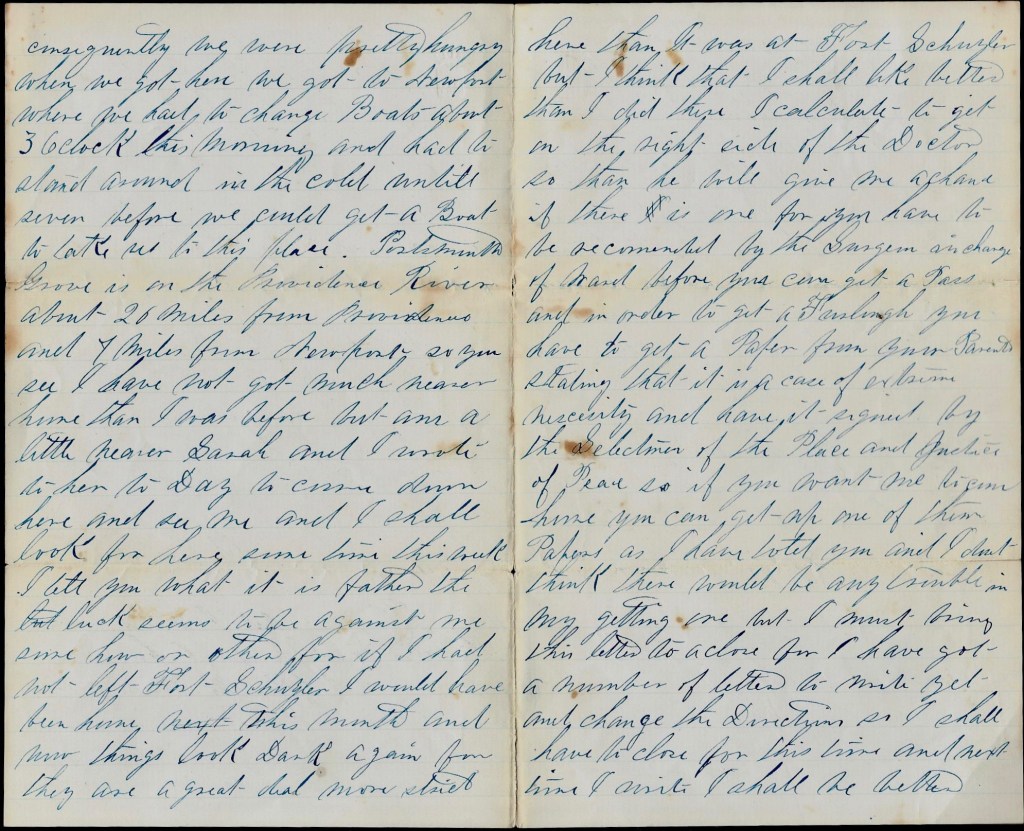
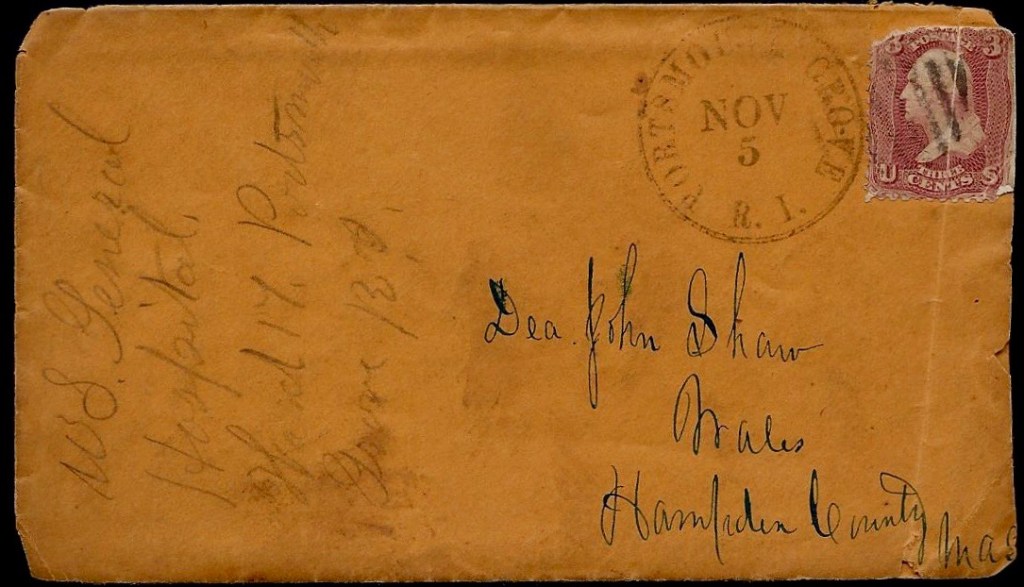
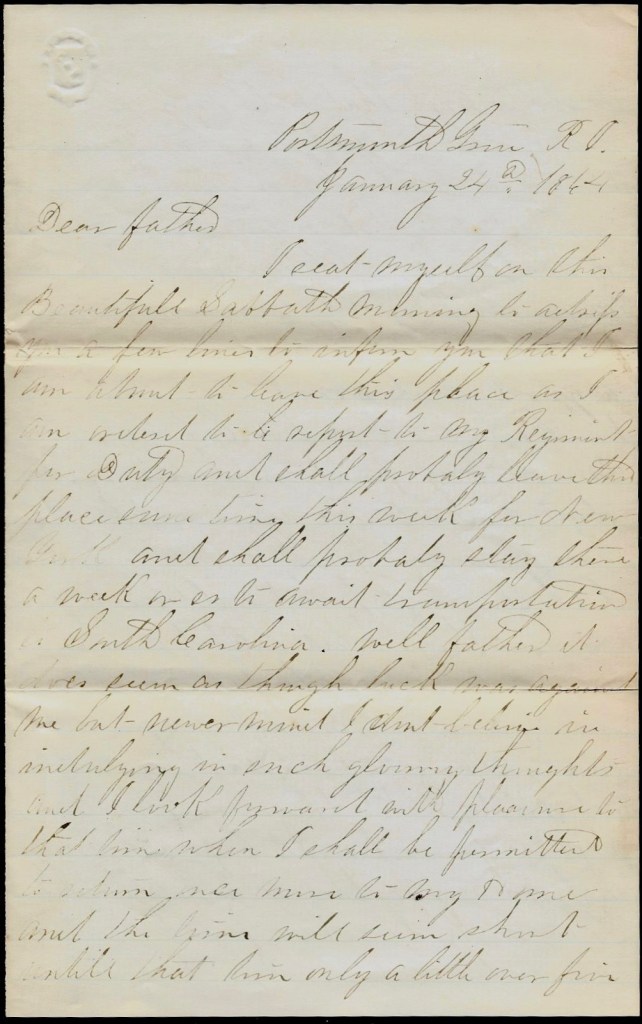
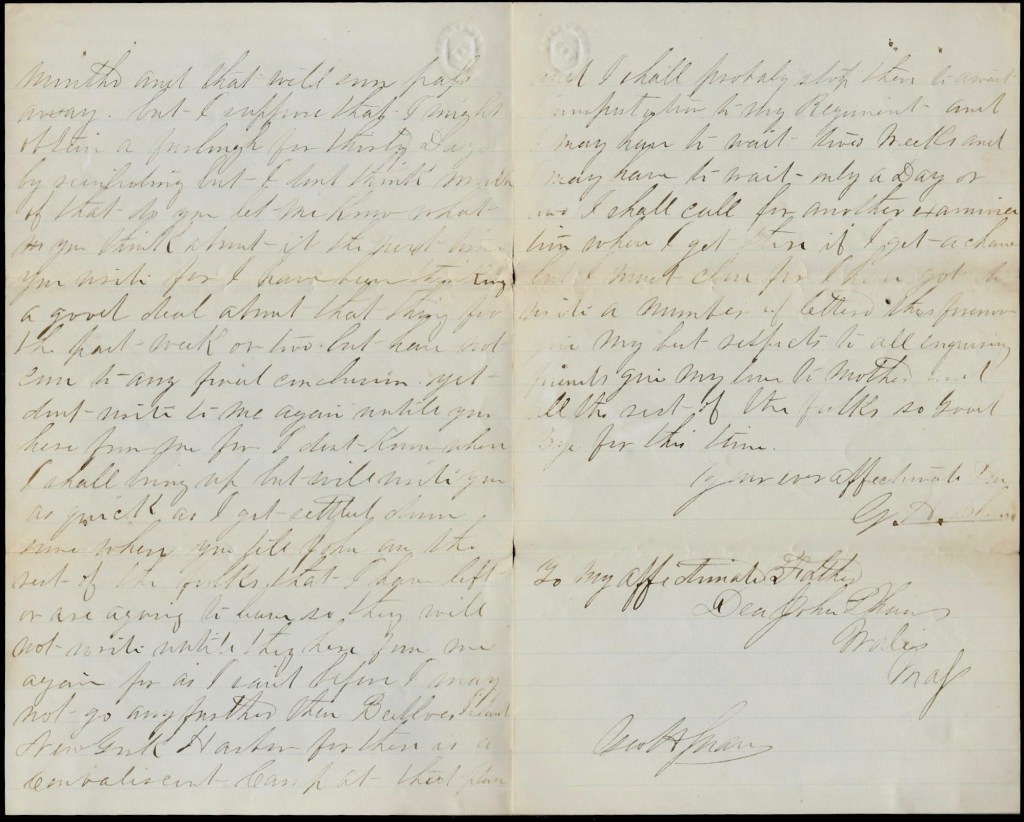
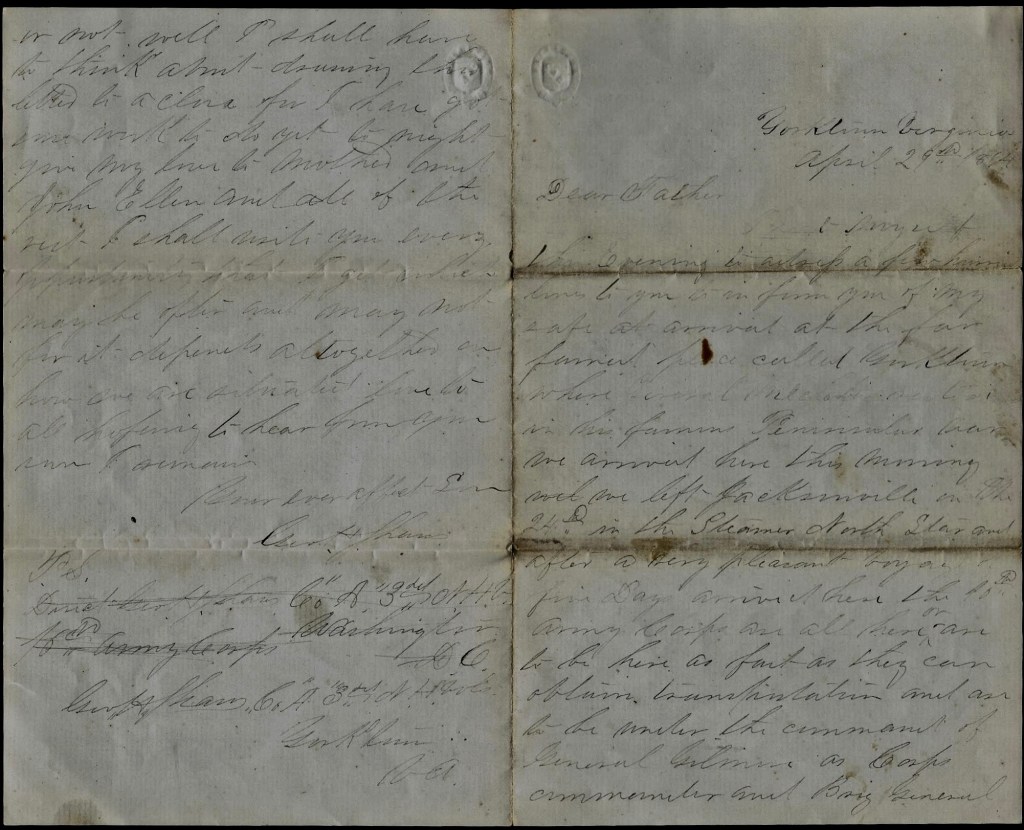


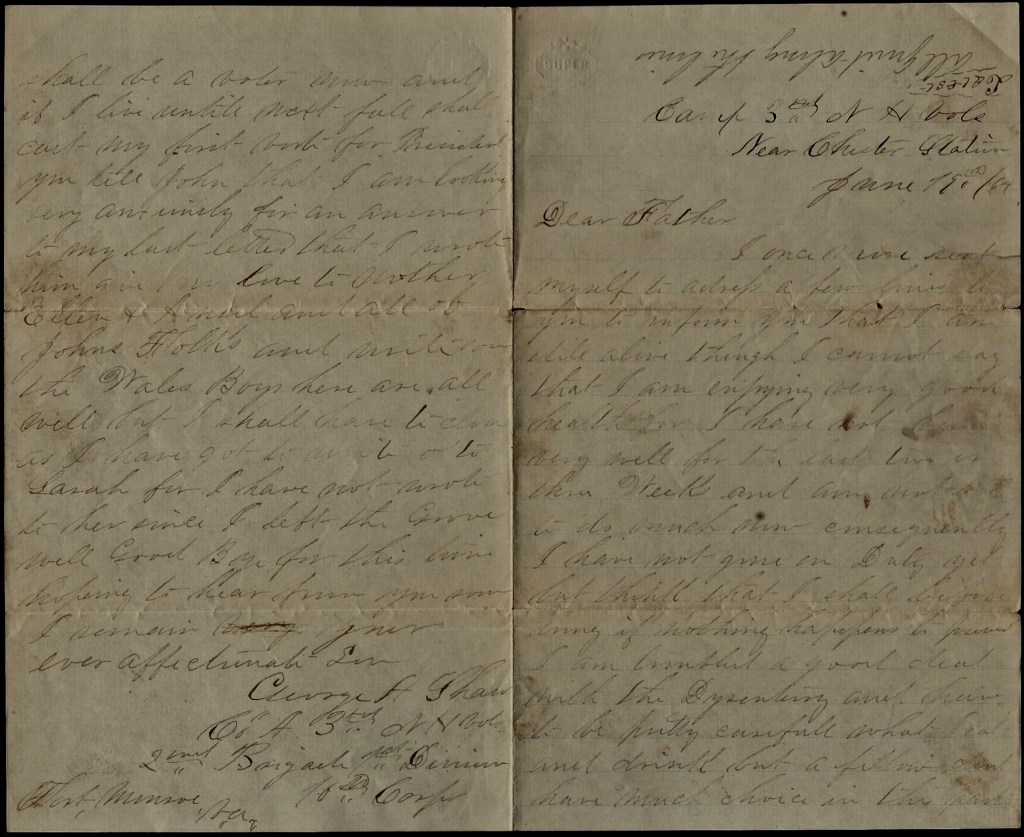


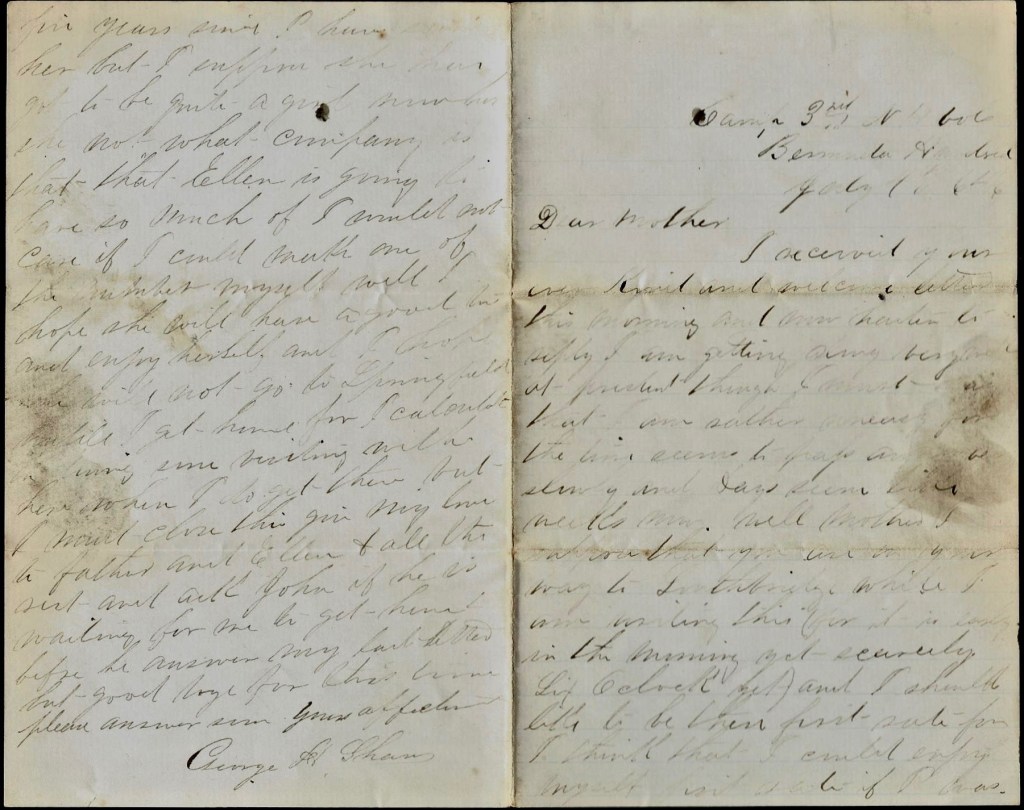


 Spared & Shared 23