The following letter was written by John Whitehead (1820-1864), a 44 year-old English-born tinsmith of Chester, Warren county, New York. He was married in January 1851 to Elizabeth Ann Richardson (b. 1819 in N. York State) and had at least three children ranging in age from 7 to 22 living in his household in 1860, the youngest being John Elam Whitehead (1852-1937).
John began his military service in August 1862 when he was recruited into Co. G, 22nd New York Infantry. When that regiment mustered out in June 1863, he was transferred to Co. C of New York’s 93rd Regiment to complete his three year enlistment. He was wounded in the opening action in the Wilderness but recovered to join his regiment during the siege of Petersburg. He was killed in action on 27 October 1864 near Hatcher’s Run on the Boydton Plank Road near Petersburg, just 5 days after writing this letter to his wife and son. Muster rolls inform us that he was shot through the bowels and lived about 45 minutes before he died. It is presumed he was buried on the battlefield near where he fell.
This letter is from the collection of Sharon Hall and was made available for transcription and publication on Spared & Shared by express consent.
T R A N S C R I P T I O N
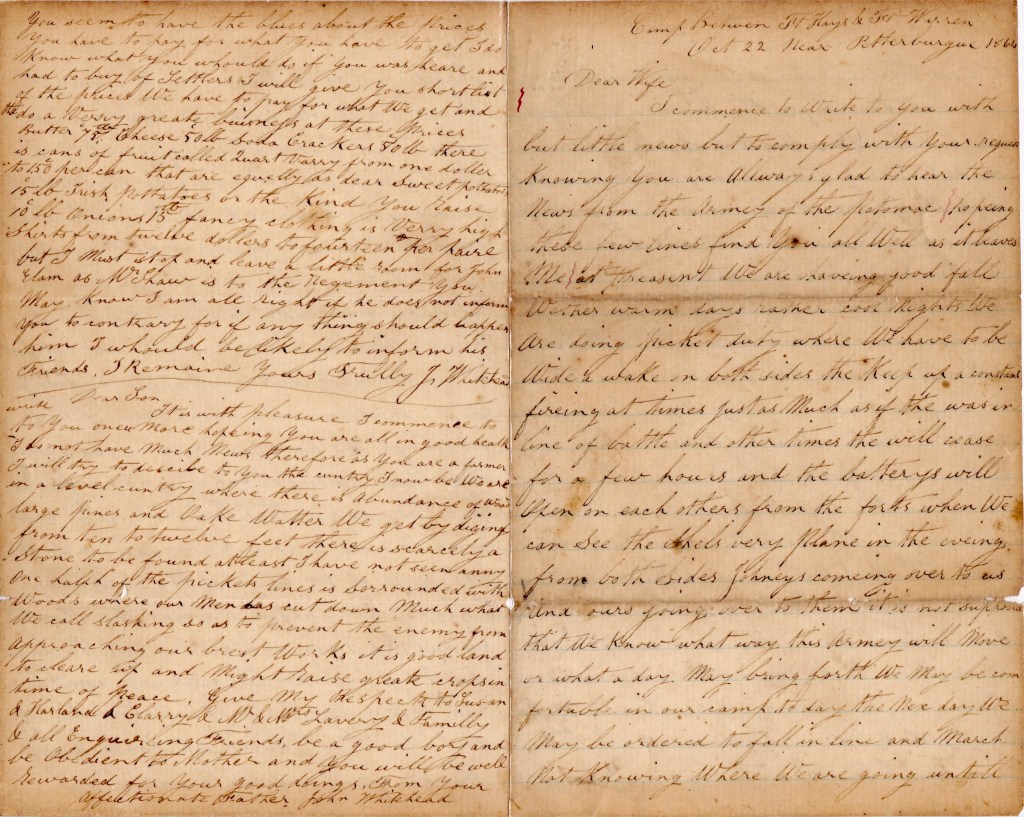
Camp between Ft. Hays and Ft. Warren Near Petersburg, [Virginia] October 22, 1864
Dear Wife,
I commence to write to you with but little news but to comply with your request knowing you are always glad to hear the news from the Army of the Potomac, hoping these few lines will find you all well as it leaves me at present. We are having good fall weather—warm days—rather cool nights. We are doing picket duty where we have to be wide awake on both sides. They keep up a constant firing at times, just as much as if they was in line of battle, and other times they will cease for a few hours and the batteries will open on each other from the forts when we can see the shells very plain in the evening from both sides. Johnnies coming over to us and ours going over to them.
It is not supposed that we know what way this army will move or what a day may bring forth. We may be comfortable in our camp today, [and] the next day we may be ordered to fall in line and march, not knowing where we are going until we get there. So this is the way our army goes. But it is all for the Union. It is not for me to dictate how this war should be carried on, but many times I cannot help thinking how things are managed and it is good school to see the various characters and dispositions of mankind. There are many selfish and void of principles of any good but to fraud the government, while there are others that are always in their place and are true to themselves and their country. While I may say there is quite an army between here and the City of New York—able bodied men playing off in the hospitals, while we have men at [the] front, if they had their just dues, would be at the hospital or have their discharge. I cannot begin to pen down the money frauds and impositions on this government. But we have men that care no more for our cause than Old Jeff Davis. [They care] no more than to make money and rob our government all they can. But I must stop before you get tired out of patience on this subject.
“…I am for the Union and Old Abe with strong faith that he will be our next President. I do not know what you feel or think but it is cheering to me to think, if health permit, that we may be free once more and return to our home…”
— John Whitehead, 93rd New York Vols., 5 days before he was killed
I will not write much on politics. If I do, I would not know when to stop until this sheet was filled. But I will say so far that I am for the Union and Old Abe with strong faith that he will be our next President. I do not know what you feel or think but it is cheering to me to think, if health permit, that we may be free once more and return to our home to look back at the last two years. To me it seems but a short space of time although we have seen some sad scenes in that time amongst our neighbors [and] friends. But the hopes that this war will soon come to a close and knowing I am on the last year of the term of my enlistment, I have got so I begin to count the months by and by. I am in hopes this war will come to an end before my term of enlistment is up, but we must cheer up, hoping all things will end well and soon.
You seem to have the blues about the prices you have to pay for what you have to get. I do[n’t] know what you would do if you was here and had to buy off sutlers. I will give you a short list of the prices. We have to pay for what we get and they do a very great business at these prices. Butter 75 cents, cheese 50 cents a pound, soda crackers 50 cents per pound/ There is cans of fruit called Quart Varry from one dollar to $1.50 per can that are equally as dear. Seet potatoes 15 cents a pound, Irish potatoes or the kind you raise 10 cents a pound, onions 15 cents a pound. Fancy clothing is very high. Shirts from 12 dollars to 14 per pair. But I must stop and leave a little room for John Elam as Mr. Shaw is to the regiment. You may know I am alright if he does not inform you to the contrary for if anything should happen to him, I would be likely to inform his friends. I remain yours truly, — J. Whitehead
Dear Son, it is with pleasure I commence to you once more hoping you are all in good health. I do not have much news, therefore as you are a farmer, I will try to describe to you the country I now be. We are in a level country where there is abundance of wood—large pines and oak. Water we get by digging from ten to twelve feet. There is scarcely a stone o be found—at least I have not seen any. One half of the picket lines is surrounded with woods where our men has cut down, much what we call slashing so as to prevent the enemy from approaching our breastworks. It is good land to clear up and might raise great crops in times of peace.
Give my respects to Susan & Harland & Clarry & Mr. & Mrs. Lavery & Family & all enquiring friends, Be a good boy and be obedient to Mother and you will be well rewarded for your good doings. From your affectionate father, — John Whitehead
The following letter was written by Thomas McCormick (1841-1915), the son of John Morrison McCormick (1812-1888) and Martha Guyton (1813-1856) of Martin, Allegan county, Michigan. Thomas enlisted in Co. B, 19th Michigan Infantry on 6 August 1862 when he was 20 year old. During June 1864 he is listed as “absent, wounded.” His muster roll records estimates that he was wounded on or about the 15th day of June 1864. He was mustered out at Washington D. C. on 10 Jun 1865.
T R A N S C R I P T I O N
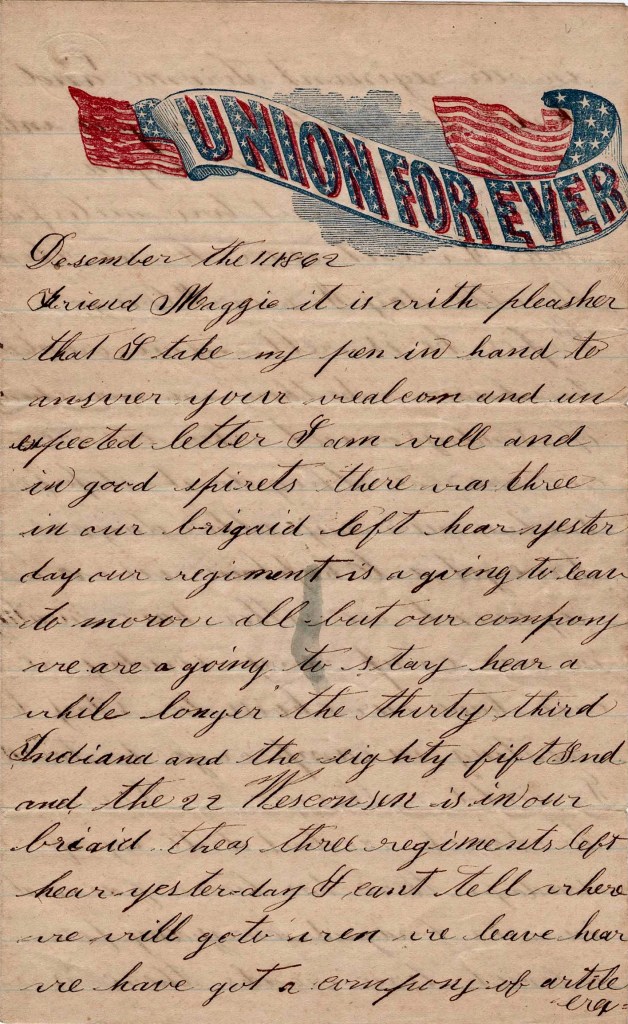
[Camp near Lexington, Kentucky] December 11, 1862
Friend Maggie,
It is with pleasure that I take my pen in hand to answer your welcome and unexpected letter. I am well and in good spirits. There was three in our brigade left here yesterday. Our regiment is a going to leave tomorrow—all but our company. We are a going to stay here a while longer. The 33rd Indiana and the 85th Indiana and the 22nd Wisconsin is in our brigade. 1 These three regiments left here yesterday. I can’t tell where we will go to when we leave here.
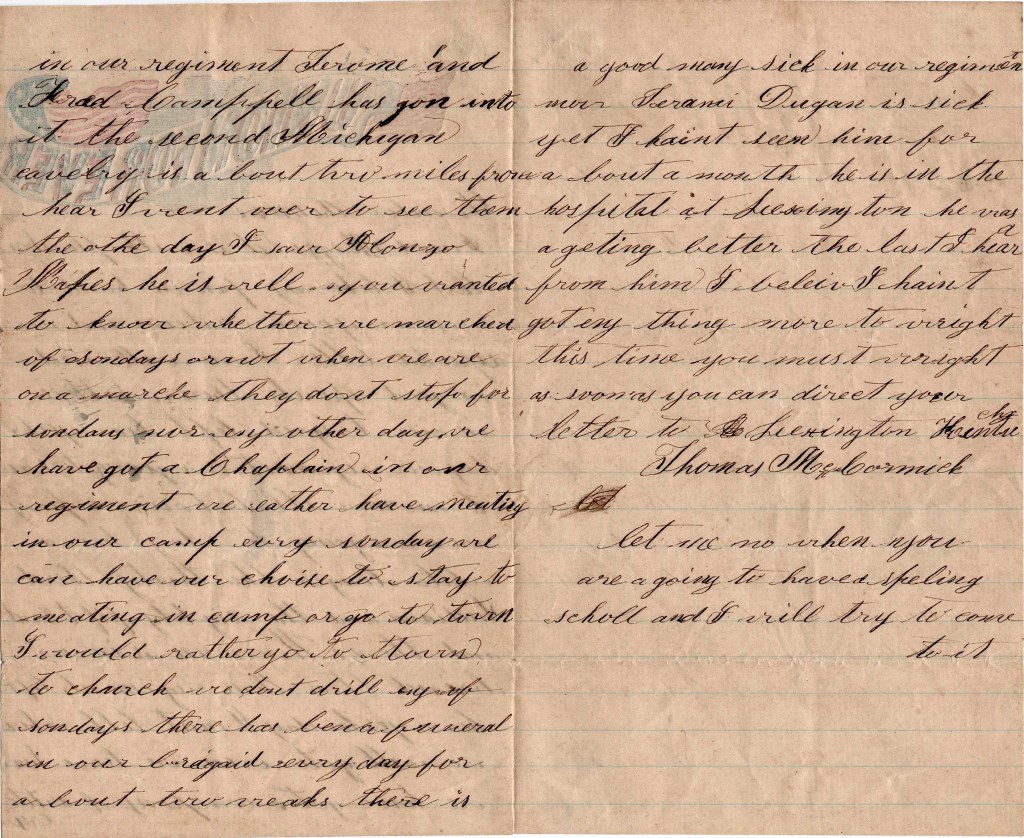
We have got a company of artillery in our regiment. Jerome and Fred Campbell has gone into it. The 2nd Michigan Cavalry is about two miles from here. I went over to see them the other day. I saw Alonzo Mapes. He is well.
You wanted to know whether we marched on Sundays or not. When we are on a march, they don’t stop for Sundays nor any other day. We have got a chaplain in our regiment. We have meeting in our camp every Sunday. We can have our choice to stay to meeting in camp or go to town to church. We don’t drill any of Sundays. There has been a funeral in our brigade every day or about two weeks. There is a good many sick in our regiment. Mr. Jerome Dugan is sick yet. I hain’t seen him for about a month. He is in the hospital at Lexington. He was a getting better the last I heard from him. I believe I hain’t got anything more to write. As soon as you can, direct your letter to Lexington, Kentucky.
— Thomas McCormick
Let me know when you are a going to have a spelling school and I will try to come to it.
1 In October 1862, at the height of hurried recruiting activities when it appeared Confederate forces campaigning in Kentucky would cross the Ohio and invade the Upper Midwest, the 85th Indiana, the 33rd Indiana, the 19th Michigan, and the 22nd Wisconsin regiments were assembled into a brigade under Coburn’scommand.
The following letter was written by John Henry Hedges Cross (1840-1926), the son of Henry Cross (1814-1888) and Catherine Hedges (1816-1888). John wrote this letter in November 1862 while serving in Co. H, 31st Iowa Infantry. His father was also in the service as a member of Co. D, 9th Iowa Infantry (from September 1861 to September 1864). He was wounded slightly in the shoulder at Pine Ridge, Arkansas.
John H. H. Cross enlisted on 14 August 1862 in the 31st Iowa Volunteers and was mustered into the service in mid September 1862 at Camp Herron in Davenport. He remained in the service for his full term of three years, mustering out on 27 June 1865. A few years after the war he married Melissa Mercy Bullock (1840-1923) and lived in Marshall county, Iowa, for a few years before moving to Nebraska.
John H. H. Cross, his wife Melissa, and their three sons, Zenas, Earnest and William (ca. 1900)
To read other letters by members of the 31st Iowa that I have previously transcribed and posted on Spared and Shared, see:
To read a diary kept by an unidentified soldier of the 31st Iowa Infantry between 4 September 1862 to 30 September 1864 housed at the Missouri Historical Society (that does not appear to have been transcribed), see: Diary of Unidentified soldier of the 31st Iowa Infantry.
T R A N S C R I P T I O N
Benton Barracks, St. Louis, Mo. Co. H, 31st Regiment Iowa Vols. November 6, 1862
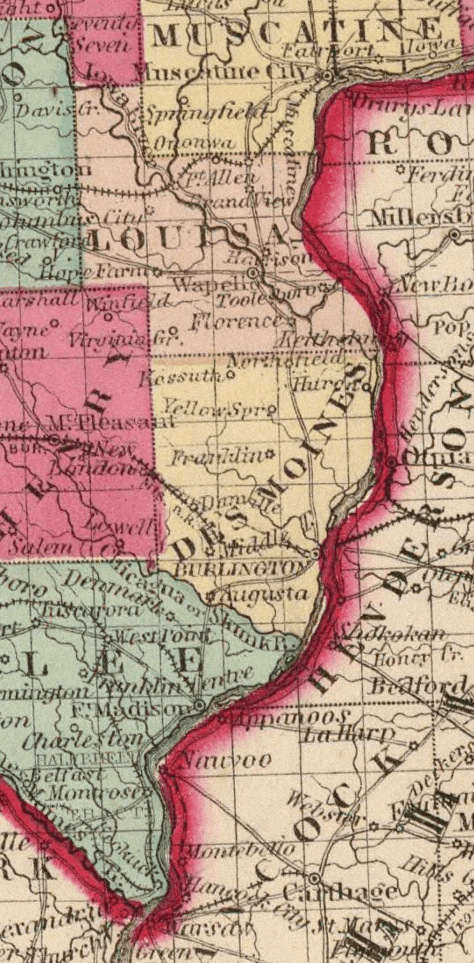
Stretch of the Mississippi River from Muscatine to Keokuk, Iowa (1860)
Dear Mother,
I take this blessed opportunity of writing to you to let you know that I am well and hope these few lines will find you enjoying the same blessing from God, the bountiful giver of all good.
I left Camp Herron [Davenport, IA] last Saturday in the afternoon and started for St. Louis and arrived here safe and sound on Tuesday night about 7 o’clock. Now I will endeavor to give you a description of the trip.
November 1st, left Camp Herron and got on board of the [steamer] Sucker State1 in the evening about 8 o’clock and started at 10 and arrived at Muscatine [City] at 1 o’clock at night, November 2nd, and in the morning when I waked up, it was snowing like all fury. It was rather a cold time but we got along pretty well. About noon it turned warm and pleasant. Towards night we landed at a little town by the name of Pt. Ross 2 and there we got off and some supper and after supper, we went on the boat and stayed all night.
The next morning, November 3rd, we left the boat and took the cars for Keokuk. We arrived at the city at 8 in the morning and there we got breakfast. George Foster and myself got the breakfast for one mess. We stayed there about noon waiting for the boat to come down over the rapids and to unload some freight, and then we went on the old Sucker State again. It is one of the dirtiest boats that I ever seen and just before sundown the boat got stuck on a sand bar and was out of wood. The [boat] hands took a skiff and went to shore, got a flatboat load of wood and then we got off and started for Dixie but it was after dark when we got started. The weather was very pleasant.
November 4th, when the sun rose, my eyes could see the land of Missouri. It is a hard looking country and Illinois is not much better down here but the people are more like somebody. The weather is not quite so pleasant today as it was. The wind blows from the south and makes it disagreeable. But I have not had anything on but my blouse coat since I left Keokuk. We arrived at St. Louis in the evening and stayed on the boat all that night and most of the next day.
Sewall S. Farwell was the Captain of Co. H, 31st Iowa Infantry (Iowa Civil War Images)
November 5th, I went off of the boat and there I saw William Gates. He was taken prisoner at Shiloh. He belongs to the 20th Illinois. I saw John Conklin, He eat dinner with us. After dinner I went out in the city and the first man that I saw was Felix Basinger and pretty soon I met Jake Barnhill and Fred Houses and Larve [?] Smith. They were on their way to Kentucky. They were going as bridge builders.
St. Louis is a large city. I have not saw a frame house yet. They are all brick and stone and when I got back, the regiment had orders to march to Benton Barracks. We started from the boat after dark and arched up there. Some of the boys were almost tired out and when I got to the barracks, there came in John Hubanks and Steve Collins. They were glad to see their old neighbors. John has been sick.
November 6th, after breakfast I started to see the new home and first thing I knew I met James Wright. He is sick. He left the regiment three weeks ago. He said that Father was limping round with his cane. There is several of our company sick. Jacob Dreibelbis, S[amuel] J. Nelson, William Barnhill, William Whitmore, S[amuel] Williamson, L[eroy] Burnight. Them was left at Camp Herron and Merve [Mervin] Nelson, R[obert] Nelson, B. Jarret, [James] D. Ennis, O[liver] Ackerman, C. W. Halley, M[atthias A. Watson are sick here but not very bad. The rest of the boys are well. Write soon. — John H. H. Cross
[to] Catherine Cross
1 The Sucker State [slang for Illinois] was a sidewheel packet built at McKeesport, Pennsylvania, in 1860. It was built for the St. Louis to St. Paul trade. Her first home was in Galena, Illinois. She was burned in Alton Slough in 1872.
2 I could not find the name of this town on the early Iowa maps. Perhaps I have transcribed it incorrectly. It must have been somewhere near the bend of the Mississippi River opposite the Mormon village of Nauvoo, some dozen miles north of Montrose, as the 1860 map of Iowa shows a railroad running north from Keokuk to that location. Montrose was located near the foot of the Lower Rapids, also known as the Des Moines Rapids. These shallow rapids, about 11 miles in length, presented a major obstacle to river traffic, especially during periods of low water, which would explain why the author and other passengers took the train around the rapids.
The following letters were written by George Thomas Sifleet (1842-1863) who came to the United States from Frindsbury, Kent, England, with his parents in 1854. The family settled in Ulster county, New York, initially but then relocated to Vienna, Grundy county, Illinois.
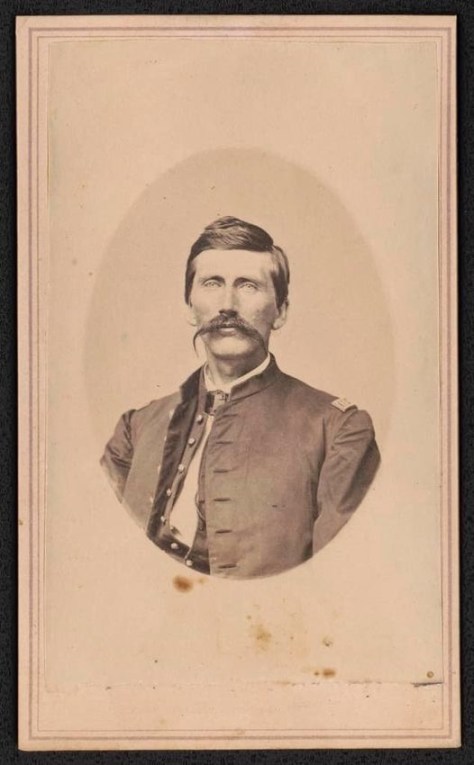
I could not find an image of George but here is one of Robinson Barr Murphy who also served in the 127th Illinois Infantry. He was later awarded the Medal of Honor in the Battle of Atlanta (Julian Burley Collection)
George enlisted in Co. D, 127th Illinois Infantry in mid-August 1863. At the time of his enlistment, he was described as a single farmer, standing just north of 5 foot 2 inches, with grey eyes and light hair. He mustered into the United States service on 5 September 1862 and was with his regiment until 25 April 1863 when he died of disease at Young’s Point, Louisiana.
George had an older brother who served in the 36th Illinois Infantry but was mortally wounded at the Battle of Stones River and died on 8 January 1863.
Here are some other letters by members of the 127th Illinois previous transcribed and published on Spared & Share. One of them includes a diary.
I now sit down to let you know that I am well at present and hope these may find you the same.
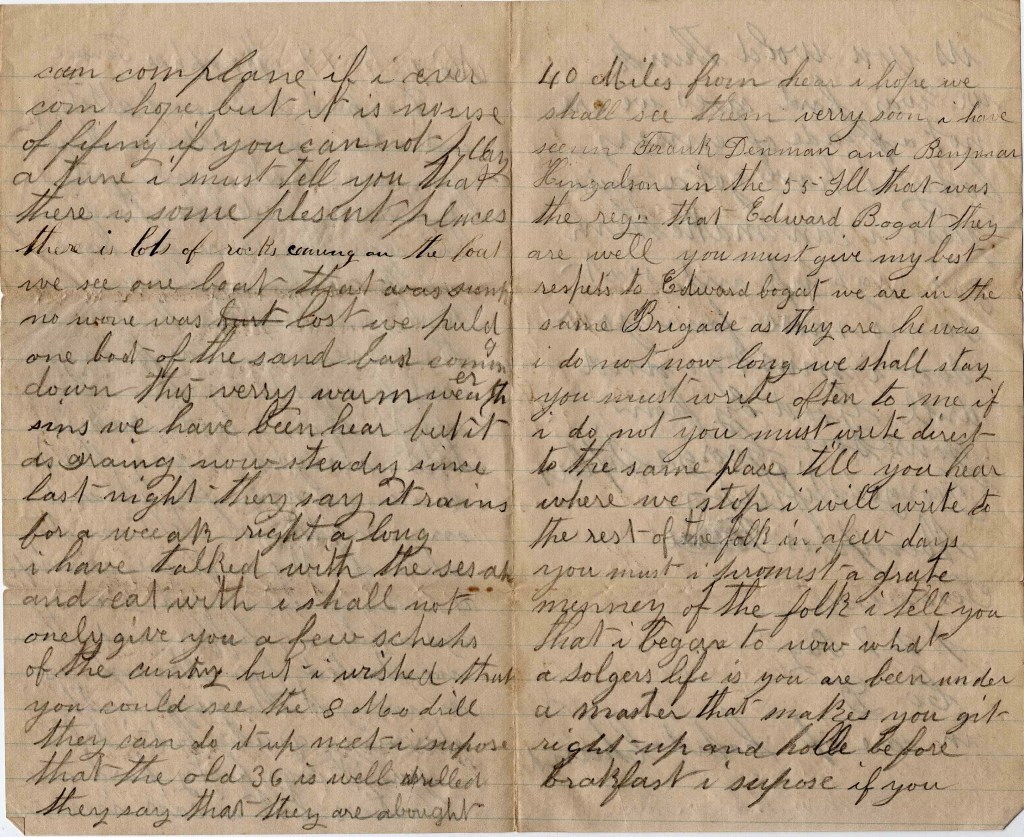
We have got to a stopping place and that is Memphis & close to the river, We was two days and two nights on the river with two or three hard crackers. Talk about living. That is no name for it. And one night we stopped on the shore of Missouri and we [ ] four hives of bees and two or three hogs and one heifer and then we started for Memphis so we got through with starving quite but I tell you, it was pretty hard us. But I can never complain if I ever come home. But it is no use of fifing if you cannot play a tune.
I must tell you that there is some pleasant places. There is lots of rocks. Coming on the boat we seen one boat that was sunk. No one was lost. We pulled one boat off the sand bar coming down. This [is] very warm weather since we have been here but it is raining now steady since last night. They say it rains for a week right along.
I have talked with the secesh and eat with. I shall not only give you a few sketches of the country but I wished that you could see the 8th Missouri drill. They can do it up neat. I suppose that the Old 36th [Illinois] is well drilled. They say that they are about 40 miles from here. I hope we shall see them very soon. I have seen Frank Denman and Benjamin Hingalson in the 55th Illinois. That was the regiment that Edward Bogat [joined]. They are well. You must give my best respects to Edward Bogat. We are in the same brigade as they are he was.
I d not know [how] long we shall stay. You must write often to me [even] if I do not. You must write and direct to the same place till you hear where we stop. I will write to the rest of the folk in a few days. I promised a great many of the folk. I tell you that I begin to know what a soldier’s life is. You are been under a master that makes you get right up and holler before breakfast.
I suppose if you would see us you would think we was hard cases. We are not afraid of anybody. I have got a nice gun. I can make them get right up and seat. So no more form your son. I must go and drill. Goodbye from your son, — George Sifleet
127th Regiment, Co. D, in care of Capt. Chand, Memphis, Tennessee
Letter 2
On the Mississippi January 18, [1863]
Dear father and mother,
I now sit down to let you know that I am well and hope these few lines may find you enjoying the same blessing. I received your letter last night and was glad to hear that you was well and sorry to hear that James was sick but I hope he is getting better. We have been on the boat about one month. We are getting tired of it. I suppose John Whybrow is having good times this winter but they are putting us through. We have been in two battles in two weeks—both of them on Sunday. We have started back for there again with a larger fleet.
They say that General Grant’s army is a going there to support us. I hope it is so. I hope we not get whipped but I think we will either whip them or they shall whip us and it will be a hard fight. We are a going within about 30 miles of there and go in camp for a while.
I must tell you that the mail does not go very often. I wrote a letter to Emmy McConnell two or three days but I have not sent it yet. But I will send it with this and you will give it to her. You must tell her that if she will not wait and have a soldier that she must take what she can get—some old bachelor or other.
After we took Arkansas Post we took what we could and tore down the breastworks and burned up all the buildings and went down the White River to the Mississippi river and we went up that about 30 miles to get off a hospital boat which had been there 48 hours. We worked all night getting coal off. Then in the morning we hauled her off and we came back and now have started down the river.
I must go and wash. I can tell you where I spent my Christmas. On the boat. And on New Year’s we left the battlefield for the boat. I tell you, we was still that night and the next day we left. I would like to of be[en] there on New Years and Christmas with you. I would like some sausage meet with you, I tell you that.
I wish that this abolition war was over and the Negroes was with their master for father, they are no account to any man. The better you use them, the lazier they are for we have got a number of them on the boat. They lay under the boilers. You have to drive them or they will not go or do anything. The quicker this war is over the better.
So goodbye from your son, — George Sifleet
To Mr. and Mrs. Sifleet. God bless you all.
Letter 3
Young’s Point, Louisiana February 17, 1863
Dear father and mother and sister,
I now sit down to let you know that I am well at present and hope these few lines may find you in good health. It commenced raining two days ago and it is a raining yet. It is very muddy so that we cannot hardly getaround to cook anything. Our tents leaked yesterday.
I do not know of much news to write. We have not done anything here yet—only dig on the canal. It does[n’t] seem to amount to much yet.
The mail came in last [night] about dark. I got two letters—one from Lizzy and the other from William Fellingham. I was sorry to hear that John Whybrow was dead. I suppose that you do not see anything about the war a coming to a close.
Our captain is a Major now in this regiment—that is, he is Acting Major. Our Major has gone and left us and so as the Colonel and his son left us that that we have not but a Lieutenant Colonel. We hear lots of reports that we cannot believe. The most of the soldiers are all sick of it. They say they do not care what becomes of the government and the Negroes or anything else. I do not see any more signs of the war a coming to a close than there was one year ago. But I think it will last long. It has been going on long enough [and] I think so do the soldiers.
I do not know what to write about. I do not know how long we shall stay here. The tent is crowded full. The boys are in the tent. I hope we shall leave here soon if it keeps a raining all the time. The boys are not in very good spirits but they are a getting sick of it.
I would like to get a paper once in a while. We have not go any pay yet. We begin to need it. I wish you would send me 50 cents worth of postage stamps in a letter. I write a good many letters and that takes stamps. I would like some of your sausages and bread and butter. I would like it very much. John Whybrow and Alexander Tomson has had a very good place to stay in Otyway [?]. George is well. He is a writing to his brother and sister. I got your letter last night and never was a more glad a boy to get a letter than I was any time.
I must draw my letter to a close. From your only [son], — George Sifleet
To Father and Mother and sister Sifleet
Give my best respects to Mr. and Mrs. Searink [?] and all enquiring friends. From your son, — George Sifleet
Letter 4
[Opposite] Vicksburg February 21 [1863]
Dear father and mother,
I now sit down to let you know that I am well and hope these few lines may find you well as to say it leaves me at present. I thought I would tell you how I feel this morning. I feel as though I would like to take a few warm biscuits and a few mash potatoes and some eggs and so on. I have just been to breakfast. I had a piece of bread. It was good. We get one loaf every other day and there is about enough in one loaf for one meal if a man is hungry. We get plenty of hard tack and pork and coffee but I do not drink much of that.
I have got a cold now. Tell father I would like to know how his horses get along. I would like to see them.
We do not appear to be making any point here yet. I suppose we are waiting to get good and ready. We fire at them once in a while. I heard some very hard firing. I guess that our gunboats came back. Whenever the boats go by, they fire their best. One of our mortars have been a firing at the City. Our company is out on picket, the most of them. They will come in this morning and it is a raining very hard this morning and it looks as though it was a going to be a rainy day. The boys are a playing cards and dominoes and everything else but George and myself does not know one card from another. Some of the boys begin to need some clothes very soon. My clothes is pretty good yet.
Father, my boots stand it well. Some of the boys paid 6 and 7 dollars for boots and they are about gone. My boots has one little hole in the side. I take good care of them. George is a coming now. I hope you will write a long letter. When you write, tell me what father is a doing and mother, send me a tin of biscuit and a few potatoes and so on.
You must [excuse] my poor writing for I have no place to write, only on my knee. I will write as often as I can. I can’t find much fault now for I get a letter most every time the mail comes. They say the mail is a coming today. I hope to get a letter from [home].
There is so much foul news a going. Some think we are going to Chicago to guard prisoners but I think there is no such good news. The boys is in pretty good health now but this is a muddy hole. George sends his best respects to you. Some seem to think they are evacuating Vicksburg. I do not know what to think of it. Goodbye for this time. From your son, — Geo. T. S.
Letter 5
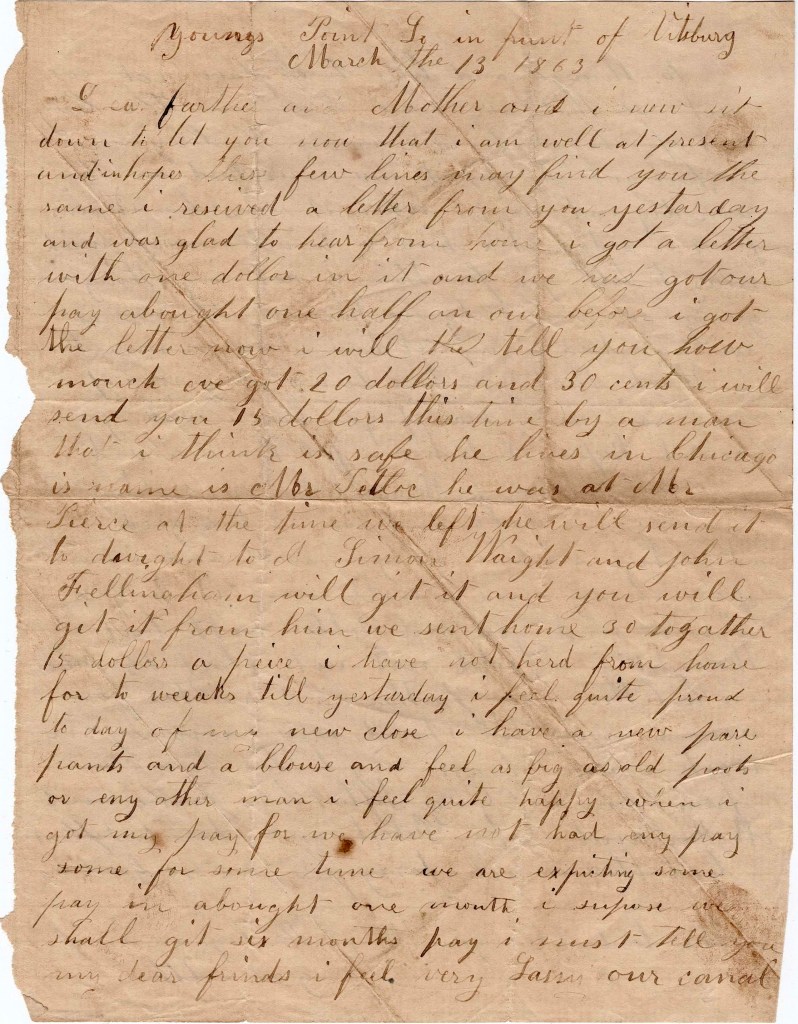
Young’s Point, La. in front of Vicksburg March 13, 1863
Dear father and mother,
I now sit down to let you know that I am well at present and in hopes these few lines may find you the same. I received a letter from you yesterday and was glad to hear from home. I got a letter with one dollar in it and we had got our pay about one half an hour before I got the letter. Now I will tell you how much we got—$20 and 30 cents. I will send you 15 dollars this time by a man that I think is safe. He lives in Chicago. His name is Mr. Tetloc. He was at Mr. Pierce at the time we left. He will send it to Dwight to Simon Waight and John Fellingham will get it and you will get it from home. We sent home 30 together, 15 dollars apiece.
I have not heard from home for two weeks till yesterday. I feel quite proud today of my new clothes. I have a new pair of pants and a blouse and feel as big as old Poots or any other man. I feel quite happy when I got my pay for we have not had any pay for some time. We are expecting some pay in about one month. I suppose we shall get six months pay.
I must tell you my dear friends, I feel very lucky. Our canal broke through and like to drowned us out so that we had to get on the levy out of the water. We are on the levy now. We have got it stopped now. I worked in the rain day and night. When it rains here, it rains for two or three days at a time.
I do not know of much news to tell you for there is not anything a going on now—only working on the canal. We have had a very wet time for some time. I think that you have been sending some of your rain down here. If you have, I wish you would keep it to home for this is a wet place down [here].
Now father, I hope you will get my money safe and use it to a good advantage which I know you will and [if] I can spare any you any more, I will send it to you. I will send you one dollar with [this] but I thought I would not risk that 15 dollars in a letter. Now Father and Mother, you know I never did spend my money in waste. I must draw my letter to a close.
From your son, — George Sifleet
To his father and mother and sister Robert and Sarah Sifleet. God bless us all. Pray for me. So goodbye. The lord bless you all. The boys are in good health.
Letter 6
Young’s Point, La. March 23, [1863]
Dear father and mother and sister,
I now sit down to let you know that I am well and hope these few lines may find you the same. It has been a raining all day and night. I got your letter last night the 22nd of March. The regiment are gone on a scout. I went with them up the river [but] I did not feel like marching through mud and water so some of us came back. We are in our tents. The boys went off with only five days rations with them. They have been gone one week. They went up the river about 40 miles and then got off the boats. There was only five boats with them. I do not know what it means without it is to cut off their communications or to fight.
They have been fighting some 15 miles from here. We took it with our gunboats. The place is named Warrington. We are a getting them very near surrounded.
I suppose you have got that money by this time. It is very cold this morning. I must quit for this time.
Now here goes for some more. There has two or three gunboats run the [river] blockade since we have been here. We have stopped digging on the canal. There is a dredge a digging in it and the rebs fire a gun once in a while. Their shot comes within 60 rods of us here.
They are a going to draft but they cannot take Father this time.
I do not know what to think about Vicksburg but Grant takes it slow. Maybe it is the safe way to do it. Father, the old saying is slow and sure. There is not many troops here now. They are all over. Some of them are where we was before.
I write very fast and you must read it fast and then you will understand it.
I saw three Rebels that came over from Vicksburg and they say they do not like our big heavy guns. I am glad they do not. I wish they was all that way. They would soon quit. George and me got five letters between us two. We got one mail while we was on the boat but we could not answer it. I cut out some nice pictures and rolled them up and sent them home. I got them on a big plantation.
Thank you for the stamps and paper but I have paper. I will send it back with some scribbling. It is quite pleasant. I do not know when the mail will leave. Maybe soon.
Al Still has gone on the hospital boat. He was sick but was getting better. Amos Parker is dead. He died—I am not sure what day he died. So no more. From your son, — George Sifleet
To his father and mother and sister. God bless you all. Goodbye.
This letter was written by William Hussen [or Hussong] who enlisted at the age of 19 on 23 January 1862 to serve three years in Co. F, 104th New York Infantry. William was the son of Christian Conrad Hussong (1809-1879) and Dorothea E. Linsner (1810-1890) of Granger, Allegany county, New York. He was wounded in Miller’s Cornfield on 17 September 1862 at Antietam and then mortally wounded in action on July 3, 1863 at Gettysburg while fighting near the cemetery on Cemetery Ridge. He died on 4 July 1863 on the battlefield.
T R A N S C R I P T I O N
Virginia May 11th, 1862
As we have moved, I thought I would sit down to let you know that I am still well and hope that you are the same. We have moved 12 miles beyond Manassas Junction about 50 miles from Washington. We had glorious sights on the road. We started from camp yesterday at noon and there was nothing to speak of until about one mile from Manassas Junction and then you could begin to see the rebel camp where they camped through the winter. And when we got a little further and we began to see their entrenchments and where their batteries was, but they destroyed everything as they went—railroad station and all. And they left their dead horses and everything else.
They have repaired the railroad for about 14 miles. It was night but the moon shone bright and we arrived at our camp about 12 o’clock in the night and we got off the cars and unpacked our blankets and laid down on the ground and took a good sleep.
This morning I was detailed to go out on picket about one mile from the camp where we have to keep our eyes skinned but nevertheless I don’t feel skart yet. I have forty rounds of cartridges in my box and plenty of caps. The more we move, the further we go, the better I like it. I have seen a great sight since I left home.
It is very nice weather here but houses are very scarce here. You can go 1 mile and see no house. But the houses are very nice and well got up. But enough of this.
As to pay. We could not get it. We was a going to get it in a few days but our marching orders we got about two hours. We got them at 9 o’clock and started at 12 o’clock and so the pay was put off but expect to get it before long.
I begin to like it every day better for I am broke into it. We may stay here a week and not one. We are to be ready at any moment’s call. There is no generals here but the scouting parties is what we look for. But my relief is a going out and so I must close for this time for I am on picket. All letters must be sent to Washington the same as before and then they are sent on to the regiment.
Give my love to all, to you and all my old comrades of Granger. Your friend truly, — William Husson
These letters were written by 19 year-old Jerome Ely (1844-1923), the son of Hiram Ely (1805-1880) and Cyrena Lovina Vosburg (1808-1867) of Lemon, Wyoming county, Pennsylvania. Jerome was still enumerated in his parent’s home at the time of the 1860 US Census. Jerome accepted a bounty to enlist as a recruit in Co. A, 57th Pennsylvania Regiment. His pension records show that his only served in the 57th Pennsylvania, and though he did not enlist until months after the Battle of Gettysburg, his obituary, published in a Spokane Washington (the Spokesman Review, 30 Oct 1923) newspaper claimed that he was “wounded at the famous Battle of Gettysburg and was afterward discharged by reason of his wounds.” Jerome’s Find-A-Grave obituary acknowledges that he did not enlist until 1864 and also claims that he was wounded but gives no specifics other than to say that he spent time in a hospital.
In his letters, Jerome informs his family that he has been assigned to Co. A and I believe he was for a time, but he was eventually transferred to Co. F and it’s in Co. F that we find him in the official roster of the regiment. The roster gives his muster in date as 13 February 1864 and his muster out date as 29 June 1865.
I could not find a war-time photograph of Jerome but here is one of Pvt. Jonathan Colgrove of Co. F, 57th Pennsylvania (LOC)
Letter 1
[Note: This letter was written on a patriotic song sheet titled, “How Lee Was Whipped at Gettysburg.”
Camp near Brandy Station February 27th [1864]
Dear Brother & Sister,
I am in camp between Brandy Station and Culpeper. We stayed in Harrisburg until Sunday morning. Then we left for Washington. We stayed in Baltimore Sunday night and then to Washington Monday morning. We stayed there until Wednesday and then started for the front. We reached the front Thursday.
Yesterday and today we have been building tents. We haven’t got them so that they are very comfortable yet but we have got orders to pack five days rations and start at five o’clock tomorrow morning. Where we are going to or what we are a going to do is more than I know or anybody else that I have seen yet.
Baltimore is the largest city that I ever saw. I wish you could be in Washington two or three days. It would pay to spend the time. I went most all over the capitol. It is the largest building I ever saw or expect to see.
You wanted me to tell you how I liked a soldier’s life. I like it well so far and we have been going most all of the time. Two nights is the most that I have stayed in one place since we left Harrisburg. I marched from Brandy Station to this place (5 miles) and carried a soldier’s load consisting of two blankets, 1 tent and all of the rest of clothing and other notions, knapsack, haversack, canteen, gun adn all the rest, and it didn’t kill me either.
My health is good with exception of a bad cold. Tell all the girls you see to write to me and I will return the compliment. Gib told me to tell you to eat bull beef.
I must close this letter as it is getting late. I will enclose two of my profiles. If you see Mary Ely or write to her, give her one of them and tell her to write to me. Address, Jerome Ely, Co. A, 57th Regt. P. V., Washington D. C.
The [U. S.] Capitol covers over a space of three and a half acres of ground.
Letter 2
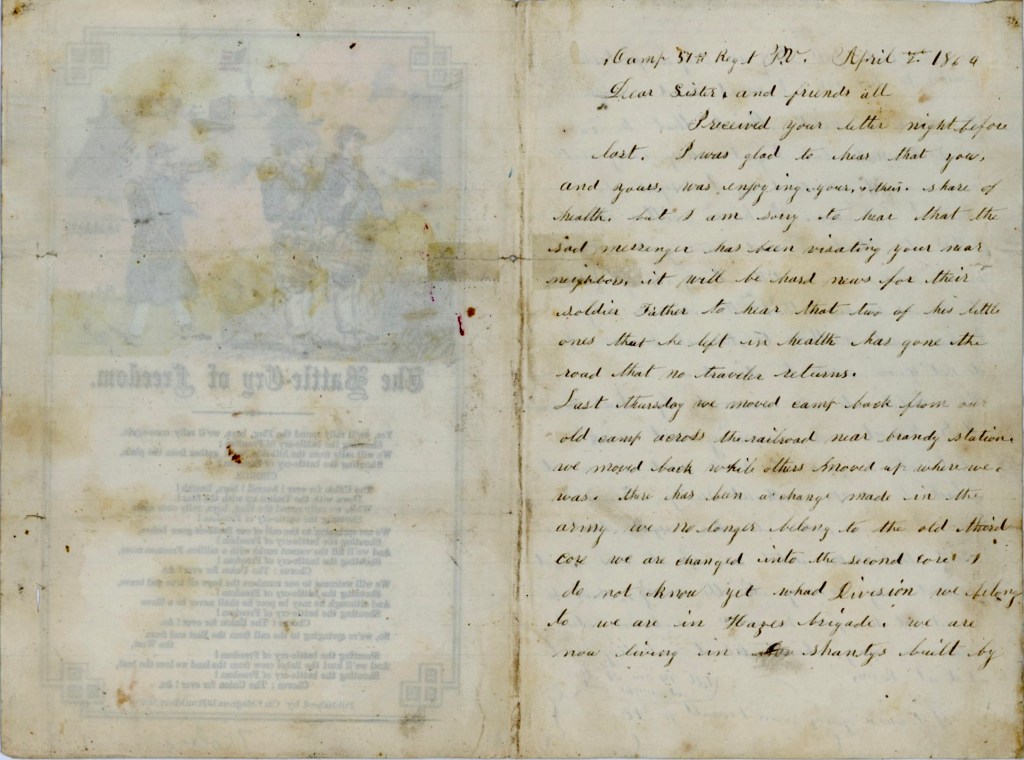
Camp 57th Regt. P. V. April 2nd 1864
Dear Sister and friends all,
I received your letter night before last. I was glad to hear that you and yours was enjoying your and their’s share of heath. But I am sorry to hear that the sad messenger has been visiting your near neighbors. It will be hard news for their soldier father to hear that two of his little ones that he left in health has gone the road that no traveler returns.
Last Thursday we moved camp back from our old camp across the railroad near Brandy Station. We moved back while others moved up where we was. There has been a change made in the army. We no longer belong to the old 3rd Corps. We are changed into the 2nd Corps. I do not know yet what Division we belong to. We are in Hayes’ Brigade. We are now living in shanties built by the Rebs last fall. They are very comfortable quarters to live in. I carried load enough to make a child that that he was a pack mule but I got along very well and wasn’t as tired as I might be when I got here.
I have written two letters to Andrew and have got one from him. Tell Molly if you write to her (or see her) that the reason why I have not written to her is because I do not know where to direct.
We started to be reviewed by Lt. General U. S. Grant one morning last week but it began to rain and we went back to camp without seeing the old hero. I saw a letter the other night that said that Father acted as if he was mad about my coming to the army. But he needn’t be for no where in Lemon did receive so many hints about enlisting as I did at home. If I was a young ma, I would go, &c.
This letter was written by an unidentified soldier from Birds Point, Missouri, and describes the 7 November 1861 Battle of Belmont. Several regiments left from Bird’s Point to participate in the battle, most of them Illinois regiments, but the author does not give the name of his regiment. The signature page of the letter seems to be missing.
Though the content clearly describes the Battle of Belmont, it isn’t clear that the author actually participated in the battle himself though I suspect his regiment did. It may be that he was on detached duty or was unfit for service at the time of the battle.
The author datelined his letter from Camp Lyon and there were several Illinois regiments encamped there at the time.
The Battle of Belmont.Published 24 April 2024, MA Economics
T R A N S C R I P T I O N
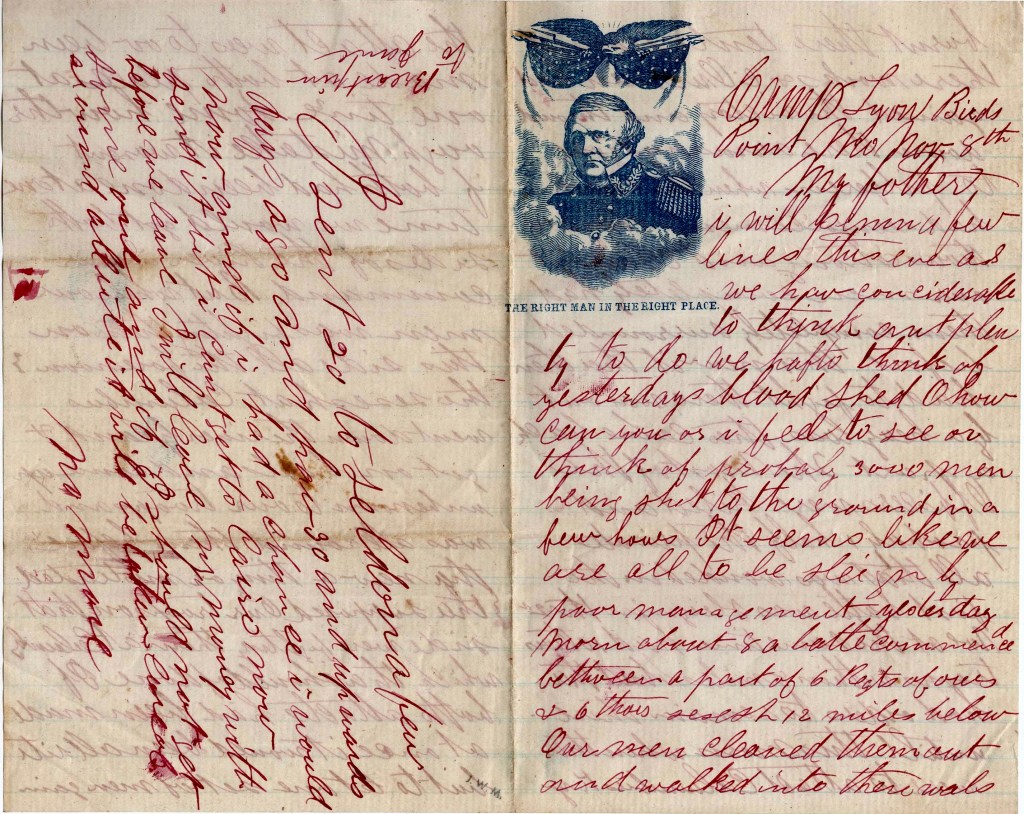
Camp Lyon Bird’s Point, Missouri November 8, [1861]
My father,
I will pen a few lines this eve as we have considerable to think out, plenty to do. We have to think of yesterday’s bloodshed. Oh how can you or I feel to see or think of probably 3,000 men being shot to the ground in a few hours. It seems like we are all to be slain by poor management.
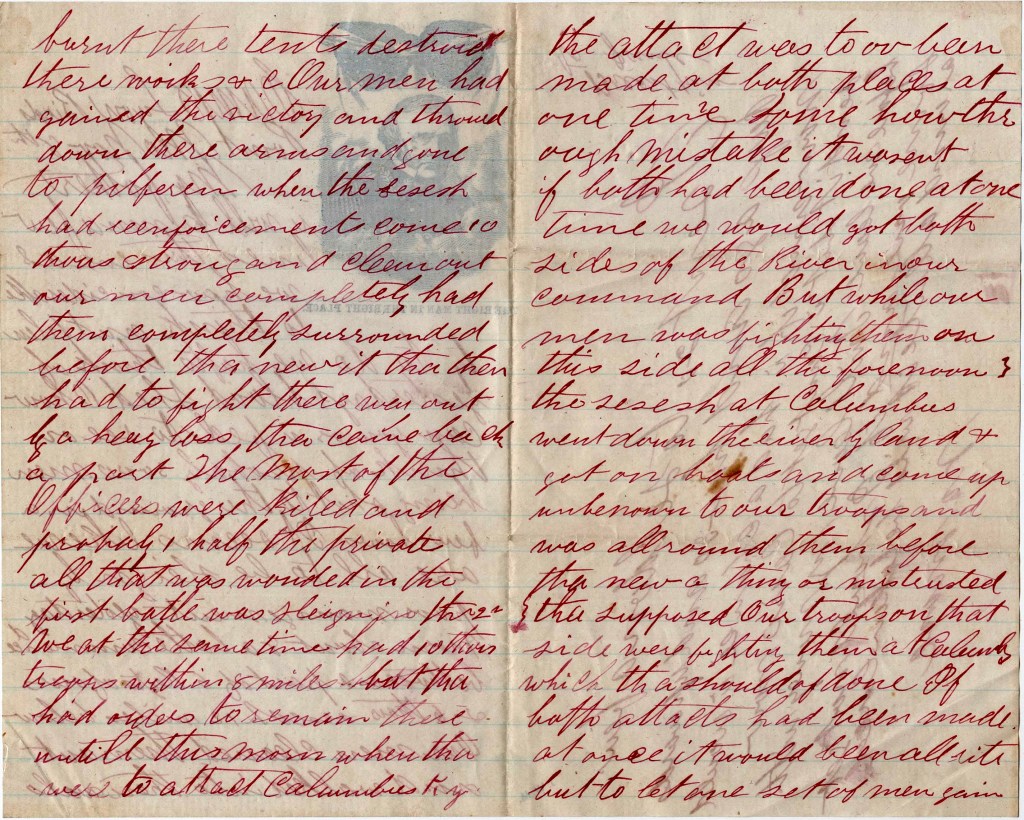
Yesterday morn about 8, a battle commenced between a part of six regiments of ours and six of their secesh 12 miles below. Our men cleared them out and walked into their walls, burnt their tents, destroyed their works and out men had gained the victory and throwed down their arms and gone to pilfering when the secesh had reinforcements come ten thousand strong and cleaned out our men completely. Had them completely surrounded before they knew it. They then had to fight their way out by a heavy loss. They came back apart. The most of the officers were killed and probably half of the privates. All that was wounded in the first battle was slain in the 2nd.
We at the same time had 10 thousand troops within 8 miles but they had orders to remain there until the this morn when they were to attack Columbus, Kentucky. The attack was to of been made at both places at one time. Somehow through mistake, it wasn’t. If both had been done at one time, we would got both sides of the river in our command. But while our men was fighting them on this side all the forenoon, the secesh at Columbus went down the river by land & got on boats and come up unbeknown to our troops and was all round them before they knew a thing or mistrusted. They supposed our troops on that side were fighting them at Columbus which they should of done. If both attacks had been made at once, it would been all right, but to let one set of men gain [page missing?]
I sent 20 to Seldon a few days ago and have 30 and upwards now and if I had a chance I would send it but I can’t get to Cairo now before we leave. I will leave my money with someone and if I should not get around all right, it will be taken care of. No more.
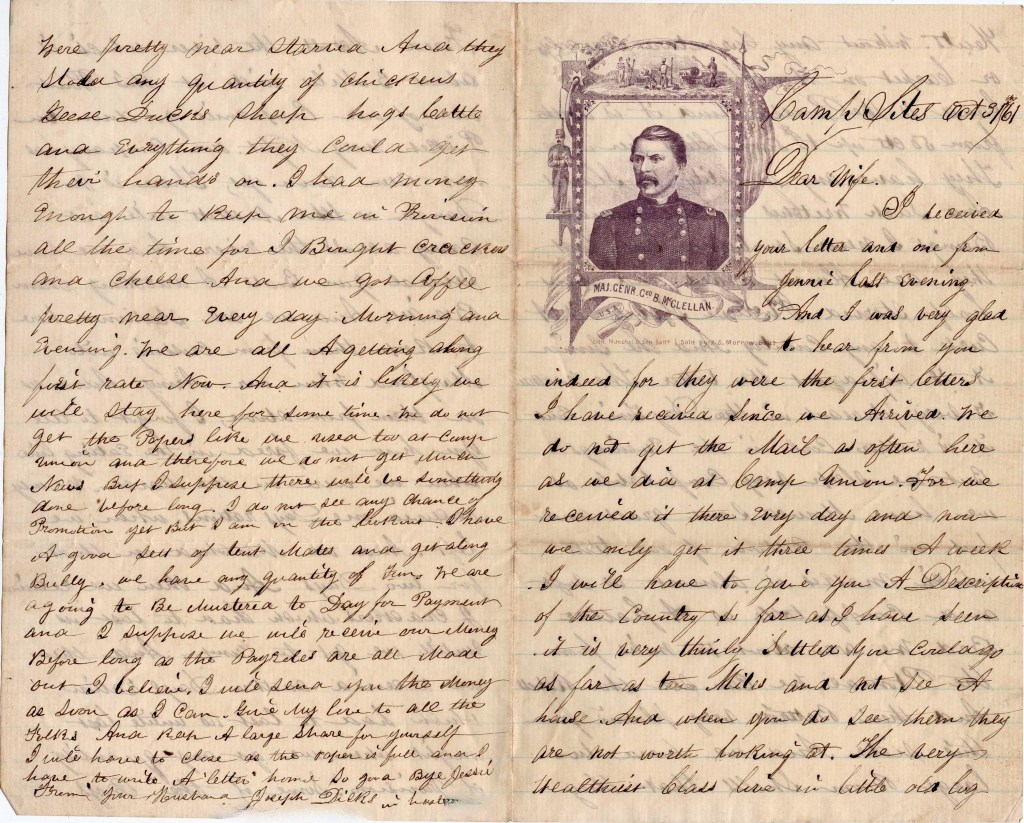
This letter was written by Joseph Dicks (1837-1910), the son of James Dicks (1807-1887) and Mary Coffin Lytle (1814-1881) of Nether Providence township, Delaware county, Pennsylvania. He wrote the letter to his wife, Jessie Matlack (Worrall) Dicks (1838-1927) while serving in Co. K, 26th Pennsylvania Infantry. The couple were married in 1859 and had their first child in 1860 but he died in infancy. Jessie was pregnant with her second child at the time of this letter in late October 1861.
Muster rolls inform us that Joseph enlisted on 4 June 1861 and served his entire three years as a private in Co. K, 26th Pennsylvania. He mustered out at Philadelphia on 18 June 1864. After the war he became a dry good salesman in Chester, Pennsylvania.
T R A N S C R I P T I O N
Camp Sites [near Budd’s Ferry, Maryland] October 31, 1861
Dear Wife,
I received your letter and one from Jennie last evening and I was glad to hear from you indeed for they were the first letters I have received since we arrived. We do not get the mail as often here as we did at Camp Union for we received it there every day and now we only get it three times a week.
I will have to give a description of the country so far as I have seen it, It is very thinly settled. You could go as far as ten miles and not see a house. And when you do see them they are not worth looking at. The very wealthiest class live in little old log huts without any furniture scarcely or carpet on the floor. And the land is the poorest kind. It is worth from 50 cents up to 50 dollars per acre. They have any quantity of slaves—and such wretches to call human being I never saw before. In fact, they are almost naked and about half starved. I believe slavery is a curse to any country and the sooner it is wiped out, the better.
The weather is very pleasant in the day time but it is rather cool in the evenings. But we sleep very comfortable as we have mowed some grass and put [it] in the bottom of our tents which makes it almost as soft and comfortable as a feather bed.
We are about one and a half miles from the Potomac. We can see the Rebels and their batteries very plain from this side and we have [had] two large bomb shells that they fired across the river which is about three miles wide at this point. One of our companies go down on picket every night. Our company has not been down yet. There is no danger as their muskets will not carry across the river and we have several gunboats a watching them besides. And we are stationed here to keep them from crossing into Maryland when our army advances on them from above.
I forgot to tell you how we fared in the eating line when we were on the march. We only received one days rations when we left and we marched on that for two days and then we received two crackers which had to last us until we got to camp. And then we received another day’s rations which had to last us until last night when we got any quantity of provision. Some of the boys were pretty near starved and they stole any quantity of chickens, geese, ducks, sheep, hogs, cattle and everything they could get their hands on. I had money enough to keep me in provision all the time for I bought crackers and cheese and we got coffee pretty near every day, morning and evening. 1
We are all getting along first rate now and it is likely we will stay here for some time. We do not get the papers like we used to at Camp Union and therefore we do not get much news but I suppose there will be something done before long. I do not see any chance of promotion yet but I am in the croakers. I have a good set of tent mates and get along Bully. We have any quantity of fun. We are a going to be mustered today for payment and I suppose we will receive our money before long as the pay rolls are all made out, I believe. I will send you the money as soon as I can. Give my love to all the folks and keep a large share for yourself.
I will have to close as the paper is full and I hope to write a letter home. So goodbye Jessie. From your husband, — Joseph Dicks
In haste.
1 The 26th Pennsylvania marched to Budd’s Ferry, Maryland, on 20 October 1861 as part of General Joseph Hooker’s Brigade, having previously been at Camp Union near Bladensburg. They marched in company with Sickles’ Excelsior and the 2nd New Jersey Brigades. They remained at Budd’s Ferry until 1 April 1862.
The following letter was written by Pvt. Joseph H. Caldwell (1829-1897), a former clerk from Roxbury who enlisted on 24 May 1861 to serve in Co. F, 1st Massachusetts Infantry. He was wounded on 29 August 1862 during the 2nd Battle of Bull Run and eventually transferred to the Veteran Reserve Corps (117th Co. 2nd Battalion) where he served out his time, being discharged on 24 May 1864. Joseph’s younger brother, Josiah Caldwell (1834-1903), also enlisted the same day and served in the same company.
Joseph wrote the letter to his wife, Esther A. (Boles) Caldwell (1836-1924) with whom he married in 1854.
T R A N S C R I P T I O N
Camp Union 1st Massachusetts Volunteers Bladensburg October 20, 1861
Blessed wife,
I received your very kind epistle yesterday and rest assured my love, I was extremely happy in reading it. I have made up my mind to write short letters but to write oftener, but remember I shall expect you to do the same.
There is nothing very new in or about the camp except yesterday three of the 1st Michigan Vols. died with the Typhoid fever. Josiah [Caldwell] is some better and I think will be able to resume his duties this week.
My own dear precious one, what would I give to spend this Sunday with you. I trust that ere many Sundays pass we shall pass the day in peace and love together. Oh my precious soul, how hard it is to be so far away from those that are dear to us. Do you not think so love? One thing you said in your letter about keeping your letters, I destroy them all for the reason that they would not be for my credit to have them seen but I do hope and pray that I shall receive letters which will contain no allusions to the past for I should like to do as I see others—sit down and read letters over and over again. They would be highly appreciated by your poor old hubby.
I received two notices in your last about the 1st which shows the estimation in which the regiment [is] held. It is a source of gratification to us to know that we are held in such high esteem by our distant friends. I suppose, darling, you will receive a letter dated Thursday. Well, I shall write often and you must do the same. I fear you think me mean in not forwarding my miniature but I cannot do it until they get ready to go home. I expect every day to send it and it worries me as much if not more than it does you in having it here. But my love cannot blame for you know it is of no advantage for one to keep it. Do not fear. I shall remember you darling in Nov.
I received from Lieut. [George E.] Henry a letter sent by Lieut. [William H.] Sutherland. I am sorry I ever received it. It was too hard. But it was written before I explained to you the many affairs. But one thing in it, how can a man receiving only $13 per month send $40 home? Perhaps he gambles. The 11th [Massachusetts Infantry] have the name of it and in our regiment it [gambling] is punishable by confinement in the guard house and fined. The 11th Regiment is a miserable concern. How under heaven’s [name] do you expect Edgar got to Richmond? I heard he gave himself up to the Rebels. Damn such a man. Esther, I shall look out for myself for your dear sake but I shall do my duty. I cannot—it is impossible for me to act the coward. But rest easy. I shall come out all right and these poor arms shall again embrace the form of his beloved wife. Bless you for your dear words in your letter and believe me your faithful, devoted husband, Sealed with a kiss. — Joseph
This letter was written by Myron T. Little of Co. H, 106th Pennsylvania Infantry that was organized and commanded by Col. Turner G. Morehead. It was first called the “Fifth California,” being part of of Col. Baker’s California Brigade, but later was one of the four regiments composing the Philadelphia Brigade. The 106th joined Col. Baker’s Brigade just prior to the disastrous Union defeat at Ball’s Bluff.
Myron informs his friend Wesley that he was in Co. H, but he must have been transferred into Co. F when the regiment became the 106th Pennsylvania because that is where he appears in the muster rolls which show his enlistment on 14 August 1861.
Myron was taken prisoner on 15 August 1863 (estimated) and died on 3 June 1864 in Andersonville Prison. He was buried there, grave No. 1588.
Census records reveal that Myron was the oldest son of at least 12 children born to Joseph Bloomfield Little (1820-1908) and Louisa C. Armes (1821-1898) of Forks, Sullivan county, Pennsylvania.
T R A N S C R I P T I O N
Camp Observation December 15, 1861
Friend Wesley,
It is with pleasure that I take this opportunity of addressing you for the first time since I was from home, Sam Black [Co. F] told me some time ago that you wanted me to write to you. I did not for want of money to pay the postage with but we have now got our pay and I just thought that I would write a few lines to you. We are all well at present and I hope that this will find you the same.
Last Thursday night at about 10 o’clock we were all routed out in quick time for a march for Conrad’s Ferry, a distance of about 8 miles. Well there was four companies of us started down the river that night. We went about 5 miles that night when a halt was ordered and the Colonel said he would ride down to the ferry and see what was up. The Lieutenant Colonel Curry [said] we was to turn into a corn field and lay down and keep quiet until his return. We did not dare to build fire for fear the rebels could see it from the Virginia shore. We had nothing but our blankets and therefore we came darned near freezing to death and there we lay until morning when we was ordered back off the hill a short distance to wait for further orders and lay there until about noon today when we started back for camp. All I can find out that was going on was that the rebels was gathering on the opposite side of the river and we was to be there in that case to help the river pickets to keep them back. Whether I am correct or not, I know not. I only heard so but not from any officer so I do not put any dependence in it.
We lay there in suspense for fear we should not be called out in time for any of the fun—if there was any to be had—but there was none to be had so we was all disappointed. This was the second time we was disappointed on the same route but the first time I think it was best. The way it was, we could not get across the river and I am afraid if we should of got across, there would not been a great many left to tell the tale. But for all that, we all wanted to get across and try our old muskets. 1
Now for a little local intelligence. First I want you to take care of the girls and that good too for I expect to come back some time and I want them taken good care of, to be delivered unto me for I wat some pretty girl out of the lot.
I expect you had gay old times there at the Institute. I should liked to of been there for my share of the fun but I was in a place where I expected there would be some fun in making the rebels run. But they made our fellows run and that wasn’t much fun for us. But I expect it was fun for them.
I have gay old living down here. We had for the last three days anyhow. It was raw pork and crackers what we would despise up there but everything is palatable to a hungry soldier. But we do not live that way in camp but that don’t go bad to us poor devils when we are pretty hungry. I shall have to stop for want of time and room. Give my best respects to the folks in general—the girls especially. I remain your friend, — Myron Little
Bakers Brigade Morehead’s Regiment Company H Adamstown, Maryland
1 Myron is probably referring to the Battle of Ball’s Bluff in which part of the regiment participated.The battle took place on 21 October 1861 near Leesburg, Virginia, and resulted in the death of Col. Edward D. Baker.















 Spared & Shared 23