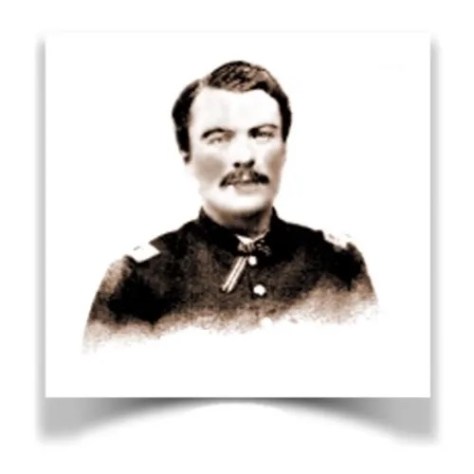
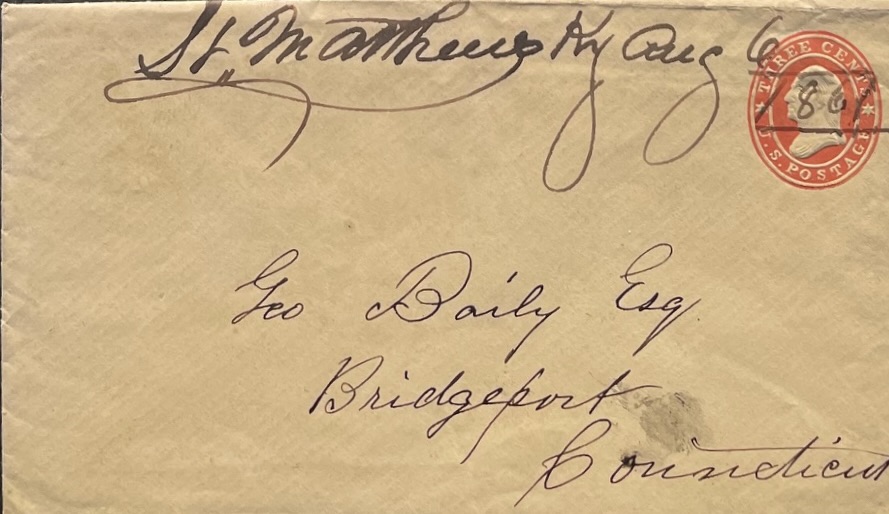
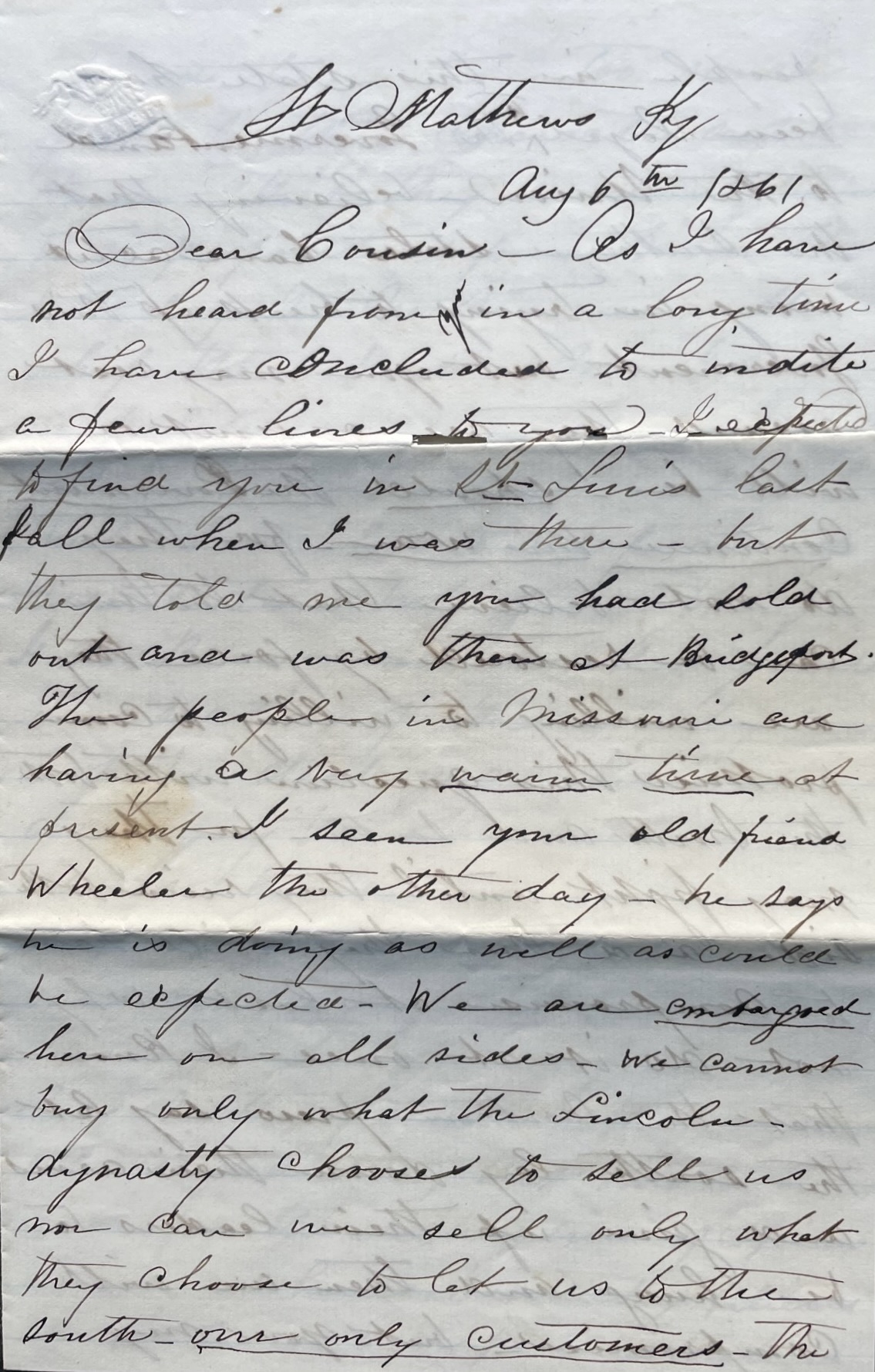
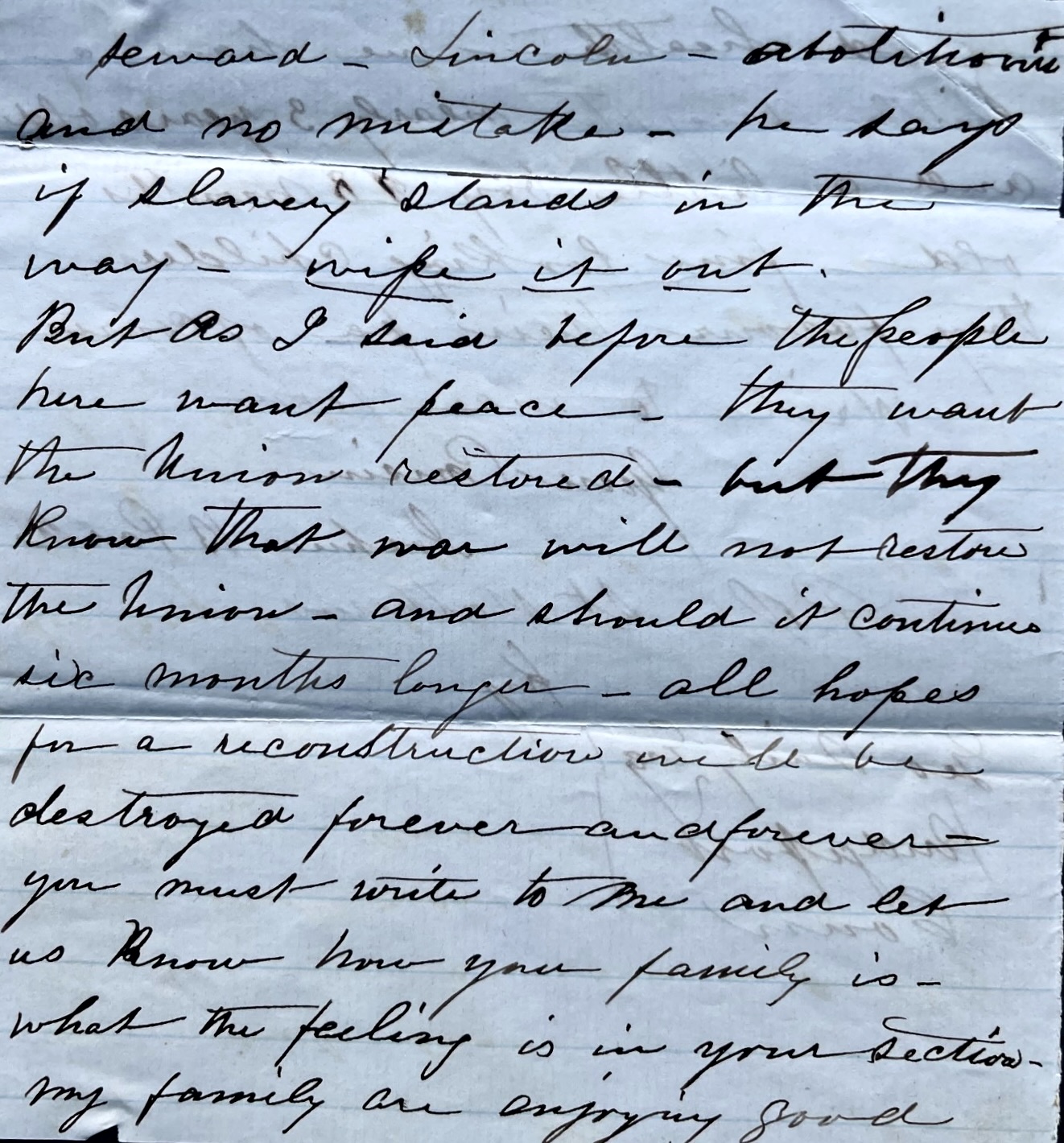
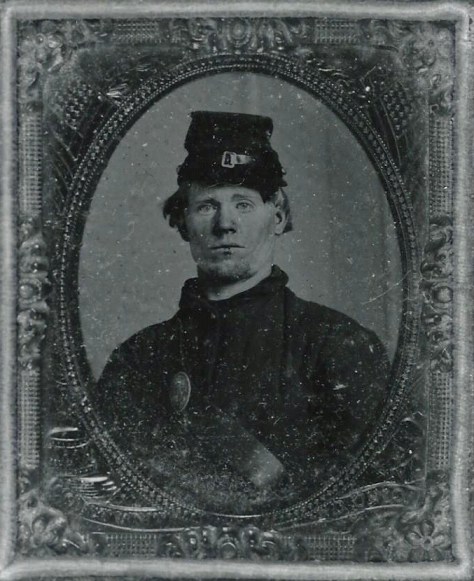
Following is a letter by 61 year-old Archibald Whyte (1800-1865) who was born in Argyle, New York, to Rev. Archibald Whyte, Sr. and Margaret Kerr Whyte. He graduated from Union College and studied at the Associate Presbyterian Seminary in Philadelphia, being licensed to preach by Cambridge Presbytery in 1826. After preaching in North and South Carolina in 1827, he chose to work with a new church in Baltimore from 1827 to 1833. He married Susan Grier from Steele Creek Associate Church around 1829, likely during his mission work.
In 1833, Whyte became the minister at Steele Creek and Back Creek Associate churches in Mecklenburg County and remained there for the rest of his life. He had a daughter named Margaret, born in 1833, but his wife, Susan Grier Whyte, died on December 8, 1834, leaving him to raise their infant daughter alone. During his ministry, his churches grew, but tensions over slavery arose in the late 1830s, as the cotton economy expanded and many began to see slavery as crucial. Those who disagreed often moved to free states. The Associate Presbyterians in the Carolinas faced difficulties since most of their members were in the North, where rules included freeing their slaves. In 1840, Rev. Whyte was suspended from the ministry, and many Associate churches in the Carolinas eventually faded away or joined the Associate Reformed Presbyterian Church.
It is intriguing to consider why Archibald Whyte, a New Yorker, became a strong supporter of slavery, dedicating his life to defending the landed gentry. After fourteen years as a minister, at 40, he opted for a career change, not seeking a new position in another denomination like most Southern ministers. Instead, he moved to York County, bought a farm near the Catawba River, and became a successful community member. After his first wife died around 1838 or 1839, he married Mrs. Elizabeth Hart Campbell, likely influenced by her ties to the Campbell family.
Rev. Whyte’s farm covered 317 acres along Saluda Road, between the river and Steele’s Crossing. Today, this area includes parts of I-77, the Manchester Village shopping area, and the Manchester Meadows Soccer Complex. His home was near the southern edge of his property, where Dave Lyle Boulevard meets Springsteen Road. When Rev. Whyte arrived in eastern York County, SC, the region was called “Indian Land,” part of the Catawba Indian Nation’s territory, mostly leased to white settlers.
Archibald Whyte began a new life as a planter in a two-story Piedmont I-house with a front porch and chimneys at both ends, though it’s unclear if he built or bought it; local histories suggest construction was between the 1830s and 1840s. In addition to being a planter and Postmaster, Rev. Whyte preached and ran an inn at his home, teaching young men who came for lessons. By 1850, 50-year-old Whyte from New York lived with his daughter Margaret (17) and sons Thomas (10) and William (8). The Slave Census indicated he owned 12 slaves and his real estate was valued at $3,000, equivalent to about $82,000 today. He owned 200 acres of improved land and 114 acres unimproved, along with two horses, two mules, four milk cows, fourteen oxen, and other livestock, growing wheat, corn, and oats.
In 1856, Whyte began his political career, being nominated and winning a seat in the South Carolina Legislature to represent Indian Land. He served as one of four representatives from York District during sessions in late 1856 and late 1857. That year, he participated in planning the relocation of settlers to Kansas to support slavery and helped establish a voting precinct in Rock Hill, known for his skillful speaking.
The 1860 Census showed that Rev. Archibald Whyte was doing well as a planter, with real estate valued at $9,850 (about $248,000 today) and personal property worth $9,605. He owned eleven slaves, six of whom were over 18, and his address was “Coats Tavern,” located between Lesslie and Catawba, south of his home.
With the coming of the Civil War, Whyte supported the southern cause. In early 1861, A. E. Hutchison organized the first military unit in Rock Hill, named the Whyte Guards in honor of Archibald Whyte. They assembled on April 15, shortly after the firing on Fort Sumter, and Whyte accompanied them to Columbia. In August 1861, he was appointed as an agent for Rock Hill to solicit donations for the Confederate cause. [Source: Rev. Archibald Whyte, by Paul Gettys]
T R A N S C R I P T I O N
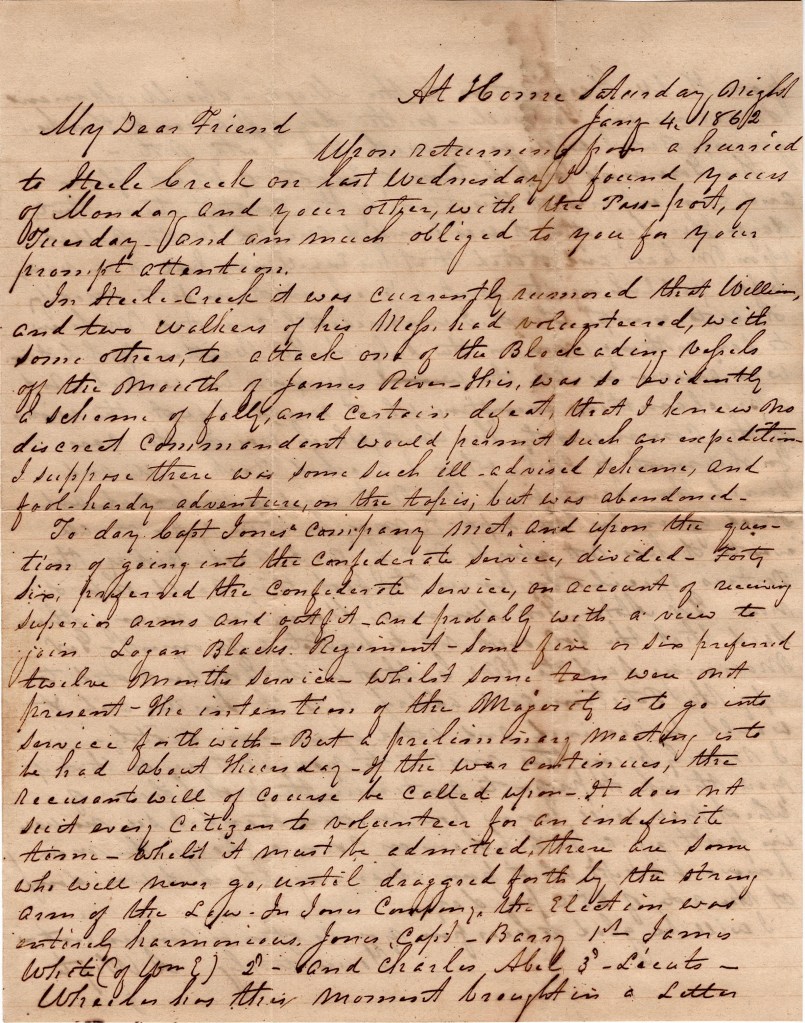
At home [York county, South Carolina] Saturday night, January 4, 1862
My dear Friend,
Upon returning from a hurried [trip] to Steele Creek on last Wednesday, I found yours of Monday and your other, with the passport, of Tuesday, and am much obliged to you for your prompt attention.
In Steele Creek, it was currently rumored that William and two Walkers of his mess had volunteered with some others to attack one of the blockading vessels off the mouth of James river. This was so evidently a scheme of folly and certain defeat that I knew no discreet commandant would permit such an expedition. I suppose there was some such ill-advised scheme, and fool-hardy adventure on the [ ]; but was abandoned.
Today Capt. Jones’s company met and upon the question of going into the Confederate service, divided. Forty-six preferred the Confederate service of account of receiving superior arms and outfit—and probably with a view to join Logan Black’s Regiment [1st S. C. Cavalry]. Some five or six preferred twelve months service whilst some ten were not present. The intention of the majority is to go into service forthwith, but a preliminary meeting is to be had about Thursday. If the war continues, the [ ] will of course be called upon. It does not suit every citizen to volunteer for an indefinite time. Whilst it must be admitted there are some who will never go until dragged forth by the strong arm of the law. In Jones’ company, 1 the election was entirely harmonious. [Robin C.] Jones, captain. [James H.] Barry, 1st. James White (of Wm E) 2nd. and Charles Abel, 3rd Lieutenants.
Wheeler has this moment brought in a letter from N. W. Garlington to the Major. Also [John T.] Wightman’s discourse in Yorkville [S. Carolina] on the day of National Thanksgiving. But I will go on with this hasty note.
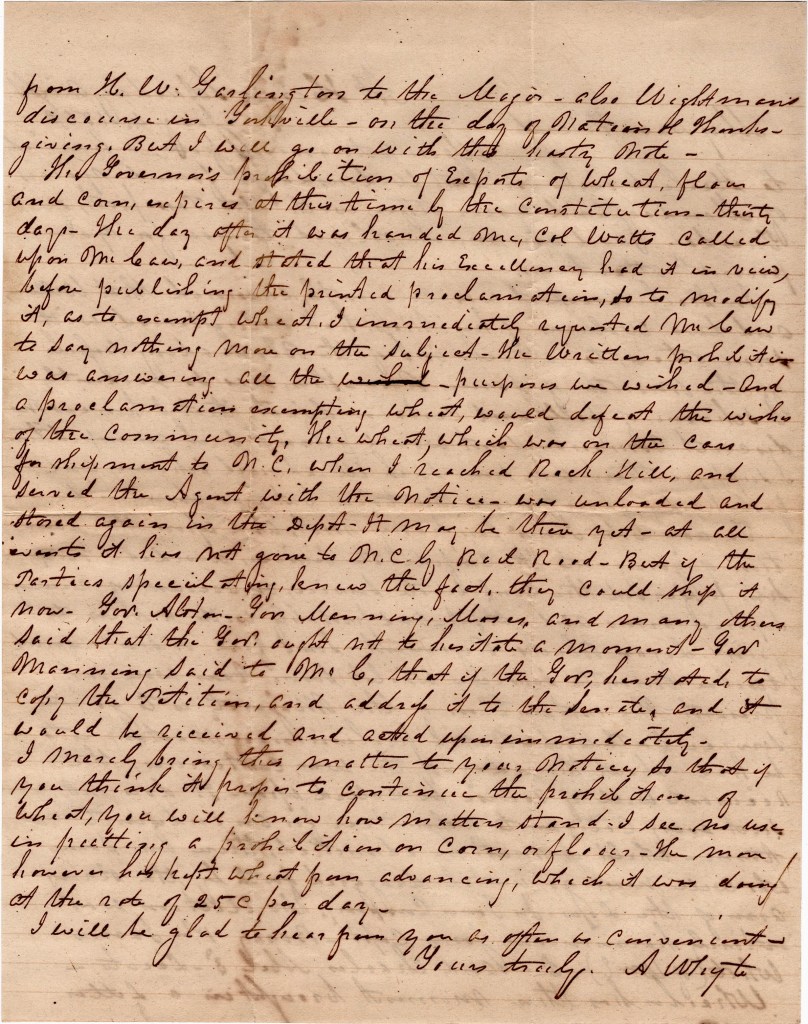
The Governor’s prohibition of exports of wheat, flour and corn expires at this time by the Constitution—thirty days. The day after it was handed me, Col. Watts called upon McCaw and stated that his excellency had it in view, before publishing the printed proclamation so to modify it, as to exempt wheat. I immediately requested McCaw to say nothing more on the subject. The written prohibition was answering all the purposes we wished, and a proclamation exempting wheat would defeat the wishes of the community. The wheat, which was on the cars for shipment to North Carolina when I reached Rock Hill, and served the Agent with the notice, was unloaded and stored again in the depot. It may be there yet. At all events, it has not gone to North Carolina by railroad. But if the parties speculating knew the fact, they could ship it now. Gov. [Robert F. W.] Alston, Gov. [John Lawrence] Manning, [Franklin J.] Moses, and any others said that the Governor would not hesitate a moment. Gov. Manning said to McC. that if the governor hesitated, to copy the petition and address it to the Senate, and it would be received and acted upon immediately.
I merely bring this matter to your notice so that if you think it proper to continue the prohibition of wheat, you will know how matters stand. I see no use in putting a prohibition on corn or flour. The move however has kept wheat from advancing, which it was doing at the rate of 25 cents per day.
I will be glad to hear from you as often as convenient. Yours truly, — A. Whyte
1 This is a reference to Robin Jones’s Cavalry, which became Co. H of the 1st S. Carolina Cavalry, a.k.a, Black’s Regiment.Co. H. was composed of men from Rock Hill, SC in York District. According to the Yorkville Enquirer of February 13, 1862, the Company was organized the week before, on February 9, 1862, and left Rock Hill on February 12th. Capt. Robin Cadwallader Jones raised the Company and commanded it until he was killed on June 9, 1863 at the 1st Battle of Brandy Station, VA. One version asserted that he had captured several Union troopers, was collecting their weapons, and one of them shot him. Another version asserted that he attacked a dismounted trooper and cut off his thumb, but the wounded soldier managed to get off a fatal shot from his revolver as Capt. Jones rode past. James H. Barry succeeded him as Captain in September of 1863. He was wounded in the right foot on August 7, 1863 (incident not named) and part of his foot had to be amputated. He resigned on January 27, 1865 due to age and the fact that his three-year enlistment had expired on January 9, 1865. He then enrolled in the SC Reserves. It is not known who took over the company at that time.
The following letter was written by Mary W. (Milling) Milling (1828-1910), the cousin and wife of Dr. James Smythe Milling (1831-1895), and the daughter of Dr. John N. Milling (1790-1864) and Mary Elizabeth Whitaker (1801-1861) of Camden, Kershaw county, South Carolina. Mary’s husband was a physician and planter in Fairfield District, S.C. In 1859, Milling moved his slaves to a plantation in Bossier Parish, La., where he spent much of his time while his wife (and cousin) Mary W. Milling and their children remained with her family near Camden, S.C. In 1866, Mary and the children moved to Louisiana. The children were Minnie (b. 1857), Jane (b. 1859), John (b. 1860), and James (b. 1862).
Find-A-Grave indicates that Milling served the Confederacy in Co. B, 28th Louisiana Infantry (Gray’s), or “Mark’s Guards.” However, this letter in March 1863 does not suggest that he was in the service at the time.
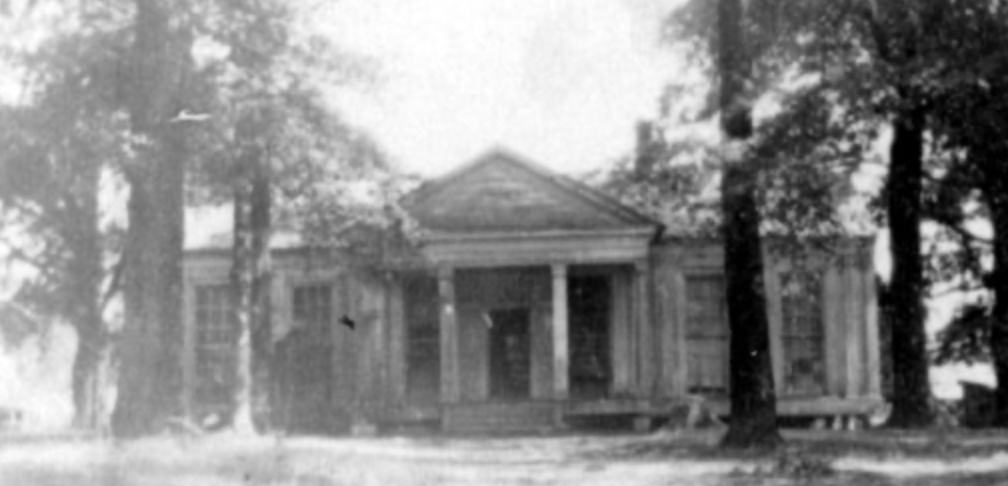
Dr. James S. Milling house in Bossier Parish, Louisiana (Bossier Parish Library Historical Center)
T R A N S C R I P T I O N
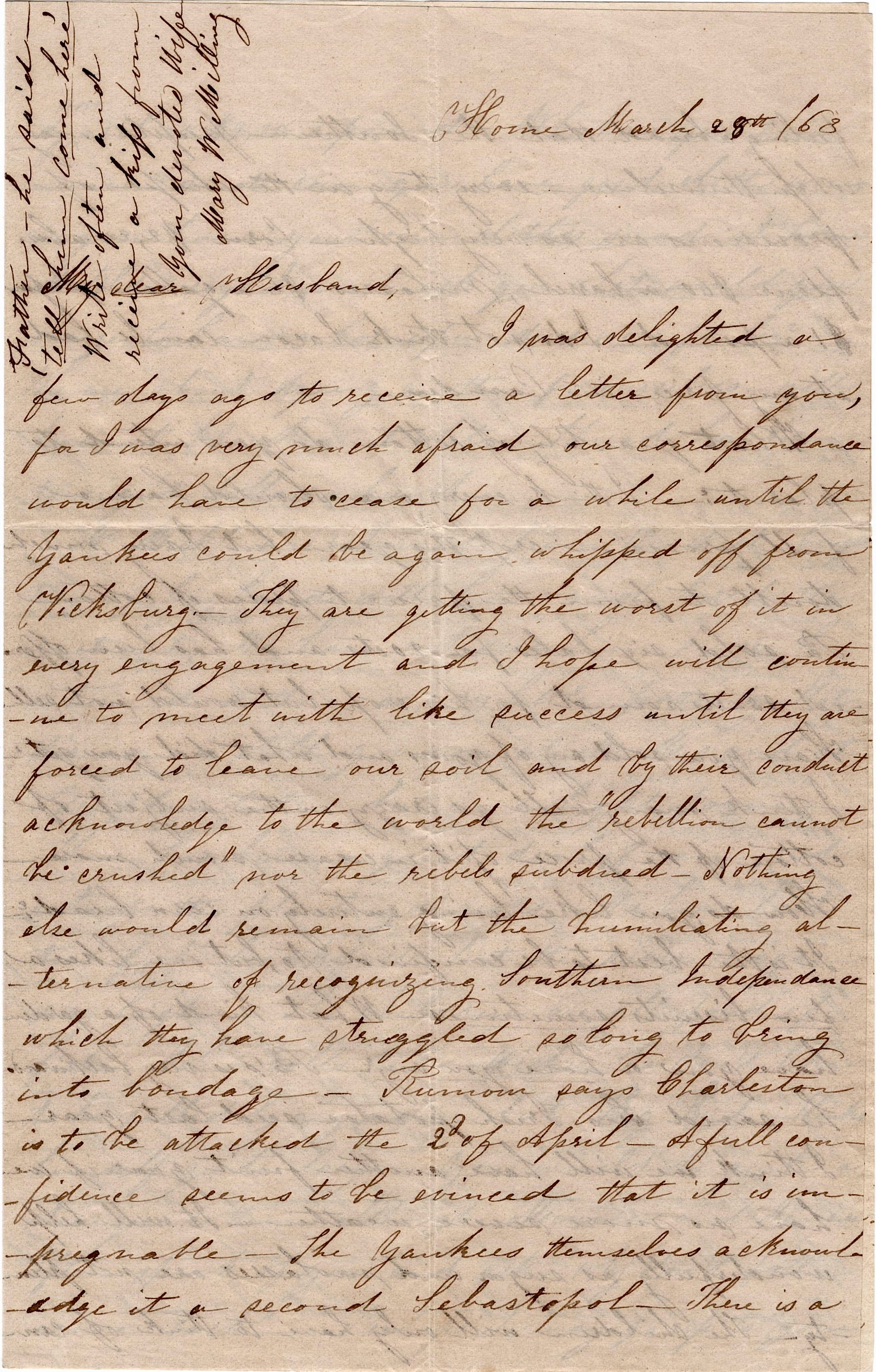
Home [Camden, South Carolina] March 28th 1863
My dear husband,
I was delighted a few days ago to receive a letter from you, for I was very much afraid our correspondence would have to cease for a while until the Yankees could be again whipped off from Vicksburg. They are getting the worst of it in every engagement and I hope will continue to meet with like success until they are forced to leave our soil and by their conduct acknowledge to the world the “rebellion cannot be crushed” nor the rebels subdued. Nothing else would remain but the humiliating alternative of recognizing Southern Independence which they have struggled so long to bring into bondage. Rumor says Charleston is to be attacked the 2nd of April. A full confidence seems to be evinced that it is impregnable. The Yankees themselves acknowledge it a second Sebastopol. There is a feeling abroad that the Southern people may whip themselves.
Everything in the shape of provisions are so very high—corn $2.25 a bushel, flour $60 a barrel, molasses $6 a gallon, sugar $1 a pound. I do not think bacon can be had at any price in Camden.
What quantity of cotton do you intend to plant? I think everyone should have a full provision crop this year but I very much doubt it from the present prices of cotton. Pa sold six bales for 20 cents and has been offered 25 cents round for his crop but would not sell. Have you sold any of yours and what did you get? I think many will go crazy on the subject of cotton if the price of it increases much more.
How do you like living entirely on corn bread? It is the best to be confined to, but one likes a few biscuits sometimes. What kind of a garden have you, or have you any? Pa’s is very backward. He saved his Irish potatoes seed last year, I think we will have another fruit year if we have no more severe weather. It will help wonderfully as sugar and molasses are not plenty. The children will only have to think of candy now as it is $2.25 a pound.
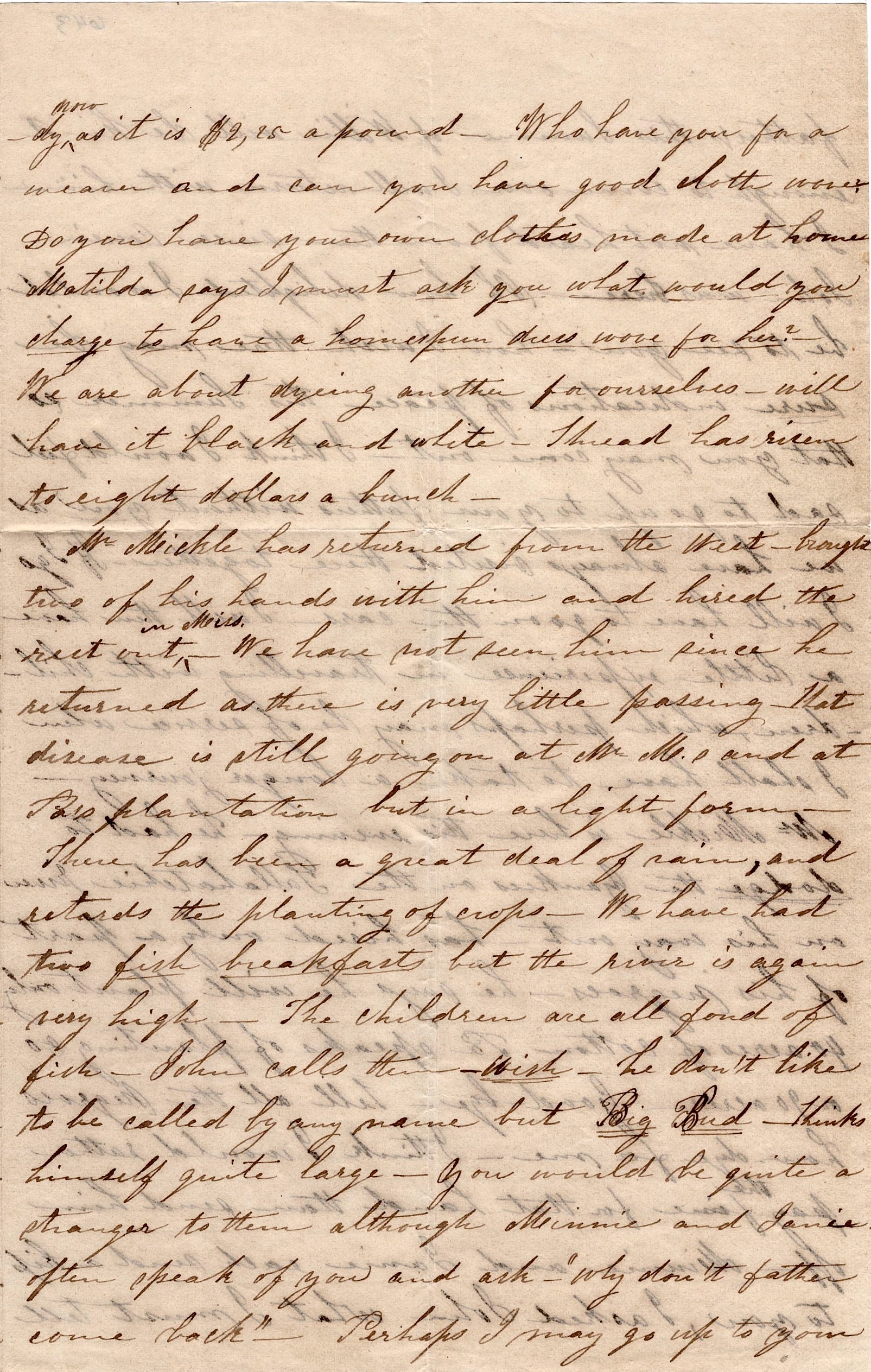
Who have you for a weaver and can you have good cloth woven? Do you have your own clothes made at home. Matilda says I must as you what would you charge to have a homespun dress wover for her? We are about dyeing another for ourselves. Will have it black and white. Thread has risen to eight dollars a buch.
Mr. [John Belton] Mickle has returned from the West. Brought two of his hands with him and hired the rest out in Mississippi. We have not seen him since he returned as there is very little passing. That disease is still going on at Mr. Mickle’s and at Pa’s plantation but in a light form. There has been a great deal of rain, and retards the planting of crops. We have had two fish breakfasts but the river is again very high. The children are all fond of fish. John calls them wish. He don’t like to be called by any name but “Big Bud. Thinks himself quite large. You would be quite a stranger to them although Minnie and Janie often speak of you and ask, “Why don’t father come back.”
Perhaps I may go up to your father’s this summer. If Willie will be kind enough to come over, I will return with him. I have not heard from them since cousin John was here. Oh how delighted I would be to see you. How I wish there may be sure indications of peace this summer so that you may come out. I think I would feel sad to go up to your father’s without you as we have always visited there together. If I go, I will have to go on the cars. I will then have a little experience in traveling with children, which perhaps may be of service when I shall have to take a longer journey.
Mr. Mickle is here this evening. He had to dodge the Yankees on the Tallatchie river on his way out. Has hired only a part of his negroes. He says he will plant only 40 acres of cotton. Pa speaks of planting 80 or 90 acres.
Goodbye. Tell all the negroes how-dye for me, I think I would rather pay the fine for that hand than send him off. Minnie and Janie each send a kiss to you. I asked John what I must tell Father. He said tell him come here. Write often and receive a kiss from your devoted wife, — Mary W. Milling
I can’t confirm his identity but this letter may have been written by David Seig Beare (1820-1898), a native of Virginia, who was employed as a silver smith in Corinth, Tishomingo county, Mississippi, at the time of the 1860 US Census. He had a ten year old daughter named Edmonia—a name that is mentioned in the letter.
The author reveals his ongoing recovery from an illness while in Mobile, a place that does not serve as his residence. In his letter, he admits that his “financial matters” have been rendered stagnant by the banks. Additionally, he expresses profound frustration regarding the reports of the invading Union army in Virginia.
T R A N S C R I P T I O N
Mobile [Alabama] June 9th 1861
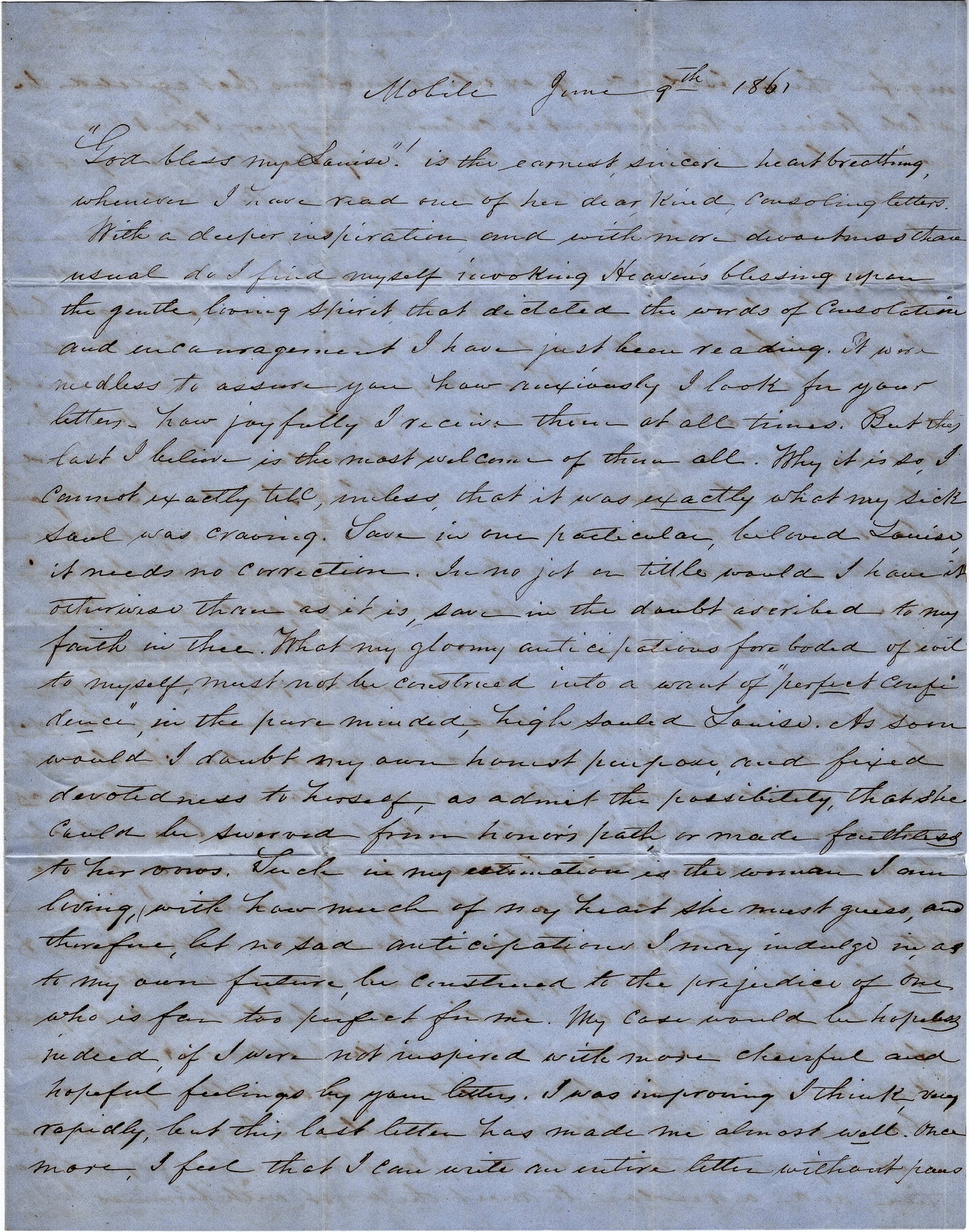
“God bless my Louise!” is the earnest, sincere, heart breathing, whenever I have read one of her dear, kind, consoling letters. With a deeper inspiration and with more devoutness than usual do I find myself invoking Heaven’s blessing upon the gentle living spirit that dictated the words of consolation and encouragement I have just been reading. It were needless to assure you how anxiously I look for your letters—how joyfully I receive them at all times. But this last, I believe, is the most welcome of them all. Why is it so? I cannot exactly tell unless that it was exactly what my sick soul was craving. Love is one particular, beloved Louise, it needs no correction. In no job or title would I have it otherwise than as it is, save in the doubt ascribed to my faith in thee. What my gloomy anticipations foreboded of evil to myself, must not be construed into a want of “perfect confidence” in the pure minded, high-souled Louise. As soon would I doubt my own honest purpose, and fixed devotedness to herself as admit the possibility that she could be swerved from honor’s path, or made faultless to her [ ]. Such in my estimation is the woman I am loving, with how much of my heart she must guess, and therefore, let no sad anticipation I may indulge in as to my future, be construed to the prejudice of one who is far too perfect for me.
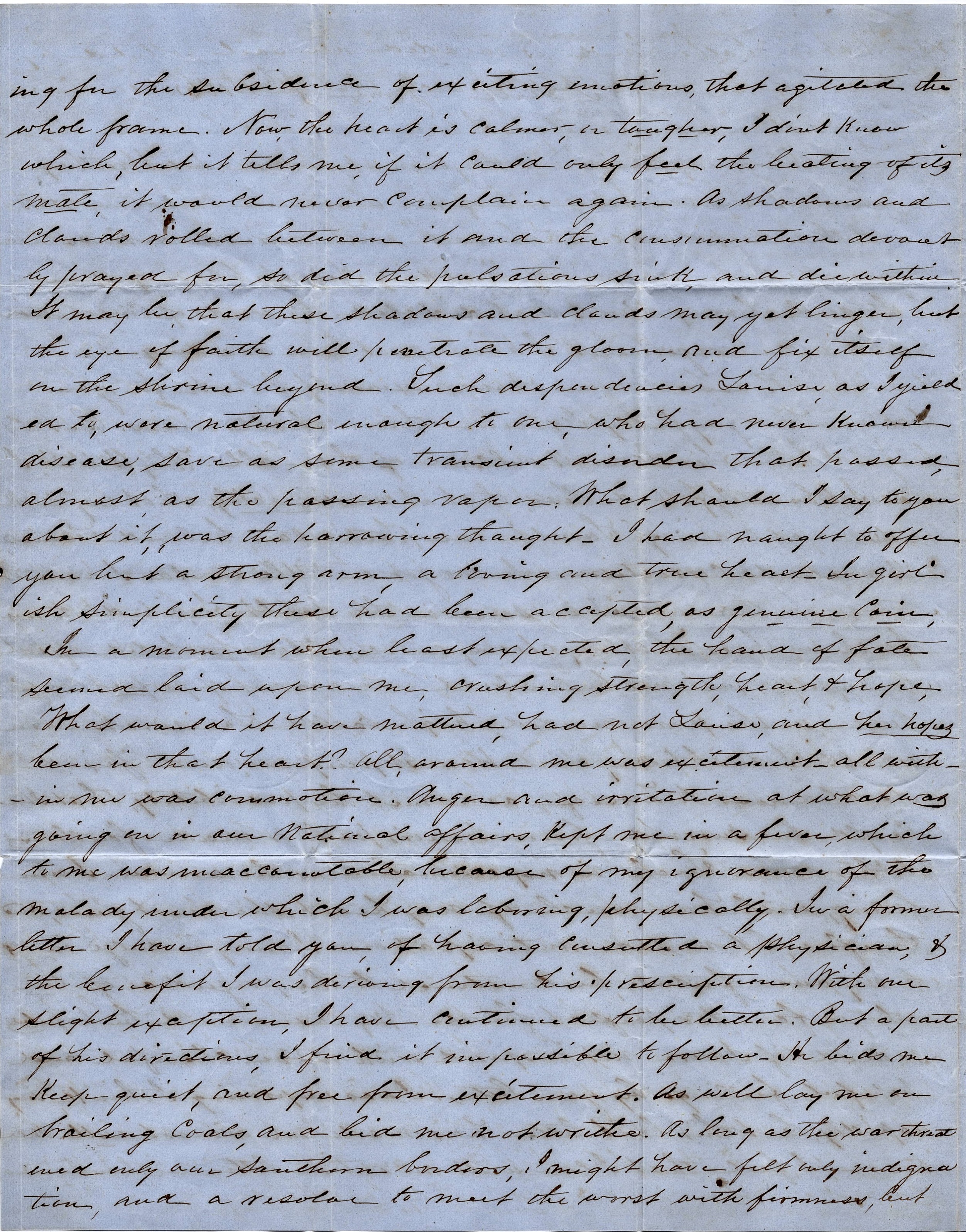
My case would be hopeless indeed if I were not inspired with more cheerful and hopeful feelings by your letters. I was improving, I think, very rapidly but this last letter has made me almost well. Once more I feel that I can write with an entire letter without pausing for the subsidence of existing emotions, that agitated the whole frame. Now the heart is calmer, or tougher—I don’t know which, but it tells me if it could only feel the beating of its mate, it would never complain again. As shadows and clouds rolled between it and the consummation devoutly prayed for, so did the pulsations sink and the die within. It may be that these shadows and clouds may yet linger, but the eye of faith will penetrate the gloom and fix itself on the shrine beyond. Such despondencies, Louise, as I yielded to were natural enough to one who had never known disease, save as some transient disorder that passed almost as the passing vapor. What should I say to you about it was the harrowing thought. I had naught to offer you but a strong arm, a loving and true heart. In girlish simplicity these had been accepted as genuine coin.
In a moment when least expected, the hand of fate seemed laid upon me, crushing strength, heart, and hope. What would it have mattered had not Louise and her hopes been in that heart? All around me was excitement. All within me was commotion. Anger and irritation at what was going in our National affairs kept me in a fever which to me was unaccountable because of my ignorance of the malady under which I was laboring physically.
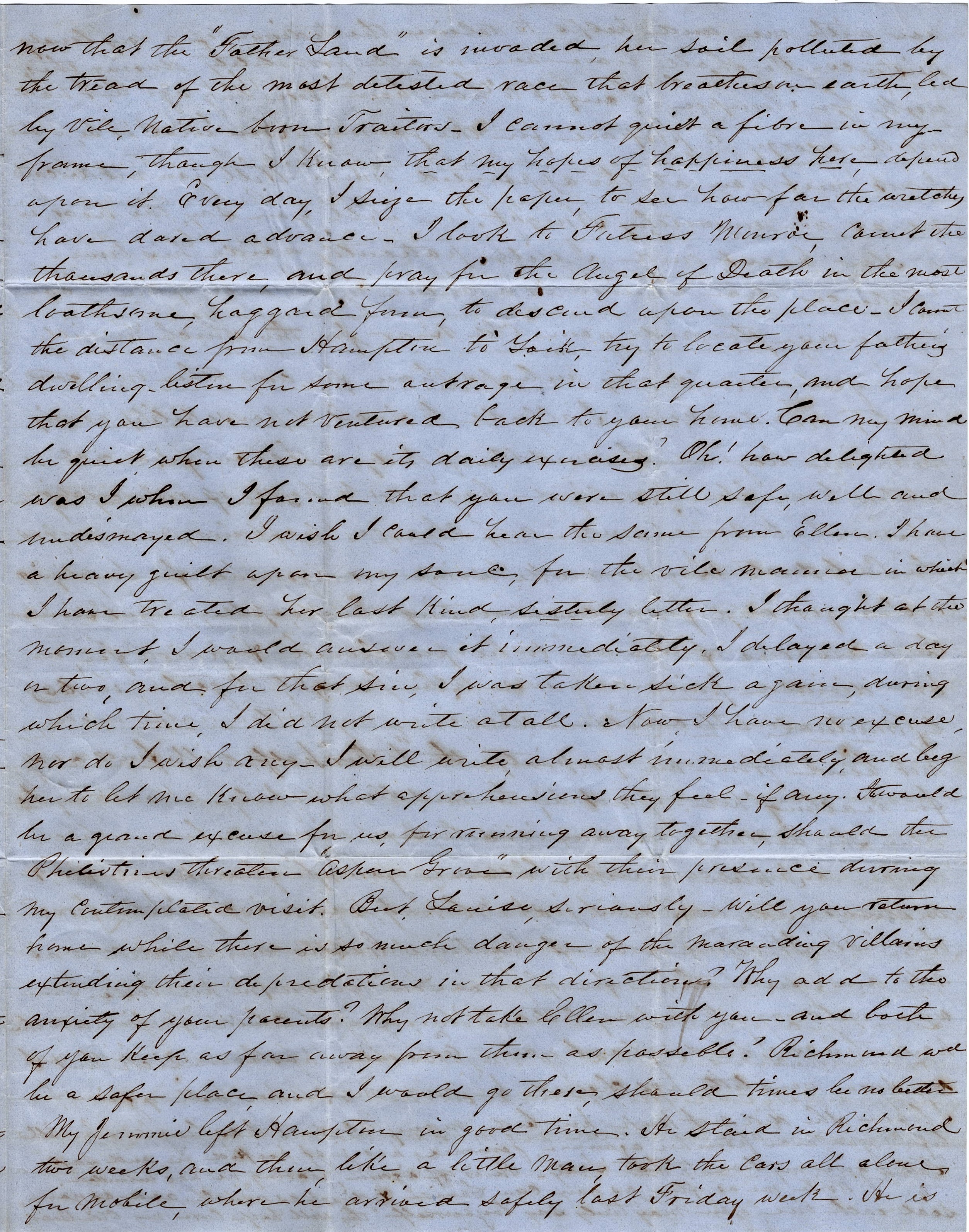
In a former letter I have told you of having consulted a physician and the benefit I was deriving from his prescription. With one slight exception, I have continued to be better. But a part of his directions, I find it impossible to follow. He bids me keep quiet, and free from excitement. [Might] as well lay me on broiling coals and bid me not writhe. As long as the war threatened only our Southern borders, I might have felt only indignation, and a resolve to meet the worst with firmness, but now that the “Father Land” is invaded, her soil polluted by the tread of the most detested race that breathes on earth, led by vile, native born traitors. I cannot quiet a fibre in my frame, though I know that my hopes of happiness here depend upon it. Every day I seize the paper to see how far the wretches have dared advance. I look to Fortress Monroe—count the thousands there, and pray for the Angel of Death in the most loathsome, haggard form to descend upon the place. I count the distance from Hampton to York, try to locate your father’s dwelling, listen for some outrage in that quarter, and hope that you have not ventured back to your home. Can my mind be quiet when these are its daily exercises? Oh! how delighted was I when I found that you were still safe, well and undismayed.
I wish I could hear the same from Ellen. I have a heavy guilt upon my soul for the vile manner in which I have treated her last kind, sisterly letter. I thought at the moment I would answer it immediately. I delayed a day or two and for that sin, I was taken sick again, during which time I did not write at all. Now I have no excuse, nor do I wish any. I will write almost immediately and beg her to let me know what apprehensions they feel—if any. It would be a grand excuse for us, for running away together, should the Philistines threaten “As___ Grave” with their presence during my contemplated visit. But Louise, seriously, will you return home while there is so much danger of the marauding villains extending their depredations in that direction? Why add to the anxiety of your parents? Why not take Ellen with you and both of you keep as far away from them as possible? Richmond would be a safer place and I would go there, should times be no better.
My Jemmie left Hampton in good time. He stayed in Richmond two weeks and then like a little man, took the cars all alone for Mobile where he arrived safely last Friday week. He is now with me and helps to relieve tension tedium of a very lonely existence. We shall leave here in all probability during this week for Kemper. I ought to have been there long ago, but had not the energy to prepare for the journey. How will it be. Should I not meet you at the appointed time? Will you not discard me as an unworthy knight? Will you say, the “Bear” is a slow beast, and I will patiently abide his time.
Patience, dear Louise, is a virtue you will often have to exercise towards your “Old Bear,” for the which he will love you more dearly perhaps than an other one good quality. The reason I allude to such a possibility as my detention beyond the middle of July is that our financial matters have been paralyzed beyond a hope of resuscitation for months to come, under my change of affairs, and unless the Confederate banks make some arrangements for equalizing exchanges, and for accommodating the people, I don’t see how the necessaries of life are to be purchased & paid form or how divided pairs are ever to be brought together unless by mutual attraction.
However, my better half need not bend from her propriety—the “t’other” half will find a way of reaching her, if not by the middle of July, at least by the time she becomes very anxious to see him.
I have another letter of yours to thank you for and to answer too, as I was just about answering it when I received this last. It came about the time Ellen’s came and was not answered then for the reason given in her case. You were welcome to see my letter to her, if you could forgive all the hard things I said about you. Edmonia has been sick but I am sure your letter has cheered her and made her well again, for I learn she did not keep her bed many days—not as long as she will before you hear from her again. Jemmie has just peeked in and says, “Father, give my love to that lady.” He is off again, fearing he has offended.
Write me as often as you can, Louise, and direct as usual, and as you seal each one, you may truly say to yourself, “This will cure my “Old Bear.”
Emma Louise (Ronaldson) Eldridge (1833-1879) to her husband, Erwin James Eldridge (1833-1902) just days after the Battle of First Manassas. She was the daughter Archibald Ronaldson (1808-1865)—a Scottish-born coal mine engineer—and Ellen Jemima Ogilvie of Philadelphia, Pennsylvania.
Erwin was born in Cecil county, Maryland, on February 3, 1833. After earning his medical degree in 1856 from Jefferson Medical School in Philadelphia, he traveled to Vienna, Austria. During his time overseas he served as a surgeon in the Crimean War. When he returned to the United States, he lived in Maryland for a time before relocating to Americus, Sumter county, Georgia. When the civil war began, he enlisted as a sergeant in Co. A, 11th Battalion, Georgia Artillery (a.k.a. the “Sumter Flying Light Artillery”). In July 1861, however, he was appointed an Assistant Surgeon in the 16th Georgia Infantry. By early 1864, he was promoted to Chief Surgeon of Gen. Cobb’s Division. By 1870, Dr. Eldridge was living in Americus, Sumter County, Georgia. He would go on to work as a physician and druggist in Lee and Sumter Counties, Georgia. On March 13, 1902, Dr. Eldridge died and is buried at Oak Grove Cemetery, Americus, Sumter County, Georgia.
See also, in the Digital Library of Georgia, Dr. Erwin J. Eldridge letters, 1860-1865. “The collection consists of three letters from Dr. Eldridge while in service in the Confederate Army. He writes to his wife, Emma of items that he picked up on the Manassas battlefield that he wished to send home to his son, also of long marches and Confederate officers from his experience. Also in this collection are seven much longer letters from Emma to Dr. Eldridge through the care of Howell Cobb’s famous Georgia regiment. In them she describes news of their home from Americus, Georgia, including war news, family matters and a detailed description of a tornado that ripped through town sending slaves and livestock flying through the air. The remaining letters are from family and friends displaying concern for Dr. Eldridge and other family members in the service of the Confederacy.”
T R A N S C R I P T I ON
Americus, Sumter county, Ga. July 24th 1861
My own darling Erve,
After anxiously waiting for a week, I at last received your dear, kind letter by Mr. Davidson. The other one you spoke of has never reached me & I am sorry, very sorry, that you did not tell me in the one of today what you were in need of and want me to send. It may have been delayed and reach me tomorrow. In case it does not, please write me again what you want. I could not understand Mr. Daniels about the bundle & the only thing I could think of were your credentials from the college in Philadelphia. I thought perhaps you had some idea of getting an appointment as surgeon & sent them on by Captain Sirrin [?] yesterday.
We have received terrible accounts of the Battle at Manassas, with great loss on both sides. How terrible it was, & to think of so many of our brave men killed, it seems to have cast a gloom over everyone here. No one has a word to say excepting to comment upon the daily news, & the possibility of what may be the fate of our own loved ones. It is dreadful to think of. Sometimes I think I can’t stand it any longer. Your absence, dear Erve, is hard—very hard to bear, and when I know you are constantly surrounded by dangers, and I may never see you again, is it any wonder I have few but sad lonely thoughts.
This is not the way to write to you, my darling, I now it. but I cannot help it sometimes. You are all that I have & if anything were to happen to you, I have nothing, really nothing in the world to live or care for. But I’ll stop this and write more cheerfully.
It is almost dark & I can hardly see what or where I am writing. I had a letter from Mr. Stokes today. In it he wrote a list of the notes & to each wrote what the prospect was. Some are good, some slow if good, & some he thinks are worthless. He says he will do the best with them he can but there is little possibility of many of them paying before winter.
E. Eldridge (1860)
I am very glad you have your bed & are fixed more comfortably. I know you don’t relish eating off of your lap, but I suppose it can’t be helped. Mrs. Crawford & myself spent the day at Mrs. Hancocks in company with Mrs. Myrick & Mrs. Robinson. Mrs. Myrick said she was so disappointed inn not seeing you, as she had a great curiosity to do so. In order to gratify it, I sent home for your Ambrotype. I am so proud to show you off, Erve, even if you are not here & people look at you so admiringly. I know they wish they were in my place. Mrs. Robinson was commiserating the soldiers who have come home & found their wives sick after being absent so long—Captain Johnson for instance. His wife has just had a baby. She said she thought some of the ladies should hold a meeting & appoint a committee to go and console with him & console him in the best manner possible. Erve, did you think that Mrs. Richardson—so quiet and good—had so much badness in her?
Erve, you don’t know how glad I am that I am not going to have a little one before your return. When I wrote you first I was very glad, because there was a possibility of it. Now I am very glad it is to the contrary. After you come home, I hope to do better. Mrs. Robinson is going to stay all night with us. I expect she is very lonely at home, everyone having left there but herself. She is more cheerful than I ever expected to see.
I have been busy all this week making shirts for the society. There is little or no work there now. Mrs. Greene is still in Lee. No one here has heard anything of her since she left. I reckon she will be up here in a few days to stay with us awhile. Yesterday Mrs. Crawford & I went to hear Mr. Clark’s funeral sermon preached. It was very sad.
We had a letter from home last week. They are very anxious about us not having heard since the 20th of April. They would like to have us home with them thinking we are in great danger here. Arch is quite well, weighs 200 pounds.
I have slept in our bed only once since you left & i the night rolled over to Inez & hugged her up, thinking it was my own blessed husband. Maybe when you do come home, you’ll wish you were back to your single bed in the camp with no one to trouble you. I wish I could see you. It seems months since you left me. I used to think I missed you as much as I possibly could when you were down here before we were married. But oh! Erve, it is a thousand, thousand times worse. When you return, I hope I shall never be separated from you again until I die. Many persons have said since you left, that I take your absence very well indeed. They can’t tell my thoughts, Erve, and don’t know the desolate blank in my heart caused by your absence. God grant you may be safe at home by Christmas. Even that seems like years to look forward to.
I hope Erve that I will receive your letter tomorrow. The mails are so irregular. It may have been delayed somewhere on the road. Some of our letters come in four days. My first one took seven. If I should get it tomorrow, I will get the things immediately and send on by the first opportunity.
I am very glad indeed that the company attend religious services. It is so important. God bless them in endeavoring to do right. Not only bless them in this life but in that which is to come. Mrs. Crawford sends much love to you & says she will write you soon. Inez also. I have not heard a word from Mrs. Bryan although I wrote her some two weeks since. Major B. is still in Lee.
My pen is so miserable I can scarcely write. I must not mind looks though—especially now, so my own darling excuse both the composition and writing. I will supply myself with a new pen next time & hope my brain will be more active. Mrs. Robinson, Inez, Mollie, and Lou all send a great deal of love to you. Do write very soon. Every line from you is a comfort and blessing to me. God bless & keep you my darling and bring you home safe to your own true & loving wife, — Em
Mrs. Hancock says, “Put a heap of love in there for Dr. & tell him to behave himself.” Mr. Cook gave here a small Ambrotype of you. I am glad he did. She prizes it very highly.
The following letter was written by Hazen Bedell (1785-1835) from his log cabin in Montebello, Hancock county, Illinois. Montebello existed for no more than five years, but settlers were originally attracted to its location on the Mississippi River. A ferry was established at “Montebello” in 1829 to cross the Mississippi River. Homes, streets as well as the court house were built but it would all prove to be a failure as it was too low in elevation and prone to flooding. According to an article in the Journal of the Illinois State Historical Society (1908-1984), Vol. 18, No. 4 (Jan., 1926), most of Montebello is underwater now, caused by the construction of the Keokuk dam. The town of Hamilton, Illinois, was later established in the same vicinity but at a higher elevation and at the foot of the rapids.
In a Journal of the Illinois State Historical Society (1908-1984), Vol. 18, No. 4 (January 1926), entitled “The First Permanent Settlement in Hancock County, Illinois,” author Calvin S. Sifferd, Jr. wrote that Montebello was located on the SW of Section 18 and that it was “the only logical place for a settlement on the river” as it was “the only spot where the shore came directly to the water. Every other foot of the river bank for ten miles up and down the river was either precipitous bluffs or tangled swamps. The river in front of the town was a dangerous rapid, but nevertheless the settlers were attracted to Montebello because of the timber. The majority of the settlers were from Ohio and Kentucky where they had become accustomed to broad timberlands and disliked to settle on the treeless prairie.”
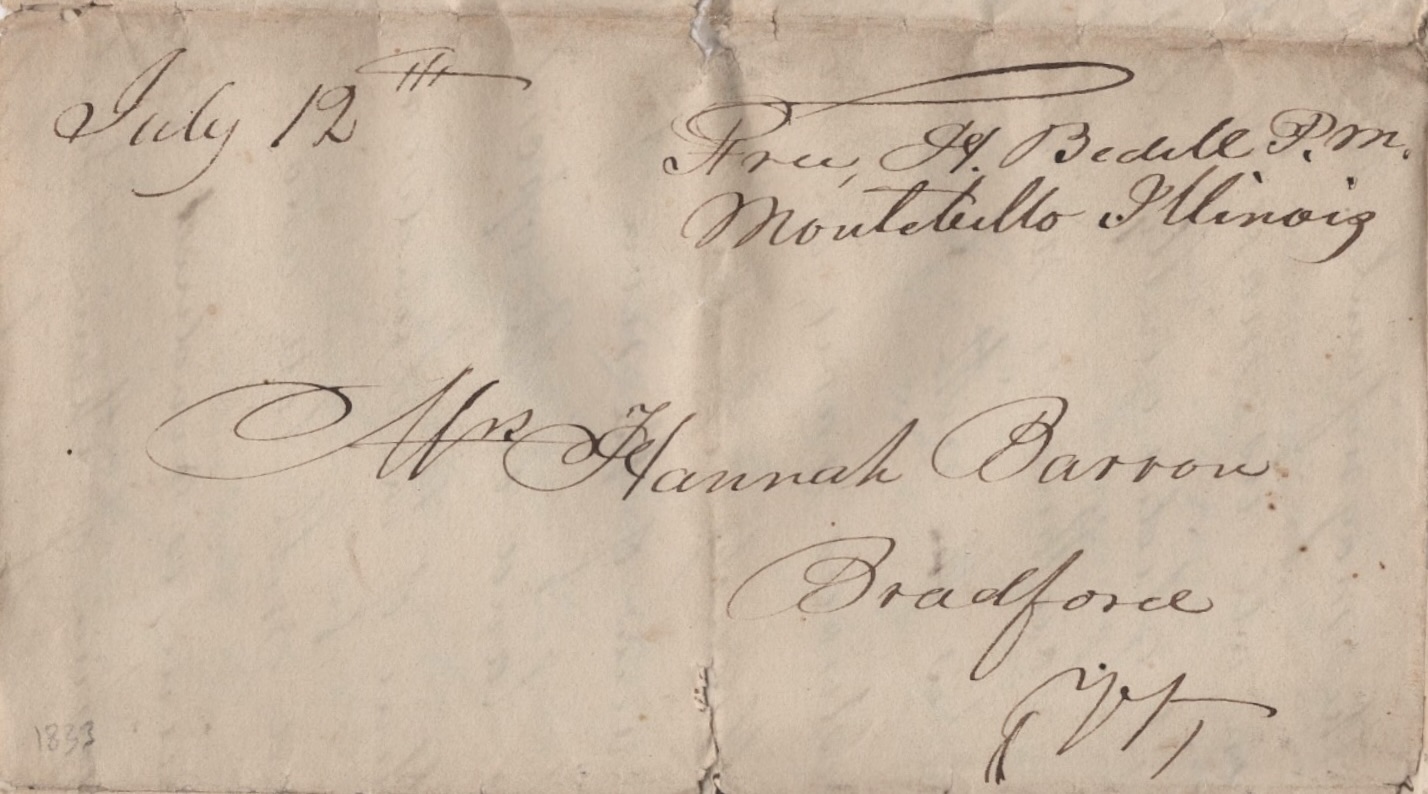
During the three years that Montebello was recognized as the county seat, court was held in Hazen Bedell’s cabin. The county seat was officially transferred to Carthage in 1833—the year of this letter. A post office was established in the town in 1829 and Hazen Bedell served as postmaster. You’ll notice that Bedell free franked his letter, the privilege of a post master and identified himself as PM (post master) on the outside of the letter. He served as post master until his death in 1835.
Addressed to Mrs. Hannah Barrow, Bradford, Vermont
Montebello [Illinois] July 7, 1833
My dear Niece,
I have waited a long time(and to confess the truth, not with that degree of patience that becomes a philosopher or a man on my experience in the promises of a fair lady whose promises have been aptly though perhaps rather severely compared with pie paste & consequently made to be broken) for your promised letter. Now “thinks i to myself,” I will just sit down & drop a line to my “fair cousin” and put her in mind of her promise.
Well, dear Hannah, I do not know how I can entertain you better than to give you a short description of my family & place of residence. My family consists of a wife (a second one) and three children—two sons and a daughter. My eldest son Edward Augustus, 17 years of age, and my daughter Ann Mariam 14 years old are children by my first wife whom I married in the State of New York previous to the late war. My third child, a son by my present wife, we call Lucian Lynch. He is three years old. My daughter is now absent at school.
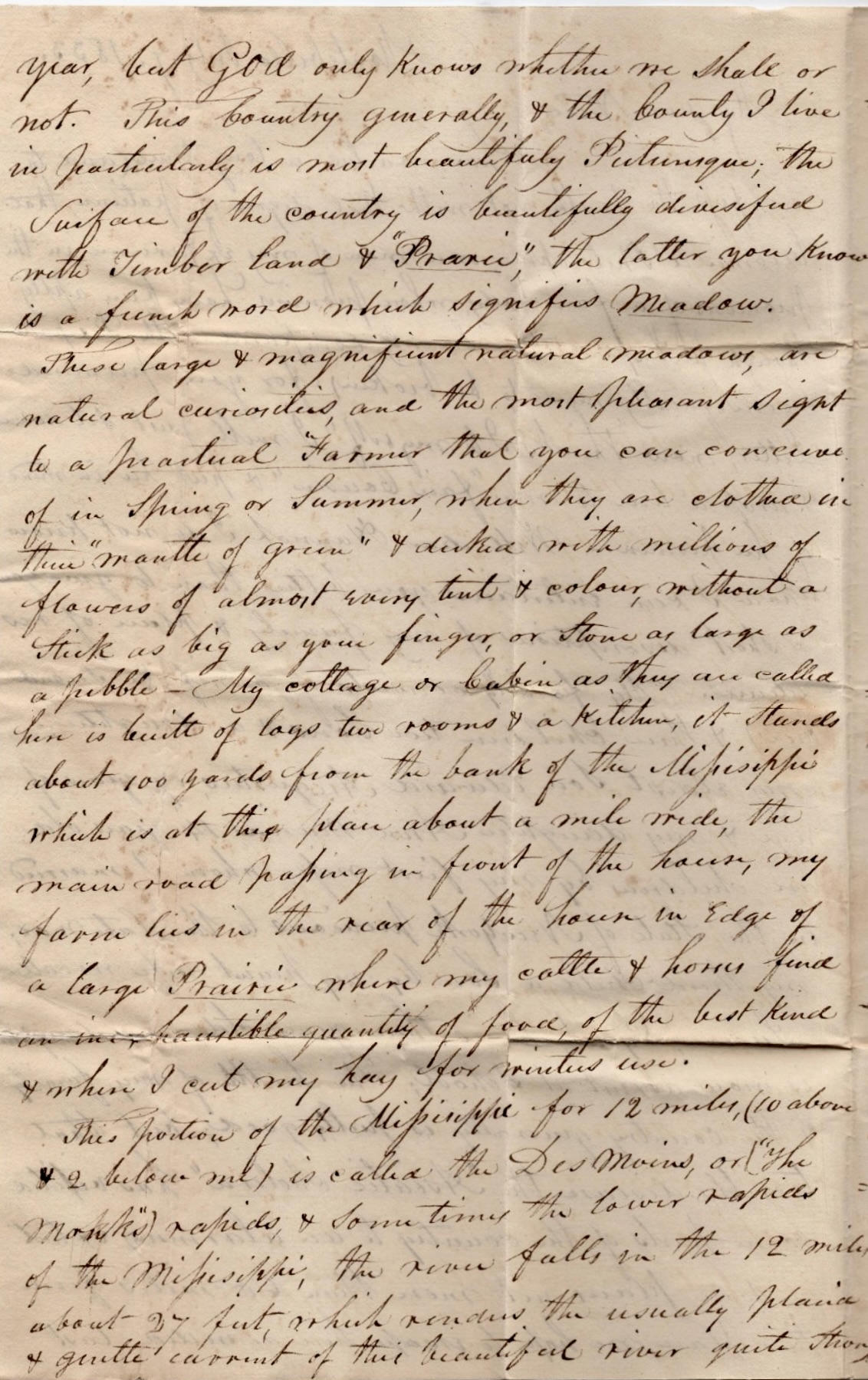
The health of my family & the country generally is pretty good but that terrible disease the “Asiatic Cholera” has visited some parts of the country to an alarming extent—in some places not more than 60 miles from this place. We hope to escape here as we did last year but God only knows whether we shall or not. This country generally, and the county I live in particularly is most beautifully picturesque. The surface of the country is beautifully diversified with timber land and “prairie,” the latter you know is a French word which signifies Meadow.
These large and magnificent natural meadows are natural curiosities and the most pleasant sight to a practical farmer that you can conceive of in Spring or Summer when they are clothed in their “mantle of green” and decked with millions of flowers of almost every tint and color without a stick as big as your finger, or stone as large as a pebble. My cottage—or cabin as they are called here—is built of logs two rooms & a kitchen. It stands about 100 yards from the back of the Mississippi which is at this place about a mile wide. The main road passing in front of the house. My farm lies in the rear of the house in edge os a large prairie where my cattle and horses find an inexhaustible quantity of food of the best kind & when I cut my hay for winter use.
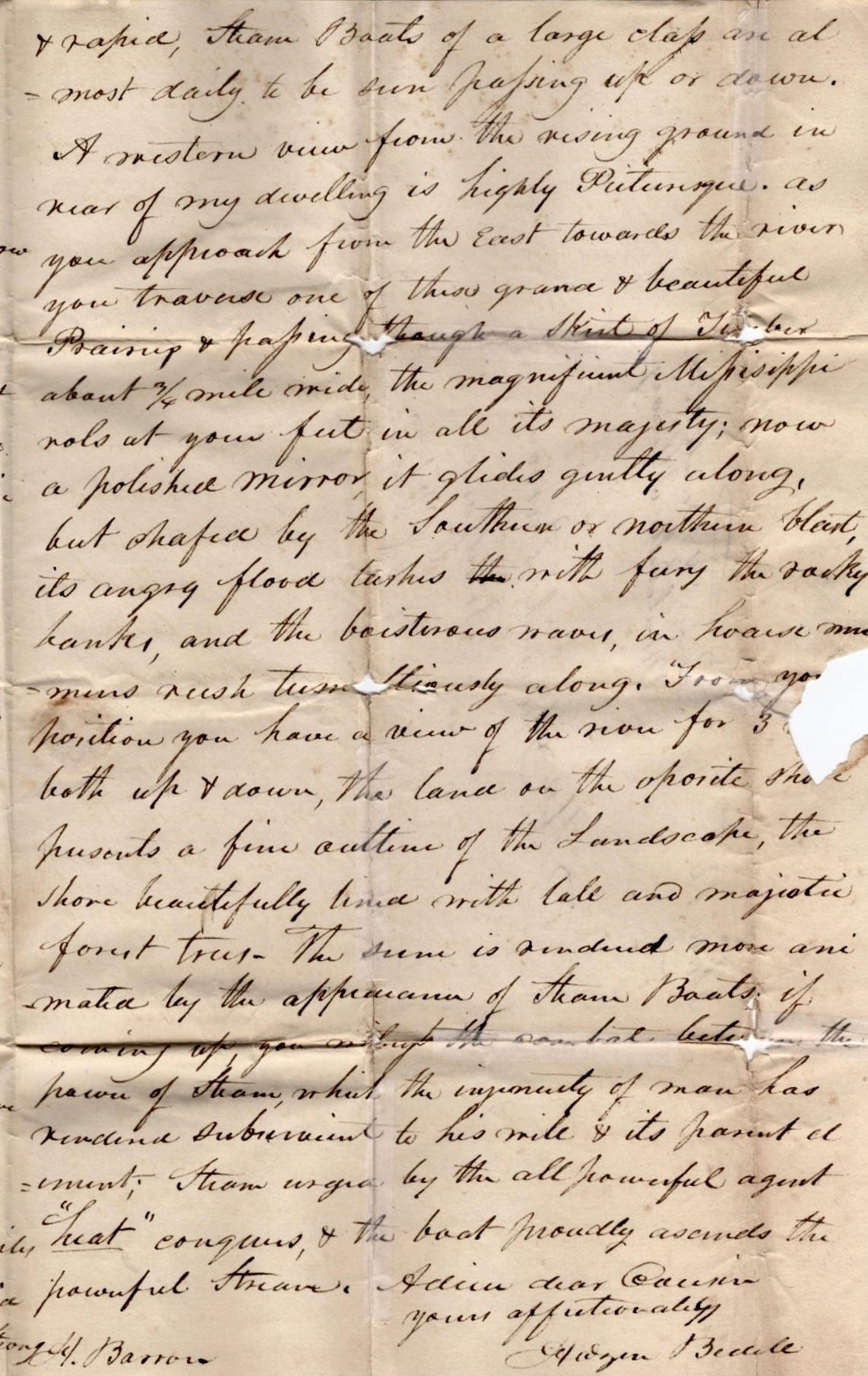
This portion of the Mississippi for 12 miles (10 above & two below me) is called the Des Moines (or “The Monks”) Rapids & sometimes the Lower Rapids of the Mississippi. The river falls in the 12 miles about 27 feet which renders the usually placid & quiet current of the beautiful river quite strong & rapid. Steamboats of a large class are almost daily to be seen passing up or down.
A western view from the rising ground in rear of my dwelling is highly picturesque. As you approach from the East towards the river, you traverse one of these grand & beautiful prairies, and passing through a skirt of timber about three-quarters mile wife, the magnificent Mississippi rolls at your feet in all its majesty. Now a polished mirror, it glides gently along, but chafed by the Southern or Northern blast, its angry flood lashes with fury the rocky banks and the boisterous waves in hoarse murmurs rush tumultuously along. From your position you have a view of the river for three miles both up and down. The land on the opposite shore presents a fine outline of the landscape, the shore beautifully lined with tall and majestic forest trees. The scene is rendered more animated by the appearance of steamboats. If coming up, you witness the combat between the power of steam, what the ingenuity of man has rendered subservient to his will, & its parent element. Steam urged by the all powerful agent “heat” conquers & the boat proudly ascends the powerful stream. Adieu dear cousin. Yours affectionately, — Hazen Beddle
The following letter was written by 41 year-old James Delamater Stearns (1822-1899), the son of Amory Stearns (1797-1875) and Mariah De Lameter (1800-1889) of Jamestown, Chautauqua county, New York. James wrote the letter to his wife, Emeline (Frank) Stearns (1832-1893), while serving in the 7th Company, 1st Battalion New York Sharpshooters.
Capt. Joseph S. Arnold commanded Co. 7, 1st Battalion, N. Y. Sharp Shooters
The origin of this regiment came about in the following way. Major W. S. Rowland received authority from the War Department in October 1862 to recruit a regiment of sharpshooters in the States of New York and Pennsylvania. The regimental organization failed and only a battalion was recruited, which was finally organized consisted of four companies, the 6th, 7th, 8th and 9th. The 7th Company—Co. L, 112th New York Volunteers was organized at Jamestown under the command of Capt. Joseph S. Arnold and mustered in the service of the United States for three years on 12 September 1862. It was recruited principally at Ellicott, Kiantone, Busti, Ellington, Ellery, Carroll and Jamestown. [Source: New York in the War of the Rebellion, 3rd ed. Frederick Phisterer. Albany: J. B. Lyon Company, 1912.]
T R A N S C R I P T I O N
Suffolk, Virginia Tuesday, June 16, 1863
Dear Emeline,
It is over one week since I wrote to you, but be assured you are not forgotten for I think of you as often as though I wrote every day. We have been moving our camp and making streets through our new city and I have had to get my three meals of victuals per day for the Captain and Lieutenants and often I have to cook for our sick boys. And when it comes night, you may guess that I am very tired. Tonight my legs and feet feel as though I had been on an all day march and now it is after nine o’clock in the evening, but write I will.
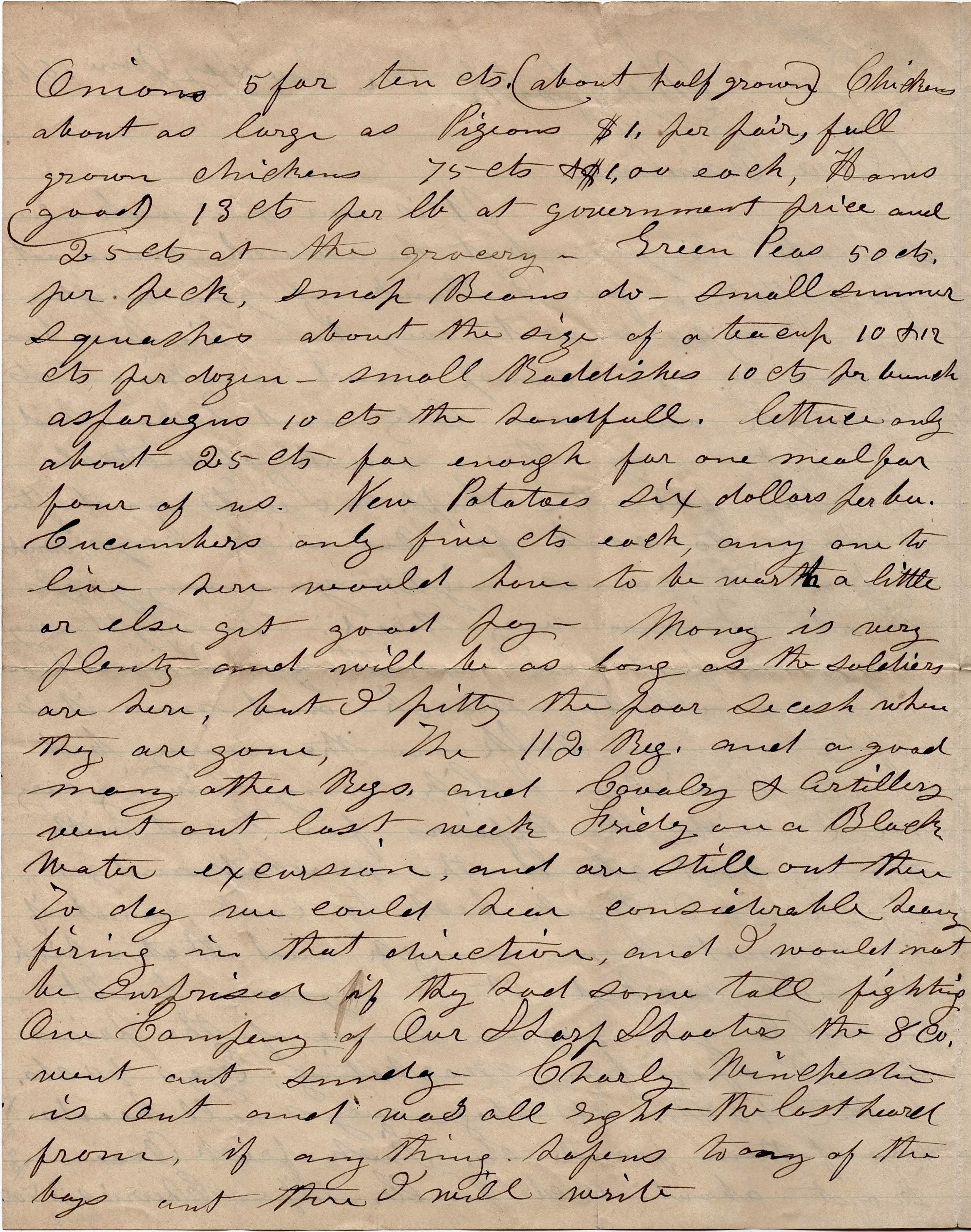
I like my living very well with the officers for I eat with them and attend the markets and get such as I think best to cook, and if I do not have enough and that which is well cooked, it is my own fault. I will give you some of the prices that I pay for marketing. Eggs 40 cents, butter 40 cents, cabbage, very small heads, two of them for 25 cents, fish, fresh ocean trout about 15 cents per lb., ripe cherries 25 cents per quart, onions 5 for ten cents (about half grown), chickens about as large as pigeons $1 per pair, full grown chickens 75 cents & $1 each. Hams (good) 13 cents per lb. at government price and 24 cents at the grocery. Green peas 50 cents per peck, snap beans ditto, small summer squashes about the size of a teacup 10 and 12 cents per dozen, small radishes 10 cents per bunch, asparagus 10 cents the handful. Lettuce only about 25 cents for enough for one meal for four of us. New potatoes six dollars per bushel. Cucumbers only five cents each. Anyone to live here would have to be worth a little or else get good pay. Money is very plenty and will be as long as the soldiers are here, but I pity the poor secesh when they are gone.
The 112th [New York] Regiment and a good many other regiments and cavalry and artillery went out last week Friday on a Black Water excursion and are still out there. Today we could hear considerable heavy firing in that direction, and I would not be surprised if they had some tall fighting.
One company of our sharp shooters—the 8th Company—went out Sunday. Charley Winchester is out and was all right the last heard from. If anything happens to any of the boys out there, I will write.
I received a letter from Bro. William last night. Will answer it in a day or two. We were paid off last Saturday and I will send you the money either by R[ussell] M. Brown tomorrow or in a letter in a few days. Russel M. Brown has got his discharge and is a going to start home tomorrow. He is very low and I doubt his standing his journey very well. He will call on you when he is able to and let you know just how I get along. A. K. [Amos K. Brown] is quite sick but will probably get up in a few days. We have quite a number of sick ones but none very dangerous as yet. I have had a few shakes of the ague. The doctor gave me quinine enough to break it up so I am all right. I will try and write you again in a few days but you need not wait for me to write but send along your letters and all the news. I will attend to Mercy as soon as it is convient. Bill Leaver’s & Dan Jennings’ wives are here and making about ten dollars apiece per week in baking, &c., for the soldiers. Dan’s wife is not very well for a [ ].
Give my regards to all enquiring and especially to Mrs. Em S & the children. Yours &c. — James
I could not find an image of any member of the 61st Tennessee Infantry in uniform though this image appeared in Military Images Magazine as an “Unidentified Tennessee Confederate.”
James Knox Polk Sayler (1839-1919) was raised in Greene County, Tennessee, the son of John Sayler (1808-1879) and Mary (“Polly”) Fink (1809-1895). After attending Milligan College, Sayler joined Co. A of the 61st Tennessee Mounted Infantry Regiment (Confederate) as a private in mid-November 1862. The unit was dispatched immediately to Mississippi, where they spent time in Jackson and Vicksburg. On July 4, 1863, the 61st Tennessee was present at Vicksburg and was surrendered as part of Major General M. L. Smith’s Division. According to his muster rolls, he was absent on parole until 30 April 1864 but there is no record of his returning to the ranks after that date. After the war, Sayler returned home to Greene County, where he became a professor at a school in Romeo. Sayler died in 1919 and is buried in Greene County.
Serving in the same company with James were two brothers, Jacob (“Jake”) F. Sayler (1842-1863), and John R. Sailer (1841-1891). Jake did not survive the war. He enlisted at the same time as James but was in the ranks and was taken prisoner at the Battle of Big Black River Bridge on 17 May 1863. According to Jake’s muster rolls, he was taken to Fort Delaware, arriving there on 15 June 1863, then transferred to Point Lookout, Maryland, where he died of disease in October 1863. His name appears on a plaque (“J. F. Saylor”) in the Point Lookout Confederate Cemetery. According to John’s muster rolls, he deserted on 17 May 1863, the day of the Battle of Big Black River Bridge, and apparently never returned to the regiment.
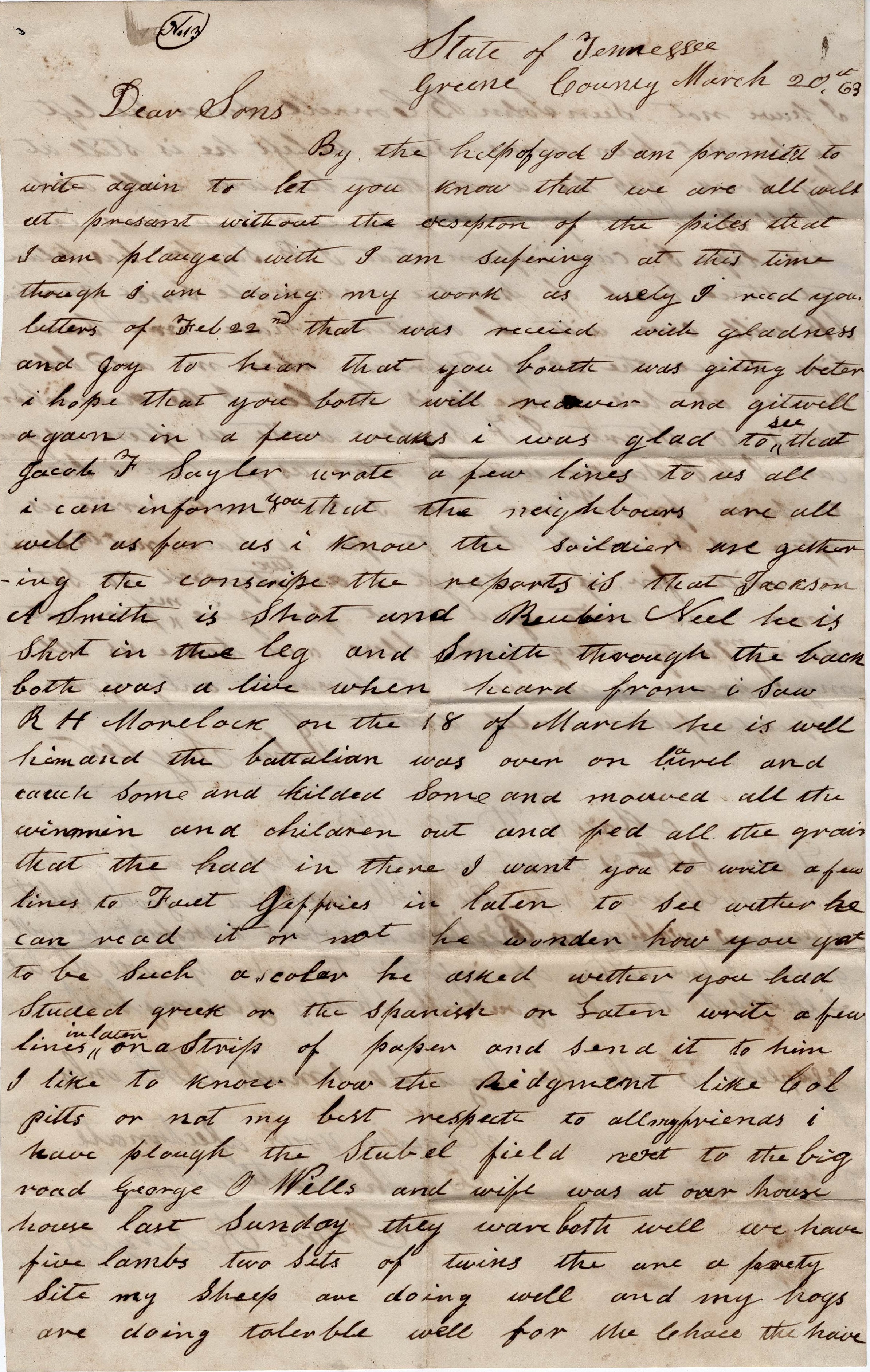
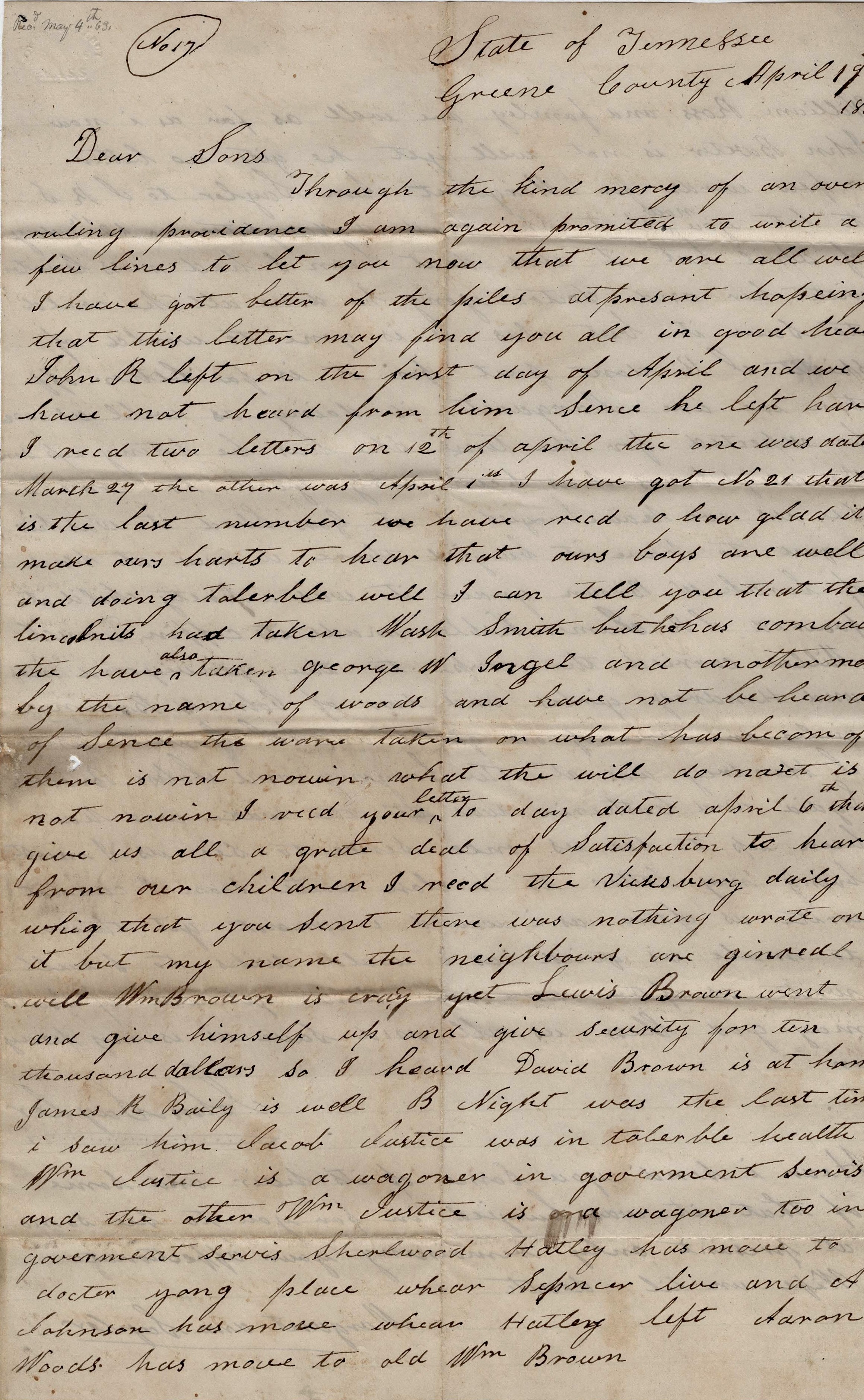
The letters comprising this small collection were primarily exchanged between John Sayler (1808-1879) of Greene County, Tennessee, and his sons, James and Jacob, during their service in the 61st Tennessee Infantry. With the exception of a correspondence from Grenada, Mississippi, dated late December 1862, all other letters from the sons (primarily James) were penned in the vicinity of Vicksburg. The home front correspondences of John Sayler prominently mention numerous family names that will be familiar to individuals with deep roots in Greene County. Moreover, these letters illuminate the prevailing conflicts in Eastern Tennessee, a region marked by divided loyalties during the war.
More of James K. P. Sayler’s correspondence, writings and speeches, bills, contracts, and other papers can be found in The James K. P. Sayler Papers, 1857-1943, at the Special Collections & University Archives at the University of Tennessee, Knoxville. The correspondence dating after 1861 contains many letters from Sayler and his brother John, both of whom served as Confederate soldiers during the war, to their family in Greeneville. Sayler, who served in the Vicksburg, Mississippi, area, provides descriptions of camp life as well as information on military movement and battles.
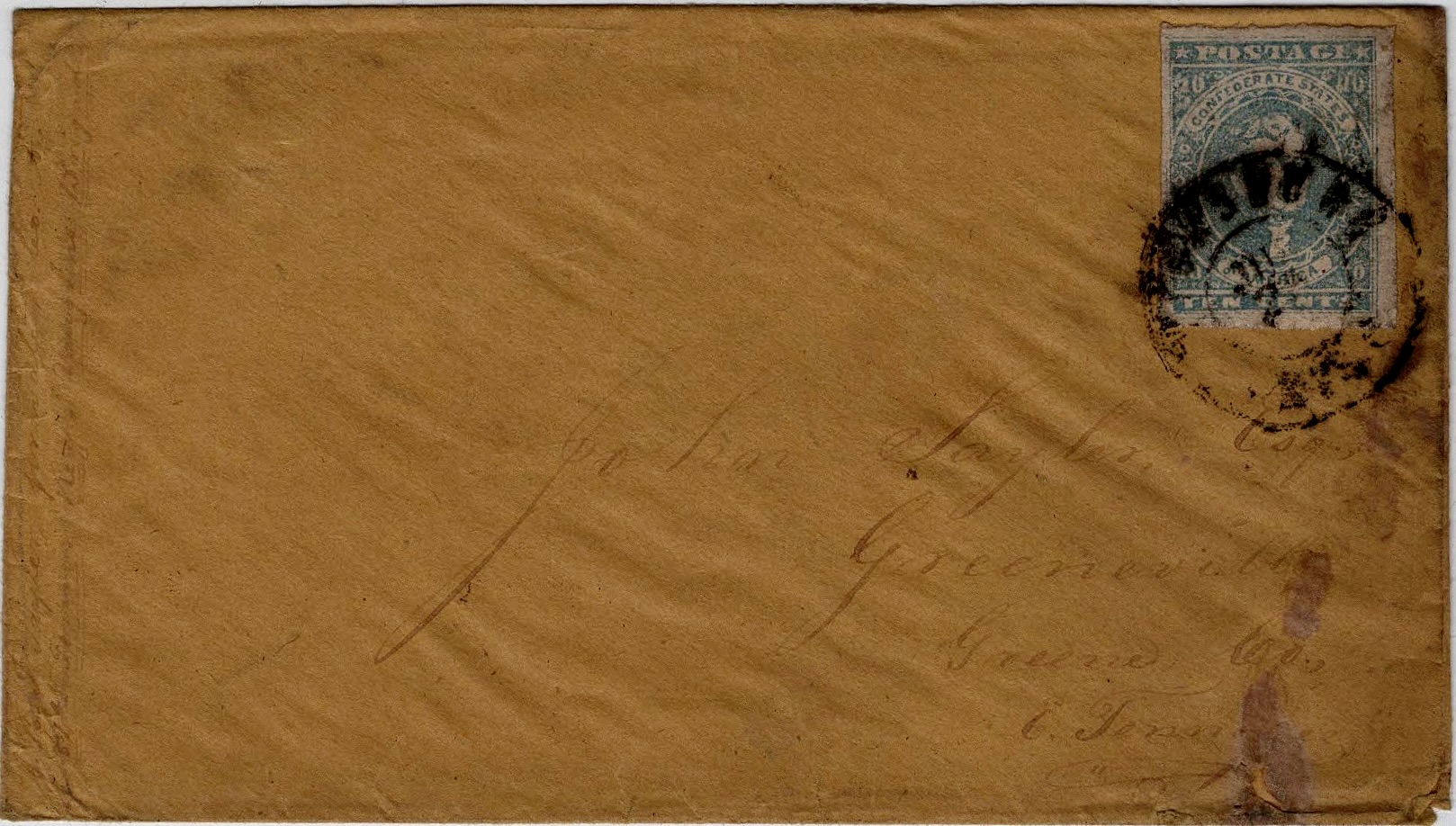
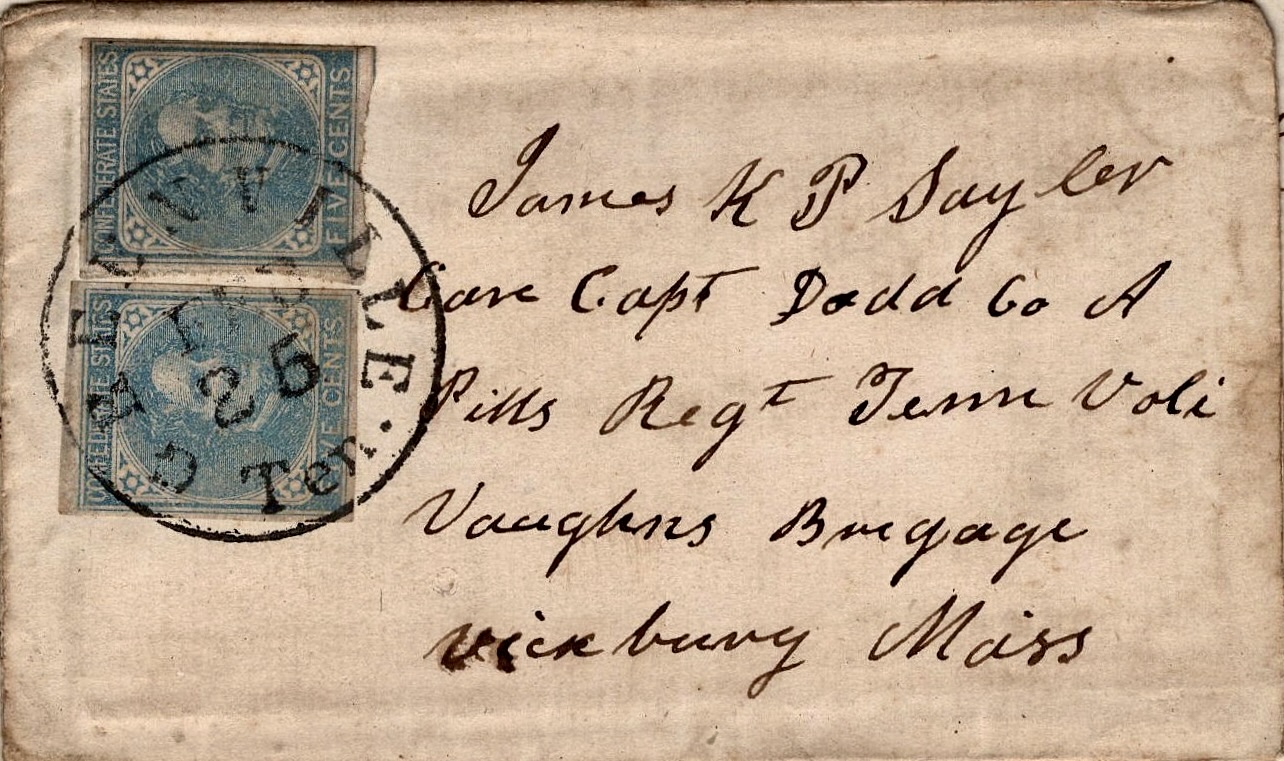
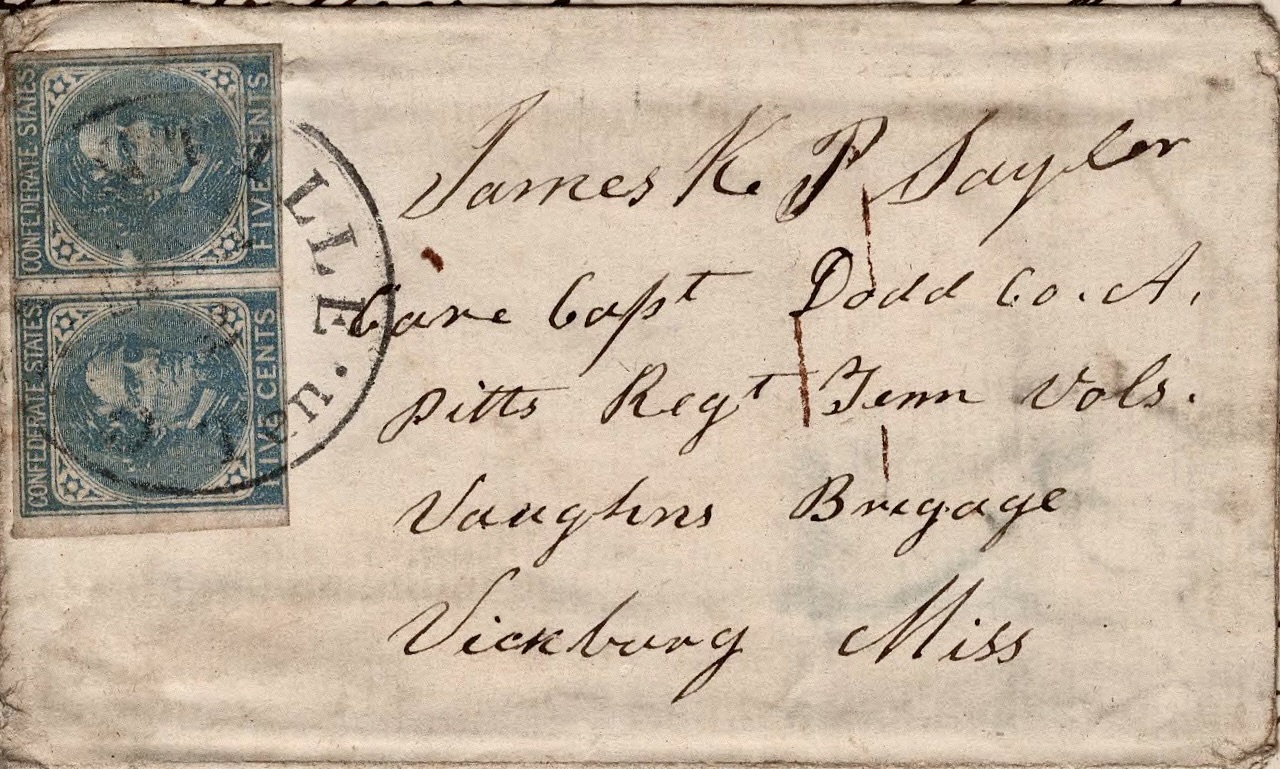
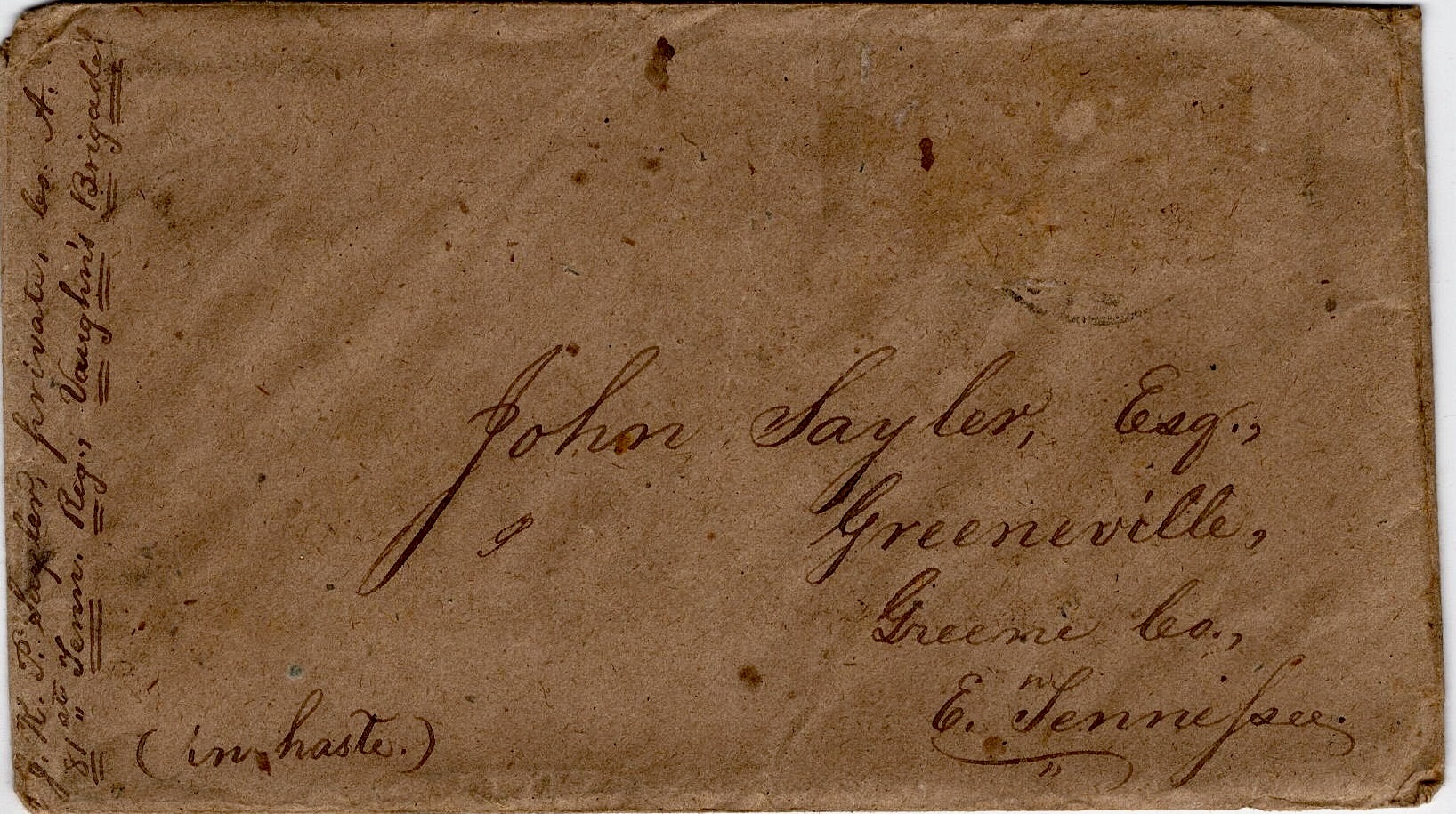
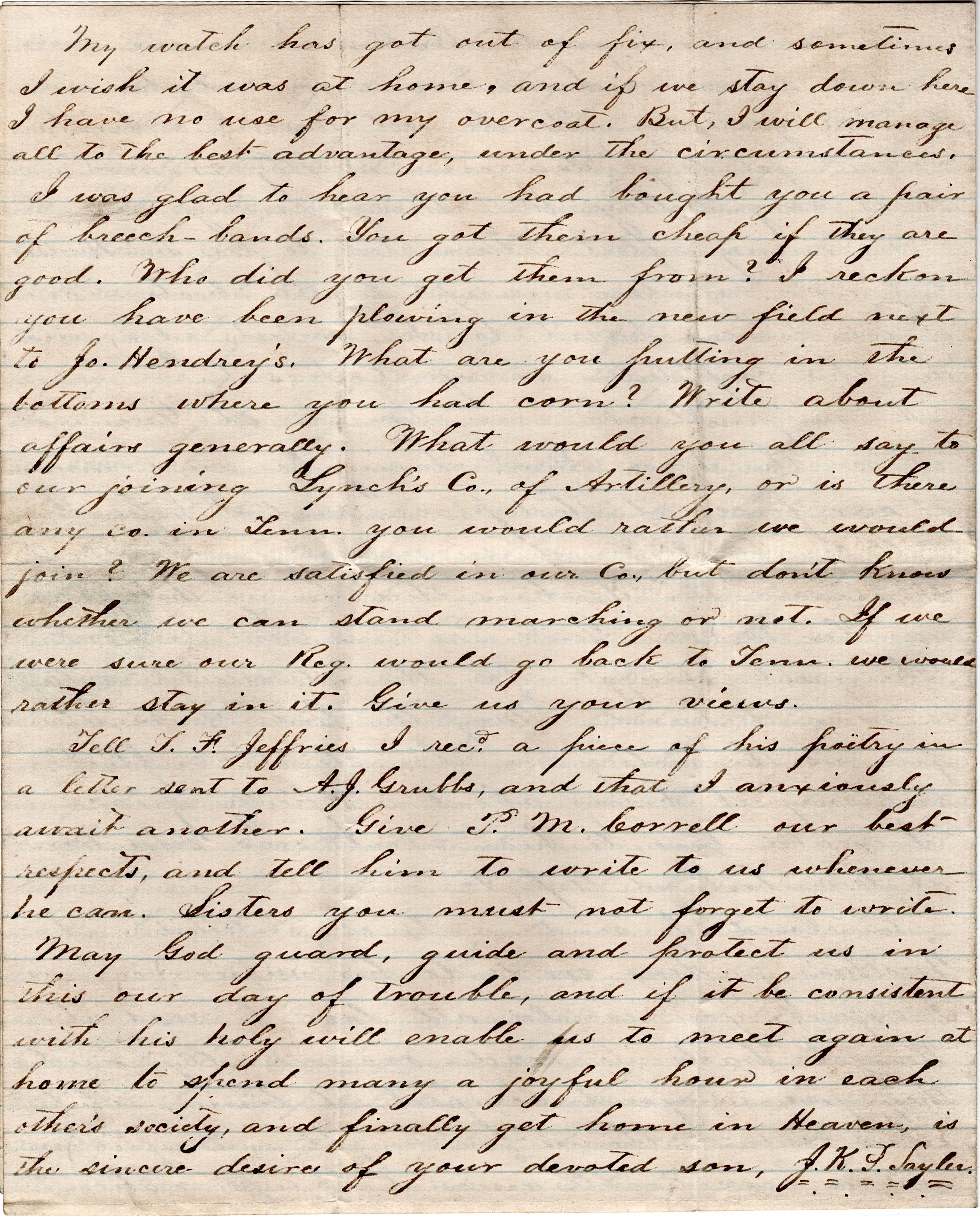
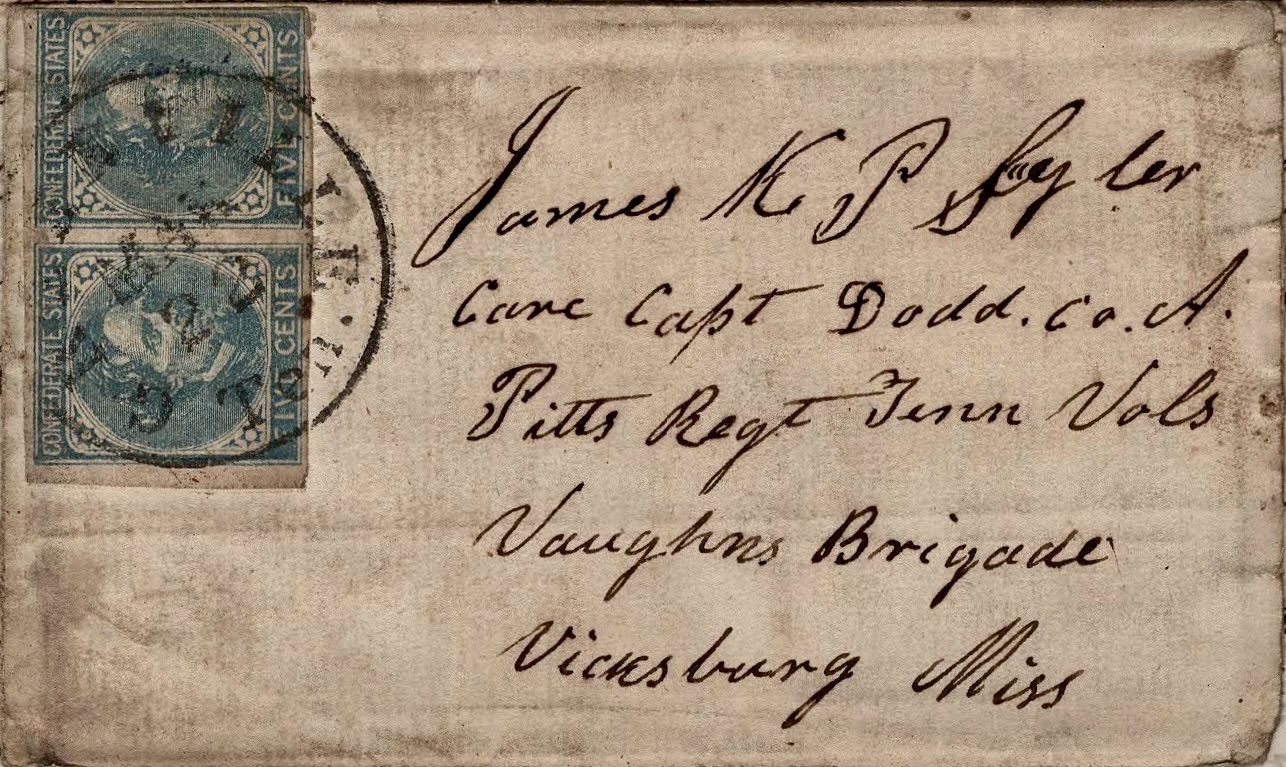
Addressed to J. K. P. Sayler, Care of Capt. Dodd, Co. A, Pitt’s Regiment Tennessee Volunteers, Vaugh’s Brigade, Jackson, Mississippi
Greene county, State of Tennessee Friday night, December 19th 1862
Dear sons,
I take htis present opportunity of writing a few lines to inform you that we are all well at present, hoping that these few lines may find you both enjoying the same state of health. I want you to write to me as often as you can get the time to do it. I like to hear from you every week and I will write every week if I can.
The news is that Jefferson Davis is gone home or down the country. What for, I do not know. I heard that he, Davis, made a speech in Knoxville. I’d like to see his speech and hear what he spoke on. Write to me what you would like to hear from [me] or anything you would like to have. I’d like to hear from Samuel Spencer and John Davis and all the company. Tell my best respects to Captain Dodd.
We are all doing the best we can these hard times. Oh that God would bless our land again but we are a sinful people and has brought this war upon us by sin and therefore I want you to pray both for me and help me to bear my trials and troubles that I have in this world. But by the grace of God, I try to bear them all.
We have some very cold weather at present. The nights froze everything till the water are very low yet the crick does not run. So no more at present, only remain your affectionate father until death, — John Sayler
Letter 2
[Immediately after being mustered into Confederate service the regiment was placed in Brigadier General John C. Vaughn’s Brigade, along with the 60th and 62nd Tennessee Regiments, and ordered to Mississippi, arriving at Jackson, Mississippi late in November, 1862. These three regiments remained together in Vaughn’s Brigade throughout the war.]
Grenada, Mississippi Saturday morning, December 20th 1862
Mr. John Sayler & family Dear Parents, brothers & sisters
I take up my pen this morning to drop a few lines for your perusal and information. I am well this morning and hope and sincerely desire that this will find you all enjoying the great blessing of good health. I received yours of December 6th on last Saturday and answered it on Sunday and sent it by the hand of Rev. W. H. Crawford.
On Tuesday we received orders to cook two days rations and it was reported we were to go to Columbus, Mississippi. On Wednesday we got orders to proceed to Grenada so we left in the morning. The boil on brother Jacob’s neck was so that he could not carry his knapsack, haversack, &c. with ease or convenience so he in company with several others stayed in charge of the tents. He was in good health otherwise. We left the following men of our company at Jackson, Mississippi: Arch Campbell, Abe Lane, William Stonecifer, J. F. Sayler, Henry H. Cox, W[illiam] H. Kelsey, P. F. Farris, &c. &c. in charge of the tents.
We got to this place on Thursday morning and pitched our fires on the west side of the city. It was reported at Jackson that the Yankees had taken this place. We now have many rumors as to the situations of the Yankees. Some says they are about fifteen miles from here, others that our cavalry under Gen. Earl Van Dorn had made a circuit of 50 miles without finding the enemy. I know not which is correct. Neither, I expect.
We are ordered this morning to cook 3 days rations. Some think we are going to Columbus, others think we are going to Vicksburg. Our Brigade is in Maj. Gen. Maury’s Division.
Maj. Gen. Sterling Price on horseback; though the artist did not accurately depict Price’s “robust form.”He weighed, reportedly, about 300 pounds.
On yesterday, Maury’s Division was reviewed by the “Scipio” of the West—Maj. Gen. “Sterling Price.” He presents a fine appearance on horseback. He is of a robust form, pleasing appearance, gray hairs, yet he appears hale and hearty. I think a great deal of him. You know I always admired him but I think more of him now, if it be possible, than I ever did before. I expect we will be required to face the enemy before long, yet it may be months. In this world of uncertainty, we cannot tell what a day may bring forth. Little did I think a month ago that we should make the trip we have and be at this place. I am as well satisfied as I expected. We have had plenty to eat till yesterday our rations were short. We are ordered to the fortifications.
Saturday evening, 3 o’clock. We went out to the fortifications this morning and returned to camp about 1 o’clock. It was reported the Yanks were advancing and that a battle was expected. Some think it was to try the courage of the men. Col. [Fountain E.] Pitts 1 made a few remarks before we marched out. He wanted Tennesseans to be true to their former renown and if any had lost their courage, he gave them permission to retire from the ranks. None, however, was so dastardly as to accept of the proposition. I know not when we will have a battle but I expect it will occur before long.
We have 6 divisions at Grenada—about 50,000. The number of the Feds are supposed to be about 50,000. I will now close for the present. Write at your convenience. Direct as heretofore. With my best wishes for your welfare, I remain your affectionate son, — J. K. P. Sayler
Sunday morning, December 21st Grenada, Mississippi
Dear parents,
I am well this morning. I hope this will find you all well. I would love to see you all and enjoy the pleasure of your society and talk about the past and tell you my thoughts of what I have seen. Though it is with anxiety, trials and sorrow that we are separated, yet, if by the blessing of a kind Providence, I should be permitted to return, I would not regret it. It is a great school, yet the duties are hard.
Where we are now encamped, the land is rolling and the water is better than at any place we have been since we left Henderson’s. The most of the places where we have ben the land was low and the water bad. The country here is generally level. Between here and Jackson is some as good land as I ever saw. We are about 104 miles from Jackson. The company, mostly, love this place better than Jackson.
Our mail starts in a short time so I will close. Give my respects to all my friends. With my prayer to God that peace may shortly come, I am your loving son, — J. K. P. Sayler
1 Fountain Elliott Pitts (1808-1874) was an American Methodist minister and Confederate chaplain. He established Methodist missions in Brazil and Argentina in 1835–1836. During the Civil War, Pitts joined the Confederate States Army, first as a chaplain in the 11th Tennessee regiment for six months, and later as a colonel in the 61st Tennessee regiment in the Great Smoky Mountains. He also fought “Federal gunboats for about five months at Vicksburg.” He became known as “Fighting Parson.” After the war, he was the first pastor of the McKendree Church (later known as the West End United Methodist Church) in Nashville, Tennessee.
Letter 3
[The regiment’s first action of any consequence was at the Battle of Chickasaw Bayou and Chickasaw Bluffs, outside Vicksburg, December 6-29, 1862. Vaughn’s Brigade held the abattis on the left wing of the defenses. The 60th was detached to Brigadier General S. M. Barton’s Brigade on the third day of the fighting, the 62nd to Brigadier General Stephen D. Lee’s Brigade on the second day, leaving he 61st to hold the abattis. Lieutenant General J. C. Pemberton’s report stated the heavy abattis prevented the approach of the enemy except with sharpshooters who advanced continuously, but were met with firmness by be East Tennesseans. The regiment suffered only four casualties. In this battle the Federals suffered heavy losses.]
Vicksburg, Mississippi December 26th 1862
John Sayler, Esq. Dear Father,
As we have changed our location, I deem it my duty to write a few lines to you. We left Granada on the 23rd and came to Jackson on the 24th. I found Jacob considerably improved. On yesterday (Christmas) we arrived at Vicksburg. I and Jacob are both enjoying pretty good health. The boil on Jacob’s neck was quite bad but it is now getting well. We are now together here and in fine spirits. I wish, hope and sincerely desire that this letter will reach you and find you all in good health.
I received your letter of December 6th at Jackson on the 13th. Since then I have received none. Our moving about so often I presume is the cause. I am very anxious to hear from home, yet, I will patiently wait. I saw Jacob E. Wells, Celin Armentrout, and William Robertson on yesterday. They were all well. Buck Armentrout looks as well as I ever saw him. Jake Wells looks tolerably well. Today I saw Cyrus Armentrout. 1 He has had the chills and is very weak. They were all up here at our tents. They are encamped about one half of a mile from where we are. If I get an opportunity I intend to go to see them.
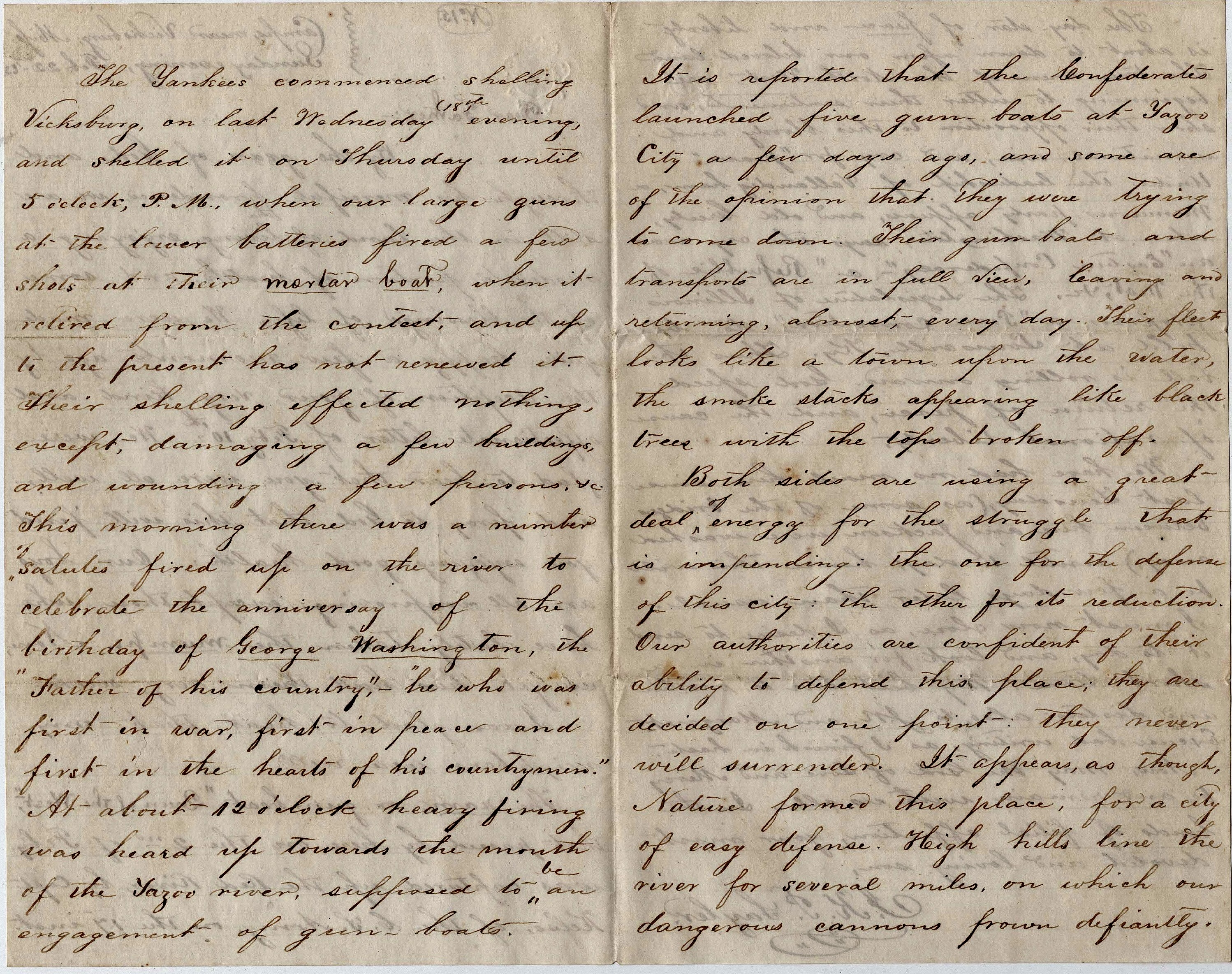
Last night we got orders to cook three days rations and be ready at short notice. Consequently, I have little time for visiting. An attack upon this place is daily expected. And now, the roar of cannon, like that of distant thunder, is distinctly heard. There has been firing of cannon for two or three days up on the Yazoo river. They destroyed the buildings on the plantation of Capt. Johnson. Yesterday I could see the smoke of the gunboats plain and today the smoke is visible more distinctly. The Yanks intend making a desperate effort to capture this place, above and below the city, by land and by water. It is said by some they have 60 gunboats above while others estimate them at one-third that number. It matters not how many they have. They can’t take it by water, if they can take it at all. The natural conformation of the country is such as to render it easy of defense. One hill succeeds another. And upon each hill, cannon are planted and entrenchments dug for the protection of the infantry. Large cannons are plenty.
I don’t know the number of our troops at this place. They are variously estimates. [Some say] about 20,000. [It’s] reported that Gen. Holmes is crossing with 12,000 reinforcements. I know not how soon I will be called upon to enter the battlefield, nor what will be my fate. But be it as it may, I am resigned to the will of an over-ruling Providence in whom I have an abiding confidence. Our destiny is not wholly in our own hand. There are some things we can avoid, whilst there are others we cannot. Those we cannot avoid, we must endure, and we should do so with cheerfulness. May the God of Mercy comfort you all in these times of troubles, and when our race is run, may we all be saved in Heaven for the Redeemer’s sake, is the prayer of your most affectionate son, — J. K. P. Sayle
Sunday evening, December 28th Vicksburg, Mississippi
Dear Father,
We are well today though a little tired. On night before last we were ordered to the fortifications and yesterday morning we went out on picket. This morning we had a picket skirmish. Nobody hurt on our side. I don’t know whether any of the enemy was injured or not. There has been some fighting up on the Yazoo River ever since we come here which was on Christmas day. They are now shelling this place. The shells are falling near our fortifications, not more than three hundred yards from where we are. Two of Crawford’s Regiment was wounded by a shell.
There was hard fighting yesterday and today up near the Yazoo. No decisive result as yet. I expect we will have hot work shortly. May the Lord protect us.
I received two of your letters yesterday—December 14th and 19th—which gave me much satisfaction. I was glad to hear that you were well. Hope this will find [you] in good health. I sent you a letter by Parson Crawford which I presume you got. Then I sent one from Grenada on last Sabbath. I hope you will receive them both. It affords us much pleasure to hear from home. I have plenty of everything necessary for a soldier. Camp life agrees with us tolerably well. We have plenty to eat and have had the most of the time. Corn bread and beef mostly, rice, sugar, molasses, bacon, picked pork, crackers, and sweet potatoes. We have had no wheat bread since we left Tennessee. But I expect it is better for us to have corn bread than wheat bread.
Our officers are kind to us. Lts. Byerly & Britton are unwell. Capt. [I. Nathan] Dodd is in pretty good health. He was considerably excited today. Lt. Kelsey was quite sick. Our men like Col. Pitts better every day. Lt. Col. [J. G.] Rose is loved by all. I have nothing of interest to you to write of about our boys. Write about our neighbors progress, the news you have, and anything you think would be interesting. Small events that occur about home, it gives us pleasure to hear. I must close. If I am permitted by an all-wise Providence to escape the danger to which I am exposed, I’ll write in a few days. My best love to all. Yours son, — J. K. P. Sayler
1 Cyrus Armentrout served in Capt. Lynch’s Tennessee Light Artillery. He was among the members of the unit surrendered at Vicksburg on 4 July 1863.See his parole papers below.
Letter 4
In camp near Vicksburg, Mississippi Sunday evening, January 4, 1862 [should be 1863]
Dear Parents,
I take up my pen for the purpose of writing a few lines to you. We are enjoying tolerable good health with the exception of pain in the back and legs from exposure while out on picket duty. We are better today and I hope ere long we will be entirely well. Bro. J. F. Sayler has a boil on the other side of his neck.
I hope this will find you all enjoying the great blessing of good health, and surrounded with the comforts of life. I am well aware that your trials and sorrows are many and that they are hard to endure, but God has promised to be with us in six trials, and in the seventh not to forsake us. Our only protection and comfort that is sure not to fail us, is a firm dependence and reliance upon the Lord. We are surrounded with many temptations and often do things we ought not to do, and omit things we ought to performm but if they are not too great, we have an Advocate with the Father who is willing to forgive the penitent.
In my last letter I informed you that we had a picket skirmish with the pickets of the enemy on last Sunday morning. I wrote then that nobody was hurt on our side. Since then I have ascertained we lost one killed—J. F. McConnell. Wednesday evening an armistice for four hours was received from the enemy. We then got his body. The main battle was away up the river and ended on Tuesday. The losses are variously estimated. I expect you will get as true account as we have. Anyway, we repulsed them and they retired to their gunboats.
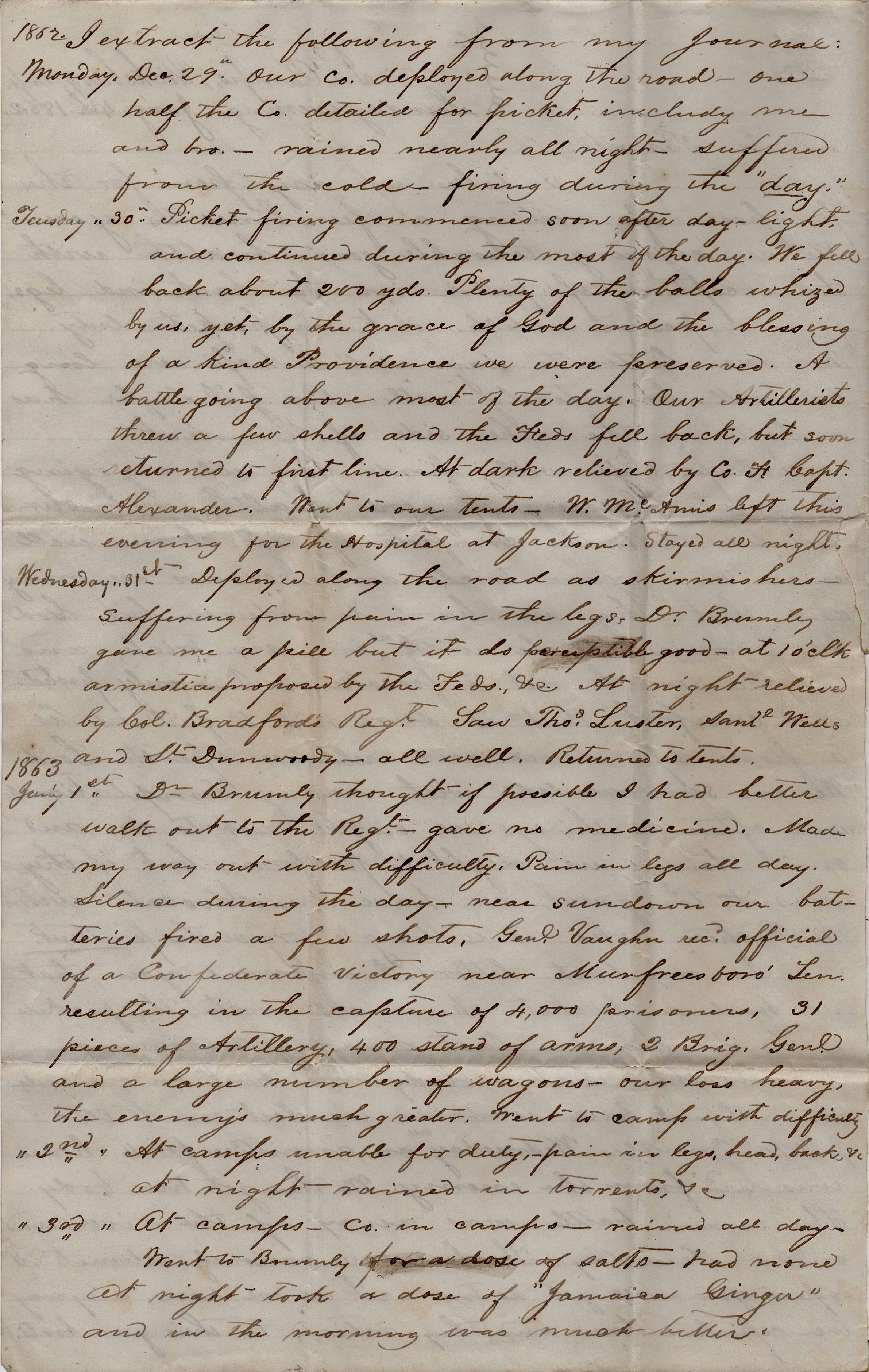
I extract the following from my journal.
Monday, December 29th. Our company deployed along the road. One half the company detailed for picket, including me and brother. Rained nearly all night. Suffered from the cold. Firing during the “day.”
Tuesday, 30th. Picket firing commenced soon after day light and continued during the most of the day. We fell back about 200 yards, Penty of the balls whizzed by us, yet, by the grace of God and the blessing of a kind Providence we were preserved. A battle going above most of the day, Our artillerists threw a few shells and the Feds fell back but soon returned to first line. At dar, received by Co. F, Capt. Alexander. Went to our tents. W. McAnus left this evening for the hospital at Jackson. Stayed all night.
Wednesday, 31st. Deployed along the road as skirmishers. Suffering from pain in the legs. Dr. Brumly gave me a pill but it do perceptibly good. At 1 o’clock armistice proposed by the Feds, &c. At night relieved by Col. Bradford’s regiment. Saw Thomas Luster, Samuel Wells, and St. Dunwoody—all well, Returned to tents.
January 1st. Dr. Brumly thought if possible I had better walk out to the regiment. Gave no medicine. Made my way out with difficulty. Pain in legs all day. Silence during the day. Near sundown our batteries fired a few shots. Gen. Vaughn received official [dispatch] of a Confederate victory near Murfreesboro, Tennessee, resulting in the capture of 4,000 prisoners, 31 pieces of artillery, 400 stands of arms, 2 Brig. Gen. and a large number of wagons. Our loss heavy. The enemy’s much greater. Went to camp with difficulty.
January 2nd. At camps unable for duty. Pain in legs, head, back, &c. At night, rained in torrents, &c.
January 3rd. At camps. Company in camps. Rained all day. Went to Brumly for a dose of salts. Had none. At night took a dose of “Jamaica Ginger” and in the morning was much better.
Today we are better. I and Jacob & Felix Brown went down to where Lynch’s Artillery is stationed. We saw Cyrus Armentrout and J. E. Wells. Buck was on guard. They are all in tolerable good health. Jacob and Cyrus are improving. Buck is appointed a corporal. We also saw T. Luster and Adjt. Hawkins & Jacob Couch of Crawford’s Regiment. Thomas J. Fink is sick at Jackson.
The sun is about down and I must close. Give my respects to G. O. Wells and my friends, Dear sisters, receive our best love. Give brother John and Margaret 1 our most affectionate regards. Write as soon as you receive this. You may direct to Jackson as before as some think we will leave here shortly. However, I don’t believe it. But it will come as soon anyhow. Your affectionate sons, — J. K. P. Sayler [and] J[acob] F. Sayler
Mr. P. N. Correll, respected friend,
I take up my pen to redeem my promise. I am in tolerable health and hope this will find you in good health. I was in a picket fight and came out uninjured. I am as well satisfied as I expected. I would be better satisfied if I was with you and knocking around among the pretty girls of Tennessee. I want you to write to me how you are getting along and how the girls are enjoying themselves and particularly how Miss Martha is doing, and whether you have went to see her yet or not. Write as soon as you receive this. Your loving friend, — J[acob] F. Sayler
1 John R. Saylor (1841-1891) married Margareta Ann Hendry (1841-1906) on 23 May 1862 in Greene county, Tennessee. The surname on his headstone is spelled “Saylor.”
Letter 5
Greene county, State of Tennessee 11 January 1863
My dear sons,
I again take up my pen to write a few lines to you both to inform you that we are all well at present, hoping that these few lines may find you both enjoying good health. I can inform you that I received your letter of December 26th. I was glad to hear that you were both alive and well and in fine spirits. I can inform you that the bridges was burnt across Holston river and across Watauga river by the Yanks. They took all the guards prisoners that guarded the bridges and paroled them. They say that there was about four thousand of them. There were five regiments of these thieving abolitionists. One was an East Tennessee renegade tory regiment under the command of Col. Jim Carter. 1 One was the 7th Ohio, one the 9th Pennsylvania, one the 2nd Michigan, all under the command of Brig. Gen. Sam Carter, the infamous tory and renegade from East Tennessee.
I can inform you that Lafayette Jeffers was to see me today. The neighbors are all well. The conscripts are in the country doing no good. Since the bridge was burnt, they are getting very impudent and they go to meeting. If there isn’y something done with them, the people can’t live in this country. They steal horses, bees and chickens and everything they can get. Joseph Maury is at home and all the Carters. I saw two of the Carters—Alphus and Henry. I saw John Hendrey and Alex. Cooter go past my house this morning. They are going to and fro.
January 12. I again take my pen in hand to write a few more lines. We are all well this morning. Two of the girls were vaccinated and John R. Sayler was vaccinated. He is afraid to venture out. Rebecca Sayler and Mary Sayler was the two girls that was vaccinated. The small pox has been in Greeneville. There was three that died.
John Rush was shot and has since died. We had another battle at Murfreesboro and it is reported that James B. Johnson is wounded and Isaac Wheeler also wounded in the thigh. We are all doing the best we can these hard times but there is one consolation, we must put our trust in God—the giver of all good. My prayer is that God will protect you all in time of trouble. In six trials he will be with you and in the seventh, he will not forsake you.
Tell Dodd that John R. Sayler is not able to travel. As quick as he is able to come, he will if he can stand it. I must bring my letter to a close. Only remain your affectionate father, — John Sayler
1 “In late December, 1862, Brig. Gen. Samuel P. Carter led 1200 cavalrymen into East Tennessee from Kentucky to raid the East Tennessee and Virginia Railroad. On December 30, Carter moved rapidly from Blountville to Union and, without wasting time, dispatched Col. Walker and a strong force to Carter’s Depot, about ten miles west of Union, to burn the railroad bridge across the Watauga River. Riding along the railway line, Walker and his cavalrymen fortuitously intercepted a locomotive advancing to investigate reports of Union activity at Union, capturing Col. Robert Love, who commanded about 200 Confederate troops defending Carter’s Depot. The northern raiders then reversed the train and rode it back into the station, where Love’s men deployed to meet them. Col. Walker immediately ordered a charge, which broke the Confederate line, sending the defenders scampering towards a nearby copse of woods. Two companies of the Ninth Pennsylvania under Maj. W. P. Roper set out in pursuit, capturing and killing many Confederates before they reached safety. Union losses were slight—two killed and at least three wounded. The Confederate force lost 12 to 16 killed, with a like number wounded. There may have been more wounded men who fled into the woods. Following the skirmish, Union troops quickly fired the railroad bridge before destroying arms, stores and equipment found onsite. They had a little fun with the captured locomotive, which was gingerly rolled out onto the burning trestle where it dropped into the river when the bridge collapsed, taking out part of a stone pier in the process. With the task of destruction largely complete, Samuel Carter, sensing that his luck might be running out as forces inexorably began to converge on his position, decided the time was ripe for a return to Kentucky. During the early morning hours of December 31, the cavalry column mounted up and headed north to Kingsport, having been almost continuously in the saddle for three days.” [Source: Carter’s Raid]
Letter 6
Camp near Vicksburg, Mississippi January 17th 1863
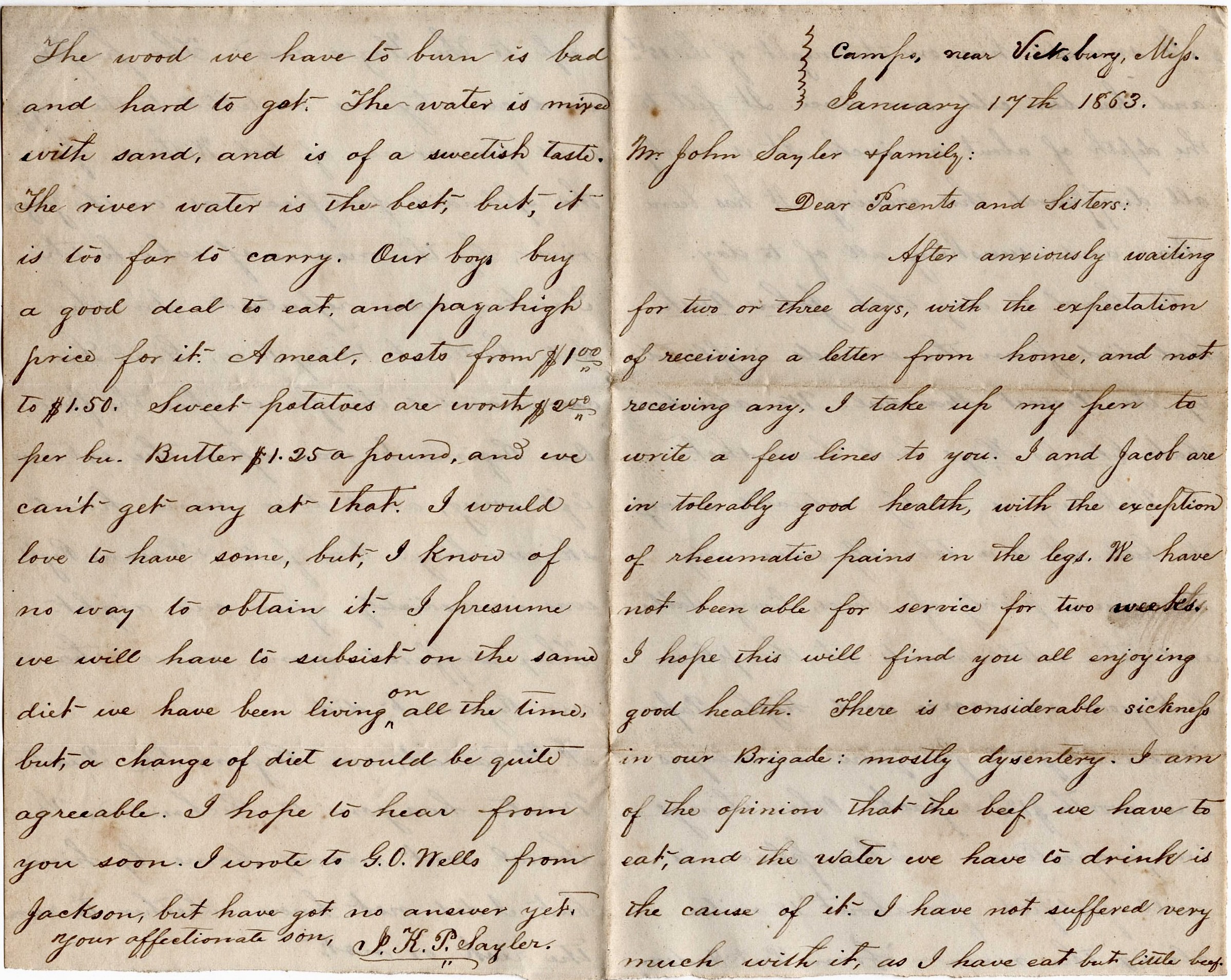
Mr. John Sayler & family Dear parents and sisters,
After anxiously waiting for two or three days with the expectation of receiving a letter from home, and not receiving any, I take up my pen to write a few lines to you. I and Jacob are in tolerable good health with the exception of rheumatic pains in the legs. We have not been able for service for two weeks. I hope this will find you all enjoying good health.
There is considerable sickness in the Brigade—mostly dysentery. I am of the opinion that the beef we have to eat, and the water we have to drink, is the cause of it. I have not suffered very much with it as I have eat but little beef.
It snowed here on the night of the 15th and has been cold ever since. It fell to the depth of about an inch. It is nearly all disappeared this evening. It has been clear and sunshiny all of today.
We heard today that John Rush had died from the wounds inflicted by the Provost Marshal. We also heard that Charles Hays had been shot.
Vicksburg is mostly situated among the hills. It is a tolerably nice city. There are plenty of stores, livery stables, and other establishments at this place, but goods are scarce and high. Paper is worth $2 per quire. Envelopes are worth $1 a pack. Other things in proportion. This place is well fortified for about 18 miles along the river—from Port Hudson up to the Yazoo river. The people and country are indebted to the energy and perseverance of Col. [William T.] Withers for the splendid fortifications on the Yazoo river, by the means of which the Yankees were repulsed. In the late battle of this place, Gen. [Stephen D.] Lee 1 commanded the forces upon the field. Our regiment was upon the extreme left wing, and done some hard skirmishing. Crawford’s [60th Tennessee] & Rowan’s [62nd Tennessee] Regiments was immediately upon our right. They suffered some more than our regiment did.
F. W. Earnest, our regimental quartermaster, has gone to Richmond, Virginia. Several sent money home by him, but, I did not know whether to run the risk or not.
The wood we have to burn is bad and hard to get. The water is mixed with sand and is of a sweetish taste. The river water is the best, but it is too far to carry. Our boys buy a good deal to eat and pay a high price for it. A meal costs from $1 to $1.50. Sweet potatoes are worth $2 per bushel, butter $1.25 a pound, and we can’t get any at that. I would love to have some but I know of no way to obtain it. I presume we will have to subsist on the same diet we have been living on all the time, but a change of diet would be quite agreeable.
I hope to hear from you soon. I wrote to G. O. Wells from Jackson, but have got no answer yet. Your affectionate son, — J. K. P. Sayler
1 Colonel Stephen Dill Lee performed meritorious service at the Battle of Sharpsburg on the bloodiest day in American history, playing a prominent role in the defense of the Dunker Church, Cornfield, and the West Woods. After the morning fight, his unit was moved across the battlefield and unlimbered near the town of Sharpsburg, helping to repel the Union attack across Burnside Bridge. Following the Battle of Sharpsburg, President Davis inquired of Robert E. Lee to select his most accomplished and efficient artillery officer for duty in Mississippi. Lee chose Stephen Dill Lee. Assigned to General Pemberton’s western army defending Vicksburg, Colonel Lee received a promotion to brigadier general on November 6, 1862. He was ordered to take command of General Pemberton’s artillery at Vicksburg. At the Battle of Champions Hill, Lee was wounded in the shoulder and subsequently taken prisoner when Vicksburg fell on July 3, 1863. General Lee was exchanged and paroled on October 3, 1863. [Source: Stephen D. Lee Institute]
Letter 6
State Tennessee, Greene county Thursday morning, January 29th 1863
Dear sons,
I again take up my pen to write a few lines to you both that we are all well at present hoping that this may find you both well. I hope and trust that the pains may leave you. I received your letter dated January 10th on the 27th inst. We all rejoiced to hear that you are both alive and in tolerable good health. You wrote in your last letter about the raid. I state as near the fact as I have heard, they burnt one bridge and tried to burn the other one and was hurried so that they cut the other down, They captured one engine and put it on the bridge and run it into the river. They took a great many horses and left their broken down horses and left in a hurry, They have not been heard of since.
We have four company at gass shed and one regiment at Greenville from Florida. There is no school at Morelock, either at Hatley School house. Fayette Jeffries is teaching in the Dunkard Church. The neighbors are all well as far as I know, B. Knight was at my house since you left. Knight is a true Southern as ever. Jacob Justice is doing tolerable well when I saw him last. I heard that Pitt’s Regiment was in the battle at Vicksburg and he lost one man, Jacob wrote that I had done with them sinful steers I sold dock. He brung me about sixty dollars. The soldier got him the other steer I have yet. I have killed my hogs. They were tolerable fat. My horses are doing pretty well. I have a good deal of hay yet. I have not fed any husk yet. My straw stack is whole yet. I have a little fodder and some wheat yet.
A few lines from your mother. She wants you to take care of yourselves and take a little pepper. If you have not got [any], try to get some. It would be good for your health. My prayer to God is that he will protect you through all your trials and troubles in this present world. You are dear to me and far from home. Try to bear it patiently. I have thought a many time of your writing novels. Your travels now put me in mind of them.
Everything here is very high. Beef from 9 to 10 cents a pound, pork 25 cents a pound, corn from $1.50 to $2, pies atr 50 cents apiece.
I heard that we gained a great victory at Vicksburg or so stated in the papers. Our loss was small. That of the enemy about 15 hundred to two thousand of hhis best troops, It secured for us some fifteen hundred of the best guns. It placed in our possession five stands of colors and five hundred Yankee prisoners and drove the enemy away from the place. I got my news out of the Athens Post. I was in Greenville and saw two trains as full of Yankees as both could be and on the top as thick as could be sat. They were Yankee prisoners and were taken at Murfreesboro and sent to Richmond. And I heard another train full went up. St. [St. Clair] Armentrout saw them going up. I saw an advertisement for the conscripts to meet on the 5th of February and bring their blankets with them.
So no more at present. Write as soon as this comes to hand and may God bless you both adn save us all is my prayer. Amen. — John Sayler
Letter 7
Greene county, State of Tennessee February 10th 1863
Dear Sons,
I again take up my pen to write a few lines to you both that we are all well at present, hoping that these few lines may find you both enjoying better health than you were when you wrote last. I received your letter dated [January] 22nd. I received it 7th of February and was sorry to hear that you both were afflicted with the rheumatic pains. You must try and bear it patiently as you can. Don’t get out of heart. Put your trust in God. He will protect you in six trials and in the 7th he will not forsake you. My trials and troubles are many but I try to endure them all as well as I can for these troubles will all have an end for by grace are we saved through faith and that not of myself for it is the gift of God.
I can inform you that Jacob Justice is in tolerable health and his family is well. He said that B. Knight family were all well. A. J. Cornell’s family are all well. D. Miller’s family are all well. R. H. Morelock was at home. I saw him. He looked fat and hearty and is well satisfied. He has gone to his company. John Nead stated all night with us last week. George O. Well is in tolerable health.
The soldiers have left Gasses Shed, all but a few sick and a few well ones to wait on them. Joseph Hendrey’s family are all well. John has left so said. I have not saw T. N. Sayler since he left. The soldiers have caught some of the conscripts. Caught Hugh Key 1 and John Reynolds and Ely Henricks. They caught Reynolds and Key in a ground hole.
We have had some cold weather and snow. The winter will soon be over and spring is coming. Oh how delightful it is to see the grass a coming. We are all doing the best we can. The girls have been weaving for Miss Armentrout. They have got her piece out and they are putting in a piece for themselves. I have not killed my other steer yet. He is getting very fat. I expect to kill him shortly.
I have wrote every week except one. I will write every week if I can. I like to hear from you both. Jacob, you writ some too as often as you can. It gives us all a great deal of satisfaction to talk to each other by letter for that is all the chance we have now. I have wrote eight letters now. May the Lord bless and save us all is [my] prayer. I must close for the present. Only remain your affectionate father, — John Sayler
1 Hugh Key (1840-1900) later served in the 1st Tennessee Cavalry, Co. I, (Union). He was the son (or possibly grandson) of David Key and Jemima Casteel of Cross Anchor, Greene county, Tennessee.
Letter 8
Near Vicksburg, Mississippi Tuesday, February 10, 1863
Dear Parents,
I embrace the present opportunity of sending you a few lines by the hand of Col. Bullen. I and my brother Jacob are in moderate health. I hope most sincerely that this will find you all enjoying good health [and] also enjoying the pleasures of life. Health is good in the army. If it was only possessed by a greater number of individuals. I saw Mathias Nead yesterday. He called at our tent to see us. He was enjoying tolerable health. He had been afflicted to some extent with the diarrhea. He is “prescriptionist” in Crawford’s Regiment. I have not seen Thomas Fink or William Pickens for several days. They were then only in moderate health.
There is very little news afloat now. Yesterday it was rumored that the Yankees were leaving, yet, last night our regiment was ordered out to the trenches. A great deal of the movements are to try the men. It is said that “Old Dad Price” has arrived here. It is also said that a Division of Mississippians are ordered here and some think that we will therefore be relieved from this place and sent back to Tennessee. Some go so far as to assert that Gen. Pemberton said that “Vaughn’s Brigade” would be in Tennessee in three weeks, and that it would be drenched in blood. These are the reports in camp but they are only reports.
There are firing of cannon now and our regiment goes out. I expect the enemy are trying to pass with a gunboat or it may be a general engagement impending.
I send home a book entitled, “The History of Romulus.” I hope you will all read it. I feel confident it will interest Hannah and Margaret. It’s mixed, however, a great deal with mythology. He is celebrated in mythology as the son of the Vestal Virgin, Sylvia Rhea, and in history as the “Founder of Rome”—the city that in after years was termed the “mistress of the world.”
I send enclosed $22 in money, $10 in Confederate bill. You can apply it to any purpose you think will pay the best. If you save any, save the S. C. State money and spend the Confederate money. Jacob sends $20. We could send more but we need some along and then I thought it would be enough to risk at one time. Anyhow, hope it will reach you in safety.
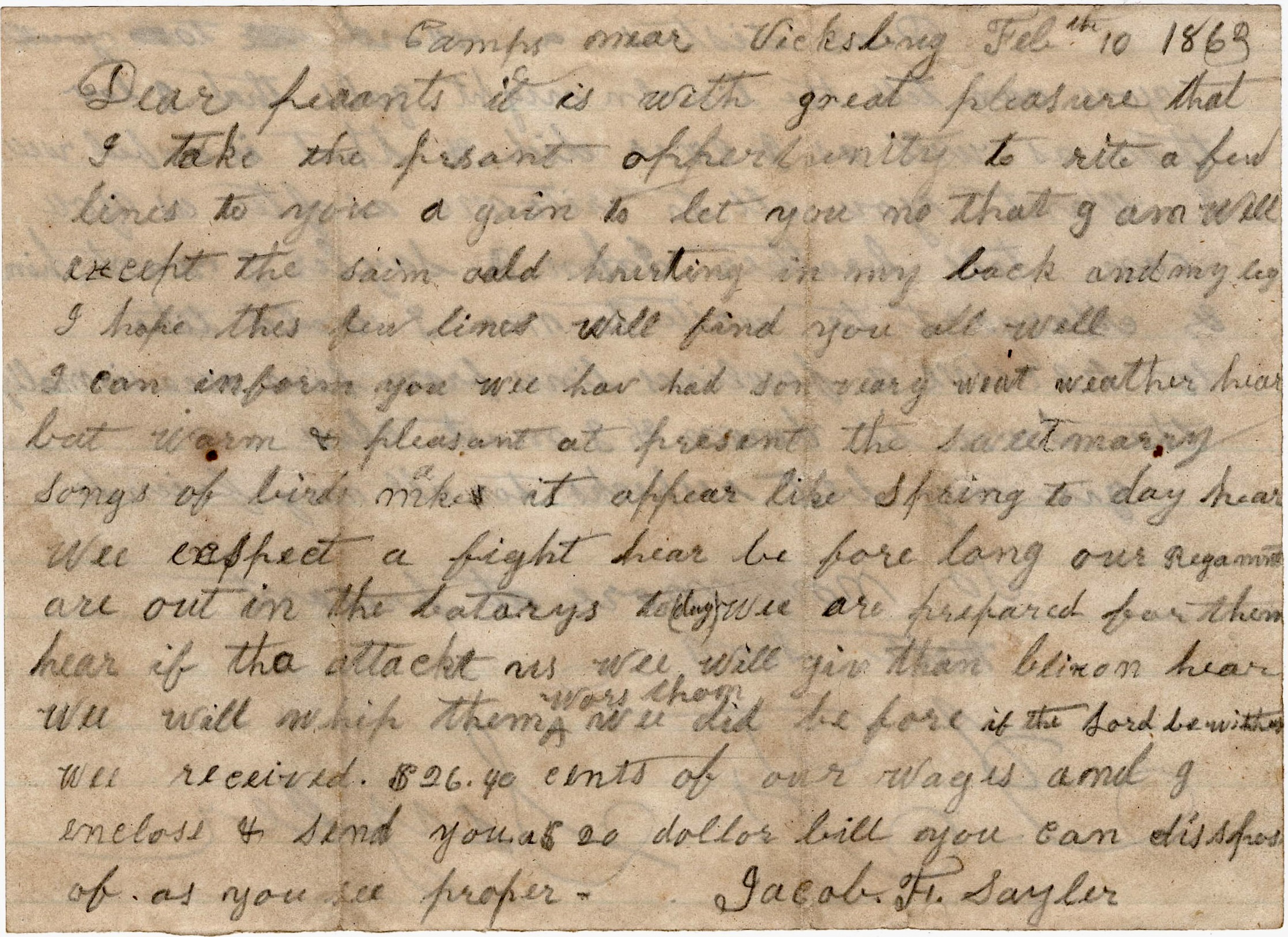
Tuesday evening. All is quiet this evening. There was nothing of importance occurred today. Our regiment returned to camp about 1 o’clock. The company drawed their wages this evening for two months and 12 days. $26.40.
I hope you will write soon. With the best wishes for your welfare, I close for the present. Your most loving and affectionate son. — James K. P. Sayler
Camp near Vicksburg February 10, 1863
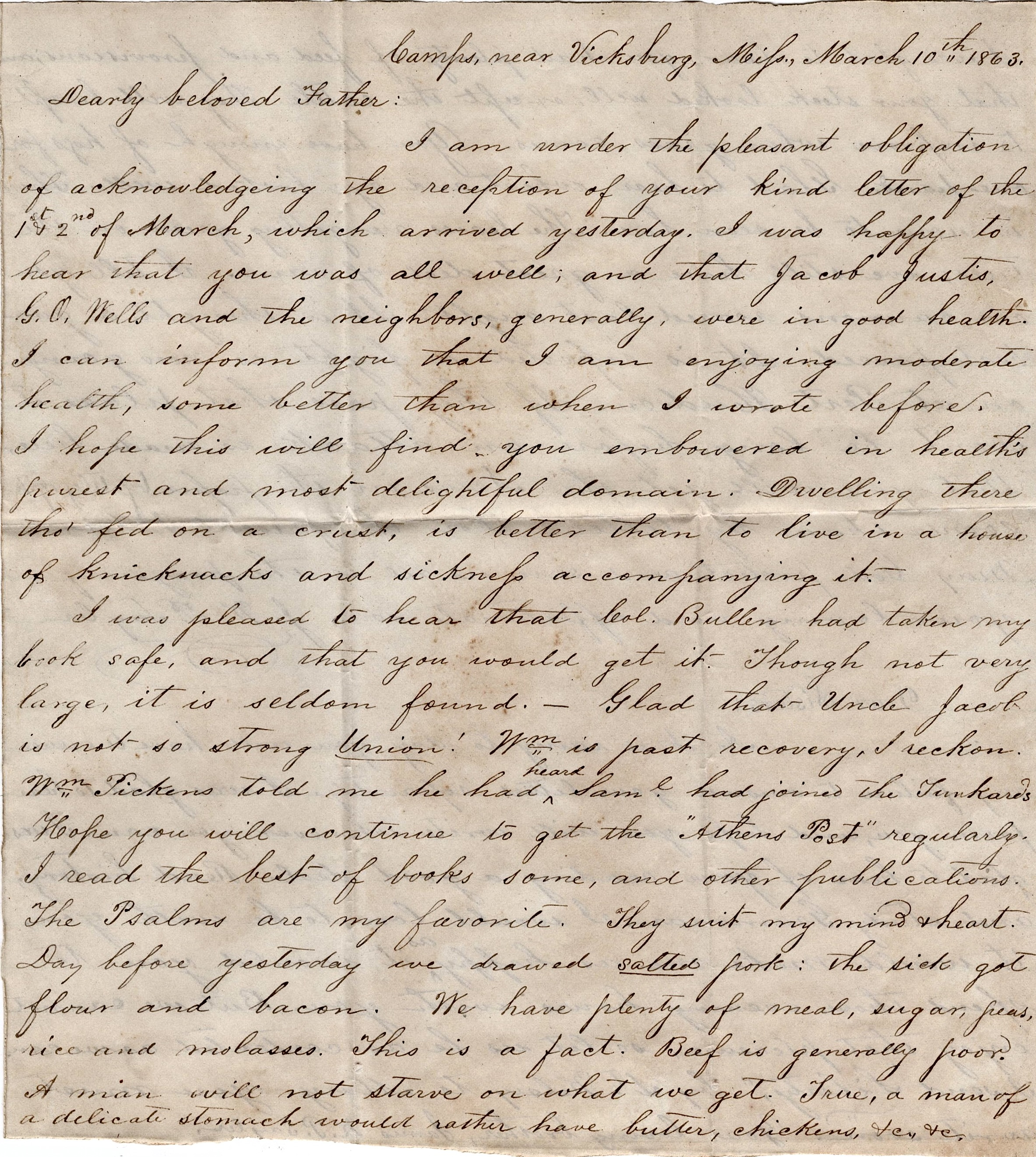
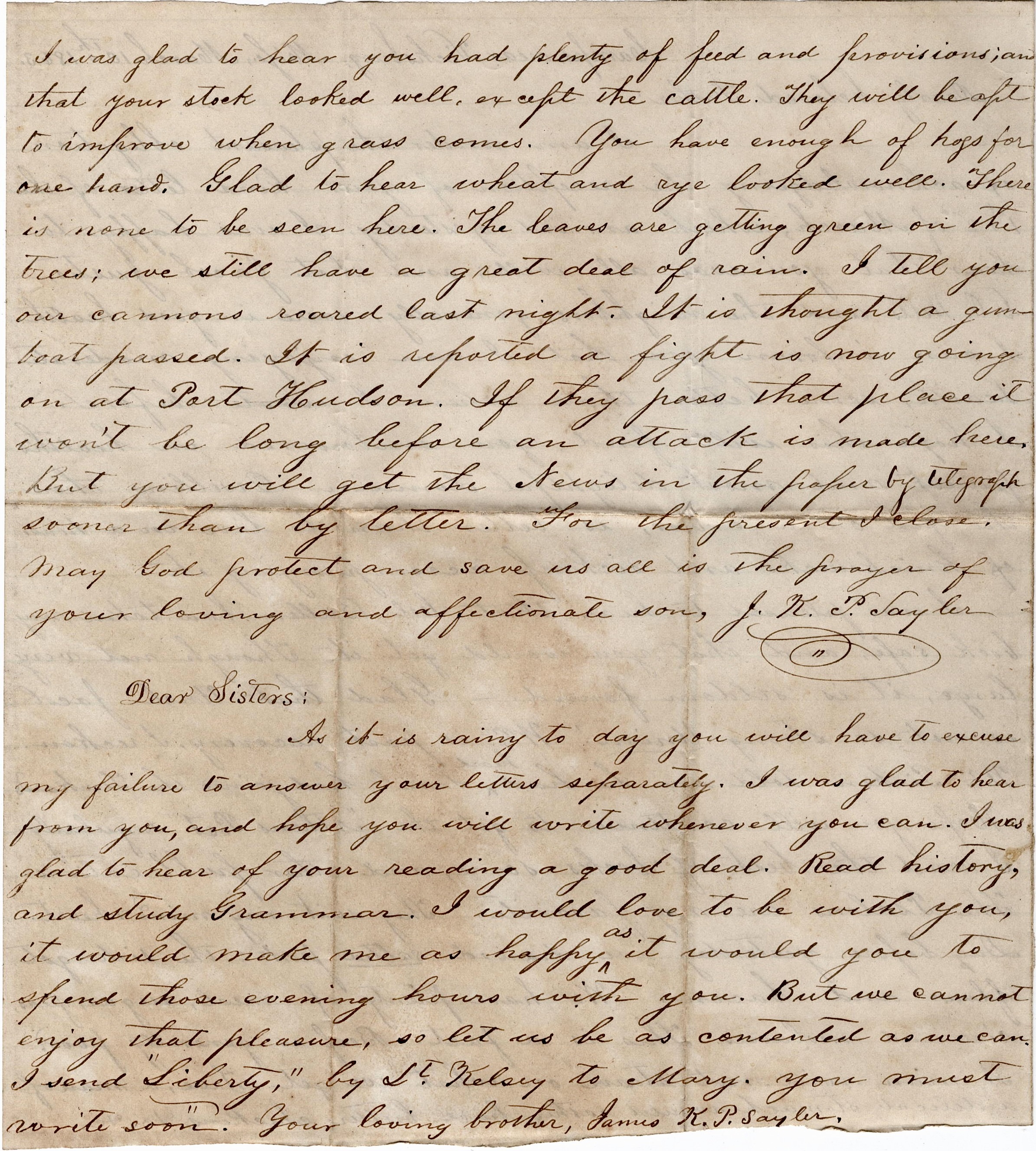
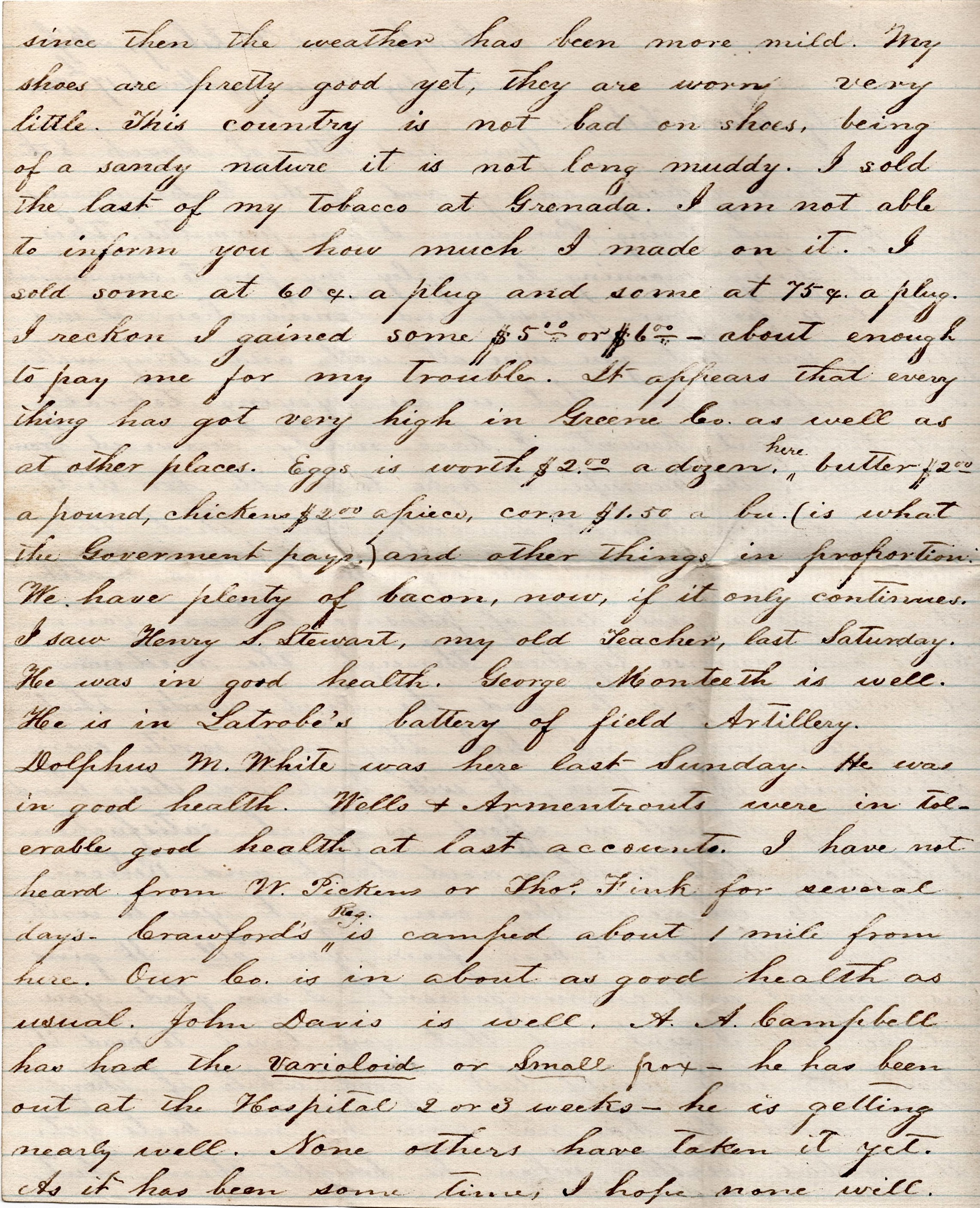
Dear Parents,
It is with great pleasure that I take the present opportunity to write a few lines to you again to let you know that I am well except the same old hurting in my back and my leg. I hope these few lines will find you all well.
I can inform you we have had some very winter weather here but warm and pleasant at present. The sweet merry songs of birds make it appear like spring today here.
We expect a fight here before long. Our regiment are out in the batteries today. We are prepared for them here. If they attack us, we will give them blixon here. We will whip them worse than we did before if the Lord be with us.
We received $26.40 cents of our wages and I enclose & send you a $20 bill. You can dispose of as you see proper. — Jacob F. Sayler
Dear sisters, a word to you. You can tell the Lincolnite gals that I love them as well as I ever did & that is awful well. I want you all to write to me as often as you can. Tell brother John R. Sayler I want him & Margaret to write to me. I would like to receive a few lines from him occasionally. The sun id down and I must close. Give my best respects to all my friends. So no more at present. Write soon. — J. F. Sayler
Letter 9
Camp near Vicksburg, Mississippi Sunday evening, February 22nd 1863
Dear Father,
By the grace of God and through His merciful providence, we are still in the land of the living, enjoying a moderate portion of health and some of the blessings of life. We were made quite happy a few moments ago by the reception of your very kind and affectionate letter of February 10th. We were glad to hear that you were all well and pray to God that this will find you enjoying good health.
Our boys are all improving except those who have lately taken the mumps. None as yet has had them very severe. I was glad to hear that my neighbors were well.
The ram, or gunboat “Queen of the West” that passed by here on the 2nd of February was captured up the Red River by Capt. Kelso of the C. S. Army on the 17th inst.
The Yankees commenced shelling Vicksburg on last Wednesday (18th) evening and shelled it on Thursday until 5 o’clock p.m. when our large guns at the lower batteries fired a few shots at their mortar boat when it retired from the contest and up to the present has not renewed it. Their shelling effected nothing except damaging a few buildings and wounding a few persons, &c. This morning there was a number of salutes fired up on the river to celebrate the anniversary of the birthday of George Washington, the “Father of the Country.” “He who was first in war, first in peace, and first in the hearts of his countrymen.”
At about 12 o’clock heavy firing was heard up towards the mouth of the Yazoo river, supposed to be an engagement of gunboats. It is reported that the Confederates launched five gunboats at Yazoo City a few days ago and some are of the opinion that they were trying to come down. Their gunboats and transports are in full view, leaving and returning almost every day. Their fleet looks like a town upon the water, the smoke stacks appearing like black trees with the tops broken off.
Both sides are using a great deal of energy for the struggle that is impending—the one for the defense of this city; the other for its reduction. Our authorities are confident of their ability to defend this place. They are decided on one point: they never will surrender. It appears as though nature formed this place for a city of easy defense. High hills line the river for several miles on which our dangerous cannons frown defiantly.
The days star of peace and liberty is about to dawn upon our beloved land. The true men of the North West are beginning to utter their sentiments and show their opposition to this bloody and unnatural war and cry for “peace.” Under the leadership of Vallandigham, a numerous party appears, and old Greeley, when at Washington, says the cry was an “Eastern Confederacy”—a “Republic of the West,” &c. The legislature of Illinois proposes a “Peace Convention” to be held at Louisville, Kentucky. Thus the ball is rolling onward. God speed the return of peace and the cause of rational liberty.
We have had no mail here since last Tuesday (as some of the bridges between here and Jackson were washed away) until today. Hence, this will be a few days later than usual. I must now close as I desire to send it today and look for another in a short time. My best love to mother and sisters. Also to J. R. and Margaret. Excuse bad writing as I finish in haste. Now, may the God of love and mercy be and remain with us all. In the hands of filial affection, your most devoted and loving son, — J. K. P. Sayler
Letter 10
Addressed to James K. P. Sayler, Care of Capt. Dodd, Co. A, Pitt’s Regiment Tenn. Volunteers, Vaughn’s Brigade, Vicksburg, Mississippi
State of Tennessee, Greene County February 25, 1863
Dear Sons,
I received your letter of January 24th and one January 30th and one February 6th and one February 10th, which gave us a great deal of satisfaction to hear that you both were alive and in tolerable health. I received them on Monday 23rd. I was so glad to hear from you again. I can inform you that we are all well at present, hoping that these few lines may find you both in better health than you was last when we heard from you.
I can inform you that the money you sent come safe but for any else came nothing. You wrote that you sent a book—the History of Romulus. I have not got it yet. What has become of it, I do not know though I may get it yet. I can inform you that I got the Athens Post tolerable regular ever since you sent for it. I wish you could get some good paper. You can read the Holy Bible, that good old book—the best of all books.
The conscripts are all absent and gone but where to, I know not. I got the money that you sent. Was forty-two dollars in one letter that Lloyd Bullen brought, and twenty dollars in another letter that. L. Britten brought. It came safe.
Write to me for what you sent it for and that will do. I must bring my letter to a close. I will write again soon. You both must write as often as you can, May God have mercy on us all is my prayer for Jesus’ sake. Excuse for not writing more at present. I am in a hurry. So no more—only remaining your affectionate father until death, — John Sayler
Letter 11
Greene county, State of Tennessee March 1, 1863
Dear Sons,
Through the kind mercy of God, I again take my pen in hand to write to you to let you know that we are all well at present hoping that this may find you both in good health. The soldiers had taken J. R. Sayler down to Lien Creek bridge and he stayed there all night and the next day I went down and they give him a furlough for a few days and he went home again the third time and then he was transferred to Lieut. [Daniel] Britton’s command. John reported to Lt. Britton. We went to Mr. Britton’s house. He is a gentleman about his house. He treated us well. I saw Robard Brown’s sister at Lt. [Daniel] Britton’s. She is a nice looking lady. You can tell Robard she is well. I saw Col. Bullin and he told me that the book you sent was at his house and he would bring it to Greeneville as soon as he could think of it. I saw James Jackson. He said that the soldiers were in tolerable health.
We have a great deal of bad weather, a heap of rain. It is very muddy here at present. The roads are bad. Me and John was at your uncle Jacob Fink. He is not st strong a Union [man] as he was but Jane is a Lincolnite in full. They are all well. I hear that Samuel Fink had joined the Dunkard Church but William Fink is just the same old Lincolnite as ever. They have it a going here that you soldiers have nothing to eat but mule meat and are all starving to death but Lt. Britton told me that there is enough for the army for nine months. Britton says that it is rough sometimes. Beef is poor. He said you have sugar and rice and molasses and peas.
Monday morning, March 2nd. I again seat myself to write a few more lines to let you both know that we have not forgotten you. We love to hear from you both and how you are a getting along. Jacob Justice was well last week. I have not heard from B. Knight for a few weeks. George O. Wells was well far as I know of.
I have plenty of hay yet. I have not fed many of my husk yet. I think I will have nearly enough of corn and wheat to do us till harvest. My wheat looks tolerable well. My rye looks fine. My oats is little yet though it may come out. I have three sows and eight pigs. They look well at present. My horses look tolerable well. My cattle look bad.
I must bring my letter [to a close]. May the God of love and peace bless and save us all is my prayer. Write soon and I will do the same. So no more, only remaining your affectionate father, — John Sayler
Letter 12
Camps near Vicksburg, Mississippi March 10, 1863
Dearly beloved Father,
I am under the pleasant obligation of acknowledging the reception of your kind letter of the 1st and 2nd of March, which arrived yesterday. I was happy to hear that you was all well; and that Jacob Justis, G. O. Wells, and the neighbors generally were in good health. I can inform you that I am enjoying moderate health, some better than when I wrote before. I hope this will find you embowered in health’s purest and most delightful domain. Dwelling there tho’ fed on a crust, is better than to live in a house of knickknacks and sickness accompanying it.
I am pleased to hear that Col. Bullen had taken my book safe and tat you would get it.Though not very large, it is seldom found. Glad that Uncle Jacob is not so strong Union! William is past recovery, I reckon. William Pickens told me he had heard Samuel had joined the Dunkards. Hope you will continue to get the “Athens Post” regularly. I read the best of books [Bible] some, and other publications. The Psalms are my favorite. THey suit my mind & heart. Day before yesterday we drawed salted pork. The sick got flour and bacon. We have plenty of meal, sugar, peas, rice and molasses. This is a fact. Beef is generally poor. A man will not starve on what we get. True, a man of a delicate stomach would rather have butter, chickens, &c. &c.
I was glad to hear you had plenty of feed and provisions, that your stock looked well except the cattle. They will be apt to improve when grass comes. You have enough of hogs for one hand. Glad to hear wheat and rye looked well. There is none to be seen here. The leaves are getting green on the trees; we still have a great deal of rain. I tell you our cannons roared last night. It is thought a gunboat passed. It is reported a fight is now going on at Port Hudson. If they pass that place, it won’t be long before an attack is made here. But you will get the news in the paper by telegraph sooner than by letter. For the present, I close. May God protect and save us all is the prayer of your loving and affectionate son, — J. K. P. Sayler
Dear sisters, as it is rainy today, you will have to excuse my failure to answer your letters separately. I was glad to hear from you and hope you will write whenever you can. I was glad to hear of your reading a good deal. Read history and study grammar. I would love to be with you. It would make me as happy as it would you to spend those evening hours with you. But we cannot enjoy that pleasure so let us be as contented as we can. I send “Liberty” by Lt. Kelsey to Mary. You must write soon. Your loving brother, — James K. P. Sayler
Letter 13
Camp near Vicksburg, Mississippi Tuesday morning, March 17, 1863
Dearly beloved Father,
Your kind letter of March 8th came to hand yesterday evening, and by the tender mercies of a kind and loving Providence, I am permitted this beautiful spring morning to employ my pen to communicate a few lines for your perusal and consideration. I was glad to hear that you were all well and doing well. I can inform you that we are enjoying tolerably good health at present. I have nearly recovered from my spell of the mumps. I hope to be able for duty in a few days. I most sincerely desire that this will find you all in the enjoyment of good health. It gives is a great deal of pleasure to read your letters and converse together through the medium of writing. I love to read the kind words that my sisters wrote and hope they will write every opportunity they have. It will improve their hand at writing as well as afford us much satisfaction. I also hope that mother and Sarah and Rebecca will write whenever they can, or get you to write for them. We love to hear from you all. It gives us comfort and encouragement.
I am glad you got the book I sent, and that you loved to read it. Jacob F’s boots would last a good while if they were mended. He has not wore his new boots yet. It was bad weather when he bought them but since then the weather has been more mild. My shoes are pretty good yet. They are worn very little. This country is not bad on shoes, being of a sandy nature, it is not long muddy. I sold thew last of my tobacco at Grenada. I am not able to inform you how much I made on it. I sold some at 60 cents a plug and some at 75 cents a plug. I reckon I gained some $5 or $6—about enough to pay me for my trouble. It appears that everything has got very high in Greene county as well as at other places. Eggs is worth $2 a dozen here, butter $2 a pound, chickens $2 apiece, corn $1.50 a bushel (is what the Government pays) and other things in proportion. We have plenty of bacon now, if it only continues.
I saw Henry S. Stewart, my old teacher, last Saturday. He was in good health. George Monteith is well. He is in Latrobe’s Battery of field artillery. Dolphus M. White was here last Sunday. He was in good health. Wells & Armentrout’s were in tolerable good health at last accounts. I have not heard from W. Pickens or Thomas Fink for several days. Crawford’s [60th Tennessee] Regiment is camped about 1 mile from here. Our company is in about as good health as usual. John Davis is well. A. A. Campbell has had the varialoid or small pox. He has been out at the hospital two or three weeks. He is getting nearly well. None others have taken it yet. As it has been some time, I hope none will.
We are expecting Lt. [Daniel] Britton to arrive in a week or so as we have been informed he was to start yesterday. We do not know whether we will go to Tennessee shortly or not. It is very sultry here this evening.
The enemy’s fleet attempted to pass Port Hudson but were repulsed, except two gunboats, one of which was burnt to the water’s edge, and the other crippled. So report has it.
An early attack is expected at Greenwood up on the Yazoo. Gen. Loring is in command of our forces at that place and I hope he will be able to meet successfully any attack. It is said the Yankees threatening that place number 14,000. Gen. Price is sent to Arkansas. The great struggle for the Mississippi Valley is near at hand. May the God of Battles give us a victory in this stern conflict, and may it bring about a speedy peace. I would love to hear about our situation at Cumberland Gap, &c.
Enclosed I send a tract entitled, “A Mother’s parting words to her soldier boy,” as I expect you would all love to read it. We get tracts to read occasionally and they give us great comfort at times, while others contain themes for thought and reflection and a considerable amount of information.
My watch has got out of fix and sometimes I wish it was at home, and if we stay down here, I have no use for my overcoat. But I will manage all to the best advantage under the circumstances. I was glad to hear you had bought you a pair of breech lands. You got them cheap if they are good. Who did you get them from? I reckon you have been plowing in the new field next to Jo Hendrey’s. What are you putting in the bottoms where you had corn? Write about affairs generally. What would you all say to our joining Lynch’s Company of Artillery? Or is there any company in Tennessee you would rather we would join? We are satisfied in our company but don’t know whether we can stand marching or not. If we were sure our regiment would go back to Tennessee, we would rather stay in it. Give us your views.
Tell T. F. Jeffries I received a piece of his poetry in a letter to A. J. Grubbs, and that I anxiously await another. Give P. M. Correll our best respects, and tell him to write to us whenever he can. Sisters, you must not forget to write. May God guard, guide, and protect us in this our day of trouble, and if it be consistent with his holy will, enable us to meet again at home to spend many a joyful hour in each other’s society, and finally get home in Heaven, is the sincere desire of your devoted son, — J. K. P. Sayler
Letter 14
Greene county, State of Tennessee March 20th 1863
Dear sons,
By the help of God, I am permitted to write again to let you know that we are all well at present without the exception of the piles that I am plagued with. I am suffering at the time through. I am doing my work as usually. I received your letters of February 22nd that was received with gladness and joy to hear that you both was getting better. I hope that you both will recover and get well again in a few weeks. I was glad to see that Jacob F. Sayler wrote a few lines to us all.
Well, as far as I know, the soldiers are gathering the conscripts. The report is that Jackson A. Smith is shot and Reuben Neel, he is shot in the leg, and Smith through the back. Both was alive when heard from. I saw R. H. Morelock on the 18th of March. He is well. Him and the Battalion was over on Laurel [?] and caught some and killed some and moved all the women and children out and fed all the grain that they had in there. I want you to write a few lines to Fayette Jeffries in Caton [?] to see whether he can read it or not. He wonders how you got to be such a scholar. He asked whether you had studied Greek or the Spanish or Latin. Write a few lines in Latin on a strip of paper and send it to him.
I like to know how the Regiment likes Col. Pitts or not. My best respects to all my friends. I have plowed the stubble field next to the big road. George O. Wells and wife was at our house last Sunday. They were both well. We have five lambs, two sets of twins. The one a pretty sight. My sheep are doing well and my hogs are doing tolerable well for the chase they have.
I have not seen John B. Correll since he left. He has not been home since he left, He is still at Big Creek Gap. He wrote that he was well and P. H. Babb was fatter than he ever saw him in his life.
I can inform you that J. R. Sayler has planted three bushel of potatoes and made some garden. J. R. will come with Lt. Britton. I have not saw him since the 25th of February when me and John R. was at his house. He is to let J. R. know when he is to start.
J. F. Sayler, write as often as you can. J. K. P. Sayler, write as often as you can. I like to hear from you every week. I cannot write as often as I would like to for I have not the chance to write for at night I am too tired to sit down and write. You must forgive me for not doing my duty. May God bless and save us all is my prayer. So no more at present. Only your affectionate father until death, — John Sayler
March 20th 1863
Dear brothers, I seat myself to drop you a few words. I am well and I hope this will reach you in good health. I am now waiting on Britton to go back. I expect he will go soon. I have nothing of importance to write. If we all live, I expect to see you both shortly. Give my best respects to all the boys. So I must close, only remain your affectionate brother until death, — John R. Sayler
Letter 15
Camps near Vicksburg, Mississippi April 1st 1863
Dear parents and sisters,
I seat myself this beautiful morning to let you know that I am enjoying tolerable good health at present. I can inform you that I am about well of the mumps. I hope when I get over them that I will have my health better than I have had before down here. I hope when this comes to hand, it will find you all well.
I can inform you that some of the Yankees’ boats are in sight of us yet though they are very cautious to keep out of reach of our guns for they will bark when they come close enough. I was glad to hear your sheep was doing so well & your hogs. I was glad to hear you had the stubble field plowed & getting along so well with your work. I would like to be there at Easter to win all the eggs I could for I han’t eat but one since I left home & it costs [ ].
I han’t anything of any importance to write to you, only the trees and grass looks as green as it will get so I must close my brief letter. I will try and write oftener than I have been. Give my best respects to all enquiring friends. I want you all to write as often as you can get the chance to do so. No more at present, only remaining your son and brother until death, – Jacob F. Sayler
Letter 16
Camp near Vicksburg, Mississippi April 6, 1863
Dear Father,
I am again permitted to write a few lines to you. I received your letter dated March 27th and mailed at Bull’s Gap. March 29th on last Saturday, which gave me great joy and pleasure to hear from you and that all was in good health, except yourself. I was sorry to hear that you was suffering with the piles. I hope you will soon recover. I am in moderate health. Some days I feel tolerably well, and of others I suffer considerably. I am quite weak and have done no duty lately. If I had good water now and plenty of wheat bread, I think I would gain some strength. I had biscuits for breakfast this morning. The flour cost 60 cents a pound. It and good pork sop and rice coffee made me a very good breakfast.
Our company has been out at town as commissary guard ever since last Tuesday. Brother Jake F. went out Thursday morning. He was well this morning. Yesterday, I suppose, was Easter, but poor “Jim” had no eggs. Jake bought some in town for his breakfast, Corporal Stout told me. They cost $1.50 at $2 per dozen. Biscuits $1 @ $1.50 a dozen. Butter $1.50 @ $2 a pound. Green onions 33.33 @ [ ] a dozen. Several persons in our company has got provisions from home, yes, in the whole Brigade. Quartermaster Stephens brought them. Mostly flour, bacon, eggs, butter, onions, &c. &c. They all deem them a treasure and would not sell of them for any consideration. I don’t attempt to blame them for as apt as not, I would be as selfish.
There is no news of general interest to send you. The Yankee fleet up the river have nearly all disappeared. I do not know where they have gone, but I expect up on the Yazoo. Their fleet of boats on the Tallahatchie river to Sunflower Creek, then through Hushpecauna Bayou to the Yazo river, up above Greenwood. If they could open a passage by this route, it would give them several advantagesm but I presume our generals will throw osbstacles in the way to thwart their designs. An engagement up in that portion of the country is expected before long. From Snyder’s Bluff to Greenwood is the line of expected battle. A great many troops have passed by here going up. The 29th and 36th Georgia Regiments went up on Saturday.
You will write about all the neighbors. How William Ross and family are doing. You can tell them that his brother George is well. Jacob Couch was here yesterday. He was well. J. E. Wells was here last Wednesday. He was in good health. Buck Armentrout is not well. Cyrus had got better and went on duty and took another chill. William Robertson passed by here today. You will write how old William Brown is and the folks generally. Tell John R. to write if he is still at home. Tell him to work as long as he remains.
I hear today that Capt. Henshaw is dead. I hear that he got home. I sent my watch by him which I hope you have got before now. I get your letters in a week generally and it appears it takes mine two weeks or more to reach you. I cannot tell the cause. I was glad to hear what you all was doing Thanksgiving Day. I read and wrote a letter to you. Mother and sisters write to us. Your children and brothers would love to hear from you. Father, write as often as you can. With the hope that this will find you all in good health, I close. May the blessing of God rest and abide with us now and forever is the prayer of your loving son, — J. K. P. Sayler
Letter 17
Greene county, State of Tennessee April 19, 1863
Dear sons,
Through the kind mercy of an overruling providence, I am again permitted to write a few lines to let you know that we are all well. I have got better of the piles at present, hoping that this letter may find you all in good health.
John R. left on the first day of April and we have not heard from him since he left home. I received two letters on the 12th of April. The one was dated March 27th; the other was April 1st. I have got No. 21. That is the last number we have received. Oh how glad it made our hearts to hear that our boys are well and doing tolerable well. I can tell you that the Lincolnites had taken Wash Smith but he has come back, They have also taken George E. Jorgel and another man by the name of Woods and have not been heard of since the war taken on. What has become of them is not known. What they will do next is not known.
I received your letters today dated April 6th. They gave us a great of satisfaction to hear from our children. I received the Vicksburg Daily Whig that you sent. There was nothing wrote on it by my name. The neighbors are generally well. William Brown is crazy yet. Lewis Brown went and give himself up and give security for ten thousand dollars, so I heard. David Brown is at home. James R. Baily is well. B. Night was the last time I saw him. Jacob Justice was in tolerable health. William Justice is a wagoner in government service and the other William Justice is a wagoner too in government service. Sherlwood Hatley has moved to Doctor Young’s place where Spencer’s live and A. Johnson has moved where Hatley left. Aaron Woods has moved to old William Brown. William Ross and family are well as far as I know. John Baxter is not well yet. He gets no better.
A few words for Margaret Ann Saylor to [her husband] John R. Saylor to let you know that she had a daughter on 12th day of April but it was dead born. I had Miss Canter with her and Doctor Young. He done all he could to save it but alas, it is gone to world of spirits. J. R., don’t fret for it is far better off than we are. Margaret is doing as well as can be expected for the time. She has been sitting up. The neighbors has been very good to come to see us. We have buried it at Gass Shed. It was his request to have it buried there. It was at head of Sarah W. Brown’s grave. It was a pretty child. It favored J. R. James Kebler made its coffin. Daniel Miller carried the corpse to the graveyard. Me and Hendrey girls and two of John H. Brown’s girls and three of our girls and A. I. Connell and I. Hendrey was at the burying and John Brown, Lydia and Catherine was at the wake and have been up to see us once since to see us.
I must bring my letter to a close. Write soon. I cannot write as often as I would. I cannot get them to mail as quick as I would wish to. I will write as often as I can. Don’t get out of patience. May God bless us all and save us is my prayer. — John Sayler
Here I send you some of its hair and some of that it was buried in for you to see. So no more at present. Only remaining your affectionate wife until death. — Margaret Ann [Hendry] Saylor
Letter 18
[Editors Note: I did not transcribe the following letter which was co-written on 3 May 1863 by Rebecca and Margaret Sayler to their brothers.]
The following letter was written by Joshua B. Parks (1828-1901) of St. Mathews, Jefferson county, Kentucky. He was married in 1857 to Mary Emma Herr (1838-1909) and at the time of this letter (August 1857), had a 3 year-old daughter named Bettie BerthaParks (1859-1886) and a 1 year-old son named John Floyd Parks (1860-1917). Joshua and his father Floyd Parks were large landholders in Jefferson county, farmers and keepers of livestock.
An 1868 article in the Louisville Daily Courier promoted “Josh Parks” as a Democratic nominee for a vacancy in the state’s legislature. His name is as familiar as a “household word” in Jefferson county, the writer proclaimed. He would represent the farming interests of the county despite his young age of 39. A few years later, in 1872, there were notices of his having become bankrupt, however.
T R A N S C R I P T I O N
Addressed to George Baily, Esq., Bridgeport, Connecticut
St. Mathews, Kentucky August 6th 1861
Dear Cousin,
As I have not heard from you in a long time, I have concluded to indite a few lines to you. I expected to find you in St. Louis last fall when I was there, but they told me you had sold out and was then in Bridgeport. The people in Missouri are having a warm time at present. I seen your old friend Wheeler the other day. He says he is doing as well as could be expected. We are embargoed here on all sides. We cannot buy only what the Lincoln Dynasty chooses to sell us nor can we sell only what they choose to let us to the South—our only customers. The people in this state have been loyal to the government and to the Union believing that the southern states have acted wrong in trying to break up this government. But you may rest assured they are a unit or will be, should the government continue this war for they do not believe that the Union can be restored by force. They are willing—too willing—to compromise this question with both the North and South for they may fight until they ruin both sides and then they will have to compromise at last. Why not do it at once.
I know that the Northern press say, let the South lay down their arms and give up their leaders to be hung, and then we will compromise. But you, my friend, have seen too much of the southern character not to know that they would [not] entertain that proposition for a moment, but say the North, we will whip them back. Now I am no politician and therefore I will not go into the causes which I think have led to a separation of these states, but of one thing I do know, and mark my words, one section of this country cannot be destroyed without destroying the other section. And should this war be continued, the whole country will meet one common fate.
Kentucky has heretofore differed with her southern sisters. They believe (the seceded states) that this is a war for the destruction of African slavery whereas Kentucky believes it to be a war for a restoration of the Union of these states. But as it progresses we find the abolition leaders become frenzied and heap curses and maledictions upon the whole of us. Kentucky too will become frenzied and aroused from her lethargy when she will range herself side by side with old Virginia, the mother of Kentucky, and of Presidents and then 100 thousand sons will draw the sword and throw away the scabbard. She being the last to get in the fight, she will be the last to give it up. We have cried aloud for peace. We want peace now. But if we are forced into war—woe to the wrong doers.
I received a letter from our old friend Homer the other day. He is a straight out No. 1 Greeley-Beecher-Seward-Lincoln abolitionist and no mistake. He says if slavery stands in the way, wipe it out. But as I said before, the people here want peace. They want the Union restored, but they know that war will not restore the Union, and should it continue six months longer, all hopes for a reconstruction will be destroyed forever and forever.
You must write to me and let us know how your family is. What the feeling is in your section. My family are enjoying good health. We have a little daughter nearly 3 years old and a little boy 18 months old—fine looking children. They favor their Pa of course. Write to me soon. Your cousin, — Joshua B. Parks
The following letter was written by 39 year-old wagon maker James Perkins (1823-1863) of Clifton, Union county, Indiana. James enlisted on 9 August 1862 in Co. G, 69th Indiana Infantry. He died of chronic diarrhea while in the service at St. Louis, Missouri, on 27 July 1863.
I could not find an image of James Perkins but here is one of Alexander Moore who served in Co. B, 69th Indiana Infantry.
James was born, raised, and married in Kennebec county, Maine. His wife, Evira F. (Wade) Perkins died in January 1861 and left him with four children born between 1848 and 1857. After James’ death, the Wade family stepped in as guardians.
The 69th Indiana, along with other Union forces, suffered a significant defeat at the Battle of Richmond on August 29–30. The overwhelming Confederate victory led to the capture of a substantial number of Union troops, including the entire 69th Indiana regiment. Following their capture, the soldiers of the 69th were paroled, a prevalent practice at the time wherein captured soldiers were released with the stipulation that they would refrain from combat until formally exchanged. Perkins’ letter was written during this period of time while still in Kentucky.
Later in September 1862, they returned to Indianapolis to await their official exchange. It was during this period of enforced inactivity that controversy emerged; Union authorities exhibited reluctance to expedite the exchange and reintegration of the captured and paroled soldiers into active duty. This created a phase of idleness and disarray, raising serious concerns regarding the regiment’s preparedness and morale. Once officially exchanged and reorganized, the regiment distinguished itself in several major campaigns, notably the Vicksburg Campaign and the Red River Campaign. However, the memory of the calamity at Richmond and the ensuing period of compulsory inaction remained a poignant and bitter chapter in its early history.
T R A N S C R I P T I O N
Four miles south of Louisville September 9th 1862
Mr. Sullivan, sir,
How the thing looks outside of this horrible place I don’t know, but as near as I can learn, we are in an awful fix. There is great dissatisfaction here among our broken regiment. They say they will die before they will consent to consolidate with any other. The 14 Kentucky wants us but we will not go in. We think our Kentucky officers are not all right. We have many among us that is sick, many wounded that wants to go home but cannot leave camp unless pronounced by the doctor very dangerous. One man laid here on the ground and died day before yesterday. We have not got 50 men in our regiment that is well enough to bear arms and what will be our destiny, you know as well as we. We think we have been used worse than dogs. Col. Bickle we think is doing all he can to get us home but I guess he will not succeed.
We are in Kentucky and we must do as they do but if we was in Indiana, I would not think much of Kentucky. They are waiting to know how the scale will tip. But we might as well laugh as cry. Crying will do no good although I have not tried it yet. Neither have I laughed much either but I think if I was to your place, it would be the first thing I’d do. I think as little of home and its pleasures as I possibly can.
Freeman Ward and Wallace Stanton are my messmates. We have two blankets between us. We sleep together. We try to take a little comfort but hard to get at. We have no tents. We sleep on the damp ground—no covering over us but the heavens. Old Mr. Preston came here last Wednesday and stayed till yesterday. He said if he had heard how we was used, he could[n’t have] believed it but he said he should go home and tell the tale anyhow.
There is a fellow in camp that cut his foot off splitting wood yesterday morning [and] can never be fit for duty, but he cannot get home now—even to the hospital. There is a nasty creek running through our campground and thousands of dead fish in it. We have no water nearer than one mile fit to drink and that is worse than your slop. I think I would be as glad to see you as you was to see me at Maine. If I knew you could leave home and come here safe and get back safe, I should have you come and see me—perhaps for the last time. But I do not want you to come bad enough to endanger your own life for you very well know that I have too much love and respect for you all to endanger your lives to please me. I have already asked many favors of you which has been cheerfully granted, I believe.
I did not expect when I left your house to change my situation for the better. I did not come because I wanted to. I did not come because I expected to find an easy time. But I came because my country called me. I came for the welfare of my children and your children which I think as much of as I do of my own. But it will not do to dwell on thoughts like these.
There is 6,000 people [with]in sound of my voice. No place you might say to be lonesome. But the most of them will leave very soon. Everyone seems to be in for himself and fighting mad. We had someone say there would be a speedy compromise and the reply to that was to point of bayonet, but that may be our only chance—God only knows.
We had a good lecture Sunday last from our Chaplain from Richmond. He preached three weeks ago at Richmond for us and there every man listened to him that fell in the battle near Richmond. Poor Isaac Shaffer stood by my side three weeks ago and heard him; little did he think that would be the last sermon he would hear on earth. But he is, I trust, better off than we. He has got through with all wars and all troubles that this life is near to.
I will close for this time by saying my best respects to all. Excuse bad writing for we have no convenient time nor place. Your well wisher, — J. Perkins
The following letter was written by Daniel Crist Kitchel (1842-1928), the son of Daniel Kitchel (1795-1855) and Eliza Crist of Liberty, Union county, Indiana. At the time of the 1860 US Census, Daniel was living with and working as a farm hand for Enoch Coddington in Brownsville, Union county.
According to muster rolls, Daniel enlisted in Co. C, 8th Indiana Infantry in September 1861 and mustered out three years later at Indianapolis. He signed this letter as a sergeant but the date of his promotion isn’t recorded.
Daniel married Mary Ellen Babb (1845-1915) in 1869. When 86 year-old Daniel died in 1928, he had 39 grandchildren and 6 great-grandchildren.
T R A N S C R I P T I O N
Addressed to Miss Lucy Sullivan, Liberty, Union County, Indiana
Camp Helena, Arkansas August 1, 1862
Friend Lucy,
It is with the most of pleasure that I am now able to fill my promise of yesterday. I wrote you a letter yesterday [and] I stated that I would send you my miniature of which I am able to do but it isn’t a very true one. The artist was very poor indeed. Lucy you must send me yours—that is, if you think I deserve it. Please write soon as you receive this. Yours truly, I remain your new friend, Sergeant D. C. Kirchel
To Miss L. Sullivan
Lucy, long may you live and happy, beloved by all, by most by me.