The following letter was written by Eli Clemens Williams (1841-1921), the son of Aaron Williams (1800-1883) and Alcia L. Lane of Hiram, Oxford county, Maine. Muster roll records indicate that Eli enlisted in the 9th Maine Infantry as early as 17 July 1863 but this letter suggests that he did not get assigned to his company until he arrived in South Carolina several months later. He remained in the regiment until 13 July 1865 when he was mustered out of the service.
Eli’s letter provides us with a good description of the scenes and activity in Charleston Harbor in March 1864, including the rebels’ use of a 300-pounder gun called “The Bull of the Woods.”
T R A N S C R I P T I O N
Addressed to Mr. Simeon P. Lane, Brownfield, Maine
Morris Island [South Carolina] March 20, 1864
Dear Cousin,
I will take my pen in hand to remind you that I have not forgotten you and to let you [know] how I like soldiering. If I could have my heath, I should like it quite well now I am here but I do not admire the job of moving much. When we left Portland, we stopped four days on Long Island and there we almost froze and when we left we had a bad storm. we sailed 3 days and the captain told us that if he was back to Long Island again, he could get to Fortress Monroe as quick as from where he was. One day we blew 100 miles and only gained one mile ahead. Our little boat rocked very bad. The bunks all broke down and the water came in the gangway. Sometimes it would take a man off the stairs and duck him good. We was all seasick and our cabin was as neat as father’s pig pen. We got here in 9 days, 115 of us, and only lost one man. He was crazy and jumped overboard by night.
We called to Fort Monroe. That is a pretty place. It was a good sight to see the guns mounted on the fort but after one night’s stop, we had to leave Old Virginia’s shore. We joined the 9th Maine Regiment and I got into the company that E. Wedgwood enlisted. I found a good many that I knew. I suppose you have seen some of the veterans of this regiment. We are in sight of Charleston now and I can see the rebel flag on the ruins of Sumter. That fort is made of brick 60 feet high, covers 5 acres, but it is not more than half so high now. It looks like a mass of sand, but the rebs have bomb proofs inside so it is as strong as ever.
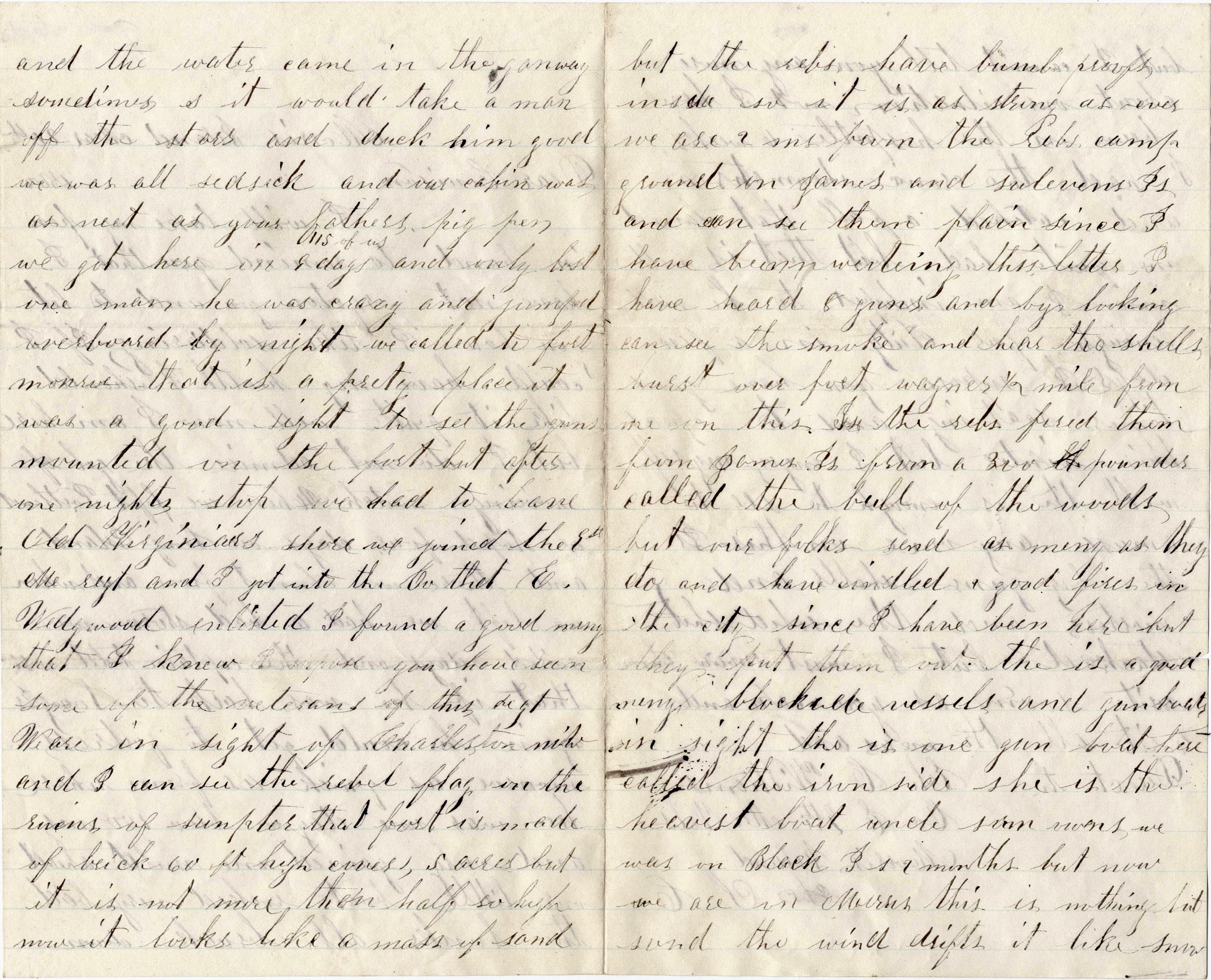
We are two miles from the rebs campground on James and Sullivan’s Island and can see them plain. Since I have been writing this letter, I have heard 8 guns and by looking, can see the smoke and hear the shells burst over Fort Wagner half mile from me on this island. The rebs fired them from James Island from a 300 pounder called the “Bull of the Woods” but our folks send as many as they do and have kindled a good [many] fires in the city since I have been here but they put them out. There is a good many blockade vessels and gunboats in sight. There is one gunboat here called the Ironside. She is the heaviest boat Uncle Sam owns. We was on Black Island two months but now we are on Morris Island. This is nothing but sand. The wind drifts it like snow but I cannot tell you anymore about our situation now.
I have been in the hospital six weeks. I had the chronic rheumatism and catched a fall that lamed me quite bad, but that is well now. I am in hopes to be well enough for duty in a few days. I suppose you have good times skating and to speces [?] this winter but I enjoy myself well. There is enough to see to amuse anyone in this place. The big guns, shells, and mortars and the solid shot stacked. But I must now close. Write soon as you can and write all the news and direct to Eli C. Williams, Co. E, 9th Maine Vols., Morris Island, S. C.
The following letter was written by Ira Mann Warriner (1837-1919) of Co. G, 7th Pennsylvania Cavalry (80th Volunteers). Ira was born in Roxbury, Vermont, the son of Benjamin Howard Warriner (1794-1843). He came to Tioga county, Pennsylvania, with his parents when he was about four years of age and grew to manhood in Delmar. When a young man he went to Wisconsin where he remained two or three years and then returned to Pennsylvania, making the journey most of the way on foot. When the Civil War began, he enlisted in the 7th Pennsylvania Cavalry at Wellsboro on 20 September 1861 and was honorably discharged at Macon, Georgia, in June 1865.
“After the war he returned to Delmar and on March 26 he married Hepsie Elizabeth Carvey, in Wellsboro, and soon after his marriage he went to Addison, N.Y., where he engaged in the jewelry business for a short time and then came to Wellsboro and entered into a partnership with the late Samuel Warriner in the same business. In a year or two he sold out to his partner and moved his family to Liberty, where he resided until 1897, when he came back to Delmar and purchased the lot on which the old log school-house stood where he first attended school, and there built the house in which he had since resided. Mr. Warriner had an interesting collection of old relics of the war; among them, the old carbine which he carried while in the service; his saber; a leather knapsack which he made from leather captured from the Rebels while he was with Gen. Wilson on that memorable exploit known as Wilson’s raid, and many other articles that are interesting. He was fond of telling of his experiences while in the army and had a diary which he kept while in the service. Mr. Warriner was an Odd Fellow for over forty-five years, being a member of Block House Lodge No. 398.”
T R A N S C R I P T I O N
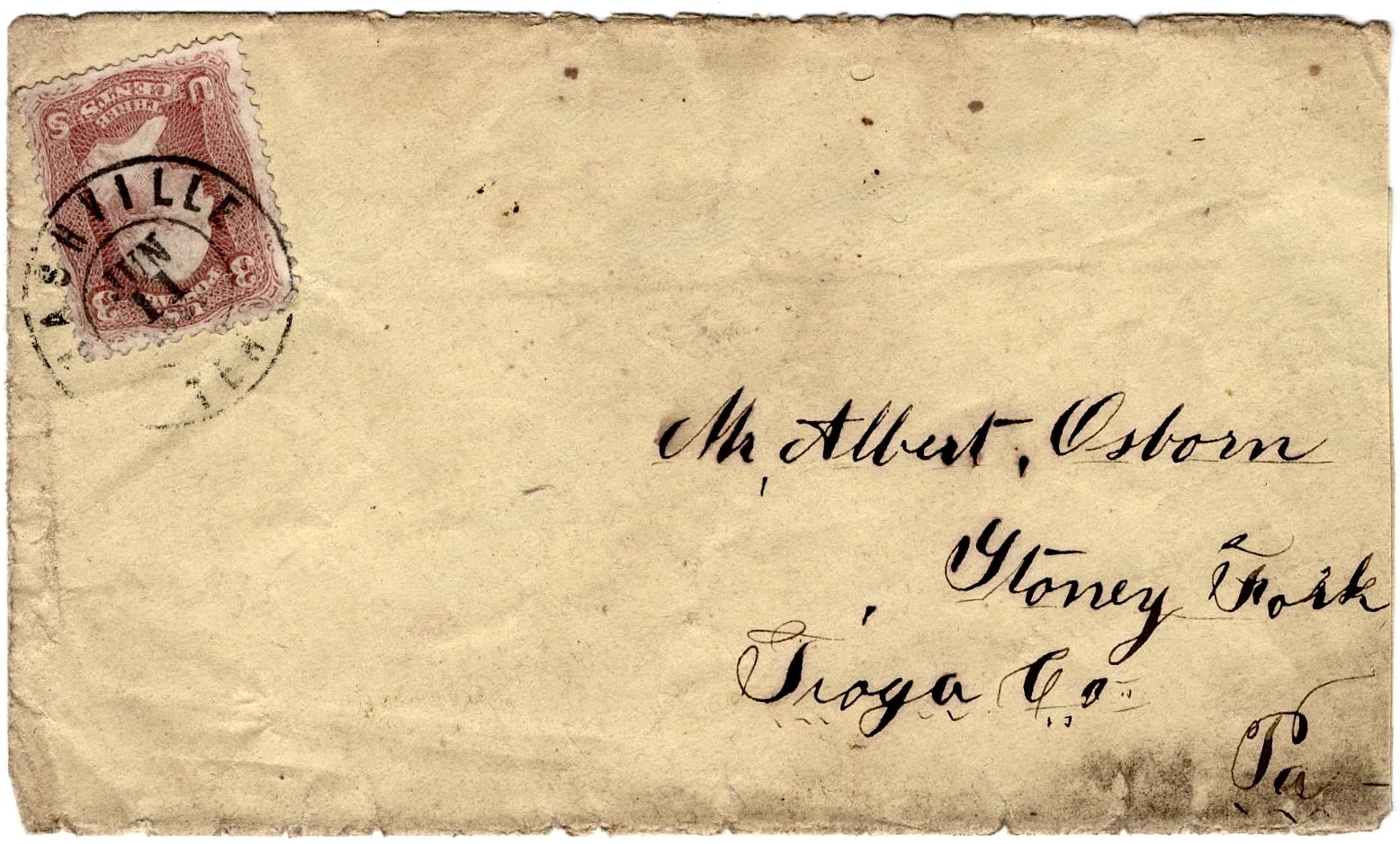
Addressed to Mr. Albert Osborn, Stoney Fork, Tioga county, Pa.
Murfreesboro [Tennessee] June 8th ’63
Dear Friend,
I am seated to write you a few lines. I am in the Hospital not to wait the long painful workings of my disease but to await for my great toe to grow & unite itself to its parent foot from which I took it the other morning with the hatchet. The bone was cut entirely off but the flesh & hide on one side is left so I think it will grow on again.
Albert, I have a yarn &c but I am afraid I haint got room for it here. You may think it ain’t worth bothering with. The First Stain. Were some of our friends at home to see with how much pleasure a soldier shows his saber with the first stain of blood upon it, it would almost startle them. They would think that their once quiet & tender hearted friends had become barbarous & their hearts hardened against the human race. Do not harbor such ideas, for no sooner does he see his foe fall, than his heart has sympathy for the fellow sufferer & he would do his utmost to comfort him. What gives so much pride is this? The weapon shows for itself that he has had a chance to try his courage & bravery & has come off victorious.
My trusty blade done its first bloody work the other day while I was on picket by striking a death blow to a Grayback. I was on the outpost & in a piece of woods. I had stood all day until near sundown. My horse was standing by a large tree & I, to take things easy, was leaning my back against the tree. I had not sat in this position long before I heard a noise the other side of the tree. I looked as close as I could without moving & could see nor hear nothing so I came to the conclusion that It was more imagination than reality. But I soon changed my mind for I heard it again & so plain that I was satisfied that there was something there that had no business to be, so I moved my horse to where I could see what was up & there, & ascending the tree, was the object of my hatred.
I was startled. Not that I was afraid, but because I had been so heedless as to allow anything to approach so near without seeing it there. One thing that was strange to me was to see him going up the tree & what could be his object? It is a mystery that I will leave for you to solve. In less time than I have been in writing this verse, I had drew my saber & struck the death blow (for I dare not allow him to get out of my reach). The body fell heavily to the ground. A convulsive shake ran through it & life was extinct.
As I looked upon his lifeless form, a shudder passed over me. I could not but think how much he had me in his power had he chose to made the first attack. Instead of writing this mixed up yarn, I would now be beneath the sod. This daring fellow was stout built & a few inches shorter than I am (6 ft), but I now rejoiced over his lifeless form for his snakeship had no more power to climb trees & scare soldiers. I had severed his head from the body at one blow. It was a new idea to me to see a snake climb a tree & one of the size of that for it was a large smooth-barked white oak & he was going straight up without coiling around it. His body was as perpendicular as a plumb line could hang. He was five feet 6 inches long & was of a grayish color. His name I did not ask; perhaps he would not have told it. Thus you see how I first stained my saber.
I told you at the start how I stained my hatchet, & now I will wait until after diner.
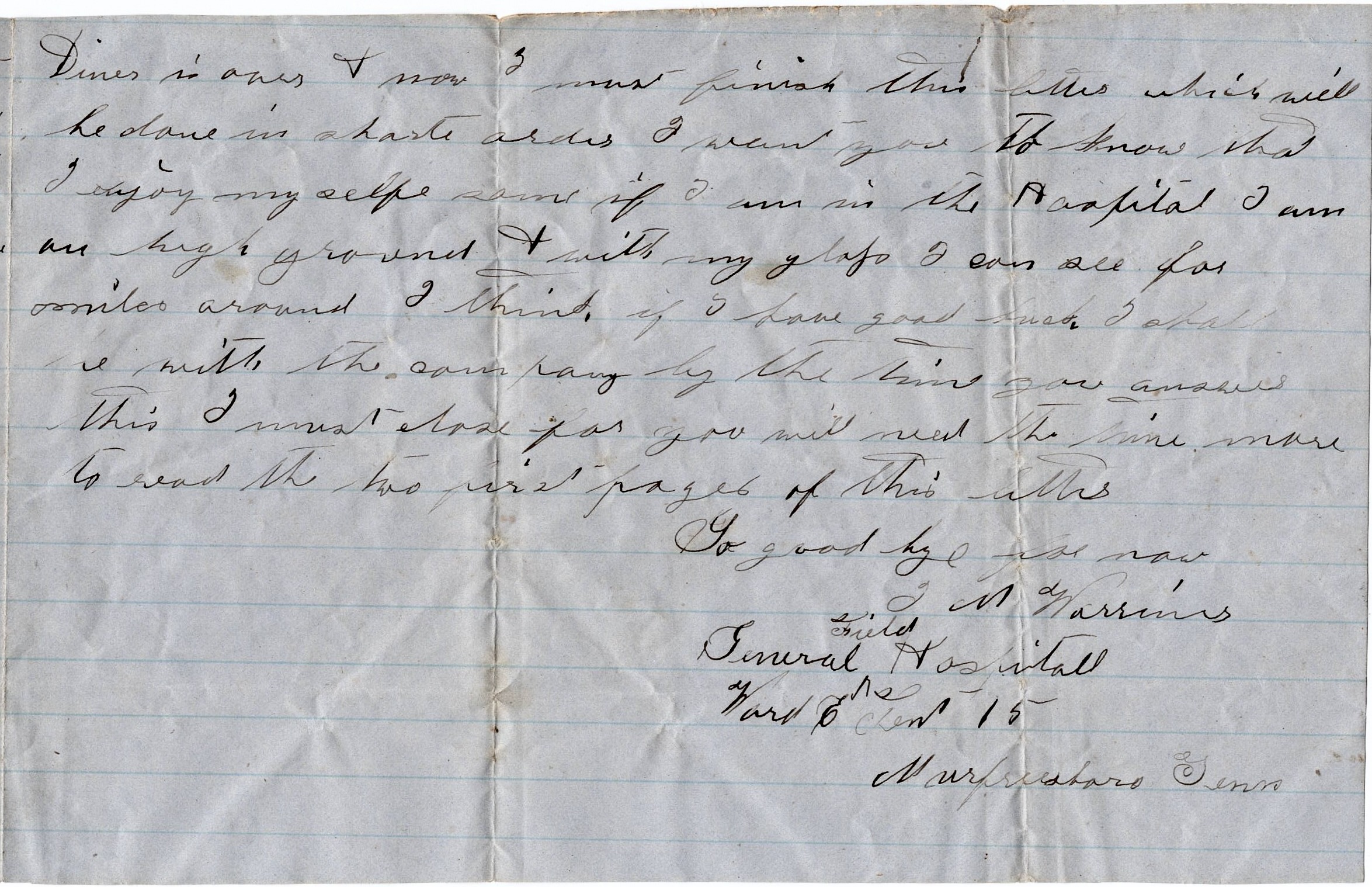
Dinner is over & now I must finish this letter which will be done in a short order. I want you to know that I enjoy myself some [even] if I am in the hospital. I am on high ground & with my glass, I can see for miles around. I think if I have good luck, I shall be with the company by the time you answer this. I must close for you will need the time more to read the two first pages of this letter. So goodbye for now. — I. M. Warriner
General Field Hospital, Ward E, Tent 15, Murfreesboro, Tenn.
The following letter was written by Sarah Josephine (“Josie”) Harp (1845-1929), the daughter of Samuel Harvey Harp (1803-1890) and Jane P. Butler (1809-1881) of Chili, Miami county, Indiana. Though Sarah had several older siblings, the only other one mentioned in the letter was her younger sister Mary Jane (“Mollie”) Harp (1849-1893).
We learn from the letter that this was the first letter Josie ever wrote to Lt. George Platts of Co. H, 28th Michigan (1841-Aft1930) whom she referred to as “an entire stranger.” On-line family records inform us, however, that Josie and George ‘s awkward first exchange of letters blossomed into a relationship that resulted in their marriage on 5 November 1867. George was born and raised in New Hampshire but served in a Michigan regiment and after the couple were married, they eventually moved to Iowa where George became a general store keeper.
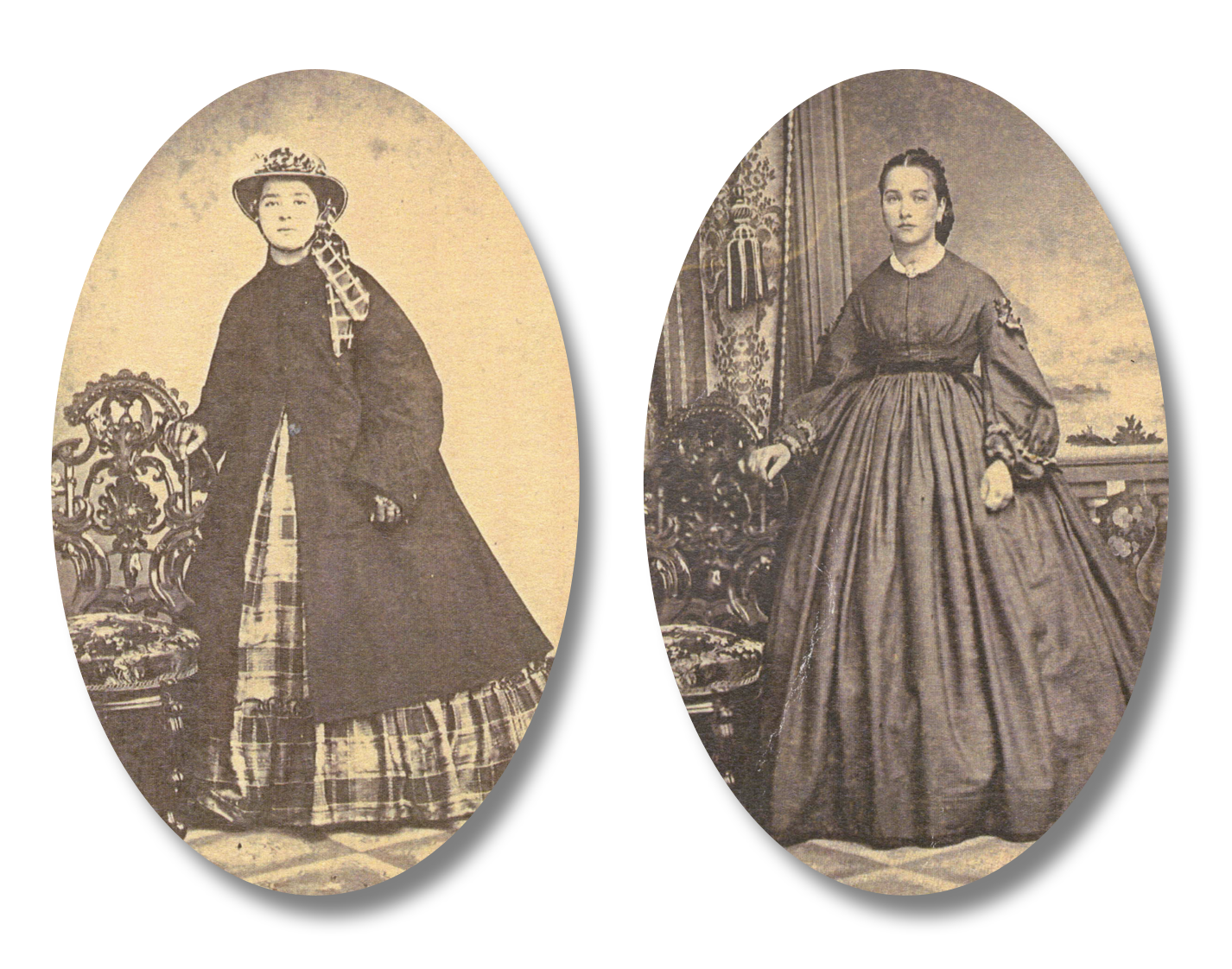
Josie Harp (left) and her younger sister Mollie. Both are cdv’s that date to about 1865.
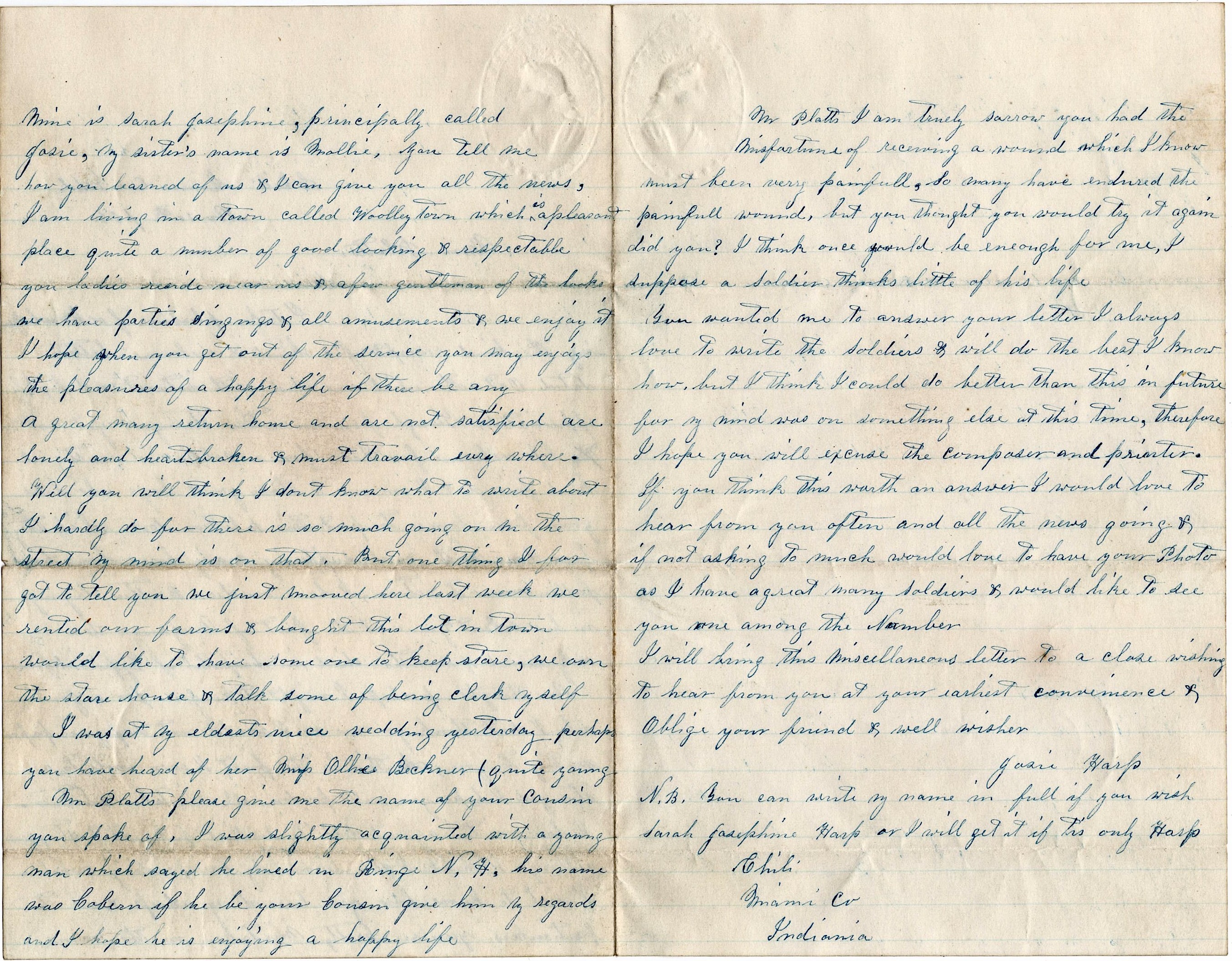
T R A N S C R I P T I O N
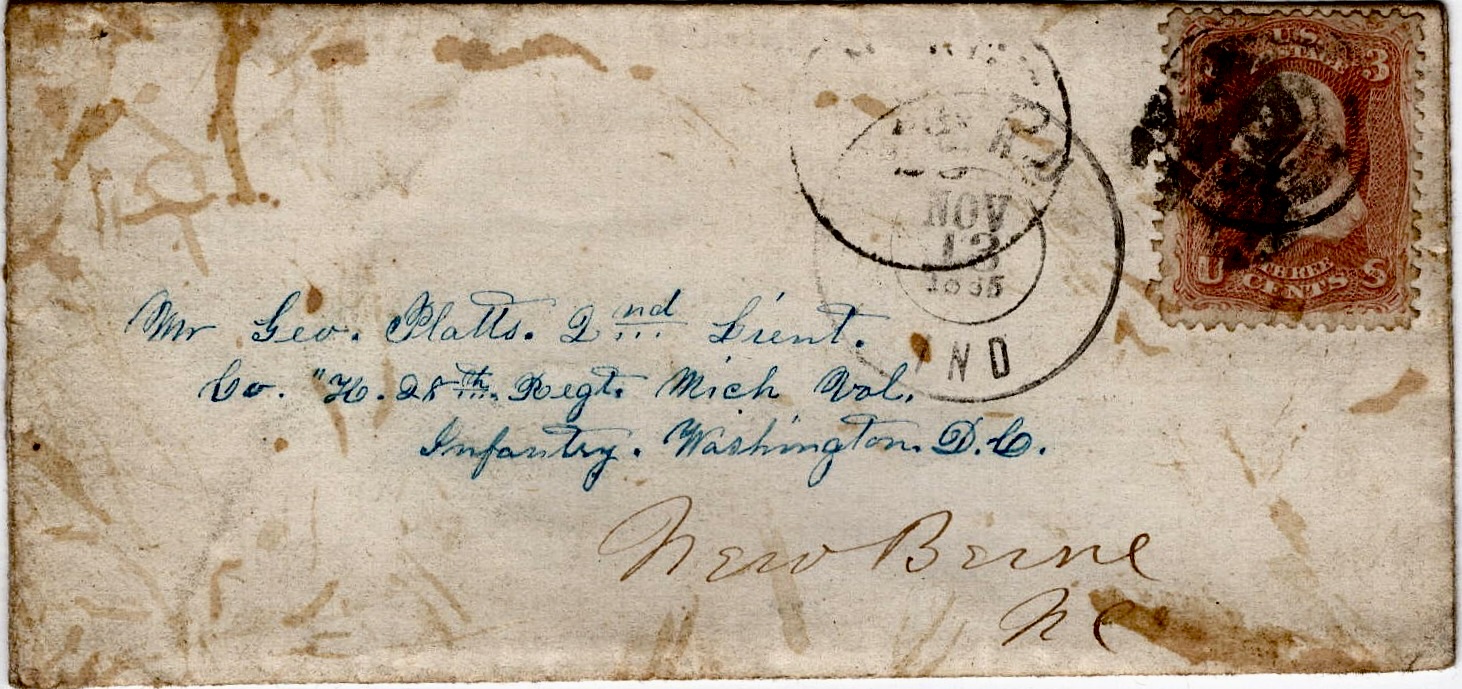
Addressed to Mr. George Platts, 2nd Lieutenant, Colonel. H, 28th Regt. Michigan Volunteer Infantry, Washington D. C.
Chili, Miami county, Indiana November 10th 1865
Mr. Platts,
Sir, I take pleasure of acknowledging the kind receipt of a kind & welcome letter dated October 20th which was read with interest and highly appreciated. Though from an entire stranger yet not less welcome for that, for a soldier is worthy a kind friend & I am one to those good boys who have gone from home to put this rebellion down which they have done with much suffering many brave boys have fallen never to return. I have one dear brother laying in his silent grave at the fort of Morganza, Louisiana. Only served 4 months. Died in hospital of typhoid fever.
You thought perhaps I might take you for a Johnny Reb. I don’t think you are or I would not disfigure paper writing to you. This is the first I ever wrote to a stranger. I hope you will pardon all mistakes whatever. I have written a great deal to soldiers but not to strangers although I think I can learn by corresponding awhile. I wish to know how you learned my address & all the particulars.
You are partly mistaken in the name. Mine is Sarah Josephine, principally called Josie. My sister’s name is Mollie. You tell me how you learned of us & I can give you all the news. I am living in a town called Wooleytown which is a pleasant place. Quite a number of good looking & respectable young ladies reside near & a few gentlemen of the books. We have parties, singings and amusements & we enjoy it. I hope when you get out of the service you may enjoy the pleasures of a happy life if there be any. A great many return home and are not satisfied, are lonely, and heart broken & must travail everywhere.
Well, you will think I don’t know what to write about. I hardly do for there is so much going on in the street, my mind is on that. But one thing I forgot to tell you, we just moved here last week. We rented our farm & bought this lot in town. Would like to have someone to keep store. We own the store house & talk some of being clerk myself.
I was at my eldest niece’s wedding yesterday. Perhaps you have heard of her—Miss Olivia Beckner (quite young). Mr. Platts, please give me the name of your cousin you spoke of. I was slightly acquainted with a young man which said he lived in Rindge, N. H. His name was Cobern. If he be your cousin, give him my regards and I hope he is enjoying a happy life.
Mr. Platts, I am truly sorry you had the misfortune of receiving a wound which I know must [have] been very painful. So many have endured the painful wound but you thought you would try it again, did you? I think once would be enough for me. I suppose a soldier thinks little of his life.
You wanted me to answer your letter. I always love to write the soldiers & will do the best I know how but I think I could do better that this in future for my mind was on something else at this time. Therefore, I hope you will excuse the composer and printer. If you think this worth an answer I would love to hear from you often and all the news going & if not asking too much, would love to have your photo as I have a great many soldiers & would like to see you one among the number.
I will bring this miscellaneous letter to a close wishing to hear from you at your earliest convenience & oblige your friend & well wisher. — Josie Harp
N. B. You can write my name in full if you wish—Sarah Josephine Harp, or I will get it if tis only Harp, Chili, Miami county, Indiana
The following letter was written by Abner Coburn (1803-1885), the 30th Maine Governor. He wrote the letter at the behest of a Vassalboro constituent, Rev. James Evelyn Mills—a Baptist preacher—who had a son serving in the the 11th Maine Infantry but hospitalized in Beaufort, North Carolina, in February 1863. The letter was addressed to Dr. Nathan F. Blunt who left his practice in Bingham, Maine, to volunteer as an Army surgeon. The sick soldier was Horace Stanton Mills (1843-1923), a sergeant in Co. G, 11th Maine Infantry. Horace survived his illness and was later taken prisoner at Fort Gregg, Virginia, in April 1865 but released soon after. Some of Horace’s Civil War artifacts are on display at the North Berwick Historical Society.
Also transcribed and posted with this letter is one written by Horace’s father directly to Surgeon Nathan F. Blunt. See Letter 2. We learn from that letter that Rev. Mills had another son die of disease in January 1863 which no doubt heightened his concern for Horace lest he suffer the same fate. A study of the Mills family tree reveals that the family had yet another son, not mentioned in the letter, named Albion B. Mills (1846-1863) who enlisted in Co. E, 16th Maine Infantry, in August 1862, and was mortally wounded at the Battle of Gettysburg.
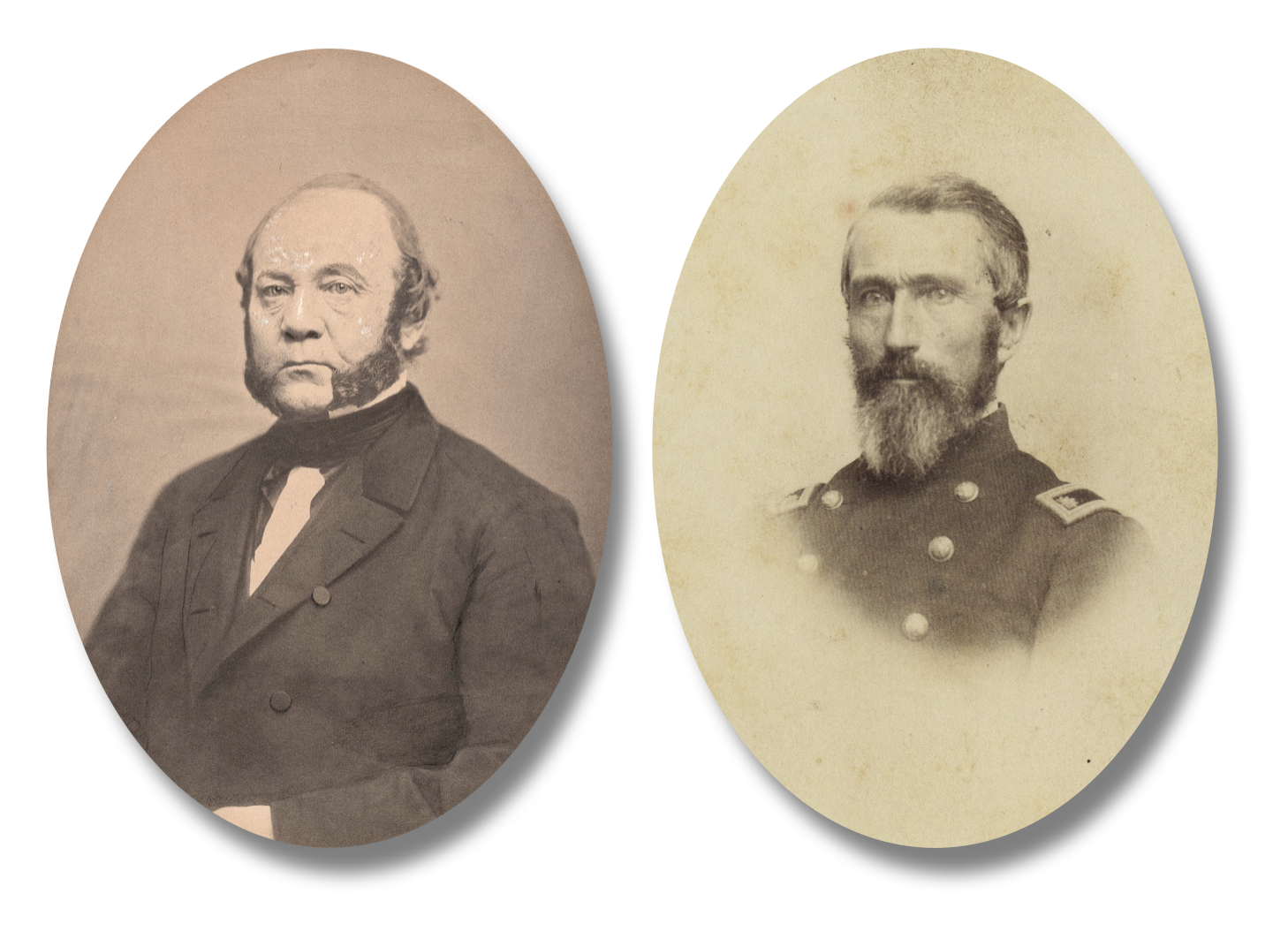
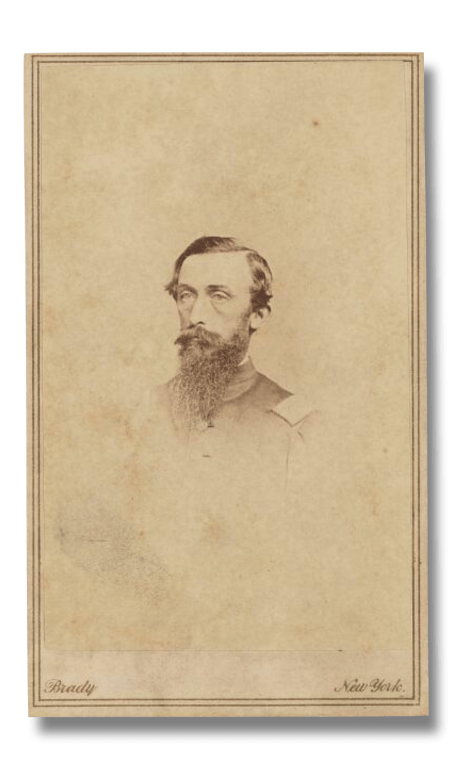
Left: Abner Coburn, 30th Governor of Maine.; Right: Nathan F. Blunt, Surgeon of the 11th Maine Volunteer Infantry [Maine State Archives]
Letter 1
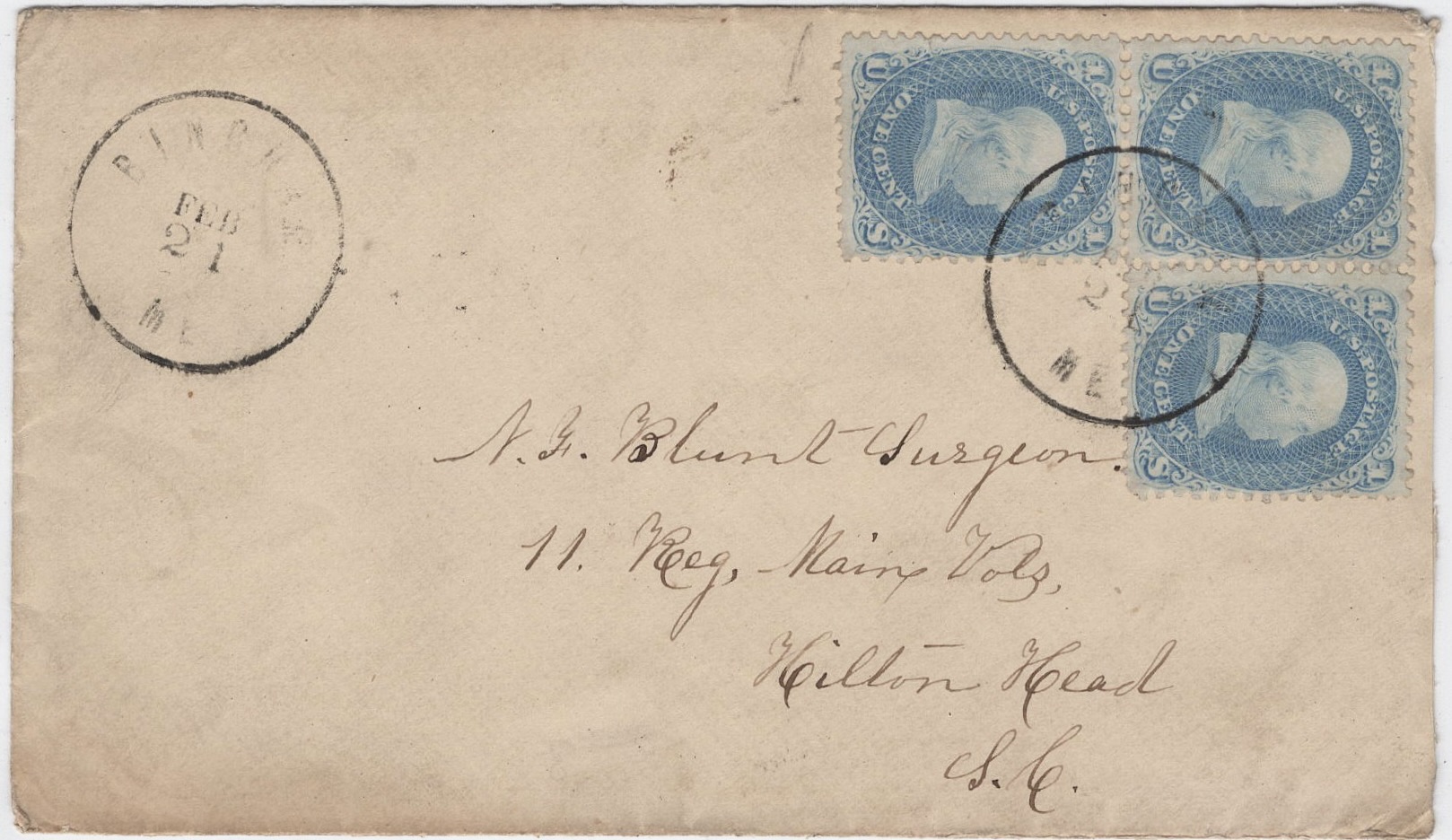
Addressed to N. F Blunt, Surgeon 11th Regt. Maine Vols., Hilton Head, S. C.
Augusta [Maine] February 17, 1863
To the Surgeon of 11th Maine Vol.
Dear sir, I learn that the Reverend Mr. Mills of this state has a son in your regiment, Horace S. Mills, who is sick. His father is very anxious about him and is very desirous he should have a furlough for such time as he recovered from his illness, if ever.
Any assistance you can give him consistent with your duty would much oblige him and your obedient, — A. Coburn, Gov. of Maine
Letter 2
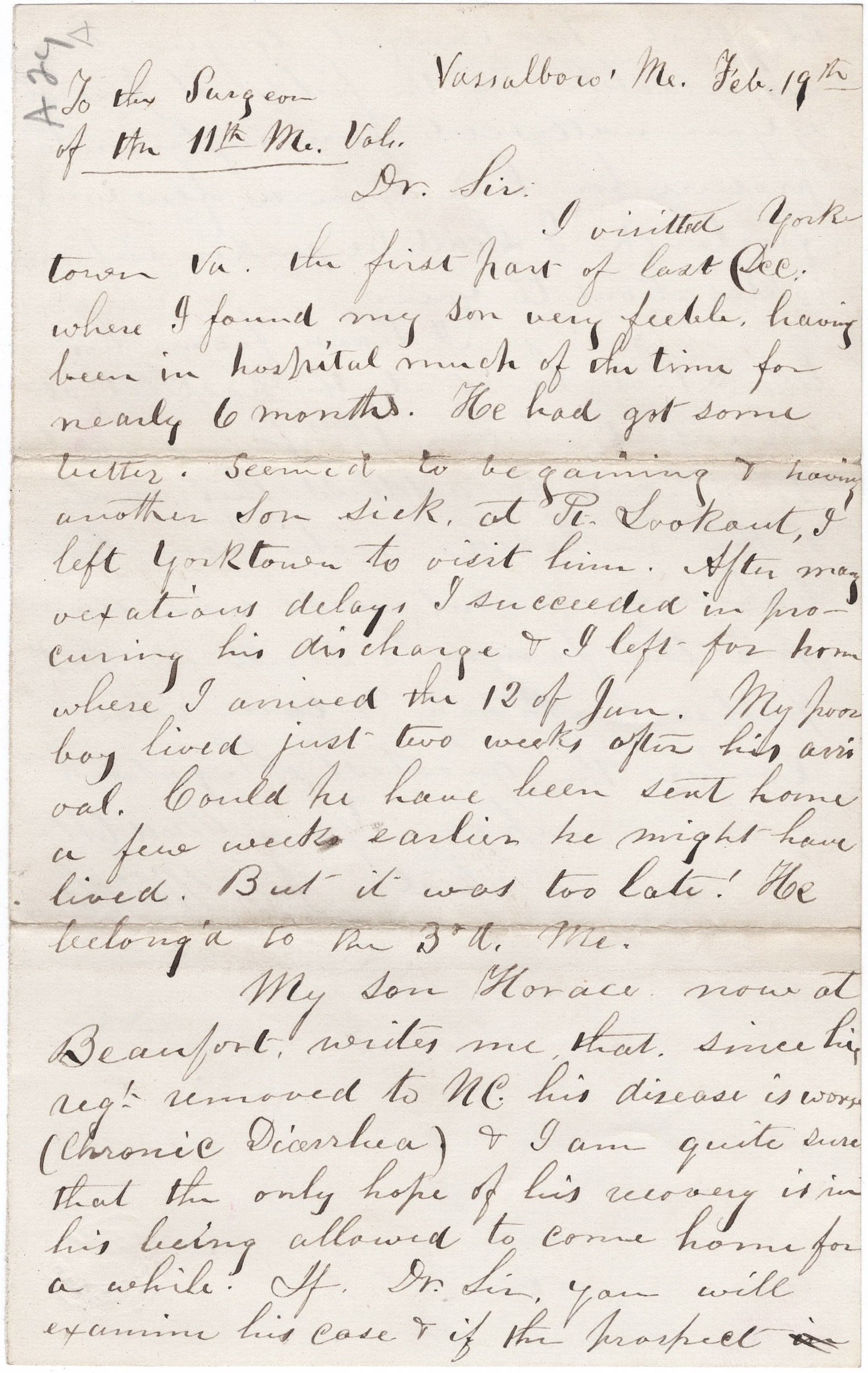
Vassalboro, Maine February 19, [1863]
To the Surgeon of the 11th Me. Vols.
Dear sir, I visited Yorktown, Virginia, the first part of last December where I found my son very feeble, having been in hospital much of the time for nearly 6 months. He had got some better. Seemed to be gaining & having another son sick at Point Lookout, I left Yorktown to visit him. After many vexatious delays, I succeeded in procuring his discharge & left for home where I arrived the 12th of January. My poor boy lived just two weeks after his arrival. Could he have been sent home a few weeks earlier, he might have lived. But it was too late. He belonged to the 3rd Maine. 1
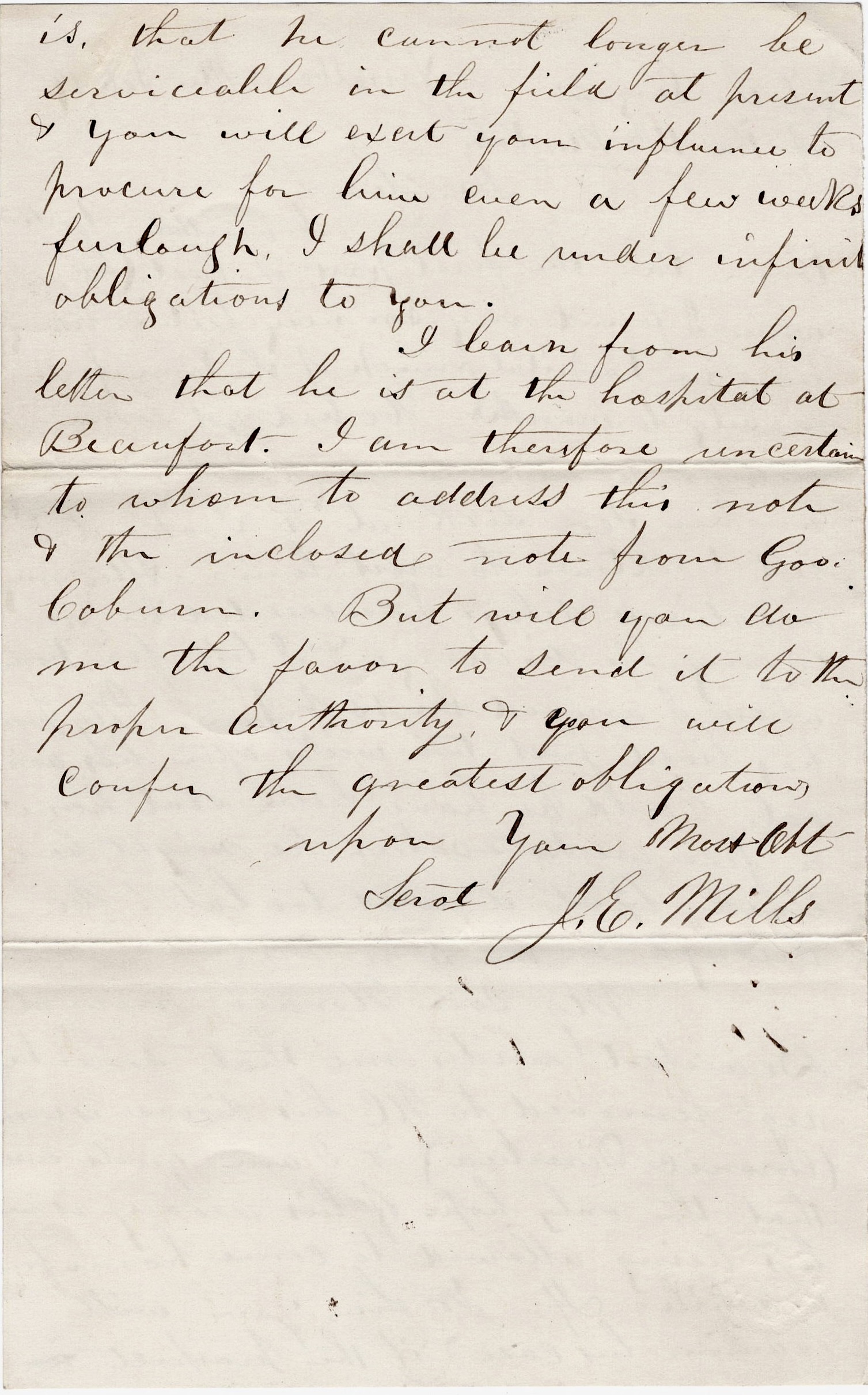
My son Horace, now at Beaufort, writes me that since his regiment removed to North Carolina, his disease is worse (chronic diarrhea) & I am quite sure that the only hope of his recovery is in his being allowed to come home for a while. If, dear sir, you will examine his case & if the prospect is that he cannot longer be serviceable in the field at present & you will exert your influence to procure for him even a few weeks furlough, I shall be under infinite obligations to you.
I learn from his letter that he is at the hospital at Beaufort. I am therefore uncertain to whom to address this note & the enclosed not from Gov. Coburn. But will you do me the favor to send it back to the proper authority & you will confer the greatest obligation upon your most obedient servant, — J. E. Mills
1 The son’s name was Allen Winslow Mills (1843-1863) who served in Co. B, 3rd Maine Infantry. He was discharged from the regiment on disability on 22 December 1862.
The following letter was written by Archibald (“Arch”) F. Jones (1825-1879) who served as Captain of Co. G, 53rd Pennsylvania Infantry in the Civil War. He wrote the letter to his wife, Mary Ann (Ross) Jones (1830-1920) with whom he married in 1848. Arch served nearly three years and was discharged on 24 July 1864. He was a farmer in Potter county, Pennsylvania, before the war but afterwards, returned to Coudersport where he went into the dry good business.
Archibald’s letter was written in November 1862, just after the regiment’s arrival at Falmouth where they were assigned Provost Duty. In the Battle of Fredericksburg that would take place some three weeks later, the 53rd was part of the 2nd Corps crossing of the Rappahannock at dawn on the 13th with 283 officers and men. They suffered heavy casualties with 158 men lost (21 killed and 133 wounded).
To read other letters or a diary by members of the 53rd Pennsylvania that I have been transcribed and published on Spared & Shared, see:
I take this opportunity to write a few lines to you without any hopes of sending it at present for we have no communication open at present. This is a small town on the north side of the Rappahannock opposite Fredericksburg. Our regiment is doing provost duty in the town. When I last wrote you it was from Warrenton. We took up the line of march from that place on last Saturday [15 November] and moved through the town on the Fredericksburg Pike. Although I had spent 3 days in sight of the town, I had not been in the town before. I was very much [ ] in the town. It was much larger than I expected it to be. It is the finest town that I have seen in Virginia. There was nothing on our march worth mentioning.
We arrived here in 3 light days march—a distance of 40 miles. On the last day our regiment and Pettit’s Battery [1st N. Y. Light Artillery] had the advance. As we arrived in sight of the town, it was ascertained that the Rebs had crossed into Fredericksburg and planted a battery to rake the road on our advance and we halted for a short time for a reconnoissance and then moved around on the left under cover of woods until we got position right in front of the battery. Pettit’s [Battery] opened fire on the which was soon answered to no effect. His shots was so close and quick that they ran off and left the guns. They made several efforts to get them with the teams but was repulsed every time. At last they crept up and got hold of the drag rope and drew them off. Report says that we killed 6 and wounded several and killed two horses.
We then [posted] our pickets on the bank of the river and rested for the night. Two days has passed off without any demonstration excepting our forces be all around here. There is 8 guns distinctly to be seen on the heights beyond the city commanding the fords. We have about fifty guns in posish [position] all ranged on the city so if they resist our crossing, we will scatter the brick for them. Their pickets are on the one side of the river and ours on the other side—a distance of about fifty rods. They have been talking across the river all day. Yesterday our men was inviting them to come over and get a drink of coffee and some salt. They inquired of our men where Commissary Banks was. While I was writing the last sentence, there has been two guns fired, both down the river. Perhaps the ball will soon open. I don’t understand the plan—whether we are to ford or wait for a pontoon bridge. I can gain no opinion of the amount of forces on the other side. There is as much signs of forces as there was at Antietam. Still I don’t expect a hard battle here. I had rather it would come off here than farther back for we are near railroad connection and of wounded, could be moved much sooner.
This is a secession town. The women are very bitter. Four pounds of coffee here is as good as a five dollar bill for purpose of trades. Salt is worth one dollar per pound. I will go out and see what this firing means and what party is firing.
The firing is from a battery of 32-pounders that our men have got on a hill a mile below the town. It has got no answer. Probably is feeling for something. The batteries in front of ours are quiet but the men seem to be [ ] rounds rather lively/ It has been raining all night. If we are to ford the stream, it will probably be done today for the stream must rise some. The wind is blowing up cold and a prospect of clearing up.
The health of our company is good. But four sick and they are fit for a month by having the load covered. My health was never better than at the present time. If there is such a thing as a man being in good rig for a fight, it is me. Col. [Richard] McMichael is sick [and ] has got a sick leave. Major [Octavius S.] Bull is also sick but still does duty. There is but three companies that has more than one officer for duty. Some time since I wrote for a pair of under shirts. If they are not sent, don’t send them for I have bought some here.
The firing still continues. I have no more to write at present. If I don’t send this today. I will write more tomorrow. I have received no mail but once since we left Harper’s Ferry. That was answer to the letter than I wrote to Baker. Give my love to all, yours truly, — Arch
Morning of the 21st. All quiet along the line. The firing alluded to was our men had a battery that commanded the Richmond Railroad. As a train was leaving [ ], they fired on it. Report says that they wrecked it on the track.
It has ben rainy all night very hard. I had quite a time. The wet softened the ground and lost the pins and the wind came up and blew the tent in [ ] of me. During a heavy rain I called two brave men to my assistance and suceeded in restoring order [ ] and to hold away the night with wet blankets. All well. — Arch
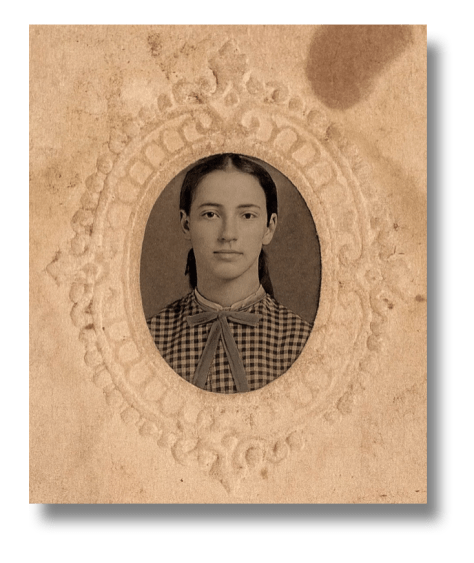
This battered tintype was sold with the collection of letters and may have been Sheldon’s wife, Annie (Harford) Morrison who was 16 or 17 years old when they married in July 1861.
Sheldon C. Morrison (1837-1864) wrote the following letters while serving in Co. F, 10th West Virginia Infantry in 1863-64. He was the son of James Wesley Morrison (1806-1886) and Nancy Logan Grimes (1813-1899) of Braxton county, West Virginia. Muster rolls indicate that he enlisted as a corporal and was promoted to sergeant in September 1862. He was taken prisoner in Braxton county, Virginia, on 6 October 1862 and confined at Richmond, Virginia, until 23 October 1862 when he was paroled at Aikens Landing. Muster rolls also indicate he returned from missing in action (since 24 July) on 5 September 1864 but was killed in action two weeks later at Opequan Creek near Winchester, Virginia—“a musket ball fracturing skull.”
Sheldon’s enlistment records inform us that he was mustered into the service on 3 May 1862 at which time he was described as 23 years old, a farmer with grey eyes and fair hair, who stood nearly 5 foot 8 inches tall.
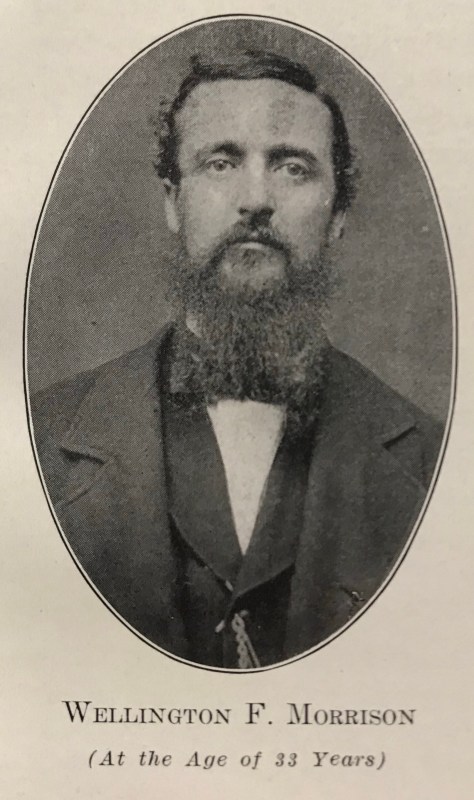
Sheldon was married to Ann E. Harford (b. 1844) on 18 July 1861 in Braxton county, Virginia. Their daughter, Elizabeth (“Lizzie”) Sheldon Morrison, was born on 23 June 1862—a few weeks after Sheldon entered the service. Letter 4 is Sheldon’s last letter to his wife, written the day before the Battle of Third Winchester (Opequan) in which he was killed. Letter 5 was written by Sheldon’s brother, Wellington Fletcher Morrison (1845-1940) who also served in Co. F, 10th West Virginia Infantry, and was with his brother when he died in his arms.
Letter 1
An AI generated image of what Sheldon’s wife may have looked like based upon battered image in introduction.
Camp Beverly, West Va. December 10, 1863
Dear and beloved wife,
Once more I am permitted to take my pen in hand to inform you that I am still alive and in the very best of health at present, hoping when these few lines comes to hand, the will find you enjoying the same blessing of God. It has been some time since I got a letter from you but expect to get one this evening.
Well, in the first place, let me say in commencement that our regiment is gone ot to Greenbrier on a scout at this time—all but Co. F and Co. C. Those two companies was on a scout at the time they started and when we came in, we would not go. The balance are gone 15 days scout and our two companies are guarding the town of Beverly. The 28th Ohio went also on the raid.
Well the next thing you want to know something about our scout and where we was and what we done. Well we took 6 days rations but was gone but 5 days. Well we [ ] through the mountains towards the head of Greenbrier River. The first day we got on to the head of one of the prongs of Cheat River and camped in a pine thicket. But before I go any further, let [me] tell you what we was going after. There had two companies of General Imboden’s men went into some of our back country to steal horses and we found it out and went to watch for them and we went in the mountains. Well now I will proceed.
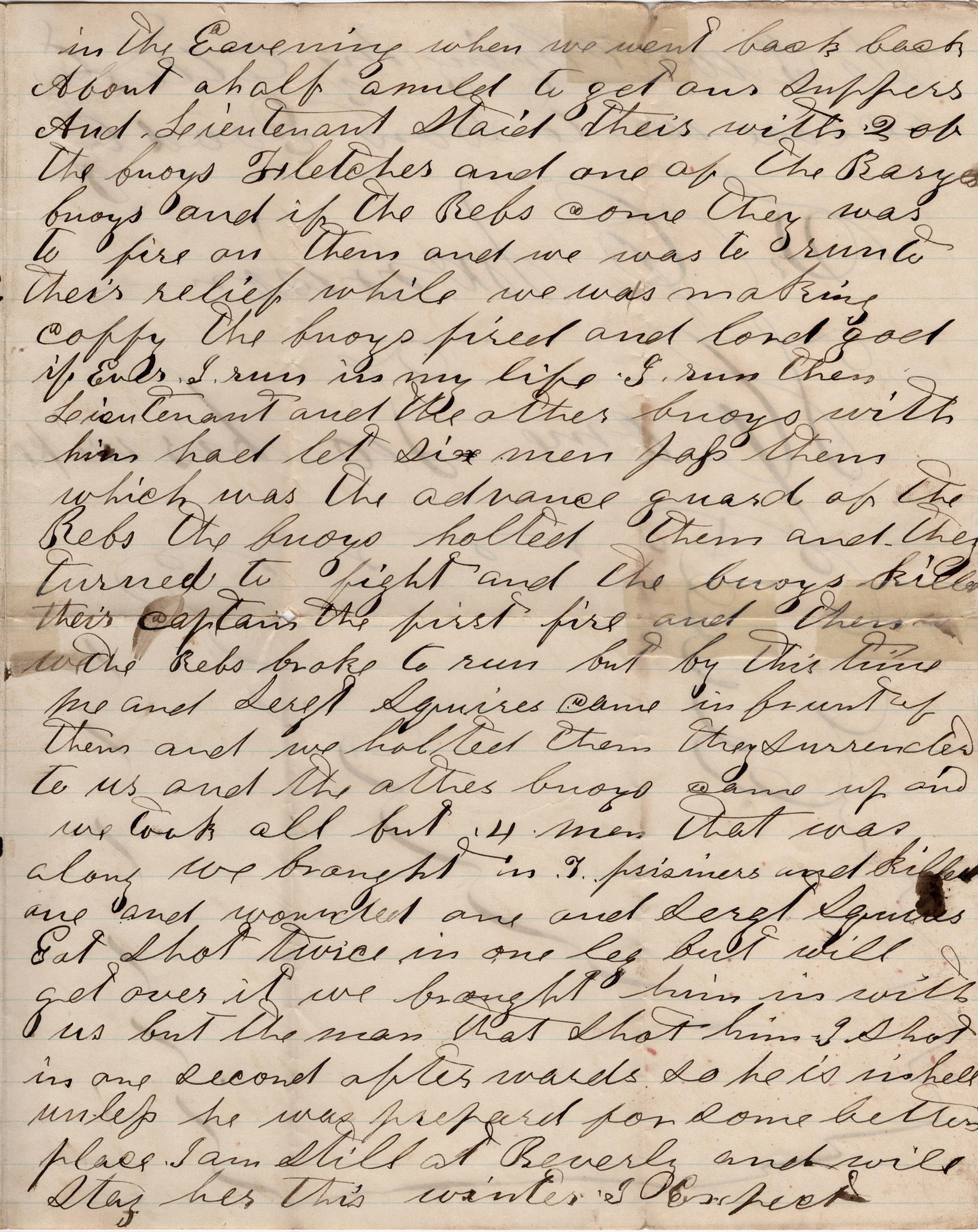
The second day we started bright and early. We traveled all day and yet saw no farm yet nor nary one the day before and the like of dear and bear you never heard of in your life. We killed no bear but killed plenty of deer and done fine. We went a way that no man ever was in the world. But the second night we got on a road where there was about one hundred acres of land cleared and three families living on it there. We put up that night at those houses. Next morning we started again taking with us 12 rebels’ horses and one rebel soldier that we found at those houses which was on the divide between Greenbrier and Cheat in one corner of Pocahontas County. We started down the waters of Cheat and we divided and one squad would go down one prong and one another. That day we lay on the road and was to meet next morning. Well me and Lieut. [Henry] Bender and Sergeant [Norman B.] Squires went with a squad of 15 men of us all together and we lay all day on the road until about 4 o’clock in the evening when we went back about a half a mile to get our suppers and Lieutenant stayed there with two of the boys—Fletcher and one of the Berry boys—and if the rebs came, they were to fire on them and we was to run to their relief.
While we was making coffee, the boys fired and Lord God if ever I run in my life, I run then. Lieutenant and the other boys with him had let six men pass them which was the advance guard of the rebs. The boys halted them and they turned to fight and the boys killed their captain the first fire and then the rebs broke to run but by this time me and Sergt. Squires came in front of them and we halted them. They surrendered to us and the other boys came up and we took all but 4 men that was along. We brought in 7 prisoners and killed one and wounded one and Sergt. Squires got shot twice in one leg but will get over it. We brought him in with us but the man that shot him, I shot in one second afterwards so he is in hell unless he was prepared for some better place.
I am still at Beverly and will stay here this winter I expect. So I will bring my letter to a close. Write soon. Goodbye. — S. C. Morrison
Home to his wife.
Letter 2
Petersville, Maryland July 4, 1864
Dear wife,
Once more I take my pen in hand to inform you I am well and in fine spirits. It has been a long time since I have had a letter from you—something over a month—and it may be a long time before I will get one for we are still moving and if you write, your letters can’t get up with me. Our regiment left Beverly while I was in Braxton and when I overtook it, it was in Leetown, Va. I wrote you a letter from there. On the next morning after I wrote, we commenced fighting and have been under fire most ever since. We have had hard times for awhile but we have got the rebs run out and we are resting a few days. I can’t say where we will go to when we start again.
There has been some of our regiment killed but none of our company. Lewis A. Dawson shot himself through he hand the first day of the fight but he done it himself. There has not been a man hurt in our company in battle yet. Our Lieutenant Colonel [Moses S. Hall] was wounded in the left arm. 1 His arm was broke between the elbow and hand by a Minié ball & one of our lieutenants that was an A. A. General was mortally wounded by a shell and our Colonel was knocked off his horse and his horse killed.
Most all of us has been in hot places. I had a ball to pass so close to my head that it knocked me deaf in one of my ears for two days but I am still sound as a dollar yet. When I will get to come home, I can’t tell. I may get to come home after a while and may not get to come before my time is out. If not, all right of course, but you won’t think so of course. But you will have to do the best you can for yourself. You see fine times to what I do, I know, but when I get out I am going to stay out awhile if you will believe me.
I have nothing more to write of importance. I believe I could say a great deal but it would be of no use to you. I would be glad to be at home awhile with you but if I was to come home, I hate to leave and therefore I think it just as well where I am for a while yet still. Let me know how you are getting along. Direct your letter to Harpers Ferry, Va., and to follow the regiment. When we take up camp, I will let you know where I am. So no more. I remain ever yours, — S. C. Morrison
1 Moses S. Hall was made the Lieutenant Colonel of the 10th West Virginia Infantry in May 1862. In every capacity in which he served, whether as line or field officer he distinguished himself for a loyal, intelligent, courageous and faithful discharge of duty. In every action in which his command was engaged, he won honorable mention. He was twice wounded near Duffield’s Station; whilst engaged in resisting Early’s advance to enable General Sigel’s wagon train to cross the Potomac at Shepherdstown, he was struck by a Minié ball which broke the small bone of the forearm; and at Cedar Creek, on the 19th of October, he was again struck by a Minié ball which wold have passed through the liver had its course not been deflected by the yielding of a rib causing it to follow the rib in its course and emerge from the opposite side, thus being guided in its course and prevented from entering the cavity of the body.
Letter 3
Cumberland, Maryland August 7th 1864
Dear Brother,
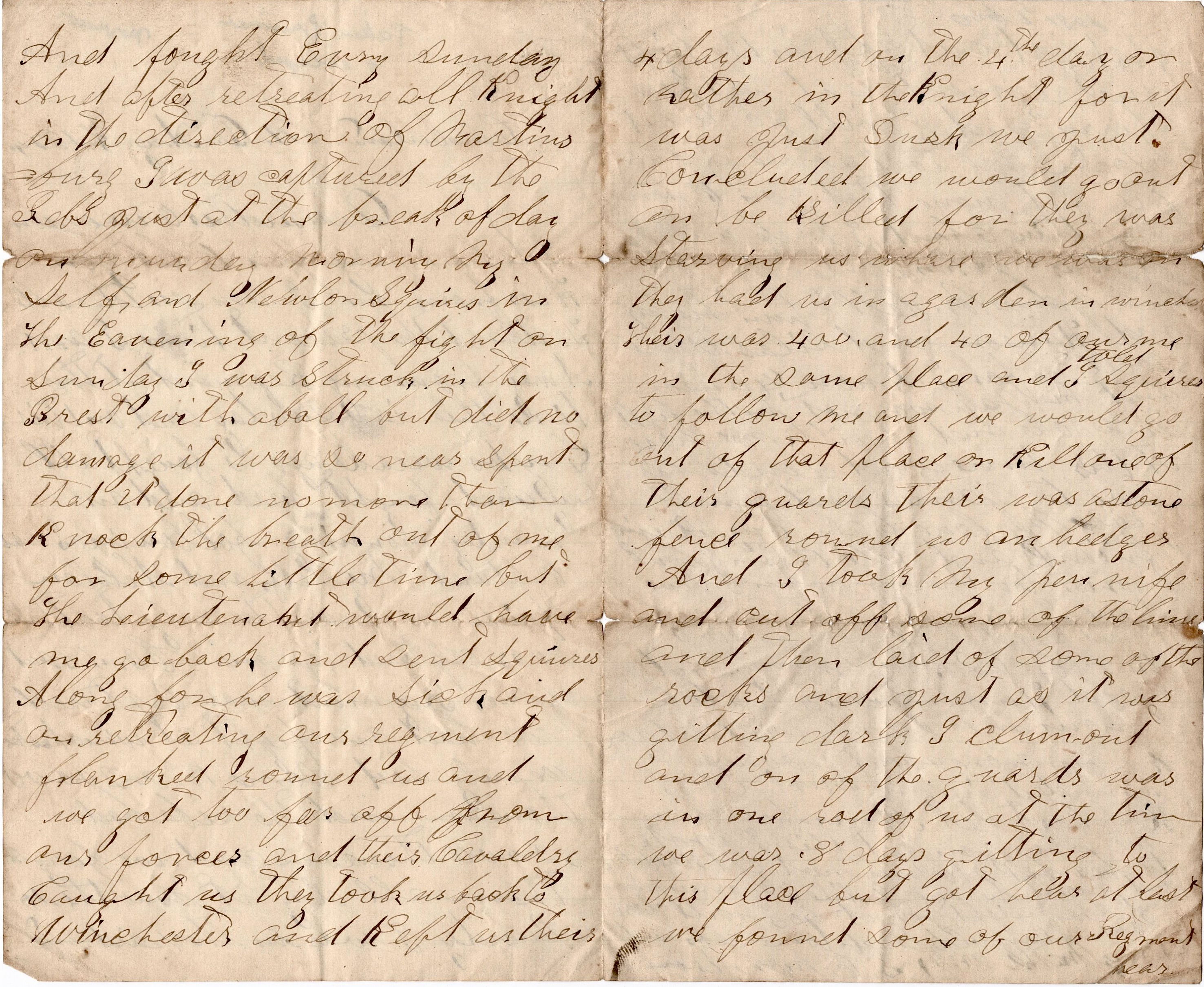
Once more I take up my pen to let you hear from me. I am in tolerable health at the present time. I am away from my regiment at this time. This is Sunday and on this day two weeks ago I fought all day and fought hard and on Monday morning following I was captured—myself and Newlon Squires. We was the only two that was captured in our company. Thirteen out of our regiment was captured. We had our fight at Winchester. We only had some 15 or 20,000 and the rebs had 30,000 and we fought them all day. It was the 4th Sunday I was in the raid and fought every Sunday and after retreating all night in the direction of Martinsburg, I was captured by the rebs just as the break of day on Monday morning, myself and Newlon Squires.
In the evening of the fight on Sunday, I was struck in the breast with a ball but did no damage. It was so near spent that it done no more than knock the breath out of me for some little time but the Lieutenant wouyld have me go back and sent Squires along for he was sick, and on retreating, our regiment flanked round us and we got too far off from our forces and their cavalry caught us. They took us back to Winchester and kept us there four days and on the 4th day, or rather in the night for it was just dusk, we just concluded we would go out or be killed for they was starving us where we was. They had us in a garden in Winchester. There was 40o and 40 of our men in the same place and I told Squires to follow me and we would go out of that place or kill one of their guards. There was a stone fence round us and hedges and I took my pen knife and cut off some of the lime and then laid off some of the rocks and just as it was getting dark, I clum out and one of the guards was [with]in one rod [< 6 yards] of us at the time.
We was 8 days getting to this place but got here at last. We found some of our regiment that got cut off in the fight. Our regiment is at Harpers Ferry and I will go to it soon. We lost some of our company but none that you know anything about I guess unless it was John Conley. If you see James M., tell him his pap and Hanson and Silas is all well. As far as I know, Hanson and his pap was not in the fight. Silas was and is with me here at this time and send his love to James and family.
Give my love to all enquiring friends and tell them I will write to them when I have time. I am without money and can’t get any paper. The rebs took my money and a good Hunting cased watch from me. So I will let you know more about who was wounded in my next letter. Robert, let Ann hear from me when you get this. I wrote to her but she may not get the letter and I wrote her one while I was in prison and she might get it. So I will close. I saw all my old Braxton rebs and Harvey Math. Write, — S. C. Morrison
Letter 4
Camp near Summit Point September 18, 1864
Dear Wife,
Once more I am permitted to drop you a few lines to let you know I am still alive and well. I might have wrote sooner but I could not get paper. I have got back to the company and got some 6 or 7 letters from you. I was glad to hear from you for I had not heard from you for so long. I am glad to hear you are still in good health. You must do the best you can for yourself. I can’t say when I will be at home. We still have some fighting in front but it is supposed that the rebs is leaving the Valley and if they are, we will go back to West Virginia.
General Grant is with us today. For what, I know not. I suppose he is just round inspecting the army. I would like to be at home at this time and then I could tell you all about my hardships better than I can write. You wrote to me about that likeness. You need not say anything about that for I did not mean that anyone would see the letter but you and it only made me mad for a minute and was not in a good humor when I wrote the likenesses is both destroyed now. But you need not mind that. Do the best you can for yourself and when I am discharged I will go immediately where this war will not bother us any more.
So you must give my love to all that enquirer after me. Let me hear from you. You may think it lonesome where you are but how do you think it is where I am? So no more. Direct as before. — S. C. Morrison
Letter 5
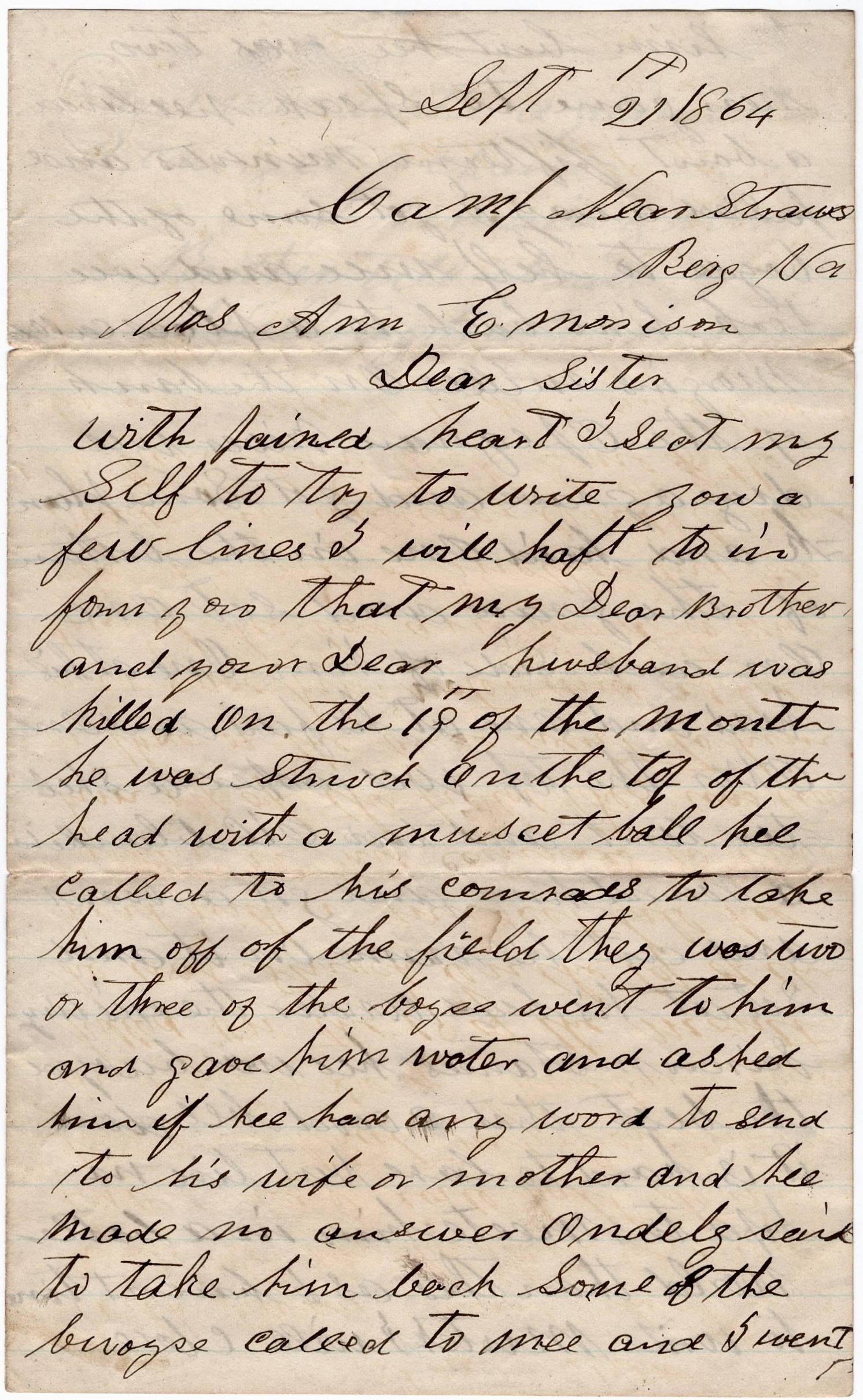
Camp near Strasburg, Virginia September 21, 1864
Mrs. Amm E. Morrison, dear sister,
With feigned heart I seat myself to try to write you a few lines. I will have to inform you that my dear brother and your dear husband was killed on the 19th of the month [in the Battle of 3rd Winchester]. He was struck on the top of the head with a musket ball. He called to his comrades to take him off the field. There was two or three of the boys went to him and gave him water and asked him if he had any word to send to his wife or mother and made no answer—only said to take him back. Some of the boys called to me and I went to him but he was too near gone to speak. He lived about 15 minutes and passed away.
I got some of the boys to help me and we took him back to a place called Morgan’s Mills on the bank of the Opequan River. We dug a grave and some some plank and laid one in the bottom of the grave and set one on each side of him, one at his head, and one at his feet, and one over the top. We wrapped a shelter tent and two oil blankets around him and got a board and cut his name on it and set at his head. Under the existing circumstances he was buried the best that could be done. It is hard to bear but live in hopes to meet him in a better world than this.
As I haven’t time to write much, I will close and will write again when I can get a chance. I remain your brother till death, — Wellington F. Morrison
The following letter was written by Augustus (“Gus”) Dilley (1835-1906) of Hubbard, Trumbull county, Ohio. Gus was raised in the same community as Lyman and Festus Tylee, two brothers roughly the same age as himself. In 1860, Gus married their younger sister, Martha Tylee (1840-1887). When the Civil War began, Gus joined with Lyman in Co. B, 19th Ohio Volunteer Infantry (OVI). Lyman was killed at the Battle of Stones River in January 1863. Not long after, Festus enlisted in Co. C, 125th OVI. Gus states in his letter that he never had the opportunity to meet Festus’ wife who, when he married Harriet M. Downing in 1858, lived in another community in Trumbull county.
Gus wrote the letter from the camp of the 19th OVI on 6 September, less than a week after the fighting before Atlanta that resulted in its capture. Both the 19th OVI and the 125th OVI served in the 3rd Division of the IV Corps during the Atlanta Campaign.
T R A N S C R I P T I O N
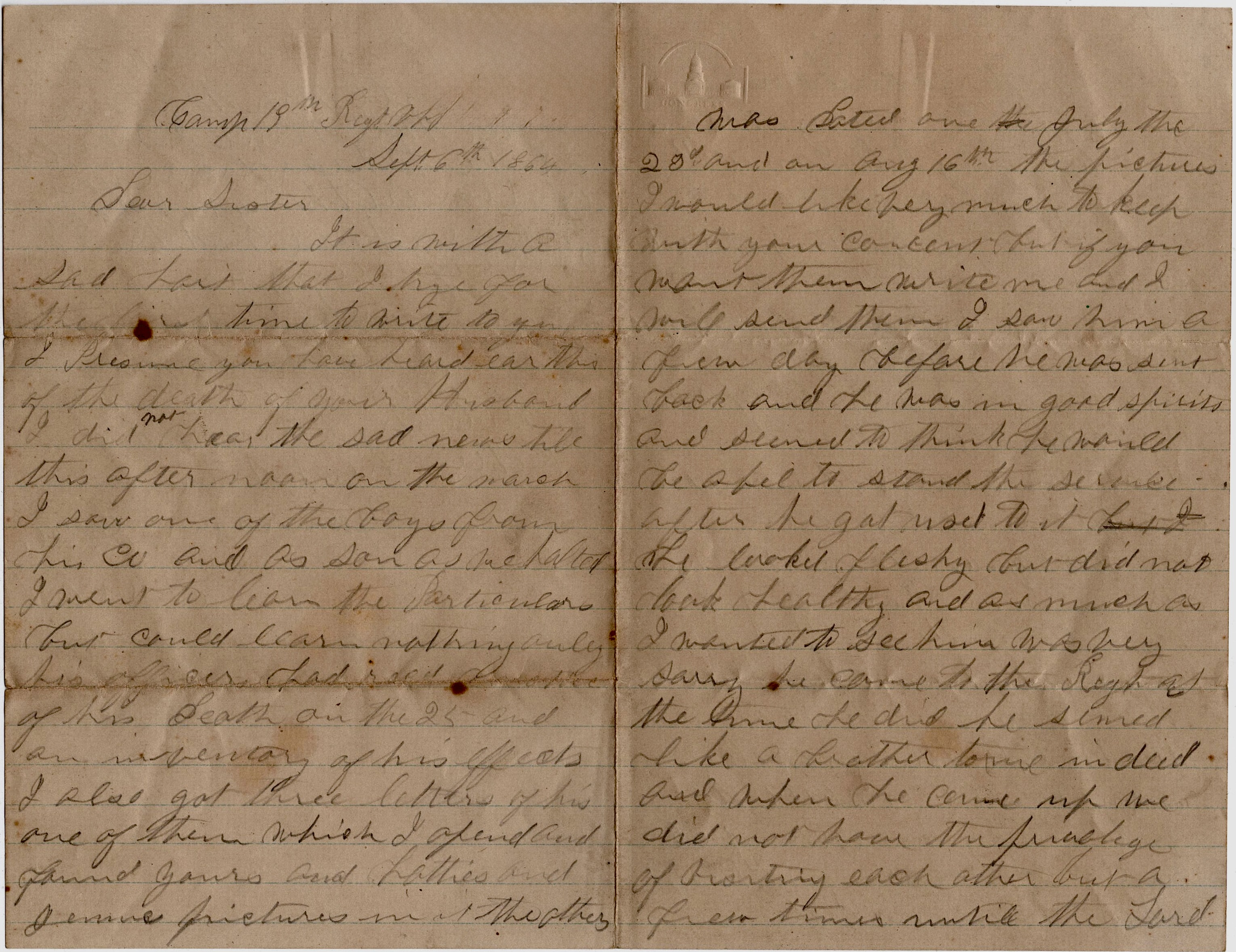
Camp 19th Regt. O. V. I. September 6th 1864
Dear Sister,
It is with a sad heart that I try for the first time to write to you. I presume you have heard ere this of the death of your husband. I did not hear the sad news till this afternoon on the march. I saw one of the boys from his company [Co. C, 125th OVI] and as soon as we halted, I went to learn the particulars but could learn nothing—only his officers had received a notice of his death on the 25th and an inventory of his effects. I also got three letters of his, one of them which I opened and found yours and Hattie’s and Jennie’s pictures in. The others was dated on July 20th and August 16th. The pictures I would like very much to keep with your consent but if you want sent, write me and I will send them.
I saw him a few days before he was sent back and he was in good spirits and seemed to think he would be able to stand the service after he got used to it. He looked fleshy but did not look healthy and as much as I wanted to see him, was very sorry he came to the regiment at the time he did. He seemed like a brother to me indeed. And when he came up we did not have the privilege of visiting each other but a few times until the Lord seen fit to take him away.
His company mourns his loss. They all seemed to be very much attached to him. It is getting dark and we have to move tonight and I will be obliged to make my letter short. What can I say to cheer the heart of one that has lost as dear a husband as he must have been. My acquaintance with him was short but I am confident that he put his trust in Him that was able to save and doeth all things well. May we be enabled to profit by his example and not mourn as those that have no hope.
It is so dark that I will have to close for this time. I would like to hear from you often although I have never had the pleasure of seeing you. You seem like a sister to me. Please excuse this poor letter and I will try and do better next time. Your in haste, — Gus
P. S. He was at Murfreesboro hospital when he died. — Gus
Jonathan Sproul enlisted in Brooklyn at the age of 21 on Oct. 2, 1861, and was mustered into Co. C of the 87th New York Infantry. He was transferred on Sept. 6, 1862 to Co. C Mozart Regiment of the 40th N.Y. Infantry, and promoted to Sergeant on July 16, 1863. Wounded at Kelly’s Ford on Nov. 7, 1863, he had his leg amputated in a field hospital. Transferred to a Washington, D.C. hospital shortly thereafter, he nonetheless died of his wound on Dec. 7, 1863.
This letter was once part of much larger collection of Sproul’s letters, one of which was written on the Battle of Gettysburg on 5 July 1863. It read in part: “Again are we permitted to record the goodness of a very kind Providence for the sparing of our lives and protection from harm during the last few terrible days. But thanks be to God the fight is thus far ours and we have driven the enemy at all points. As in times past, so have we been spared by a Merciful hand which we fail to interpret the reason why. God is gracious and we are grateful…We have had one of the biggest fights of the war, and the loss in our Regiment is about one hundred and fifty…I never went into a fight with a better heart, not felt better during any engagement than I have the last few days. I guess the rebels find it quite a different thing fighting in Pennsylvania than in Virginia. What this week will tell I am unable to say, but I reckon they will get out of this right-smart. This is a splendid place to fight in as we have so much open field. And we have had for once a square open field fight…I promise we shall see much more fight this afternoon or tomorrow. If the rebels make a stand we will fight them, they have left our front and there is some firing a few miles distance which is proof that if they are taking out we are after them. God is our Refuge…“
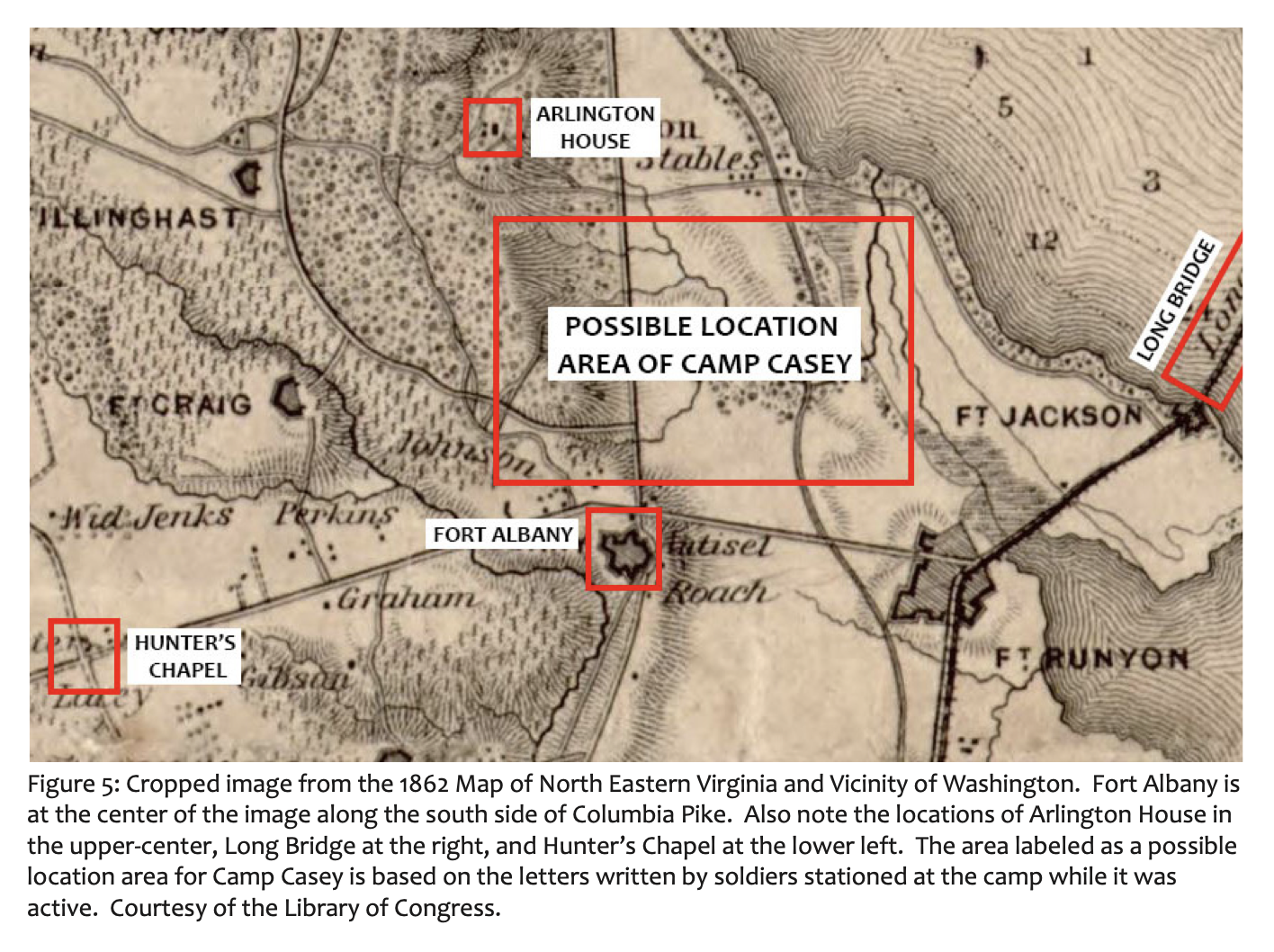
The letter transcribed on Spared & Shared was penned on 17 January 1862 from Camp Casey where the regiment was spending its first winter in the field. The location of this camp is thought to have been within the red box marked on the map below. [Source: Camp Casey] He wrote the letter to his sister Kate. The University of Virginia has a couple of Jonathan’s letters written during the Peninsula Campaign.
T R A N S C R I P T I O N
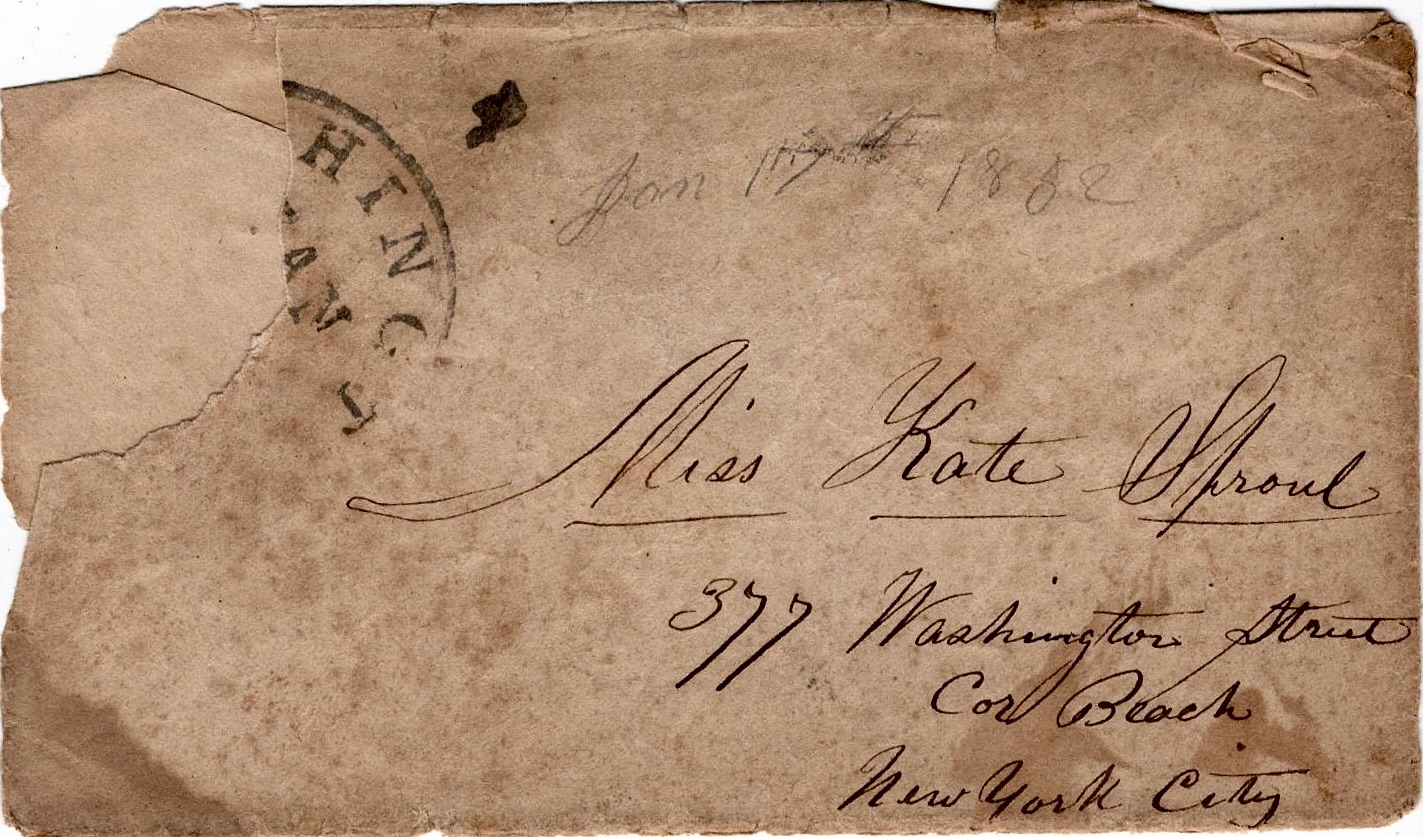
Addressed to Miss Kate Sproul, 377 Washington Street, cor[ner] Beach, New York City
Camp Casey Washington January 17, 1862
Dear sister Kate,
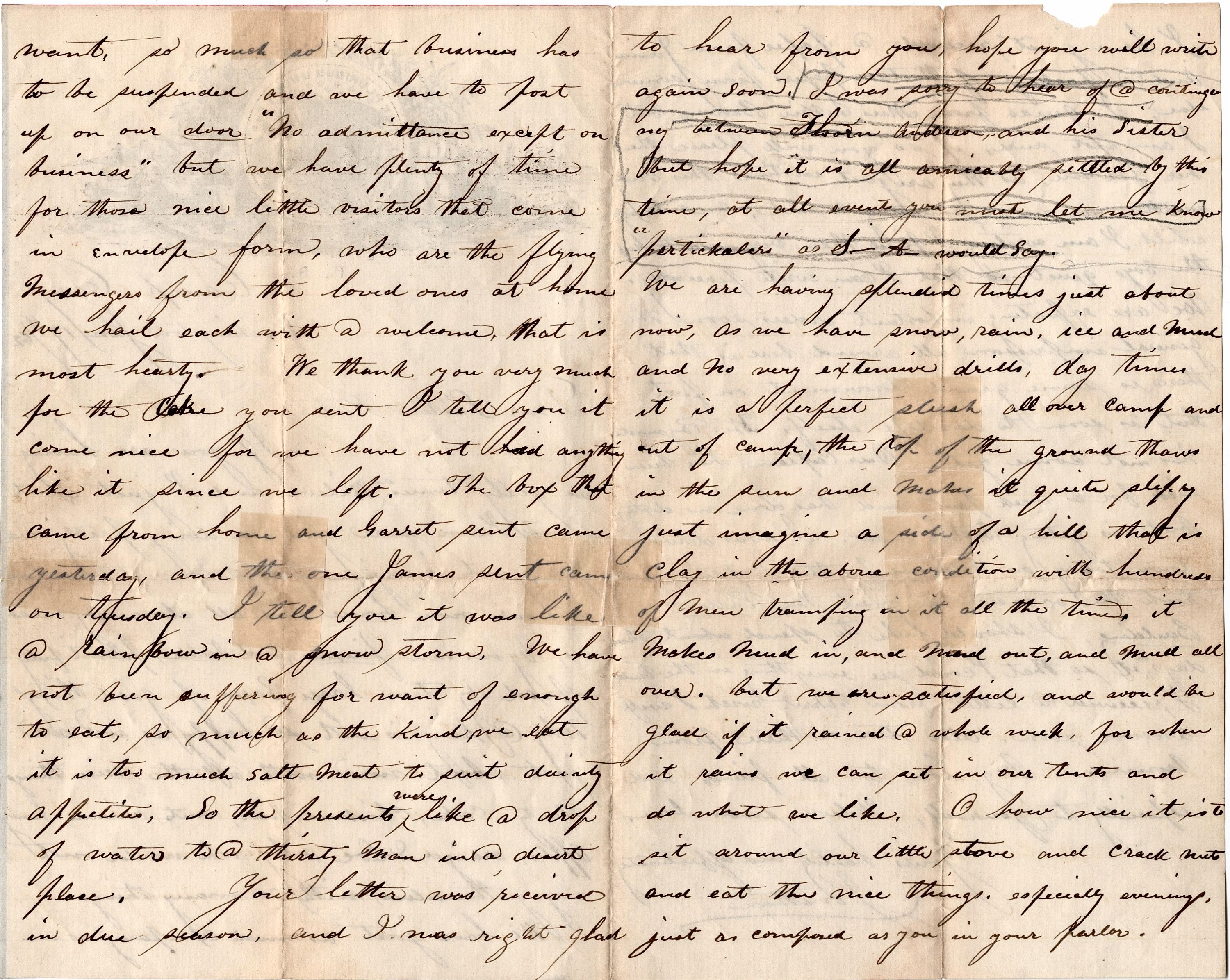
If you are having as jolly ties as Wilson and I just about now, I am sure you are doing pretty well for just imagine for a moment we live in our own house and all alone by ourselves, by our own fireside, and table, plentifully spread by two large boxes of good things. Why a king is not so happy as we are just about now with all the nice things plenty—cake, chickens, pies, buts, raisins, honey, apples, oranges, &c., &c. Why who would not enjoy themselves with so many things.
We have just as much company as we want, so much so that business has to be suspended and we have to post up on our door, “No admittance except on business.” But we have plenty of time for those nice little visitors that come in envelope form, who are the flying messengers from the loved ones at home. We hail each with a welcome that is most hearty. We thank you very much for the cake you sent. I tell you, it come nice for we have not had anything like it since we left. The box that came from home and Garret sent came yesterday and the one James sent came on Tuesday. I tell you it was a like a rainbow in a snowstorm. We have not been suffering for want of enough to eat so much as the kind we eat—it is too much salt meat to suit dainty appetites. So the presents were like a drop of water to a thirsty man in a desert place.
Your letter was received in due season and I was right glad to hear from you. Hope you will write again soon. I was sorry to hear of a contingency between Thorn Anderson and his sister but hope it is all emicably settled by this time. At all events, you must let me know “pertickalers” as S. A. would say.
We are having splendid times just about now as we have snow, rain, ice, and mud and no very extreme drills. Day times it is a perfect slush all over camp and out of camp. The top of the ground thaws in the sun and makes it quite slippery. Just imagine a side of a hill that is clay in the above condition with hundreds of men trampling in it all the time. It makes mud in and mud out, and mud all over. But we are satisfied and would be glad if it rained a whole week for when it rains, we can sit in our tents and so what we like. Oh how nice it is to sit around our little stove and crack nuts and eat the nice things—especially evenings, just as composed as you in your parlor.
I have just received a paper from James a package of thirteen papers from someone else. I guess from Miss Libbie Brown but I am not sure. If you will, please thank her for me as they are just in time this muddy weather we want something to read and tonight whilst I am writing, I find them very nice to keep the boys quiet so that I can write peaceably.
We are expecting important orders soon. The general impression all around here is that there is some grand movement on foot that is soon to develop itself. The paymaster has not come yet. Our captain has been sick for a week past and has done no duty but is getting better now. I was down town today on business for the captain and took the occasion to visit the Patent Building. I should like to spend about three days in it so that I could see everything in the building.
I received a letter from Garret which I will answer soon. Also two or three from home. My love to all friends and especially to yourself. Wilson 1 sends love. Yours hastily and affectionately, — Jonathan
1 Sproul’s brother Wilson, mentioned in this letter, enlisted at the same time as his brother at the age of 19, and was also transferred to the 40th N. Y. Infy. Surviving the war, he was mustered out on Oct. 6, 1864, and died at age 62.
The identity of this soldier has not yet been revealed by an on-line search of records. The content suggests that he served in a Union regiment and was detailed to oversee the operations of a cane and cotton plantation known as the “Collin’s Plantation” early in 1864. He makes reference to a nearby bayou and since this is a term used most widely in the Gulf states, I’m going to presume that he was likely in Louisiana or Mississippi. He indicates that he belonged to Co. I, 12th Regt. USA but that has not enabled me to identify him. His signature looks like “Buber” or “Barber.”
We learn that even though many of his regiment are accepting bonuses and reenlisted for another three years, he has chosen not to do so.
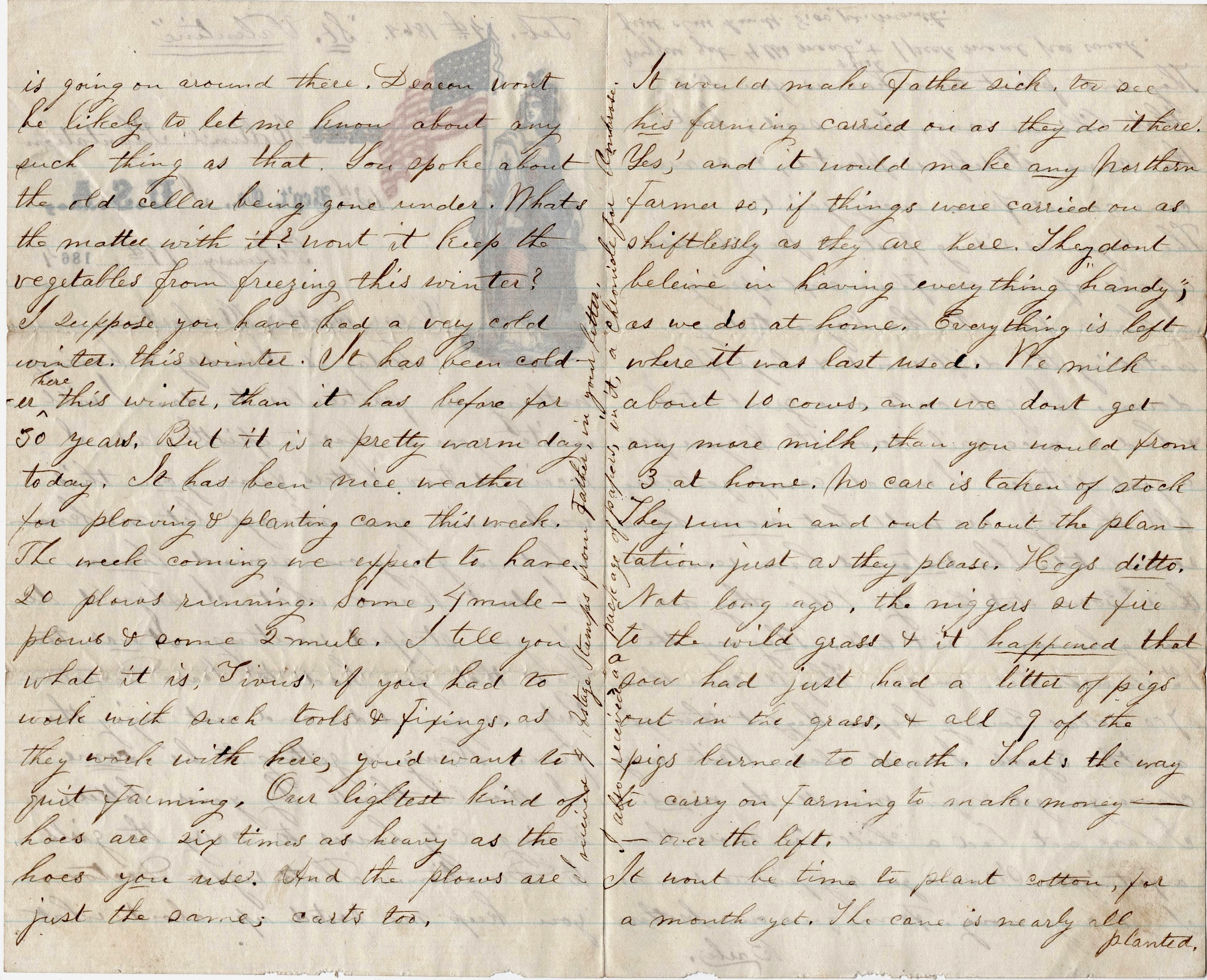
T R A N S C R I P T I O N
Collins Plantation 13th Regt. Co. I, February 14th 1864
Dear Brother Herbert
Today is Sunday & having nothing in particular to do, I will write you a short epistle as I received two letters from you this week and you always let me know what is going on around home. I don’t know what I should do if you stopped writing. It was too bad that you had to leave the Donation Party as you did and not enjoy the fun. Henry is getting to be some, I should think by your letter. hiring city horses to carry the girls to Donation. That’s right, Doctor, you keep me posted up about what is going on around there. Deacon won’t be likely to let me know about any such thing as that.
You spoke about the old cellar being gone under. What’s the matter with it? Won’t it keep the vegetables from freezing this winter? It has been colder here this winter than it has before for 50 years. But it is a pretty warm day today. It has been nice weather for plowing & planting cane this week. The week coming we expect to have 20 plows running. Some 4-mule plows and some 2-mule. I tell you what it is, Tivus, if you had to work with such tools and fixings as they work with here, you’d want to quit farming. Our lightest kind of hoes are six times as heavy as the hoes you use. And the plows are just the same; carts too. It would make Father sick to see his farming carried on as they do it here. Yes, and it would make any Northern farmer so, if things were carried on as shiftlessly as they are here. They don’t believe in having everything “handy” as we do at home. Everything is left where it was last used.
We milk about 10 cows and we don’t get any more milk than you would from three at home. No care is taken of stock. They run in and out about the plantation just as they please. Hogs ditto. Not long ago, the niggers set fire to the wild grass and it happened that a sow had just had a litter of pigs out in the grass & all 9 of the pigs burned to death. That’s the way to carry on farming to make money—-over the left.
It won’t be time to plant cotton for a month yet. The cane is nearly all planted. They don’t plant cane here as you did that Chinese cane from seed; but the cane itself is planted and a new cane comes from every joint.
The bayou is rising fast and people are afraid of an overflow next spring. I have been to the bayou today watching the drift wood & logs float down. I got onto one great stick & had a nice sail down the bayou for a good distance.
I was at camp yesterday. All the boys are well but none have reenlisted. The veterans have received their $300 State bounty. When they are going home. I can’t tell. They say the 1st of March. Let ’em go. They’ll earn their 700 dollars bounty before they get through another three years. I must close. Write every chance you get and give me all the news. I have not had a “chill” for more than a fortnight. I’ll send you my picture soon as I get any money. From your own brother, — Buber
Niggers get 4 lbs. meat & fish & 1 peck meal per week. First class hands $8 per month. I received 4 postage stamps from Father in your letter. I aso received a package of papers in it. A Chronicle from Ambrose.
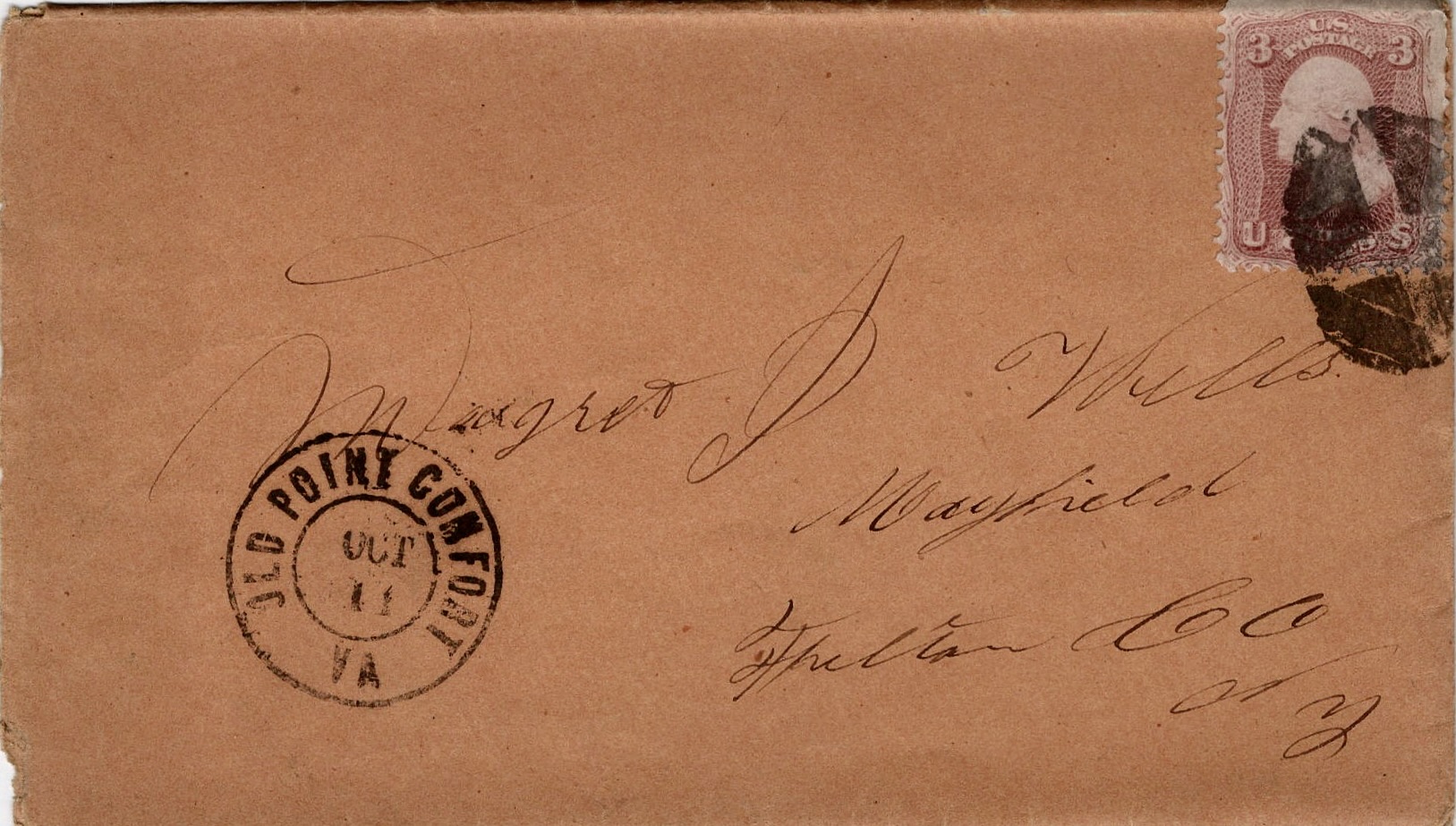
These letters were written by Reuben T. Wells (1835-1902) who served as a private in Co E, 115th New York Infantry from 15 August 1862 to 17 June 1865. When he enlisted he was described as a 27 year-old, black haired farmer who stood 5 feet 4 inches tall.
Reuben wrote the letter to his wife, Margaret J. (Dutcher) Wells (1832-1902) and his young son, Lewis Wells (1862-1933). Their farm was located in Mayfield, Fulton county, New York.
I could not find an image of Reuben but here is one of Private Henry W. Mallery of Co. F, wearing the uniform of the 115th New York Volunteer Infantry
Letter 1
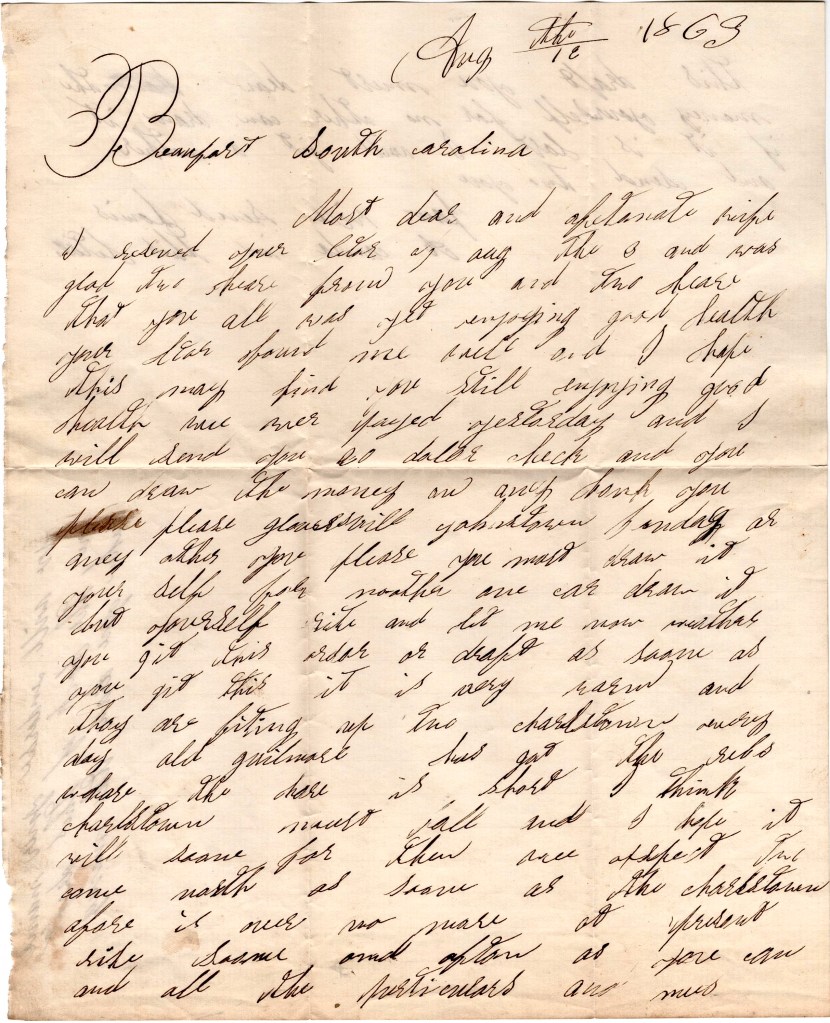
Beaufort, South Carolina August 12, 1863
Most dear and affectionate wife,
I received your letter of August the 3rd and was glad to hear from you and to hear that you all was yet enjoying good health. Your letter found me well and enjoying good health. We were paid yesterday and I will send you 20 dollar check and you can draw the money at any bank you please…You must draw it yourself. Write and let me now whether you get this order or draft as soon as you get this.
It is very warm and they are fighting up to Charleston every day. Old Gilmore has got the rebs where the hair is short. I think Charleston must fall and I hope it will soon for then we expect to come north as soon as the Charleston affair is over. No more at present. Write soon and often as you can and all the particulars and news.
This draft you must draw they money yourself for no other can draw it. If it is lost, I will get another and send to you. Pa will send Lewis a [ ] in this letter.
Letter 2
Malvern Hill, Virginia October 8, 1864
Dear wife,
I received your letter three days ago stating that you had sent the box with Danford to Amsterdam, I have not seen the box yet nor don’t expect to very soon for we hant nowhere near the express office. I shall buy a pair of boots the first opportunity. I thought that I wrote you not to send them that way. At the time I received your last letter, I was not about to answer it, I had taken with the ague and have had it for the last three days. Today I am much better so that I got dinner today. I was glad to hear that you were all well again.
We had a fight yesterday on our right. [See Battle of Darbytown & New Market Roads] The rebs charged and tried to turn our right flank. They charged on a brigade of seven shooters. They did not turn our flank but I should think by the dead now in the field they had turned 1000 lives in[to] eternity besides. They have been burying dead ever since dark last night. They first drove in our cavalry, taking some and two light field batteries. Besides the dead, we took 15 hundred prisoners the night before. Three deserters came in and told of the move. They also reported a great riot in Richmond on the same day which they say was caused by the mayor wanting the city to be surrendered and they ordered the mayor in prison. Then the citizens rose [up] and tore opn the jail, opened all the stores and storehouses but how this all is we are not about to say only by report from deserters.
Though wind blows and it is some cold. It rained yesterday. I will now close hoping to hear from you all soon and hope that i may still be home to spend the winter with you. — R. T. Wells
To M. J. Wells
Letter 3
In front of Richmond December 13, 1864
Dear and affectionate wife,
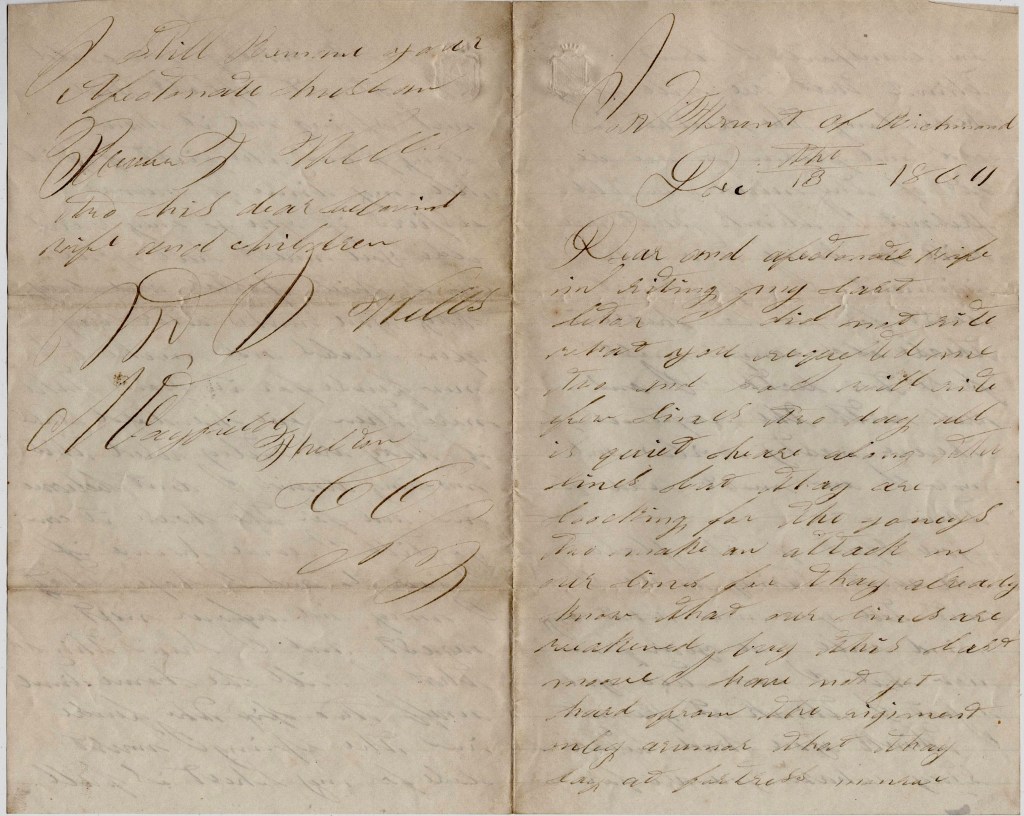
In writing my last letter I did not write what you requested me to and so I will write a few lines today. All is quiet here along the lines but they are looking for the Johnnies to make an attack on our lines for they already know that our lines are weakened by this last move. I have not yet heard from the regiment—only a rumor that they lay at Fortress Monroe on transports. I don’t think that we will lay here long.
The weather is cold and frozen so we are out of the mud for the present. I think that we will go soon to our regiment. I hope so at least for we lay here in these old camps most froze to death. I am well with the exception of these nasty boils. And now I most tired of them.
You speak of the place and about staying there. I can’t tell you now what my mind will [be] one year from now but I can tell you what I think at present. I think you had better stay where you are for most likely you could not get a place till next spring and it hant long from the first of April till my time of service expires. If you go anywhere else, you must sell your cow or hire pasture and lay hay. You might better buy a few slabs and make a new fence for it won’t take more than one hundred slabs if they are righly used. This moving around I don’t believe in till i come home, if I ever do, and I hope that I may and before next August. And I some think that I will be home time enough to fix the fence in the spring.
I must close for my sheet is full. I still remain your affectionate husband. — Reuben T. Wells
To his dear beloved wife and children.
Letter 4
[Note: “On 4 January 1865, the 115th again embarked on board the Propeller “DeMolay,” on its second expedition against the keystone of the confederacy. The whole force was under command of Gen. Alfred H. Terry. The troops landed at Flay Pond battery, a short distance north of Fort Fisher, on the 13th at 9 A. M. The 115th lost but two or three men in landing. At 3 P. M. of the 15th, the grand charge was made upon the fort, the 115th bearing a noble part in its capture, and being again complimented by General Terry, also by Gen. Ames, who knew something of its fighting qualities while in the army of the James. The loss to the regiment was about 70, and among the killed was Lieut. S. S. Olney, of Co. F., whose loss to the regiment and company could not be made good. At about 8 o’clock, on the morning of 16 January, one of the magazines of the fort exploded, killing and wounding more of this regiment than the fighting of the day before.”]
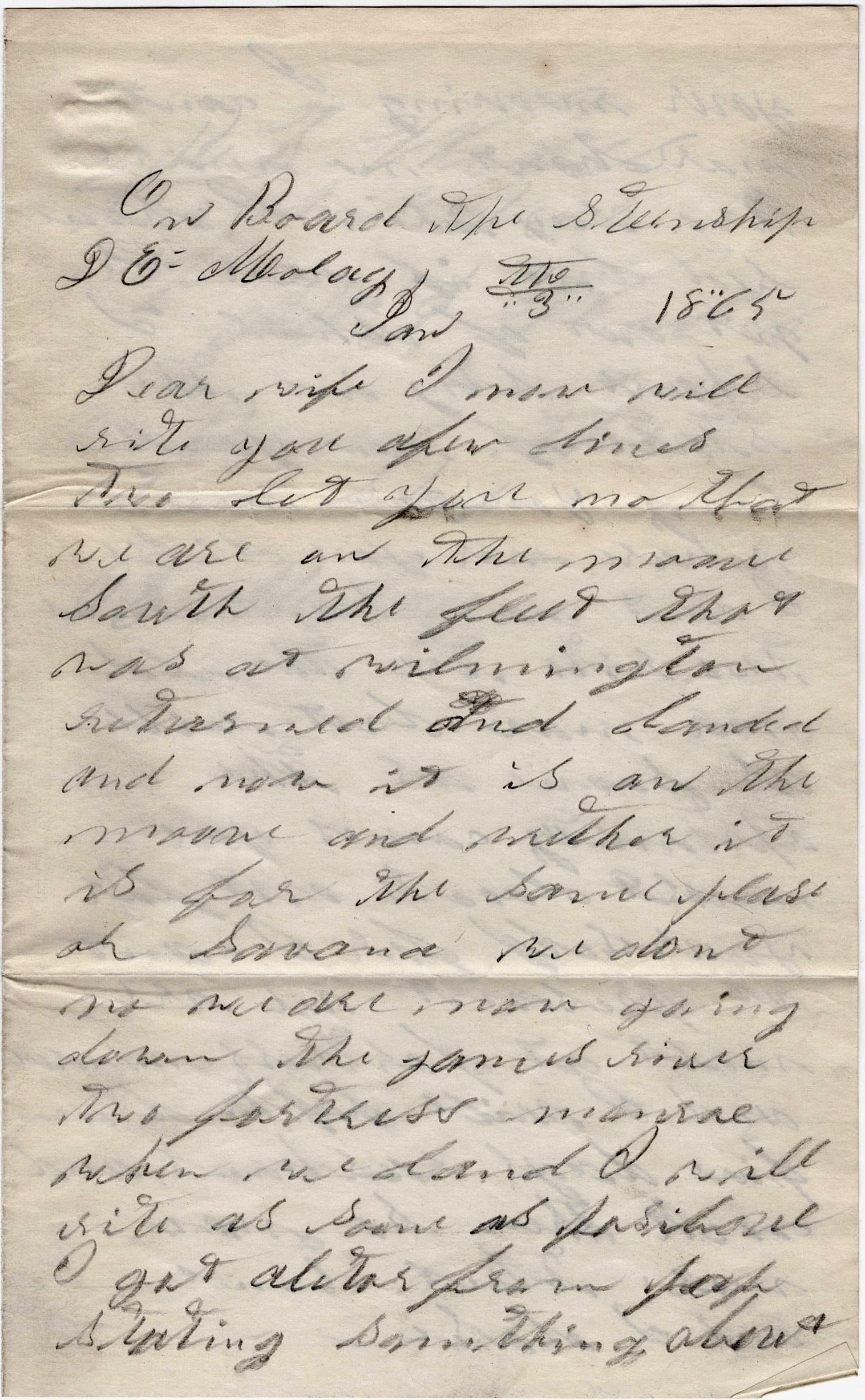
On board the steamship DeMolay January 3, 1865
Dear wife,
I now will write you a few lines to let you know that we are on the move south. The fleet that was at Wilmington returned and landed and now it is on the move and whether it is for the same place or Savannah, we don’t know. We are now going down the James river to Fortress Monroe. When we land, I will write as soon as possible.
I got a letter from pap stating something about your moving. I can’t nor hant no more to say than I have said but if I ever get out of this, I shan’t stay in the State of New York long. You can move wherever you like. I can’t nor hant time to write to the old Ma now but will as soon as the opportunity comes. You must look out for yourself for I can’t at present.
We are most at Fortress Monroe and I will have to draw five days rations and cook them so no more this time and I close.