The following letter was written by Dallas Fraker Paul (1845-1889) who enlisted on 6 August 1862 when he was 18 years old to serve three years in the 115th New York Infantry. He mustered in as a musician in Co. G on 20 August 1862 and in less than a month he was taken prisoner with most of his regiment when they were surrendered to Stonewall Jackson’s army at Harper’s Ferry. Like his comrades he was paroled and sent to Camp Douglass in Chicago to await his exchange. Dallas survived the war. He mustered out with his company on 17 June 1865 at Raleigh, North Carolina.
Dallas was the son of Philip Paul (1821-1856) and Catherine Baker (1821-1850) of Saratoga county, New York. He wrote the letter to his younger (17 year-old) brother, Addison Seymour Paul (1847-1934) who was recruited into Co. D, 95th New York Infantry. At the time this letter was written in late November 1864, the 95th N. Y. was serving in the 5th Army Corps while the 115th N. Y. was serving in the 10th Army Corps. Dallas’ letter describes returning from a visit to visit his brother during the Siege of Petersburg.
T R A N S C R I P T I O N
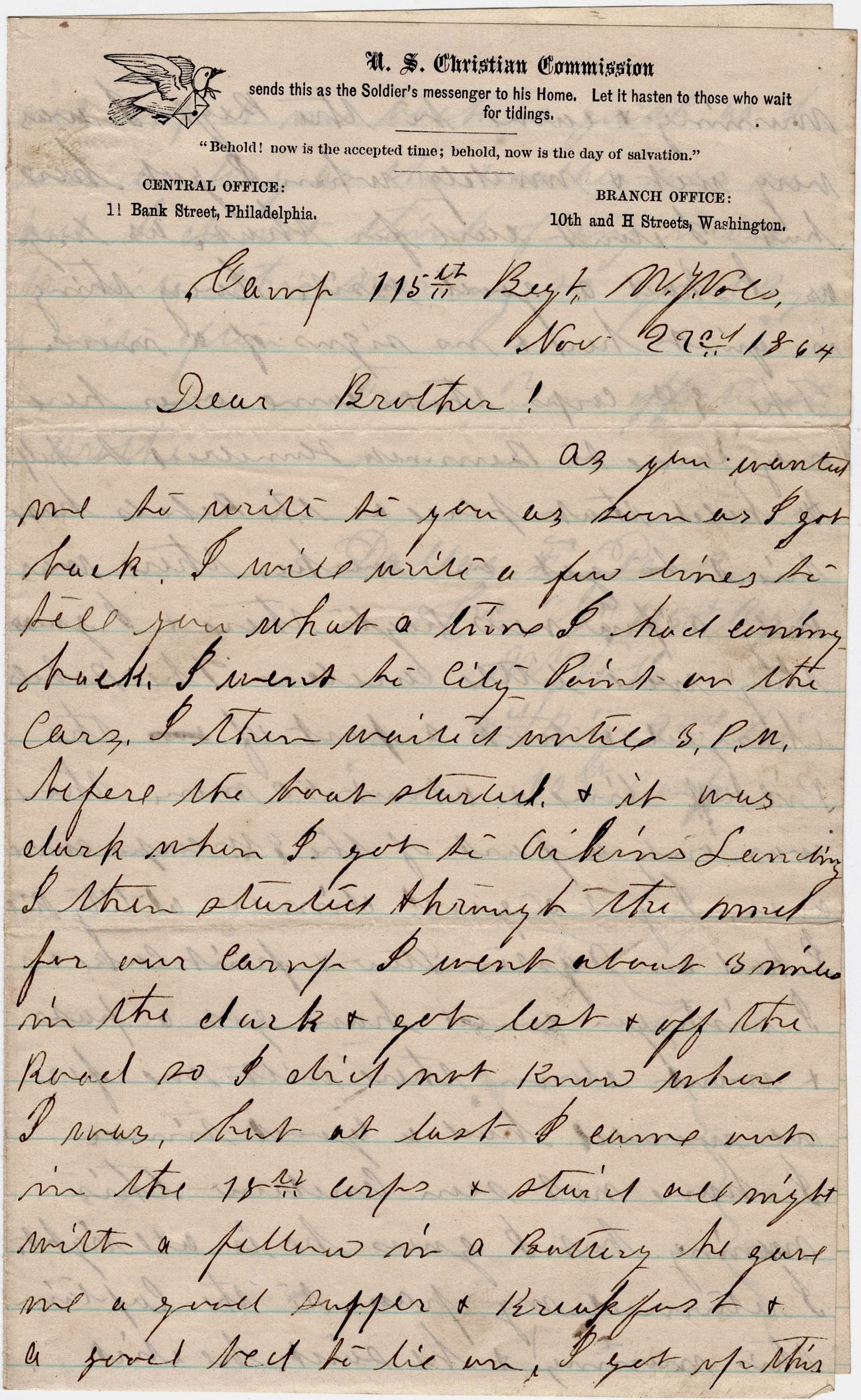
Camp 115th Regt. N. Y. Vols.
November 22nd 1864
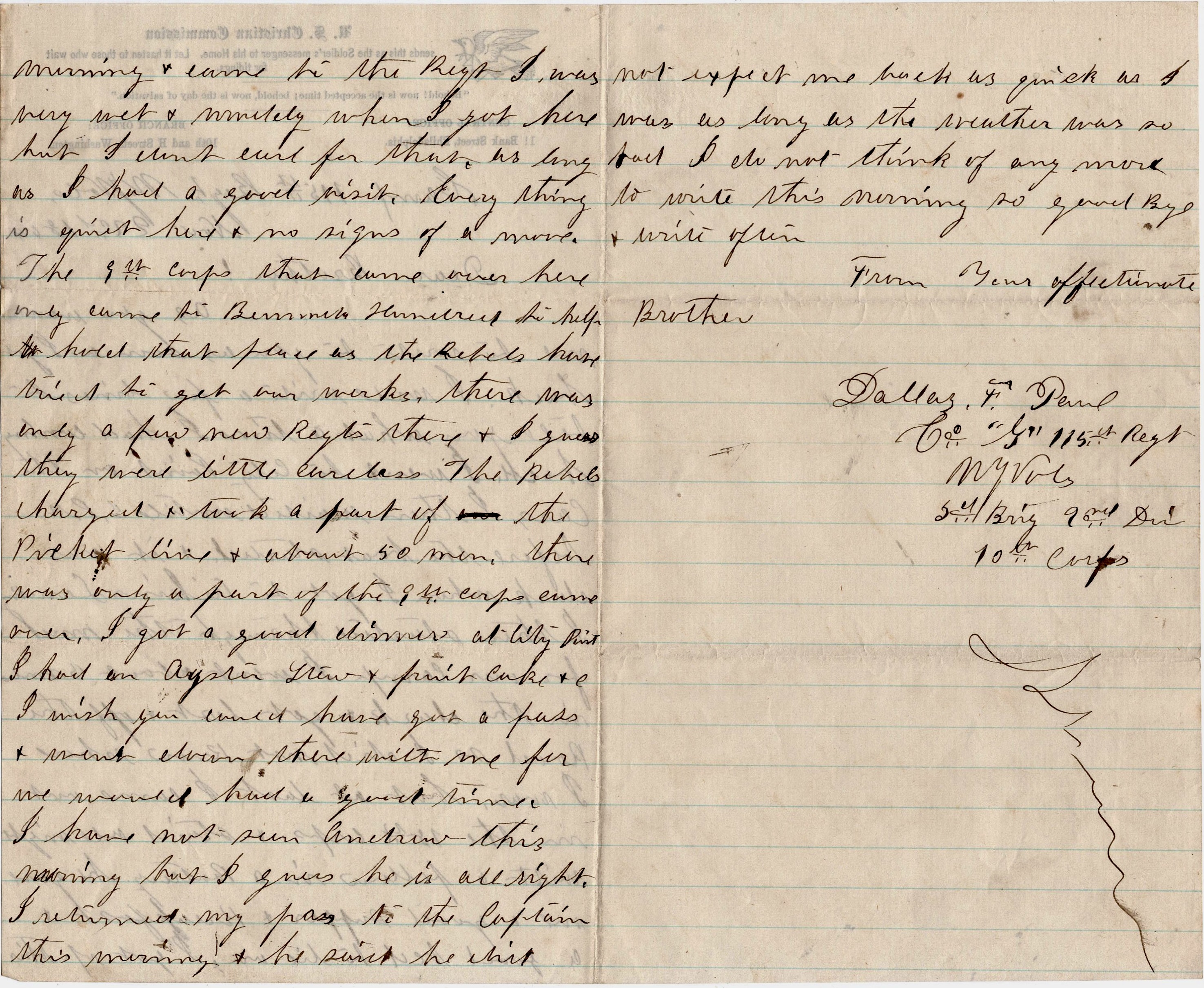
Dear Brother! As you wanted me to write to you as soon as I got back, I will write a few lines to tell you what a time I had coming back. I went to City Point on the cars. I then waited until 3 p.m. before the boat started & it was dark when I got to Aiken’s Landing. I then started through the mud for our camp. I went about 3 miles in the dark & got lost & off the road so I did not know where I was. But at last I came out in the 18th Corps & stayed all night with a fellow in a Battery. He gave me a good supper & breakfast & a good bed to lie on. I got up this morning & came to the regiment. I was very wet & muddy when I got here but I don’t care for that as long as I had a good visit.
Everything is quiet here & no signs of a move. The 9th Corps that came over here only came to Bermuda Hundred to help hold that place as the Rebels have tried to get our works. There was only a few new regiments there and I guess they were a little careless. The rebels charged and took a part of the picket line & about 50 men. There was only a part of the 9th Corps came over.
I got a good dinner at City Point. I had an oyster stew and fruit cake, &c. I wish you could have got a pass & went down there with me for we would had a good time. I have not seen Andrew this morning but I guess he is all right. I returned my pass to the Captain this morning & he said he did not expect me back as quick as I was as long as the weather was so bad.
I do not think of anymore to write this morning so goodbye & write often. From your affectionate brother, — Dallas F. Paul
Co. G, 115th Regt., New York Cols., 2nd Brigade, 2nd Division, 10th Corps.
The following letters were written by George Washington (“Wash”) Vosburgh who was 24 years old when he enlisted as a corporal in August 1862 at Canajoharie, New York, to serve three years in Co. K, 115th New York Infantry. He was promoted quartermaster-sergeant on January 1, 1864 and mustered out of the service on 24 June 1865 at Albany. His muster records state that Wash was a farmer by occupation and stood 5’5″ tall with dark hair, black eyes.
Wash and his comrades of the 115th New York had the misfortune of being among a handful of regiments that were at Harpers Ferry in September 1862 when Stonewall Jackson’s men descended on the town and were surrendered by poor leadership. They were scorned and mocked by the public as “Harper’s Ferry Cowards” even though they were poorly drilled and had barely been issued weapons. With few exceptions, most of the captured men were paroled and sent to Camp Douglas in Chicago to await their exchange. When they were returned to duty, they were sent to South Carolina to join the Department of the South but did not see any real action until 1864.
Seealso Wash Vosburgh papers, 1862-1866. Letters to his friend Ella describing his military experience, including service in coastal South Carolina and Florida and in the battle of Cold Harbor and siege of Petersburg. The collection also includes several letters written (1865-1866) from the oil fields of Titusville, Pa., where Vosburgh was a merchant. 1 linear ft. Located at Bentley Historical Library, University of Michigan.
Letter 1
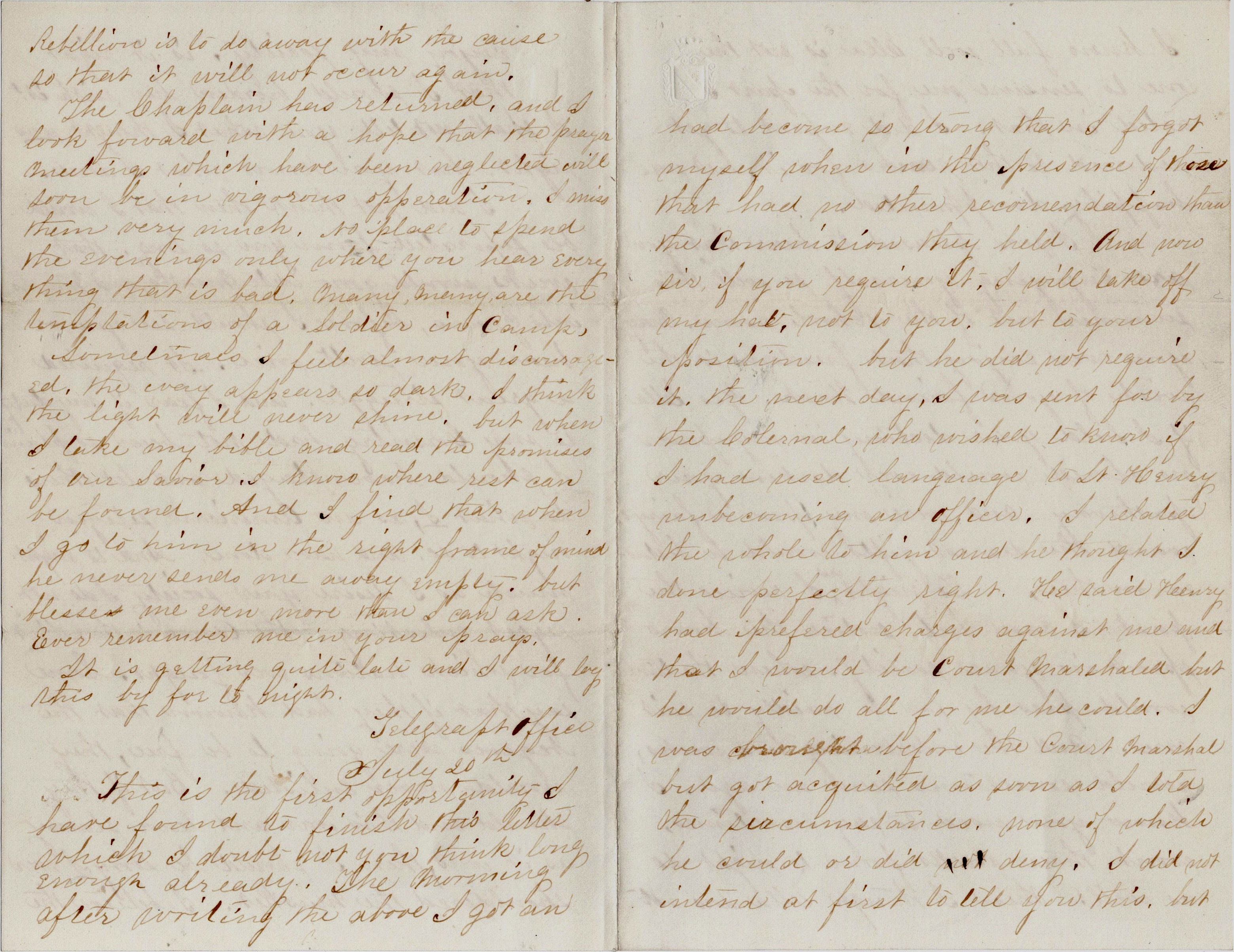
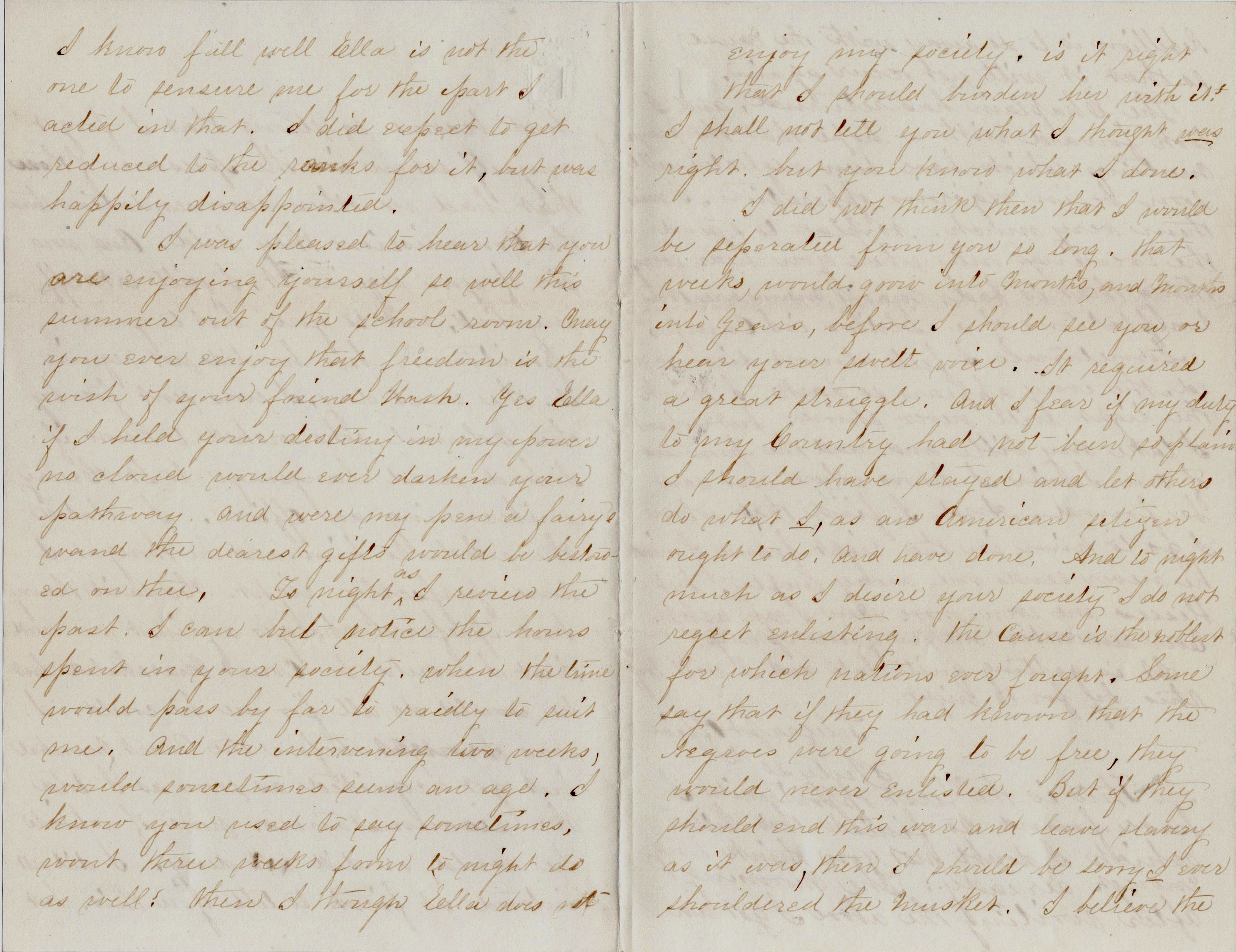
[Partial letter, July 1864] ….had become so strong that I forgot myself when in the presence of those that had no other recommendations than the commission they held. And now, sir, if you require it, I will take off my hat, not to you, but to your position. But he did not require it. The next day I was sent for by the Colonel who wished to know if I had used language to Lt. Henry unbecoming an officer. I related the whole to him and he thought I done perfectly right. He said Henry had preferred charges against me and that I would be court-martialed but he would do all for me he could. I was brought before the court-martial but got acquitted as soon as I told the circumstances, none of which he could or did deny. I did not intend at first to tell you this but I know full well Ella is not the one to censor me for the part I acted in that. I did expect to get reduced to the ranks for it, but was happily disappointed.
I was pleased to hear that you are enjoying yourself so well this summer out of the school room. May you ever enjoy that freedom is the wish of your friend Wash. Yes, Ella, if I held your destiny in my power, no cloud would ever darken your pathway. And were my pen a fairy’s wand, the dearest gifts would be bestowed on thee.
Tonight as I review the past, I can but notice the hours spent in your society when the time would pass by far too rapidly to suit me. And the intervening two weeks would sometimes seem an age. I know you used to say sometimes, “Won’t three weeks from tonight do as well?” Then I thought Ella does not enjoy my society. It is right that I should burden her with it? I shall not tell you what I thought was right, but you know what I done. I did not think then that I would be separated from you so long—that weeks would grow into months, and moths into years before I should see you or hear your sweet voice. It required a great struggle. And I fear if my duty to my Country had not been so plain, I should have stayed and let others do what I, as an American citizen, ought to do, and have done.
And tonight, much as I desire your society, I do not regret enlisting. The cause is the noblest for which nations are fought. Some say that if they had known that the Negroes were going to be free, they would never enlisted. But if they should end this war and leave slavery as it was, then I should be sorry I ever shouldered the musket. I believe the Rebellion is to do away with the cause so that it will not occur again.
The chaplain has returned and I look forward with a hope that the prayer meetings which have been neglected will soon be in vigorous operation. I miss them very much. No place to spend the evenings only where you hear everything that is bad. Many, many are the temptations of a soldier in camp. Sometimes I feel almost discouraged—the way appears so dark. I think the light will never shine. But when I take my bible and read the promises of our Savior, I know where rest can be found. And I find that when I go to Him in the right frame of mind, He never send me away empty, but blesses me even more than I can ask. Ever remember me in your prayers. It is getting quite late and I will lay this by for tonight.
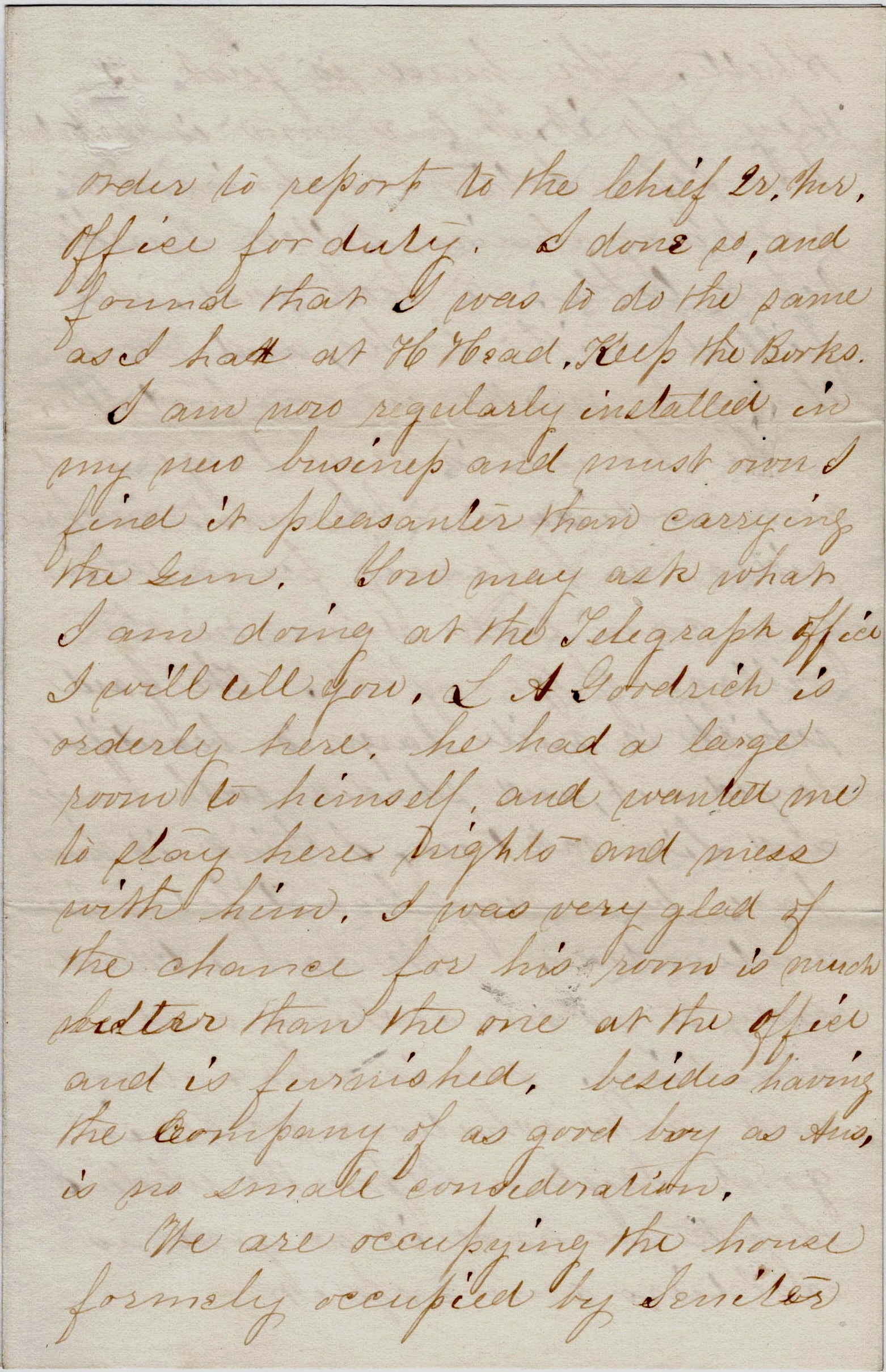
Telegraph office. July 20th. This is the first opportunity I have found to finish this letter which I doubt not you think long enough already. The morning after writing the above, I got an order to report to the Chief Quartermaster’s Office for duty. I done so and found that I was to do the same as I had at Hilton Head—keep the books.
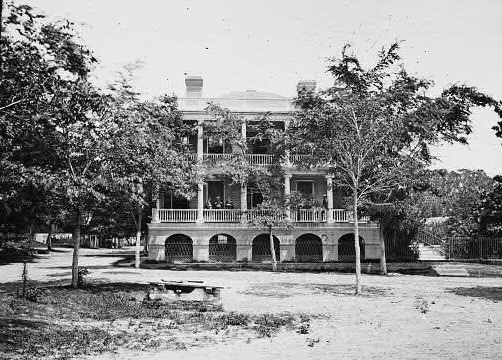
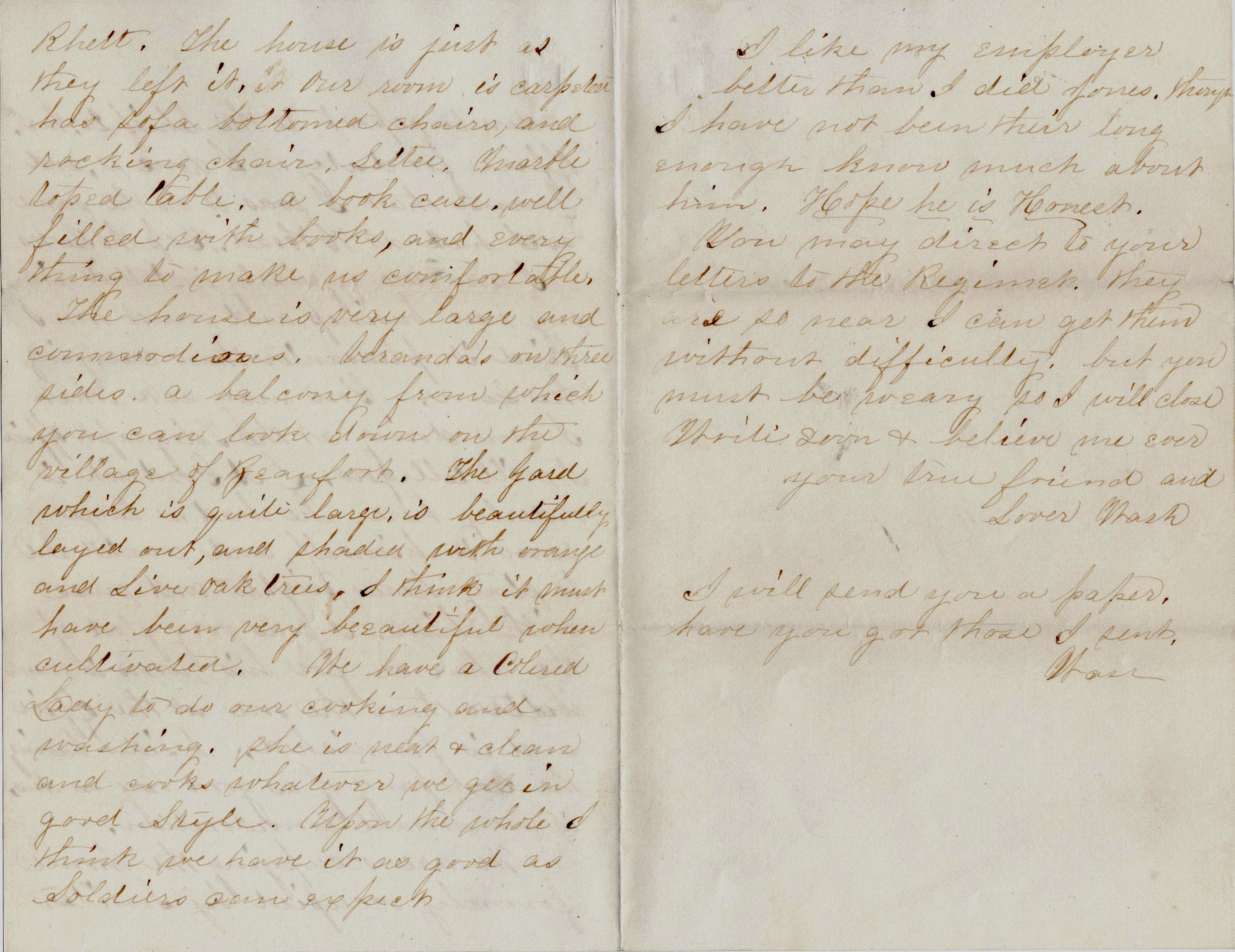
I am now regularly installed in my new business and must own I find it pleasanter than carrying the gun. You may ask what I am doing at the Telegraph Office. I will tell you. L[ewis] A. Goodrich is orderly here. He had a large room to himself and wanted me to stay here nights and mess with him. I was very glad of the chance for his room is much better than the one at the office and is furnished. Besides, having the company of as good boy as Aus is no small consideration. We are occupying the house formerly occupied by Senator [Edmund] Rhett. The house is just as they left it. Our room is carpeted, has sofa bottomed chairs, and rocking chairs, settee, marble topped table, a book case well filled with books, and everything to make us comfortable. The house is very large and commodious. Veranda’s on three sides, a balcony from which you can look down on the village of Beaufort. The yard which is quite large is beautifully laid out and shaded with orange and live oak trees. I think it must have been very beautiful when cultivated. We have a colored lady to do our cooking and washing. She is neat & clean and cooks whatever we get in good style. Upon the whole, I think we have it as good as soldier’s can expect.
I like my employer better than I did Jones though I have not been there long enough to know much about him. Hope he is honest.
You may direct your letters to the regiment. They are so near I can get them without difficulty but you must be weary so I will close. Write soon & believe me ever your true friend and lover, — Wash
I will send you a paper. Have you got those I sent? — Wash
The Rhett House in Beaufort, South Carolina. It was in the basement of this home where several South Carolina leaders vowed to secede from the Union if Lincoln was elected President of the United States.
Letter 2
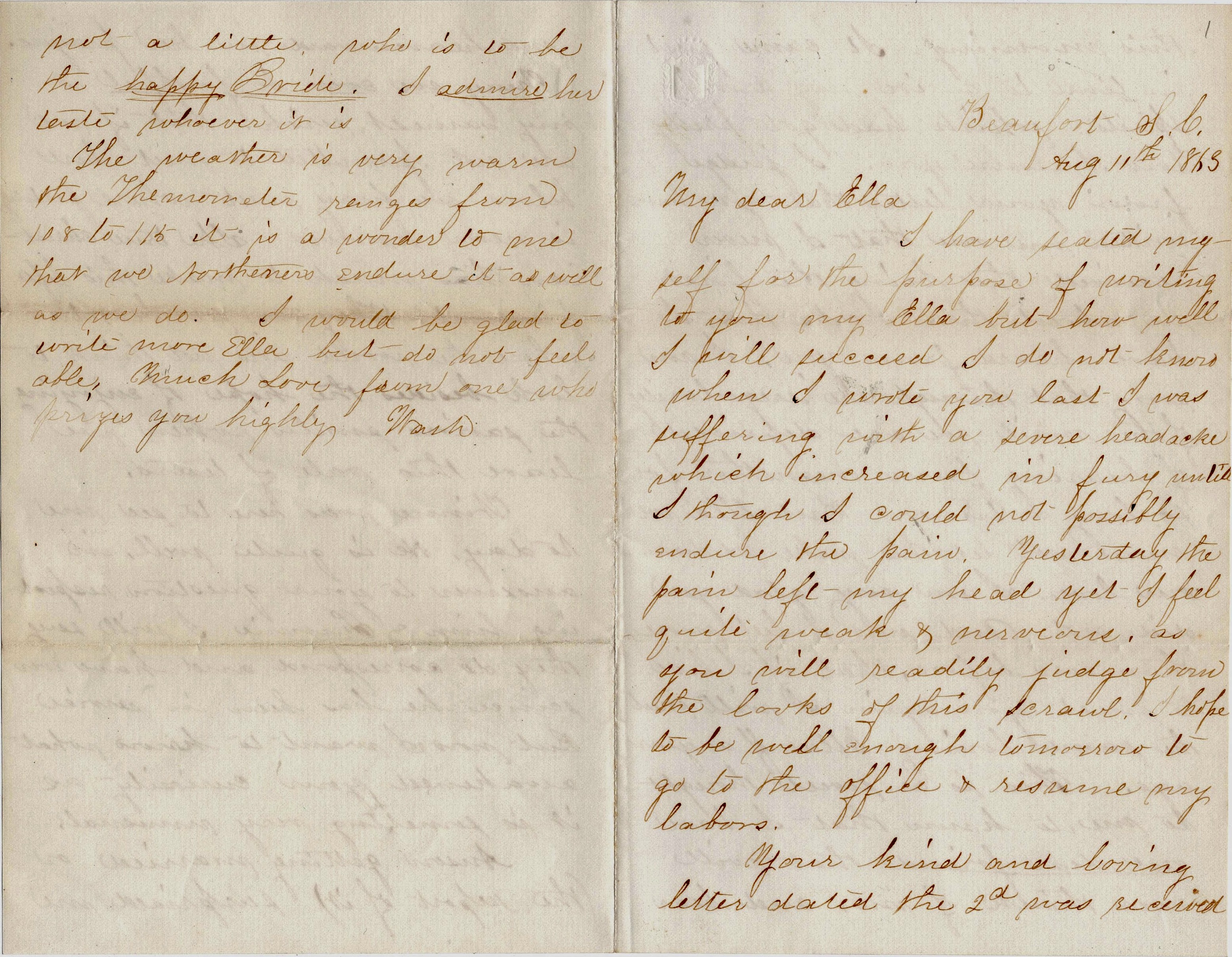
Beaufort, South Carolina August 11, 1863
My dear Ella,
I have seated myself for the purpose of writing to you my Ella but how well I will succeed I do not know. When I wrote you last, I was suffering with a severe headache which increased in fury until I thought I could not possibly endure the pain. Yesterday the pain left my head yet I feel quite weak & nervous as you will readily judge from the looks of this scrawl. I hope to be well enough tomorrow to go to the office & resume my labors.
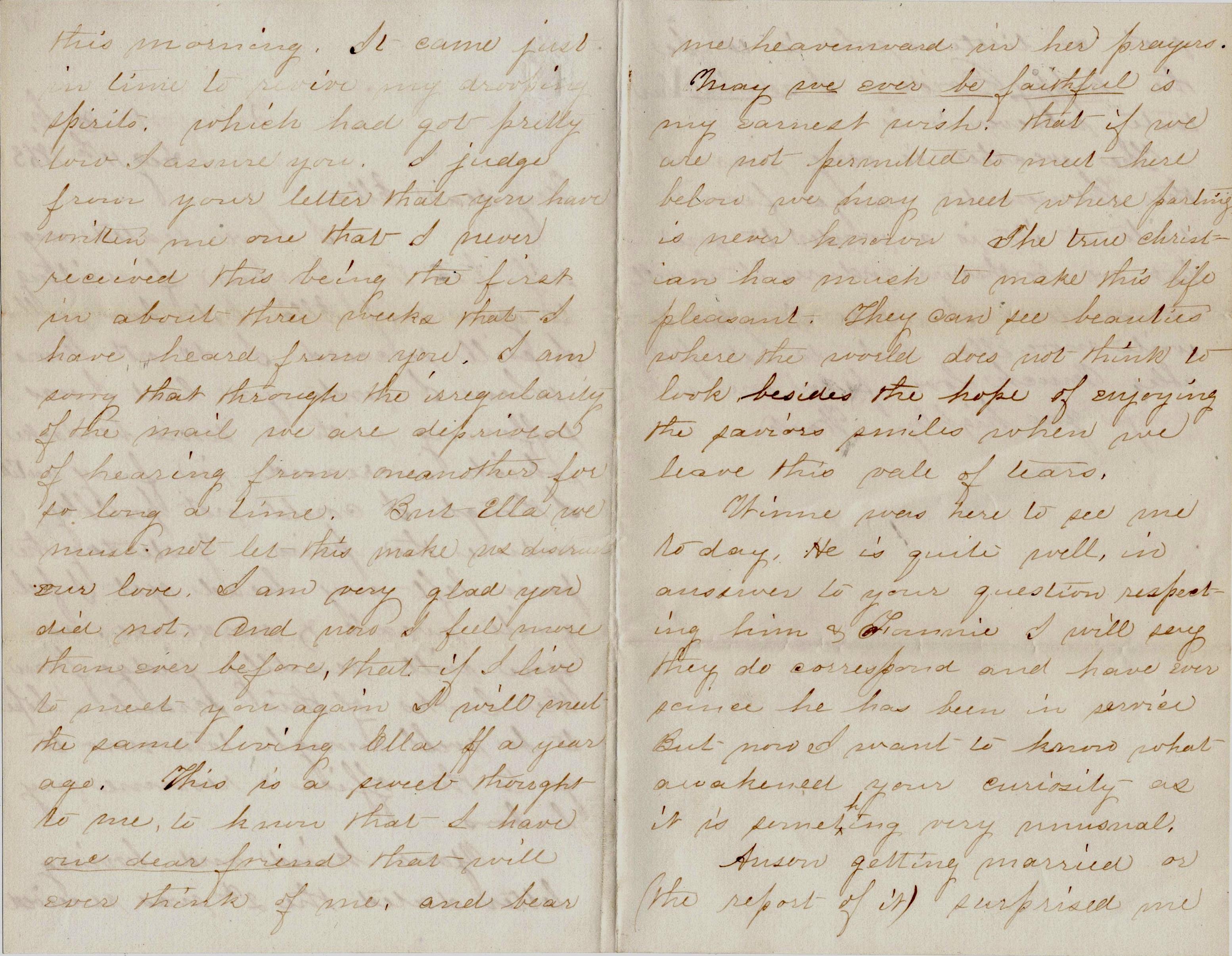
Your kind and loving letter dated the 2nd was received this morning. It came just in time to revive my drooping spirits which had got pretty low, I assure you. I judge from your letter that you have written me one that I never received, this being the first in about three weeks that I have heard from you. I am sorry that through the irregularity of the mail we are deprived of hearing from one another for so long a time. But Ella, we must not let this make is distrust our love. I am very glad you did not. And now I feel more than ever before that if I live to meet you again, I will meet the same, loving Ella of a year ago. This is the sweet thought to me—to know that I have one dear friend that will ever think of me and bear me heavenward in her prayers. May we ever be faithful is my warmest wish. that if we are not permitted to meet here below, we may meet where parting is never known. The true Christian has much to make this life pleasant. They can see beauties where the world does not think to look, besides the hope of enjoying the Savior’s smiles when we leave this vale of tears.
Winne was here to see me today. He is quite well, in answer to your question respecting him, & Fannie, I will say they do correspond and have ever since he has been in service. But now I want to know what awakened your curiosity as it is something very unusual. Anson getting married (or the report of it) surprised me not a little. Who is to be the happy bride? I admire her taste, whoever it is.
The weather is very warm. The thermometer ranges from 108 to 115. It is a wonder to me that we Northerners endure it as well as we do, I would be glad to write more, Ella, but do not feel able. Much love from one who prizes you highly, — Wash
Letter 3
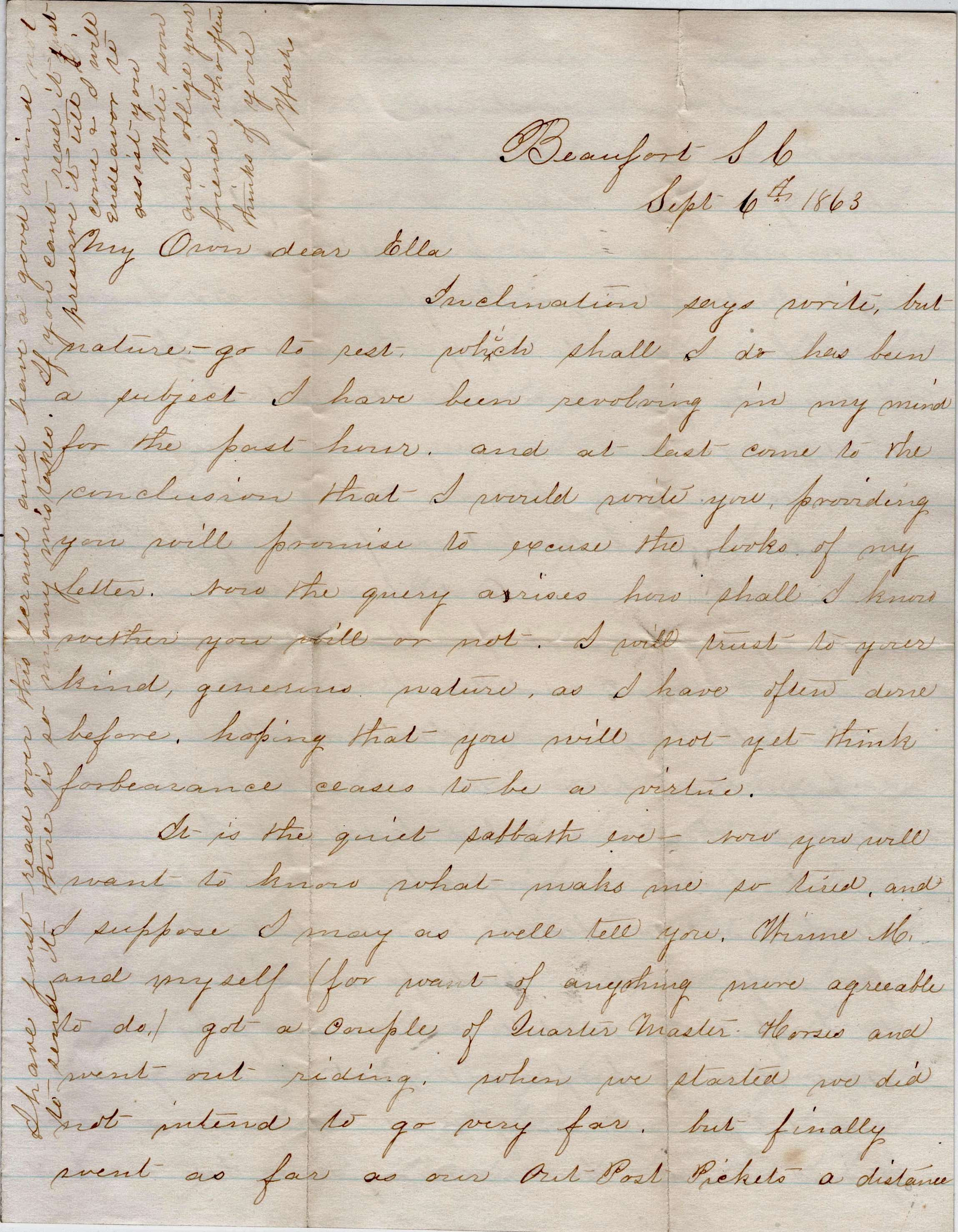
Beaufort, South Carolina September 6th 1863
My own dear Ella,
Inclination says write, but nature go to rest. Which shall I do has been a subject I have been revolving in my mind for the past hour and at last come to the conclusion that I would write you providing you will promise to excuse the looks of my letter. Now the query arises, how shall I know whether you will or not. I will trust to your kind, generous nature as I have often done before, hoping that you wil not yet think forbearance ceases to be a virtue.
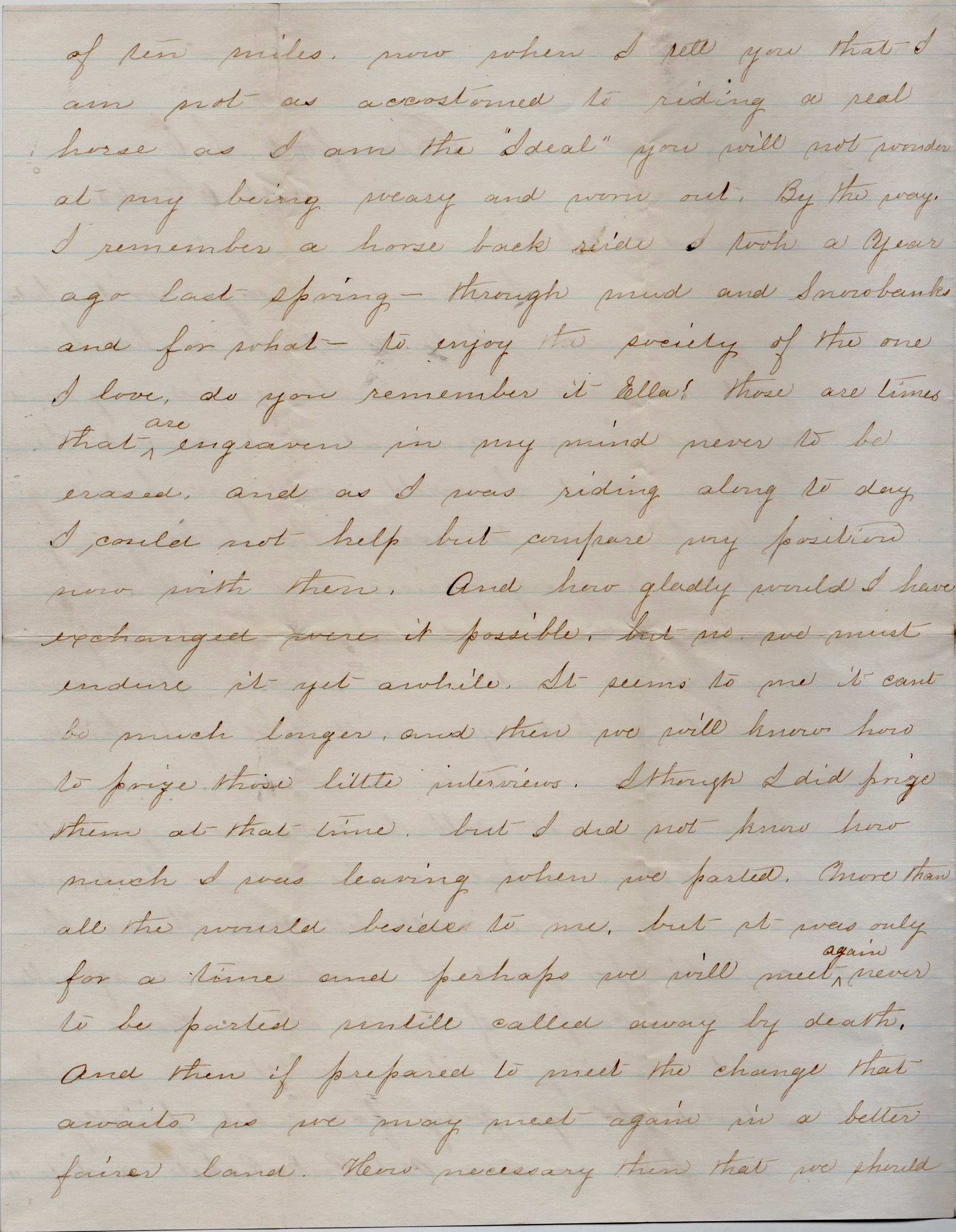
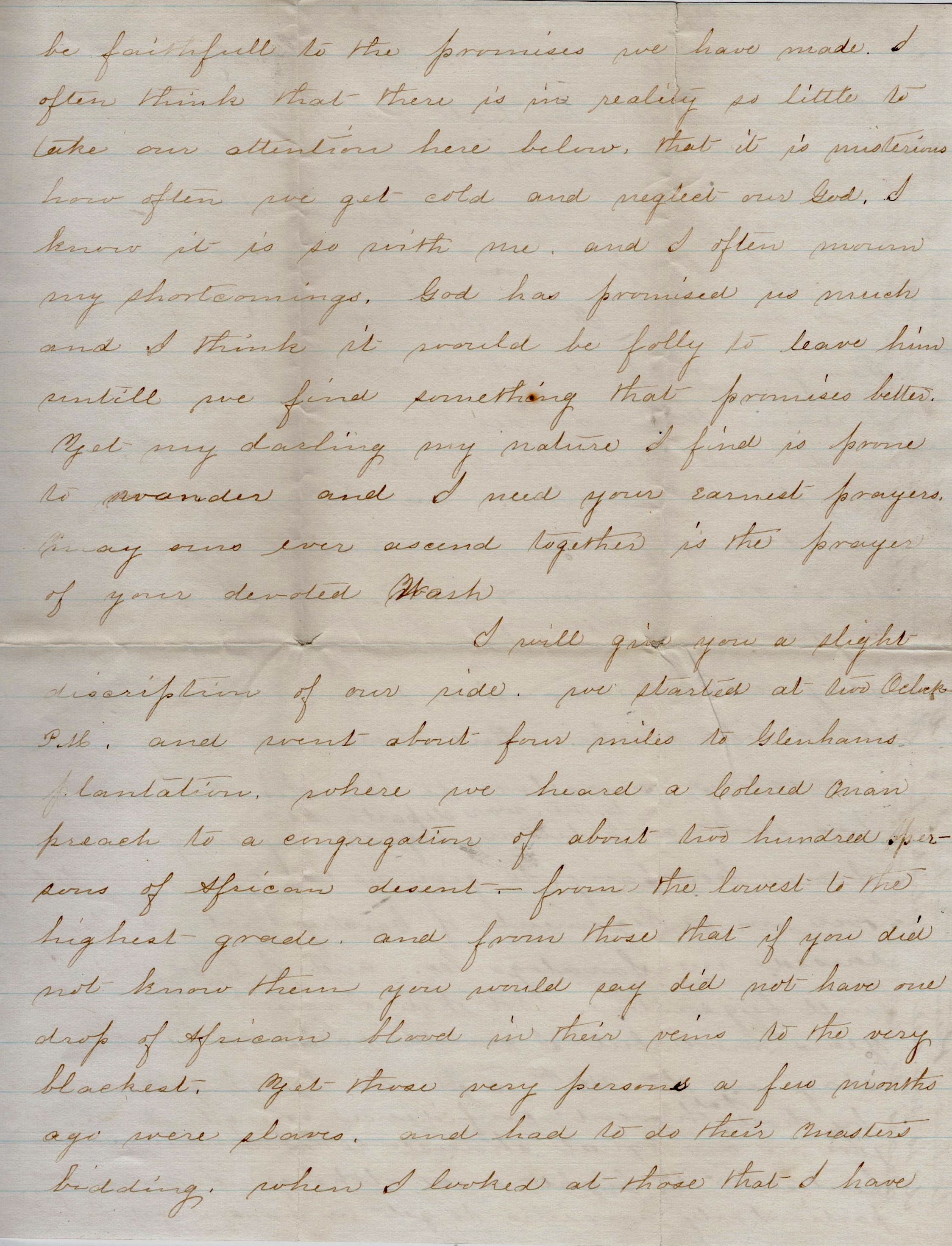
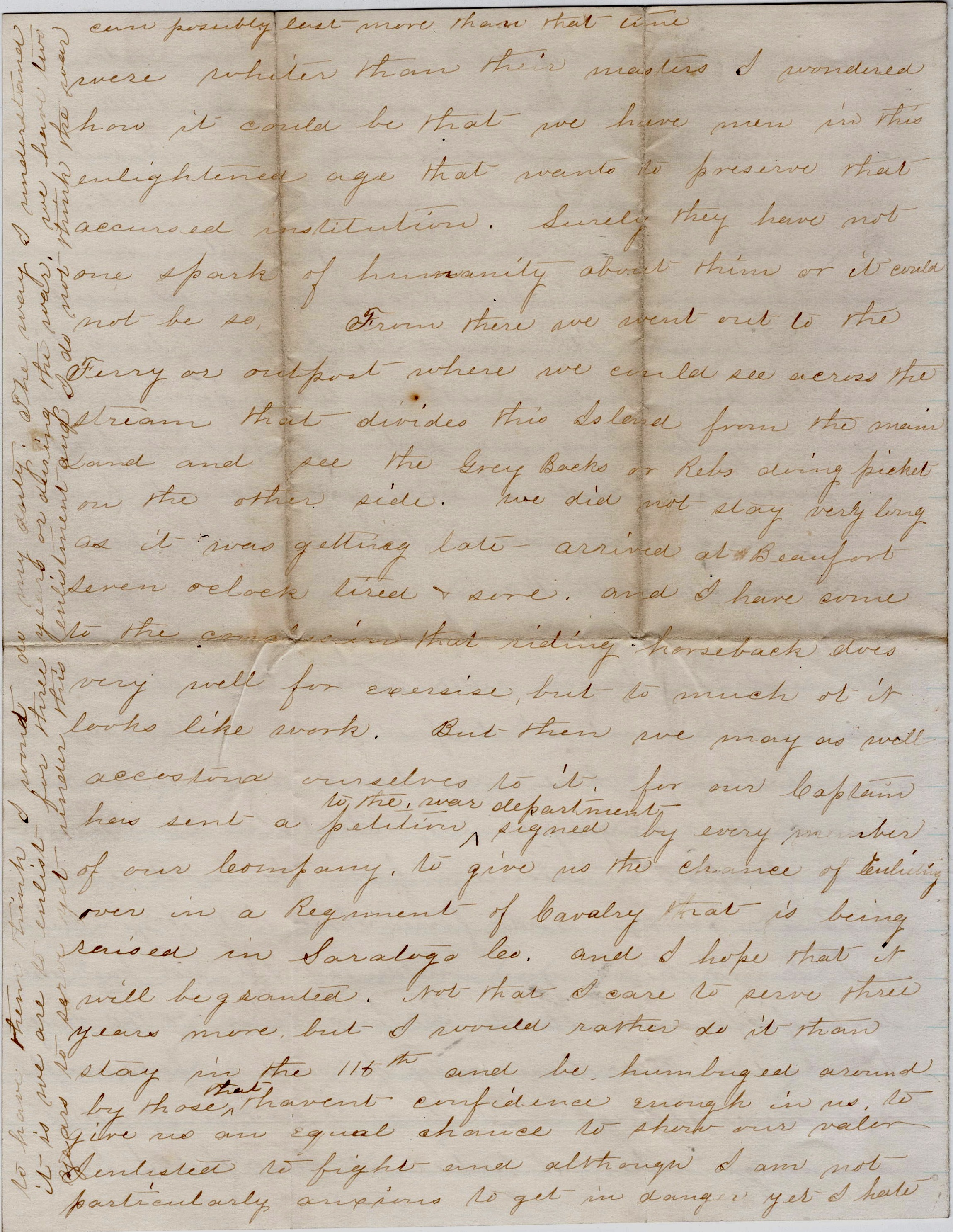
It is the quiet Sabbath eve. Now you will want to know what makes me so tired and I suppose I may as well tell you. Winne M. and myself (for want of anything more agreeable to do) got a couple of quartermaster horses and went out riding. When we started, we did not intend to go very far, but finally went as far as our outpost pickets—a distance of ten miles. Now when I tell you that I am not as accustomed to riding a real horse as I am the “Ideal” you will not wonder at my being weary and worn out. By the way, I remember a horse back ride I took a year ago last spring—through mud and snowbanks and for what—to enjoy the society of the one I love. Do you remember it, Ella? Those are times that are engraved in my mind never to be erased. And as I was riding along today I could not help but compare my position now with then. And how gladly would I have exchanged were it possible. But no, we must endure it yet awhile. It seems to me it can’t be much longer, and then we will know how to prize those little interviews. Although I did prize them at the time, but I did not know how much I was leaving when we parted—more than all the world besides to me. But it was only for a time and perhaps we will meet again, never to be parted until called away by death. And then, if prepared to meet the change that awaits us, we may meet again in a better, fairer land. How necessary then that we should be faithful to the promises we have made. I often think that there is in reality so little to take our attention here below—that it is mysterious how often we get cold and neglect our God. I know it is so with me, and I often mourn my shortcomings. God has promised us much and I think it would be folly to leave Him until we find something that promises better. Yet my darling my nature I find is prone to wander and I need your earnest prayers. May ours ever ascend together is the prayer of your devoted Wash.
I will give you a slight description of our ride. We started at two o’clock p.m. and went about four miles to Glenhams Plantation where we heard a Colored man preach to a congregation of about two hundred persons of African descent, from the lowest to the highest grade, and from those that if you did not know them you would say did not have one drop of African blood in their veins to the very blackest. Yet those very persons a few months ago were slaves and had to do their masters bidding. When I looked at those that I have seen were whiter than their masters, I wondered how it could be that we have men in this enlightened age that want to preserve that accursed institution. Surely they have not one spark of humanity about them or it could not be so.
From there we went out to the Ferry or outpost where we could see across the stream that divides this island from the mainland and see the Grey Backs or Rebs doing picket on the other side. We did not stay very long as it was getting late. Arrived at Beaufort at seven o’clock tired & sore and I have come to the conclusion that rifing horseback does very well for exercise but too much of it looks like work. But then we may as well accustom ourselves to it for our Captain has sent a petition to the War Department signed by every member of our company to give us the chance of enlisting over in a regiment of cavalry that is being raised in Saratoga county and I hope that it will be granted. Not that I care to serve three years more but I would rather do it than stay in the 115th [New York] and be humbugged around by those that haven’t confidence enough in us to give us and equal chance to show our valor. I enlisted to fight and although I am not particularly anxious to get in danger, yet I hate to have them think I won’t do my duty. The way i understand it is we are to enlist for three years or during the wart. We have two years to serve yet under the enlistment and I do not think the war can possibly last more than that time.
I have just read over this scrawl and have a good mind not to send it—there is so many mistakes. If you can’t read it, just preserve it till I come & I will endeavor to assist you. Write soon and oblige your friend who often thinks of you. — Wash
These letters were written by Daniel B. Doxtater (1841-1864), the son of Solomon Doxstader (1811-1885) and Nancy Smith (1813-1882) of Oppenheim, Fulton county, New York. Daniel enlisted as a private on 14 August 1862 in Co. E 115th New York Infantry—nicknamed the “Iron Hearted Regiment.” He was with the regiment at Harper’s Ferry when it was captured by Stonewall Jackson’s men in September 1862 and taken prisoner along with all of his comrades. He was paroled shortly after but was detained in Chicago until the regiment could be exchanged in late November 1862. From Washington D. C., they were sent to Hilton Head where they joined the Department of the South in late January 1863. It is here, in Hilton Head, South Carolina that the first of five letters was penned.
Daniel did not survive the war. He was wounded in the abdomen on 20 February 1864 in the Battle of Olustee, Florida, and taken to Beaufort, South Carolina, where he died on 12 March 1864. According to muster rolls, Daniel stood 5′ 4″ tall, and was described as a light haired, blue-eyed farmer.
Other letters by members of the 115th New York Infantry transcribed and published by Spared & Shared:
I received your kind letter of the 13th and was glad to hear that you are all well. I am well and enjoying good health at present. But I have been sick part of the time since I have been in the army. You must excuse me for not writing to you before for we have been hat hauled all over the world. It was just two weeks after we got in Virginia that we was taken prisoners [at Harpers Ferry] and then we was taken to Chicago and there we had to do guard duty and drill. And we stayed there until the 20th of November and sent to Washington and we have moved five times since the 24th of November. We was at Camp Seward. We was at Alexandria just two weeks, then we went to Yorktown and stayed there almost four weeks and then we came here in South Carolina and how long we will stay here, I can’t say.
We left Yorktown on the 22nd of this month and got here the 26th. We came here on the New York Matangas boat. Our campground is located on the island of Hilton Head in a cotton field. I don’t like this place very well for it is sandy and makes very hard traveling and the sand flies when the wind blows like snow. It is pretty cold here and yesterday morning it snowed a little here and last night it froze quite hard. But the weather is moderating down now warm again.
Well, Mary, I think you do have a large school this winter but who is your teacher? I wish I was there to go to school too this winter. Mary, I am glad that my cousins do think enough of me to write to me for I do like to hear from old Oppenheim. But the worst trouble that I have in writing is to get stamps to send them with for there are as scarce as silver is here.
We have not got our pay yet and don’t expect to ever get of the government for when we left Chicago, our barracks was set on fire and all burnt to the ground. There was some rascal who set it on fire and the government has court martialed the whole regiment and stopped our pay so now we don’t draw any pay now and won’t get any. But if they don’t pay me, I won’t fight any more. I will be shot first before I will fight. And our officers say if they can’t have a rehearing about the matter and have their pay go on, they will throw down their arms and will die on the spot before they will do any duty whatever. The colonel is a going to Washington if he can get a furlough and try to have it tried over and they they can’t do anything about it then he says the men can then throw down their arms and he will help them So you see they will be at [ ] hear if they don’t do something.
Well, Uncle George, you must excuse me for not writing to you before but iti s rather late than never. This letter is for you all. Write as soon as you get this letter and oblige. Yours, — D. B. Doxtater
Direct your letter to Mr. Daniel B. Doxtater, Co. E, 115th Regt. N. Y. Volunteers, Hilton Head, S. C., in care of Capt. W. H. Shaw
Letter 2
Fort Mitchel, Skull Creek March 11, 1863
Dear cousin Mary,
I received your ever kind & welcome letter yesterday which I had expected this long time. I began to think that you had forgotten me but at last it came & I am glad to hear that you are all well at present. My health is not very good yet & somewhat so that I am not able to do any duty yet. I have not done anything since the first of February & I have been in the hospital part of the time since I wrote to you but I am with my company now which is my home & Company D are detached from the regiment to do picket duty and fatigue duty about five miles west of Hilton Head where the rest of the regiment are. And we are to work on a fort which is called Fort Mitchel. It is near Pinckney’s Island. It will take some time yet before it is finished. They have four large guns now ready for action anytime and when it is finished, it will be mounted with eight or ten guns and very large ones too.
The weather is as warm here now as it is any time in the summer out home and the Boys are going barefooted. It rains some here today and the soil is sandy and very loose and when the wind blows, the sand flies like snow. The timber is mostly pine and palmetto. The pine is like the Georgia Pine—very hard and full of pitch. The palmetto grows around the edge of the marshes about 15 feet high and the body is smooth and the top is in the shape of a vase of flowers. The Orange trees are planted like our Apple trees although some wild ones grows in the wood. There is three cotton plantations on this island but the owners have left them and gone in the Rebel army and the negroes are living on the plantations and they are to work planting their corn and potatoes, although some of their potatoes are up very nice. The plum and peach trees are out of bloom now & the grass is very green. The clover is about four inches high and everything looks as nice here now as it does in the month of May. This island which we are on is about 17 miles long and 7 wide. The fortifications extend from the dock across the island and mounted with 150 guns and there is about 6,000 soldiers here in all.
General Foster’s fleet is here yet, I believe, with 15,000 men and are expecting to leave here soon to make an attack on Charleston & Savannah. Our Colonel is at Washington now and our Lieutenant Colonel got a letter from him yesterday and he said we was all right now and [cleared] from all blame and we was exonerated and as soon as the pay master could get here we would be paid off in full. And now we are clear from burning the barracks at Chicago. A welcomer visitor never entered our camp as the pay [master] will be when he comes. But he can’t come too soon, I don’t believe, do you?
Well, Mary, I am thankful that I have got such a good friend & such a good cousin at home that writes to me and sends writing paper in their letters so I can write back. And I hope and pray that God will bless you and be with you in all duties and give you all strength to write to a poor soldier that is in the defense of his country for that is the greatest blessing that we can have is to hear from his friends at home. And I am thankful that God has given me a paying Captain so that he can lead us on to battle for our God as well as for our country. I have been a great sinner against God but thankful to God I am not anymore for I am trying to live a better life than I have been. But it is not long since I have started on this good cause. But so far I have enjoyed more comfort for the last week than I ever did. I hope you will pray for me that I may hold out faithful and if we are permitted to meet on Earth, that we may meet in heaven. My company are most all converts and in fact, so is the whole regiment. And last Sunday there was 49 baptized here and a good many more to be baptized yet.
I got a letter from Henry yesterday and he said he was as tough and fat as a bear and his weight is 185 pounds & he said they had a good many deserted out of their regiment and from out of his company. One was Lorenzo Snell and Martin Brown. John Dessure the other he did not name. And he said they has been paid off up to the first of November and the first of March. They were agoing to get the rest & he sent me four postage stamps in his letter.
We live very well here now for we can have all the oysters that we want for they are plenty and they are not over 15 rods from our camp and we can but them off the niggers for ten cents a quart if we had money. But as we have not got any money, we will have to go and get them and open them ourselves.
Afternoon. It has cleared off and it is very warm this afternoon & very pleasant. We have got our street all set out with pine trees & it looks like a small grove. I will put in some leaves of a fur tree and some berries and some peach blossoms and some palmetto reeds so you can see how they look. Mary, I would like to send you a nice bunch of flowers if I could for there is one of the nicest flower gardens here that I ever saw in my life.
Well, Mary, you say it was reported that I was dead but how did you hear of it or who reported that news? This is the second time that they have had me dead out in Oppenheim but as long as I can write, you mustn’t believe anything you hear unless I write it.
Well, Mary, we have enough to eat, such as it is. But I can’t eat everything they give us. But as long as they give me bread and coffee, I can stand it. Tell Granny that I send mt best respects to her and tell her that I wish I was as tough as she is & tell her I heard she was a going to be my aunt and grandmother too one of these days. Tell Martha Smith and Uncle John Smith that I would like to hear them answer that letter that I wrote to them if they want to hear from me anymore. Well, Mary, I guess you will say Dan had better stop writing for this time and so I will by bidding you all goodbye. I send my love and best respects to all whilst life remains, — D. B. D.
Write as soon as you get this letter and oblige your cousin, — Daniel B. Doxtater to Mary Smith
Direct as before. Co. E, 115th Regt. N. Y. S. V., Hilton Head, S. C., Care of Capt. W. H. Shaw
My love to all enquiring friends after receiving a share for yourself. Tell your Pa to write to me. Well, Mary, I will tell you here the niggers grind their corn about the size of a large grindstone and one of the stones are fastened down on a board and a lot of small creases cut in them and then there is a hole in the handle of top one and one on the side of the top and then they stick outside and then they turn it by hand put the corn in the middle of the top stone a little at a time. That the way they ground their corn and they don’t have anything else to eat in the bread line but they have some sweet potatoes to eat but no meat—only oysters. I just got a letter from home which was wrote the 19th of February. Henry said Jenett had left Joseph Moshier again and he had hung himself. But they found him before he was dead. Now it is so or not? You did not say anything about it in your letter.
I will send some cotton and some cotton seed in this letter.
Letter 3
Fort Mitchel. South Carolina Sunday morning, April 12th 1863
Dear cousin Mary,
I now take pen in hand to converse with you in the silent meditation of the pen, as it is the [only] means that we have at present. So let us improve the privilege that we have in writing, although I have not got much time to write for I am on duty every day now as we are all the men that is here now to work on the fort and they are in a hurry to get it done for they expect the rebels on us every day. So you see we are in some danger and for that reason we have to work very hard. But Sundays—we don’t work so I will improve the time by writing to you.
Your letter came in hand in due time and on the 8th of this month and I was very glad to hear that you are all well, which leaves me at present in very good health. And when this reaches you it will find you the same and enjoying the same blessing that I am enjoying now.
The weather grows better here every day—especially at midday. The heat is very oppressive and it is very dry for we do not have any rain to speak of. At night we have very heavy dew and it is quite comfortable at night. The trees are all leafed out very nicely and everything looks like the month of June and there is fruit of all kinds grows here and the figs are as large as a walnut. And the blackberries are getting ripe very fast. So you see we will live good if we stay here all summer which I think probably we shall if the rebels don’t take us prisoners again for our forces are very small now in this island for the men that was on this island have all gone to take Charleston. But I have not heard whether they have took it or not yet. But there is one thing certain, they will either take the city or burn it up. We have got orders tro be ready at any minute for we don’t know what or ow soon the rebels will attack us here for we can see them over on the west side of the river and it would not take them long to come over on us at night and take us all prisoners or kill us for they have blowed up the gunboat that done the picket duty on the river. The rebels are a ragg[ed]y set of fellows but they are tigers to fight.
We are a going to meeting at 3 o’clock this afternoon and I wish you was here to go and hear our chaplain preach. He is a very smart man, is liked very well in the regiment, and he has done a great deal for this regiment and about two-thirds of the regiment have professed religion and are serving their creator now instead of Satan which they have served in their days past.
Well. Mary, I will tell you what I meant by saying that I expected Granny would be my aunt. Sarah Smith wrote to me and said that Granny was a going to get married to my Uncle J. D.
That is a pretty name, I think, which you named your little sister and your Ma says she takes after me. Then if she does, she takes after a smart fellow then, don’t she? for the Small folks are a great deal smarter than the large ones, hain’t they Mary?
Tell Frances that I thank her very much for that gum she sent me and tell her I will speak a good word for her to a litle curly headed boy down South here and I send my best respects to her and tell her to be a good girl until I come home.
I have got my pay now. My share was $67.90 and I sent $60 home and kept the rest for spending money. The health of the regiment is better now than it has been since we left Fonda. There has not but one died in this regiment since we came here and that one that died was one of my company. His name is J[oseph.] Wood. We have not got anyone in the hospital now at present. I wish I was there when you get to making sugar so to have some warm sugar to eat. And if we ever get off this island, I will try to get a furlough and come home if nothing happens.
Well, Mary, you say it snows and blowed so there out North. And down South is is warm and nice as summer. I could not hardly believe that there was so much difference in the weather in the world as it is and while you fellows are suffering with the cold, we are suffering with the heat. The fleas and gnats are very bad here and there is all kinds of snakes here. We killed a black snake the other day five feet and seven inches long, and the other day they killed two more which was over 4 feet long. And there is lots of alligators. They killed one the other day and brought him in camp and he was over four feet long and about as large around as my leg. And the niggers say that there is some very big ones here. They are a savage-looking animal now, I tell you, and they can run very swift too you better believe.
Well, Mary, I can’t think of much more to write or much time to write this time. And I hope that this great rebellion will be soon put down so I can come home to my friends that I have left behind me. And I hope that God will guide and protect them in all their ways and if we never meet on earth, that we may live so as to meet in heaven where parting is unknown. So now I will close my letter by hoping to hear from you soon. My love to you whilest life remains. — Daniel B. Doctater to his cousin Mary Smith
Direct as before. Excuse all bad writing and spelling.
Letter 4
Hilton Head, South Carolina June 25, 1863
Dear cousin Mary,
Youyr long and expected letter came in hand on the 23rd bearing date the 8th and I was very glad to hear from you once more and more so to hear that you are all well and in the enjoyment of good health for that is worth more than property os to us. I am well and enjoying good health & feel better now at the present time that I have since we came on this island. But I don’t know how long it will last for it is very sickly here. My company numbers 87 men in all and out of that number, there is not only 30 men able to do duty and there ain’t only about 250 men in the regiment that is able to do duty. And when we left Fonda we had over one thousand able bodied men for duty. So you see that is the way it goes with the northern soldiers down here in the South. There is more men injured with sickness than by balls. They are dying off in our regiment very fast now. The disease is mostly fever here.
Well, Mary, two companies of our regiment are out on the outposts doing picket duty. My company and Company F are the ones that are here on Jenkins’ Island and we are in sight of rebel pickets. The river is all that divides us from the rebels and we guard one side of the river and the rebels the other. So you see they can’t get over here unless they come in small boats and then our pickets will see them and fire into them. They they will put back to the shore again. So you see, they don’t like they way we use them. But whenever a steamboat passes down this way to go to to Fort Pulaski, they will fire on her with muskets but they know then what will come after the, so they will run for the bushes with some shells after them from the boats for every steamboat carried some cannons on board of them.
Well, Mary, I have been down in the State of Georgia to Fort Pulaski since I wrote to you last. I have been on an expedition since I wrote you last. There was 750 in all from the different regiments that is here. We went on the 3rd of the month and came back the 5th. We went up the May River in the boats Carroch, Mayflower, Island City, and convoyed by the gunboat Ann McDonough. We went to the village of Bluffton, but the infantry landed about three miles from the village and we skirmished up the bank of the river & the boat followed up the river but only once in a while we could get sight of two rebels and then a shower of balls would be sent after them but they seemed to run faster than the balls. Well so we kept on in that way until we came in the village when we had some fun. But the fun was all on our side for the rebels took to their heels as fast as they could go and only once in a while they would stop to make a stand. But their courage would fail them & run again. The village was taken and set fire to it and burned it to the ground but the rebels was not seen again until we had evacuated the place & had most all got on the boat when the rebel cavalry came down upon us very strongly enforced and made an attempt to draw us off but we soon sent them a flying in all directions. They only fired at us once but the balls fell short of us and we came off with a loss of a man one our side but we don’t know how many the rebels lost but they lost a good many thousands of dollars worth of property. 1
The burning of Bluffton
There is not any pigeons here but there is lots of fish and blackberries and all kinds of garden sauce. We had a nice lot of cucumber for breakfast this morning. Peaches are very plenty and they are most ripe now. I suppose we will get our pay today for they paid the regiment yesterday but we don’t get only two months pay this time which will be $26. Tell Frances that little curly head is doing very well now but he got to be to big now to put in a letter. No more at present so goodbye. Write as soon as you get this and oblige. Your cousin, — David
1 On June 3, 1863, Rear Admiral Samuel Francis Du Pont instructed Lieutenant Commander George Bacon to lead an expedition against Bluffton aboard the gunboat Commodore McDonough. By June 4, Union forces under Colonel Barton, transported by the gunboat Mayflower and an army transport ship, landed in Bluffton. They quickly took control of the town after Confederate forces retreated. Under Colonel Barton’s orders, most of Bluffton was destroyed by fire, although the church was spared. Confederate troops attempted several counterattacks but were repelled by Union forces and the firepower of the Commodore McDonough, which provided shell and shrapnel support. Approximately two-thirds of its 60 structures were destroyed. Afterwards, the Union troops reembarked without suffering any casualties and returned to Hilton Head.
Letter 5
Beaufort, South Carolina Sunday afternoon, August 2, 1863
Dear cousin Mary,
It is with pleasure that I take this opportunity to write a few lines to you to inform you that your letter of the 19th was duly received and I was very happy to hear that you are all well. I am well at present and in good spirits and I [hope] these few lines will find you the same. There has been a great deal going on here since I last [wrote] to you. First, they have been fighting on Morris Island and two weeks ago today they brought here a lot of wounded soldiers and we had to work night and day to unload the wounded and every building that was large enough to put soldiers in and they drove the niggers outdoors and put the wounded in. There was 600 in all that was brought here and they left a good many down to Hilton Head and they have most of our regiment in the hospitals as nurses to take care of the wounded.
I was in the hospital a spell and I had twelve wounded ones to take care of and they was wounded in all shapes and places. They have took one boat load of wounded soldiers to New York last week and as soon as the boat comes back, they are a going to take some more. We came to Beaufort five weeks ago today and have moved once since we came here. It is a very pleasant place here and I like it very well but it is hot that it almost roasts a fellow.
Well, Mary, I went in the city last Friday to have a dozen pictures taken on cards for you all but they have stopped taking them now so I can’t get them at present and they charged four dollars a dozen for them. But as soon as they take photographs here, I will have some taken and send you one as soon as I can.
We have lots to eat here now for the corn and potatoes are good to eat now. And figs, peaches, pears are ripe and watermelons are very plenty and they grow as large as good sized pumpkins. And we buy one every day. We had one to eat today and I wish you [could have] a lot of them to eat. I have got a lot of the seeds a drying and as soon as they get dry, I will send you some so you can try next spring and raise some of your own. And they are as red inside as cherry.
It is very sickly here yet and the Boys are dying off very fast. JamesBolster is dead and Simon Moshier they don’t think will live. The doctor says he can’t live and Levi Phillips is sick in the general hospital but he is getting better now. Our army is having good luck this summer so far and if Gen. Gilmore has good luck and takes Charleston this time, I think this war will be ended soon. And I do hope and pray that this rebellion will be crushed before two months more. Gen. Gilmore is gaining on Charleston all the time and we can hear heavy cannonading most every day to Charleston, and Rosecrans is coming up in the rear of Charleston and it must fall without fail.
I will close this letter now by sending my best respects to you all. Yours in haste, — Daniel B. Doxtater
Write as soon as you get this and oblige your cousin, Daniel B. Doxtater, Co. E, 115th Regt., N. Y. S. Vols. to Beaufort, S. C.
Tell Frances to be a good girl and my last to her.
These letters were written by Reuben T. Wells (1835-1902) who served as a private in Co E, 115th New York Infantry from 15 August 1862 to 17 June 1865. When he enlisted he was described as a 27 year-old, black haired farmer who stood 5 feet 4 inches tall.
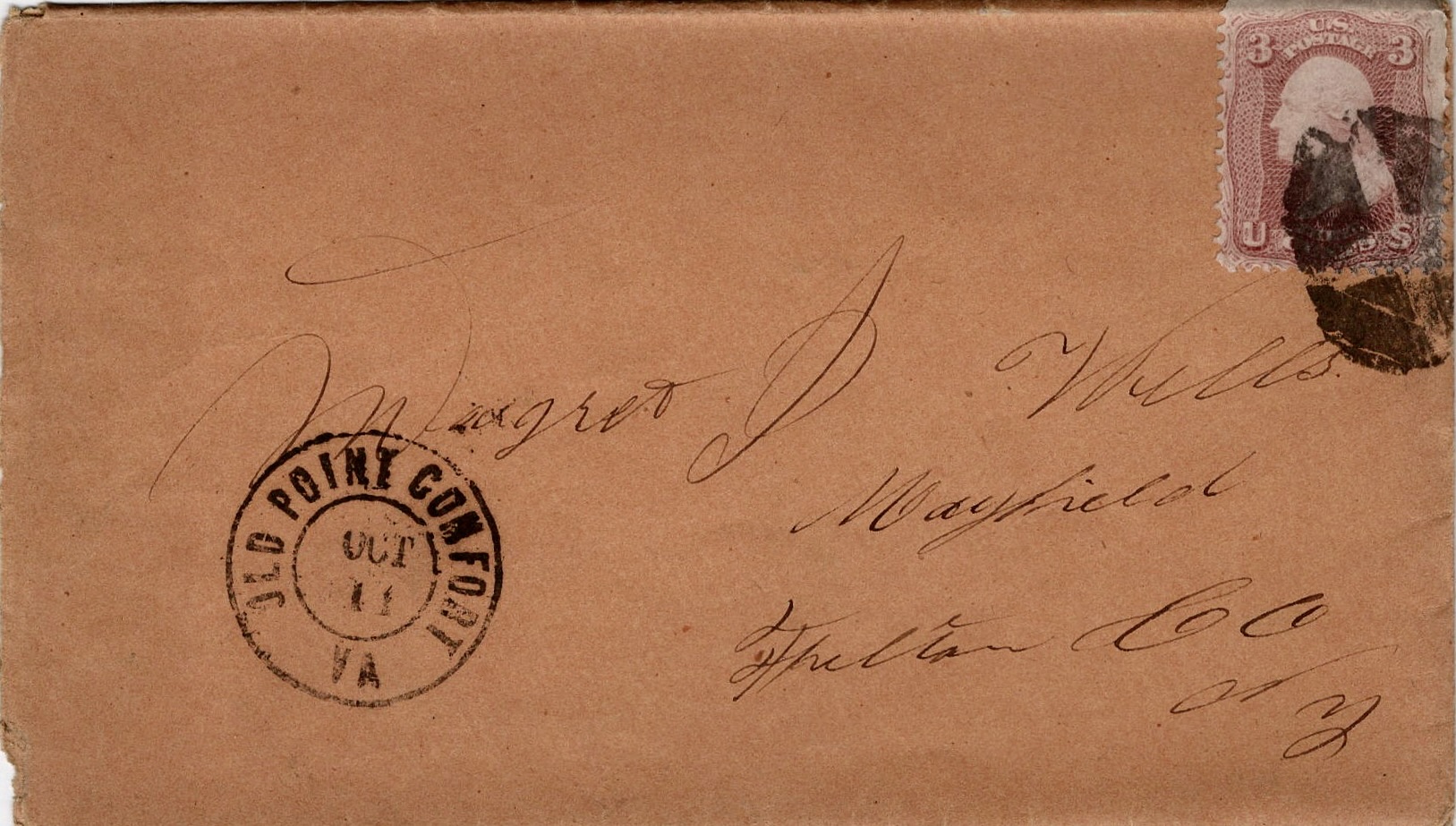
Reuben wrote the letter to his wife, Margaret J. (Dutcher) Wells (1832-1902) and his young son, Lewis Wells (1862-1933). Their farm was located in Mayfield, Fulton county, New York.
I could not find an image of Reuben but here is one of Private Henry W. Mallery of Co. F, wearing the uniform of the 115th New York Volunteer Infantry
Letter 1
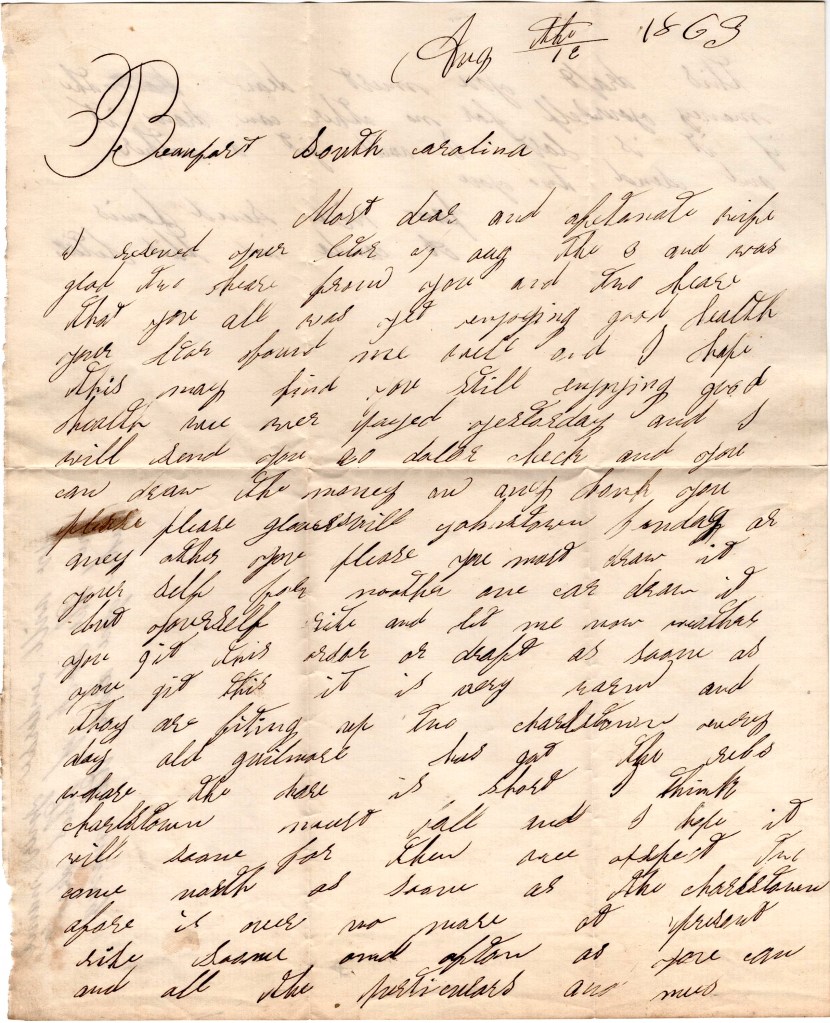
Beaufort, South Carolina August 12, 1863
Most dear and affectionate wife,
I received your letter of August the 3rd and was glad to hear from you and to hear that you all was yet enjoying good health. Your letter found me well and enjoying good health. We were paid yesterday and I will send you 20 dollar check and you can draw the money at any bank you please…You must draw it yourself. Write and let me now whether you get this order or draft as soon as you get this.
It is very warm and they are fighting up to Charleston every day. Old Gilmore has got the rebs where the hair is short. I think Charleston must fall and I hope it will soon for then we expect to come north as soon as the Charleston affair is over. No more at present. Write soon and often as you can and all the particulars and news.
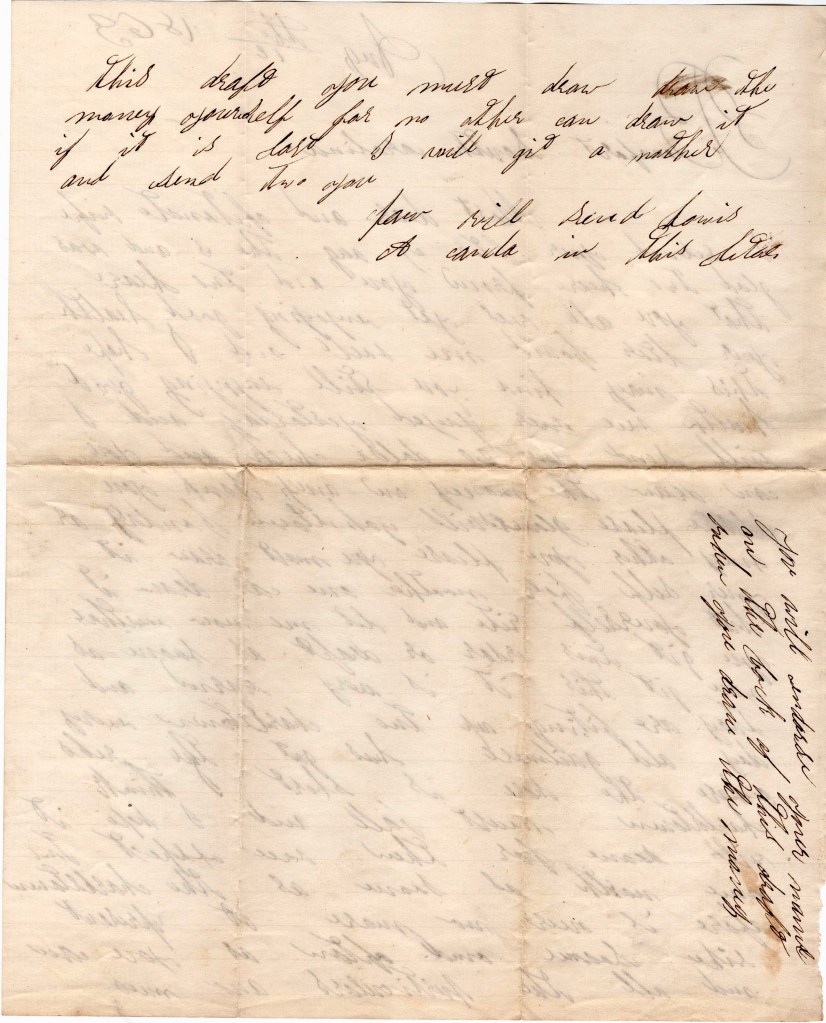
This draft you must draw they money yourself for no other can draw it. If it is lost, I will get another and send to you. Pa will send Lewis a [ ] in this letter.
Letter 2
Malvern Hill, Virginia October 8, 1864
Dear wife,
I received your letter three days ago stating that you had sent the box with Danford to Amsterdam, I have not seen the box yet nor don’t expect to very soon for we hant nowhere near the express office. I shall buy a pair of boots the first opportunity. I thought that I wrote you not to send them that way. At the time I received your last letter, I was not about to answer it, I had taken with the ague and have had it for the last three days. Today I am much better so that I got dinner today. I was glad to hear that you were all well again.
We had a fight yesterday on our right. [See Battle of Darbytown & New Market Roads] The rebs charged and tried to turn our right flank. They charged on a brigade of seven shooters. They did not turn our flank but I should think by the dead now in the field they had turned 1000 lives in[to] eternity besides. They have been burying dead ever since dark last night. They first drove in our cavalry, taking some and two light field batteries. Besides the dead, we took 15 hundred prisoners the night before. Three deserters came in and told of the move. They also reported a great riot in Richmond on the same day which they say was caused by the mayor wanting the city to be surrendered and they ordered the mayor in prison. Then the citizens rose [up] and tore opn the jail, opened all the stores and storehouses but how this all is we are not about to say only by report from deserters.
Though wind blows and it is some cold. It rained yesterday. I will now close hoping to hear from you all soon and hope that i may still be home to spend the winter with you. — R. T. Wells
To M. J. Wells
Letter 3
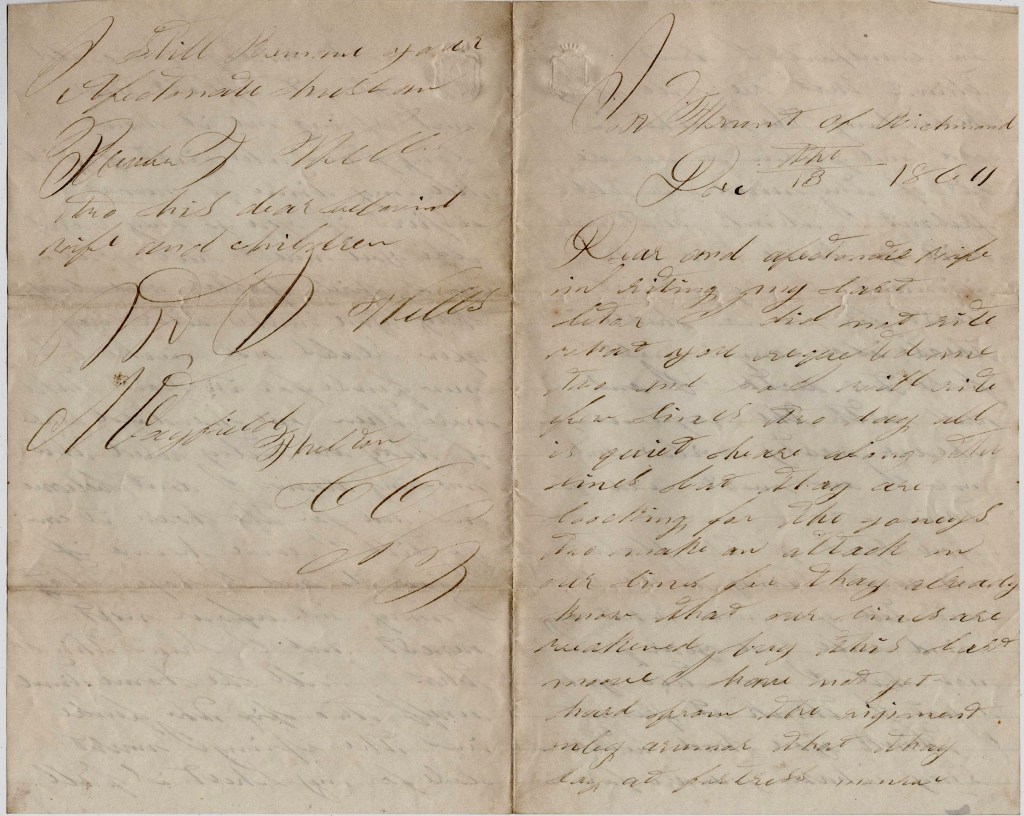
In front of Richmond December 13, 1864
Dear and affectionate wife,
In writing my last letter I did not write what you requested me to and so I will write a few lines today. All is quiet here along the lines but they are looking for the Johnnies to make an attack on our lines for they already know that our lines are weakened by this last move. I have not yet heard from the regiment—only a rumor that they lay at Fortress Monroe on transports. I don’t think that we will lay here long.
The weather is cold and frozen so we are out of the mud for the present. I think that we will go soon to our regiment. I hope so at least for we lay here in these old camps most froze to death. I am well with the exception of these nasty boils. And now I most tired of them.
You speak of the place and about staying there. I can’t tell you now what my mind will [be] one year from now but I can tell you what I think at present. I think you had better stay where you are for most likely you could not get a place till next spring and it hant long from the first of April till my time of service expires. If you go anywhere else, you must sell your cow or hire pasture and lay hay. You might better buy a few slabs and make a new fence for it won’t take more than one hundred slabs if they are righly used. This moving around I don’t believe in till i come home, if I ever do, and I hope that I may and before next August. And I some think that I will be home time enough to fix the fence in the spring.
I must close for my sheet is full. I still remain your affectionate husband. — Reuben T. Wells
To his dear beloved wife and children.
Letter 4
[Note: “On 4 January 1865, the 115th again embarked on board the Propeller “DeMolay,” on its second expedition against the keystone of the confederacy. The whole force was under command of Gen. Alfred H. Terry. The troops landed at Flay Pond battery, a short distance north of Fort Fisher, on the 13th at 9 A. M. The 115th lost but two or three men in landing. At 3 P. M. of the 15th, the grand charge was made upon the fort, the 115th bearing a noble part in its capture, and being again complimented by General Terry, also by Gen. Ames, who knew something of its fighting qualities while in the army of the James. The loss to the regiment was about 70, and among the killed was Lieut. S. S. Olney, of Co. F., whose loss to the regiment and company could not be made good. At about 8 o’clock, on the morning of 16 January, one of the magazines of the fort exploded, killing and wounding more of this regiment than the fighting of the day before.”]
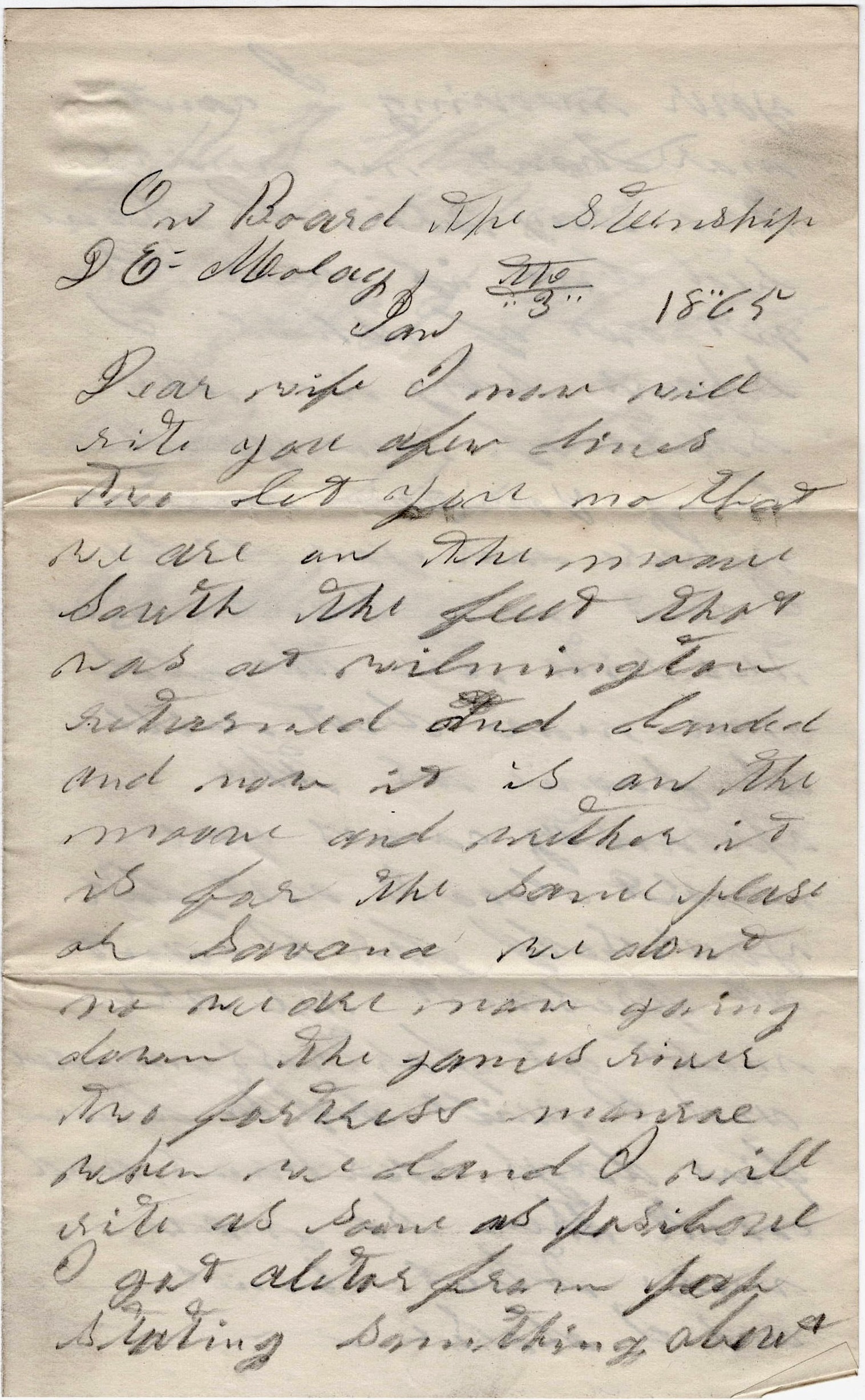
On board the steamship DeMolay January 3, 1865
Dear wife,
I now will write you a few lines to let you know that we are on the move south. The fleet that was at Wilmington returned and landed and now it is on the move and whether it is for the same place or Savannah, we don’t know. We are now going down the James river to Fortress Monroe. When we land, I will write as soon as possible.
I got a letter from pap stating something about your moving. I can’t nor hant no more to say than I have said but if I ever get out of this, I shan’t stay in the State of New York long. You can move wherever you like. I can’t nor hant time to write to the old Ma now but will as soon as the opportunity comes. You must look out for yourself for I can’t at present.
We are most at Fortress Monroe and I will have to draw five days rations and cook them so no more this time and I close.
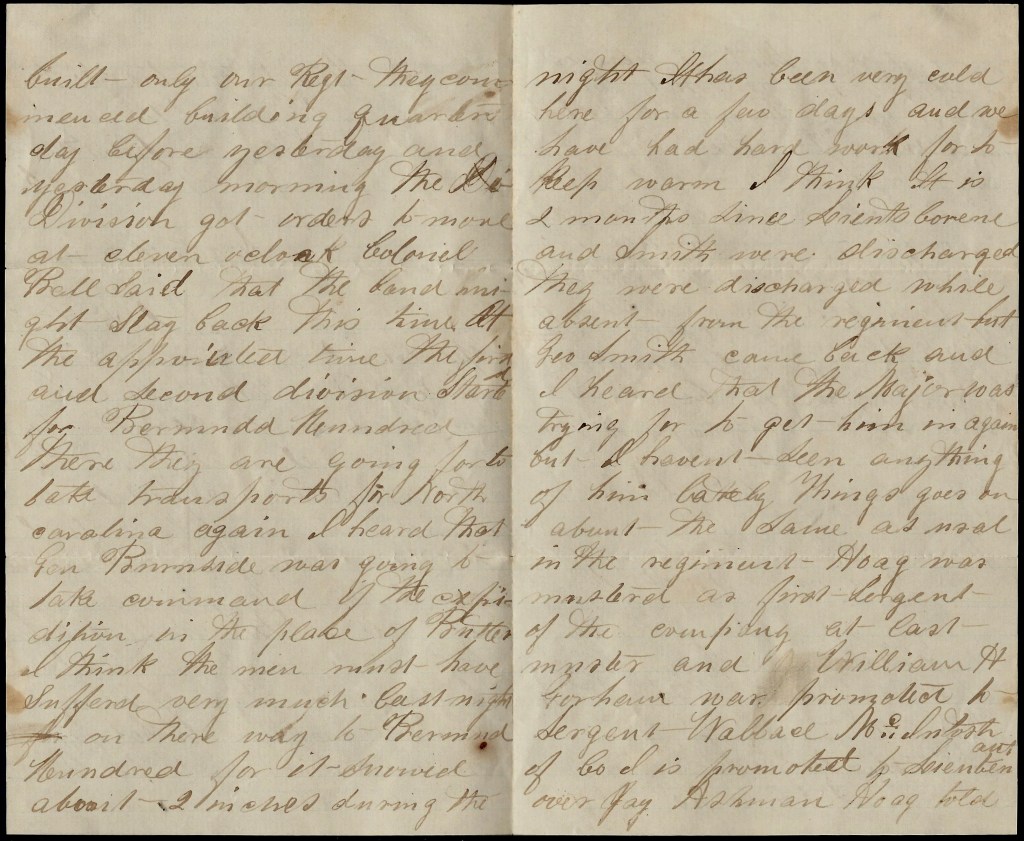
The following letter was written by Henry Clark (1845-1893), the son of George Clark (1821-1896) and Rhoda Parks (1820-1852) of Clifton Park, Saratoga county, New York. When he was eighteen years old, Henry enlisted to serve a three year term beginning on 8 August 1862 in Co. H, 115th New York Infantry. He was among the thousands of troops surrendered by their commander at Harpers Ferry in September 1862, paroled, and sent to Chicago to await exchange. As regimental bands were disbanded by Congress in October 1862, Henry continued to serve in the Brigade Band. He mustered out with his regiment at Raleigh, North Carolina, on 17 June 1865.
At the time of this letter, datelined 4 January 1865, the Third Brigade consisted of Henry’s own 115th New York, 169th New York, 13th Indiana, 9th Maine, and 4th New Hampshire. Colonel Louis Bell of the 4th New Hampshire acted at Brigade commander.
In his letter Henry refers to his brigade having recently returned from their expedition to Fort Fisher, North Carolina, which proved a failure. Not long after having returned to Virginia, the Brigade returned to North Carolina and participated in the assault and capture of Fort Fisher on 15 January 1865.
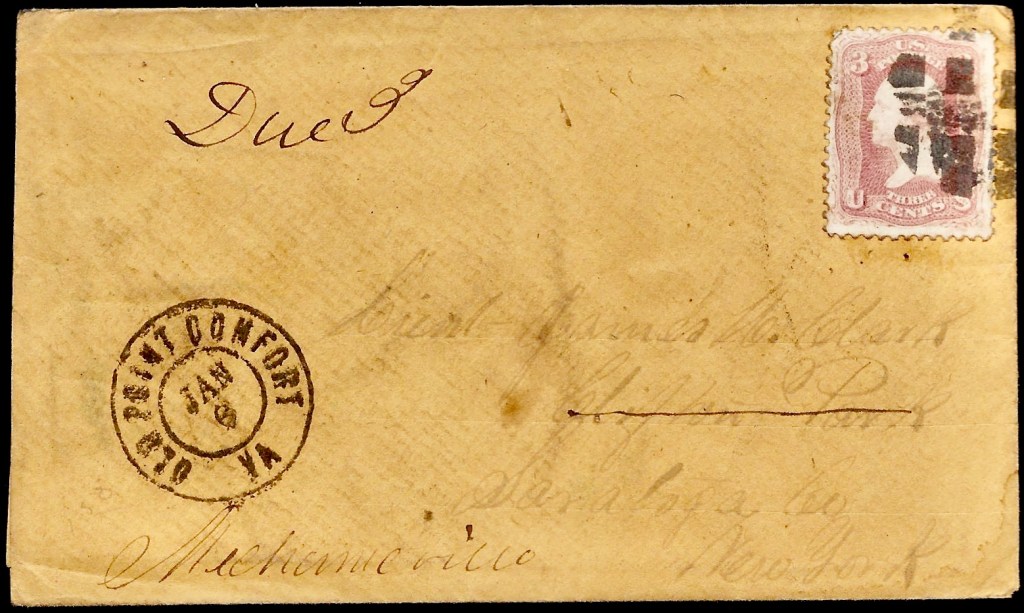
Henry wrote the letter to his cousin and former comrade, Lt. James H. Clark of Clifton Park who was wounded in action on 20 February 1864 at Olustee, Florida and was discharged for disability on 29 December 1864.
A typical Brigade Band during the American Civil War (Military Images)
Transcription
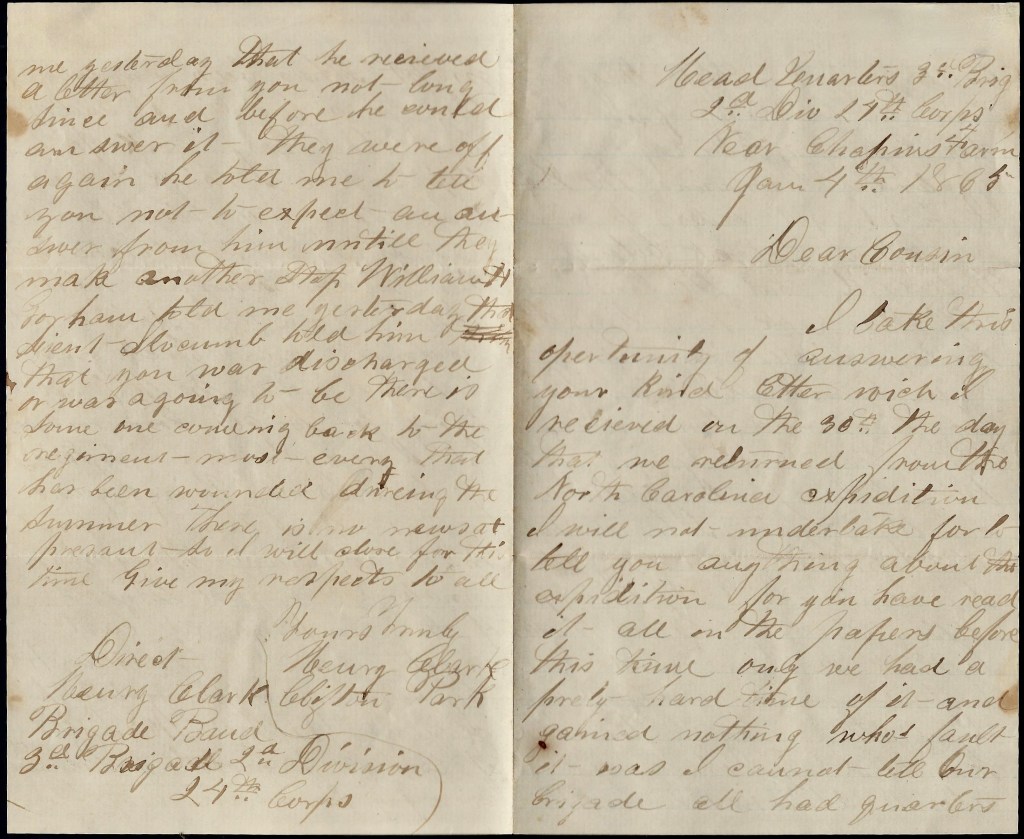
Headquarters 3rd Brigade 2nd Division, 24th Corps Near Chapin’s Farm January 4th 1865
Dear Cousin,
I take this opportunity of answering your kind letter which I received on the 30th—the day that we returned from the North Carolina expedition. I will not undertake for to tell you anything about the expedition for you have read it all in the papers before this time, only we had a pretty hard time of it and gained nothing. Whose fault it was, I cannot tell.
Our Brigade all had quarters built—only our Regiment. They commenced building quarters day before yesterday and yesterday morning the Division got orders to move at eleven o’clock. Colonel [Louis] Bell 1 said that the band might stay back this time. At the appointed time the fourth and Second Division started for Bermuda Hundred. There they are going for to take transports for North Carolina again. I heard that Gen. Burnside was going to take command of the expedition in the place of Butler. I think the men must have suffered very much last night on their way to Bermuda Hundred for it snowed about two inches during the night.
It has been very cold here for a few days and we have had hard work for to keep warm. I think it is two months since Lieuts. Corene and Smith were discharged while absent from the regiment but George Smith came back and I heard that the Major was trying for to get him in again but I haven’t seen anything of him lately.
Things go on about the same as usual in the regiment. [George T.] Hoag was mustered as 1st Sergeant of the company at last muster and William H. Gorham was promoted to Sergeant. Wallace McIntosh of Co. I is promoted to Lieutenant over Jay Ashman. Hoag told me yesterday that he received a letter from you not long since and before he could answer it, they were off again. He told me to tell you not to expect an answer from him until they make another stop.
William H. Gorham told me yesterday that Lieut. [Aaron C.] Slocumb told him that you was discharged or was a going to be. There is some one coming back to the regiment most every [day] that has been wounded during the summer. There is no news at present so I will close for this time. Give my respects to all.
Yours truly, — Henry Clark, Clifton Park
Direct to Henry Clark, Brigade Band, 3rd Brigade, 2nd Division, 24th Corps
1 Col. Louis Bell, commander of the 3rd Brigade, 2nd Division, 24th Army Corps, never made it to Fort Fisher in the assault. He fell with a bullet through his chest, at the head of his brigade, not far from the bridge leading to the river road sally port. The colonel later managed to ask if his wound was fatal. A surgeon gently confirmed that it likely was. “I thought as much,” admitted Bell. He was dead before sunrise, and the survivors of the Third Brigade were crushed by the loss of their popular commander.