1890: Morgan Hughes to Thomas Benton Kelley

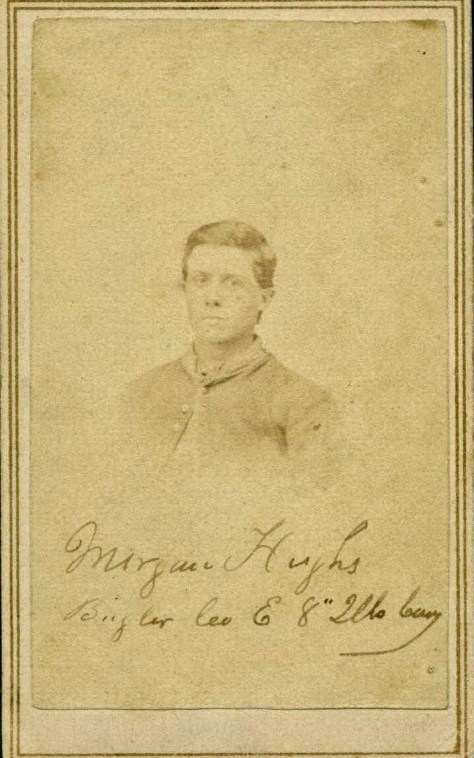
Morgan Hughes, Bugler, Co. E, 8th Illinois Cavalry

Morgan Hughes enlisted in Co. E of the 8th Illinois Cavalry on September 18th, 1861 in Saint Charles, Illinois at Camp Kane. Towards the end of his original three year enlistment, he reenlisted as a veteran. The official records show him mustering out of service on July 17th, 1865 as a bugler in Chicago, Illinois.

Muster rolls show him as being the bugler of Co. E at the time of the battle of Gettysburg. The battle was started by Lt. Marcellus Jones of Co. E, who fired the first shot from Levi Shaffer’s carbine and gave the command to open fire to the rest of the boys of Co. E. As bugler Morgan would have been the company’s main means of communication. One source suggests that Morgan was standing next to or near Lt. Jones when he fired the first shot of the battle.

The Illinois 8th Cavalry was attached to General Buford’s Corps. They were the first union troops to enter Gettysburg, and the first to fire on the Confederate forces early on July 1, 1863. Buford’s Corps held off the Confederate troops until reinforcements arrived on the evening of the 1st.

Morgan’s obituary appeared in the Aurora Beacon News on Wednesday, November 1, 1916:

Death Summons Morgan Hughes—Prominent Civil War Veteran and Grand Army Officer Passes away Late Yesterday

Was for 22 Years Officer of the Day for Post 20 G.A.R. -Funeral Friday Afternoon

Morgan Hughes, aged 73 years, veteran of the civil war, and one of the best known men of Aurora, died yesterday afternoon at 1 o’clock at his home. 438 North Avenue, after a lingering illness of nearly three years.

Mr. Hughes was born at Schuylkill Haven, Pa., July 25, 1843, and came to Illinois in 1856, first settling on a farm near Naperville. Later, at the close of the civil war, in 1866, through which he had served, he moved into this city. He enlisted at the outbreak of the war at age of 19 years and served four years in Company E, Eighth Illinois Cavalry as Bugler. He was past commander of G.A.R. post no. 20, of Aurora and was always active in the social and other activities of that organization from the time it was formed. He was Officer of the Day of the post for 22 years. For many years he had charge of a squad of the old veterans which visited the different schools each Decoration Day. He had been connected with the Western United Gas & Electric Co. for the past 25 years in the capacity of salesman.

Mr. Hughes leaves to mourn his death, his wife Lavinia; three children, Frank A. Hughes, Omaha, Neb., Bert Hughes, Detroit, Mich., and Mrs. George Shields of Aurora; three brothers, Joseph, Bushrod and Martin, all of Naperville; two sisters, Mrs. Sarah Enck and Mrs. Hartzell of Naperville; four grandchildren, Agatha and Virginia Adams, Corp. Russell G. Hughes who is at the border at the present time, and Aldine Hughes of Detroit.

The funeral Services will be held from the Grand Army hall Friday afternoon at 3 o’clock. Full military Grand Army burial services will be held under the charge of Comrade Cronk. The Rev. R.H. Claxon of the First Baptist church will officiate. Short services at the home, 438 North Avenue will precede the services at the G.A.R. hall, and will be strictly private, for family only. Interment will be in Montgomery Cemetery. [Military History Online]

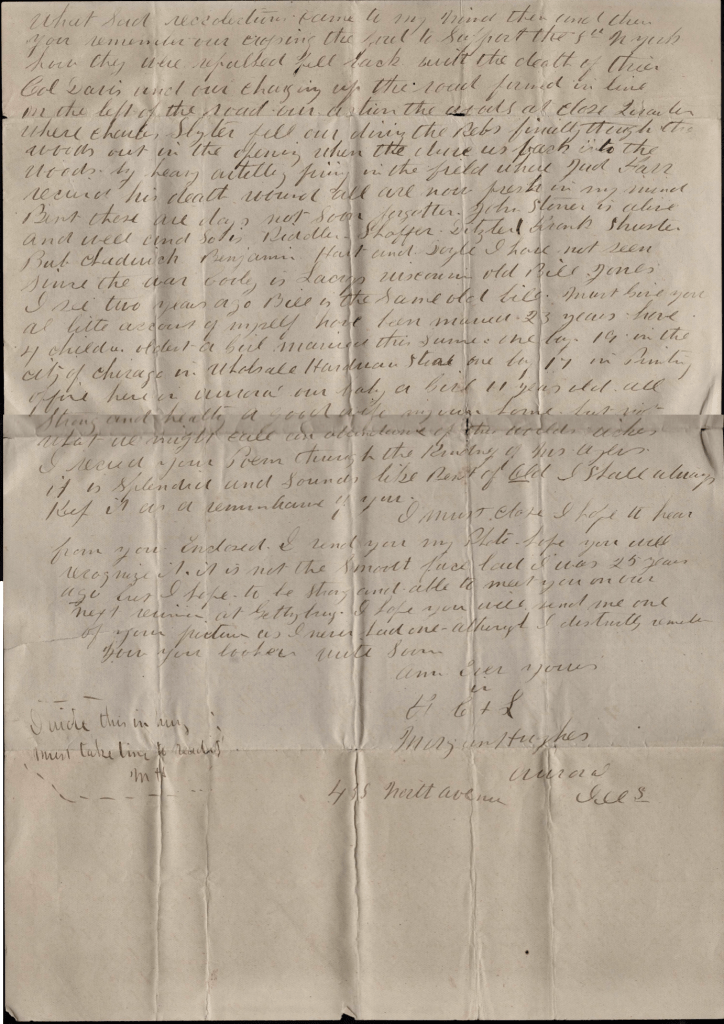
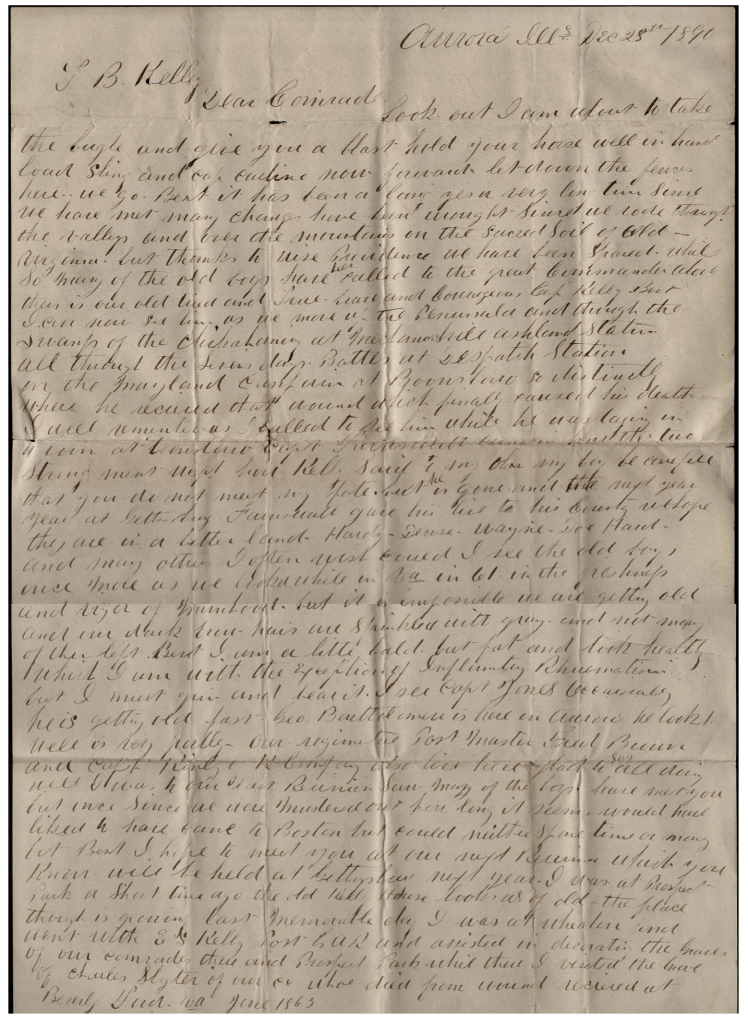
The following letter, written in December 1890, to his comrade Bent Kelley, records some remembrances of their time together in the 8th Illinois Cavalry during the Civil War.

Bugler Morgan Hughe’s bugle and tintype on display in the Gettysburg Cyclorama & Museum (on loan from the Mary Jane Fraley Family)

Transcription

Aurora, Illinois
December 28th 1890

T. B. Kelley
Dear Comrade

Look out! I am about to take the bugle and give you a blast. Hold your horse well in hand—load, sling, and cap carbine. Now forward, let down the fence—here we go! Bent, it has been a long—yes, a very long time since we have met. Many changes have been wrought since we rode through the valleys and over the mountains on the Sacred Soil of Old Virginia. But thanks to Wise Providence, we have been spared while so many of the old boys have been called to the great Commander above. There is our old, tired and true, brave and courageous Capt. [Elisha S.] Kelley. Bent, I can now see him as we move up the Peninsula and through the swamp of the Chickahominy at Mechanicsville, Ashland Station, all through the Seven Days Battles, at Despatch Station, on the Maryland Campaign at Boonsboro, so distinctly where he received that wound which finally caused his death.

I well remember I called to see him while he was laying in a room at Boonsboro. Capt. [Elon J.] Farnsworth came in and the two strong men wept but Kelley said, “Oh my boy, be careful that you do not meet my fate.” But he is gone and the next year at Gettysburg, Farnsworth gave his life to his country. We hope they are in a better land. Hardy, Deuse, Wayne, Doc, Hard and many others. I often wish I could see the old boys once more as we looked while in Virginia in ’61 in the freshness and vigor of manhood. But it is impossible. We are getting old and our dark brow hairs are sprinkled with gray and not many of them left. Bent, I am a little bald, but fat and look healthy which I am with the exception of inflammatory rheumatism. But I must grin and bear it.

I see Capt. [Marcellus] Jones occasionally. He is getting old fast. George Bartholomew is here in Aurora. He looks well. Is very portly. Our regimental post master Fred Brown and Capt. [John A.] Kinley of K Company also live here, glad to say all doing well. I was to our last reunion. Saw many of the boys. Have met you but once since we were mustered out. How long it seems. Would have like to have come to Boston but could neither spare tie or money. But Bent, I hope to meet you at our next reunion which you know will be held at Gettysburg next year. I was at Prospect Park a short time ago. The Old Kelley House looks as of old. The place though is growing. Last Memorial Day I was at Wheaton and went with E. S. Kelley Post GAR and assisted in decorating the graves of our comrades there and Prospect Park. While there I visited the graves of Charles Slyter of our company who died from wound received at Beverly Ford, Va. June 1863.

What sad recollections came to my mind then, and then you remember our crossing the ford to support the 8th New York—how they were repulsed, fell back with the death of their Col. Davis, and our charging up the road, formed in line on the left of the road, our action in the woods at close quarters where Charles Slyter fell, our driving the Rebs finally through the woods, out in the opening where they drove us back to the woods by heavy artillery, firing in the field where Jud Farr received his death wound. All are now fresh in my mind.

Bent, these are days not soon forgotten. John Stoner is alive and well and so is Riddle, Shaffer, Ditzler. Frank Shurte, Bub Chadwick, Bejamin Hart and Doyle I have not seen since the war. Cooley is in Lacross, Wisconsin. Old Bill Jones I see two years ago. Bill is the same old Bill.

Must give you a little account of myself. Have been married 23 years, have 4 children, oldest a girl, married this summer. One boy 19 in the City of Chicago in wholesale hardware store, one boy 17 in Printing Office here in Aurora, Our baby, a girl, 11 years old. All strong and healthy. A good wife. My own home but not what we might call an abundance of te world’s riches.

I received your poem through the kindness of Mr. Ayles. It is splendid and sounds like Bent of old. I shall always keep it as a remembrance of you. I must close. I hope to jear from you. Enclosed I send you my photo. Hope you will recognize it. It is not the smooth face lad I was 25 years ago but I hope to be strong and able to meet you on our next reuion at Gettysburg. I hope you will send me one of your pictures. I never had one although I distinctly remember you your looks. Write soon. I am as ever, F C & L, — Morgan Hughes, Aurora, Illinois

“Private Morgan Hughes of Jones’ Co. E, 8th Illinois Cavalry, started the debate in an 1891 submission just a week prior to the dedication of the regiment’s Gettysburg monument. After reading a previous article by a member of the 7th Wisconsin Infantry stating that the ‘Iron Brigade’ of the Army of the Potomac opened the Gettysburg battle, Hughes determined to set the record straight. Lest Buford’s cavalry’s role prior to the general infantry fighting on the first day be forgotten, Hughes recounted his regiment’s arrival at Gettysburg on June 30, and his posting at Jones’ reserve headquarters at Herr’s Tavern. Riding forward with Jones to the picket post at Knoxlyn Ridge, Hughes watched as Jones ‘took a carbine from one of the boys’ and fired at the advancing Confederates. ‘The opening of the battle of Gettysburg,’ Hughes concluded, ‘belongs to the 8th Ill. Cav.’”

1864: John Howard Black to Gabriel Fitzgerald Black, Sr.

Capt. Thomas Rhodes Duval commanded Co. D, 62nd Georgia Cavalry. His sword and jacket are in the New Orleans Confederate Museum.

The following poignant letter was written by John Howard Black (1846-1864), the son of Gabriel Fitzgerald Black, Sr. (1806-1879) and Susan Howard (1818-1874) of Yadkin county, North Carolina. John served in the Confederate army as a member of Co. D, 62nd Georgia Cavalry which was transferred to the 8th Georgia Cavalry at about the time this letter was penciled. John’s letter describes the death and burial of his older brother, 19 year-old Marmaduke (“Duke”) William Black (1844-1864) who served in the same company.

In less than three months, John also died of disease in a Richmond Hospital on 6 October 1864.

Transcription

Addressed to Mr. Gabriel Black

July 14, 1864

Dear Father and Mother, Brothers and Sisters,

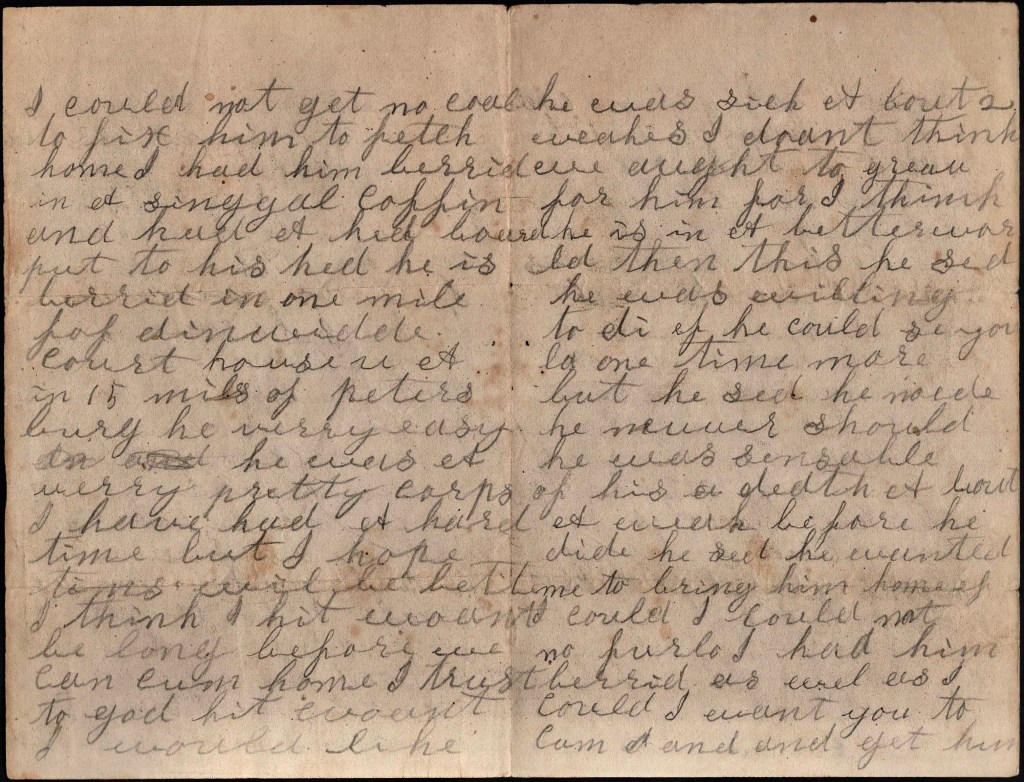
I take my pen in hand to let you know I have not forgot you yet. I have wrote to you twice since Duke died. I am very sorry too we had to part with him but we can’t help it. He was attended as well as if he had been at home. I was with him all the time. He was 1 mile of Dinwiddie Court House at John H. Young’s. He died the 9th. I could not get no [char]coal 1 to fix him to fetch home. I had him buried in a single coffin and had a head board put to his head. He is buried in one mile of Dinwiddie Court House and in 15 miles of Petersburg. He [died] very easy. He was a very pretty corpse. I have had a hard time but I hope times will be better. I think it won’t be long before we can come home. I trust to God it won’t.

He was sick about two weeks. I don’t think we ought to grieve for him for I think he is in a better world than this. He said he was willing to die if he could see you all one time more but he said he knowed he never should. He was sensible of his death. About a week before he died, he said he wanted me to bring him home if I could. I could not—no furlough. I had him buried as well as I could. I want you to come and get him. I would like to hear from you. I would like to see you all and hope I will soon. I think this cruel war will close soon. So I must close, Write soon. Direct to Petersburg, Va. in care of Captain [Thomas Rhodes] Duval, Co. D, 62nd Georgia [Cavalry]

So I remain your loving son until death, — John


1 Charcoal and alcohol were occasionally used to forestall decay, particularly in the heat of the summer when ice was not available.

1864: James Beasley to Amanda A. Beasley

I could not find an image of James but here is one of Franklin Hoobler of Co. G, 129th Illinois. Franklin was killed by an accidental gunshot in April 1863. (Photo Sleuth)

The following letter was written by James Beasley (1840-1903), the son of James H. Beasley (1804-1854) and Hannah Cowgill (1811-Aft1880) of Winchester, Scott county, Illinois.

James enlisted on 13 August 1862 in Co. D, 129th Illinois Infantry. At the time of his enlistment, he was described as a 5 foot 6 inch tall, dark-haired, hazel-eyed, single farmer. He mustered into the regiment on 8 September 1862 and mustered out on 8 June 1865 at Washington D. C.

Also serving in the same company with James was his younger brother, George A. Beasley (1843-1924). He wrote the letter to his younger sister, Amanda A. Beasley (1848-1931). He refers to his younger brothers Dick (b. 1844) and Ben (b. 1846).

Transcription

Near the Chattahoochie River
September 12, 1864

Kind sister,

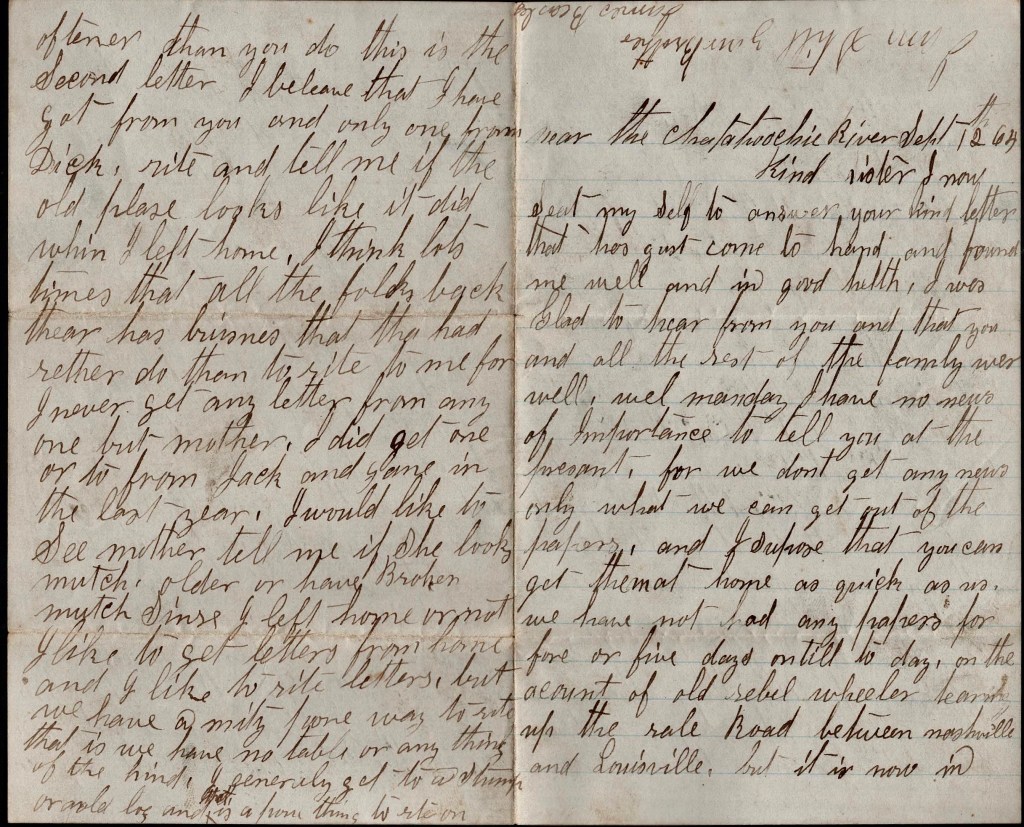
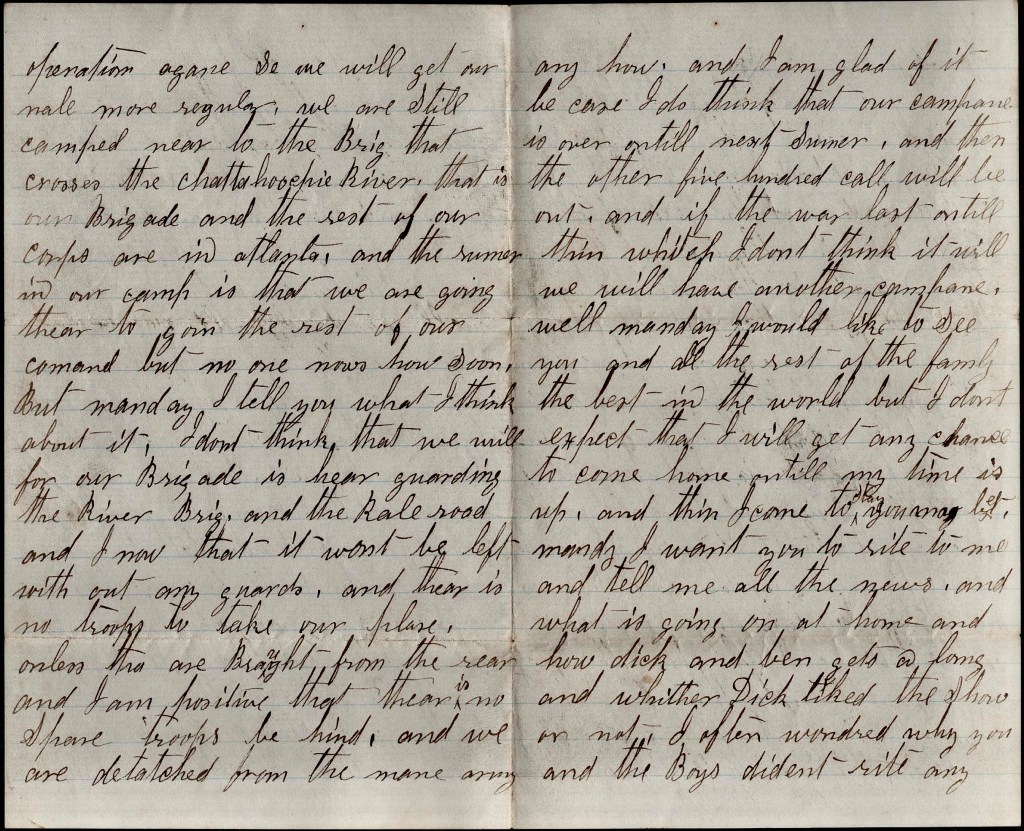
I now seat myself to answer your kind letter that has just come to hand and found me well and in good health. I was glad to hear from you and that you and all the rest of the family were well. Well, Mandy, I have no news of importance to tell you at the present for we don’t get any news—only what we can get out of the papers, and I suppose that you can get them at home as quick as us. We have not had any papers for four or five days until today on the account of Old Rebel Wheeler tearing up the railroad between Nashville and Louisville. But it is now in operation again so we will get our mail more regular.

We are still camped near to the bridge that crosses the Chattahoochie river—that is, our Brigade—and the rest of our Corps are in Atlanta. And the rumor in our camp is that we are going there to join the rest of our command but no one knows how soon. But Mandy, I tell you what I think about it, I don’t think that we will for our Brigade is here guarding the river bridge and the railroad and I know that it won’t be left without any guards. And there is no troops to take our place. unless they are brought from the rear and I am positive that there is no spare stroops behind. And we are detached from the main army anyhow and I am glad of it because I do think that our company is over until next summer and then the other five hundred call will be out. And if the war lasts until then—which I don’t think it will—we will have another campaign.

Well, Mandy, I would like to see you and all the rest of the family the best in the world but I don’t expect that I will ever get a chance to come home until my time is up. And then I come to stay, you may bet. Mandy, I want you to write me and tell me all the news and what is going on at home and how Dick and Ben gets along and whether Dick liked the show or not. I often wondered why you and the Boys didn’t write any oftener than you do. This is the second letter, I believe, that I have got from you and only one from Dick. Write and tell me if the old place looks like it did when I left home. I think lots times that all the folks back there has business that they had rather do than to write to me for I never get any letter from anyone but Mother. I did get one or two from Jack and Jane in the last year. I would like to see Mother. Tell me if she looks much older or have broken much since I left home or not.

I like to get letters from home and I like to write letters, but we have a mighty poor way to write—that is, we have no table or anything of the kind. I generally get to a stump or old log and it is a poor thing to write on. I am still your brother, — James Beasley

1862-64: George Beasley to his Family

I could not find an image of George but here is one of William Wesley Propst of Co. K, 129th Illinois Infantry. (Craig Colandro Collection)

The following letters were written by George A. Beasley (1843-1924), the son of James H. Beasley (1804-1854) and Hannah Cowgill (1811-Aft1880) of Winchester, Scott county, Illinois. George was 19 years old when he enlisted in Co. D, 129th Illinois Infantry. At the time of his enlistment, he was described as a 5 foot 5 inch tall, dark-haired, hazel-eyed, single farmer. He mustered into the regiment on 8 September 1862 at Pontiac and mustered out on 8 June 1865 at Washington D. C.

The third letter suggests that some time between his enlistment and March 1864, George was married to Mary Elizabeth Long. The couple were divorced in 1878.

Also serving in the same company with George was his older brother, James Beasley (1840-1903).

Letter 1

Nashville, Tennessee
February 3, 1863

Kind and beloved sister,

It is the will of God that I am permitted to write you a few lines. The letter you wrote last came to hand the other day and found us all well. It was received with joy by me. I was truly glad to hear that you had not forgotten me but I was sorry to hear that you had all been sick. I hope by the time you get those few lines they may find the health of the family good.

Sister, you wrote as if you thought I had forgotten you but you need not cherish any such idea. I ofttimes think of you when the camp lights is blown out. This is a beautiful day. The sun shines brightly. The air is mild and pleasant but there is considerable stir in camp. We have orders to march to Bridgeport, Alabama—the distance of one hundred and thirteen miles. The roads are very bad at present and it looks as if it will be a hard trip for us to travel.

Tell Mother that I have not had a letter from her for some time. I have wrote several letters to you since I left Gallatin which I have got no answer from. There is no telling when I will have the opportunity of writing to you again. If you please, write to me for you have a better way of writing than I have.

I will give you the prices of produce as follows. Eggs is worth thirty cents a dozen. Butter sixty cents per pound. Cheese thirty cents per pound. Chickens is worth 6 dollars a dozen. Fresh pork $10 a hundred. Beef the same. Corn is worth 60 cents per bushel. Oats the same. Board is worth 7 to 10 dollars a week. Money is plenty and trade is scarce. Wood sold here this winter as high as 24 dollars a cord and there was some families have had to do without wood. There was a woman told me she had to do without a fire in her house for two days before she could get wood to buy.

Sister, I must begin to make arrangements to march so I will close. Your loving brother, — George A. Beasley

Look over mistakes, bad spelling, &c. Direct your letters to this place and they will follow us.


Letter 2

South Tunnel, Tennessee
March 24, 1863

Dear Sister,

I this morning take my pen in hand to answer your kind letter. It was dated March the 15th. Your letter found me in middling health. Sisterm you wanted me to tell you what the present cost I sent you. It cost me 450 cts. Sister, you are welcome to them and ten times as much more if you need it.

Sister, you wrote that you thought the war would come to a close. I think it will myself and then if I am alive, I will come home to see you. The Boys is in middling good health and good spirits. They say that they will be at home before long. The rebels is getting what they need at all points and I think they will have to sue for peace before long.

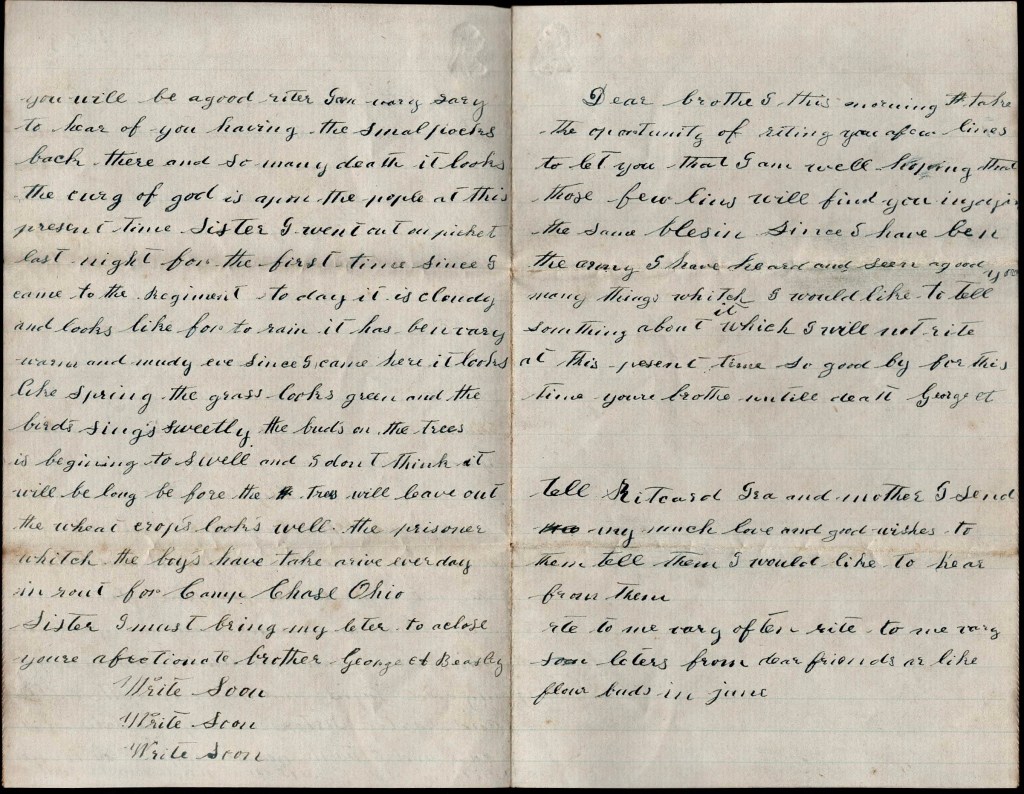
Sister, I have underwent a good many afflictions since I last saw you which I hope is for my good. James [Beasley] and Peter [Frame] is both well and hearty. Sister, I read your letter with ease and I think you have improved in your writing and if you keep on it, it won’t be long before you will be a good writer. I am very sorry to hear of you having the small pox back there and so many deaths. It looks [as if] the curse of God is upon the people at this present time.

Sister, I went out on picket last night for the first time since I came to the regiment. Today it is cloudy and looks like for to rain. It has been very warm and windy ever since I came here. It looks like spring. The grass looks green and the birds sings sweetly. The buds on the trees is beginning to swell and I don’t think it will be long before the trees will leaf out. The wheat crops look well. The prisoners which the Boys have taken arrive every day in route for Camp Chase, Ohio.

Sister, I must bring my letter to a close. Your affectionate brother, — George A. Beasley

Write soon. Write soon. Write soon.

Dear brother, this morning I take the opportunity of writing you a few lines to let you know that I am well, hoping these few lines will find you enjoying the same blessing. Since I have been away, I have heard and seen a good many things which I would like to tell you something about it which I will not write at this present time. So goodbye for this time. Your brother until death. — George

Tell Richard Gea and Mother I send my much love and good wushes to them. Tell them I would like to hear from them. Write to me very often. Write to me very son. Letters from dear friends are like flower buds in June.


Letter 3

Nashville, Tennessee
March 11th 1862 [should be 1864]

Kind and loving sister,

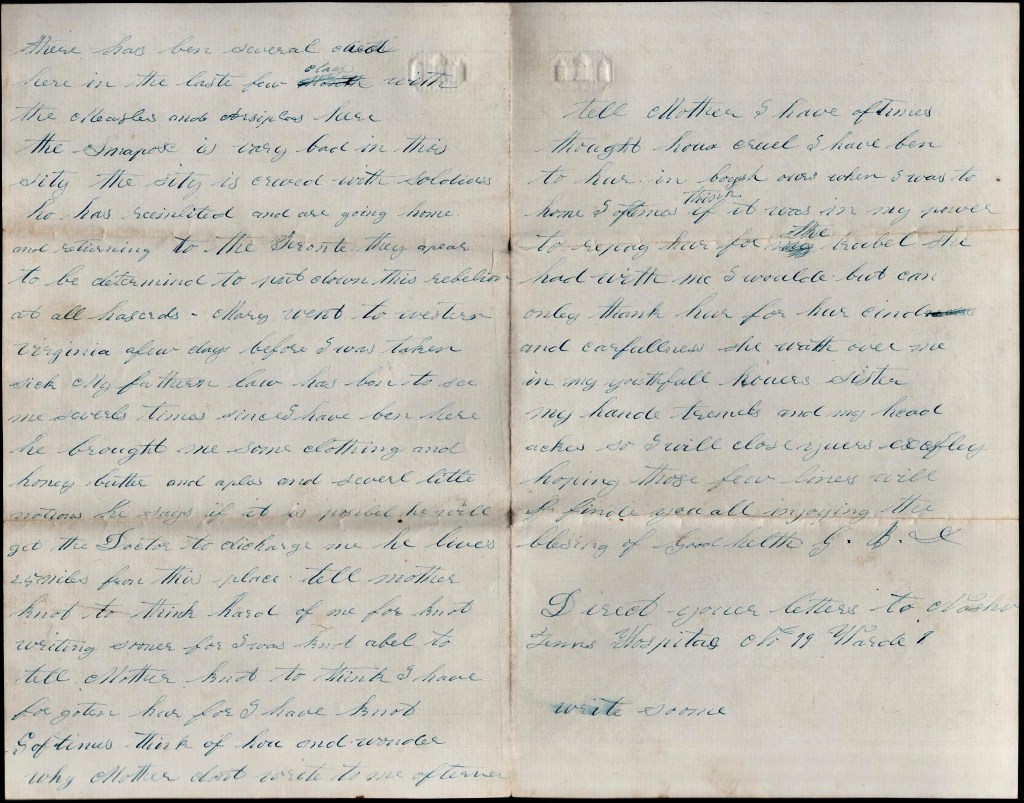
It is with the greatest pleasure I seat myself to answer your kind and loving letter which came to hand a few days ago. It was gladly received with joy by me. Sister, I would like to tell [you] that I was well but I cannot. There is some disease like the [ ]. This has been very hard on me. We have an attentive physician to attend us and are in a good hospital which many a poor soldier has not. Therefore, I think I have no room to complain. It is true my bodily health is not good, but that is nothing strange for me. It looks like I have been afflicted so much that it comes natural to me for to be so. Therefore, I am contented with my lot. This is the second time I have been up since I have been here.

Our regiment left some time last month. Jonas and Peter was both well the last time I saw them. There has been several died here in the last few days with the measles and erysipelas here. The smallpox is very bad in this city. The city is crowded with soldiers who has reenlisted and are going home and returning to the front. They appear to be determined to put down this rebellion at all hazards.

Mary went to western Virginia a few days before I was taken sick. My father-in-law has been to see me several times since I have been here. He brought me some clothing and honey butter and apples and several little notions. He says if it is possible, he will get the doctor to discharge me. He lives 25 miles from this place.

Tell Mother not to think hard of me for not writing sooner for I was not able to. Tell Mother not to think I have forgotten her for I have not. I ofttimes think of her and wonder why Mother don’t write to me oftener. Tell Mother I have ofttimes thought how cruel I have been to her in boyish hours when I was to home. I ofttimes think if it was in my power to repay her for the trouble she had with me I would, but can only thank her for her kind and carefulness she watched over me in my youthful hours.

Sister, my hand trembles and my head aches so I will close, hoping these few lines will find you all enjoying the blessing of good health, — G. B.

Direct your letters to Nashville, Tennessee, No. 19, Ward 1

Write soon.

Sister, you was telling me about that nut cracking [and] how you girls had such a jolly time and how you wished me there. It is true I would like to have been present with you. It gives me much joy to hear of you girls enjoying yourselves back there in Old Scott [county]. You was saying you wished for the war to close. Yes, and so do I.

Mary was to see me before she left. It was a sad parting to us both but Grandpa was sick and she had to go take care of him. The enjoyment of life will soon be gone, our youth hour no more.


1864: Isaac D. Kelley to Thomas Benton Kelley

I could not find an image of Isaac but here is a self portrait of Sgt. John T. Becker who also served in the 105th Illinois Infantry (Co. G).

The following letters were written by Isaac D. Kelley (1834-1871), the son of David Kelley (1806-1876) and Susanna Dixon Jones (1799-1884) of DuPage county, Illinois—formerly of Rutland, Vermont.

Isaac was listed as a 28 year-old single farmer of Naperville, DuPage Co., Illinois when he was mustered in as a Sergeant at Dixon, Illinois, in Co. B, 105th Illinois Infantry. He was described as being 6 feet tall with blue eyes, dark hair and a dark complexion. He mustered out as a sergeant at Washington DC on June 7, 1865. His name does not appear on the veterans monument in the cemetery though it does appear in numerous old lists of Civil War veterans buried in Rutland cemeteries. Isaac was married on 17 April 1864 while still in the service (he mentions getting a leave to go home in late March 1864 to get married). He married Zina Whitney in DuPage Co., Illinois. Isaac survived the war but died tragically in 1871 while on his way to Rutland to buy a train ticket for his mother. On that day, he was robbed and murdered at the old Billings covered bridge. He was 37 years old.
Both of these letters were written to his younger brother, Thomas Benton Kelley (1838-1915) who served in the 8th Illinois Cavalry.
Letter 1

Headquarters 1st Brigade, 3rd Division, 20th Army Corps
Near Marietta, Georgia
July the 10th 1864

Dear Brother Benton,

Absent but not forgotten, I take my pen in hand to let you know that I am still alive and right well. Hope these few lines will find you the same. Dear brother, I hope that you have not forgotten your brother. It seems a long time since I have had any letters from you and it is too.

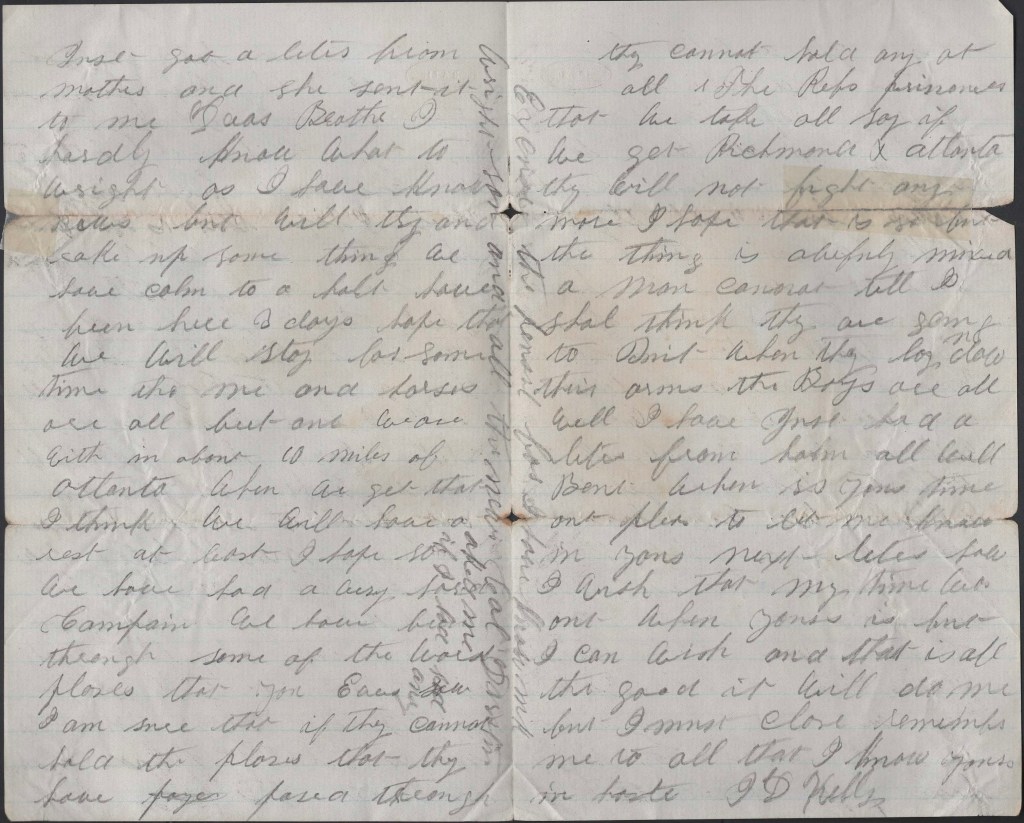
I left Nashville for home the last of March [and] have not had any letters since. I should of wrote to you before now but I had not got your address. But I have just got a letter from mother and she sent it to me. Dear Brother, I hardly know what to write as I have no news but will try and make up something. We have come to a halt. Have been here three days. Hope that we will stay some time cause the men and horses are all beat and we are within about 10 miles of Atlanta. When we get that, I think we will have a rest—at least I hope so.

We have had a busy, hard campaign. We have been through some of the worst places that you ever saw. I am sure that if they cannot hold the places that they have passed through, they cannot hold any at all. The Reb prisoners that we take all say if we get Richmond & Atlanta, they will not fight anymore. I hope that is so, but the thing is awfully mixed. A man cannot tell. I shall think they are going to [ ] when they lay down their arms.

The Boys are all well. I have just had a letter from home. All well. Bent, when is your time out? Pleas let me know in your next letter. How I wish that my time was out when yours is, but I can wish and that is all the good it will do me. But I must close. Remember me to all that I know. yours in haste, — I. D. Kelley


Letter 2

Camp near Atlanta, Georgia
August 4th 1864

Dear Brother,

It is with pleasure that I take my pen in hand to let you know that I am well. Hope that these few lines will find you the same.

Dear brother, I received a letter from you some days ago but have failed to answer it until now for I have been very busy since the 14th of July. Have been on the move almost every day. We have had some awful hard fighting since the 10th of last month and the 20th Corps has had its share of it to do and a little more. Dear brother, it is awful to see how our boys slayed the Rebs the 20th and 22nd and 29th of July. The Rebs just lay in heaps. They came against the 20th Corps 4 and 5 lines deep and ours only one but our boys drove them back six times in succession. They just lay in heaps. We had 150 of their wounded in our hospital. Those that were slightly wounded got away but you better believe that many of them that we got had holes enough to last them a spell. Many of them died while we lay there and many more will.

Hooker has left us and I am afraid that we will miss him. The boys did not want him to leave. He had the confidence of the boys and they had that of him. But it may be that it is all for the best. I hope so, at least. But enough of this.

We are within 1.5 [miles] of Atlanta. General Sherman could take the place [in] 24 hours if he saw fit but he would have to lose a good many men. They Rebs have a good many men. The Rebs have got awful strong works in our front. The best that you ever saw, I guess, but they have got to get out of Atlanta sooner or later. It may take some time but it will be done.

But I must hasten to close. Your time is almost out. Wish that mine was as near. I hope that you will get out all right. Please to remember me to sister Mary and all of the rest of the friends. Goodbye. Write soon and all the news. Yours in haste, — I. D. Kelley


1862: Gilbert Ogden Olds to Otia Olds

This image from Find-A-Grave is purported to be Gilbert but the uniform doesn’t look correct.

The following letter was written by 17 year-old Gilbert Ogden Olds (1844-1922), the son of Madison Thurston Olds (1811-1880) and Elizabeth Brown (1824-1860). Gilbert was residing at Bloom, Seneca county, Ohio, in December 1861 when he enlisted in Co. G, 55th Ohio Infantry. They were not mustered in until late January 1862. The expedition to Moorefield, Virginia, which Gilbert relates in his letter occurred in mid-February so this letter must have been written in the latter half of February 1862. He remained in the regiment until May 1864 when he was transferred into the Reserve Corps. The 1890 Veterans Schedule indicates he received a gunshot wound to the shoulder.

Gilbert wrote the letter to his Uncle Otia Olds (1807-1888) of Erie county, New York.

Transcription

Addressed to Mr. Otia Olds, Willink P.O., Erie county, New York

Camp Kelley
55th [Ohio] Regiment, Co. G
[Latter half of February 1862]

Otia Olds, sir,

I now find myself seated to write you a few lines on this bit of paper. I am not very well at this present time. Herbert is well. I got a letter from home a few days ago. I stated that they were all [well] excepting Francis and Emma who has not been very well for a time past.

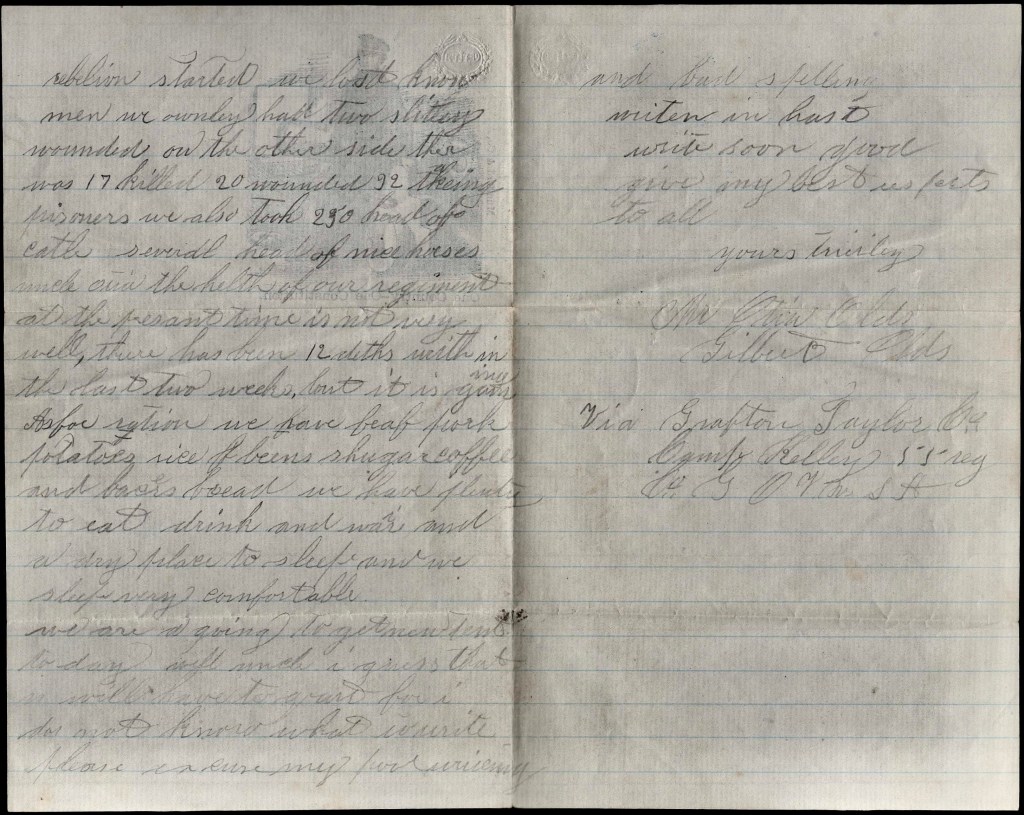
We had only one battle since we have been in the field. We carried the stars and stripes through the streets of Moorefield, Virginia, for the first time since this rebellion started. We lost no men. We only had two slightly wounded. On the other side, there was 17 killed, 20 wounded, [ ]2 taken prisoners. We also took 250 head of cattle [and] several head of nice horses.

Uncle Otia, the health of our regiment at the present time is not very well. There has been 12 deaths within the last two weeks, but it is gaining. As for rations, we have plenty beef, pork, potatoes, rice, beans, sugar, coffee, bacon, and bread. We have plenty to eat, drink and wear, and a dry place to sleep and we sleep very comfortable.

We are a going to get new tents today. Well, Uncle, I guess that we will have to quit for I do not know what to write. Please excuse my poor writing and bad spelling. Written in haste. write soon. Goodbye. Give my best respects to all. Yours truly, — Gilbert Olds

To Mr. Otia Olds

Via Grafton, Taylor county, Va. Camp Kelley, 55th Regt. Co. G, OVI

1863: Alanson Edson Kimball, Jr. to Alanson Bacon

Alanson Edson Kimball

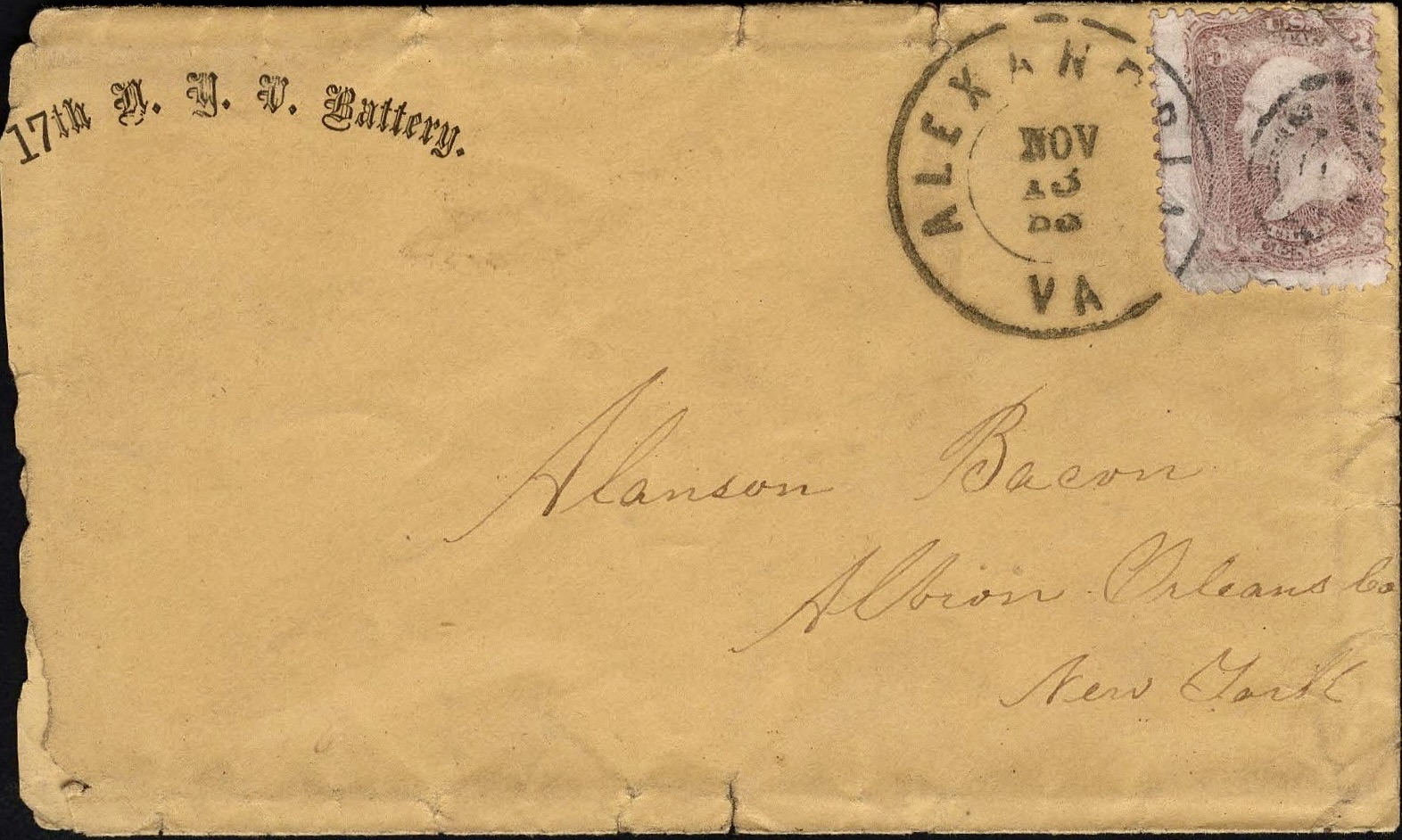
The following letter was written by Alanson Edson Kimball, Jr. (1838-1927), the son of Alanson Kimball (1807-1888) and Josephine Hobby (1810-1882) of Orleans county, New York. Alanson enlisted on 26 August 1862 at Lockport to service in the 17th New York Light Artillery (the “Orleans Battery”). He manned the center 3rd gun. He mustered out of the battery on 12 June 1865.

In his letter, Alanson references his brother Henry (“Hank”) Harrison Kimball (1840-1880) who served in Co. F, 3rd US Regular Infantry.

Alson wrote the letter to his cousin, Alanson Kimball Bacon (1835-1927 of Albion, Orleans county, New York. He was the son of Hosea and Matilda (Kimball) Bacon.

Transcription

Addressed to Alanson Bacon, Albion, Orleans county, New York

Fairfax Court House, Va.
Thursday Morning, Nov. 12th 1863

Dear Cousin,

I have often thought of writing to you, but have never got at it until now. This morning finds me well and in the best of spirits. The Battery has just gone out for drill. We drill most every day. We go out about eight and drill about an hour and come in and the rest of the day we spend fixing up our camp. I think we have got the prettiest camp I ever saw. It is situated about thirty yards west of the Court House. I think if we could stay here this winter, we could enjoy ourselves, but it is rather uncertain about our staying. We will know in a few days if we go.

We will go into the Army of the Potomac. I would like to go if we could go into the 5th Corps. Hank is in that Corps. I had a letter from him about two weeks ago. He was then at Cedar Run. He was well. When the army fell back here, he came within two hundred yards of our camp. I did not know what Brigade and Division he was in or I should of found him. I wish you could been here when the army was back here. It looked the most like war I ever saw it. The road and fields was filled with troops and wagons for miles. This Government is a big machine or it never could keep the thing a running.

There will be some large battles fought before the first of December. They will not get a chance to concentrate their forces at different points as they have before. It is the intention to give them battle at different points. I would be glad to see this cruel war ended, but not till every traitor lays down his arms and confesses his wrongs. I would like to see them all come out as that Rebel General did in Arkansas. I presume you have read his address.

I received a letter from Ebenezer the other day and he said your Father would like to hire my money. I should be glad to let him have it. I want it where it is safe, so if I should ever return home again, I could have it.

Mr. Brown arrived in camp last Sunday. He is not looking so well as he did when he left here. It was a good opportunity for him to go home. I would like a chance to come home in that way. My respects to all, — Alanson Kimball Jr., 17th N. Y. V. Battery Washington, D. C.

Write soon.

1863: Eliza (Simpson) Russell to Lewis Edward Simpson

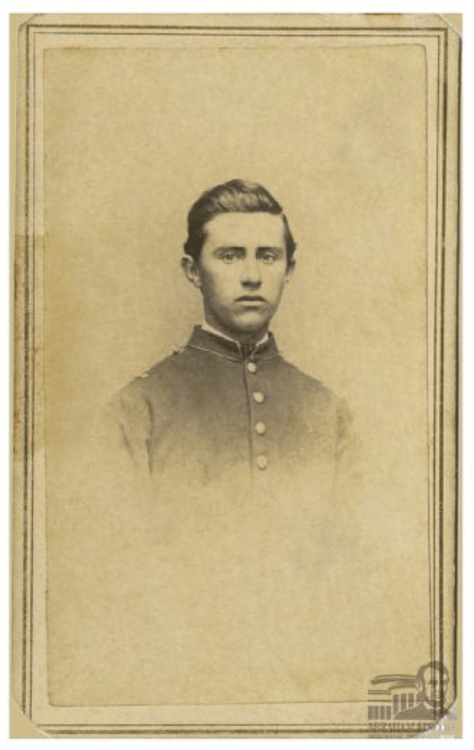
I could not find an image of Lewis but here is one of George J. Gordon who served in Co. C, 77th Illinois Infantry (Lincoln Presidential Library)
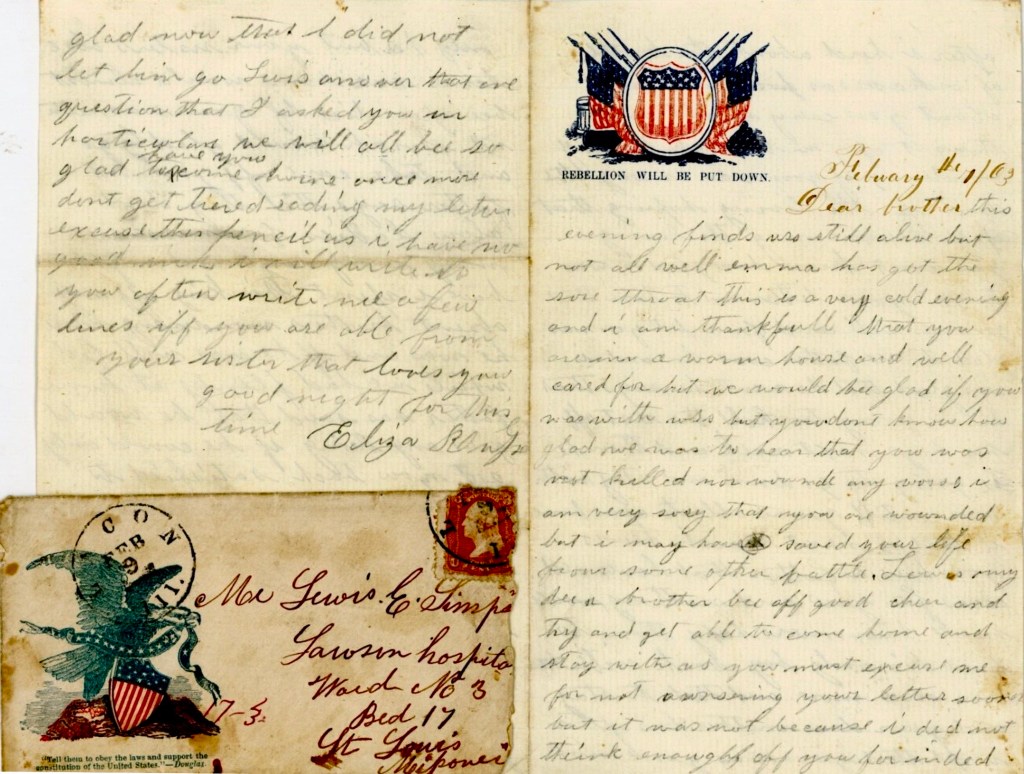
The following letter was written by Eliza (Simpson) Russell to her younger brother, Lewis Edward Russell (1846-1924). Eliza was married in 1858 to Willis Russell (18xx-1870). Lewis and Eliza were two of at least 11 children born to Edward Simpson (1799-1887) and Hatta Maria Ward (1810-1899) of Magnolia, Putnam county, Illinois. Lewis had three brothers who died relatively young, leaving him the only surviving son at the time of his enlistment, when only 16 years old, in Co. B, 77th Illinois Infantry on 22 August 1862.
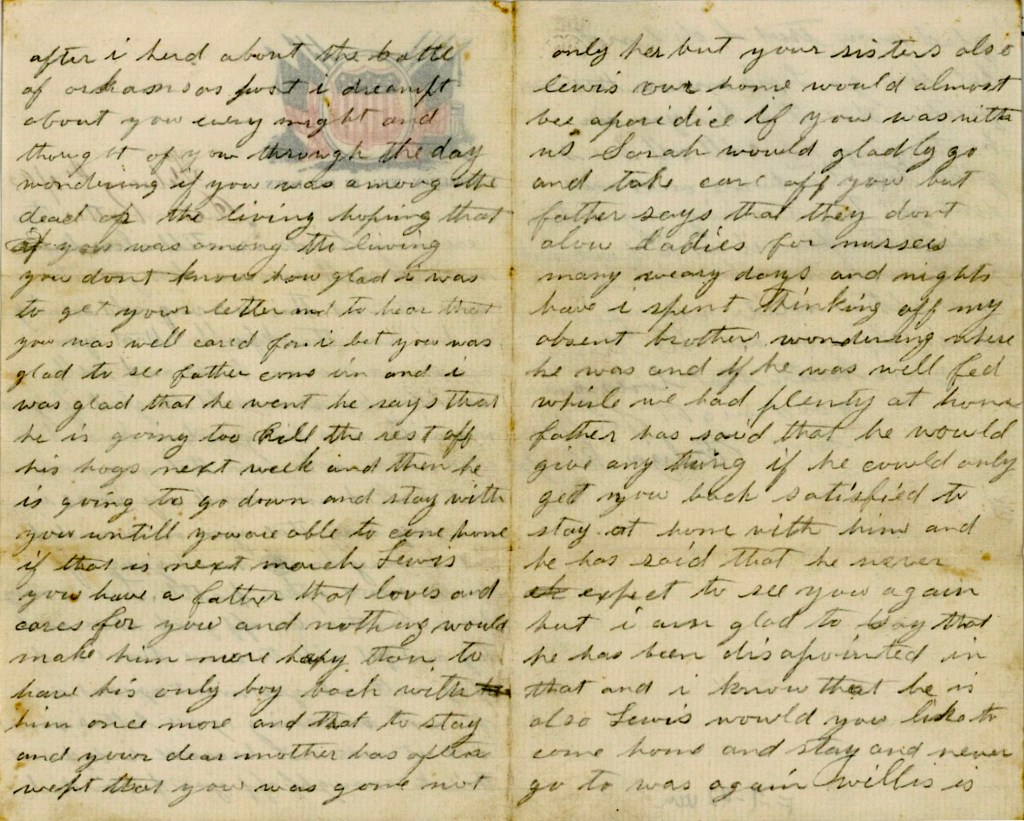
From this letter we learn that Lewis was in the Battle of Arkansas Post on 11 January 1863. The 77th Illinois was in the thick of the fight and later claimed they were the first to scale the fort’s parapets. The 77th suffered six men killed in the battle, with another 39 wounded. Lewis was one of those wounded and was subsequently treated at Lawson Hospital in St. Louis, Missouri. He was discharged from the service on 12 August 1863. Lewis lived near Henry, Illinois, until 1916 when he moved to Hollywood, California.
Transcription

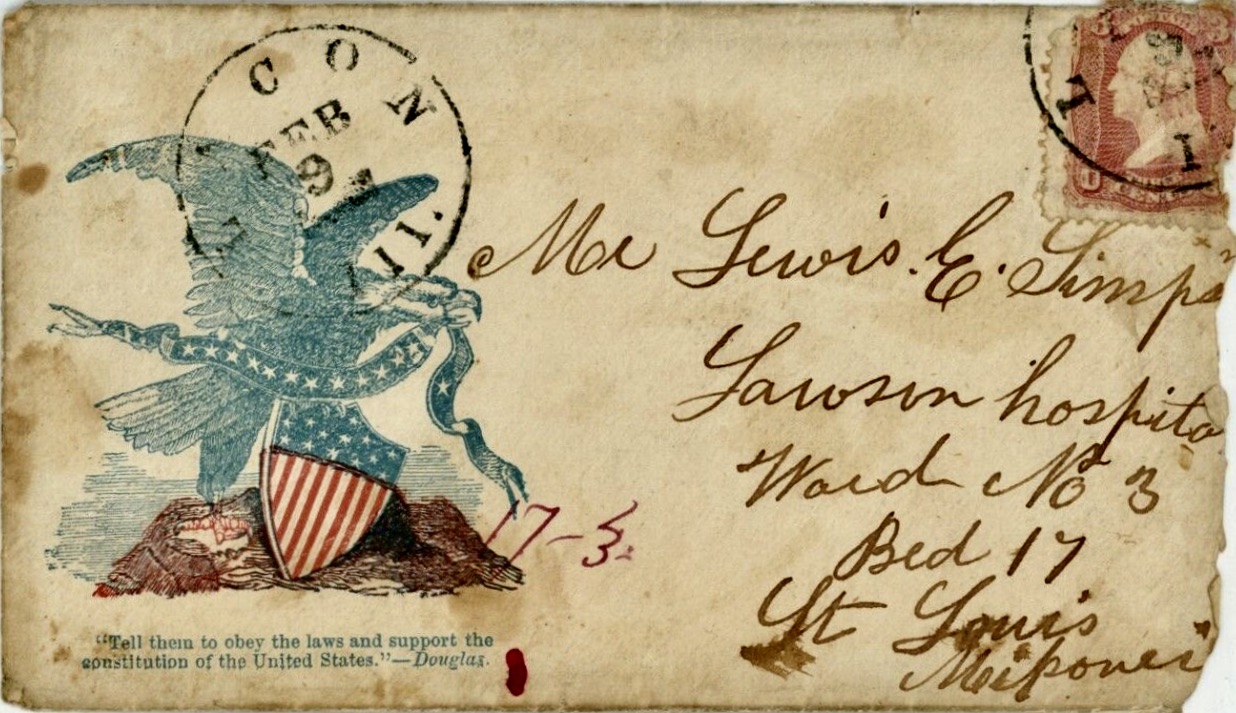
Addressed to Mr. Lewis E. Simpson, Lawson Hospital, Ward No. 3, Bed 17, St. Louis, Missouri

February 7, 1863

Dear Brother,

This evening finds us still alive but not all well. Emma has got the sore throat. This is a very cold evening and I am thankful that you are in a warm house and well care for but we would be glad if you was with us. But you don’t know how glad we was to hear that you was not killed nor wounded any worse. I am very sorry that you are wounded but it may have saved your life from some other battle.

Lewis, my dear brother, be of good cheer and try and get able to come home and stay with us. You must excuse me for not answering your letters sooner but it was not because I did not think of you for indeed, after I heard about the battle of Arkansas Post, I dreamt about you every night and thought of you through the day, wondering if you was among the dead or the living, hoping that you was among the living. You don’t know how glad I was to get your letter and to hear that you was well cared for. I bet you was glad to see father come in and I was glad that he went.

He says that he is is going to kill the rest of his hogs next week and then he is going to go down and stay with you until you are able to come home if that is next March. Lewis, you have a father that loves and cares for you and nothing would make him more happy than to have his only boy back with him once more and that to stay. And your dear mother has often wept that you was gone—not only her, but your sisters also. Lewis, our home would almost be a paradise if you was with us. Sarah would gladly go and take care of you but father says that they don’t allow ladies for nurses.

Many weary days and nights have I spent thinking of my absent brother, wondering where he was and if he was well fed while we had plenty at home. Father has said that he would give anything if he could only get you back satisfied to stay at home with him and he has said that he never expects to see you again. But I am glad to say that he has been disappointed in that and I know that he is also. Lewis, would you like to come home and stay and never go to war again?

[My husband,] Willis is glad now that I did not let him go. Lewis, answer that question that I asked you in particular. We will all be so glad to have you come home once more. Don’t get tired reading my letter. Excuse this pencil as I have no good ink. I will write to you often. Write me a few lines if you are able. From your sister that loves you, good night for this time.

— Eliza Russell

1861-62: Isaiah Cushman to his Brother

The following letter was written by Sgt. Isaiah Cushman (1825-1917) of Co. F, 9th Maine Infantry. He enlisted on 21 September 1861 and mustered out of the service on 27 August 1863.

Isaiah was the son of Levi Cushman (1778-1868) and Betsy Thompson (1787-1851). He was married to Barbara B. Erskine (1837-1922) in 1863 and resided in Abington, Plymouth county, Maine. Isaiah worked in the shoe manufacturing industry in Abington. During the Civil War, Abington was a major boot production center. More than half of the boots issued to Union soldiers during the war were made in Abington.

Letter 1

Hilton Head
Port Royal Entrance, S. C.
December 2, 1861

Dear Brother,

I received your letter this morning and hasten to write you. What shall I write you—I hardly know what. Mary is dead. Can it be? Shall we not behold that smiling face again on Earth? I can feel to weep with you that weep and to sympathize with you in the loss of a dear friend. What would you do now in your affliction if you did not believe she was with the Savior?

One of our number is taken from the Church of Christ. What is our duty now as professors of the followers of the meek and lowly Jesus. Oh! if I could live faithful and always be found at my post of duty. You have met with a great loss, but you do not mourn as those that lose friends that have no hope. You feel as though in a few short years at the most you will meet her in that world of bliss and glory.

You write let us be waiting to follow. Yes, that is it, dear brother. Live so as to meet our friends in Heaven. Oh what a happy thought. And I feel the need of the presence of my Savior here away from my earthly friends. But I believe that I hold communion with my God. We have some prayer meetings in our tents. We have no chaplain. It is a disgrace to the Pine Tree State. But we can meet our Savior at all times and in all places. The poor as well as the rich can partake of the waters of life freely.

My dear brother, I wish I could write you a good letter but I cannot. I could not if I had a good opportunity. We have to be called so often that I am confused so you will excuse me. Tell Charles W. that I will attempt to answer his kind letter in a few days. Give my love to your Mother Roberts and all of my friends in Abington. I wrote you in my last about some things. You will not feel like getting them now although I should like to have them. But I can do without them. Write often and I will try and do the same.

From your affectionate brother, — Isaiah Cushman


Letter 2

Fernandina, Florida
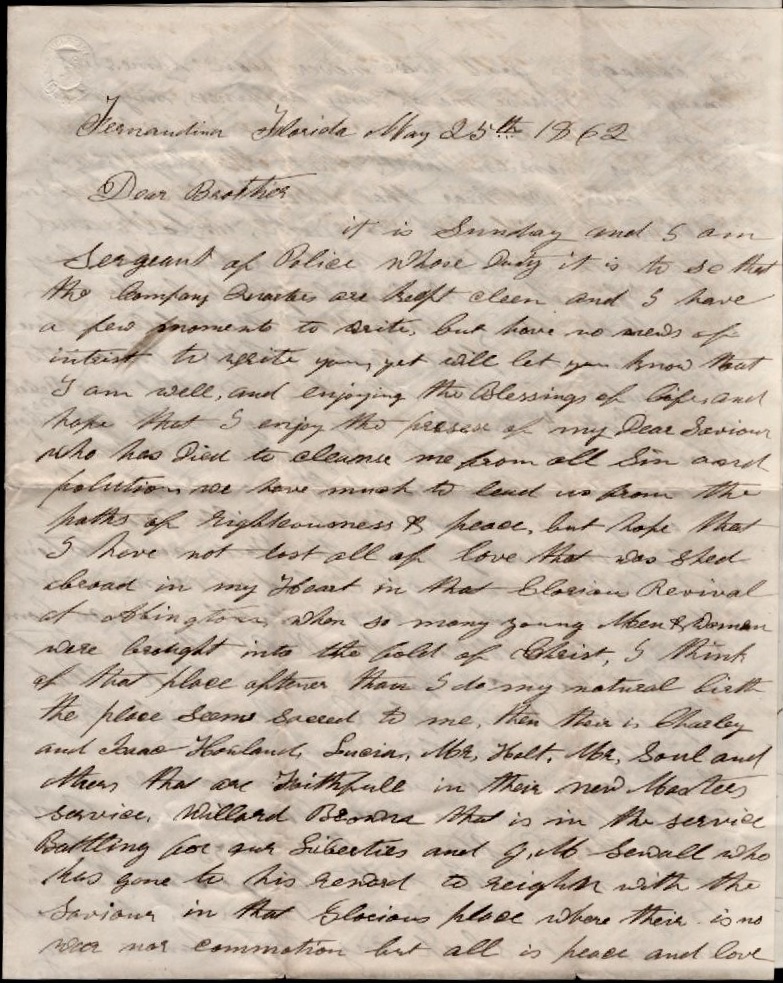
May 25th 1862

Dear Brother,

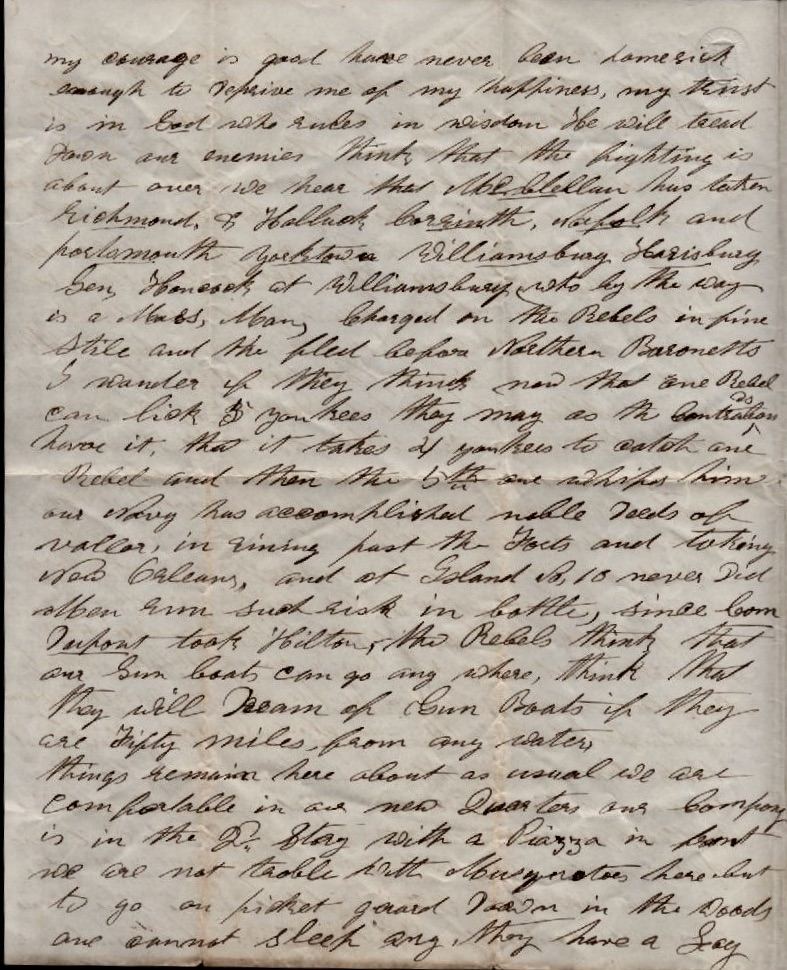
It is Sunday and I am Sergeant of Police whose duty it is to see that the company quarters are kept clean and I have a few moments to write, but have no news of interest to write you, yet will let you know that I am well and enjoying the blessing of life and hope that I enjoy the presence of my Dear Savior who has died to cleanse me from all sin and pollution. We have much to lead us from the paths of righteousness & peace, but hope that I have not lost all of love that was shed abroad in my heart in that Glorious Revival of Abington when so many young men and when were brought into the folk of Christ. I think of that place oftener than I do my natural birth. The place seems sacred to me. Then there is Charley and Howland, Lucia, Mr. Holt, Mr. Soul, and others that are faithful in their new Master’s service. Willard Brown that is in the service battling for our liberties and G. M. Sewall who has gone to his reward with the Savior in that Glorious place where there is no war nor commotion but all is peace and love.

My courage is good. Have never been homesick enough to deprive me of my happiness. My trust is i nGod who rules in wisdom. He will tread down our enemies. Think that the fighting is about over. We hear that McClellan has taken Richmond & Halleck Corinth, Norfolk and Portsmouth, Yorktown, Williamsburg, Harrisburg. Gen. Hancock at Williamsburg (who by the way is a Massachusetts man) charged on the rebels in fine style and they fled before the northern bayonets. I wonder if they think now that one rebel can lick five Yankees. They may as the contralions [?] have it, that it takes 4 Yankees to catch one Rebel and then the fifth one whips him. Our Navy has accomplished noble deeds of valor in going past the forts and taking New Orleans, and at Island No. 10. Never did men run such risk in battle. Since Commodore Dupont took Hilton, the Rebels think that our gunboats can go anywhere. Think that they will dream of gunboats if he they are fifty miles from any water.

Things remain here about as usual. We are comfortable in our new quarters. Our company is in the [ ]. Stay with a piazza in front. We are not troubled with mosquitoes here but to go on picket guard down in the woods, we cannot sleep any. They have a log house built there. Last Sunday night I stopped there and I could hear the mosquitoes buzz as plain as you could a swarm of bees. There were thousands of them and a plenty of snakes. It will not do to tell the women much about them. The Boys killed one Blake [?] one and a coach whip as they are called. He was 6 feet long. The rattlesnakes are thick. Our captain was Officer of the Day a few days since and as he was going down the railroad to visit the pickets, he heard one rattle and looked down by his side and there was one within 8 inches of his leg and all curled up read to strike. The captain jumped across the track and then got a club and killed him. He was between three and four feet long. It was a small one, but large enough to have struck the captain above the hip. He got off lucky. Sgt. Bonney saw one about 8 feet long. It was a coach whip and very large for us Northern people to see running about.

It is reported that the ironclad steamer Monitor and five or six other ironclad boats and wooden gunboats, about 40 in all, are at Hilton Head bound, all think, for Charleston to raise the Stars & Stripes over Fort Sumter. The will do it if they undertake it. We shall expect to hear in ten days that Charleston is in the Union. Rebellion is about played out we think.

I have sent you $20 at a time in two letters. Wish you would write whether you have received it, and if you please, pay my dies at the Good Templars and also my part of the expenses for I have a good interest in that Order. Should have made arrangements to have my bills paid but forgot it in mu anxiety to put down rebellion. I received a letter from Barbone that last mail and also one the mail before the last. She writes that her health was poor and that she gets almost discouraged at times. She thinks it is living so near the salt water. I received a very good letter from Esq, Wormell the last mail. Porborie sent me the Abington Standard which contained the letter from the Orderly Sergeant of Co, E, 23rd Mass. Regt., at New Orleans to John’s widow and also the resolution passed by the company in regard to the death of brother Sewall. Am happy to get the Standard. Have not received a paper for some time from anyone. Think that Benjamin Brown has sent me some that I have never got. You must write to e often. Keep up good courage and trust in God who will. never leave nor forsake you. Pray for me. Direct to Hilton Head, Co. F, 9th Maine Regt., Hunter’s Division, S. C. Affectionately yours, — Isaiah Cushman


Letter 3

Fernandina, Florida
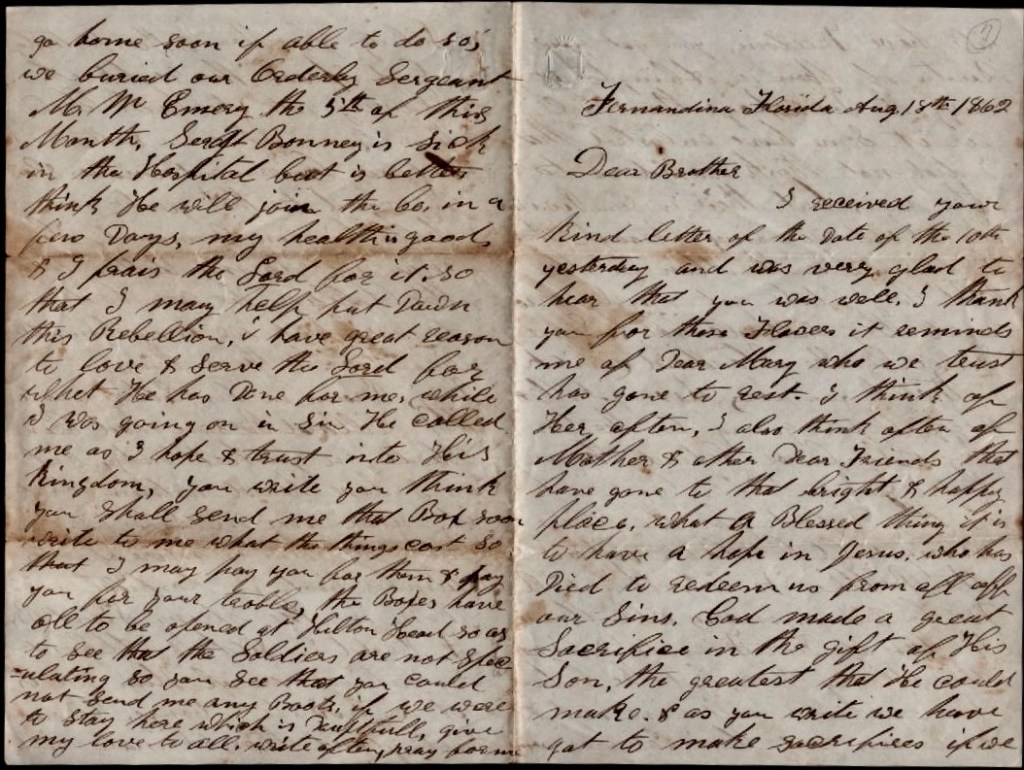
August 18th 1862

Dear Brother,

I received your kind letter of the date of the 10th yesterday and was very glad to hear that you was well. I thank you for those flowers. It reminds me of Dear Mary who we trust has gone to rest. I think of her often. I also think often of Mother and other dear friends that have gone to that bright and happy place. What a blessed thing it is to have a hope in Jesus who has died to redeem us from all of our sins. God made a great sacrifice in the gift of His son, the greatest that He could make, And as you write, we have got to make sacrifices if we will have freedom.

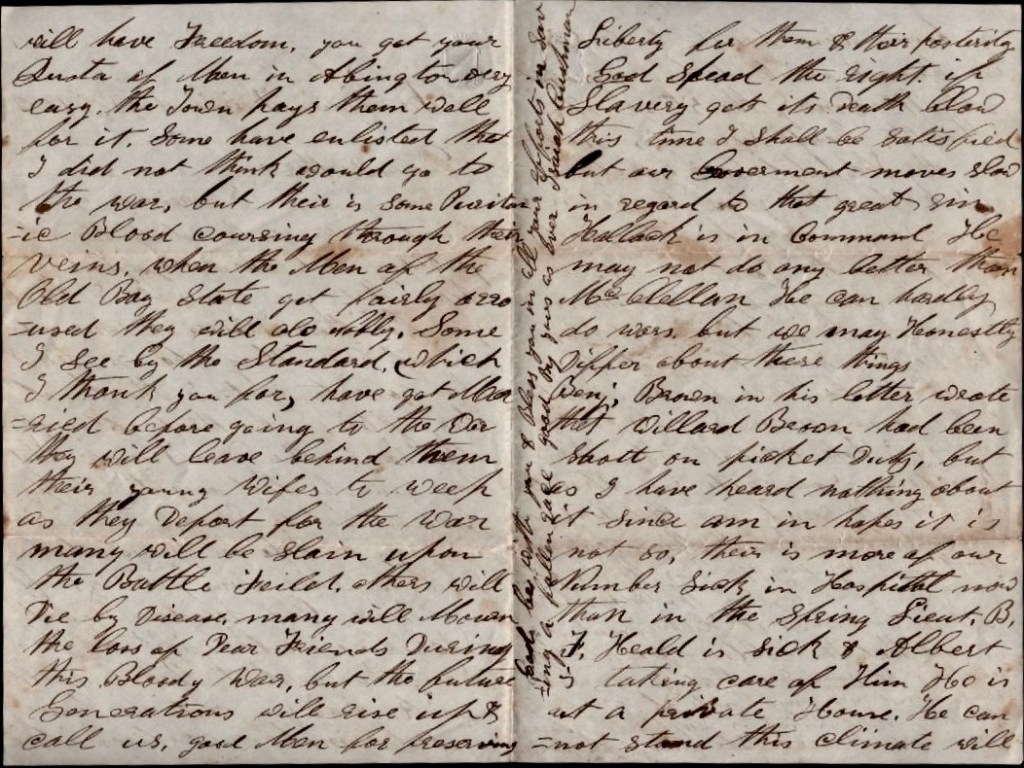
You get your quota of them in Abington very easy. The town pays them well for it. Some have enlisted that I did not think would go to the war, but there is some patriotic blood coursing through the veins when the men of the Old Bay State get fairly aroused. They will all nobly. Some I see by the Standard—which I thank you for—have got married before going to the war. They will leave behind them their young wives to weep as they depart for the war. Many will be slain upon the battlefield, others will die by disease, many will mourn the loss of dear friends during this bloody war, but the future generations will rise up and call us good men for preserving liberty for them and their posterity. God speed the right. If slavery gets its death blow this time, I shall be satisfied. But our government moves slow in regard to that great sin. Halleck is in command. He may not do any better than McClellan. He can hardly do worse, but we may honestly differ about these things.

Benjamin Brown in his letter wrote that Willard Beason had been shot on picket duty, but as I have heard nothing about it since, am in hopes it is not so. There is more of our number sick in hospital now than in the spring and Albert is taking care of him. He is at a private house. He cannot stand the climate [and] will go home soon if able to do so. We buried our Orderly Sergeant M. W. Emery the 5th of this month. Sergt. Bonney is sick in the hospital but is better. Think he will join the company in a few days. My health is good & I praise the Lord for it so that I may help put down this rebellion. I have great reason to love & serve the Lord for what he has done for me. While I was going on in sin, He called me as I hope & trust into His Kingdom.

You write you think you shall send me that box soon. Write to me what the things cost so that I may pay you for them & pay you for your trouble. The boxes have all to be opened at Hilton Head so as to see that the soldiers are not speculating so you see that you could not send me any boots if we were to stay here which is doubtful. Give my love to all. Write often. Pray for me. God be with you and bless you in all your efforts in saving a fallen [ ]. Goodbye, Yours as ever, — Isaiah Cushman


1861: Ezra Greene to his Parents

I could not find an image of Ezra but here is Pvt. John Ryan of Co. H, 2nd Rhode Island Infantry (LOC)

The following letter was written by Ezra Greene, the son of Lawton Green (1811-1861) and Sarah Ann Card (1813-1904). Ezra learned the carpenter’s trade from his father and was a 22 year-old house carpenter when he mustered into Co H, 2nd Rhode Island Infantry on 5 June 1861. Company H was known as the Kentish Guards (being from Kent county) and were issued blue coats and grey trousers that no doubt added to the confusion in the fight at Bull Run.

Disenchanted with infantry service and disliking his commanding officers, Ezra shortly after the Battle of Bull Run volunteered for duty in the navy and was soon transferred.

See also—1861: Ezra Green to Susannah (Westcott) Greene published on Spared & Shared 13 in November 2017.

Transcription

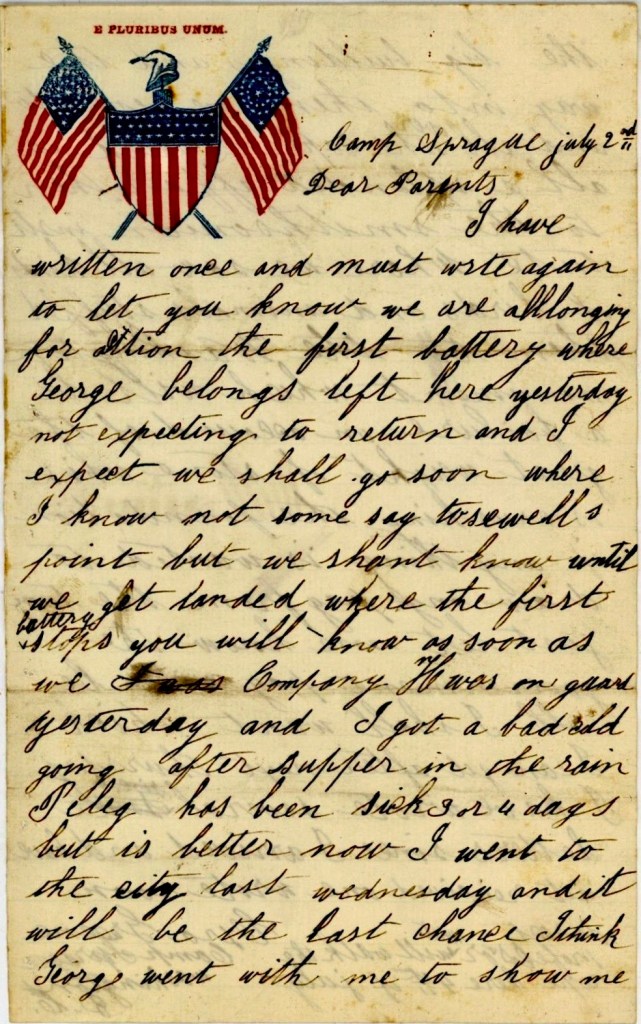
Camp Sprague 1
July 2nd [1861]

Dear Parents,

I have written once and must write again to let you know we are all longing for action. The first battery where George belongs left here yesterday not expecting to return and I expect we shall go soon. Where, I know not. Some say to Sewall’s Point but we shan’t know until we get landed. Where the first battery stops, you will know as soon as we.

The unfinished Washington Monument as it appeared during the Civil War. (LOC)

Company H was on guard yesterday and I got a bad cold going after supper in the rain. Peleg [Card] 2 has been sick three or four days but is better now. I went to the City last Wednesday and it will be the last chance, I think. George went with me to show me the big buildings and the way into them. We went into and all over the Capitol which is all a splendid affair. Then to the Smithsonian Institute where we saw all kinds of birds and animals stuffed. Then to the Washington Monument which will be a failure on account of the great weight of stone which is crushing the foundation. 3

If anything is wanted to draw my pay from the town, just let me know. The government pay will be all I shall want which I can get after next Thursday. I have wrote several letters since I arrived and have not received one. Write soon. — Ezra Greene, Camp Sprague, Washington D. C.

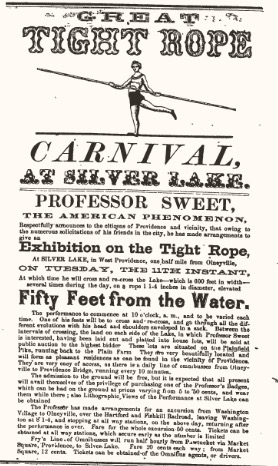
Professor [Benoni] Sweet 4 will walk the rope here 4th of July.


¹ Camp Sprague was located near Gales’ woods or G. Keating’s Farm, east of North Capitol Street in Washington D. C.

2 Peleg Card was Ezra’s cousin and served in the same company. Ezra was severely mortally wounded at the Battle of Bull Run some three weeks later. In a letter dated 4 August 1861, Ezra described returning to the battlefield during a lull in the fighting to find Peleg with a wound so severe that he made no attempt to remove him, electing instead to remain by his side until he expired. Remarkably, as he lay by his mortally wounded cousin, Ezra fell asleep from exhaustion only to be awakened by a renewal of the battle an hour later, at which time he retreated from the field and followed the remnants of his regiment as they straggled back toward Washington.

3 Construction on the Washington Monument was begun in 1848 but halted in 1854 when the Monument Society ran out of money. It was apparently widely known at the time of the Civil War that the foundation was suspected to be inadequate to support the weight of the stone and so before construction could resume in 1879, the first task was to strengthen the foundation. Lt. Col. Thomas Lincoln Casey, the engineer in charge, devised a way to underpin and widen the base. Construction was finally completed in 1884.

4 “Benoni Sweet” (b. 1840) of Phenix, Rhode Island, began performing feats of danger as a tight rope walker in 1859. “The year following his debut as a daredevil, Sweet was married on January 19, 1860, to Susan Colwell of Cranston. The newspaper announcement of the marriage referred to him as Professor Benoni Sweet. The title of Professor may have been intended to distinguish him from another Benoni Sweet in Rhode Island. Dr. Benoni Sweet, born in South Kingstown in 1840, came from a family that gained renown over generations for practicing the unique skill of setting broken bones (called bonesetting). Dr. Sweet too reached some acclaim for his ability to set broken bones. In 1861, with the outbreak of the Civil War, Sweet enlisted in the Union army. On July 4, Independence Day, just weeks before the disastrous battle at Bull Run, Rhode Island military units were encamped near Washington, D.C. at Camp Clark. Sergeant Elisha Hunt Rhodes noted in his diary, “Prof. Benoni Sweet, a member of Company H, Second Rhode Island gave an exhibition of tight rope walking.” (See Robert Hunt Rhodes, ed., All for the Union, The Civil War Diary and Letters of Elisha Hunt Rhodes (New York, 1991), page 13). In August 1861, Sweet walked across Pennsylvania Avenue from the National Hotel to the Clarendon Hotel. The walk was witnessed by President Abraham Lincoln and his wife, Mary. Appreciating the welcome distraction from war, Lincoln reportedly presented Sweet with a gold dollar.