I could not find an image of Barton but here is Orlando Starkey of Co. C, 39th Illinois Infantry (Al & Claudia Niemiec Collection)
The following letter was written by Barton Smith Walters (1841-1865), the son of William Walters (1814-1890) and Malinda C. Smith (1822-1888) of Minooka, Grundy county, Illinois. Barton enlisted in October 1861 to serve in Co. A, 39th Illinois Infantry. He did not survive the. war, however. The following excerpt was lifted from “The Patriotism of Will County.”
“Barton Smith Walters enlisted in the 39th Regiment at the age of 21, re-enlisted and served faithfully and bravely without any casualty until in May 1863 when he was taken prisoner. He with two others had been detailed to go upon the battlefield and bring in an officer who had been wounded. He was captured with two others, David Hanson and Andrew Sybert, of the same regiment, and they were taken to Andersonville. Hanson and Sybert fell victims to their treatment and were buried in that locality. Young Walters was released before his death, but he only lived to reach Annapolis, where he died April 1st 1865. His remains were brought home and repose in the Channahon cemetery.”
Transcription
Addressed to Mr. William Walter, Minooka, Grundy county, Illinois
Columbian Bridge Sunday, May 4th 1862
Dear Father & Mother,
I now sit down in the shade of an apple tree to write after a march of 7 miles. We are all well but me. I have the erysipelas in my legs but they are now better. I have not seen nor heard from Mike for three weeks. He is at Mt. Jackson. When I saw him last, he was sick but on the gain. Charlie got a letter from Fatha [?] Hunter today. They were all well when she wrote and she had not heard from you for some time.
We are having nice spring weather here now only rather warm for marching. We are soon to have another fight, I think, from the way things are moving. We have two days rations in our haversacks. [Stonewall] Jackson is reported to have been reinforced but we don’t care for that. We want to have the fun of reinforcing him ourselves but the trouble is we can’t get near enough to him. He always runs away. We have the two fighting regiments together—namely 13th Indiana and the bloody 39th from Illinois. We bear a good name wherever we have been but now we are somewhat dissatisfied. Our Brigadier [General] Sullivan has been transferred to the 3rd Brigade of yankees and a yankee—General [Orris S.] Ferry—put over the brave sons of the west. They have gained a name which will live for years after they are laid to moulder in the grave. I have become an old man in my views of the war. I am glad to hear of the several democratic victories throughout my native state, one of the most beautiful lands in the world, and when you ask one of them abolitionists the reason why they were beat in the election and they will answer by saying they have gone to put down the rebellion, but we can rule them in this regiment.
I think our town is gone up when Dick Briscoe can get two officers. I wish you to let me know who are the town officers and if snipe bill or H. H. Randall got any. I have wrote 3 letters in the last two weeks to see if any of them would get through the mail here is uncertain, and if we don’t get any answer, we are not much disappointed. While I write, Earnest Holz is talking about this cursed rebellion. He is my right bower. This is the oldest country in the states. I was talking with a woman last night and she told me that she had lived in the same house for the last 65 years and her 4 sons were in the army and she was surprised when I told her that we had taken them prisoner a week before. When I told her their names, she felt very bad. At first she did not believe it or she would have heard it.
Write as soon as possible. Write like I have—without waiting for an answer. I still remain your affectionate son, — Barton S. Walters
The following letter was written by David Hayden Foster (1829-1871) of Beaver Dam, Allen county, Ohio, who enlisted in January 1862 in Co. H, 74th Ohio Volunteer Infantry. He did not serve long. He was discharged for disability as a corporal on 5 November 1862 at Nashville, Tennessee.
David write the letter to his wife, Elizabeth (Emmons) Foster (1826-1902). They were married in Allen county, Ohio, in June 1847 and had at least five children by the time of the Civil War.
Transcription
March 22, 1862
Dear Wife,
It is with pleasure that I sit down to let you know that I am well at this time, hoping these few pencil marks may find you in the same state of health. I have had a good lot of work to do since I came into camp but I stand it all well & nice. Yesterday I superintended the dressing up of the company hospital for the sick. There is five or six that are on the sick list but not dangerous. It is from cold. The doctor says that these fellows [just] want to get rid of duty. This game is played off every day.
I want you to write to me for I have not received one word from home yet. Now I think it time that some of you would write to me. I have written 20 letters and not one answer yet. I wrote G. W. Young a few lines to see about your money that you are to draw. He has not answered me yet. I do not know what course to pursue until he answers my letter. I will most assuredly attend to it as soon as I learn what course to pursue. I want you to do a mother’s part in taking care of my beloved children. That I have no doubt you will do & do it right too.
Dear wife, there is some talk of us moving from here but we do not know when we will move. It may be in ten days & maybe not for twenty. There is all kinds if camp reports going every day but the Captain thinks that we will have to stay here till the war is over.
There was 90 prisoners came into our prison this morning. I have had a chance to talk with the secesh since I came back. Some of them are fine men. Others are mean as get out. Tell my boys to be good to their Mother & do everything they can for her comfort. So no more at preset but remain your husband, — D. H. Foster
I could not find an image of Thomas Callender but here is one of Franklin W. Lehman of Co. C, 149th Pennsylvania Infantry (2nd Bucktail Regiment)
The following letters, heartfelt and poignant, were penned by Clark Callender (1834-1899), the son of Silas Callender (1805-1880) and Mary Carkuff (1805-1879) from Fairmount, Luzerne County, Pennsylvania. Addressed to his parents, these letters revolve around his younger brother, Thomas Callender (1839-1863), who valiantly served as a private in Co. F. of the 149th Pennsylvania Volunteer Infantry at Gettysburg. Tragically, he was mortally wounded at the railroad cut in front of McPherson’s Barn. Within these letters, Clark recounts the distressing moment when their neighbor’s son, Pvt. Clark Woodworth, was struck down. As Thomas rushed to assist him, he faced the heartbreaking reality that Woodworth felt he could not endure. Thomas himself was then grievously injured, a bullet piercing his sternum and tragically passing through both his body and bronchial tube before exiting through his clavicle. In a somber twist of fate, he was carried to McPherson’s barn by Confederate soldiers.
Later Thomas was carried to the St. Francis Xavier Catholic Church in Gettysburg where Sister Camilla O’Keefe, a member of the Sisters of Charity, wrote, “The Catholic church in Gettysburg was filled with sick and wounded … The soldiers lay on the pew seats, under them and in every aisle. They were also in the sanctuary and the gallery, so close together that there was scarcely room to move about. Many of them lay in their own blood…but no word of complaint escaped from their lips.” Yet another woman, a Gettysburg resident who volunteered as a nurse named Sallie Myers, wrote: “I knelt beside the first man near the door and asked what I could do. ‘Nothing,’ he replied, ‘I am going to die.’ I went outside the church and cried. I returned and spoke to the man — he was wounded in the lungs and spine, and there was not the slightest hope for him. The man was Sgt. Alexander Stewart of the 149th Pennsylvania Volunteers. I read a chapter of the Bible to him; it was the last chapter his father had read before he left home.”
Clark’s letters provide a daily chronicle of Thomas’s fluctuating condition, reveals the brother’s agonizing search across the battlefield, the tension of doctor visits, and the heartbreaking deception he felt compelled to navigate—informing his father that Thomas held no hope of survival, while quietly offering their mother a glimmer of reassurance that he might yet endure. Thomas died on 23 July 1863, over three weeks after he was wounded. Heartbreakingly, Clark Woodworth’s body was never recovered, leaving him listed among the unknowns—a somber reminder of the war’s toll on families.
[Note: Photocopies made from the originals of these letters were provided to me for transcription and publication on Spared & Shared by Wayne Rizor, a descendant of the Callender family.]
Letter 1
Gettysburg [Pennsylvania] Saturday noon
To Mother,
Thomas is sleeping and so I will write a few lines. When he sleeps, the times so long. Yesterday I moved him on another bed where he has a good place. He is more by himself. I wish I could tell you that I thought Thomas would get well, but I do not. He may live some days yet and he may die any hour. He has lived longer than any of the doctors thought he could. I got the doctor to examine him a little while ago and I asked if since he had lived so much longer than any of them expected if there was no chance for his recovery and he said if he would live one month yet, he would not have any more hopes of him. If we can’t have him anymore with us, we ought to be thankful that we have the privilege of being with him to see to his wants and to know that he is a going to a better world where we meet him again. He does not bleed much anymore. Last night I felt of his hands about eleven o’clock and he was cold up to his elbows and his legs and feet up to his knees. I could hardly feel any pulse. I gave him some wine and then rubbed him and got. the blood to circulating again. He is now about the same as he has been for the last two or three days.
There are a good many dying here for the want of care but you. may rest assured that Thomas gets good care. I say candidly, I believe he is better off here than he would be at home. Here he can have everything he can wish for and doctors here all the time to watch every change. His appetite is middling good. He eats bread, dried peaches, and tea and oranges mostly. He sleeps a good bit now. At first I had to give him morphine to make him sleep.
I have just been out to the battleground where he was shot to see if I could find his knapsack but could not. I have got canteen and haversack, or it is the canteen that he has when the Rebels went into the barn where he lay. They took his canteen and left him have theirs. You can form no idea of what property is destroyed where two such armies meet and fight as they did here.
Mr. Harrison is a little better. His son and daughter is here taking care of him—his daughter in the daytime and his son at night. I lay close by Thomas and some nights I can sleep some and some I do not but watch my chance in the daytime when he is asleep and lay down and take a nap so I can do right well.
The Boys was a dirty-looking set of fellows but it is no wonder. They had marched twenty-one days through the dust and then went right into the fight. I have washed Thomas every day since I have been here but he is not clean yet and now he is so weak I do not wash him more than I can help. If I thought none of my folks cared enough for Thomas or me to write, I would not like it but think they have but they have not come. I have not heard from Elizabeth and Johnny nor any of you. And maybe you do not hear from me but if you do not, it is not my fault for I write every day.
There was a man died here this morning with the yellow jaundice. He was as yellow as saffron. Last evening there was one soldier stabbed another in the neck so that he died this morning here in Gettysburg. There is one man in the hospital with nine ball holes in him and he is getting well.
Sunday, 10 p.m. Thomas is no better. I cannot see that he is much weaker this morning. It is strange how he lives as long as he does. The doctors have all of them been disappointed but you may think as he was a strong man he may stand it yet. But I tell you, if he had not of been, he would not lived as long as he has. The constitution must wear out. He bears it very patient. I don’t think I ever heard him complain of anything. When he talks about dying, he is as calm as if he was at home and going out to the barn for something. He told me last night he wanted to be buried in his black clothes and if you have no shirt for him, you can send and get mine for him. He cannot last but a very few days at most. He says he is a going to meet a brother and sister in a better world. He wants Mr. Montgomery to preach his funeral sermon.
I asked him last night if he wanted any of his folks to come and see him and he said he was not particular for they could do him no good. He suffers no pain. I saw a Rebel man die here this morning and there is one of our wounded in here that is crazy. All. that is in here now are badly wounded. The rest have been sent off to a General Hospital.
You need not be uneasy about me. I am well. If Thomas drops off, I will get him embalmed and then you can keep him a month if you wish. The expense of getting him embalmed and the whole expense of getting him home will not reach thirty dollars, my expenses included. I don’t think but he will want a better coffin when I get him home than I can get for him here.
Sunday night, 10 o’clock. I wish I could say to you that there is a change in Thomas for the better but I can see none. At first when I came here, I thought if he would live a week or two, then he would get well, but the longer he lives, the more certain I am that he can’t get well. Last night the Dr. told me he would not live 24 hours and he is alive yet. This evening I got another doctor to examine him and he said he might live two or three days but thought not.
Thomas has got a higher fever tonight than he has had since I have been here. He is comfortable but very flighty. He sleeps a good bit. Dr. Barrett has just been in to see him. He says he can’t get well. I am glad that it has been my lot to be with him and to know that he is a going to a better world where war shall never come. It is a hard sight to see some of our men after they have gave their blood for us and then pass into another world unprepared for eternity. But such is not the case with your son and my brother. We have very kind doctors to take care of him. They do everything I want them to do.
I don’t [see] as you can read what I write. I am sitting close by Thomas and have a little board on my lap to write on and then to help it, somebody has stole my pen and holder and I have a very poor one—one of the soldiers that lay close by Thomas I have took care of since I have been here. Yesterday he was moved off to some General Hospital. I helped him out into the ambulance and then he told me he had left some things that he could not take with him and said I should get them and keep them. I went and this pen and some tobacco and a gum blanket which I feel proud of. I don’t know as he thought of it. I went out to see him but they was gone so I shall keep it.
I don’t know which way I will come home. I heard this evening that there was a bridge broke down between here and Harrisburg and maybe I will have to go by Philadelphia. I hope not. The State will wend Thomas and me home free. I guess Dr. Barrett will stay until I go home. I hope he will.
Every church and school house and court house and a great many dwellings are filled with suffering humanity in and around Gettysburg—a great many to be crippled as long as they live. Some with legs off and some arms off but the greatest number with legs off. It does not seem much like Sunday here. Tell Elizabeth if you see her I am well.
Monday, 5 a.m. I can see no particular change in Thomas this morning. I think I can see that he is failing. He has had another chill this morning. He is got over it now. I think he cannot last long. They are carrying another man out dead now. It beats all. What a sight of men have died in here since I have been here. As fast as one dies, another is brought in. — C. Callender
Monday afternoon. Now father, I will tell you one thing which I did not want to put in the other paper for fear Tommy might want to see it. I do not want to discourage you but suppose you want to know the truth of Tommy’s case. I will tell. you what the doctor told me today. We have got a new doctor and he said his case would prove fatal but I still think he will get well. He is better than he was when I came here. He said the ball had passed through his lungs but I don’t think it is so because if it had, he could not breathe easy and if it did, we often hear of the lungs being decayed.
It is well I did put this on a separate paper for Thomas did ask to see the letter. He knows nothing of this paper. Should he get much worse so that I think he will not get well, then I will tell him but now he is sure he will get well and I am about as sure. I want nothing from home. I don’t think I will be at home until sometime next month. If you can possibly hire somebody to help H. Wolf do my work, do so. Jesse Harrison is no better. I will write again tomorrow, — C. Collender
Letter 2
Hospital Monday afternoon
To folks at home,
I will tell you how Thomas is this afternoon and then I will tell you again in the morning so I can keep you posted as to his condition. I cannot see any change in him except his wound has got to bleeding a good bit when I raise him up. I have called all the doctors to see if it cannot be stopped and they say I need not be uneasy about that. It is good for him. It is kind of blood and water. His appetite is good enough. He could not sleep very well [so] I got the doctors to give me some sleeping powders for him and now he sleeps about half of the time and so I can keep him from taking so much that is not good for him as it tends to weaken hum. You may think I will make him sleep too much but I will not tell Mother. She need not fret about him being here in the hospital. I know it would be a satisfaction to have him at home but he is far better off here. We have good doctors and they are right here and can see him all the time. And we have a good house and good beds and everything for him to eat that you can think of. Oranges, lemon, dried peaches, huckleberries, gruel beef, tea, corn starch, wine, tea, coffee and soups of all kinds. He says he is better of here than he could be at home.
When I sleep, I lay right here and have a string fast[ened] to me and then fast to him so he can waken me without speaking. I think a hospital is the most solemn place a man can go. You can see poor Union defenders suffering in every shape possible. That noise I spoke of yesterday they say was cannon down at Frederick City. I could hear it very plain. It is the greatest place I ever saw. You cannot hear any news at all. I have not saw a paper since I have been here nor saw a man that has as I know of.
Gettysburg is a very nice place. There is but a few buildings in this town that was damaged by the fights when rebels went into them with sharpshooters. Then our artillery would knock the house all to pieces. But the battleground is a hard-looking place, I can tell you. It would be impossible to find where anyone was buried unless someone knew where they was buried as the battleground extends over ten or twelve miles and three-fourths of them are not marked.
I change Thomas’ bed clothes every day and put a clean shirt and drawers on him. I do not know as you can get any letters as the Government has possession of all the roads here and the Post Master told me no mails came in but said they went out every day. But I don’t know as they do or whether he wants to get the postage. But, however, you must write. By the time your letters get here, the road will be open. I do want to hear from home and if you have got anybody to help H. Wolf do my work at home. It is impossible for me to tell when I shall be at home. I will not leave Tommy as long as he keeps as he is now. His life depends on the care he gets. You can do as you please about coming down. I can do all that you could and it would be of no use to him nor me.
We have some women here who are called the Sisters of Charity and well they deserve the name. They are the kindest set of women that I ever saw. But there are so many, they can’t wait on all of them. Some of the poor fellows’ wounds are full of worms, but I can tell you that you can find none on Tommy. His wounds are running some but I change cloths ever half hour. We have plenty of cloths and bandages and lint here so you. can see we have everything we need here. So be contented. All that can be done, will be done.
I have a pretty hard way to write as I have to sit on the floor. Tell Elizabeth if you see her to see that my melons and tobacco is hoed. Tell her that if I get sick or anything, I will let her know. Tell her to take good care of Johnny and that I would like to see him.
I cant account for it but he is very comfortable. He has no pain nor has not had since I have been here nor is not very sore to be moved. He takes nothing to numb it either. He is in good spirits and thinks he will get well. I think there is no use of any of you coming here. You can do no more for him than I can. If anything should happen that he should not live, I will get him embalmed here in this place and then when I get to Harrisburg, I will telegraph to you and you can get Jacob S. Carey to make him a coffin as I cannot get one here but a box. Now don’t think he is worse because I have wrote this. He is no worse than he was when I came here but his life hangs on a slender thread and no knowing which way it will turn. But I do think you must send William here to take care of Tommy for so sire as he is left alone, he will never get well and I do not believe William could stand it in here where they are taking off legs and arms, and wounds of all kinds. I have stood it well all the time but once. I went to help dress a wound on a man’s arm the other night that had commenced bleeding and he was all blood and still bleeding and I got sick and left. But now I could see a man’s head taken off. I am well and bored with Uncle Sam. I want you to be sure and see that my work is done.
Tuesday morning. Thomas is better this morning than he has been since he has been hurt. I told you above what the doctor thinks of him but I tell you candidly, I do believe he will get well. You had better not come here as I can do all that can be done. He is not very pale and has no pain. He says he could walk and I guess he could. His breast bleeds a good bit but the doctors thinks that is good for him. They say it is what gathers in the wound and if it did not come out, it would kill him. Be sure and write, — C. Callender
Letter 3
Gettysburg [Pennsylvania] July 21, 1863
To friends at home,
This evening I will write you a few lines and then in the morning I will tell you how he is then. I don’t wish to encourage you any unless I can see a change for the better this afternoon, but it may be for the worse. I will now tell you the nature of the wound as near as I can, and then you can guess for yourself whether he can live or not.
The ball struck him in the breast in a straight line from one nipple to the other about three fourth of an inch to the right of the center and passed through the breast bone and then through the lungs on the right side, and cutting the bronchial tube which stops the breathing for that long and then came out under his right arm a little back. When his wound is open on his breast, he breathes through it. He is not bothered to breath when we raise him up. The dead blood runs awfully and smells ten times worse than the rotten Rebs that lay on the battlefield. Yesterday I think there was more than two quarts run out so you can judge the state he is in.
Wednesday morning. I was out to the Post Office this morning and they will not mail a letter in time for the Harrisburg mail so you. will not get it tonight. They have been taking letters every morning but I do not know whether they mailed them the same day or not. You can tell by looking at the post mark and the date of the letter. I will tell you what I have wanted ever since I have been here and that is to get a stretcher and cut a hole in it and then sew a bag under the hole with a little cup in the lower end with holes in it large enough to let the blood discharge and not let the flies up and then turn Thomas with his breast over the hole and let him lay on his stomach and then that stuff can discharge as fast as it forms in him. I talked with all the doctors and they all say it is of no use. Barrett said the same. But I believe it is the only thing that can be done to help him and maybe that would not. But I think I will try it this morning. If I thought I could get home, I would start this morning but he is too weak. I do not think he is as low as he was yesterday morning but I do. not think he can get well. But it may be he will, but if he does, it will be the strangest thing I ever saw. He is getting very poor in flesh. His appetite is not very good now. He slept good last night. The doctors are beat out at his living as long as he has but they think he cannot get well. But they may be mistaken. They have said for the last eight days that he could not live 24 hours and have missed it every time.
About ten o’clock a.m. There is a change in Thomas. He has another sinking spell. His hands are cold and his pulse has almost ceased to beat, He may never come to again. I do think it would be a fine thing for him if he did not for death is certain and he is so anxious for it to come. I have just talked with the doctor and he says his time is very short. He says there is not a man in here that could of lived half so long as he has with the same wound. I have just received your letter of the 17th & 6 of 16 and was glad to get them for Thomas wanted to hear from home so bad. You must not expect me to write very good for I have to write with a board on my lap and then fan Thomas with my left hand. You will have to do without my letter today, They have made different arrangements. The letters must be at the Post Office in the evening or else they’re not mailed in time for the Harrisburg train. I did not know it in time but will [ ].
Letter 4
Catholic Church Hospital
Wednesday morning. Tommy is no better. He is failing. His breast continues to bleed so much that he has got very weak. He is very comfortable. He has no pain much. Doctor Barrett & Dr. Erkert from Wilkes Barre was here last evening & they say he is very dangerous. Thomas is sensible of his condition and is calm about it. I asked him if he wanted any of his folks to come and he says he has no choice. They may do as they like. Now you can do as you like, but it is a chance if you can get here in time to see him and if you did, it would do him no good. If it should be that he never gets well, he will add one more to the number of our family circle who have gone to a better world, He is prepared to die. He is very calm and says he is going home.
I do not know which way I will come home if he does not live. If I can’t get anybody to take us to Columbia, I will have to go to Baltimore and them to Philadelphia. I cannot give him up yet but if his lung continues to bleed as it has for a few days, he can’t live. The doctors cannot do anything to stop it. It may be that it will commence healing in time to save him yet. He has everything here to make him comfortable. He could be no better off if he was at home. I do not want anything from home. If I need any more money, Dr. Barrett says I can get it off him. I will write again in the morning. — C. Callender
Letter 5
Gettysburg [Pennsylvania] Wednesday evening
Dear Father & Mother, Brother & Sister,
This evening I will write a few lines to tell you how Thomas is. He is comfortable. I cannot account for his having as little pain as he has had since I have been here—only that he has lost so much blood. This morning his bleeding ceased and I was in hopes it would not commence again but this afternoon it began again and kept on until this evening. It has stopped but I fear it will commence again. I think it is impossible for him to ever be any better. I thought when I saw him first that he would get well but since that time, his lungs has been bleeding so that he cannot last but a short time. I think we ought to be thankful that he was not among the number that died on the battlefield and his body to be covered without a grave and to be dragged around by the harrows. He is very sensible of his condition and is very willing to die. I have not heard him say once that he would like to get well that I know of.
Ten o’clock. Thomas’ breast has had another bleeding spell but has stopped again and he is asleep. He is very weak. I think he could not live one hour if I did not give him wine. Jesse Harrison is very bad off. You can do as you like about coming to see Tommy. I think it is a great chance if you could get here in time to see him alive and if you did, it would be of little satisfaction to your or him unless he arouses up again which I. think he will not. The railroad communications is open now from here to Carlisle and Harrisburg so that I ought to go home from here in one day if we could connect right.
Eleven o’clock. Thomas is very flighty but has no pain. I wish he would not talk.
Twelve o’clock. He is very flighty but if I speak to him, then he is sensible and says he is going home.
Fifteen minutes after twelve. He has gone to sleep. The blood does not run now.
One o’clock. He is still asleep but is weak.
Three o’clock. He is still a sleeping. He seems a little better.
Four o’clock. He is a good deal better. I don’t know how long it will last. He may get well yet but I guess not. He is flighty some yet. You may look for a letter from here every day as long as Thomas keeps as he is now. Last night I fanned him pretty near all the time. W. Roons & Burnard is here. It does seem as if I see the people in the world is here. Some are hunting friends. Others have come to see the battlefield. I wish that was all that brought me here. You must see that my work is being done if my wheat has to be cut before I get home. I want you to see that the seed is by itself. It is out to the end next to M. Gearheart’s. It runs out toward the turnpike as far as to where there is a stake standing against the fence. You can tell by looking for I have cut the rye out and cockle.
There are about seventy patients in this church. I suppose out on the battle ground in those tents the wounded are not half taken care of like they are here. I do not know where Lee’s army are. We can’t get papers in time. Thomas has aroused up a little but is very weak. William wished me to ask Thomas where C. Wadsworth was wounded. He don’t know. He only saw him fall and ran to him and asked him if he could help him and he said no. He was very near gone and the rebs was so close that he could not stay with him one minute. He thinks he must of died and if he did, his body could not be found as they was buried and not many of them marked. If Thomas drops off, then I will go to all the 1st Corps Hospitals and if he was carried in any of them, the last will tell but I think it doubtless if Mr. Wadsworth ever hears anything from Clark. William asked if I wanted anything from home. I do not. We have everything anybody could think of so do not fret about that and as for me getting sick. If I should, I’ll let you know. I could not stand half what I have if it was a stranger instead of a brother. I don’t suppose I have slept one hour at a time since I have been here yet, for I do not think Thomas can last twenty-four hours. Yet he may. But one comfort we have he is prepared to die. He is willing to go if it be the will of God. He fears not death. He never could of died in a better cause than in defending his native State. He fell with his face to the enemy. His wound shows itself.
There is two more men in here that is wounded in the lungs but not so bad as Thomas and the doctor says they must die. One of them coughs blood and the other one can’t speak hardly. Yesterday I could hardly understand what Thomas said but today his voice is stronger. If he drops off so that I can start on a morning train, I guess I can come home in one day. If I can get from Shock___ in to Uncle Edmunds or home or if it is on the right day to met the stage at Bloomsburg.
Thomas suffers very little and I think when he dies it will be an easy death. He is sleeping now. I cannot hear anything from William Bell and as for the rest of our Boys, they was slightly wounded and have been taken away somewhere so I do not know anything about them. I guess from what I can hear, that there is no danger of Gilbert Callender getting hurt unless he should run against something.
The rebel prisoners appear to be a clever set of fellows. They are ragged, dirty, and I guess lousy—some of them bare headed, and a good many without shirts or shoes. If they could put on a suit of Uncle Sam’s clothes, some of them would be good looking men. Yesterday morning I was down on Diamond Corners and I think I saw nearly one hundred ambulances start out to the different hospitals to carry wounded men to the depot. The Catholic priest is here very busy talking to the soldiers this afternoon. Now I will stop until this evening.
Thomas is sleeping. He does not eat anything much. It will make it a little bad for you that the letters must lay in the post office here over night and that makes about twelve hours later news for you. I do not think Thomas will be living when you get this. I think he will not last until the sun rises again but he may last several days. But he is low enough to die any moment. I tell you, Father, you have no idea of a hospital like this. Many wives hearing their husband, mothers, their sons, sisters, their brothers have come from all over the North to take care of them, and when they arrive in here, you may judge the feeling when they learn that their friend is remembered among the dead. I hope I may never be called to witness another battlefield.
There are five men in here now who are lying very low. I was down to the Government Office today to see if I could get a pass to send up for you to come down and the man said he had no authority to give such a one but if I insisted on it, he would give me one to go home if I wanted it. I thought I would send it and then you could do as you liked about coming. You can do no good here. It would be no satisfaction to you nor Thomas now. If he dies, the state will send his body and I home free.
The streets of old Gettysburg. Baltimore Street looking up from the ‘Diamond’ (town square) near the time of the infamous three day battle in July of 1863
I could not find an image of Delos in uniform but here is William N. Stine of Co. F, 8th Illinois Cavalry. (Doug Sagrillo Collection)
The following diary was kept by Delos Hull (1841-1923), the son of Edd Henry Hull (1806-1878) and MariahVan Valkenburg (1812-1900) of Lombard, DuPage county, Illinois. Delos was born at La Fayette, Onandaga county, New York on 12 April 1842, His parents moved to DeRuyter, New York, when he was 6 years old where he resided until he was 16. In 1858 he went to Babcock’s Grove (Lombard), Illinois, his father having relocated there the year before. He attended school and worked for his Uncle Joseph B. Hull in a store in summer and taught school in the winters of 1860 and 1861. In September 1861, he enlisted in Co. H, 8th Illinois Cavalry that was commanded by Col. John F. Farnsworth. They mustered into the service at St. Charles and were ordered to Washington D. C. in October 1861. The regiment has the distinction of being the only Illinois Cavalry regiment that spent their entire span of service in the Army of the Potomac. Also serving in the same company was his older brother, Franklin Hull (1835-1894) and his uncle, Tidd Hull.
Delos had a twin brother named Dewitt Hull (1841-1865) who served as a bugler in the 15th New York Cavalry but died in 1865 shortly after returning from the war.
[Note: This diary is yet retained by Delos Hull’s descendants and was made available to me for transcription and publication on Spared & Shared by Sung Chin.]
Transcription
D. Hull Co. H 8th Regiment Illinois Cavalry
A sample of Hull’s handwriting
September 24th 1862—Finds me in camp at a small town called Sharpsburg. It is a place of about 400 and 500 inhabitants and is about three miles from the Potomac River—a very old town. The country around it is very good farming country. The Battle of Sharpsburg or Antietam Creek was fought on Wednesday, September 17th 1862 in which the Federal. forces were victorious. Our loss (the Federals) in killed, wounded and missing amounting to 13,000. The Confederates is reported to be as high as 18,000.
September 24 [1862]—The Battle of Hagerstown Heights was fought on Sunday, September 14th 1862. Our regiment was supporting batteries during both battles. On Monday morn the 15th our regiment, the 8th Regiment Illinois Cavalry, was sent in pursuit of the enemy. We came up on the rear guard at Boonsboro where we had quite a skirmish with them but we put them to flight. Our loss in the skirmish was 18 wounded & 1 killed, 6 from Co. H. Gen. Reno was killed at the Battle of the Heights & Gen. Mansfield at the Battle of the Creek. I was [ ] into the service one year ago today.
September 25, 1862—It has been a day of a considerable excitement as the election of a supernumerary lieutenant & also our orderly sergeant was promoted to second lieutenant against the wish of all the members of the company. I[saac] N. Brooks was elected supernumerary lieutenant. At noon we received orders to saddle up and pack up which we did and about one o’clock we started out. We went out across the river & was drawn up in line about half a mile from the river where we remained all the afternoon while the 3rd Indiana and 1st Massachusetts and 8th Pennsylvania were scouting. Capt. Farnsworth went out with his squadron & returned in a few moments with a Lieutenant Colonel as prisoner & also a private. The 3rd Indiana captured 1 lieutenant and two privates. We recrossed the river at dark & returned to camp all right. The weather has been quite warm today although it was very cold last night. We received our mail today. I received one letter from L. A.—was a little surprised.
Monday, September 29th 1862…river & proceeded as far as Shephardstown & passed through that place & came to a halt where we remained for two or three hours when we countermarched by the left flank & came back to Shephardstown and took the road leading to Martinsburg & went to within three miles of that place where we came upon the enemy’s picket which fell back as we advanced. We went until we came to the railroad when it began to grow dark so we deemed it best not to advance any farther so we returned to the river. Finding that the rest of the Brigade had crossed, we [ ] and came back to camp, arriving there about 8 o’clock, not having been out of our saddles but once during the day. I hear Co. G & A had a skirmish with them having one man wounded. J. J. Miner had three fingers shot of by accident. R. D. Pope had his forefinger shot; body at the same time.
Tuesday, September 30th—A very pleasant day. We remained in camp all day. Everything along the lines was all quiet. We received orders to be ready to start at 5 o’clock next morn and to be at the ford at daylight.
Wednesday, October 1, 1862—The regiment left camp at daylight, crossed the river, & proceeded to Shephardstown. From thence they (for I was not with them for the reason of my horses back giving out) proceeded in the direction of Martinsburg, driving the Rebel’s pickets before them. They proceeded as far as Martinsburg about 1 o’clock where they found quite a number of wounded which the General (Pleasanton) paroled. They remain in Martinsburg until nearly four o’clock p.m. when they began to fall back. They had not gone more than a mile when they discovered that the Rebs were following them with a very large force of cavalry. They (the enemy) did not show any signs of “pitching in” until the Boys had got about 5 miles when the Rebs charged on them. The Boys formed a line and received them with three or four volleys from their carbines and that checked them so that our boys had time to fall back to the main column of cavalry and artillery which was drawn up in a good position & on came the Rebels & our Boys was drawn up under a hill in front of the battery & as the Rebs came up, our Boys opened on them and then they charged on the Boys again at which our artillery let fly a few rounds of canister doing terrible execution, they being not over twenty rods of them. This was more than they could stand so they broke & run. Our Boys waited for them to renew the attack but they deemed it prudent not to do so. our Boys fell back & arrived in camp about 9 o’clock p.m. Our total loss in the affair was 14 wounded and 4 taken prisoners. The four that were taken prisoners were paroled the next day. The Boys consider themselves fortunate getting off as they did as it has been ascertained that [ ].
Thursday, October 2, 1862—A very pleasant day. The regiment remained in camp. The Captain drew 10 new horses for the company. All quiet along the lines.
Friday, October 3rd 1862—The sun shone very warm. The regiment went over to be reviewed by Gen. George B. McClellan and when they got there who should we find but His Honor President Abraham Lincoln, USA.
Wednesday, October 8th 1862—Weather very warm. We remained in camp all day. Nothing worthy recording transpiring.
Thursday, October 9th—The sun shone very warm. All. quiet along the lines. All remains about so.
Friday, October 10th—There has nothing of importance transpired today. The weather has been cloudy and it has had several spells sprinkling and about sundown it commenced raining quite hard and rained most of the night.
Saturday, October 11th 1862—We were called up about 5 o’clock and the regiment was ordered to be ready to march at six o’clock with three day’s rations and they started at the appointed hour and [we] have not heard from them yet. The weather today is very cloudy and rains some.
Sunday, [October] 12th, 1862—The weather today is very cloudy over head and quite cold. Three of our Boys came in from the regiment & report the regiment as being at Noland’s Ferry. They got strayed off from the company and came back.
Monday, October 13th 1862—It rained all night last night but stopped about sunrise this morn & it seems to look as though it was agoing to clear off but don’t know as it will. Have heard nothing further from the regiment as yet.
Tuesday, October 14th, 1862—Morning weather fair. Got orders to pack up to move camp at 11 o’clock. Started for new camp which is about 10 miles from Sharpsburg in the valley at the foot of South Mountain two and a half miles from the Baltimore & Ohio Railroad & four miles from Harper’s Ferry. Our camp is upon a small eminence overlooking the whole valley from above Middletown to Point of Rock. Did not get into camp until dark as usual.
Wednesday, October 15th 1862—The day was spent in putting up tents & fixing up camp. It was a very pleasant day although very cold last night. Nothing unusual happened.
Thursday, October 16th, 1862—A very pleasant day, Nothing of importance transpired.
Friday, October 17th 1862—The weather was quite pleasant although it rained all night last night. Heard firing. Heard in the direction of [ ].
Saturday, October 18th 1862—A very pleasant day. Nothing of importance transpired today. Arrived at Camp “Illinois” one year ago today.
Sunday, October 19th 1862—The sun shone very pleasant and warm. I went to hear the Rev. Mr. [Philo] Judson preach at the Colonel’s tent. His text was the 1st Chapter, 6th Verse of Paul’s epistle to Timothy, “Fight the Good Fight of faith. Lay hold of eternal life.”
Monday, October 20th 1862—Weather very pleasant. There was a company drill in the forenoon & battalion drill in the afternoon & regimental drill in the afternoon. I did not go out.
Tuesday, October 21st 1862—The weather fine. Drills the same as yesterday. The whole regiment was on Parade. Gen. McClellan came along & rode all through the camp and inspected the horses & (disappeared) all at once.
Wednesday, October 22nd 1862—The wind blew awfully all night last night & has blown very cold and hard all day. Nothing of importance transpired.
Friday, October 24th 1862—The sun came out quite pleasant this morn although there was a heavy frost last night. We had a Battalion Drill and Regimental Drill in the afternoon. The Colonel returned today.
Saturday, October 25th 1862—It has been a very pleasant day, warm and nice. Spent the day preparing for Sunday morning inspection.
Sunday, October 26th 1862—It rained all day quite hard. The regiment received orders to march at 7 o’clock. They were off at the appointed hour. Their destination was across the river.
Monday, October 27th [1862]—The wind commenced blowing last night and blew a perfect hurricane all night and all day today but went down with the sun. Have not heard from the regiment.
Tuesday, October 28th—found a very heavy frost on the ground. The sun came out quite warm and pleasant. we heard that the regiment was within four miles of Snickersville.
Wednesday, October 29th—The sun shone very warm and pleasant. Nothing of importance transpired.
Thursday, October 30th—Weather pleasant.
Friday, October 31st 1862—Weather very warm and pleasant. The regiment received a lot of new horses. Johnny Delaney came in from the regiment and reported William Wright taken prisoner.
Saturday, November 1st [1862]—Weather very pleasant. We received our mail today for the first time in nearly two weeks. We received orders to be ready to start at one o’clock but we did not get started until about three o’clock when we began to move in the direction of the river at which we arrived after traveling about two miles and a half at a place called Berlin where we crossed the river on a pontoon bridge when we took a road running in a southerly direction, passing through [ ]. After traveling nearly 20 miles, we encamped near Percersville in a very pleasant piece of woods.
Sunday, November 2—We received orders to march about 8 o’clock a.m. and commenced moving at about that time. we took a road leading to Ashby’s Gap. We traveled about two miles when we halted until about three o’clock when we started again and went about 5 or 6 miles when we encamped for the night in a very nice piece of woods where forage was plenty but water scarce. Weather fine.
Monday, November 3rd—We saddled up and started about 9 o’clock and went about 4 miles when we went into camp in a nice piece of woods where forage and water was plenty. Weather cool.
Tuesday, November 4th—We received orders to be ready to move at 9 o’clock. When the time came we received orders to unsaddle as we should not leave until morning. About noon we received orders to be ready to move in one hour and we were ready and in line but after waiting all the afternoon, we returned to the woods and got some supper & waited until about 7 o’clock when Lieut. [Isaac F.] Russell came up and ordered [ ] to the [ ] when we started. After going about a mile we came to the place called Union. Passing through it we kept on the main road. After traveling about 7 miles we camped in the woods that the regiment left in the morn and about 1 mile from a pleasant little town called Upperville.
Wednesday, November 5th 1862—The weather quite cool. Orders to move at 7 a.m. Was ready and in line at the appointed time. Some of the Boys was sent the regiment and the rest of us went into camp and stayed all day.
Thursday, November 6th 1862—Orders to march at 9 a.m. Went about five miles. Had lots of milk, honey, mutton. Weather cool.
Friday, November 7th 1862—Stopped in camp all day. It snowed most all day and night.
Saturday, November 8th 1862—Saddles up quite early and started out. After traveling about 15 miles, we went into camp about 1 mile from Orleans.
Sunday, November 9th 1862—Got up. Found the sun up and a very pleasant morn it was too. I took Ira’s team to drive while he was sick. We received orders to move at one o’clock p.m. We were ready and moved at the time set. we crossed the Rappahannock River and after going about 6 or 8 miles, we came up with the regiment.
Monday, November 10th 1862—Got up and found the sun up—a good sign of a fine day. About 8 o’clock the enemy attacked our pickets and drove them back. We received orders to hitch up and fall back across the river which we did but before the whole of the train got out, the enemy threw a few shells at it but done no damage. We crossed the river at Waterloo and went into camp a mile and a half from the river. Our Boys drove the rebels back with [ ].
Tuesday, November 11th 1862—Orders to recross the river. Arose at 3 o’clock and got breakfast and started and recrossed at sunrise and went as far as —– when we halted and remained all day. Went a foraging in the afternoon. Weather pleasant.
Wednesday, November 12th 1862—Got up at 1 o’clock a.m. and received orders to march at two o’clock. we did so and recrossed the river at Glen’s Mills (or Milford Ford). Went into camp at Water[loo?]. The whole army fell back today.
Thursday, November 13th 1862—A very pleasant day. Went out foraging in the forenoon. The regiment remained in camp near us all day.
Friday, November 14th, 1862—Orders to march. Started about 9 o’clock a.m. in the direction of Warrenton. Camped in a grove near that place for the night. Weather fine.
Saturday, November 15th 1862—Remained in camp all day. Nothing of importance transpired. Weather pleasant.
Sunday, November 16th 1862—Remained in camp all day.
Monday, November 17th 1862—Orders to march at 8 in morn. The teams started and passed through the village of Warrenton, or our route to Warrenton Junction. Arrived at the Junction about 8 p.m. and camped for the night near where we camped last spring.
Tuesday, November 18th 1862—Orders to start at 7 a.m. which we did and went over to the railroad (about 1 mile) and waited until 1 o’clock p.m. when we started forward and after traveling about 9 miles in the direction of Fredericksburg we camped for the night. Weather rainy. Killed our [ ].
Wednesday, November 19th 1862—Weather rainy. Had orders to march at 7 o’clock but as usual had to stand until 11 o’clock when we began to move. We went about 8 miles when we camped for the night but we had not only just got to bed when we were routed out and ordered to be ready to move immediately which we did and began to move at one o’clock and we did not go only about 4 miles when we had to halt for it was so dark and rained so.
Thursday, November 20th 1862—At daylight we started and went about three miles where we found the Brigade—all except our regiment—was out on picket. We stayed here all day. The weather was cold and rainy.
Friday, November 21st 1862—Got up and found it very cold and raining. Three or four of us went out foraging & while we were gone, they received orders to march and so when we returned, we found them all gone. We [ ] upon [ ] moved about two miles and camped for the night.
Saturday, November 22nd 1862—We began to move about 8 o’clock and traveled all day by spells, moving a mile or so at a spell. We parked at sundown about one and a half miles from Falmouth for the night. The regiment camped near us. Weather was good over head but muddy under foot. The mail came to the regiment but alas, none for me.
Sunday, November 23rd 1862—Orders to move at 7 o’clock. Were ready and began to move at the appointed time. We were all day going about 7 miles & arrived at Belle Plains just at sundown or a little after. The weather was cloudy and cold. The enemy are in force at Fredericksburg. We could see them as we passed through Falmouth.
Monday, November 24th 1862—Today has been quite a pleasant day. The regiment has been turning over to the Quartermaster all the extra horses and saddles and arms, &c. &c. I returned to company today. This is the third day without bread.
Tuesday, November 25th 1862—Nothing of importance transpired during the day. Weather cool.
Wednesday, November 26th 1862—Weather cool. Was on guard today. It rained last night.
Thursday, November 27th 1862—The sun shone very clear but the air was quite cool. I was quite unwell having an attack of the chill fever. It seemed as though every joint in my body was coming apart. There was a General Inspection.
Friday, November 28th 1862—Weather pleasant. I feel a good deal better.
Saturday, November 29th, 1862—Weather rather cool. Not uncomfortable though. Had my horse shod. We received quite a compliment from Gen. Sumner. It was that he thought our regiment was the best regiment in the American army.
Sunday, November 30th 1862—A very pleasant day. Was on guard through the night in McCunan’s place who was taken sick. Wrote to R. Luck.
Monday, December 1st 1862—The weather today has been very moderate. There has nothing of importance transpired today.
Tuesday, December 2nd, 1862—Weather good. Remained in camp all day.
Wednesday, December 3rd 1862—Weather cold. The wind blew raw and cold. Was detailed to go down to King George [Court House] with Gen. [Alpheus S.] Williams. Started about noon. Got back about 10 o’clock at night after traveling about 40 miles. The 8th Pennsylvania had a squadron taken prisoners yesterday.
Thursday, December 4th 1862—A very pleasant day. Air rather cool. Stood guard all day, Mail came. I received a letter from L. A.
Friday, December 5th 1862—It rained until about two o’clock when it changed to snow and the wind blew quite hard.
Saturday, December 6th 1862—It stopped snowing in the night but the wind blew very cold all day. In camp all day.
Sunday, December 7th 1862—The wind blew very cold and the thermometer must have been as low as zero. It seemed as though it was as much as 20 degree below to us without tents & stoves. I stood guard.
Monday, December 8th 1862—The sun shone bright but the air was very cold. We remained in camp all day. Received orders to be ready to go on picket.
Tuesday, December 9th 1862—Got up at 4 o’clock and got started at seven o’clock. Went about 18 miles and went on picket at 12 M. The pickets were only separated by the river.
Wednesday, December 10th 1862—Were relieved at noon by Co. E and went into camp as reserve. Remained there until about 6 p.m. when companies K & D came out to relieve us and let us go back to camp to be paid. We started about 7 p.m. and arrived there at 12 p.m. Signed the pay rolls and was paid. Did not get to bed until nearly two o’clock p.m. The army seemed to be all on the move. Orders to start at 8 a.m.
Gen. Sumner made his headquarters in the Lacy House, or Chatham Manor, on a hillside overlooking the Rappahannock river opposite Fredericksburg. Hull and other members of his company in the 8th Illinois Cavalry stood in line in front of the house on the 11th, 12th and 13th of December where they had a view of the entire battlefield when not obscured by smoke.
Thursday, December 11th 1862—We were off at the appointed time. Took the road to Falmouth. Went to Gen. Sumner’s Headquarters and was drawn up in line and stood there all day. Our forces commenced to built three pontoon bridges across the river. They made out to get one nearly done when the Reb sharpshooters opened on them from the houses and began to pick off our men who were to work in the bridges. This was a signal for the ball to commence which it did in good earnest and continued for nearly 4 hours when both sides seemed to have a desire to rest a spell for they both ceased firing. It’s so very smokey [like] a fog.
Friday, December 12th 1862—Were routed out at 5 o’clock a.m. and started for Headquarters at 7 o’clock and were drawn up in line & stood there all day. There was not much fighting done—only artillery. There was considerable of that. We returned to Belle Plains at night. The weather was good but it was very smokey. Troops were crossing all day.
Hull’s account of the Battle of Fredericksburg
Saturday, December 13th 1862—Were routed out at 5 o’clock and started at 7 o’clock for Headquarters. Arrived there at 8 and was drawn up in line. There was a good deal of skirmishing and artillery fighting all the forenoon and about one o’clock it became a general engagement. We were drawn up on a hill where we could see all the movements. It was awful hard fighting. It raged with all the fury imaginable from one o’clock until 7 p.m. when both sides seemed willing to rest for the night. Our loss was much heavier than the enemy’s for they had earthworks and our Boys had nothing to protect them. When the firing ceased we held about the same ground as in the morn. The weather was fine, only it was quite smokey. Gen. [William B.] Franklin captured a battery and a brigade of infantry from the enemy.
Sunday, December 14th 1862—Were routed out at 5. We started at 7 o’clock for Headquarters. Arrived there and were drawn up in line when Cos. E, H, K, and D were detailed to go across the river and relieve Cos. L, I, C, & F who were on picket. Went down to go across the river and as we went over the hill on this side of the river, the Rebs saw us and began to shell us which they kept up pretty lively until we got across. We had to go about one mile to the right of Fredericksburg (up the steam nearly opposite of Falmouth) where we found them. Our line of pickets were only half a mile from the enemy’s batteries and right out on the flat in plain sight where if more than two of us got together, they would throw a shell at us. The pickets were not more than 70 or 80 rods apart. The weather was very warm and nice although a little smokey. There was not much fighting—only the artillery and a little skirmishing with the pickets. Our [men] were getting up their wounded all day.
Monday, December 15th 1862—We remained on picket all day. No. fighting except a few shots exchanged between the batteries. Spent most of the day in searching the houses to see what we could find. There were two splendid houses and the residence of Mrs. Ann E. Fitzgerald. The other a Mr. Hoover (I believe) in the latter was left a splendid piano and in fact in both of them nearly all the furniture was left. Weather clear.
Tuesday, December 16th 1862—Were routed out at about 3 o’clock and ordered to pack up and mount which we did and came down to the bridge to come across the river and found the artillery and infantry all moving. They seemed to be recrossing the river. We recrossed and came to [camp]. We remained in camp all day. No forage for our horses. we got all of two quarts of oats.
Wednesday, December 17th, 1862—The wind blew cold all day. Indications of snow. We remained ib camp all day. Spent it in fixing up our tent and writing to B. I was “pricked” at roll call this morn.
Thursday, December 18th 1862—The weather was quite pleasant. Remained in camp all day. Nothing of importance transpired. I stood guard last night.
Friday, December 19th 1862—Weather quite pleasant. Rather cool though. We remained in camp all day. Most of the company spent the day fixing up log houses. We (our squad) did not go to work at it. Forage scarce. Do not receive quarter rations.
Saturday, December 20th 1862—Weather very cold but clear. Our squad spent the day in fixing up our tents on logs. Received some grain today—the first in two days. We (F & myself) received a package from home by Major [David Ramsay] Clendenin. Ordered to be ready to move camp to Belle Plaines in the morning.
Albert Henry Rathbun (1842-1914). He enlisted August 22, 1862 and belonged to the 50th New York Engineers, Co. C. Rathbun served as an orderly for Ulysses S. Grant. He mustered out June 13, 1865.
Sunday, December 21st 1862—Were routed out at 5 o’clock to be ready to start early and part of companies were all packed and saddled up when we received orders that we would not move until tomorrow. I was on horse guard last night. I got permission of the captain to go over to the Ambulance train. Went over there and from there to the 50th New York Engineers and saw Albert Rathburn. Got back about three o’clock. The weather today has been [ ] but rather cold.
Monday, December 22nd 1862—Were routed out at 5 o’clock to get ready to move at 7 o’clock. When 7 o’clock came we received orders that we would not move today but to be ready to move at any time. Weather was very cold last night and this morn & when the sun came up it came out clear and was a good deal warmer at night.
Tuesday, December 23rd 1862—We were routed out at 5 o’clock and were to be ready to march at 8 o’clock but did not get started until about 9 o’clock when we began to move. We moved in the direction of Belle Plains, arriving there about 11 o’clock. Went into camp in a piece of woods about two miles from our old camp. The weather was very warm and pleasant. Thawed some. Spent the afternoon in fixing up our tent.
Wednesday, December 24th 1864—Weather has been very fine. The sun shining warm and pleasant. We spent the day in putting up our log house. Received orders to be ready to go on picket in the morn to be gone a week. Tonight every appearance of rain.
Thursday, December 25th 1862—We were routed out at 5 o’clock and got ready to start at 8 o’clock. Were to go to King George Court House on picket. We arrived there about two o’clock and our Battalion under Major [John L.] Beveridge went down to Port Conway to relieve a Battalion of the 8th Pennsylvania Cavalry. We arrived there about 5 o’clock and went right on picket. Thus passed Christmas. The weather was fine. The sun shining very warm and pleasant.
Captain John M. Southworth in the uniform of the Veteran Reserve Corps. The Captain wears a light colored nine button frock coat with dark felt collar and cuffs.
Friday, December 26th 1862—The weather fine. We (the Captain [John M. Southworth] and six of us) went out after corn. Was gone most of the day. After getting the corn, C. G. T. [Charles G. Teeple] and myself rode around to see what was to be seen & hear what was to be heard and get who was to be got. All quiet along on the lines. I stood 4 hours picket last night. We are living fine, Mail came tonight. Nothing for me.
Saturday, December 27th, 1862—Captain [Southworth] & Major [Clendenin] and about 30 men went out a scouting & to get some beef. They returned at night with a beef which we killed. I went down to the mill and got some meal in the morn. Stayed in camp at Headquarters the rest of the day. We are living fine. Weather cloudy and a little colder. I stood picket four hours last night.
Sunday, December 28th, 1862—Weather very clear but cold. Gid [Gideon Bailey] and I went out a foraging. We got a good dinner and one thing another. I wrote some letters for some negroes. Frank received a letter from home. We wrote one to Father. All quiet along the lines.
Monday, December 29th 1862—Weather clear and warm although it was very cold last night. I stood four hours picket last night. Went out on detail for corn this forenoon and up to Headquarters of Cos. B & M in the eve. We lost one corporal by his own foolishness. He was on picket down at the river and having a lot of Southern scrip, he took it into his head to go over and trade it for our money to the rebels so he got into a boat and went across and they would not let him come back.
Tuesday, December 30, 1862—Weather unpleasant. Rain some in the afternoon and I stayed in camp all day until eve when Gid [Bailey] and I went up to Mrs. Tayloe’s [ ]. Returned about 10 o’clock. I went on guard at 11 p.m. and stood until 3.
Wednesday, December 31st 1862—I remained in camp. all day until about 1 o’clock when I had to go to Headquarters and take a man the Major had arrested. His name was Dr. Greenlow. I got back about 6 o’clock p.m. The Colonel sent him to Gen. Headquarters. The weather cloudy and growing colder. Every appearance of snow. All quiet on the lines. The report is that [J. E. B.] Stuart attempted to make another raid in our rear and burn the railroad bridge across the Little Potomac Creek last Sunday but was repulsed with heavy loss. Thus endeth the year of our Lord 1862.
Thursday, January 1, 1863—The weather today has been a very pleasant day. I remained in camp all the forenoon. In the afternoon, Gid [Bailey] and I went out a scouting (or foraging). F & G went over to Mr. Goosenberry’s in the eve. I stood picket in the night. Wrote a letter to B. H.
Friday, January 2nd 1863—Weather warm and pleasant. I was on detail in the forenoon stayed in camp in the afternoon was on guard in the eve.
Saturday, January 4th 1863—Weather warm and pleasant all day about four o’clock in the afternoon. It began to cloud up and there was every appearance of rain but it blew over and did not rain. Some clothing came out for us. I drew two shirts, one pair socks. Hiram Patrick from the grove came to see us. I was on the second relief. Captain Southworth and five men event outside of the lines to a Mr. Lewis’s. Got back about two or three o’clock.
Monday, January 5th 1863—Weather very pleasant. I was on detail in afternoon helping draw corn fodder for horses.
Tuesday, January 6th 1863—Weather fine during the forenoon but it began to rain about 3 o’clock p.m. and rained until sundown when it cleared up and was very pleasant all night. I was on guard (second relief). Drew spurs, &c.
Wednesday, January 7th 1863—Weather fine but some cloudy I spent the day in camp. Had orders to be ready to start and at any time in the night.
Thursday, January 8th 1863—Were called out at 2 o’clock a.m. and started out to go to Shiloh. Arrived there about 3 o’clock when we took a northerly route and went into the woods and built some fires and waited till most day when we started for Mr. McKinney’s thinking to catch his son who is a Colonel in the rebel army. We arrived there and passed a guard around the house and searched the premises and woods and in fact the country all around there but did not find him. He was hid where we could not find him. It was awful cold last night. Stood four hours picket.
Friday, January 9th 1863—Weather pretty cold although the sun shines clear. I remained in camp during the forenoon. Went to headquarters in the afternoon. Got back just after sundown. It is very cold. [Uncle] Tidd has not got a furlough to go home yet but expects one.
Saturday, January 10th 1863—Weather cloudy and eery sign of rain. Frank went out to McKenney’s with a detail after a load of potatoes. G. and myself got up a good pile of wood and fixed up around the tent. F. received a letter from G. H. H.
Sunday, January 11th 1863—Weather good. I remained in camp. Quiet.
Monday, January 12th 1863—Weather clear but cool. Went on detail to draw wood. I stood guard last night.
Tuesday, January 13th 1863—Weather clear but rather cool. Moved our Headquarters from head of Port Conway Lane to Mr. Corolnius Turner’s Summer House who is about one and a half north of where we were before.
Wednesday, January 14th 1863—Weather cloudy and every appearance of rain. I went over the lines with Major Beverage and Capt. Southworth returned to camp about 2 p.m. when we found the rations had come
Thursday, January 15th, 1863—Weather very warm The thermometer running as high as 65 degrees above zero. The wind has blown a perfect gale most of the day. There was a rebel Major and Sergeant came out in a boat from Port Royal hunting ducks and the wind blew so hard that it blew them over to our side. They were sent to Headquarters. I was on guard last night and all day today. Wrote to L. A.
Friday, January 16th 1863—Weather rather cloudy. The wind blew hard all day. It rained most of the night. It is growing colder this afternoon. Lieut. [Edward D.] Dowd came back from camp. Reports all quiet above. Flag of truce came over today. I wrote to T. M. H.
Saturday, January 17th 1863—Weather quite cold but clear. I was on guard last night up to Widow Tayloe’s with [William B.] Pierce to shoe my horse. Did not get back until most night. Wrote a letter to Lou in the eve. I received one from Jennie.
Sunday, January 18th, 1863—Weather clear but cold. It was very cold last night. I spent the day a reading news. Came in just at dark that Rebel Colonel Fessen of the 9th Virginia Cavalry was on this side of river. Orderly Sergeant DeLaney with five men from this company—a sergeant and five men from Company A—were sent down to catch him but just as they found him, he want there nor had been there at all. So much for Intelligent Controland’s reports. The Boys did not return until 2 o’clock a.m.
Monday, January 19th 1863—Around camp (or Headquarters) all day. Weather pleasant. The sun shone very warm all day. On guard last night. Frank went out to find some wheat.
Tuesday, January 20th 1863—Weather quite warm although some cloudy. Appearance of rain. Last night was called up at 1 o’clock a.m. to go down to Mr. Lewis’s and arrest him. Four from this company and five from [Co.] A went down and found him abed. Routed him and brought him up and left him in Mrs. Tayloe’s Ni**er quarters. He thought it awful to have to go into a ni**er quarters. The 3rd Indiana came down to relieve us of part of our duty. Brooks came up with his [illegible due to edge frayed]
Wednesday, January 21st 1863—It commenced raining last eve and rained all night and most of the day today, Received orders to have three day’s rations in haversacks and ten days in wagons and be ready to move at any notice. No signs of its clearing off yet. Received a letter from L. A.
Thursday, January 22, 1863—Weather gloomy and wet. I remained at Headquarters all day. wrote to L. A. No news from above later than the taking of Arkansas Post in Arkansas.
Friday, January 23rd 1863—Weather somewhat clearer. The sun shone quite warm most of the day. I was on guard last night. Was at headquarters (or camp) all day.
Saturday, January 24th 1863—Sun came out quite clear and shone most of the day. I went over to Co. A in morn. Drew wood in the afternoon. In camp in eve.
Sunday, January 25th 1863—The sun shone very warm and was pleasant all day. i went over to Mr. Jenkins after milk in the forenoon. We drew some clothes. I drew one pair drawers, one pair socks, one shirt, and a cap. No news from above.
Monday, January 26th 1863—Weather very pleasant. Major returned from camp this afternoon. He brought the news that Burnside was relieved and Hooker supersedes him and that Sumner and Franklin were also relieved.
Tuesday, January 27th 1863—Weather very mild and pleasant. I went over to Jenkins a trading and got back about 3 o’clock. [John J.] Chamberlain went with me. Spent the eve in the house. Was mistaken. It was today Major returned.
Wednesday, January 28th 1863—Got up at 6 o’clock and found it snowing and blowing very hard. Saddled my horse and went to Headquarters with report and mail. Got back about noon. Went over to Miss Porter’s and got some bread baked. It kept storming very hard.
Thursday, January 29th 1863—Got up at 6 and found it had stopped snowing. The snow about five or six inches deep. The sun came out about 10 o’clock and shone very warm and pleasant until towards night when it began to grow cold and freeze up. I went to Jenkins’ and Porter’s in the afternoon.
Friday, January 30th 1863—Sun shone very clear but for all that, it was quite cool. Remained around camp all the forenoon. Was just getting dinner when one of Co. A Boys came up to the Major and reported that some (two) of their Boys had been outside of lines with four others under the commanding of the Orderly Sergeant and when they had got about four miles they were fired at from behind a fence by nine citizens wounding two of them—one being wounded in the breast with buck shot and the other in the shoulder with a ball. [ ] immediately saddled up and started out to see what and who it was. We were joined by Cos. E and A (Co. D having gone out ahead). We went out on the gallup and found Co. D dismounted and searching the woods. We immediately went to work to see what we could find. Captain Southworth with four of us were sent to Oak Grove to see if there was [. ] down there and took the road leading to Millville and went about four or five miles when we took the road to Shiloh and went about a mile when turned across the country and go south [on] the road leading to Port Conway and came to camp, arriving there about eight o’clock. found the Boys had been back about an hour. They brought in two citizens who they suspect is being some of the party. We broke up about 20 guns that we found.
Saturday, January 31st, 1863—Weather pleasant although cool. i remained in camp during the forenoon. went out a trading in the afternoon and eve. Went over to Porter’s to get some biscuit. We having received orders to be ready to go down the river tomorrow morn at sunrise & of course we wanted the biscuit.
Sunday, February 1st 1863—Were routed out at 5 o’clock and started at about half past six. we were joined by Cos. A, D, & E and proceeded in the direction of Leedstown (which is a small place about 14 miles below here on the Rappahannock where the Rebels have been transporting men, horses, grain, &c. all winter) searching the houses as we went along and breaking guns, &c. &c. When we had got within about two miles of Leeds, we overtook a wagon loaded with contraband goods which we immediately took possession of and found it to contain whiskey, brandy, wine, castor oil, boots, and quite a lot of other things too numerous to mention. After placing a guard over that, we proceeded to enter the town going into the place on a run but did not find anyone as we expected. Leaving Co. D & A there, we—Cos. H & E—went on down the river. Had not gone more than two miles when we came upon two Confederates, one of them on horse back. We took after them when he dismounted and left his horse and took to the woods and succeeded in making good his escape. But we got the horse which was a very good one. From clothes that were on the saddle, we found his name to be S. B. Greenlow, a brother of Dr. Greenlow and one of the party that wounded Co. A’s two men on Friday—the men saying that they saw him shoot. After looking for him for a few moments, we went on down the river to a tannery and shoe shop belonging to a Mr. Smoot who was making boots for the Confederate Army. we opened shop and got 9 pairs of boots, several pairs of shoes, and any quantity of leather and then started to return. Had not returned more than a mile when we met one squadron of the 8th New York [Cavalry] who had come to join us when we all turned around and started for Leedstown. When we arrived there, we found that Company A had captured a load of sutler’s stores owned by three Jews who were a trying to smuggle them across the river. And also four citizens. We remained there about half an hour when we started on our road home but we did not go only about four or five miles when it began to be so dark & the prisoners so tired that we stopped for the night. I having charge pf the prisoners, I went up to Mr. George Lewis’s and stayed all night. we had plenty of drink for the night and helped ourselves to everything. weather fine and quite warm.
Monday, fFebruary 2nd, 1863—We were routed out at 6 and was ready to start about 8, when the Major released the prisoners and took the goods & came to camp arriving here about 1 o’clock p.m. The goods are to be divided I believe in the Battalion. Weather clear and cool.
Tuesday, February 3rd, 1863—Weather cold. The wind blew very hard and awful cold. I went over on detail for corn & stopped at Porter’s a few moments on my return. Got back to camp and found [Uncle] Tidd there. He is a going home on furlough.
Wednesday, February 4th 1863—I was awful cold last night. I was on guard. Tidd left for Headquarters this morn. The goods not divided yet.
Believed to be a member of the 76th Pennsylvania or “Keystone Zouaves” (Al & Claudia Niemiec Collection)
The following letters were written by Frederick Fogle (1838-1904) of Harmony, Pennsylvania, who enlisted as a private on 26 August 1863 in Co. G, 76th Pennsylvania Infantry (Keystone Zouaves). The regiment was organized in Harrisburg, PA, and fought in Virginia and the Carolinas. The 76th was engaged in the battles of Secessionville, Pocotaligo, and Cold Harbor before Frederick was wounded on 10 June 1864 after which he was transferred to the Veteran Reserve Corps (VRC). He was discharged from the VRC in mid-June 1865.
Frederick’s Discharge papers from Co. H, Third Veteran Reserve Corpsin June 1865
Letter 1
September 30th 1863
Dear Wife,
I take the opportunity of writing you a few lines to let you know where I am. I am at Camp Copeland twelve miles from Pittsburgh up the Monongahela river. I am well at this time hoping that you and sis is well and all the rest of the folks, I don’t know when we will leave this place. We may leave here in two days and we may stay here three weeks. We don’t know when we will leave here. When we leave here, I expect to go to the Army of the Potomac. There was one hundred started from here last night. They was sent to the Army of the Potomac and I expect to get clear when I get there. If I don’t, do the best you can. I would like to know how you are getting along. I want you to write to me and let me know how you are getting along at home. I will send those books home to you. They was given to me and a testament and a hymn book. So no more at present but remain yours truly, from. Frederick Fogle
To Lovina Fogle
Letter 2
October 19th 1863
Dear wife,
I take the opportunity to write you a few lines to let you know that I am well at present and hoping that these few lines may find you and sis well at the present time and hoping that the rest of the folks is well when this letter will reach you. I received your letter the 13th day of October and I was glad to hear from you and to hear that you was well. I would [like] to have heard from you again before we left this camp but I suppose that I will not as we are going to leave here tomorrow and we don’t know where we will go. We are going to Philadelphia the first place and then we expect to go on board of a vessel and go to South Carolina—that is, at Charleston, where they are fighting. I am afraid that we will not have as good times as we have here. We have had easy times. We have not done anything since we came here but to eat.
I wrote Sam a letter when I wrote the first letter to you and I have not got any letter from him yet. You wrote to me that George went after my clothes and they was not there. I sent them in the care of Gates Manross and it might have been in the depot. He ought to went there and seen. If he did not, I think that he had better go and see again if they are not there. Tell George to and tell Anna to write to me and tell the rest of the folks to write to me and let me know how they are getting along.
Ena, I want you to write as often as you can and let me know how you are getting along since I left. You must do the best that you can till I come home again. You had not as much buckwheat as I thought you would have had. I want you to try and get some rye in if you can for if I go so far away, it may be some time before I get home again so I want you to do the best you can for I expect that it will be some time before you hear from me again. You need not write to me again till I write to you and I don’t know when that will be so I must close my letter for it is most bed tome. But I must tell you that we have just got news that we are going tomorrow morning at three o’clock.
So no more at present but remain yours truly. Here is a couple of rings for you that I made to send for to remember me and one for little sis, so goodbye for the present time. From Frederick Fogle to Lovina Fogle, my only true and beloved wife.
Letter 3
October 21st 1863
Dear wife,
I take my pen in hand to let you know that I am well at present and hoping that these few lines may find you well while I am now a good ways from home. I am now in Philadelphia. We came here last night and we are going to leave here tomorrow and we are going to South Carolina and we are going all the way from here by sea. They say that it is about nine hundred miles from here and I am now about five hundred miles from home. I want you to do the best you can till I come home, if I ever do. We will trust in God as for that and He will bring us home. We won’t get examined now till we get to the regiment where we are going to so you need not look for another letter for some time. They say it will take us about seven days to cross the sea and when I can get to where we will stop. Then I will write to you again. So no more at present but remain yours truly. So goodbye. From Frederick Fogle
To Mrs. Lovina Fogle
Letter 4
[Hilton Head, South Carolina] November 15, 1863
Dear wife,
I take my pen in hand to let you know that I am well at present and hoping that these few lines may find you and sis enjoying good health and hoping that all the rest of the folks is well.
Today is Sunday. It is one week tomorrow since I wrote to you and I intend to write about once a week to you and I think that is all I can write because my money is most done and my paper is most done so I will write once a week to you. I am on camp guard today. I am on two hours and off four.
We moved about six miles and was there about two days and then we moved back where we was. I want you to write to me all the particulars. Write what George is doing with the horses, if he is hauling with them or not. And write if you think you will have feed enough to winter the things or not. If you ain’t, you had better sell some of the things.
I got a letter from Polly and she said that the bears had killed one of the sheep. I want you to tell me how you are getting along and I want to know if there is anything to be made hauling and to know if George got the rye seed. So you must do the best you can till I come home. Tell Granny that I send my best respects to her and hope that she is well. I want you to write who stays with you.
So I will close my letter for this time. Write as soon as you get these few lines. So goodbye for this time. From Frank Fogle
To Lovina Fogle
Co. G, 76th Regt. Pennsylvania Volunteers, Hilton Head, S. C.
Letter 5
Hilton Head November 22, 1863
Dear wife,
I take my pen in hand to inform you that I am well at present and hoping that those few lines may find you enjoying good health. I wrote you a letter and sent it by one of the teamsters the fourth of this month and one of the boys found it the other day. It had been opened and throwed away. I had put some cotton in it and I suppose they thought it was money and opened it and throwed it away.
Vina, I want you to write all the particulars how you are getting along and write if you have any way of getting things or not that you want. And write if the horses is doing well or how they look. And write what George is doing with them. And I want you to write if Neal says any [thing] about his pay and if any of the rest says anything about their pay or not. And write what John is doing and what your dad is doing and if he has come up to see you yet or not. I want you to tell me if Uncle John has moved to Flemiing’s Mill or not. And tell him to write to me.
I suppose that you have plenty of snow there now but it is warm here. There is plenty of oranges grown here and cotton. And there is plenty [paper torn]. We have all we want to eat of [paper torn]… I will send you some more cotton and see [paper torn].
I am about fifteen hundred miles from home and that is a good ways from home. There’s no one here that I know. Metcalf is here—that is, Clarissa Copeland’s man. You can tell Copeland’s that he is with me and that he is well. I have just come off of guard and I can’t think of much to write but when I am walking my beat two hours at night, it makes me think of home. That if I was there, I would not have that to do. I would like to see you all and little Sis especially. I would like to hear from you and would like to know if you got them clothes or not. If you don’t get them, I will get my likeness taken the first chance I get but it costs a good deal to get one taken here. It will [cost from a dollar to a dollar and a half apiece here. Tell the rest of the folks to write to me. I would like to get about three or four letters a week from some of you. Tell George and Ann to write to me and tell John to write to me.
So I will have to close my letter for this time. Eggs here is 50 cents per dozen and flour is 16 dollars per barrel and butter is from 40 to 45 cents per pound here. So no more at present but I reain yours truly, — Frederick Fogle
To Mrs. Lovina Fogle
Letter 6
Hilton Head, S. C. November 29, 1863
Dear and affectionate wife,
I take my pen in hand to inform you that I am well at preset and hoping that these few lines may find you and sis enjoying good health. I have wrote every Sunday since I have been here and have not got any answer from them yet. It is just one month today since we landed here and I think that it is about time that I had a letter from you.
There is nothing much going on here now. The Rebels throwed a shell at one of our boats night before last and yesterday three of our boats went and charged on them but they didn’t fire at our boats. They kept still. We could see our boats firing at them and hear the shells burst.
We got our guns day day before yesterday and our ammunition so we are ready for them now if they want to come but I wouldn’t want to go now for it is raining too hard now to go. We was out on dress parade yesterday with out guns and I guess there was some awkward moves made. But we must live and learn, and we can learn something new here every day. We was all vaccinated the other day. I don’t know how it will [take].
Vina, I haven’t much to write this time but want you to write me all the particulars. Write how you get along. I suppose that there is plenty of snow there. I want you to write if you got a stove or not, or if you got the house fixed or not. I want you to write how you got the taxes or if you have paid them.
Vina, we had the rules of pay fed to us yesterday and I suppose it will be about a month yet before we get our money. We will get about four months pay which is thirteen dollars a month and I will get twenty-five dollars bounty [with] the first payment. That is about all that I have to write this time.
I want you to write as soon as you get these few lines and tell the rest of them to write to me. So do the best you know how till I get home. So no more at present but remain yours truly. From Frederick Fogle.
Vina, here is a little book that I sends to little sis. So no more. Goodbye for this time.
Letter 7
Hilton Head [S. C.] December 4, 1863
Dear wife,
I received your letter yesterday and was glad to hear that you and sis was well at that time. I am well at present and have had my health good ever since I have been in the army. It has been middling warm here the most of the time but the nights is middling cold some of the time. I got three letters yesterday—one was from you and one from you and George, and one from Sam. They are well but Sam says that it is middling sickly there. It is not sickly here.
You wrote that you wanted to know how we eat. We have plates to eat off of and we have knives and forks and spoons and then we have a board for a table and our bed is made of corn leaves in the bottom and then we have blankets to put under and over top of us so we sleep middling well.
There was a great salute of cannons fired yesterday for General Grant’s victory over Bragg’s army. It is reported that Bragg’s army is cut all to pieces. I am glad to hear that you are getting you a stove so you can keep warm this winter and I am glad to hear that you are getting along as well as you are. I hope that you may get along well while I am so far from home and I hope that you and sis may keep in good health. Tell sis that here is another little book for her and to take good care of them till I get home. I got the hairs that you sent to me but you did not tell me who’s is was. I am glad to hear that you got my clothes and likenesses. I want you to write if you get a pair of shoes with the clothes. I sent a pair. I tied them on the carpet sack.
Metcalf is here and is well. He writes in his letters how I am and I write in mine how he is. Tell Granny that I hope her well and I send my best respects to her and to all the rest of the friends. Tell them to write to me. I haven’t been examined since I left home. The lawyers said that there was no use of trying to get clear with them writings. They said if we had them in the first place, that they could of got me clear. So no more at present but remain yours truly. So goodbye for this time. Write often. From Frederick Fogle
To Lovina Fogle
Letter 8
Hilton Head, S. C. December 11, 1863
Dear wife,
I take my pen in hand to write you a few lines to let you know that I am well at present and hoping that these few lines may find you and sis well and all the rest of the folks is well. I got a letter from Uncle John today and I was glad to hear from them but they didn’t say whether you was well or not. But I trust that you are well or he would have told in his letter. I thought that I would have got a letter from you today but I did not get one from you. I was disappointed for I thought that I would hear from you today. But I expect that I will not hear from you for a week for the mail only comes here once a week.
The mail started out from here last Sunday and was sent back and didn’t go for two or three days. We don’t know what it was sent back for but it was supposed that it was sent back for to take recruits to Charleston but they didn’t take any of us. We are only sixty miles from Charleston and about sixteen miles from Savannah and Charleston Railroad but we will be apt to stay here this winter. We haven’t had any very cold weather here yet. There is some middling cold winds. But I expect that you have plenty of snow thewre now and cold weather. Write who gets your wood and how you get along by this time. You need not send me any post stamps. Keep them for yourself to write. If I want you. to send me some, I will write to you. If I get out, I can borrow money to get them here.
I sold my revolver the other day for eight dollars but I didn’t get any money down on it. I am to get my pay for it when we get our pay. That will be about a month or more. I only give two dollars and a half for the revolver in trading around so I think that I will do well enough if I get my pay for it and there is not any danger unless he dies.
Tell Uncle John that I will write to him in two or three days. Tell Will that I don’t want him to kill all the wildcats for I want to kill them when I get home. Tell George to clean out my gun or it will spoil and I don’t want it to spoil for I want to use it when I get home to kill wildcats and deer if Will don’t kill them all.
So no more at present. Write soon. So goodbye for this time. From Frederick Gogle
To Lovina Fogle.
Letter 9
Hilton Head, S. C. January 2, 1864
Dear wife,
I take my pen in hand to let you know that I am well at the present time and hoping that these few lines will find you and sis well and all the rest of the folks. As yesterday was New Year’s, there was nor much going on here but we had some apples for our New Year’s present. It is middling cold here today and I suppose that it is not very warm up there neither. Tonight I have to go on guard and I think it will be awful cold but it is middling cold in our tents as well as outdoors because we have no fires in our house here. So I will quit until tomorrow to see if I don’t get a letter from you. We was mustered in for our pay day before yesterday and we will get our pay in about ten or fifteen days from the time that we was mustered in.
Today is the 3rd and the mail has not come. Today it is cold and not much going on here. I was on picket last night and it was cold so I will not write any more today, I think that tomorrow the mail will come for the boat is into the Head. There is nothing more that I will write to you about the money the women draws for to support them. They draw so much a month for the women and so much for a child. I don’t know how much it is a month and you may just as well have it as anybody else. I have to pay my share to keep up this money and you have just as good a right to your share of it as anybody. The most of the soldier’s women is getting it. If you want to draw it, all you have to do is to go to the Squires and swear that I am in the army and that you [en]rolled it. John Fleming will fix it for you. You can get it if you are a mind to. Try for to get it. You can do as you please about it but it is just as good for you as any one else and it will save that much more of what I make here. I want to save all I can while I am in the army so to have something to begin with again when I get home. But I want you to use as much as you. please so to live as comfortable as you can till I come home for to provide for you again. Write in the next letter whether you think you will apply for that money or not. If we get as much money as we expect to get when we get paid off this time, we will get ninety dollars. We will get four month’s pay and twenty-five dollars bounty and one month’s pay in advance.
Letter 10
[Hilton Head, S. C.] January 20, 1864
Dear wife,
I take my pen in hand to. let you know that I am well at present and hope that these few lines may find you and sis well and all the rest of the folks. I received your letter today that was wrote January. 3rd and was glad to hear that you and sis was well at that time. I am glad to receive your letters. There was two mails in before his but I did not get any letter from you till today. I wrote you a letter the 9th day of this month and I wrote one to Sam the same day. Sam said that he had wrote to Pap but he didn’t think worth while to write to him. I wrote Pap a letter the 6th of this month and this is the third letters that I have wrote to you this month and this letter that I got today is the third letters that I have got from you in this month.
Vina, you wanted to know how we cook our oysters. Sometimes we just throw them on the fire and roast them, and sometimes we take them out of the shells and boil them with hard tack so that is the way that we cook them. You wrote that it is very cold there. It is not cold here—only the nights, but we have got a fire in our little white houses so we can keep middling comfortable. We have a good deal of wet weather here. Today is pleasant and I am glad of that for I have got to go on picket tonight and stay on 24 hours this time.
It is middling healthy here. There is no one sick in this regiment now. They are all well. Metcalf is well. They all think that I have got very fat since I came down here. I think that I ought to get fat for there is not much to do here and I am as hearty and rugged as a bear. I think that it will cure me of them spells that I had.
Vina, we expected to get our pay the fifteenth of this month but we did not get it and I don’t know whether we will get it this month or not. Tell Mant that I will write in the next letter to her for I hain’t time to write this time as I will close for this time. Write as soon as you get these few lines. Tell George and Ann to write to me. From Fred Fogle
To Lovina Fogle
Remember me when this you see Though many a mile we distant be Forget me not, forget me never Till yonder sun shall set forever
To Betsy Jane Fogle and Lovina Fogle
Letter 11
Hilton Head, S. C. February 13, 1864
Dear wife,
I take my pen in hand to inform you that I am well at present and hoping that these few lines may find you and sis enjoying the same blessing. I received a letter from you today and was glad to hear that you and all the rest of the folks was well. I received a letter from Uncle John today too. This is the second letter from you this month and one from John Manross and one from Uncle John but the last month I received nine letters, four from you and one from you and Samantha, and one from Polly, one from Sam, and one from John Manross, and one from George and I wrote and sent as many as I got. Anna wrote me a letter December 15th. This is the last letter that you wanted to know if I got it.
I got a pass to go to the Head last Wednesday and I went to the Post Office and found my name on the list of back letters and inquired for the letter and they give it to me. There was a mistake made in backing the letter. The seventy six was left out and they didn’t know where to send the letter to. You must be careful and back the letters as the directions is or they will not come to me. You see this letter has been about two months coming to me and if I hadn’t of went to the office, it might have been there yet. I get two or three letters every mail and I answer every one. I have plenty of paper and plenty of envelopes and plenty of stamps now. I can get paper, envelopes, stamps as cheap as you can up there and I will answer every one of your letters.
Vina, I haven’t much to write this time. I sent twenty dollars in the other letter and I will send you twenty in this letters and that is all that I can send till I get paid again. I wrote to the provost marshal in Meadville to see if I can’t get the rest of my pay but have got no answer from him yet. Vina, tell Granny that I have not forgot her yet and if I was home, I bet that I would take her down to Uncle John’s. Tell her that I send my best respects to her now and forever.
Vina, you must do the best you can till I come home. If you move down home you must content yourself the best you can till I come home and try and keep things together as much as you can and get all the grain put in that you can so you can have something to keep you next winter. Write how the feed is a going to hold out this winter—if you will have enough or not.
So I will quit writing for this time. Be sure and write if you get this money. I remain yours truly. From Frederick Fogle
To Lovina Fogle. Direct to Co. G, 76th Regt. P. V., Hilton Head, S. C.
Letter 12
Hilton Head, S. C. February 29th 1864
Dear and affectionate wife,
I take my pen in hand to inform you that I am well at present and hoping that these few lines may find you and sis enjoying the same blessing and all of the [rest] of the folks.
Vina, we was mustered in today for two months more pay. I suppose we will in the course of fifteen days and when I get it I will send you some more. I have sent forty dollars and I suppose I will send twenty more when I get my pay this time. The mail has come and I received a letter from you and one from Annie and one from Joseph Carason this mail and was glad to hear from you all and to hear that you was all well. I was sorry to hear that sis was so sick but glad to hear that she was getting well. Hoping that the next letter that I get that she may be well again.
Vina, you said that Gordon was getting that money for you. I hope that he will get it for you. I want you to give Irie Copeland all that you can spare till you get him paid up but keep enough for you to use yourself. If you get twenty dollars as you wrote you would, I think that you can about pay him this time. After you pay Irie, you can keep the rest only what you want to use yourself as quick as you can and pay Pap what he lent me when I came away and then keep the rest for you to use. And if you draw that money regular, I think you can get along till I come home.
Vina, when you get Irie Copeland paoid, don’t let everyone know when you get money. Keep it to yourself for if they find out that you get much money from me, they will be apt to stop the pay on you. So the best way is to not let anyone know about it. Mind you don’t be in a hurry about getting your likeness taken although I would like to have it. I think that Pap has forgot that letter that he was a going to write to me. You said that George and Joel and Stir[ling] Sloan was going to enlist. I hope if they do that they will come here where I am, but they will see to it in time to get transferred here.
I have received 4 letters from you this month, the fifth one had $20 in it and the 13th I sent $20 in it. I got one from John and Cornelius, one from Sam, and one from Joseph Carason and one from Annie. That is all that I get this month and I have sent the same. I sent another paper. Vina, tell sis that them books is hers that I sent and here is a [ ] that one of the men made and I got it to send to her. Tell her that I want here to keep it till I come home. I don’t know whether you can read this or not. I am writing it with a new gold pen. So goodbye for this time. From Frederick Fogle
To Lovina and Betsy Jane Fogle.
Letter 13
Hilton Head, South Carolina March 3rd 1864
Dear wife,
I take the present opportunity of writing you a few lines to let you know that I am well at present and hoping that these few lines will find you enjoying the same blessing and all the rest of the folks. I thought that I would commence my letter in time. Night before last we was roused up about one o’clock but the alarm was a false one. There was a boat about a mile from here. Our men fired at them and they fired two shots at our men and then left and our picket heard the firings and they fired too and then it was fall out boys and we soon formed in line and was marched a little ways and was ordered to stop and the news came that everything was still. So I will close for this time.
Today is the 4th and I will write a little more. I will tell you [what] happened this afternoon. There was two negroes insulted a captain about a mile from here and they had 20 men after them and followed them in sight of our camp and they fired several times at some negroes and they scattered to the woods like wild sheep and our captain [John J. Baird] ordered twenty men to arrest the captain that was after the niggers and me and some more of our company went after them and our orders was to take him dead or alive. But when we found him, he was hunting for the niggers in the brush with a revolver in his hand. Our lieutenant told him and he give up and we took him to the road where our captain was and we went back to our camp. What the result will be, we don’t know. The captain’s name that was arrested was Kanarrh [Conner?]. So that is enough about this.
The mail boat has arrived but we haven’t got our mail yet. We will get it tomorrow and then I will finish my letter. So I will quit for tonight. So goodbye.
Today is the 5th and I will finish my letter. I received a letter from you stating that you got twenty dollars. I am glad to hear that you got it and you wrote that George and Joel had started to come here. There will be no trouble for them to get here if they manage it right. I wish that they would come here. I would like to see them. Vina, I have to go on guard [duty] tonight and I haven’t time to write much more this time but I will write once every week to you and I write so often that I can’t think of much to write.
Tell Sis that I haven’t anything to send her this time but I will send her something the next time. Vina, we didn’t get our 25 dollars that we was to get. I don’t know what is the reason. So goodbye for this time. From Frederick Fogle
To Betsy and Lovina Fogle. So goodbye for this time. Remains yours truly till death.
Letter 14
Hilton Head March 18th 1864
Dear wife,
I thought that I would write a few lines today for pastime. On the night of the 16th about three o’clock in the morning, there was five of the Company B fellows was captured. They camp[ed] about two miles from here but they belonged to the 76th Regiment. They was in a picket boat and the rebels and they fired into the rebels but there was so many rebels that they could not whip them. After our men fired, the rebels was so close to them that they hadn’t time to load their guns and they took their bayonets to it. The men that was on the shore could hear them fight and the groan but had no boat to go to help them and we don’t know whether they was killed or not.
Last night I was on guard and the other two companies was kept up from one o’clock till four in the morning. We expected an attack but there was none. We was called up the other night again for another mule fight. I didn’t hear whether they killed the mule or not this time so enough about this. I will finish my letter when the mail comes in. That will be in two or three days. So goodbye for this time.
19th. Last night we was called out between three and four o’clock in the morning and drilled some till the moon went down and then stacked arms and retired to our tents till daylight but wasn’t allowed to sleep till morning. But there was no attack last night. So goodbye on this side.
I wrote some this forenoon and I will write some more this afternoon. I received my pay this afternoon which was twenty-six dollars. This is the 19th day of March, 1864. So goodbye for this time.
Today is the 20th and I will write a little more to let you know what occurred this morning between four and five o’clock. This morning there was about 15 or 20 rebel boats could be heard rowing and we was double-quicked to where the boats was heard and when we got there, we could hear the boats not far off. We was ordered to fire on them and we fired about ten volleys at them. [paper torn]…know whether we hurt any of them or not but they skedaddled back in a hurry and didn’t fire any at us and if our gunboats had done as they were ordered, we might have captured all of them but I don’t think they will want to come back again for awhile. Our gun boats has been throwing shells over to them this morning to see how they liked them but they didn’t tell us whether they liked them or not. So enough about this. But I think if they keep carrying on this way, I will have a big letter this time if the mail boat don’t soon come in. But I can’t help it. So goodbye for this time.
21st. Last night I was on guard. There was [paper torn] but there [paper torn]…
Letter 15
[Hilton Head, S. C.] April 1st 1864
Dear Wife,
I take my pen in hand to let you know that I am well at present and hope that these few lines will find you and all the rest of the folks well. I received two letters from you today and one from Sam. One of yours was wrote the 20th and one the 15th of March. Sam’s folks is all well.
There is not much going on here now and we have to still. get up at three o’clock every morning and stand guard every third night. But I think we will have it a little easier. The veterans that enlisted over has arrived today and one new recruit from Camp Copeland. But he said that he didn’t mind of hearing George’s name being called but he said that there was 27 in Camp Copeland and he thought that they would be here on the next boat.
Vina, I sent twenty dollars in the other letter that I sent you. You wanted to know if I had a gold pen. I hain’t got one yet but I have sent for one and it ought to been here today but did not come yet. But there is another mail in and maybe it will tomorrow. You wanted to know how often the mail comes in here. It only comes every seven days unless there is a gun boat comes in sometimes. They fetch a mail with them.
Tell Ann that I will write her a letter soon. I got a letter from Philip Robinson a few days ago and he was well at that time.
There was some cannonading yesterday. We could see the smoke of the cannon. Our men chased the rebs from their post and took some sabres and saddles from them and two of our men was wounded. I haven’t heard how dad [?] The New South will be printed tomorrow and if the scrape is in it, I will send you one. So I will quit till tomorrow as I have to go on guard tonight. Here is a little book for sis. Sis, tell mother to read this book to you and take good care of it till I come home.
Vina, there is corn up here and there has ben peas up for more than a month and the oats is green and nice here. Vina, you wanted me to get a furlough to come home. There is no use trying to get a furlough to come home. It is too far. You wanted me to get my likeness taken but it costs too much to get it taken when you have got it. I look just like I did—only I am a good deal fatter and my health is bully. It is better than it was at home and I want to save all the money that I can. Vina, tell Granny that I send my best respects to her hoping that she is well.
So I will close for this time. From Frederick Fogle
To Lovina Fogle. Remains your affectionate husband till death.
Letter 16
Hilton Head, S. C. April 12th 1864
Dear wife,
I take my pen in hand to write you a few lines to let you know that I am well at present and hoping these few lines may find you and sis well and all the rest of the folks. The mail came today and I got a letter from you and was glad to hear that you was all well at that time. Vina, I got a letter today with my gold pen and silver holder, This is the first writing that I have done with it yet. It is a very delicate little pen and holder. I wouldn’t care if you had it to write with. It writes first rate but I can’t write today and I can’t think of much to write for I wrote the other day.
There is some talk of us going to the Potomac army but we can’t tell yet. I think that it is all talk. I hope so anyway for I would just as leave stay here unless they let me come home. That would suit me as well as anything and I hope that this spring will wind up this rebellion so I can come home.
I am sorry to hear of Henry Fogle’s losing his little girl but the old will die and the young must die. We have all got to die sooner or later and we ought to try to be prepared for that day that will come, we know not when. So enough about this.
I am sorry to hear of the death of Michesney. Goodbye on this side. I am glad to hear of the wedding of William Sloan hoping that he has got a fine woman and that they may live a happy life hoping that he may get safe home again to his wife.
Well Vina, I can’t think of any more to write this time so I will close for this time hoping that these few lines will find you and sis well. Vina, I didn’t make that picture of roses. I got one of our tent mates to make it for me to send to Sis. Vina, here is a ring that I made some time ago and I thought I would send in this letter for you. If it don’t fit you, you can give it to someone else or keep it, I don’t care. It is cracked but it will not break very easy if it don’t get broke going home.
So goobye for this time. From Frederick Fogle
To Lovina Fogle
Letter 17
Hilton Head April 13, 1864
Dear wife,
I take my pen in hand to write you a few lines…I sent a letter yesterday and last night we got orders to pack our knapsacks and be ready to march and I thought that I would write a few lines so if we go, I can send it to you. The rumor os that we are going to the Army of the Potomac and I suppose there is where we will go when we leave here. So enough for this time and if we go for sure, I will write more but that is the orders now.
I will write a little more. Today is the 15th and we haven’t gone yet but I got a letter from you today and I thought that I would finish this letter and send it to you. We are expecting every hour in the day to leave here and we don’t know what day we will leave nor what hour. We have to keep our knapsacks packed ready to leave at any time that we are ordered.
Vina, I am sorry to hear of the cows getting in [ ]. I would rather you spend all the money than to have the cattle get on [ ]. I am sorry to hear of father losing one of his cows after wintering them so near through. So enough about this. Vina, I want you to try to get the cows wintered through if you can and the horses and if I don’t get home again next winter you can sell them or give them away rather than to kill them and buy feed for them when feed is so dear. There is one of the men that tents with me has gone to get his discharge today. He was examined the other day and pronounced not fit for duty on the account of being hard of hearing.
So I will close for today. I got a letter from Polly today. Well, Vina, I will finish this and send it to you and when we go I will write some more and send it. But I suppose we go tomorrow and we may not go for two or three days yet. So I will close for this time as I can’t think of any more to write this time.
From Frederick Fogle to Betsy Jane Fogle
Yours truly till death, Vina, Goodbye.
Letter 18
Hilton Head, South Carolina April 18, 1864
Dear Wife,
I take my pen in hand to let you know that I am well at present and hope that these few lines will find you and sis well and all the rest of the folks. Vina, I thought that I would write you a few lines to let you know that we are not gone from here yet but don’t know what hour we will start and I thought that I would write a letter and when we start, I will finish my letter as I have no news to write. There was two men that tried to desert from the Island three times and they ketched them a few days ago and yesterday they was shot at Hilton Head about six miles from here. So goodbye.
April 19th. Today is Tuesday and we are here yet but we had orders this morning to roll up our Zouave clothes to pack them up in a box. We had orders to not carry anything but one shirt to change and a pair of drawers to change and to take only the pants and blouse that we wear so I suppose we are going on a long march somewhere but we can’t tell anymore about where we will go anymore than you do. But when we start, I will write as often as I can. I have got plenty of paper and stamps and envelopes with me so goodbye for this time.
Today is the 20th and I thought that I would write a little more. We had orders last night that there was four hundred Rebs coming to attack us but they did not come so enough today. Goodbye.
Today is the 21st and we are here yet and don’t know how soon we will leave here. The mail come last night and I didn’t get any letter from you and so I thought that I would write this letter and send it. I got a letter from Hiram Stufflebeam and one from John and one from Riley and I got one that was sent to George. It was directed to Camp Copeland and Hilton Head both and I hardly know what to do with it—whether to keep it to see if he comes or to send it to Camp Copeland, but I will keep it a day or two to see if he don’t come. It was mailed the 5th of April—the same time Stufflebeam’s was.
Vina, I think your dad has had bad luck with his horses. John said that he had lost three and that young George had lost two. I think that feed must be scarce or there must be a bad disease amongst the horses there. Try and keep our horses from dying if you can. I have got eleven letters this month and I have wrote as many and it keeps my little gold pen in motion a good deal. I paid one dollar and a half for it and I have sold it for two dollars and I keep it to write with till payday.
So I will close hoping this may find you and sis and all the rest well. So goodbye for this time. From Frederick Fogle.
To Lovina Fogle. Yours truly till. death. Goodbye.
Letter 19
[On Bermuda Hundred Front] May 17, 1864
Dear Wife,
I take my pen in hand to let you know that I am well at present and hope that these few lines will find you enjoying the same blessing and all the rest of the folks.
There is not much going on here—only a little fighting since last Monday. I have been in the fights and came out all right and George and Joel came out all right. Stirl [Sterling] Sloan got two toes shot off last Saturday so he got rid of the fight yesterday [see Battle of Drewry’s Bluff] but there was a good many killed and wounded. We was [with]in about six miles of Richmond yesterday but we fell [back] about three miles. But we intend to hold our position where we are now. We have heavy breastworks here and intend to hold them if we can and I think there ain’t much danger but what we can. There is a good many rebels coming in all the time. They say that we cut them down awful. So enough about this.
I haven’t had a letter from you since the 23rd of April. It seems long to wait for a letter but I hope I will get one soon to hear how you are getting along. But all I can say is to do the best you can. So goodbye for this time. From F. Fogle
To Lovina Fogle
Letter 20
[Cold Harbor, Va.] June 8th 1864
Dear Wife,
I take my pen in hand to let you know that I am well at present and hope that these few lines will find you well and the children well. Vina, I got a letter from you today. I am glad to hear that you and the children was well at that time and George got one from father that was wrote to him and me. I am glad to hear that you have got so many [illegible] some corn too. I hope that you will have a good luck with them. Father wrote that he was going down to finish sewing oats. You didn’t write in your letter anything about them whether you was getting any sowed or not.
Vina, there is not much going on here—only a little fighting but that is nothing new for me now. We have been under fire for the last seven days ever since we made the charge and that [illegible]. We haven’t been fighting all this time but we are where the bullets and shell is passing occasional over us. Yesterday there was middling heavy cannonading but today is middling quiet with the exceptions of a few minie balls that is passing.
Vina, you said that I did not say anything about the boy. I don’t know what more I can say about him than I have wrote about him. I don’t know what more to say about him, only to [ ] all he can till he can come home and then I will help if I live to get home. So enough about this. You said that you was going to Mill town to get your likeness take to send to me. I wish you would. I would like to have them to see what you look like and now and then I could see the big farm boy and see what sis looks like by this time. Tell sis to send hers and Bub’s. You said that you wanted to know what you should call him. I wrote that I had no name in particular to name him so just name him what you please and that will suit me. So enough about this.
We are still at Cold Harbor yet. You said that you wanted me to write often. I think that I do write every three or four days lately. So goodbye on this side.
Vina, you say that I must write a long letter. I think that I do. When I write so often, I write all that I can think of and I think that is enough. Vina, tell father that I will write as soon as I can get some stamps. I have got but two when I send this letter. So I will close for this time. So goodbye for this time. From Frank Fogle
To Lovina Fogle.
Sis here is a new 5 cent piece for you and Bub. So goodbye to Betsy Jane Fogle. From her father.
Letter 21
June 11th 1864
Dear Wife,
I take my pen in hand to let you know that I am well at present and hope that these few lines will find you and the children well…. Vina, you wanted to know what we have to eat. I will tell you. We have hard tack and pork and some of the time fresh beef and plenty of coffee. That is what we have to eat most now. I would like to know what you have to eat to home. We have plenty, such as it is, and I want to know if you have enough.
Will Sloan was here yesterday. He said that he had got a letter from his wife the day before and he was well. Vina, write how much money you have got from Frank [ ] and if they have stopped in some till they send an order from the captain that they are in his company. So I will close for this time.
Today is the Sunday the 12th. There is not much going on here. We are laying in the rifle pits in the front. There is some cannonading going on and some rifle firing but not much. There is some talk of us leaving this tonight but we don’t know for sure.
Today I suppose Bub is two months old and I hope that he is well and you and sis too. So much for this time. So goodbye for today.
Today is the 13th and I will write a little more. We left where we was. We marched 12 miles last night. We are now at the White House Landing. So goodbye for this time.
Today is the 14th. We got on a boat this morning and come to Fortress Monroe and anchored there about two hours and then left. We are now going up the James River. When we land, I will finish. So goodbye for this time.
Today is the 15th of June 1864. We are now landed at Point of Rocks on the. Appomattox River handy the place where we was at Bermuda Hundred. So I will close. We can hear fighting going on now. I am well and so is George and Joel. So goodbye for this time. — Frederick Fogle to Lovina Fogle
Direct this way. Frederick Fogle, 18th Army Corps, 1st Brigade, 3rd Division, Fortress Monroe, Va.
Letter 22
June 17, 1864
Dear wife,
I take my pen in hand to write you a few lines to let you know that I am and hoping that these few lines will find you and the children all well.
Yesterday we had a hard march expecting a fight but as good luck would, we didn’t have any. We have got news this morning our men has got the outer works of Petersburg and I expect the town by this time. Our men captured 15 pieces of cannon at Petersburg & seen 7 of them pass here this morning. So I will close for today to see if I don’t get a letter. I haven’t had one since the 31st.
Today is the 18th and I will write some more. I got a letter from you. that was wrote the 6th. I was glad to hear that you and the children was well at that time and hope that these few lines may find you all well. There was some of Bub’s hair in the letter that I got. you said that you had got your likeness took to send to me. I would like you would send it. I would like to see what you and the children looked like once more. If you wrap it up and direct it the way you do the letter, it will come to me safe as a letter.
We was called up last night to make a charge on some rifle pits but the order was countermanded and we weren’t sorry, you know, for if we had of charged, there might have been a good many of us lying cold on the field this morning. But as good luck would have it, we are all alive yet and well, George got a letter from home that had his post stamps in and there was a letter came for Stirl[ing] Sloan but we don’t know where to send them to write here to him for he ain’t in the company and we don’t know where he is. Joel wrote to him but hain’t never got no respinse.
Vina, I hain’t no news to write this time. You will have to do the best you can till I come home. I want you to write if you have paid Irie Copeland more than the ten dollars. So goodbye for this time. Write often. So goodbye. Yours truly till death. From Frederick Fogle
To Lovina Fogle.
Well sis, I have sent two letters and [ ] to send that money in them but always forgot to put it in for you and Bub but I will put it in this one. Sis, you must send me your likeness and Bub’s with yours and mothers. So goodbye for this time. To Besty Fogle from her father.
Letter 23
In the field near Petersburg, Va. July 27th 1864
Wife, I take my pen in hand to let let you know that I am well at present and hoping that those few lines will find you and the children all well. I received your kind letter today that was wrote the 18th of July and was glad to hear that you and the children was all well at that time. I wrote a letter the 25 so I will wait two or three days before I send this letter. I am sorry to hear that the oats and the pay ain’t going to be much but I hope that the corn and buckwheat and potatoes will be good so you will have something to live on so you can save all the money you can till I come home. You said that you was going to kill one of the cows. I think it is the best thing that you can do is to get rid of some of the things and not keep more than you have feed enough to keep right. Sis says that she wants me to come home and fetch her and Bub candy. Tell that I wish that I could come home and fetch her candy and tend Bob so she would be a good girl. But tell her to be a good girl, but tell her to be a gold girl anyway. Tell Polly that I wrote to her since I wrote for her to wait till I sent her one. I wrote her one the 5th of June and have been waiting for an answer.
I wish I was there to go to the raspberry bush it would suit me better than to be here. Write if you will have as much hay as you had last year or as much feed all together. So much for today. So goodbye for this time.
Today is the first day of August and I will finish my letter. The reason that I did not finish it soon er I was sick two days but I am well now. We left where we was in front of Petersburg. There was a charge made the day before we left but I was not in it. Joel was in it and got wounded. It was just a brush on the arm and on the side of the head but not to hurt him some. But he was sent to the hospital. We are now at [illegible].
Letter 24
August 23, 1864
Dear Wife,
I take my pen in hand to let you know that I am well at present and hope that these few lines will find you and the children well. My wound is getting along well. It never has pained me any yet…We left the Hampton Hospital the 26th and got here yesterday, the 27th. We are on an island that is called Davids Island 20 miles from New York. up what they call East River from New York [City]. It is a very nice place here but I hope that they will send us to our own states. There was three hundred and thirty came on the boat here, most of them wounded men.
Well, Vina, I haven’t much to write this time so I will stop hoping that these few lines will find you all well. Tell Granny that I haven’t forgot her and hope that it won’t be long till I see her and hope that it won’t be long till I see her again. Tell father and mother that I send my best respects to the family so I will close for this time.
From Frederick Fogle to Mary L. Fogle. So goodbye for this time.
Write as soon as you get this so I will know how you are getting along. Send me two post stamps, not more than that, for here I don’t get them. Yours truly till death.
Direct your letter this way. — Frederick Fogle
DecAmp General Hospital, Davids Island, New York Harbor
Lovina, you needn’t write until you get another letter from me for I am going to leave here in a day or two.
Letter 25
October 20, 1864 Satterlee U. S. A. General Hospital West, Philadelphia, Pa.
Dear Wife,
I take the pleasure of writing you a few lines to let you know that I am well and hope that these few lines will find you and the children well and all the rest of the folks there ain’t much going on here. So I haven’t much to write this time but I want you to write all that is going on. Write whether you are going to get a house built or not and write whether you are going to have any buckwheat and write if you have any money to get things or how you do for things to live on. I don’t expect to get any pay for a month yet. I will be mustered for pay the last of this month if I stay here till after that time. Write whether you have heard anything about the land yet or not if church don’t take it by the time he promised to sell it to someone else. If you can unless he takes it and pays you for it so enough about this.
Tell Will to save me chestnuts to send to me after awhile. When I get my pay, I am going to have a box of things sent to me. So enough about this time. Write whether you are going to let pap have the horses or not. So I will close for this time. Here is old Abraham Lincoln. I will send so you can see him. From Frederick Fogle
To Mary Lovina Fogle. Goodbye.
Letter 26
Satterlee Hospital in Philadelphia
[Not transcribed—illegible]
Letter 27
Satterlee USA General Hospital West Philadelphia January 10, 1865
Dear wife,
I take my pen in hand to write you a few lines to let you know that I am going away tomorrow. I have been put in Ward W this afternoon. I put a letter in the office and a paper this forenoon. The talk is that we are going to Washington they say that we are going to be put in the first battalion of the Invalid Corps. So you hadn’t better write till you get a letter from me again. I don’t think that we will get our pay before we leave here but maybe we will. It is hard to tell.
So I will close for this time. From Frederick Fogle
To Lovina Fogle. So goodbye.
Letter 28
[Near Petersburg, Va.] April 10, 1865
Dear wife,
I take my pen in hand to write you a few lines to let you know that I am well and hope these few lines will find you and the children all well. I haven’t had a letter from you for over a week but I got one from Polly and Fanny and one from Riley Saturday. They said that Samantha had the mumps. Fanny said that John was drafted and she said that he was going if he couldn’t get exempt. I don’t think if he goes that he will have to stay very long for Old Lee has surrendered all of his army and the rest might as well for Lee had most all of their army.
I was to City Point the other day and there was a lot of rebs came up with us on the boat. I was in four miles of where George was in the hospital at Point of Rocks, If I had thought that he was there yet, I should have got a pass and went and seen him but I have wrote three letters to him and ain’t got no answer so I didn’t know whether he was there or not.
I was at City Point from four o’clock one day till ten the next day. So enough about this. Polly said that if John went to the army, that Fanny was going to move to Waterford and she said that she wouldn’t go there. She said that she would come and live with me and you. She wanted me to write whether she might love with me or not. I hain’t wrote to her yet but when I do, I will tell her that it is just as you say about her coming to live with us. So you can do as you please about it. So write all you know about the place. So goodbye for today. I won’t finish till I see if I don’t get one from you today. I have just two postage stamps.
Well Vina, I have just received a letter from you and so I thought that I would finish my letter. Yours was wrote the 1st day of April. I am sorry to hear that sis has got the mumps but I hope that she will get along all right. Take good care of her. I don’t see why you don’t get more letters for I write once every week. Philip Robinson wrote some in this letter. He said that he hadn’t got the money yet for the place. He says that he guesses that Flemings will get that place of John’s, but he says that they say that they haint got anything to do with my 67 acres. Philip says that they said that they would go to Harrisburg and see if they couldn’t get the patent made off of the other one for me. Philip wanted to know what was best to go about it but I don’t know what is best to do about it. I don’t want to pay two or three for going and maybe not get it done. But you can do as you think best about it. I hope that the day ain’t far distant when I will get home. Write whether you have got money enough to use or not. If you ain’t, I will try and get my pay and if you have I will wait till I am mustered again. Then I will have [ ] months pay. Goodbye from Frederick Fogle
The following letter was written by Alonzo Jenkins who was most likely a civilian working in Nashville late in the Civil War and the immediate years that followed. The letter suggests he was employed in 1864-65 by the City Hotel, on the east side of the public square, as a steward (managing dining operations). The 1867-1869 Nashville City Directories reveal that he held a similar position at the St. Cloud Hotel.
Alonzo’s letter informs us that following the Battle of Nashville, the City Hotel was taken over by the military as a hospital but apparently not for long as he indicates that a meeting with Gen. Thomas resulted in the agreement to restore the building to public use. There is a List of Military Hospitals in Nashville used during the Civil War but the City Hotel is not among the buildings listed. This may be due to its brief use following the Battle of Nashville or because its use was not known until now.
“The City Hotel (far left) was built in 1827 on the site of the old Talbot’s Hotel, fronting the East side of the Nashville Public Square. The back of the hotel overlooked the Cumberland River and the Edgefield community that lay beyond. James R. Winbourn and his mother Mary B. Winbourn leased the City Hotel in December of 1861 from Enoch Ensley. The Winbourns had previously managed two other hotels in the city, the Broadway House and the Watson House. The amount of the rent for the year 1862 was $3000. The leased was renewed for the years 1862, 63 and 64 for the same amount. In 1865 the amount of the rent was raised to $8000 and that amount was charged in 1866. In February of 1866 the Winbourns sold their interests in the City Hotel including the furniture to Hare and Roberts. During their proprietorship at the City Hotel, Mary Winbourn managed the hotel while her son James took care of a farm the Winbourn’s had purchased in order to supply vegetables and milk for the hotel.” (Nashville History)
Transcription
Nashville [Tennessee] January 6, 1865
Dear Brother,
I have not heard from you. for some time. Think I wrote you last but as the trains are frequently destroyed between here and Louisville, you may have not received it. I am quite well. Am still at City Hotel. Things are about as usual here.
We have had a great battle in front of this city which resulted in the defeat of the Rebel army which is now south of the Tennessee river. The Hotel was taken one week ago for a hospital by order of the Military. This House is the largest in the city and consequently the seizure of which would involve the proprietors in great loss of property. They wished me to go to the front and see Gen. Thomas now commanding this Department and get it released. I went. Rode on horseback some 200 miles alone through the country where both armies had been. Nothing but desolation marked their path. There was not an ear of corn nor a mouthful of anything to eat for man or beast. I paid twenty-five cents an ear for corn, 50 cents for a glass of milk, slept in barns to watch my horse, arrived at Headquarters of the General, transacted my business and returned all safe and sound having been gone 4 days.
We think now without doubt we shall get this house open in a few days.
I was on the battlefield every day of this fight. It was a great scene. The Simpson Boys are all here. John—the one that was in the Rebel army—deserted while their forces were here and is now here a citizen. George is running a mill. Ed Johnston from Haverhill is here. We have had no snow and no freeze of any account [but] considerable rain.
I understand Griffen is at Montpelier who works for you now. How is Metcalf and Meserve? Tell them to write me. How is business? Have you got your place fixed? How is Sarah’s health? Is Hellen there now? How is Hobart? How Clark & Bascom, Frary, and all the people? In short, write me all the news. Who did Albert Rogers of Pierpont marry? Did you ever build a monument for that man at Corinth Hollow for his son. What is Bixby doing?
In short, write me all the news and write soon. — Alonzo Jenkins
The following letters were written by Richard (“Dick”) M. McClure (1816-1895), an Irish emigrant who served during the American Civil War as Captain of Co. A, 63rd Illinois Infantry, mustering in on 10 April 1862. Dick’s first wife was Mary Jane (1820-1875) and together they had at least six children by 1860 ranging in age from one to thirteen. The family was enumerated in Christy, Lawrence county, Illinois at that time. Dick married a second time in 1878 to Julia Ann Rousch. He died in 1895 and was buried in Sumner Cemetery, Lawrence county, Illinois.
Capt. Dick McClure of Co. A, 63rd Illinois Infantry
On the 1st of January, 1864, the 63rd Infantry re-enlisted in the veteran service, and on the 10th of April arrived at Centralia, Illinois, where it received veteran furlough. On the 21st of May it reported at Huntsville, Alabama, and on the 23d was ordered to Triune. On the 30th of June it arrived at Kingston, Georgia, where it was stationed to guard the line of railroad. It continued here until November 11th, when it was ordered to join General Sherman at Atlanta. On the 15th it left Atlanta on the march to the seashore. After the capture of Savannah, it participated in the Carolina campaign, and was in all its battles and skirmishes. At Columbia, South Carolina, it lost one officer and five men by the explosion of an arsenal. On the 24th of May, 1865, it took part in the grand review at Washington, and on the 3d of June started for Louisville. Here it was mustered out of the service on the 13th of July, and on the 16th arrived at Camp Butler, where it was paid off and discharged. During its term of service the 63d traveled 6,453 miles, of which 2,250 miles was on foot.
[Note: These letters were sent to me by Sarah Prather who found them among her great-grandmother’s belongings. She sent them to me for transcription and publication on Spared & Shared by express consent.]
Letter 1
Memphis, [Tennessee] March 1st 1863
Dear Mary Jane,
Oh how bad I want to see you so. I received a letter from you and Beck which I was glad to get as it has been so long since I have had one before. I felt very anxious to hear from Jim as Mrs. Robinson said that he was worse but I am glad to hear that he is some better and I trust that as soon as the weather gets a little warmer and he can take a little out doors excursion, that it will help him more than anything else. I feel sorrow for my poor boy and I trust that the Lord will soon restore him to his for mer health and usefulness. I don’t see how you can get along without him.
A few days ago we got two months pay. I sent you two hundred dollars by express. I suppose you have got it before this. Squire Robinson starts for home this evening. If I had known that he was going so soon, I would have sent the money with him and thereby have saved you $1.50 express charges. Yesterday, we were mustered for pay again. There is yet four months pay due us and there is a rumor that we will be paid soon again. This, however, may be doubtful. But it is said that it is the intention of the government to pay the troops regularly every two months after this.
Dear wife, I should have no objections to soldiering if I only could have an opportunity of seeing you and the young ones occasionally, but I cannot do it.
The last few days the weather has been beautiful. Since it quit raining, it has turned warm and the grass is growing fast and everything indicates that spring is at hand. I wish it may be the same in Illinois as I know you must be tired of rain and mud by this time. This is the pleasantest place that we have camped at since we left Bird’s Point and if we can serve our country as well here as elsewhere, there would be few of us in favor of moving. But we do not know what a day may bring forth. We may be ordered to move when we least expect it. Under the present state of affairs, there is nothing certain. There is no news of importance from Vicksburg. Grant is still concentrating his forces at that place, but it may be months before he makes an attack.
I don’t know how to advise you about the farm. There is so little dependence to be put in renters that it hardly ever pays to have horses abused by them for the little they raise. If you could rent as much of the lower 8- to some person or persons as you could, letting them find everything and give you the one third; and if you could hire a hand and have that field that was in corn last season—I mean the field south of the barn—and as much more as would be convenient close to the house, I think this would be the best policy.
Dear Ma, I write one or two letters to you every week and if I thought it would be any gratification to you, I would write every day. I want Beck to write whether I do or not and if she does write a better hand than that last page, she had better take lessons of Ma’s. Yours, — Dick
Letter 2
Memphis, Tennessee March 29th 1863
Mary,
Yesterday I received two letters from you—one dated March [ ], the other the 25th, They were gladly received as all other communications from the same source. We have abundant cause to be thankful to our Heavenly Father for his unceasing mercies towards us in thus preserving out health and lives whilst so many of our fellow beings are passing into the invisible world.
Whilst we have cause to rejoice in God’s dealings towards us as a family, others have their trials and afflictions to contend with. Eugene Dobbins died at the General Hospital in Memphis on the 27th inst. His disease, I believe, was typhoid fever. He was one of our best soldiers and was universally liked by both officers and men. He was always cheerful and ready at all times to discharge a soldier’s duty. But he is gone and our company will miss him. Dear Ma, I want you to communicate this afflicting news to his poor Mother. In his sickness, he frequently talked about her. To her he was a good son.
Another of my boys started for home yesterday but I doubt if he gets there alive. He has been sick for a long time. His Mother, Mrs. Stratt’s, came down two months ago and has nursed him ever since but he still continues to get worse, and I could not get him discharged until the doctors seen that there was no chance of his recovery. It is almost an impossibility to get a man discharged at present.
Col. [John] Glaze has just received news of a very destroying character. His Father is crazy and I think it affects him more than if he had heard of his death. He cried like a child whilst reading me the letter. I could not help but respect his tears for they were the out gushings of an affectionate heart. That heart that I well know would never quail before an enemy, is now rung with affliction for a suffering parents. I believe I informed you that he had been appointed Chaplain of our Regiment. It seems that he met with a great deal of opposition from th members of his circuit and it seems that his mind has been exercised to such an extent that it finally gave way. It is strange that a man of his ability should be the subject of such a calamity. But mysterious are the ways of Providence and we poor shortsighted cannot fathom its depths. The Colonel will try and get home if possible. He can do more to quiet his mind than anyone else. I do hope that he may get off.
Dear Ma, there is no news of any importance. Everything is quiet at present but in other places there are great preparations going on for a desperate struggle. It is thought that there will soon be another fight between Rosecrans and the enemy in East Tennessee and Grant is working away with dogged perseverance to reduce Vicksburg. Destitution is felt to an alarming extent through many parts of the South which is thought will have a great tendency to bring the war to a close. I wish something may soon bring it to an honorable close. Yours Old Man, — Dick McClure
Letter 3
Triana, Alabama May 30, 1864
Dear Albe [?],
Yours of the 20th came to hand. I was glad to hear that you and your charge were all well. This is the only letter that I have received from you since I left home. You should have received three letters from me before this. I wrote from Centralia, from Cairo, and from Huntsville. We remained but one day and night in Huntsville until we were ordered to this place. Triana is 18 miles southwest of Huntsville on the bank of the Tennessee river. It is a poor, dilapidated place. Everything is gone to rack and [ruin] and the few inhabitants that are left are the emblems of poverty and hard times.
Four days ago I commenced this letter and now, I suppose, it is time I should finish it. I was sent to Huntsville on business pertaining to the regiment and among other things to ascertain when we should be paid. I accomplished all satisfactorily. The Pay Master came out yesterday and paid off the regiment, but the worst of it was the officers received only half pay for the term of their leave of absence. Consequently I cannot send my Old Woman as much as I would like. The amount I took from home with me is all gone already. The rest of the officers were all fixed up so fine that I looked like an odd sheep among them so I bought me an officer’s blouse, a pair of pants, and a little trunk or valise. That and paying from 75 cents to $1 per meal for what I eat from [the time] I left you until we came to this place slipped away with my pile.
I sent this morning to the Express office $154 and fifty belonging to Jimeney Purley. You may use all of it as we can replace Jimeney’s when needed. There is four dollars in fifty cent pieces. Give each of the young ones a fifty cent note to buy candy or any other notion. Pap would like to give the candy but they must wait.
I have little or no news to write. We get less [news] here than you do at home. When we do happen to get a paper, it is generally a week old. But as far as we can hear, everything looks prosperous on our side. The last we heard from Grant he was within fifteen miles of Richmond. And Sherman well down towards Atlanta. If both those places are taken, I think the Confederacy is gone up, but there will be many a brave life sacrificed yet before that is accomplished. Lee will make a desperate and determined effort before he gives up Virginia and Richmond. The Rebels themselves freely acknowledge that if they lose Virginia, they lose all.
This month is going to be one of vital interest to our country. Indeed, it may tell of the future destiny of this great nation for weal or woe. But we have all confidence in our armies and generals. But there is a higher power than that of man rules the destiny of nations and we have faith to believe that our cause is just. We have no idea how long we may remain in this place. We may stay here all summer or we may start before a week. If Sherman should need reinforcements, our division may be ordered to the front and our place supplied by the hundred day men. But don’t think that they will be sent so far south.
Our duty is not very heavy but nevertheless important. There is quite a rebel force on the opposite side of the river from here. We see their pickets every day and were the river not so wide, we would have a daily skirmish. But the stream is three-quarters of a mile wide and that keeps the belligerents at a respectful distance from each other for the present. Their object in crossing would not be so much to fight us as to tear up and destroy the railroads and as these roads are of vital importance to the whole army in Sherman’s command, they require to be guarded with unceasing vigilance.
Let me know in your next how much corn you have planted and how that clover looks and all them other items that you can think of. Direct as formerly to Huntsville. Yours as ever, — Dick
The following letter was written by Henry Wallace Warren (1840-1908), the son of Noah S. Warren (18xx-1889), and Betsy Seaver (18xx-1840) of Stowe, Lamoille, Vermont. He wrote the letter to his younger brother, Roelzo Sanford Warren (1843-1921).
Henry enlisted in September 1862 to serve in the 11th Vermont Infantry but three months later it was re-designated as the 1st Vermont Heavy Artillery.
Transcription
Addressed to Mr. Roelzo Warren, Stowe, Lamoille county, Vermont
Fort Stevens August 29th [1863]
Brother Roelzo, kind sir.
I take my pen in hand to write a few lines to you. I am well at the present time, and I hope this letter will find you enjoying the same health as the rest of the folks. The Stowe boys are well with the exception of Bill. It looks a little like rain today and I hope it will make out before it gets through for we have not had any rain here for some time that has done any good.
We expect Captain Safford’s company here today and I am glad to hear they are a coming. It is no waste for them to come than it was for us to come. About the drafted men, I am glad to hear that they have got to come. If they won’t come one way, let them [come] another. It is no worse for them to leave their homes than it was for me or anyone else of the boys. It is getting to be cool weather here now and I hope the regiment will be more healthy than they have been through the summer. We have not lost a great many boys [by] death for some time. There has more deserted than any other way.
We are a having lots of work to do now for we are a going to build us some new barracks. We are a going to put them up next to the fort and we are a going to have some nice ones this time, I tell you. When we get them in, then you may come and see me and tell Father to come out too, and to come certainly if Mr. Waltz & Hodge comes.
About Holden’s going home, I [hope] he will get home safe and I wish I could get the same chance to go home but never mind, we can go home sometime. We can go in two years if not before. The citizens tell us we shall go before but I can’t see it just yet. We enlisted for three years and I think we shall have to stay our time out. I can’t [think] of much now to write about this time but will try to do better next time.
About the war news, I can’t tell you. I presume you hear more about the war than I do. If you get any news about anything, write and tell me. This from your brother, — Henry Warren
Battery L has come with a very good looking company. Lieut. Safford is Capt. He is the same as he was before he went home. I presume that you have seen him while at home. It is a very good company. They are a green set of Boys. Our boys have some fun with them.
Tell my folks than I am well and that that Battery L have got here. Tell Father Cheney’s folks that Henry said today that Bill is not as well as he has been or was when he left the hospital now.
This letter was written by Harriet (“Hattie”) Ruth Crandall (1843-1913), the daughter of John Crandall (1808-1895) and Mary Ann Ackerman (1814-1898) of Watertown, Jefferson county, New York. Hattie wrote the letter to Edwin R. Adams (1841-1926) whom she would marry in 1866.
Edwin was born in Dexter, New York, the son of Henry Adams (1806-1895) and Emily Dickinson Ackerman (1811-1908) of Pillar Point, New York, a ninth generation descendant of the Henry Adams Family of Braintree, Massachusetts, which included U. S. presidents John Adams and President John Quincy Adams. He married Hattie Crandall (1843-1913) of Watertown, New York, in 1866, and together they had three children. Adams was appointed a second lieutenant in the 36th Regiment, 16th Brigade, and 4th Division of the National Guard of the State of New York on April 6, 1865, effective from February 16, 1865. After the war, Adams pursued a career as a farmer, and he later served as overseer of highways in Brownville, Jefferson County, New York. His sister Jane Adams (1839-1921) married Alfred Ackerman (d.1913), and together they built the first hotel in Twin Lakes, Wisconsin, in the late 1870s, under the name Twin Lake Summer Resort.
This letter was once in a large collection of letters to and from his fiancée, Hattie Crandall. Two letters from Hattie to Edwin refer to major war-related events in 1865. In a letter dated April 23, 1865, Hattie laments the tragic death of President Lincoln: “the just God takes those who can be least spared and so at this final hour he permitted the hand of the assassin to strike down our President when he was so much needed and leave the country to mourn and well might the confederacy dress in mourning for they have lost their best friend, as well as the North.” In a June 18, 1865 letter to Adams, Hattie expressed joy at the capture of John Wilkes Booth in April and of Jefferson Davis in May. “I suppose the boys in the army will be coming home before many days at least they are looking for them around here. We can not complain of the good news in relation to the capture of ‘Jeff,’ it seems as if his capture and that of Booth and others would partially cancel the Death of our President.”
Watertown, New York, in 1865
Transcription
Addressed to Mr. E. R. Adams, Pillar Point, New York
Watertown [New York] June 1865
Dear E.,
I have finally taken my seat to write you again although several weeks have passed since I intended to have written. The night after you left here we got the sad news of Rinda’s death which affected us all deeply & so it is the house of joy is turned to one of mourning in a few short hours. It would have been a great consolation to have been with her through her sickness although it would have been hard to have seen her suffer so much. Her disease finally terminated in Dropsy on the brain, but she is now at rest and I know they say it is for the best that it is so but it seems as if I never could be reconciled to have it so in this world.
We are all usually well but Mother. Her eyes are quite bad and have been most of the time since she got back. She was very tired and has not got fairly rested yet, but one thing favors us and that is our milk goes to the factory, as the old saying is no great loss but some small gain. If the factory at Rodman have lost Parker’s milk, we get ours drawn by them to the Hill factory.
It is very lonely and still here today. All the noise made is the birds singing and the scratching of my poor old pen. All the rest have gone to church and I stay at home tonight and watch the bees. What a warm, sultry day it is. I think a good shower could be appreciated by every one now, suppose you start out again and see if it would bring rain. Mr. Graves gave us quite a surprise last night by coming in our house, although we expected him some time in the course of the summer. He is agent for a mowing machine in this county and he will spend some time around here. He left the rest of the family well. Irving’s family were also in good health but were all very lonely and surely how lonely it must be without no Rinda there.
I suppose the boys in the army will be coming home before many days—at least they are looking for them around here. We can not complain of the good news in relation to the capture of “Jeff.” It seems as if his capture and that of Booth and others would partially cancel the death of our President.
How does Gert prosper? I should like to see her much and should be happy to see you be up here. It is about time they come home from church so I shall have to be about the eating arrangement and will bid goodbye for the present. The same as ever, your Hattie
Unfortunately there is too little information within this letter for me to conclude without question the identity of the soldier who wrote this letter that was simply signed, “your cousin, Charles” and addressed to Rebecca. Based upon content and troop movement, however, I feel certain that the soldier served in Co. B, 10th Maine Infantry, and my review of the roster pared the possibilities of only two or three young men. My hunch is that it was written by Charles H. Colley, the son of Amos and Sarah Nash Colley—a farm family from Gray, Maine. Charles enlisted as a sergeant but was promoted to 1st Sergeant and later to Lieutenant before he was mortally wounded in the Battle of Cedar Mountain on 9 August 1862.
There is an interesting story called “Gray Maine’s Stranger” that describes the burial of a Confederate soldier in their graveyard. The body was supposed to have been that of Lt. Charles H. Colley, Co. B., 10th Maine Vol. The story explains, “In those days, the family had to pay the government for embalming and transportation. The Colley family had done this. When his body arrived they opened the casket in farewell. Instead of their son, they found a fully uniformed Confederate soldier. They were grief stricken but finally decided to bury the lad in Gray Cemetery. That no ill will was borne the soldier was evidenced by the erection of a tombstone over his grave shortly after. Inscribed on the slab was, “Stranger—a soldier of the late war. Erected by the Ladies of Gray.” The group was made up of mothers whose own sons had been killed, wounded or were missing. In their sympathetic hearts, they knew the agony of war. No one knows for sure how the mistake was made. Lt. Colley’s body arrived shortly after. He is buried about 100 feet southwest. Local historians guess that both Lt. Colley and the Confederate might have been wounded in the same battle, hospitalized together and both must have died about the same time.” [See Gray Maine’s Stranger]
This Timothy O’Sullivan photograph shows officers of the 10th Maine at Cedar Mountain. Note the dead horses. The men pictured here are Lt. Littlefield, Lt. Whitney, Lt. Col. Fillebrown, Capt. Knowlton, and 1st Sgt. Jordan (Library of Congress).
Transcription
Four miles from Front Royal June 15th 1862
Cousin Rebecca,
I have enough to make up a long letter should I write a history of all we have done of late and is where we have been. Our regiment was one in Bank’s army and took part in the retreat, but had little chance to do much fighting—a few were killed and quite a number taken prisoners of our regiment. Co. B lost I2—all supposed to be prisoners.
Our company had a tedious time as we left Martinsburg on Saturday evening to join the regiment at Winchester. We marched most all night and got near to Winchester where we found the regiment, and retreating with them back through Martinsburg, then on to the Potomac, so our company had a march of 56 miles in less than 24 hours—rather a long walk for us as we were not used to marching.
The little army crossed the river and staid at Williamsport a few days. The rebels had to retread soon and now we follow on with larger forces. They may get a chance to drive us again, but there will be some fighting and a large force to drive.
Most all of the foot soldiers lost all their knapsacks and clothing. The rebels followed quite close and gave us a few shells which fell to the right and left of us but hurt no one. I had quite a pile of clothing &c. for them and I suppose some are getting the benefit of it among the rebels. We left Martinsburg last Monday, marched 3 days, and are now expecting to cross the Shenandoah to Front Royal at any time. We don’t know where we are to go—only know where we are at present.
Our tents were burned in the retreat so we get shelter in any building we can. The farmers about here seem all to be secesh. They won’t sell anything to our men but they will miss some of their pigs and sheep as we have been short of meat, so the boys go in for taking it wherever they can. The large wheat fields look finely—the wheat very tall. But if the war holds on, it will not all get harvested. Cherries will soon get ripe, then peaches. It is a rich country here in this valley. The yankees ought to have it. Then it would shine. It is not thickly settled so each one owns too much land and keeps darkies to do the work. Many slaves are leaving their owners at these times.
Must close. Write and direct to Winchester, Virginia. Bank’s Division. From your cousin, Charles.



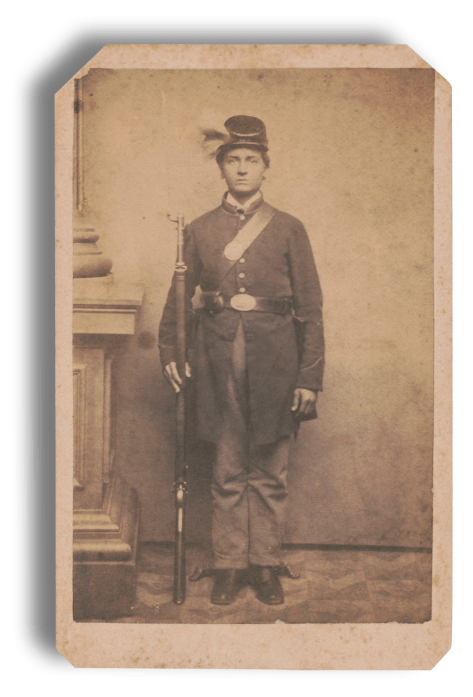


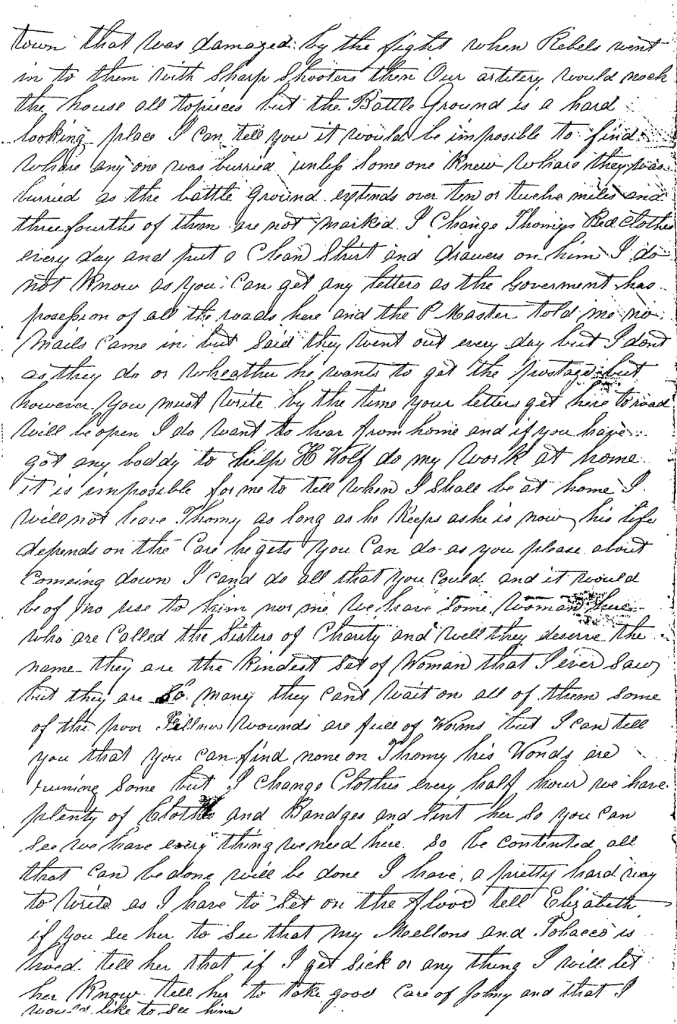
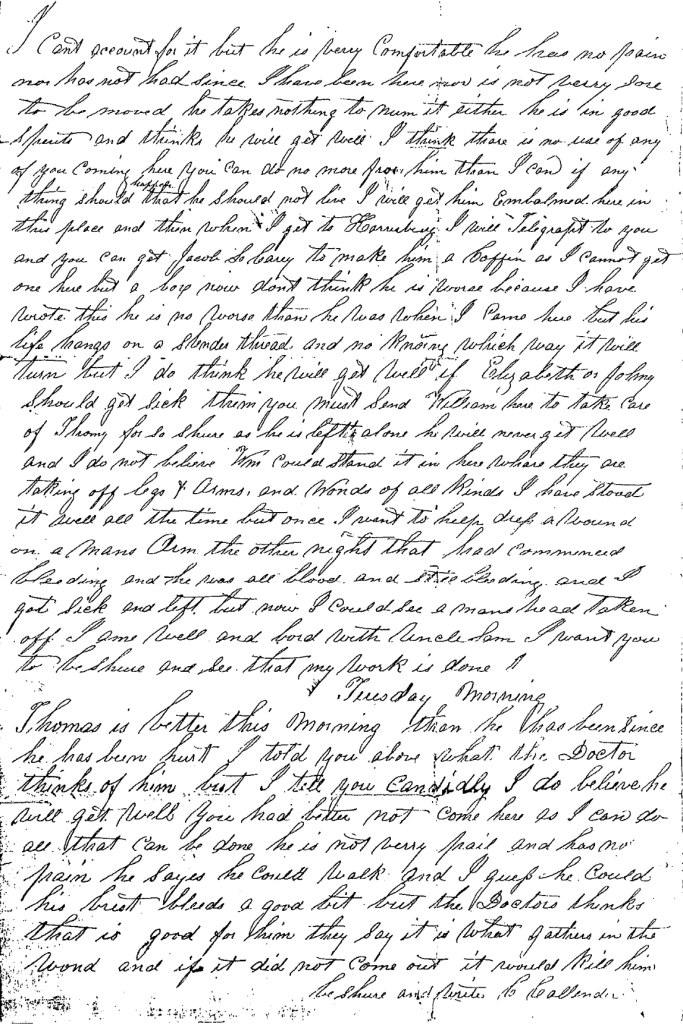
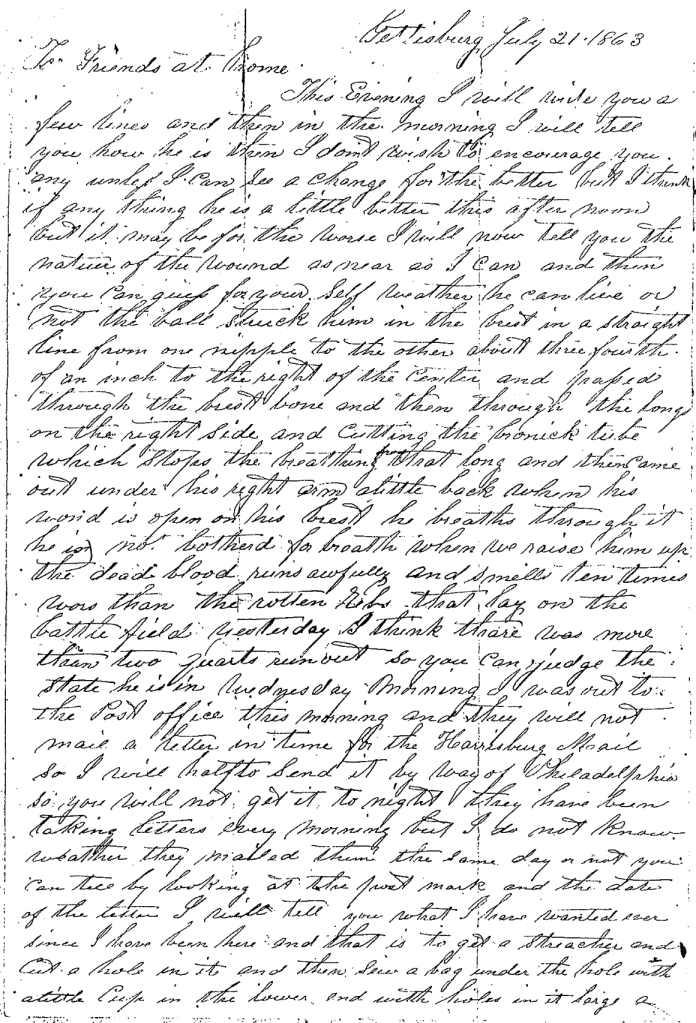
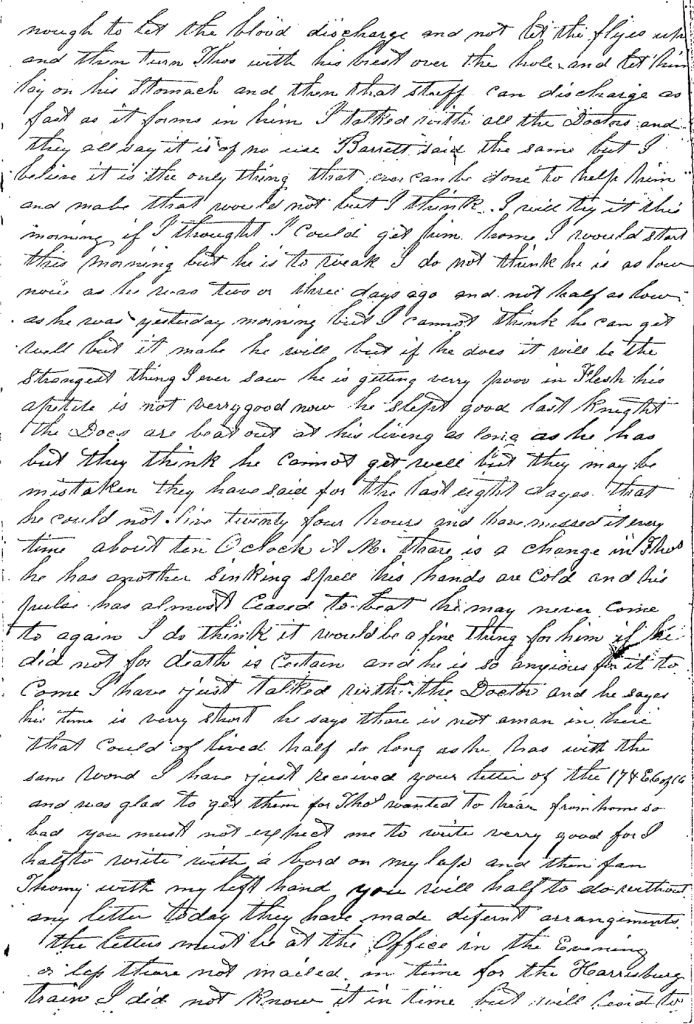


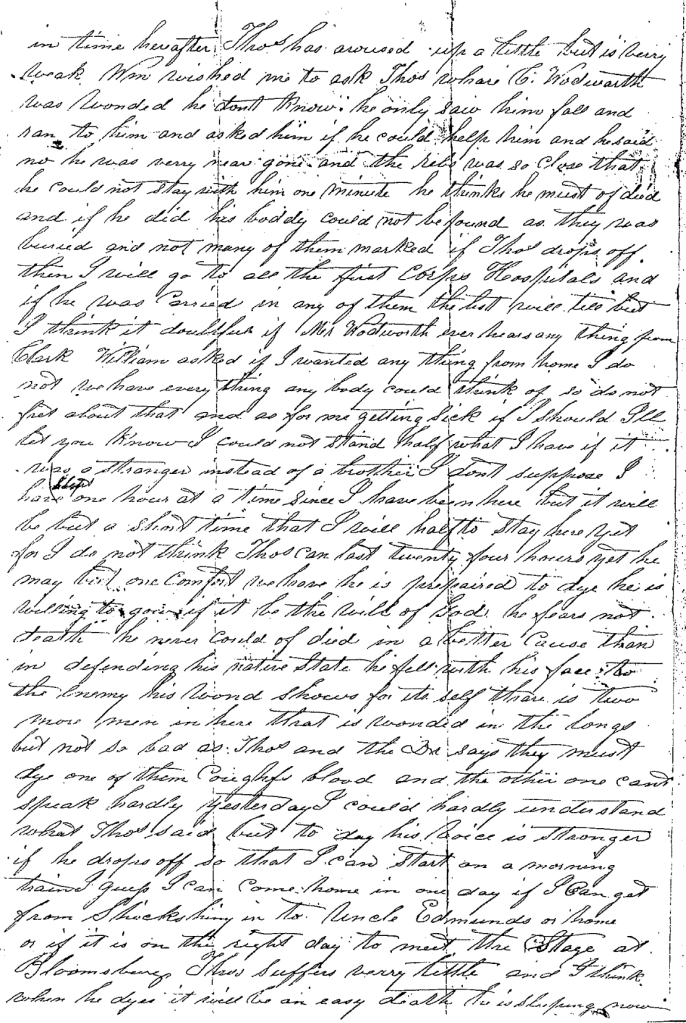

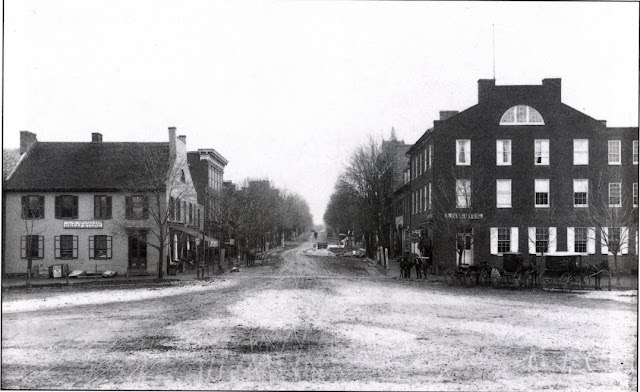


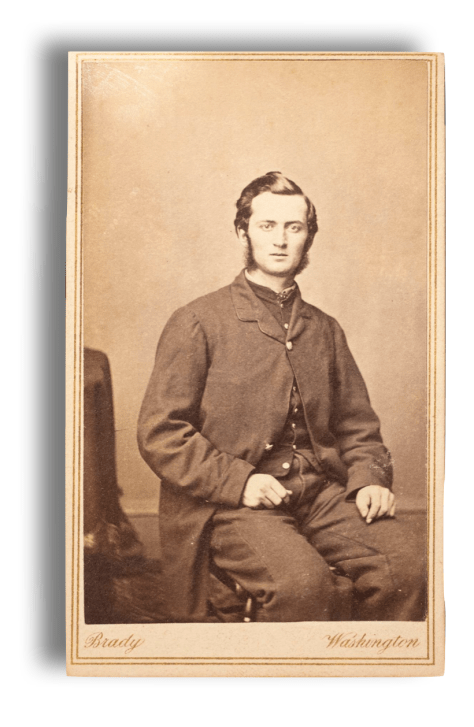
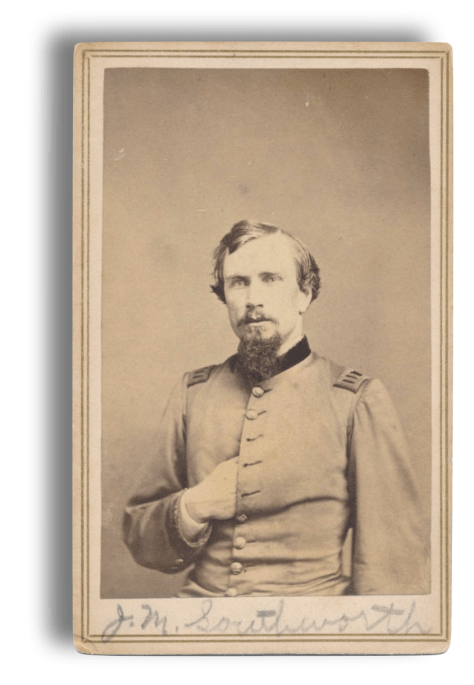


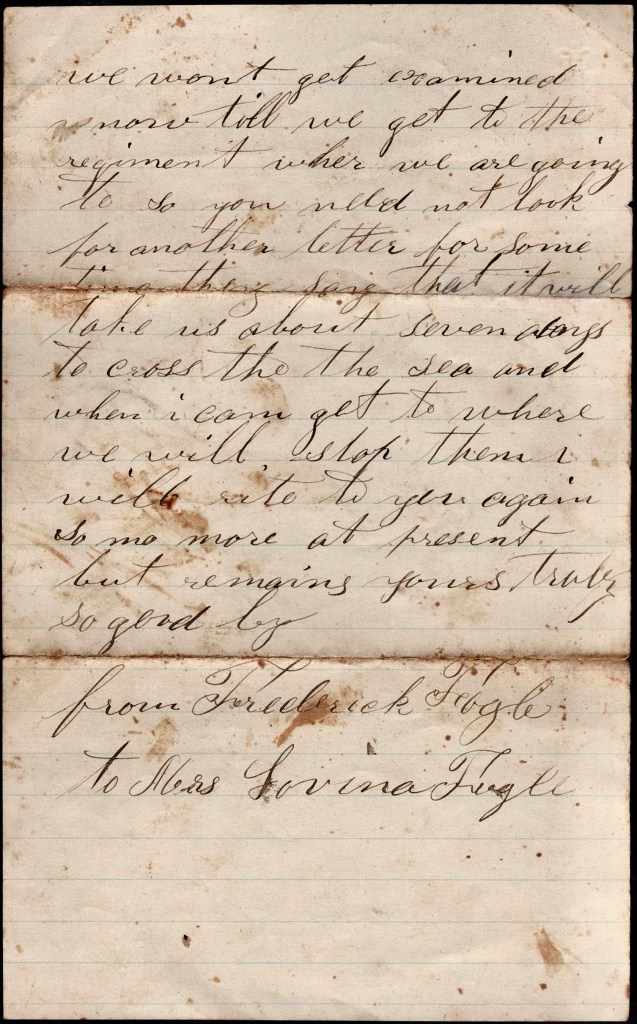

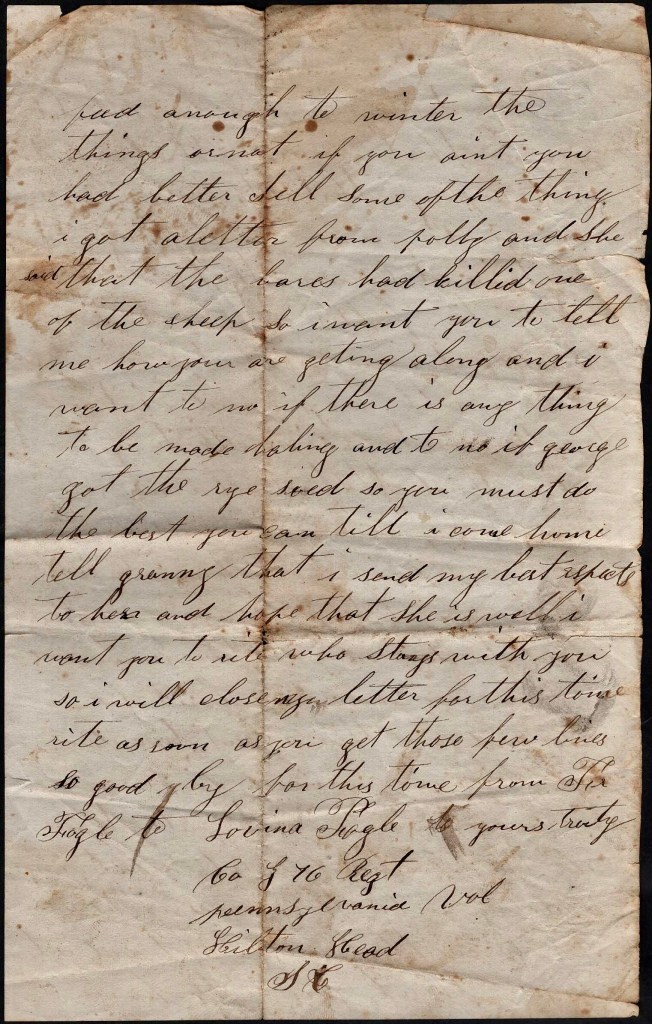
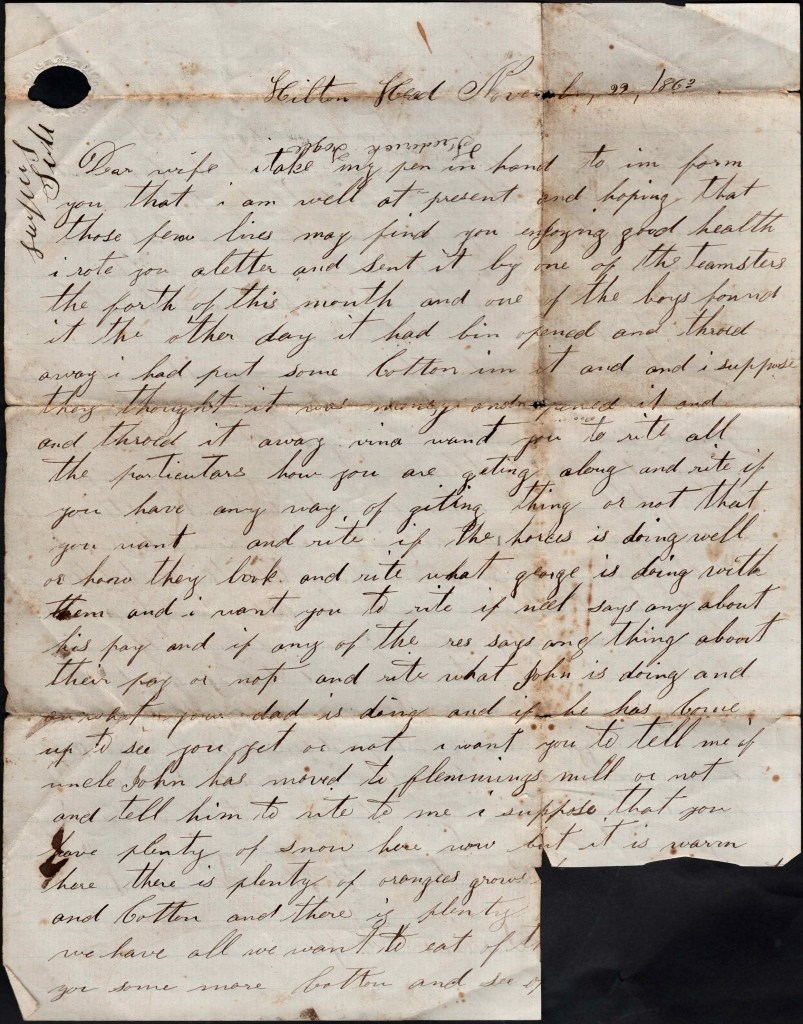
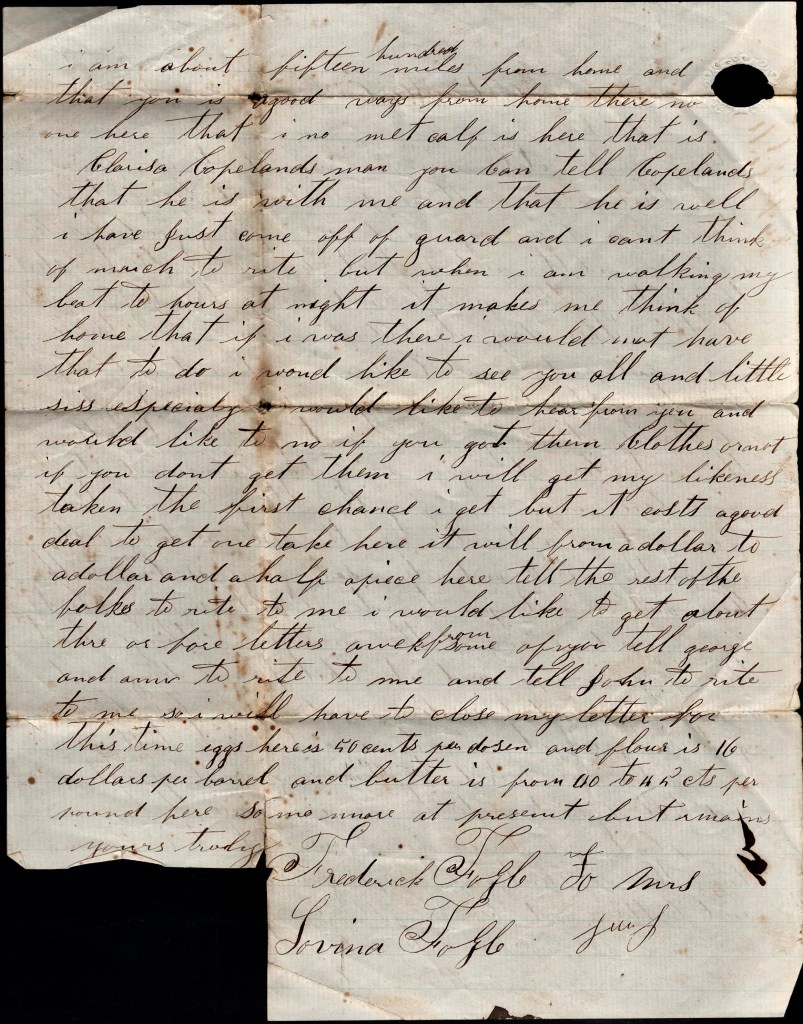


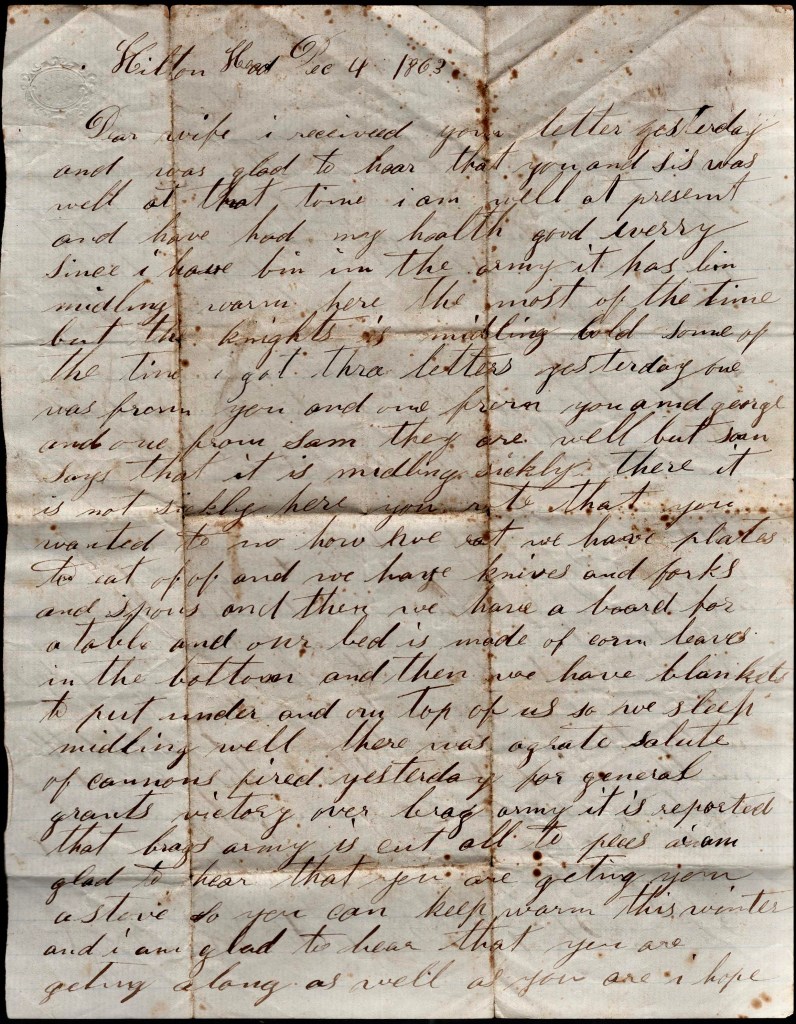

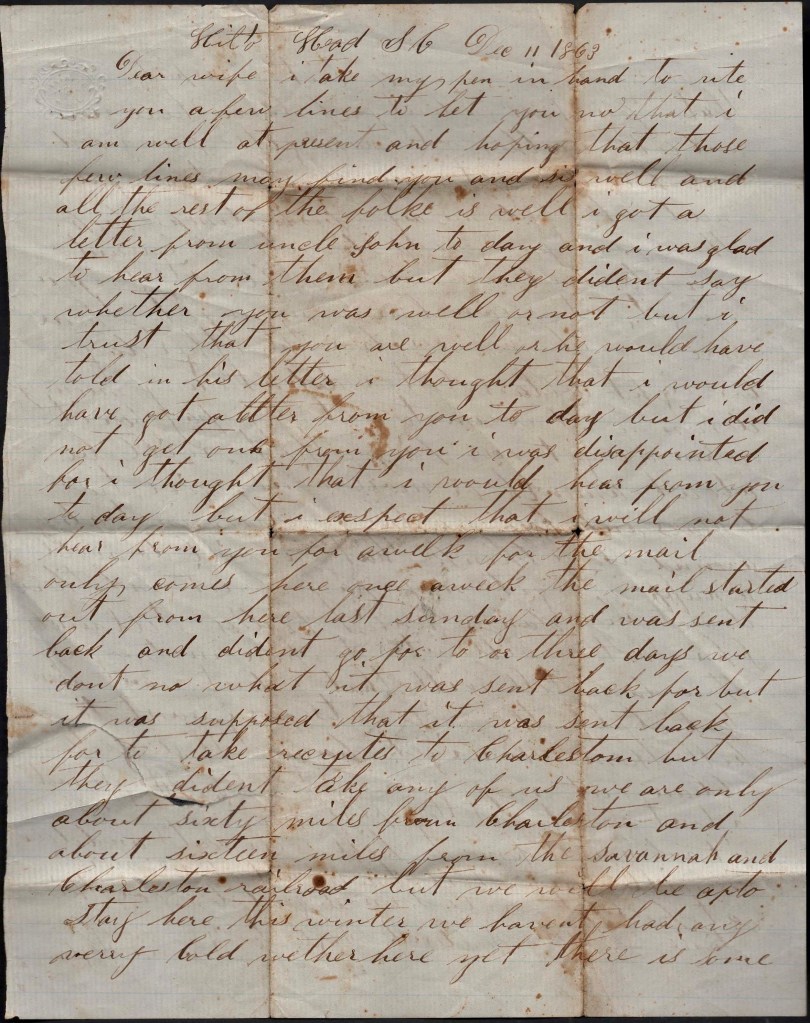
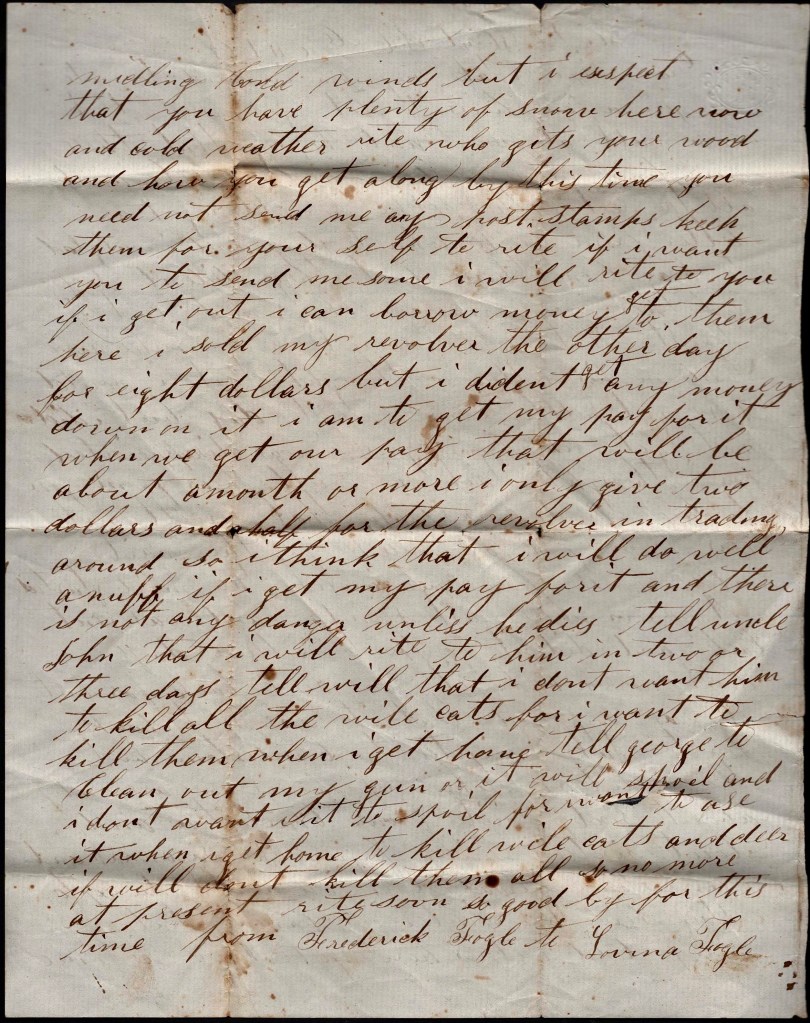

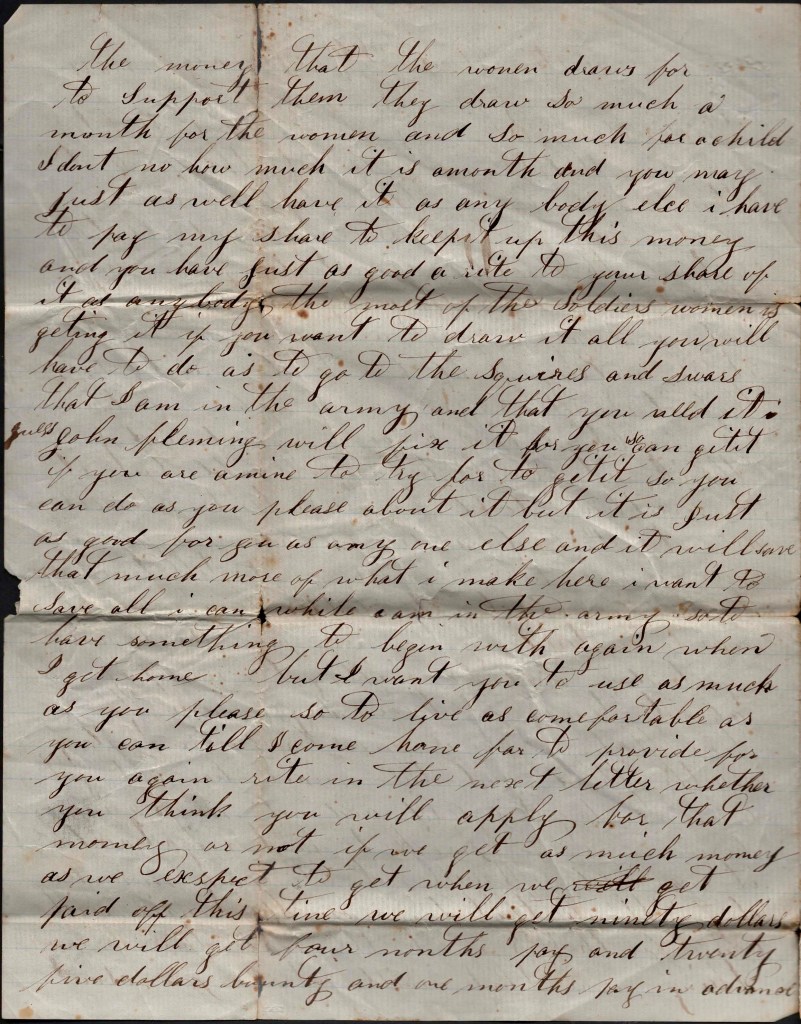


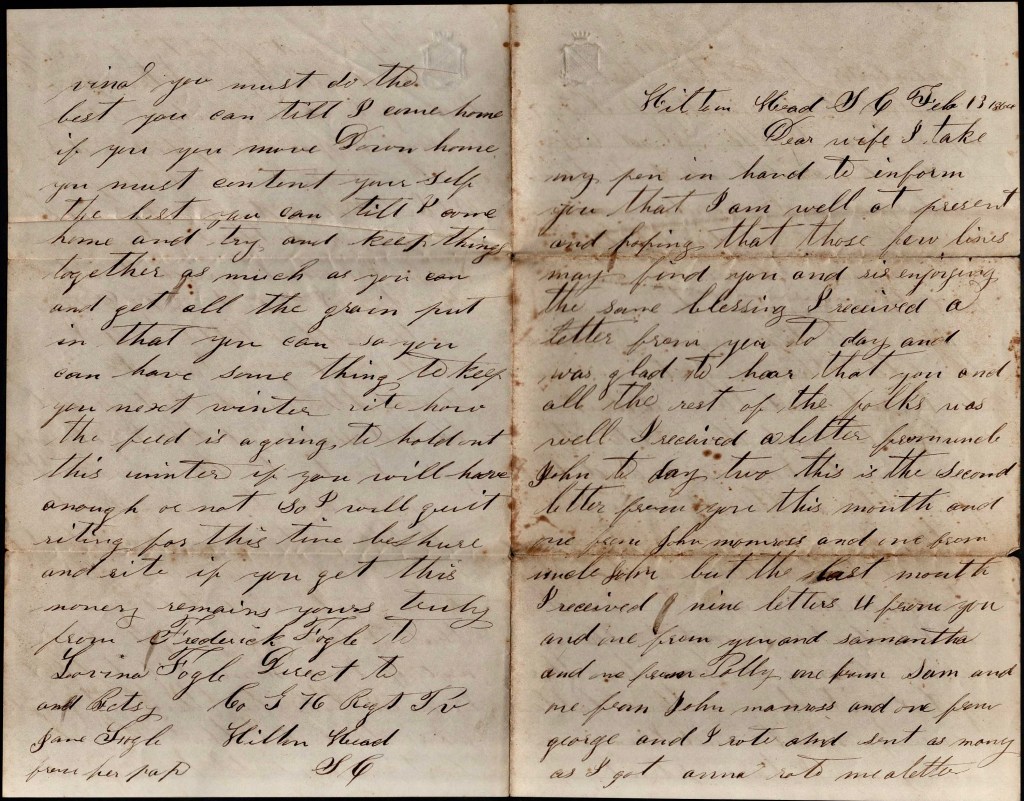


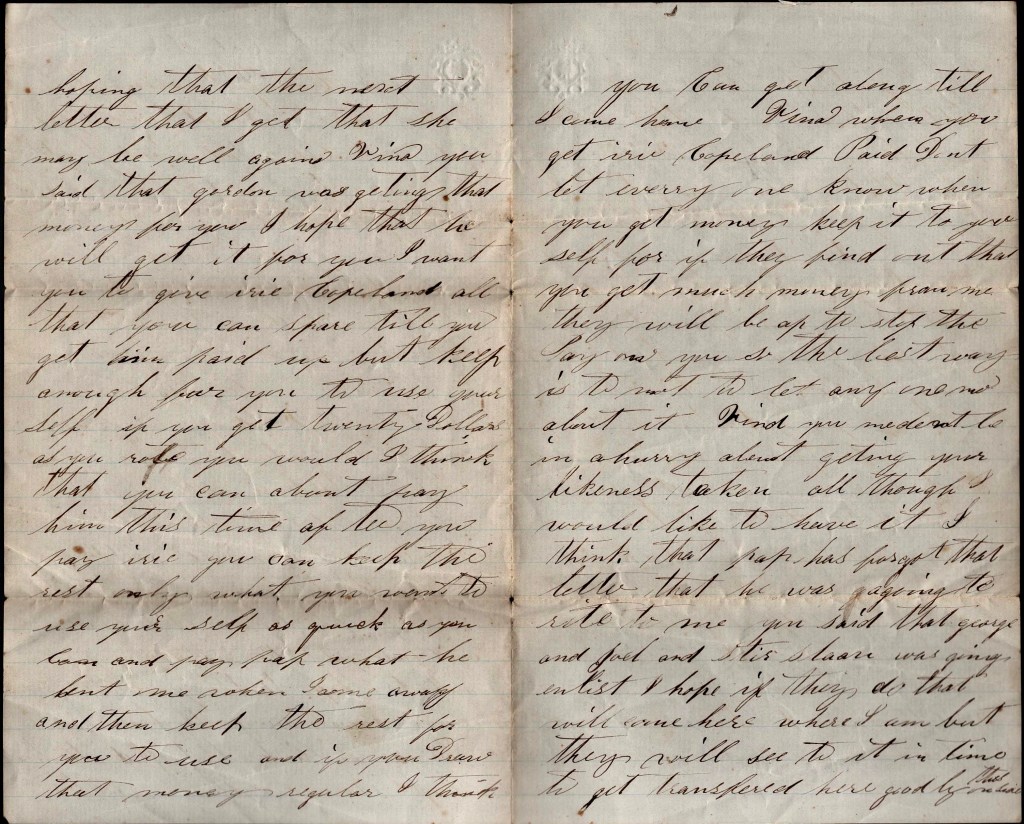

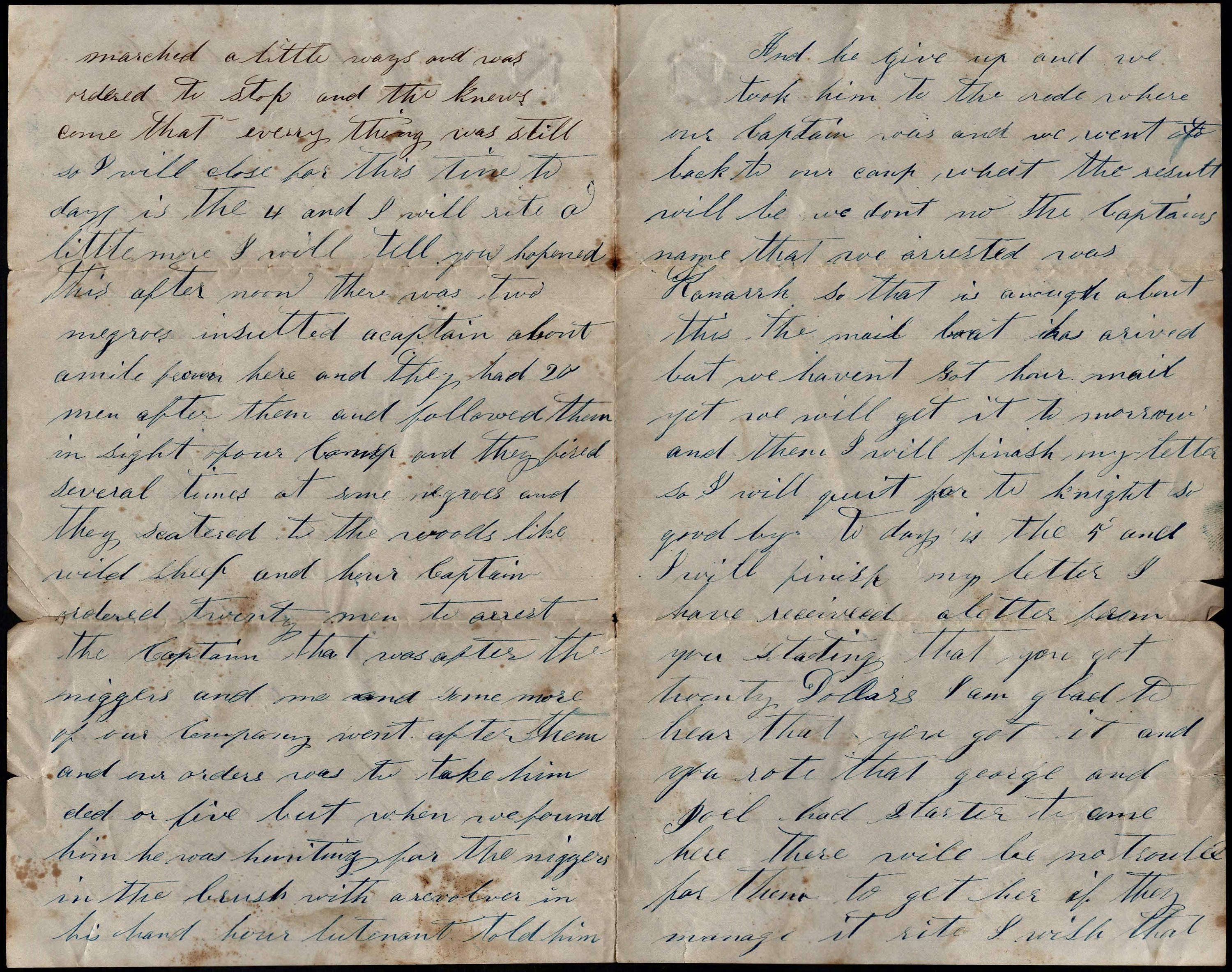


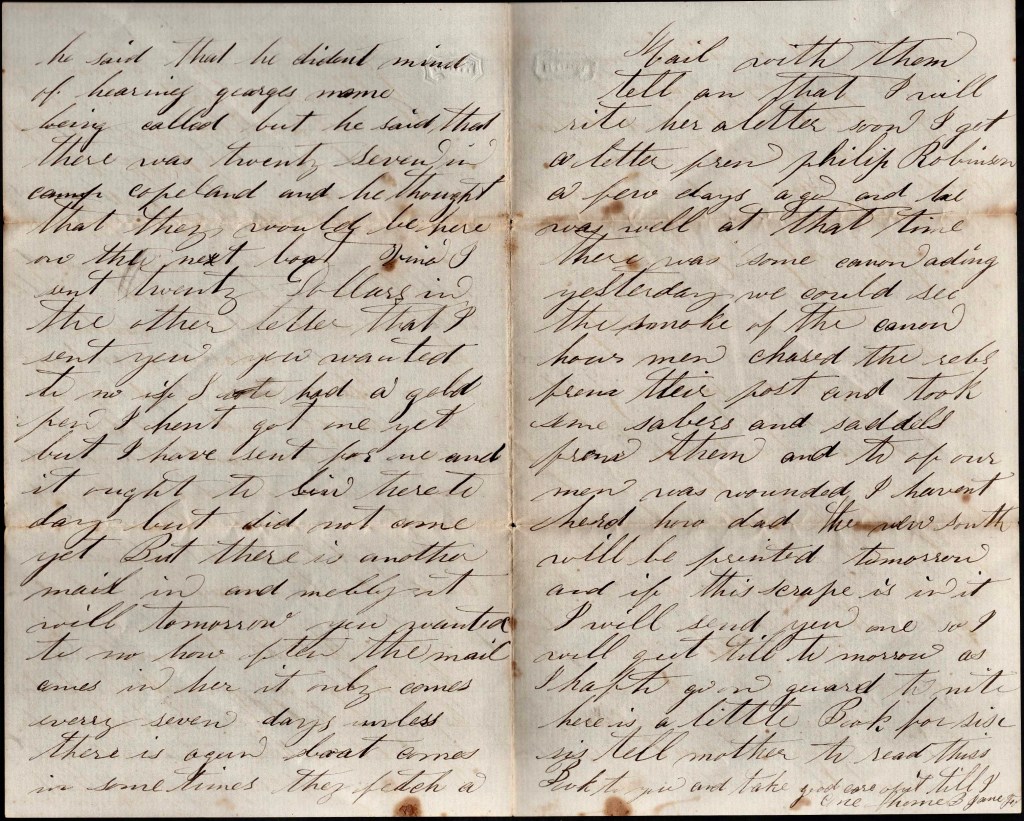

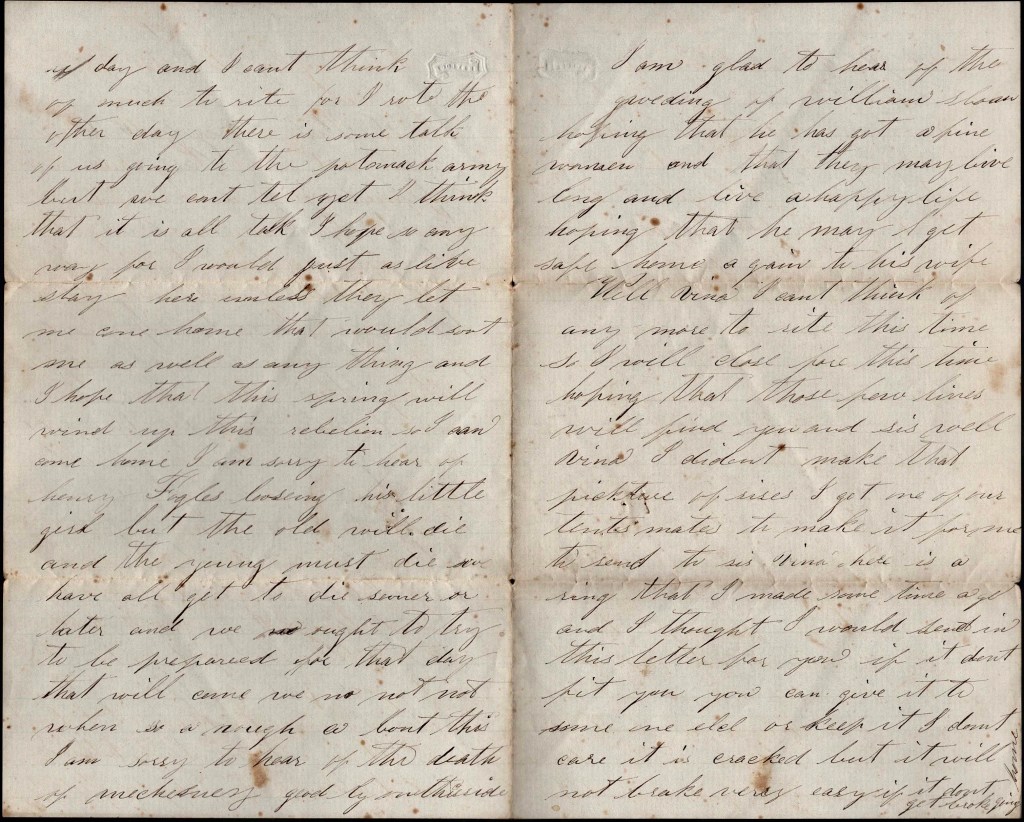


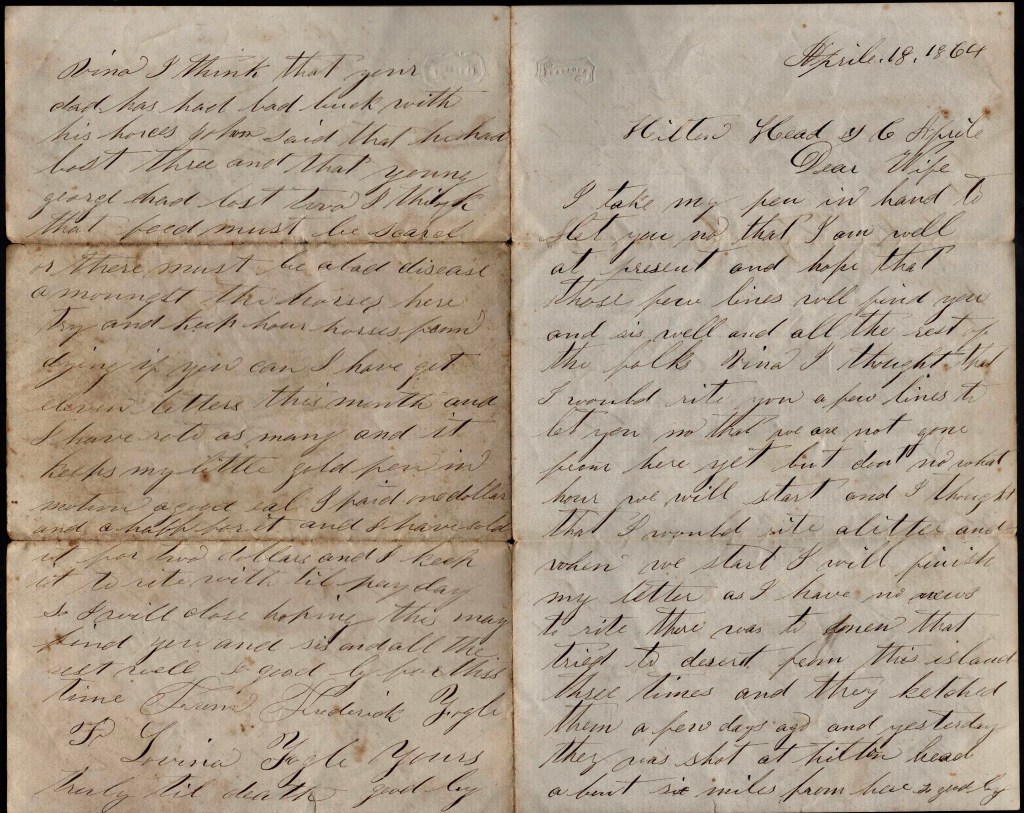

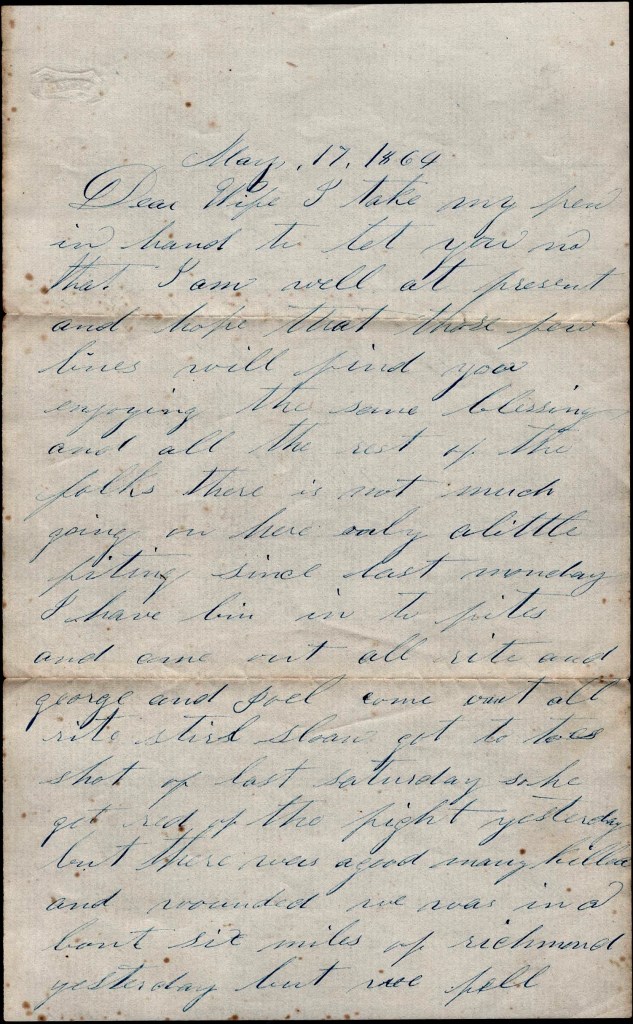

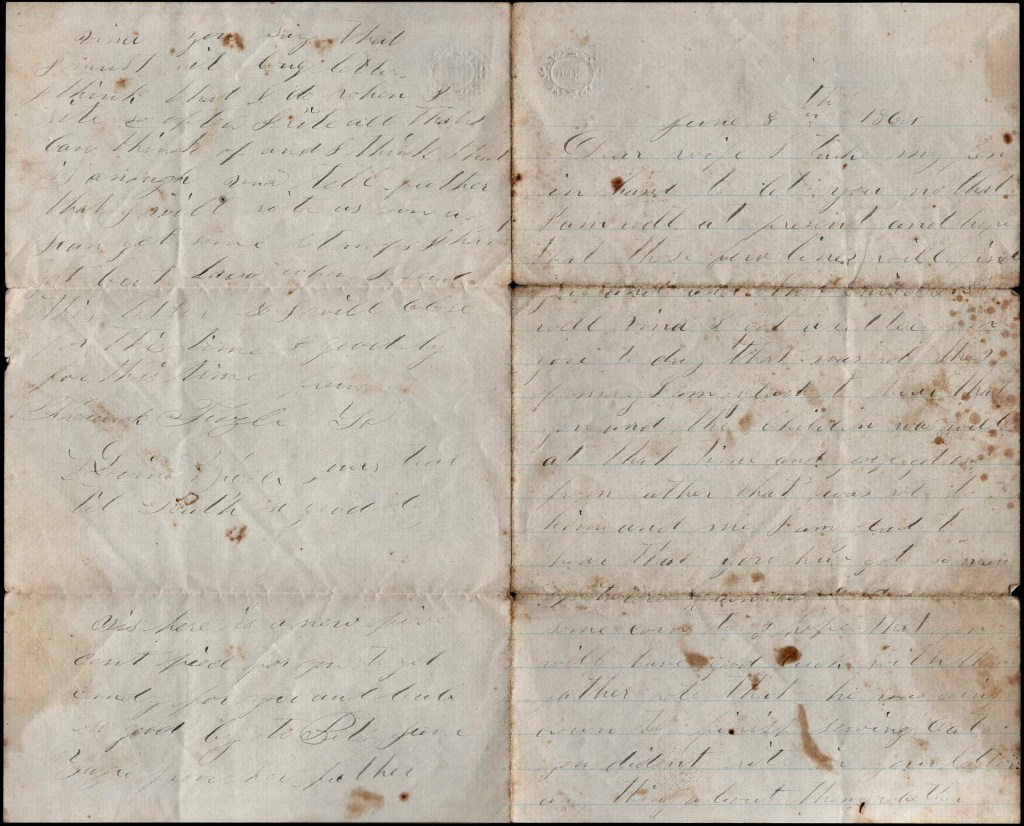
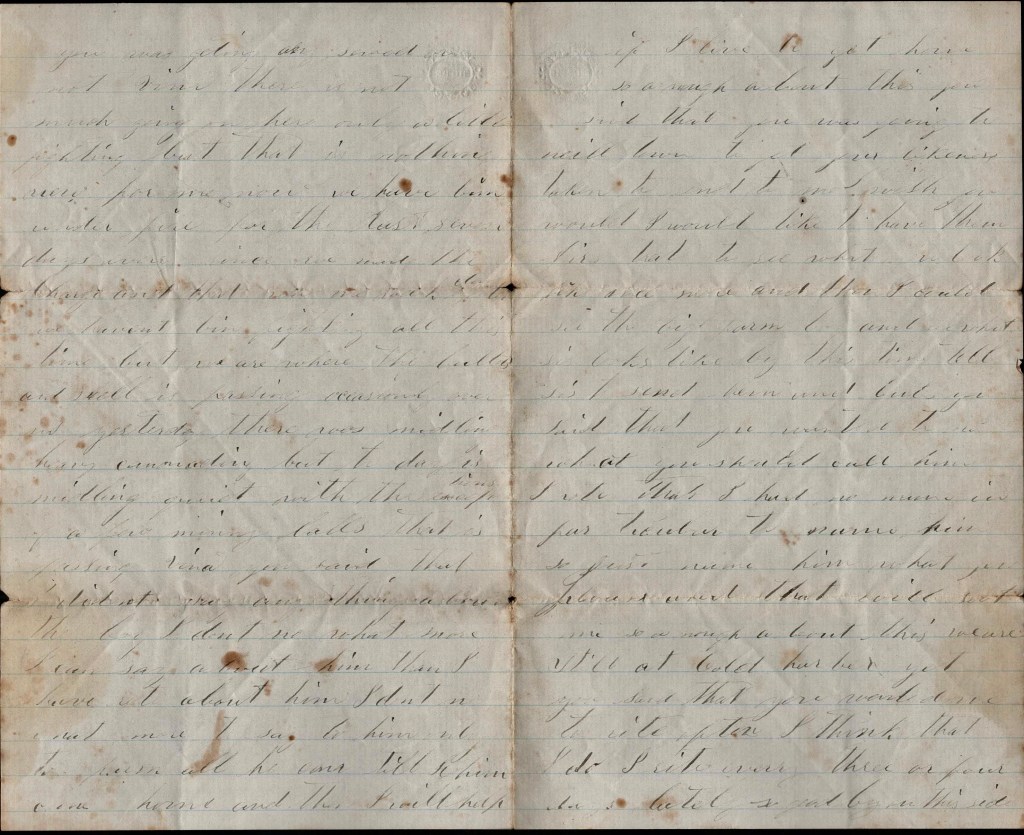

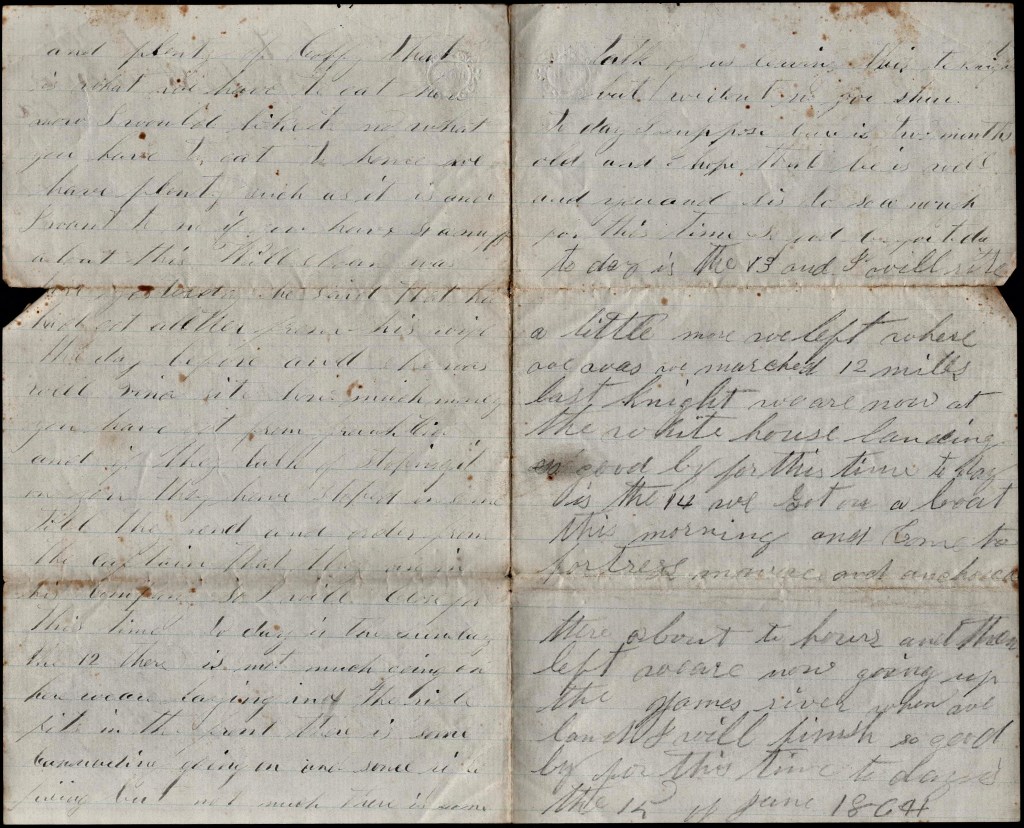
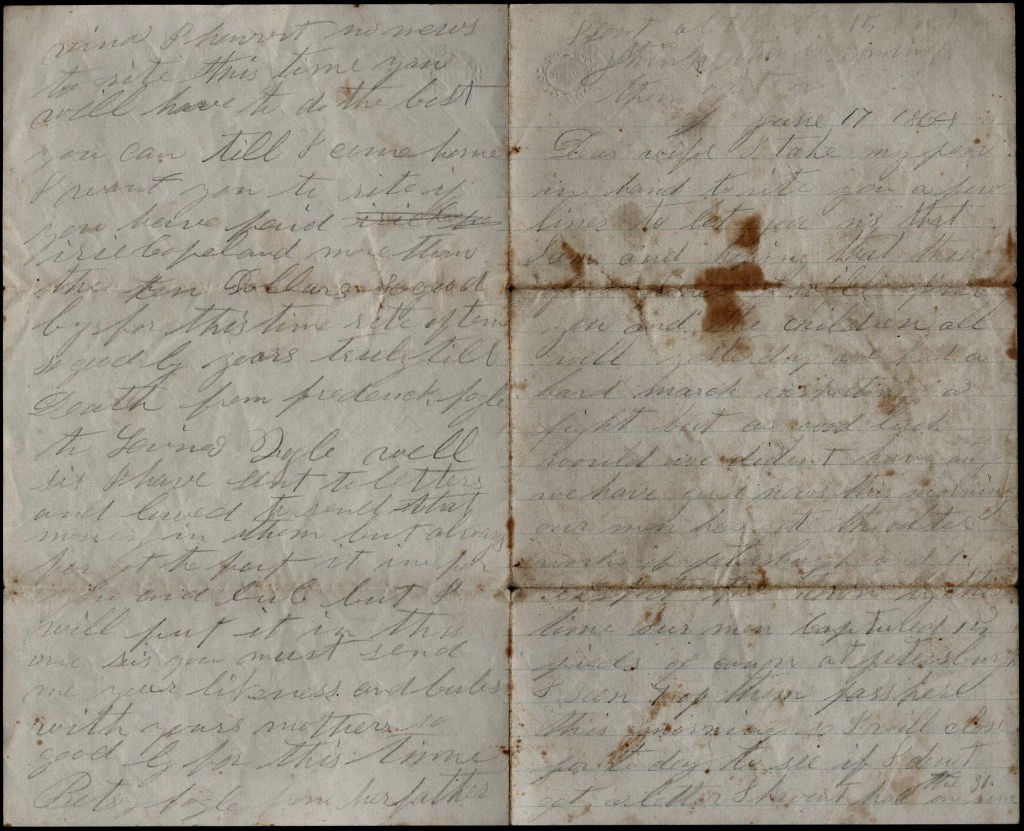

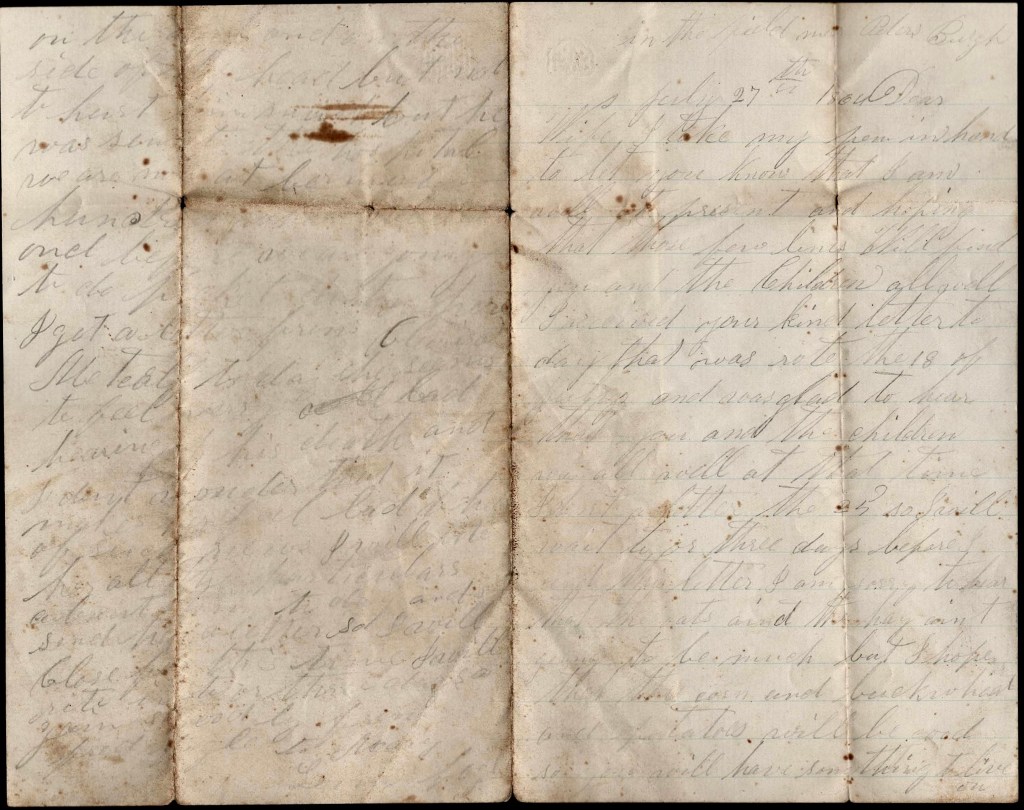

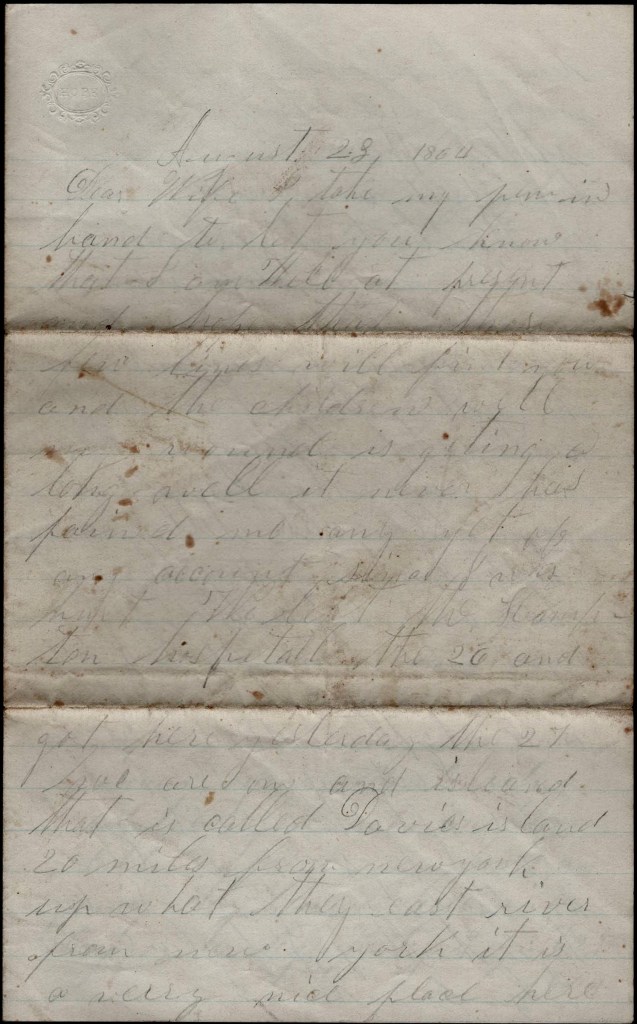


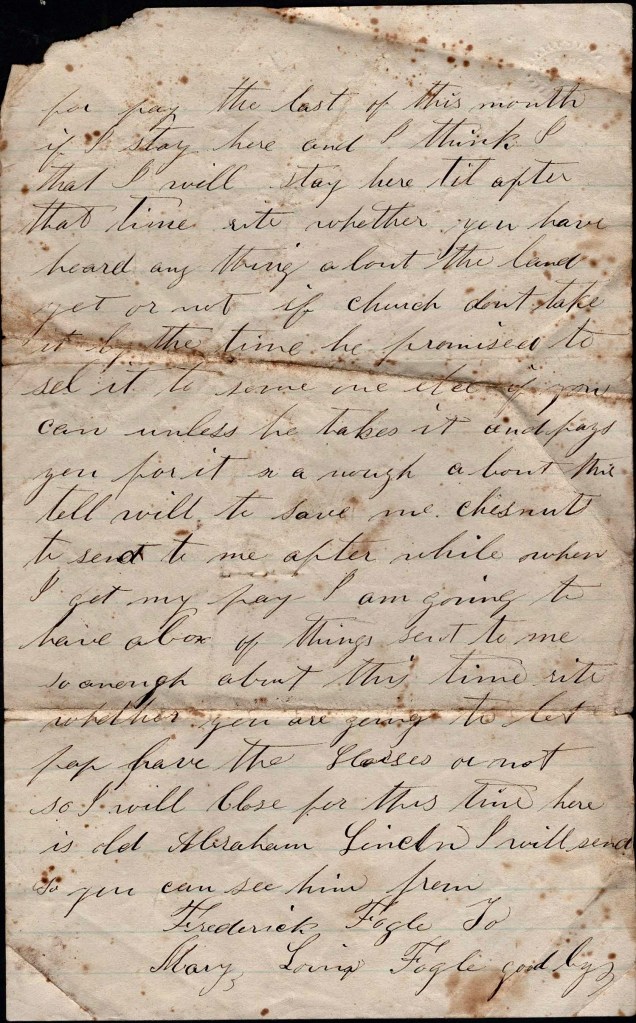


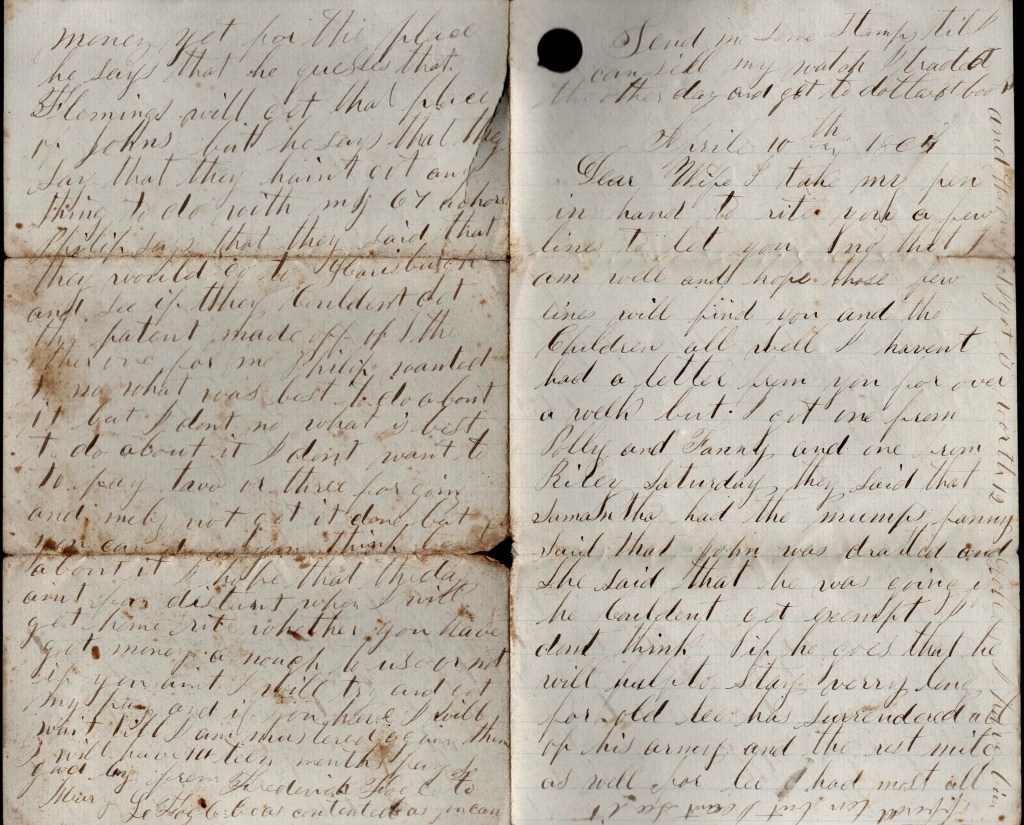

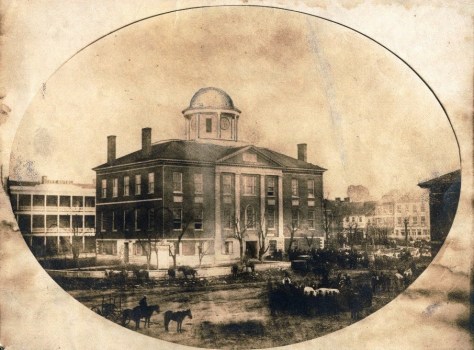
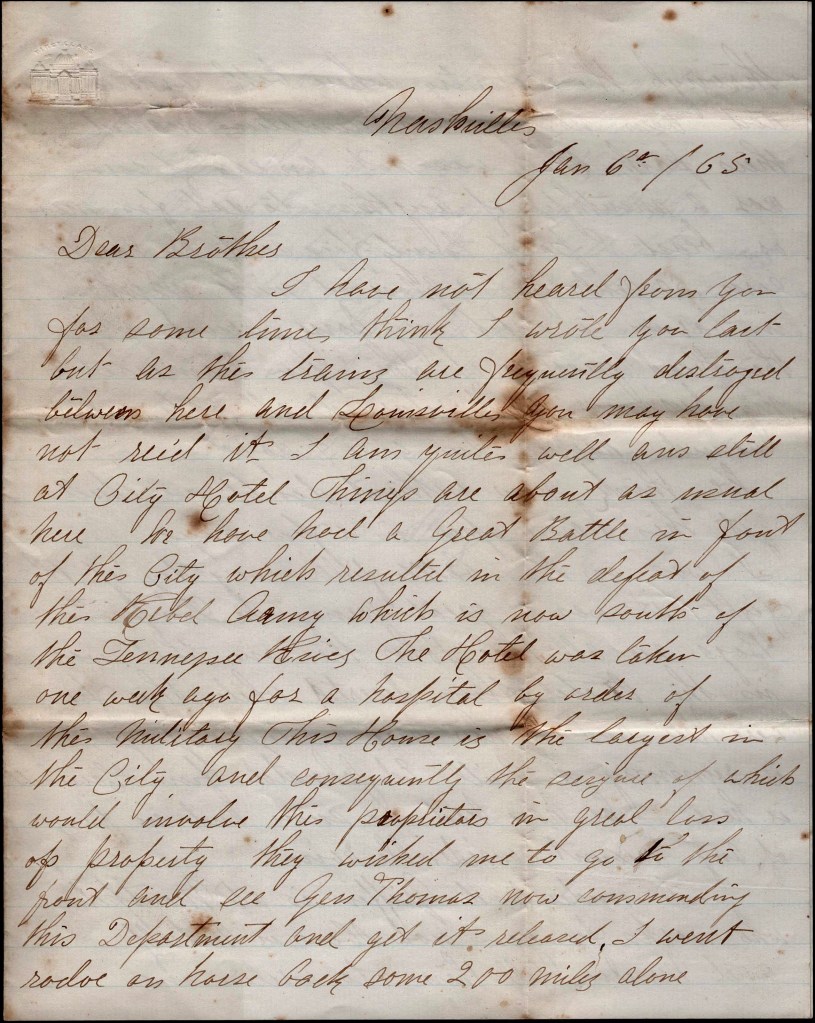
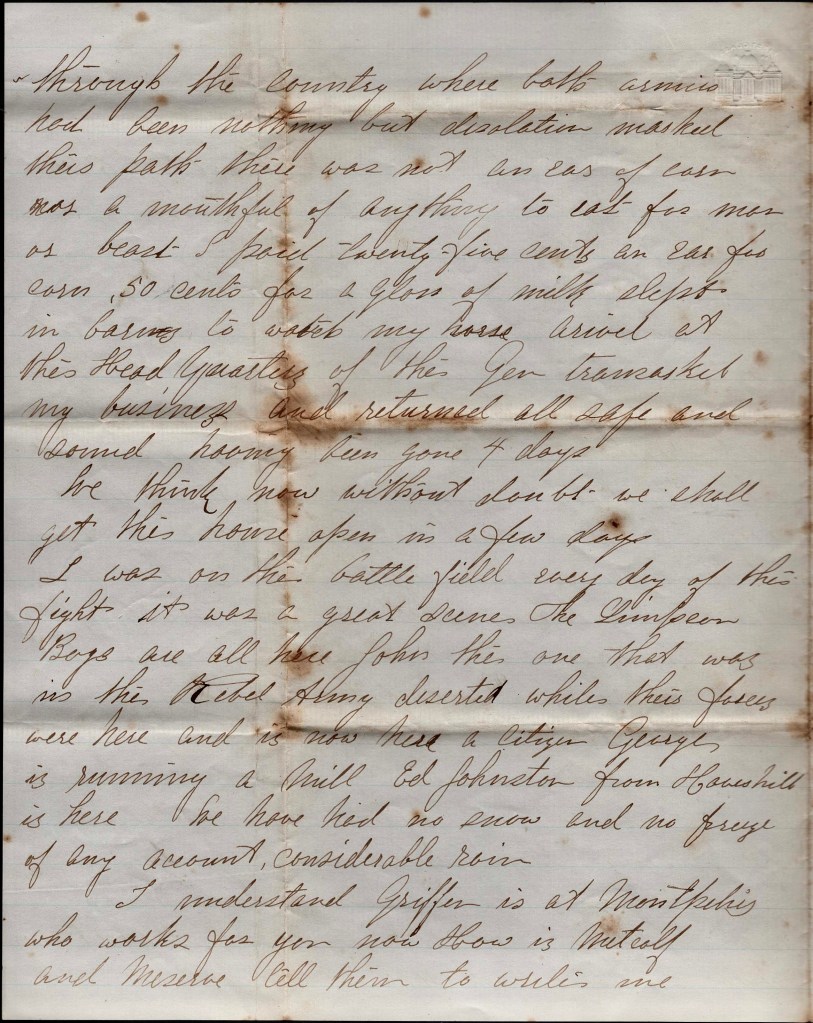


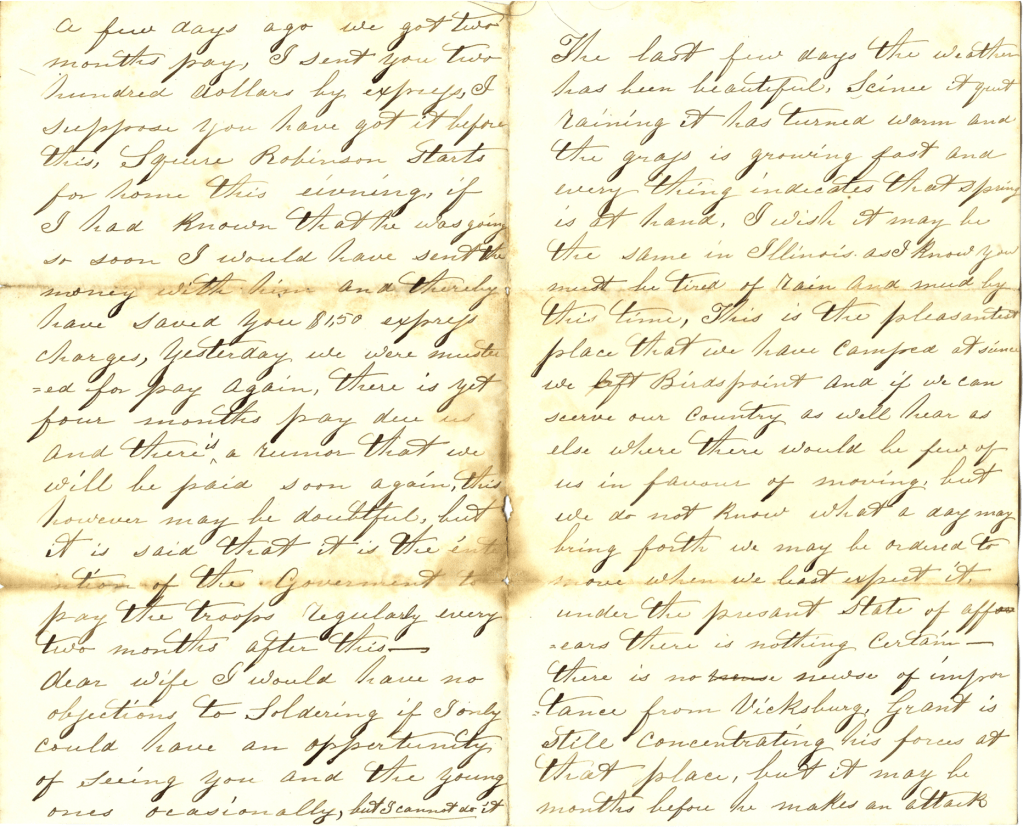

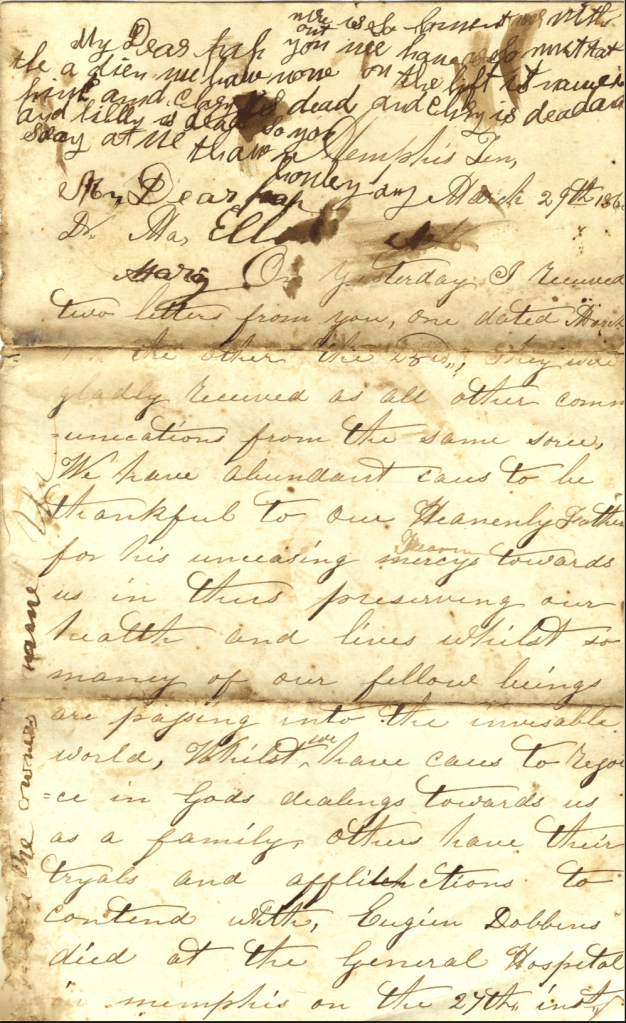

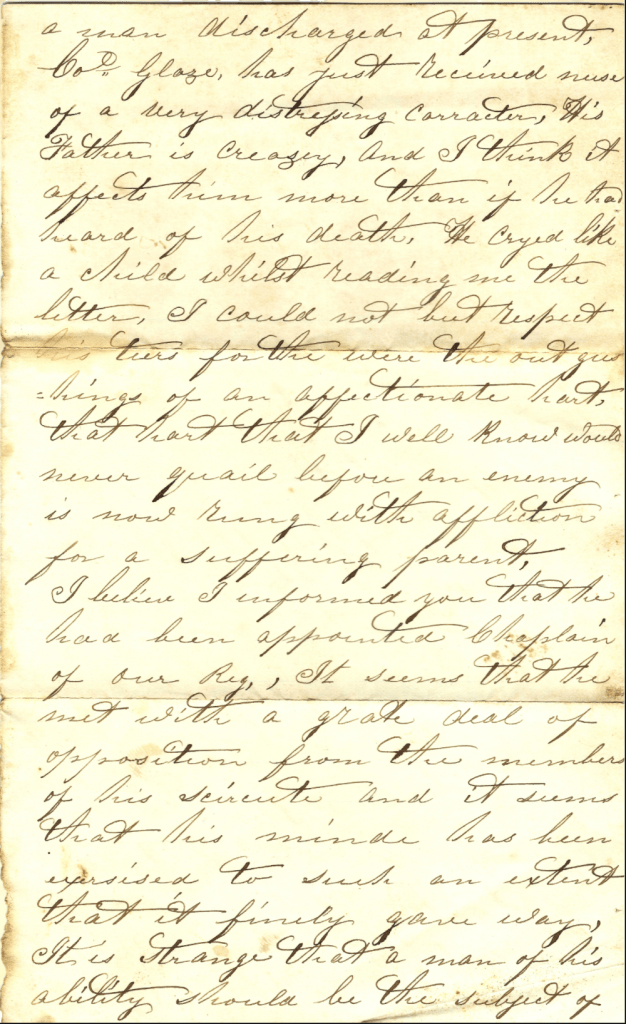

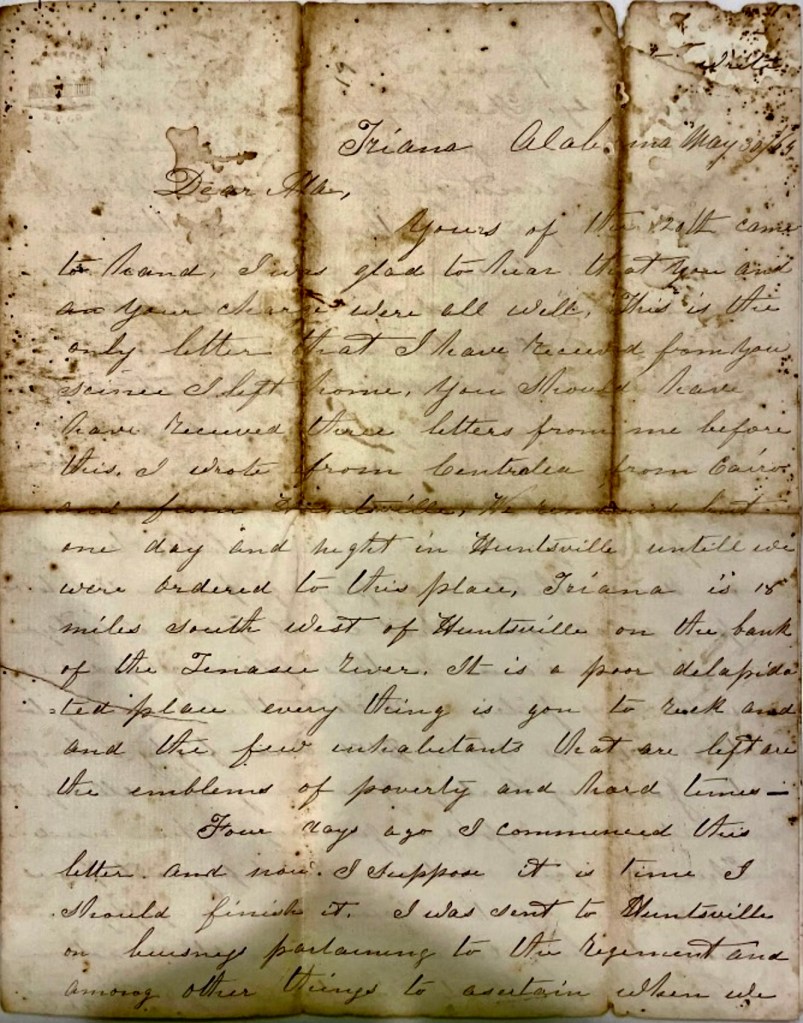




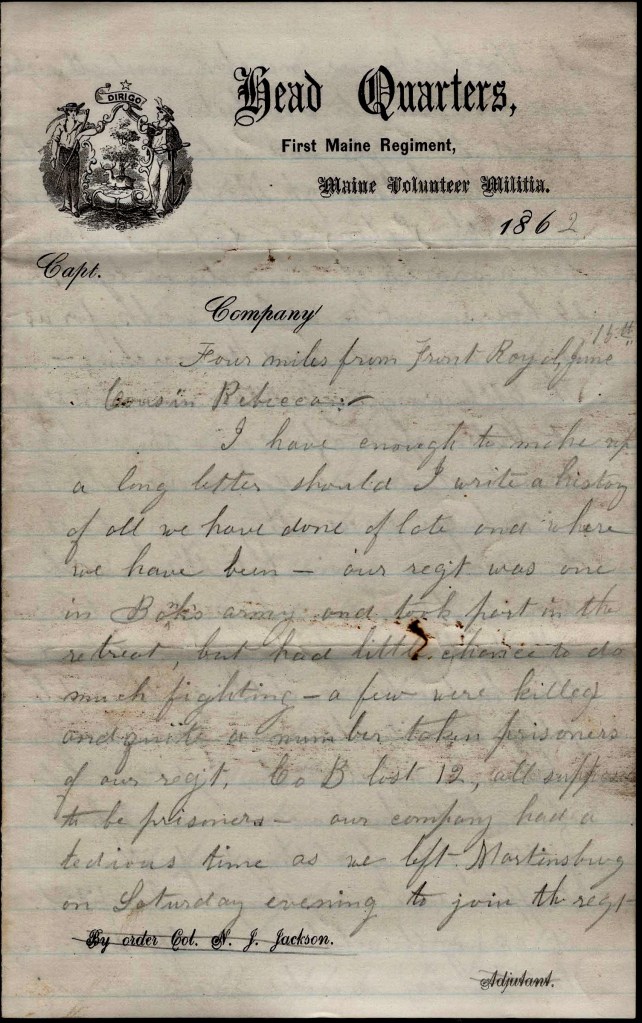

 Spared & Shared 23