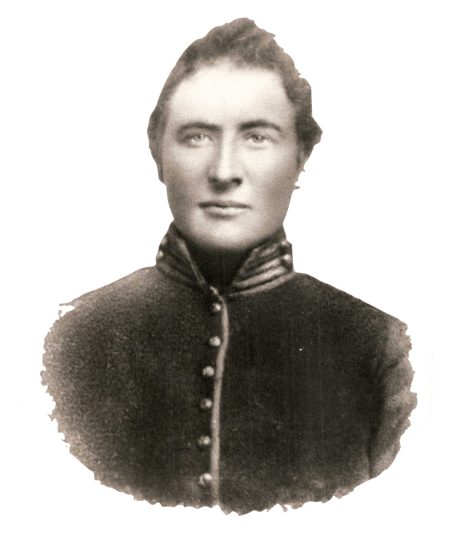
Edward Williams of Co. H wearing the Zouave uniform of the 10th Rhode Island Infantry(LOC).
This letter was written by William Frederick (“Fred”) Atwood (1845-1862), a corporal serving in his company. Fred was the 17 year-old son of William and Emeline Atwood, a recent graduate of the Providence high school. Fred was described by his comrades as having a “genial temperament and generous disposition, which drew around him a circle of personal friends” who mourned his loss when he died on 29 June 1862 at the Soldier Retreat in Washington D. C.
The 10th Rhode Island regiment was mustered into Federal service for three months in the summer of 1862. It was sworn in at Providence on May 26, 1862 and then moved to Washington, D. C. from May 27 to 29 where it was attached to Sturgis’ Command as part of the Military District of Washington. It saw duty at Camp Frieze, Tennallytown until June 26. With Sturgis, the regiment marched across the Potomac into Virginia, but returned to Washington when Jackson’s threat to the city subsided.
After a few days, on Monday morning, June 30, the 10th was detached from Sturgis’ troops and ordered to relieve the 59th New York in the seven forts and three batteries it had been occupying. These defenses of Washington were north and west of the city.
Company A was sent to Fort Franklin. This position guarded the Baltimore and Ohio Canal, the Baltimore & Ohio Railroad, and the Washington Aqueduct—the new water supply for the city. the U. S. Army Engineers had designed Fort Franklin to protect the city’s receiving reservoir (as conveyed by the Aqueduct) as well as the Potomac river shoreline.
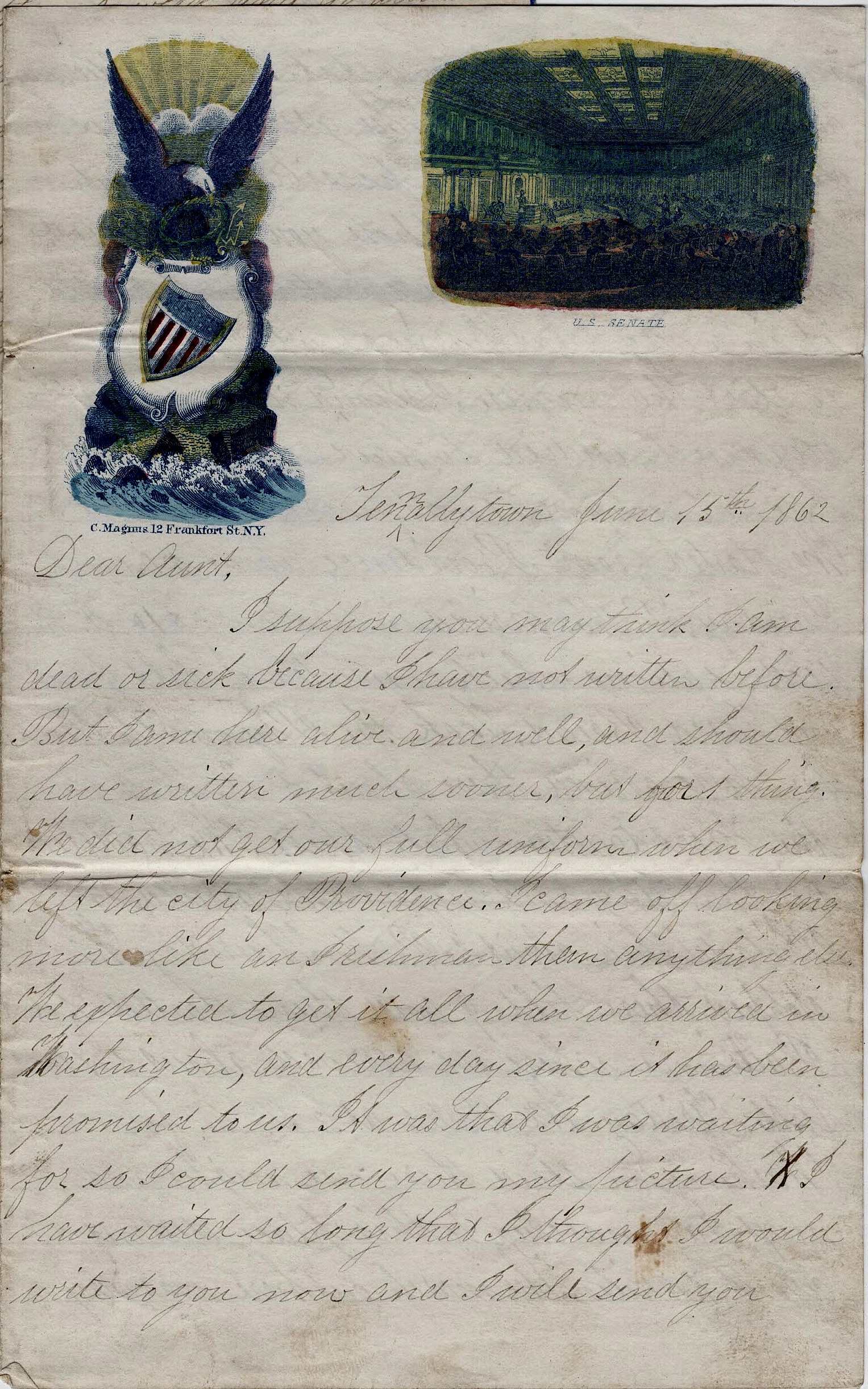
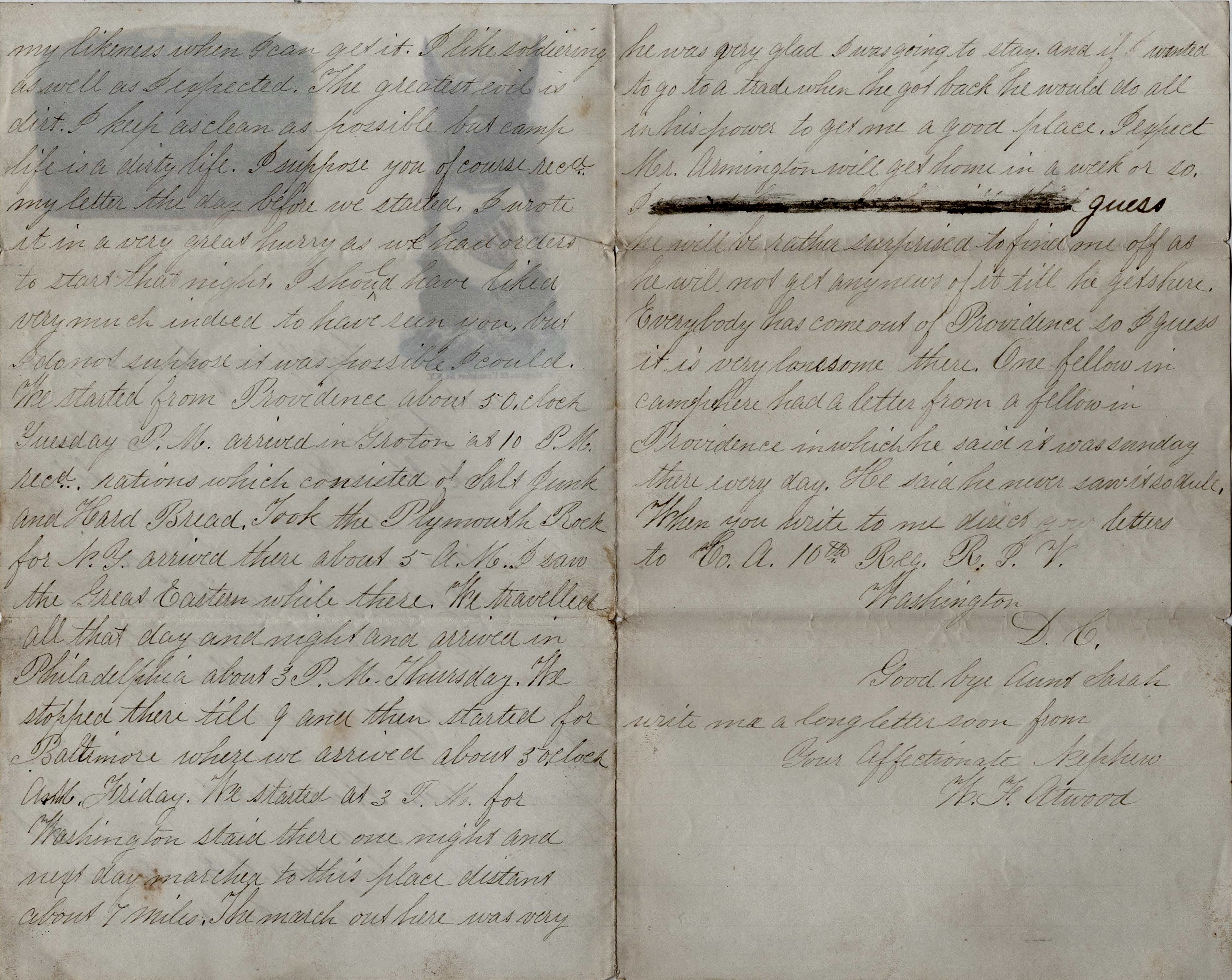
I suppose you may think I am dead or sick because I have not written before but I am here alive and well, and should have written much sooner but for 1 thing. We did not get our full uniform when we left the City of Providence. I came off looking more like an Irishman than anything else. We expected to get it all when we arrived in Washington, and every day since it has been promised to us. It was that I was waiting for so I send you my picture. I have waited so long that I thought I would write to you and I will send you my likeness when I can get it.
I like soldiering as well as I expected. The greatest evil is dirt. I keep as clean as possible but camp life is a dirty life. I suppose you of course received my letter the day before we started. I wrote it in a very great hurry as we had orders to start that night. I should have liked very much indeed to have seen you but I do not suppose it was possible I could.
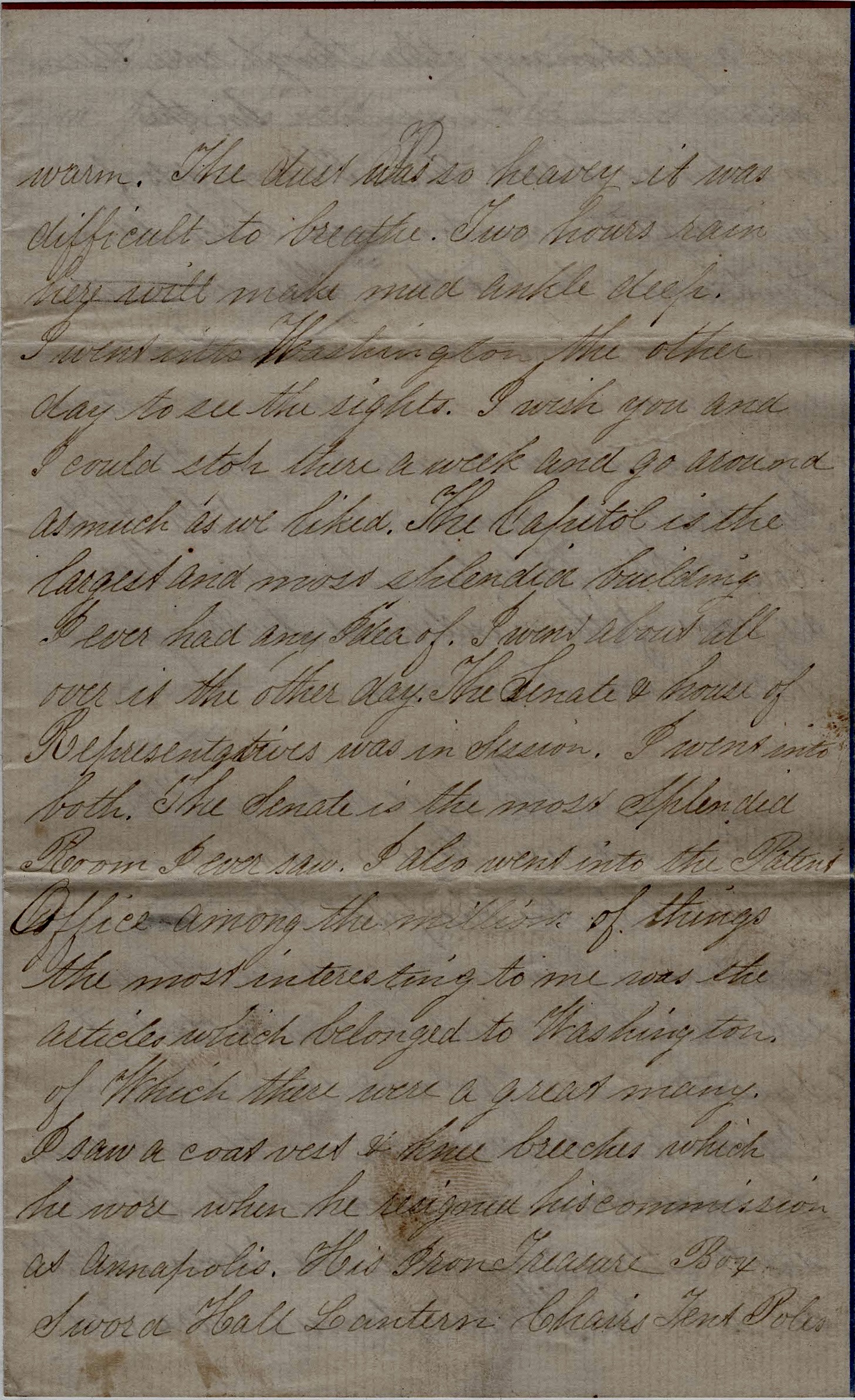
We started from Providence about 5 o’clock Tuesday p.m., arrived in Groton t 10 p.m., received rations which consisted of salt junk [salted beef] and hard bread. Took the Plymouth Rock for New York, arrived there about 5 a.m. I saw the Great Eastern [steamship] while there. We travelled all that day and night and arrived in Philadelphia about 3 p.m. Thursday. We stopped there till 9 and then started for Baltimore where we arrived about 5 o’clock a.m. Friday. We started at 3 p.m. for Washington, stayed there one night, and next day marched to this place, distant about 7 miles. The march out here was very warm. The dust was so heavy it was difficult to breathe. Two hours rain made mud ankle deep.
I went into Washington the other day to see the sights. I wish you and I could stop there a week and go around as much as we liked. The Capitol is the largest and most splendid building I ever had any idea of. I went about all over it the other day. The Senate and House of Representatives was is session. I went into both [chambers]. The Senate is the most splendid room I ever saw. I also went into the Patent Office, Among the millions of things, the most interesting to me was the articles which belonged to [General] Washington of which there were a great many. I saw a coat vest and knee breeches which he wore when he resigned his commission at Annapolis. His iron Treasure box, sword, hall lantern, chairs, tent poles, and a great many other things were there. I was very much disappointed in the machines I saw there. The models of some (a great many too) I should not think would be put there—they were made so cheap and common. But there was enough of interest in te room to interest me a month if I could only get there. I went into the reception room of the White House. It is furnished splendidly. There are some of the handsomest buildings in Washington I ever saw.
Many other collections soon found their way to the Model Hall in the Patent Office. The somewhat random assortment of objects included “Historical Relics,” such as the original Declaration of Independence, Benjamin Franklin’s printing press, and George Washington’s uniform. The display was simultaneously insular and expansionist, dedicated to national history while expressing global aspirations.
We have but very little sickness out here. There is but one man at present in the hospital from my company. I am in as good heath as I ever was. I have had but one attack of dysentery but I got over it in a day. I guess about every man in the company has been touched with it. The water they say brings it on. While we were in Washington, we were fed on bread, coffee strong without milk, and junk so salty you could hardly keep it in your mouth. The junk made me dry and I drank considerable of the spring water there. It went through me like Croton oil but I was not troubled but once.
We were sworn into service last Monday for three months from the 26th of May (three weeks tomorrow). How are things with you in Taunton and Berkley. I want you to write me a good long letter when you get this and let me know all the news, &c. We will have to give up the good times we were going to have for the present, but if I get back at the end of the three months, we will make up for the lost time. I asked Mr. Eddy if there would be any doubt about my getting my place again. He told me not to be uneasy about that for he would not lose me for anything. He had a letter from Mr. Armington a day or two before I came away in which Mr. A. said he was very glad I was going to stay and if I wanted to go to a trade when he got back, he would do all in his power to get me a good place. I expect Mr. Armington will get home in a week or so, I guess he will be rather surprised to find me off as he will not get any news of it till hr gets here. Everybody has come out of Providence so I guess it is very lonesome there. One fellow in camp here had a letter from a fellow in Providence in which he said it was Sunday there every day. He said he never saw it so dull.
When you write to me, direct your letters to Co. A, 10th Regiment R. I. Vols., Washington D. C.,
Goodbye Aunt Sarah. Write me a long letter soon. Your affectionate nephew, — W. F. Atwood
I could not find an image of Peter but here is David L. McLain who also served in the same company.
This letter was written by Peter Miller who enlisted at the age of 25 as a private in Co. H, 7th Illinois Cavalry at Shelbyville, Illinois, on 7 September 1861. When he mustered in, Peter identified himself as a single farmer and gave his residence as Vandalia, Illinois. The regiment was organized at Camp Butler near Springfield. Four of the companies (A, C, G, and I) were sent to Bird’s Point, Missouri, on 30 October 1861, but Co. H remained in Springfield until late December 1861.
Peter survived the war, mustering out at Nashville, Tennessee, in November 1865. He married Mary Ann Lear (1846-1925) in 1866 and lived out his days in Fayetteville county, Illinois.
T R A N S C R I P T I O N
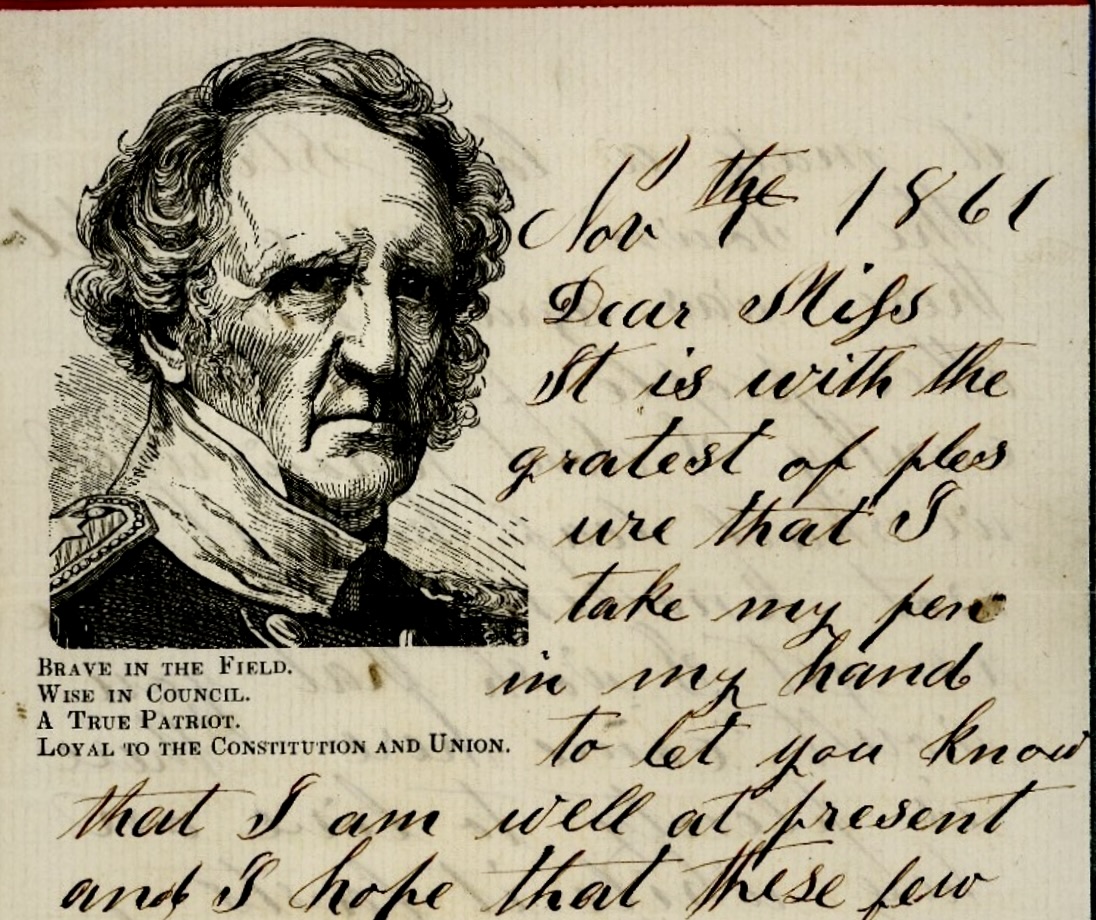
Peter’s letter was written on patriotic stationery featuring an image of Winfield Scott.
[Camp Butler near Springfield, Illinois] November 1, 1861
Dear Miss,
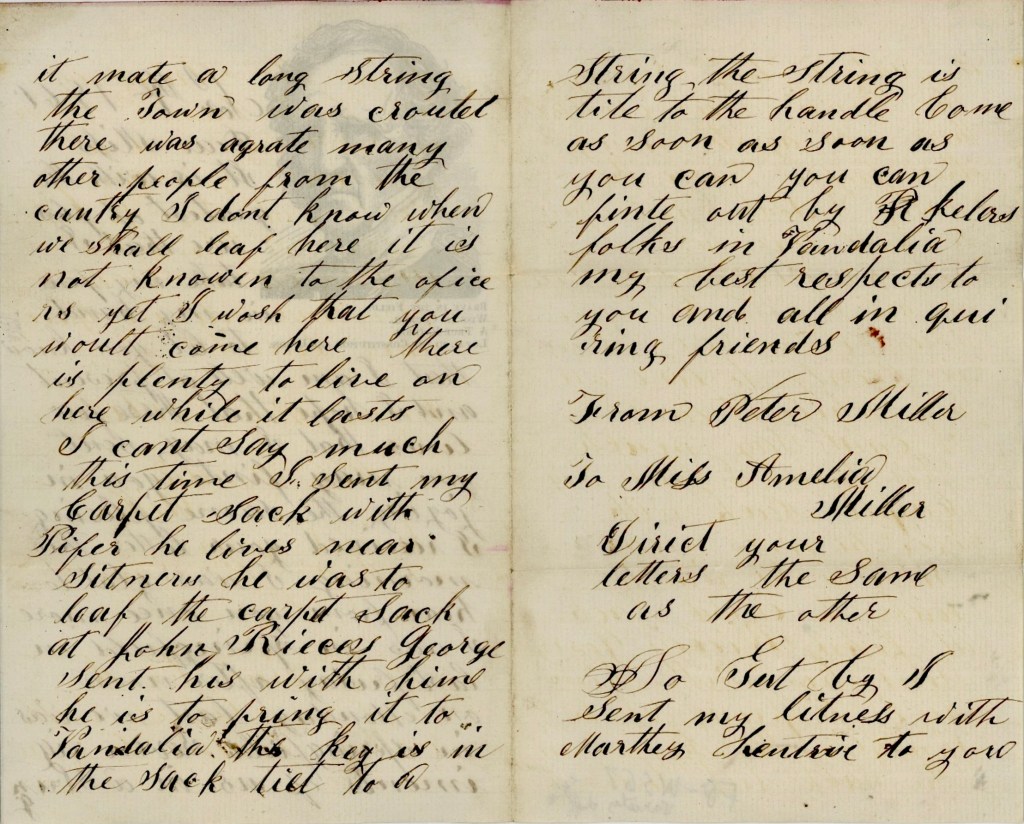
It is with the greatest of pleasure that I take my pen in my hand to let you know that I am well at preset and I hope that these few lines that I may sent you may find you enjoying the same blessing. I received your letter this morning. I was glad to hear from you once more. I was in Springfield on last Friday afternoon. On Monday last we was in Springfield—seven regiments of us in a string. It made a long string. The town was crowded. There was a great many other people from the country.
I don’t know when we shall leave here. It is not known to the officers yet. I wish that you would come here. There is plenty to live on here while it lasts. I can’t say much this time. Isent my carpet sack with Pipher. He lives near Sitner’s. He was to leave the carpet sack at John Rice’s. George sent his with him. He is to bring it to Vandalia. The key is in the sack tied to a string. The string is tied to the handle.
Come as soon as you can. You can find out by Keller’s folks in Vandalia. My best respects to you and all enquiring friends. From Peter Miller
To Miss Amelia Miller. Direct your letters the same as the other. T get by, I sent my likeness with Marthy Hendrix to you.
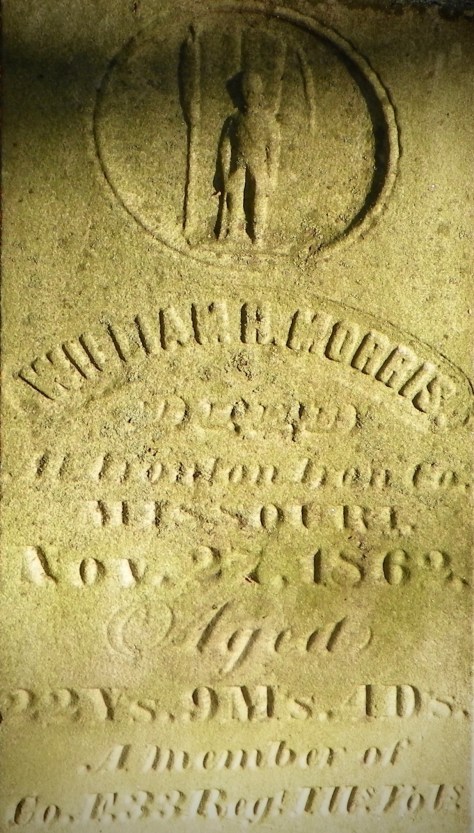
William’s headstone in Livingston county, Illinois
The following letter was written by William H. Morris (1840-1862) while serving as a private in Co. F, 33rd Illinois Infantry. William was from Anconia, Livingston county, Illinois. He enlisted on August 1861, was mustered into the service on 6 September 1861 at Camp Butler, and he died of typhoid fever at Benton Barracks, Missouri, on 26 November 1862. It should be noted that his grave marker in Illinois states that he died in Ironton, Missouri, however.
William was the son of Henry Morris (1803-1843) and Mary (“Polly”) Reynolds (1811-1875). Serving with him in the same company was his older brother, Andrew Morris (1833-1872).
The 33rd Illinois Infantry was originally formed from many college students on the campus of the Illinois State Normal School and became known as the “Teacher’s Regiment.” In one company there were 13 college graduates and all were privates. The soldiers were so well educated that the standard joke was that men discharged for mental incapacity would have made officers in other regiments. [Wikipedia]. As evident by William’s letter, he was not so well educated, however. He and his brother Andrew were both farmers who lost their father when they were young men.
T R A N S C R I P T I O N
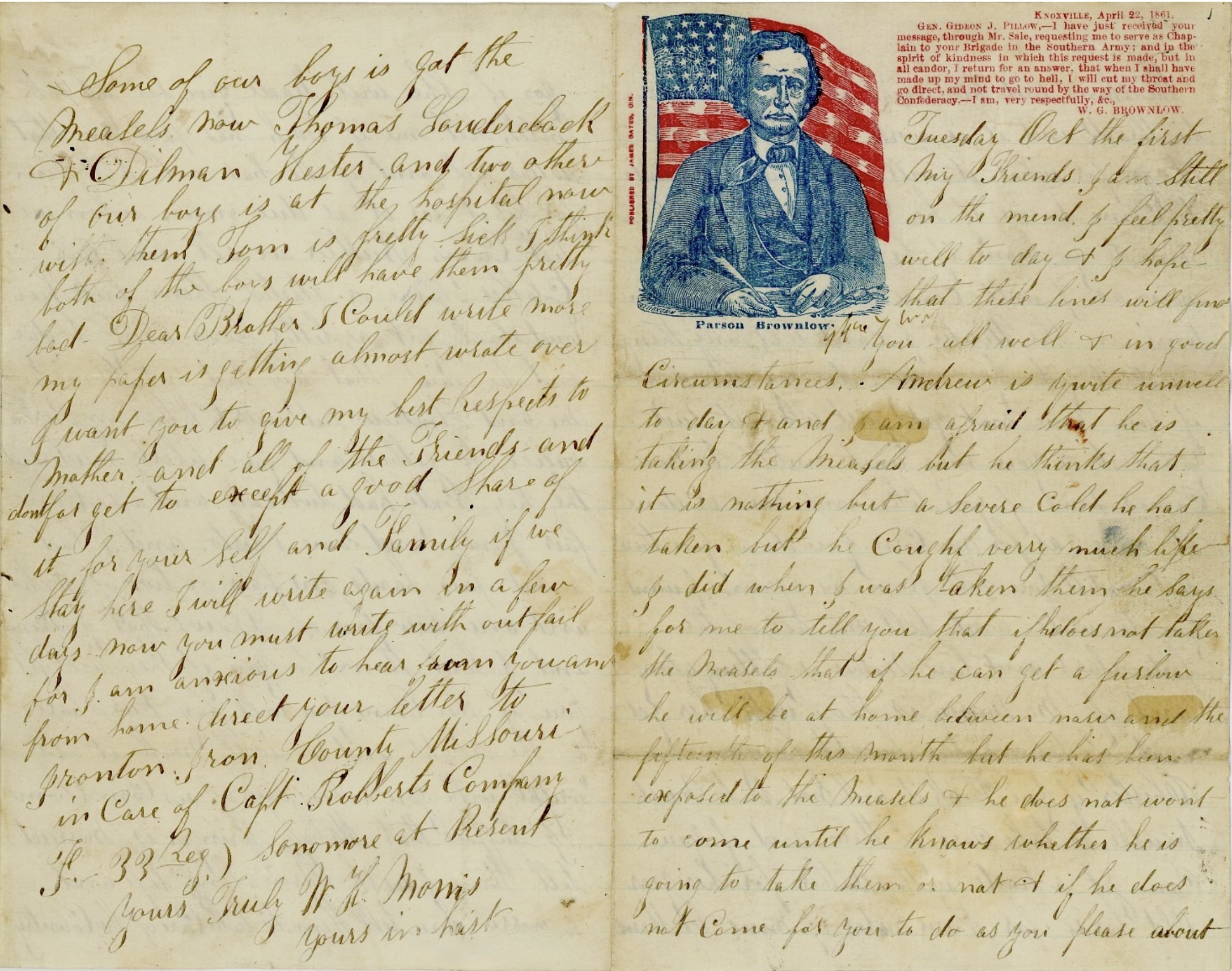
William’s letter was written on patriotic stationery with a great image of Parson Brownlow.
[Ironton, Iron county, Missouri] Tuesday, October 1st [1861]
My friends,
I am still on the mend. I feel pretty well today & I hope that these lines will find you all well & in good circumstances. Andrew is quite unwell today and I am afraid that he is taking the measles but he thinks that it is nothing but a severe cold he has taken but he coughed very much like I did when I was taken them. He says for me to tell you that if he does not take the measles that if he can get a furlough, he will be at home between now and the fifteenth of this month. But he has been exposed to the measles & he does not want to come until he knows whether he is going to take them or not, and if he does not come for you, to do as you please about thrashing out his wheat, If you get ready to thrash and it is worth anything, to let it go for what it will fetch. But he wants to come home if he can, and I want him to go home if he can for I don’t know as I will come home until some time in the winter. I can’t tell anything about it yet.
You may do my thrashing if you have not yet just when it suits you best or you msay wait until Andrew comes home if you like and have it done at once. As for my corn, you do as you think best until you hear from me again. I want you to write and tell me all of the particulars and how Mother is getting along and if Mr. Murry is there with her yet and if John Lucas bought Fancy [and?] Chester, if you think it will not be too much trouble to take care of them, and if you can get a trade with Mother for her year old horse for them notes of mine, let them go if she will trade. Give her up both notes. Tell me if Earp has paid you that dollar yet and if he has not, ask him for it for it is due now.
When we left Camp Butler we all sent our clothes home or started them but Levi Lauderback got a letter from Liberty today and he said that they had not come yet. Me and Andrew put our clothes in our valise together and gave Liberty Lauderback the key. Andy had two coats and a hat and one pair of pants and some shirts, and I had a hat, pair of pants, one pair or two of socks, and one new pair of shoes that I drawed and I sent them to you. If they come, you will pay our share of the freight and we will make it all right with you when one of us comes home.
I suppose that Mahaly Springer is married. Tell them I wish them a long life and a merry one. Tell them to take care of their country.
Some of our boys is got the measles now. Thomas Lauderback & Dilman Hester and two others of our boys is at the hospital now with them. Tom is pretty sick. I think both of the boys will have them pretty bad.
Dear brother, I could write more [but] my paper is getting almost wrote over. I want you to give my best respects to Mother and all of the friends and don’t forget to accept a good share of it for yourself and family. If we stay here, I will write again in a few days. Now you must write without fail for I am anxious to hear from you and from home. Direct your letter to Ironton, Iron county, Missouri in care of Capt. Roberts. Company F, 33rd Regiment [Illinois Infantry].
So no more at present. Yours truly, — W. H. Morris
The following letter was written by Christian W. Winnie (1839-1909) while serving in Co. D of the 20th Regiment, New York State Militia—a 100 days unit mustered in on 11 May and mustered out on 2 August 1861. I believe Christian was the son of Cornelius and Eva Winne of Ulster county, New York.
T R A N S C R I P T I O N
Headquarters 20th Regiment Patterson’s Park July 11, 1861
Dear friend,
After a long delay I take the present opportunity of writing a few lines. You must excuse me for not writing before for we have been moving around so much I could not get time to write. My last was headed Patterson’s Park, I believe, but owing to some anticipated trouble in the city, we were stationed in the Custom House in about the middle of the city. We were there about one week & yesterday we were removed to this old place. I am glad of it for I did not like it there although it was a very fine place quartered in a house worth 200,000 dollars but it was unhealthy.
The weather has been very warm for a few days. The mercury arose to 93o but what added to the unpleasantness of the place was the confinement. We were not allowed to go out without a pass which was very hard to get but I did get out once & made my way up to a monument erected to the memory of the Father of our Country. It is very nice & is 180 feet high & as you enter you will see a statue standing near the door and another placed on the pinnacle of the monument. After ascending a winding stairs, we arrived at the top where a most beautiful sight presents itself. The sun was just setting & as the last pale rays fell on the city (for we had a full view of the whole of it), it presented a sublime spectacle.
After conversing a short time, we retraced our steps, I wondering in my own mind how the people of Baltimore could try to destroy the flag that Washington raised & sealed by the blood of the patriots of the Revolution. And it is a lamentable fact that where the sacred relics of our Nation’s glory might be seen, waves an unnatural flag. The flag of our Union has been trodden under foot. But we trust in providence that He will protect the right; that He will not suffer the flag that has floated over [our] Nation for 25 years to be demoralized by a band of disappointed politicians & traitors. Shall we not fight to protect a Nation’s rights? Yes!
The Fourth [of July] passed without anything happening & it was the only day that seemed like Sunday since we started from home. Sunday is not regarded in the camp which I am sorry to say. No more at present. Direct to Baltimore &c. Goodbye, — C. W. Winnie
This letter was written by Alfred N. Smith, born in Ohio in 1836, I believe, who was living with relatives in Batavia, Branch county, Michigan in 1860. In 1858, he was listed in the Vincennes (IN) City Directory working as a plasterer and boarding in Mrs. Harriet Burrows’ boarding house on the north side of Water Street between Main and Busseron. It was to Mrs. Burrows that he addressed his letter, written from Fort Lyon near Alexandria, Virginia, while serving in Co. C, 2nd Michigan Infantry.
Harriet was the daughter of Hiram Soden and his wife Sarah Beedle. She was married twice and had eight children by her two husbands but only three survived infancy. Her first husband was James Burrows whom she married on 13 Sep 1846 in Knox County, Indiana. James died in 1859 or 1860 as his youngest child was born in November 1859 and Harriet was a widow at the time of the 1860 census. She then remarried to William Wolfe in February 1865. They had one daughter and moved to Missouri where William died. Harriet and her remaining family moved to Los Angeles, California sometime before 1900.
The 2nd Michigan Volunteer. Infantry was recruited to serve for three months, but before they could be mustered in, orders came from the War Department that enlistments were to be extended to three years. Those who did not want to serve the three years were allowed to withdraw and the Second Michigan Infantry was mustered in as a three year regiment on May 25, 1861.
T R A N S C R I P T I O N
Fort Lyon, Va. November [1861]
Friend Hatt
Your kind letter of the 22nd is received. It affords me the greatest of pleasure to have the privilege of answering it. I am very sorry to hear of Frankie’s continued illness but hope he will be better soon. 1 I suppose Sallie and Maggie are very much delighted with the idea of going to the “Golden State.” I suppose that Mother Doak is a going too. They would not leave her. I am exceedingly glad to hear your health has so improved and that you are a getting along fair. You were speaking about having a boarder by the name of “Smith.” It is a wonder that you would ever think of taking another of that name after being pestered with one for so long a time before. But, however, I wish you had another Smith boarder for a few weeks—one that is soldiering in a Michigan Regt. at Fort Lyons—for I think he could spend a few weeks with his friends to a very good advantage just now, couldn’t he?
I have almost forgotten to tell you about our moving and where we went to. Well we moved from Arlington Heights on the 16th of October and are now in camp at Fort Lyons, Va., which is one and a half [miles] south of Alexandria where we have been ever since we left Arlington Heights.
Fort Lyons is a very high and sightly place commanding a delightful view of the country for miles in ever direction besides the City of Alexandria, City of Washington, and the ancient City of Georgetown which joins Washington on the northwest. Fort Lyons surrounds 15 acres of land and mounts 129 guns, most of them 64-pounders, but it is only one of the many [forts] that circle the City of Washington so you can have some idea how well we are fortified here and how we could deal death to any approaching foe.
The weather has not been very pleasant here this fall. We have had several very cold rains. The wind [blows] very hard all the time. On the 29th October it blowed a complete hurricane. The tent that I and 14 other boys live in blowed clear away while a half dozen of us were a trying to hold it and I expect the plagued thing is a going yet unless the secesh have captured it which I presume is most likely for they haven’t any and the last I saw of it, it was soaring off in that direction. But we did not care much for it left us in a cold drenching rain and that offered us a good excuse for leave of absence to go to Alexandria to stay overnight which was granted us. For the first time since last May, I had the privilege of getting into a nice clean bed which I tell you looked tremendous good. After supper I retired but could not sleep. Did not know what was the reason but supposed it was because things [were] so nice and clean. So I took off the sheets and pillow cases and folded them up and stowed them under the bed and turned in again but it was no use. I could not sleep. Dreamed the secesh took no prisoner and consigned me to the dark walls of the prison. Waked in the morning and found myself 10 feet away from the bed with my head comfortably located in the spittoon. So you can see going to the city has a bad effect on me, but I have never tried it since.
Our quartermaster made us all feel glad the other day by furnishing us new tents and nice clean bed ticks filled with feathers that grew on a last year’s oat field. We have been very busy since we came here. We have two drills a day; battalion in the morning and bigade drill in the afternoon. Then there is guard duty which takes 140 men per day, one half of which goes seven miles southwest of camp as picket guard. The balance of our time is taken up with shovel and pick ax or drill on Fort Lyons.
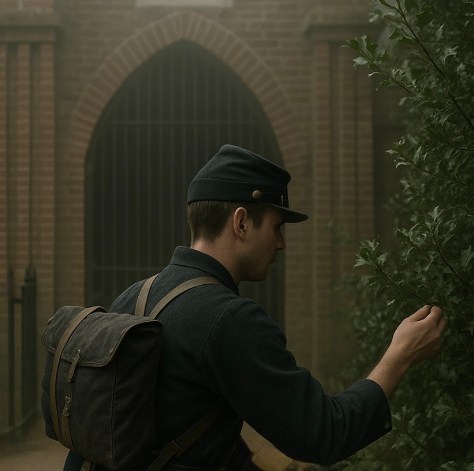
“Enclosed within please find a twig of English Holly which I took from Mount Vernon near the tomb of Washington.”
We have been out reconnoitering twice since we came here. The first time on the 18th October. We marched to Occoquan Creek some ten miles southwest of here. We drove in the secesh pickets, found out something near their number and position. This being all we marched for, we returned to camp. The next time on the 13th November we went in force 16,000 infantry, two batteries, 6 companies of cavalry. We marched in three columns, one by way of Mount Vernon. The Brigade I was with went by Pohick Church. Another Brigade four miles north of us. We drove the secesh back to their batteries. They killed three of our cavalry that were scouting ahead of us. We drove all that Gen. McClellan ordered and came back bringing one prisoner. The 20th [November] our Brigade went to the Grand Review at Bailey’s Crossroads. The newspapers have said so much about it, it is not worth while for me to say anything about it. No more room to write. Your friend, — A. N. Smith
Enclosed within please find a twig of English Holly which I took from Mount Vernon near the tomb of Washington.
1 Frank (“Frankie”) Burrows was the youngest of the seven children of James Burrows and his wife, Harriet Soden. Frank was in Missouri for the 1870 and 1880 census but had moved to Los Angeles, California before 1900. He never married and was a painter by trade. He died from a fractured skull as the result of a fall from a scaffold.
The following letters were written by Luther Hurd (1842-1881) who first served in Co. H of the 16th Maine Infantry from August 1862 until shortly after he was wounded at the Battle of Fredericksburg, after which he returned to his home in Sanford, Maine. He wrote these letters during the 100 days service he signed up for with the 5th Massachusetts Volunteer Militia in the summer of 1864. The regiment left the state for Baltimore on 28 July 1864 and were assigned to garrison Forts McHenry, Marshall, Carroll, and other points in and around the Baltimore Harbor. They mustered out in early November 1864.
Luther was the son of Deacon James Hurd (1796-1876) and Abigail Wadilla (1798-1848) of Sanford, York county, Maine. He wrote the letter to his older sister, Adeline (“Addie”) M. Hurd (1834-1911) who married Samuel C. Marshall (1818-1903) and had a 3 year-old daughter named Emma L. Marshall (“Little Emma”) mentioned in this letter. He does not mention him but Luther also had a brother named Bradford A. Hurd (1832-1863) who served in Co. B, 4th New Hampshire Infantry. Bradford was mortally wounded by an enemy shell on Folly Island in June 1863. See 1861: Bradford A. Hurd to Luther Hurd.
Letter 1
Fort Marshall, Baltimore, Maryland August 29, 1864
From this southern clime my thoughts wend their way to my dear New England home where fancy pictures to my mind the many dear & kind friends whom I have left far, far behind me. Many is the time that I turn my weary eye to you eastern sky where the loved ones are, and my mind wanders over hill and dale to your pleasant home. Then it seems to me that I am nearer to you than at any other time. I love to think on the past as I bring to my mind the many happy hours I have spent with my brothers and sisters, now dearer to me than ever. The days of my soldiering will quickly pass away. Already one month has slipped by. A little more than two months more & you will see me wending my way back again to the North.
I do not wish to go home until them for we are so pleasantly situated here that it would be silly to even think of such a thing. We are still in the same place that we were when I last wrote you. I will give you a description of this place as I cannot think of anything else to write, which will be of interest to you.
Fort Marshall is situated on a high elevation of ground one mile from & overlooking the City of Baltimore. The city lies to the west of us, while to the north and east are seen beautiful farms and farm houses. Little white cottages rise up in the distance. The landscape is intersected here and there with beautiful trees. To the south, no less beautiful, runs the Patapsco River at the mouth of which stands Fort McHenry, plain to view. The whole scenery around is very beautiful.
The fort is built of dirt thrown up very high. On the parapets are mounted some 35 large guns which will sweep the country for miles around. The place is very strong. It would take a very large force to capture it. It was built by the 7th Maine Regiment some two years since. For that reason, it seems dearer to me. I feel proud of the old Pine Tree State. Her sons have fought gallantly during this rebellion. Within the fort are two long, two-story buildings, The first is used by us as barracks to sleep in. The upper story is occupied by the two companies that came here with us while the lower part of the building is occupied by our company & three cook rooms. The bunks that we sleep in are placed up against the wall like the berths in the cabin of a steamboat. They are very nice. I tell you, it seems homelike to have a good house to live in. Much better than those tents.
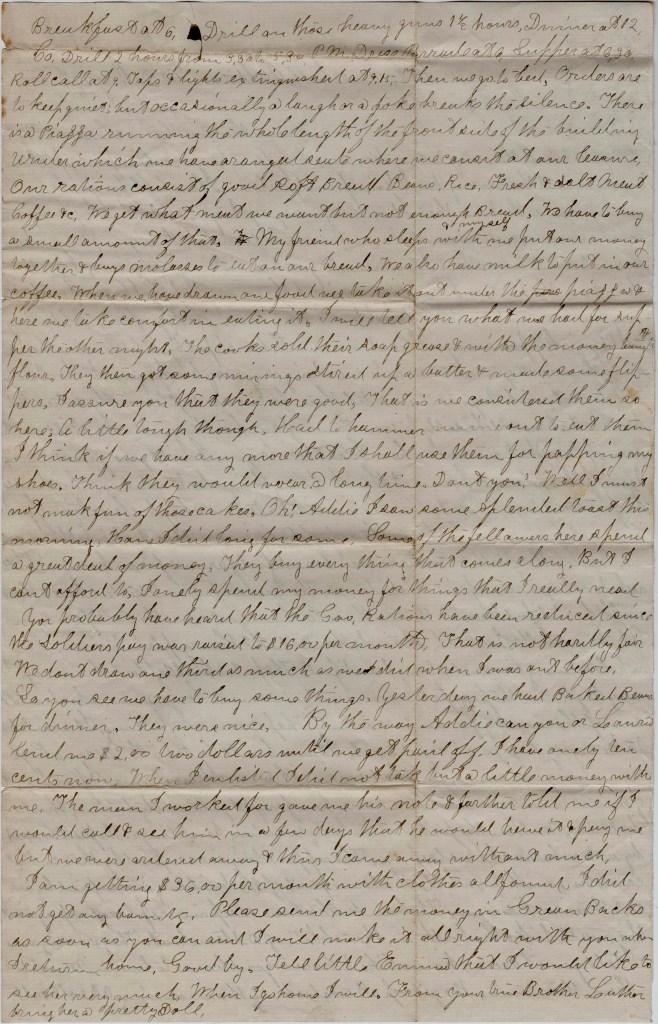
We get up at 5 o’clock in the morning at roll call, breakfast at 6, drill on those heavy guns one and a half hours, dinner at 12, company drill two hours from 3:30 to 5:30 p.m., Dress Parade at 6, supper at 6:30, roll call at 9, Taps & lights extinguished at 9:15. Then we go to bed. Orders are to keep quiet but occasionally a laugh or a joke breaks the silence. There is a piazza running the whole length of the front side of the building under which we have arranged seats where we can sit at our leisure.
Our rations consist of government soft bread, beans, rice, fresh & salt meat, coffee, &c. We get what meat we want but not enough bread. We have to buy a small amount of that. My friend—who sleeps with me—and myself put our money together and buy molasses to eat on our bread. We also have milk to put in our coffee. When we have drawn our food, we take it out under the piazza & here we take comfort in eating it. I will tell you what we had for supper the other night. The cooks sold their soup grease & with the money bought flour. They then got some [ ], stirred up a batter and made some flippers. I assure you that they were good—that is, we considered them so here. A little tough though. Had to hammer mine out to cut them. I think if we have any more that I shall use them for popping my shoes. Think they would wear a long time, don’t you? Well I must not make fun of those cakes.
Oh! Addie, I saw some splendid toast this morning. How I did long for some. Some of the fellows here spend a great deal of money. They buy everything that comes along. But I can’t afford to. I only spend my money for things that I really need. You probably have heard that the government rations have been reduced since the soldiers pay was raised to $16 per month. That is not hardly fair. We don’t draw one third as much as we did when I was out before. So you see we have to buy some things. Yesterday we had baked beans for dinner. They were nice.
By the way, Addie, can you or Laura lend me $2 until we get paid off? I have only ten cents now. When I enlisted I did not take but a little money with me. The man I worked for gave me his note & further told me if I would call and see him in a few days that he would have it & pay me but we were ordered away & thus I came away without much. I am getting $36 per month with clothes all found. I did not get any bounty. Please send me the money in green backs as soon as you can and I will make it all right with you when I return home. Goodbye. Tell little Emma that I would like to see her very much. When I go home, I will bring her a pretty doll. From your brother, — Luther
Direct to Luther Hurd, Co. B, 5th Regt. Massachusetts Vol. Militia, Fort Marshall, Baltimore, MD
Letter 2
Fort Marshall, Baltimore, Maryland September 6th 1864
My dear Sister,
I received your kind letter yesterday afternoon; also the money that you sent me. Was very thankful that you sent it. I was entirely out of money. You could not have sent it in a better time. The officers say that we shall be paid off by the 15th of this month. I guess the boys will be glad of their pay, for a great many of them have not a cent. The most part of our boys in the company have parents who are wealthy and they have always had a good supply of spending money, and I tell you it comes rather hard on them to go around with minus gold in their pockets. But when I get any money, I generally am pretty saving of it and don’t purchase anything unless I really need it.
We are still in the same old fort. Nothing of any great importance has transpired since I last wrote you. Things remain the same as day after day rolls away. We are getting a little tired and lonesome here with no excitement going on. A few weeks have passed away very pleasantly because the place was new to us; but now it has got to be an old story. Still it is a good place for us—we are so comfortably situated and we would prefer to remain here unless the officers could place us in a fort where there are accommodations as good as these.
I told you that the scenery around is beautiful. Well it is. From the fort we can see the green fields and pleasant farm houses. We see the lofty trees, the distant hills and vales; but we are not allowed to go outside the fortifications because there is a guard to prevent us. If this was not the case, our curiosities would be likely to lead us out into the open fields and we should spend many pleasant hours traversing the country around. But you know there are some who if they once got this liberty would go around to the different farm yards and rob hen roosts and anything else that they might chance to lay their hands on. So you see that they have to be strict with us.
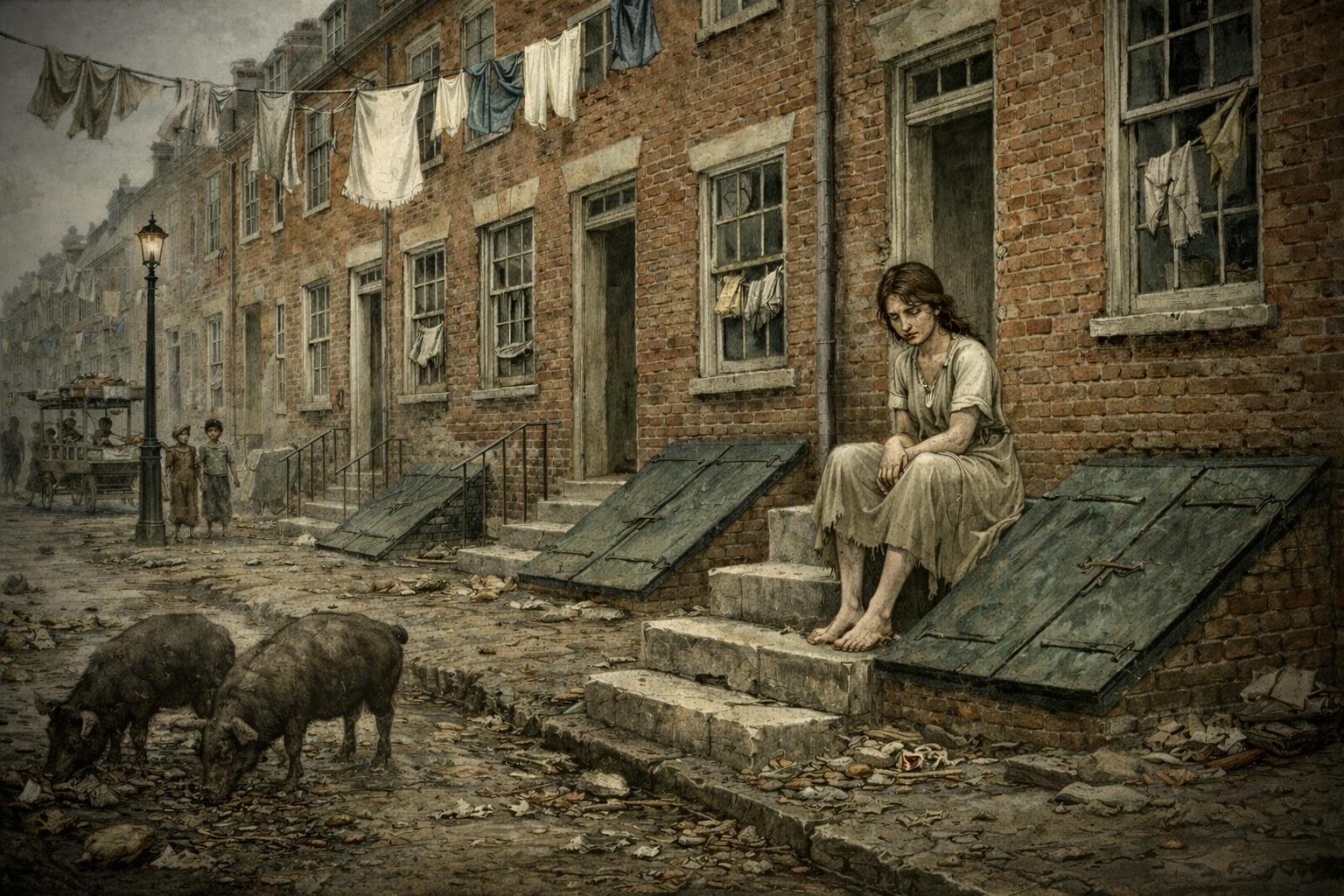
We occasionally go down to the river to bathe a short distance off and on our way pass through the village of Canton—a place noted for its hogs, dirty women and children. There I have seen some of the dirtiest, filthiest looking women that I ever saw. In passing along, every now and then, you will run against a hog. You will find a plenty of them running in the streets and other public places. What would you say to see women, barefooted and ragged, sitting down on the door steps with their feet as black as the stove? Would you not be tempted to throw a pail of water on them? People here are very different from the New Englanders. I have not seen a pretty girl since I have been out here, so you need not be afraid of my bring[ing] home a Southern bride. I think I should prefer one from the North.
“The village of Canton—a place noted for its hogs, dirty women and children. In passing along, every now and then, you will run against a hog. You will find a plenty of them running in the streets and other public places. What would you say to see women, barefooted and ragged, sitting down on the door steps with their feet as black as the stove?”
We had a little excitement in the fort a few nights since. When the rebels are coming, they immediately give the alarm to the different forts around by throwing up sky rockets. This night in particular I was on guard when we saw quite a number of these. These were succeeded by the firing of guns. Then the soldiers all gathered up on the parapets to watch for the rebs whom they thought were coming. A squad of soldiers were sent out to ascertain what was in the wind. They soon returned stating that the firing proceeded from a drunken row down in Canton. I did not feel any alarm for I had seen too much to get scared at such a little thing as that.
Well, Addie, I congratulate you with your little treasure (your little son). Hope the frail bud will be free from sickness. I presume you feel very proud of him. I like the name you have given him very much. I think it is very pretty. Have you given him a middle name? If not, I would like to give him one. No doubt Emma is very proud of her little baby brother. Yesterday it was cloudy all day. At night, it set in dark and stormy, wind blowing a gale from northeast. It rained hard all night. The boys were very thankful that we were in such good quarters. We all slept warm and comfortable except those who were on guard. They did not fare very well. Got some wet. Thank Providence it was not my lot to be on guard on such a rainy night. Today we do not have any drill so we, or rather the rest of the boys, are fixing up the barracks. Some panes of glass have gone out of the windows and they are repairing them. Others are looking after stoves to place in the room. It is a gloomy day without, and a little lonely inside. I would like to be in your city sitting room today and have a nice dinner of meat, potatoes, and a good apple pudding. But I must close. Please send me a paper now and then. I want to hear the news. Your respected brother, — Luther
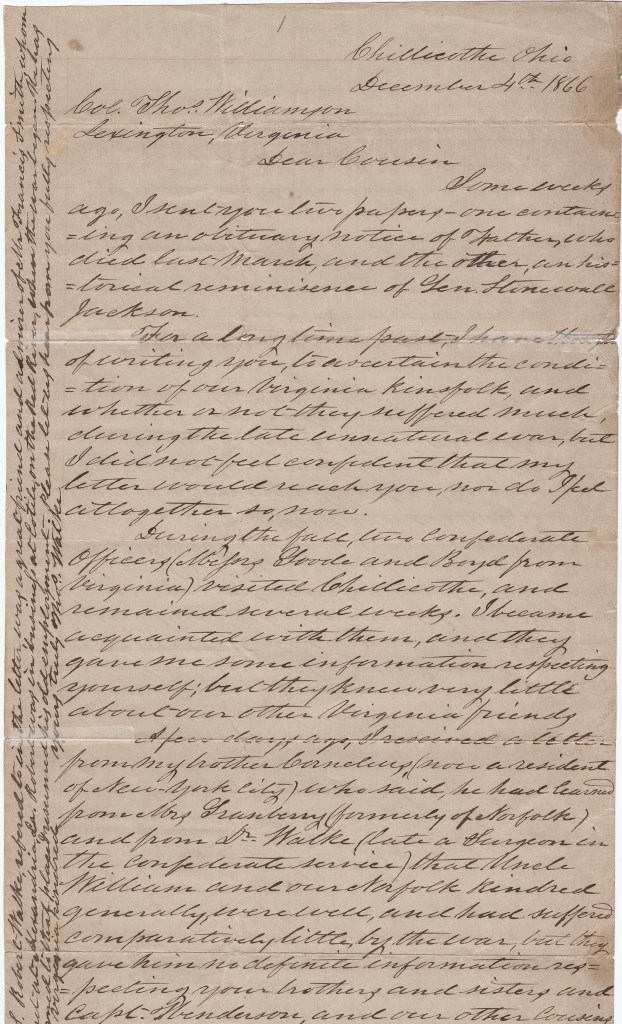
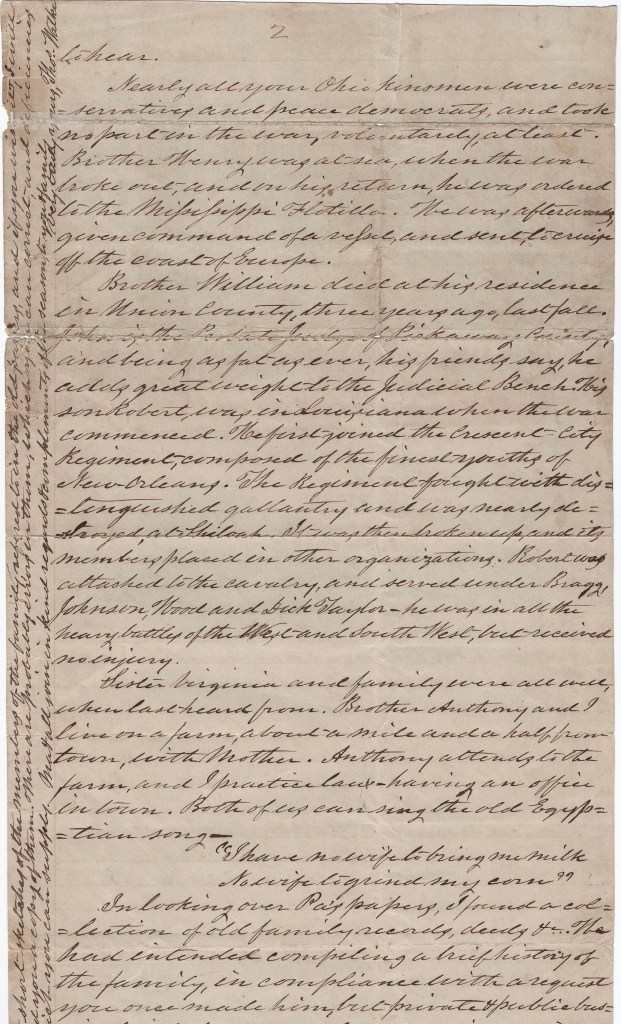
The following correspondence was composed by Thomas Williamson Walke, aged 52 (1814-1897), the progeny of Anthony Walke IV (1783-1865) and Susan Hatfield Carmichael (1786-1874). This letter reveals that Thomas resided on a farm co-owned with his younger sibling, Anthony Walke (1816-1897), while he maintained a legal career in Chillicothe, Ross County, Ohio. His father’s death occurred in March 1865, and his mother continued to inhabit the farm with her two sons.
Thomas Hoomes Williamson
Thomas wrote the letter to his cousin, Thomas Hoomes Williamson (1813-1888), the son of Thomas and Anne (Walke) Williamson of Richmond, Virginia. Thomas Williamson joined the faculty at the Virginia Military Institute (VMI) in 1841 and worked there his entire life except for the war years when served with the Confederate Engineer Corps. He worked on the defenses of the Rappahannock river and Manassas. He was on the staff of Stonewall Jackson for a time. In his letter Thomas Walke shares family information on the Ohio branch of the family while seeking information on the Virginia branch. He refers to “the late unnatural war” which has prevented them from maintaining communications.
T R A N S C R I P T I O N
Chillicothe, Ohio December 4th 1866
Col. Thomas Williamson Lexington, Virginia
Dear Cousin, some weeks ago I sent you two papers—one containing an obituary notice of Father who died last March, and the other an historical reminiscence of Gen. Stonewall Jackson.
For a long time past, I have thought of writing you to ascertain the condition of our Virginia kinfolk and whether or not they suffered much during the late unnatural war, but I did not feel confident that my letter would reach you, nor do I feel altogether so now.
During the fall, two Confederate officers (Messrs. Goode and Boys from Virginia) visited Chillicothe and remained several weeks. I became acquainted with them and they gave me some information respecting yourself; but they knew very little about our other Virginia friends.
A few days ago I received a letter from my brother Cornelius (now a resident of New York City) 1 who said he had learned from Mrs. Granberry (formerly of Norfolk) and from Dr. Walke (late a Surgeon in the Confederate service) that Uncle William and our Norfolk kindred generally were well and had suffered comparatively little by the war, but they gave him no definite information respecting your brothers and sisters, and Capt. Henderson and our other cousins, from all of whom we are very anxious to hear.
Nearly all your Ohio kinsmen were conservatives and Peace Democrats and took no part in the war—voluntarily at least. Brother Henry was at sea when the war broke out and on his return he was ordered to the Mississippi Flotilla. He was afterwards given command of a vessel and sent to cruise off the coast of Europe. 2
Brother William died at his residence in Union county three years ago last fall. 3 John is the Probate Judge of Pickaway county and being as fat as ever, his friends say he adds great weight to the Judicial Bench. 4 His son Robert was in Louisiana when the war commenced. He first joined the Crescent City Regiment composed of the finest youths of New Orleans. The regiment fought with distinguished gallantry and was nearly destroyed at Shiloh. It was then broken up and its members placed in other organizations. Robert was attached to the cavalry and served under Bragg, Johnston, Hood, and Dick Taylor. He was in all the heavy battles of the West and Southwest, but received no injury.
Sister Virginia 5 and family were all well when last heard from. Brother Anthony and I live on a farm about a mile and a half from town with Mother. Anthony attends to the farm and I practice law, having an office in town. Both of us can sing the old Egyptian song:
"I have no wife to bring me milk
No wife to grind my corn"
In looking over Pa’s papers, I found a collection of old family records, deeds, &c. He had intended compiling a brief history of th family in compliance with a request you once made him, but private & public business interfered and old age coming on, it was neglected altogether. At Henry’s request, I made out short sketches of the members of the family referred to in the old papers and if you wish it, I will send you a copy of them. There are probably errors in them which you can correct and deficiencies which you can supply. Ma and all join in kind regards & compliments of the season to you & family. Very affectionately yours, — Thos. Walke
P. S. Robert Walke referred to in the letter was a great friend and admirer of Mr. Francis Smith whom he met at Alexandria, La. Robert was in business at Cotila on the Red River when the war began. He has returned to that place & resumed his old employment. Please let us hear from you fully respecting our Virginia kindred. Yours truly, — Thos. Walke
1 Dr. Cornelius Calvert Walke (1822-1914)was a New York City physician and a censor of the New York Medical College (The Board of Censors examined the qualifications of students before their graduation and receiving medical degrees.) The erudite physician was a member of the American Geographical Society. He was married in 1848 to Hannah E. Hitchcock and they lived in an opulent home at 213 Second Avenue. See The Dr. Cornelius Walke House in Manhattan.
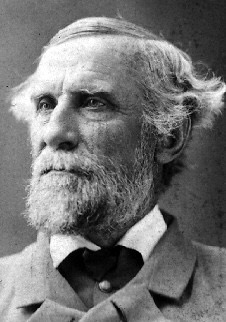
Henry Walke (1808-1896)
2 Despite his southern heritage, Henry Walke (1808-1896) remained loyal to the Union and played a bigger role in the war than Thomas may have been willing to admit. At the outbreak of the Civil War in 1861, Henry Walke was a Commander in charge of Unionist forces at Pensacola, Florida. In January 1862, he commanded the gunboats “USS Tyler” and “USS Carondelet” in operations along the Western Rivers. Promoted Captain in August 1862, he commanded the ironclad “USS Lafayette” until July 1863, when he was ordered to command the cruiser “USS Fort Jackson.” From 1864 to the end of the war, he was made Captain of the steam sloop “USS Sacramento”. Promoted to Commodore in July 1866, he commanded the Naval Station at Mound City, Illinois, 1868 to 1870. He attained the rank of Rear Admiral in July 1870 and served on the Lighthouse Board until April 1873, when he retired from active duty as a Rear Admiral. Three United States Navy destroyers have been named in his honor. (Find-A-Grave)
3 William Walke (1806-1862) was married to Virginia Evans in 1831 and was living in Milford Center, Union county, Ohio, when he died on 17 November 1862. His wife died on 22 March 1865. One of his sons, Isaac Evans Walke (1841-1922) served briefly in Co. H, 136th OVI late in the war.
4 John Walke (1811-1895) was married at Chillicothe in 1836 to Francis McArthur Kercheval (1817-1882) and he was a Probate Judge in Pickaway county, Ohio. His residence as in Circleville. His son Robert Kercheval Walke (184–1892) was in the Confederate service. He was a sergeant in Co. K of the Louisiana Crescent Infantry (the “Kid Glove” Regiment) and then a private in Capt. Dreux’s Louisiana Cavalry.See “Capturing the Hornet’s Nest with the Kid Glove Regiment at Shiloh” by Dan Masters.
5 Susan Virginia Walke (1820-1895) was married in Chillicothe in 1840 to James Dun (1818-1892) and they lived in Deer Creek township, Madison county, Ohio.
I could not find an image of Winfield but here is one of David Mount who also joined as a recruit in Co. I, 13th Iowa Regiment (Iowa CW Images)
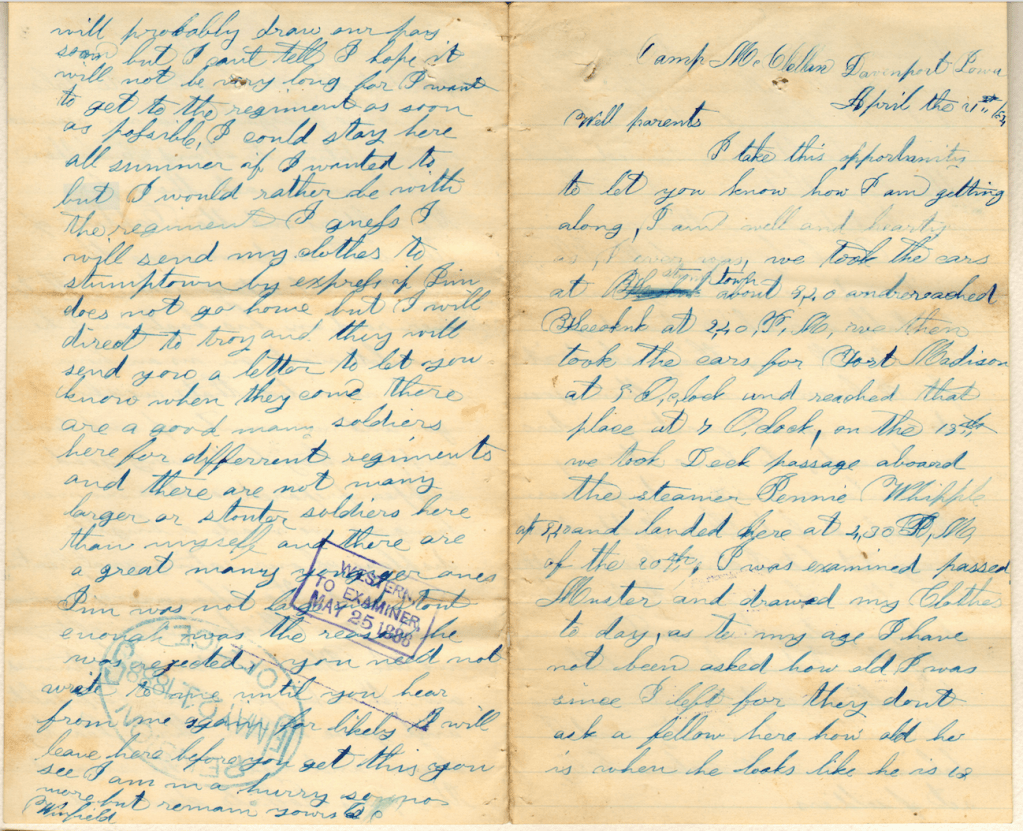
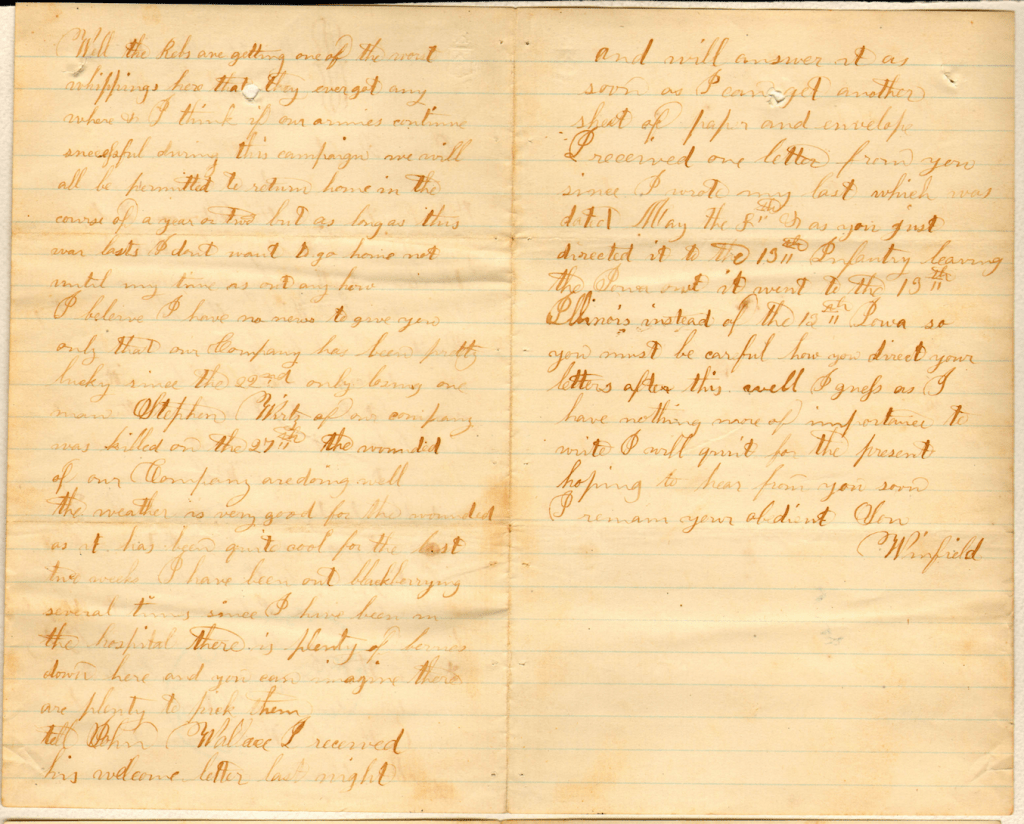
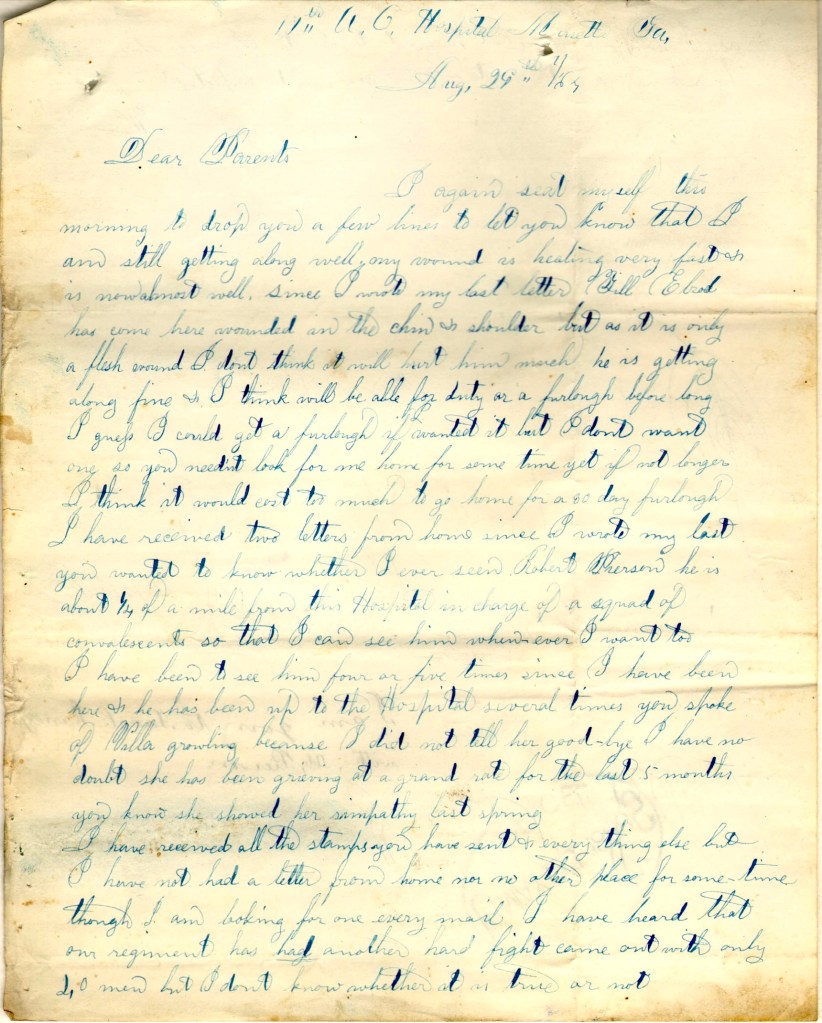
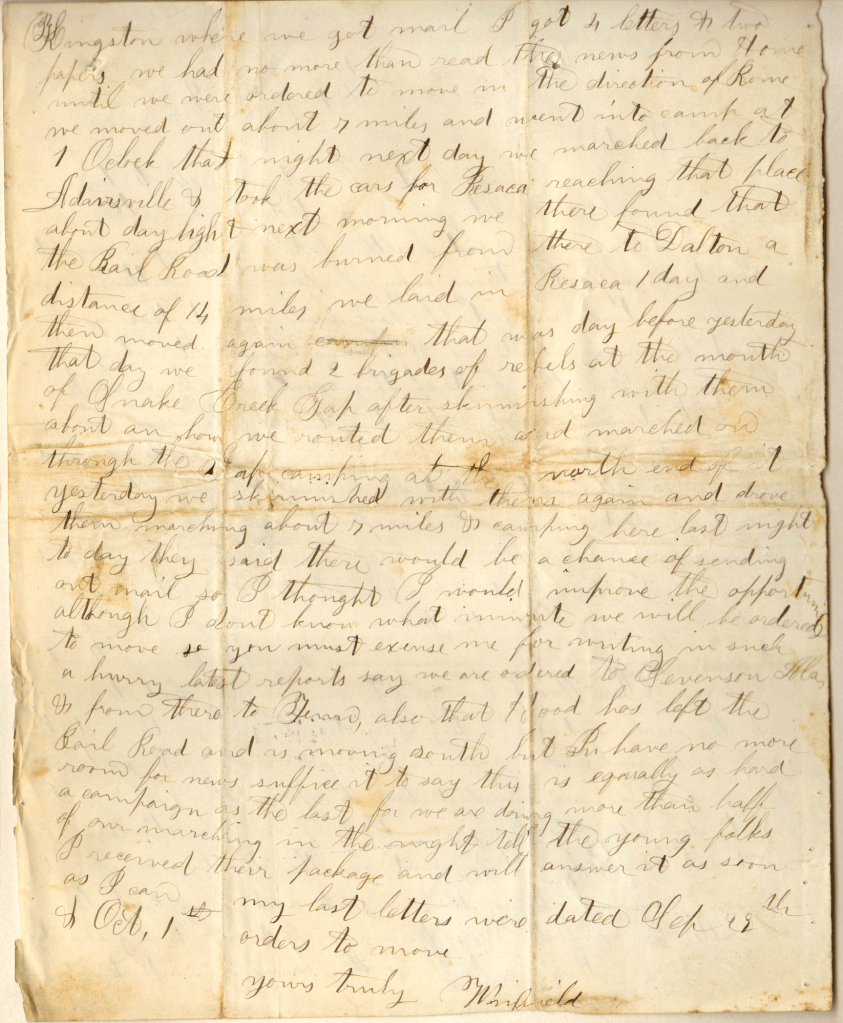
The following letters were found in the pension file of Winfield Pulaski Romick (1848-1865) who served during the American Civil War as a private in Co. I, 13th Iowa Infantry, and also as a private in the 7th Iowa Cavalry. He received a “slight scratch” on the left arm during the charge of his regiment on 21 July 1864 in the prelude to the Battle of Atlanta but survived that wound only to die of chronic dysentery in August 1865.
Winfield was the son of Israel Romick (1818-1903) and Hannah Arney (1820-1895). He was born in Mad River, Champaign county, Ohio, in February 1848 but came with his parents to Davis county, Iowa prior to the Civil War. He enlisted as a recruit in the 13th Iowa on 1 April 1864 when he was 16 years old.
[Note: These letters were found by Phillip Whiteman at the National Archives and made available for transcription and publication on Spared & Shared by request.]
Letter 1
Camp McClellan Davenport, Iowa April 21, 1864
Well parents, I take this opportunity to let you know how I am getting along. I am well and hearty as I ever was. We took the cars at Stumptown 1 about [ ] and reached Keokuk at 2.40 p.m. We then took the cars for Fort Madison at 5 o’clock and reached that place at 7 o’clock. On the 13th we took deck passage aboard the steamer Jennie Whipple at 8.40 and landed here at 4.30 p.m. of the 20th. I was examined, passed muster, and drawed my clothes today. As to my age, I have not been asked how old I was since I left for they don’t ask a fellow here how old he is when he looks like he is 18.
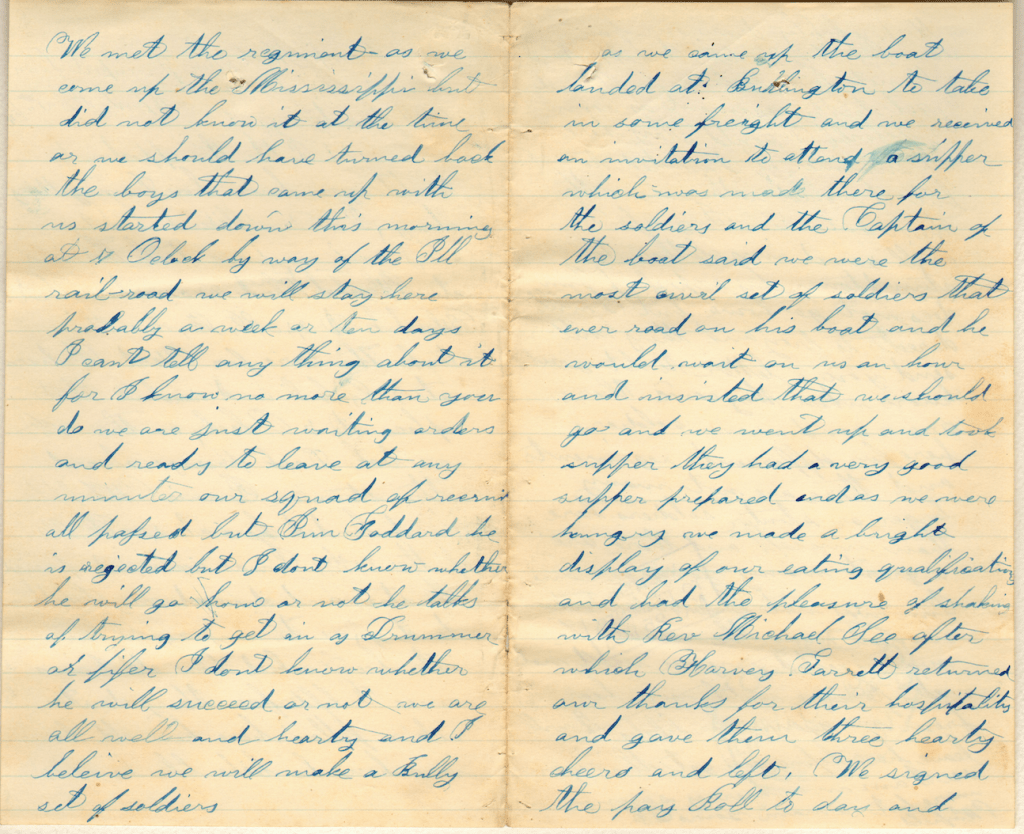
We met the regiment as we come up the Mississippi but did not know it at the time or we should have turned back. The boys that came up with us started down this morning at 7 o’clock by way of the Illinois Railroad. We will stay here probably a week or ten days. I can’t tell anything about it for I know no more thah you do. We are just waiting orders and ready to leave at any minute. Our squad of recruits all passed but Jim Goddard. He is rejected but I don’t know whether he will go home or not. He talks of trying to get in as drummer or fifer. I don’t know whether he will succeed or not. We are all well and hearty and I believe we will make a Bully set of soldiers.
As we came up, the boat landed at Burlington to take in some freight and we received an invitation to attend a supper which was made there for the soldiers and the captain of the boat said we were the most civil set of soldiers that ever rode on his boat and he would wait on us an hour and insisted that we should go and we went up and took supper. They had a very good supper prepared and as we were hungry, we made a bright display of our eating qualifications and had the pleasure of shaking with Rev. Michael See after which Harvey Garrett returned our thanks for their hospitality and gave them three hearty cheers and left.
We signed the pay roll today and will probably draw our pay soon but I can’t tell. I hope it will not be long for I want to get to the regiment as soon as possible. I could stay here all summer if I wanted to but I would rather be with the regiment. I guess I will send my clothes to Stumptown by express if Jim [Goddard] does not go home. But I will direct to Troy and they will send you a letter to let you know when they come. There are a good many soldiers here for different regiments and there are not many larger or stouter soldiers here than myself and there are a great many younger ones. Jim [Goddard] was not large or stout enough was the reason he was rejected. You need not write to me until you hear from me again for likely I will leave here before you get this. You see I am in a hurry so no more but remain your son, — Winfield
1 River Junction, often referred to as “Stumpy” or “Stumptown” is just down the road from Lone Tree, Iowa, 12 miles south of Iowa ity and 26 miles west of Muscatine, in Fremont Twp. Fremont Twp is in the southeastern tip of Johnson County.
Letter 2
Camp McClellan Davenport, Iowa April 24th 1864
Well I guess I will try to write you a short letter again to let you know how I am getting along by this time. We drew our bounty yesterday and I only drew $25. I guess I will not get the 300 dollar bounty but it can’t be helped now. I expressed $15 home. I should have sent home more but I bought some of my clothes instead of drawing and I will get money for what I did not draw after a while. I thought it would be a great deal cheaper to buy than to draw. I am very sorry that I did not get the $300 bounty but I did not enlist for money so I will just…
…important to write so I will quit for the present. Yours &c. — Winfield.
P. S. Direct to Co. I, 13th Iowa Infantry, Cairo, Illinois.
Letter 3
Pulaski, Tennessee May 20th 1864
Dear Parents,
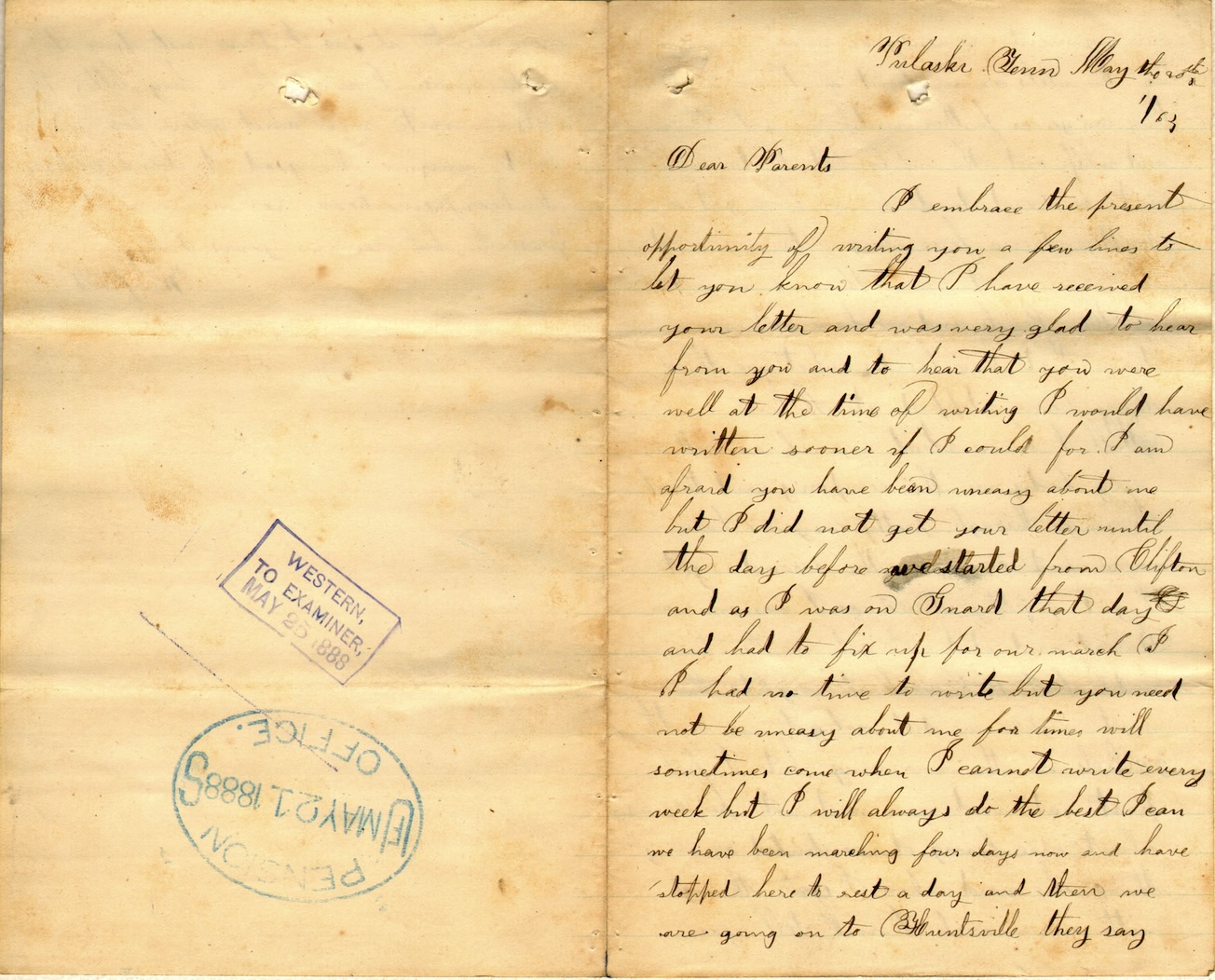
I embrace the present opportunity of writing you a few lines to let you know that I have received your letter and was very glad to hear from you and to hear that you were well at the time of writing. I would have written soon if I could for I am afraid you have been uneasy about me but I did not get your letter until the day before we started from Clifton and as I was on guard that day and had to fix up for our march, I had no time to write. But you need not be uneasy about me for times will sometimes come when I cannot write every week. But I will always do the best I can.
We have been marching four days now and have stopped here to rest a day and then we are going on to Huntsville. They say our regiment is only 28 miles from here. The rebels are in front of them and they can go no farther until we get there and whip out the rebels. But that will not be hard to do for we have got a pretty strong force along with us and they are not more than 8,000 or 10,000 of the rebels and we have got more than that here, besides what are there. They have stopped at Athens.
Well, I have stood the march as well as anybody in the company and think I can go through pretty easy. We have come about 60 miles. The second night I got pretty tired as I was on rear guard and did not get into camp until about 10 o’clock at night. The next night we did not get in until 3 o’clock in the morning. But I feel first rate and you need not be uneasy about me being discontented or anything else. And when I get through with our march, I will tell you more about it.
As i have not time to write much, I will bring my letter to a close. Write soon and often for you can’t imagine the good it does a soldier to hear from home. So no more at present but remain yours truly, — Winfield
Letter 4
Camp near Huntsville, Alabama May 24, 1864
Dear Parents,
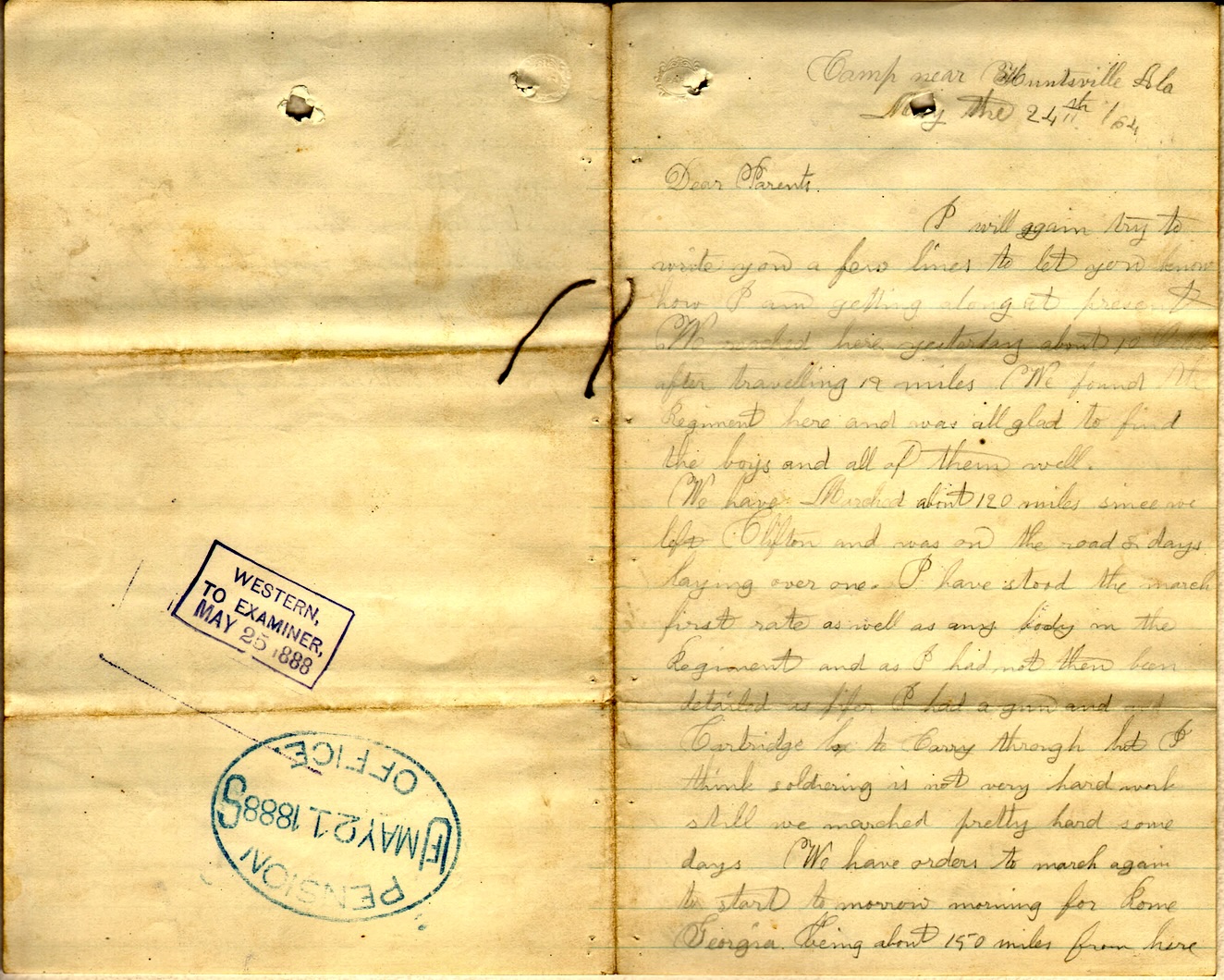
I will again try to write you a few lines to let you know how I am getting along at present. We reached here yesterday about 10 o’clock after traveling 19 miles. We found the regiment here and was all glad to find the boys and all of them well.
We have marched about 120 miles since we left Clifton [Tennessee] and was on the road 8 days, laying over one. I have stood the march first rate as well as anybody in the regiment and as I had not then been detailed as fifer, I had a gun and cartridge to carry through. I think soldiering is not very hard work; still we marched pretty hard some days.
We have orders to march again to start tomorrow morning for Rome, Georgia, being about 150 miles from here, and I feel like I can march pretty well now as we have had one days rest.
I forgot to tell you in my last where to direct. Direct to Co. I, 13th Iowa via Nashville, Tennessee, and your letters the same way. You need not be uneasy about me if you do not hear from me again for two or three weeks for very likely I will not have a chance to write again until we get through our march. But I will write as soon as I can. I would like very well to hear from home again for I have had but one letter since I left. And tell John Wallace and Jim to write to me and I will write to them as soon as I can. I am most out of postage stamps and cannot get any here but it may be that I can get them when we stop again.
Well, I guess I will have to stop for this time and fix up for inspection. Write soon and give me all the news and when I get time, I will not write such short letters. But you must remember that we are sometimes hurried so that I have not much time to write but you need not stop on that account for I will always do my best. But I must quit or I will not be ready for inspection. So no more at present but remain yours truly. — Winfield
Letter 5
At Decatur, Ala., May 27, 1864, the 13th Iowa regiment, with the rest of the Crocker Brigade, was attached to the Fourth Division of the 17th Army Corps. General Crocker, who had commanded the division, was compelled on account of poor health to relinquish his command, and was succeeded by Gen. W. Q. Gresham. The regiment now moved forward with this command to Rome, Ga., arriving there June 6th, and thence by way of Kingston and Allatoona to Ackworth, where on June 8th the Seventeenth Army Corps took its place in line with the Army of the Tennessee, commanded by Gen. James B. McPherson, and became a part of the great army commanded by Maj. Gen. W. T. Sherman, consisting of the armies of the Tennessee, the Ohio and the Cumberland. One of the greatest campaigns In the history of warfare had now begun and, through it all, the Thirteenth Iowa was destined to bear a conspicuous and honorable part.
Camp near Aqua [Acworth], Georgia June the 8th 1864
Dear Parents,
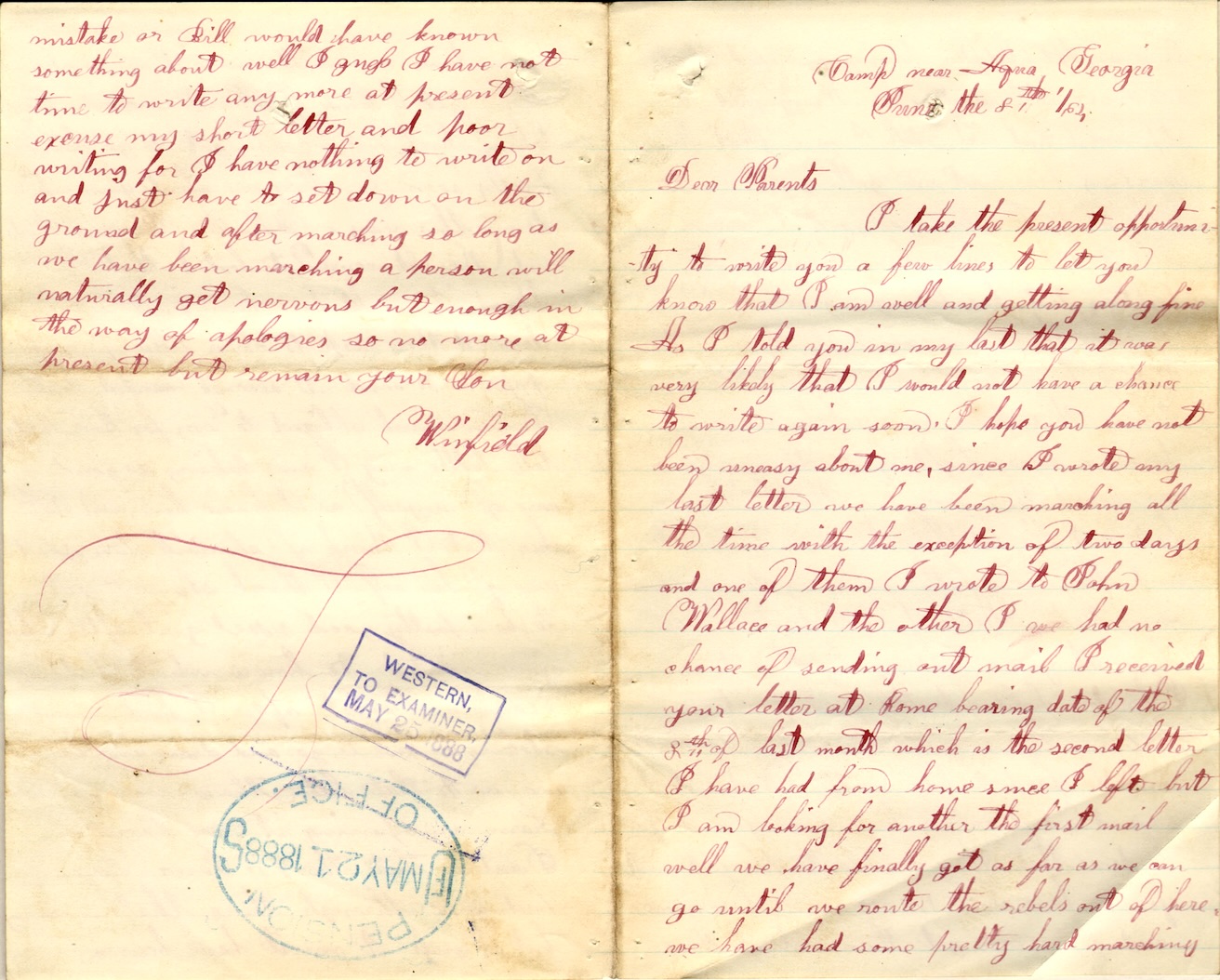
I take the present opportunity to write you a few lines to let you know that I am well and getting along fine. As I told you in my last that it was very likely that I would not have a chance to write again soon, I hope you have not been uneasy about me. Since I wrote my last letter, we have been marching all the time with the exception of two days and one of them I wrote to John Wallace and the other I had no chance of sending out mail. I received your letter at Rome bearing date of the 8th of last month which is the second letter I have had from home since I left but I am looking for another the first mail.
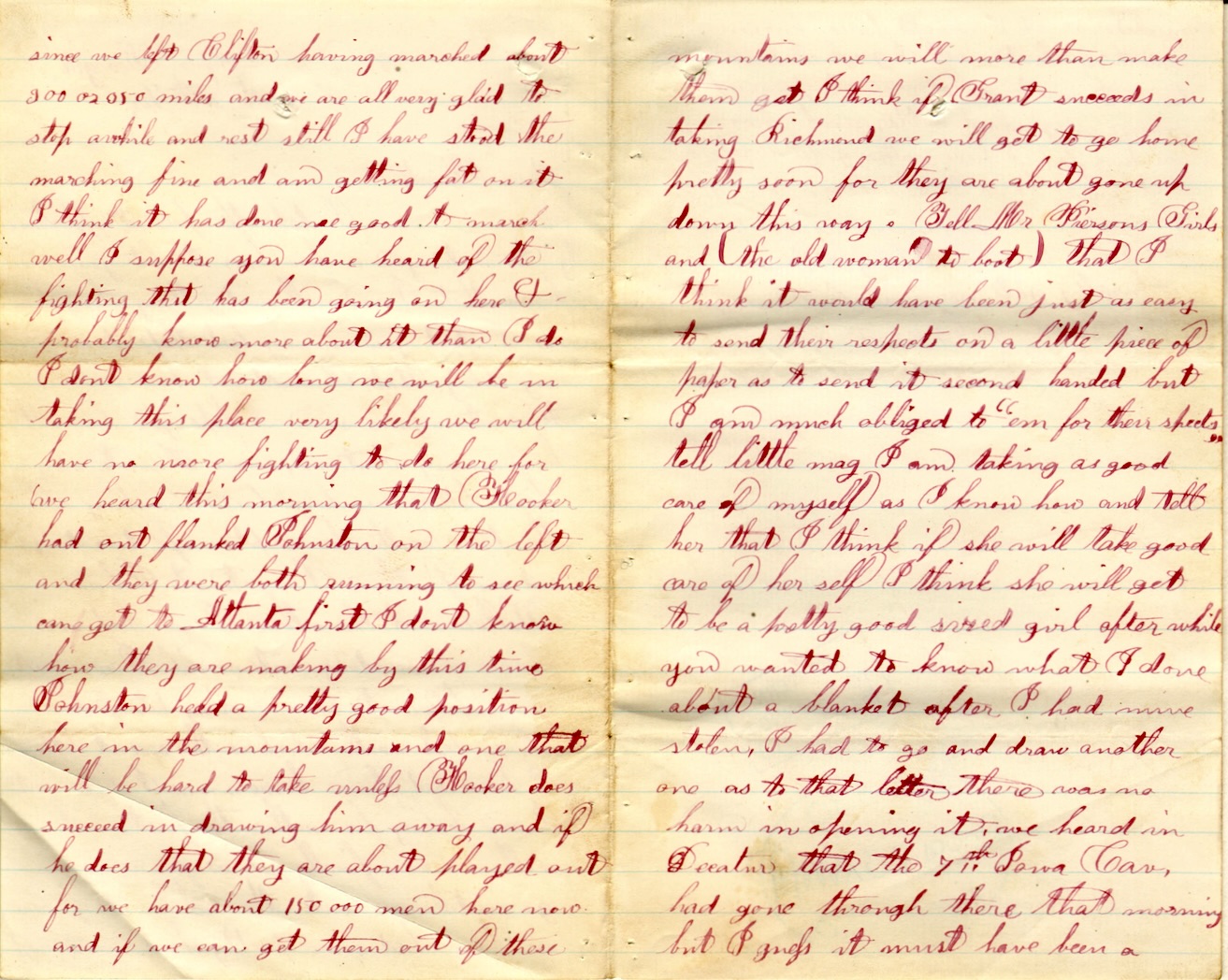
Well we finally got as far as we can go until we route the rebels out of here. We have had some pretty hard marching since we left Clifton [Tennessee], having marched about 300 or 350 miles and we are all very glad to stop awhile and rest. Still I have stood the marching fine and am getting fat on it. I think it has done me good to march.
Well, I suppose you heard of the fighting that has been going on here and probably know more about it than I do. I don’t know how long we will be in taking this place. Very likely we will have no more fighting to do here for we heard this morning that Hooker had out flanked Johnston on the left and they were both running to see which can get to Atlanta first. I don’t know how they are making by this time. Johnston held a pretty good position here in the mountains and one that will be hard to take unless Hooker does succeed in drawing him away and if he does that, they are about played out for we have about 150,000 men here now and if we can get them out of these mountains, we will more than make them get.
I think if Grant succeeds in taking Richmond, we will get to go home pretty soon for they are about gone up down this way. Tell Mr. Pierson’s girls (and the old woman to boot) that I think it would have been just as easy to send their respects on a little piece of paper as to send it second handed, but I am much obliged to “em for their spects.” Tell little Mag I am taking as good care of myself as I know how and tell her that I think if she will take good care of herself, I think she will get to be a pretty good-sized girl after while.
You wanted to know what I done about a blanket after I had mine stolen. I had to go and draw another one. As to that letter, there was no harm in opening it. We heard in Decatur that the 7th Iowa Cavalry had gone through there that morning but I guess it must have been a mistake or Bill would have known something about [it]. Well, I have not time to write any more at present. Excuse my short letter and poor writing for I have nothing to writ on and just have to sit down on the ground and after marching so long as we have been marching, a person will naturally get nervous. But enough in the way of apologies. So no more at present but remain your son, — Winfield
Letter 6
Camp 13th Iowa June 16th 1864
Dear Parents,
I again seat myself to drop you a few lines to let you know how we are getting along down here in Dixie. The boys are all getting along tolerable well. I am doing pretty well at present. I had a little sick spell a few days ago and the oyster had me to go to the Convalescent Camp just to get out of the rain for it has been raining very hard here for the last few days but I only stayed there one day and came back to the regiment.
I received your kind letter day before yesterday bearing date of the 28th of last month and was glad to learn that you were still getting along well at home. I have received the two Guards that sent me and was glad to get them for they are the next things to a letter from home. You seem to think that I am not stout enough to stand a hundred miles march but since we started on our march, I have marched about 375 miles and a pretty stout yet and feel like I could stand another just as big if it was necessary but I guess we will have no marching to do for some time as there is something else for us to do now that we have found some Rebs.
Well Mother, I am sorry to hear that you have been afflicted with a boil but you know we must all have afflictions some time and you know too that it is good for us to be afflicted sometimes for it learns us to be contented adn how to appreciate the blessings of good health. You said you had a good time visiting with an old friend of yours. I guess I don’t know anything about the woman—at least I have no recollection of ever hearing of her. I would like first rate to have been at your [Methodist] Quarterly Meeting for I have not been to meeting since we left Clifton and that has been a good [while] but I will tell you the reason for fear you conclude that I don’t want to go to meeting. Since we left Clifton, we have been marching all the time until we have been in this fight and we have no time for meeting now for we have to build forts and dig rifle pits at night and fight in the day time and you know that keeps us pretty busy.
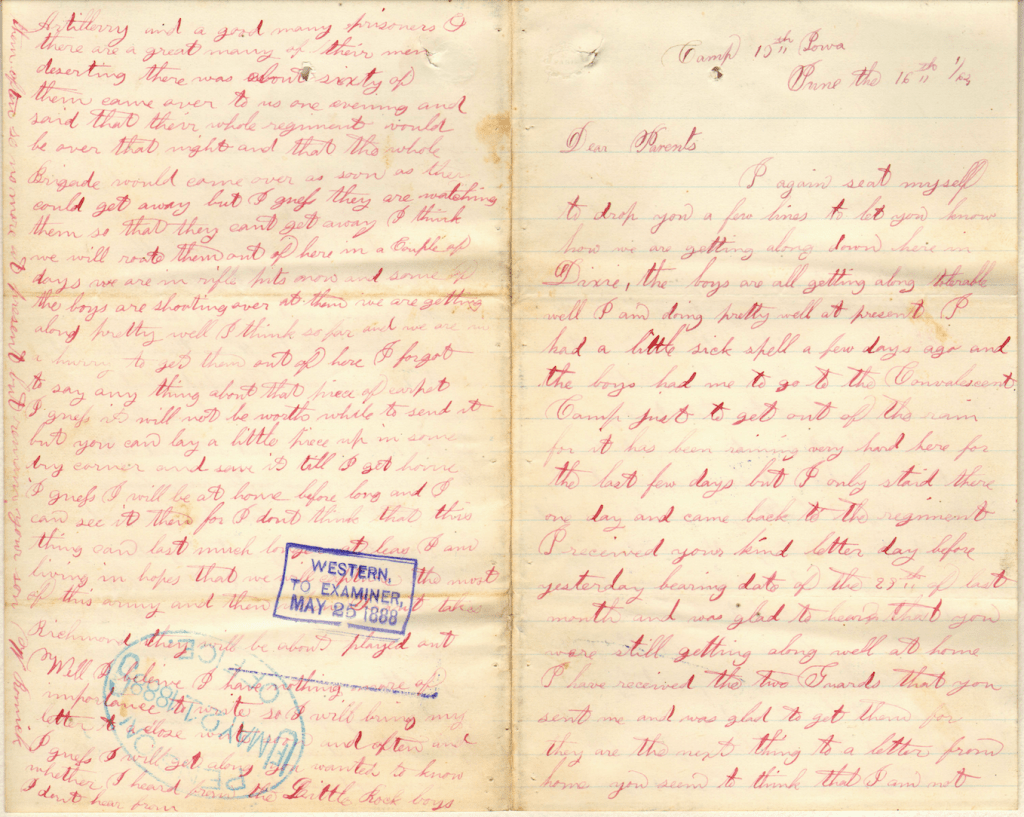
On the 7th we had got to the front of the army and stayed there until this morning of the 9th. The we advanced about 10 miles and camped about one and a half miles from the Rebel breastworks. On the morning of the 11th we marched out and attacked them commencing with very heavy cannon. Since that we have been laying around in front of the enemy watching them get behind trees and shoot at us. But there has been none of our regiment killed unless it has been done since I commenced my letter. We have driven them from a good many of their fortifications & rifle pits and are now in some of them. We have captured four or five pieces of their artillery and a good many prisoners and there are a great many of their men deserting. There was about sixty of them came over to us one evening and said that their whole regiment would be over that night and that the whole brigade would come over as soon as they could get away. But I guess they are watching them so that they can’t get away. I think we will rout them out of here in a couple of days. We are in the rifle pits now and some of the boys are shooting over at them. We are getting along pretty well I think so far and we are in a hurry to get them out of here.
I forgot to say anything about that piece of carpet. I guess it will not be worthwhile to send it but you can lay a little piece up in some dry corner and save it till I get home. I guess I will be at home before long and I can see it there for I don’t think that this thing can last much longer—at least I am living in hopes that we will capture the most of this army and then if Grant takes Richmond, they will be about played out.
Well, I believe I have nothing more of importance to write so I will bring my letter to a close. You wanted to know whether I heard from the Little Rock boys. I don’t hear from them often. So no more at present but remain your son, – W. Romick
Letter 7
Camp 13th Iowa June 21st 1864
Dear Parents,
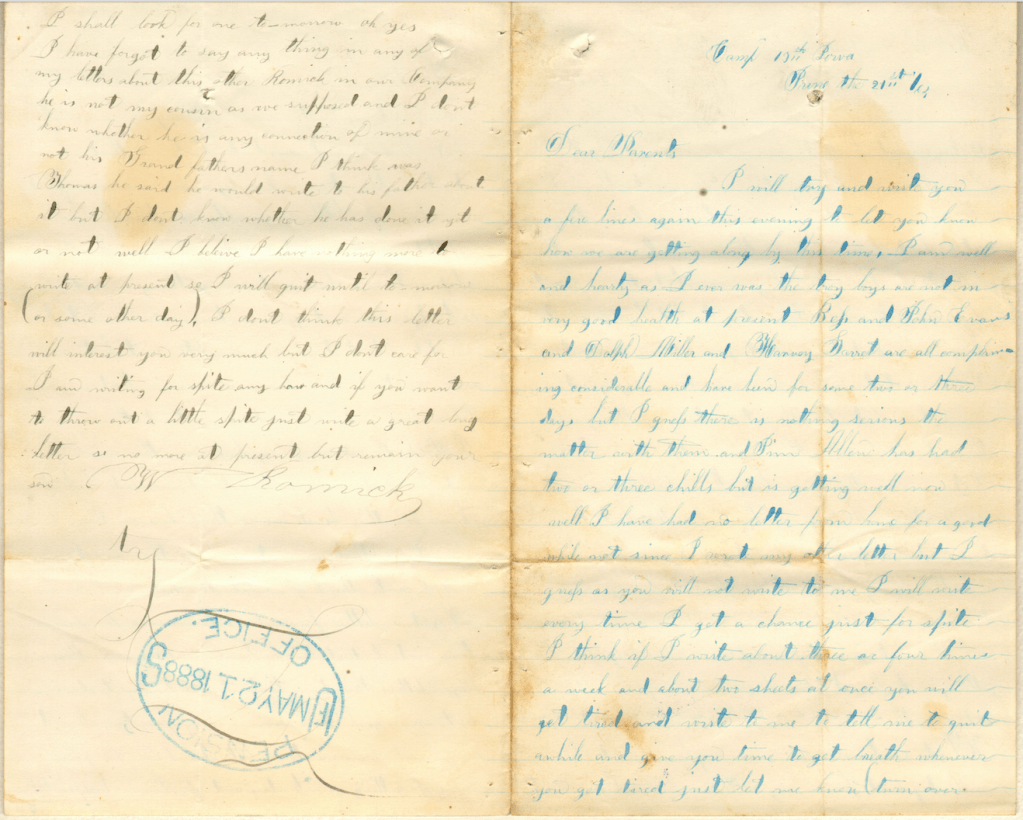
I will try and write you a few lines again this evening to let you know how we are getting along by this time. I am well and hearty as I ever was. The Troy boys are not in very good health at present. Bep [?] and John Evans and Dolph Miller and Harvey Garret are akk complaining considerable and have been for some two or three days but I guess there is nothing serious the matter with them, and Jim Allen has had two or three chills but is getting well now.
Well I have had no letter from home for a good while—not since I wrote my other letter—but I guess as you will not write to me, I will write every time I get a chance just for spite. I think if I write about three or four times a week and about two sheets at once, you will get tired and write to me to tell me to quit a while and give you time to get your breath. Whenever you get tired, just let me know.
Well I suppose you know that we have been fighting here for sometime. If you don’t, I do. We have been here fighting for the last 11 days and I don’t know when we will get through. We are driving the rebels considerable but they may fight for some time yet as they still hold possession of the mountains. On the night of the 18th, they evacuated their first line of entrenchments and retreated I guess about two miles and the next day we advanced about the same distance. We hear a good many good news here but I will not write anything more than I can see for there is no dependence to be put in anything we hear. There has been heavy cannonading all along our lines for the last two days and considerable musketry but we have been a pretty lucky regiment so far, not losing morethan one or two men since we have been here.
Well I must go and fix up our shebang for I am getting wet for it has been raining for the last month.
Well it is tomorrow morning now and I will try and finish my letter which I commenced last evening. There is nothing going on here this morning except some pretty brisk cannonading and some rattling of musketry but I have got used to that so that I don’t notice it much—only when we are ordered in line of battle as quickly as possible. We expected an attack last night and was ordered to sleep with our shoes and everything on and our cartridge boxes and guns under our heads but the rebs did not disturb our night’s rest. But such orders as that have become so common that we can sleep as well under such orders as with out them.
I think the rebs are going back some this morning and I expect we will have to advance but I don’t know for the brush are so thick here on these mountains that we can’t see more than a rod.
Well, I can’t think of much to write as I have not got a letter from home to answer for some time and i don’t think I can write one of those large letters this time that I was trying to write last evening. I have ben looking for the Guard every mail for some time but still I am living in hopes of getting one today and if I am disappointed, I shall look for one tomorrow. Oh yes, I have forgot to say anything in any of my letters about this other Romick in our company. He is not my cousin as we supposed and I don’t know whether he is any connection of mine or not. His grandfather’s name, I think, was Thomas. He said he would write to his father about it but I don’t know whether he has done it yet or not.
Well, I believe I have nothing more to write at present so I will quit until tomorrow (or some other day). I don’t think this letter will interest you very much but I don’t care for I am writing for spite anyhow and if you want to throw out a little spite, just write a great big letter. So no more at present but remain your son, — W. Romick
Letter 8
Camp 13th Iowa June 28th 1864
Dear Parents,
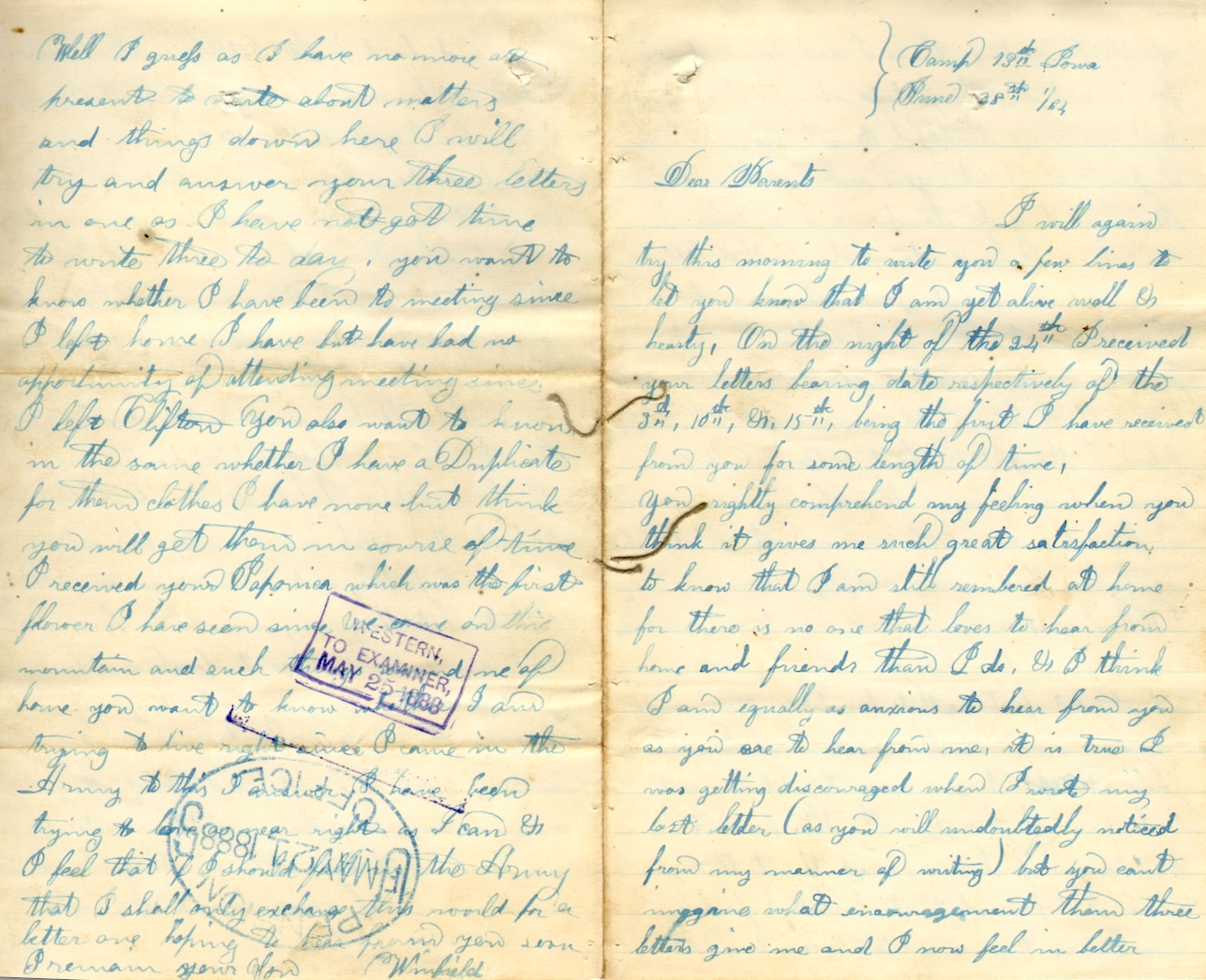
I will again try this morning to write you a few lines to let you know that I am yet alive, well and hearty. On the night of the 24th, I received your letters bearing the dates respectively of the 3rd, 10th, & 15th, being the first I have received from you for some time. You rightly comprehend my feeling when you think it gives me such great satisfaction to know that I am still remembered at home for there is no one that loves to hear from home and friends than I do. And I think I am equally as anxious to hear from you as you are to hear from me. It is true I was getting discouraged when I wrote my last letter (as you will undoubtedly noticed from my manner of writing) but you can’t imagine what encouragement them three letters give me and I now feel in better spirits for writing than I had before done for some time.
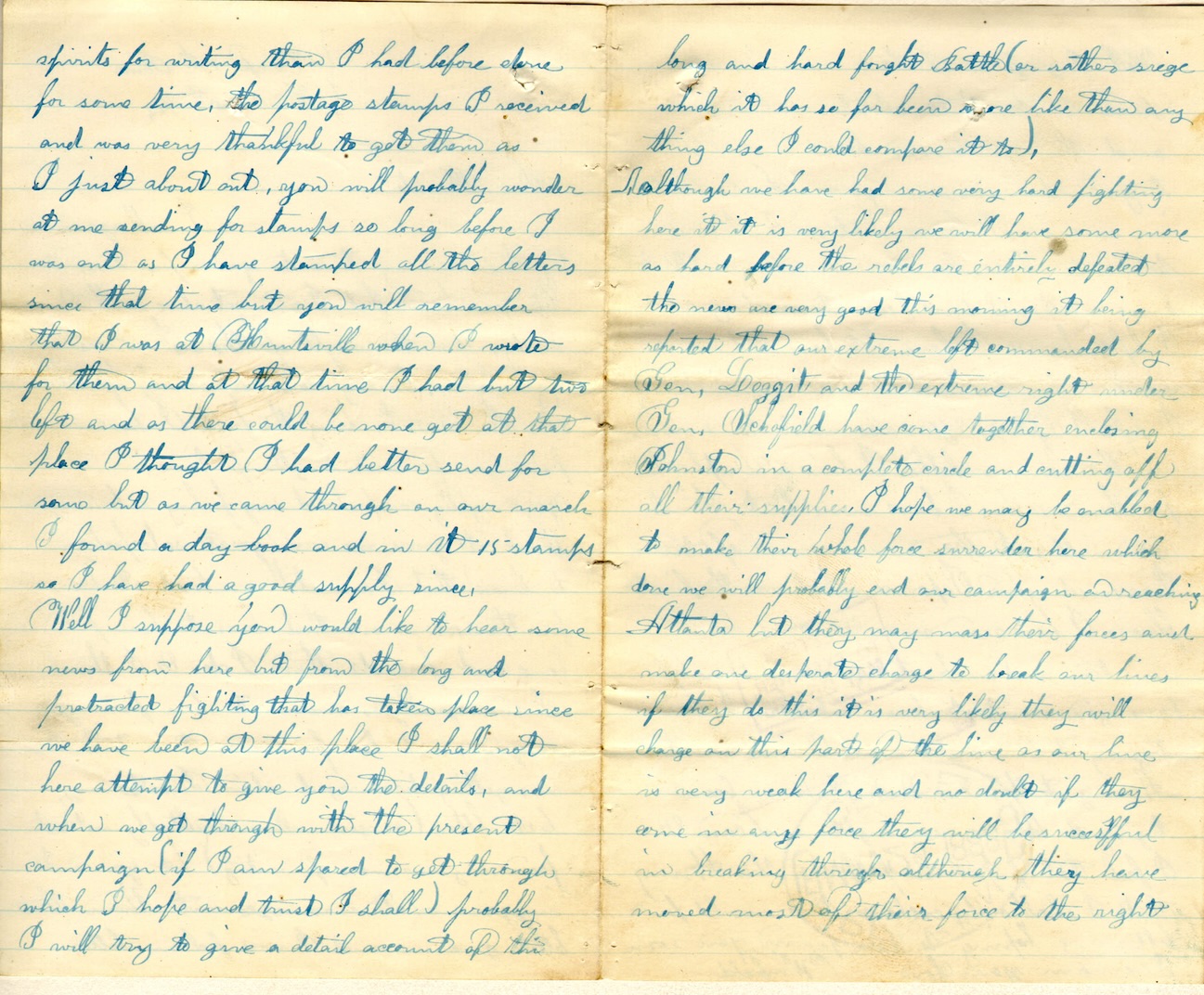
The postage stamps I received and was very thankful to get them as I [was] just about out. You will probably wonder at me sending for stamps so long before I was out as I have stamped all the letters since that time but you will remember that I was at Huntsville when I wrote for them and at that time I had but two left and as there could be none got at that place, I thought I had better send for some. But as we came through on our march, I found a day book and in it 15 stamps so I have had a good supply since.
Well, I suppose you would like to hear some news from here but from the long and protracted fighting that has taken place, I shall not attempt to give you the details, and when we get through with the present campaign (if I am spared to get through which I hope and trust I will) probably I will try to give a detail account of the long and hard fought battle (or rather siege which it has so far been more like than anything else I could compare it to). Although we have had some hard fighting here, it is very likely we will have some more as hard before the rebels are entirely defeated.
The news are very good this morning, it being reported that our extreme left commanded by Gen. [Mortimer] Leggett and the extreme right under Gen. [John] Schofield have come together enclosing Johnston in a complete circle and cutting off all their supplies. I hope we may be enabled to make their whole force surrender here which [if] done, will probably end our campaign on reaching Atlanta. But they may mass their forces and make one desperate charge to break our lines. If they do this, it is likely they will charge on this part of the line as our line is very weak here and no doubt if they come in any force, they will be successful in breaking through although they have moved most of their force to the right.
Well, I guess as I have no more at present to write about matters and things down here, I will try and answer your three letters in one as I have not got time to write three today. You want to know whether i have been to meeting since I left home. I have but have had no opportunity of attending meeting since I left Clifton. You also wanted to know in the same whether I have a duplicate for them clothes, I have none but I think you will get them in course of time. I received your Japonica which was the first flower I have seen since we came on this mountain and such things remind me of home. You want to know whether I am trying to live right since I came in the army. To this I answer I have been trying to live near right as I can & I fel that if I should fall in the army that I shall only exchange this world for a better one. Hoping to hear from you soon, I remain your son, — Winfield
Letter 9
Camp 13th Iowa July 6th 1864
Dear Parents,
I will try to write you a few lines this morning to let you know that I am still alive, well and hearty. I would have written sooner but I have not had time. I received a letter from Jane the 2nd. She was at Bloomfield when written.
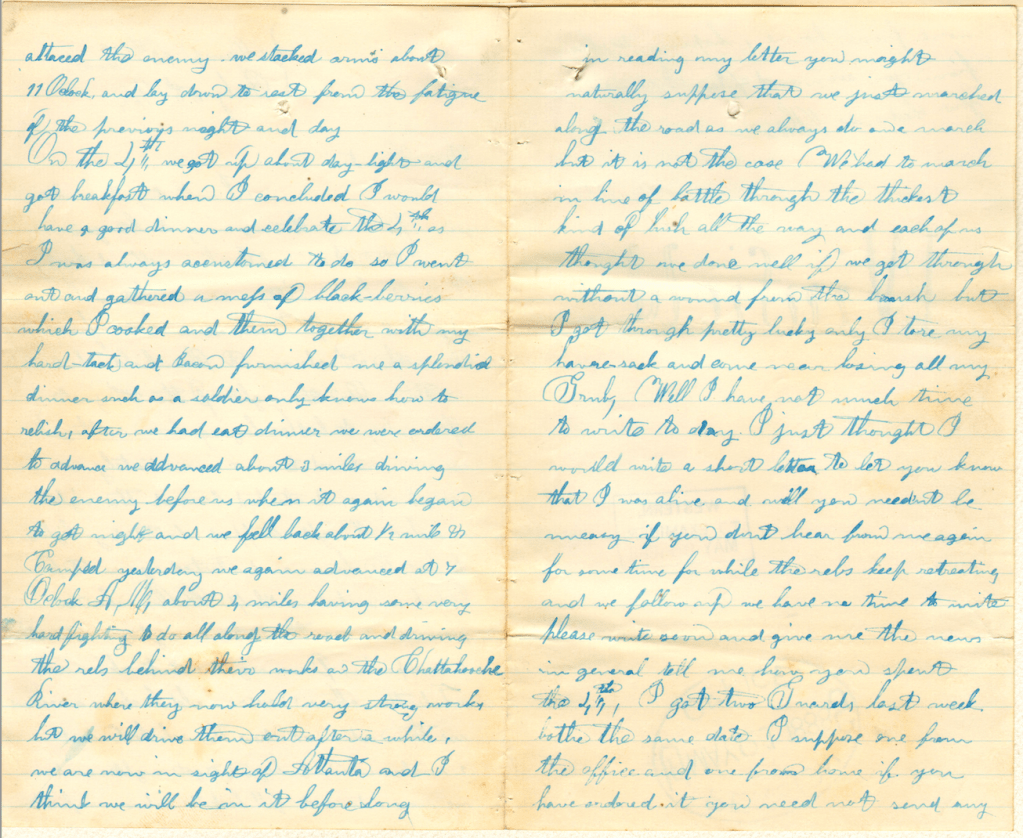
On the night of the 2nd, just after going to bed (or laying down rather), we were ordered to move immediately. We got up and started toward the right, marched all night, stopped about daylight to feed the horses and started again at 6 o’clock. Marched until 1:15 p.m. when we arrived on the extreme right. Sent out five companies of our regiment to skirmish while the other five were held back as a reserve. We then advanced, drove the rebs back about two miles when it began to get night and we were ordered to fall back to where we first attacked the enemy. We stacked arms about 11 o’clock and lay down to rest from the fatigue of the previous night and day.
On the 4th, we got up about daylight and got breakfast when I concluded I would have a good dinner to celebrate the 4th as I was always accustomed to do so I went out and gathered a mess of blackberries which I cooked and them together with my hard tack and bacon furnished me a splendid dinner such as a soldier only knows how to relish. After we had eat dinner, we were ordered to advance, We advanced about three miles, driving the enemy before us when it again began to get night and we fell back about half a mile & camped. Yesterday we again advanced at 7 o’clock a.m. about four miles having some very hard fighting to do all along the road and driving the rebs behind their works on the Chattahoochee River where they now hold very strong works. But we will drive them out after a while. We are now in sight of Atlanta and I think we will be in it before long.
In reading my letter you might naturally suppose that we just marched along the road as ew always do on a march but it is not the case. We had to march in line if battle through the thickest kind of brush all the way and each of us thought we done well if we got through without a wound from the brush. But I got through pretty lucky, only I tore my haversack and came near losing all my grub.
Well I have not much time to write today. I just thought I would write a short letter to let you know that I was alive and well. You needn’t be uneasy if you don’t hear from me again for some time for while the rebs are retreating and we follow up, we have no time to write. Please write soon and give me the news in general. Tell me how you spent the 4th of July. I got two Guards last week, both the same date. I suppose one from the office and one from home. If you have ordered it, you need not send anymore from home. Hoping to hear from you soon and often, I remain your obedient son, — Winfield
Letter 10
Camp 13th Iowa July 9th 1864
Dear Parents,
I received your letter of the 22nd last night and was glad to learn that you were well at the time of writing. You say you have not heard from me for three weeks. It seems very strange to me for I have written every week, only when we were marching and I could not. And since we have been been fighting here, I have written at least two every week because I thought you might be uneasy about me so that you will have to lay the blame all to the mail not being carried through regular.
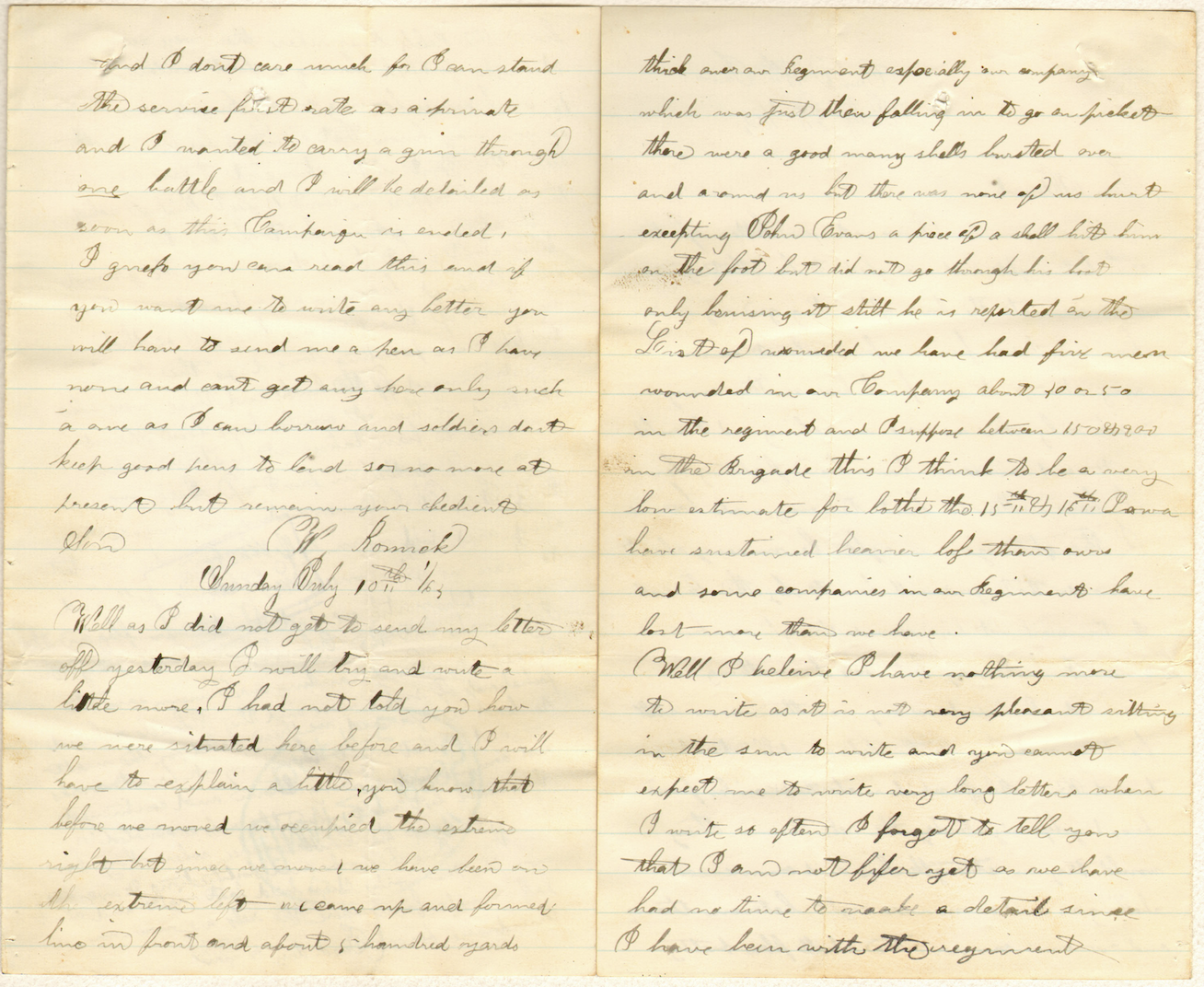
Since I wrote my last, there has nothing occurred of importance any more than we are still fighting and I guess the Rebs are still retreating toward Pine Bluffs which is about 15 miles from here. Day before yesterday the Rebs thought they would trty our strength here and commenced shelling us and as we were right between them and our own cannon, the shells flew pretty thick over our regiment, especially our company which was just falling in to go on picket. There were a good many shells bursted over and around us but there was none of us hurt expecting John Evans. A piece of she hit him on the foot but did not go through his boot, only bruising it. Still he is reported on the list of wounded. We have had five men wounded in our company, about 40 or 50 in the regiment, and I suppose between 150 and 200 in the brigade. This I think to be a very low estimate for both the 15th and 16th Iowa have sustained heavier loss than ours and some companies in our regiment have lost more than we have.
Well, I believe I have nothing more to write as it is not very pleasant writing in the sun to write very long letters when I write so often. I fogot to tell you that I am not fifer yet as we have had no time to make a detail since I have been with the regiment and I don’t care much for I can stand the service first rate as a private and I wanted to carry a gun through one battle and I will be detailed as soon as this campaign is ended.
I guess you can read this and if you want me to write any better, you will have to send me a pen as I have none and can’t get any here—only such a one as I can borrow—and soldiers don’t keep good pens to lend so no more at present but remain your obedient son, — W. Romick
Sunday, July 10th, 1864
Well, I did not get to send my letter off yesterday. I will try and write a little more. I had not told you how we were situated here before and I will have to explain a little. You know that before we moved we occupied the extreme right but since we moved, we have been on the extreme left. We come up and formed line in front and about five hundred yards from the Rebel lines where they were very strongly fortified having a fort containing 16 embrasures bearing on our brigade alone so you may know that our loss has been pretty heavy.
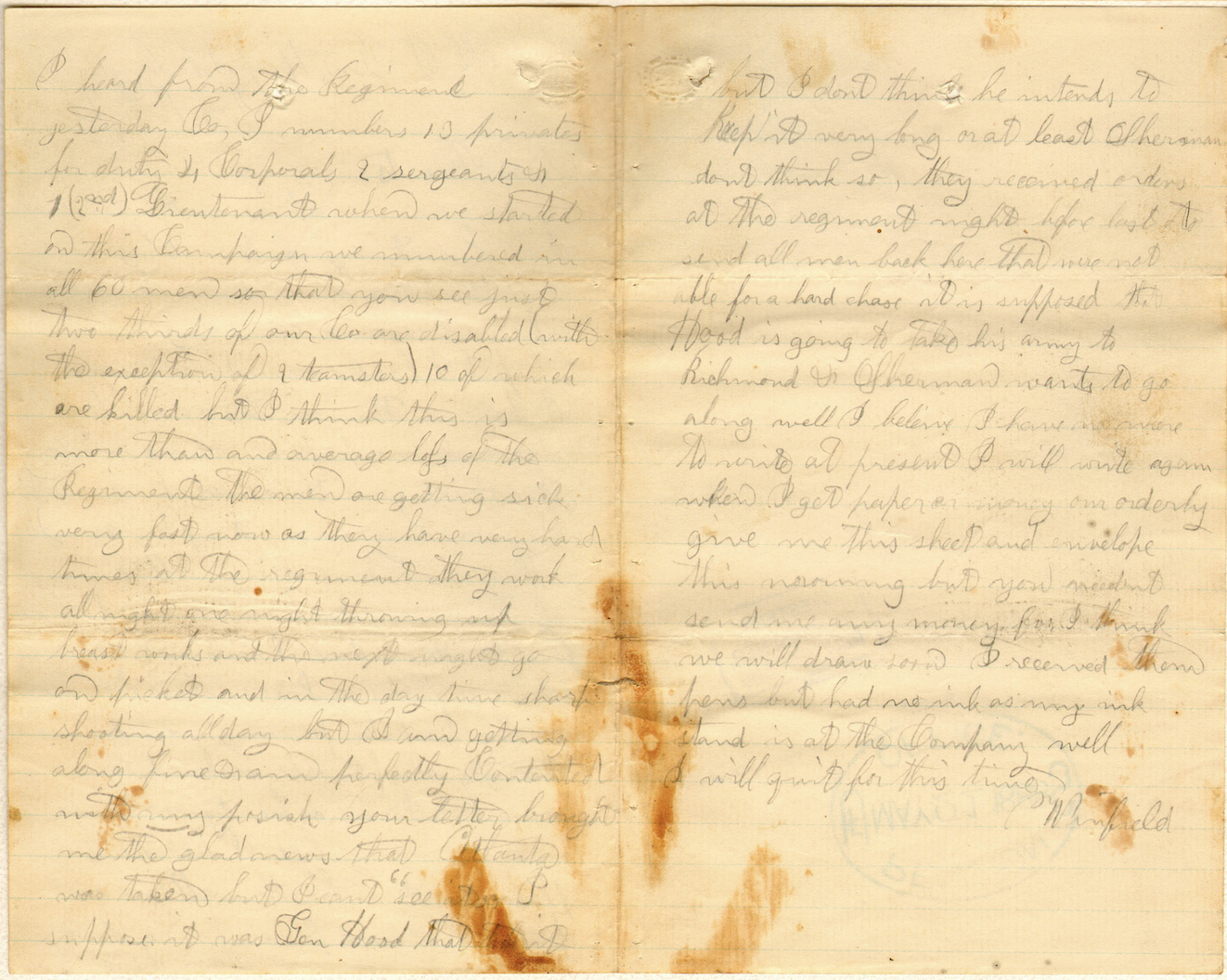
This fort is the strongest I have ever seen. The walls, I suppose, are about 15 feet thick of solid earth. About 25 yards in front of this there are stakes about 3 feet high drove into the ground and sharpened leaning over toward our lines. In front of this there are trees fell so that the tops were pointing toward us. The brush were trimmed off the limbs and these were also sharpened so that it would have been almost impossible to have taken it by storm. When we came up in front of these, Brig. Gen. [William] Hall, commanding our brigade, came along and told [us] in half an hour he wanted to hear us give one of our Iowa yells and never stop until we had planted our flag on the Rebel works. But the Colonels and Major Gen. [Walter Q.] Gresham commanding our division saw the foolishness of such a move and the Colonels refused to lead us forward. 1
We then halted for the night, worked all that night throwing up breastworks and commenced shelling them and continued thus until last night when the rebs evacuated and fell back across the Chattahoochee where they have another line of works and fortifications and we are now in the works they held last night and about half a mile from where the rebs are now in considerable force. Good day to you.
1 The line of forts constructed by the Confederates with their backs to the Chattahoochee River was known as the “River Line” and it incorporated a series of diamond shaped forts called a shoupade. They were placed anywhere from 60 to 175 yards apart depending on the terrain and were connected by earthworks that intersected the Shoupade roughly in the center. The angled section in front of the line from two adjoining Shoupades, allowed for a crossfire on an advancing enemy. Each Shoupade could hold 80 soldiers shoulder to shoulder. They were also constructed to withstand an extended artillery barrage. The Confederates occupied this line until the night of July the 9th, when the retreated across the river. The following map shows the position of Sherman’s Army confronting Johnston’s army on the River Line with its back on the Chattahoochee River. Gresham’s Division and Hall’s Brigade can be seen on the extreme Union right (in the orange circle), flanked by the 3rd Ohio Battery.
Letter 11
4th Division Hospital near Atlanta, Georgia July 24th 1864
Dear Parents,
I will now try to write a few lines to let you know that I am still alive & doing well as I could expect. I suppose you have already heard of my being wounded. I received a slight scratch on the 21st in the charge which the Iowa Brigade made on that memorable day. About 8 o’clock we were ordered into line behind the works which we had thrown up the night before. We were then ordered to advance and springing over our breastworks, we charged down a hill on double quick through a heavy volley of musketry, grape & canister. Our regiment ran on down to the hollow and lay down After laying there about 20 minutes, they found the enemy too strong for us and ordered us to fall back behind our works. We got back behind our works just 30 minutes after leaving them, losing 10 men out of our company in killed & wounded, and 126 out of our regiment. The 15th Iowa also suffered a severe loss. The 11th & 16th being in our rear for a support. I was wounded in the left arm just before we were ordered to halt but did not leave the field until the regiment fell back. Till [Tilman H. Elrod] then helped me back to the hospital which was about 3 miles from the lines.
On the morning of the 22nd, through some carelessness on the part of our officers, the Rebs outflanked us on the left (our Army Corps was on the left) & were but a very short distance from our hospital when the 16th Army Corps moving to the left came upon them & held them in check while we moved our hospital back farther to the rear. Our Brigade (or rather our Corps) again became heavily engaged as the Rebs were on all sides of them and determined on victory. Our regiment fought them in front awhile, then jumped over their works, about faced, and began to fight them in the rear. Then they would face to the right and fight them on the flank, repulsing them in every direction.
After the Rebs had made seven unsuccessful charges & our Brigade first advancing then retreating, then marching on double quick by the flank, they retired from the field in disorder leaving it almost covered with the dead and wounded & our troops occupying the same ground they did in the morning, and although our loss as well as theirs is very heavy, we claim another glorious victory. Our Corps is literally cut all to pieces. The 3rd—or Iowa Brigade—have not enough men to [make] one regiment. Our regiment now numbers but 250 men all told, 130 of which are able for duty.
The Rebel prisoners say that their officers made them a speech the night before and told them that the 17th Corps was the “Flower of the West” & they wanted them to cut it all to pieces & although they did cut it to pieces, they paid for it dearly. It is reported that one division of our Corps buried 1500 Rebels today just in the front of the one division & the prisoners say their men will not fight us in the open field again. There is only one of the Troy boys killed. Henry Thompson died in a hand to hand fight with a rebel after being shot twice with a revolver—one entering his head. He fell dead [and] the last words he was known to say was he would surrender to no rebel. 1
I am thankful to tell you that I am but slightly wounded & will be well, I think, in a few weeks, or months at most. In answer to your letter, [John] Elrod is still Chaplain. I guess I get all your letters but they come very irregular. I sometimes get 4 and 5 at one time. This is the third I have got from you since I have written but had no time to write. Tell Sarah I received her letter this evening & will answer it is a day or two as soon as I get time & paper.
Jim Allen says for you to tell or send word to his folks that he is all right but I will tell you a little more. He was struck in the ankle by a ball or piece of shell and it is considerable swelled although it did not break the hide and he will be all right in a few days, I think. You needn’t be uneasy about me for I will be all right in a short time as there are no broken bones. I will bring my hurried lines to a close hoping to hear from you again soon. I subscribe myself, — Winfield
P. S. I will send you a list of the killed and wounded in Co. I.
George McLaughlin, Captain, in the arm David Hudson, 1st Lieut., in the leg Joseph [G.] Berstler, Orderly Sergeant, in the head Adolphus [M.] Miller, 2nd Sergeant, in the foot Robert [N.] Brown, 4th Sergeant, jaw broke John [E.] Johnson, 2nd Corporal [eye]
Four of the Co. I, 13th Iowa Veterans who were wounded in the Battle of Atlanta, July 21-22, 1864 (Iowa Civil War Images)
1 Kentucky born William Henry Thompson (1843-1864) was from Troy, Davis county, Iowa. He left his widowed mother to join the 13th Iowa in 1861 and then reenlisted in 1864. His remains are in the Marietta National Cemetery in Georgia (Grave 5731).Were there an epitaph, it might read, “I will surrender to no rebel.”
Letter 12
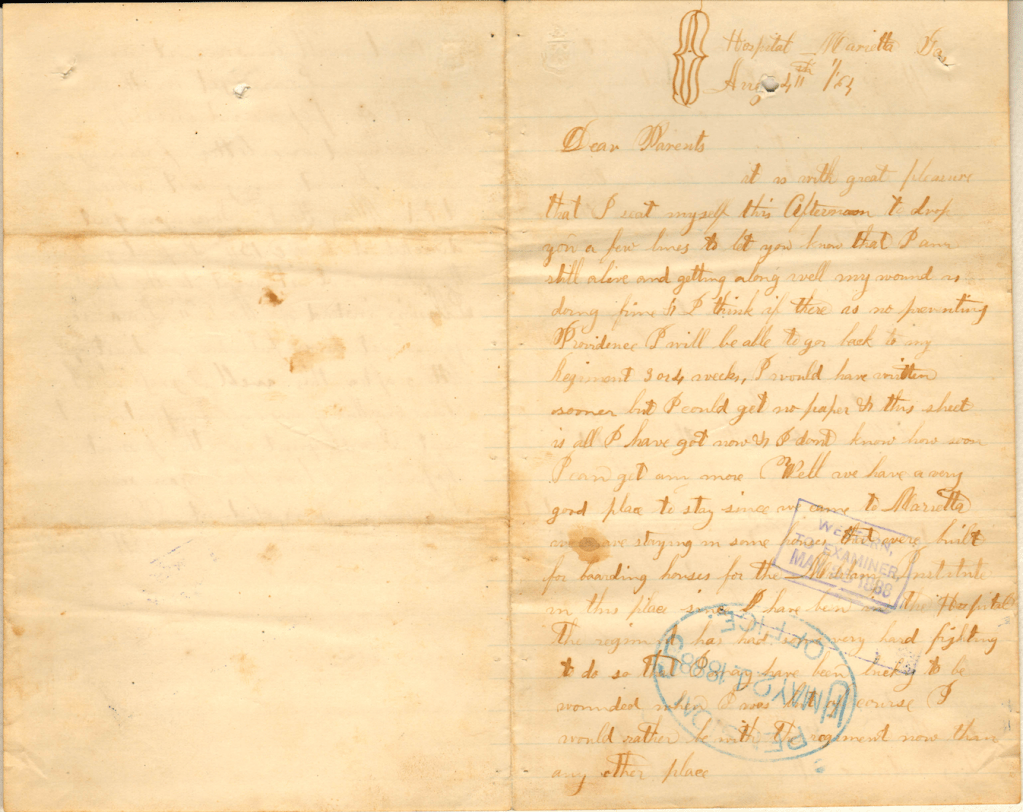
U. S. General Hospital, Marietta, Georgia August 4, 1864
Dear Parents
It is with pleasure that I seat myself to write to you a short letter in answer to yours which I received some days since. In fact, I have received two since I have written on the account of having no paper nor no money to get any with as we have not drawn any since I left Davenport.
My wound is doing well & in all other respects, I am in good health. It is true I am not so stout & fleshy as I was when I came in the hospital for my wound, though slight, has weakened me some. But I am as hearty as I ever was in my life.
I like this place just tolerable well. We are pretty well cared for since we have been here.
I heard from the Regiment yesterday. Co. I numbers 13 privates for duty, 4 corporals, 2 sergeants, & one 2nd Lieutenant. When we started on this campaign, we numbered in all 60 men so that you see just two-thirds of our company are disabled (with the exception of 2 teamsters) 10 of which are killed. But I think this is more than an average loss of the regiment. The men are getting sick very fast now as they have very hard times at the regiment. They work all night throwing up breastworks and the next night go and picket and in the day time sharp shooting all day. But I am getting along fine and am perfectly contented with my posish [position].
Your letter brought me the glad news that Atlanta was taken but I can’t “see it.” I suppose it was Gen. Hood that took it but I don’t think he intends to keep it very long or at least Sherman don’t think so. They received orders at the regiment night before last to send all men back here that were not able for a hard chase. It is supposed that Hood is going to take his army to Richmond and Sherman wants to go along.
Well, I believe I have no more to write at present. I will write again when I get paper or money. Our Orderly gave me this sheet and envelope this morning but you needn’t send me any money for I think we will draw soon. I received them pens but had no ink as my ink stand is at the company. Well, I will quit for this time. — Winfield
Letter 13
Hospital Marietta, Georgia August 4th 1864
Dear Parents,
Itis with great pleasure that I seat myself this afternoon to drop you a few lines to let you know that I am still alive and getting along well. My wound is doing fine & I think if there is no preventing Providence, I will be able to go back to my regiment [in] 3 or 4 weeks. I would have written sooner but I could get no paper & this sheet is all I have got now & I don’t know how I can get anymore.
Well, we have got a good place to stay since we came to Marietta. We are staying in some houses that were built for boarding houses for the Military Institute in this place. Since I have been in the hospital, the regiment has had some very hard fighting to do so that I may have been lucky to be wounded when I was, but of course I would rather be with the regiment now that any other place.
The Marietta Military College trained officers before the war. Once General Sherman arrived, it became a hospital and barracks occupied by Union forces. (Image: Library of Congress)
Well, the Rebs are getting one of the worst whippings here that they ever got anywhere & I think if our armies continue successful during this campaign, we will all be permitted to return home in the course of a year or two. But as long as this war lasts, I don’t want to go home—not until my time is out anyhow.
I believe I have no news to give you, only that our company has been pretty lucky since the 22nd, only being one man, Stephen Wirtz of our company was killed on the 27th. The wounded of our company are doing well. The weather is very good for the wounded as it has been quite cool for the last two weeks. I have been out blackberrying several times since I have been in the hospital. There is plenty of berries down here and you can imagine there are plenty to pick them.
Tell John Wallace I received his welcome letter last night and will answer it as soon as I can get another sheet of paper and envelope. I received one letter from you since I wrote my last which was dated May the 8th & as you just directed it to the 13th Infantry, leaving the Iowa out, it went to the 13th Illinois instead of the 13th Iowa, so you must be careful how you direct your letters after this.
Well, I guess as I have nothing more of importance to write, I will quit for the present. Hoping to hear from you soon, I remain your obedient son, — Winfield
Letter 14
17th Army Corps Hospital, Marietta, Ga. August 29th 1864
Dear Parents,
I again seat myself this morning to drop you a few lines to let you know that I am still getting along well. My wound is healing very fast & is almost well. Since I wrote my last letter, Till [Tilman] Elrod has come here wounded in the chin & shoulder but as it is only a flesh wound, I don’t think it will hurt him much. He is getting along fine & I think will be able for duty or a furlough before long. I guess I could get a furlough if I wanted it but I don’t want one so you needn’t look for me home for some time yet—if not longer. I think it would cost too much to go home for a 30 day furlough.
I have received two letters from home since I wrote my last. You wanted to know whether I ever seen Robert Pierson. He is about a quarter of a mile from this hospital in charge of a squad of convalescents so that I can see him whenever I want to. I have been to see him four or five times since I have been here & he has been up to the hospital several times. You spoke of Villa growling because I did not tell her goodbye. I have no doubt she has been grieving at a grand rate for the last five months. You know she showed her sympathy last spring.
I have received all the stamps you have sent & everything else but I have not had a letter from home nor no other place for some time though I am looking for one every mail. I have heard that our regiment has had another hard fight [and] came out with only 40 men but I don’t know whether it is true or not.
As I have no more at present to write, I will close by asking you to write soon. Yours with respect, — W
Letter 15
Camp Army of the Tennessee Octiber 17th 1864
Dear Parents.
In haste I seat myself to drop you a few lines to let you know that I am still alive and enjoying good health but probably you would like to know first thing why I have not written for so long a time. Indeed, I have been afraid that you would be uneasy about me & I have no doubt but you have been.
On the first of this month while in camp near Atlanta we received orders to get ready to move in 30 minutes with three days rations in our haversacks. We moved out about six miles and camped for the night. Next day we moved on about two miles where we found some Rebs and after skirmishing with them awhile, we fell back and camped where we did the night before & next day marched back into camp near Atlanta. That evening we received orders to move again in the morning in the direction of Huntsville, Alabama. Gen. Hood having got in our rear had torn up the railroad from Big Shanty to Ackworth, a distance of 10 or 15 miles. So you see the mail could not go through for some time. We marched back to Atlanta & camped.
Next day after camping in that place, our division went out on a two days scout in the direction of Powder Springs, camping there that night and going back to Marietta the next day. We then marched up to Big Shanty and laid over there a day. We then came on up to Kingston where we got mail. I got 4 letters & two papers. We had no more than read the news from home until we were ordered to move in the direction of Rome. We moved out about 7 miles and went into camp at 1 o’clock that night. Next day we marched back to Adairsville & took the cars for Resaca, reaching that place about daylight next morning. We there found that the railroad was burned from there to Dalton, a distance of 14 miles. We laid in Resaca one day and then moved again. That was day before yesterday. THat day we found two brigades of rebels at the mouth of Snake Creek Gap. After skirmishing with them about an hour, we routed them and marched on through the Gap, camping at the north end of it.
Yesterday we skirmished with them again and drove them, marching about 7 miles & camping here last night. Today they said there would be a chance of sending out mail so I thought I would improve the opportunity although I don’t know what minute we will be ordered to move. So you must excuse me for writing in such a hurry. Latest reports say we are ordered to Stevenson, Alabama & from there to Tennessee. Also that Hood has left the railroad and is moving south but I have no more room for news. Suffice it to say this is equally as hard a campaign as the last for we are doing more than half of our marching in the night. Tell the young folks I received their package and will answer it as soon as I can/ My last letters were dated September 29th & October 1st. Orders to move. Yours truly, — Winfield
Letter 16
Camp near Galesville, Alabama October 22, 1864
Dear Parents,
As we have stopped to rest a day or two, I will again try to write you a few lines. I am still well and getting along fine. We have been marching ever since I wrote the last letter. I do not know the object of this campaign but as Sherman is along with us, I guess we will come out all right after a while. I have heard that it was to open up a new line of communication but I don’t know whether it is true or not. Our non veterans & officers are to be mustered out today. You better believe they are a joyful set of fellows. Chaplain Elrod says he is going to take supper with you before long & he is going to eat some for me too. Well our rations have been pretty short for the last week or two as we had to make the last three days rations last five days. But we foraged some & now have on hand a good supply of sweet potatoes and fresh pork.
Well we received the news last night of some—–well, I don’t know what to call them trying to resist the draft in Iowa. Copperheads is too good a name for a set of beings (I won’t call them men) that are guilty of such an act as that & I know of no mode of punishment sufficiently severe to inflict upon such persons. But it is of no use for me to try to describe my feelings toward such a set of law breaking peace advocates. But let them look out for the non vets or they might yet get hurt for no one knows better how to hate them than a soldier.
Well, it is pretty cool down here now adn my hands are so numb I can hardly write. But I guess you can read it if you will take time. Well Mother, I guess I will have to ask you to knit me a pair of gloves as it is getting cold weather & we can’t get anything here. I am ashamed to ask for anything as I have not sent you any money yet but I guess we will get pay some time & there will be more of it when it does come. But I don’t want you to send me any money as I told you before for it might get lost.
Well, I don’t know how long we will stay here. I guess we will rest two or three days & we have just now got the news that we are going to Memphis, Tennessee. WE got mail last night but I did not get any. I am going over to see Robert Pierson today to take a letter to him that was directed to our company. I don’t know who wrote it. I will close for the present. I remain as ever your son, — W
Letter 17
Marietta, Georgia November 7, 1864
As we have again stopped & have a chance of writing, I will try to write you a few lines this morning to let you know that I am still well & hearty. We are now camped in Marietta. Came here yesterday. Have been marching ever since we left Galesville, Alabama. I don’t know how long we will stay here. Our orders are to stay several days & there is some talk of us staying here all winter. But I don’t think we will nor in fact I don’t want to for if we have this rebellion to put down by marching and fighting, we may as well be at it & rush the thing through. But I am willing to go according to orders. It may be that we have done enough this year.
Well, you wrote about the guerrillas making a raid up in Davis County but I guess they did not do much damage. I heard that Pap & Brown tied their horses out in the brush. I think you needed me up there to stand picket for you or to ride your horses after them Johnnies. which would have been more prudent. But I guess you got along very well without my assistance & we had a campaign of our own down here in Georgia & Alabama though it may be not so long as yours was for we only marched about 300 miles and skirmished a little with the rebs.
There is some talk of our army going down to Savannah this winter & you see we will have another little campaign of about 300 miles.
Well, it is now tomoroe & we have just come off of Battalion drill & as times are getting pretty busy, I wil have to close to write the balance of my letter the next time. No more at present but remain your affectionate son, — Winfield
Letter 18
Savannah, Georgia Christmas, December 25th 1864
Dear Parents,
I will try to write you a few lines this evening though I haven’t any[thing] to write that will interest you—only that I am still well & getting along as well as I could expect. The Troy boys are all well excepting Dolph Miller. His head is not quite well yet from a hurt that he received in one of our skirmishes, though it does not hurt him much. We have not had any hard fighting since I last wrote to you but our regiment has been in some pretty hot places—places where the shot & shell fell thick and fast around us. But an all-wise Providence saw fit to protect & save us from the enemy’s deadly missiles & we are now enjoying ourselves safe in the beautiful City of Savannah. And although we have not the accommodations that I am accustomed to on this holiday, we have enjoyed ourselves first rate.
For our Christmas dinner we had a piece of roasted beef, some beans, and that other standard of life, “hard tack.” And we are indeed thankful that we have that much & I hope & trust that we will be permitted to spend the next Christmas at home surrounded with friends, peace and happiness though I would not have you infer from this that I am tired of soldiering for I can say today that I am glad I enlisted when I did & when this war is over, if my life is spared, I a can go home feeling that I have done my duty to my country.
Well, Till has got back to the company. He got here (to the company) day before yesterday but we were all disappointed as he lost his knapsack on the road & all that the people sent to the Troy boys. When I get some money to send home, I want to send for some more as you can send it by mail & it will be a great deal cheaper than to buy it down here. I have got all the letters that you have numbered (that is) three of them.
I would like for you to send me a little thread if you please—some of your own making if you have any that is colored. I believe I have nothing more to write at present & must go to getting dinner. So I will quit. I remain as ever your son, — Winfield
Letter 19
Camp of the 13th Iowa Near Beaufort, South Carolina January 8, 1865
Dear Parents,
With pleasure I take this opportunity to write you a short letter to let you know where I am and how I am getting along. I suppose you have heard before this that I was sick & probably thought I was pretty sick that I could not write but I am well again and as hearty as ever. I was pretty sick the last two or three days we stayed in Savannah but as soon as we got to moving around, I got well. I guess it was only a little spell of the Dumb Ague or something of the kind.
On the 6th, we left Savannah & marched about 6 miles to a place on the river. Stayed there all night and day. We embarked on a ship and sailed to this place, landing here about 5 o’clock that night so you see we have had a ride on the big frog pond. But as the sea was very calm that day, we was not troubled much with seasickness. We have a tolerable good place to camp here only we have to carry wood a little too far, but we get rations enough to make up for that. Yesterday we drawed onions, potatoes, picked beef and some light bread. And besides that there is thousands of bushels of oysters laying right out here not more than 200 yards from camp and we have plenty of them you know. I suppose you recollect the time the time that you fixed up some oysters for John Wallace & I. But I have learned a trick or two since that. I can take them out of the shell & eat them alive and a kicking now & if you will come down & take dinner with us I will give you some oyster soup.
Well, perhaps you would like to know what we are going to do out here in South Carolina & I would too but I guess we are preparing for a campaign against Charleston or some other place though I think we will stay here a week or two before we do anything.
Well it is raining and blowing here and I expect I will have to stop writing as my paper is getting wet. Tell Pap I would like to hear from him too once in a while. But no more at present. I remain as ever your son, — W
I wrote a letter to Flora on New Year’s Day.
Letter 20
Camp near Pocotaligo, South Carolina January 18, 1865
Dear Parents,
As I have delayed writing longer than usual I will try to write you a few lines this morning although I have had no word from home for a long time & this is the reason why I have not written sooner for I thought there must be something wrong with the mail line & there was no use of writing.
The next day after I wrote to you last we moved out about five miles from town & camped two days when we received orders to move again. We had not gone more than about 8 miles when we run into the rebels but as the 3rd Division of our Corps was in the advance, our Division did not become engaged but stopped and formed line of battle and rested on our arms until the other Division got them started. And then we moved on keeping the Johnnies going on the “double quick” until they got behind their works at Pocotaligo. They thought they would give us a little fight but they soon found they were not sharp enough for the 17th Corps. As it was then getting dark. we advanced up to within about 150 yards of their line of works when we halted & give them till morning to study on the subject of giving us battle. When morning came, we found that “Johnnies” were not to be seen nor heard of. They had done just as we expected, evacuated & fell back about two miles across a stream called Saltcather River which place they said they must hold at all hazards. But when night again came on, they had left leaving us in full possession of the railroad from Pocotaligo to Savannah & they have now found out that they don’t understand “flanking.”
Our regiment is left out here to picket a cross road so that we have considerable picket duty to do but as long as there is no rebels about, picketing does not amount to much. It has been raining ever since yesterday noon making it very muddy & disagreeable & I don’t know how much longer it is going to rain. I can’t tell you how long we will stay here but I don’t think we will move again until we get ready for another expedition & then I don’t know where we will go though I think we will first strike for Branchville. And if Grant don’t succeed in taking Richmond pretty soon, I expect we will go and help take that. I don’t believe ait would take Sherman long to flank Lee out of there or capture his army one.
Well, I guess I have written enough for the present so I will close by again asking you to write soon. I remain as ever your son, — Winfield
Letter 21
Goldsboro, North Carolina March 27, 1865
Dear Parents,
With pleasure I now hasten to drop you a few lines to let you know that my life has been spared thorough another long and toilsome march & I am still in good health, this last being indeed one of the longest marches made since the commencement of the present war and a great deal the hardest owing to the season of the year. But when I look back at what Sherman’s Grand Army has accomplished on this campaign, I can but be glad that we are rushing things so fast for without this energy, we cannot expect to suppress this fast declining rebellion.
As I have told you that this was the hardest march made since the war, I will tell you some of the hardships to which we have been exposed though I do not want you to think tht I am complaining of anything that we had to go through. The worst trouble we had was wading and crossing swamps as it is a very rainy season of the year down here. The creeks and streams are all very high, being swollen out of their banks for sometimes a half a mile or more & these—as we could not bridge them—we were obliged to wade, one of which in particular I had to swim for a short distance and the water being so cold and we having such loads to carry, you must know that it is very dangerous. But it will do you no good to know of this so I will change the subject though I must tell you that this exposure has not hurt me in the least.
We have had no fighting to amount to much until we got pretty near through to this place & then we had a pretty smart fight though we had considerable skirmishing all along the road and our brigade did not have very hard fight even here as the most of the rebel force were in front of the Left Wing of our army. Our brigade only lost about 40 or 50 men. I suppose it is not necessary to give you an account of the route we came on as you will see that before this reaches you though I must tell you that our regiment was the first to plant its colors in the City of Columbia.
We received the long wished for mail today. I received 5 letters, three from you and one from Sarah & one from Flora, She said they were then living near Fremont so I will not know where to direct to her again but perhaps I will find out after awhile. Tell Maggie & the old folks that wrote in your letter that I am much obliged to them and will remember them when I get more time. I will be very busy for a day or two at washing and fixing up our camp as we are a going to lay over for awhile & when I get fixed up, I will answer all my letters. Also tell Mr. West that I will try to fulfill my promise as soon as possible but it is supper time and I will have to close for the present. My respects to all enquiring friends. I remain as ever your son, — Winfield
I could not find an image of Bradley but here is a cdv of an unidentified New Hampshire soldier photographed by A. W. Kimball of Manchester, N. H. (Dave Morin Collection)
Bradford A. Hurd (1832-1863) of Somersworth, New Hampshire was a 25 year-old shoemaker when he volunteered on 2 September 1861 as a private in Co. B, 4th New Hampshire Infantry. Just six months earlier he had married Carrie F. Bailey. His parents were James Hurd (1796-1876) and Abigail Wadilla (1798-1848) of Sanford, York county, Maine.
Bradford died at a hospital on 21 June 1863 from wounds to his leg and ankle caused by a shell on the night of 17 June 1863 while on fatigue duty at the upper point of Folly Island, South Carolina. Bradford’s commanding officer, Lt. Fred Kendell, claimed that the fatigue party was in the process of preparing the ground to erect batteries for the purpose of shelling Morris Island when the enemy noticed the activity and fired at them, mortally wounding Bradford. He was carried back to camp and his leg was amputated in the regimental hospital but they were unable to save him.
Some of Bradford’s war correspondence is reportedly housed in the Georgia Historical Society of Savannah.
Bradford wrote this letter to his younger brother, Luther J. Hurd (1842-1881).
Bombardment & Capture of Forts Walker & Beauregard, Port Royal, S. C., Nov. 7, 1861.
T R A N S C R I P T I O N
Hilton Head, South Carolina December 2, 1861
Dear Brother,
I received your very kind letter last night, December 1st, and was very glad to hear from you once more. You don’t know how much pleasure it gives me to hear from home much more than it would if I was at Great Falls. The reason is I cannot get so much as a paper to read here and when I get a letter from a friend, it is a good treat to me. Besides that, I love to get letters from anyone.
We arrived here on the 7th of last month and had a battle with the rebels which lasted six hours and we whipped them badly and made them run. [See Battle of Port Royal] We took everything they had consisting in cotton, corn, guns, rice, cannons, cloth, and two forts. We took more than five hundred thousand dollars from the, We took thirty pieces of cannon, oranges, pineapples, sweet potatoes, peanuts, and everything almost you can mention of which we are feasting on.
We had a hard time coming here on board the boat [USS Baltic]. We was in a gale 18 days before we arrived here. Three days would have been long enough to come here had the wind been fair and we was without much food for ten days. No one can tell the scene but those that passed through it. Nay, I never see another such a time. I have not space to tell you all the details on this sheet of paper. Luther, how would you like that? But after all the hardships that I have passed through, I do not feel anything like giving it up. I am willing to do anything to save my country from ruin.
You said perhaps I was not more than two hundred miles from George. If he is at home, I am not more than fifty from him. You said you wanted me to send you something and if I can, I will send you a box of oranges and pineapples. Perhaps you will not want to hear from me very often for you will have to pay the postage on the letters for they will not take three cents and I can’t get any stamps. But if I live to get home, I will pay you. So Luther, be a good boy and write to me as often as you can. Give [my] love to Laura and the rest and I will write to them all soon as I can. — Bradford Hurd
This letter was written by William H. Dorsey (1819-1854), the oldest son of Richard Brooke Dorsey (1791-1869) and Anna Elizabeth Dorsey (1800-1884) of Elk Ridge Landing, Anne Arundel county, Maryland. By 1850, Richard and Anna had relocated to Baltimore where Richard was a merchant. William was yet unmarried and living with his parents in Baltimore at that time. It is presumed that William was named after his paternal grandfather, William Hammond Dorsey. The Dorsey family were slaveholders in the 1850s and the content of the following letter gives us some notion as to their opinion of Yankees and societal preferences.
I could not find a biographical sketch for William H. Dorsey but one ancestral record indicates that he was married on 21 December 1848 to Arabella Arthur (1828-1866) of Clay county, Missouri and that he died in New York City in August 1854. Arabella was the daughter of Michael Arthur (1800-1884) and Amanda Melvina Martin (1804-1889) who came to Clay county, Missouri, from Barren county, Kentucky in the late 1820s. Arabella’s father operated the first hemp factory in Clay county and he became a very wealthy businessman and real estate developer in Liberty. He operated a general store on the southwest corner of Water St. and Kansas St., and also was the proprietor of the Arthur House Hotel. Arabella died in Liberty, Missouri, in 1866 after a protracted illness of Consumption (tuberculosis). This record is probably accurate because there is nothing more in the family’s ancestral records despite a lot of detail regarding William’s siblings, one of whom—Richard Brooks Dorsey, Jr.—served in Co. H, 1st Maryland (Confederate) Infantry during the Civil War.
The post script of this letter suggests that William was engaged in some mercantile venture in St. Louis.
T R A N S C R I P T I O N
Liberty [Missouri] October 29, 1842
Dear Mother,
I wrote on the first of the month from St. Louis giving a sketch of my trip up to that time. I remained there 3 weeks and was most disappointed in not receiving a letter from you. The last and only one I have received was in Louisville.
I started from St. Louis about a week ago and have only progressed this far on my journey west. The [Missouri] river is extremely low rendering it both dangerous and difficult for steamboat navigation. We were 4 days in getting to Chariton, half the time sticking fast on the sand bars and the balance creeping along through the snags which in some places are so thick as to resemble a perfect forest—hundreds of them in sight at once besides a great many below the surface. We had, however, quite an agreeable time notwithstanding our slow traveling. The boat would sometimes be aground for 5 or 6 hours at a time when we would take a gun and go ashore amusing ourselves—until she got off again—by shooting. Along the whole river is the greatest quantity of game, deer, wild turkeys, pheasants, partridges, & prairie hens by thousands on land, and millions of greenbacks on the river. We had fine sport and kept the table well supplied with game.
At Chariton the navigation became too uncertain [so] we left the boat and now travel by land up the northern side of the river, Today I go still farther west to Fort Leavenworth and a short distance up in the Indian country. I regret very much that I have an engagement in St. Louis on the 8th and shall be obliged to return by that time. If it were not for this, I should take a 2 or 3 weeks trip up the Missouri into the Indian country. From the Fort I return through Westport to Independence and from there take the stop for St. Louis. I think it is very probable I shall have to make another trip up here before my return to Baltimore. I shall certainly be up as high as Booneville next month.
From the 200 miles down the river north, south and west to the state boundaries is one of the finest country on the face of the earth. You can form no idea of it unless you could see it. Eastern folks generally have formed a very improper conception of this state. It is far, far ahead of Ohio, Indiana, or Illinois in every respect either for beauty of scenery, fine streams, fertility of soil or society there is no comparison. The scenery in many places is lovely beyond description. There is every variety of it. You can have either a boundless prairie extending 40 or 50 [miles] without a tier and as level as the floor with soil from 25 to 30 feet deep, or a forest of trees twice as large as any you ever saw, or you can have a beautiful rolling prairie, one hill swelling above another for hundreds of miles, intersected here and there by skirts of timber just enough to add to the variety of the scene. Were I to move to the West, I should not think of stopping short of this and would probably go still further west to the Platte county over which we pass today.
The emigrants to this state are of the better class—principally Virginia and Kentuckians. Very few foreigners or close-fisted Yankees—another great advantage of the states south of the Ohio. But I must close. I don’t know whether you will be able to read this. I have sprained my thumb and can’t bend it. Write me at St. Louis. I will write you again on my return then if not before. Yours &c. — W. H. Dorsey
I sent you several days ago a newspaper containing the advertisement of a sale I was going to have on the 8th of next month. Goods taken for debt.