This letter was written by George Elbert Jayne of Huntington, New York, who enlisted when he was 18 years old to serve three years in Co. I, on 8 September 1862. He was later promoted to corporal and then sergeant by January 1863. He mustered out of the regiment at Charleston, South Carolina, on 30 June 1865. When he enlisted, he was described as a blue-eyed, sandy-haired, five and a half feet tall “printer.”
George was born in Babylon, New York—the son of Charles Jayne (1823-1891) and Deborah Ann Burling (1826-1886). After the war, he became a Methodist minister and served in the pulpit for over forty years.
This letter gives us an account of the “Battle of Fort Johnson” which was a planned amphibious attack against Ft. Johnson and Fort Simpkins located on James Island on 2 July 1864. Delays caused the attack to falter as well as. the “want of spirit and energy on the part of many of the subordinates.” See The Battle of Fort Johnson.
Transcription
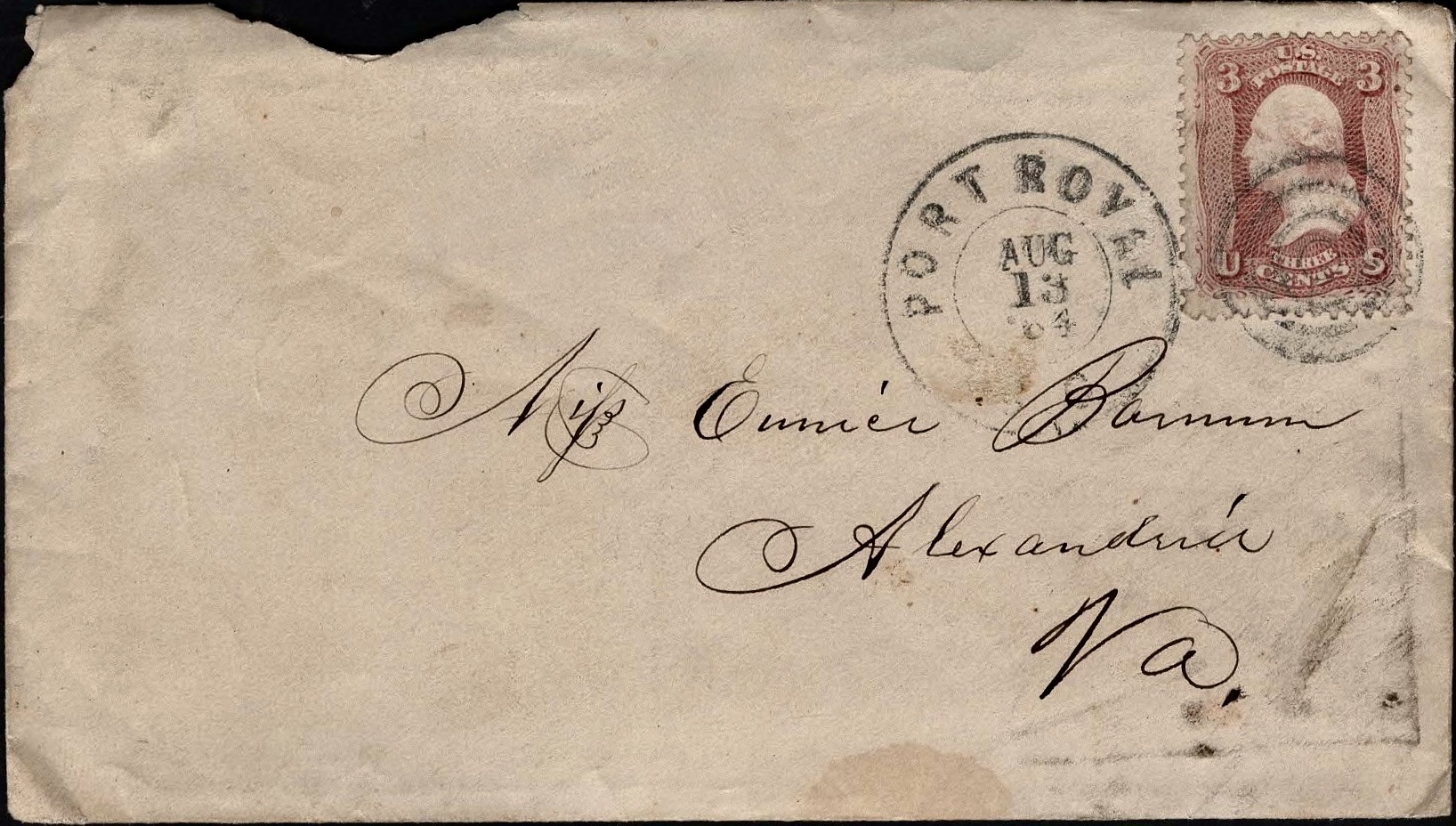
Addressed to Miss Eunice Barnum, Alexandria, Virginia
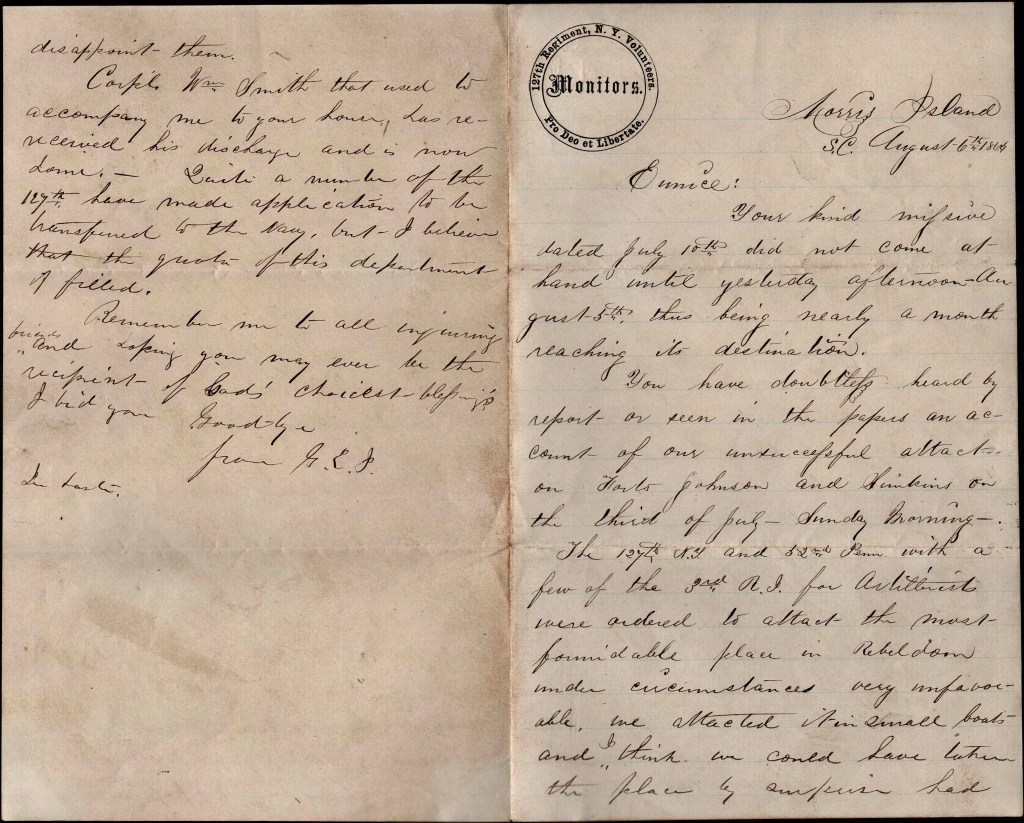
Morris Island, South Carolina August 6th I864
Eunice,
Your kind missive dated July 10th did not come at hand until yesterday afternoon, August 5th, thus being nearly a month reaching its destination.
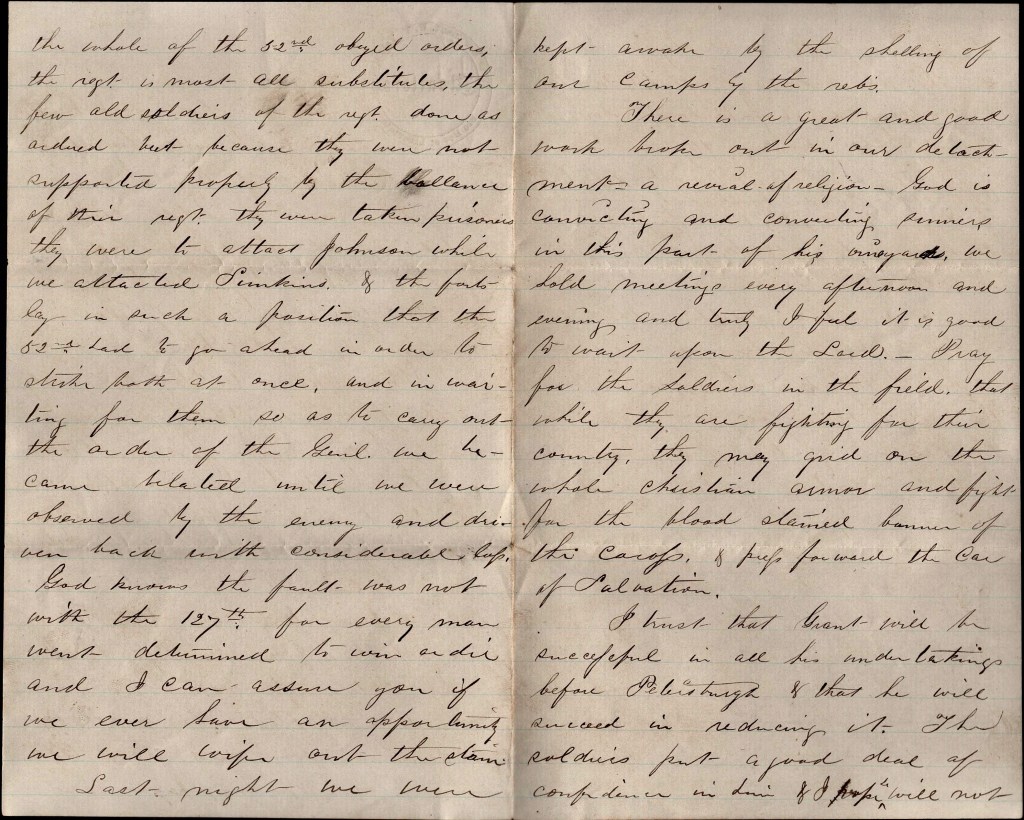
You have doubtless heard by report or seen in the papers an account of our unsuccessful attack on Forts Johnson and Simkins on the third of July—Sunday morning. The 127th New York and 52nd Pennsylvania with a few of the 3rd Rhode Island for artillerists were ordered to attack the most formidable place in Rebeldom under circumstances very unfavorable. We attacked it in small boats and I think we could have taken the place by surprise had the whole of the 52nd obeyed orders. The regiment is most all substitutes. The few old soldiers of the regiment done as ordered but because they were not supported properly by the balance of their regiment, they were taken prisoners. They were to attack Johnson while we attacked Simkins & the forts lay in such a position that the 52nd had to go ahead in order to strike both at once, and in waiting for them so as to carry out the order of the General, we became belated until we were observed by the enemy and driven back with considerable loss. God knows the fault was not with the 127th for every man went determined to win a or die and I can assure you if we ever have an opportunity, we will wipe out the stain.
Last night we were kept awake by the shelling of our camps by the rebs. There is a great and good work broke out in our detachment—a revival of religion. God is convicting and converting sinners in this part of his vineyard. We hold meetings every afternoon and evening and truly I feel it is good to wait upon the Lord. Pray for the soldiers in the field that while they are fighting for their country, they may gird on the whole christian armor and & fight for the blood stained banner of the cross & press forward the cause of salvation.
I trust that Grant will be successful in all his undertakings before Petersburg & that he will succeed in reducing it. The soldiers put a good deal of confidence in him & I hope he will not disappoint them.
Corporal William Smith that used to accompany me to your house has received his discharge and is now home. Quite a number of the 127th have made application to be transferred to the Navy, but I believe that the quota of this department is filled.
Remember me to all inquiring friends and hoping you may ever be the recipient of God’s choicest blessings, I bid you goodbye. From — G. E. J.
These letters were written by William Henry Hazlett (1843-1908), the son of Robert Hazlett (1816-1882) and Mary Ann Freeman (1824-1906). William served in Co. F, 105th Pennsylvania Infantry from September 1861 to July 1865.
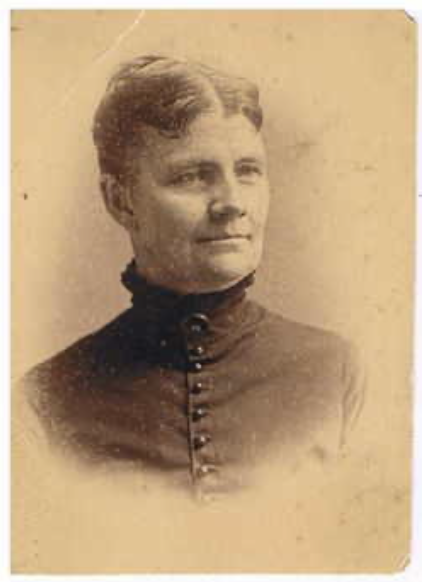
William’s letters speak of the mortal wounds received by a relative, Adam Freeman (1833-1864) of Co. H, 105th Pennsylvania. Adam was wounded severely in the left leg on 13 May 1864 at Spottsylvania Court House and died on 28 May 1864 at Alexandria, Virginia. Adam was married in the mid-1850s to Sarah Ann Saylor (1838-1919) and had a son named Silas McMullen Freeman (1856-1928) when he left to serve his country.
Letter 1
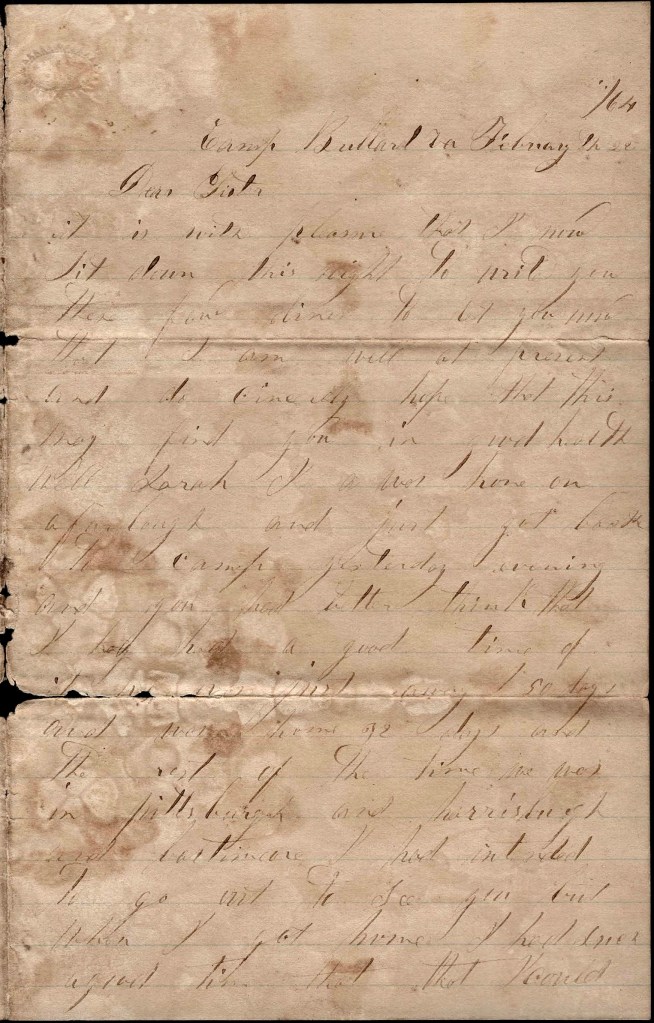
Camp Bullard February 22, 1864
Dear Sister,
It is with pleasure that I now sit down this night to write you these few lines to let you know that I am well at present and do sincerely hope that this may find you in good health.
Well, Sarah, I was home on a furlough and just got back to the camp yesterday evening and you had better think that I had a good time of it. I was just away 50 days and was home 32 days and the rest of the time we was in Pittsburgh and Harrisburg and Baltimore. I had intended to go out to see you but when I got home, I had such a good time that I could not get off very far but I think that when the next three years up that I will come to see you. Jane likes it at her [. ]. She says she would not go back on no account and she has growed [?] awfully since I saw her last.
Well, I have not much to write this time so I will stop by requesting you to write soon. Give my respects to Sam and tell him to write. — Wm. H. Hazlett
Letter 2
Annapolis, Maryland May 24th 1864
Dear Sister,
Now I set myself this beautiful afternoon to write these few lines to let you know that I am well at present and hope that this may find you the same. It has been some time since I have wrote to you and we have had some tough times since then but I got through middling well. I got shot through the left hand. It is very sore but it is nothing to what some of the boys got. Our regiment lost very heavy the first evening’s fight. We lost 203 men from four o’clock till dark.
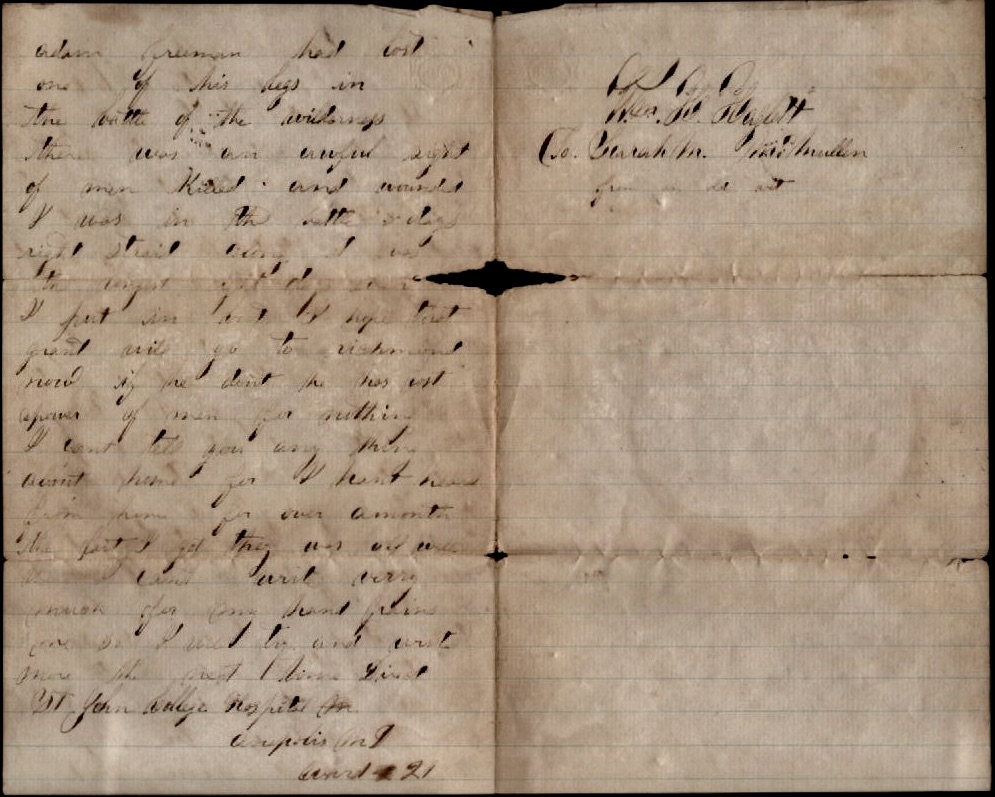
Well, I saw Sam on the 3rd of this month. He was hearty and soo was all the rest of the Boys and I heard since that Adam Freeman had lost one of his legs in the Battle of the Wilderness. There was an awful sight of men killed and wounded. I was in the battle 8 days right straight along. It was the longest eight days ever I put in and I hope that Grant will go to Richmond now. If he don’t, he has lost a power of men for nothing.
I can’t tell you anything about home for I han’t heard from home for over a onth. The last I got, they was all well.
I can’t write very much for my hand pains me so. I will try and write more the next time. Direct to St. John College Hospital, Annapolis, Maryland, Ward 21.
— Wm. H. Hazlett
To Sarah M. McMullen
Letter 3
Annapolis, Maryland June 18, 1864
Dear Sister,
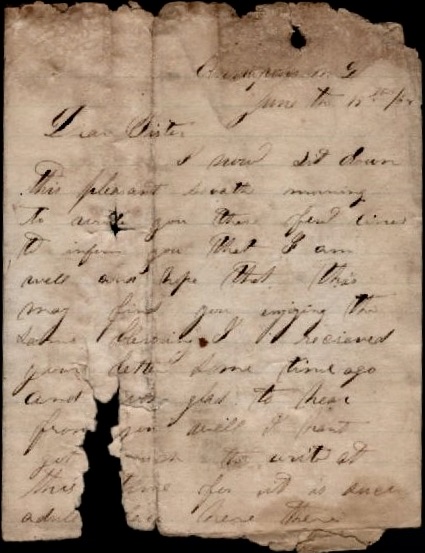
I now sit down this pleasant Sabbath morning to write you these few lines to inform you that I am well and hope that this may find you enjoying the same blessing. I received your letter some time ago and was glad to hear from you.
Well, I han’t got much to write at this time for it is such a dull place here.
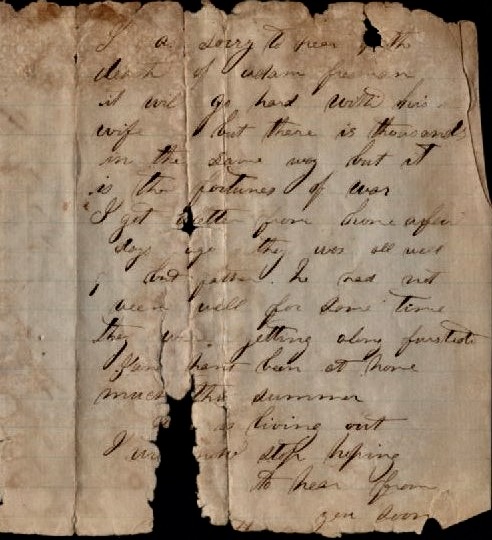
I am sorry to hear of the death of Adam Freeman. It will go hard with his wife but there is thousands in the same way. But it is the fortunes of war. I got a letter from home a few days ago. They was all well but father. He had not been well for some time. They were getting along first rate. Jane han’t been at home much this summer and is living out. I will now stop hoping to hear from you soon.
This letter was written by William Bullock who we learn was working as a nurse at the US Hospital in Pittsburgh, Pennsylvania, in December 1864. Whether he was a volunteer civilian or a soldier detailed from his regent to serve as a nurse is unknown. There was a soldier named William Bullock in the 97th Pennsylvania but he was mustered out of the service before this letter was written.
Transcription
USA General Hospital Pittsburgh, Penn.
December 15th 1864
Dear Brother,
I now take my pen to answer your kind letter which came to hand the 15th inst. and I was very glad to hear from you and know that you wrecked well and attending school. I am also studying here. We have a school here and all that wishes to can attend free of charge and [ ] found them by the Christian. So you see if I only had time enough I could learn a great deal. But I do not have as much time as I would wish for my patients need so much tending to. But I improve my time what I have. There is one calling me now so I shall have to attend to him. Give my love to all and hoping to hear from you soon.
I remain your affectionate brother, — William Bullock
The following letter was written by Alice “Maria” (Lee) Warner (1843-1915), the daughter of Barton B. Lee (1811-1856) and Henrietta Lee Steele (1808-1869). Maria was married in October 1859 to Rev. Elmore Yocum Warner (1833-1886). She wrote the letter to her younger brother, David Henry Lee (1845-1912).
In her letter, Maria informs her brother of her travel in mid-February 1862 to visit her husband at Camp Dennison, Ohio, where he was serving as the Chaplain of the 3rd Ohio Cavalry. Her letter also describes the journey of the regiment from Camp Dennison to Camp Joe Holt near Jeffersonville, Indiana. She mentions a Zouave regiment drilling at Camp Dennison in February 1862 which may well have been the 54th Ohio Infantry. They wore Zouave uniforms that were identical to those of the 34th Ohio (Piatts Zouaves). They left for Paducah on 17 February 1862.
Transcription
Jeffersonville [Indiana] February 13th 1862
Dear Brother David,
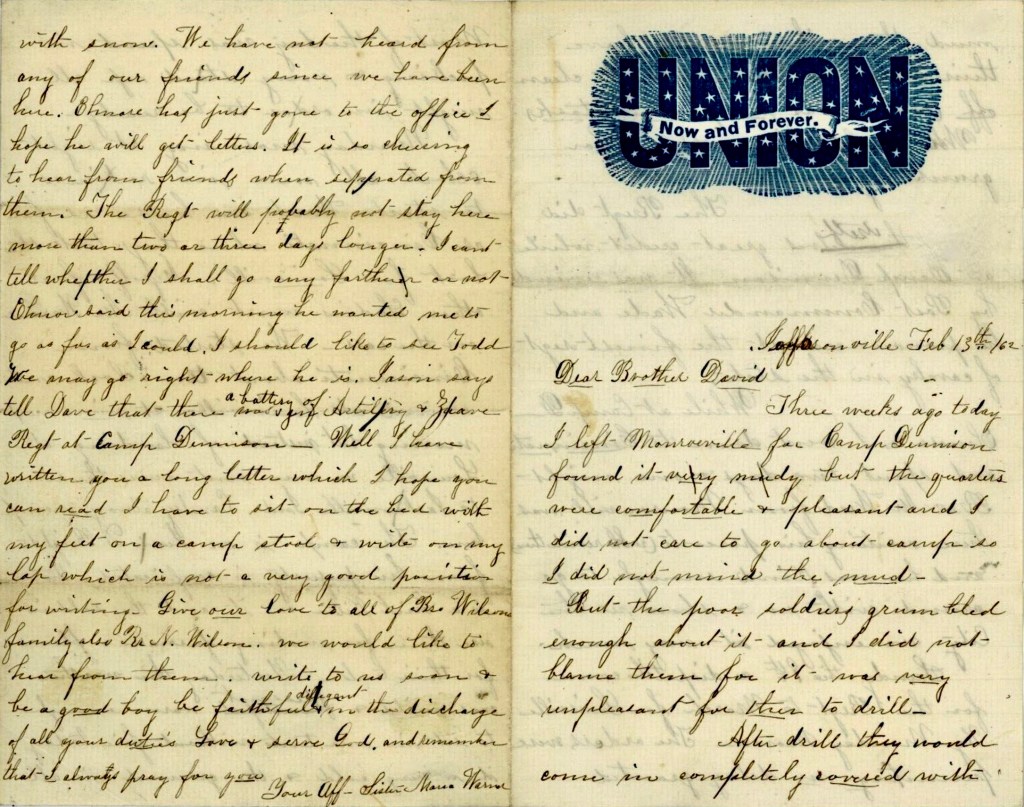
Three weeks ago today I left Monroeville for Camp Dennison. Found it very muddy but the quarters were comfortable & pleasant and I did not care to go about camp so I did not mind the mud. But the poor soldiers grumbled enough about it and I did not blame them for it was very unpleasant for them to drill. After drill they would come in completely covered with mud. Then they would have their horses & themselves to clean off (which was no pleasant task). Who could blame them for grumbling a little.
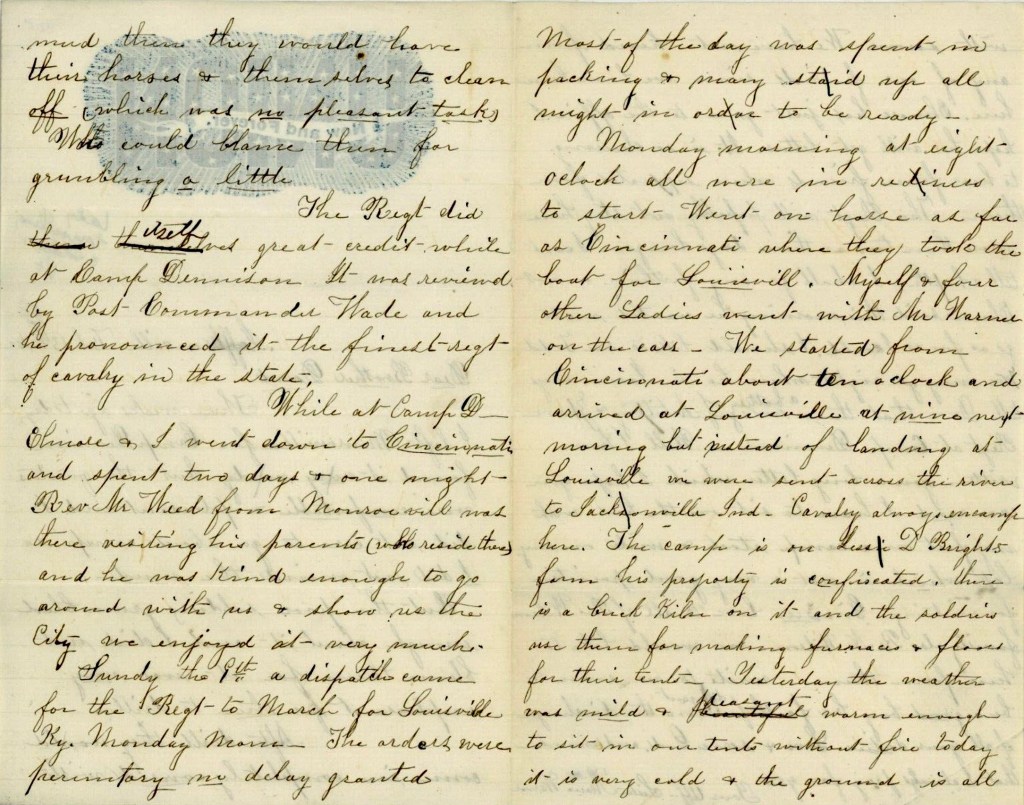
The regiment did itself great credit while at Camp Dennison. It was reviewed by Post Commander Wade and he pronounced it the finest regiment of cavalry in the state.
While at Camp Dennison, Elmore & I went down to Cincinnati and spent two days & one night. Rev. Mr. Weed from Monroeville was there visiting his parents (who reside there) and he was kind enough to go around with us and show us the city. We enjoyed it very much.
Sunday, the 9th, a dispatch came for the regiment to march for Louisville, Kentucky, Monday morn. The orders were peremptory—no delay granted. Most of the day was spent in packing & many stayed up all night in order to be ready.
Monday morning at eight o’clock all were in readiness to start. Went on horse as far as Cincinnati where they took the boat for Louisville. Myself and four ladies went with Mr. Warner on the cars. We started from Cincinnati about ten o’clock and arrived at Louisville at nine next morning but instead of landing at Louisville, we were sent across the river to Jacksonville [Jeffersonville], Indiana. Cavalry always encamp here. The camp is on Jessie D. Bright’s farm. His property is confiscated. There is a brick kiln on it and the soldiers use them for making furnaces and floors for their tents.
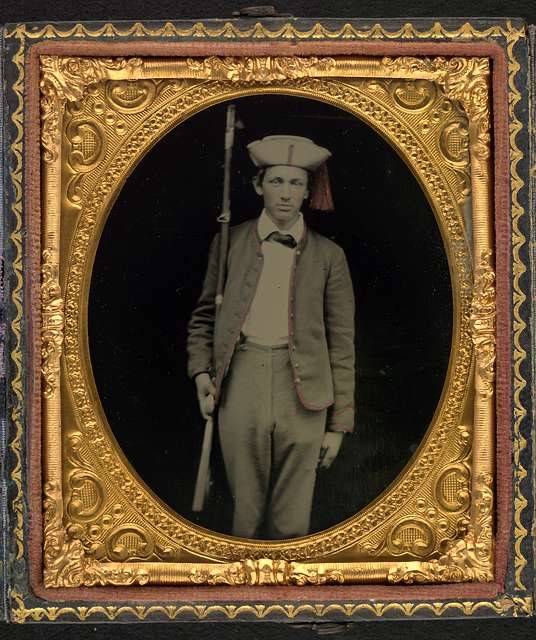
Pvt. Christian H. Cook, Co. B, 54th Ohio Infantry. This regiment was drilling at Camp Dennison in early February 1862. (LOC)
Yesterday the weather was mild and pleasant—warm enough to sit in our tents without fire. Today it is very cold & the ground is all [white] with snow. We have not heard from any of our friends since we have been here. Elmore has just gone to the office. I hope he will get letters. It is so cheering to hear from friends when separated from them. The regiment will probably not stay here more than two or three days longer. I can’t tell whether I shall go any farther or not. Elmore said this morning he wanted me to go as far as I could. I should like to see Todd. We may go right where he is. Jason says tell Dave that there was a battery of artillery & Zouave Regiment at Camp Dennison.
Well, I have written you a long letter which I hope you can read. I have to sit on the bed with my feet on a camp stool & write on my lap which is not a very good position for writing. Give our love to all of Bro. Wilson’s family. Also Br. N. Wilson. We would like to hear from them. Write to us soon and be a good boy. Be faithful & diligent in the discharge of your duties. Love & serve God, and remember that I always pray for you. Your affectionate sister, — Maria Warner
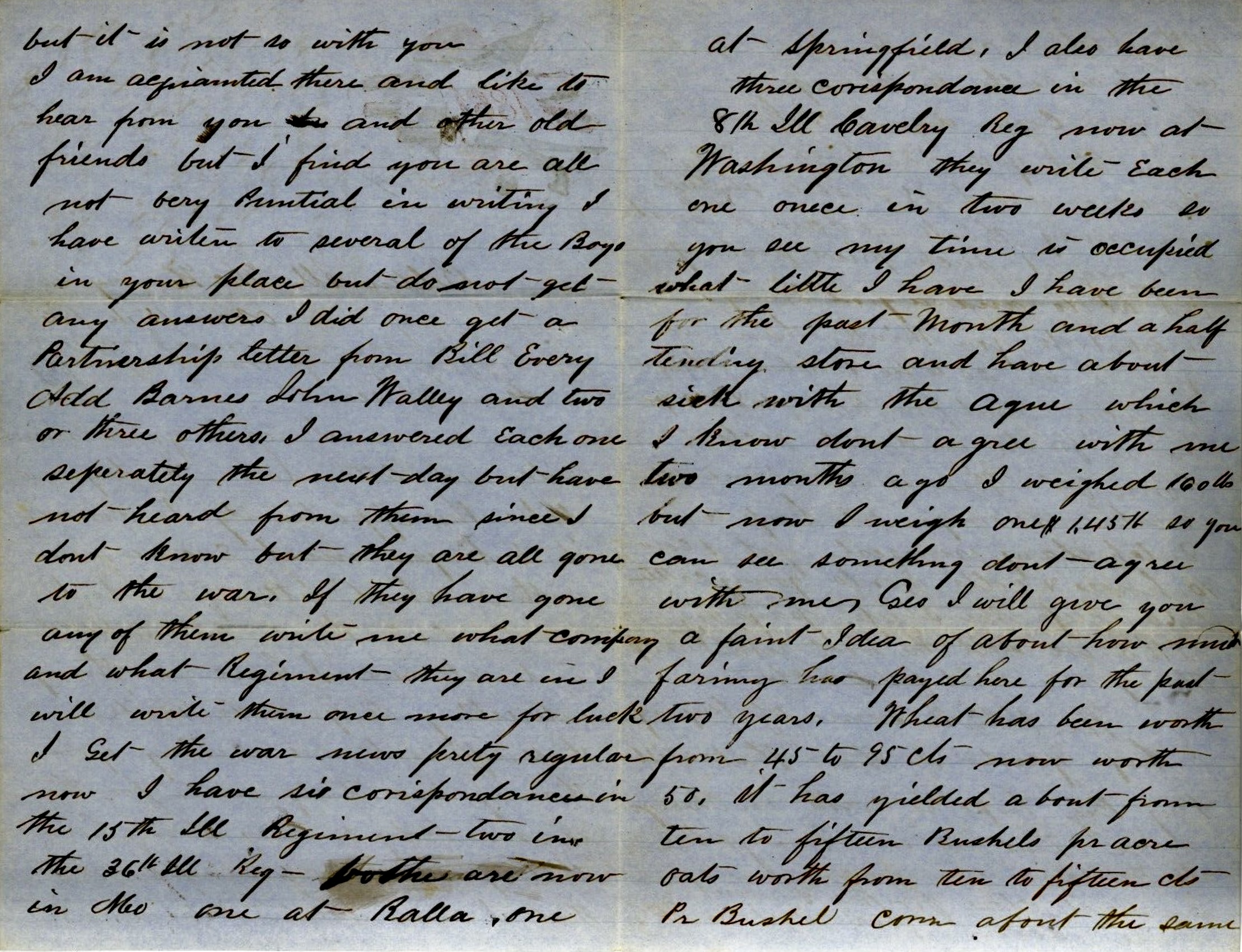
The following letter was written by John W. Dietz (1841-1898), the son of Garet W. Dietz (1812-1889) and Margaret Coon, (1811-1894). From his letter, datelined from Belden, Illinois, in mid-November 1861, we learn that John had numerous correspondents serving in Illinois regiments but that he was tending store and farming in McHenry county—a county bordering the State of Wisconsin. When he registered for the draft in 1863, he was identified as single and with no prior service in the military. I have not found any evidence that he ever volunteered or was drafted. His obituary follows:
“John W. Dietz was a native of New York, and was born in Oswego County Feb. 21, 1841, and was therefore 57 yeara old at the time of his desease which oc- cured July 16, 1898. When a child his parents removed to McHenry County Ill., where he remained until after his marriage with S. Louise Cook in 1863. In 1871 Mr. Dietz came to Iowa and settled at Cedar Rapids where they remained but a year, returning to Illinois. They remained in Illinois until 1881 when they came to Osceola county [Iowa] and settled near Sibley where they remained until seven years ago when they moved to Sibley where they have since resided. To Mr. and Mrs. Deitz were born four children, two sons and two daughter. All of these live to revere an honored father save one daughter who died in infancy. In this demise a wife loses a faithful and affectionate husband, the sons and daughters a loving father, the community a faithful and upright citizen. His associations are of a pronounced character. Those who knew him best thought the most of him.”
Transcription
Patriotic Stationery used for letter
Belden, Illinois McHenry County November 15th 1861
Cousin George,
I received your much welcomed letter last Friday and take this opportunity to answer it but you must excuse me with a short letter for I don’t have more than three minutes to write at once. I have nothing interesting to you to write. It is different me writing you than you writing me for there is no body or anything here that you are acquainted with that I can write about but it is not so with you. I am acquainted there and like to hear from you and other old friends. But I find you are all not very punctual in writing. I have written to several of the boys in your place but do not get any answers. I did once get a partnership letter from Bill Every, Add Barnes, John Walley, and two or three others. I answered each one separately the next day but have not heard from them since. I don’t know but they are all gone to the war. If they have gone, [if] any of them write me what company and what regiment they are in, I will write them once more for luck.
I get the war news pretty regular now. I have dix correspondences in the 15th Illinois Regiment, two in the 36th Illinois Regiment. Both are now in Missouri—one at Rolla, one at Springfield. I also have three correspondence in the 8th Illinois Cavalry Regiment now at Washington. They write each one once in two weeks so you see my time is occupied what little I have.
I have been for the past month and a half tending store and have about sick with the ague which I know don’t agree with me. Two months ago I weighed 160 lb. but now I weight only 145 lb. so you can see something don’t agree with me. George, I will give you a faint idea of about how much farming has paid here for the past two years. Wheat has been worth 45 to 95 cents. Now worth 50. It has yielded about ten to 15 bushels per acre. Oats worth from ten to fifteen cents per bushel. Corn about the same although I believe corn has been worth as high as 20 cents in Chicago. This year corn is good. I know places that goes 1.25 bushels ears to the acre about 75 bushels shelled. You may think we cannot make a living at such prices and crop but we do and a good living too. So what do you think when we get from 20 to 40 bushels wheat per acre and from $1 to $1.50 per bushel for it. and oats 75 cents, about 90 cents. Then is the time we make money. We keep a Dutch diary as usual. Got 1 cow, 10 horses and colts, 8 or 10 young cattle, 260 sheep. The sheep pays big although we sold the wool rather cheap this year. Sold for 29 cents.
We think some of trying a hop yard. I thought that will pay. Big hops is worth in Chicago more than that in New York all the time. I must close for the present. Write soon. Your coz, — John Dietz
P. S. George, I will send you a couple papers today. You spoke about sending my likeness. I will as soon as I go where I can get it taken good and have time. Send yours as soon as you can. — John
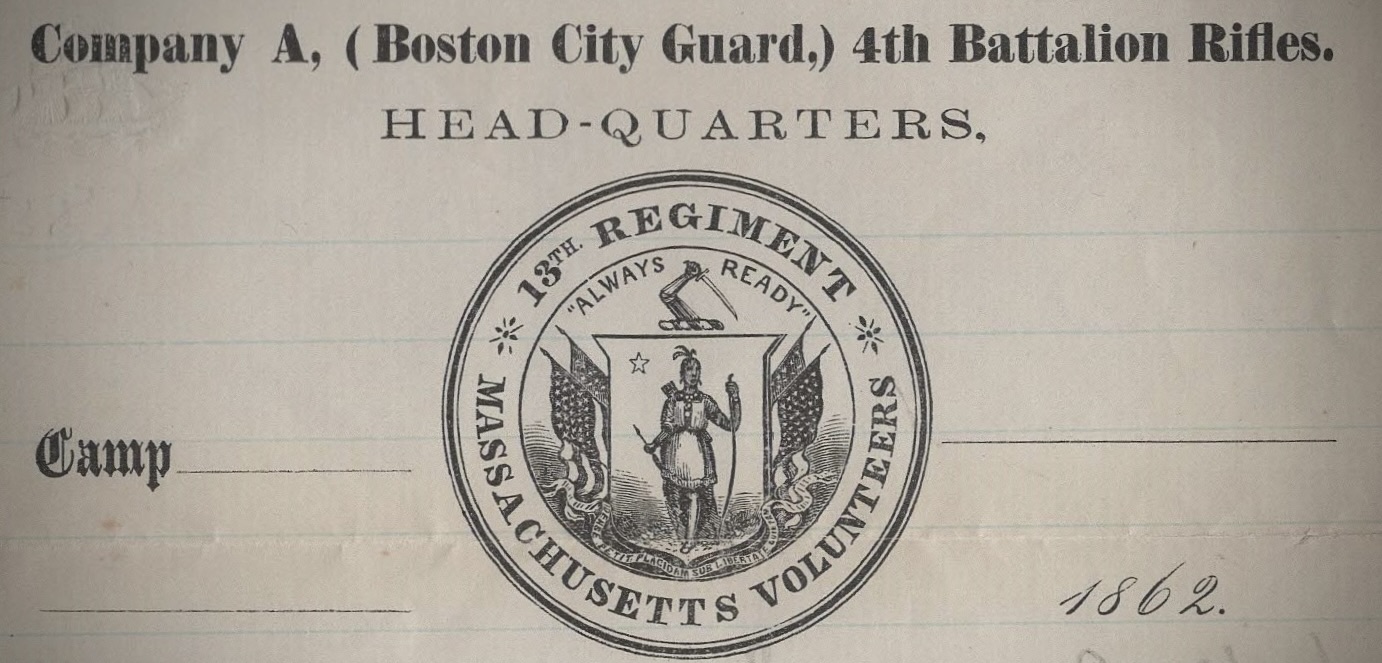
The following letters were written by John Viles, Jr. (1817-1882), a musician from Waltham, Middlesex county, Massachusetts, who enlisted in July 1861 in the 13th Massachusetts Regimental band and served with them until late August 1862 by order of the War Department. Several of Viles’ letters can be found on the web page kept by the 13th Regt. Riles Mass. and his bio reads:
“Viles’ position in the regiment gives him a unique perspective on things, almost like a civilian observer. He did not play an instrument with the band, so he did not have to participate in the morning and evening duties at dress parade, etc. Nor did he have the added burden of doing guard duty or participating in drills. Still he followed the fortunes of the regiment and suffered many of the same hardships of the rank and file. The arrangement of music kept him busy for a long while, but in time, when that work was done, he had little to do.
His letters are written to his wife “Franky,” whom he addressed as “Frank.” He had three children, a baby girl Fannie, and two sons, Franky and Gene, the son Gene, quite a bit older. Domestic concerns take up the greater portion of content in the letters. He was concerned for his wife’s well-being at home, alone with the three children. The fact that times were hard came up frequently, and it was clear John appreciated the fact that he was receiving regular pay with his fortunate position in the army, although he missed his family.” [see 13th Regt. Rifles Mass. Vol.]
This oil on canvas painting is described as “a scene of the 13th Regiment Massachusetts Infantry” done in 1865 by Corp. Henry Bacon (1839-1912) who served in Co. D with Edwin F. Morris. It depicts the regiment at Camp Jackson near Williamsport, Maryland, during the winter of 1861-62. The red blankets are a unique characteristic of the regiment. So are the men, who were noted for their neatness, their health, their manners and their high standing in society.
Letter 1
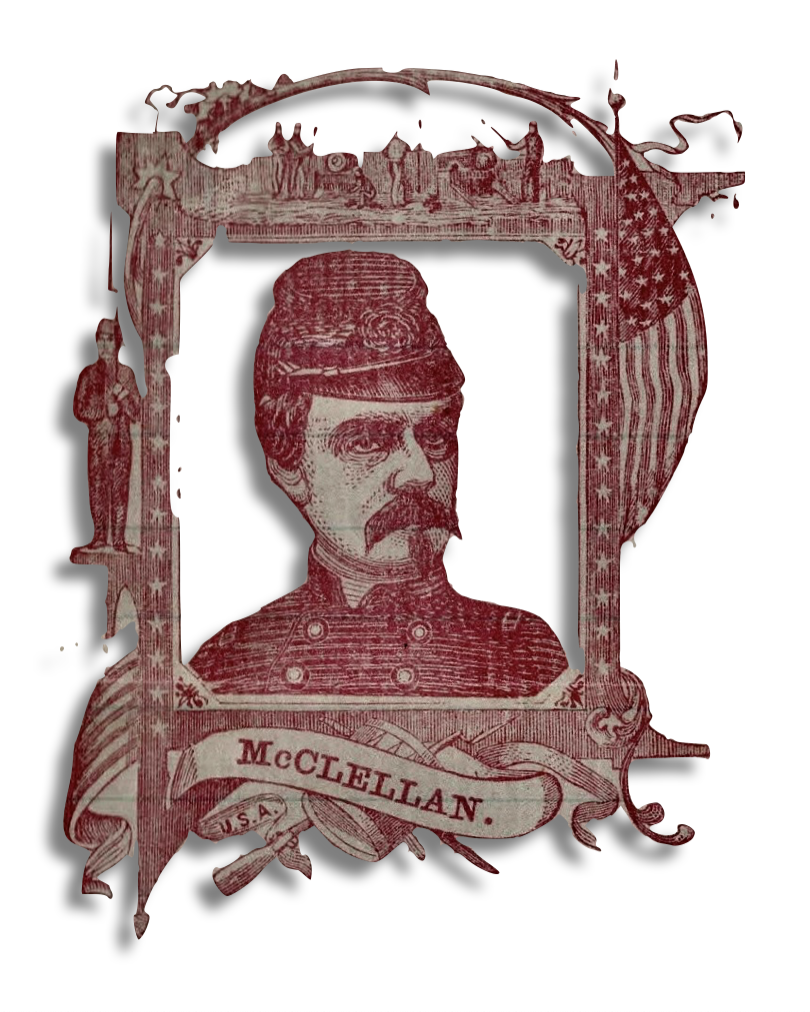
Patriotic “McClellan” heading on stationery.
Camp Jackson Williamsport [Maryland] Thursday, December 5, 1861
My dear Frank,
Your letter of December 1st was received this morning which is the 3rd I have had so far. The last time I wrote was December 1st. This is the 8th I have written from this place besides two or three papers. The last I had from Ned was mailed 16 November. I wrote to him a day or two after Thanksgiving but have not had but one Sentinel since I was at home and that was for the week before Thanksgiving. I am glad you received the money I sent. The next time we are paid I hope I can send twice a much as it will be likely to be a two-month’s payment.
We have had very pleasant weather for several days. The mornings are rather frosty and cool but as the sun gets up, it grows warmer. Today is remarkably warm—almost like summer and much the warmest day since my return here. Yesterday I changed my flannels and put on two shirts—the thin one I brought from home for the under one—and it is so warm that I almost wish I had left it off. We’ve had some quite cold weather, cold enough to freeze the ground, but no snow except a few flakes now and then. I had much rather have cold than rainy weather.
I’ve not much to write about. Everyday goes on about alike. There are plenty of camp stories that we are going to this and that place floating about every day to day. The camp gossip is that we are going to Frederick. A messenger arrived in camp this morning from Banks’ Headquarters and that I suppose gave rise to the report. Banks has moved his quarters to Frederick but I don’t think we are to move for some days as the teams are bringing wood and hay into camp for a day or two past and are still engaged in it. There is no truth in what you read of this regiment, or any part of it, having a fight. What you wrote is the first and last I’ve ever heard about it. As you have received but three letters when you wrote, there must have been four more on the way which you have probably received by this time as the last was written December 1st.
I see by what you wrote about Ned that he was paid the same day as this regiment. The man that was accidentally shot the other day is still living. There is another bad case of a private in the Westboro Company [Co. K] from a [ ]. I believe there are no hopes of his recovery. I don’t think of anything more to write. Yours truly, — J. V. [John Viles]
Letter 2
Note: The following letter describes the aftermath of the Battle of Cedar Mountain that took place on 9 August 1862
Camp five miles beyond Culpepper Courthouse Thursday morning, August 14, 1862.
My dear Frank,
I received yours of Sunday 10th last night. I wrote last Sunday which I suppose you have received, giving some account of the battle of Saturday, but of course you have read the particulars in the papers.
We are still camped on the same ground as when I wrote on Monday, but some of the army has advanced and this Division will probably move forward today or tomorrow. The line of battle was kept formed through Sunday, Monday and Tuesday. It was several miles in extent from the right to left. The enemy has fallen back beyond the Rapidan and yesterday the advance of Pope’s forces began to move forward. Troops were constantly arriving here through Sunday, Monday, and Tuesday and the sum total of the army must be upwards of one hundred thousand. It certainly cannot be less.
Last Monday the dead were burned by both sides under Flag of Truce. They had laid there from Saturday afternoon till Monday noon. Some of the wounded were still living at that time and were brought off. Yesterday—Wednesday—a party of us went about a mile further on in the woods and found some 8 or 10 dead Rebels and one Union soldier. Also one Union soldier wounded and alive. He was brought off and taken to the hospital. One battlefield is quite as much as I desire to see and is a sight one can never forget. The account which we get in the Philadelphia and Baltimore papers is mostly correct. The loss of this side is estimated from 12 to 15 hundred in killed and wounded. Rebel prisoners—mostly stragglers who have been taken each day since the battle—admit a greater loss.
We had a heavy thunder shower Tuesday afternoon since which the weather is more cool. We are camped in a horrid place for water. It would be good enough if there wasn’t so many to use it. But thousands dipping out of two or three little springs makes the water dirty. The order for our discharge does not come yet. We expect it this week. We see by Baltimore papers that about 600 musicians were brought up by boats from the armies south of Washington on Monday and Tuesday to be discharged. As soon as we are in Washington I’ll be sure to write.
I had a letter from Ned also last night dated 5 Inst. which I enclose. As our mail closes at ten, I must say goodbye for this time dear Frank.
Truly, — J. V.
General Banks was not wounded but received a slight hurt from his horse falling. There was not more than 7000 of union troops engaged. The enemy had 15 or 20,000.
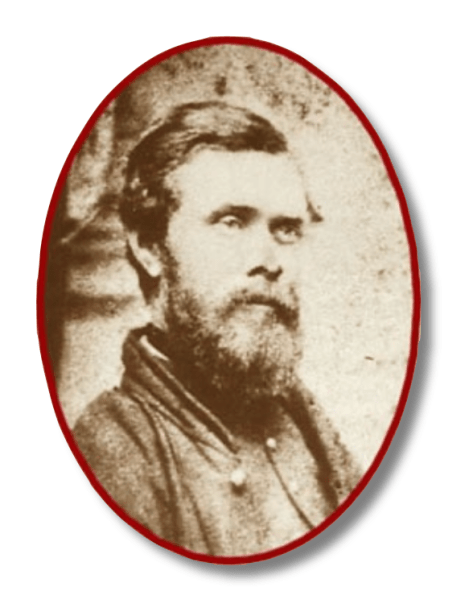
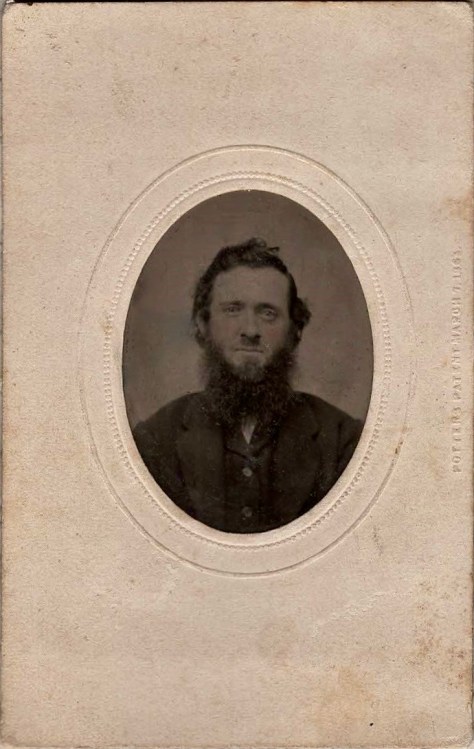
I was able to confirm Con’s identity by this photo of Cyrus Hanks (1829-1902) who was identified as his “brother in Michigan” on the reverse side. The photo came with the letter.
This letter was written by Constant (“Con”) Crandall Hanks (1821-1871), the son of Uriah Hanks (1789-1871) and Florilla Howes (1803-1890) of Shandaken, Ulster county, New York. Con was married in 1852 to Hannah L. Reynolds (1818-1881) and was the father of at least four children when he enlisted at the age of 41 on 13 September 1861 as a private in Co. K, 80th New York Infantry. He was promoted to corporal two weeks later.
In this correspondence, composed from a hospital in Falls Church, Virginia, Con informs his mother of the arduous march through the relentless rain and mud, endured with his regiment to the vicinity of Bull Run and back, which exacerbated his already infirm leg. He concludes the letter by indicating that the regiment will soon embark on transports alongside other troops as they head to the Peninsula; however, he may be sent home by the surgeons due to his disability. Yet, his muster roll records reveal that he remained in service, participating with his regiment in the Battle of 2nd Bull Run, where he was wounded on 30 August 1862, and again at Petersburg on 3 April 1865. Ultimately, he was mustered out of service in September 1864, having completed his three-year commitment. The 1870 census indicates that Con, along with his wife and two children, resided in Hunter, Greene County, New York, where he was employed at a chair factory.
Con’s penmanship and composition suggested a better than average education and I found that he had attended the Troy Conference Academy in 1841. The Academy was a co-educational institution affiliated with the Troy Conference of the Methodist Church.
Transcription
Falls Church, Fairfax Co., Virginia March 23, 1862
Mother,
I remember well when I was a boy when I used to knock off a toenail, cut my finger, have any sore, how I used to go to you to do up the wounds, how it used to ease the pain to fuss over the sores and have you sympathize and feel sorry and bad over them for me. It used to take more than half the pain and soreness away when I had your sympathy, which I always was sure to get however unworthy it might be. My old sprained leg, with its sores and pains, has almost daily for the last 4 weeks forced the memory of my boyhood days of your love & untiring kindness & sympathy back fresh on my mind. And as I am now driven into the hospital on account of my leg & not having but little to do to occupy my mind & time, I took it into my head that if I wrote to you to let you know now I was, engage your sympathy as I used to have it when a boy, that like as not the cursed old sprain would get better just as my sore toes and fingers used to get better with your sympathy when a boy.
Now, for my story, you must pretend to feel bad whether you do or not. Well to begin with, a week ago last Monday, the great machine that makes what is called the Army of the Potomac was put in motion. For the last fortnight before that, I had been excused from duty on account of my leg, but when the orders came to march, I said “go in leg.” So I put on my traps with the rest of the regiment, two days rations with the other equipage makes in all some 60 lbs. Well we commenced our march for Centerville & Bulls Run with sanguine hopes of there finding the D__d Rebels and renewing the acquaintance that proved so disgraceful to our boys the 21st of last July, and having a chat with them on more equal terms than we had the last time there.
Well, as we began to march, the rain began to come down. The further we went, the harder the rain came—mud some 6 inches deep. Thus we marched that day in rain & mud some I6 miles and encamped in a bit of wood some 3 miles this side of Centerville. We had our tents on our backs. Maybe we wasn’t glad to throw off our knapsacks, pitch our tents, and build fires to dry our clothes. Maybe the rail fence did not make good fires—but I guess they did. Maybe my old sprained leg did not thank Gen. Wadsworth from the bottom of each sore that it was not obliged to march any farther that day. Maybe the sea biscuit, though hard as a piece of crockery eaten with a piece of raw pork did not taste good that night, but my opinion is that they went down with good relish.
Well, we stayed in that camp which we called Camp Disappointment till Saturday. We called it Camp Disappointment because 50,000 men of us started in the strength of God & all the munitions of war for Centerville and Bulls Run to square up with the Rebels that account that was opened with them last July. The balance then was against us and we had started Monday morning with the purpose—“God willing”—to pay up that balance and all the interest that has been gathering on it since the account was opened & you may rest assured that we would have done it, for there was no cowards that morning. Many a poor fellow that had just come out of the hospital shouldered his knapsack and was as eager for the fight as the strongest, but when we came to Centerville—the great stronghold of the rebels, behold! they had gone. Gone too as if the devil was after them, leaving what they could not move. They left there forts [and] breastworks that might have given [us] some tremendous hard fighting before we could have got the place. But it appears that they remember Bulls Run as well as we do and probably that the taking of Roanoke [and] Donelson had inspired them with the proper respect for Uncle Sam’s boys that is good for their health.
Keith Rocco’s Painting of the 14th Brooklyn
They left a good deal of their provender behind. They set fire to a good many 100 barrels of flour and 1000 bushels of grain so they should not fall into our hands. It looked dismal round their encampments. They had wooden huts to quarter in, shingled much more comfortable than we had. As many of our regiment as wanted to, had permission to go and view the battle ground of Bull Run. I was foolish enough to go, but mother, it was a sad sight. There was a good many of the 14th Brooklyn that was killed in that battle. The Rebels just dug a ditch and pitched [them in]. Some they covered, some they did not. The Brooklyn boys wore red pants that day and you could see many skeleton legs with remnants of the red pants on them. The 14th went out and gathered all they knew by the red pants and buried them but they could not find one skeleton that had the head on. It seemed as if the devils had cut the heads off both wounded and the dead.
Friday we went to Bull Run & Friday night they sent a messenger after us to return to camp and march on Saturday morning. We started Saturday morning from Bulls Run to camp, a distance of ten miles. Then we took 9 of them hard biscuits and a piece of raw pork for two days rations, put on all of our traps and commenced a march towards Alexandria and we marched 18 miles farther—rain harder, I never see it, but we marched on, and still on. We never stopped long enough all day to unsling our knapsacks and [it] rained all night. We camped down on the wet ground, nothing over us but them little hen coop tents. Then did not poor sprained leg cry out for mercy all night as we lay there in the wet. Did it burn and throb as if they was a blister drawing all over it. I never slept one wink. Don’t believe I would if I was in heaven.
The next morning there was five nice biles [boils] or ulcers on my leg from my ankle up to my knee. We was ordered back to camp on that Sunday morning. I had two of them hard crackers for my breakfast. Had to march 9 miles on that. I think that I can fully appreciate the feeling Esau had when he sold his birthright for a mess of pottage [lentil stew]. I would have given my soul for a loaf of bread that morning and could not get it. God knows I was sore and faint when I got to camp. I have not done any duty since. Am in the hospital. Whether I ever shall do any more duty, don’t [know]. The brigade surgeon said today that they would send me home but I don’t want to come home till Old Jeff Davis gets justice done him.
The regiment was marched again on Tuesday. They are encamped a mile and [a half] from where we have been lying all winter. Some 80,000 men are being shipped down the Potomac. Our regiment are waiting their turn to go aboard. They probably will go today. Where they go, McClellan knows. I don’t. Oh, how I wish that my leg was so that I could go with them. I should be happy. But to be stuck here in the hospital makes me miserable. Pity my old leg, Mother, as you used to when I was a boy which I would jam a toe or finger. Then I guess it will [be] well again.
I got a letter from Hannah urging on me the duty of prayer. I wonder if she thinks that it is of more use for me to pray now than it was when I used to pray in my family when she would tell me that my prayers did not go higher than my head, I learn that Brother Cyrus has found the pearl of price. I hope that he is not a hypocrite as he charged me with being once when I trusted in a Savior’s love. Mother please accept my love for yourself and all my friends. You need not write till you hear from me again for I don’t know how soon I may move from here.– Con Hanks
The following letter was written by Dr. Henry Orlando Marcy, Sr. (1837-1924), the son of Smith Marcy (1895-1846) and Fanny Gibbs (1793-1866) of Berkshire county, Massachusetts. Henry received a preliminary and classical education at Wilbraham Academy and. Amherst College, and was graduated from the Medical School of Harvard University in 1863. In April of the same year he was commissioned assistant surgeon of the Forty-third Massachusetts Volunteers, and in the following November, was commissioned Surgeon of the First Regiment of Colored Troops, recruited in North Carolina. In 1864, he was appointed medical director of Florida. According to passport 1890 passport application, Dr. Marcy was a Surgeon.
In June 1863, upon the expiration of the nine-month enlistment period of the 43rd Massachusetts, Dr. Marcy chose to remain in North Carolina, as he suggests in this correspondence, to accept a commission as surgeon in Col. Edward A. Wild’s African Brigade. This assignment was significant as he initiated educational classes for African Americans and functioned in the dual capacities of both officer and educator. During Sherman’s Carolina Campaign, he served as the medical director on Sherman’s staff. Following the conclusion of the war, Dr. Marcy received recognition for having introduced Joseph Lister’s antiseptic wound treatment methods to the United States.
Camp Rogers at Newbern, North Carolina. March 12, 1863—43rd Massachusetts Regt.
Transcription
Stationery of the 43rd Massachusetts Infantry
Camp Rogers Newbern, North Carolina May 19, 1863
Friend Albert,
I learn that we have a mail to leave camp this evening and I have a little leisure this afternoon and so know of no better time to redeem my promise to write you. I will begin by way of review, and say that I was very sorry that 1 could not have seen you the evening before I left Boston. I certainly should have seen you had I had the slightest reason for suspecting you were awaiting me. I had a number of business calls and did not get in until near 9 o’clock. Next morning we started. Mother was quite tired but enjoyed the ride very well—better than I feared. Stopped in C[lark’s] Factory until evening when I parted with Mother and Charley & myself came on to Albany. Mother bore up under the leave taking much better than I had expected—quite heroic.
We remained in Albany until the next evening when we took the evening boat for New York. Charley had friends with whom we stopped part of the time. Visited the [Albany] Medical College where I was lionized. [George Frederic] Barker the professor in chemistry used to holding place in Horo. as assistant. He seemed happy to meet me and introduced me to the professor. Gave me a seat back of the professor &c. At his lecture he introduced me to the class as the Guest Professor, &c and now Asst. Surgeon, &c. I was greeted with cheers, &c. Wasn’t that gay?
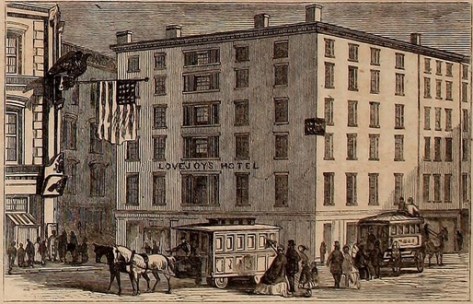
Lovejoy’s Hotel was located at 34 Park Row in NYC
We had a pleasant ride down the river—was foggy and could see nothing of the splendid scenery. Was disappointed. Splendid boat—Isaac Newton. In New York we could learn nothing of our getting further so put up at Lovejoy’s (for I remembered your recommendation and you know our bills were not paid by the Sanitary Commission). Charley and I went over [to Brooklyn] and heard [Henry Ward] Beecher—splendid discourse, grand, on state of country, &c. Then we visited the Navy Yard. North Carolina &c. Hoped to see Luck but he was out rowing with some ladies. Saw him only at a distance. Was quite disappointed. He was to sail for Charlestown in a few days. Transferred to a blockader.
Next morning we learned that we could get off that p.m. on the Dudley Buck. Transferred our troops about noon. Found she was a propeller [steam vessel]. At eve we started. Had pleasant weather all the way down. Think you would have enjoyed it, but I was sick all the way down—ten times worse than the Spaulding. She was small and having no side wheels, was continually rolling. We lay all night off Hatteras in the swash. Monday came into Newbern about 3 p.m.—was all tired out. Put up to the hotel at starvation prices and eat a good supper & breakfast, then started for the camp of the 43rd [Massachusetts] which is about 2 miles out across the Trent [river].
We are very pleasantly encamped. I like it very much better than I had anticipated. The Assist. Surgeon [James M. Whitney?] has a good position in a regiment. We live first rate. The field & staff officers mess together. I have a pretty double top tent, ten feet square, and very well furnished—table, chair, bedstead, wardrobe, &c. all of rustic manufacture, made of boards &c.
Great change in climate from N. Y. here. Trees in full leaf, flowers, &c. Have had strawberries and blackberries are beginning to ripen. Your brother has most likely told you of the country however. I have a servant—a black boy about 20, formerly a slave. Intended to have a horse, may still. Have a right to one and thought I might enjoy the privilege of riding. Have ridden considerable. Saturday went out on review, borrowed a sword & sash and rode out in gay style. Did not dismount at all. Fun to play soldier. Our reg. Is very healthy. Have the “Out Patient” department under my sole control. Average about 50 a day. Mostly diarrhea & dysentery. The regiment begins to talk about going home—are scolding already. I may possibly stay and enter hospital service, but now think I will come out with the regiment.
Have heard from mother & Sarah. Mother seems as well as when I left. I am a great mind to try and return. Nothing could suit me better. Study hard and get ready for coming as soon as you can. How do you get on? Well, no doubt. I must draw this to a close. Since writing the above I have rec’d a letter from Sarah, and it is nearly time for the mail to close. We have in our regiment Charley Marcy, Frank Barnes & Coritean whom you used to know at W. E. O. Noble is a private in the 46th. D. K. Marston came to see me a day or two since. He is a private in the 17th Regiment encamped just below us. He enquired for you. Please write to me all the news. Remember me to the Prestons. I wrote Lizzie a day or two since. George is looking finely. I am very glad I came here. Remember me to the friends. Write soon and oblige. Your old friend, — Marcy
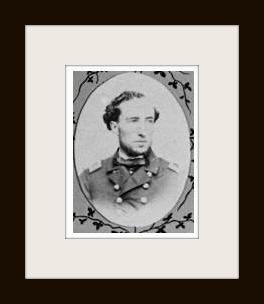
Edwin L. Nickerson (Collection of Cornwall Historical Society)
The following letter was written by Edwin L. Nickerson (1842-1863) who enlisted as a private on 25 February 1862 in Co. C, 13th Connecticut Infantry. He was promoted to a corporal in November 1862 but was killed at Irish Bend, Louisiana on 14 April 1863 during the Teche Campaign.
Edwin was the son of Smith Nickerson (1804-1853) and Mary Ann Davidson (1806-1845) from Cornwall, Litchfield County, Connecticut. He had three brothers who served in the military; Uriah Nickerson (1838-1895), who fought in Company E of the 7th Connecticut Infantry, Henry F. Nickerson, who was part of the 10th Connecticut Infantry, and Mark S. Nickerson (1843-1915), who served in Company A of the 10th Massachusetts Infantry. In his correspondence, Edwin expressed profound concern for his brother Mark’s safety upon receiving news of the Battle of Fair Oaks (Seven Pines), during which the 10th Massachusetts endured 27 fatalities and 95 injuries in savage hand-to-hand combat. Remarkably, Mark survived the war and passed away at the age of 72. Ironically, it was Edwin who would ultimately fail to return home.
Edwin datelined his letter on 23 June 1862 from the Custom House in New Orleans where they quarters with Gen. Butler’s Headquarters and performed provost duty.
Transcription
Patriotic heading of Edwin’s letter
Custom House, New Orleans 13th Regt. C. V. Co. C, USA June 23, 1862
Dear Sister,
I received yours of May 27th the 12 of June & was very glad to hear from you again & I should have answered it before but I thought I had written several that not answered & would wait until we were paid off, hoping to receive another from you, but have not. I am well once more & am getting somewhat used to warm weather so I think I shall stand it. I don’t hear anything about the yellow fever now so I guess it has died out.
We were paid off the 18th instead of. and were paid only two months pay which took it up to the 1st of May but I had enough coming to me which I lent while in New Orleans so that I have sent you $30. It is all in U. S. Treasury Notes. Sent it by the Adams Express Co., and if nothing happens, it will be there before this will so immediately on receiving this you will please call at the office & get it. Should Mark write to you for $5, you will please send it to him on my account.
I see you do not understand that allotment business. It is not paid there at all. We receive it in checks in the name of any confidential person or persons whom we may have assigned it to, & those checks we send to the ones which it is assigned & they draw the money on them from any bank they choose & provided they are lost by the mail, we can get others in place of them from the paymaster.
I signed the roll in your name & expected to receive those checks but did not hear anything about it & I don’t know but they have [ ] it altogether. I hope they have for I would not have signed it had I known as much about it then as I do now.
I see by hte papers Mark has been in a great battle & I feel anxious to hear from him for I have seen some of the names & I don’t know but he may be one of them. I have not heard from him in a long, long time and how dreadful the suspense. Oh, I hope he is well. But I tremble lest he was one of the fallen. For God’s sake, write to let me know the truth.
But I must close as I have not time to write any longer. Direct to New Orleans, General Butler’s Expedition. We had green corn here the middle of May and the markets are now crowded with watermelons, muskmelons, plumbs, peaches, new potatoes, blackberries, &c. & have been since the middle of May. Please remember me kindly to all, not forgetting that I am still your brother, — Edwin L. Nickerson
The following incomplete letter, written in pencil, lacks a signature page, leaving virtually no tangible evidence to determine its authorship. The heading indicates it was composed by a member of Co. B, 13th Connecticut Infantry, and the content aligns with that identification. However, upon reviewing my Spared & Shared archives of transcribed letters, I found that in 2015, I published 13 letters authored by Franklin S. Twitchell of Co. B, 13th Connecticut, who similarly wrote them in pencil and addressed them to his sister, just as this letter does. By examining the handwriting of this letter and the letters within the archive, I concluded they were penned by the same soldier. Notably, there exists a letter dated “May 1862” in that collection which may represent the conclusion or continuation of this correspondence. See: Franklin S. Twitchell~Co. B, 13th Connecticut Infantry.
Franklin Twitchell (1844-1864) was the son of Isaac Spencer Twitchell and Charlotte Benham. According to a family history, Isaac was born in Oxford, Connecticut about 1807. “He was a watch and clock maker; also a manufacturer of jewelry. Shortly after attaining his majority, he removed to Ballston Spa, New York, where he engaged in the lumbering business in the Adirondacks. Having disposed of his timber and lumbering interest, he removed with his family to New Haven, Connecticut, where he engaged in the manufacture of silverware, in partnership with a person whose name is not now recalled. During Mr. Twitchell’s absence from New Haven, his partner made substitution of some base metal for the percentage of silver stamped upon the manufactured product and before Mr. Twitchell’s return left the country. These deceptions were discovered by purchasers of the silverware and Mr. Twitchell was left penniless in his efforts to make restitution and to secure a return of his good name. He returned to his trade of watch and clock repairing. With his son, Sherman, he finally left Connecticut, and settled in the state of Minnesota where he died.” [Source: Genealogy of the Twitchell Family]
The letter describes the transport of the regiment from Ship Island where it had been since mid-April 1862. The letter contains a description of Fort Jackson, the scene of the late April bombardment, now in possession of the Union army.
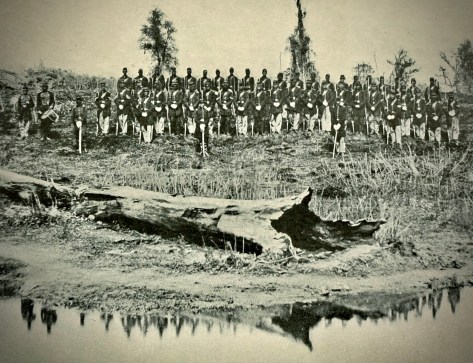
One of the 13th Connecticut Infantry companies on the Banks of the Mississippi River.History of Civil War 1861-1865, Pictorial Works.
Transcription
Transport Ship City of New York 13th Regt. C. V. Co. B, USA Col. H. W. Birge, Commanding May 7th 1862
Dear Sister,
As soon as I mailed my last letter we had orders to march for New Orleans. We struck our tents Sunday afternoon and started. They had an old river steam boat to take us to the ship. We being the last company, we did not get on board till the next morning. We had to lay on the sand through the night. Most of the men spread their blankets and went to sleep. I thought I would not as I expected we should get on board then. I soon got sick of waiting and lay down with the rest and went to sleep.
In the morning we slung our knapsacks and went on the old steam boat to get to the ship and a crazy old craft it was. It was like the pictures you see in the geography of steam boats on the Mississippi river. We have got our same bunks that we had before on board this ship. We have our rifles to sleep with. I found a slave and his family on board that the 9th Regiment C. V. brought from Mississippi with them. I asked him what the Rebels thought of the Yankees. He said they thought they—the Rebels—would get whipped. He said his master had two sons in the Rebel army when the 9th landed. He said that the Rebels had 1,000 men to oppose them but as soon as they got in sight, they took to their heels with the cry, “Gen. Butler’s Division is coming!”
Yesterday we were to work heaving ballast overboard so as to lighten the ship so as to get over the bar to the Mississippi river. Today we are off the mouth of the river. The water looks like the wash off a road after a shower. It is full of floating drift wood.
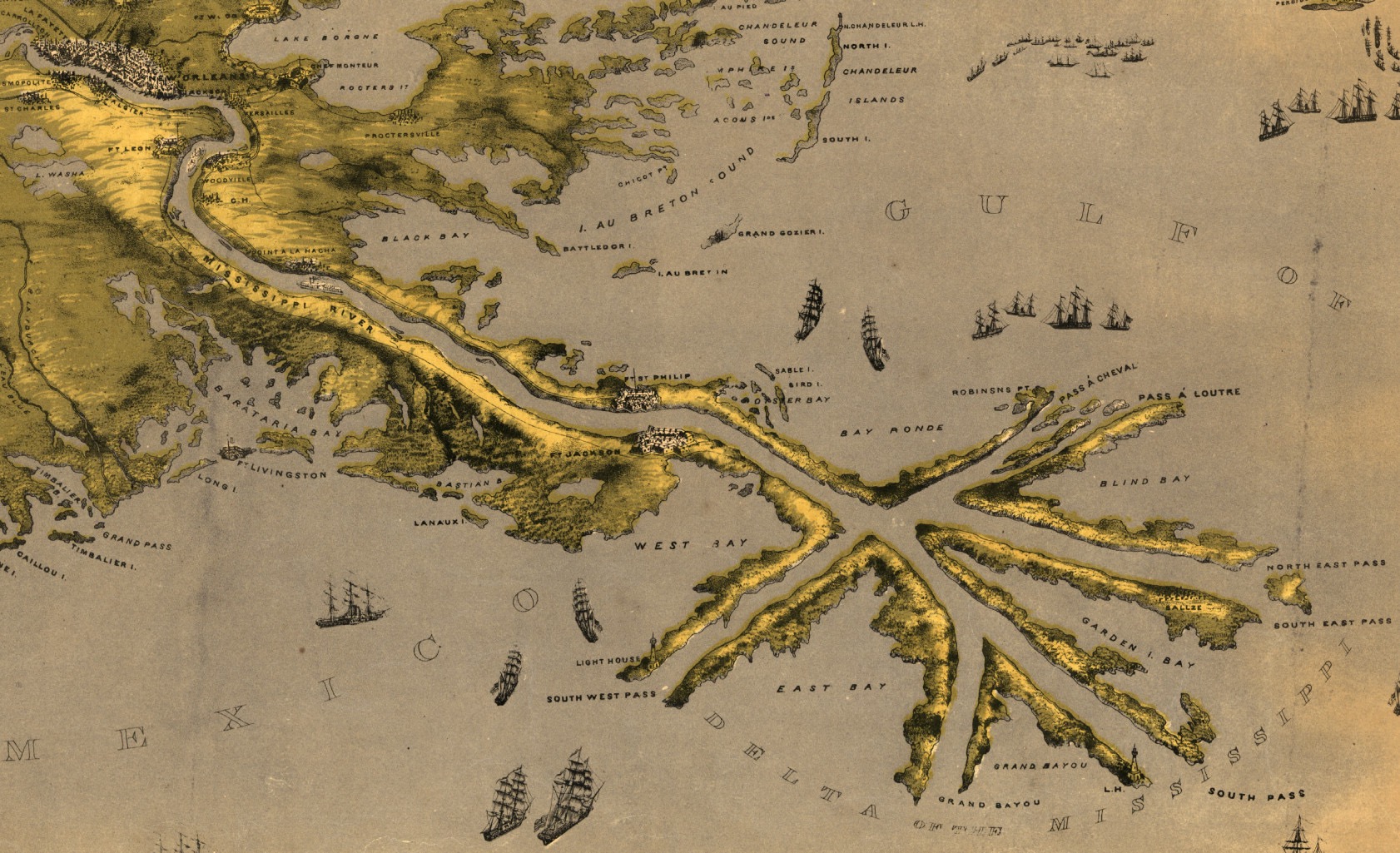
May 9th. Since writing the above, we have got over the bar in the entrance of the Mississippi river. The current is very strong. There is a narrow strip of land on both sides of us beyond the water as far as I can see. We are opposite a small village. The land is covered with tall grass. It makes the houses look well.
Sketch of scenery on the Mississippi delta.
I guess I had better dry up on trying to draw. I expected to send this today but the steamer has gone. We are going up the river towed by a steam boat. The current is so strong that we make but little headway. The river is very narrow. It almost runs over the banks. I have been watching to see if the side [sight?] made any difference. I have watched the banks some four or five hours & I cannot see any. We are now some six or seven miles from the mouth. The water is higher here than outside as every little break in the bank we can see the water running through very swift.
We passed a small house surrounded with beautiful trees. I should have liked to have stayed there two or three weeks. Well I must stop writing till some other day.
May 10th. We are opposite Fort Jackson, the scene of the recent bombardment. The walls are of brick in here as guns in casement. On the top is earth covered with grass. The fort shows the effect of the bombardment. We can see the two guns lying dismounted in the grass, the turf torn up, the walls broken in places. There are some small buildings one side of the fort. They looked hard. We could see where a ball had gone right through the chimney. Another had a ragged hole through the side of the window.
We are at anchor off the fort. The tow boat is taking in coal. A man came on board. He said he lived a half a mile from here. Someone asked him about the bombardment. He said it lasted six days and nights. Someone asked him if it wasn’t time for the Rebels to give up. Not yet you….[remainder of letter is missing]
Detail of Birds eye view of Louisiana, Mississippi, Alabama and part of Florida. Bachmann, John, 1861. Geography and Map Division.






















 Spared & Shared 23