I could not find an image of Charles but here is George W. Waddell, who served in Co. G, 41st Illinois Infantry.
This letter was written by Charles F. Bentley who enlisted on 5 August 1861 in Co. E, 41st Illinois Infantry. When he reenlisted as a veteran later in the war, he was transferred to Co. A. Charles was born in Utica, New York, but at the time of his enlistment he was residing in Decatur, Macon county, Illinois. He was single, employed as a farmer, and described as standing 5 and half feet tall with gray eyes and dark hair.
Charles’ letter describes the march towards Columbus, Kentucky, under the command of Brig. Gen. Charles Ferguson Smith. Grant’s orders to Smith were to advance his troops to within a few miles of Columbus and to await further orders while Grant attacked the Confederate base across the river at Belmont which took place on 7 November 1861. Though Charles clearly believed that Gen. Smith had been negligent of his duty, he was not and later proved quite useful to Grant in his campaign in Tennessee the following Spring.
Charles wrote the letter to his cousin, John Ryant Bentley (1842-1899) of Albion, Calhoun county, Michigan.
Transcription
Addressed to Charles R. Bentley, Albion, Calhoun county, Michigan
Paducah, Kentucky November 10, 1861
Dear Cousin,
I think it is about time to answer your letter that I received last night. I am very well at present and hope that these few lines will find you the same. I got back last night after taking a good march. We was marching on Columbus but did not get there in time fort the fight. Our side done very well. They whipped them out but the rebels got reinforced before we got there and whipped our men. If we had got there we could have held the place but our side got four cannon and spiked two of them and threw them in the river and kept two of them.
Our General [Charles Ferguson] Smith is going to be court martialed for not doing his duty. He had the dispatch inn his pocket for us to march twenty-four hours before he started us out and now he will suffer the consequences of it. If we had been there one day sooner, we would have held the place but I think that we will have another tramp before long now.
Dear cousin, I hope that we may see each other some time. I may get killed and I may not but I can’t tell nor anybody else. write soon. — Charles F. Bentley
I could not find an image of Francis, but here is one of John M. Hughes of the 38th Illinois Infantry, posing with his Austrian Model 1842 tube or pill lock musket. He was from Mason, Illinois. (Al and Claudia Niemiec Collection)
The following letter was written by Francis Marion Jeffrey (1832-1918) who served in Co. F, 38th Illinois Infantry during the Civil War. A biographical sketch informs us that he was the eldest of several children born to William Oliver Jeffrey and Harriet DeCamp of Fayette county, Indiana. He worked with his father at the tanning business, and on the farm until 1856, then went to carpentering, and continued at the trade until the breaking out of the war, when he enlisted for three years in the 38th Illinois. The regiment became part of the 1st Brigade, 1st Division, 4th Army Corps. He participated with his regiment in the hard fought battles of Fredericktown, Champion Hills, Stone River, Liberty Gap, the first and second battles of Corinth, then in the Atlanta Campaign, Mission Ridge, Chickamauga, and Jonesboro, where the time of service of the regiment expired. He was wounded at the battle of Perryville, where the command was repulsed in their attempt to capture a battery. He received two wounds at Stone River. At the battle of Liberty Gap he was one of the sixty men who volunteered to capture a battery. They succeeded, but it cost them one-fourth of the men in killed and wounded. In that desperate undertaking Mr. Jeffrey was wounded in the head. After he was mustered out he returned home and resumed his trade of carpentering. He was married in 1850 to Sarah McEntire but she died in 1857 and both of their children died very young.
Transcription
Pilot Knob, Missouri Fenruary 18th 1862
Dear Uncle,
I have just received your letter and hasten to reply while the opportunity present itself for opportunities to write will soon be scarce. We are on the point of moving south and will start as soon as transportation arrives which will be here this week. Part has already come. There is no telling where we will land as that is kept a secret but I rather suppose it be Columbus. There will be four regiments of infantry, two cavalry, and four sections of artillery—quite a favorable squad.
I have been sick for some time with lung fever, sore throat, and rheumatics but I am getting well again. I have got a good situation in the regiment. I have been appointed clerk in the Commissary Department. I have nothing to do but write. I am relieved of all exposure and have an easy berth.
You spoke in your letter that you wanted me to make you a visit when the war is over. It has been my calculation for a “long time” to do so and if I live through this struggle, I intend to come to see you. There is no use to give you any war news—only what happens close to us. Everything has been quiet for some time until this last move. Everything is in a state of excitement since the last battle at Ft. Donelson. The Union and Constitution is safe. The backbone of the rebellion is broken, thank God.
There has been considerable of sickness amongst the troops this winter but we have lost but few men. Mother’s eyes are getting well which has given great relief to me. I want you to write as often as convenient and if anything happens, you will hear from me. Direct your letters to Pilot Knob, 38th Regt., Co. F, Illinois Volunteers. It makes no difference where I am, it will follow.
Give my love to Grandfather and tell him that I hope that he may live until I see him again. I believe that I have written all of the particulars so no more but remain your affectionate nephew, — F. M. Jeffrey
I could not find an image of Guilderoy but here is one of Moses Rogers (at right) of the 48th OVI, probably with a comrade from the same unit.(Ancestry. com)
This letter was written by Guilderoy L. Patton (1840-1862), the son of Frederick Patton (1816-1875) and Elizabeth Rolfo (1812-1870) of Sterling, Brown county, Ohio. Guilderoy was 21 years old when he enlisted on 14 October 1861 to serve as a private in Co. C, 48th Ohio Volunteer Infantry (OVI). According to muster rolls, he died of typhoid fever at Camp Dennison on 2 March 1862, never having left the State of Ohio. Due to a shortage of recruits, they were not mustered into the service until mid-February 1862, after which they were sent to Paducah for duty. Guilderoy died just about five weeks before the regiment saw their first action at the Battle of Shiloh.
Transcription
Patriotic letterhead—Ohio, “Union and the Constitution”
Camp Dennison, Ohio November 12th 1861
Frederick Patton. Dear father,
I have just finished a letter to mother and now I will undertake to write youy a few lines to let you know that I am well at present and I hope these few lines—if they reach you—will find you enjoying the same blessing. We are now camped out in our tents on the bare ground, Last night was the first we slept in them. It goes first rate. They had to dear down the shanties to build us our winter quarters. The carpenters are at work at them now. It is now, without a doubt, that we will winter [here]—at least we will go into winter quarters. Whether to remain all winter, we can’t tell but it looks as if we would from present appearance. The papers say that we have over 600 men in our regiment but we have but about 426 all told.
We are going to have good quarters. They will be 100 feet long, 30 feet wide (I believe I wrote in a letter 20 feet wide. It was a mistake) and to have 3 stoves, one to cook on and two other warming stoves. It will have 100 bunks, one for each man to sleep in. They are fixed just like those on a steamboat, exactly one above the other. In fact, the whole concern looks like the cabin on a boat, only there is no doors to go into the bunks.
There was one of our company by the name of Pratt (he is a brother to the one that sold or got trees of French Hill) who got his jaw broke last night. He attempted to break across the guard line when the guard struck him with a stone and broke his jaw. He is now in the hospital from the effects of it. They could not do anything with the guard as they was ordered to knock the first man down who attempted to cross the line.
Well we have plenty to eat you can judge for when I came here I weighed 142 pounds. Now I weigh 156 in my shirt sleeves. That is a large gain in so short a time but there is others that have gained in weight more yet again. I think I can get to come about the 1st of December but I would like you to be at home when I come then.
When you get this letter, I want you to write one right back when you will be at home so I will know when to come. Lem Hair is well. I believe I have told you all the news but one thing, we drew our knapsacks yesterday and I am writing this letter on mine. No more at present but remain your son till death, — Guilderoy L. Patton
to Frederick Patton
Direct to 48th Regiment, Co. C, Care of Captain J. W. Frazee, Camp Dennison, Ohio
Robert Increase Boyington (1836-1920) was the son of David Davis Boyington and Melinda Jackson. Boyington served in Co. I of the 105th Pennsylvania Infantry — otherwise known as the “Wildcat Regiment.” Rising in rank from Private to Lieutenant, Robert I. Boyington fought in every battle (except Malvern Hill) in which the 105th Pennsylvania was engaged, up until he was severely wounded at Gettsyburg. His wife nursed him back to health. His early biography is on page 217-218 of the regimental history authored by Kate Scott in 1888. By the 1880s, he was farming in Kansas, and in 1886, made the Oklahoma Land Rush into the Cherokee Strip. The tombstone for his wife has on it the symbol for the Civil War Nurse Society. It is a beautiful pink marble. His tombstone is the standard issue Union Soldier tombstone. Both are in Carrier, OK.
Robert’s journal was published at one time under the title, “Robert I. Boyington’s Army Life Journal.” I have seen references to it but could not find it published on the internet, nor could I find any record of it in archives or even in rare books. It’s my belief that any copyright that might have been connected with it has expired by this time. The following transcript of the Journal was sent to me from Nancy Einfeld who informed me that it was given to her while home nursing a granddaughter of Robert Boyington in Columbia, Missouri. She has graciously made the transcription available to me hoping to share it with the Civil War history community. As I have not been able to find the published version, I have no idea if the transcript provided me was a copy of what was published or possibly a first draft. It yet retained many typographical errors which I have attempted to correct for readability.
Please note that I transcribed and published two of Robert’s letters nearly a decade ago. They were written in 1886 to Kate M. Scott at the time she was compiling the material for the history of the 105th Pennsylvania Regiment. See—1886: Robert Increase Boyington to Kate M. Scott.
Transcription
ROBERT I. BOYINGTON’S LIFE JOURNAL Commencing Nov. 25th, 1861 Dictated to My Dear Wife, Mary F. Boyington “Keep This in Remembrance of Me”
Blairsville, Wednesday, November 27, 1861. We bade adieu to our friends in Geistown on Monday the 25th at 2 o’clock p.m. The day was stormy & we had a cold, disagreeable time on our road to Whiteville. On arriving at Siler’s Store, we were met by the Boys of the school in charge of Joseph Brown with music and colors and escorted to the store by them. We were treated by Peter Siler to candies, nuts, and crackers. Three cheers were given by the Boys, then we returned them.
Bidding all goodbye, we started again and arrived in Whitesville just at dusk. Joseph Brown walked a short distance with me. I felt as I parted with him that I was leaving a dear friend & true. I hope we may meet again. I spent the evening in conversation & preparation for my departure. I dreamed of you, Mary, often during the night. I wondered how you had rested as I arose.
All were ready to start at 4:30 o’clock. I remained behind to bid farewell to my parents, brothers, sister, and such friends as had at that early hour come to take my hand. How hard it is to leave a dear Father, a kind & anxious Mother, loving brothers, sisters, and friends—perhaps never to meet them again on earth. Oh! for the hope—the blessed hope—of meeting “where all tears are wiped from our eyes,” meeting to part no more. Grant Oh God that this may be our happy end. May this hope, dear Mary, strengthen you.
The day grew brighter as it advanced and at 5 p.m. we reached [the town of] Indiana too late for the cars. We put up for the night at the Exchange. I rested well that night and at 6 the next morning, started for this place to visit my Uncle (who was lately moved here) & await the rest who will take the 3 o’clock train.
Harrisburg, November 28th. Well here I am in our State Capitol city. Many, very many, thoughts crowd themselves upon my memory as I think of its history, public buildings, &c. But time will not allow me to speak of them. We left Blairsville yesterday at 5:35 o’clock p.m. We crossed the mountains after night. I had hoped to have crossed in daylight so as to have had a view of the scenery which is said to be grand in the extreme. The latter part of the night was clear so that I could notice object at a distance. The face of the country appeared wild and much broken.
We arrived at this place [Harrisburg] at 4 o’clock this morning. Breakfasted at the United States Hotel—price 50 cents. We changed cars twice on the way. I have been around the city some this morning, seen the Capitol, and many other splendid buildings. We bought ourselves a tin cup, plate and spoon. I took supper at Until Morlin’s last night. The remainder of the crew had to wait until near midnight for supper.
I had no chance to sleep a moment last night, yet I do not feel at all exhausted. Uncle Morlin has just started for Baltimore. We must wait till 1 o’clock. Shall be mustered into the service in the meantime.
There are a great many men—soldiers I mean—on their way to their destination. Now, Mary, screw up your courage while I tell you how hundreds of them slept last night. When we came in we found them lying fast asleep on te platforms of the depot. The depot platforms are arranged somewhat like the steps on the porch in front of P. H. Shannon’s store if the railing was off. On this they were sleeping wrapped up in their blankets, their heads resting on their haversacks, and packed as close as chickens on a roost. It looked a little hard to me at first, but when they arose, they seemed as vigorous, refreshed and cheerful that I came to the conclusion that it was not so hard after all. They were on their way to Washington. They had bread and crackers with htem, but bought their coffee at our hotel, carrying it out in large wash tubs, then dipped out in tin cups by the soldiers. Of course the tubs were clean—ha, ha.
Camp Jamison [one mile south of Alexandria, Va.], Saturday, November 30th 1861. My journal finds me well, having seated myself to tell of my adventures since leaving Harrisburg. While there, we boarded at the National Hotel. Thanksgiving Day coming on the day of my sojourn there, I had an opportunity of seeing how it was spent in our State Capitol city. And truly I am sorry that I have no better account to give. Although most of the churches were opened and pretty well attended, yet the [theaters?] and drinking houses presented a sad spectacle. The soldiers almost without exception were either drunk or drinking with many of the citizens in a noisy & often helpless condition. There were shows & concerts in full blast. A splendid exhibition of the fire hose company on Market Street with their steam engine—they threw water up a steeple near 200 feet high with a force that would have sent a man off his feet and knocked him down.
We left Harrisburg on Friday the 28th of November. We reached Baltimore at 12 o’clock [noon], walked to the Washington Depot one and a half miles distant, and took the cars for the United States Capitol. I can say but little of Baltimore as I had no time to spend in that city but was fortunate enough to pass by and see the Battle Monument which is a large marble structure. Baltimore is a large and rather pretty city. The streets seemed to be thronged with negroes. We arrived in Washington about an hour after dark and made our way immediately to the Soldier’s Relief for our supper, having fasted since breakfast. We were served with a ration apiece which consisted of a piece of bread about 6 inches long, two thick and four wide, with a liberal slice of boiled beef—tongue cold, and all the coffee we wanted. No plate, fork, knife, or spoon. All we had was a tin cup for our coffee. Hungry and all as we were, we found our rations sufficient to satisfy us perfectly.
That night we were shown into a large room upstairs where I slept on the floor, wrapped in my blanket & rested well. During the night a company of the United States Regular Cavalry came in. They were from Utah Territory, had been in the regular service over seven years. They were rough-looking fellows. In the morning I took another ration with two or three hundred other men.
After breakfast I walked out a short time but as I was awaiting orders, I did not dare to go far. It was an outside view of the Capitol and other public buildings. It (the Capitol) is built of beautiful white marble and makes a splendid appearance.
At 10 o’clock a.m. we started for camp. We passed over the Long Bridge of the Potomac which is a bridge near three miles in length. Soldiers guard either end. No one can pass without a pass from headquarters. We arrived in camp at 3 o’clock—distance from Washington 12 miles. On the way we passed through Alexandria, a city of near 12,000 inhabitants and where Col. Ellsworth was killed. I have not seen a Rebel yet & my opinion is we shall not have an opportunity very soon.
Col. Samuel W. Black, a Mexican War Veteran, led the 62nd Pennsylvania Infantry until killed at the Battle of Gaines’s Mill in June, 1862.
On Sunday morning I arose much refreshed. This was the first night I had ever spent in a soldier’s camp. M. H. Shannon & I got passes to and from the 11th Regiment Pennsylvania Reserve [40th Penn. Vols] camp for four days. We reached Alexandria too late for the cars. We returned to camp for the night & started the next morning at 7:30 o’clock. Got to [Col. Samuel W.] Black’s [regiment] at 9 o’clock and to the 11th Regiment at noon. The Boys were all in good health and spirits. We returned the next, or rather I did; M. H. Shannon stopping at Black’s [regiment] over night. It is the 6th of December and I am in good health and spirits. Other particulars by next mail. Adieu.
Camp Jamison, December 7th 1861. I’m going to the 11th Regiment Pennsylvania Reserve camp. We passed through the 62nd [Pennsylvania]—Col. Black’s Regiment, and spoke with several with who I was acquainted among whom were George Richards, William Dess, William Turner, Jesse Smith, William Joseph Shick, Lieutenants [E. J.] Putney & Steck, also Capt. [Robert R.] Means & [William C.] Beck, with many others. We passed on to the 11th which we reached at 12 o’clock noon. Took dinner with William Kelley, William Coulter, and Thomas Love [of Co. K]. Spent the afternoon with [my brother] Myron [Lafayette Boyington] visiting old friends and I found after investigating the camps that they were not few. Took tea with Myron in his hut. It consisted of bread, crackers, beef, sausage, butter, coffee, tea, sugar, molasses, and mince pie. Cigars were handed round & we had a chat about old times, we having been joined by Harl Robison and Coulter & Samuel Chick. During the evening I was invited to an oyster supper by the Messers. Means which I accepted.
We repaired there at an early hour and had a merry time. we retired at a late hour. Was up at daylight. Spent the time until 8 o’clock in conversation. The regiment was then ordered under arms with 13 or 14 others to make a reconnoisance in force. We parted in good spirits—they to do their duty & I to my own camp. Yet we know not if we ever see each other’s face again on Earth. But such is the soldier’s life—full of uncertainties.
We got back to Black’s regiment at noon, ate dinner with George Richards at mess, spent the time with my friends of the regiment until 2 o’clock p.m.. and then I started for the 105th Regiment again. Missed the cars and had to walk a distance of 10 or 11 miles. Reached Alexandria an hour after dark and thus had a good deal of difficulty in passing the guards as I did not have the countersign. But with the aid of a lieutenant from Maine, I succeeded in reaching camp a little before 8 o’clock in the evening.
This Tuesday evening I led in our family worship, they having established it on my suggestion on the Sunday evening previous. The majority of the men of our tent being church members, we took our turns in leading worship. It seemed to cause a solemn feeling with all present. I felt that God was there & that “to bless” our feeble efforts.
Our tents are what are called “Sibley” tents. They are about 16 feet in diameter at the bottom; they are round, coming to a peak at the top and intended to accommodate 20 men. Our company not being full, we have but 16 in ours. We have a sheet iron stove which warms it pretty well.
On Wednesday morning, December 4th, I got my accoutrements for the army consisting of musket, cartridge box and bayonet, with haversack, knapsack, blanket, overcoat, frock coat, pair pants & shoes, & two pair drawers, two under shirts, 1 knit blouse, and two pair socks with a few other articles of less importance. Our rations consist of a certain quantity of bread and crackers, beef or pork, beans, rice or corn meal, sugar and molasses, coffee or tea, with vinegar, soap, salt, and occasionally potatoes, so that we have at all times a plenty to eat, drink & wear.
On Thursday, I went down to a large bottom or flat with the rest of the brigade one and a half miles to the Potomac to drill. There were some six or eight thousand men present. We went through the various evolutions & returned at sundown having been out since noon. It was a magnificent sight to me unaccustomed as I was to such sights.
We are called out at 5 o’clock a.m. by the beating of the reveille. The roll is called & we drill about one and a half hours and then breakfast. Go out again at 9 o’clock [and] in at 12 o’clock noon. Out again at 1 or 2; in at 4 p.m. Out again in 10 or 15 minutes afterwards for what is called dress parade. This lasts about half an hour. We are then dismissed until 9 o’clock in the evening when we are formed again in line in front of our tents for roll call. We then return to our beds to be up again at 5 o’clock a.m.
Our tents are placed in rows, each company forming a row—a street 40 feet in width between each company. There are five tents in each row. Captain’s tent or quarters at the head of each. Each regiment has a quartermaster department where the provisions, &c. are kept. A sutler’s tent where notions of all kinds are kept for to sell the soldiers. Many things are kept such as cheese, nuts, pies, raisons, and candies which are considered injurious to soldiers. Congress is now discussing the propriety of removing them. Oysters, apples, milk, butter, and other things are brought into camp every day by citizens to sell to the soldiers.
Col. Amor A. M’Knight, 105th Penn. Vols.
This morning I bade goodbye to Uncle Martin Shannon. He has started home. I had expected to be homesick in a week or two but find myself thus far happily disappointed. True, I often think of you and my friends, yet there is so much here to divert the attention that our minds do not remain long on any one thing. Capt. Freas & Capt. Dowling of Companies G & B have both resigned their offices on account of difficulties with Col. [Amor A.] McKnight. Other captains and officers are discussing the propriety of following their examples.
Saturday, December 7th 1861, I must mention as being in particular one of the most beautiful days I have ever seen at this period of the year. The atmosphere is clear so that we are able to discern objects clearly at a great distance. The weather is as warm as midsummer in Jefferson County. Flies are buzzing around and nearly all kinds of insects are yet alive. The United States Capitol is easily seen from our camp with a part of the cities of Washington and Alexandria. A most beautiful view id a portion of the Potomac is also to be had from our position with its crowd of ships, sloops, schooners, steam vessels, &c. at anchor or sailing on its waters.
The same routine of duties come day after day so that it is unnecessary to record them since giving a description of one day’s duties [suffices] unless something unusual transpires.
Sunday, December 8th 1861. Another warm & pleasant day has passed—the second Sabbath I have spent as a soldier. How changed! Instead of a quiet Sabbath such as I have spent heretofore, we are roused from our slumbers by the beating of the reveille. Then all is bustle. The soldiers form as usual in line in front of their tents to answer to roll call. We hear the discharge of pistols & musketry in every direction and now the thunder of a distant cannon comes with the echoes upon the ear. All around you, you can hear the shouts & laughter of our fellow soldiers. Some are singing, others writing, some cleaning their guns, others reading or in conversation on various subjects. All serves to remind me of my absent friends & the quiet Sabbaths spent with them in their quiet homes. The rolling drum gives the signal for guard mounting at intervals throughout the day. Now the brass band is filling the air with its soul cheering strains. Old Hundred comes floating to the ear from the distance or some other sacred hymn or melody, as regiment after regiment are summoned to divine services at different hours of the day.
Our hour today was 11 o’clock a.m. I was among the number & listed with much pleasure to a discourse by the Rev. Steadman from the 7th Chapter of Matthew, 14th verse. He was plain but brief, giving the soldiers much good advice concerning the vices incident to camp life, representing them as the Broad was to ruin. After service, the minister invited all to his tent in order to distribute tracts & other religious reading matter among them, and I am happy to say that many, very many, availed themselves of his kind offer.
In the afternoon we were called out for inspection. Our arms (guns), blankets, clothing, and tents were closely examined to see if they were clean or not. This is necessary for the health of the camp that they be made to keep clean. In the evening, prayer meetings were held in different places in the open air, and were well attended in general. Many prayers were offered up, nor were the loved ones at home forgotten.
Camp Jameson, Tuesday, December 10th, 1861. On Monday, nothing transpired of interest more than usual. We had in the afternoon a grand Brigade Parade on the bank of the Potomac in sight of the Capitol, Washington City, & part of Alexandria. I also on that day received the first letter from my wife. It is needless to describe the pleasure I had in its perusal. All who have absent friends can imagine them.
There were several ladies—wives of the officers—that were present at the parade. One of them was in a carriage with her husband a minister, and a another gentleman last evening when the horses took fright and ran off. They passed our camp at great speed but they became loosened from the carriage a short distance below our camp. No one was hurt. The horses kept on their headlong course. All were badly scared & came out trembling.
December 10, 1861. The day has closed—another beautiful day but excessively warm, so much so as to cause us to doff our coats. Another brigade moved ahead of us today. They have encamped near Mount Vernon, the burial place of our loved Washington. This evening while on drill, we saw a large balloon sailing high above us, no doubt a voyage of discovery. It was a pretty sight as it moved from us, falling in the vicinity of Washington City.
A lithograph appearing in Harper’s Weekly on 14 December 1861 depicting Professor Lowe’s balloon ascension on a “reconnoitering expedition to Vienna.”
This evening we were ordered to have 40 rounds of cartridges in our boxes and be ready at a moment’s warning. We may engage the enemy at any moment. As I now write, we can hear the booming of cannon in the direction of the enemy’s quarters. It does not disturb us much as it is not an uncommon occurrence. A Rebel prisoner was brought through our lines this afternoon. He was a large man and wore gray woolen breeches, black coat, black slouch hat, and an old pair of shoes. Rather a hard-looking fellow.
One half mile from us, on our right side, there are breastworks that were thrown up by the Rebels before our troops took Alexandria. They are merely breastworks thrown up in a line extending in different directions to a considerable distance. The forests have fallen as the Federal troops advanced. No trees have been allowed to stand on any of the hill tops. This has been done to avoid surprise and to give free sway to the cannons which are mounted on the different forts and batteries. And they are so placed that they can sweep the whole country for a distance of eight or ten miles around and have complete control of the Potomac as they (the Federals) could sink any ship that would attempt to pass either up or down the river. I have seen bomb shells thrown over three miles and then burst, tearing up the earth and knocking the branches off the trees, and playing Hob generally with everything in reach.
I have my gun in good order and I think if I can once draw sight on one of the causes of our troubles, I think he will take a fit of sudden aching. This is what I came for and I trust if God is willing, I shall be enabled to do my whole duty. Whenever called out, our guns are kept shining [and] ready for any emergency that may occur. There are bodies of cavalry and artillery near us ready for use whenever “Secesh” shows its ugly head. We do not know how near the Rebels may be to us but it is supposed to be 25 or 30 miles to any considerable force and it is understood that they are falling back. I do not believe their batteries in the neighborhood of Manassas will be disturbed by the Union forces. Their works will no doubt be turned by our forces (i. e., we shall march around them).
I have until today been in the best of health but today I have had a slight attack of the dysentery to which all new recruits are subject at first. I am better tonight.
December 14, 1861. Since last writing, so many things have occurred that I find it will be impossible to give a minute account of all. On Wednesday the 11th, to my great delight, Myron [Boyington] made his appearance in our camp on a visit. He reported the other Boys as being well & hearty. I spent what time I could with him that afternoon and the next morning I applied & obtained a pass to Alexandria and started early in the morning with Myron. We went by way of the hospital. And now a description of it, if I can give one.
This hospital was in a house once occupied by a secesh. As we entered, we saw Peter Slagle [of Co. G] busy writing, while on two or three side beds with a blanket or two beneath them lay four men with sunken eyes and countenances pale and haggard. One poor fellow I noticed in particular. He was from Clarion county and had been insane for some time & now was not expected to live through the day—but no one seemed concerned. All appeared to have lost that sympathy that characterizes our friends at home. There was no one to hold the aching head when wrenching with pain or casting up the food the weak stomach could not retain or digest. No cheering word by a near friend to soothe the mind or cheer the drooping spirit by referring to some good olden time “when all went merry.” The waiters perform their tasks as if compelled to do so & not with that cheerfulness that gives pleasure to the sufferer—the food often improperly cooked and the room poorly ventilated. I came to the conclusion as I left the place that this was a poor place to be sick in.
We went from there to Alexandria to get our likenesses taken. While in the city, I saw a sight the like of which I never wish to see again—viz: a man of the 11th Regt. Penna. Vols. (which is now guarding the city and quartered there) had deserted his company and regiment, returned home and joined another regiment. He then wrote a letter to the Colonel in command accusing him of many things and not couched in a very proper language. His first Colonel had him arrested, brought back to this place and regiment [where] he was then court-martialed and was, when I saw him, undergoing his punishment. They had bound a board to his back & handcuffed him. On the board was printed in large capital letters, “DESERTER AND A COWARD.” In this manner he was marched up and down the streets in front of his regiment. His hair had also been shaven in many places from his head. It was reported that he was to be drummed out of the regiment.
Having accomplished our object, we returned to camp about 2 o’clock p.m. Capt. Freas’ Co. [G] had just returned from picket duty and had made some captures in the shape of chickens, turkeys, and a few rabbits. They seemed to like picketing very much.
I spent the balance of the day with Myron and the Boys from Ringgold as my pass cleared me of drilling for that day and all other duties belonging to camp. The Boys spent a few merry hours talking, singing, or in other sport around the company camp fire. We sung the old songs we used to sing in Jefferson, told of our old pastimes, & a few other stories of our adventures since we left. We then retired to our respective quarters, there to dream of those at home. The next morning Myron started at an early hour for his own regiment.
This day was another warm and pleasant one. We have not had rain or snow since I came to camp. The health of the regiment seems to be improving.On this day the 12th December, I heard of a sad affair at Camp Franklin—distant from our two miles. A man had deserted us and gone over to the enemy & had also acted as a spy against us. He had been captured, tried and sentenced to be shot. His coffin was placed in a wagon and he made to walk behind. After passing through the regiment to a [hollow] square formed by the soldiers, he was blindfolded & made to kneel before his coffin. Twelve men had been detailed from one of the companies to execute him. THey stepped out, three of them fired but did not kill him. The other four men then fired. Their balls freed his guilt soul from his body. It was witnessed by near 10,000 people. But few of our regiment were there. I believe his name was Johnson. He belonged to the Lincoln Cavalry. He was deserving of his fate. Such men are dangerous to our cause.
Saturday, December 14th 1861. We cannot help but wonder at the weather. We continue to have [it] mild and pleasant. But we are expecting a change soon. This forenoon was given to such of our men as had washing to do. Many availed themselves of the privilege. Each Captain must give his men one or two half days each week to do their washing. I washed my clothes last week. You would laugh to see us rubbing, ringing, and otherwise cleansing our clothes. II think you would watch us as close as you thought I watched you, the last time I saw you wash.)
Sunday, December 15th 1861. It is hard to realize that this is the Lord’s day. The rolling drum beats as usual for roll call. At 8 o’clock a.m. we have an inspection of arms. At 11 o’clock divine service by the Chaplain. He preached from the 13th Chapter, 1st Corinthians. At two o’clock, a general inspection of arms & knapsacks (containing our clothing, &c.) by all the field officers consisting of Col. McKnight, Major Dick, Adjutant Gray, Dr. Highhold, Quartermaster Nicholson, and Rev. [D. S.] Steadman. Lieut.-Col. Robert is absent on a furlough at his home. At 4 p.m. there was an inspection of tents to see that they were kept clean and well ventilated. Our quarters were said to be in the best condition.
The men were obliged to keep their arms, clothes, and quarters in the best of order, neat and clean. Even their boots & shoes must be blackened if possible once in a week at least (or greased, no matter which). This is done at our own expense. This evening we had prayer meeting on the parade ground as usual on Sabbath nights. There was a goodly number present, among whom you could recognize Bros. Swisher, Houser, Nickle, Geist, Hilyard, Shaffer, our 2nd Lieutenant H. Brady, and many others whom time nor space will allow me to mention. There is now worship every evening in almost every tent in our company (so much for example). How cheering it is to be thus encouraged. I feel that God is with us. Oh that He may keep us firm unmovable.
Today our company police was excused from duty. A company police usually consists of three men who are detailed to cut wood, sweep the streets, or other work which is done in the camp. On last Sabbath three of our men refused to go. They were all from our tent. They were accordingly placed in the ring for punishment (the ring consists of a place like that made for horses in a thrashing machine. A guard stands in the middle of the ring to make the culprits walk around it a certain appointed time). These men had to walk an hour. After they came off, one of them wrote the Colonel a note couched in firm, yet proper language saying that his vows made at home to his friends and his God would not allow him to toil on that day more than was necessary. The Colonel called him to his quarters, talked to him respectfully on the subject, and dismissed him. Today no extra work was done.
December 16th 1861. We heard heavy firing down the river last night. We suppose it was the blockade. Nothing else of interest transpired during the day.
December 17th 1861. A letter from home by [M____]. Battalion drill as usual. In the evening about 7 o’clock orders were given to prepare arms, clothing, for a Grand Review the next day. But at 9 o’clock orders came to place one day’s rations in each haversack and prepare to march immediately. We were ready in 15 minutes after the order was received, in line of battle, with arms and provisions, and four minutes afterwards were on the road.
After starting we found that Pohick Church was our destination—if we could reach it. The night was lovely beyond description. The full moon brightened everything. Our arms gleamed in its beams. Tents, trees, houses, fields, and all other objects were as visible as at midday. A strange feeling came over me as we passed along. My position was both new and novel. We knew we were marching against an enemy as strong and perhaps more so than ourselves. Yet we felt no fear. All were eager for the expected fray. We marched on in silence. Nothing could be heard but the tramp of the men and horses, with now and then the click of the guns as they would sometimes strike against one another.
After going about four miles in this manner, a halt was made. Orders ran silently along the line (it being given in whispers) to load and fix bayonets. I placed a cartridge in my gun feeling that if opportunity was given, one Rebel at least should bite the dust. We then, after loading and fixing our bayonets, resumed our march. After marching three or four miles farther, we gain came to a halt at our picket’s headquarters. Here scouts were sent out to reconnoiter while the companies took different positions in battle array to receive the enemy. Our company was ordered to a position behind a fence on the right of the road. There we lay down with our guns resting on the fence ready to fire. Just before we had heard the reports of three guns, our pickets came running in having seen the enemy. We lay there a while. But as the enemy had evidently fallen back, we were allowed to kindle a fire and lie down around it. Nothing more was heard save the cry of the sentinels who, as dispatches came in or the scouts returned, would hail them at their different stations along the road with, “Halt! Who goes there?” The answer comes, “A friend.” The sentinel then commands, “Advance friend and give the countersign.” This is whispered in the sentinel’s ear and the man passes on. Then all is quiet again.
It was two o’clock in the morning when we stopped. We stayed there till six in the morning to cook our breakfast which consisted of a chuck of bread. Some had meat but the most had bread or crackers alone. I had slept only about an hour as the night was cold and we were without blankets and were in a perspiration when we halted.
After breakfast we started on, two companies being detailed as skirmishers. They scattered out on either side through the woods and fields. We finally reached the place, having neither seen nor heard the enemy. They had retreated. There were in the neighborhood the day before four or five hundred strong and had driven and pursued our cavalry two or three miles this side of Acquia Creek. This stream is about as large where we crossed it as Little Sandy is at Sprangle’s Mills, but deeper. At the mouth of this creek is their famous battery.
The church to which we marched was built by General George Washington. I cannot give a description of it except its outside appearance as I was not permitted to leave the ranks to look at it, but as our company was sent on ahead half mile past it, I had a chance of seeing how it looked outside. It is built of brick which are said to have come from England. The corners were of stone all the way up. The roof was four square coming to a point at the top. One of the artillery men had sent into it and had taken one of the banisters which was around the altar. He gave me a piece which I enclose to you.
Our company halted after going the half mile and six scouts were sent out in different directions. I requested the captain to let me also go, but was not allowed. In the course of half an hour they returned. Two of them had seen four of the enemy, but they were quite a distance off. There was a heavy fog which prevented us from seeing things clearly at a very great distance. When the scouts came in we returned back to the main body. We were allowed two hours rest but were not permitted to leave the ground.
At one o’clock p.m. we again formed in line. We marched back on another road and by way of Accotink—a small village with several fine buildings. The men kept the line in marching order two or three miles. Then as the day was very warm, some of the weaker ones sat down to rest or lagged behind. We kept passing those that had given up till finally our regiment had dwindled down to 75 or a hundred men.
After getting within two or three miles of camp, all were stopped by the Colonel. We sat and rested by the road side until the greater part came up with us. We then again formed in line and marched into camp about 5 o’clock p.m. We were a tired and sleepy set of boys, I assure you. We had been 34 hours on the road and marched 30 miles with little or no sleep. The country through which we passed was moderately hilly except the Mount Vernon farm which was generally level. There were many pretty farm houses to be seen but not a barn worth the name—being merely an open shed.
The next morning found me slightly “racked up.” My feet were rather sore and my joints quite stiff but after marching an hour or two, I felt somewhat “limbered up.” I spent most of this day (December 19th) in writing. December 20th—nothing of note. December 21st—Today I have been washing. Find I am getting pretty good on the “rub.”
Sunday, December 22, 1861. Last evening ten men came in as recruits from Jefferson county, Pennsylvania—quite filling up our company. They seem well pleased with their new situation.
At 11 o’clock a.m., I listened to a discourse by the Rev. Wallace of Westmoreland county, Pa. (who was here on a visit). He chose the words from St. Luke, 15th Chapter, 4th to 7th verse. His remarks were simple & plain, meeting the soldiers wants well. This evening it has commenced raining—the first we have had since I came to camp. And my washing is on the line yet. Poor me. So much for forgetfulness. Never mind. I will perhaps learn to remember by and by. How the rain sounds as it pats upon our company tent. It puts me in mind of the olfactory home song. Now I must expect a rougher time. The air is somewhat cool, yet not enough to cause sleet. I hear a singing and prayer in some of the tents adjoining us. How pleasant, how cheering, and yet how solemn to thus hear the people of God offering up praises and prayer under such circumstances.
Good news have come today of our success is different quarters. All are indulging the hope the strife will soon end. Now the rolling of the drum calls us to our 9 o’clock roll call. It is over now. We did not go out or form in line but answered to our names remaining in our tents on account of the rain which is now falling very fast. Our canvas sheds the rain well & I think everything will keep dry save my washing. I am now called to attend evening worship & will cease.
Monday, December 23rd 1861. It has been raining all day. I have been engaged making out a new roll list, arranging the men according to heights—the taller first. The tallest man id 6 feet 2 inches high. The shortest 5 feet, 2.5 inches 9in our company). I measure 5 feet, 7.5 inches and my description runs as being “fair complexion, blue eyes, brown hair, born in Olean, Cattaraugus county, N. Y.; enlisted at Brookville, Jefferson county, Pa. by S. J. Marlin; by occupation or profession a teacher and in for three years.” We take this description of every man in our company and so do all other companies as fast as they enlist men. They can thus be known by their friends if they die in battle or by disease.
December 24, 1861. Last night was remarkable for being one of the windiest ones I ever saw. Several of the tents blew over, breaking the ropes or chains which fastened them. The day has been cool but clear with wind.
I have felt quite unwell the past day. I was taken with vomiting about 3 o’clock in the morning but feel better now. How quick it sends my thoughts back (when sick) to those who have so kindly nursed me “when the fever burned my brow.” I hope and trust that God will grant me health while I stay in the army for such (the sick) have none of those comforts so desirable to the invalids. I am not in writing humor this evening so will cease and try to converse until I am better.
December 26th 1861. The Christmas has passed & the strangest one to me I have spent yet. At 4 o’clock on Christmas morn we were awakened and ordered to get our breakfast and place ine day’s rations in our haversacks & be ready to march by 5 o’clock. I felt quite unwell but a fight was on hand and my sickness was quite forgotten so that I had my harness on, musket, &c., ready at the proper time. Our destination we found after getting on the road was the Pohick Church again. It looked like fight this time truly for we had four pieces of cannon, one company of cavalry, and near 3,000 infantry. Nothing occurred of importance.
We ate dinner near the church, saw three or four Rebel scouts, sent a cannon ball some two or three miles over onto a hill beyond where some of the enemy were supposed to be posted, rested two hours and returned, reaching camp a little after night—a set of tired boys having marched 26 or 27 miles.
Today we were ordered to prepare winter quarters. This afternoon I with J. F. Hawthorn and George Vanvleit, went to the woods to prepare logs three feet in length, intending to build up a pen two feet high and place our tent over it. I shall thus leave the large tent for more comfortable quarters with the sergeants. I have quite recovered from my sickness. A dose of salts righted me up which I took the night before Christmas and finished up with the prospect of a fight. Yesterday in our absence several ladies arrived in camp from Brookville to act as nurses for the regiment. I have not as yet learned their names.
December 27th 1861. Last night Bro. Shaffer led in worship. Today another windstorm commenced which prevents us from raising our tents. It is not cold. The weather is about like one of our mild March months. We have had no snow as yet this winter. The sun is shining brightly. The gusts of wind often threaten to overturn our tents.
We commenced this morning to make over our pay roll. I have just been to the Post Office. The mail generally comes in shortly after dinner. No letter. It always makes me feel disappointed when I am used so. We have a mail here daily. It is amusing to see the men crowd around our orderlies asking for letters (none but Ord. Sergeants can draw for their companies). Nothing is done but read letters until they are all distributed. The lucky ones are easy known by the manner in which they draw off to read by themselves. Some can be seen laughing immoderately over their news, while others drop a silent tear which is soon brushed away.
The ladies from Brookville have made their first public appearance this evening at dress parade. Among them are the misses Scott, Frier, Allen, & McGuffey, with Mrs. Gillespie, Vandervort, and Winderlighter. The young ladies intend staying, also Mrs. Vandervort whose husband is now sick in the hospital. He was our company cook. Mr. James Nicholson, our quartermaster’s brother, died about an hour ago. He belonged to our company—the first that has as yet died from it. We fear he is not well prepared to meet his Maker.
I took supper in the tent which I have occupied since I have been here for the last—for sometime at least—as I have moved to a small tent. You would laugh to see us eat here. There are four of us generally in a mess (or perhaps I should say muss) together. Each mess have a sheet iron pan that will hold about 2 gallons. In this pan we receive our ration & if we wish, to cook them. One of the mess goes to the cook at meal time and draws the beans, rice, mush, potatoes, or soup as the case may be with the meat. It is then brought to the tent. We then sit down on the ground floor around it, take our shares out on our tin plates, and go to work with our coffee or tea, bread or crackers. If the meat is tender, we tear it between our teeth and fingers. If tough, we cut it with our pocket knives into smaller portions. We often have been soup, rice soup, pea soup, or beef and potato soup, but no butter or milk unless we buy it. Butter is worth 30 cents per lb., milk 10 cents per quart, water and all. The reason of this is it takes all the hay, &c. for the horses and thus the cows do without.
December 28, 1861. I have just returned from Alexandria having helped to escort our comrade [James] Nicholson’s body on its way to his family in Brookville, Pa. The brass band played the “Dead March” in front of the hearse while our company marched in procession behind it with our guns under our arms, the butts to the front. Mr. Nicholson was 5th Sergeant in our company. This day’s mail brought the first letter received from M. H. Shannon.
December 31st, 1861. Sunday has passed & with it I find myself filling the place of our comrade Nicholson. I can’t say how long it will last. I am still to act as clerk besides. Day before yesterday we had a pleasant & I trust a profitable hour in listening to a discourse by our chaplain from the 5th Chapter of Matthew, selecting the words “Blessed are the pure in heart,” &c. The ladies were present making it seem more social & homelike.
We are still busy at our winter quarters between drilling hours yet we do not know how soon we may move our camp. We know nothing of our future until we hear the command. Yesterday our messmate H. N. Steel was removed to the hospital. Truly I pity the sick. There are still many cases of fever in camp.
Tomorrow is the beginning of another new year. As I think of those I have spent & compare my prospects of spending it with those I have spent, I can’t say that it is very cheering. Still the thoughts of nice smoking turkey roasts, big apples, old dicer [?], pleasant conversation with friends, sleigh rides, &c. will intrude upon my mind, in spite of the glorious privilege of “fighting or dying for the Union.” Away roasts, apples, cider, friends, rides, &c. What are you compared with a soldier’s life? Away with such thoughts! “I’ll be gay and happy still” (if I can); in not, I’ll not “cry over spilt milk.” How I wish I could receive half a dozen letters as a New Year’s gift tomorrow.
Today we are mustered out for our pay. We expect it some time this week, yet nothing definite is known. The weather is somewhat cool yet pleasant. No snow as yet and but two days of rain. It astonishes me how time flies.
January 1st 1862. The New Year has come and no doubt the most eventful one our Nation’s history has ever yet recorded. May an all-wise Providence cause it to be a year of jubilee to us and the beginning of “Peace on earth & good will towards men.”
Yesterday I was with thirty or forty others mustered into the service of the United States, and also mustered out for my pay. The paymaster is expected any day to pay the troops for the last two months service. During the forenoon we were on Brigade Drill. The afternoon was given to the Boys to spend as they pleased. There were several games of ball started, creating considerable sport. I spent my time fixing up my quarters & clothes, considering it of most importance. I forgot to state that on the last day of December, I was examined by our army surgeon before I was mustered in.
The day is warm so that I have worked without coat or vest and would have been comfortable lying down in this manner. This evening we have spent debating and talking of the manner in which we spent our last New Year’s day & prospecting our chances of spending the next.
January 2nd 1862. Cooler this morning but a clear day. We have been drilling very busy today and I feel tired & will write no more. Only add that I received a letter from my old friend and fellow teacher Augustus Means of Punxsutawney, containing an account of the Institute for the 1st time this afternoon.
January 3rd 1862. Nothing new save this evening it has commenced to snow a little.
January 4th 1862. This has proved a big day to our regiment. Judge Shannon of Pittsburgh having presented us with a flag in the name of our loved State. The flag was a most beautiful one with yellow fringe on the edges, No. 105th Regiment in letters of gold with our State’s coat of arms and motto on the left corner and center. Appropriate speeches were made by our Colonel and the Judge. A flag was also presented to the 43rd Pennsylvania Regiment, Col. Hay commanding, at the same time. We have also received another new pair of pants for each man in the regiment—light blue for the privates and corporals, and blank & dark blue for the sergeants and non-commissioned officers.
This morning the ground was covered with snow for the first tie since I have been here in camp. It is not much more than one quarter inch in depth. It has cleared up now but is still quite cool.
January 5th, 1862. This is the coolest morning we have had this winter. It was a cold job to get up before daylight without fire or any way of making one to answer roll call. We have no stove in our new quarters as yet but shall have as soon as payday comes which we expect now any day as we have all run short of funds and find it is a poor place to obtain credit.
We are getting pretty well fixed up. Our hut or tent is 8 feet square, built of split logs, about 2.5 feet high and covered with our tent. We have two beds in it, one above the other. I can sleep in a bed. The cracks we have plastered with mud. In this small place four of us eat, drink, and sleep. The soldiers have all these things to fix up between drill hours. Boards are not to be had here except what the boxes make.
Today I have not time to hear more than half the sermon. His words was “Whatsoever thy hand findeth to do, do with thy might.” You may judge his discourse. His sermons are short but pointed and to the purpose. We have this afternoon to ourselves—the first Sabbath afternoon we have had to spend as we deemed proper. It is clear today but pretty cold. Another man dies this last week. He belonged to Co. A, Capt. [John] Hasting’s company. His name I believe was [Robert H.] Marsh from near Perryville.
January 6th 1862. The snow is about 2.5 inches deep and the ground froze to the depth of four to 5 inches. Rather cold nights for camping out.
January 7th 1862. Clear but cold.
January 8th 1862. Today I am on guard for the first time. I do not have to do much. I have 15 men under me and my business is to see that they come out at the proper time and discharge their duty. I am on the 3rd relief which goes on at two this afternoon; comes off at 4; on at 6, off at 10; on at 2 at night, off at 4 in the morning; on again at 8 and stay on till 10 o’clock tomorrow morning when we are relieved by another set of guards, each under a sergeant who is on guard two hours and off 4 for 24 hours.
Part of my duty today was to attend to a prisoner who is in the guard house. He is an old man. He was brought in yesterday and was suspected of giving intelligence to the enemy. He told me he was cold there last night so I got him a blanket and one of my men got him one which will make him pretty comfortable. Rogue as he is, I pity his gray hairs.
It commenced raining at 10 o’clock last night and rained nearly the whole time till I came off guard and is still raining. I did not get wet as sergeants do not have to stay out but go in the guard house when we wish. The guard house is a building about the size of the Ringgold blacksmith shop and nearly as dirty. Last night I became acquainted with R. F. Perry’s brother-in-law Berry. Had a good chat.
January 9th, 1862. It is raining, foggy, warm and muddy. I cannot sleep although I have not slept since yesterday morning. Our countersign last night was “Tybee.” Of course no person was permitted to pass the sentinel unless he could when halted give this word which is always whispered by the person (if he knows) in the sentinel’s ear. Our muster rolls came back this morning and we expect our pay this afternoon.
January 10th, 1862. No pay yesterday, A heavy fog hangs over us and is very damp. The doctors have advised the men to keep close to their quarters as the fog is considered unhealthy to inhale. This afternoon the paymaster arrived and commenced to pay off the regiment, each company according it its letter—A, B, C, &c. We marched up in line to the Colonel’s quarters and were called in one at a time as his name comes on the roll. It takes about 75 minutes to pay a company. Our turn will come about midnight.
The regiment has received its pay. I received $26.56, being a private’s wages for two months, Sent $15 home by Capt. Hastings. The camp is today with hucksters with almost everything a man would need for luxury or use. These characters follow close on the heels of the paymaster to get the money of the soldiers at an exorbitant price for articles they sell.
January 12th 1862. The weather has become cold again and this day is raw and windy. Mr. [Benjamin] Pollyard, one of our company, started home today on a furlough of twenty days to regain his health which has been bad for some time. He lives near Bell’s Mills above Brookville some two or three miles. This day I heard a sermon by Elder Flowers who is here on a visit. His text was chosen from 11th Timothy, “I have finished my course.”
January 14th 1862. Yesterday was cool but pleasant. This morning we are surprised to find some four inches of snow on the ground. It really looks like Old Jefferson. Yesterday six more Rebel prisoners were brought into our camp. They were taken by our cavalry 12 miles beyond Pohick Church. It created quite an excitement when they were brought in—the whole regiment running to see them.
January 15, 1862. Yesterday I was detailed as Sergeant of the Guard to take the prisoners who were captured this week down to Alexandria to the Provost Marshal. Some of them seemed loathe to go but with six bayonets gleeming around them, they concluded twas best to move on in a peaceful manner. In passing through the streets of the city, the people and soldiers would hurrah for the “Wild cats.” I took them safe & delivered them up to the Provost Marshal. Was invited to dinner with my men which we accepted. After dinner I was invited to the Marshal’s office to get my receipt. I then marched back with my men and took the receipt for the prisoners to General Jamison and was discharged.
On my return I found I had three letters from Jefferson—yours and mother’s, Perry’s and one from Brown’s. Having received no letter from you this week, you may judge my pleasure. Today it is raining very hard. George Richards [of Co. I] is here from Black’s [62nd Pennsylvania] regiment. He reports all well. He has [issued] with others of the regiment a beautiful Zouave suit of the best material. He will take “tea” (ha ha) with me this evening. My beef is now on the stove frying. We shall also have rice, sugar, molasses, bread and butter (the latter rather strong).
January 16, 1862. George Richards went back this morning. Our 2nd Lieutenant Hugh Brady came in and slept with us last night. He says we have the best quarters in the company (we knew it). Today I am on guard again. Have 21 men this time. Have just mailed a letter to my old and tried friend, Joseph Brown. Also receive a paper (Star) containing my account of matters here. It is dated January 8th 1862. Our countersign tonight is Linden.
January 17, 1862. Last night was beautiful—a full moon and a clear sky. Weather is somewhat cool. We have large stoves in our guard houses now which we bought by a subscription raised by the regiment. The cost was near $100. There are 4 of them, one for each house or room.
It was my painful duty to punish a man last night. He had been to Alexandria with a pass, had got drunk, and stayed away some three days. Our orders from the Colonel was to tie a block of wood on his back weighing not less than 40 lbs. and then cause him to walk around the ring. This he will have to do for four days succession. It seemed hard, yet just. He is a member of the brass band. His name is [Alex Ross] Taylor. He is a rather bad man. He helped me to put it on saying it was not my fault. He was quite merry about it, being still a little under the influence of liquor. It is not a hard job to do—the shame being the worst of it. At night he was allowed to go to bed after 3 o’clock to be put on at six tomorrow.
January 18, 1862. Commenced raining again. We will have Brigade Drill never-the-less this afternoon. Mud awful this evening. My friend, Jesse Smith came over on a visit to our regiment. He will stay with me tonight.
January 19, 1862. Sunday again. No preaching as it is raining and very muddy. Letters today from you, Mother, Laura & Thomas Geerheart. This evening our regiment received orders to go on picket, the whole regiment going at a time. We have no expectation of seeing the enemy as the mud is too deep for them to get around. The roads are almost impassable. We are to start tomorrow at 10 o’clock with three days rations in our haversacks, knapsacks with our blankets, and some extra clothing. We are to be out three days before we return. It has cleared up some and the prospect is we shall have fair and pleasant weather. It is not cold but quite mild.
I wasn’t able to find an image of Samuel but here is great tintype of a member of the 155th Pennsylvania Volunteers wearing his Zouave uniform. (Rob Morgan Collection)
These letters were written by Samuel A. McMullen (1834-1898), the son of William McMullen (1811-1872) and Nancy Conrad (1811-1890) of Oil City, Venango county, Pennsylvania. In the 1860 US Census, Samuel was enumerated in Piney, Clarion county, Pennsylvania, with his wife Sarah M. Hazlett of Sligo district (1840-1915) and two daughters Nancy or “Nanny” (b. 1858) and Julia E. (b. 1860). Samuel was identified as a 26 year-old Master Collier—one who had a charcoal production operation. Samuel’s known siblings who may be mentioned in the letters include Henry (1836-1903) who served with him in the same company, Sarah Elizabeth (1845-1920) and Buna (1847-1899).
In February 1864, Samuel enlisted as a private in Co. H, 155th Pennsylvania Infantry, giving Rimersburg (Clarion county) as his residence. He remained in the service until 28 June 1865, serving 1 year, 4 months and 5 days. His last month of service was attributed to the 191st Pennsylvania Infantry; his transfer taking place on 31 May 1865.
Letter 1
Camp Copeland February 4, 1864
Dear wife,
I now take up this pencil to let you know that I am well at present and hope this will find you enjoying good health.
We came to this camp a Wednesday night and there was no room here for us and they marched us one mile from camp down to a big brick school house and we quartered there all night and came up to this mud hole yesterday morning. The mud here is about two feet above the hollow of our feet.
Pittsburgh is the meanest hole in the state. Monday night they run us in to cold rooms without any fire and 5 blankets for 30 of us and they kept us huddled in a little room all the next day. It was that small we could not sit down. They kept us in there till 9 o’clock that night. So much for Pittsburgh. I was sick the first night and I thought it [ ] times but I am well now and in good heart. All I wish is to be moved on to the regiment. We can’t tell how long we will be in this hole. We are in new barracks they just put up. It will hold about 200 men. I am just writing this on my knee. Some is fiddling, some smoking, all kind of performance going on.
I seen Patrick Dyer yesterday here. He told me he had deserted and they took him. Someone just came and told me we are to leave at 2 o’clock. It hope it is true.
Tell Sarah that Adam is well and in good heart. I sent home $270 dollars. Tell Father I would like to know what he slipped off without bidding us goodbye. Now Sarah, keep in good heart and don’t fret about me for if God spares me I am going to help crush this unholy rebellion if we can do it in three years and I think we can do it in that time.
We heard this morning there was another call for 300 thousand more men. Tell Morrison to stay at home for I think two out of three is enough. Now Sarah, kiss the little girls for me. Don’t write till I tell you. Give my love to Mother and all the rest and take a good share yourself. So nothing more but remain your affectionate Sam till death.
— Samuel A. McMullen
Give my respects to Mr. S. E. Critchlow
Letter 2
Camp near Warrenton Junction March 6, 1864
Dear wife,
I now take up my pen to inform you that I am enjoying the best of health and sincerely hope this may find you [in] the same good health. I received your welcome letter just now and just got it read. I wrote to Uncle John this morning and I was just complaining that I was not getting any letters and was very glad to hear from you. Well I am glad to hear that you are getting along so well. Sarah, if I had not come to the Army, I would not of known what home was. I often think what peaceful hours I once enjoyed. How sweet their memory still. But I pray there is a time a coming when we shall meet again—if not in this world, in a better [one] where wars never come and where this is no more parting. I would like to see them little girls but as I am enlisted for three years, I am very well contented a great deal better than I thought for we have a nice camp here and good quarters and preaching one night and prayer meeting the next. So you see we have more meeting than we had at home and we have a good preacher and very friendly one. On prayer meeting there is 3 or 4 prayers made and then there is a chance for anyone to speak just the same as general class at Stigo.
Well, Sarah, I han’t a bit sorry about not being there to drive them mules. I think I am in a better cause. I came out if needs be to fight for a home for you and those little children that I left behind but that is just my feelings now and I am just writing a I feel.
Well, Sarah, I am sorry to hear that W. B. Roper was killed. I feel for his poor wife but God’s will be done and I pray that we may all live in this world, let death come as it may. We may be prepared to go now.
Sarah, you did not tell me whether you got that ring or not. I don’t know as I can get you a breast pin or not but I don’t think I can. I would like very well to get it for you and locket that is broke. That way it cannot be fixed. I will send it home some of these times to the children. And now I will tell you what I want you to get and that is a Balmarelle. I know you need one. Well now, I must stop and get my supper as it is ready now. Sarah I have got my supper. We had bread, meat, and coffee. I hardly ever think about butter anymore and I am very thankful for what we have got. Well, Sarah, I think this war will be over in three years anyhow. General Grant is commanding the Army of the Potomac and I think he will strike a blow that will crush this rebellion before long. we can’t say how long we will be here. We might be gone before this would reach you.
Don Trioani’s Painting of a member of the 155th Pennsylvania wearing the Zouave Uniform in 1864.
Sarah, I made up my mind to join the church the first opportunity they gave. I attend meetings most every night. It’s been raining here for two days and nights very steady but it cleared up this morning very nice. This is very strange soil. Three or four hours rain will make the ground very soft and one hour sunshine it will be as dry. There is one thing is bothering us a little. We drawed a uniform in Pittsburgh and now we will have to draw a Zouave uniform 1 and if we start on a march, we will have to throw these away and the [cost of the] two suits will come to about what we are allowed for an [entire] year.
Well, Sarah, I will have to close. Adam, Joseph, [and] Henry send their respects to you. Give my love to father and mother and [sister] Buna, tell her I hant forgot her yet. Now I will close by requesting you to answer it from your affectionate Sam, till death. — S. A. McMullen
1 The 140th NY and 155th PA received their Zouave uniforms in February 1864. The 155th along with the 140th and 146th New York became the “Zouave Brigade” in the Army of the Potomac’s Fifth Corps. The brigade would later grow with the addition of the 5th New York Veteran Volunteer Infantry Regiment.
Letter 3
Camp near Warrenton Junction March 25, 1864
Dear wife,
It is with pleasure that take up my pen this morning to let you know that I am still enjoying good health and hope this may find you and the little girls enjoying the same good health. I received your epistle on the 23rd and was glad to hear from you and I thought I would lay over a day as I had just wrote to mother the day I got yours, I sent you my picture a few days ago. I was a going to get some photographs taken but I thought they were too dear—5 dollars a dozen or 3 dollars for six. Henry is getting a dozen,
Well, Sarah, we have a nice camp here and good quarters but we are under marching orders. We will not stay here long. Perhaps this snow might keep us two weeks longer. We was expecting a very heavy cavalry raid through here last week. We had orders one night to be packed up ready to march at minute’s notice but everything is quiet now. We have not drilled any since Tuesday, We had a very deep snow here. It fell on Tuesday night. It is very near all gone.
Well, Sarah, I am very glad to hear that you have everything you need. Now I will tell you what money. You use to use the money that is on the State Banks and what you save, save the Greenbacks. I do not know whether there is many Greenbacks or not for it was sealed up and I did not open it, for they will stand as long as the Union stands, and there is no telling about these state banks. I have everything here that I need and as long as I keep my health as I have, I will [be] thankful and contented with my lot for if I live, I expect to be home in three years.
We don’t hear much news here. Gen. Grant passed down here yesterday. We did not get to see him as we lay about half mile from the railroad. You can tell Sarah that we write for Adam every time we write for ourselves. Joe wrote for him the day after I wrote and he has got no answer yet so he looks disappointed too. Jacob Conrad and John Freeman was up here last Sabbath. It put [me] in mind of old times. They each gave me a very nice ring. I will send you the one Jacob gave me.
I wrote a letter to Delow and one to Morrison and Adam sent a locket with his likeness in to Sarah. I got one of the same kind and the man broke it trying to get the glass out. He broke the glass and the back off of it and then he took one for me for nothing and I have got the balance of the locket yet I think I will get works put in it and have a watch.
The boys are all well. There is three or four running up to the doctor every morning but this mess is all well and has very big appetites, but we have plenty of everything. There is plenty of butter and eggs here at the sutlers 50 cents a pound and 50 cents a doz., but we don’t go into them things. If I was at home I could eat a little of yours now.
Sarah, give my love to all the folks about Sligo. Tell [my sister] Buna I will write to her. You know I was always a little lazy about writing and I hant much better yet. I must close by requesting you to write soon and often. Write every week whether you get one or not. Daniel Conradlooks better than ever I seen him. He comes over to see us every night. Give my best wishes to Mr. Hodil. Tell Mr. Critchlow I want him to answer my letter. I want to write to Uncle John on Sunday.
Nothing more but remain your affectionate Sam. — Samual A. McMullen
Well, Sraah, it is now evening. I wrote this letter this morning but did not seal it till the mail would come in. Adam got a letter from Sarah and I got one from W. Hazlett. He is well. Well, Sarah, I was over and took my dinner with D. Conrad today. He stays about a quarter of a mile from here. I had butter, molasses, and eggs and sausage for dinner. Adam and Henry is going to 162 tomorrow. Henry received them papers this evening.
Letter 4
Camp near Warrenton Junction April 13th 1864
Dear wife,
I now take up my pen to inform you that I am well and enjoying good health and hope this may find you and the children enjoying the same good health. I received your letter just now. We just come in off of drill. We are all in good health. I han’t felt better than I do now since I was able to work. We only drill one hour in the forenoon and one in the afternoon so you may know we don’t do much but I expect these good times will soon be over as all the sutlers is to leave the lines tomorrow and that is a very sure sign of a move.
I got a letter from S. E. Critchlow this evening and he was telling me he had a namesake. I am very glad to hear it. I wrote Morrison a letter three or four weeks ago and have got no answer yet. I think if I had a boy it would not keep me from writing. I would leave it cry that long. I have wrote three or four letters and got no answer so I just intend to answer what letters I get.
We have meeting here every night and they are like Methodist meetings. I suppose you are moved and fixed up by this time. Tell them little girls to be good and I will fetch them something nice when I come home if I should live that long. I think we will be home in three years at the farthest. I would just like to have a kiss at Maggy but there is no use in talking this way for here I am. All I hope that you are as well and contented as me. And I hope you all live as nice as we do here together. We have a small tussle every now and [again] on the bed here and a little boxing just to keep us in good exercise and give us a good appetite to eat. There has been no mail here for three days till yesterday. The bridges had washed away across Bull Run and the cars could not run.
Now we must go on dress parade. I have just got in off of dress parade and supper is just ready. Well, Sarah, I will send this locket home and there is no breast pins here. Give my love to Susan and Sarah, to father, mother and all the rest of my friends. I have eat my supper and I must tell you that we had pickled cabbage for supper…
I was on guard last Sabbath. John Freeman was up here. I did not get to talk to him much—just while we eat dinner. We have not got them clothes yet that I was telling you about and I wish we wouldn’t for I hate to pay 25 dollars for these and then throw them away.
Now I must close by requesting you to answer soon. From your affectionate Sam. — S. A. McMullen
Letter 5
Camp of 155th Regiment near Petersburg July 3, 1864
Dear wife,
I now sit down this Sabbath afternoon to let you know that I still enjoy good health and hope this may find you enjoying the same. I have received no letter for more than a week. I hardly know [why]. Sometimes I get very near mad and think I won’t write till I get one. But then I think that won’t do and so I am here writing to you. This is 4 letters that I have wrote since the 18th.
Well, Sarah, I feel kind of lonesome today for I shook hands with some of my old comrades at home and only for a short time out here. The 62nd [Pennsylvania] left last night for home at 12 o’clock. Henry and me was over to see them and I felt sorry and glad to see [them] getting home. I told [them] to call and see you. I want you to use them well for there is nobody that will do more [for] me than John Freeman. The last thing he gave me was a piece of tobacco which a soldier relishes very much when he is out of money.
We are still laying in the same camp. It is very warm and dry here. We have had no rain here for five weeks. The roads is very dusty and water very scarce and poor at that. I don’t know how long we will be taking Petersburg. I can hear the sound of a mortar going off every few minutes. War is a terrible thing. When I look back till the time we crossed the Rapidan and think of the many familiar faces and look around me now and see that they are gone—some dead and some wounded, it looks hard. But God’s will be done. He will settle this war in His own way and time. So let us put our trust in Him and may we be so happy when this war is over to meet again. Such is my prayer.
Your letter of the 27th which makes me feel very happy to think you are all well. It is something curious. Your letter was mailed on the 28th and I got it in four days. I wrote a letter on the 18th giving you a list of the killed and wounded. We have heard of two dying from their wounds since. W. Horner and Marks—a young fellow from Pittsburgh. And White was wounded on the skirmish [line] two days after and had his leg taken off above the knee. There is very few new recruits left. There is anout 10 here out of 38—some killed, some wounded and some sick.
Henry and me ain’t been sick since we came out which I am very thankful for. A man needs good health in the army. There is 38 in our company now. The 62nd [Pennsylvania] Regiment—that is, what is left, is transferred into our regiment. There is none in our company. Ben Hay is 1st Lieutenant of Co. K.
You said this war would not be over this summer. No Sarah, I don’t think it will either. And I wish they would draft for we need the men for there is a good many going home and I would like to see them Copperheads coming out for they won’t do nothing but quarrel at home. And as long as the Nort is so divided, we can’t expect it to mend.
I am glad that Nancy is learning. Tell her to be a good girl. How I would like to see them three little girls and their mother, but that will [not] do. Give my respects to Mr. Low. Ask him if he has had to fill knapsacks and haversacks with stones yet. I have had no answer from D. Low or Hodil yet. I received a letter from Julia last week and answered it.
We were mustered in for pay on the 30th but I don’t know when we will get it. I han’t in a big hurry for them socks. I was very glad to receive that envelope for I am out. Somebody stole my knapsack with my portfolio, envelopes and ink, and all in now. I must close by requesting you to write. From your affectionate Sam. — S. A. McMullen
Letter 6
Camp near Petersburg July 9, 1864
Dear Sarah,
I now take this opportunity to let you know that I received your kind letter of the 3rd last night and was glad to hear from you and that you are all well and I hope you may still be enjoying the same good health, I am well and hearty at present. I have had very good health all this summer—what a great many can’t say—and I am thankful.
We are still laying in camp. We are beginning to feel right good. We are getting cleaned up. A man feels much better when he gets his clothes cleaned up. It is very warm here. We have had no rain for more than a month and these little muslin tents are very hot but we sink four posts in over the tent and then carry green brush and put over them which [make it] a little cooler.
We are building a big fort in sight of our camp. They work night and day on it. Henry is out now working on it. He went out this morning. He will be in at noon. They take turns. The report is that Gen. Ewell is a going to pay Pennsylvania a visit. I think if he goes up there he will never get back. They think they will draw Grant away from here but they will be mistaken. He is not so easy scared.
I received a letter from D. C. Low. He told me he is a going to Pittsburgh and he would write when he came back. And I got one from Daniel and Julia but I can’t answer them now as I have no paper, envelopes, and I will not beg. I lent a good many and then my portfolio was stole. you need not send any tobacco with Dary Stuart for it might… [rest of letter is missing]
Letter 7
Camp of the 155th Regiment Near Petersburg, Virginia July 24th 1864
Dear and affectionate wife,
With the love of a husband, I seat myself this pleasant Sabbath morning to tell you that I enjoy good health and sincerely hope this may find you and all the rest enjoying the same blessing for there is nothing like good health—especially in the army—and how thankful we ought to be. I received your kind letter of the 17th on last evening and was glad to hear from home and was glad to hear that the boys had got there. Hope they will enjoy themselves well if that is what they are trying to do. We have plenty of everything and not much to do. It is still very warm here in daytime but it has got cool at night.
We had a nice rain which laid the dust so we have the nicest little home here. I must give its description. I have put in four forks and then laid poles on the top and covered it with pine tops and long pine all around the sides. It’s very nice shade. And for a bed I got two pine poles about 5 feet long and drove in four small forks and laid the poles on them and took staves of a barrel and nailed on the poles and then for feathers I took pine tops and then tacked some oat sacks on that so you may know that I have a nice bed, and the children don’t cry any at night, so I sleep very well. And I made myself a writing table and I am sitting up late with Mr. [Walter’s?] big pipe in my mouth enjoying myself with a good smoke while I suppose you are tending Sabbath school.
A soldier sits in the shade of his shelter constructed of pine trees at Petersburg (LOC)
Everything is quiet this morning—only now and then we hear a cannon going off [ ]. The report is here that Atlanta is taken. I hope it is true. The Rebs are coming over to us every night. There was 33 coming over on Friday night.
I expect there would be a big excitement up there about that raid [on Washington D. C.]. I expect they were giving it to Grant for not taking all this army up after them but I think we will stay here until Richmond is taken or the three years is up.
I am sorry to hear that S. E. Critchlow is going to the army. I would so much [illegible due to creased paper]… two stamps on one letter any more for Hodil until he gets to [ ]. If it was necessary, it would be another thing and don’t be [ ] about telling him. If I was you, I would sell the colt this fall—that is, if I could not winter her right for if they hain’t wintered well, she won’t be much use and she will save you a great deal of worry. But do as you think best.
The paymaster has not come yet and we don’t know when he will. Wish you would send me some money to buy some tobacco if you have the chance. The socks have not come yet. I seen a roll of something for Henry. It went on out to him. I had intended going out today but the [ ] is out and I am keeping house…
Your affectionate husband.
Letter 8
Camp Near [Petersburg] Virginia July 26th 1864
Dear wife,
I now take up my pen to let you know that I enjoy good health and [hoping] this may find you all enjoying the same blessing. I received your kind letter just now as the mail just came in—it did not come last night—and was glad to hear from you. It surprised me to hear of the 70 dollars at first but I can count 57 of it up here and I suppose you had 10 dollars rent to pay. That will make 90. Well, that is a great deal more than I have earned but it will have to go. That is what I got it for. But this is the best place to save money that I ever was at. I have only spent three dollars since I left home. But the reason was I had not it to spend. We are mustered in for three months pay which will be 45 dollars when we get it but I don’t know when that will be.
But enough of this. It taint the money that is the matter. If this war was over, I would not care if I had not one cent. What is money to a good name, although that makes a home sometimes.
The Rebs are dropping a few shells in our camp. They hain’t hurt nobody yet. The regiment is still out from camp yet. It’s still warm here yet. we had a very nice rain on Sunday night.
The chaplain went down to City Point today to see Richard Burns. He is very low with diarrhea. There is nothing strange going on here. Hain’t John Freeman gone to work yet. It is soon time for him to getting at it. I want to know if he gave you that ring. If not, I will tend to him when he comes out here for I expect he is getting tired staying at home. Tell him just to think of this campaign and then think of home. Henry is here although I have not seen him since he went out although they are some of them in everyday. Them socks has not come yet but I don’t need them. But since they are started, I would like to see them coming.
Give my love to Mr. Low and J. Freeman. Tell them to write to me if they please. Let me know if S. C. Critchlow has left or not. As I have nothing strange to write, I will close. Give my love to Susan and Sarah and those little girls. So I will close by requesting you to answer soon. From your affect husband. I wrote a letter to D. C. Low today. — Samuel A. McMullen
to his loving wife, Sarah M. McMullen
Do the friends I love still remember me The dear ones that remain Who shared alike in my sorrow or [ ] Ah! when shall we meet again.
In the old home In the dear old home
Lillia N. Cushman
Letter 9
Camp near Petersburg, Virginia August 6th 1864
Dear Sarah,
I now take up my pen to let you know that I am well and hope this may find you enjoying the same. I received your letter of the 31st today and was glad to see you but I think you must have been sick. You look very bad and very much down, nor I don’t think Maggy’s looks like her either. [For] one thing, it is taken too light. I would rather you would of got yours taken by itself and Nanny’s and Julia’s and that one at home would have done for Maggy’s. No odds now. I think when I get home I can brighten them looks of yours. You said you was almost afraid to tell me how much you had drawed. you need not be afraid for I am too far off to get mad but I would like if my wages out here would keep you. But don’t stint yourself. I know everything is dear. We have not got paid off yet.
August 7th. Well, Sarah, this is the Sabbath morning and I have got my work done and am trying to talk to you. How I would like to be at home this sabbath morning with you this old steel pen can’t tell, but I am contented here and never regret coming out. It is going on 6 months now and we have seen a great deal of hard times. But I think the hardest is over and we may be spared to enjoy the happiness and pleasures of a good home and kind friends.
Everything is quiet this morning, I have—there is three cannon gone off just now. No firing along the lines. Henry got a letter from Mr. Critchlow yesterday. He is in Camp Reynolds. He is out only for 100 days. I would like to know who them 10 men was that backed out after he got transportation for them. They could not have been much. He says soldiering is very hard laying on plank with a big rough blanket next to you.
I want to know if Julia is at home yet. Ask if she got a letter from me about the 10th of July. And I want o know if W. Forkum has got well. Oliver Bell, John Reedy has got back to the regiment. Oliver looks first rate. J. Rankin has not got back yet. He is an old hand at playing off. The health of the regiment is middling good. J. Wilson went on duty yesterday. I think that is a good picture of Rachel’s. If you only had a got Nancy’s and Julia’s, it would only have taken 2 more dollars. I want to know if you can burn coal in that stove and if you have any notion of going out home this summer. If you wait till I come home, I think I will take you out. you know I was always good at taking you home. I have some little books here I will send home as I have no place to keep them.
Henry is well and sends his love to you. Give my best respects to Henry Low and J. Freeman. Butter is 1 dollar a pound here. Tobacco 2 dollars a plug. Watermelons 2 dollars apiece, and so on.
The 1st Brigade and 3rd of our Division is paid. We are looking for it every day now. I must close. Give my love to all enquiring friends. I guess them socks is lost. Answer soon. From your affectionate husband, — S. A. McMullen
Letter 10
Camp of 155th Pennsylvania August 22, 1864
Dear Sarah,
I take my pen to let you know that I am in good health and hope this may find you the same. I received your letter of the 14th yesterday and was glad to hear that you was well for when we are in good health, we ought to be thankful. you all have to look over my not writing so often now for I can’t do so when we are moving about. We had another very hard fight yesterday. The Rebs attacked us. They come in on our left flank intending to flank us but they missed their mark. Gen. Griffin flanked them and took a whole brigade of prisoners. We still hold the Weldon Railroad. It has been very wet here, raining every day and this ground gets so soft, a horse can hardly get along.
The Boys is alright so far. Daniel Conrad is here. I seen him yesterday. The sun is shining this morning but I don’t think the rain is over yet. I wish it would dry up now. John Dilliard has just come in from the regiment and has bring in two more letters from John and one from Buna. [paper torn]
Now I want you to keep in good heart for it will be 6 months tomorrow since I enlisted. Only two and a half years yet. But I think the Rebellion will be smashed before that time. Gen. Lee says he must have this [rail] road if it takes every man he has and I think we will take them…
…I am agreed for you to keep your cow if you can. I would like to have a little butter myself just now. We have to go it on the hard tack again but I am very thankful we have that. they say the [paper torn and remainder illegible]
Letter 11
Camp on the Weldon Railroad August 31, 1864
Dear Sarah,
I now seat myself to let you [know] that I enjoy good health and I hope that you are enjoying the same. [paper torn] I had not been able to write for a few days out here. We was not in a place [where I could do so]. The regiment has just [ ] and they’re building breastworks and making ready for to be attacked but they hain’t made any since last Sabbath a week ago on this corps. We [ ] their aim that time [paper torn] very thick. they killed some horses where I laid and man. The rear sometimes is worse than the front for they were behind good breastworks. Our regiment has been very lucky this fight. It hain’t had a man [lost?].
Exchanged camp yesterday again. We are going in [paper torn] I don’t know how long we will stay. They are building a fort here so it takes one company for picket and the rest for [laborers?] Henry is well. He went on picket… He will be in tomorrow….very swampy here and cold nights to stand a blanket over us first rate. I think it is unhealthy…
You say you think this war will never be over. You must not think that for I think it will. We hain’t lost anything this summer, we are still gaining some place every week. All we want is time and men…[paper torn] fighting on them closer. Yet if we stay for Abe for President, I think he can lick them in 4 years more. We got one hundred and four recruits in our regiment yesterday. Some of them got 16 hundred dollars for [ ] year. There was not one of them enlisted for this regiment—all for cavalry and artillery—but the government has enough of them. Our company got 9. They are every one Dutch.
We will be mustered in today for two months pay so there will be 5 months coming to us. I don’t know when we will get it. our sutler is up here now. I don’t know whether he is going to trust but it will not be much of my money he will get for I have another place for it. As long as we lay in camp. I will write [ ] times a week but when we are moving, I can’t do it.
I seen William Wyman’s picture. He don’t look like a soldier now. I suppose he don’t want to look like one. Now Sarah, as I have not much to write, I will close by requesting you to keep in good heart and if I live, I think you will see me coming home… I am very well contented when I hear they are all well at home although I never was very anxious to come but I always thought it was my duty and there is no use in fretting here for this Rebellion must be crushed and the more men, the sooner it will be over. And as long as we put our trust in God, He will comfort us when we are cast down or down-hearted if we look up to Him…
Your affectionate, — S. A. McMullen
Letter 12
Camp on the Weldon Railroad September 3, 1864
Dear Sarah,
I now take my pen to let you know that I am well and hope this may find you enjoying the same good health. I received your kind [letter] of the 28th this morning and was glad to hear you was all well for there is nothing like good health.
We are still in the same camp yet. This day is cloudy and looks for rain. There is nothing of importance going on. we are looking for an attack every day. There was a squad of Rebel cavalry came in sight. If you had of seen the boys running for their guns—they were formed in about two minutes. Thereis some of our boys captured most every day. They go outside of the picket line for apples. There was 462 boys captured out of Company D the other day. I would hate to be taken that way for they will be marked as deserters. I got a letter from Will a few days ago and received one from S. E. Critchlow yesterday. He says the time is passing swiftly by. His 100 days will soon be in and he will bid adieu to the army for ever. He said that he had sent you and Susan his photographs and now he wanted ours or else yours and there is a poor chance here for any.
Henry is well. He went on picket this morning. He is one day on picket and two days in camp. The picket line is about half mile from camp.
The 5th the draft will come off, I do not think there will be much resistance for if they won’t come out here to fight, they won’t fight much at home.
George B. McClellan is nominated for the Presidency on the Peace ticket or Copperhead ticket—you may call it what you like, and there is a great many will say if he is elected we will have peace. Well, I thought that his election would bring peace a day sooner, I would vote for him but as I know it won’t, I will vote for Abraham.
We have a very nice dry camp here. In dry weather, we are very well fixed. Bunks up 3 feet above the ground. You need not send me any more paper or envelopes for our sutler is here now and he gives out tickets. We can buy what we want. Tell Freeman I will answer his letter tomorrow if we stay here and we will stay without the Rebels tries to drive us out. They are building a big fort right here at out left. It is about finished and if the Rebels come in here, they will get a warm reception.
Give my love to Sarah and Susan. I would of liked very well to have been there to help eat them potatoes and tomatoes but it is rather far to go for one meal and I will try and do on hard tack.
Now I must close. I am sitting out with a little board across my knee writing this epistle. it is just dinner time. Now give my love to father and mother. I would like to know what father is doing. Now I will close by telling you to kiss them little girls for me and answer soon from your affectionate husband. — Samuel A. McMullen
Letter 13
Camp of 155th Regiment October 4, 1864
Dear Sarah,
I now take up my pen to let you know that I am well and hope this may find you enjoying the same health. I received a letter from you yesterday and one this morning of the 29th. I received them pictures of the little girls. Nancy’s is very good. Julie’s is too dark.
Well Sarah, we have advanced again. We are handy [?] the other railroad. We took a fort and one gun, horses and all. our regiment done that. There was only three killed in the regiment. There was two substitutes wounded in our company. Wherever we go, we make the Rebs git.
We are encamped again. I don’t know how long we will stay here. Till Grant hunts another place for us to go. The 2nd Corps is out here. The 105th [Pennsylvania] Regiment is out here—handy to us. I seen a fellow out of it. He said Will was back. If I get time, I will go over and see him. We are busy putting up quarters now.
Give my love to your father and Mary Ann. But I expect they will be gone again [before] you receive this. I am sorry to hear that Julia is sick. There was a letter came for Henry. I sent it to him. we got paid off. henry and me expressed one hundred dollars apiece. They were one hundred 2-dollar bills. I don’t want you to break it. It will earn interest on its face. You can let the Col. keep it for you if you like. we got a hundred and twenty dollars apiece. Mr. Mateer was at City Point yesterday and expressed it. He won’t get home, He sent in his resignation [as chaplain], but it was not accepted. I will send 10 dollars in this letter.
I would like to know what Morrison and Tom fell out about. When you write again, let me know ho much you have spent if you please. You will have to look over me not writing sooner for when we are moving, we can’t write. I am glad you have got fodder for your cow. Give my love to Susan and Sarah and all the children. Tell Dan Low I wrote a letter to him. I wrote three weeks ago and got no answer yet.
Noe I will close by asking you to write often. John Freeman has never answered mine yet. Give my love to father and mother. I wrote to father to send Henry and me a receipt so we can vote. Now I will close for this time hoping that this war will soon be over and our lives may be spared to live happy together again. Such is my prayer and if not, we may meet where parting will be no more. From your affectionate husband, — S. A. McMullen
Letter 14
Camp of 155th Regiment October 8th 1864
Dear Sarah,
I now take up my pen to let you know that I am in th best of health and sincerely hope this may find you enjoying the same. I received your welcome letter of the 2nd just now and was glad to hear from you but sorry to hear that you had not received my letter from [illegible] …that you wrote at Oil City and was very glad that you made that visit for I don’t care what it cost to take you for I want you to enjoy yourself the best you can if my money will last.
We are encamped about one mile and a quarter from the South Side Railroad. We are still pushing the Rebels on. I think we will soon get them to the jumping off place. They are getting whipped in every corner. Our Division done some good fighting when they went in on the charge. Gen. Griffin rode at the head of the column. there was 6 killed in the regiment. There was a man—recruit—came into our company last Sunday and he shot himself yesterday out on picket. He put a double charge in his gun and stuck it in his mouth. He blew the whole top of his head off. He wrote a sister that he was going to kill himself, I think I would of left the Rebels do that.
We have got paid off. I got one hundred and twenty dollars and I expressed one hundred and I sent 10 dollars in the letter. I think the express money has not left City Point yet. Some think I have done very well, I keep ten dollars. I owed some out of it [illegible] for these sutler shops is very [ ] and everything is very dear. We have a nice camp here in the woods. The regiment went out this morning to advance the picket line….[illegible]…but that is what we want—men. There is a great many coming out.
I received them photographs. They are good—Nancy’s anyway. I sent to New York for an album. I can get one for 70 cents [illegible]. Write often and I want you to answer all you get and I don’t think it will be long till we can enjoy one another again… From your loving husband, — S. A. McMullen
Letter 15
Camp of the 155th Regiment P. V. October 13th 1864
Dear Wife,
I now take my seat to let you know that I am well and hope this may find you enjoying the same blessing, I have not received any letter from you since I last wrote. The last letter I got was wrote on the 2nd. I have been looking for one all week and I thought I would write one today.
There is nothing going on here. Everything is quiet along the lines. I do not know how long it will last. The elections went off very quiet here on Tuesday. Company H went 23 [33?] Republican and 16 Copperhead. Klotz’s Company [Co. G was recruited in Clarion county, Pa.] went all Copperhead but one and some companies went all Republican. There was 202 of a Republican majority in the regiment.
Well Sarah, it is right cool here. This last week it has froze ice at night in the buckets. But we are encamped in the woods and we build large fires to keep us warm for it haint worthwhile to build winter quarters yet for I suppose we will have to take Richmond yet this fall and I would not care how soon for I would like to see this Rebellion ended and we could return to our homes in peace. But that won’t be for a while yet. But my prayer is that our lives may be spared to live happy together again. I could appreciate a good home now above anything else. But still I am contented here and willing to stay till the Rebellion is crushed or my time is out and you may wonder what makes me contented. Well the hopes of getting home at some future day and I know I am in a good cause, and then if we don’t meet in this world, if we live faithful, we will meet where parting shall be no more and wars never come. It is religion that makes me contented and which I am glad I experienced before I left home for there is a great deal of vice in the army.
We got paid off before we came out here. I expressed one hundred dollars and sent ten dollars home in a letter. I don’t want you to break that one hundred dollar bill if you can help it. I keep ten dollars. I owed four or five dollars and I thought would not keep any more than I could get along with for I knowed you needed it the way things sells.
Henry is well. He lays handy here. The Boys are all well—only Daniel Seckengost. He looks bad. Uncle John has never answered that letter yet, nor John Freeman. When I write to them, they will answer it. But I know John was always lazy about writing. Give my love to Susan and Sarah Freeman and all enquiring friends. Write often for I do like to get a letter from home. Kiss the little girls for me. How I would like to see them. Now I will close by remaining your affectionate husband till death, — Samuel A. McMullen
Letter 16
Camp of the 155th Regiment October 20th 1864
Dear wife,
I now take up my pen to let you know that am well and hope this may find you enjoying the same blessing. I received you ever welcome letter this morning and was glad to hear that you was well. I received a letter a few days ago but I just wrote one the day before and I thought I would wait till I would receive another. This one was wrote the 13th.
We are still encamped in the same place. Everything is quiet here. I do not know how long we will stay here. I expect there will be another fight before the election. The Johnnies say they are going to attack us the day of the election to keep us from voting but if they do, they will get licked and we will vote besides.
This is first I knowed of your father wanting you to go out there to live. I don’t want you to go. I want you to stay where you are till I come home if I should be so fortunate as to get home. I would feel better contented for you to keep where youy are. I am glad to hear that you got them 10 dollars. I expressed the one hundred dollars to you and you can leave it at [ ] if you see fit. [illegible and paper torn]
Henry is well. He is back in the company again. The team that he was driving, the driver has got back. He was sick. His name has gone to the Division but the detail haint come in yet and he will go to the Division to drive—that is, if Allen lets him.
You can tell Mrs. G____ that I had the pleasure of seeing Pat Duger [?] yesterday. He is in the 2nd Division, 1st Brigade of the 5th Corps [illegible] 14th Regulars. He lays about [ ] from us. He looks first rate and he is the same Pat. He can talk faster than any man I have seen in the army.
Give my love to Sarah and Susan and all the Boys. Ask D. C. Low what he is mad about that he don’t answer my letter. Give my love to Mary Jane and all the friends…I close by requesting you to write for I do like hearing from you often—twice a week anyway. Your affectionate husband, — Samuel A. McMullen
Letter 17
Camp of the 155th Regiment October 24th 1864
Dear Sarah,
I seat myself to let you know that I am well and hope this may find you enjoying the same. I received your welcome letter yesterday and was glad to hear from you.
There is nothing strange going on here now. Everything is quiet here now—only it is getting very cold these nights. Well Sarah, you said you had met with a disappointment by not getting out to Indiana. I am sorry you was disappointed but I would not of been willing for you to go out there for I would like if you would stay where you are till I would come home, if my life is spared to enjoy that privilege. Then if we can find a place to suit us, we can both go together for I don’t think you could live any cheaper out there and not have things as handy as you have been here and when you have money you can live anyplace. you could not live any better out there without money for these times everybody has enough to do to keep themselves and I hope you will live contented where you are for that is the way I am trying to live. And I think if I was at home, how happy we would live. But I pray that this war will soon be over and our lives spared to get home.
Tell John Freeman that I don’t believe he is for McClellan. That may do for argument, but it won’t do for President for I know he would like to see this war over for he knows how soldiering goes and that is the reason I am in for Lincoln and if Mac did not make a better president than he did a general, the war would last a long time yet. So tell him if he wants to see us home in about two years to vote for Lincoln.
We have got glorious news from Sheridan. He is showing the Rebels the road to peace. I expect you will have that money by this time in three years. That bill will draw 19 dollars and 40 cents. That is over 6 dollars a year. Well Sarah this is the Sabbath and it is the last Sabbath Mr. Mateer [our chaplain] will be with us. He is going home next week. I am sorry to see him going for the regiment is getting very wild. There is a great deal of gambling going on since payday. But it has to be done very sly. There is no man allowed to play for money in the Brigade. The commander of the Brigade is a very pious man. [See Dr. Joseph Mateer’s diaries published under the title, “A Chaplain’s Diaries.”]
I received a letter from Julia yesterday. Give my love to Susan and Sarah and all the Boys and take a share yourself. From your loving husband, — S. A. McMullen
Letter 18
Camp of the 155th Regiment October 29th 1864
Dear Sarah,
I now take up my pen to let you know that I am well at present hoping these few lines may find you enjoying the same state of health. I received your kind letter of the 20th two days ago but as we were just ready to move, I thought I would wait till after the engagement. We are now back in the same old camp.
The Corps moved out about four miles but we all fell back to our same old camps. We had two wounded in our company. Joseph Wilson was wounded in the side. It was just a flesh wound. He was sent off. He might get a furlough home again the election. Duncan Burns was wounded in the wrist arm. The ball went fair through his wrist. He might not lose his hand. There was killed and wounded in the regiment. There was a new regiment in our Brigade and they were very badly scared. They threw away their knapsacks, overcoats, and everything they had. Our regiment has clothed itself. 1
Henry is all right. He got a new overcoat and gum blanket. I picked up two new shirts. It has just been 8 months this morning since we left home. There has been a great change since then. There are very few here now that came out with us. Mr. Mateer has gone home. The talk is that the 2nd Corps took the railroad but could not hold it. They were on our left. That is the reason we fell back.
We have very nice weather here for this time of year. Our camp was all torn up and we are busy fixing up today. I have not much time to write and I will write more the next time.
Henry sends his love to you. Give my love to Susan and Sarah and take a big share yourself. Give my love to father and mother and all the rest of the friends. Now I will close. From your affectionate husband, — S. A. McMullen
Tell them little girls to be good children till I come home.
1 Samuel refers to the Battle of Boydton Plank Road (also known as Burgess Mill) fought on 27-28 October 1864. The 155th Pennsylvania was in the Second Brigade of Gen. Griffin’s 1st Division, Gen. Warren’s V Corps. in that engagement. The regiments brigaded with the 155th Pennsylvania included six companies of the 187th New York, the 188th New York, and the 91st Pennsylvania. The men that threw away their knapsacks and garments belonged to the 187th New York Regiment that was organized at Buffalo in early September 1864. It wasn’t even a full regiment when they were sent to Petersburg.During theBoydton Plant Road engagement, the 187th New York lost 15 men killed and mortally wounded, 44 men wounded, and 18 missing. For a great book on the battle, see Richmond Must Fall, by Hampton Newsome.
Letter 19
Camp of the 155th Regiment November 5th 1864
Dear Sarah,
I now take this privilege of letting you know that I am in the enjoyment of good health hoping this may find you enjoying the same blessing. I received your ever welcome letter last night of the 30th and was glad to hear from you. We are still lying in the same place. We have all got up good quarters and they feel very comfortable these cold nights for it is getting middling cold down here now. But if Grant leaves us stay here we can stand it but it is hard to tell what he will do. If he sees a good chance, he will take it. There will be no more till after the election.
I think you are very full of notions. I get one letter you are going home and another you are going to Dogtown and this last one you are going to stay where you are. I would like for you to have a comfortable house to live in when you can get it. I would like if you would see about that money for it certainly went to the office. I sent it in your name. Lt. Allen is back in the company again.
We are changed in the 3rd Brigade now. They are all new regiments now that is in the 2nd Brigade. Our regiment got middling well clothed on the last. That new regiment [187th New York] throwed everything they had away and tried to run away themselves. Our regiment had to charge bayonets on them. It will learn them something. They feel very cold these nights without anything and there was no fighting—only skirmishing. They thought these Zouaves were terrible men to pick up things when they expected every minute to be killed.
Henry is well. He is in off picket now. They have a good shanty. Henry got a letter from Sade yesterday. She likes Oil City first rate. There has been a great change the last year this time. Last year we was all at Sligo, but now we are scattered apart. But I hope our lives may be spared to meet again. Give my best respects to John Low. I am sorry to hear that Hen and Jim has left. Give my love to Sarah and Susan and all enquiring. I wrote Mr. Hodil a letter over a month ago and have not got any answer. I expect all these correspondents will run out in course of time. It is generally the way. I will try and answer all I get but when I write a letter, I look for one before I write again without it should be to mother.
Give my love to father and mother, Dan and Mary Jane and all enquiring friends. Now I will close by requesting you to write. Tell Nancy and Julie to be good girls and I will fetch them something nice when I come. So I will close by remaining your affectionate husband, — S. A. McMullen
Letter 20
Camp of 155th Penna. Vols. November 15th 1864
Dear Sarah.
I now take up my pen to let you know that I am in the enjoyment of good health, hoping this may find you enjoying the same. I received your letter of the 9th last night and was glad to hear that you was well. We are still in the same camp. It’s right cold today but I have not much to do but sit by the fire. Wood is very scarce and it is all pine [and] it does not burn very well.
Well the election is over and Lincoln is President and the Rebs will have to give in or fight us 4 years more. I would like to hear him issuing a proclamation for about 5 hundred thousand more soldiers and walk right through secession [land] and put an end to this thing this winter.
Amos Peters (1821-1907) had five children at the time of the 1860 US Census; he was enumerated as a “Furnace Gutterman” in Piney, Clarion county, Pa.
That spelling book did not come yet. I handed that letter over to Henry last night. He got one from Morrison. You did not write to me about hats being fashionable for women. They are fashionable for men I know out here. I am glad that you seen about that money. I don’t think we will be paid till after we are mustered again as I hear nothing of the paymaster. I only have two dollars left and it will keep it busy to do me but I can get an order at the sutler’s. Amos Peters kept 60 dollars of his money and has it all spent and has drawed 10 dollars on the sutler. He can’t think very much of his family for he must have 5 or 6 children.
We have no meetings since Mr. [Joseph] Mateer left and the weather has been rough. But I am still trying to live in the discharge of my duty although I often come short. But when I started, I expected to have a great many trials and temptations but when I go to Him in the right way, I always find Him to the comfort of my soul/ Bear me up at a throne of grace that I may live in the discharge of my duty and meet you on earth once more and if not, that we may both be so happy as to meet high up in glory with those who have gone before this is my daily prayer. Give my love to Sarah and Susan, father and mother, and Mary Jane and all enquiring friends.
I would like to know where S. E. Critchlow is. His time must be out. Now I will close, Tell Nancy and Julie to be good girls. I will close by remaining your affectionate husband, — Samuel A. McMullen
Letter 21
Camp of the 155th Regiment November 19, 1864
Dear Sarah.
I now take my lonesome seat to take an off hand chat with you. I am well at this time and pray this may find you enjoying the same good health. I received your letter of the 14th last night and was glad to hear that you was well, if not so well contented. I know it must be very hard for a woman to look after everything for you know I was a great fellow to fix up and tend to things but the war must go on and you must try and content yourself till it is over. But you must not complain for I know there is many a poor soldier’s wife suffering for 16 dollars won’t keep a big family. If would of got no bounty, it would have been middling hard for it must be hard for a man to stand the hardships of a soldier and know that his family is suffering. So we must be thankful for what we have. As long as I have good health and plenty to eat, I will be thankful. We get about three days bread a week and the rest hard tack. I draw my rations in the company since Mr. Mateer left. I won’t eat many hard tack as long as I can buy soft bread.
This is a very wet day. It commenced last night and it has been raining ever since. There is a good deal of talk about moving. I do not know whether it is all talk or not. We have had very nice weather here this fall. This is a very nice climate to live in but I would rather be living in that old stone house now. You could hardly believe how well I could enjoy myself at home. But I know I can’t go and I may as well be content here with the hope of getting home someday. We will soon have nine months in. That will leave us two years and three months yet. That is a good while to be from home but I think the war will be over before that time. I hope so anyway.
Henry is well. He sends his love to you. Daniel Conrad gets the next furlough in the company. That spelling book has not come yet.
There is very heavy cannonading on our right this morning. I wrote to Morrison about them boots. I told him you would give him the money. I allow boots are dear. Give my love to Sarah & Susan and all enquiring friends. I would like to know how you sell your butter for Henry and me. Would like to have about 20 lbs. after we get in winter quarters. I suppose you have laid up that much this summer. Tell Nancy and Julie to be good girls and give Mag a kiss for me. From your true Sam. — S. A. McMullen
Letter 22
Poplar Grove Church (built by the 50th N. Y. Engineers) in center foreground, surrounded by soldier’s shanties. (W. Griffing Collection)
Camp of the 155th Regiment Near Poplar Grove Church
November 27th 1864
Dear Sarah,
After my best respects to you and hope this may find you enjoying good health. We are still in the same camp and enjoy good health up to this time. I received your letter last night of the 18th and 20th and was glad to hear that you had got well for I was very uneasy after Henry got a letter stating you was sick. As long as I know you are all well, I can content myself very well but we are all liable to sickness.
This is Sabbath morning but we have no chaplain to preach to us. We have had very nice weather for a few days. We had four days rain and the ground got very saturated and it looks for rain [paper torn].
There is not much signs of a move now but we can’t tell what Gen. Grant will do. Sherman is penetrating the heart of Rebeldom and we expect to hear some glorious news from him before long. Allen got a notice that [William] A[ustin] Fox was dead. There is three brothers gone in the last year. I did not think he would live this long when he left for he was all gone to nothing. 1
The Boys in the company is all in good heart and heart and health. Daniel Conrad’s furlough goes to headquarters in the morning and if it appears he will be home on Saturday. I wrote to you about a pair of boots and I wrote to Morrison I would you would have them to send with him. I will try and see him before he goes if he gets off. I am very well satisfied about you getting that hat but you said you did not get it [ ]. I always told you what was yours was mine and what was mine was my own, I have got a good pair of gloves and I do not need any socks yet a while. Henry and me will send for a box sometime this winter. I want to know if Nancy Jane is learning any. tell her I want her to learn to read against I come home, and Julia to spell, and I will fetch them something nice. I have not wrote for over a week. I sent you a paper with my neck tie in.
I received a letter from D. C. Low last night. I will answer it. I want to know if you put up any peaches this fall or if they were plenty. We had roasted turkey yesterday. There was four issued to our company—just enough to give us a taste and make us wish for it. You ought not to expose yourself working out in the rough weather building houses. I could hire somebody to so it for that is what made you sick. Get good comfortable clothes for you and the children. [paper torn] nothing to anybody and I will try and save all I can. Give me Will’s address and I will write to him. Give my love to Sarah Freeman. Tell her I often think of her for how lonely she must be. Give my love to Susan and J. Low and all enquiring friends.
That spelling book came at last. Let me know the price and what it cost to send it for they was no mark on the back. It had changed wrappers from the looks of it. Now I will close hoping to hear from you. From your affectionate S. A. McMullen till death.
1 William Austin Fox (1841-1864) died on 4 September 1864 at a hospital in Washington D. C. He served in Congress. H, 155th Pennsylvania with Samuel. His parents were Alexander and Hannah (Austin) Fox of Clarion county, Pennsylvania. They had three sons die in 1864 while in the service. Besides William, there was Reynolds Fox (1833-1864) who was captured and died in Andersonville Prison in August 1864 (Grave 6649); and also Alexander Fox (1837-1864) who died in the fall of 1864 at a hospital in Beverly, New Jersey. All three boys served in Co. H, 155th Pennsylvania.[See related article published by the Table Rock Historical Society compiled by Sharla Cerra in 2016.]
Letter 23
Camp of 155th P. Vols. December 6th 1864
Dear Sarah,
I now take up my time to let you know that I am in the enjoyment of good health wishing that this may find you the same. I received your letter of the 29th last night and was glad to hear from you for I am always glad to hear from home.
We are under orders to move. We don’t know where we are going. This division is to be relieved by a division of the 6th Corps. We are to be relieved today but there is no sign of it yet. We had preaching here yesterday for the first time since Mr. [Joseph] Mateer left. I am glad to hear that you have got your winter’s meat. You need not send that box till we send for it, It may be if butter and everything is so dear, we will not send for it for 40 and 50 cents is a big price for butter. I hope you will not get boots started before you get my letter that Daniel Conrad is coming home for he told me he would fetch them. He is at home now if he had good luck. Henry got a letter from G. Wilson last night. He said he expected to get a furlough now in a few days. He stated that Duncan Burns died on the 30th with fever and effects of wound. The Boys that came out with us are dropping off one by one. There are very few left and we do not know who will be next but let us be ready for whatever may befall us that we may enter into that rest prepared for us.
We have had very nice weather here for the last two weeks—warm and dry—and I would like to see it keeping nice if we are going to move.
I wrote you about A. Fosse [?] being dead. Henry is well and sends his love to you. Susan would hardly know him. He is that fat. Soldiering agrees with him, or being away from home, I don’t know which. But I suppose he would prefer his home. I am in the company now. I like it better than tending horses. It seems more like soldiering and that is what I came out for. I don’t know who I will mess with yet. I will either go in with Henry or M. Anderson. These tents is small and we had allowed to change our camp today and then we would [get] larger tents but this order to move has stopped it. We are waiting to see what will be done but I think we will go someplace.
Give my love to Susan and Sarah, father and mother, and all enquiring friends.
I know it must be hard to live alone for I was good company. But you will have to try and put up with it hoping that the time may soon come when we will meet to live happy again. Give my love to the girls. Now I will close by remaining yours. Write soon. — Samuel A. McMullen
Letter 24
Camp of the 155th Regiment P. V. December 14th 1864
Dear Sarah,
I now take my pen to inform you that I am well and hope this may find you enjoying the same. I received your letter on the night of the 12th and was glad to hear from you.
Well, Sarah, we have just come off of a big raid [See Warren’s Stony Creek Raid down the Weldon Railroad]. We left camp on last Tuesday a week and moved out about four miles and encamped that night and we started the next morning and marched all day till we came to the Nottoway River and we stopped there and cooked and laid there till 2 o’clock that night. We packed up and started under a heavy shower and crossed the river and marched on till before daylight [when] we stopped and got breakfast and then we started and marched within two miles of the Weldon Railroad. Laid there till 2 o’clock when we marched on to the road and commenced tearing it up and we tore it up till 12 that night. [As] we marched down along the road the next day, we tore up 20 miles of railroad. We wewnt into camp that night and it rained and froze as it fell so when we got up the next morning, our tents were froze a half an inch with ice. We had to get up by daylight the next morning and start without breakfast and we marched 21 miles that day without cooking through the mud. It was very hard marching. I stood it very well. I carried a gun and our loads was wet and heavy but we did not throw anything away for we would need them these cold nights.
We are laying out in our shelter tents now. It is very cold but we keep big log fires on and we don’t know whether we will build quarters or not. We have no orders. The army destroyed everything along the road. We lived off of the country and they burnt as we came. We was within 15 miles of Weldon town, North Carolina.
Dan Conrad got back the night of the 12th. He was here yesterday and fetched them boots and I was very glad for my old ones was wore out. You need not send that box till we send for it. We won’t send for it till we get in winter quarters—if we get in any. I am sitting at a log fire writing this and it smokes [so] that I can hardly write. You need not send any turkey in that box.
I mess with Henry [McMullen], [Joseph] Rankin, and [David] Jordan. We have been eating sweet potatoes for two or three days. They are a very nice thing. Henry is well. Give my love to Susan and Sarah, father and mother. I got a letter from Dan and Morrison. I will answer soon. Tell Nancy and Julia to be good girls. Now I will close hoping this war and our lives spared to meet again and live in peace once more. Such is my prayer. From your affectionate husband till death, — S. A. McMullen
Excuse bad writing.
Letter 25
Camp of the 155th Penna. Vols. December 23, 1864
Dear Sarah,
I now take my pen to inform you that I am well hoping these few badly written and worse composed lines may find you comfortably situated and in the enjoyment of good health and a good home. I received your letter of the 16th on the 22nd and was glad to hear from you and that you was all well. It is just ten months today since I enlisted and there has been a great many changes in that time. But I have been one that has been spared and have had the enjoyment of good health so far and how thankful I ought to be to Him who has spared my life up to this time and in whom I will trust in the future.
Last night was I think the coldest night we have had this winter, but we have a good shanty and we slept warm. But I think you have far rougher weather up there. We have had no snow here yet and not to say very cold weather. I am glad to hear that you have your porker killed but you can’t bake any more cakes or pies. We will take that box any time now. You can put in a pair of socks if you have. Direct it to Lieut. S. D. Blair, Company H, for private boxes are often opened and the things taken out at headquarters and they are not likely to open an officer’s. you can put our names on a piece of paper in the inside.
Allen got a very nice box yesterday. He had 29 lbs. of butter in it. If you had any elderberries, send some for we have lots of sugar to sweeten them. Them two dollars comes very nice for buying soft bread. It is 6 cents a loaf. Makes about two meals. They are very small, We only get half rations of bread and the other half hard bread. Henry has gone to the Brigade to buy some so we will have soft bread and fresh beef and molasses for dinner.
Daniel [Conrad] gave us some butter that he brought from home. It went right well. Next Sunday is Christmas but I guess we will have no turkey but will have to be contented with what we have. As the house is filling up with Boys, I will close. Give my love to Susan and Sarah, father and mother, and kiss them little girls for me. Now I will close by requesting you to answer. From your loving husband, — S. A. McMullen
Letter 26
Camp of the 155th Regiment P. Vols. December 27th 1864
Dear Sarah,
I now take this privilege of writing to you to let you know that I am in the enjoyment of good health, hoping this may find you enjoying the same. I received your kind letter of the 18th last night and was glad to hear from you and that you was all well but Maggie. And I hope she will be well by this time. you said you felt verty sad for you had got no letter for a week. Well Sarah we was seven days on that raid and we could not write for the letters would not go for we had no communications with the other part of the [army] They did not know anything of us till we came back. We did not get [into] any fight and we only lost one man and he took too much applejack and straggled. It was not safe to straggle for the guerrillas was around. My boots was very bad and wet but wet feet did not hurt me. I thought as if I got wet feet or clothes I must have a change or be sick but now I can lay down wet and sleep and never appears to hurt me. I begin to think I can stand most anything.
We are not in our old camp. We are back 3 miles in the rear handy the Jerusalem Plank Road. We do picket duty along it. We have far better quarters than we had.
Well Sarah, last Sunday was Christmas, How I would of liked to take dinner with you for ours was middling scarce. But we got some hard tack today. We are living on supposition crackers now and we get hungry on them. Perhaps you don’t know what kind they [are]. Well, we are supposed to have 4 days rations and we have none. But we bought some today and we will have a big dinner but we will get along. We won’t starve. I am glad to hear that Sam and Will Hyman has experienced religion. I thought J. Switzer did belong. Now I will stop and eat dinner.
Well I have got that dinner eat and I feel first rate. When we were eating, who comes in but Peter Bish. He is in the 6th Corps. He is in the same company that M. Hileman is in. I wrote to you about seeing him.
The weather is very dull—misting rain. You said you think sometimes that you will never have the pleasure of seeing me. Well Sarah, that might be for we don’t know the future. We are both liable to death. But I still live in hopes of meeting you again and if not, that we may so live that we may meet where parting is no more and where wars never come. But there is a great many temptations here and there is no religious services in the regiment. A soldier has some good luck for we had only a half loaf of bread for breakfast and now we have eat two for dinner and we have 11 yet and two haversacks full of hard tack. We will live.
Now give my best respects to Mr. Hodil and to Sarah and Susan. I sent you a paper over a month ago with a necktie in. I would like to know whether you got it or not. Send me three or four stamps in your next letter. We have very good times. The guard duty is light. Give my love to mother and father and all enquiring friends. This call for 300 thousand more will may Piney Township stir herself again. Tell Nancy and Julia to be good girls. Now I will close by remaining yours till death, — Samuel A. McMullen
Letter 27
Camp of the 155th P. Vol. January 3rd 1865
Dear Sarah
I now take a few spare moments to let you know that I am in the enjoyment of health, hoping this may find you enjoying the same. I received your letter of 21st on New Year’s on picket. We was relieved this morning and I am now sitting up on the upper story of our house writing to you and Henry is [ ]. It is middling cold here now—spitting snow…
Got a letter from home stating that John [illegible]. I wish him good luck and a Happy New Year and that he may [ ] the army any more. We had hard tack for New Years and we relished it very well and I [illegible].
The war news is very favorable. we pray Sherman and Thomas is using them. We was mustered for two months pay. I expect we will be paid about the middle of the month and I hope we will for 4 months is long enough to go without being paid. I would like to know how much of that [ ] yet you must not think that I think you are spending too much. But I like to know how much is taken…
Give my best respects to Mr. Critchlow. I am glad to hear that he is back kand that he got clear of soldiering so easy. Now I will close for I expect a letter tonight and I will write more the next time. Give my love to Sarah and Susan. From your loving husband, — S. A. McMullen
Letter 28
Camp of the 155th P. V. January 15, 1865
Dear Wife,
I now take my pen this Sabbath day to write you a few lines to inform you that I am in the enjoyment of good health, wishing you are enjoying the same blessing. Perhaps you are enjoying yourself at Divine Services while I have not that privilege now. But the same God is in the army that is there and He will answer prayer if it is offered in faith but here there is vice of every kind. But I am still trying in my weak way to serve Him, but betimes I find it hard for we are liable to [ ] and temptation. Bear me up in your prayers that I may live the life of a Christian so that when I am called away from earth I may be so happy as to gain a home in heaven for I feel my unworthiness. But where shall I go but unto Him. It has been about one year now since I gave God my heart…
There is an order now to grant furloughs and the Boys will be going home middling fast but the old soldiers will get the first chance. Capt. Allen promised Henry one towards spring—at least he thought so. But I expect the chance will be middling slim for there is a great many of the old soldiers wants to go for my part. I think I won’t trouble him for one this winter. I received your letter of the 8th on the night of the 13th. The weather is middling cold here but not half as cold as it was at home last winter for when we go on picket. We can lay out under a blanket which I know we could do at home…
…from your affectionate husband, — [S. A. McMullen]
Letter 29
Camp of 155th Regt. P. V. January 25th 1865
Dear Sarah,
I now take up my pen to inform you that I am well hoping this may find you enjoying the same good health. I received your letter of the 15th last night and was glad to hear from you.
Well Sarah, we just received that box before dinner and if we didn’t go into that box I can scarcely write. The pies were very nice. The mince pies was broke a little but not any too hurt [illegible]… tumblers was broke but the jelly was not spilt. Who ever packed the box understood it. Tell Mother I am very thankful to her for that roll of butter and can on honey. I will try and not get sick but I am bound to try. We treated some of the Boys. We heard that James Riley was dead. Poor fellow. He is better [illegible]. I am very much obliged to Mary Jane for that can tomatoes and Mr. Hodil for that butter. I am very well satisfied about the balance but I guess we won’t be paid before March and I would like to have two more dollars to but some soft bread.
Well Sarah I will close for the tent is full of Boys and they are cutting up so I can’t write and I want to send it in this mail. These are very good looking socks. I will send Silas that ring. Give my love to all enquiring friends and I will write soon again. From your loving husband, — S. A. McMullen
Letter 30
Camp of the 155th January 31, 1865
Dear Sarah,
I now take this morning to let you know that I am in the enjoyment of good health hoping this may find you enjoying the same. I have received two letters since I last wrote, one of the 21st and 25th. We are still enjoying in the same camp. There has been no talk of a move here yet. I think we will lay here till spring. I hope so.
The weather has been right cold here the last week but our duty is light. We can be in by the fire the biggest part of the time. We drill two hours a day one hour in the forenoon and one in the afternoon so it is far easier than working at home. Still I would prefer home to being out here for there is no place like home. But we will have to be contented till this Rebellion is crushed or our time of service expired. Sometimes I think the war will close before that time but it is hard to tell. I will make my calculations to serve my time out if I live and if it closes sooner, so much the better. Moses Anderson expects to go home tomorrow. His furlough is gone up. If it comes down approved he will go.
Well Sarah, Daniel was over a Sunday and we had that dinner. It was got up in style and we done it justice. Them tomatoes was splendid and we deserted with two mince pies or we had mince pies for a desert. We have it all demolished but the honey and butter. It will last us some time yet. Now I will have to stop and go on drill.
Well Sarah, we have come off drill and I will finish this while the Boys get dinner. You was saying that you would like for me to get a furlough. Well I would just like to get one as well as you would like for me to get it but I know there is no use in asking for one. If Henry gets one, I will be satisfied so you need not think that I do not want to come but if I am living in two years from this, you may begin to look for me. We will live happy once more together. Give my love to Susan and Sarah. Now I will close by requesting you to answer. From your husband till death, — Samuel A. McMullen of Comp. H, 155th Regt. P. V.
Letter 31
Camp of the 155th P. V. February 10th 1865
Dear Sarah,
I now take this privilege of informing you that I am still alive and well, hoping this may find you the same.
Well, Sarah, we have passed through another battle safe. We broke camp on last Sabbath morning and marched that day around and come to Hatcher’s Run and on Monday evening we went into the fight. It was very hot. I will give you the wounded. Louis Gathers, Eli Whitmore, J[oseph] Swires, Ira Snyder, M[ichael]. Baumeister. There was none killed. We are laying here yet. We left our blankets to camp and it is very hard laying out as it is very cold. We left our paper all in camp so you must excuse a short letter as Henry and me is writing together. So long for this time. From your affectionate husband, — S. A. McMullen
February 10th 1865
Dear Susan,
With pleasure I take this privilege of informing you that I am well at present and hope that these few lines may find you the same. I received your kind letter yesterday evening and was truly glad to hear from you that you are well.
Well, Susan, we have went through another battle and come out all right. There was seven wounded in the company: Newton Hagan, J[ohn] McCall, Ira Snyder, Eli Whitmore, Lewis Gathers, Joseph Swires, M. Baumeister. There was none killed. We have had a very hard time. The weather is very cold & it goes very hard lying out these nights but we all stand it first rate. I wouldn’t of believed that I could stand the half that we have went through with & we are still alive & in very good health. Taking everything into consideration, I [ ] stood enough to kill a mule team.
I suppose you will [ ] but this is the first chance we have had of writing since we left camp so you will have to excuse this short letter and dirty sheet of paper for we left everything we had in camp—only what we have on….We are here yet. I think we will go back to our quarters in a few days so you will have to excuse this short letter. I will write soon again. — H. M. McMullen
My love to all.
Letter 32
Camp near Hatcher’s Run February 18th 1865
[Note: This letter has not been transcribed. It is too delicate to handle but there may be fragments of information readers can glean from the images posted below.]
Letter 33
Camp of the 155th P. V. Near Hatcher’s Run March 5th 1865
Dear Sarah,
I now take my seat this Sabbath morning to inform you that I am in the enjoyment of good health, praying this may find you all the same. I received a letter [ ] this morning. I received one that was wrote on the 19th and I have not wrote one in that time waiting till I would get one.
We are still laying in camp but there is no telling how long we will stay for we don’t know what a day may bring forth. Some mornings they waken us up to have our knapsacks packed and be ready to move in [ ] but we are ready to [ ] anytime although we would rather stay in camp. But anything to end this Rebellion.
We got four months pay. I expressed one hundred dollars to Lol. Lyon in your name on the 25th February. I expect you have it by this time. I got one hundred adn four dollars so you see I don’t spend much foolish. I got my picture taken. I sent you one and sent Freeman one and Mary Jane one. I have got one yet. I got it taken for two dollars. Henry and me got one taken together and sent it to Mother.
I am glad to hear that there is so many going to Oil City to make their fortunes. I hope they may do well but I would advise you to stay where you are for I think again you have much left and there is no use of you starving yourself as long as I can keep you from it. You will have plenty to do when I get home for I never did like to work and I am not learning any out here.
They have now the railroad up past our camp. Tell Sarah I must tell you that we have meeting every night. The Christian Commission erected a chapel at the left of our regiment and they have Bible Class on Sunday forenoon and preaching in the afternoon and at night and prayer meeting every night. It is a very large chapel and it is crowded full every evening and we get plenty of papers of all denominations. We can get the Pittsburgh Christian Advocate and they appear like if they come from home. I don’t believe Dan [ ] will leave, do you? I think he will stay in Sligo.
Joseph Wilson and William Bell has come back but Bell was sent to the Division Hospital yesterday. He had the measles. The hospital is in sight of the regiment. Joseph has got right well. I gave him a hearing for not going to see you. He acknowledged he did not do right. He stayed with us till he got his shanty built. We have not heard from any of the wounded men since they left.
Well, I must quit and eat my dinner. Jo Rankin has it ready. We have soft bread, salt pork, and coffee for dinner and for supper we have coffee, salt pork and soft bread.
We have dinner over. David McPherson was here and took dinner with us. He is well and hearty. Henry expects his furlough when Wash Craig comes back. The 105th [Pennsylvania] lays close to us. I was over to see if Will had got back yet but he is not there. The trains are full of soldiers every day. The Army will be large this spring which we like to see. There is a great many deserting from the Rebels. They average one hundred a day at Army Headquarters. I hope this Spring Campaign will wind it up and I hope it is for I am tired of war and everybody else.
Oh! how I could enjoy a peaceful and a happy home. I often think what peaceful. How I once enjoyed. How sweet this memory still. And I hope I may see to enjoy again and that you may be spared to see that day when war will be over, when the stars [and stripes] shall not only wave over Charleston, but over every hamlet in the Southern Confederacy and war shall be no more. There will be a thrill of gladness onto many a household.
But still I am contented with my lot and I will not complain as long as I have good health. Now Sarah, O will close hoping to hear from you soon as I won’t leave it run so long again. Give my love to Sarah Freeman. Tell Sarah and Susan and all enquiring friends I want a letter for that picture. Now I will close by remaining your loving husband, — Samuel A. McMullen
You need not send any more envelopes or paper.
Incomplete fragment, undated but probably in March/April 1865.
…there is nothing strange going on here—only the cars is running from City Point up here to camp. They just laid the track on top of the ground and it runs up hill and down. The locomotive has Lieut. General Grant printed on it with his picture and the whistle blowed [so] the Rebs could hear it in Petersburg. It appeared like if the war was over but the booming of the cannons towards Petersburg last night made me think the war was going on…
Letter 34
April 14, 1865
We are still at the same place. There is nothing strange going on. I expect we will leave here tomorrow. Some says we are going to Petersburg but it is hard to tell where we are going. The Rebels have all left. The mail came today but we got no letter. I don’t know whether I will get this off or not. I wish we could go out of this place for it is an out of the way place. I will close for today.
Letter 35
The stationery of the 155th Pennsylvania Zouaves at war’s end.
Near Washington May 14th 1865
Dear Sarah,
I now sit down a few moments to let you know that I am in the best of health hoping you are the same. We are down and tired from our long march. We averaged 20 miles a day and I carried a very heavy load. I wanted to sleep warm when night came. I carried a blanket, piece [of] tent, gum blanket, change of clothes, and my equipments.
We do not know how long we will stay here but we think not long. The regiment is drawing all new clothes. This appears almost like home after being so far away but I would rather be at home.
I think we will be discharged with the regiment. Give my love to Susan and Sarah. Now I will close by remaining your affectionate husband, — Sam McMullen
Letter 36
Camp in the field 155th P. V. Near Washington May 20th 1865
Dear Sarah,
I now take my low seat on the ground to let you know that I am still hoping this may find you enjoying the same. I received your letter of the 14th yesterday evening and was glad to hear from you. But you need not look for us home for some time yet. The regiment will go home in a few days but we will be transferred to some other regiment. All the men that their time is out between this and September will be discharged soon. We did think once we would get going home with it but the order that came from Gen. Meade played that out. But keep in good heart. There is a better day a coming.
We know if the war was not over, we would have to stay and stand the hardships of war which nobody has any idea of till they try it. Now we can lay down in peace at night. I know you will feel very sorry when you hear that we will not get home, but keep in good heart and we will be home before long.
I received them two dollars and they come very good. I do not know when we will get paid. Let me know how much money you have standing at the office, if you please. I seen Will on the 18th. He is at the Regiment. He looks first rate. He has no use of his two fingers. I gave it to him for not going in to see you but he hurt his leg going home in the cars and he could not walk.
The Grand Review goes off on the 23rd. I hope it will be a cool day for we got enough of reviewing coming through Richmond. There was a great many sun struck. It is very nice to look at but it is not so nice to do. If the soldiers had their will of it, there would be no review. They are all for going home.
We have not heard from Oil City for a long time. Morrison don’t write any since he went up. John Lewis has returned from furlough yesterday. James Kirkwood is away at the hospital sick. I received Mr. Hodil’s letter at last.
I guess I have wrote all the news. Tell them little girls to be good and learn fasst. Give my love to Sarah is she has not gone away and Susan. And here is hoping that we may soon meet again to live happy together. How thankful we ought to be that this Rebellion was brought to a close so soon and so many spared to get through it although it left many a widow and orphan. Hoping soon to hear from you. From your loving husband, — Sam’l A. McMullen
The following letter was written by Henry Basye (1835-1916), the son of William Falcon Basye (1790-1846) and Harriet Caroline Deshields (1801-1860) of Northumberland county, Virginia. Henry was married in December 1859 to Annie Ball Harding (1840-1915) and the couple were enumerated in the household of Annie’s father, Washington William Harding, who had a farm near Lottsburg, Virginia.
I could not find an image of Henry but here is one of Pvt. William B. Todd of Co. E, 9th Virginia Cavalry (LOC)
Henry enlisted in April 1861 as private in Co. D, 9th Virginia Cavalry. After a year’s service, he accepted a bounty of $50 to reenlist for three more years. Muster rolls suggest he was present for duty most of the time he was in the service except for the spring of 1864 when he was absent on sick leave and without leave. In this letter, dated early September 1863, he writes considerably about his desire to obtain a furlough to return home but informs his wife that his horse is too lame to make the trip. His muster rolls inform us that he was finally detailed to go home “to get a horse” in late October 1863.
Henry’s letter was datelined from Culpeper, Virginia, where the men and horses were recruiting from their long campaign into Pennsylvania and back. Referring to the Gettysburg Campaign, Henry wrote: “Annie, you say if we were not whipped in Pennsylvania, we did not make [achieve] anything by going over there, but we done them so bad that they would not attack us when we waited for them three days at Hagerstown. Meade has tried to get them to come over here, but he can’t get them to come over. They say they won’t come over here to be murdered, so you may know that a burnt child dreads the fire.”
Considerable information may be found on-line about Henry Basye and his farm at Cherry Point near Lottsburg, Virginia, in the publication, “The Confederate Philatelist,” Vol. 65, No. 3. It was written by Patricia A. Kaufmann in 2020. See Jenkins Express—A New Listing.
Transcription
Addressed to Mrs. Annie B. Basye, Lottsburg, Northumberland county, Virginia, Cherry Point
[Culpeper, Virginia] September 4th [1863]
Dear Annie, I expected to have been home this week but owing to my detail being sent in too late for this time, can’t come. Gus Betts and myself both were to come home together, but our details were disapproved, but we will come the next time I think. I don’t expect to come home before the 15th of October, if then. Our boys ought to have been here last Monday but they are not here yet. That is the reason that we can’t get off no sooner We have got to wait until they come and then wait until the details that were in ahead of us go and come back. They have 20 days so you may judge how long it will be before I can come home. I tell you, I am very sorry that I can’t come home, but [even] if my detail had been in time, I don’t think I could come home now. [My horse] Kate is very lame at this time. I would have to wait until she gets well. She is getting a great deal better than she was a few days ago. We are getting good feed for our horses. We are getting green corn and old corn and hay. Kate is thriving every day. I hope by the time my detail cones in, she will be well, and then I can come home in double quick time.
Everything is quiet up here at this time but I am afraid this is a calm which precedes a great storm. We are in Culpeper yet. Our pickets and the Yankee pickets are in the same field. They talk to each other everyday, exchange papers, trade tobacco for sugar and coffee, and so on.
Annie, I got the letter you sent by Captain Cox. It reads like you would like to see me. I am very sorry that you were disappointed. You must not look for me until you see me. I am looking for our boys to come in every day and I expect to send this letter by one of the detail that is now waiting to go down I am afraid you will not send me a letter by Dick. You say you want my likeness. Well, if the man that takes ambrotypes comes from Orange Court House before we leave here, you shall certainly have it. I have been waiting for him a long time.
Annie, when you write to me, let me know what your Pa has done with his colt and let me know how your colt is coming on. Let me know if Pa has put Isabella to a horse or not. If he has not, he ought to have done so. But he knows best.
Annie, Captain [John F.] Hughlett got a letter from William [J.] Middleton the other day. He was taken prisoner at Hagerstown, Maryland. He said in his letter that he was in Baltimore. He also said that Ben Sanze was there and several others that belonged to the 40th Regiment that was taken the same time that he was. He did not say a word about him. I can’t find out whether be was killed or taken prisoner. He was numbered with the prisoners but I have not heard a word from him. I reckon Missy and Ma are very uneasy about him. 1 Bill says he is doing very well in Baltimore.
Annie, I could have sent & letter to your sister Lucy last week by the Yankees but we don’t talk to them now. The 7th Virginia Regiment went down on picket the other night and took every one of the Yankee pickets [prisoners]. It made General [J. E. B.] Stuart very mad. He won’t let us talk to them now for he wants them to come over the river. If they will come, he is waiting for them.
Annie, you say you have lots of news to tell me when I come home. I want you to write it to me. I am looking every day for Joe and Everett to come up. I would be glad to see them, but I tell you, this is a bad old place to come to. But I hope they may not see as hard a time as we have seen. If they do, they will smart worse than a dog in a mole hole. Annie, some of the 15th have got details and haven’t got but ten days. I don’t expect to get but ten days if I get any but I will come on a 2 days detail.
The Richmond Enquirer states that Thomas Redman died in New York the other day. I am very sorry to hear it. Annie, you say if we were not whipped in Pennsylvania, we did not make anything by going over there, but we done them so bad that they would not attack us when we waited for them three days at Hagerstown. Meade has tried to get them to come over here, but he can’t get them to come over. They say they won’t come over here to be murdered, so you may know that a burnt child dreads the fire.
Annie, when I come home, I will tell you all about the fight over there—[all] that I know about it. Give my love and respects to the rest of the family. Give my love to Ma [ ] and to sister Betsy’s family. Tell me all about everybody and everything else… Annie, you don’t know how glad I would be to see my little children. When you write, you never say a word about them. Who do they look Like? I want you to tell me who Stonewall looks like. I know who Novella looks like. She looks like her father. Joe Moone says Stonewall is a fine looking boy. I would like to see him.
I would like so much to come hone about this time to get some watermelons, peaches, fish, and several other things too numerous to mention. There is no fruit up here nor anything else except (I don’t know that I have a right to partake of the “except”). Annie, our boys details have come. They haven’t got but fifteen days. That is five more than the 15th got. I am going to send in for twenty-five days and maybe I will get twenty, That is little enough for a man to have that has to go from here to the Northern Neck. It will take three days to come home and six to go back. Our boys will start home this morning as their details have come but the others have not come. Goodbye. God bless you. I hope to see you before long. Your affectionate husband, — Henry Basye
1 I believe this is a reference to Henry’s younger brother, Louis Octavous Basye (1838-1895) who served as a private in Co. F, 40th Virginia Infantry and rose to the rank of 3rd Sergeant. He was captured at Falling Waters, Md., July 14, 1863, during the retreat from the Battle of Gettysburg when Lee’s men could not cross the Potomac due to rain-swollen rivers and the loss of a pontoon bridge at nearby Falling Waters to a Union cavalry raid. Octavous was exchanged at Baltimore on March 3, 1864.
I could not find an image of Charles, but here is one of Thomas G. Stevenson who also served as an officer in the 21st Michigan.
This letter was written by Charles S. Brown (1846-1904) of Co. K, 21st Michigan Infantry. He enlisted on 28 March 1864 and mustered out of the regiment on 8 June 1, 1865. He was commissioned a 1st Lieutenant on 1 September 1864 and made the adjutant of the regiment.
In 1850, the Brown family lived in Homer, Will county, Illinois. His parents were Rev. David Ebenezer Brown (1796-1873) and Harriet Jones (1806-1892). His sister, Esther (“Etta”) was born in 1839. By 1860, the Brown family had relocated to Flint, Genessee county, Michigan. The 1860 census enumerates Charles father as an Episcopal Clergyman. Charles was enumerated as 14 year-old student.
This letter is no longer in private hands. It is one of several letters written by Lt. Brown that were donated to the Duke University Library. See Charles S. Brown papers, 1864-65. It was transcribed and posted on Spared & Shared at the request of Ruth Stanton.
Transcription
Headquarters 21st Michigan Voluntary Infantry Near Haywood, North Carolina April 18, 1865
Mother and Etta,
As I have not heard or written in some time and a mail leaves in the a.m. (the 1st on this march), I thought I might interest you some. We have had an awful time from Goldsboro up marching like thunder & hard work for two days. Had to be sort of train guards & help them along. The morning of the 14th we got up at 1 a.m. & started for Raleigh which we entered about 9 a.m. after marching so that the horses almost trotted. We beat everybody into town & our 1st Brigade had the pleasure of hoisting the Stars & Stripes first over the surrendered city as old Gov. Vance surrendered not only the city, but the whole state. Bully for Vance.
We heard the announcement of Lee’s surrender [when we were] at Smithfield and it was given to the whole division at the same time. You can imagine the noise made by 15 regiments giving three times three & a tiger. Well that was just “old pison” & the hats went up some. Also at Goldsboro, N. C., while on review, the fall of Richmond, &c. &c. gave us a chance to waste breath. By jove, I never thought men had such lungs. [It] beat the yell with which we charged at Bentonville all to nothing.
Oh! by the way, I don’t remember as I ever gave you a very lucid account of that fight or of the one on the 16th. The one on the 16th we were not much engaged—was mostly the 20th Corps and the 2nd Div., 14th Army Corp. They made the johnnies climb that day. The 2nd Div. only lost about 100. We then took the advance & started for Goldsboro on the 18th and the 2nd Division had a stiff skirmish with them on the a.m. of the 19th. We took the advance and the 1st Brigade. Our advance and Gen. [William P.] Carlin (our Div. Commander) told the “Bummers” if they ran on to the Rebs too strong for them, to report. In about 2 hrs. they were checked & reported the enemy in force & intrenched. Some thought there might be at least 2,000 of them there but [Bvt. Major General] Jeff Davis laughed at the largeness of the estimate & ordered Gen. Carlin to charge with a Brigade. The 1st then “went for them” and took their 1st line. We were ordered up to join on their right & did so. We were not protected by any works as they were. Our skirmishes were advanced in the woods and reported a second line of rather formidable appearance. We were ordered to charge immediately which we did. The Rebels held their line until we were within 3 rods of the works when they opened fire from all sides and gave us an awful volley. We went for them with a yell and got within 5 paces of their works and if we did not pour some lead into them, I am mistaken. We finally were ordered to fall back which was done until the 1st brigade gained their works.
We halted and began to fortify, still in ignorance of our real position & totally without support for about 3/4 of an hour. The skirmishes were driven back & the Rebs came for us. We lay behind our incomplete works & gave them fits. We checked them & held them to it until they turned the left of the 1st Brigade & of course that forced to retreat. They fell back a regiment at a time as they were compelled to & of course our Brigade had to “follow suit.” It was the best thing we ever did for falling back we met a line of Rebs marching straight for our rear and in 15 minutes more we would have been between two lines of the buggers.
We fell back on our support (the 20th A. C.) which had come up by this time & the artillery went for them. There were 8 full batteries going for them as best they knew how & they would average 2 shots a minute to the gun. As the Rebs charged on the batteries, they began to fill up the guns with boxes of cartridges which was too much for Mr Reb.
The 2nd Division in the meantime had fortified to the right of our Division & on them the Rebs charged only 7 times in the course of 2 1/2 hours. The 14th Michigan charged once and got the Reb works when the Rebs came back and took our (the 14th Michigan) works, so Mr. 14th Michigan had to charge back to get their own works. The Rebs sent word for the 14th to surrender (while in that fix) [but] the 14th told them to “go to hell” and charged through and took about 1/2 of them prisoners. We lay under fire for 3 days till the 15th Army Corps and the 17th Army Corps took them in the rear and they had to get out, leaving all of our wounded prisoners & most of their badly wounded. We then went on to Goldsboro & lay until the 10th of April.
We have just heard of the death of Lincoln. May the Lord have mercy upon the country we pass through & the Rebs we catch if we go any further upon this campaign. I never saw a more exasperated set of men than the Army. Honestly the Army had rather experienced another Bull Run affair than to have had that happen. Few men will stop from committing any outrage or crime they may choose to. Sherman and Johnston are meeting now. I hope they won’t come to terms by jove. I would like to see Wm. T [Sherman] turn his army loose over what is left of South Carolina, by jove. I would not give much an acre for it after a corps or two had gone over it. This is the worst news we have ever heard yet. I hope Andrew Johnson will put down the screws tight. By thunder, the army will sustain him if it hangs every man and burns every house in the whole South.
I must close this as I have some work to do. Consider me as ever, — Your affectionate son and brother, — Charlie
We have been out foraging to Haywood & beyond. I found some of the prettiest girls there I have seen in the South. I would like to garrison the place and would have some fun with the four Misses Bryant, and others. I found a good set of chess men which I will try and send home.
We had some fun in Raleigh, although we only stayed one day. I had the pleasure of being ordered to find out who wanted guards &c. in our section and to post them & I tell you, I did. I found out it was fun to hear their questions and some I did scare almost to death. The very name of “Sherman’s Bummers” would cause all of them to turn pale and I made some, I tell you. But “such is life” and now I hope we will soon be out of field duty, which is all very nice but rather annoying when they call you to stand within 5 paces of a 32-pound cannon & a line of Rebs. There is where the fun comes in. I tell you, it is tough to see your comrades piled up about you as we had there. We only lost 81 in all out of 250 who went in and 5 officers out of 14.
Consider me as yours affectionately, — C. S. Brown
The following letter was penned by Paul Farthing (1821-1865), the son of Rev. William Watkins Farthing (1782-1827) and Polly Halliburton (1784-1844) hailing from Watauga County, North Carolina. At the age of 40, Paul was a farmer who enlisted in the 37th North Carolina Infantry on September 18, 1861. Just two months later, he received a commission as 1st Lieutenant of Company E—known as the “Watauga Minute Men”—under the command of his relative, Captain William Young Farthing. He was discharged on April 16, 1862, approximately a month after this letter was composed. Subsequently, he served as a sergeant in Company A of the 11th North Carolina Home Guard, ultimately being captured in North Carolina in mid-February 1865. As a prisoner of war, he was transported west to Chattanooga, then north to Louisville, and finally further north to Camp Chase, where he met his death in April 1865.
Lawrence O’Bryan Branch
Due to the absence of the captain, 1st Lieutenant Paul Farthing assumed command of Company E during the Battle of New Bern, which occurred on 14 March 1862. In his correspondence, Farthing recounts the events of the battle, revealing that Brigadier General Lawrence O’Bryan Branch sought to reinforce a weakened segment of the Confederate line by deploying part of the 37th North Carolina. Farthing’s reflections on the discussions and his profound hesitation to comply with Branch’s directive to essentially sacrifice this small contingent of three companies (approximately 100 men) in order to stem the Confederate retreat illuminate his internal conflict and apprehensions. Paul’s protest, and Branch’s reply, “if we had the hearts of men, show it,” left little doubt about the tense crisis of the moment. Branch was killed by a sharpshooter later in the year at Sharpsburg.
Transcription
Kinston, [North Carolina] March the 18th 1862
W. Y. Farthing. Dear Captain,
I have written two letters to you since we have been at this place. Now [I] write to you on a different subject. We have nothing but what we have on. I think you had better get blankets there and bring them with you. If you can procure one blanket for each man, it will be sufficient. We are suffering. here with cold. We have good tents with floors in them, but to lay in tents of a cold, frosty night without anything to cover with—we suffer with cold.
I will now try [to] give you [a] description of the battle. On Wednesday evening, the 12th instant, we were called out on dress parade by the Brigade Col. [Charles Cochrane] Lee [who] read a dispatch stating that the enemy was [present] in the [Neuse] River, and we would have to fight. We were ordered to prepare rations for one day. The drum beat at three on the morning of the 13th. We went into line. Col. Lee ordered us to be ready to march in fifteen minutes. We marched to the breastworks by daylight. The enemy [gunboats] began to shell us about 4 in the evening, and continued until dark. During the shelling, one fell about 25 steps over our breastworks, and W. H. Hilliard ran up and crowed over it. It rained all night. We lay in tents made of pine brush.
About 10 minutes of eight on the 14th, the enemy began to fire on our breastworks with their artillery. Ours replied. Soon the right wing of our army was engaged and it included Capt. [Charles N.] Hickerson’s command [Co. F] of the 37th. The battle raged about two hours when Col. Lee came galloping by and ordered all the left wing of his regiment to flank by the right and go to the railroad. We struck [on] the double quick and soon came to Grimes’ [Latham’s Battery] Artillery. I inquired for Col. [Reuben P.] Campbell [7th N.C. Inf., k.i.a. Gaines’ Mill 6-27-1862].
I should have stated that [Lt.] Col. [William M.] Barbour ordered us to report to Col. Campbell. They told us to go on—he was ahead (the balls were flying as thick as hailstones—our boys were glanced by several of them, but nobody was hurt). We went on and Col. Campbell’s adjutant came running [up] and said Col. Campbell was behind [us]—we had passed him. We faced about and marched off in the new direction when we received an order to go on to the railroad. We faced about and marched to that place. There we met [Brigadier] General [Lawrence O’Bryan] Branch. He ordered us to face about and meet our forces who were retreating before the enemy. He said that we had men enough to fight a good battle of ourselves (we had the commands of Captains [Jackson Lafayette] Bost [Co. D], [James M.] Potts [Co. F], and your own; not more than 100 men in all).
I protested against going back [but] his orders were to go, saying if we had the hearts of men, [then] show it. We faced about. The order was given to march. They went—but slow. We had not gone far before we saw Col. Barber. He told us to make our escape for we were defeated. We made our escape to the [railroad] cars, and all of your company got in but myself and [Pvt. William] Strickland. We made our way to New Berne, [and] from there we walked 9 miles and got on the [cars] and came here. — P. Farthing
These letters were written by Edson Emery (1833-1915) and Philo Emery (1836-1864) of Co. E, 2nd Vermont Infantry. They were the sons of Joel Emery (1787-1860) and Lucy Goddard (1797-1878) of Tunbridge, Vermont. The few letters were once part of a very large collection that had been in private hands for decades and yet had never transcribed and published before. There were 77 letters penned by either Edson or Philo—or both—while serving in the 2nd Vermont Infantry that I published in 2020 on Spared & Shared 19. Most of those letters, like these few, were sent to their brother Leonard who managed the family farm when he was not in the service, or to their mother—a semi-literate widow who saw four sons and one son-in-law go off to fight for the Union. One of her sons and her son-in-law did not survive the war.
The two other sons who served in the Union army were Silas Goddard Emery (1816-1884) and Leonard Emery (1829-1884). Both served in the 12th Vermont Infantry—a 9-month’s regiment organized in the late summer of 1862.
Obituary notice for Philo Emery, Vermont Journal (Windsor, Vermont), dated 9 July 1864:
“At Armory Square Hospital, Washington D. C., Philo Emery, of Tunbridge, aged nearly 28 years. He was a member of the 2nd Regiment of Vermont Vols. When the war broke out, he hastened to offer his services to his country. He passed through all the engagements in which his regiment participated up to the battle of the Wilderness on the 5th day of May. In this battle, he was seriously wounded in the knee. He was carried to the hospital and died June 9th. Mr. Emery was a good soldier, faithful to his duties to the Army and his government. He died as a Christian dies. His last message to his friends at home was, ‘Tell them I die right.’ His ashes repose among his native hills besides those of other members of his family.”
Obituary Notice for Edson Emery:
“Edson Emery was born in Tunbridge July 26, 1833, a son of Joel and Lucy (Goddard) Emery, and was the last of their nine children. He grew to young manhood in his native town, worked on the railroad, engaged in the drover business and interested himself in several pursuits until the Civil War broke out. Then he enlisted in Co. E, 2d Vermont Regiment twelve days after the Fort Sumter was fired upon and saw three years hard service. He was in 22 battles—the first battle of Bull Run, the Yorktown siege of five weeks, Lee’s Mills, Williamsburg, Fair Oaks, Golden’s Farm, Savage Station, White Oak Swamp, Malvern Hill, second battle of Bull Run, South Mountain, Antietam, Fredericksburg, Marye’s Heights, Chancellorsville, Gettysburg, Rappahannock Station, Mine Run, the Wilderness, Spotsylvania, Bethsaida Church and Cold Harbor. When the regiment was in front of Petersburg his term expired and he returned to the North.
He had three brothers—Silas, Leonard and Philo—and a brother-in-law [Jasper Lyman] in the army with him. Philo Emery was wounded and died. Mr. Edson Emery was never seriously hurt in the storms of lead he had so often to face but he bore the scars of a good many flesh wounds. During all his service, he kept a diary which is a faithful story of the stirring events in which he participated and reveals a keen eye and discerning mind.
On May 20, 1866, Mr. Emery married Jennie Gay of Gaysville,” the daughter of Paul W. and Phalina (Abbott) Gay.
Edson Emery’s Civil War Diary and papers, 1861-1863 are housed in the Special Collections of the Universities of Vermont Libraries in Burlington, Vt.
Philo Emery’s two diaries, (1861-1862) and (1863-1864), are housed in the Jack & Shirley Silver Special Collections Library at the University of Vermont in Burlington.
Letter 1
Fairfax County, Virginia July 12, 1861
Dear Brother,
We come here night before last in a drenching rain. We come on a boat to Alexandria, then by rail down 5 miles—the furthest that any of our troops have been down this way. It was the first train of cars that have been this way for several weeks. We are nine miles from Fairfax Court House. Tomorrow we start for that place. There is a brigade forming here—three Maine Regiments, 1 New Hampshire, and ours. Ellsworth’s Zouaves—they act as scouts &c., and about 50 pieces of cannon. We expect to meet about 6 or 7 thousand rebels at the Court House.
We had a very hard march from our camp to the boat—about two and a half miles; thermometer up to 200 in the shade. There was over 100 fainted and fell by the way & if we should have had to march a might further, they would all give out. Gen. Scott wrote to the Colonel if he ever done the trick again, he should take his commission away.
At Washington, Philo was taken with the measles & several others. We sent them to the hospital. They stayed a little while, got out and run away. They got here yesterday. They are now in our camp hospital. I think he is doing well. We shall have to leave them here, I suppose, or they will have to stay in the cars. They did one night.
Montpelier companies—Co. A and Co. B—have gone out to guard a bridge & word has just come that they want more men. They say there is a band of rebels close by. Someone will have to go. I have been on guard all night [as] corporal of the guard. I have not been on the picket guard yet.
There is a good many of the regiment sick with the summer complaint & measles. One has died out of the Brattleboro Company—diphtheria. I received your letter & one from Jasper the day we came here. Why don’t you write often? You will direct to Washington D. C., Co. E, 2nd Regt. Vermont V. M.
We shall get it. Write as soon as you get this. Philo will write soon. Yours, –Edson Emery
Brother Leonard, as there is room I will write you a few lines in regard to that money. I never told you or Mother to do anything and you knew it. I left it with Briggs to see to but as it is settled, there need be no trouble about it. I had rather lose it than to have any trouble. I am sorry Mother done as she did. — Philo Emery
Letter 2
Obviously this envelope did not carry this letter because it’s addressed to Edson (the author of the letter)
Washington D. C. July 14, 1861
Clermont, Fairfax County, Virginia
Dear Brother,
We are here yet but expect to start tomorrow for Fairfax Court House & Manassas Junction. We shall take 5 days rations. We shall leave our tents & baggage behind till we get settled. It is 27 miles to Manassas & 9 to Fairfax. We expect a fight at Manassas—perhaps before we get there. Philo has got the measles pretty hard but I guess he will get along well enough. He is in the hospital. The hospital is three large tents in our camp. Philo will not go with us but will come on probably when the baggage comes. I guess he don’t think much of being sick in camp. There is about 25 sick with the measles in the regiment & about 150 that are not fit for drill.
Stoddard of Brattleboro is dead. The Zouaves in our brigade caught five of the rebels yesterday, I saw them. They were fine looking fellows. We sent them to Alexandria. One of the Zouaves was shot in the scrape.
I received your letter and the box of provisions over in Washington. We shall probably get them. I hardly think you had better send any more at present till we get settled. Much obliged. Write often. Direct to Washington as before. 2nd Regiment Vermont V. M.
Lieutenant says tell his brother that if he don’t write him he will never write him again. He is well. William & Charles Noyes are well. They want their folks to write. Tell them so. They are well. You will get the news from us often, We don’t know what we shall do one day before hand, I hope we shall come out all right. We shall write often & we want you to do the same. Phi will come out all right, I think, I wish he could come along with us. It is not quite so warm now as it was. My health is good. I have not been sick. They call me the toughest one of the lot. I take it rather cool. Tell the folks we are all right. Goodbye, — Edson
Letter 3
Patriotic image on Edson’s Letter
Bush Hill, Virginia August 8, 1861
Dear Brother,
I received your letter last night. George Derrell is going home today & I will send this line by him. Also [Moses] Glines, [Daniel] Pember, and Horace Wills are going home on furloughs. It is very warm weather. We have begun to drill some every day. The boys don’t pick [it] up very fast.
The sore throat prevails some. Some have died and others complain some but I think they will manage it all right.
You say you don’ know where we are. Well, sir, we are about 4 miles south of Alexandria on the line of the railroad & about 14 miles south of Washington. We run the mail to Washington & back every day. The boat runs from Alexandria to Norfolk [?] several times a day. But we talk of leaving this brigade & going up to Chain Bridge above Washington about 8 miles. If we go there, we shall be with the 3rd Vermont Infantry and the others when they come in. [We will] have a Vermont Brigade.
We are now further advanced toward the rebels than any other regiment. We are close by them. Last night the report was that we should be attacked but it proved false as well as all other of the alarms.
Glines will carry that money. George is pretty well loaded down with letters, &c. I wrote you a few days ago & sent you a paper. Write often & direct as before. Yours truly, — Edson Emery
Letter 4
Camp Griffin, Virginia December 6, 1861
Dear brother,
Your letter was duly received. Glad to hear from you and that you were alll well. My health is good. Have not done any duty yet today. Philo has gone out with a scouting party. The Vermont Brigade has gone. They have [gone] toward Dranesville. I hear they are a going to pony [?] on to a Rebel camp out that way. The teams have gone to bring in the spoils.
It is very pleasant weather now. Cold nights. The regiment is pretty healthy. Lieut. Bixby is getting better. He has had the fever. There is a good many that have been sick with the jaundice & measles. I am speaking of our company. There is about 15 ailing. They are mostly now recruits. Edson Wiggins of Chelsea, Ed Wills, Henry Noyes, & H. K. Goodwin will probably get their discharge pretty soon. Charles Reynolds of South Royalton is here now to see Bixby. Bixby is out now.
In regard to our cooking, we have detailed cooks. George Blakely & Jim Hovendon are the ones. They have fire out doors. They cook our meat and make coffee as you would boil soup. They have a regimental bakery where the bread is bakes for the whole regiment. Our living is not first rate though it is tolerable good. Once in a while it is too much of one thing. The boys are having a good many boxes now days sent to them. These is no objection to either of us to such an act…
I would like to see Isaac down here first rate. If he comes, I want he should bring me some butter—about 10 lbs. and six or eight lbs. of dried apples. Tell Mother she can contribute some is she likes. What little butter we get here we have to pay 20 cents per pound & if she could send something of the kind, it would be very acceptable & Isaac will do the favor. That butter you sent me was a great deal better than we get here. dried apples we can cook in a dish without any trouble if Isaac comes over or you go over there, you can fix it. I received your paper.
The company raised about $38 to buy a coffin for [Corp.] Cyrus [W.] Lunt. Capt. Smith went down to see about it. It cost $25 & the captain told the man Bill would pay for it. But Bill did not & the man was up and gave the captain a dun the other day. The man said that William told him that the captain would pay him but I think there is a misunderstanding about it. You need not say anything about it. I will wait and see how Philo gets around and let him finish…
Today is one of the pleasantest days you ever saw.
The company came in about 7 last night. They went to Vienna. they brought in a lot of stuff. They were not disturbed by the rebels…
Yours, — Edson Emery
Letter 5
Patriotic Image—“Vermont Soldier” poem.
Headquarters 2nd Vermont Regiment Camp Griffin, Va. December 20, 1861
Dear Brother,
Your letter & two papers was duly received. Very glad to hear from you. This afternoon there is heavy cannonading north of here toward Great Falls & Leesburg. Our regiment & most of the Vermont regiments have just started. Also the batteries & cavalry. Whether they will engage the enemy, I can’t tell. I should think by noise they were having some fighting. It looks some like rain this afternoon. Philo has gone. I did not go—my feet are very tender & I am pretty lame. [See Battle of Dranesville]
The rebels tried to cross the river above here the other day but were driven back. Gen. McCall’s Division went out early this morning. The rebels are closing in upon us. They are anxious for a fight. They want we should chase them down to Bull Run or Centerville. Then they will fight us. But I hardly think they come—that by keeping them where they are is whipping them fast enough.
We received a letter from Briggs last night. Caroline has a very bad eye. They are going down to Isaac’s to Christmas. Philo says he don’t think he will have you send any drawers. He has some. Brigg’s will help toward the box. Tell Mother to send a lot of good things—sausage, butter, &c. &c. You might put in a small piece of fresh pork if it is so cold weather, & some cookies, sweetened doughnuts, and if handy, a piece of cheese. You need not send any wheat bread. We have that here. But send anything good for we don’t get much that is good here. Dried apples goes well. But the sausage, I think I can eat. I wish you would get me a Memorandum Book at the book store at Bethel & have Isaac put it in the box. It will cost about 25 cents & you can charge it to me. Get one about 5 or 6 inches long and about 3 inches wide, well bound, and strap over. The inside to be an almanac, a space for every day in the year, and a cash account. Get a good one for I need one for next year & have none. You or Isaac or someone get it and send it.
Also, tell Ann to get four feet of blue tape about half inch wide. I want it to put on my arm to show the rank which I hold. I am the third corporal now. You can pay her. It will not be much—perhaps five or ten cents. Here it would be six times that.
As to our state money, we have not drawn any but we think we will next payday. Philo and I can draw $84 of state pay. Philo 42 and I the same, and we shall send about $40 of US pay which will make a good sum to let out. We lay up our money to what most of them do but it is dearly earned. Therefore you must do all you can for us. We have taken their lives in their hands. It is no small affair.
I will wait for Philo to come in. Tell Florence we will write her a letter pretty soon. Yours, — Edson
December 21. Philo came in about 8 last night. They went to Dranesille or a most there but did not see the enemy. McCall had driven them back. McCall killed and took 79 of the rebels & any quantity of blankets, overcoats, &c. &c. The boys had a hard march [of] 20 miles. They groaned some when they got back.
P. S. Our next pay will come about the 20th of January. Then we will send all.
I could not find an image of Perry but here is one of John Alexander Penland who served in the 57th Indiana Infantry. He was killed at the Battle of Stones River.
The following letter was written by Perry Runyan (1822-1891), the son of Peter R. Runyan (1787-1871) and Mary Crum (1791-1857). Perry was married to Juliana Sears in 1845 and was living in Hagerstown, Indiana, when he enlisted in Co. I, 57th Indiana Infantry. The regiment was mustered in November, 1861, in Richmond, organized in Indianapolis, and sent to Louisville where it was placed under General Buell’s command and assigned to the 6th Division of the Army of the Ohio.
The 57th was stationed in Bardstown, Lebanon, and Munfordsville, Kentucky, before marching to Nashville, Tennessee in March, 1862. Although the regiment was not engaged in any battles at this time, it suffered a number of casualties from the severe winter of 1861-1862. In April, 1862, the 57th was ordered to Shiloh and saw action near the end of the battle. The regiment also was active in the siege of Corinth and was afterward ordered to northern Alabama where this letter was penned.
Perry’s Headstone in Lakeside Cemetery, Lake Odessa, Ionia county, Michigan. His surname appears as “Runyon” though the name was spelled “Runyan” among his relatives so I believe the latter spelling is correct.
Transcription
Tuscumbia, Franklin county, Alabama June 15, 1862
Dear companion,
I take this time and opportunity to inform you that I am alive and well with the exception of my back but I hope that these few lines will find you all enjoying good health. I received another letter from you last week but I hant had time to write to you since until now. I hant been able to do anything for two weeks on the account of my back and I have done my washing today and my back hurts me very bad now.
We have been on a march for five days but now we are camped at this time in Alabama on the Memphis and Charleston Railroad but expect that we will go on east in a day or two.
It is very hot here now and there is more corn growing here in this state than ever I seen in one state in my life. Their wheat is all cut that they have but it is not worth much. There is plenty of corn here that is higher than my head and some that ain’t more than four inches high. Onions is plenty here but if we get any of them we have to pay about 5 cents apiece for them.
You wanted to know if we have plenty to eat. There was one time that the men were suffering. That was right away after the Battle at Shiloh and then there was plenty at the river but the teams had not got there nor did not get there for 10 days after the battle and in that time they had to carry their grub out from the river on their back. But as a common thing, we have plenty to eat—such as it is. We have plenty of old sow, crackers for bread, and coffee three times a day. And rice and beans and sometimes we draw fresh beef. We very often get a little flour and I can keep myself in cakes by mixing it up for the boys. I have got enough to draw me two or three weeks.
The sun is so hot that I sweat so that I can’t hardly write, but now I have drawed my shirt to it now and I think I can stand it now. I want you to write as soon as you get this letter and I wish that you would send me that gentleman’s name that thinks that I am better off in the army and if I get home, I will remember him. you tell me to keep old Gobaden [?] here but I think it will be hard to keep him where he never has been. I haven’t see him since we left Nashville and I don’t expect to see him now.
I’ll put one dollar in this letter and if you get this, write soon. So no more at present but still remain your affectionate husband until death. Direct your letters to Louisville to be forwarded to the 57th Regiment Indiana Volunteers. — Perry Runyan



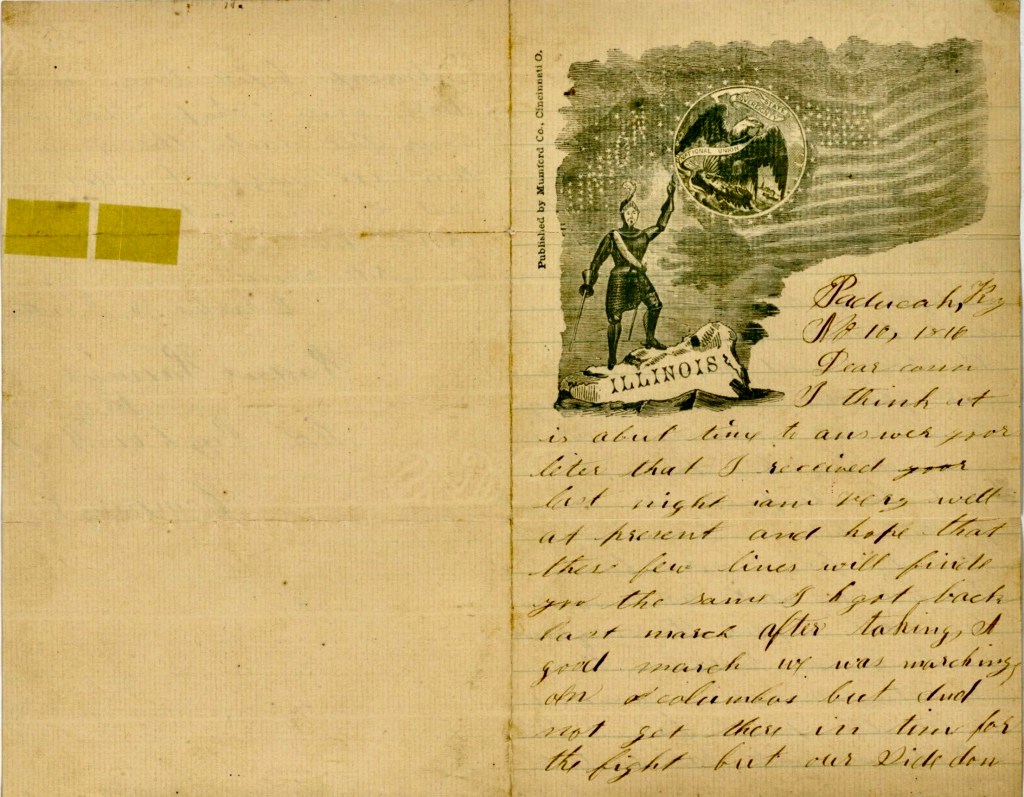
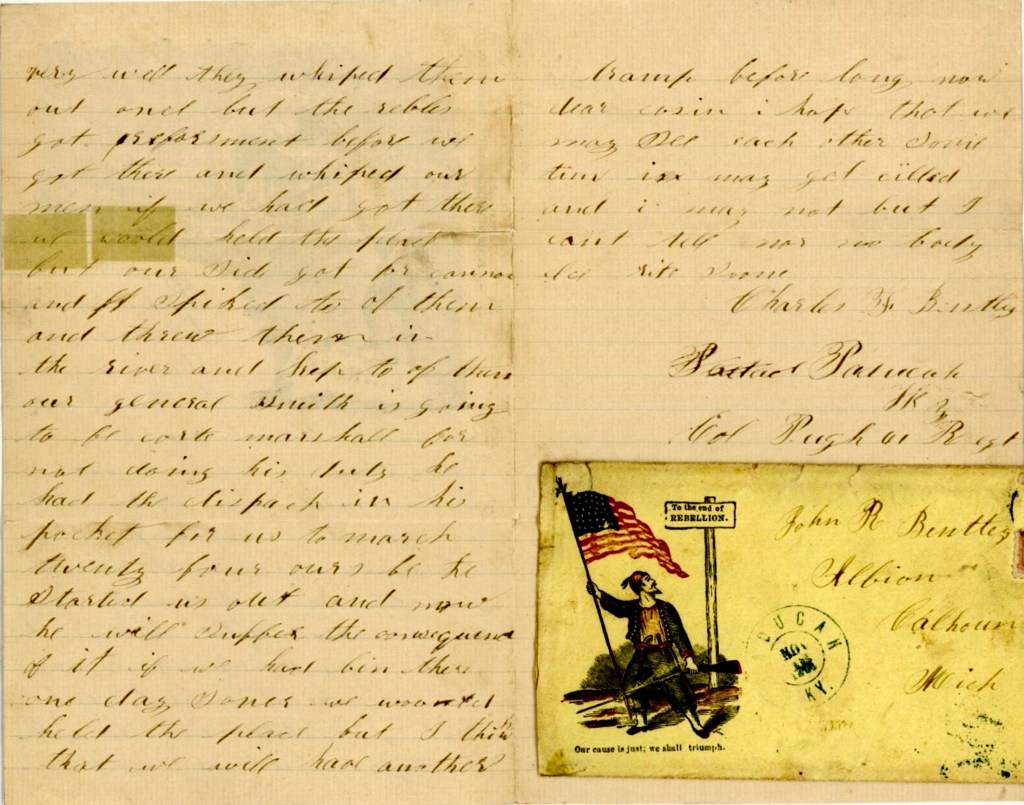

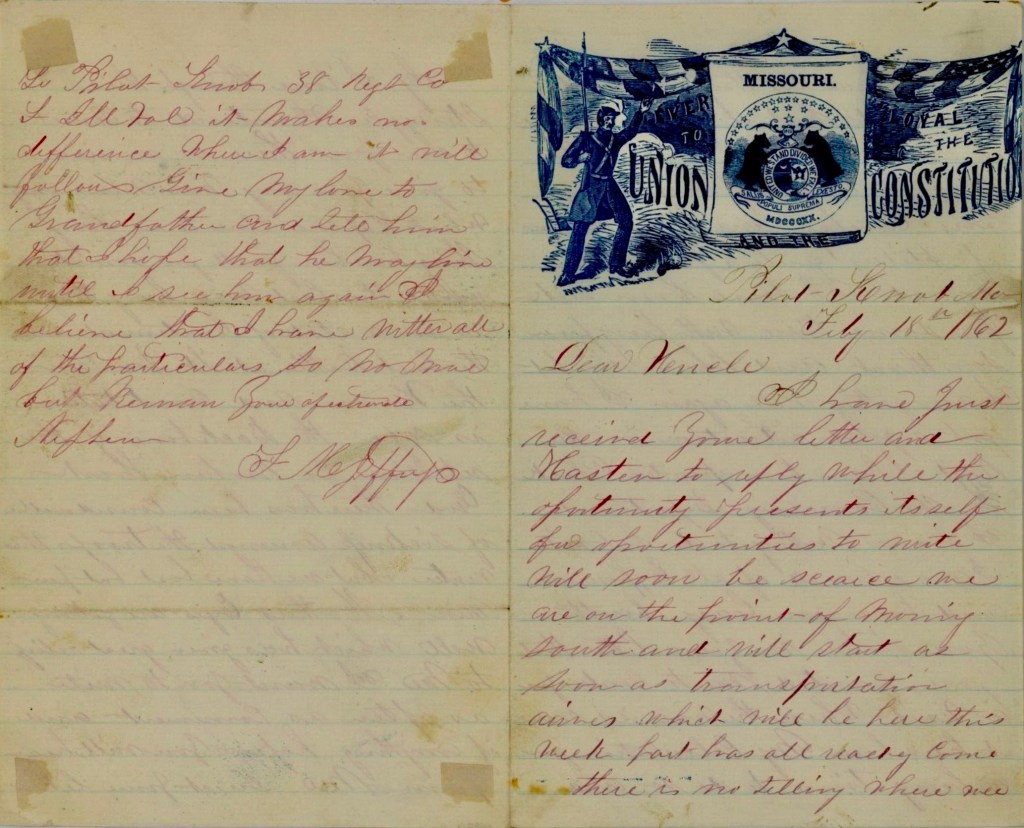
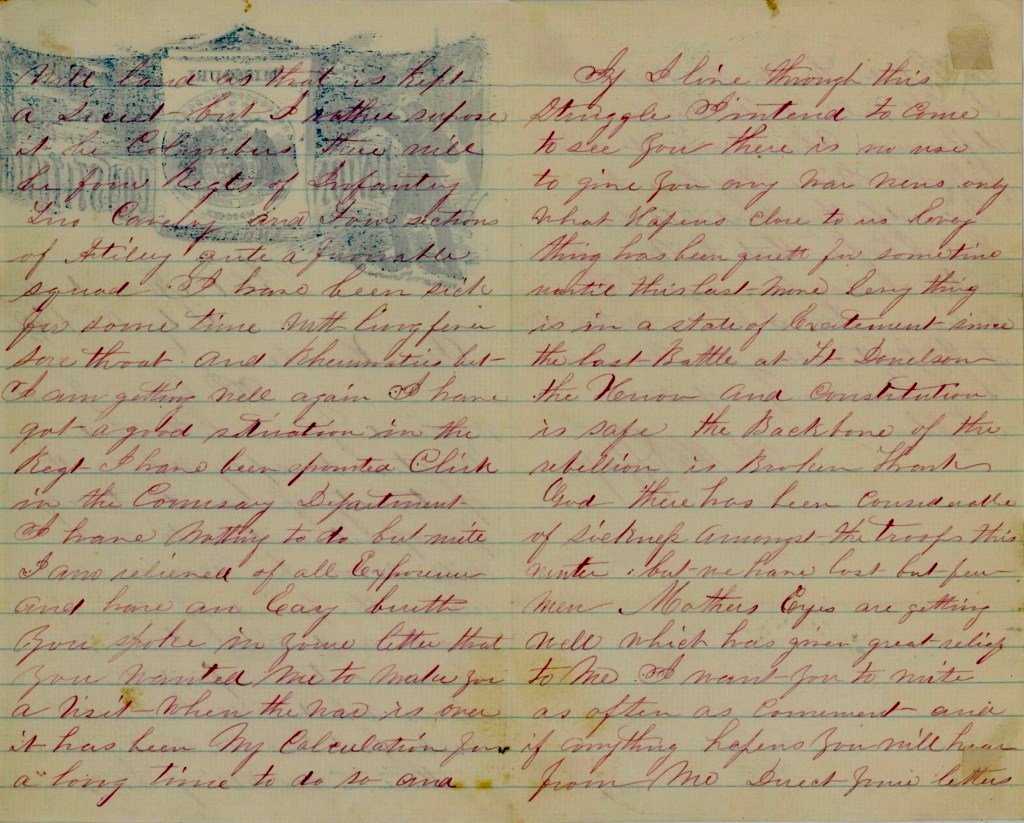
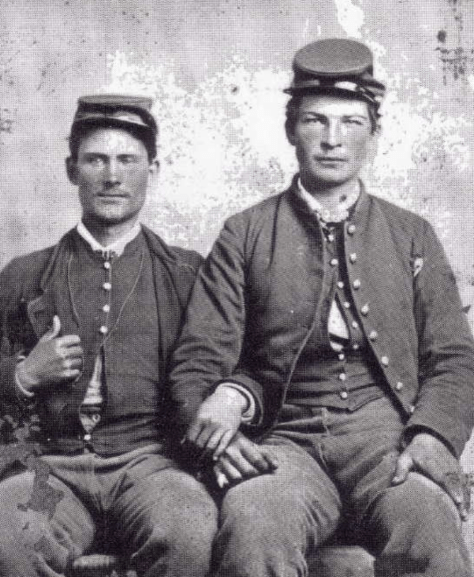
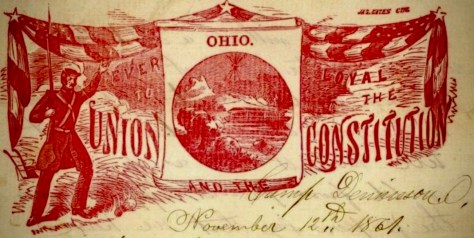
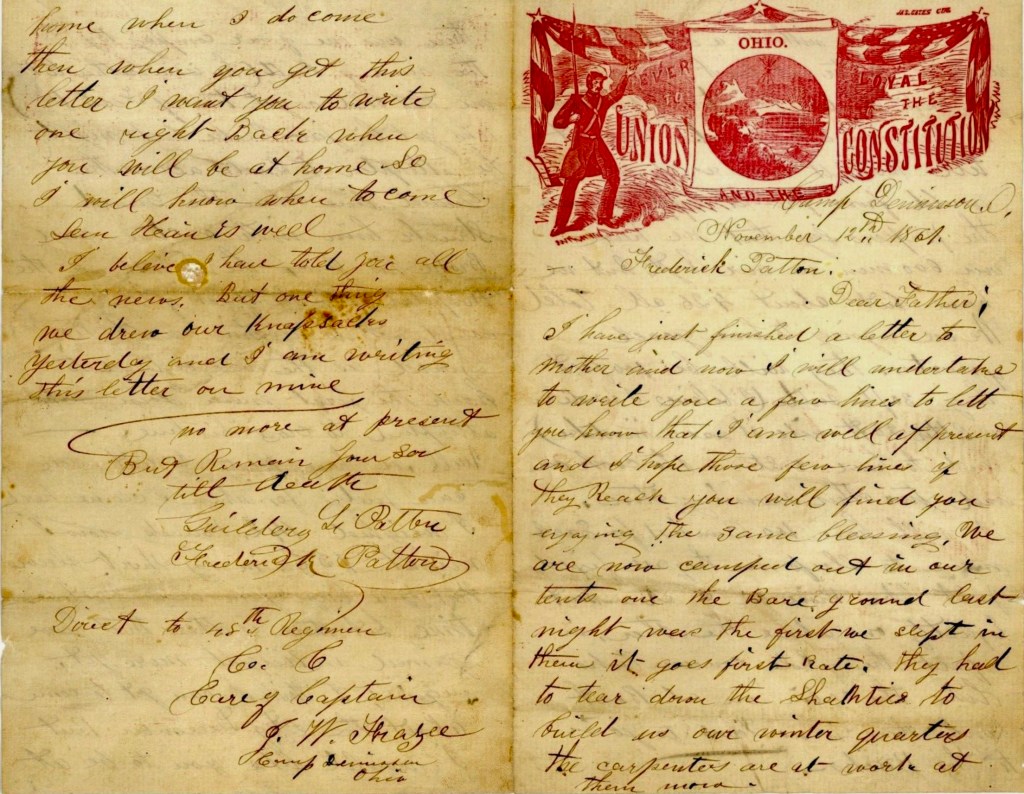


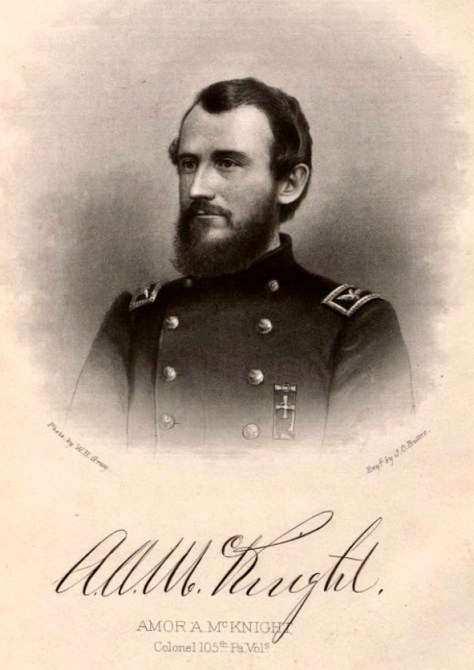
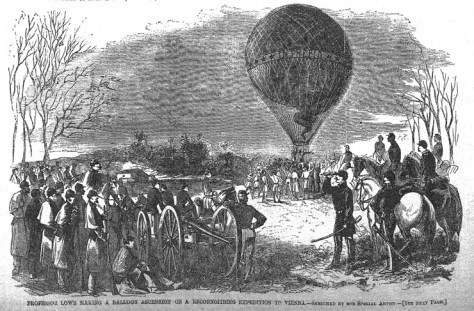
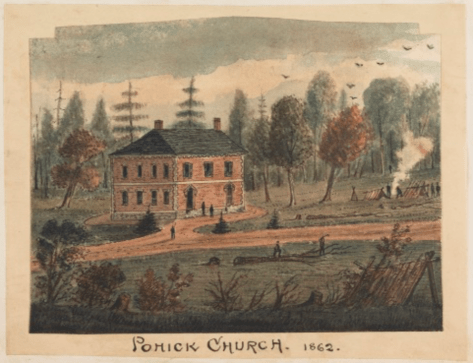
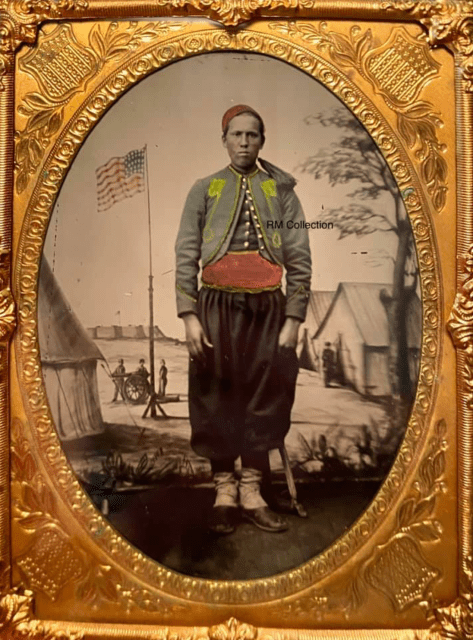
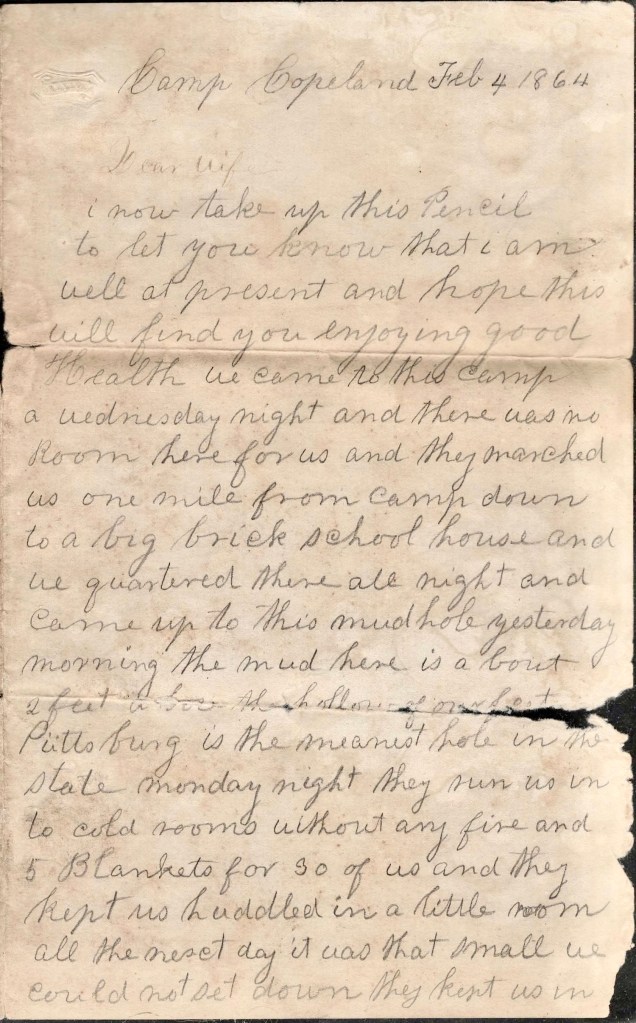
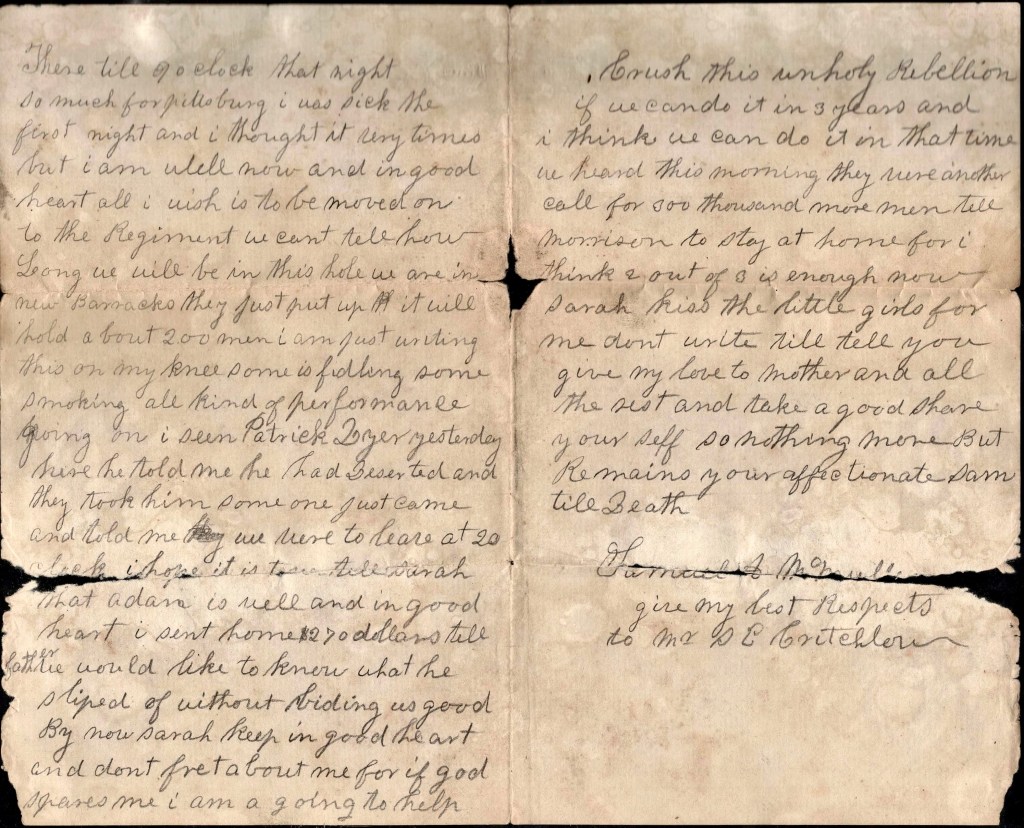
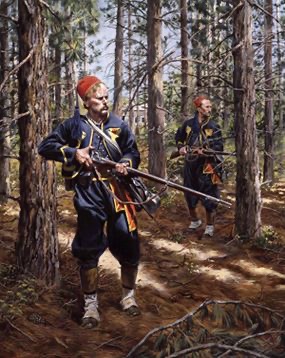

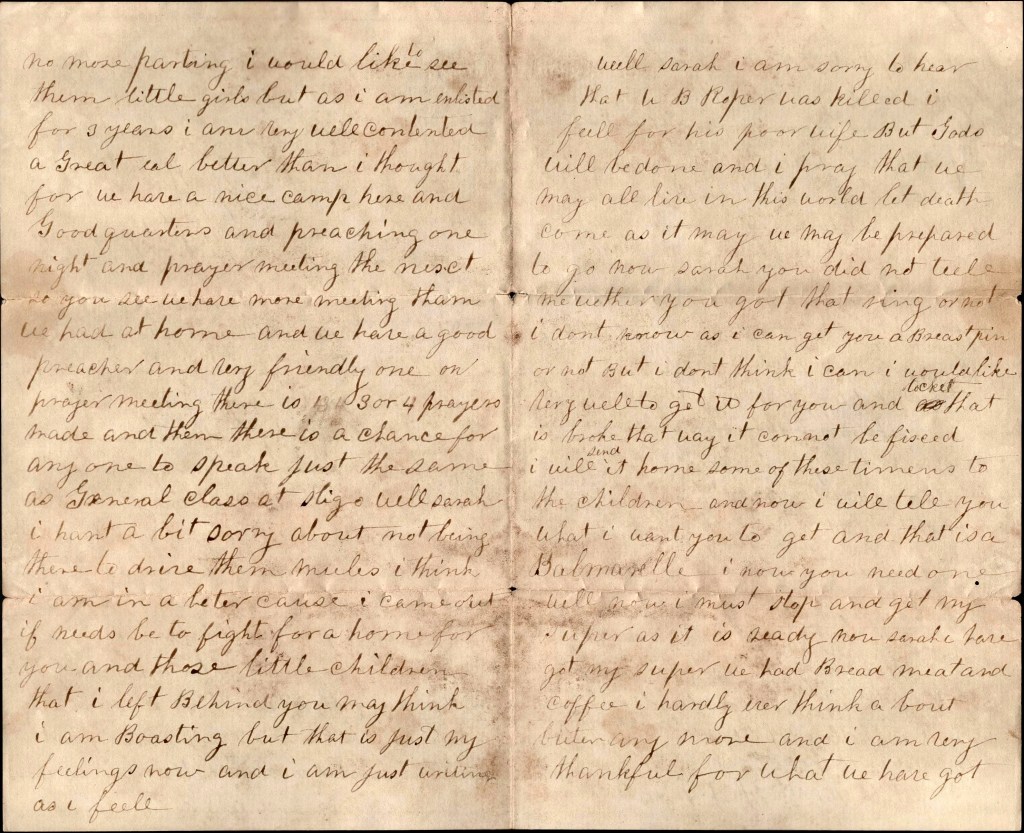
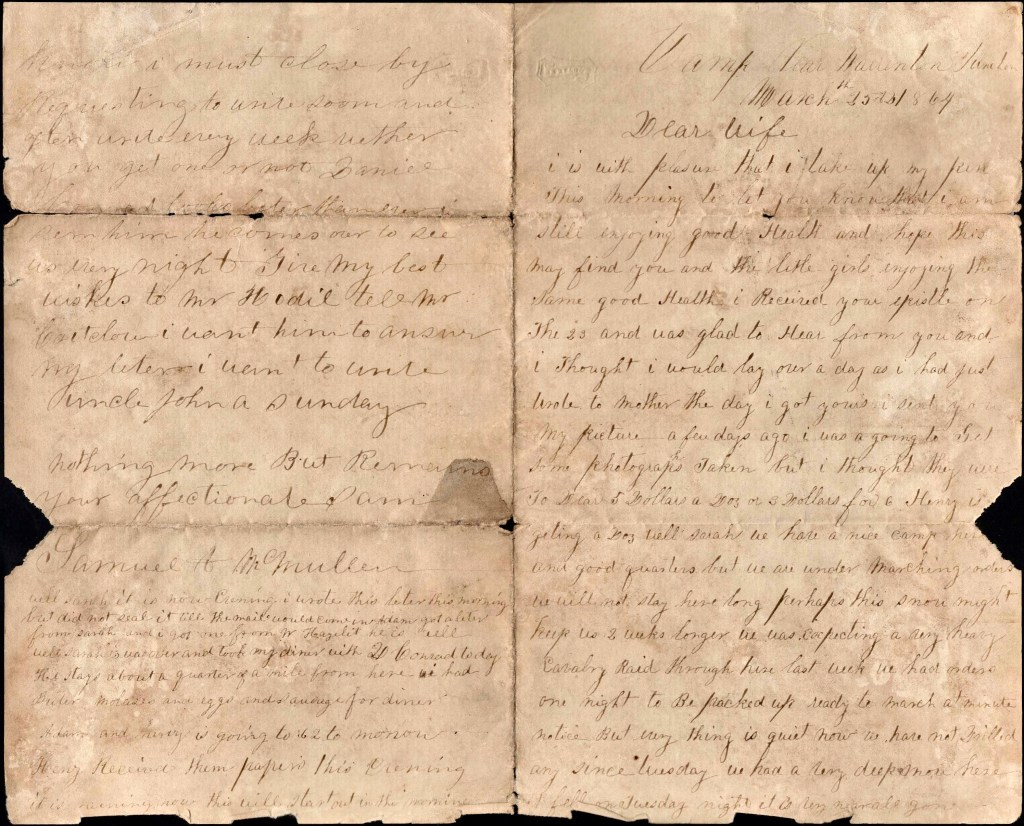
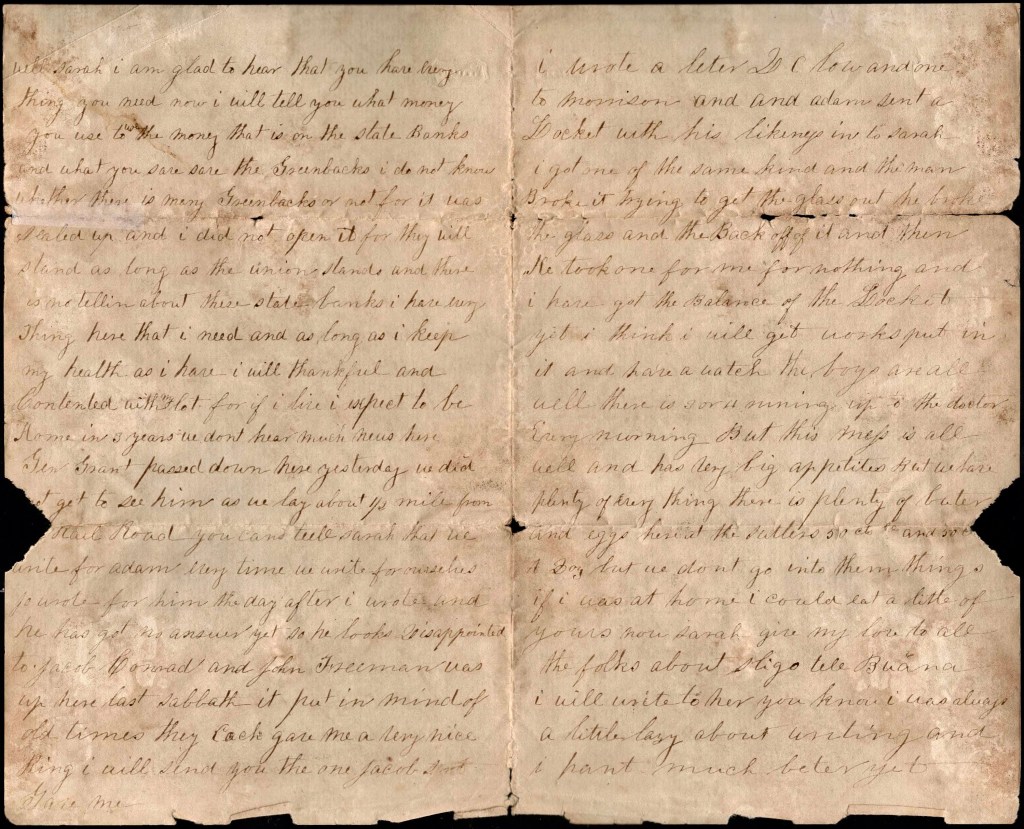
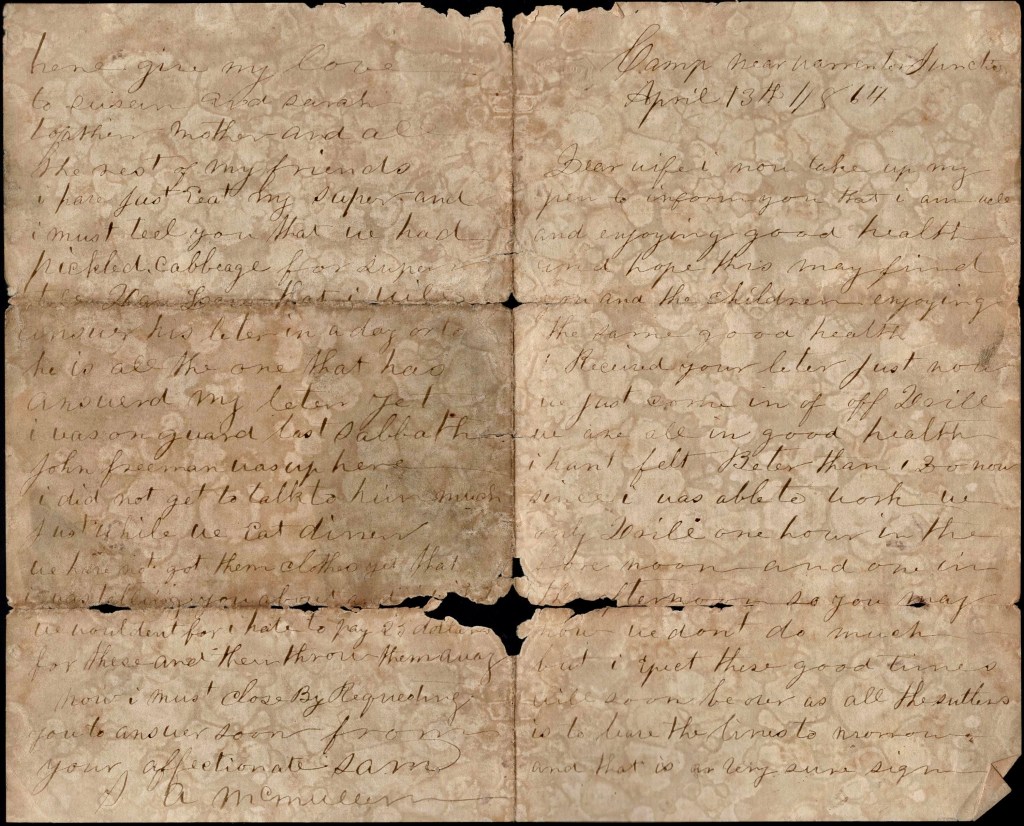

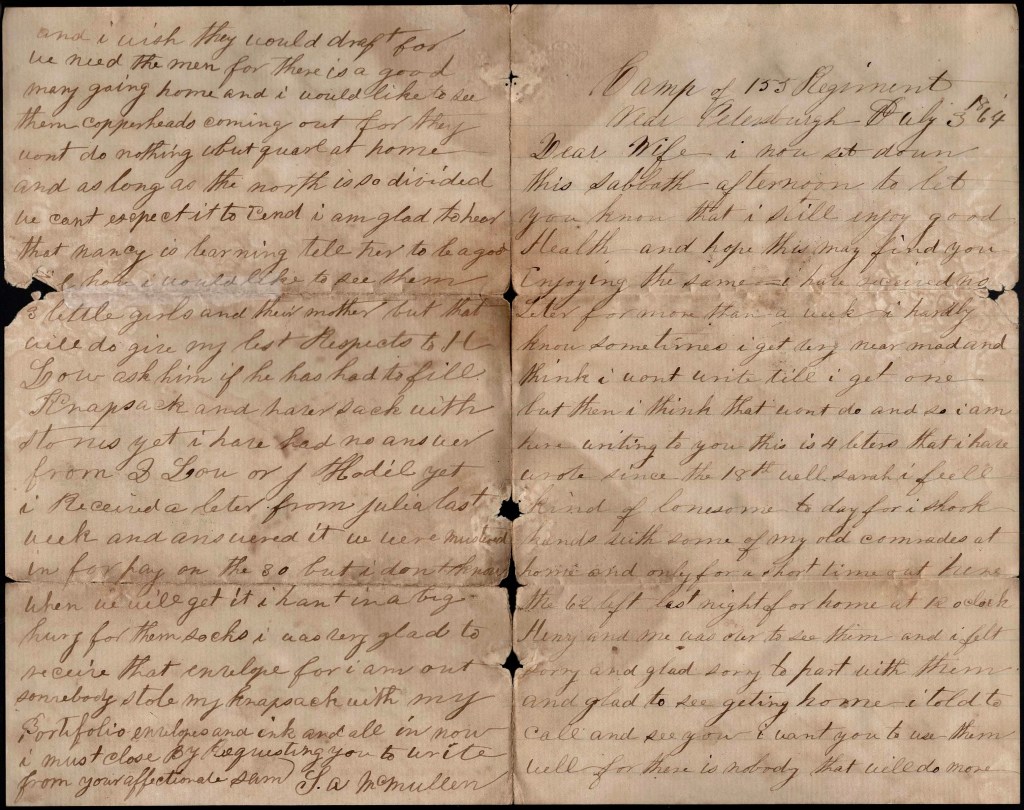

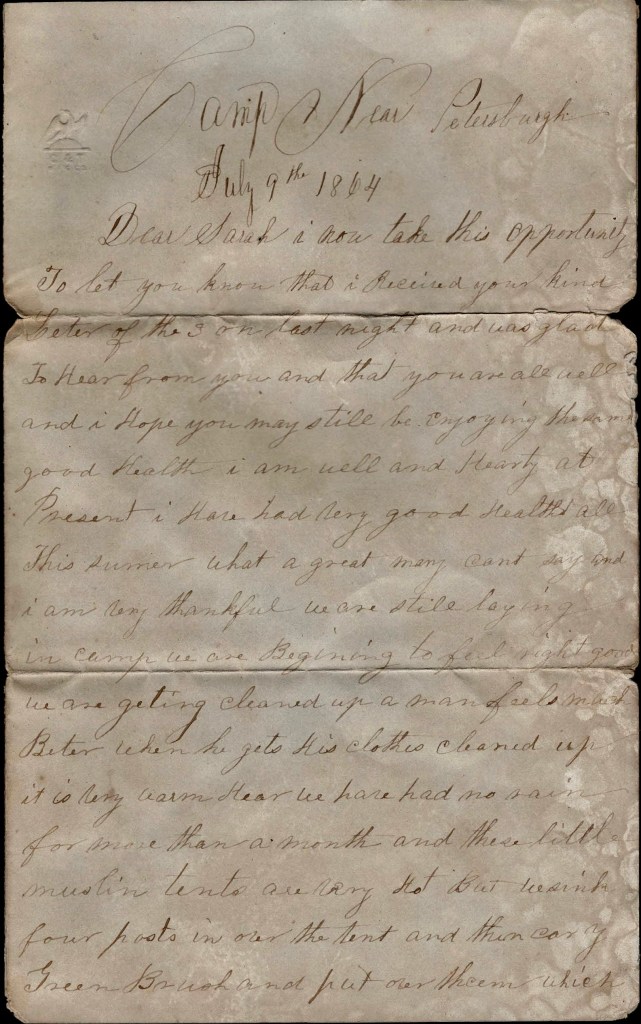

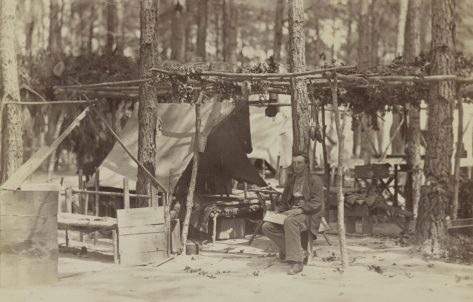
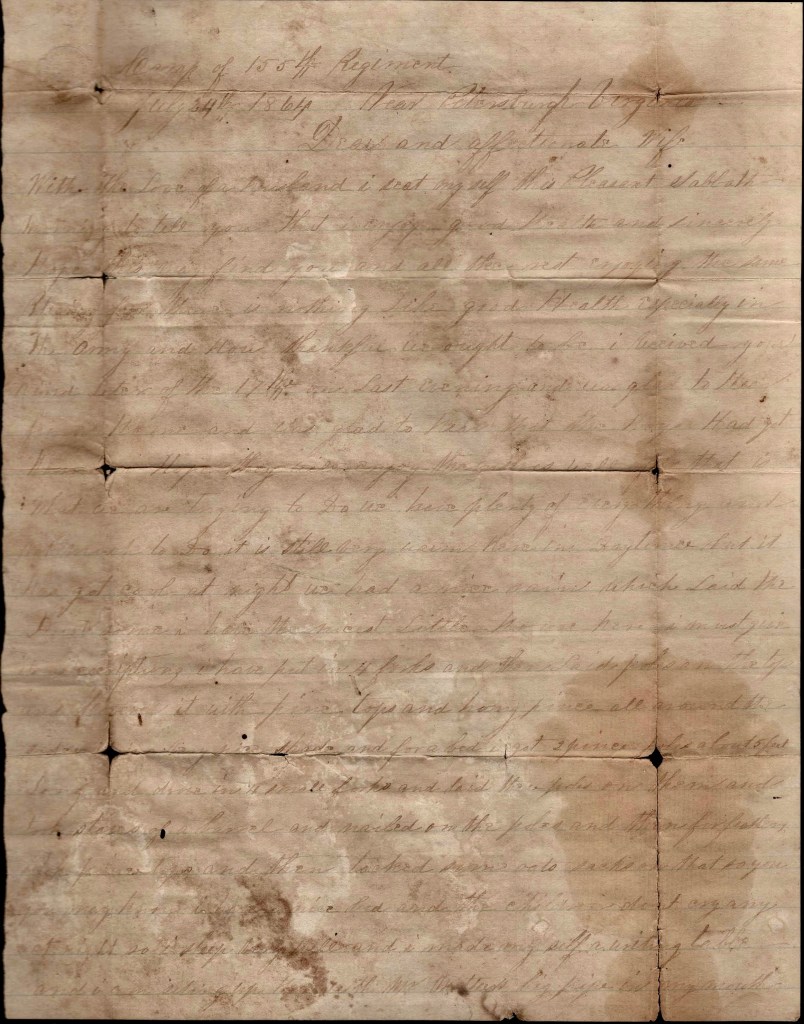
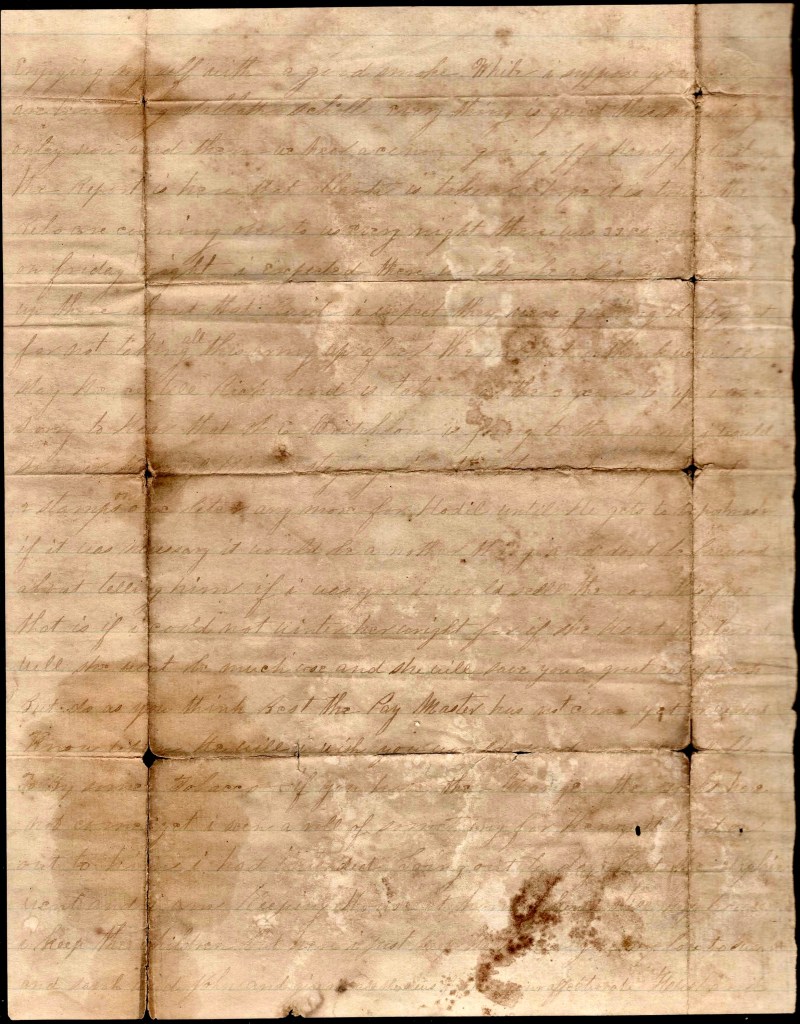


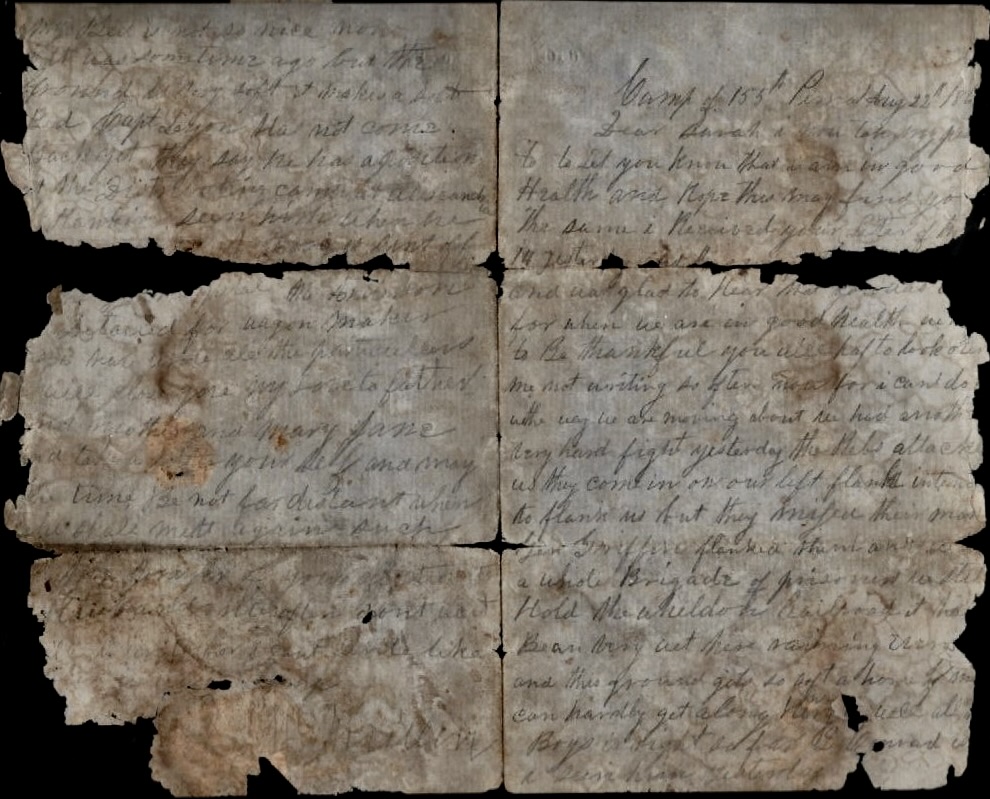


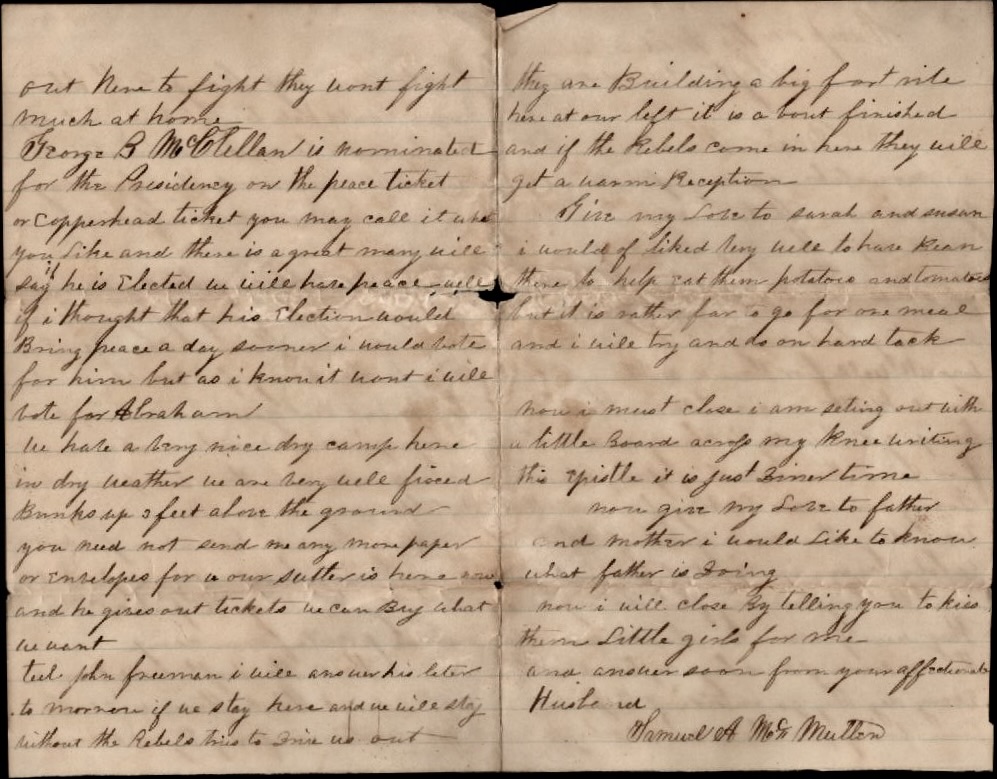







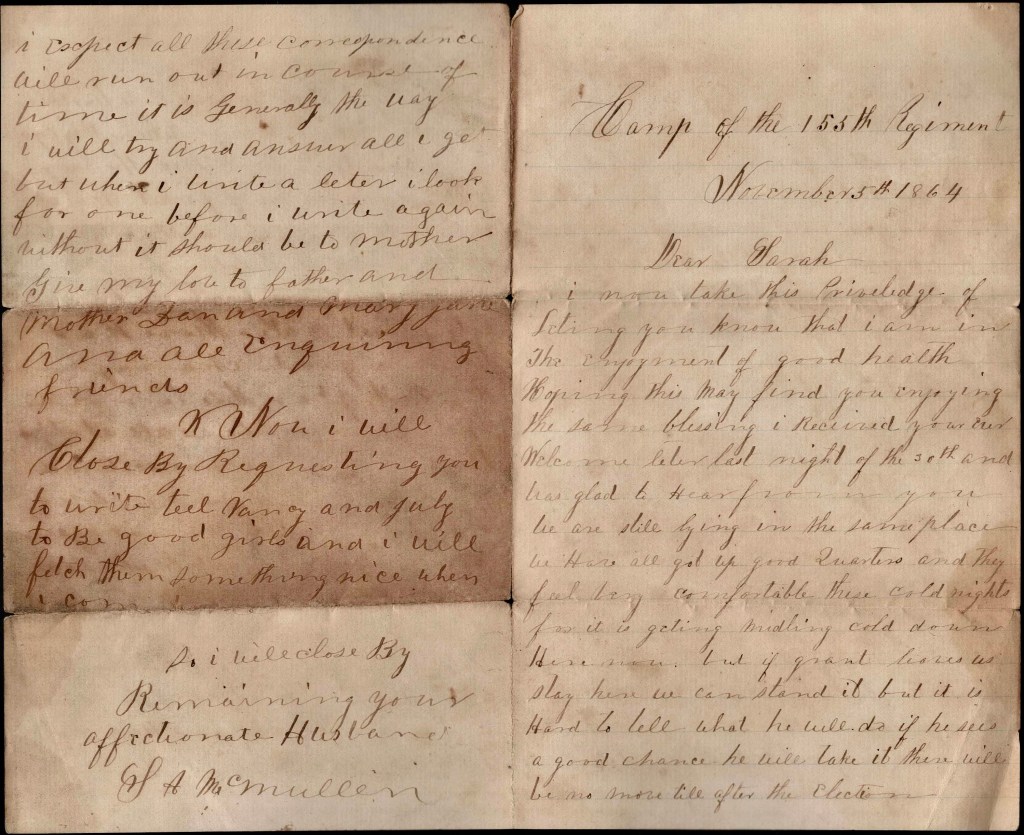
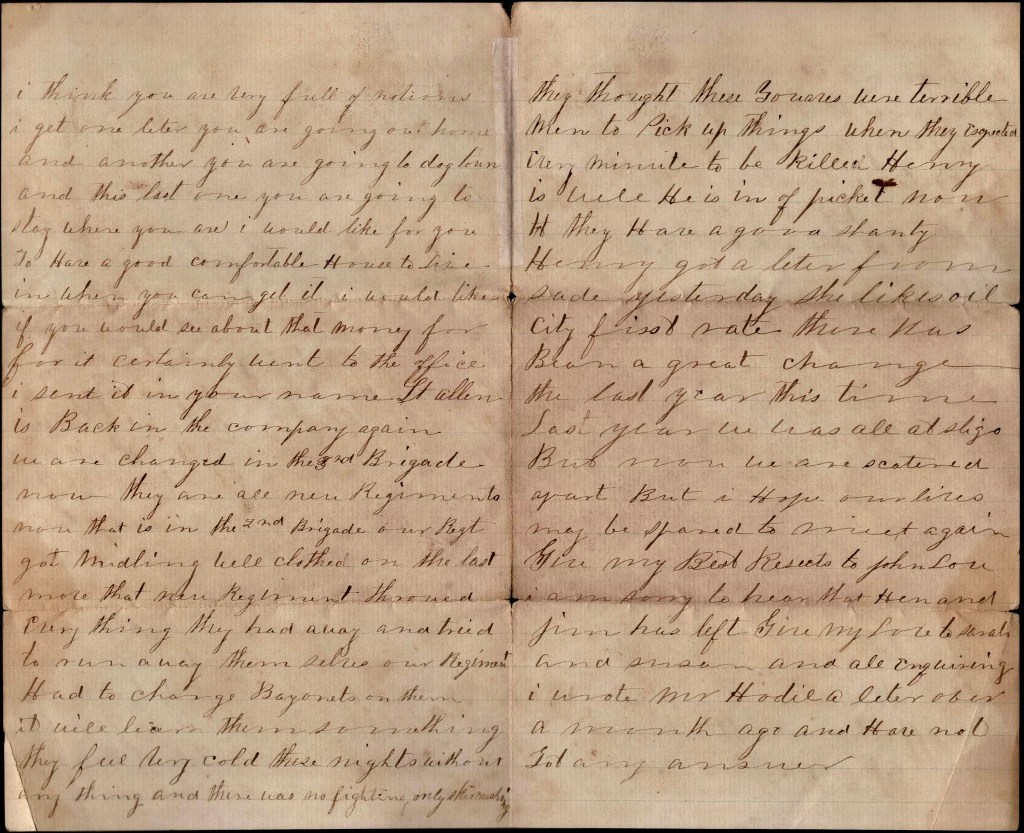
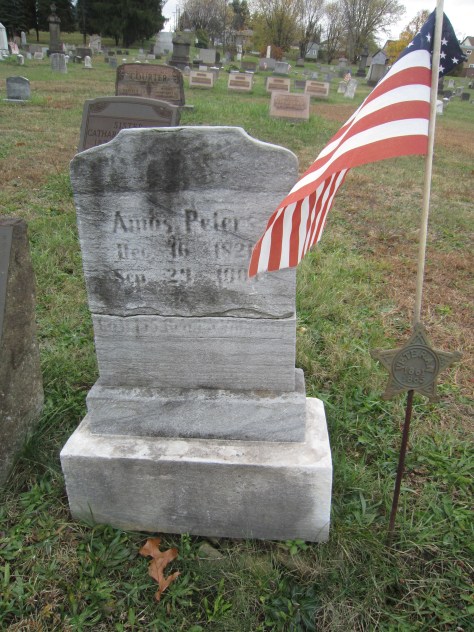
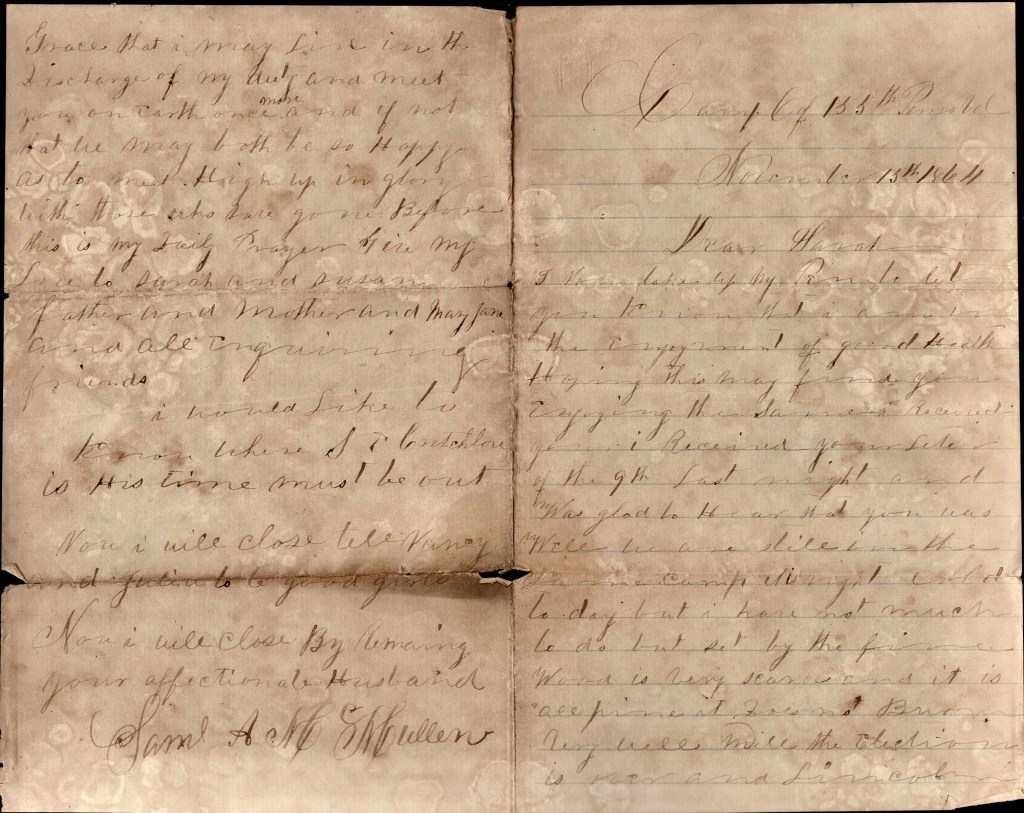
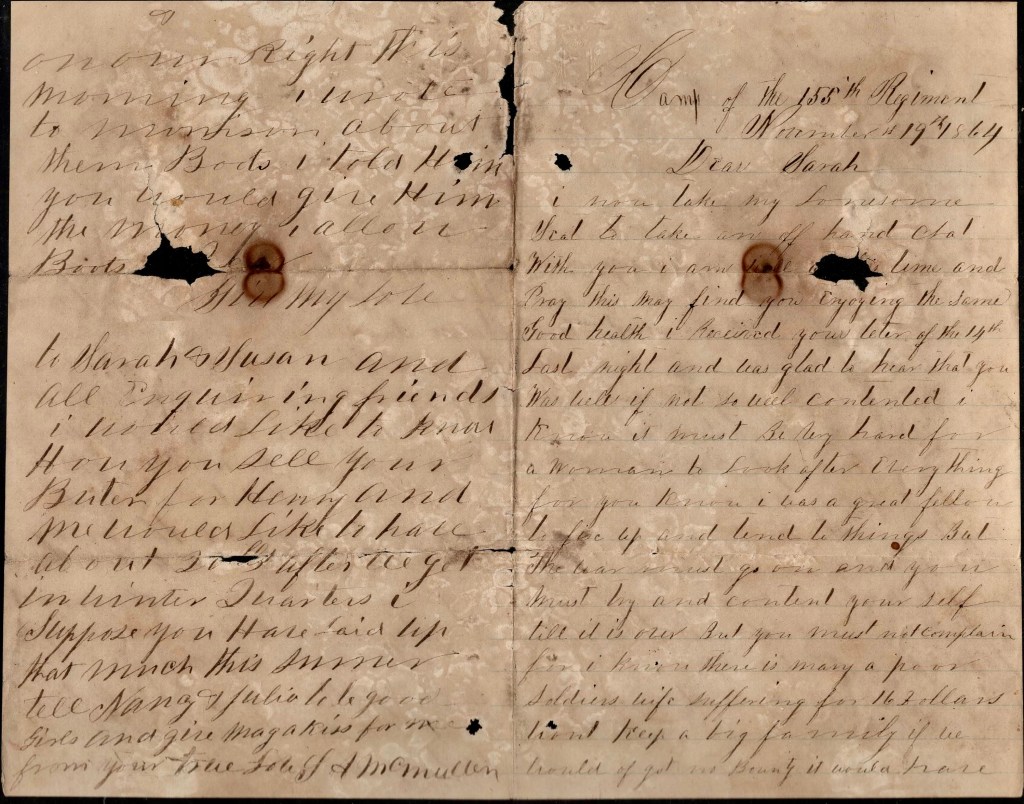

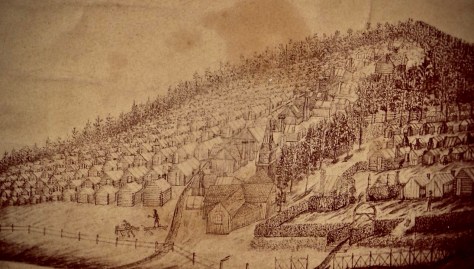

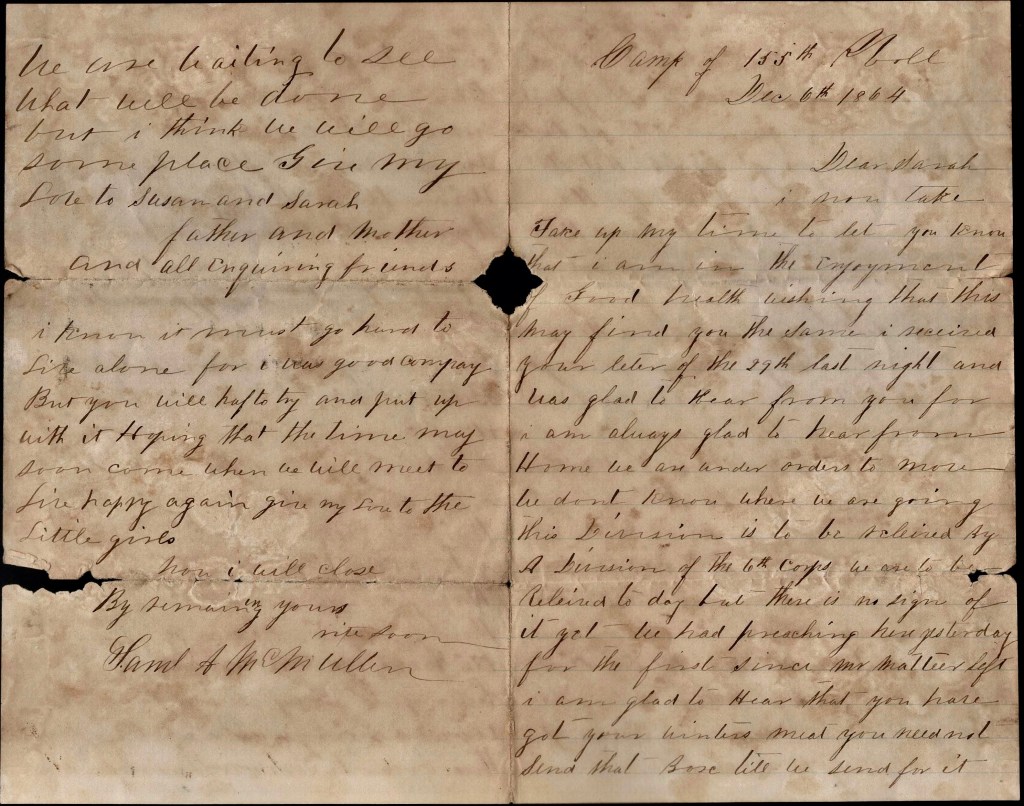

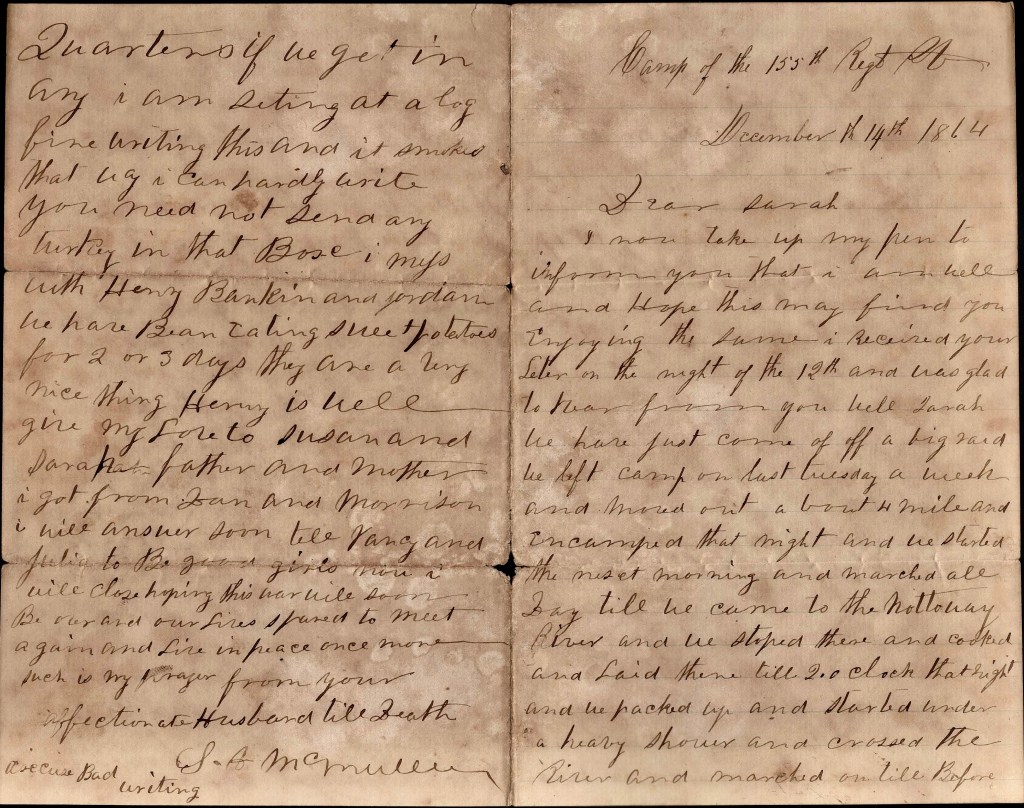
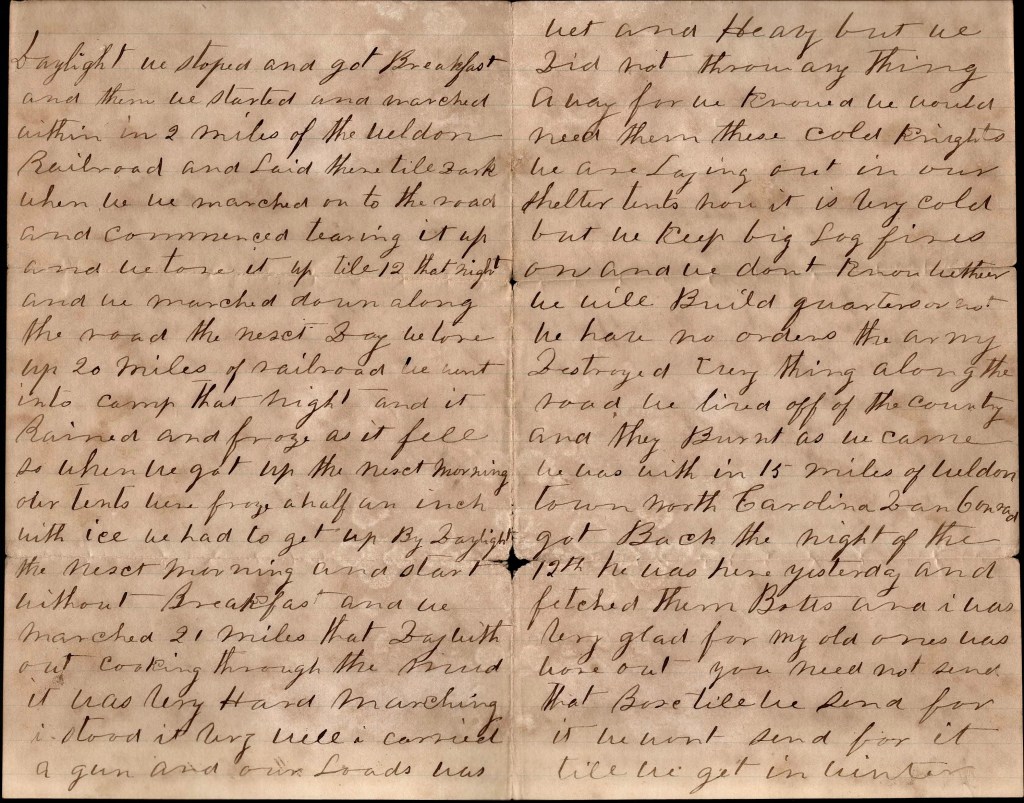
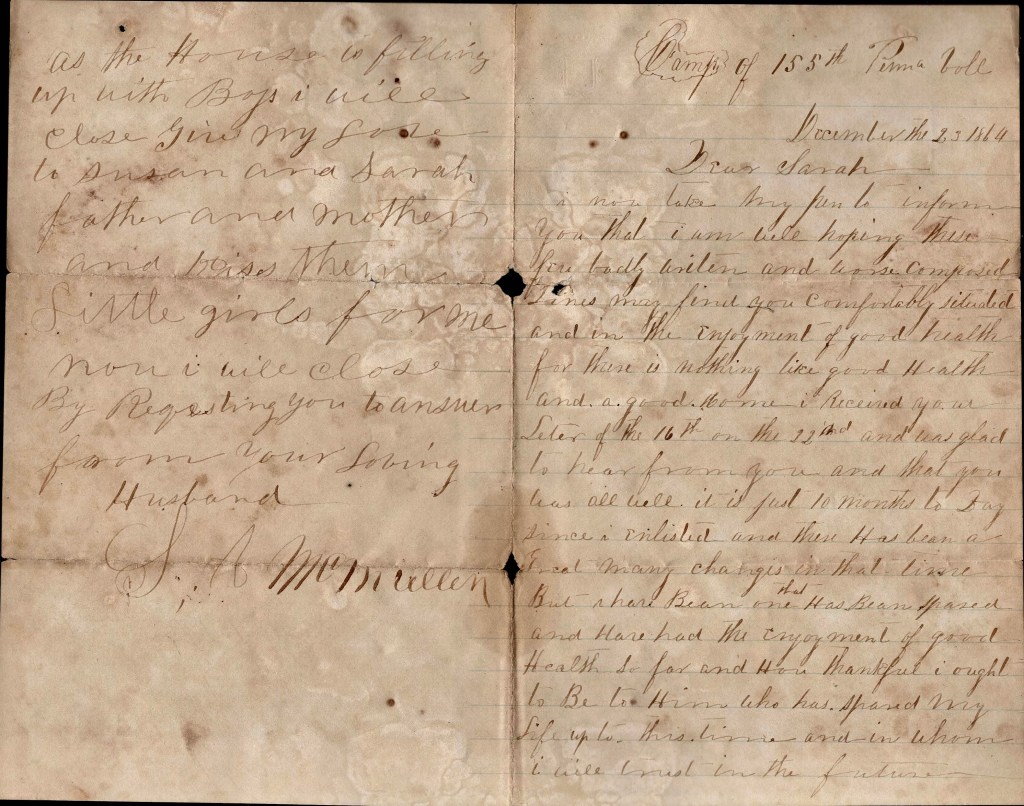





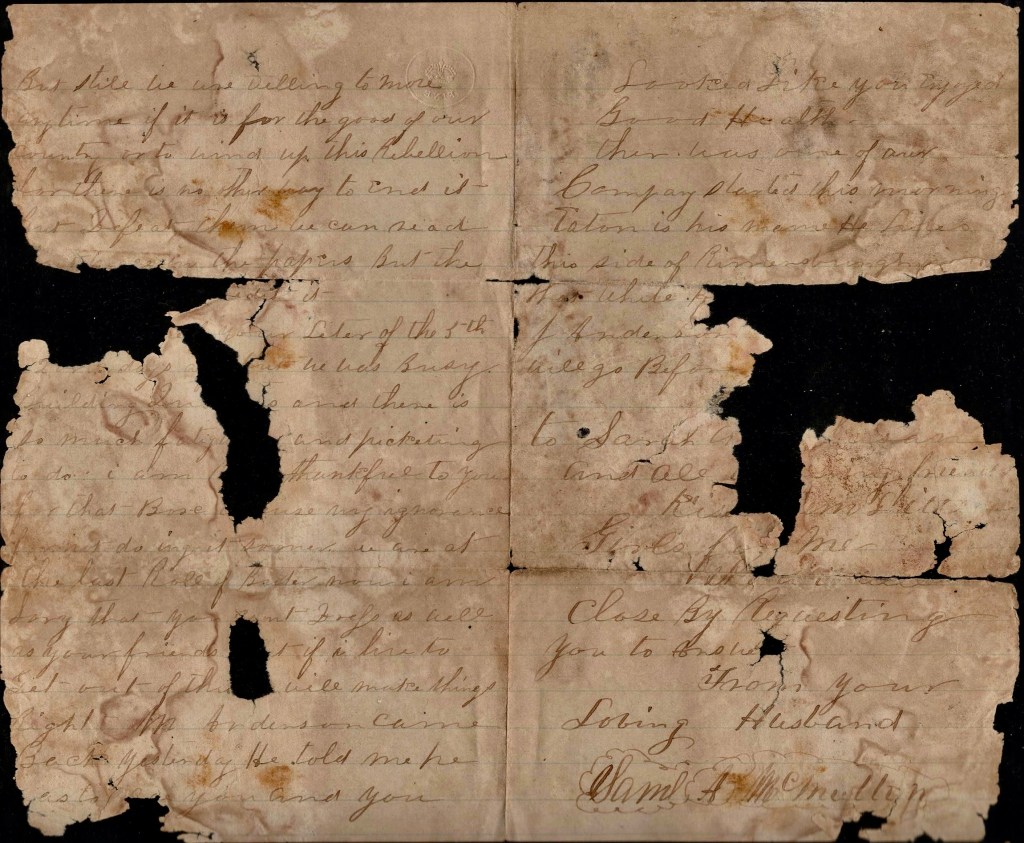


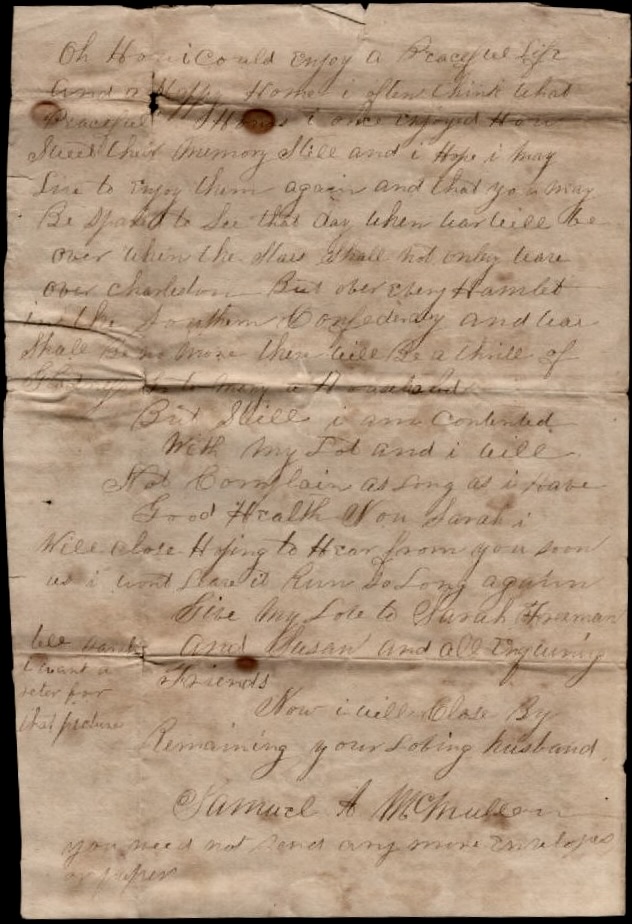


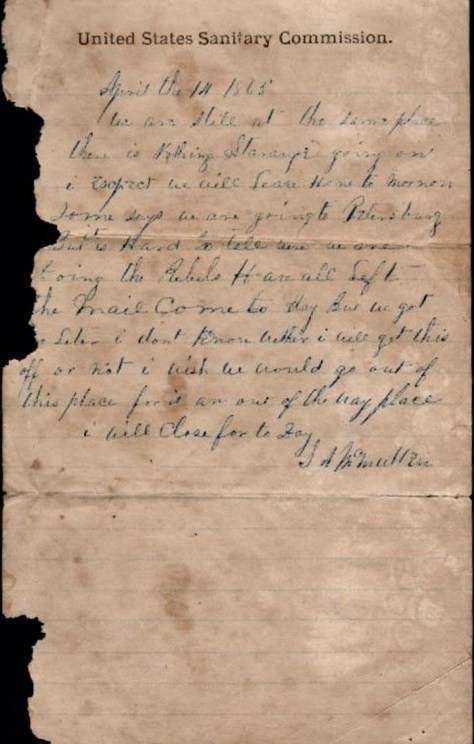
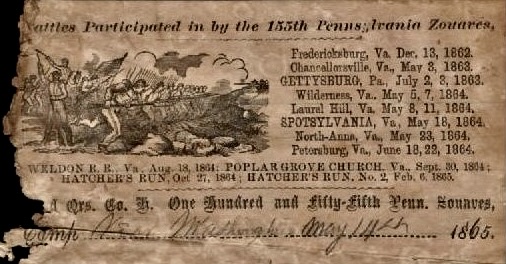


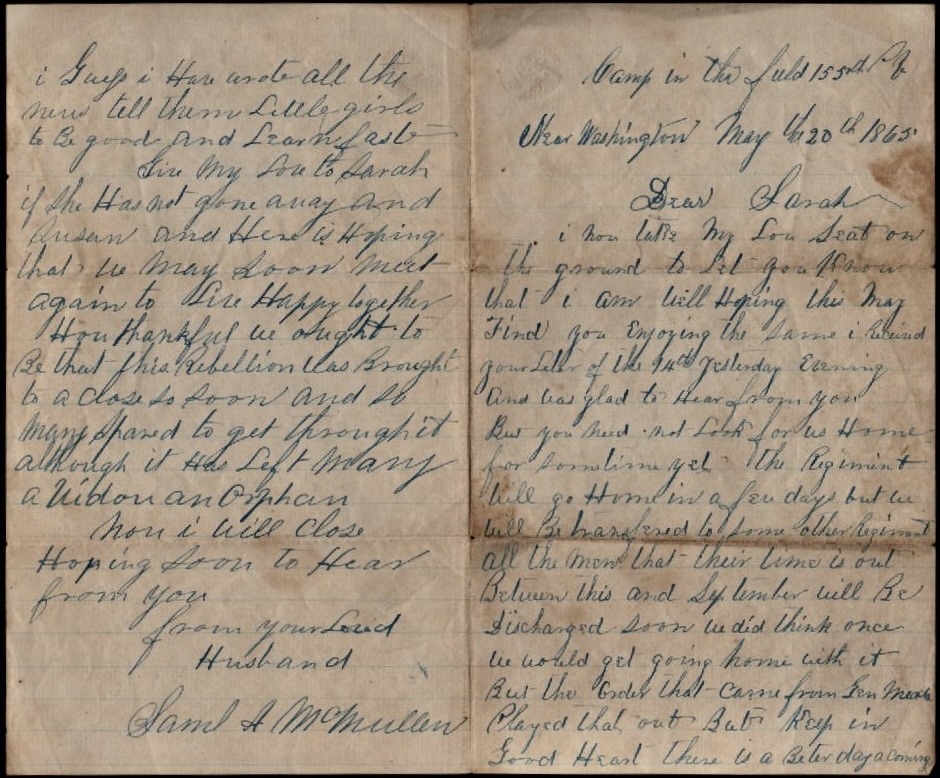
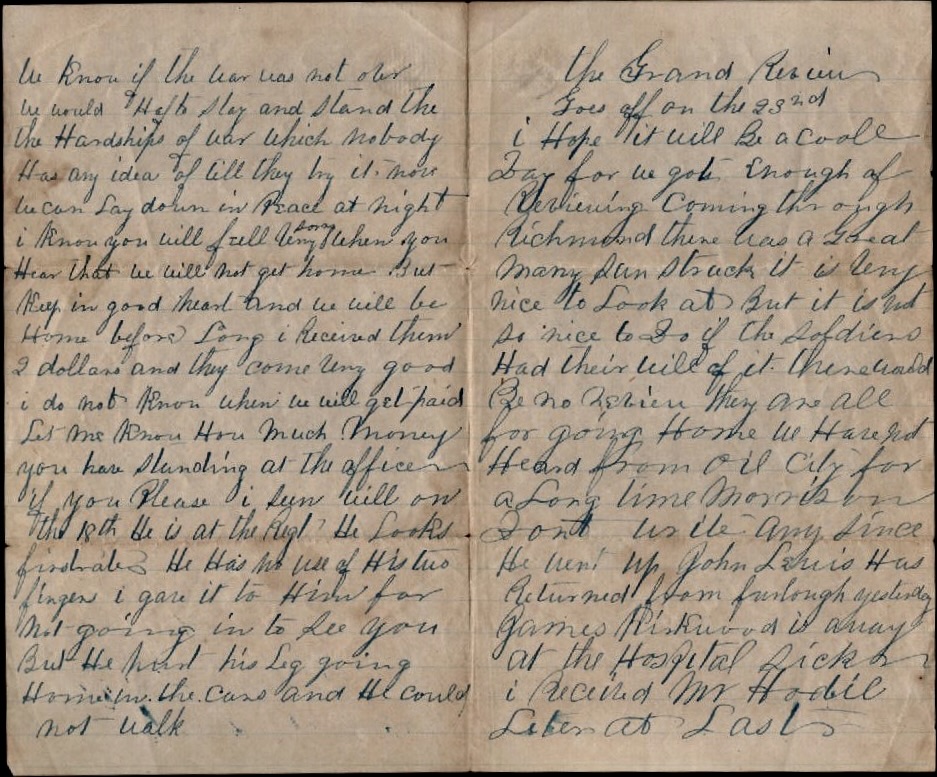
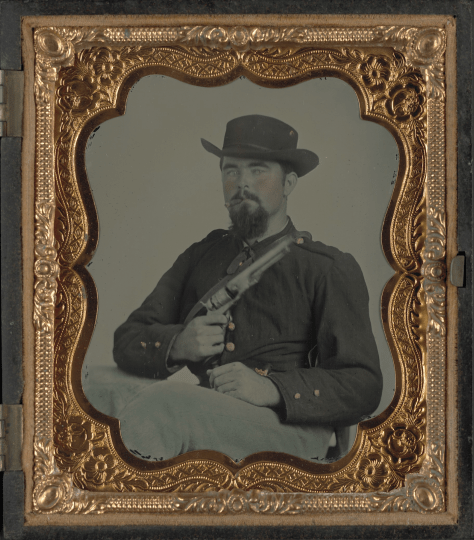






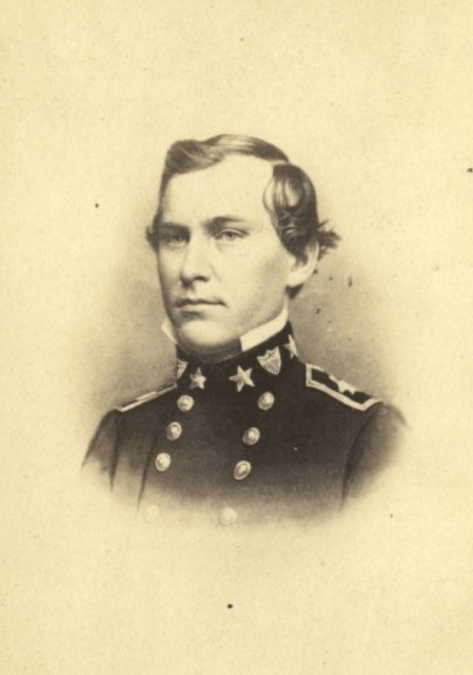

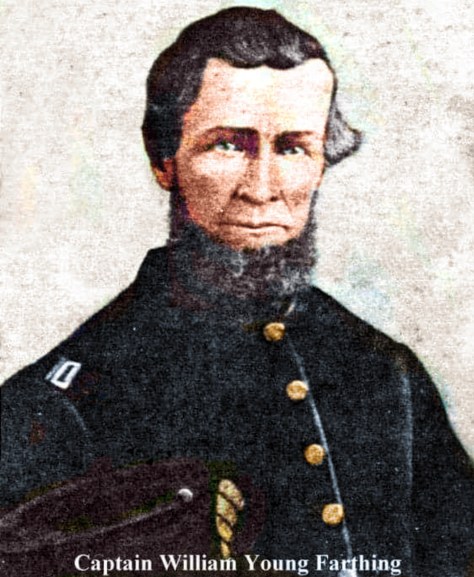
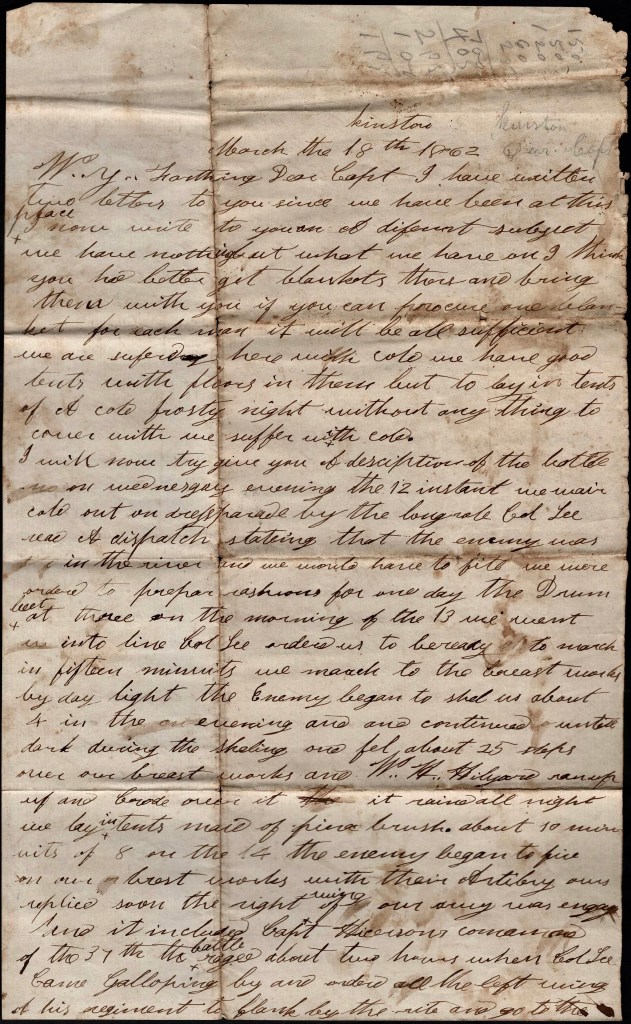

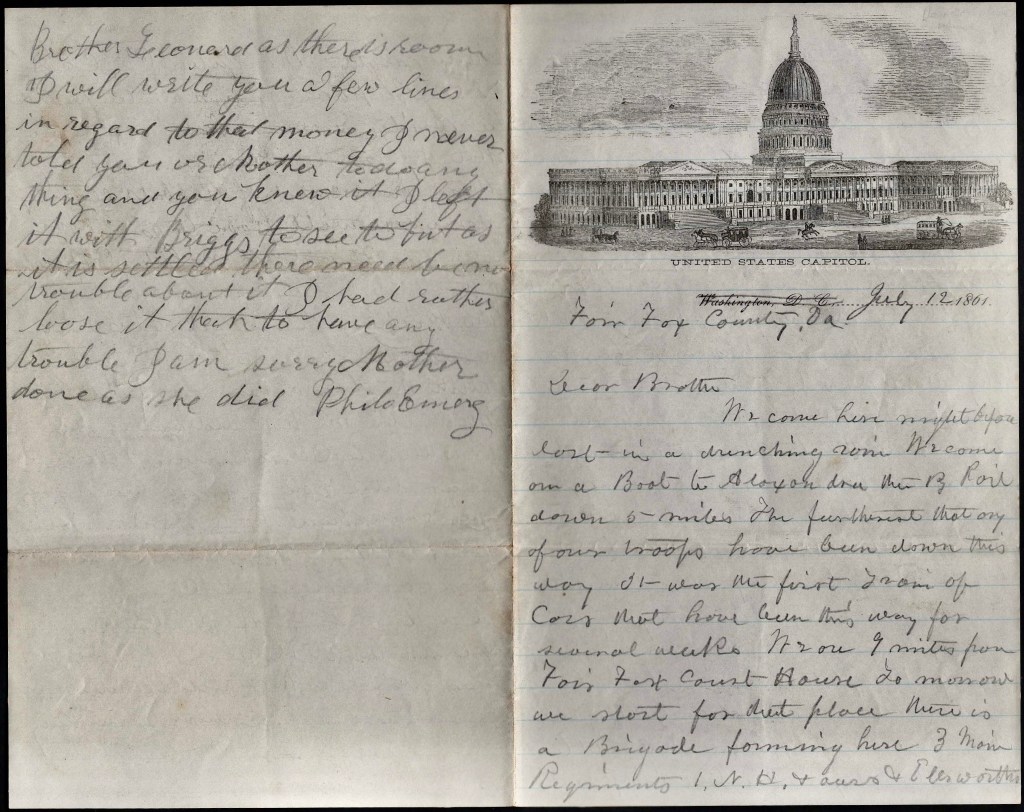
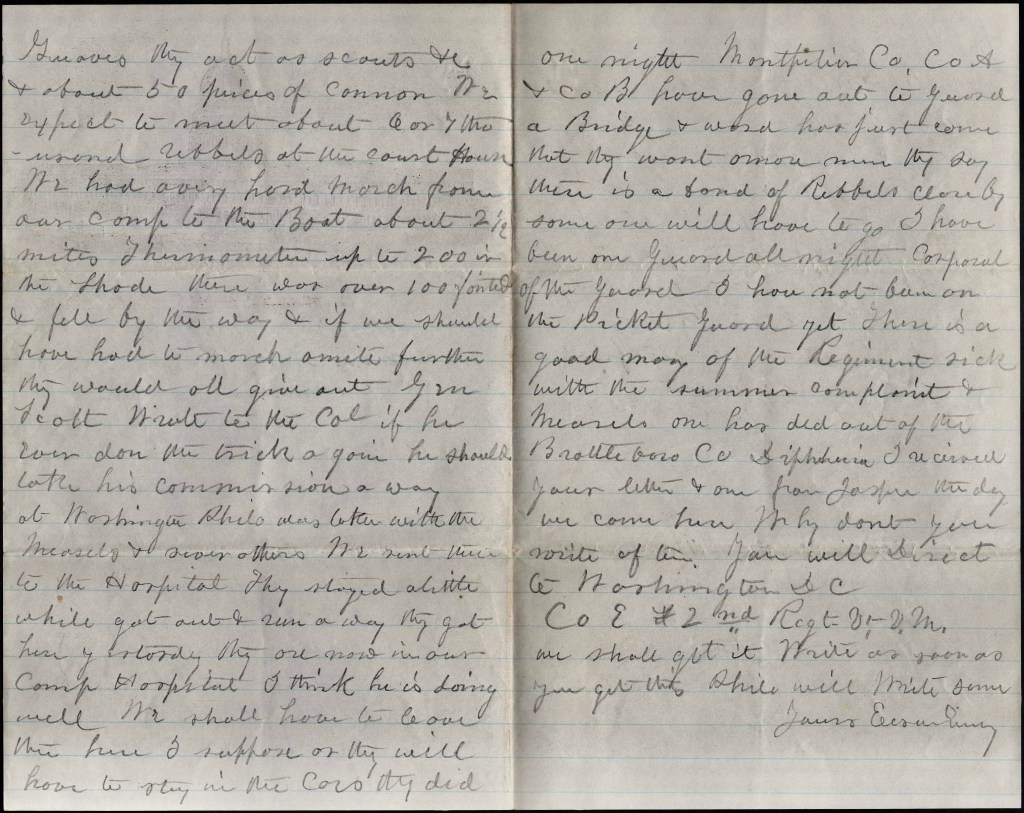


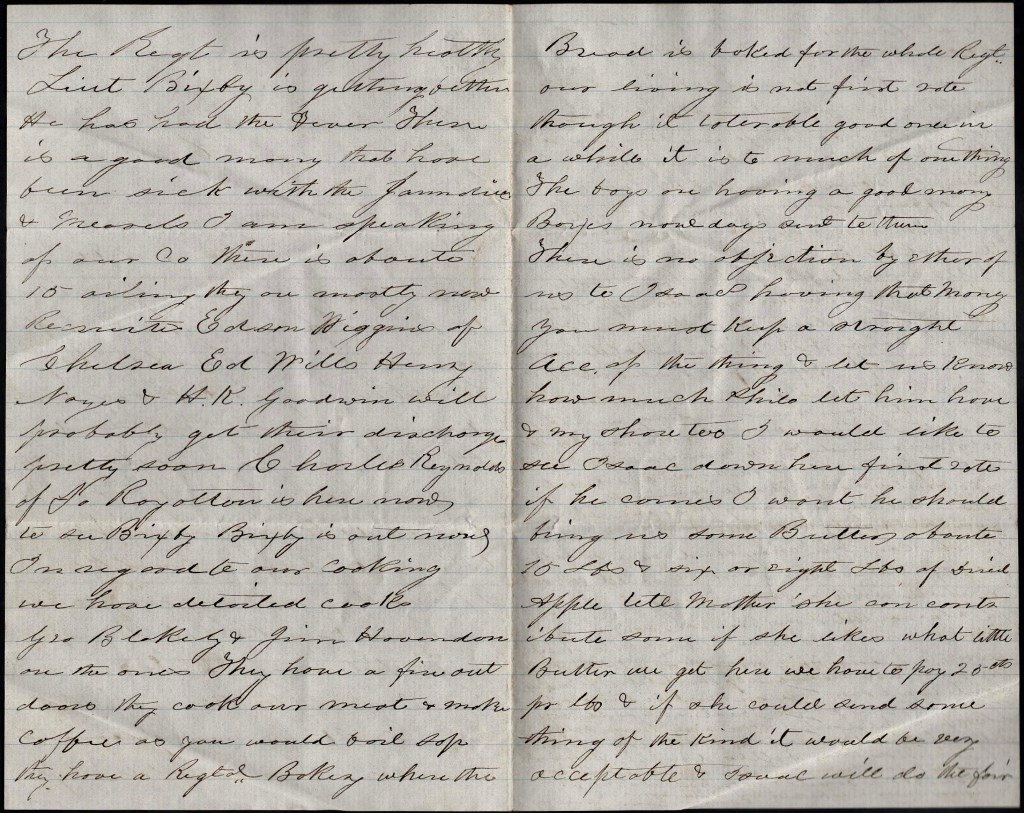


 Spared & Shared 23