1864: William G. Sturges to Mary Ann Stevens

I could not find an image of William but here is Henry C. Lockwood who served in Co. C, 75th OVI (Photo Sleuth)

This letter was written by William G. Sturges (1845-1878), the son of William Sturges (1818-1899) and Susan Ann Ludlow (1822-1861) of Lockland, Hamilton county, Ohio. He wrote the letter to Mary Ann Stevens (1844-1924) with whom he would marry in December 1865.

William enlisted in Co. A, 75th Ohio Volunteer Infantry (OVI) on 23 September 1861 at the age of just 16. He committed to a three-year term of service and was originally scheduled to be discharged in September 1864; however, he was captured on 17 August 1864 during the Battle of Gainesville, Florida, and was not mustered out until 25 May 1865 in Columbus, Ohio. Mary Ann’s brother, James Stevens, who served alongside William in the same company—referred to by William as “my brother too, now”—tragically did not survive the war, having been killed in the same battle on 17 August 1864. Another of her brothers, Albert Stewart, also served in the same company and chose to reenlist, ultimately surviving the conflict while serving in Co. K.

Transcription

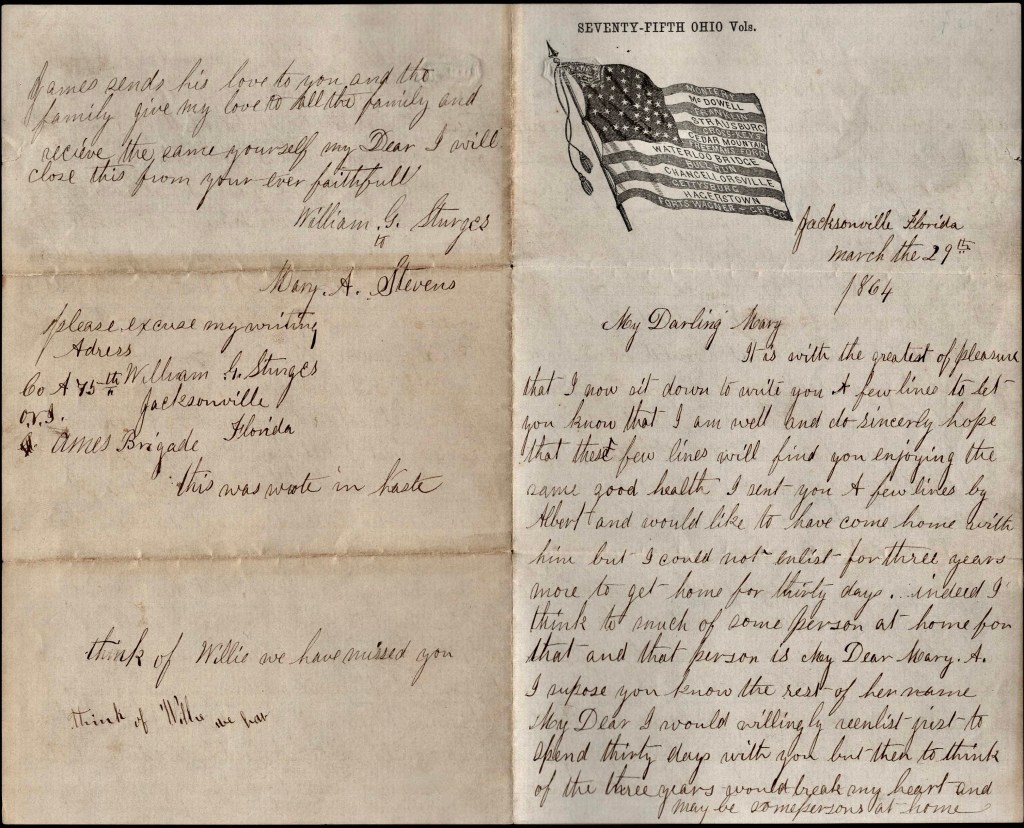
Jacksonville, Florida
March 29th 1864

My darling Mary,

It is with te greatest of pleasure that I now sit down to write you a few lines to let you know that I am well and do sincerely hope that these few lines will find you enjoying the same good health. I sent you a few lines by Albert and would like to have come home with him but I could not enlist for three years more to get home for thirty days. Indeed, I think too much of some person at home for that and that person is my dear Mary A. I suppose you know the rest of her name. My dear, would willingly reenlist just to spend thirty days with you but then to think of the three years would break my heart and maybe some persons at home.

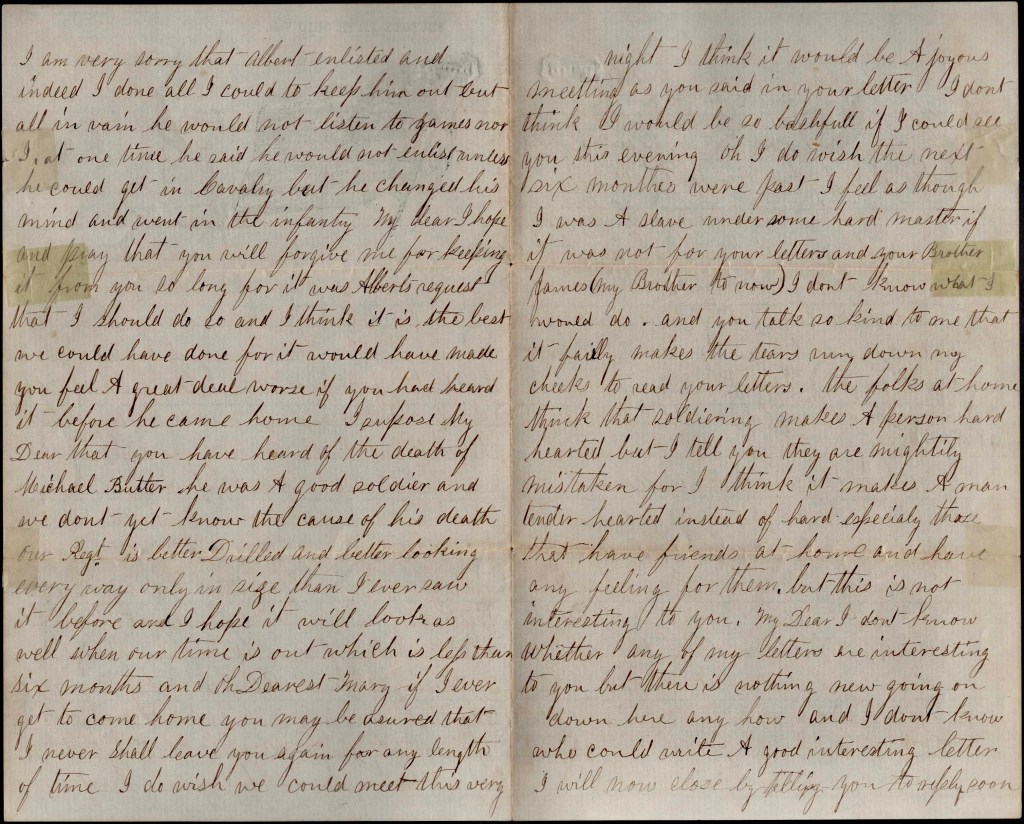
I am very sorry that Albert enlisted and indeed, I done all I could to keep him out but all in vain. He would not listen to James nor I. At one time he said he would not enlist unless he could get in csavalry but he changed his mind and went in the infantry. My dear, I hope and pray that you will forgive me for keeping it from you so long for it was Albert’s request that I should do so and I think it is the best we cold have done for it would have made you feel a great deal worse if you had heard it before he came home. I suppose, my dear, that you have heard of the death of Michael Butler. He was a good soldier and we don’t yet know the cause of his death. 1

Our regiment is better drilled and better looking in every way—only in size—than I ever saw it before and I hope it will look as well when our time is out which is less than six months. And oh, dearest Mary, if I ever get to come home, you may be assured that I never shall leave you again for any length of time. I do wish we could meet this very might. I think it would be a joyous meeting as you said in your letter. I don’t think I would be so bashful if I could see you this evening. Oh, I do wish the next six months were past. I feel as though I was a slave under some hard master. If it was not for your letters and your brother James (my brother too now), I don’t know what I would do. And you talk so kind to me that it fairly makes the tears run down my cheeks to read your letters. The folks at home think that soldiering makes a person hard-hearted, but I tell you, they are mightily mistaken for I think it makes a man tender-hearted instead of hard—especially those that have friends at home and have any feeling for them. But this is not interesting to you.

My dear, I don’t know whether any of my letters are interesting to you but there is nothing new going on down here anyhow and I don’t know who could write a good interesting letter. I will now close by telling you to reply soon. James sends his love to you and the family. Give my love to all the family and receive the same yourself, my dear. I will close this from your ever faithful, — William G. Sturges

To Mary A. Stevens

Please excuse my writing. Address William G. Sturges, Co. A, 75th OVI, Ames Brigade, Jacksonville, Florida

This was wrote in haste. Think of Willie. We have missed you.


1 Michael Butler died on 18 March 1864 in camp. His cause of death was not stated in the regimental roster.
1863: James Milton Alden to Alonzo Hall Quint

Charles H. Bickford (1841-1863) was 22 years old when he was killed at the Battle of Chancellorsville on 3 May 1863 while serving in Co. B, 2nd Massachusetts Infantry. Charles was the son of Josiah Bickford (1821-1866) and Sylvia Jane Gleason (1821-Bef1860). As noted in the letter, Charles and his sister Georgianna Bickford (1852-1931) were living with their uncle, James Milton Alden (1808-1896), the husband of Anna Bickford (1810-1890), in Boston’s 1st Ward at the time of the 1860 US Census. Georgianna would later marry Cassius C. Hunt (1844-1914) in 1873.

James Alden wrote the letter to the chaplain of the 2nd Massachusetts Infantry, Rev. Alonzo Hall Quint, seeking particulars on Charles’ death at Chancellorsville and where he might be buried.

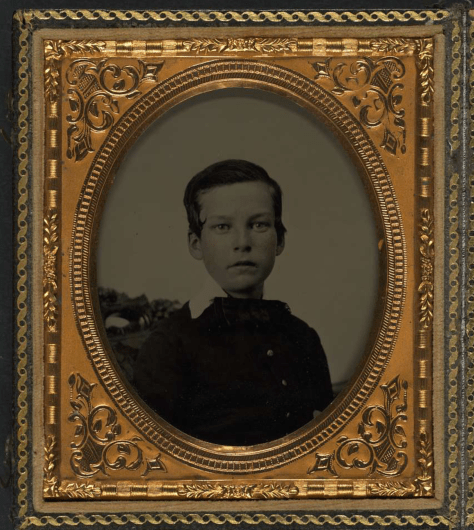
I could not find an image of Charles H. Bickford in uniform but here is one of him when he was a young man. The picture was possessed by his sister Georgianna and is now in the Library of Congress.

Transcription

Rev. A. H. Quint, Chaplain, 2nd Mass. Regt., Stafford Court House, via Washington D. C.

Boston [Massachusetts]
May 19, 1863

Rev. A. H. Quint
Dear sir,

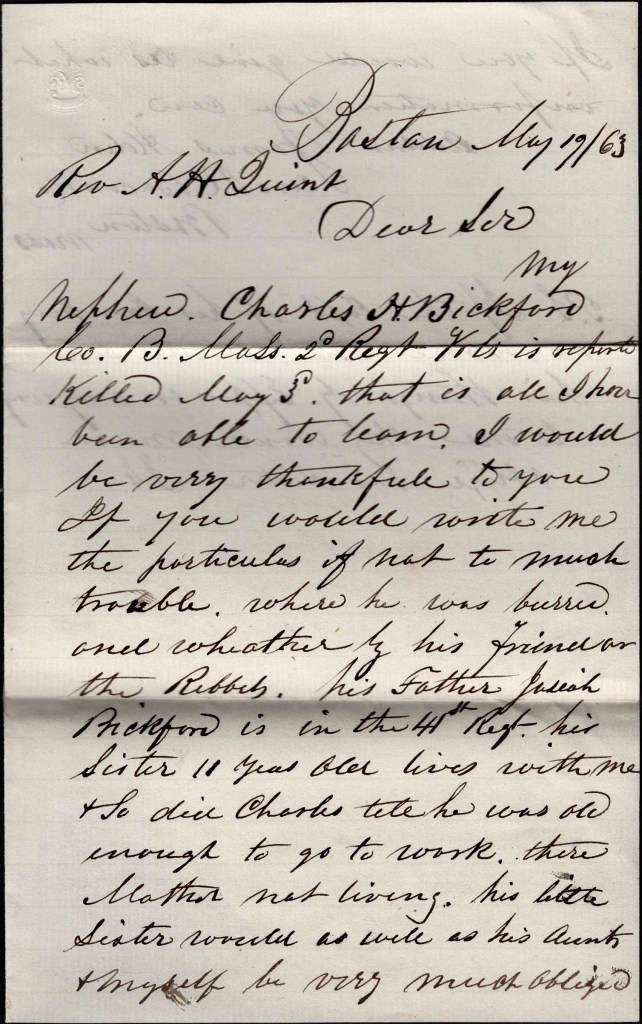
My nephew Charles H. B. Bickford, Co. B, Massachusetts 2nd Regiment, is reported killed May 3rd. That is all I have been able to learn. I would be very thankful to you if you would write me the particulars if not too much trouble, where he was buried and whether by his friends or the Rebels. His father, Josiah Bickford is in the 41st Regiment. His sister, 11 years old, lives with me & so did Charles till he was old enough to go to work. Their mother not living, his little sister would as well as his aunts and myself be very much obliged if you would give us what information you can.

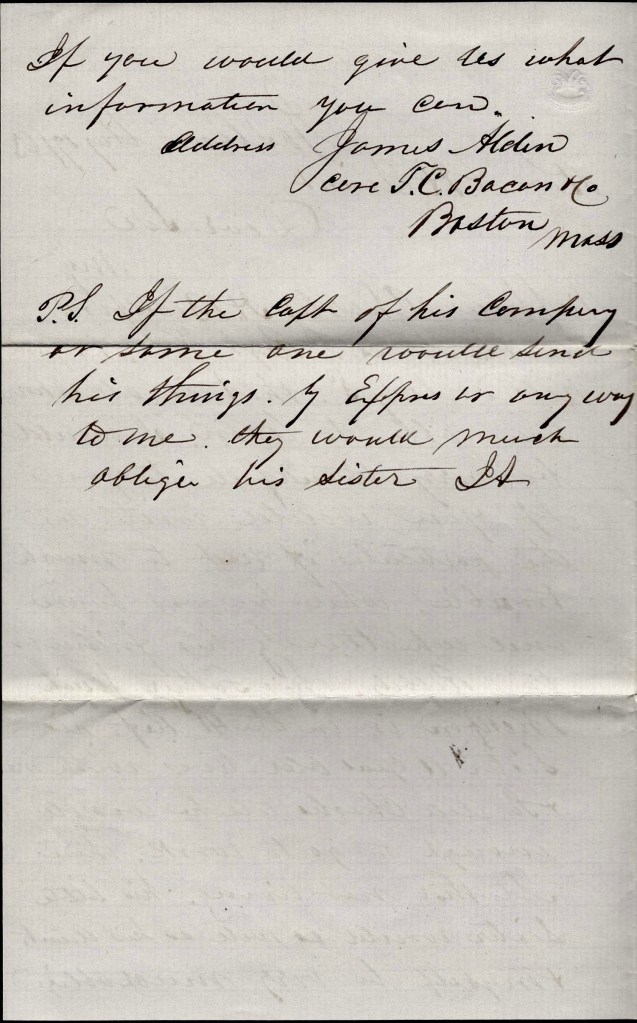
Address James Alden, care of T. C. Bacon & Co., Boston, Massachusetts

P. S. If the Captain of his company or someone would send his things by Express or any way to me, they would much oblige his sister. — J. A.
1840: Ransom Baldwin Moore to Nelson Noble

This letter was penned by Ransom Baldwin Moore (1818-1880), the son of Charles Moore (1783-1846) and Uretta Vernon (1788-1855) of Saratoga county, New York. An obituary informs us that Ransom came to Troy in 1837 where he engaged in the dry goods business at No. 9 Cannon Place. He 1843 he entered into partnership with E. & H. Merriam, book and stationery dealers, who, under the firm name of Merriam, Warren & Co., carried on business. H. B. Nims bought out Merriam in 1853 and partnered with Moore until 1869 when Moore retired.

Ransom’s letter, written when 21 or 22 years old, provides a detailed account of a hike to “Dry River,” prompting me to investigate the significance of this location, as my Google searches returned no relevant results pertaining to a site near Troy, New York. However, upon examining historical newspapers, I uncovered an article from the American Traveller dated 15 March 1836, which referenced a “singular ravine often called the Dry River” located on the west side of the Hudson. Additionally, an article from 1849 discussed the “deep gorges of Dry River” situated north of West Troy. Perhaps this is the area where Ransom and his companion hiked.

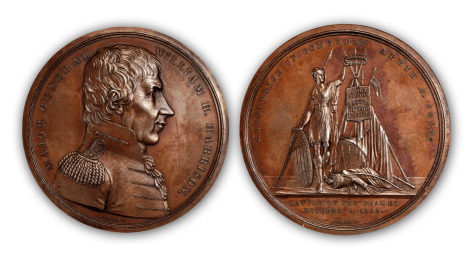
The letter was written on stationery that advertised the sale of a medal commemorating the service of Gen. William Henry Harrison (then a candidate for the Presidency) and the Battle of the Thames, 5 October 1813, during the War of 1812.

The actual bronze medallion depicted in the advertisement.

Transcription

Troy [New York]
June 1, 1840

To N. Noble, Esqr.,

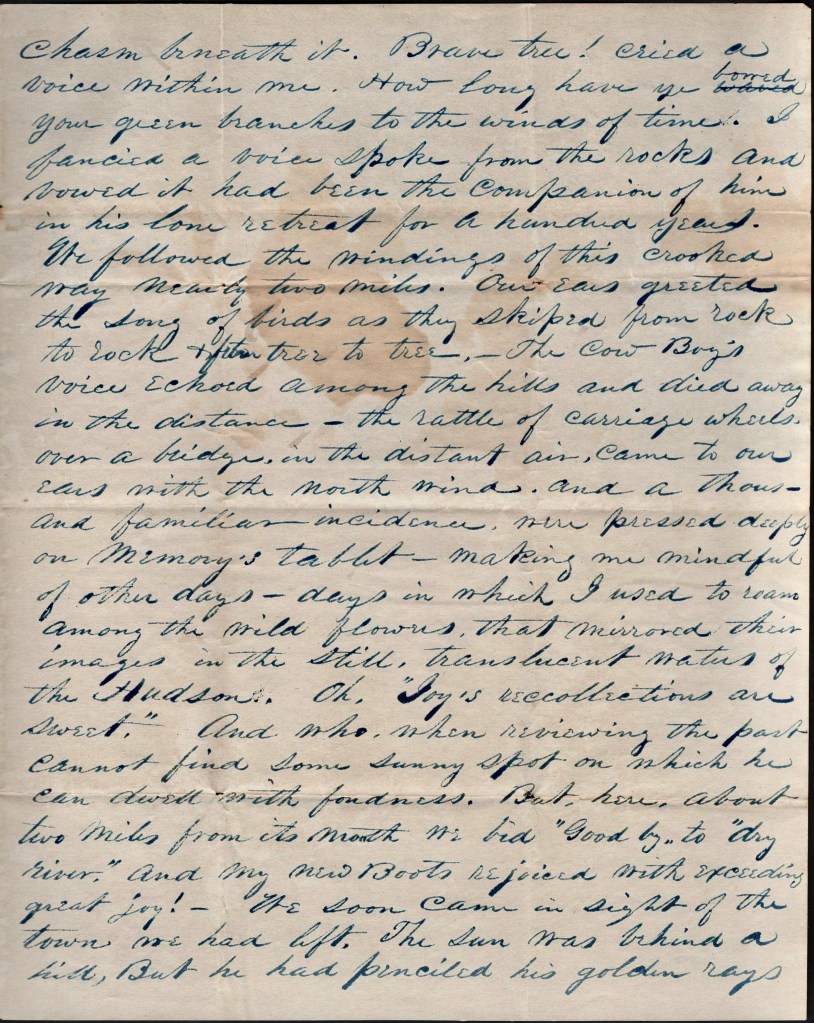
After taking tea with a friend in West Troy, we mutually agreed to take a tramp to “Dry River.” Each obtained a cigar—these being ignitedm we put off. As we proceeded in the main street we were nearly suffocated with dust, which was caused by the rapid whirl of omnibuses & vehicles. However, we soon passed from this “durance vile” to a more pleasant and delightful course.

The wind blew gently from the North which was truly refreshing and enlivening. “the wavy fields” of grain and delicious odor from “verdant hills” and “flowery vales,” threw a halo of beauty and delight upon all we looked upon. As we approached the entrance of the “Dry” Stream which we were about to ascend, I saw a field of clover—green, rank, and thrifty. It sent forth “fragrance delectables.” As I beheld it, I had :immortal longings” within me. And for what? is the inquiry. Not for death that I might be buried there. But to be buried in such a place when dead. But after all, I think it of little consequence when one is buried after life is rendered up.

Our course was westward. When we had gone about half a mile, we turned to the north, proceeded a short distance and then entered “dry river.” Now, we lost sight of the pleasant and undulating scenery, the beholding of which had given me new life, and had filled my soul with new imaginings. We soon entered among the rocks whose steep, craggy and sombre heights shut out much of the resplendent light of day’s all glorious ring. As we continued our winding course, we lost sight of the pleasant landscape over which we had just passed.

A large giant like tree attracted my attention. It waved its bows on the verge of a precipice, as if unmindful of the awful chasm beneath it. Brave tree! cried a voice within me. How long have ye bowed your green branches to the winds of time. I fancied a voice spoke from the rocks and vowed it had been the companion of him in his lone retreat for a hundred years.

We followed the windings of this crooked way nearly two miles. Our ears greeted the song of birds as they skipped from rock to rock and from tree to tree. The cow boy’s voice echoed among the hills and died away in tyhe distance. The rattle of carriage wheels over a bridge in the distant air came to our ears with the north wind, and a thousand familiar incidents were pressed deeply on memory’s tablet, making me mindful of other days—days in which I used to roam among the wild flowers that mirrored their images in the still, translucent water of the Hudson.

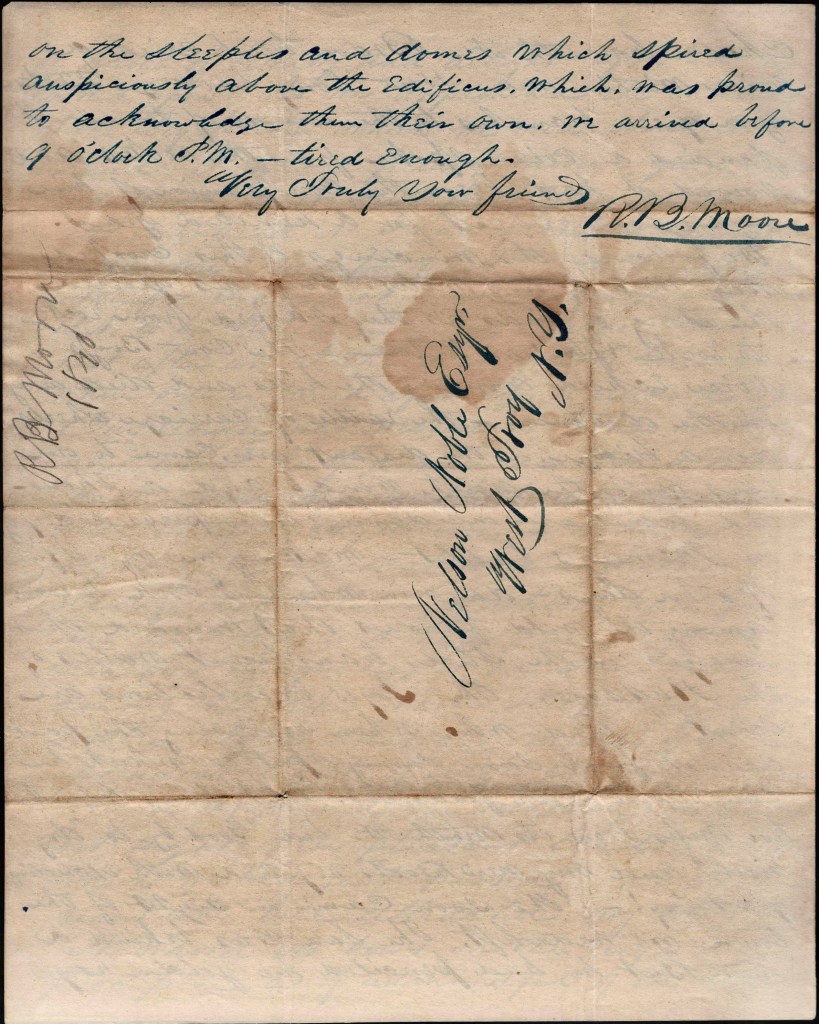
Oh, “Joy’s recollections are sweet.” And who, when reviewing the past cannot find some sunny spot on which he can dwell with fondness. But here, about two miles from the mouth, we bid “goodbye” to “dry river,” and my new boots rejoiced with exceeding great joy! We soon came in sight of the town we had left. The sun was behind a hill but he had enciled his golden rays on the steeples and dome which spired auspiciously above the edifices, which, was proud to acknowledge them their own. We arrived before 9 p’clock p.m. tired enough.

Very truly your friend, — R. B. Moore

1864: Henry Harrison Brown to Josiah & Louisa

Henry Harrison Brown (1838-1922) was an 18 year-old shoe-cutter in Abington, Plymouth county, Massachusetts when he married Martha A. Roberts in 1857. It was a trade handed down from his father, Austin Brown (1798-1884), and probably from his grandfather. Henry was 26 years old and the father of two children when he left the work-a-day world of shoemaking to join the army. According to muster rolls, Henry enlisted on 27 February 1864 in the US Signal Corps and was discharged from the service on 26 August 1865.

“Reunion of the U.S. Veteran Signal Corps Civil War Division at the residence of Hermann Meyer, Georgetown, D.C., upon the summit of “Red Hill,” Camp of Instruction of the Signal Corps, U.S.A., August 31, 1861, to August 1865.” (Courtesy of Virginia Easley, descendant.)

Transcription

Georgetown [District of Columbia]
March 18th [1864]

I take this time to write you a few lines to let you know that I am well and I trust that this will find you in good health. I like [it] here very well. We have a good tent with a good stove and good bunks to sleep in. There is 8 in the tent that I live in. There is a Baptist minister in our tent from Ohio. He preaches Sunday nights. There is prayer meetings Thursday nights here. Sundays we have a chance to go to Georgetown to meeting if we like. I went last Sunday to an Episcopal Church.

I do not expect to stay here very long. I just heard there has been a call for a 120 men from this camp. I am to be examined in flag drill tomorrow and if I can drill well enough, I shall very likely go into the field soon. I hear that we shall go to Tennessee but we cannot tell until we go.

I wish you would see to getting Martha’s state aid when it is due. My state bounty I expect next week. Although I do not have many comforts of home, yet we all enjoy ourselves most of the time very well. I think I shall like it first rate when we get into the field.

I must now close. Give my respects to Isaiah and wife and all friends. Good night. Write soon and tell me all the news in Abington. Direct to Henry H. Brown, Signal Camp, Georgetown, D. C.

1863: Lee O’ Donaghey to his Parents

This letter was written by Lee O’Donaghey who, at age 25, enlisted at Dunkirk to serve three years as a private in Co. D, 72nd New York Infantry. He was promoted to corporal in early May 1862 and wounded in action during the fighting at Malvern Hill on 1 July 1862. He was discharged for his wounds at Carver Hospital in Washington D. C. on 13 December 1862 and received compensation as an invalid in December 1863.

Transcription

Camp Caldwell
September 14, 1861

Dear Parents,

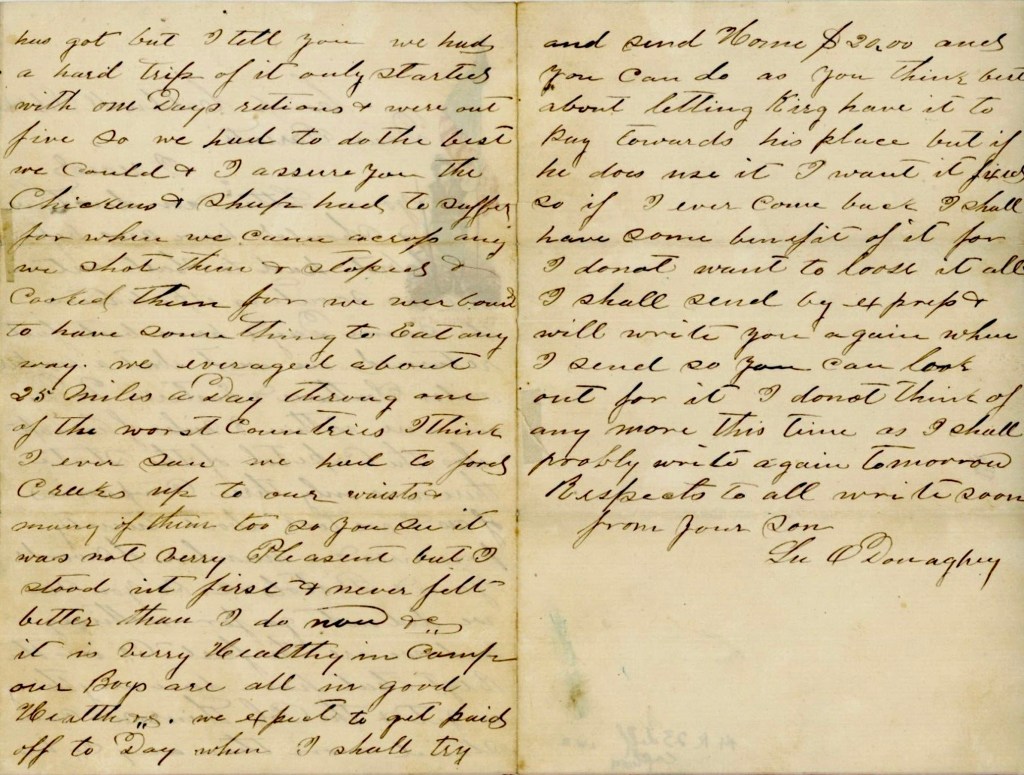
I received your letter in due time & should have answered before but had to start out on a scouting expedition the same day & have but just returned. We went about a hundred miles Southern & Eastern Maryland. We were within 8 miles of Annapolis, the Capitol of the State. There was only three companies of us and we took about twenty prisoners and a number of swords, guns, and pistols &c. so you see we did not go for nothing and we are the first company in the regiment that have done anything as yet & the Colonel thinks we can stand more than any company he has got but I tell you, we had a hard trip of it. Only started with one day’s rations & were out five so we had to do the best we could & I assure you the chickens and sheep had to suffer for when we came across any, we shot them for we were bound to have something to eat anyway.

We averaged about 25 miles a day through one of the worst countries I think I ever saw. We had to ford creeks up to our waists & many of them too so you see it was not very pleasant but I stood it first [rate] & never felt better than I do now, &c. It is very healthy in camp. Our boys are all in good health. We expect to get paid off today when I shall try and send home $20 and you can do as you think best about letting Kirg have it to pay towards his place. But if he does use it, I want it fixed so if I ever come back, I shall have some benefit of it for I don’t want to lose it all. I shall send by Express & will write you again when I send so you can look out for it.

I don’t think of anymore this time as I shall probably write again tomorrow. Respects to all. Write soon. From your son, — Lee O’ Donaghey

1862: Pardon Edgar Covey to his Cousin Mary

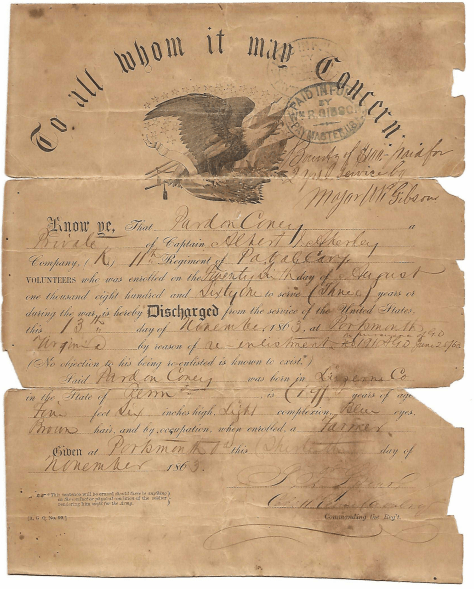
The following letter was written by Pardon Edgar Covey (1843-1896), the son of Almeron Covey (1813-1903) and Mary Ann Sisco (1817-1896) of Abington, Luzerne county, Pennsylvania. Pardon enlisted in Co. K of the 11th Pennsylvania Cavalry (108th Volunteers)—sometimes called “Harlan’s Light Cavalry.” He served from 25 August 1861 to 13 November 1863 according to his discharge papers, though the company muster rolls say he served until 1865.

The 11th Pennsylvania Cavalry was ordered to Fortress Monroe, Virginia, in mid-November 1861 and they remained there on duty at nearby Camp Hamilton until May 1862. Covey’s letters speaks of the arrival of infantry at Camp Hamilton as McClellan began his build up for launching the Peninsula Campaign.

Pardon Covey’s Discharge Papers

Transcription

Camp Hamilton, Virginia
March 23, 1862

Dear Cousin,

I take the present time to answer your kind letter to let you know that I am well and hope this may find you the same. It has been quite unpleasant for the last few days but it is looking more now like good weather now. It looks like spring for the green grass is springing up fast and soon will be good feed for cattle. What few farmers that is left here has commenced planting potatoes and making garden. It looks like May with us. The leaves putting forth their leaves and the flowers is blooming on every bush.

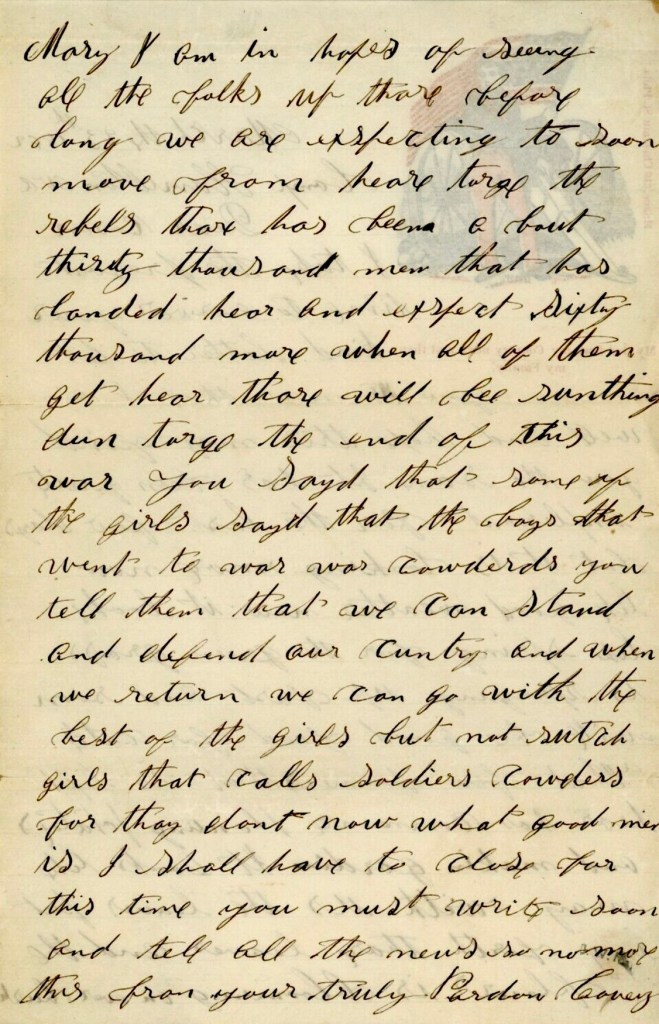
Mary, I am in hopes of seeing all the folks up there before long. We are expecting to soon move from here toward the rebels. There has been about thirty thousand men that has landed here and expect sixty thousand more. When all of them get here, there will be something done towards the end of this war.

You said that some of the girls said that the boys that went to war was cowards. You tell them that we can stand and defend our country and when we return we can go with the best of the girls but not such gurls that calls soldiers cowards for they don’t know what good men is. I shall have to close for this time. You must write soon and tell all the news. So no more. This from yours truly, — Pardon Covey

1864: William Henry Harrison Smith to his Sister

The following letter was written by William Henry Harrison Smith (1840-1933), the son of Thomas Thorburg Smith (1800-1881) and Catharine Geary (1812-1882) of Bluffton who enlisted on 16 August 1862 to serve in Co. B, 101st Indiana Infantry. He mustered out of the regiment on 24 June 1865. In his letter, William mentions his younger brother, Lucas Flattery Smith (1844-1924) who enlisted when he was 17 in Co. G, 101st Indiana Infantry.

William wrote the letter to his sister, Catharine L. Smith, Murray, Wells county, Indiana, though the envelope is addressed to his mother, also named Catharine.

William Henry Harrison Smith (at right) with son Artemus in Smith’s Drug Store, St. Helena, California.

Transcription

Camp 101st Regt. Indiana Vols.
Co. B, 2nd Brigade, 3rd Division
14th Army Corps
Rossville, Georgia
January 31st, 1864

Dear Sister,

I received your kind and welcome letter last Friday and I was glad to learn that you were all well. I am happy to say that this leaves me well. Lucas is going to write today and we will send our letters in one envelope. We are still at Rossville but do not know how long we will remain. We have pretty heavy duty here but we are now getting tolerable plenty rations and I don’t mind all the duty that I have to do if I have plenty to eat. We have quite a treat today. There was a lot of onions sent out here to our hospital and we are so lucky as to have no sick so they were issued to the regiment which is something of a rarity with us. Our regiment is in the best health now that they have been since we came out. I don’t know of a single case of sickness in the regiment.

We have had extremely beautiful weather here for the last two weeks. It was exactly such weather as we have there in May. The birds are singing and everything seems lively, but we see no sturdy plowman come forth to turn up the fresh ground nor no laborer seeking useful employment but all around is soldiers. I don’t care where you go, you will find soldiers.

The presents you sent us were gratefully received and in the package of paper that I took for mine I found a little revolver and Lucas found a small finger ring in his. I am going to send my revolver to Zack and he can shoot rats with it. You speak of sending a box to us but need not send any for we are not particular in want of anything. All that I would want would be some provision and it is so far and so many delays that provisions would be spoiled before it would get here, and we can get along very well now on what rations we have.

You speak of it being very cold back there New Year. Well, it was the same here. People that live here said that it was the coldest day they ever experienced. I was on picket that day. I think I will remember that day a long time. I don’t know what ails my leg. It is still sore and running some but it does not hurt me much. In fact, it is only by spells that I mind it at all.

You speak of some scandalous letters that were found in the post office there. Well, I believe that Smith Logan is the author of them for he sent a letter of the same kind to his brother John here, I read it and it did exceed anything that I ever heard. He swore that he did not own him as a brother and he hoped that he would never get home and wished him and his family in hell and swore that he hoped that the rebels would whip us in every battle and gain their independence. And if he would fight on either side, he said he would go to the rebs. John asked me what I thought of it and I told him that I would have it attended to so we took it and gave it to the Major. He copied it off and sent a copy back and I hope to hear of the villain getting justice which will be hanging. It was Smith’s own hand writing and his name signed to it.

Oh yes, you ask me if I have had a sleigh ride yet. No, we have not had snow enough to cover the ground and to go sleighing on the dry ground is a kind of riding I don’t like. Besides, I have not saw a sleigh since I left home. I will stop for this time. Excuse hurriedness. Your brother, — Wm. H. H. S.

Write soon. Goodbye.

1862: Samuel Alexander Richards to Harriet (Rundlett) Richards

I could not find an image of Samuel but here is Joseph A, Brown who also served in Co. H, 10th New Hampshire Infantry (Dave Morin Collection)

The following letter was written by 50 year-old Samuel Alexander Richards (1812-1882) who enlisted at Goffstown as a private on 8 August 1862 to serve in Co. H, 10th New Hampshire Infantry. Samuel remained in the service until 21 June 1865.

Samuel was married in 1844 to Harriet Rundlett (1828-1899). The couple lived at Goffstown, Hillsboro county, New Hampshire, where he earned a living as a farmer and carpenter.
The 10th New Hampshire Infantry left New Hampshire and moved to Washington, D. C., in late September 1862. They then moved to Frederick, Maryland. and about the 1st of October to Sandy Hook, Maryland, and on October 4th to Pleasant Valley October 6 where this letter was finished. They had duty at Pleasant Valley until October 27, 1862 when they made the march to Falmouth, Va., October 27-November 19 and where they fought their first battle at Fredericksburg, December 12-15.

Transcription

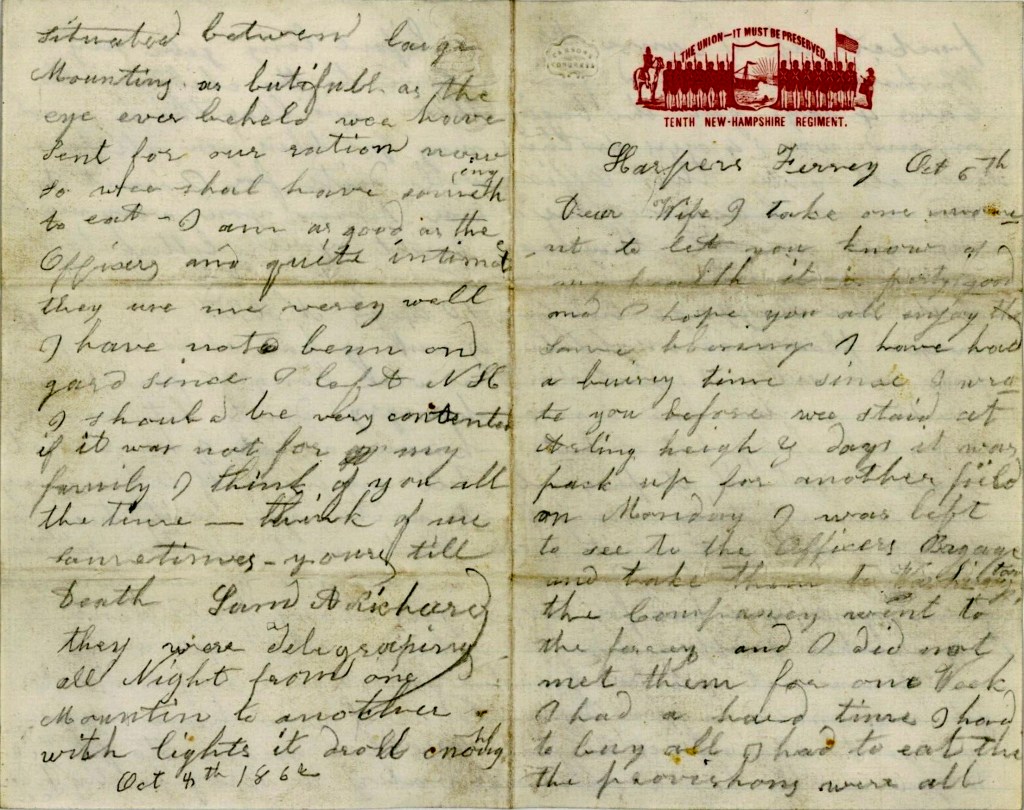
Patriotic letterhead of Samuel’s letter, “Tenth New Hampshire Regiment.”

Harpers Ferry [Virginia]
October 6th 1862

Dear Wife,

I take one moment to let you know of my health. It is pretty good and I hope you all enjoy the same blessing. I have had a busy time since I wrote to you before. We stayed at Arlington Heights two days. It was pack up for another field on Monday. I was left to see to the officer’s baggage and take them to Washington. The company went to the Ferry and I did not meet them for one week. I had a hard time. I had to buy all I had to eat. The provisions were all packed up. I came to Washington [and] waited for the cars four days, got the baggage on and was 24 hours on the road all safe, the officers and men cheering me on my arrival. They had heard I was taken prisoner with the baggage but they were pleased enough to find all safe. I spent about all the money I had. I mean they shall pay for it but I can’t get it at present. They steal all they can get hold of.

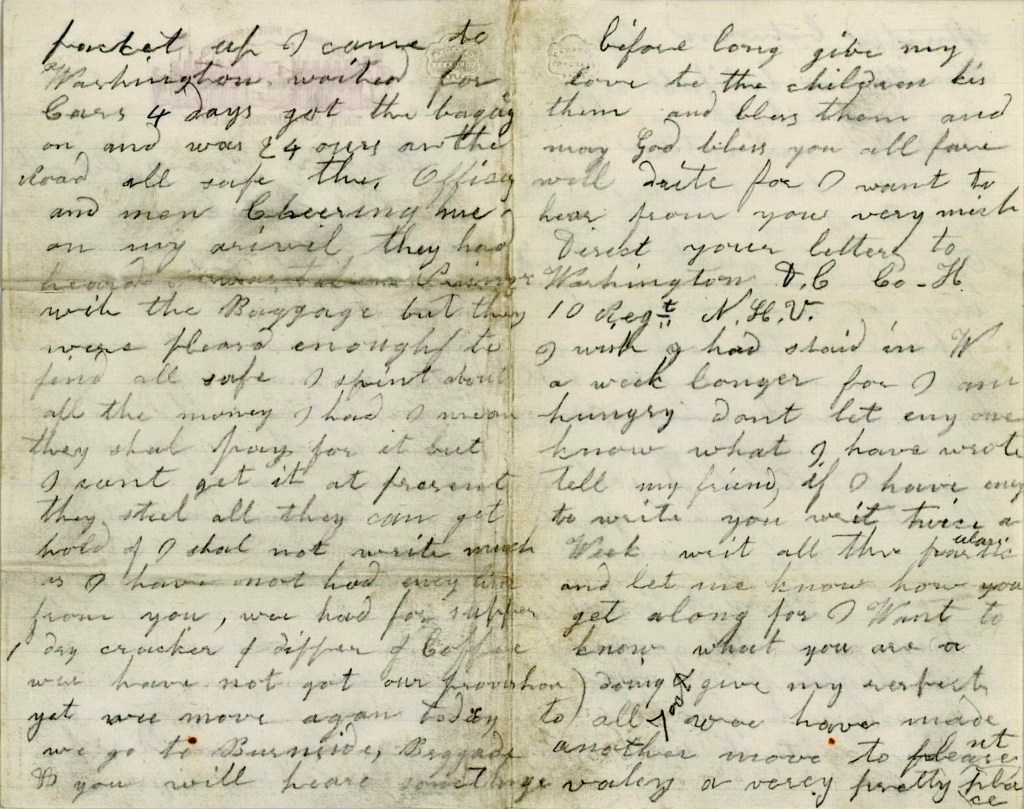
I should not write much as I have not had any line from you. We had for supper 1 dry cracker, 1 dipper of coffee. We have not got our provisions yet. We move again today. We go to Burnside’s Brigade & you will hear something before long.

Give my love to the children. Kiss them and bless them and may God bless you all. Farewell. Write for I want to hear from you very much. Direct your letters to Washington D. C., Co. H, 10th Regt. New Hampshire Volunteers.

I wish I had stayed in Washington a week longer for I am hungry. Don’t let anyone know what I have wrote. Tell my friends—if I have any—to write. You write twice a week. Write all the particulars and let me know how you get along for I want to know what you are a doing. Give my respects to all.

We have made another move to Pleasant Valley—a very pretty place situated between large mountains as beautiful as the eye ever beheld. We have sent for our rations now so we shall have something to eat. I am as good as the officers and quite intimate. They [treat] me very well. I have not been on guard since I left New Hampshire. I should be very contented if it was not for my family. I think of you all the time. Think of me sometimes. yours till death, — Sam A. Richards

They were telegraphing all night from one mountain to another with lights. It [ ] enough October 4th 1862

1864: Unidentified “George” to his friend Mary

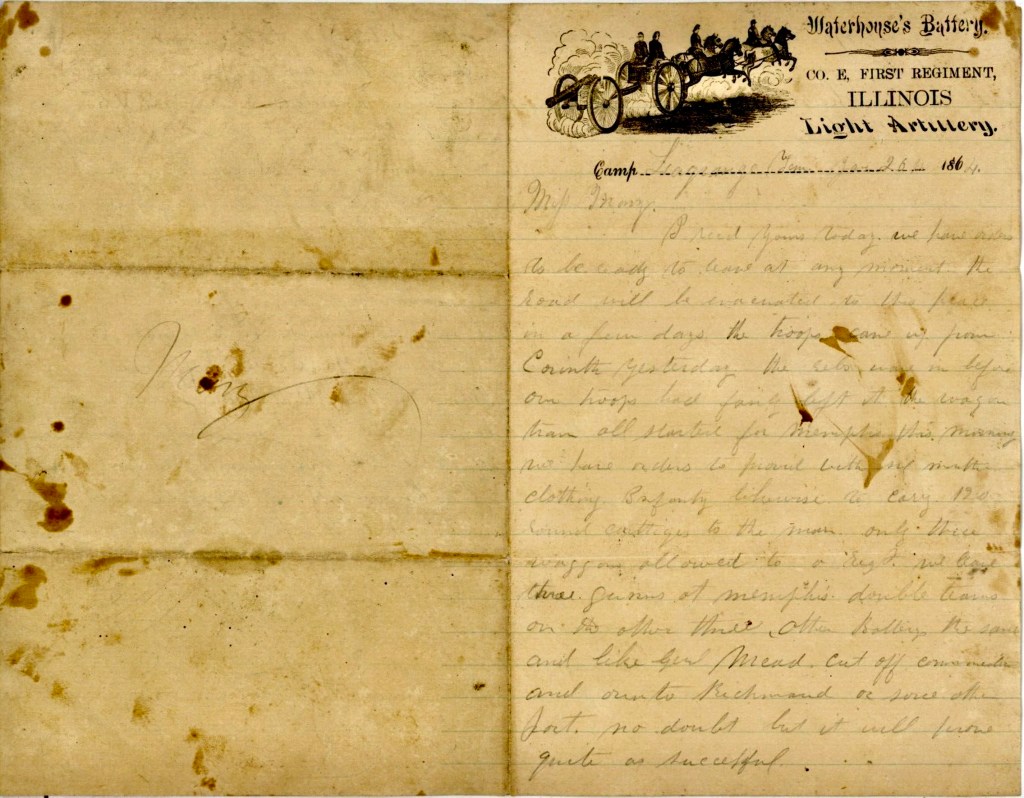
This letter is only signed “George” but it was most definitely written by a member of Waterhouse’s Battery—Co. E, 1st Illinois Light Artillery. Not only was it written on stationery branded with the unit’s name on the letterhead, but the content of the letter is consistent with the Battery’s movements as well. Regrettably there are too many George’s in the unit who were unmarried to narrow it down to less than a handful of possible soldiers.

After participating in the siege of Vicksburg and then of Jackson, Mississippi, Battery E spent the remainder of the summer and fall in the vicinity of Bear Creek. On November 5 they took boat for Memphis, arriving there the 12th. During that winter they went to Lagrange, Tennessee and also, Corinth, Jack Creek, back again to Corinth, then finally back to Memphis via Lagrange. It was at this point in time the following letter was penned. Later in 1864 they would participate on the Meridian expedition and then in the disastrous Battle of Brice’s Crossroads where they performed some heroic actions.

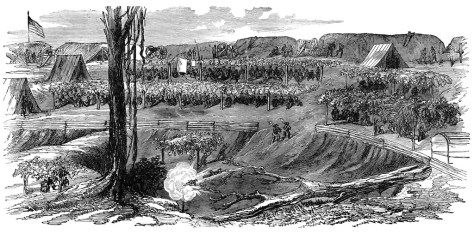
“Waterhouse’s Battery, Sherman’s Corps, before Vicksburg. The interior view of Waterhouse’s battery, in Tuttle’s division, shows the guns in position and the huts in which the men are crowded. These were built of canes tied together and covered with branches, the soldiers resorting to the style of dwelling of the Indians who dwelt there two centuries ago.”— Frank Leslie, 1896

Transcription

Stationery used for George’s letter with image of artillery and “Waterhouse’s Battery”

Waterhouses’s Battery
Co. E, 1st Regiment Illinois Light Artillery
Camp Lagrange, Tennessee
January 26, 1864

Miss Mary,

I received yours today. We have orders to be ready to leave at any moment. The road will be evacuated to this place in a few days. The troops came up from Corinth yesterday. The rebs were in before our troops had fairly left it. The wagon train all started for Memphis this morning. We have orders to provide [ ] clothing. Infantry likewise to carry 120 round cartridges to the man. Only three wagons allowed to a regiment. We leave three guns at Memphis, double teams on the other three. Other batteries the same and like Gen. Meade, cut off communication and over to Richmond or some other post, no doubt, but it will prove quite as successful.

Private James Bolton who served in Congress. E from 1862-1865.

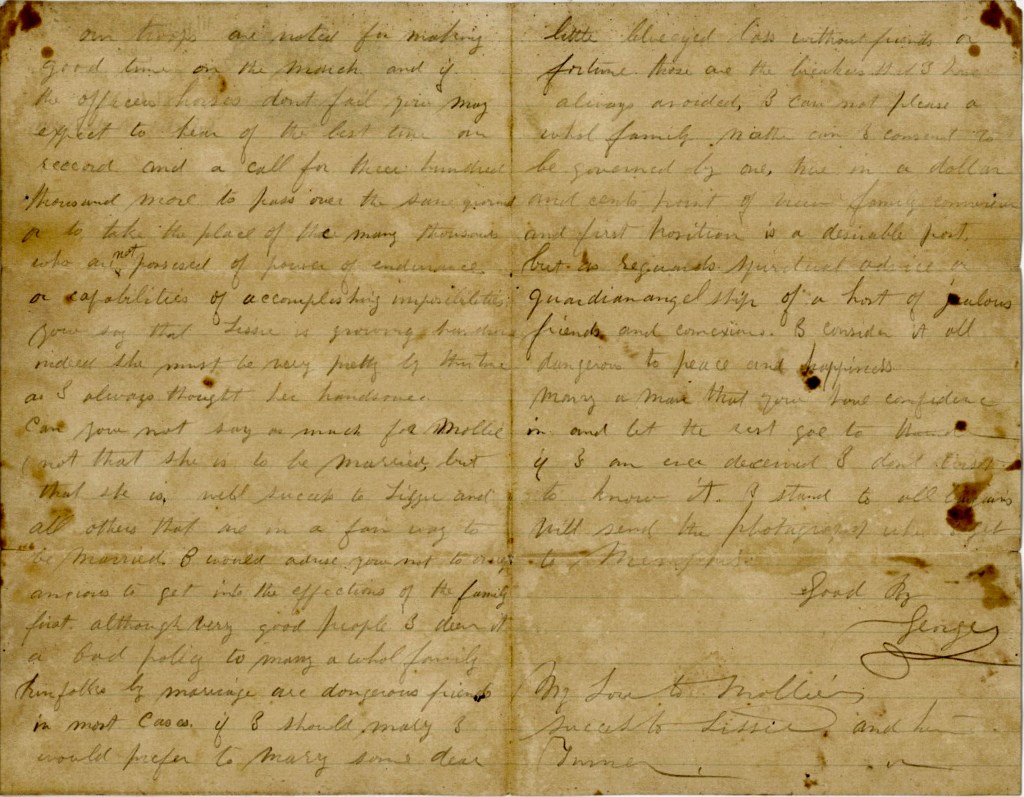
Our troops are noted for making good time on the march and if the officers’ horses don’t fail, you may expect to hear of the best time on record and a call for three hundred thousand more to pass over the same ground or to take the place of the many thousands who are not possessed of power of endurance or capabilities of accomplishing impossibilities.

You say that Lizzie is growing handsome. Indeed, she must be very pretty by this time as I always thought her handsome. Can you not say as much for Mollie (not that she is to be married, but that she is.) Well success to Lizzie and all others that are in a fair way to be married. I would advise you not to be anxious to get into the affections of the family first, although very good people. I deem it a bad policy to many a whole family. Kinfolks by marriage are dangerous friends in most cases. If I should marry, I would prefer to marry some dear little, blue-eyed lass without friends or fortune. Those are the breakers that I have always avoided. I cannot please a whole family. Neither can I consent to be governed by one. True, in a dollar and cents point of view, family connections and first position is a desirable post, but as regards spiritual advice or guardian angel ship of a host of jealous friends and connections, I consider it all dangerous to peace and happiness.

Marry a man that you have confidence in and let the rest go to thunder. If I am ever deceived, I don’t wish to know it. I stand to all [ ]. Will send the photographs when I get to Memphis. Goodbye, — George
My love to Mollie. Success to Lizzie and Mr. Turner.
1863: Oscar Fox to Maria Fox

The following letter was written by Oscar Fox (1832-1897) who served in Independent Battery H, Pennsylvania Light Artillery (sometimes called John I. Nevin’s Battery). This unit was organized at Pittsburgh and served in the defenses of Washington D. C. from the fall of 1862 to the spring of 1863.

At the time Oscar penned this letter in June 1863, the Battery had recently come under the command of Captain William Barrowe, a seasoned U.S. Army Regular. In the fall of 1864, Barrowe faced court martial for forging documents and submitting false reports; when President Lincoln chose not to dismiss the charges against him, he was removed from his command on March 8, 1865, and dismissed from service on the same day. He was later reinstated as 1st Lieutenant in the Second Artillery in July 1865—a decision for which the Army would come to express deep regret. Four years later, while commanding an artillery unit in Alaska, he made the unjustifiable decision to shell an indigenous village, an act for which the U.S. Government continues to issue apologies (see Army will issue January apology for 1869 bombardment of Wrangell).

Battery H, Pennsylvania Light Artillery never saw any action though seven enlisted men in the battery died of disease during the war.

Transcription

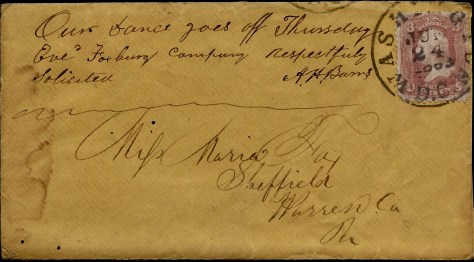
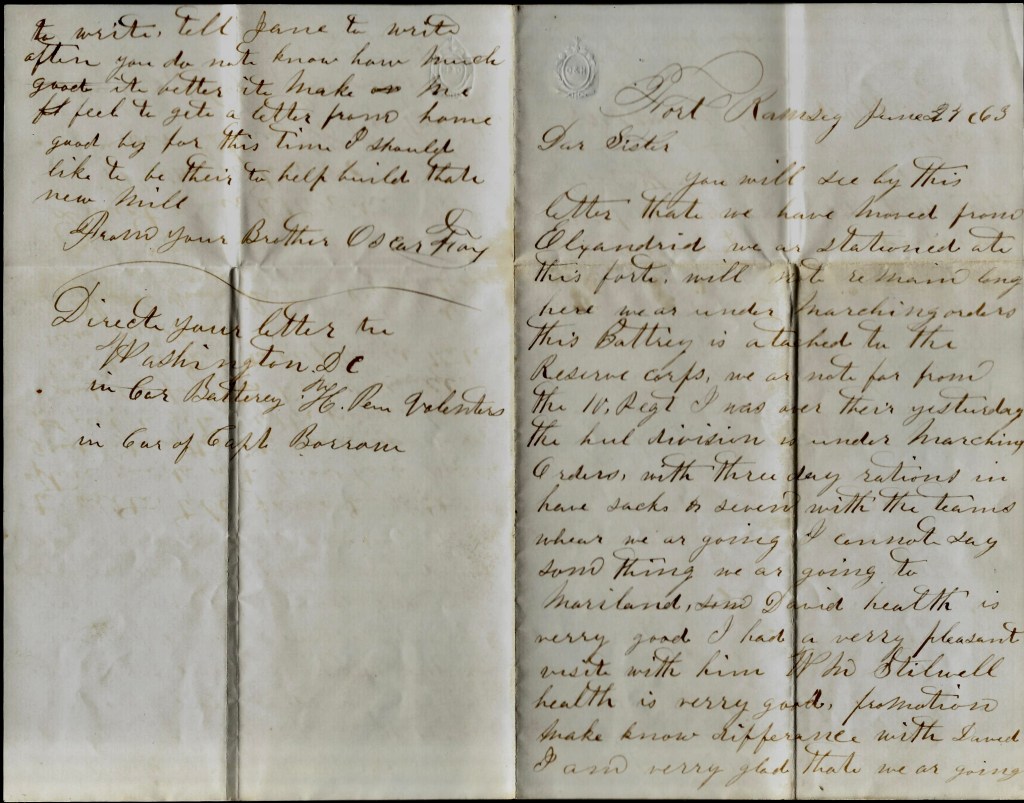
Addressed to Miss Maria Fox, Sheffield, Warren county, Pennsylvania

Fort Ramsey
June 24, 1863

Dear Sister,

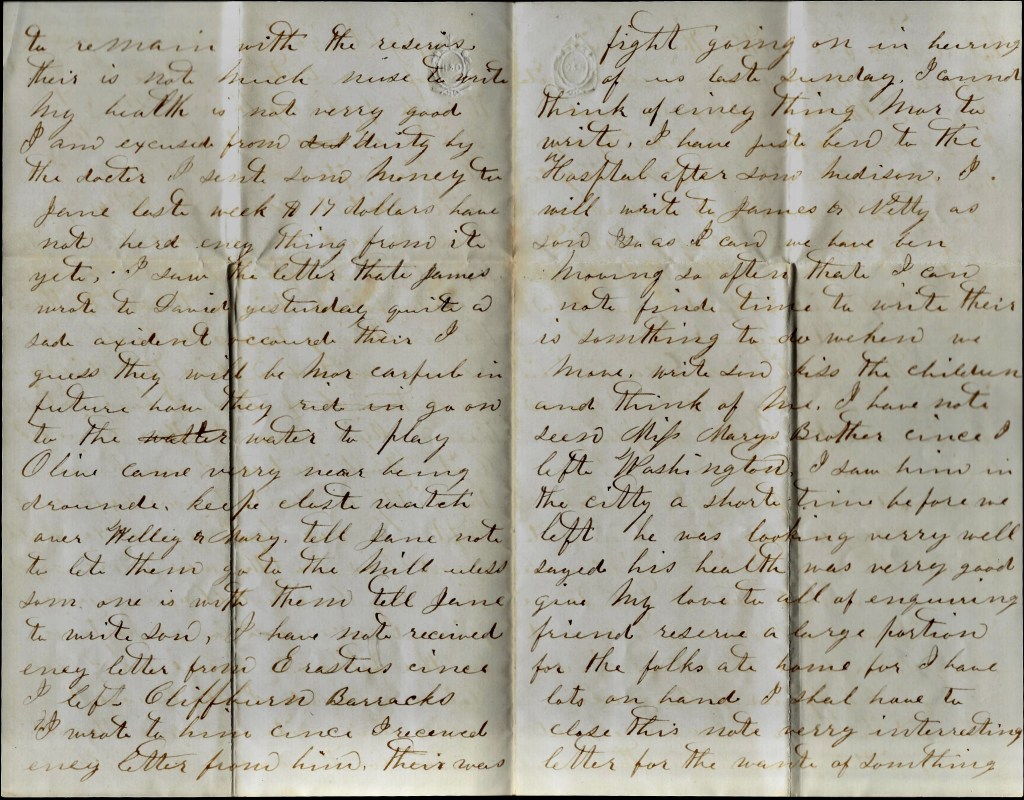
You will see by this letter that we have moved from Alexandria. We are stationed at this fort [but] will not remain long here. We are under marching orders. This Battery is attached to the Reserve Corps. We are not far from the 10th Regiment. I was over there yesterday. The whole division is under marching orders with three days rations in haversacks & seven with the teams. Where we are going, I cannot say, Some think we are going to Maryland, some [unfinished sentence]

David’s health is very good. I had a very pleasant visit with him. William Stilwell’s health is very good. Promotion makes no difference with David. I am very glad that we are going to remain with the reserves, There is not much news to write. My health is not very good. I am excused from duty by the doctor.

I sent home money to Jane last week to 17 dollars. Have not heard anything from it yet. I saw the letter that James wrote to David yesterday—quite a sad accident occurred there. I guess they will be more careful in future how they ride and go onto the water to play. Olive came very near being drowned. Keep close watch over Willie and Mary. Tell Jane not to let them go to the mill unless someone is with them. Tell Jane to write soon. I have not received any letter from Erastus since I left Cliffburn Barracks. I wrote to him since I received any letter from him.

There was a fight going on in hearing of us last Sunday.

I cannot think of anything more to write. I have just been to the hospital after some medicine. I will write to James & Netty as soon as I can. We have been moving so often that I cannot find time to write. There is [always] something to do when we move. Write soon. Kiss the children and think of me. I have not seen Miss Mary’s brother since I left Washington. I saw him in the city a short time before we left. He was looking very well. Said his health was very good. Give my love to all of enquiring friends [but] reserve a large portion for the folks at home for I have lots on hand. I shall have to close this not very interesting letter for want of something to write. You do not know how much better it makes me feel to get a letter from home.

Goodbye for this time. I should like to be there to help build that new mill. From your brother, — Oscar Fox

Direct your letter to Washington D. C., in care of Battery H Pennsylvania Volunteers, in care of Capt. [William] Borrowe