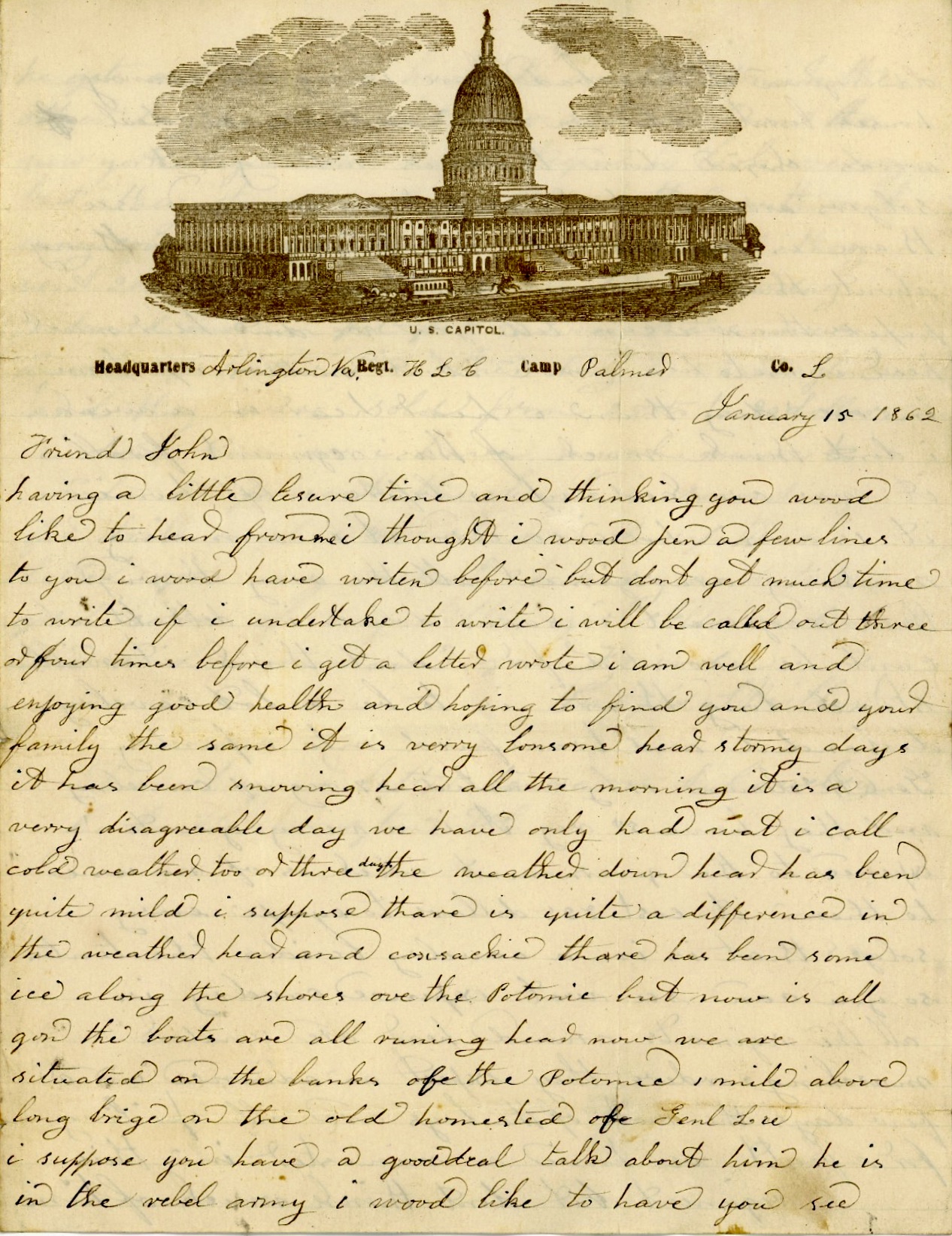
This letter was written by Winfield S. Miller, a 23 year-old blacksmith from Hudson, Columbia county, New York, who was the son of Samuel and Elizabeth Miller. He enlisted September 17, 1861, at Hudson; mustered in as corporal, Company L, 2nd New York Cavalry (a.k.a. Harris Light Cavalry) on September 25, 1861 to serve three years; transferred to Company A, August 29, 1864; and mustered out, to date November 6, 1864, with detachment, at New York City.
I believe he wrote the letter to John Miller (1832-1906) of Coxsackie, Greene county, New York whose 1860 household included Ella Miller (b. 1859).
T R A N S C R I P T I O N
Arlington, Va. Harris Light Cavalry Camp Palmer, Co. L January 15, 1862
Friend John,
Having a little leisure time and thinking you would like to hear from me, I thought I would pen a few lines to you. I would have written before but don’t get much time to write. If I undertake to write, I will be called out three or four times before I get a letter wrote. I am well and enjoying good health and hoping to find you and your family the same. It is very lonesome here stormy days. It has been snowing here all the morning. It is a very disagreeable day. We have had what I call cold weather two or three days. The weather down here has been quite mild. I suppose there is quite a difference in the weather here and Coxsackie. There has been some ice along the shores of the Potomac but now is all gone. The boats are all running here now.
We are situated on the banks of the Potomac 1 mile above Long Bridge on the old homestead of Gen. Lee. I suppose you hear a good deal talk about him. He is in the rebel army. I would like to have you see Old Virginia. It looks very bad. There is a great many houses burnt and torn down and a great deal of woods chopped down. There is nothing but soldiers around here as far as we can see. There is no use of me saying anything about the war. You can read more in the papers than I can tell you. We don’t hear much here. I use to hear more about matters up home in one day than I hear here in a week.
I don’t think much of this regiment for all it was cracked up so before I left home. It is a one horse concern. It is a money making arrangement all the way through. This regiment is 80,000 dollars in debt that can’t be accounted for. I don’t think it will stand long. There is to be a lot of cavalry disbanded and transferred into infantry. Gen. McClellan only wanted 27 regiments of cavalry and they have 52 regiments which is of no use to them. It cost 225 dollars to equip every soldier that is in the cavalry besides the tents so you can see what expense cavalry is.
All the regiments around here are under marching orders. They expect an advance in a few days. The most of the boys are all spoiling for a fight. We have a minister [Joshua B. Davis] in this regiment but don’t think much of him. He gets as tight as a brick. He was so drunk the other day he did not know a Bible from the New York Ledger.
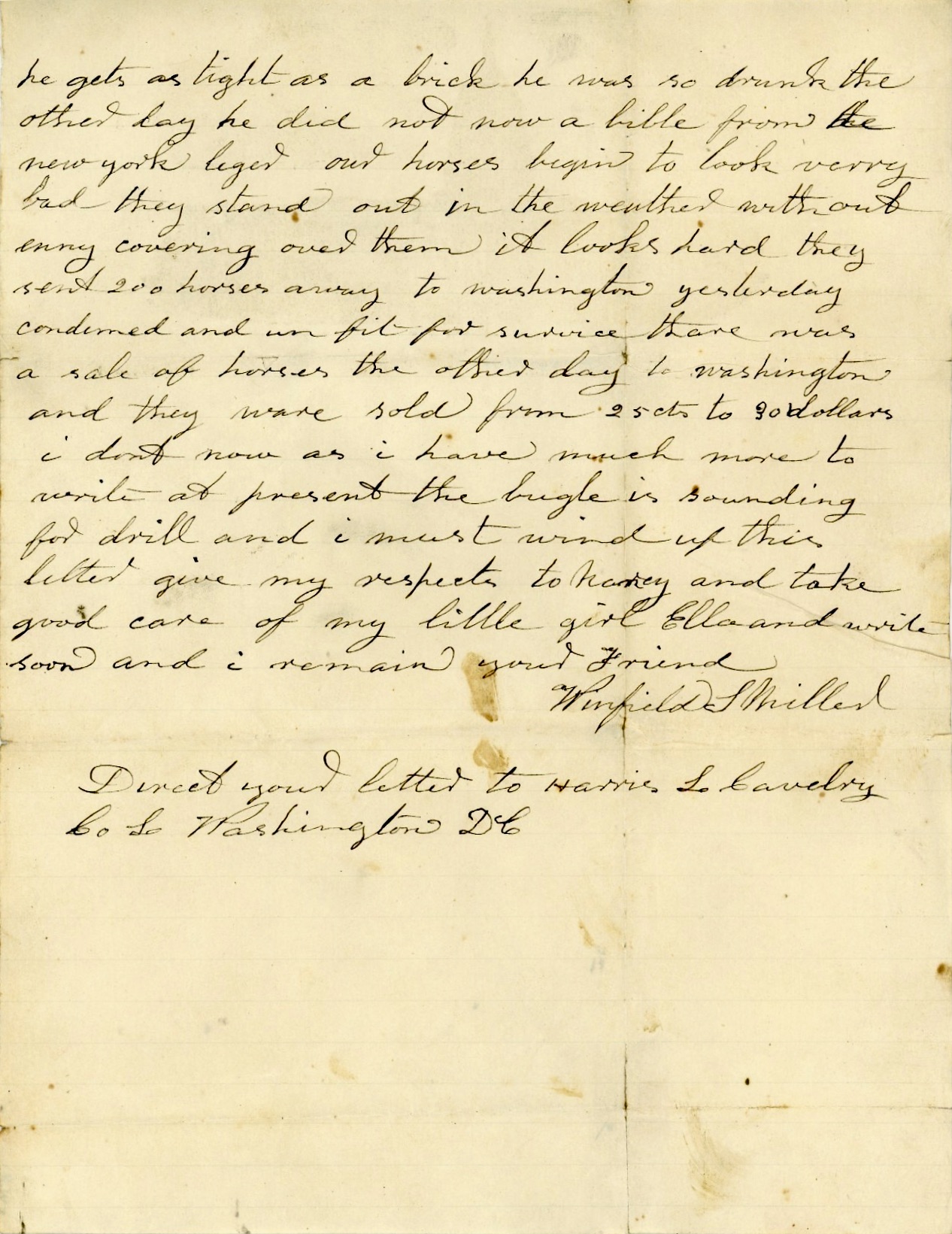
Our horses begin to look very bad. They stand out in the weather without any covering over them. It looks hard. They sent 200 horses away to Washington yesterday condemned and unfit for service. There was a sale of horses the other day to Washington and they were sold from 25 cents to 30 dollars. I don’t know as I have much more to write at present. The bugle is sounding for drill and I must wind up this letter. Give my respects to Nancy and take good care of my little girl Ella and write soon and I remain your friend, — Winfield S. Miller
Direct your letter to Harris Light Cavalry, Co. L, Washington D. C.
This letter was written by Gustavus (“Gus”) A. Stevens (1843-1864) who enlisted in Co. K of the 12th Wisconsin with his cousin, Adelbert (“Del”) V. Stevens, in September 1861. In September 1863, Gus was arrested for robbery and sentenced to ten months in prison. He later died of disease in Vicksburg, Mississippi, on 19 August 1864. I believe Gus wrote this letter to his cousin, Edward B. Stevens who served in Co. C, 1st Wisconsin Heavy Artillery. See also—1863: Gustavus A. Stevens to Elvira Stevens published on Spared & Shared 7 in 2014.
Patriotic Letterhead used by Gus for his letter.
T R A N S C R I P T I O N
Camp Randall [Madison, Wisconsin] December 30th 1861
Dear Cousin,
This evening I have a few moments of leisure. I thought I would write you a line or two to let you know that I am alive yet, and expect to be for some time to come. We are about twenty of us gathered around a fire in a hole in the middle of the tent. You can imagine the chance that we have to write where there are a lot of fellows kicking around in every shape. Soldiering is a queer life! I cannot say that I dislike it or that I really like it. However, I am reasonably contented.
A. S. Sampson arrived here this evening. The most of our officers are away after deserters. I suppose it is settled that we shall get our pay from the United States within a few days. There is nothing certain about our State pay when we shall get it.
Adelbert has been quite sick for some time and has now gone home to stay until the first of Frebruary. I hope he will be all right by that time and meet us wherever we shall. be. I was up to Mr. Tullis’ last Christmas and had a pretty good time. I expect that we shall leave here the last of this week or the first of next. But I do not know as there is any more prospect of it than there has been for the last three or four weeks.
I am a little lonely sometimes on account of Adelbert being gone. I shall have to make the best of it all right. If I can’t stand it, there is no use for anyone else to try. No more at present. Yours as ever, — G. A. Stevens
The following partial letter was written by a member of Co. G, 111th New York Infantry based on the stationery and the actions of the regiment described in the letter. Readers will remember that the 111th New York Infantry was one of the regiments branded as “Harpers Ferry Cowards” for their surrender—through no fault of their own—during the Antietam Campaign of 1862. Paroled but forced to spend a miserable winter in a Union prisoner of war camp in Chicago until exchanged, the brigade was looking for a chance to clear their name when the little action described in this letter took place.
Company G was raised at Auburn in Wayne county, New York, and mustered into the service on 20 August 1862. I attempted to winnow down the soldier’s identity by identifying all those soldiers in Co. G who were corporals at the time this letter was written. This left me with only six possibilities. Four of them were in their early 20s and two of them were only 18. My hunch is that it was one of these two younger soldiers—either Harry C. Kinnie who entered the service as a private but was promoted to a corporal (no date given). He was wounded in action, May 6, 1864, at The Wilderness, Va.; discharged for disability, February 17, 1865. The other soldier would have been Elijah Esty Wood, who actually mustered in as 1st Corporal of Co. G, and was later promoted to sergeant. My hunch is that it was the latter soldier. As 1st Corporal, I think it’s likely the duty of carrying the flag would have fallen to him. He was killed in action, July 2,1863, at Gettysburg.
I was unable to connect any woman named Elmira to any of the soldiers though she may not have been a family member or she might have been a sister-in-law.
T R A N S C R I P T I O N
11th Regt. New York S. Volunteers, Col. Jesse Segoin, Company G Union Mills [Virginia] January 5th 1863
Dear Parents, Brothers and Sisters,
Having been on guard yesterday and last night, and being at liberty today, I have again seated myself for the purpose of informing you of our whereabouts. January 1st, we had orders to be ready to march at 10.30 o’clock, January 2nd, for Alexandria. We then took the cars at about 12 o’clock and did not leave until after dark. It was pretty cold and as a large share of the regiment was on top of the cars, they suffered much with cold. We arrived at this. place—Union Mills—at about 12 o’clock at night. It is about 20 or 22 miles from Alexandria and about 30 from Washington and two or three from the Old Bull Run Battlefield. We are in the 3rd (Gen. D’Utassy’s Brigade, Gen. Casey’s Division. I do not think there is any danger of a fight here unless it should be a dash by a few cavalry such as was made a short time since in our cavalry pickets of which I. will tell you.
Col. Clinton D. McDougal, 111th NY Inf.(a.k.a “Fight to the Last McDougal”)
One week ago last Sunday, the news came to camp that our cavalry pickets had been driven in and that there was a great danger of an attack by a strong force. The Bloody 111th—as it is often called—was ordered to the field. We were loaded with 80 rounds of cartridges and drawn up in line. A corporal had to be detailed from each company for color guard. In our company, the lot fell on me. The most I had to regret was that I could not fire my piece unless by special order, thus depriving mr of the privilege of killing some one. After our line was formed in camp, our chaplain offered a prayer and our Colonel, C[linton] D. McDougal told us, we were going as he supposed to meet the enemy and he expected every man to fight to the last.
When we arrived at our picket line, they were much surprised and would have been equally surprised had the rebs made their appearance. We were placed in the best defensive manner possible and ordered to remain silent without fires. It was cold and we marched fast and got sweaty. It was rather tough. We had the privilege of laying down on the ground without any blankets but that was cold and frozen. No warm bed was there beside which to kneel with a little loving brother. No loving Mother’s hand was there to tuck the clothes around us. But God was there and those who trusted in him found comfort. We were not disturbed and the next day we went on picket in place of the 27th Maine Regiment.
We had been there two days when Elmira came to see me. She said it was about two weeks since she left home and that she had been all the time looking for me. I went back to camp with her. She gave me a satchel of good things that you sent to me and said that… [rest of letter is missing]
The following letter was written by John Adams DeWandelaer (1833-1891) who served in Co. B, 153rd New York Infantry. He was mustered in as a 1st Lieutenant on 1 September 1862 and was promoted to Captain on 1 May 1863. He was wounded in the shoulder at the Battle of Winchester, and since the ball was never extracted, it gave him difficulty the remainder of his life.
John was born in Fonda, the son of Gansevoort DeWandelaer and Delia Getman. He was married to Nancy Coppernoll.
Camp of the 153rd New York Infantry. Attributed to Mathew B. Brady (Metropolitan Museum of Art)
T R A N S C R I P T I O N
Mr. Gansevoort De Wandelaer, Palatine Bridge, Montgomery county, New York
Alexandria [Virginia] November 1st 1862
Dear Father & Mother, Sister & Brother,
I suppose you have been looking for a line for some time but we was so busy first along that I had no time and then I was taken with a dreadful cold all through my bones and I have been quite sick all week and I went down to the City to sleep and they charged me 1 dollar a night for lodging alone so you see that the money goes very easy here. Butter is selling here now for from 32 cents to 38 cents per pound and cheese is selling from 16 to 20 cents per pound. So you see it costs a great deal to live here, I have got a very nice little tent about as large as two of them you saw in Fonda, only it has straight sides. They are called wall tents. The officers all have this kind. I have a floor in it and a little sheet iron cook stove and I board myself when I am well and then it does not cost so much but it goes kinder tough. We are lying just outside of Alexandria by the railroad that leads to Richmond. My tent is not 30 feet from the track.
The railroad belongs to the government and they take a load of darkeys up in the morning to work for the government and bring them back at night. You can get lots of darkeys to work for their board here but they look pretty tough and everything looks hard around here. You cannot see a sight of a fence no where and a great many buildings are either half or whole torn down and everything looks like destruction. You can see the terrors of war here in all its horrors. You hardly see anything but army wagons and we see hundreds of them every day. They (the wagons) are very heavy and strong and they have from 4 to 8 horses or mules before one wagon and then they fill it with bread or meat or beans and then go to their respective camps. You may judge how many there are when I tell you how the streets of Alexandria are all cut full of ruts right through the stone pavement.
They are very strict here now. No man can pass in or out of the City without a pass and that is looked at very close. The City is full of secesh but they dare not open their heads. We expect to help guard the City this winter but are not certain of it yet. The order may be changed any day. We would like to go to New Bern, North Carolina, if we can bring it about, but our Colonel is quite sick now with the pleurisy and that will set us back very much. Everyone in the regiment likes our Colonel but the Lieut. Colonel is not liked at all and that makes it very unpleasant just now. But it will all be right when our Colonel is well again.
Our men are all armed and equipped. They have the Austrian rifle. As near as I can find out, there is now at last 400,000 Union soldiers between the Potomac and Richmond and they are expecting the decisive battle every day. All the regiments are under marching orders but us that lay around us. We can see 14 camps and two forts from our camp and we have a full view of the Potomac. We see a sloop burn on it the other morning. The names of the forts are Lion & Fort Ellsworth. I have been all through the latter fort and everything is as neat and clean as a pin and they have guns there as large as a small saw logs and they say they will shoot five miles. We can see the dome of the [U. S.] Capitol from our camp and we are only seven miles from Washington.
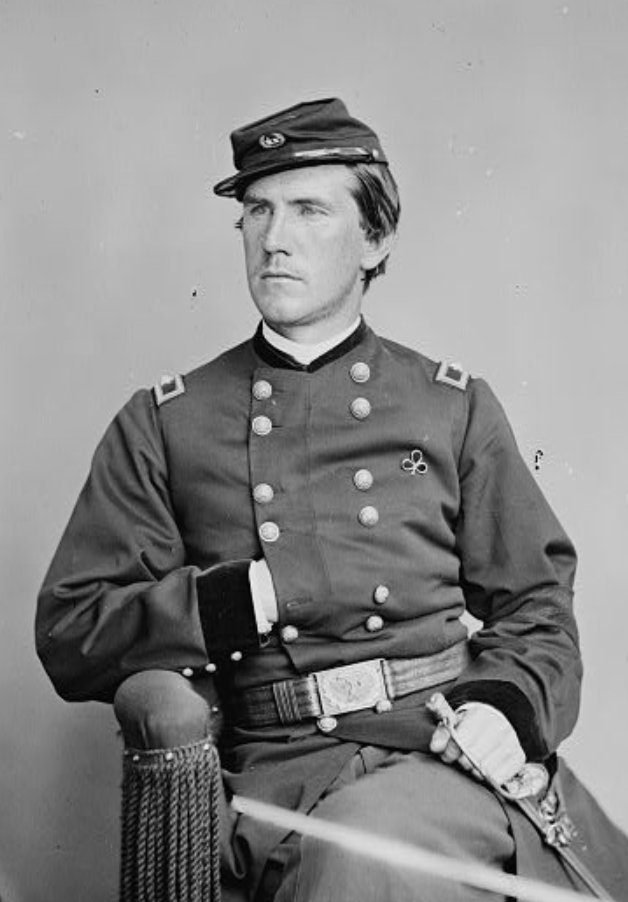
This letter was written by Francis (“Frank”) Henry Whittier (1831-1867) of Cambridgeport, Middlesex county, Massachusetts. He was the son of Amos Henry Whittier (1805-1891) and Hannah Chamberlain Davis (1807-1867). Frank was married in 1853 to Adaline T. Loring (1837-1915) in May 1853 when Adaline was not yet 16. Their first child was born 6 months later; two more over the next three years. It was early December 1861 when Frank enlisted and was commissioned a 2nd Lieutenant of Co. G, 30th Massachusetts infantry. In mid-February 1862 he was promoted to 1st Lieutenant and later to Captain. By war’s end he had risen to Colonel of the regiment.
The 30th Regt. Mass. Vol. Inf. was raised by Gen. Butler in the fall of 1861 and the early part of the winter following. It was originally known as the Eastern Bay State Regiment. It was organized at Camp Chase, Lowell, and its members were mustered in on various dates from Sept. 15 to the close of the year. A controversy having arisen between Governor Andrew and Gen. Butler over the latter’s authority to raise troops in Massachusetts, the regiment left the State Jany. 13, 1862, under command of Acting Lieut. Col. French. Remaining at Fort Monroe until Feb. 2, on the 12th it reached Ship Island in the Gulf of Mexico, where Gen. Butler was assembling his forces to operate against New Orleans. Nathan A. M. Dudley was commissioned colonel, Feb. 8, and most of the other field and staff and line officers were commissioned Feb. 20. It was now officially the 30th Regiment.
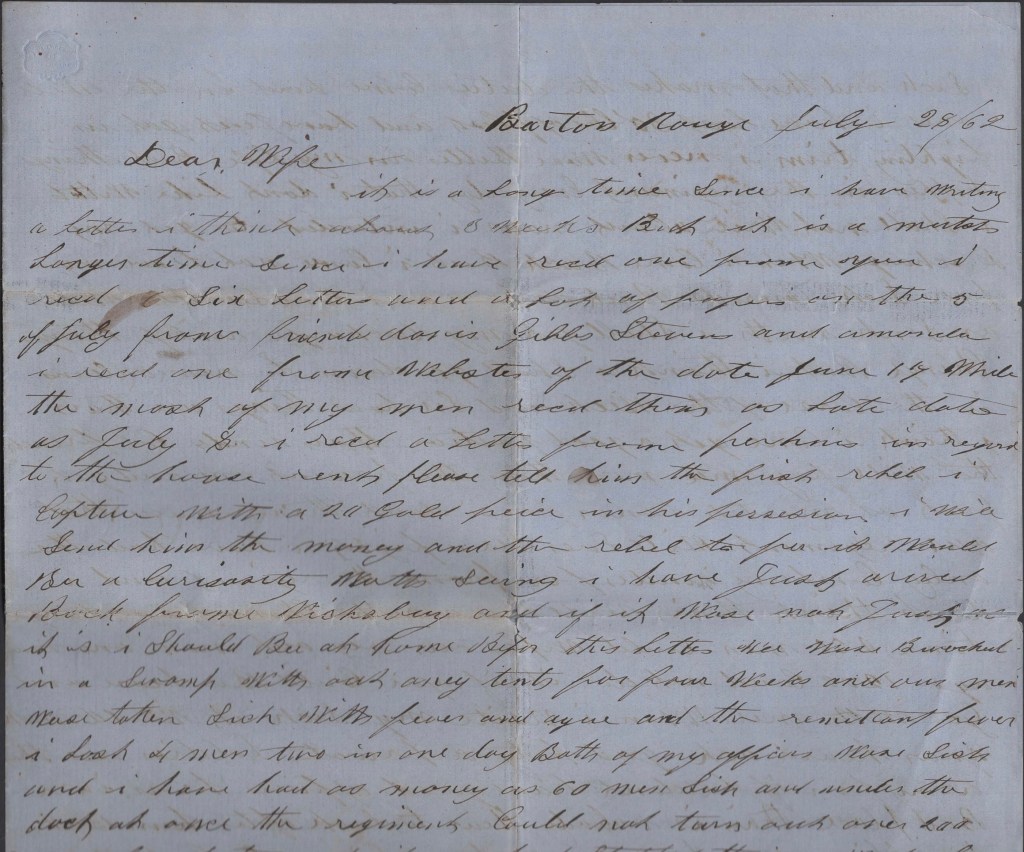
After the Mississippi was opened by Farragut’s fleet in the latter part of April, 1862, the 30th was sent to New Orleans and thence to Baton Rouge, arriving June 2. It made several expeditions into the country in pursuit of guerrillas, then was sent to the front of Vicksburg but returned to Baton Rouge, July 26. It was just after the regiment returned to Baton Rouge that Francis wrote this letter.
T R A N S C R I P T I O N
Baton Rouge [Louisiana] July 28, 1862
Dear Wife,
It is a long time since I have written a letter. I think about three weeks but it is a much longer time since I have received one from you. I received six letters and a lot of papers on the 5th of July from friend Davis, Gibbs, Stevens and Amanda. I received one from Webster of the date June 17th while the most of my men received them as late date as July 8th. I received a letter from Perkins in regard to the house rent. Please tell him the first rebel I capture with a 20 [dollar] gold piece in his possession, I will send him the money and the rebel too for it would be a curiosity worth seeing.
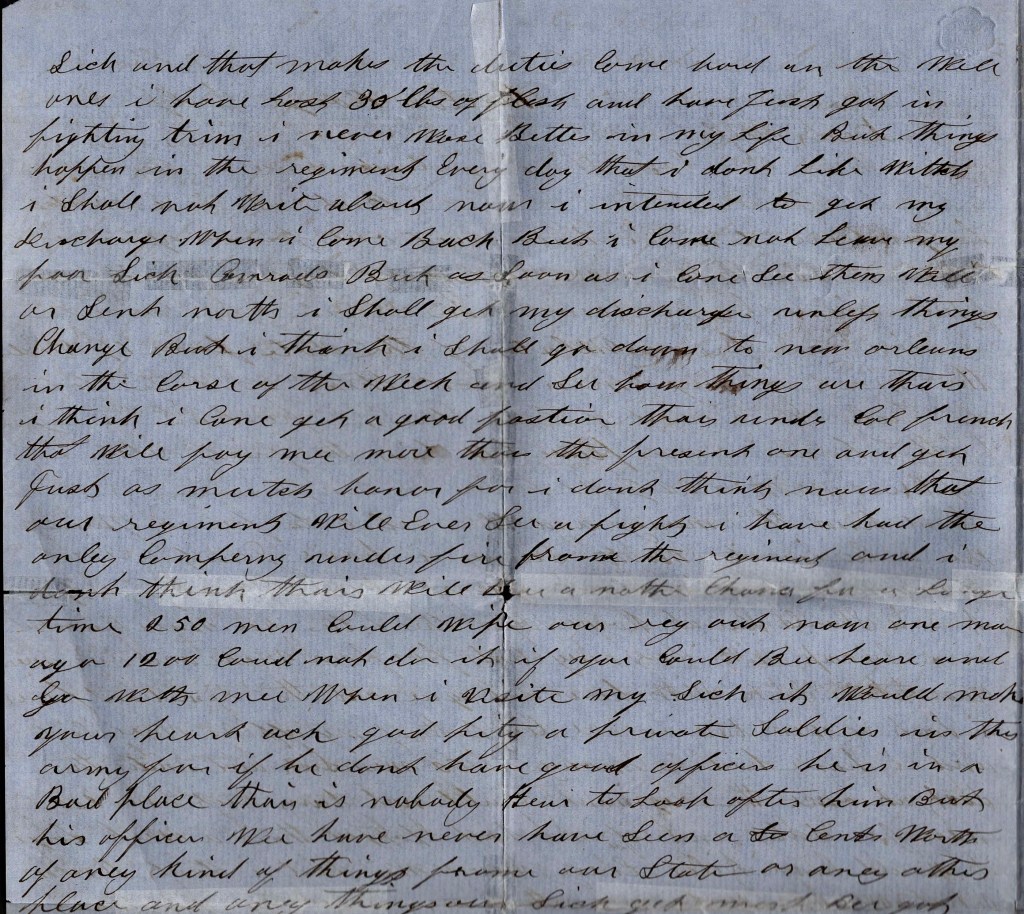
I have just arrived back from Vicksburg and if it was not just as it is, I should be at home before this letter. We were bivouacked in a swamp without any tents for four weeks and our men was taken sick with fever and ague and the remittent fever. I lost 4 men, two in one day. Both of my officers were sick and I have had as many as 60 men sick and under the doct[or’s care] at once. The regiment could not turn out over 200 men for duty and if we had stopped there a week longer, it would have killed every man we had. I don’t know what we shall do now. The men never can get their health in this climate. I have about 30 men in the hospital and as many more in quarters that cannot do duty. Yesterday at dress parade I could not march but 8 men on to line out of 98. I have to work hard all the time and can’t find time to write often now. I shall take all my time to look after my sick. My 1st Lieutenant is very sick and I don’t think he will ever do anymore duty. There is a lot of the officers sick and that makes the duties come hard on the well ones. I have lost 30 pounds of flesh and have just got in fighting trim. I never was better in my life but things happen in the regiment every day that I don’t like which I shall not write about now.
Col. Jonas H. French
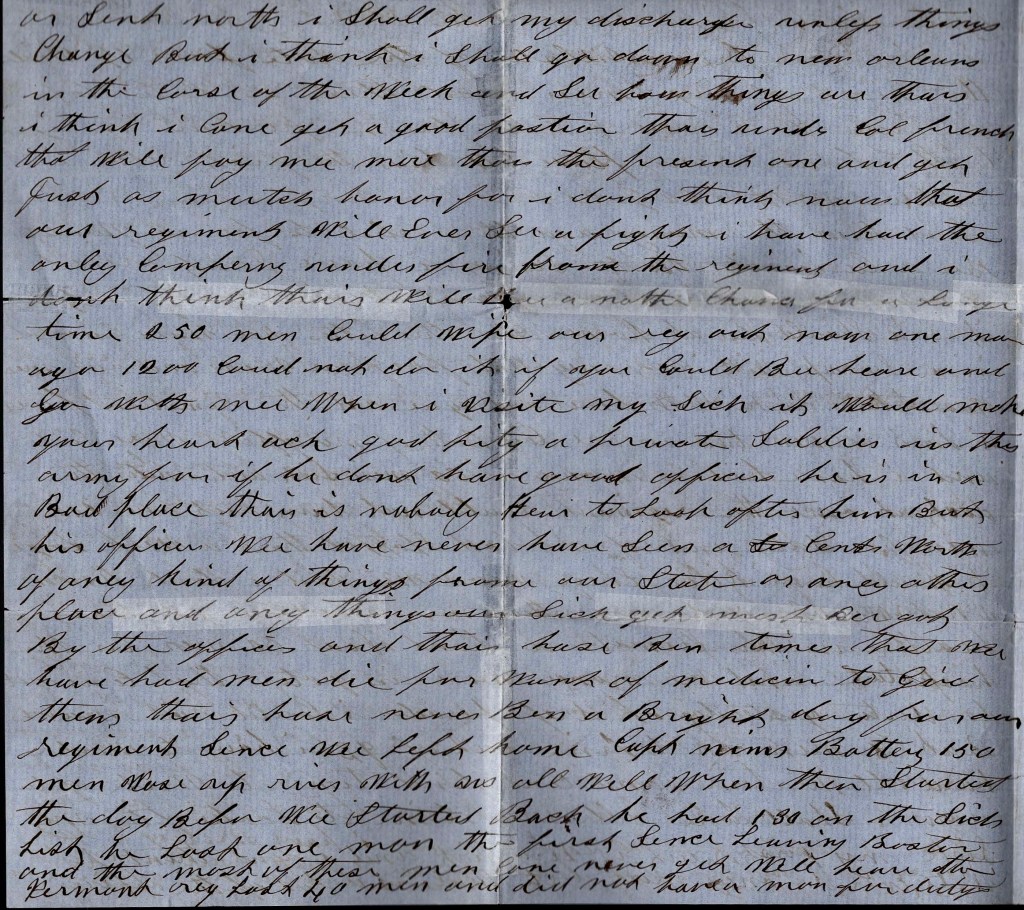
I intended to get my discharge when I came back but I cannot leave my poor sick comrades. But as soon as I can see them well or sent North, I shall get my discharge unless things change. But I think I shall go down to New Orleans in the course of the week and see how things are there. I think I can get a good position there under Col. [Jonas H.] French that will pay me more than the present one and get just as much honor for I don’t think now that our regiment will ever see a fight. I have had the only company under fire from the regiment and I don’t think there will be another chance for a longer time. 250 men could wipe our regiment out now. One month ago, 1200 could not do it. If you could be here and so with me when I visit my sick, it would make your heart ache. God pity a private soldier in the army for if he don’t have good officers, he is in a bad place. There is nobody here to look after him but his officer. We never have seen a cent worth of any kind of things from our State or any other place and any things our sick get, must be got by the officers and there has been times that we have had men die for want of medicine to give them. There has never been a bright day for our regiment since we left home.
Capt. Nims’ Battery [of] 150 men were up river with us, all well when we started. The day before we started back, he had 130 in the sick list. He lost one man—the first since leaving Boston—and the most of these men can never get well here. The Vermont Regiment lost 40 men and did not have a man fit for duty.
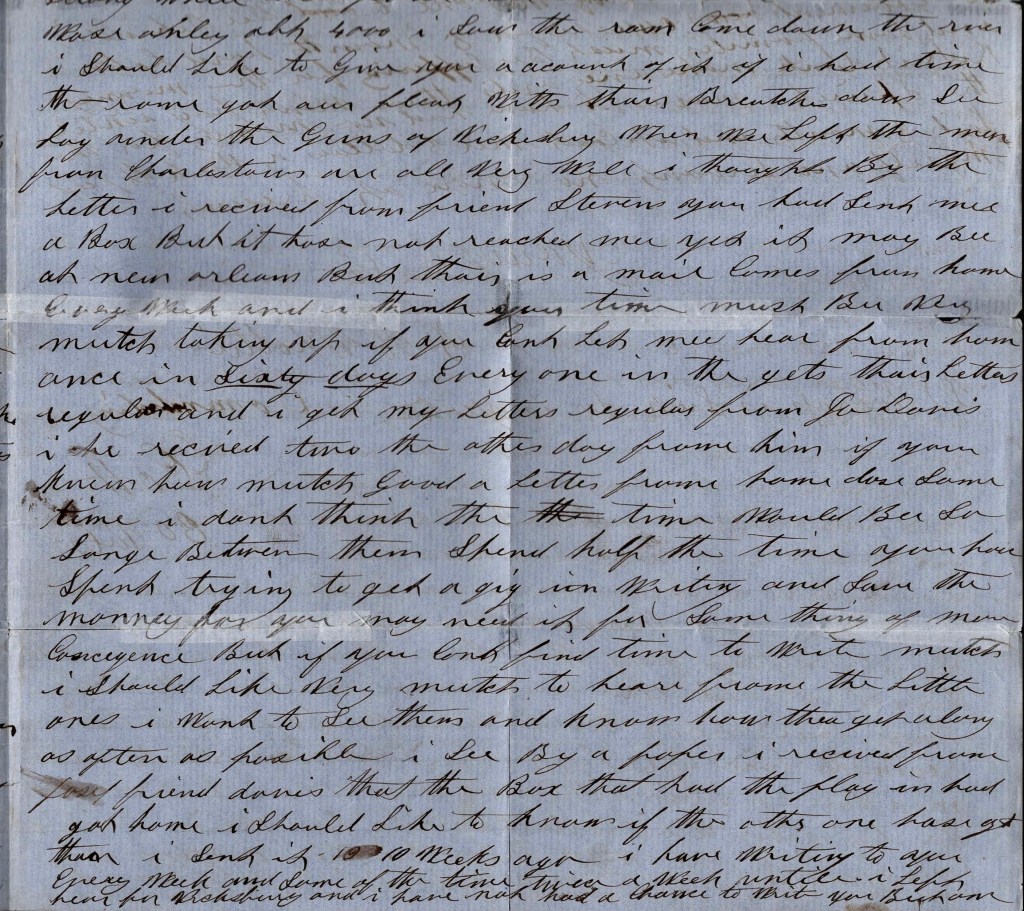
The day we started to come away, all the rest of the regiments were the same. Our regiment stood it the best and longest. The trip did not amount to anything. We saw the bombardment and the fleet go up by the forts and come back. It will take a large force to take the place. The rebels are 75,000 strong while the force we had to take the place was only about 4,000. I saw the Ram come down the river. I should like to give you an account of it if I had time. The same got our fleet with their [Brentches?] down [ ] under the guns of Vicksburg when we left.
The men from Charlestown are all very well. I thought by the letter I received from friend Stevens you had sent me a box but it has not reached me yet. It may be at New Orleans but there is a mail comes from home every week and I think your time must be very much taken up if you can’t let me hear from home once in sixty days. Everyone in the [regiment] gets their letters regular and I get my letters regular from Jo Davis. I received two the other day from him. If you knew how much good a letter from home does some time, I don’t think the time would be so long between them. Spend half the time you have spent trying to get a gig in writing and save the money for you may need it for something of more consequence. But if you don’t find time to write much, I should like very much to hear from the little ones. I want to see them and know how they get along as often as possible.
I see by a paper I received from friend Davis that the box that had the flag in had got home. I should like to know if the other one has got there. I sent it 10 weeks ago. I have written to you every week and some of the time twice a week until I left here for Vicksburg and I have not had a chance to write you but am until now. Please give my respects to all the folks. Let me know about the recruiting papers before it is too late to get anything on them. Give my respects to friend Greer. I shall write to Webster and the rest of my friends next mail. It is time for the mail to close so I can’t write any more this time. I have a few more trophies to send home when I find the last got there safe.
I was in hopes to send some money but our regiment has not been paid up. Every other regiment have been paid but that is the usual luck of this one to be behind. The Government owes us for 5 months hard labor and some families must be suffering for the money. But it don’t make any [ ]. They won’t pay until the spirit moves. I have had no money for the last three months and it cost me 3 dollars a week to feed myself and servants. No more at present. Yours, &c. — F. H. Whittier
This letter was written by Reuben Benedict [“Benerdick”] Abby (1832-1864) of Co. C, 124th Ohio Volunteer Infantry (OVI). Reuben was the son of Loren Abby (1803-1858) and Abigail Tower (1798-1843). He was married in September 1853 to Roxanna Mann (1831-1896) and was living in Berea, Cuyahoga county, Ohio, and working as a wagon maker when he enlisted on 30 September 1862. He mustered in on 31 December 1862 and soon found himself in Elizabethtown, Kentucky where he wrote the following letter to his wife. Reuben did not survive the war, however. He died of small pox at Nashville Hospital No. 11 on 16 February 1864. Reuben’s widow was left with four children to raise on a limited pension. They included Myrtle Malvina Abby (b. 1858), Mayhetta Jane Abby (b. 1859), Henry Egbert Abby (b. 1861) and George Benerdict Abby (b. 1863). Note: the family surname is sometimes spelled Abbey.
Marriage Certificate between “Benjamin” Abbey and Roxy Man dated 10 September 1853. Birth certificates of his children claim his middle name was “Benerdict” however.
T R A N S C R I P T I O N
Elizabethtown, Kentucky January 26, 1863
Dear Wife,
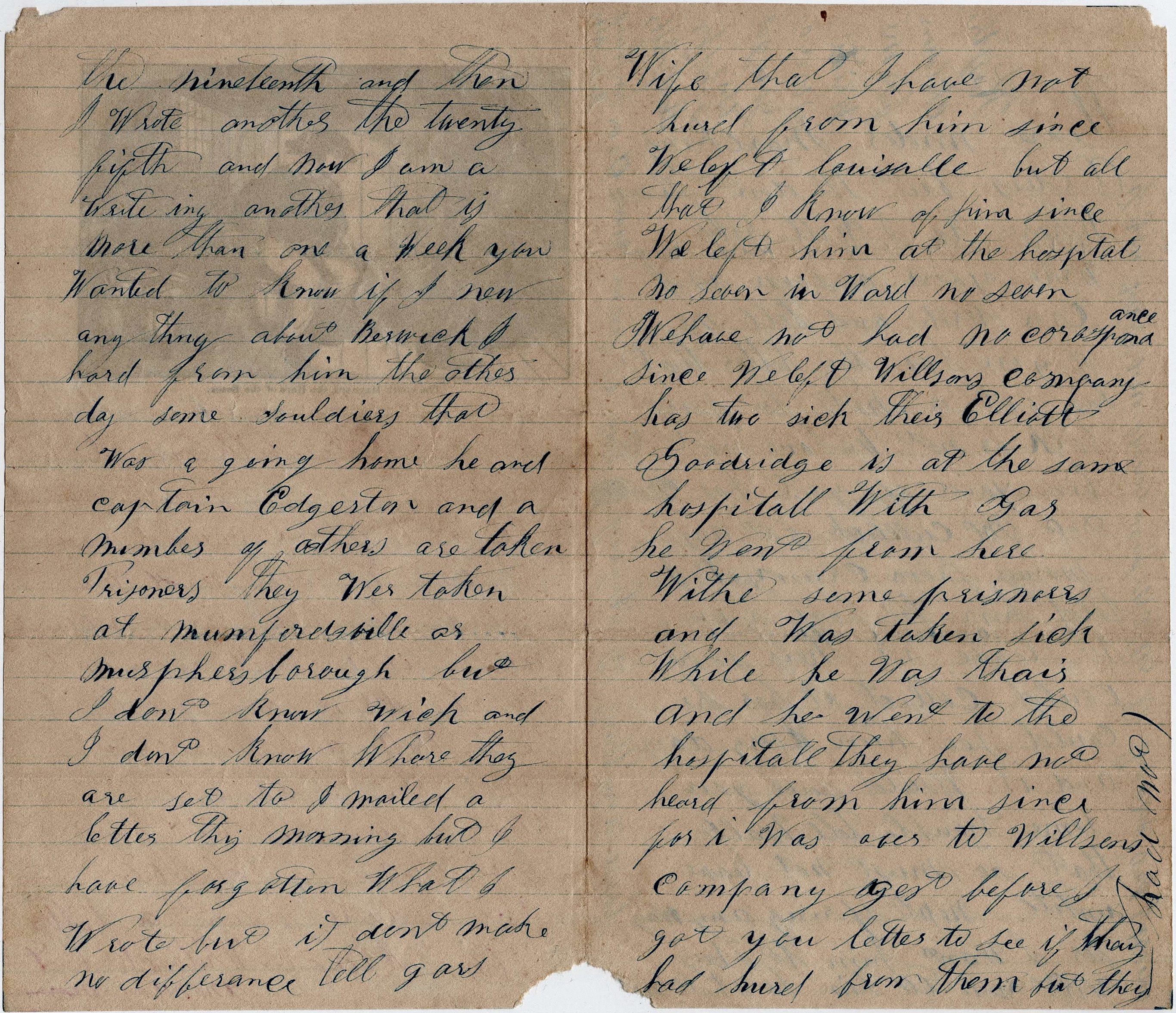
I received your letter today and was glad to hear from you and finding that you and the children are all well. I am well and when you get this, I hope that these few lines will find you and the children the same. I sent a letter by Neager Whitbeck last Monday the 19th and then I wrote another the 25th and now I am a writing another. That is more than one a week.
You wanted to know if I knew anything about Berwick. I heard from him the other day. Some soldiers that was a going home. He and Captain Edgerton and a number of others are taken prisoners. They were taken at Mumfordsville or Murfreesboro but I don’t know which and I don’t know where they are sent to. I mailed a letter this morning but I have forgotten what I wrote but it don’t make no difference. Tell Gars’ [Eben W. Garzee] wife that I have not heard from him since we left Louisville but all that I know of him since. We left him at the hospital No. 7 in Ward No. 7. We have not had no correspondence since we left. [William] Wilson’s Company [A] has two sick there. [George] Elliott Goodrich is at the same hospital with Gar [Garzee]. He went from here with some prisoners and was taken sick while he was there and he went to the hospital. They have not heard from him since for I was over to Wilson’s Company just before I got your letter to see if they had heard from them but they had not.
We are under marching orders but we don’t know where to. I will write again as soon as I can write and tell me if you have the letter that has got a note to Gar’s folks or not. We have not been paid off yet. Has Doc McCullock got any money from Cran [?] yet. I told him to have you to leave it there so he could collect it for he could see him every day and it would save you some trouble. Tell Walt that he must not leave until next spring anyway for I want him to stay with you. Tell him he shall not lose anything by staying. This is from you dear husband, — R. B. Abby
Kiss the children for me. Write soon sa you get this. Goodbye, — R. B. Abby
If you want some money, send Walter to the Doc and get some.
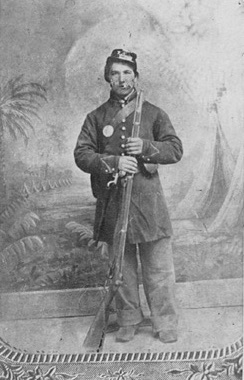
I could not find an image of Hiram but here is one of Jacob Wagner who served in Co. I of the 49th Pennsylvania Infantry (Photo Sleuth)
The following letter was written by Hiram Greenland (1839-1873), the son of Nathan Greenland (1805-1880) and Matilda Ramsey (1810-1865) of Calvin, Huntingdon county, Pennsylvania. Hiram was 21 years old, a single farmer living with his parents when he enlisted in September 1861 at Harrisburg in the 49th Pennsylvania Infantry. He was mustered into the service on 24 October 1861 at Camp Griffin in Virginia (near Lewinsville) where he wrote this letter to his cousin three weeks later. Muster records indicate that Hiram was in Co. D when he began his service but was later transferred to Co. B and then eventually deserted and was dishonorably discharged in November 1864. After the war he settled in Chester county and died in 1873. There is a soldier’s marker on his grave in Cassville, Pa.
T R A N S C R I P T I O N
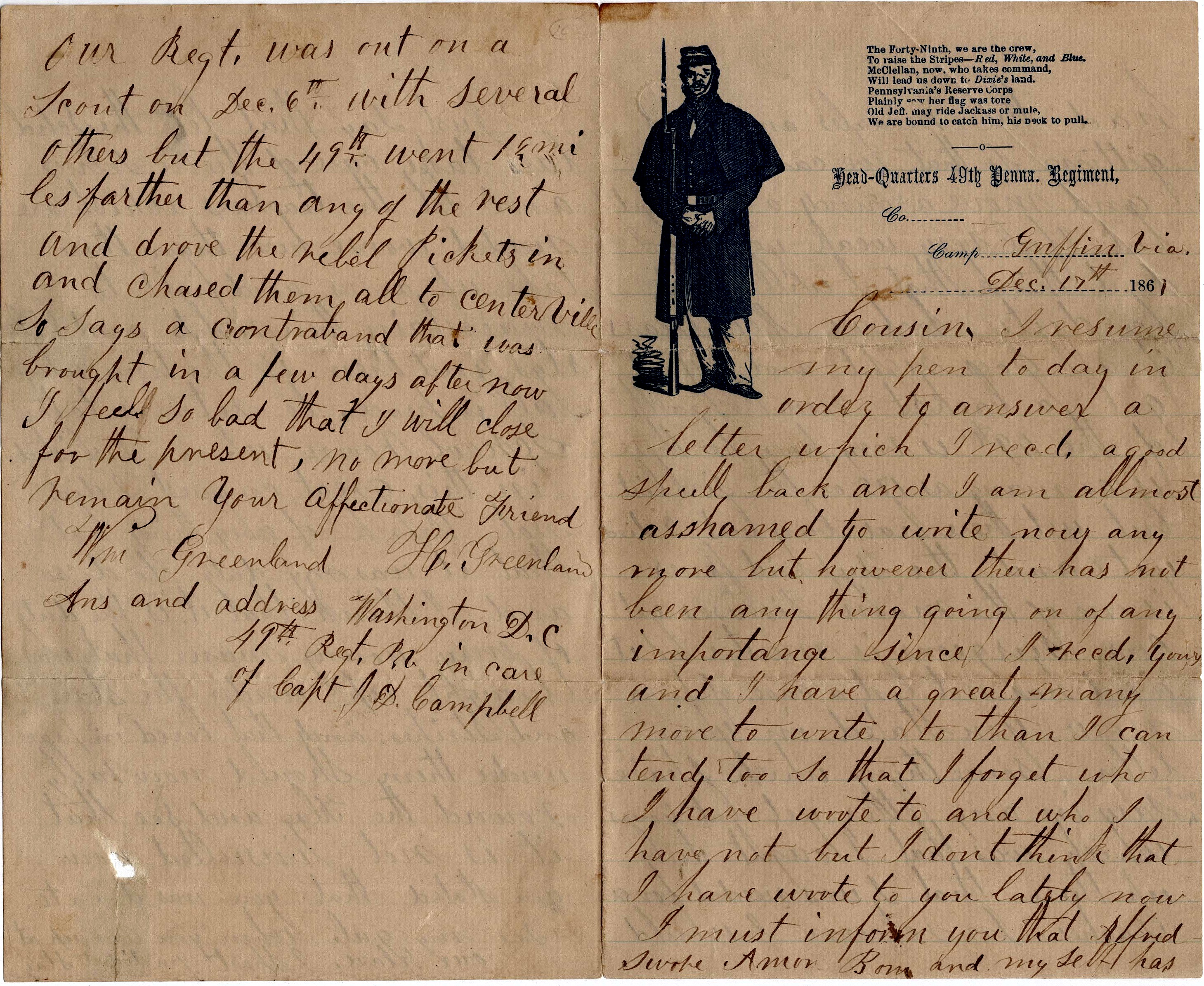
Patriotic stationery (with Poem to the 49th Penna. Regiment) used in Hiram’s letter.
I resume my pen today in order to answer a letter which I received a good spell back and I am almost ashamed to write now any more but, however, there has not been anything going on or any importance since I received yours and I have a great many more to write to than I can tend to so that I forget who I have wrote to and who I have to but don’t think that I have wrote to you lately.
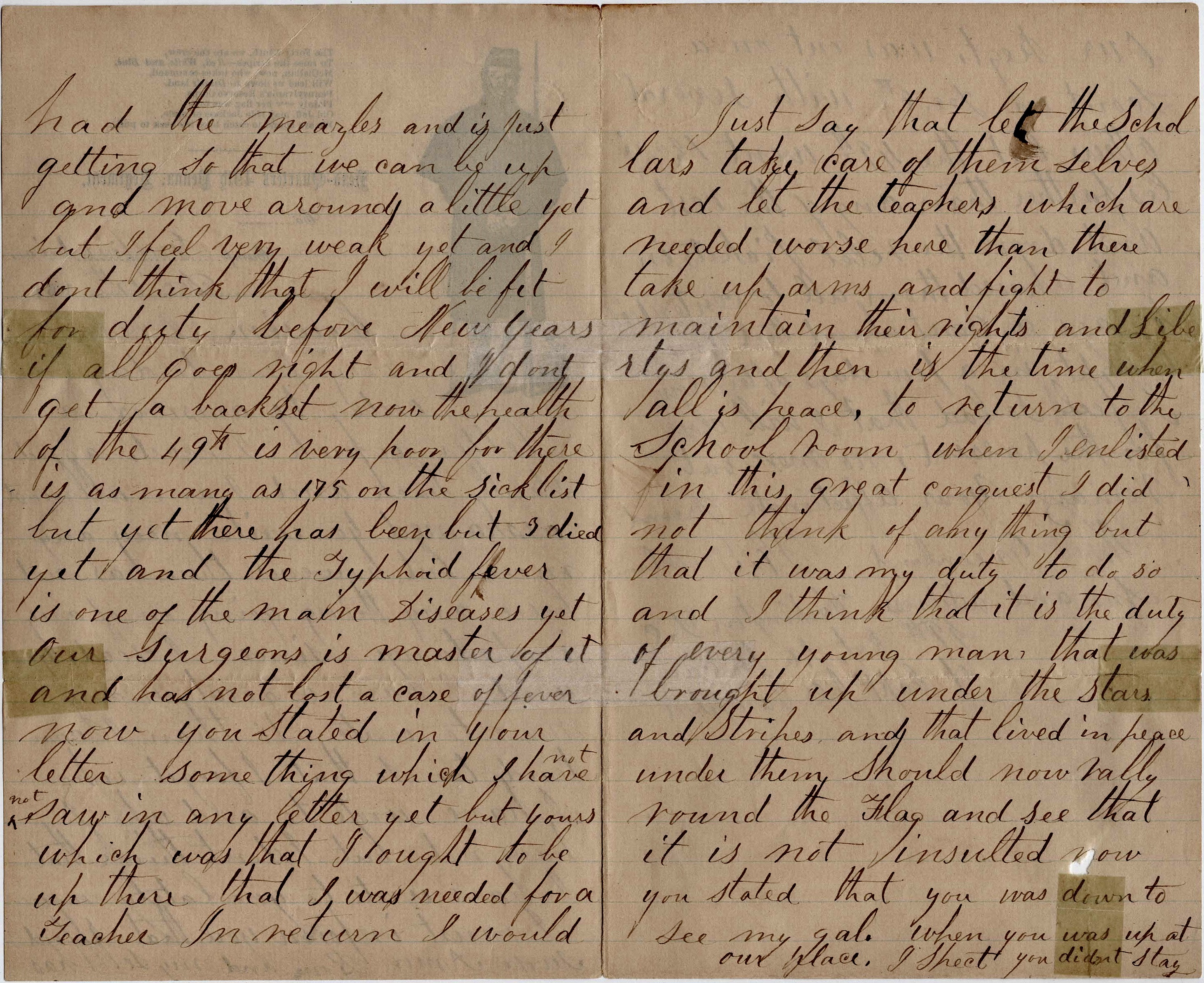
Now I must inform you that Alfred Swope, Amos B[ ] and myself has had the measles and is just getting so that we can be up and move around a little yet but I feel very weak yet and I don’t think that I will be fit for duty before New Years if all goes right and I don’t get a backset now. The health of the 49th is very poor for there is as many as 175 on the sick list but yet there has been but three died yet and the typhoid fever is one of the main diseases. Yet our surgeons is master of it and has not lost a case of fever.
Now you stated in your letter something which I have not saw in any letter yet but yours which was that I ought to be up there—that I was needed for a teacher. In return I would just say that let the scholars take care of themselves and let the teachers, which are needed worse here than there, take up arms and fight to maintain their rights and liberties and there is the time when all is peace to return to the school room.
When I enlisted in this great conquest, I did not think of anything but that it was my duty to do so and I think that it is the duty of every young man that was brought up under the Stars & Stripes and that lived in peace under them should now rally round the flag and see that it is not insulted.
Now you stated that you was down to see my gal. When you was up at our place, I spect you didn’t stay.
Our regiment was out on a scout on December 6th with several others but the 49th went 12 miles farther than any of the rest and drove the rebel pickets in and chased them all to Centreville. So says a contraband that was brought in a few days after. Now I feel so bad that I will close for the present. No more but remain your affectionate friend, — H. Greenland
[to] William Greenland
Answer and address to Washington D. C., 49th Regt. P. V. in care of Capt. J[ames] D. Campbell
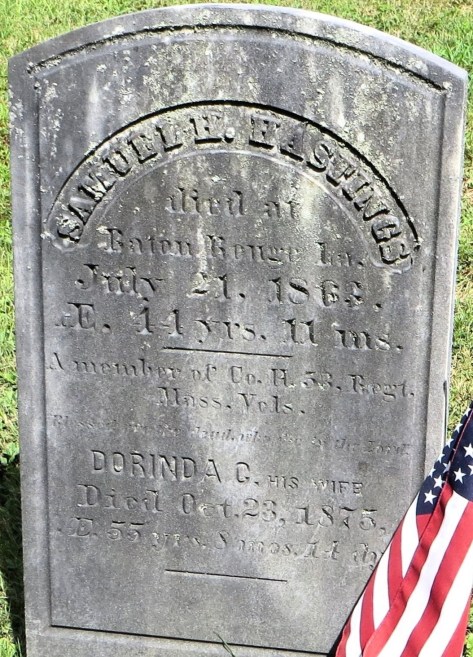
This letter was written by Samuel H. Hastings (1818-1863) of Hubbardstown who enlisted as a private for nine months service in Co. H, 53rd Massachusetts Infantry. He claimed to be a carpenter at the time of his enlistment though census records indicate he was a farmer. Unfortunately he did not survive the war. He died of disease in Baton Rouge, Louisiana on 21 July 1863, just five weeks after he wrote this letter to his wife letting her know he expected to be home about the 1st of August—“if spared.” Samuel was married in 1844 to Dorinda Clifford (1820-1875) and they had one child, Lilla Maria Hastings (1853-1893).
After it was organized in the fall of 1862, the 53rd Massachusetts was assigned to the expedition to go to Louisiana and once there, in January 1863, it was placed in Gooding’s 3rd Brigade, Paine’s 3rd Division, 19th Army Corps. After participating on some expeditions into Louisiana, the 53rd found itself in May 1863 at Bayou Sara, bearing down on Port Hudson from the north.
T R A N S C R I P T I O N
Cook House in the woods in rear of Port Hudson June 13th 1863
Dear wife,
Don’t you think we were a happy lot of boys last eve. The mail come to us with a large lot of letters. How many do you think I had? There was 8 from you and 6 from others; 14 in all. It took me some time to read them all. One from J. Smith, one from Fitch, 1 from E. W., one from C. H., 1 from Loring, 1 from Hannah, I shan’t have to answer them all. I hardly have time to write all I want to you. After you get this, if you have time, you may write to Hannah. She is atBellows Falls, Vermont. If you don’t have time, let it be. She wrote that she was coming down this summer. E.’s letter you can answer. The letters I received from you were No. 14, (15 I received before). I have all up as high as 22 dated 19th of May so I have all up to that time. I presume there are more on the way. I hope that we shall get our mails now. Those envelopes and stamps come in play now for I was all out of stamps & it is rather hard to get them here at this time.
We remain here yet. Our regiment has not done anything since we came back from Clinton. The cooking is the hardest part of the work now this hot weather. There is a flag of truce up now. I don’t know whether they are going to surrender or what it is for, I hope they are. It is 9 weeks since we first came here. I am nearly a mile and a half from the regiment. Four of us cook for all. We have three colored men to bring our water & cut our wood. That helps a good deal. You spoke about your butter. I think you have done nicely to sell so much. I wish I had some to eat. It would be so nice. I hope I shall get home sometime to eat some of it. I think H. can cut all of the grass for 1/9 of it is as good as it has been years back. It is so handy for him. I must leave off writing now for we are cooking rice for supper.
Sunday morn [14 June]. This day is to be a day of sorrow with some of us. Probably hundreds have been killed ere this. The battle commenced at 3 this morn. I went to the regiment at one this morn with coffee so they might have something warm to drink. I saw [your brother] J[osephus Clifford]. He said he was in hopes to go through. I think he is prepared for the worst. Port Hudson must be ours before noon today. I think there are days enough in the week besides Sunday to fight but most of ours comes on that day. Could I be where I could attend church today, I should rather than to hear the sound of the cannons & muskets & the whizzing of the bullets. But that is all that we can hear this morn. We have beans to cook today. Can’t tell who will be left to eat them or when we can get them to the men.
Do you expect to go to church today? I hope you will have a chance to go with somebody. I don’t think you are able to walk this warm weather. We call it hot out here. I shall not finish this today for I may have some news to write so I will stop now.
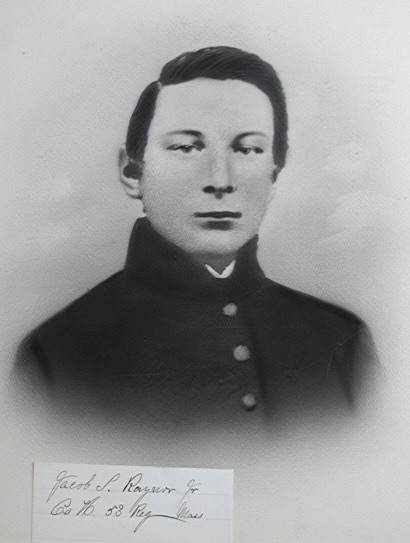
We did not succeed as we thought we should but met with a great loss. Co. H did not have any killed & but one wounded of any account—a young man by the name of [Jacob S.] Raynor from Warwick. Lost one leg. Don’t think he will live. 1 J[osephus] went through safe. I don’t expect to have a chance to send this now any farther than New Orleans. I believe there is no mail goes now. I wish this war was over. How many a sad heart this battle must make. Co. F—the Barre Company—suffered a good deal.
You spoke about our time. I don’t expect we shall get home until the first of August. I shall expect to be at home then if spared. It will take about a year to make 9 months, but never mind. I don’t think I shall go again. If we can get this place soon, I think it will be all we shall do here. But I don’t know as we shall be able to take it. It is harder than it was supposed to take. But she must come some time. It is so hot. It is worse for the men can’t stand what they could in cold weather. My paper is most filled up so I must close this letter. I am as well as I expect to be while I stay in this climate. J. sends love to all. I don’t know as I shall write as often as I have done for I don’t get much time. I hardly get time to rest half as much as I need to. This from your affectionate husband, With much love to all. — S. H. H.
1 Pvt. Jacob S. Raynor was born in Athol on 28 October 1844. He died on 28 June 1863 from a severe leg wound received in the assault on Port Hudson on 14 June 1863.
The following letter was written by George Darrah (1819-1903) of Cadyville, Clinton county, New York. George was born in Canada but came to the United States in 1833 and married Elizabeth Ann Stackpole (1822-1890). Their oldest children, George Darrah, Jr. (1840-1922), and Frederick Darrah (1842-1864) are the principal subjects of this letter, both of them having served as Union soldiers.
George Elizabeth (Stackpole) Darrah of Cadyville, New York (Ancestry.com)
George Darrah, Jr. was working as teamster in Plattsburgh, New York, when he was drafted into Co. H, 83rd New York Infantry. He was wounded—as described in the letter—near the beginning of Grant’s Overland Campaign and was never able to return to his regiment but after regaining some use of his arm, he was transferred into the Veteran’s Reserve Corps to complete his term of service.
Frederick Darrah was working as a teamster in Plattsburgh when he enlisted in September 1864 as a private in 2nd New York Veteran Cavalry. He died of chronic diarrhea at Morganza, Pointe Coupee Parish, Louisiana.
George wrote the letter to his brother John W. Darrah (1818-1900), the husband of Eliza Finch (1825-1906). They were residents of Williamstown, Dodge county, Wisconsin, at the time. Their oldest son, Wallace William Darrah (1845-1864) also served in the Union army. Wallace served as a corporal in Co. B, 10th Wisconsin Infantry, but was wounded and taken prisoner at the Battle of Chickamauga in September 1863. He died in mid-January 1864 while in prison at Danville, Virginia. We learn from this letter that their second oldest son, Charles Darrah (1847-Bef1865) also died but must have been at home and not in the service.
T R A N S C R I P T I O N
Cadyville [Clinton county, New York] March 19th 1865
Mr. John Darrah, dear brother
I will write a few lines to you to let you know that there is still such a man a living as George Darrah, but it seems to me as though you have forgotten me. But I hope I shall see you again if it’s God’s will. This letter leaves all of us well at present and hoping they will find you enjoying the same blessings. I say all but there is a separation in my family as well as in yours. This cruel war has made almost every house in our land a house of mourning and bereavement excepting some of Big Popular Black-hearted thieves. I was informed of the death of [your sons] Wallis and Charley, but poor Wallis did not have his father and his mother to soothe him in his last of his troubles. We always had letters from him while he was in the service until he was taken prisoner. He sent his photograph and we have got it yet. I suppose he suffered a thousand deaths before he died. There is some Boys here that has been prisoners and they look like death when they get away.
I will tell you about my boys. One year ago last July George was drafted and was taken down to Virginia and was but right front in speaking distance of Mr. Rebs and he skirmished with them until the 1st of last May when Grant made his flank move for Richmond. He was in the battle for ten days. He says that one time there was so many balls struck his knapsack that it cut it to pieces so that all of his things fell out and none of the balls hit his body until he was marching forward when up jumped a Rebel a few feet forward of him and fired at him as he was loading his gun and the ball passed through his left arm below his elbow, stoving one of the bones all to pieces and cut off all of the cords of is arm and he bled almost to death before he got it done up. He got a furlough to come home for thirty days and then he went back, remained in the hospital until election when he came home again. His arm has got so he can use it some now. He is doing picket duty now on the Baltimore & Ohio Railroad near Washington. He was fat and rugged when he was at home last fall in November and he says he is well now. When the Rebel fired at him he [the Rebel] started to run but George’s comrade plunked him in the head.
Now I will tell you about poor Frederick. Last September there [was] no talk of enlistments or [of] being drafted so he made up his mind he would go for one year. I said all I could to him not to go but he said he was sure he would be drafted and go he should for one year. He went from New York to New Orleans and from there to Morganza up the Mississippi River 180 miles above New Orleans and was taken sick with the rheaumatics and chronic diarrhea and on the 23rd day of last January he bid adieu to all of his friends. He had a number of them with him from home and that is the only consolation I have about him. They nursed him day and night to save him but all in vain. His time had come and he had to go. He told his Uncle Joseph Robberts and James Norcross that watched with him the day before he died that he could not live. He had his senses to the last. He said he could see the angels waiting for him. About his last words was he told his uncle to tell all of his friends that he died happy and longed to see the time come when his sufferings would be over. Poor fellow. How many times he must though of my parting words with him but alas, it was too late. He went a long road to meet his death. He lays on the banks of the Mississippi—no friend to view his place of burial. He was a good and smart young man as you would see walking the road. I am sad with his loss. God knows how many more like him will have to go before this cruel and cursed war is over.
All the brothers and sisters here is smart. Lester and Guinup lives out in Franklin county and Mother is with Lester. I had a letter a few days ago from them. They was well at that time. I should be happy to get a letter from you. I got one from Levi Darrah [Co. F, 44th Wisconsin] a short time ago. He was in Nashville, Tennessee, then. I wrote an answer immediately. I had a great many letters from William’s George until lately I have not had any. I would be very happy to know if he is living. If you will answer this, I will write you again and tell you all that is going on here. Elizabeth sends her love to Eliza and a part to yourself. Write and let me know how you get along. So I must close for it is 11 o’clock and go to bed. So good night. — George Darrah
I wish you much joy with your little son and hope when he gets grown up that he will not be destroyed by a cursed negro war.
Eliza Hurlbert, please forward this to brother John Darrah.
This letter was probably written by a member of the 27th Georgia while in the trenches at Petersburg. Unfortunately I was not able to identity who wrote it and I’m not certain that I have actually gotten the names correctly. The author wrote the letter to his sister “Jocie” which was probably short for Josephine. She was married to someone named John and they had a young daughter named “Sadie” or Sarah. The author may have had a brother serving in the 27th as well who was assigned to duty in Savannah rather than Petersburg.
T R A N S C R I P T I O N
Petersburg, Virginia September 27th 1864
Dear Sister Jocie,
I received your most welcome letter today and was glad to hear from you once more and to hear that Bro. Shon was at home but sorry to hear of his sickness. I was in hopes he was well when I heard he had gone back to camp [ ] but am sorry [to] hear different in your letter.
I have no news of importance to write. Everything has been very quiet here for the last day or two. Of course we have the usual cannonading and picket firing along the lines which does not do much damage to either side. Some days they take a notion and shell the city very furiously. It does not generally result in much damage in the way of life. I went over to see Frank last Sunday. They were both well. I will deliver your message to them when I see them again.
I have not heard from home since the 18th. All was well and expecting the Yankees to come at any time which I am afraid they will do some night before they know it. I am afraid I will never get to see my home again—at least until the war is ended. And you know chances are slim in war. If the Yankees were all sunk in the middle of the blue sea, it would not grieve me much.
I would like very much to see your little Sadie. You say she is so interesting. I am afraid you praise her good looks too much. You must let me judge for you. As you know, a mother always looks on her children with [ ] eyes. I am in hopes I will have a chance of coming to see you before the war ends but I think it very doubtful. Nothing would give me more pleasure but furloughs are so short that by the time I got home and tell them all howdy, I’d have to pack back to the army. I am as tired of this war as mortal ever was.
You wrote to know Willie’s address. Direct your letter in care of Capt. Dougherty, Co. E, Savannah 27th Ga. Battalion, Savannah, Ga. Willy seems to be very lonely down there but I think he is much better off there than here.
Sister, I think you are mistaken when you say you have the advantage of me for I know I love you as much as any brother ever loved a sister and think all the rest do also. I almost despaired of hearing from you or Bro. John. I wrote several letters and did not receive and answer to any of them. Excuse this short letter as my candle is waxing low which reminds me that I must bid you good night. Kiss John for me. Love to all and reserve a portion for yourself. From your brother, — Jonnie B.