The following letter was written by Jacob E. Travelpiece (1844-1908), the son of Jacob Dreibelbis (1799-1874) and Mary Magdalena Everett (1804-1867) of Orangeville, Columbia county, Pennsylvania. Jacob wrote the letter while serving in Co. E, 209th Pennsylvania Infantry. According to the 1890 Veteran Schedules, Jacob enlisted in September 1864 and mustered out in late May 1865 after 9 months service. After the war he married Celestia Stiner (1847-1931).
Transcription
Addressed to Miss Sallie France [?], Orangeville, Columbia county, Pa.
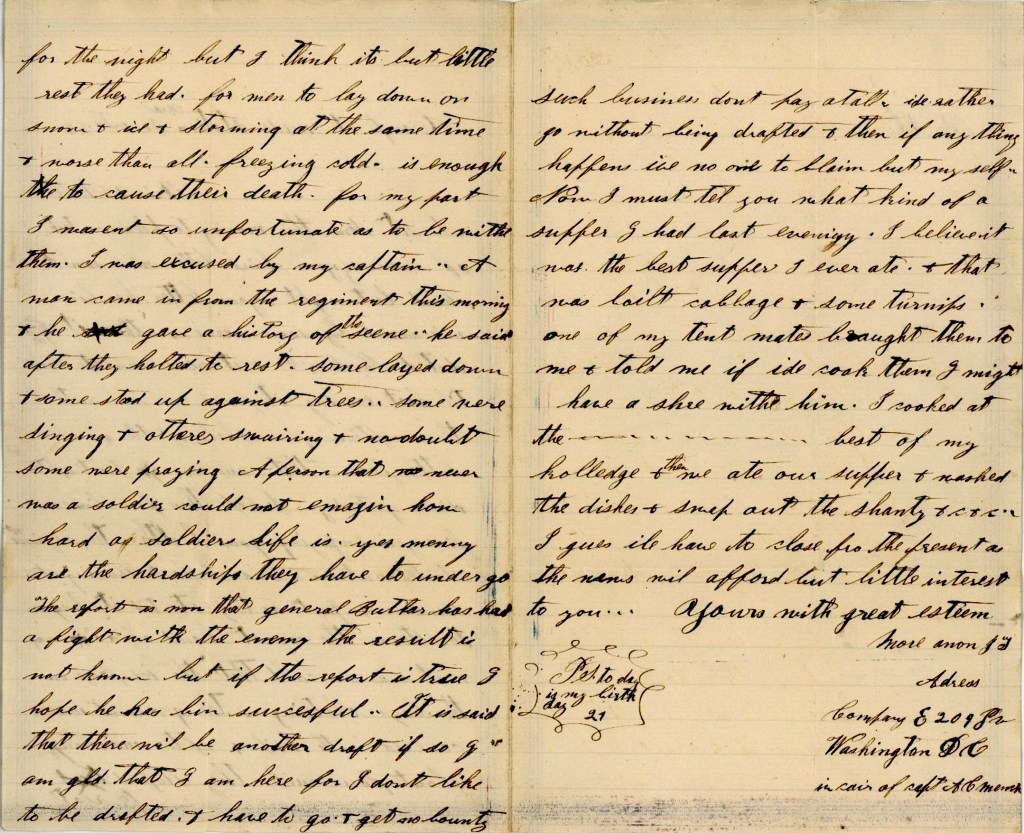
Camp at Meds Station, Va. December 10th, 1864
Friend Sallie,
I sit down this morning to pleasure task of answering your kind letter which came to hand last night. Your letter has been miscarried by some means or other. It is dated November 15th and it never came to hand till last evening. It found me well with the exception of a shake of the ague & a little fever that came on just after dinner yesterday. I hope these few lines will find you enjoying good health.
The regiment started out on a march last evening at sundown & just as they started, it began to storm the worst kind of a way & it was so cold that the ice froze on the boys clothing. The ground was covered with hail and after marching about four miles, they stopped to rest for the night but I think it’s but little rest they had for men to lay down on snow & ice and storming at the same time & worse than all, freezing cold is enough to cause their death. For my part, I wasn’t so unfortunate as to be with them. I was excused by my captain.
A man came in from the regiment this morning and he gave a history of the scene. He said after they halted to rest, some laid down & some stood up against trees. Some were singing and others swearing & no doubt some were praying. A person that never was a soldier could not imagine how hard a soldier’s life is. Yes, many are the hardships they have to undergo.
The report is now that General Butler has had a fight with the enemy. The result is not known but if the report is true, I hope he has been successful. It is said that there will be another draft. If so, I am glad that I am here for I don’t like to be drafted & have to go & get no bounty. Such business don’t pay at all. I’d rather go without being drafted and then if anything happens, I’ve no one to blame but myself.
Now I must tell you what kind of a supper I had last evening. I believe it was the best supper I ever ate & that was [ ] cabbage and some turnips. One of my tent mates brought them to me and told me if I’d cook them I might have a share with him. I cooked at the ——- best of my knowledge & then we ate our supper & washed the dishes and swept out the shanty, &c. I guess I’ll have to close for the present as the news will afford but little interest to you. Yours with great esteem. More anon. — J. T.
Address Company E, 209th Penn. , Washington D. C. in care of Capt. A[ndrew] C. Mensch
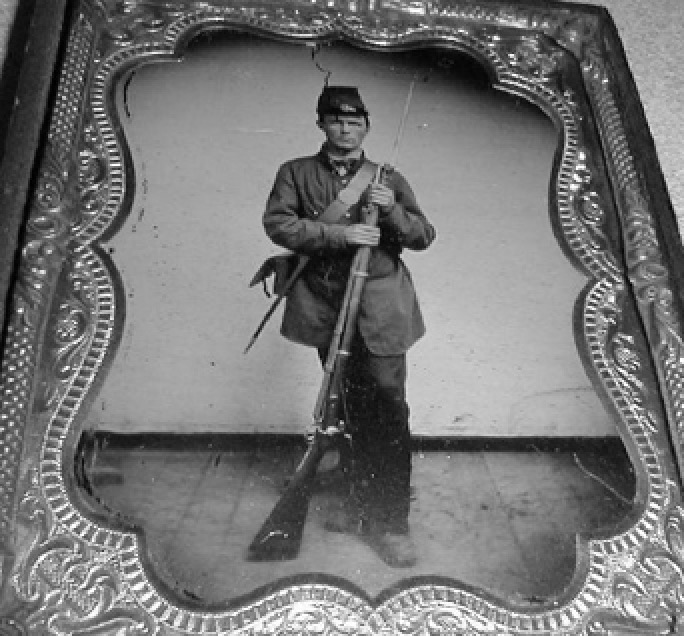
The only picture I could find of a member of the 84th OVI in uniform. This was William D. Mather of Co. E. (Photo Sleuth)
The following partial letter was written by a soldier serving in Co. C, 84th Ohio Volunteer Infantry (OVI)—a three months’ regiment that was ordered to Cumberland, Md., June 11, and performed provost duty there till September. They were attached to Railroad District, Dept. of the Mountains, to July, 1862, and 8th Army Corps, Middle Department, to September. They moved to New Creek September 13 to repel an attack on that point by Jenkins and Imboden. They then moved to Camp Chase, thence to Camp Delaware, and mustered out October 14, 1862.
Co. C was recruited principally in Miami county, Ohio, but there were some members from Trumbull and Mahoning counties as well. The only name mentioned in the letter was that of Halbert Brigham Case (1838-1914) who served as captain of Co. C. Case had previously served as 1st Sergeant in Co. H, 7th OVI when it was a 3-months regiment and when it was reorganized as a 3-year’s organization, he was commissioned a Lieutenant and served in the campaigns of West Virginia. He resigned his commission to raise the company in the 84th OVI.
Unfortunately the envelope that carried this letter home has not survived or has been separated from it so that we don’t know who the soldier’s folks were. And there was likely a second sheet to this letter at one time that included the soldier’s signature, but it too is gone.
Transcription
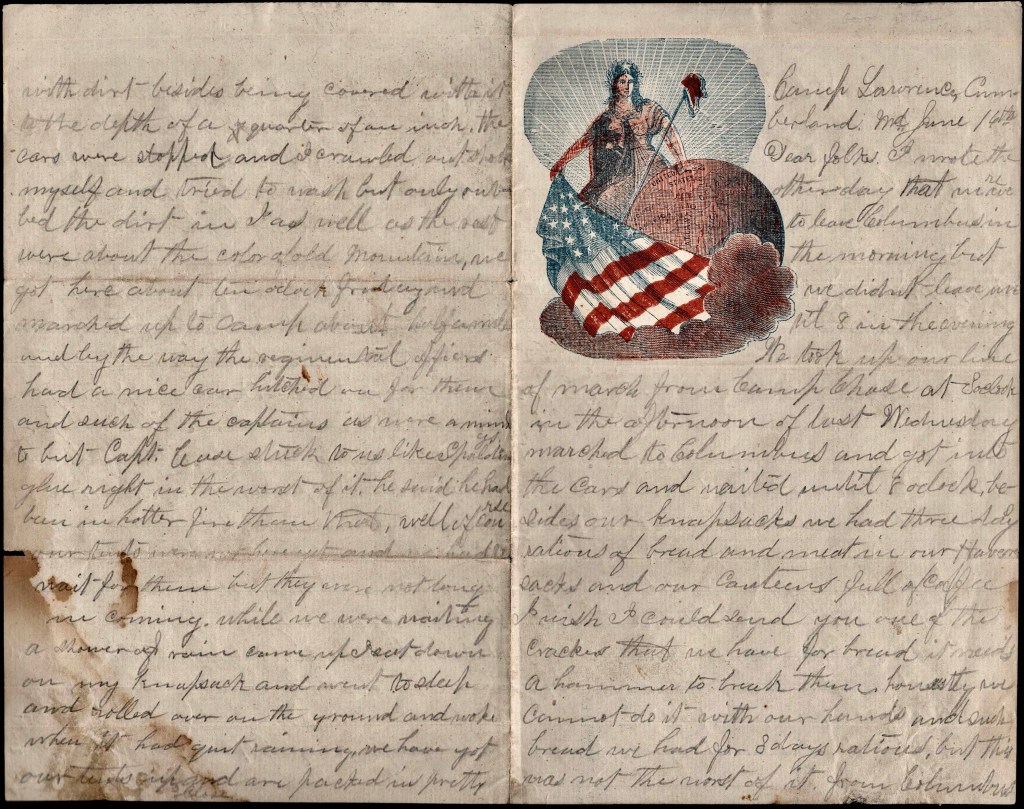
Camp Lawrence, Cumberland, Maryland June 16th [1862]
Dear folks,
I wrote the other day that we were to leave Columbus in the morning but we didn’t leave until 8 in the evening. We took up our line of march from Camp Chase at 3 o’clock in the afternoon of last Wednesday, marched to Columbus, and got into the cars and waited until 8 o’clock. Besides our knapsacks, we had three days rations of bread and meat in our haversacks and our canteens full of coffee. I wish I could send you one of the crackers that we have for bread. It needs a hammer to break them. Honestly, we cannot do it with our hands and such bread we had for 3 days rations, but this was not the worst of it. From Columbus we went to Bellaire on the Ohio river 4 miles below Wheeling. Got there about noon of Thursday, were ferried across the river and put on the cars immediately and such cars!
Uncle Sam has got me for three months and he may make the most of it for he will have to whistle after that. I expected to be treated half way decent but we have not been treated as well as hogs. At Bellaire we were put on open coal cars at noon and wheeled out into the sun and left there until 4 o’clock when we started. Our seats were made of rough boards. This was what we had to ride on for 240 miles. I don’t complain but thought I would tell you how it was. The smoke and cinders from the locomotive blew right on us which was enough to blind a man in 15 minutes but we tied our handkerchiefs over our heads and started and went through the darndest country that mortal man ever beheld.
We followed the Ohio river for a short distance and such hills I never saw before. In many places the road was cut a hundred feet through the solid rock and we passed through tunnels without number. One was said to be three miles long. I was asleep when we went through it but I know that we went through some mighty long ones and lots of them. The road is crookeder than any turnpike in Ohio. It is on a curve one way or the other all the time besides lots of square corners. In some places it is cut from 50 to a hundred feet and fill as many on the other Lots of places it was down perpendicular as much as 100 feet and a little brook quietly working its way among the rocks at the bottom.
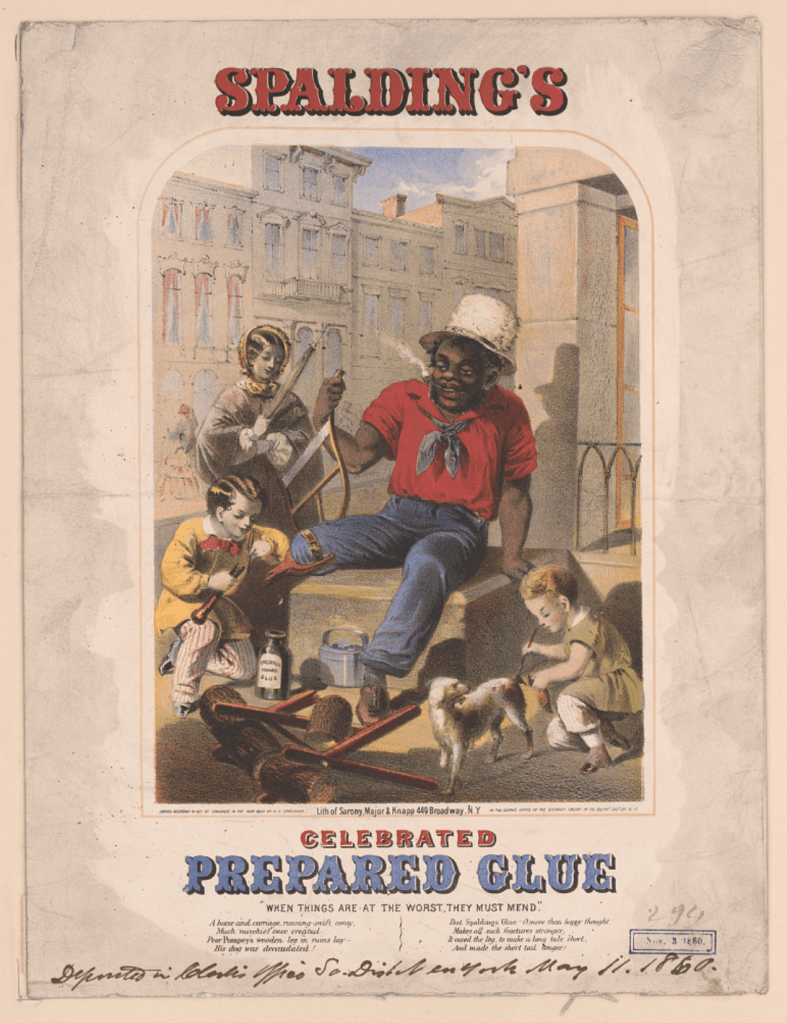
Print shows a young boy using “Spalding’s Celebrated Prepared Glue” to repair the broken peg prosthetic for an African American man who broke it while sawing wood; also shows a young girl attempting to glue the tail back on a small dog that may have been cut off in the woodcutting accident. (LOC)
To sleep we had to crawl down in the bottom of the car, cover up heads, and sleep away. I slept from midnight until daylight and when I awoke, my mouth, nose, ears, and eyes were filled with dirt, besides being covered with it to the depth of a quarter of an inch. The cars were stopped and I crawled out, shook myself, and tried to wash but only rubbed the dirt in. I as well as the rest were about the color of old mountain. We got here about ten o’clock Friday and marched up to camp about half a mile and by the way, the regimental officers had a nice car itched on for them and such of the captains as were a mind to but Capt. [Halbert B.] Case stuck to us like Spalding’s Glue right in the worst of it. He sad he had been in hotter fire than that.
Well, of course our tents were not here yet and we had to wait for them but they were not long in coming. While we were waiting, a shower of rain came up. I sat down on my knapsack and went to sleep and rolled over on the ground and woke when it had quit raining. We have got our tents up and are packed in pretty close… [rest of letter missing]
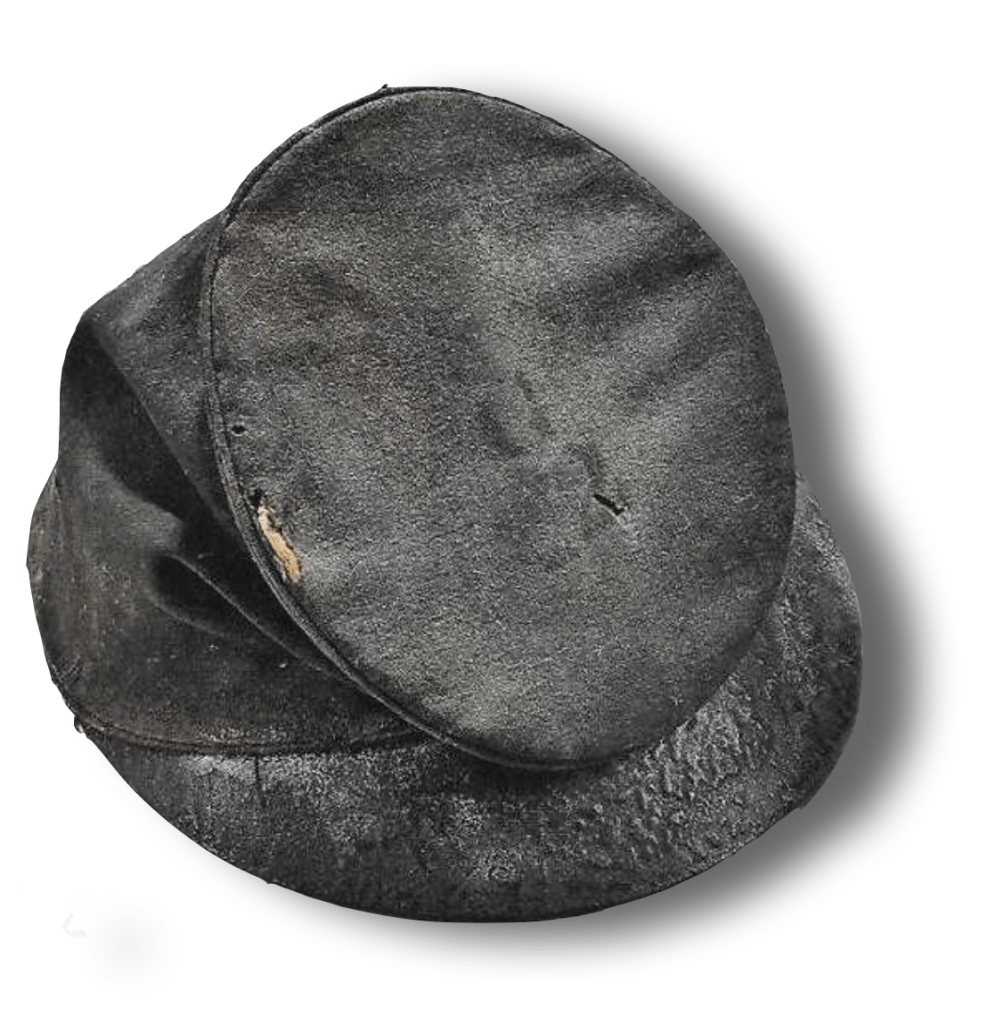
A forage cap from Co. G, 12th Pennsylvania Reserves
The following letters were written by George W. Smith (1819-1896), the son of Jacob & Susan Smith. He married Elizabeth “Betsy” Knaub (1823-1891) in the early 1840s and fathered Silas (b. @1847), Morris or Maurice K. (b. 01/23/50), Mary E. (b. 02/15/53), Bence (b. @1856), George M. D. (b. 09/15/58), and Anna (b. 02/19/64). In 1860, he was a carpenter living in Lewisberry, York County, Pennsylvania, and stood 5′ 5″ tall with black hair and black eyes.
George enlisted at Harrisburg on June 25, 1861, and mustered into federal service there August 10 as a private with Co. G, 12th Pennsylvania Reserves (41st Pennsylvania Infantry), serving for some period as company cook. While guarding the wagon train at White Oak Swamp, Virginia, on June 29, 1862, he became snagged on a branch, fell forward onto a stump, and suffered a rupture. As a result, he was discharged by surgeon’s certificate to date October 18, 1862, at Fort Ellsworth, Virginia.
George wrote both letters to his friend and neighbor, Dr. Robert Nebinger (1796-1867) of Lewisberry, York county, Pennsylvania.
Letter 1
Camp Pierpont, Virginia Sunday, October 27th 1861
Dr. R. Nebinger, dear sir,
I received yours Friday evening. Also Miss Rosa Shanley’s & my son Silas. What satisfaction it gives to receive, as I have received, in those three letters. All had something new. It clears the sky, makes everything bright. It nourishes, gives vigor to the mind, and I may almost say strength to the body. In fact, it makes a new person.
Now I will give you a brief detail of our situation. We lay within half a mile of Langly town. The town consists of about five houses, two taverns, and grocery & Blacksmith shop. The country is very fine—soil rich, produces well, but only half farmed, land rolling. Houses are all vacated, occupied by us, headquarters of Generals, and hospitals. The corn is very good. Husk that and feed the horses. You ought to see the horses now. They look as slick as eels and as nimble as bees. The government does not give hay and oats enough for the stock, With all the plunder, it only keeps them in good order for working. There is nothing doing now. All quiet. How long, no one knows. All laying around lazy. We call the whole thing a grand humbug. We have been dead heads all the time.
But under the circumstances, how of the Resolutions passed by the Committee of Safety of York County. We will not be dead heads here a great while because we married men with large families entered the service with the full assurance that the county would pay a certain amount per week, according to the number of children &c. during the time you. were in the service to each of our wives. Now, by God, that’s so, And are we to be gulled by a set of political tricksters, on demand robbers. No, by God. Never! We are determined to desert to a man if death is our portion & disgrace upon our families, rather than have our poor families wanting when there was ample provision made.
We mustered under that provision and they all had sufficient by adding our wages to it. And now to be cut out of that, we will cut out too & be home guards too. But we will not guard that North Central Railroad. If there is not loyal men enough in the State of Maryland to guard the road and bridges, let the Rebels burn it up. Itis the home guards that is guarding that railroad, principally all out of York county, and it is them that has cut off the sustenance guaranteed us weekly to be drawn by our wives to assist keeping our families while we were in the service down in the land of Dixie enduring the perils & hardships of a soldier trying to consolidate our once glorious Union again.
We will be content two weeks for a firm answer whether we are to be humbugged out of the county money or not. If so, farewell army at the risk of life. Doctor, them are the true sentiments of us poor men with families & we will strictly adhere to them. Are we right? Please answer me by Tuesday weeks mail. Ambrose Ensminger & myself are well. Please let my family know it. your sincere friend, — G. W. Smith
Too mad to write any more.
Letter 2
Camp Pierpont November 13th 1861
Dr. R. Nebinger, dear sir,
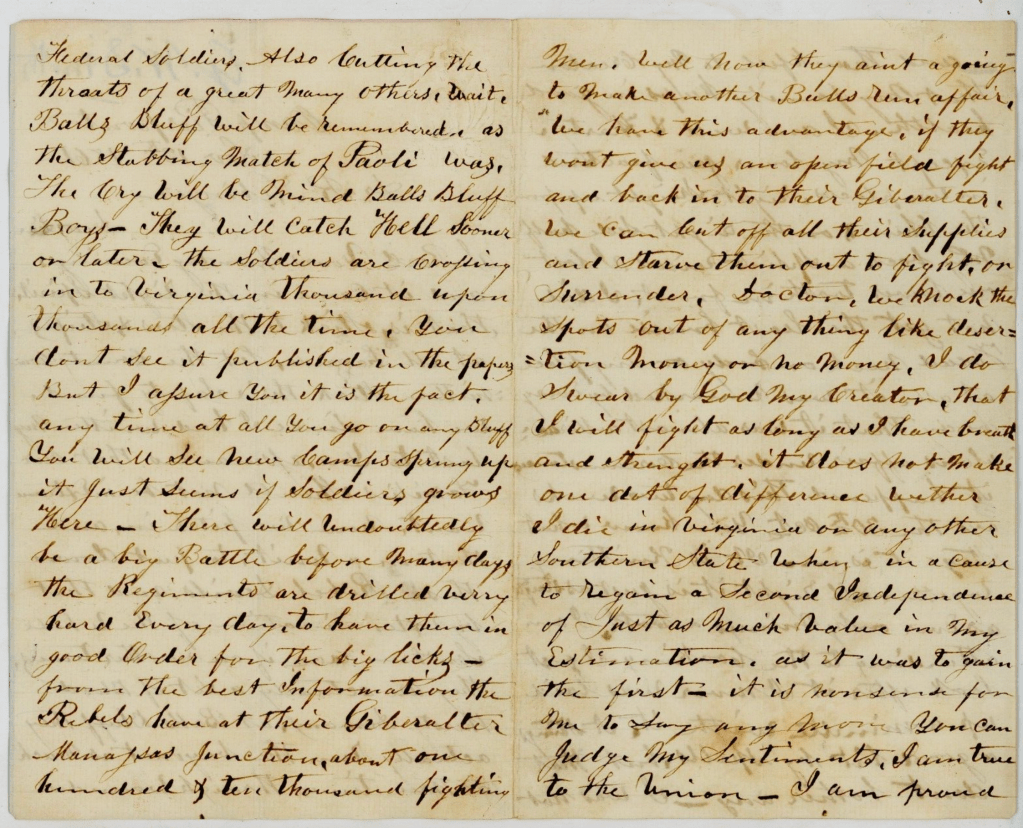
I received yours Monday evening and it came in the right spirit—that is, stick to the Stars & Stripes al all hazards. Let the county committee stick their safety fund. We have since I had written my last to you, assurances that our families should not be in extreme want. Now we pitch in and that in a unit to put down these Rebel devils, and that by extermination of the whole Southern race if on no other terms. They are actually a set of blood thirty demons. At Balls Bluff they actually run the bayonet as much as three times through wounded Federal soldiers. Also cutting the throats of a great many others. [Just] wait. Ball’s Bluff will be remembered as the stabbing match of Paoli was. The cry will be “Mind Balls Bluff Boys—They will catch hell sooner or later.”
The soldiers are crossing into Virginia. Thousands upon thousands all the time. You don’t see it published in the papers but I assure you, it is the fact. Any time at all you go on any bluff, you will see new camps spring up. It just seems [as] if soldiers grows here. There will undoubtedly be a big battle before many days. The regiments are drilled very hard every day to have them in good order for the big licks. From the best information the rebels have at their Gibraltar, Manassas Junction, about one hundred and ten thousand fighting men. Well now, they ain’t a going to make another Bulls Run affair. “We have this advantage. If they won’t give us an open field fight and back into their Gibraltar, we can cut off all their supplies and starve them out to fight or surrender.
Doctor, we knock the spots out of anything like desertion—money or no money. I do swear by God, my creator, that I will fight as long as I have breath and strength. It does not make one dot of difference whether I die in Virginia or any other Southern State when in a cause to regain a Second Independence of just as much value in my estimation as it was to gain the first. It is nonsense for me to say anymore. You can judge my sentiments. I am true to the Union. I am proud and thankful to my creator that my family keeps in good health.
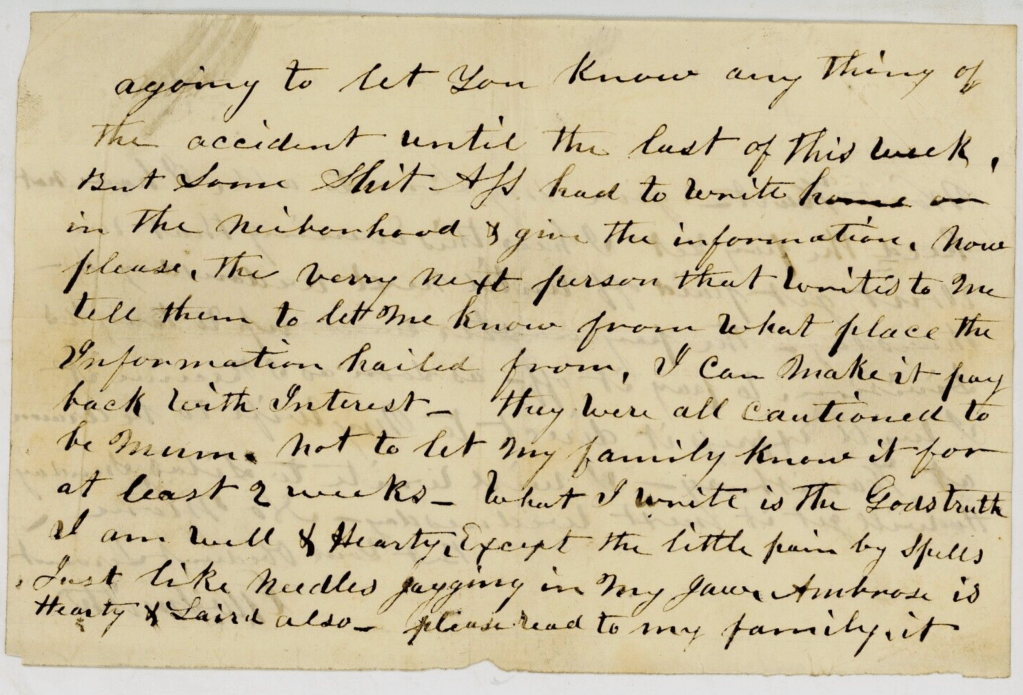
I am well and hearty except my lower jaw [is] fractured in two places, right straight up from the chin & on the right side half way back. A splint raised. I lost one lower tooth in front. I did not get the least bruise on the head, neck or body or any place at all that it was almost a miraculous affair under the circumstances. It happened this day two weeks ago, the 30th October. You know what stage it is in. It is knitting together all right. It is just as straight as ever, only minus a tooth. I am attending to the cooking. I just look after it. I never was laid up a minute with it. It stings a good bit by spells but that don’t bother any. I was not a going to let you know anything of the accident until the last of this week but some shit ass had to write home in the neighborhood & give the information. Now please, the very next person that writes to me, tell them to let me know from what place the information hailed from. I can make it pay back with interest. They were all cautioned to be mum—not to let my family know it for at least two weeks. What I write is the God’s truth. I am well & hearty, except the little pain by spells. Just like needles jagging in my jaw.
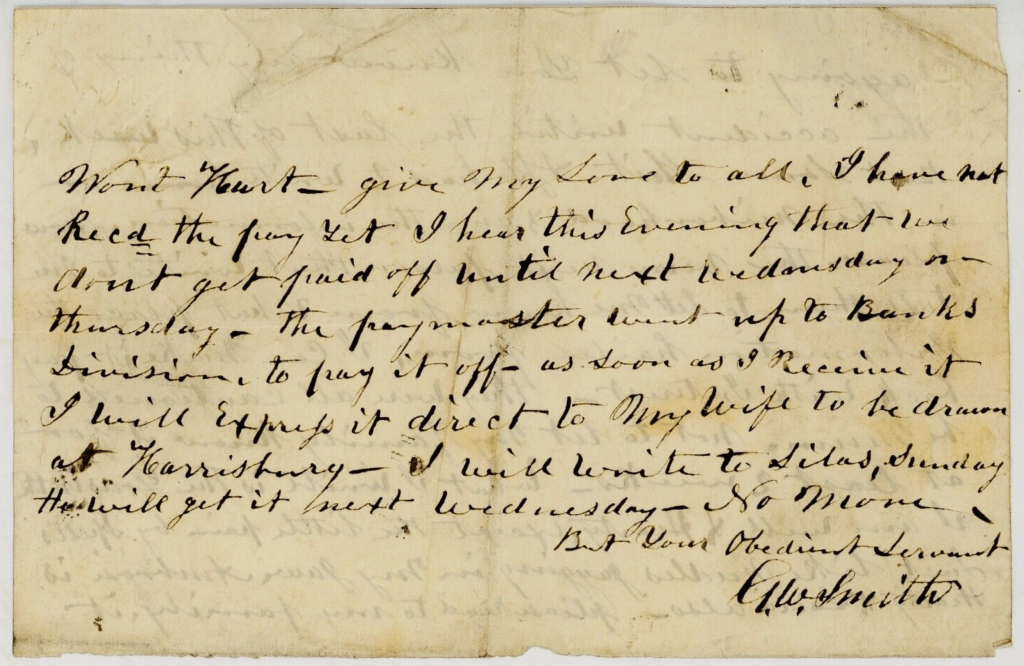
Ambrose [Ensminger] is hearty & [Washington] Laird also. Please read to my family. It won’t hurt. Give my love to all. I have not received the pay yet. I hear this evening that we don’t get paid off until next Wednesday or Thursday. The paymaster went up to Banks Division to pay it off. As soon as I receive it, I will express it direct to my wife to be drawn at Harrisburg. I will write to Silas Sunday. He will get it next Wednesday. No more. But your obedient servant, — G. W. Smith
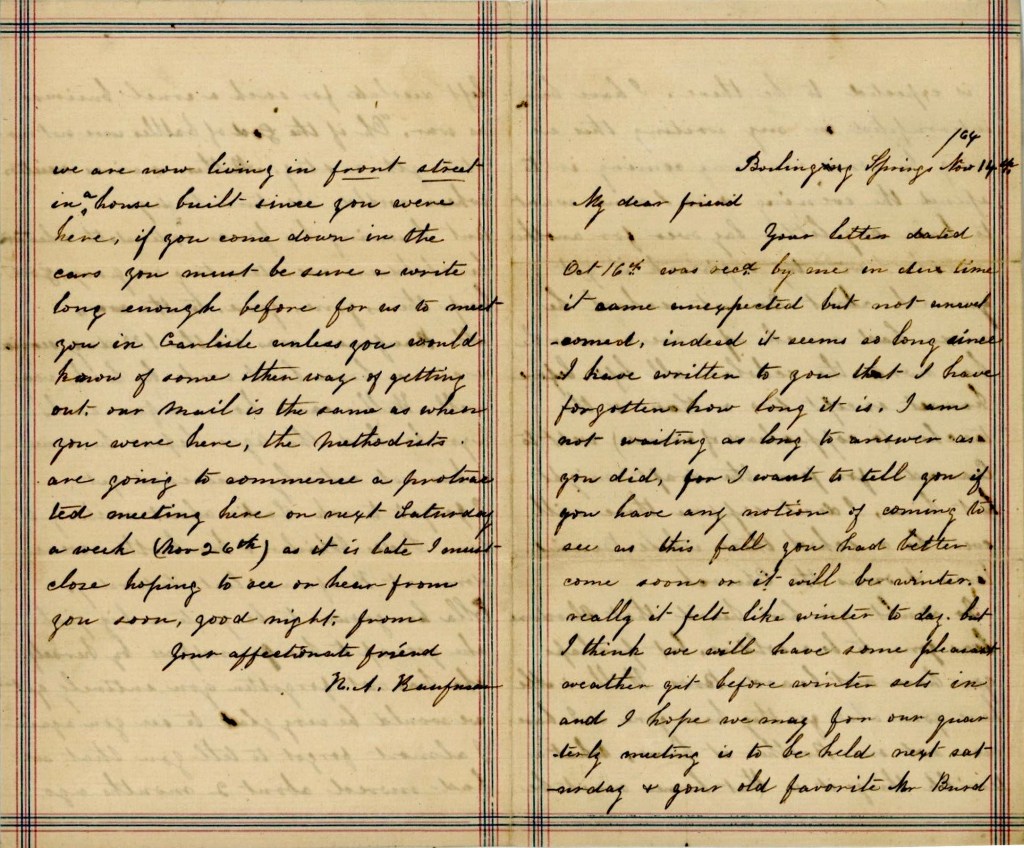
This letter appears to have been written by “N. A. Kaufman” and though I cannot find her in the genealogical chart of the Isaac Kaufman (1806-1867) and Eliza Smith (1811-1863), she appears to have been a sister of their children who are mentioned in her letter. They include George “Willis”) Kaufaman (b. 1842), Abraham David Kaufman (b. 1846), and Theodore S. Kaufman (1844-1908) of Boiling Springs, Pennsylvania.
Your letter dated October 16th was received by me in due time. It came unexpected but not unwelcomed. Indeed it seems so long since I have written to you that I have forgotten how long it is. I am not waiting as long to answer as you did, for I want to tell you if you have any notion of coming to see us this fall, you had better come soon or it will be winter. Really it felt like winter today but I think we will have some pleasant weather yet before winter sets in and I hope we may for our Quarterly Meeting is to be held next Saturday & your old favorite Mr. Burd is expected to be there. I have been interrupted in my writing this evening by some company coming in to spend the evening & as I don’t want to leave any letter lay over for another mail, I will try and finish it yet.
You ask about Bennet’s school. He never had much of a one & now he has none. The scholars all left before harvest except two or three & the teacher (a copperhead of course) went to Canada for fear the draft might hit him. I don’t suppose there will even be a school there while Bennett lives & owns the Church.
No doubt you have heard that Theodore has gone to be a soldier, but perhaps you have not heard Brother Will & Abe have gone also. Yes, they have gone and I have now not one brother at home. What a terrible thing is it that homes must be left desolate for such a cruel business as war. “Oh if the God of battles were not our strength and stay, Mothers and wives and sisters where would we turn today. But knowing is power extendeth wherever his children are, trusting we pray, God keep them gone, gone to the war.”
Abe Kaufaman was in the 100 day service and came home last week. He lookjs very well. Willis came home a few weeks ago. He had the ague before he came and has not entirely recovered yet.
I forgot to ask Sadie about writing to you. Sadie Whisler and her brother were down at Kaufman’s last Saturday. Ella has grown to be quite a big girl. She goes up to he grandpa’s by herself. She has not forgotten you entirely yet. We would be very glad to see you again. I almost forgot to tell you that we had moved about two months ago. We are now living in Front Street in a house built since you were here. If you come down in the cars, you must be sure and write long enough before us to meet you in Carlisle unless you would know of some other way of getting out. Our mail is the same as when you were here.
The Methodists are going to commence a protracted meeting here on next Saturday a week (Nov 26th). As it is late, I must close hoping to see or hear from you soon. Good night. From your affectionate friend, — M. A. Kaufman
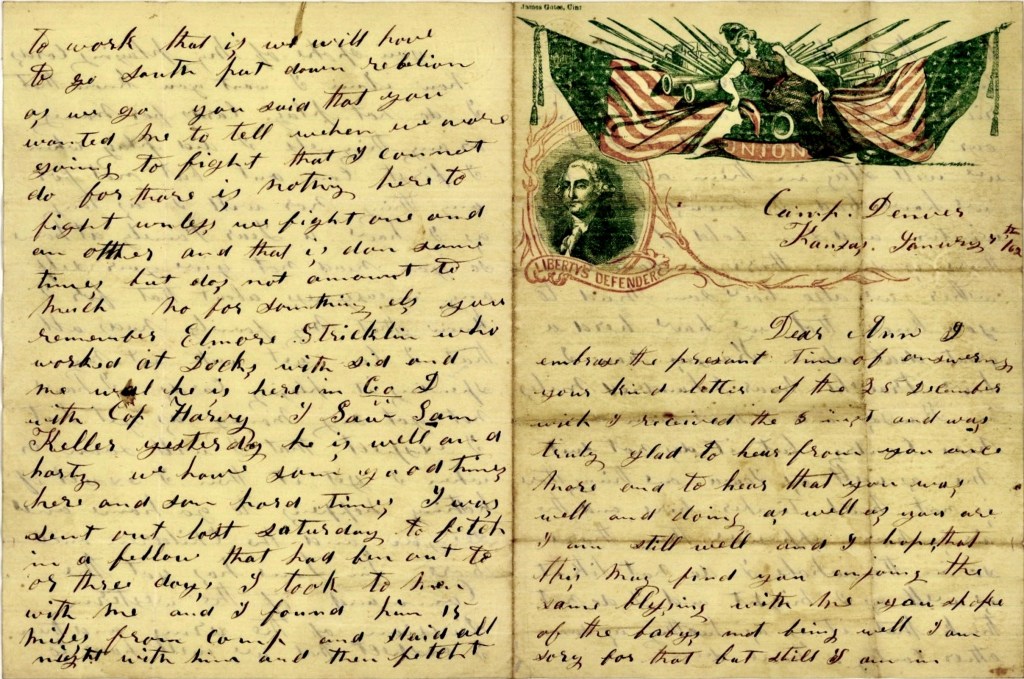
I have not been able to identify the author of this partial letter but I believe he was a member of the 5th Kansas Cavalry, possibly in Co. C which included several men from Decatur County, Iowa.
Transcription
Note: Camp Denver was located approximately three miles east of Barnesville, Kan., in north eastern Bourbon County within a few miles of the Missouri/Kansas state line.
Camp Denver, Kansas January 7th 1862
Dear Ann,
I embrace the present time of answering your kind letter of the 25th December which I received the 3rd inst. and was truly glad to hear from you once more and to hear that you was well and doing as well as you are. I am still well and I hope that this may find you enjoying the same blessing with me. You spoke of the baby not being well. I am sorry for that but still I am in hopes that she is well before this time.
We are quartered near the Osage river at this time and are still in our tents and I expect that we will stay in them all winter. We have had three snows here this winter and some cold of course. Where there is snow, there is some cold weather. We also have some mud too.
You know that we have heard a great deal about Kansas now. I have traveled near three hundred miles in Kansas and I have seen some nice country but it does not suit me as well as Iowa. [For] one thing, there is not much timber here and the air is more oppressive that there so in the whole, I do not like it as well as I might and I do not think that it is as healthy as some other country I have seen.
You spoke of my playing cards. Now Ann, I want you [to] know that I do not play cards for money or anything else. I did play when I first came out but not for anything, nor will I as long as I have a dear family at home, so you need not give yourself any uneasiness about that for I know that my family needs all that I can get without my spending it playing cards. I have not got any money as yet but I expect that I will soon and when I get it, then I expect if nothing happens, to go home and see you and the children once more.
Jim Lane has got the command of the western division of the army and then I expect that we will have to go to work—that is, we will have to go South [and] put down rebellion as we go. You said that you wanted me to tell when we were going to fight. That I cannot do for there is nothing here to fight unless we fight one and an other and that is done sometimes but does not amount to much.
Now, for something else. You remember Elmore Stricklin [Strickland] 1 who worked at Docks with Sid and me. Well he is here in Co. D with Capt. Harvey. I saw Sam Keller yesterday. He is well and hearty and saw hard times. I was sent out last Saturday to fetch in a fellow that had been out two or three days. I took two men with me and I found him 15 miles from camp and stayed all night with him and then fetched… [rest of letter missing]
1 Elmore Strickland (1836-1911) was born in Lorain county, Ohio, and was living in Linn county, Iowa, in 1850 with his parents Nathan Strickland and Druscilla Hobbs. In 1854, Nathan was enumerated in Jackson, Keokuk county, Iowa. Elmore (“Elmer”) enlisted in Co. B, 6th Kansas Cavalry in August 1861 and mustered out in April 1865. He was taken a POW at Mazzard’s Prairoe, Arkansas on 27 July 1864.
The following letter was written by Samuel B. Salsburg (b. 1842), the son of John Salsburg and Anna M. Hooven of Norristown, Montgomery county, Pennsylvania. Samuel was working as a cigar maker when he enlisted on 20 August 1862 as a corporal in Co. C, 138th Pennsylvania Infantry. He was wounded on 9 July 1864 at Monacacy, Maryland, but recovered and was promoted to sergeant in March 1865. He mustered out in June 1865 at Washington D. C.
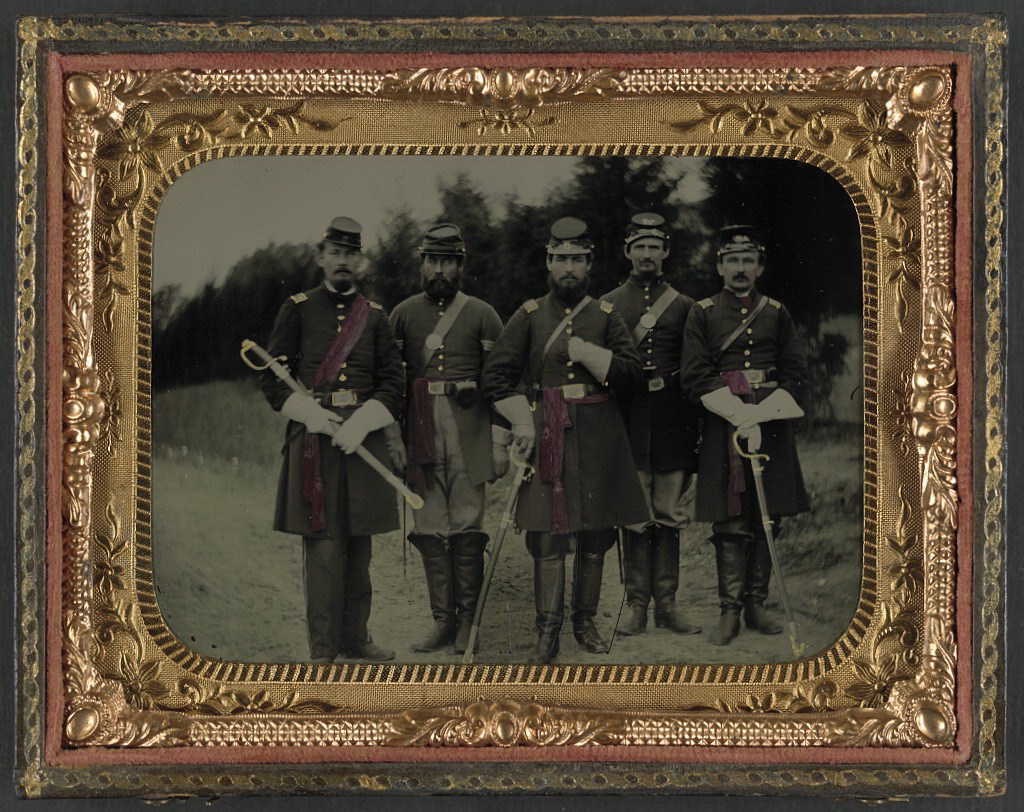
Capt. James H. Walter of Co. G, 138th P. V. stands at center. Lt. George W. Mullen stands at left holding his sword laterally. Lt. George W. Wilson stands at right holding sword vertically. Sergeants William Cline and Nicholas Wilson stand behind. Photograph taken at the Relay House in Maryland in 1862. Library of Congress.
Transcription
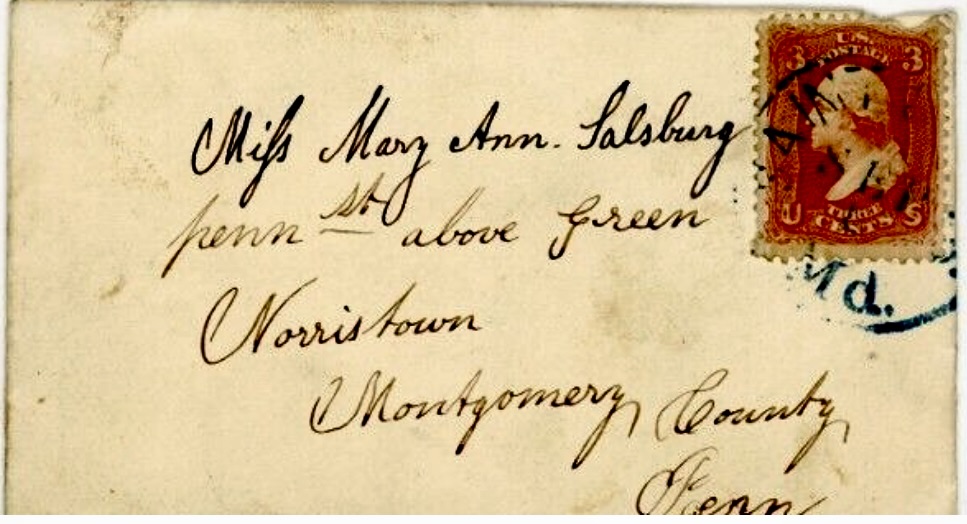
Addressed to Miss Mary Ann Salsburg, Pennsylvania Street above Green, Norristown, Montgomery county, Pennsylvania
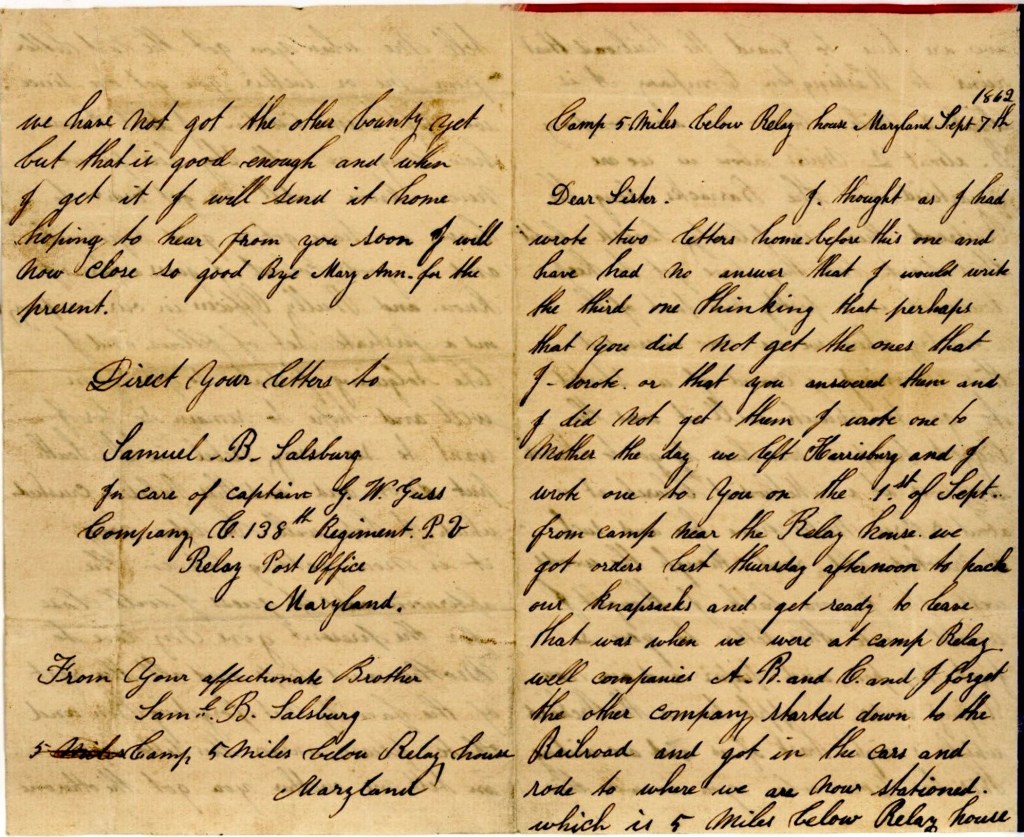
Camp 5 miles below Relay House, Maryland September 7th 1862
Dear sister,
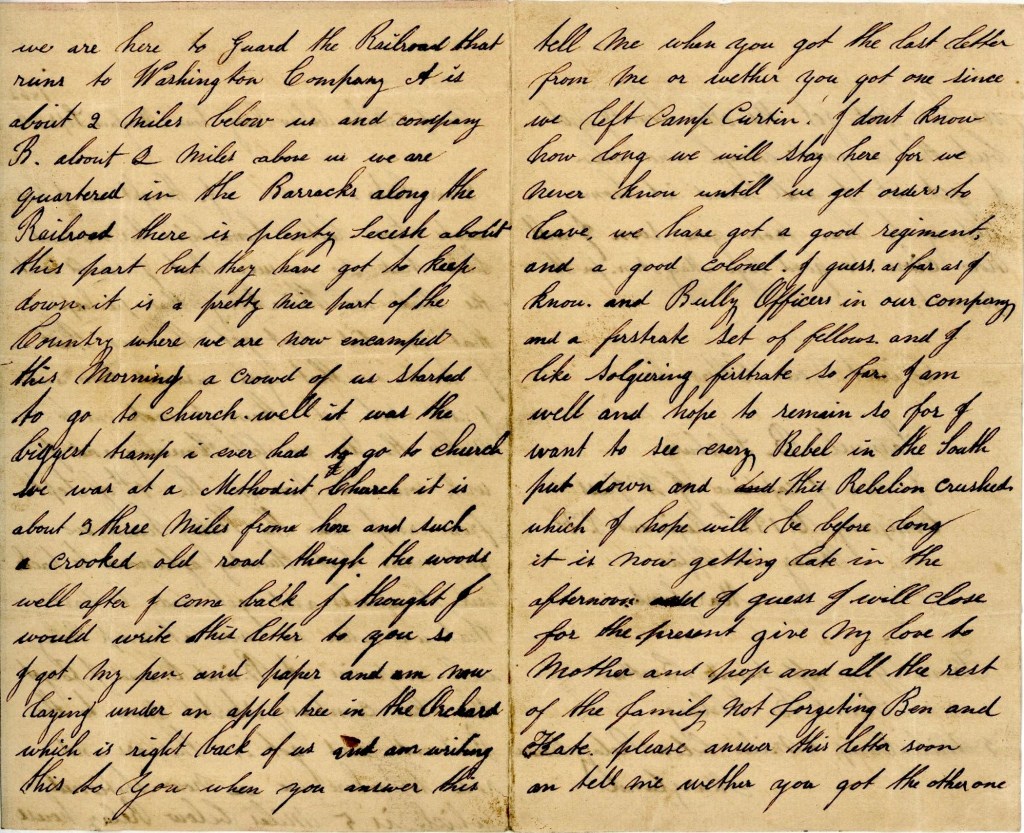
I thought as I had wrote two letters home before this one and have had no answer, that I would write the third one thinking that perhaps you did not get the ones that I wrote, or that you answered them and I did not get them, I wrote one to Mother the day we left Harrisburg and I wrote one to you on the 1st of September from camp near the Relay House. We got orders last Thursday afternoon to pack our knapsacks and get ready to leave. That was when we were at Camp Relay. Well companies A, B, and C, and I forgot the other company started down to the railroad and got in the cars and rode to where we are now stationed which is 5 miles below Relay House. We are here to guard the railroad that runs to Washington. Company A is about two miles below us and Company B about 2 miles above us. We are quartered in the barracks along the railroad.
There is plenty secesh about this part but they have got keep down, It is a pretty nice part of the country where we are now encamped. This morning a crowd of us started to go to church, Well, it was the biggest tramp I ever had to go to church. We was at a Methodist Church. It is about three miles from here and such a crooked old road through the woods. Well after I come back, I thought I would write this letter to you so I got my pen and paper and an now laying under an apple tree here in the orchard which is right back of us and am writing this to you. When you answer this, tell me when you got the last letter from me or whether you got one since we left Camp Curtin.
I don’t know how long we will stay here for we never know until we get orders to leave. We have got a good regiment and a good Colonel, I guess, as far as I know, and bully oficers in our company and a first rate set of fellows. And I like soldiering first rate so far. I am well and hope to remain so far. I want to see every rebel in the South put down and this rebellion crushed which I hope will be before long.
It is now getting late in the afternoon. I guess I will close for the present. Give my love to Mother and Pop and all the rest of the family, not forgetting Ben and Kate. Please answer this soon and tell me whether you got the other one. We have not got our bounty yet but that is good enough and when I get it, I will send it home. Hoping to hear from you soon, I will now close. So goodbye, Mary Ann, for the present.
Direct your letters to Samuel B. Salsburg, In care of Captain G[eorge] W[ashington] Guss, Company C, 138th Regiment P. V., Relay Post Office, Maryland
From your affectionate brother, — Samuel B. Salsburg
The following letter was written on most unusual stationery by Stewart C. Allen (1843-1918), the son of Edward Allen (1799-1848) and Harriet Ann Foland (1811-1885) of Hudson, Columbia county, New York.
Stewart enlisted on 14 February 1862 as a private in Co. B, 93rd New York Infantry. He received a severe wound in the right shoulder during the Battle of Spottsylvania Court House on 10 May 1864 and wrote this letter while recuperating from that wound at Campbell General Hospital in Washington D. C.
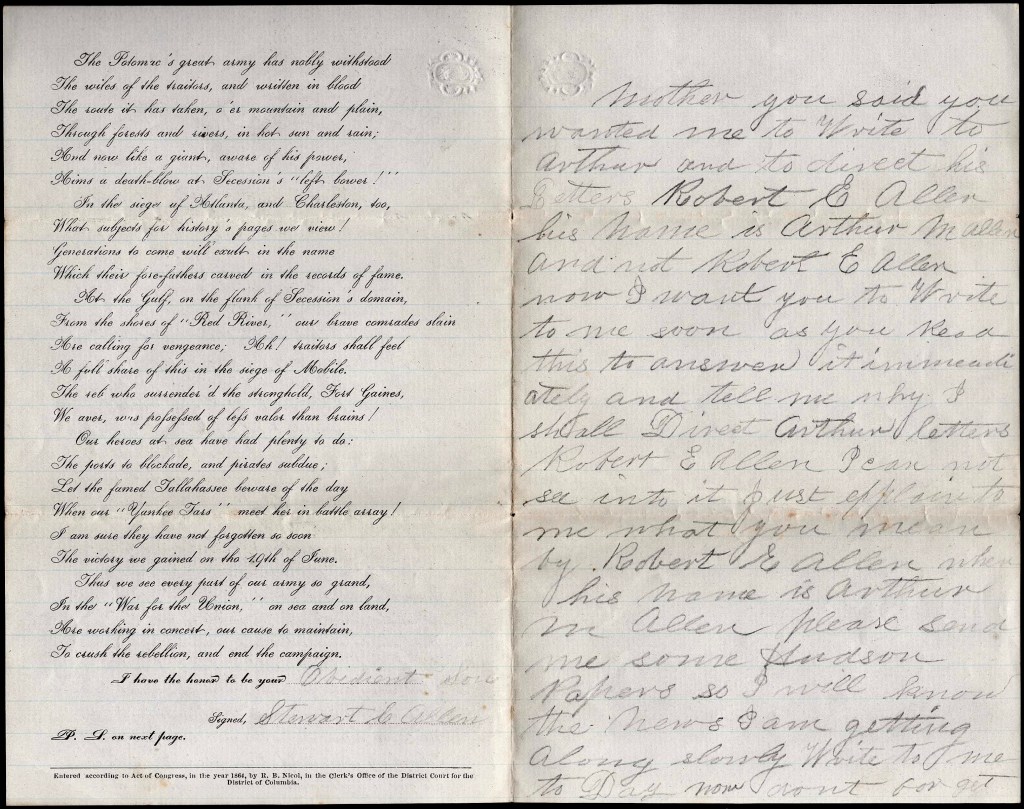
The letter was a pre-formatted letter, written in prose, enabling the soldier to merely fill in a few blanks and then add a personal note as a post script. Stewart’s post script begs his mother to explain why he should address letters to his younger brother (Arthur M. Allen, b. 1845) by some name other than his given name. Apparently he was operating under an alias for some reason.
I have searched for the poem on the internet and could not find it published so have transcribed it in entirety.
As a matter of curiosity, Stewart did not marry until 1899 when he was 46 years old. He married 22 year-old Edith Carter and she lived on her husband’s war pension until her death in 1968.
[Note: The bold lettered font is what Stewart wrote; the italicized font was pre-printed.]
Transcription
Campbell Hospital Ward Nine October 30th1864
DearMother and Sister,
As writing materials often are scarce, I purpose to write you a letter in verse; To condense my ideas, save paper and time, Is my object for writing the letter in rhyme. Of course you will now it is one of my pranks! It will take but a minute to fill up the blanks.
I received your kind letter justone dayago, Which found me a member of “Uncle Sam’s Show,” And fortwo monthsor better, expect to remain, Unless like full many, I chance to be slain; Should this be my fate, the last boon I crave Is to mark on my tomb-stone, “A Patriot’s Grave!”
In the hist’ry of wars, as we carefully scan, Since the first one was waged by man against man, In all the fierce conflicts no records remain Which will be compared to the present campaign. The war has been general, on both land and sea, And many have fallen for “Liberty’s Tree!” It would fill many volumes to pass in review What our various armies this year have been through, Though my space is not large, yet ’twill not be amiss To give a slight sketch on a small sheet like this.
The Potomac’s great army has nobly with stood The wile’s of the traitors, and written in blood The route it has taken, o’er mountain and plain, Through forests and rivers, in hot sun and rain; And now like a giant, aware of his power, Aims a death-blow at Secession’s “left bower!”
In the siege of Atlanta and Charleston too, What subjects for history’s pages we view! Generations to come will exult in the name of which their fore-fathers carved in the records of fame.
At the Gulf, on the flank of Secession’s domain, From the shores of “Red River” our brave comrades slain Are calling for vengeance; Ah! traitors shall feel A full share of this in the siege of Mobile. The reb who surrender’d the stronghold Fort Gaines, We aver, was possessed of less valor than brains!
Our heroes at sea have had plenty to do: The ports to blockade, and pirates subdue; Let the famed Tallahassee beware of the day When our “Yankee Tars” meet her in battle array! I am sure they have not forgotten so soon, the victory we gained on the 10th of June.
Thus we see every part of our army so grand, In the “War for the Union,” on sea and on land, Are working in concert, our cause to maintain, To crush the rebellion, and end the campaign.
I have the honor to be yourobedient son. Signed,Stewart C. Allen
P. S. on next page.
Mother, you said you wanted me to write to Arthur and to direct his letters Robert E. Allen. His name is Arthur M. Allen and not Robert E. Allen. Now I want you to write to me soon as you read this to answer it immediately and tell me why I shall direct Arthur letters, “Robert E. Allen.” I cannot see into it. Just explain to me what you mean by Robert E. Allen when his name is Arthur M. Allen. Please send me some Hudson papers so I will know the news. I am getting along slowly. Write to me today. Now don’t forget.
The following letter was written by Chester Joseph Rouech (1843-1881), the son of Azel Nicholas Rouech, Sr. (1820-1897) and Mary Anna Derrick (1819-1896) of Bay City, Michigan. He wrote the letter to his sister, Josephine (“Josey”) Olive Rouech (1846-1925).
Chester enlisted on 14 April 1864 at Forester, Michigan, to serve as a private in Co. A, 15th Michigan Infantry. He mustered out as a corporal at Little Rock, Arkansas, on 13 August 1865. Let’s hope he was a better soldier than he was a poet.
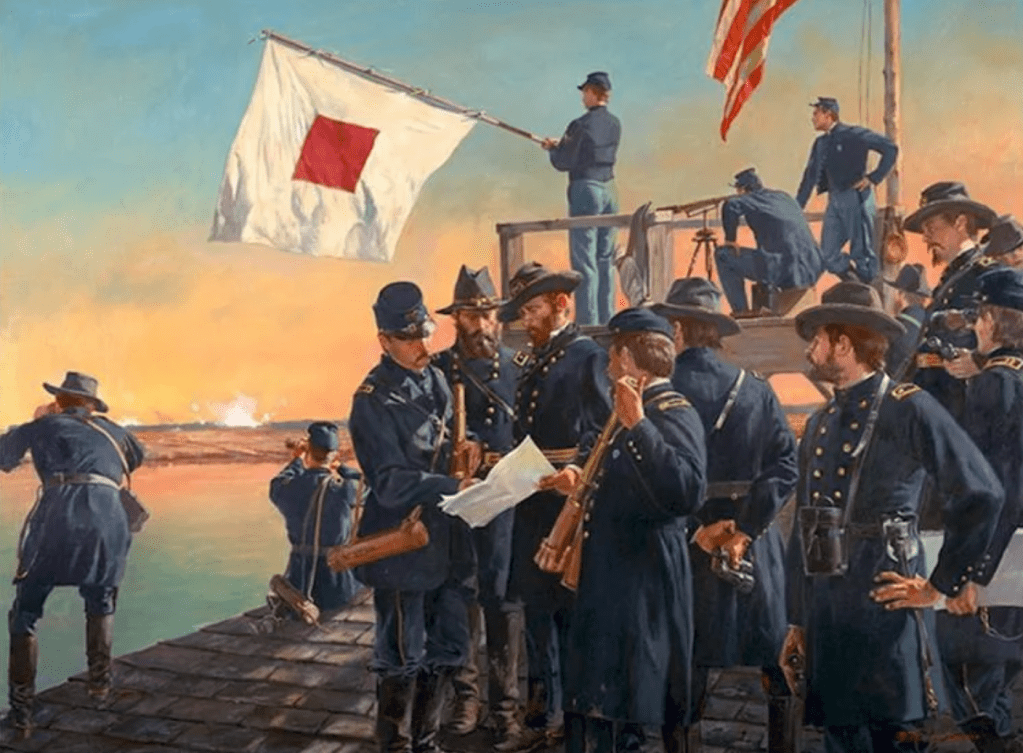
Signaling the Assault on Fort McAllister by Don Troiani. December 13, 1864 MG William T. Sherman and MG O. O. Howard are shown preparing for the land attack on Fort McAlister, the last major battle of the Savannah Campaign.
Transcription
General Sherman’s Army 15th Michigan, 2nd Div., 15th Army Corps 1865
Attention, valiant soldiers and listen to my strain, concerning the 2d division throughout this late campaign: Success has crowned their efforts in every battle fray, and in every battle fought they nobly won the day.
At Tunnel Hill and Buzzard Roost, twas there they made a charge, and drove the rebel traitors, a force nearly twice as large; also at the battle of Resaca, they gained a world of praise, and they fought most heroically for two successive days.
At Altoona and Kenesaw Mountain, twas there they scaled the works, with bayonets fixed they drove them out their strongest forts; and at the fall of Atlanta in words I cannot tell, the way they fought the rebels, though many of them fell.
The 116th Illinois boys do fight with earnest zeal, and the 30th Ohioans are boys that never yield; the gallant 6th Missourians would give your hearts delight, to see them wading into five the rebels fight.
The 47th and 54th Ohio we know, was never known to run when facing the rebel foe: the 111th Illinoisians, God bless their gallant crew, no lads will fight more braver rebellion to subdue.
The 90th Illinois boys and 40th gives proof, that they are tigers in fighting and they never stand aloof: The 70th Ohioians and the 15th Michigan, have done some noble fighting throughout this great campaign.
On the 13th day of December, eighteen sixty-four, the guns of Fort McAllister most heavily did roar twas there this brave command most nobly fought that day, and gained for them a name that will never fade away.
Under a galling deathly fire, they formed in solid mass, and marched in line of battle before the cannon’s blast: yet onward moved their column resolved to do or die, beneath the starry banners its enemies to defy.
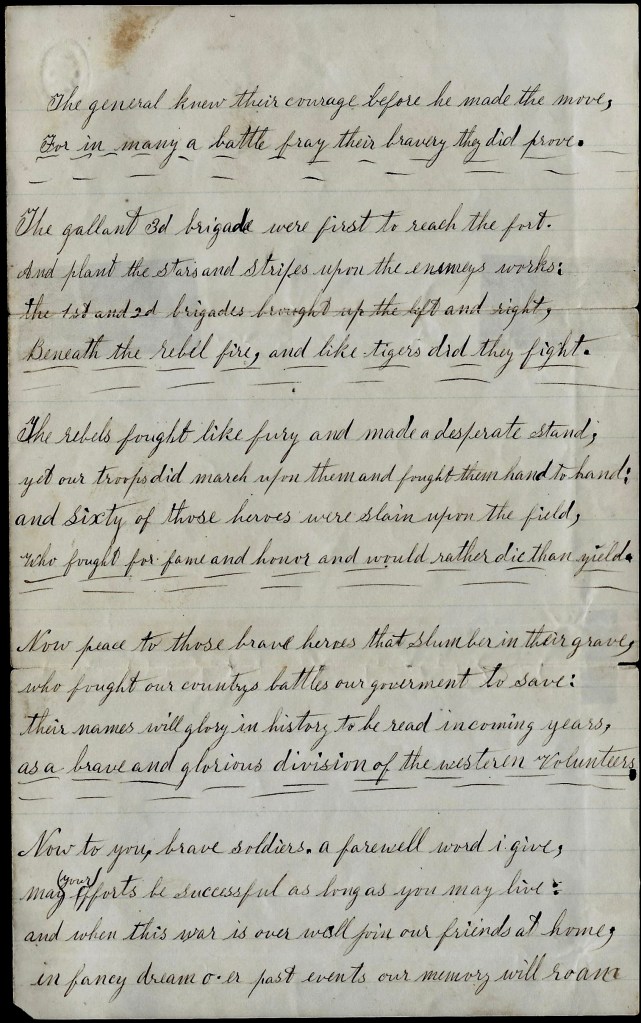
The rebs were and conquered in fifteen minutes time, after orders came to charge and form in battle line: The general knew their courage before he made the move, for in many a battle fray, their bravery did prove.
The gallant 3d brigade were first brigade were first to reach the fort, and plant the stars and stripes upon the enemy’s works: the 1st and 2d brigades brought up the left and right, beneath the rebel fire, and like tigers did they fight.
The rebels fought like fury and made a desperate stand, yet our troops did march upon them and fought them hand to hand: and sixty of those heroes were slain upon the field, who fought for fame and honor and would rather die than yield.
Now peace to those brave heroes that slumber in their grave, who fought our country’s battles our government to save: their names will glory in history to read in coming years, as a brave and glorious division of the western volunteers.
Now to you, brave soldiers, a farewell word I give, May your efforts be successful as long as you may live: and when this war is over, we’ll join our friends at home, in fancy dream o’er past events, our memories will roam.
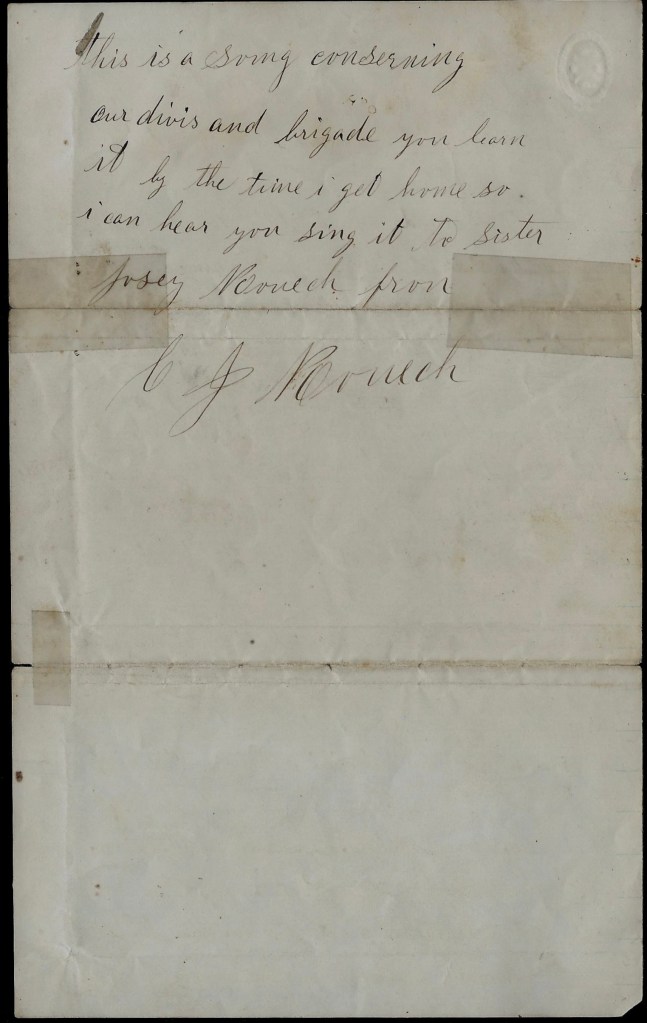
This is a song concerning our division and brigade. You learn it by the time I get home so I can hear you sing it.
This letter was written by Abraham (“Abram”) Eikenberry (1842-1897), the son of Isaac Eikenberry (1804-1887) and Dally Neff (1804-1887) of Gratis, Preble county, Ohio. Abraham wrote the letter while serving in Co. H, 93rd Ohio Volunteer Infantry along with his brothers, Reuben Eikenberry (1837-1922) and Joseph Eikenberry (1847-1921). According to the 1890 Veteran’s Schedule, Abram suffered two gunshot wounds during the war. Abraham wrote this letter to Sallie Ann Young )1843-1924) but he did not marry her. After the war, in November 1866, he married Maria E. Furrey (1844-1917). Sallie, on the other hand, married Joseph Furrey (1839-1925)—Maria’s brother—so Abram and Sallie eventually became in-law siblings.
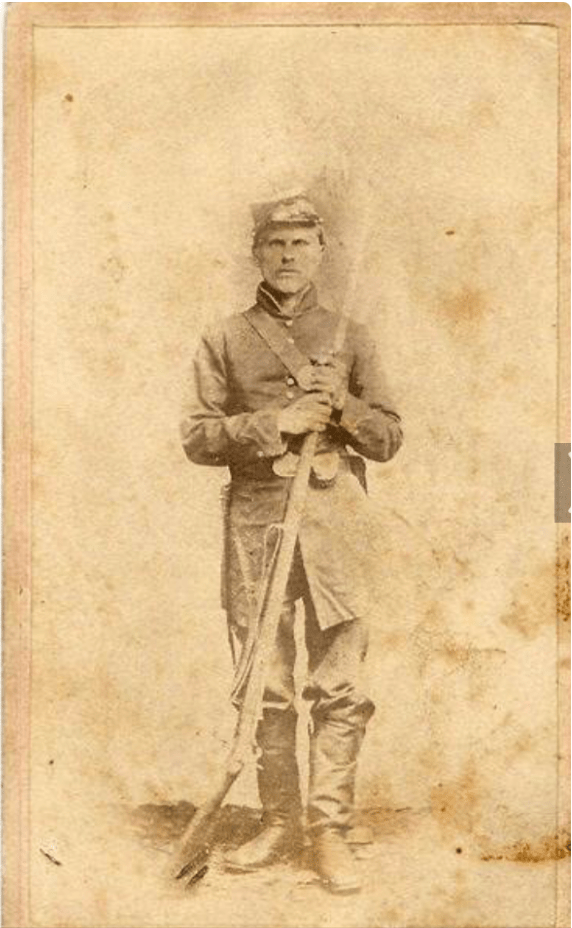
I could not find an image of Abram but here is Pvt. John Gotlieb Weckel of Co. A, 93rd OVI (Collection of Nancy Weckel)
The 93rd Ohio Infantry was organized in the fall of 1862 and was ordered to Kentucky and afterwards to Nashville. It participated in the battle of Stone River with severe loss, and also in the battle of Chickamauga, where it charged a Rebel battery and captured all the guns. During the engagement on Saturday the Regiment lost 124 officers and men. On Sunday it expended one hundred rounds of ammunition per man, killing 300 Rebels in its front. In November the Regiment assaulted Mission Ridge and afterwards moved to East Tennessee. In May, 1864, it joined the Atlanta campaign, fighting at Buzzard’s Roost, Resaca, Dallas, Kenesaw and Atlanta. After the fall of Atlanta it joined General Thomas’ army in Tennessee and engaged the enemy at Nashville. It followed in the pursuit of Hood to the Tennessee River, then went into camp at Huntsville. In March, 1865, the Regiment marched into East Tennessee, then to Ashville, N.C., then returned to Nashville, where it was mustered out June 8, 1865.
Transcription
Addressed to Miss Sallie A. Young, Camden, Preble county, Ohio
[Somewhere in] Georgia October 21, 1864
Dearest friend Sallie,
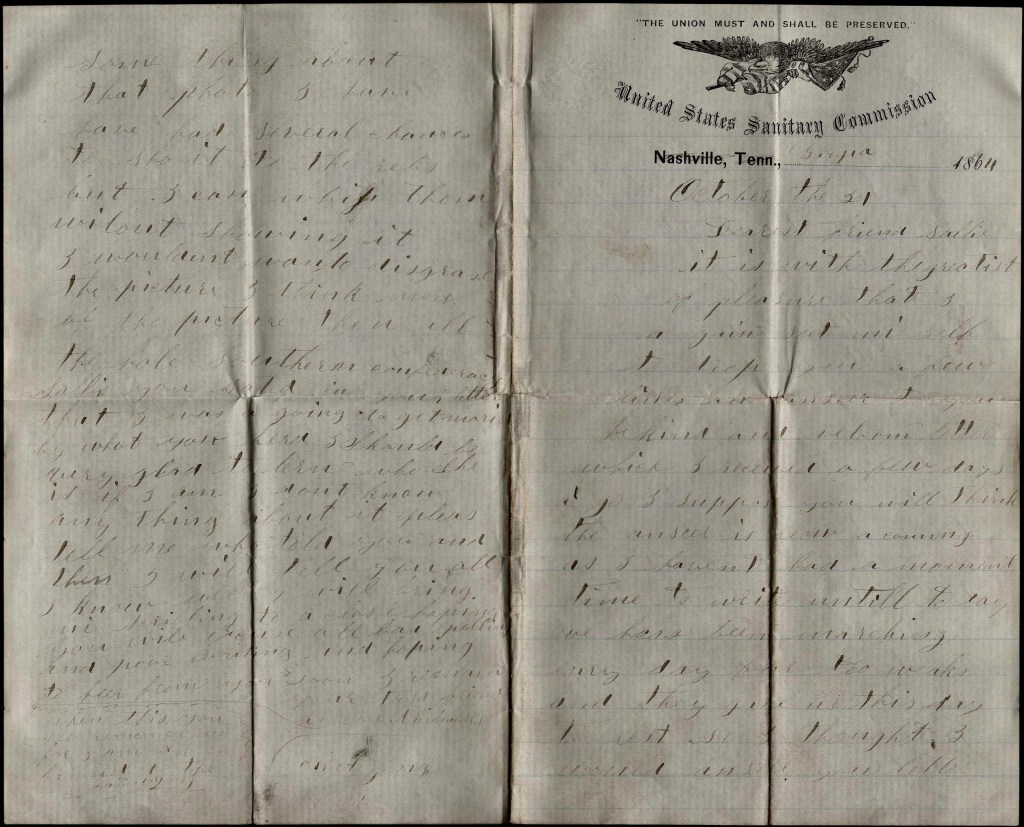
It is with the greatest of pleasure that I again seat myself to drop you a few lines in answer to your kind and welcome letter which I received a few days ago. I suppose you will think the answer is slow a coming as I haven’t had a moment’s time to write until today. We have been marching every day for two weeks and they give us this day to rest so I thought I would answer your letter.
“I can’t help but pity the innocent for they can’t help what the guilty does, let me tell you. The Union people has to suffer in this country. The rebs has no mercy on them.”
–Abram Eikenberry, Co. H, 94rd OVI, 21 October 1864
Sallie, I will tell you that I saw one of the most pitifullest things I ever saw since I’ve been in the army. I stopped at a house yesterday as I passed along and saw an old lady and three little children. One of the little children was crying and I asked it what was the matter. It said they had nothing to eat. The old lady said the rebs has taken everything they had to eat. All the flour they had was taken. I give them half of what I had and several of the boys divided with her. The little children eat just like if they haven’t had anything for a week. I can’t help but pity the innocent for they can’t help what the guilty does, let me tell you. The Union people has to suffer in this country. The rebs has no mercy on them.
While we was at Atlanta, the rebs got between us and Chattanooga and destroyed 25 miles of the railroad, It stopped our communication. We fell back and fought over the same ground where they got whipped bad once before and this last time they lost six hundred dead on the field besides the wounded, It is no trouble for us to whip them, We can whip three to one and have done it more than once.
Something about that photo. I have had several chances to show it to the rebs but I can whip them without showing it. I wouldn’t want to disgrace the picture. I think more of the picture than all the whole Southern Confederacy.
Sallie, you stated in your letter that I was a going to get married by what you heard. I should be very glad to learn who she is if I am. I don’t know anything about it. Please tell me who told you and then I will tell you all I know.
Well, I will bring my scribbling to a close hoping you will excuse all bad spelling and poor writing and hoping to hear from you soon. I remain your true friend as ever, –A. Eikenberry
The following letter was written by Isabella (Batchelder) James (1819-1901), the daughter of cotton manufacturer Samuel Batchelder, Jr. (1784-1879) and Mary Montgomery (1790-1869) of New Ipswich, New Hampshire. Isabella married botanist and wholesale druggist Thomas Potts James (1803-1882) in December 1851. She became an outspoken abolitionist, and during the Civil War she offered her house in Philadelphia as a hospital to Massachusetts volunteers and worked in the hospitals and as laborer in the Sanitary Commission. At the Great Centennial Fair in Philadelphia in 1864, she was the head of the Department of Relics and Curiosities which raised money for wounded soldiers. It was during the gathering of these relics that she wrote the following letter in May 1864.
After the war, Isabella became the head of the Women’s Freedman’s Commission which sponsored teachers in the South.
Isabella wrote the letter to Benson J. Lossing (1813-1891), an engraver who “focused on creating pictorial histories that recorded history through firsthand accounts and drawings of people, artifacts, and the actual locations where the events occurred. In 1847, he began publishing works of history and biography, creating his own illustrations. Eventually, Lossing established a publishing company and oversaw authorship of all aspects – texts, sketches, and engravings. Among the most popular were his PictorialField-Bookof the American Revolution and Pictorial Field-Book of the War of 1812. According to Gregory Pfitzer, in Picturing the Past: Illustrated Histories and the American Imagination, 1840 – 1900, Lossing’s specialty, field books, were “illustrated travelogues based on visits to scenes of historical importance.” In this genre, Lossing functioned as both historical observer and artistic interpreter. For Pictorial Field Book of the American Revolution (1850 to 1852), Lossing traveled more than 8,000 miles in the United States and Canada, collecting information and sketching scenes that he later made into wood block engravings. Published by Harper and Brothers, the field book sold tens of thousands of copies. Twenty-five years later, Publisher’s Weekly deemed the two-volume set remained the most “salable” work on the subject of the American Revolution.
During the next thirty-five years, Lossing worked tirelessly, publishing more than forty titles, of which he was either author or editor. From 1872 to 1874, Lossing edited the American Historical Record and Repertory of Notes and Queries. ”
400 South 9th Street Philadelphia [Pennsylvania] May 4th 1864
Mr. Lossing Dear Sir,
I received your letter & the parcel of engavings yesterday for which accept my thanks. Some of them will I think be of use. Lawson & Nicholson, the celebrated bookbinders here, are preparing the album under my direction. Lawson inlays most exquisitely & has already done the border of Sinclair’s coat of arms of the Washington’s family on a fresh white sheet for a title page, on which a gentleman friend will illuminate the lettering. Another set of the emblazoned arms will be bound in the volume.
William McIlvaine’s water color of White House [on] Pamunkey River in Virginia, 1864
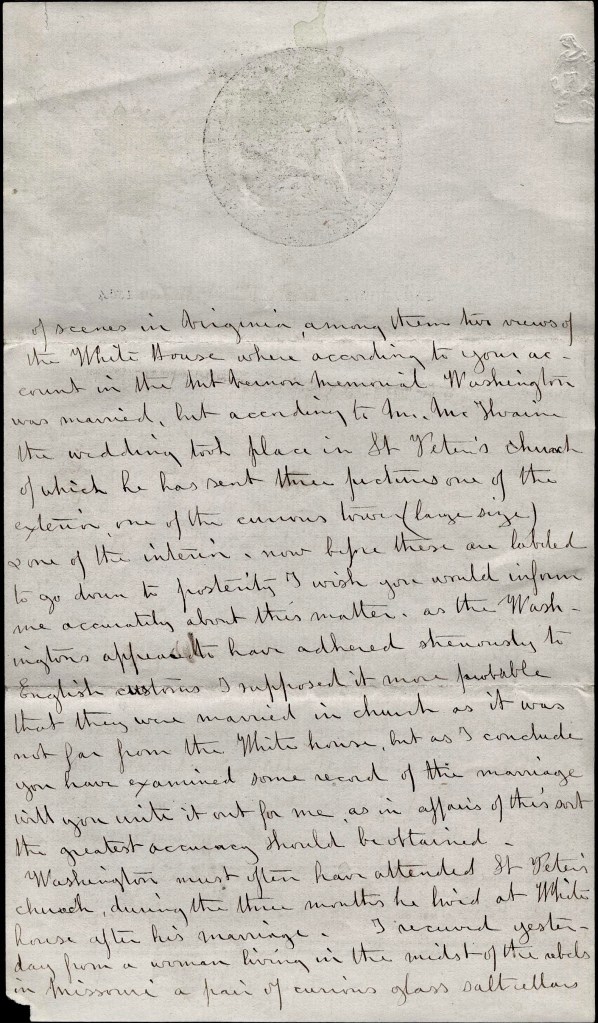
I have been fortunate in securing many fine Washington engravings from F[erdinand] J. Dreer, T. A. McAllister, Kline & others. Wm. McIlvaine, the artist, has painted thirteen beautiful water color sketches of scenes in Virginia, among them two views of the White House where according to your account in the Mt. Vernon Memorial, Washington was married, but according to Mr. McIlvaine, the wedding took place in St. Peters church of which he was sent three pictures—one of the exterior, one of the curious town (large size) and one of the interior. Now before these are labeled to go down to posterity, I wish you would inform me accurately about this matter as the Washington’s appear to a have adhered strenuously to English customs. I supposed it more probable that they were married in church as it was not far from the White house, but as I conclude you have examined some second record of the marriage, will you write it out for me, as in affairs of this sort the accuracy should be obtained. Washington must often have attended St. Peters church during the three months he lived at White house after his marriage.
WilliamMcIlvaine’s water color of St. Peters Church, near White House, Virginia(inscribed “Where Washington was married.”(LOC)
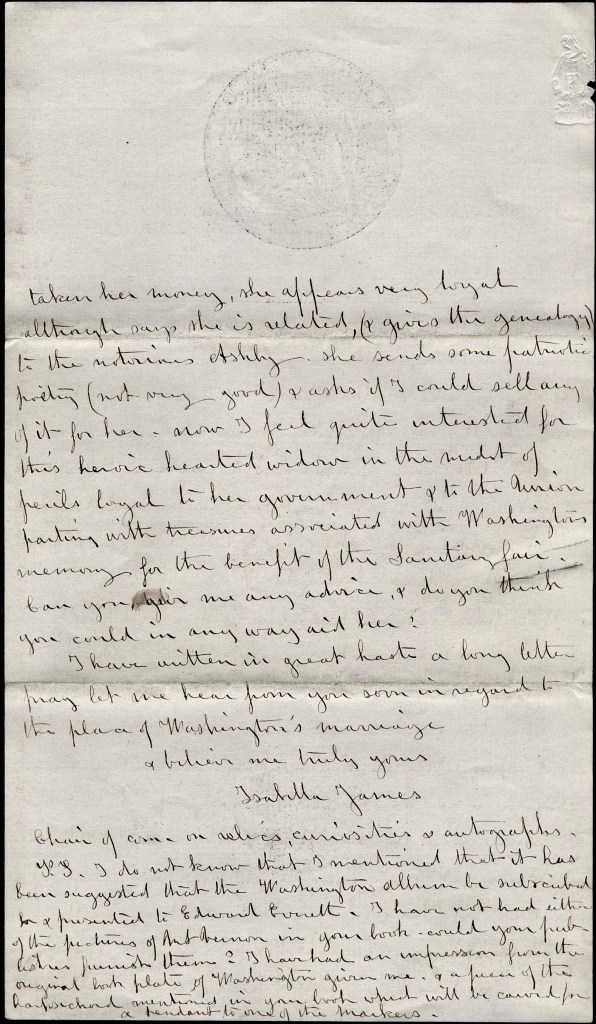
I received yesterday from a woman living in the midst of the rebels in Missouri a pair of curious glass salt cellars which she writes were presented to her grandmother on the occasion of her marriage in 1788, by Gen. Washington. I have no doubt they are from the manufactory of Ameburg mentioned in the 190# page of your Mt. Vernon. They are of heavy white glass, the bottom of an emerald green with gilding. As they are for sale, what do you think they should bring at the Fair? This poor woman has also sent a bed bed quilt pieced by her great grandmother at the house of Washington’s mother in 1777 [made] out of Mary & Martha Washington’s dresses & George Washington’s shirts. It bears intrinsic marks of authenticity. This woman—Mrs. Elizabeth Fray 1 of Philadelphia, Missouri, is in the midst of Rebels & has had her children taken from her by her Rebel neighbors. She thinks if she could get money to go to the commanding officer of the district, she could obtain justice, but is too poor, for the Rebels have taken her money. She appears very loyal although says she is related (and gives the genealogy) to the notorious [Turner] Ashby. She sends some patriotic poetry (not very good) & asks if I could sell any of it for her. Now I feel quite interested for this heroic-hearted widow in the midst of perils loyal to her government & to the Union parting with treasures associated with Washington’s memory for the benefit of the Sanitary Fair. Can you give me any advice & do you think you could in any way aid her?
I have written in great haste a long letter. Pray let me hear from you soon in regard to the place of Washington’s marriage. And believe me truly yours, — Isabella James
Chair of Committee on relics, curiosities, and autographs.
P. S. I do not know that I mentioned that it has been suggested that the Washington album be subscribed & presented to Edward Everett. 2 I have not had either of the pictures of Mt. Vernon in your book. Could your publisher furnish them? I have had an impression from the original book place of Washington given me & a piece of the harpsichord mentioned in your book which will be carved a pendant to one of the markers.
1 Elizabeth Huldah (Hopwood) Fray appears in the 1860 US Census in Philadelphia, Marion county, Missouri, as a 42 year-old seamstress. She was married in Marion county to Reuben Fray in March 1852. In the 1890 Veterans Schedules, Elizabeth identified her deceased husband as having served as a Marine during the Civil War but she could not remember the name of the vessel he served on nor the dates (the recorder annotated her entry by saying, “I don’t believe her statement.”) A genealogical record gives her parents as James E. and Harriett Hopwood of Virginia.
2 It appears that the “Washington Album” was presented to Edward Everett in June 1864 for his work helping to preserve Mount Vernon.

















 Spared & Shared 23