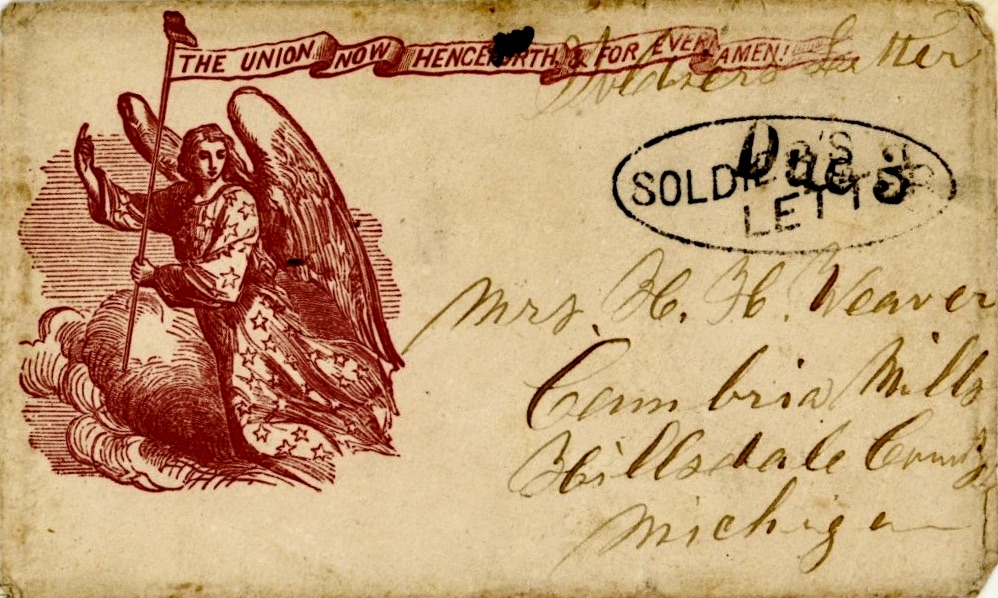
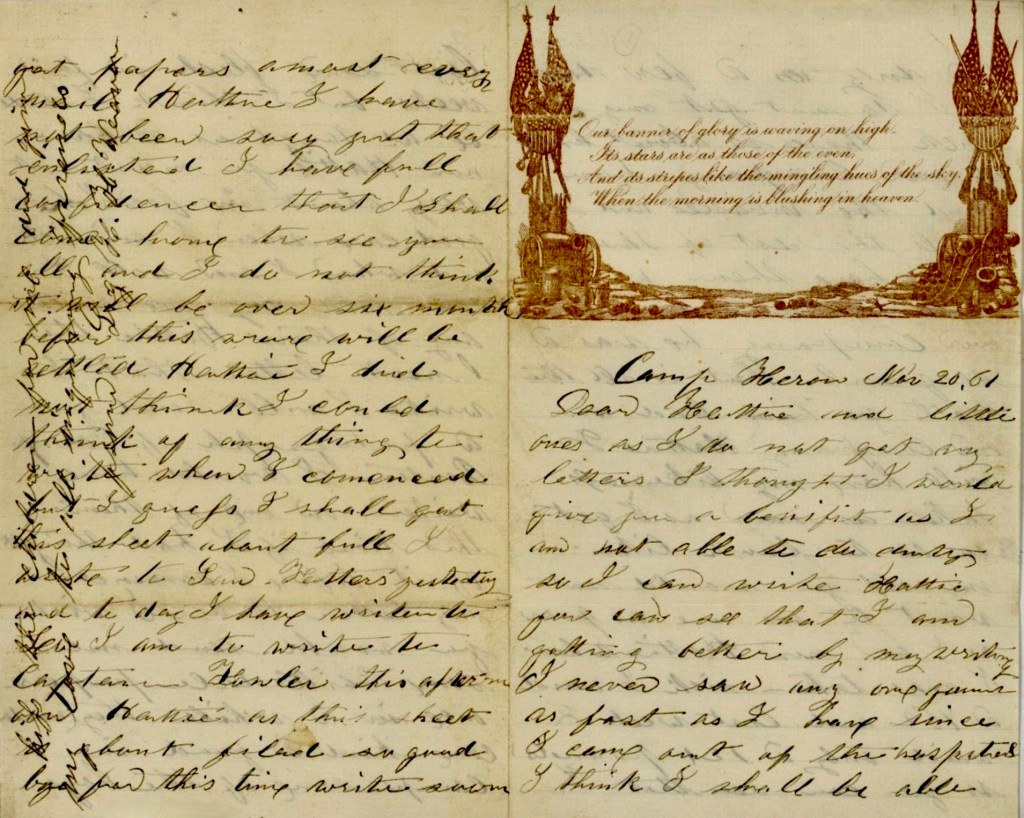
The following letter was written by Hiland Homer Weaver (1832-1915), the son of Hiram V. Weaver (1809-1915) and Minerva Doud (1811-1844) of Niagara Falls, New York. Hiland was married to Harriet (“Hattie”) Aley Johnson (183101908) in 1854 and the couple had at least two children by the time Hiland enlisted in September 1861 as a sergeant in the 3rd Independent Battery, Iowa Light Artillery. He survived the war, mustering our of the service as a 1st Lieutenant in October 1865.
Hiland and Hattie were residing in Beaver, Butler county, Iowa, when the Civil War began. Hattie was most likely staying with her parents in Hillsdale county, Michigan, during the war.
Other quotes from Hiland Weaver’s letters found on line include one written at Little Rock, Arkansas on 10 January 1864 which reads: “…There was a fleet started for here some time ago to come up the Arkansas River and it is over due but the ice I presume has kept it back. I hope it will get here soon if it does not we will lose the most of our horses, they are dying almost daily for want of proper food…think of a horse going five months with only one feed of hay and a good deal of the time but very little grain…I wrote to you about the catching of a spy at this place, he was tried and sentenced to be hanged until he was dead and sentence was executed on Friday…there was a large crowd of soldiers and citizens present, I among the rest, he was hung at three o.c. p.m. in front of the St. John’s College. He was about twenty years of age, smart and good looking, he had some relatives living here at this place, he had been raised here and had attended college several terms in the building in front of which he was executed. Little did he think when attending school that he would be hung on that beautiful ground where he had seen so many pleasant hours but such is the fate of spies when caught. He seemed to be perfectly reconciled to his fate, he died like a man should and for which I respect him. Hattie I can see in an enemy his good qualities as well as in a friend, although sometimes it is rather hard to acknowledge it…I will give you his name it is David O. Dodd…I think I wrote in my last that there was a rumor in camp that Old Price was coming to make us a visit. If it were true I think this cold had whipped him and saved us the trouble and as far as I am concerned I would as soon cold weather would whip him as to have to use powder and lead, and as far as his coming here if I do not see another battle until the rebs come here to fight I do not think I shall ever see another…” [Raynors’ Historical Collectible Auction]
Also: [Camp Union, Sept. 25, 1861]…we have got an order to…march…for St. Louis…the boys are…in a hurry to have a fight…[Camp Heron, Dec. 5, 1861]…we have great times drilling…we have got our guns…[and] are making great progress in drilling…as soon as the rebels find out that the Dubuque Battery is ready for the field there will not be any sesesh in Missouri…[Camp Heron, Dec. 14, 1861 on “Not a star shall fall” patriotic stationery]…there will be a large battle fought near here before long…most of the boys are anxious to have a hand in it…there has been several thousand soldiers through here in the last week. The Iowa 11 and 18 regiment have past here…[Dec. 27, 61 on Washington patriotic stationery]…there is…twenty seven men on the sick list…we have loaded our guns on the cars…we are going to Rolly [Rolla, Misouri?]…about 80 miles from here south west…[n. p., March 14, 1862 on battle of Pea Ridge, eight pages but partial]…the country is all hills… the grass is getting green…it will not come to soon for inhabitants around here where our army has been…it is hard to see the destruction…when an army passes through a country. The houses are torn down for fire wood and the fences are all burnt up…where the hardest of the battle was there was a splendid orchard and the trees were all shot to pieces. There was a large house and barn…and there was not a building…several [had] cannon shots through them. There was a family in the cellar during the two days…the house was filled with dead and wounded…we had to get up and scadadle from Camp Halleck at Cross Hollows…we were enjoying ourselves as well as soldiers could…about nine o’c. at night…the men were in bed when orders came for us to be ready…there was some confusion but we got ready…and we left just in time…[or] we would have been taken…those that showed the white flag in the morning were very much ashamed after the battle…after the battle…our cavalry were running them off. We went into camp on the battlefield…I had a chance to look over the battlefield and…it was too heartrending…there was men with their heads shot off and some shot all to pieces, some [?], some asking for quarters…one of the rebel Lieut. Col. lay on the field with all of his head shot off by a cannon ball. There was…four dead rebels to one of our men…for miles around was filled with dead rebels…it is the hardest thing…to see women and children crying for us not to take the last bit of corn that they have…I cannot see a woman crying and stay around a great while…if our army stays in one place forty eight hours we clean out the country…I this last battle…the Iowa 9 reg. and the Iowa 4 reg and the Iowa 3 reg of cavalry…was very badly cut to pieces…the federal loss in killed wounded and taken will come very near fifteen hundred…[Little Rock, Oct. 16, 1864]…I am tired of running around the country and if Old Abe is reelected…we will have this war brought to a close in less than six months [the war ended almost six months to the day of this letter!]…Old Price is up in Mo. doing his best…we have a large force after him…they will take him…[Little Rock, Oct. 26]…three cheers for Old Abe…[Little Rock, Dec. 11, 1864]…it gives me sad thoughts to know you are in need of money…I never saw a time but once [where] I could not get fifty dollars in our company…I have got forty cents and…tht is far above average…[on rare printed stationery, reading, “Ordnance Office, 1st Division, 7th Army Corps, and post of Little Rock, Little Rock, Ark,” June 5, 1865]…I am shure the war is over…I have been thinking…of going into the regular service but I have not been before the board yet…Gen. Solomon is President of board…[on rare printed stationery, reading, “Ordnance Office, 1st Division, 7th Army Corps, and post of Little Rock, Little Rock, Ark,” June 27, 1865]…now about my going with the Regular Service I do not think I shall…there is too many chances for me to be sent where I could not take my family with me…[Willoughby, Iowa, Nov. 3, 1865]…I thought I would write you a few lines so you would know that I am not dead…and shall start for home in the morning…” [Raynors’ Historical Collectible Auctions]
Apparently several of Weaver’s letters are housed at the Butler Center for Arkansas Studies at Little Rock. See Hiland H. Weaver Collection MSS.08055.
Transcription
Addressed to Mrs. H. H. Weaver, Cambria Hills, Hillsdale County, Michigan
Camp Herron [Davenport, Iowa] November 20, 1861
Dear Hattie and little ones,
As I do not get any letters, I thought I would give you a benefit as I am not able to do duty so I can write. Hattie, you can see that I am getting better by my writing. I never saw any one gain so fast as I have since I came out of the hospital. I think I shall be able for duty in a few days if I do not get my setback. There is about half of our company have had the measles and I guess the rest of them will have them. We have had one man die in our company. He was a sergeant. That is all the deaths we have had in our company.
Hattie, I will have my likeness taken as soon as I get so as to look like myself. you would not want to see me as poor as I am now. Hattie, when I was taken sick, I weighed 162 and last week I weighed only 121 pounds. So you can see that I lost some flesh in four weeks. But I think I shall be as tough as a bear now.
Hattie, you must not worry about me for I have good care when I am sick and when I am well, I can hold my row with any of them. Hattie, the next letter that I write, I will send you a photograph of Camp Benton. I would have written on one of them this time if I had thought of it before I commenced my letter. Hattie, I wish you would send me some Hillsdale papers once in a while. They would come kind a good in camp. Some of the boys got papers a most every mail. Hattie, I have not been sorry yet that I enlisted. I have full confidence that I shall come home to see you all and I do not think it will be over in six months before this war will be settled. Hattie, I did not think I could think of anything to write when I commenced but I guess I shall get this sheet about full. I wrote to Sam Ketters yesterday and today I have written to Captain Fowler this afternoon.
Hattie, as this sheet is about filled, do goodbye for this time. Write soon. Kiss the childreb for me and give my love to all enquiring friends, from [ ] H. H. Weaver
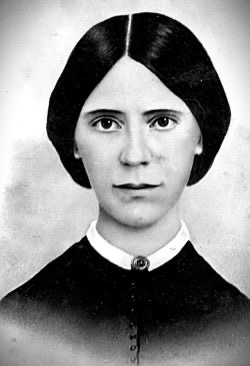
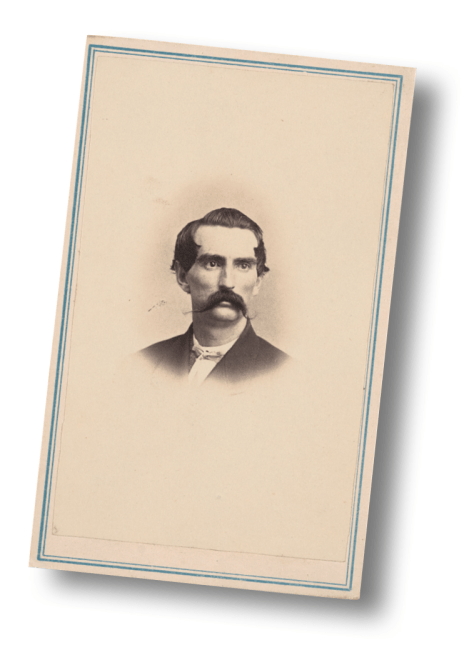
I could not find an image of Alice but here is one of her older sister Jane (1830-1868).
The following letter was written by Alice Corbet Flynn (1836-1909), the daughter of Paul Flynn (1792-1860) and Olivia Smith (1794-1878). Alice married Caleb Dwinell Randall (1831-1903) in 1865 and they had at least three children between 1866 and 1872.
Alice wrote the letter to her cousin, Dudley Chase Smith (1833-1920), the only son of Addison Smith (1784-1846) and Nancy Fitzgerald Hicks (1801-1855) of Shelbyville, Illinois. Dudley raised a company on men in Mattoon, Illinois, and mustered in as 1st Lieutenant, later Captain of Co. B, 14th Illinois Infantry. He served from June 1861 to September 1864. Dudley did not marry until 1885 when he took Mary Bernardine Orme (1856-1931) as his wife and together they had at least seven children.
Transcription
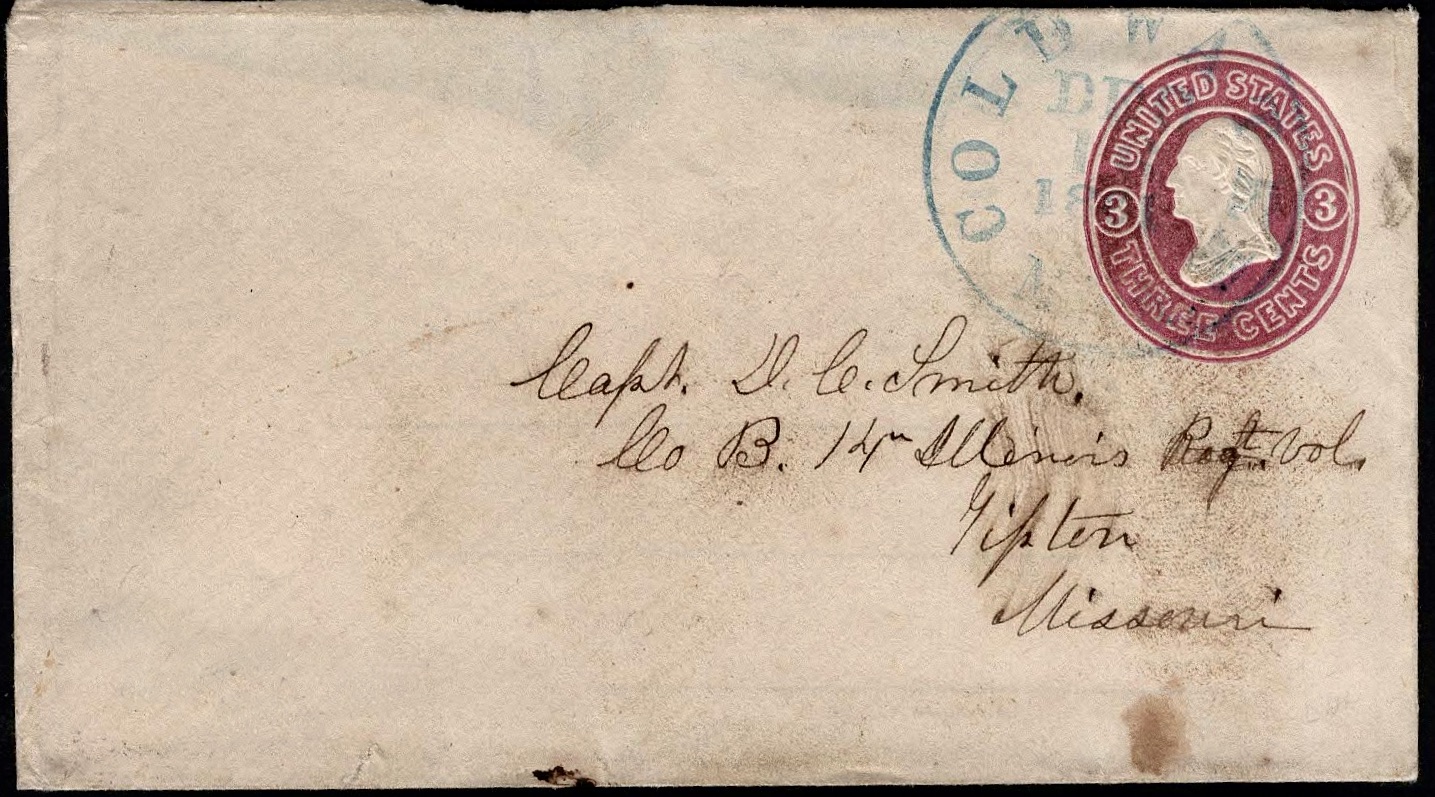
Addressed to Capt. D. C. Smith, Co B, 14th Illinois Regt. Volunteers, Tipton, Missouri
Coldwater, Michigan December 16, 1861
My dear Dudley,
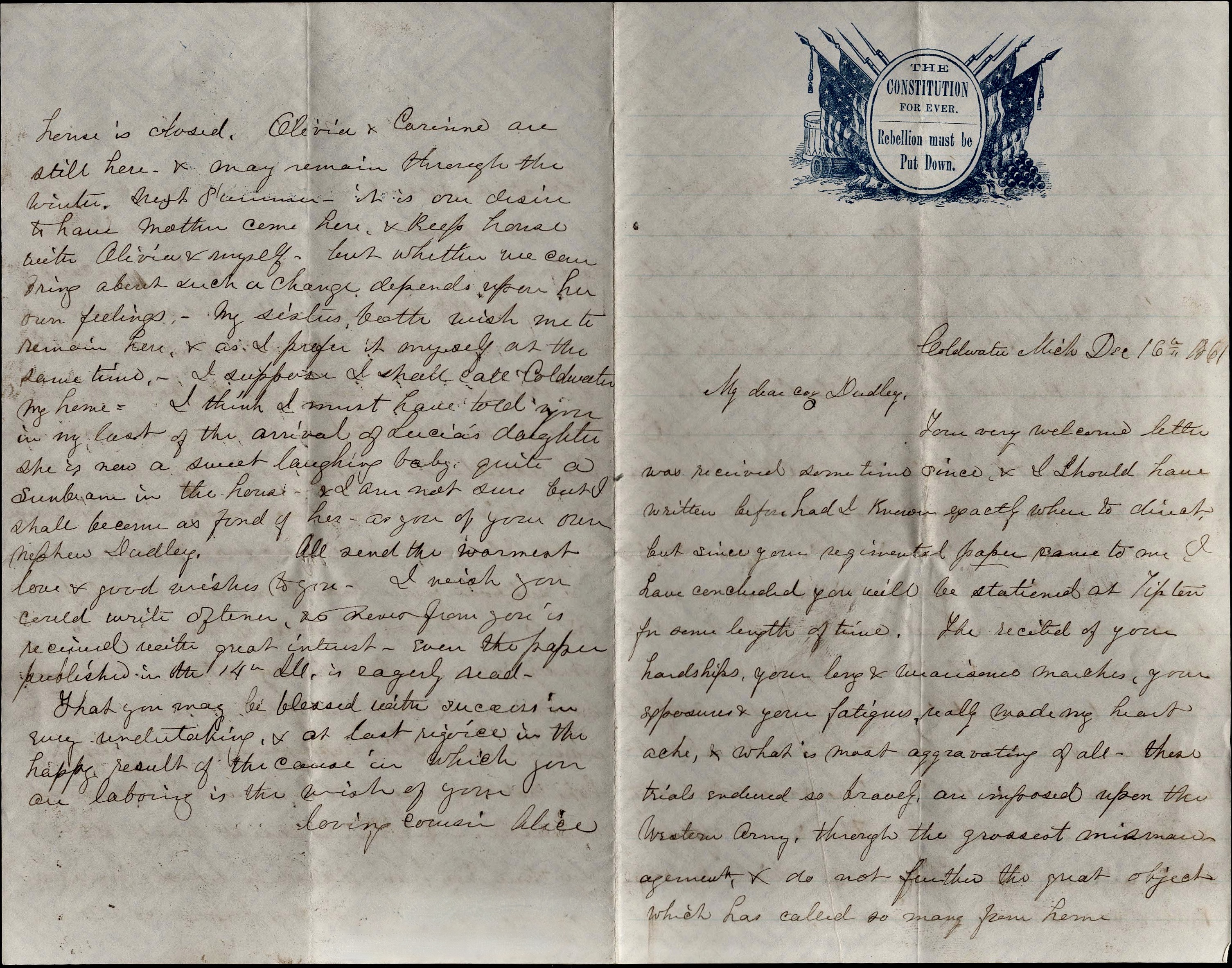
Your very welcome letter was received some time since & I should have written before had I known exactly where to direct but since your regimental paper 1 came to me, I have concluded you will be stationed at Tipton for some length of time. The recital of your hardships, your long and wearisome marches, your exposures and your fatigues, really made my heart ache, & what is most aggravating of all—these trials endured so bravely are imposed upon the Western Army through the grossest mismanagement, & do not further the great object which has called so many from home.
Patriotic letterhead reading, “The Constitution Forever, Rebellion must be Put Down”
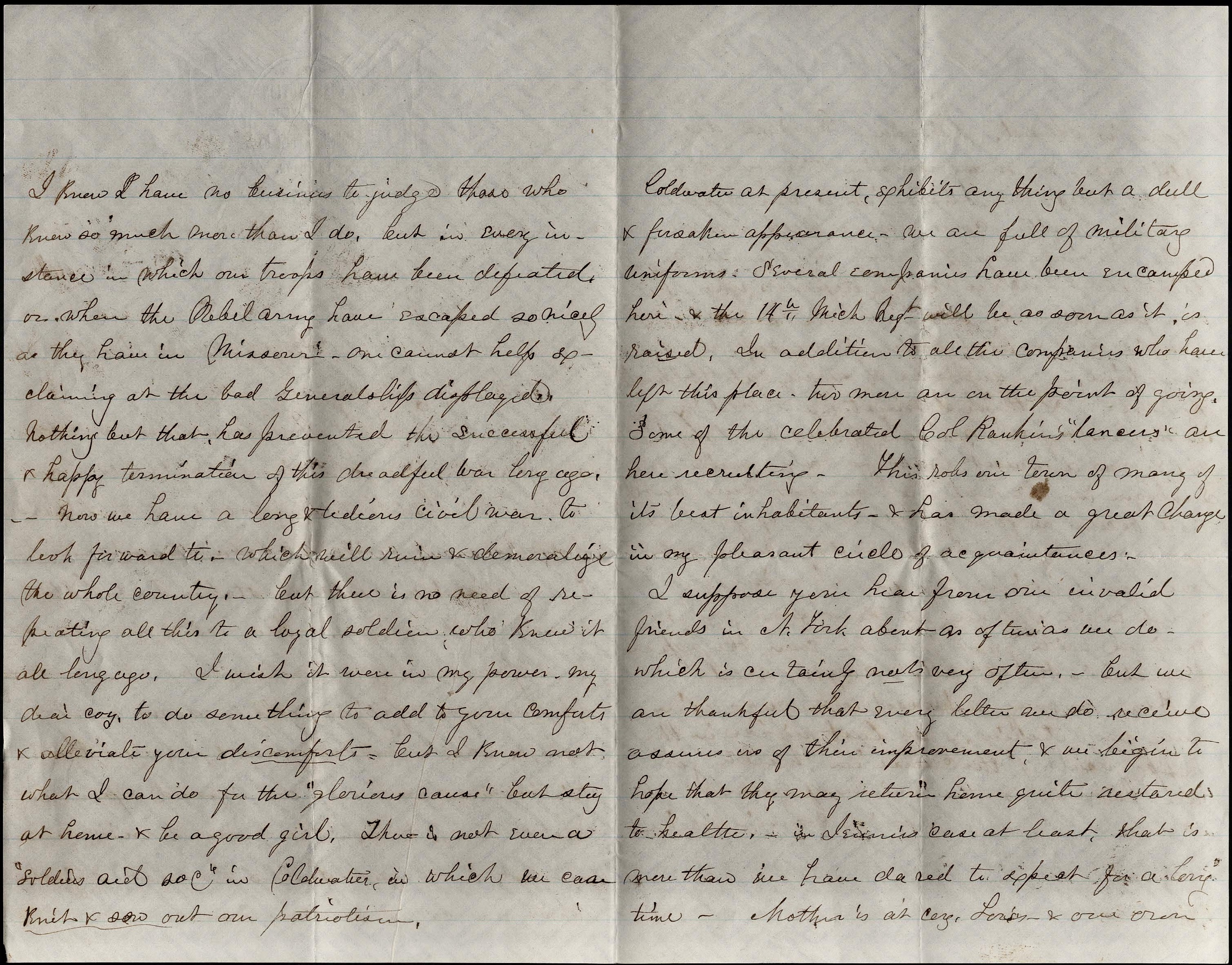
I know I have no business to judge those who know so much more than I do, but in every instance in which our troops have been defeated or when the Rebel army have escaped so nicely as they have in Missouri, one can’t help exclaiming at the bad generalship displayed. Nothing but that has prevented the successful & happy termination of this dreadful war long ago. Now we have a long & tedious civil war to look forward to which will ruin & demoralize the whole country. But there is no need of repeating all this to a loyal soldier who knew it all long ago. I wish it were in my power, my dear coz, to do something to add to add to your comforts & alleviate your discomfort. But I know not what I can do for the “glorious cause” but stay at home & be a good girl. There is not even a “soldier’s aid society” in Coldwater in which we can knit & sow out our patriotism.
Coldwater at present exhibits anything but a dull & forsaken appearance. We are full of military uniforms. Several companies have been encamped here and the 14th Michigan Regiment will be as soon as it is raised. In addition to all the companies who have left this place, two more are on the point of going. Some of the celebrated Col. Rankin’s “lancers” are here recruiting. This robs our town of many of its best inhabitants & has made a great change in my pleasant circle of acquaintances.
I suppose you hear from our invalid friends in New York about as often as we do, which is certainly not very often. But we are thankful that every letter we do receive assures us of their improvement & we begin to hope that they may return home quite restored to health—in Jennie’s case at least. That is more than we have dared to expect for a long time. Mother is at coz Lou’s & our own house is closed. [Sister] Olivia [Safford] & [her 2 year-old daughter] Corinne are still here & may remain through the winter. Next summer it is our desire to have mother come here & keep house with Olivia & myself, but whether we can bring about such a change depends upon her own feelings. My sisters both wish me to remain here & as I prefer it myself at the same time. I suppose I shall call Coldwater my home.
I think I must have told in my last of the arrival of Lucia’s daughter. She is new a sweet laughing baby, quite a sunbeam in the house. I am not sure but I shall become as fond of her as you of your own nephew Dudley.
All send the warmest love & good wishes to you. I wish you could write oftener. News from you is received with great interest. Even the paper published in the 14th Illinois is eagerly read.
That you may be blessed with success in every undertaking & at last rejoice in the happy result of the cause in which you are laboring is the wish of your loving cousin, — Alice
1 The 14th Illinois Infantry published a newspaper early in the Civil War to keep the folks at home informed of their movements and ideas. It was edited by E. F. Chittenden of Co. B. The first surviving copy was published on 4 December 1861 at Tipton, Missouri, which may be the issue that Alice received. The name of the paper was changed from “The First Division Proclamation” to the “War Eagle And Camp Journal of the Army of the West” in January 1862.
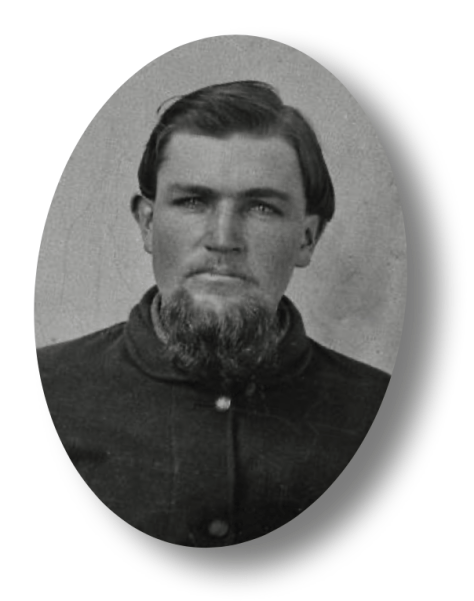
I could not find an image of Eldridge but her is Merrit Hopkins who was also in Co. E, 15th Iowa and also from Keosauqua. (Iowa Civil War Images)
The following letter was written by Eldridge Gerry Black (1843-1862) who enlisted on 14 October 1861 to serve as a private in Co. E, 15th Iowa Infantry. He was mustered into the service on 1 December 1861. He did not survive the war. He was severely wounded in the Battle of Corinth on 3 October 1862 and died of his wounds.
Eldridge had been born in Richland county, Ohio, but was residing in Keosauqua, Iowa, when he enlisted. His parents were William Francis Black (1810-1882) and Hannah C. Cook (1814-1879)
Transcription
Camp Halleck [Keokuk, Iowa] December 13th 1861
Dear Father, Mother, Sister, Aunt, and Brothers
I received yours of the 8th this morning. Sergeant Woodruff brought in a handful of letters this morning among which was yours. I was very glad to hear from you home again. I have looked for father until I have got tired of it. I went to the depot every time I could get permission to go expecting he would come on the cars but was disappointed. I would like very well to go home again and I think perhaps I can. Our captain has given three of our men permission to go home without furlough and I think I can get leave of absence four or five days. I have just spoken to the captain about it and he says I can have a pass next week to go home. By the—-“Fall in for drill!” are the words just now uttered by the Orderly and I must go.
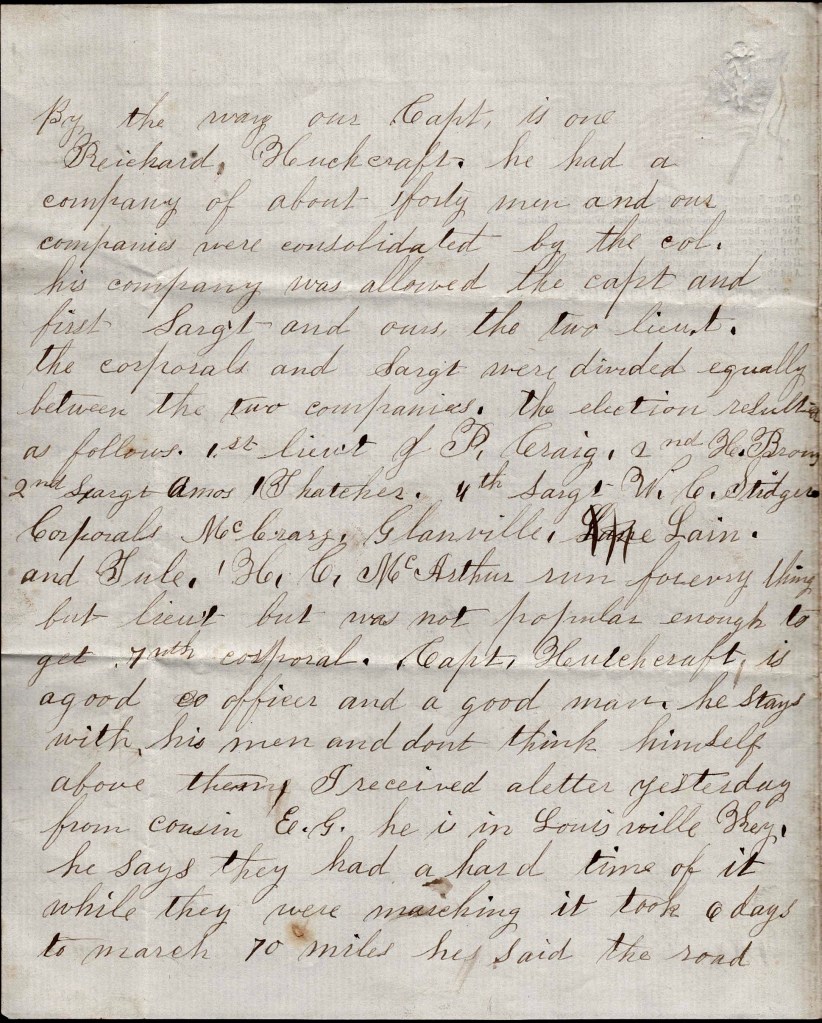
By the way, our captain is one Richard [Williams] Hutchcraft. He had a company of about forty men and our companies were consolidated by the colonel. His company was allowed the captain and first sergeant and ours, the two lieutenants. The corporals and sergeants were divided equally between the two companies. The election results as follows: 1st Lieutenant J. P. Craig, 2nd [Lieutenant] H. Brown, 2nd Sergeant Amos Thatcher, 4th Sergeant W. C. Stidger, Corporals McCrasry, Glanville, Lane, and Tool. H. C. McArthur run for everything but lieutenant but was not popular enough to get 7th Corporal.
Capt. Hutchcraft is a good company officer and a good man. He stays with his men and don’t think himself above them.
I received a letter yesterday from cousin E. G. 1 He is in Louisville, Kentucky. He says they had a hard time of it while they were marching. It took six days to march 70 miles. He said the road had no bottom. They had 75 teams and then had to leave their tents. He said their band wagon broke down on Laurel Hill and left them in a bad fix. He slept three nights without anything under or over him.
James Dunshee was here today. He eat dinner with me and then took me to a Hotel and gave me my dinner so that I got a clean bite again. I would like to write more but I must quit. I want to send it off in the morning. I will direct this letter to Oak Point. As I am going home and will see you all, I will not write the particulars for I can use my tongue better than I can a pen. No more at present. Yours truly, — E. G. Black.
P. S. Frank, as that opossum can go double quick so well, perhaps he would make a good soldier. We want more recruits. you had better send him down.
1 Eldridge had a cousin by the same name who served as a musician in the 15th Indiana Infantry.
The following letter was written by John R. Heafer (1845-1864), the 19 year-old son of John Heafer (b. 1820) and Nancy (b. 1826) who moved with his family from Charleston, Jefferson county, Virginia, to a farm in Bloomington, McLean county, Illinois in the 1850s. John was serving as a private in Co. B, 39th Illinois Infantry when he wrote this letter from Bermuda Hundred in June 1864.
He was carried on the muster rolls as “Hafter” which may explain why he can’t be found under his given name. Unfortunately he did not survive the war. He was killed along with many other comrades in his regiment on 13 October 1864 in the Battle of Darbytown Road. The Union advance was repulsed with heavy casualties and John’s body was left on the field.
John wrote the letter to his sister, Sarah (“Sallie”) Heafer (b. 1844), the wife of William M. Steele, a former soldier in Co. A, 94th Illinois Infantry and a teamster working in Bloomington. He later became a minister..
From the Regimental History of the 39th Illinois Infantry
Transcription
Near Bermuda Hundred June 4th 1864
Dear Sister,
I received your letter of the 25th of May this morning and was glad to hear from you. I have not been well for a few days but am well this morning. I have not had much time to write since we have had so much fighting to do and I have not felt much like either. We had another fight [see Ware Bottom Church] on the 20th of last month. I guess you have heard about it by this time. Our loss was pretty heavy. We had to make a charge on the Rebels rifle pits. We had a skirmish yesterday. We lost 31 men. That makes 250 men we have lost since we have been here. If we keep on that way, we will soon play out.
Lt. Algernon Cox Sweetser of Co. B, 39th Illinois Infantry(LOC)
Lieut. [Algernon Cox] Sweetser was wounded yesterday in both legs. One had to come off. 1 We have some fighting every day now. When the Rebs commence to throw shell over, we all have to skedaddle to the breastworks. The shells burst all over our camp. There was a bullet went through my tent the other day. It hit just where I lay but I happened to be out. This is the first letter I have got from home for some time. I think you might [write] oftener. I expect we will have a big fight here some day. I would like to see Sallie’s baby. I hope she will get along well. I am expecting a letter from Mat every day. I suppose it is pretty dry in Bloomington now. But for all that, I would like to be there. I think I could enjoy myself pretty well.
I don’t feel much like writing today and I will have to go on picket tonight so I will not write much more. Your brother, — John
P. S. My love to all the family and Sallie and the baby. My love to all the friends. — John
Please send some stamps.
1 The regimental history Lieutenant Al. C. Sweetser of Company B was wounded through both legs. The wound of the left leg was not serious, the ball making merely a flesh wound. The right limb fared worse, the bullet passing through the knee- joint and so disrupting the articulation that amputation at the lower third of thigh became necessary. We shall never forget the courage and fortitude of Lieutenant Sweetser while on the operating-table, or while suffering for long months at Chesapeake hospital by reason of hospital gangrene and the subsequent operations that become necesssary from the necrosis of bone. He came back to the field hospital on a stretcher, calmly smoking a cigar, and after an examination, when told that he must sacrifice a limb, he said, “Well, ‘Doc,’ just go to work, and do the very best you can for me.” Lieutenant Sweetser was a brave and gallant officer.” (pp. 201-202)
A couple of boys from the 20th North Carolina Infantry
This letter was written by John L. Phifer (1842-1880), who commenced his military service on June 7, 1861, hailing from Cabarrus County, North Carolina, as an 18-year-old private in Company A of the 20th North Carolina Infantry. He had a brief tenure with the Radecliff Battery before attaining the rank of ordnance sergeant in the 20th N.C. in March 1862. By 1865, he held the position of Brigade Ordnance Officer in Johnston’s Brigade, Early’s Division, and had recently arrived or was shortly expected at Camp Pegram. John was the offspring of Caleb Phifer (1810-1879) and Mary Adeline Ramseur (1817-1881) from Concord, Cabarrus County, North Carolina. At the onset of the Civil War, he was employed as a clerk.
This letter is preserved within the Phifer Family Papers, 1859; 1862-1864 at the University of North Carolina, where it has been digitized, though transcription and online posting have yet to occur. The letter’s images were sent to me for transcription by Matt Edwards, who posited that the letter was authored by Capt. George L. Phifer of the 49th North Carolina Infantry. However, I am firmly convinced that the signature clearly reads “J. L. Phifer” rather than “G. L. Phifer.” It is also significant to note that the letter was directed to John’s cousin and has remained with George’s family correspondence within the aforementioned collection.
The letter underscores John’s unwavering dedication to the Confederate cause, while also presenting the unexpected outcomes of a query directed at the soldiers within his Brigade, inquiring, “Should negroes be enlisted in the ranks of the Confederate army?”
Transcription
Camp near Petersburg, Virginia February 22, 1865
Dear Cousin,
Your most welcome communication of February 9th was received and perused with much pleasure. I never for one moment thought it was from you. I had ceased to look for a reply and was regretting that I had written to you, but I am repaid for writing; but I hope you will be more prompt in future. When I looked at the direction, I thought it was from brother Charlie who writes an elegant hand. But I was most agreeably surprised to learn my mistake in glancing at the heading as you have brought to mind the “deer hunt in the mountains.” Permit me to explain what I meant. I spoke to Cousin Anna in a playful manner and said that she was deer enough for me, not meaning or intending that anyone else should think I meant dear for such was not my intention. I meant just what I said—that Counsin Anna was gay and happy, pleasant and very agreeable, full of life and fun, with whom I could enjoy myself and feel as though I was talking to a friend and nothing more. And I am sorry—very sorry—that you should have been so “exasperated” when I was talking for amusement only. I hope Cousin Anna did not construe my words as you did? Was she as much exasperated as you were? If she was, I did not perceive it. Do you think I would make so public an avowal of my love for a lady? If you do, you. know very little of my disposition. I am rather modest and retiring in love affairs. I would almost bet my life that Cousin Anna did not construe my words as you did. I think she is far seeing for that and a little too old to think so. Now, I do insist upon your telling me whether she was exasperated or not? My curiosity is much excited to know and perhaps that will explain some of her conduct towards me which I have never been able to understand.
Permit me to inform you that you are slightly mistaken when you imagine Miss M. Morehead is a particular friend of mine. Did I not tell you last spring about the manner she treated me when at Cousin Sarah Morehead’s. I advance half across the room to shake hands with her, [but] as she showed no signs of recognition, I retreated (in good order) to my seat, I was pretty much demoralized but stood my ground and held my position. Your delicate sense of politeness and good breeding will sustain me in thinking she intended it as she never apologized for it afterwards. I do not know anyone with the “initials W. H. M.” I will find out for you and let you know in my next.
I don’t think our sweet little Cousin Esther will ever make a match with Capt. N. P. Foard. I think if all her relations would let her alone, it might be a match, but there is Bob Fulenwider, Jimmy Gibson, Charlie Phifer, and many other of her cousins who don’t fancy it and are always making fun of him, calling him N. Post Foard and many other nick names. He was called Post at school for being so extremely dull. I am under many obligations to you for giving. or desiring to give me Miss Daisy Gutler for a “sweet heart,” but can’t promise to make any advance towards storming the fair one until the war is over. If she should require much daring and boldness of heart to capture, I must wait until the war ends so that my country does not need my whole time and attention. Perhaps she would not like the disposition you have made of her? Did you get acquainted with Miss Hattie Gilmer of Greensboro? I have had some gay times with her. I came very near falling in love with her; she has grey eyes and I don’t fancy them.
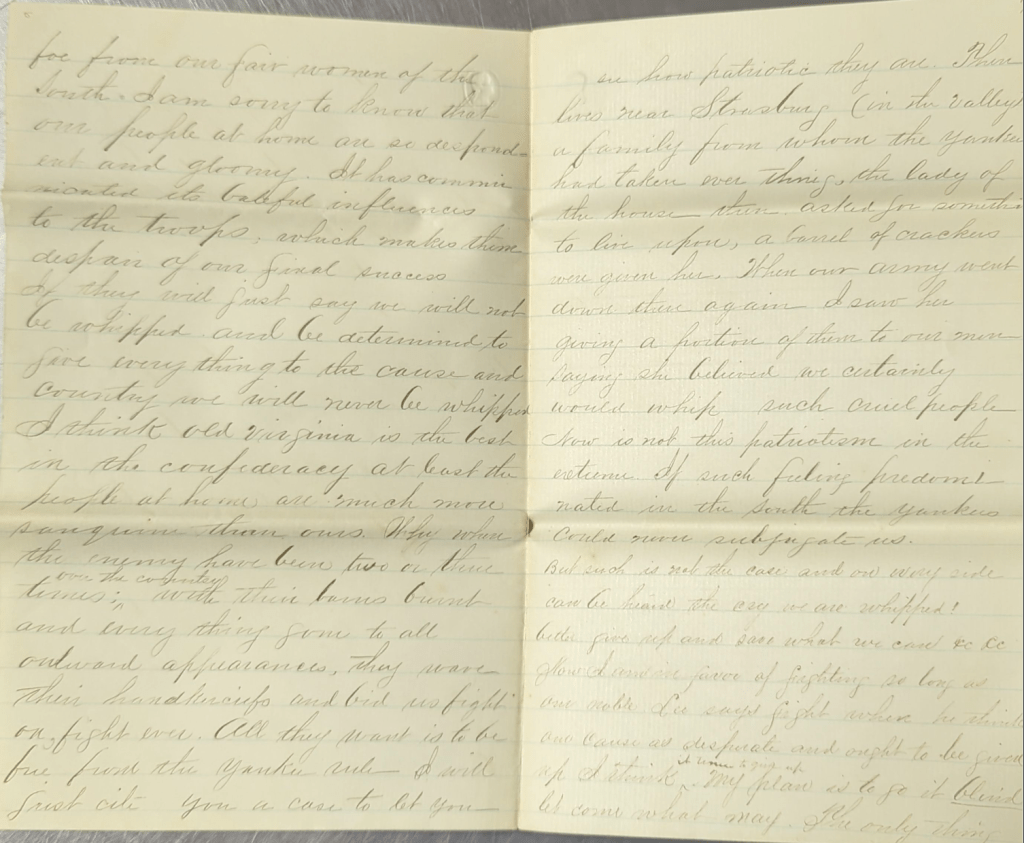
You speak of your ideas being frozen up on account of the cold weather. About that time our brave soldiers were out in the open air without any shelter, fighting and building fortifications to drive back the hated foe. I am much surprised at the ladies showing any fondness for the young men who remain at home, when our glorious country needs their strong arms to defend our homes and firesides, to drive back the Yankees and protect all we hold dear, to keep back the insolent foe from our fair women of the South. I am sorry to know that our people at home are so despondent and gloomy. It has communicated its baleful influences to the troops, which makes them despair of our final success. If they would just say we will not be whipped and be determined to give everything to the cause and country, we will never be whipped.
I think Old Virginia is the best in the Confederacy—at least the people at home are much more sanguine than ours. Why when the enemy have been two or three times over the country with their barns burnt and everything gone to all outward appearances, they wave their handkerchiefs and bid us fight on, fight ever. All they want is to be free from the Yankee rule. I will first cite you a case to let you see how patriotic they are. There lives near Strasburg (in the Valley) a family from whom the Yankees had taken everything. The lady of the house then asked for something to live upon. A barrel of crackers were given her. When our army went down there again, I saw her giving a portion of them to our men saying she believed we certainly would whip such cruel people. Now is not this patriotism in the extreme? If such feeling predominated in the South, the Yankees could never subjugate us.
But such is not the case and on every side can be heard the cry, “We are whipped—better give up and save what we can, &c. &c.” Now I am in favor of fighting so long as our noble Lee says fight. When he thinks our cause as desperate and ought to be given up, I think it time to give up. My plan is to go it blind, let come what may. The only thing that gives me much trouble is the old people and the lovely and devoted ladies of the South, also the helpless children. If these could take care of themselves, I have no fear for myself. As I am uncertain how this war might end. I am rather inclined to be indifferent to seeking one whom I would like better than myself and for whom I would feel more sensibly any injury done to her than to myself. So if you will select me a nice, pretty “sweetheart” from among your many friends who will. be of the same opinion as I have expressed (that is, wait till. the war is over), I will accept your choice. I might tell you of a certain young lady for whom I have the greatest admiration and I believe most of my friends desire me to propose, but as I have said, the war is one objection and I am so very modest that I don’t feel like making the attempt and to be rejected would almost kill me—not quite—so don’t.
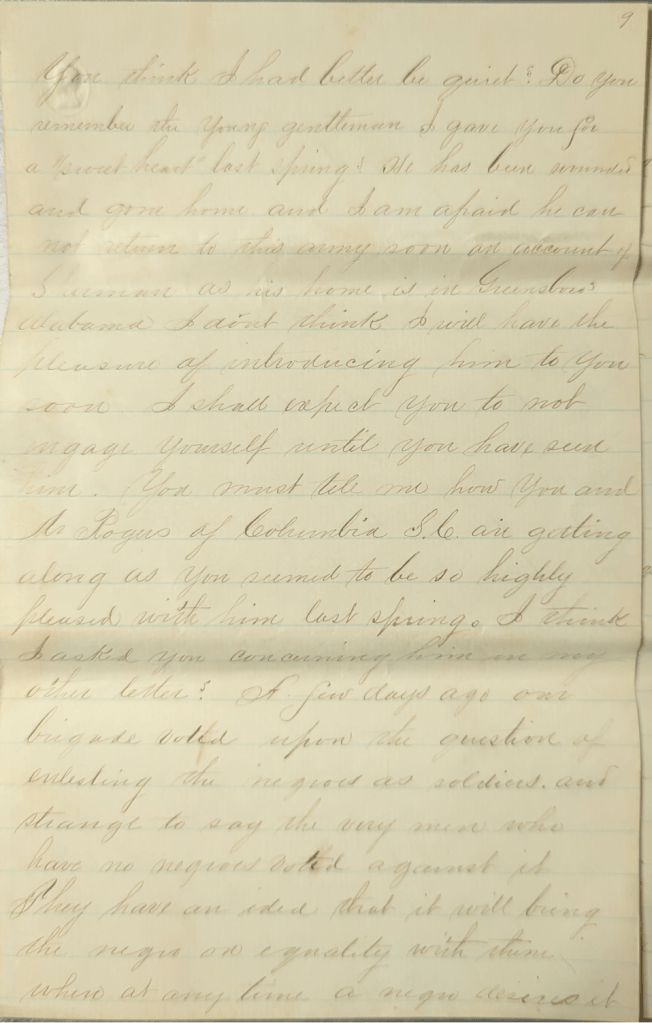
You think I had better be quiet? Do you remember the young gentleman I gave you for a “sweetheart” last spring? He has been wounded and gone home and I am afraid he cannot return to the army soon on account of Sherman as his home is in Greensboro, Alabama. I don’t think I will have the pleasure of introducing him to you soon. I shall expect you to not engage yourself until you have seen him. You must tell me how you and Mr. Rogers of Columbia, S. C. are getting along as you seemed to be so highly pleased with him last spring. I think I asked you concerning him in my other letter?
A few days ago our Brigade voted upon the question of enlisting the negroes as soldiers and strange to say the very men who have no negroes voted against it. They have an idea that it will bring the negro on equality with them when at any time a negro desires it, he can sit down and chat with these men as though he were an equal. The brigade voted for the measure by a slight majority. The Georgia troops voted for it almost unanimously and I understand troops from the Gulf States were in favor of bringing the negroes in as soldiers. Gen. Lee is of the opinion that we can make good soldiers of them—at least as good as the Yankee negro troops. Can you tell me any objection to making them fight? Just so we can gain our independence, I care not whether it be done by the aid of negroes or not.
May I not look for an early reply to this letter? Also a long letter of about three sheets or more and you must not think for a moment that I consider your letter as being. dull. If you keep saying yours are dull, I shall consider my own as being extremely uninteresting.
As I thought I could close my letter on half sheet, I began on one but find I cannot finish without crossing the writing. A few nights ago I had almost everything I had stolen from me by an extremely bold rogue. My hat and haversack were taken about two inches from my head. Mother had sent me a considerable amount of provision, such as sorghum, peas, butter, &c. All were taken, not leaving me anything good. I feel the loss very much as we enjoy things sent from home very much. I believe the rogue would have taken my pants from under my head so soundly do I sleep.
I think Cousin Lou Wilson stays at your home. If she does, please give her my love. She and I used to be old correspondents and were until she was married to Major Wilson. Also give my love to your Mother and Father and your little sister Sallie whom I remember as a beautiful little child when I was at your home. How is your brother Phife and is he with the western army or near Winnsboro, South Carolina?
Now if you don’t write soon and a long letter, I will be much disappointed. Can you. tell me of some pretty and sweet songs and the latest music published in Dixie as I promised to select some for a lady friend of mine and I am afraid to rely on my own judgement. I know you will be as tired of reading this as I am of writing for you know it takes some time to write so long a letter. If it was my dear little sweetheart I was writing to, I would not stop short of four sheets or more, but as you are only one of my many dear cousins, I will stop. I am afraid you will go to sleep ere you. finish. With much love, goodbye and keep in good heart as I am, Your affectionate Cousin, –J. L. Phifer
P. S. I heard that [George Washington] Kirk, the renegade, had made a raid near your town. Is it true?
Sgt. Norman R. Gifford, Co. D, 10th New York Cavalry (Kyle M. Stetz Collection)
This four-page letter was penned by a trooper in the 10th New York Cavalry who unfortunately did not sign it though there are a number of possible clues to his identity if more research time were available. The letter was written over a five-day period in June 1863 as the Gettysburg Campaign began to unfold. A reference to the Battle of Brandy Station is made in the first paragraph though he offers no account of it. The last paragraph was written on the day before the Battle of Middleburg in which Col. John Irvin Gregg’s 3rd Brigade engaged three brigades of J. E. B. Stuart’s cavalry.
Transcription
On picket near Warrenton, Va. June 13th, 1863
Dear Brother & Sister,
As I have a little leisure, I will commence another letter even if I did send you one yesterday. I sent you half of a Wash. Chron. that had something of an account of the cavalry fight [at Brandy Station] but I am looking for an official account. If it comes out, I’ll send it.
Yesterday our regiment got two months pay, up to the first of May, and I’ll send you in this letter twenty dollars. I guess you had better take up the $10 note that I gave you, S. S. Southwick, bearing date of May 31st 1862, and a note of $5 that I gave Uncle Isaac Allen the 28th of last August & what there is left pay where you think best.
You wrote that Ross had been paid fifty dollars and that the $10 Joseph left was just paid to Spencer but you don’t say anything about the 16 dollars that the heifer was sold for. Where is that? I want you to reckon up & let me know how much more it neds to pay up all my debts except yours, Harriet, and Aunt Lydia’s, or how much more than enough you’ll have, which ever way it is. And also tell me what the face of your note is, Harriet against me, when it was given and when it’s due. I can buy envelopes here for 25 cents per pack but they are poor ones and so I am going to ask you to send me some more. One package at a time is enough. Send about such quality as this one, only a little larger and they won’t jam up as thinner ones wil. I have paper enough for the present.
I am glad fruit is going to be so plenty again there. So it is here. Cherries and strawberries are ripe here now. I picked my first strawberry today.
I don’t know but you will get sick of hearing the same thing over and over so many times or in every letter I send “that I am well; that I am tough & hearty,” but if I say anything about myself, I have to say that I think I am as fleshy as I ever was and my bedfellow Joseph is tough and fat and says he would not give a cent to feel any better than he now does. William, Joseph, and I a few days ago had as nice a double barrel shot gun of London manufacture & silver mounted as you ever saw, but we had no way to get it home & could not lug it around so we gave it to our captain. If I can ever get hold of an extra revolver, I’ll get it home. T’would make your eye water to see how they will shoot.
Tuesday Morn, June 16th. We are now at Union Mills, four miles from Centerville and 22 from Alexandria. We broke camp at Warrenton Junction yesterday and left there at one o’clock p.m. I don’t know where we are going & I don’t worry about it for I know I shall go with the crowd unless my horse gives out. Yesterday was a very hot day but we marched nearly 30 miles after one. I got hurt some when returning to camp from picket. My horse backed into a ditch and fell on me and caught my right leg under him and the horse could not get up nor I could not get up. It lamed me some but I am about over it now.
I received a letter from you the 14th, No. 35. The laurel grows in dry and in wet soil too but it looks the thriftiest along the banks of a stream. It is now in blossom. I’ll send some home as soon as I can. We do wear our nightcaps, but the nights are not cold now. I would as leave you would have the gray colt as anyone. You need not talk flax to me any more. I read your letter to Joe & took up May’s to read & Joe says now we will get the news. May always write some news that I don’t hear any other way. I never saw anyone improve in writing so fast as May.
It is awful dry here. We have had no rain since we returned from the raid and now the dust flies awfully when we march, but where can, we go in the lots. I bought me a watch this morning—a patent lever Hunter cased, for $9.50.
The news in today’s papers is that the rebs are marching into Pennsylvania. I am glad of it. I hope t’will put a stop to Northern men talking about resisting the draft.
June the 18th, near Aldie. We marched to here yesterday. I think all of the calvary of the Army of the Potomac is here. Pleasanton commands. We are now in the 2nd division, 3rd brigade. The 1st Maine, the 4th & 16th Pennsylvania are in a brigade with us. We have a new brigadier, a brother to Gen. Greggs. At 4 p.m. yesterday we came upon the enemy, gave battle for 2 hours, drove him several miles but with considerable loss. Our regiment was not in. I suppose it’s the rear of the Reb army that have gone north that we have fell in with.
The 18th. I didn’t send this letter because I am afraid the Rebs will get it. I shall wait till the coast is clear.
I have not yet been able to attribute this letter signed by “Oscar” to his sister, “C. J. Emerson” to any particular soldier. It seems apparent that Oscar was serving in the same company with a brother named William and that he possibly had another brother named Joe who served in another regiment. I think there is a strong possibility they enlisted from a Midwestern state because Oscar expresses interest in knowing the names of those killed at the Battle of Shiloh in Tennessee.
Transcription
Newmarket, Va. May 1st 1862
Dear sister,
I received yours of April 16th last night. We have both written since we had any letters from home. I wrote to Pa from Strasburg. We stay only a few weeks in a place but our letters follow along after awhile. I have been unwell for a few days from a severe cold and a slight touch of the jaundice, but I am much better today. William will speak for himself. He is now on drill.
I sent a box of books and clothing home from Strasburg by express thinking they would be worth the expressage at least. If I ever get there, they will be valuable to me. If not, do as you please with them. And if they never get there, they will cost nothing to anyone.
I should enjoy your lectures, society meetings, and public exercises very much and hope soon to be able to be with you once again and enjoy the comforts of friends, home and old associates. You perhaps hear the news and know the progress of the war better than we do. But we hope soon to be no longer needed in the tented field.
Give my love to Libbie in return for hers. I cannot but recur to the time spent at school at H. with pleasure and at times even now my heart longs for liberty to return again to my old associates. You spoke of teaching. Certainly teach even if you get only your board as you will be better prepared to meet life’s stern reality.
I have had no letter from Joe for near two months. I suppose he is at or near Yorktown. We have not yet heard who were killed at Pittsburg Landing. I see I am near the bottom of the page so I must close. Give my best respects to all who inquire and believe me your sincere brother, — Oscar
I could not find an image of Barton but here is Orlando Starkey of Co. C, 39th Illinois Infantry (Al & Claudia Niemiec Collection)
The following letter was written by Barton Smith Walters (1841-1865), the son of William Walters (1814-1890) and Malinda C. Smith (1822-1888) of Minooka, Grundy county, Illinois. Barton enlisted in October 1861 to serve in Co. A, 39th Illinois Infantry. He did not survive the. war, however. The following excerpt was lifted from “The Patriotism of Will County.”
“Barton Smith Walters enlisted in the 39th Regiment at the age of 21, re-enlisted and served faithfully and bravely without any casualty until in May 1863 when he was taken prisoner. He with two others had been detailed to go upon the battlefield and bring in an officer who had been wounded. He was captured with two others, David Hanson and Andrew Sybert, of the same regiment, and they were taken to Andersonville. Hanson and Sybert fell victims to their treatment and were buried in that locality. Young Walters was released before his death, but he only lived to reach Annapolis, where he died April 1st 1865. His remains were brought home and repose in the Channahon cemetery.”
Transcription
Addressed to Mr. William Walter, Minooka, Grundy county, Illinois
Columbian Bridge Sunday, May 4th 1862
Dear Father & Mother,
I now sit down in the shade of an apple tree to write after a march of 7 miles. We are all well but me. I have the erysipelas in my legs but they are now better. I have not seen nor heard from Mike for three weeks. He is at Mt. Jackson. When I saw him last, he was sick but on the gain. Charlie got a letter from Fatha [?] Hunter today. They were all well when she wrote and she had not heard from you for some time.
We are having nice spring weather here now only rather warm for marching. We are soon to have another fight, I think, from the way things are moving. We have two days rations in our haversacks. [Stonewall] Jackson is reported to have been reinforced but we don’t care for that. We want to have the fun of reinforcing him ourselves but the trouble is we can’t get near enough to him. He always runs away. We have the two fighting regiments together—namely 13th Indiana and the bloody 39th from Illinois. We bear a good name wherever we have been but now we are somewhat dissatisfied. Our Brigadier [General] Sullivan has been transferred to the 3rd Brigade of yankees and a yankee—General [Orris S.] Ferry—put over the brave sons of the west. They have gained a name which will live for years after they are laid to moulder in the grave. I have become an old man in my views of the war. I am glad to hear of the several democratic victories throughout my native state, one of the most beautiful lands in the world, and when you ask one of them abolitionists the reason why they were beat in the election and they will answer by saying they have gone to put down the rebellion, but we can rule them in this regiment.
I think our town is gone up when Dick Briscoe can get two officers. I wish you to let me know who are the town officers and if snipe bill or H. H. Randall got any. I have wrote 3 letters in the last two weeks to see if any of them would get through the mail here is uncertain, and if we don’t get any answer, we are not much disappointed. While I write, Earnest Holz is talking about this cursed rebellion. He is my right bower. This is the oldest country in the states. I was talking with a woman last night and she told me that she had lived in the same house for the last 65 years and her 4 sons were in the army and she was surprised when I told her that we had taken them prisoner a week before. When I told her their names, she felt very bad. At first she did not believe it or she would have heard it.
Write as soon as possible. Write like I have—without waiting for an answer. I still remain your affectionate son, — Barton S. Walters
The following letter was written by David Hayden Foster (1829-1871) of Beaver Dam, Allen county, Ohio, who enlisted in January 1862 in Co. H, 74th Ohio Volunteer Infantry. He did not serve long. He was discharged for disability as a corporal on 5 November 1862 at Nashville, Tennessee.
David write the letter to his wife, Elizabeth (Emmons) Foster (1826-1902). They were married in Allen county, Ohio, in June 1847 and had at least five children by the time of the Civil War.
Transcription
March 22, 1862
Dear Wife,
It is with pleasure that I sit down to let you know that I am well at this time, hoping these few pencil marks may find you in the same state of health. I have had a good lot of work to do since I came into camp but I stand it all well & nice. Yesterday I superintended the dressing up of the company hospital for the sick. There is five or six that are on the sick list but not dangerous. It is from cold. The doctor says that these fellows [just] want to get rid of duty. This game is played off every day.
I want you to write to me for I have not received one word from home yet. Now I think it time that some of you would write to me. I have written 20 letters and not one answer yet. I wrote G. W. Young a few lines to see about your money that you are to draw. He has not answered me yet. I do not know what course to pursue until he answers my letter. I will most assuredly attend to it as soon as I learn what course to pursue. I want you to do a mother’s part in taking care of my beloved children. That I have no doubt you will do & do it right too.
Dear wife, there is some talk of us moving from here but we do not know when we will move. It may be in ten days & maybe not for twenty. There is all kinds if camp reports going every day but the Captain thinks that we will have to stay here till the war is over.
There was 90 prisoners came into our prison this morning. I have had a chance to talk with the secesh since I came back. Some of them are fine men. Others are mean as get out. Tell my boys to be good to their Mother & do everything they can for her comfort. So no more at preset but remain your husband, — D. H. Foster
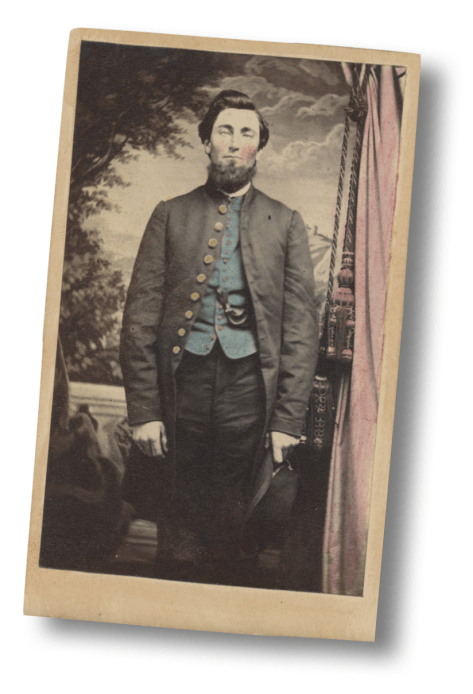
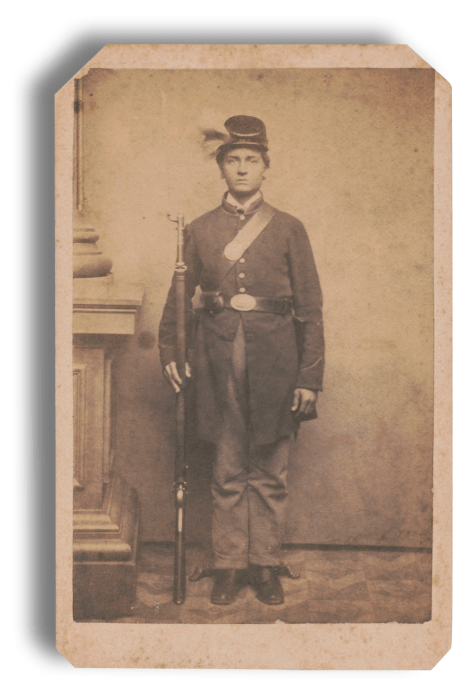
I could not find an image of Thomas Callender but here is one of Franklin W. Lehman of Co. C, 149th Pennsylvania Infantry (2nd Bucktail Regiment)
The following letters, heartfelt and poignant, were penned by Clark Callender (1834-1899), the son of Silas Callender (1805-1880) and Mary Carkuff (1805-1879) from Fairmount, Luzerne County, Pennsylvania. Addressed to his parents, these letters revolve around his younger brother, Thomas Callender (1839-1863), who valiantly served as a private in Co. F. of the 149th Pennsylvania Volunteer Infantry at Gettysburg. Tragically, he was mortally wounded at the railroad cut in front of McPherson’s Barn. Within these letters, Clark recounts the distressing moment when their neighbor’s son, Pvt. Clark Woodworth, was struck down. As Thomas rushed to assist him, he faced the heartbreaking reality that Woodworth felt he could not endure. Thomas himself was then grievously injured, a bullet piercing his sternum and tragically passing through both his body and bronchial tube before exiting through his clavicle. In a somber twist of fate, he was carried to McPherson’s barn by Confederate soldiers.
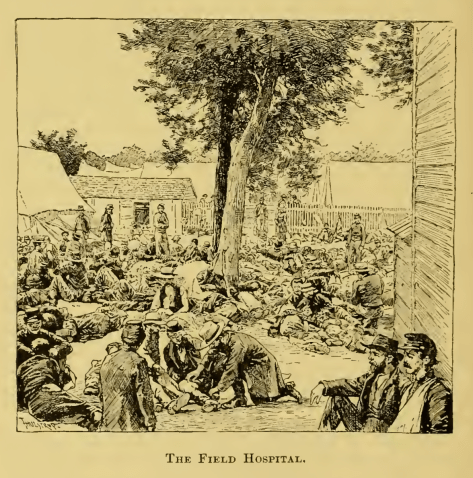
Later Thomas was carried to the St. Francis Xavier Catholic Church in Gettysburg where Sister Camilla O’Keefe, a member of the Sisters of Charity, wrote, “The Catholic church in Gettysburg was filled with sick and wounded … The soldiers lay on the pew seats, under them and in every aisle. They were also in the sanctuary and the gallery, so close together that there was scarcely room to move about. Many of them lay in their own blood…but no word of complaint escaped from their lips.” Yet another woman, a Gettysburg resident who volunteered as a nurse named Sallie Myers, wrote: “I knelt beside the first man near the door and asked what I could do. ‘Nothing,’ he replied, ‘I am going to die.’ I went outside the church and cried. I returned and spoke to the man — he was wounded in the lungs and spine, and there was not the slightest hope for him. The man was Sgt. Alexander Stewart of the 149th Pennsylvania Volunteers. I read a chapter of the Bible to him; it was the last chapter his father had read before he left home.”
Clark’s letters provide a daily chronicle of Thomas’s fluctuating condition, reveals the brother’s agonizing search across the battlefield, the tension of doctor visits, and the heartbreaking deception he felt compelled to navigate—informing his father that Thomas held no hope of survival, while quietly offering their mother a glimmer of reassurance that he might yet endure. Thomas died on 23 July 1863, over three weeks after he was wounded. Heartbreakingly, Clark Woodworth’s body was never recovered, leaving him listed among the unknowns—a somber reminder of the war’s toll on families.
[Note: Photocopies made from the originals of these letters were provided to me for transcription and publication on Spared & Shared by Wayne Rizor, a descendant of the Callender family.]
Letter 1
Gettysburg [Pennsylvania] Saturday noon
To Mother,
Thomas is sleeping and so I will write a few lines. When he sleeps, the times so long. Yesterday I moved him on another bed where he has a good place. He is more by himself. I wish I could tell you that I thought Thomas would get well, but I do not. He may live some days yet and he may die any hour. He has lived longer than any of the doctors thought he could. I got the doctor to examine him a little while ago and I asked if since he had lived so much longer than any of them expected if there was no chance for his recovery and he said if he would live one month yet, he would not have any more hopes of him. If we can’t have him anymore with us, we ought to be thankful that we have the privilege of being with him to see to his wants and to know that he is a going to a better world where we meet him again. He does not bleed much anymore. Last night I felt of his hands about eleven o’clock and he was cold up to his elbows and his legs and feet up to his knees. I could hardly feel any pulse. I gave him some wine and then rubbed him and got. the blood to circulating again. He is now about the same as he has been for the last two or three days.
There are a good many dying here for the want of care but you. may rest assured that Thomas gets good care. I say candidly, I believe he is better off here than he would be at home. Here he can have everything he can wish for and doctors here all the time to watch every change. His appetite is middling good. He eats bread, dried peaches, and tea and oranges mostly. He sleeps a good bit now. At first I had to give him morphine to make him sleep.
I have just been out to the battleground where he was shot to see if I could find his knapsack but could not. I have got canteen and haversack, or it is the canteen that he has when the Rebels went into the barn where he lay. They took his canteen and left him have theirs. You can form no idea of what property is destroyed where two such armies meet and fight as they did here.
Mr. Harrison is a little better. His son and daughter is here taking care of him—his daughter in the daytime and his son at night. I lay close by Thomas and some nights I can sleep some and some I do not but watch my chance in the daytime when he is asleep and lay down and take a nap so I can do right well.
The Boys was a dirty-looking set of fellows but it is no wonder. They had marched twenty-one days through the dust and then went right into the fight. I have washed Thomas every day since I have been here but he is not clean yet and now he is so weak I do not wash him more than I can help. If I thought none of my folks cared enough for Thomas or me to write, I would not like it but think they have but they have not come. I have not heard from Elizabeth and Johnny nor any of you. And maybe you do not hear from me but if you do not, it is not my fault for I write every day.
There was a man died here this morning with the yellow jaundice. He was as yellow as saffron. Last evening there was one soldier stabbed another in the neck so that he died this morning here in Gettysburg. There is one man in the hospital with nine ball holes in him and he is getting well.
Sunday, 10 p.m. Thomas is no better. I cannot see that he is much weaker this morning. It is strange how he lives as long as he does. The doctors have all of them been disappointed but you may think as he was a strong man he may stand it yet. But I tell you, if he had not of been, he would not lived as long as he has. The constitution must wear out. He bears it very patient. I don’t think I ever heard him complain of anything. When he talks about dying, he is as calm as if he was at home and going out to the barn for something. He told me last night he wanted to be buried in his black clothes and if you have no shirt for him, you can send and get mine for him. He cannot last but a very few days at most. He says he is a going to meet a brother and sister in a better world. He wants Mr. Montgomery to preach his funeral sermon.
I asked him last night if he wanted any of his folks to come and see him and he said he was not particular for they could do him no good. He suffers no pain. I saw a Rebel man die here this morning and there is one of our wounded in here that is crazy. All. that is in here now are badly wounded. The rest have been sent off to a General Hospital.
You need not be uneasy about me. I am well. If Thomas drops off, I will get him embalmed and then you can keep him a month if you wish. The expense of getting him embalmed and the whole expense of getting him home will not reach thirty dollars, my expenses included. I don’t think but he will want a better coffin when I get him home than I can get for him here.
Sunday night, 10 o’clock. I wish I could say to you that there is a change in Thomas for the better but I can see none. At first when I came here, I thought if he would live a week or two, then he would get well, but the longer he lives, the more certain I am that he can’t get well. Last night the Dr. told me he would not live 24 hours and he is alive yet. This evening I got another doctor to examine him and he said he might live two or three days but thought not.
Thomas has got a higher fever tonight than he has had since I have been here. He is comfortable but very flighty. He sleeps a good bit. Dr. Barrett has just been in to see him. He says he can’t get well. I am glad that it has been my lot to be with him and to know that he is a going to a better world where war shall never come. It is a hard sight to see some of our men after they have gave their blood for us and then pass into another world unprepared for eternity. But such is not the case with your son and my brother. We have very kind doctors to take care of him. They do everything I want them to do.
I don’t [see] as you can read what I write. I am sitting close by Thomas and have a little board on my lap to write on and then to help it, somebody has stole my pen and holder and I have a very poor one—one of the soldiers that lay close by Thomas I have took care of since I have been here. Yesterday he was moved off to some General Hospital. I helped him out into the ambulance and then he told me he had left some things that he could not take with him and said I should get them and keep them. I went and this pen and some tobacco and a gum blanket which I feel proud of. I don’t know as he thought of it. I went out to see him but they was gone so I shall keep it.
I don’t know which way I will come home. I heard this evening that there was a bridge broke down between here and Harrisburg and maybe I will have to go by Philadelphia. I hope not. The State will wend Thomas and me home free. I guess Dr. Barrett will stay until I go home. I hope he will.
Every church and school house and court house and a great many dwellings are filled with suffering humanity in and around Gettysburg—a great many to be crippled as long as they live. Some with legs off and some arms off but the greatest number with legs off. It does not seem much like Sunday here. Tell Elizabeth if you see her I am well.
Monday, 5 a.m. I can see no particular change in Thomas this morning. I think I can see that he is failing. He has had another chill this morning. He is got over it now. I think he cannot last long. They are carrying another man out dead now. It beats all. What a sight of men have died in here since I have been here. As fast as one dies, another is brought in. — C. Callender
Monday afternoon. Now father, I will tell you one thing which I did not want to put in the other paper for fear Tommy might want to see it. I do not want to discourage you but suppose you want to know the truth of Tommy’s case. I will tell. you what the doctor told me today. We have got a new doctor and he said his case would prove fatal but I still think he will get well. He is better than he was when I came here. He said the ball had passed through his lungs but I don’t think it is so because if it had, he could not breathe easy and if it did, we often hear of the lungs being decayed.
It is well I did put this on a separate paper for Thomas did ask to see the letter. He knows nothing of this paper. Should he get much worse so that I think he will not get well, then I will tell him but now he is sure he will get well and I am about as sure. I want nothing from home. I don’t think I will be at home until sometime next month. If you can possibly hire somebody to help H. Wolf do my work, do so. Jesse Harrison is no better. I will write again tomorrow, — C. Collender
Letter 2
Hospital Monday afternoon
To folks at home,
I will tell you how Thomas is this afternoon and then I will tell you again in the morning so I can keep you posted as to his condition. I cannot see any change in him except his wound has got to bleeding a good bit when I raise him up. I have called all the doctors to see if it cannot be stopped and they say I need not be uneasy about that. It is good for him. It is kind of blood and water. His appetite is good enough. He could not sleep very well [so] I got the doctors to give me some sleeping powders for him and now he sleeps about half of the time and so I can keep him from taking so much that is not good for him as it tends to weaken hum. You may think I will make him sleep too much but I will not tell Mother. She need not fret about him being here in the hospital. I know it would be a satisfaction to have him at home but he is far better off here. We have good doctors and they are right here and can see him all the time. And we have a good house and good beds and everything for him to eat that you can think of. Oranges, lemon, dried peaches, huckleberries, gruel beef, tea, corn starch, wine, tea, coffee and soups of all kinds. He says he is better of here than he could be at home.
When I sleep, I lay right here and have a string fast[ened] to me and then fast to him so he can waken me without speaking. I think a hospital is the most solemn place a man can go. You can see poor Union defenders suffering in every shape possible. That noise I spoke of yesterday they say was cannon down at Frederick City. I could hear it very plain. It is the greatest place I ever saw. You cannot hear any news at all. I have not saw a paper since I have been here nor saw a man that has as I know of.
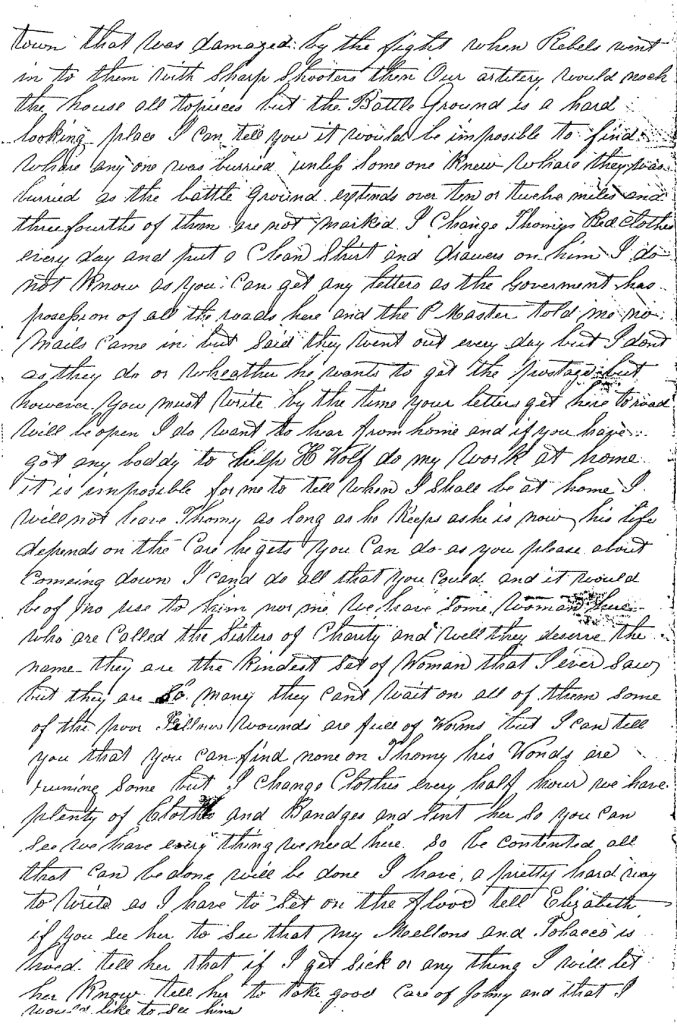
Gettysburg is a very nice place. There is but a few buildings in this town that was damaged by the fights when rebels went into them with sharpshooters. Then our artillery would knock the house all to pieces. But the battleground is a hard-looking place, I can tell you. It would be impossible to find where anyone was buried unless someone knew where they was buried as the battleground extends over ten or twelve miles and three-fourths of them are not marked.
I change Thomas’ bed clothes every day and put a clean shirt and drawers on him. I do not know as you can get any letters as the Government has possession of all the roads here and the Post Master told me no mails came in but said they went out every day. But I don’t know as they do or whether he wants to get the postage. But, however, you must write. By the time your letters get here, the road will be open. I do want to hear from home and if you have got anybody to help H. Wolf do my work at home. It is impossible for me to tell when I shall be at home. I will not leave Tommy as long as he keeps as he is now. His life depends on the care he gets. You can do as you please about coming down. I can do all that you could and it would be of no use to him nor me.
We have some women here who are called the Sisters of Charity and well they deserve the name. They are the kindest set of women that I ever saw. But there are so many, they can’t wait on all of them. Some of the poor fellows’ wounds are full of worms, but I can tell you that you can find none on Tommy. His wounds are running some but I change cloths ever half hour. We have plenty of cloths and bandages and lint here so you. can see we have everything we need here. So be contented. All that can be done, will be done.
I have a pretty hard way to write as I have to sit on the floor. Tell Elizabeth if you see her to see that my melons and tobacco is hoed. Tell her that if I get sick or anything, I will let her know. Tell her to take good care of Johnny and that I would like to see him.
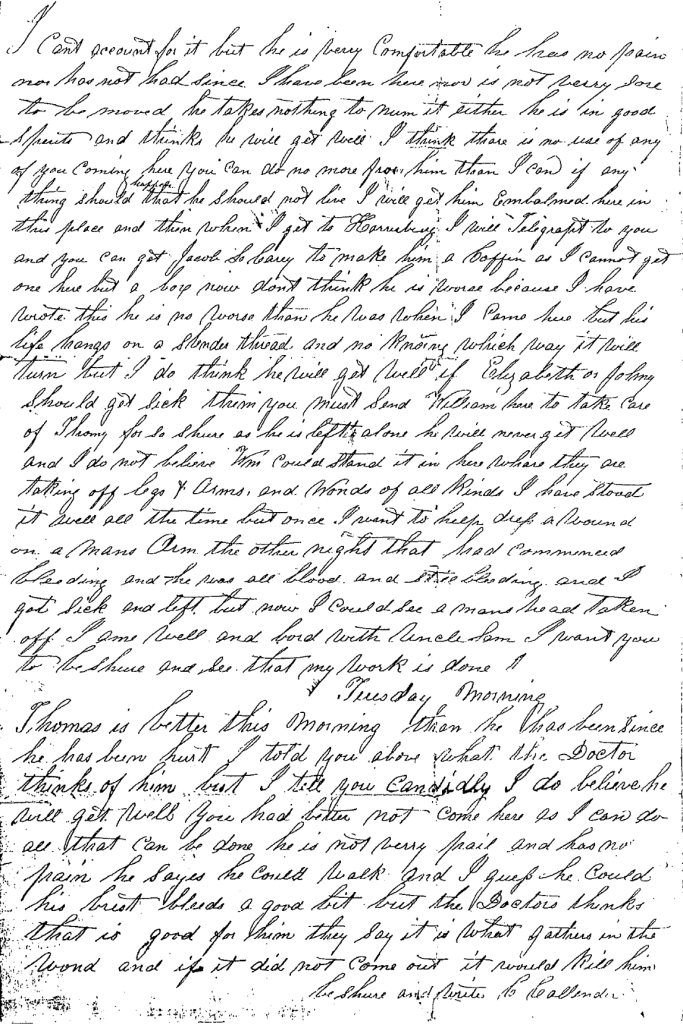
I cant account for it but he is very comfortable. He has no pain nor has not had since I have been here nor is not very sore to be moved. He takes nothing to numb it either. He is in good spirits and thinks he will get well. I think there is no use of any of you coming here. You can do no more for him than I can. If anything should happen that he should not live, I will get him embalmed here in this place and then when I get to Harrisburg, I will telegraph to you and you can get Jacob S. Carey to make him a coffin as I cannot get one here but a box. Now don’t think he is worse because I have wrote this. He is no worse than he was when I came here but his life hangs on a slender thread and no knowing which way it will turn. But I do think you must send William here to take care of Tommy for so sire as he is left alone, he will never get well and I do not believe William could stand it in here where they are taking off legs and arms, and wounds of all kinds. I have stood it well all the time but once. I went to help dress a wound on a man’s arm the other night that had commenced bleeding and he was all blood and still bleeding and I got sick and left. But now I could see a man’s head taken off. I am well and bored with Uncle Sam. I want you to be sure and see that my work is done.
Tuesday morning. Thomas is better this morning than he has been since he has been hurt. I told you above what the doctor thinks of him but I tell you candidly, I do believe he will get well. You had better not come here as I can do all that can be done. He is not very pale and has no pain. He says he could walk and I guess he could. His breast bleeds a good bit but the doctors thinks that is good for him. They say it is what gathers in the wound and if it did not come out, it would kill him. Be sure and write, — C. Callender
Letter 3
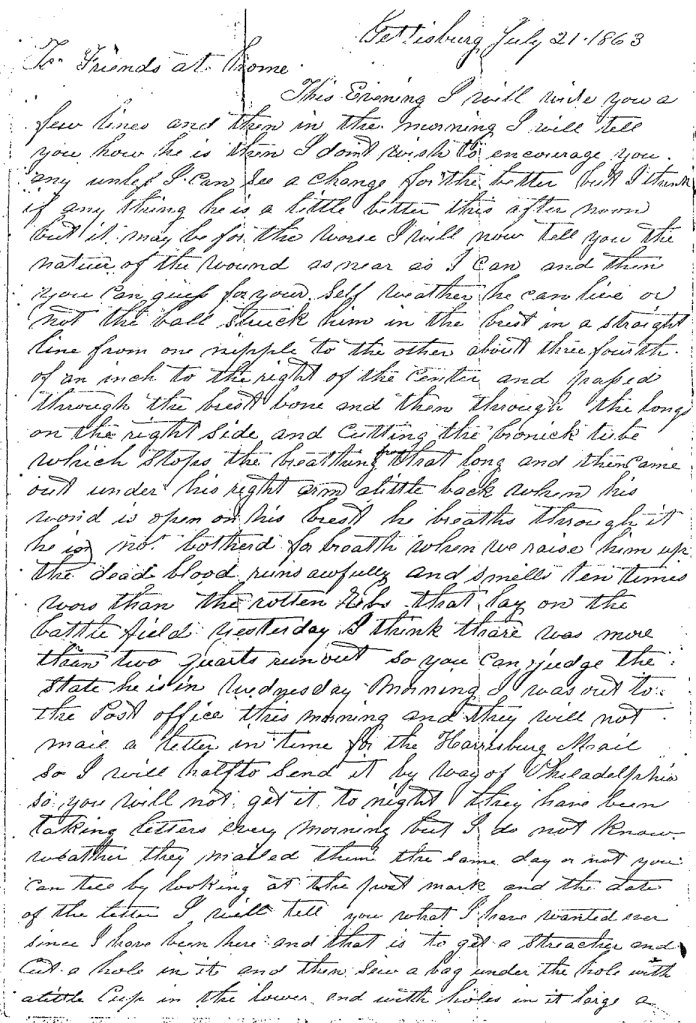
Gettysburg [Pennsylvania] July 21, 1863
To friends at home,
This evening I will write you a few lines and then in the morning I will tell you how he is then. I don’t wish to encourage you any unless I can see a change for the better this afternoon, but it may be for the worse. I will now tell you the nature of the wound as near as I can, and then you can guess for yourself whether he can live or not.
The ball struck him in the breast in a straight line from one nipple to the other about three fourth of an inch to the right of the center and passed through the breast bone and then through the lungs on the right side, and cutting the bronchial tube which stops the breathing for that long and then came out under his right arm a little back. When his wound is open on his breast, he breathes through it. He is not bothered to breath when we raise him up. The dead blood runs awfully and smells ten times worse than the rotten Rebs that lay on the battlefield. Yesterday I think there was more than two quarts run out so you can judge the state he is in.
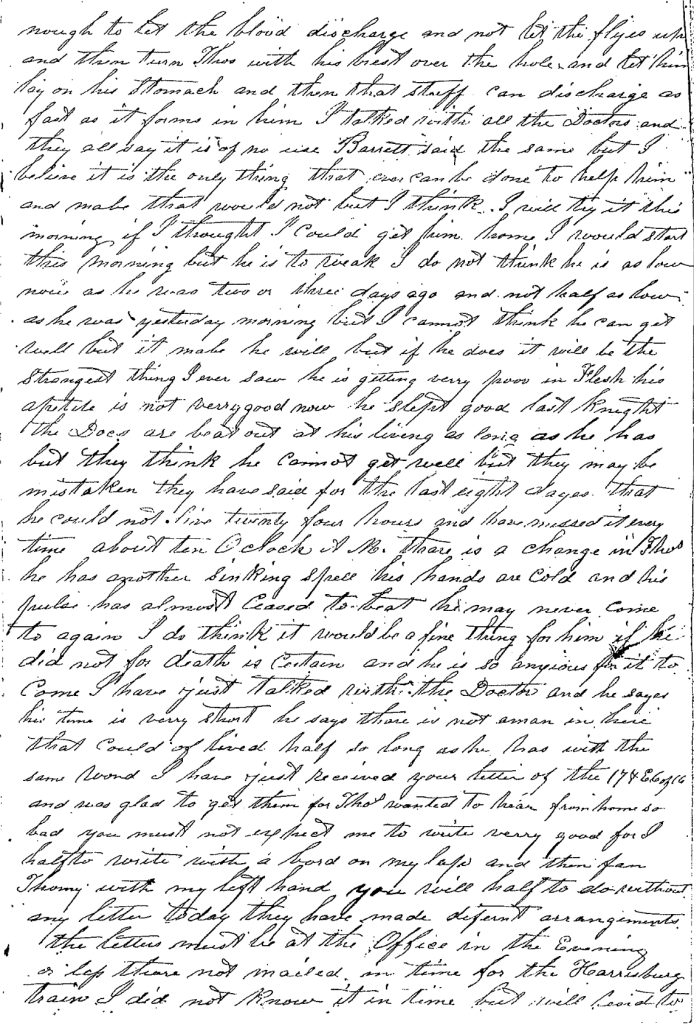
Wednesday morning. I was out to the Post Office this morning and they will not mail a letter in time for the Harrisburg mail so you. will not get it tonight. They have been taking letters every morning but I do not know whether they mailed them the same day or not. You can tell by looking at the post mark and the date of the letter. I will tell you what I have wanted ever since I have been here and that is to get a stretcher and cut a hole in it and then sew a bag under the hole with a little cup in the lower end with holes in it large enough to let the blood discharge and not let the flies up and then turn Thomas with his breast over the hole and let him lay on his stomach and then that stuff can discharge as fast as it forms in him. I talked with all the doctors and they all say it is of no use. Barrett said the same. But I believe it is the only thing that can be done to help him and maybe that would not. But I think I will try it this morning. If I thought I could get home, I would start this morning but he is too weak. I do not think he is as low as he was yesterday morning but I do. not think he can get well. But it may be he will, but if he does, it will be the strangest thing I ever saw. He is getting very poor in flesh. His appetite is not very good now. He slept good last night. The doctors are beat out at his living as long as he has but they think he cannot get well. But they may be mistaken. They have said for the last eight days that he could not live 24 hours and have missed it every time.
About ten o’clock a.m. There is a change in Thomas. He has another sinking spell. His hands are cold and his pulse has almost ceased to beat, He may never come to again. I do think it would be a fine thing for him if he did not for death is certain and he is so anxious for it to come. I have just talked with the doctor and he says his time is very short. He says there is not a man in here that could of lived half so long as he has with the same wound. I have just received your letter of the 17th & 6 of 16 and was glad to get them for Thomas wanted to hear from home so bad. You must not expect me to write very good for I have to write with a board on my lap and then fan Thomas with my left hand. You will have to do without my letter today, They have made different arrangements. The letters must be at the Post Office in the evening or else they’re not mailed in time for the Harrisburg train. I did not know it in time but will [ ].
Letter 4
Catholic Church Hospital
Wednesday morning. Tommy is no better. He is failing. His breast continues to bleed so much that he has got very weak. He is very comfortable. He has no pain much. Doctor Barrett & Dr. Erkert from Wilkes Barre was here last evening & they say he is very dangerous. Thomas is sensible of his condition and is calm about it. I asked him if he wanted any of his folks to come and he says he has no choice. They may do as they like. Now you can do as you like, but it is a chance if you can get here in time to see him and if you did, it would do him no good. If it should be that he never gets well, he will add one more to the number of our family circle who have gone to a better world, He is prepared to die. He is very calm and says he is going home.
I do not know which way I will come home if he does not live. If I can’t get anybody to take us to Columbia, I will have to go to Baltimore and them to Philadelphia. I cannot give him up yet but if his lung continues to bleed as it has for a few days, he can’t live. The doctors cannot do anything to stop it. It may be that it will commence healing in time to save him yet. He has everything here to make him comfortable. He could be no better off if he was at home. I do not want anything from home. If I need any more money, Dr. Barrett says I can get it off him. I will write again in the morning. — C. Callender
Letter 5
Gettysburg [Pennsylvania] Wednesday evening
Dear Father & Mother, Brother & Sister,
This evening I will write a few lines to tell you how Thomas is. He is comfortable. I cannot account for his having as little pain as he has had since I have been here—only that he has lost so much blood. This morning his bleeding ceased and I was in hopes it would not commence again but this afternoon it began again and kept on until this evening. It has stopped but I fear it will commence again. I think it is impossible for him to ever be any better. I thought when I saw him first that he would get well but since that time, his lungs has been bleeding so that he cannot last but a short time. I think we ought to be thankful that he was not among the number that died on the battlefield and his body to be covered without a grave and to be dragged around by the harrows. He is very sensible of his condition and is very willing to die. I have not heard him say once that he would like to get well that I know of.
Ten o’clock. Thomas’ breast has had another bleeding spell but has stopped again and he is asleep. He is very weak. I think he could not live one hour if I did not give him wine. Jesse Harrison is very bad off. You can do as you like about coming to see Tommy. I think it is a great chance if you could get here in time to see him alive and if you did, it would be of little satisfaction to your or him unless he arouses up again which I. think he will not. The railroad communications is open now from here to Carlisle and Harrisburg so that I ought to go home from here in one day if we could connect right.
Eleven o’clock. Thomas is very flighty but has no pain. I wish he would not talk.
Twelve o’clock. He is very flighty but if I speak to him, then he is sensible and says he is going home.
Fifteen minutes after twelve. He has gone to sleep. The blood does not run now.
One o’clock. He is still asleep but is weak.
Three o’clock. He is still a sleeping. He seems a little better.
Four o’clock. He is a good deal better. I don’t know how long it will last. He may get well yet but I guess not. He is flighty some yet. You may look for a letter from here every day as long as Thomas keeps as he is now. Last night I fanned him pretty near all the time. W. Roons & Burnard is here. It does seem as if I see the people in the world is here. Some are hunting friends. Others have come to see the battlefield. I wish that was all that brought me here. You must see that my work is being done if my wheat has to be cut before I get home. I want you to see that the seed is by itself. It is out to the end next to M. Gearheart’s. It runs out toward the turnpike as far as to where there is a stake standing against the fence. You can tell by looking for I have cut the rye out and cockle.
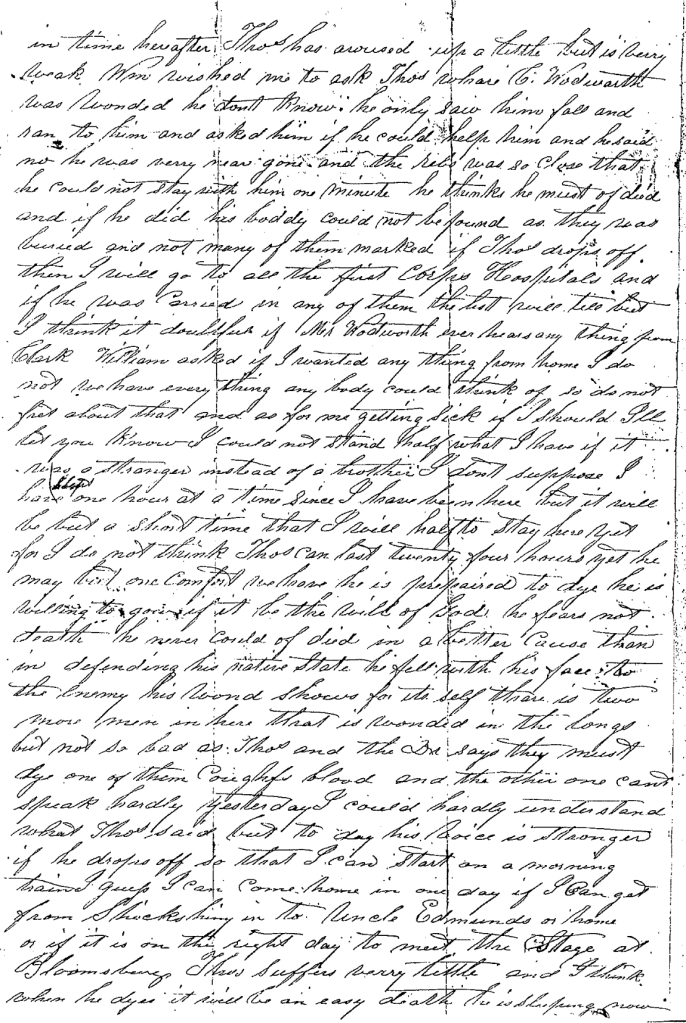
There are about seventy patients in this church. I suppose out on the battle ground in those tents the wounded are not half taken care of like they are here. I do not know where Lee’s army are. We can’t get papers in time. Thomas has aroused up a little but is very weak. William wished me to ask Thomas where C. Wadsworth was wounded. He don’t know. He only saw him fall and ran to him and asked him if he could help him and he said no. He was very near gone and the rebs was so close that he could not stay with him one minute. He thinks he must of died and if he did, his body could not be found as they was buried and not many of them marked. If Thomas drops off, then I will go to all the 1st Corps Hospitals and if he was carried in any of them, the last will tell but I think it doubtless if Mr. Wadsworth ever hears anything from Clark. William asked if I wanted anything from home. I do not. We have everything anybody could think of so do not fret about that and as for me getting sick. If I should, I’ll let you know. I could not stand half what I have if it was a stranger instead of a brother. I don’t suppose I have slept one hour at a time since I have been here yet, for I do not think Thomas can last twenty-four hours. Yet he may. But one comfort we have he is prepared to die. He is willing to go if it be the will of God. He fears not death. He never could of died in a better cause than in defending his native State. He fell with his face to the enemy. His wound shows itself.
There is two more men in here that is wounded in the lungs but not so bad as Thomas and the doctor says they must die. One of them coughs blood and the other one can’t speak hardly. Yesterday I could hardly understand what Thomas said but today his voice is stronger. If he drops off so that I can start on a morning train, I guess I can come home in one day. If I can get from Shock___ in to Uncle Edmunds or home or if it is on the right day to met the stage at Bloomsburg.
Thomas suffers very little and I think when he dies it will be an easy death. He is sleeping now. I cannot hear anything from William Bell and as for the rest of our Boys, they was slightly wounded and have been taken away somewhere so I do not know anything about them. I guess from what I can hear, that there is no danger of Gilbert Callender getting hurt unless he should run against something.
The rebel prisoners appear to be a clever set of fellows. They are ragged, dirty, and I guess lousy—some of them bare headed, and a good many without shirts or shoes. If they could put on a suit of Uncle Sam’s clothes, some of them would be good looking men. Yesterday morning I was down on Diamond Corners and I think I saw nearly one hundred ambulances start out to the different hospitals to carry wounded men to the depot. The Catholic priest is here very busy talking to the soldiers this afternoon. Now I will stop until this evening.
Thomas is sleeping. He does not eat anything much. It will make it a little bad for you that the letters must lay in the post office here over night and that makes about twelve hours later news for you. I do not think Thomas will be living when you get this. I think he will not last until the sun rises again but he may last several days. But he is low enough to die any moment. I tell you, Father, you have no idea of a hospital like this. Many wives hearing their husband, mothers, their sons, sisters, their brothers have come from all over the North to take care of them, and when they arrive in here, you may judge the feeling when they learn that their friend is remembered among the dead. I hope I may never be called to witness another battlefield.
There are five men in here now who are lying very low. I was down to the Government Office today to see if I could get a pass to send up for you to come down and the man said he had no authority to give such a one but if I insisted on it, he would give me one to go home if I wanted it. I thought I would send it and then you could do as you liked about coming. You can do no good here. It would be no satisfaction to you nor Thomas now. If he dies, the state will send his body and I home free.
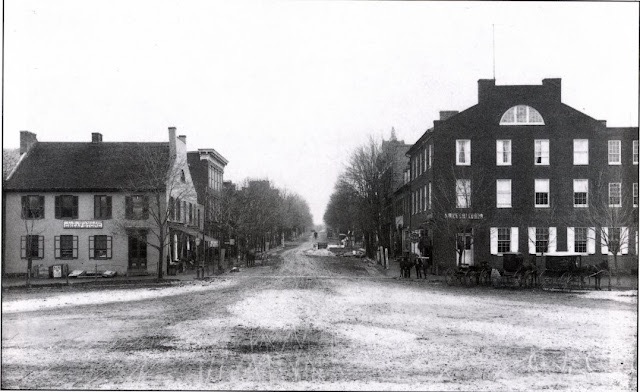
The streets of old Gettysburg. Baltimore Street looking up from the ‘Diamond’ (town square) near the time of the infamous three day battle in July of 1863