Category Archives: 15th Iowa Infantry

1865: Isaac Marshall Christy to Achsah Marshall

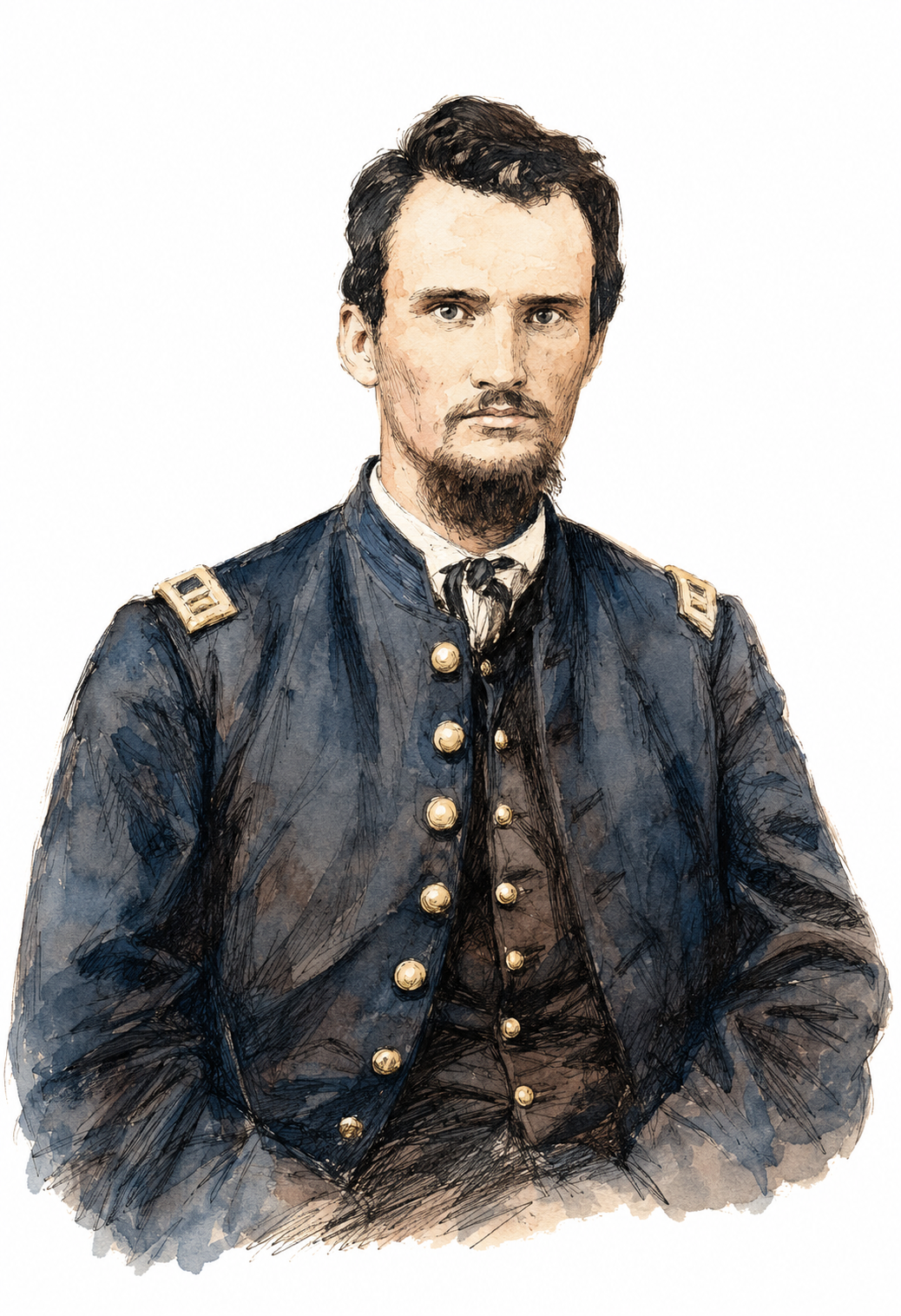
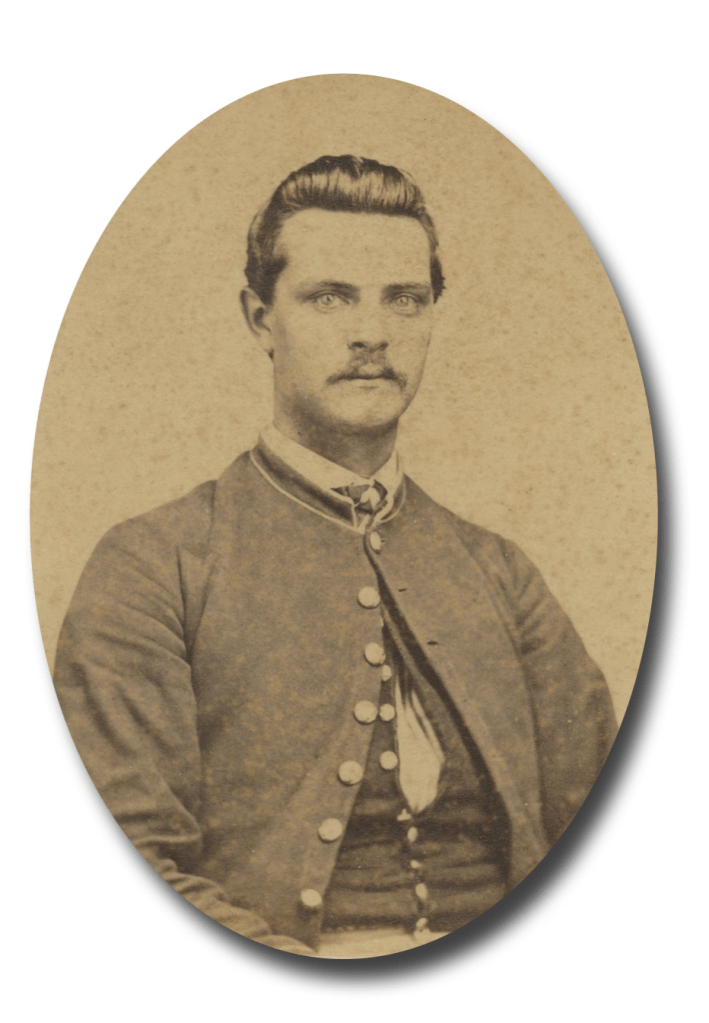
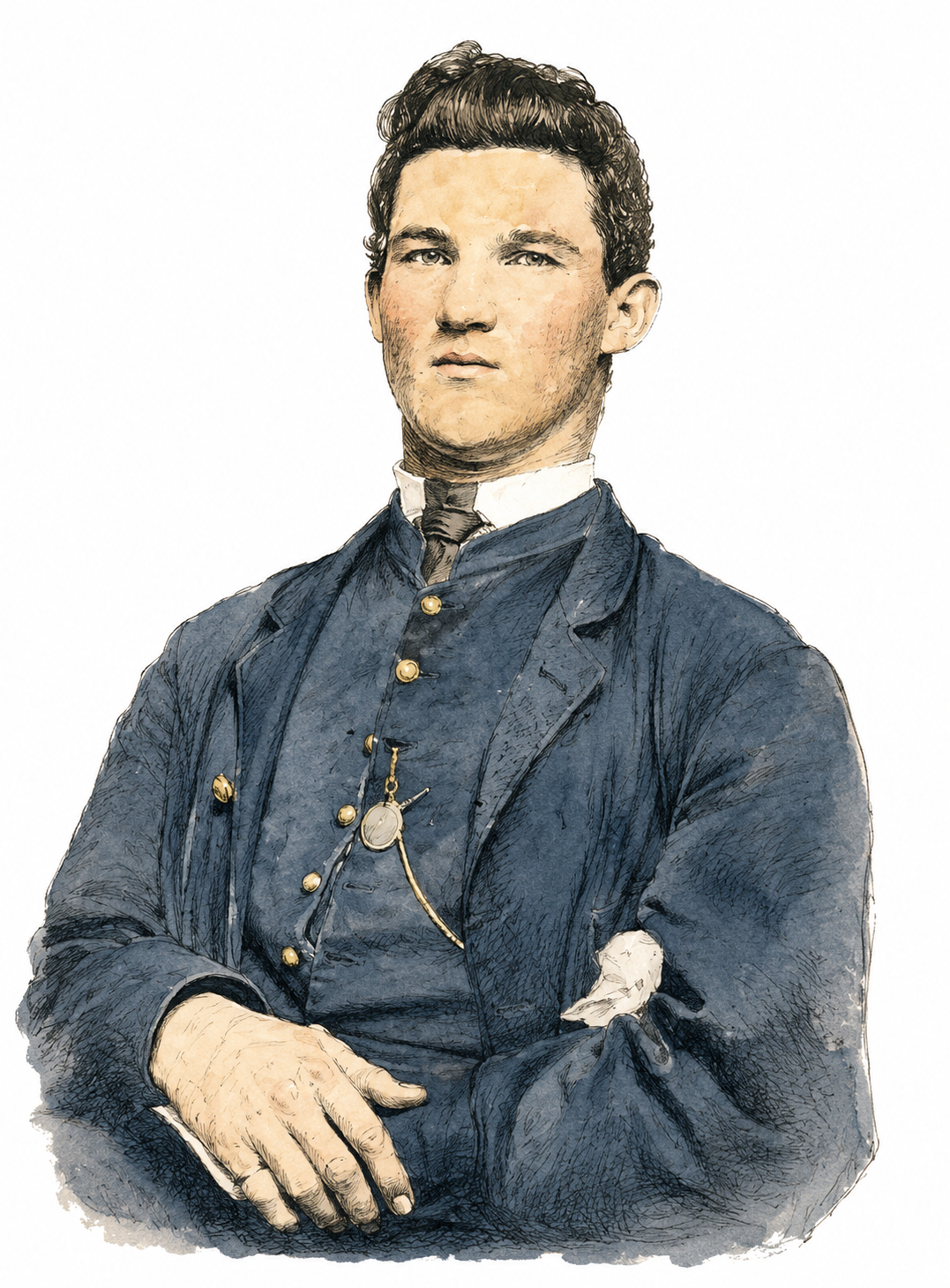
Isaac Marshall Christy, Co. I, 15th Iowa Veteran Volunteers (Iowa Civil War Images)

The following letter was written by Isaac “Marshall” Christy (1844-1905), a native of Trumbull county, Ohio, who came to Iowa with his parents in 1854. On 23 November 1861, he enlisted at Oceola, Iowa, as a private in Co. I, 15th Iowa Infantry with his older brother William Christy. Marshall survived the battle of Shiloh unscathed in April 1862 but was wounded slightly in both legs near Corinth, Mississippi, on 3 October 1862. He was promoted to corporal on 24 February 1863 and reenlisted as a Veteran in December 1863 while at Vicksburg, Mississippi. On 20 July 1864 before Atlanta, he received a slight wound to the head from a Minié ball. He became a sergeant on 25 August 1864 and served until his discharge on 24 July 1865.

After the war, Marshall attended Wesleyan University at Indianola and afterwards graduated from Bryant & Stratton’s business college at Burlington. He married Louise Almyra Bennett on 23 February 1871 and raised a family. The Christys moved from Osceola, Iowa, to Phoenix, Arizona, in 1891 where Isaac hoped that the climate would improve his health. He joined the GAR and applied for an invalid pension. He died 31 March 1905 and was buried in the Masons Cemetery, Block 17, Lot 1. His remains were moved to Greenwood Cemetery in 1907 by the Masons.

This letter was shared by Marcus Crane on his Facebook site. He is a descendant of Achsah Marshall, the recipient of this letter, who was a first cousin of Marshall Christy. Achsah married Charles A. Crane (1834-1928) in 1876.

T R A N S C R I P T I O N
Goldsboro, North Carolina
April 1, 1865

Cousin Achsah,

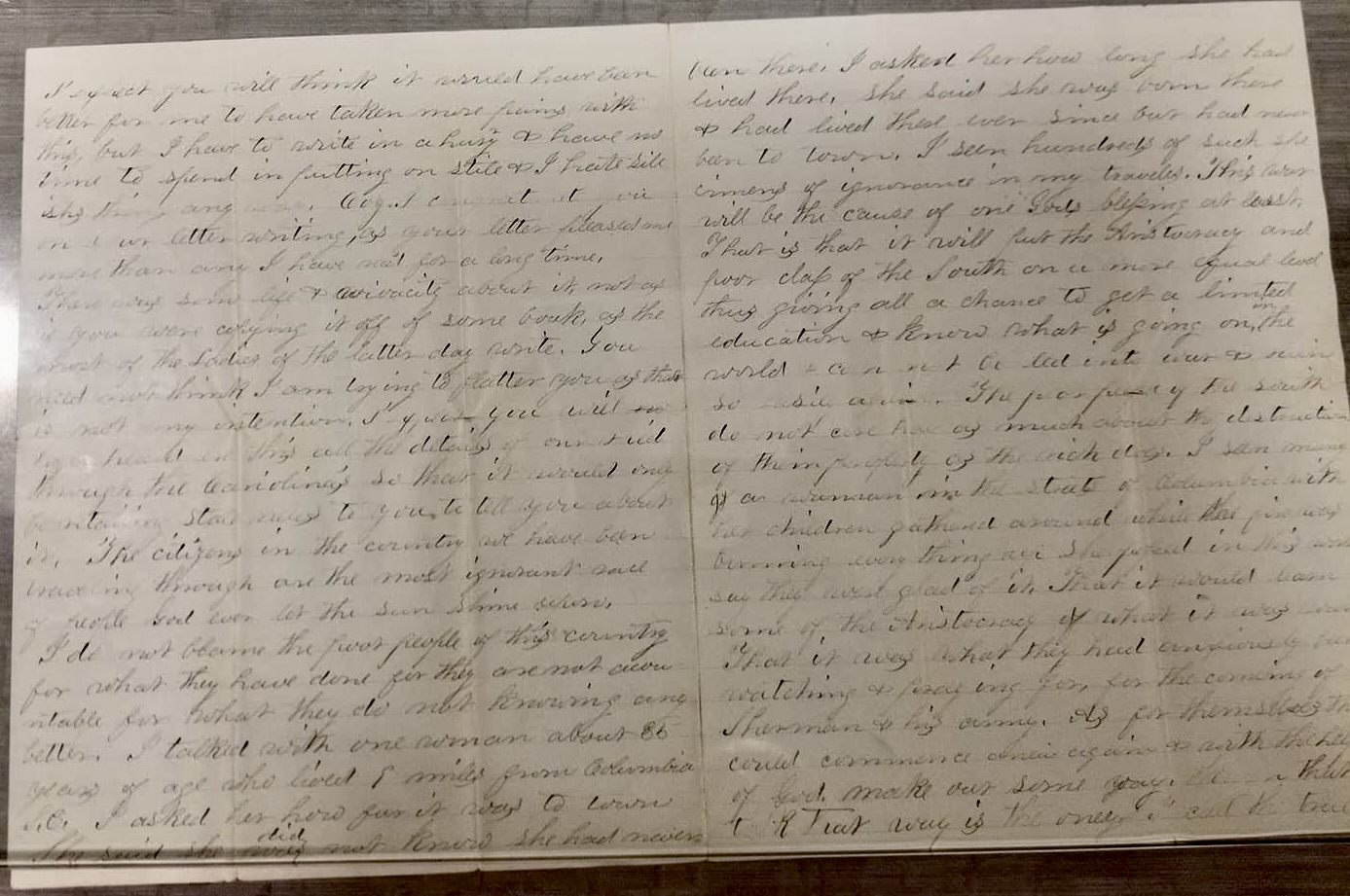
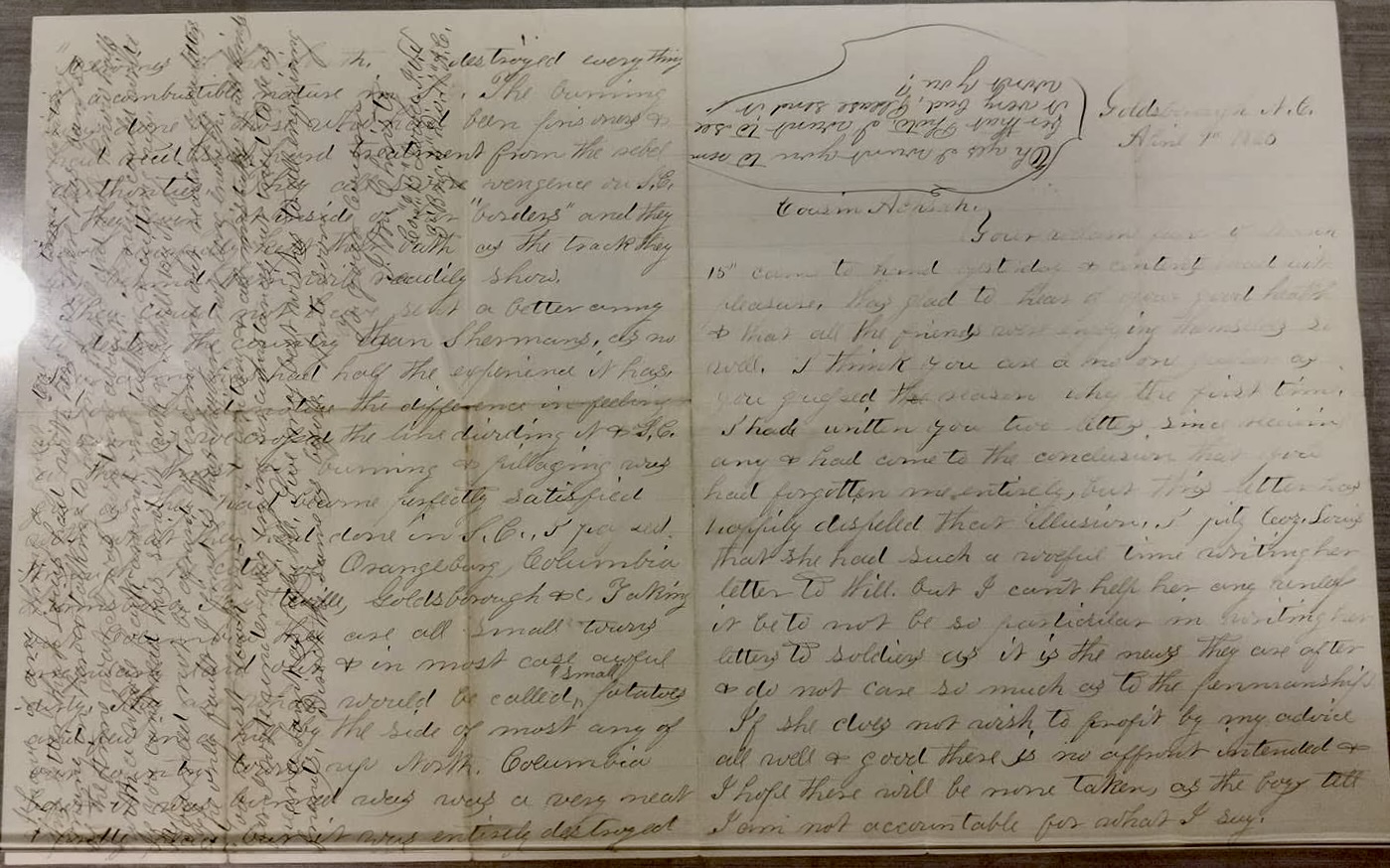
Your welcome letter of March 15 came to hand yesterday and contents read with pleasure. Was glad to hear of your good health and that all the friends were enjoying themselves so well. You are a number one guesser as you guessed the reason why the first time. I had written you two letters since receiving any and had come to the conclusion that you had forgotten me entirely, but this letter has happily dispelled that illusion. I pity Cousin Louis that she has such an awful time writing her letter to Will but I can’t help her any unless it be to not be so particular in writing her letters to soldiers as it is the news they are after and do not care so much as to the penmanship. If she does not wish to profit by my advice—all well and good. There is no affront intended and I hope there will be none taken. As the boys tell, I am not accountable for what I say.

I expect you will think it would have been better for me to have taken more pains with this, but I have to write in a hurry and have no time to spend in putting on style and hate stylish things anyway. Coz, I congratulate you on your letter writing as your letters pleased me more than any I have read for a long time. There was some life and vivacity about it—not as if you were copying it off of some book as the most of the Ladies of the latter day write. You need not think I am trying to flatter you as that is not my intention.

I expect you will have heard ere this all the details of our raid through the Carolina’s so that it would only be retelling stale news to you to tell you about it. The citizens in the country we have been traveling through are the most ignorant race of people God ever let the sun shine upon. I do not blame the poor people of this country for what they have done for they are not accountable for what they do, not knowing any better. I talked with one woman about 35 years of age who lived 9 miles from Columbia S. C. I asked her how far it was to town and she said he did not know as she had never been there. I asked her how long she has lived there. She said she was born there & had lived there ever since but had never been to town. I seen hundreds of such crimes of ignorance in my travels.

This war will be the cause of one God’s blessing at least. That is that it will put the Aristocracy and poor class of the South on a more equal level, thus giving all a chance to get a limited education and know what is going on in the world & cannot be led into war and ruin so easily again. The poor people of the South do not care half as much about the destruction of their property as the rich does. I seen many a woman in the streets of Columbia with her children gathered around her while the fire was burning everything she possessed in this world say they were glad of it—that it would learn some of the Aristocracy of what it was [to] want. That it was what they had anxiously been watching & praying for—for the coming of Sherman & his army. As for themselves, they could commence anew again and with the help of God make out some way. Women that talk that way is the ones I call the true “[ ]” of the South.

We destroyed everything of a combustible nature in S.C. The burning was done by those who had been prisoners & had received such hard treatment from the rebel authorities. They all swore vengence on S. C. if they ever got inside of her “borders” and they have forcefully kept their oath as the track they left behind them will readily show. They could not have sent a better army to destroy the county than Sherman’s, as no other army has had half the experience it has. You could notice the difference in feeling as soon as we crossed the line dividing North and South Carolina. All their thirst for burning & pillaging was gone as they had become perfectly satisfied with what they had done in South Carolina.

I passed through the cities of Orangeburg, Columbia, Waynesboro [?], Fayetteville, Goldsborough, &c. Taking out Columbia, they are all small towns irregularly laid out and in mose cases, awful dirty. They are what would be called small potatoes and few in a hill by the side of most any of our county towns up North. Columbia, before it was burned, was a very neat and pretty place, but it was entirely destroyed.

I have, if anything, a great deal worse time in writing this letter than Louis had with his for there has been so many in here talking to me that I did not know half of the time what I was writing about. I never could write with a whole pack around me talking and cutting up. If you can’t read this, send it back and I will try [again]. You need not be afraid of tiring me out reading your letters. The only fault I find is that they are not long enough. You must look over bad writing and all mistakes of all kinds for I wrote under very trying circumstances but tried to be as neat as possible.

Give my best wishes to all inquiring friends. Direct the same as before. Write soon to your cousin, I. M. Christy, Co. I, 15th Iowa Vet. Vols.. 3rd Brigade, 4th Division, 17th Army Corps

Oh yes, I want you to remember that photo. I want to see it very bad. Please sent it, won’t you?
1862: William Christy to Achsah Marshall

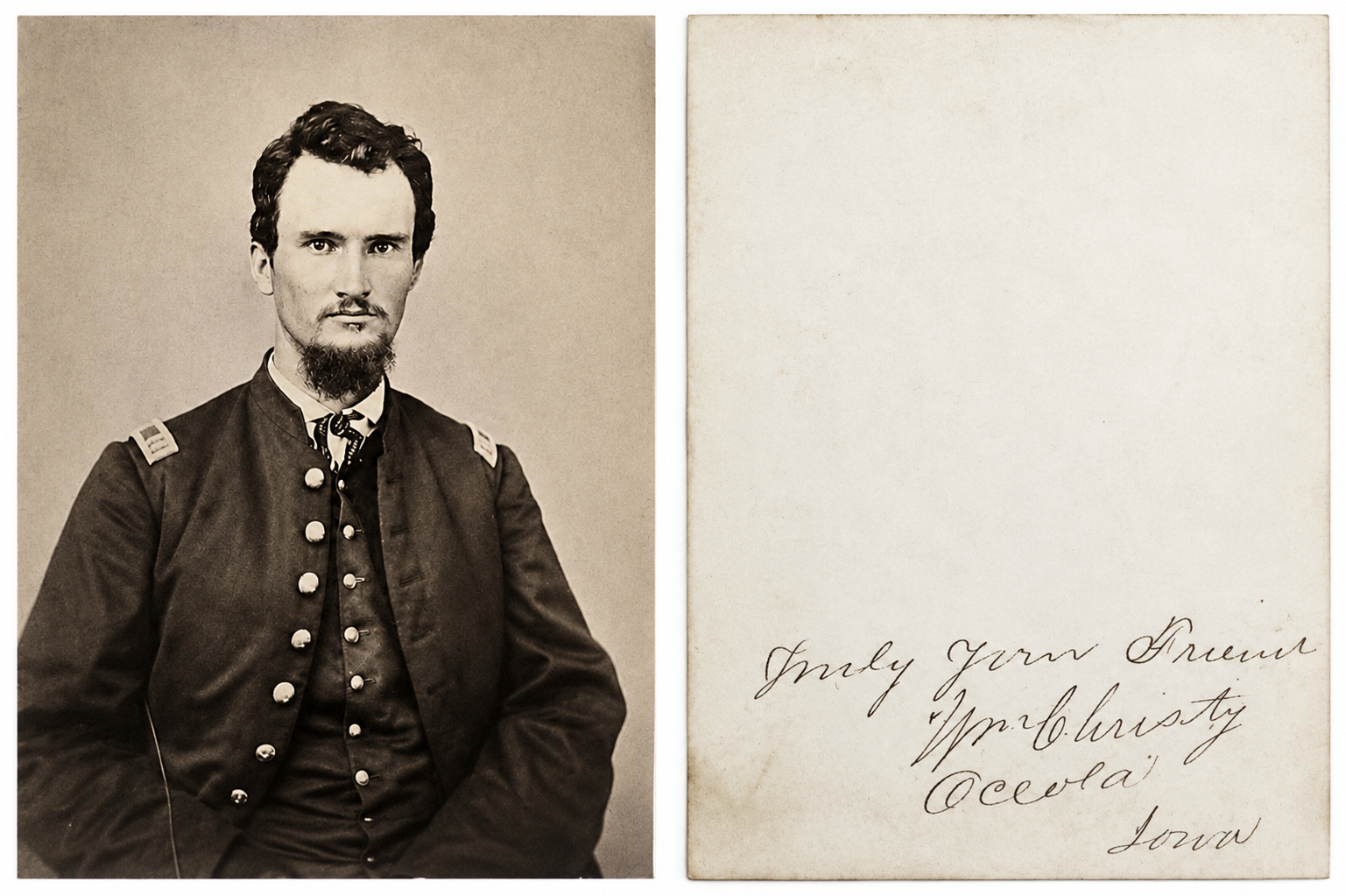
Capt. William Christy when he was in the 8th Iowa Cavalry (courtesy of Michael Huston)

The following letter was written by William Christy while serving as a sergeant in Co. I, 15th Iowa Infantry. He was born at Warren, Trumbull county, Ohio, February 14, 1841, the oldest son of George L. Christy (1815-1869) and Jane Marshall (1819-1901). In 1854 his father relinquished mercantile pursuits and moving westward, established himself as a farmer in Clarke county, Iowa, where William received a good education.

During the Civil War, William Christy enlisted as a private in Co. I, 15th Iowa Infantry, serving in that regiment one year. William enlisted with his younger brother, Isaac “Marshall” Christy (1844-1905). William was quickly promoted to sergeant; Marshall remained a private. After a year in the infantry, William was transferred to the Eighth Iowa Cavalry, rising to the rank of captain. He was attached to Sherman’s army until Atlanta was reached, when his regiment turned back with Thomas to hold Tennessee. During a skirmish in the rear of Atlanta, Captain Christy was wounded severely and fell into the hands of the enemy. He spent a whole year in Confederate prisions and hospitals, being for a short time successively in Millen and Andersonville. Exchanged in February, 1865, he rejoined his troop a poor advertisement for the fare in southern prisons, weighing less than 100 pounds. Captain Christy was afterward brevetted lieutenant-colonel of his regiment and remained with it till its disbandment in August, 1865, participating in the capture of Macon, Selma and Montgomery. Four wounds, two of them through the body, were retained as mementos of the days of raid and combat.

“Upon his return to Iowa, Colonel Christy attended college for a year and then entered a banking house at Osceola, Iowa. He was elected State Treasurer in 1872, by the modest majority of 62,000, and was reelected two years later. In 1876 he went back to the banking business in Des Moines. Colonel Christy came to Arizona in 1882, for the benefit of an oppressing asthma. He was one of the founders of the Valley Bank of this city, and has added materially to his worldly possessions in lands of the valley and by his interest in a number of profitable enterprises. Five children have been the fruit of a union contracted in 1866, with Miss Carrie E. Bennett, at Aurora, Ill. The family residence is located upon the outskirts of Phoenix and in the development of his fertile acres the financier finds his chief enjoyment.”

William’s letter describes the Battle of Shiloh in which the 15th Iowa Infantry suffered considerable losses in their first engagement. For another great account of the Battle of Shiloh from the perspective of the 15th Iowa Infantry, readers are referred to: The Civil War Diary of Cyrus F. Boyd, published in 1953, which is availsable on-line.

T R A N S C R I P T I O N

[Editor’s Note: This transcript was shared by Marcus Crane on his Facebook site along with images of the original letter itself but they were so badly out of focus that I could not verify the accuracy of the transcription. That being said, I feel that this transcription must be pretty accurate as the statements made seem to be corroborated by other accounts]

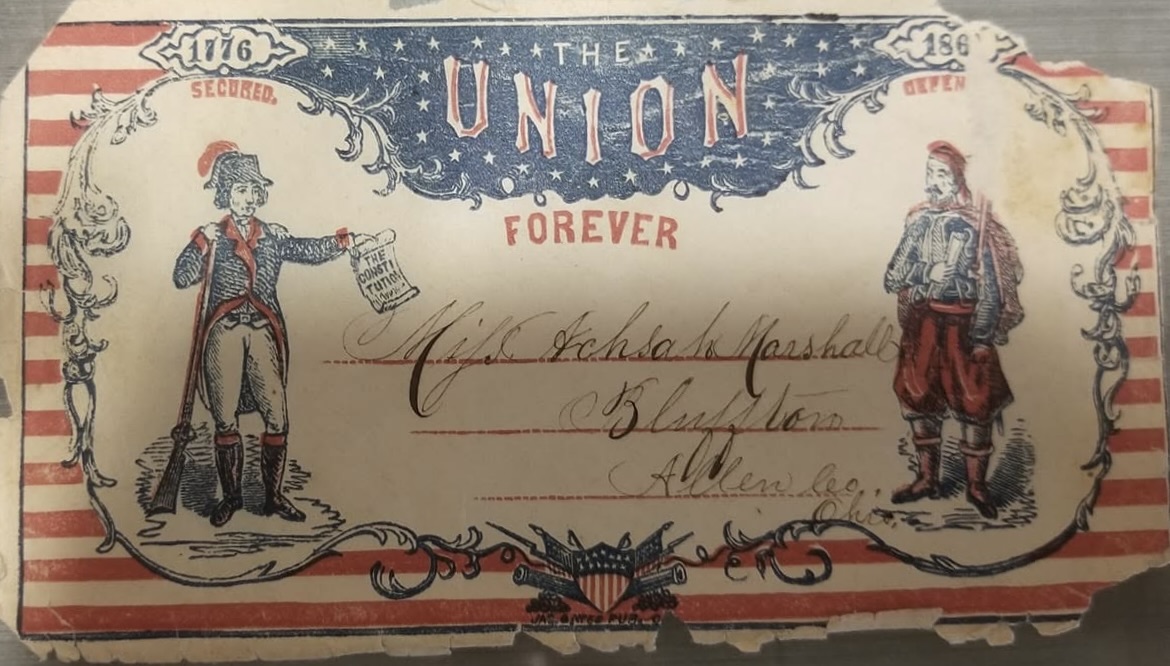
I don’t know if this letter goes with this envelope but its from the same collection and my hunch is that the “Cousin” William wrote to was Miss Achsah Ann Marshall (1840-1930) of Bluffton, Allen County, Ohio. Achsah married Charles A. Crane (1834-1928) in 1876. It was Achsah who undoubtedly passed the letters to her descendants.

Pittsburg Landing, Tennessee
April 17, 1862

Esteemed cousin,

I received your welcome comliment a few days since. Was glad to [hear] from you and yours. We are well as could be expected for soldiers in Tennessee. The diahhrea has had its effect on most of us. Only a few has escaped its fury. Marshall has had it very bad but is better. The regiment is not half fit for duty. We are encamped on a beautiful knoll in the timber about three miles from the river towards the enemy. Trees are covered with their green robes of summer. Peaches are the size of a cherry. Other fruit in proportion. Grass has just started. It is backward for the climate. The weather is quite warm and wet mud very deep, but drying up rapidly.

I do not like htis country. There is too much timber and clay. The soil is not more than 4 inches deep. I prefer the praities. We left our cheerful quarters in Benton Barracks [on] April 1 and arrived here the morning of the 6th just as the roar of the enemy’s guns were giving their salutations to the morn. We ate a hard cracker for breakfast, shouldered our muskets, and started for the scene of action—a distance of three miles.

Isaac “Marshall” Christy served in the same company with his brother (Iowa Civil War Images)

We were marched to within range of the enemy’s guns and then formed in line, thye firing voley after voley into our ranks which began to thin them by this time. We then fired and layed down. We soon scattered and bushwacked for two hours when we were outflanked and had to retreat. I waited til they got close enough to be sure and then fired and had the pleasure of seeing one of the graybacks fall, you bet. The bullets whistled around me thick. Then I ran my best. I was afraid of being shot in the back but as luck would have it, I came out all right. Our forces were driven back slowly till 4 p.m. Our artillery was put in position and supported the infantry. We opened on them and such anotherroar was never heard on this continent. I was behind a 64-pounder siege gun. When they fired, it kicked back 20 feet. It was deserted when the enemy made a charge but the infantry kept it from being taken with the aid of two gunboats. They were repulsed with great slaughter. Their firing nearly ceased—ours [was] more constant and destructive. Our loss in killed and wounded is from ten to fifteen thousand. Theirs from fifteen to twenty. Our loss on Sunday was as great as theirs, but on Monday their was five to one.

We were reinforced by a regiment of artillery which did fearful work on the enemy. They fought like men but they could not stand against the unerring aim of our guns. They were on the wrong side. We lost out of our regiment 25 killed and 175 wounded, 25 missing. We lost out of our company 3 killed, 15 wounded. Our 2nd Lt. [Robert W. Hamilton was]killed, Captain [James G. Day] and 1st Lieutenant [James M. Reid] wounded.

We are now encamped nearest the enemy. We are the advance of the Army of Tennessee. As soon as the roads get better, we will advance on tyhe enemy now at Corinth. They are strongly fortified. We have artillery enough to shell them out. We have six or eight hundred guns of heavy caliber.

I have been over the battlefield and such a sight I never expect to see. It far surpassed my expectations. I could stand in one place and count 300 dead. One cannon ball went through a tree and killed secesh. They all lay in a heap in one place. The wounded caught on fire and burned to death. Many wounded. It was a fearful sight to behold. I shall have to quit for want of space. Write as often as convenient. Direct to St. Louis. They will follow.

I would give 4 cents to be at Uncle B’s long enough to see you all and help you eat some of that sugar you were making not long since. But it is no go. So be it.

I received a letter from Aunt Mary yesterday. Uncle John was poorly. He had taken a back seat behind mother. Grandmother was quite poorly. The rest of the friends are quite well. It may bother you to read this. My pen is very poor and no place to write. I am sitting on the ground, a board on my lap. You can guess at the convenience of the thing.

You said you were in hopes I would return a Democrat. I think democracy has played out but all other parties, but Universalists—that is the party to which I belong. Give my love to all the friends and cousins. Yours truly, — William Christy


1861: Eldridge Gerry Black to his Family

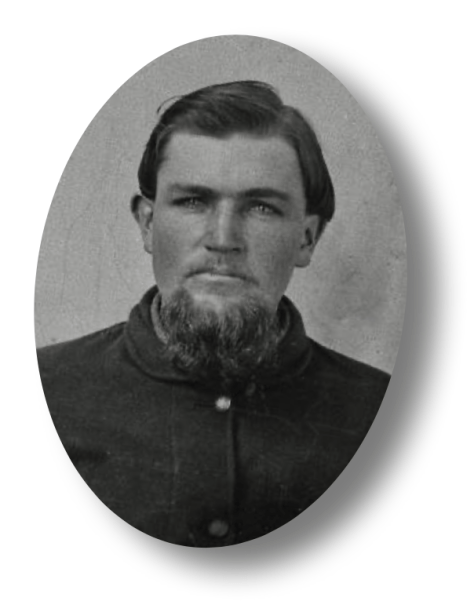
I could not find an image of Eldridge but her is Merrit Hopkins who was also in Co. E, 15th Iowa and also from Keosauqua. (Iowa Civil War Images)

The following letter was written by Eldridge Gerry Black (1843-1862) who enlisted on 14 October 1861 to serve as a private in Co. E, 15th Iowa Infantry. He was mustered into the service on 1 December 1861. He did not survive the war. He was severely wounded in the Battle of Corinth on 3 October 1862 and died of his wounds.

Eldridge had been born in Richland county, Ohio, but was residing in Keosauqua, Iowa, when he enlisted. His parents were William Francis Black (1810-1882) and Hannah C. Cook (1814-1879)

Transcription

Camp Halleck [Keokuk, Iowa]
December 13th 1861

Dear Father, Mother, Sister, Aunt, and Brothers

I received yours of the 8th this morning. Sergeant Woodruff brought in a handful of letters this morning among which was yours. I was very glad to hear from you home again. I have looked for father until I have got tired of it. I went to the depot every time I could get permission to go expecting he would come on the cars but was disappointed. I would like very well to go home again and I think perhaps I can. Our captain has given three of our men permission to go home without furlough and I think I can get leave of absence four or five days. I have just spoken to the captain about it and he says I can have a pass next week to go home. By the—-“Fall in for drill!” are the words just now uttered by the Orderly and I must go.

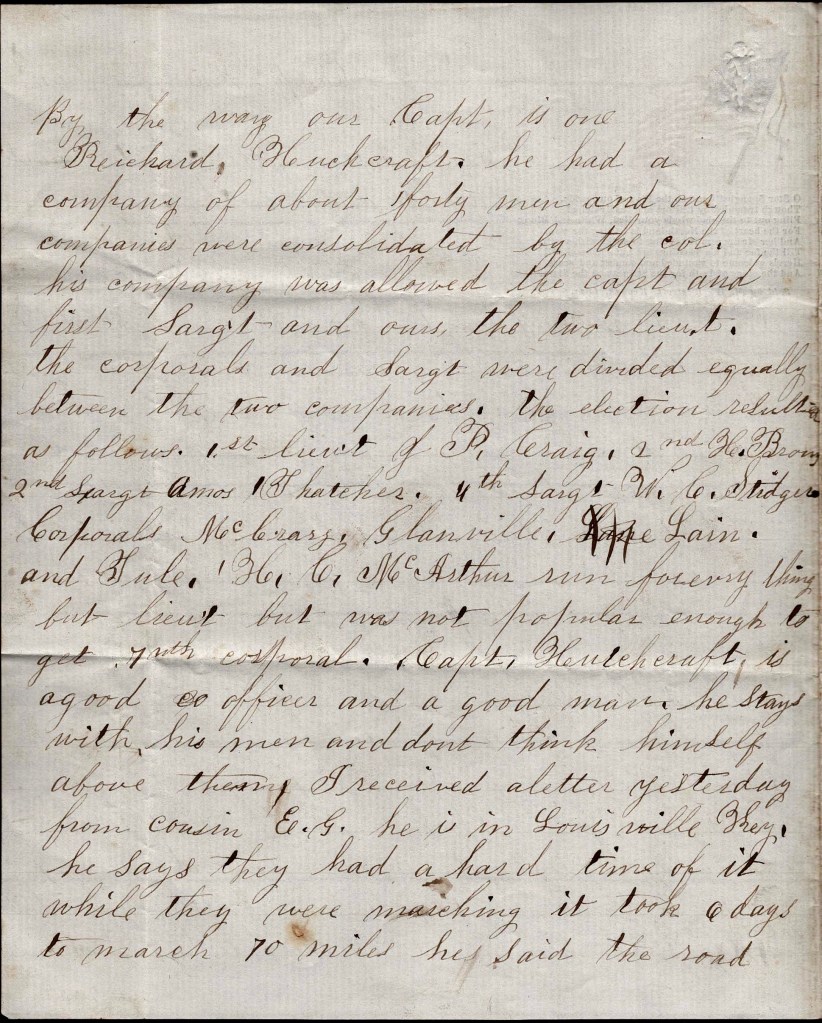
By the way, our captain is one Richard [Williams] Hutchcraft. He had a company of about forty men and our companies were consolidated by the colonel. His company was allowed the captain and first sergeant and ours, the two lieutenants. The corporals and sergeants were divided equally between the two companies. The election results as follows: 1st Lieutenant J. P. Craig, 2nd [Lieutenant] H. Brown, 2nd Sergeant Amos Thatcher, 4th Sergeant W. C. Stidger, Corporals McCrasry, Glanville, Lane, and Tool. H. C. McArthur run for everything but lieutenant but was not popular enough to get 7th Corporal.

Capt. Hutchcraft is a good company officer and a good man. He stays with his men and don’t think himself above them.

I received a letter yesterday from cousin E. G. 1 He is in Louisville, Kentucky. He says they had a hard time of it while they were marching. It took six days to march 70 miles. He said the road had no bottom. They had 75 teams and then had to leave their tents. He said their band wagon broke down on Laurel Hill and left them in a bad fix. He slept three nights without anything under or over him.

James Dunshee was here today. He eat dinner with me and then took me to a Hotel and gave me my dinner so that I got a clean bite again. I would like to write more but I must quit. I want to send it off in the morning. I will direct this letter to Oak Point. As I am going home and will see you all, I will not write the particulars for I can use my tongue better than I can a pen. No more at present. Yours truly, — E. G. Black.

P. S. Frank, as that opossum can go double quick so well, perhaps he would make a good soldier. We want more recruits. you had better send him down.

1 Eldridge had a cousin by the same name who served as a musician in the 15th Indiana Infantry.

1862: William Spates to Robert Spates

I could not find an image of William but here is one of John Davenport who also served in the 15th Iowa Infantry (Roger Davis Collection)

These three letters were written by William (“Bill”) Spates (1842-1863), the son of Thomas Purnell Spates (1799-1864) and Levica Scott (1805-1854) of Oskaloosa, Mahaska county, Iowa.

When William enlisted in Co. C, 15th Iowa Infantry in January 1863, he gave Indiana as his birthplace and Rose Hill, Iowa, as his current residence. He entered the service as a private and had been promoted to corporal prior to 6 June 1863 when he was detailed for Orderly Sergeant of Co. B, Tenth Louisiana Colored Volunteers (later designated the 48th US Colored Infantry Regiment). According to the muster rolls of the 48th USCT, William was never mustered as the Orderly Sergeant because he died on 25 June 1863 of fever at Goodrich Landing, Louisiana.

To read other letters published on Spared & Shared by 15th Iowa Infantry soldiers, see:
Cyrus E. Ferguson, Co. A, 15th Iowa (1 Letter)
Cyrus E. Ferguson, Co. A, 15th Iowa (9 Letters)
John A. Wheelock, Co. A, 15th Iowa (2 Letters)

[Note: These letters are from the private collection of Mike Huston and are published on Spared & Shared by express consent.]

Letter 1

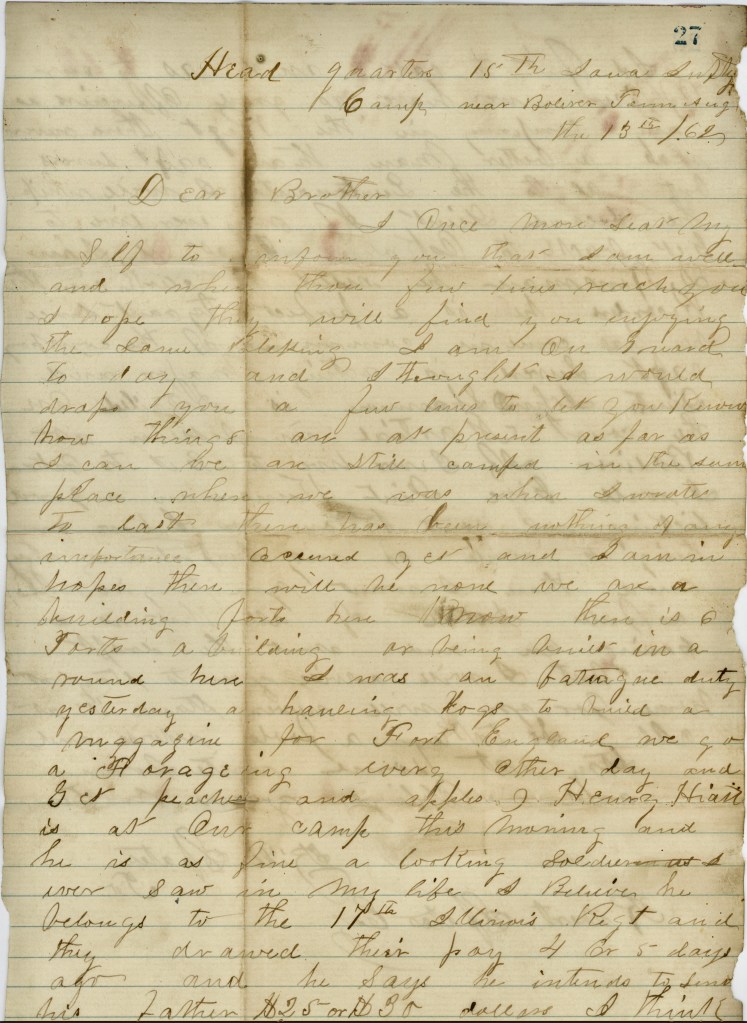
Headquarters 15th Iowa Infantry
Camp near Bolivar, Tennessee
August 13th 1862

Dear Brother,

I once more seat myself to inform you that I am well and when these few lines reach you, I hope they will find you enjoying the same blessing. I am on guard today and I thought I would drop you a few lines to let you know how things are at present as far as I can. We are still camped in the same place where we was when I wrote to [you] last. There has been nothing of any importance occurred yet and I am in hopes there will be none. We are a building forts here now. There is 6 forts a building or being built in a round here. I was on fatigue duty yesterday a having to go to build a magazine for Fort England. We go a foraging every other day and get peaches and apples.

Henry Hiatt is at our camp this morning and he is as fine a looking soldier as I ever saw in my life.. I believe he belongs to the 17th Illinois Regiment and they drawed their pay 4 or 5 days ago and he says he intends to send his father $25 or $30 dollars. I think it will be a good idea if he does.

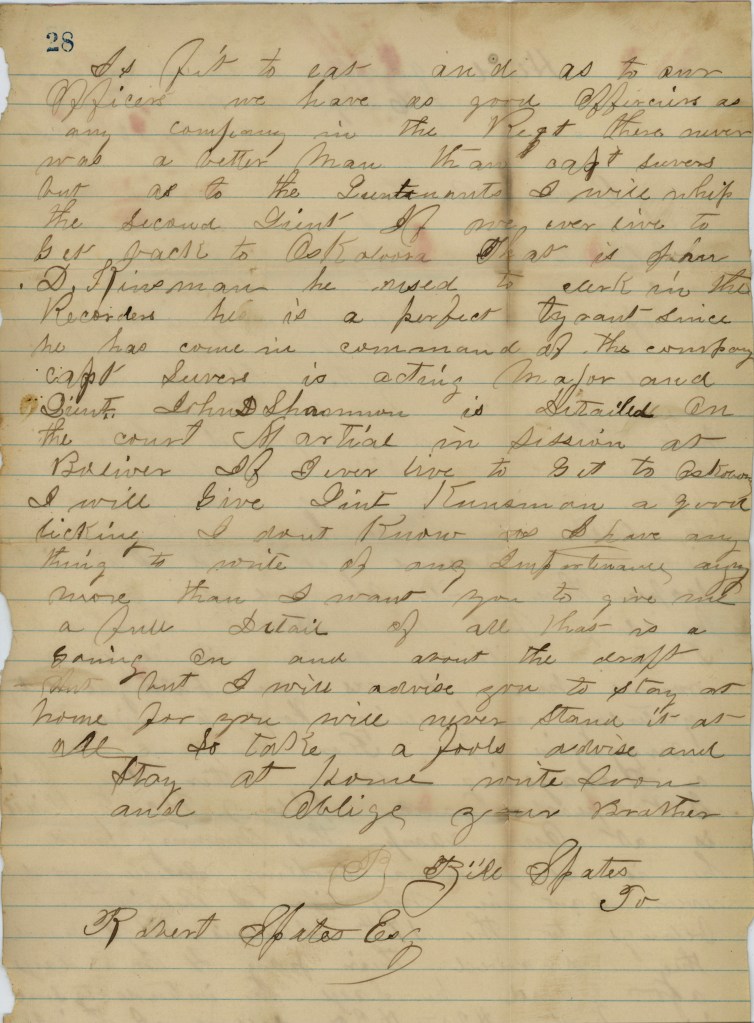
You wanted to know how we lived. We live sometimes like gentlemen and some times like hogs. We draw flour and ham and pickled pork every five days and beef every morning. We have built a bake oven and we have bread that is fit to eat and as to our officers, we have as good officers as any company in the regiment. There never was a better man than Capt. [James A.] Seevers. 1 But as to the lieutenants, I will whip the Second Lieutenant if we ever live to get back to Oskaloosa. That is John D. Kinsman. He used to clerk in the Recorder’s [Office]. He is a perfect tyrant since he has come in command of the company. 2 Capt. Seevers is Acting Major and Lieut. John D. Shannon is detailed on the court martial in session at Bolivar. If I ever live to get to Oskaloosa, I will give Lieut. Kinsman a good licking.

I don’t know as I have anything to write of any importance any more than I want you to give me a full detail of all that is going on and about the draft but I will advise you to stay at home for you will never stand it at all. So take a fool’s advise and stay at home. write soon and oblige your brother.

— Bill Spates

To Robert Spates, Esq.

1 Seevers, James A. Age 29. Residence Oskaloosa, nativity Virginia. Appointed Captain Dec. 31, 1861. Mustered Dec. 31, 1861. Resigned Nov. 27, 1862, Tennessee. 

2 Kinsman, John D. Age 20. Residence Oskaloosa, nativity Iowa. Enlisted Oct. 17, 1861, as First Sergeant. Mustered Dec. 31, 1861. Promoted Second Lieutenant April 23, 1862. Killed in battle Oct. 3, 1862, Corinth, Miss. 


Letter 2

Headquarters 15th Regt. Iowa Vols.
Camp No. 14
September 17th 1862

Dear Bob,

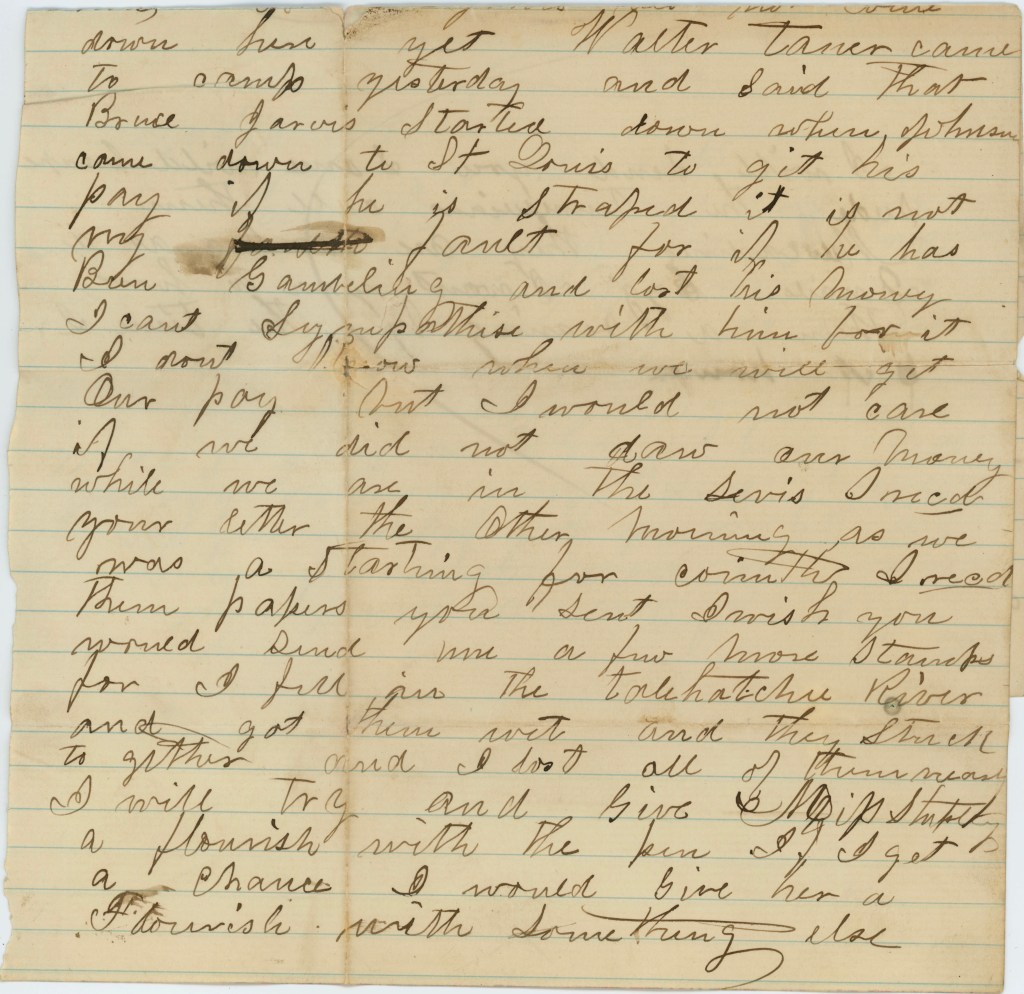
I seat myself to drop you a few lines. We received orders to be ready to march by 3 o’clock Friday morning and started from Bolivar to Corinth and was two days and a half on the road. We are camped about 2 miles and a half from Corinth—a little east, and a supporting the Tenth Ohio Battery. We are camped close to the picket line of Company C, 7th Iowa. Bruce Jarvis 1 has not come down here yet. Walter Tanner 2 came to camp yesterday and said hat Bruce Jarvis started down when Johnson came down to St. Louis to get his pay. If he is strapped, it is not my fault for if he has been gambling and lost his money, I can’t sympathize with him for it. I don’t know when we will get our pay but I could not care if we did not draw our money while we are in the service.

I received your letter the other morning as we was a starting for Corinth. I received them papers you sent. I wish you would send me a few more stamps for I fell in the Tallahatchie River and got them wet and they stuck together and I lost all of them nearly. I will try and give Miss [ ] a flourish with the pen if I get a chance. I would give her a flourish with something else.

Bob, I am afraid this Union is about gone up or as our byword is, “played out” for ninety days. Our Generals has not done anything in the East.

I will close. Give my respects to all of my friends. Send me something good to eat if you please. Farewell and excuse my writing for I have one of the meanest pens you ever saw. I have run out of gas.

Your humble servant, — Bill Spates

I will send you some wild grapes seeds. The Tennesseans call them Muscadines. They are as big as a snail’s egg. I want you to have them a bearing by the time I get home.

1 There was no Bruce Jarvis on the rolls of the 15th Iowa Infantry.

2 Tanner, Walter A. Age 25. Residence Hopewell, nativity Ohio. Enlisted Oct. 17, 1861, as Third Corporal. Mustered Dec. 31, 1861. Killed in battle Oct. 3, 1862, Corinth, Miss. 


Letter 3

La Grange, [Tennessee]
November 29, 1862

Dear Brother,

I take the present opportunity of dropping you a few lines to let you know where I am. I arrived at La Grange yesterday evening. The Regiment left yesterday morning for Holly Springs and I and 4 more of the same regiment are here. I don’t know when I will get a chance to go to my regiment. The whole army is on the move and I expect will have a fight before a great while. There was about 70 thousand troops on their way to some place, God only knows where for I don’t.

I am well or about as I was when I left home. I think I will get a discharge when I get to the regiment or at least I intend to do my best towards getting one. I had not time to call on you for money so I gave Johnson a draft on you for $15. I suppose it will make no material difference to you. It did not cost me a cent for me to come down here. I came down to St. Louis with the 33rd Regiment and then I got a Transportation to my regiment.

Give my love and respects to all y old friends and especially to E. J. Shipley. Write soon and often. Your brother, — William Spates

To Robert Spates