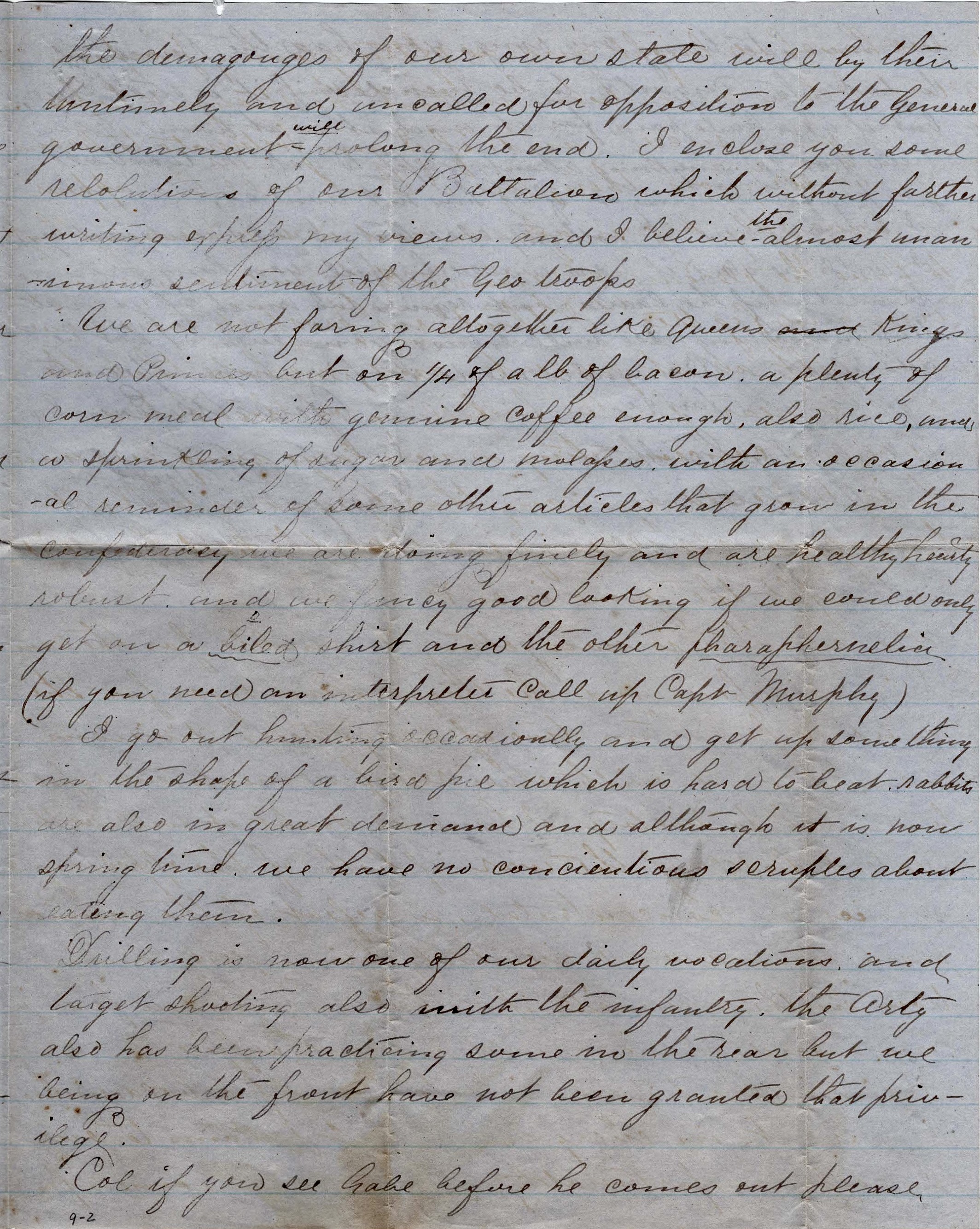
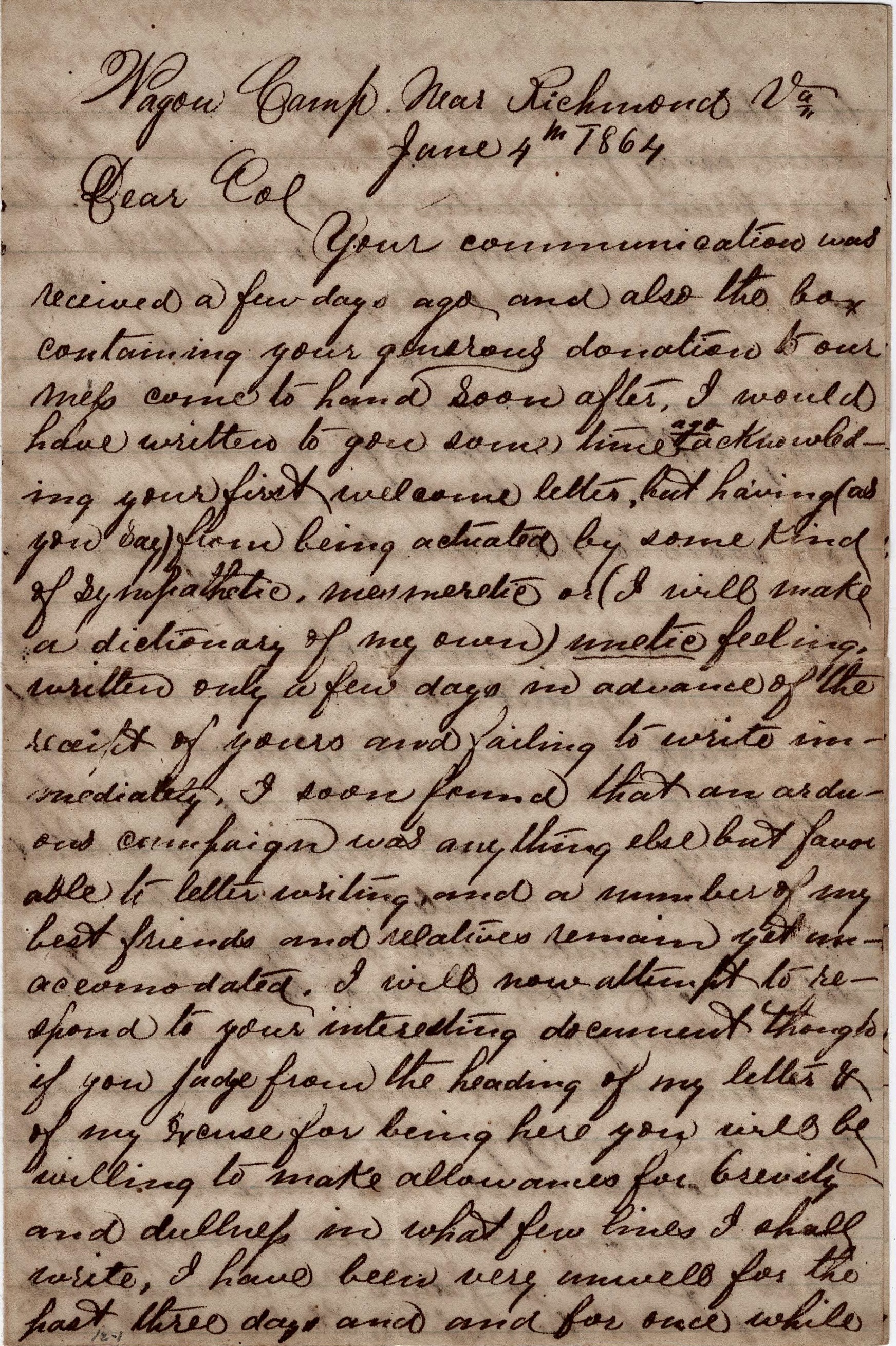
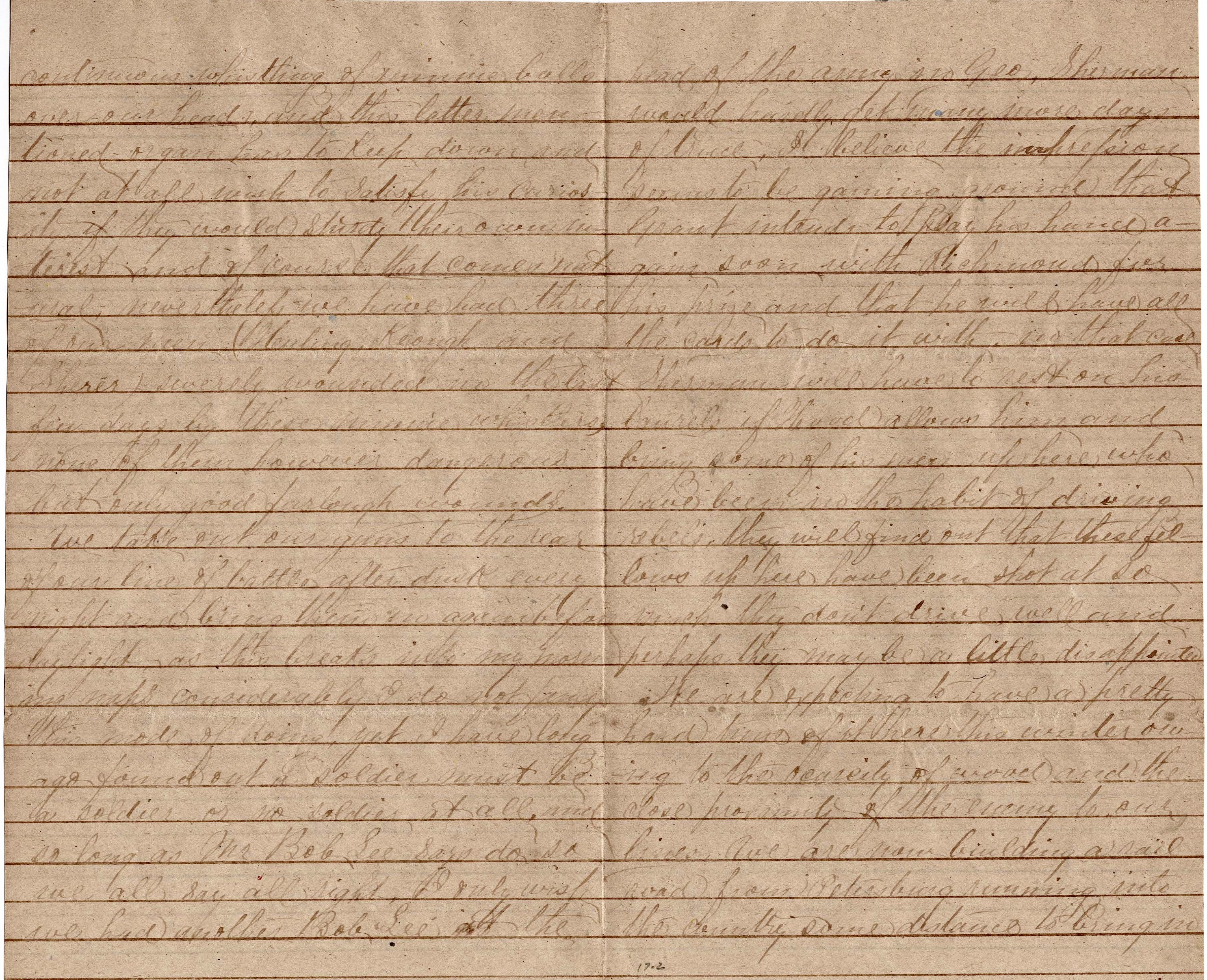
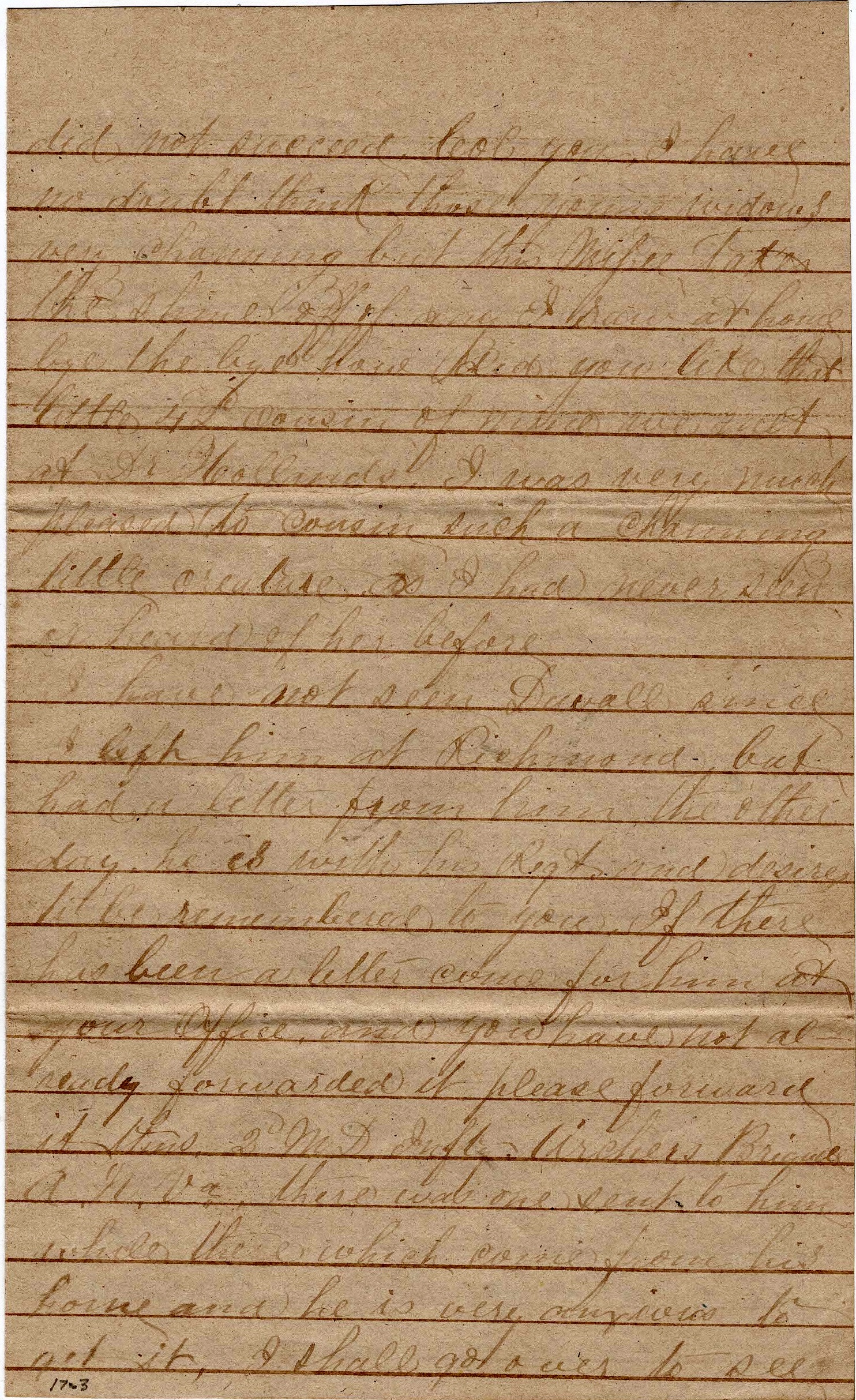
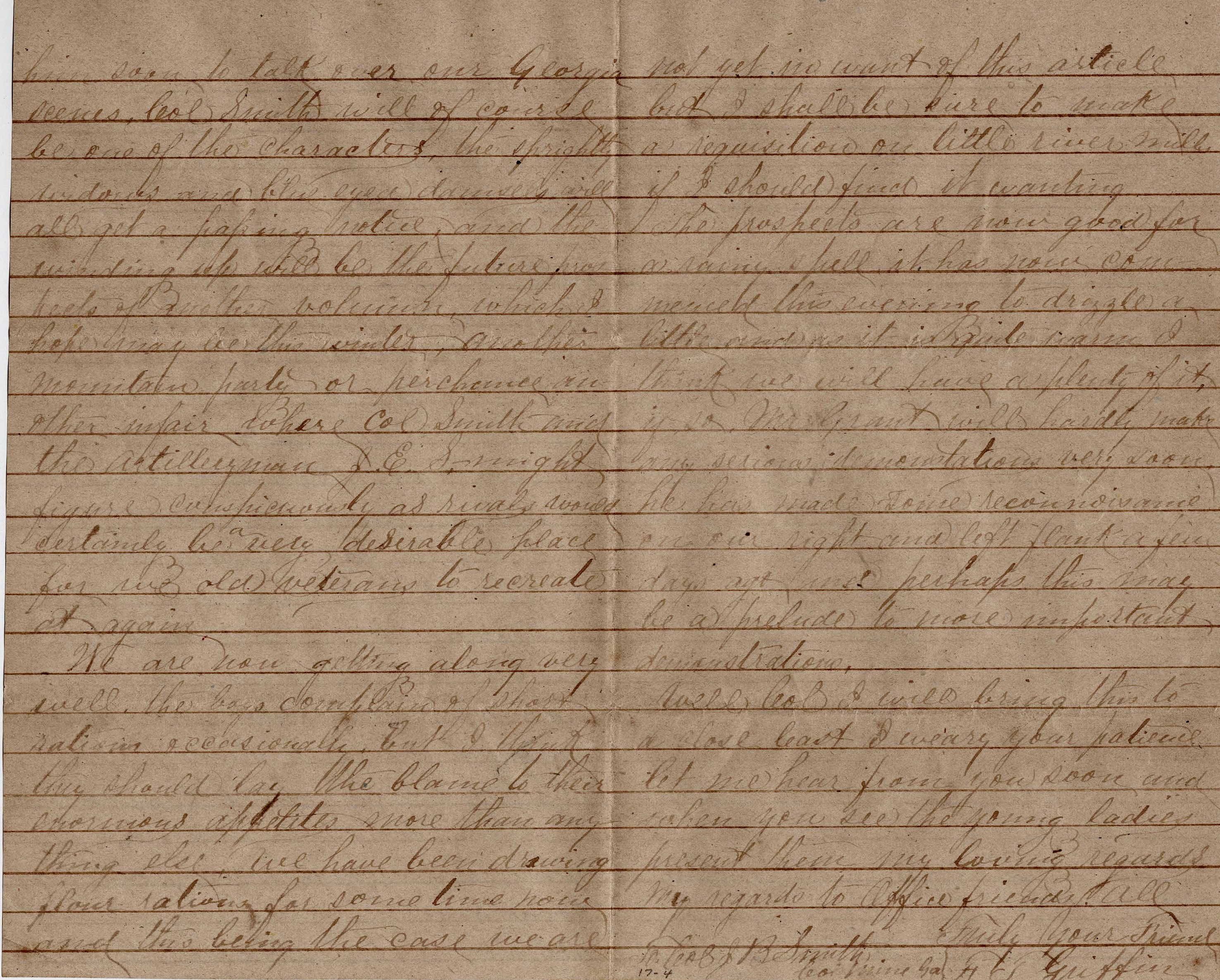
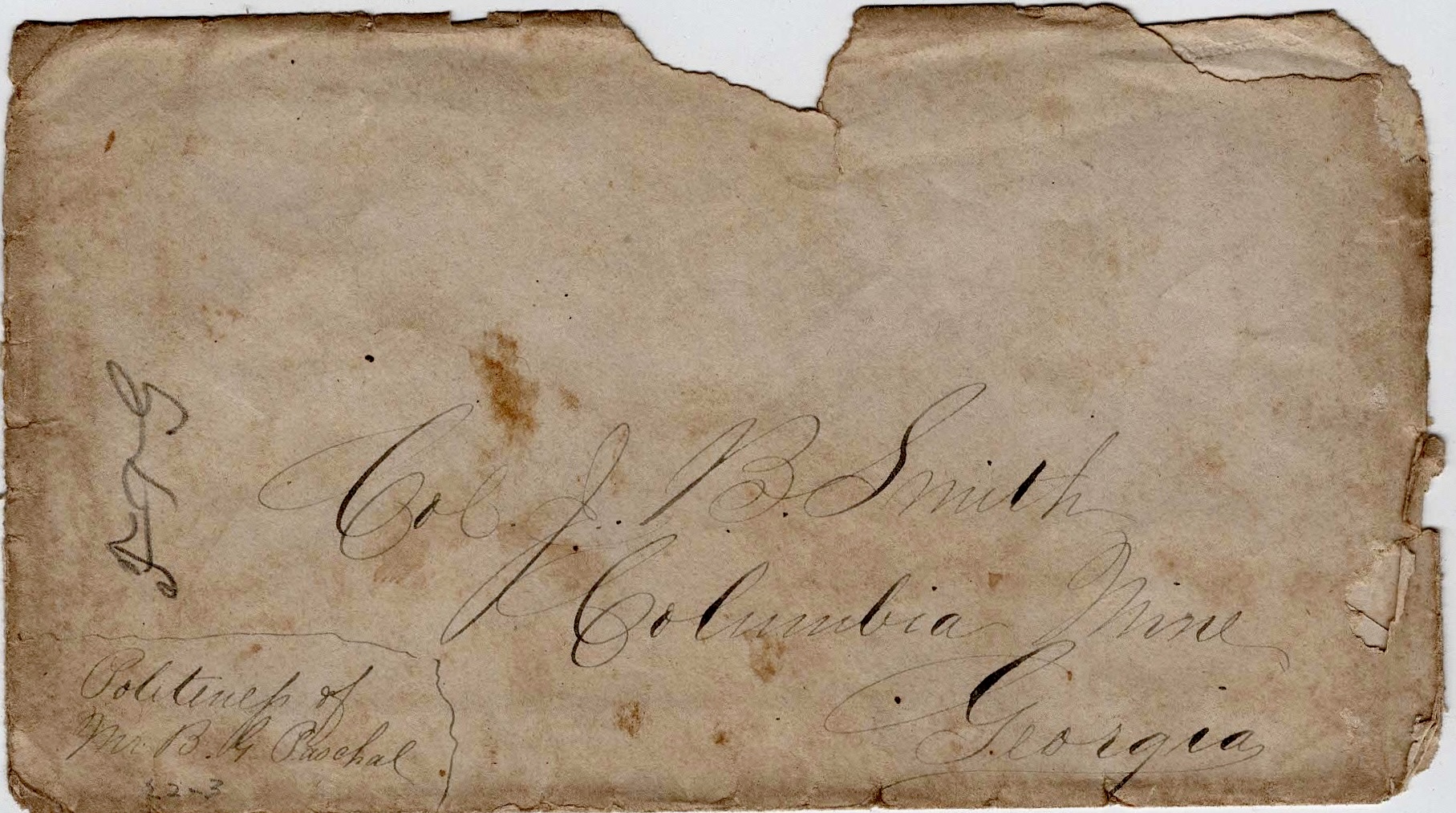
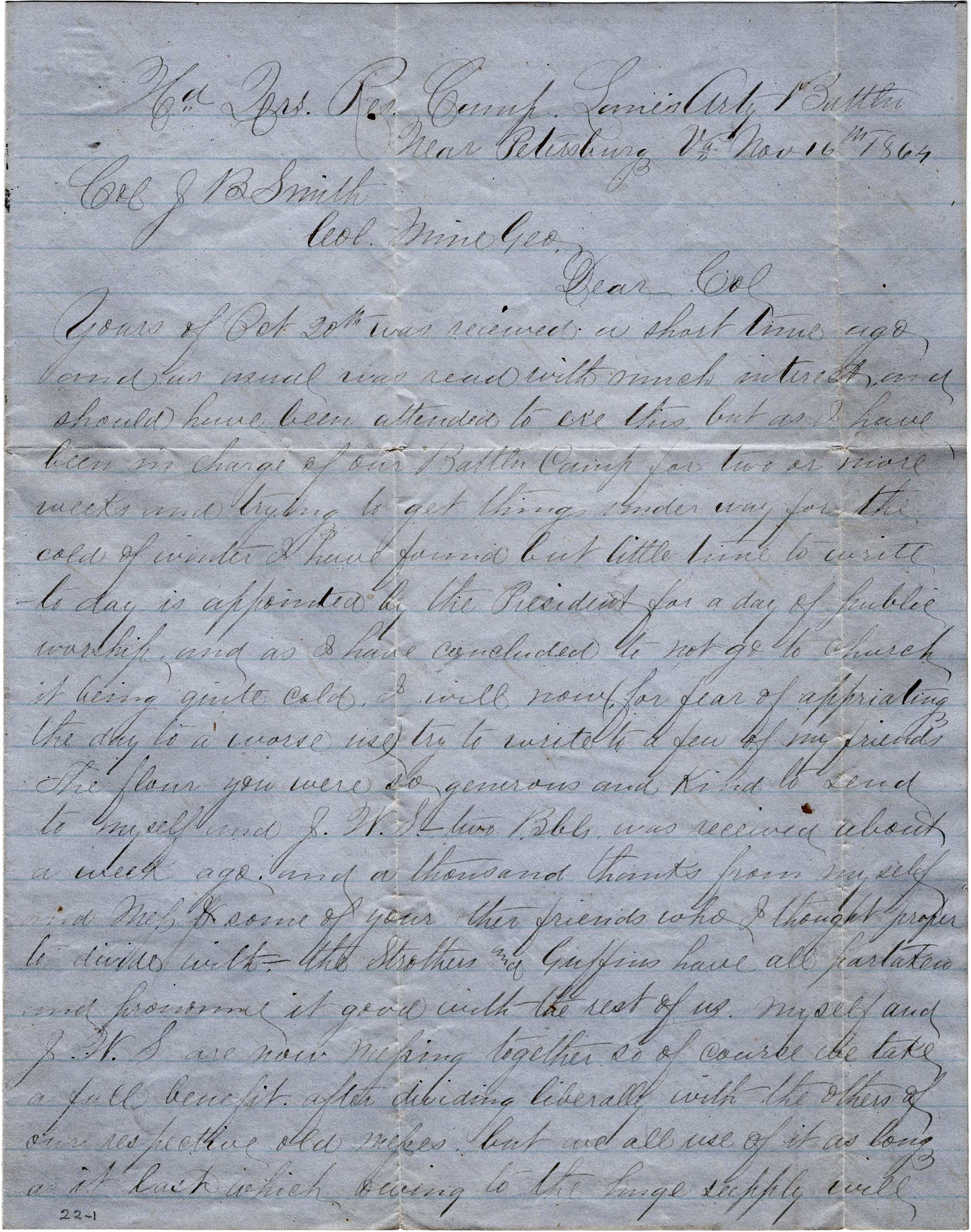
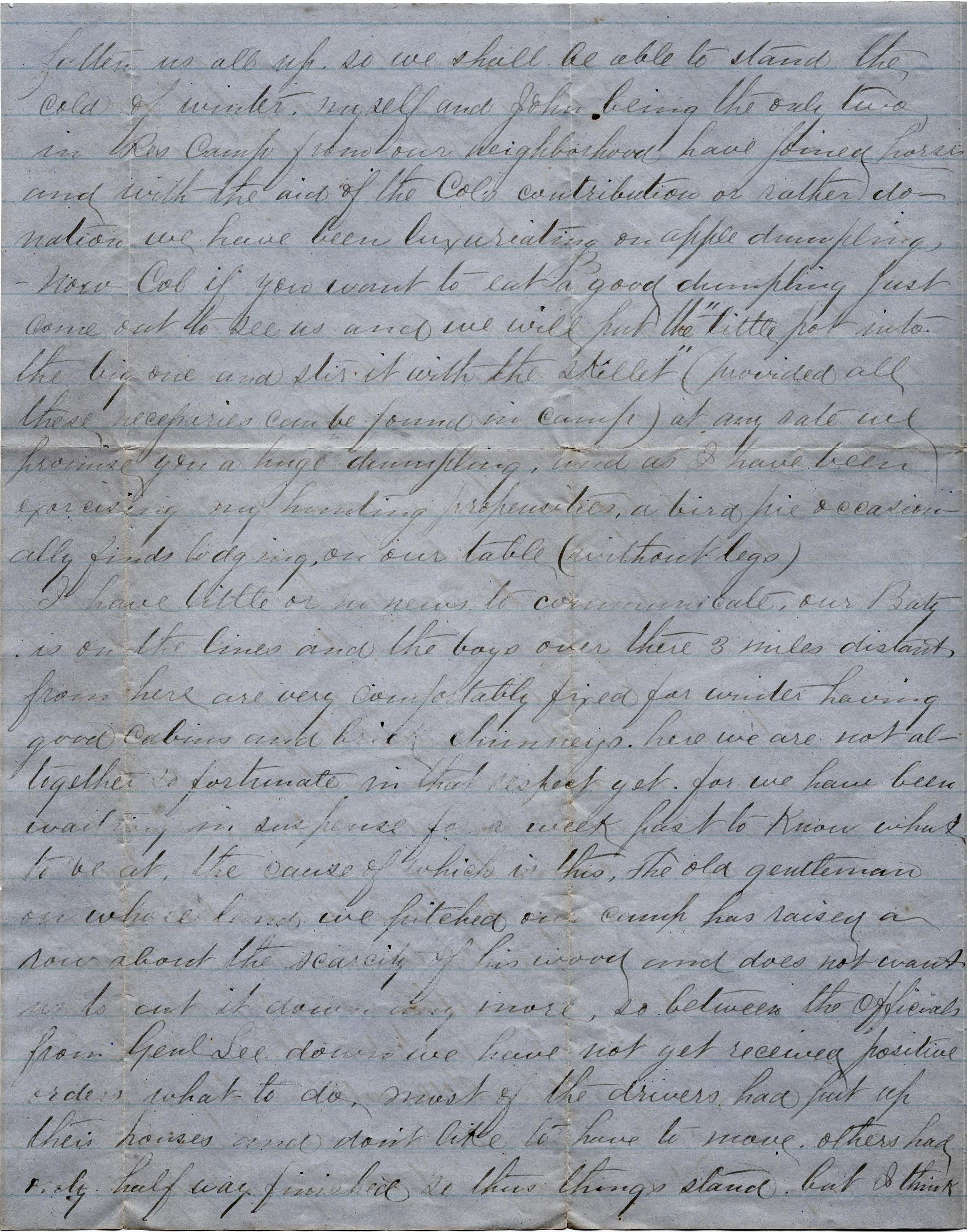
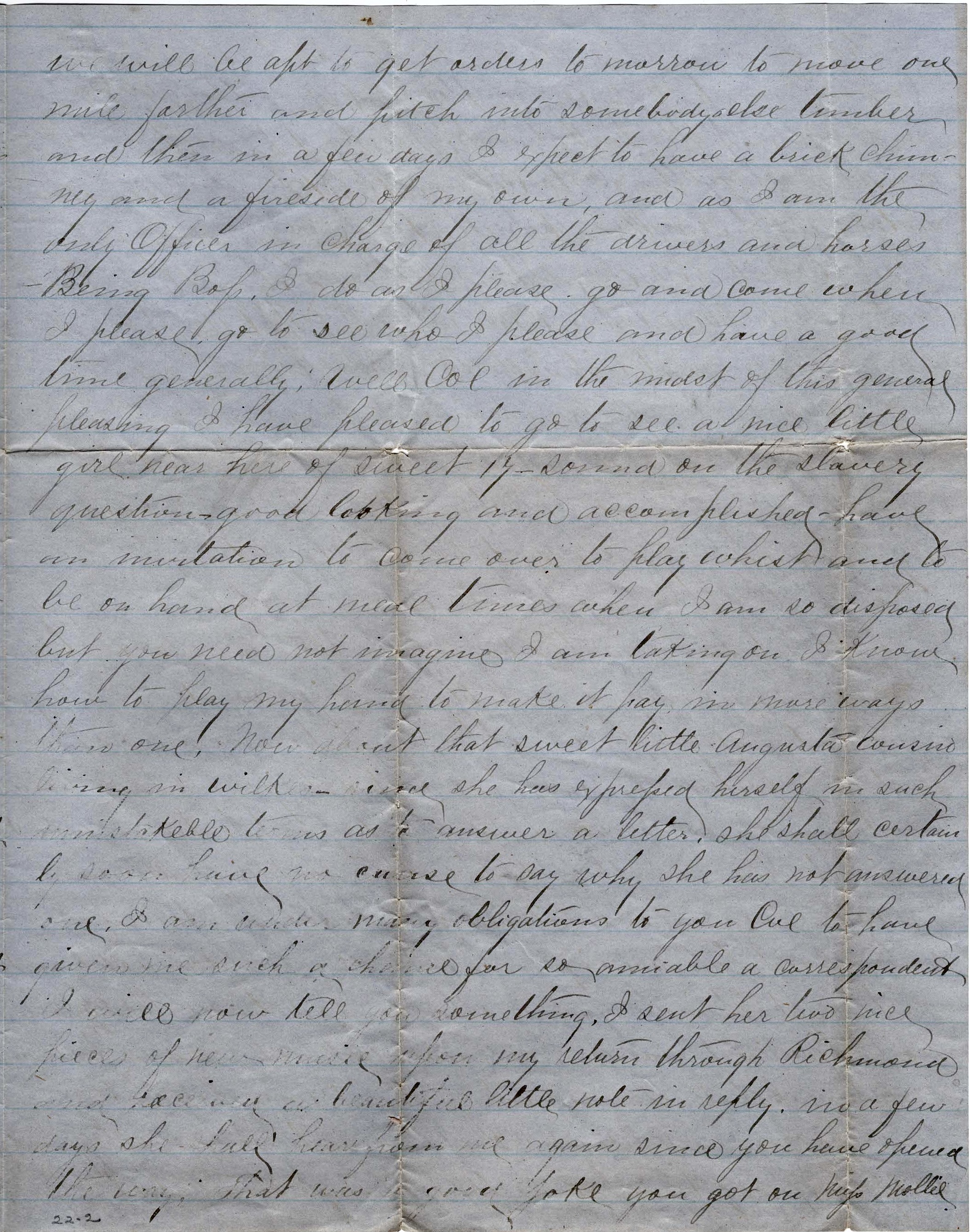
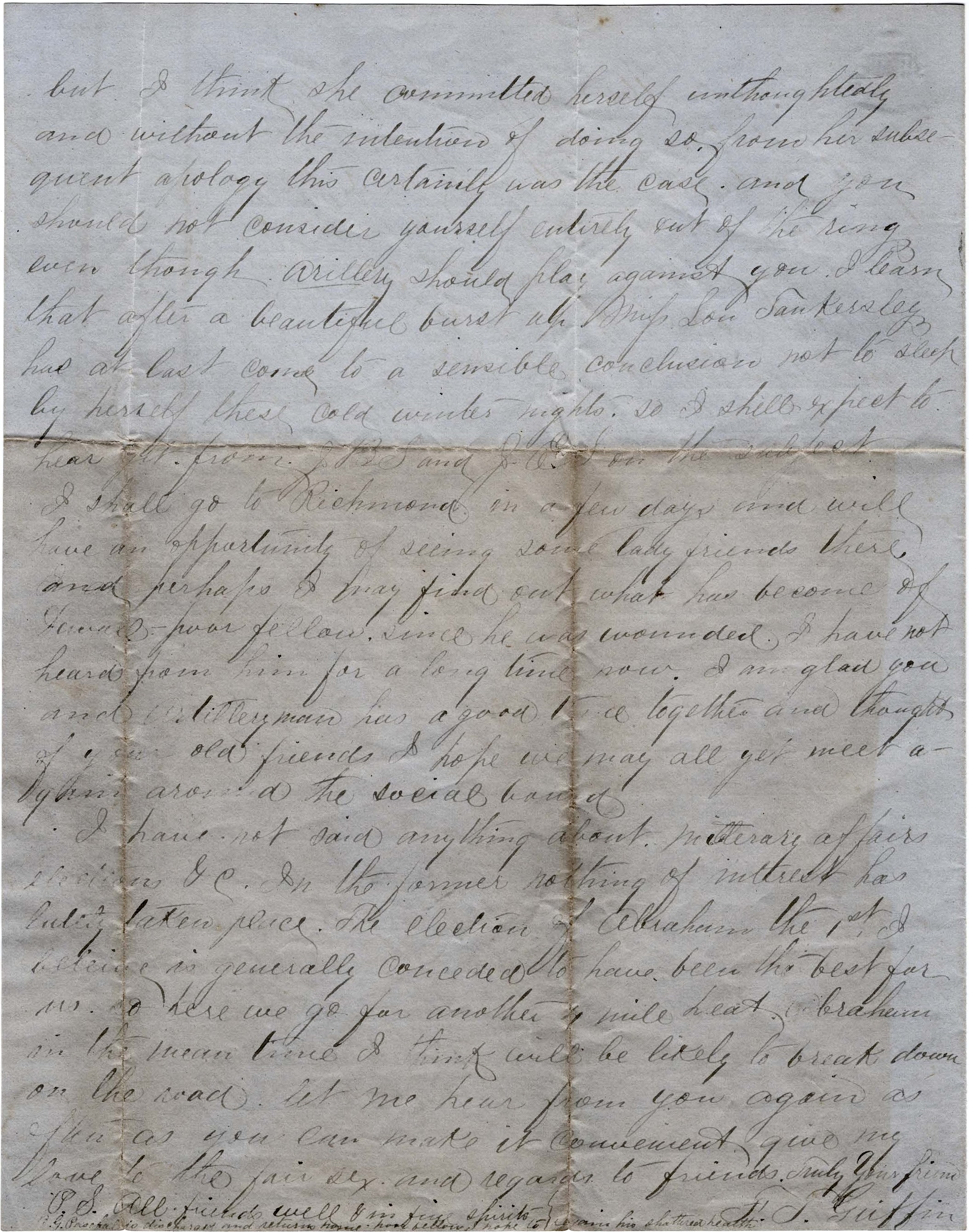
The following letters were written by Felix Thomas Griffin (1838-1905), the son of Richard Callaway Griffin (1798-1849) and Phoebe Yates (1801-1858). Felix was commissioned a Lieutenant in Co. A (“Irvin Guards”), 9th Georgia Infantry, in June 1861, but transferred to Co. C, 11th Battalion Georgia Light Artillery in December 1861. He was elected 1st Lieutenant in January 1862. In the Battle of Crampton’s Gap (South Mountain), Felix and Sergeant John C. Dyson were wounded and Private George D. Bruckner was killed.
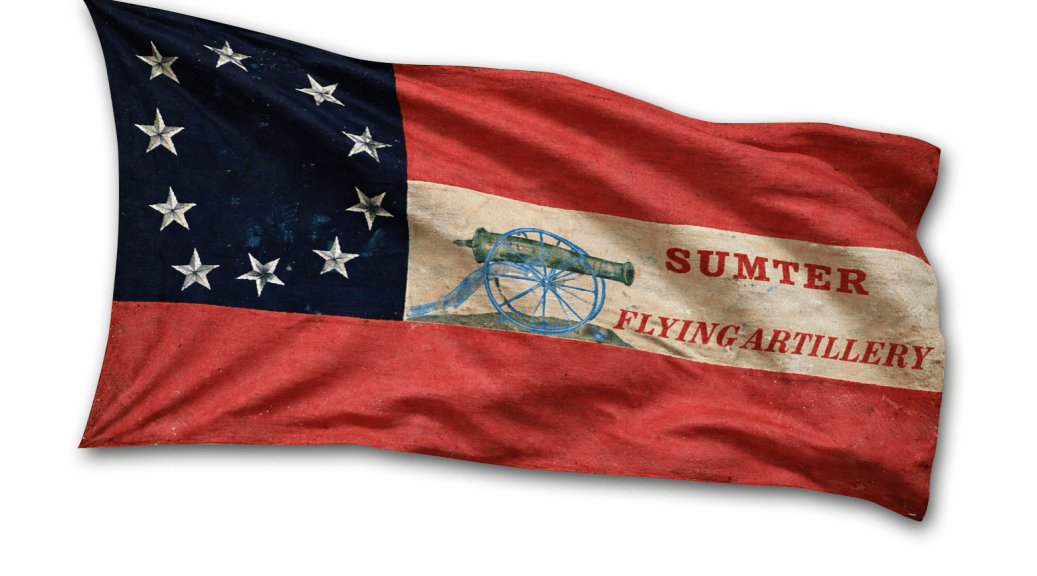
Captain John T. Wingfield’s Company C was one of three batteries comprising the artillery battalion led to Gettysburg by Major John Lane, which was attached to the infantry division of Major General Richard H. Anderson of the Third Corps, commanded by Lieutenant General A. P. Hill. Capt. John T. Wingfield, Senior 1st Lieutenant Frank Arnold, Junior 1st Lieutenant Felix T. Griffin, Senior 2nd Lieutenant Joseph W. Barnett. The battalion was usually referred to as Cutts’ Battalion, after Lieutenant Colonel Allen S. Cutts, who missed the campaign due to an undefined “indisposition.” It was officially the 11th Battalion of Georgia Artillery, which was called the “Sumter Battalion,” from Americus, Georgia. However, Company C traced its roots back to Company A of the 9th Georgia infantry – the “Irvin Guards” from Wilkes County, Georgia.
At Gettysburg, Company C was equipped with five pieces – three 3-Inch navy Parrotts, and two heavy 20-pounder Parrotts. During the battle a total of 406 rounds were expended, including 300 rounds of navy Parrott ammunition and 106 rounds of 20-pounder Parrott shell. Approximately 85-90 rounds were fired on July 2 and the remainder on July 3.
After the war, in 1868, Felix married Laura Corintha Strother (1847-1890). Both Felix and Laura were buried in the Old Griffin Cemetery in Thomson which was bordered by Little River and on the property which was once the Griffin Plantation, purchased by Felix’s grandfather, Jeremiah John Griffin (1774-1847). It seems that Jeremiah was a wealthy landowner in McDuffie County when two Englishmen discovered gold near Thurmond Lake in 1823. They couldn’t afford to buy land, so they approached local farmers. Jeremiah bought about 3,000 acres along Little River, essentially establishing a gold mining monopoly. He used slaves to extract gold from the quartz by a chemical process that involved pulverizing the quartz, mixing it with mercury and heating it to 400 degrees. Jeremiah’s claim to fame was the invention of the stamp mill in 1833. Similar in concept to a grist mill for flour, the stamp mill automated much of the process of extracting gold using water power rather than human power. The process is explained in more detail in an article in the Augusta Chronicle of March 30, 2008, headlined “McDuffie County was rich in ore.”
The letters were addressed to Col. Joseph Belknap Smith (1815-1898), the son of Joseph Nicholas Smith (1771-1857) and Polly Emerson (1784-1868) of Strafford county, New Hampshire. Joseph Belknap Smith (1802-1916) was a speculator and one of the founders of the Columbia Mining Company in eastern Georgia, not far from the Savannah river, where gold mining had been going on since the 1820s. By the 1850s, the mining operations required capital and equipment to extract the gold from veins deep in the ground. It also required steady labor for digging, hauling, and washing the ore—a labor that was supplied principally by slaves. The slaves were either owned outright by investors or hired from local slaveholders, of which there were many in the area. For example, Felix Shanks and his brother George owned 50 slaves between them, some of whom may have been hired by Smith seasonally. Smith’s operations at Columbia included a stamp mill and ore-processing machinery, producing as much as $2 million in gold before the Civil War (roughly 4 tons of gold). Records held in the Duke University Archives indicate that he employed about 120 enslaved laborers and processed 10 tons of ore per day.
Letter 1
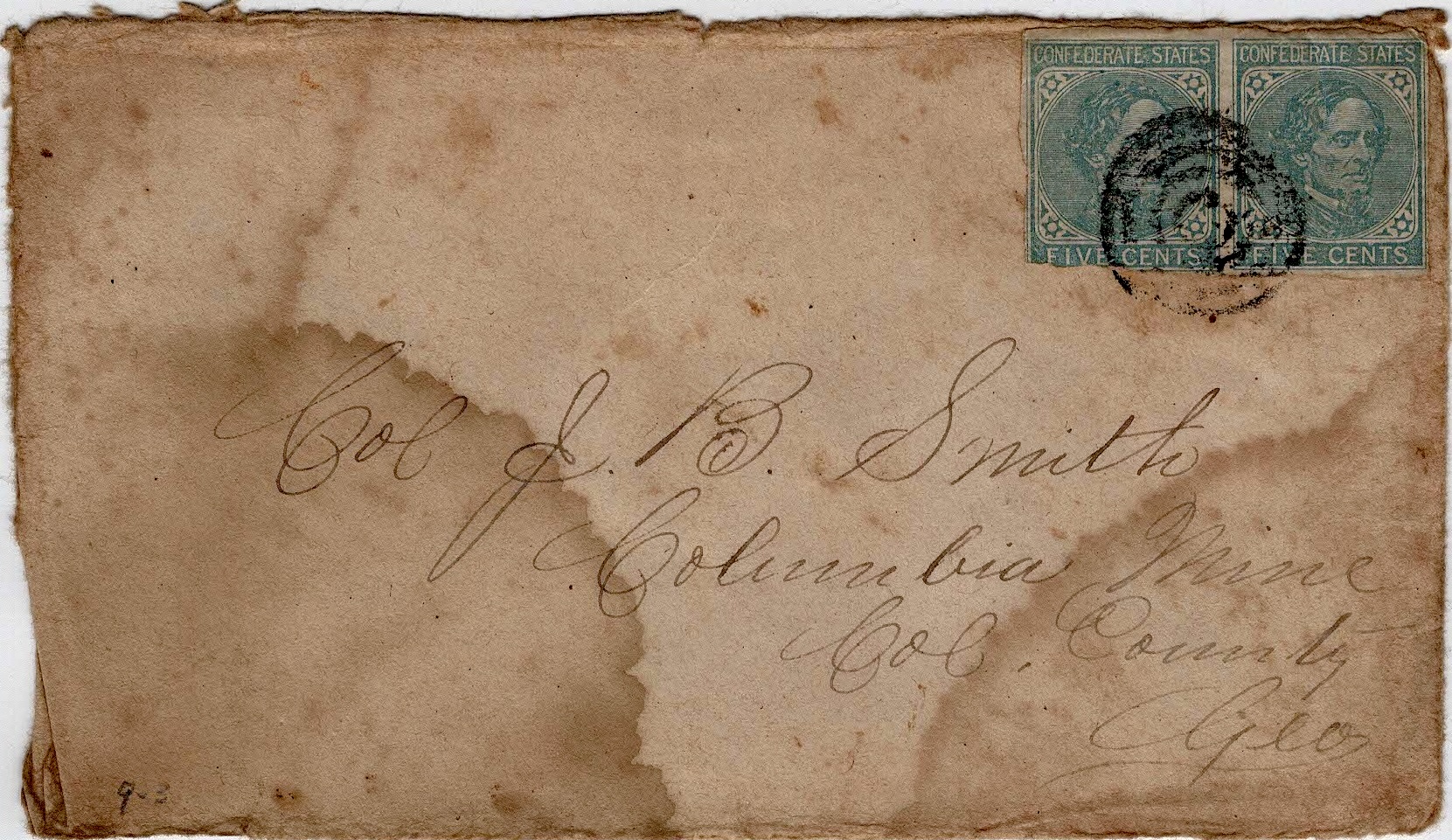
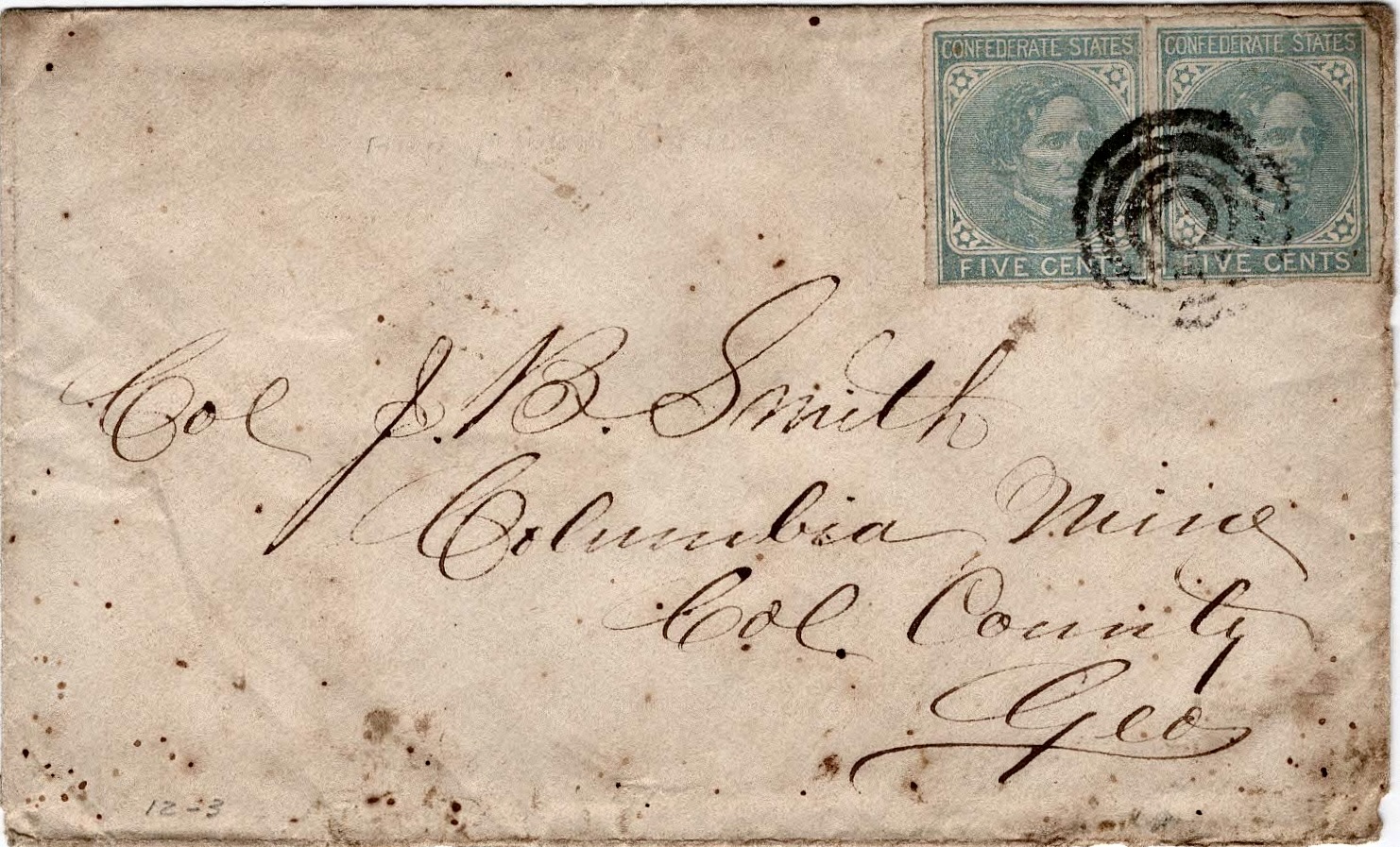
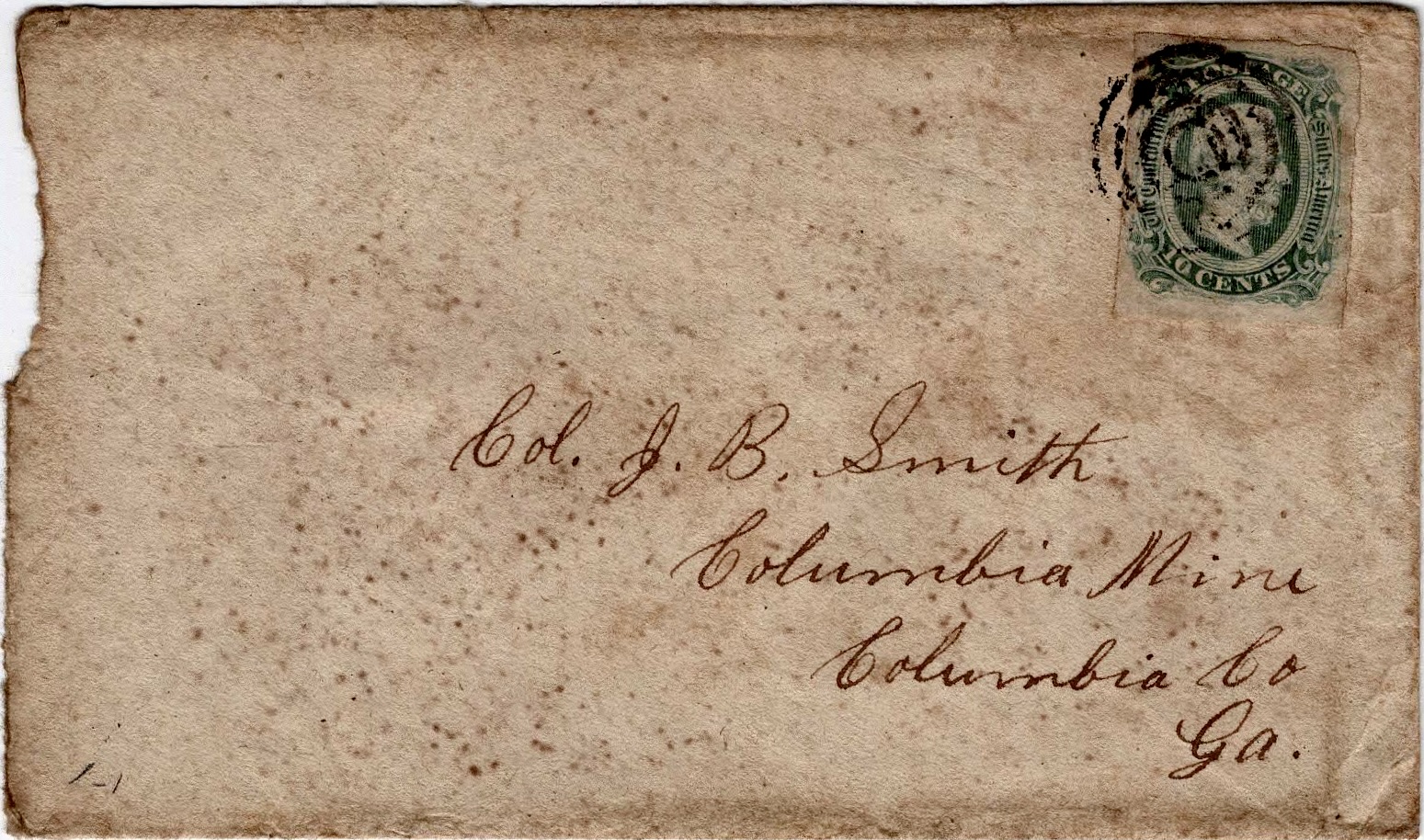
Addressed to Col. J. B. Smith, Columbia Mine, Columbia County, Georgia
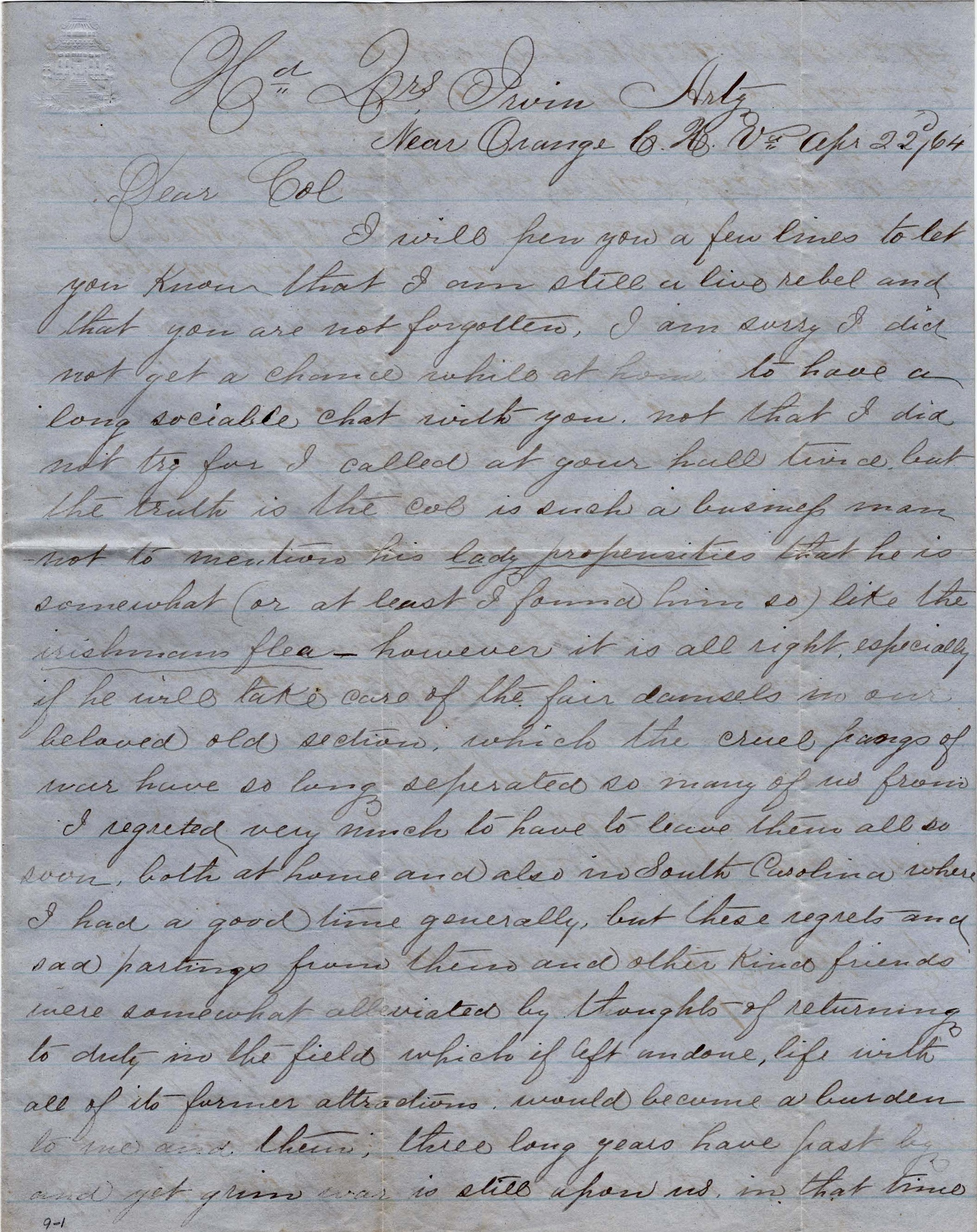
Headquarters Irvin Artillery Near Orange Court House, Virginia April 22nd 1864
Dear Colonel,
I will pen you a few lines to let you know that I am still a live rebel and that you are not forgotten. I am sorry I did not get a chance while at home to have a long sociable chat with you—not that I did not try for I called at your hall twice, but the truth is the Colonel is such a business man not to mention his lady propensities that he is somewhat (or at least I found him so) like the irishman’s flea. However, it is all right, especially if he will take care of the fair damsels in our beloved old section which the cruel fangs of war have so long separated so many of us from. I regretted very much to have to leave them all so soon, both at home and also in South Carolina where I had a good time generally, but these regrets and sad partings from them and other kind friends were somewhat alleviated by thoughts of returning to duty in the field which if left undone, life with all of its former attractions would become a burden to me and them.
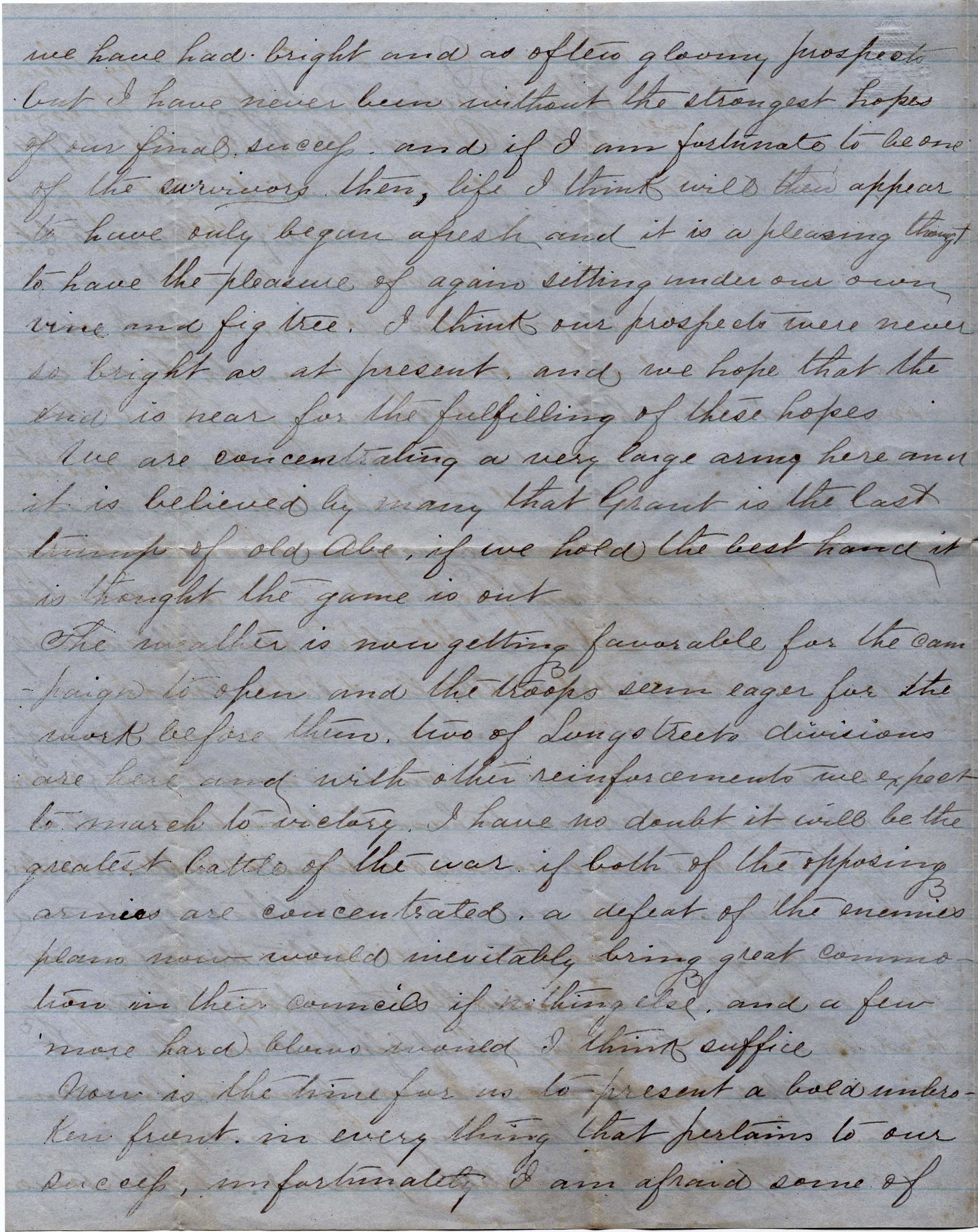
Three long years have passed by and yet grim war is still upon us, and in that time we have had bright and as often gloomy prospects. But I have never been without the strongest hopes of our final success, and if I am fortunate to be one of the survivors, then life, I think, will then appear to have only begun afresh and it is a pleasing thought to have the pleasure of again sitting under our own vine and fig tree. I think our prospects were never so bright as at present and we hope that the end is near for the fulfilling of these hopes.
We are concentrating a very large army here and it is believed by many that Grant is the last trump of Old Abe. If we hold the best hand, it is thought the game is out.
The weather is now getting favorable for the campaign to open and the troops seem eager for the work before them. Two of Longstreet’s divisions are here and with other reinforcements, we expect to march to victory. I have no doubt it will be the greatest battle of the war if both of the opposing armies are concentrated. A defeat of the enemy’s plan now would inevitably bring great commotion in the councils if nothing else. And a few more hard blows would, I think, suffice. Now is the time for us to present a bold unbroken front in everything that pertains to our success. Unfortunately, I am afraid some of the demagogues of our own state will by their untimely and uncalled for opposition to the general government, prolong the end. I enclose you some resolutions of our Battalion which without farther writing express my views and I believe them [to be] the almost unanimous sentiment of the Georgia troops.
We are not faring altogether like Queens and Kings and Princes but on 1/4 of a pound of bacon, a plenty of corn meal with genuine coffee enough, also rice, and a sprinkling of sugar and molasses, with an occasional reminder of some other articles that grow in the Confederacy. We are doing finely and are healthy, hearty, robust, and we fancy good looking—if we could only get on a boiled shirt and the other paraphernalia (if you need an interpreter, call up Capt. Murphy).
I go out hunting occasionally and get up something in the shape of a bird pie which is hard to beat. Rabbits are also in great demand and although it is now spring time, we have no contentious scruples about eating them.
Drilling is now one of our daily vocations and target shooting also with the infantry. The artillery also has been practicing some in the rear but we being in the front, have not been granted that privilege.
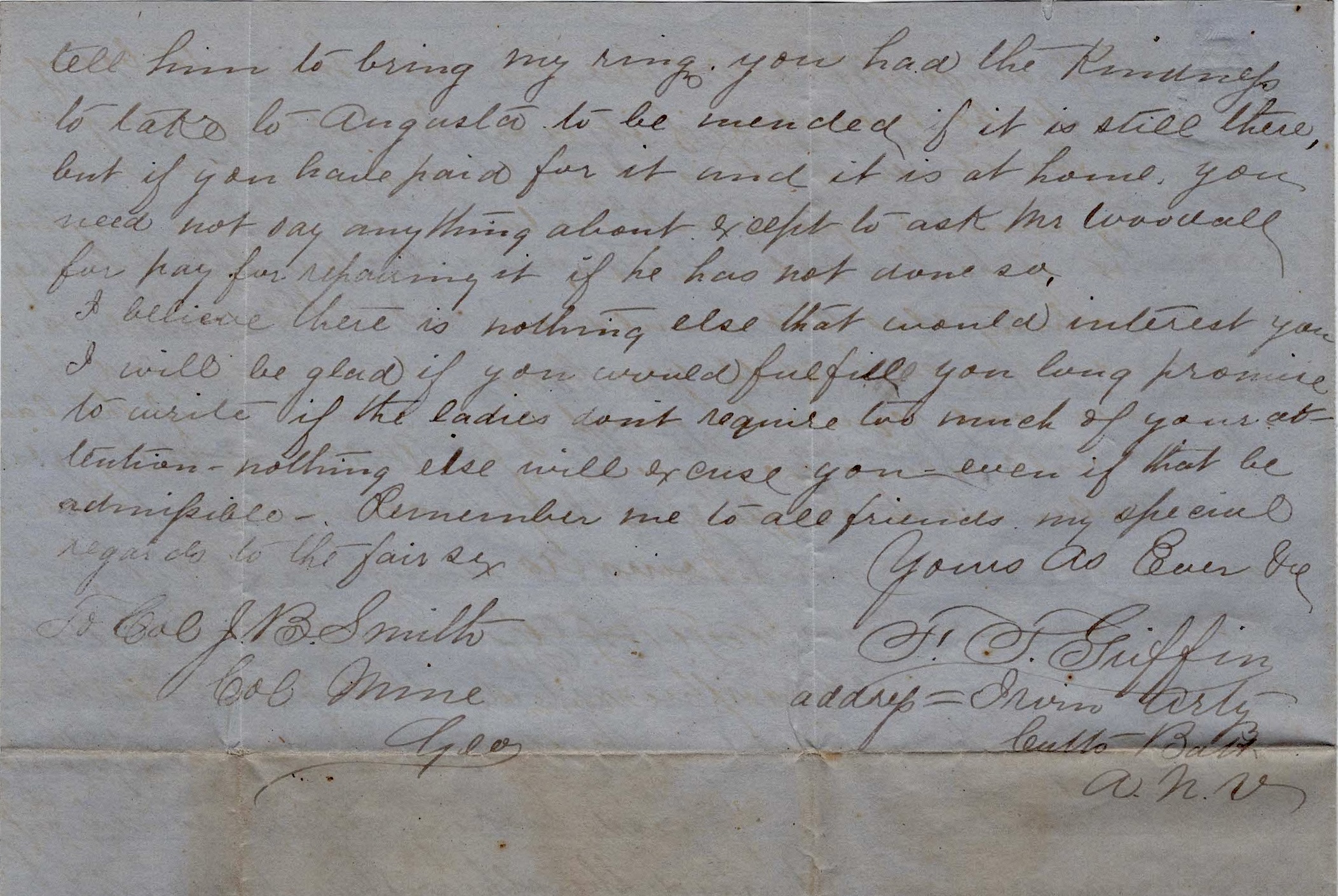
Colonel, if you see Gabe before he comes out, please tell him to bring my ring you had the kindness t take to Augusta to be mended, if it is still there. But if you have paid for it and it is at home, you need not say anything about [it] except to ask Mr. Woodall for pay for repairing it if he has not done so.
I believe there is nothing else that would interest you. I will be glad if you would fulfill your long promise to write if the ladies don’t require too much of your attention. Nothing else will excuse you—even if that be admissible. Remember me to all friends. My special regards to the fair sex. Yours as ever &c. — F. T. Griffin
Address, Irvin Artillery, Cutts’ Battalion, Army of Northern Virginia
To Col. J. B. Smith, Columbia Mine, Georgia
Letter 2
Wagon Camp near Richmond, Virginia June 4th 1864
Dear Colonel,
Your communication was received a few days ago and also the box containing your generous donation to our mess come to hand soon after. I would have written to you some time ago acknowledging your first welcome letter, but having (as you say) from being actuated by some kind of sympathetic, mesmeretic or (I will make a dictionary of my own) unetic feeling, written only a few days in advance of the receipt of yours and failing to write immediately I soon found that an arduous campaign [and] was anything else but favorable to letter writing, and a number of my best friends and relatives remain yet unaccommodated.
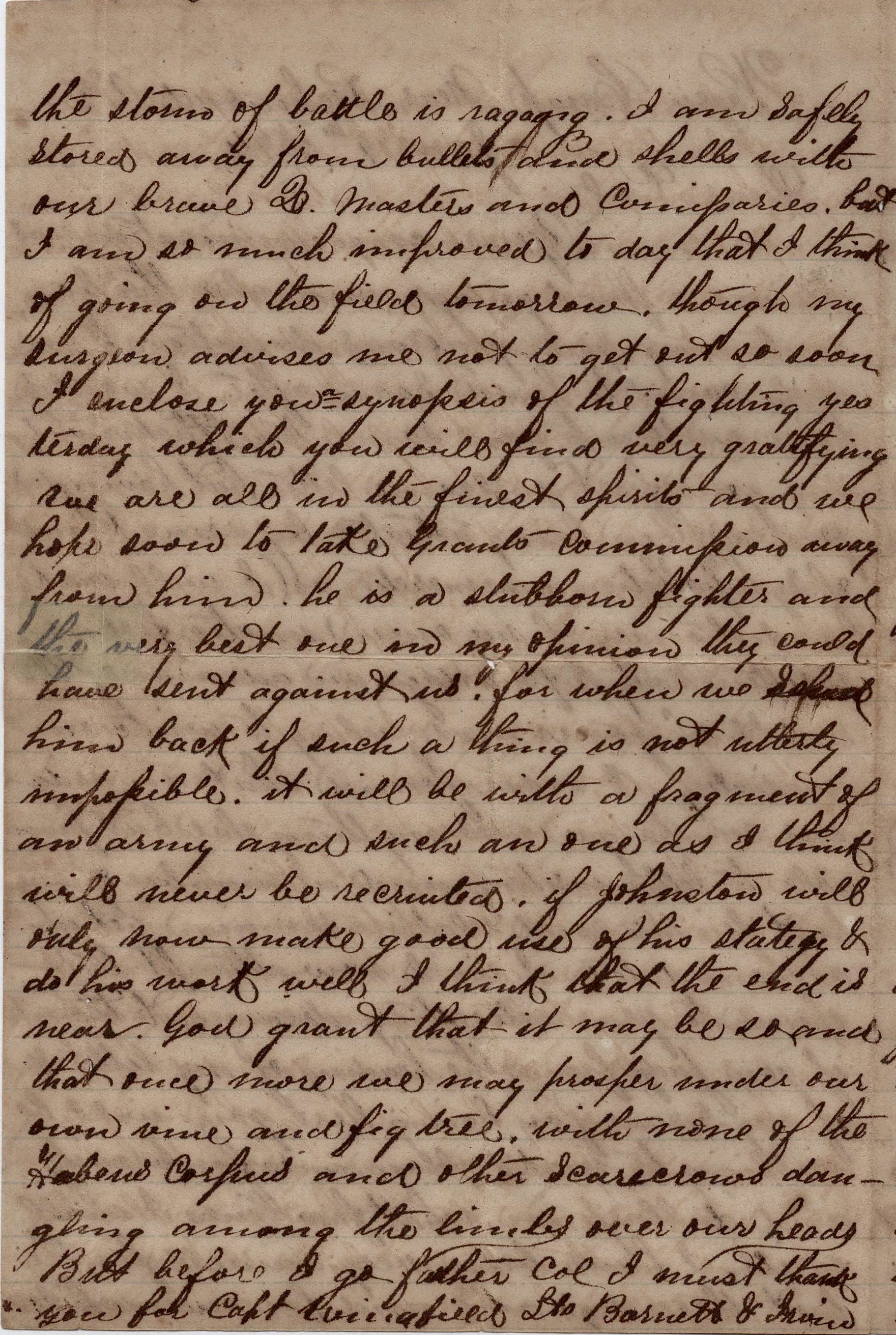
I will now attempt to respond to your interesting document though if you judge from the heading of my letter & of my excuse for being here, you will be willing to make allowances for brevity and dullness in what few lines I shall write. I have been very unwell for the past three days and for once, while the storm of battle is raging, I am safely stored away from bullets and shells with our brave quartermasters and commissaries. But I am so much improved today that I think of going on the field tomorrow though my surgeon advises me not to get out so soon.
“We hope soon to take Grant’s commission away. He is a stubborn fighter and the very best one in my opinion….” — Lt. F. T. Griffin, 111th Ga. Artillery
I enclose you a synopsis of the fighting yesterday which you will find very gratifying. We are all in the finest spirits and we hope soon to take Grant’s commission away from him. He is a stubborn fighter and the very best one in my opinion they could have sent against us for when we send him back—if such a thing is not utterly impossible—it will be with a fragment of an army and such an one as I think will never be recruited. If Johnston will only now make good use of his strategy & do his work well, I think that the end is near. God grant that it may be so and that once more we may prosper under our own vine and fig tree with none of the Habeas Corpus and other Scarecrows dangling among the limbs over our heads.
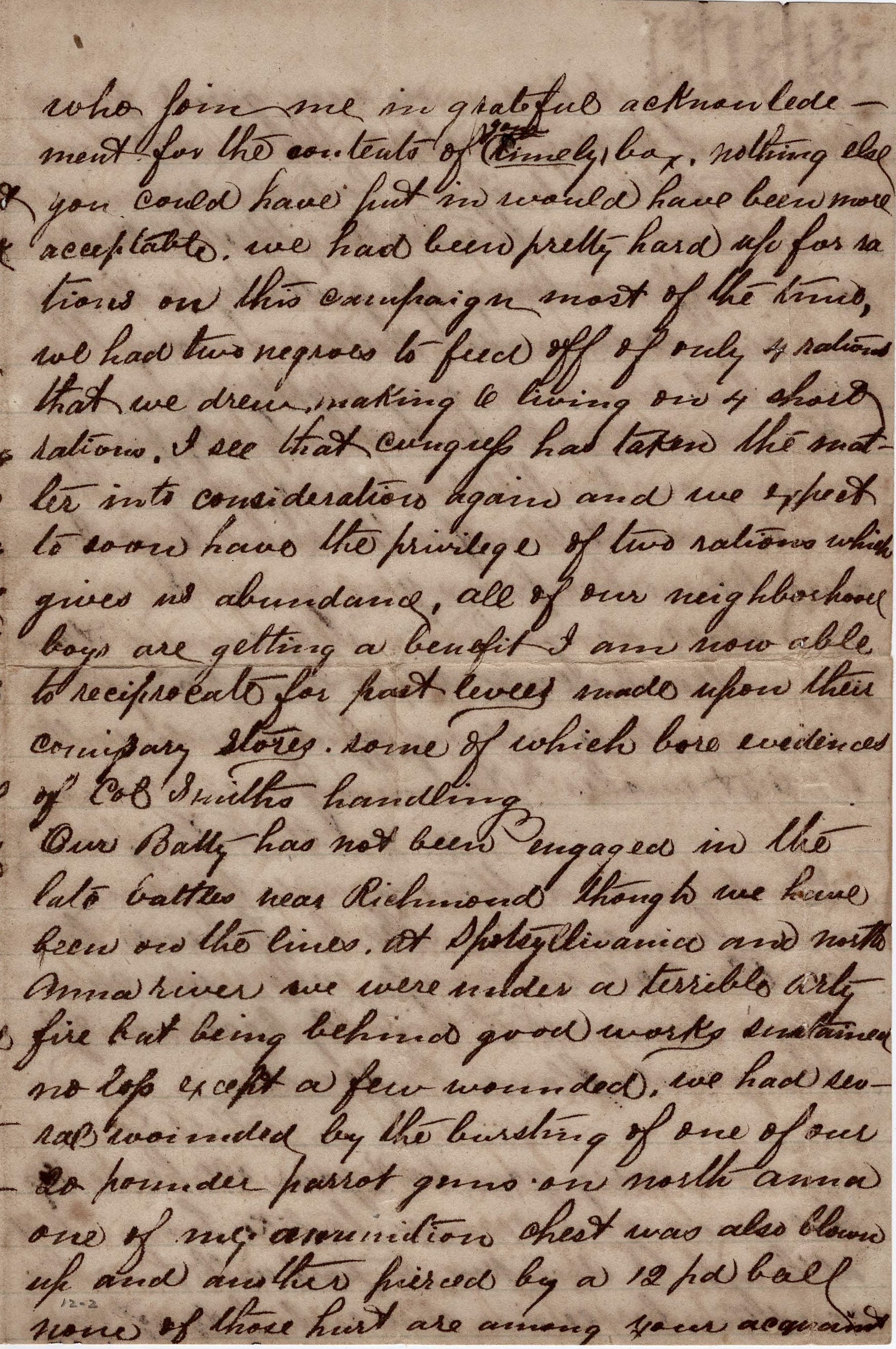
But before I go farther, Colonel, I must thank you for Capt. Wingfield, Lts. Barnett and Irvin who join me in grateful acknowledgement for the contents of your timely box. Nothing else you could have put in would have been more acceptable. We had been pretty hard up for rations on this campaign most of the time. We had two negroes to feed off of only 4 rations that we drew, making 6 living on four short rations.
I see that Congress has taken the matter into consideration again and we expect to soon have the privilege of two rations which gives us abundance. All of our neighborhood boys are getting a benefit. I am now able to reciprocate for past levees made upon their commissary stores, some of which bore evidences of Col. Smith’s handling.
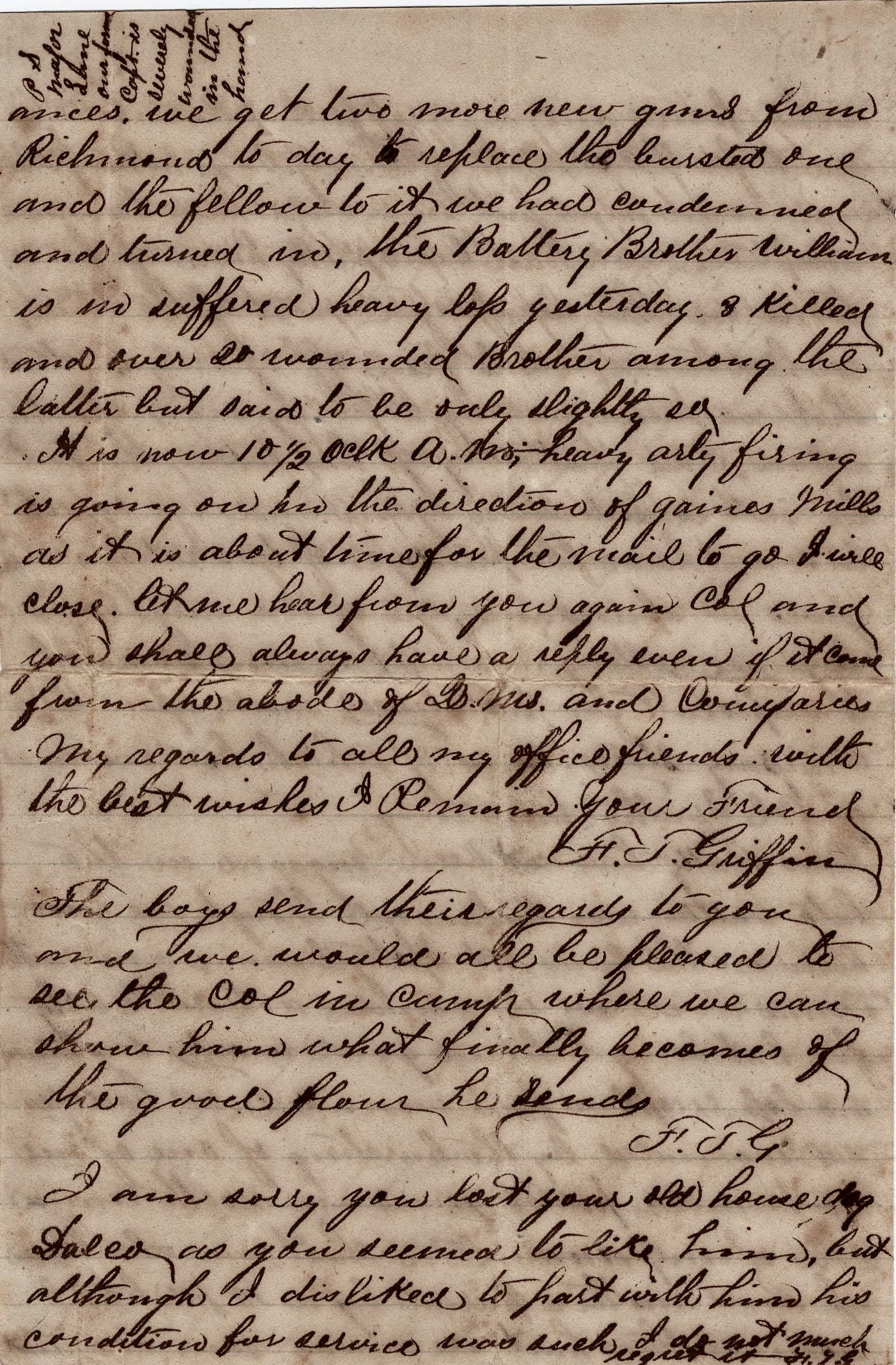
Our Battery has not been engaged in the late battles near Richmond though we have been on the lines. At Spotsylvania and North Anna River we were under a terrible artillery fire but being behind good works, sustained no loss except a few wounded. We had several wounded by the bursting of one of our 20-pounder Parrott guns on North Anna. One of my ammunition chests was also blown up and another pierced by a 12 pound ball. None of those hurt are among your acquaintances. We get two more new guns from Richmond today to replace the bursted one and the fellow to it we had condemned and turned in. The Battery brother William is in suffered heavy loss yesterday—three killed and over 20 wounded (brother among the latter but said to be only slightly so.)
It is now 10.30 o’clock a.m.; heavy artillery firing is going on in the direction of Gaines Mills. As it is about time for the mail to go, I will close. Let me hear from you again, Colonel, and you shall always have a reply even if it comes from the abode of quartermasters and commissaries. My regards to all my office friends. With the best wishes, I remain your friend, — F. T. Griffin
The boys send their regards to you and we would all be pleased to see the Colonel in camp where we can show him what finally becomes of the good flour he sends. — F. T. Griffin
I am sorry you lost your old house dog, Dalco, as you seemed to like him, but although I disliked to part with him, his condition for service was such I do not much regret it. — F. T. G.
P. S. Major [John] Lane, our former Captain, is severely wounded in the hand.
Letter 3
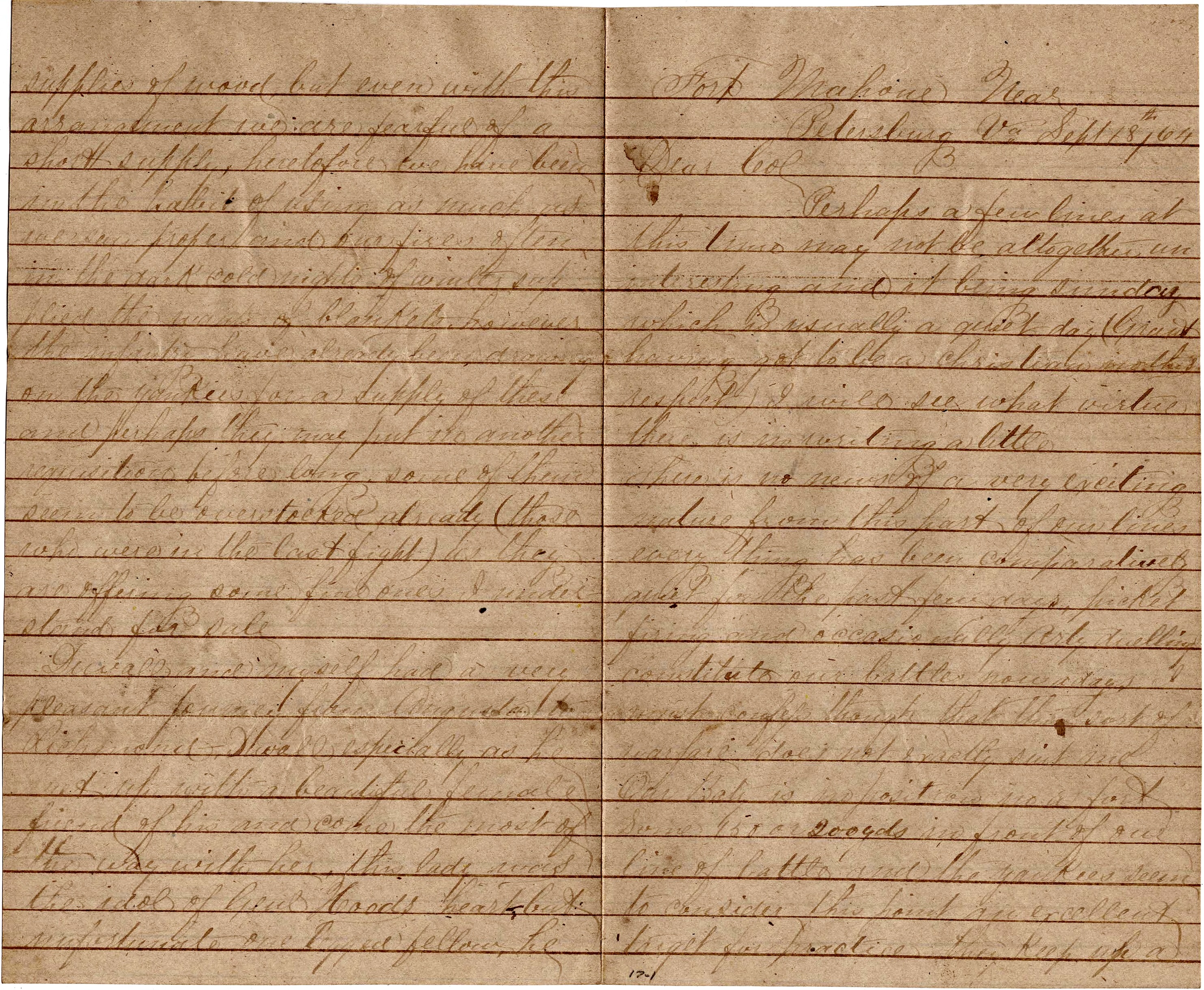
Fort Mahone Near Petersburg, Virginia September 18, 1864
Dear Colonel,
Perhaps a few lines at this time may not be altogether uninteresting, and it being Sunday which is usually a quiet day (Grant having got to be a Christian in this respect), I will see what virtue there is in writing a little. There is no news of a very exciting nature from this part of our lines. Everything has been comparatively quiet for the past few days. Picket firing and occasionally artillery dueling constitute our battles nowadays. I must confess though that this sort of warfare does not exactly suit me.
Our battery is in position in a fort some 150 or 200 yards in front of our line of battle and the Yankees seem to consider this point an excellent target for practice. They keep up a continuous whistling of Minié balls over our heads and this latter mentioned organ has to keep down, and not at all wish to satisfy his curiosity, if they would study their own interest and of course that comes natural. Nevertheless, we have had three of our men (Henling, Keough, and [Lewis D.] Sherer) severely wounded in the last few days by these Minié whistlers, none of them however dangerous, but only good furlough wounds.
We take out our guns to the rear of our line of battle after dusk every night and bring them in again before daylight. As this breaks into my morning naps considerably, I do not find this mode of doing [enjoyable], yet I have long ago found out a soldier must be a soldier or no soldier at all. And so long as Mr. Bob Lee says do so, we all say all right. I only wish we had another Bob Lee at the head of the army in Georgia. Sherman would hardly get many more days of truce. I believe the impression seems to be gaining ground that Grant intends to play his hand again soon with Richmond, for his prize and that he will have all the cards to do it with. In that case, Sherman will have to rest on his laurels—if Hood allows him—and bring some of his men up here who have been in the habit of driving rebels. They will find out that these fellows up here have been shot at so much they don’t drive well and perhaps they may be a little disappointed.
We are expecting to have a pretty hard time of it here this winter owing to the scarcity of wood and the close proximity of the enemy to our lines. We are now building a railroad from Petersburg running into the country some distance to bring in supplies of wood, but even with this arrangement we are fearful of a short supply. Heretofore we have been in the habit of using as much as we saw proper and our fires often in the dark cold nights of winter supplied the wants of blankets. However, the infantry have already been drawing on the Yankees for a supply of these and perhaps they may put in another requisition before long. Some of them seem to be overstocked already (those who were in the last fight) as they are offering some fine ones I understand for sale.
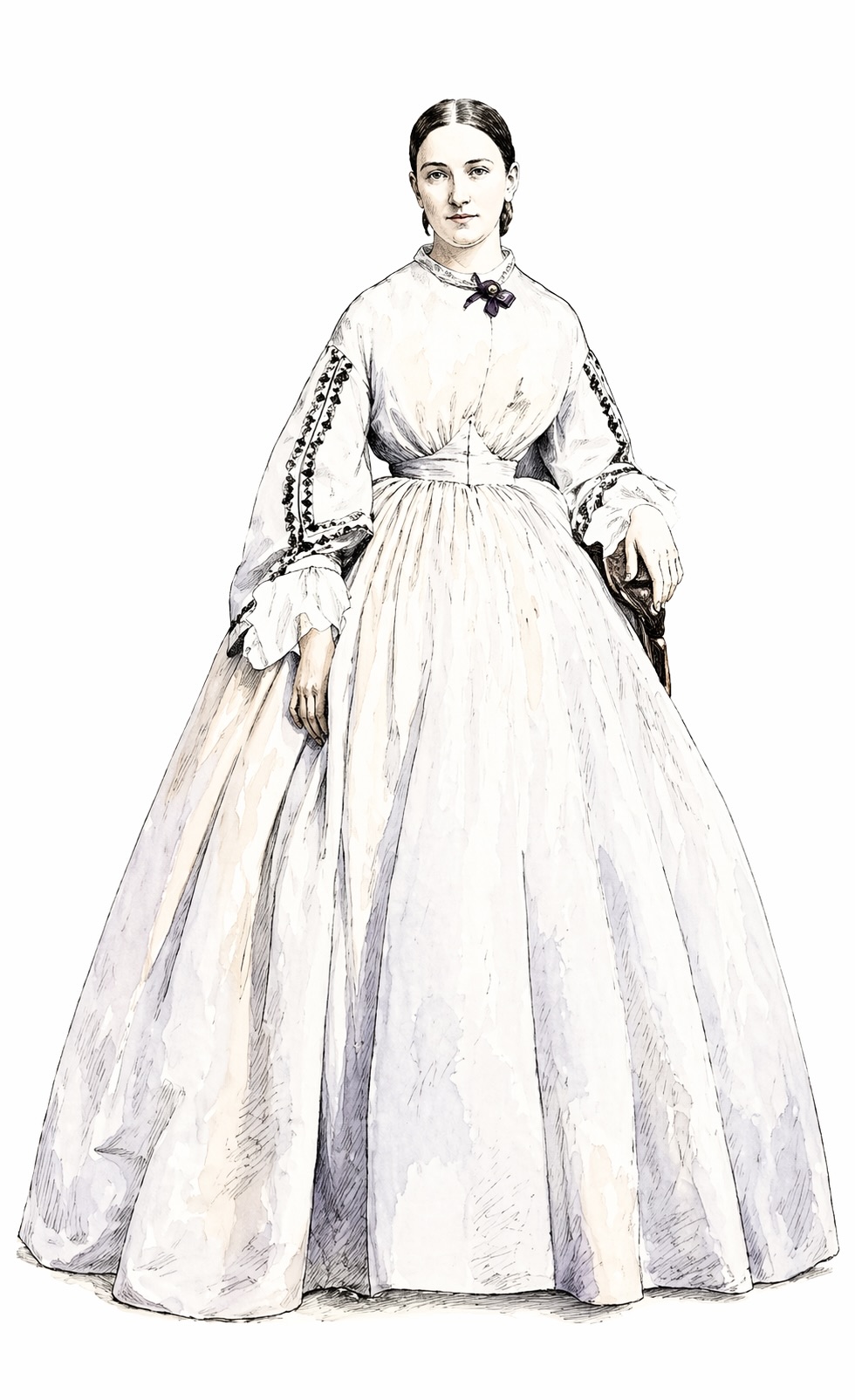
[Ferdinand C.] Duvall 1 and myself had a very pleasant journey from Augusta to Richmond—Duvall especially as he met up with a beautiful female friend of his and come the most of the way with her. This lady was the idol of General Hood’s heart, but unfortunately, [being a] one legged fellow, he did not succeed. Colonel, you—I have no doubt—think those young widows very charming but this Missee takes the shine off of any I saw at home. 2
Ferdinand C. Duvall of Co. C, 2nd Maryland Infantry
Bye the bye, how did you like that little 42nd cousin of mine we met at Dr. Holland’s? I was very much pleased to cousin such a charming little creature as I had never seen or heard of her before. I have not seen Duvall since I left him at Richmond, but had a letter from him the other day. He is with his regiment and desires to be remembered to you. If there has been a letter come for him at your office and you have not already forwarded it, please forward it thus: 2nd Maryland Infantry, Archers Brigade, Army of Northern Virginia. There was one sent to him while there which came from his home and he is very anxious to get it. I shall go over to see him soon to talk over our Georgia scenes. Col. Smith will of course be one of the characters. The sprightly widows and blue eyed damsels will all get a passing notice and the winding up will be the future prospects of another volume which I hope may be this winter, another mountain party or perchance another infair where Col. Smith and the artilleryman J. E. S. might figure conspicuously as rivals would certainly be a very desirable place for we old veterans to recreate at again.
We are now getting along very well. The boys complain of short rations occasionally, but I think they should lay the blame to their enormous appetites more than anything else. We have been drawing flour rations for some time now and this being the case, we are not yet in want of this article. But I shall be sure to make a requisition on Little River Mill if I should find it wanting.
Sally “Buck” Preston“takes the shine off any I saw at home.”
The prospects are now good for a rainy spell. It has now commenced this evening to drizzle a little and as it is quite warm, I think we will have a plenty of it. If so, Mr. Grant will hardly make any serious demonstrations very soon. He has made some reconnaissance on our right and left flank a few days ago, and perhaps this may be a prelude to more important demonstrations.
Well, Colonel, I will bring this to a close lest I weary your patience. Let me hear from you soon and when you see the young ladies, present them my loving regards. My regards to office friends. Truly your friend, — F. T. Griffin
1 Ferdinand C. Duvall (1835-1878) of Ann Arundel county, Maryland, served as the Captain of Co. C, 2nd Maryland Infantry. He was wounded seriously in the right thigh in the fighting at Peebles’ Farm on 30 September 1864 less than two weeks after this letter was written.
2 The beautiful female friend was undoubtedly Sally Buchanon (“Buck”) Preston of South Carolina. Gen. John Bell Hood famously courted her and described the courtship as his “hardest battle.” Hood married someone else after the war as did Duvall. Sally was mentioned in Mary Chestnut’s diary and claimed that all the men loved Buck. She also wrote that Buck confided to her that she would not marry Hood “if he had a thousand legs instead of having just lost one.”
Letter 4
Headquarters Reserve Camp Lane’s Artillery Battery Near Petersburg, Virginia November 16, 1864
Col. J. B. Smith Columbia Mine, Georgia
Dear Colonel, yours of October 20th was received a short time ago and as usual was read with much interest and should have been attended to ere this but as I have been in charge of our battery camp for two or more weeks and trying to get things under way for the cold of winter, I have found but little time to write. Today is appointed by the President for a day of public workship and as I have concluded to not go to church—it being quite cold—I will now (for fear of appropriating the day to a worse use) try to write to a few of my friends.
The flour you were so generous and kind to send to myself and J. W. S[hank]—two barrels—was received about a weeks ago and a thousand thanks from myself and mess & some of your other friends who I thought proper to divide with. The Strothers and Griffins have all partaken and pronounced it good with the rest of us. Myself and J. W. Shank are now messing together so of course we take a full benefit, after dividing liberally with the others of our respective old messes. But we all use of it as long as it lasts which, owing to the huge supply, will fatten us all up so we shall be able to stand the cold of winter. Myself and John [Shank] being the only two in Reserve Camp from our neighborhood, have joined horses andn with the aid of the Colonel’s contribution, or rather donation, we have been luxuriating on apple dumplings. Now Colonel, if you want to eat a good dumpling, just come out to see us and we will put the little pot into the big one and stir it with the skillet (provided all these necessaries can be found in camp)/ At any rate, we promise you a huge dumpling and as I have been exercising my hunting propensities, a bird pie occasionlly finds lodging on our table (without legs).
I have little or no news to communicate. Our Battery is on the lines and the boys over there three miles distant from here are very comfortably fixed for winter, having good cabins and brick chimneys. Here we are not altogether so fortunate in that respect yet for we have been waiting in suspense for a week just to know what to be at, the cause of which is this. The old gentleman on whose land we pitched our camp has raised a row about the scarcity of his wood and does not want us to to cut it down any more, so between the officials from Gen. Lee down, we have not yet received positive orders what to do. Most of the drivers had put up their houses and don’t like to have to move. Others had only half way finished so thus things stand. But I think we will be apt to get orders tomorrow to move one mile farther and pitch into somebody else’s timber and then in a few days I expect to have a brick chimney and a fireside of my own. And as I am the only officer in charge of all the drivers and horses, being boss, I do as I please—go and come when I please to go. to see who I please, and have a good time generally.
Well, Colonel, in the midst of this general pleasing, I have pleased to go to see a nice little girl near here of sweet 17—sound on the slavery question—good-looking and accomplished. Have an invitation to come over to play whist and to be on hand at meal times when I am so disposed. But you need not imagine I am taking on. I know how to play my hand to make it pay in more ways than one.
Now about that sweet little Augusta cousin living in Wilkes [county]. Since she has expressed herself in such unmistakeable terms as to answer a letter, she shall certainly soon have no excuse to say why she has not answered one. I am under many obligations to you, Colonel, to have given me such a chance for so amiable a correspondent. I will now tell you something. I sent her two nice pieces of new music upon my return through Richmond and received a beautiful little note in reply. In a few [words], says she shall hear from me again since you have opened the way. That was a good joke you got on Miss Molly but I think she committed herself unthoughtedly and without the intention of doing so. From her subsequent apology, this certainly was the case, and you should not consider yourself entirely out of the ring even though artillery should play against you. I learn that after a beautiful burst up, Miss Lou Tankersley has at last come to a sensible conclusion not to sleep by herself these cold winter nights, so I shall expect to hear yet from J. B. S. and J. E. S. on the subject.
I shall go to Richmond in a few days and will have an opportunity of seeing some lady friends there and perhaps I may find out what has become of [Ferdinand C.] Duvall. Poor fellow. Since he was wounded [at Peebles’ Farm], I have not heard from him for a long time now. I am glad you and artilleryman has a good time together and thought of your old friends. I hope we may all yet meet again around the social band.
I have not said anything about military affairs, elections, &c. In the former, nothing of interest has lately taken place. The election of Abraham the 1st I believe is generally conceded to have been the best for us so here we go for another 4 mile heat. Abraham in the meantime, I think, will be likely to break down on the road. Let me hear from you again as often as you can make it convenient. Give my love to the fair sex and regards to friends. Truly your friend, — F. T. Griffin
P. S. All friends well & in fine spirits. B. G. Paschal is discharged and returns home, poor fellow, I hope to regain his shattered health.
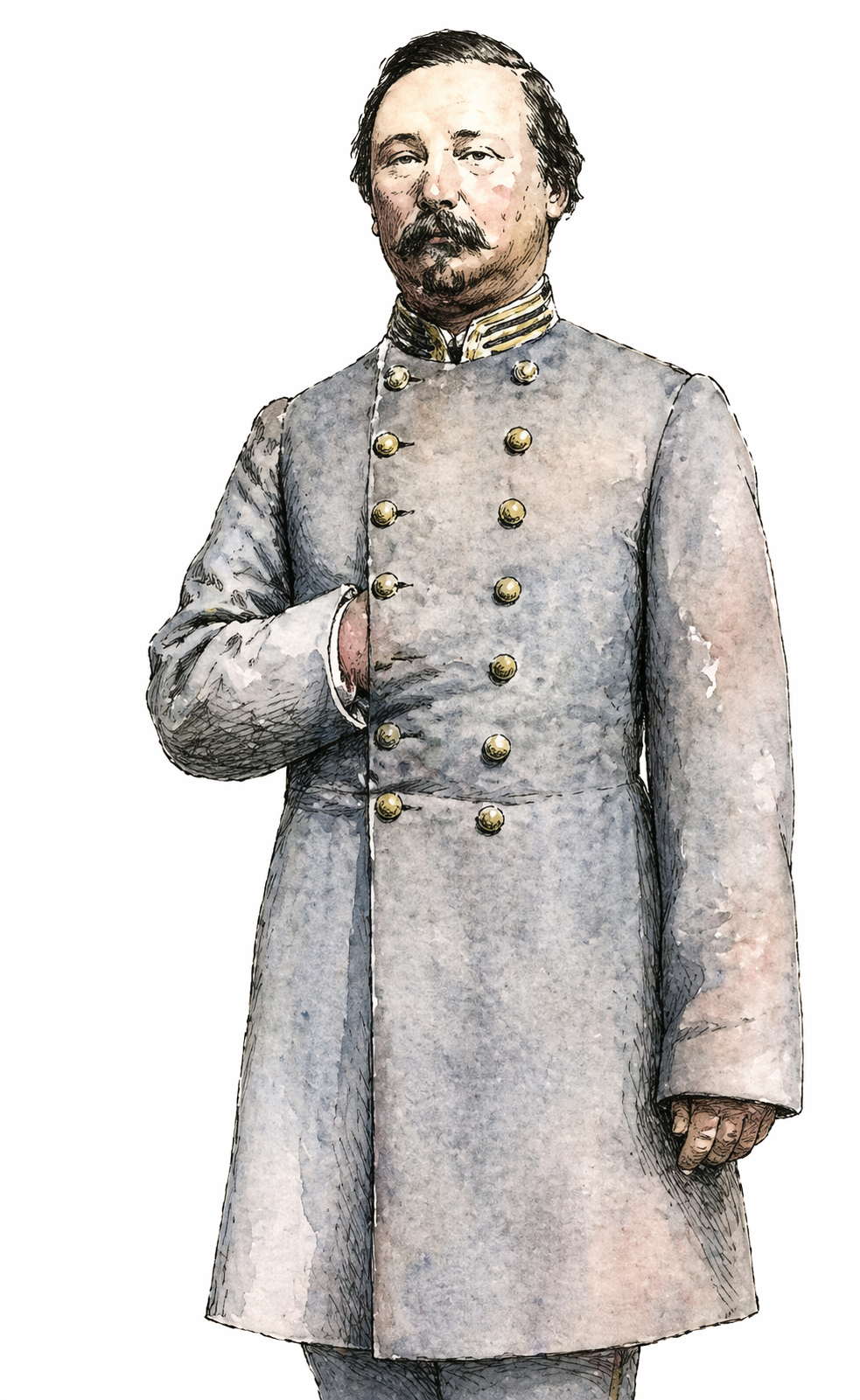
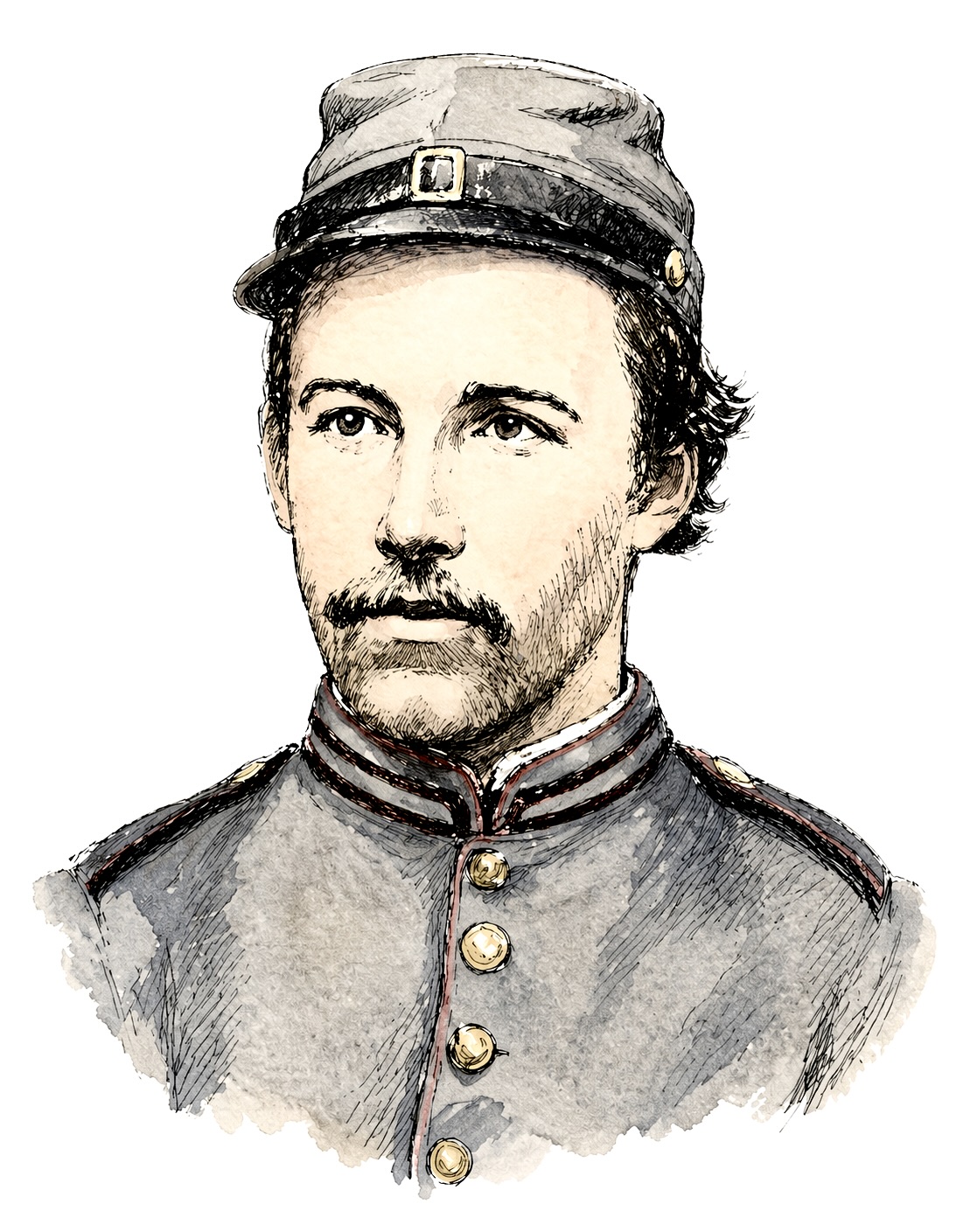
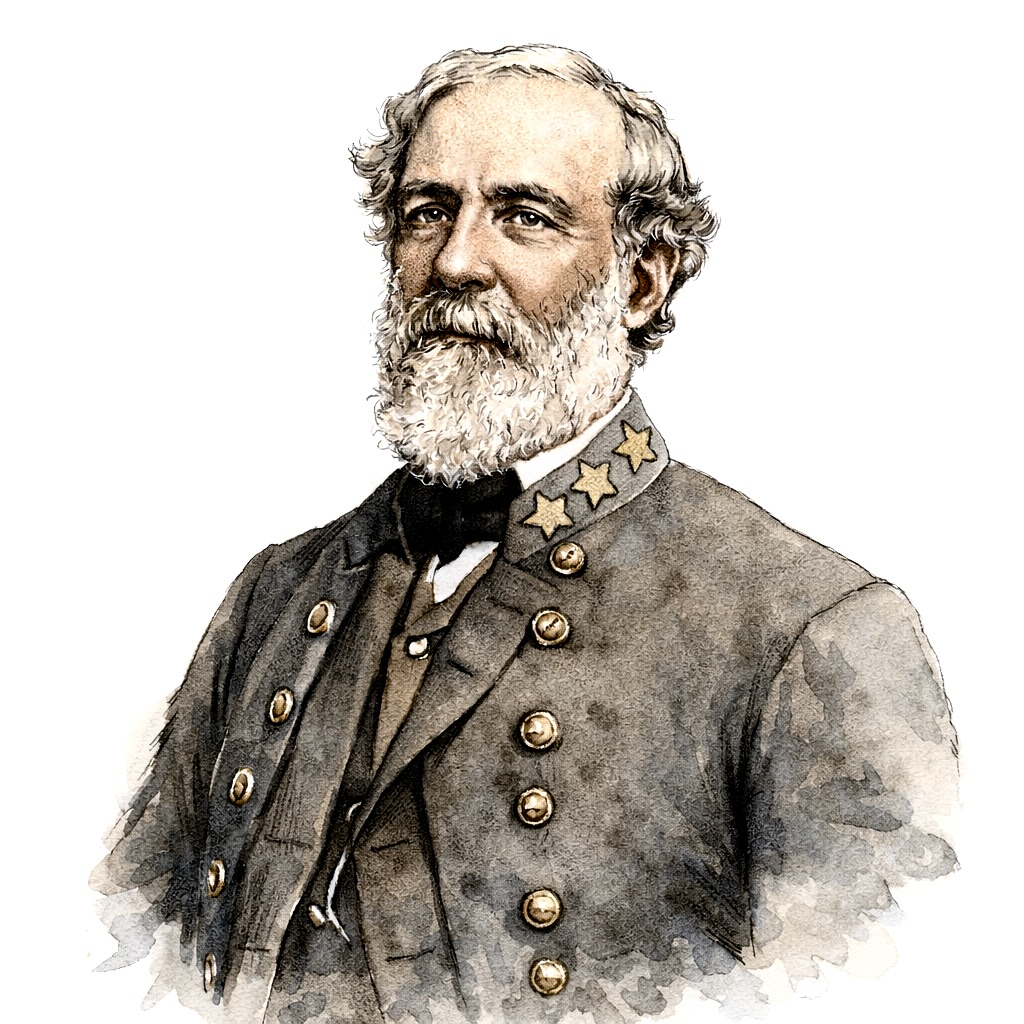
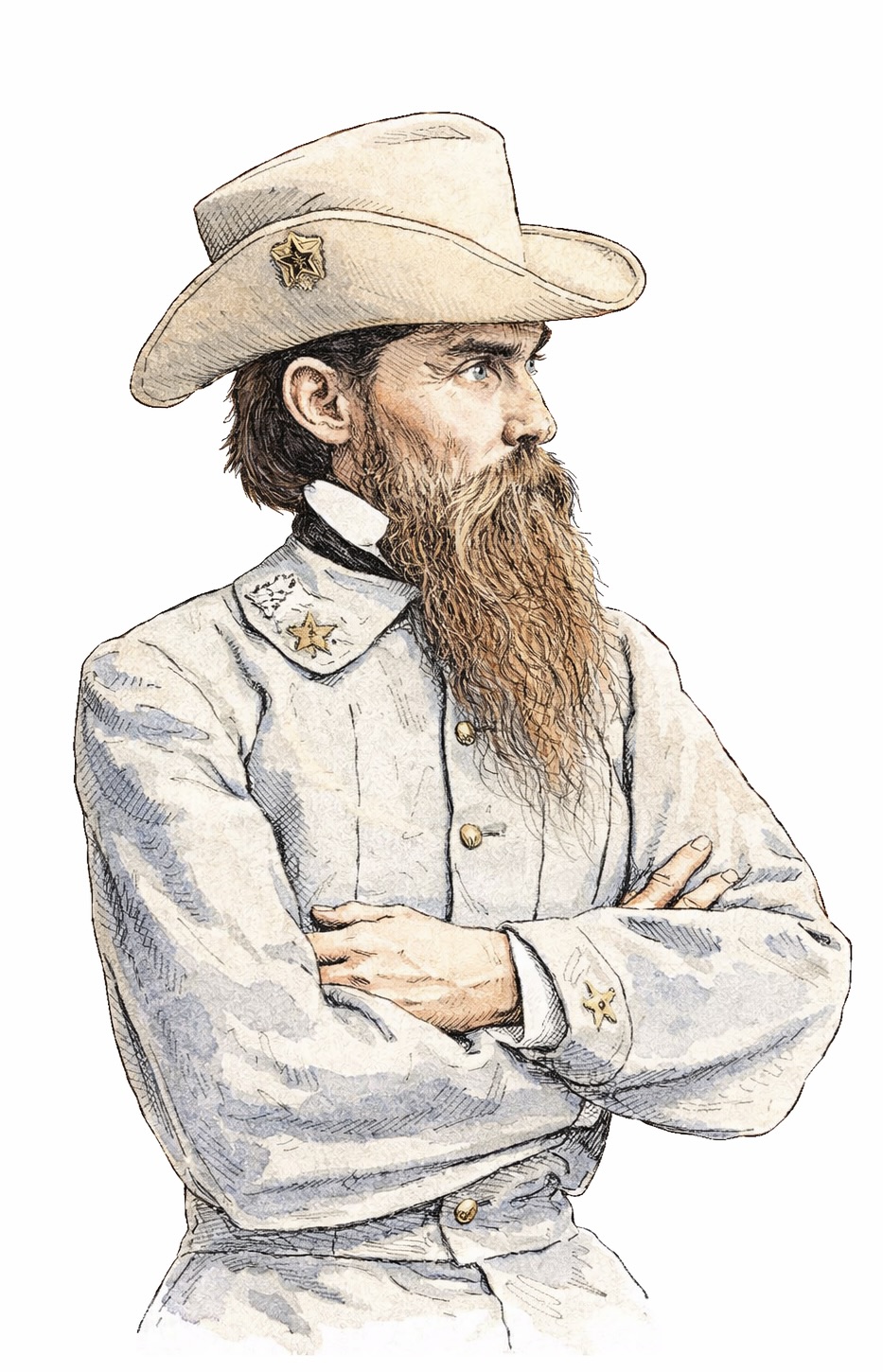
An AI generated image of Joseph A. Shank, 11th Georgia Artillery, based on a post war sketch of him.
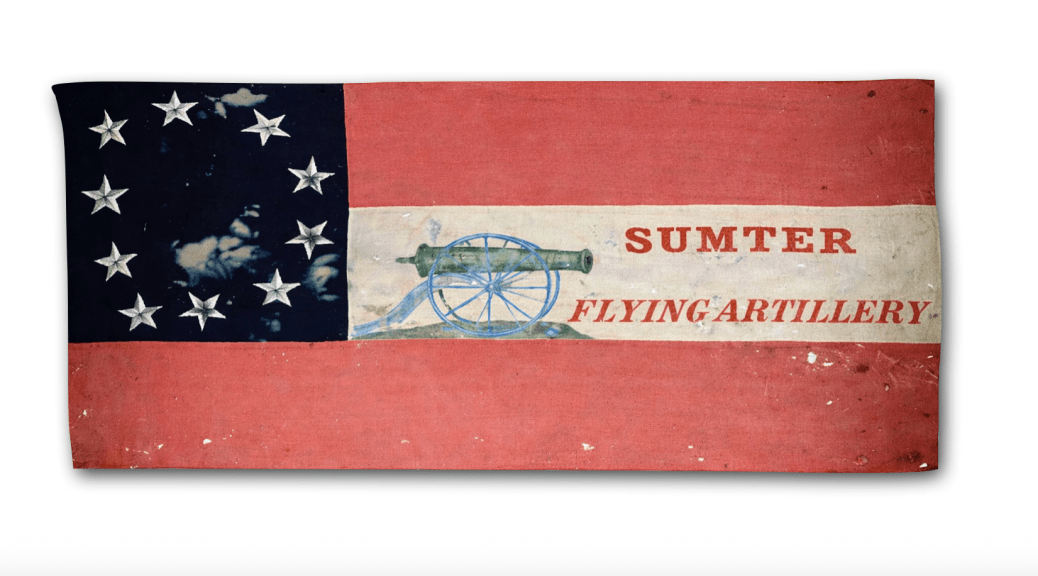
The following letters were written by members of the Shank family who served in the Confederate army with the Sumter Flying Artillery, a.k.a. the 11th Georgia Artillery, during the Civil War. Eleven of them were written by Sgt. John West Shank (1839-1875) and two of them by John’s younger brother, Pvt. William Baxter Shank (b. 1845). John and William were the sons of Felix Shank (1800-1874) and Mary Leverette of Wilkes county, Georgia. There are also seven letters by their cousin, Pvt. Joseph (“Joe”) A. Shank (1843-1912), the son of George and Theresa Leverette of Wilkes county. Joseph’s letters are, perhaps, the most descriptive of the lot. Though Joseph’s educational opportunities were limited, he acquired a very good English education and later studied at the Southern Baptist Theological Seminary in Greenville, South Carolina, enabling him to engage in the ministry.
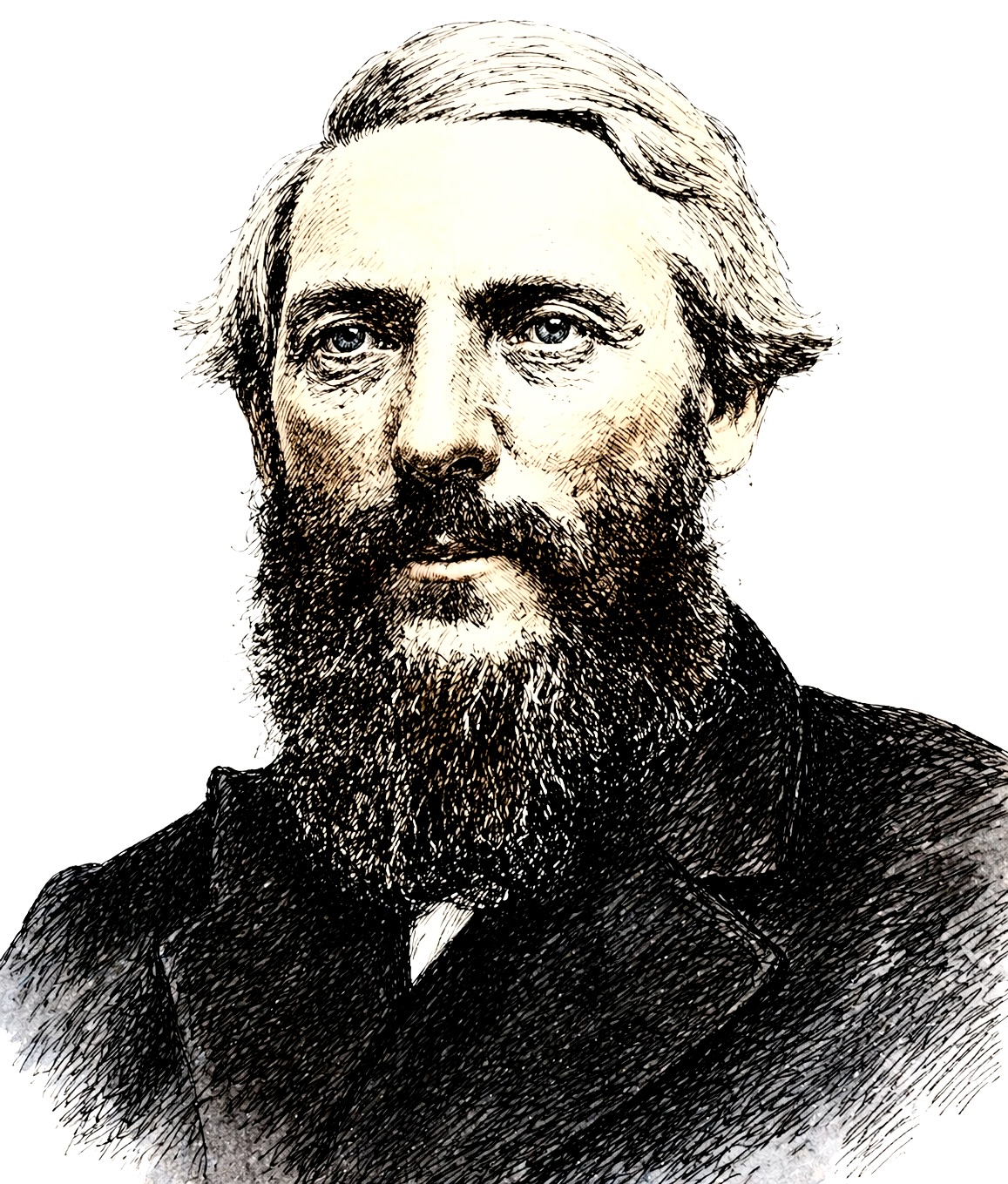
Col. Joseph Belknap Smith
All of the letters were written to Col. Joseph Belknap (“J. B.”) Smith (1815-1898), the son of Joseph Nicholas Smith (1771-1857) and Polly Emerson (1784-1868) of Strafford county, New Hampshire. Joseph Belknap Smith (1802-1916) was a speculator and one of the founders of the Columbia Mining Company in eastern Georgia, not far from the Savannah river, where gold mining had been going on since the 1820s. By the 1850s, the mining operations required capital and equipment to extract the gold from veins deep in the ground. It also required steady labor for digging, hauling, and washing the ore—a labor that was supplied principally by slaves. The slaves were either owned outright by investors or hired from local slaveholders, of which there were many in the area. For example, Felix Shanks and his brother George owned 50 slaves between them, some of whom may have been hired by Smith seasonally. Smith’s operations at Columbia included a stamp mill and ore-processing machinery, producing as much as $2 million in gold before the Civil War (roughly 4 tons of gold). Records held in the Duke University Archives indicate that he employed about 120 enslaved laborers and processed 10 tons of ore per day.
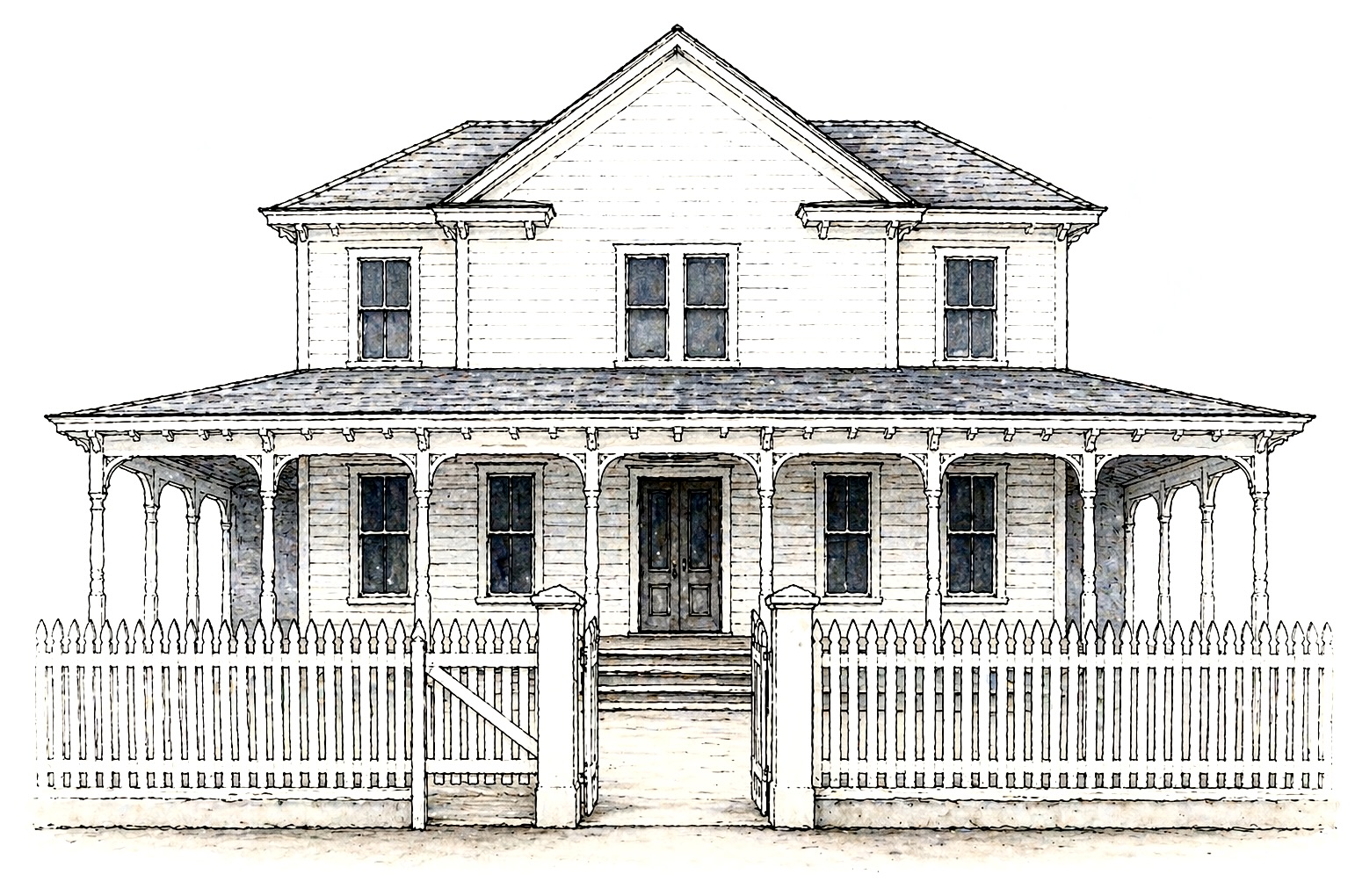
Joseph Belknap Smith home on the Little River, now under water due to the Strom Thurmond Dam.
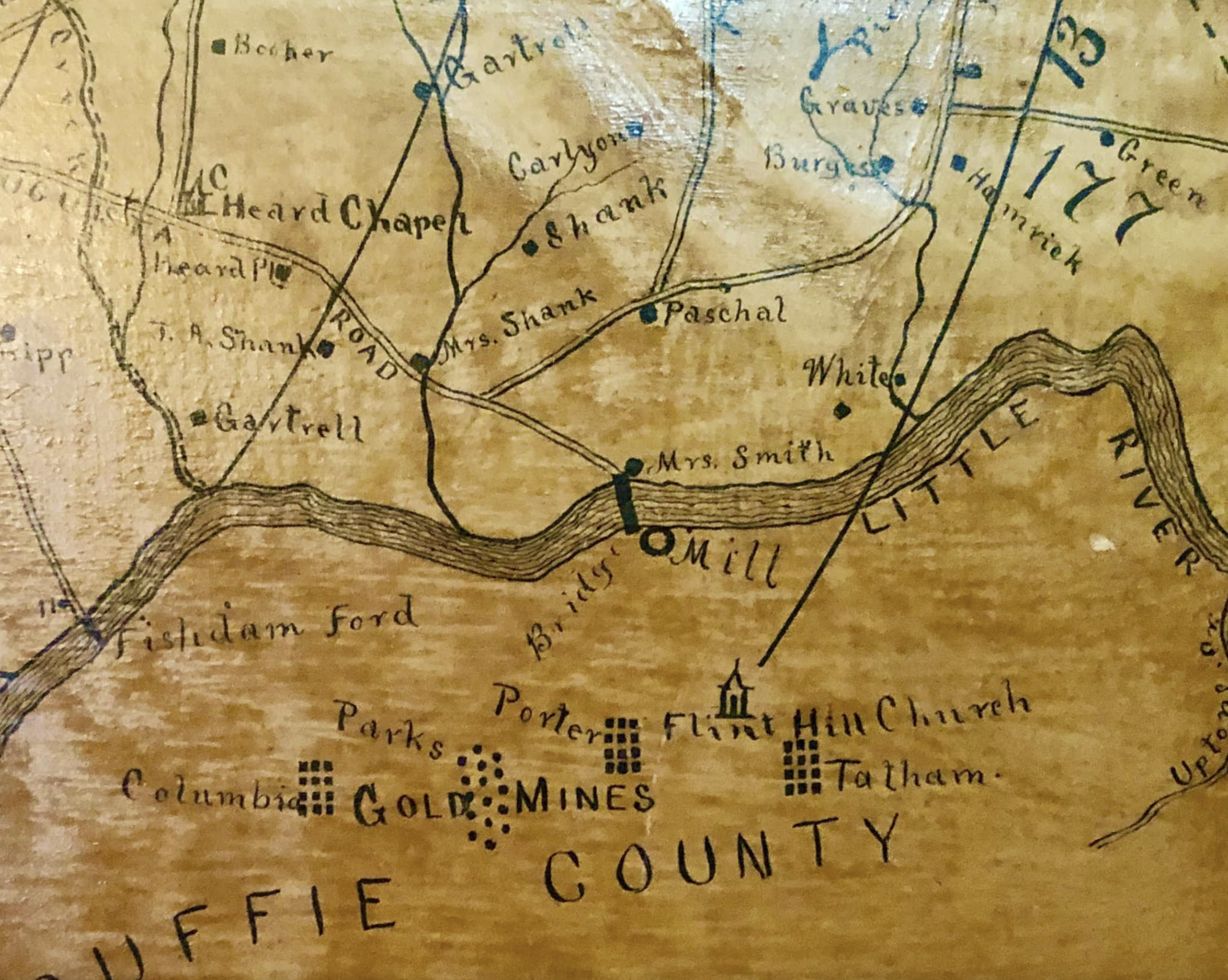
“J. B.” Smith was married and widowed twice before the Civil War. He was married a third time in April 1865 to Jane Septima (“Sep”) Shank (1841-1912), the sister of John and William Shank—thus securing the preservation of these Shank family letters. The Smith and Shank families lived in Wilkes county near the Little River—the dividing line between Wilkes and McDuffie county. Columbia gold-mining operations were in McDuffie county south of the river (see map below).
There are also two letters included that were written by Joe Shank on behalf of a slave named Jesse Day who was owned by Joseph B. Smith but hired by Joe to serve as his mess cook in the battery. The letters don’t reveal Jesse’s age but both were addressed to his mother.
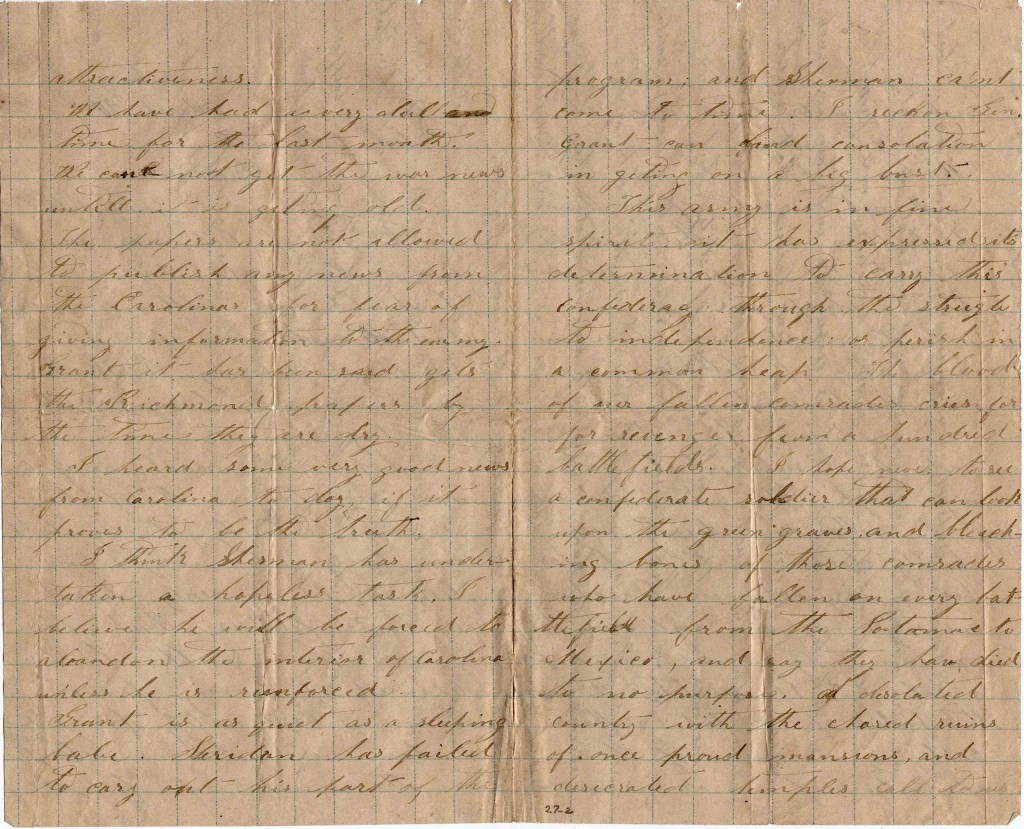
Finding collections of letters such as these by Confederate soldiers is becoming incredibly difficult—especially ones that convey such a strong optimism for victory throughout the entire war. The following paragraph, written in late March 1865, reveals just how strongly the Shank family felt right up to the bitter end: “This army is in fine spirits. It has expressed its determination to carry this Confederacy through the struggle to independence or perish in a common heap. The blood of our fellow comrades cries for revenge from a hundred battlefields. I hope never to see a Confederate soldier that can look upon the green graves and bleaching bones of those comrades who have fallen on every battlefield from the Potomac to Mexico, and say they have died to no purpose. A desolated country with the charred ruins of once proud mansions, and desecrated temples call to us for protection. The tears of widows, and orphans, and the tears of outraged and insulted maidens appeal to us and we must not—cannot—refuse them protection. To these and the dictates of conscience, we can’t turn a deaf ear.”
Index to letters:
John West Shank letters: 1, 2, 4, 5, 8, 9, 13, 15, 19, 20, 21 Joseph A. Shank letters: 6, 7, 10, 11, 14, 17, 18 William Baxter Shank Letters: 16, 22 Jesse Day (slave) Letters: 3, 12
Letter 1
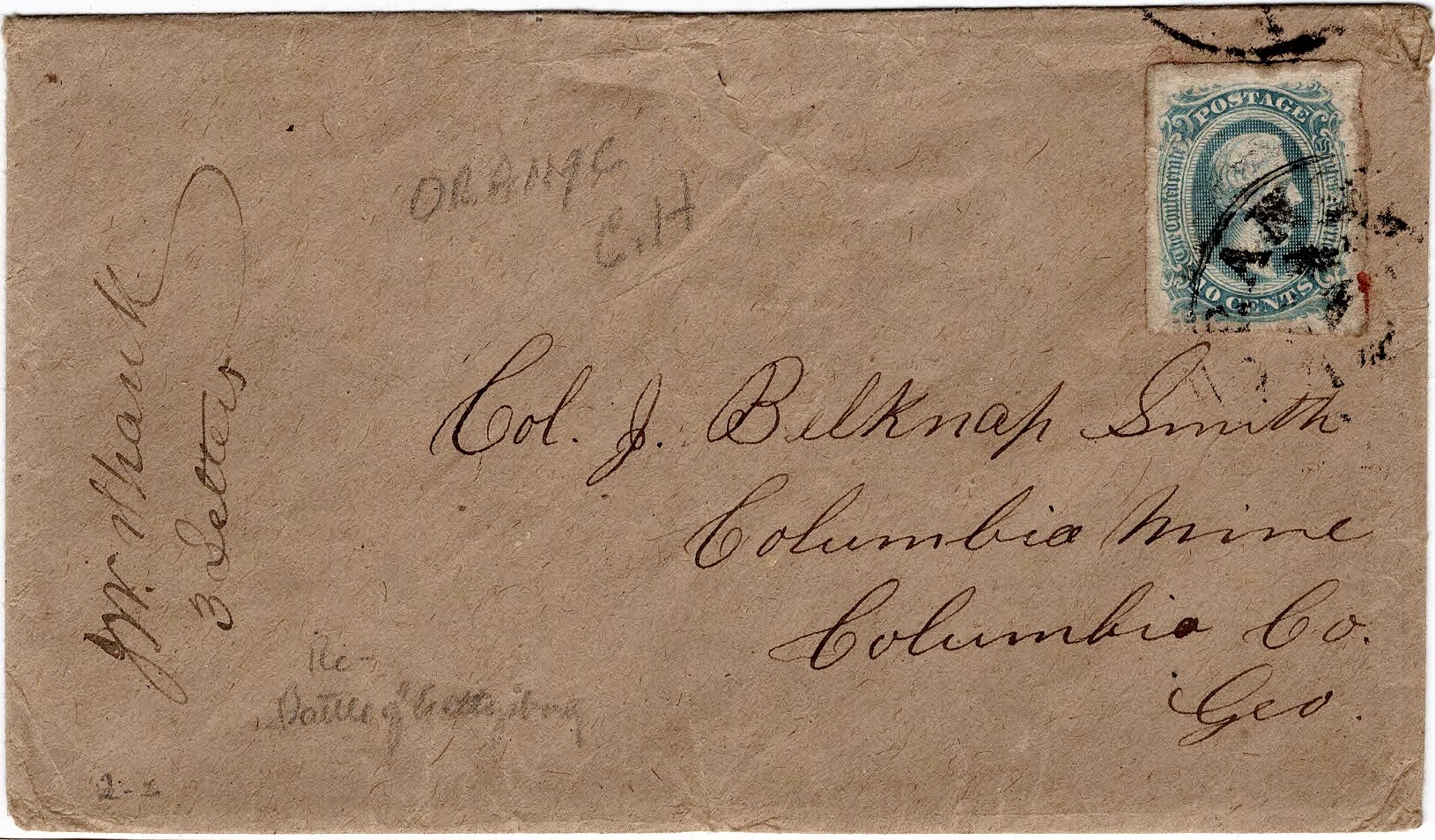
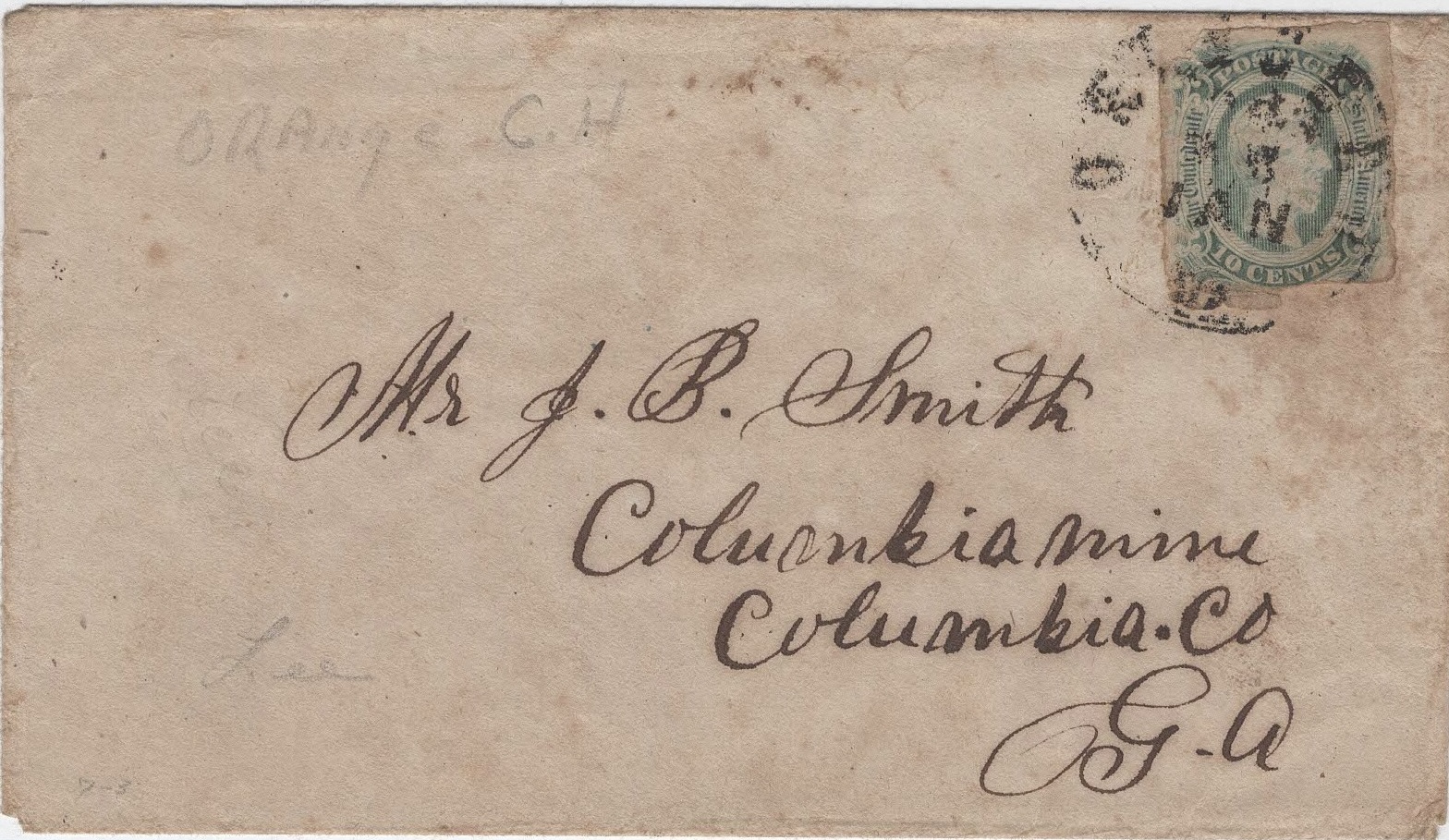
Addressed to Col. J. B. Smith, Columbia Mine, Georgia
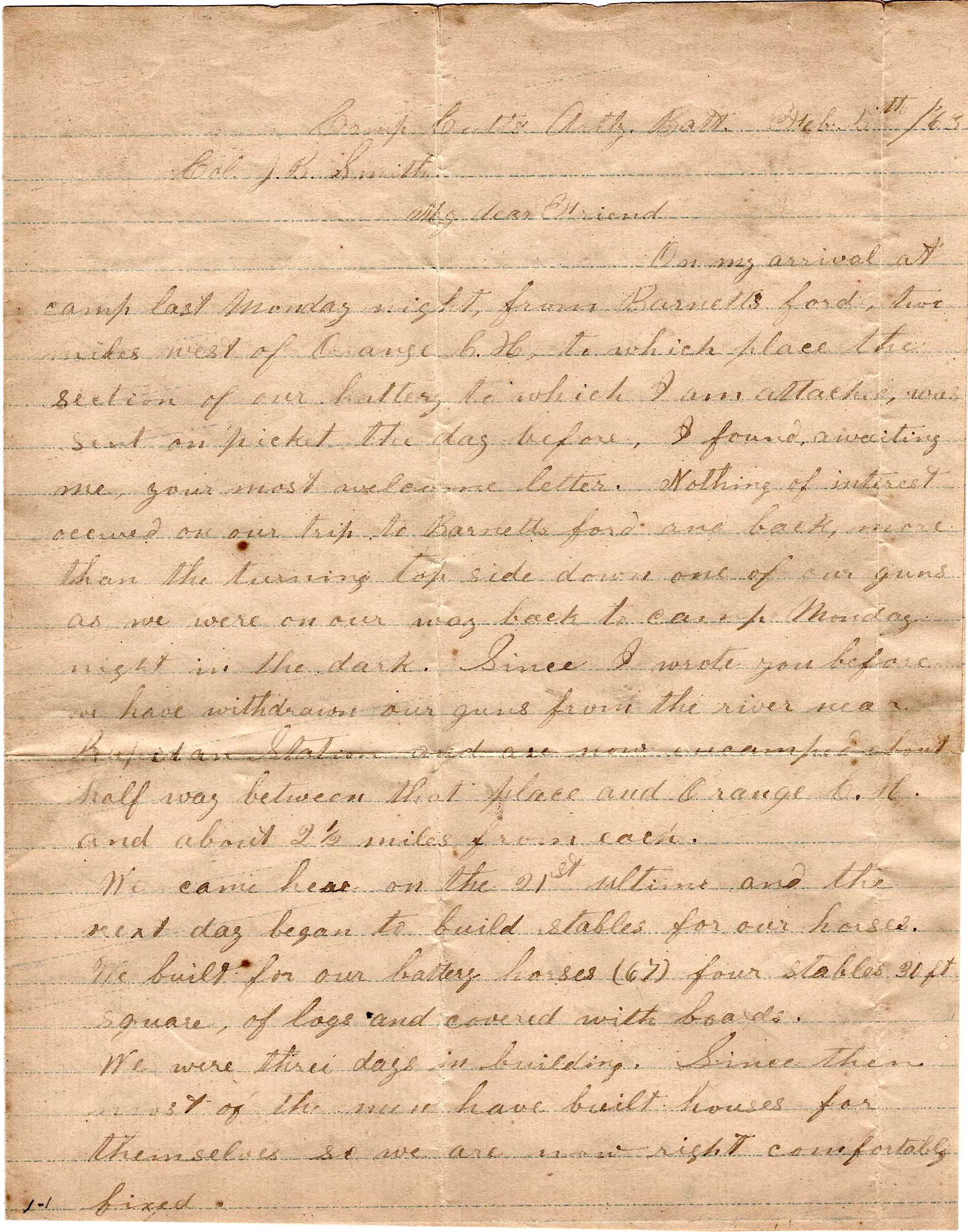
Camp Cutts Artillery Battalion February 5th 1863
Col. J. B. Smith,
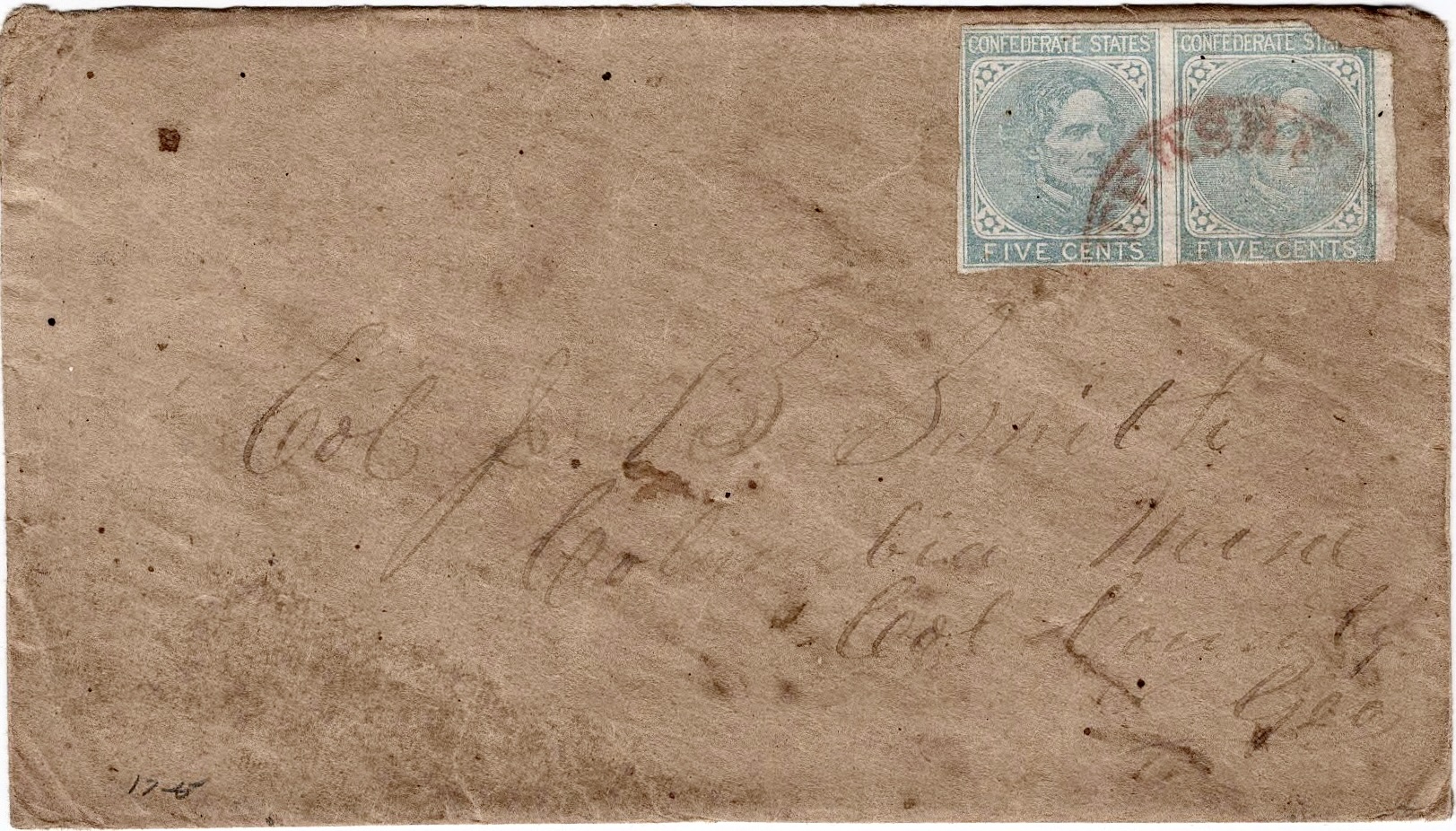
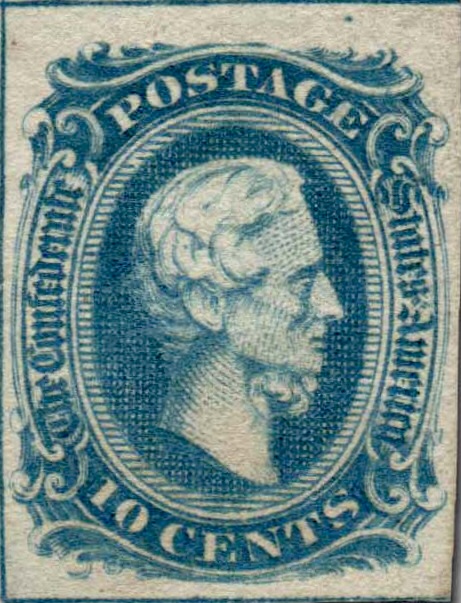
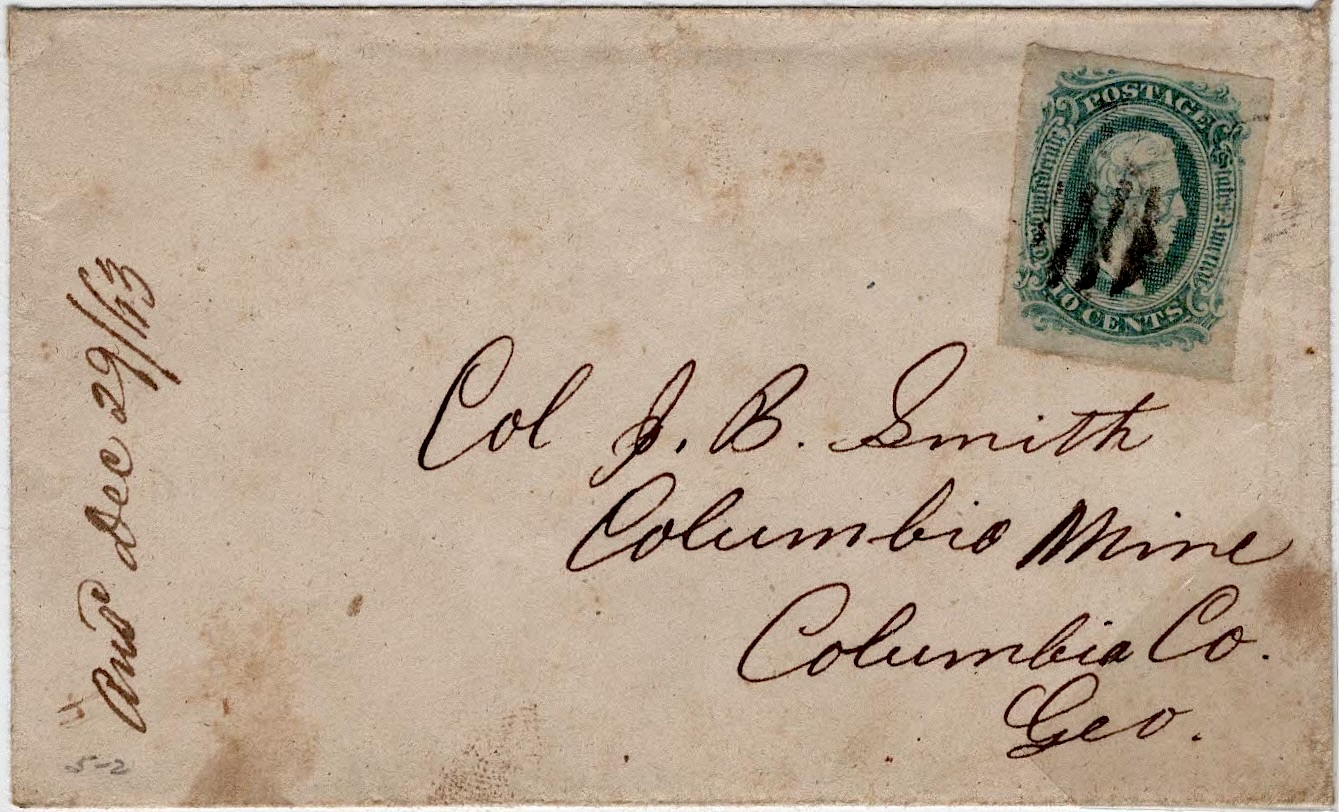
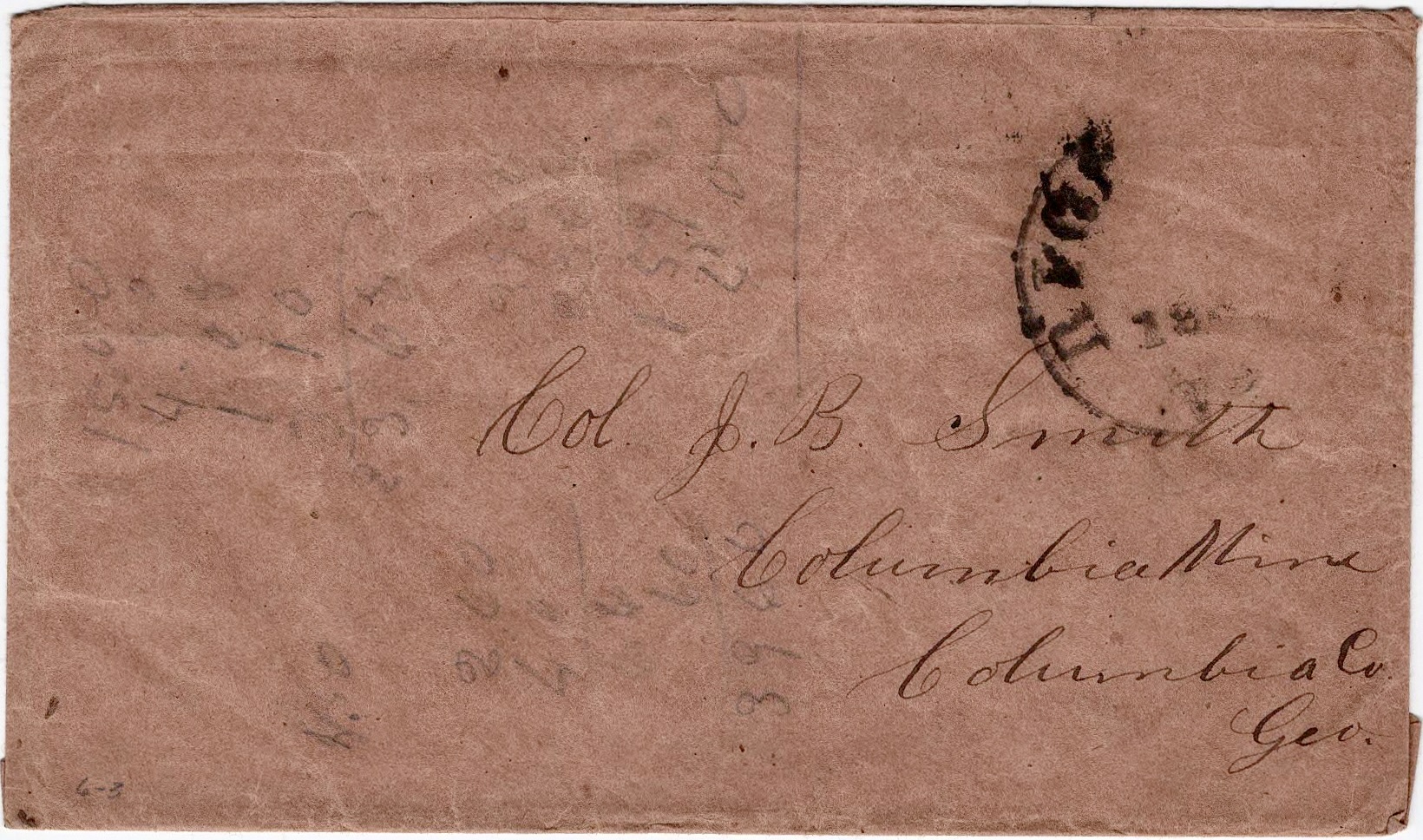
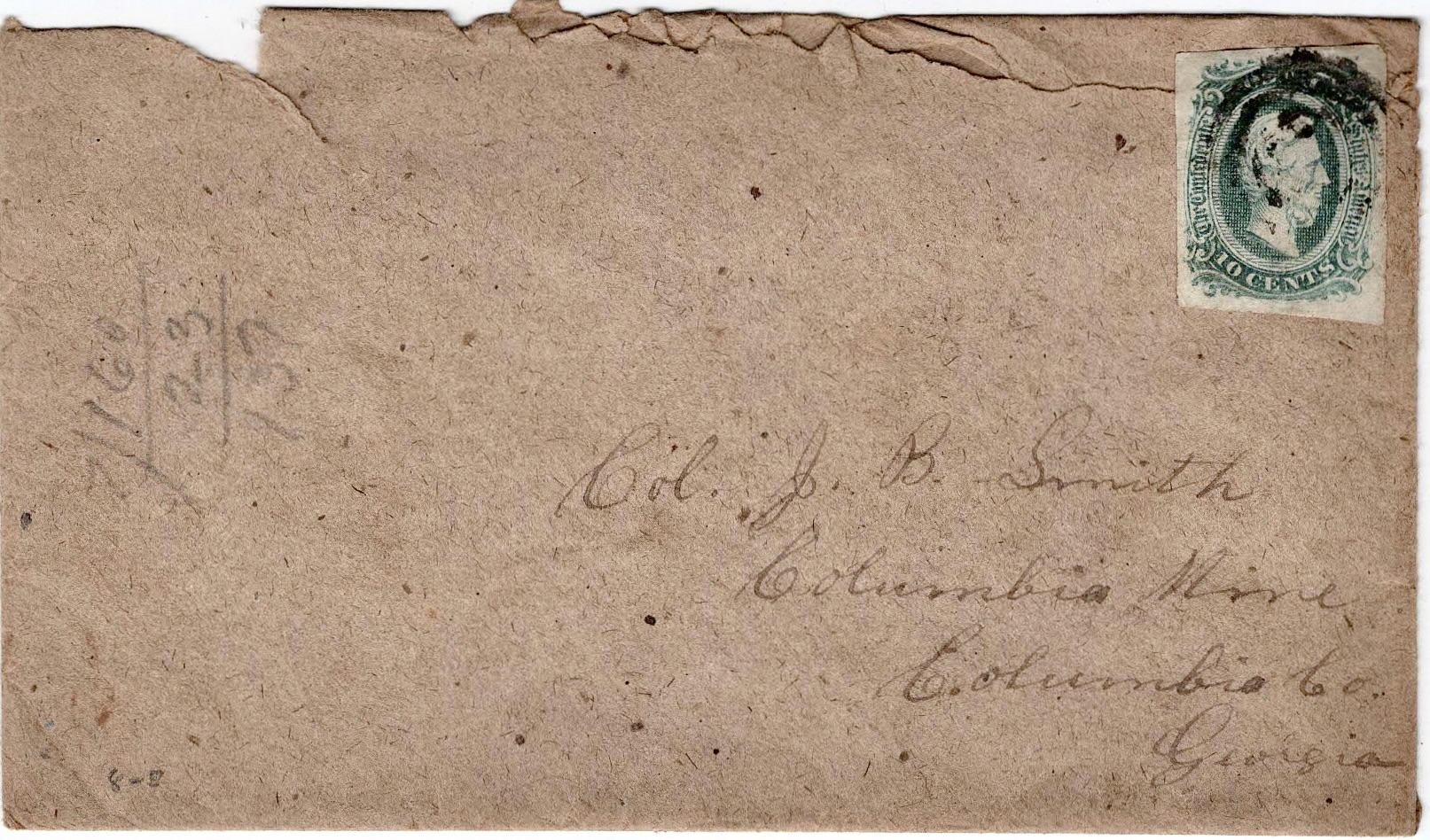
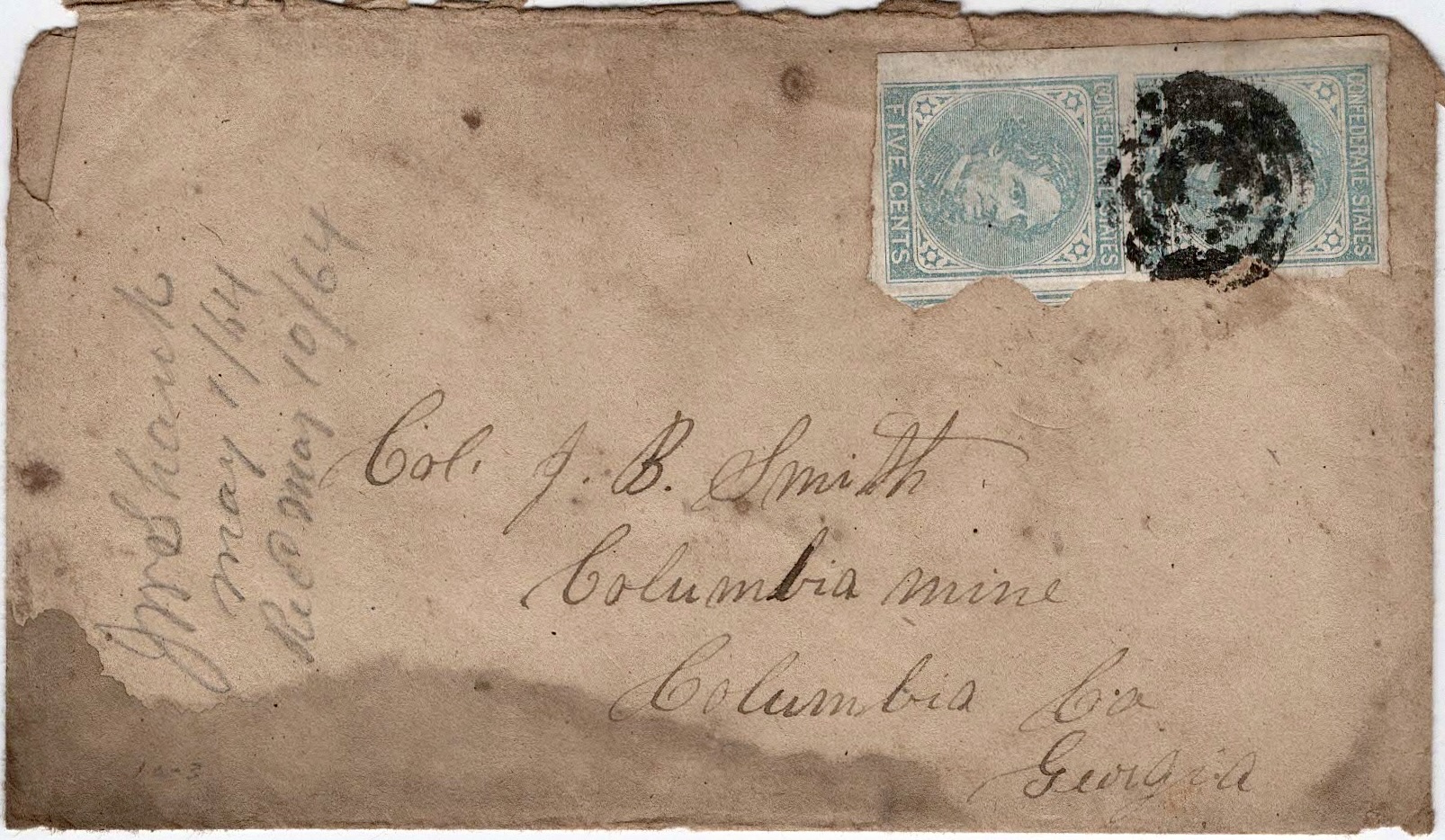
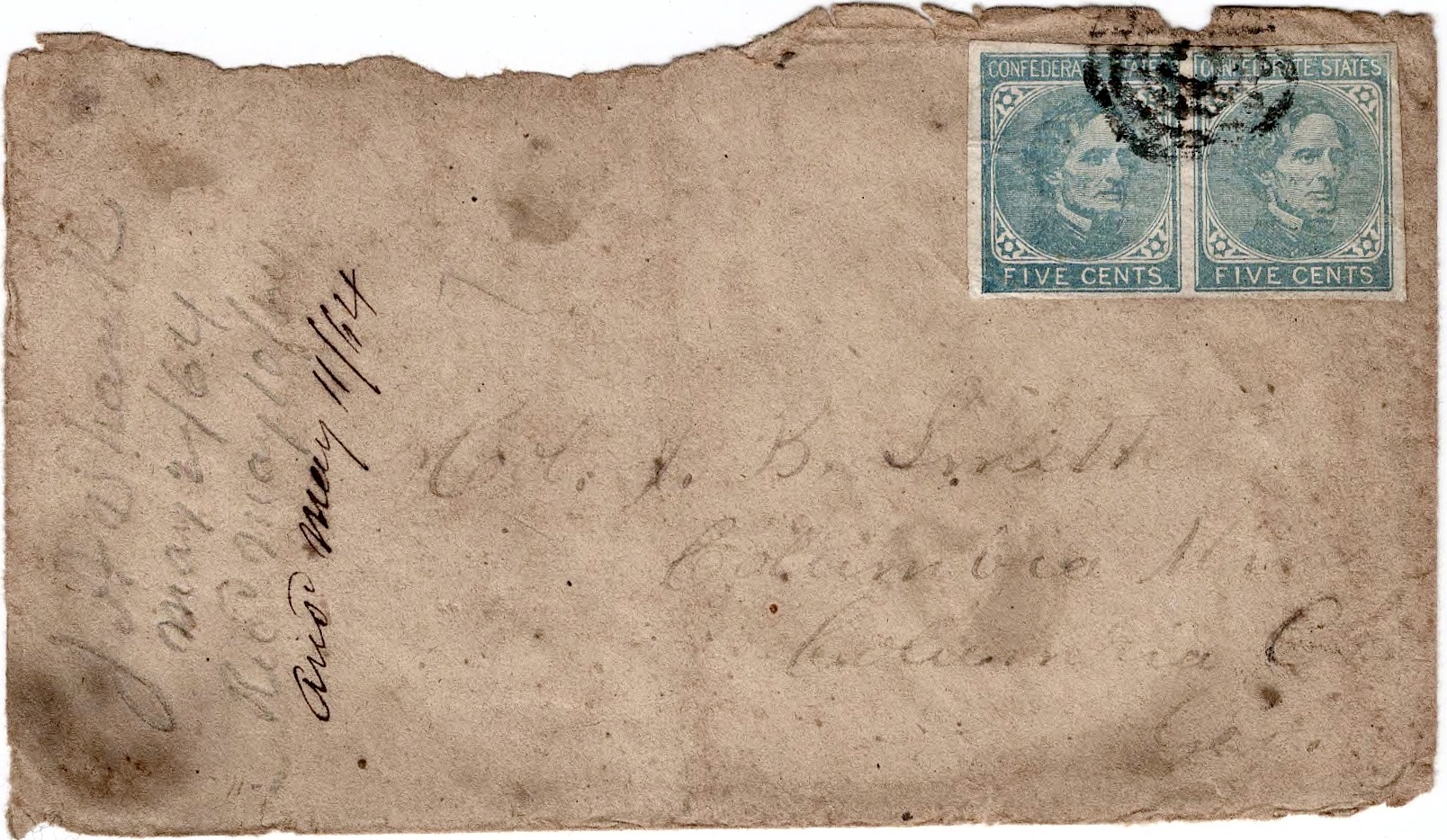
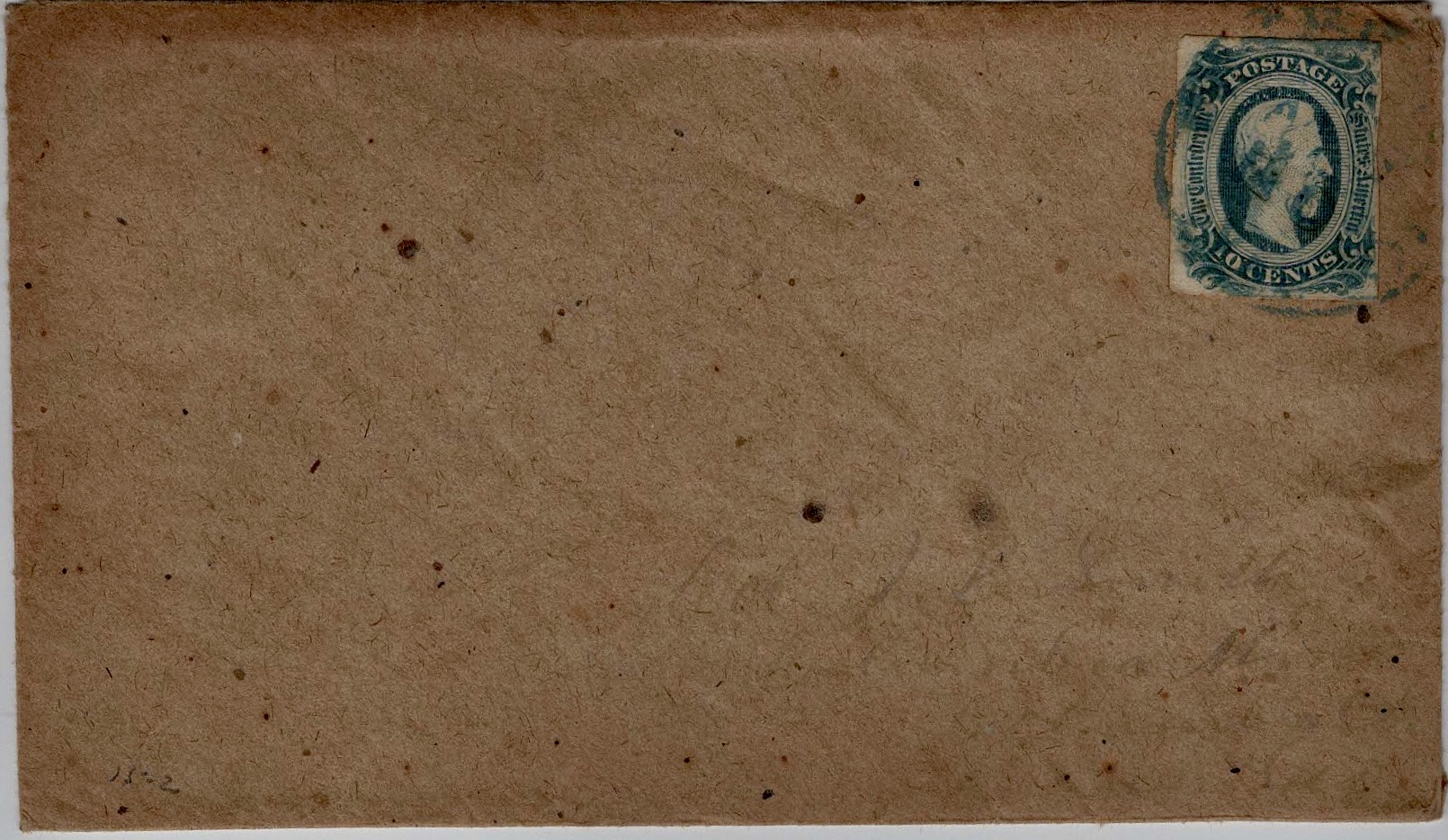
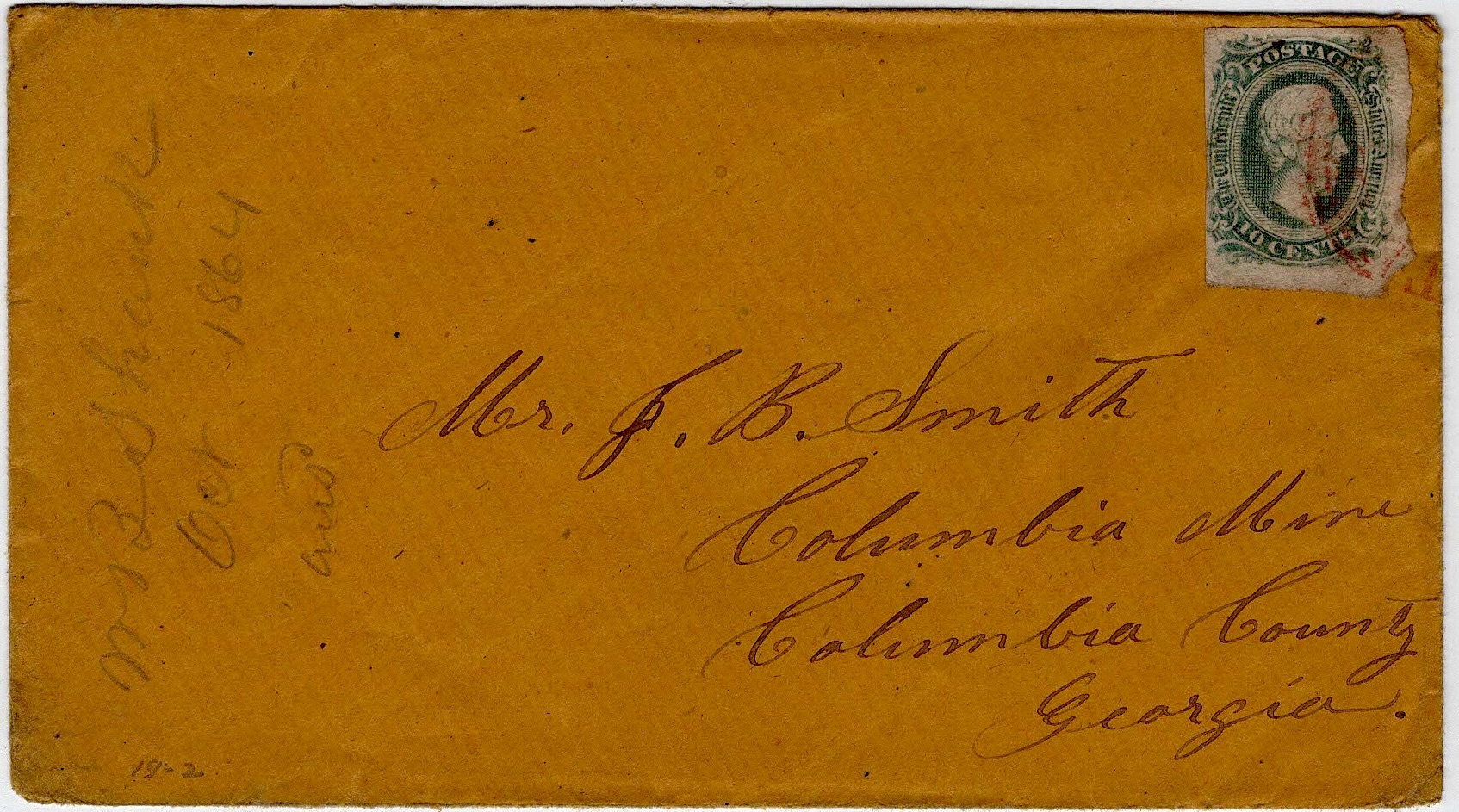
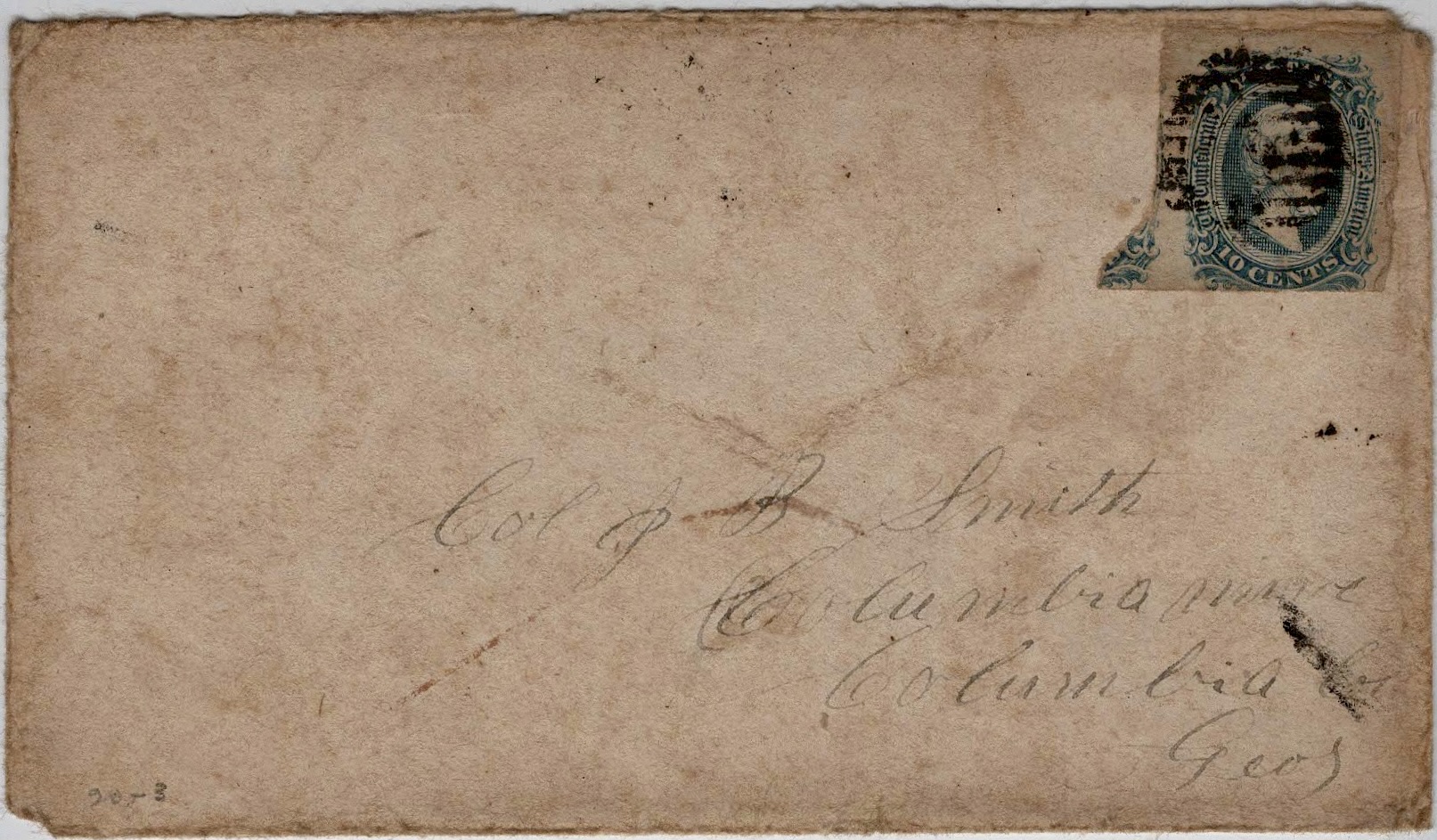
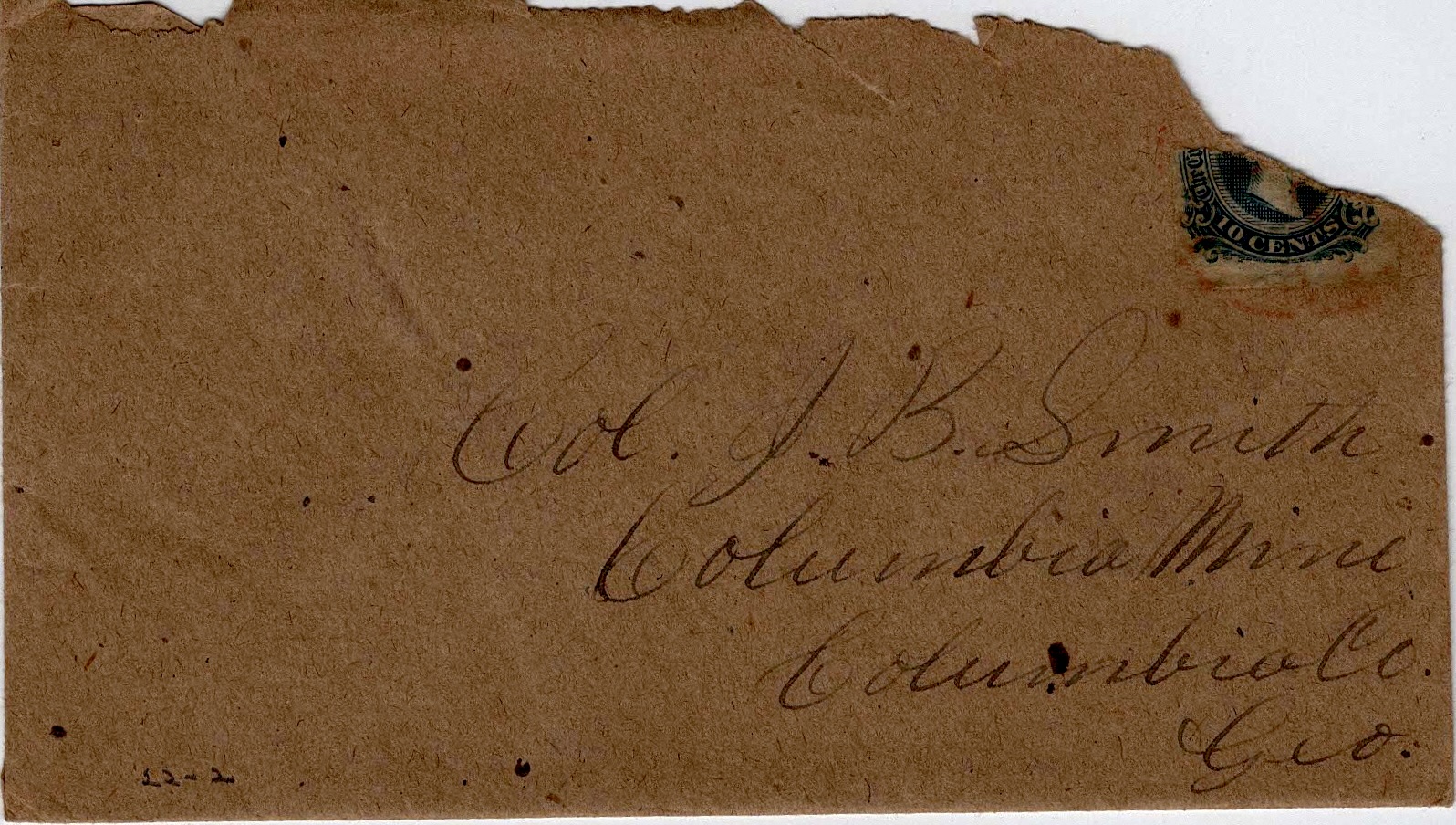
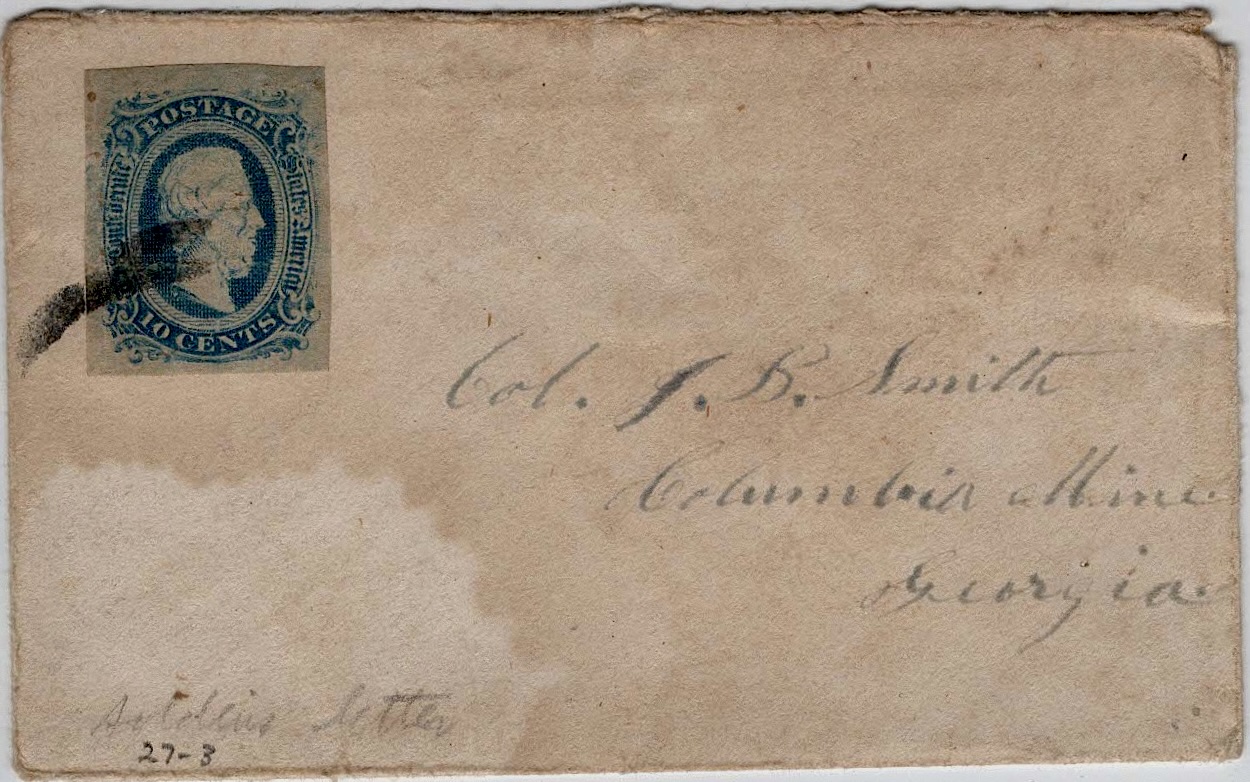
The stamp used on this envelope & others in this collection was an 1863 10 cent Jefferson Davis, Confederate States stamp.
My dear friend, on my arrival at camp last Monday night from Barnett’s Ford two miles west of Orange Court House to which place the section of our battery to which I am attached was sent on picket the day before, I found a waiting for me your most welcome letter. Nothing of interest occurred on our trip to Barnett’s Ford and back more than turning top side down one of our guns as we were on the way back to camp on Monday night in the dark.
Since I wrote you before, we have withdrawn our guns from the river near Rapidan Station and are now encamped about halfway between that place and Orange Court House and about two and a half miles from each. We came here on the 21st ultimo and the next day began to build stables for our houses. We built for our battery horses (67) four stables 30 feet square, of logs and covered with boards. We were three days in building. Since then, most of the men have built houses for themselves so we are now right comfortably fixed.
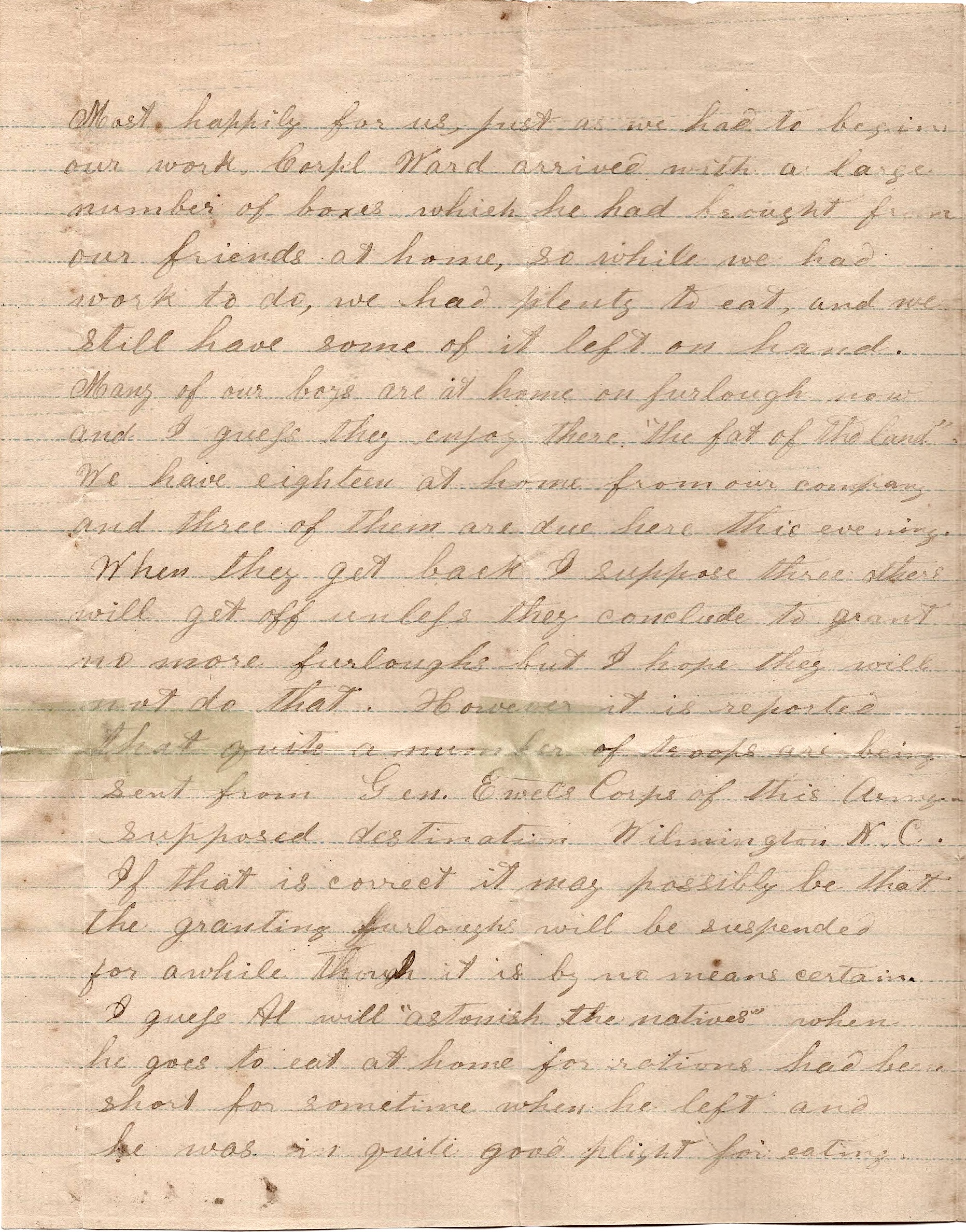
Most happily for us, just as we had to begin our work, Corporal Ward arrived with a large number of boxes which he had brought from our friends at home, so while we had work to do, we had plenty to eat and we still have some of it left on hand. Many of our boys are at home on furlough now and I guess they enjoy there “the fat of the land.” We have eighteen at home from our company and three of them are due here this evening. When they get back, I suppose three others will get off unless they conclude to grant no more furloughs but I hope they will not do that. However, it is reported that quite a number of troops are being sent from Gen. Ewell’s Corp of this army—supposed destination Wilmington, North Carolina. If that is correct, it may possibly be that the granting furlough will be suspended for a while though it is by no means certain. I guess Al will “astonish the natives” when he goes to eat at home for rations had been short for some time when he left and he was in quite good plight for eating.
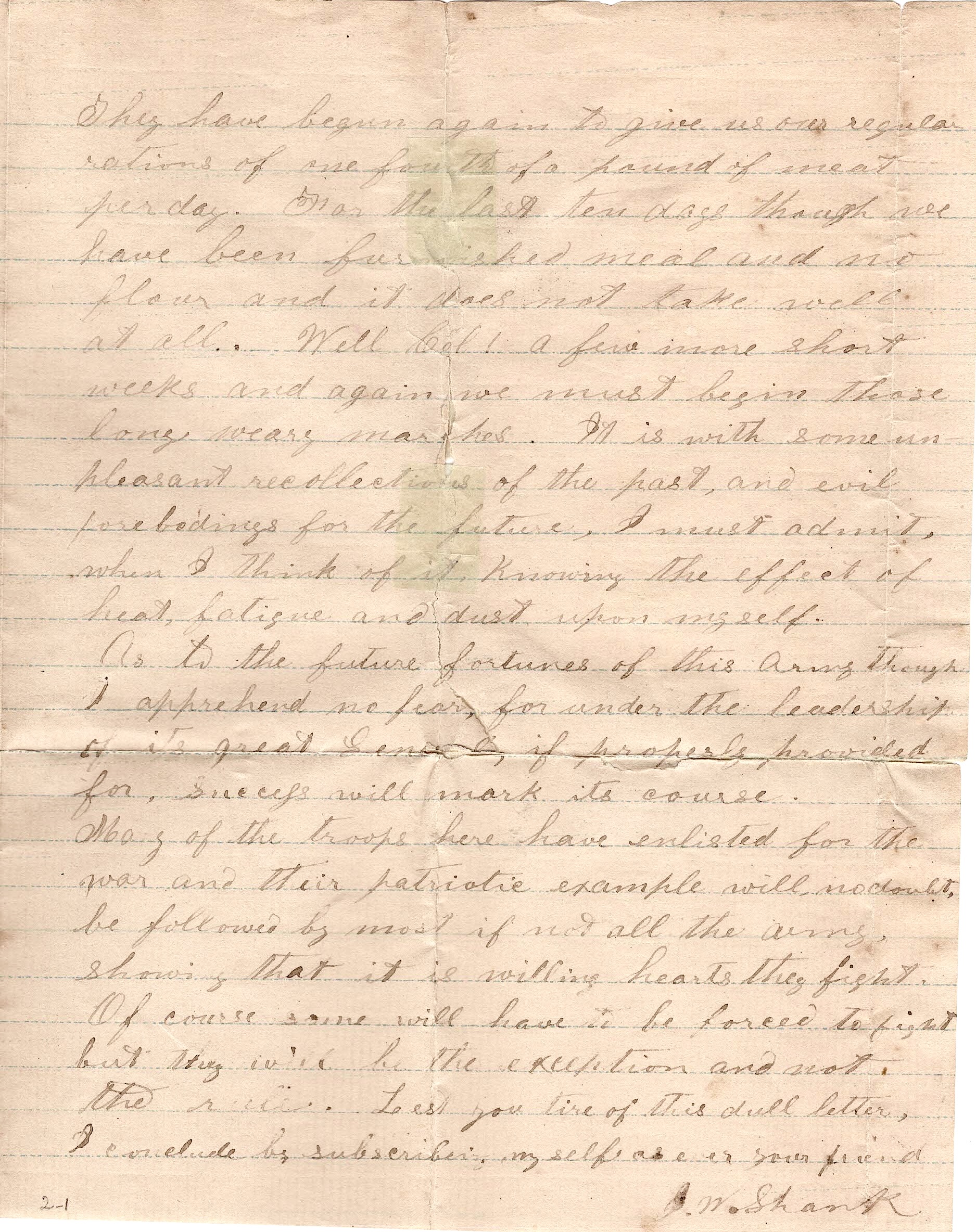
They have begun again to give us our regular rations of one fourth of a pound of meat per day. For the last ten days though we have been furnished meal and no flour and it does not take well at all. Well, Colonel, a few more short weeks and again we must begin those long weary marches. It is with some unpleasant recollections of the past, and evil forebodings for the future, I must admit when I think of it, knowing the effect of heat, fatigue and dust upon myself. As to the future fortunes of this army though, I apprehend no fear, for under the leadership of its great General, if properly provided for, success will mark its course.
Many of the troops here have enlisted for the war and their patriotic example will, no doubt, be followed by most if not all the army, showing that it is willing hearts they fight. Of course some will have to be forced to fight but they will be the exception and not the rules. Lest you tire of this dull letter, I conclude by subscribing myself as your friend. — J. W. Shank
Letter 2
Camp four miles from Gordonsville, Virginia August 27th 1863
Col. J. B. Smith,
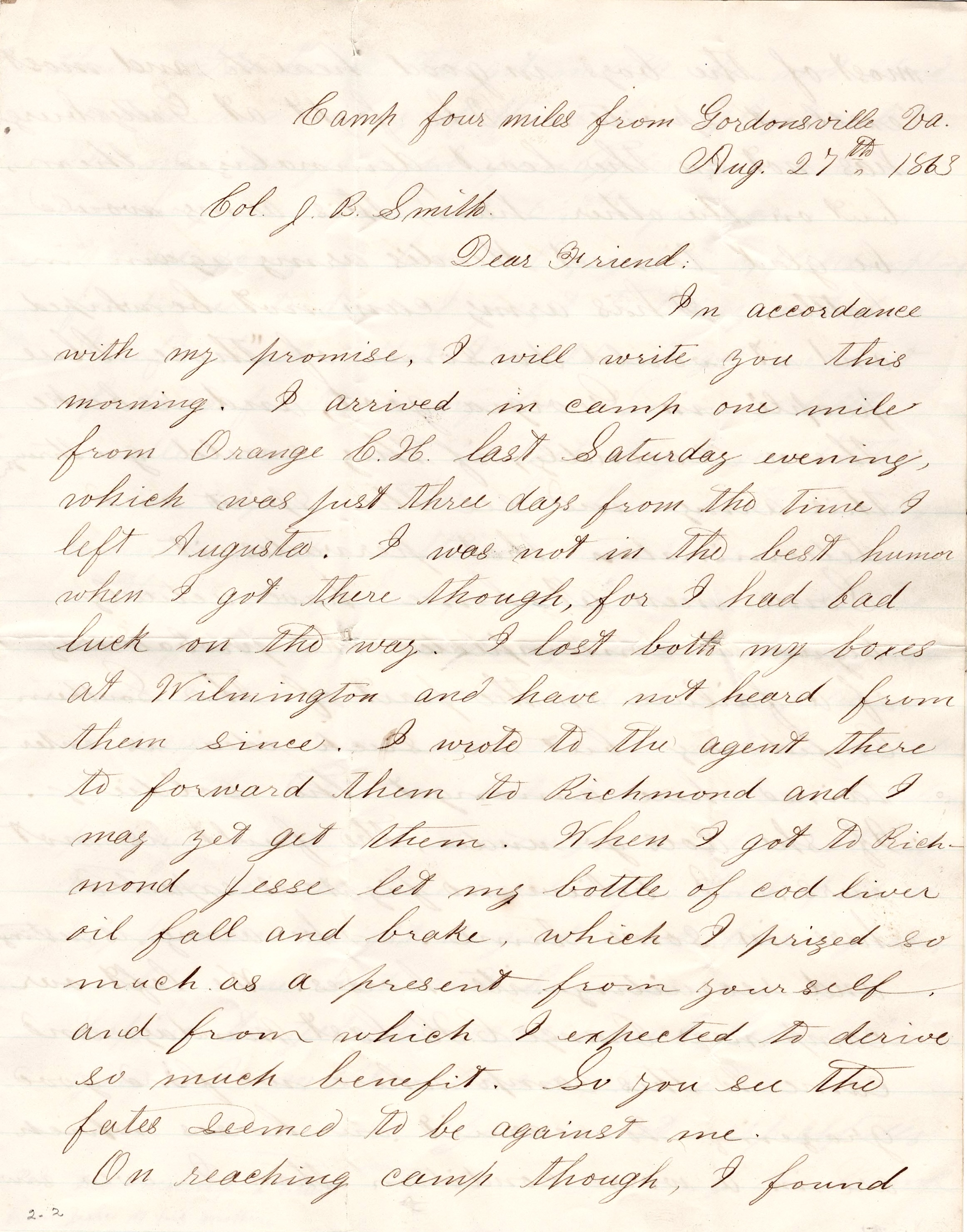
Dear friend, in accordance with my promise, I will write you this morning. I arrived in camp one mile from Orange Court House last Saturday evening, which was just three days from the time I left Augusta. I was not in the best humor when I got there though, for I had bad luck on the way. I lost both my boxes at Wilmington and have not heard from them since. I wrote to the agent there to forward them to Richmond and I may yet get them. When I got to Richmond, Jesse let my bottle of cod liver oil fall and break, which I prozed so much as a present from yourself and from which I expected to derive so much benefit. So you see the fates seemed to be against me.
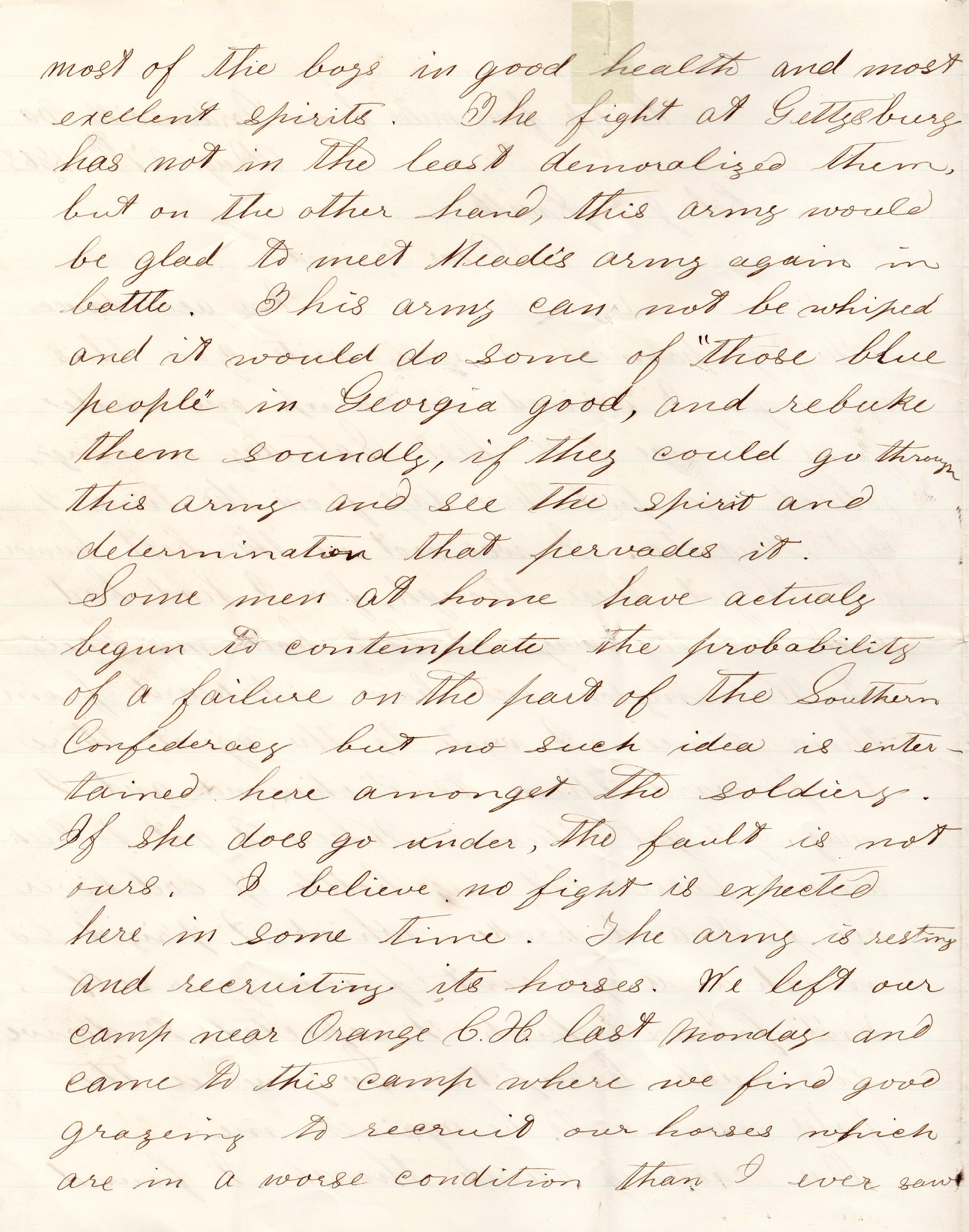
On reaching camp though, I found most of the boys in good health and most excellent spirits. The fight at Gettysburg has not in the least demoralized them but on the other hand, this army would be glad to meet Meade’s army again in battle. This army cannot be whipped and it would do some of “those blue people” in Georgia good, and rebuke them soundly, if they could go through this army and see the spirit and determination that pervades it. Some men at home have actually begun to contemplate the probability of a failure on the part of the Southern Confederacy but no such idea is entertained here amongst the soldiers. If she does go under, the fault is not ours.
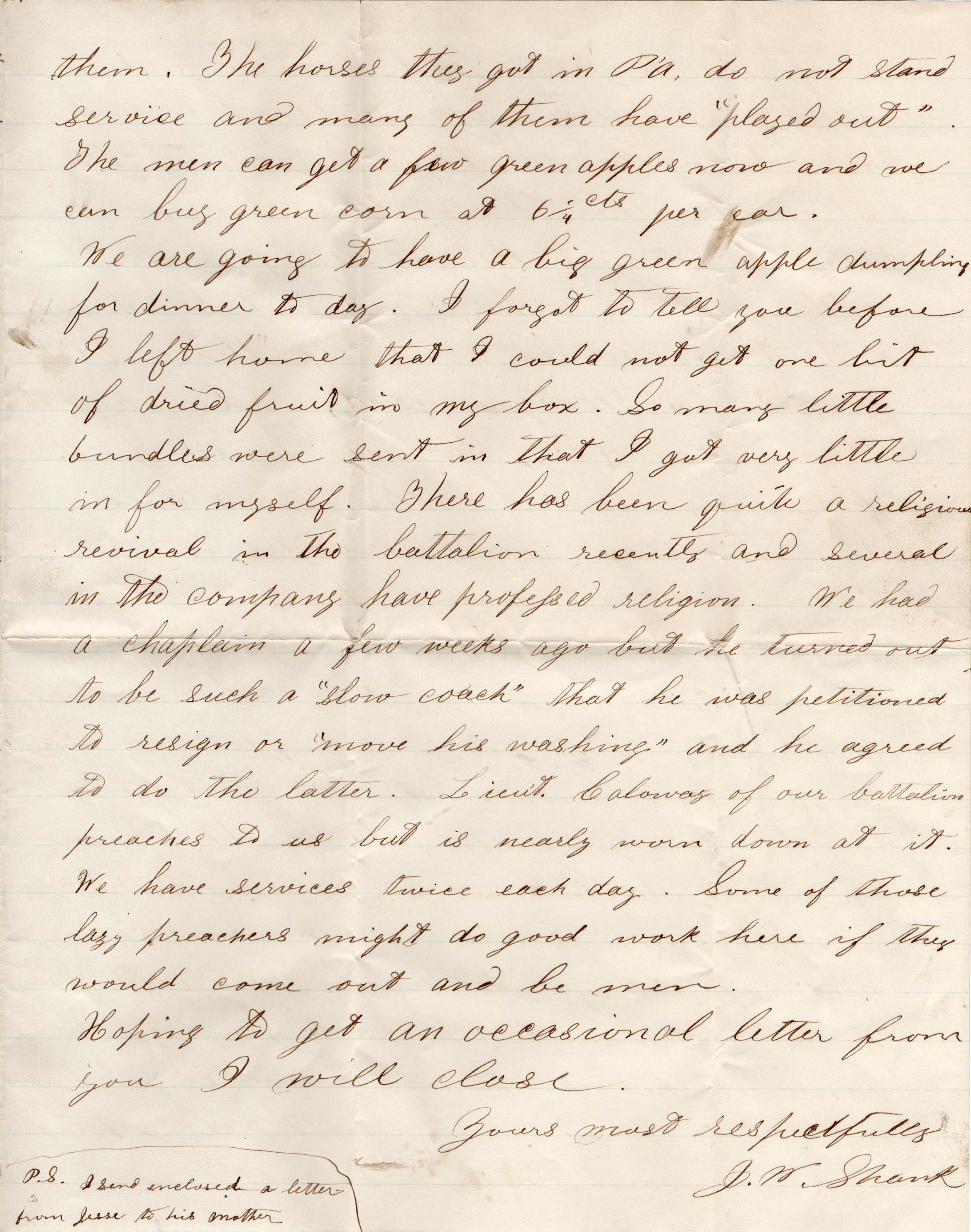
I believe no fight is expected here in some time. The army is resting and recruiting its horses. We left our camp near Orange Court House last Monday and came to this camp where we find good grazing to recruit our horses which are in a worse condition than I ever saw them. The horses [we] got in Pennsylvania do not stand service and many of them have “played out.” The men can get a few green apples now and we can buy green corn at 6.25 cents per ear.
We are going to have a big green apple dumpling for dinner today. I forgot to tell you before I left home that I could not get one bit of dried fruit in my box. So many little bundles were sent in that I got very little in for myself. There has been a religious revival in the battalion recently and several in the company have professed religion. We had a chaplain a few weeks ago but he turned out to be such a “slow coach” that he was petitioned to resign or “move his washing” and he agreed to do the latter. Lieut. Calloway of our battalion preaches to us but is nearly worn down at it. We have services twice each day. Some of those lay preachers might do good work here if they would come out an be men.
Hoping to get an occasional letter from you, I will close. Yours most respectfully, — J. W. Shank
P. S. I send enclosed a letter from Jesse to his mother.
Letter 3
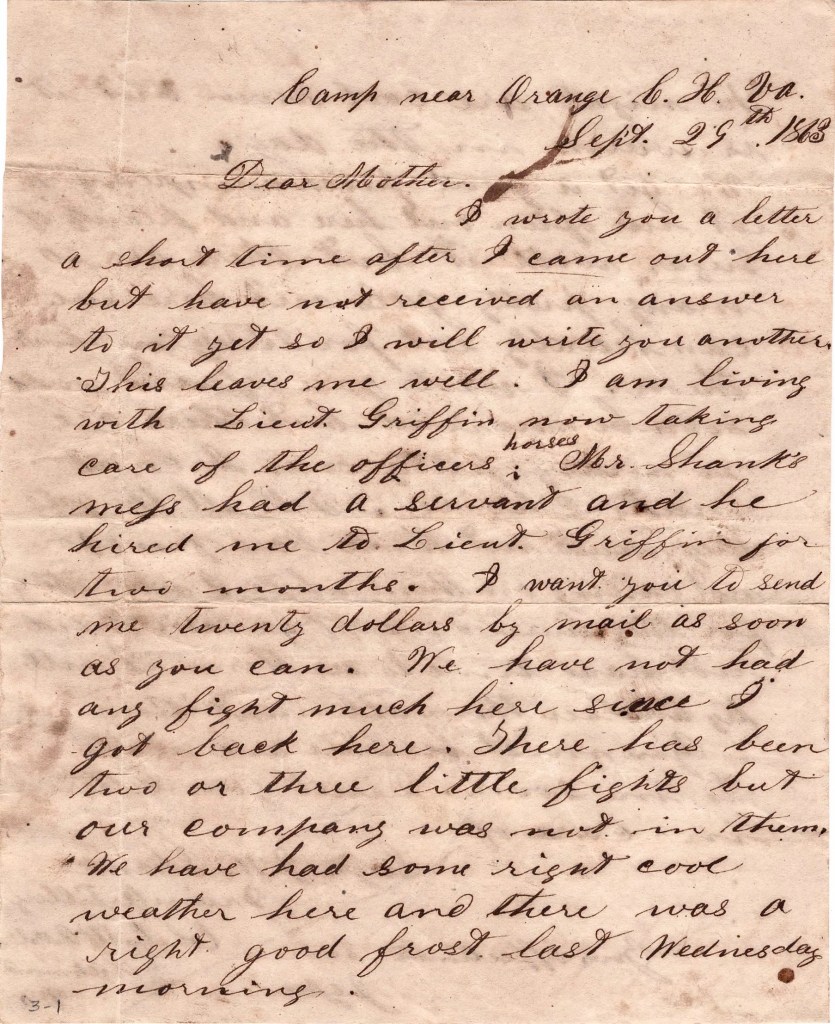
Camp near Orange Court House, Virginia September 29th 1863
Dear Mother,
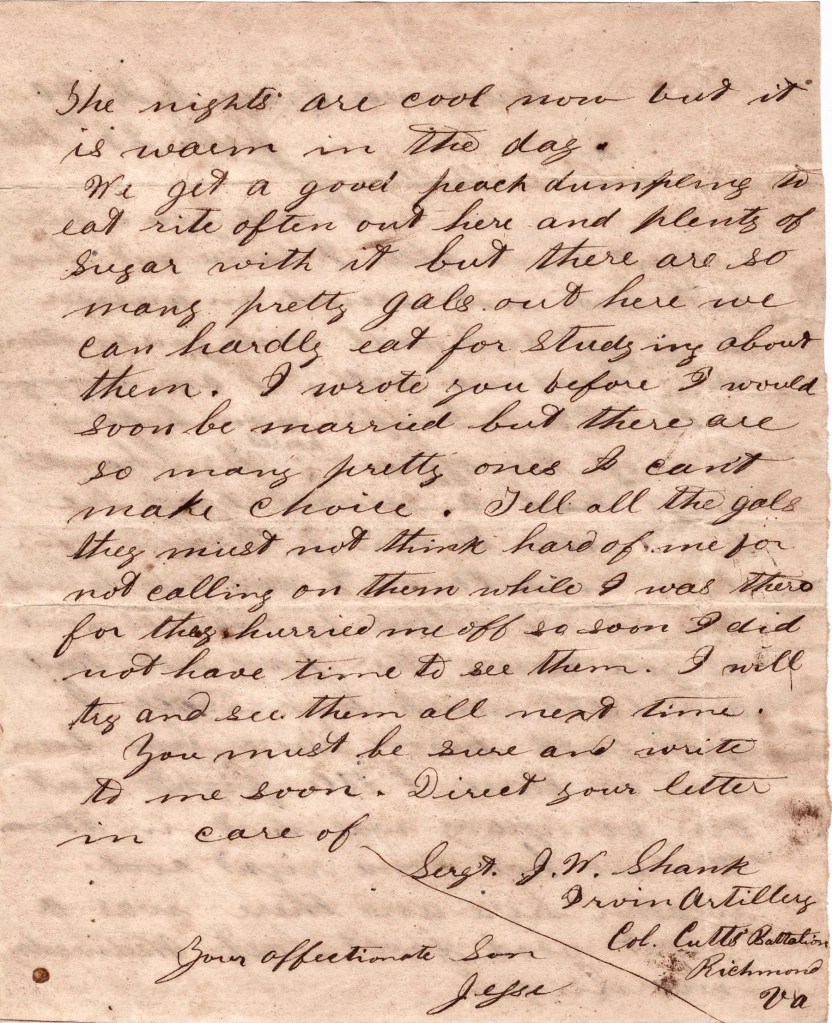
I wrote you a letter a short time after I came out here but have not received an answer to it yet so I will write you another. This leaves me well. I am living with Lieut. Griffin now taking care of the offices’ horses. Mr. Shank’s mess had a servant and he hired me to Lieut. Griffin for two months. I want you to send me twenty dollars by mail as soon as you can. We have not had any fight much here since I got back here. There has been two or three little fights but our company was not in them. We have had some right cool weather here and there was a right good frost last Wednesday morning. Th nights are cool now but it is warm in the day.
We get a good peach dumpling to eat right often out here and plenty of sugar with it, but there are so many pretty gals out here we can hardly eat for studying about them. I wrote you before I would soon be married but there are so many pretty ones, I can’t male a choice. Tell all the gals they must not think hard of me for not calling on them while I was there for they hurried me off so soon I did not have time to see them. I will try and see them all next time.
You must be sure and write to me soon. Direct your letter in care of Sergt. J. W. Shank, Irvin Artillery, Col. Vutts’ Battalion, Richmond, Virginia
Your affectionate son, — Jesse
Letter 4
Camp near Welford’s Ford [Hazel River] November 4th 1863
Col. J. B. Smith,
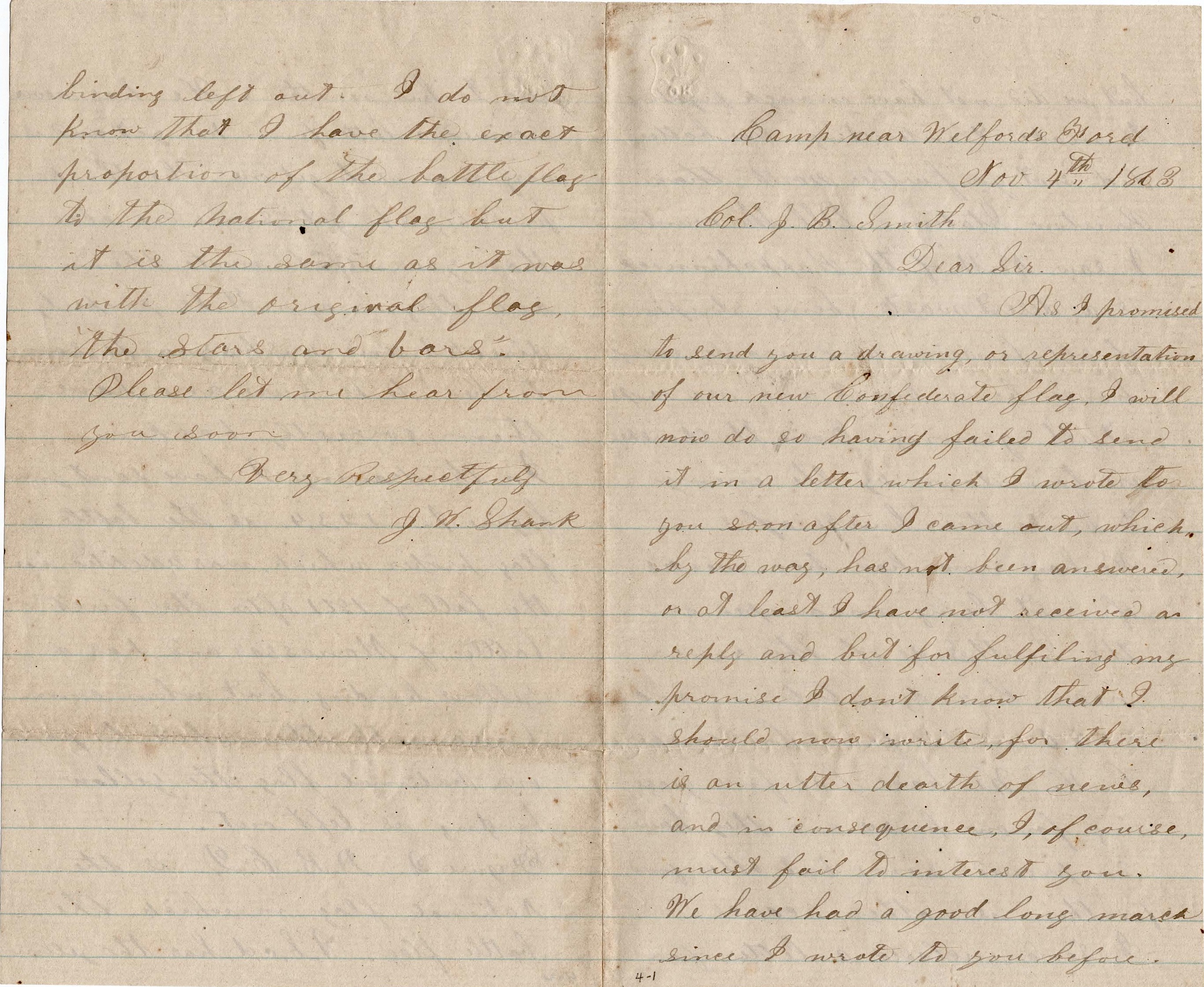
Dear Sir, as I promised to send you a drawing or representation of our new Confederate flag, I will now do so having failed to send it in a letter which I wrote to you soon after I came out, which, by the way, has not been answered—or at least I have not received a reply—and but for fulfilling my promise, I don’t know that I should now write for there is an utter dearth of news and in consequence, of course, must fail to interest you.
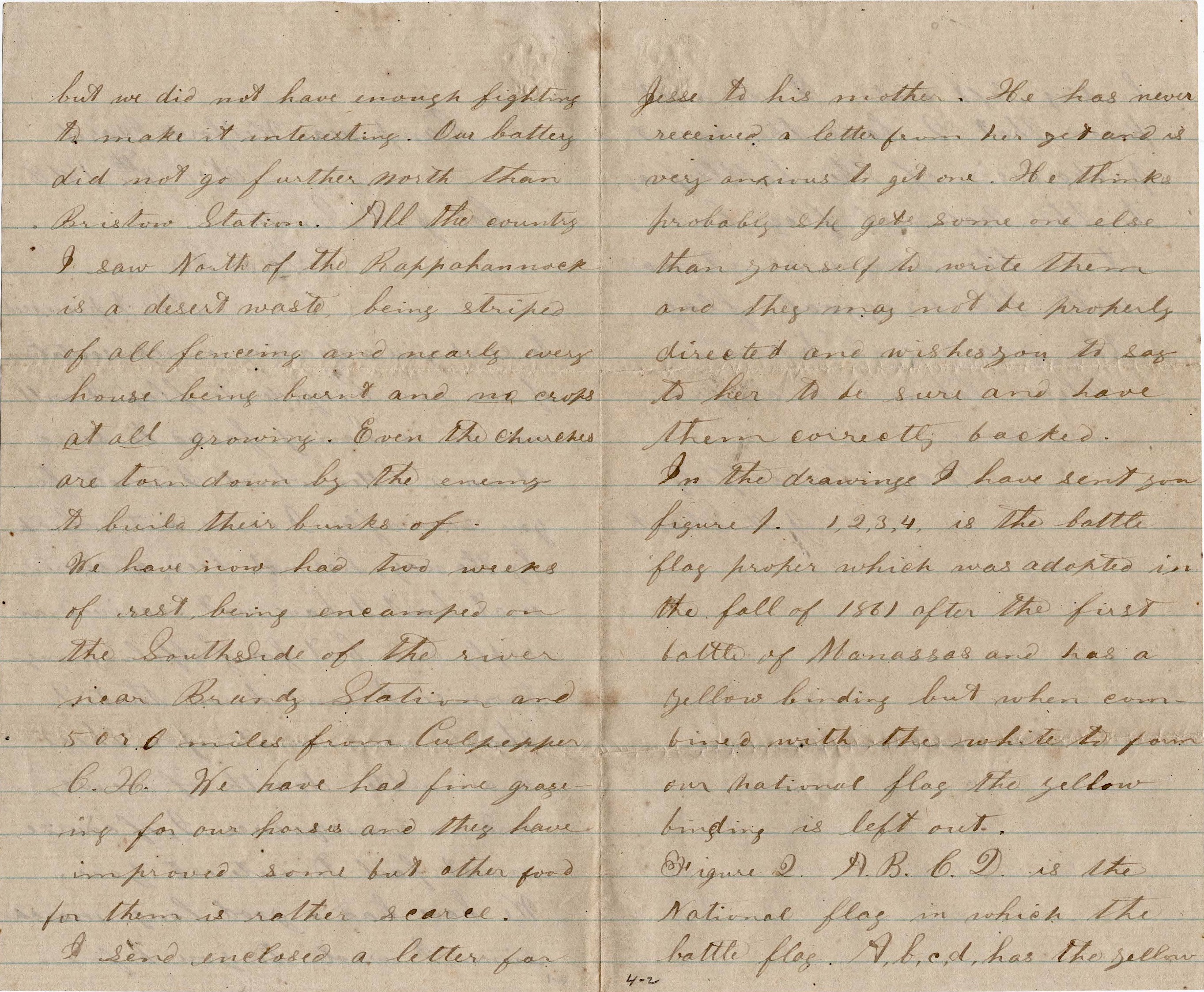
We have had a good long march since I wrote to you before but we did not have enough fighting to make it interesting. Our battery did not go further north than Bristoe Station. All the country I saw north of the Rappahannock is a desert waste, bring stripped of all fencing and nearly every house being burnt & no crops at all growing. Even the churches are tirn down by the enemy to build their bunks of.
We have now had two weeks of rest being encamped on the south side of the river near Brandy Station and 5 or 6 miles from Culpeper Court House. We have had fine grazing for our horses and they have improved some but other food for them is rather scarce.
I send enclosed a letter for Jesse to his mother. He has never received a letter from her yet and is very anxious to get one. He thinks probably she gets someone else than you to write them and they may not be properly directed and wishes you to say to her to be sure and have them correctly backed.
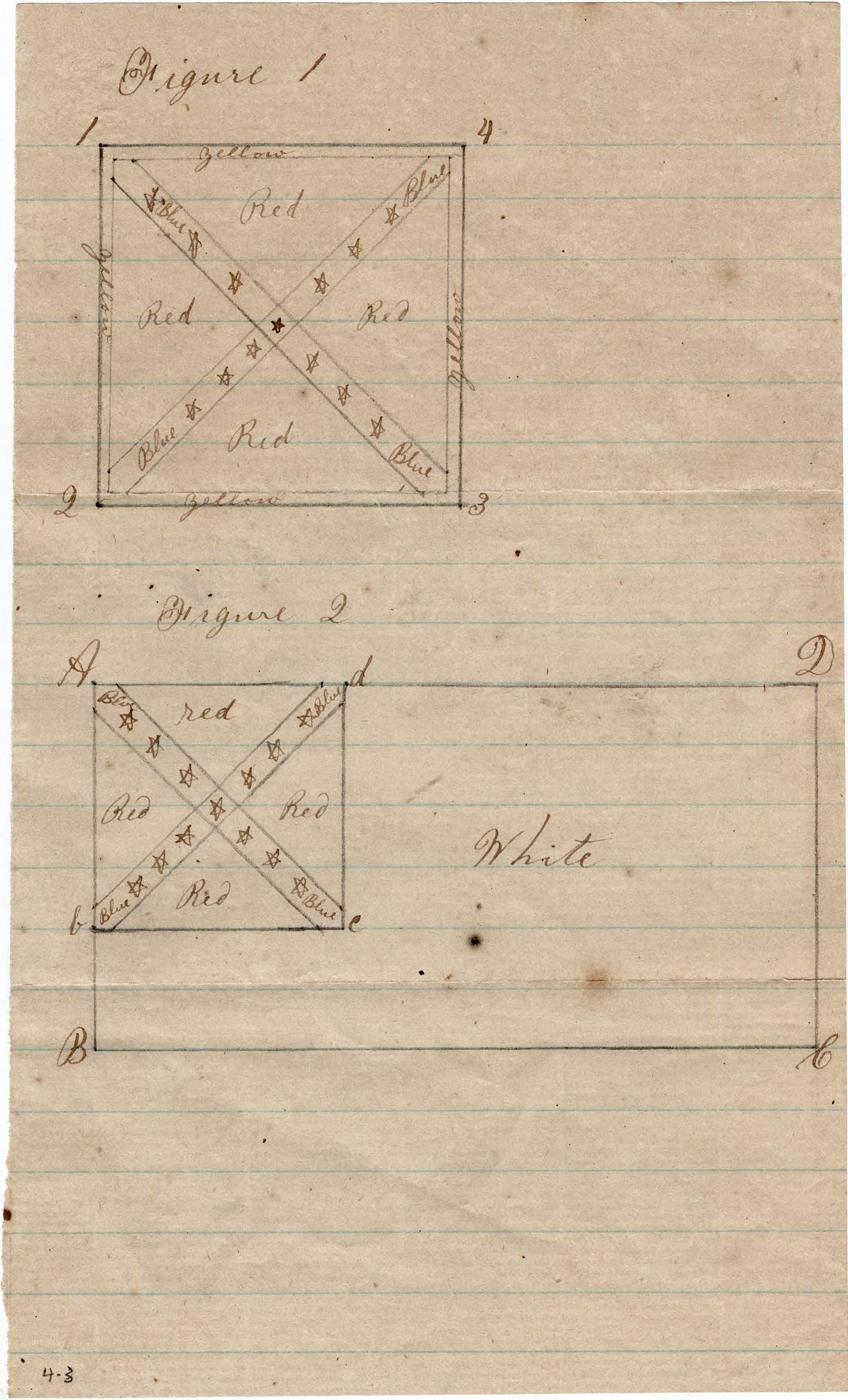
In the drawings I have sent you—Figure 1—1, 2,3, 4 is the battle flag proper which was adopted in the fall of 1861 after the first Battle of Manassas and has a yellow binding but when combined with the white to form our national flag the yellow binding is left out.
Figure 2—A. B. C. D. is the national flag in which the battle flag A, b, c, d has the yellow binding left out. I do not know that I have the exact proportion of the battle flag to the national flag but it is the same as it was with the original flag—the “stars and bars.”
Please let me hear from you soon. Very respectfully, – J. W. Shank
Letter 5
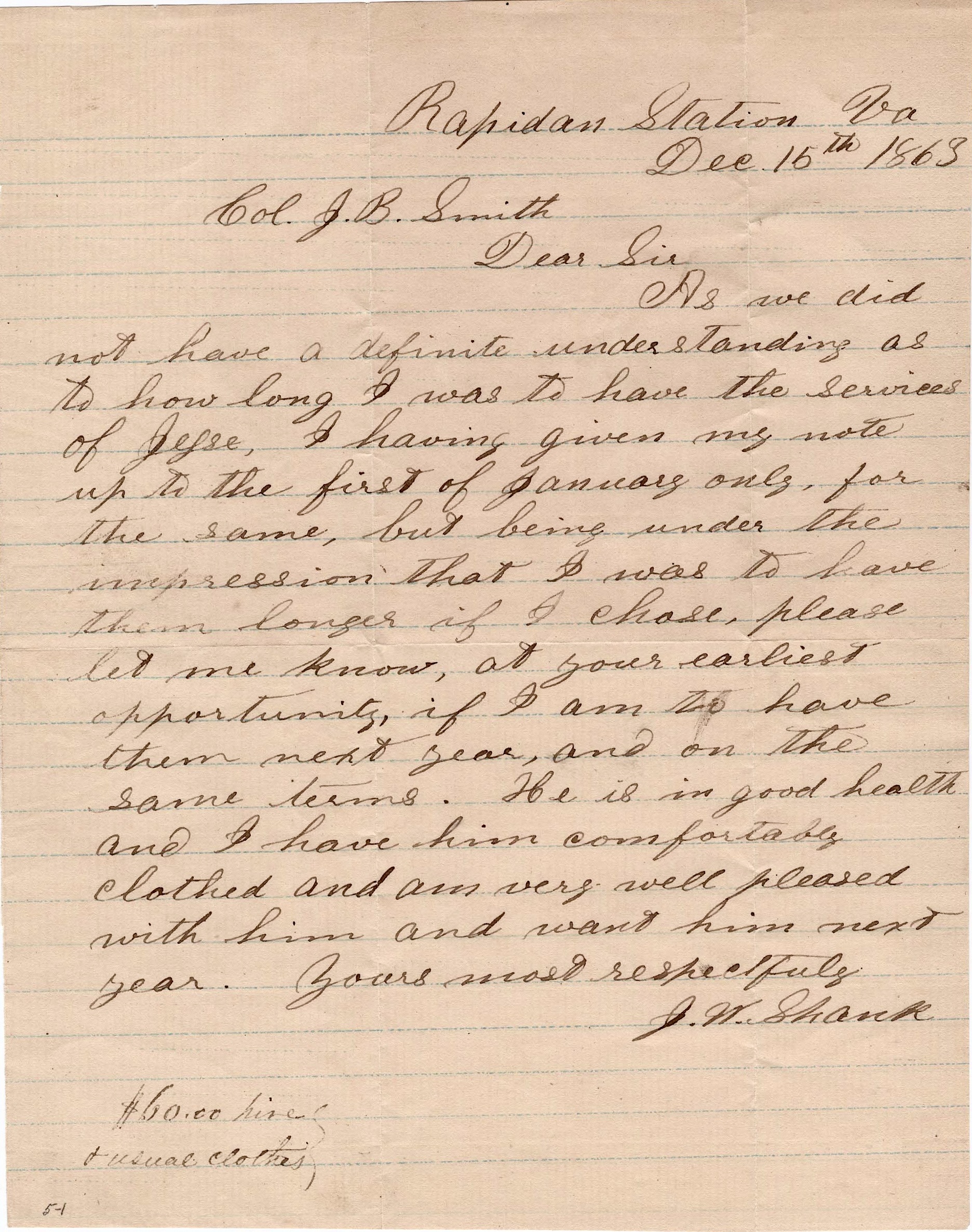
Rapidan Station, Virginia December 15th 1863
Col. J. B. Smith,
Dear sir, as we did not have a definite understanding as to how long I was to have the service of Jesse, I have given my note up to the first of January only, for the same, but being under the impression that I was to havethem longer of I chose, please let me know at your earliest opportunity if I am to have them next year and on the same terms, He is in good health and I have him comfortably clothed and an very well pleased with him and want him next year. Yours most respectfully, — J. W. Shank
$60 hire & usual clothes.
Letter 6
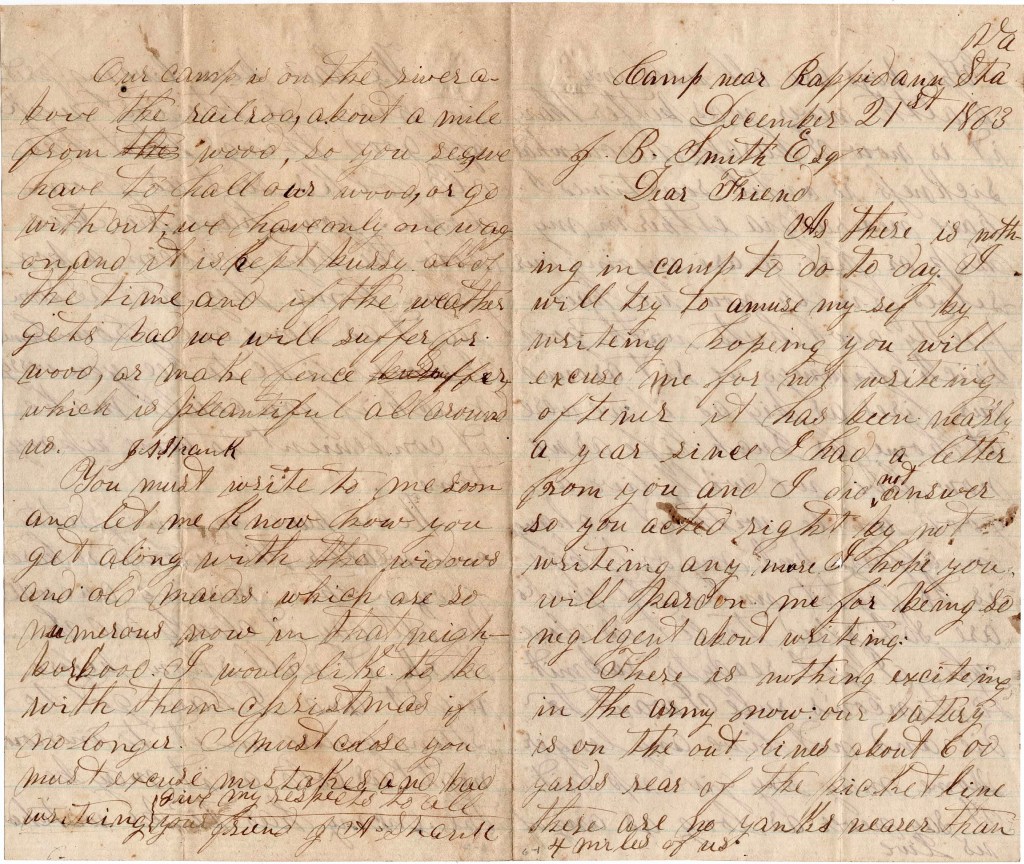
Camp near Rapidan Station, Virginia December 21st 1863
J. B. Smith, Esq.
Dear friend, as there is nothing in camp to do today, I will try to amuse myself by writing, hoping you will excuse me for not writing oftener. It has been nearly a year since I had a letter from you and I did not answer so you acted right by not writing any more. I hope you will pardon me for being so negligent about writing.
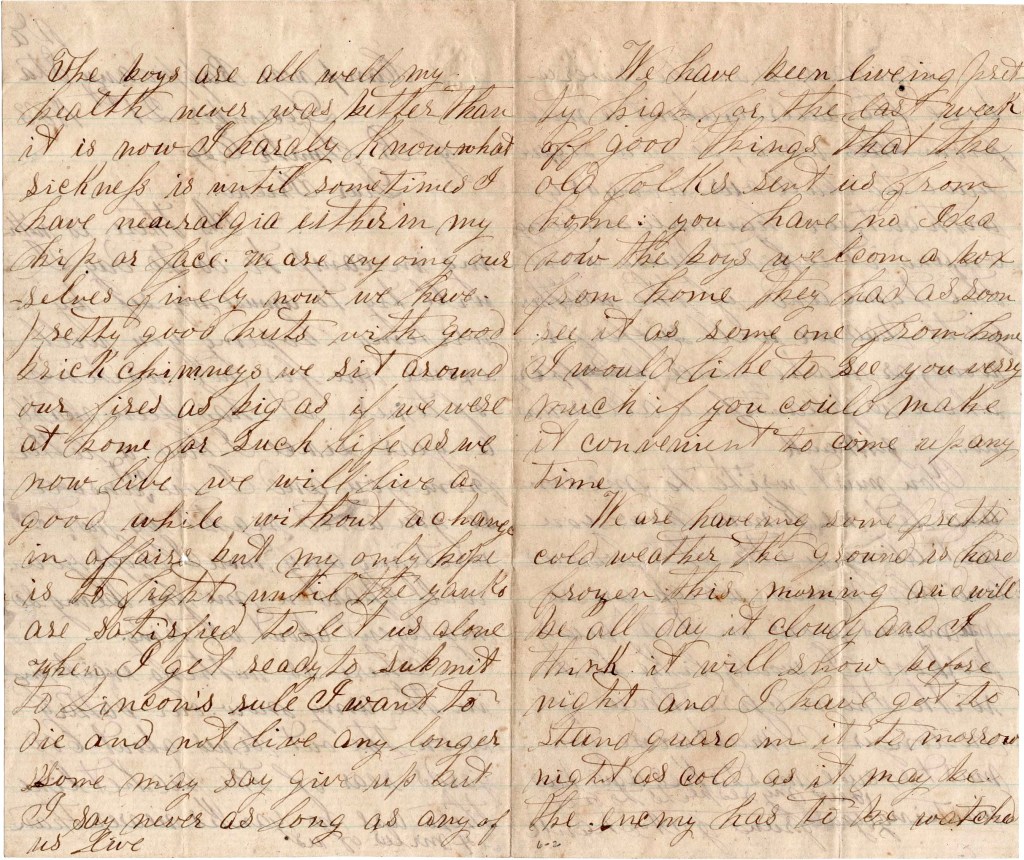
There is nothing exciting in the army now. Our battery is on the out lines about 600 yards rear of the picket line. There are no Yanks nearer than 4 miles of us. The boys are all well. My health never was better than it is now. I hardly know what sickness is until some times I have neuralgia either in my hip or face.
We are enjoying ourselves finely now. We have pretty good huts with good brick chimneys. We sit around our fires as big as if we were at home for such life as we now live we will live a good while without a change in affairs. But my only hope is to fight until the Yanks are satisfied to let us alone. When I get ready to submit to Lincoln’s rule, I want to die and not live any longer. Some may say give up but I say never as long as any of us live.
We have been living pretty high for the last week of good things that the old folks sent us from home. You have no idea how the boys welcome a box from home. They had as soon see it as someone from home. I would like to see you very much if you could make it convenient to come up any time.
We are having some pretty cold weather. The ground is hard frozen this morning and will be all day. It’s cloudy and I think it will snow before night and I have got to stand guard in it tomorrow night as cold as it may be. The enemy has to be watched. Our camp is on the river above the railroad, about a mile from wood so you see we have to haul our wood or go without. We have only one wagon and it is kept busy all of the time. And if the weather gets bad, we will suffer for wood or make fences suffer, which is plentiful all around us. — J. A. Shank
You must write to me soon and let me know how you get along with the widows and old maids which are so numerous now in that neighborhood. I would like to be with them Christmas, if no longer. I must close. You must excuse my mistakes and bad writing. Your friend, — J[oseph] A. Shank
Letter 7
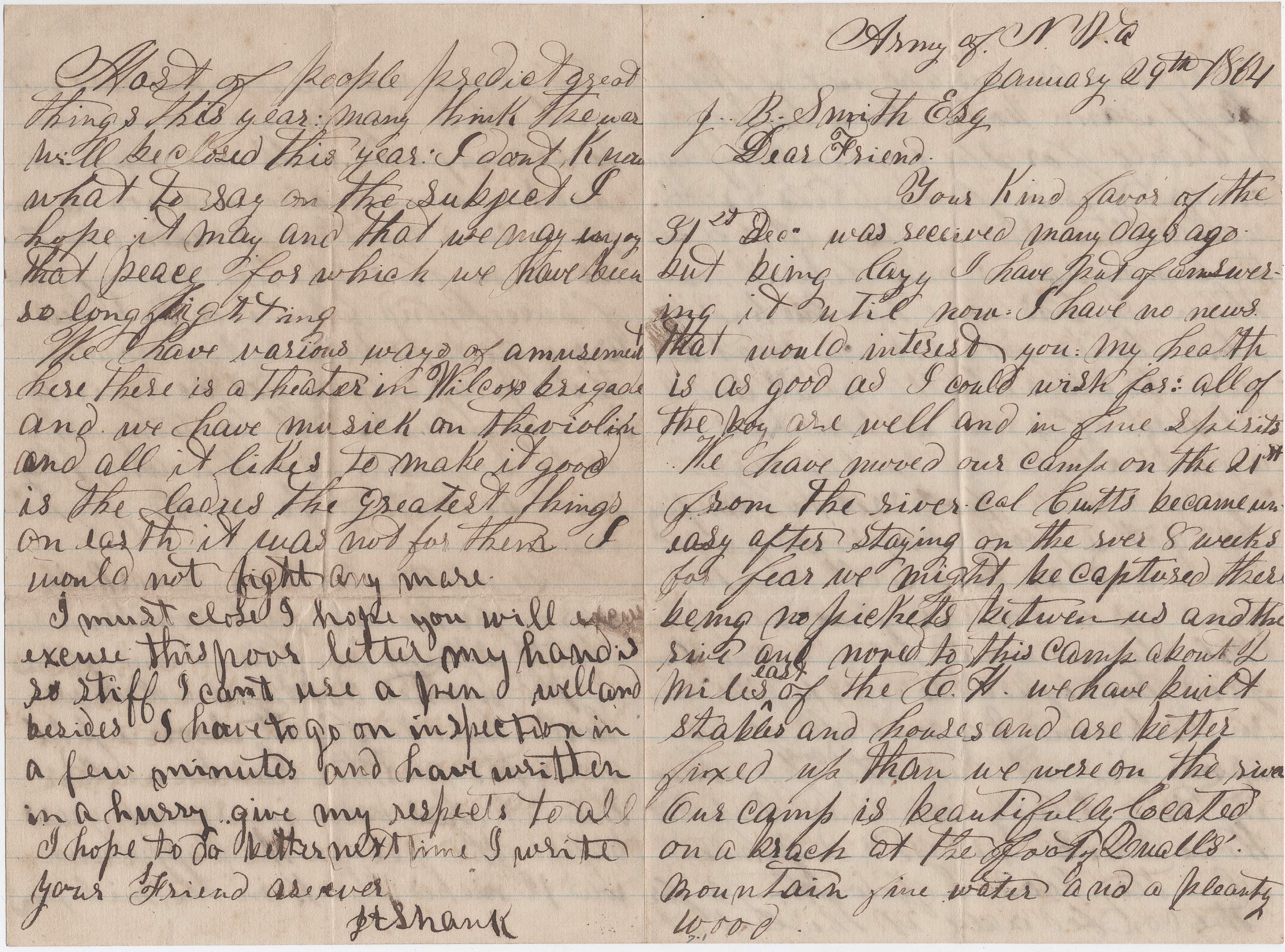
Army of Northern Virginia January 29th 1864
J. B. Smith, Esq.
Dear friend, you kind favor of the 31st December was received many days ago but being lazy, I have out off answering it until now. I have no news that would interest you. My health is as good as I could wish for. All of the boys are well and in fine spirits.
We have moved our camp on the 21st from the river. Col. Cutts became uneasy after staying on the river 8 weeks for fear we might be captured, there being no pickets between us and the river and moved to this camp about two miles east of the [Orange] Court House. We have built stables and houses are better fixed up than we were on the river. Our camp is beautifully located on a branch at the foot of Quarles Mountain—fine water and plenty of wood.
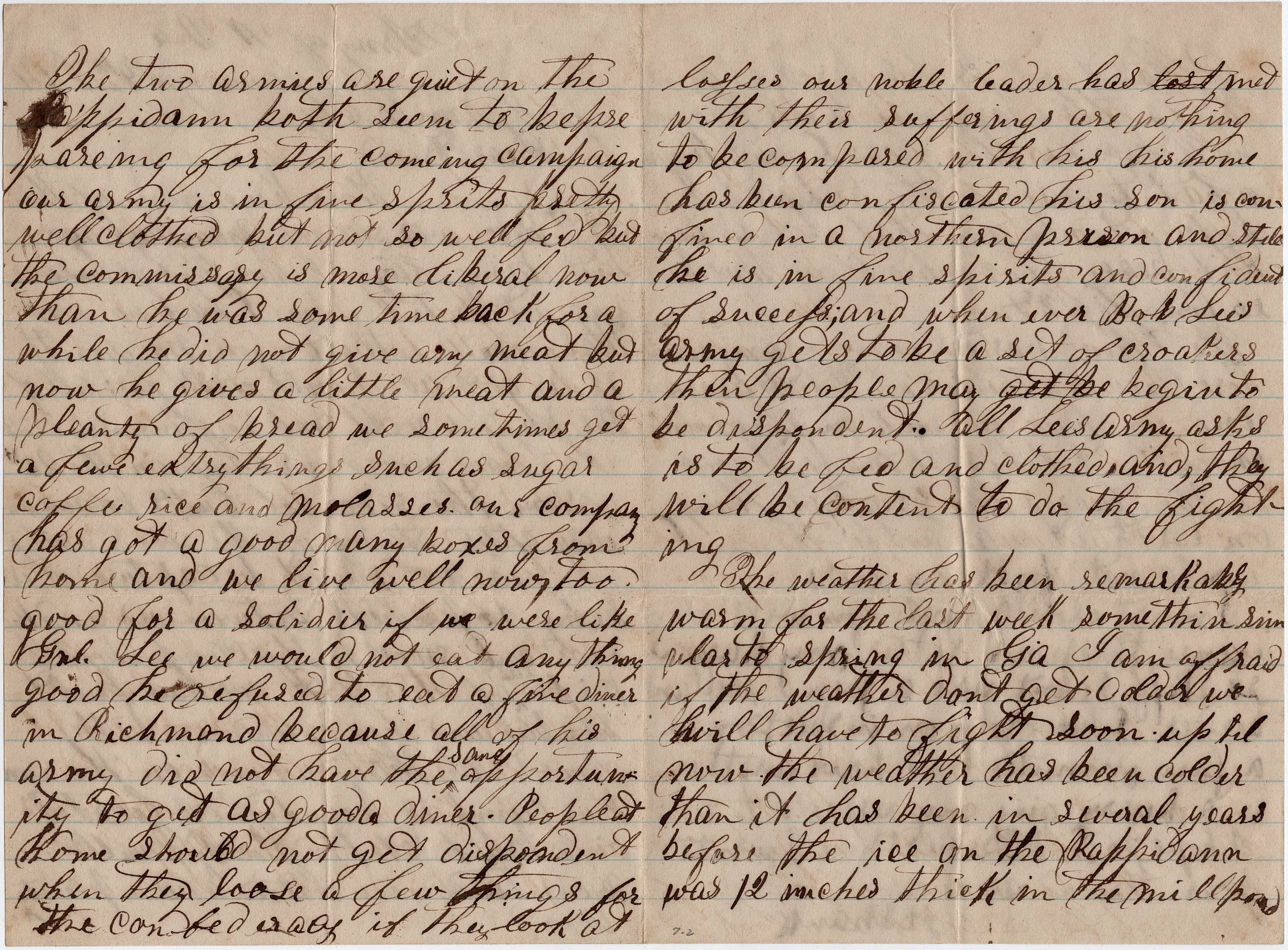
The two armies are quiet on the Rapidan. Both seem to be preparing for the coming campaign. Our army is in fine spirits, pretty well clothed, but not so well fed, but the commissary is more liberal now than he was some time back. For a while, he did not give any meat but now he gives a little meat and a plenty of bread. We sometimes get a few extra things such as sugar, coffee, rice and molasses. Our company has got a good many boxes from home and we live well now—too good for a soldier.
“Whenever Bob Lee’s army gets to be a set of croakers, then people may begin to be despondent.”
If we were like Gen. Lee, we would not eat anything good. He refused to eat a fine dinner in Richmond because all of his army did not have the same opportunity to get as good a dinner. People at home should not get despondent when they lose a few things for the Confederacy. If they look at the losses our noble leader has met with, their sufferings are nothing to be compared with his. His home has been confiscated. His son is confined in a northern prison and still he is in fine spirits and confident of success. And whenever Bob Lee’s army gets to be a set of croakers, then people may begin to be despondent. All Lee’s army asks is to be fed and clothed and they will be content to do the fighting.
The weather has been remarkably warm for the last week—something similar to spring in Georgia. I am afraid if the weather don’t get cooler, we will have to fight soon. Up till now the weather has been colder than it has been in several years before. The ice on the Rapidan was 12 inches thick in the mill pond.
Most of the people predict great things this year. Many think the war will be closed this year. I don’t know what to say on the subject. I hope it may and that we may enjoy that peace for which we have been so long fighting.
We have various ways of amusement here. There is a theater in Wilcox’s Brigade and we have music on the violin and all it lacks to make it good is the ladies—the greatest things on earth. If it was not for them, I would not fight any more.
I must close. I hope you will excuse this poor letter. My hands is so stiff I can’t use a pen well, and besides I have to go in inspection in a few minutes and have written in a hurry. Give my respects to all. I hope to do better next time I write. Your friend as ever, — J[oseph] A. Shank
Letter 8
Camp Cutts’ Artillery March 19th 1864
Col. J. B. Smith,
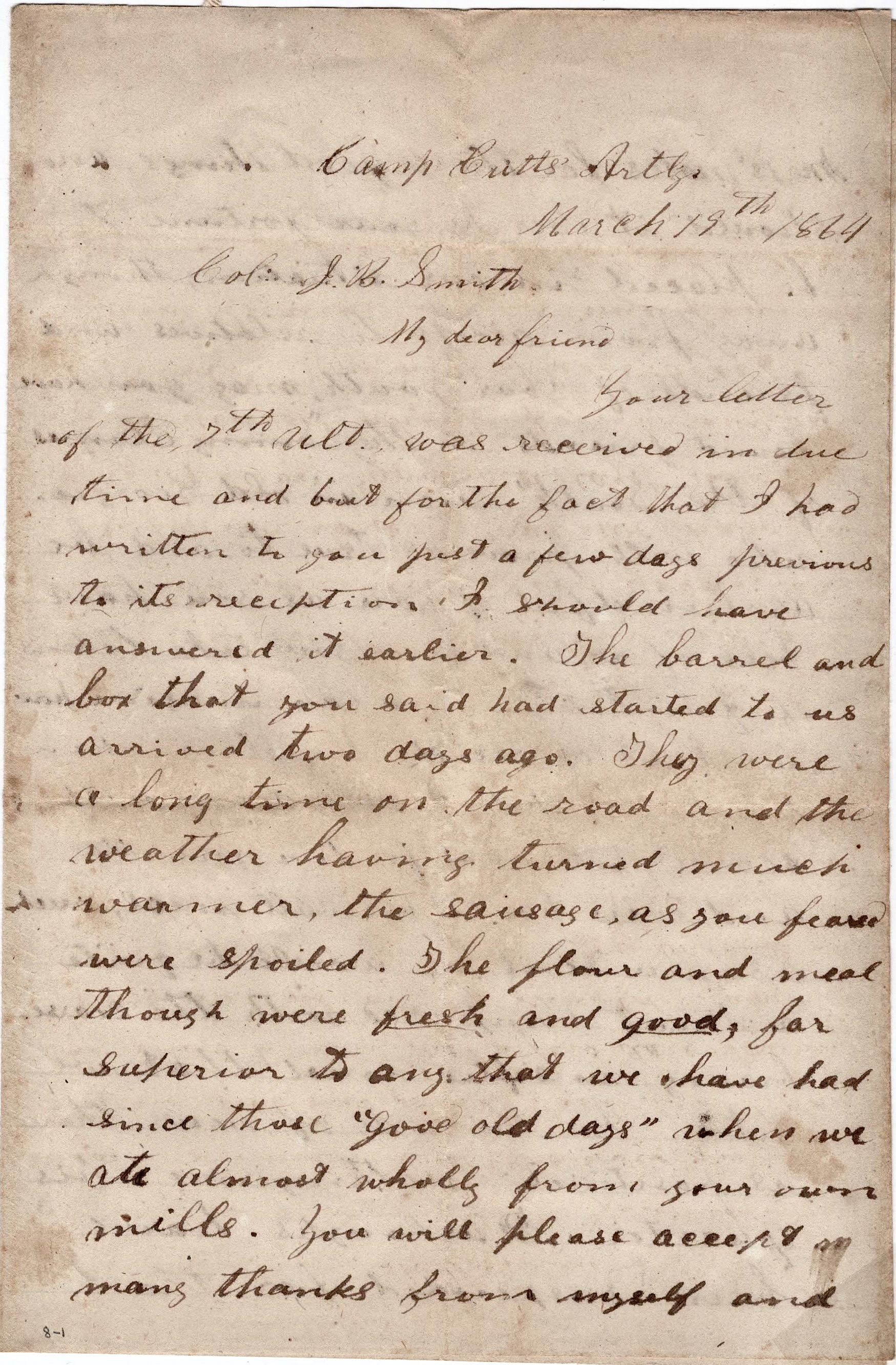
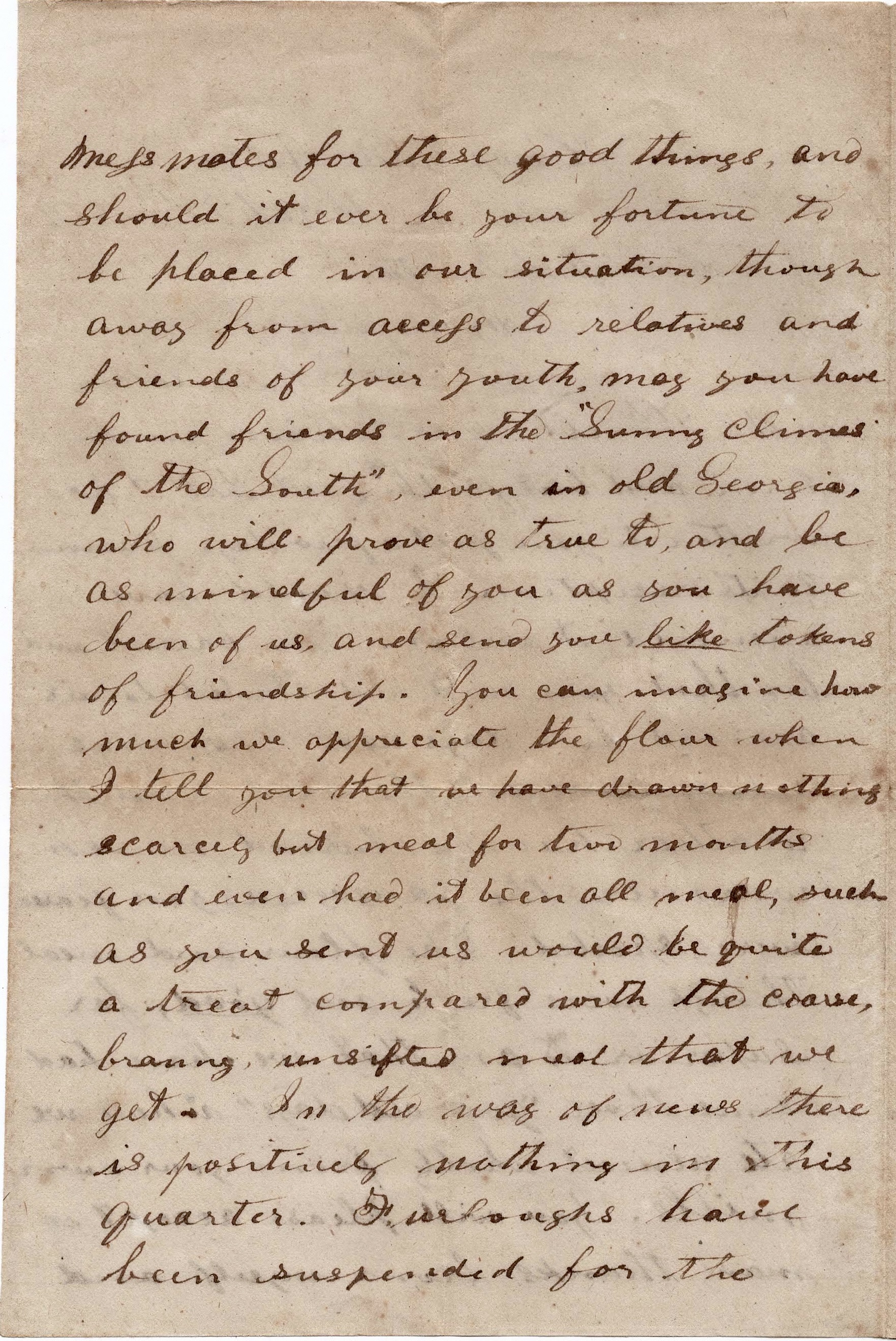
My dear friend, your letter of the 7th ult. was received in due time and but for the fact that I had written to you just a few days previous to its reception, I should have answered it earlier. The barrel and box that you said had started to us arrived two days ago. They were a long time on the road and the weather having turned much warmer, the sausage—as you feared—were spoiled. The flour and meal though were fresh and good—far superior to any that we have had since those “good old days” when we ate almost wholly from your own mills. You will please accept many thanks from myself and mess mates for these good things. And should it ever be your fortune to be placed in our situation, though away from access to relatives and friends of your youth, may you have found friends in the “sunny climes of the South”, even in Old Georgia, who will prove as true to, and be as mindful of you as you have been of us, and send you like tokens of friendship. You can imagine how much we appreciate the flour when I tell you that we have drawn nothing scarcely but meal for two months and even had it been all meal such as you sent us, would be quite a treat compared with the coarse, branny, unsifted meal that we get.
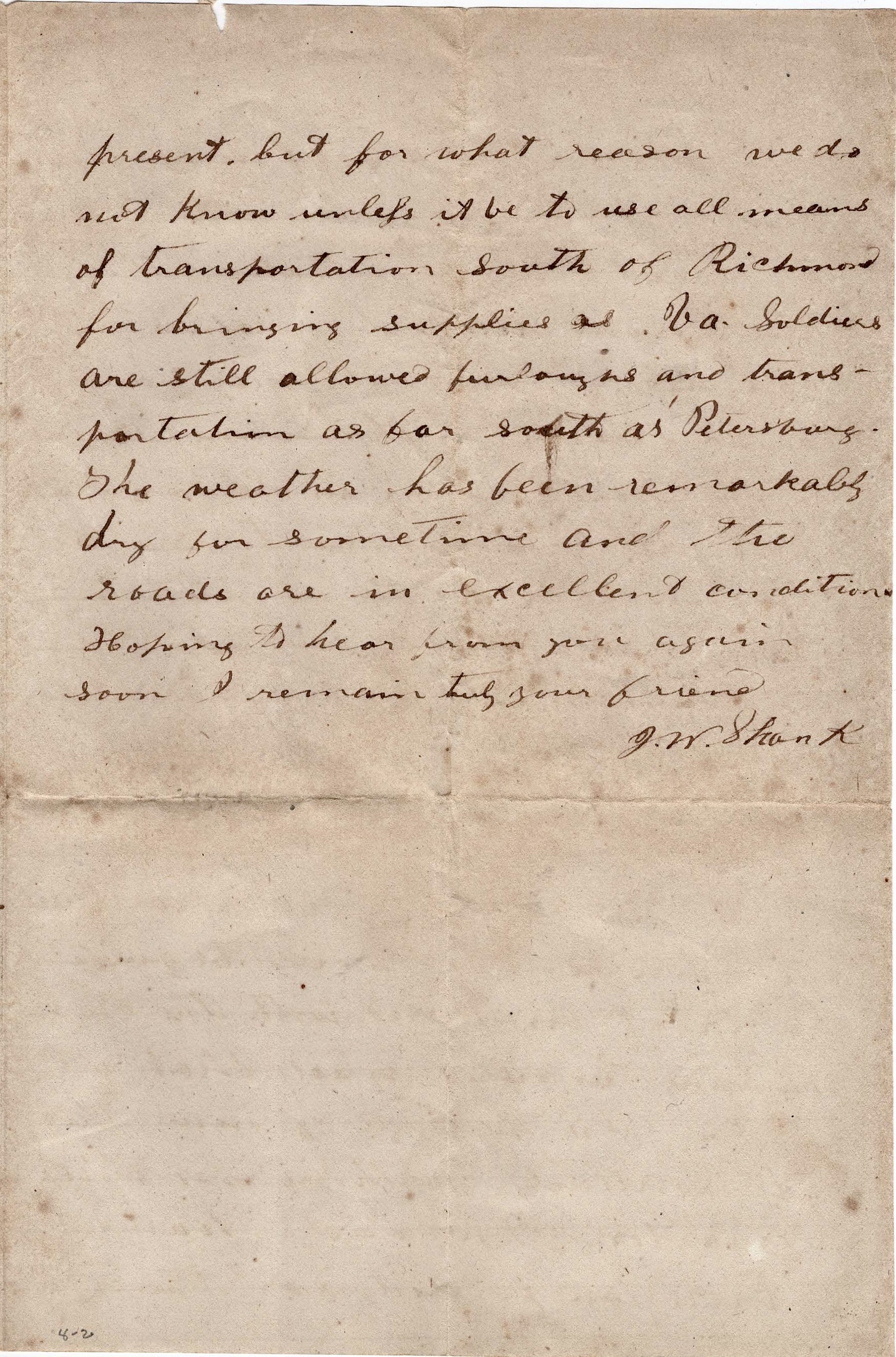
In the way of news, there is positively nothing in this quarter. Furloughs have been suspended for the present, but for what reason we do not know unless it be to use all means of transportation south of Richmond for bringing supplies as Virginia soldiers are still allowed furloughs and transportation as far south as Petersburg.
The weather has been remarkably dry for some time and the roads are in excellent condition. Hoping to hear from you again soon, I remain truly your friend, — J. W. Shank
Letter 9
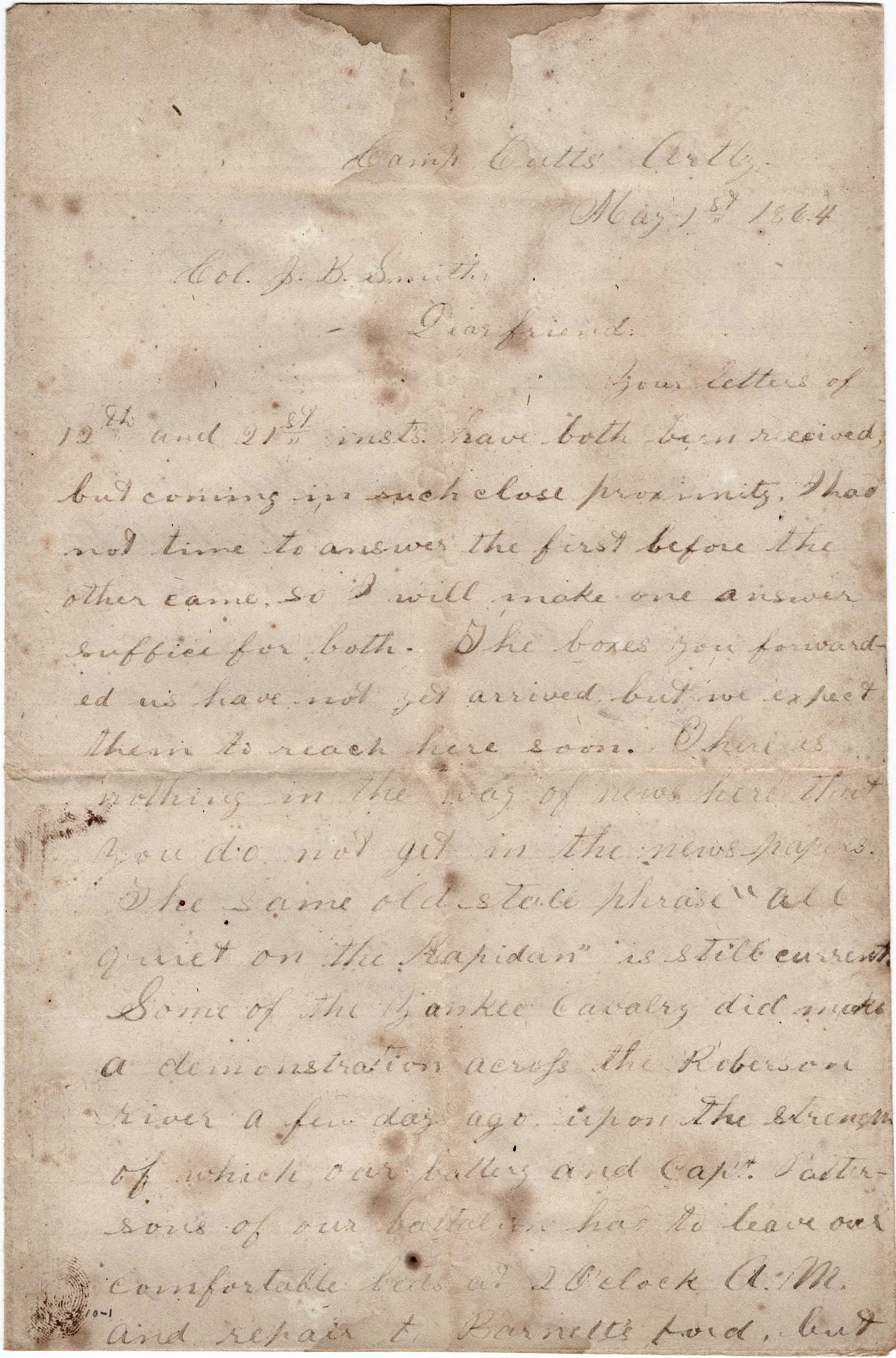
Camp Cutts’ Artillery May 1st 1864
Col. J. B. Smith,
Dear friend, your letters of the 12th and 21st inst. [ult.] have both been received, but coming in such close proximity, I had not time to answer the first before the other came so I will make one answer suffice for both. The boxes you forwarded us have not yet arrived but we expect them to reach here soon.
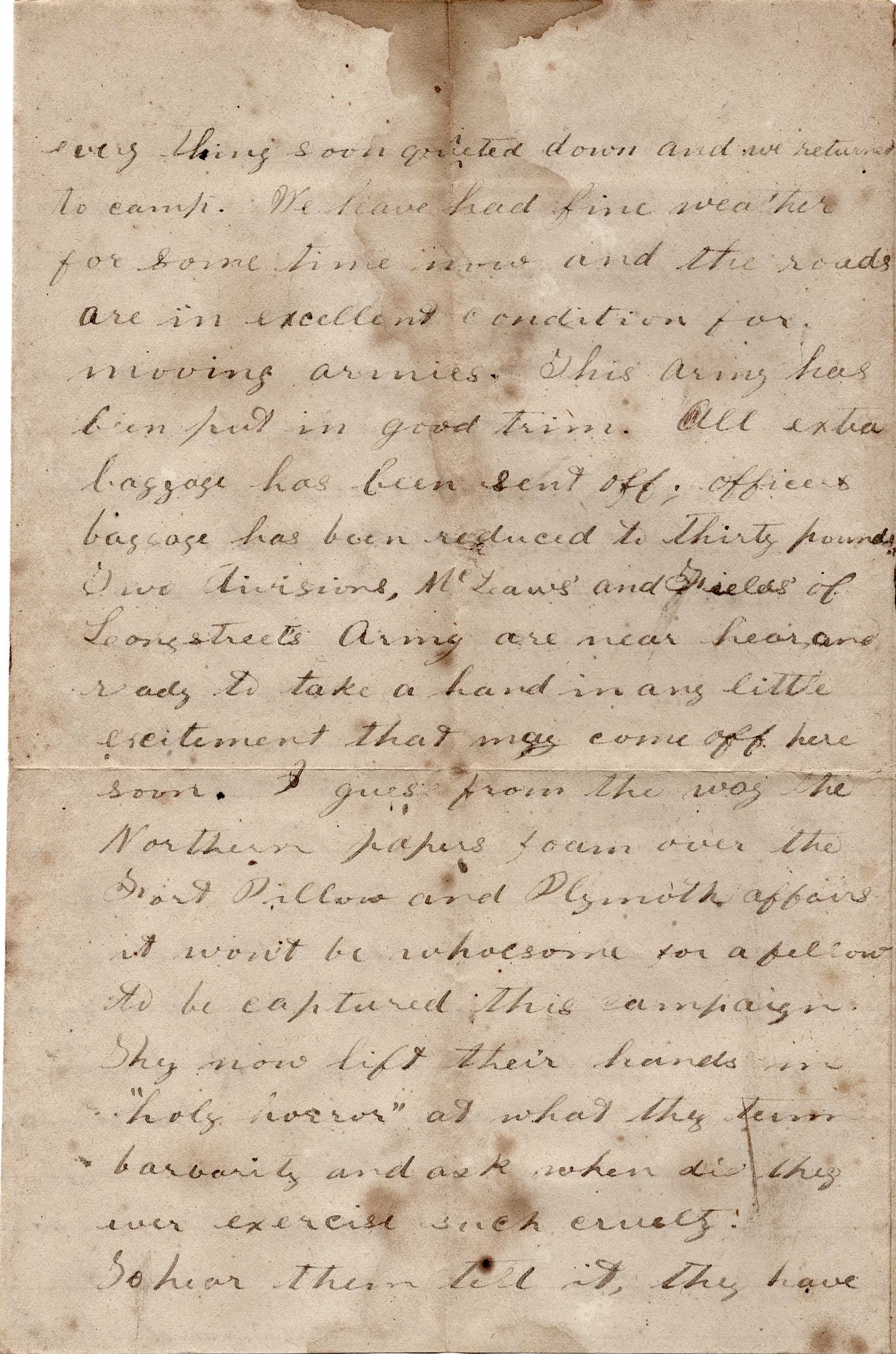
There is nothing in the way of news here that you do not get in the newspapers. The same old stale phrase, “All quiet on the Rapidan” is still current. Some of the Yankee cavalry did make a demonstration across the Roberson River a few days ago upon the strength of which our battery and Capt. Patterson’s of our Battalion had to leave our comfortable beds at 2 o’clock a.m. and repair to Barnett’s Ford, but everything soon quieted down and we returned to camp.
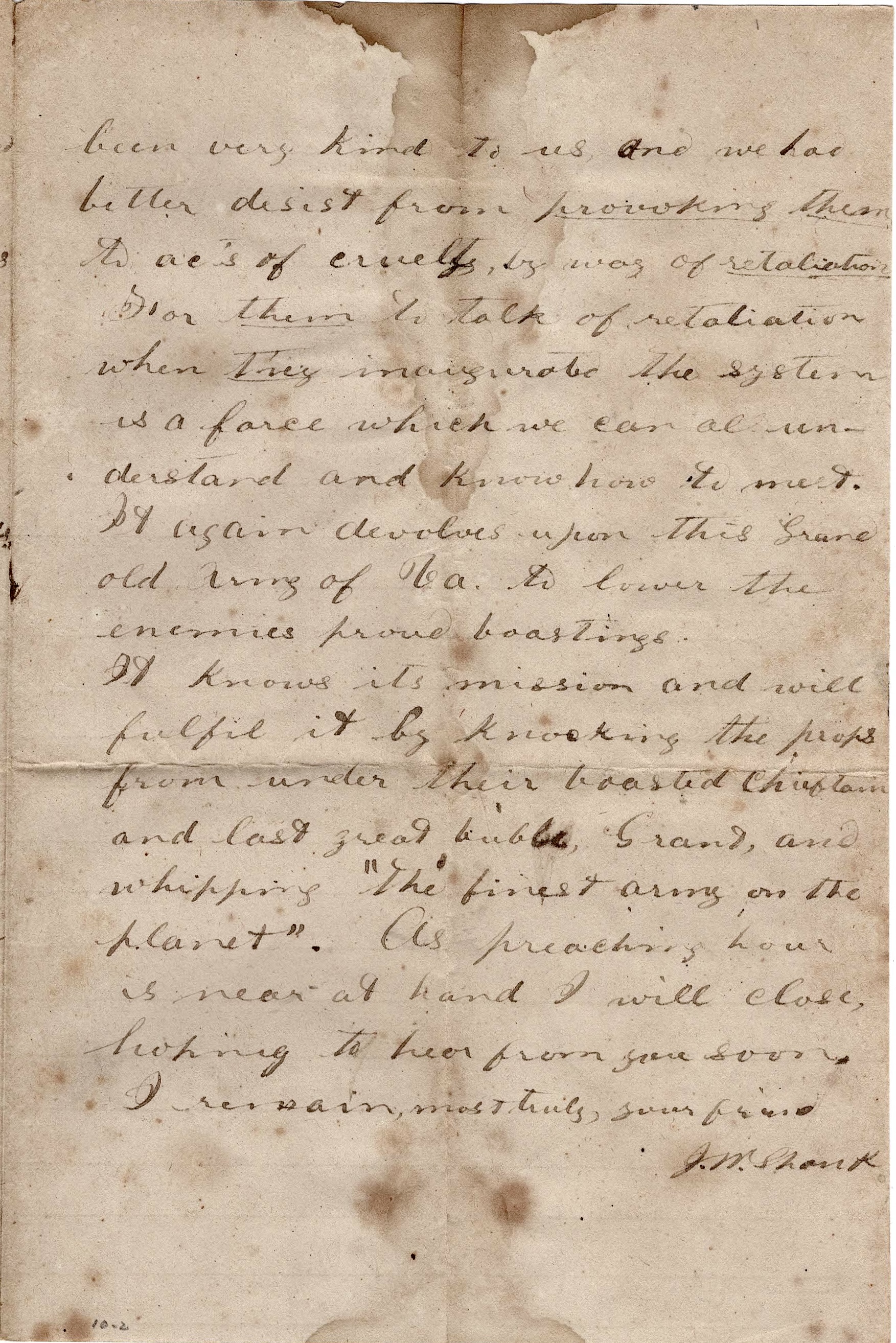
We have had fine weather for some time now and the roads are in excellent condition for moving armies. This army has been put in good trim. All extra baggage has been reduced to thirty pounds. Two divisions—[Lafayette] McLaws’s and [Charles] Field’s of Longstreet’s army [1st Corps] are near here and ready to take a hand in any little excitement that may come off here soon. I guess from the way the Northern papers foam over the Fort Pillow and Plymouth affairs, it won’t be wholesome in a fellow to be captured this campaign. 1 They now lift their hands in “holy horror” at what they term barbarity and ask when did they ever exercise such cruelty. To hear them tell it, they have been very kind to us and we had better desist from provoking them to acts of cruelty by way of retaliation. For them to talk of retaliation when they inaugurate the system is a farce which we can all understand and know how to meet.
It again devolves upon this grand old Army of Virginia to lower the enemy’s proud boastings. It knows its mission and will fulfill it by knocking the props from under their boasted chieftain and last great bubble Grant, and whipping “the finest army on the planet.”
As preaching hour is near at hand, I will close, hoping to hear from you soon. I remain, most truly, your friend, — J. W. Shank
1 Northern papers were filled at the time with reports of the “atrocities” committed by Rebel troops at Fort Pillow near Memphis, Tennessee, and at Plymouth, North Carolina, where Black soldiers were killed following their surrender.
Letter 10
Camp Cutts’ Battalion May 2nd 1864
Col. J. B. Smith,
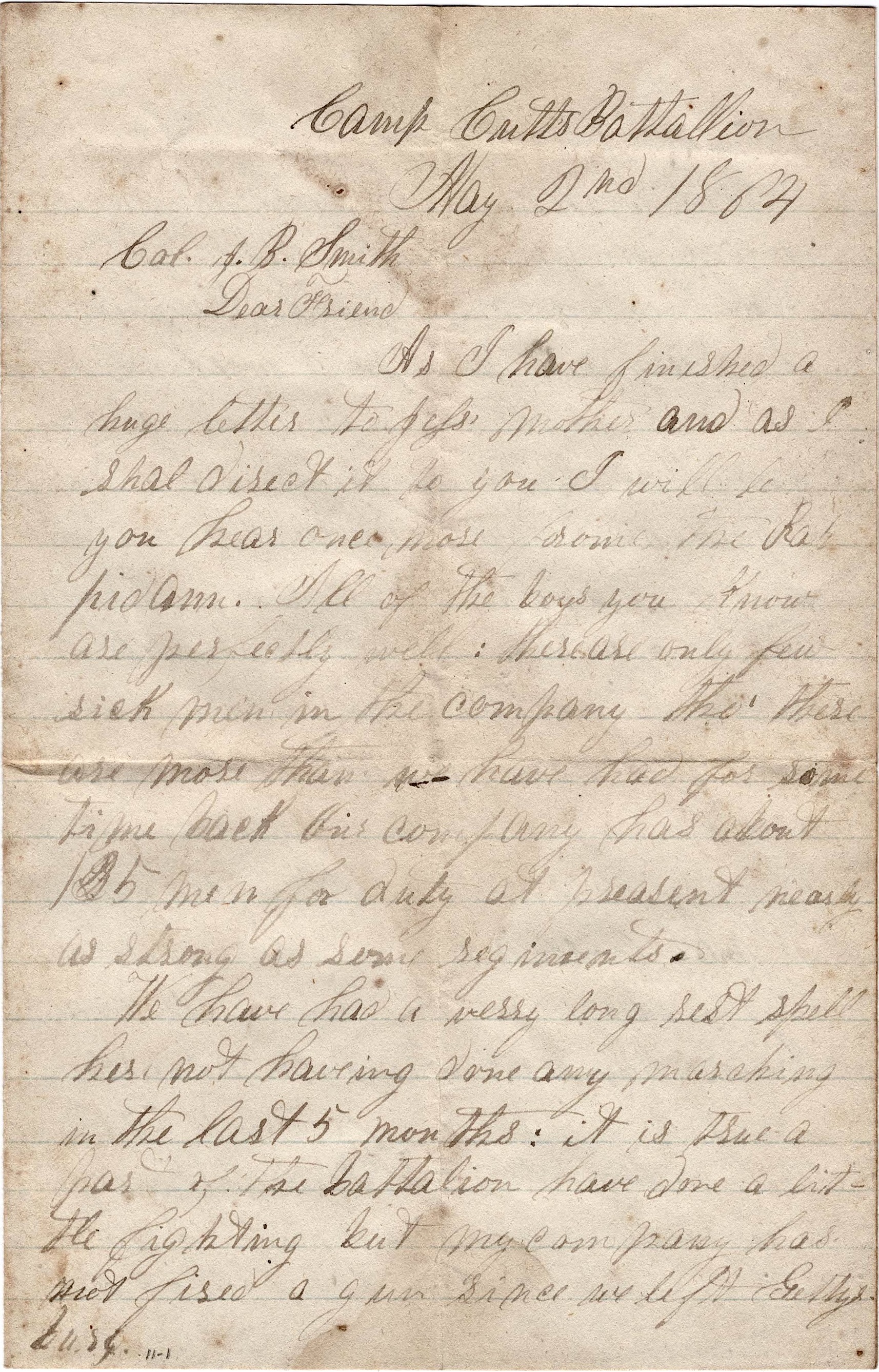
Dear friend, as I have finished a huge letter to Jess’ mother and as I shall direct it to you, I will let you hear once more from the Rapidan. All of the boys you know are perfectly well. There are only a few sick men in the company though there are more than we have had for some time back. Our company has about 125 men for duty at present—nearly as strong as some regiments.
We have had a very long rest spell here, not having done any marching in the last five months. It is true a part of the battalion have done a little fighting but my company has not fired a gun since we left Gettysburg.
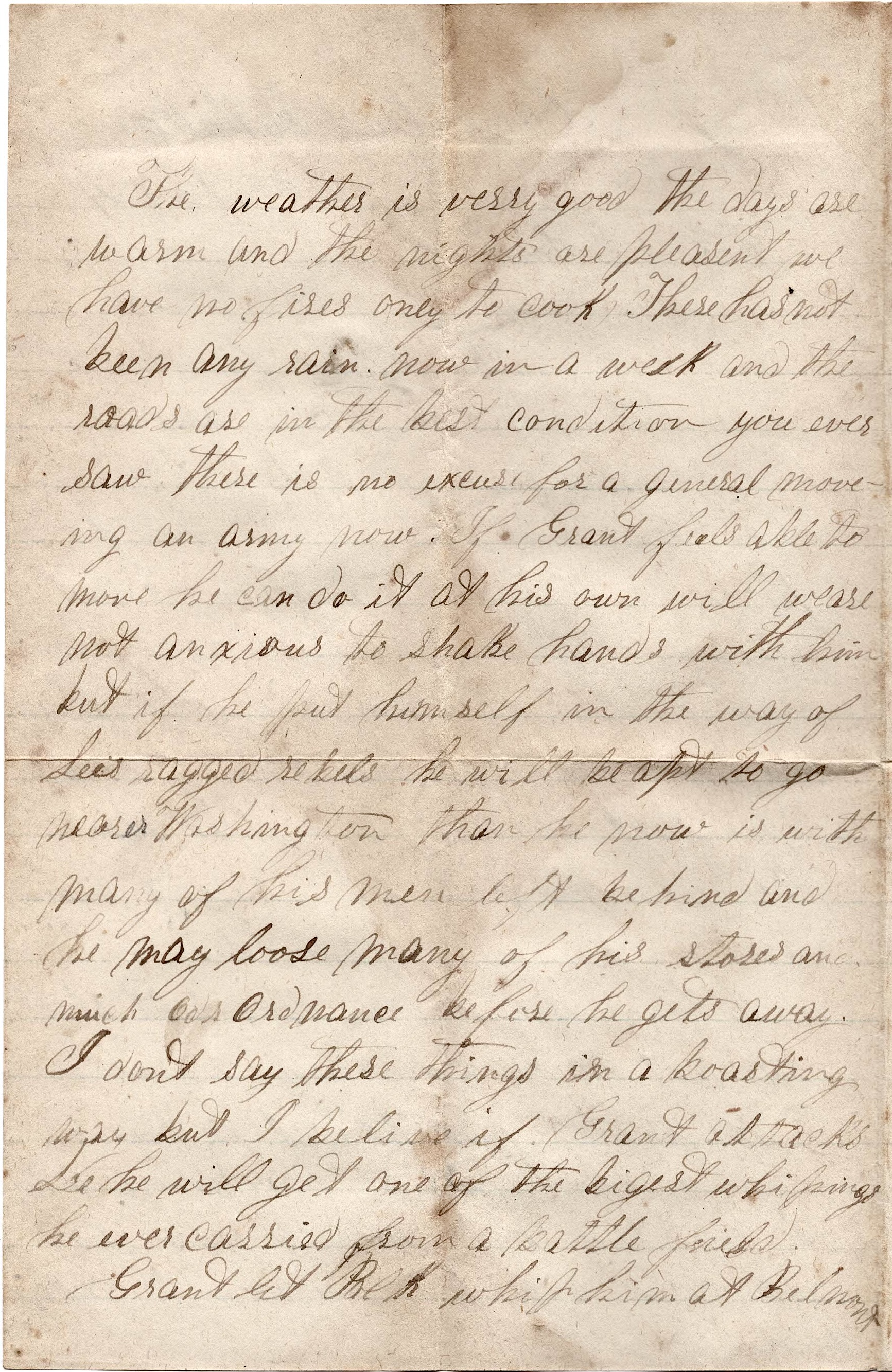
The weather is very good. The days are warm and the nights are pleasant. We have no fires—only to cook. There has not been any rain now in a week and the roads are in the best condition you ever saw. There is no excuse for a general moving an army now. If Grant feels able to move, he can do it at his own will. We are not anxious to shake hands with him, but if he puts himself in the way of Lee’s ragged rebels, he will be apt to go nearer Washington than he now is with many of his men left behind and he may lose many of his stores and much ordnance before he gets away. I don’t say these things in a boasting way but I believe if Grant attacks Lee, he will get one of the biggest whippings he ever carried from a battlefield. Grant let Polk whip him at Belmont and I think he will have to take one from this army.
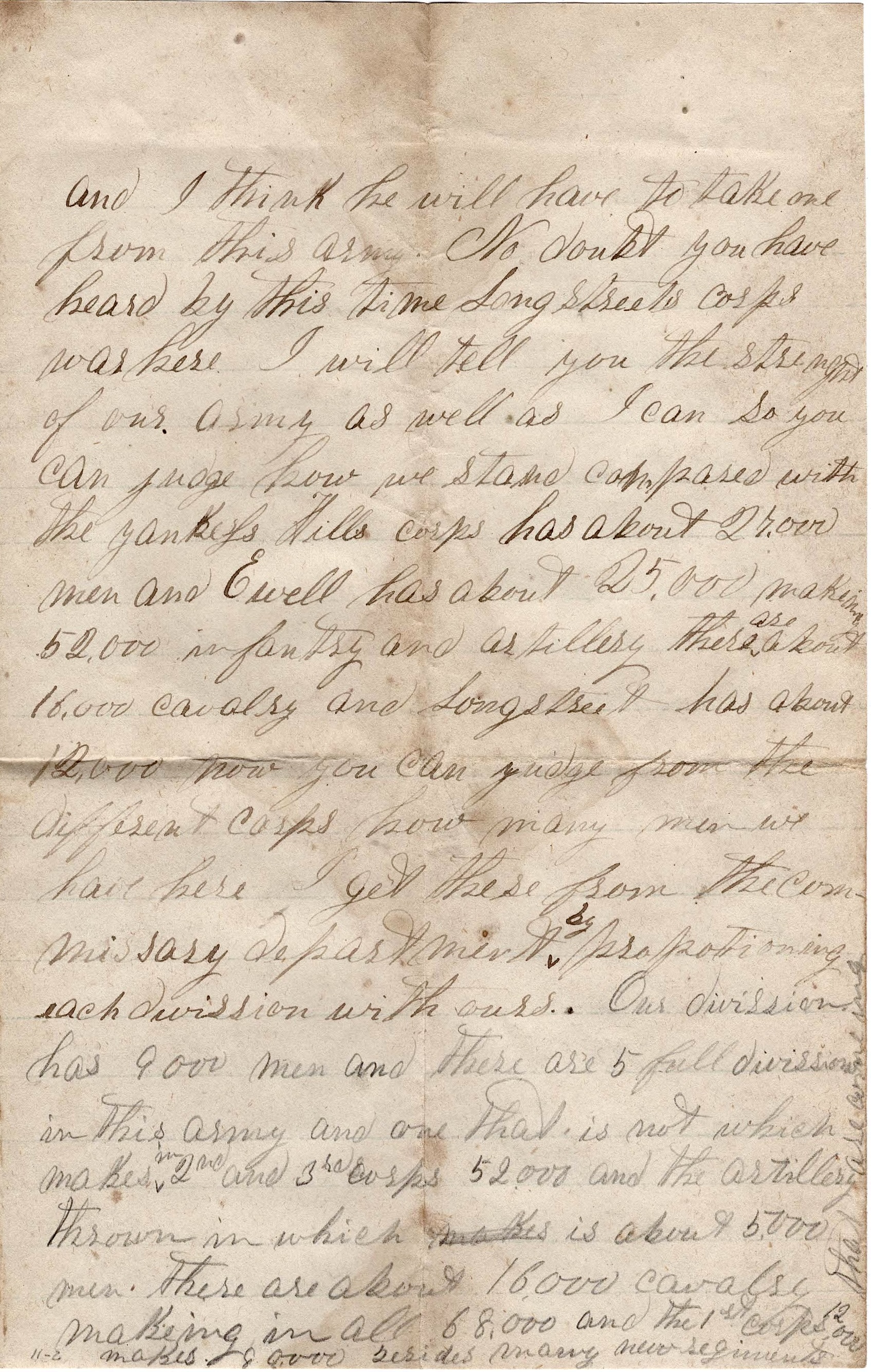
No doubt you have heard by this time Longstreet’s Corps was here. I will tell you the strength of our army as well as I can so you can judge how we stand compared with the Yankees. Hill’s Corp has about 27,000 men and Ewell has about 25,000, making 52,000 infantry and artillery. There are about 16,000 cavalry and Longstreet has about 12,000 now. You can judge from the different corps how many men we have here. I get these from the commissary department by proportioning each division with ours. Our division has 9,000 men and there are 5 full divisions in this army and one that is not which makes in the 2nd and 3rd Corps, 52,000 and the artillery thrown in which is about 5,000 men. There are about 16,000 cavalry making in all 68,000 and the 1st Corps makes 80,000 besides many new regiments that are coming.
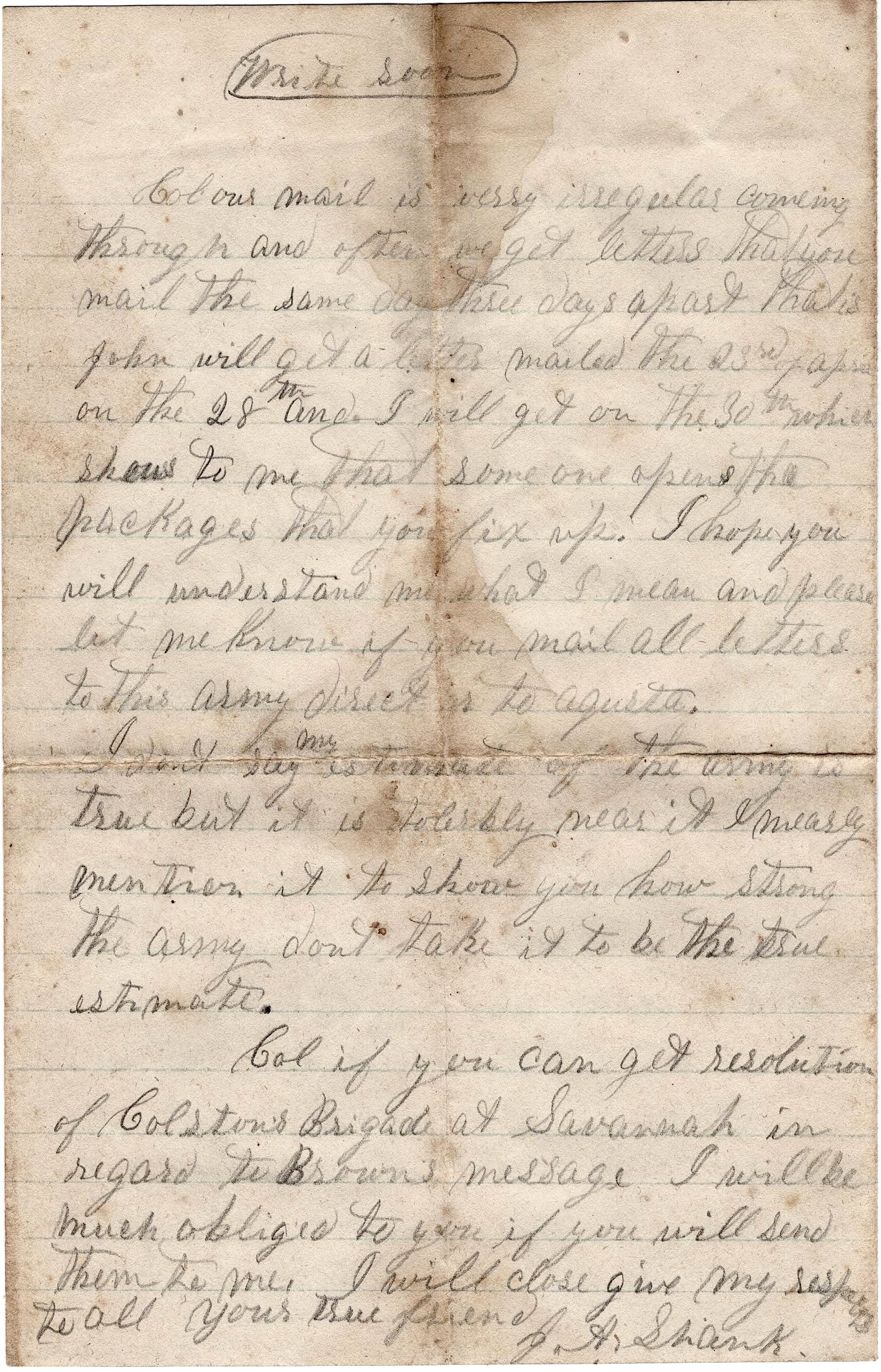
Colonel, our mail is very irregular coming through and after we get letters that you mail the same day three days apart. That is, John will get a letter mailed the 23rd of April on the 28th and I will get on the 30th which shows to me that someone opens the packages that you fix up. I hope you will understand me what I mean and please let me know if you mail all letters to this army direct or to Augusta.
I don’t say my estimate of the army is true, but it is tolerably near it. I merely mention it to show you how strong the army [is]; don’t take it to be the true estimate.
Colonel, if you can get resolution of Colston’s Brigade at Savannah in regard to Brown’s message, I will be much obliged to you if you will send them to me. I will close. Give my respects to all. Your true friend, — J[oseph] A. Shank
Letter 11
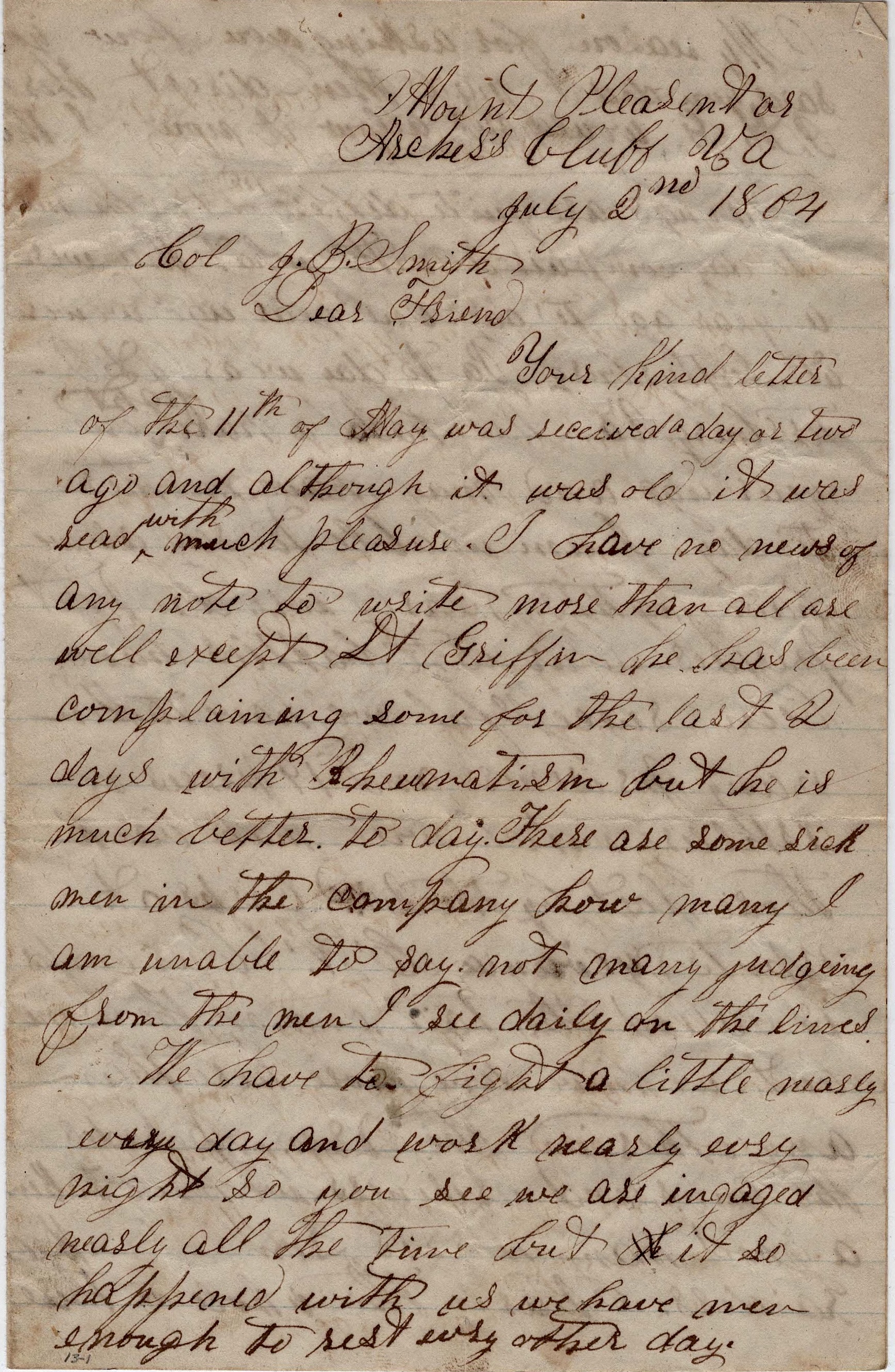
Mount Pleasant or Archer’s Bluff, Virginia July 2nd 1864
Col. J. B. Smith,
Dear friend, your kind letter of the 11th of May was received a day or two ago and although it was old, it was read with much pleasure. I have no news of any note to write more than all are well except. Lt. Griffin. He has been complaining some for the last two days with rheumatism but he is much better today. There are some sick men in the company. How many I am unable to say [but] not many judging from the men I see daily on the lines.
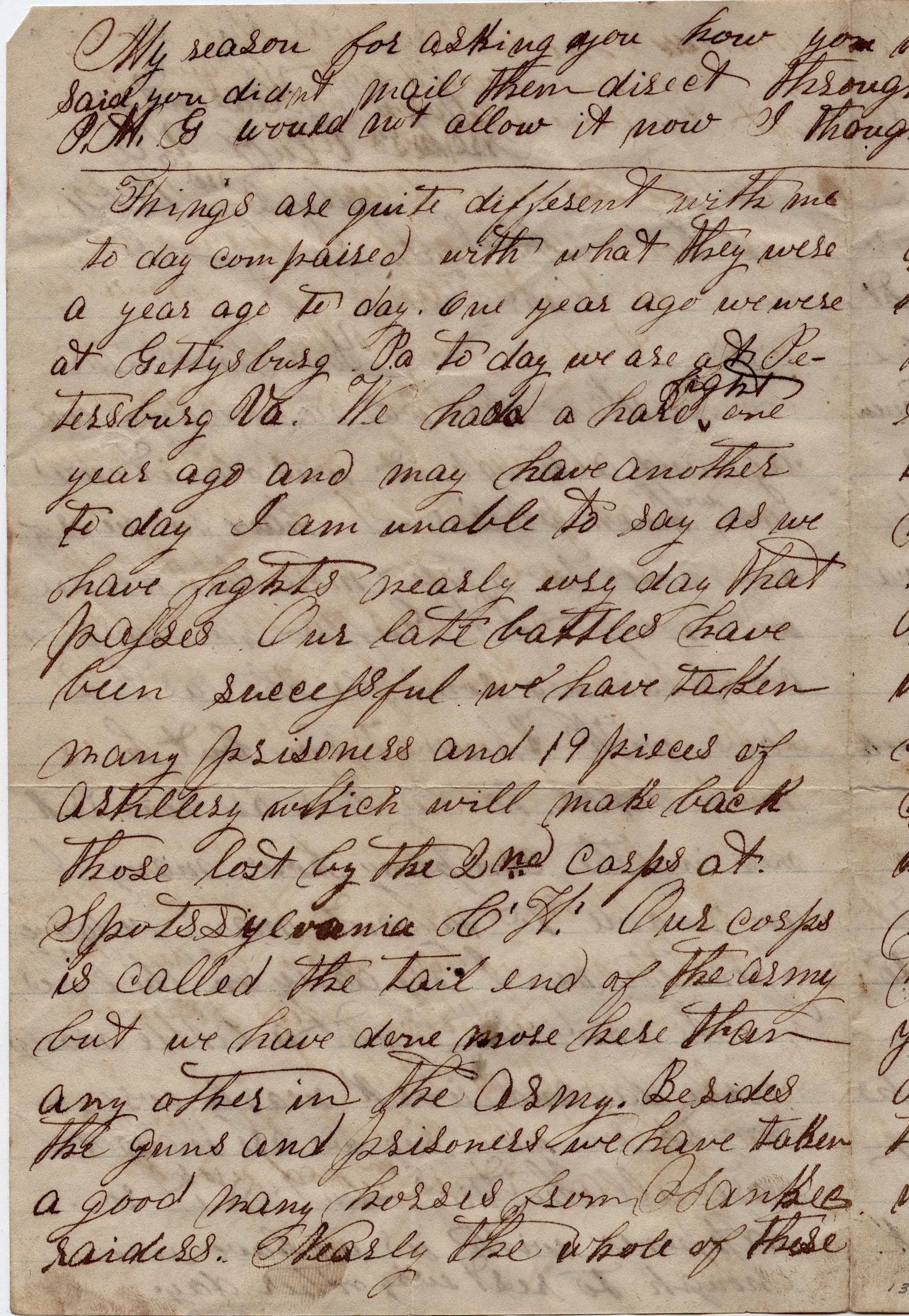
We have to fight a little most every day and work nearly every night so you see we are engaged nearly all the time but it so happened with us we have men enough to rest every other day. Things are quite different with me today compared with what they were a year ago today. One year ago we were at Gettysburg, Pennsylvania. Today we are at Petersburg, Virginia. We had a hard fight one year ago and may have another today, I am unable to say as we have fights nearly every day that passes. Our late battles have been successful. We have taken many prisoners and 19 pieces of artillery which will make back those lost by the 2nd Corps at Spotsylvania Court House.
Little Billy Mahone “is a small man, talks very fine, and is ugly enough to scare any set of men that did not know him.”
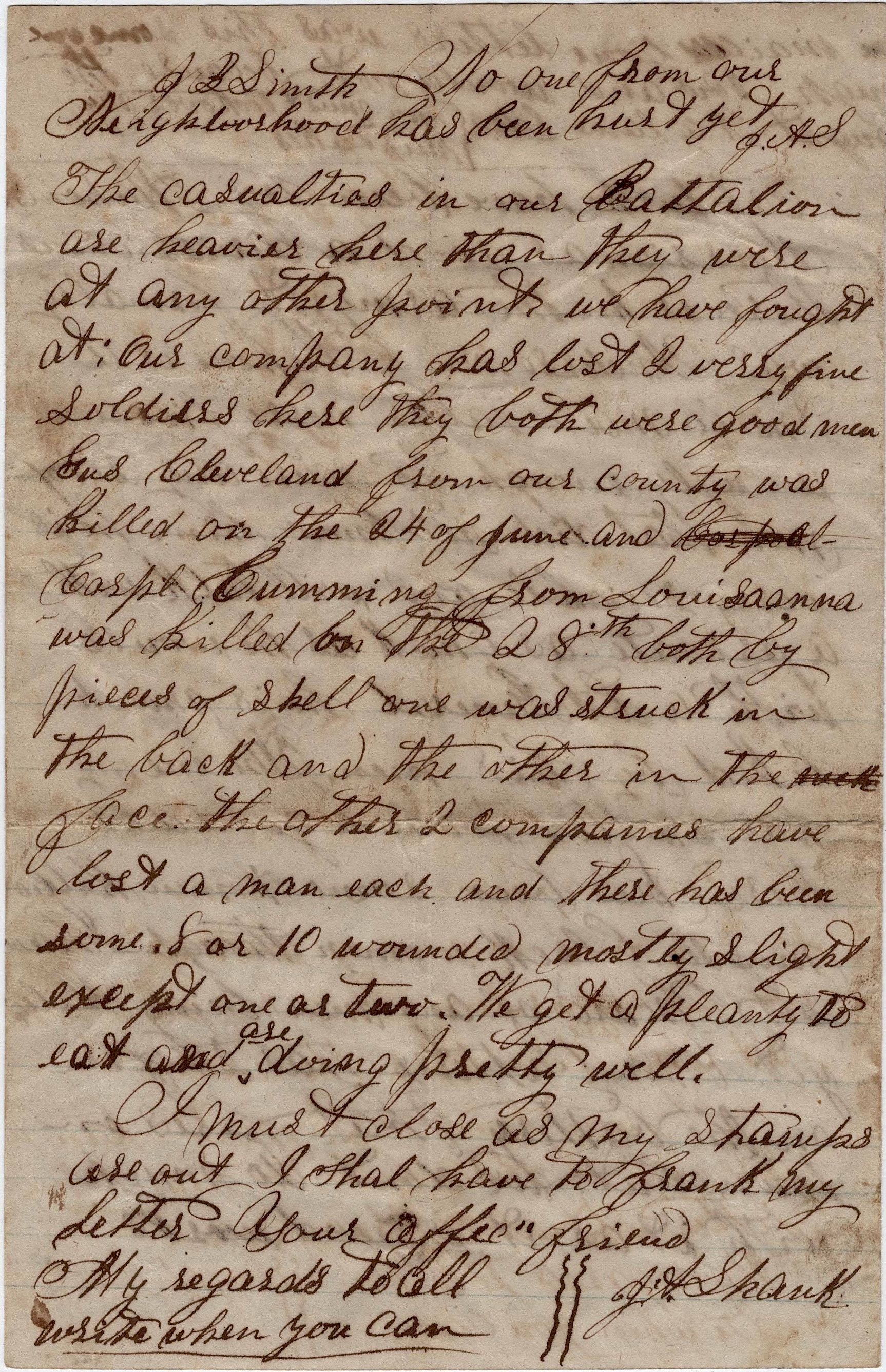
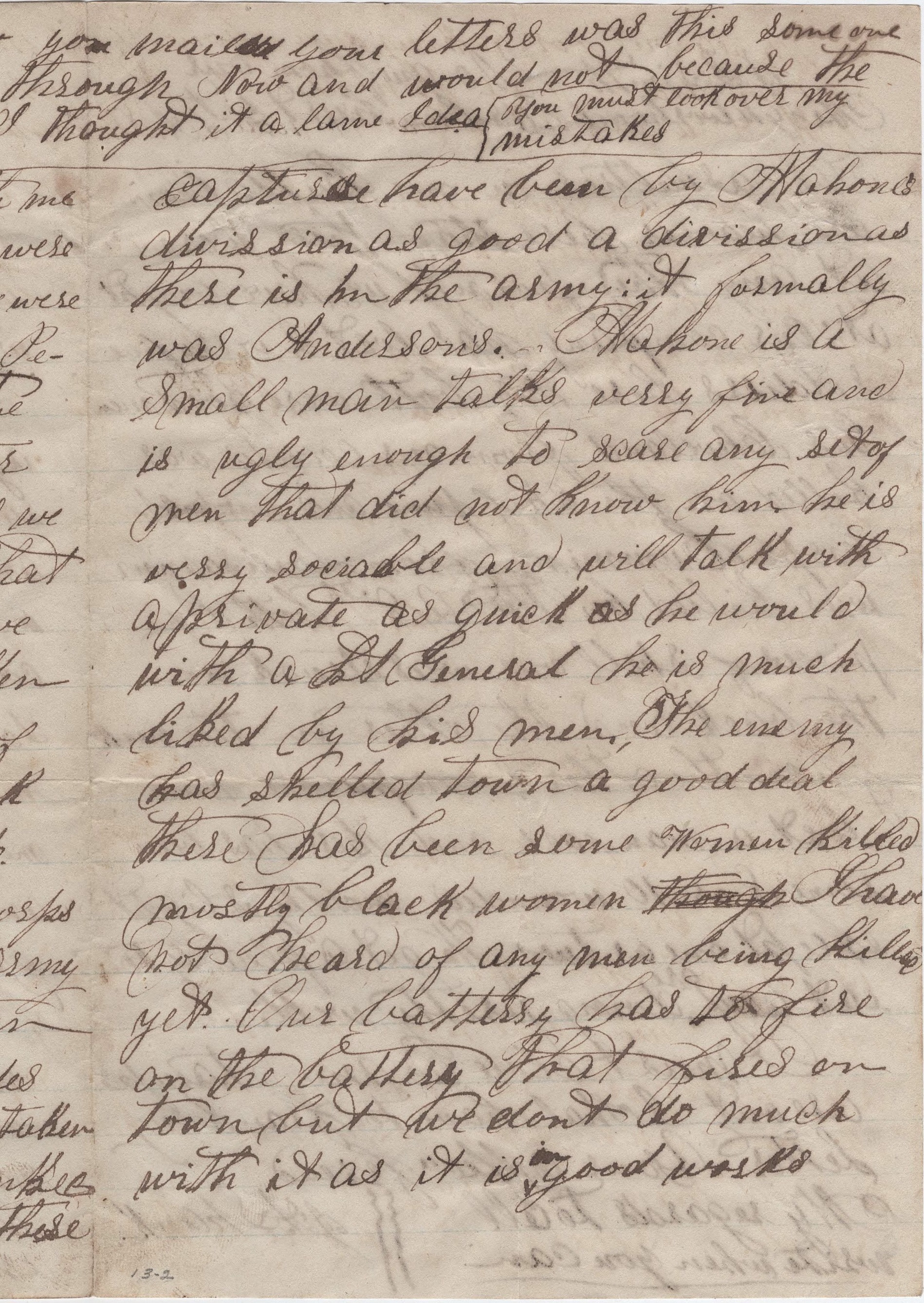
Our Corps is called the tail end of the army but we have done more here than any other in the army. Besides the guns and prisoners we have taken a good many horses from Yankee raiders. Nearly the whole of those captured have been by Mahone’s Division—as good a division as there is in the army & formerly was Anderson’s. [William, or “Little Billy”] Mahone is a small man, talks very fine, and is ugly enough to scare any set of men that did not know him. He is very sociable and will talk with a private as quick as he would with a Lt. General. He is much liked by his men.
The enemy has shelled this town a good deal. There has been some women killed—mostly black women. I have not heard of any man being killed yet. Our battery has to fire on the battery that fires on the town but we don’t do much with it as it is a good works.
No one from our neighborhood has been hurt yet. The casualties in our battalion are heavier here than they were at any other point we have fought at. Our company has lost two very fine soldiers here. They both were good men. Gus Cleveland from our county was killed on the 24th of June and Corporal Cumming from Louisiana was killed on the 28th, both by pieces of shell. One was struck in the back and the other in the face. The other two companies have lost a man each and there has been some 8 or 10 wounded—mostly slight except one or two. We get a plenty to eat and are doing pretty well.
I must close as my stamps are out. I shall have to frank my letter. Your affectionate friend, — J[oseph] A. Shank
My regards to all. Write when you can.
Letter 12
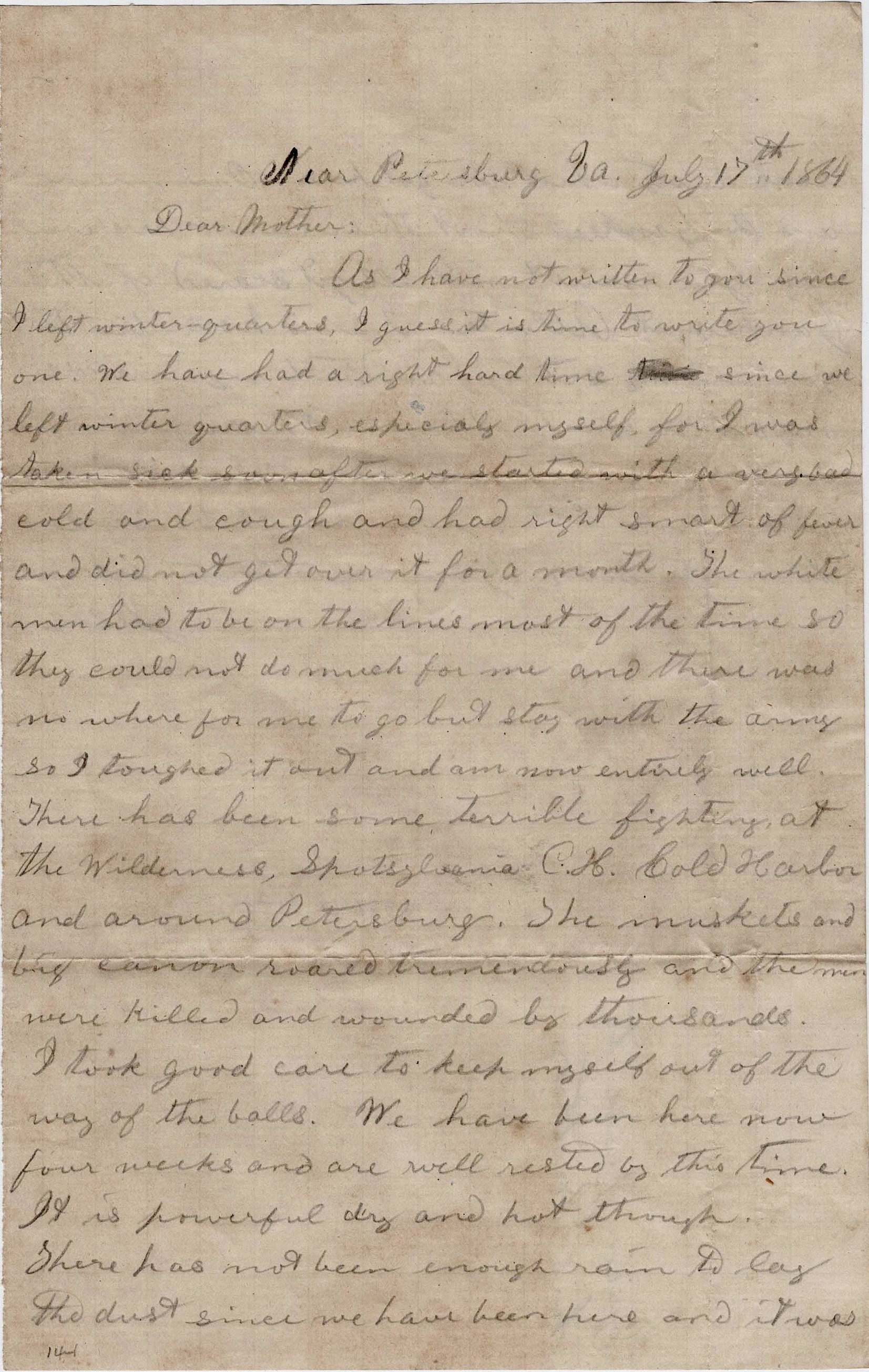
Near Petersburg, Virginia July 17th 1864
Dear Mother,
As I have not written to you since I left winter quarters, I guess it is time to write you one. We have had a right hard time since we left winter quarters—especially myself, for I was taken sick soon after we started with a very bad cold and cough and had right smart of fever and did not get over it for a month. The white men had to be on the lines most of the time so they could not do much for me and there was no where for me to go but stay with the army. So I toughed it out and am now entirely well.
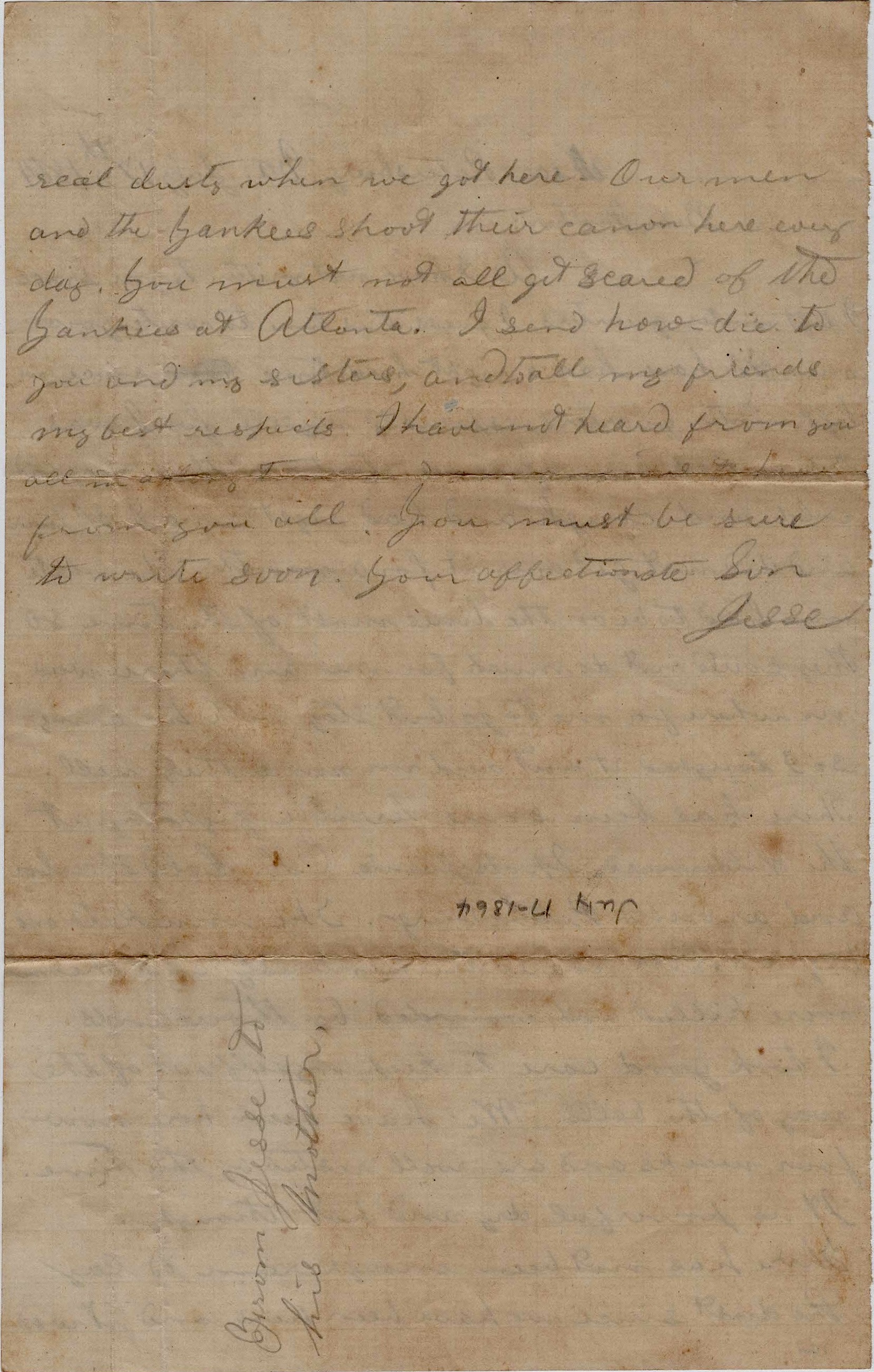
There has been some terrible fighting at the Wilderness, Spotsylvania C. H., Cold Harbor, and around Petersburg. The muskets and big cannon roared tremendously and the men were killed and wounded by thousands. I took good care to keep myself out of the way of the balls. We have been here now four weeks and are well rested by this time. It is powerful dry and hot though. There has not been enough rain to lay the dust since we have been here and it was real dusty when we got here. Our men and the Yankees shoot their cannon here every day. You must not all get scared of the Yankees at Atlanta. I send howdy to you and my sisters and to all my friends my best respects. I have not heard from you all in a long time. I would like to hear from you all. You must be sure to write soon. Your affectionate son, — Jesse
From Jesse to his mother.
Letter 13
Near Petersburg, Virginia August 5th 1864
Col. J. B. Smith,
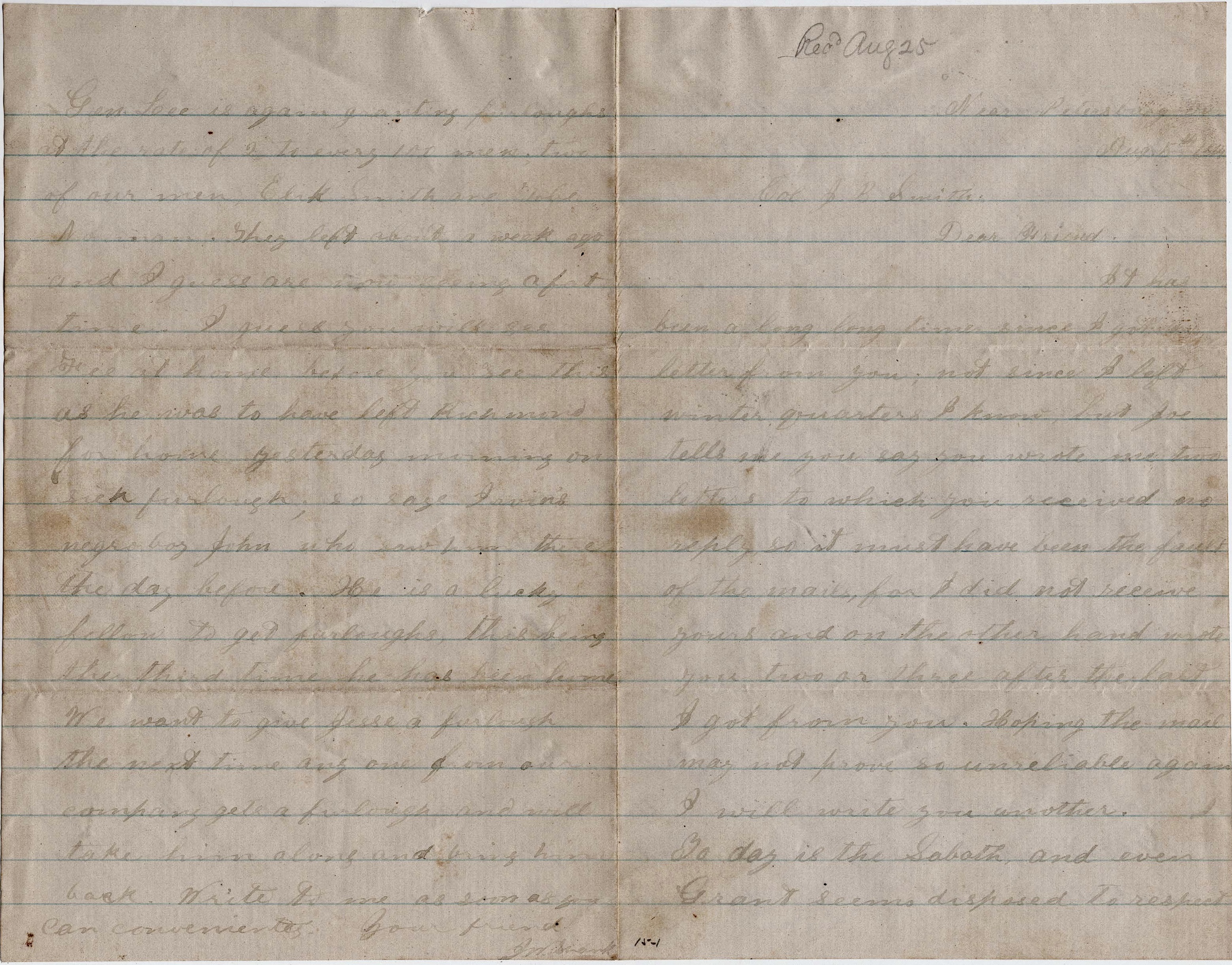
Dear friend, it has been a long long time since I got a letter from you; not since I left winter quarters I know, but Joe tells me you say you wrote me two letters to which you received no reply so it must have been the fault of the mails for I did not receive yours, and on the other hand wrote you two or three after the last I got from you. Hoping the mail may not prove so unreliable again, I will write you another.
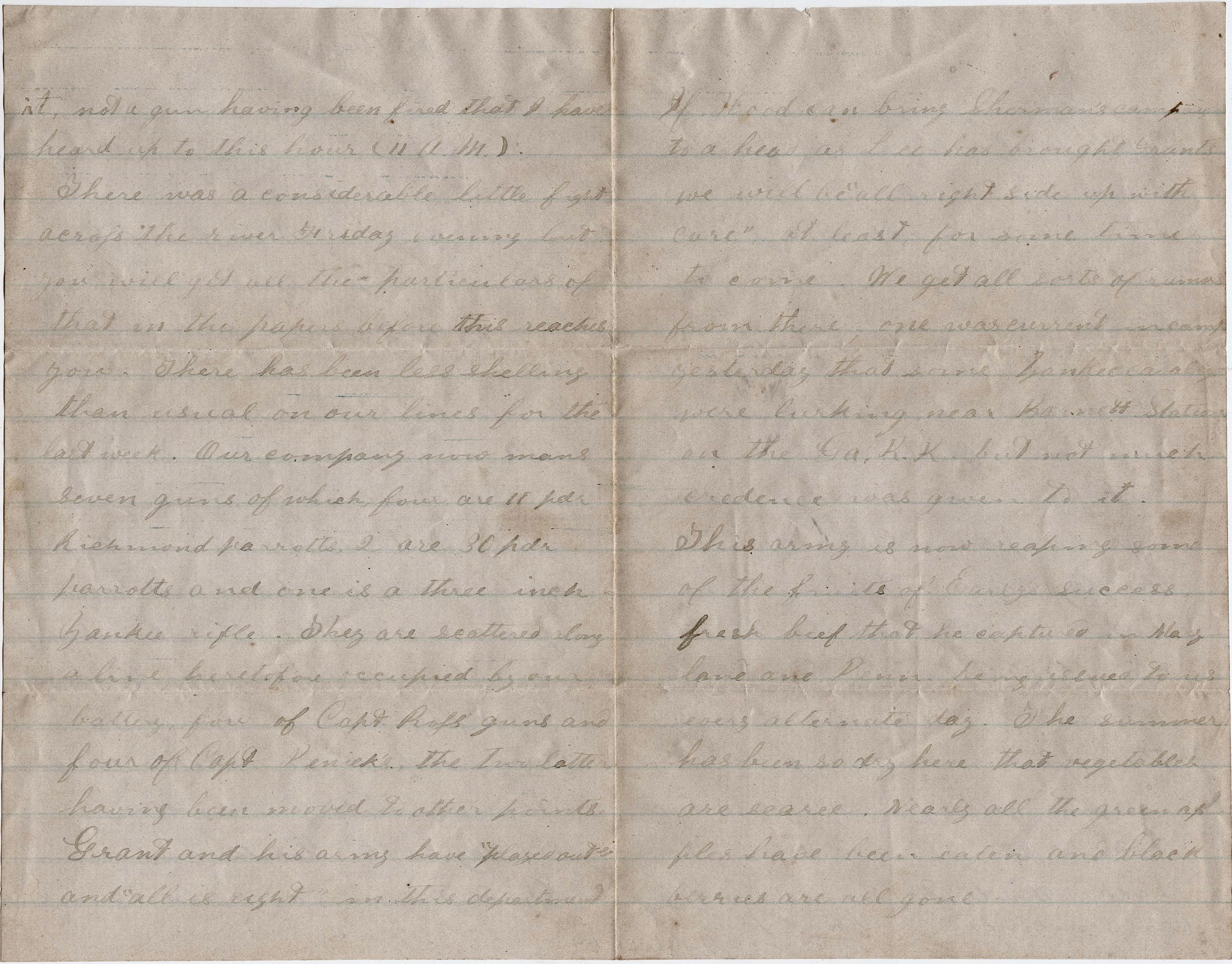
Today is the Sabbath and even Grant seems disposed to respect it, not a gun having been fired that I have heard up to this hour (11 a.m.). There was a considerable little fight across the river Friday evening but you will get all the particulars of that in the papers before this reaches you. There has been less shelling than usual on our lines for the last week. Our company now mans seven guns of which four are 10-pounder Richmond Parrotts, two are 30-pounder Parrotts, and one is a 3-inch Yankee rifle. They are scattered along a line heretofore occupied by our battery, four of Capt. Ross’ guns and four of Capt. Penick’s—the two latter having been moved to other points.
Grant and his army have “played out” and “all is right” in this department. If Hood can bring Sherman’s campaign to a head as Lee has brought Grant’s, we will be “all right side up with care,”—at least for some time to come. We get all sorts of rumors from there. One was current in camp yesterday that some Yankee cavalry were lurking near Barnett Station on the Georgia Railroad but not much credence was given to it.
This army is now reaping some of the fruits of Early’s success—fresh beef that he captured in Maryland and Pennsylvania being issued to us every alternate day. The summer has been so dry here that vegetables are scarce. Nearly all the green apples have been eaten and black berries are all gone.
Gen. Lee is again granting furloughs at the rate of 2 to every 100 men. Two of our men—Eli Smith and Toby Norman—left about a week ago and I guess are now seeing a fat time. I guess you will see Fee at home before you see this as he was to have left Richmond for home yesterday morning on sick furlough, so says Irvin’s negro boy John who saw him there the day before. He is a lucky fellow to get furloughs, this being the third time he has been home. We want to give Jesse a furlough the next time any one from our company gets a furlough and will take him along and bring him back.
Write to me as soon as you can conveniently. Your friend, — J. W. Shank
Letter 14
In Line of Battle Near Petersburg, Virginia August 9th 1864
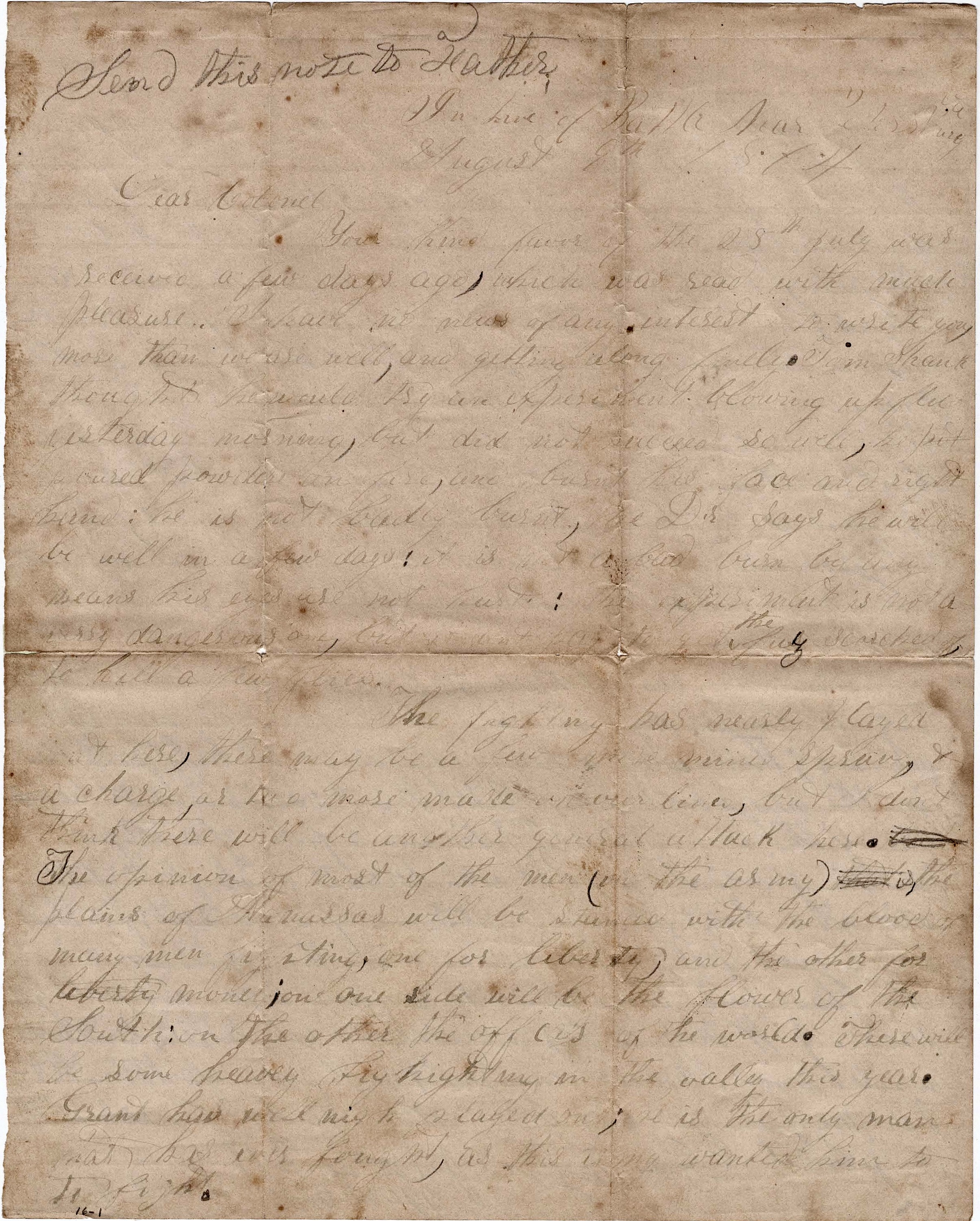
Dear Colonel, your kind favor of the 28th July was received a few days ago which was read with much pleasure. I have no news of any interest to write you more than we are well and getting along finely. Tom Shank thought he would try an experiment blowing up flies yesterday morning, but did not succeed so well, he poured powder on fire, and burnt his face and right hand. He is not badly burnt. The Dr. says he will be well in a few days. It is not a bad burn by any means. His eyes are not hurt. The experiment is not a very dangerous one, but it don’t pay to get the fuzz scratched of to kill a few flies.
The fighting has nearly played out here. There may be a few more mines sprung a charge or two more made on our lines, but I don’t think there will be another general attack here. The opinion of most of the men (in the army) is the plains of Manassas will be stained with the blood of many men fighting—one for liberty, and the other for money. One side will be the flower of the South: on the other the officious of the world. There will be some heavy fighting in the [Shenandoah] Valley this year.
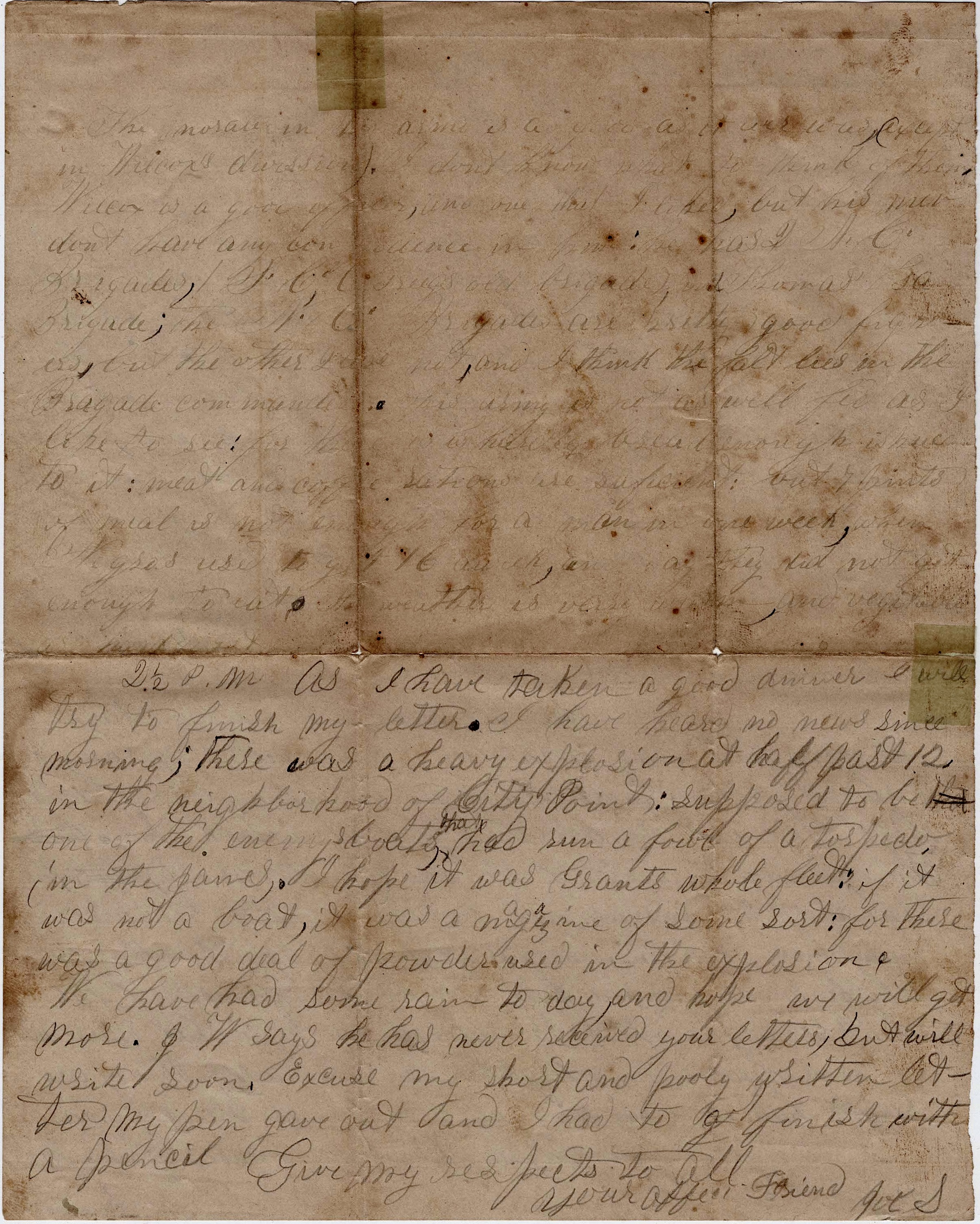
Grant has well nigh played out. He is the only man that has ever fought as this army wanted him to fight. The morale in the army is as good as it ever was (except in (Wilcox’s Division). I don’t know what to think of them. Wilcox is a good officer and one that I liked, but his men don’t have any confidence in him. He has two North Carolina Brigades, one South Carolina (Gregg’s old Brigade), and Thomas’ Georgia Brigade. The North Carolinas Brigades are pretty good fighters, but the other two are not and I think the fault lies in the Brigade commanders.
This army is not as well fed as I like to see for there is hardly bread enough issued to it. Meat and coffee rations are sufficient, but seven pints of meal is not enough for a man in one week, when Negros used to get 16 a week, and say they did not get enough to eat. The weather is very warm and vegetables are hard to get.
2½ p.m. As I have taken a good dinner, I will try to finish my letter. I have heard no news since morning. There was a heavy explosion at half past 12 in the neighborhood of City Point—supposed to be one of the enemy’s boats that had run afoul of a torpedo (in the James). I hope it was Grant’s whole fleet. If it was not a boat, it was a magazine of some sort for there was a good deal of powder used in the explosion. We have had some rain today and hope we will get more.
J. W. [Shank] says he has never received your letters but will write soon. Excuse my short and poorly written letter. My pen gave out and I had to finish with a pencil. Give my respects to all. Your affectionate friend, — Joe S[hank]
Letter 15
Camp of Irvin Artillery near Petersburg, Virginia September 21st 1864
Col. J. B. Smith,
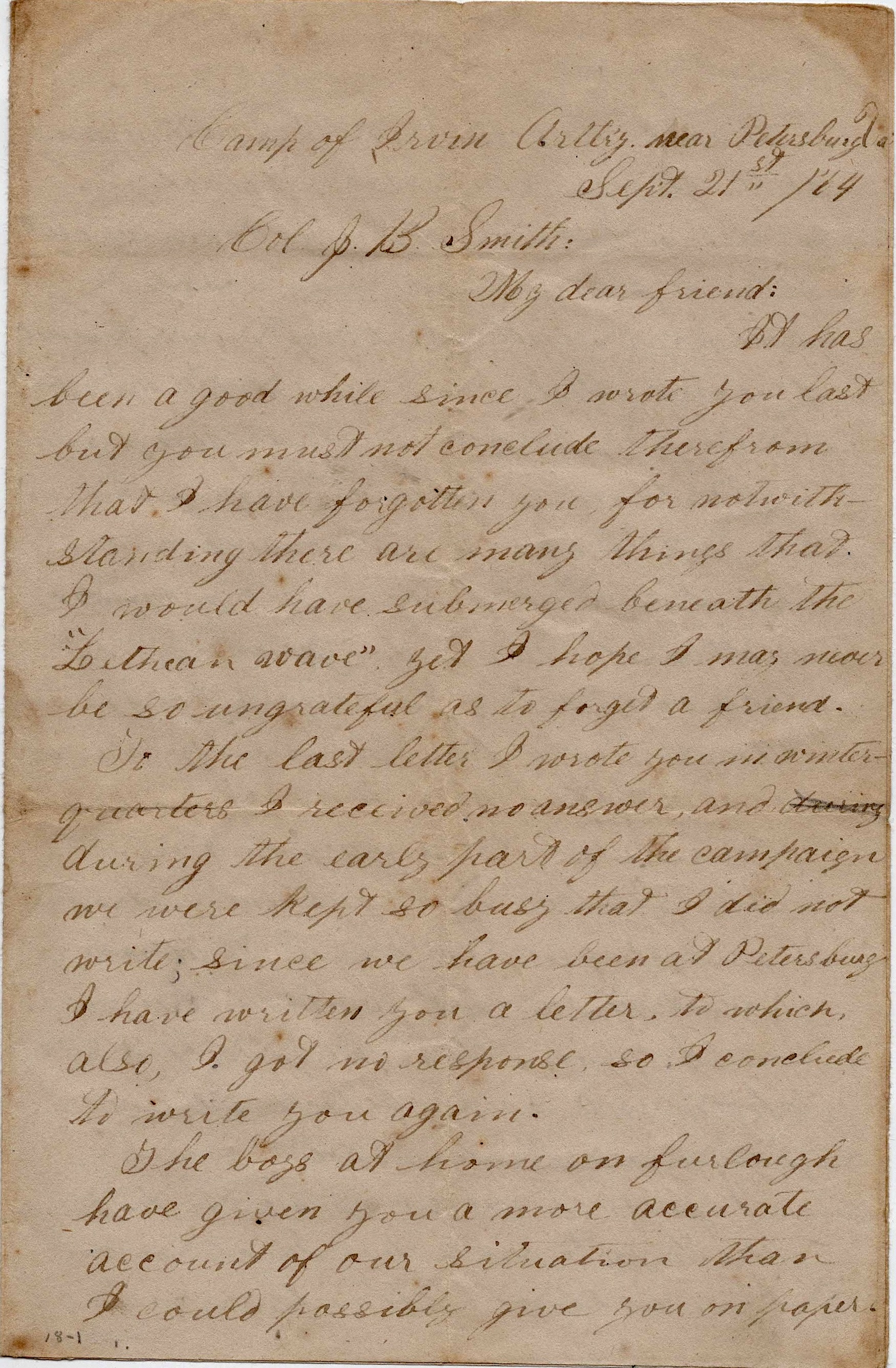
My dear friend, it has been a good while since I wrote you last but you must no conclude therefrom that I have forgotten you for notwithstanding there are many things that I would have submerged beneath the “Lethean wave,” yet I hope I may never be so ungrateful as to forget a friend.
To the last letter I wrote you in winter quarters, I received no answer and during the early part of the campaign, we were kept so busy that I did not write.. Since we have been at Petersburg, I have written you a letter, to which, also, I got no response so I conclude to write you again.
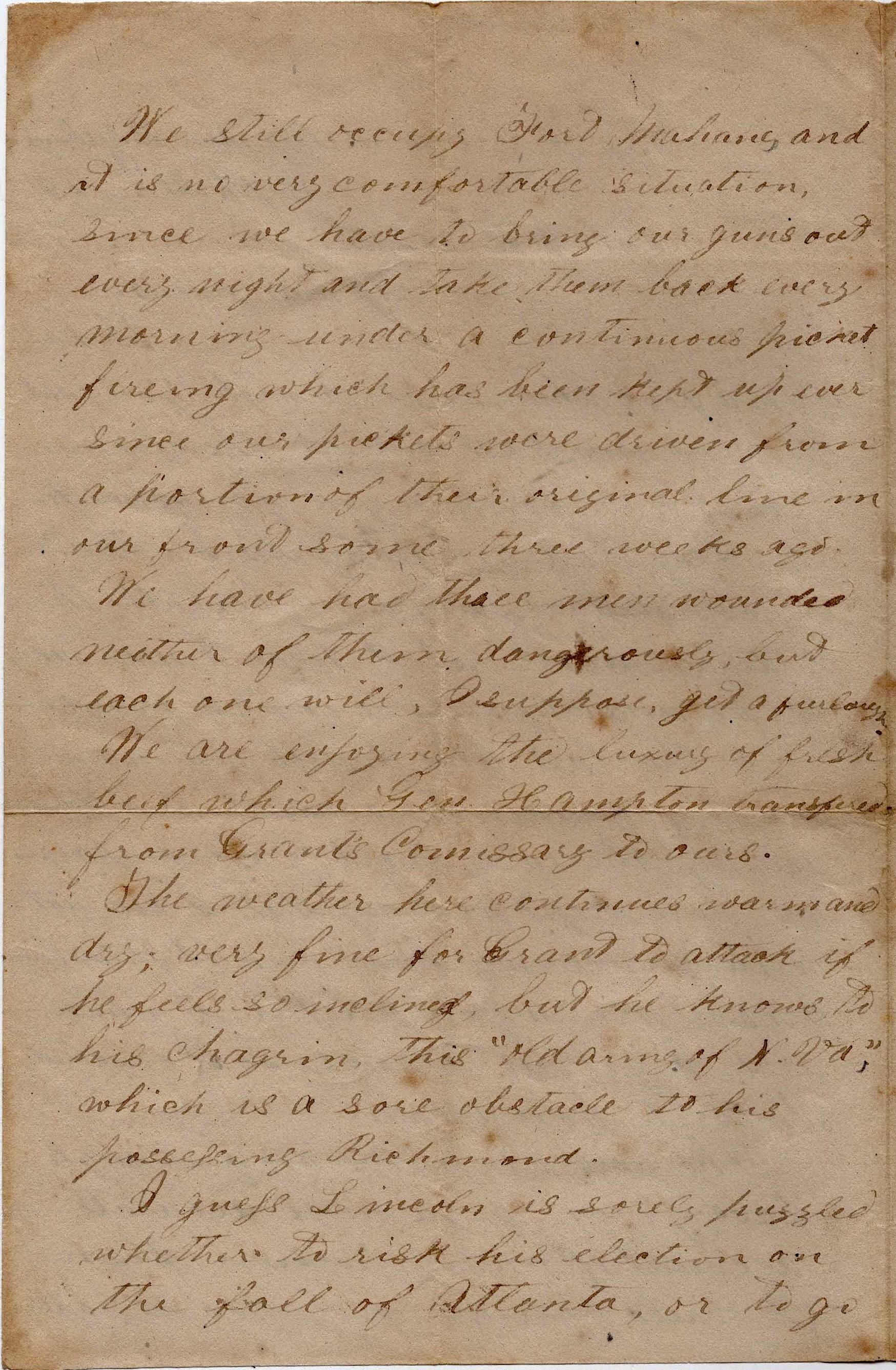
The boys at home on furlough have given you a more accurate account of our situation than I could possibly give you on paper. We still occupy Fort Mahone and it is no very comfortable situation since we have to bring our guns out every night and take them back every morning under a continuous picket firing which has been kept up ever since our pickets were driven from a portion of their original line in our front some three weeks ago. We have had three men wounded, neither of them wounded dangerous, but each one will, I suppose, get a furlough.
We are enjoying the luxury of fresh beef which Gen. Hampton transferred from Grant’s commissary to ours.
The weather here continues warm and dry—very fine for Grant to attack if he feels so inclined. But he knows to his chagrin this “Old Army of Northern Virginia” which is a sore obstacle to his possessing Richmond.
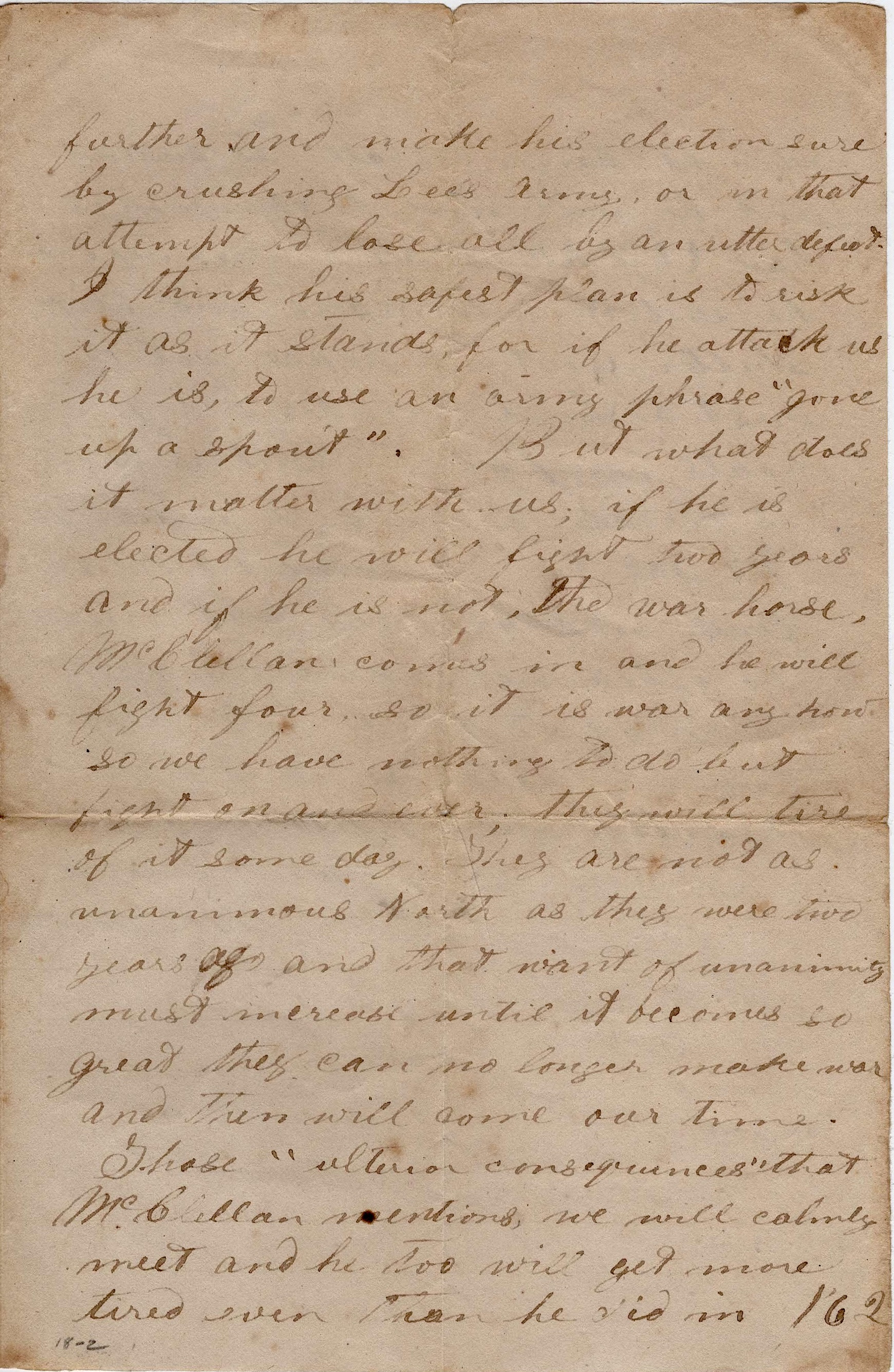
I guess Lincoln is sorely puzzled whether to risk his election on the fall of Atlanta or to go further and make his election sure by crushing Lee’s army, or in that attempt to lose all by an utter defeat. I think his safest plan is to risk it as it stands for if he attacks us, he is—to use an army phrase,”gone up a spout.” But what does it matter with us if he is elected. He will fight two years and if he is not [elected], the war horse McClellan comes in and he will fight four. So it is war anyhow. So we have nothing to do but fight on as ever. They will tire of it some day. They are not as unanimous North as they were two years ago and that want of unanimity must increase until it becomes so great they can no longer make war and then will come our time.
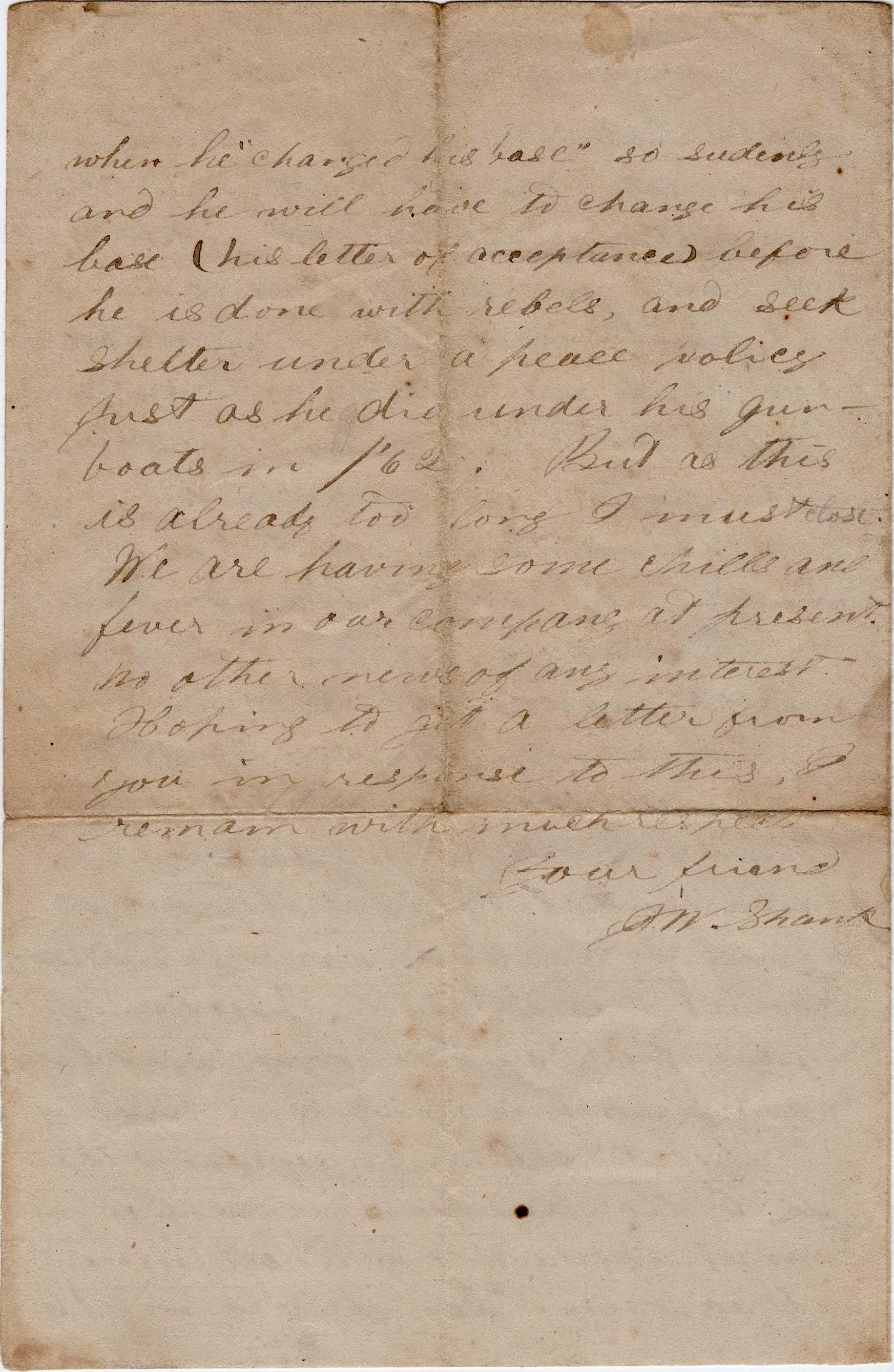
Those “ulterior consequences” that McClellan mentions, we will calmly meet and he too will get more tired even than he did in ’62 when he “changed his base” so suddenly and he will have to change his base (his letter of acceptance) before he is done with rebels and seek shelter under a peace policy just as he did under his gunboats in ’62.
But as this is already too long, I must close. We are having some chills and fever in our company at present. No other news of any interest. Hoping to get a letter from you in response to this. I remain with much respect your friend, — J. W. Shank
Letter 16
Petersburg, Virginia October 3rd 1864
Mr. Smith,
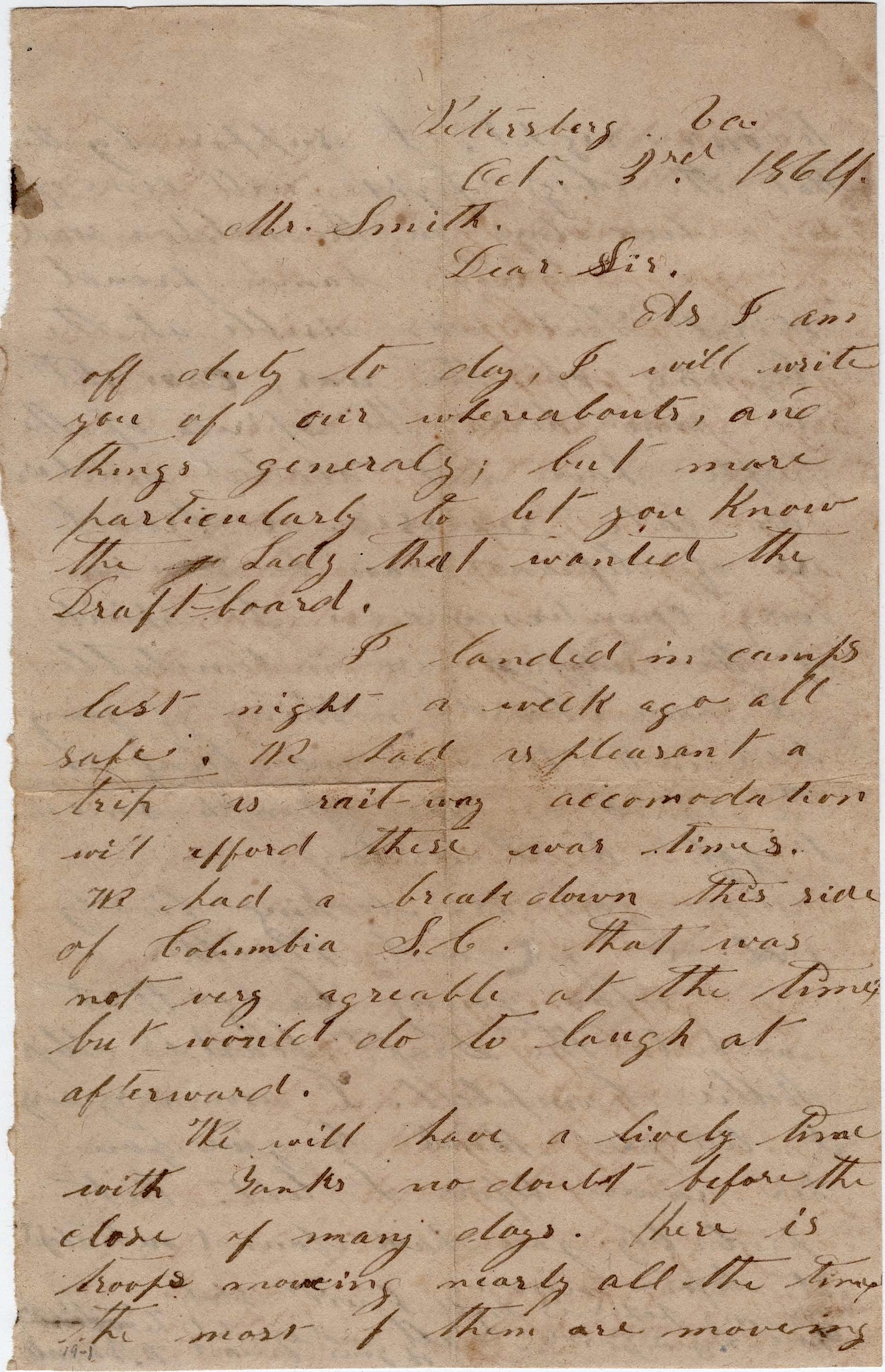
Dear sir, as I am off duty today, I will write you of our whereabouts and things generally, but more particularly to let you know the lady that wanted the draft board.
I landed in camp last night a weeks ago all safe. We had as pleasant a trip as railway accommodations will afford these war times. We had a breakdown this side of Columbia, South Carolina, that was not very agreeable at thetime, but would do to laugh at afterward.
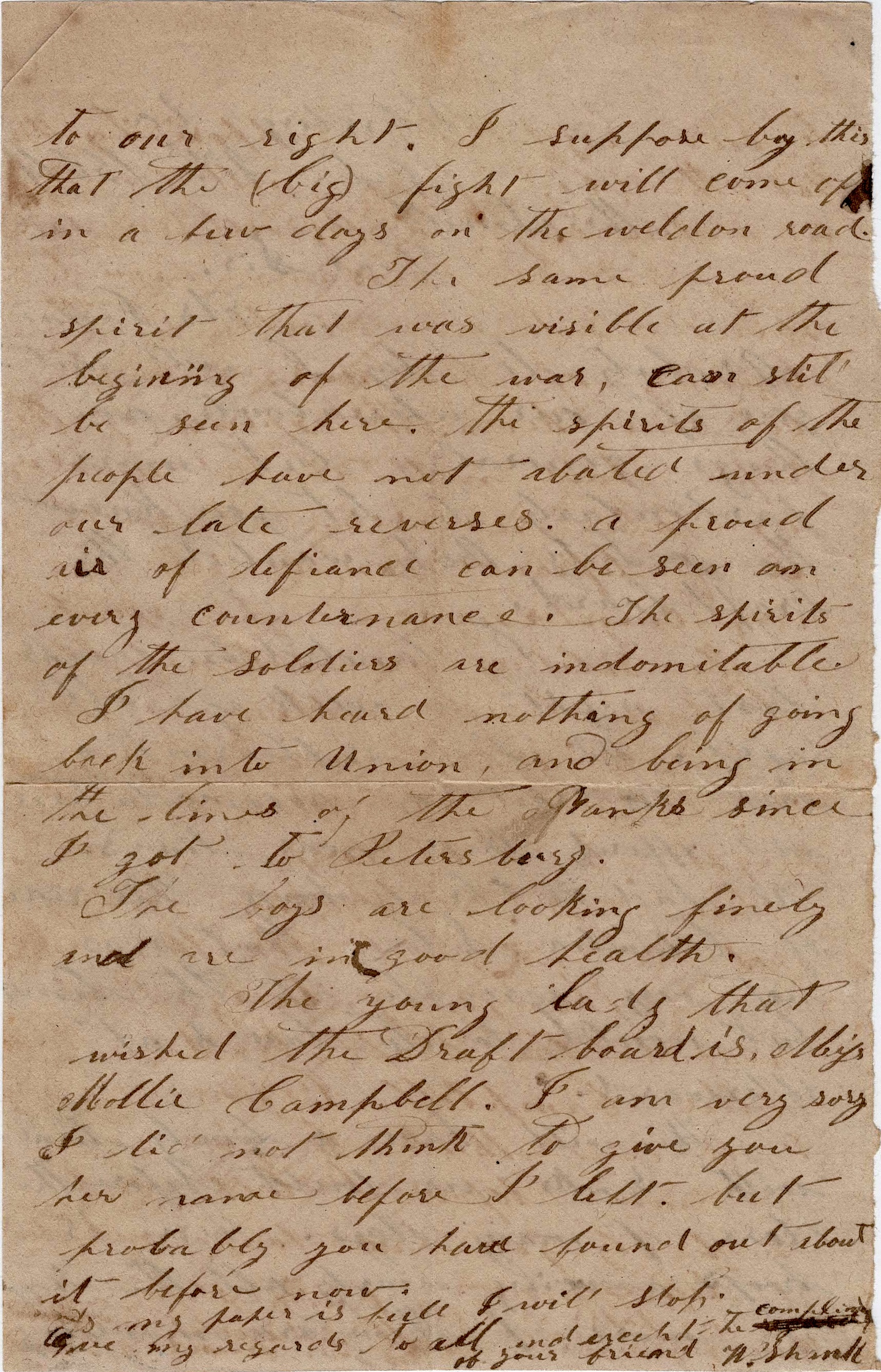
We will have a lively time with the Yanks no doubt before the close of many days. There is troops a moving nearly all the time. The most of them are moving to our right. I suppose by that the big fight will come off in a few days on the Weldon Railroad.
The same proud spirit that was visible at the beginning of the war can still be seen here. The spirits of the people have not abated under our lates reverses. A proud air of defiance can be seen on every countenance. The spirits of the soldiers are indomitable. I have heard nothing of going back into the Union, and being in the lines of the Yanks since I got to Petersburg. Theboys are looking finely and are in good health.
The young lady that wished the draft board is Miss Mollie Campbell. I am very sorry I did not think to give you her name before I left, but probably you have found out about it before now.
As my paper is full, I will stop. Give my regards to all and accept the compliments of your friend, — W[illiam Baxter] Shank
Letter 17
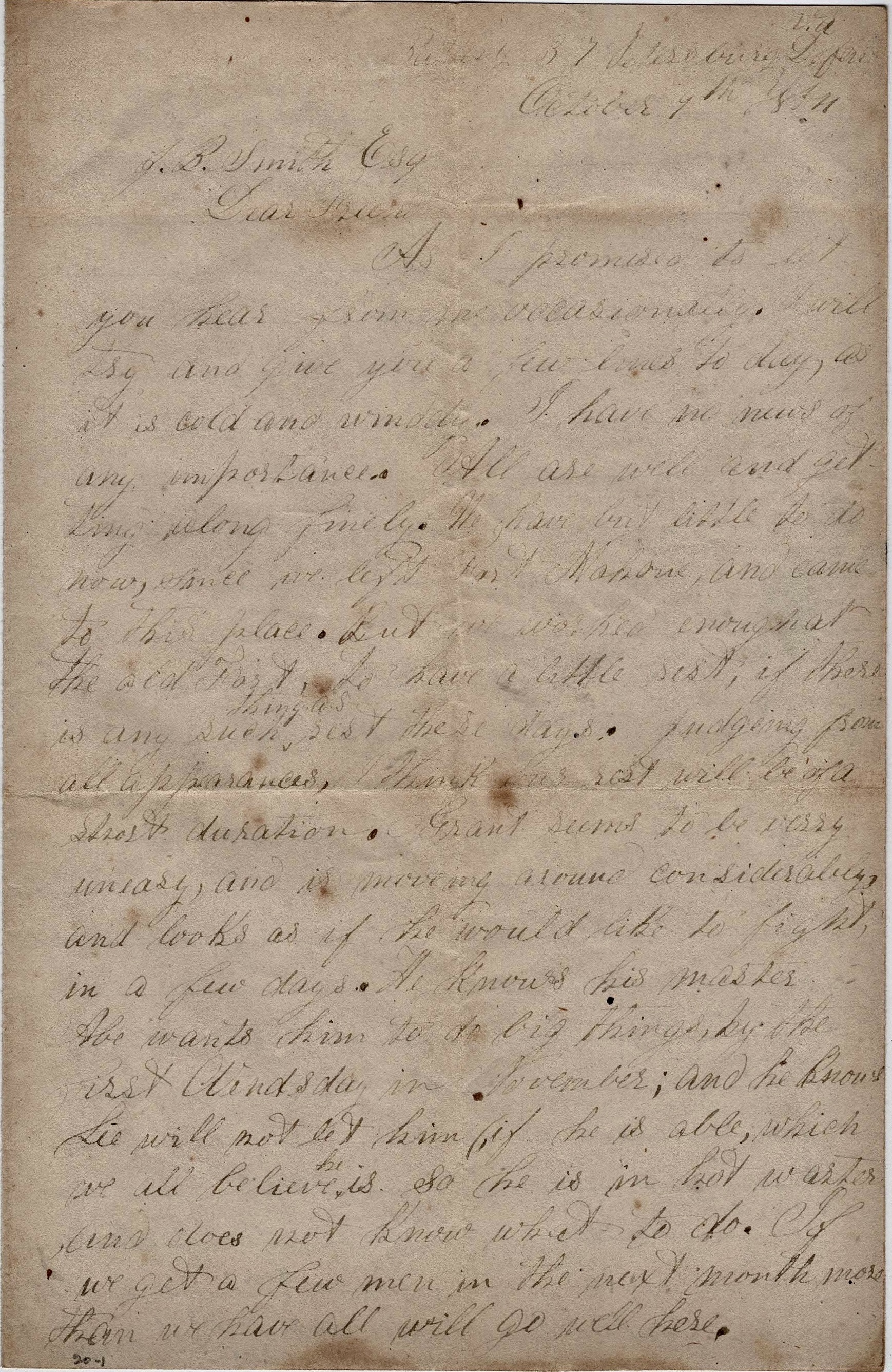
Battery 37. Petersburg, Defenses, Va. October 9th, 1864
J. B. Smith. Esq.,
Dear sir, as I promised to let you hear from me occasionally, I will try and give you a few lines today as it is cold and windy. I have no news of any importance. All are well and getting along finely. We have but little to do now since we left Fort Mahone and came to this place. But we worked enough at the old fort to have a little rest, if there any such thing as rest these days. Judging from all appearances, I think our rest will be of a short duration. Grant seems to be very uneasy and is moving around considerably and looks as if he would like to fight in a few days. He knows his master Abe wants him to do big things by the first Wednesday in November, and he knows Lee will not let him (if he is able, which we all believe he is) so he is in hot water and does not know what to do. If we get a few men in the next month more than we have, all will go well here.
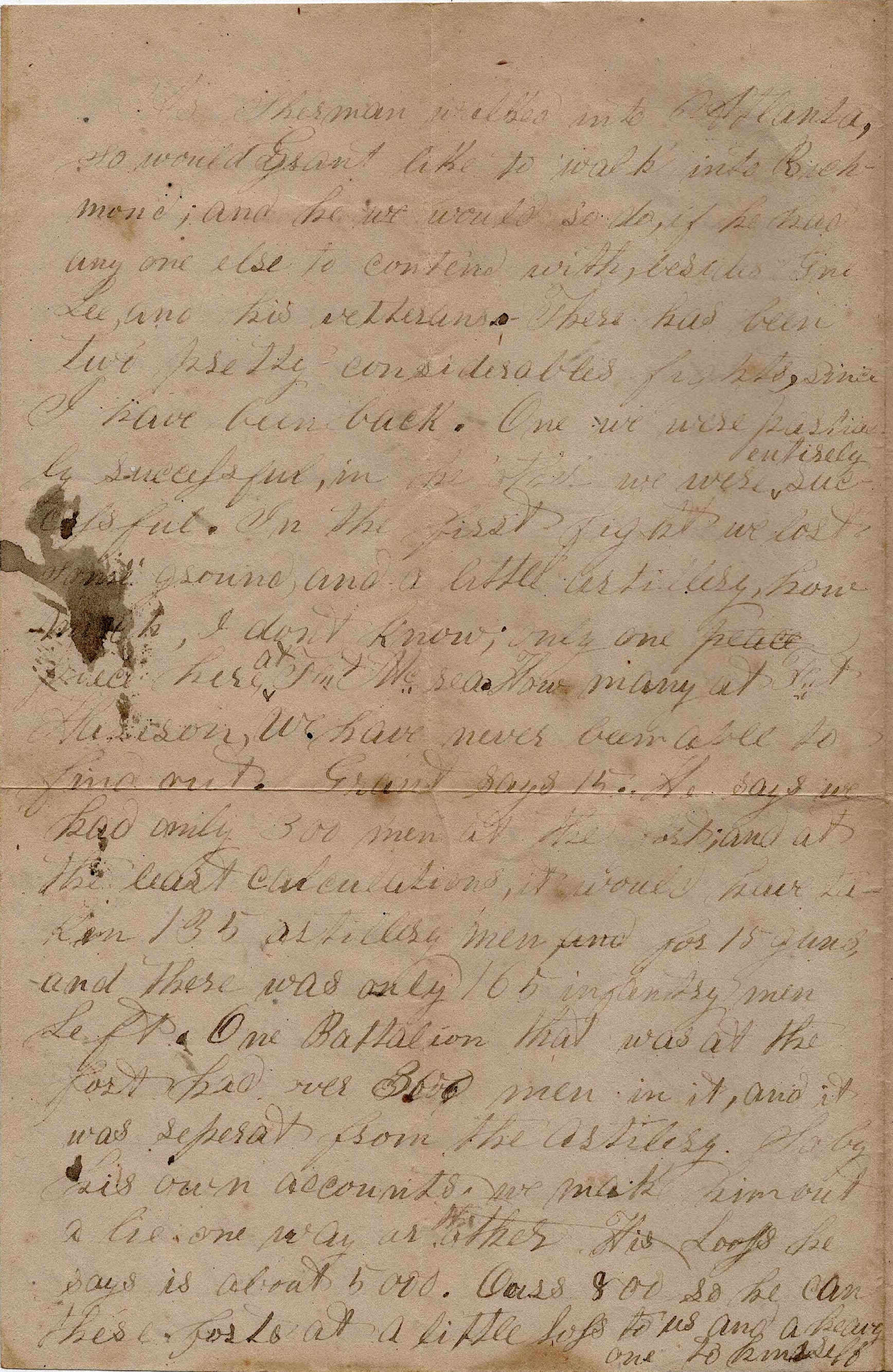
As Sherman walked into Atlanta, so would Grant like to walk into Richmond. And he would so do if he had anyone else to contend with besides Gen. Lee and his veterans. There has been two pretty considerable fights since I have been back. One we were partially successful in. The other we were entirely successful. In the first fight we lost some ground and a little artillery. How much, I don’t know. Only one piece here at Fort McRea. How many at Fort Harrison we have never been able to find out. Grant says 15. He says we had only 300 men at the fort and at the least calculations, it would have taken 135 artillery men for 15 guns and there was only 165 infantry men left. One Battalion that was at the fort had over 3600 men in it, and it was separate from the artillery. So by his own accounts, we make him out a lie one way or another. His loss, he says, is about 5,000. Ours 800, so he can these forts be a litle loss to us and a heavy one to himself?
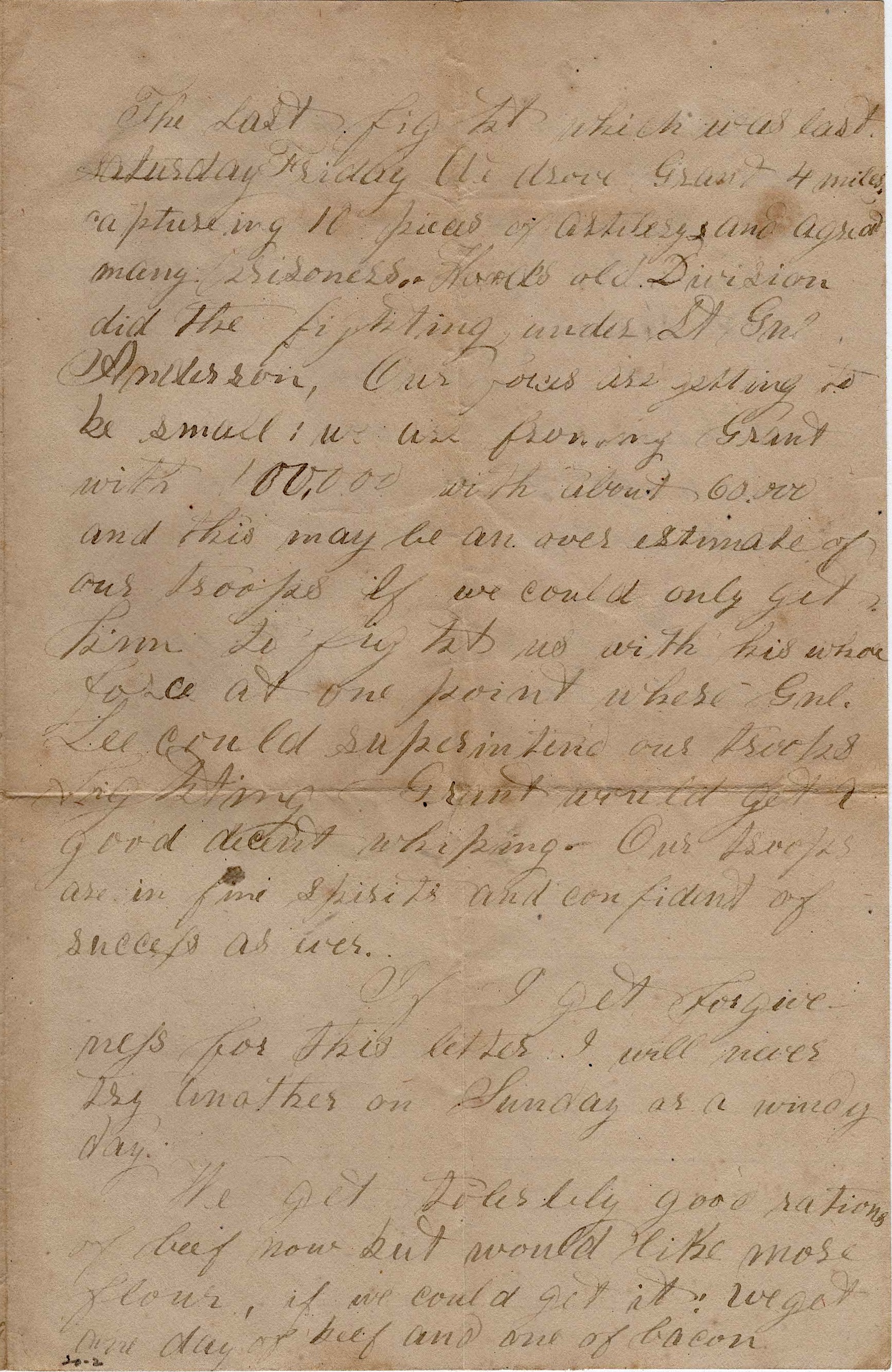
The last fight which was last Friday, we drove Grant 4 miles, capturing 10 pieces of artillery and a great many prisoners. Hood’s old division did the fighting under Lt. Gen. [George T.] Anderson. Our forces are getting to be small. We are fronting Grant with 100,000 with about 60,000 and this may be an over estimate of our troops. If we could only get him to fight us with his whole force at one point where Gen. Lee could superintend our troops fighting, Grant would get a good, decent whipping. Our troops are in fine spirits and confident of success as ever.
If I get forgiveness for this letter, I will never try another on Sunday or a windy day.
We get tolerably good rations of beef now but would like more flour if we could get it. We got one day of beef and one of bacon.
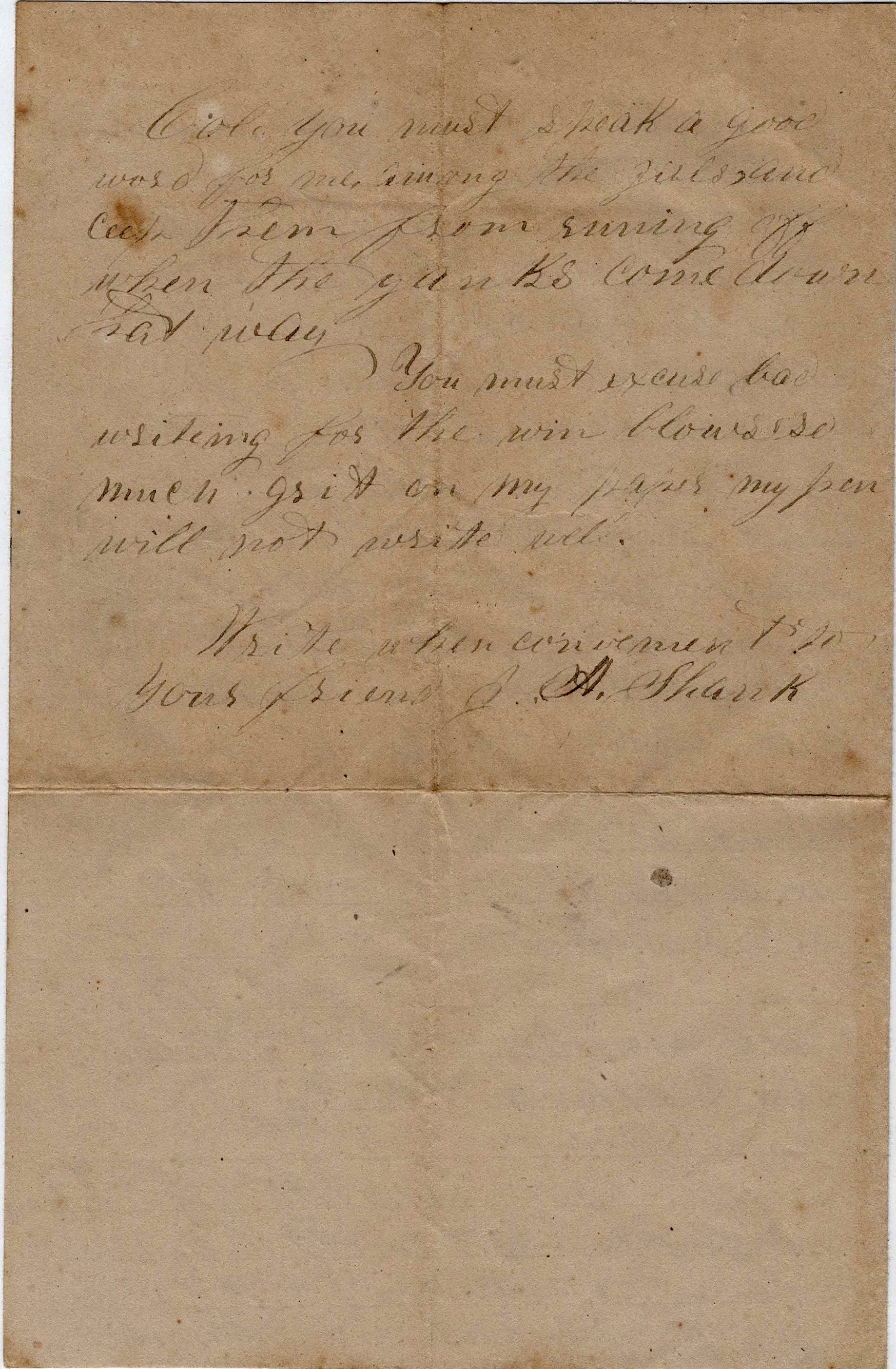
Colonel, you must speak a good word for me among the girls and keep them from running off when the Yanks come down that way. You must excuse bad writing for the wind blows so much grit on my paper, my pen will not write well.
Write when convenient to your friend, — J[oseph] A. Shank
Letter 18
Petersburg, Virginia November 7th 1864
Dear Mother,
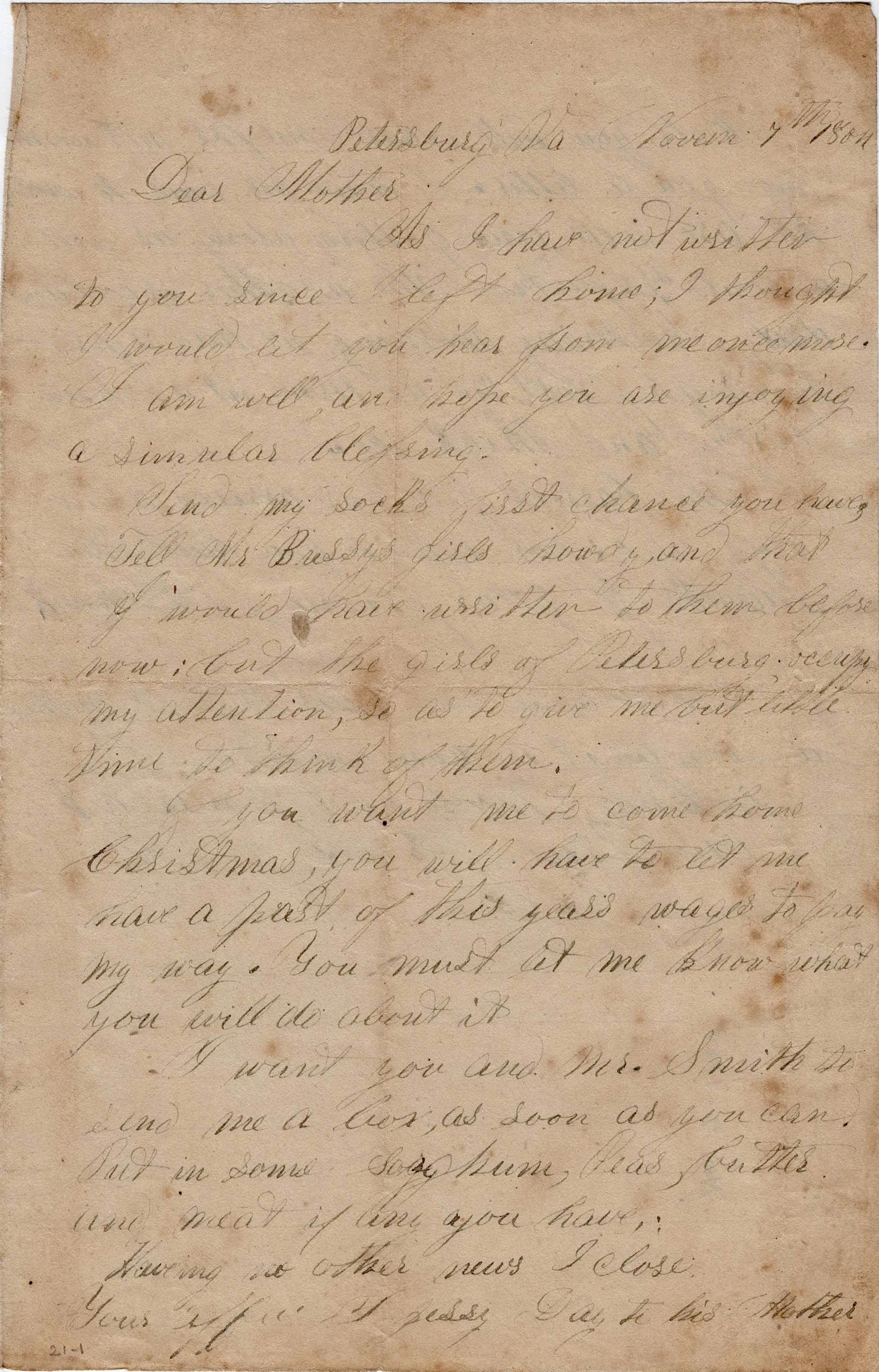
As I have not written to you since I left home. I thought I would let you hear from me once more. I am well and hope you are enjoying a singular blessing.
Send my socks first chance you have. Tell Mr. Bussy’s girls howdy and that I would have written to them before now, but the girls of Petersburg occupy my attention so as to give me but little time to think of them.
If you want me to come home Christmas, you will have to let me have a part of this year’s wages to pay my way. You must let me know what you will do about it.
I want you and Mr. Smith to send me a box as soon as you can. Put in some sorghum, peas, butter and meat of any you have.
Having no other news, I close. Your affectionate son, –Jesse Day to his Mother
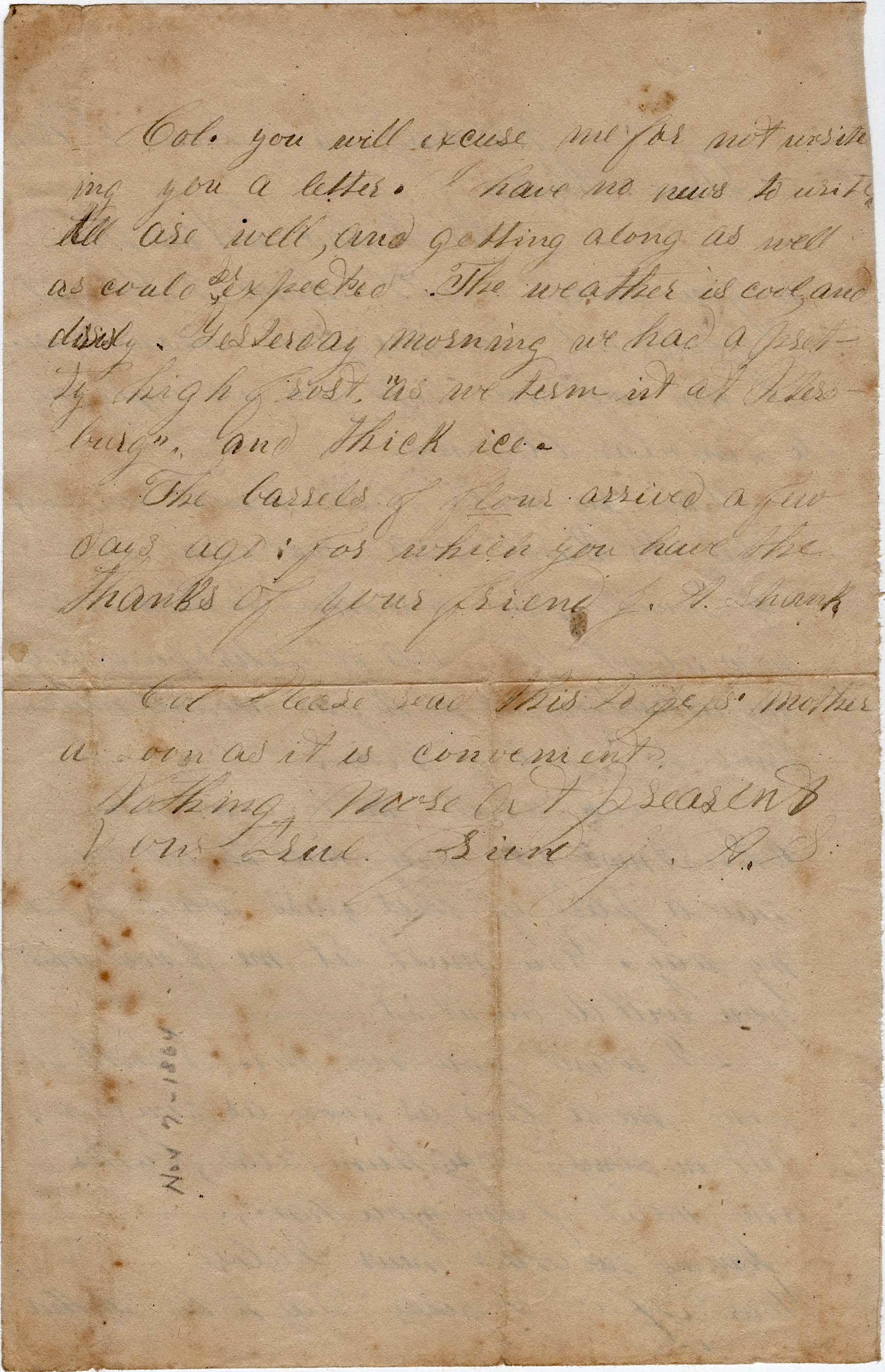
Colonel, you will excuse me for not writing you a letter. I have no news to write. We are well and getting along as well as could be expected. The weather is cool and cloudy. Yesterday morning we had a “pretty high frost” as we term it at Petersburg, ad thick ice.
The barrels of flour arrived a few days ago for which you have the thanks of your friend, — J. A. Shank
Col., please send this to Jesse’s mother as soon as it is convenient. Nothing more at present. Your true friend, — J. A. S.
Letter 19
Reserve Camp, Lane’s Battalion December 6th 1864
Col. J. B. Smith,
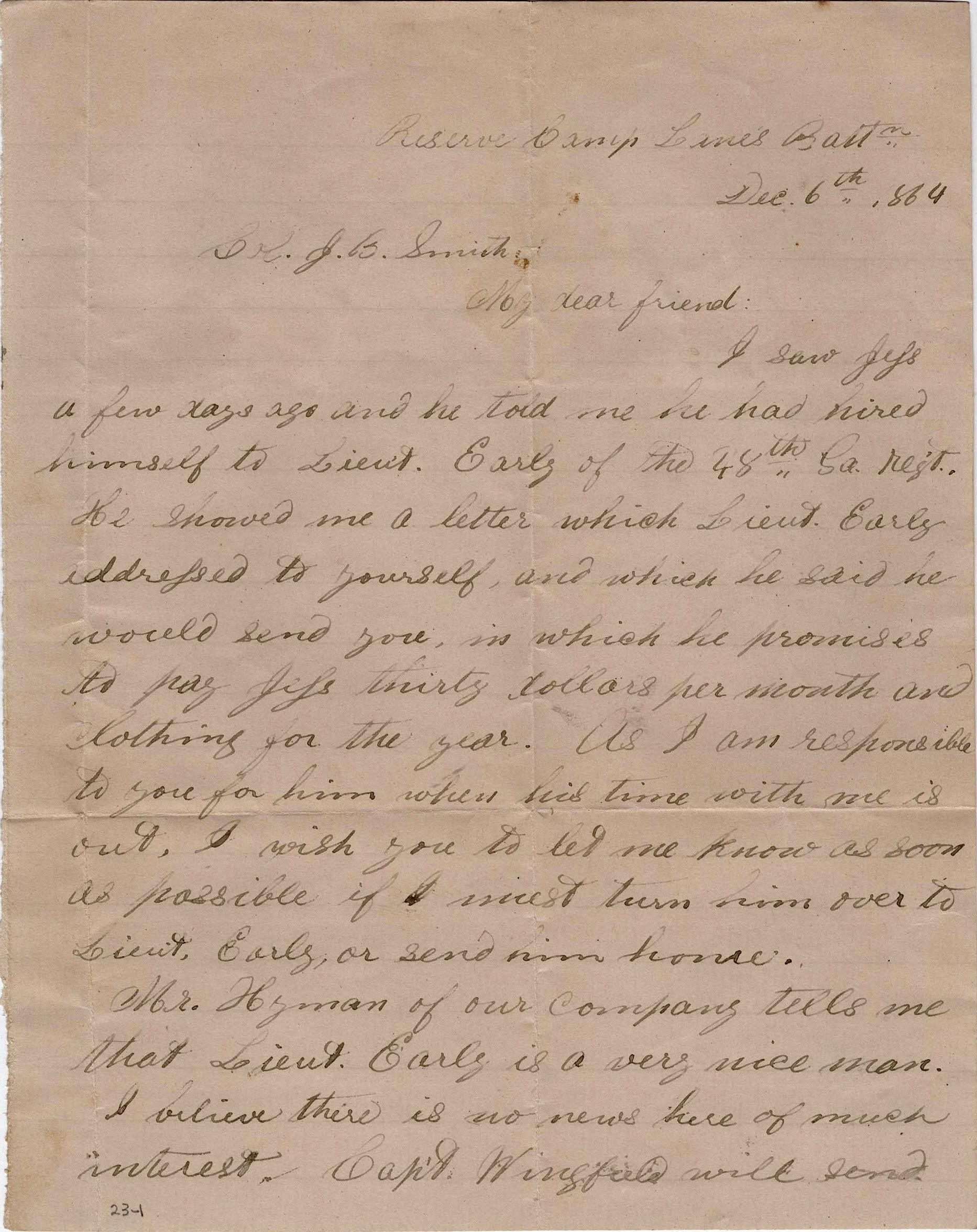
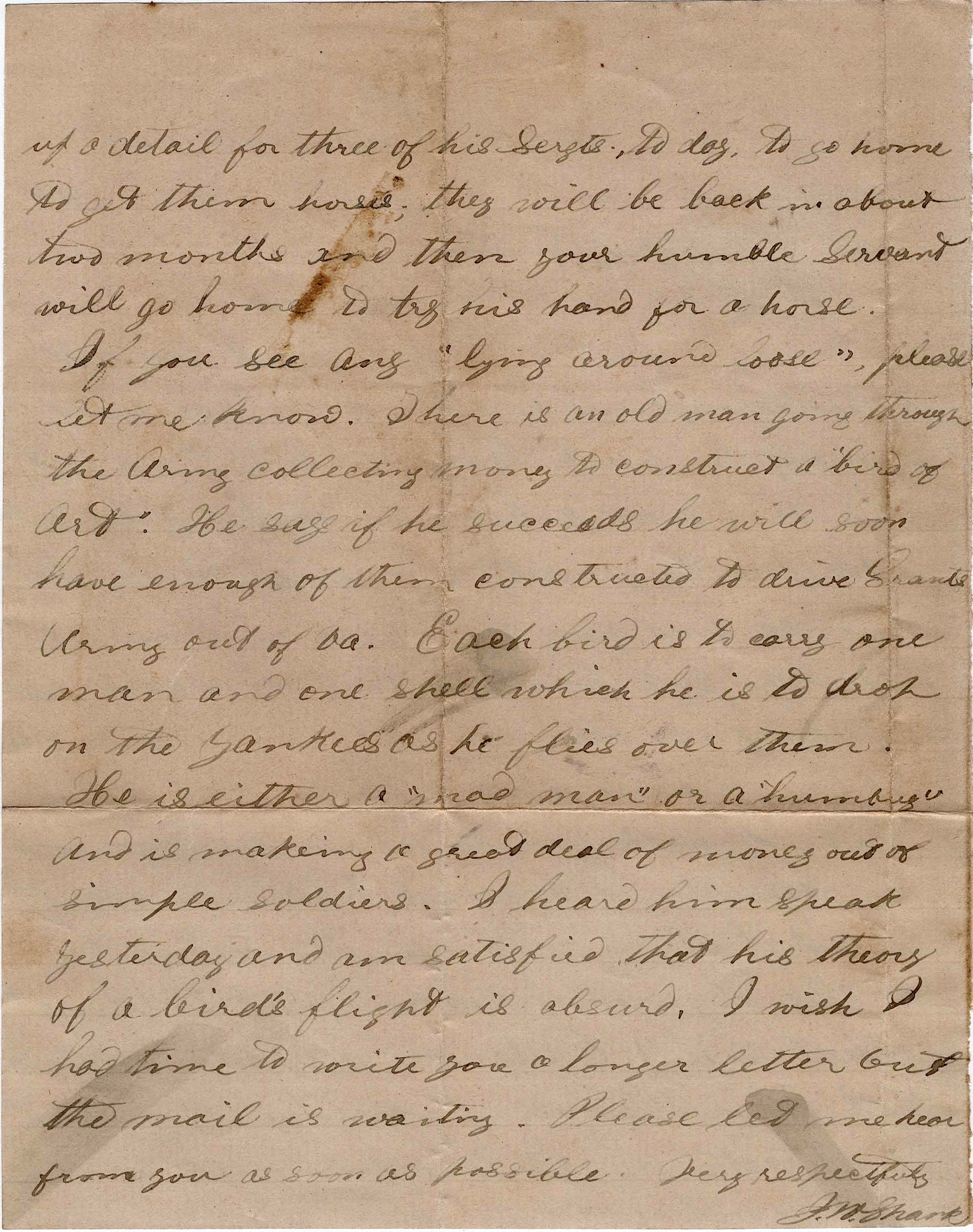
My dear friend, I saw Jess a few days ago and he told me he had hired himself to Lieut. Early of the 48th Georgia Regiment. He showed me a letter which Lieut. Early addressed to yourself and which he said he would send you, in which he promises to pay Jess $30 per month and clothing for the year. As Iam responsible to you for him when his time with me is out, I wish you to let me know as soon as possible if I must turn him over to Lieut. Early or send him home. Mr. Hyman of our company tells me that Lieut. Early is a very nice man.
I believe there is no news here of much interest. Capt. Wingfield will send up a detail of three of his sergeants today to go home to get them horses. They will be back in about two months and then your humble servant will go home to try his hand for a horse. If you see any “lying around loose,” please let me know.
There is an old man going through the army collecting money to construct a “bird of art.” He says if he succeeds, he will soon have enough of them constructed to drive Grant’s army out of Virginia. Each bird is to carry one man and one shell which he is to drop on the Yankees as he flies over them. He is either a “mad man” or a “humbug” and is making a great deal of money out of simple soldiers. I heard him speak yesterday and am satisfied that his theory of a bird’s flight is absurd.
I wish I had time to write you a longer letter but the mail is waiting. Please let me hear from you as soon as possible. Very respectfully, — J. W. Shank
Letter 20
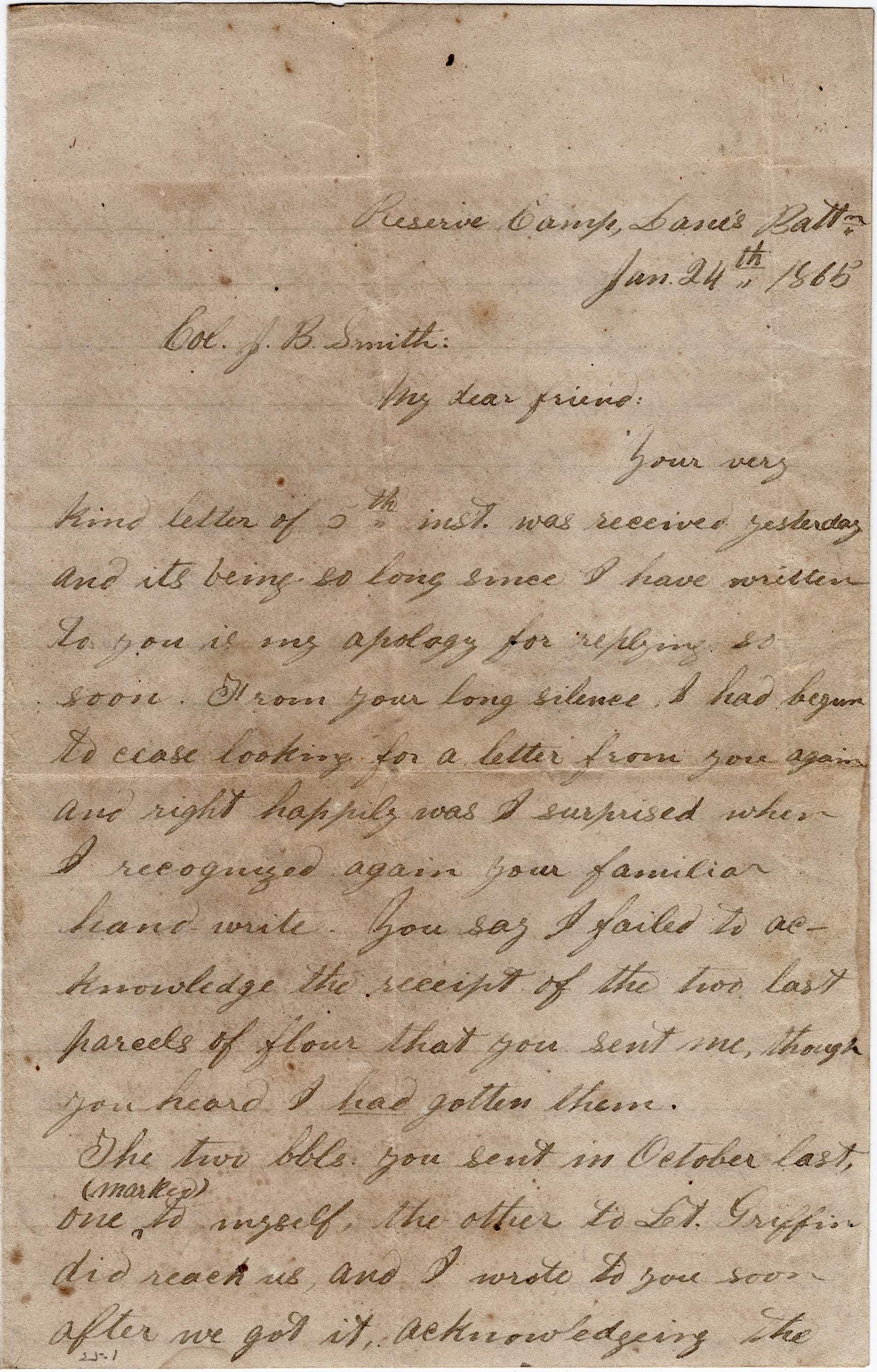
Reserve Camp, Lane’s Battalion January 24th 1865
Col. J. B. Smith,
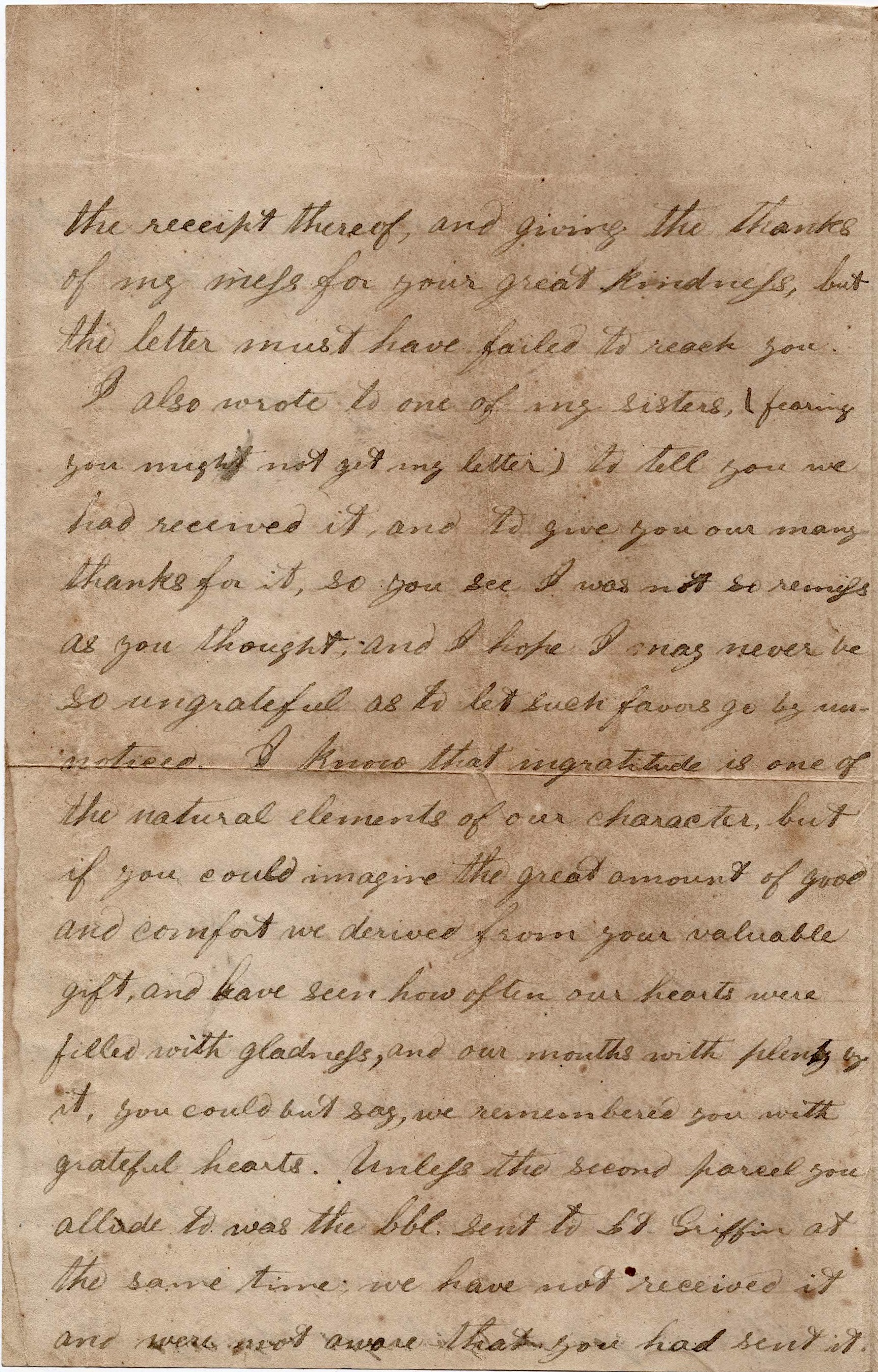
My dear friend, your very kind letter of 5th inst. was received yesterday and its being so long since I have written to you is my apology for replying so soon. From your long silence I had begun to cease looking for a letter from you again and right happily was I surprised when I recognized again your familiar hand write. You say I failed to acknowledge the receipt of the two last parcels of flour that you sent me though you heard I had gotten them. The two barrels that you sent in October last, one marked to myself, the other to Lt. Griffin, did reach us and I wrote to you soon after we got it, acknowledging the receipt thereof and giving the thanks of my mess for your great kindness, but the letter must have failed to reach you. I also wrote to one of my sisters (fearing you might no get the letter) to tell you we had received it and to give you our many thanks for it, so you see I was not so remiss as you thought. And I hope I may never be so ungrateful as to let such favors go by unnoticed. I know that ingratitude is one of the natural elements of our character but if you could imagine the great amount of good and comfort we derive from your valuable gift, and have seen how often our hearts were filled with gladness, and our mouths with plenty by it, you could but say, we remember you with grateful hearts.
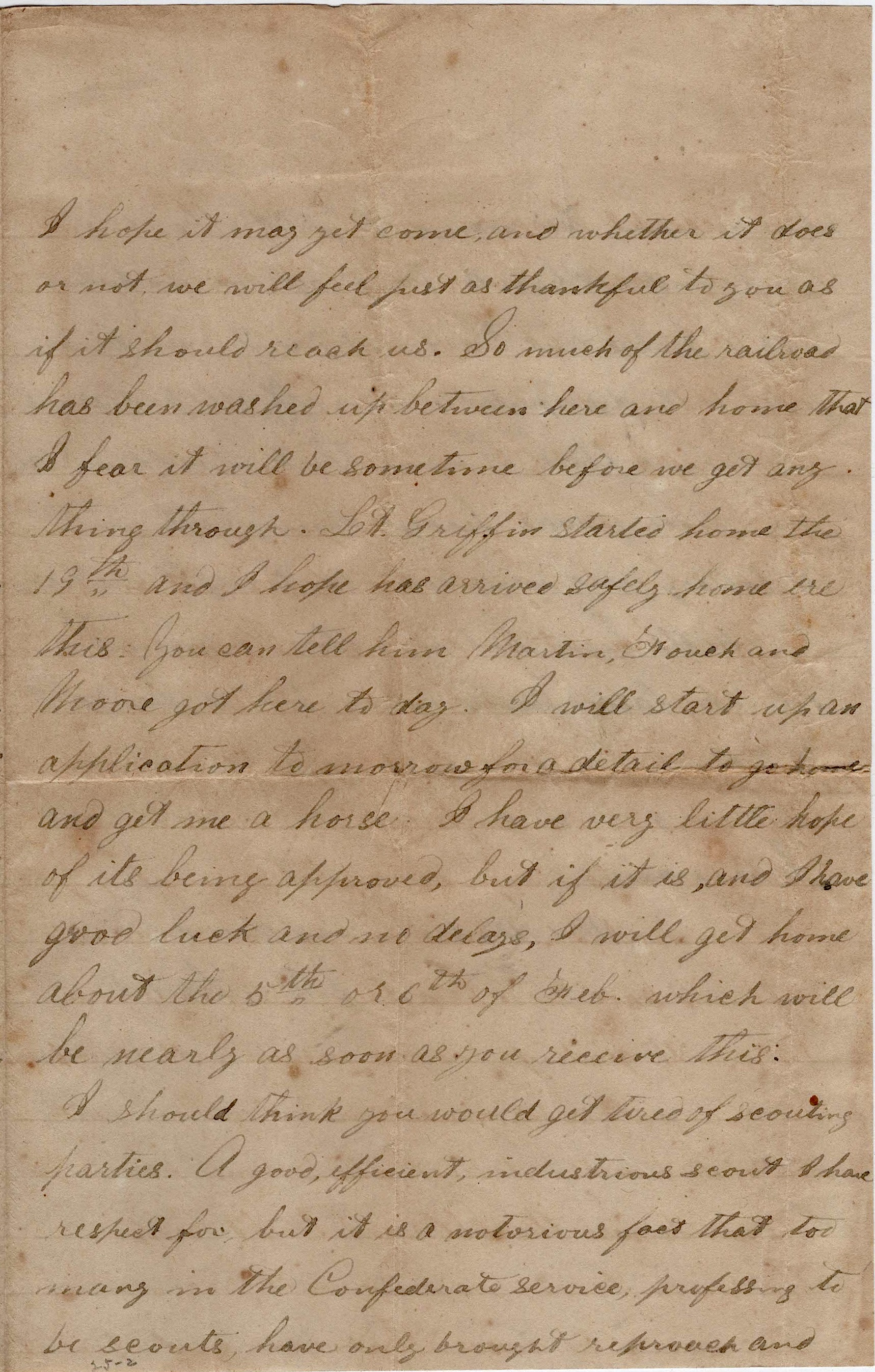
Unless the second parcel you allude to was the barrel sent to Lt. Griffin at the same time, we have not received it and were not aware that you had sent it. I hope it may yet come and whether it does or not, we will feel just as thankful to you as if it should reach us. So much of the railroad has been washed up between here and home that I fear it will be some time before we get anything through. Lt. Griffin started home the 19th and I hope has arrived safely home ere this. You can tell him Martin, Fouch, and Moore got here today. I will start up an application tomorrow fora detail to get home and get me a horse. I have very little hope of it being approved but if it is, and I have good luck and no delays, I will get home about the 5th or 6th of February which will be nearly as soon as you receive this.
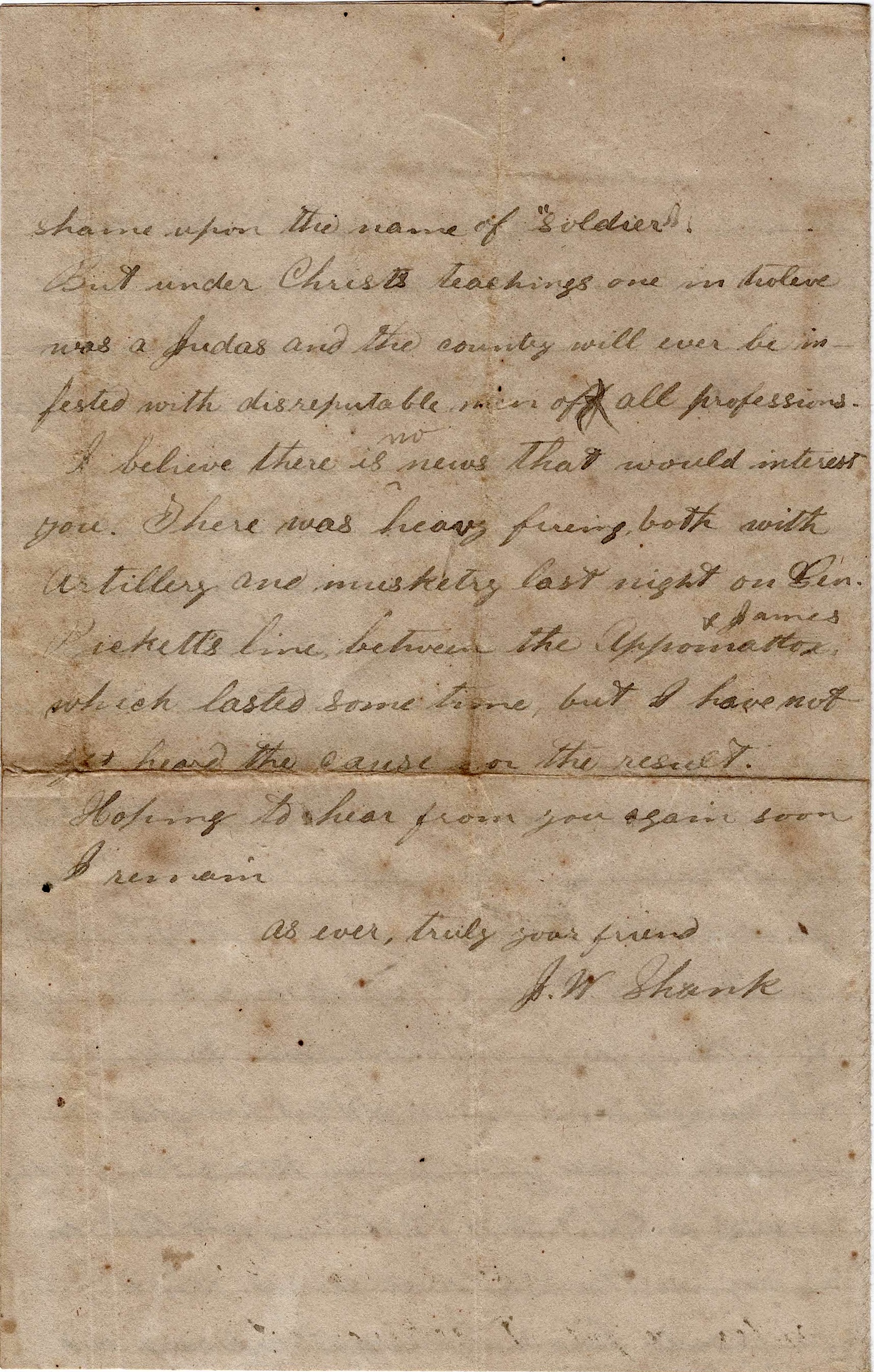
I should think you would get tired of scouting parties. A good, efficient, industrious scout I have respect for, but it is a notorious fact that too many in the Confederate service professing to be scouts have only brought reproach and shame upon the name of ‘soldier.” But under Christ’s teachings one in twelve was a Judas and the country will ever be filled with disreputable men of all professions.
I believe there is no news that would interest you. There was heavy firing both with artillery and musketry last night on Gen. Pickett’s line between the Appomattox and the James which lasted some time, but I have not heard the cause or the result. Hoping to hear from you again soon, I remain as ever, truly your friend, — J. W. Shank
Letter 21
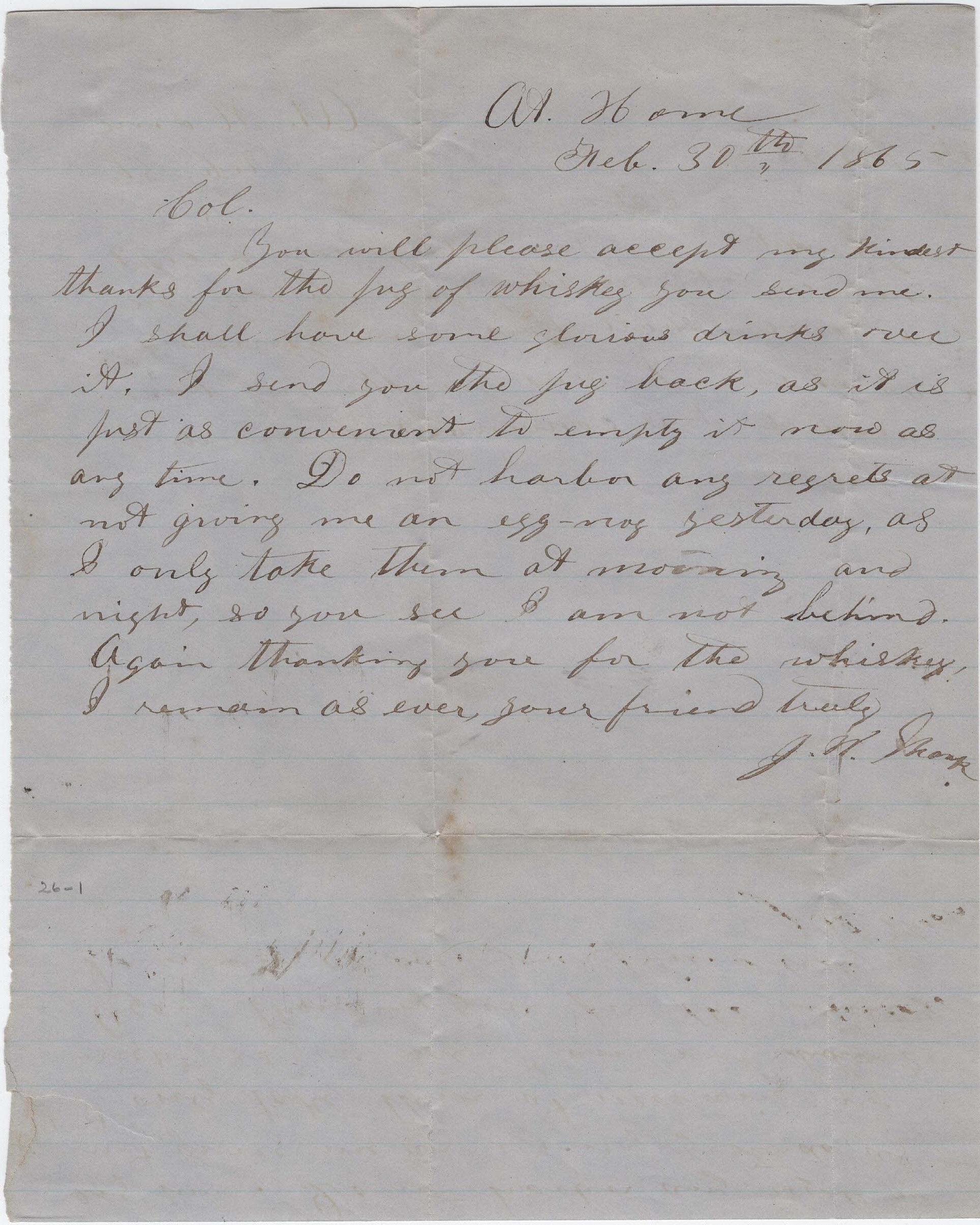
At Home February 30th 1865
Colonel,
You will please accept my kindest thanks for the jug of whiskey you sent me. I shall have some glorious drinks over it. I send you the jug back as it is just as convenient to empty it now as anytime. Do not harbor any regrets at not giving me an egg-nog yesterday as I only take them at morning and night, so you see I am not behind. Again, thanking you for the whiskey, I remain as ever your friend, truly, — J. W. Shank
Letter 22
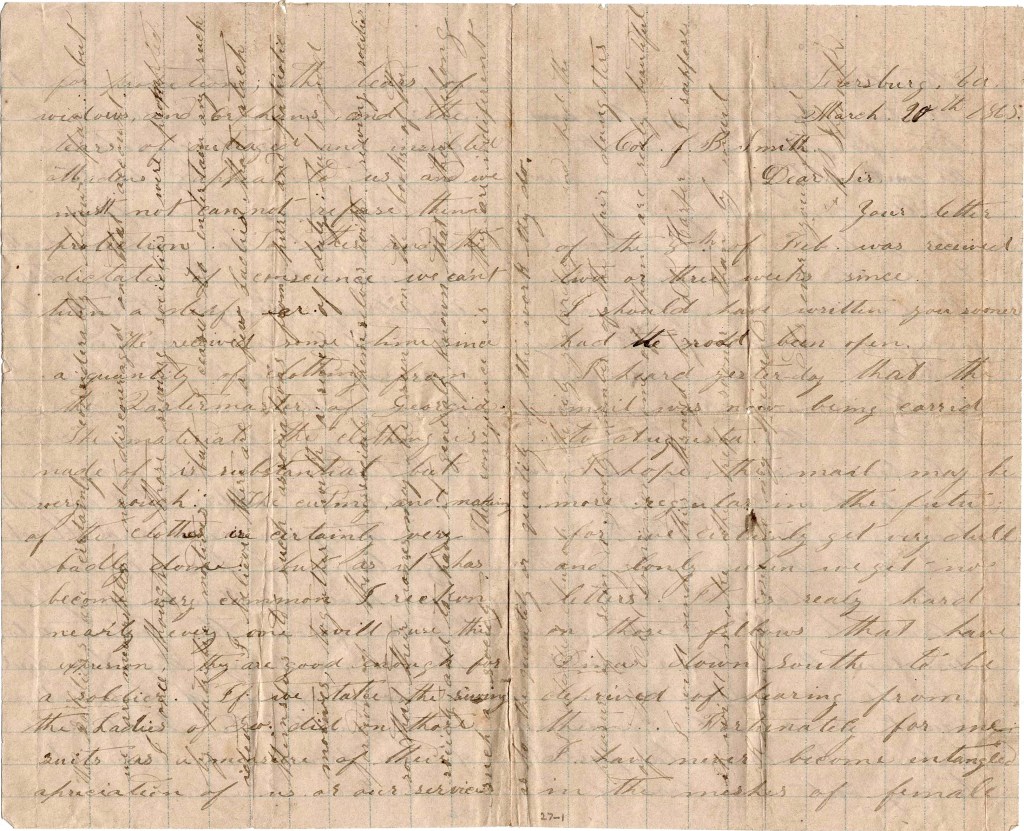
Petersburg, Virginia March 20th 1865
Col. J. B. Smith,
Dear sir, your letter of the 8th of February was received two or three weeks since. I should have written you sooner had the road been open. I heard yesterday that the mail was now being carried to Augusta. I hope the mail may be more regular in the future, for we certainly get very dull and lonely when we get no letters. It is really hard on those fellows that have Dinas down South to be deprived of hearing from them. Fortunately for me I have never become entangled in the meshes of female attractiveness.
We have had a very dull time for the last month. We cannot get the war news until it is getting old. The papers are not allowed to publish any news from the Carolinas for fear of giving information to the enemy. Grant, it has been said, gets the Richmond papers by the time they are dry.
I heard some very good news from Carolina today, if it proves to be the truth. I think Sherman has under taken a hopeless task. I believe he will be forced to abandon the interior of Carolina unless he is reinforced. Grant is as quiet as a sleeping babe. Sheridan has failed to carry out his part of the program, and Sherman can’t come to time. I reckon Gen. Grant can find consolation in getting on a big bust [drinking spree].
This army is in fine spirits. It has expressed its determination to carry this Confederacy through the struggle to independence or perish in a common heap. The blood of our fellow comrades cries for revenge from a hundred battlefields. I hope never to see a Confederate soldier that can look upon the green graves and bleaching bones of those comrades who have fallen on every battlefield from the Potomac to Mexico, and say they have died to no purpose. A desolated country with the charred ruins of once proud mansions, and desecrated temples call to us for protection. The tears of widows, and orphans, and the tears of outraged and insulted maidens appeal to us and we must not—cannot—refuse them protection. To these and the dictates of conscience, we can’t turn a deaf ear.
We received some time since a quantity of clothing from the Quartermaster of Georgia. The material the clothing is made of is substantial but very rough. The cutting and making of the clothes are certainly very badly done, but as it has become very common, I reckon nearly everyone will use this expression—-“they are good enough for a soldier.” If we take the sewing the Ladies of Georgia did on those suits as a measure of their appreciation of us or our service, we soldiers are certainly considerable below par, but we are nevertheless not discouraged on that account. I once thought those sewing societies were prompted by patriotic motives, but I ceased to entertain any such idea. I believe there are a few Ladies that attach themselves to such associations from pure and patriotic motives, together with a sense of duty, but a good portion of them associate themselves with sewing societies so that their names may be seen on the books of the society and to have it generally known that they belong to such a society. The consequence is they are indifferent as to the quantity or or quality of the work they do.
I attended church in the city yesterday and had the pleasure of seeing a goodly member of the fair daughters of the Old Dominion. Some of them are really beautiful. I will send this through by Lt. Harper. I suppose it will make the trip sooner than by mail. Remember me to my friends. As ever your friend, — W[illiam B.] Shank