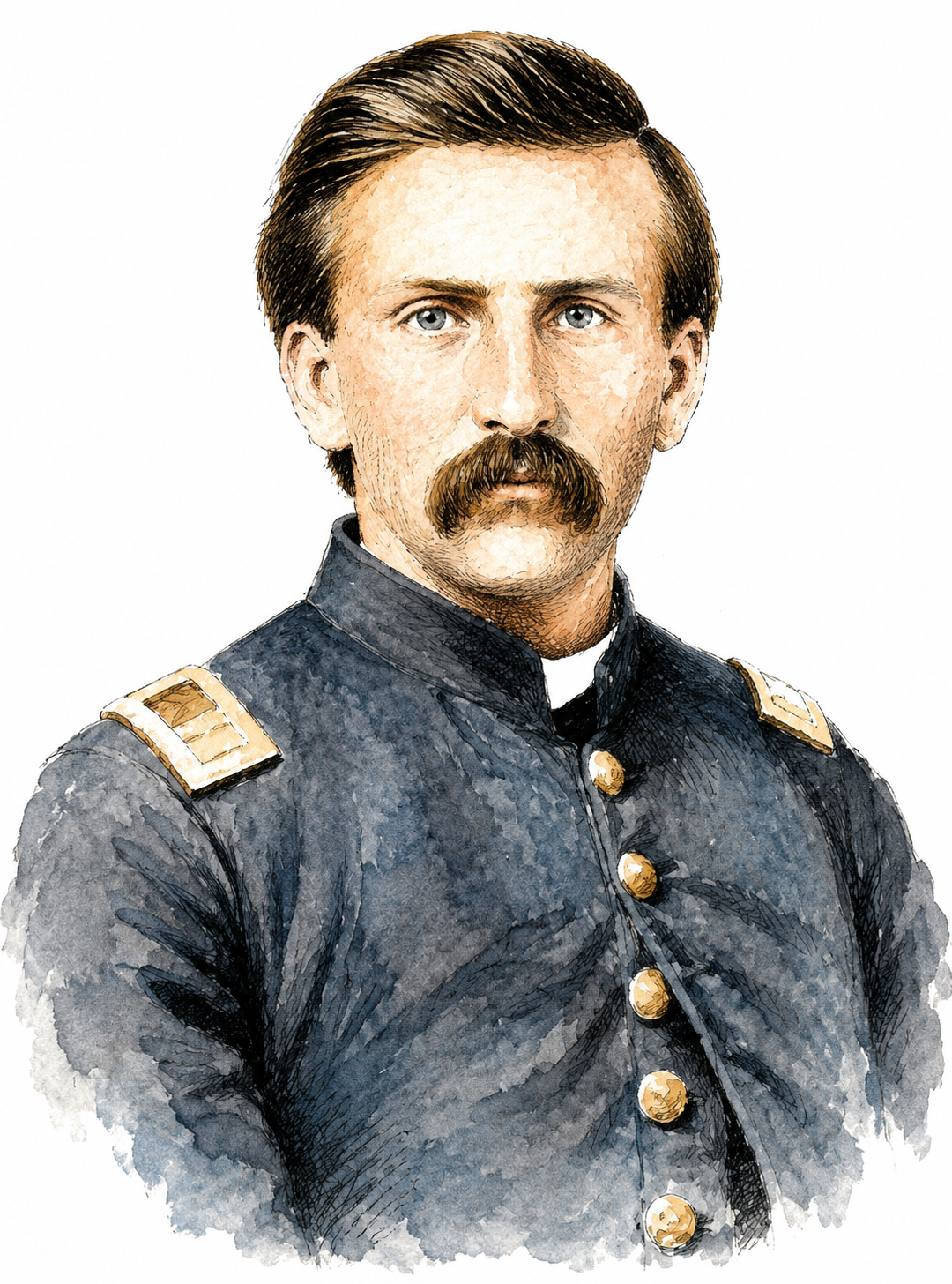
The following letter was written by Sam Lyon (1836-1899), Captain of Co. H, 2nd Kentucky Cavalry, USA. He wrote the letter from Tyree Springs, Tennessee, in the fall of 1862. At the time that he wrote this letter, he was a sergeant in Co. L; he did not receive his commission in Co. H until the fall of 1864. Sam was the son of Hamilton Shaw Lyon (1805-1887) and Frances Royse (1800-1843) of Newport KY, just across the river from Cincinnati OH. He wrote the letter to his sister-in-law, Sarah (“Sallie”) Harper Lyon (1833-1919) who was married to Sam’s older brother, Hamilton Shaw Lyon, II (1832-1883), a pattern-maker living in Cincinnati.
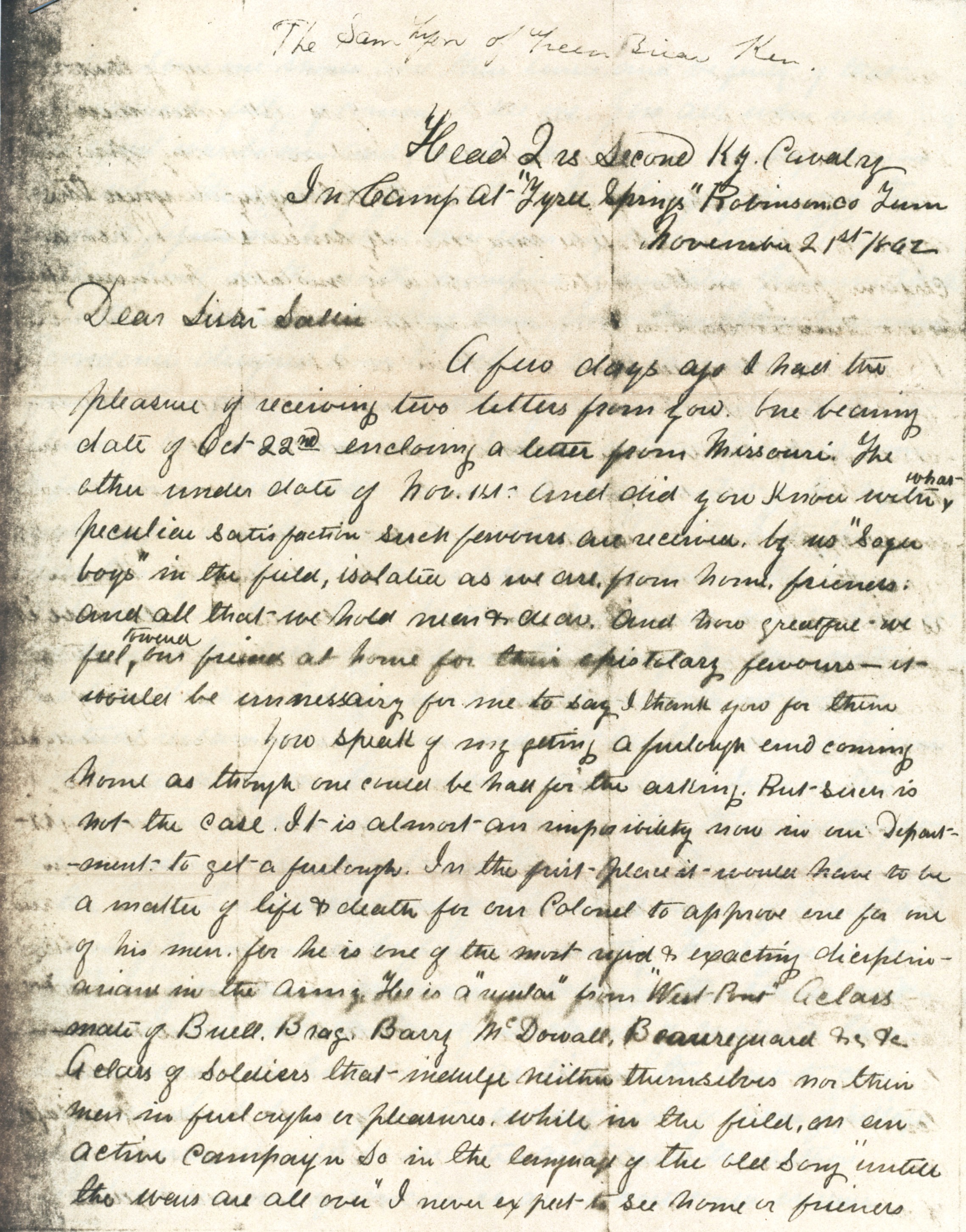
A photocopy of the original letter was shared with me by Douglas Lyon, a family descendant. He says the original letter passed down to a now-deceased cousin and is likely in the hands of one of her children. Doug has previously shared this letter on a public blog but since I found some errors in transcription and also because the blogs posts were not being archived (like those on Spared & Shared), I’ve made an exception to my general rule of not duplicating other people’s work.
T R A N S C R I P T I O N
Headquarters Second Kentucky Cavalry
In Camp at “Tyree Springs” Robinson Co., Tennessee
November 21st 1862
Dear Sister Sallie,
A few days ago I had the pleasure of receiving two letters from you—one bearing date of October 22nd enclosing a letter from [sister] Missouri, the other under date of November 1st. And did you know with what peculiar satisfaction such favors are received by us “Soger boys” in the field, isolated as we are from home, friends and all that we hold near and dear, and how grateful we feel toward our friends at home for these epistolary favors, it would be unnecessary for me to say I thank you for them.
You speak of my getting a furlough and coming home as though one could be had for the asking. But such is not the case. It is almost an impossibility now in our Department to get a furlough. In the first place it would have to be a matter of life & death for our Colonel to approve one for one of his men for he is one of the most rigid and exacting disciplinarians in the army. He is a “regular” from “West Point”—a classmate of Buell, Bragg, Barry, McDowell, Beauregard, &c., &c., and one of a class of soldiers that indulge neither themselves nor their men in furloughs or pleasures while in the field on an active campaign. So in the language of the old song, “until the wars are all over,” I never expect to see home of friends unless someone should lose their senses and be guilty of that inconceivable folly of coming to see me.
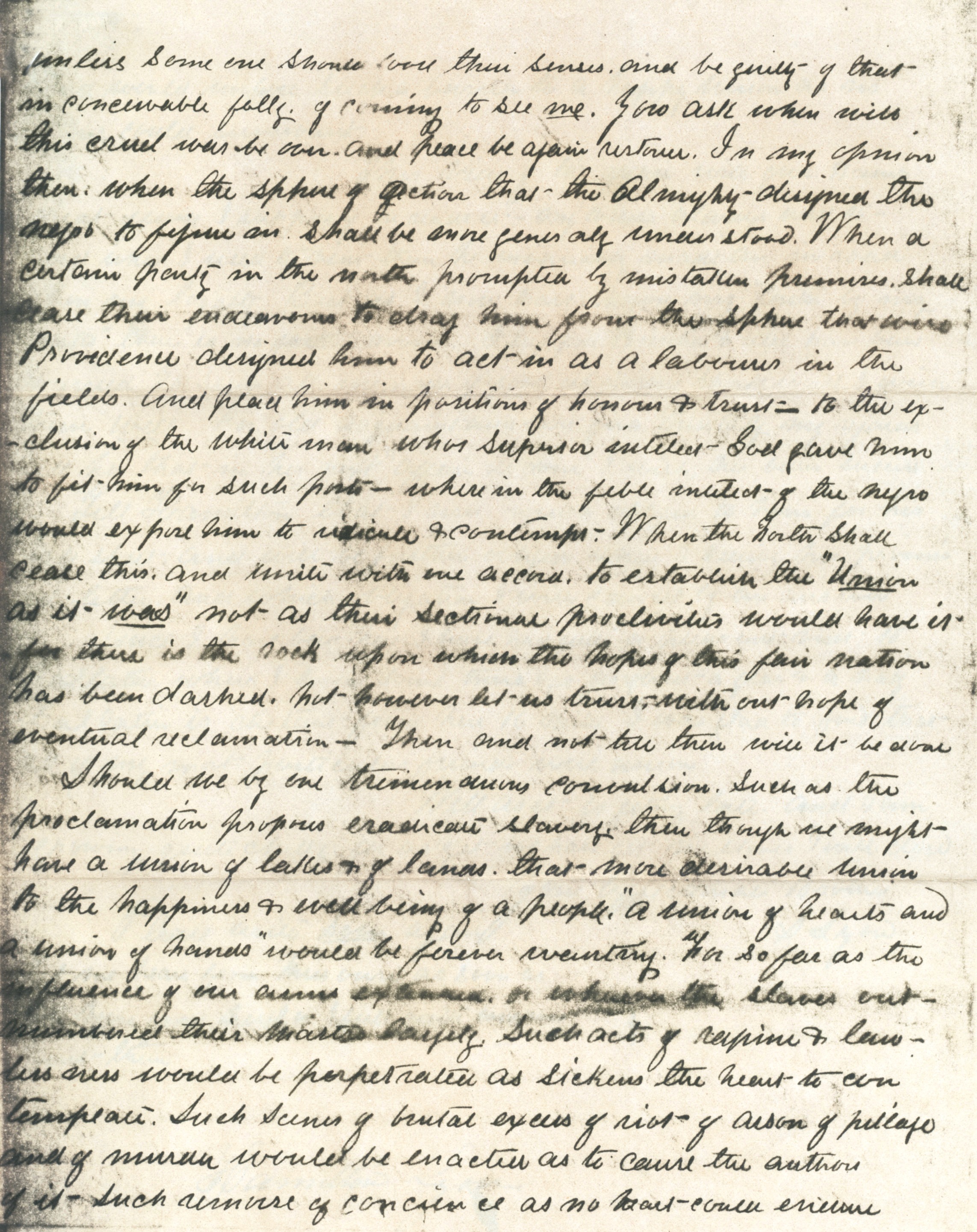
You ask when will this cruel war be over and peace be again restored. In my opinion then, when the sphere of action that the Almighty designed the negro to figure in shall be more generally understood. When a certain party in the North prompted by mistaken premises shall cease their endeavors to drag him from the sphere that wise Providence designed him to act in—as a laborer in the fields. And place him in positions of honor & trust, to the exclusion of the white man, whose superior intellect God gave him to fit him for such posts—wherein the feeble intellect of the negro would expose him to ridicule & contempt. When the North shall cease this and unite with one accord to establish the “Union as it was,” not as their sectional proclivities would have it for there is the rock upon which the hopes of this fair nation has been dashed [but] not, however let us trust, without hope of eventual reclamation. Then and not till then will it be done.
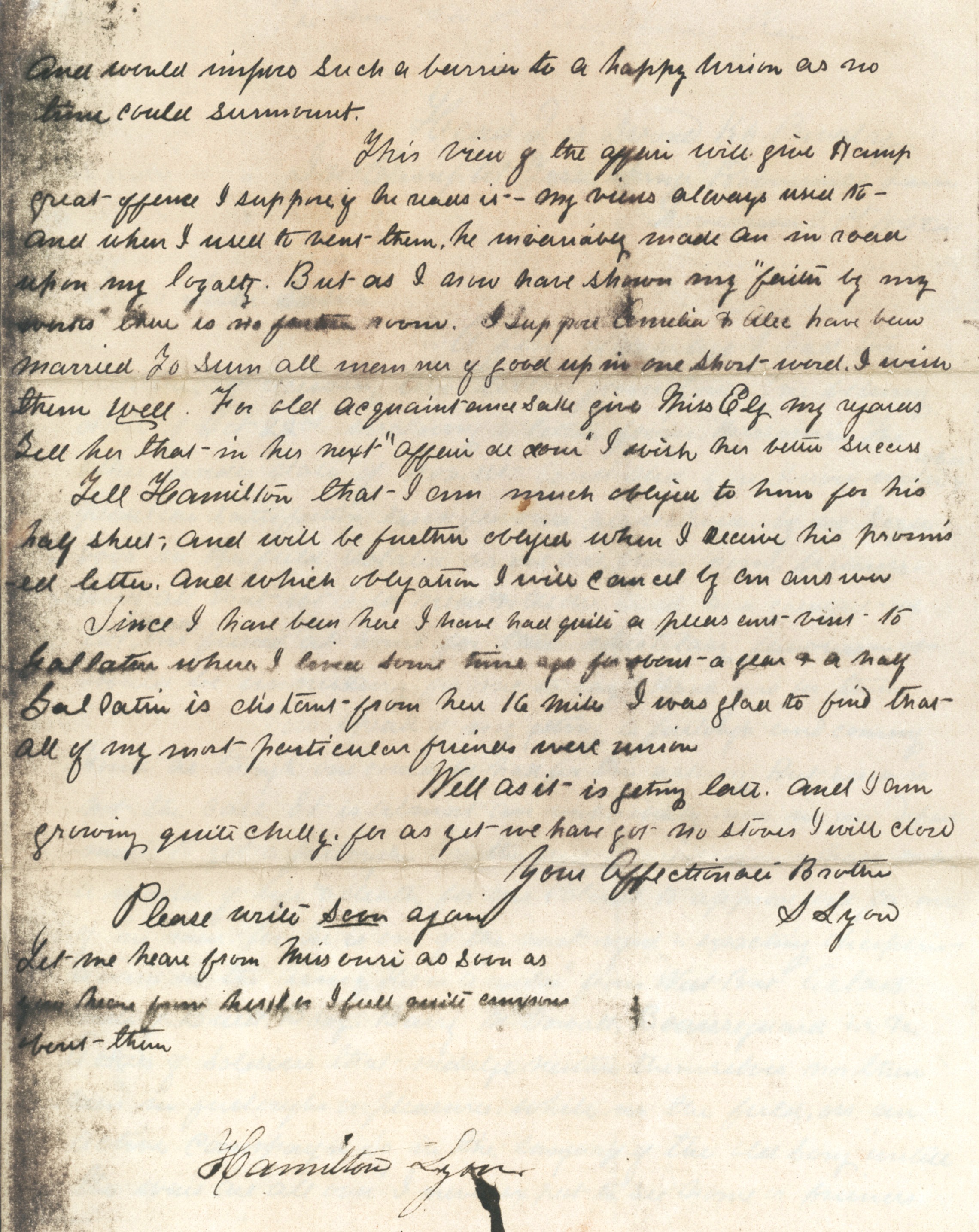
Should we by one tremendous convulsion, such as the [Emancipation] Proclamation, perhaps eradicate slavery, then though we might have a union of lakes and of lands, that more desirable union of the happiness & well being of a people, “a union of hearts and union of hands” would be forever wanting. For so far as the influence of our arms extends, or wherever the slaves outnumbered their masters’ safety, such acts of rapine & lawlessness would be perpetrated as sickens the heart to contemplate. Such scenes of brutal excess of riot, of arson, of pillage, and of murder would be enacted as to cause the authors of it such remorse of conscience as no heart could endure and would impose such a barrier to a happy union as no time could surmount.
This view of the affair will give Hamp [Hamilton, his brother & husband of Sallie] great offense, I suppose, if he reads it. My views always used to, and when I used to vent them, he invariably made an inroad upon my loyalty. But as I now have shown my “faith by my works,” there is no farther room [for criticism].
I suppose Amelia & Alec [Amelia was his wife’s sister] have been married. To sum all manner of good up in one short word—I wish them well. For old acquaintance sake, give Miss Ely my regards. Tell her that in her next “affair de coeur,” I wish her better success.
Tell Hamilton that I am much obliged to him for his half sheet, and will be further obliged when I receive his promised letter, and which obligation I will cancel by an answer.
Since I have been here I have had quite a pleasant visit to Gallatin where I lived some time ago for about a year & a half. Gallatin is distant from here 16 miles. I was glad to find that all of my most particular friends were union. Well as it is getting late and I am growing quite chilly for as yet we have got no stoves here. I will close. Your affectionate brother, —S. Lyon
Please write soon again. Let me hear from Missouri as soon as you hear from her, for I feel quite anxious about them.
[to] Hamilton Lyon
 Spared & Shared 23