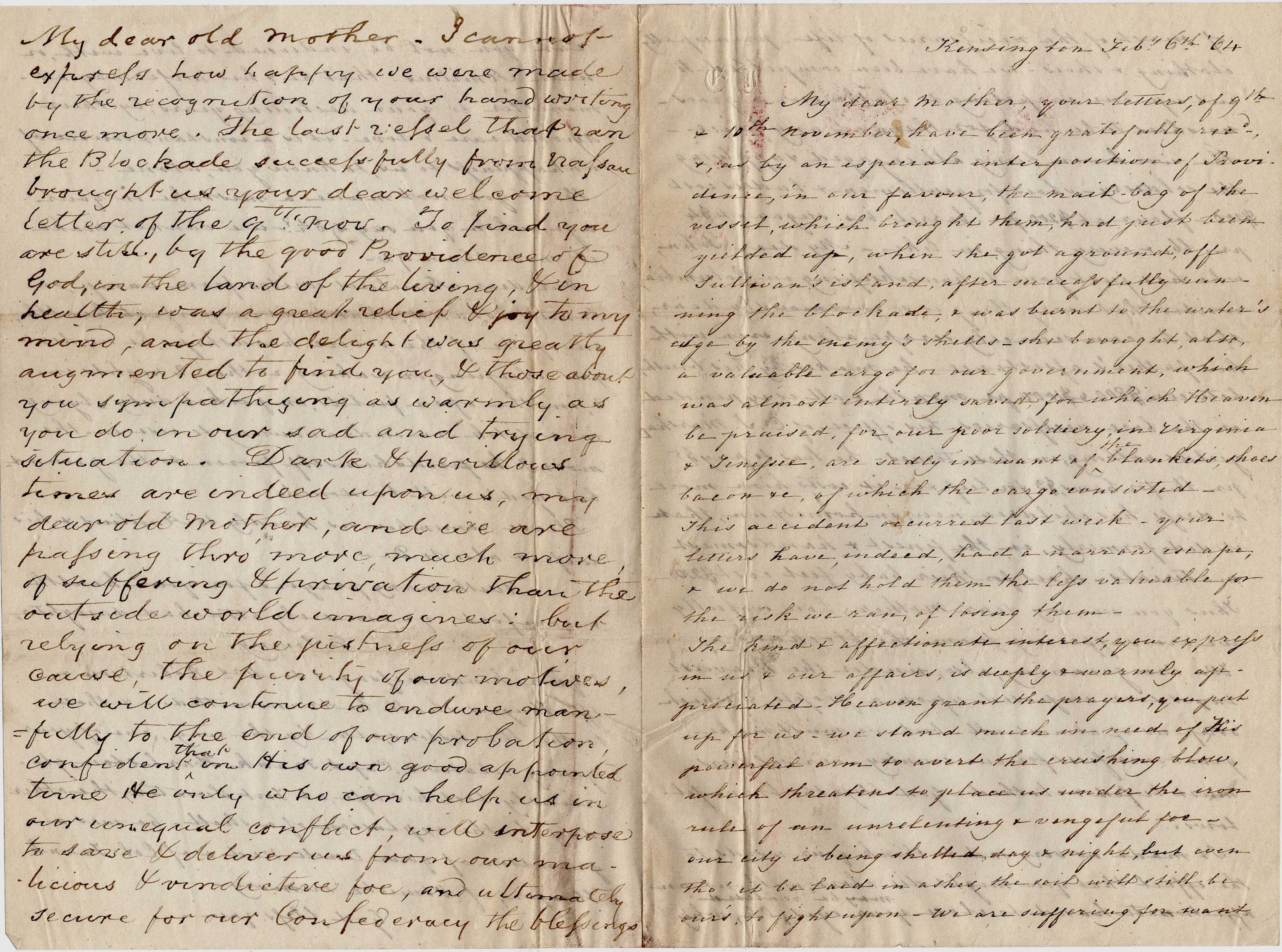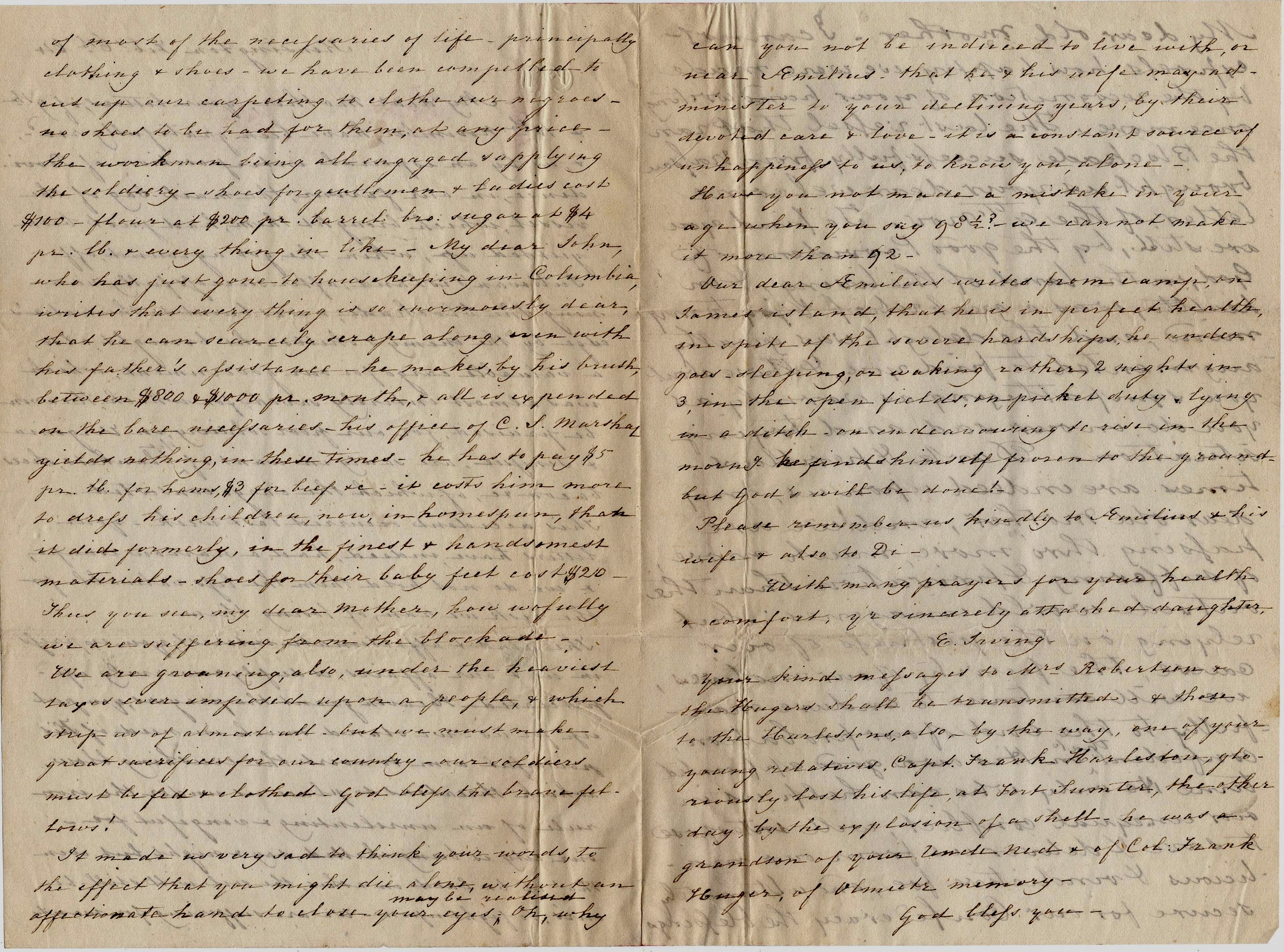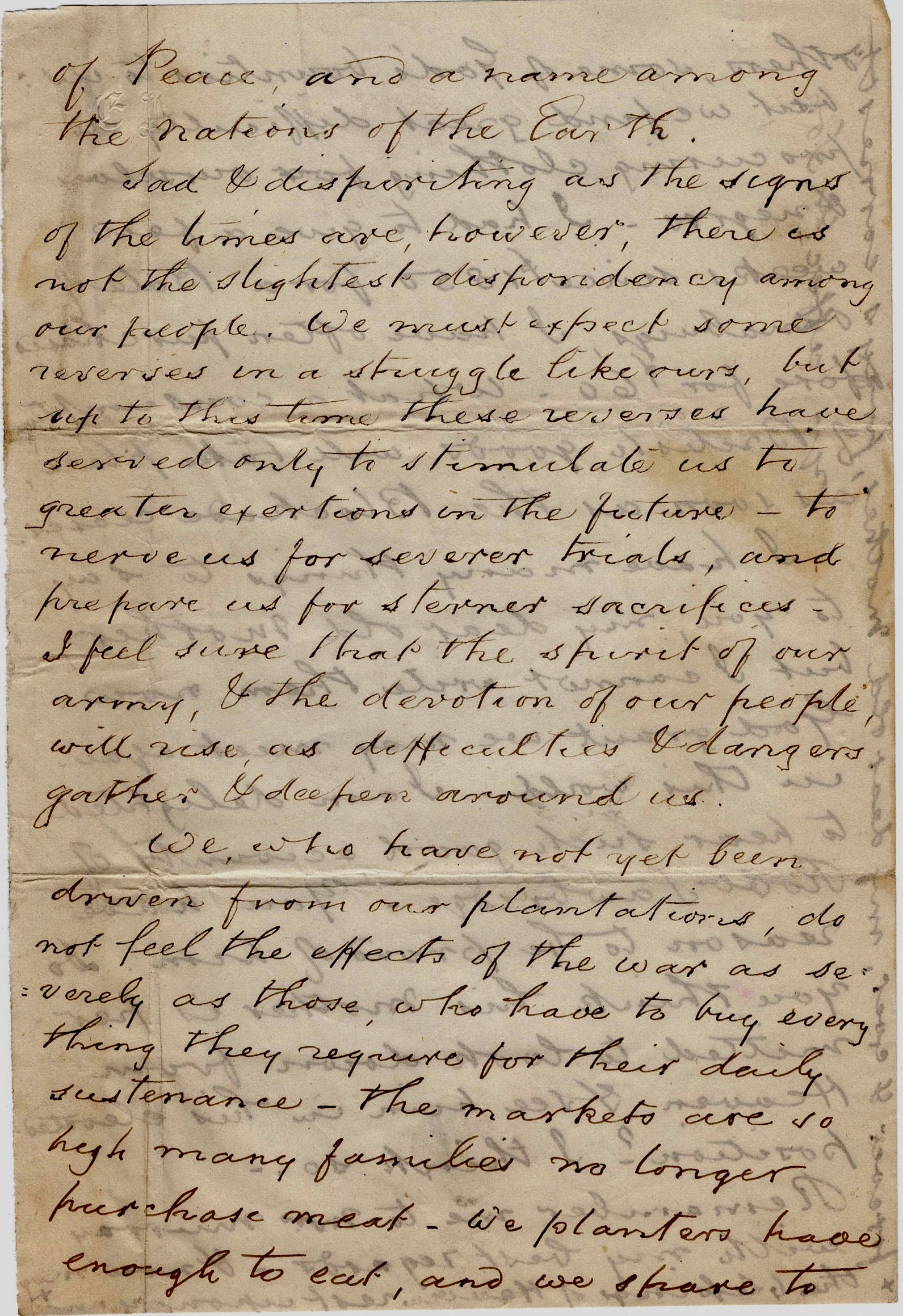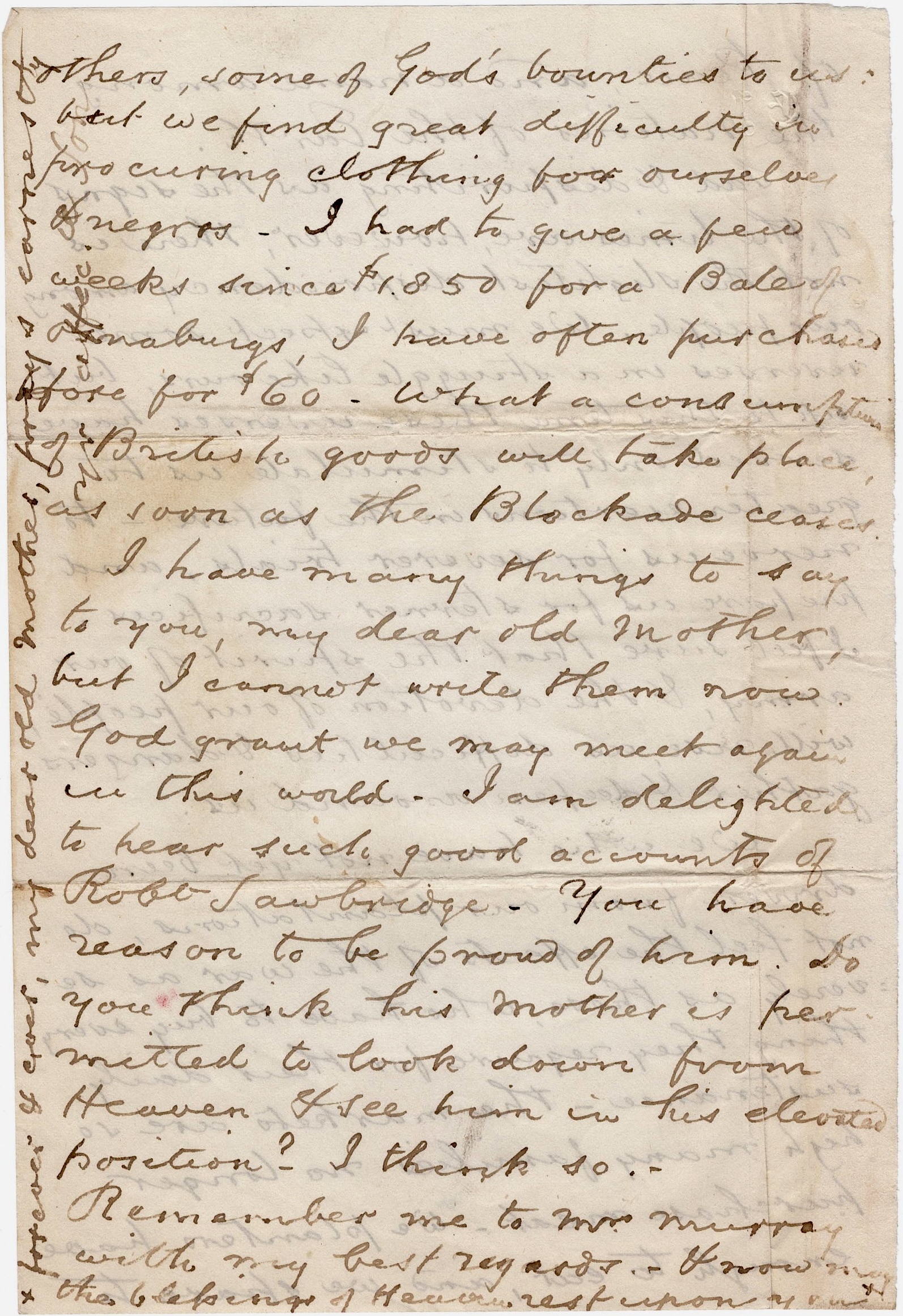

The following letter was written in two parts—the first part by Emma Maria (Cruger) Irving (1805-1867), and the second part by her husband, Dr. John Beaufain Irving (1800-1881). The letter was addressed to John’s mother, Hannah Margaret (Corbett) Irving (1775-1865), the relict of Jacob Aemilius (1767-1816). Hannah was residing in Drummondsville [Niagara Falls] Ontario, Canada, when this letter was written in February 1864. Dr. John B. and Emma (Cruger) Irving are depicted in the header based on family portraits.
In March 1846, Dr. John B. Irving—a prominent physician, author, and rice planter—purchased the 670-acre Kensington Plantation located along the eastern branch of the Cooper River in Huger (Berkeley County), just outside of Charleston, South Carolina. Dr. Irving famously documented regional antebellum life in his 1842 book, A Day on Cooper River. The main house on this plantation burned down in 1924. Major portions of the original plantation are under conservation easements today to protect the historic site. It had been previously owned by Elias Octavus Ball (see Slaves in the Family by Edward Ball, 1998).
The Irving family strongly supported the Confederacy. Because of their allegiance, Dr. Irving and his family lost their entire fortune, land, and properties by the end of the war. Following the collapse of the plantation system, the family was forced to leave South Carolina. He relocated to New York at the age of 65 to rebuild his life. His son, Aemilius Irving (1824-1873), lived in Cordesville, South Carolina, where he passed away unmarried in 1873. Another son, John Beaufain Irving II (1826-1877), went on to become a well-known portrait artist. Both sons are mentioned in this letter.
T R A N S C R I P T I O N
Kensington
February 6th 1864
My dear Mother,
Your letters of 9th & 10th November have been gratefully received & as by an especial interposition of Providence in our favor, the mail bag of the vessel which brought them had just been yielded up when she got aground off Sullivan’s Island, after successfully running the blockade, & was burnt to the water’s edge by the enemy’s shells. She brought also a valuable cargo for our government which was almost entirely saved for which Heaven be praised, for our poor soldiery in Virginia & Tennessee are sadly in want of the blankets, shoes, bacon, &c. of which the cargo consisted. This accident occurred last week. Your letters have, indeed, had a narrow escape & we do not hold them the less valuable for the rish we ran of losing them. 1
The kind & affectionate interest you express in us & our affairs is deeply & warmly appreciated. Heaven grant the prayers you put up for us. We stand much in need of His powerful arm to avert the crushing blow which threatened to place us under the iron rule of an unrelenting & vengeful foe. Our city is being shelled day 7 night, but even though it be laid in ashes, the soil will still be ours to fight upon. We are suffering for want of most of the necessaries of life—principally clothing & shoes. We have been compelled to cut up our carpeting to clothe our negroes. No shoes to be had for them at any price—the workmen being all engaged supplying the soldiery. Shoes for gentlemen & ladies cost $100, flour at $200 per barrel, brown sugar at $4 per lb., and everything in like.
My dear John [Beaufain Irving, II), who has just gone to housekeeping in Columbia, writes that everything is so enormously dear that he can scarcely scrape along even with his father’s assistance. He makes by his brush between $800 and $1.000 per month and all is expended on the bare necessaries. His office of C. S. Marshall yields nothing in these times. He has to pay $5 per pound for hams, $3 for beef, &c. It costs him more to dress his children now in homespun than it did formerly in the finest and handsomest materials. Shoes for their baby feet cost $20. Thus, you see, my dear Mother, how awfully we are suffering from the blockade. We are groaning also under the heaviest taxes ever imposed upon a people and which strip us of almost all. But we must make great sacrifices for our country. Our soldiers must be fed and clothed. God bless the brave fellows!
It made us very sad to think your words to the effect that you might die alone without an affectionate hand to close your eyes may be realized. Oh, why can you not be induced to live with or near Aemilius—that he and his wife may administer to your declining years by their devoted care and love. It is a constant source of unhappiness to us to know you alone.
Have you made a mistake in your age when you say 98 1/2? we cannot make it more than 92.
Our dear Aemilius writes from camp on James Island that he is in perfect health in spite of the severe hardships he undergoes—sleeping, or waking rather, two nights in three in the open fields, on picket duty, lying in a ditch, or endeavoring to rise in the morning he finds himself frozen to the ground. But God’s will be done!
Please remember us kindly to Aemilius & his wife & also to Dr. With many prayers for your health and comfort, your sincerely attached daughter, — E[mma] Irving
Your kind messages to Mrs. Robertson & the Hugers shall be transmitted & those to the Harleston’s also. By the way, one of your young relatives, Capt. Frank [Huger] Harleston, gloriously lost his life at Fort Sumter the other day by the explosion of a shell. He was a grandson of your uncle Ned and of Col. Frank Huger of Olm___ memory. God bless you.
[In a different hand]
My dear old Mother. I cannot express how happy we were made by the recognition of your handwriting once more. The last vessel that ran the blockade successfully from Nassau brought us your dear welcome letter of the 9th November. To find you are still, by the good Providence of God, in the land of the living & in health was a great relief & joy to my mind, and the delight was greatly augmented to find you & those about you sympathizing as warmly as you do in our sad and trying situation.
Dark and perilous times are indeed upon us, my dear old mother, and we are passing through more—much more, of suffering & privation that the outside world imagines. But relying on the justness of our cause, the purity of our motives, we will continue to endure manfully to the end of our probation, confident that in His own good appointed time our unequal conflict will interpose to save & deliver us from our malicious & vindictive foe, and ultimately secure for our Confederacy the blessings of peace, and a name among the nations of the Earth.
Sad & dispiriting as the signs of the times are, however, there is not the slightest despondency among our people. We must expect some reverses in a struggle like ours. But up to this time, these reverses have served only to stimulate us to greater exertions in the future—to nerve us for severer trials and prepare us for sterner sacrifices. I feel sure that the spirit of our army & the devotion of our people will rise as difficulties & dangers gather & deepen around us.
We have not yet been driven from our plantations, do not feel the effects of the war as severely as those who have to buy everything they require for their daily sustenance. The markets are so high many families no longer purchase meat. We planters have enough to eat and we share to others some of God’s bounties to us. But we find great difficulty for ourselves & negroes. I had to give a few weeks since $1,850 for a bale of [ ]. I have often purchased before for $60. What a consumption of Brotish goods will take place as soon as the blockade ceases.
I have many things to say to you, my dear old mother, but I cannot write them now. God grant we may meet again in this world. I am delighted to hear such good accounts of Robert Towbridge. You have reason to be proud of him. Do you think his mother is permitted to look down from Heaven & see him in his elevated position? I think so.
Remember me to Mrs. Murray with my best regards. & now, may the blessings of Heaven rest upon you forever & ever, my dear old mother, prays earnestly your affectionate son.
1 The blockade runner was the side-wheeled Presto. “At daylight on February 2, 1864, Union blockaders discovered that the blockade runner Presto had run ashore just to the east of Fort Moultrie while attempting to enter the harbor. Admiral Dahlgren noticed the stranded vessel and ordered the advance monitor to open fire at a range of 2,500 yards on the steamer. The other monitors advanced and began a general fire on the steamer. Union land batteries also opened fire and by morning large holes in the hull and wheel boxes appeared. Confederate batteries answered in return. By 1 PM the mainmast was cut away and the vessel was in flames. Several shells passed through below the waterline and most likely damaged machinery and cargo. The wreck was bombarded for a couple of more days causing it to burn to the waterline. The Passaic had picket duty the night of the 3rd and stationed a picket boat near the stricken vessel to detect any enemy movement on her. From February 2-4 Union land batteries fired 769 projectiles from 30-pounders to 300-pounder Parrotts at the wreck. During this time Confederate batteries on Sullivan’s and James Islands returned a steady barrage at the Union batteries. By the end of the Union cannonade the hull was shattered and had the appearance of breaking apart. A Boston Herald article reported a shell from a 200-pounder Parrott from Fort Wagner nearly cut the vessel in two. Union forces later gathered intelligence that the steamer was the Presto from Nassau.” [Source: Shipwrecks off Sullivan’s Island During the Civil War.] Reports are that the Presto carried a cargo of lead, bacon and spirits when it was driven ashore. But when Confederate soldiers rushed out to salvage the ruined cargo, instead of bring back vital military goods, they recovered the massive stash of liquor which led to the “Grand Drunk.” [See The Grand Drunk]