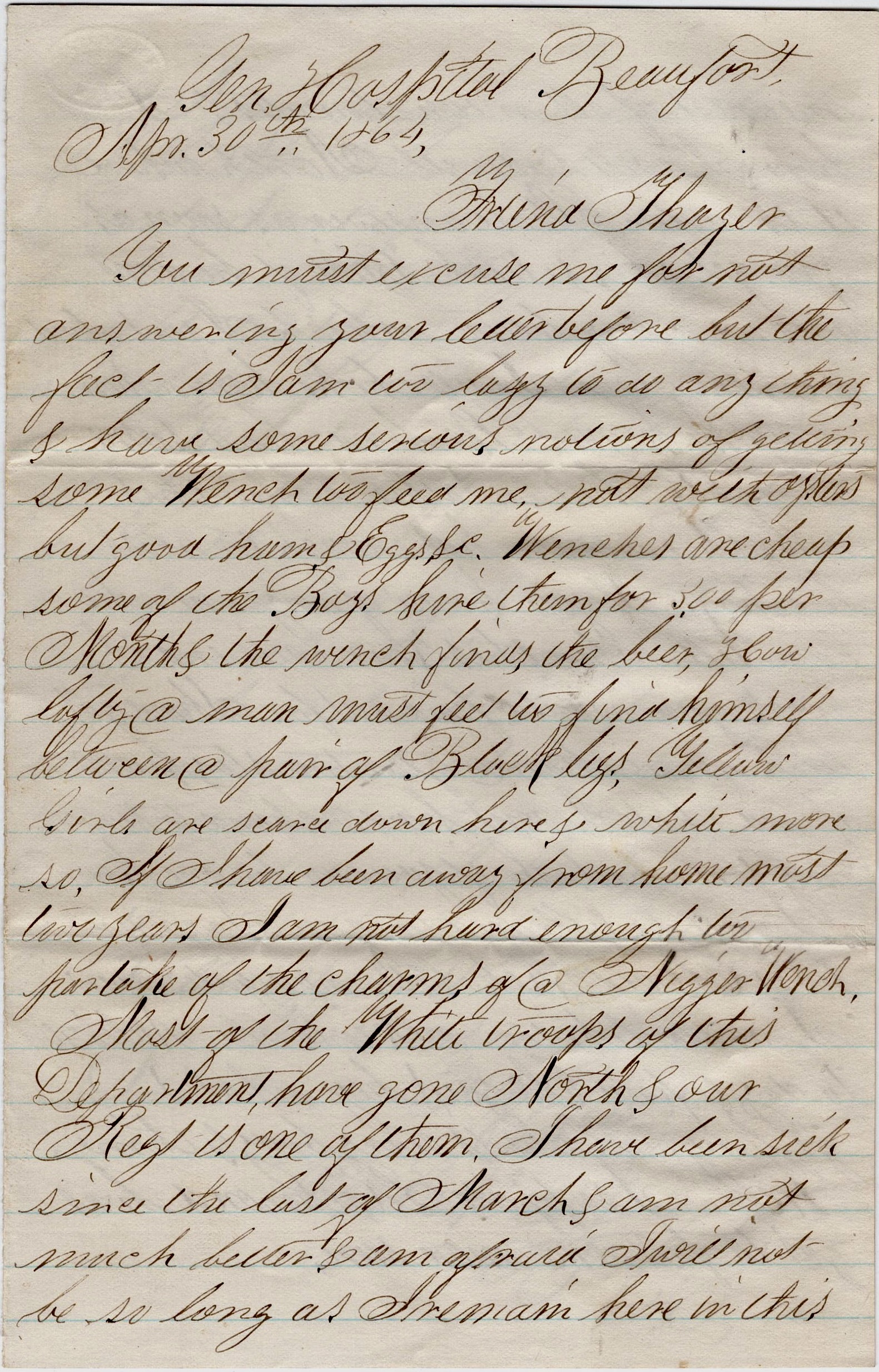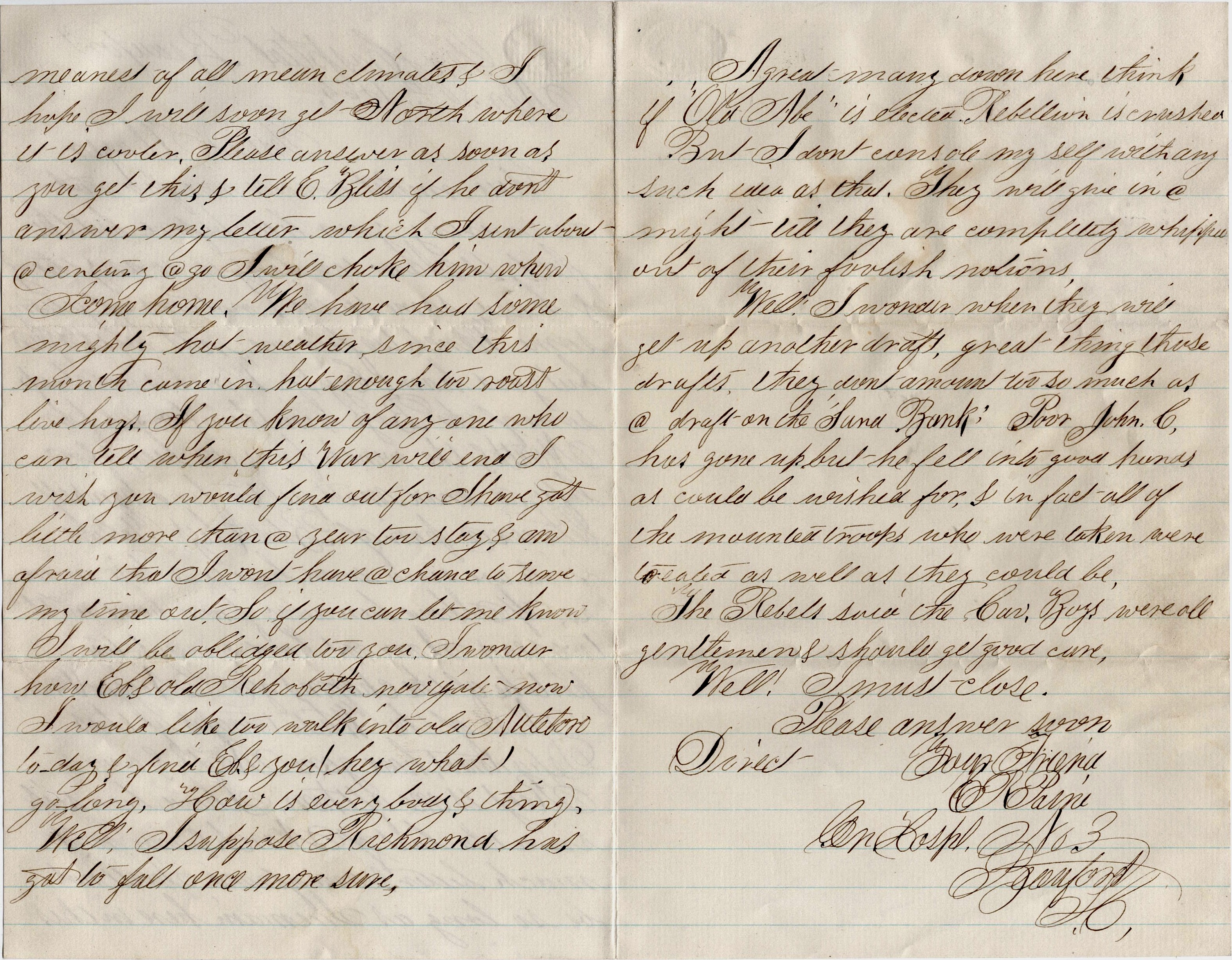
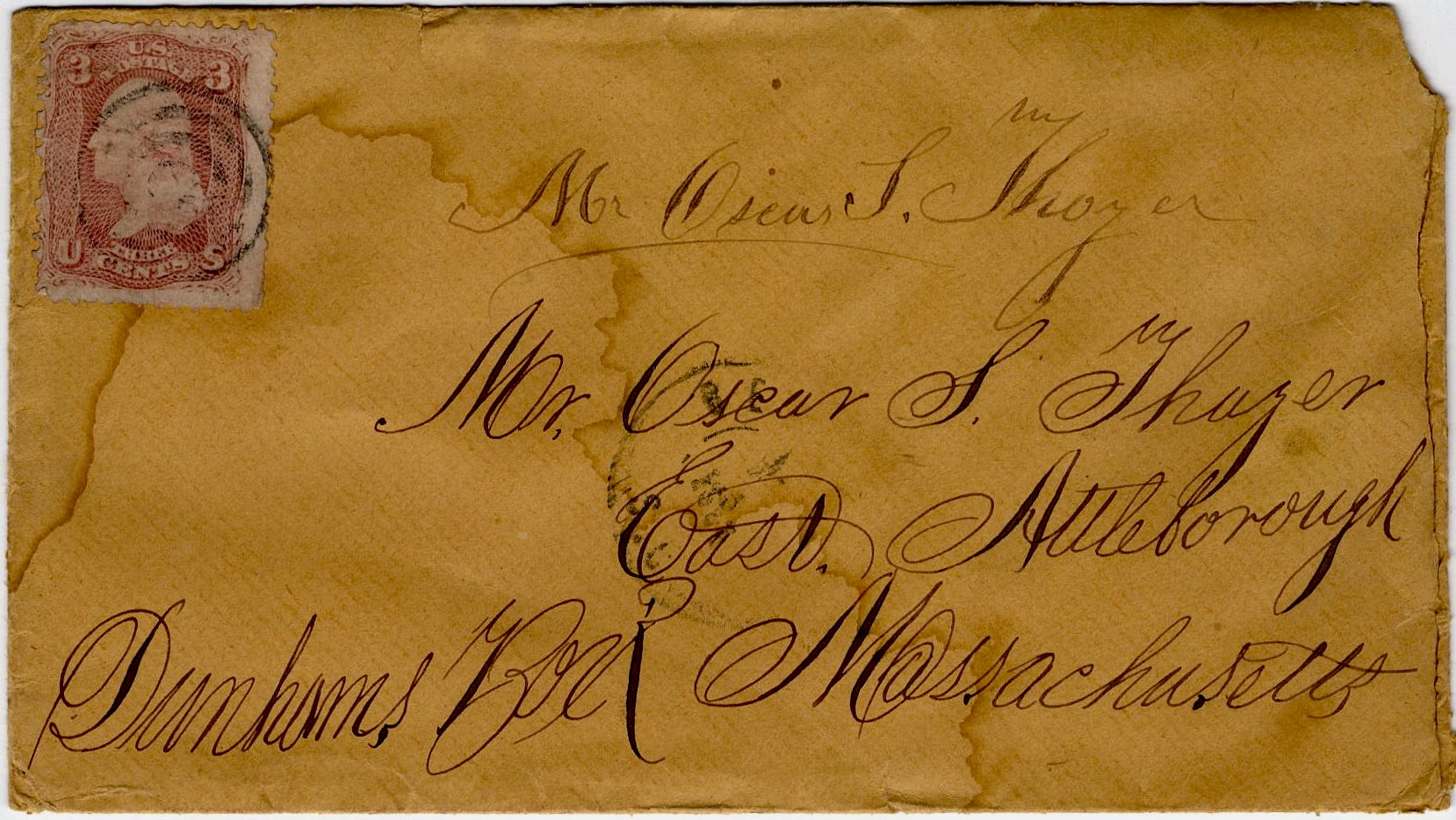
This letter was written by Edwin R. Paine (1840-1880), the son of Lewis Whipple and Jane (Nelson) Paine of Bristol county, Massachusetts. He first enlisted in the 1st Rhode Island Detached Militia in May 1861 for 90 days but the following year, in September, 1862, he enlisted in Co. H, 40th Massachusetts Infantry. Co. H was raised primarily in Essex county with several men from towns like Attleboro. He was discharged for disability on 15 July 1864 at Boston, giving Attleboro, Massachusetts as his residence. In October 1861, he was married to Margaret N. Shields (1841-1899) and had a son named Nelson born in 1862. He’s buried in Pawtucket, Providence county, Rhode Island.
The 40th Massachusetts left the state on 8 September 1862 and was comparatively inactive for some time and remained on picket and guard duty in and around Washington until the spring of 1863. On 15 April 1863, it moved to Suffolk, Va., then under siege, where it was engaged in two reconnaissances on April 24 and May 3. It then moved to West Point, Va., Yorktown, Williamsburg, White House landing in succession, and was engaged with the enemy at Baltimore cross-roads, on July 2. It then passed through Washington on the 11th, and went to Frederick, Md., where it joined the Army of the Potomac in the pursuit of Lee’s army after the battle of Gettysburg. On Aug. 6, it was ordered to Folly island, Charleston harbor, and occupied the trenches in front of Fort Wagner until the surrender of that stronghold. On account of its high repute for excellence in drill and discipline, it was equipped as mounted infantry at Hilton Head in Jan., 1864, and moved on Feb. 4, to Jacksonville, Fla., where it formed part of the Light brigade composed of the 40th, the independent battalion Mass. cavalry and Battery B, 1st U. S. Artillery, Col. Henry acting brigadier. It was engaged at Barber’s ford and Olustee, losing in the latter engagements 5 killed, 23 wounded and 4 missing.
T R A N S C R I P T I O N
General Hospital, Beaufort
April 30th 1864
Friend Thayer,
You must excuse me for not answering your letter before but the fact is I am too lazy to do anything. I have some serious notions of getting some wench to feed me–not with oysters, but good ham & eggs, &c. Wenches are cheap. Some of the boys hire them for $3 per month & the wench finds the beer. How lofty a man must feel to find himself between a pair of Black legs. Yellow girls are scarce down here & White more so. If I had been away from home most two years, I am not hard enough to partake of the charms of a Nigger Wench. Most of the White troops of this department have gone North & our regiment is one of them. I have been sick since the last of March & am not much better & am afraid I will not be so long as I remain here in this meanest of all climates & I hope I will soon get North where it is cooler.
Please answer as soon as you get this & tell E. Bliss if he don’t answer my letter which I sent about a century ago, I will choke him when I come home.
We have had some mighty hot weather since this month came in—hot enough to roast live hogs. If you know of anyone who can tell when this war will end, I wish you would find out for I have got little more than a year to stay & am afraid that I won’t have a chance to serve my time out. So if you can let me know, I will be obliged to you. I wonder how Eb’s old Rehoboth navigates now? I would like to walk into Old Attleboro today to find Eb & you (hey what) go long. How is everybody & things?
Well, I suppose Richmond has got to fall once more, sure. A great many down here think if “Old Abe” is elected, [the] Rebellion is crushed. But I don’t console myself with any such idea as that. They will [not] give in a might till they are completely whipped out of their foolish notions.
Well, I wonder when they will get up another draft? Great thing those drafts. They don’t amount to so much as a draft on the “Sand Bank.” Poor John C. has gone up but he fell into [as] good hands as could be wished for, & in fact, all of the mounted troops who were taken were treated as well as they could be.
The Rebels saw the cavalry boys were all gentlemen & should get good care. Well, I must close. Please answer soon. Your friend, R. Paine
General Hospital No. 3, Beaufort, S. C.