The following letter was written by John Rollin Bestor, Sr. (1813-1867), a Baltimore book-keeper, who was married to Jane Eliza Brown (1820-1885) in Baltimore in October 1835. In 1860, they resided at 97 South High Street—a dense, bustling, enclave that had been the heart of Baltimore’s German-Jewish community but was transitioning to a working class society of Irish and Italian emigrants. Their home was most likely a two or three-story row house on a gas-lit cobblestone street frequented by horse-drawn omnibuses that daily transported passengers to the inner city. A few blocks to the south, within walking distance, was the harbor basin, lined with wharves, packing houses, and tobacco warehouses. By 1863, the Bestor family had moved to 166 North High Street, an older established neighborhood almost in the shadow of the Fayette Street Phoenix Shot Tower. The boys’ father had a presence in Baltimore in the 1830’s; he left advertisements in the local papers offering flute lessons and for selling a one horse buggy.
John directed his letter to his two twin sons, Rollin John Bestor (1842-1899) and John Rollin Bestor, Jr. (1842-1891). When the Civil War began the boys turned their back on Baltimore and joined Co. B of the Maryland Guard. They quickly moved to Richmond where they drilled, mustered into service, and were eventually assigned to the 21st Virginia Infantry. After four years of separation, the two boys returned to Baltimore, not as free citizens, but as Prisoners of War. They were held at Fort McHenry in Baltimore Harbor and could communicate by letter with their parents but were not allowed visitors. It was during this time, and after Lincoln’s assassination, that John wrote to his sons.
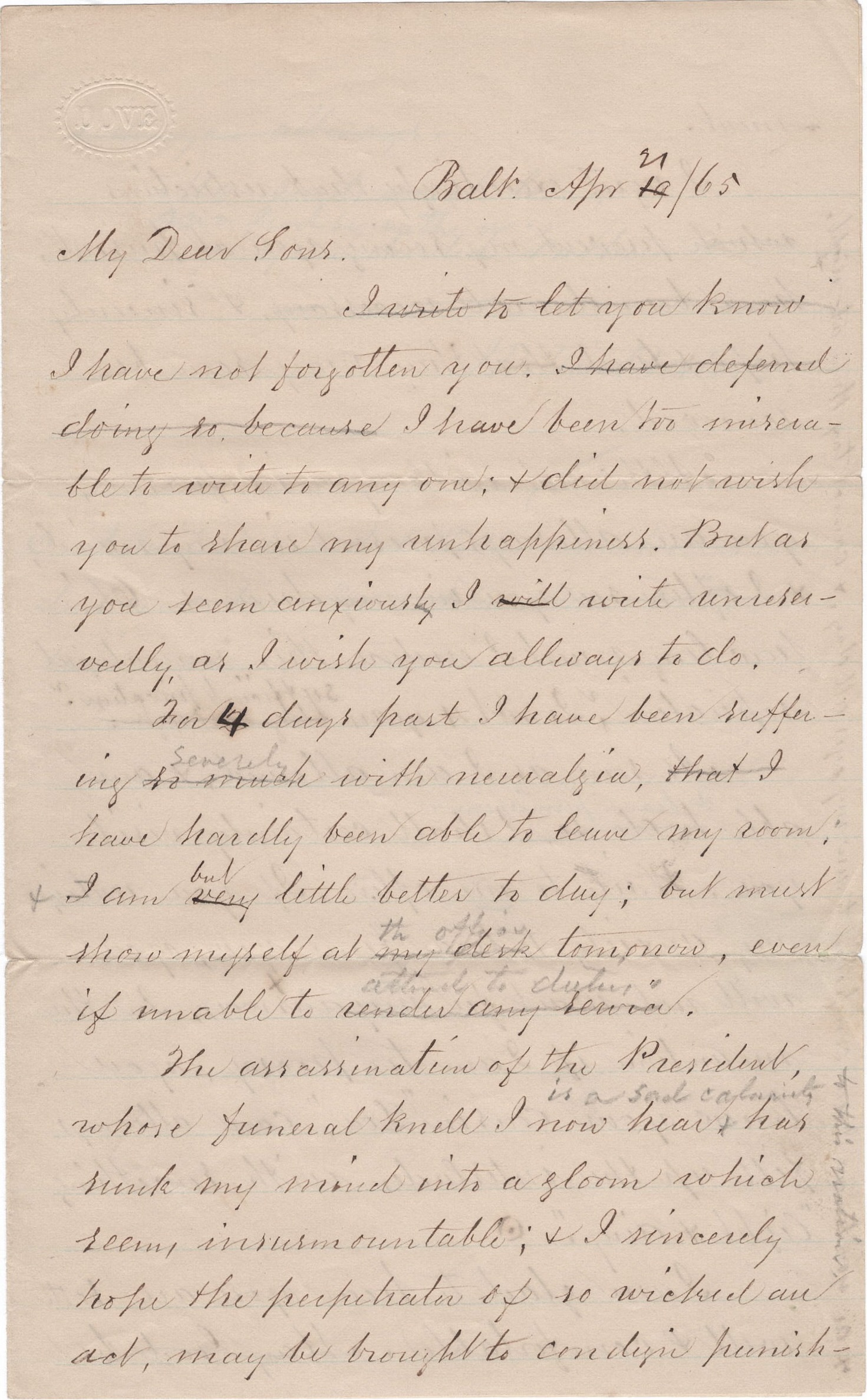
T R A N S C R I P T I O N
Baltimore, Maryland
April 21st 1865
My dear sons,
I write to let you know I have not forgotten you. I have deferred doing so because I have been too miserable to write to anyone and did not wish you to share my unhappiness. But as you seem anxious, I will write unreservedly as I wish you always to do.
For four days past I have been suffering so severely with neuralgia, I have hardly been able to leave my room & I am but little better today but must show myself at the office tomorrow even if unable to attend to duties.
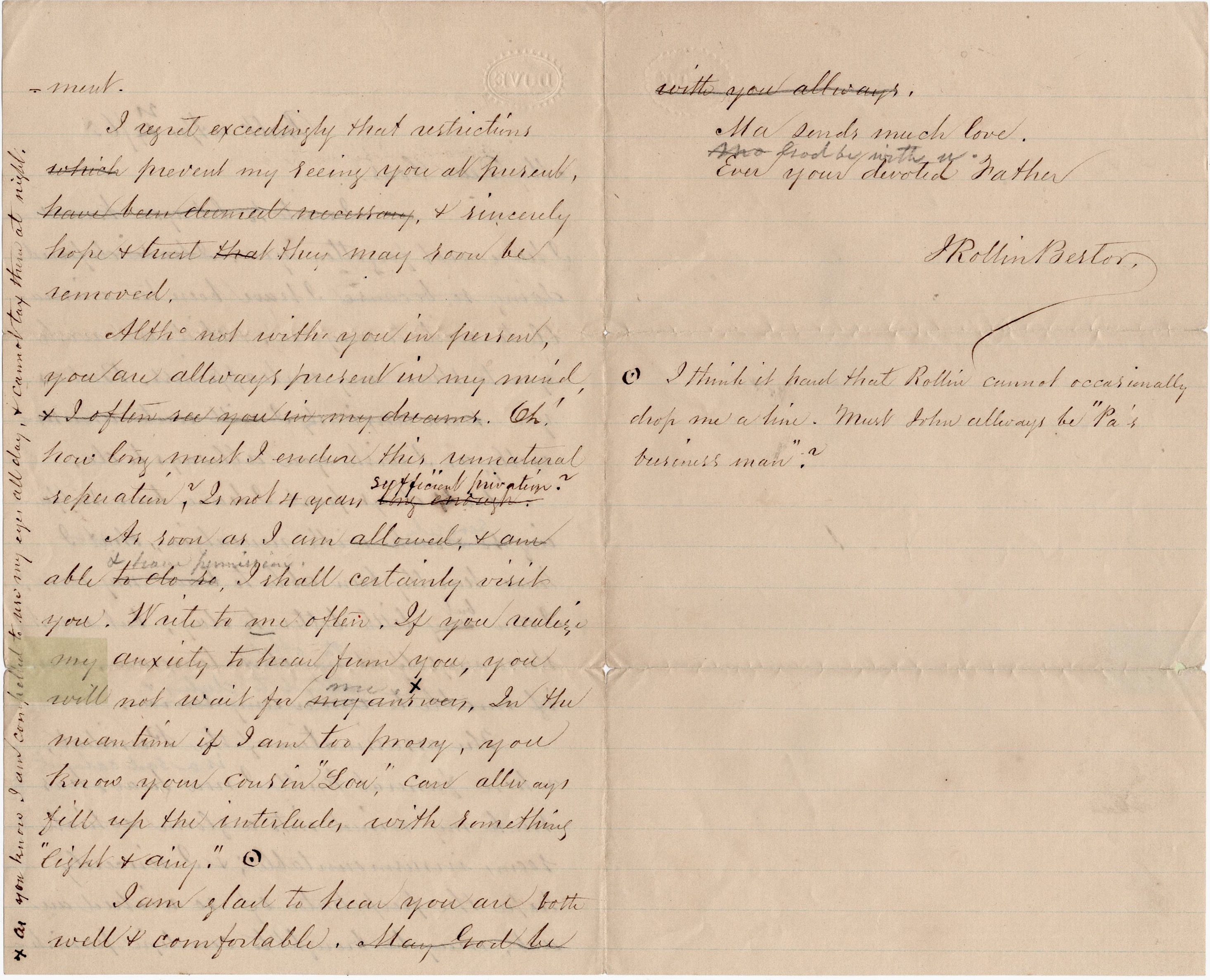
The assassination of the President, whose funeral knell I now hear, is a sad calamity to this Nation and has sunk my mind into a gloom which seems insurmountable. I sincerely hope the perpetrator of so wicked an act may be brought to condign punishment. 1
I regret exceedingly that restrictions prevent my seeing you at present, and sincerely hope and trust that they may soon be removed. Although not with you in person, you are always present in my mind & I often see you in my dreams. Oh! how long must I endure this unnatural separation? Is not four years sufficient privation? As soon as I am able and have permission, I shall certainly visit you. Write to me often. If you realize my anxiety to hear from you, you will not wait for me. As you know, I am compelled to use my eyes all day and cannot tax them at night.
In the meantime, if I am too prosy, you know your cousin “Lou” can always fill up the interludes with something “light and airy.”
I think it hard that Rollin cannot occasionally drop me a line. Must John always be “Pa’s business man?” I am glad to hear you are both well and comfortable. Mat God be with you always. Ma send much love. Ever your devoted Father, — J. Rollin Bestor
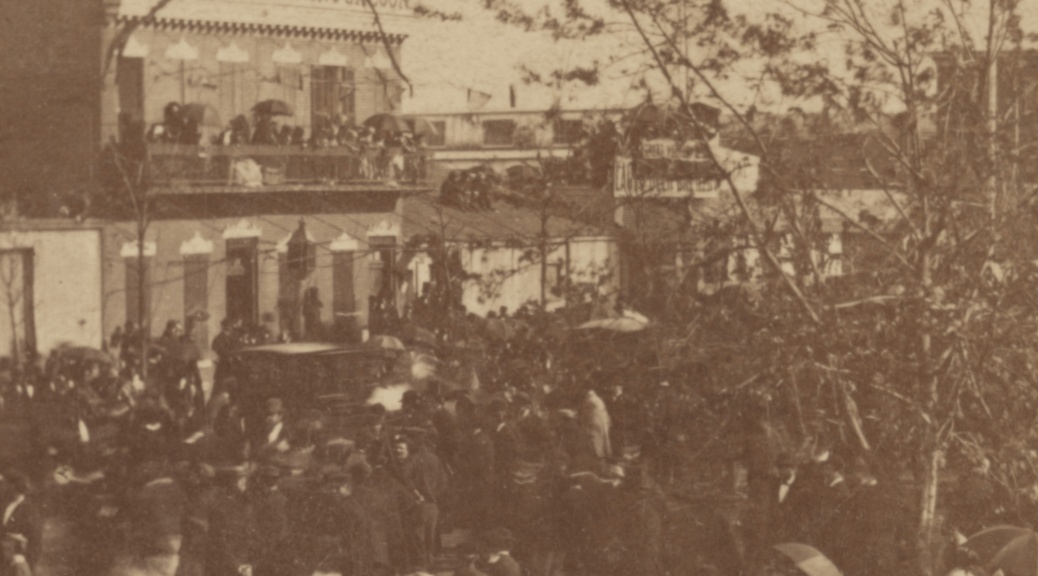
1 Abraham Lincoln’s funeral train made its first major city stop in Baltimore on 21 April 1865. Lincoln’s remains were removed from the train and laid in state at the Merchant Exchange, under a great rotunda. An article in Time Magazine on 15 April 2015 states that “In the early morning of April 21, 1865, the soggy streets of downtown Baltimore were packed with swarms of people. By 8 o’clock, the roads surrounding the Camden station were impassable. Work stopped. Schools closed. Stores emptied. And, the people, waiting patiently for a train, wept. The train that chugged into the station at 10 o’clock contained the remains of Abraham Lincoln. He had died six days prior, on April 15, less than a week after…Appomattox. Inside the train, dubbed the Lincoln Special, the late President’s body was dressed in the same suit from his second inauguration just six weeks earlier.” The image in the header is the Library of Congress. It shows the crowd waiting at the Baltimore Train Depot for the arrival of Lincoln’s Funeral Train.