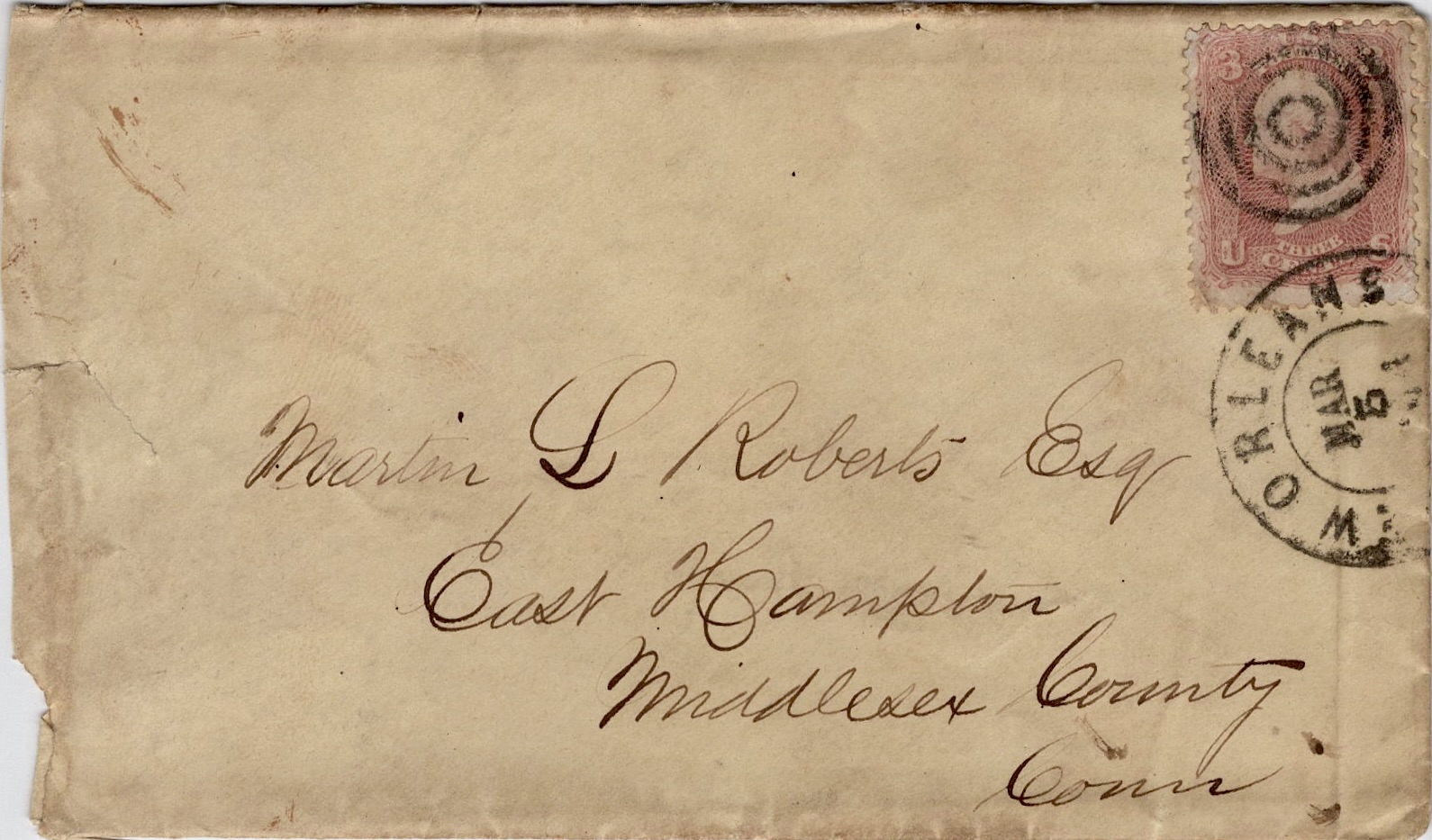
This letter was written by Eben Plummer Brown (1840-1868), the son of Rev. Thomas Gibson Brown (1799-1885) and Caroline Maria Daniels (1808-1892) of East Hampton, Middlesex county, Connecticut. Eben wrote the letter from aboard the USS Courier while anchored off the Pensacola Navy Yard in late February 1864. He provides us no clue as to why he was on board except to suggest he was not a casual passenger. I could not find him listed among the crew of the vessel in 1864 (or earlier years) so I feel confident he was not in the US Navy.
The USS Courier was a store ship used by the US Navy during the Civil War. In 1864 she sailed between Boston and the Gulf of Mexico, supplying ships engaged in the blockade of Southern ports. She ran aground in the Abaco Islands in the Bahamas on 14 June 1864 and had to be abandoned, but her crew and cargo were saved.
Eben wrote the letter to Martin Leonard Roberts (1839-1910) of East Hampton, Middlesex county, Connecticut He married Ruth Ann Carpenter (1853-1937), the daughter of Andson and Diantha (Skinner) Carpenter. Martin was a member of the Connecticut Legislature in 1869 and served as the postal clerk at New Haven for many years.
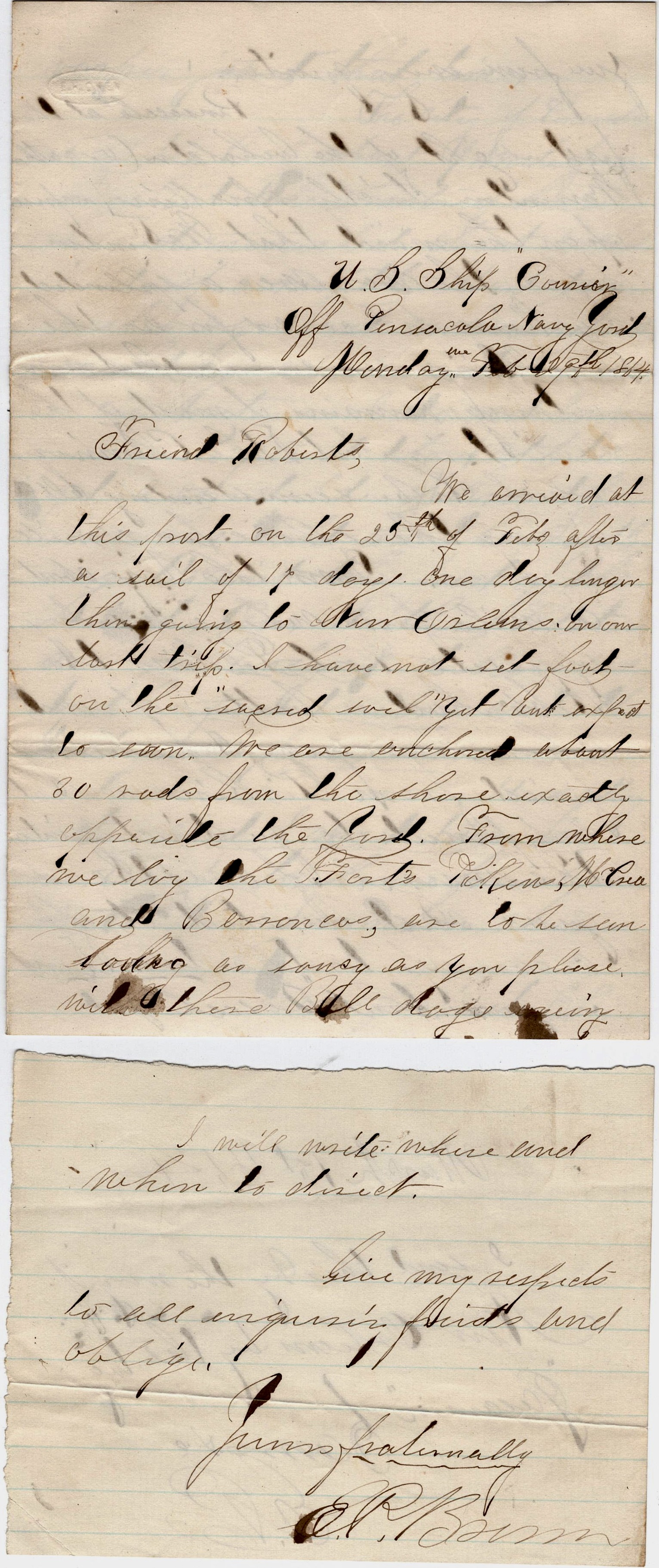
T R A N S C R I P T I O N
U. S. Ship “Courier“
Off Pensacola Navy Yard
Monday eve, February 29th 1864
Friend Roberts,
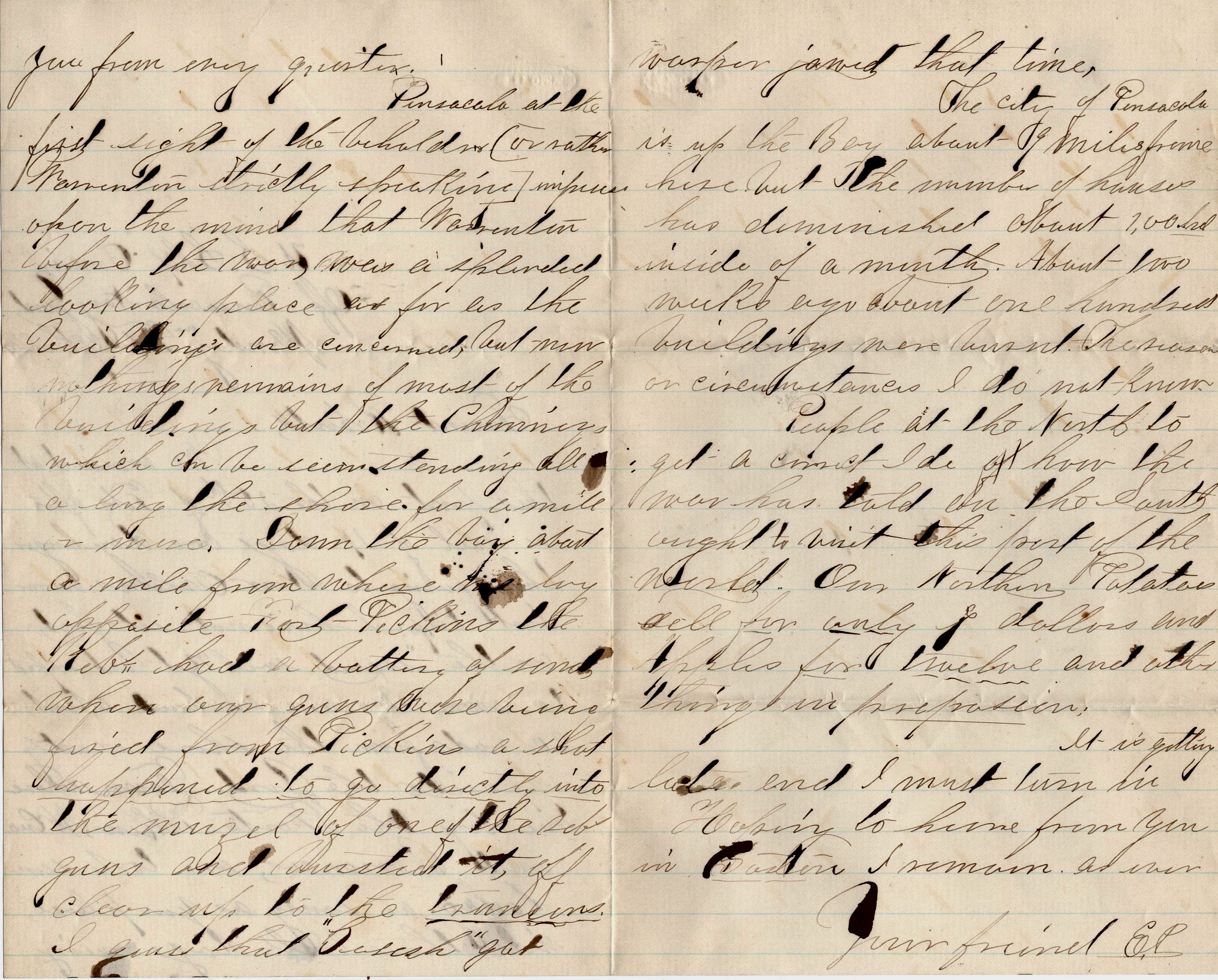
We arrived at this port on the 25th of February after a sail of 17 days—one day longer than going to New Orleans on our last trip. I have not set foot on the “sacred soil” yet but expect to soon. We are anchored about 30 rods from the shore exactly opposite the Yard. From where we lay, the forts Pickens, McRee, and Barrancas are to be seen looking as saucy as you please with their Bull dogs eyeing you from every quarter.
Pensacola at the first sight of the beholder (or rather Warrington strictly speaking) impresses upon the mind that Warrington before the war was a splendid looking place as far as the buildings are concerned, but now nothing remains of most of the buildings but the chimneys which can be seen standing all along the shore for a mile or more.
Down the bay opposite Fort Pickens the Rebs had a battery of sand. When our guns were being fired from Pickens, a shot happened to go directly into the muzzle of one of the reb guns and bursted it off clear up to the trunnions. I guess that “Sesesh” got wasper jawed 1 that time.
The city of Pensacola is up the bay about 9 miles from here but the number of houses has diminished about one hundred inside of a month. About two weeks ago about 100 buildings were burnt. The reason or circumstances I do not know.
People at the North, to get a correct idea how the war has told on the South, ought to visit this part of the world. Our northern potatoes sell for only 7 dollars and apples for twelve and other things in proportion.
It is getting late and I must turn in. Hoping to hear from you in Boston, I remain as ever your friend, — E. P.
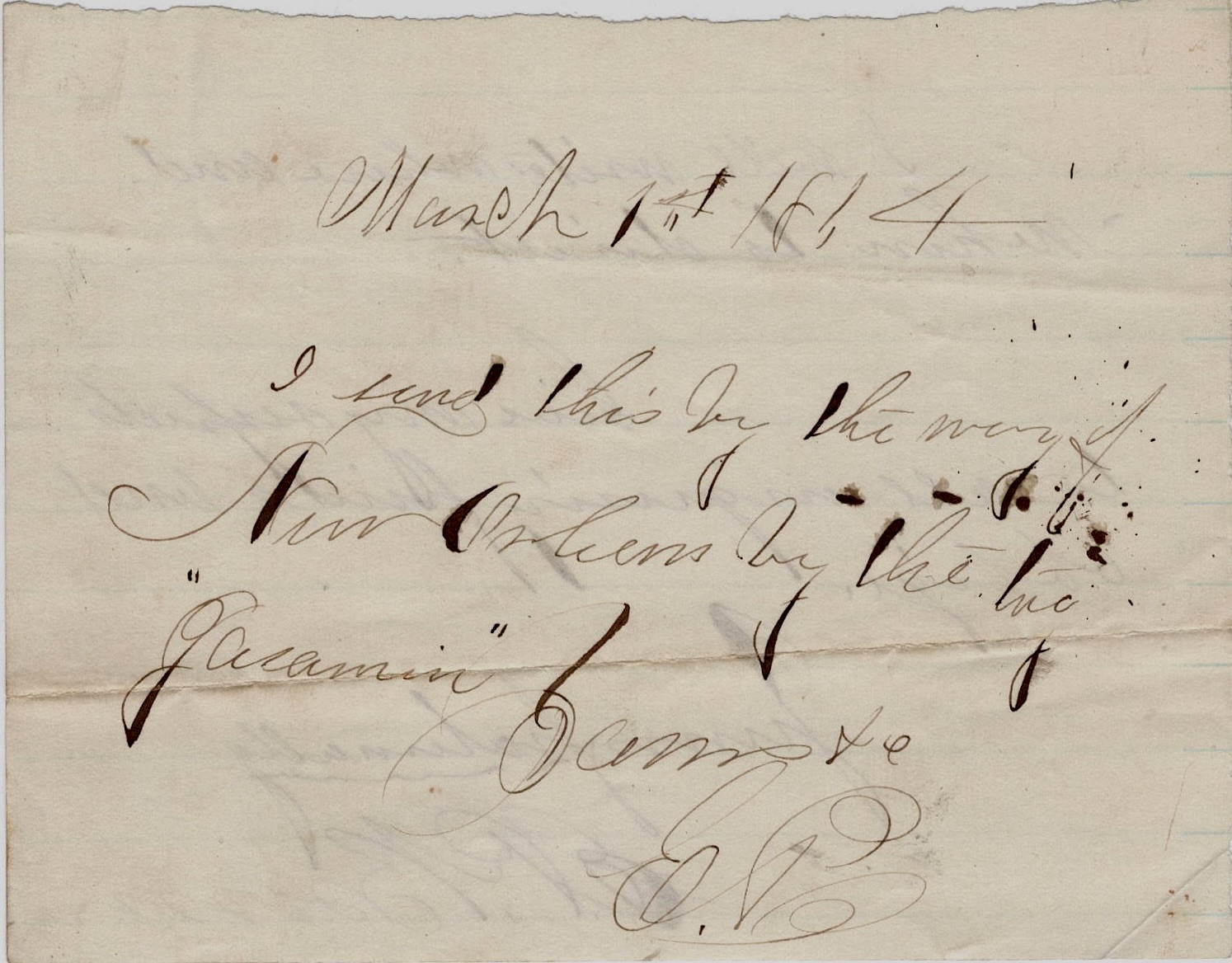
March 1st 1864
I send this by the way of New Orleans by the tug “Jasamin” Yours, &c. — E. P.
1 “Wasper-jawed” (more commonly spelled wapper-jawed or whomper-jawed) is a traditional regional dialect term used in the United States and parts of England to describe something that is crooked, out of alignment, uneven, or askew.