My passion is studying American history leading up to & including the Civil War. I particularly enjoy reading, transcribing & researching primary sources such as letters and diaries.
The following letter was written by George W. Hiltner (1842-1910) of Plymouth, Montgomery county, Pennsylvania who was working as a butcher when he enlisted at the age of 19 on 27 September 1861 at Norristown in Co. F, 51st Pennsylvania Infantry. He reenlisted in January 1864 and was promoted a sergeant in April 1865.
George was the son of George Hiltner (1804-1882) and Mary Ann Kulp (1811-1851) but wrote this letter to his step-mother, Maria B. Rapine.
The 51st Pennsylvania might best be remembered for their successful crossing of the Burnside Bridge at Antietam later in 1862, but this letter describes their participation on the Burnside Expedition in which they first captured Roanoke Island and then the City of New Bern, North Carolina. [See a “Bridge for Whiskey: The 51st Pennsylvania and Its Famous Request Examined” by Kevin Pawlak]
Transcription
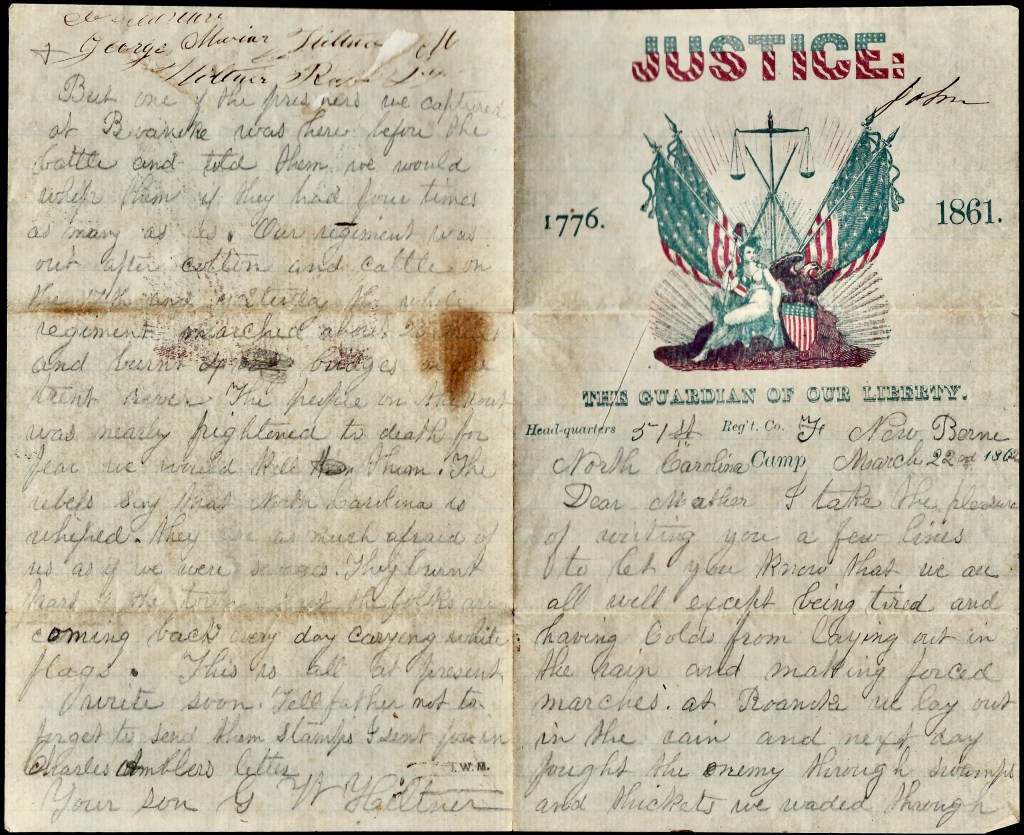
Headquarters 51st Regt., Co. F New Bern, North Carolina March 22nd 1862
Dear Mother,
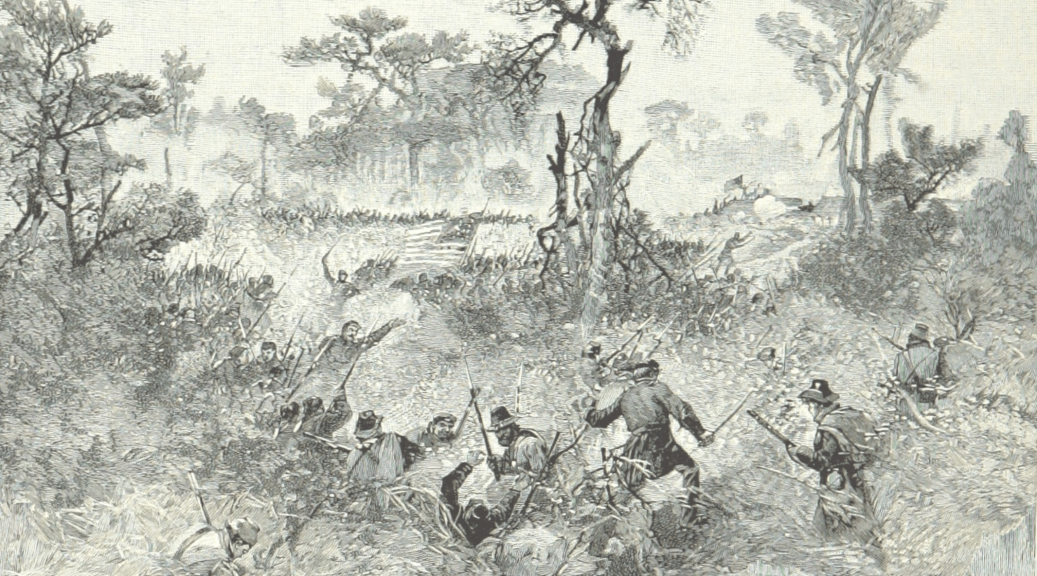
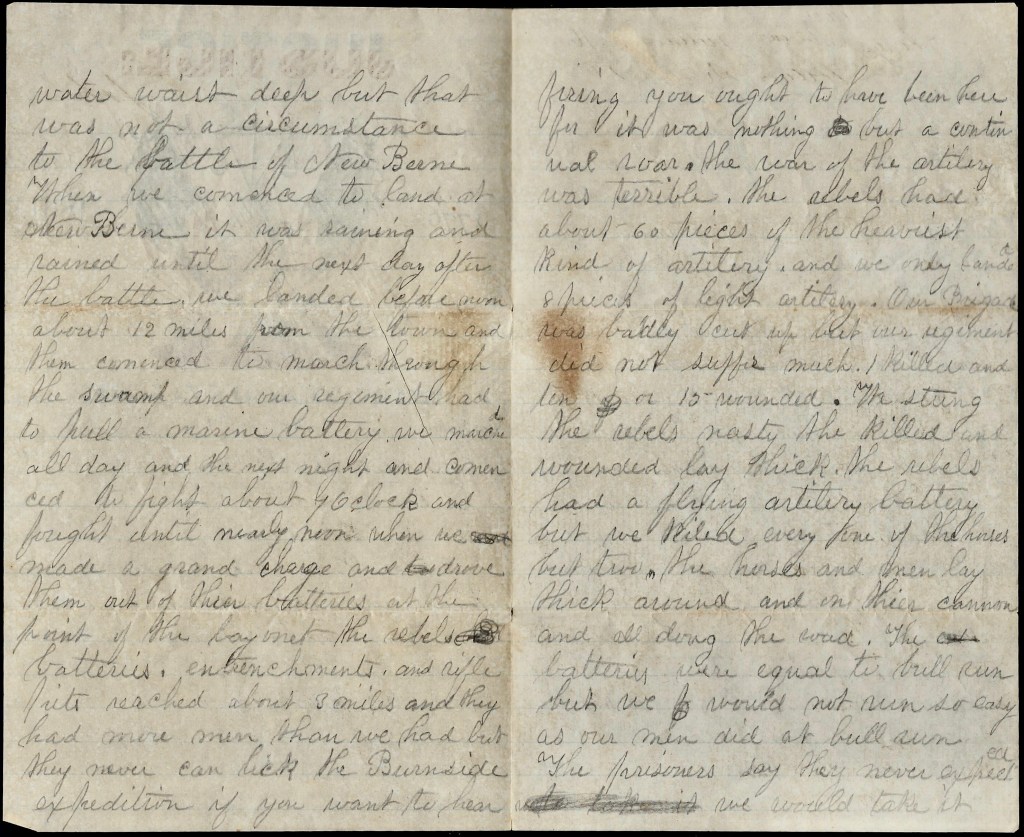
I take the pleasure of writing you a few lines to let you know that we are all well except being tired and having colds from laying out in the rain and making forced marches. At Roanoke we lay out in the rain and next day fought the enemy through swamps and thickets. We waded through water waist deep but that was not a circumstance to the Battle of New Bern. When we commenced to land at New Bern, it was raining and rained until the next day & after the battle. We landed before noon about 12 miles from the town and then commenced to march through the swamp and our regiment had to pull a marine battery. We marched all day and the next night and commenced the fight about 7 o’clock and fought until nearly noon when we made a grand charge and drove them out of their batteries at the point of the bayonet.
The rebel’s batteries, entrenchments, and rifle pits reached about 3 miles and they had more men than we had, but they never can lick the Burnside Expedition. If you want at to hear firing, you ought to have been here for it was nothing but a continuous roar. The roar of the artillery was terrible. The rebels had about 60 pieces of the heaviest kind of artillery and we only landed 8 pieces of light artillery. Our Brigade was badly cut up but our regiment did not suffer much—1 killed and ten or 15 wounded. We stung the rebels nasty. The killed and wounded lay thick. The rebels had a flying artillery battery but we killed every one of the horses but two. The horses and men lay thick around and on their cannon and all along the road. The batteries were equal to Bull Run but we would not run so easy as our men did at Bull Run.
The prisoners say they never expected we would take it but one of the prisoners we captured at Roanoke was here before the battle and told them we would whip them if they had four times as many as us. Our regiment was out after cotton and cattle on the 17th and yesterday the whole regiment marched about 25 miles and burnt 4 bridges on the Trent river. The people on the rout was nearly frightened to death for fear we would kill them. The rebels say that North Carolina is whipped. They are as much afraid of us as if we were savages. They burnt part of the town but the folks are coming back everyday carrying white flags. This is all at present. Write soon. Tell father not to forget to send them stamps I sent for in Charles Ambler’s letter.
I could not find an image of William but here is one of Gilbert Jedediah Stark who also served in Co. B, 32nd Ohio Infantry (Find-A-Grave)
The following letter was written by Corp. William Galbreath Snodgrass (1838-1915) of Co. B, 32nd Ohio Infantry. At the time this letter was penned from the Union entrenchments near Vicksburg in late May 1863, the 32nd Ohio was brigaded with the 8th & 81st Illinois, and the 7th Missouri in John D. Stevenson’s 3rd Brigade, of John Logan’s 3rd Division, in McPherson’s 17th Corps. William entered the service on 9 August 1861 as a private but was promoted to a corporal by March 1863 and mustered out as the 1st Sergeant of his company when he mustered out as a veteran in July 1865.
William was raised in Union county, Ohio, the son of Samuel Snodgrass (1804-1870) and Agnes Nancy Morrison (1813-1876). He addressed his letter to his cousin “Lib” but she is not further identified and no envelope accompanies the letter. The owner of the letter claims it was purchased in an estate sale in Ohio.
William’s highly entertaining and informative letter chronicles the movements of the 32nd Ohio from the time of their departure from Milliken’s Bend in late April to the end of May when they were laying siege to Vicksburg.
Transcription
Near Vicksburg [Mississippi] May 28th [1863]
Cousin Lib,
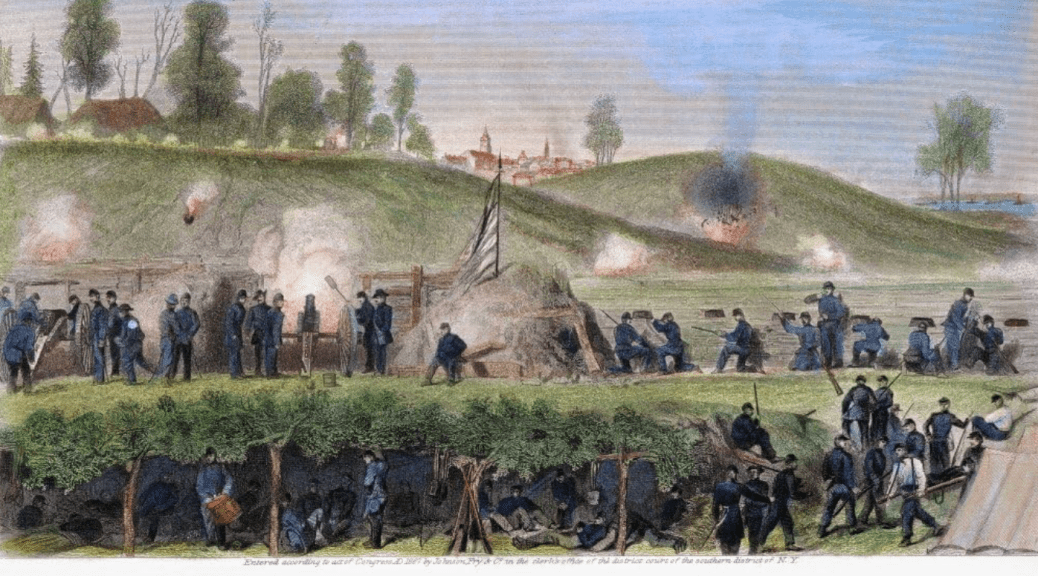
I received your letter a week ago last Sunday. We were on the march then and had stopped to rest and was sitting on the side of the road when the mail was fetched up and distributed. it was the first mail we had received for some time. We left Milliken’s Bend the 25th of April and have been on the move ever since. We have had several fights with the rebs and have whipped them pretty decently every time. I expect you have saw an account of what we have been doing since we left the river. Our Division (that is Logan’s) was in every fight. But we were very lucky We have only had one man wounded in our company yet and that was only a flesh wound. That was Isaiah Hamilton of Logan county. In the rounds, we took over 6,000 prisoners and about 70 pieces of artillery, 8 pieces of which our regiment with the 8th Illinois had the honor of taking.
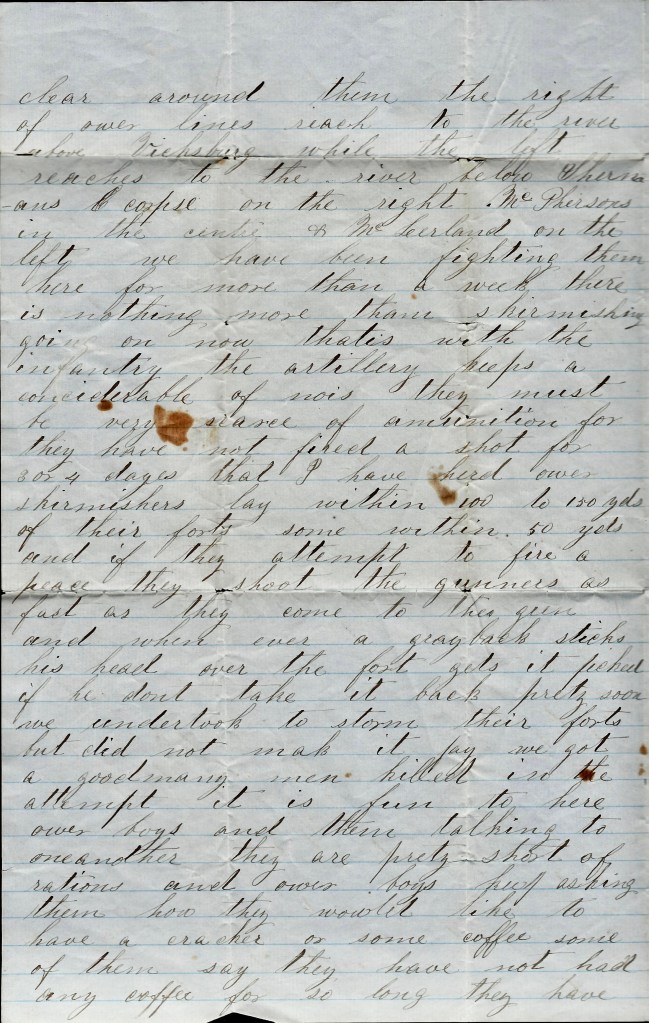
We have a lot more of the rebs penned up here in Vicksburg which we intend shall not get away. We have a strong force clear around them. The right of our lines reach to the river above Vicksburg while the left reaches to the river below. Sherman’s Corps on the right, McPherson’s in the center, & McClernand on the left. We have been fighting them here for more than a week. There is nothing more than skirmishing going on now—that is, with the infantry. The artillery keeps a considerable of noise. They must be very scarce of ammunition for they have not fired a shot for 3 or 4 days that I have heard. Our skirmishers lay within 100 to 150 yards of their forts—some within 50 yards—and if they attempt to fire a piece, they shoot the gunners as fast as they come to their gun. And when a grayback sticks his head over the fort, gets it picked if he don’t take it back pretty soon.
We undertook to storm their forts but did not make it pay. We got a good many men killed in the attempt. It is fun to hear our boys and then talking to one another. They are pretty short of rations and our boys keep asking them how they would like to have a cracker or some coffee. Some of them say they have not had any coffee for so long they have forgot how it tastes and we ask them how much they would give for a daily paper. I think the Southern Confederacy is playing out pretty fast. Flour here sells at $125 per barrel and there is none hardly for that. There was only one family in Raymond that had any flour and that is a considerable of a place. We got the rebel mail there. Had a heap of fun reading them. I got a couple of rings out of one that some fellow was sending to his sweetheart. There were letters in there from all parts of te rebel army—some from Charleston, S. C., some from Bragg’s army, Vicksburg, Port Hudson, and a great many of them talk very discouraging and the most of them said they were pretty short of rations.
The women here are very sassy when our boys first come in but they generally get pretty humble. We have passed through some of the nicest country that I ever saw. We came past one of Jeff Davis’s plantations. The boys tore everything to pieces. The people here will learn one lesson before they are through with this rebellion—that is, when they are as well fixed as they were when this war commenced, that is to be contented with their lot.
Last Monday the rebs came out with a flag of truce. I do not know the object of it or anything about it but as soon as it came out our boys went up to the forts and the rebs came out and were talking together and joking, but they would not allow us to go inside of the fort. The flag came out about three o’clock and they did not do any fighting that day and some of our boys were over among the rebs until night. The most of them thought we had them. They said we could not take them by storm but we could starve them out. The was 3 or 4 over here in our camp and they offered a dollar apiece for crackers. the boys gave them a few. They say our shells are killing lots of their cattle and mules in there. They said we killed them faster than they could eat them.
The boys are all well. Will Mc 1 is all right. While we were in Raymond, he took possession of the printing office and done a big business while he stayed there. You said you had written two letters since you had got any from me but I never got it. No more. — Wm. G. Snodgrass
1 “Will Mc” was probably William Mosby McLane (b. 1839) who mustered out of the regiment at Chattanooga on 19 August 1864 after three years service.Draft registration records indicate that William was a “teacher” in Champaign county, Ohio, before he enlisted.He returned to Ohio until the close of the war then ventured west to help build railroads. McLain’s last job was with Texas & Pacific Railroad and there he died of heart disease September 8, 1873 in Gladewater, Texas at the age of 35. For a wonderful article on McLain, see “William McLain: On the Subject of Surrendering” appearing on Emerging Civil War, May 1, 2020.
The following letter was written by Loving Lieblong, the wife of stone mason William N. Lieblong (1820-1898). Unfortunately I could not identify her further. She gives her mailing address in June 1862 as Freeport, Armstrong county, Pennsylvania, but she was not enumerated in the 1860 US Census record for that borough.
Loving’s husband was a 40 year-old German emigrant when he enlisted at Camp Wright near Pittsburgh on 8 June 1861 in the 11th Pennsylvania Reserves (40th Pennsylvania Infantry), Co. G, or “the Apollo Independent Blues.” Regimental records inform us he was carried on the muster rolls until 6 May 1863 when he was discharged for disability, having served 1 year and 11 months. The 1890 Veterans Schedule claims that he was “wounded in hand arm”—possibly at the Battle of Fredericksburg—and the Pension files indicate that he filed for an “invalid” pension on 15 May 1863. His disabling injury apparently was not so severe, however, that it prevented him from resuming his stonemason trade following the war. He worked in Pittsburgh until 1890 when he moved to Chicago. My hunch is that Loving died sometime prior to 1870 and that William remarried.
Loving’s heartfelt letter exudes desperation and sincerity as she implores President Lincoln to ensure her husband receives the wages owed to him, as if totally unaware of the weight of his responsibilities.
Transcription
Freeport [Pennsylvania] Monday, June the 16, 1862
Mr. President,
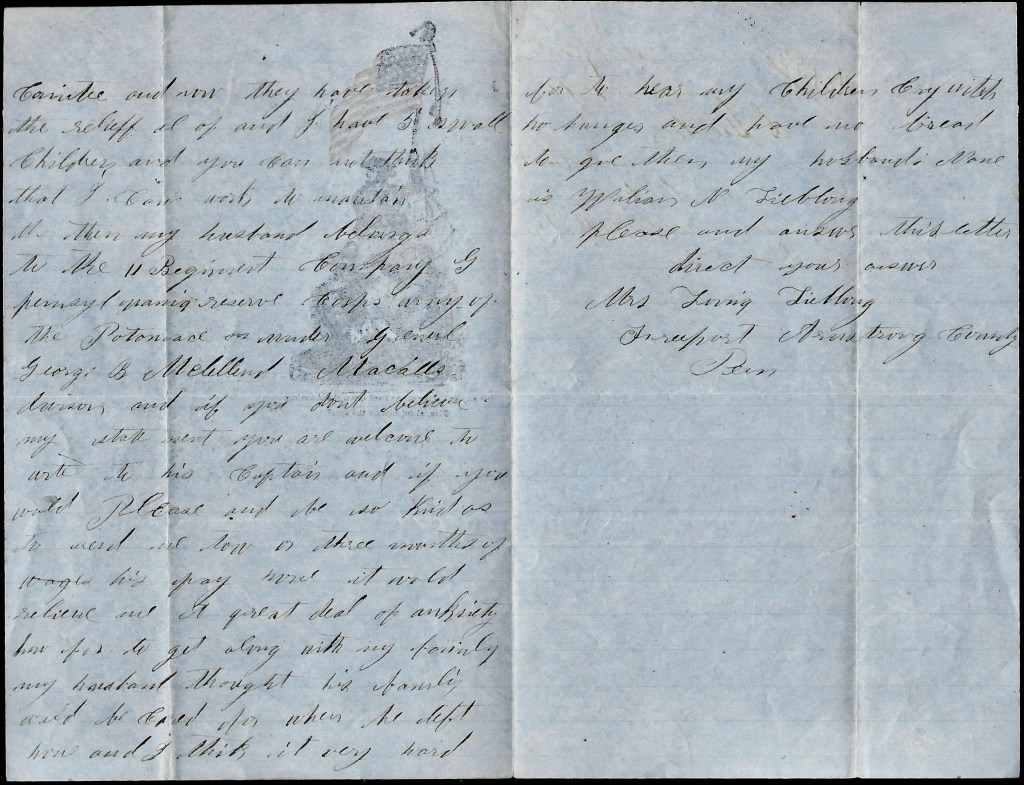
I take this present opportunity to let you know that my husband has been sick in the General Hospital, Washington Street, Alexandria, and when the pay master come around he was sick and didn’t get his pay and then they paid the sick he was back at his regiment and did not get his pay and now as it is 5 long months since I have been living on 5 dollars a month that I got from the Relief Committee. And now they have taken the relief all off and I have got 5 small children and you cannot think that I can work to maintain us then.
My husband belongs to the 11th Regiment, Company G, Pennsylvania Reserve Corps, Army of the Potomac under General George B. McClellan, McCall’s Division, and if you don’t believe my statement, you are welcome to write to his Captain and if you would please and be so kind as to send us two or three months of his pay now, it would relieve me a great deal of anxiety how for to get along with my family. My husband thought his family would be cared for when he left home and I think it very hard for to hear my children cry with hunger and have no bread to give them. My husband’s name is William N. Lieblong.
Please answer this letter. Direct your answer [to] Mrs. Loving Lieblong, Freeport, Armstrong county, Penn.
[Docketed on back of letter]
Referred to Major Ball to report if any pay is due this man to 30th April & return this paper. By order J. Ledyard Hodge, Asst. Paymaster
Wm N. Lieblong, Co. G, 11th Regt. Pa. Res. Vol. is returned to “Company Roll” in hospital. He was last paid December 31, 1861. This is four months pay due him to 30 April 1862 as appears by the roll. — Gideon J. Ball. Asst. Paymaster
How Mary might have looked in January 1862(Bob Celli Collection)
“These are dark days we are all passing through now, but some think it is only the beginning. The twilight, as it were, of a dark, long night, & that the New Year that has just dawned will be a “year of blood.” So wrote 32 year-old Mary Jones Wiley (1829-1893), the wife of Atlanta Hardware Merchant William H. Gilbert (1827-1882), in a letter to her aunt on New Year’s day in 1862. Mary’s aunt is not identified but was probably from the Wiley side of the family and a resident of Mobile.
Mary was the daughter of Edwin Wiley (1784-1866) and Eliza DeWitt (1797-1865) of Hancock county, Georgia.
[Note: This letter is from the private collection of Greg Herr and was transcribed and published on Spared & Shared by express consent.]
Transcription
“A happy New Year!” dear Aunty & may you be permitted to spend yet many New Years and always happy ones. I just wish you could sit down here with us today & spend a quiet day. I couldn’t promise you a very sumptuous dinner. I dare say you will do a great deal better in your elegant home—but I should love to see you here with us once more. It is a long time since we heard from you. I wish I was as good a correspondent as you are. It is a real pleasure to have a punctual correspondent.
We are all, I am glad to say, in our usual health. My baby [“Maime”] is a little complaining with an eruption—from teething I think—but she is a great big, fat baby, very much resembling my little boy [Alfred].
Well, what shall I write about? There are many things no doubt you would like to hear—that I cannot think of. These are dark days we are all passing through now, but some think it is only the beginning. The twilight, as it were, of a dark, long night, & that the New Year that has just dawned will be a “year of blood.” God be with us—protect & sustain us. The sacrifice has already been great, but doubtless we are not sufficiently humbled yet, or our punishment would be removed. Well, we will know how to enjoy & appreciate peace & liberty when it does come.
I don’t think any of us have written since Wells was here on his way to Pensacola. But he said he was going to Mobile & I dare say you have seen him long before this. I never saw anyone more changed in appearance than he. He looked so well. We were all very glad to see him. I have lately heard quite particularly from Hancock [county, Georgia]. Mr. G[ilbert] spent a week just before Christmas there & visited all around at sister’s, Cousin Billy Lewis, R[ichard] M[alcolm] Johnston’s, Pa’s, &c. &c. He found Cousin Billy sick with a cold, but he has got over it entirely. They were all at home. Mat was quite unwell too he said, but up. She had a dreadful cold. Ma has had a very severe attack this winter & is still very feeble. I fear she is failing very fast. I do believe that the troubles of the country have much to do with it. She & Sallie made me a little visit in October. Sallie bears Sammy’s absence surprisingly well, but she has many, many trials.
Mr. [Richard Malcolm] Johnston & Fannie & family 1 are well and have lately moved back from Athens to their old place [near Sparta], built a large comfortable cottage with eleven rooms, & will soon have it filled with boys. He is going to teach a select school. They have got their hands full certain. Mr. G[ilbert] said they are killing hogs and the plasterers there, house full of mud and plank, & laths & everything of course topsy turvey hurrying to get things straight for the boys.
You asked in your last to me about Aunt Avis. 2 She is very feeble this winter but is at times very calm & even appears almost cheerful but I don’t know that she is any more reconciled to her loss. She grieves for those two previous children. Henry [Dewitt Beman] & his wife came back to Georgia last June & are now living at Uncle Beman’s. They are very much attached to Belle who is devoted to them & adds immensely to their happiness. Poor Tom, lost his wife this last summer. She died of typhoid fever there at Uncle Beman’s after weeks of intense suffering. Left three little ones—the baby but eight months old. Tom has given to Henry & Bella who had no children. Aunt Avis has the other two—Willie & Kate. The baby’s name is Edward. Tom has lately gone on to Virginia to join his company—the same one that Sammy belongs to. Sammy has had an attack of Catarrhal fever. Was in Richmond several weeks but was fortunate enough to get to a very nice, private house. Has recovered & I believe gone back to his tent home.
Jesse [Gilbert] 3 was here last week, on a sick furlough, but got well and has gone back. He has been sick a good deal of the time & is hardly as stout as he was. Maggie is keeping house here on their lot. Her baby is rather delicate. I forget whether I wrote to you since it was born or not. It’s name is Eliza H.
We heard yesterday of the death of Mr. Bryan & we heard too that Russell Whaley’s wife committed suicide a few days ago by cutting her throat. You know they live near Sparta. 4 Mrs. John Bonner also is dead—poor woman. What a sufferer she has been with that cancer.
We have had a most delightful winter—no snow or sleet & not very much ice. But today looks threatening & I fear we are to have winter weather the remainder of the winter. I suppose you all are almost ready to begin gardening. The weather has been very suitable for it here for the last few weeks. We are living here on our same lot but have at last moved the kitchen back & built a house for the negroes, moved the stable &c. back & got all fenced in quite conveniently, & I must tell you that Mr. G[ilbert] sold that carriage yesterday that you didn’t fancy a bit, & I never did either, so I don’t know as we will have any at all when you come again. He says he will get one to suit him when he gets able.
I have lately heard from Ridgewood that Uncle Jones is better—able to ride out & sometimes speak so as to be understood. Aunt Jones is feeble. Julia has been very dangerously ill with “congestion of liver & upper bowels” but is now able to sit up. She & Dewitt were here last fall.
Monday. After such a long pause I sit down to finish my poor apology for a letter. I have written with such a miserable pen that I fear it will puzzle you to read this. Mother Gilbert wishes me to say to you that her health is better this winter that it has been in a long time & that you must not think hard of her for not writing. She has wanted to & felt like writing a long time but she is in constant trouble & anxiety about Jesse & can’t fix her mind on it. And that you must take part of this from her, &c. &c.
Mr. Gilbert sends love to you all. You must write & let us know how you are this winter & dear me, I see the Yankees are threatening Mobile. What so you all think of it? May the Lord send confusion into their midst & scatter them as chaff.
Mother G[ibert] joins me in love to yourself & Cousin M. & family. Believe me your affectionate niece, — Mary Gilbert
1 Richard Malcolm Johnson (1822-1898) attended Mercer University and then became a lawyer in 1843. In 1857 he accepted an appointment to the chair of belles-lettres and oratory at the University of Georgia in Athens. When the Civil War disrupted the college, he began a school for boys on his farm near Sparta. For a time he served on the staff of Confederate general Joseph E. Brown and helped organize the state militia. After the war he moved to Baltimore and opened a school for boys there.
2 Avis D. Dewitt (1800-1863) was the wife of Carlisle Pollock Beman (1797-1875) of Hancock county, Georgia. Their two oldest boys are mentioned in this letter. Thomas Spenser Beman (1825-1862) was married in 1856 to Lucy Mariah Preston (1835-1861). When she died on 24 September 1861, Thomas gave their youngest child, Edward Douglas Beman (1861-1928) to his brother Henry to raise. He the left his two eldest children, Willard P. Beman (1858-1926) and Kate D. Beman (1860-1951) to be raised by their grandmother while he returned to his regiment, 15th Georgia (Co. E), then quartered in Virginia. Thomas would never return to Georgia—he was killed in the Battle of 2nd Manassas on 30 August 1862.
3 Jesse D. Gilbert (1837-Bef1890) was the son of Darius Gilbert (1800-1850) and Elizabeth Hart Hardwick (1801-1891) of Atlanta, Georgia. Jesse was married to Margaret P. Rogans (B. 1840) in November 1860 and their first born child was Elizabeth (“Lila”) H. Gilbert (1861-1942). Lila was born on 1 September 1861.
4 It was Martha Ann Walker (1824-1860), the wife of Hancock county planter James Russell Whaley (1808-1892), who committed suicide. One source gives her death as 15 November 1860 but it was probably 1861. Russell soon married a second wide by the name of Susan Johnson (1830-1911).
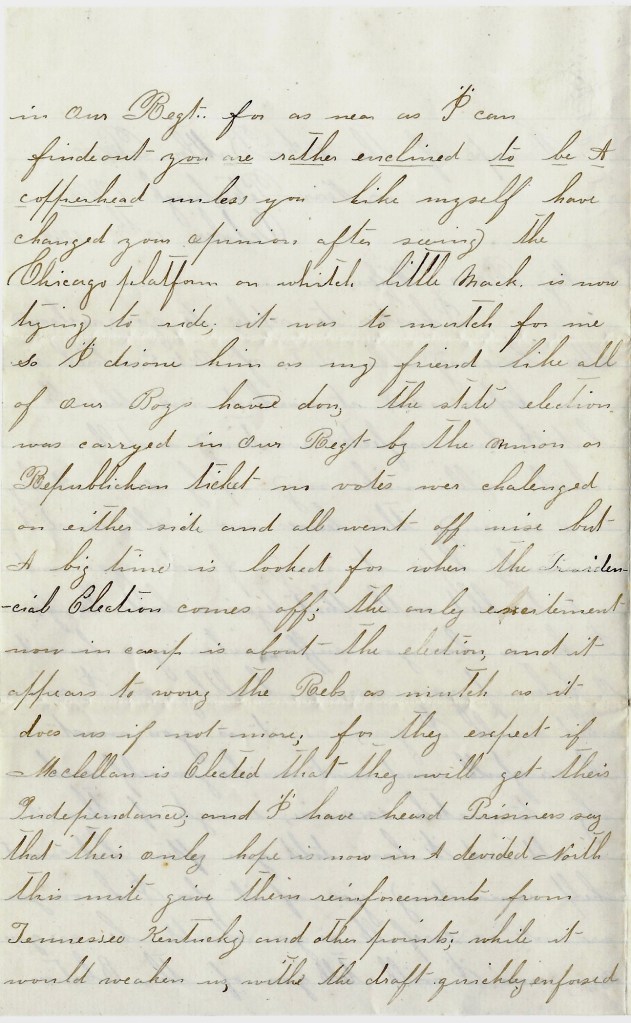
The following letter was written by Orlando S. Kinnear (1843-1921) to his wife Helen Prudence Kinnear (1845-1919) of Erie, Erie county, Pennsylvania. When Orlando enlisted in February 1862, Co. I, 83rd Pennsylvania, he was described as standing 5′ 5″ tall, with black hair and grey eyes. Occupation? “Mason,” Orlando told the recruiter. Though wounded at Chancellorsville in May 1863, Orlando recovered and reenlisted in February 1864. He rose steadily in the ranks; promoted from corporal to sergeant and finally to 1st Sergeant before mustering out of the regiment in Co. C. In later years, Orlando resided in Erie and found employment as a machinist.
Orlando’s letter, penned in the heat of the 1864 political campaign, encapsulates the prevailing sentiment among the soldiers in the Army of the Potomac. A significant number of them passionately supported their former leader “Little Mack,” only to feel disillusioned by the Democratic Convention in Chicago. Many perceived the convention’s stance as a form of capitulation to the South, sparking intense debate and discontent among the troops.
“Compromise with the South, dedicated to the Chicago Convention” Harper’s Weekly
[Note: This letter is from the private collection of James Campbell and was transcribed and published on Spared & Shared by express consent.]
Transcription
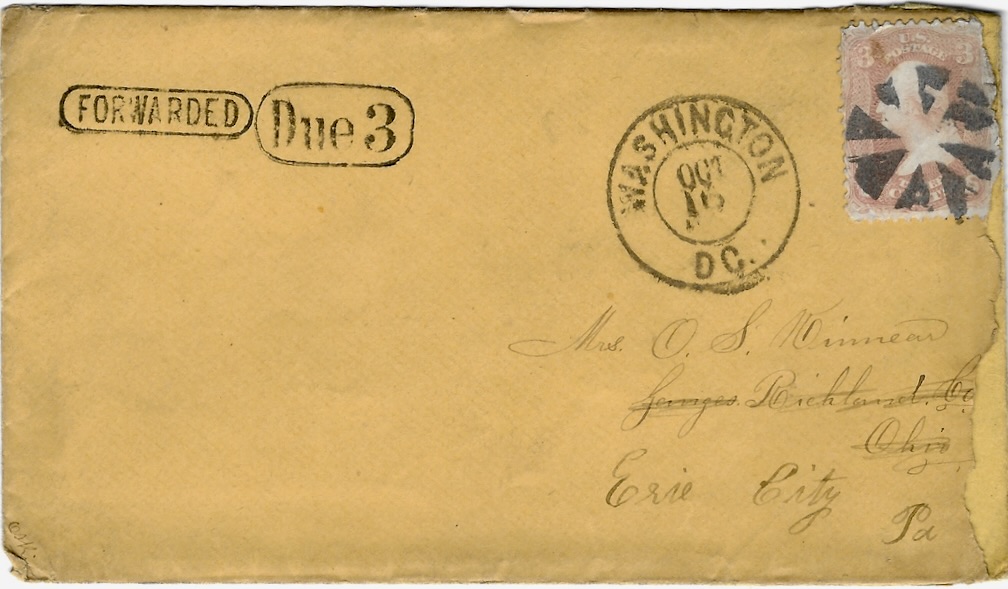
Addressed to Mrs. O. S. Kinnear, Erie City, Pa.
Camp of the 83rd Battalion P. V. V. Near Petersburg, Va. October 13th 1864
My Dear Wife,
I hasten to reply to your welcome letter bearing the date of October 5th which is now before me, It reached me the 11th but I have neglected writing until now which will make my reply seem a long time coming. This leave me well and I sincerely hope it may find you and not troubled with that tegeious [tedious] headache for I know how you suffer when you have it. O, Helen, if you was as healthy as I am, what would I give. As it is, you must be careful and not make yourself sick bu too much exercise. Enough of this—it is old and I have told you often but cannot help reminding you of it for I know you are not as careful as you should be, are you dear.
Now, I will tell you of the election in our regiment for as near as I can find out, you are rather inclined to be a copperhead unless you, like myself, have changed your opinions after seeing the Chicago platform on which Little Mack is now trying to ride. It was too much for me so I disown him as my friend like all of our Boys have done. The state election was carried in our regiment by the Union or Republican ticket. No votes were challenged on either side and all went off nice. But a big time is looked for when the Presidential Election comes off. The only excitement now in camp is about the election and it appears to worry the Rebs as much as it does us—if not more—for they expect if McClellan is elected, that they will get their independence. And I have heard prisoners say that their only hope is now in a divided North. This might give them reinforcements from Tennessee, Kentucky, and other points, while it would weaken us with the draft quickly enforced. They would become encouraged and fight ore desperate than ever. But I have little fear of this for I do not think the North has become so corrupt as all this comes to. If it has, the quicker I get out of this, the better and I do not think I would be alone in the getting out—out of this U. S. into some parts unknown to minié ball and solid shot that always find a person in Virginia, ad have followed Rebs to Pennsylvania.
I can see nothing of great importance going on here at the present time worth writing you about but can hear an occasional shell bursting somewhere in the vicinity of the 3rd Brigade and the report of a gun near Petersburg to let us know that the Rebs are still alive and occupy the desired City. But they get three for every one they throw at us. I think it must annoy the ladies some if there is any in the town, though they may be of good stuff and can stand fire. I hope they are, for I intend to make them a visit some of these days and should be very much disappointed if they were all shelled out. The Rebs say there is some gay ones there and they are wishing every day that the yanks would come and fetch them some coffee and sugar, This you see will save our greenbacks to buy rum when we get sick. I never get sick so my greenbacks will be of no use to me and I can send them all to you. Will not that be old gay, dear, to have the Rebs ask for peace and lay down their dirty rag?
The lines you sent me in print are nice but I have no recollection of writing them though I might have wrote them when I had one of them to upon my work. Nellie, I am going to vote for Honest Abe and I hope you will assure me in your next that you have forgotten Mack as a candidate for President or I shall consider you my little copperhead yet so you can send me that photo or have you cut them off again. O, if you have, I will do something that you will not want me to. Enclosed you will find a group of our officers. Gen. Warren is our Corps Commander. He is half Indian. Remember me to your sister and all the girls. Also yourself, accept my love and kind regards.
I remain as ever your affectionate husband, — O. S. Kinnear
The following letter was written by James Morris (1837-1863) of Co. F, the Erie Regiment Pennsylvania Volunteers. The regiment was raised in April 1861 and mustered in for three months service. Many of those who opted to remain after three months were mustered into either 83rd, 111th, 145th, or other Pennsylvania regiments.
According to muster records, James was from Titusville, Crawford county, Pennsylvania. It appears that he reenlisted in August 1862 to serve in Co. I, 150th Pennsylvania. While serving in that regiment, he received a head wound in the first day’s fight at Gettysburg and he died on 18 July 1863 in New York. He was buried on Long Island.
[Note: This letter is from the personal collection of James Campbell and was transcribed and published on Spared & Shared by express consent.]
James’ parents: Richard and Jane (Harrison) Morris
Transcription
Camp Wright 1 S. Hulton Station June 18, 1861
Dear Parents,
Captain [Charles B.] Morgan told us that a private never should think for himself. Tis true but little but never followed. Every man seems to think for at least half a dozen. No one can tell what we will have to do. I don’t think the Colonel can tell himself. We may come home before you get his letter. Perhaps have to stay here and drill our time out. I have quit drilling till I get a pair of shoes. I could buy a pair of shoes but I don’t think of punishing Penn with anything in that line. It is doing than I like to be in her service. There is rather cursory scenes here to say the least. Funny the soldiers belonging to Co. A got a side of bacon and it was spoiled and not fit to eat. They took 16 feet board tied it to center and hung it up placing the end on the roof of the quarters and other ad a set of cards on it but commissary came and wanted to take it down but they would not let him.
One of the cards on it Maggot Brigade Headquarters. One had on it Tough Cusses but won’t eat [ ]. Yesterday Co. F done the thing. Some of our boys found that they had a piece of beef that was spoiled. It had turned blue. [ ] and some of the rest of the boys took and hung it up at the corner of one quarters similar to those of Co. A. I have got a roll of papers and one has the account of it in it. If there is no sign of our regiment leaving, I shall post them to you and I want you to keep them for me and after you have read them, put them away. One picture I meant to have sent to you but a Pittsburgh reporter came and took it down and carried it away.
I am getting tired of staying here since our regiment refused to go for during the war for our regiment has lost much of the order and respect they once had so [say] the officers. I believe that our company has minded their officers the best of any company on the ground, but still they are discontented and so are of no use here and are an expense to Pennsylvania. I wish that we were discharged—that or have better order in our quarters at night. Some kick up such noises in our quarters that those that are quiet can’t sleep. Sometimes I laugh at them. It is hard to help [from] laughing sometimes. We have to stay here till the last of July or about forty days to serve yet. It will soon be over and then I will be free again. If the Erie Regiment had been used right, there would have been little if any trouble. If they had sworn our company in for 3 years, they would have seen Washington before this. They never will see it now without some great peril comes on our government which is not likely. There is 3 or 4 thousand troops in our camp now and more coming most every day. There is some trouble about our victuals at present. We get our rations for three meals and it is divided into rations. One loaf is cut into six parts and sometimes 8. The loafs are said to weigh 2 lbs. but I never have seen them weighed.
They say that we will know what will be done this week but no confidence can be placed on the reports. I should like any of my brothers to have such a dinner as I have or any of our rations. I think mother there would be some grumbling done more than there is when you used to make soup or have beans for dinner. When we have bean soup, we have the most plentiful meals. There is a good many of our company, if they don’t get meat to suit them, they will [ [ it at some one or throw it away and if they don’t stop it will make our quarters disagreeable. The cooks tried to get more help in the cook house but I won’t help in that part of the business if I can help it. Some of the company will d—-d the cooks and accuse them [of] partiality and sometimes threaten to whip them and throw their dishes on the ground and leave them where they have been eating for the cooks to gather up and if they are late about getting a meal, they will grumble or if they cook where the most abject slaves for the wagon, I don’t want to get into the cooking room.
I have got no letter yet at this camp. I begin to think there is some unfair play about the letters. I sent a letter to you containing five—one for Edward, one for Ben, one for Crossley, and two for you and have got no ansewr from them yet. Send me all the news.
Monday morning thundered, rained and after light it got very cold and has not been warm since. It came very near being a frost this morning and yesterday morning.
Where I am sitting and writing, I can see into Co. G quarters. A few days since two of their men missed their revolvers so they made a search of their quarters when they found them in two carpet sacks. I may add that none of their company would own the carpet sacks.
[illegible] company has been up the river about 3 miles to see a man that they say is drowned in the river. They say it stands upright in the water. The man that has just returned says they think it is no root stuck in the water. There is about 2 feet water above his head. He says that if it is a man he has been murdered and sunk in the water.He says that the head is thrown back as if the throat was cut but still he seems to think it is the discerning appearance of a root out in the water. The boat man would answer questions evasively and seems to be a villainous sort of a looking man. I heard him talking about it yesterday but had forgot it till the present. There is no excitement in camp except a little talk about the man. All that have seen it say it is a man but Greene, the man I have mentioned above. I have concluded to send you the letters and papers. With respects to all, I remain your obedient son, — Jas. Morris
1 “In May of 1861, Camp Wright was opened along the banks of the Allegheny River in the Borough of Oakmont about 10 miles upriver from Pittsburgh. The new camp sat a short distance from Hulton Station along the Allegheny Valley Railroad. Approximately 5,000 Union recruits passed through Camp Wright. The camp was convenient because it sat at the edge of the Allegheny River and along the railroad line, making the movement of troops incredibly easy by train or riverboat.” See Pittsburgh’s Civil War Training Camps.
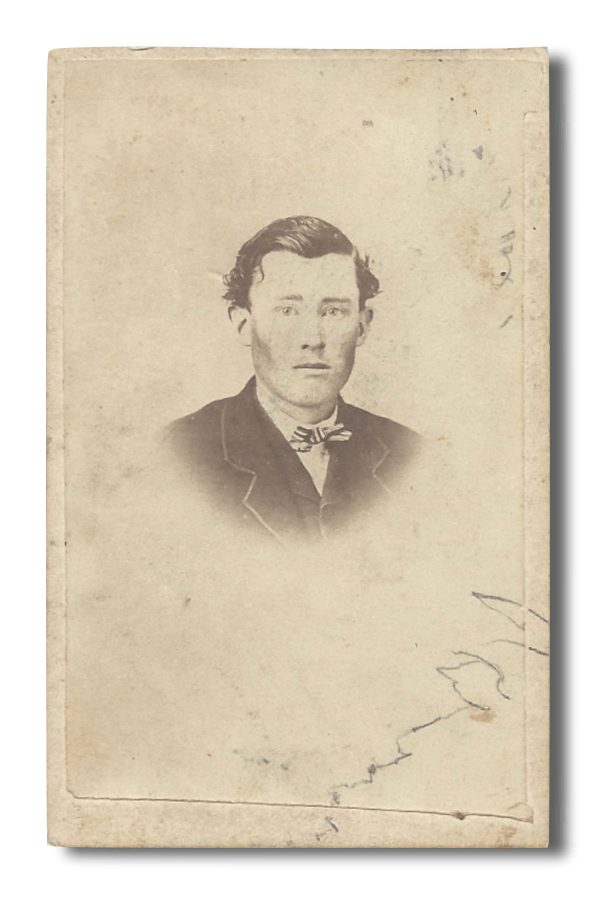
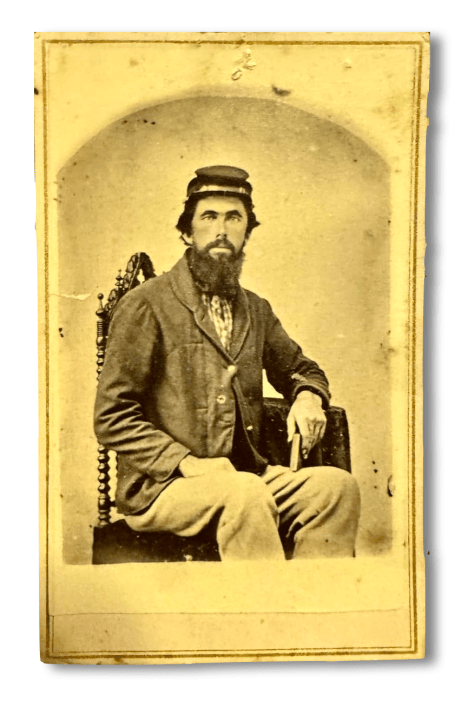
I could not find an image of Jacob but here is one of Albert C. Wentz who served in Co. F, 83rd Pennsylvania Infantry.
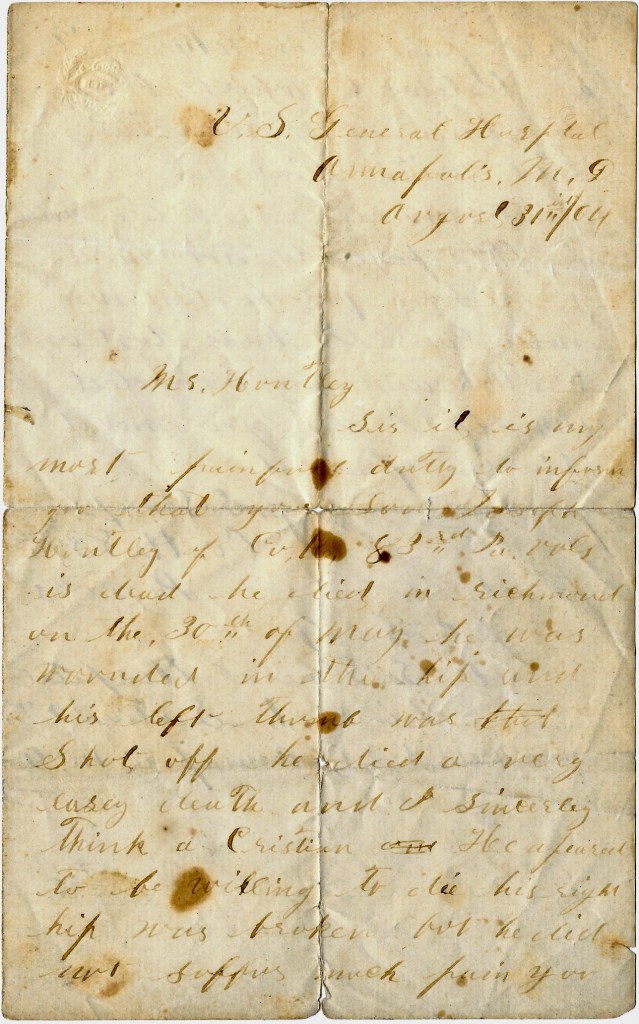
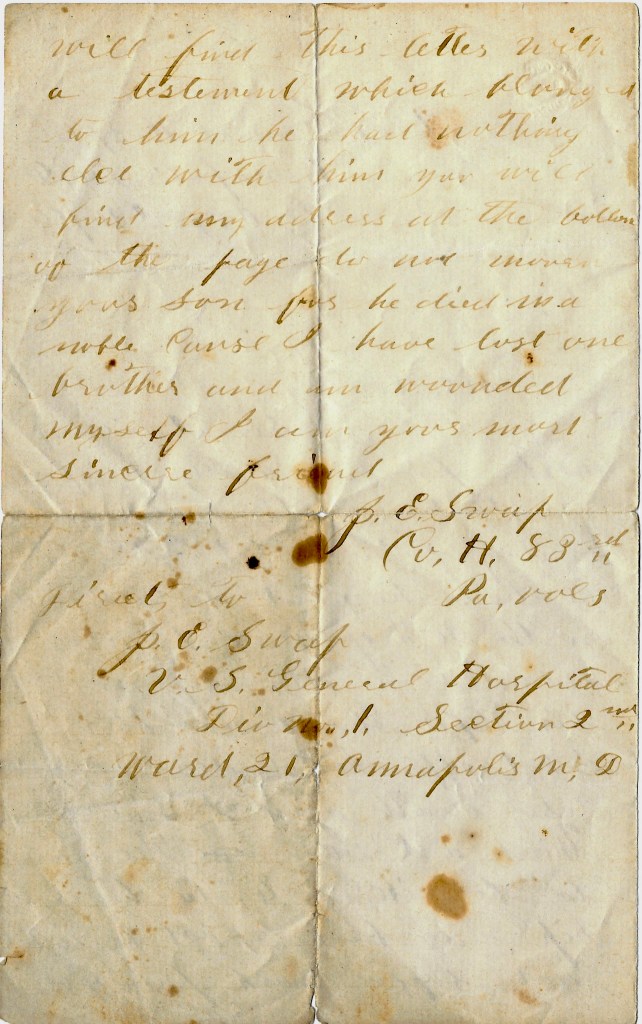
The following letter was written by Jacob E. Swap (1846-1925), the son of William Swap (1807-1881) and Amanda Karl (1805-1881) of Crawford county, Pennsylvania. Jacob was born in August 1846 and had only turned 15 years old when he enlisted as a private in Co. H, 83rd Pennsylvania Infantry. Jacob served completely through the war and entered the Wilderness Campaign as a seasoned veteran before he was 18. In the contest at Laurel Hill on 8 May 1864, Jacob was wounded five times and taken prisoner. He had been exchanged and was being treated for his wounds at the US General Hospital at Annapolis when he wrote this letter on 31 August 1864—three and a half months later. His bravery on the field earned him the Medal of Honor in 1897.
Jacob’s letter was written to the father of one of his comrades in the same regiment (different company) who died in Richmond on 30 May 1864. He named the deceased as “Joseph” Huntley but the soldier by that name was 38 years old and a draftee in Co. K when he entered the service in 1863 and he was definitely not wounded in the Battle of Laurel Hill. In fact, he was transferred to Co. F and mustered out with that company later in 1865. My hunch is that the soldier that Jacob meant was actually Corp. Joel Huntley of Crawford county who served in Co. K and was listed as having been “killed at Laurel Hill on 8 May 1864. More likely than not, Joel was wounded in that action and taken prison, like Jacob, and taken to Richmond where he died nearly three weeks after the battle. I’ve seen similar cases where there were discrepancies with the date and location of soldier’s deaths.
[Note: This letter is from the private collection of James Campbell and was transcribed and published on Spared & Shared by express consent.]
Transcription
U. S. General Hospital Annapolis, Maryland August 31st 1864
Mr. Huntley,
Sir, it is my most painful duty to inform you that your son Joseph Huntley of Co. K, 83rd PA Vols. is dead. He died in Richmond on the 30th of May. He was wounded in the hip and his left thumb was shot off. He died a very easy death and I sincerely think a Christian. He appeared to be willing to die.
His right hip was broken but he did not suffer much pain. You will find this letter with a testament which belonged to him. He had nothing else with him. You will find my address at the bottom of the page. Do not mourn your son for he died in a noble cause. I have lost one brother and am wounded myself. I am your most sincere friend. — J. E. Swap, Co. H. 83rd Pa. Vols.
Direct to J E. Swap, U. S. General Hospital, Div. No. 1, Section 2nd, Ward 21, Annapolis, Maryland
This unusual letter was written by Samuel “Frank” Haskell (1839-1922), the son of Jasper Haskell (1805-1874) and Salley Fickett (197901871) of Poland, Androscoggin county, Maine. Frank was wounded in the right arm on 16 June 1864 in the opening assault on Petersburg while serving as a sergeant in Co. C, 17th Maine Infantry. His wound was so severe that it required the amputation of his arm and resulted in his discharge on 15 December 1864.
We learn from Frank’s letter that he first enlisted in Co. K, 5th Maine Infantry. He was mustered into that regiment on 24 June 1861 and was taken a prisoner in the Battle of Bull Run on 21 July. His military record states that he was confined at Richmond, Va, and Charleston, S. C. before being released sometime in mid-February 1862.
Frank’s letter provides us with a description of his attempt to escape Libby Prison in the fall of 1861, which was successful, but he was recaptured just before making it back to Union lines.
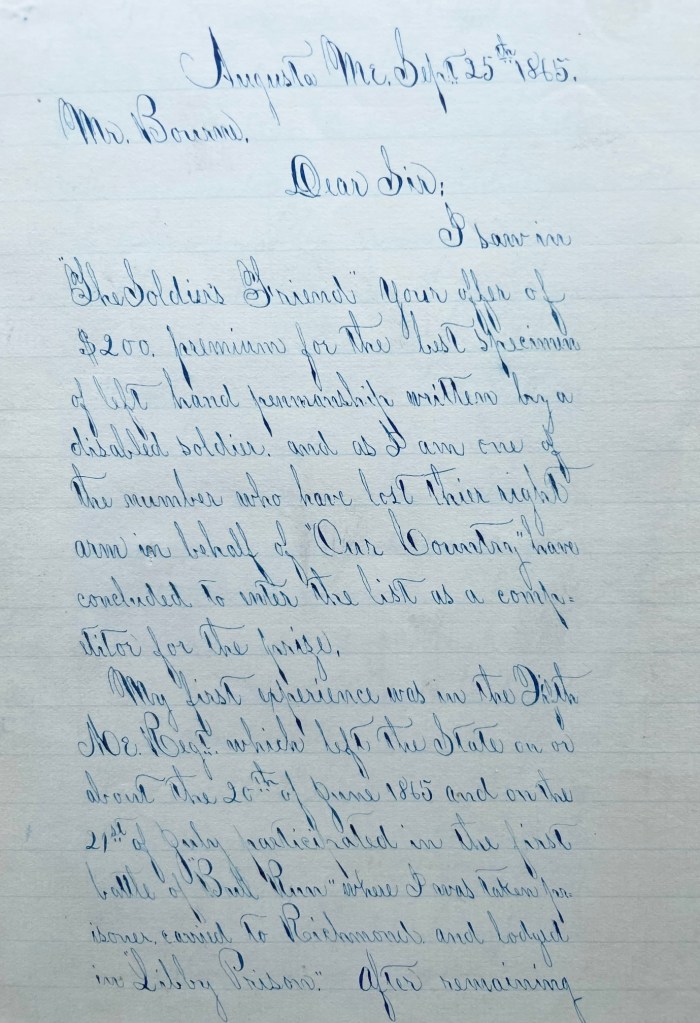
Frank wrote the letter to William Oland Bourne (1819-1901), editor of The Soldier’s Friend, who sponsored a contest in 1865-1866 in which Union soldiers and sailors who lost their right arms by disability or amputation during the Civil War were invited to submit samples of their penmanship using their left hands. The contest, which awarded a total of $1,000 in prizes for the winning entries, was followed in 1867 by a second contest, which awarded $500 in prizes. A very large number of letters were submitted to Bourne which are now housed in the Library of Congress along with some photographs on the contestants. Most likely the following letter was a personal copy (or first draft) of the letter than Frank submitted. Unfortunately Frank’s picture is not among those in the Library of Congress. See Wm. Oland Bourne Papers.
[Note: This letter is from the personal collection of Greg Herr and was transcribed and published on Spared & shared by express consent.]
S. Frank Haskell is listed as Contributor No. 41 on this published sheet.There were at least 267 entries.
Transcription
Augusta, Maine September 25th 1865
Mr. Bourne,
Dear sir, I saw in “The Soldier’s Friend” your offer of $200 premium for the best specimen of left hand penmanship written by a disabled soldier and as I am one of the number who have lost their right arm in behalf of “Our Country” have concluded to enter the list as a competitor for the prize.
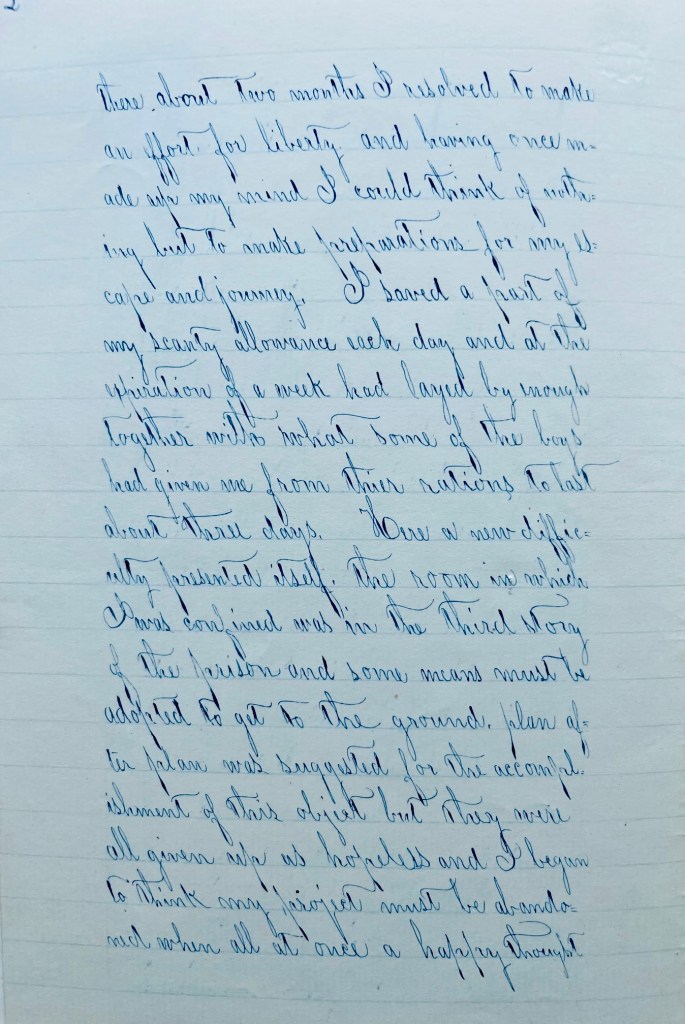
My first experience was in the Fifth Maine Regiment which left the State on or about the 20th of June 1865 [1861] and on the 21st of July participated in the first battle of “Bull Run” where I was taken prisoner, carried to Richmond, and lodged in “Libby Prison.” After remaining there about two months, I resolved to make an effort for liberty and having once made up my mind I could think of nothing but to make preparation for my escape and journey. I saved a part of my scanty allowance each day and at the expiration of a week had layed by enough together with what some of the boys had given me from their rations to last about three days.
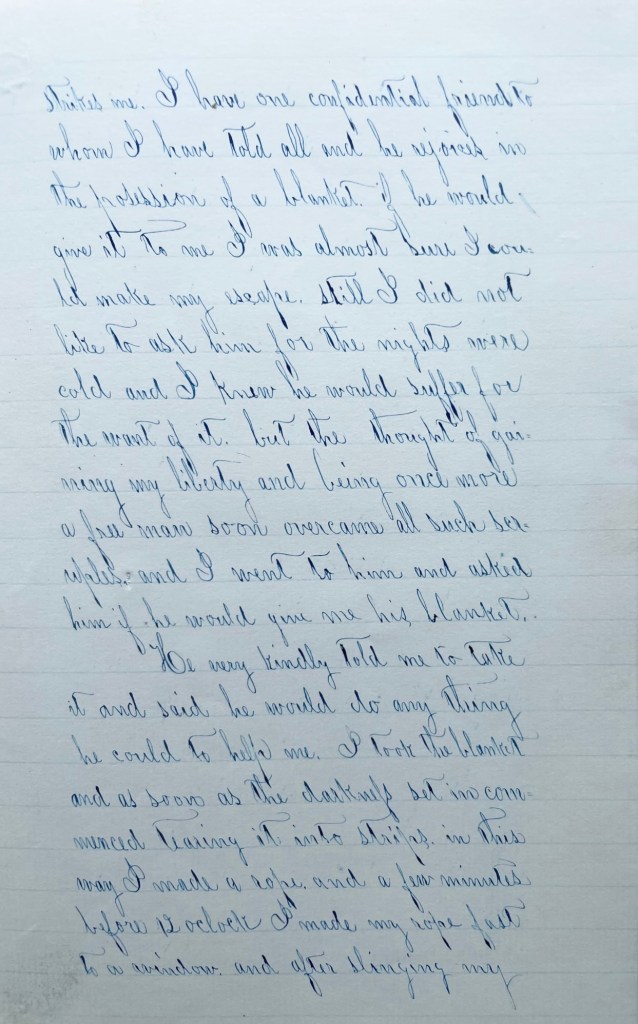
Here a new difficulty presented itself. The room is which I was confined was in the third story of the prison and some means must be adopted to get to the ground. Plan after plan was suggested for the accomplishment of this object but they were all given up as hopeless and I began to think my project must be abandoned when all at once a happy thought strikes me. I have one confidential friend to whom I have told all and he rejoiced in the possession of a blanket. If he would give it to me, I was almost sure I could make my escape. Still I did not like to ask him for the nights were cold and I knew he would suffer for the want of it. But the thought of gaining my liberty and being once more a free man soon overcame all such scruples and I went to him and asked him if he would give me his blanket.
He very kindly told me to take it and said he would do anything he could to help me. I took the blanket and as soon as the darkness set in commenced tearing it into strips. In this way I made a rope and a few minutes before 12 o’clock, I made my rope fast to a window and after slinging my haversack on my shoulder and saying goodbye to my friend, I began my descent. I succeeded in reaching the ground in safety and gave the rope a slight jerk which was the signal to draw it up and that all so far had worked well. 1
I was now outside of the prison but I still had a high fence to climb and outside of this fence the guards were posted. Fortunately for me, however, the night was pitchy dark and the rain falling in torrents. I suppose the guards were all under an old shed that stood near trying to keep out of the rain. At all events, they were no doing their duty and I succeeded in reaching the street without further difficulty. But it would occupy too much space to give all the particulars of my journey so I will only say that after traveling ten days, sleeping in the woods, living on green corn and sometimes a piece of corn bread from a negro cabin, I was recaptured within half a mile of our pickets and taken back to Richmond. A few days after this I was sent to Charleston, S. C. with a lot more of the most unruly and insubordinate of the prisoners (we saw this paragraph in [one] of their papers) for safekeeping. I was at length paroled after spending nearly ten months in prison.
I came home and stopped about two months. At that time the 17th Maine was being organized and feeling that I had not seen quite enough of “the show,” I enlisted in that regiment and was with it until the 16th of June 1864. On that day, while charging a line of the enemy’s works, a minié ball struck my right arm, fracturing the elbow joing so as to cause amputation. While in the 17th, I participated in the following battles—Fredericksburg, Chancellorsville, The Cedars, Mine Run, Locust Grove, Gettysburg, The Wilderness, Coal [Cold] Harbor, North Anna River, Spottsylvania, and number of smaller engagements not worth mentioning. I am at present attending the Augusta Commercial College. I have been here about three weeks. Enclosed please find a sample of my writing written the day I commenced taking lessons at this Institution. My Post Office address is Augusta, Maine.
Very truly yours, — S. Frank Haskell, late Sergt. in Co. C, 17th Maine Regt.
1 Early in the war when the tobacco warehouse was first used as a prison, the windows did not have bars on them.
The following letter was written by various members of the Floyd family. We learn from the letter that Enoch Floyd (1808-1855) and Sarah Ingersoll (Harvey) Floyd (1816-1889) made the overland journey from the Great Salt Lake over the Sierra Mountains to the vicinity of Sacramento in the spring of 1856 with their family of five children. They were Enoch Harvey Floyd (1834-1860), Lyman Floyd (1837-1863), Leonard Floyd (1837-1916), Sarah Elizabeth Floyd (1841-1866) and Julia Ann Floyd (1852-1860). Two of their youngest daughters, Martha and Lucy died within days on each other in 1853 probably from some childhood disease. The family resided in Newbury, Essex county, Massachusetts, before making the overland journey.
Transcription
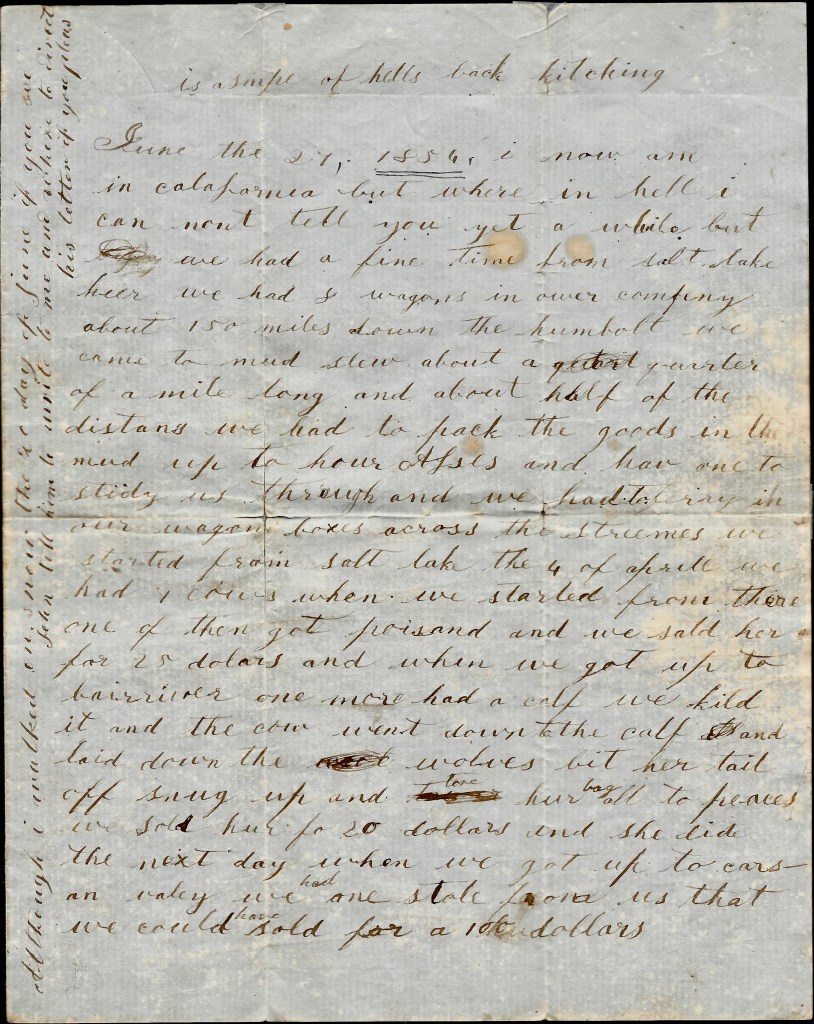
June 27, 1854
i now am in california but where in hell i can nont tell you yet a while but we had a fine time from salt lake heer we had 8 wagons in ower compeny about 150 miles down the humbolt we came to mud slew about a quarter of a mile long and about half of the distans we had to pack the goods in the mud up to hour asses and have ont to stidy us through and we had to ferry in our wagon boxes across the steemes we started from salt lake the 4 of aprill we had 7 cows when we started frome there one of them got poisand and we sold her for 25 doars and when we got up to bairriver one more had a calf and laid down the wolves bit her tail off snug up and tore hur bag all to peaces we sold hur for 20 dollars and she dide the next day when we got up to carsan valey we had one stray from us that we could have sold for a 100 dollars
we are now in prairie sitty all well at this time Enoch is in hangtown to work in the mines for 60 dollars a moth and his board lyman and i have not got enny work yet they are agoin to opin a new mine here and we think taking up a claim or tow and see how we can makit i don’t know of enny thing more to writ
from your obedident servant—Leonard Floyd
Dear frien i will write a few lines i have not got rested enough yet to write or do much else we have had a very tedious journey from Salt Lake here we was from the 4 of April to the 25 of june geting to hangtown or placerville 800 miles from Salt Lake i had rather come from kanesville to Salt Lake 4 times than to come from there here once we are all well but about tired out crosing the siera nevada mountains is enough to kill anybody or thing that ever stood on feet we were one whole day climbing one mountain one and a half miles it is like going up and down the roof of a house with the exception of the sharp edge and rocks in the road as high as the wagon bodys the rocky mountains is nothing to compare to these.
Enoch has kept a journal of Our journey and some time some of us will will write it enoch is 30 miles from us now.
[in a different hand]
if you read this you will do well write as soon as you get this and direct it to sacramento we are 20 miles north of it but where we shall stop i do not know but we shall get the letter When we had all of the goods out of our wagon we had on nine yoke of Oxen to our wageon that would girt from 6 to 7 ft and we spird and sashed them til the blud run their sides to take the empty [wagons] over the siinavada Mountain. Enoch Floyd, Jr.
July 1 since the above was writen we have moved within 5 miles of sacramento Leonard and Lyman are at work for two dollars per day for A short time and their board board is from 6 to 9 dollars per week for constant boarders transient ones more when we got to Carson valley we expected to wait for the snow to go of the carson route so Enoch came on ahead of us he had to pay 11 dollars A week but he got work and i hope will do well but we came the joHnson cut off this road is worse than the other but no snow in the road.
this is A mixed up letter but never mind as long as we know how better in hangtown they have up bets so i am told as high as fifteen hundred dollars to see who will go down to Carson valley and steal the most cattle from emigrants the whites are A great deal worse than the indians the indians seldom troubel any companies unless they are as small as from 5 to 8 men than they will steal their cattle and sometimes fire upon the men but where there is from 15 to 25 men there is no trouble we had 22 men Mr Silas Barn[e]s from Boston with his family came through with us from Salt Lake he lived there two years and A half 1 and Mr. William Paterson formily of haverhill Mass.
We had no serious sickness in our family or company nor Deaths little Julia is cuting Double teeth and it makes her rather cross but she is a good littl girl Sarah send her love to grandmother and grandfather and all the rest of the folks if you could see the style that i write in you would say it is time to say good by till A more conveint time. so good by — Sarah I. Floyd
1Silas P. Barnes was born in Deering, New Hampshire in 1805. He moved to Boston as a young man and married Olive Chapman. In 1851, he settled up his business in Boston and embracing the doctrines taught by Joseph Smith, made his way with his family of nine children to Council Bluffs, Iowa, where they joined a caravan of 60 wagons to journey to Salt Lake City. They lived near Dry Creek until Indian troubles threatened danger and in so they decided in April 1854 to go to California. After a three month’s journey they reached the Golden State and settled in Yolo county. Silas died there in 1888.
The following letter was written by 41 year-old Squire Green Sherman (1821-1869) who mustered in as a private in Capt. Claudius Buster’s Company, Elmore’s 20th Texas Infantry at Hempstead, Texas, in late April 1862. Muster rolls indicate that he enlisted in Burleson county. In January 1863 he was promoted to 2nd Sergeant of Co. C. and was later detailed as a a clerk to Gen. McCulloch’s Headquarters in Galveston and later in Houston—a situation held throughout the remainder of the war.
Sherman’s letter includes a description of the Confederate defenses at Galveston Bay in January 1863, which was blockaded by Union gunboats. “We are expecting an attack constantly & the probability is that but little resistance will be made on our part. The fact is, we cannot hold the city against their fleet, as it cannot be fortified so as to successfully defend it,” he wrote.
Sherman wrote the letter to Sarah (“Sallie”) Elizabeth Johnson (1843-1901) with whom he married in 1864 or 1865.
[Note: The family name was originally spelled Shearman.]
Transcription
Addressed to Miss Sallie E. Johnson, Caldwell, Texas
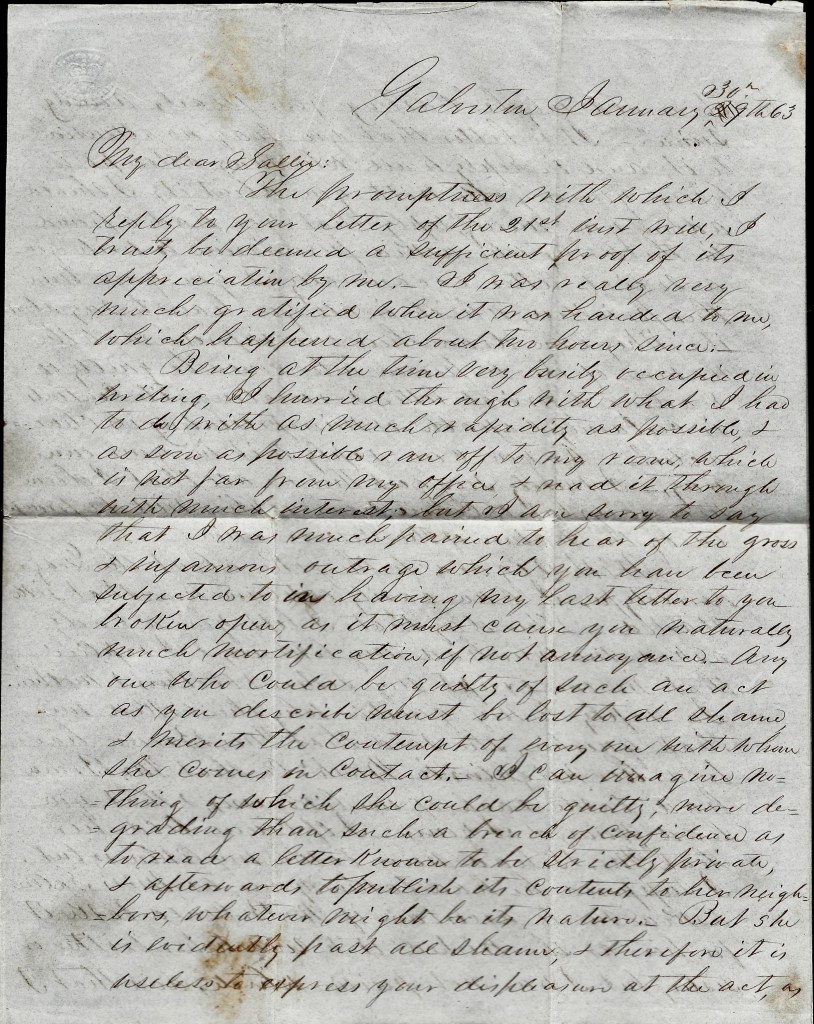
Galveston, [Texas] January 30th 1863
My dear Sallie,
The promptness with which I reply to your letter of the 21st inst. will, I trust, be deemed a sufficient proof of its appreciation by me. I was really very much gratified when it was handed to me, which happened about two hours since.
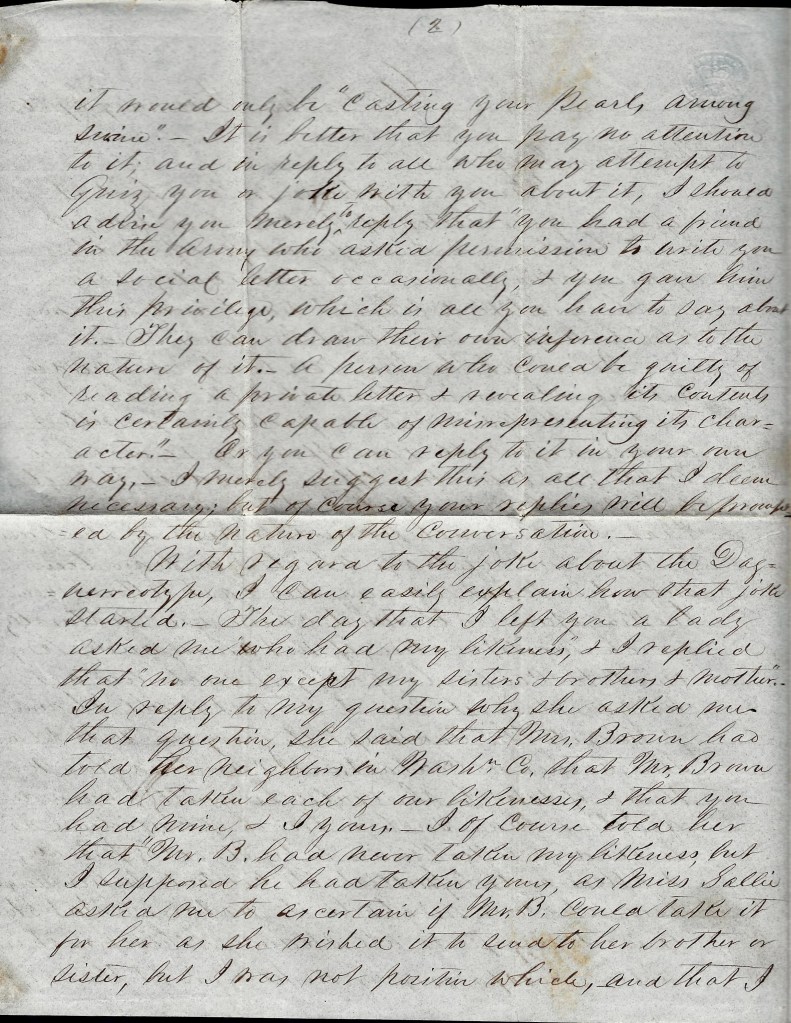
Being at the time very busily occupied in writing, I hurried through with what I had to do with as much rapidity as possible, & as soon as possible ran off to my room which is not far from my office & read it through with much interest, but I am sorry to say that I was much pained to hear of the gross& infamous outrage which you have been subjected to in having my last letter to you broken open as it must cause you naturally much mortification, it not annoyance. Anyone who could be guilty of such an act as you describe must be lost to all shame & merits the contempt of everyone with whom she comes in contact. I can imagine nothing of which she could be guilty more degrading than such a breach of confidence as to read a letter known to be strictly private, and afterwards to publish its contents to her neighbors, whatever might be its nature. But she is evidently past all shame and therefore it is useless to express your displeasure at the act, as it would only be “casting your pearls among swine.” It is better that you pay no attention to it; and in reply to all who may attempt to quiz you or joke with you about it, I should advise you merely to reply that you had a friend in the Army who asked a permission to write you a social letter occasionally, & you gave him this privilege, which is all you have to say about it. A person who could be guilty of reading a private letter & revealing its contents is certainly capable of misrepresenting its character. Or you can reply to it in your own way. I merely suggest this as all that I deem necessary; but of course your replies will be prompted by the nature of the conversation.
With regard to the joke about the daguerreotype, I can easily explain how that joke started. The day that I left you, a lady asked me “who had my likeness,” & I replied that no one except my sisters & brothers & mother. In reply to my question why she asked me that question, she said that Mrs. Brown had told her neighbors in Washington county that Mr. Brown had taken each of our likenesses & that you had mine, & I yours. I of course told her that “Mrs. Brown had never taken my likeness, but I supposed he had taken yours, as Miss Sallie asked me to ascertain if Mr. Brown could take it for her as she wished it to send to her brother or sister, but I was not positive which, and that I heard you afterward speak of it as having been badly taken on account of some defect in the chemicals.” I let the subject drop, after laughing at the absurd reports people would start, not even mentioning that I wait with you to get it taken. The best way is to let them talk on—it cannot hurt you, if you deem me worthy of your esteem, & are not ashamed to have me known as your affianced. I should like to know which of the Fullerton’s told about the likeness. They both love to talk, & say a great many things merely for the sake of talking. But enough of this. I have devoted already more space to it than you will consider it deserves—at least I hope so.
I had not heard of Mr. Beard’s death. I should like to hear what was the cause of it. I feel much sympathy for his large family who are left with but little means of support.
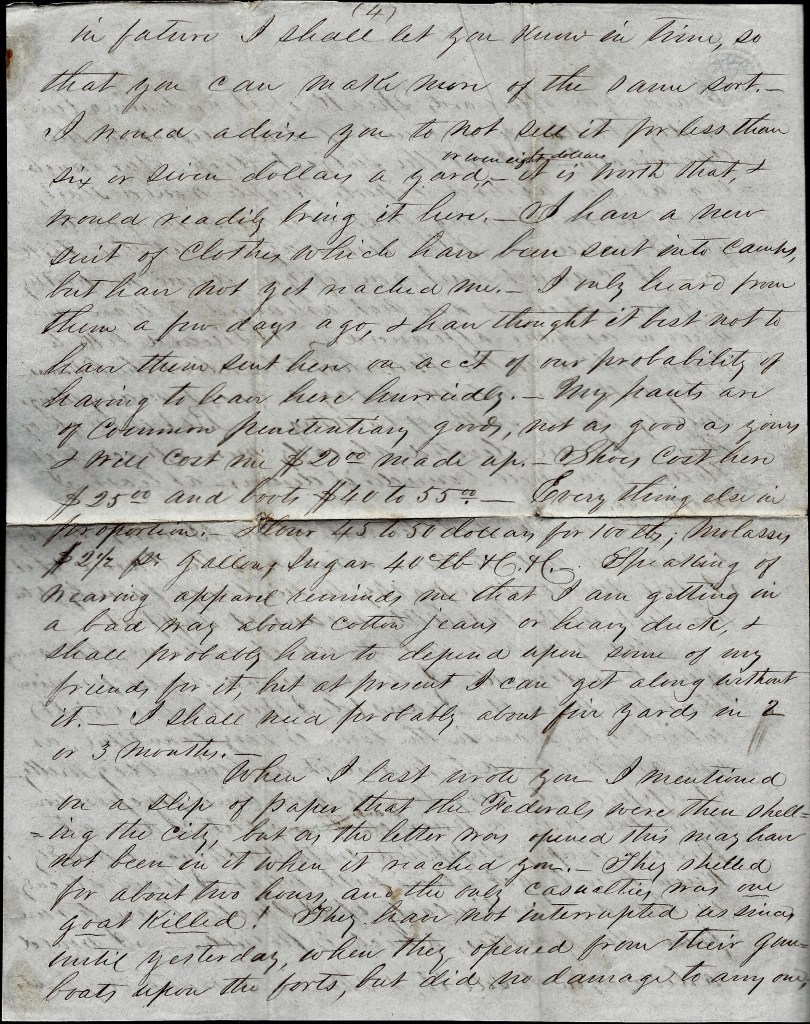
As you are not much of a hand at praising your handiwork, I have formed an impression that the piece of Jeans (do I spell this word right) which you have in the loom is very beautiful, as you are inclined to praise it as being very pretty. I appreciate very highly your kind proposition to me me have a pair of pants; but I am at present amply supplied with clothing & hardly know how to get along with what I have already on hand—particularly if I should have to run from the Yankees which is possible. I would advise you to sell it & should I want any pants in future, I shall let you know in time, so that you can make more of the same sort. I should advise you to not sell it for less than six or seven dollars a yard—or even eight dollars. It is worth that & would readily bring it here. I have a new suit of clothes which have been sent into camp but has not yet reached me. I only heard from them a few days ago & have thought it best not to have them sent here on account of our probability of having to leave here hurriedly. My pants are of common penitentiary goods, not as good as yours, & will cost me $20 made up. Shoes cost here $25 and boots $40 to 55. Everything else in proportion. Flour 45 to 50 dollars for 100 lbs., molasses $2.5 per gallon, sugar 40 cents a lb., &c. &c. Speaking of wearing apparel reminds me that I am getting in a bad way about cotton jeans or heavy duck, & shall probably have to depend upon some of my friends for it, but at present I can get along without it. I shall need probably above five yards in two or three months,
When I last wrote you I mentioned on a slip of paper that the Federals were then shelling the city, but as the letter was opened, this may have not been in it when it reached you. They shelled for about two hours and the only casualties was one goat killed! They have not interrupted us since until yesterday when they opened from their gunboats upon the forts, but did no damage to anyone. But we are expecting an attack constantly & the probability is that but little resistance will be made on our part. The fact is, we cannot hold the city against their fleet, as it cannot be fortified so as to successfully defend it. They threaten, I hear, to send “a fleet here that will teach us a lesson which we will not soon forget.” If a very large force is sent, the city will no doubt be left without resistance, as they otherwise would be enabled to claim a victory which we do not wish. Everything, however, is uncertain & what I state, of course, is only intended for you in confidence. One week may materially alter the aspect of affairs. There are now in sight four boats which are here merely to keep the city blockaded.
We have disastrous news from Vicksburg today to the effect that it has been taken by the enemy, but no particulars. Also that 8,000 of our army have been taken prisoners in Arkansas. I sincerely hope these rumors are false, but fear they are true.
You seem to constantly entertain the hope that the war will end soon, but my dear Sallie, I am sorry to say that I see things in a very different light. There is in my estimation no prospects—not the slightest—of a speedy termination of this struggle. This is only my opinion, but wait, & I doubt not you will find that I am right in these views.
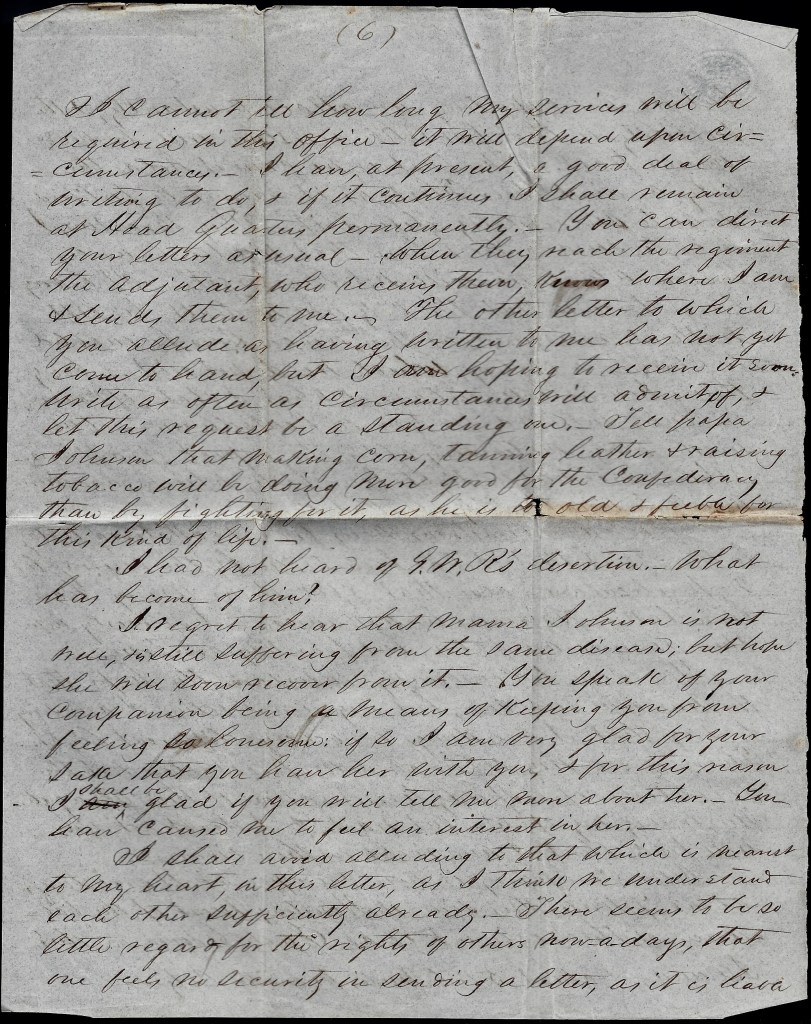
Our company is now camped at Harrisburg, about 7 miles this side of Houston; most of the balance of the regiment is at Eagle Grove on this Island, & about 5 or 6 miles from the city. I cannot tell how long my services will be required in this office. It will depend upon circumstances. I have at present a good deal of writing to do, & if it continues, I shall remain at Head Quarters permanently. You can direct your letters as usual. When they reach the regiment, the adjutant, who receives them, knows where I am and sends them to me. The other letter to which you allude as having written to me has not yet come to hand but I am hoping to receive it soon. Write as often as circumstances admit of & let this request be a standing one. Tell papa Johnson that making corn, tanning leather, & raising tobacco will be doing more good for the Confederacy than by fighting for it, as he is too old and feeble for this kind of life.
I had not heard of G. W. R’s desertion. What has become of him?
I regret to hear that mama Johnson is not well & is still suffering from the same disease; but hope she will soon recover from it. You speak of your companion being a means of keeping you from feeling so lonesome. If so, I am very glad for your sake that you have her with you, & for this reason I shall be glad if you will tell me more about her. You have caused me to feel an interest in her.
I shall avoid alluding to that which is nearest to my heart in this letter as I think we understand each other sufficiently already. There seems to be so little regard for the rights of others now-a-days, that one feels no security in sending a letter, as it is liable [remainder of letter missing]




















 Spared & Shared 23